目录
C001 Musicology in educational practice: The transmission of Qinqiang opera in contemporary China
- C001-S001 ABSTRACT
- 页码:1-1
- C001-S002 INTRODUCTION
- 页码:1-2
- C001-S003 METHODOLOGY
- 页码:2-2
- C001-S004 Research design
- 页码:2-2
- C001-S005 Research site and informants
- 页码:2-2
- C001-S006 Data collection methods
- 页码:2-3
- C001-S007 Data analysis
- 页码:4-4
- C001-S008 Ethical considerations
- 页码:4-4
- C001-S009 RESULTS
- 页码:4-4
- C001-S010 Systematization of vocal techniques through musicology
- 页码:4-5
- C001-S011 Pedagogical clarity and learning efficiency
- 页码:5-6
- C001-S012 Cultural understanding and artistic identity formation
- 页码:6-6
- C001-S013 Sustainable transmission through hybrid educational models
- 页码:6-7
- C001-S014 DISCUSSION AND CONCLUSION
- 页码:7-8
- C001-S015 REFERENCES
- 页码:8-9
C001-S001 ABSTRACT
第1段(P0001)
原文复述
Musicology in educational practice: The transmission of Qinqiang opera in contemporary China.
中文讲解
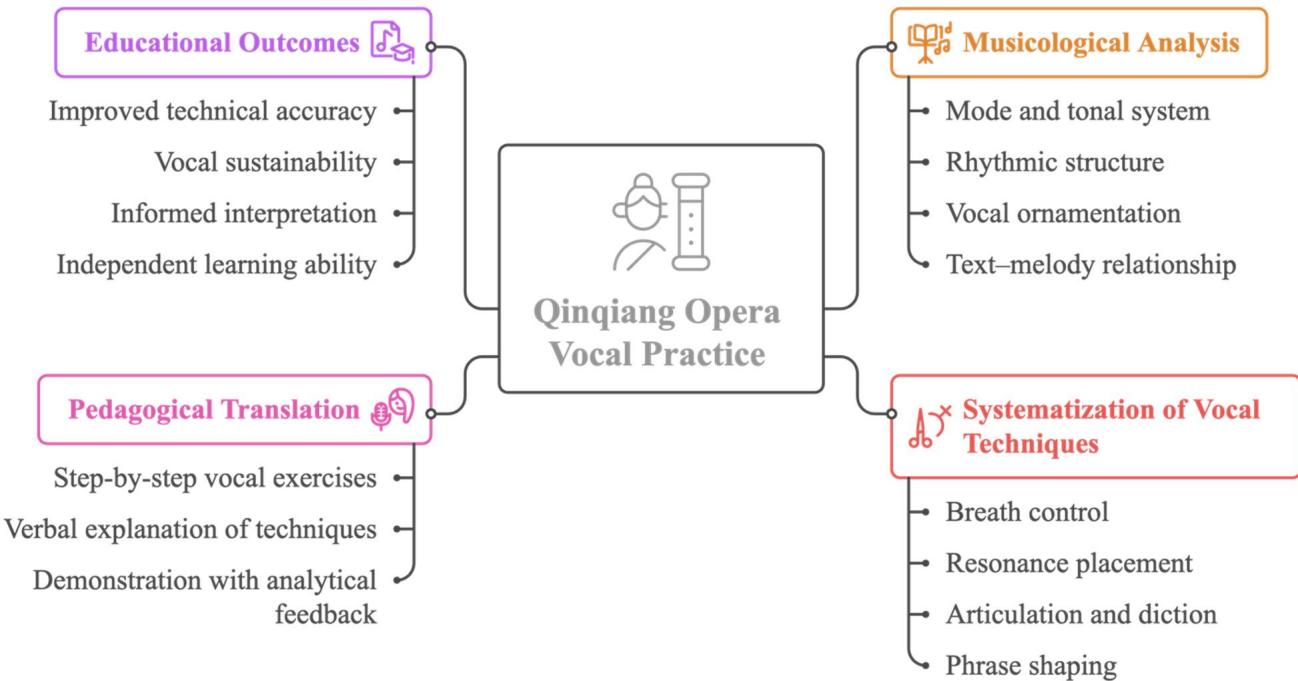
这是论文的主标题,由冒号分成两个层次:前半句“Musicology in educational practice”点明研究视角——把音乐学作为一种方法引入教育实践;后半句“The transmission of Qinqiang opera in contemporary China”限定研究对象——当代中国秦腔的传承问题。整体表明这是一项将音乐学理论与戏曲教育实践相结合的应用性研究。
补充说明
标题中的“contemporary China”提示研究的时间限定在当代中国,与正文中“从传统的师徒传授转向当代教育语境”的转型背景相呼应。
第2段(P0002)
原文复述
Xing Alan, Thanaporn Bhengsri* and Awirut Thotham
中文讲解
这是作者署名行,列出三位作者,其中 Thanaporn Bhengsri 姓名后带星号(*),表示其为通讯作者。署名顺序遵循学术惯例,第一作者 Xing Alan 应为主要研究者或第一完成人。
第3段(P0003)
原文复述
College of Music, Mahasarakham University, Thailand.
中文讲解
这是作者的单位信息,表明三位作者均隶属于泰国玛哈沙拉堪大学音乐学院。这说明研究虽以中国秦腔为对象,但研究团队来自泰国高校,体现了跨国合作与跨文化视角。
第4段(P0004)
原文复述
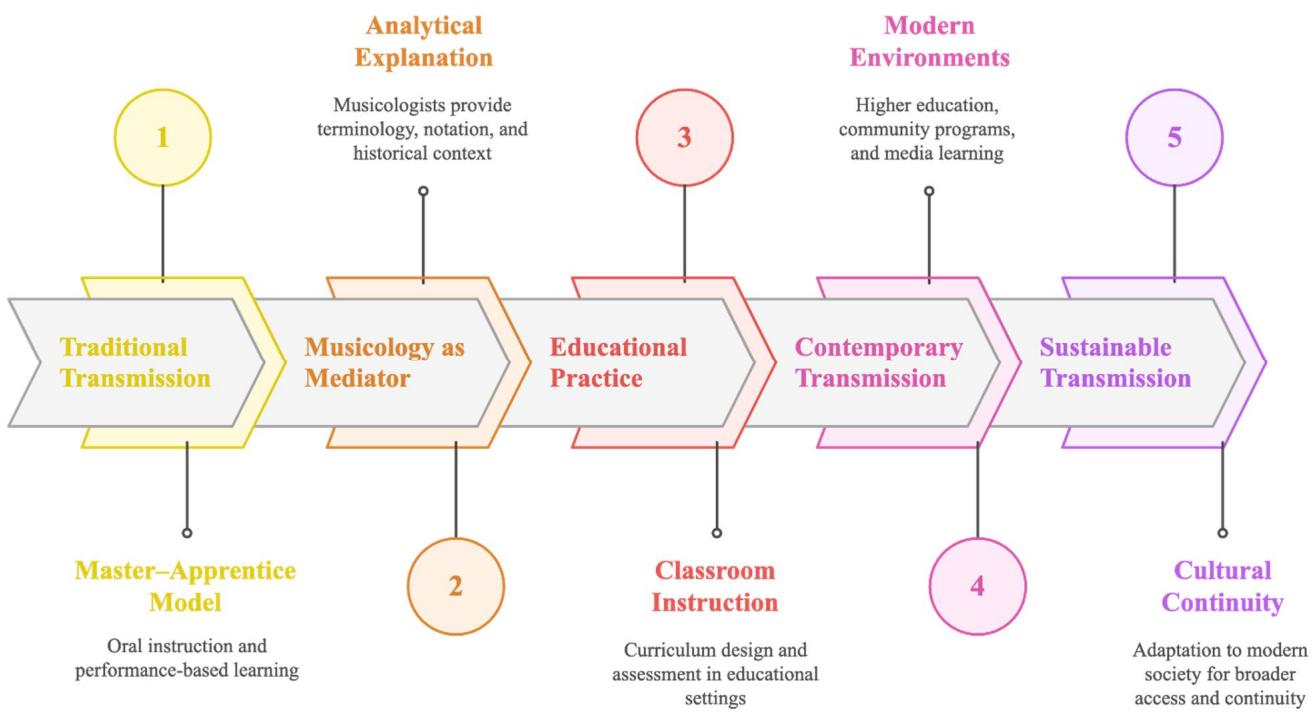
Accepted 8 January, 2026
中文讲解
这是稿件被录用的日期,2026年1月8日。在学术论文中,该信息位于标题区与摘要之间,表明论文已经过同行评审并被正式接收,区别于投稿日期或修订日期。
第5段(P0005)
原文复述
ABSTRACT
中文讲解
这是排版层面的小节标题“ABSTRACT”(摘要)。它标志着标题、署名、录用信息等元数据结束,正文意义上的摘要内容开始。该标题以二级 Markdown 标记呈现,说明它是文章内部的子标题而非论文大标题。
第6段(P0006)
原文复述
Qinqiang opera, one of the earliest regional opera forms in China, faces increasing challenges in transmission due to social transformation and the shift from traditional master–apprentice training to contemporary educational settings. This study investigates how musicology is applied in educational practice to support the transmission of Qinqiang opera in contemporary China. Using a qualitative, practice-based research design, fieldwork was conducted in Shaanxi Province, the cultural center of Qinqiang opera. Data were collected through semi-structured interviews with seven purposively selected informants (including a senior performer, a music theorist, and performers/learners), participant observation in rehearsals and instructional contexts, musical analysis of teaching repertoires, and document analysis. Thematic analysis was employed to triangulate findings across data sources. The results reveal that musicology functions as a mediating framework that systematizes vocal techniques, enhances pedagogical clarity, deepens cultural understanding, and supports sustainable transmission through hybrid educational models that combine oral tradition with structured instruction. Musicological analysis enables educators to transform experiential performance knowledge into explicit, teachable concepts while preserving stylistic authenticity and cultural meaning. These findings are significant for music education and the transmission of intangible cultural heritage, demonstrating how traditional performing arts can be effectively integrated into modern educational systems. The study suggests that incorporating musicology into opera education improves learning efficiency, fosters artistic identity, and enhances long-term sustainability. Further research is recommended to conduct comparative studies across regional operas, examine long-term learning outcomes, and explore the integration of digital technologies in musicology-based heritage education.
中文讲解
这是论文的摘要正文,按学术摘要的常规逻辑展开,可拆为四层理解:
-
背景与问题:秦腔是中国最早的地域性戏曲形式之一(“one of the earliest regional opera forms”),但在社会转型以及从师徒传授(master–apprentice training)转向当代教育语境的过程中,传承面临日益严峻的挑战。这里用“due to”连接两个原因,说明传承危机不是单一因素造成,而是社会变迁与教育形式变更共同作用的结果。
-
研究目的与方法:研究要回答的核心问题是“音乐学如何在教育实践中支持秦腔传承”。在方法上,作者明确选用“qualitative, practice-based research design”(定性、以实践为基础的研究设计),田野地点选在秦腔文化中心陕西省;数据来源有四类:①对7位目的性抽样(purposively selected)信息人的半结构化访谈,涵盖资深演员、音乐理论家、演员/学习者三类角色;②排练与教学情境中的参与式观察;③对教学剧目的音乐分析;④文献分析。最终采用主题分析(thematic analysis)对多源数据进行三角互证(triangulate)。这种多源数据 + 三角互证的设计说明作者追求的不是单一证据,而是方法上的稳健性。
-
结果与意义:研究发现音乐学扮演“中介框架”(mediating framework)的角色,具体表现为系统化声乐技巧(systematizes vocal techniques)、增强教学清晰度(enhances pedagogical clarity)、深化文化理解(deepens cultural understanding),并通过将口传传统与结构化教学相结合的混合教育模式(hybrid educational models)支持可持续传承。进一步指出,音乐学分析能够让教育者把“体验性的表演知识”(experiential performance knowledge)转化为“明确可教的概念”(explicit, teachable concepts),同时保持风格真实性(stylistic authenticity)与文化意义。意义层面,作者强调这对音乐教育与非物质文化遗产(intangible cultural heritage)传承都有价值,并证明传统表演艺术能够被有效整合进现代教育体系。
-
建议与展望:作者提出三点后续研究建议——跨剧种比较研究、长期学习效果考察、以及在音乐学导向的遗产教育中融入数字技术。
理解本段的关键,是抓住“音乐学 = 介乎口传体验与课堂系统教学之间的中介”这一核心命题,以及与之配套的“方法多源 + 主题分析三角互证”的研究设计。
补充说明
摘要中明确出现的限定与例外需注意:访谈对象仅 7 人且为“目的性抽样”,并非随机样本;研究地仅限于陕西省,不能直接推论到全国其它剧种;研究是定性设计,因此“improves learning efficiency”等表述属于作者基于定性发现所做的推断性结论,而非量化意义上的因果证明。
第7段(P0007)
原文复述
Keywords: Qinqiang opera, musicology, music education, intangible cultural heritage, vocal pedagogy. *Corresponding author. Email: thanaporn.b@msu.ac.th.
中文讲解
这是摘要末尾的关键词与通讯作者信息。五个关键词按研究对象(Qinqiang opera)、研究视角(musicology)、应用领域(music education, intangible cultural heritage)和具体教学层面(vocal pedagogy)依次排列,完整覆盖了论文的核心议题;星号再次标示通讯作者 Thanaporn Bhengsri,并给出联系邮箱 thanaporn.b@msu.ac.th,其中“.ac.th”是泰国学术机构的域名后缀,与作者所属的玛哈沙拉堪大学对应。
补充说明
关键词的顺序可视为从“具体对象”到“抽象学科”再到“应用与意义”的层级,有助于数据库检索时同时命中戏曲、音乐学与遗产教育三类主题。
脚注 / 边栏 / 图表 / 附加信息(如有)
本小节为论文首页的标题区与摘要区,包含三项附加信息:①录用日期(Accepted 8 January, 2026),表明论文已经过同行评审;②通讯作者标识(星号)与邮箱,用于读者联系;③关键词列表,用以支持数据库索引与跨学科检索。摘要内部还以一段压缩形式交代了研究背景、目的、方法、发现、意义与未来方向,构成完整的学术摘要结构。
💡 本节核心要点
- 秦腔作为中国最早的地域戏曲之一,正面临社会转型与师徒制向现代教育过渡所带来的双重传承压力。
- 研究以定性、实践为基础,采用在陕西进行的田野调查,结合半结构化访谈、参与式观察、剧目音乐分析与文献分析,并以主题分析进行多源三角互证。
- 研究发现音乐学扮演“中介框架”,能将体验性的表演知识转化为可教概念,同时系统化声乐技巧、增进教学清晰度、深化文化理解。
- 研究主张采用“口传传统 + 结构化教学”的混合教育模式,以兼顾风格真实性和现代教育的可规模化传承。
- 论文同时强调其对音乐教育与非物质文化遗产传承两方面的意义,并提出跨剧种比较、长期效果评估与数字技术整合三项后续研究方向。
🔑 关键术语
- Qinqiang opera:秦腔,中国最早的地域性戏曲形式之一,本研究的核心传承对象,文本中以陕西省为其文化中心。
- Musicology:音乐学,在本研究中不是泛指学科,而是作为中介框架,将传统表演经验转化为可教概念并系统化声乐技巧。
- Master–apprentice training:师徒传授,秦腔等传统戏曲原有的口传心授传承方式,本研究将其与当代教育语境对照。
- Intangible cultural heritage:非物质文化遗产,秦腔在本研究中被定位为需要保护与可持续传承的非物质文化遗产。
- Vocal pedagogy:声乐教学法,本研究关注音乐学如何使秦腔的声乐技巧变得系统化、可教学。
- Thematic analysis:主题分析,本研究用于对访谈、观察、文献等多源数据进行编码与归纳的分析方法。
- Triangulation:三角互证,本研究通过多类数据来源相互印证以提升研究结论的可信度。
C001-S002 INTRODUCTION
第1段(P0008)
原文复述
INTRODUCTION
中文讲解
这是论文的章节标题"INTRODUCTION"(引言)。作为论文的开篇部分,引言的功能是交代研究主题与背景、指出研究问题,并最终说明本研究的目的与价值。在学术论文中,引言通常遵循"由宽到窄"的逻辑推进——从研究对象的整体文化定位出发,逐步收拢到具体的研究空白,再陈述本文将如何填补这一空白。
第2段(P0009)
原文复述
Qinqiang opera is one of the earliest regional opera forms in China, originating in Shaanxi Province and deeply intertwined with the historical, linguistic, and cultural traditions of Northwest China. Characterized by its penetrating vocal timbre, strong rhythmic drive, and emotionally intense performance style, Qinqiang opera embodies both artistic expressiveness and cultural depth. As intangible cultural heritage, it serves not only as stage art but also as a carrier of regional identity, moral values, and collective memory (Fan, 2018; Lam, 2022; Liu et al., 2021; Zhang and Natayakwulwong, 2024).
中文讲解
翻译:秦腔是中国最早的地方戏种之一,起源于陕西省,与中国西北地区的历史、语言和文化传统深度交织。秦腔以穿透力强的嗓音音色、强烈的节奏推动力和情感浓烈的表演风格为特征,兼具艺术表现力与文化深度。作为非物质文化遗产,它不仅是舞台艺术,也是地域身份、道德价值与集体记忆的载体(Fan, 2018; Lam, 2022; Liu et al., 2021; Zhang and Natayakwulwong, 2024)。本段是引言的开篇,作用是确立研究对象的本体定位与文化地位。作者从三个层面建构秦腔的形象:地理起源(陕西、中国西北)、艺术特征(嗓音穿透力、节奏感、情感张力)、文化功能(不仅是舞台艺术,更是地域身份、道德价值和集体记忆的载体)。注意末尾括号中的引文 “Liu et al.,” 在此处未闭合,下一段才补全为 “Liu et al., 2021”,这是原文排版的处理,并非省略。
第3段(P0010)
原文复述
However, in contemporary China, rapid social transformation, urbanization, and changing cultural consumption patterns have significantly altered the conditions under which traditional performing arts are learned, practiced, and transmitted (Fu and Choatchamrat, 2024; Wu, 2023).
中文讲解
翻译:然而,在当代中国,快速的社会转型、城市化以及文化消费模式的改变,显著改变了传统表演艺术在学习、实践与传承方面的条件(Fu and Choatchamrat, 2024; Wu, 2023)。本段以 “However” 起首,把视角从上一段"秦腔的文化价值"切换到"秦腔的现实处境",构成引言中的第一次转折。作者用三个并列的社会因素——社会转型、城市化、文化消费模式变化——共同构成秦腔传承的外部压力,并作用于"学习、实践、传承"三个环节。这一表述为下文讨论"传统师徒制在现代教育环境中面临的危机"做了铺垫。
第4段(P0011)
原文复述
Historically, the transmission of Qinqiang opera depended primarily on the master–apprentice system, emphasizing oral instruction, embodied practice, and prolonged immersion in performance contexts. Through imitation, repetition, and close mentorship, learners gradually internalized vocal techniques, musical structures, role conventions, and ethical principles embedded in the art form (Leung, 2015; Li and Seekhunlio, 2024; Sansom, 2023). While this mode of transmission was effective in preserving stylistic authenticity, it is increasingly challenged in modern educational environments. Contemporary learners often face limited training time, fragmented learning experiences, and fewer opportunities for sustained stage practice, making it challenging to acquire a systematic, in-depth understanding of Qinqiang opera through traditional means alone (Wang and Thotham, 2024; Zhang and Thotham, 2024).
中文讲解
翻译:历史上,秦腔的传承主要依赖于师徒制,强调口头传授、具身实践以及在表演情境中的长期浸润。通过模仿、重复与紧密的师徒指导,学习者逐渐内化发声技巧、音乐结构、行当程式以及该艺术形式所蕴含的伦理原则(Leung, 2015; Li and Seekhunlio, 2024; Sansom, 2023)。虽然这种传承方式在保持风格纯正性方面有效,但在现代教育环境中日益受到挑战。当代学习者常面临训练时间有限、学习经历碎片化、持续登台实践机会较少等问题,使得仅凭传统方式难以获得系统、深入的秦腔理解(Wang and Thotham, 2024; Zhang and Thotham, 2024)。本段是引言中的"问题溯源段",把讨论从宏观社会变迁(P0010)聚焦到具体的传承机制。作者先用肯定语气指出师徒制的优势——“保持风格纯正性”——再用 “While… challenged” 转折指出其当代局限。三组对应关系是理解本段的关键:口头/具身 vs. 训练时间有限/碎片化;长期浸润 vs. 持续舞台机会少;风格内化 vs. 系统深入理解。这一对照为后文提出"用音乐学介入教育"埋下逻辑伏笔:传统方式有其不可替代的价值,但单靠它已经不够。
第5段(P0012)
原文复述
As Qinqiang opera is introduced into formal education settings such as schools, universities, and community-based cultural programs, new pedagogical challenges emerge. Instruction frequently prioritizes performance outcomes, focusing on vocal imitation or stage movement without adequately explaining musical logic, vocal mechanisms, or cultural meaning (Du, 2024; Luo and Lau, 2020). As a result, learners may reproduce external forms while lacking comprehension of melodic structure, rhythmic organization, expressive intent, and historical context (Feldman et al., 2020; Trevarthen et al., 2016). This tendency risks transforming Qinqiang opera into a superficial technical skill, weakening its educational value and undermining its role as a living cultural practice.
中文讲解
翻译:随着秦腔被引入学校、大学和社区文化项目等正规教育环境,新的教学挑战随之出现。教学常常优先关注表演结果,聚焦于嗓音模仿或舞台动作,而未充分解释音乐逻辑、发声机制或文化内涵(Du, 2024; Luo and Lau, 2020)。结果,学习者可能复制外部形式,却缺乏对旋律结构、节奏组织、表达意图与历史语境的理解(Feldman et al., 2020; Trevarthen et al., 2016)。这种倾向有可能把秦腔变成一种表面的技术技能,削弱其教育价值,并损害其作为活态文化实践的角色。本段讨论秦腔进入正规教育后出现的"新问题",与 P0011 中讨论的"传统师徒制在现代环境中的局限"形成并列——一类是传统方式不再够用,一类是新方式本身也有问题。作者把当前教学总结为"重表演、轻解释",并用一组关键对立揭示问题核心:能"复制外部形式" vs. 缺乏"对旋律、节奏、表达意图与历史语境的理解"。最后一句点明风险——把秦腔变成"表面的技术技能",削弱其"教育价值"并损害其作为"活态文化实践"的角色。这是引言中第一次出现"活态"(living)这一表述,提示秦腔并非静态遗产。
第6段(P0013)
原文复述
Musicology provides a critical framework for addressing these challenges by offering analytical tools that connect musical practice with theoretical understanding. By studying melody, rhythm, mode, vocal technique, timbre, and performance structure, musicology helps articulate tacit performance knowledge into explicit concepts that can be systematically taught and learned (Addaquay, 2024; Guo et al., 2024; Williams, 2020). When integrated into educational practice, musicology enables educators to explain not only how Qinqiang opera is performed, but why specific musical and expressive choices are made. This approach bridges the gap between traditional embodied transmission and contemporary pedagogical requirements, supporting both artistic authenticity and educational accessibility.
中文讲解
翻译:音乐学为应对这些挑战提供了关键框架,其分析工具能够把音乐实践与理论理解联系起来。通过研究旋律、节奏、调式、发声技巧、音色与表演结构,音乐学有助于把隐性的表演知识转化为可以被系统教授与学习的显性概念(Addaquay, 2024; Guo et al., 2024; Williams, 2020)。当音乐学融入教学实践时,它使教育者不仅能解释秦腔是如何被表演的,还能解释为何做出特定的音乐与表达选择。这一方法在传统具身传承与当代教学需求之间架起桥梁,同时支持艺术纯正性与教育可及性。本段是引言的"解决方案段",正面回应前文铺垫的所有问题:师徒制不够(P0011)、正规教学浅表化(P0012)怎么办?答案是引入"音乐学"。作者提出一个关键的概念转换——“tacit performance knowledge → explicit concepts”,即把不可言传的隐性知识转化为可系统讲授的显性概念。这是本研究的理论立足点。文中列举的六项分析维度——旋律、节奏、调式、发声技巧、音色、表演结构——正是后文音乐学分析的实际抓手。“how … why” 这组对照是本段的论证核心:传统教学只能让学生模仿"怎么做",音乐学还能解释"为什么这样做"。最后一句把"艺术纯正性"和"教育可及性"并置,暗示本研究不放弃其中任何一方。
第7段(P0014)
原文复述
Therefore, the research objective of this study is to investigate how musicology is applied in educational practice to support the transmission of Qinqiang opera in contemporary China. By examining teaching processes, musicological analysis, and instructional strategies within academic contexts, this study aims to demonstrate how musicology functions as an effective bridge between traditional performance knowledge and modern education. The findings are expected to contribute practical insights for music educators, cultural practitioners, and researchers concerned with the sustainable transmission of traditional performing arts within contemporary educational systems.
中文讲解
翻译:因此,本研究的研究目标是考察在当代中国教育实践中音乐学如何被应用以支持秦腔传承。通过审视学术情境中的教学过程、音乐学分析与教学策略,本研究旨在展示音乐学如何作为传统表演知识与现代教育之间的有效桥梁。研究结果预期能为关注传统表演艺术在当代教育系统中可持续传承的音乐教育者、文化从业者与研究者提供实践洞察。本段是引言的收束,以 “Therefore” 起首,把前文所有讨论收束到一个具体的研究目标上。作者明确了三件事:(1) 研究对象——音乐学在教育实践中的应用;(2) 研究情境——秦腔在当代中国的传承;(3) 研究问题——“how”(如何)。“how” 一词出现两次,提示本研究的核心是过程与机制,而非结果是否有效。三个考察维度——教学过程、音乐学分析、教学策略——与 P0013 中提到的六项分析维度呼应,提示后文的研究设计将沿此展开。预期贡献面向三类读者:音乐教育者、文化从业者、研究者,覆盖"实践—政策—理论"三层。“可持续传承”(sustainable transmission)一词呼应引言开篇对秦腔作为活态文化实践的定位。
脚注 / 边栏 / 图表 / 附加信息(如有)
本节不包含脚注、图表、表格或边栏。所有列出的文献(Fan, 2018; Lam, 2022; Liu et al., 2021; Zhang and Natayakwulwong, 2024; Fu and Choatchamrat, 2024; Wu, 2023; Leung, 2015; Li and Seekhunlio, 2024; Sansom, 2023; Wang and Thotham, 2024; Zhang and Thotham, 2024; Du, 2024; Luo and Lau, 2020; Feldman et al., 2020; Trevarthen et al., 2016; Addaquay, 2024; Guo et al., 2024; Williams, 2020)均以文中括号形式出现,作为支撑性背景引证,而非独立脚注。引言中 P0009 与 P0010 之间的括号 “Liu et al.,” 在 P0009 末尾未闭合,由 P0010 起首补全为 “Liu et al., 2021”,这是原文排版处理,阅读时应合并视为同一引证。
💡 本节核心要点
- 秦腔兼具艺术表现力与非物质文化遗产意义,是西北地域身份、道德价值与集体记忆的载体,但当代社会转型、城市化与文化消费模式的变化正在改变其传承条件。
- 历史上以师徒制为主的传承方式强调口头传授、具身实践与长期浸润,能有效保持风格纯正性,却在训练时间、连贯学习与持续舞台实践方面遭遇现代局限。
- 进入学校、大学与社区等正规教育场域后,教学普遍偏向"重模仿、轻解释",存在把秦腔简化为表面技术技能、削弱其活态文化实践角色的风险。
- 音乐学被作者定位为弥合隐性表演知识与显性教学概念之间鸿沟的关键框架,能同时回答"如何表演"与"为何如此表演"两个问题,从而兼顾艺术纯正性与教育可及性。
- 本研究目标聚焦于音乐学在教育实践中"如何被应用",考察维度包括教学过程、音乐学分析与教学策略,最终面向音乐教育者、文化从业者与研究者三类读者,提供支持传统表演艺术可持续传承的实践洞察。
🔑 关键术语
- Qinqiang opera(秦腔):中国陕西及西北地区最早形成的地方戏种之一,是本研究的核心考察对象,兼具艺术表现力与非遗文化载体的双重身份。
- master–apprentice system(师徒制):秦腔历史上最主要的传承方式,以口头传授、具身模仿与长期跟师浸润为核心,能够保证风格纯正但在当代教育环境中面临时间与机会的局限。
- intangible cultural heritage(非物质文化遗产):本节中赋予秦腔的身份定位,强调其超越舞台艺术的文化载体功能,涵盖地域身份、道德价值与集体记忆。
- tacit performance knowledge → explicit concepts(隐性表演知识转化为显性概念):本研究的核心理论转换,由音乐学的分析工具促成,使原本难以言传的表演经验能够被系统地教授与学习。
- living cultural practice(活态文化实践):强调秦腔并非静态遗产,而是仍在被学习、表演与再生产的动态实践,是评判其当代教育是否有效的关键标尺。
- sustainable transmission(可持续传承):本研究对秦腔未来命运的目标性表述,也是引言为全篇研究意义设定的最终指向,涉及教育、文化与学术三层受众。
C001-S003 METHODOLOGY
第1段(P0015)
原文复述
METHODOLOGY
This is a level-2 section heading. It functions as a structural marker that opens the methodology section of the article, signaling that the discussion that follows will describe and justify the research approach adopted in the study.
中文讲解
本段为全文的二级小标题,标题文字为“METHODOLOGY”(方法论)。该标题本身不含实质论断,其作用是结构层面的——提示读者文章从此处进入方法论部分,将由背景或研究问题转入对研究设计、研究取向与方法选择的说明。理解这个标题的关键不在字面,而在功能:它意味着接下来作者需要回答“本研究打算怎么做、为什么这样做”,而不是“研究发现了什么”。因此,它在本节中起承上启下、转换主题的作用,是后续 P0016 中具体方法陈述的形式入口。
第2段(P0016)
原文复述
This study employs a qualitative, practice-based research methodology grounded in musicology and educational studies. The methodological design aims to examine how musicological knowledge is applied in educational practice to support the transmission of Qinqiang opera in contemporary China (Costanza and Russell, 2017; Neupane, 2021; Ping et al., 2024). Given that Qinqiang opera is transmitted primarily through oral instruction, embodied performance, and experiential learning, a qualitative approach is appropriate for capturing teaching processes, musical interpretation, and pedagogical interaction in authentic contexts.
中文讲解
本段是方法论小节的核心陈述,包含三层中心主张,须分别说明。
第一,研究取向的定位。作者将方法明确表述为“qualitative, practice-based research methodology”,并指出其根基在两门学科——“musicology”(音乐学)和“educational studies”(教育学)。这意味着研究并非单一学科的内部考察,而是跨学科取向:音乐学提供关于音乐本体、表演与诠释的知识储备,教育学提供关于教学过程与学习机制的分析框架;二者结合,使研究者能同时关注“音乐如何被教”和“音乐知识如何被运用于教学”。
第二,研究目标的设定。原文用 aims to examine 表明目的,而非结果:研究要考察的是“音乐学知识如何被运用于教育实践,以支持秦腔在当代中国的传承”。因此,本研究的关切点不是秦腔的艺术本体,而是音乐学知识在教学场景中的转化与应用;研究的最终指向是“传承”作为一种社会实践如何被维系。句末以括注形式列出三项文献(Costanza and Russell, 2017; Neupane, 2021; Ping et al., 2024),为定性、以实践为基础的方法选择提供外部学术支持。
第三,方法选择的理由。作者采用因果式论证:先陈述对象特征(秦腔主要通过口头传授、具身表演、经验式学习这三种机制进行传承),再由对象特征推出方法选择(因此定性方法是恰当的),最后说明该方法能够捕捉的内容(在真实情境中的教学过程、音乐诠释和师生互动)。这是一种典型的“对象特性决定方法”的定性研究辩护方式。本段中“authentic contexts”(真实情境)指的是研究发生的自然、未被高度人为控制的现场环境,它与教学过程、音乐诠释、师生互动并列,共同构成定性方法能够进入的分析层面。
本段在小节论证链中的作用是奠基:它为后续可能出现的具体研究设计(如抽样、数据来源、伦理考量等)提供总纲——读者应据此预期后续段落会沿用本段所确立的“定性—实践取向—跨学科根基—真实情境”这一框架。
容易误解之处有二。其一,“practice-based”易被读者等同于“行动研究”或“实践研究”中的某一具体流派,但原文并未指定其子类型,只能理解为以实践情境为研究场所与问题来源的研究取向。其二,“qualitative”在原文中并非指某一定性子方法(如访谈或民族志),而是宽泛地指能够在真实情境中进行的定性观察与描述,与本段所列“教学过程、音乐诠释、师生互动”相呼应。
脚注 / 边栏 / 图表 / 附加信息(如有)
本小节共两段:P0015 为二级小标题“## METHODOLOGY”,仅起结构标识作用;P0016 为方法论的首段陈述,末尾以括注形式列出三项文献引用(Costanza and Russell, 2017; Neupane, 2021; Ping et al., 2024),为定性、以实践为基础的方法选择提供外部学术支持(旁证性质),但本节正文未对其逐一展开介绍,亦未附图表、边栏或脚注。
💡 本节核心要点
- 方法论小节以二级标题“## METHODOLOGY”开启(P0015),其作用是结构性地标记主题转入方法说明。
- 研究整体取向为定性、以实践为基础,并明确以音乐学与教育学两个学科为根基(P0016)。
- 研究目标聚焦于考察音乐学知识在教育实践中的运用,以支持秦腔在当代中国的传承(P0016)。
- 方法选择由秦腔的传承机制决定:作者列举了口头传授、具身表演、经验式学习三种传承机制,并据此论证定性方法的适用性(P0016)。
- 定性方法被认为能够在真实情境中捕捉教学过程、音乐诠释与师生互动,这四项共同构成本研究能够进入的分析层面(P0016)。
- P0016 末尾括注的三项文献为方法选择提供旁证,但本节未对其内容作进一步介绍。
🔑 关键术语
- qualitative, practice-based research methodology:定性的、以实践为基础的研究方法。在本节中被界定为扎根于音乐学与教育学的研究取向,旨在真实工作情境中研究音乐知识的教学运用,原文未指定其具体子类型。
- oral instruction:口头传授。本节将其列为秦腔传承的主要机制之一,是作者论证定性方法适用性的依据之一,原文未对其具体传授方式作进一步说明。
- embodied performance:具身表演。本节将其列为秦腔传承的主要机制之一,指通过身体参与的表演传授,原文未对其具体表现形式作进一步说明。
- experiential learning:经验式学习。本节将其列为秦腔传承的主要机制之一,指学习者通过亲身参与获得技能与知识,原文未对其具体形式作进一步说明。
- authentic contexts:真实情境。本节指研究发生的自然、未被高度人为控制的现场环境,与教学过程、音乐诠释和师生互动并列,构成定性方法能够进入的分析层面;原文未列举具体场所。
C001-S004 Research design
第1段(P0017)
原文复述
Research design
中文讲解
这是第 C001-S004 小节的标题“Research design(研究设计)”。它本身不是论证段落,而是一个层级标题,用以开启本节的内容:交代本研究采用何种研究取向、为何选择该取向、并在方法呈现上做哪些安排。读者看到该标题即可预期,下一段将说明本研究所采用的具体研究范式及其理由。
第2段(P0018)
原文复述
An interpretive qualitative research design was adopted to explore the relationship between musicological concepts and educational practice. Musicology in this study functions not only as an analytical framework but also as pedagogical content, allowing the researcher to examine how musical structures, vocal techniques, and expressive principles are transformed into teachable knowledge through practice. To ensure methodological clarity, this section presents narrative explanations alongside structured tables.
中文讲解
本段提出了本节的核心方法论主张,可从三个层次理解。
第一,研究取向的选择。作者采用“解释性的质性研究设计(interpretive qualitative research design)”。“解释性”意味着研究目标不是测量变量或检验假设,而是理解现象背后的意义与过程;“质性”意味着资料以文字、叙事、案例为主,而非统计数据。该研究要探究的是“音乐学概念(musicological concepts)”与“教育实践(educational practice)”之间的关系,这是一个意义转化问题,因此选择解释性、质性的设计在逻辑上是匹配的。
第二,音乐学的双重角色。作者强调 musicology 在本研究中兼具两种身份:一是“分析框架(analytical framework)”,用于拆解音乐作品的结构与原理;二是“教学内容(pedagogical content)”,即音乐学知识本身要被转化为可教的内容。这一双重身份指明了研究对象的特殊性:研究者不仅分析音乐学知识,还要追踪这些知识在实践中如何被“再加工”为“可教的(teachable)”知识。
第三,研究落点。作者把焦点明确为“musical structures(音乐结构)、vocal techniques(声乐技巧)、expressive principles(表现原则)”这三类知识如何“通过实践(through practice)”转变为可教的内容。这告诉读者,下文将围绕这三类对象在教学情境中的转化过程展开分析,读者据此可预判后续小节将提供具体的转化案例或表格。
第四,呈现方式的声明。作者承诺本节将以“叙事性说明(narrative explanations)配合结构化表格(structured tables)”呈现方法。叙事便于交代选择理由与逻辑,表格便于呈现要素之间的对应关系。这种双轨呈现是质性研究方法论部分常见的写作惯例,作者在此向读者明示了后续形式。
容易误解之处:仅看“interpretive”容易被理解为“译者解读”,但此处指的是对研究对象的意义做出解释;并非“翻译”,也不是统计意义上的分析。
脚注 / 边栏 / 图表 / 附加信息(如有)
本小节脚注、图表说明或其他附加材料未在当前段落中出现,因此本节additional_information 无额外条目。
💡 本节核心要点
- 本节宣示采用解释性的质性研究设计,其选择与“理解音乐学概念如何被转化为教学内容”这一研究目的相匹配。
- 音乐学在本研究中具有双重角色:既是分析框架,也是教学内容,研究焦点是知识从“分析对象”向“可教内容”的转化过程。
- 研究具体考察音乐结构、声乐技巧与表现原则三类内容在实践中如何被转化为可教知识。
- 本节同时承诺采用叙事性说明与结构化表格并行的写作方式,以保证方法论叙述的清晰度。
- 作为开篇小节,本节为后续方法细节(资料来源、分析策略、表格等)提供总体框架。
🔑 关键术语
- interpretive qualitative research design(解释性的质性研究设计):指以意义理解和过程探究为目标、主要使用文字与叙事材料而非统计数据的研究范式,本研究用其来考察音乐学知识向教学内容转化的过程。
- musicological concepts(音乐学概念):指来自音乐学的分析性概念,本节明确为三类具体内容:音乐结构、声乐技巧与表现原则。
- analytical framework 与 pedagogical content(分析框架与教学内容):音乐学在本研究中的双重身份:作为框架用于拆解与理解音乐;作为内容则要被教学化、再加工为可传授的知识。
- teachable knowledge(可教的知识):指音乐学概念经过实践转化后,能够被学生接受并用于学习的知识形态,是本研究的最终转化目标。
- structured tables(结构化表格):本节承诺除叙事外还将呈现的表格,用以清晰展示方法要素之间的对应关系。
C001-S005 Research site and informants
第1段(P0019)
原文复述
Research site and informants
中文讲解
这是一个二级小节标题,英文原文为 “Research site and informants”,意思是"研究地点与受访者"。它开启了一个新的论题:从方法学角度交代田野调查在哪里展开、找谁作为信息提供者,以及为什么这些人具有代表性。这一节属于研究报告的常规"方法说明"部分,作用是让读者判断研究样本的合理性与可推广性,而不是论证核心现象本身。
补充说明
该小节在论文中充当方法论过渡:上一节通常交代研究问题或理论框架,本节则告诉读者经验材料从何而来、由谁提供,从而为后续基于田野资料的分析提供合法性。
第2段(P0020)
原文复述
Fieldwork was conducted in Shaanxi Province, the cultural center of Qinqiang opera. This site was selected for its ongoing role in performance, training, and educational transmission. A total of 7 informants participated in the study, selected through purposive sampling based on their direct involvement in the transmission of Qinqiang opera. Informants were classified into three categories based on their professional roles and experience: key informants, general informants, and casual informants. As shown in Table 1, this structure ensured representation across senior transmission, music-theoretical support, and learning-based practice.
中文讲解
本段是这一小节的核心信息段落,向读者交代了研究的田野地点、受访者人数、抽样方式和分类结构。
首先,作者指出田野调查在陕西省进行,并把该省定位为秦腔的"文化中心"(cultural center)。这一地理选择并非随意,而是因为该地同时承担三项持续性功能:演出(performance)、培训(training)和教育传承(educational transmission)。换言之,陕西不仅保存了秦腔作为舞台艺术的存在,还保留了它作为一门需要师徒相授、学堂传授的活态传统。
其次,作者说明受访者共有 7 人,采用的是"目的性抽样"(purposive sampling)。这种抽样方法的特点是不追求统计意义上的随机性,而是依据研究目的,主动挑选与研究问题直接相关的人。本研究挑选的标准是"直接参与秦腔传承",因此每一位受访者都能为回答传承相关问题提供有效信息。
再次,作者依据职业角色与经验,将 7 位受访者划分为三类:核心受访者(key informants)、一般受访者(general informants)和偶遇受访者(casual informants)。这一分类表明作者使用了民族志研究中常见的分层策略,让不同深度的访谈对象相互补充。
最后,作者援引 Table 1,并指出该结构保证了三个层面的代表性:资深传承(senior transmission)、音乐理论支持(music-theoretical support)和基于学习的实践(learning-based practice)。这句话实质上在说明三类受访者分别对应不同的知识维度——核心受访者承载最权威的传承经验,一般受访者补充理论层面的解释,偶遇受访者则代表学习者或旁观者视角下的实践感受。三者结合,使研究在资料来源上具有纵深与互补。
补充说明
段中提到的"Table 1"在原文中负责呈现 7 位受访者的具体身份、所属类别及对应功能,其作用是让"三类划分 + 三种代表性"的说法可以被读者直接核对,而不只是停留在方法叙述层面。“casual informants"在民族志语境下通常指偶然接触、未深度访谈但仍能提供观察材料的对象,应区别于随意选取的样本。
脚注 / 边栏 / 图表 / 附加信息(如有)
本小节正文段落直接指向 Table 1,但 Table 1 的具体内容不在本节范围内(属于后续版块)。小节内无脚注、图表内文或边栏文本。
💡 本节核心要点
- 研究地点选在陕西省,因为它是秦腔持续进行演出、培训与教育传承的文化中心。
- 研究采用目的性抽样,共邀请 7 位直接参与秦腔传承的受访者,以确保样本与研究问题的相关性。
- 受访者按职业角色与经验被分为核心、一般、偶遇三类,构成分层的信息来源。
- 三类受访者分别覆盖资深传承、音乐理论支持与基于学习的实践三种知识维度。
- Table 1 用于呈现受访者的具体构成,使分层抽样与代表性主张可被读者直接核实。
🔑 关键术语
- purposive sampling:目的性抽样:依据研究目的主动选择与问题直接相关的研究对象的抽样方法,与随机抽样相对,本节中用于挑选直接参与秦腔传承的 7 位受访者。
- key informants / general informants / casual informants:核心、一般、偶遇三类受访者:依据职业角色与经验对受访者做的分层,核心受访者承载权威传承经验,一般受访者补充理论支持,偶遇受访者提供旁观或学习视角。
- cultural center:文化中心:在本节中指陕西省作为秦腔演出、培训与教育传承同时持续进行的地理与文化场所,是选择田野地点的核心理由。
- transmission:传承:秦腔作为活态艺术在师徒、学校与舞台之间被延续的过程,是本研究的核心主题,也是筛选受访者的标准。
C001-S006 Data collection methods
第1段(P0021)
原文复述
Data collection methods
中文讲解
This line is the section heading in the Methods chapter, titled “Data collection methods.” It signals that the upcoming paragraphs will outline which qualitative techniques were used to gather empirical material, in what settings they were applied, and what each technique was designed to capture. As an organizational marker, it separates the data-collection design from adjacent sub-sections such as participants or analytical procedure, and it prepares readers to encounter a structured list of methods followed by method-specific paragraphs.
第2段(P0022)
原文复述
Data were collected using four qualitative methods: semistructured interviews, participant observation, musical analysis, and document analysis.
中文讲解
This paragraph announces the overall research design: a qualitative study relying on four complementary methods. The term “qualitative” is essential here — it tells readers the study prioritizes depth, context, and meaning rather than statistical generalization. Naming all four methods in one sentence functions as a roadmap: the following paragraphs will then expand each one in turn (interviews, observation, musical analysis, and document/audiovisual analysis). The deliberate pairing of human-centered methods (interviews, observation) with artifact-based methods (musical analysis, documents) suggests the authors aim for triangulation — cross-checking what participants say and do against what the musical and textual materials actually contain.
补充说明
The order in which the four methods are introduced here (interviews → observation → musical analysis → document analysis) is the order in which they are elaborated in the paragraphs that follow, which helps readers track the structure.
第3段(P0023)
原文复述
Semi-structured interviews were conducted to document teaching philosophies, instructional strategies, and the application of musicological knowledge in educational contexts. The main interview dimensions are summarized in Table 2, which outlines the focus on pedagogical practice, musical understanding, and transmission experience.
中文讲解
This paragraph specifies the purpose of the first method — semi-structured interviews. The phrase “semi-structured” indicates an interview format that balances a predetermined outline with flexibility to follow the interviewee’s lead, which is well suited to exploring lived teaching experience. Three interview targets are stated explicitly: (1) teaching philosophies (the beliefs underlying pedagogy), (2) instructional strategies (concrete classroom or rehearsal techniques), and (3) the application of musicological knowledge in educational contexts (how scholarly understanding of music is converted into teaching content). The paragraph also previews Table 2 and lists its three organizing dimensions — pedagogical practice, musical understanding, and transmission experience — which together show that the interview guide is structured around how music is taught, how it is understood, and how it is handed down across generations. The reference to Table 2 signals that detailed interview content is tabulated elsewhere rather than quoted at length in the prose.
补充说明
“Transmission experience” here refers to the lived process of passing musical knowledge and skills from teacher to learner, a concept especially relevant to traditional mentorship-based teaching contexts referenced later in the section.
第4段(P0024)
原文复述
Participant observation was carried out during rehearsals, classroom instruction, and master–apprentice teaching sessions. Observations concentrated on how musicological concepts such as melodic structure, rhythm, vocal technique, and expressive interpretation were demonstrated and practiced. The observation contexts and analytical focus are presented in Table 3.
中文讲解
This paragraph describes the second method, participant observation, which moves the inquiry from what teachers say in interviews to what they actually do in teaching settings. Three observation contexts are identified: rehearsals, classroom instruction, and master–apprentice teaching sessions. The inclusion of the master–apprentice context is particularly significant because it situates the study within a traditional mode of Qinqiang pedagogy in which skills are transmitted through close personal mentorship; observation is therefore the appropriate method for capturing tacit, embodied teaching that interviews cannot fully elicit. The observation focus is enumerated as four musicological dimensions — melodic structure, rhythm, vocal technique, and expressive interpretation — and the verb pair “demonstrated and practiced” highlights that the researchers watched both how teachers modeled these concepts and how learners enacted them. As with the interview paragraph, this one points readers to Table 3 for the detailed mapping of contexts to analytical foci, keeping the prose concise.
补充说明
The hyphenated spelling “master–apprentice” with an en-dash is retained verbatim from the original; it denotes a one-on-one mentorship relationship characteristic of many traditional performing-arts pedagogies.
第5段(P0025)
原文复述
Musical analysis was applied to selected Qinqiang opera excerpts commonly used in teaching. This analysis examined melodic patterns, rhythmic organization, vocal techniques, and expressive design to identify how musicological elements were translated into pedagogical content. As shown in Table 4, each musical component was linked to its corresponding instructional function.
中文讲解
This paragraph introduces the third method, musical analysis, which is distinctive because its object of study is the music itself rather than people’s statements or behaviors. The corpus is bounded as “selected Qinqiang opera excerpts commonly used in teaching,” meaning the researchers deliberately chose repertoire that teachers actually employ, ensuring that the analytical findings connect to real classroom content. Four analytical dimensions are listed: melodic patterns, rhythmic organization, vocal techniques, and expressive design — mirroring the dimensions highlighted in the observation paragraph and reinforcing the study’s analytical coherence across methods. The stated goal is to show how musicological elements “were translated into pedagogical content,” which clarifies that musical analysis here is not pursued for its own sake but as a means of uncovering the implicit curriculum embedded in the chosen excerpts. Table 4 is introduced to display the mapping from each musical component to its instructional function, making the bridging logic between music and pedagogy explicit.
补充说明
“Qinqiang opera” is named here as the specific repertoire tradition under study; subsequent paragraphs build on this anchor by treating it as the shared object across all four methods.
第6段(P0026)
原文复述
In addition, document and audiovisual analysis were conducted using teaching materials, musical scores, and recorded performances to support and contextualize the primary data.
中文讲解
This paragraph introduces the fourth and final method, framed with the connective “In addition,” which positions it as a supplementary rather than standalone source. Two analytical formats are combined here: document analysis (text- and score-based artifacts) and audiovisual analysis (recorded performances). Three categories of materials are listed — teaching materials, musical scores, and recorded performances — covering written, notated, and performed modes of the tradition. The verb “to support and contextualize the primary data” is crucial: it explicitly designates this method’s role as secondary or corroborative rather than as an independent evidence stream. In methodological terms, this is a typical triangulation move, where document and audiovisual sources are used to verify, enrich, or situate what emerges from the primary qualitative methods (interviews and observation). The paragraph is deliberately short, signaling that this method underpins rather than drives the study’s findings.
补充说明
“Primary data” in this context refers to the data generated directly by the researchers through interviews and observation; the document and audiovisual materials serve as secondary or contextual data.
脚注 / 边栏 / 图表 / 附加信息(如有)
The section references three numbered tables that the prose does not display: Table 2, which summarizes the main interview dimensions (pedagogical practice, musical understanding, transmission experience); Table 3, which presents the participant-observation contexts alongside their analytical focus (melodic structure, rhythm, vocal technique, expressive interpretation); and Table 4, which links each musical component analyzed (melodic patterns, rhythmic organization, vocal techniques, expressive design) to its corresponding instructional function. No footnotes appear in this section. The tables function as structured companions that free the running text from enumerative detail while still letting readers see exactly how each method was operationalized.
💡 本节核心要点
- The study uses four qualitative methods — semi-structured interviews, participant observation, musical analysis, and document/audiovisual analysis — and introduces them in this fixed order.
- Interviews target teachers’ philosophies, instructional strategies, and the application of musicological knowledge, organized around pedagogical practice, musical understanding, and transmission experience (Table 2).
- Participant observation covers rehearsals, classroom instruction, and master–apprentice sessions, focusing on how melodic structure, rhythm, vocal technique, and expressive interpretation are demonstrated and practiced (Table 3).
- Musical analysis works on selected Qinqiang opera excerpts actually used in teaching, mapping melodic patterns, rhythmic organization, vocal techniques, and expressive design to their instructional functions (Table 4).
- Document and audiovisual analysis of teaching materials, scores, and recordings serves a supportive, contextualizing role for the primary interview and observation data, completing a triangulated qualitative design.
🔑 关键术语
- semi-structured interviews:An interview format combining a predefined guide with open flexibility, used here to document teaching philosophies, instructional strategies, and musicological knowledge in education.
- participant observation:A qualitative method in which the researcher observes participants in their natural settings; applied here to rehearsals, classrooms, and master–apprentice sessions to capture embodied teaching.
- musical analysis:Systematic analysis of music repertoire, used here on selected Qinqiang teaching excerpts to connect melodic, rhythmic, vocal, and expressive elements with pedagogical functions.
- document and audiovisual analysis:Examination of teaching materials, scores, and recorded performances; functions in this study as secondary data that support and contextualize the primary interview and observation findings.
- master–apprentice teaching:A traditional one-on-one mentorship model in which a senior practitioner transmits skills directly to a learner; identified as one of the observation contexts.
- Qinqiang opera:The specific repertoire tradition that supplies the excerpts analyzed and contextualized throughout this section.
C001-S007 Data analysis
第1段(P0027)
原文复述
Data analysis
中文讲解
本段是一个二级标题(## Data analysis,数据分析),用于开启本小节。它向读者宣告:从这里起,作者将说明研究数据是如何被处理的,包括采用了什么样的分析方法、编码程序,以及如何保证解释的可靠性。该标题本身不承载论证内容,但其功能是为紧接其后的方法学描述划定范围。
第2段(P0028)
原文复述
All data were analyzed thematically. Interview transcripts, observation records, musical analyses, and documents were systematically coded to identify patterns related to musicological explanation, instructional practice, and transmission strategies. Triangulation across data sources enhanced analytical rigor and ensured consistency in interpretation.
中文讲解
本段是上一标题所宣告的“数据分析”小节的核心内容,交代了作者处理全部研究材料的具体方法。
首先,作者声明采用“主题分析”(thematic analysis)作为整体方法取向,并强调这是对“全部数据”(All data)进行的统一处理,这一句界定了分析范围,不留例外。
其次,作者列出被纳入分析的四类材料:访谈转录稿(interview transcripts)、观察记录(observation records)、音乐分析(musical analyses)和文献材料(documents)。这一列举说明作者的研究是多源数据的混合研究,而不是单一依赖访谈或单一依赖乐谱分析;这种材料组合本身就在回应研究问题所横跨的“口述—行为—文本—文献”多个层面。
再次,作者指出这些材料被“系统编码”(systematically coded),编码的目标是识别与三类主题相关的模式:(1)musicological explanation,即音乐学层面的解释;(2)instructional practice,即教学实践;(3)transmission strategies,即传承策略。这三类主题正好对应研究试图打通的三条线索——理论阐释、课堂/师徒式教学以及技艺传承。
最后,作者以“triangulation”(三角互证/三角校验)作为质量保证策略:通过跨数据源的相互印证来增强分析 rigor(严谨性),并保证解释的一致性。所谓三角互证,是指同一现象从访谈、观察、乐谱和文献等多个角度都能得到印证,从而降低单一来源的偏差风险。
综上,本段用极短篇幅完成了一项完整的方法学交代:方法(主题分析)、材料(四类)、编码目标(三类主题)、质量策略(三角互证)。读者由此可以判断作者的分析是结构化的、可追溯的,而不是印象式的随感。
补充说明
本段中三类被编码的主题(音乐学解释、教学实践、传承策略)与前文研究问题中的核心概念相互照应;“三角互证”一词的作用是同时说明严谨性与一致性两项目的,但其严谨性来自跨源印证,一致性则指对同一现象的不同来源描述能够相互对齐。
💡 本节核心要点
- 本小节交代的是方法学层面的数据处理方式,而非研究问题或结果。
- 全部数据统一采用主题分析(thematic analysis)进行处理。
- 纳入分析的材料共四类:访谈转录稿、观察记录、音乐分析和文献材料,构成多源混合数据集。
- 系统编码围绕三个主题展开:音乐学解释、教学实践与传承策略,与研究的核心问题轴线对应。
- 作者以三角互证(triangulation)作为质量保证手段,用跨数据源的相互印证来增强分析的严谨性并保证解释的一致性。
🔑 关键术语
- Thematic analysis:主题分析,一种定性研究方法,通过对材料进行反复阅读与编码,提炼反复出现的主题与模式;在本节中作为处理全部数据的总体方法取向。
- Coding:编码,指对原始材料逐段标注、归类的过程;在本节中用于系统识别与音乐学解释、教学实践、传承策略三类主题相关的模式。
- Triangulation:三角互证/三角校验,指利用多个数据源相互印证以增强分析可信度;在本节中是作者用以增强分析严谨性并保证解释一致性的质量策略。
- Transmission strategies:传承策略,指技艺或知识在师徒/代际之间传递时所采用的具体做法;本节将其与音乐学解释、教学实践并列为编码所围绕的主题之一。
C001-S008 Ethical considerations
第1段(P0029)
原文复述
Ethical considerations
中文讲解
本段为二级小节标题,正式开启论文中专门讨论伦理规范的章节。在学术研究论文的结构中,“Ethical considerations”(伦理考量)通常出现在方法章节之后或讨论章节之前,用于向读者交代研究者在涉及人类参与者时所遵守的伦理规范、数据处理方式以及对研究对象(尤其是具有文化敏感性)的尊重措施。该标题本身仅起到标示论域和切换主题的功能,本身不包含可论证的主张,但其存在意味着作者将随后段落中以独立小节的形式系统交代伦理立场,而非仅在方法部分顺带提及。
补充说明
作为二级标题(##),其在版面上通常以加粗或独立成行的形式呈现,标志着后续段落属于伦理声明模块;本小节仅含一段正文,故标题与正文共同构成完整的伦理声明单元。
第2段(P0030)
原文复述
This study followed standard ethical principles in educational research. All participants gave informed consent, and their identities were protected through anonymization. Data were used exclusively for academic purposes and handled with respect for cultural values and artistic practices. The research process aimed to ensure responsible representation of Qinqiang opera as intangible cultural heritage.
中文讲解
本段是伦理小节的核心声明,逐条交代了本研究在伦理层面的四项主要做法及其总体目标,需要逐句拆解其含义与作用。第一句"This study followed standard ethical principles in educational research"指出研究遵循的是教育研究领域的通行伦理准则,而非另立一套标准——这意味着研究在机构审查、知情同意、数据处理等方面接受常规伦理框架的约束,为后续具体做法提供规范依据。第二句"All participants gave informed consent, and their identities were protected through anonymization"包含两个并列的伦理承诺:参与者均在事先了解研究目的、方式和潜在风险的前提下自愿参与(informed consent),且其身份信息通过匿名化处理得到保护,避免因参与研究而遭受识别、追溯或伤害。第三句"Data were used exclusively for academic purposes and handled with respect for cultural values and artistic practices"进一步限定数据用途——仅限学术使用,同时强调在处理过程中尊重文化价值和艺术实践,这意味着研究者意识到研究对象并非中立的数据,而是承载特定文化与艺术意义的内容,因此在使用、引用和呈现时需避免贬损、歪曲或工具化。第四句"The research process aimed to ensure responsible representation of Qinqiang opera as intangible cultural heritage"点出整体伦理目标:对秦腔这一非物质文化遗产作出负责任的呈现。“负责任"在此处指既如实反映其艺术特征与文化内涵,又避免猎奇、简化或东方化式的误读,同时呼应了联合国教科文组织对非物质文化遗产保护中"尊重"原则的关切。整段的结构是"总—分—总”:先宣告遵循何种规范,再分别落实于参与者、数据与文化对象,最后回到对秦腔这一具体研究对象的伦理承诺,使读者明确:研究者不仅在程序上合规,而且在文化敏感性层面也有自觉。
补充说明
本段术语层面需注意 “intangible cultural heritage”(非物质文化遗产)的概念在本研究语境中指以秦腔戏曲为代表的传统表演艺术,其特殊性在于既是被研究的对象,也是活态传承的文化实践,故"responsible representation”(负责任的呈现)同时关乎学术准确性与文化尊重两重标准。
脚注 / 边栏 / 图表 / 附加信息(如有)
本小节无脚注、图表或边栏附加材料;全部信息均集中于一段正文中,结构紧凑,标题与正文共同构成完整的伦理声明单元。
💡 本节核心要点
- 本小节声明研究遵循教育研究的通行伦理原则,以此作为后续具体做法的规范基础。
- 研究者在参与者层面落实了知情同意与匿名化两项核心伦理要求。
- 数据使用被严格限定为学术目的,并在处理过程中尊重文化价值与艺术实践。
- 伦理承诺的最终落点是确保对秦腔这一非物质文化遗产作出负责任的呈现,兼顾学术准确性与文化敏感性。
🔑 关键术语
- informed consent:知情同意,指参与者在被充分告知研究目的、程序、风险与权益后自愿参与并保留随时退出权利的程序,是教育及社会科学研究中保护参与者的基本伦理要求。
- anonymization:匿名化处理,指通过去除或替换可直接或间接识别个人身份的信息,使研究数据无法回溯到具体个人,从而降低参与者因参与研究而受到潜在伤害的风险。
- intangible cultural heritage:非物质文化遗产,在本研究中特指秦腔戏曲等传统表演艺术形式,强调其活态传承与文化社群属性,研究者须在学术呈现中兼顾真实性与文化尊重。
- responsible representation:负责任的呈现,指在学术写作与数据呈现中避免对秦腔的简化、猎奇或歪曲,准确反映其艺术特征与文化内涵,并尊重相关文化社群的价值与实践。
C001-S009 RESULTS
第1段(P0031)
原文复述
Section heading: “RESULTS”.
中文讲解
这是论文第四节的小节标题"RESULTS"(结果)。它标志着论文章节的推进——在完成引言、文献综述与方法说明之后,作者正式从方法论转入研究发现陈述。该标题本身不承载论证内容,但它的出现意味着:随后的内容将以结论性、陈述性的方式呈现基于前述方法所获得的核心发现。
第2段(P0032)
原文复述
Drawing on a qualitative analysis that combined interview data, participant observation, musical analysis, and documentary sources, the results show that musicology operates as a mediating framework linking traditional oral transmission with contemporary educational practice. The findings further indicate that musicological knowledge strengthens technical instruction, pedagogical clarity, cultural understanding, and the long-term sustainability of transmission.
中文讲解
本段是整个RESULTS小节的核心陈述,承担双重功能:一是交代研究发现的方法基础,二是浓缩呈现研究的主要结论。
方法基础方面,作者明确指出结论建立在四种材料的定性分析之上:访谈数据、参与式观察、音乐分析以及文献资料。这并非随意列举,而是对应其方法论小节中所说的三角互证策略——四种来源性质不同(受访者主观陈述、研究者亲历体验、乐谱与音响的结构解读、历史与制度性文献),由此得出的结论才具有稳健性。“基于”(Based on)一词界定了结论的认识论地位:这不是思辨性主张,而是经验性归纳。
核心结论方面,作者提出一个高度凝练的命题——音乐学扮演了一种"中介框架"(mediating framework)的角色,将传统的口头传习与现代教育实践连接起来。这一比喻承担着重要的论证功能:在前文(通常是文献综述与方法部分)作者应当已指出传统口头传承面临制度化、可持续性方面的困境,而现代学院教育又常常脱离活态音乐传统;音乐学的引入恰好填补了这一断裂,因而被定位为"中介"。需要注意的是,“mediating"不是"取代"或"评判”,它强调的是在两端之间搭建可通约的桥梁。
随后,作者以四个并列的增强维度进一步具体化这一中介作用:(1)technical instruction(技术性教学)——指演奏技法层面的可讲授化;(2)pedagogical clarity(教学清晰度)——指知识能够被清晰、有序地传递;(3)cultural understanding(文化理解)——指对音乐所嵌入的文化语境的把握;(4)long-term sustainability of transmission(传习的长期可持续性)——指传承机制能够超越个体寿命而延续。这四个维度由近及远、由微观到宏观,构成了中介框架作用的完整证据链。
因此,本段在小节整体论证中的作用是确立研究的核心立论:音乐学并非外加于传统的学术装饰,而是具有功能性、不可替代的中介价值。后续段落预计将分别展开上述四个维度的具体证据。
补充说明
本段中"mediating framework"一词的含义需结合前文理解:作者用"中介"而非"替代"或"评价",暗示其立场是兼容并蓄的——音乐学不是要取代口传传统,而是为口传传统进入现代教育体系提供概念与分析工具。这一立场贯穿后续四个增强维度的论证。
脚注 / 边栏 / 图表 / 附加信息(如有)
本小节未包含脚注、图表、边栏或方框等附加材料。仅有的小节标题"RESULTS"与小节唯一实质段落(P0032),后者同时承担方法回溯与发现浓缩两项功能。
💡 本节核心要点
- 本小节是论文由方法向发现转折的节点,仅由一个标题和一段浓缩性陈述构成。
- 研究结论建立在四种来源的定性分析之上(访谈、参与式观察、音乐分析、文献资料),具有三角互证的认识论基础。
- 核心立论是:音乐学充当连接传统口头传习与现代教育实践的"中介框架",其关键词"中介"强调桥梁功能而非替代功能。
- 音乐学的具体作用通过四个维度展开:技术性教学、教学清晰度、文化理解、传习的长期可持续性。
- 这四个维度由技法层逐步扩展到文化层与制度可持续层,构成对中介框架作用的完整证据链。
- 本段为后续具体证据段落提供论点框架,详细经验材料预计在随后的段落中分别呈现。
🔑 关键术语
- qualitative analysis:定性分析;在本节中指对访谈、参与式观察、音乐分析与文献资料四类材料所作的非量化、意义导向的解释性研究方法。
- musicology:音乐学;在本节中不是泛指学科整体,而是被定位为一套可应用于教学与传承实践的分析性知识体系。
- mediating framework:中介框架;本节的核心比喻,指音乐学在传统口头传习与现代教育实践两端之间搭建可通约桥梁的功能定位,而非取代或评判任一端。
- oral transmission:口头传习;在本节中指传统意义上师徒之间通过聆听、模仿与身体示范进行的活态音乐传承方式。
- musicological knowledge:音乐学知识;在本节中被具体化为能够增强技术教学、教学清晰度、文化理解与传承可持续性的可用知识资源。
C001-S010 Systematization of vocal techniques through musicology
第1段(P0033)
原文复述
Section heading: Systematization of vocal techniques through musicology.
中文讲解
这是本节的标题,宣告本节将讨论的核心议题:音乐学如何把零散、依赖经验的戏曲唱法加工为一套有结构、可教授的知识体系。需要注意的是,本节并非泛论音乐学,而是聚焦它在秦腔唱腔教学中的“系统化”功能——把口传身授的传统技艺转化为可以被拆解、命名、讲授的课程内容。标题中的“Systematization”(系统化)与下文反复出现的“structured”“systematic framework”形成呼应。
补充说明
标题承担本节的论题引入功能,正文 P0034 起即展开具体论述。
第2段(P0034)
原文复述
One of the most prominent findings of this study is that musicology plays a decisive role in transforming complex and experience-based vocal practices into structured, teachable knowledge. Traditionally, Qinqiang opera vocal training relied heavily on imitation, repetition, and longterm embodied experience. While effective for some learners, this approach often resulted in uneven learning outcomes, vocal strain, and difficulty in articulating technical principles. The results indicate that musicological analysis provides a systematic framework that enables educators to deconstruct vocal performance into identifiable components.
中文讲解
本段是本节的核心主张句,明确把音乐学定位为“将复杂、依赖经验的唱法转化为结构化、可教授知识”的决定性力量。作者先承认传统秦腔训练的有效性(imitation、repetition、long-term embodied experience),再用 “While effective for some learners” 这一限定承认其部分合理性,但随即指出三大缺陷:学习成效参差(uneven learning outcomes)、声带紧张(vocal strain)、以及技术原则难以言说(difficulty in articulating technical principles)。这一缺陷清单不是单纯批评传统,而是为引入音乐学分析铺路:正因为传统方法“做得出、说不出”,才需要一套能把演唱拆解成“可识别要素”(identifiable components)的系统框架。读者应理解本段的功能是给出全节的论点(thesis),后文 P0035、P0036、P0037 分别用访谈、观察和对比数据来支撑它。
补充说明
“embodied experience”在本节中特指长期通过模仿与重复获得的身体化经验,而非一般意义上的“亲身体验”。本段只给出结论,未提供数据细节,具体证据见 P0035–P0037。
第3段(P0035)
原文复述
Interview data consistently emphasized that vocal techniques such as breath control, resonance placement, tonal ornamentation, and rhythmic phrasing become more accessible when explained through musicological concepts. Educators reported that by analyzing melodic contour, modal structure, and phrase organization, they were able to explain not only how a sound should be produced, but why it should be produced in a particular way. For example, breath control was no longer taught merely as “sing louder” or “hold longer,” but was linked to phrase length, melodic tension, and modal progression. This analytical explanation helped learners understand the physiological and musical logic behind vocal endurance and projection.
中文讲解
本段是 P0034 论点的第一组证据,来源是访谈数据(Interview data)。它同时回答了“教什么”和“怎么教”两个层面:
- 教学对象的细化——把笼统的“唱法”拆为四个可命名的技术维度:breath control(气息控制)、resonance placement(共鸣位置)、tonal ornamentation(润腔装饰)、rhythmic phrasing(节奏性乐句处理)。
- 教学工具的引入——借助三类音乐学分析工具:melodic contour(旋律线走向)、modal structure(调式结构)、phrase organization(乐句组织)。
- 教学深度的跃迁——从描述“怎么做”(how)推进到解释“为什么这么做”(why)。这一点被呼吸控制的具体例子所证实:教师不再只下指令式口令“唱大声”“拖长音”,而是把气息分配与 phrase length(乐句长度)、melodic tension(旋律紧张度)、modal progression(调式进行)挂钩,让学习者明白“气息持久力与声音投射力”背后兼具生理逻辑与音乐逻辑。
因此本段的关键不只是“用了音乐学术语”,而是说术语让训练从“经验指令”升级为“逻辑阐释”,这正是 P0034 所称“teachable knowledge”的具体体现。
补充说明
本段中的“how”与“why”对照是本节论证的核心句式之一,下文 P0037 的“bridge between embodied tradition and systematic pedagogy”正是这一对照的概括。
第4段(P0036)
原文复述
Observation data further showed that students trained under this musicology-informed approach demonstrated greater vocal stability and sustainability. Rather than relying on forceful projection, learners were guided to adjust resonance according to register changes and emotional content. Musicological terminology allowed instructors to pinpoint technical problems with precision, such as mismatches between melodic range and breath allocation, or improper ornamentation that disrupted rhythmic flow. As a result, vocal correction became more targeted and efficient.
中文讲解
本段是 P0034 论点的第二组证据,来源从“访谈”切换到“课堂观察”(Observation data),因此更具行为层面的可信度。它说明了音乐学介入后产生的两类可观察变化:
- 学习者层面的变化——声音稳定性与可持续性提高(vocal stability and sustainability),且不再依赖“用力投射”(forceful projection)。作者用 Rather than… 这一对比结构,强调方法从“拼力气”转向“随音区与情感调整共鸣”(adjust resonance according to register changes and emotional content),即把共鸣位置当作可调控变量,而非固定动作。
- 教师层面的变化——音乐学术语使问题诊断“精准化”。作者给出两个具体错配:melodic range 与 breath allocation 不匹配(音域与气息分配错位)、ornamentation 破坏 rhythmic flow(润腔扰乱节奏)。这两个例子都体现了“术语→诊断→针对性纠正”的链条,因此本段最后得出“vocal correction became more targeted and efficient”。
值得注意的是,本段与 P0035 的分工:P0035 讲“教师如何讲”,P0036 讲“讲完之后学生表现如何、教师如何纠错”,二者合起来构成“教—学—纠”三环节的闭环。
补充说明
“register changes”指音区的转换(如真声区、假声区、胸声区等),与“emotional content”并列,说明共鸣调整同时服务于技术与艺术两个维度。
第5段(P0037)
原文复述
As reflected in the comparative data summarized in Figure 1, learners exposed to musicology-based instruction exhibited clearer tone production, more consistent intonation, and improved control over dynamic variation. These findings suggest that musicology serves as a bridge between embodied tradition and systematic pedagogy, enabling vocal techniques to be preserved without oversimplification or distortion.
中文讲解
本段是 P0034 论点的第三组证据,来源是比较数据(comparative data),并显式指向 Figure 1。它先给出三项可比较的结果:tone production 更清晰、intonation 更一致、dynamic variation 控制更佳;再用 “These findings suggest” 引出全节的总判断。
最关键的一句是“musicology serves as a bridge between embodied tradition and systematic pedagogy”。这一“桥梁”比喻揭示了作者立场上的精妙之处:音乐学不是要取代传统,也不是把传统改造成另一种东西,而是充当一个“既保留又可教学”的中介(bridge)。末句“without oversimplification or distortion”点出作者的隐忧——若只用音乐学去简化传统,可能丢掉戏曲原有的艺术细节;作者强调音乐学的优势恰恰在于能“保留而非扭曲”。这一定位也是对前文 P0034 中“experience-based”传统的最终尊重。
因此本段的功能是:把访谈(P0035)与观察(P0036)所得的局部结论,提升为对音乐学方法论的整体评价。
补充说明
本段提到的 Figure 1 在 P0038、P0039 中以图注与图像占位符形式出现,对应的比较维度详见 P0038 的图注。
第6段(P0038)
原文复述
Figure 1 illustrates how musicological analysis transforms core vocal techniques of Qinqiang opera into structured pedagogical components that support technical accuracy, vocal sustainability, and expressive performance in educational contexts.
中文讲解
本段是 Figure 1 的图注(figure caption),承担两项功能:
- 指明图的内容——展示音乐学分析如何把秦腔核心唱法转化为“结构化的教学组件”(structured pedagogical components)。
- 提示图所支撑的三项教学目标——technical accuracy(技术准确性)、vocal sustainability(声音可持续性)、expressive performance(表现性演唱)。
图注与正文 P0037 紧密呼应:正文的“bridge”比喻在图中被可视化为“经验性唱法→音乐学分析→结构化组件→教学效果”的转化路径,三项目标则与 P0035 的“教什么”、P0036 的“学得如何”一一对应。读图时可重点关注“输入端(传统唱法)”到“输出端(教学组件)”的拆解节点。
补充说明
原图为内嵌图像,本输入中未提供图像本体细节;需查看原图以确认具体的拆解节点与对应关系。
第7段(P0039)
原文复述
中文讲解
本段是 Figure 1 的图像占位符(image placeholder)。由于原图本体在当前输入中被省略,仅保留了位置与图题“Musicological framework for systematizing Qinqiang opera vocal techniques”(秦腔唱法系统化的音乐学框架),因此讲解只能依据图题与 P0038 的图注进行:它是一张展示“音乐学如何把秦腔核心唱法系统化”的框架图,与本节论证主线一致。具体的图形结构、箭头、模块划分需回到原图查看。
补充说明
无额外补充;图像本体未在输入中提供,不可凭推测描述其内部结构。
脚注 / 边栏 / 图表 / 附加信息(如有)
本节包含一项可视化材料:Figure 1(“Musicological framework for systematizing Qinqiang opera vocal techniques”),由图注 P0038 与图像占位符 P0039 共同构成。Figure 1 在 P0037 中被引用,作为比较数据(comparative data)的可视化支撑,并与正文三项结论(clearer tone production、consistent intonation、improved dynamic variation control)相对应。除此之外,本节无脚注或边栏材料。
💡 本节核心要点
- 音乐学的核心作用是把“依赖经验、难以言说”的秦腔传统唱法转化为“结构化、可教授”的知识,弥补传统模仿训练在成效、声带健康与原理阐释上的不足。
- 教师借助旋律线、调式结构、乐句组织等音乐学概念,可以从“怎么做”推进到“为什么这么做”,使气息、共鸣、润腔、节奏性乐句等技术获得生理与音乐双逻辑的解释。
- 课堂观察显示,音乐学介入后学习者声音更稳定可持续、共鸣随音区与情感灵活调整,问题诊断(如音域与气息分配、润腔与节奏)更加精准。
- 比较数据支持音乐学方法是“桥梁”——在保留戏曲传统经验的同时实现系统化教学,避免过度简化或扭曲。
- Figure 1 把上述“经验→分析→结构化组件→教学效果”路径可视化,呼应本节三组证据(访谈、观察、比较数据)。
🔑 关键术语
- musicological analysis:本节中指借助旋律线、调式结构、乐句组织等概念对秦腔唱法进行的系统性分析,是把经验性唱法转化为可教授知识的核心工具。
- embodied experience:在本节中特指秦腔传统训练中长期通过模仿与重复获得的身体化经验,与“systematic pedagogy”形成对照。
- breath control / resonance placement / tonal ornamentation / rhythmic phrasing:本节将秦腔唱法拆解出的四类核心技术维度,分别对应气息控制、共鸣位置、润腔装饰、节奏性乐句处理,是“identifiable components”的具体内容。
- melodic contour / modal structure / phrase organization:本节中教师用于解释唱法的三类音乐学分析工具,分别指旋律线走向、调式结构、乐句组织,承担从“how”到“why”的解释功能。
- bridge between embodied tradition and systematic pedagogy:本节对音乐学方法的核心定位,即在保留戏曲传统身体经验的同时实现系统化教学,避免简化或扭曲。
C001-S011 Pedagogical clarity and learning efficiency
第1段(P0040)
原文复述
Pedagogical clarity and learning efficiency
中文讲解
本条为本节的小节标题(Level 2 heading),英文原文以两个井号标记,标题为“Pedagogical clarity and learning efficiency”,可译为“教学清晰度与学习效率”。该标题开启了论文中关于“音乐学介入如何提升秦腔教学清晰度与学习效率”的论题:在第一项主要发现之后,作者转而讨论音乐学在教与学两端所起的“让教学更清晰、让学习更高效”的作用。后文 P0041–P0045 即围绕该题目展开,分别从师生访谈、教师阐释、学生行为、课堂观察以及教师与学生之间的沟通五个层面加以论证。
第2段(P0041)
原文复述
The second significant finding concerns the role of musicology in enhancing pedagogical clarity and improving learning efficiency. Interview responses revealed that both educators and learners perceived a clear difference between imitation-based learning and instruction supported by musicological explanation. While imitation remains essential in Qinqiang opera education, the results indicate that musicology helps learners internalize musical structures, reducing reliance on rote memorization.
中文讲解
本段是本节的开篇段落,交代了论文的“第二个主要发现”:音乐学在提升教学清晰度和改进学习效率方面的作用。三层要点需注意——(1) 数据来源是访谈回应,且师生双方都感知到了差别,说明这一结论具有双向验证的可靠性;(2) 作者没有否定模仿,而是用 “While imitation remains essential” 这一让步结构,把模仿定位为秦腔教学中的基础手段,音乐学则是对其的补充与提升,而不是替代;(3) “internalize musical structures” 与 “reducing reliance on rote memorization” 是关键:音乐学的价值在于让学习者把曲式规则内化为认知结构,从而摆脱单纯死记硬背。这一段为本节定下基调:音乐学+模仿,而非音乐学取代模仿。
第3段(P0042)
原文复述
Educators explained that when melodic structure, modal characteristics, and rhythmic patterns are explicitly introduced, students are better able to anticipate musical developments and correct mistakes independently.
中文讲解
本段聚焦教师视角的机制解释。关键词有四:“melodic structure(旋律结构)”“modal characteristics(调式特征)”“rhythmic patterns(节奏型)”“explicitly introduced(被显性引入)”。“显性引入”是与上一段“模仿式学习”相对的概念:知识不再隐藏在教师的示范中,而是被命名、被概念化。其结果是两个可观察的行为——“anticipate musical developments”(能预判后续音乐发展)和 “correct mistakes independently”(能独立纠正错误)。前者说明学生掌握了规则后具备了预测能力,后者说明学生具备了在没有教师即时反馈的情况下自我纠错的能力,这两点共同支持了“学习效率提升”的主张,并为下一段“从被动模仿到主动理解”做铺垫。
第4段(P0043)
原文复述
Instead of repeatedly copying a teacher’s singing, learners could identify whether an error stemmed from incorrect mode usage, misaligned rhythm, or improper phrasing. This shift from passive imitation to active understanding significantly improved learning efficiency.
中文讲解
本段用一个具体场景把上一段的抽象机制落到了实处:学生不再只是一遍遍跟唱,而是能够把一个错误归因到“调式使用不当”“节奏对位错位”“乐句处理不当”这三类明确的范畴之中。作者在此用三组并列的名词短语作为例证,提示读者:音乐学提供的并非新技能,而是一种诊断框架(diagnostic framework)——它让学生具备“看见错误在哪里”的能力。这正是作者用 “shift from passive imitation to active understanding” 所概括的教学转型:模仿是动作的复制,理解是规则的掌握。末句直接给出“significantly improved learning efficiency”,将这种转型和学习效率之间的因果关系显性化,与本节标题形成呼应。
第5段(P0044)
原文复述
Classroom observations confirmed that students receiving musicology-based explanations progressed more quickly when learning new repertoire. They were able to transfer knowledge from one piece to another by recognizing shared modal patterns or rhythmic frameworks. As shown in Table 5, learners demonstrated stronger retention of repertoire and greater adaptability when performing different roles or excerpts. This adaptability is particularly important in Qinqiang opera, where performers must adjust vocal delivery according to character type, dramatic context, and emotional intensity.
中文讲解
本段把证据来源从“访谈”切换到“课堂观察”,并首次引入了数据呈现——Table 5。三层信息需区分:(1) 行为层面的结果:接受音乐学讲解的学生学习新剧目“progressed more quickly”,这是对“学习效率”主张的直接实证;(2) 认知层面的机制:通过识别“shared modal patterns or rhythmic frameworks”(共享调式或节奏框架)实现跨曲目迁移,这是“学习能力可迁移”的关键证据;(3) 秦腔本位的语境:作者特意点出“适应力”在秦腔中的特殊意义——演员必须依角色类型、戏剧情境、情感强度调整唱腔,这就解释了为什么“可迁移、可适应”并不只是抽象的认知收益,而是直接对接秦腔演员的实务需求。Table 5 的引用位置也提示读者:曲目保留率(retention)和角色适应性(adaptability)的量化结果支撑了文中判断。
补充说明
本段提到的 Table 5 在当前输入范围内仅以文字形式被提及,原文表格的具体数值与列结构需查看原图/原表方可核对,故不作具体内容复述。
第6段(P0045)
原文复述
Furthermore, musicology facilitated more transparent communication between teachers and students. Technical terms related to structure, rhythm, and tonal organization provided a shared language that reduced ambiguity in instruction. Instead of subjective descriptions such as “sing with more feeling,” teachers could specify how emotional expression should be realized musically, for example, through tempo modification, ornamentation density, or register adjustment. This clarity not only improved performance accuracy but also reduced learners’ frustration. Overall, the findings indicate that musicology enhances pedagogical transparency, enabling learners to move beyond surface imitation toward informed and reflective musical practice.
中文讲解
本段从“教学互动中的语言”角度收束本节。第一层,作者指出音乐学术语为师生双方提供了“a shared language”(共享语言),其作用是把模糊审美指令转化为可执行、可核验的技术参数。第二层是本段最生动的一处对比:“sing with more feeling”被替换为“tempo modification(速度调整)”“ornamentation density(装饰密度)”“register adjustment(音区调整)”,这一对照表明,情感表达不再是不可言说的“感觉”,而是被分解为可教学的变量,从而让“唱得有感情”成为可以反复训练的目标。第三层,作者把收益分为两类:客观上“performance accuracy”(表演准确度)的提升和主观上“frustration”(挫败感)的降低。末句以 “from surface imitation to informed and reflective musical practice”(从表面模仿迈向有据可依且具反思性的音乐实践)收束全节,与 P0043 的 “from passive imitation to active understanding” 形成呼应,把本节的核心命题清晰定格为:音乐学=教学语言的可共享化+学习方式的反思化。
脚注 / 边栏 / 图表 / 附加信息(如有)
本节为论文中的二级标题小节,不带脚注;唯一一处文献/数据辅助是 P0044 句中“以表 5 所示”(As shown in Table 5)所引用的 Table 5,该表格在当前段落文本中仅被提及,未给出具体数值与列结构,因此其详细内容需回到原图/原表核对,方可补全。本节其余附加材料无。
💡 本节核心要点
- 本节论证的总体命题是:音乐学的引入通过使教学语言可共享化,使秦腔教学从“模仿”升级为“可理解、可诊断、可反思”的教学,从而同时提升教学清晰度与学习效率。
- 证据呈“三角验证”:教师与学生的访谈(P0041)、教师层面的机制解释(P0042–P0043)、以及课堂观察所支撑的实证结果(P0044),三种来源共同支撑结论。
- 音乐学的核心机制不是替代模仿,而是提供“可命名的结构”(melodic structure、modal characteristics、rhythmic patterns),其价值体现在三类可观察行为——预判音乐发展、独立纠错、跨曲目迁移。
- 教学语言的可共享化是关键中介变量:把“sing with more feeling”等主观描述,替换为速度、装饰密度、音区等可指定的技术参数,使情感表达成为可教学的变量,并由此同时改善表演准确度和降低学习挫败感。
- 在秦腔语境下,“适应力”具特殊含义:演员需依角色、情境、情感强度调整唱腔,因此以音乐学支撑的可迁移、可适应的学习方式直接对接实务需求。
- 本节与第一节“教学清晰度与学习效率”的呼应通过一句整体性判断落地:音乐学让学习者“move beyond surface imitation toward informed and reflective musical practice”。
🔑 关键术语
- pedagogical clarity:教学清晰度,指教学内容、术语、目标在师生之间是否被共同、可核验地理解;本节把它作为衡量音乐学介入成效的核心维度之一。
- learning efficiency:学习效率,指在达到同等掌握水平下所需时间和精力的节约程度;本节通过“progressed more quickly”“stronger retention”等可观察结果来体现。
- internalize musical structures:内化音乐结构,指学习者将旋律、调式、节奏等抽象规则转化为自身认知框架,从而不再依赖逐句死记。
- rote memorization:死记硬背,本节将其与音乐学介入相对,作为被部分替代、但仍保留必要地位的低阶学习方式。
- shared language (of technical terms):由结构、节奏、音高组织等技术术语构成的师生共享语言,是教学清晰度得以提升的中介变量,用于减少指令中的歧义。
- transfer of knowledge across pieces:跨曲目知识迁移,指学习者通过识别共享调式与节奏框架,将一部剧目的学习经验复用到其他剧目;本节将其作为“理解”区别于“模仿”的关键证据。
- informed and reflective musical practice:有据可依且具反思性的音乐实践,是本节对音乐学介入秦腔教学所达成的最终学习形态的概括,与“surface imitation”形成对照。
C001-S012 Cultural understanding and artistic identity formation
第1段(P0046)
原文复述
Cultural understanding and artistic identity formation
中文讲解
这是本小节的标题(章节二级标题),用英文呈现。该标题点明了本节将要展开的两个并列主题:cultural understanding(文化理解)与artistic identity formation(艺术身份的形成)。从结构上看,这是研究论文中一个正式的小节名,承担开启论题的功能,提示读者接下来的段落将从这两个维度论述音乐学在秦腔教学中的作用——既是技术性的,也是文化性的。
第2段(P0047)
原文复述
Beyond technical and pedagogical benefits, the results reveal that musicology plays a crucial role in fostering cultural understanding and artistic identity among learners. Interviews highlighted that Qinqiang opera education is not solely about acquiring performance skills, but also about understanding the cultural meanings embedded in musical structures, language use, and aesthetic conventions.
中文讲解
本段是本节的总论段落,提出核心主张并界定讨论范围。句首的“Beyond technical and pedagogical benefits”是一个明确的过渡性限定词,提示作者是在前文已讨论过的技术与教学层面之外,进一步拓展音乐学的功能边界——即文化与身份层面。
本段真正的主张有两层:第一,研究结果显示音乐学在培养学习者的文化理解与艺术身份方面起到关键作用;第二,访谈数据表明,秦腔教育的目的并不仅止于获得表演技能,还包括理解嵌入在以下三类要素之中的文化意义:(1)musical structures(音乐结构,如曲式、板式、调式等),(2)language use(语言使用,涉及唱词、念白、方言发音),(3)aesthetic conventions(美学惯例,包括表演程式、行当规制、审美规范)。
关键概念辨析:作者用“not solely about… but also about…”强调一个反简化立场——即把秦腔教育仅理解为技能训练是不够的。这一表述隐含批判了把传统艺术窄化为“技术搬运”的教学倾向,也呼应了文化传承研究中常见的“形式—意义”双重性命题。
本段的论证作用在于为后续两段(P0048、P0049、P0050)铺设框架:P0048将具体说明“音乐结构、语言、美学惯例”中的文化意义如何在教学中被激活,P0049、P0050则分别从学习者情感投入和艺术身份两个维度展开实证回应。
补充说明
“Beyond technical and pedagogical benefits”中的“pedagogical”指教学方法层面,与“technical”(纯技术层面)形成对照,提示本节接续前文已论述过的两个层面。
第3段(P0048)
原文复述
Musicological instruction that integrates historical context, regional linguistic features, and stylistic conventions enables students to perceive Qinqiang opera as a culturally grounded art form rather than a collection of isolated techniques. Educators reported that when teaching included explanations of how certain modes relate to emotional expression or how rhythmic patterns correspond to regional speech rhythms, students developed a deeper appreciation of the art’s cultural specificity.
中文讲解
本段是承接段,回应P0047提出的“音乐结构、语言、美学惯例”三要素,给出具体的教学机制说明。核心命题可拆为两句来理解:
第一句是一个因果/对照断言:整合了“historical context(历史脉络)、regional linguistic features(地域语言特征)、stylistic conventions(风格惯例)”的音乐学教学,能够使学生把秦腔感知为一个“culturally grounded art form(有文化根基的艺术形式)”,而不是“a collection of isolated techniques(一堆彼此孤立的技巧)”。这一对照(art form vs. isolated techniques)形象地说明了教学切入点不同所带来的认知差异——前者看到整体与意义,后者只看到碎片与方法。
第二句引入了教师的访谈证据,给出两个具体的教学例子:
- 例一:解释“certain modes(某些调式)”如何与“emotional expression(情感表达)”相对应;
- 例二:解释“rhythmic patterns(节奏型)”如何与“regional speech rhythms(地域语言节奏)”相对应。
这两个例子的作用并不只是举例,而是揭示了音乐学教学如何把抽象结构“落地”到可感知的文化经验上:调式—情绪对应体现了音乐作为情感编码系统的本质,而节奏—语言节奏对应则揭示了秦腔音乐深深植根于关中地区方言韵律这一文化事实。当教学加入这些解释时,作者报告的结果是学生发展出对“cultural specificity(文化独特性)”的“deeper appreciation(更深层的欣赏)”。
因此本段的论证逻辑为:先给出理论性主张(整合性音乐学教学→文化感知),再用教师的实证观察(具体教学行为→学生的欣赏反应)加以支撑,为P0049转向学习者自身叙述做了铺垫。
补充说明
本段中提到的modes(调式)与rhythmic patterns(节奏型)是秦腔音乐的两个核心构成要素;它们在P0047提到的三类文化载体(musical structures, language use, aesthetic conventions)中分别对应“musical structures”和“language use”两项。
第4段(P0049)
原文复述
Learners interviewed in this study expressed that understanding the historical and cultural background of Qinqiang opera strengthened their emotional engagement with the repertoire. Instead of performing mechanically, students felt a stronger sense of responsibility toward the tradition and its transmission. As summarized in Table 6, students demonstrated increased motivation, cultural identification, and commitment to long-term learning when a musicological context was integrated into instruction.
中文讲解
本段把视角从教师(P0048)切换到学习者本人,用第一人称叙述(“Learners…expressed that…”)呈现学习者的主观体验,使论证从“他者观察”走向“自我报告”,证据层级由此更具内省性。
可分三层理解:
- 情感层面:理解秦腔的历史与文化背景“strengthened their emotional engagement with the repertoire”,即增强了对剧目(repertoire)的情感投入。这意味着学生不再仅仅唱“曲”,而是在唱“文化的曲”。
- 态度层面:作者用一个明确对照——“Instead of performing mechanically, students felt a stronger sense of responsibility toward the tradition and its transmission”——把“机械性表演”与“对传统及其传承的强烈责任感”对立起来。这一对照呼应了P0047中“not solely about acquiring performance skills”的总论点,说明音乐学教学改变了学生与所学对象之间的关系模式:从“执行者”变成“传承者”。
- 量化补充:最后一句指向“Table 6”的具体数据,归纳出三项可观察指标——“increased motivation(动机增强)”、“cultural identification(文化认同)”、“commitment to long-term learning(长期学习的承诺)”。这三项其实是P0048中“deeper appreciation”的可操作化分解,分别对应认知动机、身份认同与行为坚持三个层面。
本段的论证作用在于:以学习者内省证据+表格量化数据双重支撑,把“音乐学—文化理解”这一机制转化为可被测量的学习结果,为下一段进一步延伸至“艺术身份形成”提供了实证基础。
补充说明
本段提到“Table 6”,依据当前输入可确认其作用为汇总学习者在整合音乐学背景后的动机、文化认同与长期学习承诺三项指标。
第5段(P0050)
原文复述
Musicology also supported artistic identity formation by helping learners situate themselves within the lineage of Qinqiang opera. Through analytical discussion of stylistic variation and historical development, students learned that tradition is not static but has evolved through creative interpretation. This understanding encouraged learners to respect traditional norms while developing their own artistic voice, aligning with contemporary educational values that emphasize reflective and adaptive learning. These findings suggest that musicology contributes not only to skill acquisition but also to the cultivation of culturally informed performers who view themselves as active participants in heritage transmission.
中文讲解
本段是本节的总结收束段,把论述从“文化理解”推进到“艺术身份形成(artistic identity formation)”,完成标题中两个并列主题的完整覆盖。
第一层论点:音乐学通过帮助学习者“situate themselves within the lineage of Qinqiang opera(把自身置于秦腔的历史脉络之中)”,支持其艺术身份的形成。“lineage”一词带有传承谱系意味,意味着学习者并非孤立地学习一门技艺,而是嵌入到一个代代相传的艺术血脉里。
第二层论点:通过“analytical discussion of stylistic variation and historical development(关于风格变异与历史发展的分析性讨论)”,学生认识到“tradition is not static but has evolved through creative interpretation(传统并非静止,而是在创造性诠释中不断演化)”。这一表述具有反本质主义意味:传统不是博物馆中的标本,而是流动的、被历代艺人重新诠释的活体。这一观念对学习者的实践意义是双重的——
- 既要“respect traditional norms(尊重传统规范)”;
- 又要“develop their own artistic voice(发展自己的艺术声音)”。
第三层论点:作者把上述两点与“contemporary educational values that emphasize reflective and adaptive learning(强调反思性与适应性学习的当代教育价值观)”对接,提示本研究的发现并非孤立的文化传承论述,而是呼应了当代教育学中“反思性实践者”与“适应性学习者”两个常见命题,从而使结论具备更广的理论对话能力。
第四层论点:最后一句以“not only…but also…”的对照结构,呼应了P0047的开篇句式——“not solely about… but also about…”——形成首尾呼应,完整重述本文的核心主张:音乐学的贡献既在“skill acquisition(技能获得)”,更在“the cultivation of culturally informed performers(具有文化意识的表演者的培养)”,这些表演者“view themselves as active participants in heritage transmission(视自身为遗产传承的积极参与者)”。
全段因此具有“由机制到身份、由身份到价值、由价值到主张”层层递进的收束作用,把前四段的实证发现升华为对音乐学教育功能的整体性判断。
补充说明
本段中的“not only…but also…”与P0047中“not solely about…but also about…”构成首尾呼应关系,二者在句式与立场上相互印证,是把握本节论证骨架的关键词。
脚注 / 边栏 / 图表 / 附加信息(如有)
本小节内出现的非正文附加材料:P0049提及“Table 6”,用于汇总学习者在整合音乐学背景后所表现出的动机增强、文化认同与长期学习承诺三项指标;该表本身的具体数据与列项在本节文本中未给出,需查阅原表。其余无脚注、图示或边栏。
💡 本节核心要点
- 本节总论:音乐学在秦腔教学中的功能不止于技术与教学层面,还承担培养文化理解与艺术身份的双重任务;秦腔教育不只是技能训练,更是对嵌入在音乐结构、语言使用与美学惯例中的文化意义的理解。
- 教学机制:将历史脉络、地域语言特征与风格惯例整合进音乐学教学,可使学生把秦腔视为有文化根基的艺术整体,而非零散技巧的集合;教师对调式—情绪、节奏—语言节奏对应关系的解释,能加深学生对秦腔文化独特性的欣赏。
- 学习者反应:学习者本人报告,理解历史与文化背景增强了其对剧目的情感投入,使其从“机械性表演”转向“对传统及其传承的强烈责任感”,相关指标在Table 6中体现为动机增强、文化认同与长期学习承诺。
- 艺术身份的形成:通过分析风格变异与历史发展,学生认识到传统并非静止,而是在创造性诠释中不断演化,从而能在尊重传统规范的同时发展自身艺术声音。
- 与当代教育价值观的呼应:本研究的发现与强调反思性与适应性学习的当代教育价值观相一致,使音乐学介入传统戏曲教学的合法性获得更宽广的理论支持。
- 结论性主张:音乐学的贡献既覆盖技能获得,也覆盖具有文化意识的表演者的培养——这些表演者视自身为遗产传承的积极参与者。
🔑 关键术语
- musicology:音乐学;在本节中指把历史脉络、地域语言特征与风格惯例整合进秦腔教学的学术性教学内容,与单纯的技巧训练相对。
- cultural understanding:文化理解;在本节中特指学习者通过音乐学教学,对秦腔作为“有文化根基的艺术形式”之整体性认知,而非仅掌握其技术碎片。
- artistic identity formation:艺术身份的形成;在本节中指学习者通过把自己置于秦腔历史脉络中并理解传统的动态演化,逐步确立作为“传承参与者”的自我认同与艺术声音。
- aesthetic conventions:美学惯例;在本节中与musical structures、language use并列为承载秦腔文化意义的三大载体之一,涵盖表演程式、行当规制与审美规范等。
- lineage:传承谱系;在P0050中使用,强调学习者并非孤立地学习技艺,而是嵌入到一个代代相传的艺术血脉之中。
- cultural specificity:文化独特性;在P0048中使用,指学生对秦腔区别于其他艺术形式的独特文化属性的更深层欣赏。
C001-S013 Sustainable transmission through hybrid educational models
第1段(P0051)
原文复述
Sustainable transmission through hybrid educational models
中文讲解
本条为小节标题,英文原文为 “Sustainable transmission through hybrid educational models”(通过混合教育模式实现可持续传承)。标题提示本小节的核心论题:秦腔这一传统表演艺术的传承需要一种将口传传统与现代教育体制相结合的混合模式,而音乐学(musicology)正是促成这种结合的关键机制。该标题将本节定位为整篇研究的一个"结论性发现"(final significant finding),呼应前文所讨论的音乐学多重功能。
补充说明
该标题在原文中以二级标题(##)形式出现,是论文研究结果章节中的一个子议题,本节承接前文若干发现后提出最后一项重要发现。
第2段(P0052)
原文复述
The final significant finding concerns the role of musicology in supporting sustainable transmission by bridging traditional oral methods with modern educational frameworks. Historically, the transmission of Qinqiang opera relied on master-apprentice relationships and informal learning environments. While effective in preserving artistic nuance, these methods face challenges in contemporary contexts, including institutional education, standardized curricula, and diverse learner backgrounds. The results indicate that musicology provides a flexible framework that allows traditional knowledge to be adapted to modern educational settings without losing its authenticity. Interviewed educators emphasized that musicological analysis enables the documentation and organization of tacit knowledge, making it compatible with classroom instruction, curriculum design, and assessment. This does not replace oral transmission but complements it by providing structural support.
中文讲解
本段提出了论文的"最终重要发现"(final significant finding),即音乐学在支持秦腔可持续传承方面扮演关键角色,其核心机制是"在传统口传方法与现代教育框架之间架设桥梁"(bridging traditional oral methods with modern educational frameworks)。
首先,作者回顾历史背景:秦腔的传承历来依赖师徒关系(master-apprentice relationships)和非正式学习环境(informal learning environments),这种方式在保留艺术细微之处(artistic nuance)方面确实有效,但在当代情境中却面临挑战。这些挑战包括:制度化教育(institutional education)、标准化课程(standardized curricula)以及学习者背景的多样化(diverse learner backgrounds)。作者用"While…face challenges"这种让步结构承认传统方式的有效性,同时指出其局限性,这避免了把传统与现代对立的二元思维。
然后,作者基于研究结果提出核心判断:音乐学提供了一种"灵活的框架"(flexible framework),使传统知识能够在不失真实性(authenticity)的前提下被调适(adapted)到现代教育情境中。“不失真实性"这一限定至关重要,它回应了传承研究中的经典担忧——现代化是否必然导致传统的稀释或失真。
最后,作者援引被访教师的观点作为佐证:音乐学分析能够使隐性知识(tacit knowledge)得到文献化与系统化(documentation and organization),从而与课堂教学(classroom instruction)、课程设计(curriculum design)和评估(assessment)相兼容。段末明确限定:音乐学"并不取代口传,而是为其提供结构性支持”(does not replace oral transmission but complements it by providing structural support)。这一表述划清了音乐学的辅助性地位,避免读者将其误读为对传统的工具化替换。
本段在整节论证中的功能是为后续具体论述(Figure 2 的混合模式、媒介资源的扩展等)提供理论与论据基础。
补充说明
作者在段落中使用的"tacit knowledge"(隐性知识)一词,是传承研究中的常见概念,指难以形式化、只能通过长期身体力行获得的知识;本节将其与 musicological analysis 提供的系统化能力相对照,以说明后者如何使前者变得可教学、可评估。
第3段(P0053)
原文复述
As shown in Figure 2, educational programs that integrate musicology alongside traditional teaching methods demonstrate greater continuity and scalability. Learners from varied backgrounds can access
中文讲解
本段以图示指引开头,指出 Figure 2 展示的内容:将音乐学与传统教学方法相整合的教育项目(educational programs that integrate musicology alongside traditional teaching methods)在延续性(continuity)与可扩展性(scalability)两方面表现更佳。
作者用"demonstrate greater continuity and scalability"这一比较级表述,说明混合模式并非仅仅是一种理论设想,而是有可观察到的实证优势。“continuity"指传承链条的连续不断裂,“scalability"指模式可被复制、推广到大范围学习群体的能力。
段末以"Learners from varied backgrounds can access"结束,句子明显跨段,作者预留了关于不同背景学习者获益的具体论述,为下一段(P0054)做铺垫。读者在此处需要理解为:句子虽然被截断,但论点的方向已明确——混合模式可服务多元学习者。
第4段(P0054)
原文复述
foundational knowledge more efficiently, while advanced students continue to benefit from experiential learning and artistic mentorship. This hybrid model supports both preservation and innovation, ensuring that Qinqiang opera remains relevant in contemporary society.
中文讲解
本段承接 P0053 未完成的句子,从两类学习者的角度分别说明混合模式的实际效果:
第一类——背景多样的入门学习者:能够更高效地(more efficiently)获取基础知识(foundational knowledge)。这里的"更高效"对应 P0053 提出的 scalability,因为音乐学所提供的系统化材料降低了初学者进入门槛。
第二类——高级学生:仍继续从体验式学习(experiential learning)和艺术指导(artistic mentorship)中获益。作者用"continue to"强调:即使在混合模式下,传统的高阶学习路径并未被取消。
段末做出总结性论断:这一混合模式同时支持"保护与创新”(both preservation and innovation),从而确保秦腔在当代社会保持其相关性(remains relevant in contemporary society)。“保护"对应传统的延续,“创新"对应在当代语境下的适应,二者的并置回应了文章反复出现的核心张力——如何让一门古老剧种在当代存活。
本段的功能是把图 2 所呈现的混合模式落到学习者分层(初学者 vs 高级学习者)这一具体维度上,并以一句浓缩论点为该段论证画句号。
第5段(P0055)
原文复述
中文讲解
本条为图像占位符,标记论文中的 Figure 2,其原标题为 “Hybrid educational transmission model of Qinqiang opera”(秦腔混合教育传承模式图)。由于内嵌图像数据在输入中已省略,无法读取图中的具体元素(如方框、箭头、模块名称等),需读者查看原文以获取完整视觉信息。从其在文中的位置(P0053 与 P0056 之间)可确认,图 2 用以可视化 P0052–P0054 所论述的"将音乐学与传统教学相整合的混合教育传承模式”,是支撑该论证的关键示意。
补充说明
图注与正文均明确指出 Figure 2 展示的是 hybrid educational transmission model;本输入未提供图内文字或图形细节,因此无法进一步解读图的内部构成,仅可基于上下文确认其论题。
第6段(P0056)
原文复述
Figure 2 demonstrates how musicology bridges traditional oral transmission and contemporary educational practice, supporting sustainable and scalable transmission of Qinqiang opera in modern learning environments.
中文讲解
本段为 Figure 2 的正式图注(figure caption),系统说明该图的论证功能:图 2 展示(demonstrates)音乐学如何在传统口传(traditional oral transmission)与当代教育实践(contemporary educational practice)之间架设桥梁,从而支持秦腔在现代学习环境(modern learning environments)中的可持续且可扩展的传承(sustainable and scalable transmission)。
从论证功能看,图注起到两个作用:第一,把分散在 P0052–P0054 中的论点浓缩为一句话;第二,对图本身所承载的"桥梁"意象做权威界定——读者无须从图中自行推断关系,而是依据图注理解:图意在说明"音乐学 = 桥梁”。注意图注中"sustainable and scalable"两个形容词与 P0053 出现的"continuity and scalability"形成对照与呼应:前者强调最终效果,后者强调模式本身的特征。
第7段(P0057)
原文复述
Additionally, musicology facilitates the use of modern media and educational resources. Analytical frameworks make it easier to develop teaching materials, annotated scores, and audiovisual resources that can be share beyond local communities. This expanded reach contributes to broader awareness and engagement, reinforcing the sustainability of Qinqiang opera transmission. Overall, the findings demonstrate that musicology-based educational practice serves as a strategic mechanism for aligning traditional performing arts with contemporary educational demands.
中文讲解
本段从两个层面收束全节论证。
第一层(具体机制):音乐学促进(facilitates)现代媒介与教育资源的使用。分析性框架(analytical frameworks)使开发教材(tewing materials)、注释性乐谱(annotated scores)以及视听资源(audiovisual resources)变得更容易,并且这些资源能够被分享到本地社区之外(beyond local communities)。这一论述将"音乐学如何支持传承"从课堂内部延伸到更广的传播维度,体现可持续传承的外部条件——不只在学习者与教师之间发生,还能扩散到公众。
第二层(效果与意义):这种扩展的覆盖面(expanded reach)有助于提升公众认知与参与度(broader awareness and engagement),从而强化秦腔传承的可持续性(reinforcing the sustainability of Qinqiang opera transmission)。
段末以"Overall"作出全文性总结:研究表明,以音乐学为基础的教育实践(musicology-based educational practice)是一种战略性机制(strategic mechanism),用于把传统表演艺术与当代教育需求对接(aligning traditional performing arts with contemporary educational demands)。“strategic mechanism"一词将前述所有功能(桥梁、补充、混合、扩展)凝聚为统一的判断,呼应小节标题中"可持续传承”(sustainable transmission)的主旨。
本段在小节结构中起到收束和升华的作用,把分散的现象性论据汇聚成一个战略性论断。
脚注 / 边栏 / 图表 / 附加信息(如有)
本小节包含一项图表附加材料:Figure 2(Hybrid educational transmission model of Qinqiang opera)。该图在 P0053 中被正文引用,并在 P0055 以图像占位符形式呈现,P0056 为其图注。功能上,Figure 2 把 P0052–P0054 论述的"音乐学作为传统口传与现代教育之间的桥梁"以可视化方式呈现,是支撑本节核心论点的关键示意。本节无脚注或边栏。
💡 本节核心要点
- 本节是论文的"最终重要发现”(final significant finding),将音乐学定位为在传统口传方法与现代教育框架之间架设桥梁的关键机制。
- 音乐学并不取代师徒制与口传,而是通过将隐性知识文献化、系统化,为传统传承提供补充性的结构性支持,使其兼容课堂、课程与评估。
- 将音乐学与传统教学整合的混合教育模式(hybrid educational model),在延续性(continuity)与可扩展性(scalability)方面表现更优,并能同时服务入门学习者与高级学生。
- 该混合模式的双重价值在于同时实现"保护"与"创新",确保秦腔在当代社会保持相关性。
- 音乐学还推动了现代媒介与教育资源的使用(教材、注释性乐谱、视听资源),使传承扩展到本地社区之外,强化了公众认知与可持续性。
- 整体结论:基于音乐学的教育实践是将传统表演艺术与当代教育需求对齐的战略性机制。
🔑 关键术语
- musicology(音乐学):在本节中指以分析性框架对秦腔进行系统化研究的方法体系,被定位为传统口传与现代教育之间的桥梁,是使隐性知识可教学、可文档化的核心工具。
- sustainable transmission(可持续传承):本节核心概念,指在不依赖唯一师徒制口传路径的前提下,通过混合教育模式使秦腔的代际传承得以在当代语境中持续、稳定、可扩展地进行。
- hybrid educational model(混合教育模式):本节关键词,指将音乐学的分析性、文档化能力与传统师徒制、体验式学习、艺术指导相结合的教育架构,旨在兼顾保护与创新。
- tacit knowledge(隐性知识):在 P0052 中出现,指秦腔传统中难以形式化、只能通过长期身体力行与口传心授获得的知识;音乐学的功能之一就是将这部分知识文献化与组织化。
- authenticity(真实性):在 P0052 中出现,指音乐学在把传统知识调适到现代教育情境时必须保留的属性,避免现代化导致传统被稀释或失真。
- scalability(可扩展性):在 P0053 与图注 P0056 中出现,指混合教育模式能够被复制并推广到更大范围、更多元背景的学习者群体的能力,是评价该模式优势的关键维度之一。
- annotated scores(注释性乐谱):在 P0057 中出现,指经音乐学分析标注的乐谱资源,是将传统曲谱转化为可教学材料、并向本地社区以外传播的具体媒介之一。
C001-S014 DISCUSSION AND CONCLUSION
第1段(P0058)
原文复述
Section heading: “DISCUSSION AND CONCLUSION”, which marks the beginning of the discussion and conclusion portion of the study.
中文讲解
这是章节标题,位于第 7 页,开启本文的“讨论与结论”部分。前文已经呈现了研究方法、发现与初步解释,此节的任务是把本研究的发现与既有文献对话,归纳理论意义,并点明局限与未来方向。
补充说明
该标题为层级二标题(##),表明它属于一级章节下的标准讨论板块,在本节中既承担讨论功能也承担结论功能。
第2段(P0059)
原文复述
The findings of this study demonstrate that musicology functions as a practical mediating framework between traditional oral transmission and contemporary educational practice in the transmission of Qinqiang opera. This result is consistent with prior research on traditional opera education, which emphasizes that embodied imitation alone, while culturally authentic, often lacks pedagogical transparency in modern learning environments (Leung, 2015; Sansom, 2023). The present study extends this literature by showing how musicological analysis, specifically of melodic structure, rhythm, vocal technique, and expressive design, enables tacit performance knowledge to be articulated as systematic, teachable content. This supports Williams’ (2020) assertion that musicology provides conceptual tools for translating musical practice into structured knowledge suitable for educational contexts.
中文讲解
本段提出本节的核心主张:音乐学(musicology)在秦腔的传承中充当了“传统口传”和“现代教育实践”之间的中介框架。它先与既有研究对话:Leung(2015)和 Sansom(2023)已经指出,单纯的“身体性模仿”(embodied imitation)虽然文化上正宗,却缺乏“教学上的透明度”(pedagogical transparency),意即学习者只知其然不知其所以然,难以在现代课堂中被系统化传授。本研究的推进之处在于指明:通过对旋律结构、节奏、发声方法和表情设计的音乐学分析,那些“只可意会的表演知识”(tacit performance knowledge)被显化为可教的内容。这一推进又呼应了 Williams(2020)所主张的——音乐学提供了一组把音乐实践翻译成适用于教育情境的结构化知识的概念工具。换言之,本段在论证中承担“开门见山摆出主结论 + 嵌入既有文献定位 + 标示本研究创新点”三重作用,是整节论证的支点。
补充说明
“embodied imitation”(身体性模仿)一词在本节指秦腔传统师徒相传中通过观看、聆听、模仿动作和声音而习得的方式;“tacit performance knowledge”(只可意会的表演知识)指表演者能做而难以清晰陈述的知识,如气息运用、情感分寸等。两者构成本段论证对立的起点。
第3段(P0060)
原文复述
The systematization of vocal techniques observed in this study aligns with theoretical principles in music education that emphasize integrating analytical understanding with performance training. Similar to findings in higher education vocal pedagogy (Du, 2024), educators in this study reported that musicological explanations improved vocal sustainability and technical accuracy by linking physiological processes to musical structure. This approach is also consistent with psychobiological perspectives on musical gesture, which argue that expressive performance is grounded in an integrated understanding of movement, sound, and meaning rather than mechanical imitation (Trevarthen et al., 2016). However, unlike some Western-centered vocal training models, the present study highlights how musicology can be culturally contextualized to preserve stylistic specificity within Chinese traditional opera.
中文讲解
本段就“歌唱技法的系统化”与既有理论对话。一方面,与音乐教育中“把分析性理解与表演训练相结合”的原则一致:Du(2024)关于高等声乐教学的研究指出,把生理过程与音乐结构挂钩,能提高“发声的可持续性”(vocal sustainability,即长时保持健康发声的能力)和技术准确性;本研究的受访教师也报告了类似经验。另一方面,与 Trevarthen 等(2016)从“心理生物学”(psychobiological)视角提出的“音乐姿态”(musical gesture)观点呼应——富有表现力的表演应根基于“动作—声音—意义”的整体理解,而非机械模仿。本段还设了一个关键转折“However”:与某些以西方为中心的声乐训练模式不同,本研究强调音乐学可以被“文化语境化”(culturally contextualized),从而保留中国戏曲特有的风格细节。换言之,本段的论证结构是“平行对话 → 补充证据 → 转折限定”,目的是把音乐学的普适工具与秦腔的特殊文化身份区分开来,防止把秦腔的传承简单地套用到西方声乐教学范式中。
补充说明
“musical gesture”(音乐姿态)在 Trevarthen 等的用法中兼指身体动作与音乐声音之间的协调表达方式,介于纯肌肉动作与纯音响之间;“culturally contextualized”指把分析工具调整到中国戏曲的声腔、身段、行当与剧种语境之中,而非直接搬用西方美声概念。
第4段(P0061)
原文复述
The enhancement of pedagogical clarity and learning efficiency identified in the results is consistent with research on learner-centered and reflective music education. Previous studies indicate that conceptual understanding promotes learning autonomy and transferability across repertoire (Feldman et al., 2020; Addaquay, 2024). The findings of this study reinforce this principle by demonstrating that learners exposed to musicology-based instruction were better able to identify errors, adapt to new repertoire, and reduce reliance on repetitive imitation. This suggests that musicology not only supports technical development but also fosters cognitive engagement, aligning with contemporary educational frameworks that emphasize active learning and critical reflection.
中文讲解
本段把焦点从“技法”推进到“教学清晰度与学习效率”。它先与“以学习者为中心、注重反思”的音乐教育研究对话:Feldman 等(2020)和 Addaquay(2024)已经指出,“概念性理解”能够促进学习自主性和“迁移能力”(transferability across repertoire,即把一种学习内容扩展到新剧目中的能力)。本研究的发现强化了这一原则——接受音乐学导向教学的学习者更能识别错误、适应新剧目,并减少对机械重复式模仿的依赖。于是本段走向一个更深层的结论:音乐学不仅服务于技术发展,还培养了“认知投入”(cognitive engagement),与当代强调“主动学习与批判性反思”的教育框架相呼应。从全节看,本段是从“技法系统化”跃迁到“认知—学习方式”的关键过渡段,其句法也体现了“实证观察 → 原则归纳 → 教育理论定位”三层递进。
补充说明
“transferability across repertoire”特指学会某段唱段的分析方法后,可以把同一套方法迁移到其他剧目上的能力;“reducing reliance on repetitive imitation”是与上一段中“缺乏教学透明度”的身体性模仿构成对照,说明本研究的教学减少了这种低效学习方式。
第5段(P0062)
原文复述
Beyond technical and pedagogical outcomes, the findings reveal that musicology plays a significant role in cultural understanding and in the formation of artistic identity. This result is consistent with studies on intangible cultural heritage education, which stress that sustainable transmission depends on learners’ cultural identification and sense of responsibility toward tradition (Lam, 2022; Zhang and Natayakulwong, 2024). By integrating historical, linguistic, and aesthetic explanations into instruction, musicology enabled learners to perceive Qinqiang opera as a culturally embedded practice rather than a set of isolated skills. This supports Wu’s (2023) argument that traditional performing arts education must balance artistic training with cultural meaning to remain relevant in contemporary society.
中文讲解
本段把论证从“技术和教学”扩展到“文化理解与艺术身份的形成”。与 P0059—P0061 的“教学有效性”线索不同,本段进入“非物质文化遗产教育”(intangible cultural heritage education, ICH)研究脉络:Lam(2022)和 Zhang 与 Natayakulwong(2024)强调传承的可持续性取决于学习者的“文化认同”(cultural identification)和“对传统的责任感”。本研究的发现印证了这一点——通过把历史、语言和美学层面的解释整合进教学,音乐学让学习者把秦腔视为“文化中嵌入的实践”(culturally embedded practice),而不是“孤立技巧的集合”。这又与 Wu(2023)的论点一致:传统表演艺术教育必须在艺术训练与文化意义之间取得平衡,才能在当代社会保持相关性。本段在全节中的功能是“拓展维度”:如果前两段回答的是“能不能教好”,本段回答的是“教好的同时是否保留了文化的根”。换言之,这是研究从工具理性走向价值理性的关键一步。
补充说明
“cultural identification”(文化认同)在本节具体指学习者把秦腔视为“我所属的文化”而非“他者的技艺”的内在感受;“artistic identity”(艺术身份)则指学习者作为戏曲演唱者或传承人对自己角色与使命的体认,与 P0064 中“artistic authenticity”相关但更偏向自我认同一面。
第6段(P0063)
原文复述
Finally, the hybrid transmission model identified in this study aligns with broader discussions on adapting traditional arts to modern institutional settings. Similar to findings in studies on other Chinese operatic forms (Fu and Choatchamrat, 2024; Zhang and Thotham, 2024), the results suggest that musicology facilitates the documentation, organization, and dissemination of traditional knowledge without replacing oral transmission. This complementary relationship indicates that musicology supports both preservation and innovation, contributing to the long-term sustainability of Qinqiang opera.
中文讲解
本段以“Finally”提示总收束,提出本研究识别的核心模式——“混合传承模式”(hybrid transmission model)。它把视角再次放大到“传统艺术如何适应现代建制化语境”的更广讨论之中:Fu 与 Choatchamrat(2024)以及 Zhang 与 Thotham(2024)在其他中国剧种研究中已经观察到类似现象——音乐学起到“文献化、组织化、传播化”(documentation, organization, dissemination)的作用,但并不取代口传。本研究的发现支持这一规律,并进一步把音乐学与口传界定为“互补关系”(complementary relationship)。这种互补承载了一个双重目标:保存与创新。本段在全节中起“将整节发现模式命名、并外推到更大学术场域”的收束作用,也是 P0064 结论段最重要的论据来源。
补充说明
“hybrid transmission model”(混合传承模式)是本研究的标志性提法,含义是“口传心授 + 音乐学导向的系统化教学 + 现代教育制度”三种要素的并置;“documentation, organization, dissemination”三词在此复刻了非物质文化遗产保护中“记录—整理—传播”的标准路径。
第7段(P0064)
原文复述
This study investigated how musicology is applied in educational practice to support the transmission of Qinqiang opera in contemporary China. The findings demonstrate that musicology enhances the systematization of vocal technique, pedagogical clarity, cultural understanding, and sustainable transmission by bridging traditional oral methods and modern educational frameworks. By transforming experiential performance knowledge into structured pedagogical content, musicology enables educators to preserve artistic authenticity while meeting contemporary educational demands.
中文讲解
本段是全节的正式结论段。它以回顾研究问题开头,回顾的不是方法而是目的——“音乐学如何应用于教育实践以支持当代中国秦腔的传承”。接下来用一句话概括本研究四大发现:发声技法的系统化、教学清晰度、文化理解、可持续传承,全部都源于“在传统口传方法与现代教育框架之间架桥”。最后一句给出机制性解释:音乐学把“经验性的表演知识”(experiential performance knowledge)转化为“有结构的教学内容”(structured pedagogical content),从而使教育者既能“保持艺术真实性”(preserve artistic authenticity)又能“满足当代教育需求”(meet contemporary educational demands)。从结构上看,本段承担了“凝练 + 升格”的双重功能:它凝练了 P0059—P0063 的讨论,同时把研究价值上升到“真实性 vs 当代性”这对张力之上,为后文的 implications 段落做铺垫。
补充说明
“experiential performance knowledge”与 P0059 的“tacit performance knowledge”同源,但此处强调其“经验来源”而非“难以言传”,是为后文“transformation to structured pedagogical content”提供因果起点。
第8段(P0065)
原文复述
The implications of this study are significant for music educators, curriculum designers, and cultural practitioners engaged in the transmission of intangible cultural heritage. Integrating musicological analysis into opera education can improve learning efficiency, foster cultural identity, and support scalable educational models without undermining traditional values. However, this study is limited by its qualitative scope and localized research context.
中文讲解
本段先正向陈述实践意义:研究对“音乐教育工作者、课程设计者、参与非物质文化遗产传承的文化从业者”具有显著价值;将音乐学分析融入戏曲教育可在不损害传统价值的前提下,提高学习效率、培育文化认同、并支持“可扩展的教育模式”(scalable educational models,即可复制、可推广到更多学校或地区的教学方案)。然后用“However”转入局限性声明:研究受限于“定性研究范围”(qualitative scope,即缺乏大样本量化数据)和“局部化的研究语境”(localized research context,仅在某一秦腔区域开展)。该句式在此节中具有重要修辞功能——“先抬后限”——既避免过度宣称,又为下一段铺出未来研究方向。这一结构提示读者:作者并未把单一案例的结论普适化。
补充说明
“scalable educational models”一词在本节特指可被复制到不同剧种、不同地区课堂的标准化教学方案,与 P0066 的“comparative studies across different regional operas”形成首尾呼应。
第9段(P0066)
原文复述
Future research is recommended to explore comparative studies across different regional operas, investigate long-term learning outcomes of musicology-based instruction, and examine how digital technologies can further support musicological pedagogy in traditional performing arts education. Such research would deepen understanding of how musicology can contribute to sustainable cultural heritage education in diverse contemporary contexts.
中文讲解
本段给出三类未来研究建议,每一方向都对应本研究的某一局限:(1)“跨地域剧种的比较研究”(comparative studies across different regional operas)回应 P0065 的“局部化语境”局限,旨在检验结论是否在秦腔之外的剧种中同样成立;(2)“追踪音乐学导向教学的长期学习效果”(long-term learning outcomes)回应“定性研究范围”局限,旨在补充纵向、量化数据;(3)“考察数字技术如何进一步支持传统表演艺术教育中的音乐学教学”(digital technologies…musicological pedagogy),是把研究推到“数智化”前沿,与 P0063 中“documentation, organization, dissemination”相呼应——数字工具很可能是未来传承的扩展介质。收束句点明三方向共同目标:深化对“音乐学如何在多元当代语境中贡献于可持续的文化遗产教育”的理解。整段在修辞上以“recommend…explore / investigate / examine…such research would…”形成“从建议→行动→价值”三层递进。
补充说明
“musicology-based instruction”中的连字符对应原文 “musicologybased”,应在中文表达时理解为“以音乐学为基础的教学”,而非一个独立的英语术语;本段无外部信息补充。
脚注 / 边栏 / 图表 / 附加信息(如有)
无额外附加材料(本节无独立图表、脚注或边栏)。
💡 本节核心要点
- 音乐学被定位为传统口传与现代教育实践之间的“中介框架”,通过把隐性表演知识显性化解决了身体性模仿“教学透明度不足”的核心问题。
- 音乐学的介入在四个层面产生效果:发声技法的系统化、教学清晰度与学习效率、文化理解与艺术身份的形成、以及基于“互补关系”的混合传承模式,三者共同支撑秦腔的可持续传承。
- 本研究的发现主动与既有文献对话(Leung、Sansom、Williams、Du、Trevarthen、Feldman、Addaquay、Wu、Lam、Zhang & Natayakulwong、Fu & Choatchamrat、Zhang & Thotham 等),并在“音乐学可被文化语境化以保留中国戏曲风格细节”这一转折点上标示了本研究的独特贡献。
- 音乐学的价值并非取代口传,而是以“文献化—组织化—传播化”路径与口传形成互补,从而同时承担保存与创新。
- 研究者明确把结论限定为定性、局部语境的发现,故正面陈述意义(对教育者、课程设计者、文化从业者)后又以“However”明示局限,为未来比较性、长期性、数字化研究留出空间。
🔑 关键术语
- Embodied imitation(身体性模仿):指秦腔传统师徒传承中通过观看、聆听、模仿动作与声音来习得的方式;本节认为这种方式文化上正宗但教学上透明度不足,是音乐学介入的起点。
- Tacit / experiential performance knowledge(隐性 / 经验性表演知识):指表演者能做而难以清晰陈述的知识(如气息、情感分寸、行当规范);音乐学的功能就是将之转化为可教学的内容。
- Musicology(音乐学):在本研究中作为分析工具而非纯学术学科使用,强调对旋律结构、节奏、发声技法、表情设计的分析,以产出教学化的解释框架。
- Pedagogical transparency(教学透明度):指学习过程与依据对教师和学生是否清晰可理解;本节把它作为判断“单纯身体模仿”不足的关键标准。
- Hybrid transmission model(混合传承模式):本研究的核心命名,指“口传心授 + 音乐学导向的系统化教学 + 现代教育制度”三种要素的并置与互补。
- Intangible cultural heritage (ICH) education(非物质文化遗产教育):本节与之对话的研究脉络,主张传承的可持续性取决于学习者的文化认同与对传统的责任感。
- Cultural contextualization(文化语境化):指把音乐学工具调整到中国戏曲的声腔、行当、剧种语境中,避免套用西方声乐训练范式,以保留风格特异性。
C001-S015 REFERENCES
第1段(P0067)
原文复述
REFERENCES
中文讲解
本段是小节标题,宣告接下来进入参考文献目录。该标题在论文中起到结构性分界的作用,表明其后列出的全部条目均为作者在正文中引用过的文献出处。读者在此处由正文阅读转入书目核对环节,可据此追溯每一处引文的完整出版信息。
第2段(P0068)
原文复述
Addaquay, A. P. (2024). Integrating critical thinking into advanced musical analysis in Ghanaian Music Education. PAN African Journal of Musical Arts Education, 2(2), 1-9. https://doi.org/10.58721/pajmae.v2i2.735
中文讲解
该条目是 Addaquay 于 2024 年发表在《PAN African Journal of Musical Arts Education》第 2 卷第 2 期 1–9 页的期刊文章,主题为在加纳音乐教育中将批判性思维融入高级音乐分析。文章带有 DOI 链接。从题名可判断,它为正文关于音乐教育中分析能力培养与跨文化语境下的讨论提供了一篇非洲区域的对比性参照。
第3段(P0069)
原文复述
Costanza, P., & Russell, T. (2017). Methodologies in music education. In Critical essays in music education (pp. 255-266). Routledge. https://doi.org/10.4324/9781315095257-14
中文讲解
该条目为 Costanza 与 Russell 合著、收录于 Routledge 出版的《Critical essays in music education》一书第 255–266 页的章节,题为《Methodologies in music education》(音乐教育中的方法论)。章节附 DOI 链接。它以书章形式集中讨论音乐教育研究的方法论问题,可作为正文论证方法选择时的理论来源。
第4段(P0070)
原文复述
Du, Q. (2024). A systematic approach to innovative strategies for vocal instruction in higher education: Enhancing student performance. Pacific International Journal, 7(5), 68-73. https://doi.org/10.55014/pij.v7i5.696
中文讲解
Du 于 2024 年在《Pacific International Journal》第 7 卷第 5 期 68–73 页发表的文章,题为《A systematic approach to innovative strategies for vocal instruction in higher education: Enhancing student performance》。其主题为针对高校声乐教学的创新策略系统化方法,目的在于提升学生表演能力。该条目以“高等教育声乐教学”为关键词,与正文中关于声乐训练、表演能力提升的讨论直接相关。
第5段(P0071)
原文复述
Fan, X. (2018). Staging revolution: artistry and aesthetics in model Beijing opera during the cultural revolution. Hong Kong University Press. https://doi.org/10.5790/hongkong/9789888455812.001.0001
中文讲解
Fan 于 2018 年由 Hong Kong University Press 出版的专著,题为《Staging revolution: artistry and aesthetics in model Beijing opera during the cultural revolution》。从题名可见其聚焦“文化大革命时期样板京剧的艺术创作与美学”,是关于中国戏曲在特殊历史阶段呈现方式的学术专著,可为正文讨论中国戏曲传统及其变迁提供历史维度的支撑。
第6段(P0072)
原文复述
Feldman, E., Lutch, M., Contzius, A., & Bugaj, K. (2020). Instrumental music education: Teaching with the musical and practical in harmony. Routledge. https://doi.org/10.4324/9780429028700
中文讲解
该条目是 Feldman、Lutch、Contzius 与 Bugaj 四人于 2020 年由 Routledge 出版的《Instrumental music education: Teaching with the musical and practical in harmony》。书名强调在器乐教学中兼顾“音乐性”与“实践性”的和谐统一。该书为正文在器乐教学法层面的论述提供了综合性参考。
第7段(P0073)
原文复述
Fu, X., & Choatchamrat, S. (2024). The contemporary transmission methods and education of Chinese Jinghe opera to address current challenges in Hubei province. World Journal of Education, 14(1), 96-105. https://doi.org/10.5430/wje.v14n1p96
中文讲解
Fu 与 Choatchamrat 于 2024 年合作发表在《World Journal of Education》第 14 卷第 1 期 96–105 页的文章,题为《The contemporary transmission methods and education of Chinese Jinghe opera to address current challenges in Hubei province》。其核心议题是湖北省境内中国荆河戏的当代传承方式与教育现状,并探讨其面临的问题。该条目与本文聚焦地方戏曲在当代的传承与教育议题直接呼应。
第8段(P0074)
原文复述
Guo, J., Suttachitt, N., & Charoensloong, T. (2024). Examining the role of cultural influences in melody creation methods and their relationship with improvisational ability in musicians. Cultura: International Journal of Philosophy of Culture and Axiology, 21(3), 162-188.
中文讲解
Guo、Suttachitt 与 Charoensloong 三人于 2024 年合作发表在《Cultura: International Journal of Philosophy of Culture and Axiology》第 21 卷第 3 期 162–188 页的文章,题为《Examining the role of cultural influences in melody creation methods and their relationship with improvisational ability in musicians》。文章考察文化因素对旋律创作方法的影响,并分析其与音乐家即兴能力之间的关系。该条目为正文讨论文化传统与音乐创造力、即兴能力之间关联提供理论支撑。
第9段(P0075)
原文复述
Lam, J. S. (2022). Kunqu: A classical opera of twenty-first-century China. Hong Kong University Press. https://doi.org/10.5790/hongkong/9789888754328.001.0001
中文讲解
Lam 于 2022 年由 Hong Kong University Press 出版的专著《Kunqu: A classical opera of twenty-first-century China》。从题名可知,作者将昆曲视作“21 世纪中国的古典戏曲”,对其当代定位与延续进行系统研究。该书是中国古典戏曲在当代语境下传承研究的重要参考文献,可与本文对秦腔等地方戏曲的当代讨论形成同类对照。
第10段(P0076)
原文复述
Leung, B. W. (2015). Utopia in arts education: transmission of Cantonese opera under the oral tradition in Hong Kong. Pedagogy, Culture & Society, 23(1), 133-152. https://doi.org/10.1080/14681366.2014.922604
中文讲解
Leung 于 2015 年发表在《Pedagogy, Culture & Society》第 23 卷第 1 期 133–152 页的文章,题为《Utopia in arts education: transmission of Cantonese opera under the oral tradition in Hong Kong》。文章聚焦香港地区粤剧在口头传统下的传承问题,并将艺术教育中的“乌托邦”理想作为切入视角。该条目为本文讨论地方戏曲口传教育与教育理想之间的关系提供了一篇以粤剧为案例的同行研究。
第11段(P0077)
原文复述
Li, H., & Seekhunlio, W. (2024). The preservation and literacy transmission of Jiang Jie in Sichuan Opera in Chongqing, China. International Journal of Education and Literacy Studies, 12(4), 81-87. https://doi.org/10.7575/aiac.ijels.v.12n.4p.81
中文讲解
Li 与 Seekhunlio 于 2024 年合作发表在《International Journal of Education and Literacy Studies》第 12 卷第 4 期 81–87 页的文章,题为《The preservation and literacy transmission of Jiang Jie in Sichuan Opera in Chongqing, China》。文章专门讨论中国重庆川剧中“江姐”这一题材的保存与读写(literacy)层面的传承。它为正文考察特定剧目在不同地方剧种中的教育性传承提供了案例素材。
第12段(P0078)
原文复述
Liu, Q., Xu, K., & Yang, X. (2021, December). Geographical Mechanisms of Regional Differentiation and Evolution of Pronunciation and Singing Tune Under the New Mobility Paradigm–A Case Study of Ten Local Operas in China. In 2021 4th International Conference on Humanities
中文讲解
Liu、Xu 与 Yang 于 2021 年 12 月发表的会议论文,题为《Geographical Mechanisms of Regional Differentiation and Evolution of Pronunciation and Singing Tune Under the New Mobility Paradigm–A Case Study of Ten Local Operas in China》。文章以中国十个地方戏为案例,分析在新流动性范式下“念白与唱腔”在地域分化与演变中的地理机制。该条目为正文提供以“地方戏、唱腔、地理差异”为关键词的比较性经验资料。
第13段(P0079)
原文复述
Education and Social Sciences (ICHESS 2021) (pp. 2364-2372). Atlantis Press. https://doi.org/10.2991/assehr.k.211220.409
中文讲解
本段是上一条目(P0078)的出版信息延续:会议名称为 2021 年第四届人文教育与社会科学国际会议(ICHESS 2021),由 Atlantis Press 出版,论文所在页码为 2364–2372,并附 DOI 链接。该出版信息使前一段的会议论文引用具备了完整的出处细节。
第14段(P0080)
原文复述
Luo, N., & Lau, C. Y. (2020). Community-based art education in China: practices, issues and challenges. International Journal of Art & Design Education, 39(2), 445-460. https://doi.org/10.1111/jade.12287
中文讲解
Luo 与 Lau 于 2020 年合作发表在《International Journal of Art & Design Education》第 39 卷第 2 期 445–460 页的文章,题为《Community-based art education in China: practices, issues and challenges》。文章聚焦中国语境下以社区为本的艺术教育,归纳其实践做法、面临的问题与挑战。该条目为正文讨论“教育场域中的戏曲传承与社会基础”提供了制度与社区层面的参照。
第15段(P0081)
原文复述
Neupane, N. (2021). Conceptualizing the pathways of literature review in research. Journal of Practical Studies in Education, 2(1), 1-7. https://doi.org/10.46809/jpse.v2i1.16
中文讲解
Neupane 于 2021 年发表在《Journal of Practical Studies in Education》第 2 卷第 1 期 1–7 页的文章,题为《Conceptualizing the pathways of literature review in research》。文章对“研究中文献综述的路径”进行概念化梳理。该条目是一篇方法论性质的文献,可被作者用于交代本研究的文献检索与综述策略。
第16段(P0082)
原文复述
Ping, S., Chuangprakhon, S., Santaveesuk, P., & You, L. (2024). The evolution of Dong small songs and cultural change in Chinese folk music. Journal of Ecohumanism, 3(3), 1530-1540. https://doi.org/10.62754/joe.v3i3.3335
中文讲解
Ping、Chuangprakhon、Santaveesuk 与 You 四人于 2024 年合作发表在《Journal of Ecohumanism》第 3 卷第 3 期 1530–1540 页的文章,题为《The evolution of Dong small songs and cultural change in Chinese folk music》。文章以侗族小歌为对象,分析中国民间音乐在文化变迁背景下的演化路径。该条目为正文在中国民间音乐与文化变迁主题上提供了“戏曲之外”的民歌类对照。
第17段(P0083)
原文复述
Sansom, R. (Ed.). (2023). Vocal Traditions: Training in the Performing Arts. Taylor & Francis. https://doi.org/10.4324/9781003354918
中文讲解
Sansom 主编、2023 年由 Taylor & Francis 出版的《Vocal Traditions: Training in the Performing Arts》。该书以“表演艺术中的声乐传统训练”为主题,属于声乐教学领域的综合性著作。它为本文讨论声乐训练方法与传统延续提供了基础性理论资源。
第18段(P0084)
原文复述
Trevarthen, C., Delafield-Butt, J., & Schögler, B. (2016). Psychobiology of musical gesture: Innate rhythm, harmony and melody in movements of narration. In New perspectives on music and gesture (pp. 11-44). Routledge.
中文讲解
Trevarthen、Delafield-Butt 与 Schögler 于 2016 年合著、收录于 Routledge 出版的《New perspectives on music and gesture》一书第 11–44 页的章节,题为《Psychobiology of musical gesture: Innate rhythm, harmony and melody in movements of narration》。文章从心理生物学角度探讨音乐姿态中的内在节奏、和声与旋律,涉及叙事动作的音乐性。该条目从认知与生物学层面,为正文讨论“音乐体验的身体性与教育意义”提供理论参照。
第19段(P0085)
原文复述
Wang, Y., & Thotham, A. (2024). Literacy Transmission of Chinese folk songs in Southern Shaanxi. International Journal of Education and Literacy Studies, 12(3), 143-149. https://doi.org/10.7575/aiac.ijels.v.12n.3p.143
中文讲解
Wang 与 Thotham 于 2024 年合作发表在《International Journal of Education and Literacy Studies》第 12 卷第 3 期 143–149 页的文章,题为《Literacy Transmission of Chinese folk songs in Southern Shaanxi》。文章专门讨论中国陕南地区民歌的读写(literacy)传承。该条目在“地方音乐传统的读写传承”这一维度上与本研究主旨形成直接呼应,可作为同一作者主导的研究脉络中的前期成果。
第20段(P0086)
原文复述
Williams, A. (2020). Constructing musicology. Routledge. https://doi.org/10.4324/9781003063124
中文讲解
Williams 于 2020 年由 Routledge 出版的专著《Constructing musicology》。从书名可知,作者对“音乐学如何被建构”进行整体反思,是音乐学学科反思性的元理论著作。该条目为正文在“音乐学作为学科的方法论定位”上提供参考。
第21段(P0087)
原文复述
Wu, K. (2023). Cultural Confluence: The impact of traditional and modern synergies in Chinese juvenile musical theater. International Journal of Education and Humanities, 11(2), 192-199. https://doi.org/10.54097/ijeh.v11i2.13825
中文讲解
Wu 于 2023 年发表在《International Journal of Education and Humanities》第 11 卷第 2 期 192–199 页的文章,题为《Cultural Confluence: The impact of traditional and modern synergies in Chinese juvenile musical theater》。文章以中国青少年音乐剧为对象,分析传统与现代协同所带来的文化交融效应。该条目为正文讨论“传统戏曲与当代教育实践融合”时,提供了一个面向青少年群体的跨形式案例。
第22段(P0088)
原文复述
Zhang, Y., & Natayakulwong, S. (2024). Cultural identity and the revival of Buyi opera at the local, regional, and national levels: A case study of traditional Chinese culture. The International Journal of Critical Cultural Studies, 22(1), 105-122. https://doi.org/10.18848/2327-0055/CGP/v22i01/105-122
中文讲解
Zhang 与 Natayakulwong 于 2024 年合作发表在《The International Journal of Critical Cultural Studies》第 22 卷第 1 期 105–122 页的文章,题为《Cultural identity and the revival of Buyi opera at the local, regional, and national levels: A case study of traditional Chinese culture》。文章以布依戏为案例,从地方、区域、国家三层级讨论文化身份与传统中国戏曲复兴之间的关系。该条目以“地方戏复兴与文化身份”为关键词,可与正文关于秦腔当代传承的讨论形成比较。
第23段(P0089)
原文复述
Zhang, Z., & Thotham, A. (2024). Literacy strategies for the preservation and contemporary发展 of Chinese Luoyang Quju opera. International Journal of Education and Literacy Studies, 12(3), 180-186. https://doi.org/10.7575/aiac.ijels.v.12n.3p.180
中文讲解
Zhang 与 Thotham 于 2024 年合作发表在《International Journal of Education and Literacy Studies》第 12 卷第 3 期 180–186 页的文章,题为《Literacy strategies for the preservation and contemporary development of Chinese Luoyang Quju opera》。文章聚焦洛阳曲剧这一河南地方戏,探讨其在保存与当代发展中的读写(literacy)策略。该条目与本文所研究的“秦腔在当代的传承”属于同一作者群体的同主题系列研究,是最直接的方法论与议题对照来源。
第24段(P0090)
原文复述
Citation: Alan, X., Bhengsri, T., and Thotham, A. (2026). Musicology in educational practice: The transmission of Qinqiang opera in contemporary China. African Educational Research Journal, 14(1), 1-9.
中文讲解
本段为整篇论文的完整引文信息:作者为 Alan, X.、Bhengsri, T. 与 Thotham, A.,发表年份标注为 2026 年,文章题为《Musicology in educational practice: The transmission of Qinqiang opera in contemporary China》,发表于《African Educational Research Journal》第 14 卷第 1 期 1–9 页。该条目的存在说明本论文的主旨正是研究中国当代秦腔在教育实践中的传承问题;它既是参考文献部分的最后一项,也相当于对本研究主题的自我标识。
脚注 / 边栏 / 图表 / 附加信息(如有)
本节为参考文献目录(REFERENCES),不含图表、脚注或边栏等附加材料。所有条目均为按字母顺序排列的正式书目条目,每条提供作者、年份、题名、出版物名称、卷期、页码与 DOI(若可获取)。最后一项 P0090 为本论文自身的完整引文信息,起到标识研究主题的作用。
💡 本节核心要点
- 本节是论文的参考文献目录,全文按字母顺序排列作者,每条均标注作者、年份、题名、刊/书信息与可定位的页码和 DOI。
- 文献构成呈现明显的多区域比较视角:既覆盖中国地方戏曲(昆曲、川剧、京剧、荆河戏、布依戏、洛阳曲剧、秦腔),也纳入中国民歌(侗族小歌、陕南民歌)与跨文化比较(加纳音乐教育、国际声乐传统)。
- 多条文献围绕‘读写(literacy)传承’与‘教育场域中的戏曲/民歌延续’展开,构成与本研究主旨最直接相关的前期成果群(如 Wang & Thotham 2024、Zhang & Thotham 2024、Li & Seekhunlio 2024)。
- 参考文献还包含方法论与学科反思类文献(如 Neupane 2021 文献综述路径、Williams 2020 音乐学建构),以及认知与生物学视角文献(Trevarthen 等 2016),体现研究在方法与跨学科理论上的多元支撑。
- 最后一项(P0090)即为本论文自身的引文信息,确认研究主题为‘中国当代秦腔在教育实践中的传承’,以《African Educational Research Journal》为发表平台。
🔑 关键术语
- Literacy transmission:在本文所引文献中多指地方戏曲或民歌通过教育性的读写路径(而非纯口传)所进行的传承。该术语与“口头传统(oral tradition)”相对,强调书面化、教学化、学校化层面的传承策略,是本系列前期研究的关键词。
- Qinqiang opera:秦腔,中国西北地区(尤其陕西)的重要地方戏曲剧种。从 P0090 可见本文正是聚焦秦腔在当代中国的教育性传承。
- Cultural identity:文化身份,本节中 Zhang & Natayakulwong 2024 用此术语分析地方戏曲复兴与地方、区域、国家三层级认同的关系,为本文讨论秦腔传承提供“身份认同”层面的参照。
- Methodology (音乐教育方法论):在 Costanza & Russell 2017 与 Neupane 2021 等条目中作为研究路径与文献综述方法出现,为本文方法论说明提供同领域参照。
- Vocal tradition / 声乐传统:在 Sansom 2023 主编著作中作为核心概念,强调表演艺术中代代相传的声乐训练方式,与本文关于戏曲演唱教学的讨论直接相关。