目录
CH1 Singing style as a centrifugal force
- CH1_S1 Singing style as a centrifugal force
- 页码:2-2
- CH1_S2 Singing style modules in relation to other modules
- 页码:2-2
- CH1_S3 [描述性拆分] Matrix comparison of singing and fantasia style modules
- 页码:4-4
- CH1_S4 [描述性拆分] Tonal oddities of the singing-style middle section
- 页码:5-6
CH2 Prinner
- CH2_S1 Prinner
- 页码:6-6
- CH2_S2 [描述性拆分] Clarity and strategic positions of the Prinners
- 页码:6-9
CH3 Dialogism and musical wit
- CH3_S1 [描述性拆分] Limits of Sonata Theory and the need for dialogism
- 页码:9-10
- CH3_S2 [描述性拆分] Bakhtin’s fool and dialogized heteroglossia
- 页码:11-11
- CH3_S3 [描述性拆分] Enlightenment concepts of humor and wit
- 页码:12-12
- CH3_S4 [描述性拆分] Dialogized heteroglossia as a precondition for musical wit
- 页码:13-15
- CH3_S5 [描述性拆分] The two-measure C minor module and the emphasis on ^4
- 页码:15-15
- CH3_S6 [描述性拆分] Mutual illumination across the C minor module, Prinner, and Fenaroli
- 页码:17-19
CH4 Interpretation
- CH4_S1 Interpretation
- 页码:20-20
- CH4_S2 Formal necessity of the out-of-place module
- 页码:20-21
- CH4_S3 [描述性拆分] Subdominant opening as a consequence of schemata emphasizing ^4
- 页码:21-22
- CH4_S4 [描述性拆分] Bifocal strategy linking the two-measure C minor module to both tonal goals
- 页码:23-23
CH5 [描述性拆分] Chapter introduction and overview of Sonata in C major, Wq. 65/47, i
- CH5_S1 [描述性拆分] Chapter introduction and overview of Sonata in C major, Wq. 65/47, i
- 页码:25-25
CH6 Phenomenological report
- CH6_S1 Phenomenological report
- 页码:26-26
- CH6_S2 [描述性拆分] Description of mm. 1-8: abruptness, metric conflict, and Baroque-Classical texture
- 页码:26-28
- CH6_S3 [描述性拆分] Description of mm. 1-8: formal function of the compound basic idea and continuation
- 页码:29-29
- CH6_S4 [描述性拆分] Description of mm. 9-13: motive γ, scalar improvisation, and inconclusive closure
- 页码:30-31
- CH6_S5 [描述性拆分] Description of mm. 14-16: Satz-altering suffix that restores normative resting points
- 页码:32-32
- CH6_S6 [描述性拆分] Description of mm. 17-26: motive γ′, lights-out effect, figura corta, and improvised cascading passage
- 页码:33-35
- CH6_S7 [描述性拆分] Description of mm. 23-26: syncopation, parenthetical insertion, and EEC via figura corta
- 页码:36-37
- CH6_S8 [描述性拆分] Description of mm. 27-32: developmental abridgment of the opening c.b.i. + cont.
- 页码:37-39
- CH6_S9 [描述性拆分] Description of mm. 33-37: cantabile passage built on Prinner in F major
- 页码:39-41
- CH6_S10 [描述性拆分] Description of mm. 38-44: abrupt rupture, fragmentary materials, and fantasia-style chromaticism
- 页码:41-43
- CH6_S11 [描述性拆分] Description of mm. 45-50: developmental variation of the cascading-32nd-note phrase and Satzklammer
- 页码:44-45
- CH6_S12 [描述性拆分] Description of mm. 51-59: after-the-end passage, key amendment, and second cantabile module
- 页码:46-48
- CH6_S13 [描述性拆分] Description of mm. 60-71: recapitulation opening, fragmentary treatment, and third cantabile module
- 页码:49-50
CH1_S1 Singing style as a centrifugal force
第1段(P0001)
原文复述
Singing style as a centrifugal force
中文讲解
本段为第一章第一节的标题(“歌唱风格作为一种离心力”)。标题的功能在于宣告本节的中心论题:将"歌唱风格"(the singing style,即该乐章中段的抒情段落)在乐章整体形式中所扮演的角色,比拟为物理学意义上的"离心力"——一种向外的、推离而非聚合的张力,而非将其视为附属性的对比插段。该标题本身即承载了作者的核心诠释动作:把歌唱风格中段与幻想曲风格外段之间的关系,从"统一体中的对比"重新框架为"因离心而失稳的张力结构",由此开启本节对中段如何破坏/塑造乐章叙事逻辑的讨论。
第2段(P0002)
原文复述
If the outer sections in fantasia style can be described as bound by a centripetal force through the P-motive, the middle section in singing style takes the role of the centrifugal element of the movement. The centrifugal force of the middle section is so strong that it brings the whole movement to the verge of incomprehensibility: the relation between the outer sections in fantasia style and the middle section in singing style is too elusive for the listener to make sense of the logic of the formal process. Therefore, the middle section pops up as a piece of out-of-place puzzle; the experience of the middle section hinders the listener to comprehend all the musical details in a congruent formal unity. Due to the uniqueness of the middle section, it draws the attention of many musicologists. Yet, few attempts are made to investigate how the incongruent middle section shapes the narrative of the whole movement. Before presenting a possible narrative of the movement’s formal process, a closer look to the middle section, either in terms of itself or its relation to the other sections, is crucial for a sound analysis.
中文讲解
本段以物理学隐喻奠定全章分析框架,完成了三个层层递进的论证动作。
第一,作者用"向心力—离心力"这对术语,将乐章的形式张力具象化:外段(幻想曲风格)凭借 P-motive 反复贯穿而被描述为由"向心力"维系——向心即向内聚合、彼此牵连;中段(歌唱风格)则被赋予"离心力"角色——向外推离、瓦解既有结构。这并非修辞装饰,而是作者借此主张该乐章内部同时存在聚合与离散两种反向力量。
第二,作者由此提出一个颇具戏剧性的论断:中段的离心力"强烈到将整个乐章推至不可理解的边缘"(brings the whole movement to the verge of incomprehensibility)。此处语气并非中立描述,而是在刻意放大两段之间的反差。作者紧接着给出原因:幻想曲风格外段与歌唱风格中段之间的关系"对听众而言过于难以捉摸",以至于无法理解形式进程的逻辑。“难以捉摸”(elusive)一词暗示:问题不在于缺乏关联,而在于关联方式过于隐蔽,不在表层可感的统一性之内。
基于此,作者推导出两层后果。其一是聆听体验层面:中段"像一块格格不入的拼图般突然弹出"(pops up as a piece of out-of-place puzzle),其经验阻碍听众将所有音乐细节整合为一个"一致的形式整体"(congruent formal unity)。换言之,反差强烈到足以瓦解整体性聆听。其二是学术研究层面:“由于中段的独特性,它引起了众多音乐学者的关注”,但"很少有人尝试探讨这一不协调的中段如何塑造整个乐章的叙事"。这两句构成典型的"研究缺口"(research gap)论说:现象虽已被注意,但功能未被充分阐释。
末句承接上文,为本章的写作程序作出辩护:“在提出乐章形式进程的可能叙事之前,必须先对中段本身,以及它与其他段落的关系,进行更为细致的观察,这是进行可靠分析的关键。“其中"本身"与"与其他段落的关系"并列,预示了本章将采取的双轨分析路径——先做内部分析,再做关系性分析——这正是后文小节划分的伏笔。
需注意:本段没有指名具体作品或作曲家,对象的识别来自本节输入之外;本段自身纯粹在搭建诠释框架,而非展开实例分析。
脚注 / 边栏 / 图表 / 附加信息(如有)
本节范围内无脚注、无图表、无边栏附加材料。
💡 本节核心要点
- 作者以"向心力—离心力"的物理学隐喻作为本章核心分析框架:外段(幻想曲风格)由 P-motive 维系而形成向心聚合,中段(歌唱风格)则承担离心推离的角色。
- 作者提出强论断——中段的离心力强烈到使整个乐章濒临不可理解,原因是幻想曲风格与歌唱风格之间的形式关系对听众而言过于难以捉摸。
- 该论断的两层后果:在聆听体验上,中段作为"格格不入的拼图"阻碍听众获得一致的形式整体;在学术研究上,中段的独特性虽引来关注,却鲜有学者探讨其对全乐章叙事的塑造功能。
- 本段完成典型的"研究缺口"论说:先指出问题(离心造成的失稳),再指出空白(叙事功能未被研究),由此为本章后续的中段内部分析与关系性分析提供正当性。
🔑 关键术语
- centripetal force / centrifugal force(向心力/离心力):本节借用的物理学隐喻。在本节中,向心力指 P-motive 贯穿外段而形成的内聚结构力;离心力指歌唱风格中段将乐章形式向外推离的反向张力。两者共同构成作者对该乐章形式张力的核心解释模型。
- P-motive:贯穿幻想曲风格外段、使其形式聚合的核心动机。本节未给出其音高或节奏的具体定义,仅指明其功能为维系外段的向心力。
- fantasia style(幻想曲风格):本乐章外段所采用的风格,与中段的歌唱风格形成对比。在本节中该风格被刻画为依靠 P-motive 而获得形式内聚力。
- singing style(歌唱风格):本乐章中段所采用的抒情性风格,被作者界定为本乐章的离心元素,其强烈程度足以令乐章濒临不可理解。
- out-of-place puzzle(格格不入的拼图):作者用以刻画中段在听众聆听经验中显现方式的核心比喻,强调其与外段之间的断裂感——它"弹出"而非"融入”,从而阻碍整体性理解。
- congruent formal unity(一致的形式整体):本节所指的理想聆听结果:听众能将乐章所有音乐细节整合为一个逻辑自洽的整体。中段的离心经验被作者描述为阻碍这一整合的实现。
CH1_S2 Singing style modules in relation to other modules
第1段(P0003)
原文复述
Singing style modules in relation to other modules
中文讲解
本段为二级标题,原文为「Singing style modules in relation to other modules」(歌唱风格模块与其他模块的关系)。它开启了本节的总论题:从空间位置与写法特征两个角度,考察每个再现段(reprise)中间那个约三分之一的歌唱风格段落,与两端幻想风格段落之间的对照与衔接关系。标题中「modules」一词把不同风格的段落视为可拆解、可对照的功能单位,提示本节的论证将围绕"歌唱风格作为可识别的模块,与其他模块如何区分、如何组合"展开。
第2段(P0004)
原文复述
The remaining one-third of each reprise consists of a musical section in singing style. Both of the singing style sections are placed in the middle of each reprise, framed by sections in fantasia style, as illustrated in Table 5.1. Compare with the outer sections in fantasia style, the middle section is written in a completely different manner. We have already explored the unique features of the middle section, such as the melody-accompaniment texture, slower surface rhythm, cantabile melodic contour, use of suspension, etc. These features coincide with the characteristics of the singing style.
中文讲解
本段是本节的开篇正文,承担两个核心任务:一是交代歌唱风格段落在再现结构中的位置,二是将其写法特征与已有分析对接,从而落实本节标题所提出的"与其他模块的关系”。
第一,作者明确比例与位置关系:每个再现段中,余下的三分之一构成歌唱风格段落;两处歌唱风格段落都位于再现段的中部,被幻想风格段落夹在中间。这一空间布局由 Table 5.1 给出图示。“framed by”(被……框住)一词意味着歌唱风格段落并非独立存在,而是被幻想风格段落从两侧夹住,从而在每个再现段内部形成幻想—歌唱—幻想的次序。
第二,作者比较了内外写法的根本差异:与外层幻想风格段落相比,中段"写法完全不同"(written in a completely different manner)。这是本节标题中"in relation to other modules"的论证落点——歌唱风格模块之所以可被识别,正是因为它与幻想风格模块在写法上构成鲜明对照,“不同"本身即是关系。
第三,作者调用前文成果。“We have already explored” 表明该段依赖于更早章节对中段特征的讨论(输入范围之外的先前内容),所列举的特征包括:旋律加伴奏织体(melody-accompaniment texture)、较慢的表层节奏(slower surface rhythm)、可歌唱的旋律轮廓(cantabile melodic contour)、使用延留音(suspension)等。这些先前已被作者逐一论证的"中段特征”,在此被统一归入"歌唱风格的特征"这一总称之下。作者用 “coincide with”(吻合)一词,强调二者是同一现象的两个命名层——先按"结构位置"称为"中段特征",再按"写法性质"称为"歌唱风格特征"——而非两套独立证据。
理解时应注意:本段并未提出任何新的音乐特征,而是把先前已确立的特征贴上"歌唱风格"的标签,并通过空间位置(被幻想风格夹于中部)来说明这种风格何以能从对比中凸显。换言之,本段的论证策略是"重新命名+位置对照",而非新材料。
补充说明
本段引用 Table 5.1 用于可视化再现段的内部布局(幻想风格—歌唱风格—幻想风格),但该表的具体内容不在当前输入范围内,仅可确认其作为结构性图示存在,细节需查看原图。所列举的 melody-accompaniment texture、slower surface rhythm、cantabile melodic contour、suspension 均为作者先前章节已经展开讨论的术语,本段以列举方式带出,不在此处重新定义。
脚注 / 边栏 / 图表 / 附加信息(如有)
本段正文引用 Table 5.1 作为再现段结构布局的图示,用以展示歌唱风格段落居于再现段中部、占约三分之一、并被幻想风格段落从两侧夹住的整体安排。该表的具体内容不在当前输入中,需查原图。其余无脚注、边栏或其他附加材料。
💡 本节核心要点
- 歌唱风格段落占每个再现段约三分之一,且固定居于再现段中部。
- 两处歌唱风格段落被幻想风格段落从两侧"框住",形成三段式布局(参见 Table 5.1)。
- 歌唱风格模块与外层幻想风格模块在写法上构成"完全不同"的对比。
- 旋律加伴奏织体、较慢表层节奏、可歌唱旋律轮廓、延留音等是先前章节已分析过的中段特征。
- 本段的核心操作是把先前确立的"中段特征"重新归类为"歌唱风格特征",二者"吻合"而非相互独立。
- 本节标题所承诺的"歌唱风格模块与其他模块的关系",其论证起点即建立在上述位置对照与写法差异之上。
🔑 关键术语
- reprise:再现段;本节中指每次出现的、内部具有三段式结构的整体段落,歌唱风格段落占其中约三分之一。
- singing style:歌唱风格;本节中指再现段中部那种以旋律加伴奏织体、较慢节奏、可歌唱旋律轮廓和延留音为特征的音乐写法,与外层幻想风格写法形成对照。
- fantasia style:幻想风格;本节中指夹住歌唱风格段落的、写法与中段完全不同的外层段落风格,作为歌唱风格的对照参照。
- melody-accompaniment texture:旋律加伴奏织体;歌唱风格段落在织体上的关键特征之一,在本段被作为先前已论证的中段特征纳入歌唱风格范畴。
- cantabile melodic contour:可歌唱的旋律轮廓;指旋律线具有适合人声歌唱的连贯、流畅、可唱的起伏特征,是歌唱风格在旋律层面的标志。
- suspension:延留音;和声进行中前和弦的某音被保留并延迟解决到下一和弦所形成的张力,是本段列举的歌唱风格特征之一。
- framed by:被……所框住;作者用以描述歌唱风格段落被幻想风格段落从两侧夹住的空间关系,强调再现段内部的三段式布局。
CH1_S3 [描述性拆分] Matrix comparison of singing and fantasia style modules
第1段(P0005)
原文复述
The matrix in Table 5.4 shows a systematic comparison between the modules in singing style and fantasia style. Take a look at Box (R: 9-16 cf. 1-8), where three main differences are listed. First, concerning the momentum, phrase 1 (R1) in fantasia style is more active due to the extensive use of thirty-second notes; phrase 2.1 (R1) sharply contrasts with phrase 1 (R1) because of the extensive use of notes in longer duration. Second, concerning the motion of the initial structural bass line, the bass of phrase 1 (R1) is descending in mm. 1-3; for phrase 2.1 (R1), the use of Monte provides an ascending motion. Third, while phrase 1 (R1) includes the two crucial motives (P-motive and figura corta), these motives are absent in phrase 2.1 (R1). The rest of the boxes right to the main diagonal are more or less the same.
中文讲解
本段的任务是解读 Table 5.4 这个对比矩阵,告诉读者从哪里开始看、能看出什么。先交代矩阵的整体功能:把"歌唱风格"和"幻想曲风格"内部的各个模块做系统比较。然后作者把读者引向矩阵中一个具体的小方格——Box (R: 9-16 cf. 1-8),意思是"在第 9-16 小节中出现的 Rotation 1 模块与第 1-8 小节中出现的 Rotation 1 模块之间的对比",并在其中点出三组主要差异。
第一组差异是"动量 (momentum)"。第 1-8 小节的幻想曲风格主题句(phrase 1, R1)之所以更活跃,是因为它大量使用三十二分音符;而第 9-16 小节的歌唱风格主题句(phrase 2.1, R1)则相反,主要使用时值更长的音符。两者形成"急促 vs 舒展"的鲜明对照。
第二组差异是"初始结构低音线的运动方向"。幻想曲风格主题句的低音在 mm. 1-3 中呈下行;而歌唱风格主题句因为使用了 Monte 技法,使低音呈上行。Monte 在这里是该作品自身的低音运动手法(通过其他声部或特定的音型构造出上行的低音线),作者将其与幻想曲段的下行低音对比,提示读者关注两段在低音走向上几乎是镜像关系。
第三组差异是"主题素材的保留与否"。幻想曲风格主题句包含了两个核心动机——P-motive 和 figura corta;而歌唱风格主题句(phrase 2.1, R1)则完全没有保留这两个动机。
最后一句是重要的限定:除了这个方格外,主对角线右侧的其余方格"差不多是相同的 (more or less the same)"。这意味着作者并不认为两段材料处处对立,三组差异集中在 Box (R: 9-16 cf. 1-8) 上,其余位置的歌唱风格与幻想曲风格模块在对比上较为接近或无显著差异。这种"聚焦差异 + 总括其余"的写法,是为了避免读者对两段音乐形成"全盘对立"的过度印象。
本段在整节中的作用是:先用矩阵工具给出风格差异的客观证据,为下一段 (P0006) 进一步将这种差异放进奏鸣理论框架中重新解释做铺垫。
补充说明
Box (R: 9-16 cf. 1-8) 中的"cf.“表示 compare with,即"9-16 小节与 1-8 小节对比”;这是矩阵在标注比较单元时的简写。主对角线 (main diagonal) 在此处指矩阵中行与列代表同一模块的那些格,而"主对角线右侧的方格"指的是一个模块与它之后出现的另一个模块之间的对比格,作者用它们来说明两段之间并非处处对立。P-motive 和 figura corta 是作品中已有的两个动机名称,本段并未在此重新定义它们。
第2段(P0006)
原文复述
Though there is a sharp stylistic contrast between the opening section in fantasia style and the middle section in singing style, the contrast in style per se is not as shocking as one might think. Let us use the formal chart in Table 5.1 as a reference. If we consider the order of material placement, the presentation of the contrasting sections falls within the expectation of the Sonata Theory. Concerning Rotation 1, one might perceive the opening section in fantasia style (mm. 1- 8) as a merge between the primary theme zone and transitional zone, and the middle section in singing style as the secondary theme zone. This reading is possible for several reasons. First, the character of the musical details coincides with the expectation of each action space. The active and lively musical materials in the opening section are precisely what are expected in primary theme zone and transitional zone. This is especially true for the transitional zone, which welcomes energetically charged materials for pushing the music towards the MC. On the contrary, the tender and lyrical musical materials in the middle section fit the expectation of what are encountered in the secondary theme zone. Second, the half cadence in m. 8 functions similarly to a I:HC MC. The proper cadence is unambiguously articulated, and is preceded by an energetically charged dominant lock. The General Pause (GP) of the MC disperses the charged energy, and the sense of released energy is mostly felt in the singing style section, which occupies the secondary theme zone. Stylistically speaking, since the singing style section is situated comfortably in the secondary theme zone, one may say that the singing style in the middle section also exhibits the sonata style.
中文讲解
本段是整节论证的关键转折段:作者要修正读者可能从 P0005 那里得出的"两段材料处处对立"的印象。
首先,作者承认两段之间存在 sharp stylistic contrast(鲜明的风格对比)——开篇是幻想曲风格,中间是歌唱风格,表面上冲突强烈。但他立即用 “not as shocking as one might think” 做出限定:单看"风格"本身,这种对比并不像直觉感受的那么剧烈。区别在于:如果把比较的视角从"表面风格"切换到"材料布局顺序 (order of material placement)",那么这种对比实际上落在奏鸣理论 (Sonata Theory) 的预期之内。
接下来作者给出一个具体的奏鸣理论式解读。
针对 Rotation 1(即第一轮旋绕展开),他提出:可以把第 1-8 小节的幻想曲风格段理解为"主部主题区 (primary theme zone) 与连接部区 (transitional zone) 的合并",而把中间的歌唱风格段理解为"副部主题区 (secondary theme zone)"。这个解读之所以"可能成立 (This reading is possible)",是因为——
第一条理由:材料的性格特征 (character of the musical details) 与各动作空间 (action space) 的预期相吻合。具体而言,开篇幻想曲段使用的"active and lively"(活跃、生动)的素材,恰好符合主部主题区尤其是连接部区所期待的素材类型;连接部区需要 energetically charged(充满能量、推动力)的素材,才能把音乐推向材料收束 (MC, medial caesura)。与此相对,中间歌唱风格段使用的"tender and lyrical"(柔婉、抒情)的素材,恰好符合副部主题区常见的素材性格。这里作者实际上是在用奏鸣理论中各区的"性格预期"来给表面上看似风格冲突的两段材料一个统一的结构解释。
第二条理由:第 8 小节上的半终止 (half cadence) 发挥着与奏鸣理论中"I:HC 材料收束 (MC)“类似的功能。作者强调三件事:(a) 这个终止被明确、清晰地陈述出来 (proper cadence, unambiguously articulated);(b) 在它之前有一个 energetically charged dominant lock(充满能量的属持续/属和弦锁定),为该收束蓄积动力;(c) 紧随其后的 General Pause (GP) 起到 disperses the charged energy(释放积聚能量)的作用。也就是说,这个 GP 之后,能量被释放的感觉主要在歌唱风格段中体现——而歌唱风格段恰好占据了副部主题区的位置。
综合这两条理由,作者得出本段的结论:既然歌唱风格段稳当地 (comfortably) 处在副部主题区,那么从风格上看,中间这段歌唱风格材料也具有 (exhibits) 奏鸣风格的特征。“也具有奏鸣风格"这一表述语气很克制——他没有说歌唱风格段就是奏鸣风格,也没有取消两段之间的风格差异,而是指出:差异表面在风格,骨子里却契合奏鸣理论对副部主题区材料布局与能量管理的预期。
本段与 P0005 的关系是递进而非重复:P0005 用矩阵给出"风格差异"的细节证据;P0006 在承认这些差异的同时,把它们重新嵌入奏鸣理论的结构框架之中,论证这些差异在结构逻辑上并不意外。这两段合起来构成本节的核心论证——以"表面风格对比 vs 深层结构逻辑"的对照来读解材料。
补充说明
本段反复出现的术语如 action space、primary theme zone、transitional zone、secondary theme zone、MC (medial caesura)、I:HC、General Pause (GP) 等均来自 Sonata Theory,本段并未重新定义它们,而是直接以奏鸣理论中的既有概念来组织本作品的解读。“Order of material placement"在此特指主部—连接—副部这种功能区出现的次序,与具体的表面风格无关。“Dominant lock"在本段中指收束前属和弦持续/锁定所积蓄的能量状态,与一般意义上的属持续同义。
脚注 / 边栏 / 图表 / 附加信息(如有)
本小节涉及两处外部参照:Table 5.1 (formal chart) 与 Table 5.4 (matrix comparison)。Table 5.1 提供材料布局的形式图,是本段奏鸣理论式解读的依据;Table 5.4 提供模块间逐项对比的矩阵,是 P0005 差异分析的依据。两表互为补充:Table 5.4 处理"风格/细节差异”,Table 5.1 处理"结构/位置逻辑”。本小节本身没有脚注、图表说明或边栏文本,因此 additional_information 中除上述两表的功用说明外,无其他附加材料。
💡 本节核心要点
- Table 5.4 的矩阵把歌唱风格与幻想曲风格内部的模块做了系统对比;P0005 聚焦于 Box (R: 9-16 cf. 1-8),指出三组差异:动量(三十二分音符 vs 较长时值)、初始结构低音线方向(mm. 1-3 下行 vs Monte 上行)、核心动机(P-motive 与 figura corta 在幻想曲段保留、在歌唱段消失)。
- 矩阵主对角线右侧的其他方格在风格上"more or less the same”,因此两段材料之间的差异是局部的、可定位的,并非全盘对立。
- P0006 承认两段之间存在 sharp stylistic contrast,但立即以"not as shocking as one might think"作出限定,将讨论从表面风格切换到材料布局顺序。
- 在 Sonata Theory 框架下,第 1-8 小节的幻想曲段被解读为主部主题区与连接部区的合并,中间的歌唱风格段被解读为副部主题区;这一解读成立的第一条理由是材料性格(active/lively vs tender/lyrical)与各动作空间的预期吻合。
- 成立第二条理由是 mm. 8 的半终止发挥着类似 I:HC MC 的功能:明确的终止陈述 + 属和弦锁定蓄积能量 + General Pause 释放能量,释放后的能量感主要在占据副部主题区的歌唱风格段中被感受到。
- 本节核心论证是:表面风格上的对比与奏鸣理论所预期的结构位置并不矛盾,歌唱风格段因落在副部主题区而同样表现出奏鸣风格特征。
🔑 关键术语
- Rotation (R, R1):本作品自身的旋绕展开结构单元;本节中 R1 指第一轮旋绕展开,对应 mm. 1-16 的整体范围,是本节讨论材料对比时所使用的最小结构单位。
- Box (R: 9-16 cf. 1-8):Table 5.4 矩阵中的一个对比格,含义是把第 9-16 小节的 R1 模块与第 1-8 小节的 R1 模块进行逐项比较;本节围绕此格展开三组差异。
- P-motive:作品内部的一个核心动机,在幻想曲风格的 phrase 1 (R1) 中出现并承担主题识别功能;进入歌唱风格的 phrase 2.1 (R1) 时该动机被去除。
- figura corta:作品内部的另一个核心短小音型 (figura corta 即西班牙语"短小音型”),与 P-motive 同样仅保留在幻想曲段,于歌唱段被去除。
- Monte:本段提到的使初始结构低音线呈上行运动的处理手法,与幻想曲段 mm. 1-3 的下行低音形成对照;本节未在此展开其构成细节。
- Action space:Sonata Theory 中用以指主部、连接、副部等功能区所对应的"可期待动作范围";本段用它来解释为何不同性格的素材出现在不同功能区并不令人意外。
- Medial Caesura (MC):Sonata Theory 中主部/连接动作完成、副部动作开始之间的结构停顿点;本段指出 mm. 8 的半终止配合 GP 发挥着与 I:HC MC 类似的功能。
- I:HC MC:Sonata Theory 中以 I:HC(正格半终止)为标志的 MC 类型;本段以 mm. 8 的半终止模拟此类 MC 的能量蓄积—释放过程。
- Dominant lock:MC 之前属和弦持续/锁定所形成的能量蓄积状态;本段强调它在 mm. 8 半终止之前为 MC 蓄积"energetically charged"的动力。
- General Pause (GP):MC 处的全休止停顿;本段赋予它"disperses the charged energy"的功能——把属和弦锁定所积聚的能量在停顿中释放,使随后的歌唱风格段呈现已释放后的能量状态。
- Singing style / Fantasia style:本作品内部的两种风格标签:singing style 出现在中部,特征为长时值、抒情、上行低音;fantasia style 出现在开篇,特征为短时值(三十二分音符)、活跃、下行低音,并保留 P-motive 与 figura corta。
CH1_S4 [描述性拆分] Tonal oddities of the singing-style middle section
第1段(P0007)
原文复述
Although it is possible to understand different sections with the terminology of the Sonata Theory, the middle section in singing style consists of enough oddities to upset the expected structure of a sonata movement. The most obvious feature concerns the tonality of the middle section. As discussed above, the choice of key in the opening of the secondary theme zone deviates from the normative options. Instead of opening the middle section in D major, the section opens with a two-measure module: Sol-Fa-Mi schema in C minor. Though separated by a GP, the C minor module follows immediately the half cadence in G major, thus the impression of V-iv progression is generated. In this sense, not only does the secondary theme zone is presenting the ‗wrong key,‖ but also the musical process is disobeying the harmonic practice, since a harmonic regression occurs.
中文讲解
这一段提出了本小节的核心命题:歌唱性中段存在一系列足以动摇常规奏鸣曲结构预期的反常特征,最突出的就是调性。作者先做了一个让步,承认仍可用奏鸣理论术语来解读各部分,但紧接着话锋一转,强调歌唱性中段的怪异之处足以"扰乱"人们对奏鸣曲乐章结构的预期。
最显眼的异常集中在中段开始的调性选择上。按照奏鸣曲惯例,副题区一般落在主调的关系大调或主调的小调上,本曲主调为C小调,故此处本该是降E大调或C小调;但作者指出原本预期的应是D大调——这暗示该曲主调或主部主题领域可能处于D大调范畴,歌唱性中段被放在副调位置上。然而实际呈现的是一个两小节模块,以C小调上的"Sol-Fa-Mi音型"展开。Sol-Fa-Mi是音乐教育中常用的三音下行音阶片段(在大调中即C-B-A),此处出现在C小调上暗示主调色彩的回返。
这段之所以被称作"错误的调",不仅因为它不是预设的D大调,还因为紧随其后的和声进程违反了和声惯例:前一个乐句的半终止结束在G大调(即V级),下一个模块立刻以C小调起首(被解读为G大调语境下的iv级),由此造成V→iv的进行。在传统功能和声中,从V回到iv被视为逆向进行或"和声倒退"(harmonic regression),相当于一种典型的反讽手段。GP即General Pause(总休止),尽管两段音乐被休止隔开,耳朵仍会把它们在和声上连接起来,正是这种听觉惯性让V→iv的倒退感被进一步放大。
补充说明
本段提到"如前所述"(As discussed above),提示读者该分析建立在前文对奏鸣曲调性规划讨论的基础上,即副题区的调应落在某一"规范的"位置上。GP(General Pause)为全曲休止,常用作段落分隔标记。
第2段(P0008)
原文复述
Another abnormal feature of the singing style section is the stubbornness of the twomeasure C minor module. As already mentioned, the two-measure C minor module quickly catches the attention of the listener due to the awkwardness of the tonal choice. Its verbatim recurrence in the second reprise intensifies the awkwardness of the module. Admittedly, the movement is a Type 2 sonata. For this reason, one may argue that the re-utterance of the twomeasure C minor module in Rotation 2 in fact reflects the property of a Type 2 sonata: the crux is first suggested at the MC of Rotation 2 by the characteristic figura corta (m. 32), and the twomeasure C minor module (mm. 33-34) acts as the crux-event due to the literal return of expositional materials.
中文讲解
本段从另一维度切入歌唱性中段的反常性:两小节C小调模块的"固执"再现。这个模块之所以令人不安,首先因为它初次出现时调性本身就很尴尬;而它又在第二次呈示(Rotation 2)中完整地逐字重复,使这种尴尬感被加倍放大——显然作者试图强调这种重复并非偶然或装饰性,而是带有结构性的语义。
接下来作者给出了一个让步性论述,承认这种做法也许可以用奏鸣理论中Type 2型奏鸣曲的特征来解释。Type 2型奏鸣曲与Type 3型相对:前者允许副题材料在发展部之后再次出现;其核心特征是crux(关键转折事件)会出现在Rotation 2的MC(medial caesura,中段终止位置)处。作者依据这一理论提出:C小调两小节模块作为"关键事件"(crux-event),其逐字再现恰恰对应Type 2的属型特征。这一论点通过具体的音乐事件来支撑:中段终止由characteristic figura corta(特征性短小动机,m. 32)触发,紧随其后的两小节C小调模块(mm. 33–34)正因完全再现了呈示部的材料而扮演crux-event的角色。
值得注意的是,“characterstic figura corta"指代具有标志性的短小动机片段,往往在奏鸣曲中作为结构枢纽;figura corta一词在音乐文献中通常指代简短的装饰性或动机化音型。这里它承担"开启crux"的功能性任务,使C小调模块的重复显得有结构上的依据。
补充说明
Type 2奏鸣曲指的是呈示部材料在发展-再现之间出现转调或调性变体的奏鸣曲种类,与Type 3(副部在再现部中保留原调)形成对照。Rotation在Hepokoski与Darcy的奏鸣理论中指代一次完整的"主要结构循环”,本曲共有Rotation 1(呈示)与Rotation 2(发展—再现延伸)两次。
第3段(P0009)
原文复述
expositional materials. Nevertheless, such a view does not overcome some interpretational difficulties. The most tangible obstacle is the position of the crux in Rotation 2. It is most common for the crux to rejoin the pattern around the middle of the transition; rejoining the event after the MC is a less common choice.26 Of course, placing the crux in the secondary theme zone alone is not problematic, since it still falls within the lower level of default. Yet, if we also consider the choice of key in the beginning of the secondary theme zone, things become less clear-cut. The module‘s stubborn attachment to the key of C minor hinders the function of tonal resolution. The tonal resolution is only achieved through the tonal adjustment of the events after the two-measure C minor module. While both reprises share same rhetoric patterns after the twomeasure C minor module (cf. mm. 15-24 and mm. 35-48), those in the second reprise are transposed down a perfect fifth (or up a perfect fourth), thus the eventual tonal resolution, the ESC, at the very end of the movement is made possible. This phenomenon is reflected in Table 5.1. Let us compare the harmonic progression iv-v-vi (mm. 9-14) and iv-i-ii (mm. 33-38): while both modules start with C minor (iv), what follows is a fifth apart between the two modules (cf. v-vi and i-ii).
中文讲解
本段紧接上段继续讨论,但措辞迅速转向反驳——“尽管如此,这种看法并不能克服若干解释上的困难”。作者承认Type 2可作为初读框架,但具体运用中该论点仍遭遇到解释障碍。
最直接的障碍是crux在Rotation 2中所处的位置。根据奏鸣理论,最常见的crux位置应在中段(连接段)的中间处重新汇入;crux在MC之后才再次出现被视为"较少见的"选择(带脚注26)。仅将crux置于副题区还算勉强可以接受,因为它仍属于"默认的下层范围"(lower level of default);可一旦把调性问题叠加进来,结论就不再清楚明白了——这种叠加论证使读者意识到,单独某一项异常也许能容纳,几项异常同时并存就形成了系统性的偏离。
作者进一步指出,C小调模块对C小调的顽固依附阻碍了调性解决的达成:解决只能在两小节C小调模块"之后"的事件中,通过调性调整才得以完成。这一论证呈现出明显的层级思维:表面上看,两次呈示(mm. 15–24与mm. 35–48)在两小节C小调模块之后呈现出相同的修辞格局,但音高层面,第二次(即再现/Rotation 2中那一次)整体下移纯五度(或上移纯四度)。正因为有了这种音高置换,乐曲末尾的ESC(Essential Structural Closure,基本结构闭合)才最终可达。ESC是奏鸣理论中标记再现部真正完成的终止事件,通常对应明确的属→主的解决;此次正是因调性错位才需借助置换来挽救。
最后,作者通过具体和声进程对比来落实论点:第一次呈示为iv-v-vi(mm. 9–14),第二次为iv-i-ii(mm. 33–38)。两次模块均以C小调起首(在小调主调映照下被读为iv级),但其后续落点相距五度——v到vi对上i到ii。这种"起点同、落点错五度"的关系,正是作者用以说明"修辞同型而调性下移纯五度"的微观证据,亦呼应前文所指"避调对调性解决的阻碍,只能靠后续事件调整来偿还"这一结构逻辑。该现象被作者归纳于Table 5.1。
补充说明
脚注26(原文未提供具体内容)应对应于证明crux在MC之后接续"不常见"的文献依据或理论来源。ESC(Essential Structural Closure)是Hepokoski与Darcy奏鸣理论中最核心的终止事件,标志着再现部的真正收束。cf.为拉丁文confer(“参见”)之略写,常用于并列比对两段音乐片段。本段延续P0008的语气,从"也许能这样解释"转入"然而仍有这些困难",构成完整的辩论回合。
💡 本节核心要点
🔑 关键术语
CH2_S1 Prinner
第1段(P0010)
原文复述
Prinner
中文讲解
这是本小节的标题,开启了对一个特定galant schemata——Prinner的专题讨论。标题只由“Prinner”一词构成,提示读者:作者接下来将集中分析这个schema在该乐章中的出现频率、具体位置以及与其他schema的对比,从而在众多galant schemata中确立其突出地位。这一小节属于更大论证链条中“逐schema分析”的部分,前文可能已经讨论过乐章的整体特征或schema背景,本节则聚焦于出现最频繁的那一个。
第2段(P0011)
原文复述
Like many galant pieces, there is a considerable application of galant schemata; an experience listener can easily identify several typical schemata, such as Sol-Fa-Mi, Fonte, Fenaroli, etc. Among all the schemata appeared in the movement, the Prinner stands out due to its frequent appearance. The similarity matrix in Table 5.5 indicates that they appear in the grey boxes of phrase 1 (R1), phrase 2.1 (R1), phrase 1 (R2), and phrase 2.1 (R2). We observe that the Prinner is applied four times; the Prinner is applied in mm. 1-2, mm. 15-16, mm. 29-31 and mm.39-40.
中文讲解
本段是Prinner小节的核心论述,确立了Prinner在整首乐章schema分析中的中心地位。论证可分为三个层次:第一,作者先设定一个比较基线——如同许多galant风格的作品一样,本乐章也大量运用galant schemata,并列出几个有经验的听者可识别的典型范例(Sol-Fa-Mi、Fonte、Fenaroli等),借此说明galant schemata在该曲中普遍存在这一前提条件;第二,从“所有出现过的schema”中筛选出Prinner,理由不是结构上的特殊性,而是“出现频繁”这一统计事实,从而把Prinner从普通schema集合中抽离出来;第三,作者用两类证据支撑这一筛选结论——一类是来自Table 5.5相似性矩阵的标记信息,显示Prinner出现在phrase 1 (R1)、phrase 2.1 (R1)、phrase 1 (R2)、phrase 2.1 (R2)的灰色方框中;另一类是来自小节数的具体定位:mm. 1-2、mm. 15-16、mm. 29-31、mm. 39-40,共四次。需要注意的是,作者特别指出这些出现是“应用”而非仅仅“存在”,并通过矩阵位置(灰色方框)和明确的小节数双重确认,体现了论证的可验证性。此外,作者使用“applied”一词而非简单的“appears”,暗示Prinner并非偶然被听到的旋律片段,而是被作曲家主动放置的结构性元素,这为后续对该schema具体功能与变形的分析做了铺垫。括号中的R1、R2提示读者注意该曲存在重复或再现结构,而Prinner正是在这些对应位置上反复出现,从而建立了跨结构的统一性。
补充说明
本段同时给出Prinner出现位置的两套互补描述系统:表格系统(Table 5.5中的相似性矩阵,以灰色方框标记,与phrase编号结合)和具体小节定位系统(mm. 1-2等),二者相互佐证。R1与R2的区分表明Prinner在同一phrase结构中的重复出现具有可比性,而非孤立的偶然事件。
脚注 / 边栏 / 图表 / 附加信息(如有)
本小节引用了Table 5.5(相似性矩阵),该表格以灰色方框标注Prinner在乐章各phrase中的出现位置,是支撑Prinner“频繁出现”论断的关键视觉化证据;此外,原文存在一处拼写问题——段落开头出现“a considerable application of galant schemata”,以及后文“an experience listener”中的冠词搭配略显不规范,但意思仍可理解为本段所要表达的核心内容。
💡 本节核心要点
- 本乐章如同多数galant作品一样,整体上大量运用galant schemata,这是讨论Prinner的前提背景。
- 在所有出现的schema中,Prinner因其高频率被作者单独抽出,成为本节的分析焦点。
- Prinner的频繁出现由两类证据支撑:Table 5.5相似性矩阵中的灰色方框位置,以及mm. 1-2、mm. 15-16、mm. 29-31、mm. 39-40四个具体小节位置。
- Prinner共出现四次,分别落在phrase 1 (R1)、phrase 2.1 (R1)、phrase 1 (R2)、phrase 2.1 (R2)中,表明其在重复结构中的对应位置反复出现,具有跨结构的统一性。
- 作者使用“applied”而非“appears”,强调Prinner是作曲家有意安插的结构性元素,而非偶然的旋律相似。
🔑 关键术语
- Galant schemata:galant风格音乐中常见的典型化旋律-和声进行模式,是十八世纪上半叶协奏与室内乐写作中反复使用的公式化片段,本节把它视为分析该乐章结构特征的基本单位。
- Prinner:本节专题讨论的特定galant schema,因其在乐章中反复出现而成为本小节的核心对象;本段仅说明它被“应用”了四次并列出位置,未在本段中给出该schema本身的定义。
- Sol-Fa-Mi / Fonte / Fenaroli:本段作为“典型schema”的举例,用以说明本乐章含有多种galant schemata;其各自的具体形态在本段内未被展开。
- Similarity matrix (Table 5.5):相似性矩阵,本文中以表格形式列出schema与各phrase的对应关系,其中灰色方框被作者用作标记Prinner出现位置的视觉手段。
- Phrase 1 / Phrase 2.1:乐章内部按结构划分出的乐句单位,2.1暗示其是某更大phrase内部的子乐句;本段指出Prinner出现在这些具体phrase中。
- R1 / R2:原文中以括号形式附于phrase名称之后,提示该曲存在可被区分的重复或再现结构,Prinner的多次出现正落在R1与R2的对应位置上。
CH2_S2 [描述性拆分] Clarity and strategic positions of the Prinners
第1段(P0012)
原文复述
Footnote 26: James Hepokoski and Warren Darcy, Elements of Sonata Theory: Norms, Types, and Deformations in the Late Eighteenth-Century Sonata (New York: Oxford University Press, 2006), 380.
中文讲解
本条是脚注26,完整复述其文献信息。该脚注提供的是Hepokoski与Darcy合著的《奏鸣曲理论要素:十八世纪后期奏鸣曲中的规范、类型与变形》一书的完整出版信息,引用页码为380。该书是当代英语学界关于奏鸣曲schema(程式)研究的核心著作,作者将Prinner这一schema概念作为分析工具引入本节讨论,意味着本节关于Prinner的术语与定义体系直接来自该书第380页的论述。脚注承担的是定义来源与理论工具出处的作用,并非提出新主张,但读者需结合该书才能完整理解Prinner的具体规则。
补充说明
脚注26的页码指向Hepokoski与Darcy书中关于Prinner定义的章节;本节对Prinner清晰度与战略位置的分析均建立在这一外部定义基础之上。
第2段(P0013)
原文复述
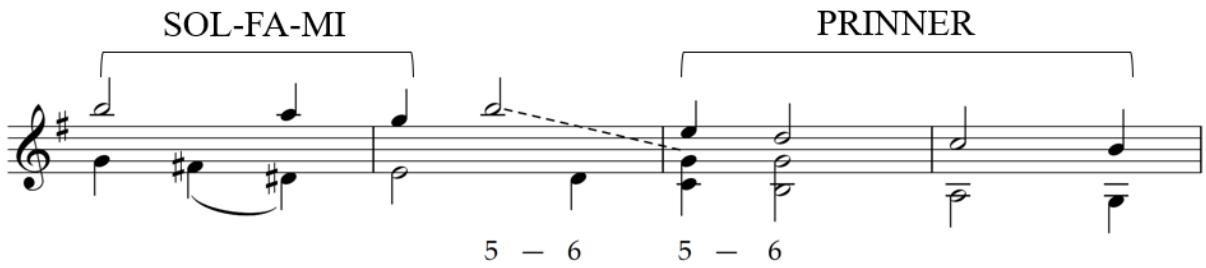
The utterance of each Prinner does not share the same level of clarity. The most unambiguous case happens in mm. 29–31; as discussed above, this Prinner opens with a distinctive motivic figure, thus acquiring a relatively self-standing status. This Prinner occupies the middle of the developmental space, which provides a transition towards the MC in m. 32. The Prinners in mm. 15–16 and mm. 39–40 are less conspicuous; each Prinner functions as a deferred riposte to a series of Sol-Fa-Mi in the singing style section. The series of Sol-Fa-Mi and Prinner merge seamlessly with the 5–6 sequence in between (mm. 14–15 and mm. 38–39), as shown in the reduction in Example 5.8. The Prinner in mm. 1–2 is the least detectable among all. The perception of this schema requires a phenomenological illustration, in which I have demonstrated the psychological process of the listener. When the listener encounters m. 2, their expectation that the movement opens in G major is temporary thwarted; in this moment, the listener perceives the module of mm. 1–2 as the Prinner in E minor, one of the feasible interpretations of the opening.
中文讲解
本段是小节的核心论点段,主张本曲中每一次Prinner的出现,其可辨识度(clarity)并不相同。作者按清晰度由高到低排出三组:
-
mm. 29–31的Prinner最为明确。原因有二:一方面它以一个与众不同的动机音型(distinctive motivic figure)开头,使其具有相对独立的(self-standing)听觉地位;另一方面它在发展空间中段(middle of the developmental space),承担着向m. 32中MC(Medial Caesura,中段终止式前的中止点)过渡的功能,过渡角色强化了它的结构可识别性。
-
mm. 15–16与mm. 39–40的Prinner较为隐蔽。它们各自作为歌唱风格段落(singing style section)中Sol-Fa-Mi这一程式序列的延后回应(deferred riposte)出现,并与位于其间的5–6下行动机序列(mm. 14–15与mm. 38–39)无缝融合,因此听者难以单独识别Prinner的边界。Example 5.8的缩谱图正是为了直观呈现这种融合状态。
-
mm. 1–2的Prinner最难以察觉。作者认为,对它的感知需要现象学式的演示(phenomenological illustration),即还原听者的心理过程:当听者听到m. 2时,原本对全曲开篇为G大调的预期暂时受挫,在这一瞬间,听者会把mm. 1–2这一模块感知为e小调的Prinner——这是开篇多种合理解释中的一种。
由此可知,作者的核心论证思路是:Prinner的清晰度并非由schema本身决定,而是由它在曲中所处的结构位置、与相邻程式(如Sol-Fa-Mi、5–6 sequence)的关系以及它是否打破听者既有期待共同决定的。这三组Prinner——明确型、融合型、隐蔽型——构成了一个由强到弱的清晰度谱系。
补充说明
本段中“as discussed above”指向本节之前对mm. 29–31 Prinner动机的论述;“as shown in the reduction in Example 5.8”指向紧随其后的图示占位符(P0014);“one of the feasible interpretations”表明作者并不把mm. 1–2的Prinner解读视为唯一正解,而是诸多可能性之一。
第3段(P0014)
原文复述
[Figure placeholder] Example 5.8. Sonata in G major, Wq. 56/2, iii, reduction of mm. 13–16. (Embedded image data omitted; caption and position retained.)
中文讲解
本条为图示占位符,标题为“Example 5.8. Sonata in G major, Wq. 56/2, iii, reduction of mm. 13–16”,即C.P.E. Bach G大调奏鸣曲Wq. 56/2第三乐章第13–16小节的缩谱。该图位于P0013所讨论的“歌唱风格段落中Sol-Fa-Mi系列与Prinner之间通过5–6下行动机无缝融合”的论述之后,其功能是直观演示mm. 13–16处Sol-Fa-Mi与Prinner融合的具体形态,帮助读者把听觉判断与谱面缩减对应起来。需查看原图以确认缩谱中各音程与声部进行。
补充说明
图题中的Wq. 56/2为C.P.E. Bach作品目录编号(Wotquenne-Verzeichnis),第三乐章为分析对象;mm. 13–16对应正文提到的mm. 14–15的5–6序列与mm. 15–16的Prinner所在的歌唱风格片段。
第4段(P0015)
原文复述
It is worth to underscore that all the Prinners are situated in different strategic positions. The Prinner in mm. 1–2 occupies the most ear-catching spot, the opening of the movement. The Prinner in mm. 29–31 is placed right before the MC in m. 32. Last but not the least, the Prinners in mm. 15–16 and m. 39–40 mark the end of the middle sections in singing style. With the recurring utterance of Prinner in different structural positions, the schema has left an indelible memory to the listener.
中文讲解
本段对前一段的清晰度分级加以战略位置层面的概括:所有Prinner都处于结构上不同的战略位置(strategic positions),从而形成重复与变形的双重效果。具体安排如下:
- mm. 1–2:位于全曲开篇,是最抓耳(ear-catching)的位置,因为它出现于听者尚未建立任何听觉期待的瞬间;
- mm. 29–31:紧贴m. 32的MC之前,承担过渡与收束的双重功能;
- mm. 15–16与mm. 39–40:分别标记两处歌唱风格中段(middle sections in singing style)的结束。
这三类位置——起、过渡前、段末——在功能上互不重合:开篇的Prinner为听者植入第一印象,MC前的Prinner为重要结构节点做准备,两处歌唱风格段末的Prinner则作为程式落点。作者由此得出本段的核心结论:Prinner在不同战略位置上的反复出现(recurring utterance),使该schema在听者心中留下难以磨灭的印象(indelible memory)。
由此可见,本段与P0013是同一论证的两面:P0013从“可辨识度”角度分析听者能否察觉Prinner,本段则从“战略位置”角度分析Prinner为什么具有结构性意义;二者合起来共同论证Prinner在本曲中既不冗余也非偶然,而是经过布局的设计。
补充说明
“indelible memory to the listener”是作者对Prinner反复出现的修辞性总结,与P0013开篇“each Prinner does not share the same level of clarity”形成互补关系:清晰度差异说明辨认的难易,战略位置差异则说明辨认后的记忆强度。
第5段(P0016)
原文复述
The similarity matrix in Table 5.5 makes a more detailed comparison of where the Prinner is situated within the module. The Prinner in phrase 1 (R1) is the only incident where the schema initiates the module, as reflected in Box (R: 9–16 cf. 1–8), Box (R: 25–32 cf. 1–8), and Box (R: 33–40 cf. 1–8). On the contrary, each Prinner is placed at the end of phrase 2.1 (R1), phrase 1 (R2), and phrase 2.1 (R2), as shown in Box (L: 9–16 cf. 25–32), Box (L: 9–16 cf. 35–40), and Box (L: 25–32 cf. 33–40).
中文讲解
本段将P0015的定性论述推进到量化对比层面,借助Table 5.5的相似度矩阵(similarity matrix),对Prinner在模块(module)内部所处的位置做更细致的比较。所谓相似度矩阵,是把不同小节片段两两对照、以数值或方格记录其结构相似程度的方法;“Box”指矩阵中的具体方格,“R:”与“L:”分别对应矩阵的右列与左列比较条目,“cf.”即拉丁文confer(“参较”之意),其后的数字表示被比较的两个片段。
作者据此得出一个精确的归纳:本曲中唯一一次schema“起始模块”(initiates the module)的情形,是再现部第一阶段(phrase 1, R1)中的Prinner,即mm. 1–2。这一观察对应矩阵中的Box (R: 9–16 cf. 1–8)、Box (R: 25–32 cf. 1–8)和Box (R: 33–40 cf. 1–8)——三处方格都把mm. 1–8作为比较参照,从而凸显其开篇“起始模块”的独特地位。
与之形成对照的是,其余三处Prinner各自处于段末位置:再现部第一阶段的phrase 2.1(R1,即mm. 15–16)、再现部第二阶段的phrase 1(R2,即mm. 29–31附近)、再现部第二阶段的phrase 2.1(R2,即mm. 39–40)。它们作为模块收束出现的证据分别见于Box (L: 9–16 cf. 25–32)、Box (L: 9–16 cf. 35–40)和Box (L: 25–32 cf. 33–40)。
本段在本节论证中的功能,是把P0015关于“战略位置不同”的感性论断转化为可验证的矩阵证据:开篇处的Prinner是唯一的“模块起始者”,其他三处的Prinner皆为“模块收束者”,由此形成1∶3的明确比例,使Prinner在曲式中的功能分化获得经验性支撑。
补充说明
R1与R2指再现部(Recapitulation)的两个阶段或不同轮次;phrase 1与phrase 2.1为句法层级标签;mm. 1–2、15–16、29–31、39–40四个Prinner分别对应矩阵中的四个参照片段,故矩阵方格数量与Prinner出现次数保持一致。
脚注 / 边栏 / 图表 / 附加信息(如有)
本小节包含一处脚注(P0012,P.6,编号26),引用Heposkoski & Darcy 2006《Elements of Sonata Theory》第380页,为Prinner这一schema术语提供理论出处;一处图示占位符(P0014,P.8,Example 5.8),展示mm. 13–16歌唱风格片段中Sol-Fa-Mi、5–6 sequence与Prinner融合的缩谱;正文另多次引用Table 5.5相似度矩阵以进行位置比对,但该表本身未在本节段落中显示,仅以方格编号形式被提及。这些附加材料共同支撑正文的两条主线——可辨识度(clarity)与战略位置(strategic positions)。
💡 本节核心要点
- 本曲四次Prinner出现的可辨识度并不一致,作者按由强到弱排出三档:mm. 29–31最为明确,mm. 15–16与mm. 39–40因与Sol-Fa-Mi及5–6 sequence融合而较隐蔽,mm. 1–2因听者预期的暂时受挫而最难以察觉。
- mm. 29–31的Prinner以独立动机音型开头并承担向MC过渡的功能,这是其高清晰度的结构原因。
- 四次Prinner分别占据四种不同的战略位置——开篇、MC前、歌唱风格段末——作者据此论证该schema在听者记忆中留下不可磨灭的印象。
- 借助Table 5.5相似度矩阵可验证:mm. 1–2是唯一一次“起始模块”的Prinner,其他三处Prinner皆处于模块收束位置,形成1∶3的位置分化。
- 作者对mm. 1–2的Prinner解读是“诸多合理解释之一”,体现其分析采用现象学式的听者视角而非唯一正解。
🔑 关键术语
- Prinner:Hepokoski与Darcy在《Elements of Sonata Theory》第380页定义的一种奏鸣曲schema;本节中指mm. 1–2、15–16、29–31、39–40四次出现的特定程式片段,其清晰度与战略位置因上下文而异。
- Medial Caesura (MC):奏鸣曲式中位于中段结束处的中止点;本节中指m. 32,是mm. 29–31 Prinner所过渡到的目标结构点。
- Sol-Fa-Mi:歌唱风格段落中的程式化音级序列(sol–fa–mi);本节中作为Prinner的前导材料,使Prinner表现为对它的延后回应(deferred riposte)。
- 5–6 sequence:5度下行接6度(或反之)的动机序列;本节出现在mm. 14–15与mm. 38–39,夹在Sol-Fa-Mi与Prinner之间,使二者无缝融合。
- singing style section:歌唱风格段落,本曲中承载Sol-Fa-Mi程式与Prinner融合的中段区域,对应mm. 15–16与mm. 39–40两处。
- similarity matrix (Table 5.5):相似度矩阵,把不同小节片段两两比较以显示结构相似程度的表格;本节中以“Box (R:/L: … cf. …)”方格编号形式被引用,用于精确比对Prinner在模块中的起始或收束位置。
- phenomenological illustration:现象学式的演示方法,还原听者在听音乐瞬间的心理过程;本节用于解释mm. 1–2的Prinner如何因听者对G大调预期的暂时受挫而被感知为e小调Prinner。
- strategic position:结构上的战略位置,指某schema在整个曲式或模块中相对于关键节点(开篇、MC、段末)的安排;本节用以说明四次Prinner因位置不同而在听者记忆中产生差异化效果。
CH3_S1 [描述性拆分] Limits of Sonata Theory and the need for dialogism
第1段(P0017)
原文复述
Dialogism and musical wit
中文讲解
这是一个二级小节标题(Markdown 中以 ## 呈现)。它开启本章第一节内部的一个子论题:将巴赫金的对话主义(dialogism)概念与音乐中的机智(wit)相联系。这里的 “wit” 不是泛指幽默,而是指多种不一致的声音或材料在奏鸣曲式乐章内部相互角力所产生的修辞效果。该标题的功能是从上一段对奏鸣曲理论局限性的诊断,过渡到作者将提出的补充性分析视角。
第2段(P0018)
原文复述
The finale of the Sonata in G major, Wq. 56/2 consists of components that are compatible with the framework of sonata form, but at the same time there are musical details that defy the definition of sonata form. It is true that important concepts from the Sonata Theory are applicable to the movement, such as describing the general layout of the movement as a Type 2 sonata, as well as calling the half cadences in the middle of each reprise a MC. However, it is
中文讲解
本段开门见山地陈述 Wq. 56/2(G 大调奏鸣曲)末乐章的双重性质:一方面其整体骨架可纳入奏鸣曲式(sonata form)框架,另一方面又存在无法被奏鸣曲式定义所容纳的细节。作者先承认奏鸣曲理论(Sonata Theory)中若干核心概念仍适用于该乐章——例如,可以把整体布局称为 Type 2 sonata,并将每次再现(reprise)中部的半终止称为 MC(medial caesura,即中段停顿)。在给出这一让步之后,作者用一个未说完的 “However, it is” 句埋下转折,预示接下来要指出乐章中突破奏鸣曲理论规范的部分。该句在原文中实际由下一段开头的 “also undeniable that…” 续接,完整意思是 “However, it is also undeniable that…"。本段在本节中的功能是建立张力:一边是奏鸣曲理论可以解释的部分,另一边是它无法解释的部分,从而为后文引入对话主义作铺垫。
补充说明
Wq. 56/2 为 C.P.E. 巴赫的奏鸣曲编号,取自 Helm 目录;Type 2 sonata 与 medial caesura(MC)是 Hepokoski 与 Darcy《Elements of Sonata Theory》中的形式类型与结构事件术语,本段对它们的调用方式与该书用法一致。
第3段(P0019)
原文复述
27 See Gjerdingen, Music in the Galant Style, 45. It is unusual for a Prinner to appear the beginning of the movement, since it usually functions as a medial element, i.e. an after-the-beginning event. Gjerdingen describes the Prinner as a ‖musical riposte‖ to an ‖opening gambit.‖ However, with the understanding that the opening of the movement is in medias res, it becomes possible to put this medial element in the beginning. This use of Prinner gives a humorous and ironic touch to the movement.
中文讲解
这是正文中的脚注 27。它为本节提到的 Prinner 用法提供背景说明:Gjerdingen 在《Music in the Galant Style》第 45 页指出,Prinner 通常是 “after-the-beginning event”,即乐章开始后才出现的中间性材料,而非常规的开篇材料。Gjerdingen 把 Prinner 描述为对开场招数(opening gambit)的音乐回击(musical riposte)。但作者补充说,如果把乐章开篇理解为 in medias res(直入主题、跳过常规引子),那么把通常作为中段材料的 Prinner 放在开头就变得合理——这种非常规的处理带来幽默与反讽效果。这条脚注对正文的支撑作用在于:它说明开篇的 Prinner 不应被简单视为对奏鸣曲常规的违反,而具有自身的修辞逻辑,从而具体化了后文所说 “oddities”(怪异性材料)这一概念。
第4段(P0020)
原文复述
also undeniable that the movement consists of materials that escape the expectations of Sonata Theory; the two-measure C minor module alone is a huge unfitting piece of puzzle to the whole picture. The centrifugal force is so strong that it resists a convincing formal interpretation by applying Sonata Theory alone. In Bakhtinian sense, this top-down analytical approach amounts to theoretism (or monologism in Bakhtin‘s later writings), an error of a ‖mistaken attachment to systems.‖ Since ‖theoretism always understands events in terms of a set of rules to which they conform or a structure that they exhibit,‖ it fails to subsume the incongruent elements to the prescribed grand narrative and to acknowledge the value of these elements. In our case, the exterior rules and structure is the formal process suggested by Sonata Theory. Since many details exhibit features that defy the norm, a simply top-down analytical approach is not sufficient. Sonata Theory alone is unable to provide an explanation of how the oddities could be incorporated into the formal process.
中文讲解
本段承接 P0018 末尾未说完的 “it is”,转入对奏鸣曲理论局限性的正面论述。
首先,作者承认(undeniable)乐章中存在逸出奏鸣曲理论预期的材料——尤其是两小节的 c 小调模组(two-measure C minor module),它像一块无法嵌入既有拼图的碎片。其离心力(centrifugal force,即偏离中心、抵制统一解释的力量)之强,使得仅靠奏鸣曲理论无法对该乐章给出令人信服的形式解释。
然后作者引入巴赫金的诊断:这种自上而下(top-down)的分析路径在巴赫金意义上等同于 theoretism(在巴赫金后期著作中又被称为 monologism),其本质是 “mistaken attachment to systems”(对体系的错误依附)。作者引用巴赫金的定义:“theoretism always understands events in terms of a set of rules to which they conform or a structure that they exhibit”,指出这种倾向的局限在于——它无法把不一致的元素纳入既定的宏大叙事,也无法承认这些元素自身的价值。
落到本文语境,外在的规则与结构正是奏鸣曲理论所暗示的形式过程;由于乐章中有许多细节偏离规范,单靠自上而下的路径已不足够,奏鸣曲理论自身无法解释这些怪异性(oddities)如何被纳入形式过程。
本段是本节论证的核心转折点:它把奏鸣曲理论的不足诊断为一种 monologism,从而为引入 dialogism 提供了直接的理论依据。
补充说明
“离心力” 在此为音乐分析对物理概念的借用,指偏离中心、抵制统一形式解释的力,与向心、收拢的趋势相对。“grand narrative” 在巴赫金的批判语境中指理论体系预设的、单一连贯的阐释框架。
第5段(P0021)
原文复述
Bakhtin‘s concept of dialogized heteroglossia provides insights for better understanding how these oddities shape the formal process. Dialogized heteroglossia emphasizes the mix of language of different strata within an individual speaker. Bakhtin‘s example of two hypothetical peasants is a good illustration of this concept, as discussed in Chapter 3. Only the second peasant is able to consciously regard ‖one language (and the verbal world corresponding to it) through the eyes of another language.‖ This interanimation of languages also allows different value systems and worldviews in these languages to interact, which enter into dialogue.
中文讲解
本段提出解决方案:巴赫金的 “dialogized heteroglossia”(对话化的杂语)有助于更好地理解那些怪异性材料如何塑造形式过程。
作者先界定这一概念:它强调在同一个说话者(individual speaker)内部不同阶层语言(language of different strata)的混合。然后作者提示,巴赫金关于两个假想农民的例子(在论文第 3 章中已展开讨论)是这一概念的典范说明——其中只有第二个农民能够有意识地 “透过另一种语言的眼光来看待一种语言(以及与之对应的语言世界)"。这种语言之间的相互激活(interanimation)也使承载于这些语言中的不同价值体系和世界观发生互动,并进入对话。
本段的功能是把对话主义从对 monologism 的批评反转为建设性的分析工具:作者不再只是指出奏鸣曲理论的局限,而是要展示 dialogized heteroglossia 如何能正面解释怪异材料与奏鸣曲规范之间的互动。“enter into dialogue” 是本节最终落到音乐分析上的关键隐喻。
补充说明
原文 “Chapter 3” 指作者自身论文的第三章;巴赫金两个农民的例子在那一章已有详细讨论,本节作为论文章节仅作回顾性提示,不再复述例子细节。
第6段(P0022)
原文复述
28 Gary Saul Morson and Caryl Emerson. Mikhail Bakhtin: Creation of a Prosaics (Stanford, California: Stanford University Press, 1990), 28.
中文讲解
脚注 28 的文献信息:Gary Saul Morson 与 Caryl Emerson 合著,《Mikhail Bakhtin: Creation of a Prosaics》,Stanford University Press, 1990 年出版于加利福尼亚州斯坦福,引用第 28 页。此条脚注为正文中 “mistaken attachment to systems” 这一表述提供出处,属于来源性脚注。
第7段(P0023)
原文复述
29 Morson and Emerson, Mikhail Bakhtin, 50.
中文讲解
脚注 29 的文献信息:同上书(Morson 与 Emerson,《Mikhail Bakhtin: Creation of a Prosaics》),引用第 50 页。此条脚注为正文中关于 theoretism 的定义性引文(“theoretism always understands events in terms of a set of rules…")提供页码出处,属于来源性脚注。
第8段(P0024)
原文复述
30 Mikhail Bakhtin, The Dialogic Imagination: Four Essays by M. M. Bakhtin, ed. Michael Holquist, trans. Caryl Emerson and Michael Holquist (Austin: University of Texas Press, 1981), 296.
中文讲解
脚注 30 的文献信息:Mikhail Bakhtin,《The Dialogic Imagination: Four Essays by M. M. Bakhtin》,由 Michael Holquist 编辑,Caryl Emerson 与 Michael Holquist 翻译,University of Texas Press, 1981 年出版于得克萨斯州奥斯汀,引用第 296 页。此条脚注为正文中关于 “透过另一种语言的眼光看待一种语言” 的引文提供出处,属于来源性脚注。
第9段(P0025)
原文复述
31 Morson and Emerson, Mikhail Bakhtin, 143.
中文讲解
脚注 31 的文献信息:Morson 与 Emerson,《Mikhail Bakhtin: Creation of a Prosaics》,引用第 143 页。此条脚注为正文中关于不同价值体系与世界观在语言互动中进入对话的论述提供页码出处,属于来源性脚注。
脚注 / 边栏 / 图表 / 附加信息(如有)
本节正文共有四条脚注(编号 27–31)。其中脚注 27 为解释性脚注,引自 Gjerdingen《Music in the Galant Style》第 45 页,对正文提到的 Prinner 用法提供背景说明,并解释 Prinner 被移到开头后所产生的幽默与反讽效果。脚注 28–31 为来源性脚注,分别指向 Morson 与 Emerson《Mikhail Bakhtin: Creation of a Prosaics》(Stanford University Press, 1990)第 28、50、143 页,以及 Bakhtin《The Dialogic Imagination》(University of Texas Press, 1981)第 296 页,对应正文中关于 “mistaken attachment to systems”、theoretism 的定义,以及 dialogized heteroglossia 部分的两处引文。本节不含图表或乐谱占位符。
💡 本节核心要点
- Wq. 56/2 末乐章同时具有可由奏鸣曲理论解释的部分(如 Type 2 sonata 整体布局、MC 中段停顿)与逸出奏鸣曲式规范的怪异性材料(典型者为两小节 c 小调模组),这一双重性构成本节论证的核心张力。
- 作者借用巴赫金的 theoretism / monologism 概念,把单纯以奏鸣曲理论自上而下分析该乐章的做法诊断为对单一理论体系的错误依附。
- theoretism 的核心局限在于:它要求事件服从既有规则或结构,因而既无法容纳不一致的元素,也无法承认这些元素自身的价值。
- 作为对治路径,作者引入巴赫金的 dialogized heteroglossia(对话化的杂语),强调同一说话者内部不同阶层语言的相互激活,以及承载其中的价值体系之间进入对话。
- 本节的论证逻辑可概括为:先承认奏鸣曲理论的部分有效性 → 再指出其作为 monologism 的不足 → 最后提出 dialogism 作为能解释怪异性材料如何塑造形式过程的替代框架。
🔑 关键术语
- Sonata Theory:指 Hepokoski 与 Darcy《Elements of Sonata Theory》所代表的奏鸣曲形式分析范式;本节中作为被审视的 “外部规则与结构”,是 monologism 倾向的代表。
- Type 2 sonata:Sonata Theory 中的一种形式类型,特征包括发展部之后再现主部主题等处理方式;本节用来描述 Wq. 56/2 末乐章的整体布局。
- MC (medial caesura):Sonata Theory 中的核心结构事件,出现在呈示部结束前以属调上的半终止标记形式分割;本节用来称呼 Wq. 56/2 每次再现中部出现的半终止。
- Prinner:Gjerdingen 风格分析(Galant style schema theory)中的常见音型/句法开头模型,通常作为 after-the-beginning event 出现;本节脚注指出它在 Wq. 56/2 中被移至开头使用,由此带来幽默与反讽。
- theoretism / monologism:巴赫金批评的两种相关概念:前者强调把事件强行纳入单一规则体系,后者强调以单一声音压制他者声音;本节用二者来诊断奏鸣曲理论自上而下路径的局限。
- dialogized heteroglossia:巴赫金的 “对话化杂语” 概念,指同一说话者内部不同阶层语言相互激活、价值体系进入对话的状态;本节提出它是理解奏鸣曲式中怪异性材料如何塑造形式过程的关键工具。
CH3_S2 [描述性拆分] Bakhtin’s fool and dialogized heteroglossia
第1段(P0026)
原文复述
Now, I would like to divert our attention to Bakhtin’s discussion of the role of the fool in the novel. This diversion is crucial for seeing how dialogized heteroglossia relates to humor and wit. The fool is understood as an ancient figure in “social life and folklore, as well as in literature,” and the depth of this figure has a huge potential for novel. This figure solves the problem of the third person for exposing the “internal man,” who consists of “free and self-sufficient subjectivity.” By involving a fool in the novel, it does not mean that this figure “must be introduced into the novel”; it is that the novelist, the very author, can assume “the position of the fool.” The involvement of the fool in the novel is important for understanding inner life, because it provides a fresh perspective to look at the reality. Since a fool has the right “not to understand,” this attitude strips away the conventional layers that conceal the inner life. An example would be the uncomprehending Pierre Bezukhov in the battle of Borodino in Leo Tolstoy’s War and Peace (1865-1869). Pertaining to our period, Laurence Sterne’s Tristram Shandy is a defining example of the fool in Bakhtin’s mind. This fool possesses all sorts of oddities and eccentricities, thus his consciousness (and by extension, our inner life) can be explored and is made visible. Since the above cases involve a clash between a conventional worldview and an eccentric personal perspective, dialogized heteroglossia is involved. Or to put it differently, it is because of the rise of dialogized heteroglossia that the figure of the fool becomes an important device of novel in exploring the reality in humanity from a fresh perspective.
中文讲解
本段从对狂欢化诗学的讨论转向巴赫金关于小说中“傻子”(fool)形象的分析,是本节论证的一次关键扩展。其核心功能是揭示“对话化杂语”(dialogized heteroglossia)如何与幽默、机智(wit)相关联。
首先,作者交代傻子是一个古老的形象——存在于社会生活、民俗和文学之中,因而具备深厚的思想资源可以挖掘。其次,傻子在小说叙事中承担一个形式层面的功能:解决“第三人称的问题”(the problem of the third person),即如何从外部切入、暴露人物内心那个“内在的人”(internal man)——“自由而自足的主体性”。这里涉及一个重要的区分:并非必须把傻子写进小说,而是作者本人可以“占据傻子的位置”(the position of the fool),借傻子的视角进行观察。
再次,傻子的认识论价值在于其拥有“不理解的权利”(the right “not to understand”)。这一态度能把遮蔽内心生活的常规层(conventional layers)剥离掉,使读者得以看到被习俗和社会话语遮蔽的内在主体。
两个例子分别从俄国和欧洲传统中支撑这一点:托尔斯泰《战争与和平》中博罗季诺战役里“困惑不解的皮埃尔·别祖霍夫”,以及斯特恩《项狄传》中的傻子形象。前者代表了在重大历史事件中主体突然失去现成解释框架的状态;后者则凭借种种怪癖和乖戾,使意识的运作过程得以被外化、被看见。
段落最后把上述现象整合到本节主题:传统世界观与怪异的个人视角之间的冲突,正是对话化杂语的运作场所。换言之,正是对话化杂语在小说中的兴起,使傻子形象成为一种重要的小说装置,从而以全新视角探索人性的现实。
补充说明
本段将“傻子”作为承载对话化杂语的典型装置加以考察,与前文对狂欢化、双声语等概念形成呼应:狂欢化侧重笑声、颠倒与外部仪式的杂语,傻子则侧重主体意识层面的杂语——两者的共同点都是让被压抑或被遮蔽的视角进入文本。
第2段(P0027)
原文复述
32 Morson and Emerson, Mikhail Bakhtin, 402.
中文讲解
脚注32,引用Morson与Emerson合著的《Mikhail Bakhtin》第402页,作为本段“傻子作为社会生活、民俗及文学中的古老形象”这一判断的文献来源。
第3段(P0028)
原文复述
33 Bakhtin, Dialogic Imagination, 164; Morson and Emerson, Mikhail Bakhtin, 401-402.
中文讲解
脚注33,引用巴赫金《对话的想象》第164页,以及Morson与Emerson《Mikhail Bakhtin》第401-402页,作为本段“傻子解决第三人称问题以暴露‘内在的人’——即自由而自足的主体性”这一表述的双重文献支持。
第4段(P0029)
原文复述
34 Morson and Emerson, Mikhail Bakhtin, 402.
中文讲解
脚注34,引用Morson与Emerson《Mikhail Bakhtin》第402页,支撑“并非必须将傻子引入小说,而是作者可‘占据傻子的位置’”这一区分性论断。
第5段(P0030)
原文复述
35 Morson and Emerson, Mikhail Bakhtin, 402.
中文讲解
脚注35,引用Morson与Emerson《Mikhail Bakhtin》第402页,作为本段“傻子拥有‘不理解的权利’,从而剥离遮蔽内心生活的常规层”这一主张的文献来源。
第6段(P0031)
原文复述
36 Bakhtin, Dialogic Imagination, 164.
中文讲解
脚注36,引用巴赫金《对话的想象》第164页,指向本段所举的第一个例子——托尔斯泰《战争与和平》中博罗季诺战役里“困惑不解的皮埃尔·别祖霍夫”——以说明傻子的视角在小说中的具体运用。
第7段(P0032)
原文复述
37 Morson and Emerson, Mikhail Bakhtin, 403.
中文讲解
脚注37,引用Morson与Emerson《Mikhail Bakhtin》第403页,指向本段所举的第二个例子——斯特恩《项狄传》中的傻子形象——以说明怪癖与乖戾如何使意识运作被外化、被看见。
脚注 / 边栏 / 图表 / 附加信息(如有)
本小节附加材料全部为脚注(编号32–37),均位于第11页正文段落(P0026)之中,承担来源标注功能。其中脚注33与脚注36直接引自巴赫金《对话的想象》(Dialogic Imagination);脚注32、34、35、37则引自Morson与Emerson的《Mikhail Bakhtin》。两部文献形成主—辅搭配:巴赫金本人的论述提供原典依据,二手研究负责诠释、推广与评论。脚注密集且集中于同一段,说明作者对该段每一个关键论断都予以单独溯源,以维护学术严谨性。脚注内容均为纯文献出处,无旁注性评述或扩展说明。
💡 本节核心要点
- 巴赫金对小说中“傻子”形象的讨论,是把“对话化杂语”与幽默、机智相关联的关键环节。
- 傻子承担形式功能——解决第三人称问题,使“内在的人”(自由、自足的主体性)得以从外部被暴露。
- 作者无需真正引入傻子,而可“占据傻子的位置”;傻子的核心姿态是拥有“不理解的权利”,从而剥离遮蔽内心的常规层。
- 托尔斯泰《战争与和平》中的皮埃尔·别祖霍夫与斯特恩《项狄传》是巴赫金意义上的两个典型傻子例子,分别展示困惑与怪癖如何使内心生活可见。
- 传统世界观与怪异个人视角之间的冲突,正是对话化杂语发生的场域;对话化杂语的兴起反过来使傻子成为探索人性现实的重要小说装置。
🔑 关键术语
- dialogized heteroglossia:对话化杂语,巴赫金用以指小说内部多种社会性语言、声音与视角相互碰撞、对话的格局;本节通过傻子形象论证其与幽默机智的关联。
- the fool:傻子,本节指巴赫金所讨论的小说话语装置——并非一定要作为人物出场,而是提供一种“不理解”的视角,以暴露被常规遮蔽的内心生活。
- the problem of the third person:第三人称问题,指如何在外部叙述中切入并展示人物的内在主体;巴赫金认为傻子形象有助于解决这一形式难题。
- the internal man / free and self-sufficient subjectivity:“内在的人”,即自由、自足的主体性,是巴赫金希望经由傻子的视角所暴露出的对象。
- the position of the fool:“傻子的位置”,指作者在叙事中所采取的姿态——并非真正引入傻子人物,而是借用其“不理解”的视角进行观察。
- the right “not to understand”:“不理解的权利”,傻子所特有的认识论姿态:通过拒绝接受常规解释,剥离遮蔽内心生活的社会话语层。
CH3_S3 [描述性拆分] Enlightenment concepts of humor and wit
第1段(P0033)
原文复述
The discussion of humor and wit in the Age of Enlightenment also shows a similar concern for a transformation from conventional to original. The concepts of humor and wit are interrelated, and both terms reflect how an individual’s personal nature may influence their art. For the concept of humor, though its meaning underwent changes throughout history, it can be understood as the personal and natural dispositions of the artist, which can be “felt in the creative impulse of the artist.” Wit shows a more technical facet; it is an artful ingenuity of the artist for transforming the conventional to original by finding connections between things. In short, wit is the ability to discover similarities between incongruent entities. Through the discovery of similarities, the most oppositely related things can be brought together. During the 18th century, the idea of linking unlikely things persists in the discussion of aesthetics, and aestheticians are interested in how this idea plays a role in the maintenance of an appropriate balance between unity and diversity within an artwork. C. P. E. Bach’s music is regarded to exhibit a witty quality. Writing as late in the early 19th century, William Crotch discussed this quality in C. P. E. Bach’s music, as well as Haydn’s. Crotch found that the musical wit would inspire amusement and delight. While noticing that Bach’s music abounds in chromatic passages, new harmonies and bold modulations, demonstrating a witty and playful character, Crotch stated that Bach’s music is at the same time paradoxically regarded as a model of control.
中文讲解
本段是本节的核心论述,承担了三层任务:界定概念、建立美学语境、将概念落地到 C. P. E. 巴赫的音乐分析。
第一层是概念区分。启蒙时期对幽默(humor)与机智(wit)的讨论延续了本节乃至全章贯穿的关心——从"惯例"向"原创"的转化。幽默与机智相互关联,都反映艺术家个人天性如何影响其艺术,但二者侧重不同:幽默指向艺术家个人的、自然的气质禀赋(personal and natural dispositions),这种气质可以在其创作冲动中被"感受到”;机智则更为技术化,是一种通过发现事物之间联系、把惯例转化为原创的巧妙匠心(artful ingenuity)。作者用一句话把机智收束为最具操作性的定义:“在不相称的事物之间发现相似性的能力”。换言之,机智的本质是牵合(bringing together),是让最对立的事物通过被发现的相似性而相互贯通。
第二层是美学语境。“把不相干的事物联系起来"这一观念在18世纪美学讨论中持续存在,美学家关注的是:这一观念如何在一部艺术作品中维持"统一"与"多样"之间的恰当平衡。机智因此不仅是修辞手法,更是组织艺术作品内部张力的结构性原则——它既打破单一(引入多样性),又通过所发现的相似性重建整体(保持统一性)。
第三层是音乐分析上的应用。C. P. E. 巴赫的音乐被认为具有机智的特质。作者援引19世纪初的威廉·克罗奇(Crotch)对巴赫与海顿音乐的讨论,指出机智的听感效果是引发愉悦(amusement and delight)。更重要的是克罗奇对巴赫音乐观察到的悖论:巴赫的音乐充满半音化进行、新颖和声与大胆转调,这些手法呈现出机智而嬉戏的性格,但同时它又被视为"克制的典范”(a model of control)。这一悖论正是本节论证的关键——机智所引入的非常规元素并不破坏整体的秩序感,反而与秩序并存、甚至以秩序为前提。
补充说明
本段建立了本节乃至全文的一个核心论证模式:先给出哲学/美学概念,再用一个具体音乐现象(C. P. E. 巴赫的半音化、新和声、大胆转调)来验证概念。“统一与多样"的平衡是18世纪美学的关键议题,与本段紧随其后要被讨论的巴赫 Sonata Wq. 56/2 的分析直接相关——这是本节通向个案分析的桥梁。
第2段(P0034)
原文复述
Footnote 38: For the concepts of humor and wit, while they are defined with subtle differences by different philosophers and aestheticians, I have chosen Johann Georg Sulzer’s version as an illustration, since the publication of his Allgemeine Theorie der schönen Künste (1771–74) is contemporary to C. P. E. Bach’s Sonata in G major, Wq. 56/2 (written in 1774, and published in 1780).
中文讲解
这条脚注说明作者的方法论选择。幽默与机智的概念在不同哲学家和美学家那里有微妙差异,作者并未逐一罗列,而是选择采用约翰·格奥尔格·苏尔策(Johann Georg Sulzer)的定义作为代表,其理由是时间上的吻合:苏尔策的《美的艺术的一般理论》(Allgemeine Theorie der schönen Künste,1771–74)出版于1771至1774年间,与 C. P. E. 巴赫的 G 大调奏鸣曲 Wq. 56/2(1774年写成,1780年出版)几乎同时。这意味着苏尔策所代表的审美概念框架在历史时段上与巴赫这部作品的创作语境直接对应,因而可以合理地用作分析的语境支撑。
本条脚注的功能在于限定前文定义的来源与适用范围:它告诉读者,前文使用的"幽默"与"机智"定义并非来自某位单一权威,而是以苏尔策为代表的、与巴赫作品同时代的18世纪美学语境的产物。
补充说明
作者明确标注了 Wq. 56/2 的两个时间节点(1774年写作、1780年出版),这对后续分析乐谱版本与作品实际问世后人对其评价之间的差异有重要意义。
第3段(P0035)
原文复述
Footnote 39: Gretchen A. Wheelock, Haydn’s Ingenious Jesting with Art: Contexts of Musical Wit and Humor (New York: Schirmer Books, 1992), 28.
中文讲解
这条脚注是正文中"幽默与机智相互关联,且两者均反映艺术家个人天性如何影响艺术"这一论断的文献出处,指向格雷琴·A·惠洛克(Gretchen A. Wheelock)所著《海顿与艺术的巧妙戏谑:音乐机智与幽默的语境》(Haydn’s Ingenious Jesting with Art: Contexts of Musical Wit and Humor,1992年纽约 Schirmer Books 出版)第28页。功能为来源标注。
第4段(P0036)
原文复述
Footnote 40: Wheelock, Haydn’s Ingenious Jesting, 28-29.
中文讲解
这条脚注为正文中"幽默可被理解为艺术家个人的、自然的气质禀赋,可以在创作冲动中被感受到"这一具体定义提供出处,仍然出自惠洛克的同一著作第28至29页。功能为来源标注。
第5段(P0037)
原文复述
Footnote 41: Wheelock, Haydn’s Ingenious Jesting, 28.
中文讲解
这条脚注为正文中"机智是艺术家通过发现事物之间联系、把惯例转化为原创的巧妙匠心"这一论断提供出处,引自惠洛克著作第28页。功能为来源标注。值得注意的是,正文把大部分幽默与机智的定义都归到惠洛克一处,表明作者在概念层面的主要依据是该单一专著。
第6段(P0038)
原文复述
Footnote 42: Judith L. Schwartz, “Conceptions of Musical Unity in the 18th Century,” The Journal of Musicology 18, no. 1 (Winter 2001): 58.
中文讲解
这条脚注为正文中关于18世纪美学家关注"联系不相干事物"以维持作品内部"统一与多样"之平衡的论断提供出处,引自朱迪斯·L·施瓦茨(Judith L. Schwartz)的论文《18世纪的音乐统一性观念》(“Conceptions of Musical Unity in the 18th Century”),发表于《音乐学杂志》(The Journal of Musicology)第18卷第1期(2001年冬季号)第58页。功能为来源标注,并提示读者:把"机智=联系异质事物"的修辞学概念上升到"统一与多样"这一更宏观的美学问题,有专门的研究文献可参。
第7段(P0039)
原文复述
Footnote 43: Richards, Free Fantasia, 110.
中文讲解
这条脚注为正文中"克罗奇发现音乐机智会引发愉悦与快乐"这一具体评价提供出处,引自理查兹(Richards)的《自由幻想曲》(Free Fantasia)第110页。功能为来源标注。此处文献是推进到具体音乐评价的关键来源——它把抽象的机智概念落实为可被听觉感知的情绪反应(amusement and delight)。
补充说明
此处"Richards"指 Annette Richards(安妮特·理查兹),其《Free Fantasia》研究 C. P. E. 巴赫与同时代音乐家的自由幻想曲传统,是本研究领域的重要文献。
第8段(P0040)
原文复述
Footnote 44: Richards, Free Fantasia, 113.
中文讲解
这条脚注为正文中关于巴赫音乐"充满半音化进行、新和声与大胆转调,呈现机智与嬉戏的性格,但同时被视为克制的典范"这一悖论性评价提供出处,引自理查兹《自由幻想曲》第113页。功能为来源标注。这是本节论证链条最末端的文献支撑,它把"机智"与"控制"并置的悖论固定到具体文本来源上。
脚注 / 边栏 / 图表 / 附加信息(如有)
本节由一段正文(P0033)和七条脚注(P0034–P0040)构成。脚注的功能可分为三类:(1)方法论说明——P0034 解释为何选择苏尔策的定义作为代表,以版本年代与巴赫作品吻合为依据;(2)概念定义的来源——P0035–P0037 集中引自惠洛克《Haydn’s Ingenious Jesting with Art》第28–29页,覆盖幽默与机智两个相关概念的界定;(3)音乐评价与美学上下文的来源——P0038(施瓦茨关于18世纪音乐统一性观念)、P0039、P0040(理查兹《Free Fantasia》第110、113页)分别支撑"统一与多样平衡”、“机智引发愉悦"以及"机智与控制并置"这三项具体论断。整个脚注结构表明:概念层面以惠洛克为主要依据,宏观美学层面以施瓦茨为支撑,具体到 C. P. E. 巴赫音乐评价则以理查兹为依据。
💡 本节核心要点
- 启蒙时期关于幽默与机智的讨论延续了从’惯例’向’原创’转化的核心关怀,与本节乃至全章的论证主线一致
- 幽默被界定为艺术家个人的、自然的气质禀赋,可在创作冲动中被感受到;机智则被界定为通过发现事物间联系、把惯例转化为原创的巧妙匠心
- 机智的核心操作被明确表述为’在不相称的事物之间发现相似性’,它是连接异质材料、让对立事物相互贯通的能力
- 把异质事物联系起来这一观念在18世纪美学中承担更宏观的功能:用以维持一部艺术作品中’统一’与’多样’之间的恰当平衡
- C. P. E. 巴赫的音乐被援引为机智的实例,威廉·克罗奇指出其听感效果是愉悦与快乐
- 克罗奇对巴赫音乐的关键观察是一个悖论:充满半音化、新和声与大胆转调的’机智而嬉戏’特征,与巴赫音乐被视为’克制典范’的事实并存
🔑 关键术语
- Humor (幽默):在本节中被界定为艺术家个人的、自然的气质禀赋(personal and natural dispositions),可在创作冲动中被感受到。它与机智相互关联,但侧重于艺术家的内在性情,而非技艺层面的操作。
- Wit (机智):在本节中被界定为艺术家通过发现事物之间联系、把惯例转化为原创的巧妙匠心(artful ingenuity)。其核心操作是’在不相称的事物之间发现相似性’,由此让最对立的事物相互贯通。
- Conventional to original (从惯例到原创):本节开篇标识的启蒙时期审美关怀的核心走向——即如何把承袭的惯例转化为原创的创造,幽默与机智都被纳入这一框架来理解。
- Unity and diversity (统一与多样):18世纪美学的关键议题。机智所实施的’联系异质事物’在这一框架下被理解为维持作品内部统一与多样之间恰当平衡的结构性手段。
- C. P. E. Bach (C. P. E. 巴赫):卡尔·菲利普·埃马努埃尔·巴赫,本节借以例证’机智’概念的音乐对象。其 G 大调奏鸣曲 Wq. 56/2(1774年作,1780年出版)将在后续分析中展开。
- William Crotch (威廉·克罗奇):19世纪初的撰写者,在本节中作为评述 C. P. E. 巴赫与海顿音乐中’机智’品质的关键代言人;其观察——巴赫音乐既机智嬉戏又为克制典范——是本节论证链条的落脚点。
- Sulzer’s Allgemeine Theorie der schönen Künste (苏尔策《美的艺术的一般理论》):1771–74年间出版的著作,作者选择其中的幽默与机智定义作为代表,因其出版时间与 C. P. E. 巴赫 Wq. 56/2(1774年作)高度吻合,构成与作品同时代的审美语境。
CH3_S4 [描述性拆分] Dialogized heteroglossia as a precondition for musical wit
第1段(P0041)
原文复述
In order to allow the wit to play an active role, there is a pre-condition, i.e. a dialogized heteroglossic setting. In a monoglossic setting, the ability of wit is limited—there is a top-down manner in organizing the details; within the layout each component is the result of the logic set up from the prescribed genre. In this sense, due to the too obvious similarities between the details (since they are derived from a pre-set logic), it requires little effort for the readers to develop their own thread to connect and make sense all the components. Nevertheless, in a dialogized heteroglossic setting, wit is able to play an active role for interpretation. It is true that within such a setting, there appear the seemingly unrelated components. Yet, through a keen observation of the reader, with their ability to compare the seemingly incongruent details, they are able to discover the most hidden similarities, and derive a hidden thread. With this hidden thread, the hidden logic is set to link the incongruent components, and construct a possible interpretation. This is why the similarity matrix is involved; through a systematic comparison one can discover the moments of dialogized heteroglossia in the piece.
中文讲解
本段为全小节的理论起点,提出了"机智(wit)发挥主动作用"的前提条件是"对话化异声(dialogized heteroglossic)的语境”。作者用对比来立论:在"独声(monoglossic)“语境中,各细节按体裁预设的逻辑自上而下组织,相似性过于外显,读者不必费心就能串联所有成分,因此机智无用武之地;而在"对话化异声"语境中,看似不相关的成分并存,读者必须通过细致的观察、比较表面不相容的细节,才能发现被掩藏的相似性,抽出隐藏的线索(hidden thread),进而以这条隐蔽逻辑把不相容的成分串成一种可能的解读。最后一句把整套方法论落到操作工具上:正因为需要发现异中似、似中异,作者才引入"相似性矩阵(similarity matrix)"——一种系统化的比较手段,用来定位乐谱中"对话化异声"发生的具体时刻。教学要点:这里的"wit"并非修辞上的俏皮,而是指读者/听者主动参与构造意义的智力活动;“dialogized heteroglossia"则指不同声音、逻辑或体裁元素彼此对话的张力场。二者构成一个因果链——张力场提供了机智得以发挥的土壤。
补充说明
术语"dialogized heteroglossia"借自巴赫金(Mikhail Bakhtin)的对话理论,本段作者将其挪用至音乐分析中,用于指多体裁、多逻辑元素并置所产生的意义场;但本段未提供该词源,故此处不展开,仅指出其在节内的功能定位。
第2段(P0042)
原文复述
The awareness of wit opens a new possibility for understanding the formal process of the finale of Sonata in G major, Wq. 56/2. Like the dialogized heteroglossic setting discussed above, this movement also requires an active role from the listener when appreciating the piece. While the listener could not interpret solely based on their pre-knowledge of form (though their knowledge of form sets up the context for interpretation), they actively engage into the musical details and extracts the meaning through comparing the relation between the musical details. This active role from the listener enables them to construct an interpretation of the musical musical process through the discovery of the hidden threads.
中文讲解
本段是理论过渡段,把P0041的抽象机制具体落到分析对象——C.P.E.巴赫《G大调奏鸣曲》Wq. 56/2的末乐章。作者明确两点:第一,该乐章与"对话化异声"语境同构,需要听者主动参与欣赏;第二,听者不能只凭形式(form)的先验知识去解读——形式的先验知识只提供解读的上下文,真正的工作是在音乐细节层面,通过比较各细节之间的关系来抽取意义。这种主动角色使听者能够"找到隐蔽线索”,从而建构起对音乐进程的解读。教学要点:本段划清了一个常见误区——即以为熟悉奏鸣曲式就等于理解作品。作者认为形式知识只是脚手架,真正的理解来自对细节互文关系的主动比对,这正是"机智"在听者一侧的体现。
补充说明
“Wq. 56/2"指C.P.E.巴赫的著作编号,由Alfred Wotquenne编目;“Sonata in G major"为该编号下第二首奏鸣曲,本节聚焦其末乐章。
第3段(P0043)
原文复述
If musical wit is regarded as a signature feature in Bach’s music, the listener is encouraged to unearth the similarities between opposing elements and link the incongruent elements to the ordinaries, so that serendipity in the formal process can pop up from an unexpected chemical reaction. Therefore, this mindset encourages the listener to treat the ironic elements more seriously; rather than just an accidental event, the ironic elements are treated as participants serving structural function.
中文讲解
本段进一步将"机智"提升为巴赫音乐的一种签名式特征(signature feature),并把分析任务具体化:听者要做两件事——一是发掘对立元素之间的相似性,二是把不相容的元素与常态元素(ordinaries)链接起来。完成这两步后,形式进程中的意外(surprise)与机缘(serendipity)会以"化学反应"的方式从原本不可预期之处迸发出来。由此延伸出一条重要的方法论态度:听者应严肃对待反讽性(ironic)元素——它们并非偶发的怪笔,而是具有结构功能的参与者。这一论断看似简单,实则改写了浪漫主义以来把"怪异笔触"视为作曲家偶发即兴的惯性理解,为接下来的"两小节c小节模块"分析作了认识上的准备。教学要点:注意"serendipity in the formal process"和"unexpected chemical reaction"的比喻——作者刻意用"化学"而非"逻辑"来说明新意涌现的不可还原性,即整体意义大于各成分之和。
第4段(P0044)
原文复述
In this sense, the two-measure C minor (mm. 9-10 and mm. 33-34) module can serve as the starting point for discovering the musical wit. The two-measure C minor is undoubtedly the ironic element that attracts the listener’s prime attention. Many musicologists and analysts have already pointed out the unusualness of this module, mainly focusing on its surprising tonal choice. In my analysis, I have further pointed out the stubbornness of this module—while the exact return of the two-measure C minor module in Rotation 2 acts as the crux event of Type 2 sonata, its stubborn attachment to the subdominant key seems to defy the function of tonal resolution to the tonic key.
中文讲解
本段将抽象原则落到具体音乐对象——出现于mm. 9-10与mm. 33-34的两小节c小调模块。该模块之所以是分析起点,是因为它是首先捕获听者注意力的反讽性元素,以"出其不意的调性选择”(在G大调中突然出现关系较远的c小调)而异常。此前许多学者已指出其调性的出人意料;作者的推进在于提出其"顽固性(stubbornness)":在第二次循环(Rotation 2)中,该模块原样再现,这一再现本身是"Type 2 sonata"的关键事件(crux event);但它的调性依然执拗地停留在下属方向(subdominant,此处应为F大调或下属功能区域,而非回到G大调主调),这违背了属—主解决所要求的调性回归功能。教学要点:此处的核心张力是"再现(crux event的位置要求)“与"调性抗阻(不解决到主)“之间的不兼容,正是这种不兼容构成"机智"发生的具体乐谱证据。注意作者区分了前人(关注调性的"surprising”)和自己(更进一步指出调性的"stubborn”)的层次差。
补充说明
“Type 2 sonata"与"Rotation 2"出自前文已建立的作者分类体系(参见前几节关于旋转变奏的讨论);“subdominant key"此处指c小调段落中非主调G大调的调性停靠点,具体调性归属需结合上下文判断。
第5段(P0045)
原文复述
Interestingly enough, something akin to the framing technique can be found in the movement. Let us recall how the framing technique works in the finale of Sonata in A major, Wq. 56/6. It is through placing the Sol-Fa-Mi schema in sonata style between the outer sections in fantasia style that the middle module (mm. 23-26) gains an ironic overtone; the framed module no longer functions as representing the composer’s sentiment, but as a represented object, which cancels the effect of aesthetic illusion. Going back to the finale of Sonata in G major, Wq. 56/2, in similar vein, within each reprise the middle section in singing style (or sonata style) is sandwiched by the outer sections in fantasia style. Though I am not suggesting that this
中文讲解
本段采用类比策略,把Wq. 56/2与C.P.E.巴赫《A大调奏鸣曲》Wq. 56/6的末乐章进行结构性比对。先回忆后者中的"框架技术”——把Sol-Fa-Mi音型(教会调式体系中的三音下行音列,传统上用于诵唱、旋律模式)以奏鸣曲风格安置于两端的幻想曲风格(fantasia style)段落之间;正是这种被幻想曲风格"夹"在中间的位置,使中间模块(mm. 23-26)染上了反讽色彩——它不再作为作曲家的情感直接表达,而是被框架化为"被表征的对象(represented object)",从而抵消了"美学幻象(aesthetic illusion)“的效果。回到Wq. 56/2,作者的类比观察是:在该乐章的每一次再现(reprise)中,歌唱风格/奏鸣曲风格的中间段落都被幻想曲风格的两端段落"夹"住,呈现出与Wq. 56/6相似的形式格局。本段是论文稿本的截断处(以"Though I am not suggesting that this"未完收尾),下一段将完成这一限定。教学要点:“美学幻象的取消"是用巴赫金式的反讽概念来重新解释"被框架夹住"的小段落——一旦它被两端幻想曲风格显式地"框"出来,它就从一个真情流露变成一个被审视的对象。
补充说明
“Sol-Fa-Mi"在传统音乐教育与教会调式中指mi-fa-sol或sol-fa-mi等三音片段,本段实指以Sol-Fa-Mi音名为典型音程内容(sol-mi为下行三度)的传统旋律音型,但本段未明确此型在Wq. 56/6中对应的具体音;“aesthetic illusion"指听者误将作品直接视为作曲家情感流露的错觉。
第6段(P0046)
原文复述
movement’s formal process is working in the same mechanism, the similarities prompts the listener to treat the middle section in singing style, especially the two-measure C minor module, as the key for interpretation.
中文讲解
本段承接P0045被截断的句子,作者明确两点:其一,这种表面相似并不等于机制相同——Wq. 56/2末乐章的形式过程不应被推断为以完全相同的机制运作;其二,即便机制不同,结构上的相似性已足以构成一个解释动因——引导听者把歌唱风格的中间段落,特别是那两小节c小调模块,作为解读的关键。这一收束把前文层层铺垫的论证收束到一个具体的核心目标:c小调模块既是反讽元素的焦点,也是结构功能的承担者,因而是机智涌现的关键节点。教学要点:作者用"相似但不雷同"的类比立场非常克制——既借用了A大调奏鸣曲末乐章的分析资源来唤起类似预期,又明确拒绝把两首作品的机制混同。这种克制的类比,是音乐分析中常见的修辞策略。
脚注 / 边栏 / 图表 / 附加信息(如有)
本节无独立脚注、图表、谱例或边栏;P0045的截断句末为论文段落边界的标记,内容上由P0046补完,无遗漏信息。
💡 本节核心要点
- 对话化异声语境是机智发挥主动作用的必要前提,而独声语境因其相似性过于外显,使机智无用武之地
- 听者的形式先验知识仅提供解读上下文,真正的理解来自对音乐细节互文关系的主动比较——即相似性矩阵的系统运作
- 反讽性元素(以两小节c小调模块为代表)应当被视为承担结构功能的参与者,而非偶发怪笔,这是巴赫式音乐机智的标志性特征
- 两小节c小调模块兼具"再现关键事件的位置要求"与"对调性解决的顽固抗阻”,这一不兼容正是机智发生的乐谱证据
- Wq. 56/2末乐章与Wq. 56/6末乐章在结构上呈现相似格局(歌唱/奏鸣风格中段被幻想曲风格两端夹住),但作者审慎地拒绝把二者的形式机制等同,仅以此相似性引导听者关注歌唱风格中段
🔑 关键术语
- dialogized heteroglossia (对话化异声):指不同体裁、逻辑或声音彼此对话的张力场,在本节中是机智得以发挥的前提条件,作者以相似性矩阵作为定位这种张力的工具。
- monoglossic setting (独声语境):各细节按体裁预设逻辑自上而下组织、相似性过于外显的语境,在其中机智的主动作用无法施展。
- wit (机智):本节用作分析概念,指听者/读者通过比较表面不相容的细节、抽出隐藏线索而主动构造解读的智力活动,是巴赫音乐的标志性特征。
- similarity matrix (相似性矩阵):作者提出的分析工具,以系统化比较在乐谱中定位对话化异声发生的具体时刻,是"机智"方法论的操作端。
- Type 2 sonata / Rotation 2 (第二类奏鸣曲 / 第二次循环):作者已在前几节建立的形式分类体系,此节中两小节c小调模块在Rotation 2的原样再现构成Type 2的关键事件。
- subdominant key (下属调):本节中指两小节c小调模块再现时仍顽强驻留的调性区域,用以对抗属—主应然的调性回归,体现该模块的"顽固性”。
- framing technique (框架技术):Wq. 56/6末乐章中以幻想曲风格两端段落夹置奏鸣曲风格中段的做法,使中段获得反讽色彩、被框架化为"被表征的对象"而非情感流露。
- Sol-Fa-Mi schema (Sol-Fa-Mi音型):传统三音音列模式,本节中作为Wq. 56/6奏鸣曲风格中段的标志性音型内容,被幻想曲风格框架夹置后获得反讽色彩。
- aesthetic illusion (美学幻象):听者将作品中段误认为作曲家情感直接流露的错觉,框架技术的功能之一就是抵消该幻象,使中段成为被审视的对象。
- ironic element (反讽性元素):本节特指两小节c小调模块一类以出人意料的调性选择引起关注的元素,作者主张其应被视为承担结构功能的参与者而非偶发事件。
CH3_S5 [描述性拆分] The two-measure C minor module and the emphasis on ^4
第1段(P0047)
原文复述
The most striking feature of the two-measure C minor module is its unusual emphasis on the subdominant, i.e. ^4. Indicated by the similarity matrix in Table 5.6, the two-measure C minor modules are located in the grey boxes of phrase 2.1 (R1) and phrase 2.1 (R2). The juxtaposition of dominant and subdominant harmonies creates an impression of the harmonic regression of V–iv. Due to the unusualness of the progression, the ^4 undoubtedly stands out, and thus quickly catches the attention of the listener. In this manner, the ^4 is deeply imprinted in the listener’s mind. As we further investigate, we will eventually find out that such an emphasis on ^4 sows the seed for developing a thread of connecting all the incongruent elements into a coherent narrative.
中文讲解
本段是该小节的核心论点段,提出两小节C小调模块最突出的特征是对下属音(subdominant,即^4)的不寻常强调。作者依据表5.6的相似度矩阵,指出这两个C小调模块落在第2.1(R1)和第2.1(R2)两个乐句的灰色方框中——灰色方框是相似度矩阵中标识两小节C小调模块位置的视觉标记,意味着它们在矩阵中呈现出与其他位置不同的关联属性。
关键的音乐逻辑是:V–iv的和声进行(即属和弦向下进行到下属和弦)属于逆功能和声回归(harmonic regression),在传统调性逻辑中极为罕见,因为它绕过了预期的V–I进行,转而退回下属区域。正是这种异常让^4在听觉上立刻跳出来,被深深印在听者脑中。
需要注意的是,作者此处并非仅仅描述一个孤立的和声现象,而是在为后文铺设论证框架:这种对^4的强调是一粒种子(sows the seed),将发展为贯穿全曲、连接所有看似不协调元素的隐性叙事线索。因此本段既是观察性陈述,也是承前启后的论点:它把两小节C小调模块这个看似边缘的细节,提升为统摄全曲叙事结构的核心枢纽。
补充说明
本段对表5.6(相似度矩阵)和灰色方框的指称,需要结合正文中表5.6的图形才能完全核对;这里的灰色方框用于在矩阵中标记两小节C小调模块所处的位置,是作者自行设定的可视化标记。V–iv在传统功能和声中通常被视作回避终止或反功能进行,属于和声修辞中的突出手段。
第2段(P0048)
原文复述
At first sight, the two-measure C minor module stands out as the oddest piece of the puzzle for constructing a coherent formal process; this special module seems to share no similar feature with other musical details. Yet, when other musical details are reconsidered in light of the emphasis of ^4, these musical details acquire new meanings that were not possible when they were regarded as isolated entities, such that similarities with the two-measure C minor module become possible. Discovering the similarities between unlikely components, i.e. wit, becomes the key to developing a hidden thread for constructing a convincing narrative of the formal process.
中文讲解
本段承接P0047提出的^4强调,进一步揭示该模块在整体曲式叙事中的方法论意义。表面上,两小节C小调模块是最不合群的拼图碎片——它与其他音乐细节之间似乎找不到任何相似之处,似乎无法融入一个连贯的曲式进程。
然而作者提出一个关键的方法论转向:当我们以^4的强调作为重新审视的视角,其他原本看似孤立的音乐细节就会获得新的意义,从而能够与两小节C小调模块建立起原本不可能的相似性。这种在风马牛不相及的成分之间发现相似性的能力,正是作者所定义的"wit”(巧智)——它并非单纯的修辞技巧,而是发展隐性叙事线索、构建令人信服的曲式进程的关键。
由此本段承担双重功能:一是化解读者可能的疑虑(两小节C小调模块与全曲的关系是什么),二是给出本研究的分析策略——通过^4这一中介,将所有不协调元素编织进同一个连贯叙事。这与P0047末尾"sows the seed"的伏笔直接呼应,使^4从被强调的音级升格为连接全曲的概念枢纽。
补充说明
“wit"在作者的分析体系中是一个专门术语,指在不相似的音乐成分之间建立相似性联系的能力;它既是分析策略,也是构成曲式叙事说服力的核心手段,这一点需要联系后续小节对具体相似性论证的展开才能进一步落实。
第3段(P0049)
原文复述
45 Generally speaking, ^4 is used to describe the pitch or melodic aspect of the bass line, and subdominant is used to refer to the harmonic-functional aspect. For the convenience of highlighting the similarities, in the following paragraphs, ^4 is applied in both melodic and harmonic senses.
中文讲解
这是注释45,对正文中的一个关键术语关系进行限定。
注释区分了^4与subdominant(下属)这两个概念在严格意义上的分工:^4通常用来描述低音线条中的音高位置或旋律层面(即音级记号体系中的第四音级),而subdominant则专门指向和声功能层面的下属和弦。这种区分对应着音乐分析中旋律/音高维度与和声/功能维度两种不同的观察方式。
然而为了论证方便,作者声明在后续段落中将放宽这层区分,把^4同时用于旋律与和声两个层面。这一放宽是必要的,因为作者的核心论证依赖于在不同维度的音乐细节之间发现相似性——若坚持旋律只称^4、和声只称subdominant,则跨维度的相似性论述将因术语壁垒而难以顺畅展开。因此该注释实质上是对术语使用范围的方法论声明,为后文把"对^4的强调"扩展为涵盖下属和声功能在内的统一概念提供依据。
补充说明
^4记号源自美国音乐理论家William E. Caplin的功能和声标记体系(scaled-degree notation),用数字加帽符号表示音级;本段对其与subdominant的功能分工说明,是Caplin体系中音级标记与功能术语的常规区分,作者此处只是声明打破这一区分以服务论证。
脚注 / 边栏 / 图表 / 附加信息(如有)
本小节包含一条注释(注释45),由P0049承担,限定并放宽^4与subdominant两个术语在旋律维度与和声维度上的使用分工,为后续小节跨维度论证相似性提供术语基础。P0047提到的"表5.6(相似度矩阵)“属于图表材料,灰色方框标记两小节C小调模块在矩阵中所处位置,需结合原表阅读方可核对。
💡 本节核心要点
- 两小节C小调模块的最显著特征是其对下属音(^4)的不寻常强调,这一强调由罕见的V–iv和声回归造成,使^4在听觉上异常突出。
- 依据表5.6的相似度矩阵,该模块被定位于phrase 2.1(R1)与phrase 2.1(R2)乐句的灰色方框中,是相似度分析中的关键节点。
- 作者主张,以^4的强调为重新审视的视角,原本孤立、彼此不相似的音乐细节将获得新的意义,并能与两小节C小调模块建立相似性。
- 作者将这种在不相似的音乐成分之间发现相似性的能力定义为"wit”(巧智),并将其视为构建曲式进程隐性叙事线索的关键。
- 对^4的强调在此被定性为贯穿全曲的种子(sows the seed),承担把全曲所有不协调元素编织进同一连贯叙事的方法论枢纽功能。
- 注释45放宽了^4与subdominant在旋律/和声维度上的分工,允许作者在后续段落中跨维度统一使用^4,从而为跨维度相似性论证扫除术语障碍。
🔑 关键术语
- ^4 / subdominant:本节中均指调内第四音级(下属音)或下属和弦。严格上^4指音级记号体系中的第四级,subdominant指和声功能层面的下属功能;作者在注释45中放宽此分工,使^4可同时涵盖旋律与和声两个维度。
- two-measure C minor module:本节核心分析对象,指位于phrase 2.1(R1)与phrase 2.1(R2)中的两小节C小调音乐模块;其最显著特征是对下属音^4的不寻常强调,是作者用来串联全曲叙事的关键种子。
- harmonic regression (V–iv):和声回归,指本应解决到主和弦(I)的属和弦(V)反向进行到下属和弦(iv)。该进行在传统功能和声中极不寻常,构成对下属音^4不寻常强调的和声来源。
- wit:作者在本节中的专门术语,指在看似不相似的音乐成分之间发现并建立相似性的能力。它既是分析策略,也是构建曲式进程隐性叙事线索的核心手段。
- similarity matrix (Table 5.6):表5.6所示的相似度矩阵,用于标示不同音乐细节之间的相似性关系;本节中两小节C小调模块出现在第2.1(R1)与第2.1(R2)乐句对应的灰色方框中。
CH3_S6 [描述性拆分] Mutual illumination across the C minor module, Prinner, and Fenaroli
第1段(P0050)
原文复述
With a careful scrutiny, we discover that the ^4 not only plays a role in the two-measure C minor module, but also in other modules. Other than the two-measure C minor module, the importance of ^4 is most strongly felt in the schema Prinner, which appears multiple times in the movement.46 The association between Prinner and ^4 is best exhibited in the characteristic descending tetrachord, which outlines a descent from ^4 to ^1. Due to the character of the descending tetrachord, the beginning of the schema is automatically regarded as presenting the subdominant harmony once the Prinner is identified. As I have listed above, some Prinners are easier to be perceived (such as that in mm. 29-31), while some of them requires retrospection in order to realize the existence of the schema (such as that in mm. 1-2). Though there is a different degree of conspicuousness, there is one feature that is hard to deny the importance of the Prinner within the formal process: as mentioned above, they all occupy in different strategic positions— they are situated in the opening of the movement (mm. 1-2), right before the MC in Rotation 2 (mm. 29-31), or at the end of the middle section in singing style (mm. 15-16, mm. 39-40). Consider their strategic positions, the use of Prinner might not be accidental, but a careful choice by the composer. Both the two-measure C minor module and the schema Prinner put emphasis on ^4; the importance of ^4 does not become apparent when each module is considered in isolation, and it is only through the mutual illumination that the importance of ^4 is put under the spotlight.
中文讲解
本段将论证从两小节C小调模块扩展到Prinner schema,旨在揭示^4(下属音/四级音)在更广范围内的关键地位。
中心主张:^4不仅在两小节C小调模块中起作用,在Prinner中同样重要;而这种跨模块的共同强调只有在"相互启发”(mutual illumination)的视角下才会显现出来。
关键论证环节:
- Prinner最显著的特征是从^4下行到^1的四音列(descending tetrachord ^4-^3-^2-^1)。一旦听者识别出这一四音列,Prinner的开始处就会被自动理解为下属和声,因此Prinner天然地与^4绑定。
- 不同的Prinner可辨识度不同:mm. 29-31比较直观,mm. 1-2则需要"回溯性”(retrospection)才能识别。
- 尽管辨识度有差异,但所有Prinner都占据"策略性位置”:乐章开头(mm. 1-2)、Rotation 2的MC之前(mm. 29-31)、或中段歌唱风格部分的末尾(mm. 15-16、mm. 39-40)。这种布局不太可能是偶然,而是作曲家的精心安排。
- 论证方法的元层面:单独看每一个模块,^4的重要性都并不显著;只有把C小调模块与Prinner放在一起相互参照,^4的统摄作用才浮出水面。这是Gjerdingen学派schema理论中典型的"分布式论证”。
此段为本小节定下方法论基调——通过多个模块的横向比较来发现单一模块分析中不可见的功能。
第2段(P0051)
原文复述
The importance of ^4 within the formal process further gains its currency when the schema Fenaroli is also put into scrutiny. Fenaroli is applied in each reprise, i.e. in mm. 17-18 and mm. 41-42. In each reprise, Fenaroli is adopted as the opening module of the second half of phrase 2 (in fantasia style), thus the schema itself plays an important role of opening a new section, especially the new section is stylistically contrasted to the previous one (in the singing style). Other than the rhetorical function, the schema Fenaroli is also in service for fulfilling the tonal function. In the first reprise, the Fenaroli in mm. 17-18 brings the music to the dominant major (i.e. D major), the tonal goal of Rotation 1; in the second reprise, the Fenaroli in mm. 41-42 brings the music to the tonic major (i.e. G major), the tonal goal of Rotation 2. Needless to say, like the schema Prinner, the schema Fenaroli also serves as articulating important structural points.
中文讲解
本段把^4的讨论进一步扩展到Fenaroli schema,论证其在形式过程中的双重功能。
中心主张:Fenaroli不仅承担"修辞功能”(开启新段落、风格对比),还承担"调性功能”(达成旋转/rotation的调性目标),因此它和Prinner一样是结构的关键节点。
关键信息:
- 出现位置:Fenaroli出现在两个再现中——第一次再现mm. 17-18、第二次再现mm. 41-42。每次都用为phrase 2第二半(fantasia风格)的开头模块,与前面的singing style形成风格对比,从而"开启新段落”。
- 修辞功能:标记新段落的开始;制造风格对比。
- 调性功能:第一次再现(mm. 17-18)将音乐引向D大调——这是Rotation 1的目标调(属大调);第二次再现(mm. 41-42)将音乐引向G大调——这是Rotation 2的目标调(主大调)。
- 综合结论:Fenaroli与Prinner类似,都服务于标记重要的结构点。
此段把^4的作用机制从"音级"层面提升到"和声进行的目标达成"层面——^4通过属功能/下属功能的转换逻辑,在Fenaroli内部承担关键的调性导向作用。
第3段(P0052)
原文复述
46 In this analysis, I consider the two descending tetrachords (^6-^5-^4-^3 and ^4-^3-^2-^1) as the most crucial defining feature of the Prinner. While the prescribed figured bass in each stage and the clausula vera at the end are also important, these features are treated more flexibly. The Prinner in mm. 1-2 is the only occasion of such a case.
中文讲解
这是正文P0050所引脚注46的内容,对Prinner的定义给出作者的分析操作说明。
关键信息:
- 判定标准:作者把两个下行四音列(^6-^5-^4-^3 和 ^4-^3-^2-^1)视为Prinner最关键的判定特征。
- 灵活处理:每一阶段的指定数字低音(figured bass)和结尾的clausula vera(真终止式)虽然也重要,但在分析中被更灵活地处理。
- 例外说明:mm. 1-2处的Prinner是唯一不严格符合上述所有特征的实例——也就是说,作者在mm. 1-2处对Prinner的判定采用了更宽松的标准。
此脚注对正文P0050中提到"mm. 1-2需要回溯才能识别"的说法起到方法论上的说明作用——它解释了为什么mm. 1-2仍可被认定为Prinner。
第4段(P0053)
原文复述
Concerning the Fenaroli’s association with ^4, it is worth to point out that the composer applied a type of variant of the schema, in which #4/2 is chosen as the opening chord of the schema. In both reprises, the bass line of the Fenaroli is ^4-^3-^7-^1, which forms a contrapuntal framework with the upper line ^7-^1-^2-^3.47 For any learned listener, once the #4/2 chord is encountered, the bass note is automatically ascribed as ^4 due to the Rule of the Octave. Again, the ^4 is emphasized due to the use of #4/2 harmony. Though in prima facie, it is hard to see how the Fenaroli has any connection with the two-measure C minor module, it is only through the mutual illumination between the modules that the potential formal function of the Fenaroli is raised above the surface.
中文讲解
本段具体说明Fenaroli如何与^4绑定,并通过这一绑定与两小节C小调模块建立联系。
中心主张:作曲家使用了Fenaroli的一种变体,以#4/2和弦作为schema的起始和弦,从而在调性上把Fenaroli明确锚定在^4之上。
关键论证环节:
- 变体特征:两个再现中Fenaroli的低声部都是^4-^3-^7-^1,与上声部^7-^1-^2-^3形成对位框架。
- 认知机制:对受过训练的听者而言,一旦遇到#4/2和弦,根据"八度规则"(Rule of the Octave),其根音会自动被理解为^4——这是18世纪和声实践中根据位置和数字标记推定根音位置的标准化规则。
- 论证逻辑:表面看Fenaroli与两小节C小调模块似乎没有关联;但因为两者都强调^4,所以通过"相互启发",Fenaroli潜在的形成功用就被揭示出来——它和C小调模块一样服务于标记结构性位置。
- 与P0050呼应:本段再次使用了"mutual illumination"的方法论术语,与前段形成论证闭环。
此段完成了Fenaroli与^4之间关联的论证:起始和弦#4/2本身即以^4为根音,从声部进行(^4-^3-^7-^1)到和声标记(#4/2)都把^4置于核心位置。
第5段(P0054)
原文复述
The emphasis of ^4 saturates the entire movement. The similarity matrix in Table 5.6 shows how the two-measure C minor module, Prinner, and Fenaroli recur in different modules. The Prinner is used in phrase 1 and phrase 2.1 of each rotation, as reflected in Box (L: 1-8 cf. 9-16), Box (L: 1-8 cf. 25-32), Box (L: 1-8 cf. 33-40), Box (L: 9-16 cf. 25-32), Box (L: 9-16 cf. 33-
中文讲解
本段以相似性矩阵(Table 5.6)的统计证据支撑"^4贯穿全曲"的论点,是一个跨页段落的第一部分。
中心主张:^4的强调"浸透"(saturates)了整个乐章,而Table 5.6的相似性矩阵以可视化的方式展示了三个模块在不同位置上的复用情况。
关键信息:
- Prinner的分布:每个rotation的phrase 1和phrase 2.1都使用了Prinner。具体证据见多个Box:(L: 1-8 cf. 9-16)、(L: 1-8 cf. 25-32)、(L: 1-8 cf. 33-40)、(L: 9-16 cf. 25-32)、(L: 9-16 cf. 33-…),本段在(L: 9-16 cf. 33-)处被截断,将在下段续完。
此段将抽象的"mutual illumination"论点转向可量化、可视化的矩阵证据,标志着论证从分析层面转入实证层面。
第6段(P0055)
原文复述
47 The disposition of the voices is not normative, since ^7-^1-^2-^3 tends to be in the bass line. Yet, due to its property of invertible counterpoint, this disposition of the voices is acceptable.
中文讲解
这是正文P0053所引脚注47的内容,对该段提到的声部配置给出技术说明。
关键信息:
- 非常规配置:在P0053所述的Fenaroli变体中,^7-^1-^2-^3出现在上声部,而通常这个进行应位于低声部,因此这种配置"不符合规范"(not normative)。
- 允许理由:由于该进行具有"可逆对位"(invertible counterpoint)的性质——即上下声部互换后功能和声关系仍然成立——所以这种声部倒置在技术上是可接受的。
此脚注为P0053中Fenaroli的声部安排提供技术辩护:尽管表面看是声部倒置,但因可逆对位的支持,并不会破坏和声进行的功能逻辑。
第7段(P0056)
原文复述
40), and Box (L: 25-32 cf. 33-40). The two-measure C minor module is used in phrase 2.1 of each rotation, as reflected in Box (L: 9-16 cf. 33-40). The use of Fenaroli is used in phrase 2.2 of each rotation, as reflected in Box (L: 17-24 cf. 41-44). In each rotation, phrase 1, phrase 2.1, and phrase 2.2 consist of motivic units with the emphasis of ^4; all the modules are filled. In this sense, the whole movement is shrouded by the influence of ^4.
中文讲解
本段续完P0054被截断的相似性矩阵论证,是论证的高潮部分。
中心主张:通过相似性矩阵的证据,三个模块(C小调模块、Prinner、Fenaroli)覆盖了每个rotation的所有关键乐句位置,^4的影响力"笼罩"(shrouded)了整个乐章。
关键信息:
- Prinner分布(续):Box (L: 9-16 cf. 33-40) 和 Box (L: 25-32 cf. 33-40) 等多个box共同显示Prinner出现在phrase 1和phrase 2.1。
- 两小节C小调模块分布:出现在每个rotation的phrase 2.1,证据见Box (L: 9-16 cf. 33-40)。
- Fenaroli分布:出现在每个rotation的phrase 2.2,证据见Box (L: 17-24 cf. 41-44)。
- 关键综合:每个rotation中,phrase 1、phrase 2.1、phrase 2.2这三个乐句位置全部由强调^4的模块填充——“所有模块都被填满”(all the modules are filled)。
- 结论性的修辞:全曲笼罩在^4的影响之下(the whole movement is shrouded by the influence of ^4)。
此段将分散在P0050–P0053的论述汇集成一个总括性结论:^4不是某一个模块的局部特征,而是渗透到全曲结构骨架中的组织原则。
第8段(P0057)
原文复述
There are two points of view to consider concerning the schemata of the two-measure C minor module, the Prinner and Fenaroli: one is to consider them separately, the other is to consider these entities holistically. By considering these entities individually, a scattered understanding of these modules is produced with respect to the importance of articulating strategic positions (their locations in the beginning or at the end of the modules), as well as the occurrence of surprising effects. Nevertheless, there is no way to make sense of why these seemingly incongruent elements can be placed together for generating a meaningful interpretation of the formal process. It is through situating these modules within a dialogue, a pre-condition for wit to play an active role, that a possible hidden thread can be unveiled. With this mindset of listening, the listener discovers that the ^4 plays an important role for linking these modules; it is through the mutual illumination between the modules that they acquire additional function that was not possible before. Furthermore, as I will illustrate below, this discovery of hidden similarity in turn gives a possible explanation why the two-measure C minor modules are presented in such a manner. The presentation of the two-measure C minor modules seems to be out of place at first sight, but crucial for shaping the formal process.
中文讲解
本段是本小节的方法论总结与前瞻预告,从分析层升入方法论和美学层。
中心主张:对schema有两种考察方式——分离式与整体式;只有整体式的"对话式"聆听,才能揭示隐藏的统一线索(^4),从而解释为何看似格格不入的元素能够组合成有意义的形成功用。
关键论证环节:
- 两种观点:a) 分离式——单独看每个模块,只能得到"零散"(scattered)的理解,仅能识别其在开头/结尾处的结构作用或"出人意料的效果"(surprising effects)。b) 整体式——把它们视为相互对话的实体。
- 分离式视角的局限:无法解释为何这些看似不协调的元素能够被组合在一起并产生有意义的形成功用。
- 整体式视角的洞见:将这些模块置于"对话"(dialogue)之中,是"机智"(wit)发挥积极作用的前提。
- 机智与隐藏线索:在这种聆听心态下,听者会发现^4作为链接各模块的关键;通过相互启发,各模块获得单独考察时不可见的额外功能。
- 回扣两小节C小调模块:这一隐藏相似性的发现,反过来又为两小节C小调模块的呈现方式提供了可能的解释——它表面看似"格格不入"(out of place at first sight),实则对形成功用至关重要。
- 前瞻预告:作者将"在下文说明"(as I will illustrate below),为后续段落留下引线。
此段把小节的核心方法论"mutual illumination"提升到18世纪音乐修辞学中的"wit"(机智/巧妙)概念,并将C小调模块的"反常"呈现与"机智"美学相联系,是本小节最高层面的理论收束。
脚注 / 边栏 / 图表 / 附加信息(如有)
本小节包含两个脚注(脚注46、47)和一个表(Table 5.6)。脚注46对Prinner的判定特征作出方法论说明,指出mm. 1-2为不严格符合全部特征的特例;脚注47为Fenaroli变体的声部倒置提供基于可逆对位的合理性辩护。Table 5.6为相似性矩阵,以可视化方式呈现三个模块(两小节C小调模块、Prinner、Fenaroli)在不同乐句位置上的复用情况,为作者"^4浸透全曲"的核心论点提供实证支持。
💡 本节核心要点
- ^4通过mutual illumination(相互启发)的方法从分散的模块中浮现——这是Gjerdingen学派schema理论的典型论证模式。
- Prinner通过其特征性下行四音列(^4-^3-^2-^1)与^4绑定,所有Prinner都占据策略性结构位置(开头、MC前、中段末尾)。
- Fenaroli的#4/2起始和弦通过Rule of the Octave自动指向^4根音,其低声部进行^4-^3-^7-^1进一步强化^4地位;Fenaroli兼具修辞功能(开启新段、风格对比)和调性功能(引向Rotation的调性目标)。
- 相似性矩阵(Table 5.6)证明每个rotation的phrase 1、phrase 2.1、phrase 2.2三个关键位置全部由强调^4的模块填充,^4渗透全曲结构骨架。
- 分离式视角只能识别局部结构作用和出人意料的效果;整体式的"对话式"聆听在"机智"(wit)美学框架下才能揭示^4作为隐藏的统一线索。
- 两小节C小调模块表面看似格格不入,实则在mutual illumination视角下对形成功用至关重要——作者预告将在下文进一步说明。
🔑 关键术语
- Mutual illumination:相互启发。本节核心方法论概念:将不同schema/module并置比较,使各自在单独分析中不可见的功能性意义浮现出来。
- Prinner:Gjerdingen提出的schema名称,以两个连续下行四音列(^6-^5-^4-^3 和 ^4-^3-^2-^1)为最关键判定特征,常标记下属—主属—属—主的和声进行。
- Fenaroli:Gjerdingen提出的schema名称,特征是低音^3-^4-^5-^1配合上声部级进进行。本节中讨论的变体以#4/2起始,低声部为^4-^3-^7-^1。
- Rule of the Octave:八度规则。18世纪和声教学体系中的标准化规则,根据低音在调内音阶中的位置和数字标记推定该和弦的根音位置。
- #4/2:减七和弦的一种数字低音标记,指以^4为低音、第2转位形式的和弦。本节中作为Fenaroli变体的起始和弦。
- Invertible counterpoint:可逆对位。两个声部可以互换位置而和声功能关系保持不变的对位技术。本节中用以说明Fenaroli声部倒置的合理性。
- Rotation:旋转。本节分析中的结构单位,每个rotation包含phrase 1和phrase 2,Rotation 1与Rotation 2各自有调性目标(属大调与主大调)。
- Clausula vera:真终止式。从属和弦到主和弦的标准终止进行,本节中作为Prinner的可选判定特征之一被灵活处理。
- Wit (机智):18世纪音乐修辞学中的核心美学范畴,指通过出人意料但又可被理解的相似性、对比或并置产生思想上的愉悦。本节将mutual illumination视为wit发挥作用的认知前提。
CH4_S1 Interpretation
第1段(P0058)
原文复述
Section heading (Markdown level-2) titled ‘Interpretation’. It functions as a standalone section title on page 20, opening the new section without any accompanying body text or claim.
中文讲解
中文翻译:‘解释’或’释义/解读’。该段是一个 Markdown 二级标题(##),原文仅包含章节标题 ‘Interpretation’,未附带任何正文论述。它出现在第20页,标示本节(CH4_S1,第四章第一节)的起始位置。该标题的功能是开启一个新的论题单元,向读者预告本节将围绕’解释’这一主题展开,但本段本身并未落地任何实质性主张,因此不能从中抽取具体论点、引证或数据。换言之,本段的作用仅是结构性的版面标记,真正的论证需要等到后续段落才得以展开。
💡 本节核心要点
- 本节标题为 ‘Interpretation’(解释/解读),位于第20页,作为 CH4_S1 的小节起始标志单独出现。
- 该标题使用 Markdown 二级标题语法(##),在版面层级上明显高于普通正文段落,属于结构性版面元素而非论证性内容。
- 本段本身不含任何命题、术语定义、数据或例子,因此不承载可被直接引用的学术主张。
- 标题开启的论题指向’解释’(Interpretation)这一主题,提示读者后续内容将围绕如何对某对象进行解读或释义展开。
- 由于本页只录得标题而未录得正文,本节具体论证逻辑、关键概念与例证需等待后续段落出现后才能梳理。
🔑 关键术语
- Interpretation:英文术语 ‘Interpretation’,中文常译为’解释’或’解读’。在本节中它仅作为章节标题出现,标示本节所围绕的主题是’解释’这一概念或活动;其具体所指(解释的对象、方法或范围)需依据后续正文才能确定。
CH4_S2 Formal necessity of the out-of-place module
第1段(P0059)
原文复述
Formal necessity of the out-of-place module
中文讲解
这是一个二级小节标题(页面或屏幕上的标题行),用以开启本节论题:本节将论证作品中某一段看似“不合位置”的模块其实是由曲式逻辑所必然决定的。标题中的关键词“formal necessity”(形式上的必然性)提示读者,作者不是从风格、情感或个人趣味的角度,而是从形式逻辑的内在约束来说明该模块出现的合理性;“out-of-place module”(看似位置错置的模块)则指那种在常规曲式框架中显得反常、偏离听众预期的结构片段。
补充说明
小节标题本身不展开论述,但定下了本节的核心推理方式:先描述一个看似反常的形式现象,再证明该现象实为该曲式体系下不可避免的推论。
第2段(P0060)
原文复述
Before continuing our analysis of the finale of Bach’s Sonata in G major, Wq. 56/2, let us divert our attention to the first movement of Mozart’s Sonata in C major, K. 545. While Bach’s and Mozart’s sonatas in question are written fourteen years apart (Bach’s in 1774, Mozart’s in 1788), and the two sonatas seem to share little similarities in terms of style and structure, the two movements in question do share similar logic of the formal process.
中文讲解
本段为本节设定了迂回式的论述入口。作者原本仍在分析 C.P.E. 巴赫《G大调奏鸣曲》Wq. 56/2 的末乐章,但为了论证“看似错置的模块具有形式必然性”这一观点,他暂时转向莫扎特《C大调奏鸣曲》K. 545 的第一乐章。表面上两部奏鸣曲在风格、结构上几乎没有相似之处,写作时间也相隔十四年(1774 与 1788),但作者强调:尽管外表迥异,两段乐章在“曲式过程的逻辑”上其实是相通的。这个“迂回”并非离题,而是为后续将相同的逻辑回用到巴赫末乐章做准备——先用莫扎特这一被学界讨论得较为成熟的例子来揭示该形式逻辑,再以此逻辑去解释巴赫那个“看似不合位置”的模块。
第3段(P0061)
原文复述
In Music in the Galant Style, Robert Gjerdingen has devoted an entire chapter to the first movement of Mozart’s Sonata in C major, K. 545. Gjerdingen has dubbed the movement as “the art of the Prinner”; the movement is in fact a demonstration of how a sonata movement can be elaborated through a mastery manipulation of Prinner.⁴⁸ One of the most interesting features of the movement concerns the subdominant opening of the recapitulation. Unlike a typical Type 3 sonata, whose recapitulation begins in the tonic key, Mozart picked an unusual key (F major, the subdominant key) to begin the recapitulation. However whimsical this tonal choice might be, if we understand how the schema Prinner shapes the entire movement, a F major opening of the recapitulation is indeed a logical option. In order to fulfill the tonal resolution of the entire movement (C major), after the Prinner is uttered in the primary theme in F major (mm. 44–45), with another Prinner in F major repeated afterwards (mm. 46–49), there follows immediately a modulating Prinner (mm. 50–53), which brings the music to C major, the aimed tonic key.⁴⁹ As demonstrated above, the characteristics of Prinner’s emphasis on ^4 shapes the logic of the
中文讲解
本段是本节论证的核心。作者援引 Robert Gjerdingen 在《Music in the Galant Style》中对 K. 545 第一乐章的整章专论,并将该乐章命名为“Prinner 的艺术”(the art of the Prinner)。Prinner 在该学派的术语中是一类常见的“图式”(schema),其音型特征强调调式/调性中的 ^4 级音(即下属方向上的音),并常以一个短小的旋律-和声公式呈现。Gjerdingen 认为,K. 545 第一乐章之所以令人惊叹,在于它完全是通过对 Prinner 这一图式的精妙操控而被展开成一部奏鸣曲式的。
在此基础上,作者指出该乐章最引人注意的特征之一:再现部(recapitulation)从下属大调(F 大调,即 C 大调的下属调)开始,而不是像典型的“Type 3 奏鸣曲式”那样从主调(C 大调)开始。乍看之下这一调性选择颇为奇特,但作者论证:只要理解 Prinner 这一图式如何塑造了整首乐章,这一选择便是逻辑上必然的。具体路径如下——主部主题中先在 F 大调上呈示 Prinner(第 44–45 小节),紧接着在 F 大调上重复一次 Prinner(第 46–49 小节),其后紧跟一个“转调的 Prinner”(modulating Prinner,第 50–53 小节),正是这个转调 Prinner 将音乐引向目标主调 C 大调,从而完成整首乐章的调性归属。换言之,Prinner 对 ^4 音级的固有强调,决定了再现部从下属调开始、随后再转入主调的曲式安排。
补充说明
本段中的“Type 3 sonata”是指 Gjerdingen 体系中按主部材料处理方式划分的一类奏鸣曲式,其典型特征是再现部以主调起始;本段中的“Prinner”是 Gjerdingen 总结的 galant 风格图式库中的一个图式,其典型的音型特征是从主音出发上跳到 ^4 并反向解决,本段所述的“emphasis on ^4”即指这种以 ^4 为核心音级的音型逻辑。
第4段(P0062)
原文复述
⁴⁸ Gjerdingen, Music in the Galant Style, 359.
中文讲解
这是脚注 48,标注于上一段“Gjerdingen has dubbed the movement as ’the art of the Prinner’ … elaborated through a mastery manipulation of Prinner”一句之后,用以指示该说法与论述的来源:Gjerdingen《Music in the Galant Style》第 359 页。它属于来源类脚注,仅提供文献定位,本身不引入新的论证。
第5段(P0063)
原文复述
⁴⁹ Gjerdingen, Music in the Galant Style, 362.
中文讲解
这是脚注 49,标注于上一段中关于 F 大调 Prinner、再到转调 Prinner 引向 C 大调的逐小节分析之后,对应的文献出处为 Gjerdingen《Music in the Galant Style》第 362 页。它同样为来源类脚注,支撑作者对 mm. 44–53 的具体小节分析。
第6段(P0064)
原文复述
formal process, making the beginning of the recapitulation in the subdominant key a necessity. True, it is possible for Mozart to pick another route for fulfilling the tonal goal of the movement; the importance of Prinner does nevertheless play a crucial role for determining the formal process.
中文讲解
本段承接上段末尾被截断的句子,完成本节的核心论断:Prinner 对 ^4 音级的强调塑造了曲式过程的逻辑,从而使再现部从下属调开始成为曲式上的一种“必然”。同时,作者以一种学术克制承认:莫扎特在原则上仍可选择其他途径来达成该乐章的调性目标(例如更直接地在主调上开始再现部),但 Prinner 这一图式在确定曲式过程时所起的决定性作用是无可否认的。
这一表述构成了本节标题“formal necessity”的精确内涵:作者并非主张“只有一种可能”,而是主张在 Prinner 主导的图式逻辑框架内,再现部以下属调起始是该框架下最顺理成章、几乎不可避免的选择。该结论随后将作为类比逻辑回用到 C.P.E. 巴赫《G大调奏鸣曲》Wq. 56/2 末乐章中那个“看似不合位置”的模块,以证明它在同一形式逻辑下同样具有必然性。
补充说明
本段中的“necessity”是相对于 Prinner 图式框架而言的形式必然性,而非绝对意义上排除其他可能性的必然性;理解这一区分有助于避免将作者的论证误读为“作曲家别无选择”。
脚注 / 边栏 / 图表 / 附加信息(如有)
本节包含两条脚注(⁴⁸ 与 ⁴⁹),均位于第 20 页 P0061 中,分别指引至 Gjerdingen《Music in the Galant Style》第 359 页与第 362 页,皆为来源类脚注,分别支撑作者关于 K. 545 第一乐章被命名为“the art of the Prinner”的总体评价,以及 mm. 44–53 逐小节 Prinner 分析的细部论述;本节未包含图表、乐谱或独立边栏内容。
💡 本节核心要点
- 本节以一次“迂回”开始:暂时离开 C.P.E. 巴赫 Wq. 56/2 末乐章的分析,转而讨论莫扎特 K. 545 第一乐章,目的是借一个被学界充分研究的例子来揭示一种曲式逻辑。
- 表面上巴赫与莫扎特的两部奏鸣曲在风格、结构上差异显著,写作时间亦相隔十四年,但作者强调两段乐章在“曲式过程的逻辑”上相通。
- Gjerdingen 将 K. 545 第一乐章命名为“the art of the Prinner”,认为该乐章是通过对 Prinner 这一图式的精妙操控而被展开成奏鸣曲式的。
- K. 545 第一乐章最显著的反常特征是再现部从下属大调(F 大调)开始,而非像典型 Type 3 奏鸣曲式那样从主调(C 大调)开始。
- 作者论证:主部主题中 F 大调上的两次 Prinner(mm. 44–49)紧接一个转调 Prinner(mm. 50–53)将音乐引向 C 大调,从而完成调性归属。
- 由于 Prinner 图式本身就强调 ^4 音级,再现部以下属调起始在该图式逻辑框架内便成为曲式上几乎不可避免的选择,这便是本节标题所谓“形式必然性”的内涵。
🔑 关键术语
- Prinner:Gjerdingen 总结的 galant 风格常见图式(schema)之一,其音型特征强调 ^4 音级;在本节中,作者用以解释 K. 545 第一乐章中再现部为何从下属大调开始——Prinner 对 ^4 的强调决定了该乐章曲式过程的逻辑。
- Type 3 sonata:Gjerdingen 体系中按主部材料处理方式划分的一类奏鸣曲式,其典型特征是再现部以主调起始;本节中作为对照,用于凸显 K. 545 第一乐章再现部从下属调开始的反常性。
- subdominant opening of the recapitulation:再现部从下属调开始,本节中指 K. 545 第一乐章再现部以 F 大调(而非 C 大调)起始这一现象;本节论证该现象在 Prinner 图式逻辑下具有形式必然性。
- modulating Prinner:在 K. 545 第一乐章 mm. 50–53 中出现的、起转调作用的 Prinner 实例,承接此前 F 大调上的两次 Prinner,将音乐导向目标主调 C 大调,从而实现整首乐章的调性归属。
- formal necessity:本节标题中的核心概念,指在某一图式(如 Prinner)所主导的曲式逻辑框架内,某一形式选择(如再现部从下属调起始)成为最顺理成章、几近不可避免的结果;它并不排斥其他可能路径,而是相对于该逻辑框架而言的必然性。
CH4_S3 [描述性拆分] Subdominant opening as a consequence of schemata emphasizing ^4
第1段(P0065)
原文复述
Likewise, the subdominant harmony is also emphasized in the finale of Bach’s Sonata in G major, Wq. 56/2. Just as the subdominant opening of the recapitulation in Mozart’s case, the subdominant key area is doggedly brought back by the two-measure C minor module as the first post-MC event. If we can explain Mozart’s formal process in terms of the use of schema with the emphasis on ^4 (i.e. Prinner), the same formal logic can be applied in Bach’s formal process, which in turn validates the use of two-measure C minor modules (mm. 9-10 and mm. 33-34) as a formal necessity.
中文讲解
本段把此前Mozart案例中下属调再现的逻辑平行迁移到Bach的G大调奏鸣曲Wq. 56/2末乐章。核心主张是:Bach末乐章里两处C小调的两小节模块(mm. 9-10与mm. 33-34)作为post-MC event的开端反复出现,并非偶然或装饰性使用,而是与Mozart奏鸣曲下属调再现相同的schema逻辑(此处即Prinner,强调^4下属音)所驱动的形式必然。推理链条是双向的:既然Mozart的形式过程可以用’^4强调的schema’解释,那么同一逻辑可以平移到Bach;反过来,这种平行解释也使Bach两处C小节模块的使用获得了形式上的必要性证明,而不仅仅是局部材料的选择。
补充说明
本段并未对MC作出定义性说明;根据行文中’post-MC event’的用法,MC在本节中充当一个形式单元的分界标记,post-MC event指跨越该边界后开启的第一个新段落或事件。
第2段(P0066)
原文复述
Just as there is a consecutive use of Prinner that enables a subdominant opening of recapitulation in Mozart’s case, in Bach’s case a consecutive use of schema with the emphasis on ^4 also requires the post-MC event to begin with the subdominant key. Let us consider mm. 39-42, which includes a consecutive use of Prinner and Fenaroli. In mm. 39-40, there is a Prinner in C major, the subdominant. With a sleight of hand, in m. 41 the bass note C is reharmonized by #4/2, switching its scale degree from ^1 to ^4. With this switch of scale degree, it enables the participation of Fenaroli in G major in mm. 41-42, which brings the music back to the tonic key, i.e. the aimed tonal resolution. Understanding the mechanism of the schematic succession allows us to appreciate why beginning the post-MC event in the subdominant, a seemingly wayward choice, is in fact a logical choice.
中文讲解
本段以Bach mm. 39-42为具体对象,揭示’^4强调schema连续使用’的内在机制:mm. 39-40是C大调(即下属调)上的Prinner;进入m. 41时,低音C经由#4/2和弦被重新和声化,其音级身份从原本的^1(主音)被切换为^4(下属音)——这是作者形象地称之为’sleight of hand’(巧妙的戏法)的关键枢纽。正是这一音级翻转,使得紧接着mm. 41-42能够以Fenaroli的形式在G大调(主调)出现,由此完成调性回归,也就是作者所说的’aimed tonal resolution’。作者的总结性判断是:一旦理解了schema接续的运作机制,就能看出post-MC事件以下属调开始这一看似’wayward’(偏离常规)的选择,实际上是schema逻辑所规定的必然结果。
补充说明
#4/2是标记低音上方四度音上的二和弦的简要数字低音记号,作者借此指出同一低音C在新的和声配置下被解释为^4;该音级翻转是连接下属调Prinner与主调Fenaroli的枢纽环节。
第3段(P0067)
原文复述
Yet, there still awaits an explanation of how the music is brought from the two-measure C minor module (mm. 33-34) to the Prinner in C major (mm. 39-40). Even though we have learned that starting from m. 34 everything shifts a fourth upward (as compared with Rotation 1), how the composition seamlessly moves from the two-measure C minor module is worth exploring. It would be easier to give an explanation after such a formal process is unfolded. At this moment, we will still stick with Rotation 2. To begin with, we will now consider mm. 33-36 as a unit. Considering it as an entity, we find that a three-chord harmonic progression is outlined; while mm. 33-34 prolonging a single harmony, and m. 35 and m. 36 the other two harmonies. The outlined harmonic progression is iv-V7-I in G minor, forming a bass arpeggiation ^4-^5-^1 (C-D-G).50 In short, the harmonic progression in mm. 33-36 prolongs G minor. The prolongation of G minor in mm. 33-36 is followed by a prolongation of A minor in mm. 37-38.1 (the harmonic progression i6-V4/3-V6/5-i in A minor show that the prolongation is a result of voice exchange), forming an effect akin to Monte. Admittedly, the succession between the two prolonged harmonies does not conform to the normative harmonic progression; yet, considering the mysterious atmosphere of the middle section, such a harmonic ’logical fallacy’ is likely to be forgiven by the listener. In order to provide a smooth transition from the A minor chord in m. 38.1 to the F major chord in m. 39.1 (the beginning of Prinner), Bach applied a 5-6 sequence, whose pattern extend throughout the whole measure of m. 39, dovetailing with the Prinner. Eventually, through the consecutive use of Prinner and Fenaroli (discussed above), the music is brought back to the tonic key.
中文讲解
本段解决上一段遗留下来的具体过渡问题:C小调模块(mm. 33-34)如何被无缝衔接到C大调Prinner(mm. 39-40)。作者声明此处仍以Rotation 2为分析视角,并把mm. 33-36作为一个整体处理:其中mm. 33-34延展同一和声,m. 35与m. 36分别承担另外两个和声,整体勾勒出G小调的iv-V7-I进行,低音形成^4-^5-^1(C-D-G)的琶音,因而mm. 33-36的功能被概括为延展G小调。紧接着mm. 37-38.1对A小调进行延展,作者指出该和声延展源于声部交换(voice exchange),所产生的效果类似Monte。两段延展之间G小调—A小调的连续虽不符合常规和声逻辑(作者称之为’logical fallacy’),但考虑到中段营造的神秘氛围,这种非常规进行可以被听者所接受。最后,为使m. 38.1的A小调和弦顺畅过渡到m. 39.1的F大调Prinner起点,Bach在m. 39整小节铺设5-6序列,使其与Prinner之间形成无缝对接(dovetailing),随后再借助前文讨论的Prinner+Fenaroli接续回到主调。
补充说明
Rotation 1/Rotation 2是作者用以区分同一乐章不同分析视角或不同层次的标记,本段明确以Rotation 2为分析对象处理mm. 33-36;5-6 sequence在本段中作为m. 39整小节内的衔接手段,弥合A小调与F大调Prinner起点之间的距离。
第4段(P0068)
原文复述
V6 4 3
中文讲解
此条目仅含孤立的’V6 4 3’,疑为OCR从版面中提取的和弦标记残段,独立成段出现。结合上下文:P0067将mm. 35判读为勾勒G小调V6/4—7/3的延展,并被P0069脚注50进一步辩护;此处的’V6 4 3’很可能与该V6/4—7/3和弦记号相关,但原文未提供更完整的位置或上下文说明。
第5段(P0069)
原文复述
50 Some may argue that the first four sixteenth notes in m. 35 are a lead-in of an unharmonized tonic in G minor. However, due to its metric position on the downbeat, as well as the emphasis of D on the first note, the whole measure can be perceived as outlining V6 4—7 3 in G minor. In this sense, m. 35 is prolonging the dominant of G minor.
中文讲解
此为编号50的脚注,针对P0067中’mm. 33-36勾勒iv-V7-I进行’这一关键判断作出限定性辩护。脚注首先承认存在另一种可能的听法:m. 35前四个十六分音符可被视为G小调主和弦未经和声化的引导(lead-in)。随后作者提出反驳——该片段起于强拍(downbeat),且首音重音落在D上,因此整小节更合理的听感是勾勒G小调的V6/4—7/3。换言之,m. 35的功能被辩护为延展G小调的属音,而非引向G小调主和弦。该限定为P0067将mm. 33-36整体识别为’延展G小调’的iv-V7-I进行这一判断提供了更稳固的可信度支撑。
补充说明
脚注中的’lead-in’指弱拍或弱位上预示下一和声的短暂引入;此处脚注的作用是对正文判断进行抗辩与限定,而非引入新主张。
脚注 / 边栏 / 图表 / 附加信息(如有)
本节末尾含有一条脚注(编号50),位于P0067中提及’iv-V7-I in G minor’处之后,作用是为该和声判断提供针对反对方可能听法的限定与辩护。P0068所记录的’V6 4 3’为OCR提取的和弦记号残段,独立成段,从上下文判断与脚注所讨论的V6/4—7/3和弦可能存在对应,但原文未给出更完整的位置说明,不宜作进一步推断。
💡 本节核心要点
- 作者把Mozart案例中以Prinner(^4强调的schema)解释下属调再现的逻辑平行迁移至Bach的G大调奏鸣曲Wq. 56/2末乐章,论证mm. 9-10与mm. 33-34两处C小节模块是schema驱动的形式必然而非局部材料选择。
- mm. 39-42展示了’^4强调schema连续使用’的具体机制:mm. 39-40的Prinner处于下属调(C大调),m. 41通过#4/2和声化把低音C的音级由^1切换为^4,从而在mm. 41-42以Fenaroli的形式于主调(G大调)出现并完成调性回归。
- mm. 33-36被分析为勾勒G小调iv-V7-I进行(低音^4-^5-^1的琶音),mm. 37-38.1通过声部交换延展A小调,两段延展连续形成类似Monte的效果。
- 作者承认G小调—A小调之间的连续不符合常规和声逻辑(’logical fallacy’),但以中段的神秘氛围为其提供美学合理性的辩护。
- Bach在m. 39整小节铺设5-6序列,作为A小调—F大调Prinner起点之间的衔接桥梁(dovetailing),再借助Prinner+Fenaroli接续完成向主调的回归。
🔑 关键术语
- Prinner:作者在文中使用的schema名称,以^4(下属音)为核心的音型与和声进行;本节中作为解释下属调再现以及C大调mm. 39-40段落的关键schema。
- Fenaroli:作者在文中使用的schema名称,在本节中作为mm. 41-42在主调(G大调)上承接Prinner并完成调性回归的形式单元。
- MC(post-MC event):本节用作形式单元分界的标记;据行文用法,post-MC event指跨越该边界后开启的首个新段落/事件,本节中即下属调C小节模块所在的位置。
- Rotation 1 / Rotation 2:作者用以区分同一乐章不同分析视角或不同层次的标记;本段P0067明确以Rotation 2为分析视角处理mm. 33-36。
- 5-6 sequence:低音保持或缓进而上方声部由五音进行到六音的连续和声模式;本节中作为m. 39内衔接A小调与F大调Prinner起点的过渡手段。
- voice exchange(声部交换):两个声部互相交换所奏音高的对位手法;本节中用于解释mm. 37-38.1对A小调的延展何以成立,并由此产生接近Monte的效果。
CH4_S4 [描述性拆分] Bifocal strategy linking the two-measure C minor module to both tonal goals
第1段(P0070)
原文复述
But why is such a circuitous route chosen? In order to answer this question, we now need to put Rotation 1 into consideration as well. Unlike Rotation 2, whose tonal goal is the tonic key, the tonal goal of Rotation 1 is the dominant key. Understanding that the same two-measure module is applied as the immediate post-MC event (mm. 9-10 and mm. 33-34), in order to fulfill the double tonal goal with a single module, the bifocal strategy is adopted. The concept of bifocal strategy is an adaptation of Robert Winter’s concept ―bifocal close,‖ which describes the ability of I:HC MC to be followed by the dominant key in the exposition and by the tonic key in the recapitulation. The same strategy is applied to the two-measure C minor module, which is itself a post-MC event. With careful scrutiny, it is discovered that the same two-measure module is capable of bringing the music to an end in either the dominant key or the tonic key. In Rotation 1, when we consider mm. 9-12 as a unit, we find that there is a harmonic progression of i–V7/ii–ii in C minor, where the structural line ^1–^#1–^2 (C–C#–D) exists. Let us compare the corresponding measures in m. 12 and m. 36. Unlike m. 36, where the music is brought to the G minor harmony, in m. 12 the music proceeds to the D minor harmony, the dominant. Such a move in Rotation 1 enables the music to end in the dominant key (D major) in the first reprise; the remaining events in Rotation 1 (mm. 11-24) can be regarded as the dominant version of those in Rotation 2 (mm. 35-48). Thus, through the bifocal strategy of the two-measure C minor module, it fulfills the tonal goals of Rotation 1 and Rotation 2 at the same time.
中文讲解
本段是这一节的分析核心,用以回答前文提出的"为什么要走这样一条迂回路线"的问题,并由此引出"双焦点策略"(bifocal strategy)这一关键概念。
论证链条如下:
-
提出问题与对比框架:作者先把 Rotation 2 与 Rotation 1 并置对比。Rotation 2 的调性目标是主调(tonic key),而 Rotation 1 的调性目标却是属调(dominant key)。同一段两小节模块(the two-measure module)在两处出现——分别作为 mm. 9-10 与 mm. 33-34 处的"调制后事件"(post-MC event),却需要承担两种不同的调性收束。
-
借用既有概念——Winter 的"双焦点收束":作者明确说明,bifocal strategy 是对 Robert Winter 所谓"bifocal close"概念的改编。Winter 的原概念指 I:HC MC(具有调制能力的 I 区域半终止)能够在呈示部中导向属调、在再现部中导向主调——同一收束形式在两次出现中各奔不同的调性目的地。作者把这一逻辑下沉到更小的尺度,应用到两小节 C 小调模块本身。
-
和声证据:在 Rotation 1 中将 mm. 9-12 视为一个单位,其和声进行为 C 小调中的 i–V7/ii–ii,即 C 小调 – A7 – D 小调。文本提炼其中的"结构线"(structural line)为 ^1–^#1–^2(即 C–C#–D),这是一条以升一级(C#)为经过的半音上行线,落在二级 D 上。
-
对比测量 m. 12 与 m. 36:m. 36 落在 G 小调和声上,而 m. 12 则落到 D 小调和声(即作者所称的"属")。这一关键差异使得 Rotation 1 最终在 D 大调上结束(first reprise 处),而 Rotation 2 则走向主调。
-
推论:由此,Rotation 1 中 mm. 11-24 的后续事件可以被视为 Rotation 2 中 mm. 35-48 的"属调版本"。也就是说,相同的模块在两个 rotation 中分别被引向主与属两种调性终点。
教学要点:作者把一个看似孤立的异常模块(the most anomalous piece of the puzzle)解读为同时服务于两次再现的统一机制。bifocal strategy 这个概念的关键不在于"两次出现"本身,而在于"同一模块可在不同调性语境下被引向不同目的地"这一逻辑——读者应抓住"用单一材料实现双重功能"这一作曲技法上的经济性原则。
补充说明
- “I:HC MC” 与 “MC” 是文本中直接使用的术语,其完整含义(疑为 Half Cadence with Modulation Capability 之类)在本文本内未展开,但上下文表明它们是 Winter 体系中的特定终止/调制类型,本节仅以简称形式出现。
- “Rotation 1” 与 “Rotation 2” 指该作品形式中的两次再现式陈述,其先后关系与对应小节(mm. 9-24 与 mm. 35-48)在前文已有交代。
- “结构性线条 ^1–^#1–^2” 体现的是该模块在 mm. 9-12 范围内的声部进行骨架,并非整段旋律表层。
- “the dominant” 在本段被用来指 m. 12 处所达到的 D 小调和声,作为 Rotation 1 终止于 D 大调的预备;该词在本文中是按作者的分析语义使用,而非泛指任何属和弦。
第2段(P0071)
原文复述
As demonstrated above, through the awareness of musical wit, which points out the shared emphasis on ^4 in distinct modules, the listener acquires a means to reveal a hidden thread leading to a possible musical interpretation (or reading). In turn, it enables the listener to interpret the most anomalous piece of the puzzle—the two-measure C minor module—as a crucial step in the formal process.
中文讲解
本段是对全节论证的收束与升华,其功能相当于一个"再诠释"段落。
要点:
-
回扣"音乐机智"(musical wit)概念:作者再次启用前文已经铺陈过的 musical wit 概念。其具体所指在本节范围内是"不同模块共同强调 ^4 这一音级"——也就是说,看似独立的模块在 ^4 上具有共同的材料重心,从而构成可被听者识别的隐藏线索。
-
听者的认知地位被强调:作者认为,正是这种对 musical wit 的意识,使听者能够穿透表面的分离材料,发现一条通往"可能的音乐诠释"的隐藏线索。这里作者把分析者的视角与听者的视角合二为一——分析的发现即是听者可能获得的解读。
-
重新定位 C 小调模块的意义:本节真正的解读翻转发生在此处——那个在前文被标定为"最令人费解的一块拼图"(the most anomalous piece of the puzzle)的两小节 C 小调模块,借由 musical wit 的中介,被重新理解为"形式过程中的关键一步"(a crucial step in the formal process)。
教学意义:作者示范了一种典型的诠释学操作——把表面上的异常或突兀(anomaly)转化为深层结构逻辑的关键证据。在 bifocal strategy 解释了模块"如何"承担双重调性功能之后,本段进一步说明"为什么听者能够意识到这一点"——通过 shared emphasis on ^4 这一被忽视但贯穿多模块的共性。读者要把握的是:本节并不只是技术性地解释了 C 小调模块的调性双重性,而是把它放在了"听者的认知—诠释过程"中加以定位。
补充说明
“musical wit” 与 “^4 的共同强调” 这两个观察在前文中已经出现,本节作为终结段落将它们作为已被论证的前提加以援引(“As demonstrated above”)。本节范围内没有新增的术语,但其结论性的口吻表明,bifocal strategy 的论证至此形成完整的回路:从动机层(^4 共享)到模块层(C 小调双重归属)再到形式过程的意义层(关键一步)。
第3段(P0072)
原文复述
51 Robert S. Winter, ―The Bifocal Close and the Evolution of the Viennese Classical Style,‖ Journal of the American Musicological Society 42, no. 2 (Summer 1989): 275-276; L. Poundie Burstein, Journeys Through Galant Expositions (New York: Oxford University Press, 2020), 70-71.
中文讲解
这是正文段 P0070 中"bifocal close"概念所附的脚注(脚注 51),为作者借用 Winter 术语提供学术来源。
脚注内容包含两条文献:
-
Robert S. Winter, ―The Bifocal Close and the Evolution of the Viennese Classical Style,‖ Journal of the American Musicological Society 42, no. 2 (Summer 1989): 275-276. 这是"bifocal close"概念的原始出处。Winter 于 1989 年夏季发表于 JAMS 的这篇文章,专门讨论维也纳古典风格演进中"双焦点收束"现象。
-
L. Poundie Burstein, Journeys Through Galant Expositions (New York: Oxford University Press, 2020), 70-71. 这是较新近的文献,Burstein 在其关于华丽风格(galant style)呈示部的研究中涉及或应用了 bifocal close 概念。
功能:此脚注为正文中的术语借用提供权威支撑,同时提示读者 Winter 的原始定义与 Burstein 在 galant 语境中的延伸讨论(页码非常具体地指向 275-276 与 70-71,说明作者对原文做了精确定位)。对正文论证的作用为"来源/支撑性"脚注,而非限定或反驳。
补充说明
两条文献页码都被精确标注(275-276 与 70-71),表明作者不仅借用概念名,而且对其原始论述做了精确引用。读者若欲深入理解 bifocal close 的经典定义与 galant 语境下的延伸,可直接查阅这两条文献。本脚注不涉及对正文论证的限定或例外说明。
脚注 / 边栏 / 图表 / 附加信息(如有)
本节附加材料仅含一条脚注(第 51 条),即 P0072,其内容为 P0070 中"bifocal close"概念的学术来源。该脚注为来源/支撑性脚注,不对正文论证构成限定或反驳。本节范围内无图、表、谱例或边栏等其他附加材料。
💡 本节核心要点
- 本节提出核心问题:为何同一两小节 C 小调模块在 Rotation 1(属调终点)与 Rotation 2(主调终点)两处出现,需同时实现两种不同的调性收束?
- 解决方案是借鉴 Robert Winter 的"bifocal close"概念,将"用单一形式承担双重调性功能"的逻辑下沉到局部模块尺度,称之为 bifocal strategy。
- 和声证据为 Rotation 1 mm. 9-12 中的 i–V7/ii–ii 进行与 ^1–^#1–^2(C–C#–D)的结构线,该进行在 m. 12 落在 D 小调和声,从而导向 D 大调结束;m. 36 的对应处则落在 G 小调和声,导向主调结束。
- 由此推论 Rotation 1 的 mm. 11-24 可视为 Rotation 2 的 mm. 35-48 的"属调版本",两次再现之间的关系在 bifocal strategy 下得到统一解释。
- 全节以"musical wit"收束——不同模块共享对 ^4 的强调为听者提供隐藏线索,使原本最显异常的两小节 C 小调模块被重新诠释为形式过程中的关键一步。
- 方法论层面,本节示范了一种把表面异常转化为深层结构逻辑的诠释学操作:异常不是缺陷,而是 bifocal 双重功能得以实现的载体。
🔑 关键术语
- Bifocal strategy / 双焦点策略:本节的核心分析概念,指同一音乐模块在两次出现中分别承担不同调性收束(属调与主调)的策略,由作者从 Winter 的 “bifocal close” 改编而来,作用范围缩小到两小节模块层面。
- Bifocal close / 双焦点收束:Robert S. Winter 1989 年提出的概念,描述 I:HC MC 这类具有调制能力的终止在呈示部中导向属调、在再现部中导向主调的能力;本节将其作为术语源头被引用与改编。
- Rotation 1 / Rotation 2:本作品形式中的两次再现式陈述,分别对应 mm. 9-24 与 mm. 35-48;Rotation 1 收束于属调(D 大调),Rotation 2 收束于主调。
- Two-measure C minor module / 两小节 C 小调模块:在 mm. 9-10 与 mm. 33-34 两处出现的同一段两小节材料,本是后调制事件(post-MC event),其双重调性归属是本节分析的核心谜题。
- Post-MC event / 后调制事件:指紧接在 MC(调制型终止)之后出现的事件,本节中的两小节 C 小调模块即属此类;其位置对理解 bifocal strategy 的功能至关重要。
- Structural line ^1–^#1–^2 / 结构线 C–C#–D:作者对 Rotation 1 mm. 9-12 范围所作的声部进行骨架提炼,体现为从主音 C 经升一级 C# 半音上行到 D;这一线条的半音化特征使模块具备通往属调方向的潜在倾向。
- Musical wit / 音乐机智:作者使用的诠释性概念,指不同模块在 ^4 这一音级上的共同强调所形成的可被听者感知的隐藏线索;本节作为收束段落的关键中介,使异常模块被重新诠释为形式过程中的关键一步。
- Tonal goal / 调性目标:指每次再现所最终抵达的调性区域;Rotation 1 的目标是属调(D 大调),Rotation 2 的目标是主调;这是 bifocal strategy 需要同时满足的"双焦点"。
CH5_S1 [描述性拆分] Chapter introduction and overview of Sonata in C major, Wq. 65/47, i
第1段(P0073)
原文复述
In this chapter, we will focus on the first movement of Bach’s Sonata in C major, Wq. 65/47, a piece written in Hamburg in 1775. Unlike the other two sonatas discussed in the previous two chapters, this sonata was not published during Bach’s lifetime. The reason why this sonata is not included in any volume of Kenner und Liebhaber remains obscure: while some feel surprised of its exclusion from the volumes, some think the sonata is too radical to be published. In this line of thought, it is quite reasonable to conclude that this sonata belongs to the category of pieces merely written for the composer himself, without his being constrained to cater to his clients or the public.
中文讲解
本段是本章的开篇导言,明确交代了三件事:研究对象(巴赫《C大调奏鸣曲》Wq. 65/47 第一乐章)、作品背景(1775年于汉堡创作),以及它在作曲家生前未曾出版的特殊情况。作者随后解释了该作未收入《Kenner und Liebhaber》(《行家与爱好者》)的原因仍不清楚,并列举学界两种推测:一种是惊讶于其被排除,另一种则认为作品过于激进而不宜出版。作者由此顺势引出一条推论:既然没有出版压力,这部作品很可能属于作曲家为自己而写的范畴,不必迁就雇主或公众的趣味。这段话的策略意义在于,它为后续分析设定了一个前提——读者应当把这部奏鸣曲视为作曲家个人化的创作,而非面向市场的产物,因此对其结构性、手法上的“奇特”之处应给予更宽容、也更深入的解释空间。需注意原文用some…some…的并列结构表明两种观点仅是并存,未作裁决。
补充说明
Wq. 65/47 是作品目录编号(来自 Alfred Wotquenne 的 C.P.E. 巴赫主题目录及后续修订);《Kenner und Liebhaber》是 C.P.E. 巴赫生前出版的重要键盘作品集名称,第二段中提到的“在前的两章”应指本书中讨论作者其他两部奏鸣曲的章节(具体所指依赖上下文)。
第2段(P0074)
原文复述
Indeed, the Sonata in C major demonstrates many traits unique to the fantasia style, such as how it links the fast-slow-fast movements into a multi-sectional whole, as well as its use of the Neapolitan key (Db major) in the slow movement. Moreover, the sonata movement is full of fragmentary musical materials, which will raise interpretative difficulties for future analysts.
中文讲解
本段承接上文的“作曲家自用”判断,进一步给出该作在风格层面上的具体证据,将其与“幻想曲风格”(fantasia style)相联系。证据有二:第一,全曲通过快—慢—快的乐章安排连成一个多段式的整体,而非古典奏鸣曲式中各乐章相对独立的关系;第二,慢乐章使用了那不勒斯调(Neapolitan key),即在 C 大调上下属方向上的 ♭II 级——D♭ 大调。作者举例此两点,是为了让读者意识到这部作品突破了同时期规范的奏鸣曲写作惯例。第三,作者指出这一乐章充斥着“碎片化的音乐材料”(fragmentary musical materials),并预告这将给后续分析者带来诠释上的困难。这句话具有预告功能:它一方面提示本章将面对“非完整乐思”加“多段式结构”这种复杂对象,另一方面也在为下段提出“连贯的如歌段落与之关系如何”的疑问埋下伏笔。
补充说明
那不勒斯和弦/那不勒斯调在传统和声中指 ♭II 级,其大三和弦形式即 D♭ 大调(以 C 大调为主调时),属于对主调下属方向的特殊色彩化处理,常用于慢乐章以增强表现性。
第3段(P0075)
原文复述
Like the sonata movements in the previous two chapters, the first movement of Sonata in C major also includes incongruent cantabile passages. These cantabile passages catch the attention of Richard Kramer, who thinks that they are rare occasions of an overtly coherent phrase. Appearing only twice after its abrupt abandonment in the middle of the piece, its late reappearance is preceded by many fragmentary musical materials. The meaning behind such an arrangement is hard to decipher. Is there any connection between the cantabile passage and the other fragmentary musical materials? Does the cantabile passage play any crucial role in shaping the musical narrative? In this chapter, we will apply the concepts pertinent to dialogized heteroglossia as guidance for interpreting this sonata movement. With the help of formal charts and similarity matrices, we can construct a possible musical logic in a step-by-step manner.
中文讲解
本段是本章的“问题陈述”与“方法宣告”,承担两层功能。其一,材料层面的观察:第一乐章之中夹杂着与整体上下文不相协调的“如歌段落”(cantabile passages),这与前两章的奏鸣曲乐章一致。Richard Kramer 认为这些段落是作品中少见的“显性连贯乐句”,因为它们在中段被突然抛弃之后仅出现两次,且其再现之前充斥着大量碎片化材料——这种“连贯片段被碎片化材料包围”的布局,使得其功能难以解读。作者由此抛出两个核心问题:这些如歌段落是否与其他碎片化材料之间存在联系?它们在塑造音乐叙事中是否扮演关键角色?其二,方法层面的宣告:作者将借助“对话化复调/对话化异声”(dialogized heteroglossia)这一概念作为诠释框架,并通过“形式图表”(formal charts)与“相似矩阵”(similarity matrices)这两种分析工具,逐步构建可能的音乐逻辑。作者用问句与回答并置的方式,让读者既看到分析对象的具体困难,也预先了解解决路径。这是本章论证展开的支点。
补充说明
“dialogized heteroglossia”一词源自巴赫金( Mikhail Bakhtin )的文学理论,意指多种语言、声音或话语在同一文本中彼此对话的状态;作者将其移植到音乐分析中,用以分析不同“声音/语域”层级(如连贯的如歌乐句与碎片化的材料)在同一乐章中的共存与互动。
第4段(P0076)
原文复述
¹ David Schulenberg, The Music of Carl Philipp Emanuel Bach (Rochester, New York: University of Rochester Press, 2014), 228, 236-237.
中文讲解
脚注 1 出处:David Schulenberg 著《The Music of Carl Philipp Emanuel Bach》,由纽约罗切斯特大学出版(2014),引自第 228 页与第 236–237 页。该脚注为正文 P0073 中关于“作品未收入《Kenner und Liebhaber》且未在生前出版”这一事实提供学术来源,属于支持性文献引证。
第5段(P0077)
原文复述
² William S. Newman, ―Emanuel Bach’s Autobiography,‖ The Musical Quarterly 51, no. 2 (April 1965): 371.
中文讲解
脚注 2 出处:William S. Newman 文《Emanuel Bach’s Autobiography》,刊于《The Musical Quarterly》第 51 卷第 2 期(1965 年 4 月),第 371 页。该脚注为正文 P0073 中“作品属于作曲家自用、不必迁就客户或公众”这一推论提供文献依据,属于支持性引证。
第6段(P0078)
原文复述
Richard Kramer, Unfinished Music (New York: Oxford University Press, 2012), 34.
中文讲解
脚注 3 出处:Richard Kramer 著《Unfinished Music》,由纽约牛津大学出版社出版(2012),第 34 页。该脚注为正文 P0075 中关于 Richard Kramer 认为“如歌段落是显性连贯乐句的罕见出现”这一判断提供原始文献出处,属于支持性引证。
脚注 / 边栏 / 图表 / 附加信息(如有)
本节附加材料为三条脚注(P0076、P0077、P0078),分别对应正文中的三个主张:①作品未在生前出版且未收于《Kenner und Liebhaber》(Schulenberg 2014);②作品被视为作曲家自用、不必迁就客户公众(Newman 1965);③如歌段落是罕见连贯乐句(Kramer 2012)。三条脚注均为支持性引证,无图表、乐谱或边栏内容。
💡 本节核心要点
- 本章研究对象为 C.P.E. 巴赫 1775 年于汉堡创作的《C大调奏鸣曲》Wq. 65/47 第一乐章,该作生前未出版,也未收入《Kenner und Liebhaber》。
- 关于该作未出版的原因学界两说并存:或惊讶于其被排除,或认为作品过于激进;作者倾向将其归为作曲家自用之作,免受客户与公众趣味约束。
- 作品在风格上具有幻想曲特征:快—慢—快乐章联为多段式整体,慢乐章使用那不勒斯调(D♭ 大调),且乐章内部充斥着碎片化音乐材料。
- 核心分析对象是“与上下文不协调的如歌段落”:Kramer 视其为罕见的显性连贯乐句;其在中段被突然抛弃、仅再现两次,且再现前被碎片化材料包围。
- 本章提出的核心问题是:这些如歌段落与碎片化材料之间是否存在联系?它们在音乐叙事中扮演何种角色?
- 方法论宣告:作者将使用“对话化复调/异声”(dialogized heteroglossia)作为诠释框架,并以形式图表与相似矩阵为分析工具,逐步构建可能的音乐逻辑。
🔑 关键术语
- Wq. 65/47:C.P.E. 巴赫《C大调奏鸣曲》的作品目录编号,本章的研究对象,1775 年于汉堡创作。
- Kenner und Liebhaber:德文,意为“行家与爱好者”,是 C.P.E. 巴赫生前出版的多卷键盘作品集名称;本作品未收入其中。
- Fantasia style(幻想曲风格):一种强调乐章间连续性与即兴性的键盘作品风格,特征包括快—慢—快乐章连缀、突出调性色彩与材料碎片化,本节以此界定本作品的特殊体裁属性。
- Neapolitan key(那不勒斯调):传统和声中指主调下属方向的 ♭II 级大三和弦,在 C 大调语境下即 D♭ 大调,常用于慢乐章以获得特殊表现色彩。
- Cantabile passages(如歌段落):指作品中具有明显歌唱性、旋律连贯的段落;本节中它们与碎片化材料形成对照,是作者重点关注的分析对象。
- Fragmentary musical materials(碎片化音乐材料):指乐章中片段化、不构成完整句法或主题的乐思单元,是本作品结构上的显著特征,也是诠释难点所在。
- Dialogized heteroglossia(对话化异声):源自巴赫金文学理论的概念,描述多种声音/话语在同一文本中共存并彼此对话;作者将其借用为音乐分析框架,以解释不同“语域”的材料在同乐章中的互动。
- Formal charts(形式图表):本章使用的可视化分析工具,以图表方式呈现乐章的结构布局与段落关系。
- Similarity matrices(相似矩阵):本章使用的量化分析工具,通过比较不同段落之间的材料相似度,揭示乐章内部的材料呼应与再现逻辑。
CH6_S1 Phenomenological report
第1段(P0079)
原文复述
Phenomenological report
中文讲解
这是一个二级标题(Markdown 中以 “##” 标记),标题文字为 “Phenomenological report”,中文可译作"现象学报告"。它开启本章的一个新小节,预示接下来的内容将以现象学的方法与视角,对乐曲中实际听到的音乐现象进行描述性报告,而非先做理论预设或形式分析。该标题本身是结构性的,不包含实质性论点,其作用是划分章节层级、标明后续段落所属的分析范式。
补充说明
标题中的"phenomenological"指向现象学(phenomenology)这一哲学与分析传统:强调对意识所及之现象本身进行忠实描述,暂时搁置因果解释或本体论预设。在音乐分析语境中,“现象学报告"通常意味着逐小节描述听觉上可感知到的事件(音高、节奏、力度、音色、织体等),为后续的解释或理论分析提供经验基础。
第2段(P0080)
原文复述
Description of mm. 1-8
中文讲解
这是紧随上一标题之下的子标题或小节标识,原文为 “Description of mm. 1-8”,其中 “mm.” 是英文中表示"小节”(measures/measures number)的标准缩写,因此可译为"第 1—8 小节的描述"。它明确限定了接下来现象学报告的论述范围:只覆盖乐曲开头的前 8 小节,说明本节对音乐事件的描写将以小节为单位、按线性时间顺序推进,而不是先给出整体结构图式。该标题同样不具备论辩内容,其功能是为读者标明即将被分析的音乐片段。
脚注 / 边栏 / 图表 / 附加信息(如有)
无。本节仅由两个标题性段落构成,没有脚注、图示、表格或其他附加材料。
💡 本节核心要点
- 本小节标题 “Phenomenological report” 标明分析范式为现象学式的现象描述。
- 第二个标题 “Description of mm. 1-8” 将描写范围限定在乐曲第 1—8 小节。
- 两段均为结构性标题,不承载实质性论点,仅起章节划分与范围标定作用。
- 小节内部的展开将按小节顺序进行线性现象学描写,为后续分析提供经验基础。
🔑 关键术语
- Phenomenological report:现象学报告;指以现象学方法对音乐中可听现象进行的忠实描述,强调先报告听到的内容,而非先进行理论解释。
- mm.:measures 的英文缩写,用于乐谱中标示小节编号;“mm. 1-8” 即第 1 至第 8 小节。
CH6_S2 [描述性拆分] Description of mm. 1-8: abruptness, metric conflict, and Baroque-Classical texture
第1段(P0081)
原文复述
This module comprises an eight-measure phrase, ending on the cadence of I:HC. While an eight-measure phrase is a typical length for a Classical phrase, the manner of its construction is anything but normative. One of the most ear-catching features of this phrase is its abruptness: while one can clearly figure out the descending bass line from ^8 to ^2 in mm. 1-5, the descending line intersperses with rest in different duration on different metric position, thus destroying the sense of a steady metric pulse. Such an unstable harmonic rhythm is most strongly felt in m. 2; with the interruption of the rests, the third harmony (built upon A) does not land on the strong beat, but is articulated unexpectedly on beat 2. The abruptness is strengthened by the entrance of the fourth harmony (built upon G) on the second half of beat 3. Moreover, the fragmented presentation of thematic materials in the treble also contributes to the abruptness; rather than a smooth connection of thematic materials, rests in various lengths separates the thematic materials. Metrically speaking, this phrase is full of complexity. The A3 in the bass in m. 2.2 is a contributor to the metrical conflict between the treble and bass in mm. 1-2. In m. 2, when the bass note A3 is set on beat 2 rather than beat 1, a discrepancy in projective potential between the treble and bass is set up. There is a projection of the duration of three beats in the treble; the high note C6 in m. 2.1 conditions a perception of triple meter. The metric projection of the bass does not coincide with the notated meter. The arrival of A3 on m. 2.2 gives the impression that a quadruple meter is projected. When the dotted quarter arrives on beat 1 of m. 3, by retrospection, the listener may infer that a duple meter is actually projected from the beginning. In this sense, there is a grouping dissonance between the treble and bass; there is a conflict between triple and duple meter. Moreover, the use of hemiola intensifies the sense of abruptness of the phrase; while the movement is in triple meter, the groupings in mm. 5-6 suggest a duple meter. Apart from that, the abruptness of the phrase also results from the sudden change of dynamics; for example, in mm. 3-4 there is a quick alternation between piano and forte, and the forte on the extremely weak position (second half of beat 3) disturbs the normative metric strong beat. Schulenberg and Fox had made sufficient commentaries on the fragmental nature of this phrase. In short, the treatment of the meter is mischievous and capricious, which makes the meter mercurial.
中文讲解
本段是全节的论证起点,中心主张是:虽然这个乐句在长度上符合古典乐句的常规(8小节),但其内部构造完全是非规范的(abruptness 即"突兀性"是全段核心词)。作者用五个相互叠加的层次来支撑这一判断,每一层都通过具体小节来举证,而不是抽象断言。
第一层是"和声节奏的失稳"。下行的低音声部 ^8→^2 在 mm. 1-5 之间本来清晰可辨,但被各种时值、不同位置的休止符切碎,稳定的节拍脉搏由此被破坏。m. 2 是最典型的例证:第三个和声(建立在 A 上)因休止符的介入,没有落在强拍而是落在 beat 2;紧接着第四个和声(建立在 G 上)又出现在 beat 3 的后半拍,本应在弱位出现的和声被强行挤压到听者预期之外。这一处举证的目的不是描述"和声跑位",而是证明作曲家有意让听者无法在任何一个和声落点获得"安全着陆"。
第二层是"主题材料的碎片化"。高声部的主题不再以连贯的旋律线展开,而是被各种长度的休止符切碎成片段。这是与第一层平行的论据——节奏被切碎的同时,主题材料呈现也被切碎,两者共同构成"突兀感"。
第三层是本段理论含量最高的部分,需要仔细理解 Hasty 提出的"投射潜能"(projective potential)。这一概念指一个当下事件所产生的时值长度可以被"复制"到其后续事件上,从而形成对后续节拍单位的预期。作者用此来解释 mm. 1-2 之间高声部与低声部之间的"分组不协和"(grouping dissonance):m. 2.1 的高声部 C6 引导听者预期一个三拍长度(三拍子);但低声部 A3 在 m. 2.2 出现,造成一种四拍子(四拍子)的投射;当 m. 3 beat 1 的附点四分音符到来时,听者事后回溯(retrospection)才意识到真正的投射是二拍子(二拍子)。也就是说,mm. 1-2 的过程是:三→四→二(回溯),三种节拍解读同时竞争。读者易误解的是:作者并不是在分析"作曲家写了什么拍号",而是在分析"听者实际感知到的节拍如何被反复修改"——这是 Hasty 理论与传统节拍分析的关键差别。
第四层是 hemiola(赫米奥拉比例)。作品主拍号为三拍子,但 mm. 5-6 的分组暗示出二拍子。这是叠加在三重节拍冲突之上的又一层节拍错位。
第五层是力度。mm. 3-4 之间 p 与 f 的快速交替,f 出现在 beat 3 后半拍这种极弱位置上,扰乱了拍点的重力。
作者的术语处理需要特别注意:“mischievous and capricious"以及"mercurial"是带有评价色彩的比喻(mischievous 偏"顽皮的”,capricious 偏"反复无常的",mercurial 来自水星,指变化莫测),这些词不是中性的"复杂"或"有趣",而是表达了一种具有主观意图的、几乎带有人格色彩的判断。最后一句与段首的"anything but normative"首尾呼应,完成了对"非规范"论点的总结。
段中提到 Schulenberg 与 Fox 已对该乐句的"碎片性"做过充分评论,这是在为后续引用(脚注 5)做铺垫。
补充说明
本段反复使用的’grouping dissonance’(分组不协和)与 Caplin 学派的术语不同——Caplin 用 grouping 来指乐句内部 higher-level 的乐段划分(如四小节群、八小节群);此处所用的’grouping’更接近 Hasty 框架下对拍内 grouping 层次的讨论,意指同一时间截面上不同声部对节拍单位的不同划分在听感上互相竞争。读者若把这里的 grouping 与 P0085 的"compound basic idea + continuation"框架中的 grouping 混淆,会把节拍层次问题与乐句结构层次问题混为一谈。
第2段(P0082)
原文复述
Besides the abruptness, the phrase also demonstrates other unique features. One of them concerns the texture of the phrase. In a sense, the combination between the treble and the bass reflects a Baroque writing style: with a simple diatonic descending bass line (though metrically displaced), the treble melody appears as if an embellished realization of the figured bass. Again, Schulenberg and Fox had pointed out similar feature.
中文讲解
本段是 P0081 之后的转接,从"突兀性"这一节奏/节拍问题切换到"织体"问题。结构上是一句过渡,实质内容其实非常浓缩。
中心主张是:高声部与低声部的结合方式反映了巴洛克的写作风格。具体机制是:低声部是一条简单的自然音下行(尽管在节拍上被错位——这一限定语非常重要,作者承认 P0081 描述的节拍错位依然存在),而高声部听起来"仿佛是数字低音的装饰性实现"(embellished realization of the figured bass)。
这里需要解释"数字低音的装饰性实现"。在巴洛克通奏低音实践中,低音演奏者(通常是大提琴/低音提琴)演奏一个低音线条,键盘手(如羽管键琴)则根据低音上方的数字标记(数字指示和弦)即兴补足和声与装饰,形成多声部织体。作者的论点是:尽管这里没有字面意义上的"数字"标在低音下方,但高声部在功能上扮演的就是那种"即兴补足"的角色——简单下行低音+装饰性高声部——这是巴洛克通奏低音思维的结构残留。
句末再次提到 Schulenberg 和 Fox 已经指出过类似特征,这是在为脚注 6 铺垫。
本段与 P0081 的关系是并列关系:P0081 处理节拍与节奏维度(突兀性),P0082 处理织体维度(巴洛克式声部关系)。两个维度共同构成 P0085 的"巴洛克+古典"综合论的准备。读者要避免把"巴洛克写作风格"理解为"作曲家刻意模仿巴洛克"——作者用了"in a sense"和"as if"两个限定语,表明这是结构性类比,不是风格归属判断。
第3段(P0083)
原文复述
See Christopher F. Hasty, Meter as Rhythm (New York: Oxford University Press, 1997), 84. According to Christopher Hasty, ―projective potential is the potential for a present event’s duration to be reproduced for a successor.‖
中文讲解
这是为 P0081 中"projective potential"一词提供文献来源的脚注,引用 Christopher F. Hasty 1997 年由 Oxford University Press 出版的 Meter as Rhythm 一书第 84 页,并给出 Hasty 对"投射潜能"的原始定义:一个当下事件的时值长度有被"复制"给其后续事件的潜力。
该脚注的作用是支撑 P0081 中关于高声部 C6 投射三拍、低声部 A3 投射四拍、回溯后形成二拍的核心论证。读者无需在此脚注处寻找新的分析内容,只需将其视为术语定义的来源。
注意:此脚注是 Hasty 概念的原始出处,与 P0084(Schulenberg/Fox 引用)、P0086(同样是 Schulenberg/Fox 但页码不同)在功能上分工——P0083 负责术语出处,P0084 与 P0086 负责具体特征描述的学界既有评论出处。
补充说明
本脚注编号在原书正文中应紧贴 P0081 中’projective potential’一词出现的位置;在中文本节序列化输出中作为独立段呈现,便于脚注集中汇总。
第4段(P0084)
原文复述
5 David Schulenberg, The Instrumental Music of Carl Philipp Emanuel Bach (Ann Arbor, Michigan: UMI Research Press, 1984), 35; Pamela Ruth Fox, ―Melodic Nonconstancy in the Keyboard Sonatas of C. P. E. Bach‖ (PhD diss., University of Cincinnati, 1983), 107-109.
中文讲解
本脚注(原书编号 5)为 P0081 中关于 Schulenberg 与 Fox 已对该乐句"碎片性"做过评论的论断提供具体文献出处:David Schulenberg 1984 年由 UMI Research Press 出版的 The Instrumental Music of Carl Philipp Emanuel Bach 第 35 页,以及 Pamela Ruth Fox 1983 年辛辛那提大学博士论文 Melodic Nonconstancy in the Keyboard Sonatas of C. P. E. Bach 第 107-109 页。
该脚注的功能是文献支持(supporting citation),而非引入新观点;作者用其来表明:对 mm. 1-8 乐句的"碎片性"判断在学界已有充分讨论,本节并非首次提出。读者参考此脚注即可,无需对脚注本身做分析性展开。
补充说明
两条文献在 C. P. E. 巴赫键盘奏鸣曲研究领域均属基础性引用;Schulenberg 是综合性专题研究,Fox 的博士论文聚焦于旋律层面的非恒定性,本节所论的"碎片性"是 Fox 议题的具体应用之一。
第5段(P0085)
原文复述
The style of the phrase is a combination of Baroque and Classical. Its Baroque trait is revealed by the use of a simple diatonic descending bass line, as discussed above. Its Classical feature exhibits in its phrase structure. Using Caplin’s terminology of formal functions, the phrase can be described as a ―compound basic idea + continuation‖ (―c. b. i. + cont.‖), though presented in a non-normative manner. The phrase can be bisected into two halves: each containing four measures. The first half of the phrase (mm. 1-4) is comprised of two different two-measure segments (i.e. basic idea and contrasting idea), which in turn consist of their own motives. The first motive (α) appears in mm. 1-2 (Example 6.1), where there is an ascent of sixth, with a characteristic dotted-rhythm-opening followed by eighth notes. The second motive (β) appears in mm. 3-4 (Example 6.1); it consists of a sequential repetition of figura corta (two sixteenth notes followed by a downbeat eighth note) echoed by the descending bass line. The second half of the phrase (mm. 5-8) can be seen as a continuation, which exhibit certain characteristic features. As mentioned, hemiola (changing to duple meter) occurs in mm. 5-6. These two measures is a prolongation of the dominant harmony. Also, these two measures can be understood as the fragmentation and augmentation of motive β (augmented β’) (Example 6.1). For the augmented figura corta, the piano dynamic in m. 5 on beat 2 suggests that the two eighth notes are driving forward to the downbeat quarter note, rather than the otherwise. This breaking down motivic unit from presentation (though augmented) is an oft-applied technique in
中文讲解
本段是全节论证的高潮与综合。作者把前两段分别处理的"突兀性"和"巴洛克织体"两个维度合并为一句核心论断:此乐句的风格是"巴洛克 + 古典"的复合体。
论证分两步进行,先把已经建立的两个维度各归一格:第一,巴洛克特征——简单的自然音下行低音(承接 P0082);第二,古典特征——乐句结构,作者明确借用 Caplin 的"曲式功能"(formal functions)术语。Caplin 框架下,8 小节乐句可分析为"复合基本乐思 + 继续"(compound basic idea + continuation,缩写 c.b.i. + cont.)。复合基本乐思(4 小节)内部又分为"基本乐思"(2 小节)与"对比乐思"(2 小节)。作者随即承认此种古典乐句骨架"以非规范方式呈现"(presented in a non-normative manner),这一限定语至关重要——它表示骨架是古典的,但呈现方式是异常的,前后两个判断并存而不矛盾。
随后是动机层面的细化。α 动机出现在 mm. 1-2(详见 Example 6.1):以六度上行开始,特征是附点节奏起头后接八分音符。β 动机出现在 mm. 3-4:由 figura corta(即"短型节奏":两个十六分音符加一个正拍八分音符)的模进重复构成,并被下行低音所呼应。这里需要解释为什么作者选用 figura corta 这一巴洛克-古典通用术语:它本身就具有跨风格特征,既符合 P0082 的巴洛克织体判断,又能在 Caplin 框架下作为可识别的动机单位。
对后半乐句(mm. 5-8,即"继续"部分)的分析包含三个论点:(1)mm. 5-6 出现 hemiola(转向二拍子),承接 P0081 的节拍分析;(2)mm. 5-6 是属和声的延留(prolongation of the dominant);(3)mm. 5-6 是 β 动机的"碎裂与扩大"(fragmentation and augmentation,作者标记为 augmented β’)。第三个论点尤其重要——它把表面的"突兀"与深层的"动机变形"联系起来,表明 mm. 5-6 看似混乱的材料实际上是 β 的派生形式,符合 Caplin 框架下"继续"功能最常见的特征(从陈述型材料进入碎裂型材料)。
在动态-节奏的互动上,作者点出 m. 5 beat 2 上的 piano 力度暗示那两个八分音符是"向前驱动到正拍四分音符"而不是终止——这正是把图式解读为"继续"功能的关键证据。如果那两个八分音符自身具有终止感,则 mm. 5-6 就不是继续而是另一个乐句边界;力度标记否定了这种解读。
段末句子被截断:“This breaking down motivic unit from presentation (though augmented) is an oft-applied technique in”——本节在此处结束,后续将接续(从语义推测应为某种作曲技法类别,例如 in Classical-era continuation function 之类)。本节的解析任务不延伸到该未完结句之后。
读者最容易误解的是:作者并不是在用 Caplin 框架去"规范"该乐句,而是借 Caplin 框架去揭示其"非规范呈现"背后的形式逻辑——巴洛克的织体元素与古典的乐句功能在 C. P. E. 巴赫笔下被同时调用,生成一种独特的混合风格。
补充说明
本段中作者两次引用 Example 6.1,表明这一谱例是本节论证的视觉证据基础;α、β、augmented β’ 三种动机的具体音符形态需通过原谱例确认,本节文字描述不能替代乐谱本身。“compound basic idea"与"continuation"两个 Caplin 术语是本节最关键的形式分析词汇,在本节后续讨论及前文已构成的方法论框架下使用。
第6段(P0086)
原文复述
6 Schulenberg, Instrumental Music, 34-35; Fox, ―Melodic Nonconstancy,‖ 107.
中文讲解
本脚注(原书编号 6)为 P0082 中关于 Schulenberg 与 Fox 已指出该乐句呈现巴洛克织体特征的论断提供文献出处:Schulenberg 同书第 34-35 页,Fox 同论文第 107 页。
功能上与脚注 5(P0084)平行——都是支持本节既有学界评论的引用——但分别对应不同维度的判断:脚注 5 支持 P0081 的"碎片性"判断(指向 Schulenberg 第 35 页和 Fox 第 107-109 页,后者跨度较长,因为"碎片性"的论证需要更多文本);脚注 6 支持 P0082 的"巴洛克织体"判断(仅指向 Schulenberg 第 34-35 页和 Fox 第 107 页,定位更精确,因为该判断较为单一)。读者无需对脚注内容作分析性展开。
脚注 / 边栏 / 图表 / 附加信息(如有)
本节包含三个脚注,编号分别为 5(P0084)、1(Hasty 引用,P0083)、6(P0086),分布于 P0081 与 P0082 的论证之中。P0083 脚注(Hasty 1997)负责术语’projective potential’的文献来源;P0084(脚注 5)负责支持 P0081 的’碎片性’判断;P0086(脚注 6)负责支持 P0082 的’巴洛克织体’判断。P0085 两次引用 Example 6.1,该谱例是本节论证的视觉证据基础,展示 α、β、augmented β’ 三种动机的具体形态。P0085 段末句子被截断,后续内容超出本节范围。
💡 本节核心要点
- mm. 1-8 的乐句在长度上符合古典规范(8 小节),但内部构造通过节拍错位、和声失稳、主题碎片化、hemiola、力度突变五个层次叠加,形成’突兀性’(abruptness),被作者比喻为 mischievous, capricious, mercurial。
- 高声部与低声部在 mm. 1-2 出现’分组不协和’(grouping dissonance):高声部 C6 投射三拍子(三拍子),低声部 A3 投射四拍子(四拍子),m. 3 附点四分音符的到来让听者回溯发现真正的投射是二拍子(二拍子);此分析借助 Hasty 的’投射潜能’(projective potential)概念。
- 乐句的织体呈巴洛克特征:简单自然音下行低音 + 高声部作为’数字低音的装饰性实现’,延续通奏低音思维。
- 乐句结构呈古典特征:用 Caplin 框架可分析为’复合基本乐思 + 继续’(c.b.i. + cont.),前半 4 小节包含基本乐思(α 动机:六度上行,附点起头接八分)与对比乐思(β 动机:figura corta 即’两十六分+正拍八分’的模进重复),后半 4 小节为’继续’,含属和声延留、hemiola 转向二拍、以及 β 动机的碎裂与扩大(augmented β’)。
- 全节的核心综合论断是:C. P. E. 巴赫在此乐句中同时调用巴洛克织体元素与古典乐句功能框架,并以’非规范’方式呈现,生成一种巴洛克-古典混合风格——表面的’突兀’实由深层形式逻辑支撑。
🔑 关键术语
- projective potential(投射潜能):Christopher Hasty 在 Meter as Rhythm (1997) 中提出的概念,指当下事件的时值长度有被’复制’给后续事件的潜力。本节用此概念解释 mm. 1-2 高声部与低声部在节拍投射上的错位——同一时间截面内,高声部 C6 投射三拍子,低声部 A3 投射四拍子。
- grouping dissonance(分组不协和):本节中指不同声部在同一时间截面上对节拍单位作出相互竞争的划分,导致听感上节拍无法稳定。本节在 mm. 1-2 用此术语描述高声部三拍子投射与低声部四拍子投射之间的冲突(事后由 m. 3 回溯确认为二拍子投射)。
- figura corta(短型节奏):一种特定的节奏型:两个十六分音符接一个正拍八分音符。本节中作为 β 动机(mm. 3-4)的基本单位,亦在 mm. 5-6 以扩大(augmented)形式重现。
- hemiola(赫米奥拉比例):节奏比例变换,常指 6 拍以 2+4 或 3+3 方式分组,与周围的三拍子或二拍子形成错位。本节在 mm. 5-6 用此术语:作品主拍号为三拍子,但这两小节暗示出二拍子。
- compound basic idea + continuation(复合基本乐思 + 继续):Caplin 曲式功能术语,缩写 c.b.i. + cont.。本节用此框架分析 8 小节乐句:mm. 1-4 为复合基本乐思(基本乐思 mm. 1-2 + 对比乐思 mm. 3-4),mm. 5-8 为继续(含属和声延留、hemiola、β 动机的碎裂与扩大)。
- figured bass(数字低音):巴洛克通奏低音实践中的记谱方式:低音上方标以数字指示应奏和声。本节在 P0082 用此概念类比高声部的功能——其’仿佛是数字低音的装饰性实现’,延续巴洛克织体思维。
- I:HC(主音上的半终止):本节使用的乐句终止类型标记,意为终止于主音上的半终止(实际效果需结合原作上下文判断);保留原书标记不做改写。
CH6_S3 [描述性拆分] Description of mm. 1-8: formal function of the compound basic idea and continuation
第1段(P0087)
原文复述
continuation.⁷ Mm. 7-8 can be regarded as liquidation towards the cadence. In the bass, there is an ascent from ^5 to ^1 (with a ^#5 inserted), then back to ^5 as the goal of the half cadence. While the stepwise bass line maintains the style of the first half of the phrase, the characteristic motives in the treble line are dissolved and replaced by the segments in sixteenth notes, another character feature in the continuation.⁸ Moreover, the series of sixteenth notes creates a faster surface rhythmic activity, again another technique often encountered in continuation.⁹ The above characteristic musical materials contribute the push towards the half cadence in m. 8, whose cadential 6/4 is highlighted by a turn-trill.
中文讲解
本段紧接前文对’compound basic idea’的描述,转入分析该乐句第二部分(mm. 7-8)的正式功能:作为通向终止式的 liquidation(动机溶解)。
作者把 mm. 7-8 视为 liquidation,即 continuation(继续)功能内部特有的阶段,其特征是把前乐句中具有识别性的主题动机逐步’拆解’掉,让音乐失去轮廓,以便把句法能量集中推向下句末尾的终止。
在低音声部,mm. 7-8 呈现 ^5 → ^#5 → ^1 → ^5 的级进上行后下行的运动;其中插入的 ^#5 是经过音,作用是填补 ^5 与 ^1 之间的音级空隙,避免跳进。这条级进低音延续了乐句前半(mm. 1-4)的级进风格,因此即便进入 liquidation,低音线仍保持与前段一致的句法性格。终止目标落在 ^5 上,说明本句收束于 half cadence(半终止),属开放性而非收拢性终止。
与之对比,高音声部的标志性动机被’溶解’:原本在基本乐思中出现的主题片段不再完整陈述,而是被切碎、改写为连续的十六分音符段落。十六分音符带来两个延续功能中常见的特征——一是表面节奏活动度的显著加快,使听感上形成’加速冲向终点’的张力;二是连续的快速音符遮蔽了原本清晰可辨的主题轮廓,正是 liquidation 在材料层面的核心手段。
最后,作者指出 m. 8 的 half cadence 由 cadential 6/4 和弦支撑,并在该处加上 turn-trill(带回音的颤音)装饰。Cadential 6/4 是终止式前标志性和声进行,turn-trill 则把装饰的’延迟解决’与和声的’延迟解决’叠加,使 m. 8 的到达更被强调。
综上,本段在论证链中的作用是:用 liquidation、十六分音符化、cadential 6/4 与 turn-trill 四个具体证据,说明 mm. 7-8 之所以属于 continuation 范畴,并把音乐材料与句法功能直接挂钩。
补充说明
本段中 ^5、^1、^#5 是 Caplin 体系中的音级记号,分别代表属音、主音和升属音;这种以 ^ 标记音级的方式与传统的分析记号体系相通,便于在不使用具体调性记号的情况下讨论调内功能。文中三条脚注(7、8、9)分别指向 Caplin《Classical Form》第 41、43、42 页,对应 continuation、continuation 的特征材料以及快速表面节奏活动的理论来源。
第2段(P0088)
原文复述
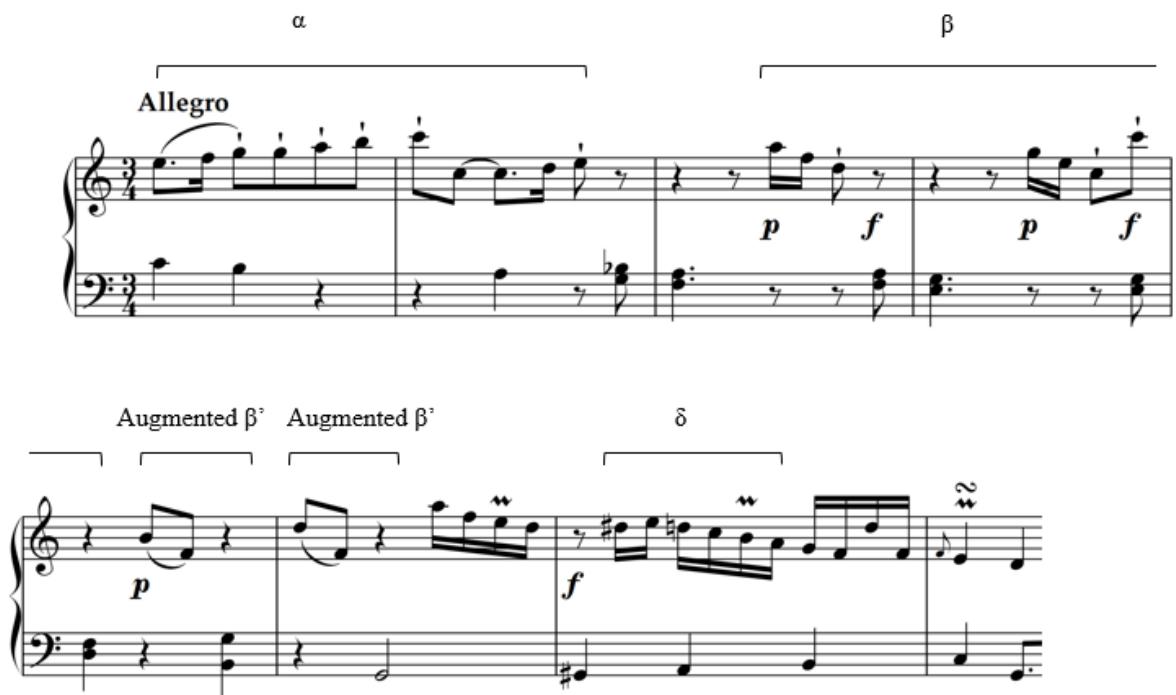
中文讲解
这是 Example 6.1 的图位占位符,题注为 Sonata in C major, Wq. 65/47 第一乐章的 mm. 1-8。该谱例正是本节作者用 Caplin 理论进行描述性拆分的对象——‘compound basic idea’(复合基本乐思)与 continuation(前句 + 后句结构)的形态都体现在这八小节之中。读者需对照原谱查阅具体的音高、节奏与终止式细节,本占位符所在段落并不展开新的论证,仅作为所引用实例的视觉位置标记。
补充说明
Wq. 65/47 是 C.P.E. 巴赫在《为行家与业余人士而作的奏鸣曲集》中 C 大调奏鸣曲的魏玛目录编号;图片内容需回到原始出版物或档案中查阅。
第3段(P0089)
原文复述
⁸ Caplin, Classical Form, 43.
中文讲解
这是脚注 8 的内容,引用 Caplin《Classical Form》第 43 页。该脚注在正文中紧跟’…another character feature in the continuation’之后出现,属于简注形式,仅标注作者、书名(缩写)和页码。其作用是为’用十六分音符段落替代特征动机是 continuation 阶段另一典型特征’这一论断提供理论来源的简短指针,避免重复书写完整书目信息。
补充说明
此处采用’作者,书名(缩写或简称),页码’的简注格式,与同节内脚注 7 的完整书目信息形成对应——同一文献在本节首次完整引用后,后续出现即使用简注。
第4段(P0090)
原文复述
⁷ William E. Caplin, Classical Form: A Theory of Formal Functions for the Instrumental Music of Haydn, Mozart, and Beethoven (New York: Oxford University Press, 1998), 41.
中文讲解
这是脚注 7 的内容,给出 Caplin《Classical Form》的完整书目信息:作者全名 William E. Caplin,书名全称 Classical Form: A Theory of Formal Functions for the Instrumental Music of Haydn, Mozart, and Beethoven,出版社所在地 New York,出版社 Oxford University Press,出版年份 1998,引用页码第 41 页。该脚注在正文中紧接’continuation.‘之后出现,是 continuation(继续)这一形式功能概念的首引出处。脚注 7 在本节内第一次出现,因此用完整书目格式;之后的脚注 8、9 由于引自同一本书,可改用简注形式。其学术作用是确立作者所用的’compound basic idea’‘continuation’’liquidation’等概念的理论源头,使本节的形式功能分析具有可追溯的文献依据。
补充说明
该脚注是本节唯一一条完整书目信息;脚注 8 与脚注 9 借助’同书简注’惯例节省版面,但读者若需深入查阅,仍需以本脚注所给的完整出版信息定位原书。
第5段(P0091)
原文复述
⁹ Caplin, Classical Form, 42.
中文讲解
这是脚注 9 的内容,引用 Caplin《Classical Form》第 42 页。该脚注在正文中紧跟’…a faster surface rhythmic activity, again another technique often encountered in continuation’之后出现。其作用是为’用一连串十六分音符加快表面节奏活动度,是 continuation 中常见的另一手法’这一具体说法提供 Caplin 原书第 42 页作为直接来源,属于对单一技法论断的简短文献指针。
补充说明
本脚注与脚注 8 一同服务于’continuation 阶段的材料特征’这一组论述,与脚注 7 所确立的总体功能概念形成’总—分’的引用结构。
💡 本节核心要点
🔑 关键术语
- compound basic idea:Caplin 体系中的术语,指由两个互为补充的小节单位(通常各 2 小节)拼接而成的’复合基本乐思’;在本节中即指 mm. 1-4 与 mm. 5-8 共同构成的前句整体。
- continuation:Caplin 提出的形式功能之一,紧随基本乐思之后,承担’拆解动机 + 加速节奏 + 推向终止式’的任务,本节中对应 mm. 5-8(后句)。
- liquidation:continuation 内部最末阶段的材料处理手法,把前面出现过的特征动机逐步模糊、分解或替换为无轮廓的快速音符群,为终止式让路;本节中即 mm. 7-8 高音声部以十六分音符取代标志性主题片段的过程。
- half cadence:终止于属音(^5)的半终止;本节中 m. 8 的 ^5 即为该半终止的目标音,构成前句的开放性收束。
- cadential 6/4:终止式前的标志性 6/4 和声进行(通常为属功能的第二转位),用以悬置与延迟解决;本节在 m. 8 用以凸显 half cadence 的到达。
- turn-trill:古典时期常见的装饰音型,把回音(turn)嵌入颤音(trill)中,兼具装饰与延迟解决功能;本节中位于 m. 8 终止位置,与 cadential 6/4 协同强调终止式。
- ^5 / ^1 / ^#5:Caplin 体系中的音级记号,分别代表属音、主音与升属音;^#5 在 mm. 7-8 低音声部中作为经过音填充 ^5 与 ^1 之间的音级空隙。
CH6_S4 [描述性拆分] Description of mm. 9-13: motive γ, scalar improvisation, and inconclusive closure
第1段(P0092)
原文复述
The independence of the ‘c. b. i. + cont.’ module (mm. 1–8) is weakened by the immediate outset of the next module; although the two modules do not in fact overlap, the new module begins in a prolonged dominant harmony introduced by a long upbeat, so that the outset of the new module disguises itself as the suffix of the previous phrase—especially given that the previous phrase ends with a half cadence. Such ambiguity further reinforces a sense of uncertainty.
中文讲解
本段揭示的是 c. b. i. + cont.(即 mm. 1–8 的“确认基本乐思 + 继续”模块)与下一模块(mm. 9–13)之间的接缝策略。作者强调:尽管两个模块在乐谱上并没有真正重叠,但作曲家通过让新模块落在延续的属音和声上、并以长上拍进入,使新材料的起点听起来像是前一句半终止之后自然延伸出来的后缀,而非一个独立的、封闭的新陈述。换言之,作者把这种“无重叠但语义上接续”的处理视为一种故意制造的歧义,目的在于推迟听众期待中的收束感、维持一种不确定的语气——这一不确定性也预告了 mm. 9–13 模块最终那种“非收束性”的结尾。
第2段(P0093)
原文复述
Immediately after the cadence leading into m. 9, a new motive labeled γ enters in the left hand on the upbeat. Motive γ can be described as the propelling motive, since its sixteenth-note upbeat drives forward into an ascending line in eighth notes. As shown in Example 6.2, motive γ in the left hand is swiftly echoed in the right hand in m. 9 by motive β′ (which consists of only one figura corta), and this exchange is accompanied by a sudden change of dynamic to piano. The piano dynamic is sustained as the chain of echo between both hands continues through the reappearance of motive γ on the upbeat of m. 10. Reinforced by the piano dynamic, a ’lights-out’ effect is created in m. 10 when the final note of the propelling motive is altered to Bb, turning the prolonged harmony from G major into G minor in first inversion.¹⁰ The left hand then holds a long Bb in the bass for five beats, providing only a tenuous harmonic support for a scalar passage in sixteenth notes to hover above. The scalar passage first ascends in G melodic minor across mm. 10–11.1, with some chromatic passing tones at the end adding extra flavor. The scalar passage then descends, but using the notes of F major; this F-major descending scale appears to anticipate forward motion toward the dominant seventh of F major, which is finally confirmed when the bass moves to C on beat 3 of m. 11. The sudden appearance of the scalar passage in sixteenth
中文讲解
本段是本节的核心段落,集中引入 motive γ 与紧随其后的“音阶即兴”。作者把材料按三层交叠叙述:(1)动机对位层面——左手十六分音符上拍推进到八分音符上行线(γ),随即被右手的 β′(仅含一个 figura corta)所“回声”,并以突变为 piano 作为触发;(2)和声—色彩层面——同一种 piano 语境下,m. 10 上 γ 的尾音被替换为 Bb,使原本维持的 G 大调和声瞬间变为 G 小调第一转位,即所谓的“lights-out”效果(Hepokoski 与 Darcy 称之为“主要调性中的临时小调混合”);(3)旋律—即兴层面——左手维持长达五拍的 Bb 低音,提供一种脆弱的和声支撑,让右手十六分音符音阶“漂浮”其上,先以 G 旋律小调上行(尾段有半音经过音作为“味道”),再以 F 大调下行,这种下行被解读为对 F 大调属七的预示,并在 m. 11 第 3 拍低音落到 C 时得到确证。整个段落的论证功能是:把一个听起来像“自由幻想曲式跑句”的音阶段,逻辑地解释为从 G(主持续)向 F(属七—主)的和声转向过程。
补充说明
文中首次出现的“Example 6.2”将在 P0096 中给出图注与说明;尾注标记“¹⁰”指向 P0094 的脚注。
第3段(P0094)
原文复述
Footnote 10. See James Hepokoski and Warren Darcy, Elements of Sonata Theory: Norms, Types, and Deformations in the Late Eighteenth-Century Sonata (New York: Oxford University Press, 2006), 26. The ’lights-out’ effect is defined as a ’temporary minor-mode mixture’ in a major-mode piece.
中文讲解
这条脚注同时承担两项功能:第一,提供学术出处——Hepokoski 与 Darcy《Elements of Sonata Theory》第 26 页,使“lights-out”概念在奏鸣曲理论文献中获得定位;第二,明确界定术语——在大调段落中临时出现的小调色彩(即 P0093 中 G 大→G 小第一转位的瞬间替换)应被称为“temporary minor-mode mixture”(临时小调混合)。其与正文的关系是支持并限定 P0093 的术语使用,让读者明白此处的色彩变化并非真正的转调,而只是一次瞬间的调性染色。
第4段(P0095)
原文复述
…notes is permeated with an improvisatory quality, as if the carefree composer temporarily lets go of the reins and entrusts himself to the muscular memory of his right hand, performing the kinds of idiomatic fill-in (such as running scales) typical of a free fantasia.
中文讲解
这句承接 P0093 末尾被截断的句子“The sudden appearance of the scalar passage in sixteenth…”,完成了对 mm. 10–11 十六分音符音阶的描述。其论证作用是诠释性的:作者把这段音阶定性为“带即兴意味”的写法,并将其与自由幻想曲中常见的“顺手”填充乐句(典型者即跑句音阶)相类比。所谓“作曲家暂时松开缰绳、交由右手的肌肉记忆”,意味着此处的十六分音符并不是事先严密编排的主题—动机推演,而是被听成一段瞬间从主题工作中“溜走”的炫技/放松;然而这段“放松”并非与结构无关——它正是上文所指、推动和声从 G 转向 F 的载体。
第5段(P0096)
原文复述
Example 6.2. Sonata in C major, Wq. 65/47, i, mm. 8–10. Motive γ jumps back into the scene from the upbeat of m. 13; it first enters in the left hand with a sudden shift to forte, and is then echoed by the same motive in the right hand in a sudden return to piano. The propelling quality of motive γ, combined with the sudden forte, perplexes the listener: although m. 13 is a harmonic prolongation of the tonic in F major, the energetic musical components seem to set up something new, as if challenging this measure’s status as a suffix. Just as observed at the upbeat of m. 9, the propelling motive carries an inherent potential for ambiguity.
中文讲解
本段把 Example 6.2 的图注与分析评注合并在一起。图注层面:示例取自 Wq. 65/47(C 大调奏鸣曲)第一乐章的 mm. 8–10,是 P0093 中所引音乐片段的实证来源。分析层面:作者指出 motive γ 在 m. 13 上拍“重新跳入”,先在左手以突然的 forte 出现,再在右手以立刻回到的 piano 回应——动态的“跳入—回落”模式与 m. 9 上拍 γ 的初次出现形成镜像。关键论点是:尽管 m. 13 在和声上只是 F 大调主音的持续,motive γ 所携带的推进力与突发的 forte 让它听起来像在“启动”某种新东西,从而挑战了 m. 13 作为简单后缀的地位。换言之,作者认为 γ 这一动机本身就内含制造歧义的潜力——这种潜力在 mm. 9–13 模块的开头与结尾两端分别显现,构成首尾呼应。
补充说明
“Wq. 65/47”即 C. P. E. Bach《C 大调奏鸣曲》在 Wotquenne 主题目录中的编号,“i”表示第一乐章,全章的分析对象即是此曲。
第6段(P0097)
原文复述
[Figure with description.] The concluding measure of the module of mm. 9–13 is anything but conclusive. In a sense, in mm. 10–12 the harmonic progression i–i⁶–V⁷–I in F major can be identified retrospectively. Yet the musical events of m. 12 can hardly provide a satisfactory conclusive PAC. The downbeat rest in m. 12 disrupts the process of a PAC, even though a dominant seventh harmony is clearly suggested by the bass in m. 11.3. Furthermore, the tonic F in the bass at m. 12.3 is approached by an upbeat sixteenth-note E, rather than by a more affirmative dominant C, so that conclusiveness is diminished. It is tempting for the listener to fill in the rest of m. 12 with a bass note D. Not only would this putative D work well with the rule of the octave, but it would also complete the ascending bass line F#–A across mm. 9.3–14.1. This ascending bass line looks analogous to the ascending treble line F#–D across mm. 10–11.1; the bass line seems to be an augmented version of the treble line, even though the two differ in a few accidentals. Perhaps the reason Bach omits the D in the bass is his intention to incorporate motive γ at the end of the module. While one might expect the module (mm. 9–13) to end in a piano dynamic,…
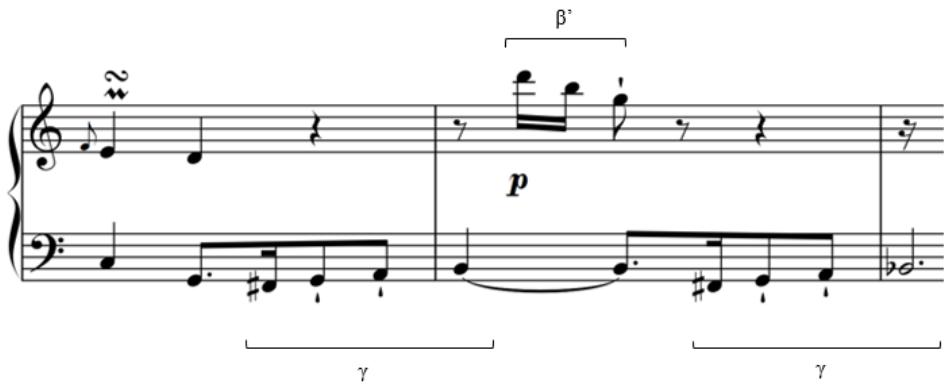
中文讲解
这段文字(作为图注/alt-text 嵌入一段被省略的图像位置)提出本节最核心的判断:mm. 9–13 的结束小节几乎毫无“收束感”。论证分几步推进:(1)和声骨架层面——mm. 10–12 事后可以反推出 F 大调的 i–i⁶–V⁷–I 进行,似乎具备形成完美完全终止(PAC)的条件;(2)表面干扰层面——m. 12 的强拍休止打断了 PAC 进程(即便 m. 11.3 的低音已明确提示 V⁷);m. 12.3 的主音 F 由十六分音符 E 上拍引入,而非由更具肯定性的属音 C 进入,因而终止感被削弱;(3)“被抑制的完成”层面——作者引导听众在脑海中“补”上 m. 12 中的一个低音 D:这个 D 不仅符合“rule of the octave”(八度规则)的传统低音进行,也恰好完成 mm. 9.3–14.1 的上行低音线 F#–A;而这条 F#–A 与 mm. 10–11.1 的高音 F#–D 在轮廓上彼此对应,只是前者被“放大”且变音不同。作者由此推断:巴赫有意略去这个 D,是为了在模块末尾腾出空间加入 motive γ。句末被截断的提示——“人们或许会预期该模块以 piano 收束”——预告了下文将对力度与终止关系的进一步讨论。综合来看,全段意在说明:本模块既具备反推可得的功能和声,又在节奏、强拍、低音走向、动机插入等多个层面同时阻挠一个令人满意的 PAC,从而把“延宕—未完结”作为其结构性修辞。
补充说明
文中所称“rule of the octave”是十八世纪通奏低音中沿音阶级进时分配低音的传统做法,通常交替使用旋律音下方六度与四度(或三度与六度)作为低音——作者借此说明低音 D 在该位置符合常规和声配置。
脚注 / 边栏 / 图表 / 附加信息(如有)
本节包含两类附加材料:(1)脚注 10(P0094),既给出 Hepokoski 与 Darcy《Elements of Sonata Theory》(2006)第 26 页的出处,又为 P0093 中“lights-out”效果提供术语定义(temporary minor-mode mixture);(2)谱例与图像——Example 6.2(P0096)的图注标记为 Wq. 65/47 第一乐章 mm. 8–10,作为 P0093 中 motive γ 首次出现以及 m. 13 上 γ 复现的视觉证据;紧随其后的图像(P0097)的 alt-text 详细讨论 mm. 9–13 模块结尾的“非收束性”特征,所引图像数据本身已省略。
💡 本节核心要点
- 模块衔接处的故意歧义:mm. 1–8 与 mm. 9–13 之间虽无真正重叠,但新模块落在延续的属音和声上并以长上拍进入,使其伪装成前半终止之后的后缀,从而推迟封闭感。
- motive γ 被定义为“推进动机”:左手十六分音符上拍—八分音符上行的形态,在 m. 9 被右手 β′(仅含一个 figura corta)以 piano 力度回声;m. 10 上拍 γ 再现,使 echo 链延伸。
- “lights-out”效果:m. 10 中 γ 的尾音被替换为 Bb,使延续的 G 大调瞬时变为 G 小调第一转位;据 Hepokoski 与 Darcy,这是一种“主要调性中的临时小调混合”。
- 音阶即兴段落(mm. 10–11):在左手持续五拍 Bb 的脆弱低音上,十六分音符先以 G 旋律小调上行(含半音经过音)后以 F 大调下行;下行被解读为对 F 大调属七的预示,并在 m. 11 第 3 拍低音 C 上得到确认。整段被听作自由幻想曲式的即兴填充。
- m. 13 上 γ 的回归:先以突然的 forte 在左手出现,再以回到 piano 的同一动机在右手回应;尽管 m. 13 仅是 F 大调主音的延续,motive γ 的能量使其“听起来”像要开始新东西,从而挑战其作为后缀的地位——这种潜在歧义与 m. 9 开头形成镜像。
- mm. 9–13 的非收束性收尾:虽然 mm. 10–12 可反推为 F 大调 i–i⁶–V⁷–I,但 m. 12 的强拍休止、低音以 E(而非 C)导入主音 F、以及被省略的、却能完成 F#–A 上行低音线(与高音 F#–D 平行)并契合“rule of the octave”的低音 D,都阻挠了令人满意的 PAC;其低音 D 的省略被推测为插入 motive γ 的需要。
🔑 关键术语
- motive γ:本节引入的“推进动机”,形态为十六分音符上拍推向八分音符上行线;首次出现于 m. 9 上拍左手,随后在 m. 9 由右手 β′ 回声、在 m. 10 上拍自身再现,并在 m. 13 上拍再次以 forte–piano 模式进入;其内在的“推进”能量在模块首尾两次制造歧义。
- propelling motive:作者为 motive γ 取的功能性名称,强调其十六分音符上拍驱动后续八分音符上行的“推进”属性,是本节用以解释力度突变、和声转向与“非收束性”结尾的关键术语。
- lights-out effect:指大调段落中某一点上的临时小调色彩处理;在本节中表现为 m. 10 上 γ 的尾音被替换为 Bb,使 G 大调瞬时染为 G 小调第一转位;据 Hepokoski 与 Darcy,这是一种“temporary minor-mode mixture”(主要调性中的临时小调混合)。
- figura corta:一种短小的装饰性音型;在 m. 9 中,右手用以回声 motive γ 的 β′ 仅由一个 figura corta 构成,体现 echo 链在材料上的简化与即时性。
- scalar passage / scalar improvisation:m. 10–11 中悬浮于持续 Bb 之上的十六分音符音阶,先以 G 旋律小调上行(尾段含半音经过音),再以 F 大调下行;被听作自由幻想曲中典型的即兴式跑句填充,并同时承担把和声从 G 推向 F 大调属七的功能。
- PAC (perfect authentic cadence):属—主终止且两和弦均处根音位置、主音处于最高声部的完全终止;本节指出 mm. 10–12 的表面事件(强拍休止、由弱上拍 E 引入主音 F、缺少关键低音 D)阻挠了一次令人满意的 PAC,从而解释了 mm. 9–13 模块结尾的“非收束”性。
- rule of the octave:十八世纪通奏低音沿音阶级进时分配低音的传统规则,通常在旋律音下方交替使用六度与四度(或三度与六度)作为低音;本节借此说明,若在 m. 12 补上低音 D,既符合该规则,也能完成 mm. 9.3–14.1 的上行低音线 F#–A。
- Wq. 65/47:Wotquenne 主题目录中 C. P. E. Bach《C 大调奏鸣曲》的编号;本节所有谱例(特别是 Example 6.2, mm. 8–10)与分析对象均来自该曲第一乐章(i)。
CH6_S5 [描述性拆分] Description of mm. 14-16: Satz-altering suffix that restores normative resting points
第1段(P0098)
原文复述
Description of mm. 14-16
中文讲解
这是该页上的小节标题,以方括号标注为“描述性拆分”(Description of),标记作者的分析从此处进入对具体小节(第14–16小节)的逐句描述阶段。该标题提示本节的任务是:用分析性语言对这三小节所发生的事件(调性转换、和声、动机出现方式、终止式类型等)逐项刻画,为前文提出的“Satz-altering suffix(句子变形后缀)”这一理论判断提供作曲技术层面的证据。
补充说明
无额外补充;该段仅为小节标题,无附加说明。
第2段(P0099)
原文复述
Even though the closure of the previous module (mm. 9-13) is not so conclusive, it still sets up a weak resting point in F major, which itself is not a normative choice of resting point in a Kochian sense. It seems that the module of mm. 14-16 is followed as to amend the case, so that the music can proceed towards an expected formal process.
中文讲解
本段为后续对mm. 14–16的分析提供功能上的前提。
首先要区分两种“停顿”:前模块(mm. 9–13)虽然“并非十分收束”(not so conclusive),却仍建立了一个“弱停顿点”(weak resting point),落在大调F major上。但作者强调:在科赫(Koch)意义上的“规范性停顿点”(normative resting point)并非F major——所谓规范性,源自Koch的功能和声理论中对终止式层级与调性归属的等级化预设,F大调在此处不满足规范性预期,因此前模块的收束属于“偏离”而非“到位”。
基于这一判断,mm. 14–16的出现被作者解释为“修正案”(to amend the case):它不是独立的乐思陈述,而是依附于前面那个不规范性停顿之后的“补丁”,其目的(so that…)是把音乐拉回到“预期的形式进程”(expected formal process)。换言之,本节标题中的“Satz-altering suffix”已经在此预告:第14–16小节不是新句子,而是一种使前一句结构(Satz)的最终落点得以被改写/补救的后缀成分。
补充说明
“Kochian sense”指Heinrich Koch的功能和声体系中对规范性终止进行分级排序的理论框架;此处作者借用其概念作为评判“停顿点是否合乎规范”的尺度,这是当前分析内部使用的评判标准。
第3段(P0100)
原文复述
It is true that the entrance of m. 14 is an ear-catching event, i.e. a sudden burst of #4/2 harmony in forte. Yet, in order to juxtapose m. 14 in a less abrupt manner, there is some subtle maneuver in m. 13. While the F major harmony is prolonged in m. 13, the C steps in in the bass in the second half of beat 3. The setup of C in the bass in the last moment allows a common tone modulation; with the change of function, while the C in m. 13 was functioning as ^5 of F major, the C in m. 14 now functions as ^4 of G major due to the #4/2 harmonization. With the #4/2 upon C, it enables the music to proceed to G major. Through several echoes of motive β’ between both hands in mm. 14-15 (whose harmonic motion can be interpreted as I^6 - vi - vii°/V in G major), the music arrives at a tonic harmony in G major in root position in m. 16, which later proceeds to a suggested D major chord in m. 16.2, forming a half cadence in G major. Thus, with the module of mm. 14-16 acting as a Satz-altering suffix, the normative order of successive resting points is preserved.11
中文讲解
本段按时间顺序拆解了mm. 13–16的和声—调性运作,论证该三小节如何构成前文所说的“Satz-altering suffix”。
-
m. 14的“闯入”特征:作者先承认m. 14的进入在听觉上极具冲击力(an ear-catching event)——以forte力度突然爆发出#4/2和声。这是一个“结果性”现象。
-
m. 13的预备处理:为使m. 14不至于显得过于突兀,作者指出m. 13中存在一项“细微手法”(subtle maneuver):F大调和声持续的同时,在第3拍后半拍的低音声部引入了C音。这个C在m. 13的语境里是F大调的^5(属音)。
-
共同音转调(common tone modulation):C音作为“共同音”被延续到m. 14,但其功能发生改变——在#4/2和声的重新解读下,原本作为F大调^5的C,现在被理解为G大调的^4。这是典型的共同音等音/功能改写:同一个音高在不同调性中承担不同的音级角色,从而实现平滑的调性转换。
-
到G大调的达成:建立在C上的#4/2和声为音乐向G大调推进提供了和声条件。
-
mm. 14–15的内部分解:动机β’(即动机β的变体)在两声部间以“回声”方式反复出现,其和声运动在G大调内可解释为 I^6 – vi – vii°/V ——这是功能性向属方向推进的标准进行。
-
m. 16的落点:和声最终在m. 16抵达G大调原位主和弦(tonic harmony in G major in root position);紧接其后(m. 16.2)出现一个被“暗示”(suggested)的D大调和弦,由此在G大调内形成一个半终止(half cadence)。
-
结构性结论:综合以上,作者总结:mm. 14–16作为“句子变形后缀”(Satz-altering suffix),使“规范性停顿点的连续顺序”(the normative order of successive resting points)得以恢复——也就是说,原本在F大调上的非规范性停顿,被这一后缀“改写/修正”为符合Koch规范性预期的G大调半终止。
这一句也是对本小节标题所提论断(Satz-altering suffix)的实证落实。
补充说明
段末的脚注11(superscript 11)为对“Satz-altering suffix”或“normative order of successive resting points”等关键论断提供出处或旁证;其具体内容未在本段呈现,需查看脚注区。
脚注 / 边栏 / 图表 / 附加信息(如有)
本节末(P0100)附有脚注11(以角标“11”出现),作者用以支撑“normative order of successive resting points”或“Satz-altering suffix”的判断;脚注正文的实际内容未在source_paragraphs中给出,需另行查阅脚注区。
💡 本节核心要点
- mm. 9–13在F大调上的收束被判定为非规范性(Kochian sense)的弱停顿点,构成需要被“修正”的前提。
- mm. 14–16的功能不是独立陈述,而是依附于前模块的“Satz-altering suffix”,其目的在于把音乐拉回到预期的形式进程。
- mm. 13第3拍后半拍引入的低声部C是关键预备动作——它是F大调的^5,又是G大调的^4,承担共同音转调的桥梁作用。
- m. 14以forte力度的#4/2和声突然出现;该和弦建立在C上,使C从F大调的^5改写为G大调的^4。
- mm. 14–15内,动机β’在两声部间回响,和声运动按 I^6 – vi – vii°/V 解读,属典型的功能性属方向进行。
- m. 16在G大调原位主和弦上收束,并以m. 16.2的暗示性D大调和声形成G大调半终止,从而恢复规范性停顿点的连续顺序。
🔑 关键术语
- Satz-altering suffix:“句子变形后缀”。在本节中专指mm. 14–16这一依附于前模块之后的片段,其结构作用是改写(alter)前一句(Satz)所留下的非规范性停顿点,使其重新符合Koch意义上的预期调性/终止进行。
- Kochian sense / normative resting point:“科赫意义上的规范性停顿点”。源自Heinrich Koch的功能和声体系中按终止等级排列的预期停顿方式;本节用其作为评判mm. 9–13收束是否“合规”的标尺,F大调被判定为不合规的停顿点。
- common tone modulation:“共同音转调”。一个音高在前后两个调性中保持不变,但其音级功能被重新解释(如本节中C由F大调的^5变为G大调的^4),从而实现不出现显著半音冲突的平滑调性过渡。
- #4/2:本节对m. 14和声的标记方式,建立在低声部C之上;其作用是把C的功能从F大调的^5改写为G大调的^4,从而为向G大调过渡提供和声依据。
- motive β’:“动机β的变体/重复形式”(β带撇号)。本节中它在mm. 14–15的两声部间以回声方式反复出现,是后缀内部陈述的内容载体。
- half cadence:“半终止”。本节中指mm. 16落在G大调主和弦后,m. 16.2出现暗示性D大调和声(即属方向的和声),从而在G大调内形成的属功能半终止。该半终止即是恢复“规范性停顿点顺序”的关键落点。
CH6_S6 [描述性拆分] Description of mm. 17-26: motive γ′, lights-out effect, figura corta, and improvised cascading passage
第1段(P0101)
原文复述
Description of mm. 17-26
中文讲解
This is the section heading that opens the descriptive passage-by-passage discussion. It announces that the following paragraphs will analyze measures 17–26 of the movement, focusing on four named phenomena: motive γ′, the lights-out effect, the figura corta (β′′), and the improvised cascading passage. As a heading, its function is to delimit the descriptive block rather than to make an analytic claim.
第2段(P0102)
原文复述
As we have observed above, due to its position on upbeat and propelling quality, the use of motive γ blurs a clear-cut boundary between successive modules. A similar phenomenon occurs when a new module starts in m. 17, immediately after the half cadence of the previous module. As shown in Example 6.3, in m. 17, a motive derived from the propelling motive (by adding an extra eighth note; the derived motive can be identified as motive γ′) pops out. Though it is true that the two modules are separated by a sixteenth rest, the outset of the module (starting from m. 17) does not sound like a new beginning, but as an agitated appendage of the previous module. This is due to the metric position on upbeat and the propelling quality set up by the sixteenth note, as well as the brevity of the rest.
中文讲解
本段承接前文关于动机 γ 的讨论,引出 m. 17 处出现的衍生动机 γ′。作者论证的要点是:尽管新乐句从 m. 17 开始,且与前句之间隔有十六分休止,但听感上并不像一个新的开始,而像是前句的激动化延伸。其原因可拆为三层:①γ′ 由推进动机增加一个八分音符而来,本身保留上行推进性质;②它在弱拍起拍,位置本身就被前句惯性所占据;③休止时值太短,不足以形成清晰的听觉切割。这三因素共同导致模块边界模糊。示例 6.3 即为这一动机转换的乐谱证据。理解本段的关键在于:作者并不把休止符当作必然的结构断点,而是强调节奏位置与时值长度共同决定听感上的句法边界。
补充说明
段落开头以 “As we have observed above” 与前文关于动机 γ 的分析衔接;其结论为后段对 m. 18 倒影动机的 “lights-out” 效果提供节拍前提——只有当节拍边界尚未被听清时,模糊化处理才能展开。
第3段(P0103)
原文复述
Motive γ′ in m. 17 is immediately followed by an inverted motive γ′ (Example 6.3), separated by a dotted eighth rest. While motive γ′ in m. 17 outlined by the notes in G major, and stops on a 7/5 above the F#, the inverted motive γ′ in m. 18 reverses the melodic contour by a ‗lights-out‖ effect. For the inverted motive γ′ in m. 18, not only does it contain notes in G minor, the parallel minor, a sudden shift to the piano dynamic also enhances the sense of darkening. The uncertainty created by the ‗lights-out‖ effect further developed when the motive ends with a diminished seventh and the syncopated repetition of that chord.
中文讲解
本段进一步推进 m. 18 的 “lights-out”(熄灯)效果。作者的论证逻辑是:m. 17 的 γ′ 以 G 大调音勾勒并停在 F# 上方的 7/5 张力音,m. 18 的 γ′ 通过倒影反转旋律轮廓(“lights-out”),由此带来三个层叠的"变暗"机制:①音高材料从 G 大调转入其平行小调 G 小调;②力度从原本的强奏突变为 piano;③动机以减七和弦结束,并通过切分重复该和弦扩展不稳定感。这三层叠加使 m. 18 不仅是旋律方向的倒转,更是调性、力度、和声三重层面上的"熄灭”。需要注意作者的限定:减七和弦及其切分重复是对 “lights-out” 不确定感的"进一步发展"而非独立事件,因此本段与下一段对 hiccup 效应的描写是紧密衔接的。
补充说明
段落中提到的 “7/5 above the F#” 指 G 大调属七和弦(F# 为属音)上方叠置的七度与五度音程关系;这是 Rothstein 等理论家常用的数字低音式记号来标示属七音响。平行小调(parallel minor)一词与关系小调(relative minor)不同,特指同主音的小调。
第4段(P0104)
原文复述
11 See L. Poundie Burstein, Journeys Through Galant Expositions (New York: Oxford University Press, 2020), 44; William Nathan Rothstein, Phrase Rhythm in Tonal Music (New York: Schirmer Books, 1989), 95. The ―Satz-alternating suffix‖ is the same as Rothstein’s ―cadence-altering suffix.‖ Both concepts indicate a change of cadence by adding a suffix to the phrase. For example, the Grundabsatz (a phrase ending on PAC or IAC) leads the music to a conclusive end in the tonic key. Yet, when an appendix (Satz-alternating suffix) that ends on V of the dominant key is attached to the end of the phrase, the whole phrase becomes a Quintabsatz in V (a phase ending on HC in dominant key).
中文讲解
这是正文第 11 号脚注,提供对 “Satz-alternating suffix”(交替句后缀)这一概念的来源说明与定义。其功能有二:①文献定位,将该术语同时归于 Burstein(《Journeys Through Galant Expositions》, 2020, p. 44)与 Rothstein(《Phrase Rhythm in Tonal Music》, 1989, p. 95),并指出二者所用术语虽异,所指概念相同——前者称 Satz-alternating suffix,后者称 cadence-altering suffix;②概念定义与例证:通过 Grundabsatz 与 Quintabsatz 的对比,说明附加后缀如何改变终止式功能——原本结束于主调主和弦(PAC/IAC)的乐句,一旦附加终止于属调 V 的后缀,便在功能上变为 V 上的 Quintabsatz(半终止)。该脚注对正文起到限定与支撑作用:它解释了为何前句的半终止具备"将被延伸"的潜力,从而为 m. 17 处 γ′ “听感上不算新开始"的论证提供句法理论依据。
补充说明
脚注中所举 Grundabsatz → Quintabsatz 的转换是十八世纪句法理论的经典例子,作者在脚注里给出文献溯源;正文对模块边界的讨论正建立在这种"附加后缀改变终止功能"的原理之上。
第5段(P0105)
原文复述
Example 6.3. Sonata in C major, Wq. 65/47, i, mm. 16-18
中文讲解
这是示例 6.3 的图注,标明乐谱来源为 C 大调奏鸣曲,作品编号 Wq. 65/47,第一乐章,节选自 m. 16–18。该示例对应的正是正文讨论的 γ′ 及其倒影 “lights-out” 动机所在位置,是论证所依据的视觉证据。
第6段(P0106)
原文复述
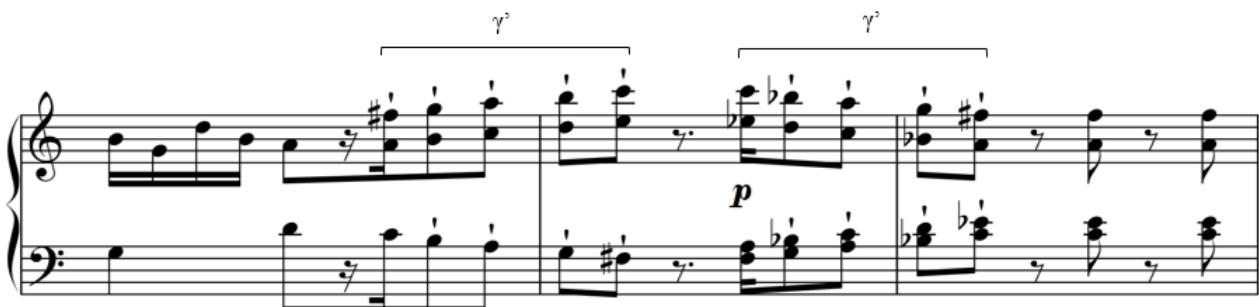
中文讲解
这是第 34 页的图像/乐谱占位符,对应示例 6.3 的实际谱例部分。由于嵌入图像数据已省略,需查阅原书或原始图件以确认谱面细节,包括 γ′ 动机在 m. 17 的原始形态与其在 m. 18 的倒影形态的具体音高与节奏。
补充说明
此占位符紧接图注 P0105,配合示例 6.3 共同支撑 P0102、P0103 关于 γ′ 及其倒影 “lights-out” 效果的分析。
第7段(P0107)
原文复述
The hiccup effect by the syncopated rhythm in m. 18 has pushed the uncertain atmosphere to the critical point, and it is not until the sudden burst of cascading descending 32nd notes in the right hand in m. 19 casts away the doubtful situation. The return of G major (beat 1 outlines a G major harmony in first inversion) contributes to the return of brightness in m. 19, as well as a sudden shift back to the forte. Following the cascading 32nd notes on beat 1 of m. 19, there is a series of figura corta in mm. 19-21 (β′′), as shown in Example 6.4. β′′ is outlined by both hands; the left hand utters a downbeat quarter note, responded by two sixteenth notes in the second half of the beat. Whether the figura corta should be interpreted as a long note followed by two short notes (L-SS) or otherwise (SS-L) is open to discussion. Considering the abundant use of motive β, perhaps the latter view (SS-L) is more plausible. The plausibility of such a view is further enhanced when the half notes in the left hand in m. 20 and m. 21 are considered; the use of half note, as if a symptom of the temporal memory lapse of the putative performer, suggests that the two upbeat sixteenth notes are leading towards the downbeat long note, rather creates an illusion of loss of control, as if the improviser is so moved by his emotion, that they are indulged into their imagination and forget about the ―objective‖ composition rules.
中文讲解
本段是本节核心段落之一,论述从 m. 18 的不确定高潮到 m. 19 的解决与展开。论证分四个步骤展开:①承接前段,m. 18 的切分重复减七和弦造成 “hiccup”(打嗝)效果,使模糊氛围达至临界点;②m. 19 右手突然爆发的下行 32 分音符级进段落"驱散"怀疑,beat 1 上的 G 大调第一转位和弦配合突回 forte 重返明亮;③紧接级进段落出现一系列 figura corta(短型音型,标注为 β′′),由双手共同勾勒——左奏强拍四分音符,右以两个十六分音符在拍后半回应;④作者就 L-SS(前长后短)还是 SS-L(前短后长)的读法展开讨论,主张后者更合理,理由有二:其一是动机 β 在作品中的大量出现提供习惯性预期,其二是 m. 20、m. 21 左手的全音符犹如"时间记忆失语”——暗示演奏者被情感牵引,进入即兴想象而忘却"客观的"作曲规则。本段也是本节首次明确引入"即兴"维度,把记谱文本与键盘即兴实践联系起来;理解时需注意作者的语气:所谓"失语"或"失控"并非真正的错误,而是为读者揭示 C.P.E. Bach 风格键盘作品中故意制造的"仿佛即兴"的修辞姿态。
补充说明
figura corta 是十八世纪通奏低音与即兴实践中常用的短型音型术语;β′′ 是作者对 figura corta 在本曲中的具体命名,与前文 β 动机相关但变体形式。“hiccup effect” 由切分重复同一和弦产生,是作者用以形容 m. 18 节奏断裂感的新造比喻。
第8段(P0108)
原文复述
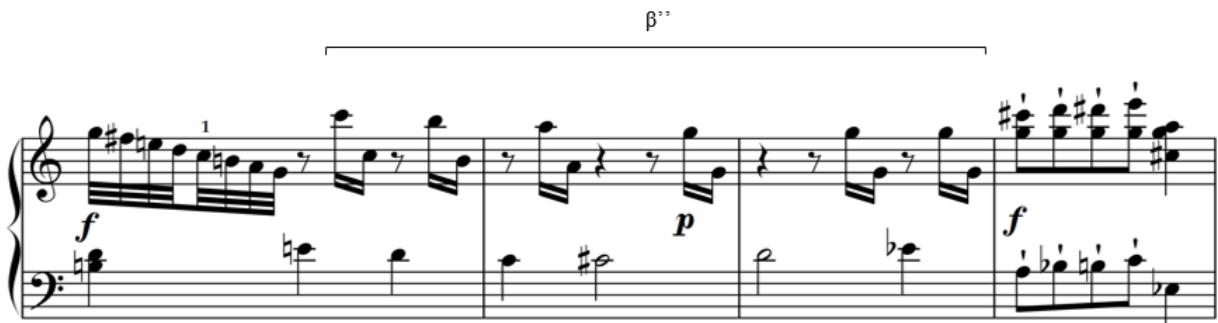
中文讲解
本段(从 “than the other way around” 起为截断的残句,其后接续完整论述)延续即兴主题,论证 mm. 19–22 整段都弥漫着强烈的即兴色彩。论证链条为:①承接上段结论,将 32 分音符级进与全音符"失语"明确归为键盘实时即兴的特征;②m. 22 延续这一思路,体现即兴素材;③分析 mm. 20–21 的调性—半音对比:mm. 19.2–20.1 的低音 E♮–D–C 与高音 C–B–A 形成平行六度,呈现潜在的 Prinner 模式(嘉兰特音乐中的常见低音—高音对位模板),若再下行一步即可在 G 大调上完成该模式;④但此过程被先后两次打断:先是 mm. 20–21 的 wedge(楔形)半音上行低音(4–#4–5 再被 ♭6 即 E♭ 引入而模糊),再是又一次 deceptive close(伪终止)。m. 20.3 突降至 piano 进一步强化模糊感,营造神秘氛围;⑤m. 22 达到方向感丧失的顶点——forte 的半音和弦猝然涌入,包含平行十度的半音上行与一个 French augmented sixth(法国增六和弦),加上一个长四分音符和弦并强调性地下移音区,给 mm. 19–22 这一段划下"即兴式"的终止。理解本段须把握作者的修辞:他用 Prinner(被劫持)、wedge(半音楔形)、deceptive close 与 French augmented sixth 这套嘉兰特与古典语汇,逐层描述即兴中"思路改变"与"方向迷失"的过程,把理论范畴转译为叙事化的即兴情境。
补充说明
Prinner、wedge、deceptive close、French augmented sixth 均为十八世纪句法/和声理论的标准范畴,作者在此用以捕捉即兴者的临时转向;m. 22 处的 French augmented sixth 与平行十度半音上行同时出现,是典型的情绪化半音和声堆积,与 C.P.E. Bach 所谓 “Empfindsamer Stil”(敏感风格)的修辞相吻合——但此处的对应关系需以原文为本,谨防过度引申。
脚注 / 边栏 / 图表 / 附加信息(如有)
本节包含一项关键附加材料:第 11 号脚注(P0104),引自 Burstein 与 Rothstein,为 “Satz-alternating suffix” / “cadence-altering suffix” 提供文献定位与定义,并附 Grundabsatz → Quintabsatz 的转换例证。该脚注对正文起到支撑作用,解释为何前句半终止具备被延伸的潜力,从而为 m. 17 处动机 γ′ “听感上非新起点” 的论证提供句法理论依据。
谱例 6.3(P0105、P0106)位于第 34 页,正文标注 mm. 16–18;谱例 6.4 在本节范围内被引用(见 P0107 中 “as shown in Example 6.4”),用于标示 figura corta(β′′)在 mm. 19–21 的位置,但本输入段未提供其图注或谱面,需查阅原书。
P0108 段首残句 “than the other way around” 显然是上一节内容被截断后的延续痕迹(应为承接 P0107 关于 L-SS / SS-L 读法的结论),叙述主体自 “The whole segment of mm. 19-22…” 开始方才完整。
💡 本节核心要点
- 动机 γ′(由推进动机增加一个八分音符衍生而来)位于 m. 17 弱拍,其上行推进力与短促的十六分休止共同导致新模块听感上更像前句的"激动化延伸",模块边界模糊化。
- m. 18 的倒影 γ′ 通过旋律轮廓反转(G 大调转其平行小调 G 小调、力度突降至 piano、减七和弦终止并切分重复)三层叠加制造 “lights-out” 效应,把不确定感推至临界。
- 切分节奏在 m. 18 造成 “hiccup”(打嗝)效果,至 m. 19 右手下行 32 分音符级进段落突然"驱散"怀疑,配合 G 大调第一转位回归与 forte 重返明亮。
- figura corta(β′′)在 mm. 19–21 以双手勾勒,作者基于动机 β 的频繁出现与 m. 20–21 左手全音符制造的"时间记忆失语",主张应作 SS-L(前短后长)解读,并视之为即兴者被情感牵引而"忘却客观作曲规则"的修辞姿态。
- mm. 19–22 整段弥漫即兴色彩:mm. 19.2–20.1 的潜在 Prinner 模式(低音 E♮–D–C 与高音 C–B–A 的平行六度)先后被 mm. 20–21 的半音 wedge(4–#4–5 推至 ♭6 E♭ 而变模糊)与另一处 deceptive close 打断,m. 22 以 forte 的半音和弦爆发、平行十度半音上行与 French augmented sixth 收束,方向感丧失达至顶点。
- 即兴维度贯穿本节:32 分音符级进、全音符"失语"、被劫持的 Prinner 与半音和声堆积共同构成键盘实时即兴的修辞化再现,是 C.P.E. Bach 风格键盘作品"仿佛即兴"姿态的典型呈现。
🔑 关键术语
- motive γ′ (and its inversion):γ′ 由前文讨论的推进动机 γ 增加一个八分音符衍生而来,位于 m. 17 弱拍;其倒影(inverted motive γ′)出现于 m. 18,通过旋律轮廓反转制造 “lights-out” 效果。
- lights-out effect:作者用以描述 m. 18 倒影 γ′ 的修辞性术语:旋律倒转叠加平行小调、半音化与 piano 力度、减七和弦终止与切分重复,造成"熄灭"式变暗。
- hiccup effect:由 m. 18 切分重复同一减七和弦造成的不规则节奏断裂感,作者以此比喻把模糊氛围推向临界点。
- cascading descending 32nd notes:m. 19 右手突然爆发的下行 32 分音符级进段落;与 G 大调第一转位和突回 forte 一同"驱散"先前的不确定感,被视为键盘实时即兴的特征之一。
- figura corta (β′′):十八世纪通奏低音与即兴实践中的常用短型音型;在本曲中标注为 β′′,由双手共同勾勒(左强拍四分音符—右十六分音符回应),作者主张作 SS-L 解读。
- Prinner:嘉兰特音乐中的常见低音—高音对位模板;本节用以解读 mm. 19.2–20.1 的平行六度(低音 E♮–D–C、高音 C–B–A)作为潜在但被劫持的 Prinner。
- wedge:嘉兰特句法范畴之一,以半音上行低音为特征;在 mm. 20–21 表现为 4–#4–5 推至 ♭6(E♭)而模糊的半音上行。
- deceptive close:在 V 之后意外解决到 vi 或其它非 I 的终止,制造方向感的临时偏转;本节中作为劫持 Prinner 之后的第二次打断出现。
- French augmented sixth:法语增六和弦(一种特定的增六和弦变体,特征音程与解决方式与德式、意式不同);m. 22 的 forte 半音和弦堆叠中出现。
- Satz-alternating suffix / cadence-altering suffix:见第 11 号脚注:附加于乐句之后、通过改变终止式功能而把 Grundabsatz(PAC/IAC)转换为 Quintabsatz(在属调 HC)等的后缀;Burstein 与 Rothstein 分别使用此二术语指称同一概念。
CH6_S7 [描述性拆分] Description of mm. 23-26: syncopation, parenthetical insertion, and EEC via figura corta
第1段(P0109)
原文复述
The concluding subphrase happens in mm. 23-26. Although the raison d’être of this subphrase is to push the music forward to a conclusive cadence in Rotation 1, i.e. EEC, that function does not remove the energetic and agitated nature of the subphrase—qualities that persist throughout the movement. Among the principal contributors to the activeness of the subphrases is the heavy use of syncopation. After the suspense created by the forte French augmented sixth in m. 22, an after-beat entrance occurs in m. 23: with an eighth rest on the downbeat of m. 23 (a complete silence), a syncopation is uttered through the entrance on the second half of beat 1 in both hands. The sense of syncopation is enhanced in the bass, where the eighth note leads towards a quarter note on beat 2, producing an accent on m. 23.2 by means of longer duration. As shown in Example 6.5, this syncopating process is accompanied by the right-hand segment (β’), whose initial derives from the figura corta—a figure comprising two eighth notes leading forward to a longer note on a more stable beat. The agitated effect continues in m. 24 by means of syncopation. The right-hand dyad, a thirty-second note succeeded by a dotted sixteenth note, forms a Lombard rhythm. Following the dyad, the left hand enters on the second half of beat 1 with a tenuto, which strengthens the syncopating effect.
中文讲解
本段处理一个核心张力:终止性短句 mm. 23-26 一方面在曲式上的 raison d’être 是把 Rotation 1 推向 EEC 这一完结终止,另一方面却保留着全曲贯穿的激动不安;二者在同一段中共存而不抵消。
围绕’激动不安’,作者把它拆解为三件切分性装置并逐项对位到小节层面:
其一,m. 23 的’空正拍+后半进入’。m. 22 的 forte French augmented sixth(法语增六和弦)是一个有强延留色彩的和声,落到 m. 23 开头时却被处理成’彻底沉默’——正拍是一整拍的八分休止,于是两手只能在第 1 拍后半同步进入,这就把原本的拍点’劈开’成切分,使整段的切分效果靠’空’而非靠力度来触发。
其二,低声部靠时值差产生’非节拍重音’。八分音符走到第 2 拍上的四分音符,并不是靠重音记号或力度,而是’靠长’。m. 23.2 上的这种隐性重音把切分感再加厚一层。
其三,m. 23 的右手 β′ 片段,其开头即来源于 figura corta(短—短—长:两个八分音符把’气’泄到一个稳定拍位上的长音),是本段激动语汇的最核心单位(见 Example 6.5)。
m. 24 的激动则由另一种节奏型延续:右手双音先以三十二分音符再接附点十六分音符,构成 Lombard rhythm(伦巴第节奏,短—长);其后左手在第 1 拍后半以 tenuto 进入,把 m. 24 的切分再加一遍。本段叙事的修辞功能是用具体节奏语汇落实段首宣告的’终止短句仍然 energetic’这一论点,为下一段把 mm. 23-24 重定义为’括号’(parenthesis)留下论证空间。
补充说明
figura corta(短—短—长)首次在本段被定义,将在 P0111 复用以解释 PAC 处的’快速化’版本;Lombard rhythm(短—长)与 tenuto 亦在本段首次出现并定义;French augmented sixth 与片段标签 β′ 均见前文段落。
第2段(P0110)
原文复述
It is noticeable that the syncopating passage in mm. 23-24 is presented in piano dynamic. As the music proceeds, we realize that this syncopating passage is sandwiched between two forte blocks (i.e. m. 22 and mm. 24.3-26). In a sense, the syncopating passage functions like a parenthesis, as if some side thoughts that delays the arrival of the dominant (when the music unfolds, we will realize that a direct succession between m. 22 and 25 is a feasible solution,
中文讲解
本段切换观察维度——从节奏语汇转入力度地形。它的核心命题:mm. 23-24 的切分段是 piano 力度,并且前后被 m. 22(forte)和 mm. 24.3-26(forte)两块夹在中间,因此在力度地形上构成一道’凹陷’。
作者由此推出本节最关键的比喻:’the syncopating passage functions like a parenthesis’。也就是说,尽管 mm. 23-24 内部存在切分与激动语汇,但在功能层面它像一段附带思绪(side thoughts),把主线条本应从 m. 22 直接走向 m. 25 的解决过程’暂缓’了一下。括号内的内嵌从句进一步预告:当分析继续展开时会发现,m. 22 到 m. 25 的直接连接本身就是一种’可行方案’(feasible solution),换言之 mm. 23-24 在’可被压缩掉’的深层结构意义上是一段装饰性插入。
这一比喻在本段单独设立,是为下一段 P0111 中的’括号出口’辨认做认知铺垫——读者需要先承认该段是括号,才能识别它结束瞬间所具备的’主线返回’信号功能。
补充说明
本段末尾被截断的’feasible solution, …‘在 P0111 以’(where the latter consists of a dominant harmony).‘补足,两段合并构成一个完整从句。括号入口/出口的修辞由 P0111 的 motive δ 再现与突然的 forte 切换完成。
第3段(P0111)
原文复述
[Image: Example 6.5 — Sonata in C major, Wq. 65/47, i, mm. 23-24.] (where the latter consists of a dominant harmony). The sense of parenthesis is further confirmed by the second half of m. 24, when a six-note figure (motive δ) recurs exactly in the right hand (Example 6.5). Motive δ first appears in m. 7 (Example 6.1) when the liquidation of the phrase begins, eventually leading to a half cadence. In this sense, motive δ can be regarded as a signal for a cadential end. In m. 24, motive δ is placed right after the syncopating passage; its sudden shift to forte signals that something new is happening (considering the previous passage as a parenthesis, what follows is a return to the main events). Moreover, motive δ is harmonized as a predominant, which smoothly progresses towards the dominant in m. 25. Regarding the PAC in mm. 25-26 which marks the end of the first reprise (as well as Rotation 1), there is a considerable use of figura corta in a rapid manner (two thirty-second notes leading to a long note on a more stable metric position), thus maintaining the energetic profile of the concluding subphrase in mm. 23-26.
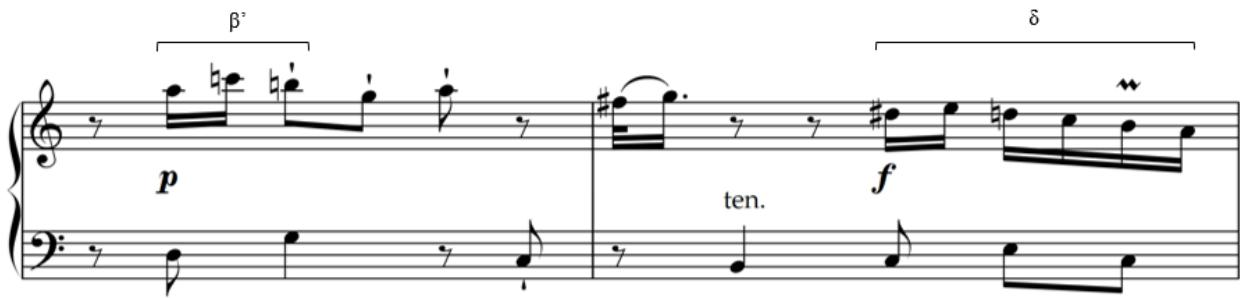
中文讲解
本段是论证的收口处,承担两件事:用 motive δ 与对 PAC 的描述复核 mm. 23-24 的’括号’身份,并描述括号出口与终终止(Rotation 1 收束)的全过程。
第一件证据是 motive δ。该六音动机首次出现于 m. 7(Example 6.1),是 phrase liquidation 阶段的开端并最终导向半终止,因此它的功能身份被作者定为’cadential signal’——终止/收束的征兆。到了 m. 24 第二半拍它严格再现于右手,又恰逢前一段切分括号结束、并突然切回 forte,处位+力度切换同时发生,因此被作者判定为’主线收回了’,即括号出口的标记。
第二件证据是和声着色。motive δ 被配以 predominant(下属)功能,因而它并非收束本身,而是从下属平滑过渡到 m. 25 的属和弦,构成 iv→V 的预备。
第三件证据是 mm. 25-26 的 PAC 内部由’快速化 figura corta’承担——把 m. 23 时的八分音符密度压缩为三十二分音符密度,仍是短—短—长的呼吸,但密度更高,结果是终止性 PAC 在最后一刻并未让全段的激动性格坍塌,反而以加速方式把这一呼吸推出来。
综合三处证据,本节论证链可以串成:切分激动(P0109)→ 切分被力度地形框定为括号(P0110)→ 括号出口由 motive δ 的再现与下属→属快速推进标记 → mm. 25-26 的 PAC 由加速版 figura corta 维持能量并收束 Rotation 1。三段并列地把’功能目的 vs. 性格表达’这一全节张力在 mm. 23-26 内部一并落实。
补充说明
Example 6.5 在本段被援引为 mm. 23-24 的乐谱依据,覆盖 β′、Lombard 双音、motive δ 再现与力度切换的全部要素;motive δ 的首次出现位置 m. 7 见前文 Example 6.1。’(where the latter consists of a dominant harmony)’ 是从 P0110 末尾被截断从句的语法补足,需查看原图方可对照具体节拍。
脚注 / 边栏 / 图表 / 附加信息(如有)
本节附加材料:(1) Example 6.5——谱例标注为 Sonata in C major, Wq. 65/47, i, mm. 23-24,由 P0109 引入并被 P0110–P0111 共同援引,承载 β′ 片段、Lombard 双音节奏、motive δ 再现与切分/括号两阶段力度对比的全部证据。(2) Example 6.1 的回引——P0111 提到 motive δ ‘first appears in m. 7 (Example 6.1)’,把当前的终止论证与前文 m. 7 起的 phrase liquidation 关联起来。本节无脚注、无其他图示或边栏。
💡 本节核心要点
- 终止性短句 mm. 23-26 同时承担’推至 EEC’的曲式任务与’持续 energetic’的性格任务,二者并存而非相互抵消。
- 切分效果通过三种装置落实:(i) m. 23 空正拍(八分休止)+两手后半进入;(ii) 低声部八分-四分时值差在第 2 拍上形成隐性重音;(iii) m. 24 Lombard 节奏(短—长)配合左手第 1 拍后半的 tenuto 进入。
- 力度地形塑造括号结构:piano 的 mm. 23-24 夹在 m. 22 与 mm. 24.3-26 两个 forte 块之间被判定为’parenthesis’式插入,m. 22→m. 25 的直接连接被作者称为’可行方案’,证明此段在深层结构上可被压缩。
- motive δ(首次出现于 m. 7 / Example 6.1,伴随 phrase liquidation 与半终止)在 m. 24 第二半拍严格再现 + 突然的 forte 切换,被作者解释为’cadential signal’与括号出口的标记,并作为 predominant 推进到 m. 25 的属功能。
- mm. 25-26 的 PAC 标志 Rotation 1 收束,但其内部由’快速化 figura corta’(两个三十二分音符导向长音)维持激动性格,使终止点上不破坏 mm. 23-26 整段的能量剖面。
🔑 关键术语
- Figura corta:两个较短音符导向一个稳定拍位上较长音符的节奏型(短—短—长)。在本节中,m. 23 右手 β′ 片段以八分音符密度版本开篇,mm. 25-26 的 PAC 内部则以三十二分音符密度的’快速化’版本再次出现,是维持终止短句激动的核心语汇。
- Lombard rhythm:短—长节奏型。在本节具体表现为 m. 24 右手双音的’三十二分音符 + 附点十六分音符’组合,配合其后左手在第 1 拍后半的 tenuto 进入,将 m. 24 的切分再加一层。
- EEC:本节用以标记 Rotation 1 之关键完结终止的缩写。终止性短句 mm. 23-26 的 raison d’être 正是把第一循环推向 EEC。
- PAC:本节用以标记 mm. 25-26 处终止的缩写,正式收束第一 reprise 与 Rotation 1;其内部由加速版 figura corta 与 motive δ 引出的下属→属进行推动。
- Motive δ:六音动机,首次出现于 m. 7(Example 6.1),作为 phrase liquidation 的开端并导向半终止,因而被视为’cadential signal’。在 m. 24 第二半拍严格再现于右手,紧随 piano 切分括号并以 forte 重现,作为’括号出口’的标记。
- Liquidation:动机逐渐碎裂、缩减的乐句过程。m. 7 的 motive δ 即开启一次 liquidation,因此它在 m. 24 的再现天然带有’收束/终止’意味,是 motive δ 被识别为’终止信号’的依据。
- French augmented sixth:法语增六和弦,是 m. 22 forte 处的具体和声事件;它制造的延留紧张度直接触发了 m. 23 的’空正拍+后半进入’式切分。
- Parenthetical insertion(括号式插入):本节核心隐喻:piano 的 mm. 23-24 被两 forte 块夹在中间,在功能上像一段附带思绪,把主线条从 m. 22 直接推向 m. 25 的’可行’解决暂时延后;其退出由 motive δ 的再现标记。
CH6_S8 [描述性拆分] Description of mm. 27-32: developmental abridgment of the opening c.b.i. + cont.
第1段(P0112)
原文复述
Description of mm. 27-32
中文讲解
本条仅为小节标题。结合section_title可知,下文将以"对开头c.b.i.+cont.的展开式缩减"这一观察视角来分析27-32小节。标题本身开启了"复现主题如何在保留骨架的同时被压缩、转调、改写并以突然结束告终"的核心论题。
补充说明
无额外补充;标题中的"developmental abridgment"将由随后四段正文章节逐步展开。
第2段(P0113)
原文复述
The second reprise opens with a six-measure phrase. Rhetorically, this phrase retains many aspects of the opening “c. b. i. + cont.” in mm. 1-8. The order of presentation of musical materials is preserved: the first four measures is a compound basic idea, which includes a two-measure basic idea with motive α then a two-measure contrasting idea with motive β; the compound basic idea is followed by the first two measures of the continuation, which consists of two motives of augmented β’.
中文讲解
本段先把27-32小节定位为"第二次再现"(second reprise)开头的一段六小节乐句。在修辞层面(即材料呈现顺序),它保留了mm.1-8"复合基础乐思+继续"(c.b.i.+cont.)的骨架:前四小节构成复合基础乐思,前两小节是带α动机的基础乐思,后两小节是带β动机的对比乐思;其后接续继续句的前两小节,由两个augmented β’(扩大形态的β)动机组成。讲解要点:(1)此处所谓"保留"仅指材料的呈现顺序与节奏轮廓,并不等于原样重复——这是为后文即将论证的"developmental"身份埋伏笔;(2)augmented β’是Caplin体系中识别"继续句"的标志性动机形态,其音程被扩大、节奏被拉长,本段先标定其位置,以备后文讨论其变体。
补充说明
本段为c.b.i.+cont.结构、motive α/β、augmented β’均给出明确定义,无须外部补充。
第3段(P0114)
原文复述
Though one can easily trace the origin of the phrase in mm. 27-32, on the other hand one can perceive that the new phrase is inarguably developmental. While same ascent of sixth from E to C (similarly followed by a downward leap of octave in the same rhythm) is applied in the outset of the phrase, both in terms of the register and rhythm, the figure is nevertheless placed within an alternate context. Rather than being harmonized by a C major harmony (presented as the tonic of C major), the ascent of sixth right after the repeat sign is harmonized by a 4/3 above G, suggesting a V4/3 of F major. In fact, the ascent of sixth in m. 27 adapts itself to the new key by altering the supposed B to Bb. The adaptation of the basic idea is also reflected by its end, whose figure in the right hand becomes a figura corta: two thirty-second notes leading towards an eighth note on beat 3.
中文讲解
本段是本节论证的核心:尽管27-32的旋律形态可被回溯至开头,作者断言该乐句"无可争辩是展开性的"(inarguably developmental)。其证据分两条:
(1)和声改置。开头mm.1-8原本把那个E→C的上行六度(接同节奏下行八度跳进)放在C大调的主和弦背景下;此处重复记号之后的上行六度被置于G音上方的4/3,暗示F大调的V4/3——这是新调的属七和弦的第二转位,并由此显出向F大调的离调/转调色彩。旋律本身为适应新调做了改写:原本应为B的音被改为Bb。
(2)基础乐思尾部的节奏/形态缩短。原版基础乐思结尾的音型在右手被压缩为figura corta:两个三十二分音符引向第三拍的八分音符。这是Caplin体系下developmental主题的典型特征(与exposition主题保留原主题形态相对),指主题尾部节奏被缩短、装饰化的写法。
由此段可见,“developmental"在此并非泛指"带有发展性”,而是Caplin用以命名一种特定主题类型的术语:它通过转调和尾部形态变异,使主题在新调中以"近似"姿态出现。
补充说明
“developmental"是Caplin主题类型分类中的术语,与exposition主题(expositional theme)相对;其标志通常包括:转调到新调、主题尾部形态被压缩或装饰化、节缩短小等。本段展示前两项。“figura corta”(短音符引向长音符)是Caplin用以描述缩短化音型的术语。
第4段(P0115)
原文复述
The adaptation of the original phrase in the new context continues in mm. 29-32. Admittedly, this portion retains the identity of the original phrase rhythmically from the upbeat of m. 29 to m. 32.2. At the same time, the arrangement of dynamics mostly follows the set-up of mm. 3-6, except in m. 31 (cf. m. 5), where the shift to piano is delayed from beat 2 to beat 3. Like the basic idea (mm. 27-28), this portion is reharmonized: it is set within the context of an incomplete Prinner in F major. There consists of only three stages. Stage 1 (m. 29) is a 5/3 above the bass in ^4 (Bb). Stage 2 (m. 30) is a 6/3 above the bass in ^3 (A). Stage 3 is comparatively prolonged; it unfolds a dominant seventh through a descending bass line from G to E in mm. 31-32. For the right hand, though retaining the corresponding rhythmic pattern and melodic contour, its pitches are altered so that they can be fit within the prescribed harmony. For this reason, there is a subtle change of the interval. The motive β in m. 29 (cf. m. 3) does not retain the descent of third between the second and third note, but is changed into a perfect fourth.
中文讲解
本段延续上段"改编"的论述,集中在m.29-32,分三层展开:
(1)节奏与动力层面。m.29 up到m.32.2保留原mm.3-6的节奏身份;力度总体上也跟随原版的安排,唯一例外在m.31(对应原m.5):原版第二拍即转p,此处延迟到第三拍转p,这一延迟本身就暗示一种"未完成感”,为下段的突然终止铺垫。
(2)和声层面——重新置入一个"不完整Prinner"(F大调)。Prinner是Caplin的和声schema术语,标准形式包含四个阶段,低音沿^4→^3→^2→^1级进下行;本处仅走三个阶段:第一阶段(m.29)低音Bb(即^4)上方配5/3;第二阶段(m.30)低音A(即^3)上方配6/3;第三阶段延长,通过mm.31-32低音由G下行到E展开属七和弦(F大调的V7=G-Bb-D-E,根音G与七音E勾勒外声部)。所谓"不完整"指其跳过了Prinner的标准第四阶段(^2→^1的解决),而以属七延长告终,正好衔接下段的终止。
(3)旋律层面。右手保留原mm.3-6的节奏型与旋律轮廓,但音高被改写以服从新和声。具体例证:m.29的β动机(对应原m.3)原本为第二、三音之间的三度下行,此处被改为纯四度。
本段说明的机制是:旋律轮廓被"压"成满足新和声网络的近似形,这正是"developmental主题"这一概念的具体实现路径。
补充说明
“Prinner"是Caplin schema术语,标准四阶段低音走向为^4→^3→^2→^1;本段所述"incomplete"指其跳过第四阶段(^2),仅以属七延长结束。"^4""^3"等记号表示调内音级(scale-degree notation),^4=Bb,^3=A,对应F大调的第四、第三级。
第5段(P0116)
原文复述
There is a sense of abrupt termination in this phrase. Rather than being an eight-measure phrase (as the “c. b. i. + cont.” in mm. 1-8), the phrase ends abruptly in its sixth measure (i.e. m. 32). In m. 32, while beat 1 is still playing with the augmented β* in piano, functioning as part of the continuation, a cadential figure is inserted violently in forte in beat 2 and beat 3. The cadential figure outlines V6/5 of F major. Concerning beat 3, there is an arpeggiated chord in the right hand, led by several thirty-second notes in the left hand in the upbeat. This cadential figure is hugely similar to the musical materials in m. 26, which serves as the EEC of the movement. Therefore, even V6/5 in an ordinary sense does not constitute a strong closure, with the reference of the figure in m. 26, the cadential figure in m. 32 has the strength to bring the phrase into an end, however abrupt or forceful it is.
中文讲解
本段解释为何六小节长度也能构成结束——靠的是对一个既有材料的引用(互文)。论证分四步:
(1)现象描述。该乐句并未完成标准的八小节结构(对应mm.1-8的c.b.i.+cont.),而是止于第六小节即m.32;m.32 beat 1仍在p的augmented β*(属继续句功能),beats 2-3则被一个f的cadential figure"暴力"插入——力度、节奏、织体都形成剧烈反差。
(2)终止型本身。该cadential figure勾勒F大调的V6/5(属七和弦的第一转位);beat 3右手为琶音和弦,左手upbeat由若干三十二分音符引导而出。
(3)关键的修辞功能。该cadential figure与m.26的音乐材料高度相似,而m.26是整个乐章的EEC(essential expositional closure,关键呈示终止)。
(4)结论。普通意义上的V6/5并不能构成强终止(它仅是属七第一转位,并未解决到I);但因它在听觉上唤起对m.26(EEC)的记忆,m.32的终止便获得了与EEC同等量级的结束力量——尽管它在表面形态上显得"突然而猛烈”。
此段呼应了section_title中的"developmental abridgment":长度被压缩(8→6),但通过引用更大的结构图式(EEC)来弥补长度不足。这是"缩减型"主题终止的常见策略。
补充说明
EEC(essential expositional closure)是Caplin呈示部层级结构中的关键终止,与PAC(perfect authentic cadence)共同构成Caplin理论中两类不同强度的终止;本段指出m.32靠"互文"——通过形似m.26的EEC材料——而获得相当于EEC级别的终止力量,即便其局部和声仅为V6/5。
脚注 / 边栏 / 图表 / 附加信息(如有)
本节无脚注、无图表、无边栏;正文中出现的"cf."(参照)标记(如cf. m.3、cf. m.5、cf. m.26)属于分析性指引,引导读者将27-32小节与mm.1-8的原版主题或m.26的EEC进行比对,并非独立的注释体例。
💡 本节核心要点
- mm.27-32构成"第二次再现"(second reprise)的开头六小节乐句,其材料呈现顺序保留了mm.1-8"复合基础乐思+继续"(c.b.i.+cont.)的骨架:前四小节为复合基础乐思(α动机-基础乐思 / β动机-对比乐思),后两小节为augmented β’动机的继续。
- 但作者判定该乐句"inarguably developmental":E→C的上行六度虽保留轮廓,和声却被改置于G音上方的4/3,暗示F大调V4/3;旋律通过将原本的B改为Bb来适应新调;基础乐思尾部在右手被压缩为figura corta(两个三十二分音符→八分音符),是developmental主题的典型节奏化缩短。
- mm.29-32被重新置入F大调中一个"不完整Prinner",仅含三个阶段:m.29低音Bb(^4)上方5/3,m.30低音A(^3)上方6/3,mm.31-32通过G→E的低音下行展开V7,属七延长。
- 旋律层面对新和声做了"妥协":m.29的β动机(对应原m.3)原本的三度下行被改为纯四度,节奏轮廓保留而音程结构被改写。
- mm.31(对应原m.5)力度由p延迟到第三拍才出现,提示未完成感,为突然终止铺垫。
- 乐句并非八小节而是六小节即告终止:m.32 beat 1仍在p的augmented β*,beats 2-3被一个f的V6/5 cadential figure"暴力"插入;该figure与作为乐章EEC的m.26高度相似,凭互文获得EEC级别的终止力量,即便其局部和声仅为V6/5、形态显得突然而猛烈。
🔑 关键术语
- c.b.i. + cont.:compound basic idea + continuation(复合基础乐思+继续)。本节反复用以对照mm.1-8与mm.27-32之间的结构同构性;指明后者保留了前者的材料呈现顺序。
- developmental:Caplin主题类型分类中的术语,指不同于exposition主题的"展开型主题"。其标志包括转调到新调、主题尾部形态被压缩或装饰化等;本节以此为论核心,定性mm.27-32。
- figura corta:Caplin术语,“短音符引向长音符"的节奏化缩短音型。本节用以指m.27-28结尾的"两个三十二分音符→第三拍八分音符"形态,作为developmental主题的标志之一。
- Prinner:Caplin的和声schema术语,标准形式为低音^4→^3→^2→^1级进下行的四阶段模式。本节用以描述F大调中一个仅含三阶段的不完整进行(mm.29-32)。
- EEC (essential expositional closure):Caplin体系中"关键呈示终止"的术语。本节中指m.26;m.32的cadential figure与之高度相似,凭互文获得同等的终止力量。
- V4/3 / V6/5:figured bass标记。前者V4/3属七第三转位,是m.27处暗示F大调V7的和声背景;后者V6/5属七第一转位,是m.32 cadential figure勾勒的和声——单凭它本身并不构成强终止。
CH6_S9 [描述性拆分] Description of mm. 33-37: cantabile passage built on Prinner in F major
第1段(P0117)
原文复述
Description of mm. 33-37
中文讲解
这是本小节的标题,功能在于把这五小节(mm. 33-37)切割为一个独立的分析单元,所开启的论题是:这个模块在第一章已经展开的所有模块当中,呈现出一种完全不同的、歌唱性的新面貌,作者将其命名为"cantabile passage”(如歌段落),并指出它建立在一个称作 Prinner 的简式结构之上。读者由此被引导去追踪:(1)这段旋律与之前的零碎片段在长度、装饰与连贯性上的对比;(2)它所依赖的 schemata(简式)框架;(3)它在更大表层结构中的位置。
第2段(P0118)
原文复述
The module of mm. 33-37 leads the listener to an uncharted realm; an unforeseen cantabile passage is brought into the scene (Example 6.6). In this module, a lyrical melodic line is uttered gently in the right hand, supported by a less active and thinly textured bass line accompaniment. Like many Bach’s song-like melody, there is a considerable rhythmic variety, as well as significant use of ornaments. Considering the fragmentary nature of the preceding music materials, this is an elaborated melodic line: not only due to the relatively longer length of the musical unit (while most of the musical units consist of only 1 to 2 measures, this coherent
中文讲解
本段把 mm. 33-37 描绘为一个全新的领域:突然出现的一段"如歌的"段落(cantabile passage,见谱例 6.6)。它在前文连续出现的碎片化模块之后登场,因此被形容为"不可预见",并把人从之前那种零碎、频繁断裂的听感中抽离出来。作者为这一对比给出三层支撑证据:第一,声部密度对比——右手是一条抒情的旋律,由右手轻轻"吟唱"出来,左手则密度更低、织体更稀薄;第二,旋律特征——与作者熟悉的巴赫式歌唱旋律相似,具有显著的多样节奏与可观的装饰使用;第三,长度对比——这一个连贯的音乐单元长度是最关键的判断依据,前文已出现的模块大多只占 1-2 小节,而本段则长达 5 小节(此句在段末中断,完整内容在下一段交代)。这层论证策略是:用"长度+装饰+声部配置"的汇聚特征,把它与前文区别开来,论证它具有独立的、完整的"模块"地位。
补充说明
本段开始的"uncharted realm"比喻把突然的音乐风格转变戏剧化,是为了凸显 cantabile 模块与前文碎片化模块在听感上的断裂。
第3段(P0119)
原文复述
unit consists of 5 measures), but also because of the use of more elaborate type of ornaments, i.e. turn figure and turn-trill. Take the turn-trill as an example. In Rotation 1, the turn-trill is used only once in m. 8, which is used for highlighting the cadential closure of the ‘c. b. i. + cont.’ In comparison, the turned figure has already appeared twice in the cantabile passage alone (within the span of five measures), not to mention that there is an additional turn figure in the beginning of the module. The extensive use of elaborated ornaments seems to tell the listener that the module is a flowery passage that deserves the attention. Richard Kramer’s observation perhaps captures the essence of this cantabile module: its uniqueness stems from its choice of material outside the exposition, as well as the overtly coherent nature of the musical material.
中文讲解
本段承接上一段末尾的"this coherent unit consists of 5 measures",把"单元长度 5 小节"这一论据正式提出,并进入第二个支撑维度:装饰(pros)的精致化。具体而言,作者点出两种装饰类型——turn figure(回音式装饰)和 turn-trill(回音式颤音)。为了量化"装饰密度提升"这一论断,作者用了一个对比:在 Rotation 1 中,turn-trill 整段只出现一次(即 m. 8),且其功能仅是标记 c.b.i. + cont. 的终止收束;而在本段不长的五小节内,turn figure 已经出现两次,模块开头还另有一处 turn figure,密度远高于前段。作者由此推断:这种密集而精致的装饰使用是在向听者传递"这一段是带有花彩(ornament)的、值得特别关注的高光段落"。最后以 Richard Kramer 的观察收束——本段末尾引述的第 12 条脚注说明 Kramer 那段话出自其著作《Unfinished Music》第 34 页;作者认为 Kramer 准确抓住了此模块的两点本质:其一,材料来源"outside the exposition"(即不依赖于呈示部主题);其二,材料本身具有明显的连贯性(overtly coherent)。这两个特征共同构成该模块"独特性"的来源,所以它的地位不像大多数模块那样片段化,而是一个完整的、独立的
模块。
补充说明
“c. b. i. + cont.” 系 common basic idea + continuation(共通常规乐思 + 续写)的缩写,是 Gjerdingen 提出的简式图式中的一种。“Rotation 1"指向该奏鸣曲运动在第一章分析框架下的第一轮展开,详见前文相关的旋转式或材料循环结构讨论。
需要结合谱例 6.6 验证 turn-trill 与 turn figure 在 mm. 33-37 中的具体位置
第4段(P0120)
原文复述
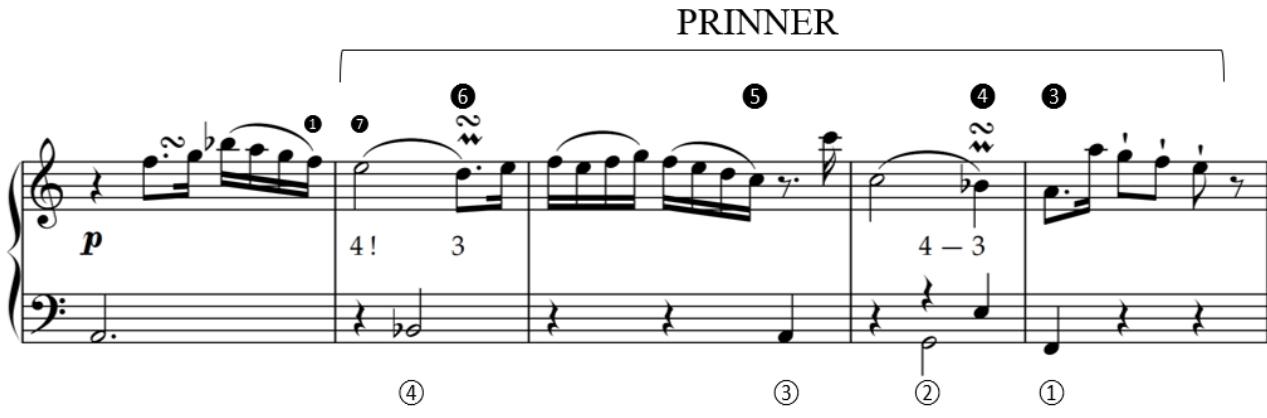
The coherency of the module owes to the support of the schematic framework. The bass line A-Bb-A-G-F provides a clear road map how different stages of the schema are fulfilled. In m. 33, there is a 6/3 above the A, presenting the first inversion of F major; it is established as the tonic start for the following schema. In mm. 34-37, a Prinner in F major appears; while one can easily trace the bass line ^4-^3-^2-^1, the parallel upper line ^6-^5-^4-^3 can also be effortlessly
中文讲解
本段先给出一张乐谱(例 6.6,奏鸣曲 C 大调 Wq. 65/47,第一乐章,mm. 33-37;原图数据已省略,仅保留图注与位置),随后转向"为什么这个模块听起来连贯"的真正解释:它的连贯性来自一个简式框架(schematic framework)的有力支撑,而不是单纯靠装饰或长度。具体的简式呈现有三层:第一层——低声部线 A-Bb-A-G-F 自身即是一条清晰的"路线图”,把整套图式的不同阶段一一勾画出来;第二层——m. 33 在 A 之上形成一个 6/3 和弦,即 F 大调的第一转位,作者把这一拍定位为后续图式开始的属主启动(tonic start),也就是说 F 大调在此被确立为该简式展开的"音源区";第三层——mm. 34-37 出现了一个 F 大调上的 Prinner,读者既能轻易追出低声部 ^4-^3-^2-^1 的下行线条,也能同时听到上声部平行下行的 ^6-^5-^4-^3(此句在段末中断,完整内容在下一段)。整段论证的逻辑是:把"可观察到的连贯性"对应到"可分析出的简式结构",用 schema 的存在来说明为何这五小节能够形成一个完整的、可被识别的模块。
补充说明
Wq. 65/47 是 C. P. E. Bach 键盘奏鸣曲目录中的编号;Wq. 指 Wotquenne 主题目录。6/3 表示在该低音(此处为 A)之上叠加六度与三度,即 F 大调第一转位;^4-^3-^2-^1 与 ^6-^5-^4-^3 是简式图式分析中以本小节 F 大调为参照的唱名级数编号。Prinner 是 Gjerdingen 体系中最常见的简式之一,典型特征即低音 4-3-2-1 下行配上层 6-5-4-3 平行的进行。
第5段(P0121)
原文复述
- Kramer, Unfinished Music, 34.
中文讲解
本段为第 12 条脚注,仅提供作者所引用的 Richard Kramer 论述的出处:Richard Kramer,《Unfinished Music》,第 34 页。这条脚注的作用是来源标注,而非对正文主张的额外限定——它为 P0119 末尾"材料的来源不在 exposition 内,且材料本身具有明显的连贯性"这一观察提供作者权威引用支持,同时也提示读者该观察并非分析者本人的独创,而是援引了 Kramer 对该奏鸣曲的研究。
第6段(P0122)
原文复述
perceived. Notably, one can find an accented nonchord tone (a half-note E) in m. 34, and a 4-3 suspension in m. 36. This cantabile passage is the second attempt for the Prinner to be realized. While the first attempt (mm. 29-32) failed, this time it succeeds.
中文讲解
本段承接 P0120 末尾未完成的句子,把上声部平行线条 ^6-^5-^4-^3 落实为"听者能轻松察觉的清晰进行"。在写出 Prinner 的双声部骨架之后,作者随即补充两处局部的和声细节,以避免读者误以为简式只是机械的骨架:其一是 m. 34 上一个重音位的非和弦音(一个 E,二分音符长度),其二是 m. 36 上一个 4-3 延留音。两个细节共同提示:虽然 Prinner 的低音与高音双线能被清晰地追踪,但歌唱性的旋律中仍会有意识地嵌入张力性的非和弦音,制造出向前流动的推动力。然后作者把这五小节放在更大的乐章结构中加以定位:这是一段 cantabile 段落对 Prinner 简式之实现的"第二次尝试"。相对应地,前一次尝试发生在 mm. 29-32,而那一次是失败的(m. 35 之后本该出现的 √1 终止动作没有如期完成,Prinner 中断);而这次 mm. 33-37 则成功——也就是说,先前未完成的图式在此得到完整兑现。
这段论证的功能在于:把"局部连贯"与"宏观叙事"两层面打通——既证明此模块是自足的,又强调它与前文音乐事件之间的呼应关系。
补充说明
本段是全节叙事性最强的转折句:成功(m. 33-37)与失败(m. 29-32)的两相对照,提示整章分析中关于 Prinner 能否完成的关键张力。
4-3 延留音指一个与低音呈四度的不协和音,通过级进下行解决到与低音呈三度的协和音
第7段(P0123)
原文复述
Although the Prinner is fully realized, the end of the module does not provide a satisfactory ending for the module. In m. 37, the melodic line concludes on ^7 rather than on ^1. The inconclusive ^7 opens the space to invite forthcoming musical materials to continue.
中文讲解
本段对前一段作出的"成功实现 Prinner"做了一个关键的局部修正:尽管简式本身已经完整兑现,模块的结束却并不让人感到舒坦。问题在于 m. 37——旋律线条落到 ^7(F 大调中的 E)而不是 ^1(F)。正因为结束音是导音而非主音,模块没有形成一个稳定的收束,而是让音乐停留在一种"未解决"的张力上。作者对此的处理是把它解读为一种开放性策略:不令人满意的 ^7 结尾反而打开空间,邀请后续的音乐材料继续展开。从结构功能上看,这个 ^7 既是 Prinner 的最后一个音(在 4-3 延留音之后也不一定要立刻解决),也是为下一段材料预留的入口。换言之,本模块内部是连贯而完整的 schema 实现,模块外部却是不闭合的——它不挑选一个收束性的音,而是把自己搭到下一秒未开之门上,为乐章后续的展开留出动力。
脚注 / 边栏 / 图表 / 附加信息(如有)
- 谱例 6.6(Sonata in C major, Wq. 65/47, i, mm. 33-37):原乐谱图未在文本中显示,仅保留图注与位置,需要在原文中查看以核对 turn figure、turn-trill、6/3 第一转位和弦、Prinner 低声部 A-Bb-A-G-F 与 ^4-^3-^2-^1、^6-^5-^4-^3 上声部进行,以及 m. 34 的重音 E 与 m. 36 的 4-3 延留音等具体记谱细节。
- 脚注 12(Kramer, Unfinished Music, 34)为来源脚注,作用是为 P0119 末尾关于"材料来源不在 exposition 内且具有明显连贯性"的观察提供权威引用,不承担对正文主张的额外限定。
💡 本节核心要点
- mm. 33-37 是一个新出现的"如歌段落",之所以独立成章,是因为它在前文碎片化的模块序列中具有长度(5 小节 vs 通常 1-2 小节)、装饰(turn figure、turn-trill 密度更高)与声部配置(右手抒情、左手稀疏)的三重对比,并因此被形容为"意料之外的新天地"。
- 该模块的连贯性并非偶然的表面效果,而是有清晰的简式(schematic)框架在支撑:m. 33 以 F 大调第一转位(6/3 over A)开篇,确立 F 大调为本简式的音源区,mm. 34-37 随即在 F 大调上实现 Prinner——低声部 ^4-^3-^2-^1 与上声部 ^6-^5-^4-^3 的平行下行线条。听感的连贯性来自简式骨架的稳定支撑。
- 作者在 Prinner 的骨架之上,又加入两处局部和声细节(m. 34 的重音 E 非和弦音与 m. 36 的 4-3 延留音),提示乐器化的歌唱性旋律并非机械的骨架堆砌,而是有意识地引入张力以推动音乐流动。
- 该模块是 Prinner 实现的第二次尝试:第一次(m. 29-32)失败,这一次(m. 33-37)成功。由此它与前文构成"未完成→完成"的结构呼应,本身就承担了乐章叙事层面的功能。
- 模数即使在 Prinner 完整实现的情况下,结束处仍以 ^7 而非 ^1 收束,造成局部不闭合(open-ended)的状态。这种"末尾开放"为后续材料的进入预留空间,使本模块成为乐章持续展开的枢纽,而非封闭的终止。
- 作者在段落层面引用 Richard Kramer(Kramer, Unfinished Music, 34)的观点作为权威支撑,确认 cantabile 模块的独特性来自其"材料来源超出 exposition 之外"与"材料本身明显连贯"这两点。
🔑 关键术语
- cantabile passage:如歌段落;本节指 mm. 33-37 突然出现的、带有明显歌唱旋律风格的五小节段落,与前文碎片化模块形成对比。
- Prinner:Gjerdingen 简式图式中的一种,以低音 ^4-^3-^2-^1 下行配合上声部 ^6-^5-^4-^3 平行下行为核心特征;本节 mm. 34-37 在 F 大调上完整实现该简式。
- schemata / schematic framework:简式图式及简式框架;指 18 世纪风格背景下具备惯例化、模式化功能的音乐音型,本节用于说明 mm. 33-37 的连贯性来自其骨架是 Prinner 这一图式。
- tonic start:属主启动位;本节指 m. 33 在 A 上方安排 6/3,呈现 F 大调第一转位,由此确立 F 大调为后续 Prinner 简式展开的音源区。
- 6/3:数字低音记号,指低音上方的六度与三度音程叠加,即为该和弦的第一转位;本节 m. 33 在 A 上方 6/3 即 F 大调第一转位。
- turn figure / turn-trill:回音式装饰与回音式颤音;本节用两者在 mm. 33-37 与 Rotation 1(m. 8)中的密度差异,论证此模块的装饰密度显著高于前文。
- c. b. i. + cont.:common basic idea + continuation(共通常规乐思 + 续写)的缩写,Gjerdingen 简式图式系统中的一种;本节指 Rotation 1 中 m. 8 turn-trill 出现的位置为该简式的终止收束点。
- 4-3 suspension:4-3 延留音;一种不协和音处理,即与低音呈四度的音作为延留音,延留后级进下行解决到与低音呈三度的协和音;本节在 m. 36 上出现。
- exposition:呈示部;本节指 Kramer 观察中的核心概念——mm. 33-37 这一 cantabile 模块所用材料来自呈示部主题之外,从而造成其独特性。
CH6_S10 [描述性拆分] Description of mm. 38-44: abrupt rupture, fragmentary materials, and fantasia-style chromaticism
第1段(P0124)
原文复述
Description of mm. 38-50
中文讲解
这是本节的总标题,宣布接下来作者将对第38至第50小节进行描述性分析。从小节标题(CH6_S10)可知,本节聚焦于这一段落中三个相互关联的特征:突发式的断裂(abrupt rupture)、碎片化的材料(fragmentary materials)以及幻想曲风格的半音化(fantasia-style chromaticism)。与前文“歌唱性段落”建立的音乐逻辑形成对照,第38小节起的乐段将以完全不同的方式展开,这一标题即向读者预告这一论证转向。
第2段(P0125)
原文复述
While the cantabile passage temporarily drags the listener to an ethereal realm, such an illusion is shattered by the arrival of a new module beginning from m. 38. The beginning of the module appears as if juxtaposition to the cantabile passage due to the stark contrast in various senses. There is a sudden dynamic change between the new module and the previous passage: while the whole cantabile passage is in piano, the new module begins straightaway in forte, as if an alarm to a dreamer. The abruptness is also coupled with contrasting musical materials. Out of blue, the forte Ab in the bass breaks the quietness, and is followed by an eruption of the cascading 32nd notes in the right hand. The cascading descent sounds as a reminiscence of the descending 32nd notes in m. 19, especially since it evokes the sense of improvisation, even though the two passages are not exactly the same. Moreover, the tonal ambiguity in m. 38 enhances the sense of abruptness: with the inclusion of Ab, Db and Eb, there seems to be a modal mixture switching from F major to F minor. However, one might interpret m. 38 as a prolongation of Ab major. The uncertainty is maintained when the music proceeds; the cascading 32nd notes are followed by the cadential figure (cf. m. 26 and m. 32) in diminished seventh (B♮-
中文讲解
本段提出了本节的核心论点:第38小节开始了一个与此前歌唱性段落(cantabile)截然对置的新模块(module),由此构成了全章论证中一次决定性的断裂。作者从三个层次展开这种对比:第一,力度上的断裂——歌唱性段落整体保持在 piano(弱),而新模块开头立刻进入 forte(强),犹如“梦中警铃”;第二,材料上的断裂——低音中突如其来的 Ab 大三和弦破坏了宁静,紧接着右手爆发出级进下行的 32 分音符流;第三,调性上的暧昧——同时出现 Ab、Db、Eb 这些 F 小调特征音,构成了从 F 大调到 F 小调的同主音调式混合(modal mixture),但也可以理解为 Ab 大调的延长(prolongation)。作者还指出,下行的 32 分音符让人联想到第 19 小节中的类似片段(虽然二者并不完全相同),从而唤起即兴演奏的感觉;随后接续的终止式旋律(参见第26、32小节)以减七和弦(B♮-D-F-Ab)的形式呈现,这种不稳定的和声进一步延续了不确定性。原文在“(B♮-”处中断,原因是该减七和弦的完整音名将在下一段(P0126)补全。
补充说明
关于动机 γ 在 P0125 中尚未出现;本段提及的“cadential figure”是与第26、32小节对照的终止式材料;下行32分音符与第19小节形成主题呼应关系,这两点为后文提供衔接。
第3段(P0126)
原文复述
D-F-Ab), an unsettling harmony. The conjunction of m. 38 and m. 39 also demonstrates the fragmentary nature of the module. Already in the outset of the module (mm. 38-39), the sense of uncertainty stands as a sharp contrast to the coherency of the cantabile passage.
中文讲解
本段极短,仅两句话,却完成两件事:一是承接 P0125 中被截断的减七和弦记谱(补全为 B♮-D-F-Ab),并定性为“令人不安的和声”(unsettling harmony);二是把第38与第39小节的衔接视为“碎片性”(fragmentary nature)的体现。作者强调,开头两小节就已经制造出强烈的不确定感,与歌唱性段落的连贯性(coherency)形成鲜明对比——这是为后文继续展开“碎片性”主题所作的奠基性陈述,提示读者:本模块内部各片段之间并不遵循常规的句法衔接逻辑。
第4段(P0127)
原文复述
The following musical materials continue the uncertainty and fragmentary nature. After two beats of rest in m. 40, motive γ enters in the upbeat of m. 41. This motive γ sounds stark and lonely: its utterance in the right hand is not supported by any accompaniment (except a tenuous B in m. 41 after motive γ is fully uttered), and is echoed by another motive γ monophonically in the upbeat of m. 42. Presented as if a musical fragment, the two motives γ are abruptly succeed by a passage of running sixteenth notes in parallel sixths in m. 42. This passage, as if hanging in the air, sounds like an urgent search for a return to a clear harmonic function. The uncertainty of mm. 41-42 is not only due to the fragmentary nature of each musical unit, but is also enhanced by prolongation of the unsettling diminished seventh (G#- B♮-D-F). Though one cannot perceive aurally in the moment, the enharmonic linkage between the successive diminished sevenths provides a smooth transition to another untouched key area. Like the cascading 32nd notes in m. 38, the abundant use of diminished-seventh harmony is also another salient features in fantasia style.
中文讲解
本段集中论证“碎片性”在第41、42小节的具体表现:第40小节休止两拍后,动机 γ 在第41小节弱拍上单声部进入,没有伴奏支撑(仅在动机结束后第41小节出现孤立的 B 音),这种赤裸的陈述被比作“孤独的发言”;紧接着在第42小节弱拍上由另一声部对动机 γ 进行单声部回响(echo),形成碎片化的对位;这两个动机 γ 又被第42小节中的平行六度 16 分音符流突然打断,这一上行音流仿佛悬于空中,是“急切地寻找明确和声功能”的听觉印象。作者进一步指出,第41-42小节的不确定性来自两个层面:一是各音乐单元本身的碎片化;二是持续减七和弦(G#-B♮-D-F)的延长——尽管听者难以即时听辨,但前后两个减七和弦之间的等音转换(enharmonic linkage)实际上提供了通往全新调区域的平滑过渡。最后作者把“减七和弦的频繁使用”与第38小节的下行32分音符并列为幻想曲风格的另一显著特征。需要注意:此处出现的减七和弦音名是 G#-B♮-D-F,与第38-39小节的 B♮-D-F-Ab 实质上是同一和弦的不同等音写法,这正是作者所谓“enharmonic linkage”的具体内容。
补充说明
动机 γ 属于本节中所引用的某个已在前文(第6章其他小节)出现过的动机;本段并未交代其原始定义,仅作为已知主题材料使用。
第5段(P0128)
原文复述
The arrival of $\mathrm { V } _ { \ 5 } ^ { 6 }$ in A minor in m. 43.1-43.2 once again hints a clear direction for the harmonic process; prolonged by two thin-textured dyads in quarter note, the dominant seventh is outlined with relatively longer notes on stable beats, setting up a prospect for ending the uncertainty of the previous passage. Yet, what follows shows that the struggle for a clear harmonic direction is a hard-won battle. While hinting augmented $\beta ^ { \ast }$ in mm. 43-44, the F on beat 3 of m. 43 disturbs the prospect to a clear harmonic direction, since its appearance brings the harmony from $\mathrm { V } _ { \ 5 } ^ { 6 }$ in A minor back to the diminished seventh (G#- B♮-D-F). The next
中文讲解
本段描述了一个“先建后毁”的和声过程:在第43.1-43.2拍,A 小调的 $\mathrm{V}_5^6$(第一转位属七和弦)抵达,并通过两个薄层织体的四分音符双音在稳定节拍上延长,乍看似乎为前文的不确定段落提供了一个清晰的和声归宿——预示着“即将结束徘徊”。然而这是一个被立刻撤回的假象:第43小节第3拍的 F 音打断了这一期待,把和声从 A 小调的属七和弦拉回到此前的减七和弦(G#-B♮-D-F)。作者使用“hard-won battle”(苦战)一词来形容对清晰和声方向的追寻——这一比喻提示读者,幻想曲风格中的和声动荡并非随意放纵,而是作曲家有意为之的“斗争”,每一处稳定都要付出代价。同时这一 F 音也暗示出“增 β*”(augmented β*)的出现,下一段(P0129)将完成这一动机的陈述。
补充说明
关于“augmented β*”:β 动机的具体形态未在本任务输入中定义,但从上下文可知它是某种半音化装饰性或邻音性材料;“augmented”前缀暗示其加入了增音程。
第6段(P0129)
原文复述
augmented β‘ (m. 44.1-44.2) continues the unsettling impression, even though there is a certain ambiguity harmonically since neither E nor F is stated. However, the disturbance is momentary: in m. 44.3, with a forte dominant seventh chord in A, not only does it break the pattern of repeating augmented β‘, but also put an end to the marvelous search of chromaticism, typical in free fantasia.
中文讲解
本段以两步完成从“动荡”到“解决”的弧线:第一步,第44.1-44.2拍的增 β* 延续了不安的印象——尽管如此,它在和声上存在一定暧昧,因为既未出现 E 也未出现 F,因此其确切的功能归属被悬置;第二步,第44.3拍的 forte A 大三和弦属七和弦一举同时完成两件事:(1)打断此前反复出现增 β* 的模式,(2)终结此前若干小节那种典型的“自由幻想曲式的半音化探寻”(marvelous search of chromaticism, typical in free fantasia)。需要特别注意,作者此处用的“marvelous”带有强烈的审美赞赏意味,暗示 Bach 在第38-44小节中并非在“胡乱”进行半音化,而是以高超的工艺完成了一段充满冒险的和声旅程——这一评价恰好呼应本节标题中“fantasia-style chromaticism”的论点。
第7段(P0130)
原文复述
Before moving forward to the A minor phrase in mm. 45-50, it is worthwhile to revisit the harmonic process in mm. 38-44, since the writing style clearly reflects Bach’s idea of free fantasia. The harmonic language of this passage reflects Bach’s comprehensive knowledge of harmony, which enables the composer to explore varied harmonic progression. Bach’s craftsmanship is evident in the manner by which he connects different harmonies. Even though the harmonic progression proceeds in a chaotic manner, he is always careful with voice leading As demonstrated by the harmonic reduction diagram (Example 6.7), the four chords are connected via parsimonious voice leading. Let us have a look at the voice-leading connection of the first two chords: the first inversion of F minor triad (m. 38) and the diminished-seventh chord (B♮-D-F-Ab, m. 39). Both chords share the same Ab-F dyad. With the Ab-F dyad serving as the common tones, the C in the first chord moves smoothly to either B♮ or D in the second chord. The second and third chords are different enharmonic spellings of the same diminished-seventh chord. The connection from the third and the fourth chords also allows smooth voice leading: the F in the diminished-seventh chord steps downward to the E in the dominant-seventh of A. The improvisatory exploration of chord connection with good voice leading serves as an important feature of free fantasia.
中文讲解
本段是本节的小结性论证,承担双重功能:(1)从“描述”转向“评价”,把第38-44小节的和声进程归入 Bach “自由幻想曲”(free fantasia)的美学范畴;(2)通过和声还原图(Example 6.7)揭示表面“混乱”背后的工艺——四个和弦之间的“简约声部进行”(parsimonious voice leading)。具体论证有三层:第一,Bach 的和声语言反映了其“全面的和声知识”(comprehensive knowledge of harmony)13,使其能探索多种和声进行;第二,尽管表面呈现为“混乱”(chaotic),但每一处连接都极为审慎;第三,以四个和弦依次说明:(a)F 小三和弦第一转位(m. 38)与减七和弦 B♮-D-F-Ab(m. 39)共享 Ab-F 二音作为共同音,C 平滑移位至 B♮ 或 D;(b)第二与第三和弦是同一减七和弦的两种等音记法;(c)第三与第四和弦之间的 F 下行半音至 A 大调属七和弦的 E。最后作者把“良好声部进行的即兴式和弦探索”明确列为自由幻想曲的核心特征,这呼应并收束了本节标题中“fantasia-style chromaticism”的命题。
补充说明
本段脚注13指向 Bach, Essay, 430,为“Bach 的全面和声知识”提供文献支持;脚注14(Rameau 相关)见 P0132。
第8段(P0131)
原文复述
13 Bach, Essay, 430.
中文讲解
本条是 P0130 中“Bach 的全面和声知识”这一论断的文献来源脚注,标注为 Bach 本人的 Essay 第430页。这是一种“来源类脚注”,意在表明:作者关于 Bach 和声能力的判断并非个人推测,而是基于 Bach 自己的论述。
第9段(P0132)
原文复述
14 See Jean-Philippe Rameau, Treatise on Harmony, trans. Philip Gossett (New York: Dover Publications, 1971), 301. Jean-Philippe Rameau would call the third chord (diminished seventh) a chord of the augmented second, and the fourth chord a seventh chord of a dominant-tonic. The former chord is derived by borrowing from the latter.
中文讲解
本条脚注从理论史的角度为 P0130 中关于第三与第四和弦关系的论述提供旁证:Rameau 在《和声学论著》第301页中,将第三和弦(即减七和弦)称为“增二和弦”(chord of the augmented second),将第四和弦(A 上的属七和弦)称为“主-属七和弦”(seventh chord of a dominant-tonic),并认为前者和弦是从后者“借用”(borrowing)而来。这是一种“理论框架类脚注”,作用在于:(1)证实作者所论述的两和弦之间的派生关系并非独创之论,而是早有理论先驱;(2)把 Bach 的实践与 18 世纪和声理论的话语体系对接,强化“自由幻想曲”和声探索的学术合法性。
脚注 / 边栏 / 图表 / 附加信息(如有)
本节包含两条脚注:脚注13(Bach, Essay, 430)属于来源类脚注,作用是为 P0130 中“Bach 的全面和声知识”提供一手文献支持;脚注14(Rameau, Treatise on Harmony, trans. Philip Gossett, New York: Dover Publications, 1971, p. 301)属于理论史类脚注,作用是把本节论述的减七和弦与属七和弦之间的派生关系置于 18 世纪和声理论的话语中加以印证。本节未出现独立图表,但 P0130 提及“和声还原图(Example 6.7)”,用以呈现四个和弦之间的简约声部进行,该图的作用是直观证明作者关于“parsimonious voice leading”的论述。
💡 本节核心要点
- 第38小节开始的模块与此前歌唱性段落之间形成力度(piano→forte)、材料(平静→下行32分音符爆发)、调性(清晰→暧昧)三重维度的突发性对置,构成全章的转折点。
- 本模块的“碎片性”不仅体现为材料层(孤立陈述的动机 γ、单声部回响后被16分音符流切断),也体现为和声层(缺乏句法衔接的片段式连接),这与歌唱性段落的连贯性形成根本对立。
- 减七和弦的持续使用(B♮-D-F-Ab 与 G#-B♮-D-F 为同一和弦的不同等音写法)及其等音转换功能,是本模块“半音化探寻”的核心和声手段,呼应幻想曲风格的传统特征。
- 第43小节曾短暂暗示 A 小调 V5/6 的清晰归宿,但随即被 F 音拉回减七和弦——这种“先建后毁”显示出对清晰和声方向的“苦战”,是幻想曲写作中“张力—解决”逻辑的微观缩影。
- 第44.3拍的 forte A 大调属七和弦一举终止半音化探寻,标志着幻想曲段落与即将到来的 A 小调乐句(第45-50小节)之间的功能性分界。
- 尽管和声进程表面“混乱”,但四个和弦之间始终以简约声部进行相连接——F 小三和弦第一转位与减七和弦共享 Ab-F 共同音、后续减七与属七之间 F→E 的半音下行——这种“在自由中保持严谨”的工艺正是自由幻想曲风格的本质特征。
🔑 关键术语
- cantabile:歌唱性的、流畅如歌的音乐风格;在本节中指此前一个给人“超凡脱俗”听觉印象的段落,与第38小节起的模块形成对照。
- module:本节使用的分析单位概念,指一段具有相对独立材料与和声逻辑的音乐片段;本节将第38小节起的段落视为一个新的 module。
- modal mixture(同主音调式混合):在同一主音下借用平行调式的音或和弦(如 F 大调中出现 F 小调的 ♭3、♭6、♭7);本节用以解释第38小节中 Ab、Db、Eb 等音出现的可能性。
- diminished seventh(减七和弦):由堆叠小三三度构成的四音和弦(如 B♮-D-F-Ab、G#-B♮-D-F),因等音转换能力强而极不稳定,在本节中作为幻想曲半音化风格的核心和声语汇。
- enharmonic linkage(等音连接):利用同一音高的不同记名(如 G#=Ab)在两个和弦之间形成平滑连接;本节中前后两个减七和弦通过等音改写过渡到新的调区域。
- motive γ:前文已出现的主题动机单元;在本节中以孤立、无伴奏、回响的方式被再次使用,强化“碎片化”印象。
- parsimonious voice leading(简约声部进行):通过保留共同音、最小化声部移动来连接和弦的声部进行手法;本节以此证明 Bach 即便在表面“混乱”的和声进程中仍维持严格的声部逻辑。
- free fantasia(自由幻想曲):17-18 世纪的一种器乐体裁,以即兴式探索、和声大胆自由、结构松散为特征;本节把第38-44小节定位为 Bach 对此风格的实践。
- augmented β(增 β)**:一种以增音程形式呈现的半音化装饰/邻音性材料;在第43-44小节短暂出现后被 forte 属七和弦打断,是本节从“动荡”走向“解决”的过渡阶段标记。
- $\mathrm{V}_5^6$(第一转位属七和弦):属七和弦的第一转位,根音在上方四度位置;在第43.1-43.2拍短暂出现,提供清晰的和声方向,随后又被减七和弦撤回。
CH6_S11 [描述性拆分] Description of mm. 45-50: developmental variation of the cascading-32nd-note phrase and Satzklammer
第1段(P0133)
原文复述
The utterance of mm. 45-50 stimulates the listener to reconsider the rhetorical order in Rotation 2. Although Rotation 2 has its own way of organizing the musical materials, its rhetorical order is reminiscent of Rotation 1. A new passage in A minor is announced by a forte dominant-seventh chord at m. 44.3; it begins with cascading 32nd notes in the right hand—an ear-catching figure whose rapid running notes gush out impatiently, as if to announce something new. When the music reaches m. 48, the author finds that mm. 45-48 share exactly the same rhythmic pattern with mm. 19-22: both start with a one-beat cascading figure, continue with a passage of motive β″, and end with a forte utterance of a chromatic ascent of chromatic chords in parallel 6/3s (though the fourth chord contains an extra note, forming a diminished seventh). The two passages also share the same placement of dynamic markings, sharpening their correspondence. Like “c. b. i. + cont.”, this passage (mm. 45-50) also exists in both Rotation 1 and Rotation 2. “C. b. i. + cont.” (mm. 1-8; mm. 27-32) and the module beginning with cascading descending 32nd notes (mm. 19-26; mm. 45-50) form a structure somewhat like a sentence bracket (Satzklammer). The sentence is left unfinished at “while the”, which continues into the next paragraph.
中文讲解
这段是小节的核心论点。mm. 45-50 的出现促使听者重新审视 Rotation 2 的修辞顺序;尽管 Rotation 2 有自己的组织方式,其修辞顺序仍然让人想起 Rotation 1。作者给出三层证据:(1) mm. 45-48 与 mm. 19-22 节奏完全一致——一拍级联式音型 + motive β″ 段落 + 强力度平行 6/3 和弦的半音上行,且力度标记位置相同;(2) mm. 45-50 这一模块像 c. b. i. + cont. 一样同时出现在两个 Rotation 中;(3) 引出 Satzlammer(句子括号)作为类比:两个固定实体(c. b. i. + cont. 与级联 32 分音符模块)像括号一样把内部包裹起来。m. 44.3(m. 44 的第三拍)出现强力度属七和弦,确立 a 小调的新段落。motive β″ 是 motive β 的二次变体(双撇号),属于作者动机分类系统的一部分。文中提到"第四个和弦多一个音构成减七和弦"是一个细节性的和声事实。最后的"while the"是未完成的句子,明示下文将展开 mm. 9-18 与 mm. 33-44 的对比。
补充说明
Rotation 1 与 Rotation 2 指代全曲两个大型结构部分(据交叉引用看,Rotation 1 ≈ mm. 1-26,Rotation 2 ≈ mm. 27-50)。“c. b. i. + cont.” 是作者先前引入的模块标签,在 mm. 1-8 完整出现,在 mm. 27-32 缩减出现。Satzklammer 概念由脚注 15 定义。
第2段(P0134)
原文复述
Footnote 15 (first half): Satzklammer is a concept of German grammar, in which there are strict rules about word order. Satzklammer concerns the sentence construction when there is more than one verb or parts of verbs in a clause. The two verbs (or…
中文讲解
这是脚注 15 的上半段,定义 Satzklammer。该脚注并非装饰性的旁注,而是作者在正文中借用 Satzklammer 作为音乐结构类比的概念依据:当一个德语从句包含一个以上的动词(或可分动词的各部分)时,两个动词占据句子的两端,把其余词项"夹"在中间。脚注在 P0134 此处被版面截断(“The two verbs (or…"),下半段出现在 P0137。读者应理解:脚注 15 完整定义了作者用以解释正文括号式结构的语法概念。
补充说明
脚注引用德语语法理论;作者将其作为类比而非严格移植到音乐理论中。
第3段(P0135)
原文复述
…motivic ideas are more tightly knit in mm. 9-18, the treatment of mm. 33-44 is more whimsical, as if a free fantasia. However, contrasting as they are, both passages share a similar feature: they are clipped in the middle by two entities, namely “c. b. i. + cont.” and the phrase starting with eight cascading 32nd notes in the right hand. These two entities sound like an immutable verb phrase, no matter what has changed in between. Thus, when the listener encounters the phrase in mm. 45-50, through his memory of what has happened previously, they will recognize that the rhetorical order of Rotation 2 is analogous to Rotation 1.
中文讲解
这段承接 P0133 末尾的"while the”,完成句子。核心内容分两层。第一层是限定:mm. 9-18 与 mm. 33-44 并不类比——前者动机紧密相连,后者处理更随性、近似自由幻想曲。第二层是归纳:尽管二者内部差异巨大,但都被相同的两个实体——c. b. i. + cont. 与右手八连音级联 32 分音符乐句——在中间"夹断"。作者用"不可动摇的动词短语"(immutable verb phrase)作比喻,把 Satzklammer 类比落实到音乐:无论括号内部如何变化,括号两端保持稳定。最后一句总结其修辞效果:当听者再次遇到 mm. 45-50 时,凭先前的记忆便能识别出 Rotation 2 与 Rotation 1 的修辞类比关系。“eight cascading 32nd notes"精确指出该乐句的长度(八连音)。“his memory … they"原文中存在代词不一致,中文释义将其性别化处理消解。
补充说明
“tightly knit”(紧密编织)与"whimsical / free fantasia”(随性 / 自由幻想)的对比本身就证明:发展性空间允许对类比位置的音乐做差异化处理。eight cascading 32nd notes 与正文提到的 mm. 19-22 / mm. 45-48 的一拍级联音型为同一对象的不同描述。
第4段(P0136)
原文复述
Like any developmental space, the reappearing musical materials in Rotation 2 are more or less a varied version of those in Rotation 1. The author has already observed this phenomenon in the abridged “c. b. i. + cont.” in mm. 27-32; the same phenomenon also occurs in the phrase in mm. 45-50. Focusing first on mm. 45-48: although this segment shares exactly the same rhythm as its counterpart in Rotation 1, its content differs—beyond what a simple transposition from G major to A minor would explain. Already at the outset, the cascading-32nd-note figure has altered its original contour and harmonic context. For the motive-β″ segment at m. 46.1, the use of Bb adds a Neapolitan flavor to the music, something missing from the analogous passage in Rotation 1 (m. 20.1). For the parallel-6/3 segment at m. 48, the chromatic line in the bass continues the chromatic line set up from m. 46, leading toward viiº of A minor at m. 48.3. Compared to the analogous segment in Rotation 1 (m. 22), there are several differences. First, while the parallel chords at m. 22 form a sequence of tenths, those at m. 48 form a sequence of 6/3s. Second, while m. 48 forms a smooth chromatic bass line continuing the previous passage, the chromatic bass line at m. 22 breaks from the previous passage (there is a downward leap from Eb to A). Third, there is an alternation in the destination of the harmonic motion: the last three chords at m. 48 prolong the same harmony—the first and third chords are viiº and viiº6 of A minor, while the middle chord, though spelled as a diminished seventh of G, functions as a passing chord between viiº and viiº6. In short, rather than ending on a French augmented sixth, as in Rotation 1, m. 48 ends on viiº6. The author suggests that Bach’s reason for changing the final chord at m. 48 may be explained by the abridged treatment of the phrase at mm. 45-50. Like “c. b. i. + cont.” at mm. 27-32, the phrase at mm. 45-50 is also an abridged phrase. Rather than keep surprising the listener, the phrase ends abruptly with the cadential figure at mm. 49-50, a figure analogous to mm. 25-26. Considering the cadential figure, changing the preceding chord to viiº6 facilitates the progression to the tonic at the beginning of the figure.
中文讲解
这是本节的分析核心。作者从 Satzklammer 的结构类比(P0133-P0135)转入第二模块内部的发展性变异。三层要点:(1) 这种变异不是简单移调——从 G 大调到 a 小调只是表面,真正的变化包括级联音型轮廓与和声语境的改变,以及 motive β″ 段通过 Bb(m. 46.1)获得那不勒斯色彩(这是小调 Bach 常用的下属色彩)。(2) 作者精确列出 m. 22 与 m. 48 之间的三处差异:声部进行(十度链 vs. 6/3 链)、低音连续性(断裂式下跳 Eb→A vs. 平滑半音进行)、和声目标(法国增六度 vs. viiº6)。第三个差异特别重要——m. 48 的中间和弦虽拼写为 G 的减七和弦,却功能上作为 viiº 与 viiº6 之间的经过和弦,体现了作者对"拼写 vs. 功能"的严格区分。(3) 作者给出目的论解释:mm. 45-50 像 mm. 27-32 一样是缩减乐句,以终止式(mm. 49-50,对应 mm. 25-26)骤然结束,因此把 m. 48 的目标音改为 viiº6 是为了让该和弦自然进行到终止式开头的 i 和弦。读者还应注意到作者的写作模式:在宏观结构类比(Satzklammer)与微观和声变异(具体和弦改变)之间来回切换,证明两个层级协同工作。
补充说明
“developmental space”(发展性空间)是作者术语,指材料再现时被加以变化的段落,与字面再现相对。终止式 mm. 49-50 对应 mm. 25-26——两者都是级联 32 分音符模块的结束终止式。法国增六度与 viiº6 的选择差异体现出巴赫在不同结构位置上的目的论考量。
第5段(P0137)
原文复述
Footnote 15 (second half): …parts of verb) form a bracket around the clause, and the rest of the words (with the exception of the subject or other words that should precede the verb) are clipped in between the two verbs (or parts of verb).
中文讲解
这是脚注 15 的下半段,完成 Satzklammer 的定义:在包含一个以上动词(或可分动词各部分)的德语从句中,两个动词(或动词各部分)占据从句的两端形成括号,其余词项(除主语或其他应位于动词之前的词外)被"夹"在两个动词之间。这正是 P0133-P0135 正文所类比的结构:c. b. i. + cont. 与级联 32 分音符乐句如同两个动词,把内部可变的内容(mm. 9-18 / mm. 33-44)夹在中间。无论内部如何变化,括号两端保持稳定,听者据此识别出跨 Rotation 的结构类比。
补充说明
脚注 15 完整由 P0134 + P0137 两段组成(被版面截断),与正文 P0133-P0135 的类比共同构成 Satzklammer 在本节中的完整运用。
脚注 / 边栏 / 图表 / 附加信息(如有)
本节包含一条编号脚注(脚注 15),因版面原因被拆分为 P0134 与 P0137 两段。该脚注定义德语语法概念 Satzklammer(句子括号),是正文 P0133-P0135 中央类比的概念依据:两个固定音乐实体(c. b. i. + cont. 与级联 32 分音符模块)如同括号夹住每个 Rotation 的内部内容,使其可变而括号稳定。本节无图表、无乐谱插图。
💡 本节核心要点
- mm. 45-50 与 mm. 19-26 在节奏与力度标记上完全对应,但 a 小调语境产生真正的发展性变异而非简单移调;这是 Rotation 2 的内部特征。
- Satzklammer(句子括号)作为核心类比:c. b. i. + cont.(mm. 1-8 / mm. 27-32)与级联 32 分音符模块(mm. 19-26 / mm. 45-50)作为括号两端的固定实体,包裹 Rotation 的内部段落。
- 尽管 Satzklammer 括号稳定,Rotation 1 内部 mm. 9-18(紧密编织)与 Rotation 2 内部 mm. 33-44(随性 / 自由幻想)并不类比,证明发展性空间允许内部差异化处理。
- m. 22 与 m. 48 之间有三处精确和声差异:声部进行(十度链 vs. 6/3 链)、低音连续性(断裂式 Eb→A 下跳 vs. 平滑半音进行)、和声目标(法国增六度 vs. viiº6)。
- m. 48 改为 viiº6 而非法国增六度的原因由 mm. 45-50 的缩减处理解释:终止式 mm. 49-50(对应 mm. 25-26)骤然出现,viiº6 比法国增六度更能顺势进行到 i。
- mm. 45-50 与 mm. 27-32 的 c. b. i. + cont. 都属于缩减处理;与 Rotation 1 的"持续出人意料"不同,Rotation 2 在两次再现中都提前收敛。
🔑 关键术语
- Satzklammer:德语语法概念:当从句含一个以上动词(或可分动词各部分)时,两端动词形成括号,把其余成分夹在中间。作者借此类比两个固定音乐实体(c. b. i. + cont. 与级联 32 分音符模块)夹住 Rotation 内部可变段落。
- Rotation 1 / Rotation 2:作者对全曲两个大型结构部分的命名;据交叉引用看,Rotation 1 ≈ mm. 1-26,Rotation 2 ≈ mm. 27-50。
- motive β″:motive β 的二次变体(双撇号标识),属于作者动机分类系统中的具体层级;出现在 mm. 19-22 与 mm. 45-48 的级联音型之后。
- c. b. i. + cont.:作者为某循环模块所起的标签;在 mm. 1-8 完整出现,于 mm. 27-32 缩减出现,是 Satzklammer 左括号所对应的固定实体。
- cascading 32nd notes:右手级联式 32 分音符音型(一拍 / 八连音长度),作为 Satzklammer 右括号对应的固定实体,标志 mm. 19-26 与 mm. 45-50 两个模块的起始。
- developmental space:作者术语,指材料再现时被加以变化的段落,与字面再现对立;Rotation 2 即典型的发展性空间。
- Neapolitan flavor:m. 46.1 出现 Bb 所带来的那不勒斯色彩——下属方向变音的典型小调色彩,在 mm. 20-1 的 Rotation 1 对应位置缺失。
- viiº / viiº6 of A minor:a 小调的导音三和弦及其第一转位;m. 48 末尾三个和弦延长该和声,中间一个虽拼为 G 的减七和弦却功能上为经过和弦。
- French augmented sixth:法国增六和弦,是 Rotation 1(m. 22)末尾的目标和声;在 Rotation 2(m. 48)被 viiº6 替代,以便顺势进入终止式。
CH6_S12 [描述性拆分] Description of mm. 51-59: after-the-end passage, key amendment, and second cantabile module
第1段(P0138)
原文复述
Description of mm. 51-59
中文讲解
本段是小节标题,开启了对51–59小节的描述性分析。作者将在这一节中依次讨论三个层面的内容:这段音乐为何具有"终曲之后”(after-the-end)的修辞功能、它如何承担关键调性修正(key amendment)的任务,以及它内部又包含的第二个"如歌"段落(second cantabile module)。
第2段(P0139)
原文复述
The module of mm. 51-59 gives the impression of a passage after-the-end. This is mainly due to the rhetorical logic set up by the Satzklammer structure delineated by the entities mm. 27-32 and mm. 45-50. This construction is analogous to the rhetorical order of Rotation 1, suggesting mm. 19-26 and mm. 45-50 function as ending module; whatever comes afterwards can be considered as after-the-end materials. The soft dynamic throughout the whole module further enhances its function as winding down at the end of Rotation 2.
中文讲解
本段提出51–59小节的整体听觉印象是"终曲之后"(after-the-end),即一种尾段之后的余韵或尾声式段落。
其修辞逻辑来自Satzklammer(“句子括号”)结构:开头材料mm. 27–32与结束材料mm. 45–50形成类似呼应,这与Rotation 1中mm. 19–26与mm. 45–50作为"结束模块"的修辞顺序一致。既然mm. 45–50已经扮演了闭合性角色,mm. 51–59之后的一切就自动被听众感知为"曲终之后"的补充。
此外,整段持续的弱力度(soft dynamic)进一步强化了它在Rotation 2末尾"逐渐散去"(winding down)的功能。注意原文使用的是"further enhance",是承接上文的修辞逻辑而作的辅助论证。
补充说明
Satzklammer是Hepokoski与Darcy奏鸣曲理论中描述的德语术语,指奏鸣曲或句子结构中由开始部分(Anfang)和结束部分(Schluss)形成的两端封闭结构;它在本段被用来解释为何听众感到51–59小节处于曲终位置之后。
第3段(P0140)
原文复述
However, the after-the-end function of mm. 51-59 does not automatically suggest that it is a contingent appendix, i.e. not participating the structural aspect of the formal process. Indeed, the cadential figure in mm. 49-50 set up an expectation for the following module to fulfill certain aspects of the norm of Type 3 Sonata. Since the cadential figure in mm. 49-50 ends in A minor, the possibility of Rotation 2 for achieving the ESC of Type 2 Sonata is greatly diminished, since the cadential figure does not end in the tonic key, C major. Therefore, Rotation 2 is now considered as the developmental space, expecting the arrival of Rotation 3 (recapitulation), a formal space marked by the reappearance of the opening module in Rotation 1 (i.e. ―c. b. i. + cont.‖). Yet, the cadential figure alone (mm. 49-50) can hardly trigger an immediate arrival of Rotation 3; according to the norm, a module of retransition (RT), usually a dominant chord or an arrival of the home key, is expected before the return of the opening materials. Since the cadential figure in mm. 49-50 is in A minor, an additional route is expected in order to have a smooth return. This is precisely what the listener is listening for in the module of mm. 51-59.
中文讲解
本段是论证的关键转折:从"终曲之后的印象"转向"实质上承担结构性任务"。
作者的逻辑链如下:
- “终曲之后"只是修辞印象,并不意味着mm. 51–59是可有可无的偶然附录;
- mm. 49–50的终止式落在A小调而非主调C大调,这使得Rotation 2无法按"Type 2 Sonata"达到ESC(Essential Structural Closure,基本结构闭合),因为Type 2的ESC要求终止式落在主调;
- 因此,Rotation 2被改判为"发展性空间”(developmental space),而听众现在期待的是Rotation 3(即再现部),其标志是Rotation 1开头模块(c. b. i. + cont.)的重现;
- 但仅靠mm. 49–50的终止式本身不足以立即触发Rotation 3的来临;按照规范,再现之前需要一个retransition(再过渡,RT)模块,通常以属和弦或主调的到达作为准备;
- 由于终止式落在A小调,需要额外的路径才能让音乐平滑地回到主调。
由此,作者指出51–59小节所承担的核心任务,正是这一规范要求下的"再过渡"路径——这正是"听众在聆听时所期待的东西"。本段揭示了:表面上的"余韵"段落,在深层结构中承担了关键的形式功能。
补充说明
本段涉及的几个关键奏鸣曲理论术语:ESC(Essential Structural Closure,基本结构闭合)指旋转终止式在主调上完成;Type 2 Sonata与Type 3 Sonata分别指ESC的两种规范类型;developmental space(发展性空间)指未达到ESC的旋转在功能上被理解为通向再现的发展阶段;RT(retransition,再过渡)是再现部之前的准备性模块。原文中的"c. b. i. + cont.“指代Rotation 1开头模块的缩写标记,因出现在前文中而本段直接引用。
第4段(P0141)
原文复述
In this perspective, one of the expected tasks for the module in mm. 51-59 is to ―correct‖ the key. Instead of resting on the tonic of A minor, one may expect that the amendment would bring the music to a dominant of C major, a normative choice of harmony for pre-recapitulation retransition. In fact, through Bach’s sleight of hand, within two measures the music is transited ingeniously to the welcomed harmony. Starting from the upbeat of m. 51, following the cadential figure, an inverted motive γ’ (cf. m. 18) is uttered in the right hand, and provides a smooth transition from an A minor chord to G major chord. The inverted motive γ’ is capable to fulfill the task due to its duality of harmonization, thus a seamless dovetailing is provided. The inverted motive γ’ not only includes the dyad A-C, the chord tones of A minor, but is also able to be harmonized as the dominant seventh of G major, as it happens in mm. 50-51. With one single motive (inverted motive γ’) and its prolongation for an extra measure, music is smoothly bridged from the A minor chord to G major chord. The arrival of G major harmony in m. 53 is realized by motive γ in the left hand. Though it may be argued that at this moment the music lands on G major instead of C major, since motive γ has been used in either tonic or dominant context in the preceding events, the use of motive γ in G major harmony indeed brings the music closer to the home key C major.
中文讲解
本段揭示51–59小节的核心任务之一:将调性"修正”(correct)——从A小调引向C大调的属和弦(即G大调),因为这是再现前再过渡的规范和声选择。
作者用"Bach’s sleight of hand"(巴赫的巧妙手法)一语点出整个修正过程在两小节之内完成:
- 从m. 51的弱拍开始,右手奏出"倒影动机γ’"(inverted motive γ’,参见m. 18),该动机提供了从A小调和弦到G大调和弦的平滑过渡;
- 倒影动机γ’能够承担这一任务的关键,在于其"和声二重性"(duality of harmonization):它既包含A小调的和弦音A-C(二度叠加),又能被处理为G大调的属七和弦(mm. 50–51处即是这种处理);
- 凭借这一双重可塑性,单一动机加上一小节的延伸就把A小调平滑地"桥接"(bridged)到G大调;
- m. 53处左手出现的动机γ在G大调和声中落实了G大调的到来;
- 虽然落地的是G大调而非C大调,但鉴于动机γ在前文既被用作主调上下文也曾作为属调上下文出现,这里将之放在G大调和声中等价于向主调C大调靠拢。
本段论证的精妙之处在于:用单一动机的和声双重性解释调性过渡的"无缝接合"(seamless dovetailing),从而把"修辞印象"与"结构性功能"统一起来。
补充说明
motive γ与倒影γ’的具体音型在前文已定义并出现于m. 18,本段以"cf. m. 18"明确指向该动机原型;其"和声双重性"是本段提出的关键操作概念,作者用以解释巴赫在两小节内完成调性过渡的手法。
第5段(P0142)
原文复述
However, the following passage shows a flickering between G major and A minor; the route for key amendment proves to be eventful. In the passage of mm. 50-55, there is a consistent use of motive γ and its derivative, such as motive γ’ (m. 53) and an abridged version lacking the last note (mm. 54-55). Since the arrival of motive γ in m. 53, the music remains diatonic in G major. Yet, in mm. 54-55, the music becomes chromatic; there are chromatic ascending lines in both voices. The ambiguous chromatic passage brings the music to cantabile passage 2 (mm. 56-59) in a foreign key, and unsurprisingly, the starting key of this cantabile passage 2 is A minor, the key that is expected to get rid of.
中文讲解
本段揭示调性修正路径的复杂性——尽管m. 53似乎已经到达G大调,但随后的路径"在G大调与A小调之间闪烁"(flickering),远未一帆风顺。
作者观察到的细节:
- mm. 50–55持续使用动机γ及其衍生形——m. 53的γ’以及mm. 54–55的"省略最后一个音的缩减版";
- 自m. 53起音乐保持在G大调的全音阶(diatonic)状态;
- 但mm. 54–55转为半音化(chromatic),两个声部都出现半音上行线条;
- 这一模糊的半音化段落把音乐引向"第二个如歌段落"(cantabile passage 2,mm. 56–59),而其起始调性是A小调——恰恰是作者声称应当"摆脱"的那个调性。
“unsurprisingly"一词揭示了作者的解释取向:虽然表面上看A小调的回归似乎是倒退,但在结构性修辞上,这意味着修正路径需要经过更曲折的迂回才能完成。
补充说明
作者在此处的术语"flickering"指G大调与A小调之间频繁交替的状态;“abridged version lacking the last note"特指动机γ被删去尾音后的形态。“cantabile passage 2"作为新概念的引入在本段首次出现,详细论证将在下一段给出。
第6段(P0143)
原文复述
Though written in an entirely different melody from that in mm. 33-37, I have coined the passage in mm. 56-59 as cantabile for several reasons. Like mm. 33-37, the cantabile passage 2 in mm. 56-59 has a sense of dream-quality due to the out-of-placeness of the key (being in A minor instead of G major). Also, like the passage in mm. 33-37, the passage in question is a relatively coherent unit. Besides, the melodic line in mm. 56-59 is song-like in nature. Above the structural descending line, the melody is smoothly elaborated: it consists of many stepwise intervals, huge rhythmic variety, and use of elaborated ornaments (turn and turn-trills). The homophonic text further strengthens its cantabile character. Considering its contrapuntal framework, the cantabile passage 2 in mm. 56-59 is an elaboration of 7-6 suspension. The displaced parallel lines in mm. 56-59 share a kinship to that in mm. 33-37.
中文讲解
本段解释为何作者把mm. 56–59命名为"第二个如歌段落”(cantabile passage 2),尽管它在旋律上与mm. 33–37(第一个如歌段落)完全不同。
作者列出多条理由:
- 调性"错位"带来的梦幻感(dream-quality)——这是A小调而非前文刚刚确立的G大调,从而造成一种离调、漂浮的效果,与mm. 33–37的梦幻感相类似;
- 作为相对完整的连贯单元(coherent unit),与mm. 33–37段落相一致;
- 旋律本身具有歌唱性(song-like)——在结构性下行线条之上,旋律由大量级进、大幅度的节奏变化以及装饰音(回音和回音颤音turn and turn-trills)所润饰;
- 齐奏织体(homophonic text)进一步强化其如歌特性;
- 从对位框架看,第二个如歌段落是7–6挂留(suspension)的展开;mm. 56–59中的"错位平行线条”(displaced parallel lines)与mm. 33–37中的类似线条有亲缘关系(kinship)。
本段的论证是类型化而非主题性的:不是通过旋律相似性,而是通过结构性特征(调性错位的梦幻感、单元完整性、歌唱性、装饰性、齐奏织体、对位框架)来建立mm. 56–59与mm. 33–37的功能类比。
补充说明
“homophonic text"在本段语境中应理解为齐奏或主调织体性质的声部进行;“turn and turn-trills"指装饰音家族中的回音和回音式颤音;“7-6 suspension"为对位法术语,指七音下解决到六音的挂留形式,在本段被作为cantabile段落对位框架的统称。“displaced parallel lines"指声部间错位的平行进行。
第7段(P0144)
原文复述
The 7-6 suspension chain framework also provides the route for the modulation back to the tonic key, thus a move to the recapitulation is enabled. Through the sequence of 7-6, V6 chord, highlighted by a turn-trill, finally arrives at m. 59. Afterwards, there is a dyad D-F serving as an anacrusis lead-in to the next phrase; this dyad breaks apart from the previous section. The F in the right hand at the very end of m. 59 not only strengthens the harmonic pull towards the tonic by adding a seventh above the dominant harmony, but also provides a contrapuntal wedge, i.e. F-B in m. 59 resolving to E-C in m. 60. In this manner, a secure return to the home key in the recapitulation is saved; this moment adds a surprising quality, as if it were a last resort.
中文讲解
本段解释第二个如歌段落如何通过7–6挂留链条提供回到主调的实际路径,从而为再现做准备。
论证步骤:
- 通过7–6挂留序列,到达V6和弦(第一转位属和弦),并由回音颤音(turn-trill)强调,最终落在m. 59;
- 此后出现D-F二度音程(dyad),作为下一乐句的弱起(anacrusis lead-in),它在结构上脱离前一段(“breaks apart from the previous section”);
- m. 59右手末端的F具有双重功能:
- 和声功能——在属和弦之上叠加七度,加强向主调的引力;
- 对位功能——形成"对位楔形”(contrapuntal wedge),即m. 59中的F-B在m. 60中解决为E-C;
- 这种楔形解决了"如何把音乐从非主调(A小调)安全带回主调"的难题,作者用"as if it were a last resort”(仿佛是最后手段)形容其在最后关头实现稳固回归所带来的"意外感”(surprising quality)。
本段是整个51–59小节分析的高潮:通过7–6挂留链条和D-F楔形,巴赫以一种看似精巧却"千钧一发"的方式实现了从非规范调性回归主调,从而为再现部扫清了道路。
补充说明
“contrapuntal wedge”(对位楔形)指两个声部之间的对位解决在此处形成向主调倾斜的"楔入"动力;“anacrusis lead-in"指D-F二度作为下一乐句的弱起引入。原文出现的”${ \mathrm { V } } ^ { 6 }$“公式被还原为V6和弦标记,指第一转位属和弦。
脚注 / 边栏 / 图表 / 附加信息(如有)
本节不包含独立的脚注、图表或边栏。所有例证(如motive γ、inverted motive γ’、turn-trill等)皆来自对正文谱例的分析,无独立附加材料。
💡 本节核心要点
- 51–59小节表层呈现"终曲之后"的修辞印象,源于Satzklammer结构将mm. 45–50判为结束模块的逻辑,但其深层承担关键的结构性任务。
- mm. 49–50终止式落在A小调,阻断了Rotation 2按Type 2达到ESC的可能;据此Rotation 2被处理为发展性空间,再现前的再过渡(RT)成为规范期待。
- 51–59小节的首要任务是调性修正:通过倒影动机γ’的和声双重性,在两小节内将A小调桥接到C大调的属和弦G大调。
- 调性修正路径并非一帆风顺:mm. 54–55的半音化使音乐在G大调与A小调之间闪烁,最终引向第二个如歌段落(mm. 56–59),而该段落意外地回到本应"摆脱"的A小调。
- mm. 56–59被命名为"第二个如歌段落"基于类型学而非主题相似性:调性错位的梦幻感、连贯的单元性、歌唱性旋律、装饰性、齐奏织体以及7–6挂留对位框架。
- 7–6挂留链条配合m. 59处的D-F对位楔形(F-B解决为E-C),以"最后手段"般的修辞意外感,完成了从非规范调性向主调C大调的安全回归,为再现部扫清道路。
🔑 关键术语
- Satzklammer:德语术语,指奏鸣曲或句子结构中由开始部分(Anfang)和结束部分(Schluss)形成的两端封闭结构;本节用其解释为何听众感知51–59小节处于"终曲之后”。
- ESC (Essential Structural Closure):基本结构闭合,指旋转终止式在主调上的完成,是奏鸣曲理论中判断旋转是否达到规范闭合的关键标志。
- Type 2 Sonata / Type 3 Sonata:奏鸣曲理论的两种类型分类,分别对应不同的ESC达成方式;本节指Type 2要求终止式落在主调,而Type 3则允许在属调等位置闭合。
- Developmental space:发展性空间,指未达到ESC的旋转在功能上被理解为通向再现的发展阶段,本节中Rotation 2因终止式不在主调而被重新归类为发展性空间。
- RT (Retransition):再过渡模块,是再现部之前规范性的准备性段落,通常以属和弦或主调到达作为触发再现的手段。
- inverted motive γ’:动机γ的倒影形态,出现于m. 18及m. 51;本节强调其"和声双重性”——既可解为A小调和弦音A-C,也可解为G大调的属七和弦,从而提供调性过渡的接合面。
- cantabile passage 2:第二个如歌段落,作者为本节mm. 56–59所造术语;其与mm. 33–37之间并非主题相似,而是基于调性错位的梦幻感、单元完整性、歌唱性旋律、装饰性、齐奏织体和7–6挂留对位框架的类型学类比。
- 7-6 suspension:七音下解决到六音的对位挂留形式;在本节被作为第二个如歌段落对位框架的统称,并通过链条结构提供回归主调的路径。
- contrapuntal wedge:对位楔形,指本节中m. 59的F-B在m. 60解决为E-C所形成的向主调倾斜的对位解决动力,作者用以解释回归主调的修辞性"意外感”。
CH6_S13 [描述性拆分] Description of mm. 60-71: recapitulation opening, fragmentary treatment, and third cantabile module
第1段(P0145)
原文复述
Description of mm. 60-71
中文讲解
这是本节的小节标题,开启对第60至71小节的描述性分析。根据任务元数据,该小节聚焦三个论题:(1)再现部的开启(recapitulation opening);(2)材料的碎片化处理(fragmentary treatment);(3)第三个歌唱性模块(third cantabile module)——即第三轮旋转中的cantabile段。作者以"描述性"(descriptive)而非纯理论切入,意在先向读者交代这一段在结构中的位置,再进入具体的技术性论证。本节的分析对象mm. 60-71横跨再现部起始处与第三轮旋转的早期阶段,是结构分析的枢纽段落。
第2段(P0146)
原文复述
The reappearance of the opening theme announces the outset of recapitulation. In mm. 60-63, the first half of ‗c. b. i. + cont.‖ is rearticulated verbatim: not only the same melody, containing both motive α and motive β, is presented with the same descending bass line, both in the same key and the exact rhythmic pattern as their appearance in exposition, but also the recapitulation opening retains the same dynamic marking. With this unambiguous utterance, a feature quite rare in this sonata movement, the listener quickly realizes that this movement belongs to Type 3.
中文讲解
本段核心主张是:mm. 60-63对主部材料的"逐字复述"明确开启了再现部,并使听众迅速判定该乐章属于"Type 3"奏鸣曲式。需要解释以下几点:
-
“逐字"的精确维度:作者列举了五个保持不变的维度——旋律(含motive α与motive β)、下行低音线、调性、确切节奏型、力度标记。这是一种穷举式的"verbatim”,与一般所说的"大致相同"形成对照,显示作者在用严格意义的不变性来定义再现部的明确开启。
-
“罕见"的修辞功能:作者特意指出这种"明确陈述"在本乐章中"相当罕见”。这是一个反向铺垫:既然再现部开头一反常态地明确,那么紧随其后的内容必然立即打破这种明确性——为下文mm. 64-66的"碎片化"张本。
-
Type 3的判定:作者通过"明确的逐字复述"作为判定依据,将本乐章归入奏鸣曲式分类中的Type 3。该判定由"听众快速意识到"(listener quickly realizes)的方式呈现,强调判定在听觉层面即时可达,无须依赖乐谱分析。
-
承前启后:本段承接前文建立的"compound basic idea + continuation"模型——mm. 60-63复述的并非整个复合主部,而仅是其前半部分;这一限定为下一段论述"碎片化"留下伏笔。
第3段(P0147)
原文复述
Even though the opening of the recapitulation is unambiguous, this opening phrase (mm. 60-71) is fragmentary in nature. Like many recycling passages of this movement, ‗c. b. i. + cont.‖ in the recapitulation is not presented in its entirety; only the compound basic idea receives a verbatim treatment in mm. 60-63. After the compound basic idea, motive α is uttered again in m. 64, but not in the same way. While the previous motive α (mm. 60-61) is presented in C major, motive α demonstrates other possibilities for tonalities. The ascending sixth of the motive α in m. 64 articulates the scale of C natural minor. For the tonality of the segment of mm. 64-66, it is not easy to determine due to the multiple interpretation. One may interpret it as in C minor, as if demonstrating a ‗lights-out‖ effect against the parallel key of C major (the use of pianissimo seems to agree with this interpretation), but the displaced entrance of the bass note C on the second half of beat 1 in m. 64 casts shadows for this interpretation. When the music proceeds to mm. 65-66, new options arise. In mm. 65-66, while the descending bass line continues, the right hand adopted derived figures from motive γ: the ascent of fourth from the upbeat of m. 66 is clearly derived from motive γ with the first note‘s rhythmic value altered, and the second figure in m. 66 further develops the motive by omitting the last note. Through the interaction between the two voices, Ab major triad arises in m. 65, and first inversion of Eb major triad in m. 66. Here come two harmonic interpretations in the moment: I–V⁶ in Ab major or IV–I⁶ in Eb major. Just as demonstrated in m. 27, in here motive α has the flexibility to be harmonized in multiple ways, thus increase the sense of ambiguity. When this tonally ambiguous segment (mm. 64-66) is juxtaposed to the compound basic idea in C major (mm. 60-63), the fragmentary treatment of the phrase is revealed.
中文讲解
本段推进核心论点:尽管mm. 60-63的复述是"明确的",mm. 60-71整体却呈"碎片化"特征。这种局部明确与整体碎片化的张力,是本段的关键修辞结构。逐层讲解:
-
碎片化的定义:作者将其操作化为"复合主部并未整体复述,仅其前半(mm. 60-63)得到逐字复述"。复合主部之后的部分并未继续被复制,而是被另一种处理方式取代。
-
m. 64的motive α承载"调性歧义":
- m. 60-61的motive α在C大调,起到确立调性的作用;
- m. 64的motive α以"上行六度"(ascending sixth)勾画C自然小调音阶,把同一动机放入另一调性语境;
- 这种"同一动机、不同调性"的处理是碎片化的第一个具体表现。
-
C小调解读及其反例:
- 支持:与C大调构成平行大小调的"熄灯式"(lights-out)对比,pianissimo力度似乎也佐证了暗淡的色彩;
- 反对:m. 64第1拍后半拍才进入低音C,这种"错位进入"(displaced entrance)削弱了C作为稳定调性中心的地位(casts shadows)。
-
mm. 65-66引入motive γ的派生音型:
- 右手从m. 66弱拍开始的"上行四度"明显源自motive γ,但首音的时值被改变;
- m. 66的第二个音型进一步"省略末音",继续发展该动机;
- 与持续的下行低音线形成对位互动。
-
双和声解读同时成立:
- Ab大调中的I–V⁶;
- 降E大调中的IV–I⁶;
- 二者同时成立,正是作者所称的"多种诠释"(multiple interpretation)。
-
与m. 27的呼应:作者引导读者回顾m. 27——那里motive α已经显示出"和声配置上的灵活性";本段在再现部把这种灵活性推到极致,进一步强化调性模糊感。
-
碎片化的最终揭示:把mm. 64-66这个"调性模糊段"并置在mm. 60-63的"C大调逐字段"之后,碎片化处理才真正暴露——即再现部以明确陈述开始,却立刻滑入模糊与变异。
第4段(P0148)
原文复述
The fragmentary nature of the opening phrase is also exhibited from what follows in mm. 67-71. Just as Rotation 2, where the cantabile passage (mm. 33-37) is juxtaposed after the ‗c. b. i. + cont.‖-derived phrase (mm. 27-32) in a non sequitur manner, in Rotation 3 the cantabile passage (mm. 67-71) is placed after the ‗c. b. i. + cont.‖-derived phrase (mm. 60-66) in an incongruent way. The cantabile passage in mm. 67-71 retains the same melodic and bass lines in mm. 33-37, as well as the use of elaborated ornaments. Yet, contrary to the counterpart in Rotation 2, the cantabile passage is in Ab major, and is uttered in forte, as if a confirmative statement rather than just a lyrical murmuring (of soft utterance in mm. 33-37). The cantabile
中文讲解
本段将"碎片化"的判定扩展到mm. 67-71,并通过与Rotation 2(mm. 27-37)进行结构类比,揭示Rotation 3中cantabile段的"非逻辑衔接"特征。重点讲解:
-
碎片化的第二个层面:作者将碎片化从"动机与和声"扩展到"段间衔接"——即不同派生段落之间缺乏逻辑过渡,这是碎片化在更高结构层面的体现。
-
Rotation 2与Rotation 3的结构平行:
- Rotation 2:先出现由"c. b. i. + cont.“派生的mm. 27-32,再以"非逻辑方式”(non sequitur manner)接上cantabile段mm. 33-37;
- Rotation 3:先出现由"c. b. i. + cont.“派生的mm. 60-66,再以"不一致方式”(incongruent way)接上cantabile段mm. 67-71。
- 这种平行关系证明mm. 67-71的衔接方式并非偶然,而是延续了Rotation 2中已经确立的衔接逻辑。
-
三个保留与两个反差:
- 保留:旋律线、低音线、装饰音(elaborated ornaments)的运用;
- 反差一:调性由mm. 33-37所处的调性转到Ab大调;
- 反差二:力度由mm. 33-37的"soft utterance"转为forte。
-
修辞功能的转化:Ab大调与forte的组合被作者解读为"确认性陈述"(confirmative statement),而mm. 33-37中的对应段则是"抒情低语"(lyrical murmuring)。这意味着再现部中的cantabile段承担了一种"宣告"功能,与前面mm. 60-63的明确陈述、mm. 64-66的调性实验共同构成再现部开头三种不同的陈述姿态。
-
本节末尾的截断说明:本段末句"The cantabile"在输入中被截断,未完成具体论述。本讲解不补写原文未出现的内容。
补充说明
本段原文末句"The cantabile"在task_input中已截断,未给出完整结论;本节小结范围以该截断处为终点。
脚注 / 边栏 / 图表 / 附加信息(如有)
原文末段(P0148)末句"The cantabile"在task_input中被截断,未完成对Rotation 3中cantabile段在再现部完整功能的论述;本节additional_information与key_points均以该截断处为分析终点,不补写原文未出现的内容。除此之外,本节无图表、脚注或边栏材料。
💡 本节核心要点
- mm. 60-63对主部材料(旋律含motive α与motive β、下行低音、调性、节奏型、力度)作严格意义的逐字复述,明确开启再现部;作者据此判定该乐章属于奏鸣曲式分类中的Type 3,并强调这一明确开启在本乐章中"相当罕见"。
- 尽管再现部开头明确,mm. 60-71整体呈"碎片化"——复合主部仅前半逐字复述,m. 64起的motive α转入C自然小调,与mm. 60-61的C大调形成"熄灯式"对比,并因低音C的错位进入而无法稳固归属。
- mm. 65-66右手引入motive γ的派生音型(上行四度时值改变、省略末音),与持续下行低音形成对位,使Ab大调I–V⁶与降E大调IV–I⁶两种和声解读同时成立,延续m. 27处motive α的"多种和声配置"灵活性,显著强化调性模糊感。
- 碎片化不仅体现在动机与和声层,还体现在段间衔接层:再现部的cantabile段(mm. 67-71)以"不一致方式"接续"c. b. i. + cont.“派生段,与Rotation 2中mm. 33-37对mm. 27-32的"非逻辑方式"接续形成结构平行,证明该衔接模式是本乐章的系统性现象。
- mm. 67-71的cantabile段在旋律、低音与装饰音方面延续mm. 33-37,但在调性(Ab大调)与力度(forte)上形成显著反差,被作者重新定性为"确认性陈述”(confirmative statement)而非抒情低语,与前面mm. 60-63的明确陈述、mm. 64-66的调性实验共同构成再现部开头三种不同的陈述姿态。
🔑 关键术语
- compound basic idea (c. b. i.):复合主部,即由多个动机(本节涉及motive α、motive β)组合而成的主题陈述单元;在再现部中仅其前半(mm. 60-63)被逐字复述,体现碎片化。
- continuation (cont.):在主部陈述之后以衍生音型继续推进的功能段落,与复合主部共同构成"c. b. i. + cont.“单元;在再现部中未被整体复述。
- motive α / motive β / motive γ:本乐章识别的三个核心动机;motive α在m. 64展现出与mm. 60-61不同的调性归属,motive γ的派生音型在mm. 65-66与持续低音形成对位。
- Type 3:奏鸣曲式类型分类之一;本节依据mm. 60-63对主部材料的"逐字"明确复述,将该乐章归入此类型。
- verbatim (逐字复述):在旋律、低音线、调性、确切节奏型与力度标记五个维度均完全保留原型的复述方式;作者以此严格意义的不变性来判定再现部的明确开启。
- ascending sixth:上行六度音程;m. 64的motive α以此音程勾画C自然小调音阶,与mm. 60-61的C大调形成色彩对比。
- “lights-out” effect:熄灯式效果,即在平行大小调之间(此处C大调对C小调)以暗淡的音色与力度营造对比;本段中pianissimo被认为与此解读吻合。
- Rotation 2 / Rotation 3:主部材料在本乐章中的第二轮与第三轮复用,分别对应mm. 27-37与mm. 60-71两个段落,两者的段间衔接方式(非逻辑/不一致)形成结构平行。
- cantabile:歌唱性段落模块,以旋律线、低音线与装饰音(elaborated ornaments)为识别特征;在Rotation 2中为抒情低语,在Rotation 3中转为确认性陈述。
- confirmative statement vs. lyrical murmuring:作者用以区分Rotation 3与Rotation 2中cantabile段修辞功能的两组对照——再现部中以Ab大调+forte承担"宣告”,呈示中以柔和力度承担"低语"。