目录
C1 Schenkerian Analysis as a Pattern-Based Tool
- C1.S1 [描述性拆分] Schenkerian Analysis as a Pattern-Based Tool
- 页码:1-50
C1.S1 [描述性拆分] Schenkerian Analysis as a Pattern-Based Tool
第1段(P0001)
原文复述
structural inner voice at the middleground level. If we were to sing or play only the notes with stems in Example 2.1b, it would match our hearing of the less elaborate pattern at Example 2.1d. Overall, however, this three-measure passage is a simpler pattern of an ascending third — B-C#-D — as reflected by our hearing in Example 2.1c. In fact, the measure-to-measure ascending third is the same pattern as the ascending-third elaboration at the surface of the music in the first measure. The surface-level repetition of the third can be heard as a confirmation — or repetition — of the deeper level of structure represented in Example 2.1a. The Schenkerian notation in Example 2.1a supports our more background hearing of Example 2.1b. In this reading we hear the D as our destination. As such, it receives a stem to indicate its status as the structural soprano, while the B and C# appear without stems beneath a slur to indicate their relationship to the structural D — they are elaborations themselves, or steps, to the first structural note of the melody in, what we would expect to be, a longer piece.
中文讲解
本段是延续前文 Schenkerian 记谱法的说明,解释如何在谱面上区分结构声部(structural inner voice)和装饰音(elaborations)。作者以 Example 2.1 系列谱例(a-d)为例说明:如果只演奏或演唱 Example 2.1b 中带符干(stems)的音,会与 Example 2.1d 中听到的简化模式相吻合;但整体而言,这段三小节的乐句其实是一个 B-C#-D 的上行三度简化模式(即 Example 2.1c 所听到的)。值得注意的是,逐小节的上行三度与第一小节表层装饰中的上行三度是同一个模式——表层的三度重复可被听成是对 Example 2.1a 所代表的深层结构的确认或再现。Schenkerian 记谱法(Example 2.1a)支持我们以更"背景化"的方式听 Example 2.1b:D 被听为目标音(destination),因此在记谱中带符干,标示其为结构女高音(structural soprano),而 B 与 C# 不带符干、带连线(slur)位于其下方,表示它们是朝向结构 D 的装饰、步骤,指向更长乐曲中旋律的首个结构音。这是 Schenkerian 层级思想的核心——结构骨架与装饰表层之间的等级关系。
补充说明
本段承接前文对 Schenkerian 记谱法中符干、连线的解释;术语 ‘structural inner voice’ 指的是位于中间层(middleground)的结构性声部,对应 Schenker 理论中背景(background)与前景(foreground)之间的层级。
第2段(P0002)
原文复述
The embellishments, or elaborations, while considered less structural than the Ursatz in musical hierarchy, are no less important in terms of understanding the piece as a whole. In fact, those embellishments, or elaborations, in combination with the fundamental structure, are the music itself — it is part of what we experience as musical meaning when we listen to, or what we see when we look at, a musical composition. ⁵
中文讲解
本段强调装饰与基本结构的关系:虽然装饰(embellishments 或 elaborations)在 Schenker 的音乐等级中比 Ursatz(基本结构)层级低,但它们在理解整首作品组织方面同样重要。作者明确指出:装饰与基本结构的结合本身就是"音乐本身"——也是我们在聆听或阅读乐谱时所体验到的音乐意义的一部分。这反驳了一种常见的误解,即 Schenker 分析只关心深层结构而忽略表层装饰。本段通过提升装饰在意义生成中的地位,为之后讨论 Couperin 作品中丰富的装饰提供了方法论上的合法性。脚注 5 指向对 Schenker 模式与装饰理论的进一步讨论。
补充说明
脚注 5(见 P0004)属于扩展阅读线索,提示读者可参见前引文献中关于 Schenker 模式与装饰的讨论。
第3段(P0003)
原文复述
Schenkerian analysis provides us a means to identify patterns within music. The Ursatz itself is a musical pattern, as are the elaborations of it. One of the benefits of the tool is not only to recognize patterns within a piece, but also to recognize that those same patterns exist within a larger body of pieces. This allows us to find pattern-based relationships among larger groups of repertoire from either the same or dissimilar cultural contexts, and as such, Schenkerian analysis is an excellent companion to Gjerdingen’s style-based schema — the second of my pattern-based tools described in more detail in the next section of this chapter. The identification of Gjerdingen’s schemata is often dependent upon a tacit understanding of Schenkerian theory — to recognize that the compositional building blocks of music of the galant style exist within more elaborate patterns on the surface level of the music, is to acknowledge hierarchical levels of music.
中文讲解
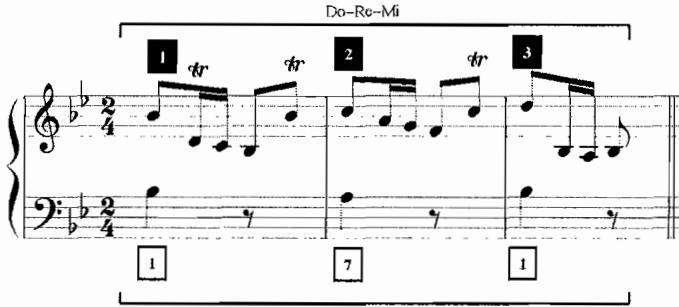
本段提出本文的核心方法论立场:Schenkerian 分析是识别音乐中模式(patterns)的工具。Ursatz 本身是一个音乐模式,对其的装饰也是模式。这种工具的优势不仅在于识别单首作品内的模式,还在于发现这些模式也存在于更广阔的作品群中,从而在不同文化语境的作品之间建立基于模式的关系。因此,Schenkerian 分析非常适合与 Gjerdingen 的风格型 schemata 配合使用——后者是本文将讨论的第二种基于模式的工具。作者进一步指出:识别 Gjerdingen 的 schemata 通常依赖于对 Schenker 理论的默会理解;认识到 galant 风格的音乐构建块存在于表层更精细的模式之中,等同于承认音乐具有多层级(hierarchical levels)的结构。这是为下文介绍 Gjerdingen schema 理论做的衔接铺垫。
补充说明
Gjerdingen 的 schemata 理论将在下一节(P0010 起)详细展开;本段将两种工具定位为互补关系:Schenker 提供层级思维,schemata 提供具体风格标识。
第4段(P0004)
原文复述
⁵ For another discussion on pattern and elaboration as part of Schenker’s theories, see Ibid.
中文讲解
脚注 5:参见 Ibid.(即前引同一文献)中关于 Schenker 理论中模式与装饰的另一处讨论。功能:作为扩展阅读提示,支撑 P0002 中关于装饰重要性的论点。
补充说明
Ibid. 表示该脚注指向前面已经引用过的同一文献,本身不提供新内容,属于旁证支持。
第5段(P0005)
原文复述
It is my belief that the Schenkerian analysis will offer insight into understanding elements of Couperin’s musical terrain, illustrating structural relationships connected to a broader repertoire, as well as those idiomatic to the pattern-based language of his character pieces. And yet, the majority of Couperin’s musical output occupies a period in history that precedes what current scholarship would consider as exclusively common-practice tonal music. In fact, more than half of Couperin’s keyboard compositions precede Rameau’s first treatise on harmony. This raises a question: Is using Schenkerian analysis appropriate for this repertoire?
中文讲解
本段陈述作者的方法论选择与疑虑:作者相信 Schenkerian 分析能够帮助理解 Couperin 作品中的结构关系——既包括与更广泛曲目相关的结构性关系,也包括 Couperin 性格曲特有的模式化语言。然而,Couperin 大部分作品的创作年代早于学界通常认定的"典型共同实践时期"(common-practice period),超过一半的键盘作品甚至早于 Rameau 第一部和声学论著。这就引出方法论的根本疑问:Schenkerian 分析是否适用于这类早期曲目?这一设问为下文辩护 Schenkerian 工具的适用性做铺垫。
补充说明
Rameau 的首部和声论著通常指 1722 年的《Traité de l’harmonie réduite à ses principes naturels》;此处不需补充,作者仅用其作为时间参照点。
第6段(P0006)
原文复述
Composers of the late-seventeenth and early-eighteenth centuries were not slaves to what we could call functional harmony. Robert Gjerdingen states:
中文讲解
本段以转述形式引出 Gjerdingen 的观点:17 世纪末至 18 世纪初的作曲家并未被所谓"功能和声"(functional harmony)所束缚。引文标记(冒号)表明下文将直接引用 Gjerdingen 的话,作者借此为讨论 Schenkerian 工具的适用性做铺垫——因为功能和声并非作曲家们唯一或主导的逻辑。
补充说明
此段为 P0007 中 Gjerdingen 长引文的引入句,本身不构成完整论点。
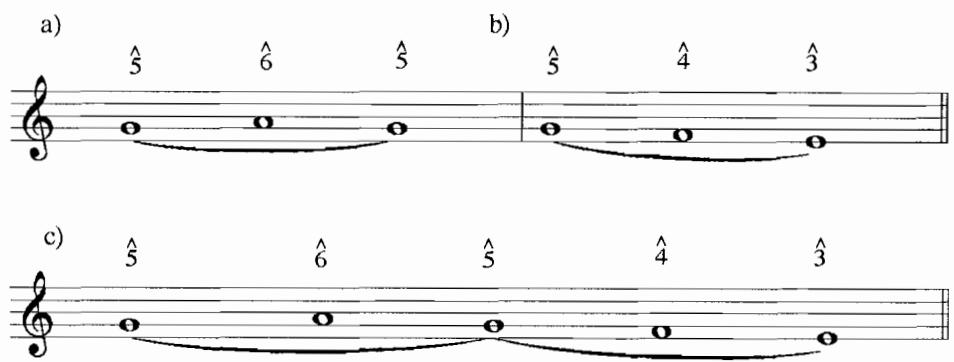
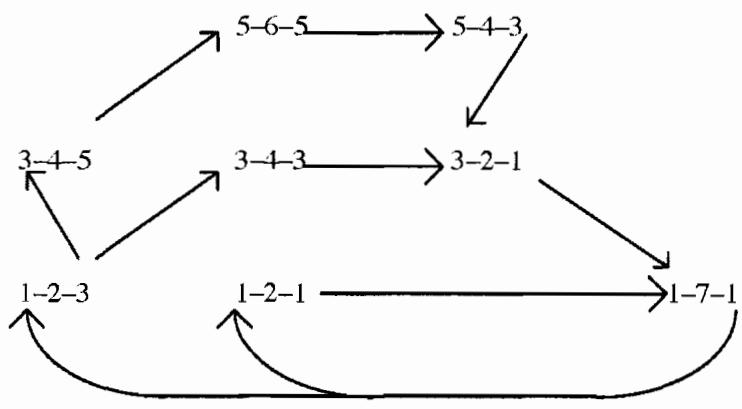
第7段(P0007)
原文复述
The relationship between local and global meanings of chords and keys was fluid in galant music. Many of the methods of musical analysis in vogue today often overstate the degree to which one can clearly distinguish between local and global significance. Indeed, the craft of the galant composer depends heavily on the ability to modulate between perceived certainty and uncertainty, between, on the one hand, giving the courtly audience a sense of security and groundedness and, on the other hand, taking listeners down dark alleys of strange chords and keys where they may feel utterly lost. The lodestar of galant music was not a tonic chord but rather a listener’s experience, which the masters of this art modulated with consummate skill. ⁶
中文讲解
这是 Gjerdingen 关于 galant 音乐核心特征的引文。其要点是:在 galant 音乐中,和弦与调性的局部与全局意义之间的关系是流动的(fluid),当今流行的许多分析方法常常夸大了区分局部与全局重要性的可能程度。galant 作曲家技艺的核心在于调制(modulate)听者所感知的"确定性与不确定性"之间——一方面给宫廷听众以安全感与扎根感,另一方面把听众带入陌生和弦与调性的"暗巷",使他们感到彻底迷失。galant 音乐的指北星(lodestar)不是主和弦,而是听者的体验——作曲家们以精湛的技艺调制这种体验。这是为后续论证 Schenkerian 分析应关注中间层(middleground)的"运动"(见 P0008)做铺垫的关键引文。脚注 6 标明出处。
补充说明
脚注 6(见 P0012)注明此段引自 Gjerdingen, Music in the Galant Style (2007), p. 21。
第8段(P0008)
原文复述
Although finding the background structure — or global harmonic scaffold — is often distilled as the defining characteristic of Schenkerian analysis, the tool’s capacity to uncover relationships on a much more local (middleground) level — the individual, rich movements between certainty and uncertainty — is what makes it valuable in its application to Couperin’s musical portraits. It is these relationships, which exist closer to the surface of the music, are relevant to this dissertation.
中文讲解
本段回答了 P0005 提出的方法论疑虑:尽管找到背景结构(background structure)或全局和声骨架常被简化为 Schenkerian 分析的定义特征,但该工具揭示更局部的(中间层 middleground)关系——即在确定性与不确定性之间的丰富运动——的能力,才是它应用于 Couperin 音乐肖像的真正价值所在。作者明确表态:对本研究而言,真正相关的是这些更接近表层的关系(即中间层与前景的关系),而非纯背景的 Ursatz。这一立场为下文应用 Schenkerian 工具于 Couperin 作品提供了合法性。
补充说明
“background” 与 “middleground” 是 Schenker 理论的核心层级术语:背景层指最深层的结构骨架,中间层指连接背景与前景之间的过渡结构层次。
第9段(P0009)
原文复述
While it is incorrect to call Couperin and other composers from this period as purely “post-modal” or “proto-tonal”—they were clearly working in an established vocabulary of their own — their output incorporated techniques from past traditions as well as those that anticipated things to come. A de facto component of the tool is the use of Roman numerals. Although this labeling system was not in use during Couperin’s lifetime I will use this system as needed and if my point is enhanced in some way.
中文讲解
本段处理两个方法论细节:第一,作者明确否定将 Couperin 及其同时代作曲家简单归为"后调式"(post-modal)或"前调性"(proto-tonal)——他们拥有自己的成熟词汇;同时他们的作品也融合了过去传统和预示未来趋势的技法。第二,作者坦承罗马数字(Roman numerals)作为工具的事实性组成部分(de facto component),但承认这种标记系统在 Couperin 生前并不存在,因此只有在需要且有助于论证时才会使用。这种诚实表态避免了历史时代错置的批评。
补充说明
“post-modal” 指调式体系之后;“proto-tonal” 指调性体系之前;两者都是后人用以描述该过渡时期的术语,但作者拒绝简单套用。
第10段(P0010)
原文复述
Gjerdingen’s Style-Based Schema Theory
中文讲解
二级标题,标示本节主题切换至 Gjerdingen 的风格型 schema 理论。它结束了对 Schenkerian 工具的讨论,开启介绍第二种基于模式的分析工具——schemata——的论题。
补充说明
无额外补充;这是 markdown 格式的二级标题,仅起分节作用。
第11段(P0011)
原文复述
While Schenkerian analysis applies to a broader repertoire than Couperin’s harpsichord miniatures, Robert Gjerdingen’s style-sensitive schemata apply specifically to galant music. Gjerdingen’s schema will both be companion to the Schenkerian method, and also stand alone as a separate system to approach the pattern-driven activity in the keyboard repertoire that forms the core of this research.
中文讲解
本段引入 Gjerdingen schema 理论:与 Schenkerian 分析适用于比 Couperin 大键琴小品更广的曲目不同,Gjerdingen 的风格敏感型 schemata 专门适用于 galant 音乐。作者定位 Gjerdingen 的 schema 既作为 Schenkerian 方法的伴随工具,也作为独立系统来研究本文核心——大键琴曲目中由模式驱动的活动。这一双重定位为下文的混合方法学铺平道路。
补充说明
“galant music” 是 18 世纪中期的音乐风格,与巴洛克晚期及洛可可重叠;Gjerdingen 对其做了大量风格与模式研究。
第12段(P0012)
原文复述
⁶ Robert O. Gjerdingen, Music in the Galant Style (New York: Oxford, 2007), 21.
中文讲解
脚注 6 标明 P0007 中 Gjerdingen 引文出处:Robert O. Gjerdingen, Music in the Galant Style (New York: Oxford, 2007), p. 21。功能:来源标注。
补充说明
此为来源出处脚注,无其他功能。
第13段(P0013)
原文复述
Gjerdingen’s Music in the Galant Style deepens our understanding of the musical world of galant composers — composers having lived and produced music as early as the first decade of the eighteenth century, and ending with great historical figures such as Franz Joseph Haydn, Wolfgang Amadeus Mozart, and Ludwig Van Beethoven. “My position…is that a hallmark of the galant style was a particular repertory of stock musical phrases employed in conventional sequences.“⁷ Gjerdingen bases his work on contemporary sources — musical repertoire, theoretical writings, and pedagogical methods used to train作曲家 and musicians of the galant period — as well as his awareness of, and sensitivity to, the cultural context of the time.
中文讲解
本段介绍 Gjerdingen 的代表作《Music in the Galant Style》及其基本立场:galant 风格的音乐家群体生活时间跨度从 18 世纪头十年一直到 Haydn、Mozart、Beethoven 等大家;Gjerdingen 的核心立场是:galant 风格的一个标志性特征(hallmark)是"一套以常规序列形式使用的固定乐汇”(stock musical phrases)。Gjerdingen 的研究建立在一系列同时代资料之上——作品、曲式理论著作、培养 galant 时期作曲家与音乐家的教材,以及对当时文化语境的意识与敏感。引文标记("…“⁷)标明此处是 Gjerdingen 的直接引文。脚注 7 提示出处(同前书第 6 页)。
补充说明
Galant 风格作曲家群体的时间跨度提示读者:本文讨论的 Couperin(1668-1733)处于该风格的起点附近;引文出处见 P0017 脚注 7。
第14段(P0014)
原文复述
One of the principal objectives of Gjerdingen’s study is to define these “stock musical phrases”, or what he calls schemata, found primarily in Italian and German repertoire of the last three-quarters of the eighteenth century, and to provide the musical framework in which these phrases appeared.
中文讲解
本段明确 Gjerdingen 研究的主要目标之一:定义这些"固定乐汇”——他称之为 schemata——主要见于 18 世纪后 75 年(即约 1725-1800)的意大利与德国曲目,并提供这些乐汇出现的音乐框架。这为后续讨论 Couperin 的法国作品与意德传统之间的关联设置了前提。
补充说明
“stock musical phrases” 在 Gjerdingen 框架中即"schemata”,指约定俗成的乐汇模板。
第15段(P0015)
原文复述
The overriding theory behind my presentation of these schemata is that they formed one of the cores of a galant musician’s zibaldone, his well-learned repertory of musical business, and that in the social setting of a galant court, these schemata formed an aural medium of exchange between aristocratic patrons and their musical artisans. ⁸
中文讲解
本段仍是 Gjerdingen 的引文,阐述其总体理论:schemata 构成了 galant 音乐家"杂记簿"(zibaldone)——即其学识深厚的"音乐业务"(musical business)储备——的核心之一;在 galant 宫廷的社会环境中,schemata 形成了贵族赞助者(patrons)与音乐工匠(artisans)之间听觉交流的媒介。这强调了 schemata 不仅是结构单位,更是社会交流工具。脚注 8 提示出处(同前书第 15 页)。
补充说明
“zibaldone” 为意大利语,本义指"杂记"或"混合笔记本",Gjerdingen 借此比喻 galant 音乐家习得的乐汇库;脚注 8 见 P0018。
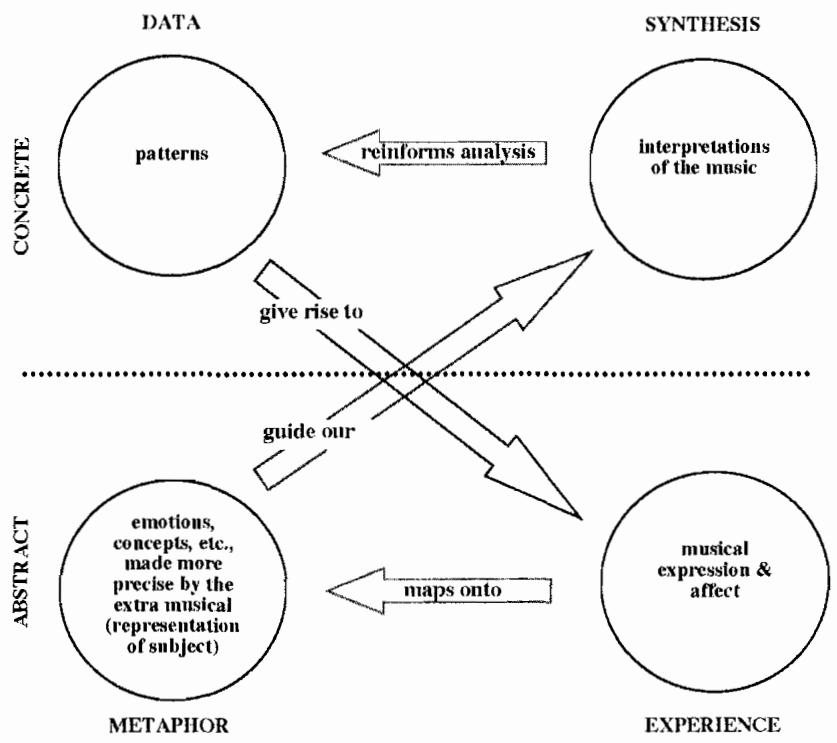
第16段(P0016)
原文复述
These patterns were part of the every-day vocabulary — in other words the “bread and butter” — of a galant musician, and were the building blocks of compositional
中文讲解
本段是 P0015 论点的延续:这些模式是 galant 音乐家的日常词汇(“面包与黄油”),是作曲的构建块。句子在"compositional"处被截断,续接在 P0019 的"practice"。这是脚注处理造成的主文被拆分的情况。
补充说明
本段因脚注 7(P0017)的介入而被切断,需与 P0019 连读。
第17段(P0017)
原文复述
⁷ Ibid., 6.
中文讲解
脚注 7:Ibid., 6。表明 P0013 中 Gjerdingen 引文出自同前引书第 6 页。功能:来源标注。
第18段(P0018)
原文复述
⁸ Ibid., 15.
中文讲解
脚注 8:Ibid., 15。表明 P0015 中 Gjerdingen 引文出自同前引书第 15 页。功能:来源标注。
第19段(P0019)
原文复述
practice. These well-established schemata appeared in typical places within larger formal structures, and contributed in the communication process between composer and listener. Gjerdingen states that the patterns presented in his text are by no means the only formulae in existence. However, they do represent some of the most commonly occurring patterns and are characteristic of the galant style in general.
中文讲解
本段是 P0016 被打断的句子的延续,完成"practice"一词,构成"作曲实践"(compositional practice)的完整意群。继续阐述 schemata 的功能:这些确立已久的 schemata 出现在较大形式结构的典型位置上,参与作曲家与听众之间的交流过程。Gjerdingen 同时声明:他的书中呈现的模式绝非现存唯一的程式,但确实代表了最常出现且具有 galant 风格总体特征的模式。
补充说明
需与 P0016 连读理解完整论点。
第20段(P0020)
原文复述
Gjerdingen’s study is encyclopedic. In his thirty chapters, twelve describe individual schema — or in some cases schema groups — while the remaining eighteen contain full-scale analyses applying the schemata in context. In the schema chapters, Gjerdingen begins by providing a background or framework for the pattern under discussion, the names for which are generated either by Gjerdingen himself or come directly from contemporary compositional and theoretical sources — predominantly books of Italian partimenti and the writings of Joseph Riepel. To illustrate each schema, Gjerdingen provides a “no frills” or base example and describes its fundamental features using a system of labeling that includes scale degrees as well as solfège syllables. ⁹ He continues with additional variants and more elaborate scenarios, and then concludes with examples of the pattern within larger musical structures to demonstrate preferred placement of the pattern in a broader context.
中文讲解
本段详述 Gjerdingen 研究的百科全书式结构:全书共 30 章,其中 12 章描述单个 schema(或某些情况下 schema 群),其余 18 章为在具体语境中应用 schema 的完整分析。在 schema 章中,Gjerdingen 总是先提供该模式的背景或框架;模式名称部分由 Gjerdingen 自创,部分直接取自当代作曲与理论文献——主要是意大利 partimenti 教材以及 Joseph Riepel 的著作。为说明每个 schema,Gjerdingen 提供一个"无修饰"的基例,并用包含音级与唱名(solfège)的标记系统描述其基本特征。然后他继续给出变体与更精细的情景,最后以在大结构中模式所在位置的例子作为结束,说明其在更广语境中的首选位置。脚注 9 解释标记系统的细节(见 P0022)。
补充说明
“partimenti” 指意大利那不勒斯学派的数字低音教学方法产生的键盘即兴教材;脚注 9 见 P0022。
第21段(P0021)
原文复述
The schemata are presented from the least to the most complex. However, within this arc, Gjerdingen also considers the popularity of the particular schema within the galant tradition as a whole, as well as where it would typically appear within a musical unit. With this model the reader can very quickly experience a complete analysis of a short binary dance piece after reading about, listening to, and playing examples from only a few initial schemata.
中文讲解
本段说明 Gjerdingen 的呈现逻辑:schemata 按由简到繁排列,但在这个弧线内,他同时考虑该 schema 在整个 galant 传统中的流行度,以及它通常出现在乐句结构中的什么位置。通过这种模式,读者在只读、听、演奏最初几个 schema 的例子之后,就能很快体验对一首短小二部舞曲的完整分析。
补充说明
“binary dance” 是指 18 世纪常见的 A-B 二段体舞曲形式(如小步舞曲、阿勒芒德等)。
第22段(P0022)
原文复述
⁹ Gjerdingen uses solfège based in a hexachord system, though he prefers Do to Ut. In certain settings, especially within his chapter on cadences and other closing formulae (clausulae), he defers to a modern solfège system in order to incorporate a name for the leading tone. With his use of scale degrees, or steps within a scalar collection, Gjerdingen uses the full set of scale-degree labels 1̂-7̂.
中文讲解
脚注 9 解释 Gjerdingen 的标记系统:他使用基于六声音阶(hexachord)的唱名系统,但偏好 Do 而非 Ut;在某些场合,尤其是关于终止与其他收束程式(clausulae)的章节,他采用现代唱名系统以便为导音命名。在音级(scale degrees)或音阶集合内音级的使用上,Gjerdingen 使用完整的 1̂-7̂ 音级标签集。功能:技术细节补充。
补充说明
“hexachord” 指 Guido d’Arezzo 系统中六个音为一组的音阶排列;“Ut” 为传统首音唱名,现代以 “Do” 替代。
第23段(P0023)
原文复述
For example, Gjerdingen identifies and describes a particular type of rising-third figure he calls the “Do–Re–Mi” schema. The Do–Re–Mi is ubiquitous in the repertoire of the galant style, and one of Couperin’s favorite patterns in much of his keyboard collection. While there are several variants to this schema, I have recreated Gjerdingen’s basic type to illustrate the concept, preserving his annotation style, in Example 2.2.
中文讲解
本段引出具体的 schema 例子——“Do–Re–Mi”。作者指出该 schema(上行三度模式)在 galant 风格曲目中无处不在,也是 Couperin 在其大量键盘作品中最喜爱的模式之一。Gjerdingen 描述了多种变体,作者在 Example 2.2 中重现其基型以说明概念,并保留了他的标记风格。这是后续 La Florentine 等分析的关键背景。
补充说明
Example 2.2 将在 P0024 中作为图占位符出现。
第24段(P0024)
原文复述
中文讲解
图占位符:Example 2.2——Gjerdingen 关于 Do–Re–Mi schema 的基例(base example),引自 Leclair, Opus 1, no. 3, 第二乐章, 第 1-3 小节(1723)。需查看原图。该图作为 P0023 提到的基例的视觉对应物。
补充说明
Jean-Marie Leclair(1697-1764)为法国-意大利小提琴家与作曲家;此处仅作为谱例来源。
第25段(P0025)
原文复述
Here the ascending third — Do–Re–Mi, or 1̂-2̂-3̂ — appears in the upper voice over a voice-leading pattern 1̂-7̂-1̂ in the bass. Gjerdingen states, “as the example implies, the schema’s first and last stages feature stable tonic chords, while the middle stage, with a mi-degree [or half step relationship with notes both before and after it] of 7̂ in the bass, sounds a less stable 6/3 or 6/5/3.“¹⁰ The schema label of Do-Re-Mi would still apply to music in the minor mode as well — the name is meant to evoke reference to the ascending third figure as one of the defining characteristics of the pattern.
中文讲解
本段解读 Example 2.2 的具体结构:上行三度 Do–Re–Mi(即 1̂-2̂-3̂)出现在上方声部,而下方的低声部则以 1̂-7̂-1̂ 的声部进行为支撑。Gjerdingen 的引文指出:该 schema 的第一与第三阶段为稳定的主和弦,而中间阶段由于低声部 7̂(mi 音级,与前后音均为半音关系)听起来稳定性较弱,呈 6/3 或 6/5/3 和弦。作者补充说明:Do-Re-Mi 这一标签对小调音乐同样适用——名称旨在唤起上行三度这一图式最具定义性的特征,而非严格遵循调式。脚注 10 标明引文出处(见 P0028)。
补充说明
“mi-degree” 在 Gjerdingen 体系中指半音关系中的 mi 音;脚注 10 见 P0028。
第26段(P0026)
原文复述
The Do–Re–Mi represents only one of many such patterns offered by Gjerdingen as fundamental to the musical language of the galant style. Gjerdingen does not engage Couperin’s music or many French composers in his study — the vast majority of the composers he surveys are of the Italian and German schools of composition. Yet as part of galant (rococo) tradition in France with increasingly more Italian influence on compositional style, Gjerdingen’s stylistic schema theory has significant relevance to Couperin’s music. ¹¹ Even some of Couperin’s earliest pieces from his harpsichord collections incorporate pattern behavior that can be clearly identified as being part of Gjerdingen’s compendium of popular schema. ¹² As Gjerdingen states:
中文讲解
本段指出 Do-Re-Mi 只是 Gjerdingen 提出的众多 galant 风格基础模式之一。作者说明 Gjerdingen 的研究本身未涉及 Couperin 或许多法国作曲家——他所考察的作曲家绝大多数属于意大利和德国学派。然而,由于法国 galant(洛可可)传统中意大利对作曲风格的影响日益增强,Gjerdingen 的风格 schema 理论与 Couperin 的音乐仍有显著关联——即便 Couperin 最早的一些大键琴作品也包含可被清晰识别为属于 Gjerdingen 流行 schema 集的模式行为。脚注 11、12 分别支撑意式影响的存在与 Couperin 早期作品中 galant 特征的存在(见 P0029、P0030)。引文标记(冒号)预示下文将引出 Gjerdingen 的另一段话。
补充说明
脚注 11 见 P0029,脚注 12 见 P0030;作者在引入文献支撑的同时承认 Gjerdingen 原始研究的局限,从而论证将该工具延伸到 Couperin 的合法性。
第27段(P0027)
原文复述
In learning to recognize the schemata of galant music, one becomes better able to appreciate the art of the galant composer. And in learning to judge the manner in which the schemata are presented in a particular composition, one becomes better able to understand the equally important art of the galant listener and patron. As the Earl of Chesterfield remarked, ’every ear can and does judge…style.’ ¹³
中文讲解
本段仍是 Gjerdingen 的引文:学会识别 galant 音乐的 schemata,有助于鉴赏 galant 作曲家的艺术;学会判断 schemata 在具体作品中的呈现方式,有助于理解 galant 听众与赞助人的同等重要的艺术。Chesterfield 伯爵的评论"每只耳朵都能且确实在判断……风格"作为旁证。脚注 13 标明出处(见 P0034)。
补充说明
Chesterfield 伯爵(Philip Stanhope, 1694-1773)是英国贵族与作家,以关于礼仪与品味的论著闻名。
第28段(P0028)
原文复述
¹⁰ Gjerdingen, Music in the Galant Style, 77.
中文讲解
脚注 10:Gjerdingen, Music in the Galant Style, 77。标明 P0025 中引文出处。功能:来源标注。
第29段(P0029)
原文复述
¹¹ Several authors have commented on the Italian stile galante having increasing influence over the French schools of composition, court life, and theatrical traditions. For a sampling of discussions about this influence in general terms, as well as in terms related specifically to Couperin’s music, see David Tunley, François Couperin and ‘The Perfection of Music’ (Burlington, VT: Ashgate, 2004); Wilfrid Mellers, François Couperin and the French Classical Tradition (London: Faber and Faber, 1987); Jane Clark and Derek Connon, The Mirror of Human Life: Reflections on François Couperin’s Pièces de Clavecin (Huntingdon, England: King’s Music, 2002); David Fuller, “Of Portraits, ‘Sapho’ and Couperin: Titles and Characters in French Instrumental Music of the High Baroque,” Music & Letters Vol. 78, No. 2 (May, 1997): 149–174; Daniel Heartz, Music in European Capitals: The Galant Style 1720–1780 (New York: Norton, 2003); and Philippe Beaussant, François Couperin (Portland, OR: Amadeus Press, 1990).
中文讲解
脚注 11 列出关于意大利 stile galante 对法国作曲、宫廷生活、戏剧传统日益增长影响的若干文献。条目包括 David Tunley、Wilfrid Mellers、Jane Clark 与 Derek Connon、David Fuller、Daniel Heartz、Philippe Beaussant 的相关论著。功能:为 P0026 中关于意式影响的主张提供学术支撑。
补充说明
本脚注属扩展性参考文献,本身不构成论点。
第30段(P0030)
原文复述
¹² In his brief comments about Couperin’s four-volume harpsichord collection, Daniel Heartz states that the third book “marks a decisive turn to simpler, easier pieces, with somewhat less ornamentation and more sensuous and amorous content.” See Heartz, Music in European Capitals, 20. For Heartz, these qualities are hallmarks of the galant style. There are, however, examples from earlier volumes in Couperin’s collection that fit Heartz’s ’lighter style’, suggesting that Couperin may have been influenced by, and experimenting with, Italian and German approaches as part of his musical portraiture. See La Babet, 2ⁿᵈ ordre and La Gabriële, 10ᵗʰ ordre for just two examples of the use of galant patterns and simpler textures.
中文讲解
脚注 12 引用 Daniel Heartz 的观点:Couperin 四卷大键琴集中的第三卷标志着向更简洁、装饰更少、更具感官与爱欲内容的作品转向;Heartz 认为这些特质是 galant 风格的标志。然而,作者指出 Couperin 早期作品中已有符合此"轻盈风格"的例子(La Babet 第二 ordre 与 La Gabriële 第十 ordre),暗示 Couperin 早就在其音乐肖像画创作中受到意、德手法的影响并加以实验。功能:为 P0026 中关于早期作品含 galant 特征的主张提供证据。
补充说明
“ordre” 指 Couperin 大键琴集中按调高组织曲目的分组。
第31段(P0031)
原文复述
For Couperin’s Pièces de Clavecin, it follows that familiarity and understanding of stylistic schema will help to define elements of the composer’s musical vocabulary, as well as to describe pattern behavior and expectation.
中文讲解
本段从上述铺垫中得出推论:对 Couperin《Pièces de Clavecin》(大键琴曲集)而言,熟悉并理解风格 schemata 将有助于界定作曲家音乐词汇的组成要素,也有助于描述模式行为与听者期待。这是连接 schema 理论与 Couperin 作品的桥接句,为下文进入第三种工具做过渡。
补充说明
无额外补充;这是论证过渡段。
第32段(P0032)
原文复述
Larson’s Voice-Leading Patterns and Theory of Musical Forces
中文讲解
二级标题,标示本节主题切换至 Steve Larson 的声部进行模式与音乐力理论。它结束了对 Gjerdingen schema 理论的介绍,开启介绍第三种基于模式的工具——声部进行模式与音乐力理论。
补充说明
Steve Larson 是当代美国音乐理论家,密歇根大学博士,曾任教于俄勒冈大学。
第33段(P0033)
原文复述
As part of my synthetic analytic approach, I have situated the description of Larson’s voice-leading patterns and theory of musical forces between pattern-based tools and cognitive metaphor theory, as it combines elements of pattern identification with metaphors of physical motion to derive its thesis. Building on the theories of Rudolf Arnheim, as well as those of Mark Johnson, and Douglas Hofstadter, Larson suggests that, in tonal music, musical motion is shaped by musical “forces” much in the same manner that physical motion is shaped by physical forces. ¹⁴ Identifiable voice-leading patterns arise, and can be heard as behaving in particular ways because of the musical forces that direct — or act upon — them, which in turn can shape musical experience and musical meaning.
中文讲解
本段介绍 Larson 理论在本文综合方法中的位置:作者将 Larson 的声部进行模式与音乐力理论安排在基于模式的工具与认知隐喻理论之间,因该理论将模式识别与物理运动的隐喻相结合以构建其论点。Larson 借鉴 Rudolf Arnheim、Mark Johnson、Douglas Hofstadter 的理论提出:在调性音乐中,音乐"运动"受音乐"力"的塑造,正如物理运动受物理力的塑造。可识别的声部进行模式之所以产生并以特定方式被听见,是由于作用于它们的音乐力,这些力进而塑造音乐体验与音乐意义。脚注 14 标明引文出处(见 P0035)。
补充说明
Arnheim、Johnson、Hofstadter 均为视觉/认知/隐喻领域的学者;脚注 14 见 P0035。
第34段(P0034)
原文复述
¹³ Ibid, 8.
中文讲解
脚注 13:Ibid., 8。标明 P0027 中 Gjerdingen 引文出处。功能:来源标注。
第35段(P0035)
原文复述
¹⁴ Steve Larson, “Musical Gestures and Musical Forces: Evidence from Music-Theoretical Misunderstandings,” in Music and Gesture, edited by Anthony Gritten and Elaine King, (Burlington, VT: Ashgate, 2006), 61.
中文讲解
脚注 14 标明 P0033 中 Larson 引文出处:Steve Larson, “Musical Gestures and Musical Forces…” in Music and Gesture, ed. Gritten & King (Ashgate, 2006), p. 61。功能:来源标注。
第36段(P0036)
原文复述
Larson identifies three forces — musical gravity, musical magnetism, and musical inertia — the definitions for which are taken directly from his forthcoming study,
中文讲解
本段引出 Larson 提出的三种音乐力——音乐重力(musical gravity)、音乐磁性(musical magnetism)、音乐惯性(musical inertia),其定义直接取自他即将出版的著作。句子被脚注打断,定语未完成,续接 P0037。
补充说明
本段因 P0037 脚注 15 的介入被切分。
第37段(P0037)
原文复述
Musical Forces: Motion, Metaphor, and Meaning in Music. ¹⁵
中文讲解
本段为 P0036 的定语补充:Larson 的定义取自他的著作 Musical Forces: Motion, Metaphor, and Meaning in Music。脚注 15 标明出处(见 P0042)。
补充说明
脚注 15 见 P0042。
第38段(P0038)
原文复述
- “musical gravity” is the tendency of notes above a reference platform to descend;
中文讲解
定义第一力:“音乐重力”——位于参照平面(reference platform)之上的音倾向于下行。这是物理重力向音乐语境的隐喻映射。
补充说明
“reference platform” 在 Larson 框架中通常指主音或主和弦所在的稳定层面。
第39段(P0039)
原文复述
- “musical magnetism” is the tendency of unstable notes to move to the closest stable pitch, a tendency that grows stronger as the goal pitch is closer;
中文讲解
定义第二力:“音乐磁性”——不稳定音倾向于移向最近稳定音,这种倾向随目标音距离的接近而加强。半音关系因此具有最强的磁吸力。
补充说明
“unstable” 与 “stable” 之分对应调性功能中的倾向性音(如导音)与稳定音(如主音、属音)。
第40段(P0040)
原文复述
- “musical inertia” is the tendency of melodic motion to continue in the pattern perceived.
中文讲解
定义第三力:“音乐惯性”——旋律运动倾向于按其被感知的模式继续行进。这是物理惯性向音乐语境的隐喻映射。
补充说明
三力共同构成了 Larson 解释音乐运动倾向性的基础。
第41段(P0041)
原文复述
In music operating within a tonal construct, Larson suggests that three- and four-note voice-leading patterns can be heard as responding to these forces. Table 2.1 below recreates his table taken from an earlier study. ¹⁶ He states that these patterns “meet the following conditions: (1) each pattern begins on a stable note, (2) each pattern moves by step, and (3) each pattern ends on a stable note.” ¹⁷ The table lists the scale degree function of the pattern in column one and what the letter names of those notes would be if in the key of C in column two. In column three, Larson calls-out the force, or forces, that can be heard as predicting the final (resolving) note of the pattern. Multiple forces can be acting simultaneously. Emphasis by exclamation point (!) indicates that magnetic pull is the strongest if the resolving motion is a half step. Some instances of magnetism acting — or not acting — as the force that predicts the final note of the pattern, appear with a
中文讲解
本段介绍 Larson 三/四音模式的形式条件:在调性建构中,三或四个音的声部进行模式可被听成对这些力的响应。Table 2.1 复制自他早期研究的表格。该表格列出三个条件:(1) 每个模式以稳定音起始;(2) 模式以级进运动;(3) 模式以稳定音结束。表格三列内容:列一为模式的音级功能;列二为该音在 C 大调中的具体音名;列三为 Larson 标注的可听见的预测该模式最后(解决)音的力(多种力可同时作用)。感叹号(!)表示若解决动作是半音则磁吸力最强。某些磁吸力起作用或不起作用的实例以问号标记(句子被截断,续见 P0045)。脚注 16、17 标明出处(见 P0043、P0044)。
补充说明
脚注 16 见 P0043;脚注 17 见 P0044;本段是 Table 2.1 的方法论解读。
第42段(P0042)
原文复述
¹⁵ Larson, Musical Forces: Motion, Metaphor, and Meaning in Music, 1.2.
中文讲解
脚注 15:Larson, Musical Forces…, 1.2。标明 P0037 中著作出处(章节与段落编号)。功能:来源标注。
补充说明
“1.2” 表示该著作的第 1 章第 2 节。
第43段(P0043)
原文复述
¹⁶ Steve Larson, “Scale-Degree Function: A Theory of Expressive Meaning and Its Application to Aural-Skills Pedagogy,” Journal of Music Theory Pedagogy 7 (1993): 75.
中文讲解
脚注 16:Steve Larson, “Scale-Degree Function…,” Journal of Music Theory Pedagogy 7 (1993): 75。标明 Table 2.1 来源。功能:来源标注。
第44段(P0044)
原文复述
¹⁷ Ibid., 74.
中文讲解
脚注 17:Ibid., 74。标明 P0041 中 Larson 引文出处。功能:来源标注。
第45段(P0045)
原文复述
question mark (?) in the column to indicate the ambiguity of the situation. These occur in patterns with stable notes a whole step both above and below the unstable part of the pattern.
中文讲解
本段续接 P0041:表格中以问号(?)标注的实例表示该处磁吸力是否起决定作用存在模糊性。这些情况出现在模式中不稳定部分上下各有一个全音稳定音的场合——即上行与下行的磁性预测力度相当,听者难以唯一确定。
补充说明
这是 Table 2.1 标记系统的解释结尾,与 P0041 配合阅读。
第46段(P0046)
原文复述
To illustrate, take for example the three-note pattern 5̂-b6̂-5̂ in Table 2.1. The third — or resolving — note in this pattern can be heard as being predicted by the force of gravity (moving down), and strongly by magnetism (resolution to the closest stable note) because of the half-step resolution. Hearing patterns as responding to these forces can guide expectation. For example, if a pattern begins with 5̂ and steps up to b6̂, based on the forces of magnetism and gravity — and of course the tonal context that leads us to predict the final note in the first place — then we strongly expect that it will resolve back down to 5̂. If this does not occur, then our experience is different than expected, which in turn, can affect meaning.
中文讲解
本段以 Table 2.1 中的 5̂-b6̂-5̂ 三音模式为例说明三力的相互作用:该模式的第三个(解决)音可被听成由重力(下行)预测,且因半音解决而由磁性强烈预测。把模式听成响应这些力能引导期待——若模式以 5̂ 开始,向上步进至 b6̂,根据磁性、重力以及调性语境,我们强烈预期它将下行解决回 5̂;若实际并非如此,听者体验与预期相异,进而影响意义。这是 Larson 框架下"违背预期产生意义"的关键论证。
补充说明
“expectation” 是 Meyer《Emotion and Meaning in Music》(1956) 中的核心概念,Larson 的工作与之呼应。
第47段(P0047)
原文复述
These three- and four-note patterns can combine successively to create larger series of patterns. Combination occurs most typically by elision. Consider the two successive patterns in Example 2.3 below. Example 2.3a is a single three-note pattern (5-6-5), as is Example 2.3b (5-4-3). These two patterns have a note in common — the last note of the first pattern is the same as the first note of the next pattern. The successive combination of these two patterns elides that common note, resulting in the five-note pattern (5-6-5-4-3) shown in Example 2.3c. Patterns combine in this manner to create larger extended melodies, and as with graceful physical gestures (imagine catching a ball and immediately returning the throw, as opposed to catching, paused, and then returning the throw), inertia carries through the stable part of the pattern (point of elision, or shared note) to change direction on the unstable part of the pattern. Successive patterns produce melodies that follow paths found in Larson’s pattern map in Figure 2.1.
中文讲解
本段说明 Larson 模式的扩展方式:三、四音模式可通过"重叠”(elision)连续组合形成更大序列。Example 2.3 演示:2.3a 为三音模式 5-6-5,2.3b 为三音模式 5-4-3;二者共享最后一个/第一个音(5),重叠后形成 2.3c 所示的五音模式 5-6-5-4-3。模式以此方式组合产生更大的延伸旋律。如同优雅的物理动作(如接球后立即回抛,而非接住—停顿—再抛),惯性通过模式的稳定部分(重叠点)延伸,在不稳定部分改变方向。连续的模式产生的旋律遵循 Figure 2.1 中 Larson 的"模式地图"所示路径。
补充说明
“elision” 在此特指两个模式共享一个音而产生的连续性,是 Larson 体系中的关键组合方式。
第48段(P0048)
原文复述
中文讲解
图占位符:Example 2.3a–c——连续模式组合的谱例。需查看原图。
补充说明
该图对应 P0047 中讨论的 5-6-5 与 5-4-3 通过 elision 组合为 5-6-5-4-3 的演示。
第49段(P0049)
原文复述
中文讲解
图占位符:Figure 2.1——Larson 的模式地图(pattern map)。需查看原图。
补充说明
该图视觉化展示了连续模式组合产生的旋律路径,是 Larson 框架的核心图示之一。
第50段(P0050)
原文复述
Larger melodic patterns, comprised of smaller three- and four-note voice-leading patterns, are constantly interacting with musical forces. Within a tonal construct, this interaction between pattern and force can help to account for — and even predict — a variety of musical behaviors. With prediction comes expectation; and expectation can provide meaning. Larson’s patterns and musical forces will serve as an additional tool for pattern identification. But it will also serve as a means to account for pattern behavior as part of the expressive qualities and affect of Couperin’s pieces.
中文讲解
本段总结 Larson 框架对本文的双重价值:由小模式组合而成的大旋律模式不断与音乐力交互;在调性建构中,模式与力的交互可解释甚至预测多种音乐行为;预测产生期待,期待产生意义。Larson 的模式与音乐力将作为模式识别的附加工具,同时也是解释 Couperin 作品表达特质与情感意义中模式行为的手段。
补充说明
本段是从理论介绍向本文应用转化的关键桥梁。
第51段(P0051)
原文复述
Interpreting Meaning for Pattern Behavior and Expression
中文讲解
二级标题,标示本节主题切换至"对模式行为与表达的释义”。它结束了对 Larson 理论的介绍,开启下文关于认知隐喻理论的论题——这是解释模式行为如何产生意义的关键工具。
补充说明
本节是本文综合方法中从"识别模式"到"赋予意义"的过渡环节。
第52段(P0052)
原文复述
Cognitive Metaphor Theory
中文讲解
二级标题,标示进入认知隐喻理论(Cognitive Metaphor Theory)介绍。这是 Lakoff 与 Johnson 的概念隐喻理论,作者将其作为综合方法的第四个组件。
第53段(P0053)
原文复述
The fourth and final aspect of my combined analytic method examines how metaphor gives meaning to the pattern behavior and affect in Couperin’s character pieces. Metaphor shapes every aspect of our communication. It is fundamental to our understanding of particular events, emotions, or abstract concepts. As Lakoff and Johnson suggest, metaphoric constructs are the means with which we organize and communicate even our most basic activities and behaviors.
中文讲解
本段宣告第四个也是最后一个分析工具——隐喻——的角色:考察隐喻如何为 Couperin 性格曲中的模式行为与情感赋予意义。隐喻塑造我们交流的每个方面,是理解特定事件、情感或抽象概念的根本。如 Lakoff 与 Johnson 所指出,隐喻构建是我们组织并交流最基本活动与行为的手段。这一论断是引入 Lakoff & Johnson 框架的开场。
补充说明
“character pieces” 指带有标题、表现特定形象或情感性格的小型器乐作品,是浪漫主义时期典型的体裁,但 Couperin 的标题性大键琴曲是该传统的早期重要源头。
第54段(P0054)
原文复述
Metaphor is for most people a device of the poetic imagination and the rhetorical flourish — a matter of extraordinary rather than ordinary language. Moreover, metaphor is typically viewed as characteristic of language alone, a matter of words rather than thought or action. For this reason, most people think they can get along perfectly well without metaphor. We have found, on the contrary, that metaphor is pervasive in everyday life, not just in language but in thought and action. Our ordinary conceptual system, in terms of which we both think and act, is fundamentally metaphorical in nature. ¹⁸
中文讲解
本段是 Lakoff 与 Johnson《Metaphors We Live By》开篇的经典引文:常人视隐喻为诗歌想象与修辞润色之手段——属"超常语言"而非日常语言;隐喻通常被视为仅属语言之事,与思想或行动无关。然而 Lakoff 与 Johnson 发现:隐喻在日常生活中无处不在,不仅在语言中,也在思想与行动中;我们的普通概念系统(我们据以思考与行动的系统)本质上就是隐喻性的。脚注 18 标明出处(见 P0055)。
补充说明
脚注 18 见 P0055;这段引文奠定了认知语言学的核心立场。
第55段(P0055)
原文复述
¹⁸ George Lakoff and Mark Johnson, Metaphors We Live By (Chicago: University of Chicago Press, 1980), 3.
中文讲解
脚注 18:George Lakoff and Mark Johnson, Metaphors We Live By (Chicago: University of Chicago Press, 1980), 3。标明 P0054 引文出处。功能:来源标注。
第56段(P0056)
原文复述
The authors claim that all abstract conceptual thought is based on metaphor, which they define as mapping our understanding of one type of thing onto another type of thing. As an example, they describe the metaphor TIME IS MONEY, which illustrates that we think about time as being a commodity — it has value.
中文讲解
本段概述 Lakoff 与 Johnson 的核心命题:所有抽象概念思维都基于隐喻,他们将隐喻定义为把我们关于一类事物的理解映射(mapping)到另一类事物上。作为例子,他们描述 TIME IS MONEY(时间是金钱)这一隐喻,说明我们把时间视为一种商品——它有价值。这是作者将 Lakoff & Johnson 框架引入的具体入口。
补充说明
“target domain”(目标域)与 “source domain”(源域)是隐喻映射理论的核心术语。
第57段(P0057)
原文复述
TIME IS MONEY
中文讲解
子节标题:TIME IS MONEY(时间是金钱)。作为示例列出,标示下方所列例句均属该隐喻的实例。
第58段(P0058)
原文复述
You’re wasting my time.
How do you spend your time these days? That flat tire cost me an hour.
I’ve invested a lot of time in her.
You need to budget your time.
Is that worth your while?
He’s living on borrowed time.
You don’t use your time profitably.
I lost a lot of time when I got sick. ¹⁹
中文讲解
本段是 TIME IS MONEY 隐喻下的一组日常英语例句列表:“你在浪费我的时间”、“你这些日子怎么花时间?"、“这个车胎扎破花了我一个小时”、“我在她身上投入了很多时间”、“你需要预算你的时间”、“这值得你花时间吗?"、“他在借来的时间里活着”、“你没有有效利用你的时间”、“我生病时损失了很多时间”。这些都是日常语言中把时间当金钱/商品来谈论的具体实例。脚注 19 标明该列表出自同书 7-8 页(见 P0061)。
补充说明
脚注 19 见 P0061。
第59段(P0059)
原文复述
Based on this conceptual metaphor, time is equivalent to money, and we actually talk about it in those terms with keywords such as “waste”, “spend”, “budget”, “loss”, “borrow”, and “invest”. Therefore we map the concept of time (target domain) onto our constructs related to money (source domain) in order to give meaning to the abstract idea.
中文讲解
本段总结 P0058 的例句:基于此概念隐喻,时间等同于金钱,我们用 “waste”、“spend”、“budget”、“loss”、“borrow”、“invest” 等关键词谈论时间。因此,我们把"时间"这一概念(目标域 target domain)映射到与"金钱"相关的概念结构(源域 source domain)上,从而赋予抽象观念以意义。这是 Lakoff & Johnson 隐喻理论的程序化表述。
补充说明
“target domain”(目标域)与 “source domain”(源域)是隐喻映射的方向标识。
第60段(P0060)
原文复述
According to Lakoff and Johnson, there are two categories of metaphor — primary and complex. Primary metaphors are those that are rooted in physical experience and our physical interaction with the world. Examples of a primary metaphors include AFFECTION IS WARMTH: “They greeted me warmly”, TIME IS MOTION: “Time flies”, or KNOWING IS SEEING: “I see what you mean.” ²⁰ In all of these examples, understandings of primary physical experience guide conceptual mapping. “Warmly” is based upon a
中文讲解
本段引入 Lakoff 与 Johnson 对隐喻的两类划分:“基础隐喻”(primary metaphors)与"复杂隐喻”(complex metaphors)。基础隐喻根植于物理经验与身体与世界互动;AFFECTION IS WARMTH(爱是温暖)、TIME IS MOTION(时间是运动)、KNOWING IS SEEING(知道是看见)等都是例子。在所有这些例子中,对基础物理经验的理解引导概念映射。“Warmly"基于……(句子被截断,续见 P0063)。脚注 20 标明出处(见 P0062)。
补充说明
脚注 20 见 P0062;“primary metaphors” 是 Grady(1997)等提出的认知语言学重要概念。
第61段(P0061)
原文复述
¹⁹ Select list from Ibid., 7–8.
中文讲解
脚注 19:从 Ibid., 7-8 中精选的列表。标明 P0058 例句列表的出处。功能:来源标注。
第62段(P0062)
原文复述
²⁰ Ibid., Philosophy in the Flesh: The Embodied Mind and its Challenge to Western Thought (New York: Basic Books, 1999), 50–54.
中文讲解
脚注 20:Ibid.(Lakoff & Johnson)另一著作《Philosophy in the Flesh: The Embodied Mind and its Challenge to Western Thought》(New York: Basic Books, 1999), pp. 50-54。标明 P0060 中基础隐喻例子的来源。功能:来源标注。
补充说明
此处脚注跨著作引用,需理解 Ibid. 指向同一作者组合的另一本书。
第63段(P0063)
原文复述
physical experience established at an early age — warmth as representing comfort and affection when being held or hugged; “flies” is based upon perception of time passing as being either the observer of time moving or the one that moves within time; and “sees” is based upon gaining knowledge through the sense of vision. ²¹
中文讲解
本段续接 P0060:“warmly"基于早期形成的物理经验——温暖代表被抱或拥抱时的舒适与爱;“flies"基于对时间流逝的感知,时间要么是观察者面前的移动对象,要么是观察者在其间移动;“sees"基于通过视觉获取知识。脚注 21 同前书(见 P0073)。
补充说明
脚注 21 见 P0073;这些基础隐喻均依赖身体经验。
第64段(P0064)
原文复述
It follows that the more abstract the concept, the more types of metaphoric descriptors, or packets of knowledge we use to understand it. These packets include multiple primary metaphors, but also what Lakoff and Johnson call metaphorical idioms. “Each metaphorical idiom comes with a conventional mental image and knowledge about that image. A conventional metaphorical mapping maps that source-domain knowledge onto target-domain knowledge.” ²² Metaphors, then, can combine to create complex metaphors that include multiple primary metaphors, other complex metaphors, and metaphorical idioms with their own stock images and information.
中文讲解
本段推论:概念越抽象,我们用以理解它的隐喻描述类型(即知识包 packets of knowledge)就越多。这些知识包包含多个基础隐喻,也包含 Lakoff 与 Johnson 所谓"隐喻习语”(metaphorical idioms)。每个隐喻习语都伴随一个常规心理意象及关于该意象的知识;常规隐喻映射把源域知识映射到目标域知识。隐喻因此可组合形成复杂隐喻,包含多个基础隐喻、其他复杂隐喻以及带有自身固定意象与信息的隐喻习语。脚注 22 标明出处(同书第 68 页,见 P0074)。
补充说明
“metaphorical idioms” 是 Lakoff & Johnson 后期发展出的概念,指带有具体意象的固定化隐喻表达。
第65段(P0065)
原文复述
Take, for example, the complex metaphor LOVE IS A JOURNEY, comprised of several other metaphors. ²³
中文讲解
本段引入"复杂隐喻"的具体例子:LOVE IS A JOURNEY(爱是一段旅程),由多个其他隐喻组合而成。脚注 23 标明出处(同书第 64 页,见 P0075)。
补充说明
脚注 23 见 P0075。
第66段(P0066)
原文复述
Love Is A Journey
中文讲解
子节标题:Love Is A Journey(爱是一段旅程)。标示下方所列子隐喻均归属该复杂隐喻。
第67段(P0067)
原文复述
The Lovers are Travelers
中文讲解
子隐喻之一:The Lovers are Travelers(恋人即旅行者)。这是 LOVE IS A JOURNEY 复杂隐喻下的子映射:恋人被映射为旅行者。
第68段(P0068)
原文复述
Their Common Life Goals Are Destinations
中文讲解
子隐喻之二:Their Common Life Goals Are Destinations(共同的人生目标即目的地)。恋人共同的人生目标被映射为旅程中的目的地。
第69段(P0069)
原文复述
The Relationship Is A Vehicle
中文讲解
子隐喻之三:The Relationship Is A Vehicle(关系即交通工具)。恋爱关系被映射为承载旅行者的交通工具。
第70段(P0070)
原文复述
Difficulties Are Impediments To Motion
中文讲解
子隐喻之四:Difficulties Are Impediments To Motion(困难即运动的阻碍)。恋爱中的困难被映射为旅行中的障碍。
第71段(P0071)
原文复述
According to Lakoff and Johnson, in our culture “this is a well-entrenched, stable,
中文讲解
本段引出 Lakoff 与 Johnson 的评论:在我们的文化中,LOVE IS A JOURNEY 是一个根深蒂固、稳定、……(句子被截断,续见 P0072)。
补充说明
本段因 P0072 较长内容被切分。
第72段(P0072)
原文复述
conventionalized understanding of a love relationship and the difficulties involved in setting and achieving joint purposes, ²⁴ as evidenced by the ways in which we talk about love and relationships. Conceptual descriptors include, “look how far we’ve come”, “our relationship is off the track”, or “we’re spinning our wheels.” ²⁵ With expressions such as these, we map our knowledge about a journey (travel, vehicles, and distance) onto love in order to infer meaning.
中文讲解
本段续接 P0071:……约定俗成(conventionalized)的对恋爱关系及其在确立与实现共同目标中所遇困难的理解,这从我们谈论爱与关系的方式中得到印证。概念描述包括"看看我们走了多远”、“我们的关系出轨了”、“我们在原地打转”。通过这些表达,我们把关于旅程(旅行、交通工具、距离)的知识映射到爱上以推断意义。脚注 24、25 标注同前书出处(见 P0079、P0080)。
补充说明
脚注 24 见 P0079;脚注 25 见 P0080。
第73段(P0073)
原文复述
²¹ Ibid.
中文讲解
脚注 21:Ibid.(指 Lakoff & Johnson 同前著作)。标明 P0063 中例句的来源。功能:来源标注。
第74段(P0074)
原文复述
²² Ibid., 68.
中文讲解
脚注 22:Ibid., 68。标明 P0064 中引文出处。功能:来源标注。
第75段(P0075)
原文复述
²³ Ibid., 64.
中文讲解
脚注 23:Ibid., 64。标明 P0065 中引文出处。功能:来源标注。
第76段(P0076)
原文复述
However, these expressions are also metaphorical idioms themselves, in that they evoke very specific images associated with the statement. If we take, for example, “spinning one’s wheels”, there is a particular image, and information about that image, that come to mind.
中文讲解
本段指出:P0072 中那些表达本身也是隐喻习语(metaphorical idioms),因为它们唤起与该陈述相关的非常具体的意象。以 “spinning one’s wheels”(原地打转)为例,提到它便会浮现特定意象以及关于该意象的信息。
补充说明
“metaphorical idiom” 在此与"概念隐喻"形成层级关系。
第77段(P0077)
原文复述
The wheels are the wheels of a car. The wheels are spinning, but the car is not moving. The car is stuck…the travelers want the car to be moving so that they can make progress on their journey. They are not happy that it is stuck. They are putting a lot of energy into getting the car unstuck, and they feel frustrated. ²⁶
中文讲解
本段具体展开 “spinning one’s wheels” 的意象内容:轮子是汽车的轮子;轮子在转,但车不动;车卡住了——旅行者希望车能动以便在旅程中取得进展;他们对此不开心;他们付出大量精力试图使车脱困,感到沮丧。脚注 26 标明出处(同书第 68 页,见 P0081)。
补充说明
脚注 26 见 P0081。
第78段(P0078)
原文复述
This packet of knowledge and associated image represents a relationship that, like the car, is stuck and going nowhere, and there is a level of frustration felt by the couple because of lack of movement toward reaching goals. This entire set of conceptual mappings arise with the statement “spinning one’s wheels” in the context of LOVE AS A JOURNEY. It is a metaphorical idiom that includes other metaphors as well as particular images associated with the concept. The more complex the abstract concept, the more complex the mappings, and the more mappings we use to create meaning. Multiplicity, then, is inherent to the theory, and yet because of the similarities with which primary metaphors are developed — even across cultures — the potential mappings for more complex metaphors are not limitless. While culture does have an impact on, for example, conventional images, there is often overlap in general metaphorical conceptualizations.
中文讲解
本段总结 “spinning one’s wheels” 的隐喻功能:此知识包及其关联意象代表一段像车子一样卡住、停滞不前的关系,且由于无法向目标推进,伴侣感到某种程度的沮丧。这一整套概念映射随 LOVE AS A JOURNEY 语境中的 “spinning one’s wheels” 一语而激活;它是一个隐喻习语,包含其他隐喻及与该概念相关的特定意象。抽象概念越复杂,映射越复杂,用于创造意义的映射也越多。多重性是该理论内在的;但由于基础隐喻的形成方式具有跨文化的相似性,复杂隐喻的潜在映射并非无限。虽然文化确实对常规意象有影响,但一般隐喻概念化常有重叠。这一平衡的多重性论证为后续将隐喻映射应用到 Couperin 提供了理论保障。
补充说明
“embodied grounding” 是 Lakoff & Johnson 哲学的核心:抽象隐喻根植于身体经验,因而具有跨文化普适性。
第79段(P0079)
原文复述
²⁴ Ibid.
中文讲解
脚注 24:Ibid.。标明 P0072 中 Lakoff & Johnson 评论出处(同前引书)。功能:来源标注。
第80段(P0080)
原文复述
²⁵ Ibid.
中文讲解
脚注 25:Ibid.。标明 P0072 中概念描述列表的来源(同前引书)。功能:来源标注。
第81段(P0081)
原文复述
²⁶ Ibid., 68.
中文讲解
脚注 26:Ibid., 68。标明 P0077 中意象展开段落的出处。功能:来源标注。
第82段(P0082)
原文复述
Metaphor is also prevalent in the way we think about and describe music. ²⁷ It is through metaphor that we “breathe life” into music by discussing it in terms of having behaviors. Those behaviors relate to movement, and most frequently, to physical motion. ²⁸ For example, consider the MOVING MUSIC metaphor:
中文讲解
本段将隐喻理论延伸到音乐:隐喻在我们思考与描述音乐的方式中也普遍存在。我们通过以"行为"来讨论音乐而为音乐"注入生命”,这些行为与运动相关,且最常涉及物理运动。作为例子,请考虑 MOVING MUSIC(运动着的音乐)这一隐喻。脚注 27、28 分别支撑"音乐中的隐喻普遍存在"和"运动描述"的论断(见 P0089、P0090)。
补充说明
脚注 27 见 P0089;脚注 28 见 P0090。
第83段(P0083)
原文复述
The melody leaps up and then steps down.
中文讲解
MOVING MUSIC 隐喻的例句之一:“旋律跃起,然后下行踏步”。该句把旋律描述为执行"跃起"和"踏步"等身体动作。
补充说明
本句与以下 P0084-P0087 同属 MOVING MUSIC 例句列表。
第84段(P0084)
原文复述
The bass line is a walking bass.
中文讲解
MOVING MUSIC 隐喻的例句之二:“低音是一条行走的低音线”。该句把低音线描述为"行走”,即物理位移。
第85段(P0085)
原文复述
The first section was faster than the second section.
中文讲解
MOVING MUSIC 隐喻的例句之三:“第一段比第二段更快”。该句用"快"描述音乐速度,对应物理运动中的速度概念。
第86段(P0086)
原文复述
The top voices reaches its high point at the beginning of part two.
中文讲解
MOVING MUSIC 隐喻的例句之四:“最高声部在第二部分开始时到达其高点”。“到达高点"暗含运动方向与目的地的概念。
第87段(P0087)
原文复述
The second note passes between the first and third notes.
中文讲解
MOVING MUSIC 隐喻的例句之五:“第二个音在第一与第三音之间经过”。“经过"是物理空间运动词汇。
第88段(P0088)
原文复述
Through the conceptual metaphor MOVING MUSIC, we describe musical behaviors in terms of physical actions — or embodied meaning — with terminology such as “leap”, “step”, “walk”, “fast”, “reach”, or “pass”. Therefore we are “mapping” musical activity onto embodied (embodied meaning related to physical or bodily experience) ideas of physical motion to describe and give meaning to the behavior. These concepts of physical motion can extend to include what I consider “states” or “qualities” of motion that relate to musical behavior. As part of musical expression, they can map onto a variety of conceptualizations that often include complex metaphors and metaphorical idioms.
中文讲解
本段总结 MOVING MUSIC 隐喻:通过这一概念隐喻,我们用"leap”、“step”、“walk”、“fast”、“reach”、“pass"等身体动作或具身意义(embodied meaning)的术语来描述音乐行为。因此我们把音乐活动"映射"到物理运动的具身观念上,从而描述并赋予该行为意义。物理运动的概念可延伸至包括本文所考虑的与音乐行为相关的"运动状态"或"运动性质”。作为音乐表达的一部分,它们可映射到多种概念化,这些概念化往往包含复杂隐喻与隐喻习语。这是将 Lakoff & Johnson 框架具体化到音乐语境的关键过渡段。
补充说明
“embodied meaning” 即具身意义,强调身体经验是抽象概念的来源。
第89段(P0089)
原文复述
²⁷ See Marion Guck, “Metaphors in Musical Discourse: The Contribution of Imagery to Analysis” (Ph.D. diss., University of Michigan, 1981).
中文讲解
脚注 27:参见 Marion Guck, “Metaphors in Musical Discourse…"(密歇根大学博士论文,1981)。支撑 P0082 中"隐喻在音乐描述中普遍存在"的论断。功能:来源标注。
补充说明
Marion Guck 是当代音乐理论家,专攻音乐分析中的隐喻与意象。
第90段(P0090)
原文复述
²⁸ See Mark Johnson and Steve Larson, “Something in the Way She Moves — Metaphors of Musical Motion,” Metaphor and Symbol 18/2 (2003): 63–84.
中文讲解
脚注 28:参见 Mark Johnson 与 Steve Larson, “Something in the Way She Moves — Metaphors of Musical Motion,” Metaphor and Symbol 18/2 (2003): 63-84。支撑 P0082 中"音乐行为常与物理运动相关"的论断。功能:来源标注。
补充说明
此为 Johnson 与 Larson 合作论文,是将 Lakoff & Johnson 框架与音乐力理论结合的关键文献。
第91段(P0091)
原文复述
While mappings of musical motion onto physical motion — which engages Larson’s theory of musical forces described above in context of his voice-leading patterns — are important to this study, other mappings are relevant throughout this dissertation as well. ²⁹ In Couperin’s character pieces, musical activity may evoke distinct affects and expression. As the interpretive component of my synthetic approach, the mapping capabilities of Lakoff and Johnson’s cognitive theory of metaphor helps explain how we give meaning to the various musical affects created by Couperin’s manipulation of patterns identified by Schenkerian analysis, Gjerdingen’s style-sensitive schema, and Larson’s voice-leading patterns. The last section of this chapter will provide a synopsis of key definitions, limitations, as well as a summary and visual representation of the combined analytic method suggested here.
中文讲解
本段将认知隐喻理论置于综合方法中的最终位置:把音乐运动映射到物理运动(这涉及上文所论的 Larson 音乐力理论及其声部进行模式)对本研究很重要,但其他映射也贯穿全文。在 Couperin 性格曲中,音乐活动可能唤起不同的情感与表达。作为综合方法的释义组件,Lakoff 与 Johnson 认知隐喻理论的映射能力,有助于解释我们如何为 Schenkerian 分析、Gjerdingen 风格型 schema、Larson 声部进行模式所识别出的模式在 Couperin 操控下产生的各种音乐情感赋予意义。本章最后一节将提供关键定义、限制、以及综合分析方法的总结与图示。脚注 29 提示补充说明(见 P0094)。
补充说明
脚注 29 见 P0094。
第92段(P0092)
原文复述
Definitions, Assumptions, Limitations, and Summary of Approach
中文讲解
二级标题:定义、假设、限制与方法总结。标示本节主题进入对前述综合方法的关键术语界定、假设声明、局限说明与总体图示阶段。
第93段(P0093)
原文复述
In this study, I suggest that musical patterns (and the ways in which those patterns are structured, combined, organized, and timed) contribute to musical expression. It is important to be clear about what I mean by “expression”. Couperin himself describes his pieces as “expressions” of ideas, sentiments, people, places, or states-of-being. “Our music, whether it be for violin, harpsichord, viol or any other instrument, always seems to want to express some sentiment.” ³⁰ Even more specific, take his statement about his titles:
中文讲解
本段开启作者对"表达”(expression)一词的界定:作者主张音乐模式(及其结构、组合、组织与时序方式)对音乐表达有所贡献;为澄清所谓"表达"的内涵,作者引用 Couperin 本人的说法——Couperin 将其作品描述为观念、情感、人、地点或存在状态(states-of-being)的"表达”。引文为"我们的音乐,无论为小提琴、大键琴、低音维奥尔琴或其他乐器,似乎总想表达某种情感”。作者预告下一段将引 Couperin 关于标题的更具体陈述。脚注 30 标明出处(见 P0095)。
补充说明
脚注 30 见 P0095。
第94段(P0094)
原文复述
²⁹ Larson’s Theory of musical forces can be considered built upon, or consonant with, Lakoff and Johnson’s Cognitive metaphor theory.
中文讲解
脚注 29 补充说明:Larson 的音乐力理论可视为建立在 Lakoff 与 Johnson 认知隐喻理论之上,或与之和谐(consonant)。功能:澄清两理论之间的关系。
补充说明
该脚注将 Larson 理论锚定于认知隐喻框架中。
第95段(P0095)
原文复述
³⁰ François Couperin, quoted by David Tunley, François Couperin and ‘The Perfection of Music’ (Burlington, VT: Ashgate, 2004), 109.
中文讲解
脚注 30:François Couperin 引文转引自 David Tunley, François Couperin and ‘The Perfection of Music’ (Ashgate, 2004), p. 109。功能:来源标注。
补充说明
此为转引(Couperin 经 Tunley 转引)。
第96段(P0096)
原文复述
“I have always had an object [in mind] in composing all these pieces: different occasions have furnished them to me. Thus the titles correspond to the ideas that I have had…the pieces that bear them are portraits of a kind, which have sometimes been found [to be] good likenesses under my fingers.“³¹ But As Roger Scruton states:
中文讲解
本段引出 Couperin 关于其作品标题的关键自述:“我在创作所有这些作品时心中总有一个对象:不同的场合提供了它们给我。因此标题对应于我曾有过的观念……带有这些标题的作品是某种意义上的肖像,它们有时被发现在我的指尖下成为了好的相似物。” 引文标记(引号 ³¹)后接"但 Roger Scruton 指出:"——预示接下来将引 Scruton 的不同观点。脚注 31 标明出处(见 P0100)。
补充说明
脚注 31 见 P0100。
第97段(P0097)
原文复述
Many critics of Couperin’s music, for example, would prefer to speak of the relation between his keyboard pieces and their ostensible ‘subjects’ as one of expression and not one of representation. The borderline between expression and representation is a hazy one, and it is often impossible to say of a piece by Rameau or Couperin on which side of the borderline it might lie. ³²
中文讲解
本段是 Scruton 的引文:许多 Couperin 音乐评论家更倾向于将其键盘作品与其表观"主题"之间的关系称为"表达"而非"再现”(representation)。表达与再现之间的界限是模糊的;对于 Rameau 或 Couperin 的某一作品,常常无法判断其究竟位于界限的哪一侧。这是对 P0096 中 Couperin 自述(“肖像"“好的相似物"等词偏再现意味)的修正性讨论。脚注 32 标明出处(见 P0101)。
补充说明
脚注 32 见 P0101。
第98段(P0098)
原文复述
It is not my intent to devise a new theory of expression or representation. While it is clear that musical expression can obviously occur independent of a subject, the musical material in Couperin’s settings is meant to evoke, or “express” his subjects. Couperin’s music, then, can be both expressive, and also expressive of something. I take the composer’s own words as a guide in this dissertation.
中文讲解
本段明确作者立场:作者无意创立新的表达或再现理论。虽然音乐表达显然可以独立于特定主题而存在,但 Couperin 作品中的音乐材料意在唤起或"表达"其主题。因此 Couperin 的音乐既可以是有表达力的(expressive),也可以是对某物的表达(expressive of something)。作者以作曲家本人的话作为本研究的指导。这是综合方法论的关键自定位。
补充说明
expressive vs. expressive of something 的区分是音乐美学中关于绝对音乐与标题音乐争论的核心之一。
第99段(P0099)
原文复述
I also suggest in this study that a synthesis of analytic tools can be particularly effective in illuminating that expressive meaning in Couperin’s musical portraits. The tools of Schenkerian analysis, Gjerdingen’s style-based schema, and Larson’s voice-leading patterns and theory of musical forces, help in both the identification of patterns, and also the assessment of pattern behavior within a particular piece or group of pieces. Lakoff & Johnson’s Cognitive metaphor theory explains how we can so effectively ascribe a variety of meanings to pattern behavior, by mapping affect and expression onto different emotions, ideas, or images. Those mappings can be enhanced and often made more precise when the broader context is considered — for example, a narrative trajectory — or especially when incorporating the ideas and concepts associated with the meanings of Couperin’s evocative titles. Before moving to the application of this synthetic approach in the next chapter, a summary of definitions and assumptions, as well as a synopsis of what I will not be doing or claiming in this dissertation appears below.
中文讲解
本段总结合成方法的价值:综合分析工具对于揭示 Couperin 音乐肖像中的表达意义格外有效——Schenkerian 分析、Gjerdingen 风格型 schema、Larson 声部进行模式与音乐力理论帮助识别模式并评估模式行为;Lakoff 与 Johnson 认知隐喻理论解释我们如何通过把情感与表达映射到不同情感、观念或意象,从而有效地为模式行为赋予各种意义。当考虑更广语境(如叙事轨迹)或纳入 Couperin 暗示性标题所关联的观念与概念时,这些映射可以得到增强且常更为精确。在进入下一章综合方法的应用之前,下文给出定义与假设的总结,以及本文将不做或不主张的内容概要。
补充说明
“narrative trajectory” 指音乐作为叙事展开的过程;这一术语强调标题所暗示的故事情节可作为映射语境。
第100段(P0100)
原文复述
³¹ François Couperin as quoted by David Fuller, “Of Portraits, ‘Sapho’ and Couperin: Titles and Characters in French Instrumental Music of the High Baroque,” Music & Letters, Vol. 78, No. 2 (May, 1997); 167.
中文讲解
脚注 31:Couperin 引文转引自 David Fuller, “Of Portraits, ‘Sapho’ and Couperin…”, Music & Letters 78/2 (1997): 167。功能:来源标注。
第101段(P0101)
原文复述
³² Roger Scruton, “Programme Music,” in Grove Music Online. Oxford Music Online, http://www.oxfordmusiconline.com/subscriber/article/grove/music/22394 (accessed May 31, 2010).
中文讲解
脚注 32:Roger Scruton, “Programme Music,” in Grove Music Online。访问日期 2010 年 5 月 31 日。功能:来源标注。
补充说明
Grove Music Online 是权威音乐百科全书在线版。
第102段(P0102)
原文复述
Pattern
中文讲解
三级标题:Pattern(模式)。下接关于"模式"一词在本研究中所指含义的界定。
第103段(P0103)
原文复述
The term pattern encompasses several meanings in this study. First, it is used to reference various types of recurring, marked behaviors — both pitch- and rhythm-based — common to tonal music that surface as part of the analytical process (for example patterns that are discovered through a Schenkerian voice-leading analysis). Second, pattern is also used when referencing Larson’s three- and four-note voice-leading patterns as part of his theory of musical forces. There is often overlap between the first and second applications of the term, as Larson’s patterns are commonly recurring ideas in tonal music, but not all commonly recurring ideas in tonal music are a Larson voice-leading pattern. Finally, the word pattern is used interchangeably with Gjerdingen’s labels “schema” or “gambit”, for in this context all these terms refer to “models”. I do, however, attempt to remain consistent by using his terminology when discussing schemata and engaging his style-based system of analysis.
中文讲解
本段明确"模式”(pattern)一词的三种用法:(1) 指分析过程中浮现的、各种类型的重复且显著的行为——基于音高与节奏——为调性音乐共有(如 Schenkerian 声部分析所发现的模式);(2) 指 Larson 音乐力理论中的三、四音声部进行模式;(1) 与 (2) 之间常有重叠,因为 Larson 模式是调性音乐中常见的重复观念,但并非所有调性音乐中常见的重复观念都是 Larson 模式;(3) 与 Gjerdingen 的"schema"或"gambit"互换使用——在此语境中这些术语均指"模型”(models)。但在讨论 schemata 时,作者尽量保持使用 Gjerdingen 的术语以保持一致。
补充说明
“gambit” 在 Gjerdingen 体系中与 “schema” 含义接近,常指开篇或特征性的乐汇。
第104段(P0104)
原文复述
Other general terms such as “gesture” and “figure” refer to melodic (pitch-based) or rhythmic ideas that may not necessarily be voice-leading or model-based patterns as defined above, but may be recurring as part of, for example, the general melodic contour at the surface level of the music. In short, the word pattern in this study is reserved for recurring pitch- and rhythm-based structures that are rooted in behaviors common to tonal music.
中文讲解
本段对相邻术语作边界说明:“gesture”(姿态)与 “figure”(音型)等一般性术语指旋律(基于音高)或节奏的观念,它们可能不一定是上文定义的声部进行或基于模型的模式,但可能作为例如表层旋律轮廓的一部分而重复。简言之,本研究中"pattern"一词保留给那些根植于调性音乐共有行为、基于音高与节奏的重复结构。
补充说明
本段是术语澄清,避免读者混淆 gesture/figure 与 pattern。
第105段(P0105)
原文复述
Context
中文讲解
三级标题:Context(语境)。下接关于"语境"在本研究中所指含义的界定。
第106段(P0106)
原文复述
When in the service of discussing the larger point of musical affect, other musical features in addition to pattern behavior will inevitably enter into analytical discussions as appropriate. Characteristics such as texture, ornamentation, contour, and formal organization have influence on expression and affect and it would be impossible to remove them completely from discourse. I will engage these other features as complementary to pattern-based behavior in the final case study in this dissertation found in Chapter V.
中文讲解
本段对"语境"的处理:讨论更宏观的音乐情感问题时,除模式行为之外的其他音乐特征(如织体、装饰、轮廓、形式组织)必然会在适当时候进入分析讨论;这些特征影响表达与情感,完全将其从话语中剔除是不可能的。作者将在第五章最终案例研究中把这些其他特征作为基于模式行为的补充来使用。
补充说明
“contour” 指旋律的整体上下走向;该术语与"pattern"区分:pattern 强调重复的音高/节奏结构,contour 强调整体形态。
第107段(P0107)
原文复述
Limitations
中文讲解
三级标题:Limitations(限制)。下接对本研究范围与主张边界的声明。
第108段(P0108)
原文复述
Within this dissertation that investigates pattern behavior and its relevance to expression in Couperin’s pieces, I do not claim that patterns are the only contributors to musical meaning, nor the only source for emotions. I will not defend theories that emotion comes from this type of mapping, nor do I define other people’s theories of pattern behavior. I do at times, however, engage some additional interpretations of pattern (or gesture, figure, topic) in service of my own analysis, as other authors’
中文讲解
本段声明研究边界:在本论文调查 Couperin 作品中模式行为及其与表达的相关性时,作者不主张模式是音乐意义的唯一贡献者,也不主张模式是情感的唯一来源;作者不捍卫"情感来自此类映射"的理论,也不界定他人关于模式行为的理论。但作者有时会引入对模式(或姿态、音型、主题 topic)的额外解读以服务自身的分析,因为其他作者……(句子被截断,续见 P0109)。
补充说明
“topic” 是 Leonard Ratner《Classic Music》(1980) 提出的术语,指与特定风格、场合关联的音乐修辞类别。
第109段(P0109)
原文复述
ideas have some effect on my own analytical thinking. ³³ These uses are, of course, appropriately cited. I do not claim that particular patterns and pattern behaviors map on to only one type of idea, concept, or emotional response — different mappings than those I propose are obviously possible, and even expected given the flexibility inherent to cognitive metaphor theory. I neither define nor defend other隐喻理论 in general, nor metaphor and music in particular. ³⁴ I do not treat questions pertaining to compositional intent, those related to types or theories of expression and meaning, nor those of patterns as concrete versus abstract constructs.
中文讲解
本段续接 P0108:……观点对作者自身分析思维有所影响。这些用法均已恰当标注。作者不主张特定模式及模式行为只映射到一种观念、概念或情感反应——不同的映射显然可能,且鉴于认知隐喻理论的内在灵活性,这种可能性甚至是被预期的。作者不界定或捍卫其他一般隐喻理论,也不界定或捍卫隐喻与音乐的关系。作者不处理涉及作曲意图的问题,不处理涉及表达与意义类型或理论的问题,也不处理关于模式是具体还是抽象构建物的问题。脚注 33、34 列出参考的他人理论与文献(见 P0111、P0112)。
补充说明
脚注 33 见 P0111;脚注 34 见 P0112。
第110段(P0110)
原文复述
Instead, I will limit my discussion to how pattern can contribute to musical expression and meaning — and ultimately interpretation — through analysis and metaphorical mapping. This synthetic approach is best represented by Figure 2.2 below. The depiction of the analytic method in Figure 2.2 is shaped like an X, with two
中文讲解
本段总结立场:作者将讨论范围限定在模式如何通过分析与隐喻映射贡献于音乐表达与意义——并最终形成解释。这一综合方法由下方 Figure 2.2 最佳呈现。该图将分析方法的图形描述为 X 形,含两……(句子被截断,续见 P0114)。
补充说明
Figure 2.2 是综合分析方法的视觉总图(X 形分四象限)。
第111段(P0111)
原文复述
³³ For example, see Deryck Cooke, The Language of Music (New York: Oxford, 1959) for ideas relating to melodic figures and tonal areas having particular emotional meanings and definitions; see Leonard Ratner, Classic Music: Expression, Form, and Style (New York: Schirmer, 1980) for discussions of rhetorical figures, topics, ornamentation, texture, style, and expression (among other ideas) in music written the ‘Classic’ style; Other related writings that are influential in this study include V. Kofi Agawu, Playing with Signs: A Semiotic Interpretation of Classic Music (Princeton: Princeton University Press, 1991); Leonard Meyer, Emotion and Meaning in Music, (Chicago: University of Chicago Press, 1956); Danuta Mirka and V. Kofi Agawu eds., Communication in Eighteenth-Century Music (New York, Cambridge: Cambridge University Press, 2008); Robert O. Gjerdingen, A Classic Turn of Phrase: Music and the Psychology of Conventions (Philadelphia: University of Pennsylvania Press, 1988).
中文讲解
脚注 33 列出对作者分析思维有影响的文献:Deryck Cooke《The Language of Music》(1959) 关于旋律音型与调性区域具有特定情感含义与定义的观点;Leonard Ratner《Classic Music: Expression, Form, and Style》(1980) 关于古典风格音乐中修辞音型、主题、装饰、织体、风格与表达的讨论;以及 V. Kofi Agawu《Playing with Signs》(1991)、Leonard Meyer《Emotion and Meaning in Music》(1956)、Danuta Mirka 与 V. Kofi Agawu 编《Communication in Eighteenth-Century Music》(2008)、Robert O. Gjerdingen《A Classic Turn of Phrase》(1988)。功能:扩展阅读与影响声明。
补充说明
此脚注性质为延伸阅读清单。
第112段(P0112)
原文复述
³⁴ Several analysts have shown how metaphor can elucidate affective experience when musical patterns imply qualities of motion that shape emotional responses. For example, see Lawrence M. Zbikowski, Conceptualizing Music: Cognitive Structure, Theory, and Analysis, AMS Studies in Music (New York: Oxford University Press, 2002); Larson, Musical Forces: Motion, Metaphor, and Meaning in Music; Guck, “Metaphors in Musical Discourse”; and Ibid., “Two Types of Metaphoric Transference,” in Music and Meaning, ed. Jenefer Robinson (Ithaca, NY and London: Cornell University Press, 1997), 201–212. For another example of connections between schema and metaphor, see Michael Spitzer, Metaphor and Musical Thought (Chicago, London: University of Chicago Press, 2004).
中文讲解
脚注 34 列举了多位分析家关于隐喻如何揭示音乐模式所暗示的运动特质对情感反应的影响的著作,包括 Lawrence M. Zbikowski《Conceptualizing Music》(2002)、Larson《Musical Forces…》、Guck《Metaphors in Musical Discourse》及其 “Two Types of Metaphoric Transference” (1997)。另举 Michael Spitzer《Metaphor and Musical Thought》(2004) 作为 schema 与隐喻关联的另一例。功能:扩展阅读。
第113段(P0113)
原文复述
中文讲解
图占位符:Figure 2.2——综合分析方法的总结图。需查看原图。
补充说明
该图为本研究综合方法的视觉总图,呈 X 形分四象限结构。
第114段(P0114)
原文复述
horizontal rows and two vertical columns (a total of four quadrants). A dotted horizontal line divides the middle of the X, to separate components of the method that I consider as “concrete” above the line, such as musical material (observations about pattern, behavior, and context), and components of the method that I consider as “abstract” below the line, such as the responses we have (affects) to the music.
中文讲解
本段描述 Figure 2.2 的结构:两行两列共四象限。一条虚线水平分割 X 的中部——线上为作者视为"具体”(concrete)的组件,如音乐材料(关于模式、行为与语境的观察);线下为作者视为"抽象”(abstract)的组件,如我们对音乐的响应(情感 affects)。
补充说明
“concrete vs. abstract” 是该图的核心区分:可观察/可分析的属具体,体验/意义归属抽象。
第115段(P0115)
原文复述
To “move” through the method, we begin in the upper left corner with observations about the music. As concrete analytical information, musical patterns (meaningful units) and their behavior and context, contribute — or give rise — to musical affect and expression. This relationship is illustrated by the arrow moving between the upper left corner of the figure to the lower right corner of the figure. This data are the cues that can be heard as triggering particular responses — the things we experience when we engage with music either as listeners, performers, analysts, or all three. Experiences may include qualities of motion, mood of the piece, or reactions that are often difficult to put into words. As such, they reside as abstract elements in the lower right corner of the figure. Elements of affect and expression can, in turn, metaphorically map onto complexes of emotions, images, or ideas (lower left corner), which can become even more refined in the case of Couperin’s music, as many of his musical portraits are named with an evocative title representing a subject, emotion, or state-of-being. This mapping relationship is represented by the arrow moving between the lower right corner of the figure to the lower left corner of the figure. These mappings serve as conceptual representations to give interpretive meaning to pattern behavior, as represented by the arrow moving between metaphor and interpretation/synthesis in the upper right corner of the figure. Finally, this synthesis of pattern behavior and mapping re-informs how we view, hear, and experience the music, as indicated by the arrow moving between interpretation in the upper right corner of the figure, back to the first stage of the process in the upper left. How we interpret the potential meanings can enrich and support our next round of analysis and observation. Therefore, we can connect musical patterns to musical meaning in terms of metaphorical representations.
中文讲解
本段详细解释综合方法四个阶段的循环:起始于左上角(关于音乐的观察)——作为具体分析信息的音乐模式(有意义单位)及其行为与语境,贡献或引发音乐情感与表达;这一关系由左上到右下的箭头表示。这些数据是可被听成触发特定响应的线索——我们作为听众、演奏者、分析者(或三者兼有)接触音乐时的体验;体验可包括运动性质、乐曲情绪或难以言表的反应,因此居于右下角为抽象元素。情感与表达元素进而可隐喻地映射到情感、意象或观念的复合体(左下角);在 Couperin 音乐中,由于其许多音乐肖像以暗示性标题命名(代表主题、情感或存在状态),这种映射可更为精炼。此映射关系由右下到左下的箭头表示。这些映射作为概念表征为模式行为赋予释义意义,由左下到右上(隐喻→释义/综合)的箭头表示。最后,模式行为与映射的综合再反馈到我们看待、聆听、体验音乐的方式(由右上回到左上的箭头)。对潜在意义的解释如何能够丰富并支持下一轮分析与观察。因此,我们能够以隐喻表征的方式将音乐模式与音乐意义相连接。这是 Figure 2.2 的完整解读,呈现了一种迭代、循环的方法。
补充说明
该四象限循环结构是本文方法论的核心图示。
第116段(P0116)
原文复述
Through this approach multiple different mappings inevitably occur, as often the same things can have different meanings for different people. Multiplicity is one of the strengths of this synthetic approach. The more complex the idea, the more metaphors we use to describe it. In fact, the application of this method throughout this dissertation reveals that the same pattern can have different meanings depending upon the given intra-musical context and extra-musical associations. However, mappings are not limitless — most complex metaphors are comprised of multiple other basic metaphors that relate to bodily experience. They possess “embodied meaning”. Larson states:
中文讲解
本段说明方法的多重性优势:通过这种方法不可避免地会产生多种不同的映射,因为同一事物对不同的人可有不同意义。多重性是该综合方法的优势之一。观念越复杂,我们用以描述它的隐喻就越多。事实上,这一方法在本文中的应用揭示:相同的模式可因其给定的音乐内语境与音乐外关联而具有不同的意义。然而,映射并非无限——大多数复杂隐喻由多个与身体经验相关的基础隐喻构成;它们具有"具身意义"(embodied meaning)。引文标记(冒号)预示下文将引 Larson。
补充说明
“intra-musical” 与 “extra-musical” 分别指音乐内(如和声、节奏、织体)与音乐外(如标题暗示、文化语境)的影响。
第117段(P0117)
原文复述
Thus, the answer appears to be that metaphors are understood in terms of more basic metaphors, and that basic metaphors are ‘grounded’ in our physical experience. That is, our most basic concepts — the simplest things we learn at the earliest ages — come from our experience of moving about in the world…although some of our conceptual metaphors are culturally shaped, their meaning is anything but arbitrary. ³⁵
中文讲解
本段是 Larson 的引文:因此答案似乎是:隐喻通过更基础的隐喻被理解,基础隐喻则"扎根"于我们的物理经验。也就是说,我们最基本的概念——我们在最早年龄学到的最简单的事物——来自我们在世界中移动的经验……虽然我们的某些概念隐喻具有文化塑造的成分,但其意义绝不是任意的。脚注 35 标明出处(见 P0119)。
补充说明
脚注 35 见 P0119。
第118段(P0118)
原文复述
Just as the foundation of basic metaphors guides our conceptualizations for the more complex, the similarity in the manner we formulate metaphors for musical experience guides our mapping possibilities for Couperin’s portraits. Yet, his evocative titles simultaneously enhance our metaphoric conceptualizations and sharpen possible meanings for pattern behavior. The next chapter of this study will apply this synthetic approach to a variety of short excerpts from Couperin’s Pièces de Clavecin, while Chapters IV and V will provide in-depth analyses of two longer pieces — the former, a set of theme and variations; the latter, a single dance movement.
中文讲解
本段是方法论应用的预告:正如基础隐喻的基础引导我们对更复杂观念的概念化,我们为音乐经验构造隐喻的方式的相似性也引导我们为 Couperin 音乐肖像进行映射的可能性。然而,他暗示性的标题同时增强了我们的隐喻概念化并锐化了模式行为的可能意义。下一章将把这一综合方法应用于 Couperin 大键琴曲集中的若干短小片段;第四、五章则提供两首较长作品的深入分析——前者为一组主题与变奏,后者为单首舞曲乐章。
补充说明
第四、五章预告:Les Folies françaises ou les Dominos(主题与变奏)与 L’Âme-en peine(舞曲乐章)。
第119段(P0119)
原文复述
³⁵ Larson, Musical Forces: Motion, Metaphor, and Meaning in Music, 2.22-2.23.
中文讲解
脚注 35:Larson, Musical Forces…, 2.22-2.23。标明 P0117 中引文出处。功能:来源标注。
第120段(P0120)
原文复述
CHAPTER III PATTERN AND EXPRESSION: CHARACTERIZING MUSICAL MEANING — SMALL-SCALE EXAMPLES
中文讲解
本章大标题:第三章——模式与表达:音乐意义的特征化——小规模例子。开启从第二章方法论构建转向第三章应用阶段,标题暗示本章将通过小规模例子说明方法如何运作。
第121段(P0121)
原文复述
I have always had an object [in mind] in composing all these pieces: different occasions have furnished them to me. Thus the titles correspond to the ideas that I have had…the pieces that bear them are portraits of a kind, which have sometimes been found [to be] good likenesses under my fingers. ¹
中文讲解
本段是 Couperin 的题词(epigraph),重复 P0096 中关于其作品与标题关系的著名引文,置于第三章开篇以建立本章的方法论出发点。脚注 1 标明出处(见 P0125)。
补充说明
题词作用:以作曲家本人陈述作为全章论证的引子。
第122段(P0122)
原文复述
François Couperin
中文讲解
作者署名:François Couperin。标示上述题词的作者。
第123段(P0123)
原文复述
The previous chapter outlined the four tools and/or theories that take part in, and support, my synthesized methodology to connect musical pattern and meaning in Couperin’s portraits. That synthesis includes several methods to identify patterns and associated behaviors (Schenkerian analysis, Gjerdingen’s style-based schema, and Larson’s voice-leading patterns), and two ways (Lakoff and Johnson Cognitive metaphor theory, and Larson’s theory of musical forces) to support the metaphorical mappings of pattern behavior and affect onto generalized responses such as states of mind, emotions, or ideas, or — more specifically — onto subjects related to evocative titles.
中文讲解
本段是全章总览:前一章概述了参与并支撑作者综合方法的四个工具/理论,用以在 Couperin 音乐肖像中连接音乐模式与意义。该综合包含:(1) 多种识别模式及相关行为的方法(Schenkerian 分析、Gjerdingen 风格型 schema、Larson 声部进行模式);(2) 两种支持隐喻映射的方式(Lakoff & Johnson 认知隐喻理论与 Larson 音乐力理论),将模式行为与情感映射到一般反应(心境、情感、观念)或更具体的暗示性标题相关主题上。
补充说明
本段在回顾方法学的同时区分"识别"与"映射"两类工具。
第124段(P0124)
原文复述
This chapter will identify and illuminate meaningful relationships between pattern behavior and meaning in Couperin’s collection by applying this synthetic method to four individual examples. The first two examples show how different patterns can give rise to different affects and meanings. The second two examples show how different contexts can give rise to different affects and meanings even for the same pattern. Chapters IV and V further illustrate my method by presenting in-depth analytic case studies. Before proceeding, it is important to clarify some points about pattern, method, mappings, and intent.
中文讲解
本段说明本章的计划:将综合方法应用于四个独立例子,识别并阐明 Couperin 作品中模式行为与意义之间的关系。前两例展示不同模式如何引发不同情感与意义;后两例展示同一模式在不同语境下如何引发不同情感与意义。第四、五章通过深入的案例研究进一步说明方法。在继续之前,需先澄清关于模式、方法、映射与意图的几点。
补充说明
本章四个例子的安排是"不同模式→不同意义"与"相同模式→不同意义"的两组对照。
第125段(P0125)
原文复述
¹ François Couperin as quoted by David Fuller, “Of Portraits, ‘Sapho’ and Couperin: Titles and Characters in French Instrumental Music of the High Baroque,” Music & Letters, Vol. 78, No. 2 (May, 1997); 167.
中文讲解
脚注 1:Couperin 引文转引自 David Fuller, “Of Portraits, ‘Sapho’ and Couperin…”, Music & Letters 78/2 (1997): 167。功能:来源标注。
第126段(P0126)
原文复述
Pattern. As mentioned in Chapter I, Couperin’s vocabulary stems from a variety of influences — seventeenth-century keyboard practice, the increasing influence of the Italian stile galante, and the broader tonal vocabulary of the eighteenth-century classical style. Thus, his musical language is diverse and not every pattern is neatly categorized into, for example, a model schema as representative of the galant vocabulary.
中文讲解
本段进入澄清部分第一项——模式:Couperin 的音乐词汇来源于多种影响——17 世纪的键盘实践、意大利 stile galante 日益增强的影响、18 世纪古典风格的更宽泛调性词汇。因此他的音乐语言是多样的,并非每个模式都能整齐归入某类作为 galant 词汇代表的模型 schema。这是对 P0103 术语界定的应用性说明。
补充说明
作者强调 Couperin 语言的混合性,避免读者把工具套用得过于僵化。
第127段(P0127)
原文复述
Additionally, many of Couperin’s gambits are rooted in earlier traditions that persist well into the eighteenth century and remain as important compositional building blocks in the galant style. While some of these are stylistically significant patterns, I do not claim that they signify that Couperin was consciously writing in the style galant. I do claim,
中文讲解
本段进一步说明模式:Couperin 的许多 gambits 根植于早期传统,这些传统延续至 18 世纪并仍是 galant 风格中的重要作曲构建块。虽然其中一些是风格上重要的模式,作者不主张它们意味着 Couperin 是有意在 galant 风格下创作。但作者主张……(句子被截断,续见 P0128)。
补充说明
此处的克制表态非常重要——避免对作曲家意图作过度推断。
第128段(P0128)
原文复述
however, that galant schema or no, these patterns were well understood, part of the style, and important to the “conversant” ideal between composer and audience. As such, the use and manipulation of the patterns can be heard as contributing to the meaning of the piece.
中文讲解
本段续接 P0127:……无论如何,这些模式是被充分理解的,是风格的一部分,并对作曲家与听众之间的"对话"理想(“conversant” ideal)具有重要性。因此,这些模式的使用与操控可被听成对作品意义的贡献。这是 P0127 的完成句,也是方法论的克制声明。
补充说明
“conversant” ideal 指作曲家与受众共享风格词汇从而能"对话"的状态。
第129段(P0129)
原文复述
Method. Not every aspect of this approach is necessarily applied equally. This is not a sequential application, but rather a synthetic one, meaning that I apply the method to reveal salient aspects of pattern and pattern behavior as appropriate — each tool and theory brings不同类型 of information to the discussion depending upon context. Individual components of the synthetic model may or may not be actively involved in every situation, with the exception of the claims of cognitive metaphor theory. As a theory that describes how we are so effectively able to map concepts of one idea onto another in order to make sense of that idea, it supports the application of the other three tools at all times (and it is explicitly acknowledged as informing and supporting Larson’s theory of musical forces). By providing metaphorical descriptions to give meaning to pattern behavior and affect, the claims of the theory are always in force — even when its presence is only implicit.
中文讲解
本段澄清方法学第二项——方法:并非本方法的所有方面都被同等应用。这不是顺序性应用,而是综合性应用——作者根据语境揭示模式与模式行为的显著方面;每种工具与理论带来不同类型的信息。综合模型的各组件在每种情况下可主动参与或不参与,但认知隐喻理论的主张除外。作为描述我们如何有效将一种观念的概念映射到另一种以理解该观念的理论,它始终支持其他三种工具的应用(且它被明确承认是 Larson 音乐力理论的支撑)。通过为模式行为与情感提供隐喻描述,该理论的主张始终有效——即便其存在仅为隐含。
补充说明
认知隐喻理论被视为该方法学的元理论支撑——隐含在场并支撑其他工具。
第130段(P0130)
原文复述
Mappings. The metaphorical associations I propose in this chapter and the following case studies are, of course, not the only possibilities. Responses to music are personal, and culture does play a role in formulating meaningful associations. However, personal and cultural influences are not the only factors — there seem to be some intersubjective responses to given musical events that may be a result of the way their use of material reflects aspects of embodied knowledge of movement in the world, rather than purely learned conventions of a particular musical style. ²
中文讲解
本段澄清方法学第三项——映射:作者在本章与后续案例研究中提出的隐喻关联当然不是唯一可能。对音乐的响应是个人化的,且文化确实在形成有意义的关联中起作用。但个人与文化影响并非唯一因素——对给定音乐事件似乎存在某种主体间响应,这可能是其材料的使用反映了世界中运动具身知识方面的结果,而非纯粹是某特定音乐风格习得的惯例。脚注 2 指向 Larson 关于该主题的章节(见 P0132)。
补充说明
“intersubjective” 借用哲学概念,指向不同主体间共享的反应基础。
第131段(P0131)
原文复述
Intent. Although we may infer additional meaning for a piece through Couperin’s evocative, I do not suggest that the proposed mappings reproduce Couperin’s intended “sentiments”. Though he states that subjects drive his composition, it is impossible to know if our interpretations of those subjects are consonant with his intent — but this is not the purpose of the analysis. My objective is to better understand what happens when we connect our observations of musical activity to various meanings for that behavior.
中文讲解
本段澄清方法学第四项——意图:虽然我们可能通过 Couperin 暗示性的(标题)推断作品的额外意义,但作者并不主张所提出的映射再现了 Couperin 意指的"情感"。尽管 Couperin 陈述主题驱动其创作,但不可能知道我们对这些主题的解释是否与其意图相符——但这也不是分析的目的。作者的目标是更好地理解当我们把对音乐活动的观察与该行为的各种意义相连接时会发生什么。
补充说明
此为方法论的克制声明——分析不声称重建作曲家意图。
第132段(P0132)
原文复述
² On associations in music and their relationship to convention and culture, see Steve Larson, Musical Forces: Motion, Metaphor, and Meaning in Music (Bloomington, IN: Indiana University Press, forthcoming), Chapter 1.
中文讲解
脚注 2 指向 Steve Larson《Musical Forces…》第一章,关于音乐中的关联及其与惯例、文化的关系。功能:扩展阅读指引。
补充说明
该脚注指出"主体间响应"概念的来源。
第133段(P0133)
原文复述
Different Patterns, Different Meanings
中文讲解
三级标题:Different Patterns, Different Meanings(不同的模式,不同的意义)。标示本章进入前两例分析——展示不同模式如何产生不同意义。
第134段(P0134)
原文复述
Analyses of the opening passages of two different pieces (Couperin’s La Florentine and La Muse-Plantine), demonstrate the synthetic approach developed in Chapter II, as well as illustrate how pattern use within a piece can give rise to different meanings for its behavior. The first example (La Florentine) is analyzed in stages, first describing general qualities of expression, then progressing into more detailed conversations regarding the structure of the opening and the patterns that participate in its organization. This analysis reveals that galant patterns are an important part of Couperin’s musical vocabulary, and also demonstrates how context can contribute to the different expressions, states of motion, and affect for a piece. These affects can be heard metaphorically in different ways, based both on general concepts and ideas, as well as on those more specifically related to Couperin’s titles. This mapping is demonstrated by a series of figures to visually represent that process. The second analysis (La Muse-Plantine) progresses in the same way, but explores the well-established lamento tetrachord, a part of the musical vocabulary that preceded — but persisted well into — the specifically galant idiom. This analysis reveals that the more typical associations of sadness and grief for the tetrachord are not necessarily the only meanings tied to its use — well-established patterns can be contextualized in such a way to engender different meanings.
中文讲解
本段说明前两例的整体规划:对两首不同作品(Couperin 的 La Florentine 与 La Muse-Plantine)开篇的分析展示了第二章发展的综合方法,并说明作品中模式的使用如何引发其行为的不同意义。第一例(La Florentine)按阶段分析——先描述总体表达特质,再进入关于开篇结构及参与其组织的模式的更细致讨论。该分析揭示 galant 模式是 Couperin 音乐词汇的重要组成部分,并展示语境如何贡献于作品的表达、运动状态与情感。这些情感可基于一般概念与观念,或与 Couperin 标题更具体相关的概念,以不同方式被隐喻地听见。这一映射通过一系列图示来视觉化呈现。第二例(La Muse-Plantine)以同样方式推进,但探究 lamento 四音音列——这一音乐词汇的一部分先于但延续至 galant 风格的特定惯用法。该分析揭示:与该四音音列相关的更典型联想(悲伤、哀痛)不一定是与其使用相连的唯一意义——确立已久的模式可被以语境化的方式产生不同意义。
补充说明
“lamento tetrachord” 即下行四音音列(下行 b6-5 通常为该模式的核心);将在 La Muse-Plantine 分析中详细讨论。
第135段(P0135)
原文复述
La Florentine: The Blathering Italian
中文讲解
三级标题:La Florentine: The Blathering Italian(佛罗伦萨人:喋喋不休的意大利人)。标示对 Couperin《La Florentine》一曲的分析即将展开;副标题暗示作者对该曲"喋喋不休"性质的解读。
补充说明
副标题"The Blathering Italian"是作者对作品特征化解读的预告,源自 Mellers 的"babbles politely"观察(见 P0160)。
第136段(P0136)
原文复述
One common opening pattern in Couperin’s collection is the schema Gjerdingen calls the ascending Do-Re-Mi gambit. This pattern will become the basis for focused analysis in the Chapter IV case study of Les Folies françaises ou les Dominos. However, an introduction to its use here will both familiarize us with the central features of the pattern, and also demonstrate how — as a regularly occurring pattern — its语境 can so effectively participate in different affects and meanings for different pieces.
中文讲解
本段引入 La Florentine 开篇的主要模式——Gjerdingen 所谓上行 Do-Re-Mi gambit。该模式将成为第四章 Les Folies françaises ou les Dominos 案例研究的焦点分析对象。但在此处先作介绍既能使我们熟悉该模式的核心特征,也能展示作为定期出现的模式,其语境如何有效地参与不同作品中不同的情感与意义。这是前一节方法学过渡到实例分析的桥接段。
补充说明
Do-Re-Mi gambit 与 P0023-P0025 中所论的 Do-Re-Mi schema 一致;本段明确第四章将以此模式作深度分析。
第137段(P0137)
原文复述
Gjerdingen’s Do-Re-Mi schema was discussed in Chapter II. Another model example is reproduced below as Example 3.1.
中文讲解
本段是过渡句:Gjerdingen 的 Do-Re-Mi schema 已在第二章讨论过;另一个模型例子重制为下方 Example 3.1。引出后续图示。
第138段(P0138)
原文复述
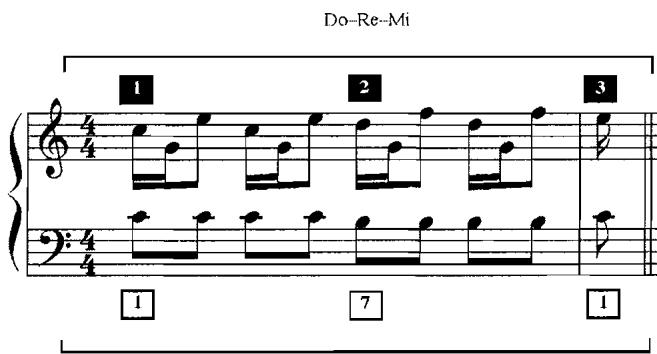
中文讲解
图占位符:Example 3.1——Gjerdingen 关于 Do-Re-Mi schema 的另一例,引自 Cimarosa, Sonata C48, Allegro, m. 1(约 1780 年代)。需查看原图。
补充说明
Domenico Cimarosa(1749-1801)为意大利作曲家;此处作为谱例来源。
第139段(P0139)
原文复述
The ascending third (1-2-3) appears in the melody over a lower neighbor (1-7-1) in the bass. Gjerdingen labels this schema Do-Re-Mi for pieces in both the major and minor modes. (Although one could argue that the schema should be called “Do-Re-Me” in minor, where “mi” is the raised third in major and “me” is the lowered third in minor, the pattern is essentially the same, regardless of mode.) Stage one of the gambit establishes stability, then moves to an unstable position at stage two, which resolves to another point of stability at stage three. While this schema is embellished at the surface of the music, musical forces can be heard as participating in the motion of the larger measure-to-measure pattern. Musical magnetism (the tendency of an unstable note to resolve to the closest stable pitch) can be heard as driving the half-step resolution to the third stage in the bass, while both inertia (the tendency for a pattern to continue) and magnetism participate in the resolution of the melodic gesture. Each stage of the pattern occurs on a strong beat within the measure and is evenly paced across the unit. The motion is easy, relaxed, and relatively unadorned. The Do–Re–Mi is the basis of the opening measures of one of Couperin’s early compositions, La Florentine, deuxième (2ⁿᵈ) ordre from the first volume of the collection. Measures one–four appear as Example 3.2c below. ³
中文讲解
本段解读 Example 3.1:上行三度(1-2-3)出现在旋律中,下方低音则为下邻音(1-7-1)。Gjerdingen 在大调与小调中均将该 schema 标记为 Do-Re-Mi(虽然可争辩小调中应称 “Do-Re-Me”,但无论调式模式本质相同)。Gambit 第一阶段建立稳定,第二阶段移至不稳定位置,第三阶段解决至另一稳定点。虽然该 schema 在音乐表层被装饰,但可听见音乐力参与了更大逐小节模式的运动——磁性驱动低音中至第三阶段的半音解决;惯性(模式继续的倾向)与磁性共同参与旋律姿态的解决。模式的每一阶段都出现在小节的强拍上,节奏均匀分布;运动轻松、放松、相对朴素。Do-Re-Mi 是 Couperin 早期作品 La Florentine(第二 ordre,来自第一卷)开篇小节的基础。1-4 小节如下方 Example 3.2c 所示。脚注 3 说明作者讨论的范围(见 P0141)。
补充说明
“deuxième (2ⁿᵈ) ordre” 指 Couperin 大键琴曲集第一卷的第二 ordre;脚注 3 见 P0141。
第140段(P0140)
原文复述
La Florentine (The Florentine) is a quickly paced binary dance form in compound meter. Signs of ornamentation within this excerpt (as well as throughout the rest of the piece) are minimal, appearing over the notes at the downbeats of measures one and two, and on beat three in measure three. The bass moves in the rhythmic figure eighth-plus-sixteenth until measure two, combining mostly stepwise motion with very few small跳进. The melody moves predominantly in sixteenth notes, alternating between a
中文讲解
本段描述 La Florentine 的总体特征:这首作品是快速的二部舞曲形式,复合拍号。节选内的装饰迹象(以及全曲其余部分)极少,仅出现于第一、二小节正拍上的音以及第三小节第三拍上的音。低音以八分加十六分的节奏型运行至第二小节,主要为级进运动,仅有极少数小跳进。旋律以十六分音符为主,交替出现……(句子被截断,续见 P0142)。
补充说明
“binary dance form” 是 A-B 二段体;“compound meter” 是复合拍(如 6/8、9/8)。
第141段(P0141)
原文复述
³ Measures zero (anacrusis) to the downbeat of measure two are the focus on my discussion, though I have quoted the piece up until the double bar of the first reprise of the dance form for context and for the reader to observe the continuation of certain figurations as part of the texture of the piece.
中文讲解
脚注 3 解释:第零小节(弱起)至第二小节正拍是作者讨论的重点;不过作者引用了作品直至该舞曲形式第一次反复的双小节线处,以便为读者提供语境并观察作为作品织体一部分的某些音型延续。功能:方法学说明。
补充说明
“anacrusis” 即弱起(pickup);此术语在分析节选中经常使用。
第142段(P0142)
原文复述
compound melodic figure (e.g., measure zero), and stepwise and neighbor figures (e.g., measure one).
中文讲解
本段续接 P0140:……在复合旋律音型(如第零小节)与级进及邻音音型(如第一小节)之间交替。这是 P0140 的完整句。
第143段(P0143)
原文复述
The opening phrase of La Florentine (anacrusis, and measures one and two) can be heard as an elaboration of two compositional building blocks — or schema — of the galant style: the ascending Do–Re–Mi (anacrusis and measure one) and the descending Phrygian tetrachord (measure one to measure two), as illustrated in Example 3.2a.
中文讲解
本段是 La Florentine 模式识别的核心:开篇乐句(弱起、第一、二小节)可被听成两个 galant 风格作曲构建块——或 schema——的装饰:上行 Do-Re-Mi(弱起与第一小节)与下行 Phrygian 四音音列(第一小节至第二小节),如 Example 3.2a 所示。这是综合方法第一阶段——模式识别——的完成陈述。
补充说明
“Phrygian tetrachord” 指下行 b2-1 即弗里几亚四音音列(4̂-b3̂-2̂-1̂),与前述 Phrygian 终止相关。
第144段(P0144)
原文复述
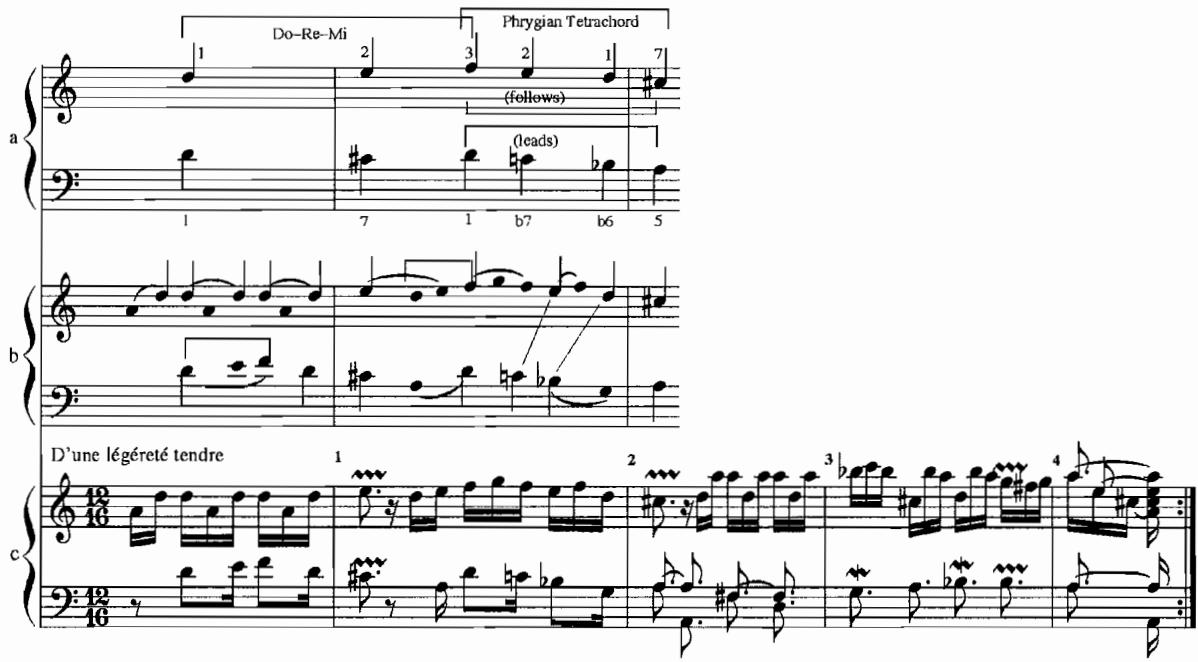
中文讲解
图占位符:Example 3.2a–c——La Florentine, 第 1-4 小节, 第 2 ordre (1713/16), F. Couperin。需查看原图。a 为结构层简化,b 显示确认关系,c 为表层乐谱。
补充说明
该谱例是 La Florentine 分析的核心视觉资料。
第145段(P0145)
原文复述
Yet the types of patterns used, as well as the way in which they are presented, contribute specifically to the motion and affect of the piece. This, in turn, can map onto emotional responses or images based on that expression as well as onto more specific concepts associated with Couperin’s subject, connecting pattern behavior and musical meaning in La Florentine.
中文讲解
本段是模式识别到意义赋予的过渡:然而,所用模式的类型及其呈现方式具体贡献于作品的运动与情感;这进而可映射到基于该表达的情感反应或意象,也可映射到与 Couperin 主题相关的更具体概念,从而在 La Florentine 中连接模式行为与音乐意义。这是综合方法第二、三阶段的预告。
第146段(P0146)
原文复述
The manner in which Couperin presents the opening Do–Re–Mi can be heard as reflecting a combination of insistence and hesitation. As in the model example, every stage of this opening gambit 是 equally paced (however, the events occur within a shorter temporal span equivalent to one measure, rather than three). The first stage of the Do–Re–Mi occupies the entire anacrusis of La Florentine. Beginning on beat three, the bass ascends by step, D–E–F (1̂-2̂-b3̂) and then skips back to D (1̂) outlining the chord of the home (or tonic) key in the equivalent of a dotted rhythm. The stepwise ascent in the bass can be said to confirm the larger ascent of the measure-to-measure Do–Re–Mi gambit in the melody, as indicated by the bracket in Example 3.2b.
中文讲解
本段分析 La Florentine 开篇 Do-Re-Mi 的呈现方式:可被听成反映"坚持与犹豫"的结合。如模型例子,每一阶段均匀分布(但事件发生在相当于一个小节而非三个小节的更短时距内)。Do-Re-Mi 第一阶段占据 La Florentine 整个弱起。从第三拍开始,低音以级进上行 D-E-F(1̂-2̂-b3̂)然后跳回 D(1̂),以相当于附点节奏的方式勾勒主(调)调的和弦。低音的级进上行可被视为确认旋律中逐小节 Do-Re-Mi gambit 的更大上行,如 Example 3.2b 中括号所示。
补充说明
“insistence and hesitation” 是该段对开篇 Do-Re-Mi 的核心特征化描述,为后续意义映射奠定基础。
第147段(P0147)
原文复述
The melody also outlines chord tones of the tonic key by alternating between A (5) and D (1) to produce a repeating melodic gesture that moves as follows: A–D D–A–D D–A–D (5–1 1–5–1 1–5–1). The notes and scale degrees in bold represent the accented parts of the beats. The A below can be heard as decorating the structural note of the gambit — the D above. This technique of bouncing from a pedal tone to another melodic tone is something that Couperin does in the opening anacrusis, in measure two, and throughout the remainder of the piece. In the context of the opening Do–Re–Mi however, the alternating between a pedal tone on the fifth degree and the structural note of the
中文讲解
本段分析 La Florentine 弱起段的旋律特征:旋律也以 A(5)与 D(1)的交替勾勒主调和弦音,产生重复的旋律姿态:A-D D-A-D D-A-D(5-1 1-5-1 1-5-1)。粗体的音与音级代表节拍的重音部分。下方 A 可被听成装饰 gambit 的结构音——上方 D。从持续音到另一旋律音的"反弹"技术在 Couperin 的开篇弱起、第二小节以及全曲余下部分都有使用。然而,在开篇 Do-Re-Mi 的语境中,第五度持续音与……结构音之间的交替(句子被截断,续见 P0148)。
补充说明
“pedal tone” 在此并非传统低音持续音,而是指旋律中作为支撑性长音重复出现的第五度。
第148段(P0148)
原文复述
ascending third pattern, is a common variant of the gambit. Gjerdingen calls this the “Adeste Fideles”, shown in Example 3.3, because of its similarity to the popular hymn with the same name.
中文讲解
本段续接 P0147:……上行三度模式的结构音之间的交替,是 gambit 的一种常见变体。Gjerdingen 称其为"Adeste Fideles"(即同名流行赞美诗),如 Example 3.3 所示,因为该 gambit 与该赞美诗相似。这引入具体的 Do-Re-Mi 变体分析。
补充说明
“Adeste Fideles” 是著名的圣诞赞美诗(也称 O Come, All Ye Faithful),其开篇旋律即含持续音反弹上行三度的特征。
第149段(P0149)
原文复述

中文讲解
图占位符:Example 3.3——Do-Re-Mi 的"Adeste Fideles"变体。需查看原图。
第150段(P0150)
原文复述
This variant will be discussed in more detail in Chapter IV’s case study, but in La Florentine the “Adeste Fideles” variant occurs during stage one of the schema only, rather than throughout the larger pattern. The repetition of notes is a feature common to the first stages of both of these examples. We can compare what effect the repetition has on the sense of motion in Example 3.3 and Example 3.2c, La Florentine. The short long durational pattern of the repeated structural note in Example 3.3 smoothly highlights the first stage of the three-stage unit with an agogic and metric accent. The motion and emphasis are easy and natural. In Example 3.2c, the repeated notes — like all the melody notes of the anacrusis) — are the same duration, and are part of a fast moving sixteenth-note figuration. Instead of the repetition being easy and natural, its movement is more insistent, forced, or even chafed.
中文讲解
本段比较 “Adeste Fideles” 变体在 Example 3.3 与 Example 3.2c(La Florentine)中的不同效果:第四章将详细讨论该变体,但在 La Florentine 中 “Adeste Fideles” 变体仅出现于 schema 第一阶段,而非贯穿整个大模式。重复音是这两个例子第一阶段共同的特征。我们可以比较重复在 Example 3.3 与 La Florentine 中对运动感的影响。Example 3.3 中重复结构音的短长节奏型以时值与节拍重音平滑地突出三阶段单元的第一阶段;运动与强调轻松自然。在 Example 3.2c 中,重复音与弱起中所有旋律音一样同属十六分音符快速音型。重复不再是轻松自然的,其运动更具坚持、强迫,甚至"摩擦"(chafed)感。这是"坚持与犹豫"具体表现的细化。
补充说明
“agogic accent” 指通过时值长短而非力度实现的强调。
第151段(P0151)
原文复述
This halting effect is heightened as the first stage of the Do–Re–Mi concludes at the end of the anacrusis. The melody steps up to E (2) at the downbeat of measure one as the bass moves down to C# (7) to outline the second stage of the gambit. After the arrival of the second stage, both voices rest — Couperin punctuates the texture with a sudden break in motion and sound. Only after this break do the voices return at beat two to move toward the final stage of the gambit. The melody enters and ascends D–E–F (1–2–b3) — the last note of which is the third stage of the pattern that arrives on beat three of the measure. This ascent in the melody confirms the larger measure-to-measure Do–Re–Mi just as the ascent does in the bass in the anacrusis. The confirmation appears with a bracket above the notes in Example 3.2b measure one. The bass completes its part of the gambit with a leap from A (5) below to D (1) above on beat three of the measure, which recalls the melodic figure from the anacrusis — the two voices exchange gestures as the larger gambit comes to a close.
中文讲解
本段继续分析 La Florentine 第一至第三阶段:这种"卡顿"效应在弱起结束时(Do-Re-Mi 第一阶段结束时)得到加强。第一小节正拍上旋律上行至 E(2),低音下行至 C#(7),勾勒 gambit 第二阶段。第二阶段到达后两声部休止——Couperin 以突然的运动与声音中断标记织体;该中断后两声部于第二拍返回,朝 gambit 最终阶段行进。旋律进入并上行 D-E-F(1-2-b3)——最后一音为该模式第三阶段,于该小节第三拍到达。旋律中的此上行与弱起中低音的上行同样确认了更大的逐小节 Do-Re-Mi。确认关系在 Example 3.2b 第一小节中的音上方以括号标示。低音以该小节第三拍从下方 A(5)跳进至上方 D(1)完成其在 gambit 中的部分,回响弱起中的旋律音型——两声部在 gambit 收束时交换姿态。
补充说明
本段揭示模式行为中的"中断"特征与"声部交换"对运动感的影响。
第152段(P0152)
原文复述
This moment marks a point of elision between the end of the opening Do–Re–Mi gambit and the beginning of the second pattern — the Phrygian tetrachord to close the phrase unit, as illustrated in Example 3.2a. The descending Phrygian tetrachord is a pattern that frequently balances the ascending Do–Re–Mi opening in Couperin’s pieces. The tetrachord moves in parallel tenths — labeled as a “leads” and “follows” progression in Example 3.2a — to complete the gesture on a half cadence. The successive combination of these two patterns is what Larson would describe as elided patterns that move gracefully, changing direction on the unstable part of the pattern to create a seamless single gesture. Although the Phrygian descent in Example 3.2a elides smoothly with the end of the previous pattern, the rhythm in the bass at the surface of the music (Example 3.2c) contributes to the piece’s halting or stuttering motion by continuing in its eighth-plus-sixteenth figuration. The melody begins its descent with an upper-neighbor pattern on beat three — F-G-F or b3̂-4̂-b3̂ — that then descends by step to E on beat four, which can be heard as responding to musical gravity. If we consider this upper-neighbor figure on beat three as responding to musical inertia as well as to gravity, then we expect the figuration to continue once it reaches E to produce another upper-neighbor figure, E-F-E or 2̂-b3̂-2̂. This, however, does not take place. The melody begins moving E to F, but then skips down to D (2̂-b3̂-1̂), introducing a leap, or gap — or stumble, in order to provide the D of the structural melody of the tetrachord pattern. This leap introduces another disruption into the texture, enhancing the halting, stuttering sense of motion established from the beginning of the piece.
中文讲解
本段是 La Florentine 第二模式(Phrygian 四音音列)的详细分析:这一刻标志着开篇 Do-Re-Mi gambit 结束与第二模式开始之间的重叠点(elision),第二模式即收束乐句单位的 Phrygian 四音音列,如 Example 3.2a 所示。下行 Phrygian 四音音列是 Couperin 作品中常与上行 Do-Re-Mi 开篇相平衡的模式。该四音音列以平行十度进行(在 Example 3.2a 中标记为"leads"与"follows"进行)以半终止结束姿态。这两种模式的连续组合是 Larson 所谓重叠模式——在模式不稳定部分改变方向以形成无缝单一姿态的运动。虽然 Phrygian 下行在 Example 3.2a 中与前一模式平滑重叠,但表层音乐(Example 3.2c)的低音节奏通过持续其八分加十六分音型贡献于作品的卡顿或口吃运动。旋律以下行上邻音模式 F-G-F(或 b3̂-4̂-b3̂)于第三拍开始下行,然后级进下行至第四拍的 E,可听成响应音乐重力。若视此第三拍上邻音音型为响应音乐惯性也响应重力,则我们预期该音型到达 E 后继续产生另一上邻音音型 E-F-E(或 2̂-b3̂-2̂)。然而实际并非如此。旋律从 E 移向 F 然后跳进下行至 D(2̂-b3̂-1̂),引入跳进或空缺——或"绊跌"——以提供该四音音列模式结构旋律中的 D。此跳进在织体中引入另一中断,强化自作品开头建立的卡顿、口吃感。这是 Larson 理论应用于 La Florentine 的精细分析。
补充说明
“parallel tenths” 平行十度进行是巴洛克键盘音乐中常见的声部进行手法。
第153段(P0153)
原文复述
These affects of insistence, hesitation, chafing, and haltingness can map onto qualities of physical motion, such as skipping, faltering, or stumbling — or all of these. When we incorporate Couperin’s title into the meanings we attribute to the piece, our mappings of pattern behavior and expression may take on greater specificity and added dimensions. The subject of the piece is The Florentine — a person from Florence. First, the pattern types themselves contribute to the meaning of the piece. To “paint” a portrait of a Florentine, it does not want to seem unreasonable that Couperin might choose to create portions of his piece using compositional building blocks that are related to the Italian galant style — the Do–Re–Mi and balancing Phrygian tetrachord. La Florentine, then, could be considered a mild jab at the increasing compositional influence of the Italian style in general, depicting perhaps a perceived lack of grace and constant motion. This connects the types of patterns to the subject. But, what is it about the way in which the patterns appear in the composition that give rise to the evocation of a particular Florentine? That brings us to the second point — a deeper understanding of the subject.
中文讲解
本段是从模式行为到意义映射的关键过渡:坚持、犹豫、摩擦、卡顿这些情感可映射到物理运动特质,如跳跃、摇晃、绊跌——或所有这些。当把 Couperin 的标题纳入我们赋予作品的意义时,模式行为与表达的映射可获得更大具体性与更多维度。作品主题是 The Florentine——来自佛罗伦萨的人。首先,模式类型本身贡献于作品意义。为"画"一位佛罗伦萨人的肖像,Couperin 选择以与意大利 galant 风格相关的作曲构建块(Do-Re-Mi 与平衡的 Phrygian 四音音列)创作作品部分并不显得不合理。因此,La Florentine 可被视为对意大利风格日益增长的作曲影响的一种温和讽刺,描绘或许一种被察觉到的缺乏优雅与持续运动。这将模式类型与主题相联系。但是,模式在作品中如何出现从而唤起特定佛罗伦萨人的形象?这把我们引向第二点——对主题的更深理解。
补充说明
“mild jab”(温和的讽刺)是作者对作品标题内涵的克制解读。
第154段(P0154)
原文复述
According to Wildrid Mellers, “Lully was known as le Florentin because he was one.” ⁴ As Lully’s posthumous influence was waning within court circles, one possibility is that Couperin was satirically depicting Lully and his dancing abilities — which of course were known to be excellent. Mellers suggests, however, that this is unlikely. “But this unassuming Italianate jig can hardly be a portrait of so self-consciously grand a character. On the other hand, Couperin is unlikely to have tossed off a portrait of an average Florentine, male or female.” ⁵ Both Mellers and Jane Clark point to Florent Dancourt as another possible subject — a friend of Couperin’s involved in the theater and known for his fluency of speech and elegant, polished manner.
中文讲解
本段引入关于标题主体的历史研究:依 Wilfrid Mellers 之见,“Lully 因本人是佛罗伦萨人而被称为 le Florentin”。当 Lully 身后的影响在宫廷圈中逐渐式微时,一种可能是 Couperin 在讽刺性地描绘 Lully 及其舞技——其舞技当然以优秀著称。但 Mellers 认为这不太可能:“但这支谦逊的意大利风格 jig 几乎不可能是描绘如此自我意识宏大的性格;另一方面,Couperin 也不大可能随手画一幅普通佛罗伦萨人(无论男女)的肖像。” Mellers 与 Jane Clark 均指向 Florent Dancourt 作为另一可能主题——Couperin 圈中涉足戏剧、以口才流利与举止优雅著称的朋友。脚注 4、5 标明 Mellers 引文出处(见 P0157、P0158)。
补充说明
Lully(Jean-Baptiste Lully, 1632-1687)为意大利出生的法国宫廷作曲家;Florent Dancourt(1661-1725)为法国剧作家与演员。
第155段(P0155)
原文复述
A civilized and charming man, his company was sought by the most important people of the court and the city. The ease with which he spoke and the natural eloquence that enlivened all his speeches, have made his comrades bestow on him the honour of speaking on all special occasions, the public always cheers him. ⁶
中文讲解
本段描述 Dancourt 的形象(通过 Titon du Tillet 引文转引):一位文明而迷人的男子,宫廷与城市中最重要的入物寻求其陪伴;他说话从容不迫,自然的口才使所有演讲生动活泼,使同伴们赋予他在所有特殊场合发言的荣誉,公众总是为他喝彩。脚注 6 标明出处(见 P0159)。
补充说明
“Titon du Tillet” 是 18 世纪法国文献学家,编纂《Le Parnasse françois》记述法国文艺名人。
第156段(P0156)
原文复述
Later in life, however, this reputation became marred — Dancourt was censured for only taking the roles of characters with dubious principles in his stage productions. How then can Couperin’s La Florentine evoke Dancourt — first renowned for eloquence in speech, but later for a tarnished reputation?
中文讲解
本段提出核心问题:然而在生命后期,这一声誉受损——Dancourt 因只出演具有可疑道德原则的角色而受到指责。那么 Couperin 的 La Florentine 怎样能同时唤起 Dancourt——起初以口才著称、后来以受损声誉著称?这一问题驱动后续意义映射的解释。
补充说明
此为方法学的关键问题:模式如何映射到双重人物形象。
第157段(P0157)
原文复述
⁴ Wilfrid Mellers, François Couperin and the French Classical Tradition (London: Faber and Faber, 1987), 389.
中文讲解
脚注 4:Wilfrid Mellers, François Couperin and the French Classical Tradition (Faber and Faber, 1987), p. 389。功能:来源标注。
第158段(P0158)
原文复述
⁵ Ibid.
中文讲解
脚注 5:Ibid.(同 Mellers 同书)。标明 P0154 中 Mellers 第二段引文出处。功能:来源标注。
第159段(P0159)
原文复述
⁶ Titon du Tillet, as quoted by Jane Clark and Derek Connon, The Mirror of Human Life: Reflections on François Couperin’s Pièces de Clavecin (Huntingdon, England: King’s Music, 2002), 54.
中文讲解
脚注 6:Titon du Tillet 引文转引自 Jane Clark and Derek Connon, The Mirror of Human Life: Reflections on François Couperin’s Pièces de Clavecin (King’s Music, 2002), p. 54。功能:来源标注。
第160段(P0160)
原文复述
Couperin’s Florentine can be considered a satirical evocation of Dancourt. The figurations that embellish the structural patterns in the melody and bass produce awkward states of motion that can be heard as being in opposition to eloquence and grace. La Florentine expresses affects more in keeping with a person stammering or sputtering, or even being clumsy. We can imagine Couperin’s subject, having once captured attention through his prowess as orator, becoming a man who now stutters awkwardly or whose reputation has “faltered”. Couperin’s performance marking provides additional信息. D’une légèreté tendre can take on different meanings. In one sense, tendre = tender and légèreté = light, can mean an interpretation of a light touch. However, light as a definition for légèreté means being “light on one’s feet”. In another sense légèreté, when connected to a physical action, means thoughtless. ⁷ It is possible that Couperin’s performance direction itself is a reference to “thoughtless chatter”, which is supported by an observation from Mellers. La Florentine, he states, “babbles politely.” ⁸ These two interpretations for the piece — “babbling politely” and “moving hesitantly” — create two fairly different kinds of motion or affect. Both, however, are consistent with the patterns we find, and each (whether babbling or hesitating) is given its particular flavor in part by the particular content of Couperin’s music.
中文讲解
本段是 La Florentine 的综合意义阐释:Couperin 的 Florentine 可被视为对 Dancourt 的讽刺性唤起。装饰旋律与低音结构模式的音型产生与优雅和口才相对的笨拙运动状态。La Florentine 表达更接近一个人口吃、喷吐言语、甚至笨拙的情感。我们可以想象 Couperin 的主题——曾以辩才引人注目——成为如今结巴笨拙或声誉"动摇"的人。Couperin 的演奏标记提供额外信息。“D’une légèreté tendre"可有不同含义:一种意义下,tendre = 温柔,légèreté = 轻盈,可解读为轻盈触键;然而"轻盈"作为 légèreté 的定义可指"脚步轻快”。另一意义下,légèreté 与身体动作相关时意为"轻率"。Couperin 的演奏指示本身可能就是对"轻率的喋喋不休"的指涉,这由 Mellers 的观察所支持——Mellers 称 La Florentine"礼貌地喋喋不休"(“babbles politely”)。对作品的两种解读——“礼貌地喋喋不休"与"犹豫地运动”——产生相当不同的运动或情感。然而两者都与所发现的模式一致,且每种解读(无论喋喋不休还是犹豫)都部分由 Couperin 音乐的具体内容赋予其特定风味。脚注 7、8 分别标明词典来源与 Mellers 引文出处(见 P0161、P0162)。
补充说明
“D’une légèreté tendre” 是 Couperin 标题为作品标注的法文演奏指示;脚注 7 见 P0161;脚注 8 见 P0162。
第161段(P0161)
原文复述
7 “Légèreté,” Collins English French Electronic Dictionary © HarperCollins Publishers 2005, http://dictionary.reverso.net/french/légèreté#translate_box (accessed: April 01, 2010).
中文讲解
脚注 7(无上标符号):“Légèreté”,Collins English French Electronic Dictionary, HarperCollins 2005;访问日期 2010 年 4 月 1 日。功能:词典来源。
补充说明
Reverso 为在线词典平台,此为词典网络资源。
第162段(P0162)
原文复述
⁸ Mellers, François Couperin, 389.
中文讲解
脚注 8:Mellers, François Couperin, 389。标明 P0160 中 Mellers 引文出处。功能:来源标注。
第163段(P0163)
原文复述
The extended meaning of “florentine” helps to enhance mapping possibilities of pattern behavior as well. Florentine, as an adjective, refers to something having a dull finish, such as gold having lost a bit of its shine — a little rubbed, a little tarnished.⁹ The chafing note repetition in the melodic figurations of La Florentine can be heard as representing the action of rubbing. Dancourt’s, who had once been eloquent and graceful in speech, the glow of his reputation now a little dull and tarnished, prattles on saying nothing of consequence, and stammering as he speaks. The metaphorical mappings that give meaning(s) to pattern activity and associated affective responses in La Florentine become more precise.
中文讲解
本段深化意义映射:“florentine"的扩展含义有助于增强模式行为的映射可能性。作为形容词的 Florentine 指具有暗哑光泽之物,例如失去少许光泽的金子——稍被摩擦、稍失去光泽。La Florentine 旋律音型中摩擦性的重复音可被听成"摩擦"的动作。Dancourt 曾经辩才优雅、口齿伶俐,如今其声誉的光辉稍显暗哑失去光泽,喋喋不休地说着无关紧要的话,且说话时结巴。赋予 La Florentine 中模式活动与相关情感反应以意义的隐喻映射因此更为精确。脚注 9 标明词典来源(见 P0165)。
补充说明
“florentine” 的形容词含义"失去光泽的"是该曲标题词义的延伸,扩展了映射的语义空间。
第164段(P0164)
原文复述
This first example analysis illustrates the connection between pattern behavior and the potential meanings for that behavior. Elements of the musical material itself (identified through the variety of pattern-based tools of this methodology) — the patterns, the melodic and rhythmic figurations associated with those patterns, as well as an overall quick tempo of the piece — express particular qualities that contribute to our experience, which give rise to responses and affects. In Figure 3.1a, connections between pattern and affect are represented by diagonal movement between musical material in the upper left (the concrete realm), and responses in the lower right (the abstract realm). In La Florentine, we can describe some of these behaviors as possessing qualities such as insistence, haltingness, chafing, or hesitation.
中文讲解
本段对第一例分析作总结说明:第一次分析例证了模式行为与该行为潜在意义之间的连接。音乐材料本身的元素(通过本方法学的多种基于模式的工具识别)——模式、与这些模式相关的旋律与节奏音型,以及作品整体快速的节拍——表达贡献于我们体验的特定性质,从而引发反应与情感。在 Figure 3.1a 中,模式与情感之间的连接由左上(具体领域)的音乐材料到右下(抽象领域)的响应之对角线运动表示。在 La Florentine 中,我们可以描述这些行为中的某些具有坚持、卡顿、摩擦、犹豫等性质。这是综合方法四阶段中第一阶段(音乐材料→情感反应)的具体化。
补充说明
Figure 3.1a 是 Figure 2.2 一般模型在 La Florentine 上的具体应用。
第165段(P0165)
原文复述
⁹ Dictionary.com, “Florentine,” The American Heritage® Dictionary of the English Language, Fourth Edition. Houghton Mifflin Company, 2004, http://dictionary.reference.com/browse/Florentine (accessed: April 01, 2010).
中文讲解
脚注 9:Dictionary.com 收录 The American Heritage® Dictionary of the English Language, Fourth Edition 中的 “Florentine” 词条。Houghton Mifflin, 2004;访问日期 2010 年 4 月 1 日。功能:词典来源。
第166段(P0166)
原文复述
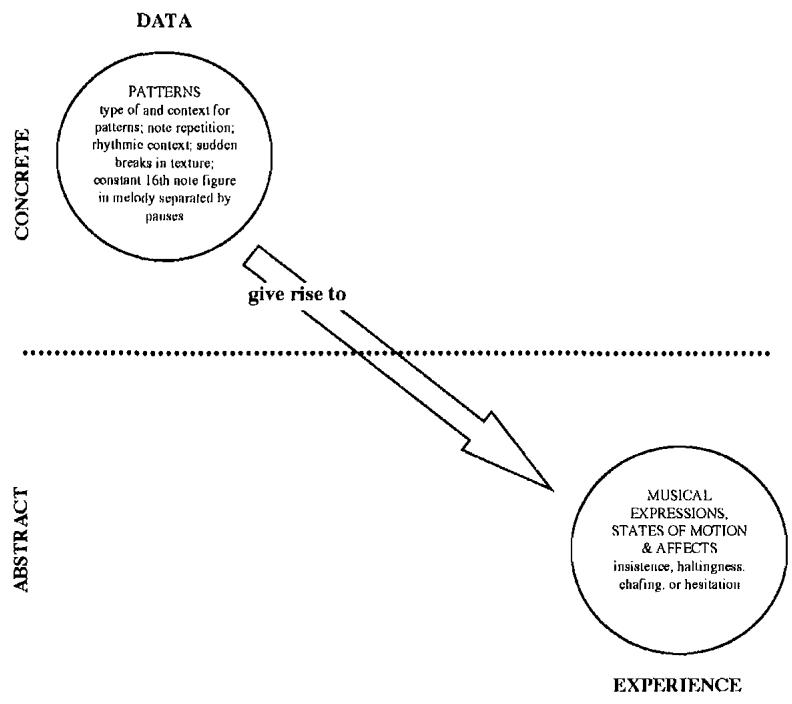
中文讲解
图占位符:Figure 3.1a——La Florentine 方法图:模式引发体验。需查看原图。该图对应 Figure 2.2 一般模型中第一阶段(音乐材料→情感)的箭头。
第167段(P0167)
原文复述
We can also metaphorically map these behaviors onto physical actions like skipping, tripping, stumbling, faltering or even stammering, as illustrated by the movement from right to left in Figure 3.1b. The patterns — and how those patterns are contextualized — in La Florentine could then represent a person who lacks grace or is irritating (chafing) in some way, as illustrated by Figure 3.1c. The metaphorical mappings we make guide our interpretations for patterns and give meaning to their behavior, as represented by movement from metaphor in the lower left corner of the figure to interpretation and synthesis in the upper right. However, as Mellers points out it is unlikely — given the care and specificity with which Couperin names his pieces and likelihood that he had a particular person in mind — that this musical portrait is unrelated to the title. This gives reason to reflect upon — or re-inform how we look at — what it is about the patterns and musical behavior that give rise to certain affects that can map onto metaphors tied to the evocative title, as represented by the move from right to left in the upper part of the diagram in Figure 3.1d.
中文讲解
本段对应综合方法第二、三、四阶段:我们可以把这些行为隐喻地映射到物理动作如跳跃、绊倒、踉跄、动摇甚至口吃,如 Figure 3.1b 中由右向左的运动所示。La Florentine 中的模式——以及这些模式被语境化的方式——可代表缺乏优雅或以某种方式令人厌烦(摩擦)的人,如 Figure 3.1c 所示。我们所做的隐喻映射引导我们对模式的解释并赋予其行为意义,由图中左下角(隐喻)到右上角(解释与综合)的运动表示。然而,正如 Mellers 所指出,考虑到 Couperin 命名作品时的用心与具体性以及他心中很可能有特定人物,此音乐肖像不太可能与标题无关。这促使我们反思——或重新调整我们如何看待——模式与音乐行为的什么方面引发可映射到暗示性标题相关隐喻的特定情感,由 Figure 3.1d 中图上部由右向左的运动表示。本段同时引入反思:标题作为方法论中的关键语境因素。
补充说明
本段连贯展示了综合方法在 La Florentine 中从模式识别→情感反应→物理隐喻→主题解释→反思观察的完整循环。
第168段(P0168)
原文复述
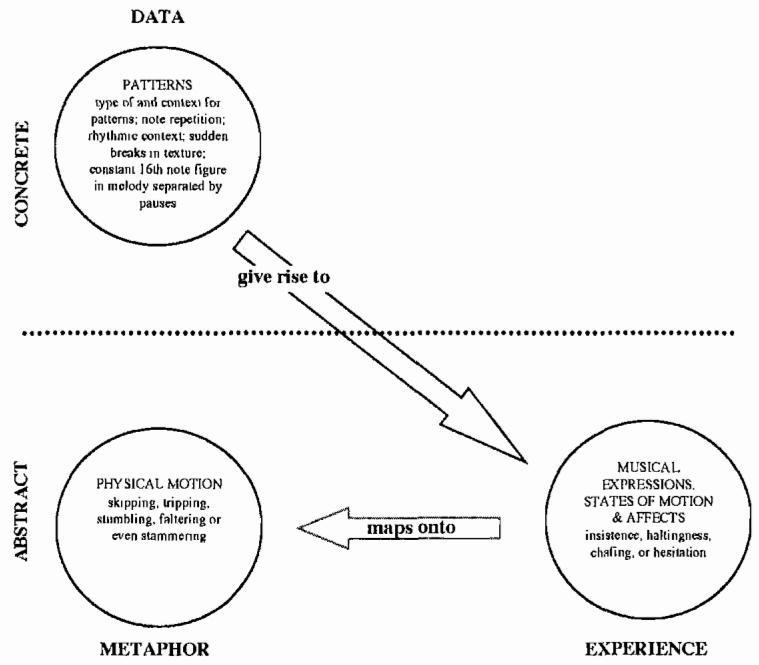
中文讲解
图占位符:Figure 3.1b——La Florentine 方法图:体验与情感映射到物理姿态与运动。需查看原图。
补充说明
对应综合方法第二阶段(情感→物理隐喻)。
第169段(P0169)
原文复述
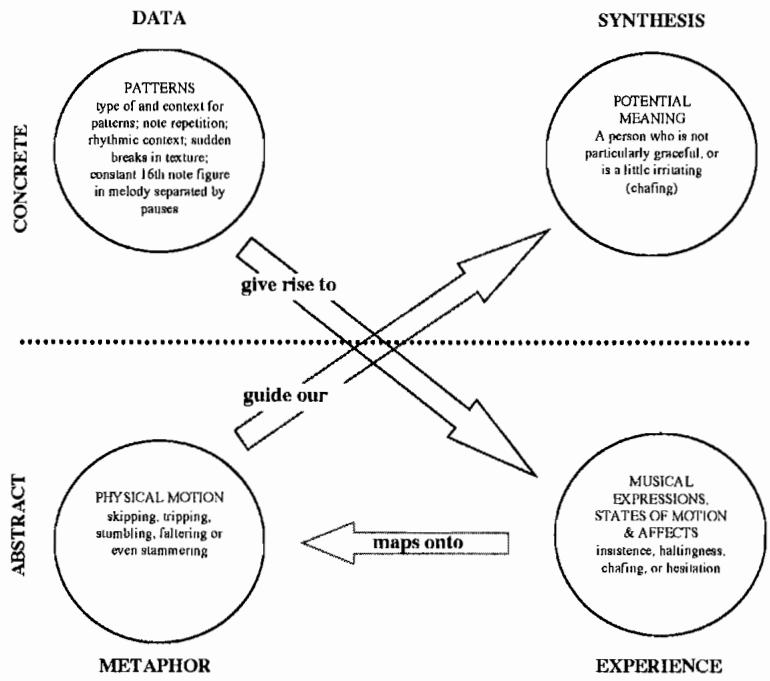
中文讲解
图占位符:Figure 3.1c——La Florentine 方法图:映射引导我们对模式与行为意义的解释(标题中有半角分号,属 OCR 残留)。需查看原图。
补充说明
对应综合方法第三阶段(隐喻→解释/综合)。
第170段(P0170)
原文复述
We can propose an enhanced interpretation of pattern and meaning for La Florentine in light of associations with the subject — for example, the Florentines in general, a particular Florentine such as Lully, 或 Dancourt, or all three of these ideas as reflected in Figure 3.2. Given this potentially satirical context, the pattern activity can now be heard as representing ideas that “poke fun” at otherwise graceful characters whose reputations may have become tarnished (a “Florentine” finish), or diminished in some way because of time passing, or because of public opinion.
中文讲解
本段提出强化解释:鉴于与主题的关联——例如广义上的佛罗伦萨人、特定佛罗伦萨人如 Lully 或 Dancourt,或这三者的所有观念(如 Figure 3.2 所示)——我们可以提出对 La Florentine 模式与意义的强化解释。鉴于这一潜在讽刺语境,模式活动现在可被听成代表对原本优雅的角色(其声誉可能因"佛罗伦萨式"光泽受损,或因时间流逝或公众舆论而有所减损)的"嘲弄”(poke fun)。
补充说明
Figure 3.2 是综合方法在 La Florentine 上以标题/主体作为映射组成部分的完整图示。
第171段(P0171)
原文复述
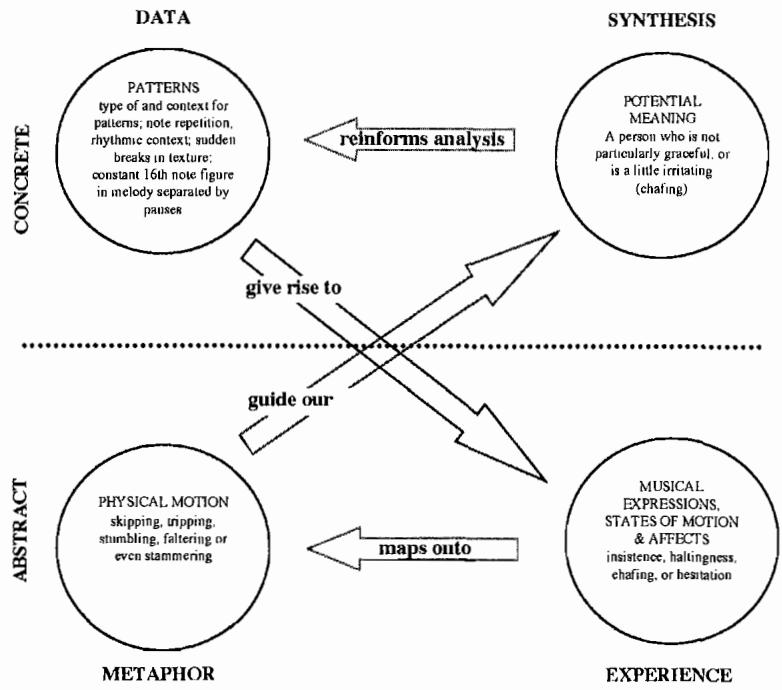
中文讲解
图占位符:Figure 3.1d——La Florentine 方法图:解释再反馈我们所见、所听、所体验。需查看原图。
补充说明
对应综合方法第四阶段(解释再反馈→新一轮观察)。
第172段(P0172)
原文复述
In other words, our pattern activity can now be heard as faltering dance steps, stuttering speech, or even constant blathering — repeating oneself and saying nothing of consequence. Through the application of this approach, it becomes clear that multiple mappings are possible — and even expected — in order to give meaning to musical pattern in these settings. While meaning can certainly be found without context or a title, these元素 contribute to refining our interpretations based upon associations with the subject. Incorporating those ideas (whether they are Couperin’s or not) helps to tie our observations more meaningfully to the musical portraits themselves.
中文讲解
本段收束 La Florentine 分析:换言之,我们的模式活动现在可被听成摇晃的舞步、口吃的言语、乃至持续的喋喋不休——重复自己且所说无关紧要。通过此方法的应用,可以清楚多种映射是可能的——甚至是被预期的——以赋予这些场景中音乐模式意义。虽然意义无疑可在无语境或标题的情况下找到,但这些元素有助于根据与主体的关联精炼我们的解释。纳入这些观念(无论是否 Couperin 本人的)有助于将我们的观察更有意义地与音乐肖像本身相联系。
补充说明
本段总结第一例的多重映射优势。
第173段(P0173)
原文复述
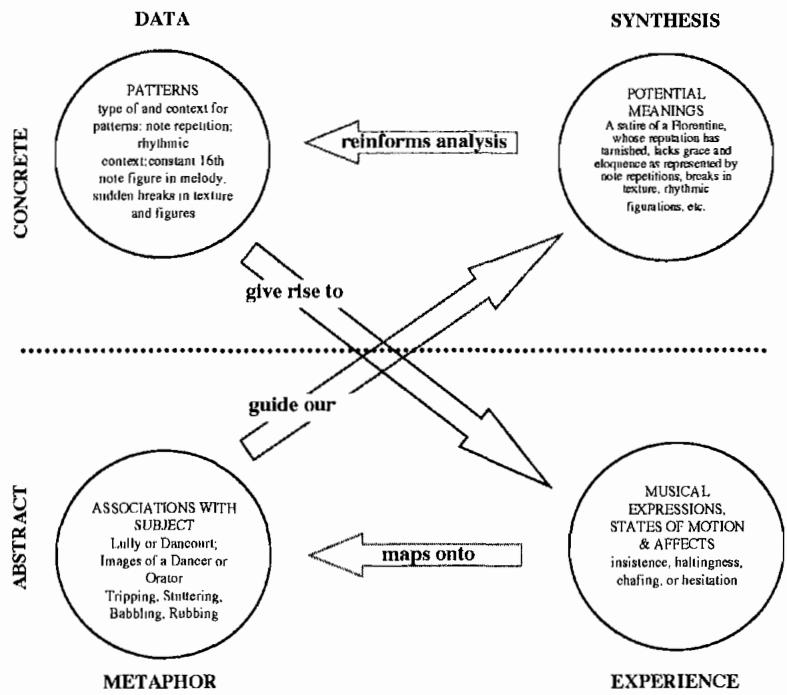
中文讲解
图占位符:Figure 3.2——La Florentine 方法图,主体与标题作为映射的组成部分。需查看原图。
补充说明
这是 La Florentine 完整方法论的视觉总结。
第174段(P0174)
原文复述
We have just seen how different patterns (including the lamento tetrachord and the ascending Do–Re–Mi schema) can give rise to different meanings (that reflect the differences between the patterns). In the next sections, we will see how the same pattern can give rise to different meanings (that reflect differences between their contexts).
中文讲解
本段是 La Florentine 分析向 La Muse-Plantine 分析的过渡句:我们刚才看到不同的模式(包括 lamento 四音音列与上行 Do-Re-Mi schema)如何引发不同意义(反映模式之间的差异)。在接下来几节中,我们将看到同一模式如何引发不同意义(反映其语境之间的差异)。这引出后两例——同一模式在不同语境下的不同意义。
补充说明
本段构成 La Florentine 与 La Muse-Plantine 两例的方法学桥梁。
第175段(P0175)
原文复述
Meaning through Analogy: La Muse-Plantine — Is a Lamento Descent Always an Expression of Sadness?
中文讲解
三级标题:Meaning through Analogy: La Muse-Plantine — Is a Lamento Descent Always an Expression of Sadness?(通过类比达成的意义:La Muse-Plantine——哀歌下行是否总是悲伤的表达?)标示本章第三例分析的开始,核心问题是同一 lamento 四音音列模式在不同语境下是否必然意味着悲伤。
补充说明
“Analogy” 在标题中指隐喻映射;标题即提出本章将挑战 lamento 四音音列 = 悲伤的常识关联。
第176段(P0176)
原文复述
The lamento tetrachord is one of the most enduring compositional techniques for pieces expressing grief, sadness, or mourning. Typically presented as an ostinato bass, the pattern predates Couperin by approximately two centuries and remained part of the common musical vocabulary well into, and beyond, the period of the galant style. A model example of this tetrachord for three voices in D minor, both with and without suspensions, appears in Example 3.4.
中文讲解
本段引入 lamento 四音音列:它是表达悲伤、哀痛、哀悼作品最持久的作曲技法之一;通常以固定低音(ostinato bass)呈现;该模式早于 Couperin 约两个世纪,并作为共同音乐词汇的一部分延续至 galant 风格时期及之后。D 小调三声部四音音列的模型例子(如含或不含延留音)如 Example 3.4 所示。
补充说明
“ostinato bass” 指不断重复的低音型;Example 3.4 见 P0177-178 中描述。
第177段(P0177)
原文复述
A common presentation for the lamento descent is in a slow triple meter, as depicted in both of these model progressions. In Example 3.4a the bass begins its descent on 8̂, and continues moving by step through b7̂ and b6̂ to resolve on 5̂ to conclude the pattern. The motion of this four-note figure can be heard as responding to all three of Larson’s musical forces: gravity — as it is a descending figure and moving toward a stable platform below; inertia — as the pattern continues to move by step in the same direction; and magnetism — as the pattern resolves by half-step at its conclusion. The other two
中文讲解
本段描述 Example 3.4 中两个模型进行:lamento 下行的常见呈现为慢速三拍子。在 Example 3.4a 中低音以 8̂ 开始下行,级进经过 b7̂ 与 b6̂ 后在 5̂ 解决以结束该模式。这四音图式的运动可被听成响应 Larson 的所有三种音乐力:重力(作为下行图式移向下方稳定平面)、惯性(作为模式继续沿同方向以级进运动)、磁性(作为模式在半音处解决收束)。另两个声部……(句子被截断,续见 P0178)。
补充说明
“8̂-b7̂-b6̂-5̂” 是 lamento 四音音列的音级序列。
第178段(P0178)
原文复述
voices of the pattern create intervals of a third and fifth over the bass in the first measure, which then change to intervals of a third and sixth in measures two and three, and then resolve to an octave and a third as the pattern comes to a close. Example 3.4b behaves similarly with the exception of a series of 7—6 suspensions between the melody and bass voices.
中文讲解
本段续接 P0177:……模式的另两个声部在第一小节于低音上方形成三度与五度音程,第二、三小节变为三度与六度,模式收束时解决至八度与三度。Example 3.4b 行为类似,但例外是在旋律与低声部之间有一系列 7-6 延留音。这是 lamento 四音音列模型的具体声部进行描述。
补充说明
“7-6 suspension” 是 lamento 模式最常引用的延留音特征。
第179段(P0179)
原文复述
This descending tetrachord plays an important role in many of Couperin’s minor-mode character pieces. Some examples include Les Folies françaises ou les Dominos, the subject of the in-depth analysis of Chapter IV, L’Âme-en peine, the subject of Chapter V — both from the thirteenth ordre, as well as some earlier pieces from the first ordre such as Allemande L’Auguste, and the Gavote, and the first Courante from the second ordre. The other examples from this chapter also use some version of a Phrygian descent. As illustrated in the previous piece, La Florentine (Example 3.2a–c) Couperin uses it as a descending pattern to balance the ascending Do-Re-Mi opening gambit. In this particular application, the tetrachord is not necessarily behaving in a “traditional” lament manner by repeating as an ostinato bass. As such, the meanings associated with the pattern are not necessarily tied to representations of sadness and grief. The context of the pattern provides a different “take” on its interpretation. The structural components, however, are essentially the same — the bass descends in the characteristic pattern while the melody follows its descent in parallel tenths (or thirds), taking over the inner line of the three-voice model progressions, to conclude in a Phrygian half-cadence. Gjerdingen calls this the Phrygian tetrachord pattern.
中文讲解
本段指出下行四音音列在 Couperin 许多小调性格曲中的重要作用:例子包括第四章深度分析对象 Les Folies françaises ou les Dominos、第五章对象 L’Âme-en peine(均来自第十三 ordre),以及第一 ordre 中的一些早期作品(如 Allemande L’Auguste、Gavote),以及第二 ordre 的第一首 Courante。本章的其他例子也使用某种 Phrygian 下行。如前曲 La Florentine(Example 3.2a-c)所示,Couperin 将其用作下行模式以平衡上行 Do-Re-Mi 开篇 gambit。在这一特定应用中,四音音列未必以"传统"哀歌方式作为固定低音重复,因此与该模式相关的意义未必与悲伤、哀痛的再现相连。模式的语境为其解释提供了不同的"视角"。不过结构成分本质相同——低音以特征模式下行,旋律以平行十度(或三度)跟随下行,承接三声部模型进行的内声部,以 Phrygian 半终止收束。Gjerdingen 称其为 Phrygian 四音音列模式。本段关键论点:lamento 四音音列与 Phrygian 四音音列结构相同但语境不同,意义相应不同。
补充说明
本段为 La Muse-Plantine 即将展开的"同一模式不同意义"分析提供理论伏笔。
第180段(P0180)
原文复述
Often reserved for even more pronounced moments of sadness and grief, a chromatic version of the lamento tetrachord can be heard as being particularly evocative. A model example of this chromatic tetrachord for three voices, in a slow triple meter in D minor, appears as Example 3.5.
中文讲解
本段引入 lamento 四音音列的半音版本:通常保留以用于更为显著的悲伤与哀痛时刻,lamento 四音音列的半音版本可被听成尤其具唤起力。D 小调慢速三拍子三声部半音四音音列的模型例子如 Example 3.5 所示。
补充说明
半音版本通过在每阶段加入半音装饰强化悲伤表达。
第181段(P0181)
原文复述
In this model, the bass moves in a manner similar to Example 3.4b but with added chromatic half steps on the downbeats of each measure, separating each stage of the original bass pattern 8̂-b7̂-b6̂-5̂. The upper two voices are virtually identical to the model Example 3.4b, emphasizing the 7—6 suspension chain in the melody line while the inner voice maintains a stable third above each tone in the bass voice. One difference, however, is in the rhythm of the descent. The added chromatic steps provide an opportunity to emphasize each of the three beats per measure by staggering the durations in the melody and bass voices. A quintessential representation of the chromatic lamento ostinato used as an evocation of sorrow is Dido’s Lament “When I am Laid in Earth” from Purcell’s Dido and Aeneas. In this well-known example, there is little debate about the expressions of grief and melancholy associated with Dido’s Lament — the text, and overall mournful
中文讲解
本段分析 Example 3.5 半音模型:在此模型中低音运动类似 Example 3.4b,但在每小节正拍上增加半音级,分隔原低音模式 8̂-b7̂-b6̂-5̂ 的各阶段。上方两声部实质上与模型 Example 3.4b 相同,强调旋律线的 7-6 延留音链,内声部在低音每一音上方维持稳定的三度。然而一个差异在于下行的节奏:所加的半音级通过错开旋律与低音的时值提供了强调每小节三拍中每一拍的机会。作为唤起悲伤的半音 lamento 固定低音的典型表现,是普赛尔《狄朵与埃涅阿斯》中狄朵的悲歌《当我躺入大地》。在这一著名例子中,与狄朵悲歌相关的悲伤与忧郁表达几乎无可争议——文本与总体哀婉的……(句子被截断,续见 P0182)。
补充说明
Dido’s Lament 是 Purcell《Dido and Aeneas》结尾著名段落,是半音 lamento 模式的经典。
第182段(P0182)
原文复述
(and breathtakingly beautiful) melodious qualities help to guide our affective responses. The chromatic descent enhances this expression by stressing the dissonant and poignant qualities of the tonal landscape, which can be heard as evoking the tortured, stepwise descent to the grave as Dido laments her fate. And the ceaseless repetition of the bass further underscores that evocation and can be heard as representing Dido’s physical movement itself — her walk toward death.
中文讲解
本段续接 P0181:……(且令人窒息的)旋律特质有助于引导我们的情感反应。半音下行通过强调调性景观的不协和与辛酸特质强化了该表达,这可被听成在狄朵哀叹命运时唤起通向坟墓的受折磨的、级进的下行。低音的无尽重复进一步强调了这种唤起,并可被听成代表狄朵身体运动本身——她走向死亡的步伐。这是半音 lamento 模式作为悲伤表达的极致典型。
补充说明
本段以 Purcell《Dido’s Lament》作为半音 lamento 模式悲伤表达的标杆案例,为 La Muse-Plantine 的反例分析做铺垫。
第183段(P0183)
原文复述
Couperin’s La Muse-Plantine, a rondeau from the dix-neuvième (19ᵗʰ) ordre, troisième livre, also uses a repeating lamento tetrachord as its fundamental compositional pattern for the opening eight measures of the piece. In fact, La Muse features the chromatic version of our model. However, the affect and expression of the piece is not sorrowful, but rather wistful or contemplative. The opening nine measures are recreated as Example 3.6. While not a traditional repeating ostinato bass used to organize the entire piece, as a rondeau these opening measures would repeat between every couplet of the form — the piece would constantly return to this passage. In itself, measures one to the downbeat of nine contain two repetitions of the chromatic descent: the first in measures one–four, and the second in measures five–eight.
中文讲解
本段引入 La Muse-Plantine 分析:Couperin 的 La Muse-Plantine 是来自第十九 ordre(第三卷)的回旋曲(rondeau),也使用重复的 lamento 四音音列作为开篇八小节的基本作曲模式。事实上 La Muse 采用了我们模型的半音版本。然而该作品的情感与表达并非悲伤,而是怀旧或沉思。开篇九小节重制为 Example 3.6。它不是用作组织整首作品的传统重复固定低音,但作为回旋曲,这些开篇小节将在形式的每一 couplet 之间重复——作品将不断回到此段落。本身而言,第一小节至第九小节正拍包含两次半音下行重复:第一次在第一至四小节,第二次在第五至八小节。这是 La Muse-Plantine 与狄朵悲歌的关键对照——使用相同模式但具有不同情感。
补充说明
“rondeau” 是 ABACADA 型回旋曲式;“dix-neuvième (19ᵗʰ) ordre” 即第十九 ordre。
第184段(P0184)
原文复述
Couperin sets this piece in a brisk 6/8 meter — a setting more appropriate to a dance than a lament, and a marked difference between the pacing of the piece and that of the model, or even that of a more typical slow triple meter. The three voices combine to create a constant eighth-note pulse. Never is there a pause in the movement, almost as
中文讲解
本段描述 La Muse-Plantine 的拍号与节奏特征:Couperin 将此作品置于活泼的 6/8 拍——比哀歌更适合舞曲的设置,是作品节拍与模型乃至更典型慢三拍子之间的显著差异。三声部结合形成持续的八分音符脉动。运动中几乎从不停顿,仿佛……(句子被截断,续见 P0187)。
补充说明
“brisk 6/8 meter” 与典型 lamento 的"slow triple meter"形成对比,是模式语境差异的关键。
第185段(P0185)
原文复述
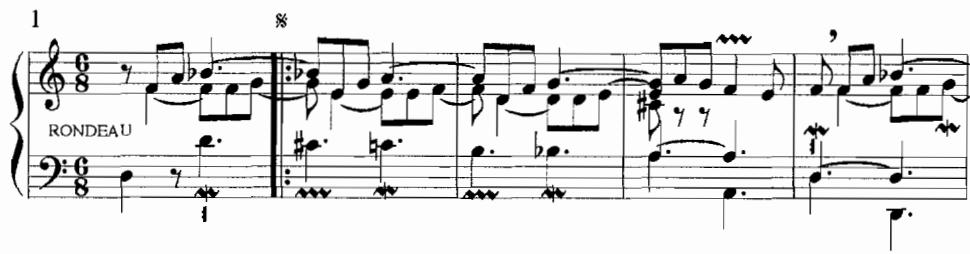
中文讲解
图占位符:第 49 页图像或乐谱示例(OCR 残留)。需查看原图。
补充说明
无额外补充;可能是 Example 3.6 的提示或非关键图像占位符。
第186段(P0186)
原文复述
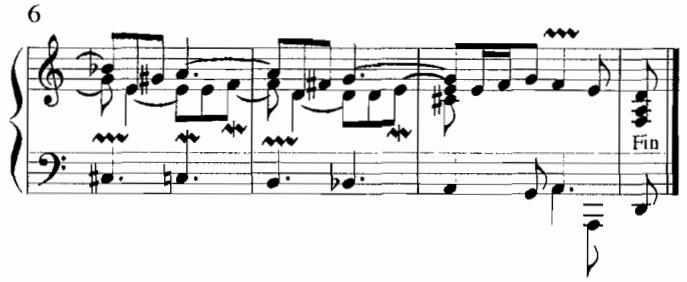
中文讲解
图占位符:Example 3.6——La Muse-Plantine, 第 1-9 小节, 第 19 ordre (1722), F. Couperin。需查看原图。
补充说明
该谱例是 La Muse-Plantine 分析的核心视觉资料。
第187段(P0187)
原文复述
though the three voices are really acting as one — the result of which engenders a swaying quality as the figurations in the melody and alto move us gently back and forth in continual motion.
中文讲解
本段续接 P0184:……三个声部实际作为一体行动——其结果是当旋律与中音声型以持续运动轻柔地来回移动时产生摇摆的特质。这是 La Muse-Plantine 关键情感特征——“摇摆"而非"哀叹”——的形式来源。
补充说明
“swaying quality” 与狄朵悲歌"走向死亡的下行步伐"形成对照,是语境转换的物理隐喻体现。
第188段(P0188)
原文复述
However, there is a harmonic instability and mobility that become instantly apparent at the downbeat of measure one. The bass enters at this moment on 1̂. The melody begins on the second eighth note and arpeggiates the third and fifth scale degrees (F and A) of the chord of the tonic. It then continues its ascent to Bb (b6̂) to initiate a chain of 7—6 suspensions with the bass that continue until the resolution of the tetrachord on the downbeat of measure four. With the exception of the dance-like meter and the arpeggiation of additional chord tones of the implied diminished sonority in the melody prior to the resolution of each suspension, the intervallic relationship between the outer voices in the first four measures is typical. Moreover, it is virtually identical to the model progression in Example 3.5. The structural relationship of the outer voices for the first four measures of La Muse-Plantine, appear as a durational reduction in Example 3.7.
中文讲解
本段分析 La Muse-Plantine 的和声细节:然而第一小节正拍上和声不稳定性和流动性立即显现。低音此时在 1̂ 进入;旋律在第二个八分音符开始并琶音主和弦的三度与五度(F 与 A),然后继续上行至 Bb(b6̂)以开始与低音的 7-6 延留音链,该链持续至第四小节正拍上四音音列解决。除了舞曲拍号以及旋律中每次延留音解决前暗示减七音响的附加和弦音的琶音之外,第一至四小节中外声部之间的音程关系是典型的;事实上实质上与 Example 3.5 中的模型进行相同。La Muse-Plantine 第一至四小节外声部的结构关系以时值缩简形式出现在 Example 3.7 中。
补充说明
“arpeggiates” 指分解和弦进行;“diminished sonority” 在延留音解决前短暂出现。
第189段(P0189)
原文复述
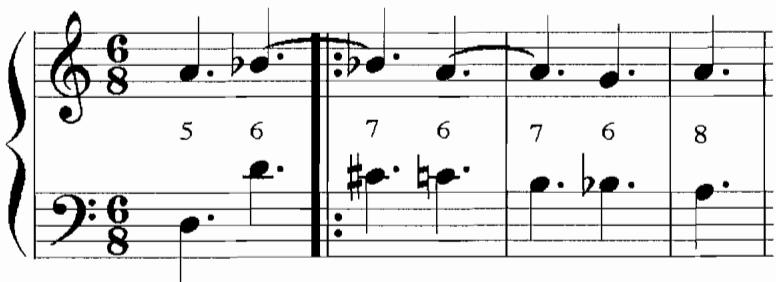
中文讲解
图占位符:Example 3.7——La Muse-Plantine, 第 1-4 小节, 第 19 ordre (1722), F. Couperin;外声部时值缩简。需查看原图。
补充说明
该图通过时值缩简清晰展示半音 lamento 四音音列结构关系与 Example 3.5 模型相同。
第190段(P0190)
原文复述
Despite this typical activity in these opening measures, there remains constant mobility that undermines any real sense of solid “footing” throughout this passage. The staggered entrance of the bass and melody has a little to do with it, as we do not necessarily experience a clear stable beginning prior to the melody’s immediate ascent to be to begin its chain of suspensions over the bass. But this is not the only contributing factor.
中文讲解
本段分析 La Muse-Plantine 开篇尽管结构与 lamento 模型相同,但体验不同:尽管这些开篇小节有此典型活动,但仍存在持续的运动性,破坏任何实在的"立足"感。低音与旋律的错开进入与此略有关系,因为我们不一定能在旋律立即上行开始其低音上方延留音链之前体验到清晰的稳定开始。但这并非唯一因素。
补充说明
“solid footing” 与狄朵悲歌"走向死亡的下行步伐"形成对比——这里是"无稳定立足"的持续运动感。
第191段(P0191)
原文复述
Not only are the intervals between the outer voices typical, the entire progression of chords (and intervals) is typical as well. Consider the durational reduction of the first four measures of La Muse-Plantine in Example 3.8.
中文讲解
本段确认 La Muse-Plantine 的结构典型性:不仅外声部之间的音程是典型的,整个和弦(与音程)的进行也是典型的。请考虑 Example 3.8 中 La Muse-Plantine 第一至四小节的时值缩简。本段是 P0190 论证的延续,确认 La Muse-Plantine 与 lamento 模型在结构上几乎一致但体验不同——这正是"相同模式不同意义"的方法学论断的实证支撑。
补充说明
Example 3.8 见 P0191 后页面(page 50 之后未在本节范围内提供),需查看后续内容。
💡 本节核心要点
🔑 关键术语
- Schenkerian analysis:以 Heinrich Schenker 理论为基础的层级音乐分析方法,区分背景(背景结构/Ursatz)、中间层与前景,通过符干与连线记谱法标示声部进行的结构等级;在本研究中用于揭示 Couperin 音乐中的中间层关系。
- Ursatz:Schenker 理论中的基本结构,即背景层最具综合性的线性进行;为音乐层级的最深骨架。
- schema (Gjerdingen):Robert Gjerdingen《Music in the Galant Style》中定义的概念,指 galant 风格作曲家共享的固定乐汇模型(如 Do-Re-Mi、Prinner、Romanesca 等),构成 galant 音乐家的 zibaldone 核心。
- zibaldone:意大利语,本义为杂记簿;Gjerdingen 用此比喻 galant 音乐家习得的乐汇库,作为作曲家与听众之间的"对话"基础。
- Do-Re-Mi schema:Gjerdingen 命名的 galant 风格 schema 之一,特征为上方声部上行三度(1̂-2̂-3̂)配以下方声部下邻音进行(1̂-7̂-1̂);在 Couperin 作品中频繁出现,是 La Florentine 等曲的核心模式。
- Phrygian tetrachord (lamento tetrachord):下行四音音列(典型为 8̂-b7̂-b6̂-5̂ 或 5̂-b6̂-b7̂-1̂),在历史上关联悲伤哀歌(lamento),但作为 Phrygian 终止或平衡上行 gambit 的下行模式可表达非悲伤意义;Gjerdingen 称之为 Phrygian 四音音列模式。
- musical forces (Larson):Steve Larson 提出的三种音乐力:音乐重力(上方音倾向下行至参照平面)、音乐磁性(不稳定音移向最近稳定音,距离越近磁吸力越强)、音乐惯性(旋律运动按已感知模式继续);用以解释声部进行模式的行为与意义。
- elision (Larson):在 Larson 模式理论中指两个三/四音模式共享一个音而产生的连续性,是模式扩展形成更大旋律的主要方式。
- cognitive metaphor theory (Lakoff & Johnson):George Lakoff 与 Mark Johnson 在《Metaphors We Live By》(1980) 中提出的概念,主张抽象概念基于隐喻——基础隐喻根植于身体经验,复杂隐喻由多个基础隐喻与隐喻习语组合;本研究用于解释如何为模式行为赋予意义。
- primary metaphor:Lakoff & Johnson 划分的隐喻类别之一,根植于物理经验与身体与世界互动,如 AFFECTION IS WARMTH、TIME IS MOTION、KNOWING IS SEEING;为基础隐喻层级。
- complex metaphor:由多个基础隐喻、其他复杂隐喻与隐喻习语组合而成的隐喻,如 LOVE IS A JOURNEY;其映射具有多重性但非无限,因仍受身体经验约束。
- metaphorical idiom:Lakoff & Johnson 概念,指带有具体固定意象的隐喻表达(如 “spinning one’s wheels”),随语句激活整套概念映射;用于本研究隐喻映射阶段。
- MOVING MUSIC metaphor:本研究的核心隐喻之一,把音乐行为映射到物理运动,使用 leap、step、walk、fast、reach、pass 等具身词汇描述音乐;与 Larson 音乐力理论相呼应。
- embodied meaning:具身意义,强调抽象概念的隐喻最终根植于身体与世界的物理经验;保证复杂隐喻映射的多重性虽存在但非无限。
- pattern (in this study):本研究中术语"模式"有三种用法:(1) Schenkerian 声部分析中浮现的音高/节奏重复行为;(2) Larson 三/四音声部进行模式;(3) 与 Gjerdingen 的 schema/gambit 互换使用;与 gesture、figure 等表层术语有边界区别。
- X-shaped method diagram (Figure 2.2):综合方法的视觉总图,呈 X 形分四象限:左上具体音乐材料、右下抽象情感反应、左下抽象隐喻习语、右上具体解释/综合;四箭头方向表示从观察到意义赋予再到反馈的循环。
- rondeau:ABACADA 或类似结构的回旋曲式;La Muse-Plantine 的体裁,其重复段落使 lamento 四音音列在每次重复中获得语境差异。
- ordre:Couperin 大键琴曲集按调高组织的分组单位;本研究中提及第二 ordre(La Florentine)、第十三 ordre(Les Folies françaises、L’Âme-en peine)、第十九 ordre(La Muse-Plantine)等。
- D’une légèreté tendre:La Florentine 的法文演奏标记,含义可解读为"以温柔轻盈"或"温柔中带轻率",是分析中映射"礼貌地喋喋不休"与"犹豫地运动"双重意义的关键文本。