目录
C4 Chapter 4 Metrical Structure
- S4.0 [描述性拆分] Chapter Overview and Metrical Formalism
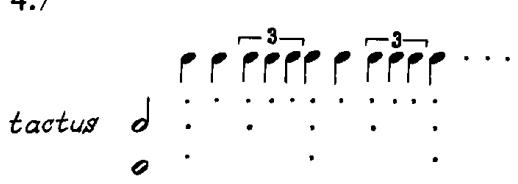
- 页码:1-1
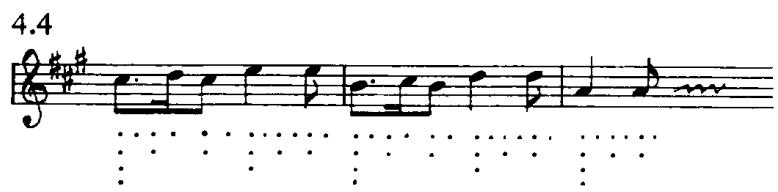
- S4.1 [描述性拆分] 4.1 First Approximation: MWFRs 1–4
- 页码:2-3
- S4.1.2 [描述性拆分] Second Approximation: Tactus and Refined MWFRs
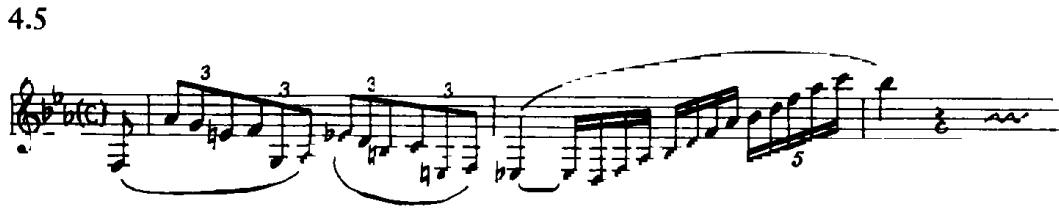
- 页码:3-5
- S4.1.3 [描述性拆分] Choosing the Tactus: Speed, Note Values, and Harmonic Rhythm
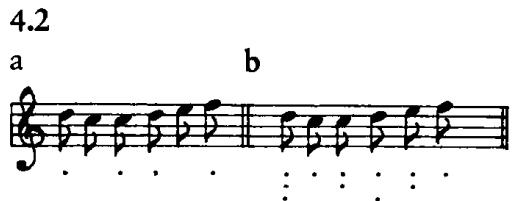
- 页码:5-7
- S4.1.4 [描述性拆分] Transition from Well-Formedness to Preference Rules
- 页码:7-7
- S4.2.1 [描述性拆分] 4.2 Parallelism (MPR 1) and Connection with Grouping (MPR 2)
- 页码:7-9
- S4.2.2 [描述性拆分] Inception of Events (MPR 3)
- 页码:9-11
- S4.2.3 [描述性拆分] Local Stress (MPR 4)
- 页码:11-12
- S4.2.4 [描述性拆分] Length (MPR 5): Pitch-Event, Dynamics, and Slurs
- 页码:13-15
- S4.2.5 [描述性拆分] Length Generalizations: Articulation, Pitch Repetition, and Harmonic Rhythm
- 页码:15-17
- S4.2.6 [描述性拆分] Relative Strengths of MPR 5 Subrules
- 页码:17-18
- S4.2.7 A Linguistic Parallel
- 页码:18-18
- S4.2.8 [描述性拆分] An Example: Mozart G Minor Symphony Eighth-Note Level
- 页码:18-19
- S4.2.9 [描述性拆分] Mozart G Minor Symphony: Quarter-Note and Higher Levels
- 页码:19-20
- S4.3.1 [描述性拆分] 4.3 Bass, Cadence, and Suspension (MPRs 6–8)
- 页码:20-22
- S4.3.2 [描述性拆分] Time-Span Reduction Interaction (MPR 9)
- 页码:22-23
- S4.3.3 [描述性拆分] A More Difficult Example: Haydn Quartet op. 76, no. 6 — Setup and Eighth-Note Level
- 页码:23-25
- S4.3.4 [描述性拆分] Haydn Quartet: Quarter-Note Level Derivation
- 页码:25-26
- S4.3.5 [描述性拆分] Haydn Quartet: Dotted-Half Level and Comparison with Mozart
- 页码:26-29
- S4.4.1 [描述性拆分] 4.4 Variations on the Metrical Well-Formedness Rules
- 页码:29-32
- S4.5.1 [描述性拆分] 4.5 Metrical Irregularities at Hypermeasure Levels: Binary Regularity and Grouping Interaction
- 页码:32-34
- S4.5.2 [描述性拆分] Metrical Deletion Rule: First and Second Versions
- 页码:34-37
S4.0 [描述性拆分] Chapter Overview and Metrical Formalism
第1段(P0001)
原文复述
This chapter is concerned with the information the listener uses to associate a metrical structure with a musical surface. As in the grouping component, the principles governing this association are divided into well-formedness rules and preference rules. The former define the set of possible metrical structures, and the latter model the criteria by which the listener chooses the most stable metrical structure for a given musical surface. We begin with well-formedness rules, then turn to preference rules. Sections 4.4 and 4.5 present further discussion of well-formedness rules.
中文讲解
本段开宗明义地交代第四章的总目标:解释听者究竟依据哪些信息把一个节拍结构(metrical structure)关联到一段音乐表层(musical surface)上。
这里的关键词是"associate a metrical structure with a musical surface"——节拍结构本身是听者构建出来的认知对象,音乐表层则是实际听到的事件流。作者把这两者之间的"对接规则"一分为二:
- well-formedness rules(良构规则)——决定哪些节拍结构在形式上是合法的,即定义"可能"的节拍结构集合;
- preference rules(偏好规则)——在所有合法的备选结构中,模拟听者如何根据某些标准挑出最稳定的那一个。
这种"可能+偏好"的两层划分与第3章 grouping component(分组成分)的处理方式一致,作者用"As in the grouping component"明确提示读者这是延续之前的理论框架。读者在此应意识到:良构规则是必要条件,偏好规则是充分条件;两者缺一不可,否则既无法穷尽可能结构,也无法解释为什么听者最终稳定地"锁定"在某个结构上。
最后一句是路线图:先讲良构规则(4.1–4.3),再讲偏好规则(4.6 起),而 4.4 和 4.5 是对良构规则的进一步讨论。这一句暗示本章不会严格按"先讲完一类再讲另一类"展开,良构规则的内容会跨越多个小节重复出现。
补充说明
本段中的"grouping component"指本著前文第3章已建立的分组层级理论,作者用"As in the grouping component"一句与第3章的规则分类方法形成跨章呼应,使读者预期本章将沿用同样的 well-formedness / preference 二分思路。
第2段(P0002)
原文复述
To review the formalism for metrical structure, recall that each row of dots below the music symbolizes a level of metrical structure. If a beat at a given level L is also a beat at a larger level, we call it a strong beat of L; if it is not, it is a weak beat of L. Example 4.1 illustrates the formalism.
中文讲解
本段是形式化符号体系的复习与关键定义。
第一句说明图示约定:在乐谱下方画的每一行点(dots)代表一个层级的节拍结构。换言之,节拍结构不是被直接听到的单一对象,而是由若干并列的层级组成的复合图式,作者用点行的堆叠来表征这种层级性。
第二句给出强拍与弱拍的定义,这是本段的核心定义:
- 给定层级 L 上的一个 beat,如果它同时也是更大层级上的 beat,则称其为 L 的 strong beat(强拍);
- 若不是更大层级上的 beat,则为 weak beat(弱拍)。
理解这一点的关键在于"强/弱"是相对的、相对于层级 L 而言的。一个事件可能在某一层级是强拍,在另一层级却是弱拍——这正是节拍层级之间嵌套关系的本质。
最后一句"Example 4.1 illustrates the formalism"把读者引向具体示例(即下一段将讨论的例子),表明本段只负责"定规矩",具体演示留给 Example 4.1 与下一段。
补充说明
本段提到的"Example 4.1"是教材中第一个正式的节拍结构示例,下一段将结合它展开具体讨论;本段本身不引用任何具体小节或音符位置,所有例子性内容均由下一段承担。
第3段(P0003)
原文复述
At the eighth-note level the beats at 2, 5, 8, and 11 are strong and all other beats are weak. In turn, at the dotted quarter-note level 2 and 8 are strong and 5 and 11 are weak. At the dotted half-note level 2 and 8 are beats; however, since no larger level of beats is present in this structure, the distinction strong-weak at this level is undefined. It is the interaction of different levels of beats (or the regular alteration of strong and weak beats at a given level) that produces the sensation of meter.
中文讲解
本段以 Example 4.1 为对象,把上一段的强/弱拍定义落实到三个层级的具体节拍位置上。
第一个层级——eighth-note level(八分音符层):2、5、8、11 是 strong beat,其余所有位置都是 weak beat。这说明八分音符层本身就构成一个完整层级,里面已经有规则交替的强弱。
第二个层级——dotted quarter-note level(附点四分音符层):2 和 8 是 strong beat,而 5 和 11 则变成 weak beat。这是理解层级嵌套的关键:5 和 11 在八分音符层是 strong beat,但在附点四分音符层却成了 weak beat。这说明强/弱是相对概念,同一个事件在不同层级会有相反的属性。
第三个层级——dotted half-note level(附点二分音符层):2 和 8 仍然是 beats,但因为没有比它更大的层级存在,“强/弱"这一区分在这里没有定义。这反映了形式体系的边界:只有当一个层级之上还有更大的层级时,强弱之分才有意义。
最后一句是本节最重要的理论断言:节拍感(sensation of meter)并非由某一个层级单独产生,而是不同层级之间的相互作用——或者等价地说,同一层级上 strong 与 weak beat 的规律交替——共同造成的。这一句为本章后面讨论 well-formedness rules 和 preference rules 提供了形式上的立足点:如果 meter 来源于层级互动,那么良构规则必须保证这种互动是可能的,偏好规则则负责在多个合法方案中挑出最稳的那一个。
补充说明
数字 2、5、8、11 对应 Example 4.1 中以小节为参考的节拍位置序号,其具体音符排列需结合原图查看;本段本身只描述层级关系,不引入新的概念术语。
脚注 / 边栏 / 图表 / 附加信息(如有)
本小节(S4.0, Chapter Overview and Metrical Formalism)位于第4章首页,仅包含 3 段正文性段落,无脚注、页眉页脚、图标题或边栏内容。“Example 4.1"是教材中第一个节拍结构图示,其完整图形不在本段文本之内,但被本节反复引用作为形式化符号体系的演示样本。
💡 本节核心要点
- 第4章的研究对象是听者用来把节拍结构与音乐表层相关联的信息,理论框架沿用第3章 grouping component 的 well-formedness rules / preference rules 二分法。
- 良构规则定义"可能"的节拍结构集合,偏好规则定义听者如何在其中选择"最稳定"的那一个;两者共同决定最终的节拍解读。
- 节拍结构被形式化为乐谱下方的若干行点,每一行代表一个层级;强拍与弱拍是相对于层级 L 的相对概念。
- 强拍的定义是:在层级 L 上是 beat,同时在比 L 大的层级上也是 beat;否则为弱拍。
- 同一事件在不同层级可能具有相反的强弱属性(如 5、11 在八分音符层为强,在附点四分音符层为弱),这是层级嵌套的体现。
- 节拍感(meter)源于不同层级之间的相互作用,以及同一层级上强弱拍的规律交替,这是本章后续规则的出发点。
🔑 关键术语
- metrical structure:节拍结构,指由若干层级的强弱拍构成的形式化层级图式,是听者认知中构建出来的对象,不是直接物理存在于声音中。
- musical surface:音乐表层,指实际可听到的音符事件流;节拍结构需要被关联(associate)到这一表层之上。
- well-formedness rules:良构规则,定义哪些节拍结构在形式上是合法的,即决定"可能"的节拍结构集合;本节规定其先于偏好规则讨论。
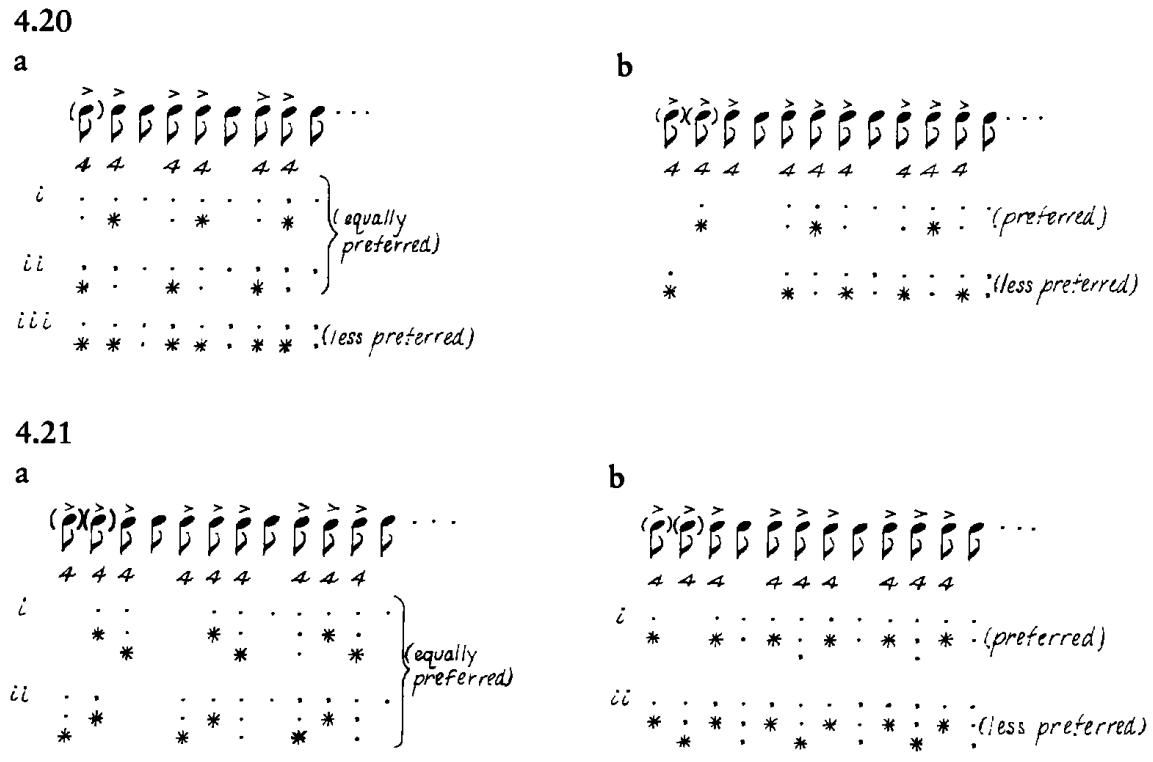
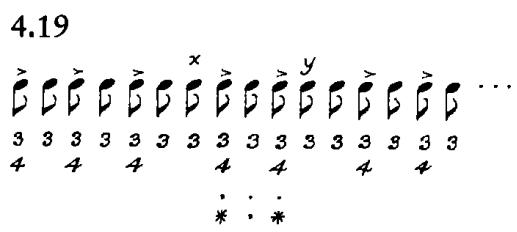
- preference rules:偏好规则,在所有合法节拍结构中模拟听者挑选最稳定结构的准则,作用于良构规则划定的可能集合之上。
- beat (of a level L):层级 L 上的节拍位置,是构成该层级点行的基本单元。
- strong beat / weak beat of L:L 的强拍/弱拍:在层级 L 上是 beat 且同时是更大层级 beat 的为 strong beat,否则为 weak beat;强弱是相对于 L 的相对属性。
- sensation of meter:节拍感,指听者所体验到的拍子律动;本节明确指出它产生于不同层级 beats 的相互作用以及同一层级上强弱拍的规律交替。
- Example 4.1:本节引用的第一个节拍结构示例图,演示八分音符层、附点四分音符层、附点二分音符层三层级上的强弱拍分布,是后续良构规则讨论的视觉基础。
S4.1 [描述性拆分] 4.1 First Approximation: MWFRs 1–4
第1段(P0004)
原文复述
This section first states a simple set of well-formedness rules for metrical structure in tonal music. It then points out a number of empirical problems with these rules and suggests how to improve them.
中文讲解
本段是 4.1 节的开篇导言,交代本节的双重任务:先给出一组简化的"节拍结构良态规则”(MWFRs),用以形式化描述调性音乐中的节拍层级;随后指出这套规则在经验上遇到的若干问题,并提示后续改进方向。作者把规则呈现与规则修正合并在同一节中,意味着读者此时看到的 MWFR 1–4 只是一个"初步近似”(first approximation),而非最终的理论结论。这是一种典型的"先建立简单模型,再通过反例推动模型精细化"的研究策略:初始规则既要足够简单以便于陈述,又要能够被反例攻击,从而为引入后续小节中的限定、变换规则与体裁特殊处理留出空间。
补充说明
“Well-formedness rules”(良构/良态规则)这一术语借自生成语言学(Chomsky 早期提出的 grammaticality/ well-formedness 概念),本节将节拍结构类比为一种形式系统,靠规则约束合法结构;但此处作者并未展开该类比的理论史,仅作为术语使用。
第2段(P0005)
原文复述
First approximation
中文讲解
这是 4.1 内部的子标题"初步近似",用三/四个单词提示读者:接下来四条 MWFR 是对节拍结构的最简化描述,刻意忽略了许多复杂情况。它与本节总标题"First Approximation: MWFRs 1–4"中的"First Approximation"呼应,强调这些规则是研究的第一步,不是定论。
第3段(P0006)
原文复述
The first well-formedness rule establishes the relation of beats to attack points.
中文讲解
本段是引入 MWFR 1 的过渡句,明确该条规则的功能定位:建立"拍点(beats)“与"音头/发音点(attack points)“之间的关系。之所以单独立一条规则处理这一关系,是因为节拍层级最细小一层与"实际发声的位置"之间的对应是节拍理论最基础的约定:音乐的物理事件(每个被演奏出的音起始处)必须能被节拍系统捕捉。理解这条规则的关键在于:它把节拍系统从纯抽象的时间网格,绑定到了具体的演奏事件上。
补充说明
“attack point"在本节中指乐音被触发(弓触弦、键按下、气息开始等)的瞬间,它是对"何时发出声响"的事件性描述,与音的持续长度无关。
第4段(P0007)
原文复述
MWFR 1 Every attack point must be associated with a beat at the smallest level of metrical structure.
中文讲解
MWFR 1 的完整表述:每一个发音点(attack point)都必须与节拍结构最细小一层的某个拍点相对应。它的直观含义是:音乐中所有被实际演奏出的音,其起始时刻必须正好落在节拍网格最细一格的某个拍上。这条规则默认了节拍系统中存在一个最细粒度的小层(smallest level),它的存在先于其他更高层;任何一个可听到的音都"坐"在这层拍点上,没有遗漏。理解了 MWFR 1 之后要意识到,它的严格性恰恰为反例攻击提供了空间——后文将指出并非所有发音点都严格落在最小层拍点上,于是需要对该规则进行修正。
第5段(P0008)
原文复述
The second rule establishes the relationship among metrical levels.
中文讲解
本段是引入 MWFR 2 的过渡句,交代该条规则的功能:在节拍结构的各个层级(metrical levels)之间建立关系。MWFR 1 处理的是"拍点 ↔ 音"这一对外对应,MWFR 2 则处理层级之间的"向上相容”,即较低层的拍点必须同时被纳入较高层节拍系统之中。两者的分工是:MWFR 1 把节拍锚定到物理事件,MWFR 2 保证节拍自身在垂直方向上是自洽的。
补充说明
“metrical levels"指节拍结构的分层(例如二分拍、四分拍、八分拍等构成的多层网格),每一层由一组等间距的拍点组成,层级之间通过拍点的包含关系彼此关联。
第6段(P0009)
原文复述
MWFR 2 Every beat at a given level must also be a beat at all smaller levels.
中文讲解
MWFR 2 的完整表述:在某一层级上的每一个拍点,也必须是所有更小层级上的拍点。其直观含义是节拍层级具有"嵌套一致性”:当某层的一个拍点确立后,比它更细的所有层在该时刻也都必须"同时打拍”。例如四分音符层的一个强拍,也必定是八分音符层和十六分音符层在同一时刻的拍点;反之,一个拍点属于小层(如十六分音符层)却未必属于大层(八分音符层),大层只是从所有小层拍点中"每隔若干个"再选一次。该规则保证了多层节拍网格的垂直对齐,没有错位。
补充说明
“smaller levels"在此指时间分辨率更细、即间距更短的一层;层级越"小”,单位拍的时间间隔越短,能容纳的拍点越多。
第7段(P0010)
原文复述
Example 4.2a, in which not every note corresponds to a beat, illustrates a violation of MWFR 1. Example 4.2b is a violation of MWFR 2; the second beat on the largest level is not also a beat on the intermediate level.
中文讲解
本段通过两个具体反例(Example 4.2a 和 4.2b)说明 MWFR 1 与 MWFR 2 的边界。4.2a 中存在"并非每个音都对应拍点"的现象,因此违反了 MWFR 1 关于"每个发音点都必须挂在最小层拍点上"的要求;4.2b 的违规则发生在层级之间——在大层上的第二个拍点,并不同时也是中间层的拍点,因此违反了 MWFR 2 的嵌套一致性。这两个例子的教学意义在于:把抽象规则变成可观察的图形错误,使读者能够用眼睛直接看到"规则失败在哪里”,从而真正理解规则的实质条件而不是记住它的字面。
补充说明
“intermediate level"指介于最小层与最大层之间的某一节拍层;多层节拍通常至少有"小 / 中 / 大"三层。
第8段(P0011)
原文复述
中文讲解
这是第 2 页上 Example 4.2 的图像或乐谱占位符,原文标注为"第2页图像或乐谱示例”,内嵌数据已省略,但位置与图注(指向 4.2a、4.2b 两个反例)保留。读者需查阅原书图 4.2 才能直观比较两个反例分别违反 MWFR 1 与 MWFR 2 的具体音符位置与节拍标注。在没有原图的情况下,仅依据 P0010 的文字描述可以把握:4.2a 显示某音不在最小层拍点上,4.2b 显示大层第二拍点与中间层不对齐。
补充说明
无额外补充(具体乐谱细节需查看原图)。
第9段(P0012)
原文复述
MWFRs 1 and 2 are defining conditions for metrical structures and are universal. (However, see the next subsection for refinements.)
中文讲解
本段给出 MWFR 1 与 MWFR 2 的理论地位:它们不是某一体裁特有的偏好,而是"节拍结构之所以为节拍结构"的定义性条件,因此具有跨体裁、跨文化的普遍性(universal)。这与下文的 MWFR 3、MWFR 4 形成对比:后两者承载的是具体体裁内的偏好。括号中的提示则提醒读者:所谓"普遍"只是当前框架内的定义,并非永远不可触动——下一小节将基于经验反例对这两条规则进行精细化修正。因此本段在为规则划定范围的同时也预告了即将到来的修正。
补充说明
“universal"在此并不意味着经验上从未被违反,而是指"如果违反就不再能称之为节拍结构”——它处于理论的定义层,而不是经验层。
第10段(P0013)
原文复述
The other MWFRs define the metrical regularities possible within a given musical idiom. Since metrical traditions differ, these MWFRs are idiom-specific. Some other idioms are discussed in section 4.4. For classical Western tonal music, the necessary rules are MWFRs 3 and 4.
中文讲解
本段把规则的性质做了关键二分:除 MWFR 1、2 之外的其他 MWFR(如本节中的 3、4)刻画的是某一特定音乐体裁(idiom)内部的节拍规律,因此是体裁特殊的(idiom-specific)。由于不同音乐传统对节拍规律的偏好不同(例如某些传统允许五拍子循环,另一些则不容许),这些规则不能像 MWFR 1、2 那样宣称为普遍规则。作者特别指明:本节聚焦于"古典西方调性音乐"这一具体体裁,而其它体裁将在 4.4 节另行讨论。这就让读者明白 MWFR 3、4 不是"节拍"的普遍定义,而是"古典调性音乐中的节拍"的具体刻画,其适用范围需要被注意。
补充说明
“idiom"在作者笔下特指一种具有自身惯例的音乐语言传统,古典调性音乐只是其中之一;4.4 节将横向比较不同 idiom 的节拍偏好。
第11段(P0014)
原文复述
MWFR 3 At each metrical level, strong beats are spaced either two or three beats apart.
中文讲解
MWFR 3 的完整表述:在节拍结构的每一层级上,强拍(strong beats)之间的间距只能是两个拍或三个拍。换言之,在任意一层,“每隔二拍出现一次强拍"或"每隔三拍出现一次强拍"是被允许的两种基本模式,且这两种模式还可以在不同层级间组合(例如一层二拍、一层三拍,形成 2×3=6 的复合节拍)。这条规则的实质是把"强拍的周期"限制为 2 与 3 这两个最小整数,从而排斥更大的间距。它的经验直觉来自古典调性音乐中常见的二拍子、三拍子,以及它们在多层节拍中的复合,而不允许出现"每隔六拍才一次强拍"这样的扁平层级(这种情况在经验上总会被细分为多个更细的层级,下一节将由反例 4.3a 来说明)。
补充说明
“strong beat"为节拍层级中具有结构性重音的拍点,通常对应小节线、拍号所标记的强位或次强位,与之相对的"weak beat"则不具有结构性重音。
第12段(P0015)
原文复述
MWFR 4 Each metrical level must consist of equally spaced beats.
中文讲解
MWFR 4 的完整表述:节拍结构的每一层级都必须由等间距的拍点构成。这是对节拍"周期性"的直接规定——同一层中相邻拍点之间的时长必须相等,不允许出现 5/8、7/8 这类同一层内拍间距不等的情况。该规则与 MWFR 3 共同保证了古典调性音乐节拍的"规整性”:MWFR 4 保证每一层自身是均匀的,MWFR 3 保证强拍的出现周期受限于 2 与 3。理解 MWFR 4 时要记住:它是古典调性音乐的特殊偏好(idiom-specific),并非节拍的普遍定义——后续段落会讨论它在某些作品中的稀有例外(如 5 拍子与 7 拍子的著名段落)。
第13段(P0016)
原文复述
MWFR 3 prohibits analyses like 4.3a, in which strong beats on the smaller level are six beats apart. In order for the structure to be well-formed an intermediate level must be added, either as in 4.3b or as in 4.3c.
中文讲解
本段以 Example 4.3 系列说明 MWFR 3 的判定方式。4.3a 中,小层强拍之间的间距为六个拍,这超出了 MWFR 3 所允许的 2 或 3,因而被该规则禁止。要使结构重新"良态化”(well-formed),必须在 4.3a 之上插入一个新的中间层:可以采用 4.3b 的方式(中间层每隔三拍设一强拍)或 4.3c 的方式(中间层每隔两拍设一强拍)来把六拍拆解为两个合法的小周期。这个例子的论证功能是:揭示出 MWFR 3 不仅描述结构,更规定结构——若遇到大间距的强拍,分析者必须识别出被隐含的中间层,从而把扁平结构重新描述为多层嵌套的合规结构。
补充说明
“intermediate level"在此具体指在小层和大层之间新插入的一层节拍;它的引入使原本被判为"违规"的节拍布局得以被解释为多层嵌套中的某一层,从而满足 MWFR 3。
第14段(P0017)
原文复述
4.3
中文讲解
这是 Example 4.3 的编号标签,提示读者此处的图示属于 Example 4.3 系列。
第15段(P0018)
原文复述
a
中文讲解
这是 Example 4.3 的子图标签"a”,对应 P0016 中提到的违规分析 4.3a。
第16段(P0019)
原文复述
(ill formed)
中文讲解
括号内的标注”(ill formed)“明确指出 4.3a 是被 MWFR 3 判定为不合法的节拍结构,与本段前一节的论断相呼应:六拍的强拍间距使该结构良态性失败。
补充说明
“ill formed"是"well-formed"的反义术语,指不符合良构规则的结构;在本例中,“不合规"的判定直接源自 MWFR 3。
第17段(P0020)
原文复述
. . . . . . . . . . . . . . . . . . . . . . .
中文讲解
这是一行点状占位符(dots),通常出现在原书乐谱或节拍图示中,用以表示重复或连续的拍点/音符。其具体内容需查看原图才能确认。
补充说明
无额外补充(具体节拍细节需查阅原图)。
第18段(P0021)
原文复述
4.1 Metrical Well-Formedness Rules
中文讲解
这是第 2 页的页眉之一,标注章节编号与标题:“4.1 Metrical Well-Formedness Rules”。它的版面作用是导航,告诉读者当前所在章节是"4.1 节拍良态规则”。
第19段(P0022)
原文复述
Metrical Structure
中文讲解
这是同一页的另一个页眉/页脚元素,标注本章主题"Metrical Structure”(节拍结构)。它的功能是标示出当前讨论所属的上位主题——本章整体讨论节拍结构,而非局限于 4.1 节。
第20段(P0023)
原文复述
MWFR 4 holds for the smaller levels of metrical structure in tonal music, with such extremely rare exceptions as the second movement of Tchaikovsky’s Pathetique Symphony (in five) and the third movement of the Brahms C Minor Trio op. 101 (in seven). In much of tonal music this metrical regularity also obtains beyond the measure level, producing regular “hypermeasures” of two, four, and even eight measures. $^{1}$
中文讲解
本段讨论 MWFR 4 在调性音乐中的实际覆盖范围与例外。其主张有三层:(1)MWFR 4 在调性音乐的较小层级上是成立的;(2)存在极稀有的例外——柴可夫斯基《悲怆交响曲》第二乐章(5 拍子)与勃拉姆斯《c 小调三重奏》op. 101 第三乐章(7 拍子)——它们的同一层内拍间距并不相等;(3)在大多数调性音乐中,这种等间距的规律还会向上延伸至小节之上,产生由两小节、四小节甚至八小节构成的"超小节”(hypermeasures)。这里的"超小节"概念至关重要:它表明节拍系统并非止于小节线,而是可以在更大的时间尺度上继续延伸出有规律的层级。脚注 1 标记了 hypermeasure 概念的进一步来源或解释,需查阅本页脚注以补全引用细节。理解本段时要特别注意:作者虽然举出了两个著名的反例,但仍然坚持 MWFR 4 在绝大多数情况下成立,并把例外留到 4.5 节作为"节拍删除"(metrical deletions)现象另行处理。
补充说明
“hypermeasure"指小节之上的更高节拍层级,由若干小节构成一个更高级别的"拍循环”,类似于在小节之内建立多层节拍的逻辑在小节之外继续延伸。
第21段(P0024)
原文复述
In music where regular hypermeasure metrical levels are sensed, certain irregularities are heard as metrical deletions—violations of the metrical regularity required by MWFR 4. As with grouping overlaps and elisions, we do not account for these irregularities by dropping MWFR 4 altogether; we add a transformational rule that modifies permissible metrical structures in a constrained way. We deal with hypermeasure irregularities and metrical deletions in section 4.5.
中文讲解
本段是本节的收束段落,提出一个重要的方法论决定:如何处理超小节层级上的不规则性。作者指出,当听者感受到规整的超小节层级时,其中的某些不规则会被听作"节拍删除"(metrical deletions)——即视为对 MWFR 4 所要求的规整性的局部违反,而不是抛弃整个 MWFR 4。关键的论证在于:作者将这种处理策略与"组合重叠与省略"(grouping overlaps and elisions)类比,表明这是一种更一般的方法论——保留底层规则,但额外引入变换规则(transformational rule),以受约束的方式修改合法的节拍结构。这种做法的好处是:底层规则保持简洁与可预测,例外则通过受控的"变换"被纳入同一理论框架。这也为 4.5 节的"节拍删除"分析埋下伏笔,使读者明确知道:MWFR 4 不会被简单否定,而是会被保留并扩展。
补充说明
“metrical deletion"指听感中某个节拍位置上"应该有"一个拍点却缺席的情形,作者将其视为对 MWFR 4 规整性的局部违反,并以变换规则而非规则否定来加以刻画。“transformational rule"是该理论框架中处理例外的工具,与底层"well-formedness rule"分工合作。
💡 本节核心要点
🔑 关键术语
- MWFR (Metrical Well-Formedness Rule):节拍良构/良态规则,指约束合法节拍结构的形式条件,本节中包括 MWFR 1–4 四条;其中 1、2 是普遍定义,3、4 是古典调性音乐体裁的特殊偏好。
- attack point:发音点/音头,指一个乐音被触发的瞬间;MWFR 1 要求所有发音点都对齐到最小层节拍网格上。
- metrical level:节拍层级,指节拍结构中由等间距拍点构成的一层网格;层级之间通过"更小层的拍点也是更大层拍点"的包含关系彼此嵌套。
- beat:拍点,节拍网格上某一时刻的位置;同一层级内相邻拍点等间距,不同层级之间通过 MWFR 2 相互嵌套。
- strong beat:强拍,节拍层级中具有结构性重音的拍点;MWFR 3 规定强拍在同一层中的间距只能是 2 或 3。
- hypermeasure:超小节,由若干小节构成的高于小节层的节拍层级,常见为 2、4、8 小节一组,是 MWFR 4 在小节之上的延伸。
- metrical deletion:节拍删除,听感上某位置"应出现"拍点却缺席的情形;本节把它视为对 MWFR 4 规整性的局部违反,由变换规则而非规则否定来处理。
- transformational rule:变换规则,理论中用于在保持底层良构规则的同时,以受约束方式修改合法结构的辅助规则;本节中用于刻画超小节层级的不规则性。
S4.1.2 [描述性拆分] Second Approximation: Tactus and Refined MWFRs
第1段(P0025)
原文复述
Second Approximation
中文讲解
This is the section heading that opens the new sub-section. The phrase “Second Approximation” signals to the reader that what follows is a revised, more refined version of the metrical theory introduced earlier (the “first approximation” represented by MWFRs 1–4). The section promises to keep the basic framework but adjust specific rules in light of descriptive problems encountered. The reader should therefore expect: (1) a diagnosis of where the original rules fail, and (2) a corresponding set of rule revisions rather than a wholesale new theory.
第2段(P0026)
原文复述
There are some difficulties in the account of metrical structure given by MWFRs 1–4. This section shows that some of these have a common source, and suggests some appropriate refinements.
中文讲解
本段是本节的总纲。作者承认证1–4在描写节拍结构时存在困难,但明确指出这些困难有一个共同的根源,因此本节不打算零敲碎打地修补,而是先诊断这一共同症结,再提出对应的修正。这个"共同根源"在后续段落中被揭示为:原规则把每一个节拍层级都当成同等显著,缺少对"tactus(拍感/基本拍级)“这一特殊感知层级的指定。读者在此处应理解:后面的论证是层层递进的——先指出原规则的两类缺陷(局部偏离、过度精细),再揭示它们背后更深层的形式问题(缺少特殊层级),最后给出有针对性的规则修订。
第3段(P0027)
原文复述
First, we have assumed that each metrical level has evenly spaced beats. In a passage played with rubato or with the numerous minute temporal inflections added by a sensitive performer, spacing is uneven in the musical surface. Normally, however, the listener treats these local deviations from the metrical pattern as though they did not exist; a certain amount of metrical inexactness is tolerated in the service of emphasizing grouping or gestural patterns. Though the study of such local metrical deviations is of interest to the theory of musical cognition, we have nothing more to say about it here.
中文讲解
本段讨论原规则的第一类困难:均距假设。MWFRs 1–4默认每一节拍层级的拍点都是等距的,但实际演奏中rubato(自由速度处理)和表演者的细微时间变化会使表层节奏偏离这一理想。关键论断是:听者倾向于把这类局部偏离"忽略”,允许一定的不精确性,以服务于分组或手势的强调。作者由此明确划定本节的研究范围——局部时间偏离虽属音乐认知的有趣课题,但本节不展开讨论。本段的作用是为后续修订做铺垫:它承认原规则在严格意义上是"理想化"的,但指出真正需要修正的是规则的形式结构问题,而非演奏中的微观偏离。
第4段(P0028)
原文复述
A problem that we will deal with, however, is an overexplicitness in the notation for metrical structure. Consider a piece with predominantly quarter-note and eighth-note motion, but with an occasional sixteenth note—the Mozart A Major Sonata again is a good example. Because of the presence of the sixteenth notes, the MWFRs require an overly fussy sixteenth-note level throughout the piece, as shown in 4.4.
中文讲解
本段提出原规则第二类困难的核心问题:描述的过度精确性(overexplicitness)。以Mozart A大调奏鸣曲为例:作品主体是四分音符和八分音符的律动,但偶尔出现十六分音符。按照原规则,整首作品都必须有一个十六分音符层级的连续结构,哪怕绝大部分小节根本不需要这一层级。这里"overly fussy"一词点出症结——原规则的形式化描写产生了描写上的负担(descriptive liability),即为了描写少数局部细节而不得不把整套层级在全局上强行铺开。作者由此引向图4.4作为示例,并准备在后续段落中将这一缺陷与Brahms例子联系起来分析。本段的论证意义在于:过度精确不只是繁琐,更会引出真正不可接受的描写结果。
第5段(P0029)
原文复述
Chapter 4
中文讲解
这是页面顶部或版心中的"Chapter 4"页眉/章节标识,属于版面元素,并非正文论证。其作用是标明当前内容所属的章节,便于读者定位。
第6段(P0030)
原文复述
中文讲解
此条为图4.4的图像占位符,原文以图像形式展示Mozart A大调奏鸣曲中的节拍结构示例,用以直观说明前述"过度精确"问题——十六分音符层级不得不贯穿全曲。该图承接P0028的论述,是P0028所提问题的可视化证据。需查看原图以确认谱例具体内容与标注。
补充说明
无额外补充(具体谱例细节须查阅原图)。
第7段(P0031)
原文复述
This overexplicitness becomes a descriptive liability in dealing with the not uncommon passages in tonal music that mix incommensurate subdivisions of the beat, such as example 4.5 (from the Brahms Clarinet Sonata op. 120, no. 2, measures 9–11).
中文讲解
本段将"过度精确"问题推向更严重的境地:当一段音乐混合使用不可通约的细分(incommensurate subdivisions)时,原规则会导致更糟糕的描写结果。作者特别强调这类混合细分在调性音乐中"not uncommon(并不罕见)",为下文的Brahms单簧管奏鸣曲op. 120 no. 2第9–11小节做铺垫。此处的"descriptive liability(描写负担)“比P0028中"overly fussy"更进一步:不再只是繁琐,而是产生了真正不合常理的描写结果。本段的论证作用是把P0028的"麻烦"升级为"症结”,从而为揭示共同根源提供更强的动机。
第8段(P0032)
原文复述
中文讲解
此条为图4.5的图像占位符,原文以谱例形式呈现Brahms单簧管奏鸣曲op. 120 no. 2第9–11小节,展示其中混合的不可通约细分(如三连音与二连音的并置),用以论证原规则在描写此类段落时会产生荒谬结果。该图是P0031所提问题的关键证据,并直接服务于P0033的论证。需查看原图以确认具体节奏内容。
补充说明
无额外补充(具体谱例细节须查阅原图)。
第9段(P0033)
原文复述
As stated above, MWFR 1 requires that each attack point in this passage be associated with a beat on the smallest level. MWFR 4 requires that this smallest level of beats must be equally spaced. Thus the smallest beat level must be spaced at the least common denominator of all the different subdivisions—in this case 1/60 of the quarter note, an absurdly small time interval.
中文讲解
本段把前文铺垫的描写负担具体化:原规则在Brahms例子中导出的形式结果是,最小节拍层级必须取所有不同细分的最小公分母——本例中为四分音符的1/60。作者用"absurdly small"明确表达这一结果不可接受。需要注意的是,作者在这里只是展示原规则严格推演的荒谬后果,并不否认基本直觉,而是借此论证规则需要修订。本段的论证意义在于:用具体数字(1/60 of quarter note)把"描写负担"从定性判断升级为可度量的荒谬性,从而无可辩驳地证明规则必须调整。
第10段(P0034)
原文复述
These mechanical difficulties in the formal notation reflect a more basic metrical intuition that the rules as stated fail to express. The metrical structures described by MWFRs 1–4 treat each metrical level, from smallest to largest, as though it is as salient as every other. Yet metrical intuitions about music clearly include at least one specially designated metrical level, which we are calling the tactus. This is the level of beats that is conducted and with which one most naturally coordinates foot-tapping and dance steps. When one wonders whether to “feel” a piece “in 4” or “in 2,” the issue is which metrical level is the tactus. In short, the tactus is a perceptually prominent level of metrical structure that the rules so far fail to designate as in any way special.
中文讲解
本段是本节论证的核心转折:从"规则的技术困难"上升为"直觉与形式规则的脱节”。关键论断是:原规则把所有节拍层级一视同仁,但音乐直觉中至少有一个层级被特别指定——即tactus(拍感/基本拍级)。作者用三个具体行为锚定tactus的内涵:指挥动作、脚踩拍、舞步,并指出"该把作品感受为4拍还是2拍"的问题本质就是哪一个层级是tactus。本段揭示了前文所有困难的共同根源:规则缺乏对tactus这一特殊感知层级的指定,从而把所有层级处理得同等显著。“In short"一句是本段的小结,也是后文修订规则的纲领——必须让tactus在形式上获得特殊地位。
第11段(P0035)
原文复述
We can incorporate this notion into the formal theory by designating a particular level in a metrical structure as the tactus. The tactus is required to be continuous throughout the piece, but levels smaller than the tactus are permitted to drop out when unnecessary. Normally, two or three metrical levels larger than the tactus are continuous as well, extending to what is usually notated as the measure level; regular metrical units of two and four measures are not uncommon. Example 4.6 illustrates the conception of metrical structure that arises from incorporating this notion of tactus. The tactus is either the eighth-note or the dotted quarter-note level; the sixteenth-note level appears only where an eighth-note level beat is subdivided in the surface.
中文讲解
本段开始将tactus概念形式化。核心规则是:tactus必须贯穿全曲,而小于tactus的层级在不必要时可以"drop out”(不必出现);大于tactus的两到三个层级通常也连续延伸至小节线层级,甚至更长的两小节、四小节单位也不罕见。图4.6展示了这一观念下的节拍结构——tactus可以是八分音符或附点四分音符层级,而十六分音符层级只在表层需要细分八分音符时才出现。本段的论证意义在于:把"tactus是特殊的连续层级"这一直觉转译为可操作的形式条件,并立刻提供可视化示例(例4.6),使读者直观看到修订后理论的描写如何比原规则更经济、更贴合直觉。
第12段(P0036)
原文复述
Metrical Structure
中文讲解
此为图4.6的图题(figure caption)。其作用是标注图4.6的主题——节拍结构(Metrical Structure)——即展示本节引入tactus后形成的节拍结构观念。它不是正文论证,而是图例的简短标签。
第13段(P0037)
原文复述
To accommodate this analysis, MWFRs 1 and 2 must be slightly modified as follows:
中文讲解
本段是规则修订的过渡句。“slightly modified"一词提示读者接下来的改动幅度不大,但具有关键意义:MWFRs 1和2必须从"全曲统一最小层级"改为"该点实际存在的最小层级”,从而允许subtactus层级在不需要时缺席。这一形式改动直接呼应P0035中"levels smaller than the tactus are permitted to drop out when unnecessary"的论断。
第14段(P0038)
原文复述
MWFR 1 (revised) Every attack point must be associated with a beat at the smallest metrical level present at that point in the piece.
中文讲解
本条是MWFR 1的修订版。修订要点在于"present at that point in the piece(在该点处存在的最小层级)"——这取代了原规则隐含的"全曲统一的最小层级"假设。修订后的规则允许每个发音点只需关联到该点处实际存在的最小层级,从而无需为局部出现的细分在整首作品中维持一个完整的细分层级。本规则的修订直接解决P0028所述的"overexplicitness"问题,使Mozart例子中的十六分音符层级不必贯穿全曲。
第15段(P0039)
原文复述
MWFR 2 (revised) Every beat at a given level must also be a beat at all smaller levels present at that point in the piece.
中文讲解
本条是MWFR 2的修订版,措辞与MWFR 1修订版呼应:加上"present at that point in the piece"这一限定。修订后的规则表示:某一层级的拍点同时是所有在该点处实际存在的更小层级的拍点,但若更小层级在该点不存在,则无此要求。本规则与MWFR 1修订版协同工作,使subtactus层级在局部缺席不再违反规则,保持了节拍层级间的从属关系(即大层级拍点必然"穿过"所有更小层级拍点)。
第16段(P0040)
原文复述
This modification is still not quite enough to deal with the Brahms example (4.5), since the quarter-note tactus cannot be subdivided in a uniform way throughout the passage, as required by MWFR 4. The intuition behind the tactus, however, is that its subdivision can be relatively free, whereas the alternation between strong and weak beats of the tactus is relatively fixed. This suggests that MWFR 4 be weakened for subtactus levels. The revised version of MWFR 4 is the point in the well-formedness rules where the tactus is explicitly mentioned:
中文讲解
本段指出MWFRs 1和2的修订对Brahms例子仍不充分:原MWFR 4要求tactus层级在全曲以统一方式细分,但Brahms段落中的四分音符tactus无法在整段中以统一方式细分。作者由此揭示tactus背后的核心直觉——tactus本身的强弱交替相对固定,而其细分相对自由。基于此,MWFR 4应当对subtactus层级放宽要求。本段还预告:修订后的MWFR 4将是整套规则中tactus概念被明确提及之处,标志着tactus从直觉假设正式进入形式规则。
第17段(P0041)
原文复述
MWFR 4 (revised) The tactus and immediately larger metrical levels must consist of beats equally spaced throughout the piece. At subtactus metrical levels, weak beats must be equally spaced between the surrounding strong beats.
中文讲解
本条是MWFR 4的修订版,是整套规则中tactus概念被首次明文写入之处。修订包含两层:第一,tactus及其直接更大的层级必须在全曲保持等距(即等距要求仍适用于这些层级);第二,subtactus层级只需满足"弱拍在相邻强拍之间等距"即可。这一修订的精妙之处在于:它既保留了大层级(tactus及以上)的等距稳定性以维持整体律动的清晰,又允许subtactus层级采取灵活细分(如Brahms段落中三连音与二连音并置),解决了P0033所述1/60荒谬性问题,同时不破坏直觉中的强弱交替结构。
第18段(P0042)
原文复述
This revision makes the tactus the minimal metrical level that is required to be continuous (though there is nothing prohibiting smaller levels from being continuous too). It also permits the tactus to be subdivided into threes at one point and twos at another, as long as particular beats of the tactus are evenly subdivided.
中文讲解
本段阐明MWFR 4修订版的两个推论。第一,tactus成为形式上要求连续的最下层级(“minimal metrical level that is required to be continuous”),而更小层级可以连续也可以不连续,没有强制要求。第二,tactus可以在不同点采用不同细分方式(如三连音与二连音的并置),只要在该点上tactus的某个具体拍是被均匀细分的即可。这两个推论共同使修订后的规则能描写Brahms段落中不可通约细分的情形,又不牺牲"tactus本身连续等距"这一核心直觉。
第19段(P0043)
原文复述
The quintuplet in example 4.5 still poses a problem, since MWFR 3 does not allow subdivisions into five, and since there is no possible intermediate metrical level with evenly spaced beats, as required by MWFR 4. The correct solution here does not appear to be to allow subdivision into fives, since quintuplets are so rare in the metrical idiom we are considering. Rather, there is a class of musical devices that do not receive metrical structure: grace notes, trills, turns, and the like. These extrametrical events normally are fast relative to the tactus. Intuition suggests they are exempt from the MWFRs. The quintuplet in 4.5 appears to belong to this category, as do the lengthy ornamental flourishes of Chopin. A refinement to include extrametrical events is possible, but we will not pursue it here.
中文讲解
本段处理Brahms例子中五连音(quintuplet)的剩余问题:MWFR 3不允许五等分,修订后的MWFR 4也无法在该位置找到等距的中间层级。作者的论证策略是"否定一个直觉方案+提出另一方案”:首先否定"放开五等分"的方案,因为五连音在所考虑的节拍语汇中过于罕见;然后提出正确方向是引入"节拍外事件(extrametrical events)“这一范畴,包括倚音、颤音、回音等,这类装饰通常相对tactus较快,直觉上应豁免于MWFRs。Brahms的五连音与Chopin的较长华彩乐段同属此类。作者明确承认可以加入"节拍外事件"的进一步规则,但本节不再展开。本段的论证意义在于:诚实面对理论的剩余边界,承认还有待后续工作,而不强行修补规则使其覆盖所有情况。
第20段(P0044)
原文复述
It should be noted that the revised MWFR 4, though it allows incommensurate subdivisions of the tactus level, prohibits them at immediately larger metrical levels, just as the original MWFR 4 prohibited them at all levels. For instance, it says that the rhythm of example 4.7 (as in Bruckner’s Eighth Symphony, first movement) is possible only with a half-note or larger tactus, not with a quarter-note tactus.
中文讲解
本段是本节论证的一个"反直觉但必要"的收尾。修订后的MWFR 4允许tactus层级内出现不可通约细分,但在tactus直接更大的层级仍禁止此类细分——保留了原MWFR 4在大层级上的约束力。作者以Bruckner第八交响曲第一乐章(图4.7)为例说明:这种节奏型只有以二分音符或更大音符为tactus时才可能,而不能以四分音符为tacus。“It should be noted"提示读者这是一个常被忽略的细节,但其形式后果是可检验的。本段的作用是为修订后的规则划出明确的能力边界,避免读者误以为"细分自由"扩展到所有层级,从而维持理论的可证伪性与精确性。
脚注 / 边栏 / 图表 / 附加信息(如有)
本节包含两个被引用的图表占位符:图4.4(Mozart A大调奏鸣曲示例,承接P0028论证"过度精确"问题)和图4.5(Brahms单簧管奏鸣曲op. 120 no. 2第9–11小节,展示不可通约细分,承接P0031–P0033论证并延伸至P0043五连音讨论)。图4.6"Metrical Structure"是本节修订观念的可视化示例,展示tactus引入后的节拍结构。图4.7(Bruckner第八交响曲第一乐章)在P0044被引用以说明修订MWFR 4对tactus直接更大层级的约束。这些图表共同构成修订规则的实证支撑。脚注:本节无独立脚注,注释内容已整合进正文论述。
💡 本节核心要点
- 原MWFRs 1–4存在两类描写困难:局部时间偏离(不展开讨论)与形式描述的过度精确性,后者源于规则把所有节拍层级一视同仁。
- 过度精确性在混合使用不可通约细分的段落中导致荒谬结果——最小节拍层级被迫取所有细分的最小公分母(Brahms例子中为1/60四分音符)。
- 共同根源是原规则缺少对tactus这一特殊感知层级的形式指定。tactus是指挥动作、脚踩拍、舞步所对应的层级,是"把作品感受为4拍还是2拍"所指向的层级。
- 形式化方案:tactus必须连续贯穿全曲;subtactus层级在不必要时可缺席;tactus直接更大的层级通常延伸至小节线层级。
- 规则修订:MWFRs 1和2加入"该点处实际存在"的限定,使subtactus层级可在局部缺席;MWFR 4修订为tactus及以上层级等距、subtactus层级只需弱拍在相邻强拍间等距,从而允许tactus层级内出现不可通约细分。
- 剩余边界:五连音等极罕见情形应归入"节拍外事件(extrametrical events)“范畴(如倚音、颤音、Chopin华彩),豁免于MWFRs,本节不展开;但修订MWFR 4在tactus直接更大层级仍禁止不可通约细分(Bruckner例子)。
🔑 关键术语
- MWFRs (Metrical Well-Formedness Rules):节拍良性形式规则。原版包括MWFRs 1–4,是Lerdahl与Jackendoff节拍理论中描述合格节拍结构的形式约束;本节对其中的MWFRs 1、2、4进行了修订。
- Tactus(拍感/基本拍级):节拍结构中被特别指定为感知上最显著的层级,对应指挥动作、脚踩拍、舞步所协调的拍速。本节论证的核心概念:修订后的规则要求tactus贯穿全曲并等距,是判断作品"在4拍"还是"在2拍"的依据。
- Overexplicitness(过度精确):本节对原规则缺陷的诊断之一:为了描写局部细分(如Mozart中的十六分音符),规则被迫在全曲维持一个完整的最细分层级,造成描写上的繁琐甚至荒谬后果。
- Incommensurate subdivisions(不可通约细分):在同一段落中混合使用不可化为同一最小公分母的细分方式(如三连音与二连音并置)。Brahms Clarinet Sonata op. 120 no. 2第9–11小节是典型例子。
- Extrametrical events(节拍外事件):本节提出的范畴,指不参与节拍结构描写、应豁免于MWFRs的音乐事件,包括倚音、颤音、回音及本节讨论的五连音等。其特征通常是相对tactus较快。
- Rubato(自由速度):P0027讨论的演奏处理方式,指演奏者对速度的局部拉伸或压缩。本节承认rubato导致表层节拍不等距,但指出听者倾向于将其作为偏离忽略,故不展开讨论。
S4.1.3 [描述性拆分] Choosing the Tactus: Speed, Note Values, and Harmonic Rhythm
第1段(P0045)
原文复述
Chapter 4
中文讲解
此行是页眉/章节标识性质的文字,仅显示"Chapter 4”,用以标示以下内容属于本书第4章的论述范围;它本身不承载命题或论证,仅起版面定位作用。
第2段(P0046)
原文复述
中文讲解
这是位于第6页的图像或乐谱示例占位符,原文中的嵌入图像数据已省略,仅保留位置与图注信息。结合上下文(紧接其后是关于4.7的拍感与三连音的讨论),该图很可能对应前一节讨论的谱例4.7。由于本输入不包含图像内容,本节涉及的具体谱例细节(如音符时值、节奏型、三连音位置等)需回到原书查看。
补充说明
需查看原图才能确认谱例4.7的具体音型、节拍记号与作者标注的拍级。
第3段(P0047)
原文复述
This prediction corresponds with the intuition that 4.7 is most likely “felt” in half-note metrical units. It also is borne out by the fact that, in the literature of tonal music, triplets in predominantly duple metrical environments are not uncommon at small metrical levels but are rare at large metrical levels.
中文讲解
本段对前文关于4.7的拍级预测作了两层经验性佐证。第一层是听感直觉:4.7最自然地被感受为以半音符(half-note)为基本拍感的拍级结构——也就是说,听者会以二分音符而非四分音符或八分音符作为组织该例听觉结构的基本单位。这与前文对4.7所给出的理论预测一致。第二层是跨作品统计观察:在调性音乐文献中,三连音(triplets)出现在以二拍子为主的小拍级(small metrical levels)上是常见的,但出现在大拍级(large metrical levels)上则很罕见。这里"小拍级"指基本拍以下的细分层级,“大拍级"指基本拍以上的整合层级;其含义是,作为打破二等分的细分手法,三连音在小层级中可被接受为局部装饰,但若跨入整小节或更高层级,则会冲击听者对拍级整体的稳定感受。因此4.7即便包含三连音,只要tactus被放置在足够高的层级(例如半音符),三连音就被自然归入更细的细分拍级之内,与跨作品统计经验相符。这是用经验观察为理论预测作辩护的论证方式。
补充说明
“4.7"指上一小节讨论的谱例4.7,需结合原图理解;本输入未给出该例的具体音型,故此处不补谱例细节。
第4段(P0048)
原文复述
Which metrical level of a piece is heard as the tactus? The fact that there are often disputes about this indicates that a preference-rule mechanism is at work. Although we cannot provide a full account of how the tactus is chosen, certain influences are fairly clear. The first is absolute speed: the tactus is invariably between about 40 and 160 beats per minute, and often close to the traditional Renaissance tactus of 70. (The relationship of this rate to the human pulse has often been noted, though an explanation of why there should be such a relation between physiological and psychological rates is far less obvious than one might first think.) Second, the tactus cannot be too far away from the smallest metrical level: a succession of notes of short duration is generally an indication of a relatively fast tactus, unless the subdivisions are introduced gradually, as often happens in slow movements or variation movements. On the other hand, the tactus is usually not faster than the prevailing note values. Thus the radical change in note values during the first theme in the finale of Mozart’s Jupiter Symphony (4.8) sets up a conflict in choice of tactus: the whole notes in measures 1–4 suggest a whole-note tactus, while the eighth and sixteenth notes in measures 6–8 (plus the eighth-note accompaniment) suggest a faster tactus. The conflict is resolved by a compromise at the half-note level.
中文讲解
这是本节的核心段落,集中讨论"如何从一首乐曲的多个拍级层中选出tactus(基本拍级)“的问题,并以Mozart《Jupiter Symphony》末乐章第一主题(4.8)为实例。
作者首先作方法论说明:当人们对"哪个层级是tactus"产生分歧时,这本身就说明存在一套"偏好规则”(preference-rule mechanism)在起作用——某些特征使特定层级优先被听者选作基本拍。作者坦言尚不能给出tactus选择的完整机制,但可以指出几条较清晰的影响因素。
第一条影响因素是绝对速度。tactus的基本拍率"几乎总是”(invariably)落在每分钟40至160拍之间,且常常接近文艺复兴传统的约70拍。括号里附带一个开放问题:虽然tactus速率与人体脉搏的关系常被提及,但为什么生理速率与心理速率之间会存在这种对应,远比乍看更难解释——作者并不假装已经回答。
第二条影响因素是tactus不能离最小拍级太远。一连串短时值音符通常意味着tactus偏快;唯一的例外是细分节奏被"逐渐引入”(gradually),这在慢板乐章或变奏乐章中常见——这暗示听众有时间逐步适应更细的细分层级。另一面,tactus通常不会比主要音符时值更快,也就是说基本拍不应短于绝大多数实际演奏的音符。
这条约束在Mozart《Jupiter Symphony》末乐章第一主题(例4.8)中以冲突形式呈现:第1–4小节的全音符暗示全音符tactus,而第6–8小节的八分音符与十六分音符(外加八分音符伴奏)则暗示更快的tactus,两个候选层级相互拉扯,无法简单选择其一。最终作者指出,冲突以"折中”(compromise)方式得到解决——tactus落在半音符层级上:全音符可被解释为2拍组合,八分与十六分音符可被解释为细分,既不偏离主要时值过远,也不脱离细分节奏过远。
本段在小节整体论证中的作用:它把tactus从抽象的层级位置问题转化为若干可观察的影响因素,并以Mozart的具体杰作为例展示这些因素如何互相冲突、如何通过折中被协调,从而为下一段引入第三项影响因素(和声节奏)作铺垫。
补充说明
“tactus"在中世纪与文艺复兴音乐理论中原指用手拍击以指示基本拍速的动作;在现代拍级分析中通常被理解为"听者实际感受为基本拍的拍级”。“Jupiter Symphony"即Mozart第41交响曲K.551(C大调)的惯用别称;末乐章第一主题本身即包含大幅度的时值对比,但此处不展开该外部信息。
第5段(P0049)
原文复述

中文讲解
这是位于第6页的第二处图像或乐谱示例占位符,紧接在Mozart《Jupiter Symphony》末乐章第一主题(4.8)的讨论之后出现,因此可合理推断它对应的是例4.8的谱例本身。原文中的嵌入图像数据已省略,需回到原书才能看到具体谱例与作者所标注的拍级层次;本段论述所涉及的全音符段落、八分/十六分音符段落以及折中的半音符tactus,都需结合原图来观察。
补充说明
需查看原图(即例4.8的谱例)才能确认作者标注的各段落时值分布及其与半音符tactus的关系。
第6段(P0050)
原文复述
Metrical Structure
中文讲解
这是小节/分节标题"Metrical Structure”(拍级结构),标示接下来的论述将进入对拍级结构本身特征的小结性讨论——承接上文关于tactus选择的分析,转入对整个拍级结构层级性特征的总体刻画。该标题本身不承载命题,仅起论题转换的提示作用。
第7段(P0051)
原文复述
Finally, the choice of tactus is related to harmonic rhythm. A piece with frequent functional harmonic change is heard with a faster tactus than a piece with equal note values but less frequent harmonic change. Roughly, each beat of the tactus must have only a single functional harmony. This last intuition involves the rules of time-span and prolongational reduction in a way not completely clear to us. We leave a formalization of the preference rules determining the tactus for future research.
中文讲解
本段引入tactus选择的第三项也是最后一项关键影响因素:和声节奏(harmonic rhythm)。所谓"和声节奏”,指单位时间内功能和声变化的频度——和弦变换发生的快慢。
作者的论点是:在音符时值相当的情况下,和声变换越频繁的作品,其tactus越倾向于更快;反之,和声变换较少的作品,tactus相对更慢。粗略地说,这蕴含一条原则——“tactus的每一拍应只对应单一的功能性和声”。也就是说,若基本拍内出现多于一个功能和声变化,听者就难以在该拍级上稳定保持tactus感,于是tactus往往会下移到更细的层级,使每个基本拍只承载一个和声事件。
作者同时承认,这条直觉与本理论框架中两条既有规则——time-span reduction(时距缩减)和prolongational reduction(延长缩减)——有关,但二者之间的具体关联"尚不完全清楚"(not completely clear)。因此作者明确表态,把tactus偏好规则的完整形式化"留给未来研究"(leave for future research)。这是一个重要的方法论自白:作者承认自己目前只给出了经验性的影响描述,而非完整的规则系统。
本段在论证链中的作用是:补全tactus选择的三条影响因素(速度、note values、和声节奏),并对整套论述的当前理论状态作出诚实声明,为下一段的整体总结作铺垫。
补充说明
“time-span reduction"与"prolongational reduction"在本段中被作为已知规则名引用,但本输入未给出其定义,故此处不展开解释。
第8段(P0052)
原文复述
The revisions proposed in this section create a stratified rather than a uniform metrical structure. The tactus is the central and most prominent of the metrical levels, and is regular throughout. The levels immediately smaller and immediately larger than the tactus likewise tend to be regular and aurally prominent. As the structure extends to extremely small and large levels, metrical intuition tends to fade out. Irregularity and extrametricality are tolerated at small levels; levels larger than one or two measures are often somewhat irregular, if present at all.
中文讲解
本段是对本节所有"修订”(revisions)的总结性陈述。所谓"修订"指作者对前文拍级结构理论的修改与补充,其总体效果是把拍级结构从"统一"(uniform)转变为"分层"(stratified)。所谓"统一"指所有拍级同等清晰、同等规整;“分层"则指不同拍级具有不同的清晰度与规整度,越靠近tactus的层级越显著,越向极端层级(小或大)延伸,拍感逐渐减弱。
具体而言:tactus本身是整个层级结构中"最中央、最显著"的层级,并在整首作品中保持规整;紧邻tactus之上一级与下一级(即半速层与倍速层)通常也较为规整且听觉上显著;越向极端层级(小至十六分音符或更细,大到一两小节以上)延伸,听者对拍级的直觉逐渐模糊乃至消失——所谓"fade out”。这种消失的具体表现是:小层级上可以容忍不规则性与超拍级性(extrametricality),大层级(一两小节以上)即使存在也往往不太规整。
本段在小节乃至本章中的作用是:把分散在各段的观察(速度约束、note values约束、和声节奏约束、tactus的中央性与规整性、向极端层级的衰减)汇总为一句话——拍级结构是分层的、有中心的、向两极衰减的。这为后续章节在该框架下继续展开具体作品分析提供了统一的理论图景。
补充说明
“extrametricality”(超拍级性)指不完全落入拍级网格的节拍现象,如弱起、跨小节重音、切分等;本段指出它们在小拍级上可被容忍。
脚注 / 边栏 / 图表 / 附加信息(如有)
本小节无脚注;页面上共有两处图像/乐谱示例占位符(P0046、P0049),分别对应前文讨论的谱例4.7与Mozart《Jupiter Symphony》末乐章第一主题(4.8),其作用是承载作者对tactus层级的具体分析;另有两处版面标题性质的文字(P0045"Chapter 4"、P0050"Metrical Structure"),仅起章节/小节标识作用。
💡 本节核心要点
- Tactus的选择并非由拍级结构机械决定,而是由若干"偏好规则"共同作用的结果;理论任务是为这些规则给出形式化。
- 第一条影响因素是绝对速度:tactus几乎总是落在40–160 BPM之间,且常常接近文艺复兴传统的约70 BPM;该速率与人体脉搏的关系虽被广泛注意到,但其内在解释并不显然。
- 第二条影响因素是tactus与最小拍级、主要note values的距离约束:细分节奏若被逐渐引入(如慢板、变奏)可作为例外;Mozart《Jupiter Symphony》末乐章第一主题(4.8)展示了全音符候选tactus与八/十六分音符候选tactus之间的冲突,最终通过折中在半音符层级得到解决。
- 第三条影响因素是和声节奏:tactus的每一拍应只承载一个功能和声;和声变换越频繁,tactus越倾向于更快。这一直觉与time-span reduction、prolongational reduction有关,但作者承认二者关系尚不完全清楚,将偏好规则的形式化留待未来研究。
- 本节修订后的总体图景是:拍级结构是"分层"而非"统一"的——tactus居中且全程规整,紧邻层级亦显著且规整,向极端层级(小至更细音符、大至一两小节以上)则拍感衰减、不规则性与超拍级性可被容忍。
🔑 关键术语
- tactus:基本拍级——在多个拍级层中被听者实际感受为基本拍的那一层。本节讨论其选择机制。
- preference-rule mechanism:偏好规则机制——作者用以解释tactus选择的理论装置:当存在多个候选拍级时,听者按若干偏好规则(如速度、与note values的距离、和声节奏)综合选出tactus。
- harmonic rhythm:和声节奏——单位时间内功能和声变化的频度。本节中作为tactus选择的影响因素之一:和声变换越频繁,tactus越倾向于更快。
- extrametricality:超拍级性——不完全落入拍级网格的节拍现象(如弱起、跨小节重音、切分等);本节末段指出其在小拍级上可被容忍。
- time-span reduction / prolongational reduction:时距缩减与延长缩减——文中作为已知规则名引用,作者承认tactus选择与这两条规则的关系尚不完全清楚,但未在本输入中给出定义。
- stratified metrical structure:分层拍级结构——本节修订的核心结论:拍级结构并非所有层级同等规整,而是以tactus为中心、向极端层级递减显著的层级化体系。
S4.1.4 [描述性拆分] Transition from Well-Formedness to Preference Rules
第1段(P0053)
原文复述
Having defined the possible metrical structures for tonal music, we now turn to the problem of relating these structures to a presented musical surface. To make the problem clear, all three metrical structures assigned to the beginning of the Mozart G Minor Symphony in example 4.9 conform to the metrical well-formedness rules, but only the first of these describes real musical intuition. It is the task of the preference rules to select, out of the possible metrical structures, just those that the listener hears.
中文讲解
本段是节标题意义上的过渡段:从“合格性规则(well-formedness rules)”正式过渡到“偏好规则(preference rules)”。
中心主张:作者已经划定了“可能的节拍结构”集合,但要解释一段具体音乐究竟被听成什么样的节拍,需要一种独立于合格性之外的规则层级——这就是偏好规则。
例子功能:Mozart G 小调交响曲开头的例 4.9 同时被赋予三种节拍结构,三者都满足 well-formedness rules;然而只有第一种真正对应听者的直觉。这一例子的作用是显化“合格”与“偏好”之间的差距——合格只保证结构在形式上合法,但并不足以解释听者实际选择的那种读法。
逻辑衔接:作者由此推出 preference rules 的任务——从所有可能的结构中筛出“听者实际听到的那些”。这为本节后续讨论偏好规则的内容、动机和具体规则形态铺垫了必要性。
容易误解之处:作者不是说合格性不重要或要被取代,而是说明合格性给出了“候选集合”,偏好规则负责“选出唯一/最佳的读法”;两者是层级叠加关系,不是替代关系。
补充说明
本段所提到的 example 4.9 在当前小节文本范围内未被给出三种结构的细节,仅明确指出三种结构“全部合格”且“仅第一种符合直觉”。这一对比是作者用来引入 preference rules 的核心教学例证,其具体结构差异需查阅原书图例。
第2段(P0054)
原文复述
This example, like succeeding ones in this chapter, is presented without bars and beams so as not to prejudice the preferred reading. Bars and beams are notational devices that convey preferred metrical structure to the performer, but they are not present in the musical surface (the sequence of pitches and durations).
中文讲解
本段交代一种版式安排的原因,承接 P0053 的论证。
中心主张:本章例 4.9 以及后续例子都以“无小节线、无符尾分组(without bars and beams)”的形式呈现,因为小节线和符尾分组本身已经是“偏好性节拍结构”的记谱外化。
例子/版式功能:作者担心如果保留 bars and beams,读者看到谱表的第一眼就会被记谱“暗示”一种偏好读法,从而影响其独立判断 preference rules 是否合理。因此作者刻意移除这些记号,让读者面对的只是“音乐表面(musical surface)”,即纯音高与时值序列。
关键概念辨析:作者明确区分了两层东西—— (1)musical surface:pitch 与 duration 的序列,是纯粹的下层数据; (2)bars and beams:记谱层面的符号,其作用是向演奏者传达偏好节拍结构。
这一区分呼应本节标题“从 well-formedness 到 preference rules”的过渡:well-formedness 操作于已由记谱或分析者给出的节拍候选之上,而 preference rules 要解释的,正是为什么“听着对”的读法会成为偏好的那一层。
读者注意点:在阅读本章后续例子时,需意识到谱面“空白”——无小节线、无符尾——是刻意的研究设计,而非排版疏忽。
补充说明
本段把“记谱偏好”与“音乐表面”作了显式分离,这是 preference-rule 理论成立的方法论前提。该区分仅在当前小节输入范围内可定位,无需引入外部乐理史信息。
脚注 / 边栏 / 图表 / 附加信息(如有)
无额外附加材料(小节标题中的“描述性拆分”为脚本用于切分章节的功能标签,非原文文本;脚注、图表说明、边栏等在本小节输入范围内均未出现)。
💡 本节核心要点
- 本节是从 well-formedness rules 向 preference rules 过渡的衔接部分,研究对象是“如何把可能的节拍结构与实际呈现的音乐对应起来”。
- 合格性规则只保证一个节拍结构在形式上合法,但同一段音乐可能对应多个合格结构,例如例 4.9 中 Mozart G 小调交响曲开头的三种结构全部合格。
- 合格与偏好之间存在差距:只有符合听众直觉的那种读法被视为真正的节拍;偏好规则的任务正是从合格候选中选出听者实际听到的读法。
- 本章后续例子均以无小节线、无符尾分组的形式呈现,这是一种有意识的实验设计,目的在于防止记谱本身预设偏好读法。
- 作者明确将 musical surface(纯音高与时值序列)与 bars/beams(传达偏好节拍的记谱符号)分层,为 preference rules 的论证奠定方法论前提。
🔑 关键术语
- well-formedness rules:合格性规则,规定一个节拍结构在形式上要满足哪些条件才算合法;它界定“可能的”节拍结构集合,但不负责在其中选择听者实际感知到的那个。
- preference rules:偏好规则,在所有合格的节拍结构中筛出与听者直觉一致的读法,是本节过渡部分所要引入的下一层级规则。
- musical surface:音乐表面,指纯音高与时值的序列,不包含小节线、符尾分组等已携带偏好信息的记号元素。
- metrical structure:节拍结构,将一组时值事件组织成强弱层级与周期性划分的结构,本节讨论其与音乐表面如何对应。
- bars and beams:小节线与符尾分组,是记谱中向演奏者传达偏好节拍结构的符号系统;作者在分析中将其视为不属于 musical surface 的偏好外化层。
S4.2.1 [描述性拆分] 4.2 Parallelism (MPR 1) and Connection with Grouping (MPR 2)
第1段(P0055)
原文复述
Parallelism and Connection with Grouping
中文讲解
This line is the section heading for 4.2.1. It signals two intertwined topics that will be developed in the subsection: (1) the rule MPR 1 (Parallelism), which governs how repeating patterns are heard metrically, and (2) the connection between grouping and metrical structure, which will be formalized in the next rule (MPR 2, Strong Beat Early). The Chinese rendering is “平行性以及与分组的联系”。
第2段(P0056)
原文复述
As we develop the metrical preference rules, it will be useful to investigate patterns that are to be repeated an indefinite number of times. The length of the pattern, three or four eighth notes, determines whether the metrical structure must be triple or duple; it remains to find out which of the beats within the pattern are heard as strong. Since the starting point for the pattern sometimes affects judgments of metrical structure, optional notes have been added at the beginning in some examples to indicate alternative starting points in cases where it might make a difference.
中文讲解
本段为后续讨论设定方法论框架。三个要点:其一,分析对象是“被无限次重复的固定型模式”,因为重复会暴露听者对节拍的偏好;其二,模式本身的时值长度(三或四个八分音符)决定了整体的拍子是三拍子还是二拍子,但模式内部“哪个位置听起来是强拍”仍未确定;其三,由于起始位置会左右节拍判断,示例中在模式前面加了可选音符,用来标记可能不同的起算点。中段中作者刻意区分了“整体节拍框架(三/二拍)”与“局部强拍位置”这两个层次——前者由模式长度决定,后者才是 MPR 1 和 MPR 2 真正要回答的问题。
第3段(P0057)
原文复述
4.2 Metrical Preference Rules
中文讲解
这是 4.2 节的小节标题:节拍偏好规则(Metrical Preference Rules,简称 MPR)。它界定了本章接下来要给出的几条系统性听音规则,与 4.2.1 所讲的平行性 (MPR 1) 形成层级关系——4.2 节是上位类目,4.2.1 是其下第一个具体规则。
第4段(P0058)
原文复述
Chapter 4
中文讲解
这是第 8 页页眉中重复出现的“Chapter 4”字样,属于版面标识,本身不传递新的论证内容,仅提示读者当前位于第 4 章。
第5段(P0059)
原文复述
The use of repeating patterns as evidence for metrical structure depends on the existence of a preference for metrical parallelism, which we state as MPR 1.
中文讲解
本句把“用重复模式来推断节拍结构”这一研究策略上升为一条听音偏好——节拍上的平行性偏好。它的逻辑是:若听者倾向于把多次出现的事件按相同的节拍框架去解释,那么重复模式就能成为节拍结构的证据;反过来,要让“重复模式提供节拍证据”这件事成立,必须先假设听者具备这种平行性偏好,而这条偏好现在被命名为 MPR 1。这是把经验直觉形式化为规则的一步。
第6段(P0060)
原文复述
MPR 1 (Parallelism) Where two or more groups or parts of groups can be construed as parallel, they preferably receive parallel metrical structure.
中文讲解
这是 MPR 1(平行性规则)的正式定义。关键词三处:①“can be construed as parallel”——平行性是被“理解”为平行,不是客观等同,只要听者认为两个片段在结构上对应即可触发规则;②“preferably”——这是偏好性规则(preference rule),意味着它会被其他规则覆盖,而非绝对定律;③“parallel metrical structure”——所谓平行不是“相同音符”,而是“相同的节拍结构(如同样的强—弱位置划分)”。这条规则是后面所有例子的总纲:只要听出平行,就会期待相同的节拍网格。
第7段(P0061)
原文复述
MPR 1 accounts for the fact that example 4.10a is preferably heard with a metrical structure that repeats after four eighths, and 4.10b with a structure that repeats after six eighths. Where the strong beats fall in these patterns (and whether 4.10b is in 3/4 or 6/8) is still unclear.
中文讲解
本段把 MPR 1 落到具体例子上做验证,并暴露它的局限。验证部分:4.10a 的模式被听成“每四个八分音符重复一次”,4.10b 被听成“每六个八分音符重复一次”——这种重复周期的选择可以由 MPR 1 解释,因为听者把同样的模式映射到同样的节拍框架,框架的周期自然等于模式长度。局限部分:MPR 1 只能解释“每多少音符重复一次”,却回答不了“强拍落在哪个音上”;此外,4.10b 究竟是 3/4(每拍三个八分音符,强拍居首)还是 6/8(每拍两个八分音符,可视为复合拍)也未定。换言之,MPR 1 解决了“重复周期”,却把“内部强拍位置”和“拍号归类”这两个问题留给了后面的规则(如 MPR 2)。
第8段(P0062)
原文复述
4.10
中文讲解
这是谱例 4.10 的图注编号,本身没有陈述内容,仅在版面上标出下面谱例属于例 4.10(包含 a 和 b 两个子例)。
第9段(P0063)
原文复述
b
中文讲解
这是 4.10 子例“b”的标签,提示紧随其后的谱例是 4.10b,用以和上一行例 4.10a 区分。
第10段(P0064)
原文复述
Next consider a uniform sequence of equal-length notes of the same pitch, such as in 4.11. No beat is more metrically prominent than any other, and the sequence is totally vague metrically.
中文讲解
本段把讨论从“重复模式”转向一个边界情况:同音高、等时值的连续音列(即 4.11)。论证要点:①这种序列在节拍上没有哪个音比别的音更突出;②因此它在节拍上是“完全模糊”的。这是为了引出下一条规则做铺垫——既然仅有平行性不足以消除模糊,就需要别的偏好(如“起点偏强”)来打破平衡。作者在此强调的是:当素材完全均匀时,听者单凭节拍本身无法定位强拍,必须依赖别的线索。
第11段(P0065)
原文复述
4.11
中文讲解
谱例 4.11 的图注编号,标示紧随其后的就是上文所讨论的“等时值同音高连续音列”。
第12段(P0066)
原文复述

中文讲解
这是 4.11 的乐谱占位符。原书此处呈现的是一段等时值、同音高(或近同音高)的连续音符谱例,用来直观地展示“完全模糊”的节拍情境。本占位符提示:阅读本节时需查阅原书第 8 页的谱例 4.11,才能体会作者描述的“没有哪个音更突出”的听感。
第13段(P0067)
原文复述
As in grouping, differentiation is required to establish perceived structure.
中文讲解
这是本节承上启下的关键句。中段要点:在节拍层面和分组层面一样,只有出现“分化”(differentiation,即音与音之间在时值、音高、节奏轮廓上的差异),听者才能形成被感知到的结构。这意味着 4.11 之所以听起来“模糊”,不是听者能力的问题,而是素材本身没有提供分化。这一句把节拍偏好 (MPR) 与前面讲过的分组偏好(Grouping Preference Rules)显式地联系在一起,预告下面要谈“分组结构与节拍结构的另一条纽带”。
第14段(P0068)
原文复述
There is, however, a slight preference for hearing the starting point as strong in 4.11. The generalization under which this judgment falls is revealed more clearly by 4.12.
中文讲解
本段承前启后。承前:尽管 4.11 在节拍上完全模糊,但仍存在一个“轻微”的偏好——把序列的起点听成强拍。启后:作者承认在 4.11 里这个偏好只是隐约可见,需要更具说服力的例子(4.12)才能把这层偏好清晰呈现出来。因此本句的功能是承认弱偏好,并交代 4.12 的引入理由。
第15段(P0069)
原文复述
4.12
中文讲解
谱例 4.12 的图注编号,引出下一段用于揭示“起点偏强”偏好之更清晰形式的例子。
第16段(P0070)
原文复述

中文讲解
这是 4.12 的乐谱占位符。从正文可知,原谱例是一个由 D 音开始、向上经过 C、B 等音再回到 D 的下行跳进后接相邻音的序列,从而让 A–B–C–D 成为最自然的分组。读者需查阅原书第 8 页的 4.12 才能听到作者描述的“强拍落在 A 上”的倾向。
第17段(P0071)
原文复述
In this example one has a tendency to hear a strong beat on the A, though one can easily hear it elsewhere. This effect is connected with the fact that the downward leap after each D creates a succession of A-B-C-D sequences as the most plausible grouping. If one deliberately hears a less favored grouping, such as B-C-D-A, the metrical structure is most naturally heard with the strong beat on B rather than on A. Thus there seems to be some connection between grouping and metrical structure besides the ubiquitous factor of parallelism:
中文讲解
本段是论证最密的一段,分三层展开。第一层(现象):在 4.12 中,听者倾向于把 A 听成强拍,但也可以轻易把强拍放在别的位置,说明这不是唯一解。第二层(机制):之所以倾向于把 A 听成强拍,是因为每个 D 之后的“下跳”自然划分出 A–B–C–D 这种分组——而每组的第一个音 A 又恰好处在分组开头;强拍偏好与分组开头位置正好重合。第三层(关键测试):若听者刻意采用较不自然的分组 B–C–D–A,则最自然的强拍位置会从 A 转到 B——即强拍跟着“分组的第一个音”走,而不是锁定在固定音高上。由此作者得出一个强论断:除了平行性 (MPR 1) 之外,分组与节拍结构之间还存在另一层关联,那就是“强拍倾向于落在组的相对靠前的位置”——这正是下一段 MPR 2 的雏形。
第18段(P0072)
原文复述
Metrical Structure
中文讲解
这是位于第 9 页的栏目标题“Metrical Structure”(节拍结构),属于页面上方的小节题头,提示读者下面的内容仍属于节拍结构这一主题。它本身不引入新主张,仅作为版面分隔。
第19段(P0073)
原文复述
MPR 2 (Strong Beat Early) Weakly prefer a metrical structure in which the strongest beat in a group appears relatively early in the group.
中文讲解
这是 MPR 2(强拍靠前)的正式定义。关键限制词有四:①“weakly prefer”——这是“弱偏好”,强度低于 MPR 1,可被其他规则覆盖;②“the strongest beat in a group”——指的是一个分组(一组音)内最强的那个拍点,而非整首曲子里最突出的拍;③“appears relatively early”——是“相对靠前”而非“绝对最早”,允许在组中段出现,只要不靠后即可;④“in the group”中的“group”呼应上一段对 4.12 的讨论:分组边界决定节拍框架的起点。换句话说,这条规则把“分组偏好”与“节拍偏好”正式挂钩:分组的起始位置倾向于成为强拍位置,因而节拍结构会沿着分组结构“前置”。
第20段(P0074)
原文复述
A place in real music where the effect of MPR 2 is evident is 4.13, the beginning of the coda of Beethoven’s Leonore Overture no. 3 (measures 514–525).
中文讲解
本段把 MPR 2 从抽象规则带入真实音乐。例 4.13 选自贝多芬《莱奥诺拉序曲第三号》尾声(coda)开头,相当于全曲第 514–525 小节。作者要说明的是:这条“强拍靠前”的偏好并非纸上推理,而是在实际作品中能被听者经验到的效果——为下一段的听感描述做铺垫。
第21段(P0075)
原文复述

中文讲解
这是例 4.13(贝多芬《莱奥诺拉序曲第三号》尾声开头)的乐谱占位符。从正文可知,原谱在每个分组中都有一个向上的跳进音,并被听者感知为强拍,而每组的强拍位置与作者讨论的“MPR 2”效果直接相关。读者需查阅原书第 9 页的 4.13,才能对照正文描述的听感。
第22段(P0076)
原文复述
At this point there is a new tempo, so there is no previous metrical evidence to guide the listener. One tends to hear strong beats at each upward leap—despite the fact that at the seventh group, marked here with an asterisk, the seventh group’s upward leap no longer aligns with the established cycle, so the metrical structure is most naturally heard with the strong beat on the earlier note rather than on the upward leap.
中文讲解
本段把 MPR 2 落到贝多芬的实际听感中,分三层展开。第一层:进入尾声时是全新速度(new tempo),听者前面没有节拍线索可借,因此节拍判断必须“当场”建立,这是检验偏好规则的理想场景。第二层:尽管条件从零开始,听者仍然倾向于把“每个向上跳进的音”听成强拍——这就是 MPR 2 的“强拍靠前”在起作用,因为这些向上跳进的音处在分组的前端。第三层(反例与论证强度):在第七个分组(以星号 * 标记)处,向上跳进的音已经不在前面建立的规律节拍周期上,作者暗示此时节拍结构仍倾向于把强拍放在组中更靠前的位置,而不是机械地跟着向上跳进的音走。这说明 MPR 2 是一个“弱偏好”,但即便在真实音乐中受到节拍惯性的牵引,它仍然可被察觉,从而把规则从实验室例子推进到现场听感。
脚注 / 边栏 / 图表 / 附加信息(如有)
本节包含的附加材料有:①第 8 页谱例 4.10(含 a、b 两子例)、4.11、4.12;②第 9 页谱例 4.13,引自贝多芬《莱奥诺拉序曲第三号》尾声开头第 514–525 小节;③节标题“Metrical Structure”作为版面分隔。这些图例的作用分别是:4.10 演示 MPR 1 的“重复周期”判断;4.11 演示节拍完全模糊的边界情况;4.12 通过 D 后下行跳进所产生的 A–B–C–D 分组,演示强拍随分组起点移动,为 MPR 2 提供经验基础;4.13 在全新速度条件下检验 MPR 2 在实际音乐中的可听效果。
💡 本节核心要点
- MPR 1(平行性)是听者倾向于把可被理解为平行的多个组赋予相同的节拍结构,它解释了重复模式为何能成为节拍证据,但只决定“每多少音符重复一次”,不决定强拍位置。
- 等时值、同音高的均匀音列(如 4.11)在节拍上完全模糊,说明仅靠节拍本身无法定位强拍,需要“分化”或外部线索——这与分组层面完全平行。
- 4.12 通过“每个 D 后的下行跳进自然划分 A–B–C–D 分组”证明:节拍上的强拍倾向于追随分组的起点,而非锁定固定音高。
- MPR 2(强拍靠前)正式把分组结构与节拍结构联系起来:在一个分组之内,最强拍倾向于出现在组中相对靠前的位置;它是弱偏好,可被其他规则覆盖。
- 贝多芬《莱奥诺拉序曲第三号》尾声开头(第 514–525 小节)在全新速度、没有既有节拍线索的条件下,仍可被听出“向上跳进的音偏强”的效果,说明 MPR 2 在真实音乐中具有可感的听知觉后果。
🔑 关键术语
- MPR 1 (Parallelism) / 平行性规则:本节定义的第一条节拍偏好规则:当两个或更多组(或组的部分)能被听者理解为相互平行时,它们倾向于获得相同的节拍结构。它解释了重复模式的重复周期如何被听出,但不规定组内的强拍位置。
- MPR 2 (Strong Beat Early) / 强拍靠前规则:本节定义的第二条节拍偏好规则:弱偏好于让一个分组中最强的拍点出现在该分组中相对靠前的位置。它把分组边界(分组的第一音)与节拍强拍位置联系起来,是分组与节拍结构之间的关键纽带。
- Parallel metrical structure / 平行的节拍结构:指被赋予相同强—弱位置划分的节拍框架,而非音符相同;MPR 1 要求听者把“平行片段”映射到同一个节拍网格。
- Differentiation / 分化:指音与音之间在时值、音高、节奏轮廓等维度上的差异;本节指出,正如分组感知需要分化一样,节拍结构的建立也需要分化。
- Grouping / 分组:听者把连续音乐事件切分为若干小单元的心理操作;本节通过 4.12 证明分组的起点倾向于成为节拍强拍的位置,从而与节拍结构挂钩。
- New tempo / 全新速度:指贝多芬尾声段落开始时听众没有先前节拍证据可循的听音情境,用以检验节拍偏好在“从零开始”条件下是否仍起作用。
S4.2.2 [描述性拆分] Inception of Events (MPR 3)
第1段(P0077)
原文复述
Inception of Events and Local Stress
中文讲解
This is the section heading that announces the next major subtopic. The phrase “Inception of Events and Local Stress” signals that the discussion turns to two related metrical cues: (a) the alignment of the beginning (attack) of each pitch-event with the metrical grid, and (b) the local stress (accent) that may accompany such attacks. MPR 3, introduced in this section, will formalize only the first of these cues; the second (local stress) is explicitly postponed, as the author warns in P0084 that examples should be heard “without accents (local stresses), except where specifically marked.” The heading therefore marks a transition from the parallel-structure preference (MPR 1) to a new preference governing the placement of attacks.
补充说明
No additional content beyond the heading itself.
第2段(P0078)
原文复述
A further and more obvious source of metrical differentiation is the distinction between beats occupied by the inception of pitch-events and those occupied by rests or continuations of pitch-events. In 4.14, for instance, strong beats at the eighth-note level occur much more naturally at the attack points of notes than between them: metrical structure i is preferred over metrical structure ii. (Structure ii is intuitively somewhat less unstable in 4.14a than in 4.14b. This difference will be accounted for below.)
中文讲解
The author introduces the empirical observation behind MPR 3: listeners tend to align a metrical strong beat with the moment a pitch begins (an “inception of a pitch-event”) rather than with a rest or with the held portion of a previously sounding note. Example 4.14 illustrates this: when two competing metrical structures are available, the one whose strong beats coincide with note onsets (structure i) sounds more natural than the one whose strong beats fall between onsets (structure ii). The parenthetical remark previews a refinement: the strength of this preference depends on context — structure ii sounds less unstable in 4.14a than in 4.14b, and the reason for that asymmetry will be spelled out later. Thus this paragraph sets up the empirical generalization that the formal rule MPR 3 will encapsulate.
补充说明
The contrast between 4.14a and 4.14b is not unpacked in this paragraph; the author defers the explanation to a later passage within the section.
第3段(P0079)
原文复述
The preference for structure i over structure ii is expressed in MPR 3.
中文讲解
A bridging sentence that connects the informal observation of P0078 to the formal statement of MPR 3 that follows. It serves only as a transition, signalling that the intuitive preference just demonstrated is about to be encoded as an explicit rule.
补充说明
None.
第4段(P0080)
原文复述
MPR 3 (Event) Prefer a metrical structure in which beats of level $L_{i}$ that coincide with the inception of pitch-events are strong beats of $L_{i}$ .
中文讲解
This is the formal statement of MPR 3, the third Metrical Preference Rule. The rule says: among candidate metrical structures, prefer the one in which every beat of a given level L_i that happens to coincide with the beginning of a pitch-event is a strong beat at that level. In other words, attack points should, where possible, fall on strong beats rather than weak beats. The parenthetical “(Event)” is the rule’s mnemonic label. The formal structure — “prefer a structure in which condition X holds” — is the same kind of soft preference as MPR 1, allowing for trade-offs with the well-formedness rules when the two conflict.
补充说明
None.
第5段(P0081)
原文复述
It often happens that the attack pattern of a given musical surface is such that there is no way to satisfy MPR 3 fully. Example 4.15 is one such case. (Applications of MPR 3 are marked.)
中文讲解
The author immediately acknowledges a limitation: real musical surfaces sometimes have attack patterns that no metrical structure can accommodate without violating MPR 3 somewhere. When that happens, the rule cannot be satisfied in full and a choice must be made. Example 4.15 is introduced as the first instance in which MPR 3 cannot be fully met; the parenthetical tells the reader that, on the score, marks indicate where the rule is being applied (i.e., where the author is “checking” each beat against an attack). The paragraph thereby prepares the reader for the notion of “violation” that P0083 will make central.
补充说明
None.
第6段(P0082)
原文复述
Chapter 4
中文讲解
This is the running page header for Chapter 4; it is a typographical element, not part of the running argument. It identifies only the chapter whose page is being displayed and contributes no conceptual content.
补充说明
None.
第7段(P0083)
原文复述
The metrical well-formedness rules for tonal music require strong beats to be equally spaced. When attacks are not evenly spaced, the only solution for the preference rules is to choose a structure that minimizes violations of MPR 3. In 4.15 the points where MPR 3 is overridden are marked with asterisks. Between points x and y, the metrical structure assigned is from the local point of view the less preferred one; it is identical to structure ii in 4.14a. But this less preferred structure must be accepted in order to meet the requirement of metrical regularity. Hence this part of the passage is heard as syncopated. In general the phenomenon of syncopation can be formally characterized as a situation in which the global demands of metrical well-formedness conflict with and override local preferences. The more severe and extended in time the conflict is, the more prominent the syncopation.
中文讲解
This paragraph supplies the conceptual payoff for the previous examples. It articulates two key claims: (1) When the attack pattern is irregular, fully satisfying MPR 3 is impossible, so the theory chooses the metrical structure that minimizes violations while still obeying the well-formedness rules (strong beats must be equally spaced). (2) In Example 4.15, between the marked points x and y, the only structurally regular option coincides with the locally less-preferred option — exactly the situation that produces the perceptual effect of syncopation. The author therefore offers a formal definition of syncopation: it is a conflict between the global demands of metrical well-formedness and the local preferences of MPR 3, with regularity winning out and the resulting passage being heard as syncopated. The closing sentence adds a graded dimension: the severity and duration of such conflicts determine how prominent the syncopation is. This paragraph thus elevates MPR 3 from a simple preference into a tool for analysing one of music theory’s most familiar phenomena.
补充说明
The notation “marked with asterisks” refers to a convention established in the figure itself; the asterisks are not present in the prose but in Example 4.15.
第8段(P0084)
原文复述
Next observe that, when attacks occur on adjacent beats, MPR 3 applies to both of them, saying that both should be heard as strong beats. But since the well-formedness rules do not permit two adjacent beats to be equally strong, one must give way to the other. Example 4.16, in which applications of MPR 3 have been marked, illustrates this situation. The reader is cautioned to hear these examples without accents (local stresses), except where specifically marked. We will take up the effect of such accents shortly.
中文讲解
The author generalizes from the syncopation case to a closely related situation: when two attacks sit on adjacent beats, MPR 3 wants both to be strong, but the well-formedness rules forbid two adjacent strong beats (since strong beats must be equally spaced). The conflict is therefore built into the rule system and cannot be avoided — one of the two attacks must be downgraded to a weak beat, producing a violation. Example 4.16 is introduced as the illustration. The cautionary sentence about not hearing local stresses is important methodologically: the theory is testing whether metrical structure alone, without dynamic accents, can determine where the strong beat falls. The author signals that the influence of local stress will be treated in a subsequent discussion.
补充说明
The phrase “applications of MPR 3 have been marked” indicates that the figure marks every place where the rule is consulted, distinguishing it from the asterisks used in P0083 to mark violations.
第9段(P0085)
原文复述
Where there are only two adjacent attacks, as in 4.16a, two equally stable structures exist: either the first attack is the strong beat, as in structure i, or the second is, as in structure ii. In either case MPR 3 is violated once in every three beats. (Violations are again marked with asterisks.) The third possible structure that conforms to the rule of parallelism (MPR 1) places the strong beat on the rest, as in structure iii in example 4.16a. Here there are two violations of MPR 3 in every three beats, and so the structure is predicted to be less stable than the other two. This prediction corresponds to the musical intuition that structures i and ii are about equally plausible, and that structure iii is a less natural way to hear the surface pattern of 4.16a in the absence of other information. $^{2}$
中文讲解
This paragraph performs the detailed analysis for the two-attack case (4.16a). Three candidate structures are considered: structure i (first attack is strong), structure ii (second attack is strong), and structure iii (the rest between them is strong). For each, the author counts violations of MPR 3: structures i and ii each incur one violation per three beats, while structure iii incurs two. The theoretical prediction follows from the rule of minimization: structures i and ii are equally stable and both more stable than structure iii. The author verifies that this formal prediction matches the listener’s intuition that the two attacks are equally good candidates for the strong beat, while placing the strong beat on a rest is unnatural. The footnote 2 flags that the prediction agrees with intuition; without seeing the footnote text itself in the input, we only know it supports this match between theory and listening.
补充说明
Footnote 2 is referenced here; its content is not provided in the input, so we can only state that it is attached to this paragraph and likely concerns the match between theoretical prediction and musical intuition.
第10段(P0086)
原文复述
Next consider 4.16b, in which there are three adjacent attacks. A metrical structure that satisfies the well-formedness rules and the requirements of parallelism must have strong beats at the eighth-note level spaced two beats apart; the two possibilities are given as structures i and ii. Structure i contains only one violation of MPR 3 per four beats; structure ii contains two. Therefore MPR 3 predicts, in conformance with intuition, that structure i should be the more stable of the two.
中文讲解
The analysis is extended to three adjacent attacks (4.16b). The well-formedness rule (strong beats equally spaced) and MPR 1 (parallelism) jointly force the strong beats at the eighth-note level to be two beats apart, leaving only two candidate structures. Counting MPR 3 violations yields a clear asymmetry: structure i has one violation per four beats, structure ii has two. The theory therefore predicts structure i to be the more stable interpretation, a prediction the author claims matches listeners’ intuition. This paragraph demonstrates that the violation-counting procedure scales: with three attacks in a row, the candidates are no longer tied, and the rule systematically ranks them.
补充说明
None.
第11段(P0087)
原文复述
Metrical Structure
中文讲解
This is a running page header. It identifies the section title displayed at the top of the page and carries no argumentative content.
补充说明
None.
第12段(P0088)
原文复述
Because the regularity of 4.16b involves a span of four eighths, there is an additional metrical level to account for. Example 4.17a gives the two possible half-note levels for structure i of 4.16b; example 4.17b gives them for structure ii.
中文讲解
The author now extends the analysis to a higher metrical level. Because the eighth-note-level regularity in 4.16b spans four eighth notes (i.e., two beats at the quarter level), one must also decide where the half-note level falls. For each of the two eighth-note structures (i and ii), there are two ways to position the higher-level beats. Example 4.17 is introduced to lay out these four possibilities: 4.17a combines structure i (at the eighth level) with the two possible half-note placements, and 4.17b does the same for structure ii. This paragraph therefore marks the move from local to hierarchical analysis.
补充说明
None.
第13段(P0089)
原文复述
$$ \begin{array}{l} \text {4.17} \ \text {a} \ \left. \begin{array}{c c c c c c c c c c c c c c} (\mathbb {P}) (\mathbb {P}) & 7 & \mathbb {P} & \mathbb {P} & 7 & \mathbb {P} & \mathbb {P} & 7 & \dots \ i & 3 & 3 & 3 & 3 & 3 & 3 & 3 & 3 \ & \cdot & \cdot & \cdot & \cdot & & \cdot & & \cdot & \cdot & \cdot & \cdot & \cdot & \cdot \ & \cdot & * & \cdot & \cdot & * & \cdot & \cdot & * \ & \cdot & & * & \cdot & & * & \cdot & & * \ i l & \cdot & \cdot & & \cdot & \cdot & & \cdot & \cdot & \cdot & \cdot & \cdot & \cdot & \cdot & \cdot \ & \cdot & * & & \cdot & * & & \cdot & * \ & * & & & * & & * \end{array} \right} _ {\text {(equally preferred)}}. \end{array} $$
中文讲解
This is the musical score / diagram for Example 4.17, displayed as a mathematical array. The notation appears to consist of: half-rest symbols (𝅝) marking rests, note-head symbols marking attacks, the number “3” indicating beat positions, dots marking the application of MPR 3 at successive beats, asterisks marking violations of MPR 3, and row labels “i” (structure i) and “il” (perhaps a sub-structure or labelling variant) indicating which structural option is being notated. The annotation “(equally preferred)” attached to a brace suggests that two of the depicted configurations are predicted by the theory to be equally stable. Because the exact layout depends on small typographical details that may be ambiguous from the OCR transcription, the reader should consult the original figure to verify the precise placement of each mark. In functional terms, this example lays out the four candidate hierarchical structures (combinations of eighth-note placement and half-note placement) that P0090 will analyse.
补充说明
The example’s score details cannot be inferred beyond what the OCR text provides; the reader is referred to the original figure for exact notation.
第14段(P0090)
原文复述
In 4.17a every beat at the quarter-note level coincides with an attack. Hence either choice for the half-note level results in alternate violations of MPR 3 (marked by asterisks at the half-note level), and structures i and ii are predicted to be commensurate in naturalness. In 4.17b, on the other hand, beats of the quarter-note level fall alternately on attacks and rests. Hence structure i, with half-note beats falling on attacks, produces no new violations of MPR 3; but structure ii, with half-note beats falling on rests, does produce further violations. The result is that structure i is predicted to be more natural than structure ii.
中文讲解
This paragraph delivers the hierarchical comparison between the two halves of Example 4.17. In 4.17a, every quarter-note beat coincides with an attack, so neither half-note placement can avoid creating alternate violations of MPR 3 at the higher level; the two half-note choices are therefore equally natural, matching the “(equally preferred)” label on P0089. In 4.17b, by contrast, quarter beats fall alternately on attacks and rests: if the half-note beats land on attacks (structure i), no further MPR 3 violations are introduced at the higher level; but if they land on rests (structure ii), new violations are introduced. The theory therefore predicts 4.17b’s structure i to be more natural than 4.17b’s structure ii. Together with P0085 and P0086, this shows that violation counting operates at every metrical level: once a structure is preferred at the eighth-note level, the half-note placement is decided by checking whether it adds new violations.
补充说明
The “(equally preferred)” annotation visible on P0089 corresponds precisely to the conclusion drawn here for 4.17a.
脚注 / 边栏 / 图表 / 附加信息(如有)
The section contains one visible footnote reference (footnote 2, attached to P0085). The content of that footnote is not provided in the input, but its placement indicates that it likely documents the match between the theoretical prediction and musical intuition. Example 4.15 (referenced in P0081 and P0083) demonstrates the basic syncopation case where MPR 3 cannot be satisfied locally without violating metrical regularity. Example 4.16 (referenced in P0084–P0086) provides the adjacent-attack cases (two and three attacks in a row) that test violation-counting. Example 4.17 (referenced in P0088–P0090) extends the analysis to the half-note level. Asterisks are used throughout the figures to mark violations of MPR 3; other marks (dots, half-rests, note-heads) represent applications of MPR 3 and the attack pattern itself.
💡 本节核心要点
- MPR 3 expresses the basic intuition that note onsets naturally align with strong beats; whenever a beat coincides with the inception of a pitch-event, that beat should be a strong beat of its level.
- MPR 3 is a soft preference and may conflict with the well-formedness rules; when it does, the theory chooses the structure that minimizes violations of MPR 3, and the resulting passage is heard as syncopated.
- Syncopation is given a formal characterization: it is the situation in which the global demands of metrical regularity (equally spaced strong beats) override the local preferences of MPR 3.
- When attacks sit on adjacent beats, MPR 3 demands that both be strong, but well-formedness forbids two adjacent strong beats, so violations are inevitable; counting violations across candidate structures ranks their relative stability.
- The framework extends hierarchically: once the eighth-note-level structure is determined, the half-note-level placement is decided by checking whether the higher-level alignment introduces additional MPR 3 violations, yielding either ties or further asymmetries between candidates.
🔑 关键术语
- MPR 3 (Event):The third Metrical Preference Rule: prefer a metrical structure in which beats of level L_i that coincide with the inception of pitch-events are strong beats of L_i. Encodes the intuition that note onsets naturally align with strong beats.
- Inception of a pitch-event:The moment a tone begins (the attack point). MPR 3 governs the metrical alignment of these moments; held portions of notes and rests do not count as inceptions.
- Well-formedness rules:The structural constraints on metrical grids, most notably that strong beats must be equally spaced. These constraints are absolute (not preferences) and cannot be violated; preferences such as MPR 3 give way to them when the two conflict.
- Syncopation:In this theory, formally defined as the situation in which the global demands of metrical well-formedness override local preferences of MPR 3, producing a passage heard as metrically displaced. Severity and duration of the conflict determine the prominence of the syncopation.
- MPR 1 (parallelism):The rule (referenced but not introduced here) that metrical structures should be parallel — i.e., a given strong-beat pattern at one level should replicate across adjacent regions of the same span. Used in P0085 to generate structure iii as a candidate.
- Beat / metrical level (L_i):Positions on the metrical grid, organized hierarchically into levels (e.g., eighth-note, quarter-note, half-note). A beat of level L_i is “strong” if it carries the structural accent of that level.
- Local stress (accent):Dynamic or articulatory emphasis at a particular point in the surface. The author explicitly asks the reader to disregard these in Examples 4.16 and 4.17 so that the predictions come from metrical structure alone; their effect is to be analysed later.
S4.2.3 [描述性拆分] Local Stress (MPR 4)
第1段(P0091)
原文复述
Having demonstrated the behavior of MPR 3 with respect to a number of rhythmic configurations, we now consider another source of metrical differentiation with similar properties: local stress (accent). By local stress we mean extra intensity on the attack of a pitch-event. We include as kinds of stress not only those marked by the signs > and ∧, but also those indicated by sf, rf, fp, and subito f. In a regular sequence of attacked notes, those with stress will preferably be heard as strong beats. In 4.18, for instance, one most naturally hears structure i; structure ii is heard as syncopation or cross-accent.
中文讲解
本段是S4.2.3小节的开篇,承前启后地把话题从MPR 3(事件起点的inception)切换到MPR 4(局部重音/重音记号)。作者首先给出"局部重音"的操作定义:附加在音高事件起奏(attack)之上的额外强度(intensity)。这一定义把重音锚定在物理可感知的强度维度,而不是音高本身或时值长短。
为了让读者把谱面上的各类重音记号都纳入分析,作者明确列举了六种形式:>、∧、sf、rf、fp以及subito f。这意味着无论是渐强记号下的重音、突强记号、还是抢拍中的重音,都被视作同一类强度信号。
随后给出偏好性的听觉判断:在均匀出现的起奏音序列中,带有重音的音"倾向于"被听成强拍。这一"倾向于"(preferably)的措辞体现出MPR 4是描述性偏好规则而非强制性语法规则。
最后用例子4.18做出示范:当重音落在结构i所指示的强拍位置时,听感自然;若按结构ii将重音解释在弱拍位置,则被听成切分(syncopation)或交叉重音(cross-accent)。这一对照直接证明:重音与强拍的对齐是听觉优选,错位则产生切分感。这一铺垫使P0094-P0095的形式化陈述具备可证伪的经验基础。
补充说明
本段中的"4.18"为本章(Chapter 4)图例编号,原谱在P0093所示图像位置呈现,需结合原图查看结构i与结构ii的具体重音布局;本段并未给出谱面细节,因此本节内的解释只能依据文中描述的"结构i自然、结构ii为切分"这一对照结论。
第2段(P0092)
原文复述
Chapter 4
中文讲解
本行为第12页的页眉(running header),仅标识当前所在章节为Chapter 4,无独立论证内容。
补充说明
版面属性标识,不承载教学信息。
第3段(P0093)
原文复述
中文讲解
此处为第12页的乐谱/示例图占位符,承载与本节论证相关的谱例。具体谱面细节、力度记号、小节线、节拍层级结构等均需查看原图方可确认。
补充说明
图像内容未在文字流中直接给出;按本小节上下文,它对应的应为P0091所提到的例4.18(即MPR 4的核心示范谱例)。具体哪些音符带重音、强弱拍划分如何呈现,需参照原图。
第4段(P0094)
原文复述
The relevant preference rule is MPR 4.
中文讲解
这是从P0091的现象描述过渡到规则形式化陈述之间的衔接句,宣告本节即将给出的偏好规则为MPR 4。句式简洁,起到锚定(anchoring)作用。
第5段(P0095)
原文复述
MPR 4 (Stress) Prefer a metrical structure in which beats of level $L_{i}$ that are stressed are strong beats of $L_{i}$.
中文讲解
这是MPR 4的正式陈述。与MPR 3平行:MPR 3要求"有事件起点(inception)的拍为强拍",MPR 4则要求"被标记为重音(stressed)的拍为强拍"。
形式上需注意三处要素:(1)“be of level $L_i$"——重音必须落在某一特定节拍层级$L_i$上的拍上;(2)“that are stressed”——界定哪些拍受到重音修饰;(3)“are strong beats of $L_i$"——结论是被修饰的拍在该层级上应被解读为强拍。规则所禁止的是重音与弱拍对齐的解读结构。
直观上,这条规则意味着听觉系统倾向于把强度高峰与节拍强位对齐;一旦对不齐,听者要么重建节拍层级(让重音成为新层级的强拍),要么感到切分。
补充说明
“$L_i$“中的下标i是该层级在L1, L2, L3… 序列中的索引;同一规则在不同层级$L_i$上分别适用,这是后续MPR 3与MPR 4共同遵守的层级化原则。
第6段(P0096)
原文复述
Note the similarity between MPRs 3 and 4. MPR 3 distinguishes beats that are inceptions of events from those that are not; MPR 4 distinguishes beats that have intense inceptions from those that do not. A comparison of examples 4.14 and 4.18 reveals this similarity: where 4.14 has inceptions of events, 4.18 has stresses; and where 4.14 has noninceptions, 4.18 has nonstresses. Thus MPR 4 has the same effect in 4.18 as MPR 3 has in 4.14. Because of this similarity, we can demonstrate the behavior of MPR 4 simply by making corresponding substitutions in 4.15–4.17. Example 4.19 corresponds to 4.15, 4.20 to 4.16, and 4.21 to 4.17. (In each of these MPR 3 applies at every beat, so it makes no differentiation.) ^{3}
中文讲解
本段是本节理论结构最关键的一段,论证了MPR 3与MPR 4之间的对应关系。
作者先给出抽象层面的对应:MPR 3区分"有事件起点(inception)的拍"与"没有起点的拍”;MPR 4则区分"有重音的拍"与"没有重音的拍”。本质区别在于——MPR 4处理的是"有强烈起点的拍”,可视为MPR 3的"子情况”,即在inception之中再加上强度维度。
然后以具体谱例对应来说明:4.14与4.18的差异不是逻辑结构,而是音高事件的呈现方式——inception对应stress,noninception对应nonstress。既然两例中的"何种拍应被听成强拍"的结论完全一致,那么MPR 4在4.18中所起的作用,与MPR 3在4.14中所起的作用相同。
正是基于这一同构关系,作者宣布后续将采取"替换论证"策略:把4.15–4.17中演示MPR 3行为的谱例,把inception换成stress,就得到4.19–4.21,从而演示MPR 4的行为。这是一种"以类比代替重复证明"的经济化论证手法。
最后一句括号说明揭示了为什么这种替换成立:在4.19–4.21中MPR 3依然适用,但因每个拍都满足"inception"条件(节奏型中每个位置都是音的起点),所以MPR 3不会产生额外的强拍区分,整个节拍层级的判定完全由MPR 4承担。脚注3则提示该括号说明有进一步注释,需查阅原书。
补充说明
脚注3的具体内容未包含在本次source_paragraphs中,因此本节内的解读只能到此为止;不应凭外部知识推测脚注内容。
第7段(P0097)
原文复述
中文讲解
此处为4.20a、4.20b、4.21a、4.21b四个谱例的图注占位符。文字部分透露出MPR 4在四种情况下的相对偏好结果:
(1)4.20a:结构i与结构ii"自然程度大致相当",但二者都比结构iii更被优选。这意味着在当前节奏型与重音配置下,MPR 4无法单独在i与ii之间做出区分,需要其他规则配合;但iii因违反重音/强拍对齐而被淘汰。
(2)4.20b:结构i优于结构ii。MPR 4在此能够做出明确判断。
(3)4.21a:与4.20a类似,结构i与结构ii自然度持平,仅iii被排除。
(4)4.21b:结构i优于结构ii,MPR 4可独立裁决。
这四种情况展示了"当MPR 4能裁决"与"当MPR 4无法裁决需借助其他规则"两种典型场景,正是替换论证所要揭示的MPR 4行为差异。
补充说明
该图注所对应的图谱细节需查看原图;文字说明已足够判断各例的偏好结论,但具体小节划分、重音标记位置与节拍层级结构仍依赖原图。
第8段(P0098)
原文复述
Metrical Structure
中文讲解
本行为第12页另一侧的页眉(running header),标识本章主题为"Metrical Structure"。属版面属性,无独立论证内容。
补充说明
版面属性标识。
脚注 / 边栏 / 图表 / 附加信息(如有)
本节含一处脚注引用(P0096末尾的"^{3}"),脚注具体内容未在本次source_paragraphs中出现,需查阅原书脚注区;含两处图/谱例占位符(P0093、P0097),其对应的谱例编号与对照关系已由正文与图注明确,但具体谱面细节需参照原图。
💡 本节核心要点
- MPR 4将"局部重音"定义为音高事件起奏之上附加的额外强度,并把>、∧、sf、rf、fp、subito f六种记号统一纳入此类信号。
- MPR 4的形式内容是:在节拍层级$L_i$上,被标记为重音的拍应被解读为该层级的强拍;其与MPR 3在结构上同构,差别仅在于MPR 4针对的是"有重音(intense inception)的拍"。
- MPR 4在听觉上的效果是使重音与强拍对齐,错位时产生切分(syncopation)或交叉重音(cross-accent),如例4.18所示。
- 作者采取"替换论证"策略:由于4.18相对4.14只把inception换成stress,因此MPR 4在4.19–4.21中的行为可由MPR 3在4.15–4.17中的行为通过对应替换直接得出,无需重复论证。
- 4.20a与4.21a展示了MPR 4无法独立在结构i与ii之间裁决的情形(需其他规则配合);4.20b与4.21b则展示了MPR 4能够明确优选结构i的情形,说明节拍层级与重音配置的交互决定规则的裁决能力。
- 在4.19–4.21中,每个拍都满足inception条件,因此MPR 3在该范围内对节拍层级不产生额外区分,整个强拍判定由MPR 4单独承担,这一前提保证了替换论证的逻辑有效性。
🔑 关键术语
- MPR 4 (Metrical Preference Rule 4, Stress):Lerdahl与Jackendoff体系中关于局部重音的节拍偏好规则,要求被标记为重音的拍应被解读为所在节拍层级$L_i$上的强拍。
- Local stress / accent:本节对局部重音的操作定义:附加在音高事件起奏(attack)之上的额外强度。包括>、∧、sf、rf、fp、subito f六种记号所标记的强度信号。
- Attack (of a pitch-event):音高事件的起奏点,即一个音被发声出来的瞬间。MPR 4判断的强度信号即发生在此瞬间。
- Strong beat:在某一节拍层级$L_i$上承担节拍重量的位置。MPR 4要求重音与此类位置对齐。
- Syncopation / cross-accent:当重音落在本应被解读为弱拍的位置时,听者所感知到的切分效果或交叉重音结构,对应P0091例4.18中的结构ii。
- $L_i$:节拍层级的索引符号,表示从小节内最短拍到最长小节线的层级序列;MPR 4在该序列的每一层分别适用。
- Inception / non-inception:MPR 3中的核心区分:一个拍是否对应一个音高事件的起奏点。MPR 4与MPR 3的对应关系即建立在此区分与"重音/非重音"的对应上。
S4.2.4 [描述性拆分] Length (MPR 5): Pitch-Event, Dynamics, and Slurs
第1段(P0099)
原文复述
Length
中文讲解
This is a section heading introducing the subsection titled “Length.” It announces that the discussion now turns to the fifth metrical preference rule (MPR 5), which concerns how note duration influences listeners’ preferred metrical structure. The act of naming the section “Length” signals that the upcoming argument will progressively generalize the concept of “length” from raw pitch-event duration to a broader family of phenomena including dynamics and slurs.
补充说明
Section numbering within the chapter indicates this subsection is devoted to MPR 5; the title is short and prepares the reader for the gradual generalization described in the paragraphs that follow.
第2段(P0100)
原文复述
Next consider example 4.22, which differs from 4.16a only in that the second eighth note in each group has been lengthened into a quarter note.
中文讲解
The author introduces example 4.22 by pointing out a controlled comparison with the earlier example 4.16a. The two examples share the same attack pattern, but in 4.22 the second eighth note of each group has been rewritten as a quarter note. This controlled difference is important: it isolates the variable of length from the variable of attack pattern, so that the next paragraph can argue that the change in length—not in attack pattern—is responsible for the change in metrical preference. In GTTM’s style, this kind of minimal pair is the standard empirical move for motivating a preference rule.
补充说明
Reference to 4.16a, 4.16b, 4.17a, 4.14a, 4.14b, 4.22, 4.23, 4.24, 4.25, 4.26, 4.27, 4.28 here are musical examples that appear on the page (some of which are referenced by image placeholders in this source). The reader is expected to look at the example to perceive the differences described.
第3段(P0101)
原文复述
Intuitions about 4.22 are interestingly different from those about 4.16a. Here structure i is considerably more natural than structure ii (unless the eighth is stressed, invoking MPR 4), and both are far preferable to structure iii. Similarly, in 4.23 the quarter note attracts the strong beat on both the quarter-note level (since structure i is more natural than structure ii) and the half-note level (since structure iii is slightly more natural than structure iv). Notice how these examples differ in preferred structure from 4.16b and 4.17a, which have the same attack pattern but lack the long note.
中文讲解
This paragraph reports the empirical observations that motivate MPR 5. The author notes that in 4.22, structure i (which places the strong beat on the quarter note) is clearly more natural than structure ii, with the caveat that stressing the eighth note would invoke MPR 4 (stress) instead. In 4.23 the preference operates at two metrical levels simultaneously: the quarter-note level prefers structure i over ii, and the half-note level prefers structure iii over iv. The crucial contrast is with 4.16b and 4.17a, which have identical attack patterns but no long note—and therefore do not exhibit the same preference. This is the controlled comparison: same attack pattern, different length, different intuitive preference. The contrast proves that the preference cannot be explained by attack pattern alone (MPR 4); it must come from length.
补充说明
The parenthetical “unless the eighth is stressed, invoking MPR 4” anticipates the interaction between preference rules: extreme stress can override length. The phrase “attracts the strong beat” is the metaphorical language with which GTTM describes the action of preference rules.
第4段(P0102)
原文复述
These examples suggest a fifth metrical preference rule.
中文讲解
A bridge sentence that summarizes the inductive step: the observations in 4.22 and 4.23 (and their contrast with 4.16b and 4.17a) call for a new rule. The author refrains from stating the rule immediately, instead framing the move as a generalization from observed intuitions. This is the standard pattern in GTTM: empirical observation → rule statement.
第5段(P0103)
原文复述
MPR 5 (Length), first version Prefer a metrical structure in which relatively strong beats occur at the inception of notes of relatively long duration.
中文讲解
The first formal statement of MPR 5. The label “first version” is significant: it signals that the rule will be progressively generalized over the rest of the subsection. In its initial form, MPR 5 says that if a long note begins at a certain moment, that moment is a good candidate for a strong beat. The rule is comparative (“relatively strong,” “relatively long”) rather than absolute, meaning it deals with relative differences in duration rather than fixed thresholds. The phrase “inception of notes of relatively long duration” anchors the rule to the moment a long note starts, not the span of the note itself.
补充说明
The explicit naming (“first version”) prepares the reader for the same rule being stated in broader terms later in the subsection. This rhetorical move is characteristic of GTTM’s preference-rule presentation style.
第6段(P0104)
原文复述
According to this rule, the quarter notes in 4.14b, 4.22, and 4.23 receive an extra preference-rule marking, which the eighth notes followed by rests in 4.14a, 4.16a, and 4.16b lack. Thus the presence of quarter notes creates exactly the observed biases in metrical structure.
中文讲解
The author retroactively applies MPR 5 to examples that have already been discussed. The rule explains why 4.14b, 4.22, and 4.23 (all of which contain quarter notes) attract strong beats in ways that 4.14a, 4.16a, and 4.16b (which have eighth notes followed by rests) do not. The phrase “extra preference-rule marking” refers to the formal device in GTTM by which a preference rule assigns a marked moment in the metrical structure. The point is explanatory: the rule is not merely descriptive but retroactively accounts for the biases observed earlier in the chapter.
补充说明
The phrase “preference-rule marking” is a technical term of art in GTTM: it denotes the formal contribution a preference rule makes to the construction of metrical structure. No examples are introduced here; the author is consolidating earlier observations.
第7段(P0105)
原文复述
This is only a first approximation to a far more interesting rule. The notion of length appears to generalize to a number of phenomena other than simply how long a particular pitch-event is sustained. For example, the alternation of forte and piano in 4.24 creates a preferred metrical structure in which strong beats occur on the changes. (In addition, the changes to forte are preferably heard as stronger than the changes to piano, because the sudden forte functions as a local stress and triggers MPR 4.)
中文讲解
This paragraph marks the crucial transition from the narrow version of MPR 5 to a generalized version. The author argues that the perceptual effect of length can be produced not only by literal note duration but also by the alternation of dynamics. Example 4.24, which alternates forte and piano, sets up strong beats at the dynamic changes. The parenthetical observation that forte changes are heard as stronger than piano changes is a secondary point: it invokes MPR 4 (stress) because the sudden forte acts as a local stress. The phrase “first approximation to a far more interesting rule” is a deliberate rhetorical gesture that primes the reader for the generalization to come.
补充说明
The cross-reference to “MPR 4” links length to the previously stated stress rule. The author is showing that preference rules are not isolated but interact: long notes and loud changes both produce metrical strong beats, and they can reinforce each other.
第8段(P0106)
原文复述
Chapter 4
中文讲解
A page header indicating that the page falls within Chapter 4 (“Metrical Structure”). It serves only as a running heading and carries no argumentative content.
补充说明
这是版式元素,没有论证内容。
第9段(P0107)
原文复述
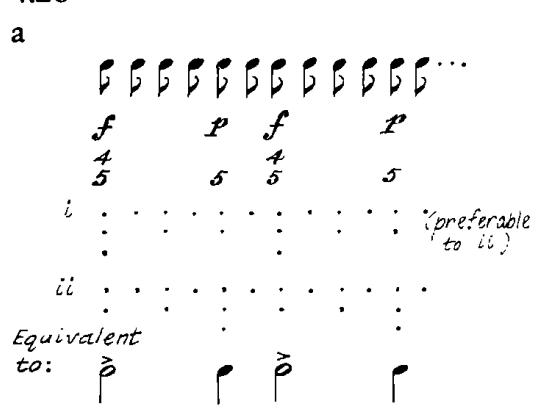
中文讲解
This is an image placeholder for a musical example on page 14. Based on the surrounding text, the example is associated with the discussion of dynamic changes (example 4.24) and the continuation of the generalization of MPR 5. The actual notation cannot be read from the placeholder; the reader must consult the original page to see the specific interplay of forte and piano markings.
补充说明
需查看原图以确认具体力度变化的位置与方式;仅凭占位符无法获得谱例细节。
第10段(P0108)
原文复述
We can account for the fact that this is heard most naturally as 6/8, with strong beats at the changes in dynamic, by extending MPR 5 so it counts the length of a particular dynamic as a kind of length indicative of metrical structure. Then MPR 5 will apply at the changes in dynamics in 4.24, setting up a preference in metrical structure. In other words, from the point of view of MPRs 4 and 5, example 4.24 behaves analogously to 4.25.
中文讲解
This is the core analytical move of the generalization. The author argues that “length” should not be restricted to pitch-event duration but should be understood as covering any sustained parameter—including the duration of a particular dynamic. Under this re-interpretation, 4.24 (alternating forte and piano) is perceptually equivalent to 4.25 (an analogous pattern of note durations), because both exhibit the same onset-and-sustain pattern. The upshot is that the same rule (MPR 5) can account for the strong beats at the changes in dynamics, and the listener’s natural hearing of 4.24 as 6/8 follows directly.
补充说明
The phrase “from the point of view of MPRs 4 and 5” indicates that the author is treating the two rules as the analytical lens through which the example is interpreted. The equivalence to 4.25 is a formal reduction: 4.24 is re-described as a durational pattern so that the existing rule machinery applies.
第11段(P0109)
原文复述
$$ \overset {>} {\rho} \cdot \quad \rho \cdot \quad \overset {>} {\rho} \cdot \quad \rho \cdot \quad \overset {>} {\rho} \cdot \dots $$
中文讲解
This is a mathematical/metrical notation. The symbol “ρ” (rho) stands for a metrical position, and the overset symbol “>” marks the position as a strong beat. The dots mark continued repetition. The pattern thus reads: strong beat, weak beat, weak beat, strong beat, weak beat, weak beat, … — a conventional dotted rhythm indicating groupings. This formal pattern is the underlying metrical skeleton that the author appeals to when describing 4.24 and 4.25 as analogous. It is included in the text as the formal account of the metrical structure being preferred.
补充说明
In GTTM’s notation, the “•” marks an unaccented beat and “>” above a beat symbol marks it as strong. The pattern shown corresponds to a six-pulse cycle with strong beats on the first and fourth pulses, which is the standard 6/8 metrical pattern.
第12段(P0110)
原文复述
For a slightly more complex example consider 4.26, in which applications of preference rules have been marked.
中文讲解
The author introduces example 4.26 as a more complex case. The fact that “applications of preference rules have been marked” means the notation in the example explicitly shows where MPR 4 and MPR 5 apply. The reader is invited to look at the example to see which notes/locations satisfy the various preference rules.
补充说明
需查看原图以确认具体的力度变化与MPR标记位置。
第13段(P0111)
原文复述
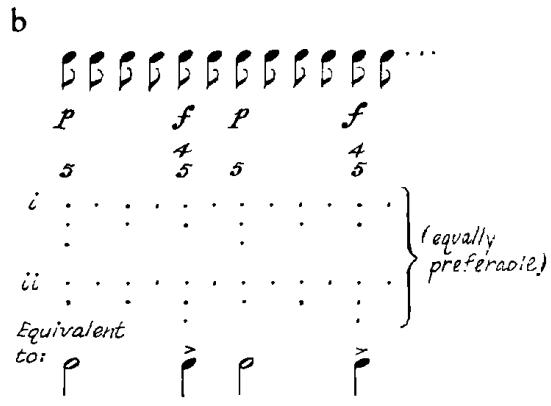
中文讲解
An image placeholder for the second part of example 4.26 on page 14. The example presents two passages (4.26a and 4.26b) that the surrounding text compares. The actual musical content cannot be read from the placeholder; the reader must consult the original page.
补充说明
需查看原图以获取4.26a与4.26b的具体谱例。
第14段(P0112)
原文复述
The spacing of changes of intensity establishes a preferred quarter-note level: both passages in 4.26 are preferably in 3/4, with quarter-note beats on the changes of dynamics. However, the two passages differ in the factors determining where the strong beats of the quarter-note level lie.
中文讲解
The author reports that the equal temporal spacing of dynamic changes in both 4.26a and 4.26b establishes a quarter-note level, with the changes themselves defining the quarter-note beats. Both passages are heard as 3/4 rather than some other meter. However, the passages are not identical: although the meter is the same, the listener’s sense of where the quarter-note strong beats fall within the bar differs between the two passages. This sets up the comparison in the next paragraph.
补充说明
The phrase “spacing of changes of intensity” parallels the earlier argument that any sustained parameter contributes to metrical structure. The reference to 3/4 vs. other meters is the way in which GTTM talks about the listener’s choice of metrical level.
第15段(P0113)
原文复述
From the point of view of MPRs 4 and 5, the passages are equivalent to the durational patterns at the bottom of the example. In 4.26a the forte lasts longer than the piano, so MPR 5 says that the onset of the forte should be relatively stronger. In addition, the stress perceived at the onset of the forte reinforces the impression of a strong beat. Hence structure i is far more natural than structure ii. On the other hand, 4.26b has reversed the durations of forte and piano. The greater length of the piano now attracts the strong beat, but so does the stress of the forte. Because of the conflict, either structure i or structure ii can be heard, but with more equivocation than structure i in 4.26a. Thus the two passages in 4.26 present the familiar contrast between reinforcement and conflict of preference rules.
中文讲解
This is the analytical heart of the 4.26 discussion. The author reduces both passages to durational patterns, in which longer durations correspond to longer-lasting dynamics. In 4.26a, forte is longer than piano, so MPR 5 places the strong beat on the forte’s onset; MPR 4 (stress) also places the strong beat on the forte from a different angle. The two rules reinforce each other, producing a clear preference for structure i over structure ii. In 4.26b, the durations are reversed: piano is longer, so MPR 5 now wants the strong beat on the piano’s onset, but MPR 4 still wants it on the forte (because of the stress). The two rules now conflict, and the listener may hear either structure, but with less confidence than in 4.26a. The example thus illustrates the broader principle that preference rules can either reinforce or conflict, and that reinforcement produces clearer metrical preferences than conflict.
补充说明
The phrase “familiar contrast between reinforcement and conflict of preference rules” is a recurring motif in GTTM: it ties the local analysis back to the general theory of how preference rules interact. The author does not state the formal theory of conflict here, but the reader is expected to know that 4.26 is an illustration of it.
第16段(P0114)
原文复述
Metrical Structure
中文讲解
A page header indicating the chapter subject (“Metrical Structure”). It serves only as a running heading and carries no argumentative content.
补充说明
这是版式元素,没有论证内容。
第17段(P0115)
原文复述
Continuing with the generalization of MPR 5, we observe that the beginning of a slur is indicative of a strong beat. In example 4.27 the most highly preferred pattern places the beginning of the slur at a strong beat on both the quarter-note and half-note levels, as indicated below the passage.
中文讲解
The author extends the generalization of MPR 5 from dynamics to slurs. The argument is that the beginning of a slur functions like the inception of a long note or a change in dynamics: it is a salient event that attracts a strong beat. Example 4.27 is offered as evidence. The most preferred metrical structure places the slur’s beginning at a strong beat, and this happens at multiple metrical levels (quarter-note and half-note) simultaneously. The phrase “as indicated below the passage” refers to the marked notation shown in the example itself.
补充说明
The phrase “Continuing with the generalization of MPR 5” ties this paragraph to the previous discussion of dynamics, presenting slurs as a third extension of the length concept after raw duration and dynamic changes.
第18段(P0116)
原文复述
4.27
中文讲解
The caption label for example 4.27, identifying the musical example referenced in the preceding paragraph. It stands alone on the page as an example number.
第19段(P0117)
原文复述
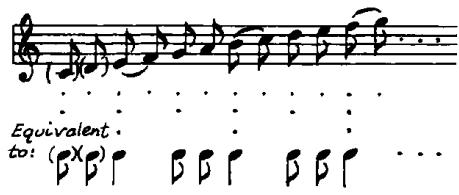
中文讲解
An image placeholder for the musical example 4.27 on page 15. The example shows a passage with slurs and marked preferred metrical positions. The actual notation cannot be read from the placeholder.
补充说明
需查看原图以确认连线位置与标记细节。
第20段(P0118)
原文复述
Furthermore, the longer of two slurs most naturally occurs on a relatively stronger beat: in 4.28 structure i is preferable to structure ii. Thus slurring has the same properties with respect to metrical preference rules as long notes and changes of dynamics.
中文讲解
The author adds a second property of slurs: not only does the beginning of a slur indicate a strong beat (as in 4.27), but the longer of two slurs most naturally falls on the stronger beat. This is a direct parallel to the property of long notes: in 4.22, the longer note attracts the strong beat. The closing sentence explicitly unifies the three phenomena—long notes, dynamic changes, and slurs—under the generalized MPR 5. The argument is that “length” is a perceptual category, not just a physical one, and the same formal rule applies to all three cases.
补充说明
The phrase “the longer of two slurs most naturally occurs on a relatively stronger beat” mirrors the earlier phrasing of MPR 5 (“prefer a metrical structure in which relatively strong beats occur at the inception of notes of relatively long duration”). The parallel is the formal point of the paragraph.
第21段(P0119)
原文复述
4.28
中文讲解
The caption label for example 4.28, identifying the musical example referenced in the preceding paragraph. It stands alone on the page as an example number.
第22段(P0120)
原文复述
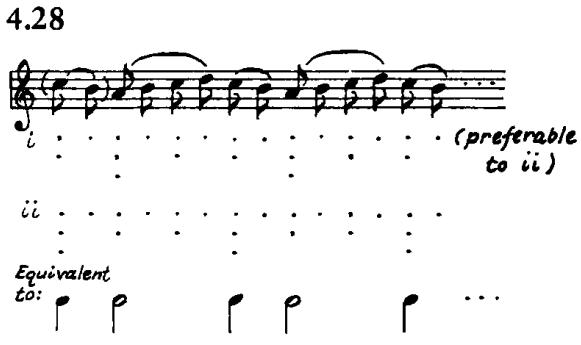
中文讲解
An image placeholder for the musical example 4.28 on page 15. The example shows a passage with slurs and the marked preferred metrical structure. The actual notation cannot be read from the placeholder.
补充说明
需查看原图以确认连线位置与结构选项的标记。
脚注 / 边栏 / 图表 / 附加信息(如有)
本节包含与谱例相关的多处图像占位符(P0107、P0111、P0117、P0120),它们对应4.24、4.25、4.26、4.27、4.28等示例;此外P0109为一段数学记谱(强拍与弱拍的ρ模式),用以形式化展示4.24与4.25在MPR 5下的等价模式。P0099为小节标题,P0106与P0114为页眉。这些附加材料没有独立论证,而是服务于正文对MPR 5的递进式表述。
💡 本节核心要点
- MPR 5最初针对的是音高事件(pitch-event)的持续时长:相对较长的音符倾向于落在强拍上;这由4.22与4.16a之间只改变时长而保持起音模式一致的对照实验所揭示。
- 作者把MPR 5表述为“第一版”,随后通过类比把“长度”推广为更一般的范畴:一种延续中的参数(持续时值、动态、连线的延续)只要在听感上形成稳定的延续,就同等地提示其起点为强拍。
- 动态变化(forte/piano交替)被视为一种“可听的时长”:4.24被自然地听成6/8,强拍落在力度变化处,因为这与MPR 5在4.25中作用于音符时值的模式形式上等价。
- 4.26a与4.26b展示MPR 4(应力)与MPR 5(长度)之间的相互作用:4.26a中两者协同产生清晰的首选结构;4.26b中两者冲突导致听感上对结构的偏好更加模糊,这是GTTM规则“强化与冲突”主题的典型例证。
- 连线(slur)的起点与较长连线的位置同样对节拍偏好有影响:4.27与4.28分别展示连线的起点宜置于强拍、较长连线宜置于较强拍,这使MPR 5在三类现象(音高时长、动态、连线)上具有统一的解释力。
🔑 关键术语
- MPR 5 (Length):第五章的节拍偏好规则“长度”:偏好让相对强的拍子落在相对长的音符(或一般意义上“可听的延续”)之上。本节给出其“第一版”并随后推广到动态与连线。
- MPR 4 (Stress):第四章的节拍偏好规则“应力”:突发的重音(如突然的forte)倾向于成为局部强拍。在本节中与MPR 5产生协同或冲突。
- Preference-rule marking:GTTM的术语:指偏好规则在节拍结构上所标记的贡献;本节用此说明4.14b、4.22、4.23等例中的四分音符获得额外标记,而八分音符加休止则没有。
- Strong beat / weak beat:节拍结构中各拍子的相对强度。文中以ρ记号标记拍位,以上方">“标记强拍,是本节形式化记谱(P0109)的关键符号。
- Inception of a long note:MPR 5第一版的核心措辞:长音符的“开始瞬间”而非中间或结尾,被视为强拍的可能位置。该措辞在本节成为“长度推广”的锚点。
- Reinforcement vs. conflict of preference rules:GTTM中关于偏好规则相互作用的核心区分:两条规则同时指向同一结构叫协同(reinforcement),指向不同结构叫冲突(conflict);4.26a与4.26b分别是这两种情况的范本。
- Slur:连线。本节把连线的起点与较长连线的位置类比于长音符的起点与持续,因此连线也被纳入MPR 5的广义“长度”范畴。
S4.2.5 [描述性拆分] Length Generalizations: Articulation, Pitch Repetition, and Harmonic Rhythm
第1段(P0121)
原文复述
A third extension of MPR 5 concerns the length of a consistent pattern of articulation. An especially salient example is 4.29, from the Courante of the fourth Bach Cello Suite, in which it is difficult to hear the downbeats at any point other than at the change from triplets to sixteenths and back again.
中文讲解
本段介绍 MPR 5(节拍偏好规则 5)的第三种推广,涉及"持续的演奏法(articulation)模式的时值长度”。作者以例 4.29(巴赫第四无伴奏大提琴组曲的库朗舞曲)为典型,说明在持续的连音与跳音或三连音与十六分音符交替出现的段落中,听者很难把强拍判断在除了演奏法发生切换的位置以外的任何地方。也就是说,演奏法模式本身的更替点会成为感知强拍的位置。
第2段(P0122)
原文复述
4.29
中文讲解
这是上一段所引例子的编号标签,对应谱例 4.29。
第3段(P0123)
原文复述

中文讲解
第 15 页的图像或乐谱占位符,对应例 4.29 的实际谱例(巴赫第四无伴奏大提琴组曲库朗舞曲片段)。
补充说明
谱例内容未在文本中给出,需查看原图。
第4段(P0124)
原文复述
Chapter 4
中文讲解
第 4 章的版心页眉(running header),标明本页属于第 4 章。
第5段(P0125)
原文复述
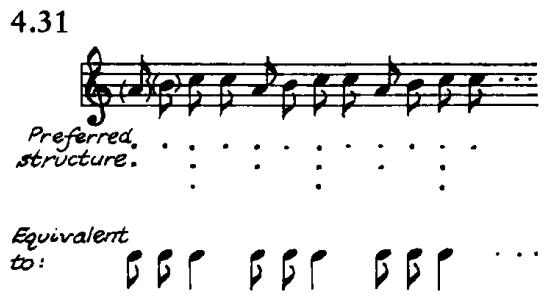
中文讲解
第 16 页的图像或乐谱占位符,可能是例 4.29 续页或与其节拍结构相关的图形,需查看原图。
补充说明
谱例内容未在文本中给出,需查看原图。
第6段(P0126)
原文复述
Again, the longer of two alternating patterns of articulation attracts the stronger beat. In 4.30 the beginning of the triplet pattern is somewhat more likely to be heard as the strong beat at the dotted-half level than the beginning of the sixteenths. In other words, from the point of view of MPR 5, example 4.30 behaves like the rhythmic pattern shown below it.
中文讲解
本段重申并细化前述原则:在两种演奏法模式交替出现时,时值更长的那种模式的开头更能吸引强拍。例 4.30 显示,三连音模式的开头比十六分音符模式的开头更可能被视为附点二分音符层级的强拍。从 MPR 5 的角度看,4.30 与其下方所示的简化节奏模式(长事件起始于强拍)等价——也就是说,作者将演奏法模式的"长度"视为与音符时值长度同类的一种长度信号。
第7段(P0127)
原文复述
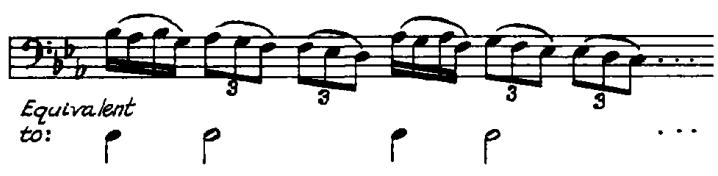
中文讲解
第 16 页的图像或乐谱占位符,对应例 4.30 及其下方的简化节奏模式。
补充说明
谱例内容未在文本中给出,需查看原图。
第8段(P0128)
原文复述
So far pitch has not been implicated in the metrical preference rules. But the repetition of a pitch also counts as a kind of length, as shown by the preference for 4.31 to be heard with the first C on a strong beat of the quarter-note level and (less decisively) the half-note level.
中文讲解
本段把"长度"概念进一步扩展到音高维度:在此之前节拍偏好规则都没有涉及音高,但同一音高的重复(pitch repetition)相当于音的延续,应被视为一种"长度"。例 4.31 表明,听者倾向于把第一个 C 听成四分音符层级的强拍(在二分音符层级上这一倾向则不那么强烈)。也就是说,同一音高延续的跨度越长,越能吸引节拍强位。
第9段(P0129)
原文复述
4.31
中文讲解
谱例 4.31 的小节标题,标明随后是例 4.31 的图示。
第10段(P0130)
原文复述
The rule of length applies to repeated pitches not only at the surface, but also at relevant levels of the time-span reduction. 4 Consider the upper line in 4.32, which has the preferred metrical structure shown.
中文讲解
本段进一步说明:长度规则不仅作用于音乐表层,也作用于时间跨距缩减(time-span reduction)的相关层级。脚注 4 标志在此引用,作者引导读者关注例 4.32 的上方声部,并指出它具有所示的(偏好的)节拍结构。这为后面将"重复音"在缩减层级上的持续时间纳入 MPR 5 作了铺垫。
补充说明
本段引用了脚注 4,文中未给出脚注正文,其内容需查看原页。
第11段(P0131)
原文复述
4.32
中文讲解
谱例 4.32 的小节标题。
第12段(P0132)
原文复述
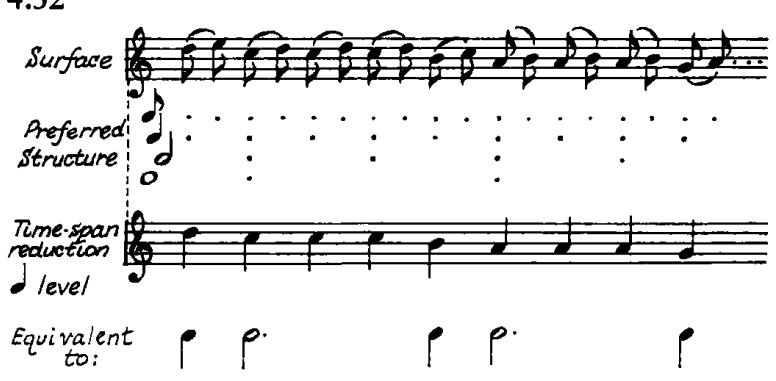
中文讲解
第 16 页的图像或乐谱占位符,对应例 4.32 的图示(含上方声部及其节拍结构、缩减层)。
补充说明
谱例内容未在文本中给出,需查看原图。
第13段(P0133)
原文复述
The slurring establishes the preferred placement of beats at the quarter-note level, but beyond that there is nothing in the musical surface to account for larger metrical levels. On the other hand, as will emerge in chapters 6 and 7, the time-span reduction at the quarter-note level (given below the metrical structure) contains pitch repetitions that do produce the desired metrical structure. Hence metrical preference with respect to pitch repetition must be derived in this case from the time-span reduction of the proper level.
中文讲解
本段对例 4.32 给出论证:表层的连音线(slur)只足以确定四分音符层级的节拍位置,更大的节拍层级在表层没有直接依据。作者指出(将在第 6、7 章展开),四分音符层级的时间跨距缩减中确实存在音高重复,这些重复产生了所需的更大节拍结构。因此,关于"重复音"的长度判断在这种情况下必须从合适层级的时间跨距缩减中提取,而不是仅靠表层。这一段为本节关于"长度可在缩减层级起作用"的核心论证。
第14段(P0134)
原文复述
Metrical Structure
中文讲解
这是例 4.32 内嵌图中位于时间跨距缩减之上的小标签,标示上方所示的是"节拍结构"。
第15段(P0135)
原文复述
Finally, the related phenomenon of harmonic rhythm produces strong cues for metrical structure. Harmonic rhythm can be regarded as the pattern of durations created by successive changes in harmony, not only at the musical surface but at underlying reductional levels. The relevance of harmonic rhythm to metrical structure can be incorporated into the present theory by treating duration of a harmony as still another kind of length in MPR 5. As in the case of individual lines, the rule may invoke the time-span reduction in order to abstract away from nonharmonic tones and ornamental changes in harmony.
中文讲解
本段引入"和声节奏(harmonic rhythm)“作为又一种长度线索。和声节奏被定义为和声连续变化所产生的时值模式,可在表层也存在于缩减层级。其与节拍结构的相关性能被纳入本理论——把和声持续时间视为 MPR 5 中的又一种"长度”。与处理单声部情形类似,该规则可通过调用时间跨距缩减,把非和声音及装饰性和声变化抽象掉,从而在结构层级上判断和声的真正持续长度。
第16段(P0136)
原文复述
Having noted all these generalizations of the notion of length, we now can state the final version of MPR 5.
中文讲解
过渡句:在阐述了演奏法模式长度、音高重复、和声节奏等"长度"概念的多种推广之后,作者即将给出 MPR 5 的最终版本。
第17段(P0137)
原文复述
MPR 5 (Length), final version Prefer a metrical structure in which a relatively strong beat occurs at the inception of either
中文讲解
这是 MPR 5(长度)最终版的标题与导引句。规则本身表述为:“优先选择那种使较强拍子落在以下任一情况起始处的节拍结构”,随后的若干项以 a、b、c、d、e、f 列出各种长度形态。
第18段(P0138)
原文复述
a. a relatively long pitch-event,
中文讲解
MPR 5 的第 (a) 项:相对较长的单音事件(pitch-event),即表层一个音本身的较长持续,可作为强拍位置。
第19段(P0139)
原文复述
b. a relatively long duration of a dynamic,
中文讲解
MPR 5 的第 (b) 项:相对较长的力度(dynamic)持续,比如一个长时段的强或弱力度,可作为强拍位置。
第20段(P0140)
原文复述
c. a relatively long slur,
中文讲解
MPR 5 的第 (c) 项:相对较长的连音线(slur),即一条跨越多音的较长弧线,可作为强拍位置。
第21段(P0141)
原文复述
d. a relatively long pattern of articulation,
中文讲解
MPR 5 的第 (d) 项:相对较长的演奏法模式,对应本节开头关于例 4.29、4.30 的讨论。
第22段(P0142)
原文复述
e. a relatively long duration of a pitch in the relevant levels of the time-span reduction, or
中文讲解
MPR 5 的第 (e) 项:缩减层相关层级上某个音的相对较长持续时间,对应关于例 4.32 与"重复音"在缩减层作用的讨论。注意句末"or"提示这一项并非末项。
第23段(P0143)
原文复述
f. a relatively long duration of a harmony in the relevant levels of the time-span reduction (harmonic rhythm).
中文讲解
MPR 5 的第 (f) 项:缩减层相关层级上某个和声的相对较长持续时间,作者用括号明确标注此即"和声节奏"。这是最终版的末项。
第24段(P0144)
原文复述
As in the case of preference rules for grouping, not all cases of MPR 5 are of the same intrinsic strength. For instance, example 4.33a presents a conflict between a prolonged pitch-event and a slur of the same length. The beat of the half-note level falls most naturally on the long note, indicating that MPR 5a overrides MPR 5c in this situation. (If a performer wants to project the strong beat on the E, he will typically accent it and both shorten and remove stress from the quarter-note D, affecting the application of preference rules.) Similarly, 4.33b places MPRs 5c and 5e in conflict. Here it is unclear which rule should dominate.
中文讲解
本段指出,与分组偏好规则一样,MPR 5 各项的内在强度并不均等。例 4.33a 中,长单音事件与等长的连音线发生冲突,二分音符层级的强拍自然落在长音上,表明 5a 优于 5c。括号补充说明:若演奏者想把强拍放在 E 上,他通常会重音 E、缩短并弱化四分音符 D,从而改变偏好规则的应用。例 4.33b 中 5c(连音线)与 5e(缩减层长音)冲突,作者坦言此处孰强孰弱并不明确。
第25段(P0145)
原文复述
4.33
中文讲解
谱例 4.33 的小节标题,包含了上文讨论的 4.33a 和 4.33b 两个对比情形。
第26段(P0146)
原文复述

中文讲解
第 17 页的图像或乐谱占位符,对应例 4.33 的图示(含 4.33a、4.33b)。
补充说明
谱例内容未在文本中给出,需查看原图。
第27段(P0147)
原文复述
The strongest case of MPR 5 seems to be case f (harmonic rhythm). For example, the long note in 4.34a clearly attracts the strong beat; but given the harmonic context in 4.34b, the strong beat falls most naturally on the second eighth of each group, where the harmony changes, and the quarter note is heard as syncopated. Hence MPR 5f has overridden MPR 5a here.
中文讲解
本段作出本小节的关键结论:MPR 5 中最强的一项是 (f) 和声节奏。在例 4.34a 中,长音显然吸引强拍;但在 4.34b 中加入了和声背景后,强拍自然落在每组第二个八分音符上——即和声发生变化的点——四分音符听起来像是切分音。这说明此处 5f(和声节奏)压倒了 5a(长单音)。作者借此为六项长度信号的强度排序作结:和声节奏是最强的节拍线索。
脚注 / 边栏 / 图表 / 附加信息(如有)
本小节涉及多项图例:例 4.29(巴赫《第四无伴奏大提琴组曲》库朗舞曲片段)、4.30(含其下方简化节奏模式)、4.31、4.32(含上方声部及其节拍结构、时间跨距缩减)、4.33a 与 4.33b、4.34a 与 4.34b。其中 4.33 演示 MPR 5a 与 5c、5c 与 5e 的冲突;4.34 演示 5f 压倒 5a。本节还在 P0130 处引用了脚注 4(脚注正文未在文本中给出)。第 15、16、17 页均含图像/乐谱占位符,具体内容需查看原图。
💡 本节核心要点
- MPR 5(长度)的推广涵盖三种新形式:演奏法模式的长度、音高的重复、和声节奏。
- 在两种演奏法模式交替时,更长的那种模式的开头吸引强拍;例 4.29、4.30 说明了这一点。
- 音高重复被视为一种"长度",可作用于音乐表层与时间跨距缩减的相应层级;例 4.32 表明其作用需借助缩减层才能解释更大节拍层级。
- 和声节奏被定义为和声连续变化所产生的时值模式,可在表层或缩减层起作用,是 MPR 5 的又一种长度形式。
- MPR 5 的最终版列出 a–f 六项触发条件,分别对应长音、长力度、长连音线、长演奏法模式、缩减层长音、缩减层长和声。
- MPR 5 各子项强度不等:例 4.33 显示 5a 通常胜过 5c,5c 与 5e 强弱不明;例 4.34 表明和声节奏(5f)是最强的一项,能压倒长音(5a)。
🔑 关键术语
- MPR 5 (Length):节拍偏好规则 5,关于"长度":偏好把较强拍子置于较长时间事件起点的规则,本节给出了包含六种长度形式的最终版本。
- time-span reduction:时间跨距缩减,GTTM 框架中用于从音乐表层抽象出结构层级的分析手段,可揭示表层无法直接看到的事件延续与和声进行。
- harmonic rhythm:和声节奏,和声连续变化所形成的时值模式;本节将其作为 MPR 5 的又一种"长度"形式,并在最终版中列为 (f) 项。
- pitch repetition:同一音高的重复,本节将其类比为长度,可作用于表层与缩减层,对应 MPR 5 最终版的 (a) 项或与 (e) 项相关。
- articulation pattern:演奏法模式,如连音与跳音的组合或三连音与十六分音符的交替;其"长度"可作为强拍线索,对应最终版 (d) 项。
- slur:连音线,跨多音的弧线标记;本节将其作为一种长度形式(最终版 c 项),并在例 4.33 中参与冲突讨论。
S4.2.6 [描述性拆分] Relative Strengths of MPR 5 Subrules
第1段(P0148)
原文复述
Chapter 4
中文讲解
本段位于第17页,是版面中的章名页眉,原文为英文"Chapter 4"。它不是正文陈述,而是标识读者当前所在章节仍为第四章。在本节"MPR 5 Subrules 相对强度之描述性拆分"的语境下,这一页眉起到锚定位置的作用,表明以下论述归属于第四章关于最简原则规则 MPR 的整体讨论范围。
第2段(P0149)
原文复述
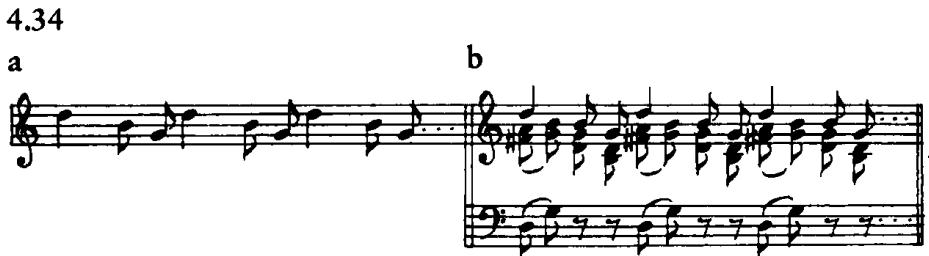
中文讲解
本段是第18页的图像占位符。Markdown 语法显示其替代文本为"第18页图像或乐谱示例",圆括号内说明内嵌图像数据已省略,仅保留位置与图注信息。由于原文中未给出可确认的图注文字,此处无法推测图像具体描绘的内容,相关细节需查看原图。从其在 P0148(章名页眉)与 P0150(关于规则相对强度的收束性陈述)之间的位置推断,该图像可能服务于对规则关系或强度比较的图示说明,但其确切用途因图注缺失而无法在本节内确证。
第3段(P0150)
原文复述
We will not work out all the combinations of relative strengths of rules here. Nor will we attempt to quantify rule strengths, for reasons discussed in section 3.3. The reader should, however, be aware that relative intrinsic strength of preference rules plays an important role in determining the most stable analysis.
中文讲解
本段是本节的核心主张句,也是收束性陈述。作者明确做出两点取舍声明:第一,本节不穷举规则相对强度的所有组合;第二,本节不试图量化规则强度,理由参见第 3.3 节。然而,与此同时,作者用一个"however"转折强调:读者仍须认识到,偏好规则的相对内在强度在决定"最稳定分析"时扮演重要角色。其论证逻辑可以拆解为:(1) 由于方法论上的理由(已在 3.3 节展开),作者选择不展开全部组合比较,也不做量化;(2) 但理论结论本身仍要求读者承认一个不可回避的事实——在多个竞争分析之间作出选择时,规则之间的相对强度差异是关键变量之一;(3) 因此本节的功能不是通过详尽枚举来说服读者,而是通过"提醒读者关注一个被有意省略、但仍不可忽视的维度"来落实"描述性拆分"的定位。
容易误读之处在于:本段表面像是否定性的声明(“we will not…"),实质却是肯定性的提醒(“the reader should be aware…")。本节因此以一句高度浓缩的方式,把"相对强度"这一变量从详细论证中撤离,转而托付给读者作为后续分析时须自行考量的前提。
补充说明
P0150 中提及的"section 3.3"以及"most stable analysis"等表述,应结合本书第三章关于规则排序方法论的讨论来理解;本节明确不重复 3.3 节已展开的论证,仅以引用方式交代量化省略的理由。
脚注 / 边栏 / 图表 / 附加信息(如有)
本节附有第18页一张图像或乐谱的占位符(见 P0149),因内嵌数据被省略且图注信息不完整,无法确认其具体内容,需查看原图以判定其与本节"相对强度"论述之间是否存在图示对照关系。P0150 引用了第 3.3 节作为量化省略的方法论理由,但本节本身未复述该理由,仅以交叉引用方式提示读者回溯。其余页眉(Chapter 4,P0148)属于版面标识,无附加学术内容。
💡 本节核心要点
- 本节自我定位为"描述性拆分”,明确放弃穷举规则相对强度的所有组合。
- 作者出于第 3.3 节所述的方法论理由,主动放弃对规则强度进行量化处理。
- 尽管省略详尽比较与量化,作者仍要求读者承认:偏好规则的相对内在强度是决定最稳定分析的关键变量。
- 本段的论证功能不是说服,而是提醒——以高度浓缩的方式托付读者一个不可回避的理论前提。
- “most stable analysis"作为本节乃至全章的核心评估标准出现,与第 3.3 节的规则排序方法论相互呼应。
🔑 关键术语
- MPR 5 Subrules:最简原则规则(Minimize Principle Rules)的五条次级规则之一族;本节针对的是该规则族的相对强度描述性拆分。
- relative intrinsic strength of preference rules:偏好规则之间相互比较而得的内在强度差异;本节指出该强度虽未被量化或穷举,但在挑选最稳定分析时仍起重要作用。
- most stable analysis:在多个竞争分析中依据规则强度比较而选定的最稳定那个分析结果,是本章乃至全书的核心评估标准。
- quantify rule strengths:把规则之间的相对强度转化为数值或精确等级;本节明确放弃这一做法,理由见第 3.3 节。
S4.2.7 A Linguistic Parallel
第1段(P0151)
原文复述
A Linguistic Parallel
中文讲解
这是第 4.2.7 小节的标题「一种语言学的平行现象」。它本身不是论证性段落,而是一个节题,用以提示读者:本节将把前文建立的两条音乐节拍偏好规则(关于重音和长度的规则)与语言学中描述强/弱音节对立的方式进行类比,从而为节拍偏好规则寻找一个跨领域的解释基础。
第2段(P0152)
原文复述
It should not be without interest that the last two metrical preference rules discussed (those for stress and length) are reminiscent of the principles governing prosodic features in language. It is well known (see for example Trubetzkoy 1939, chapter IV.5) that there are a limited number of discrete ways in which languages mark the distinction between strong and weak syllables. Some languages use stress (differentiation in intensity), others length, and others higher pitch as a mark of strength. Among other things, the opposition between strong and weak often plays an important role in the metrical structure of poetry, where linguistic material is fitted to an abstract metrical pattern (see Halle and Keyser 1971).
中文讲解
本段是本节的核心论证段,提出一个类比性观察并给出语言学背景。
第一句以双重否定「should not be without interest」作出委婉却肯定的断言:前文讨论的两条节拍偏好规则——分别针对重音(stress)和长度(length)——让人联想到语言学中支配韵律特征的若干原则。「reminiscent of」一词明确这里只是相似或相像,而非等同,因此本段并不宣称两条规则本身就是语言学规则,只是二者有家族相似性。
第二句引用 Trubetzkoy 1939 年著作的第四章第 5 节,给出语言学界的公认事实:不同语言用来标记强/弱音节对立的手段数量是有限的、且是离散的——即只有若干固定的备选维度,而非连续光谱。具体而言,作者归纳出三种标记方式:第一种是重音(intensity,强度上的差异),第二种是长度(length,时长上的差异),第三种是音高(pitch,频率上的差异)。这意味着「强」与「弱」的对立可以分别借助强度、时长或音高三类声学线索中的某一种来承担。
第三句把这种强/弱对立的应用由音系本身扩展至诗律。「Among other things」一语提示这只是其多种作用之一,未穷尽列举;作者限定它「often plays an important role」,承认存在例外。具体的机制是:在诗律结构中,具体的语言材料(词语、节奏)被「贴合」到某个抽象的节拍模式之上,而强/弱对立正是这种贴合得以成立的核心组织原则之一。这一句借 Halle and Keyser 1971 作为支持脚注,给出生成学派诗律分析的代表性出处。
整体来看,本段的功能是为下一段的归纳跳跃准备语言学事实基础:把「用重音和长度标记强弱」这件事同时放进音乐和语言两条线索之中,使读者看到重合并具备解释潜力。
补充说明
本段明确把四条信息定位为脚注可验证的来源:Trubetzkoy 1939, chapter IV.5(关于音系中强弱标记方式的有限离散性);Halle and Keyser 1971(关于诗律结构中语言材料被贴合到抽象节拍模式)。它们的作用是把两个独立学术传统的结论同时拉入类比,而非替作者主张提供唯一论据。
第3段(P0153)
原文复述
That stress and length function as markers of metrical strength in music as well as in language can hardly be a coincidence. Rather it seems that we are dealing with a more general cognitive organization that has manifestations in both musical and linguistic structure. This lends the theory of metrical preference rules a significance beyond its usefulness for musical purposes. (In section 12.3 we discuss a related parallel of music and language in considerable detail.)
中文讲解
本段是本节的归纳段,把上一段铺就的类比上升为对理论的解释力主张。
第一句以「hardly be a coincidence」明确立论方向:音乐和语言两个领域都借助重音和长度来标记节拍意义上的强弱,这件事不太可能是偶然的并列。「hardly」是双重否定式的弱断言(不可译为「绝对不」),体现作者在明说与节制之间的取舍:他并未宣称「绝对不偶然」,只是表示偶然性极小,需要替代解释。
第二句给出这一替代解释:「我们面对的或许是一种更一般性的认知组织(cognitive organization)」。作者用「it seems」「Rather」「are dealing with」三个缓和短语依次降低断言硬度——先以「似乎」再以「我们处理的是」再以「Rather」与偶然说相抗衡,因此本句属于有限度的推测而非定论。所谓「更一般的认知组织」是指同时投射在音乐结构与语言结构之中的某种共享认知约束;它把单一领域(音乐节拍偏好)的观察,转化为跨领域(音乐与语言)共同的底层机制。
第三句回到本节与本书的主线:正因为这条规则可能被一种普遍认知组织所支撑,节拍偏好规则的解释意义「超出其对于音乐目的的有用性」——即这套规则不再只是音乐内部有效的小工具,而是具有跨领域的理论意涵。「beyond」一词切出范围:理论的用处(usefulness for musical purposes)是其局限面,作者声称本段论证为这套理论加上了超出这一面之外的更大范围的解释价值。
末尾括注指出第 12.3 节还会更细致地讨论另一个相关的音乐—语言平行例,从而告诉读者:本节只是类比的开篇提示,详细论证由后续章节承担;这是一个去重与延后的写作技术标记。
本段在小节论证链中起到收束作用:把「相似」升级为「共享根源的可能性」,并把节拍偏好规则的解释地位由音乐技术层面推向跨模态认知层面。
补充说明
末尾的括注明确把本节定位为对后续 12.3 节的预告,避免读者在本节寻求过细论据。
脚注 / 边栏 / 图表 / 附加信息(如有)
本小节包含两个外部学术引用:Trubetzkoy 1939, chapter IV.5(关于强弱音节对立标记的有限离散手段),以及 Halle and Keyser 1971(关于诗律中语言材料向抽象节拍模式的贴合)。两者均以脚注形式支持本节论证,但未充当唯一证据;括号中预告的第 12.3 节暗示读者,本文后续将给出更细致的音乐—语言平行案例。无图表、无框注、无脚注外的附加材料。
💡 本节核心要点
- 本节以小节标题『一种语言学的平行现象』宣告节拍偏好规则(重音与长度两类)与语言韵律原则之间的类比关系。
- 语言学中标记强/弱音节对立的手段是有限且离散的,可由强度(stress)、长度(length)或音高(pitch)三类声学维度中的某一种承担(出自 Trubetzkoy 1939)。
- 强/弱对立在诗律中起核心组织作用,把具体语言材料贴合到抽象节拍模式(出自 Halle and Keyser 1971)。
- 重音与长度同时在音乐与语言中充当节拍强度的标记,难以用巧合解释;作者推测其背后存在一种更一般的认知组织。
- 该类比使节拍偏好规则获得超出纯音乐用途的跨领域理论意义。
- 第 12.3 节将更细致地讨论另一个音乐—语言平行案例,本节仅起预告作用。
🔑 关键术语
- metrical preference rule:节拍偏好规则,指在本节及前文中讨论的、用来刻画音乐节拍中强弱单元如何被优先选取或排列的规则。本节论证其涵盖范围超出音乐。
- prosodic features:韵律特征,本节特指语言中与重音、长度、音高相关的、能承载强/弱音节对立的功能属性。
- strong/weak syllables:强/弱音节对立的两种标记手段,重音(intensity,强度差异)、长度(length,时长差异)、音高(pitch,频率差异)。三者中通常只用其一即可在特定语言中区分强弱节。
- metrical structure of poetry:本节所谓诗律结构,指语言材料被贴合到抽象节拍模式之上的过程,强/弱对立在其中起核心组织作用。
- cognitive organization:本节所假设的一种跨领域共享的认知组织,作者用它来解释音乐与语言在节拍强弱标记上何以同时选用重音与长度,而非把它归为巧合。
S4.2.8 [描述性拆分] An Example: Mozart G Minor Symphony Eighth-Note Level
第1段(P0154)
原文复述
An Example
中文讲解
本句是小节标题 “An Example”,引出下文将用具体谱例(莫扎特 g 小调交响曲开头)来演示前面建立的节拍偏好规则在较小节拍层级上的运作。标题的功能在于宣告:从此前的抽象规则叙述转入实例验证阶段。
第2段(P0155)
原文复述
In section 2.2 we discussed some questions about the larger-level metrical structure of the opening of Mozart’s G Minor Symphony. We now apply the metrical preference rules developed so far to derive the smaller levels of metrical structure—those levels not open to question. Again the example is given without bars and beams; beats at the eighth-note level are numbered for convenience. We treat the theme and bass line alone; we have omitted the beginning of the first measure and the viola accompaniment as an exercise, in order to bring more rules into play.
中文讲解
本段交代了例子的来源、范围与处理方式,包含三层信息。1)承接关系:作者提醒读者在 2.2 节中曾讨论过莫扎特 g 小调交响曲开头的较大节拍层级(那些层级本身尚有争议),而本节的任务是把前面建立的节拍偏好规则(MPRs)应用到那些"没有疑问"的较小层级上,从而由已知向上推导出更细的结构。2)谱例呈现方式:例子省略了小节线和符尾连线,仅按八分音符层级给每个拍编号,这样做的目的是让规则在每一个拍点上的作用更直观、更便于追踪。3)声部裁剪:只保留主旋律和低音线,第一小节的开头与中提琴伴奏被略去——作者明确说这是一种"练习"式的安排,意在让更多条规则在同一个例子中同时被触发,从而展示规则间的交互与叠加效果。换言之,例子既不是任意挑选的,也不是完整的原谱呈现,而是为教学目的裁剪过的最小可用素材。
补充说明
本段提及的 2.2 节属于本书前文,节内规则(MWFR、MPR 5a/5c/5e/5f)的编号体系也在前几节中已定义;本节所用谱例的位置对应书中的图 4.34 或附近谱例(具体编号需查看原书版面)。
第3段(P0156)
原文复述
Metrical Structure
中文讲解
本句为子标题 “Metrical Structure”,标志着本节要展示的内容转向:通过前述规则的应用所得到的节拍结构本身——具体而言,是八分音符层级上的拍点如何被各种规则标记,以及如何由此推导出下一级(四分音符层级)的强弱拍。标题在告诉读者:接下来进入的是结构结论,而非更多规则的引入。
第4段(P0157)
原文复述
We start with the eighth-note level, which is of course assigned by the MWFRs (MWFR 1 requires a beat at the attack point of each note, and MWFR 4 fills the level in evenly). Those beats at the eighth-note level that coincide with beginnings of notes are marked by MPR 3 (the event rule); rests and continuations of notes are not marked. There are no local stresses, so MPR 4 has no effect (though stresses are often added at 11 and 27 in performance to reinforce the metrical structure). MPR 5a (length of pitch-event) marks the beginning of the quarter notes; MPR 5c (length of slur) marks the beginning of the slurs. The beginnings of repeated pitches are marked by MPR 5e. Finally, MPR 5f (length of harmony) applies at the change at 27 (beat 1 has been preceded by accompaniment, so it is not a harmonic change). $^{5}$
中文讲解
本段逐条说明八分音符层级上的拍点是如何被各种规则标记的,逻辑层次非常清晰:1)起点由 MWFRs 确立:MWFR 1 规定每个音符的起音点必须设一拍,MWFR 4 再把这些拍均匀地填满一个层级,因此八分音符层级的拍格是"先定锚点、再均匀填充"的结果,本身不带强弱偏向。2)事件规则 MPR 3 标记音符起点:只有当八分音符拍恰好与某个音符的起音重合时才被打标;休止符和音符的延续部分不算新事件,因此不打标。这一步把"音的起点"显式标注出来,是节拍与事件同步的最小信号。3)局部重音规则 MPR 4 不起作用:因为本例在表面记谱上没有局部重音记号,所以 MPR 4 没有可标记的对象;不过作者顺带加了一句演奏实践的旁注——表演者常在第 11 和第 27 拍处加重音来强化节拍结构,这说明理论上"无标记"并不等于听觉上"无重音”,规则体系不排斥演奏层面的补充。4)结构性的 MPR 5 系列:MPR 5a(音事件长度)在四分音符的起点处打标;MPR 5c(连线长度)在每条连线的起点处打标;MPR 5e 在同音反复的起点处打标;MPR 5f(和声长度)在第 27 拍的和声变化处打标——之所以第 1 拍不计入和声变化,是因为它前面紧接的是伴奏声部而非真正的和声切换。综上,作者用一句一段的方式把多类规则在同一个八分音符层级上的作用列成清单,目的是让读者看到:在每个拍点上,往往有多条规则同时给出标记,而接下来要做的,就是把这些"标记的聚集"汇集起来作为推断层级的依据。
补充说明
原文中上标 $^{5}$ 对应脚注 5;该脚注的具体内容应在附加信息中处理,本段不复述其全文。
第5段(P0158)
原文复述
Examining the totality of rule applications at this level, we find a situation not unlike 4.16b above: clusters of three adjacent beats where rules apply, followed by a beat with no rule applications. As in 4.16b, rule applications on weak beats can be minimized by assigning strong beats to the first and third beats of each cluster, giving the quarter-note level shown in 4.35.
中文讲解
本段是承上启下的总结:作者把上一段列出的所有规则打标合起来观察,发现其分布形态与前文 4.16b 例子的模式"类似”——即出现"三个连续被标记的拍 + 一个未被标记的拍"的成簇结构。1)这种三加一模式的存在意味着:如果简单地把每个被标记的拍都视作强拍,就会出现"弱拍上也有规则标记"的冗余,违反偏好规则中"弱拍上的标记应尽量少"的精神。2)解决的办法与 4.16b 同构:把强拍分配到每个三拍簇的第一拍和第三拍上,这样三个被标记的拍中第三拍仍落在强拍附近,而被空出的那一个拍自然成为弱拍,从而把规则的标记"对齐"到二分性的四分音符层级上。3)由此得到的四分音符层级结构见谱例 4.35,是本规则链在八分音符层面上的最终节拍结论。换言之,本段把"规则标记的局部观察"升级为"层级整体结构的推断",完成了从 MWFRs 给出拍格、MPRs 给出标记,到层级间强弱关系浮现的完整推导。
补充说明
本段提到的 4.16b 与 4.35 分别指前文与本节末尾的谱例编号;它们在原书版面上以图示呈现,本节文字不直接给出谱面,因此具体拍位与强弱标记分布需查看原图。
脚注 / 边栏 / 图表 / 附加信息(如有)
本小节涉及的附加材料有两类。1)脚注 5(出现在 P0157 上标处):原文仅以 $^{5}$ 标记,作者指出其在正文中讨论"演奏中常在第 11 与第 27 拍加重音以强化节拍结构"时提供补充说明,对正文主张起限定/旁证作用——即说明理论规则不否定实际演奏中可能加入的局部重音。脚注的具体文字需查阅原书,本节文本未直接复述其全文。2)谱例图示:原书给出莫扎特 g 小调交响曲开头的简化谱例(仅保留主旋律与低音,省略小节线、符尾连线、中提琴伴奏和第一小节开头),并在八分音符层级上对拍点编号;本节 P0158 所提到的 4.16b(前文章节中的类似谱例)与 4.35(本节末尾得出的四分音符层级结构)均为图示材料,需查看原图方可确认具体拍位与小节内的强弱标记分布。
💡 本节核心要点
- 本节的任务是把前面建立的节拍偏好规则(MPRs)应用到莫扎特 g 小调交响曲开头在八分音符层级上那些"没有疑问"的较小节拍层级,从而由已知推导出更细的结构。
- 谱例经过有意简化(去掉小节线、符尾、中提琴伴奏和第一小节开头),目的是让更多条规则在同一个例子中同时起作用,便于观察规则间的交互。
- 八分音符层级的拍格由 MWFR 1(在每个音的起音点设一拍)与 MWFR 4(均匀填满该层级)共同确立,本身不带强弱倾向。
- 在该层级上,MPR 3(事件规则)只标记音符起点;MPR 5a/5c/5e/5f 分别在四分音符起点、连线起点、同音反复起点、和声变化点(此处仅第 27 拍)上做出结构性标记;MPR 4 因本例无局部重音记号而未生效。
- 把所有规则的标记汇总后呈现出"三个连续标记拍 + 一个空拍"的三加一簇状结构,与前文 4.16b 的模式同构。
- 通过把强拍分配到每个三拍簇的第一和第三拍上,可以使弱拍上的规则标记最小化,从而推导出四分音符层级的强弱结构(见谱例 4.35)。
🔑 关键术语
- MWFR (Metrical Well-Formedness Rules):节拍良构性规则。在本节中具体起作用的是 MWFR 1(要求每个音符的起音点都有一拍)与 MWFR 4(均匀地填满一个层级),二者共同给出八分音符层级的拍格,构成本节所有后续推导的初始框架。
- MPR (Metrical Preference Rules):节拍偏好规则。本节中起作用的有 MPR 3(事件规则,标记音符起点)、MPR 4(局部重音规则,本例因无重音记号而未生效)、MPR 5a(音事件长度,标记四分音符起点)、MPR 5c(连线长度)、MPR 5e(同音反复起点)、MPR 5f(和声长度),它们的作用是在 MWFR 给出的均匀拍格之上添加结构性的标记。
- eighth-note level:八分音符层级,是本节要处理的最小节拍单位。每个八分音符对应一拍,按顺序编号以便讨论规则在哪些拍上生效。
- quarter-note level:四分音符层级,是本节要由八分音符层级推导出的下一层级;其强弱结构由"三加一"簇中规则标记的分布推断出来(见谱例 4.35)。
- cluster of three adjacent beats:本节描述的规则标记在八分音符层级上的分布形态:连续三个被规则标记的拍紧跟一个未被标记的拍。这一模式与 4.16b 同构,是推断四分音符层级二分的依据。
- 4.16b / 4.35:原书中的谱例编号。4.16b 是前文章节中已出现过的、形态类似的谱例;4.35 是本节末尾呈现四分音符层级推导结果的谱例。
S4.2.9 [描述性拆分] Mozart G Minor Symphony: Quarter-Note and Higher Levels
第1段(P0159)
原文复述
Now let us determine the strong beats at the quarter-note level. At this level, every beat except 15 and 31 occurs at the inception of a pitch-event and therefore is marked by MPR 3. The quarter notes are relatively long pitch-events, so they are marked by MPR 5a. The strongest application of MPR 5c (length of slur) is at beat 11, the beginning of the longest slur. Beat 11 is also the only place where MPRs 5a and 5c reinforce each other. A consistent pattern of articulation—two quarter notes in a row—begins at beats 11 and 27, so MPR 5d applies at those points. Pitch prolongations into the next beat are marked by MPR 5e at beats 19, 23, and 27; again the harmonic change is marked at beat 27.
中文讲解
本段是本小节的核心分析段,任务是确定四分音符层次(quarter-note level)的强拍位置。作者逐条应用MPR规则来锁定强拍:(1)除了第15拍和第31拍之外,每一个四分音符拍位都恰好是一个新音事件(pitch-event)的开始,因此都满足MPR 3(音事件起始);(2)四分音符作为相对较长的音事件,又触发MPR 5a(长音事件);(3)MPR 5c(连奏线长度)最强的一次应用发生在第11拍,即最长连奏线的起点;(4)第11拍还是MPR 5a与MPR 5c唯一相互加强的位置,这一点在判定强拍时具有关键权重;(5)第11拍和第27拍出现了连续两个四分音符的稳定发音模式(articulation pattern),因此MPR 5d(发音一致性)在此适用;(6)音高延续进入下一拍的现象由MPR 5e标记于第19、23、27拍;(7)再次强调第27拍的和声变化标记。可见,第11拍和第27拍是MPR规则汇聚最密集的位置,因此被确立为本层次的强拍。本段论证的方式是"多规则叠加定位",即通过对多条局部规则的同时应用,识别出强拍候选。
补充说明
MPR 5a/5c/5d/5e/5f均为作者自定义的节拍偏好规则(metrical preference rules),对应不同的局部音乐现象如长音、连奏、发音模式、音高重复、和声变化等。第15拍与第31拍是作者认为不满足MPR 3的特殊位置,应结合上一小节理解。
第2段(P0160)
原文复述
Chapter 4
中文讲解
此行仅为版面元素,相当于"第四章"的章节页眉/分页标记,与论证内容无直接关系。它出现在第19页正文与第20页正文之间,用于标明当前分析属于第4章。
第3段(P0161)
原文复述
In addition to the rule applications marked, MPR 1 (parallelism) requires that each pattern of two eighths followed by a quarter receive the same metrical structure. This requires that strong beats of the quarter-note level be spaced two quarter notes apart.
中文讲解
本段补充说明除前述规则标记之外的另一条规则:MPR 1(平行性规则)。其作用对象是"两个八分音符加一个四分音符"这一反复出现的节奏型。平行性要求所有同型节奏片段获得相同的节拍结构,因此推断出四分音符层次的强拍必须以两个四分音符(相当于一个小节内每两拍一次)的间隔均匀分布。
此条规则的作用是把局部规则定位的强拍(第11、27拍等)扩展为全局均匀间隔的节拍格。它解释了为何强拍不能仅按MPR 5a/5c的局部证据排列,而必须服从更高层次的等距约束。
补充说明
MPR 1(parallelism)是节拍推导中最具全局约束力的规则之一,通常通过重复节奏型建立节拍等距的预期。
第4段(P0162)
原文复述
In trying to find a half-note level that minimizes overall MPR violations, we see that MPRs 5a and 5c alternate throughout much of the passage, superficially giving the appearance of a predicted ambiguity. But we saw in 4.33a that MPR 5a overrides 5c in such an environment; hence rule violations are minimized if beats of the half-note level are placed where MPR 5a applies. This fits the multiple applications of rules at beats 11 and 27 and the bass attacks at 3, 11, 19, and 27, so that the half-note level shown is quite stable throughout.
中文讲解
本段将分析提升到二分音符层次(half-note level),任务是寻找使整体MPR违反最少的最优强拍位置。
作者的论证结构为:(1)观察现象——MPR 5a与MPR 5c在乐段大部分区域交替出现,看似形成作者先前预测过的"模糊性";(2)援引先前结论——4.33a小节已确立MPR 5a在此类环境中优先于MPR 5c;(3)由此推出节拍位置——二分音符层强拍应放在MPR 5a标记之处;(4)验证一致性——该放置与第11、27拍的多重规则汇聚一致,也与第3、11、19、27拍的低音起音(bass attacks)一致,因此整个二分音符层节拍结构相当稳固。
本段的推理亮点在于"消解模糊性":当多条规则产生冲突候选时,作者依据先前确立的规则优先级做出唯一决策,并以多条独立证据检验其合理性。
补充说明
4.33a为前文另一小节编号,是确立MPR 5a与5c冲突时优先级关系的位置,作者在此以援引方式直接调用,避免重复论证。
第5段(P0163)
原文复述
Next consider MPR applications at the half-note level. First, MPR 3 applies straightforwardly to the melody, giving again the clusters of three adjacent applications separated by one beat. As before, the most favorable analysis of this is to place strong beats on the endpoints of the clusters. Second, the bass attacks strengthen the application of MPR 3 at beats 3, 11, 19, and 27, further weighting the analysis toward the endpoints of the clusters. Third, the harmonic change again triggers MPR 5f at beat 27. Fourth, parallelism again requires a duple pattern. Fifth, in the time-span reduction the beginning of the melody has been reduced to a sequence of half-note Ds by this level, so the pitch-repetition rule (MPR 5e) applies at beat 3.
中文讲解
本段以五条并列的证据进一步巩固二分音符层强拍位置:
第一条——MPR 3直接应用于旋律,产生与前面小节相同的"三连应用簇+间隔一拍"模式,最优分析仍是将强拍放在簇的端点; 第二条——第3、11、19、27拍的低音起音进一步加强MPR 3在这些位置的权重,使端点分析更具说服力; 第三条——和声变化再次触发MPR 5f于第27拍; 第四条——平行性规则再次要求二拍子(duple)模式; 第五条——在时值缩减(time-span reduction)过程中,旋律开头至本层已被缩减为连续二分音符D,因此音高重复规则MPR 5e适用于第3拍。
这五条证据呈现"多源汇聚"格局:旋律起音、低音起音、和声变化、平行性、音高重复分别从不同角度指向同一组强拍位置(第3、11、19、27拍),使得二分音符层节拍结构不仅稳固,而且获得来自规则、织体、和声、节奏型、音高结构等多维度的支持。
补充说明
“端点分析”(endpoints of the clusters)是将MPR 3产生的三连簇处理为二分音符强拍位置的方式:簇的两端各对应一个二分音符强拍,中间的应用则被吸收为弱位。
第6段(P0164)
原文复述
At the whole-note level, the time-span repetition of D beginning at beat 3 and the harmonic change at 27 are again relevant. But since parallelism requires the two halves of the passage to be the same metrically, this evidence is globally inconsistent, and one rule must give way. The decision in favor of treating beats 11 and 27 as strong is favored by the relative strength of the harmonic rhythm rule and reinforced by factors discussed in the next subsection. We have thus successfully derived the desired metrical structure for this passage.
中文讲解
本段把分析推进到全音符层次(whole-note level),同时也是本小节的收束段。
论证过程:(1)观察——自第3拍起的D音时值重复(time-span repetition of D)与第27拍的和声变化在全音符层仍构成相关证据;(2)冲突——但平行性规则要求乐段两个"半部"在节拍上对称一致,这两条证据在全局上不一致,必须有一条让步;(3)决策——选择将第11拍与第27拍视为强拍,其依据是和声节奏规则(harmonic rhythm rule)相对更强;(4)补充——下一小节将进一步强化该决策;(5)结论——作者宣告已成功推导该乐段的目标节拍结构。
本段揭示的核心思想是:当规则之间出现全局冲突时,需要根据规则的相对强度(relative strength)做出取舍,而非简单叠加。和声节奏规则被赋予较高权重,是莱曼理论中节拍决策的一个关键原则。
补充说明
“the two halves of the passage"指Mozart g小调交响乐段的两个对称部分,其对称性通过平行性规则(MPR 1)维持。
脚注 / 边栏 / 图表 / 附加信息(如有)
本小节包含一处版面元素"Chapter 4”(P0160),为章节页眉标记,不含论证内容。其余五段均为实质性分析段。本小节无脚注、图表或边栏等附加材料。
💡 本节核心要点
- 四分音符层通过MPR 3、5a、5c、5d、5e等多条规则的汇聚,将第11拍与第27拍确立为关键强拍;MPR 1进一步要求强拍以两个四分音符的等距间隔分布。
- 二分音符层原本存在MPR 5a与5c交替产生的预测模糊性,作者援引4.33a小节确立的"5a优先于5c"原则加以消解。
- 在二分音符层,MPR 3、低音起音、和声变化(MPR 5f)、平行性、音高重复(MPR 5e)五条独立证据从旋律、织体、和声、节奏型、音高结构等维度共同支撑第3、11、19、27拍为强拍,使该层节拍结构稳固。
- 全音符层出现规则间全局冲突:第3拍起D的时值重复指向第3拍为强拍,但平行性要求乐段两半对称,需要作者依据规则相对强度(和声节奏规则占优)做出取舍。
- 本小节的整体方法论是"由局部到全局、由多层累积":先在四分音符层定位关键强拍,再在更高层通过规则优先级和多重证据汇聚做最终决策。
🔑 关键术语
- MPR (Metrical Preference Rule):节拍偏好规则,作者为节拍推导定义的一套局部音乐现象规则,编号1为平行性,3为音事件起始,5系列(5a–5f)覆盖长音、连奏、发音、音高重复、和声变化等现象。
- Quarter-note level:四分音符层次的节拍结构,是本小节分析的最低层,定位每两拍一个的强拍。
- Half-note level:二分音符层次的节拍结构,定位每四拍一个的强拍(如本段的第3、11、19、27拍)。
- Whole-note level:全音符层次的节拍结构,本小节最高层,需处理跨小节的全局规则冲突。
- Time-span reduction:时值缩减,盖茨伍德层级分析中的核心操作,将旋律中相对次要的音事件逐层归约到主骨架音。
- Bass attacks:低音起音,低音声部中新音事件的起始位置,作为节拍定位的独立证据。
- Harmonic rhythm:和声变化节奏,和声变化的频率与位置,本小节第27拍的和声变化是全音符层规则取舍时的优先证据。
S4.3.1 [描述性拆分] 4.3 Bass, Cadence, and Suspension (MPRs 6–8)
第1段(P0165)
原文复述
This section discusses briefly four further metrical preference rules and the analysis of a more complex example.
中文讲解
本段是 4.3 节的导引句,向读者预告接下来要展开的内容范围:一是再介绍四条节拍偏好规则(按本节内容对应 MPR 6–9 中的前三条与第四条 MPR),二是对一个更复杂的谱例进行节拍分析。它解释了为什么本节篇幅较短:作者选择以“规则陈述 + 集中分析一个复杂例子”的方式推进,而不是逐条展开。
补充说明
本节标题中的 MPRs 6–8 与段落中所列的 MPR 6、MPR 7、MPR 8 直接对应;MPR 9(关于时值缩合 Time-Span Reduction)在本节标题中被提及但未列入本批 source_paragraphs 的主体段落。
第2段(P0166)
原文复述
Effects of Bass, Cadence, Suspension, and Time-Span Reduction
中文讲解
这是 4.3 节的二级小节标题,用四个关键词标出本节要讨论的四种“对节拍结构的额外影响”:低音(bass)、终止(cadence)、延留(suspension)和时值缩合(time-span reduction)。读者可由此预期:接下来的内容是“在前述 MPR 1–5 之上追加四条偏好规则”,依次处理低音线更稳定、终止内部避免节拍冲突、延留音倾向于落在强拍、时值缩合等因素对全局节拍推断的贡献。
第3段(P0167)
原文复述
The first of the four rules deals specifically with polyphonic factors. In tonal music, the bass tends to be metrically more stable than the upper parts: when it plays isolated notes, they are usually strong beats; when it plays sustained notes, they are much less likely to be syncopated than an upper part is, and so forth. In other words, MPRs 3, 4, and 5 are given extra weight when they apply to the bass. We express this tendency as MPR 6; we have already alluded to its effects in the G Minor Symphony above, where the bass attacks create extra metrical prominence.
中文讲解
本段开启 MPR 6(低音规则)的论述。中心主张是:在大小调音乐中,低音声部在节拍上比上声部更稳定——孤立音多落在强拍上,持续音被切分的概率比上声部低。作者将这一经验现象归结为:当 MPR 3(长音优先)、MPR 4(事件起始)、MPR 5(事件长度)等局部规则适用于低音时,它们会被“加权”,因此合并为一条新的偏好规则 MPR 6。作者还提示,这一规则的作用在前文 G 小调交响曲的分析中已有所体现——那里的低音进入事件带来了额外的节拍显著度。这里的论证逻辑是:先给出经验观察(低音更稳定),再给出形式化表达(MPR 6 = 前几条规则在低音上的加权),并以既有分析作为佐证。
补充说明
本段中的 MPRs 3、4、5 指前三节已建立的局部节拍偏好规则;“G Minor Symphony”是指莫扎特 G 小调交响曲 K. 550,前文已用作节拍分析的实例。
第4段(P0168)
原文复述
Further Metrical Preference Rules
中文讲解
这是一个版面侧栏标签(或运行标题),原文分两行显示。它在原书中位于与 MPR 6 相关段落旁,作为本小节的侧栏指示,提示读者当前进入的是“进一步节拍偏好规则”的内容板块,本身不携带新的论辩信息。
第5段(P0169)
原文复述
Metrical Structure
中文讲解
这也是一个版面侧栏标签,与 P0168 并列出现于原书版面的另一栏(或边栏),用以标识当前段落所属的主题大类为“节拍结构(Metrical Structure)”。它本身不传递新的命题,仅起版面导航作用。
第6段(P0170)
原文复述
MPR 6 (Bass) Prefer a metrically stable bass. ⁴
中文讲解
这是 MPR 6 的正式规则陈述。规则以最简形式给出:“优先选择节拍上稳定的低音”。其含义与 P0167 的描述一致:在多种可能的节拍解读中,应优先采纳使低音保持节拍稳定、不被切分、孤立音对准强拍的那一种。结尾的上标 ⁴ 表示该规则附有脚注 4,但脚注正文不在本批 source_paragraphs 中,仅能确认它是一个脚注引用。
补充说明
上标 ⁴ 为脚注引用,脚注内容未包含在当前输入的段落中,因此其具体出处与说明需查阅原书页脚。
第7段(P0171)
原文复述
The next rule concerns the behavior of the metrical preference rules at cadences. It is generally the case in tonal music and in earlier idioms within Western music that metrical disruptions such as syncopations and cross-accents are extremely rare within cadences. In example 4.36 the fourth measure of the Mozart A Major Sonata has been changed to show what does not happen.
中文讲解
本段转入对 MPR 7(终止规则)的铺垫。中心主张是:在大小调及更早期西方音乐语汇中,终止处几乎不会出现切分或跨重音这类节拍扰乱——终止同时是调性收束与节拍稳定的节点。为了以反例方式强调这一点,作者改写了莫扎特 A 大调奏鸣曲的第四小节(即例 4.36),使之展示出一种“违反”终止节拍稳定性的写法,从而以“不会这样发生”的方式反向说明终止内部保持节拍稳定的常规。该例的功能是:把抽象规则落到一个具体谱面,并让读者通过对比看出“终止内部不宜切分”的审美约束。
补充说明
例 4.36 是为阐释 MPR 7 而设的反例谱例,对应莫扎特 A 大调奏鸣曲 K. 331 或同类作品;具体作品号未在原文中给出,应查阅原书。
第8段(P0172)
原文复述

中文讲解
这是例 4.36 的图像占位符,原图位于 P0171 提到的“莫扎特 A 大调奏鸣曲第四小节改写版”附近,用以呈现一个在终止处被故意加上切分/跨重音的反例谱面。图像内容需查看原书方可获得——可能包含两版(常规版与改写版)的小节谱例并附有节拍结构的两种解读 i、ii。
补充说明
无额外补充(具体谱面信息不可见)。
第9段(P0173)
原文复述
Of course, syncopations and cross-accents are common elsewhere, and the approach to a cadence is not infrequently marked by a metrical complexity such as a hemiola. An extreme case where the cadence is practically the only point of metrical stability in the phrase is 4.37, measures 9–16 of the second movement of the Beethoven Sonata op. 110.
中文讲解
本段是对 MPR 7 论证的限定与补充,避免读者误以为终止之前也不允许任何节拍复杂性。作者先承认:在终止之外,切分与跨重音很常见;进入终止前甚至常用 hemiola(三对二)等节拍复杂化手法来制造期待。接着给出极端情形:贝多芬奏鸣曲 op. 110 第二乐章第 9–16 小节(例 4.37),整句中除终止外几乎找不到节拍稳定点,终止几乎是“唯一”的节拍稳定锚点。这段的功能是双重的——既为 MPR 7 划定适用范围(仅指终止内部),又用 4.37 作为后续 P0177 中“当周围节拍证据冲突时,终止具有决定作用”的铺垫。
补充说明
贝多芬钢琴奏鸣曲 op. 110 第二乐章是包含赋格段的著名乐章;hemiola 在西方传统中指 3:2 的节拍重音错位。
第10段(P0174)
原文复述
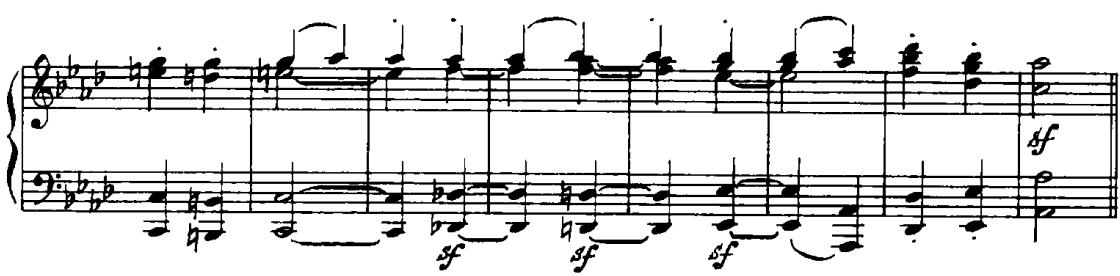
中文讲解
这是例 4.37 的图像占位符,对应贝多芬奏鸣曲 op. 110 第二乐章第 9–16 小节的谱例。它在原文中用于呈现一个“终止前后充满节拍不稳定性、唯独终止本身稳定”的极端情形;图注或会同时给出两种节拍结构(i 与 ii)的对照,以展示 MPR 7 的决定性作用。
补充说明
无额外补充(具体谱面信息不可见)。
第11段(P0175)
原文复述
It seems fairly clear that cadences are an important factor in fixing metrical as well as tonal structure. MPR 7 is a preliminary statement showing the place of this aspect of metrical structure in the present theory.
中文讲解
本段是小结兼过渡句:作者指出终止不仅决定调性结构,也决定节拍结构,因此需要在偏好规则体系中专门为它留出位置。MPR 7 在此被定性为“初步陈述(preliminary statement)”,暗示这是把“终止对节拍的影响”纳入当前理论的初步方案,将来可能会被进一步精化。其功能是:把上一段的反例与极端案例升格为一般规则,并把读者引向 P0176 的规则正式表述。
第12段(P0176)
原文复述
MPR 7 (Cadence) Strongly prefer a metrical structure in which cadences are metrically stable; that is, strongly avoid violations of local preference rules within cadences.
中文讲解
MPR 7 的正式规则陈述。形式上,它由两部分构成:正向表述——“强烈偏好使终止在节拍上稳定的结构”;等价解释——“强烈避免在终止内部违反局部偏好规则”。所谓“局部偏好规则”指 MPR 1–5 等已经给出的、关于强拍与事件关系的规则;所谓“违反”指在终止位置出现切分或跨重音,使得终止处的重音指向与全局节拍格局相冲突。该规则不规定终止采用何种节拍模式,只规定终止本身不应造成局部冲突。
第13段(P0177)
原文复述
Note that MPR 7 does not dictate whether a cadence should fall into a metrical pattern of weak-strong (“masculine” cadence) or one of strong-weak (“feminine” cadence). It says only that, whatever the metrical pattern, the metrical evidence within the cadence should not conflict with the prevailing global pattern. In particular, when surrounding metrical evidence is in conflict, as in 4.37, MPR 7 implies that the cadence is decisive in settling on a preferred metrical structure.
中文讲解
本段是对 MPR 7 范围的精确限定,意在防止误读。作者强调 MPR 7 并不在“阳性终止(weak-strong,男声式)”与“阴性终止(strong-weak,女声式)”之间做选择;它只是要求:无论采用哪种节拍模式,终止内部的节拍证据都不得与全局节拍格局冲突。进而,作者提出 MPR 7 的一个强推论:在终止之外的上下文证据彼此冲突(例如 4.37 那样的极端情形)时,终止本身成为选定偏好节拍结构的决定性证据。该推论把 MPR 7 从一条局部约束升级为可在节拍层级冲突时充当仲裁者的全局规则。
补充说明
“masculine / feminine cadence”在传统和声学中对应强拍落在终止式最后一和弦(阳性)与落在倒数第二和弦(阴性)的区分;本段用此术语界定 MPR 7 的中性立场。
第14段(P0178)
原文复述
Chapter 4
中文讲解
这是页面顶端的运行标题(running head),标注当前所在的第 4 章。它属于版面元素,不传递新的论证信息,仅起页面导航作用。
第15段(P0179)
原文复述
From this rule and from MPR 6 follows the traditional principle that the cadential 6 chord should be on a stronger beat than the dominant it precedes. The bass arrives at the fifth degree of the scale at the 6 and maintains it through both chords, so the metrical stability of the bass with respect to MPR 5a (length of event) requires the stronger beat on the 6. The requirement is particularly stringent because it is within a cadence.
中文讲解
本段把 MPR 6 与 MPR 7 联合起来,推出一个传统和声学的常识性结论:终止中的六四和弦(cadential 6/4 chord,按原文“6”指称)应当落在比它所先现的主和弦(dominant,按传统说法即 V 和弦)更强的节拍位置上。论证链条是:(1)在六四和弦进入时,低音已经到达音阶的第五级;(2)该低音在六四与主和弦两个和弦中保持不动(即为一个长持续事件);(3)按 MPR 5a(事件长度偏好更长的音处于更强的节拍位置),低音所支撑的这个长事件要求六四和弦落在强拍上;(4)这一要求因发生在终止内部而由 MPR 7 进一步加重。其理论意义在于:作者用偏好规则系统(MPR 6 + MPR 5a + MPR 7)从内部推导出一个历来被视为“理所当然”的和声规则,从而把传统教学直觉纳入形式化框架。
补充说明
文中“6”即终止六四和弦(cadential six-four chord),其低音为音阶五级,上方同时含六度音与四度音,习惯上标记为 6/4 或 V6/4——IV。原文 OCR 形式仅显示数字 6,应理解为该和弦的标准缩写。
第16段(P0180)
原文复述
Another place where contrapuntal considerations affect metrical structure is at suspensions. In tonal music, the examples in 4.38 are heard with structure i in strong preference to structure ii; that is, the dissonant suspensions are heard as metrically stronger than their consonant preparations and resolutions.
中文讲解
本段引入第三类影响节拍结构的对位因素——延留音(suspension)。中心主张是:在大小调音乐中,例 4.38 所展示的两组延留陈述被听成“结构 i”(延留的不协和音落在比预备和解决都强的节拍位置上)远比被听成“结构 ii”(不协和音落在弱位)更为自然。换言之,延留的不协和性本身赋予该音以节拍显著度,而其后的协和解决反而在节拍上让步。这是一个对位上的不协和音反过来成为强拍标记的反直觉结果,因此需要专门设立偏好规则来加以表达。
补充说明
“结构 i / 结构 ii”指同一组事件在两种不同节拍层级归属下的解读差异,对应原书 GTPM 框架中的结构选择。
第17段(P0181)
原文复述
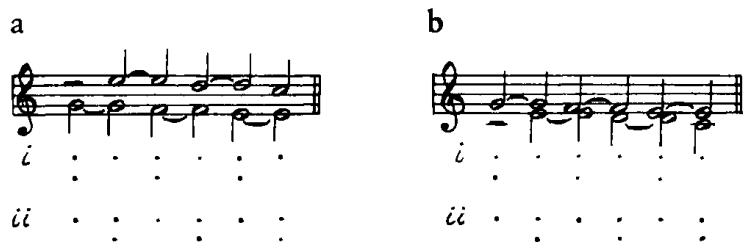
中文讲解
这是例 4.38 的图像占位符,对应文中提到的两组延留音谱例(4.38a 与 4.38b)。该图用于直观展示“延留不协和音比其协和预备与解决更具节拍显著度”这一现象,a 与 b 两个子例在低音位置和延留声部方向上有所不同,以便 P0182 进行进一步分析。
补充说明
无额外补充(具体谱面信息不可见)。
第18段(P0182)
原文复述
In 4.38a this preference is reinforced by MPR 6, since the lower voice moves to create the dissonance. In 4.38b, by contrast, this preference is in conflict with MPR 6, since the upper voice creates the dissonance and the bass is suspended; hence the preference for structure i is somewhat weaker here. Nonetheless, the fact that MPR 6 can be overruled here demonstrates the need for another preference rule:
中文讲解
本段把延留现象与 MPR 6 结合,揭示两条规则之间可能发生的冲突。在 4.38a 中,形成不协和的下行运动来自低声部,因此“延留落在强拍”既符合延留本身的直觉,又与 MPR 6(低音稳定)一致,结构 i 的偏好被双重加固。在 4.38b 中,形成不协和的是上声部,低音是被延留的那个音,因此 MPR 6 与“延留音更稳定”相矛盾:若遵守 MPR 6,则低音(被延留的音)应更强,结构 i 反而显得不自然;尽管如此,听者仍倾向于把延留不协和音听成强拍,这说明存在一条独立于 MPR 6、专门支持“延留强于解决”的规则。这一论证的功能是:在 4.38b 这个 MPR 6 与延留直觉相冲突的反例中,暴露出现有规则体系的不足,从而为 MPR 8 的引入作铺垫。
第19段(P0183)
原文复述
MPR 8 (Suspension) Strongly prefer a metrical structure in which a suspension is on a stronger beat than its resolution.
中文讲解
MPR 8 的正式规则陈述。其形式化内容是:强烈偏好使延留音落在比其解决更节拍强势的位置上。该规则的功能是把 P0180–P0182 中揭示的“延留音具有节拍显著度”这一对位直觉纳入偏好规则体系,从而在 4.38b 这种 MPR 6 与延留直觉冲突的情形中,担当起“裁决者”的角色——它允许延留的节拍强势压过低音稳定的偏好。规则中的“strongly”表示其偏好程度高,用以与 MPR 6 的“普通”强度形成区别;这种强度差异正解释了为何 4.38b 中结构 i 仍可被听成,但偏好比 4.38a 中弱。
脚注 / 边栏 / 图表 / 附加信息(如有)
本节包含两个值得注意的非正文元素:(1)侧栏标签 P0168(Further Metrical Preference Rules)与 P0169(Metrical Structure),以及页眉 P0178(Chapter 4)属于版面导航元素,不携带新论辩信息;(2)三处图像占位符 P0172(例 4.36)、P0174(例 4.37)、P0181(例 4.38)分别对应莫扎特 A 大调奏鸣曲改写版、贝多芬 op. 110 第二乐章 9–16 小节、以及两组延留音谱例的对照版本,原书通常在这些图下附有结构 i 与结构 ii 两种节拍解读的并列显示。此外,P0170(MPR 6 规则陈述)末尾的上标 ⁴ 标记了一个脚注引用,但脚注正文不在当前输入段落中,其内容需查阅原书对应页脚。
💡 本节核心要点
- MPR 6 将前述 MPR 3–5 在低音声部上的作用合并为一条“低音节拍稳定”偏好,用以解释低音进入带来的额外节拍显著度。
- MPR 7 规定终止内部应避免违反局部偏好规则;它不强制规定终止的强弱位置模式(阳性/阴性),但要求终止内证据不得与全局节拍格局冲突。
- 当终止之外的上下文证据彼此冲突(如例 4.37 贝多芬 op. 110 第二乐章 9–16 小节)时,MPR 7 让终止本身在选定偏好节拍结构上具有决定性作用。
- 由 MPR 6 与 MPR 5a 联合可推出传统和声规则:终止六四和弦须落在比其主和弦更强的节拍位置上;该要求因处于终止内部而被 MPR 7 进一步加重。
- 在延留情形中,无论形成不协和的声部方向如何,听者普遍把不协和的延留音听成节拍上更强(结构 i);这条对位直觉独立于 MPR 6。
- 在 4.38b(低音被延留、上声部制造不协和)的情形中,延留的节拍强势压过 MPR 6 的低音稳定偏好,因而需要专门设立 MPR 8:强烈偏好延留音落在比其解决更强的节拍位置上。
🔑 关键术语
- MPR (Metrical Preference Rule):节拍偏好规则;在本节中指 MPR 6(低音)、MPR 7(终止)、MPR 8(延留),是对前述 MPR 1–5 局部规则的补充,用于在多种可能的节拍解读中作出偏好选择。
- MPR 6 (Bass):偏好低音在节拍上稳定;即在解读冲突时优先采纳使孤立低音对准强拍、低音持续音不被切分的方案。本质上是把 MPR 3、4、5 在低音上的作用加权合并。
- MPR 7 (Cadence):强烈偏好使终止在节拍上稳定,即强烈避免在终止内部出现切分或跨重音等违反局部偏好规则的写法;不限定终止采用阳性(weak-strong)还是阴性(strong-weak)节拍模式。
- MPR 8 (Suspension):强烈偏好使延留音落在比其解决更节拍强势的位置上;用以独立地支持延留的对位节拍强势,即使与 MPR 6(低音稳定)冲突也仍然适用。
- suspension (延留):一种对位不协和音型:同一音在协和→不协和→协和之间延续;其不协和阶段被认为具有节拍上的显著度,是 MPR 8 的核心适用对象。
- masculine / feminine cadence (阳性/阴性终止):终止内部节拍模式的区分:阳性终止把强拍放在最后一和弦(weak-strong),阴性终止把强拍放在倒数第二和弦(strong-weak);MPR 7 不在此二者间作选择,只要求终止内不与全局格局冲突。
- cadential 6/4 chord (终止六四和弦):终止式中低音为音阶五级、上方含六度与四度音的和弦(标记为 6/4 或 V6/4—V 或 IV);按 MPR 6 与 MPR 5a 的联合作用,它应落在比其后的 V(dominant)更强的节拍位置上。
- hemiola:三对二的节拍重音错位;本节中作为终止前常见的节拍复杂化手法被提及,与终止内部的节拍稳定性形成对比。
S4.3.2 [描述性拆分] Time-Span Reduction Interaction (MPR 9)
第1段(P0184)
原文复述
Finally, we deal with a preference rule alluded to in the previous subsection in connection with the larger-level metrical structure in example 4.35. The bass in this passage alternates between G in the upper octave on beats 3 and 19 and G in the lower octave on beats 11 and 27. The lower G is sensed to be some indication of a stronger beat on the whole-note level. To add this effect to the existing rules, one might be tempted simply to formulate a preference rule favoring lower bass positions. However, the typical “oom-pah” accompanimental figure (4.39) argues against such a treatment, since in this example one would hardly be tempted to hear the lower bass note as the strongest beat.
中文讲解
本段是本小节的开场,提出一个具体的分析难题:在例 4.35(G 小调交响曲相关片段)中,低音在高八度 G(位于第 3、19 拍)与低八度 G(位于第 11、27 拍)之间交替,听感上低八度 G 似乎标志着小节级(whole-note level)的强拍。作者随即指出一个写作上的诱惑——直接把"低音位置更低者优先"写成一条单独的节拍偏好规则——但随即以例 4.39 的"oom-pah"伴奏音型加以反驳:在这种典型伴奏型中,较低的低音并不意味着最强的节拍位置,所以单纯的"低音更低则更强"的规则会得出错误结论。这一段的功能是设立本节要解决的问题:如何既承认低音位置对节拍感知的提示作用,又不被一个过于粗暴的规则所误导。
第2段(P0185)
原文复述
Metrical Structure
中文讲解
这是节标题"Metrical Structure"。它以最简形式提示:本小节虽以 MPR 9(Time-Span Interaction)这条规则为焦点,但讨论的对象是节拍结构本身,特别是节拍结构如何与时跨缩减相互作用。读者可以把它视作对前一段(P0184)所提问题的论域标识。
第3段(P0186)
原文复述
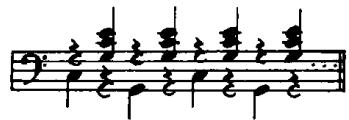
中文讲解
这是一处位于第 23 页的内嵌图像或乐谱占位符,原图内容在本任务输入中未给出(标注为"内嵌图像数据已省略")。从上下文判断,它很可能与例 4.35(低音在高/低八度 G 之间交替的片段)或例 4.39(“oom-pah"伴奏音型)相关,或是与 MPR 9 相关的图示。由于原始图像信息不可读,本讲解无法对其作进一步的具体描述;读者需对照原书第 23 页查看。
补充说明
本任务输入中未提供该占位符的具体图注或可读内容,故仅按版面属性说明。
第4段(P0187)
原文复述
What really influences the metrical structure is the stability of the bass within the harmonic context: the lower bass is favored, but not at the expense of choosing an inversion (especially a 6/4 chord) over root position. These principles of bass stability play a role in determining the time-span reduction, and it would miss a generalization to repeat them in the metrical rules. Rather, the appropriate account seems to be a metrical preference rule that takes into account the interaction with the time-span reduction.
中文讲解
本段给出本节的核心论断:(1)真正影响节拍结构的不是"低音位置高低"这一表面特征,而是低音在和声语境中的稳定性;(2)可以倾向选择较低的低音,但不能因此让位于选择转位(尤其是 6/4 和弦)而非原位的处理;(3)这些低音稳定性原则其实已经作用于时跨缩减的判断,因此若把它们原样重复写进节拍规则,将错失一个更一般的概括。作者由此提出正确做法:写一条与时跨缩减相互作用的节拍偏好规则,而不是在节拍规则内部重复低音稳定性原则。这一段的关键在于揭示——节拍规则不应独立于时跨缩减规则运作,而应在二者交界面发挥作用。
补充说明
6/4 chord 即六四和弦,是原位三和弦的第一转位;root position 指原位三和弦。原文中的判定顺序为:先看低音在和声中的稳定性(必要时允许选择转位以避免强拍上出现不稳定的低音),再决定节拍强弱。
第5段(P0188)
原文复述
The preference rules for time-span reduction are concerned with the relative structural importance of events (see chapters 6 and 7). Broadly speaking, the factors involved are pitch stability, metrical stability, and articulation of groups. It often happens that pitch considerations and metrical considerations are at odds, for example in a suspension. In such a case the choice of time-span reduction is conflicted, with the result that the reduction is less stable at that point than it would be if all the factors were reinforcing.
中文讲解
本段为读者交代时跨缩减偏好规则的总体框架(详见原书第 6、7 章),作为后文讨论"冲突"概念的基础。作者指出,时跨缩减关心事件的相对结构重要性,所涉因素大致分为三类:音高稳定性、节拍稳定性与分组划分(articulation of groups)。紧接着引入一个关键情形——音高因素与节拍因素之间发生冲突,作者以延留音(suspension)为例:当一个音在节拍上处于强位但音高上属于不稳定的延留,或反之时,听感上时跨缩减在该点变得"不那么稳定”,因为两类本应互相强化的判据在此互相抵消。这一"冲突—稳定性降低"的概念正是 MPR 9 据以表达的判据。
补充说明
延留音(suspension)是 GTTM 体系中"音高稳定性"与"节拍稳定性"可能冲突的经典例子:在前一小节强拍位置以协和音引入,并在弱拍位置延续至该位置从而变为不协和音。原书第 6、7 章的详细内容不在本任务输入范围内,故此处不展开。
第6段(P0189)
原文复述
Now consider the G Minor Symphony. If the higher bass note were chosen as the strong beat at the whole-note level, the rules of time-span reduction would encounter a conflict between metrical and pitch considerations, since the more stable pitch-event (the low G) would fall in the weaker metrical position. On the other hand, if the low G is chosen as the strong beat, metrical and pitch considerations reinforce each other, resulting in a more stable time-span reduction. Similarly, in 4.39 the C in the bass is far more stable than the G in terms of pitch, since it forms a root-position chord and the G forms a 6/4; hence the least conflicted time-span reduction results from a metrical analysis with the C on a stronger beat. These considerations suggest the following preference rule:
中文讲解
本段把上一段抽象的"冲突—稳定性"判据落到两个具体例子上,是 MPR 9 提出来的论证环节。第一个例子回到 G 小调交响曲的 4.35:若把小节级强拍判给高八度 G,则低音上更稳定的低八度 G 反而落在节拍弱位上,于是音高稳定性与节拍稳定性彼此冲突,时跨缩减在该点变得不稳定;反之,若把小节级强拍判给低八度 G,则两类判据互相强化,时跨缩减更稳定。第二个例子回到 4.39 的"oom-pah"音型:低音声部中的 C 由于构成原位和弦而远比 G(构成 6/4 和弦)在音高上稳定,因此让 C 位于较强拍上时,时跨缩减的冲突最少。两例合并起来,作者用反证与对比说明:判别节拍强弱的依据不应该是"低音越低越强",而是哪一种节拍分析能使时跨缩减的冲突最小化。从这一论证出发,作者顺势推出 MPR 9。
补充说明
例 4.35 中低八度 G 与高八度 G 音高相同,但因位于不同八度而在"音高稳定性"上有差别——按 GTTM 的隐含理解,更低位置的低音在和声语境中通常更稳定;本任务输入未对这种稳定性差异给出进一步的本体论说明,故不在此处补充。
第7段(P0190)
原文复述
MPR 9 (Time-Span Interaction) Prefer a metrical analysis that minimizes conflict in the time-span reduction. ^7
中文讲解
本段以规则编号与简短措辞的形式正式给出 MPR 9——“节拍与时跨缩减相互作用规则”:在多种可成立的节拍分析之间,优先选择使时跨缩减冲突最少的那种。本规则的关键在于把"节拍分析"与"时跨缩减"两套原本相对独立的程序通过"冲突"这一量化指标耦合起来:节拍规则不再孤立地看节拍证据,而是评估每一种节拍选择在下游时跨缩减中所引发的整体稳定性后果。末尾的上标 7 提示读者此处存在一条脚注,但本任务输入中未提供该脚注内容,故只能确认其存在而不能复述其内容。
补充说明
原文中 MPR 9 末尾的上标 7 表明该规则附有脚注,但脚注正文不在本任务输入的 source_paragraphs 范围内,因此按本任务输入只能定位到"存在一条脚注"这一事实,不对其内容作进一步说明。
脚注 / 边栏 / 图表 / 附加信息(如有)
本小节存在一个内嵌图像或乐谱占位符(P0186,位于第 23 页),原图内容在 task_input 中以"内嵌图像数据已省略"标注,未提供可读文本;其可能与例 4.35 的低音八度交替、节拍图示或 MPR 9 的示意相关,需读者查阅原书确认。本小节末尾 MPR 9 的上标 7 提示存在一条脚注,但脚注正文未包含在 source_paragraphs 中。
💡 本节核心要点
- 本节要解决的核心问题是:低音位置的高低是否可以单独作为一条节拍偏好规则;答案是不能——它会与例 4.39 的"oom-pah"音型相冲突。
- 真正影响节拍结构的是低音在和声语境中的稳定性,且优先考虑原位和弦而非转位(尤其 6/4)这一和声选择必须被允许覆盖单纯的低音位置倾向。
- 时跨缩减的稳定性受三类因素支配:音高稳定性、节拍稳定性、分组划分;当音高与节拍判据冲突(例如延留音)时,时跨缩减在该点变得不稳定。
- 例 4.35 与例 4.39 通过对比说明:判别节拍强弱的依据应当是"哪一种节拍分析使时跨缩减的冲突最少化",而非"低音更低则更强"。
- MPR 9 把节拍分析与时跨缩减两套程序通过"冲突最少化"指标耦合起来,使节拍规则的判据承担起对下游时跨缩减稳定性的评估责任。
🔑 关键术语
- MPR 9 (Time-Span Interaction):节拍与时跨缩减相互作用规则。本节正式提出的偏好规则,要求在多种可成立的节拍分析中,优先选择使时跨缩减冲突最少的那一种。
- time-span reduction:时跨缩减。GTTM 分析的第二个分支,关心各事件之间的相对结构重要性,判据包括音高稳定性、节拍稳定性、分组划分等。
- metrical preference rule:节拍偏好规则。GTTM 第三分支"节拍结构"内部用于在多个节拍分析之间作出选择的规则,本节指出这类规则应与时跨缩减规则协同运作。
- bass stability:低音稳定性。指低音在和声语境中是否处于一个稳定、低冲突的位置;本节强调此概念优先于单纯的"低音高低"判断。
- 6/4 chord:六四和弦。原位三和弦的第一转位。本节指出,为了避免 6/4 和弦在强拍上承担低音,宁可让低音稳定性原则让位于和声原位原则。
- root position:原位。和弦以根音位于最低声部的形式;本节用作"低音稳定性"判断中优于转位的优先选项。
- suspension:延留音。前一和弦的音延续至当前和弦并在该和弦中变为不协和音的现象;本节用作"音高稳定性与节拍稳定性冲突"的典型例子。
- whole-note level:全音符层级。指节拍结构中由四个四分音符拍组成的小节层级,本节讨论的节拍冲突正发生在此层级。
- oom-pah accompanimental figure:“oom-pah"伴奏音型。即典型的主—属持续低音伴奏型,本节以例 4.39 为代表,反驳"低音越低越强"的简化规则。
- conflict in the time-span reduction:时跨缩减中的冲突。指音高稳定性与节拍稳定性等判据对同一事件给出不一致的结构重要性判定,是 MPR 9 用来评估节拍分析优劣的核心指标。
S4.3.3 [描述性拆分] A More Difficult Example: Haydn Quartet op. 76, no. 6 — Setup and Eighth-Note Level
第1段(P0191)
原文复述
A More Difficult Example
中文讲解
本段是第4.3.3小节的标题,原文为 “A More Difficult Example”,意为"一个更难的例子”。它提示本节将分析一个比此前例子更复杂的谱例——海顿弦乐四重奏 op. 76, no. 6 末乐章的开头。该标题的功能是把读者从相对简单的拍子案例带进一个充满节拍歧义、倚音和交叉重音的真实作品片段,从而凸显节拍偏好规则(MPR)是如何在多义情形中发挥作用的。
补充说明
本标题属于小节层面的导引,仅提示论题方向,不含可单独提取的术语信息。
第2段(P0192)
原文复述
Example 4.40 is the opening of the finale of the Haydn Quartet op. 76, no. 6. The smallest metrical level is of course supplied by the metrical well-formedness rules; we will show how the next two levels are derived by the metrical preference rules. As usual, the example is presented without bars and beams. The dashed vertical lines are added as a visual aid.
中文讲解
中文释义:例 4.40 是海顿弦乐四重奏 op. 76, no. 6 末乐章的开头。最小一级的拍子层级自然由节拍良构规则给出,我们将展示其上两级如何由节拍偏好规则推导而出。与前例一致,该谱例不再画出小节线与连尾线,虚线竖线仅作视觉辅助。
讲解:作者明确区分了"良构规则"与"偏好规则"两种来源——前者保证结构合法,后者从中挑出最合适的解读。“without bars and beams"是关键:去掉视觉上已划分好的小节线和连尾线后,读者被迫仅凭节奏内容判断节拍,这正是本分析的方法论前提。虚线是作者添加的视觉参照(visual aid),不是谱面的一部分。
补充说明
本段中"metrical well-formedness rules"与"metrical preference rules"是Lerdahl与Jackendoff《生成性音乐理论》中的核心术语,本节通过本例展示偏好规则的应用,故后文频繁以"MPR"编号引用。
第3段(P0193)
原文复述
The first half of the passage is characterized by tremendous metrical ambiguity. The reader is invited to demonstrate to himself how many different metrical structures (3/4 versus 6/8 and six possible positions for the downbeat) are viable possibilities for beats 1–24. As Rosen 1972 points out (pp. 339–340), Haydn makes extensive use of this ambiguity throughout the movement. The second half of the passage intuitively rules out most of these possible analyses, but is itself full of metrical complexity due to syncopation and cross-accents. In the course of our analysis, we will show how the intuitive metrical complexity of the entire passage is reflected in the application of metrical preference rules.
中文讲解
中文释义:段落前半(第1–24拍)以巨大的节拍歧义为特征。读者可以自行尝试,看究竟有多少种不同的节拍结构——3/4 与 6/8 之争,以及重拍位置的六种可能——对第1–24拍是可行的。如 Rosen 1972 第 339–340 页指出的,海顿在该乐章中广泛使用了这种歧义。段落后半从直觉上排除掉了这些可能分析中的大多数,但本身由于切分与交叉重音而充满节拍复杂性。在分析过程中我们将说明,整个段落的直觉节拍复杂性是如何反映在节拍偏好规则的应用之中的。
讲解:本段承担"问题陈述"的功能:先指出第1–24拍存在多解(3/4 或 6/8,以及六种重拍位置),再说明后半段通过直觉可缩小可能分析,最后预告 MPR 将如何把这种直觉转化为规则应用。“intuitively rules out"这一说法很重要——作者承认前段对后半段的判断带有直觉成分,而分析的目标正是用偏好规则去支撑这种直觉。Rosen 1972 的引用提供了该歧义现象的外部学术支撑。
补充说明
段落将"前半歧义/后半相对明确"作为分析两段论的张力,这种结构本身就是本小节论证的骨架。“six possible positions for the downbeat"具体指 6 个八分音符位置中任一处都可能被听成重拍。
第4段(P0194)
原文复述
Chapter 4
中文讲解
本段是页眉标记,原文为 “Chapter 4”,表示当前内容属于第4章。它仅起版面定位作用,没有节拍或理论内容。
第5段(P0195)
原文复述
Metrical Structure
中文讲解
本段是页眉标记,原文为 “Metrical Structure”(节拍结构),是第4章的章节名。它仅起版面定位作用,提示该章研究对象。
第6段(P0196)
原文复述
First consider the grouping. Parallelism and symmetry clearly establish the grouping of beats 1–24 into sixes. Because of the counterpoint, the grouping of the second half of the passage is somewhat more difficult to motivate. However, it seems reasonable that the motivic parallelism between the first violin in the first four groups and the cello at 31–35 and 37–40 establishes the grouping illustrated, although this is to some extent in conflict with the grouping suggested by the inner parts between about 28 and 40.
中文讲解
中文释义:首先来看分组。平行与对称清楚地确立第1–24拍被分成六个一组。由于对位的原因,段落后半的分组更难给出动机。但看起来合理的是,第一小节在前四组中的动机与 31–35 和 37–40 大提琴声部之间的动机平行确立了图中所示的分组,尽管这在一定程度上与约 28–40 之间内声部所暗示的分组相冲突。
讲解:作者先承认前半"parallelism and symmetry"让六拍一组的分组毫无争议——这是优先规则中 GPR 5(对称/平行)类规则的应用典范。后半段则出现了张力:第一小节与大提琴的动机平行(31–35、37–40)支持图示分组,但 28–40 之间内声部暗示的分组与之冲突。这种冲突是作者刻意暴露的,它告诉读者:分组并非由单一规则唯一决定,而是多组规则竞争的结果。“to some extent in conflict"这一限定很重要——作者并未宣布后者完全压倒前者。
补充说明
本段所谓"分组(grouping)“指的是节拍层级之上的结构层级(grouping structure),是 Lerdahl–Jackendoff 体系内与节拍结构并行的另一维度。“sixes"指每六拍(即每组六个八分音符)形成一个高层单位。
第7段(P0197)
原文复述
Beneath the eighth-note level of beats are marked the applications of the metrical preference rules at this level. From 1 to 24, metrical evidence at the eighth-note level is not highly differentiated. Since there are no regularities at either two-beat or three-beat intervals, it is not at all obvious whether the six-note groups imply 3/4 or 6/8. Furthermore, though it is clear that the harmony changes somewhere in each group, it is not clear where. In particular, the fact that each of the chords (6, 12, 18, and 24) is immediately preceded by one of its pitches suggests that the chords themselves are not the point of harmonic change. Hence no applications of the harmonic-change rule (MPR 5f) can be marked with any certainty at this level.
中文讲解
中文释义:在八分音符拍点层级下方标记了该层级上节拍偏好规则的应用。第1–24拍之间,八分音符层级的节拍证据并不高度分化。由于在两拍间隔与三拍间隔上都没有规则性可言,六音一组究竟意味着 3/4 还是 6/8 一点都不明显。此外,虽然每组内和声确实在某一处发生了变化,但发生在哪里并不清楚。特别是,第6、12、18、24 拍的和弦都各自被其自身的某一音先现出来,这暗示这些和弦本身并非和声变化的所在。因此,和声变化规则(MPR 5f)在本层级无法被有把握地标出任何应用。
讲解:本段是分析的核心困难所在——它显式说明为什么"常规"的偏好规则(MPR 5f)和声变化规则在这里失效:和声变化点被先现音(anticipation)模糊了,使得每次和弦出现时,变化其实发生在前一个音。因此即便听者能感知到和声变化,也难以定位它,MPR 5f 在八分音符层就"无的放矢”。这一观察解释了为什么第1–24拍的节拍层级证据贫乏——需要等到更长的音长与更明确的和声变化出现(下一段主题)。
补充说明
“preceded by one of its pitches"即先现音/抢拍音:和声变化在某个音提前出现的那一拍已发生,到正式记写的和弦位置才完整呈现。这导致按谱面位置判定和声变化点失效。
第8段(P0198)
原文复述
The first solid indications of meter are the attacks of long notes at 28, 30, and 36 and the clear harmonic changes at 30, 34, and 36, which establish a spacing of metrical evidence consistent with a 3/4 meter. (The harmony at 40 lasts only for a single eighth, so it does not constitute evidence for MPR 5f, which looks for the onset of a prolonged harmony.)
中文讲解
中文释义:拍子的首批坚实指示来自第28、30、36 处长音的进入,以及第30、34、36 处清晰可见的和声变化,它们建立了一种与 3/4 拍一致的节拍证据间距。(第40 处的和声仅持续一个八分音符时长,因此不足以构成 MPR 5f 的证据——MPR 5f 寻找的是持续和声的起始。)
讲解:本段是分析的转折点:MPR 在 1–24 拍失效后,第28 拍起才出现可靠证据。长音进入(attack of long notes)是节拍层级的强证据来源;和声变化则在 30、34、36 处清晰发生并可定位。第 40 拍被特别处理:虽然看似和声变化,但只持续一拍八分音符,不构成"持续和声”,故不能援引 MPR 5f。这是规则适用条件的细致说明,提醒读者 MPR 5f 并非"凡和声变化即适用”,而是要求持续性。整体证据间距(两拍一变化)支持 3/4 而非 6/8。
补充说明
“attack of long notes"指某个声部在一拍上奏出明显长于前后的音,是节拍重音的常见物理来源;“onset of a prolonged harmony"是 MPR 5f 的精确触发条件,与"瞬时和声变化"不同。
第9段(P0199)
原文复述
Next, observe that in 40–48 the alternating quarter notes in the bass and the upper parts create a generally high level of metrical evidence on all beats. However, MPR 6 emphasizes the contribution of the bass, establishing a differentiation that again favors spacing strong beats two rather than three apart. Furthermore, the counterpoint sets up suspensions at 44 and 46, creating pressure from MPR 8 to place strong beats there.
中文讲解
中文释义:接下来观察 40–48 拍,低音声部与上声部之间的四分音符交替在所有拍点上都制造出总体较高的节拍证据。然而,MPR 6 强调低音声部的贡献,建立起一种再次支持强拍间距为两拍而非三拍的分化。此外,对位在第44 拍和第46 拍设置了延留音,从 MPR 8 角度构成把强拍放在那里的压力。
讲解:本段继续累积 3/4 的证据链。两个规则被同时调用:(1) MPR 6——偏好规则中专门提升低音贡献的规则——使交替四分音符中的低音重拍成为更强的重拍位置;(2) MPR 8——偏好规则中关于延留音的规则——在 44 和 46 拍由于延留音造成的张力,将强拍位置牵引到这两处。这两条规则合力把节拍层证据"聚焦"到两拍间距上,从而把可能性从 6/8(每三拍一个强拍)压向 3/4(每两拍一个强拍)。
补充说明
“suspension"即延留音,前一和弦的音延留到下一和弦并造成张力与解决——MPR 8 倾向于把这种张力点解读为强拍。“MPR 6"特指偏好规则中关于低音声部相对权重的规则。
第10段(P0200)
原文复述
All of this metrical evidence is consistent with the well-formed metrical level shown as the quarter-note level in 4.40, and much more so than with any other choice. Thus the second half of the passage, rich in metrical evidence, forces the interpretation of the first half, which alone provides only meager evidence for a metrical interpretation.
中文讲解
中文释义:所有这些节拍证据都与例 4.40 中所示的四分音符层级相符,且比其他任何选择都要符合得多。因此,节拍证据丰富的段落后半,反过来迫使我们如此解读证据贫乏的段落前半——而仅就前半本身,几乎无法给出任何节拍解读。
讲解:本段是分析的高潮与总结,揭示了一种"先后互证"的方法论:节拍解读不是逐段独立作出的,而是在证据丰富段获得答案后,把该答案"反向投射"到证据贫乏段。这里蕴含着生成性理论的一个关键观点——节拍层级是一个贯穿全局的整合结构,前半段虽然证据稀薄,但仍应被解读为与后半段同一节拍层(3/4,四分音符为拍)一致。“much more so than with any other choice"是定量化比较的隐含表述,强调节拍层选择的非任意性。
补充说明
“well-formed metrical level"对应节拍良构规则所允许的层级结构;本段把"四分音符层级"作为唯一同时满足良构与偏好的解。“forces the interpretation"揭示了节拍分析的整体性约束。
脚注 / 边栏 / 图表 / 附加信息(如有)
本节无独立图表说明、脚注或边栏注释。视觉辅助仅为作者添加的虚线竖线(dashed vertical lines)。外部文献仅一处:Rosen 1972,pp. 339–340,用以佐证海顿在该乐章中广泛使用节拍歧义这一观察。MPR 编号规则(MPR 5f、MPR 6、MPR 8)的具体条文出自 Lerdahl 与 Jackendoff 的生成性音乐理论体系,本节直接调用而未在本小节内重述条文。
💡 本节核心要点
- 本节把海顿 op. 76, no. 6 末乐章开头划分为两段:第1–24拍节拍证据稀薄(节拍歧义巨大),第25拍之后节拍证据丰富但充满切分与交叉重音。
- 在前半段,六音一组的分组由"parallelism and symmetry"清楚确立;但在八分音符层级,既无两拍也无三拍间隔的规则性,先现音还让 MPR 5f(和声变化规则)失效。
- 后半段开始出现可靠节拍证据:长音进入(第28、30、36 拍)、清晰和声变化(第30、34、36 拍)、低音声部被 MPR 6 加权、延留音在第44 和 46 拍施加 MPR 8 压力,所有证据一致指向两拍间距,从而确立 3/4 拍而非 6/8。
- 分析方法论的关键点:节拍层级不是逐段独立判定,而是由证据丰富的后半段"反过来强制"确定,再回溯应用到前半段——这是生成性节拍分析的整体性原则的体现。
- 本节的目的不在于"找出正确答案”,而是展示偏好规则如何在多义情境中累积证据并最终收敛到一种解读,同时承认在 1–24 拍层面规则并无强结论。
🔑 关键术语
- metrical well-formedness rules:节拍良构规则,规定可被接受的节拍层级在形式上必须满足的条件(如强拍必须出现在节拍树上)。在本例中负责给出"最小"的八分音符层级。
- metrical preference rules (MPR):节拍偏好规则,从所有良构节拍解读中挑选最可能的一种。本节频繁援引 MPR 5f(和声变化)、MPR 6(低音声部贡献)、MPR 8(延留音压力)。
- MPR 5f(harmonic-change rule):和声变化规则:当持续和声(prolonged harmony)的起始点出现时,该位置倾向于被解读为强拍。本例中先现音使该规则在 1–24 拍无法应用。
- MPR 6:强调低音声部在节拍判断中相对权重的偏好规则。本例 40–48 拍中低音四分音符使其成为更强拍。
- MPR 8:处理延留音张力的偏好规则。本例第44 和 46 拍因对位延留音,把强拍位置吸引到这两处。
- 3/4 vs 6/8:本节核心的节拍歧义:六音一组可听成每两拍一个强拍(3/4,四分音符为拍)或每三拍一个强拍(6/8,八分音符为拍)。后半段证据最终支持前者。
- cross-accent:交叉重音,即不同声部在同一时刻以不同节拍层级强调,使节拍听感复杂化。本例后半段因此充满节拍复杂性。
- syncopation:切分,弱拍上的音被延长并跨越到下一个强拍,造成节拍错位。本节提到它是后半段复杂性来源之一。
- parallelism and symmetry(GPR 5 类):在分组结构中,动机或材料的平行与对称倾向于确立更高层级的等距分组。本例用其解释第1–24 拍为何清晰分成六个一组。
- anticipation / 先现音:后一和弦的音提前在弱拍出现。本例中第6、12、18、24 拍的和弦均被自身某一音先现,从而模糊了和声变化位置,阻碍 MPR 5f 的应用。
S4.3.4 [描述性拆分] Haydn Quartet: Quarter-Note Level Derivation
第1段(P0201)
原文复述
Chapter 4
中文讲解
本段是页眉性质的版面元素,仅显示"Chapter 4”,提示读者当前分析内容仍属于第4章。它本身不承载论证,只是定位当前小节所属章节。
补充说明
本页为第4章范围内的版面标识,并非正文段落。
第2段(P0202)
原文复述
Turning to the derivation of the next metrical level, we see in 4.41 the application of MPRs to the quarter-note level. Only those applications of the length rule (MPR 5) that span more than a quarter-note’s duration have been marked.
中文讲解
本段引入本小节的核心任务:从已有的八分音符层级向上推导出下一层节拍层级(即四分音符层级)。作者提示在示例 4.41 中可以看到 MPR(节拍推演规则,Metrical Preference Rules)是如何被施加到四分音符层级之上的,并明确说明本图只标注了那些"持续时间超过一个四分音符时值"的长度规则(MPR 5)的应用实例。这一限定意味着分析者已经过滤掉了仅持续一个四分音符或更短的 MPR 5 应用,只保留跨越四分音符界限的长音延留或长型化的情况。理解这一点有助于读者把握后续分析的范围——并非所有 MPR 5 出现的地方都被标记,而是只有那些构成跨层级时值延续的实例才被纳入考虑。
第3段(P0203)
原文复述
First consider the second half of the passage, which is again richer in evidence. Since the dominants initiated at 30 and 36 are prolonged into the following quarter, these beats receive applications of MPR 5f. Similarly, the long notes beginning at 28, 30, and 36 extend into the next quarter and are marked by MPRs 5a and 5e. The change from eighth-note to quarter-note motion in the bass at 40 is marked by MPR 5d (length of pattern of articulation).
中文讲解
本段开始系统列举段落后半段(即大约从第28拍到第48拍区间)的 MPR 5 标记证据。作者首先说明后半段证据更为丰富(“richer in evidence”),这为后续论证铺垫了基础。具体证据包括三类:(1)始于30和36的主和弦(dominant,即V级)由于延留进入下一四分音符,被标记 MPR 5f——这里的 5f 是长度规则中针对"和声延留跨越四分音符边界"的子规则;(2)始于28、30、36的长音延入下一个四分音符,被标记 MPR 5a 和 5e,5a 针对单音延留,5e 针对长型化模式;(3)40拍处低音由八分音符律动转变为四分音符律动,这是一个发音法/节奏形态的变化,由 MPR 5d(发音法模式的长度)标记。这些证据构成了"30、36、40拍附近存在跨四分音符延留"的具体物质基础,是后续确定下一节拍层级的关键依据。
第4段(P0204)
原文复述
At beat 46 the situation is more complicated. Within the time-span 46–47, the time-span reduction chooses the V chord as more important, since it is more consonant than the $\frac{6}{4}$ chord on beat 46. The V is then heard as prolonged into the next quarter, beat 48, since the pitch at 48 is consistent with that harmony. Hence beat 46 is marked for the inception of a prolonged harmony as well as for the repetition of the pitch Bb. In addition, beats 46–48 form a cadence, so MPR 7 applies in this area.
中文讲解
本段处理46拍这一关键节点的复杂情况,论证步骤值得细讲:(1)在46–47的时间跨度内,时值层级缩减(time-span reduction)优先选择V级和弦而非46拍上的6/4和弦,理由是V级更协和——这意味着V级被听成结构上更重要的和弦,6/4反而是经过性的;(2)由于48拍的音高与V级和弦一致,V级被听成延留进入下一个四分音符48拍;(3)因此46拍获得两个标记:一是"延留和声之起始”,二是"Bb音高的重复”(即该音高在此被重新强调);(4)46–48拍构成一个终止式(cadence),所以节拍推演规则中的MPR 7(终止式规则)也在此处适用。这一段的分析是后续"哪种节拍层级放置方案最合理"论证的关键支点——因为终止式涉及到明确的强弱预测,会反过来检验各方案的优劣。
第5段(P0205)
原文复述
Let us consider the implications of these rule applications for the choice of the next metrical level. Parallelism throughout the passage requires that strong beats at the quarter-note level be spaced three apart. Thus there are three possible placements for the next level of beats in the portion of the passage examined so far: 26, 32, 38, and 44; 28, 34, 40, and 46; and 30, 36, 42, and 48. The first of these is readily eliminated. There are no applications of MPR 5 on any of these beats, and applications of MPRs 3 and 6 are weak because they are always adjacent to another beat where these rules also apply.
中文讲解
本段从列举证据转入"节拍层级选择"的逻辑推演,是本小节论证的转折点。作者提出三条限定:(1)整段音乐中的平行性(parallelism)要求四分音符层级的强拍彼此间隔三个四分音符;(2)由此推导出下一节拍层级在所讨论段落内可能有三种放置方案——方案A:26/32/38/44,方案B:28/34/40/46,方案C:30/36/42/48;(3)方案A被立即排除,因为这些拍点上既无 MPR 5 的应用,MPR 3 和 MPR 6 的应用也偏弱(因为它们总是与同样应用这些规则的相邻拍相邻,无法形成独立的强拍标记)。理解这段的关键在于:作者把"节拍层级的选择"形式化为一个枚举+排除的过程,借助先前收集到的 MPR 证据来筛选出唯一合理的方案。这是典型的Lerdahl-Jackendoff 节拍推演方法论的核心思路。
第6段(P0206)
原文复述
The second possibility is more promising. MPR 5 applies on beats 28, 40, and 48, and in the latter two of these it is not adjacent to another application. In addition, the beginning of the long-held treble B $_{b}$ at 28 favors this analysis, even more so because it is held so long. The change in articulation in the bass at 40 and the harmonic change at 46 also reinforce this analysis. Moreover, this analysis makes the correct predictions about relative metrical weight within the cadence at 46–48, so MPR 7 (cadence) strongly favors it.
中文讲解
本段论证方案B(28/34/40/46)比方案A更具说服力,证据按重要性依次累加:(1)MPR 5 适用于28、40、48三拍,其中40和48的标记不与相邻拍的标记相邻(即具有独立性,而非紧邻另一处应用),这是方法论上的一个独立性强拍证据;(2)28拍上高音部 Bb 长音的起始本身即为强拍暗示,且该音延持时间越长,强拍标记越强——这构成"事件起始+长时延续"的双重支持;(3)40拍低音发音法变化和46拍和声变化从局部事件层面支持该方案;(4)关键论据:方案B对46–48拍终止式内部相对节拍重量的预测与实际吻合,因此 MPR 7(终止式规则)强力支持它。这最后一点尤为关键,因为终止式涉及明确的强弱等级,是检验节拍层级方案是否"正确"的强约束条件。读者应理解:作者此处采取的是"多规则汇聚支持"的论证方式——单项证据可能不足以定案,但多项规则共同指向同一方案时,结论就较为可靠。
第7段(P0207)
原文复述
Finally, the third possible analysis is favored by the strong applications of MPR 5 at 30 and 36. But it makes exactly the wrong prediction about the cadence at 46–48: the local metrical evidence strongly favors 46 as the strong beat, whereas this analysis places the strong beat on 48. MPR 7 therefore strongly disfavors this analysis. In sum, the metrical evidence for the second half of the passage favors the dotted-half metrical level shown in 4.41, though not without some uncertainty at points preceding the cadence. In particular, there is little direct evidence to override the strongly marked 30 and 36, which are therefore heard as cross-accents.
中文讲解
本段是本小节的结论性段落,逻辑结构为:先否定方案C(30/36/42/48),再回扣方案B并陈述最终结论。(1)否定方案C:虽然它在30和36拍上拥有 MPR 5 的强应用,但它对46–48拍终止式的预测完全错误——局部证据强力支持46拍为强拍,而该方案却把强拍置于48拍,因此 MPR 7 强力反对方案C;(2)总判定:段落后半段的节拍证据总体上支持示例 4.41 中所示的附点二分音符层级(即方案B的逻辑结果);(3)诚实保留不确定:作者承认终止式之前的某些点上仍存在不确定性;(4)具体指认:30和36拍作为强标记点缺乏直接证据来"覆盖”,因此在听感上被体验为跨重音(cross-accents,即与主导节拍层级错位的局部强调)。最后这一句尤其重要:它揭示了节拍层级推演的一个普遍特征——主层级确立之后,仍存在次一级的局部强拍与主层级冲突的可能性,这种冲突被作者命名为"跨重音”。理解这一点有助于把握Lerdahl-Jackendoff理论对"层级冲突"的处理方式。
脚注 / 边栏 / 图表 / 附加信息(如有)
本小节主要依赖示例 4.41(图表)来呈现四分音符层级的 MPR 标记分布,但该图表的具体图形未在文字中完整描述,需查看原图方能直观理解各拍点上的规则应用。脚注信息未在当前段落中出现。
💡 本节核心要点
- 本小节的任务是从八分音符层级向上推导下一节拍层级(即四分音符层级),且只标注持续时间超过一个四分音符的 MPR 5 应用。
- 段落后半段证据丰富,包含三类标记:始于30和36的主和弦延留(MPR 5f)、始于28/30/36的长音延留(MPR 5a、5e)、40拍低音由八分音符转为四分音符的发音法变化(MPR 5d)。
- 46拍的复杂情况涉及 V 级与6/4和弦的时值层级缩减选择、48拍的音高延续、以及46–48拍构成终止式(触发 MPR 7)。
- 基于平行性约束(强拍间隔三个四分音符),下一节拍层级有三种可能方案:26/32/38/44、28/34/40/46、30/36/42/48。
- 方案A因缺乏 MPR 5 应用且 MPR 3、6 应用较弱而被立即排除;方案C因对46–48终止式预测错误而被 MPR 7 强力反对。
- 方案B(28/34/40/46)获得 MPR 5(40、48非邻接应用)、高音长 Bb 起始、低音发音法变化、和声变化以及 MPR 7 终止式支持的汇聚证据,最终胜出。
- 结论支持附点二分音符层级的成立,但30和36拍的强标记无法被覆盖,因此在听感上呈现为跨重音(cross-accents)。
🔑 关键术语
- MPR (Metrical Preference Rules):节拍推演规则,Lerdahl-Jackendoff 节拍理论中用于在不同层级上判断哪些拍点应被听成强拍的规则集合。在本节中 MPR 5(长度规则)各子项、MPR 3、MPR 6、MPR 7(终止式规则)被分别调用。
- MPR 5 (Length Rule):长度规则,当一个事件(音、和声、发音法模式等)跨越拍点界限时,把该拍点标记为强拍。本节只标记持续时间超过一个四分音符的实例。子项 5a 针对单音长延留,5d 针对发音法模式长度,5e 针对长型化模式,5f 针对和声延留。
- Time-span reduction:时值层级缩减,Lerdahl-Jackendoff 的层级分析方法,用于从底层的时值跨度向上推导出结构上更重要的和声或事件。本节中46–47时间跨度内选择V级而非6/4和弦即是该方法的应用。
- Parallelism:平行性,指音乐段落中节拍层级在时值上等距分布的特性。本节用以约束四分音符层级强拍必须间隔三个四分音符。
- Cadence (MPR 7):终止式规则,当一组拍点构成终止式时,终止式内部的相对节拍重量预测可作为验证节拍层级方案的强约束。46–48拍终止式在本节论证中起关键检验作用。
- Cross-accent:跨重音,指与主导节拍层级错位的局部强拍。在本节结论中,30和36拍虽被强标记但无法覆盖主层级,因此被听成跨重音。
- Dotted-half metrical level:附点二分音符层级,本节推导出的下一节拍层级即位于此层级,对应方案B(28/34/40/46)的延伸与图4.41所示结构。
S4.3.5 [描述性拆分] Haydn Quartet: Dotted-Half Level and Comparison with Mozart
第1段(P0208)
原文复述
Metrical Structure
中文讲解
This is a section heading that re-opens the topic of “Metrical Structure” after a prior discussion of the Haydn example 4.41. It functions as a navigational marker, signalling that what follows will examine where metrical weight falls in the Haydn passage and then move on to a comparative observation about Mozart. The repetition of the heading suggests the author wants the reader to associate the following paragraphs explicitly with the metrical-structure line of argument rather than with grouping or time-span topics.
第2段(P0209)
原文复述
Chapter 4
中文讲解
This is a running header that identifies the page as belonging to Chapter 4. It carries no argumentative content; its function is purely typographical.
第3段(P0210)
原文复述
Now turn to the first half of passage 4.41. The musical surface apparently provides no new applications of preference rules, but a consideration of the time-span reduction reveals evidence for metrical structure. The issue concerns where the harmony is heard to change in each group. As pointed out already, each chord is immediately preceded by a pitch that is consistent with it, so the chords are not heard as the points of change. However, example 4.42, the time-span reduction of beats 1–24 at the quarter-note level, shows pitches inconsistent with the preceding harmony at 10, 16, and 22, suggesting that these beats are the point of harmonic change; we have indicated this in 4.41. $^{8}$
中文讲解
本段是这一小节论证的核心入口,作者要回答的是:海顿四重奏片段4.41前半部分(前24拍)究竟应当在哪里感知到和声变化,从而获得节拍重音。
作者的推理分四步:
- 表面上看,前半段似乎没有给出新的偏好规则(MPR)应用证据;
- 但若考察时值缩减(time-span reduction),即去掉装饰音、把节奏归并到四分音符层级,就可以发现新的和声线索;
- 由于每个和弦出现前都有一个与其相容的音作为先现,所以和声本身(即拍6、12、18、24上的和弦位置)并不被听成和声变化点;
- 真正不一致的位置出现在缩减层级的拍10、16、22,所以这三点才是听感上感受到和声变化的位置。
要点在于:节拍重音并不直接从谱面和弦处获得,而是经过时值缩减之后从那些与前一和声不一致的音中“间接”获得。这是作者所谓"间接节拍证据"的具体来源。脚注8对4.41图上的标记给出说明。
补充说明
本段依赖前文已建立的论证前提——即每个和弦都带有相容的先现音——并把这种相容关系转化为听感上的“无变化”。该前提已在前文段落中提出,本段只是再次调用以推进结论。
第4段(P0211)
原文复述
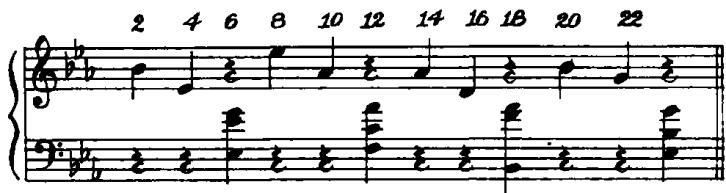
中文讲解
这是一个图示占位符,对应图4.42,即片段4.41前24拍在四分音符层级上的时值缩减图。图中应在拍10、16、22位置显示与前面和声不一致的音,正是这些不一致构成了本段论证的视觉证据。由于图像数据不可见,无法描述具体音高内容,需查看原图以核对。
第5段(P0212)
原文复述
As evidence that this indirect source of metrical prominence derived through the time-span reduction is the correct one, consider 4.43, in which the pitches at 5 and 11 have been changed from Haydn’s.
中文讲解
本段以一个思想实验(counterexample)作为论证策略:把海顿原作中拍5和拍11的两个音换掉,生成变体4.43。如果改变这两个音之后,听感上的节拍重音位置发生了显著变化,那就反向证明:原作中节拍重音之所以落在拍4、10,而不是落在拍6、12的明显和弦处,确实是因为缩减层级上的和声不一致在起作用——而不是其他原因。
这是一种典型的“若P则Q,且确实Q,故P”的反证结构:作者把关键音换掉,预期听感会改变,以此证明那些音是因。
第6段(P0213)
原文复述
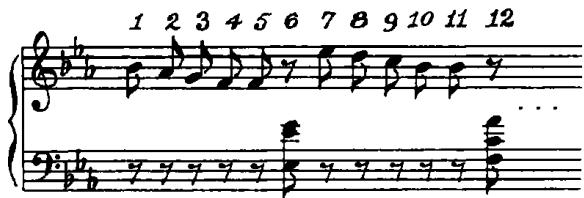
中文讲解
这是图4.43的占位符,即4.43变体的谱例。该图把海顿原作中拍5和拍11处的音高替换为其他音,旨在检验节拍重音位置是否会随之迁移。由于图像不可见,具体替换音高须查看原图。
第7段(P0214)
原文复述
Whatever the musical sins of this alteration, it results in a radically different metrical intuition—the strongest beats are most naturally heard at 6 and 12 rather than at 4 and 10. The theory proposed here accounts nicely for this difference: because the chords in 4.43 are not preceded by pitches consistent with them, they can this time be heard as the points of harmonic change. Hence 6 and 12 rather than 4 and 10 will be marked by MPRs 5e and 5f, altering the distribution of metrical weight.
中文讲解
本段报告了4.43变体的听感结果,并将其纳入理论的解释框架。
论证逻辑:
- 事实陈述:换掉拍5、拍11的音之后,听感上最强的拍子从拍4、10迁移到了拍6、12;
- 理论解释:在变体中,拍6和拍12处的和弦之前不再有相容的先现音,因此它们本身被听成和声变化点;
- 规则应用:MPR 5e(长音/和弦持续)和5f(和声变化)这次标记在拍6和拍12,而不是拍4和拍10,从而改变了节拍重量的分布。
作者承认这个变体“音乐上有瑕疵”(musical sins),但理论关心的不是音乐好坏,而是这一修改导致的节拍预测差异。如果理论能解释这种差异,反向就证实了原版的解释路径。这是一次教科书式的“通过变体验证因果”的方法论示例。
补充说明
MPR 5e与5f的具体规则内容属于前文已建立的体系;本段只调用它们以解释变体结果。
第8段(P0215)
原文复述
In choosing the preferred dotted half-note level for this part of 4.41, we are faced with a conflict between the harmonic changes at 4, 10, 16, and 22 on one hand and the chords at 6, 12, 18, and 24 on the other. Though the strength of the harmony rule (MPR 5f) is undoubtedly sufficient to prevail, the metrical evidence for the chords causes them to be heard as cross-accents, parallel to those in the second half of the passage at 30 and 36.
中文讲解
本段提出选点二分音符层级(dotted half-note level)时存在规则冲突,并交代了冲突的解决方式。
冲突双方:
- 一方是缩减层上的和声变化点(拍4、10、16、22),它们被MPR 5f(和声变化)标记;
- 另一方是表面可见的和弦位置(拍6、12、18、24),它们虽然有"和声/长音"的节拍证据,但不是听感中的和声变化点。
冲突解决:MPR 5f强度足以使拍4、10等获得主要节拍重音,和弦位置因而退居次级。
但作者并不就此止步,而是引入"cross-accent”(交错重音)这一关键概念:在拍6、12、18、24处仍然保留了一定的节拍证据,使听者把和弦位置感知为与主拍错位的交错重音。这些交叉重音与片段后半段(即下文将提到的)拍30和拍36处的交叉重音平行。
这里的关键洞察是:理论不仅给出首选节拍结构,还同时刻画出次级重音位置,使听感的复杂度得以保留。
补充说明
cross-accent(交错重音)指主拍重音之外、由次级规则在错位处标出的次级重音;它的作用是把节拍听感中的“摇摆”或“错位”精确落实到小节内具体拍位上。
第9段(P0216)
原文复述
Thus the rules predict that the analysis shown in 4.41 should be favored for both halves of the passage. However, the indirectness of metrical evidence in the first half of the passage and the syncopation in the second half together create an overall complexity in deriving the preferred metrical interpretation, and this seems to reflect accurately the complexity that this passage presents to musical intuition.
中文讲解
本段对前半段分析进行总结并过渡到对整段复杂度的评价。
作者分两层:
- 规则层面:MPR体系预测4.41所示的分析在片段前后两半都应作为首选;
- 推导过程层面:前半段的节拍证据是间接的(来自缩减层),后半段则存在切分(syncopation),二者叠加使得推导过程具有内在复杂度。
关键断言是最后一句:这种推导的复杂度并非理论的缺陷,而是与听者直觉感受到的复杂度相一致。这把理论的“麻烦”重新解释为“理论如实反映了音乐的复杂”。这是一种辩护性的元论点(meta-claim),目的是让读者接受理论的繁复并非冗余。
第10段(P0217)
原文复述
Metrical Structure
中文讲解
这是再次出现的“Metrical Structure”小节标题。它在此处起到分隔作用:从前面关于海顿4.41复杂节拍结构的论述,转到下一段把海顿与莫扎特4.35做对比的论述。该标题重复出现以提示读者新段落仍属“节拍结构”这一线索。
第11段(P0218)
原文复述
By contrast, the Mozart example 4.35 provides clear evidence for a metrical interpretation at every level and at nearly every point in the passage; applications of metrical rules are numerous and mutually reinforcing. The nature of the derivation predicts that the passage will be heard as metrically straightforward, in accordance with intuition. Thus we have seen how the preference-rule formalism not only can derive a final analysis for a piece, but can also express finer intuitions about the degree of metrical complexity and the reasons it arises. This is one of the ways in which the theory bridges the gap between artistic and psychological concerns, one of the principal goals of the present study.
中文讲解
本段通过对比把前面的论证推向更高层次的结论。
对比关系:
- 海顿4.41:节拍证据间接,需要通过缩减层间接推导;规则应用少、有冲突、有切分,听感复杂;
- 莫扎特4.35:在每一个层级、几乎每一个点上都直接给出节拍证据;MPR应用多且相互强化;推导过程能预测“节拍直白”的听感印象。
理论的胜利之处不仅在于给出最终分析,更在于同时表达“复杂度的程度”以及“复杂度从何而来”——前者对应艺术上的复杂性,后者对应心理上的可解释性。这正是作者所说的“bridges the gap between artistic and psychological concerns”,即把作曲层面的复杂设计与听者认知层面的复杂度感觉在同一形式体系中联系在一起。
这一论断在小节中具有总结与提升的双重功能:一方面收束本节,另一方面把整套MPR体系定位为兼具描述力与认知解释力的统一框架。
补充说明
“artistic and psychological concerns”这一说法揭示了作者的学科立场:节拍理论不应只描述乐谱形式,还应能解释听感现象;这是生成理论(Generative Theory of Tonal Music, GTTM)项目的基本目标之一。
第12段(P0219)
原文复述
With one exception, to appear in the next section, the discussion of metrical preference rules is now complete. To sum up: The preference rules decide which of many possible well-formed metrical structures assignable to a piece represents its intuitively preferred metrical interpretation. The rules of local detail—MPRs 3 (event), 4 (stress), and 5 (length)—are supplemented by considerations having to do with stability of the bass (MPR 6), of cadences (MPR 7), and of suspensions (MPR 8). In addition, interaction with grouping structure (MPR 2) and time-span reduction (MPR 9) and the ubiquitous and powerful considerations of parallelism (MPR 1) affect the choice of metrical structure.
中文讲解
本段是关于MPR体系的总结性段落,列出了全部九条偏好规则的概览,并指出本节讨论“除一个例外之外已经完成”,留下一个悬念给下一节。
规则的层级组织(按作者给出的顺序):
- 局部细节规则:MPR 3(事件)、MPR 4(重音)、MPR 5(时值长度);
- 稳定性相关补充:MPR 6(低音稳定性)、MPR 7(终止稳定性)、MPR 8(延留稳定性);
- 与其他结构交互:MPR 2(与乐句分组结构交互)、MPR 9(与时值缩减交互);
- 全局性主导规则:MPR 1(平行性),作者用“ubiquitous and powerful”强调其无所不在且强大。
关键概念:偏好规则的功能是在所有“合法”(well-formed)的节拍结构中挑选“直觉首选”的那一个;它不是生成节拍结构,而是从已有候选中作选择。这一区分对于理解生成理论中节拍模块的运作方式至关重要。
“除一个例外”一句留给下节作过渡,制造悬念但不说明例外内容,本节不必处理。
补充说明
本段所列MPR编号体系是前文各次论述的回顾性总结;每个编号的具体内容在前文已分别建立,本段只是把它们汇编成一个整体清单。
第13段(P0220)
原文复述
There is reason to believe that much of this preference-rule system is not peculiar to classical Western tonal music, but is universal. The rules of local detail seem to us especially strong candidates. We should make clear what such a claim of universality means. Take the rule of local stress, for example. There are of course musical idioms in which local stresses do not appear; Renaissance choral music for instance can arguably be said not to have them. But we would feel fairly confident in conjecturing that there is no musical idiom employing stress in which it does not mark potential metrical strength. In this sense we can say that the preference rule for stress is always available to musical intuition; the differences between idioms in this respect lie only in whether they ever give the rule opportunities to apply.
中文讲解
本段提出并限定了一个跨音乐文化的普遍性主张。
主张内容:MPR体系的大部分并非西方古典调性音乐所特有,而具有普遍性。其中"局部细节规则”(MPR 3、4、5)是作者认为最有资格称为普遍规则的候选。
关键限定(澄清普遍性的含义):作者并非宣称"所有音乐都使用这些规则”,而是宣称:
- 在任何使用重音的音乐中,重音都会标记潜在节拍强度——这是规则层面的普遍性;
- 不同音乐风格之间的差异仅在于"是否给规则提供应用机会”——这是应用层面的差异。
例子:文艺复兴时期的复调合唱音乐"可论证地"没有局部重音,因此MPR 4在那里根本没有机会被触发;但这并不削弱MPR 4作为普遍规则的资格。
这一区分(“规则普遍可用"vs"规则在某风格中是否有应用机会”)是本段最重要的方法论澄清。它使普遍性主张不至于滑向"所有音乐听起来都一样”。
补充说明
作者以文艺复兴复调合唱音乐作为无重音音乐的例子,是节拍理论文献中讨论重音缺失的典型案例;该例子的功能是测试普遍性主张的边界。
脚注 / 边栏 / 图表 / 附加信息(如有)
本小节包含两处非正文版面元素需说明:
- P0211对应图4.42——片段4.41前24拍在四分音符层级上的时值缩减图,作用是为P0210的论证提供视觉证据(拍10、16、22处的不一致音);
- P0213对应图4.43——把海顿原作中拍5、拍11的音高替换后的变体谱例,作用是为P0212–P0214的反证推理提供对照图。 此外,P0210结尾的脚注标记"$^{8}$“指向对4.41图上所标和声变化点(拍4、10、16、22)的来源说明,脚注本身的全文未在本节段落中给出,但其作用是支持正文主张而非限制之。 P0209的"Chapter 4"为页眉版面元素,无内容含义。
💡 本节核心要点
- 海顿4.41前半段的节拍重音位置(拍4、10、16、22)并非来自表面和弦(拍6、12、18、24),而是通过时值缩减在四分音符层级上发现的不一致音间接获得。
- 通过把海顿原作中拍5、拍11的音换成不与和弦相容的音(变体4.43),最强的节拍重音位置从拍4、10迁移到拍6、12,从而反向证明原作中"间接和声证据"是造成节拍定位差异的真正原因。
- 在选点二分音符层级上存在规则冲突:MPR 5f(和声变化)足以压倒和弦本身,但拍6、12、18、24处的和弦因仍有节拍证据而被听为cross-accent(交错重音),与后半段拍30、36的交错重音平行。
- 海顿4.41的整体节拍推导具有内在复杂度——前半段依赖间接证据、后半段有切分;这一推导复杂度与听感复杂度一致,是理论的优势而非缺陷。
- 莫扎特4.35与海顿4.41形成对比:规则应用密集且相互强化,使得推导自然地预测出"节拍直白"的听感印象;这说明偏好规则体系不仅能给出最终分析,还能解释音乐复杂度感的程度与来源,从而弥合"艺术层面"与"心理层面"之间的鸿沟。
- 整套MPR体系由九条规则组成(局部细节MPR 3–5;稳定性相关MPR 6–8;与其他结构交互的MPR 2、9;以及全局主导的MPR 1平行性),其功能是从所有合法节拍结构中挑选直觉首选的那一个;其中局部细节规则尤其被作者视为具有跨音乐文化普遍性的候选。
🔑 关键术语
- time-span reduction(时值缩减):GTTM体系中的核心操作,指按层级把较短时值的音归并到所在层级的代表音上。本节中用四分音符层级上的时值缩减暴露了表面看不到的和声不一致点(拍10、16、22),从而提供间接的节拍证据。
- MPR 5e / MPR 5f(和声/时值相关偏好规则):MPR 5的子规则,分别对应长音或和弦持续、和声变化。本节中MPR 5f(和声变化)在拍4、10、16、22处标记为最强节拍,MPR 5e则在变体4.43中改在拍6、12标记,从而解释听感迁移。
- cross-accent(交错重音):指主拍重音之外、由次级规则在错位拍上标出的次级重音。本节中拍6、12、18、24以及拍30、36处的和弦位置即被听为交错重音,使听感既服从主拍又带有摇摆或错位。
- well-formed metrical structure(合法节拍结构):符合节拍生成规则、能够分配给一段音乐的所有候选节拍结构。偏好规则的功能不是生成这些结构,而是从中选出"直觉首选"的那一个。
- parallelism / MPR 1(平行性偏好规则):在节拍结构选择中要求节拍平行于既有节拍模式,作者称之为"无所不在且强大"的全局性规则,影响整体节拍结构的最终选择。
- universality claim(普遍性主张):作者对MPR体系跨文化有效性的限定主张:并非所有音乐都触发这些规则,而是任何使用相关音乐要素(如重音)的音乐中,规则都会标记潜在节拍强度;不同风格的差异仅在于是否给规则提供应用机会。
S4.4.1 [描述性拆分] 4.4 Variations on the Metrical Well-Formedness Rules
第1段(P0221)
原文复述
We conclude this chapter by returning to metrical well-formedness rules, briefly discussing two topics: well-formedness rules for other metrical traditions, and metrical irregularities.
中文讲解
本段是4.4小节的开场句,宣告本章将以"节拍良构规则”(MWFRs)为对象回到这一主题,并预告接下来只简短讨论两个子话题:一是其他节拍传统的良构规则,二是节拍的不规则现象。需要注意的是,本段只是小节入口,并未给出任何具体技术内容;它为整节设定了"比较不同音乐体裁的节拍规则"这一视角,并提醒读者:作者对"不规则"的讨论是纳入到节拍良构规则的整体框架中进行的,而不是脱离该框架另立范畴。
第2段(P0222)
原文复述
In section 2.2 we observed that, unlike the grouping well-formedness rules, which appear to be essentially universal across musical idioms, the metrical rules are in part idiom-specific. This section will illustrate some possible variants of the rules that lead to metrical idioms other than that of classical Western tonal music.
中文讲解
本段为本节奠定方法论基础:作者回顾第2.2节中提出的对比——“分组良构规则”(grouping well-formedness rules)在各种音乐体裁中近乎普适,而"节拍良构规则"(metrical well-formedness rules)则部分依赖于具体体裁(idiom-specific)。作者据此明确本节任务:通过展示"规则的变体形式"来说明如何从同一规则框架出发,描述那些不同于古典西方调性音乐的节拍体系。换言之,作者并非要抛弃既有规则,而是要在同一形式框架内做局部替换,从而保留理论的统一性,同时容纳跨文化的多样性。读者应留意"in part idiom-specific"这个限定:节拍规则并非全部体裁依赖,而是仅有一部分(如MWFRs 3和4)是开放变动的,这一点将在P0230中得到进一步落实。
补充说明
本段所说的"section 2.2"为同一著作内部更早的章节,其与本章的层级关系(节拍规则与分组规则的区分)已在本段中清楚交代。
第3段(P0223)
原文复述
4.4 Variations on the Metrical Well-Formedness Rules
中文讲解
这是4.4小节的正式标题,意思是"4.4 节拍良构规则的变体"。该标题的功能是宣告本小节的研究对象:保留MWFRs整体框架,但对其中某些规则进行替换或修改,从而描述非古典西方调性音乐的节拍系统。标题本身并不包含论证信息,但提示读者:本节采用"在同一规则体系内做参数替换"的方式来拓展理论的适用范围。
第4段(P0224)
原文复述
Chapter 4
中文讲解
这是版面上的页眉/页码标识,标注当前内容属于第4章。它不承载论证信息,仅起版面定位作用。
第5段(P0225)
原文复述
For convenience, we repeat here MWFRs 1–4 as stated in section 4.1.
中文讲解
本段说明随后将原样复述第4.1节已经给出的MWFRs 1–4。“for convenience"提示这一复述纯粹出于读者阅读方便,避免来回翻查。它本身不是论证,而是引出P0226–P0229四条规则原文本的过渡句。对于第一次进入本节的读者而言,复述这些规则有助于直接对比"经典调性音乐版本"与"其他体裁的变体版本"之间的差异。
第6段(P0226)
原文复述
MWFR 1 Every attack point must be associated with a beat at the smallest metrical level present at that point in the piece.
中文讲解
MWFR 1的内容是:每一个"起始点”(attack point)都必须对应到在该片段中存在的最小节拍层级上的某个节拍。通俗地说,凡是音乐表面发生的发声,都必须至少被最近的节拍网格"接住",不能悬空。这一条规则的核心是保证节拍结构与音乐表面之间的最低限度对应关系,是节拍规则中最具普遍性的部分(也是P0230中所谓"对所有音乐体裁都成立"的部分)。
第7段(P0227)
原文复述
MWFR 2 Every beat at a given level must also be a beat at all smaller levels present at that point in the piece.
中文讲解
MWFR 2规定节拍层级之间必须是嵌套的层级关系:某一层级的某个节拍,也必然是所有比它更小层级的节拍。通俗讲,若小节第一拍是一个强拍,那么它同时也是下一级拍(如八分音符层)的某一拍,再下一级拍(如十六分音符层)的某一拍,依此类推。该条规则刻画的是"节拍结构的层级性",与MWFR 1一样被作者视为跨体裁普适。
第8段(P0228)
原文复述
MWFR 3 At each metrical level, strong beats are spaced either two or three beats apart.
中文讲解
MWFR 3规定:在每一节拍层级上,强拍之间相隔要么两个、要么三个节拍。这是"二拍子/三拍子"得以同时存在的原因——同一层级中允许2+2、3+3、2+3、3+2等组合。它是一条限制但不僵化的规则:禁止除2、3之外的间距,但允许不同体裁在具体比例分布上有差异。注意该规则使用的"or"意味着允许两者混合,这是P0230讨论"规则变体"的入口之一。
第9段(P0229)
原文复述
MWFR 4 The tactus and immediately larger metrical levels must consist of beats equally spaced throughout the piece. At subtactus metrical levels, weak beats must be equally spaced between the surrounding strong beats.
中文讲解
MWFR 4分两部分:第一部分规定tactus(基本拍)以及比tactus更大的层级必须由全曲均匀分布的节拍构成;第二部分规定在tactus之下的细分层级中,弱拍必须在其两侧强拍之间等距分布。通俗地说,这条规则禁止了tactus层级的"忽快忽慢"以及子层级中"强弱拍之间不均匀"的情形。MWFR 4是整套规则中限制性最强的一条,因此也最容易被其他体裁替换或放宽(参看P0231–P0239的实例)。
第10段(P0230)
原文复述
MWFRs 1 and 2 define respectively the association of metrical structure with a musical surface and the hierarchical nature of metrical structure, conditions common to all types of music. However, MWFRs 3 and 4 are open to variation. For a simple example, a metrically more rigid idiom that allowed only duple meters could be characterized by dropping “or three” from the statement of MWFR 3. Alternatively, a much more loosely structured metrical idiom such as recitativo could be characterized by dropping MWFRs 3 and 4 altogether, permitting strong beats at arbitrarily distant points of articulation. In such an idiom, only local detail detected by preference rules would determine the location of beats.
中文讲解
本段是本节论证的关键转折点。它先把MWFRs分为两类:1和2是"普适条件"(节拍与表面对应、层级嵌套),在所有音乐体裁中都成立;3和4是"可变化部分",可随体裁替换。
随后给出两个变体示例,构成一个从"更严格"到"更松散"的光谱:
- 严格方向:在MWFR 3中删去"or three",就只允许二拍子(duple meters)。这是一个简单的"删除式"变体;
- 松散方向:彻底删去MWFRs 3和4,于是强拍可以出现在任意远的位置。作者以宣叙调(recitativo)作为这类极松散体裁的典型——在这种音乐里,强拍的位置只能由偏好规则(preference rules)根据局部细节确定,而非由全局节拍规则事先规定。
本段在论证链中的作用是确立"替换式理论建构"的可行性:保持同一规则框架,删除或修改特定条款即可描述风格迥异的音乐体裁。它也为后续关于Stravinsky、le Jeune、马其顿民间音乐等具体例子的讨论提供方法论脚手架。
第11段(P0231)
原文复述
By keeping MWFR 3 but dropping MWFR 4 we describe a metrical idiom of considerable irregularity, in that strong beats at each level can be indiscriminately two or three beats apart. Such structures appear, for instance, in some of Stravinsky’s music—reflected notationally by his use of constantly changing meters. Note that the lack of rigidity in the metrical structure means that there is no prevailing pattern to which local details can be set in opposition; rather, strong beats will be heard wherever there are appropriate local details. This predicts that it will be more difficult in such a metrical idiom to produce effects of syncopation, which depend on the conflict of a rigid metrical pattern with local evidence.
中文讲解
本段展示了介于P0230两个极端之间的一种"保留MWFR 3但删除MWFR 4"的中间变体。在这种体系下,每一层级的强拍间距仍然是2或3(保持局部结构合理),但整体上不要求全曲均匀,因此不同位置的强拍序列可以不断变化。作者以Stravinsky的某些作品作为典型,其乐谱上频繁变换拍号正是这种"不规则"节拍结构的记谱反映。
关键的理论推论是:正因为缺少刚性节拍模式作参照,局部细节无法与之"对立",强拍只能"贴着局部细节"出现。由此预测,这种节拍体系下很难产生切分(syncopation)效果——切分依赖于刚性节拍模式与局部节奏细节的冲突。在没有刚性模式的音乐里,局部重音就是节拍本身,无所谓"反节拍"。
本段的教学价值在于把"规则的取舍"与"音乐效果的可获得性"联系起来:删去MWFR 4不只是技术性的形式调整,它会改变整个体裁中能产生的具体音乐现象。
第12段(P0232)
原文复述
Certain other metrical idioms have more complex rules in place of MWFR 4, permitting structured alternation of different-length metrical units. One such metrical idiom is found in the late sixteenth-century settings of French vers mesuré by Claude le Jeune. The metrical principle behind these settings is that the length of notes is determined by accentual properties of the corresponding syllables: strong syllables receive a half note and weak syllables a quarter. A brief sample, accompanied by a plausible metrical structure, is given in 4.44.
中文讲解
本段开始介绍比"删除式变体"更复杂的另一类变体:用更复杂的规则替换MWFR 4,允许不同长度的节拍单元有规律地交替出现。
具体例证是16世纪末Claude le Jeune谱写的"法国格律诗"(vers mesuré)配曲。其节拍原则直接由诗的轻重音决定——重读音节配半音符,轻读音节配四分音符——因此节拍结构与诗律一一对应,这是一种"以文本重音驱动节拍"的体裁。
本段的作用在于展示:“MWFR 4的替换"并不一定意味着删除规则,而是可以用"另一种规则"代替它,使新规则同样能在该体裁中起约束作用。同时它引出了乐谱示例4.44(见P0234–P0235),让读者从谱面直观对照这一原则。
第13段(P0233)
原文复述
Metrical Structure
中文讲解
这是图4.44的标题或图注信息,意为"节拍结构”。它标识该图所展示的是对应于谱例的节拍结构分析,与P0232所述"重音配半音符、轻音配四分音符"的原则形成图文互证。
第14段(P0234)
原文复述
4.44
中文讲解
这是图4.44的编号标识,标记紧接其后的图像内容属于本书第4章示例44。它本身只起定位作用,无独立论证内容。
第15段(P0235)
原文复述
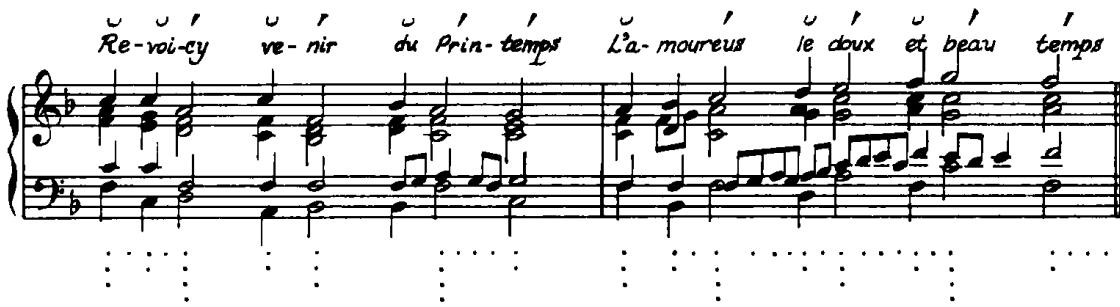
中文讲解
这是图4.44的图像占位符,对应P0232所述Claude le Jeune vers mesuré配曲的简短谱例及其推测的节拍结构。由于图像数据未在文本中给出,仅能从上下文确认其位置(P0233标题"Metrical Structure"与编号4.44位于P0234),并印证"重音-半音符/轻音-四分音符"这一原则。具体的音符、歌词和节拍小节划分需查看原图。
第16段(P0236)
原文复述
However, another complex metrical tradition, studied extensively in Singer 1974, is found in a large body of folk music from Macedonia and Bulgaria. Though this music has metrical regularity at the sixteenth-note and measure levels, the level of metrical structure with which dance steps are most closely correlated (the tactus) is irregular, consisting of units which Singer classifies as slow (S) and quick (Q); the S units are one and a half times the length of the Q units. Meter in this music is most easily represented as a repeating pattern of slows and quicks; for example, QQS (2+2+3). Singer quotes the dance tune “Racenitsa,” reproduced in part in 4.45, as a typical example of the QQS meter.
中文讲解
本段引入第二个"复杂节拍传统":马其顿与保加利亚的民间音乐。该传统由Singer 1974做过系统研究。它的特点是在不同节拍层级上规则性不同——十六分音符层和小节层都呈现规则性,但与舞步最相关的tactus层却是不规则的。这一层由两种时长单元组成:慢(S)和快(Q),其中S = 1.5 × Q。
因此,这种音乐的节拍最方便的表示方式是给出S/Q交替的循环模式,例如"QQS"对应数值"2+2+3"(即两个Q相加再加一个S,时长比例为1+1+1.5=3.5个Q单位,相对应于8个十六分音符)。Racenitsa舞歌是这种QQS节拍的典型例子,见谱例4.45。
本段教学重点是让读者看到:在同一音乐中,节拍规则性可以在不同层级分裂开来——某些层级严整、tactus层却由不同长度的单元循环构成。这种"层级分裂"正是西方古典调性音乐中不常见的现象,因此需要以新的规则替换MWFR 4才能描述。
补充说明
Singer 1974在P0236与P0239中作为既有研究被引用,作者将其作为既有规则陈述的来源;这构成本节对马其顿民间音乐描述的支撑文献,但作者没有进一步给出文献页码或书目细节。
第17段(P0237)
原文复述
4.45
中文讲解
这是图4.45的编号标识,对应紧接其后的谱例。它仅起版面定位作用。
第18段(P0238)
原文复述

中文讲解
这是图4.45的图像占位符,对应P0236中提到的Racenitsa舞曲的部分谱例。由于图像未内嵌,仅能从上下文确认其作用是"以QQS节拍为例说明马其顿/保加利亚民间音乐的tactus层不规则性"。具体的旋律音符、歌词与拍号标注需查看原图。
第19段(P0239)
原文复述
Singer points out that not all possible combinations of Ss and Qs are possible meters in this metrical idiom; QSS (2+3+3), for example, never appears. The meters that actually occur group into a number of families; Singer states well-formedness rules that express the generalizations among these possible meters. Within the present theory, the Macedonian metrical idiom would be described in part by replacing MWFR 4 with Singer’s rules. We will not take the space here to discuss the rules, but Singer’s list of basic meters in example 4.46 gives some idea of the complexity involved. This example omits compound meters, which complicate the situation further.
中文讲解
本段将马其顿节拍传统的论述推进到一个更精细的层次。它指出S/Q组合并非任意——例如"QSS"(2+3+3)从不出现。Singer把实际出现的节拍归并为若干家族,并用一套良构规则概括这些家族。在Lerdahl与Jackendoff的理论框架内,这套规则可以理解为"对MWFR 4的部分替换"。
本段的论证作用有三层:
- 进一步强化"节拍规则可被新规则替换"的观点;
- 强调替换后的规则并非任意,而是受到良构规则的约束(这与P0230中纯删除式变体形成对照——删除式变体是无新规则,而此处是"用更复杂的新规则代替旧规则");
- 通过Singer所列基础节拍表(例4.46)让读者直观感受替换后规则的复杂度,并承认其讨论空间有限,故省略复合拍子的进一步讨论。
教学要点:作者用马其顿案例展示了"替换式扩展"的两条路径——既可以放宽限制(如删除规则),也可以施加新的、更具针对性的限制(如Singer的良构规则)。
第20段(P0240)
原文复述
4.46
中文讲解
这是图4.46的编号标识,标记紧随其后的列表/谱例。其作用是从P0239引入"Singer所列基础节拍"作为视觉补充。
第21段(P0241)
原文复述
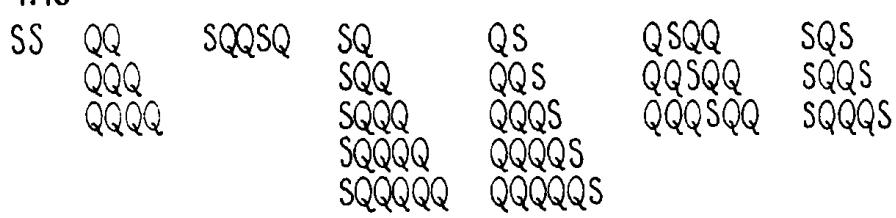
中文讲解
这是图4.46的图像占位符,对应P0239提到的Singer基础节拍列表。该图旨在以视觉方式让读者感受马其顿/保加利亚节拍系统中基础节拍的复杂度(包括各种S/Q组合及其时长数值),但图像数据未在文本中提供,故具体内容(如复合拍子是否纳入、如何分组)需查看原图。
第22段(P0242)
原文复述
Chapter 4
中文讲解
这是版面上的页眉/页码标识,标记当前页属于第4章。它不承载论证信息,仅起版面定位作用。
第23段(P0243)
原文复述
The point of our brief foray into other metrical idioms is that, in developing a theory of tonal music that addresses the issues of musical universals and acquisition of musical knowledge, one should construct formalisms that are adequate to express the facts of other idioms, and one should try to localize the similarities and differences between idioms in the statements of particular rules. In the cases presented here, the differences lie in what corresponds in other idioms to MWFRs 3 and 4. These differences in rules represent what one must learn about an idiom to become an experienced listener.
中文讲解
本段是全节的收束与理论升华。它把前面四个案例(duple-only、recitativo、Stravinsky、le Jeune、马其顿民间音乐)的具体差异汇聚到两条方法论主张:
- 形式充分性:理论的形式语言必须足以表达其他体裁的事实,不能因为只处理调性音乐就回避这些事实;
- 差异定位性:体裁之间的相似与差异应尽可能精确定位到具体规则的措辞上。
作者据此总结:本节案例所揭示的差异都集中在"对应于MWFRs 3和4"的位置上。这意味着:
- MWFRs 1和2代表跨体裁普适的"音乐节拍核心";
- MWFRs 3和4则是体裁学习必须把握的"特定规则"。
最后一句将这一观察与"听者经验"建立联系——“成为某体裁的有经验听者"在很大程度上等同于"掌握该体裁版本的MWFRs 3和4”。这一句把理论分析回到认知与学习层面,呼应了作者从一开始关心的"音乐普遍性与音乐知识的习得"两个议题。
本段的教学价值在于:让读者从案例细节中抬起头,看到规则架构本身的设计哲学——普适部分保持稳定,差异部分明文标注,从而同时支持普遍性与习得性的研究。
脚注 / 边栏 / 图表 / 附加信息(如有)
本节涉及的附加材料包括:图4.44(Claude le Jeune vers mesuré配曲的简短谱例及推测的节拍结构,P0233–P0235)、图4.45(Racenitsa舞曲的部分谱例,P0237–P0238)、图4.46(Singer所列马其顿/保加利亚民间音乐基础节拍表,P0240–P0241)。这三处图谱共同支撑作者"以案例对照规则替换"的论述:在保留MWFRs 1、2不变的前提下,用le Jeune的文本驱动节拍、马其顿民间音乐的S/Q循环节拍分别作为"复杂替换式"的具体例证。Singer 1974作为支撑马其顿节拍良构规则的既有研究被引用两次(P0236、P0239),但作者未给出书目细节,本节也未完整列出Singer的全部规则,仅以4.46示意其复杂度。版面上两处"Chapter 4"页眉(P0224、P0242)属排版信息,不承载论证。
💡 本节核心要点
- MWFRs 1和2是跨体裁普适的节拍条件(表面对应、层级嵌套),而MWFRs 3和4是体裁相关、可以变化的。
- 节拍规则的变体可以通过两种方式实现:删除式(如只允许duple的MWFR 3简化、recitativo中删去MWFRs 3和4)与替换式(如le Jeune用文本重音驱动节拍、马其顿民间音乐用Singer规则替代MWFR 4)。
- 保留MWFR 3而删除MWFR 4可描述Stravinsky一类频繁变换拍号的音乐,但因缺少刚性节拍模式作对照,切分效果在这种体裁中难以产生。
- 马其顿/保加利亚民间音乐呈现"层级分裂"的节拍特点:十六分音符层与小节层规则,tactus层则由时长不等的S(=1.5Q)与Q单元循环组成(如QQS=2+2+3),并受到Singer良构规则约束。
- 本节的方法论主张是:理论形式应足以容纳其他体裁的事实,并应将体裁间的异同精确定位到具体规则措辞上;不同体裁中"对应于MWFRs 3和4"的部分即是听者需要专门学习的内容。
🔑 关键术语
- Metrical well-formedness rules (MWFRs):节拍良构规则,本节讨论对象为MWFRs 1–4。其中1、2规定节拍与表面对应及层级嵌套,被作者视为跨体裁普适;3、4规定强拍间距与节拍等距,可随体裁替换或放宽。
- Idiom-specific:指规则或结构特征只在特定音乐体裁中成立。MWFRs 3和4被作者归入idiom-specific一类,意味着同一规则在不同体裁中可有不同措辞。
- Attack point:音乐表面上的起始点(发声事件)。MWFR 1要求每一个attack point都必须被某最小节拍层级的节拍所关联。
- Tactus:基本拍层级。在MWFR 4中tactus及其更大层级必须均匀;在马其顿民间音乐中tactus层由S、Q两种不等长单元构成,因此MWFR 4不适用。
- Recitativo:宣叙调,作为"极松散节拍体裁"的示例;作者用其说明在删除MWFRs 3和4之后,强拍位置只能由偏好规则依据局部细节判定。
- Syncopation:切分效果。在P0231中作者指出,切分依赖于刚性节拍模式与局部细节的冲突;因此在缺少刚性节拍模式的体裁(如保留MWFR 3但删除MWFR 4)中,切分难以产生。
- Vers mesuré:法国16世纪格律诗,le Jeune据此原则配曲:重读音节配半音符、轻读音节配四分音符。其节拍规则被作者作为"复杂替换式"变体的一个例证。
- S / Q (slow / quick):Singer用以描述马其顿/保加利亚民间音乐tactus层单元的术语:S单元长度为Q单元的1.5倍。节拍可表示为S、Q的循环模式,如QQS=2+2+3。
- Preference rules:偏好规则,在节拍良构规则之外依据局部细节判定节拍位置的规则。P0230在recitativo案例中用以解释:缺乏全局节拍规则时,节拍由偏好规则根据局部证据决定。
- Singer 1974:本节引用的既有研究,是马其顿/保加利亚节拍系统良构规则的来源,作者将其规则视为可替换MWFR 4的备选方案。
S4.5.1 [描述性拆分] 4.5 Metrical Irregularities at Hypermeasure Levels: Binary Regularity and Grouping Interaction
第1段(P0244)
原文复述
As mentioned in section 4.1, tonal music often has from one to three levels of metrical structure that are larger than the level notated by bar lines, corresponding to regularities of two, four, and even eight measures. Except in the most banal music, these levels are commonly subject to a certain degree of irregularity. The metrical well-formedness rules proposed in section 4.1, however, require that a metrical level be unswervingly regular throughout a piece or at least a major section of a piece. They are therefore incapable of allowing for irregularity in a metrical level except by abandoning that level altogether—which amounts to claiming that there is no regularity at all. This section will show how two important kinds of larger-level metrical irregularity can be incorporated into the theory. Both depend on the interaction of metrical structure and grouping. The first involves irregular-length groups, the second grouping overlap and elision.
中文讲解
本段是第4.5节的总纲。作者指出:在调性音乐中,除了小节线所标注的节拍层之外,往往还存在一至三层更大的节拍结构,分别对应于两小节、四小节甚至八小节的规律;除了最平庸的乐曲之外,这些更大的节拍层普遍带有一定程度的“不规则性”。然而4.1节提出的节拍良态规则(MWFR)要求一个节拍层在整首作品或至少一个主要段落内严格保持规则;按照该规则,一旦出现不规则,就只能放弃整层节拍结构——这等于宣称此处根本没有节拍规律可言。作者由此提出本节的目标:在不抛弃节拍规则的前提下,把两大类“超小节层节拍不规则性”纳入理论。两条路径都依赖于节拍结构与分组结构的交互:其一由不等长乐句引起,其二由分组重叠(overlap)与省略(elision)引起。本段在论证上的作用是为后续两个分支(P0246 和 P0253)设立共同的出发点:MWFR 4过于严格,需要被一条偏好规则(MPR 10)和节拍删除机制来补足。理解本段的关键是把握“超小节层”“MWFR”“分组交互”这三个核心概念的衔接关系。
补充说明
“section 4.1”“MWFR 4”“section 3.4”“section 8.5”等均为本书内部章节指引;本段并未给出具体规则编号,仅提示前文已设定义。
第2段(P0245)
原文复述
As will be seen more clearly in the discussion of time-span reduction, the segmentation of the musical surface forms a hierarchy whose levels can be divided roughly into three zones. At the smallest levels, metrical structure is responsible for most factors of segmentation; at the largest levels, grouping structure bears all the weight of segmentation. In between lies a transitional zone in which grouping gradually takes over responsibility from metrical structure, as units of organization become larger and as metrical intuitions become more attenuated because of the long time intervals between beats. It is in this zone of musical organization that metrical irregularities appear in tonal music.
中文讲解
本段为不规则现象提供分层定位。依据后文将要展开的“时值缩减”(time-span reduction)讨论,作者把音乐表层切分划分为三层区域:小尺度层级由节拍结构主导切分,大尺度层级由分组结构主导切分,居中的“过渡区”则随着组织单元变大、拍点间隔变长,听觉对节拍的直觉逐渐衰减,分组结构逐步接管切分责任。作者明确指出:调性音乐中的节拍不规则现象恰恰出现在这一过渡区。本段的作用是为前面提出的“不规则”限定具体层次——不是发生在拍位层级,也不是发生在最高的乐段层级,而是发生在从小节拍位向上扩展到超小节拍位之间的中间地带。教学要点:理解“过渡区”是后续两类不规则(五小节乐句与省略造成的节拍删除)之所以能被听感为“不规则但仍可分析”的关键背景。
第3段(P0246)
原文复述
In this transitional zone one hears metrical structure, but parallelism among groups of irregular length often forces metrical structures into irregularity above the measure level. The openings of the Mozart C Major Quintet K. 515 and the Chorale St. Antoni used in the Brahms “Haydn” Variations (see section 8.5) are well-known cases of five-measure phrases; examples of this sort are numerous. In order to make it possible for these phrases to receive a metrical analysis, MWFR 4 must cease to enforce strict metrical regularity at more than two or three levels above the tactus (usually the one- or two-measure levels). Nonetheless, the preference for regularity, especially binary regularity, remains. Apparently there is a preference rule operating at these levels—the metrical counterpart of the grouping rule of symmetry (GPR 5):
中文讲解
本段进入第一种不规则类型:由“乐句不等长”引发的节拍不规则。在过渡区中,听者仍能感知到节拍结构的存在,但不等长乐句之间的平行关系往往迫使小节线之上的节拍结构发生不规则变形。Mozart《C大调五重奏》K.515以及Brahms“海顿变奏”所使用的St. Antoni众赞歌(详见8.5节)起句都是典型的五小节乐句,作者指出此类例子为数甚多。为使这些乐句仍能得到节拍分析,MWFR 4必须在击拍层(tactus)之上两到三层(通常是一或两小节层)之后停止强制严格规则。但作者强调:对规则性——尤其是二拍规则性(binary regularity)——的偏好并未消失,只是从“硬约束”降为“偏好规则”,这条规则正是下文即将陈述的MPR 10,同时被明确称为分组结构中对称规则GPR 5在节拍层面的对应物。本段的论证意义在于:先用具体例子(五小节乐句)暴露出MWFR 4的局限,再以“对称偏好”在节拍与分组两个子系统之间建立类比,从而引出MPR 10的合法地位。
补充说明
本段提及Mozart K.515、Brahms“海顿变奏”及St. Antoni众赞歌,引用标注见8.5节;引用仅为后文铺垫,本段不展开音乐分析。
第4段(P0247)
原文复述
4.5 Metrical Irregularities at Hypermeasure Levels
中文讲解
这是第4.5节的节标题。完整形式为“4.5 Metrical Irregularities at Hypermeasure Levels”。标题的功能是开启本节论题:在“超小节”(hypermeasure)层级上,节拍结构可能表现出规则中的不规则性。
第5段(P0248)
原文复述
Metrical Structure
中文讲解
这是本节下属的小标题“Metrical Structure”,提示本节的主线将围绕节拍结构内部的不规则展开,从而与4.5的整体论题(超小节层的不规则)相区分:前者聚焦结构本身的组织原理,后者聚焦结构与分组的交互。
第6段(P0249)
原文复述
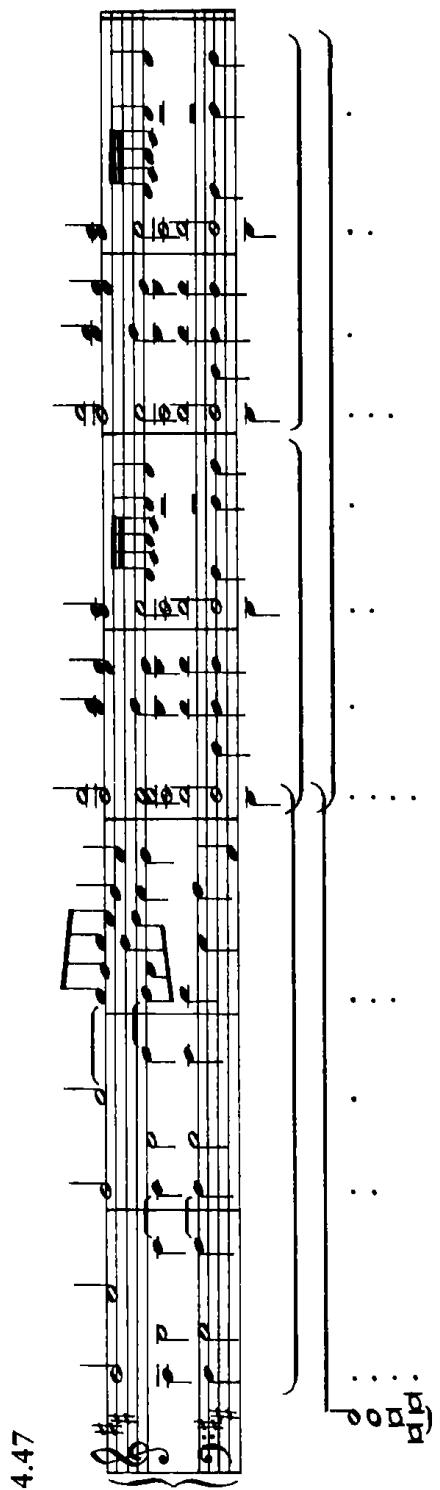
中文讲解
此为第33页的图像或乐谱占位符,原书此处应为配合本节论述的乐谱/分析图(图注位置已保留)。由于内嵌数据已省略,本讲解无法判断具体小节内容;建议读者参阅原图,以核验后文P0251—P0257所引用的具体谱例与图形。
补充说明
原书此处疑为与本节论题相关的图示或谱例,因数据省略不予推测;详见P0251起的规则陈述与P0253起的乐谱引用。
第7段(P0250)
原文复述
Chapter 4
中文讲解
此为页眉版面要素“Chapter 4”,仅起到标明章节归属的作用,不承载论证信息。
第8段(P0251)
原文复述
MPR 10 (Binary Regularity) Prefer metrical structures in which at each level every other beat is strong.
中文讲解
本段陈述本节核心新规则——MPR 10“二拍规则性”(Binary Regularity)。规则要求:在节拍结构的每一层级上,节拍应交替出现强、弱位(每隔一拍出现一个强拍)。其直观意义是:在缺乏其他信息时,听者倾向于把节拍组织成二拍子,即在超小节层级上偏好偶数节拍结构。教学要点:MPR 10是一条“偏好规则”(preference rule),区别于MWFR这类“良态规则”(well-formedness rule);它不强制执行,但会在多种分析中起仲裁作用。理解本规则也是把握P0252所述“在缺乏其他信息时强加duple meter”这一现象的关键。
补充说明
本规则被作者明确定位为分组规则GPR 5(对称)在节拍层面的对应物(P0246),读者可对照理解二者“强—弱交替”的对称偏好。
第9段(P0252)
原文复述
MPR 10 allows metrical irregularity, but, in the absence of other information, imposes duple meter. This seems to reflect musical intuition about hypermetrical structure. At smaller metrical levels, the more rigid requirements of MWFR 4 obscure the effects of MPR 10, since such levels will be all duple or all triple (that is, either completely obeying or completely violating MPR 10).
中文讲解
本段解释MPR 10的功能与边界。功能上,MPR 10允许节拍出现不规则——即不要求每一层都严格规则——但在其他信息缺失时仍倾向于生成二拍子(duple meter),这与音乐听感对超小节层结构的直觉一致。边界上:在小尺度节拍层级(tactus及邻近层),MWFR 4的刚性约束会掩盖MPR 10的偏好效果,因为该层要么整体符合二拍子,要么整体违反二拍子,不会出现“二拍子与三拍子交替”的中间情形。换言之,MPR 10真正发挥仲裁作用的层级,恰好是P0245所述的“过渡区”——超小节层。教学要点:理解MPR 10的“不可见性”也是关键——它在小节线层级不显形,而在更大尺度上才显现,这一可见层级差正是不规则现象出现的尺度。
第10段(P0253)
原文复述
A second kind of metrical irregularity is the result not of irregular group lengths but of grouping overlaps and elisions. It comes in two varieties. The first gives the impression of a jarring metrical readjustment. An example is the passage from Haydn’s Symphony no. 104 quoted in section 3.4 in connection with its grouping elision, repeated here as 4.47.
中文讲解
本段引出第二种不规则类型:它不是源于乐句不等长,而是源于分组结构的重叠(overlap)与省略(elision)。这种类型又分为两个子类型,本段先介绍第一个子类型——给人以“节拍猛然重新调整”之印象的变体,并以Haydn《第104交响曲》中在3.4节因分组省略(grouping elision)而被引用的段落为例,重新编号为谱例4.47。本段的论证作用是把读者的注意力从“乐句长度差异”转向“分组边界对节拍的强行改造”。教学要点:节拍不规则不只来自“乐句跨数不齐”这一种成因,分组省略/重叠造成的“边界效应”同样会产生节拍变形;这意味着节拍结构不是孤立的,而是受分组结构主动塑造的。
补充说明
本段提到该例在3.4节曾以分组省略主题出现,本节以4.47编号复用;该交叉引用本身即证明两组现象(分组省略与节拍变形)的相关性。
第11段(P0254)
原文复述
Beneath the example appear the grouping and metrical structures from the half-note (tactus) level up. At the point of grouping elision, the metrical structure is distorted: a beat at the four-measure level occurs only three measures after the previous one. Such a metrical distortion commonly occurs in conjunction with left elision in the grouping structure.
中文讲解
本段紧扣P0253所引Haydn谱例4.47展开分析。在谱例下方,从二分音符(击拍层)向上的分组与节拍结构均已标出。在发生分组省略(grouping elision)的位置,节拍结构被扭曲:原本应相隔四小节出现一次的四小节层级强拍,仅间隔三小节就提前出现。作者指出:这种节拍扭曲常与分组结构中的“左省略”(left elision)相伴出现。本段的论证作用是揭示“分组省略→节拍扭曲”的对应机制:分组边界向左压缩,节拍强位被迫随之提前。教学要点:理解“左省略”概念是关键——所谓“左省略”,指的是分组末端被切掉一段,使原本落在小节内的强拍被推前;这一抽象机制正是后续P0255把节拍扭曲描述为“删除一小节时值”的直观基础。
补充说明
“half-note (tactus) level”提示击拍层以二分音符为单位,需结合该作品的具体拍号理解。
第12段(P0255)
原文复述
The association with elision suggests that a part of the metrical structure, in this case the time-span of a measure, has been deleted from an otherwise regular metrical structure, along with the elided pitch-events. $^{9}$ The alteration can be represented as in 4.48; the parenthesized beats on the left are deleted. In effect, the strong beat comes too soon.
中文讲解
本段进一步给出机制化解释:与分组省略相伴出现的节拍扭曲,可以理解为“删除了一段节拍结构”,本例中被删除的是一个小节的时值范围(time-span of a measure),它与被省略的音高事件一起,从原本规则的节拍结构中被抹去。这一改动以图示4.48表示,其中左侧加括号的拍位即为被删除者;其听觉结果便是“强拍来得过早”。本段的论证作用是把抽象的“节拍扭曲”转译为可操作的“节拍删除”机制,为本节第二种不规则类型提供统一表述。教学要点:理解“删除一小节时值”并非真正不发生小节,而是该小节在节拍结构中被“透明化”——它仍存在,但其内部强位不再生成;这是与“插入”或“延长”截然不同的理论操作。
补充说明
脚注9位于本段,应说明脚注9为支撑或限定P0255所述“节拍删除”解释的旁证或来源(具体脚注内容未在输入中提供,故不作具体推测)。
第13段(P0256)
原文复述
A second and more rare kind of metrical deletion gives the intuitive effect of a retrospective awareness that a metrical shift has taken place. An example occurs in the last seven measures of the Schumann song “Wehmut,” from Liederkreis, op. 39, shown in 4.49. $^{10}$
中文讲解
本段介绍第二种子类型的节拍删除,它比第一种更罕见,给听者的直觉效果是“在事后才意识到节拍发生了位移”。作者给出的实例是Schumann《Liederkreis》op.39中歌曲“Wehmut”(忧伤)的最后七小节,标为谱例4.49。本段的论证作用是揭示第二种不规则在听觉上的差异:第一种子类型(Haydn例)造成“当下”即时的节拍重调;第二种子类型(Schumann例)造成“事后回溯”才辨认出节拍已发生位移。教学要点:两种删除的差异在于“何时意识到”——前者是听感上的突然错位,后者是直到下一小节才“恍然大悟”;这一差异预示着P0257将进一步解释声部与钢琴后奏在节拍位上的不对齐。
补充说明
脚注10位于本段,应说明脚注10为支撑或限定P0256所述Schumann谱例的旁证或来源(具体脚注内容未在输入中提供,故不作具体推测)。
第14段(P0257)
原文复述
At the point of grouping overlap (not elision this time) the voice part must end on a weak beat of the dotted-half level; however, the same point must function as a strong beat of that level with respect to the piano postlude, and this does not become clear until the following measure. The effect in the analysis of the musical surface is a metrical structure containing two weak beats in a row at the measure level. Again the coalescence of underlying pitch-events in the overlap suggests a corresponding metrical deletion, this time of a time-span starting with a strong beat as shown in 4.50.
中文讲解
本段对Schumann例作出具体分析。在分组重叠(这次是重叠而非省略)的位置上,声乐声部必须结束在附点二分音符层级的弱拍上;但同一点对于钢琴后奏而言必须充当该层级的强拍,而这一关系要等到下一小节才会变得清晰。结果在音乐表层分析中表现为:在小节层级上出现连续两个弱拍。重叠处下方音高事件的合流(coalescence)再次暗示相应的节拍删除——本例删除的是“一段以强拍起首的时值”,如图示4.50所示。本段的论证作用是:第一,区分“重叠(overlap)”与“省略(elision)”——前者共享一个时间点为不同声部的不同节拍功能,后者则缺失一段时间;第二,揭示两种删除的不同形态——本例删除的是“以强拍起始”的时值,而P0255所述Haydn例删除的是“使强拍提前”的小节时值。教学要点:本例中“声乐弱拍与钢琴后奏强拍重叠”正是节拍删除机制的根源:删除的不是时间,而是“某一拍位的强功能”。
补充说明
“dotted-half level”表示附点二分音符层;其强弱功能与具体拍号相关,需结合原谱理解。
脚注 / 边栏 / 图表 / 附加信息(如有)
本节含两条脚注引用:脚注9位于P0255,用以支撑或限定“节拍删除”解释;脚注10位于P0256,用以支撑或限定Schumann“Wehmut”末七小节的谱例分析。具体脚注内容未在task_input中出现,故未予展开。另含一处图像或乐谱占位符(P0249),位于第33页,原书应配本节论述谱例(图注位置已保留)。
💡 本节核心要点
- 本节解决MWFR 4对小节线以上层级“强制严格规则”造成的盲点,提出在过渡区节拍结构可以出现不规则。
- 第一种不规则由不等长乐句(如五小节乐句)引起,其应对规则是MPR 10:在超小节层级偏好“二拍规则性”(binary regularity)。
- MPR 10是分组规则GPR 5(对称)在节拍层面的对应物;它在小尺度节拍层被MWFR 4掩盖,只在过渡区显形。
- 第二种不规则由分组重叠与省略引起,可统一表述为“节拍删除”:删除一小节时值(Haydn第104例)或删除以强拍起首的时值(Schumann“Wehmut”例)。
- 两种删除在听觉效应上有差异:Haydn例产生“当下即时的节拍重调”,Schumann例产生“事后回溯才意识到的节拍位移”。
- 本节整体论证链:MWFR 4严格规则 → 在过渡区遇到反例 → 用MPR 10(偏好二拍子)和节拍删除机制分别处理两类不规则,使理论在保持可分析性的同时容纳不规则现象。
🔑 关键术语
- hypermeasure(超小节):指在小节线层级之上的节拍单位,如两小节、四小节、八小节层级;本节集中讨论其不规则性。
- MWFR 4(Metrical Well-Formedness Rule 4):第4.1节提出的节拍良态规则之一,要求一个节拍层在作品或主要段落内严格保持规则;本节指出其在超小节层过严,需被偏好规则与删除机制补足。
- MPR 10(Binary Regularity,二拍规则性):本节新增的节拍偏好规则,要求每一层级上节拍交替出现强弱;在缺乏其他信息时强制二拍子;是GPR 5在节拍层面的对应物。
- GPR 5(Grouping Preference Rule 5,对称):分组结构偏好规则之一,倾向于对称结构;MPR 10被作者明示为其节拍对应物。
- tactus(击拍层):身体或脚打拍子的节拍层级,是节拍结构的基准层;本节中作为计算其上“不规则层级”数量的参考点。
- transitional zone(过渡区):音乐表层切分三层区域中的中间地带:小尺度由节拍主导,大尺度由分组主导,过渡区由分组逐步接管;本节的不规则正发生于此。
- grouping overlap(分组重叠):同一时间点同时作为前一分组终点(弱功能)与后一分组起点(强功能)的分组边界形态;与elision相对。
- grouping elision(分组省略):分组末端被切掉一段,使分组边界提前出现,造成节拍扭曲的分组边界形态;本节Haydn例属此类。
- metrical deletion(节拍删除):本节提出的统一机制:把节拍结构中某段时值(通常含强位或含整个小节)从规则节拍中抹去,用以解释分组重叠/省略造成的节拍变形。
S4.5.2 [描述性拆分] Metrical Deletion Rule: First and Second Versions
第1段(P0258)
原文复述
Metrical Structure
中文讲解
这是出现在第34页的小节/章节标题“Metrical Structure”(节拍结构),它标示当前讨论进入了节拍层级的话题域。在本节的语境下,这一标题起着把读者引向“节拍删减规则”的作用:小节4.5.2 将围绕节拍结构中强弱位置被删除的两种方式展开,因此本标题既是版面定位,也是论题入口。
补充说明
此标题不包含论证性内容,仅作为版面与论题标记;其后各段才进入规则的具体陈述。
第2段(P0259)
原文复述
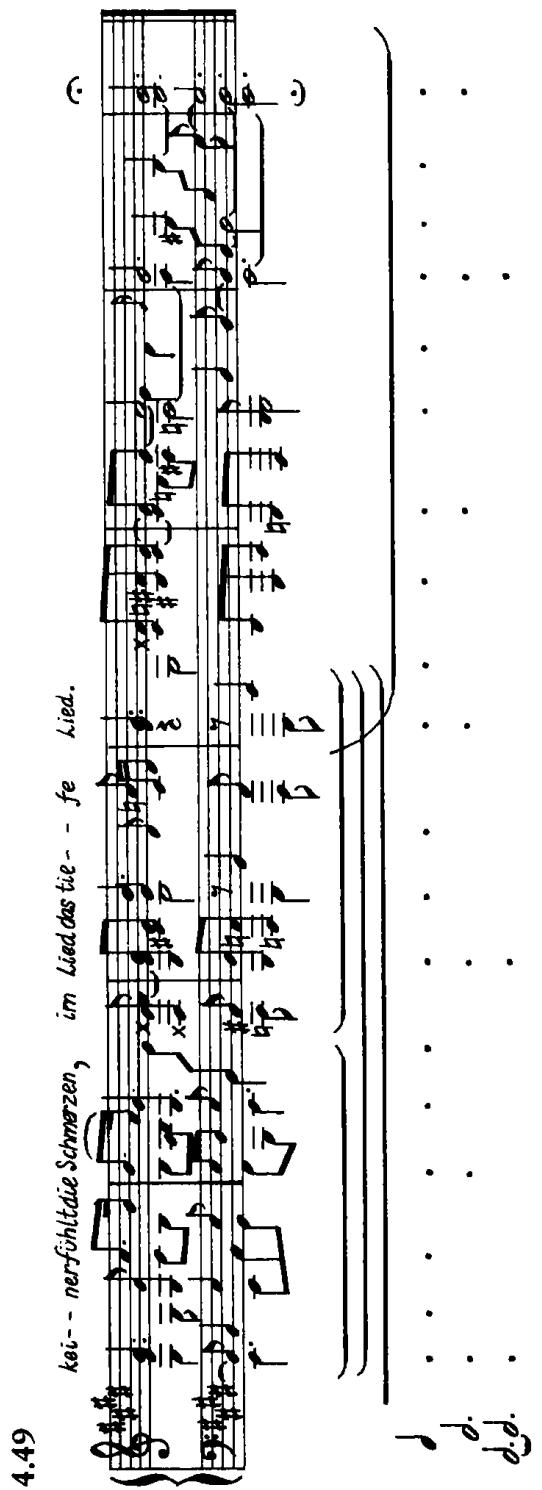
中文讲解
这是第35页上的一个图像或乐谱占位符,原始内嵌图像数据被省略,仅保留位置与图注信息。占位符提示读者此页配有一段乐谱或示意图,用以直观呈现节拍删减现象。由于原始图像未给出,其细节(具体谱例编号、拍号、调号、强弱标记等)需查看原书方能确认,本讲解只能指出其位置与示意功能。
补充说明
原图细节缺失,故不再作具体谱面推断;该占位符的作用在于与紧随其后的文字(特别是 P0261 的公式与 P0262 的例子讨论)形成图文互证。
第3段(P0260)
原文复述
Chapter 4
中文讲解
这是出现在第35页的章节标识“Chapter 4”,属于版面上的页眉/章节标记。它不承载论证内容,仅用于让读者知道当前所在的章节归属。在本节中,它与 P0258 的小节标题一同构成导航框架:上层是第4章,下层是 4.5.2 关于节拍删减规则的子节。
第4段(P0261)
原文复述
$$ \begin{array}{c c c c c c} 4. 5 0 & & & & \ \mathbf {d} & \cdot & \cdot & \cdot & \cdot & \cdot \ \mathbf {d} & \cdot & & \cdot & (\cdot & \cdot) & \cdot \ \mathbf {d} & \cdot & & & (\cdot & \cdot) & \cdot \ \end{array} \quad : \Longrightarrow . $$
中文讲解
这是一段以 LaTeX 数学阵列形式排版的谱例,对应书中的例 4.50(编号 4.50 出现在阵列左上角)。谱例以层级化的点(·)表示节拍层级:第一行是基本节拍示意,第二、三、四行用粗体 d 标记下行(downbeat)位置,并以加括号的小点表示被删减的弱位点。符号 ⇒(双线箭头)位于阵列右侧,意味着一个从原节拍结构向新节拍结构的转换。该谱例与上一例 4.47 形成对照:4.47 删除的是弱位,而此例中括号内的点显示被删去的层级更深,作者据此引导读者区分两种删减类型。注意原文中的“\Longrightarrow.”末尾有一个句号,应为排版附加,含义上即为“推出”。
补充说明
本段仅为谱例公式,无散文语句;其内部结构(层级、括号删点、d 标记)需结合 P0262 关于例 4.48 与 4.50 的对比说明来理解为何本例被归为“删除强位”类型。
第5段(P0262)
原文复述
Examples 4.48 and 4.50 help show what these two kinds of metrical irregularity have in common. In a situation where two groups are joined by an overlap or elision, the right group seems invariably to begin with a strong metrical position in the underlying form. If the left group also ends with a strong metrical position, as in the Mozart Sonata K. 279 discussed in section 3.4, a well-formed regular metrical structure can be assigned to the musical surface without problem. If, however, the left group ends in a relatively weak metrical position, the conflict in the region of overlap must be resolved by deleting one or the other of the metrical functions. In 4.47 the weak position has been deleted, in a manner consistent with the elision of the associated pitch-events; in 4.49 the strong position has been deleted.
中文讲解
本段把前文谱例(4.47 与 4.49)所展示的两类节拍不规则现象加以概括,指出它们的共同点:当两个组群(group)通过重叠(overlap)或省略(elision)相连接时,右侧组群在底层形式中似乎总是从强位(strong metrical position)开始。这里“似乎总是”(seems invariably)一词限定了结论的强度,作者并未宣称这是经过统计的普遍规律,而是基于所举谱例的经验性观察。
随后作者区分两种情形:若左侧组群也以强位结束(如 3.4 节讨论的莫扎特 K.279 奏鸣曲),表层可以直接指派一个规则的节拍结构而无冲突;若左侧组群以较弱位结束,则在重叠区域会产生节拍功能的冲突,必须通过删除强位或弱位之一来解决。作者举出两个对照——例 4.47 删除的是弱位,且这种删除与相关音事件的省略一致;例 4.49 删除的是强位。
本段的论证作用是为接下来形式化的“节拍删减规则”提供经验基础:作者用音乐实例证明,这种删减不是孤立的表面现象,而是与组群的重叠/省略结构紧密相连。
补充说明
例 4.47、4.49 与 4.48、4.50 的编号顺序暗示 4.47、4.49 来自上一节(或上一谱例块),而 4.48、4.50 出现在本节图像中;本讲解不展开这些谱例的具体拍号或旋律,仅维持作者对“强弱位”两种删减的对照逻辑。
第6段(P0263)
原文复述
In formalizing a transformation rule for metrical deletion, it is not sufficient to delete the strong or weak beat itself. Notice in 4.48 and 4.50 that a number of beats at a smaller metrical level have also been deleted to regularize the pattern. This will be included in the statement of the rule. The rule as stated here encompasses the two types of metrical deletion observed above.
中文讲解
本段是规则形式化过程中的一个关键提醒:单纯删除强位或弱位本身并不足以描述所观察到的现象。作者指出在例 4.48 和 4.50 中,为了使节拍图案规则化,比被删强/弱位更小一级的若干节拍也被一并删除。这意味着实际规则必须覆盖“层级化的删除”,而不仅是一个孤立位置。因此,本段是 P0264–P0266 中“节拍删减规则第一版”的预备性说明,明确告诉读者:即将陈述的规则形式涵盖并概括了上述两类删减。
从论证上看,本段把读者的注意力从“删一个位”扩展到“删一整段子层级”,为规则描述中“删除 B₁ 与 B₁ 与 B₂ 之间的所有层级节拍”这样的措辞做好铺垫。
补充说明
“at a smaller metrical level”指比目标节拍更低一级的节拍细分层级;MWFR 1–4 即“节拍良构规则”(Metrical Well-Formedness Rules),是作者用以约束合法节拍结构的前置规则集。
第7段(P0264)
原文复述
Metrical Deletion, first version From a well-formed metrical structure M as described by MWFRs 1–4, in which $B_{1}$ , $B_{2}$ , and $B_{3}$ are adjacent beats at level $L_{i}$ , and $B_{2}$ is also a beat at level $L_{i+1}$ (that is, a strong beat of level $L_{i}$ ), another well-formed metrical structure $M’$ can be created by deleting from M either
中文讲解
本段开启“节拍删减规则第一版”的正式陈述。其前提是:一个由 MWFRs 1–4 描述的良构节拍结构 M,其中 B₁、B₂、B₃ 是同一层级 L_i 上相邻的三个节拍,且 B₂ 同时也是上一层级 L_{i+1} 的节拍——也就是说,B₂ 在 L_i 上是“强位”。规则允许从 M 中删除某些节拍以构造新的良构结构 M’。
理解此句的关键在于:B₂ 的双重身份(既是 L_i 上的普通节拍,又是 L_{i+1} 上的节拍)使它成为一个天然的“强位锚点”,从而使删除在强/弱两种情况之间产生对比。B₁ 与 B₃ 则是与之相邻的弱位/下一强位。规则后半部分以“either”引出两种并列的删减选项(即随后 P0265 和 P0266 中的 a 与 b),因此本段是规则形式的主框架。
补充说明
MWFRs 1–4 指代本书前文已定义的四条节拍良构规则;符号 B_j 表示节拍(beat),L_i 表示层级(level)。本规则本质上是一对“操作选项”,而不是单一确定性变换。
第8段(P0265)
原文复述
a. $B_{1}$ and all beats at all levels between $B_{1}$ and $B_{2}$ (deletion of weak position), or
中文讲解
本段陈述规则第一版的选项 a:删除 B₁ 以及位于 B₁ 与 B₂ 之间所有层级的节拍。作者将这一选项括注为“删除弱位”(deletion of weak position)。直观理解:当 B₂ 是强位时,把 B₁ 与其间所有子层级节拍一并移除,相当于把一段原本“两拍之间还夹有细分节拍”的格局简化为 B₂ 直接成为新起点。
这一选项与 P0262 中提到的“4.47 删除弱位”相对应。
补充说明
“at all levels between B₁ and B₂”强调删减不是单点的,而是把整段子层级一并清空,这是 P0263 提醒读者注意的“层级化删除”在规则中的体现。
第9段(P0266)
原文复述
b. $B_{2}$ and all beats at all levels between $B_{2}$ and $B_{3}$ (deletion of strong position).
中文讲解
本段陈述规则第一版的选项 b:删除 B₂ 以及位于 B₂ 与 B₃ 之间所有层级的节拍。作者将这一选项括注为“删除强位”(deletion of strong position)。与选项 a 互补:此处保留 B₁,但把强位 B₂ 与其后的细分节拍清空,使 B₃(或经删减后的相应位点)成为新的结构锚点。
此选项对应 P0262 中提到的“4.49 删除强位”的情形。
至此,第一版的 a、b 两个选项完整闭合。
补充说明
选项 a 与 b 的对称结构是本节论证形式美感所在:二者都基于同一个三节拍 B₁–B₂–B₃ 模板,只是删除方向不同。
第10段(P0267)
原文复述
It can be seen that cases a and b are deletions of the sort illustrated in examples 4.47 and 4.49 respectively.
中文讲解
本段将规则形式与谱例直接对应:选项 a 对应例 4.47(删除弱位)的删减类型;选项 b 对应例 4.49(删除强位)的删减类型。这是规则与经验现象之间的桥接性陈述,目的是让读者确认第一版规则确实“封装”了前文两类删减,从而为接下来引出更精细的“第二版”提供过渡。
第11段(P0268)
原文复述
This version of the rule does not mention the connection with grouping elision and overlap. The rule can be made more specific as follows:
中文讲解
本段是过渡句:作者承认第一版规则并未显式提及与组群省略(elision)和组群重叠(overlap)之间的关联——而 P0262 正是以组群重叠/省略作为节拍冲突的根源来论述的。因此,第一版虽然在结构层面刻画了“可以删除什么”,但还缺少对“何时/为何触发”的说明。作者由此预告将给出一个更具体的第二版,把组群层面的关系纳入规则前提。
补充说明
此句的论证意义在于:第一版是“结构规则”(仅刻画良构变换),第二版将是“触发规则”(说明触发条件)。
第12段(P0269)
原文复述
Metrical Structure
中文讲解
这是出现在第37页的小节/章节标题“Metrical Structure”,与 P0258 重复出现,起到延续本节主题并跨页衔接的作用。它表明第37页仍属于节拍结构议题,并将引出“节拍删减规则第二版”的陈述。
补充说明
此标题与 P0258 功能相同,仅为版面标记。
第13段(P0270)
原文复述
Metrical Deletion, second version Given a well-formed metrical structure M in which
中文讲解
本段开启“节拍删减规则第二版”的正式陈述。起首以“Given … in which”引出三条并列前提(i、ii、iii),它们构成了触发本规则的充分结构条件。注意第二版并不改变删除的操作本身(仍是删除 B₁ 或 B₂ 与其间所有层级),而是为操作附加了更精确的上下文——尤其是把“组群结构 G”与“节拍结构 M”的对应关系写入前提。
补充说明
第二版与第一版共享 a、b 两个删除选项,但在前提部分加入了与组群省略/重叠的耦合条件。
第14段(P0271)
原文复述
i. $B_{1}, B_{2}$ , and $B_{3}$ are adjacent beats of $M$ at level $L_{i}$ , and $B_{2}$ is also a beat at level $L_{i+1}$ ,
中文讲解
前提 i 与第一版主框架相同:B₁、B₂、B₃ 在同一层级 L_i 上相邻,且 B₂ 同时属于上一层级 L_{i+1}(即 B₂ 是 L_i 上的强位)。这一前提保证了操作的对象具备可识别的“强位/弱位”对比结构。
作者将其放在第二版首位,意在告诉读者:节拍层面的局部形态与第一版完全一致,差异在于其后的前提。
补充说明
此条是结构前提;它本身不足以触发删除,还需要 ii、iii 两条共同界定上下文。
第15段(P0272)
原文复述
ii. $T_{1}$ is the time-span from $B_{1}$ to $B_{2}$ and $T_{2}$ is the time-span from $B_{2}$ to $B_{3}$ , and
中文讲解
前提 ii 定义了两个底层时距(time-span)T₁ 与 T₂:T₁ 为 B₁ 到 B₂ 的时距,T₂ 为 B₂ 到 B₃ 的时距。这里“底层”指的是与节拍结构 M 相对应的抽象时间区间,而非表层节拍位置。这一步把节拍结构与时间结构显式对应起来,为下一前提中出现的“表层时距 T’”做好准备。
补充说明
time-span 是 GTTM(Generative Theory of Tonal Music)框架中的基本时间单位,本节虽未引出 GTTM 缩写,但术语应被理解为同义。
第16段(P0273)
原文复述
iii. M is associated with an underlying grouping structure G in such a way that both $T_{1}$ and $T_{2}$ are related to a surface time-span $T’$ by the grouping transformation performed on G of
中文讲解
前提 iii 是第二版的关键创新:节拍结构 M 与一个底层组群结构 G 相对应,而 T₁ 与 T₂ 通过对 G 执行的某种组群变换(grouping transformation)共同关联到同一个表层时距 T’。换言之,原本应映射到 T₁ 和 T₂ 的两个时距,在组群变换(省略或重叠)作用下合并为同一个表层时距 T’,从而在节拍层产生“双重占位”冲突,触发删除。
补充说明
此条将节拍删除与组群结构耦合,是 P0268 所预告的“更具体”版本的核心。
第17段(P0274)
原文复述
(a) left elision or
中文讲解
前提 iii(a):T₁ 与 T₂ 通过对 G 执行的“左侧省略”(left elision)共同关联到 T’。左侧省略意味着原本应在 T₁ 与 T₂ 起作用的两个节拍/组群位置因为左侧组群的结束而被压缩,使得表层只呈现一个时距。
补充说明
left elision 是组群省略的一种:省略发生于左侧组群的结尾处。
第18段(P0275)
原文复述
(b) overlap,
中文讲解
前提 iii(b):T₁ 与 T₂ 通过对 G 执行的“重叠”(overlap)共同关联到 T’。与左侧省略不同,重叠是指两个组群在时间上相互侵入,使得原本分离的两个底层时距在表层压缩为同一个。
补充说明
overlap 与 left elision 是组群变换中两种不同的合并方式;它们的共同点是都会把 T₁ 与 T₂ 合并为 T’,从而在节拍层造成冲突。
第19段(P0276)
原文复述
then a well-formed metrical structure $M’$ can be formed from $M$ and associated with the surface grouping structure by
中文讲解
本段是规则的操作引出句:在前提 i–iii 同时满足时,可以从 M 派生出新的良构节拍结构 M’,并将其与表层组群结构关联。句法上“by”引出随后的两个并列操作选项 (a) 与 (b)。
补充说明
此句是把前提与结论操作连接起来的桥梁句,本身不引入新术语。
第20段(P0277)
原文复述
(a) deleting $B_{1}$ and all beats at all levels between $B_{1}$ and $B_{2}$ , and associating $B_{2}$ with the onset of $T’$ , or
中文讲解
操作 (a):删除 B₁ 以及 B₁ 与 B₂ 之间所有层级的节拍,并把 B₂ 与表层时距 T’ 的起点(onset)相关联。直观含义是:当组群合并导致弱位 B₁ 与 T’ 的起点发生冲突时,删除弱位及其中间层级,让强位 B₂ 直接占据 T’ 的起点,从而恢复节拍结构的良构性。
补充说明
“onset of T’”指表层时距 T’ 的起始时刻;把 B₂ 与其关联意味着 B₂ 重新成为表层节拍的锚点。
第21段(P0278)
原文复述
(b) deleting $B_{2}$ and all beats at all levels between $B_{2}$ and $B_{3}$ , and associating $B_{1}$ with the onset of $T’$ .
中文讲解
操作 (b):删除 B₂ 以及 B₂ 与 B₃ 之间所有层级的节拍,并把 B₁ 与表层时距 T’ 的起点相关联。直观含义是:当强位 B₂ 与 T’ 起点冲突时,删除强位及其后子层级,让原本的弱位 B₁ 上移成为新的 T’ 起点锚点。这是“删除强位”情形的形式化表达,与 P0262 中例 4.49 的现象对应。
补充说明
(a) 与 (b) 在第二版中互斥但平权:究竟删除弱位还是强位,取决于表层组群结构与节拍结构的耦合关系。
第22段(P0279)
原文复述
As in the case of grouping overlaps and elisions, we will not explore the preference-rule mechanisms involved in detecting the presence of metrical deletions. However, if they are linked as closely to grouping as we believe, and if the presence of cadences is as crucial to grouping overlap and elision as has been suggested in section 3.4, then it becomes clearer how a powerful confluence of factors can accumulate in the musical surface to break the established pattern. We leave for future research the incorporation of these observations into the formal system.
中文讲解
本段是本节的小结与展望。作者承认,正如组群重叠与省略的偏好规则(preference-rule mechanisms)尚未展开,节拍删减的偏好规则同样不在本节范围内——也就是说,规则只说明了“可以删什么、何时可以删”,但不裁定“究竟删强位还是删弱位”的偏好机制。
随后作者提出一个条件性论断:如果节拍删减确实与组群关联得如此紧密(如本节规则所暗示),并且终止式(cadences)确实如 3.4 节所主张的那样对组群重叠/省略至关重要,那么“多重因素汇聚(powerful confluence of factors)就能在表层音乐中累积到足以打破既定节拍格局”的解释就变得更清楚了。最后,作者把把上述观察整合到形式系统中的工作留给未来研究。
本段的功能是:在给出形式规则后,回退到认识论层面,提示读者本节规则只是初步框架,更深的偏好规则与跨层级交互仍待研究。
补充说明
preference-rule mechanisms 是 GTTM 框架中用于在多个合法结构/变换间进行选择的一套规则;本节明确将其排除在本节论述之外。
第23段(P0280)
原文复述
Chapter 4
中文讲解
这是出现在第37页末的章节标识“Chapter 4”,属版面上的页眉/章节标记,与 P0260 功能相同。它不承载论证内容,只起版面定位作用,标示本节论述结束于此页。
脚注 / 边栏 / 图表 / 附加信息(如有)
本小节包含一处被标注的图像/乐谱占位符(P0259,位于第35页)以及一处数学公式谱例(P0261,对应例 4.50)。这些非散文材料是规则形式化过程中的关键支撑:图像与公式使读者能在视觉上辨认“被删弱位/强位”在节拍层级中的位置,从而与正文论证形成对照。其余附加标记(章节标题 P0258、P0269、P0260、P0280)仅起版面导航作用,无独立论证价值。脚注信息在本节输入范围内未出现。
💡 本节核心要点
- 节拍删减的两种类型:删除弱位(对应例 4.47/操作 a)与删除强位(对应例 4.49/操作 b),二者都伴随子层级节拍的同步删除。
- 两类删减的共同经验基础:当两个组群通过左侧省略或重叠合并时,右侧组群在底层总从强位开始;若左侧组群以弱位结束,则需通过删除其中之一消除节拍冲突。
- 规则第一版(MWFRs 1–4 框架下)刻画了“可以删什么”的结构条件,但未涉及触发原因。
- 规则第二版的关键创新在于把节拍结构 M 与组群结构 G 通过组群变换(左侧省略或重叠)显式耦合,使删除操作获得更精确的触发前提。
- 第二版中的操作 (a) 与 (b) 不仅删除节拍,还需将保留节拍与表层时距 T’ 的起点相关联,从而保证新结构 M’ 与表层组群结构相容。
- 本节明确把“偏好规则机制”的讨论排除在外,提示节拍删减的选择性(即删强还是删弱)以及终止式对组群合并的影响,仍属未来研究方向。
🔑 关键术语
- MWFRs 1–4:Metrical Well-Formedness Rules 1–4(节拍良构规则 1–4),本节规则形式的前置约束集合,保证 M 与 M’ 均为良构节拍结构。
- well-formed metrical structure (M, M’):良构节拍结构,指符合 MWFRs 1–4 的节拍层级安排;M 为原结构,M’ 为经删除后得到的新结构。
- beat (B_j):节拍,节拍结构中的基本时间锚点;B₁、B₂、B₃ 在本节被假设为同一层级 L_i 上的相邻节拍。
- level (L_i, L_{i+1}):节拍层级;L_{i+1} 比 L_i 高一级,节拍在该层被视为“强位”。
- time-span (T₁, T₂, T’):时距,分别对应底层 B₁–B₂、B₂–B₃ 区间,以及组群省略/重叠后形成的表层合并时距。
- grouping structure (G):组群结构,指底层组群层级关系;本节通过前提 iii 将其与节拍结构 M 耦合。
- left elision / overlap:组群层面的两种合并机制:左侧省略(left elision)与重叠(overlap),均会令 T₁ 与 T₂ 共同关联到表层时距 T’。
- deletion of weak/strong position:弱位/强位删除;本节以 B₁ 与 B₂ 的相对身份区分两种操作,删除均连带删除其间所有子层级节拍。
- preference-rule mechanisms:偏好规则机制,用于在多个合法变换中作出选择;本节明示不在本节展开,作为未来研究方向。