目录
C9 Chapter 9
- 9.1 [描述性拆分] Fundamental Hypotheses
- 页码:1-3
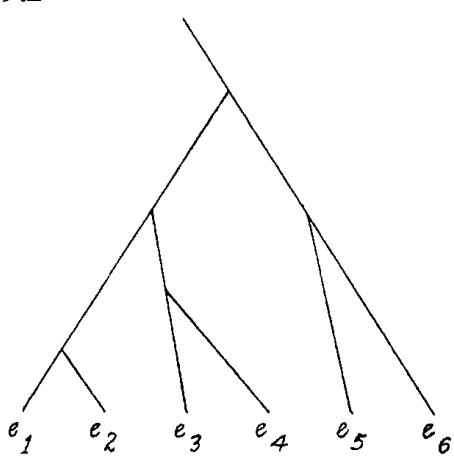
- 9.2.1 [描述性拆分] Definitions of Elaboration and the Well-Formedness Rules
- 页码:3-5
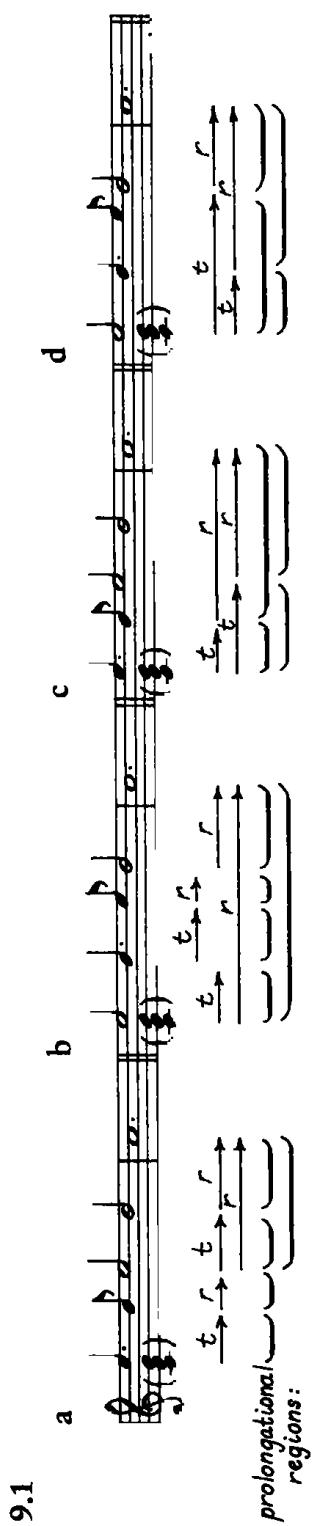
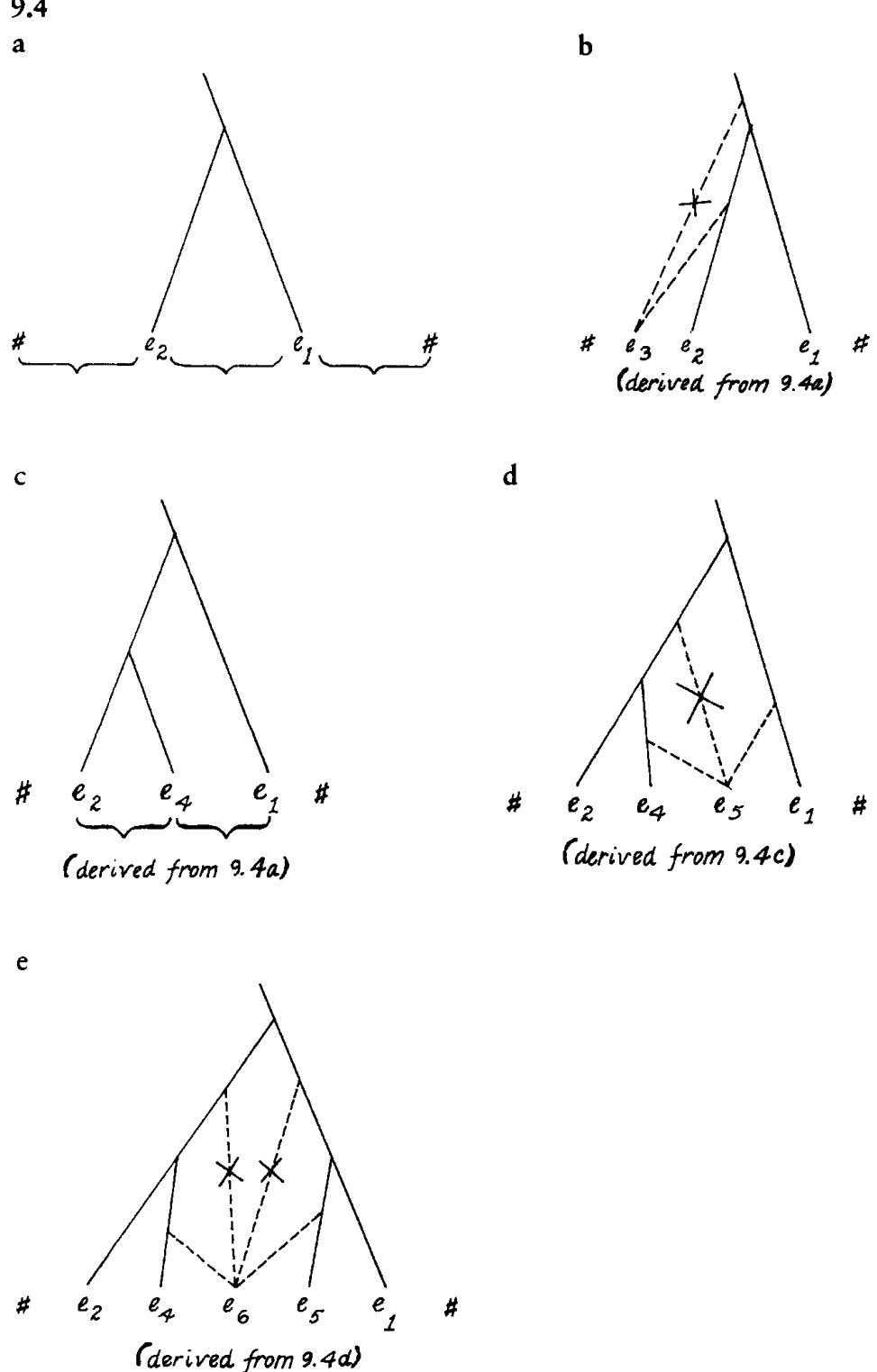
- 9.3.1 [描述性拆分] General Considerations and Top-Down Construction
- 页码:6-6
- 9.3.2 Defining Regions of Rule Application
- 页码:6-10
- 9.4.1 [描述性拆分] Influence of Time-Span Reduction (PRPR 1–2)
- 页码:10-12
- 9.4.2 [描述性拆分] Stability of Prolongational Connection (PRPR 3, Conditions 1–4)
- 页码:12-16
- 9.4.3 [描述性拆分] Prolongational Importance and Parallelism (PRPR 4–5)
- 页码:16-17
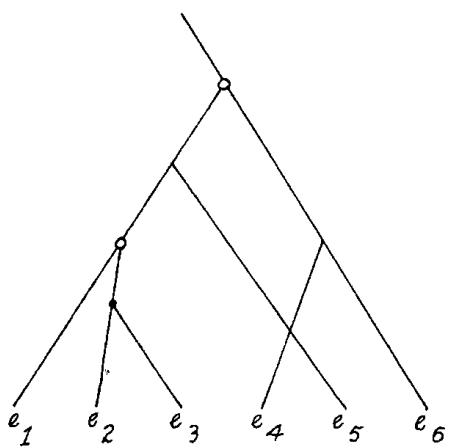
- 9.5.1 [描述性拆分] The Interaction Principle and K. 331 Derivation
- 页码:17-22
- 9.6.1 [描述性拆分] Normative Prolongational Structure — Statement
- 页码:22-25
- 9.6.2 [描述性拆分] Normative Structure and the Ursatz — Chopin Prelude and Brahms Intermezzo
- 页码:25-30
- 9.6.3 [描述性拆分] Normative Structure and Musical Complexity
- 页码:30-31
- 9.7 [描述性拆分] Binary Form and Sonata Form
- 页码:31-38
- 9.8 [描述性拆分] Reflections on Musical Cognition and Music as an Art
- 页码:38-39
9.1 [描述性拆分] Fundamental Hypotheses
第1段(P0001)
原文复述
Chapter title: Formalization of Prolongational Reduction.
中文讲解
这是第九章的总标题,宣告本章的任务是把第8章中以直觉方式讨论的’延长缩减’(prolongational reduction)理论形式化。‘形式化’意味着要把原本依赖直觉描述的内容,转译为可以用规则明确定义的体系;这为后续几节(9.1基本假设、9.2良构规则、9.4偏好规则)奠定基础。
第2段(P0002)
原文复述
In the discussion in chapter 8 of the essential intuitions behind prolongational reduction, the author assumed that the Strong Reduction Hypothesis applies to this domain of musical analysis—namely, that it makes sense to describe these intuitions in the form of a unified tree structure. The author now states this assumption overtly.
中文讲解
本段是9.1节的开场白,揭示第8章直觉讨论中的一个隐含前提:强缩减假设(Strong Reduction Hypothesis),即延长缩减可以用统一的树结构来表示。‘Now we state this assumption overtly’承上启下——从9.1节起,作者要把此前默认但未明示的假设公开提出,并编号为’延长假设1’。
第3段(P0003)
原文复述
Prolongational Hypothesis 1: Intuitions about pitch-derived tension and relaxation in a piece can be expressed in terms of a strictly hierarchical segmentation of the piece into prolongational regions, with the following conditions:
中文讲解
这是’延长假设1’的总命题。要点有三:(1)对象是’由音高派生出的紧张与松弛的直觉’(pitch-derived tension and relaxation);(2)手段是’严格分层’(strictly hierarchical segmentation)的延长区域划分;(3)严格性通过下面的a和b两条子条件来兑现。换言之,假设1并不是单独成立,而是与a、b两条子条件共同构成完整陈述。该假设把音乐直觉转化为可形式化的’严格层级树’这一图形对象。
第4段(P0004)
原文复述
Condition a: each region represents an overall tensing or relaxing in the progression from its beginning to its end.
中文讲解
条件a限定每一个延长区域必须有一个’整体方向’:从起点到终点要么是紧张度上升,要么是紧张度下降。这把区域本身定义为一个具有单一方向的张力单位。注意’overall’一词:区域内允许有局部起伏,但整体净效果必须是单向的紧张或松弛,而非先紧后松又紧。
第5段(P0005)
原文复述
Condition b: tensings and relaxings internal to each region represent subordinate and nonoverlapping stages in the overall progression.
中文讲解
条件b进一步要求:区域内部的紧张/松弛必须形成’从属、非重叠’的层级阶段。‘subordinate’意味着内部阶段服从于该区域整体的方向;’nonoverlapping’意味着这些阶段在结构上互不交叉、互不并列,从而保证层级清晰、不允许一个事件同时属于多个内部阶段。本条与a合起来,保证整个延长结构可以画成一棵树(树即’严格不重叠的分层’的图形化体现)。
第6段(P0006)
原文复述
In the initial discussion of tension and relaxation in section 8.1, the author implicitly assumed Prolongational Hypothesis 1, in that diagrams like 9.1a and 9.1b (copies of 8.3a and 8.3b) were drawn, but no diagrams like 9.1c and 9.1d were drawn.
中文讲解
本段回溯性地指出:8.1节画出的延长图(如9.1a、9.1b,即复制自8.3a、8.3b的那些图)实际上已经暗中使用了’严格分层、无内部重叠’的假设;之所以没有画出像9.1c、9.1d那样的图,是因为作者在直觉上只承认前者的合法性。这是一种’理论重构’——把先前隐含于图示之中的约束明确化、编号化。
第7段(P0007)
原文复述
All of the examples in 9.1 satisfy condition a of Prolongational Hypothesis 1, since each arrow represents an overall tensing or relaxing from its beginning to its end. In 9.1a and 9.1b the regions form a hierarchical structure of the usual sort, whereas 9.1c and 9.1d violate condition b in that they contain overlapping of the sort disallowed in other components of musical structure. Prolongational Hypothesis 1 claims that such situations do not occur in musical intuition. Where they seem to occur, they result from structural ambiguity in a piece—two independently viable structures in competition—not as part of a single unified structure. It is precisely this property that permits prolongational reductions to be represented as tree structures.
中文讲解
本段对四幅示意图做出明确的合格/不合格判定:9.1a与9.1b为合格例(条件a与b同时满足,可画为常规树);9.1c与9.1d为不合格例(满足a但违反b,因为内部阶段出现重叠)。关键的姿态是:作者并不否认现实音乐中偶尔会出现’看似重叠’的情况,但他将其归为’结构歧义’(structural ambiguity),即两个独立合法结构相互竞争,而不是同一棵延长树内部允许的重叠。这一解释为后续’把延长缩减等同于树结构’的合法性提供了辩护:一旦遇到歧义,分析者应当拆成两棵树来描述,而非揉成一棵含重叠的单一结构。
第8段(P0008)
原文复述
Section heading: 9.1 Fundamental Hypotheses
中文讲解
本行是9.1节的小节标题’基本假设’,表明本节的任务是罗列并陈述该理论赖以成立的若干基本命题。注意:上一段(P0007)虽然已经讨论了假设1的内涵,但标题出现在P0008,意即小节的正式题目到此位置才被显示;P0002—P0007的内容在逻辑上仍属于9.1节。
第9段(P0009)
原文复述
[Image or musical example on page 2; embedded image data has been omitted, but the position and caption are retained.]
中文讲解
这是第2页的图像/乐谱占位符。原文在此处给出4个延长层级示意图(9.1a、9.1b、9.1c、9.1d),用于直观对比’合格’与’不合格’的延长结构。由于内嵌图像数据已省略,本占位符仅标记其在版面上的位置;具体图形细节(如箭头数量、节点标签、连线形状)需查看原图。
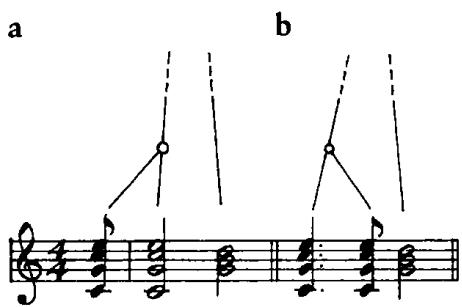
第10段(P0010)
原文复述
Page header: Chapter 9
中文讲解
本行为版面的页眉,标注当前所在章节为’第9章’,仅起版面定位作用,无实质内容。
第11段(P0011)
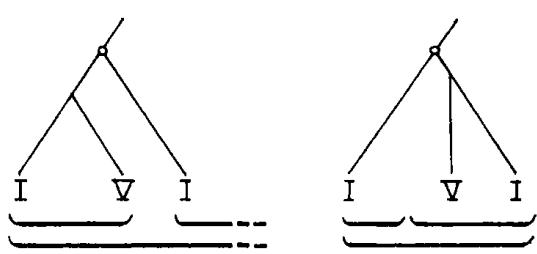
原文复述
Prolongational Hypothesis 1 raises a crucial question: how are the hierarchical regions in a piece defined? For example, how does one arrive at the difference in the regions appropriate to the hearing of 9.1a and 9.1b? In effect, this was the question asked in section 5.4, where the impossibility of reducing a piece on the basis of the surface sequence of pitch-events alone was demonstrated. As suggested in section 8.2, the answer proposed can be stated as the following hypothesis:
中文讲解
本段从假设1过渡到假设2。逻辑链是:假设1只承诺’可以’形成严格分层结构,但’如何’形成、为何听成a而非b这类问题尚未回答。段中调用三处前期工作:5.4节证明仅凭表面音高事件序列无法完成缩减(背景性的反例论证);8.2节曾暗示过一种解决方案;本段把这种方案显化为’延长假设2’。‘Strongly influenced’一词提前预告假设2并非决定性规则、而是倾向性规则——这一区分将在P0013中进一步点明。
第12段(P0012)
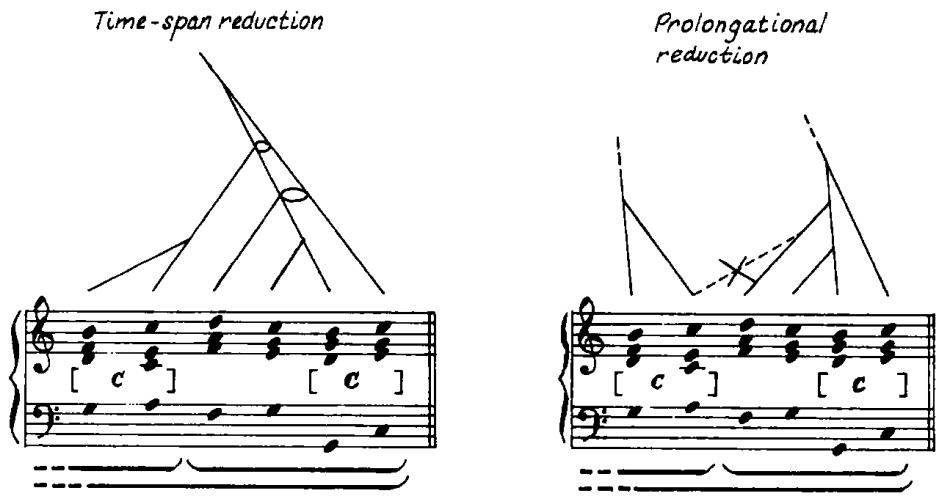
原文复述
Prolongational Hypothesis 2: The choice of events that define prolongational regions is strongly influenced by the relative importance of events in the time-span reduction.
中文讲解
这是’延长假设2’的命题:定义延长区域时所选事件的取舍,受’时距缩减中事件的相对重要性’的强烈影响。换言之,延长区域不是凭空圈定的,而是参考时距层级中权重较高的事件,并以它们为锚点来切分。这一假设把延长缩减与时距缩减两个独立模块正式耦合起来。‘Strongly influenced’一词暗含:这种耦合是趋势性的而非决定性的,因此假设2自然引出’偏好规则’的逻辑位置。
第13段(P0013)
原文复述
Prolongational Hypothesis 1 claims that it is possible to build a tree structure; it thus enters into the formulation of the prolongational reduction well-formedness rules, to be stated in the next section. Prolongational Hypothesis 2, on the other hand, deals with the question of which of the many possible tree structures assigned to a piece by the well-formedness rules represents one’s actual hearing. It claims that the major axes of tension and relaxation tend to be those events that are most important in articulating grouping structure. This hypothesis, with a number of refinements, will be incorporated into the prolongational reduction preference rules, to be developed in section 9.4.
中文讲解
本段清楚地区分了两条假设在理论体系中的不同角色,构成GTTM风格分析中关键的二元划分:(1)良构规则(well-formedness rules)——给出所有合法的树形(由假设1决定,存在性条件);(2)偏好规则(preference rules)——在诸多合法树中选出听感最贴切的那一棵(由假设2决定,选择性条件)。‘On the other hand’与’thus’形成对照:假设1是’能否存在合法树’的存在性条件,假设2是’听感上选谁’的选择性条件。段末预告:假设2及若干’细节修正’将进入9.4节的偏好规则。
第14段(P0014)
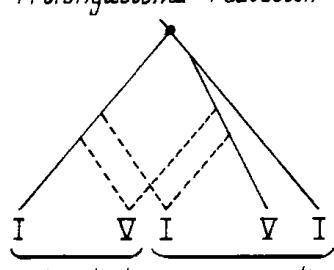
原文复述
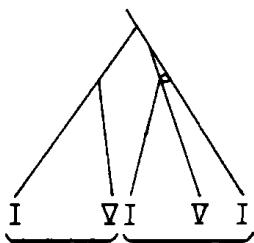
To define prolongational tree structures over pieces, four rules are needed. First, the tree must contain a single most important event, the head. Second, there must be specified ways for events to elaborate other events. As discussed in section 8.1, these are strong prolongation, weak prolongation, and progression. Third, every event in the piece must be attached to the tree. Fourth, branches must not cross. It is the latter two conditions that embody Prolongational Hypothesis 1, guaranteeing the hierarchical embedding of prolongational regions.
中文讲解
本段紧承假设1,预告构建延长树所需要的四条规则雏形。前两条是’节点与边’层面的要求:单一最核心节点(头节点,head)加上三种事件-到-事件的延展关系——强延长(strong prolongation)、弱延长(weak prolongation)、进行(progression)。第三条要求每个事件都须被纳入树内,无游离节点。第四条要求枝条不交叉。关键论断是:‘后两条’(全覆盖 + 无交叉)合起来就体现了假设1的精神——保证所有事件都被嵌套进同一棵严格分层树,无交叉即无重叠,即条件b。
第15段(P0015)
原文复述
For precision, we must state over what string of pitch-events the prolongational reduction is defined. If it is defined over the musical surface, two separate functions cannot be supplied to those events contained in a grouping overlap. This suggests that the prolongational reduction, like the time-span reduction, should be defined over underlying grouping structure. A further refinement would take account of the extra events present in the time-span reduction that are created by fusion and transformation, since they too have functions in the prolongational reduction. However, we leave their incorporation into this component for future research and assume for the moment that the underlying grouping structure provides the correct string of events from which to construct the prolongational reduction.
中文讲解
本段处理一个重要的基础设定——延长缩减究竟定义在哪一串音高事件之上?作者论证道:(1)若定义在’音乐表面’(musical surface),则对处于分组重叠中的事件,难以赋予两种不同的功能,因此不可行;(2)因此与时距缩减一样,应定义在’底层分组结构’(underlying grouping structure)之上;(3)更彻底的方案还应吸纳时距缩减中由’融合’(fusion)与’变换’(transformation)产生的额外事件,但作者将其留待未来研究。这样,‘底层分组结构’被本节暂时承认为构造延长缩减的事件串。‘For the moment’与’future research’两个措辞明确暴露了理论的留白。
第16段(P0016)
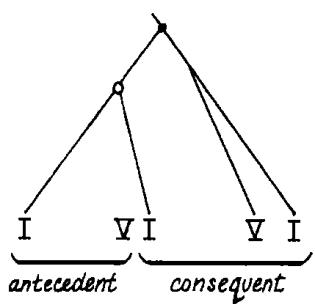
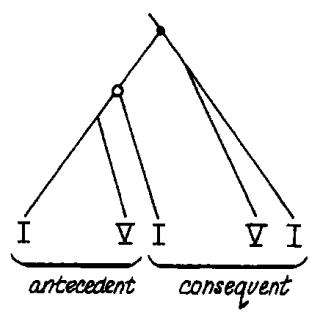
原文复述
To facilitate formal treatment of the prolongational tree, we introduce the following definitions:
中文讲解
这是承上启下的过渡句,宣告作者即将给出正式定义(形式化术语)以便对延长树进行严格的符号处理。它把P0014—P0015的定性论述过渡为紧接其后的形式定义列表。该句单独成段,同时标识出9.1节正文论述暂时结束、即将进入更形式化的展开。
第17段(P0017)
原文复述
Section heading for the next section: 9.2 Prolongational Reduction Well-Formedness Rules.
中文讲解
本行是9.2节的小节标题:‘延长缩减的良构规则’。它紧承P0013和P0014的预告——9.1节只是说明良构规则的来源是’假设1’,9.2节要把这些规则明确写出来,使一棵延长树成为可机械判定的对象。
脚注 / 边栏 / 图表 / 附加信息(如有)
本节范围内有一处图像占位符(P0009),对应第2页的延长层级示意图9.1a、b、c、d;由于内嵌图像数据被省略,图形本身不可见,但作者在正文P0006—P0007和P0011中反复引用这些图(尤其是9.1a与9.1b代表合格结构,9.1c与9.1d代表内部重叠的非法结构)。本节正文范围内无独立脚注、无边栏材料;P0010为版面页眉。
💡 本节核心要点
- 9.1节的核心任务是把延长缩减理论的隐含前提明确化,为此提出两条编号假设——延长假设1(决定结构是否合法存在)和延长假设2(决定哪种合法结构对应实际听感)。
- 延长假设1连同其两个条件——每一区域有净紧张方向(条件a)以及内部阶段从属且不重叠(条件b)——共同保证延长结构可以被严格表示为树形;条件b正是树与一般图的根本差别。
- 延长假设2把延长区域的事件选取与时距缩减中事件的相对重要性相耦合,使两个原本独立的缩减模块在’偏好’层面上相互沟通,‘强烈影响’而非’决定’一词预留了偏好规则的灵活空间。
- 为9.2节的良构规则做了预告:单头节点、三种延展关系(强延长、弱延长、进行)、全覆盖、无交叉;其中后两条直接体现了假设1的精神。
- 把延长缩减的定义域固定在’底层分组结构’之上的事件串上,以避免对分组重叠中的事件难以赋予双重功能;同时把’融合与变换生成的额外事件’纳入与否,明示为后续研究课题。
🔑 关键术语
- Prolongational Reduction(延长缩减):用音高派生的紧张—松弛直觉对乐曲进行层级化结构分析的方法,本章的核心对象;本章的任务是把它的直觉描述形式化为可由规则机械判定的体系。
- Strong Reduction Hypothesis(强缩减假设):该书提出的一个更上位假设,认为一类音乐直觉(如延长缩减)可以用统一的树结构加以描述;延长假设1是该假设在本章中的具体化身。
- Prolongational Hypothesis 1(延长假设1):关于延长结构必须严格分层(每一区域有净方向、内部阶段从属且不重叠)的基本假设,构成良构规则的来源。
- Prolongational Hypothesis 2(延长假设2):关于定义延长区域的事件选取受时距缩减中事件重要性强烈影响的基本假设,构成偏好规则的来源。
- Well-Formedness Rules(良构规则):决定一棵延长树是否在形式上合法的规则,由假设1支撑,决定’能否存在’而非’是否好听’。
- Preference Rules(偏好规则):在所有良构树中挑选听感最佳者的规则,由假设2(以及若干细化)支撑,本节预告将在9.4节展开。
- Time-Span Reduction(时距缩减):用以衡量事件相对重要性的另一缩减模块;延长假设2以其中事件的相对重要性为其输入,是两条假设跨模块耦合的桥梁。
- Underlying Grouping Structure(底层分组结构):作为延长缩减定义域的事件串,与’音乐表面’相对,因分组重叠中的事件难以承担双重功能,故本节将延长缩减与之绑定,留待未来再引入由融合与变换产生的额外事件。
- Strong Prolongation / Weak Prolongation / Progression(强延长/弱延长/进行):延长树中事件之间的三种延展关系,构成本节预告的良构规则中’边’层面的三种合法类型。
9.2.1 [描述性拆分] Definitions of Elaboration and the Well-Formedness Rules
第1段(P0018)
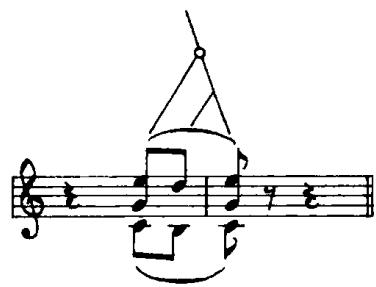
原文复述
Formalization of Prolongational Reduction
中文讲解
这是 9.2.1 小节的标题,宣告本小节的主题:把“延长结构”中的“细化(elaboration)”概念形式化,并给出延长结构树的良构规则(well-formedness rules)。小节标题暗示此前对延长概念的讨论尚停留在直观层面,本节开始用集合—关系的形式语言重新表述。
补充说明
该标题对应页面顶部的小节栏,表明 9.2 节将处理延长结构的形式化,P0018 与 P0038 重复出现,说明它也是这一跨页小节的栏题(running header)。
第2段(P0019)
原文复述
An event $e_i$ is a direct elaboration of another event $e_j$ if $e_i$’s branch terminates on $e_j$’s branch.
中文讲解
本句给出“直接细化”的形式定义:如果事件 $e_i$ 所在分支终止于 $e_j$ 所在分支之上,则 $e_i$ 是 $e_j$ 的直接细化。直观含义是:在延长树中,$e_i$ 是从 $e_j$ 长出的“下一级”分支上的事件,分支末端落在 $e_j$ 的分支上。“直接”一词强调二者之间没有中间层级。这一关系是树中父子节点的最低级对应物。
第3段(P0020)
原文复述
An event $e_{i}$ is a recursive elaboration of another event $e_{j}$ if it is a direct elaboration of $e_{j}$ or if its branch leads upward through a sequence of direct elaborations to $e_{j}$’s branch.
中文讲解
本句把“直接细化”推广为“递归细化”:$e_i$ 是 $e_j$ 的递归细化,当且仅当它要么是 $e_j$ 的直接细化,要么其分支通过一连串直接细化向上追溯,最终连接到 $e_j$ 的分支。这是一种传递闭包:把父子关系逐层向上串联,因此任何祖先事件与后代事件之间都构成递归细化关系。该定义随后在 PRWFR 3 中被用作判定“树中所有事件都连接到延长头”的判据。
第4段(P0021)
原文复述
Figure 9.2 illustrates these terms with an abstract tree structure whose branches are numbered.
中文讲解
本句承前启后:紧接两个形式定义之后,作者引入图 9.2 以便直观展示“分支被编号”的抽象树结构。编号分支意味着树中每个事件都能用一个数字定位,从而把抽象定义与具体节点对应起来。该句本身不携带新的实质内容,但起到了从“形式定义”切换到“图示例证”的过渡作用。
第5段(P0022)
原文复述
中文讲解
本段为图 9.2 的占位符。原文中此处应是一幅带编号分支的抽象延长树示意图,用以支持 P0023 中的逐节点论证。由于图像数据被省略,仅可确认其位置(在 P0021 与 P0023 之间)与图号(图 9.2);具体节点布局需查阅原图。
补充说明
无额外补充(图像细节不可见,无法在输入范围内进一步定位)。
第6段(P0023)
原文复述
In 9.2, $e_2$ and $e_3$ are direct elaborations of $e_1$, which is in turn a direct elaboration of $e_6$. Hence $e_2$ and $e_3$ are recursive elaborations of both $e_1$ and $e_6$. And $e_4$, which is a direct elaboration of $e_3$, is therefore a recursive elaboration of $e_3$, $e_1$, and $e_6$. On the other hand, $e_5$ is not a recursive elaboration of $e_1$: it branches from $e_6$, which does not branch from $e_1$. Similarly, $e_2$ is not a recursive elaboration of $e_3$.
中文讲解
本段通过图 9.2 演示直接细化与递归细化的差别。结构是:$e_6$ → $e_1$ → ($e_2$, $e_3$) → $e_4$,另有一条 $e_6$ → $e_5$。要点有四:(1) $e_2$、$e_3$ 是 $e_1$ 的直接细化,因此既与 $e_1$ 也与 $e_6$($e_1$ 的父节点)构成递归细化——这说明递归关系沿树向上传递;(2) $e_4$ 通过 $e_3$、$e_1$、$e_6$ 向上追溯,因而同时是三者的递归细化;(3) 反例 $e_5$:它从 $e_6$ 分出,但 $e_6$ 并不从 $e_1$ 分出,因此 $e_5$ 不是 $e_1$ 的递归细化,这划定了“同一父节点分支之外的事件互不构成递归细化”的边界;(4) 反例 $e_2$:它是 $e_1$ 的子而非 $e_3$ 的子,因此不是 $e_3$ 的递归细化——这说明递归细化是“向上追溯”而非“横向兄弟”。通过正反两组例证,作者把抽象定义落地为可读的图示推理。
第7段(P0024)
原文复述
With these definitions, we can state the prolongational reduction well-formedness rules.
中文讲解
本句承前启后:在获得“直接细化”与“递归细化”两个定义工具之后,作者转入本节第二部分——陈述延长结构的良构规则(Prolongational Reduction Well-Formedness Rules,缩写 PRWFR)。这种写作策略是“先定义、再约束”:先用形式语言定义节点关系,再规定这些关系必须满足的全局结构条件。
第8段(P0025)
原文复述
PRWFR 1 There is a single event in the underlying grouping structure of every piece that functions as prolongational head.
中文讲解
PRWFR 1 规定:每首作品的底层分组结构(underlying grouping structure)中,存在唯一一个充当“延长头(prolongational head)”的事件。形式上,这是一个“存在唯一”命题;直观上,它要求任何延长树都必须有且仅有一个根——这条规则为整棵树提供唯一起点,使得 PRWFR 3 的“所有事件都连到头”才有可能。该规则隐含了延长结构必然是单根树,从一开始排除多根或森林式结构。
补充说明
“prolongational head”是 Schenker 延长理论的延续概念:在 Schenker 分析中,延长头对应延长线条最深层的主和弦支撑事件,此处用形式语言重新表达为“唯一根节点”。
第9段(P0026)
原文复述
PRWFR 2 An event $e_i$ can be a direct elaboration of another event $e_j$ in any of the following ways:
中文讲解
本句是 PRWFR 2 的总纲,规定直接细化的三种可能情形:以下三条 a、b、c 穷尽所有“$e_i$ 可以是 $e_j$ 的直接细化”的方式。该规则实质上是给“细化”赋予音高—和声内容——前面的定义只规定了树形关系,PRWFR 2 则告诉读者这种树形关系对应到具体音乐参数时如何分类。
第10段(P0027)
原文复述
a. $e_{i}$ is a strong prolongation of $e_{j}$ if the roots, bass notes, and melodic notes of the two events are identical.
中文讲解
PRWFR 2a 定义“强延长”:当 $e_i$ 与 $e_j$ 的根音、低音和旋律音三者全部相同时,$e_i$ 是 $e_j$ 的强延长。三维参数同时一致意味着两事件在和声与旋律层面“完全等同”,因此细化关系最为紧密;这正是延长概念的最纯粹形态——同一和声框架内的同音延续。
补充说明
“roots, bass notes, melodic notes”是三个独立维度:根音指和弦功能根音,低音指实际低音,旋律音指最高或最显著的旋律线音;三者齐同才能称为强延长。
第11段(P0028)
原文复述
b. $e_{i}$ is a weak prolongation of $e_{j}$ if the roots of the two events are identical but the bass and/or melodic notes differ.
中文讲解
PRWFR 2b 定义“弱延长”:根音相同,但低音和/或旋律音出现差异。和声功能保持而低音线或旋律线发生装饰性变化,意味着 $e_i$ 仍处于同一延长框架之内,但已被某种装饰音、经过音或对位运动所“弱化”。弱延长是介于强延长(2a)与进行(2c)之间的中间状态——延长关系尚在,但已出现非本质变动。
补充说明
“and/or”措辞必须保留:低音或旋律音只要任一不同即可,甚至两者皆不同亦可,规则只要求根音相同。
第12段(P0029)
原文复述
c. $e_i$ is a progression to or from $e_j$ if the harmonic roots of the two events are different.
中文讲解
PRWFR 2c 定义“进行(progression)”:当两事件的和声根音不同时,$e_i$ 与 $e_j$ 之间构成“到/从”的进行关系。注意措辞是“to or from”,表明该规则对方向不敏感——无论是走向新和声还是从新和声返回,都算作进行。这是有意为之的简化:和声根音改变即打破延长,进入真正的和声运动。该规则同时也把“直接细化”的可能性穷尽:根音同→延长(强或弱),根音异→进行。
第13段(P0030)
原文复述
PRWFR 3 Every event in the underlying grouping structure is either the prolongational head or a recursive elaboration of the prolongational head.
中文讲解
PRWFR 3 规定:底层分组结构中每一个事件,要么就是延长头本身,要么就是延长头的递归细化。形式上这是一条“可达性”条件:从唯一根出发,递归细化的传递闭包必须覆盖树中所有节点。该规则与 PRWFR 1 配合:先确立唯一根,再保证所有节点都能沿“细化”链条上溯到该根。这实质上排除了“脱节”的子树——任何不与延长头相连的事件在该理论中不被允许。
补充说明
该规则使用了 P0020 给出的“递归细化”定义,是形式定义首次被用于良构约束。
第14段(P0031)
原文复述
Chapter 9
中文讲解
本段为页眉,仅标示当前所在章(第 9 章),属版面信息,不携带论证内容。
第15段(P0032)
原文复述
PRWFR 4 (No Crossing Branches) If an event $e_{i}$ is a direct elaboration of an event $e_{j}$, every event between $e_{i}$ and $e_{j}$ must be a direct elaboration of either $e_{i}$, $e_{j}$, or some event between them.
中文讲解
PRWFR 4 即“无交叉分支(No Crossing Branches)”。其形式条件是:若 $e_i$ 是 $e_j$ 的直接细化,则 $e_i$ 与 $e_j$ 之间的每一个事件,必须是 $e_i$、$e_j$ 或这两者之间某个事件的直接细化。直观上,这条规则要求一个直接细化对所“圈定”的子树必须是闭合的——一旦 $e_i$ 直接挂在 $e_j$ 上,从 $e_i$ 到 $e_j$ 这段路径上不允许出现来自树外分支的事件介入。这条规则是为了防止延长树出现“交错”结构,确保每个父—子连线在分支关系上是干净的。
补充说明
“No Crossing Branches”是作者加的描述性括号标签,便于读者记忆规则的几何含义。
第16段(P0033)
原文复述
All four rules should be at this point self-explanatory, with the possible exception of PRWFR 4. It says that if $e_i$ and $e_j$ form a closed part of the tree, by virtue of one branching directly off the other, then no event between them may be a branch of an event outside the region. The abstract tree in 9.3 illustrates this.
中文讲解
本句对 PRWFR 4 作进一步阐释:作者坦承前三条规则的含义对已掌握定义的读者已不需多言,但 PRWFR 4 由于涉及“事件之间”的范围概念,需要举例。阐释的关键是“闭合区域”:当 $e_i$ 与 $e_j$ 因直接细化关系而构成树中的一段时,这段路径及其所含事件构成一个封闭区域,外部分支不得介入。该段引出图 9.3 作为违反 PRWFR 4 的反例。
第17段(P0034)
原文复述
中文讲解
本段为图 9.3 的占位符。原图应是一幅抽象延长树示意,用以演示 PRWFR 4 的违反情形;图像数据被省略,仅保留位置与图号,具体节点布局需查阅原图。
补充说明
无额外补充(图像细节不可见)。
第18段(P0035)
原文复述
In this tree $e_{5}$ is a direct elaboration of $e_{1}$, so PRWFR 4 says that all events between them must be direct elaborations of either them or events between them. Since $e_{2}$ is a direct elaboration of $e_{1}$, and $e_{3}$ is a direct elaboration of $e_{2}$, these two events satisfy the condition. However, $e_{4}$ is a direct elaboration of $e_{6}$, which is not between $e_{1}$ and $e_{5}$. Hence PRWFR 4 is violated and the tree is not well formed.
中文讲解
本段用图 9.3 演示 PRWFR 4 的违反情形。结构要点:(1) $e_5$ 是 $e_1$ 的直接细化,按规则从 $e_1$ 到 $e_5$ 之间的所有事件($e_2$、$e_3$)必须是 $e_1$、$e_5$ 或二者之间事件的直接细化——$e_2$ 直接挂在 $e_1$ 上、$e_3$ 直接挂在 $e_2$ 上,故合规;(2) 然而 $e_4$ 直接挂在 $e_6$ 上,而 $e_6$ 不在 $e_1$ 与 $e_5$ 之间,即 $e_4$ 来自树外分支;(3) 因此该树违反 PRWFR 4,是非良构的。这一反例通过“插入外部分支”形象地说明了“无交叉分支”的几何含义——一个直接细化对之间的路径必须封闭。
第19段(P0036)
原文复述
It may be worth mentioning that these well-formedness rules can easily be modified for a purely melodic idiom such as Gregorian chant. In such a case, the definitions of prolongation would be stated in melodic rather than primarily harmonic terms. In the simplest situation, two events of the same pitch would count as a prolongation and two of different pitches would count as a progression. Intermediate relations, such as that between “primary” and “secondary” tones, might in addition be defined as weak prolongations. Other than these changes, the theory of prolongational trees could be carried over intact.
中文讲解
本段是本节的一条延伸说明:作者指出 PRWFR 2 中的延长判定以和声参数为主,但该框架可以无缝移植到纯旋律体裁(如格里高利圣咏)。具体调整是:把“相同音高”视为延长,“不同音高”视为进行;若需引入中间关系(如“主调音”与“次调音”之间的差异),可定义为弱延长。除了 PRWFR 2 的参数替换外,PRWFR 1、3、4 的树形结构条件完全保留。作者借此说明本节良构规则的抽象性——它们只刻画结构关系,因此具有跨体裁适用性。
第20段(P0037)
原文复述
As in the other components of the musical grammar, the well-formedness rules underdetermine the choice of a most stable analysis for a piece—they simply state the general properties of all possible analyses. We now develop the preference rules by which the most stable tree for a piece is constructed.
中文讲解
本句承上启下,包含两层意思。其一,方法论声明:本节给出的良构规则只是所有可能延长树必须满足的“必要条件”,但满足良构的树往往不止一棵,因此规则并不足以唯一选定“最稳定”的分析。其二,过渡到下一节:作者预告将发展“偏好规则(preference rules)”,用它们在一棵良构树之上进行挑选,从而决定一首作品的“最稳定树”。这一区分呼应了本书中其他语法组件的做法——良构规则限定候选集,偏好规则挑出最优解。
第21段(P0038)
原文复述
Formalization of Prolongational Reduction
中文讲解
本段再次出现小节标题“延长结构的形式化”,属于跨页栏题(running header),与 P0018 对应,标示本小节在第 5 页的延续。
补充说明
该标题重复出现,与 P0018 共同说明 9.2.1 横跨第 3—5 页。
脚注 / 边栏 / 图表 / 附加信息(如有)
本小节中包含两幅示意图(图 9.2、图 9.3)的占位符,由于图像数据被省略,具体节点布局需查阅原图方可确认。图 9.2 用于演示直接细化与递归细化(P0021—P0023),图 9.3 用于演示 PRWFR 4 的违反情形(P0033—P0035)。此外,P0031“Chapter 9”为页眉,P0018 与 P0038 为跨页的小节栏题,均属版面信息,无实质论证内容。脚注方面本节未出现独立脚注。
💡 本节核心要点
- “直接细化”要求 $e_i$ 的分支终止于 $e_j$ 的分支上;“递归细化”是直接细化的传递闭包,覆盖一切祖先—后代关系。
- PRWFR 1 强制延长树有且仅有一个根(延长头),为整棵树提供唯一起点。
- PRWFR 2 将直接细化按音乐参数分为三类:根音、低音、旋律音全同时为强延长;根音同而低音/旋律不同时为弱延长;根音不同时为进行。
- PRWFR 3 要求树中每个事件要么是延长头本身,要么是延长头的递归细化,从而保证树的连通性与根唯一性相容。
- PRWFR 4(无交叉分支)要求父—子直接细化对之间的路径必须封闭,禁止外部分支插入;图 9.3 通过 $e_4$ 来自 $e_6$ 的情形演示违反。
- 良构规则只刻画所有合法树的必要条件,并不足以选定唯一最稳定分析;本节末尾预告将引入偏好规则来挑选“最稳定树”。
🔑 关键术语
- direct elaboration:直接细化。延长树中的最低级父子关系:$e_i$ 所在分支终止于 $e_j$ 所在分支之上。
- recursive elaboration:递归细化。直接细化的传递闭包:沿树向上追溯可达的祖先事件与后代事件之间的细化关系。
- prolongational head:延长头。底层分组结构中唯一充当延长树根节点的事件,由 PRWFR 1 确立。
- strong prolongation:强延长(PRWFR 2a)。两事件的根音、低音、旋律音全部相同的细化关系,是最紧密的延长形态。
- weak prolongation:弱延长(PRWFR 2b)。根音相同但低音和/或旋律音不同的细化关系,是介于强延长与进行之间的中间形态。
- progression:进行(PRWFR 2c)。两事件根音不同时构成的“到/从”关系,标志着和声运动而非延长。
- underlying grouping structure:底层分组结构。延长结构所作用的层级,PRWFR 1 与 PRWFR 3 都明确以这一层的事件为单位。
- No Crossing Branches (PRWFR 4):无交叉分支。直接细化对之间的路径必须封闭,禁止来自树外分支的事件介入,用以保证树的局部闭合。
9.3.1 [描述性拆分] General Considerations and Top-Down Construction
第1段(P0039)
原文复述
General Considerations
中文讲解
这是 9.3.1 节内部的第一个小标题,标题为"总体考量"。它开启的论题是:在正式开始描述延音缩减(prolongational reduction)的具体构造方法之前,先讨论这种方法在原则层面上与之前其他缩减(特别是时值缩减 time-span reduction)的相同与不同之处。作者在这里要回答的核心问题是:延音缩减的工作区域(regions of application)能否像时值缩减那样事先划定?这直接决定了后面"自上而下"构造法的必要性。
第2段(P0040)
原文复述
As in the case of the time-span reduction, the procedure for determining the most stable prolongational reduction involves constructing the tree piecemeal and finding the most important event in each of the many hierarchically related regions of the piece. The regions of application for time-span reduction were the time-spans, independently determined on the basis of the grouping and metrical structure. However, this is not the case for prolongational reduction; as was pointed out in sections 5.4 and 8.3, it is characteristic of prolongational reduction that its regions cut across group boundaries. This means that the regions for rule application cannot be fixed in terms of information available from other components.
中文讲解
这一段先把延音缩减的方法与时值缩减做对比,指出二者共享一个形式上的特点:都需要逐块(piecemeal)地构建树,并在每个层级相关的区域中找出最重要的事件。但接下来的"然而"才是本段的真正主张:时值缩减的工作区域是时值(time-spans),而时值可以由分组结构和节拍结构独立地预先确定,因此分析师在动手之前就知道"在哪个范围里找最重要的事件"。延音缩减却不同——根据前面 5.4 节和 8.3 节已经确立的结论,延音缩减的区域会跨越分组边界(cut across group boundaries),也就是说,它的工作区域无法由分组或节拍等其他分析维度预先划定。这意味着延音规则的适用区域必须等到分析进行中才能被识别,这一不可预设性正是后面自上而下构造法的根源。
补充说明
“区域跨越分组边界"是延音缩减区别于时值缩减的关键特征,时值受分组和节拍控制,因此位置是局部确定的;而延音则可以把远距离的事件联系起来。
第3段(P0041)
原文复述
Prolongational Hypothesis 1 suggests the overall principle by which regions of rule application are determined for the prolongational reduction. This hypothesis implies that the function of an event in building or releasing tension depends on its relationship to surrounding events that are prolongationally more important: its role consists of a step in progressing from one of these surrounding events to the other.
中文讲解
本段引入"延音假说 1"作为前一段提出的问题的解决方案。假说 1 主张:任何一个事件在张力建构或释放上的功能,不取决于它本身,而取决于它与周围那些"在延音上更重要"的事件之间的关系。具体地说,一个事件的功能就是作为从前方那个更重要的延音事件走向后方那个更重要的延音事件的"一步”。这一表述揭示了一个更一般的原则:单个事件在延音结构中的意义是关系性的(relational),是较大事件之间的过渡环节。理解这一点对于把握后面"必须先知道大事件才能理解小事件"的逻辑至关重要,因为每一个小事件的意义都要通过它所跨越的更大事件来界定。
补充说明
“张力建构/释放"在此与延音结构相对应——延音结构本质上就是对音乐作品张力起伏的层级化描述。
第4段(P0042)
原文复述
This conclusion in turn leads to a radical difference between the construction of the prolongational tree and the other three components of the analysis. Whereas the grouping, metrical, and time-span structures were built from the smallest units up, culminating with the largest elements of the structure, the prolongational structure must be constructed from the top down, starting with the head of the piece and dividing the piece into progressively smaller regions until all events are included. This method is necessary because the prolongational context in which an event e is heard depends on the position and relationships of events that are prolongationally more important than e.
中文讲解
本段承接前一段假说 1 的逻辑,推导出整个延音树构造方法上与前面三种分析的根本区别。这一区别是"激进"的——作者用了 radical 这个词来强调。分组、节拍、时值三种结构都是从最小单位出发,自下而上逐步聚合到最大的结构元素;延音结构则必须反过来:从作品的头部(head)出发,自上而下把作品逐级切分成越来越小的区域,直到所有事件都被纳入。这一自上而下的方法之所以必要,根本原因就在于:任何一个事件 e 的延音语境(即它在延音缩减中的意义)取决于它在结构上比 e 更重要的那些事件的位置和关系。换言之,你必须先确立大结构的位置,才能判断小事件在其中扮演什么角色。如果还像时值分析那样从下往上做,就等于在没有大事件坐标的情况下试图定义小事件的意义——逻辑上无法入手。
补充说明
“事件 e"是一种形式化的指代方式,表示延音结构中的任意一个事件;它是否被听成延音的一部分,取决于它在更大延音骨架中的相对位置。
第5段(P0043)
原文复述
The Prolongational Head
中文讲解
这是 9.3.1 节内部的第二个小标题,标题为"延音头部”。它开启的论题是:既然延音树必须自上而下构建,那么首先必须确定的就是"自上而下"的那个起点——延音头部(prolongational head)。本小节将回答这个起点如何定位,以及这个头部是否总是落在作品的绝对结束位置上。
第6段(P0044)
原文复述
In order to construct the tree from the top down, we must start by finding the prolongational head of the piece. Prolongational Hypothesis 2 says that prolongational importance is in large part tied to time-span importance. This suggests that we begin by identifying the prolongational head with the time-span head of the piece. In other words, the point of maximal prolongational stability—the point of greatest relaxation—is that point in the piece that most strongly articulates the end of the largest group. (In the next section this claim will be incorporated into a preference rule, but for the moment let us just take it for granted.)
中文讲解
本段将自上而下的方法落到第一个具体步骤:寻找作品的延音头部。延音假说 2 提出,延音上的重要性在很大程度上与时值上的重要性挂钩(“in large part tied to”)。这一挂钩的实际操作意义在于:分析师可以先用时值缩减中现成的"时值头部"作为"延音头部"的起点。所谓"最大的延音稳定性点"即"最大张弛点”,被定义为:在时值缩减中,最强烈地体现最大一组(largest group)之结束的那个点。作者用括号标明这个定义将在下一节被纳入一个偏好规则(preference rule)之中——目前先作为可直接接受的前提。这种"先用时值结构作为寻找延音头部的导航"的策略,是因为二者本质上的耦合关系,但作者也通过"in large part"留出了后面讨论例外(如同节下段所述尾声情况)的余地。
补充说明
“时值头部"指时值缩减中最深层、最稳定的那个结构点,通常对应作品中最大规模的终止(如完整终止的位置)。“最大延音稳定性"与"最大张弛"对应,是同一现象的两种说法。
第7段(P0045)
原文复述
The prolongational head is not necessarily the absolute end of the piece, since in some cases a coda may be subordinate in the time-span reduction to the full cadence that precedes it. This occurred in the Chorale St. Antoni, discussed in section 8.5. In such cases the end of the coda usually forms a strong prolongation with the prolongational head, so that the very end of the piece is equally a point of maximal relaxation.
中文讲解
本段是对上一段假说 2 的例外说明与缓冲。延音头部虽然常常处在作品的绝对结束位置,但并非必然如此:当一段尾声(coda)在时值缩减中从属于它前面那个完整终止(full cadence)时,时值头部会落在那个完整终止上,而不是落在这首曲子的真正结尾。作者举出 8.5 节讨论过的《圣安东尼合唱曲》(Chorale St. Antoni)作为先例,说明这是一种真实存在的现象。在这些情形下,作者用"通常”(usually)指出:尾声自身的结束仍然会与那个真正的延音头部之间形成一个很强的延音关系,使得作品的真正结束"同样处于一个最大张弛点上”。这是一种化解矛盾的修辞:通过认定尾声的终点与延音头部共同构成最大张弛位置,避免分析上出现"延音头部不在作品结尾"这种不符合直觉的结果。换言之,从实践上看,分析师可以把作品的真正结束视为有效的延音头部候选位置,但前提是该 coda 已与头部形成强延音联系。
补充说明
“coda 从属于完整终止"是 Schenkerian 时值缩减中的一个典型现象,体现为尾声事件在更深结构层上不形成独立的支撑点,而是被吸收进更早终止的延音之内。
脚注 / 边栏 / 图表 / 附加信息(如有)
本节没有独立编号的脚注,也未出现图像或乐谱占位符。P0045 引用了 8.5 节对《圣安东尼合唱曲》(Chorale St. Antoni)的讨论,作为"尾声从属于完整终止"的实例,这一交叉引用同时起到了对前面假说 2 边界条件的限定作用。
💡 本节核心要点
- 延音缩减与时值缩减一样,采用逐块构建、在每一层级区域中寻找最重要事件的程序,但其工作区域因跨越分组边界而无法由其他维度预先划定。
- 延音假说 1 把单个事件的功能定义为"在两个延音上更重要的事件之间起到过渡步骤的作用”,确立了延音意义的关系性本质。
- 由于事件的延音语境取决于比它更重要的其他事件,延音树必须自上而下构建:从作品的头部出发,逐级切分直到所有事件都被纳入,这与其他三种分析的自下而上方法形成根本区别。
- 延音假说 2 把延音头部与时值头部对应起来,使分析师可以借助已完成的时值缩减来定位自上而下构造的起点,即体现最大一组之结束、最大张弛的点。
- 存在一类重要例外:当尾声在时值结构中从属于前面的完整终止时,真正的时值头部落在该终止上;但尾声的结束通常仍与该头部形成强延音,从而使作品真正的终点也成为一个最大张弛位置。
🔑 关键术语
- Prolongational reduction(延音缩减):GTTM 分析的第四种结构,与时值缩减平行但工作区域跨越分组边界,必须自上而下构造。
- Time-span reduction(时值缩减):GTTM 第三种缩减,其工作区域为时值,可由分组与节拍结构预先划定,因此自下而上构造。
- Piecemeal construction(逐块构建):时值缩减与延音缩减共同采用的方法:在相互嵌套的层级化区域中逐个找出最重要的事件。
- Regions of application(规则适用区域):缩减规则所作用的范围。延音缩减中这一区域不能由其他分析组件确定,正是自上而下方法的根据。
- Prolongational Hypothesis 1(延音假说 1):事件在张力建构/释放上的功能取决于其与周围延音上更重要事件之间的关系。
- Prolongational Hypothesis 2(延音假说 2):延音重要性在很大程度上与时值重要性挂钩,因此延音头部可先用时值头部来定位。
- Prolongational head(延音头部):自上而下构造的起点,对应作品中体现最大组之结束、最大张弛的那个点,通常通过时值头部来识别。
- Time-span head(时值头部):时值缩减中最深层、最稳定的结构点,通常对应最大规模的终止。
- Top-down construction(自上而下构造):延音树特有的构建方式:从延音头部出发逐级切分为越来越小的区域,直到包含所有事件。
- Coda subordinate to a full cadence(从属于完整终止的尾声):尾声在时值缩减中被并入前面完整终止的一种现象,《圣安东尼合唱曲》是先例;此时延音头部不落在作品真正的结尾。
9.3.2 Defining Regions of Rule Application
第1段(P0046)
原文复述
Section heading marked ‘9.3’ with the title ‘Prolongational Regions’.
中文讲解
这是第9章第3节的标题,标题为"Prolongational Regions"(延长区域)。该标题开启了关于"延长区域"这一概念的论题,是后续"规则应用区域的定义"小节所属的总节。
第2段(P0047)
原文复述
Running page header reading ‘Chapter 9’.
中文讲解
页眉标识,显示当前内容属于第9章;属版面属性标记,不含正文信息。
第3段(P0048)
原文复述
There are, however, exceptional cases in which even this does not hold — for example, the slow movement of Bach’s Fourth Brandenburg Concerto or Schumann’s song ‘Im wunderschönen Monat Mai’ from Dichterliebe — cases in which the piece concludes on a nontonic chord that connects directly to the following movement or song. In these exceptional situations, the point of greatest relaxation is reached before the actual ending, and the very ending becomes a departure away from the head.
中文讲解
作者列举两类例外:巴赫《第四勃兰登堡协奏曲》的慢乐章与舒曼《诗人之恋》中的歌曲"在美丽的五月"。这些作品的结尾和弦并非主和弦,而是直接导入下一乐章或歌曲。于是,最大松弛点并不在真正的结尾处发生,而是先于结尾出现;真正的结尾则成为对"头"的偏离。作者借此说明:即便延长头已定,仍存在结尾非典型的情形,这为下一段把作品切成"区域"的讨论做铺垫。
补充说明
此处"head"指延长头(prolongational head),为本节核心概念;“the head"之前出现的段落(不在本节输入内)应已交代其作为延长结构根基的含义。
第4段(P0049)
原文复述
Once a prolongational head has been chosen, one or possibly two regions are created within which a maximally important event must be identified: from the beginning to the head, and (if the head does not lie at the very end) from the head to the end. To continue constructing the tree, three problems must be resolved: defining the regions of rule application in the general case, locating the prolongationally most important event within a region of rule application, and deciding whether that event attaches as a right branch to a preceding event or as a left branch to a following event. All three problems were treated informally in chapter 8; they are taken up in more detail in the next subsection and the two sections that follow.
中文讲解
作者指出:选定延长头之后,乐曲自然被划分为一至两个需要确定最重要事件的区域——从开头到头的区域,以及(若头不在结尾)从头到结尾的区域。继续构造延长树须解决三个问题:(1)一般情形下规则应用区域的定义;(2)区域内延长上最重要事件的寻找;(3)该事件应作为前一事件的右分支还是后一事件的左分支的判定。作者交代:以上三问题在第8章中已非正式处理,本小节及随后两节将作更详细讨论。本段既是上一节内容的回扣,又为9.3.2(小节标题即为第一个问题的解决)预设纲领。
第5段(P0050)
原文复述
Subsection heading: ‘Defining Regions of Rule Application’.
中文讲解
这是9.3节下的二级小节标题"Defining Regions of Rule Application”(规则应用区域的定义),开启了对"如何定义延长区域"这一第一问题的形式化讨论。
第6段(P0051)
原文复述
To determine the regions in terms of which prolongational stability is assessed, consider the abstract trees shown in 9.4. In these diagrams, e₁, e₂, and so on denote events of the underlying grouping structure. Their numbering reflects order of elaboration rather than temporal sequence. The symbol # marks the boundary of the piece; for notational convenience each piece is regarded as both preceded and followed by the abstract symbol #. For the moment, the manner of attachment (strong or weak prolongation or progression) may be set aside. Finally, throughout the discussion that follows, the notation (eᵢ-eⱼ) refers to the string of events lying between eᵢ and eⱼ, exclusive of the endpoints themselves.
中文讲解
作者用图9.4中若干抽象树展开讨论:e₁、e₂ 等符号代表基础分组结构中的事件,其编号反映"展开顺序"而非"时间顺序";# 符号代表作品的边界,为方便记法把每首作品视为前后都被 # 包围;暂时忽略附着方式(强势/弱势延长或进行)的具体差别;后文使用 (eᵢ-eⱼ) 表示两端点之间的事件序列(不含端点本身)。这一段为本节后续反证与归纳提供了全部记法约定。
补充说明
图9.4即后文P0052–P0059反复引用的抽象树示意,包含 a–e 五个面板。
第7段(P0052)
原文复述
Assume that, in 9.4a, e₁ is the prolongational head, and that e₂ has been chosen — by whatever means — as the most important event in the region (#-e₁). Because there is no alternative attachment point, e₂ must serve as a direct elaboration of e₁. The piece is now partitioned into three regions within which prolongational importance must be determined: (#-e₂), (e₂-e₁), and (e₁-#), as indicated by the curly brackets beneath 9.4a.
中文讲解
作者从最简单的情形9.4a入手:e₁ 是延长头,e₂ 已被某种方式选为区域 (#-e₁) 中最重要的事件。由于不存在其他附着点,e₂ 只能是 e₁ 的直接展开。于是整首作品被划分为三个区域——(#-e₂)、(e₂-e₁)、(e₁-#),花括号在图下标示此划分。该段演示了"每确定一个最重要事件,就把它所在区域一分为二"这一基本机制。
第8段(P0053)
原文复述
Next, suppose that a prolongationally most important event e₃ is chosen, by whatever means, in the region (#-e₂). As shown by the dotted lines in 9.4b, the geometry of the tree permits e₃ to be attached either to e₂ or to e₁. What, however, happens if e₃ is attached to e₁? Because branches may not cross, e₃ would have to be attached at a point higher than e₂, which would signify that e₃ is prolongationally more important than e₂. This contradicts the prior assumption that e₂ was the most important event in (#-e₁). Hence e₃ can only be attached to e₂; the alternative attachment would violate the musical meaning inherent in the tree structure.
中文讲解
作者用反证法推进:假设 (#-e₂) 区域中通过某种方式选出延长上最重要的事件 e₃。图9.4b 的虚线显示,从几何上看 e₃ 既可附着于 e₂,也可附着于 e₁。然而若把 e₃ 附着于 e₁,“分支不可交叉"的几何约束就迫使 e₃ 必须位于 e₂ 之上,这意味着 e₃ 在延长上比 e₂ 更重要——这与之前"e₂ 是 (#-e₁) 中最重要事件"的假设矛盾。因此 e₃ 只能附着于 e₂,否则破坏树结构所承载的音乐意义。此段揭示了一条关键约束:“区域中最重要事件必须是其某一端点的直接展开”。
第9段(P0054)
原文复述
Running page title ‘Formalization of Prolongational Reduction’.
中文讲解
页眉/页脚标题"Formalization of Prolongational Reduction”(延长简化的形式化),属版面标识,表明当前章/节正处于形式化论证阶段。
第10段(P0055)
原文复述
Embedded image or musical example on page 8; visual content omitted — caption and position retained.
中文讲解
第8页内嵌图像或乐谱示例的占位符,原图的视觉细节已省略,仅保留位置与图注信息。需查阅原图以了解作者所引用的具体图形细节。
补充说明
依据上下文,该占位符应对应图9.4中的部分面板(a、b两面板的具体图像)。
第11段(P0056)
原文复述
Running page header ‘Chapter 9’.
中文讲解
页眉标识"Chapter 9",表明当前页属于第9章;属版面属性标记。
第12段(P0057)
原文复述
For a similar but more complex case, consider 9.4c, in which e₄ has been chosen as the most important event between e₂ and e₁; assume that e₄ has turned out to be a direct elaboration of e₂. The span from e₂ to e₁ is then divided into two regions: (e₂-e₄) and (e₄-e₁). Focus on the geometry of the latter.
中文讲解
作者推进至更复杂但仍相似的情形9.4c:e₄ 已被选为 (e₂-e₁) 区域中的最重要事件,且假设 e₄ 是 e₂ 的直接展开。如此,从 e₂ 到 e₁ 的整段被划分成两段——(e₂-e₄) 与 (e₄-e₁)。作者把注意力引向后者,准备延续反证论证。
第13段(P0058)
原文复述
Suppose the prolongationally most important event in (e₄-e₁) turns out to be e₅. As 9.4d shows, e₅ could conceivably be attached in any of three ways: to e₄, to e₂, or to e₁. If e₅ were attached to e₂, however, the prohibition against crossing branches would force e₅ to be attached higher than e₄, making e₅ prolongationally more important than e₄ — which contradicts the assumption that e₄ was the most important event in (e₄-e₁). Hence, to preserve the musical meaning of the tree, e₅ may be attached only to e₄ or to e₁.
中文讲解
作者继续反证:假设 (e₄-e₁) 区域中延长上最重要的事件为 e₅。图9.4d 显示 e₅ 在几何上有三种可能的附着位置——e₄、e₂ 或 e₁。然而若附着于 e₂,“分支不可交叉"规则将迫使 e₅ 位于 e₄ 之上,从而意味着 e₅ 比 e₄ 更重要——与"e₄ 是该区域最重要事件"的假设矛盾。因此,为保持树结构的音乐意义,e₅ 只能附着于 e₄ 或 e₁。此段表明"端点依附规则"在更复杂情形中依然成立。
第14段(P0059)
原文复述
For the most complex case, suppose that e₅ in 9.4d turns out to be attached to e₁, as shown in 9.4e. Then, within the region (e₄-e₅), the prolongationally most important event e₆ could geometrically be attached in four different places: to e₄, e₂, e₁, or e₅. Yet attachment to e₂ would require e₆ to be more important than e₄, violating that assumption; and attachment to e₁ would require e₆ to be more important than e₅, again violating that assumption. Therefore only attachment to e₄ or e₅ remains possible.
中文讲解
作者处理最复杂的情形:假设图9.4d 中的 e₅ 最终附着于 e₁(如图9.4e 所示)。于是区域 (e₄-e₅) 中最重要的事件 e₆ 在几何上有四种可能附着位置:e₄、e₂、e₁ 或 e₅。但附着于 e₂ 要求 e₆ 比 e₄ 重要,违反假设;附着于 e₁ 要求 e₆ 比 e₅ 重要,亦违反假设。因此仅剩 e₄ 与 e₅ 两个合法附着位置。本段完成了"穷举反证"模式的最复杂情形。
第15段(P0060)
原文复述
This exercise has established the general procedure for constructing a prolongational tree. The prolongational head e₁ establishes two initial regions, (#-e₁) and (e₁-#), of which the second is empty when e₁ occurs at the very end. The prolongationally most important events within each region are found and attached to e₁, dividing the piece into at most four regions. Within each of these regions, the prolongationally most important event is identified and attached to one of the events bounding the region from which it was selected. These events then subdivide their host regions into further regions, and so on. In general, an event chosen as the most important event in a region (eᵢ-eⱼ) must be a direct elaboration of either eᵢ or eⱼ; it cannot be a direct elaboration of something to which eᵢ or eⱼ is itself attached. If one endpoint of a region is #, the most important event in that region must be a direct elaboration of the other endpoint.
中文讲解
作者把前面三个具体反证推广为可递归执行的算法:延长头 e₁ 建立两个初始区域 (#-e₁) 和 (e₁-#),后者在 e₁ 处于结尾时为空;找出每个区域中延长上最重要的事件并附着于 e₁,从而把作品分成至多四个区域;接着在每个新区域中重复此过程。被选为某区域 (eᵢ-eⱼ) 中最重要事件者,必须是 eᵢ 或 eⱼ 的直接展开,而不能是其上级事件的展开;若区域一端为 #,则最重要事件必须是另一端点的直接展开。本段是全小节的归纳核心,把"定义区域”、“选事件”、“判定附着"三个问题统一在同一个递归程序中。
第16段(P0061)
原文复述
Having worked out this procedure, we can now define a prolongational region in a simple and general fashion.
中文讲解
在推出上述程序之后,作者转入对"延长区域"概念的精确定义。该句为过渡句,把归纳所得的程序凝练为单一概念。
第17段(P0062)
原文复述
Formal definition: A prolongational region is a sequence of events (eᵢ-eⱼ), (#-eⱼ), or (eᵢ-#) such that all events within the sequence are recursive elaborations of either eᵢ or eⱼ.
中文讲解
作者给出延长区域的形式化定义:延长区域是形如 (eᵢ-eⱼ)、(#-eⱼ) 或 (eᵢ-#) 的事件序列,其内部所有事件均为 eᵢ 或 eⱼ 的递归展开。该定义把前述"区域内事件必须是端点之展开"的观察凝练为单一原则。
补充说明
“递归展开"区别于"直接展开”:前者允许通过若干中间节点间接附属,后者必须是紧邻一层。
第18段(P0063)
原文复述
The reader can easily verify that this definition holds for all the prolongational regions illustrated in 9.4. In particular, in the most complex case (9.4e), e₆ must be a direct elaboration of either e₄ or e₅; and events subsequently chosen between e₄ and e₅ must in turn be elaborations of e₄, e₅, or e₆ — that is, recursive elaborations of either e₄ or e₅.
中文讲解
作者邀请读者验证这一定义适用于图9.4中所有延长区域。最复杂情形(9.4e)中,e₆ 必须是 e₄ 或 e₅ 的直接展开;之后在 e₄ 与 e₅ 之间选出的事件又必须是 e₄、e₅ 或 e₆(即 e₄ 与 e₅ 的递归展开)的展开。该段以具体例子巩固定义的充分性。
第19段(P0064)
原文复述
Running page title ‘Formalization of Prolongational Reduction’.
中文讲解
页眉/页脚标题"Formalization of Prolongational Reduction”,版面标识。
第20段(P0065)
原文复述
Notice that the endpoints of a prolongational region need not attach directly to one another. This is again illustrated by the region (e₄-e₅).
中文讲解
作者提醒读者:延长区域的两个端点不一定要彼此直接附着;这一点再次以区域 (e₄-e₅) 为例说明——该区域中 e₄ 与 e₅ 之间没有直接的依附关系。该段是定义中"递归展开"措辞的关键,避免读者把端点理解为彼此紧邻。
第21段(P0066)
原文复述
Given this definition of a prolongational region, we turn to the question of how the prolongationally most important event in a region is chosen. (Henceforth, for convenience, when we refer to an arbitrary prolongational region (eᵢ-eⱼ) we will understand this to include the cases in which eᵢ or eⱼ is replaced by #.)
中文讲解
在给出延长区域的定义之后,作者将话题转向"区域内延长上最重要的事件如何被选出"。为行文方便,此后提及任意延长区域 (eᵢ-eⱼ) 时默认涵盖 eᵢ 或 eⱼ 被 # 替代的两种情形。该段起到承上启下的作用:从"区域定义"过渡到"区域内的选择规则"。
第22段(P0067)
原文复述
Throughout the preceding discussion of prolongational regions, two separate processes have been taken for granted: choosing the prolongationally most important event in a region (eᵢ-eⱼ), and determining whether that event is an elaboration of eᵢ or of eⱼ. These two problems are addressed by the prolongational reduction preference rules. As will be seen, some of the rules address only one of the problems, and some address both.
中文讲解
作者明确指出:在前述对延长区域的讨论中,两个分离的过程一直被默认为已知——(1)在区域 (eᵢ-eⱼ) 中选出延长上最重要的事件;(2)判定该事件是 eᵢ 的展开还是 eⱼ 的展开。这两个问题由"延长简化偏好规则"(preference rules)处理。作者预告:部分规则只处理其一,部分规则同时处理两者。本段既总结本小节,也为下一节(关于偏好规则)埋下伏笔。
脚注 / 边栏 / 图表 / 附加信息(如有)
本小节反复引用图9.4(含 a–e 五个面板),由具体反证逐步推进到一般步骤与形式化定义;第8页有一处图像占位符(原图视觉细节已省略)。本小节无独立脚注或边栏;其他版面标识包括页眉"Chapter 9"与运行标题"Formalization of Prolongational Reduction"。
💡 本节核心要点
- 选定延长头 e₁ 后,乐曲被划分为两个初始区域 (#-e₁) 与 (e₁-#),后者在头位于结尾时为空,每一区域都必须确定其延长上最重要的事件。
- 区域内最重要事件必须是该区域某一端点的直接展开,而不能是其上级事件的展开;此约束由反证法通过"分支不可交叉"的几何规则穷举 a–e 五种情形后确立。
- 每确定一个最重要事件并完成附着,其所在区域便被进一步细分;该过程可递归执行,逐步构造出完整的延长树。
- 形式化定义:延长区域是形如 (eᵢ-eⱼ)、(#-eⱼ) 或 (eᵢ-#) 的事件序列,其内部所有事件均为 eᵢ 或 eⱼ 的递归展开。
- 延长区域的两个端点不一定要直接相连(如 (e₄-e₅)),这正是定义采用"递归展开"而非"直接展开"措辞的原因。
- 区域构造背后隐含两个待解决子问题——选出最重要事件、判定其作为哪一端点的展开——将交由延长简化偏好规则分别或联合处理。
🔑 关键术语
- prolongational head:延长头:在延长结构中被选为最重要的事件,作为延长树的根节点,整首作品围绕其展开(见 P0049、P0060)。
- direct elaboration:直接展开:作为某事件紧邻一层的分支而存在的依附关系,无中间节点(见 P0052、P0060、P0062 等)。
- recursive elaboration:递归展开:通过若干层中间事件间接依附于某端点的关系,是延长区域定义的核心措辞(见 P0062、P0063)。
- prolongational region:延长区域:由两个端点界定、其内部所有事件均为端点之递归展开的事件序列(见 P0062)。
- crossing branches:分支交叉:树结构几何上的不可能情形,若某分支跨越其兄弟分支的纵向范围则被视为违反规则(见 P0053、P0058、P0059)。
- # (piece boundary):边界符号:用于标记一首作品之开始与结束的抽象符号,每个延长区域可含 0、1 或 2 个 #(见 P0051、P0060、P0066)。
- preference rules:偏好规则:用于解决"如何选最重要事件"与"判定其作为哪一端点的展开"两类子问题的延长简化规则集合(见 P0067)。
9.4.1 [描述性拆分] Influence of Time-Span Reduction (PRPR 1–2)
第1段(P0068)
原文复述
Influence of Time-Span Reduction
中文讲解
这是 9.4.1 小节的标题。标题将本节论题限定为:时间跨度缩减(time-span reduction)如何通过两条偏好规则(PRPR 1 与 PRPR 2)影响延长缩减(prolongational reduction)的结果。读者据此可知,本节要处理的是两种缩减层级之间的交互,而不是单独介绍延长缩减或时间跨度缩减本身的规则。
第2段(P0069)
原文复述
We begin with two preference rules that establish the relation between prolongational reduction and time-span reduction. The first is an explicit statement of Prolongational Hypothesis 2, now localized to the choice of the most important event of a prolongational region:
中文讲解
本段是全节的导言。作者宣布本节将提出两条偏好规则(PRPR 1 与 PRPR 2),用来形式化延长缩减与时间跨度缩减之间的关系。其中第一条规则被明确标注为“延长假设 2”(Prolongational Hypothesis 2)的显式表达,但其作用范围被进一步收窄——它只决定在一个延长区域中哪一个事件是最重要事件。注意这里的逻辑顺序:作者先承认两条规则共同承担“建立两种缩减之间关系”的任务,然后再聚焦于第一条规则的形式陈述。
补充说明
PRPR 是 “Prolongational Reduction Preference Rule”的缩写(Prolongational Reduction Preference Rules 在 P0075 标题中给出全称)。在本节语境下,PRPR 是相对于之前的 TSRPR(Time-Span Reduction Preference Rule)一类规则而提出的新规则,二者分别管辖时间跨度缩减与延长缩减。
第3段(P0070)
原文复述
PRPR 1 (Time-Span Importance) In choosing the prolongationally most important event $e_{k}$ of a prolongational region $(e_{i}-e_{j})$ , strongly prefer a choice in which $e_{k}$ is relatively time-span-important.
中文讲解
本段给出 PRPR 1 的形式陈述。规则名称括号中标明该规则支配“时间跨度重要性”(Time-Span Importance)。规则条件是一个延长区域 $(e_i - e_j)$,规则的对象是候选的最重要事件 $e_k$,规则动作是“强偏好”——当 $e_k$ 相对而言在时间跨度缩减中也重要时,就选它作为延长上的最重要事件。要点:① 这条规则本身并不决定 $e_k$ 的归属端点,只决定“区域内谁最重要”;② “相对”一词暗示这是一项比较判断,而不是绝对门槛;③ “strongly prefer”表明该规则具有较强的优先生效力,但理论上仍可被其他更强偏好覆盖。
补充说明
本段中 $e_i$、$e_j$、$e_k$ 的数学下标形式需原样保留;这些符号是后续 P0079 中 PRPR 2 形式陈述的基础。
第4段(P0071)
原文复述
Since PRPR 1 interacts with preferences concerning pitch stability in ways not to be described until the next subsection, we illustrate it here with examples in which pitch stability does not play a role.
中文讲解
本段是方法论提示。作者主动告知读者:PRPR 1 实际上会与“音高稳定性”(pitch stability)方面的偏好相互影响,但这种交互要等到下一小节(9.4.2)才会讨论。因此,为了让本节的例子不牵涉尚未引入的复杂因素,作者刻意只挑选音高稳定性不起决定作用的例子来示范 PRPR 1。读者应据此预期:本节举例虽然清晰,但只能展示 PRPR 1 单独作用时的行为,不能据此推断它在所有真实分析中的最终效果。
补充说明
“the next subsection”指 9.4.2(Pitch/Stability 类偏好规则),本节锚点范围内的段落本身不再展开该交互。
第5段(P0072)
原文复述
An obvious application of PRPR 1 is in choosing the prolongational head of a piece. If we regard the entire piece as a prolongational region (#-#), PRPR 1 says to prefer a prolongational head that is relatively time-span-important—that is, the time-span head.
中文讲解
本段给出 PRPR 1 的第一个应用:选择全曲的延长头(prolongational head)。其论证分两步:第一,把整首作品视为一个延长区域 $(#-#)$,其中“#”是占位符,代表空事件或边界;第二,在这种极端情形下,PRPR 1 直接要求延长头必须是“相对时间跨度重要”的事件,而该事件正是时间跨度头(time-span head)。本段的论证价值在于:当区域退化为“整首作品”时,PRPR 1 自动收敛为“延长头=时间跨度头”,从而把全曲层级的延长结构与时间跨度结构对齐。
补充说明
占位符 $(#-#)$ 在原作中代表“空端点”,即把整首作品当作一个没有显式边界的延长区域。这种记法在 Schenkerian/Stein 式分析中常见。
第6段(P0073)
原文复述
Next, recall the impossibility of constructing a reduction of the first phrase of the Mozart A Major Sonata solely on the basis of pitch criteria (see example 5.10). There are four root-position tonic chords with C# on top, any of which, on pitch criteria alone, might be prolongationally most important. However, PRPR 1 says that the time-span importance of the first chord in the piece establishes its prolongational importance; the relative time-span unimportance of the other three disqualifies them.
中文讲解
本段把 PRPR 1 应用于莫扎特 A 大调奏鸣曲第一乐句的开头(参引 Example 5.10)。作者先回顾:仅凭音高准则,无法在该乐句中选出唯一的最重要事件,因为其中有四个根位主和弦都以升 C 为最高音,单纯从音高看它们都同样有资格被选为延长上的最重要事件。接着作者引入 PRPR 1 作为仲裁:由于作品中第一个和弦在时间跨度缩减中具有最强的重要性,PRPR 1 把它定为延长上的最重要事件;其余三个主和弦在时间跨度上“相对不重要”,因此被排除。本段的作用是:用真实的作品片段说明当音高准则本身无力裁决时,时间跨度重要性如何提供决定性的第二票。
补充说明
例 5.10 属于前文已建立的例子,本节不再展开其乐谱细节;本段只需读者记住“那里有四个根位主和弦、仅凭音高无法取舍”即可。
第7段(P0074)
原文复述
A third illustration of PRPR 1 appears in 9.5 (a repetition of 8.8). In each case, the rule selects the I chord that is in a metrically stronger position, hence more important in time-span reduction (by TSRPR 1).
中文讲解
本段预告第三个例子位于例 9.5(即例 8.8 的重复)。其要点是:PRPR 1 在该例中的工作方式被间接通过 TSRPR 1(时间跨度缩减偏好规则 1)所支撑——位于节拍较强位置的主和弦因此在时间跨度上更重要,进而被 PRPR 1 选为延长上的最重要事件。读者从中可以学到:PRPR 1 的“时间跨度重要性”判定往往借助更早建立的 TSRPR 1(节拍强度)作为输入。
补充说明
TSRPR 1 的内容本节未展开,读者需依赖前文(第 7 章)对其“节拍强度决定时间跨度重要性”的约定。
第8段(P0075)
原文复述
9.4 Prolongational Reduction Preference Rules
中文讲解
这是版式页眉,标明当前位于第 9 章第 9.4 节“延长缩减偏好规则”。它本身不承载论证内容,只指示章节归属。
第9段(P0076)
原文复述
Chapter 9
中文讲解
这是版式页眉,标明当前属于第 9 章。与 P0075 一样属于版面标识,不构成论证步骤。
第10段(P0077)
原文复述
中文讲解
此处为图像占位符,对应图 9.6 和图 9.5。在原书版式中,这两张图位于 PRPR 1 三个示例的展示区;本节随后的论述会反复引用这两张图(特别是 9.6a 与 9.6b)。由于图像数据不可见,具体谱例细节需查原图。
补充说明
无额外补充(图像细节不在本任务可定位信息范围内)。
第11段(P0078)
原文复述
PRPR 1 addresses only the question of which event in a region is most important, not that of which endpoint of the region that event is attached to. Another preference rule deals with this second question in terms of congruence with time-span segmentation: other things being equal, direct prolongational elaborations should not cross time-span boundaries.
中文讲解
本段完成从 PRPR 1 到 PRPR 2 的过渡。作者先明确划分问题:延长缩减需要回答两个问题——(i) 区域内哪个事件最重要;(ii) 该事件挂在区域的哪一端。PRPR 1 只回答 (i),不回答 (ii)。随后引出第二条规则,它处理 (ii),其判定准则是与时间跨度切分(time-span segmentation)的相合性(congruence):在其他条件相同时,直接的延长引申(direct prolongational elaborations)不应跨越时间跨度边界。本段的论证价值在于:把 PRPR 1 与 PRPR 2 的分工讲清楚,使读者理解二者为何是两条而非一条规则。
补充说明
“congruence with time-span segmentation”在原书术语体系中指延长树的分支结构与时间跨度切分结构在端点上保持一致;本节后续会以例 9.6、9.7 展示该术语的具体形态。
第12段(P0079)
原文复述
PRPR 2 (Time-Span Segmentation) Let $e_k$ be the prolongationally most important event in a prolongational region $(e_i - e_j)$ . If there is a time-span that contains $e_i$ and $e_k$ but not $e_j$ , prefer a prolongational reduction in which $e_k$ is an elaboration of $e_i$; similarly with the roles of $e_i$ and $e_j$ reversed.
中文讲解
本段给出 PRPR 2 的形式陈述。规则名称括号中标明该规则支配“时间跨度切分”。其形式条件是:设 $e_k$ 是延长区域 $(e_i - e_j)$ 中延长上的最重要事件;若存在一个时间跨度同时包含 $e_i$ 与 $e_k$ 但不包含 $e_j$,则偏好让 $e_k$ 作为 $e_i$ 的引申(elaboration);反之,若时间跨度同时包含 $e_j$ 与 $e_k$ 但不包含 $e_i$,则让 $e_k$ 作为 $e_j$ 的引申。要点:① 规则不直接比较时间跨度重要性,而是比较“哪一端与 $e_k$ 同处一个时间跨度单位”;② 形式条件用了“if there is a time-span that…”这种存在式表述,避免对所有时间跨度强制要求;③ “similarly with the roles of $e_i$ and $e_j$ reversed”保证规则在两端对称。
补充说明
形式陈述中“an elaboration of $e_i$”意味着 $e_k$ 被挂到 $e_i$ 之下作为其引申,从而形成 $e_i \to e_k$ 的延长分支方向。
第13段(P0080)
原文复述
One prominent situation in which PRPR 2 applies is illustrated in 9.6.
中文讲解
本段是过渡句,把读者引向例 9.6。该例被作者称为 PRPR 2 的“典型应用场景”,因此读者应预期随后的对比(9.6a vs 9.6b)将集中展示 PRPR 2 的判定机制。
第14段(P0081)
原文复述
中文讲解
此处为图像占位符,对应图 9.6 的 a、b 两个子例。随后的 P0082 会基于这两张子图展开对比分析;具体谱例细节需查原图。
补充说明
无额外补充(图像细节不可见)。
第15段(P0082)
原文复述
In both 9.6a and 9.6b, assume that $e_{i}$ and $e_{j}$ are I chords and $e_{k}$ is a V adjacent to the second I in the musical surface. However, as the groupings shown in the examples indicate, the V in 9.6a is a half cadence preceding a new phrase beginning on I; by contrast, the V in 9.6b is the dominant of a full cadence resolving on the final I. We argued in section 8.3 that the half cadence is heard as a departure from the initial I, whereas the dominant of a full cadence is a left branch to its resolution. PRPR 2 accounts for this difference in terms of the grouping difference between 9.6a and 9.6b.
中文讲解
本段以图 9.6a 与 9.6b 为实例解释 PRPR 2 的工作机制。两例的“表面骨架”相同:$e_i$、$e_j$ 都是主和弦,$e_k$ 是表面中紧贴第二个主和弦的属和弦。但两例的“分组”不同:在 9.6a 中,V 属于一个半终止,其后是另一个以 I 起始的新乐句,因此 V 听上去是从前一个 I 出发的“离向”(departure);在 9.6b 中,V 是全终止的属,它以“左分支”(left branch)的形态挂在它所解决到的最终 I 之下。作者援引 8.3 节中已建立的听感论证,并用 PRPR 2 把它翻译成形式语言:分组差异(即时间跨度切分差异)决定了 $e_k$ 应挂到 $e_i$ 还是 $e_j$。本段的关键功能是把“听感—分组—形式规则”三层串联起来。
补充说明
“left branch”是延长树术语:节点 $e_k$ 不是作为 $e_i$ 的引申,而是作为 $e_j$ 的左分支挂到 $e_j$ 之下;这与 PRPR 2 中“$e_k$ 作为 $e_j$ 的引申”相对应。
第16段(P0083)
原文复述
PRPR 2 is stated in terms of time-span segmentation rather than time-span reduction branching, in order to accommodate instances in which the branching cannot possibly be congruent yet time-span considerations still affect prolongational branching. Example 9.7 presents a typical case;
中文讲解
本段是方法论说明:作者解释为什么 PRPR 2 选择以“时间跨度切分”(segmentation)而不是“时间跨度缩减分支”(branching)为形式条件。其理由是——存在一些情形,时间跨度缩减的分支结构在延长结构上根本无法相合(noncongruent),但时间跨度的某些特征(特别是切分边界)仍然对延长的分支方向有影响。因此,若把规则直接绑死在“分支”上就会漏掉这些情形。例 9.7 正是这种情形的典型代表。本段的功能是预告 P0087–P0088 中关于例 9.7 的详细分析。
补充说明
“segmentation”与“branching”的区别:前者指把乐段切分为时间跨度单位的层级划分,后者指时间跨度树中节点的父子关系。PRPR 2 只用前者作条件,是为了保留对“分支不可相合但分组有约束力”的情形仍可生效。
第17段(P0084)
原文复述
Formalization of Prolongational Reduction
中文讲解
这是 9.5 节“延长缩减的形式化”的小节标题,作为版式/导航标识插入本节末尾。它提示读者:关于例 9.7 的讨论发生在第 9.5 节(形式化)中,本节 9.4.1 的正文中插入了跨节的引用。
第18段(P0085)
原文复述
the V–vi forms a deceptive cadence at the end of a phrase, and the following progression is a phrase extension that forms a group of its own. 9.7
中文讲解
本段是跨节接续的尾段,承接 P0084 指向的 9.5 节。其内容描述例 9.7 的乐句构造:V–vi 在乐句末尾构成阻碍终止,随后是一个单独的乐句延伸(phrase extension)并自成一个分组(group)。末行的“9.7”是图号标记。本段的功能是为随后的图占位符提供语境说明。
补充说明
例 9.7 中的“phrase extension”是 Schenkerian/Stein 式分析中的标准概念,指在主结构已收束后追加、但仍保持局部独立的延展段落。
第19段(P0086)
原文复述
中文讲解
此处为图像占位符,对应第 12 页上关于例 9.7 的图示或乐谱示例。图中细节不可见,需查原图。
补充说明
无额外补充(图像细节不可见)。
第20段(P0087)
原文复述
In time-span reduction the vi is more important than the preceding V, since it forms the rhythmic completion of the group. However, in prolongational reduction the V will normally be more important, for reasons of harmonic stability. The problem PRPR 2 addresses is how to attach the vi chord.
中文讲解
本段正式引入例 9.7 所要解决的张力。作者指出两个缩减层级在“哪个和弦更重要”上的不一致:在时间跨度缩减中,vi 因为完成该分组的节奏而被判为更重要;在延长缩减中,V 因为和声稳定性而被判为更重要。这里的“问题”是——一旦把 V 选为延长上的最重要事件 $e_k$,那么 vi 应该挂到 V 的哪一侧?换言之,PRPR 2 要回答的是 P0078 中所提的“$e_k$ 应挂在哪一端”问题,而这里的难点在于 $e_k$ 本身已被 PRPR 1 类考虑锁定为 V。
补充说明
本段并未解决该问题,而只是把它形式化为“vi 应该如何挂接”的问题;解答见 P0088。
第21段(P0088)
原文复述
At the point in the derivation where the attachment of the vi is being considered, its context is the V on the left and the ii $^{6}$ on the right. A harmonic connection in either direction is possible: the vi can in principle be construed either as a departure from the preceding V or as part of the cadential preparation for the final V. PRPR 2, taking note that the first V and the vi are contained in a group that does not contain the ii $^{6}$, tips the balance in favor of the right-branching interpretation (departure). In the resulting tree the branching is not congruent with the time-span branching, but it does respect grouping boundaries. PRPR 2 is stated in terms of segmentation rather than branching, then, in order to address just this sort of case.
中文讲解
本段详细展示 PRPR 2 如何解决 P0087 提出的挂接问题。论证过程分四步:① 设定语境——vi 在推导中处于左侧 V 与右侧 ii$^6$ 之间;② 列出两个可能——从和声看,vi 既可作为从前一 V 出发的离向,也可作为最终 V 终止准备的成员;③ 应用 PRPR 2——由于第一个 V 与 vi 同处一个不含 ii$^6$ 的分组,而 PRPR 2 要求“直接延长引申不跨越时间跨度边界”,因此 vi 被判为从前一 V 出发的离向(右分支解释,departure);④ 解释规则的合理性——所得延长树的分支结构与时间跨度缩减的分支结构并不相合(noncongruent),但仍尊重分组边界,因此作者用 PRPR 2 的“切分”形式而非“分支”形式来陈述规则,正是为了处理这一类情形。本段的功能是把 P0083 的方法论说明落到具体例子上。
补充说明
“right-branching interpretation (departure)”中,departure 与 P0082 的用法一致,指从前一事件“离开”到 vi;与之相对的“left-branching”则指 vi 作为最终 V 的左分支准备。
第22段(P0089)
原文复述
PRPR 2 is by no means as strong a rule as PRPR 1, since prolongational reductions commonly are noncongruent with time-span segmentation. Its influence appears to be strongest at relatively local levels of segmentation and to fade considerably from the phrase level up. The local strength of PRPR 2 seems to be related to the “locality” condition on fusion in time-span reduction (mentioned in section 7.2), in ways that we cannot at present specify.
中文讲解
本段对 PRPR 2 的强度作收束性评价。其要点有三:① 强度有限——PRPR 2 远不如 PRPR 1 强,因为延长缩减与时间跨度切分不相合的情况在实践中很常见;② 强度随层级变化——PRPR 2 的影响在较局部的切分层级最强,从乐句层级往上则明显减弱;③ 局部强度与第 7.2 节中“融合的局部性条件”(locality condition on fusion)有关,但作者明确承认这种关系目前尚无法具体说明。本段的功能是为下一段 P0090 中关于“压力”与“成熟听者”的讨论作铺垫。
补充说明
“locality condition on fusion”出自第 7.2 节;本节作者没有也不应在此为该条件补写细节,读者需自行回溯该节。
第23段(P0090)
原文复述
If unchecked by other considerations, PRPR 2 would build prolongational trees that expressed tension and relaxation only in terms of each individual phrase, connecting the phrases up in whatever manner the time-span segmentation dictated. Thus PRPR 2 creates pressure toward relatively local, phrase-by-phrase prolongational reductions of the sort discussed in section 8.3. As pointed out there, one of the characteristics of the more sophisticated listener is his ability to overcome this pressure for a “bottom-up” analysis and to hear larger-scale patterns of tension and relaxation that cut across phrase boundaries. We now turn to the evidence such a listener uses for these patterns: the harmonic and melodic connections among events.
中文讲解
本段是 9.4.1 小节的收束与转向。作者先做反事实推演:若 PRPR 2 不被其他考量抑制,延长树就只能逐乐句地表达紧张与解决,乐句之间则按时间跨度切分被简单拼接。换言之,PRPR 2 天然倾向于“由下而上”的分析模式(即 8.3 节中讨论的那种逐乐句局部缩减)。然后作者转向认知层面:成熟的听者能够克服这种局部压力,听到跨乐句边界的大尺度紧张与解决模式。最后一句预告下一节的论题——这种大尺度听感赖以成立的证据,正是事件之间的和声与旋律连接。本段的功能是:① 总结 PRPR 2 的实际效力与限度;② 把 9.4.1 的“缩减规则”议题过渡到 9.4.2 的“和声/旋律连接”议题。
补充说明
本段中“bottom-up analysis”是与“top-down”相对的术语;本节未展开后者,但读者应据此预期后续章节会对两种分析路径作对照。
脚注 / 边栏 / 图表 / 附加信息(如有)
本节包含的附加材料主要为:① 三处图像占位符(P0077、P0081、P0086),分别对应例 9.5+9.6、9.6a/9.6b、9.7 三组乐谱/示意图,图像数据均不可见,需查原图;② 两处版式页眉(P0075、P0076)和一处跨节小标题(P0084),仅起导航作用;③ 一个跨节接续段落(P0085)把 9.4.1 的论证延伸到 9.5 节中对例 9.7 的细节描述。这些附加材料共同承担两个功能——把抽象规则锚定到具体乐例(P0073、P0074、P0082、P0087–P0088),以及为下一节(和声/旋律连接的偏好规则)作过渡(P0090)。
💡 本节核心要点
- PRPR 1 把“延长区域中最重要事件”的选择挂接到该事件在时间跨度缩减中的相对重要性上;其形式形式对应延长假设 2 的局部化版本。
- 当音高准则不足以裁决延长上的最重要事件时(如莫扎特 A 大调奏鸣曲首句的四个根位主和弦),PRPR 1 通过时间跨度重要性提供决定性判定。
- PRPR 1 不回答“最重要事件挂在区域的哪一端”这一问题;该问题由 PRPR 2 处理,其判定准则是与时间跨度切分的相合性:直接的延长引申不跨越时间跨度边界。
- PRPR 2 用“切分”而不是“分支”作为形式条件,是为了能处理分支不可能相合、但分组仍可约束延长分支的情形(例 9.7 是其典型)。
- PRPR 2 的效力弱于 PRPR 1,其影响在局部切分层级最强、乐句及以上层级明显减弱,并与第 7.2 节“融合的局部性条件”相关,但作者承认这种关系目前不能具体说明。
- PRPR 2 倾向于产生逐乐句的“由下而上”延长分析;成熟听者能够克服这种局部压力,听到跨乐句的大尺度紧张与解决模式,这种大尺度听感依赖于下一节将讨论的事件之间的和声与旋律连接。
🔑 关键术语
- PRPR 1 (Time-Span Importance):延长缩减偏好规则 1(时间跨度重要性);要求在延长区域内选择的最重要事件应当同时在时间跨度缩减中具有相对重要性,是延长假设 2 在“选最重要事件”问题上的局部化形式。
- PRPR 2 (Time-Span Segmentation):延长缩减偏好规则 2(时间跨度切分);在已经确定最重要事件 $e_k$ 之后,决定 $e_k$ 应作为区域哪一端的引申,判定依据是与时间跨度切分的相合性(直接延长引申不跨越时间跨度边界)。
- prolongational region $(e_i - e_j)$:延长区域;用两端事件 $e_i$ 与 $e_j$ 表示的延长结构单元,PRPR 1、PRPR 2 都以它为基本论域。
- prolongational head / time-span head:延长头 / 时间跨度头;当延长区域退化为整首作品时,PRPR 1 自动使二者重合。
- congruence with time-span segmentation:与时间跨度切分的相合性;指延长树的分支/挂接结构在端点上不跨越时间跨度边界;PRPR 2 维护这种相合性作为默认偏好。
- half cadence vs. full cadence (departure vs. left branch):半终止(V 听为从前一 I 离向)vs 全终止(V 作为最终 I 的左分支);例 9.6a/9.6b 用同一表层骨架配合不同分组来展示 PRPR 2 的两类归属。
- phrase extension:乐句延伸;在主结构收束后追加、仍保持局部独立分组的延展段落,例 9.7 即典型情形。
- locality condition on fusion:融合的局部性条件;出自第 7.2 节,被作者用来解释 PRPR 2 在较局部分切层级为何更强,但作者承认其具体作用机制在本节中不能具体说明。
- bottom-up analysis:由下而上的分析;指逐乐句、局部优先的延长分析模式,PRPR 2 天然偏向这种模式,成熟听者则能克服它以听到跨乐句的大尺度模式。
9.4.2 [描述性拆分] Stability of Prolongational Connection (PRPR 3, Conditions 1–4)
第1段(P0091)
原文复述
This is the running page header identifying Chapter 9.
中文讲解
这是第9章的页眉(running header),位于原书页面顶部,仅起标识当前所属章节的版面作用,本身不构成正文论证。
第2段(P0092)
原文复述
This is the section heading introducing the topic of stability of prolongational connection.
中文讲解
这是9.4.2节的标题,宣告本节将要讨论的主题是延长连接的"稳定性"(stability)。从下文的PRPR 3及其四项条件可以看出,“稳定性"是指一个延长事件与端点之间连接的牢固程度或优先程度——连接越稳定,越应优先作为正确的延长归附。
第3段(P0093)
原文复述
The author announces that the preference rule for stability of connection can be stated in preliminary form, which is about to be presented.
中文讲解
这是引出PRPR 3初版表述的过渡句。作者提示读者接下来将看到一个"初步形式”(preliminary form)的偏好规则——这是学术写作常用的手法:先陈述简版规则,再用案例暴露其不足,最后修正并重述为更精炼的版本。
第4段(P0094)
原文复述
“PRPR 3 (Stability of Connection, preliminary form) Let $e_k$ be the prolongationally most important event in a prolongational region $(e_i - e_j)$. Prefer a prolongational reduction in which $e_k$ is an elaboration of that endpoint with which it forms the more stable prolongational connection.”
中文讲解
这是PRPR 3的初步表述。规则的前提是:在延长区域 $(e_i - e_j)$ 中,已经由时间跨度的长短事先选定了最重要的事件 $e_k$;然后要求把 $e_k$ 归附于两端点中稳定性更高的一端(作为该端的"elaboration",即对该端声部事件的进一步具体化)。注意它预设 $e_k$ 已被确定,所以规则的输出仅是归附方向(attach到 $e_i$ 还是 $e_j$)。
第5段(P0095)
原文复述
The author states that PRPR 3 conflicts with PRPR 2 when $e_i$ and $e_k$ fall in the same group but $e_k$ and $e_j$ form a more stable connection across a group boundary. Before exploring such conflicts, the rule must be refined in two ways: clarifying the notion of stable prolongational connection (returning to this shortly), and addressing the case in which $e_k$ cannot be chosen on time-span importance alone via PRPR 1. The author introduces example 9.8, a typical antecedent-consequent pattern, to illustrate this difficulty.
中文讲解
这段有两层功能。第一层指出PRPR 3与PRPR 2可能产生冲突:若 $e_i$ 与 $e_k$ 同组但 $e_k$ 与 $e_j$ 之间形成更稳定的跨组连接,两条规则就会互相矛盾。第二层指出初版规则有两个待修补的缺口:(1) “稳定延长连接"这一概念本身需要定义;(2) 规则假定 $e_k$ 已由时间跨度决定,但现实中常有 $e_k$ 不能由PRPR 1单独选出的情形。作者用9.8(前句-后句antecedent-consequent格局)作为典型案例引出下一段。“先提出问题—用案例说明—再修正"的写法是本节论述节奏的关键。
补充说明
关于9.8的功能:它是第8章详细分析过的antecedent-consequent(前句后句)模型的回归用例,目的是利用已熟悉的材料让读者聚焦于规则本身的技术性讨论,而不是音乐内容。
第6段(P0096)
原文复述
This is the example number label for example 9.8.
中文讲解
这是谱例9.8的编号标签,本身不承载论证内容,只是指代下方谱例。谱例9.8正是上文P0095提到的antecedent-consequent格局。
第7段(P0097)
原文复述
This is the first panel caption for example 9.8, labeling it as the time-span reduction.
中文讲解
这是谱例9.8第一面板的标题"时间跨度归约”(Time-span reduction)。它表示这一面板展示的是按时间跨度层级得到的归约树——尚未进入延长归约步骤的初始状态。
第8段(P0098)
原文复述
This is a placeholder for the embedded image showing the time-span reduction panel of example 9.8 on page 13.
中文讲解
这是谱例9.8时间跨度归约面板的图像占位符,原图展示了某段antecedent-consequent音乐的时间跨度层级树形结构。具体谱例内容需查阅原书第13页。
第9段(P0099)
原文复述
This is the second panel caption for example 9.8, labeling it as the prolongational reduction.
中文讲解
这是谱例9.8第二面板的标题"延长归约”(Prolongational reduction)。它对应PRPR规则的输出形式——显示延长连接而非时间跨度层次的归约图。
第10段(P0100)
原文复述
This is a placeholder for the embedded image showing the prolongational reduction panel of example 9.8 on page 13.
中文讲解
这是谱例9.8延长归约面板的图像占位符,需查阅原图。
第11段(P0101)
原文复述
The author explains that the prolongational tree for the beginning and the final cadence is the “basic form” discussed in section 8.3. The next most time-span important events are the end of the antecedent and the beginning of the consequent. Because these two events are of equal time-span importance, PRPR 1 cannot choose between them as $e_k$ for the region from the initial I to the V of the full cadence. Consequently, the preliminary form of PRPR 3 cannot apply to establish any attachment.
中文讲解
这段解释了为何初版PRPR 3在9.8上失灵。关键事实是:从完整终止的起始I到终止V这一区域中,时间跨度上第二位重要的事件是"前句末端"与"后句开端",而这两者时间跨度相同(处于同一层级),PRPR 1在二者之间无法取舍,于是 $e_k$ 没有被确定,初版规则因此无法启动。这正是P0095提出的第二处缺口的实例——“用时间跨度选 $e_k$“的前提在许多情形下不成立。术语"basic form"指第8章8.3节讨论的延长基本型,即由开头的I与终止的V构成最顶层的延长框架。
第12段(P0102)
原文复述
The author states that the solution to this difficulty is to restate PRPR 3 so that it can affect the choice of $e_k$ as well as its attachment.
中文讲解
这是方法论转折句。作者宣布:通过把PRPR 3从"只决定归附方向"升级为"同时决定 $e_k$ 的选取与归附”,即可解决上一段暴露的问题。这实质上是把"决定附属性"扩展为"决定主附属性+附属性"的修正。
第13段(P0103)
原文复述
This is a subsection heading titled “Formalization of Prolongational Reduction.”
中文讲解
这是9.4.2下设的子小节标题"延长归约的形式化”,宣告接下来要给出一组形式化的偏好规则。从原文位置看,它开启了PRPR 3的修正版表述以及后续PRPR 4。
第14段(P0104)
原文复述
“PRPR 3 (Prolongational Connection) In choosing the prolongationally most important event $e_k$ in a prolongational region $(e_i - e_j)$, prefer an $e_k$ that attaches so as to form a maximally stable prolongational connection with one of the endpoints of the region.”
中文讲解
这是PRPR 3的修正版(也是最终版),作者明确去掉了"preliminary"标签。修正后的规则把两步合并:不但要让 $e_k$ 与两端之一构成"最稳定"的延长连接,而且 $e_k$ 的选择本身也受稳定性条件支配。换言之,当存在多个候选 $e_k$ 时,应优先选那个能产生最稳定延长连接的候选。“maximally stable"是关键修饰,表示在稳定性层级上达到最高的那一档。
第15段(P0105)
原文复述
The author applies the new PRPR 3 to example 9.8, finding that the most stable connection is of the intermediate I to the initial I (forming a right prolongation), yielding tree 9.9a. The V is now between two Is, so PRPR 3 is indeterminate; however, grouping causes PRPR 2 to apply and attach the V to the initial I, producing 9.9b. The author notes that the preference rules have thus carried out the derivation discussed in detail in chapter 8 (examples 8.14–8.17).
中文讲解
这段是修正版PRPR 3的首次应用演示。推理分两步:(1) 中间的I与开头的I构成"右延长”(right prolongation),比与终止V的连接更稳定,于是中间的I被归附于初始I,结果如9.9a;(2) 此时终止V夹在两个I之间,PRPR 3无法判定,但因组群结构(grouping)使终止V与初始I同组,PRPR 2将终止V归附于初始I,得到9.9b。最后作者把这一结果与第8章8.14–8.17详尽推导做了对比,指出形式化偏好规则能在无须手绘详细推演的情况下自动复现该推导。术语"right prolongation"指被归附事件位于主干事件右侧(即时间上后于主干),属典型的延长方向之一,与"left prolongation"(被归附事件位于主干事件左侧)和"progression"(左右并行)相区别。
第16段(P0106)
原文复述
This is a placeholder for the embedded image of 9.9a.
中文讲解
这是谱例9.9a的图像占位符,对应P0105所述"中间I归附于初始I"的中间结果树,需查阅原图。
第17段(P0107)
原文复述
This is a placeholder for the embedded image of 9.9b.
中文讲解
这是谱例9.9b的图像占位符,对应P0105所述"终止V再被PRPR 2归附于初始I"后的最终延长树,需查阅原图。
第18段(P0108)
原文复述
The author notes that the attachment of the intermediate I in 9.9a overrides PRPR 2, which would prefer attachment to the following V.
中文讲解
这是一个优先级声明:PRPR 3的稳定性考虑压倒了PRPR 2的组群归附偏好——若仅看组群,中间的I本应归附于其后的V(即"同一组群内归附"),但PRPR 3的"最稳定连接"条件使其改归附于更远的初始I。这条注解揭示了一个规则冲突如何被消解:稳定性规则(PRPR 3)的优先级高于单纯组群规则(PRPR 2)。
第19段(P0109)
原文复述
The author announces that the next task is to refine the concept of stable prolongational connection. Most of the relevant factors were mentioned in sections 8.1 and 8.2, and will now be enumerated as a set of conditions to which PRPR 3 refers.
中文讲解
这是过渡句,把论述从"规则的形式化"引向"规则所依赖的稳定性概念的具体内容"。作者提示这些条件其实早在第8章就已提出过,本节只是把它们重新罗列出来作为PRPR 3的"子规则"。
第20段(P0110)
原文复述
This is a subsection heading introducing the four stability conditions for prolongational connection.
中文讲解
这是"延长连接的稳定性条件"子小节的标题,引出下文四项条件(branching、pitch-collection、melodic、harmonic)的列举。
第21段(P0111)
原文复述
This is the header for condition 1, the branching condition.
中文讲解
这是第一条稳定性条件——“分枝条件”(Branching condition)的标题。其逻辑是:在已经确定为"右分枝"或"左分枝"的连接中,分枝的强度(强延长 vs 弱延长 vs 进行)影响稳定性。
第22段(P0112)
原文复述
“a. Right strong prolongations are more stable than right weak prolongations, which in turn are more stable than right progressions.”
中文讲解
在"右"方向上,稳定性序列为:强延长(strong prolongation)>弱延长(weak prolongation)>进行(progression)。直觉上,一个事件越是被主干"反复支撑",其延长性越强,连接也越稳固。
第23段(P0113)
原文复述
“b. Left progressions are more stable than left weak prolongations, which in turn are more stable than left strong prolongations.”
中文讲解
左方向上的稳定性序列恰好与右方向相反:进行(progression)>弱延长>强延长。这反映了左右对称但镜像的拓扑关系:右方向以"延长"为本底,故强延长最稳;左方向以"进行"为本底,故进行最稳。
第24段(P0114)
原文复述
This is the header for condition 2, the pitch-collection condition.
中文讲解
这是第二条稳定性条件——“音级集合条件”(Pitch-collection condition)的标题,关注两个事件是否共享同一个自然音阶体系(diatonic collection)。
第25段(P0115)
原文复述
“A connection between two events is more stable if they involve or imply a common diatonic collection.”
中文讲解
当两个事件涉及或暗示同一自然音阶集合(如都在C大调内,或都共享同一调域的七个音),其延长连接更稳定。该条件允许"暗示"(imply)——即使表层有变化音,只要底层集合一致仍算共享。
第26段(P0116)
原文复述
This is the header for condition 3, the melodic condition.
中文讲解
这是第三条稳定性条件——“旋律条件”(Melodic condition)的标题,关注两事件间旋律方面的稳定性。
第27段(P0117)
原文复述
“a. (Distance) A connection between two events is melodically more stable if the interval between them is smaller (with the exception of the octave, which is relatively stable).”
中文讲解
旋律稳定性在"距离"层面表现为:音程越小越稳定(暗示声音接近主干音)。八度是显式例外——尽管是较大音程,却因同音异名的等同性而被视为相对稳定。八度之所以被特别列出,是因为八度连接不改变音级字母名却跨越整个音域,传统上被视为一种特殊的"同音关系"。
第28段(P0118)
原文复述
“b. (Direction) An ascending melodic progression is most stable as a right-branching structure; a descending one is most stable as a left-branching structure.”
中文讲解
旋律稳定性在"方向"层面表现为:上行旋律最适合右分枝结构(即被归附事件位于上行后的位置,事件本身是主干声的"延伸");下行旋律最适合左分枝结构。直觉上:上行像"从低音升起",接近主干音(音高更高的事件)应被读作右侧的延长;下行像"从高音回落",接近主干音(音高更高的事件)应被读作左侧的延长。
第29段(P0119)
原文复述
This is the running page header identifying Chapter 9 on page 15.
中文讲解
这是第15页的页眉,仅起版面标识作用,不构成正文论证。
第30段(P0120)
原文复述
This is the header for condition 4, the harmonic condition.
中文讲解
这是第四条稳定性条件——“和声条件”(Harmonic condition)的标题,关注两事件间和声方面的稳定性。
第31段(P0121)
原文复述
“a. (Distance) A connection between two events is harmonically more stable if their roots are closer on the circle of fifths.”
中文讲解
和声稳定性的"距离"层面表现为:两事件的根音在五度圈上距离越近,连接越稳定。C-G-D-A-E这种相邻关系最为稳定;C-F#这种远关系则不稳定。这反映了传统功能和声"邻近即稳定"的基本假设。
第32段(P0122)
原文复述
“b. (Direction) A progression that ascends along the circle of fifths is most stable as a right-branching structure; one that descends along the circle of fifths or produces a subdominant-to-dominant relationship is most stable as a left-branching structure.”
中文讲解
和声稳定性在"方向"层面表现为:沿五度圈上行(如C→G→D)的和声进行最适合右分枝结构;沿五度圈下行或下属到属(如F→C→G)的进行最适合左分枝结构。这一条与旋律条件3b在结构上完全平行,只是把"音高上行/下行"替换为"五度圈上行/下行"。
第33段(P0123)
原文复述
The author notes that condition 1 was discussed with examples 8.5 and 8.6 and requires no further exposition. Condition 2 was illustrated by a secondary dominant relationship in 8.10e. More broadly, the condition applies not only to local borrowing from other diatonic collections but also to tonicizations at various larger levels of structure; for example, the condition creates pressure to unify the branchings in the dominant region of a sonata movement.
中文讲解
这段补述条件1和2的来由与延伸应用。条件1已在8.5和8.6谱例中讨论过,故作者不再展开。条件2除第8章8.10e所举的"副属和弦"局部借用例外,还在更大的结构层级起作用——例如奏鸣曲式属调区域内的所有延长分枝都会受共享调性集合的压力而趋于统一,即属调内部的延长必须能用属调集合来解释。
第34段(P0124)
原文复述
The author states that condition 3a was illustrated in examples 8.10a and 8.10b and needs no more comment. Condition 3b expresses the commonplace intuition that a singer or trumpeter must make greater effort to reach higher pitches, so ascent and descent correspond to tension and relaxation respectively. The Schenkerian Urlinie, a descending stepwise melodic progression, reflects both conditions 3a and 3b.
中文讲解
这段补述条件3a和3b。3a已在8.10a/b中举例,不赘述。3b的直觉来自歌唱与铜管演奏的实际体验——上行需要更多气息与肌肉努力,因而被视为"紧张",下行被视为"放松"。作者随即把这一日常观察与申克分析的核心概念 Urlinie(基础线,下行的级进旋律线)联系起来:Urlinie的下行方向正是条件3b所要求的"左分枝最稳定"的典型代表;同时其级进特征(无大跳)也满足条件3a的"小音程最稳定"。一句话里同时印证了两条旋律条件。
第35段(P0125)
原文复述
The author notes that parallel to the distance and direction aspects of melodic connection, there are corresponding distance and direction aspects of harmonic connection. Condition 4a was illustrated in examples 8.10c and 8.10d; condition 4b in 8.18 and 8.19.
中文讲解
这段强调条件4(和声)与条件3(旋律)在结构上的平行性——都分为"距离"与"方向"两个子项。4a的图示见8.10c/d,4b的图示见8.18和8.19,作者仅做指引,不复述图例内容。
第36段(P0126)
原文复述
The author states that condition 4a does not mention relative and parallel major-minor relationships because they arise from the interaction of condition 4a with condition 2. The relative major-minor relationship is fairly distant on the circle of fifths but close in diatonic collection; conversely, the parallel major-minor relationship is identical on the circle of fifths but dissimilar in diatonic connection. Thus major-minor relationships are more equivocal than tonic-dominant relationships, where conditions 2 and 4a are in mutual agreement.
中文讲解
这段揭示条件2与条件4a之间的相互作用及其在大调-小调关系中的特殊表现。关系大调-小调(如C大调与A小调):在五度圈上相距较远,但音级集合完全相同(共用七个音),因此两条件方向不一致。并列大调-小调(如C大调与C小调):在五度圈上同一位置(根音都是C),但音级集合不同(小三度变化),因此两条件也方向相反。唯有主-属关系(如C-G)在两条件下方向一致(大三度内关系,且同集合调域),故最稳定。大调-小调关系的"模糊性"正是两条件拉锯的结果。
第37段(P0127)
原文复述
The author states that the ways in which conditions 3 and 4 reinforce or conflict are an enriching factor in the tonal idiom. For example, the harmonic implications of even an unaccompanied melody often override purely melodic factors in determining prolongational connection. Conversely, a harmonic progression as such also produces melodic implications, especially through the motion of the bass. Typically, melodic influences are more marked at smaller levels of reduction, and at larger levels play a relatively insignificant role in comparison with harmonic connection.
中文讲解
这段点明条件3(旋律)与条件4(和声)的相互强化或冲突本身就是调性语言的丰富来源。两个具体观察:(1) 即使是无伴奏旋律,其和声暗示也常压倒纯旋律因素决定延长归附;(2) 反过来,和声进行(特别是低音线条)会自带旋律含义。层级规律是:旋律条件在归约的较浅(小尺度)层级影响显著;和声条件在归约的较深(大尺度)层级起主导作用。这呼应了申克理论"上层结构和声、中层旋律骨架、下层装饰"的多层结构观。
第38段(P0128)
原文复述
The author states that the interaction of conditions 1–4 and their refinement could be pursued further but will not be done here. In the present context, these conditions act as sub-preference rules within the application of PRPR 3, much like the subcases of the local-detail rules in grouping (GPRs 2 and 3) and the length rule in meter (MPR 5). Their behavior will be made clearer in the course of the derivations in this chapter and chapter 10.
中文讲解
这是收束句,把条件1–4放到整体偏好规则体系的层级中:它们是PRPR 3的"子偏好规则"(sub-preference rules),相当于组群偏好规则GPR 2和GPR 3下的子情形,以及节拍偏好规则MPR 5中的长度规则。作者承认更细致的条件互动可以继续展开,但暂不在此进行,仅通过后续章节的推导示例让读者逐步体会其行为。
第39段(P0129)
原文复述
This is a subsection heading titled “Formalization of Prolongational Reduction” appearing again to mark the transition to PRPR 4.
中文讲解
这是子小节标题"延长归约的形式化"再次出现,作为下一段引入PRPR 4的小节切换标识。
第40段(P0130)
原文复述
The author continues that the behavior of the conditions will be made clearer in the course of the derivations in this chapter and chapter 10.
中文讲解
这是P0128末句的承接,明确四项稳定性条件的行为会在第9章和第10章的推导实例中继续展示。其作用是把读者从"静态的规则罗列"引向"动态的应用范例"。
第41段(P0131)
原文复述
The author notes that in addition to PRPR 3 there is a second principle relating prolongational attachment to prolongational connections. Section 8.2 motivated this principle in connection with passing and neighboring motions (examples 8.11 and 8.12).
中文讲解
这段引出PRPR 4作为与PRPR 3并列的另一条连接-归附原则。它在第8章8.2节讨论经过音(passing motion)与邻音(neighboring motion)时已经出现过(谱例8.11和8.12),此处只是把它形式化为偏好规则。
第42段(P0132)
原文复述
“PRPR 4 (Prolongational Importance) Let $e_k$ be the prolongationally most important event in a region $(e_i - e_j)$. Prefer a prolongational reduction in which $e_k$ is an elaboration of the prolongationally more important of the endpoints.”
中文讲解
PRPR 4的内容是:在延长区域 $(e_i - e_j)$ 中,当 $e_k$ 已被确定后,应优先把它归附于两端点中"延长层级更高"(即延长上更重要)的那一端。这与PRPR 3不同——PRPR 3看的是"稳定性"(连接本身的牢固度),PRPR 4看的是"重要性"(端点自身的延长层级)。当两个端点中有一个本身是更高级的延长事件(如更深层的主干音),则 $e_k$ 应优先归附于它。
第43段(P0133)
原文复述
The author states that PRPR 4, like PRPR 2, affects only the attachment of $e_k$, not the choice of $e_k$, and like PRPR 2 it is a relatively weak principle in comparison to PRPRs 1 and 3 (the major factors in determining the details of prolongational reduction).
中文讲解
这段把PRPR 4放入规则强度序列中:它与PRPR 2相同,只决定 $e_k$ 的归附方向而不参与 $e_k$ 的选取;与PRPR 1和PRPR 3相比,它属于弱原则(即在冲突中被后两者压倒)。作者明确PRPR 1(时间跨度主导)和PRPR 3(稳定性主导)是决定延长归约细节的两大主因,PRPR 4只在它们留有余地时起辅助作用。
脚注 / 边栏 / 图表 / 附加信息(如有)
本节包含的附加材料包括:(1) 第12–16页页眉均为"Chapter 9",仅起标识当前章节的版面作用;(2) 多处谱例占位符——9.8(含"Time-span reduction"与"Prolongational reduction"两个面板)、9.9a、9.9b,其内容对应文中叙述的antecedent-consequent延长归约过程,具体结构需查阅原书第13–14页图例;(3) 文中多次回指第8章谱例(8.5、8.6、8.10a–e、8.11、8.12、8.14–8.19)作为四项稳定性条件的例证来源,本节不重述这些谱例的细节而仅做指引。
💡 本节核心要点
- PRPR 3的初版只决定 $e_k$ 的归附方向,但现实分析中常有 $e_k$ 本身不能由时间跨度选出的情形(如9.8中前句末端与后句开端时间跨度相同),因此需要把规则升级为同时决定 $e_k$ 的选取与归附。
- 修正版PRPR 3要求选出一个能"与区域某一端点构成最稳定延长连接"的 $e_k$,使规则在antecedent-consequent分析中能自动复现第8章8.14–8.17的详细推导,并明确其优先级高于组群规则PRPR 2。
- PRPR 3的稳定性概念被分解为四项条件:分枝条件(强延长>弱延长>进行在右方向,反向在左方向)、音级集合条件(共享自然音阶集合更稳定)、旋律条件(距离小音程更稳定但八度例外,上行→右分枝/下行→左分枝最稳定)、和声条件(五度圈近更稳定,五度圈上行→右分枝/下行或下属到属→左分枝最稳定)。
- 条件之间存在强化与冲突的关系:关系大调-小调在五度圈上远但共享集合,并列大调-小调在五度圈上同位但集合不同,二者均为条件2与条件4a拉锯的产物,因而比主-属关系更模糊;旋律条件在小归约层级显著,和声条件在大归约层级主导。
- 四项稳定性条件是PRPR 3的"子偏好规则",相当于组群偏好规则(GPR 2、3)和节拍规则(MPR 5)的子情形,处于偏好规则体系的次级位置,其细节行为留待第9章和第10章的推导中继续展示。
- PRPR 4作为PRPR 3的并列原则,依据端点的"延长重要性"决定 $e_k$ 的归附,但与PRPR 2一样属于弱原则,只决定归附方向而不参与 $e_k$ 的选取,作用次于PRPR 1和PRPR 3。
🔑 关键术语
- PRPR 3 (Prolongational Connection / Stability of Connection):延长连接稳定性偏好规则,要求 $e_k$ 在区域 $(e_i-e_j)$ 中与能形成最稳定延长连接的端点归附;修正版同时承担选取 $e_k$ 的职责,是决定延长归约细节的两大主因之一。
- Prolongational region $(e_i - e_j)$:延长区域,由两个端点事件界定的延长结构单元,是PRPR 1、3、4的共同应用作用域。
- Right/Left prolongation 与 progression:右延长、左延长、进行。三种分枝方向分别指被归附事件位于主干事件右侧(时间上后于主干)、左侧(先于主干)以及左右并行;条件1按这三类的稳定性分别排序。
- Time-span importance:时间跨度重要性,衡量事件在归约层级中的深度,是PRPR 1选取 $e_k$ 的判定依据;当时间跨度出现并列(如前句末端与后句开端)时,PRPR 1失效。
- Basic form (8.3):第8章8.3节提出的延长基本型,由起始主音与终止主音构成最高层延长框架,是9.8延长归约的顶层结构。
- Diatonic collection:自然音阶集合。条件2要求两事件涉及或暗示同一集合以增强延长连接的稳定性,可作用于副属借用与奏鸣曲式属调区域的统合等多种结构层级。
- Circle of fifths:五度圈。条件4a以根音在五度圈上的距离衡量和声稳定性,条件4b以沿五度圈的上行/下行方向决定右/左分枝的稳定性。
- Urlinie (基础线):申克理论中的下行级进旋律线;其下行方向印证旋律条件3b,其级进特征印证旋律条件3a,是本节援引以同时说明两条旋律条件的核心概念。
- Relative major-minor / Parallel major-minor:关系大调-小调(五度圈远但集合相同)与并列大调-小调(五度圈同位但集合不同),作者用以说明条件2与条件4a在这两类关系上方向相反,因而比主-属关系更模糊。
9.4.3 [描述性拆分] Prolongational Importance and Parallelism (PRPR 4–5)
第1段(P0134)
原文复述
Example 8.12d, reproduced here as 9.10, is a case where PRPR 2 conflicts with PRPR 4.
中文讲解
本句为小节开头的一句话导引:它告诉读者,紧接其后复述的例9.10(即前文例8.12d)的分析意义在于同时触发PRPR 2与PRPR 4这两条规则之间的冲突,从而为下文P0137对冲突内容的具体展开做铺垫。“冲突"一词提示读者:接下来的分析不是单一规则的胜利,而是规则权衡。
第2段(P0135)
原文复述
9.10
中文讲解
此为单纯的乐谱/图示编号标签"9.10”,标示后文的图像占位符(P0136)所对应的分析实例编号。它本身不携带论述内容,仅起索引作用。
补充说明
该编号与前文已出现过的例8.12d为同一例的再次引用,承担"跨章复用同一分析样本"的功能。
第3段(P0136)
原文复述
中文讲解
这是占位符格式的图示说明,对应第16页上原本应嵌入的乐谱/分析图(即编号9.10所指的实例)。由于图像数据未提供,讲解时不能臆测其具体音符或音级,只能指出:它在版面中的位置紧跟在9.10标签之后,是P0137文字讨论所针对的同一对象,需查阅原图才能完整理解P0137所述的"初始事件、相邻进行与下拍之间的关系"。
补充说明
无额外补充;具体音符内容需查看原图。
第4段(P0137)
原文复述
The initial event and the neighboring motion are contained in a time-span that does not contain the downbeat, so PRPR 2 favors a right-branching construction. Insofar as our judgment of the structure of 9.10 is correct, PRPR 4 has overridden PRPR 2 here. The delicacy of the judgment may reflect a balance between the two rules.
中文讲解
本段对例9.10进行具体分析:作者指出初始事件与相邻进行共同处于一个不包含下拍(downbeat)的时间跨度(time-span)之中,按照PRPR 2(关于稳定度或时间跨度层级的偏好规则)这种情形应当导向右分支(right-branching)结构。然而作者强调——以"insofar as… is correct"对自身判断的可靠性做限定——PRPR 4已经在此例中压倒了PRPR 2。作者随即用一个补充判断说明这种压倒并非武断:“对例9.10结构的判定之所以显得精细微妙,可能正反映出两条规则之间存在一种平衡。“因此本段的核心贡献有两个:(1)给出PRPR 4实际压倒PRPR 2的具体证据;(2)表明规则冲突未必是一方单纯胜出,而可能是相互平衡后的偏向。它也为下一段引入的"平行性"主题做好铺垫:既然同一片断可能有不止一种合理解读,那么动机的反复出现时应当保持一致的分析方式。
第5段(P0138)
原文复述
Parallelism
中文讲解
此处的小标题"Parallelism”(平行性)标识作者即将从PRPR 4等稳定度规则转向另一类偏好规则——平行性规则。它开启的论题是:在延长性归约(prolongational reduction)中,相同的动机(motive)反复出现时,其分析结果应当保持一致,而不应因同一段落被多处复用而变换结构。这一小节旨在正式陈述PRPR 5。
第6段(P0139)
原文复述
As in the other components of the musical grammar, there is a preference rule for parallelism in prolongational reduction. Imagine an example in which the stability conditions are in conflict, creating an ambiguity between right and left branching for a particular event. The parallelism rule says that no matter how the ambiguity is resolved, parallel passages must resolve it in the same way. Other things being equal, a motive should not have a different prolongational structure when it reappears.
中文讲解
本段先把平行性规则放到作者整套音乐语法体系(the musical grammar)的其他组成部分之中类比定位——即它与其他成分一样,是一类"偏好规则”(preference rule)。作者随后设计一个理想化的情境来阐明规则的功能:假设某个事件的左右分支由于稳定度条件互相冲突而难以决定,那么无论分析者最终如何解决这种模糊,规则要求所有平行的段落都按照同一种方式解决(即要么全部右分支,要么全部左分支)。最后以"其他条件相同时"(Other things being equal)的标准表述,强调动机在反复出现时不应被赋予不同的延长性结构。
该段的教学要点有三:(1)规则的对象是"平行段落"之间的一致性,而非单个段落内部的稳定性;(2)它的作用场景恰好是P0137所展示的那种"难以只靠PRPR 2或PRPR 4决定"的模糊情形;(3)“其他条件相同时"这一限定排除了另一种可能:当其他证据已经倾向某一种分析时,平行性不应反其道而行。
第7段(P0140)
原文复述
PRPR 5 (Parallelism) Prefer a prolongational reduction in which parallel passages receive parallel analyses.
中文讲解
这是PRPR 5的正式规则陈述:命名"Parallelism”(平行性),内容为"优先选择使平行段落获得平行分析的延长性归约"。它是对P0139自然语言描述的精确化。其结构遵循偏好规则的典型范式:动词"Prefer"+一个由"in which"引出的条件状语,明确指示分析比较的对象是多种延长性归约方案,而非个别事件。
理解本规则时需注意三点:(1)“parallel passages"指在音乐上承担相似句法/结构功能、彼此对应的段落;(2)“parallel analyses"并不意味着完全相同的树形图,而是指左右分支方向等关键结构决策保持一致;(3)“Prefer"保留了规则的可被违反性——若有更强的稳定度证据,平行性可以被压倒。
第8段(P0141)
原文复述
Chapter 9
中文讲解
此处"Chapter 9"为页眉版面元素,标示当前内容所属章节。它不携带实质论述,仅起版面定位作用。
第9段(P0142)
原文复述
So far we have presented only one example in which PRPR 3 contributes to the choice of $e_{k}$ : the antecedent-consequent pattern in 9.8 and 9.9. In this example, PRPR 1 does not provide any preference between the intermediate V and I, so PRPR 3 alone decides between them. However, this example was chosen specifically to isolate the effects of PRPR 3. When we turn to more complex cases, the two rules interact profusely. Their interaction is central to our theory of prolongational reduction.
中文讲解
本段承担承上启下的过渡功能。前半段回顾:到目前为止,作者仅在例9.8与9.9的前句-后句(antecedent-consequent)模式中演示过PRPR 3对$e_{k}$(即中间声部的事件选择)所起的作用;并且在那个为教学目的而特意挑选的简化例中,PRPR 1并未在中间的V与I之间提供任何偏好,因此PRPR 3独自决定两者取舍。后半段"however"转折至关重要:作者坦承该例是为了"分离PRPR 3的独立效应”(isolate the effects of PRPR 3)而人为设定的,一旦进入更复杂的实际作品,PRPR 1与PRPR 3之间会发生"频繁的相互作用”(interact profusely)。
该段在本节乃至全章理论中的意义在于:(1)作者主动暴露教学例的局限性,为引入下一个更真实的例(K. 331主题)做铺垫;(2)声明"二者的相互作用是延长性归约理论的核心”(central to our theory of prolongational reduction),将后续讨论的理论地位提升至全章关键;(3)同时也提示读者:不应当把PRPR 3当作可独立判定的规则,而应理解其与PRPR 1的交织。
第10段(P0143)
原文复述
The Mozart K. 331 theme provides an especially good illustration of the interaction of PRPRs 1 and 3. Example 9.11 presents the time-span reduction for a harmonic sketch of the first four measures; for simplicity, let us assume that level $e$ is the musical surface.
中文讲解
本段引出Mozart K. 331主题作为PRPR 1与PRPR 3相互作用的一个尤其清晰的实例,并交代两层简化设定:例9.11呈现的是前四小节和声骨架(harmonic sketch)的时间跨度归约;为简化讨论,假设"e层"(level $e$)就是音乐表层(musical surface)。这意味着读者在分析时不需要在多层缩减之间反复切换,可以直接把表层当作讨论起点。
这段的功能是为P0144的图像占位符(即例9.12)做铺垫:它告诉读者,图示对应的就是这份K. 331前四小节和声骨架的时间跨度归约结果。
第11段(P0144)
原文复述
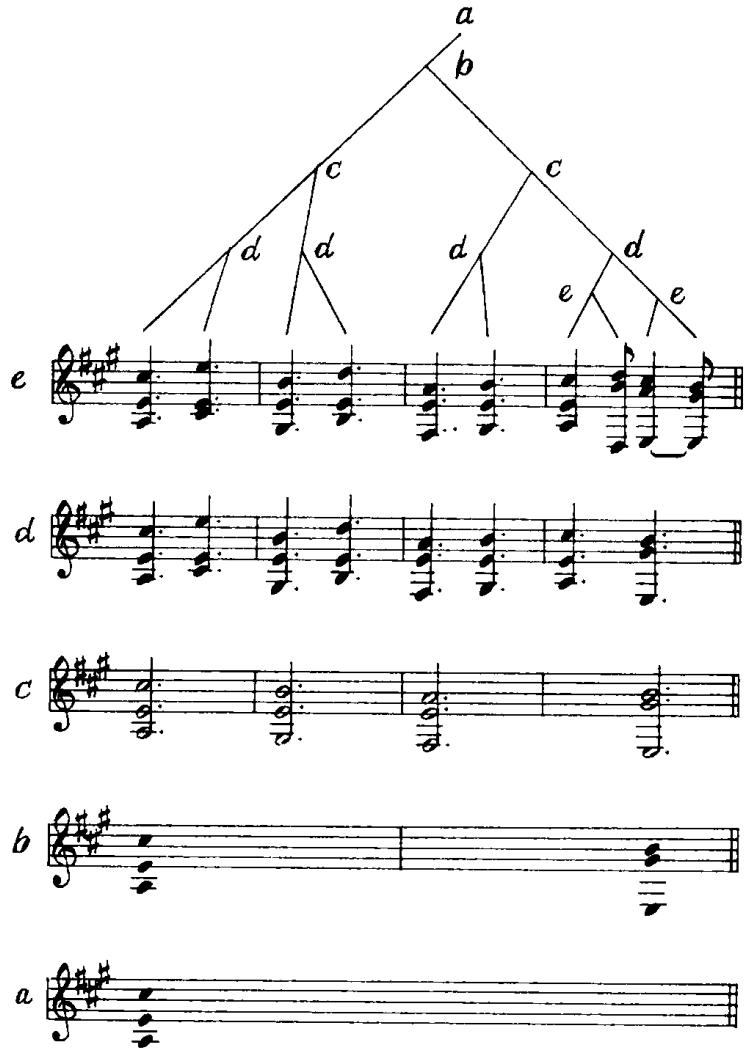
中文讲解
此为图像/乐谱占位符,其内嵌图注对图像内容作了说明:在形成延长性归约时,假设初始的I(主和弦)与结尾的V(属和弦)已经按例9.12所示被连接成一个延长性区域(prolongational region),而该图所呈现的正是例9.9b所导出之树形结构的前句部分。由于图像数据未提供,讲解无法凭推测重构具体的音级关系与分支方向,只能指出:图示承载了作者"先固定骨架再讨论中间声部选择"的教学步骤,是P0143所述简化设定的视觉化呈现,需查看原图以完整理解PRPR 1与PRPR 3在此处的实际交互方式。
补充说明
图注中提到"9.12"与"9.9b"应分别指后文和前文中已经或即将出现的其他图示;其与本图的关系为:9.12提供已附着的I–V延长性骨架;本图(例9.11的某一呈现形式)则在此骨架基础上展示前句部分的归约树。
第12段(P0145)
原文复述
9.11
中文讲解
这是乐谱/图示编号"9.11",作为P0144占位符图像的索引标签。它本身不携带论述,但表明该图为Mozart K. 331主题前四小节和声骨架的时间跨度归约结果的展示,并与例9.12(被P0144图注所引用)之间存在引用关系。
脚注 / 边栏 / 图表 / 附加信息(如有)
本小节范围内出现的非正文材料包括:
- 例9.10(第16页图示,P0135–P0136):对应前文章节中的例8.12d,其内嵌图像数据未提供。功能在于直观呈现PRPR 2与PRPR 4冲突时的乐谱语境。
- 例9.11(第17页图示,P0144–P0145):Mozart K. 331主题前四小节和声骨架的时间跨度归约图示。功能在于作为PRPR 1与PRPR 3相互作用的实例,其图注回指例9.12(已附着I–V延长性区域)与例9.9b(前句归约树)。
- 页眉"Chapter 9"(P0141):版面元素,标示当前内容所属章节。
- 小标题"## Parallelism"(P0138):用以切分小节内子主题,从PRPR 4的案例过渡到PRPR 5的正式陈述。
以上附加材料均服务于"呈现规则陈述及其证据"这一主线,本节没有独立的脚注或边栏内容。
💡 本节核心要点
- 本节以例9.10(即前文的例8.12d)为核心案例,演示PRPR 2与PRPR 4在稳定度判定上的冲突,并指出PRPR 4在此压倒了PRPR 2。
- 作者用"insofar as our judgment… is correct"和"the delicacy of the judgment may reflect a balance"作出限定,表明规则压倒并非绝对,而是两种规则之间的平衡偏向。
- PRPR 5(Parallelism)的功能是在左右分支出现歧义时,要求所有平行段落以同一种方式解决,从而保证动机的反复出现具有一致的延长性结构。
- PRPR 5的正式陈述遵循"Prefer a …“的标准偏好规则范式,并保留可被更强证据压倒的可违反性。
- P0142过渡段揭示了教学例的局限性——前文例9.8/9.9是为分离PRPR 3效应而人为简化设置的,在更复杂的实际作品中,PRPR 1与PRPR 3会"profusely"地交织。
- Mozart K. 331主题前四小节被引入作为PRPR 1与PRPR 3相互作用的清晰实例,且为简化讨论假设level e即音乐表层,使读者无需在多层归约之间切换。
🔑 关键术语
- PRPR 2:延长性归约规则2,与时间跨度的稳定度/层级结构相关的偏好规则,在本节案例中它倾向右分支构造,但被PRPR 4压倒。
- PRPR 4:延长性归约规则4,本节案例中它压倒了PRPR 2所倾向的右分支,体现了另一维度的稳定度考量。
- PRPR 5 (Parallelism):延长性归约规则5,正式称"Parallelism”,要求平行段落获得平行的分析结果,用以在分支方向出现歧义时保持动机的结构一致性。
- PRPR 3:延长性归约规则3,在本节与PRPR 1在选择中间声部事件$e_{k}$时频繁互动,作者声明两者的相互作用是延长性归约理论的核心。
- time-span:GTTM/延长性归约理论中的时间跨度,指某个结构事件所辖的、包含其内部从属进行但不必然包含下拍的时间区间,是判定分支方向的关键计量单位。
- downbeat:小节或重要节拍位置上的强拍,是否处于某时间跨度之内是PRPR 2判定右分支偏好的关键证据之一。
- prolongational region:由一个或多个延长性事件所支撑、形成单一归约单元的乐段;在例9.12中即由初始I与结尾V共同构成的区域。
- antecedent-consequent pattern:前句-后句结构,是例9.8与例9.9中演示PRPR 3独立效应的最小化场景。
- harmonic sketch:和声骨架,即只保留和声功能而忽略旋律细节的简化乐谱呈现,本节例9.11即基于此进行时间跨度归约。
- level $e$:归约层级中通常指音乐表层,本节为简化讨论而假设$e$层即为musical surface,以避免多层缩减的切换负担。
9.5.1 [描述性拆分] The Interaction Principle and K. 331 Derivation
第1段(P0146)
原文复述
9.5 The Interaction Principle
中文讲解
这是 9.5 节的标题,表明本节将正式引入"交互原则"(Interaction Principle),用来解决前面分析中延长归约规则(PRPRs)之间发生冲突时应当如何取舍的问题。标题点名了本节的核心概念。
第2段(P0147)
原文复述
Formalization of Prolongational Reduction
中文讲解
这是页面顶部或上方栏外的小标题,指明本节所在的更大讨论主题:延长归约(Prolongational Reduction)的形式化。它为下面的论证提供了理论框架:所有分析都以如何系统化地完成延长归约为目标。
第3段(P0148)
原文复述
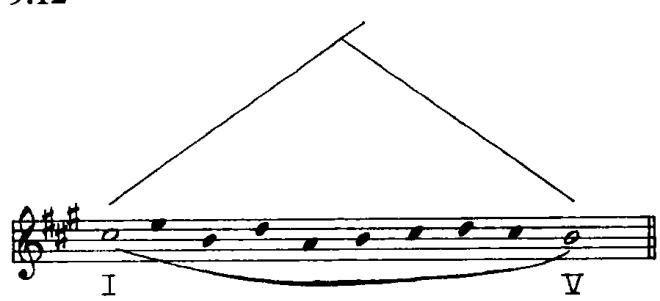
中文讲解
这是图 9.12 的占位符,位于第 18 页。结合下一段文字可知,该图展示的是一段含有八个事件(events)的区域,其中最初的 I、V⁶ 与 “vi⁷” 处于时间跨距缩减(time-span reduction)中较为重要的层级。该图用于揭示 PRPR 1 与 PRPR 3 在 $e_k$ 选择上的冲突。具体谱例与树形结构需查阅原图。
补充说明
图 9.12 的具体乐谱与树形结构此处不可见;只能根据正文确认它包含八个事件,且初始 I、V⁶、“vi⁷” 在时间跨距缩减中相对突出。
第4段(P0149)
原文复述
This region contains eight events, from which we must choose an $e_{k}$ and attach it. PRPR 1 favors the most time-span-important events—the first $V^{6}$ and the “vi7.” PRPR 3, on the other hand, favors the I chord, since it forms a strong right-branching prolongation with the initial I. Thus the two rules are in conflict.
中文讲解
本段引出本节要解决的核心问题:图 9.12 区域含有八个事件,选出 $e_k$ 时两条规则发生冲突。PRPR 1(时间跨距重要性优先)支持第一个 V⁶ 和 “vi⁷”;PRPR 3(稳定延长连接优先)支持 I 和弦,因为它与初始 I 形成强力的右分支延长关系。“冲突"一词点明了:单凭任一规则都无法得出唯一答案,因此需要更高层级的原则来裁决。
补充说明
$e_k$ 指当前区域中需要确定归属的关键事件;PRPR 1 与 PRPR 3 已在前面章节定义。
第5段(P0150)
原文复述
In analyzing numerous examples of this sort of conflict, we have found that the following principle accounts for the vast majority of cases:
中文讲解
本段是过渡句,说明即将提出的"交互原则"并非凭空规定,而是从大量同类冲突实例中归纳出来的经验性原则,能解释绝大多数情况。它为这条规则赋予经验可信度。
第6段(P0151)
原文复述
Interaction Principle In order to make a sufficiently stable prolongational connection, $e_{k}$ must be chosen from the events in the two most important levels of time-span reduction represented in $(e_{i}-e_{j})$ .
中文讲解
这是交互原则的正式陈述。其核心约束是:$e_k$ 只能从 $(e_i - e_j)$ 区域中时间跨距缩减的两个最重要层级里挑选事件。这样既保证了延长连接的稳定性,又把候选范围限定在时间跨距结构相对突出的事件上,从而协调 PRPR 1 与 PRPR 3 的潜在冲突。
形式条件:在某一延长区域内,先辨认时间跨距缩减层级最高的两个层级,那些层级上的事件才可作为 $e_k$ 的候选。 直观意义:延长结构不能完全脱离时间跨距的重要性,节奏重音塑造的层级会限制延长归约的选点。
补充说明
“两个最重要的层级"允许在时间跨距重要性和延长重要性之间保留一定弹性,详见下一段。
第7段(P0152)
原文复述
The Interaction Principle restricts the conditions under which PRPR 3 can override PRPR 1: no matter what stable prolongational connection can be made to the endpoints of a region, only those events in the highest two levels of time-span reduction represented in the region can be considered for $e_{k}$ . Thus the Interaction Principle is a more explicit version of Prolongational Hypothesis 2, which states the dependence of prolongational reduction on time-span reduction, and, through time-span reduction, on grouping and metrical structure.
中文讲解
本段阐明交互原则的两层作用:一是限制 PRPR 3 何时能压倒 PRPR 1——即便与区域端点之间存在稳定的延长连接,候选事件也必须落在时间跨距缩减的最高两个层级之内;二是把它定位为延长假设 2(在前面章节提出,断言延长归约依赖于时间跨距归约)的更精确版本,由此把延长归约进一步连接到分组(grouping)和节拍结构(metrical structure)。
注意"最高两个层级"的措辞:哪怕端点连接再稳定,只要候选事件不在此范围,也不能被选为 $e_k$。
补充说明
脚注 1 在此之后出现,内容将放在汇总部分。
第8段(P0153)
原文复述
The Interaction Principle allows two levels of time-span reduction to be available for $e_{k}$ , rather than only one level, because a degree of flexibility must be allowed between time-span importance and prolongational importance. On the other hand, the use of two levels rather than three or more appears empirically to yield just the correct degree of looseness between the two reductions; it prevents unimportant detail from playing too great a role at any particular stage of prolongational analysis. $^{1}$
中文讲解
本段对"两个层级"这一具体数字给出经验性辩护:若只允许一层,会让两条缩减之间过于僵硬;若允许三层或更多,则过于松散,引入过多细节。选择两层是经验上"刚好"的折中——既保证时间跨距与延长重要性之间有弹性,又避免次要事件过度影响延长归约。
末尾的上标 1 提示此论证附有脚注,将在汇总部分说明。
补充说明
脚注 1 内容将在 additional_information 中汇总。
第9段(P0154)
原文复述
We return now to the conflict in 9.12. According to the Interaction Principle, the I chord may be chosen as $e_{k}$ , because it is only one time-span level less important than the $V^{6}$ or the “vi $^{7}$ .”(On the other hand, in the original K. 331 passage, the I chord on the third beat of measure 1 is two levels less important than the $V^{6}$ , and so cannot be considered a candidate for $e_{k}$ .) The tree resulting from the choice of the I is shown in 9.13.
中文讲解
本段把交互原则应用到图 9.12 的冲突中,并立即与 K. 331 原文段落进行对比,凸显该原则的诊断价值。
在图 9.12 的情境下,I 和弦虽然时间跨距重要性仅次于 V⁶/“vi⁷”,但仍处于"两个最高层级"之内,所以可被选为 $e_k$。括号内则给出对照:K. 331 第 1 小节第 3 拍的 I 和弦比 V⁶ 低两个时间跨距层级,因此不满足条件——这正是二者归约结果不同的关键。
由此自然引出图 9.13:选 I 之后形成的延长树。
补充说明
括号内的对比凸显了交互原则的分辨力:图 9.12 与 K. 331 原文看似冲突相同,但时间跨距层级差不同,从而导致完全不同的 $e_k$ 选择。
第10段(P0155)
原文复述
Chapter 9
中文讲解
这是第 19 页的页眉,标注章节编号,说明页面所属章节。属于版面信息,无实质内容。
第11段(P0156)
原文复述
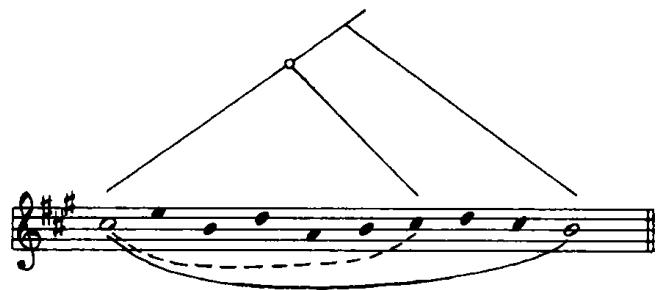
中文讲解
这是图 9.13 的占位符,位于第 19 页。根据 P0154 与 P0157 的描述,该图显示在选定 I 作为 $e_k$ 后形成的延长树——两个 I 之间、以及第二个 I 到终止 V 之间,被分成两个待分析的子区域。需查看原图以确认具体分支走向。
第12段(P0157)
原文复述
There are now two regions to consider: between the two Is and from the second I to the final V. Let us deal with the latter first. The $ii^{6}$ and the $I_{4}^{6}$ are equal in time-span importance, so PRPR 1 does not apply. Of the four possible connections between these two chords and the endpoints, the most stable is the left-branching descending fifth progression from the $ii^{6}$ to the V, so the $ii^{6}$ is chosen as $e_{k}$ . Then the $I_{4}^{6}$ must attach to either the $ii^{6}$ or the V. Because of the arrival in the bass, it attaches to the V, as in 9.14.
中文讲解
本段详细展示交互原则之后的具体延长归约推导,分两步。
第一步:先处理第二个 I 到终止 V 的区域。$ii^6$ 与 $I_4^6$ 时间跨距重要性相等,所以 PRPR 1 不适用;此时退回到稳定延长连接比较——四个候选连接中,从 $ii^6$ 到 V 的左分支下行五度进行最稳定,因此 $ii^6$ 被选为 $e_k$。
第二步:确定 $I_4^6$ 的归属。它可附到 $ii^6$ 或 V,作者依据"低音到达”(arrival in the bass)选择让它依附于 V。
得出的树见图 9.14。
补充说明
下行五度进行是古典和声中最稳定的连接之一,作者借此说明为何稳定延长连接优先于时间跨距层级相同时的任意选择。
第13段(P0158)
原文复述
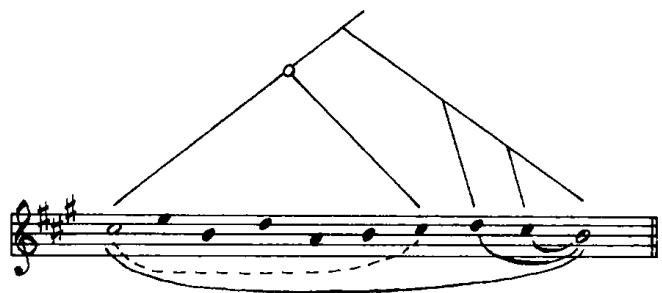
中文讲解
这是图 9.14 的占位符,位于第 19 页。该图显示前述推导结果:$ii^6$ 作为 $e_k$ 连接到第二个 I,而 $I_4^6$ 作为弱延长依附于终止 V。是 P0157 所述论证的视觉化结果。需查看原图。
第14段(P0159)
原文复述
The part of the tree just developed is one of the cadential formulas presented in section 8.3. The $ii^{6}$ , despite its relative unimportance in the time-span reduction, has emerged as relatively important in the prolongational reduction: it is the most important left branch of the cadential V.
中文讲解
本段把刚才得出的子树与第 8.3 节中已陈述的终止式公式联系起来,证明推导具有理论一致性;同时指出 $ii^6$ 在时间跨距缩减中相对次要,但在延长归约中却被提升为终止 V 最重要的左分支。
这正对照了交互原则的核心思想:时间跨距重要性允许在一定范围内被延长重要性覆盖,从而产生看似矛盾却自洽的层级提升。
补充说明
此处可见章节间的回指:8.3 节的终止式公式为 9.5 节的推导提供了模板。
第15段(P0160)
原文复述
Next we turn to the region between the two Is in 9.14. The $V^{6}$ and the “vi7” are again most time-span-important, but the most stable harmonic connection is from the initial I to the $I^{6}$ . The Interaction Principle as applied so far selects the $I^{6}$ as most important; however, intuition favors the $V^{6}$ . There are two local influences supporting this intuition. First, the $V^{6}$ is melodically closer to the I than the $I^{6}$ is, and the events involved are at a local enough level here that melodic connection, in both the soprano and the bass, plays a decisive role. Thus PRPR 3 is itself conflicted between harmonic closeness and melodic closeness, so that the $I^{6}$ is not clearly a more stable connection than the $V^{6}$ . PRPR 1 therefore prevails, choosing the $V^{6}$ for its time-span importance. The second factor in the choice of the $V^{6}$ involves motivic structure, and will be discussed below.
中文讲解
本段处理两个 I 之间的区域,展示规则冲突的精细化解决。
表面结论:交互原则单独应用会选 $I^6$(稳定延长连接),但听觉直觉偏向 V⁶。
论证分两点:
- 在局部层级上,旋律连接(高声部与低声部)起决定性作用。V⁶ 在旋律上比 $I^6$ 更接近 I,因此 PRPR 3 自身在和声亲近与旋律亲近之间分裂,$I^6$ 不再是明显的更稳定连接,PRPR 1 借此胜出,按时间跨距重要性选 V⁶。
- 第二个因素——动机结构——将在下文讨论,留作悬念。
这段说明揭示了交互原则的局限:当 PRPR 3 内部冲突时,规则的应用顺序与解释角度会影响最终结果。
补充说明
“线性连接”(melodic connection)在此特指局部声部进行中的音高距离,与和声功能性共同构成 PRPR 3 的判断依据。
第16段(P0161)
原文复述
Formalization of Prolongational Reduction
中文讲解
这是第 20 页重复出现的栏外小标题,再次标明本节所从属的大主题——延长归约的形式化。它继续把分析锚定在理论构建的总体目标中。
第17段(P0162)
原文复述
After the $V^{6}$ attaches, the $I^{6}$ attaches as a weak prolongation to the initial I. The tree now looks as in 9.15.
中文讲解
本段简短交代 V⁶ 选定后 $I^6$ 的处置:它作为弱延长依附于初始 I,形成当前树形见图 9.15。弱延长意味着它在延长层级中地位较低,不影响主结构。
第18段(P0163)
原文复述
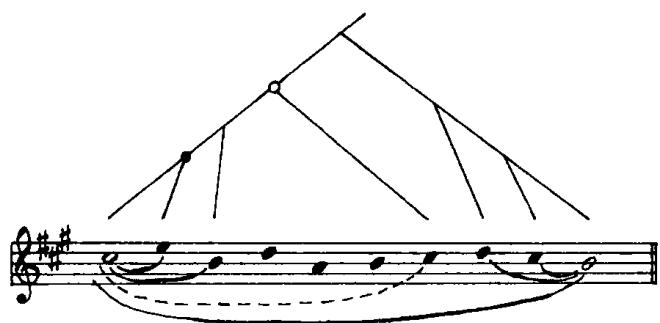
中文讲解
这是图 9.15 的占位符,位于第 20 页。结合 P0162 与 P0164 的描述,该图显示 V⁶ 作为 $e_k$ 后,$I^6$ 已经作为弱延长连到初始 I 的树形状态。需查看原图。
第19段(P0164)
原文复述
Between the $V^{6}$ and the second I, the most time-span-important event is the “vi7.” But the second $V^{6}$ forms more stable prolongational connections, either as a strong prolongation of the first $V^{6}$ or as a progression into the second I by descending circle of fifths. In either case, the Interaction Principle allows us to choose the $V^{6}$ , despite its lesser time-span importance; this yields 9.16.
中文讲解
本段再举一个交互原则的典型应用。
时间跨距层面:“vi⁷” 在 V⁶ 与第二个 I 之间最重要。 延长连接层面:第二个 V⁶ 提供了两条更稳定的延长路径——既是对第一个 V⁶ 的强延长,也可通过下行五度圈进入第二个 I。
依据交互原则:第二个 V⁶ 虽时间跨距层级较低,但仍在"两个最高层级"之内,而它又能提供更稳定的延长连接,因此被选为 $e_k$,结果见图 9.16。
这是本节反复出现的主题:时间跨距重要性并不总是压倒延长重要性,交互原则在两者之间起调节作用。
补充说明
下行五度圈(descending circle of fifths)在此指 V⁶ → … → I 通过连续下行五度进行的稳定和声运动。
第20段(P0165)
原文复述
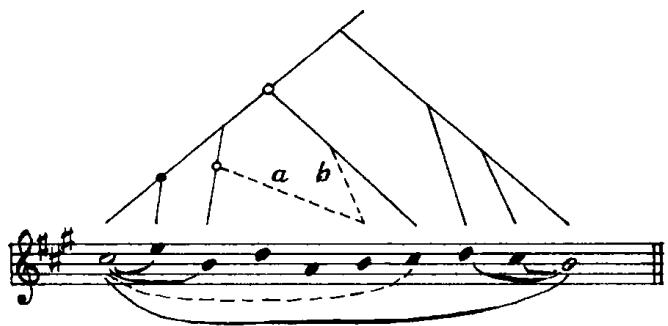
中文讲解
这是图 9.16 的占位符,位于第 20 页。根据 P0166 的描述,该树显示第二个 V⁶ 与两端的连接用虚线表示,以体现归属存在两种合理选择。需查看原图以确认两种分支。
第21段(P0166)
原文复述
The dashed lines in 9.16 indicate the alternative attachments of the second $V^{6}$ . We believe the choice is a genuine ambiguity in the piece: Is this event heard as a repetition of the first $V^{6}$ (branching a), or as leading into the I (branching b)? Note, however, that PRPRs 2 and 4 both favor branching b, because the I and the second $V^{6}$ but not the first $V^{6}$ are in the second two-measure group and because the I is more important than the $V^{6}$ . For this reason, there may be some preference for this attachment.
中文讲解
本段指出图 9.16 中的虚线代表真实的归约歧义——第二个 V⁶ 既可以理解为第一个 V⁶ 的重复(分支 a),也可以理解为引向 I 的进行(分支 b)。
然而作者并非完全悬置此选择:PRPR 2(与时间跨距分段一致)与 PRPR 4(与分组一致)都支持分支 b,因为 I 与第二个 V⁶ 同属第二组两小节,而第一个 V⁶ 不在其中;同时 I 本身比 V⁶ 更重要。因此分支 b 略占优势,但分支 a 仍作为合理替代保留。
这反映了理论既承认歧义,又给出倾向性判断的成熟态度。
补充说明
“two-measure group” 提示 K. 331 主题含有两小节一组的高层分组结构,对 PRPR 2 与 4 起支撑作用。
第22段(P0167)
原文复述
Between the two $V^{6}s$ , the most time-span-important event is still the “vi7,” while the strongest harmonic connection is to the $V_{3}^{4}$ . As in 9.15, however, linear and harmonic connections conflict, leaving PRPR 1 free to choose the “vi7” as $e_{k}$ . If branching a in 9.16 is preferred, there is pressure for the “vi7” to attach to the previous $V^{6}$ because of PRPR 4. If branching b is selected, the “vi7” attaches unequivocally to the following
中文讲解
本段处理两个 V⁶ 之间的区域,并明确接下来要表达的意思。
时间跨距层面:“vi⁷” 仍是最重要事件。 延长连接层面:最强和声连接是 $V_3^4$。
但与图 9.15 的情况类似,线性(旋律)与和声连接发生冲突,使 PRPR 1 不再被压倒,因此可选 “vi⁷” 为 $e_k$。
随后给出条件分支:若选分支 a,则 PRPR 4 推动 “vi⁷” 附于前一个 V⁶;若选分支 b,则 “vi⁷” 明确附于后一个 V⁶(理由将在 P0169 中给出)。
本段在末尾被截断,下一段继续。
补充说明
“$V_3^4$ 听起来"是"vi⁷"的常规解决,作者借此说明为何两者的延长连接具有可比性。
第23段(P0168)
原文复述
Chapter 9
中文讲解
这是第 21 页的页眉,标注章节编号。属于版面信息,无实质内容。
第24段(P0169)
原文复述
$V^{6}$ through the influence of PRPR 2. In either case, by parallelism with measure 1 (PRPR 5), the $V_{3}^{4}$ finally attaches as a right branch to the preceding $V^{6}$ . Example 9.17 gives the complete tree for both possibilities, with 9.17a deriving from branching a in 9.16 and 9.17b deriving from branching b.
中文讲解
本段承接 P0167,说明 “vi⁷” 在分支 b 情况下附于后一个 V⁶ 的依据是 PRPR 2(与时间跨距分段一致);同时无论选 a 或 b,PRPR 5(平行结构)都让 $V_3^4$ 作为右分支附于前一个 V⁶——与小节 1 的结构形成平行。
最终成型的完整树见图 9.17,分 9.17a(基于分支 a)和 9.17b(基于分支 b)两版。这一"分叉呈现"既尊重歧义,又把每种选择的后果完整展示。
补充说明
PRPR 5(平行)在 P0160 中已预告,这里给出具体应用:第二小节重复第一小节结构,使 $V_3^4$ 自然落在相同延长位置。
第25段(P0170)
原文复述
Both trees in 9.17 are musically meaningful. That in 9.17a captures the double neighboring motion in the voice leading of the phrase—the $V^{6}$ within a prolonged I and the “vi $^{7}$ ” within a prolonged $V^{6}$ . On the other hand, that in 9.17b better represents the pattern of tension and relaxation in the phrase, with the “vi $^{7}$ ” and the second $V^{6}$ relaxing into the following I.
中文讲解
本段对两个版本做出音乐意义评价,强调两者都有效但捕捉不同侧面。
9.17a 的长处:突出双重邻音运动——V⁶ 处于被延长的 I 内部,“vi⁷” 处于被延长的 V⁶ 内部,呈现清晰的声部进行结构。
9.17b 的长处:呈现紧张与松弛的节奏——“vi⁷” 与第二个 V⁶ 共同松弛地解决到下一 I,更契合第二小节作为前半句收束的力度感。
这一对照说明:归约选择并非单纯依赖规则,而是取决于分析者希望突出哪一种音乐维度。
补充说明
“tension and relaxation” 是 Schenker 体系中常见的修辞,作者借用以表达两种分支各自的诠释价值。
第26段(P0171)
原文复述
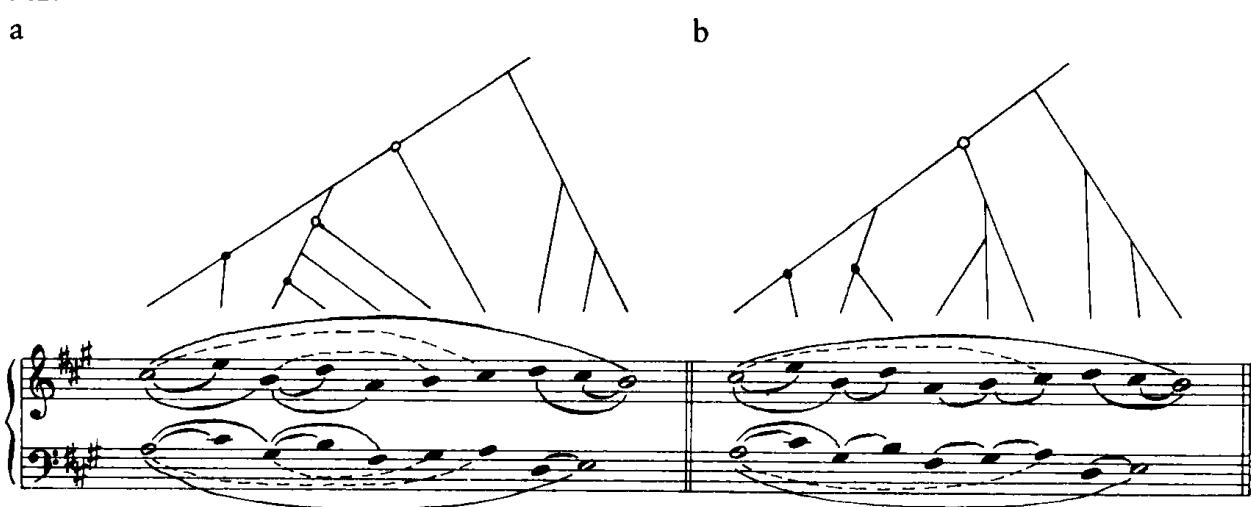
中文讲解
这是图 9.17 的占位符,位于第 21 页。根据 P0169 与 P0170 的描述,该图并列展示 9.17a 与 9.17b 两个完整的延长树。需查看原图以比较两种分支走向。
第27段(P0172)
原文复述
Now let us turn to our promised comment on motivic structure. Although the rule of parallelism (PRPR 5) creates parallel internal structure for parallel motives, it does not necessarily prevent a situation like 9.18a. 9.18
中文讲解
本段引出 P0160 末尾预告的第二个因素——动机结构。承认 PRPR 5(平行)会为平行动机制造平行内部结构,但即便如此,仍可能产生如图 9.18a 所示的有问题的结构。
“9.18” 单独成行是图号标注。
第28段(P0173)
原文复述
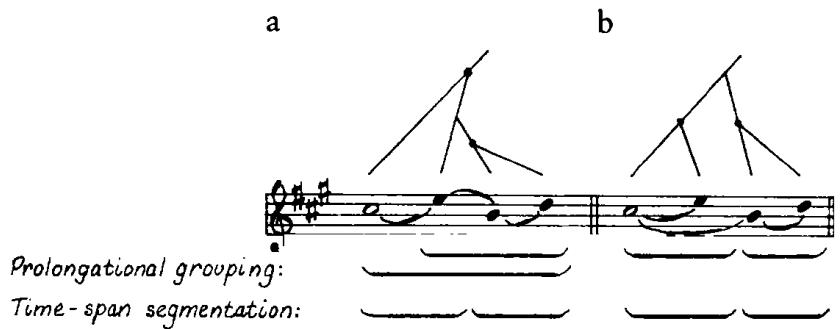
中文讲解
这是图 9.18 的占位符,位于第 21 页。结合 P0174 与 P0176 的描述,该图并置 9.18a(动机被嵌入前一动机内部)与 9.18b(动机保持独立完整)两树。需查看原图。
第29段(P0174)
原文复述
In this tree the two occurrences of the motive are internally parallel (in that the second half of each is subordinate to the first half), but the second occurrence is prolongationally an elaboration of an internal part of the other. This is the structure that would have resulted if the $I^{6}$ had been chosen ahead of the $V^{6}$ in 9.14. Instead we chose 9.18b—at the time, on linear grounds.
中文讲解
本段具体描述 9.18a 的结构特征:两次动机各自内部平行(每动机的后半从属于前半),但延长归约上第二次出现却成为第一次内部某一部分的细化。
这种结构正是图 9.14 中若选 $I^6$ 而非 V⁶ 会产生的后果。作者回扣前文:当时在线性(旋律)连接基础上选择了 9.18b。
关键判断:9.18a 让第二次动机失去独立地位,沦为内嵌装饰。
补充说明
此处把 9.18a 与 9.14 的选择回扣起来,强调每一步延长归约选择都对应了不同的动机结构后果。
第30段(P0175)
原文复述
Formalization of Prolongational Reduction
中文讲解
这是第 22 页再次出现的栏外小标题,标明仍在形式化延长归约这一大主题之下。属于版面提示。
第31段(P0176)
原文复述
But there is another reason not to prefer 9.18a: it implies that the second occurrence of the motive is part of the first, rather than a self-contained entity. PRPR 2 (congruence to time-span segmentation), which is especially effective at these small levels, addresses this difficulty, since 9.18b is congruent to the time-span segmentation and 9.18a is not. This can be seen more clearly in these examples by comparing the time-span segmentation with the “prolongational grouping” (the domains defined by the extent of prolongational elaborations). Thus PRPR 2 has an important effect on the delineation of motivic structure in prolongational reduction: it keeps motives prolongationally intact.
中文讲解
本段补充了拒绝 9.18a 的更深层理由:它使第二次动机沦为第一次的一部分,而非独立整体。
PRPR 2(与时间跨距分段一致)在小尺度上特别有效:9.18b 与时间跨距分段一致,9.18a 则不一致。比较时间跨距分段与"延长分组”(prolongational grouping,由延长细化的范围决定)可以让这一点看得更清楚。
因此 PRPR 2 的一个重要作用是:让动机在延长归约中保持完整。作者用"延长分组"这一术语来描述延长细化所控制的时间范围。
本段也是 P0160 留下的悬念——“动机结构”——的最终回应:动机独立性由 PRPR 2 守护。
补充说明
“prolongational grouping” 是延长的范围概念,与时间跨距分组并存但不同:前者由延长决定,后者由节拍与和声节奏决定。
第32段(P0177)
原文复述
This derivation has illustrated the typical way in which the PRPRs interact. The primary influences on prolongational structure are PRPRs 1 and 3, with PRPRs 2, 4, and 5 helping to decide otherwise indeterminate cases. What makes K. 331 unusual is the number of times the Interaction Principle has to be invoked, resulting in repeated prolongational subordination of the time-span-important “vi7.” Most pieces do not display such a disparity between time-span and prolongational importance, but to the extent that they do, it is as a result of the Interaction Principle, as in this example.
中文讲解
本段对推导做出总结定位。
规则层级:PRPR 1 与 3 是延长结构的主要塑造者,PRPR 2、4、5 在前者无法决定时细化结果。
K. 331 的特殊性:必须频繁调用交互原则,导致时间跨距重要的 “vi⁷” 反复被延长归约压低。多数作品不出现这种明显落差,但一旦出现,就是交互原则的作用。
这一总结把抽象原则与具体作品的特征绑定起来:K. 331 之所以显得"反常”,是因为它的节奏重音与延长结构分布不对应。
补充说明
“repeated subordination” 暗示 “vi⁷” 在 K. 331 中多次被压低——这是该作品分析的标志性观察。
第33段(P0178)
原文复述
An additional case where the Interaction Principle plays a role in deriving the prolongational structure of deceptive cadences, illustrated in 9.7. In a deceptive cadence, it is typically the case that the V forms a more stable prolongational connection with its surroundings than does the vi. Because the V is immediately subordinate to the vi in the time-span reduction, the Interaction Principle says that it should be chosen as $e_{k}$ in the relevant region, with the vi subordinate, as shown in 9.7. Hence deceptive cadences, unlike full cadences, unlike full cadences, display a reversal of prolongational importance, with the dominant more important than the resolution.
中文讲解
本段把交互原则的应用拓展到另一个常见结构——伪终止(deceptive cadence)。
机制:V 通常与周围和弦形成比 vi 更稳定的延长连接;又因为 V 在时间跨距缩减中直接隶属于 vi(仅低一层),满足交互原则的两个最高层级条件,所以 V 可被选为 $e_k$,vi 反过来成为其下属。
后果:与全终止不同,伪终止呈现出延长重要性的反转——属和弦比其"解决"更突出。
这一例子说明交互原则不仅解释 K. 331 这类个别作品的特征,也支撑了传统和声形式(伪终止)的延长结构判定。
补充说明
伪终止与全终止的延长层级差别是 9.7 图的核心内容,本段是对该图结论的回顾性引用。
第34段(P0179)
原文复述
To sum up: the Interaction Principle states how the time-span reduction regulates prolongational importance. In constructing a prolongational reduction, we can, for each prolongational region, simply search for the strongest prolongational connection possible among the events in the two largest levels of time-span reduction represented in the region. Events of less time-span importance need not be considered. In terms of musical cognition, this means that patterns of tension and relaxation are strongly organized by rhythmic articulation—an intuition that seems obvious, but to our knowledge has not previously been formulated explicitly in the theoretical literature. The power of the Interaction Principle in constraining possible prolongational reductions makes it a central part of our theory.
中文讲解
本段为本节乃至整章的总结段落。
核心定义:交互原则规定了时间跨距缩减如何调节延长重要性——在每个延长区域中,只需在时间跨距缩减层级最高的两个层级内寻找最强延长连接;低层级事件可被忽略。
认知含义:紧张与松弛的模式由节奏重音强烈组织——这一直觉虽显见,却在此前理论文献中未被明确表述。
理论地位:交互原则对延长归约的可能性具有强约束力,是本理论的核心组成。
它把本章规则系统提升为一个有明确认知基础的层级模型:节奏塑造层级,层级约束延长。
补充说明
末句把交互原则升格为理论核心,与开篇 P0151 的形式陈述形成首尾呼应。
脚注 / 边栏 / 图表 / 附加信息(如有)
【脚注 1】(P0153 上标) 内容:根据原文 P0153 末尾的上标 1 提示存在脚注,但任务输入未提供脚注正文。脚注通常对该论证(“两层经验上恰好”)给出补充证据或文献注——其具体内容需查阅原书第 18 页底部脚注区。 作用:根据上下文,应是对"两层 versus 三层或更多"这一选择的经验性注脚,属于支持性补充。
【图示汇总】 图 9.12(P0148):含 8 个事件的区域,用于显示 PRPR 1 与 PRPR 3 的冲突。 图 9.13(P0156):选 I 作为 $e_k$ 后形成的延长树,含两个待分析子区域。 图 9.14(P0158):在图 9.13 基础上,$ii^6$ 作为 $e_k$ 归到第二个 I,$I_4^6$ 附于 V。 图 9.15(P0163):V⁶ 选定后,$I^6$ 作为弱延长附于初始 I 的状态。 图 9.16(P0165):第二个 V⁶ 的归属以虚线呈现,体现 a/b 两种分支。 图 9.17(P0171):并列展示 9.17a 与 9.17b 两个完整延长树。 图 9.18(P0173):并置 9.18a(动机被嵌入)与 9.18b(动机保持独立)两树。 图 9.7(P0178 引用):伪终止延长结构例,前文已绘。
💡 本节核心要点
- 交互原则的陈述:$e_k$ 只能从 $(e_i - e_j)$ 区域内时间跨距缩减最高的两个层级中选取,是延长假设 2 的更精确版本。
- K. 331 中 “vi⁷” 时间跨距重要却被延长归约压低的现象,正是因为它与 V⁶ 同处或低于两个最高层级,使交互原则允许其他延长更稳定的事件占先。
- PRPR 1 与 PRPR 3 是延长结构的主要塑造者,PRPR 2、4、5 在规则分不出时细化决定;K. 331 的特殊之处在于需要频繁调用交互原则。
- 动机完整性由 PRPR 2(与时间跨距分段一致)守护:它拒绝让第二次动机沦为第一次动机的内部细化(9.18a),保证 9.18b 这类独立结构。
- 交互原则具有认知含义:紧张与松弛的模式由节奏重音强烈组织——这是该理论的核心创新点。
- 交互原则的应用范围不限于 K. 331:伪终止中 V 高于 vi 的延长重要性反转也是该原则的直接后果。
🔑 关键术语
- Interaction Principle(交互原则):本节新引入的规则:在延长归约中,$e_k$ 必须从区域时间跨距缩减层级最高的两个层级中选取。作用是协调 PRPR 1(时间跨距重要性)与 PRPR 3(稳定延长连接)之间的冲突,并通过时间跨距结构(进而通过分组与节拍)约束延长归约。
- PRPR 1-5(延长归约优先规则 1-5):本节反复引用的五条延长归约规则:PRPR 1 优先选时间跨距重要事件;PRPR 3 优先选稳定延长连接;PRPR 2 与时间跨距分段一致;PRPR 4 与分组一致;PRPR 5(平行)让平行动机获得平行内部结构。
9.6.1 [描述性拆分] Normative Prolongational Structure — Statement
第1段(P0180)
原文复述
Chapter 9
中文讲解
该段为页面标识,显示本节内容属于第9章。它没有论说内容,只起版面定位作用。
第2段(P0181)
原文复述
Section 8.3 presented the notion of a normative (or preferred) overall prolongational structure for phrases and larger levels of grouping. The principle was stated as a preference for phrases that contain at least one significant right-branching progression (a departure, increasing tension) and a doubly embedded left-branching progression (a prepared cadence, relaxing the tension). The general structure is shown in 9.19.
中文讲解
本段回顾前一节给出的核心直觉:规范化(normative)或称偏好的延伸结构适用于乐句及其以上各层级。其要点是,一个偏好的乐句应当至少包含一个重要的右分支进行(对应离开展开、积累张力的“出发”)与一个双重嵌入的左分支进行(对应准备性终止、消解张力的“回归”)。这里“右分支”(right-branching)指该事件在树形结构中作为上方延展、向后延伸;“左分支”(left-branching)则指作为某一较高事件的准备性下层延展。9.19展示这一总体构型,但本段本身只点到为止。
补充说明
本段中“9.19”对应下文P0183处的图示占位符。
第3段(P0182)
原文复述
9.19
中文讲解
这是9.19图示的编号/标签。它标示紧随其后的图像为Example 9.19。
第4段(P0183)
原文复述
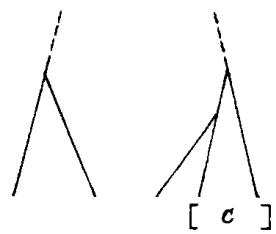
中文讲解
此处为图Example 9.19的占位符,位于第23页,用于呈现上文提到的规范化延伸结构:自延长起点(prolongational beginning)向右分支展开(出发积累张力),再通过左分支准备性进行回到一个准备好的终止(双重嵌入左分支)。由于图像数据未提供,具体图形细节需查阅原图。
第5段(P0184)
原文复述
This section will state the principle more precisely and show how it affects the choice of prolongational structure in a number of cases.
中文讲解
本段是过渡句,预告本节的双重任务:一是把规范化结构的规则措辞得更精确,二是用若干实例说明该规则如何影响延伸结构的具体选择。它把读者从“直觉+图示”阶段引向“规则陈述+实例应用”阶段。
第6段(P0185)
原文复述
Statement of the Rule
中文讲解
本段为小节标题“规则的陈述”。它标志着本节进入主体,正式将直觉化的偏好转化为可操作的规则。
第7段(P0186)
原文复述
To arrive at a better understanding of this principle, we begin by asking two questions: To what groups does the preference for normative structure apply? How is the normative configuration associated with the selected groups?
中文讲解
本段提出两个驱动后续陈述的关键问题。第一个问题涉及规则的适用范围——规范化结构偏好应施加于哪一类群体;第二个问题涉及规范化构型与所选定群体之间的关联方式,即一个群体在时间跨度缩减中如何被赋予特定的延伸结构。把规则陈述拆解为这两个问题,帮助读者顺着“适用范围→关联方式”的逻辑顺序来理解后续论证。
第8段(P0187)
原文复述
To answer the first question we note that intuitions about “normal” tension and relaxation are not applicable to small groups such as the first measure of K. 331. Rather they apply to those groups that we designated in section 7.4 as cadenced groups: groups that at some level of time-span reduction are represented as a single event (the structural beginning) followed by a cadence (the structural ending). Recall that the smaller levels of cadenced groups correspond to the intuitive notion of phrase, the smaller levels to sections, and the largest level to the entire piece. The rule of normative structure should apply to all these cadenced groups.
中文讲解
本段回答第一个问题(适用范围)。作者指出,张力与松弛的“正常”直觉并不适用于小单位(如K.331第一小节),而只适用于7.4节定义的“有终止的群体”(cadenced groups)。该类群体的特征是:在某一层级的时间跨度缩减中表现为单一事件(结构性开始)后接一个终止(结构性结束)。其中较小层级对应乐句、较大层级对应段落、最大层级对应全曲。规范化结构规则应普遍适用于所有这些有终止的群体。
理解要点:规则不是放之四海皆准的,而是有限定地施加在“含终止的群体”上;正因为有终止,才谈得上从开始到结束的“张力—松弛”整体曲线。
补充说明
本段提到K.331(莫扎特A大调钢琴奏鸣曲K.331)第一小节作为反例,仅在7.4节语境中提及K.331,未在当前task_input中提供更多细节。Section 7.4的内容未在当前输入中展开。
第9段(P0188)
原文复述
Consider now the second and more difficult question. The intuition we are trying to express is that from the beginning to the end of a cadenced group there should be a tensing followed by a relaxation. Of course, by “beginning” we cannot mean the surface beginning, since, for example, events on upbeats usually do not feel like the point from which the tension starts. In fact, in large-scale cadenced groups, such as the exposition of Beethoven’s “Tempest” Sonata (see section 10.2), there may be a rather lengthy structural anacrusis before the point at which the normative structure begins. Similarly, by “ending” we cannot mean surface ending, since, as we saw in the Chorale St. Antoni (section 8.5), the prolongational tension is defused seven measures before the end. Hence the rule describing normative structure must refer to some more abstract notion of beginning and ending events than that given by the musical surface.
中文讲解
本段回答第二个问题(如何关联),并指出其难度。所表达的直觉是:从开始到结束应存在张力积累随后松弛的过程。但作者强调,“开始”不能等同于表面(surface)开始——弱拍事件通常并不构成张力起点的听觉感受;在大尺度群体(如贝多芬《“暴风雨”奏鸣曲》呈示部,详见10.2节)中,规范化结构可能始于一个较长的结构性弱起(structural anacrusis)之后。同样,“结束”也不能等同于表面结束——在圣安东尼圣咏(Chorale St. Antoni,详见8.5节)中,延伸张力在结束前七小节就已经消解。
因此,规范化结构规则须指涉比表面更抽象的起止事件。这一论证为下一段(P0191)提出“延伸开始/结束”概念铺平道路。
补充说明
本段提及贝多芬《“暴风雨”奏鸣曲》与圣安东尼圣咏作为大小尺度上的反例,具体分析分别需见原书10.2节与8.5节。
第10段(P0189)
原文复述
Normative Prolongational Structure
中文讲解
本段为大节标题(标题层),在页面布局上为“规范化延伸结构”的分节标题。它把后续段落归入同一主题:规范化延伸结构规则的正式表述。
第11段(P0190)
原文复述
Formalization of Prolongational Reduction
中文讲解
本段为小节标题——“延伸缩减的形式化”。它标志作者接下来要把规范化结构用更精确的术语和规则加以形式化。
第12段(P0191)
原文复述
The appropriate events can be identified as the endpoints of the largest prolongational region entirely contained within a cadenced group. Let us call these events the prolongational beginning and prolongational ending of the group. They will usually, but not always, coincide with the structural beginning and ending defined by the time-span reduction.
中文讲解
本段提出解决方案。合适的起止事件被定义为:完全包含在某一有终止群体内的最大延伸区域(largest prolongational region)的两个端点。作者命名它们为群体的“延伸开始”(prolongational beginning)和“延伸结束”(prolongational ending)。这两个概念通常(但并非总是)与时间跨度缩减所定义的结构性开始和结构性结束重合。
理解要点:作者用“最大延伸区域”这种操作化定义,绕开了表面起止带来的两个反例(弱起大尺度群体、终止前张力已消解的群体)。这正是把直觉转化为可操作的范畴边界。
第13段(P0192)
原文复述
Observe that the double left branching in 9.19 is due to the fact that full cadences already have two events in them, one connected as a left branch to the other. Instead of literally specifying double left embedding, it is advantageous to require simply a cadential preparation, that is, one significant left branch attached to the designated cadence. This formulation generalizes to half cadences, where the normative prolongational ending is a V chord prepared by one previous significant event as its highest elaboration. This was the structure at the half cadence in measure 4 in K. 331 in the previous section, for instance. Such a description of normative form also generalizes to phrases with deceptive cadences, in which the prolongational ending is the V rather than the vi. Here again, one significant left branch is the norm. In nearly all cases, the desired left branch is “subdominant” in function.
中文讲解
本段进一步修正规则的措辞以增强适用面。9.19中的“双左分支”源于完全终止本身已包含两个事件(左分支依附于另一事件)。作者认为,与其字面规定“双重嵌入”,不如只要求终止准备(cadential preparation),即一个重要左分支依附于指定终止即可。
这一简化具有三点意义:
- 它可推广到半终止——半终止的规范化延伸结束为V和弦,由一个先前重要事件作为其最高层延展来准备(前一节中K.331第4小节的半终止即为这种结构)。
- 它可推广到阻碍终止——延伸结束为V而非vi,一个重要左分支同样为规范。
- 在几乎所有情形中,所要求的左分支在功能上具有“下属”(subdominant)的性质。
理解要点:作者此处通过将“双重嵌入”弱化为“重要左分支”,使规则可以包揽完全终止、半终止、阻碍终止等多种终止类型,同时保留对“下属功能”的偏好。
补充说明
本段提到K.331第4小节半终止结构作为已述例,前一节即P0187所指的8.3节。
第14段(P0193)
原文复述
Section 8.3 pointed out that for music of the Classical period, but not the Baroque, normative structure also includes a prolongation of the prolongational beginning, standing often for the beginning of a consequent or a reprise. In stating the rule for normative structure, we include this variant in parentheses. We now have the elements necessary for a statement of the rule.
中文讲解
本段补充规则的一个变体。8.3曾指出,在古典时期(而非巴洛克时期)音乐中,规范化结构还包含一个对延伸开始的进一步延长(prolongation of the prolongational beginning),常代表对仗句或再现部的开始。在规则陈述中,这一变体用括号形式表达。本段起到承上启下作用:视前的概念铺垫已经完成,下一步将正式表述规则。
理解要点:括号项意味着该要素为可选的时期性变体——古典时期的规范化结构可能比巴洛克时期多一层结构。
第15段(P0194)
原文复述
PRPR 6 (Normative Prolongational Structure) A cadenced group preferably contains four (five) elements in its prolongational structure:
中文讲解
本段为PRPR 6的标题句,正式标记延伸与时性缩减规则第6条(Prolongational Reduction Preferred Rule 6,规范化延伸结构)。规则主体:一个有终止的群体在其延伸结构中宜包含四个(括号五个)元素。括号中的“五”对应上一段所述的古典时期变体——多出一个对延伸开始的延长。
第16段(P0195)
原文复述
a. a prolongational beginning,
中文讲解
本段为规则条目a:群体应包含一个延伸开始(prolongational beginning)。该元素由P0191定义,为群体内最大延伸区域的起始端点。
第17段(P0196)
原文复述
b. a prolongational ending consisting of one element of the cadence,
中文讲解
本段为规则条目b:群体应包含一个由终止某一元素构成的延伸结束。该元素是终止结构的一部分,也是群体内最大延伸区域的结束端点。
第18段(P0197)
原文复述
(c. a right-branching prolongation as the most important direct elaboration of the prolongational beginning,)
中文讲解
本段为规则条目c(括号项):作为延伸开始的最重要直接延展,应有一个右分支延长。这正是P0181提到的“出发”——对延伸开始的稳定化延续。括号表示它属于古典时期特有的可选变体结构(往往是后接对仗句或再现部的开端)。
第19段(P0198)
原文复述
d. a right-branching progression as the (next) most important direct elaboration of the prolongational beginning,
中文讲解
本段为规则条目d:作为延伸开始的(次一)最重要直接延展,应有一个右分支进行。这里对应P0181所说的积累张力的“出发”——一个显著的右分支进行使张力从起点开始累积。括号中的“next”一词与项c相关,提示项c优先于项d。
第20段(P0199)
原文复述
e. a left-branching “subdominant” progression as the most important elaboration of the first element of the cadence.
中文讲解
本段为规则条目e:作为终止第一个元素的最重要延展,应有一个左分支的“下属”功能进行。该要素对应P0181提到的“松弛”——准备性终止,对终止进行下属性的准备与解决。
理解要点:把a、d、e组合起来看:延伸开始(a)通过右分支进行(d)积累张力,再通过下属功能的左分支进行(e)回到终结性的终止事件(b)。再加上可选的项c,构成完整的规范化结构。
第21段(P0200)
原文复述
PRPR 6 is involved in the derivation of the “basic form” described in section 8.3. Consider a piece whose largest levels of time-span reduction are as in 9.20.
中文讲解
本段将PRPR 6与8.3节提出的“基本形式”(basic form)建立联系,提出下一个讨论用的实例:考虑一个最大层级时间跨度缩减如图9.20所示的乐曲。
补充说明
本段中“9.20”对应下文P0202处的图示占位符。
第22段(P0201)
原文复述
9.20
中文讲解
这是9.20图示的编号/标签。
第23段(P0202)
原文复述
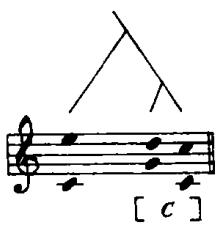
中文讲解
此处为图Example 9.20的占位符,位于第24页。它展示一个最大层级时间跨度缩减的树形结构,作为下文应用PRPR 6推导基本形式的起点。需查看原图获取具体节点与连接。
第24段(P0203)
原文复述
Chapter 9
中文讲解
该段为页面标识“Chapter 9”,表示已经翻到第25页。它没有论说内容。
第25段(P0204)
原文复述
The prolongational head is naturally the final I. Next, the Interaction Principle allows either the initial I or the cadential V as the prolongationally next most important event. Of these, the V forms a better prolongational connection, since a left-branching progression is more stable than a left-branching weak prolongation. But the resulting tree, 9.21a, does not conform to the normative structure. Moreover, the left-branching I–V progression is highly unstable, since it is an ascending circle-of-fifths progression. The alternative, the “basic form” in 9.21b, allows the normative structure to be satisfied.
中文讲解
本段是用具体例子说明PRPR 6如何影响延伸结构的选择。步骤如下:
- 延伸首(prolongational head)自然是最后的I和弦。
- 在相互作用原则(Interaction Principle)下,初始的I和弦或终止的V和弦都可能成为下一个最重要的延伸事件。
- 其中V和弦形成更好的延伸连接,因为左分支的进行比左分支的弱延长更稳定。
- 然而选V得到的树形(9.21a)却不满足规范化结构。
- 同时,I–V的左分支进行作为五度循环上行进行具有高度不稳定性。
- 替代方案“基本形式”9.21b则可满足规范化结构。
理解要点:本段通过反例(9.21a)说明,单凭稳定性不足以保证规范化结构;规范化结构本身具有独立的话语权。
补充说明
本段中“9.21a”与“9.21b”对应下文P0205处的图示占位符。
第26段(P0205)
原文复述
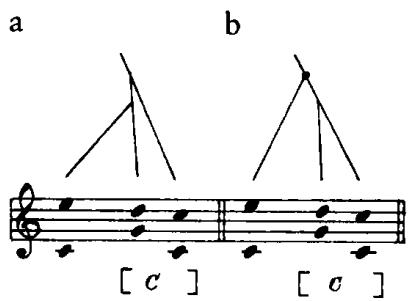
中文讲解
此处为图Example 9.21的占位符,展示两种树形结构的对比:9.21a(V作为延伸首的下一重要事件,不符合PRPR 6)与9.21b(基本形式,符合PRPR 6)。需查看原图。
第27段(P0206)
原文复述
Thus PRPR 6, acting in concert with PRPR 1, overrides the preference of PRPR 3 for a stronger prolongational connection at the highest level of branching.
中文讲解
本段是对上例的总结:PRPR 6与PRPR 1合作,超越了PRPR 3所偏好的“最高分支层更强的延伸连接”。这意味着规范化结构规则与稳定性偏好在某些情况下具有更高的话语权,胜过单纯的连接强度偏好。
理解要点:这一规则之间的优先级顺序体现了GTTM中“规则集合作而非单一规则独立裁定”的核心思想。
补充说明
PRPR 1、PRPR 3的具体内容未在本节task_input中给出。
第28段(P0207)
原文复述
A second application of the normative structure rule is in establishing the prolongational ending of pieces such as the Chorale St. Antoni (discussed in section 8.5). Following the full cadence ending in measure 23, this piece has seven measures of coda over a tonic pedal. PRPR 6 says that the final I of the coda cannot be the prolongational ending for the piece since it does not end a prepared cadence. As a result, the prolongational ending is pushed forward to the last full prepared cadence, and the coda material extends as a right prolongation from the tonic in measure 23. In turn, because of the strong preference for the prolongational head of the piece to be the time-span head as well (PRPR 1), there is pressure on the time-span reduction, through TSRPR 6 (“Prefer a time-span reduction that results in a stable prolongational reduction”), to choose measure 23 as the time-span head also, overriding the usual time-span preference for placing structural endings at the very end. This is an important case of interaction between components.
中文讲解
本段为PRPR 6的第二个应用案例——决定圣安东尼圣咏的延伸结束。论证链条如下:
- 在第23小节的完全终止后,乐曲有七小节在主持续音上的尾声。
- PRPR 6规定:尾声的最后I和弦不能成为全曲的延伸结束,因为它并不结束一个准备好的终止。
- 因此延伸结束被“前推”到最后一个完整准备好的终止处。
- 尾声材料作为第23小节主和弦的右分支延长而存在。
- 又由于PRPR 1强烈偏好曲首作为时间跨度首,时间跨度缩减在TSRPR 6(偏好产生稳定延伸缩减的时间跨度缩减)的压力下,将第23小节也选为时间跨度首——超越了通常的“将结构结束放在最末端”偏好。
理解要点:本例展示了规范化结构规则如何与时间跨度规则、稳定性规则多层互动,最终覆盖常规的时间跨度偏好。这是组件间相互作用的重要案例。
补充说明
圣安东尼圣咏即8.5节讨论的Chorale St. Antoni。TSRPR 6、PRPR 1的具体内容未在本节task_input中详细展开。
第29段(P0208)
原文复述
More generally, PRPR 6 favors a tree like 9.22 for a cadenced group that ends with a prepared cadence plus a number of V–I repetitions (for example, the exposition of the first movement of Beethoven’s Fifth Symphony). This accords with the intuition that the first I defuses the major tension of the piece and the additional cadences are simply repetitions. (The repetitions may be further differentiated in prolongational importance, but that does not affect the present point.)
中文讲解
本段将PRPR 6的应用推向更一般的形式。规则偏好的树形(如图9.22所示)适用于这样一类有终止群体:其结束部分包含一个准备好的终止再加上若干V–I重复——例如贝多芬《第五交响曲》第一乐章呈示部。这种树形符合如下直觉:第一个I和弦消解了乐曲的主要张力,其后的附加终止只是重复。
括号补充说明:这些重复在延伸重要性上可能进一步分化,但与本节论主旨无关。
理解要点:通过将“终止+重复终止”这一普遍形态纳入规则,本段实现了PRPR 6从单一终止案例到含有重复终止的更为普遍情形的推广。
补充说明
本段提到的9.22图示未在当前task_input中提供图示占位符。
脚注 / 边栏 / 图表 / 附加信息(如有)
本节包含两组图像/乐谱占位符:图9.19(位于P0183)展示规范化延伸结构总体形态;图9.20(位于P0202)展示一个最大层级时间跨度缩减的树形;图9.21(位于P0205)展示两种延伸缩减方案(9.21a与9.21b)的对比;P0208提及的图9.22未在本节task_input中提供具体占位符。脚注方面:原文未出现脚注(已确认本节task_input中无脚注段落)。所有图像的具体图形细节需查阅原图。
💡 本节核心要点
- 规范化结构(PRPR 6)的适用范围限定于有终止的群体(cadenced groups),即在某个时间跨度缩减层级表现为单事件后接终止的群体,从乐句到全曲各层级均适用。
- “开始”不能等同于表面开始、“结束”不能等同于表面结束——必须指延伸开始/结束,即群体内最大延伸区域的端点;这一抽象使规则能解释弱起大尺度群体(如《暴风雨》奏鸣曲呈示部)与张力提前消解的群体(如圣安东尼圣咏)。
- PRPR 6规则全文要求一个规范化群体包含:a延伸开始、b由终止某一元素构成的延伸结束、d作为延伸开始最重要直接延展的右分支进行、e作为终止首元素最重要延展的左分支下属进行;括号项c(右分支延长)属于古典时期特有变体。
- P0192以“重要左分支”替代字面“双重嵌入”,使规则可推广到完全终止、半终止、阻碍终止等多种终止类型。
- PRPR 6实质上经常与PRPR 1合作,覆盖PRPR 3对最强延伸连接的偏好——如9.21a/b例所示,单独的稳定性不足以保证结构合法。
- PRPR 6能向下与其他规则互动:与TSRPR 6配合时,能迫使时间跨度首位置的设定;与延伸首偏好配合时,能推动延伸结束向前推移(如圣安东尼圣咏中,将第23小节既视为延伸首也视为时间跨度首)。
🔑 关键术语
- cadenced group(有终止的群体):在某一层级时间跨度缩减上表现为单一事件(结构性开始)后接终止(结构性结束)的群体。较小层级对应乐句,较大层级对应段落,最大层级对应全曲。PRPR 6的适用范围即限定于此类群体。
- prolongational beginning / ending(延伸开始/延伸结束):完全包含在某有终止群体内的最大延伸区域(largest prolongational region)的两个端点。通常但不必然与时间跨度缩减所定义的结构性开始/结束重合。PRPR 6规则的a、b两项即要求群体包含这两个事件。
- right-branching progression(右分支进行):在延伸缩减树形中作为较高层事件的延展、向后延伸的进行,功能上对应“出发”与张力积累。PRPR 6项d要求的最重要直接延展即为一个右分支进行。
- left-branching(subdominant)progression(左分支下属进行):作为终止第一元素的重要延展、对终止进行下属性准备的进行,功能上对应“松弛”与回归。PRPR 6项e要求此要素。
- PRPR 6(Normative Prolongational Structure):延伸与时性缩减第六条偏好规则,规定一个有终止群体在延伸结构中宜包含的四个(括号五个)元素:延伸开始、由终止单一元素构成的延伸结束、(可选的延伸开始右分支延长、)延伸开始的右分支进行、终止首元素的左分支下属进行。
- basic form(基本形式):8.3节提出的规范化延伸缩减典型形态。PRPR 6是该形式在规则层面的形式化表达,9.21b是“基本形式”的具体图示。
- Interaction Principle(相互作用原则):GTTM中的元原则,规定各规则组并非孤立裁定而是协同作用:某一规则单独未必取胜,但与其他规则协作时可决定整体衍生结果。P0204与P0207分别展示了PRPR 6与PRPR 1、TSRPR 6的相互作用。
9.6.2 [描述性拆分] Normative Structure and the Ursatz — Chopin Prelude and Brahms Intermezzo
第1段(P0209)
原文复述
A running header on page 25 reads “Formalization of Prolongational Reduction,” identifying the chapter in which this section appears.
中文讲解
这是第9章的运行标题(页眉),表明本节属于"延长性简化的形式化"这一章。该标题在第25页顶部作为版面标识重复出现,并非论证性内容。
第2段(P0210)
原文复述
An embedded image labeled “9.23” appears on page 26; the image data itself has been omitted, but the figure’s position and caption are preserved.
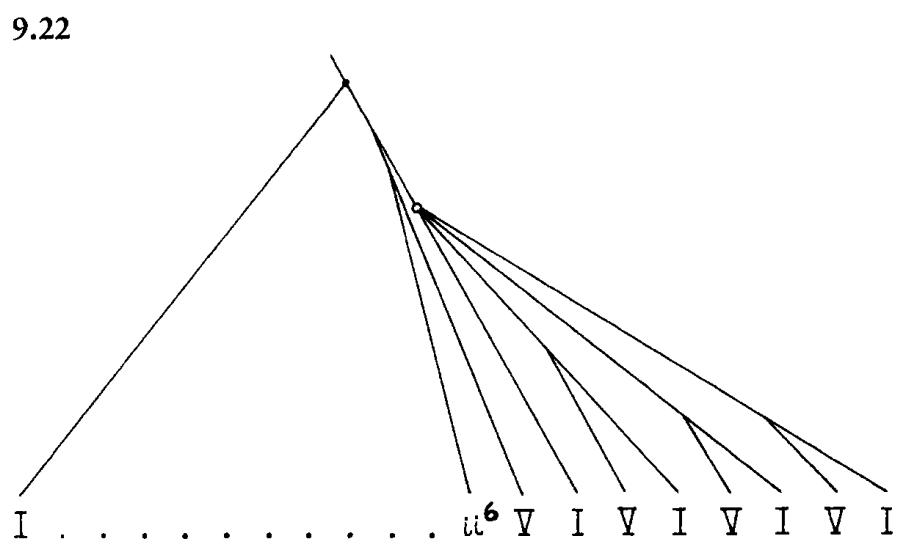
中文讲解
这是图9.23的占位符。结合上下文,该图应展示"O Haupt"(巴赫《马太受难曲》中的一首圣咏)第三句(转调句)的和声草图,用以说明该句虽转调却仍满足规范性结构。具体音高内容需查看原图。
第3段(P0211)
原文复述
It is important that PRPR 6 does not specify the harmonic function of the prolongational beginning and ending of a cadenced group. In particular, they need not form any sort of prolongation. The prolongational beginning may be a right branch off some earlier event to which the prolongational ending does not connect directly. Such a situation is found in a number of examples already discussed (for instance the consequent of the antecedent-consequent pattern in 9.9b). Moreover, a phrase that modulates may satisfy normative structure. All that is necessary is that the requisite right- and left-branching progressions be present. Example 9.23 illustrates the normative structure in the modulating third phrase of “O Haupt.”
中文讲解
本段强调规则PRPR 6的关键特点:它并不规定带终止的和声群中延长性开始与结束之间的具体和声功能关系。换言之,开始与结束之间不必构成任何形式的延长;延长性开始可以是某个更早事件延伸出的右分支,而延长性结束并未与该更早事件直接相连。前文讨论的多个例子(如例9.9b中前呼-后应模式的后续部分)就属于这种情况。作者进一步指出,转调的乐句同样可以满足规范性结构——只要具备所需的右分支和左分支进行即可。图9.23示范了"O Haupt"中第三句(转调句)的规范性结构。该段的作用是为接下来把规范性结构与Ursatz对比作铺垫:规范性结构具有相当大的灵活性,能容纳转调和各种和声情况。
第4段(P0212)
原文复述
An embedded image or musical score example appears on page 26; the image data has been omitted, with only its position and caption preserved.
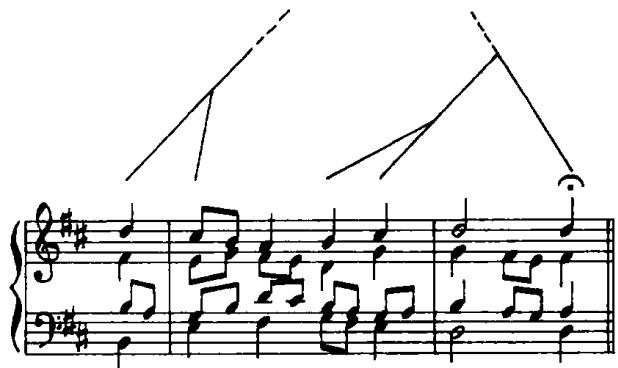
中文讲解
第26页上的另一图像占位符。结合上下文判断,这应是图9.23本身或其说明文字所在的版面元素。具体内容需查看原图。
第5段(P0213)
原文复述
A subsection heading on page 26 reads “Normative Structure and the Ursatz.”
中文讲解
这是9.6.2小节的标题,开启了一个新议题:将前文定义的"规范性结构"与申克理论中的"Ursatz"(基础线/基本结构)进行比较,并考察二者在外观与功能上的异同。
第6段(P0214)
原文复述
In appearance, the prolongational basic form approximates the Ursatz of Schenkerian theory. In function, however, the concept of normative structure may play a role more comparable to the Ursatz, in that normative structure specifies an obligatory pattern that must be fulfilled for a passage to be musically complete. But the statement of the rule in terms of branchings rather than specific progressions allows it to apply to a wider range of situations than the Ursatz. The modulating phrase just cited is a simple example. A more complex example appears in 9.24, a harmonic sketch of the Chopin A Major Prelude, part of whose time-span reduction was presented in 7.23 and 7.24. This is an entire piece that satisfies normative structure but is an instance of neither the basic form nor the Ursatz.
中文讲解
本段将"延长性基本形式"与申克的Ursatz作对比。在外观上,前者与Ursatz近似;但在功能上,“规范性结构"更接近Ursatz——它规定了一个必需的模式,只有满足该模式,乐段才算在音乐上完整。然而关键区别在于:规范性结构以"分支方式"而非"具体进行"来陈述规则,因此能适用于比Ursatz更广泛的情形(前文所述的转调乐句即为一例)。接着,作者预告了一个更复杂的例子——图9.24,即肖邦A大调前奏曲的和声草图(其时间跨度简化见例7.23与7.24)。该曲满足规范性结构,却既不是基本形式也不是Ursatz的实例。因此本段是方法论铺垫:作者要以肖邦前奏曲作为"不属于基本形式/Ursatz但满足规范性结构"的典型案例加以分析。
第7段(P0215)
原文复述
The running header “Chapter 9” appears on page 26.
中文讲解
页眉版面标识,标注当前页属于第9章。
第8段(P0216)
原文复述
An embedded image or musical score example appears on page 27; the image data has been omitted, with only its position and caption preserved.
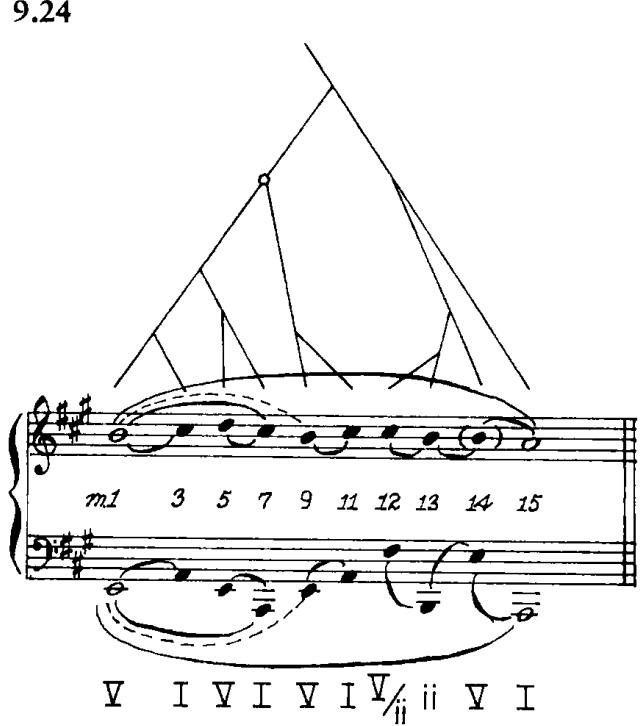
中文讲解
第27页的图像占位符,对应即将分析的肖邦A大调前奏曲的延长性树图(图9.24)。具体音高内容需查看原图。
第9段(P0217)
原文复述
We will first derive the prolongational tree in 9.24, then discuss the musical consequences of the analysis. We assume the time-span reduction given in example 7.24, in which the initial V is the structural beginning of the piece. (As mentioned there, another interpretation is possible in which the first I chord is the structural beginning.)
中文讲解
本段交代分析方法:先按图9.24逐步推导延长性树,再讨论其音乐意义。预设了例7.24的时间跨度简化结果——初始的V作为全曲结构开始。作者也提示此前提存在替代解读:第一个I和弦作为结构开始;该替代解读将在后文图9.25中展开。
第10段(P0218)
原文复述
Since the initial V forms a stable progression to the prolongational head, the final I, it is selected as the highest branch off the head. The next most time-span-important event is the V of the final cadence. In terms of prolongational connection alone, this could attach either as a prolongation of the initial V or as a progression to the final I. But time-span congruence (PRPR 2), prolongational importance of the endpoints (PRPR 4), and above all the cadential structure stipulated by PRPR 6 favor the latter attachment. This yields a structure with the geometry of the basic form but not its specific harmonic content: it is V–V–I rather than I–V–I.
中文讲解
本段开始逐步构建延长性树。第一步:初始V到终止I构成稳定的进行,故被选为脱离"头音”(即最终I)的最高分支。第二步:下一个时间跨度上最重要的事件是终止处的V。仅从延长性连接看,它既可作为初始V的延长,也可作为通向终止I的进行。但PRPR 2(时间跨度一致性)、PRPR 4(端点的延长重要性)以及PRPR 6(终止结构)共同支持后一种连接——即将终止V挂在终止I之下作为其直接进行。结果得到的树形结构具有基本形式的几何形态,但和声内容不同:基本形式是I–V–I,而此处是V–V–I。关键点:“基本形式"在此书中是规范性结构的特例(本曲并不是该特例,而是用V替代了开头的I)。
第11段(P0219)
原文复述
The next attachment is the V in measures 9–10, which becomes a prolongation of the initial V. Within the region from this V to the end (the second phrase), the V/ii and the ii in measures 12–13 form a descending circle-of-fifths progression to the cadential V (PRPR 3) and so attach as left branches. The I in measure 11 is closer in diatonic collection to the preceding V than to the following V/ii, so it becomes a right branch (by stability condition 2 on PRPR 3). As a result, the second phrase in itself constitutes a normative structure.
中文讲解
本段继续构造延长性树。第三步:第9-10小节的V被附加为初始V的延长。从该V到终止之间构成第二乐句;其中第12-13小节的V/ii和ii形成下行五度循环进行(依据PRPR 3)连接到终止V,因而作为左分支。第11小节的I在调性音集上更接近前面的V而非后面的V/ii,故按PRPR 3的"稳定性条件2"作为右分支。该段结尾揭示一个重要结论:第二乐句自身就构成了一个规范性结构(具备左右分支的对称形态)。这为前段关于"规范性结构是必需模式"的论断提供了具体例证。
第12段(P0220)
原文复述
A running header reading “Formalization of Prolongational Reduction” appears on page 28.
中文讲解
页眉标识当前页属于第9章"延长性简化的形式化”。
第13段(P0221)
原文复述
In the first phrase, the Interaction Principle suggests that the V in measure 5 should attach next, as a prolongation of the initial V. However, a closer approximation to normative structure within this phrase is obtained by attaching the I in measure 7 first, with the V as its left branch. By parallelism (PRPR 5), the I in measure 3 behaves like the I in measure 11, attaching as a right branch to the initial V.
中文讲解
本段处理第一乐句的附加。作者提出两种竞争方案:其一,相互作用原则主张第5小节的V应作为初始V的延长;其二,把第7小节的I先作为分支(V作为其左分支),能使该乐句更接近规范性结构。作者选择后者。随后按PRPR 5的平行性原则,第3小节的I模仿第11小节I的处理方式——作为初始V的右分支。该段体现了申克简化分析中的典型张力:多种规则(相互作用原则、平行性原则、规范性结构的目标)相互竞争时,分析者须在它们之间作出权衡。
第14段(P0222)
原文复述
The nonparallelism in branching between the first two V–I progressions reflects the fact that the second is a cadence and the first is not, according to the criteria discussed in section 7.4. Alternatively, parallelism (PRPR 5) might dictate that the importance of the second V–I be reversed. These conflicting applications of PRPR 5 at different levels of structure contribute to the ambiguity of the piece.
中文讲解
本段揭示分析中的张力。前两个V-I进行在分支方式上不平行:第一个V-I是普通进行(V作为左分支挂于I下),第二个V-I则是终止(V-I顺序倒置,I作为右分支)。这种不对称反映了"终止与否"的差异(参7.4节)。然而从严格的平行性原则(PRPR 5)出发,又会要求颠倒第二个V-I的重要性。二者在结构的不同层级相互冲突,构成了该曲"歧义性"的一部分——即同一作品可以有不止一种合理的简化读法。本段为下文比较图9.24与图9.25的分析埋下伏笔。
第15段(P0223)
原文复述
The result is a balanced normative structure, altogether similar to the structure of a classical antecedent-consequent phrase like the K. 331 theme with one exception: the roles of I and V are exactly reversed on the largest left branch of the structure and all its elaborations. Thus the whole piece consists not of a I prolongation, as in the basic form, but of a V prolongation leading to a final cadence. The maximal point of tension in the piece, the transition from measure 11 to measure 12, emerges clearly in the tree as a transition from right to left branching.
中文讲解
本段对全曲延长性树作出总结:得到的是"平衡的规范性结构",整体形态类似K.331主题那样的古典"前呼-后应"乐句,唯一例外是I和V在最左大分支及其所有衍生层上的角色恰好颠倒。换言之,全曲不是基本形式中那种"对I的延长",而是"对V的延长"并导向最终终止。最大张力点——第11到12小节——在树形中清晰呈现为从右分支向左分支的转换:从稳定的I(音集接近前V)过渡到不稳定的关系(V/ii与ii的下行五度循环进入终止V)。这是用树形结构来揭示曲式张力的典型手法。
第16段(P0224)
原文复述
An oddity of 9.24 is that the Is in measures 3, 7, and 11 are right branches of preceding Vs, a situation we have not previously encountered. This happens because, according to this interpretation, these Is are heard in the context of a V prolongation.
中文讲解
本段指出图9.24解读的一个反常特征:第3、7、11小节的I都是前面V的右分支——这种情形在前文未曾出现。原因在于,按此解读,这些I被理解为"在V延长"语境中听到的,故V成为更主导的结构事件,I则作为其右分支挂靠。这与通常申克分析中"I作为结构主音、V作为I的终止性进行"的默认层级相反——是该曲特殊性的重要标志。
第17段(P0225)
原文复述
An alternative interpretation, in which the first I is the structural beginning, results in the prolongational reduction in 9.25, which we will not derive.
中文讲解
本段引出替代解读:把第一个I作为结构开始时,得到图9.25的延长性简化。作者声明书中不展开该推导,但其结果将在下一段被对比评价。
第18段(P0226)
原文复述
Although 9.25 satisfies the basic form, it suffers from at least two shortcomings. First, in 9.24 the most important V in the piece is the one in measure 1, which therefore functions both as structural beginning and as structural dominant. In 9.25, by contrast, the initial V is only a local elaboration; the structural beginning is the I in measure 3, and the structural dominant is the V in measure 14. But the weak register of the bass in measure 14 makes it an unconvincing structural dominant in comparison with the Vs in measures 1 and 9. Second, one’s sense of parallelism between the two phrases depends more on the identity of the Vs in measures 1 and 9 than on the Is in measures 3 and 11, since the I in measure 11 does not complete its group but progresses on to the V/ii. Example 9.24 brings out the importance of the Vs to the parallelism, whereas 9.25 relies more heavily on the Is. In addition to these problems with 9.25, it claims that the two major phrases of the piece do not exhibit normative structure. Thus there is some reason to prefer analysis 9.24 over 9.25, despite its nonconformance to the basic form. However, as in the time-span reduction, the piece probably should be ultimately treated as ambiguous between the two readings, with some additional options in the treatment of details.
中文讲解
本段对图9.25展开批评,给出支持9.24的多重理由。第一条缺陷:在9.24中,第1小节的V同时承担"结构开始"与"结构属音"双重功能,是全曲最重要的V;而9.25中初始V仅为局部装饰,结构属音落到第14小节的V,但该处低音声部较弱,不足以承担结构属音的角色(远不如第1和第9小节的V)。第二条缺陷:两乐句的平行感更多依赖第1和第9小节V的"同一性",而非第3和第11小节I的"同一性"——因为第11小节的I并未结束其和声群,而是继续进行到V/ii。因此9.24能突出V对平行性的贡献,9.25却过度依赖I。此外,9.25还主张两乐句均不构成规范性结构。综合这些理由,9.24优于9.25——尽管9.24不符合基本形式。但作者最终承认,本曲本质上应在两种解读之间保持歧义性,并在细节上允许进一步的解读选择。这一谨慎态度是申克分析面对非典型作品时常见的处理方式。
第19段(P0227)
原文复述
The running header “Chapter 9” appears on page 28.
中文讲解
页眉标识当前页属于第9章。
第20段(P0228)
原文复述
An embedded image or musical score example appears on page 29; the image data has been omitted, with only its position and caption preserved.
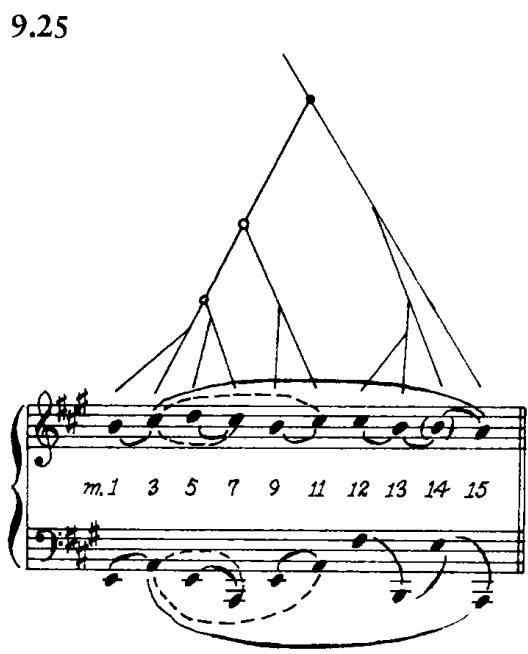
中文讲解
第29页的图像占位符。结合上下文,这对应图9.26(布拉姆斯《间奏曲》op.76 no.4的和声草图)。具体音高内容需查看原图。
第21段(P0229)
原文复述
An interesting feature of the Chopin A Major Prelude is that the melody could have been harmonized throughout with V–I progressions. However, this possibility would have been unacceptable in the tonal idiom, because, under either interpretation, 9.24 or 9.25, there would be no final prepared cadence, and hence no full normative structure. The way that Chopin toys with this possibility and then deviates from it contributes to the charm of the piece.
中文讲解
本段揭示肖邦A大调前奏曲的一个有趣特征:其旋律原本可以全部用V-I进行来配和声,但这种处理在调性习惯中不可接受,因为无论按9.24还是9.25解读,缺少终止前的"准备"——即没有真正的预备终止,因而无法构成完整的规范性结构。肖邦"试探这种可能又偏离之"的处理方式,构成了该曲的独特魅力。该段把分析层与审美层联系起来:规范性结构的缺失会使音乐失去完整性,从而解释为何作曲家最终未选择那种简化的和声方案。
第22段(P0230)
原文复述
An even more decisive example of normative structure without basic form is the Brahms Intermezzo op. 76, no. 4. This piece begins on V and contains no occurrences of I at all until the arrival before the coda (measure 45). Thus the prolongational beginning cannot possibly be I. Moreover, there is no authentic cadence at the end; rather the bass descends chromatically to the prolongational ending, which is in turn prolonged by plagal cadences. Thus the piece is a major deviation from the Ursatz and the basic form. Nonetheless, it does display the geometry of normative prolongational structure, as shown in the harmonic sketch (9.26). It is this structure that permits the piece to be heard as a coherent (though unusual) example of a standard form, not so different in fact from the Chorale St. Antoni. In particular, the “cadential” function of the final ♭II⁺⁶ -I progression is inferred from its position in the normative structure.
中文讲解
本段以布拉姆斯《间奏曲》op.76 no.4作为"无基本形式却有规范性结构"的更决定性例证。该曲以V开始,到第45小节进入coda之前根本没有I出现,因此延长性开始不可能是I。结尾也缺乏正格终止,低音半音下行到延长性结束,该结束又被变格终止延长。该曲明显偏离Ursatz和基本形式。然而,它仍呈现规范性延长性结构的几何形态(见和声草图9.26)。正是这一结构使该曲能被听成"标准的(尽管不寻常的)形式"实例,事实上与《圣安东尼众赞歌》没有根本不同。其中关键的"终止功能"——即降二级六和弦(♭II⁺⁶)到I的进行——正是从它在规范性结构中的位置推断出来的。该段是本节论证的总结与强化:规范性结构作为"几何形态"的判定标准,能解释为何表面偏离调性惯例的作品仍可被听成完整乐段;终止功能可由结构位置推断,而非仅由和声进行本身决定。
第23段(P0231)
原文复述
A running header reading “Formalization of Prolongational Reduction” appears on page 29.
中文讲解
页眉标识当前页属于第9章"延长性简化的形式化"。
第24段(P0232)
原文复述
An embedded image or musical score example appears on page 30; the image data has been omitted, with only its position and caption preserved.
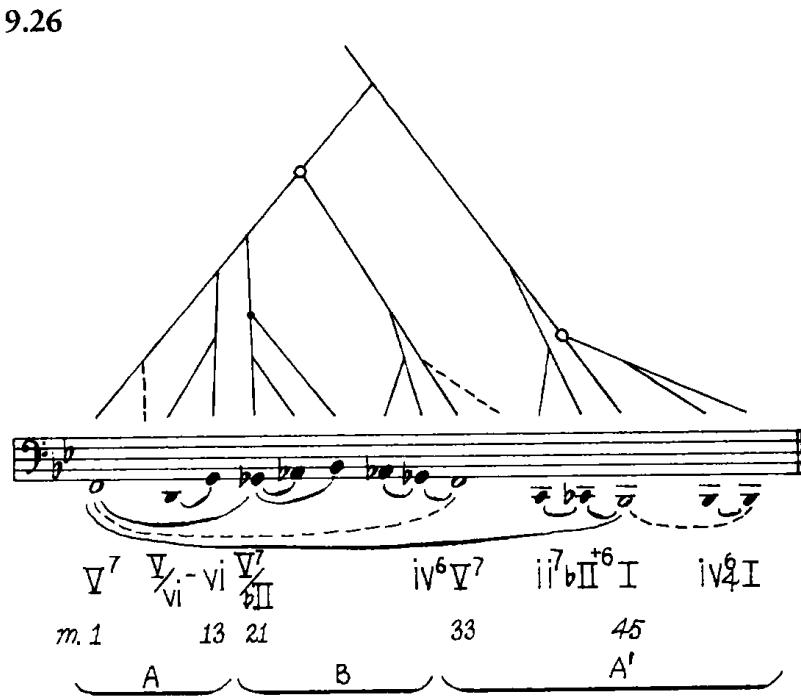
中文讲解
第30页的图像占位符。结合上下文,这应是图9.26的延续或与本节其他图例相关的版面元素。具体内容需查看原图。
脚注 / 边栏 / 图表 / 附加信息(如有)
本节涉及图表9.23(巴赫圣咏"O Haupt"转调句的和声草图,示例规范性结构可容纳转调)、9.24(肖邦A大调前奏曲的延长性树,展示V延长结构)、9.25(替代解读的延长性简化,把第一个I作为结构开始)、9.26(布拉姆斯《间奏曲》op.76 no.4的和声草图,示例无基本形式却有规范性结构)。各页的页眉"Formalization of Prolongational Reduction"与"Chapter 9"是章节运行的版面标识,不参与论证。
💡 本节核心要点
- 规范性结构在功能上比Ursatz更接近"必需模式"的角色,但以分支方式而非具体进行陈述规则,因此适用于比Ursatz更广泛的情形——包括转调乐句和缺乏I或正格终止的作品。
- 肖邦A大调前奏曲以V开始,整体上构成V延长而非I延长,是"不属于基本形式/Ursatz却满足规范性结构"的典型实例。
- 该曲存在两种合理解读(图9.24与图9.25):9.24中V同时承担结构开始与结构属音的双重角色,更能解释两乐句的平行性;9.25符合基本形式但低音声部较弱、两乐句不具规范性结构,故稍逊一筹。
- 该曲本质上应在两种解读间保持歧义性——平行性原则(PRPR 5)在不同结构层级的竞争性应用是歧义性的根源;细节上亦允许进一步的解读选择,这是申克分析对非典型作品的标准态度。
- 布拉姆斯《间奏曲》op.76 no.4是更决定性的例子:缺少I与正格终止,却在几何上完全符合规范性结构,使该曲仍可被听成完整形式;最终♭II⁺⁶-I的"终止功能"由其在规范性结构中的位置推断而出。
- 规范性结构作为"几何形态"判定标准,能解释为何表面偏离调性惯例的作品(如该前奏曲的V-I配置可能)仍能被听成完整的乐段——作曲家必须避免使作品陷入缺失规范性结构的处境。
🔑 关键术语
- Normative structure (规范性结构):由PRPR 6规定的必需分支模式——左右分支的对称形态决定一个乐段在音乐上是否完整;其陈述以分支方式进行,故比Ursatz适用范围更广;既可包含I-V-I的典型形态,也可包含V-V-I、转调甚至缺失I与正格终止的情形。
- Ursatz (申克基础结构/基本线):申克分析理论中的核心概念,规定一个音乐作品通过I-V-I的进行达到终止;其陈述以特定和声进行为基础,因而适用范围窄于规范性结构。
- Basic form (基本形式):本节中特指规范性结构中以I-V-I为典型和声内容的特例;肖邦前奏曲(图9.24解读)显示规范性结构可包含非I-V-I的情形(V-V-I)。
- PRPR 6:规定一个和声群若具终止则必须显示规范性结构的规则——不规定延长性开始与结束之间的具体和声功能关系,允许右分支不直接连接到延长性结束,允许转调乐句满足该规则。
- Time-span congruence (PRPR 2):延长性简化中保证时间跨度一致性的规则;在肖邦前奏曲分析中用于支持终止V挂在终止I下而非初始V下的连接方式。
- Prolongational importance of endpoints (PRPR 4):关于端点(延长性开始与结束)延长重要性的规则;与PRPR 2共同支持肖邦前奏曲中的关键连接选择。
- Parallelism (PRPR 5):相似模式间应保持平行的简化原则;在肖邦前奏曲中该原则在不同结构层级存在多种竞争性应用,是歧义性的来源。
- Plagal cadence (变格终止):IV-I式的终止;布拉姆斯《间奏曲》op.76 no.4的终止由变格终止延长,是该曲缺乏正格终止、却仍具"终止感"的关键来源。
- ♭II⁺⁶ (降二级六和弦):在布拉姆斯《间奏曲》op.76 no.4结尾用作"终止"功能的和弦;其"终止功能"由其在规范性结构中的位置推断而出,而非由传统的正格进行定义。
9.6.3 [描述性拆分] Normative Structure and Musical Complexity
第1段(P0233)
原文复述
Normative Structure and Musical Complexity
中文讲解
这是第 9 章 9.6.3 小节的标题,原文为英文 “Normative Structure and Musical Complexity”,本节将围绕 PRPR 6 这一规则讨论其规范性功能以及它如何促使音乐表面形成多层级的复杂性。标题点出本节两条交织的线索:一是规则作为规范(normative)所起的作用,二是这种规范所驱动的音乐复杂性(musical complexity)问题。
第2段(P0234)
原文复述
Why should musical grammar include such a rule as PRPR 6? To convey the effect of the rule in a more general context, we observe that all the previous rules of time-span and prolongational reduction consider as maximally stable those structures in which virtually nothing happens. If a piece were to consist entirely of tonic chords and full cadences, these other rules for pitch organization would be blissfully happy, since there would be little if any conflict in pitch stability. Obviously, from the point of view of musical interest, such a piece would be unsatisfactory; something must happen. Consider, for example, what the Chopin A Major Prelude would sound like with V–I progressions throughout.
中文讲解
本段的中心主张是:此前所有关于时值缩减和延长缩减的规则都把"几乎无事发生"的结构判为最稳定,因此若不引入新规则,音乐语法就会鼓励一种静止、乏味的音乐。作者用"主持续和弦加完整终止进行到底"的假想乐段来说明——这时前面那些关于音高组织的规则都会"非常满意",因为几乎不存在音高稳定性上的冲突;但显然从音乐趣味的角度看,这样的乐段无法令人满意。肖邦 A 大调前奏曲的例子(若全部替换为 V–I 进行)被用作思想实验:它让读者具体感受到,当一个原本具有丰富张力的作品被抽空后,音乐趣味便消失殆尽。这一段在论证上的作用是"以反例逼出问题":它并不直接陈述 PRPR 6 的内容,而是先证明既有规则加在一起会奖励静止,从而为引入 PRPR 6 制造动机。
补充说明
本段中 PRPR 6 的含义需要在 9.6.3 整节中理解;此段只给出引入该规则的反面动机,并未定义其形式。肖邦 A 大调前奏曲被用作"替换进行后的想象效果",目的是让"乏味的稳定性"这一抽象结论变得可感知。
第3段(P0235)
原文复述
But simply to say that music must deviate somehow from total regularity would leave the shape of pieces virtually unconstrained. PRPR 6 addresses this problem. It requires that a piece have prolongational variety, so that a passage of total stasis (except to confirm a phrase ending) is heard as unusual. But the rule further says that not just any variety is desirable; the variety must be manifested as structured patterns of tension and relaxation. Since the constraint is stated in terms of types of connections among events, and since it is to an extent independent of surface rhythmic considerations, it leaves the composer free to satisfy it in innumerable interesting ways. And insofar as the rule applies to cadenced groups hierarchically from the phrase level up to the entire piece, its multilayered effects create pressure toward a musical surface of considerable complexity—and toward a complexity that increases with the size of the piece.
中文讲解
本段是 PRPR 6 的正面陈述。作者先指出,仅说"音乐必须偏离完全规律"是不够的——那会让乐段形态几乎不受约束。PRPR 6 正是为了收紧这一约束而设:它要求作品具有延长上的多样性,使得除确认乐句结束之外的完全静止段落被视为反常。这里有两层关键限定,需要仔细分辨:第一,规则并非允许任何偏离,而是要求偏离表现为"结构化的张弛模式",即组织化的紧张与放松,而非任意的变化;第二,规则的约束作用在"事件之间连接的类型"这一层面上表述,因此它与表层节奏考虑保持一定独立,从而给作曲家留下大量有趣的实现空间。在适用范围上,PRPR 6 自下而上作用于带有终止的各级乐句群组,从短语一直覆盖到整部作品;这种层级化的作用形成多层效应,向音乐的表面施加形成相当复杂性的压力,并且这种复杂性会随作品规模增大而增长。换言之,作者既说明了 PRPR 6 的内容,又说明了它为何在不扼杀创造自由的前提下仍能产生普遍而强力的复杂性。
补充说明
本段中"张力与放松的结构化模式"是 PRPR 6 的核心定性条件:作者特意强调"not just any variety",意在区分"仅仅是偏离"与"具有组织化的张弛"。“事件之间连接的类型"指延长关系层面上的连接方式,区别于节拍、节奏时值等表层节奏特征。
第4段(P0236)
原文复述
Chapter 9
中文讲解
此为版面中的页眉/页脚标识,标注当前内容所属的章节号,仅起版面定位作用,不承载论证内容。
第5段(P0237)
原文复述
On the other hand, the complexity the rule engenders is not just gratuitous complication. Rather, because it is patterned in terms of levels of structure, it produces a higher degree of coherence. Each event has a specific and unique function in the whole, in a way that would not be true of either a uniform string of events such as V-I-V-I-… or a random sequence. It may be inferred from other areas of cognition, such as vision and language (see Koffka 1935; Neisser 1967; Fodor, Bever, and Garrett 1974), that this strong structuring of the parts into the whole enhances comprehension and memory.
中文讲解
本段针对"PRPR 6 是否只是在制造冗余复杂"的潜在反驳给出回应:这种复杂性并非无端的繁复,而是由结构层级模式化所产生的,因此带来更高程度的连贯性。其关键论证是——因为规则把复杂性组织在结构层级之中,作品的每一个事件在整体中便具有特定且不可替代的功能;这种功能特异性既不会出现在 V–I–V–I 这类均匀反复的事件串中,也不会出现在完全随机的序列中。在本段末尾,作者援引视觉与语言等其他认知领域的研究(Koffka 1935;Neisser 1967;Fodor, Bever, and Garrett 1974),以类比方式提示:把局部强烈地结构化进整体,能增强理解与记忆。本段在 9.6.3 论证链中的作用是"收束”:前段说明规则产生复杂性,本段说明该复杂性服务于连贯性与可理解性,由此把 PRPR 6 从"形式约束"提升为"具有认知合理性"的规范。
补充说明
段中所引 Koffka 1935、Neisser 1967、Fodor, Bever, and Garrett 1974 均为原文提供的文献出处提示,作者仅用以类比说明"强结构化的局部如何增强整体的理解与记忆",本段并未对这些文献的论点作具体陈述。
脚注 / 边栏 / 图表 / 附加信息(如有)
本小节含一项版面性元素:P0236 的"Chapter 9"为页眉/页脚标识,仅标注章节归属,不参与论证。P0237 文末括注 Koffka 1935、Neisser 1967、Fodor, Bever, and Garrett 1974 三处文献出处,其作用是为"强结构化增强理解与记忆"提供来自其他认知领域的类比支持,而非作为本节音乐分析的直接证据。
💡 本节核心要点
- 既有延长缩减规则把"几乎无事发生"的结构判为最稳定,若不补充新规则,音乐语法就会奖励静止、抑制趣味。
- 仅要求"偏离规律"不足以约束作品形态,PRPR 6 正是为了避免"形态几乎不受约束"这一漏洞而引入。
- PRPR 6 的核心是要求延长层面的多样性,并进一步限定多样性必须表现为结构化的张弛模式,而非任意变化。
- 规则的约束表述发生在"事件之间连接的类型"层面上,与表层节奏考虑保持独立,因此为作曲家保留了多种实现自由。
- PRPR 6 自短语层向上贯穿至整部作品的各级带终止乐句群组,由此形成多层效应,使复杂性随作品规模增大而增长。
- 该复杂性并非冗余——它由结构层级模式化生成,带来更高连贯性,使每个事件具有特定且唯一的功能,并据其他认知领域的类比,被推断为能增强理解与记忆。
🔑 关键术语
- PRPR 6:Prolongational Reduction Preferability Rules 中的第 6 条规则;本节指出它要求作品在延长层面具有多样性,且这种多样性须以结构化的张弛模式呈现,并作用于从短语到整部作品的各级带终止群组。
- prolongational variety:延长层面的多样性,指作品中延长关系模式之间的差异;PRPR 6 要求具备此种多样性,使得"完全静止"(除确认乐句结尾外)成为反常。
- structured patterns of tension and relaxation:结构化的张弛模式,即 PRPR 6 对多样性所附加的定性条件:偏离必须组织为紧张与放松的有序交替,而非任意变化。
- cadenced groups:带终止的乐句群组;PRPR 6 自下而上贯穿各级带终止群组,从而形成多层效应。
- surface rhythmic considerations:表层节奏方面的考虑;作者强调 PRPR 6 的约束表述与此类表层节奏特征保持一定独立,因此作曲家在节奏层面仍享有实现自由。
- coherence:连贯性;本节用来刻画 PRPR 6 所促成的复杂性所带来的认知性结果——结构层级化使每个事件在整体中具有特定且唯一的功能,由此提升作品的连贯与可理解性。
9.7 [描述性拆分] Binary Form and Sonata Form
第1段(P0238)
原文复述
As additional illustrations of prolongational derivations, this section develops trees for the major structural points in binary-form and sonata-form movements.
中文讲解
本段是9.7小节的开场导言,明确说明本节的功能定位——作为延长推导(prolongational derivations)的附加示例,将分析对象从短小乐句扩展到完整的二部曲式(binary-form)与奏鸣曲式(sonata-form)乐章。它承接前几节已建立的延长结构生成规则(PRPR),接下来检验这些规则能否解释大型曲式的结构。
第2段(P0239)
原文复述
Figure 9.27 is a harmonic sketch of the larger levels of time-span reduction for a typical binary baroque dance form, Menuetto I of the Bach G Major Cello Suite.
中文讲解
引出本节第一个分析实例:巴赫G大调第一无伴奏大提琴组曲的小步舞曲I(Menuetto I)。这是巴洛克时期典型的二部曲式舞曲。“harmonic sketch"指在较大时值层级(time-span reduction levels)上画出的和声骨架,用来观察延长结构。
第3段(P0240)
原文复述
9.27
中文讲解
图号标签"9.27”,提示读者此处是图9.27。
第4段(P0241)
原文复述
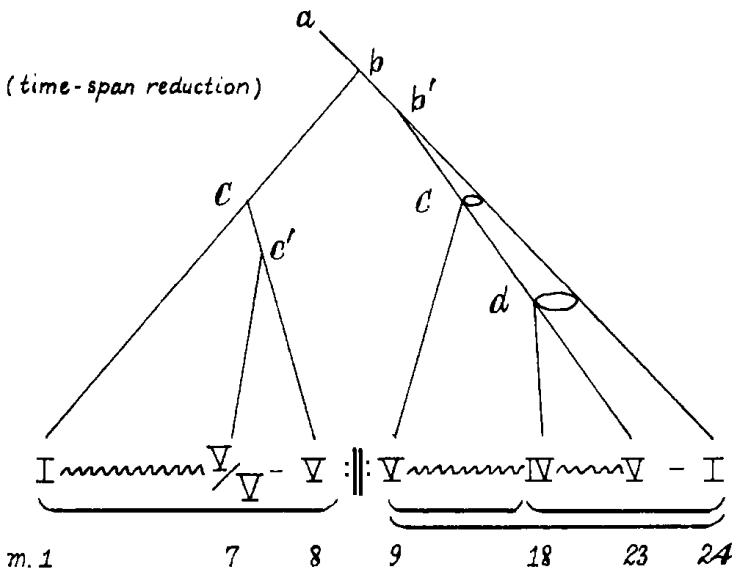
中文讲解
第31页的图示占位符,对应图9.27——巴赫G大调小步舞曲I的时值缩减和声草图。具体图面内容须查原图。
补充说明
该图位于第31页,紧接P0239的文字描述。
第5段(P0242)
原文复述
In such a piece, there is no important recurrence of I between the very beginning and the final cadence; thus there can be no large tonic prolongation inside of the basic form. The most time-span-important events within the basic form are the dominants in measures 8–9. How should these be attached? Superficially, one might think that they form a dominant prolongation to the final cadence, as in 9.28a. But such a structure would claim, counterintuitively, that the tension of the piece begins to defuse by the double bar (the midpoint of the piece). Moreover, in similar pieces in the minor mode, such as the sarabande of the C Minor Cello Suite, the point corresponding to measure 8 has the relative major instead of the dominant. Here a prolongation to the dominant of the final cadence would be impossible; the relative major is heard as a departure from the initial tonic. One does not hear any great structural difference between the two alternatives, and in fact in the cello suites in minor keys Bach sometimes chooses the dominant minor and sometimes the relative major. Thus, for generality, 9.28a cannot be the correct structure for this piece.
中文讲解
这是本节第一次关键论证,作者用反证法排除一种直觉上合理但实际错误的延长结构(9.28a)。论点有四:(1)作品开端主和弦与终止主和弦之间没有重要再现,故基本形内部没有大型主音延长;(2)时值层级上最显赫的事件是第8—9小节的属和弦;(3)若把中央属和弦视为对终止的属音延长(9.28a),则意味着作品的紧张在中段双小节线处已开始"卸除",与听觉不符;(4)以C小调萨拉班德作反例:相应位置出现的是关系大调而非属和弦,而关系大调不可能延长终止属音,只能被听为从初始主音出发;巴赫在小调组曲中时而用属小调、时而用关系大调,可见两种版本并无显著结构差异。既然9.28a对小调根本不通用,那么它对本作品也不正确。
补充说明
“relative major"指小调的关系大调(即平行大调,升高三音后的大调)。
第6段(P0243)
原文复述
9.7 Binary Form and Sonata Form
中文讲解
小节标题。它界定了本节的两大主题对象:二部曲式与奏鸣曲式,且均从延长结构的角度进行形式化分析。
第7段(P0244)
原文复述
Formalization of Prolongational Reduction
中文讲解
页眉栏目标识,表明当前页面属于"延长缩减的形式化"这一章。属版面导航信息。
补充说明
该页眉在跨页处重复出现。
第8段(P0245)
原文复述
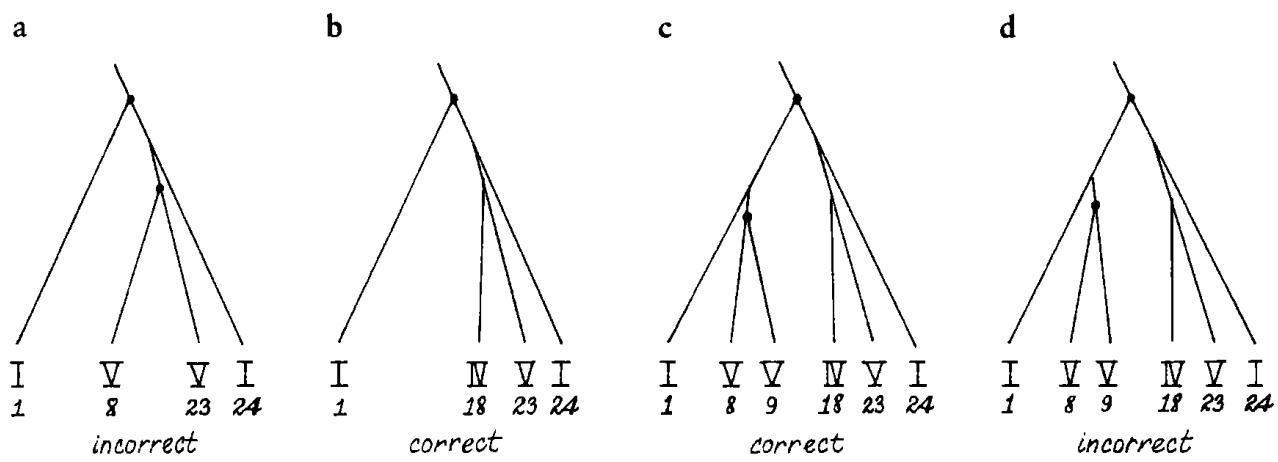
中文讲解
第32页图示占位符,根据上下文应展示图9.28的某个子图(关于中央属音延长树的不同方案)。需查原图。
补充说明
需查阅原图。
第9段(P0246)
原文复述
The PRPRs create a different tree. Within the basic form, derived from level b of the time-span reduction, the most stable prolongational connection possible in the next two time-span levels is that between the IV chord in level d and the V of the final cadence; a weak left prolongation to the V in measure 8 or 9 would be considerably weaker. The Interaction Principle thus selects the IV as the next event added to the basic form, as shown in 9.28b.
中文讲解
上一段排除了9.28a,本段开始正式用PRPR构造正确的树。基本形(basic form)取自时值缩减的b级;在接下来的两级中最稳定的延长连接是d级IV和弦到终止V和弦;相比之下,把第8—9小节V作为弱左分支连接则弱得多。因此交互原则(Interaction Principle)挑选IV作为下一个加入基本形的事件,形成9.28b树形。
补充说明
PRPR即Prolongational Reduction Preference Rules(延长缩减偏好规则)。Interaction Principle(交互原则)是PRPR体系内不同规则相互作用产生选择的机制。
第10段(P0247)
原文复述
Between the initial I and the IV, the dominants surrounding the double bar are most time-span-important. They do not form a strong prolongational connection to the following IV, but can be attached as a departure from the initial I. What is the correct way to do this? Two possibilities appear in 9.28c,d: in 9.28c the end of the first section is superordinate and the beginning of the second section is its elaboration; in 9.28d the reverse is the case.
中文讲解
现在剩下初始I和IV之间的事件——即围绕双小节线的属音。它们对紧随其后的IV无法形成强延长,但可作为"从初始I出发"被附接。正确的附接方式是什么?9.28c:第一部分结尾作上位(superordinate)节点,第二部分开头作其展开;9.28d:反过来。
补充说明
“superordinate"指延长树中处于更高层级的结构事件。
第11段(P0248)
原文复述
Intuitively, 9.28c appears to be the correct choice. The end of the first section is a definite point of harmonic arrival, more important to the piece’s progress than the beginning of the second section. This is clearer if we compare with structurally parallel pieces such as the sarabande of the C Minor Cello Suite. Here the first section ends on III, and the second section begins immediately with III $^{b7}$ , already a departure from the point of stability. Again under the assumption that at large levels of structure many examples of this genre are structurally parallel, this comparison leads us to conclude that 9.28c is the correct structure for 9.27.
中文讲解
直觉与类比都指向9.28c:第一部分结尾是明确的和声到达点,比第二部分开头对作品进程更重要。再以C小调萨拉班德为对照——其第一部分结束在III,第二部分立即以III b7开始,这已是"从稳定点出发"的离调。在大型结构层级中,同类作品具有结构平行性,由此得出9.27的正确延长结构是9.28c。
补充说明
“III $^{b7}$“指III级和弦上加上降七度音,是巴洛克小调萨拉班德常见的离调处理。
第12段(P0249)
原文复述
The preference rules favor this result. If the V in measure 9 is chosen first, as in 9.28d, the V in measure 8 must be attached as a relatively unstable left-branching weak prolongation. On the other hand, if the V in measure 8 is chosen first, measure 9 is attached as a right-branching prolongation, a more stable result overall. In other words, the relative weighting of prolongational connections favors making measure 8 a point of arrival for the first section, of which measure 9 is a continuation, rather than treating measure 8 as an anticipation of the second section.
中文讲解
作者进一步用偏好规则的相对权重来印证直觉:若先选第9小节的V(9.28d方案),则第8小节V只能作为较不稳定的左分支弱延长;若先选第8小节V,第9小节V则以更稳定的右分支延长附加。也就是说,延长连接的相对权重倾向于把第8小节视为第一部分"到达点”,第9小节作其延续;而不应把第8小节当作第二部分的预示。
第13段(P0250)
原文复述
Chapter 9
中文讲解
页眉"第9章”,版面属性标识。
第14段(P0251)
原文复述
Though it would be interesting to pursue this example further, we are concerned for the moment only with the larger aspects of the form. However, it is worth noting that, when the additional branches are filled in, the tree will satisfy the normative form (with the parenthesized Classical options in PRPR 6 omitted). Note that each section individually as well as the whole piece satisfies the structure, that neither section is a tonic prolongation, and that the prolongational beginning of the second section (the V in measure 9) is not directly connected to the prolongational ending. These three considerations further illustrate the flexibility of normative structure.
中文讲解
作者承认本例尚可深入,但本节只关心大体形式。有意味的是:当附加分支填入后,整棵树满足PRPR 6规定的"标准结构”(normative form,省略Classical的括号选项)。具体体现三点灵活性:(1)每个部分单独及整首作品都满足该结构;(2)任何一部分本身都不是主音延长;(3)第二部分的延长起点(第9小节V)与延长终点之间没有直接连接。这三点印证了标准结构的灵活性。
补充说明
PRPR 6即"normative structure”(标准结构)规则,是本研究最后提出的偏好规则。
第15段(P0252)
原文复述
The antecedent-consequent and binary forms contain most of the elements necessary for constructing a prolongational skeleton for a movement in sonata-allegro form. Figure 9.29 presents a harmonic sketch for a typical example, with its grouping and time-span reduction. The double bar between the exposition and development is notated for convenience. $^{2}$
中文讲解
作者指出:前文所讨论的"前句—后句"和"二部曲式"已经为奏鸣—快板乐章的延长骨架铺设了必要元素。图9.29给出典型例子的和声草图(含分组与时值缩减),并为方便起见在呈示部与发展部之间标注了双小节线。段落末尾的角标"2"是脚注引用。
补充说明
脚注2的内容未包含在本节source_paragraphs中,需在原书脚注区域查找。
第16段(P0253)
原文复述
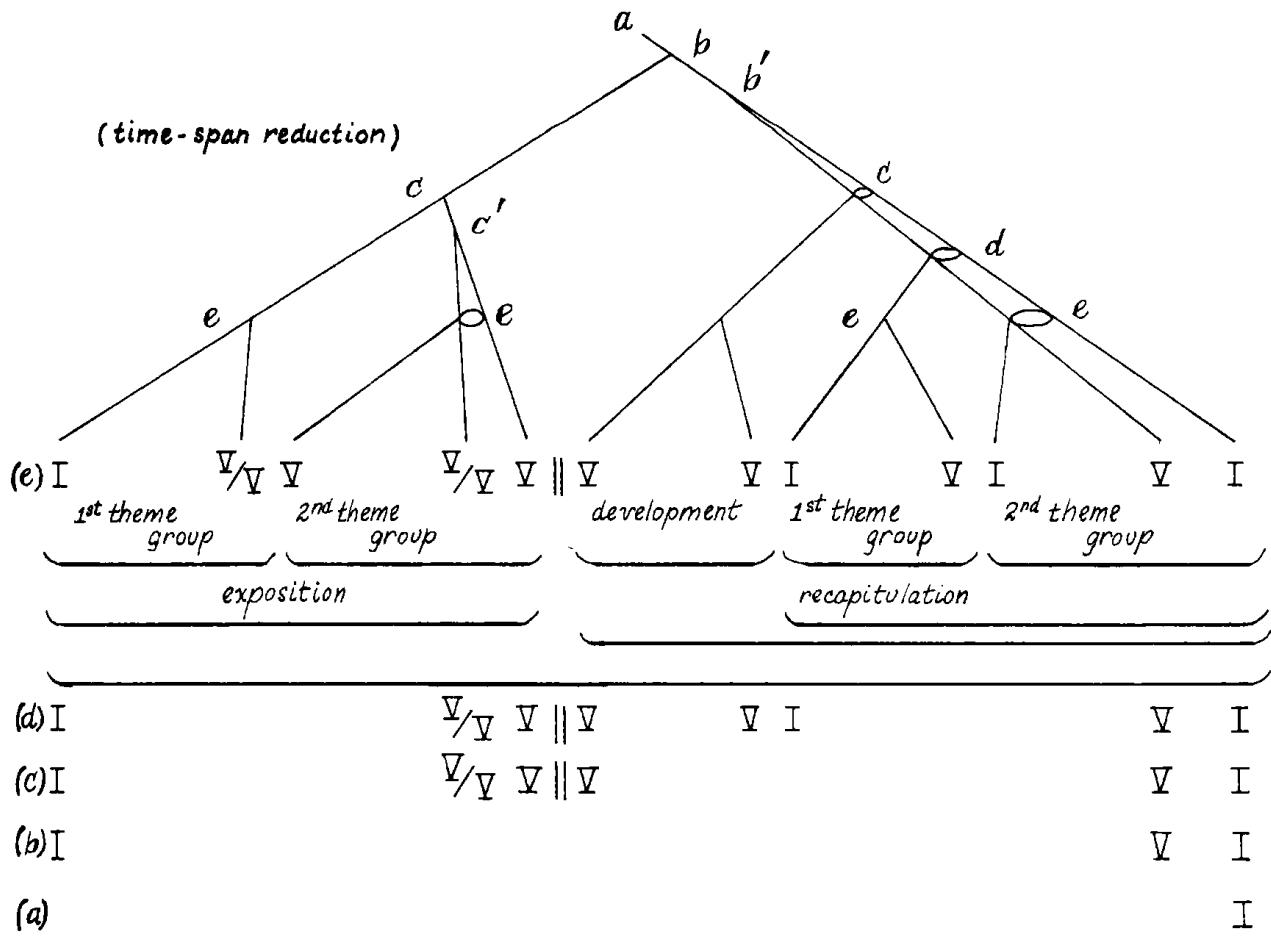
中文讲解
第33页图示占位符,对应图9.29——典型奏鸣—快板乐章的分组、时值缩减与和声草图。需查原图。
补充说明
需查阅原图。
第17段(P0254)
原文复述
9.29
中文讲解
图号标签"9.29"。
第18段(P0255)
原文复述
Formalization of Prolongational Reduction
中文讲解
页眉栏目标识"延长缩减的形式化",与P0244相同。版面导航信息。
补充说明
跨页版面标识。
第19段(P0256)
原文复述
Within the basic form, the most stable prolongational connection is the strong prolongation from the beginning to the start of the recapitulation; the Interaction Principle permits this to be chosen as the most important event in the region, as shown in 9.30. Thus the presence of the recapitulation results in a major difference in prolongational structure from the binary form; the central dominant is no longer the most important event in the interior of the piece, but is displaced by the tonic prolongation.
中文讲解
进入奏鸣曲式的分析。基本形内部最稳定的延长连接是从开端到再现部起点的强延长;交互原则允许这被选为该区域最重要的事件(见9.30)。这构成了奏鸣曲式与二部曲式在延长结构上的关键差异:再现部的存在使中央属音不再是作品内部最重要的事件,而让位给主音延长。
补充说明
“recapitulation"即奏鸣曲式中的再现部,是回到主调的主题再现部分。
第20段(P0257)
原文复述
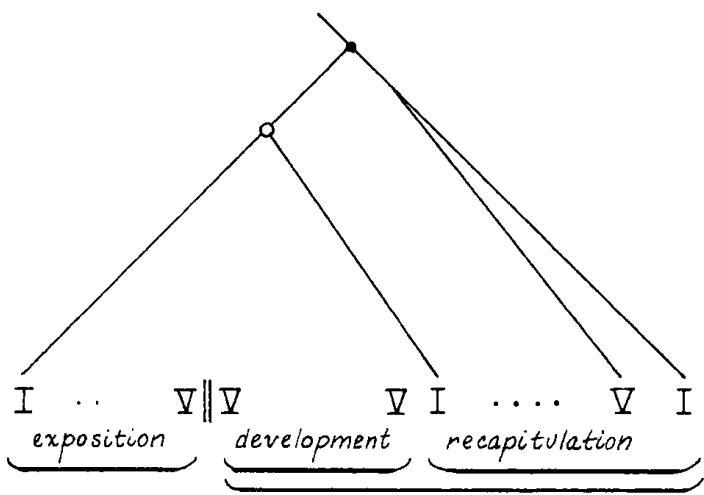
中文讲解
第34页图像占位符,对应9.30——奏鸣曲式呈示部开端至再现部起点的强延长树形图。需查原图。
补充说明
需查阅原图。
第21段(P0258)
原文复述
The prolongation in 9.30 breaks the piece into two prolongational regions: the exposition and development together, and the recapitulation. In the region consisting of the exposition and development, we have a situation not unlike the binary form: the highest two levels of time-span reduction contain only Vs and V/Vs, so there is no prominent tonic prolongation. The most time-span-important events are the Vs surrounding the double bar. How should they be attached? For the same intuitive and formal reasons as in the case of the central dominants in binary form, the beginning of the development should be a right branch off the end of the exposition. This leaves the two possibilities shown in 9.31. These are equally consistent with stable prolongational connection as stated so far (PRPR 3), but 9.31a is favored by time-span segmentation (PRPR 2) and the prolongational importance of the initial I (PRPR 4).
中文讲解
9.30中的延长将作品分为两个延长区域:呈示部+发展部,再现部。前一区域与二部曲式非常相似——时值缩减最高两级只有V和V/V,没有突出主音延长;时值上最重要的事件是围绕双小节线的属音。出于与二部曲式相同的直觉和形式理由,发展部的开始应作呈示部结尾的右分支,剩下9.31a和9.31b两种可能。两者在PRPR 3下同样一致,但9.31a受时值分句(PRPR 2)和初始I的延长重要性(PRPR 4)支持。
补充说明
V/V指属和弦的属和弦(即副属和弦)。
第22段(P0259)
原文复述
In addition, the choice of 9.31a is reinforced by appeal to a distinction among the structural functions of the dominant, not previously incorporated in the theory. As in the binary form, the Vs surrounding the double bar are tonicized Vs; other key areas (most notably III in movements in minor) can be substituted without changing the overall sense of the piece. By contrast, the V at the end of the development is a half-cadential V; the main substitution for it would be a full cadence whose resolution overlapped with the recapitulation.
中文讲解
9.31a还得到一个此前未纳入理论的"属音结构功能区分"的强化。围绕双小节线的V是"主音化的V(tonicized V)",小调中可替换为III等其它调区域而不改变整体感;反之,发展部末尾的V是"半终止V”,其主要替代形式是与再现部重叠解决的完全终止。
补充说明
“tonicized V"指被临时主音化的属和弦;“half-cadential V"指半终止处的属功能。
第23段(P0260)
原文复述
Chapter 9
中文讲解
页眉"第9章”,版面属性。
第24段(P0261)
原文复述
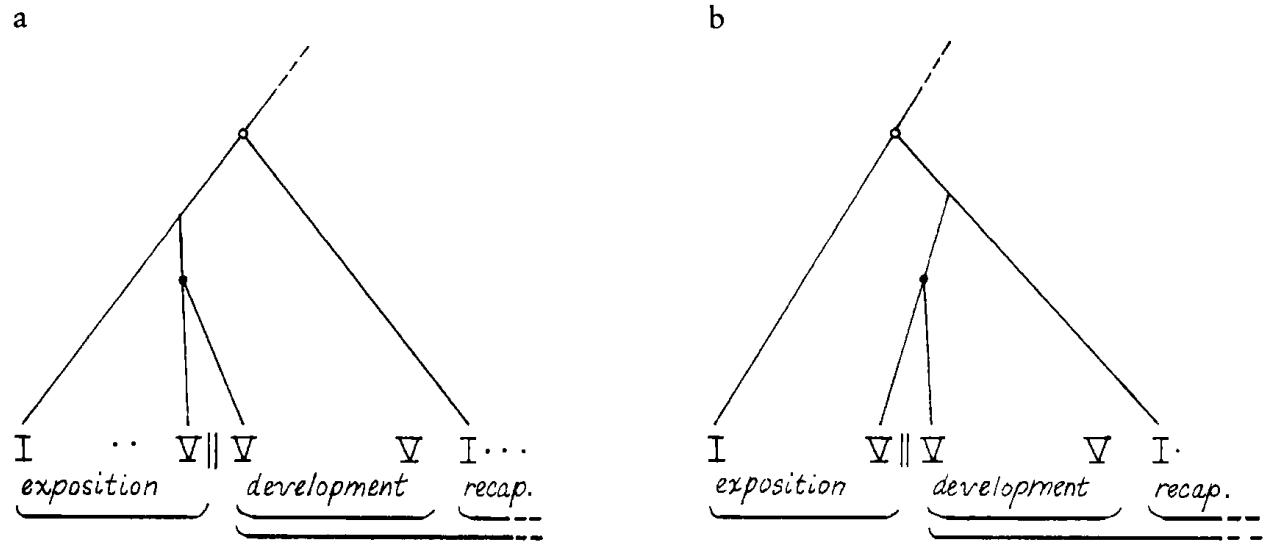
中文讲解
第35页图示占位符,原图带有"b"子图标签(推测是图9.31的子图b,或某图的b部分)。需查原图。
补充说明
需查阅原图。
第25段(P0262)
原文复述
There appears to be a difference in the prolongational behavior of these two V functions. As seen in previous examples, the cadential V can function as either a departure from or a progression to a I, depending on circumstances. But a tonicized V, like other alternative key areas, is heard more naturally as a departure from a preceding I than as a step in relaxing to a following I. This distinction might be incorporated as a refinement in the stability conditions for prolongational connection in order to reinforce the choice of 9.31a over 9.31b. (It would be invoked in binary form as well, reinforcing the structure in 9.28c over other alternatives.)
中文讲解
这两种V功能在延长行为上确有差异。终止V可随情境作为"从前面I出发"或"进行到后面I”。但主音化的V和其它替代调区域一样,更自然地被听为从前面的I"出发"去往新调,而非作为"向后面的I松弛一步"。这一区别可作为延长连接稳定性条件的一个细化,从而强化9.31a对9.31b的选择(同样也用在二部曲式,强化9.28c对其它方案)。
补充说明
此处的"refinement"属于作者新引入的稳定性条件扩展,而非既有PRPR规则的复述。
第26段(P0263)
原文复述
With the division of the piece by the central dominants, there are now three regions to consider. We deal with the development first. The end of the development attaches either as a prolongation of the beginning of the development or as a progression to the recapitulation. The two possibilities are shown with dashed lines in 9.32.
中文讲解
中央属音把作品分为三个区域,依次处理——先看发展部。其末尾要么作为发展部开头的延长,要么作为向再现部的进行,两种可能用虚线画在9.32中。
补充说明
9.32虚线分支是供进一步分析的候选方案。
第27段(P0264)
原文复述
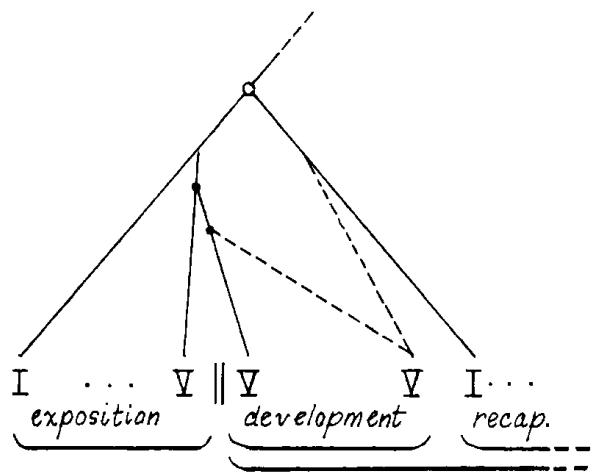
中文讲解
第35页图示占位符,标签"9.32"——展示发展部结尾两种可能附接方式的树形图。需查原图。
补充说明
需查阅原图。
第28段(P0265)
原文复述
Formalization of Prolongational Reduction
中文讲解
页眉栏目标识。版面导航信息。
补充说明
跨页版面标识。
第29段(P0266)
原文复述
Here movements may differ or be ambiguous. Time-span segmentation (PRPR 2) favors the right-branching reading; prolongational importance (PRPR 4) favors left branching. However, a further consideration often resolves the ambiguity. The half-cadential V at the end of the development is usually heard within the diatonic pitch collection of the following tonic, whereas the V at the beginning of the development is heard within the diatonic collection of the dominant key area. Hence, the half-cadential V forms a stronger prolongational connection with the following I, and attaches as a left branch.
中文讲解
不同奏鸣曲乐章在此处可能不同甚至模棱两可。PRPR 2(时值分句)支持右分支解读,PRPR 4(延长重要性)支持左分支。但有一项进一步考虑常能消解模糊:发展部末尾的半终止V通常被听成在随后主调的自然音列之内,而发展部开头的V则被听成在属调音列之内。故半终止V与随后的主音I形成更强的延长连接,从而以左分支附接。
补充说明
“diatonic pitch collection"指自然音音列,即某调性内的七个音级集合。
第30段(P0267)
原文复述
Either of two common variants in sonata movements also favors the left-branching reading. If the development ends with a full cadence that overlaps with the recapitulation, the resolution of the full cadence is very close in time-span segmentation to its V, overriding the connection to the beginning of the development. Likewise, if the development begins (or the exposition ends) in an area other than V, the connection from there to the cadential dominant is less stable, so the left-branching progression to I is again favored. Still, the structures of some developments favor a right-branching ending, as shown by the dashed branch in 9.32.
中文讲解
奏鸣曲中两种常见变体也支持左分支读法。(1)若发展部以完全终止结束且与再现部重叠,完全终止的解决在时值分句上与其V非常接近,盖过了它与发展部开头的连接。(2)若发展部开始(或呈示部结束)的区域不是V,则该处到终止属音的连接稳定性降低,向主音I的左分支进行再次受到支持。当然,仍有一些发展部的结构支持右分支收尾——9.32中的虚线分支即此情形。
第31段(P0268)
原文复述
Next we attach the structural boundaries of the exposition. The problem here is where the beginning of the second theme-group should attach—as a progression away from the initial tonic (9.33a) or as an anticipation of the end of the exposition (9.33b).
中文讲解
接着处理呈示部的结构边界。问题在于:第二主题组的开头应作为(a)从初始主音"出发"进行(9.33a),还是(b)作为呈示部结尾的"预示”(9.33b)。
补充说明
“theme-group"指主题组,即奏鸣曲式中由若干主题段落构成的功能单位。
第32段(P0269)
原文复述
Intuition favors 9.33b, so that the second theme-group in itself exhibits the basic form. For the rules to achieve this result, the conditions for prolongational stability must favor connection through common diatonic collection—even in the relatively unstable left-branching prolongation—over departure to a new key.
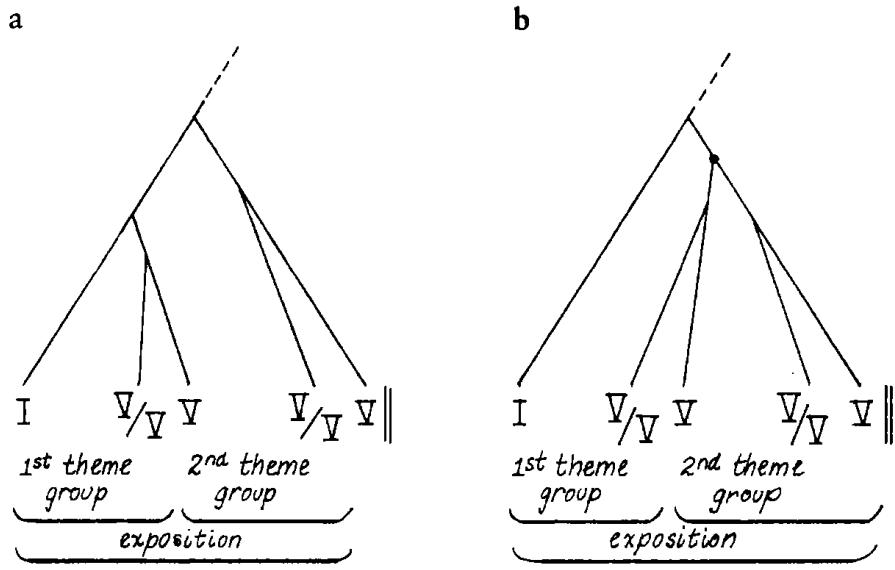
中文讲解
直觉偏向9.33b——这样第二主题组自身就呈现基本形。要让规则得出此结果,延长稳定性的条件必须偏向"通过共同自然音列"形成的连接,即便这意味着左分支延长稍不稳定,也要胜过"出发到新调”。
补充说明
本段原文被嵌在图像占位符标记中,应理解为正文文字内容。
第33段(P0270)
原文复述
Chapter 9
中文讲解
页眉"第9章",版面属性。
第34段(P0271)
原文复述
This refinement of the stability conditions is useful for other purposes as well, so it is not an arbitrary decision restricted to this case alone. For example, in a minuet whose trio is in a contrasting key, the trio intuitively forms its own independent patterns of tension and relaxation, being heard as a unified insertion between the minuet and the da capo. If we weight stability of prolongational connection strongly in favor of maintaining diatonic collection, the desired result is obtained, as in 9.34.
中文讲解
这一稳定性条件的细化在其它场合也有用,并非仅为本例而定。例如对比调性三声中段的小步舞曲:三声段直觉上构成自身独立的张弛模式,被听为介于小步舞曲与da capo之间的统一插入。若把延长连接的稳定性权重大幅倾向于"维持自然音列",9.34所示的预期结果即可得出。
补充说明
“da capo"指从头反复的乐段标记,是ABA三部小步舞曲结构的标志。
第35段(P0272)
原文复述
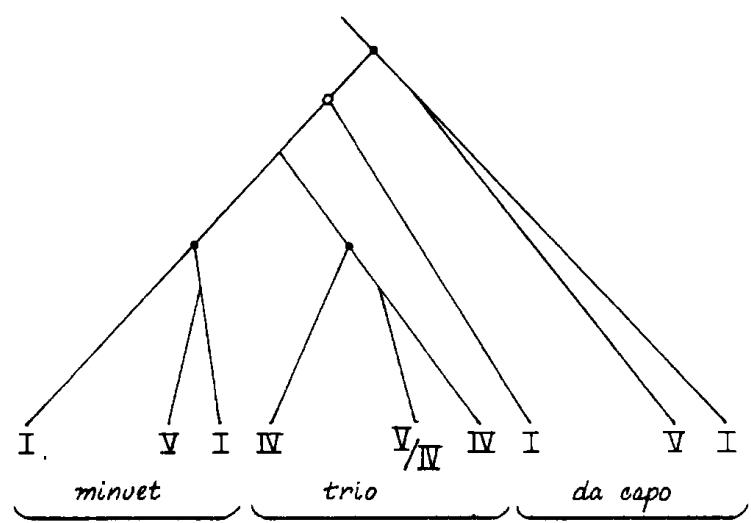
中文讲解
第37页图像占位符,标签"9.34”——三声中段延长树。需查原图。
补充说明
需查阅原图。
第36段(P0273)
原文复述
Formalization of Prolongational Reduction
中文讲解
页眉栏目标识。版面导航信息。
补充说明
跨页版面标识。
第37段(P0274)
原文复述
Returning to 9.33, we see that the V/V at the end of the first theme-group forms the most stable prolongational connection as a left branch, as shown in 9.33b. This completes the exposition.
中文讲解
回到9.33:第一主题组末尾的V/V作为左分支形成最稳定的延长连接,呈示部由此完成(如9.33b所示)。
补充说明
V/V即副属和弦,此处作为左分支连接体现了"朝向本主题组结尾"的延长逻辑。
第38段(P0275)
原文复述
In the recapitulation, the beginning of the second theme-group forms a different connection than in the exposition. Because it is a I rather than a V, its most stable attachment is as a prolongation of the beginning of the recapitulation. In turn, the end of the first theme-group, a V, is now between two Is. It may attach to the earlier I because of congruence with time-span segmentation (PRPR 2). However, it is more usual to hear this event as leading into the second theme-group, by parallelism (PRPR 5) with the exposition.
中文讲解
在再现部中,第二主题组的开头与呈示部不同——它是主音I而非属音V,最稳定的附接是作为再现部开头的延长。反过来,第一主题组末尾的V现在夹在两个I之间;它既可因PRPR 2(与时值分句一致)附接到前一个I,但更常见的听法是通过与呈示部的平行(PRPR 5)将其视为通向第二主题组。
补充说明
再现部回到主调后,第二主题组处于主调区域,这是与呈示部功能差异的根源。
第39段(P0276)
原文复述
Putting together all these fragments, 9.30–9.33, we arrive at 9.35 as the tree for the entire movement. This diagram expresses the structural counterpoint between the major grouping divisions of the piece and the major patterns of tension and relaxation.
中文讲解
综合9.30—9.33各片段,整首乐章的延长树是9.35。该图揭示了作品主要分组划分与主要张弛模式之间的结构对位(structural counterpoint)。
补充说明
“structural counterpoint"指分组结构与延长结构之间的对位关系——二者并不完全重合。
第40段(P0277)
原文复述
PRPR 6 (normative structure) is the last of the rules of musical grammar to be developed in this study. As this rule is the first to embody the overarching influence of large-scale prolongational structure on the details of musical form, we regret having to break off our discussion of musical grammar here. Still, there is something important to be learned from our having taken so long to reach this point: how abstract musical intuition is. If our theory of normative structure of musical phrases is correct, the structure is specified in terms of relationships of prolongational connection among structurally significant events, not in terms of any specified sequence of events. Moreover, the structurally significant events are chosen in large part because of their importance in time-span reduction, not just for their superficial melodic and harmonic content. But time-span reduction itself represents a considerable degree of abstraction from the musical surface, since it crucially involves the grouping and metrical structures, which in turn represent properties of the music not directly presented in the surface sequence of pitch-events. We believe that the great complexity of this mapping from the musical surface to prolongational structure, and the comparative lack of prescriptive constraints within that mapping, are among the deeper reasons why tonal music is such a rich art.
中文讲解
本段是9.7小节乃至整章的收束之言。核心论点:PRPR 6(标准结构)是本研究中所发展"音乐语法"的最后一条规则;它是首条将大尺度延长结构"自上而下"影响音乐形式细节的规则,作者对此不得不中断讨论深感遗憾。然而,从这一路推进的时间长度中学到一个重要东西:音乐直觉高度抽象。如果关于标准乐句结构的理论正确,那么结构是由"结构重要事件之间的延长连接关系"来规定的,而非由"事件序列"来规定;这些结构重要事件之所以被选中,主要因为它们在时值缩减中的重要性,而非仅是其旋律与和声表面内容。时值缩减本身已是对音乐表面相当程度的抽象——它必然涉及分组与节拍结构,而它们代表了"不在表面音高事件序列中直接呈现"的音乐属性。作者相信:从音乐表面到延长结构这一映射的巨大复杂性,以及该映射内部规范性约束的相对稀缺,正是调性音乐成为如此丰厚艺术的部分深层原因。
补充说明
P0277是本节乃至本章节研究框架的总结性反思段落。
脚注 / 边栏 / 图表 / 附加信息(如有)
本节包含以下附加材料:(1)多幅图示(9.27、9.28各子图、9.29、9.30、9.31a/b、9.32、9.33a/b、9.34、9.35),其中原文以”[图像说明:…]“形式标注,这些图的具体内容均需查阅原书原图;(2)图号标签(9.27、9.29、9.34等)独立出现,属版面引用;(3)P0252末尾的角标”$^{2}$“指向一条脚注,脚注内容未包含在所提供的source_paragraphs中,需查阅原书相应页面;(4)页眉"Formalization of Prolongational Reduction"和页眉"Chapter 9"在多个页面重复出现,属跨页版面导航信息。
💡 本节核心要点
- 本节的核心方法是用PRPR体系为巴洛克二部曲式和古典奏鸣—快板曲式构造完整延长树,从而检验延长缩减偏好规则在大型曲式中的适用性。
- 对巴赫G大调小步舞曲I的分析先用反例排除9.28a结构(中央属音延长终止V),再利用偏好规则选出9.28c(第一部分结尾为上位节点,第二部分开头为其展开)。
- 奏鸣曲式与二部曲式的关键结构差异在于再现部带来的主音延长——它使中央属音不再是最重要的事件,取而代之的是开端到再现部起点的强延长(9.30)。
- 作者新引入"主音化V(tonicized V)“与"半终止V(half-cadential V)“的功能区分,并提出稳定性条件细化:延长连接应优先维持共同自然音列而非出发到新调,这一细化同时强化二部曲式和奏鸣曲式的关键选择(9.28c、9.31a、9.33b、9.34)。
- 全章最终在PRPR 6(标准结构)处收束,作者反思音乐直觉的高度抽象性:调性音乐之所以丰厚,正在于从音乐表面到延长结构这一映射的复杂性与规范性约束的相对稀缺。
🔑 关键术语
- PRPR (Prolongational Reduction Preference Rules):延长缩减偏好规则,是本研究所提出的音乐语法规则体系,含PRPR 1—6共六条规则,本节重点使用PRPR 2(时值分句)、PRPR 3(稳定延长连接)、PRPR 4(延长重要性)、PRPR 5(与既有模式的平行)和PRPR 6(标准结构)。
- Basic form:基本形,从时值缩减中提取的最大尺度的延长骨架,是后续结构推导的起点。
- Time-span reduction:时值缩减,按从大到小的层级逐步剥离音乐表层细节,提取结构重要事件的层级化分析技术。
- Tonicized V vs half-cadential V:主音化V(被临时主音化的属和弦,倾向于"从前面I出发”)与半终止V(半终止处的属功能,倾向于"通向后面I”)。这是作者在本节新引入的属音结构功能区分。
- Diatonic pitch collection:自然音音列,某调性内的七个音级集合。本节被用作判断延长连接稳定性的关键依据。
- Interaction Principle:交互原则,指PRPR规则之间相互制约、共同决定结构选择的机制,是PRPR体系的核心运作方式。
- Normative structure (PRPR 6):标准结构,PRPR 6所规定的乐句结构的规范形态,是本研究最后提出的规则,也是首条将大尺度延长结构"自上而下"影响形式细节的规则。
- Structural counterpoint:结构对位,指作品的主要分组划分(如奏鸣曲式的呈示部—发展部—再现部)与主要张弛模式之间的非重合性关系,是延长树的整体功能。
- Recapitulation:再现部,奏鸣曲式中回到主调的主题再现部分,本节强调它对延长结构的决定性影响。
- Double bar (双小节线):在二部曲式中标记两部分分界,在奏鸣曲式示意中标记呈示部与发展部分界,本节图9.29中为方便起见也使用此记号。
9.8 [描述性拆分] Reflections on Musical Cognition and Music as an Art
第1段(P0278)
原文复述
Some readers may feel uneasy with the complexity of the apparatus we have introduced to describe musical intuition, and this uneasiness is especially likely with respect to the apparatus used to derive prolongational structure. We acknowledge that, but we hold that the theory has more than mere empirical power to describe the characteristics of individual pieces and of tonal music as a whole. In support of this view, we offer three arguments that justify the complexity we have built up.
中文讲解
本段是第 9.8 节的开场,承认读者面对理论装置(尤其是用于推导延展结构的装置)时的复杂感。作者不打算靠“这套理论能描述很多作品”来回应,而是要给出三条独立但互补的辩护。这是典型的方法论收束语调:先承认潜在反对意见,再预告论证支柱,为后面三段(“first / second / third”)作铺垫。三条理由分别关系到“与听感的对应性”、“艺术的本质”以及“人类认知的复杂度”,它们在余下小节中依次展开。理解本节的思路是:每一段递进一条独立的辩护理由,不要把三段并称为同义反复。
第2段(P0279)
原文复述
We offer, first, this argument: throughout the development of our musical grammar, we have made a point of relating each step to musical intuition. The four components of musical structure each correspond to a different facet of musical intuition, and almost every preference rule has been justified by appeal to features that are easily heard in straightforward examples. The complexity of tonal music emerges, therefore, not from any single deep principle but from the interaction of individually rather simple principles; in particular, much of what makes music interesting arises from conflicts among principles that compete with one another. Our aim, accordingly, has been to demonstrate, as fully as possible, that every part of this complex whole rests upon what the listener actually hears.
中文讲解
这是第一条辩护:可听性(intuition-grounding)。作者把整个系统拆解成四个相互独立又各对应一种听感侧面的结构成分,并把几乎所有偏好规则的来源锁定在“直白的例子即可听见的特征”上。这条论证的关键转折在于后半部分——复杂性的来源不在单一规则,而在多个简单原则之间的交互与冲突。从教学角度,这意味着 GTTM 的优先规则并非线性应用,而是在多组并列规则间互相拉扯、互相否决后才形成全局结构,这正是后面 9.9 节“延展简化形式化”要处理的技术问题。读者要特别注意“individually fairly simple”与“interaction … conflicts among competing principles”之间的张力,这正是本章最核心的认识论主张之一。
补充说明
本段提到的“the four components of musical structure”与前文第 9 章主体(小节 9.1 起的展平结构、和声结构、时间结构、延展结构)相对应;但具体内容须以原文进度为准,本节未给出新信息。
第3段(P0280)
原文复述
9.8 Reflections on Musical Cognition and Music as an Art
中文讲解
这是本节标题“9.8 对音乐认知与作为艺术的音乐的反思”。从标题即可看出本节的双重论题:其一是把 GTTM 重新放回音乐认知(musical cognition)的框架里,其二是借此回应“音乐作为艺术”这一长期存在的本体论疑问。两个论题在三条辩护里分别展开:第一条锚定听感(论及作为艺术的可理解性),第二条引用 Cooper & Meyer 直接处理“作为艺术”,第三条正面把系统定位为认知理论。标题本身提示读者本节承担了理论与哲学的双重收束作用。
第4段(P0281)
原文复述
Chapter 9
中文讲解
这是页眉标记,仅起版面定位作用,表明本节位于第 9 章之内,不承载实质论述内容。
第5段(P0282)
原文复述
Second, we offer the following argument: anyone who has reflected seriously on musical structure ought to expect it to be this complex. One constantly comes across statements such as “… the interpretation of music—and this is what analysis should be—is an art requiring experience, understanding, and sensitivity” (Cooper and Meyer 1960, p. 9). One is inclined to label an artifact or activity as art precisely when one cannot consciously decompose or reproduce one’s intuitions about it, while at the same time one senses that those intuitions are themselves complex and subtle. Were the principles underlying musical intuition simple and easy to discover, the sense of music as an art would hardly be so strong. Indeed, the grammar set out here is still only a part of the story. We have deliberately left open some important aspects of musical structure, and we have not even begun to approach the problem of musical affect, which is so central to artistic concerns.
中文讲解
这是第二条辩护:与艺术的本质相符。作者借 Cooper & Meyer 1960 第 9 页的直接引文“一个本身就是艺术的活动”立靶,借此导出关于“艺术”的操作性定义——艺术就是我们无法自觉分解却又能感知其复杂微妙的对象。这一论证把理论的复杂度与音乐作为艺术的直觉感受连接起来:如果基础原则浅显易解,那么音乐给人的“艺术性”感受也不会如此强烈。教学要点有二:第一,这一条论证引入了明确的外在文献(Cooper & Meyer 1960, p. 9),本节的二手文献支撑由此建立;第二,本段末尾坦承系统仍未涵盖“musical affect”,提示读者 GTTM 在事实上是一个未完成的不完备方案,这一自我限定对于理解后面 9.10 节及更广章节(情绪、表现)的态度十分关键。
补充说明
所引 Cooper and Meyer 1960 出自文献 The Rhythmic Structure of Music,本节给出页码 9;这是节中唯一直接引用的外文出处,应作为后续讨论的艺术定义起点看待,但本节不再对其作进一步阐述。
第6段(P0283)
原文复述
A third argument for the complexity of the grammar is its status as a theory of musical cognition—that is, of what the experienced listener knows that enables him to comprehend music (and, for that matter, of what an experienced performer knows that enables him to make music comprehensible). Many people find it hard to believe that mental operations could be so elaborate, especially because the structures those operations manipulate lie so far removed from the musical surface. We, however, see no difficulty in accepting a grammar of this complexity as a model of human knowledge. In the only other areas of human cognitive function where theories of comparable scope have been articulated, namely visual perception and language, the principles governing mental function have been shown to be of commensurate complexity. In both those areas, indeed, one is if anything even less consciously aware of the complexity of one’s intuitions than in music. Unconscious processes of astonishing complexity and subtlety are perfectly compatible with a conscious impression of great ease and fluidity, and with the sense that one acquires these cognitive skills by ‘just picking them up’ through experience with sufficient environmental exposure. Our theory of music is no different in this respect; we would in fact have been surprised had it proved fundamentally simpler.
中文讲解
这是第三条辩护:与认知科学的先例相符。作者把 GTTM 摆到认知科学的版图上,与视觉感知和语言这两种已存在过同等规模理论的领域并列。论证的关键是“无意识地高度复杂”并不与“有意识地毫不费力”相矛盾——例如母语者并不会意识到自己调动了一整套句法规则。这一对照反驳了“理论装置太复杂、不像心理现实”的常见反对意见。教学要点有三:其一,作者区分了“经验的听者”与“经验的演奏者”,提示该语法既描述理解也描述演奏的可理解化,这是 GTTM 一直强调的双向应用;其二,作者将本理论主动降格为一个“认知模型”而非“心理现实主义”的主张,与 Patelson/HPSR 这种强心理实在论划清界限;其三,本段在结构上比前两段更宏大,因为它把音乐认知科学地放进了与其他认知领域并列的位置——这正是 1970 年代以来认知语言学、视觉认知的并行研究语境。需要注意的是,作者没有给出具体可引用的研究文献,其类比诉诸读者对该领域总体的背景认知,因此读者应把这段视作“立场声明”而非文献综述。
补充说明
段内把视觉感知与语言并列为同等规模的认知领域。原文未给出这些类比所依赖的具体实证来源;本段因此应作为认知架构的立场宣示来阅读,不能补出原文未涉及的实验或人物。
第7段(P0284)
原文复述
Formalization of Prolongational Reduction
中文讲解
该行不是本文正文,而是出现于本页末尾的文本片段,根据其在前后页出现的次序判断为下一节标题“延展简化的形式化”的提前出现或 OCR 误置。本节范围内的论述已经在 P0283 结束,因此这里作为版面/标题信息呈现,不承载新的主张。在原文系统中,它应理解为指向 9.9 节标题(见原书目录),读者应将其归入下一节阅读,不在本节论证线索中起作用。
补充说明
无额外补充;按原书目录次序,“Formalization of Prolongational Reduction”属于下一节标题,与本节论证线索无关。
脚注 / 边栏 / 图表 / 附加信息(如有)
本小节范围内包含一条直接引文:Cooper and Meyer 1960, p. 9,原文为 “… the interpretation of music—and this is what analysis should be—is an art requiring experience, understanding, and sensitivity”。该引文承担本节第二条辩护中关于“艺术”的操作性定义的支撑作用。除此之外,本节不包含脚注、图表、谱例或边栏。出现的非正文版面元素为第 9 章页眉 “Chapter 9”、本节小标题 “9.8 Reflections on Musical Cognition and Music as an Art”,以及末页位置的 “Formalization of Prolongational Reduction”(判断为下一节标题或其 OCR 残留,不属于本节)。
💡 本节核心要点
- 本节回答一个方法论质疑:GTTM 的形式装置为何如此复杂?作者给出三条辩护。
- 第一条辩护声称系统的每一步都对应听者能直接听到的音乐直觉,复杂性来自多个简单原则之间的交互与冲突。
- 第二条辩护诉诸艺术的操作性定义——艺术之所以是艺术,正因为其下的直觉既复杂微妙又难以自觉分解,因此理论的复杂性是与音乐作为艺术相一致的。
- 第三条辩护把 GTTM 定位为音乐认知理论,与视觉感知和语言这两种同等规模的认知领域并列,以反驳“复杂度太高、不像心理现实”的反对意见。
- 作者明确承认系统仍不完备:留出了重要的结构方面未加处理,且尚未触及音乐情感(affect)这一对艺术至关重要的层面。
- 三条辩护在论证层级上互补:第一条对应经验可听性,第二条对应艺术本体论,第三条对应认知科学,因此构成本章整体的理论反思。
🔑 关键术语
- prolongational structure:延展结构,是 GTTM 在音乐语法中由延展简化(prolongational reduction)所生成的结构成分;它刻画的是某和声或旋律事件在更长时间尺度上对其他事件的从属与支持关系,是本节中读者最可能感到装置繁琐的部分。
- musical intuition:音乐直觉,指听者在音乐中直接听到的、不需要理论中介就可感知到的结构关系;GTTM 把整套装装置的合法性建立在每一步都能对应到这类听觉经验之上。
- preference rules:偏好规则,GTTM 在四类结构生成过程中用以在多条候选解释间作选择的规则集;本节声称几乎所有偏好规则都可由直白例子中的可听特性加以辩护。
- musical cognition:音乐认知,指经验性听者用以理解音乐(及经验性演奏者用以让音乐可被理解)的心智运作;GTTM 在本节被明确表述为这种认知的理论,而非直接的神经或心理实在论声明。
- musical affect:音乐情感,特指音乐作品中引起情感反应的非结构层面的东西;作者承认本理论尚未触及该问题,并暗示它对理解音乐作为艺术至关重要。
- four components of musical structure:音乐结构的四个成分,指上文已分别建立的展平结构(prolongational 不计)下的四种结构对象;每种成分对应一种独立的音乐直觉侧面,复杂性来自它们之间的交互。