目录
CH12 Psychological and Linguistic Connections
- CH12.S12.0 [描述性拆分] Chapter overview and Neisser’s parallel between generative linguistics and Gestalt psychology
- 页码:1-1
- CH12.S12.1.pre [描述性拆分] Parallels between visual and auditory grouping in early Gestalt work
- 页码:2-2
- CH12.S12.1 [描述性拆分] 12.1 Gestalt Theory and Visual Form Perception
- 页码:2-3
- CH12.S12.1.status [描述性拆分] Historical status and substantive difficulties of Gestalt psychology
- 页码:3-4
- CH12.S12.1.visual [描述性拆分] Sketches of a generative theory of vision and recent visual models
- 页码:4-6
- CH12.S12.2.intro [描述性拆分] 12.2 Preference Rules in Linguistic Theory
- 页码:6-7
- CH12.S12.2.scope [描述性拆分] Relative scope of quantifiers as preference rules (Ioup)
- 页码:7-8
- CH12.S12.2.pragma [描述性拆分] Pragmatics: Gricean maxims as preference rules
- 页码:8-10
- CH12.S12.2.words [描述性拆分] Word meanings, family resemblance, and categorization
- 页码:10-12
- CH12.S12.2.other [描述性拆分] Other linguistic phenomena: phonetic perception, markedness, and parsing
- 页码:12-13
- CH12.S12.3 [描述性拆分] 12.3 A Deep Parallel Between Music and Language
- 页码:13-13
- CH12.S12.3.prosodic [描述性拆分] Prosodic structure and its tree notation
- 页码:13-14
- CH12.S12.3.equiv [描述性拆分] Equivalence of time-span and prosodic tree notations
- 页码:15-16
- CH12.S12.3.seg [描述性拆分] Prosodic segmentation rules and the layered hierarchy
- 页码:16-19
- CH12.S12.3.feet [描述性拆分] Foot formation, gathering directions, and large prosodic levels
- 页码:19-20
- CH12.S12.3.wf [描述性拆分] Prosodic well-formedness rules and tree construction
- 页码:20-21
- CH12.S12.3.prom [描述性拆分] Prosodic rules of prominence at each layer
- 页码:21-24
- CH12.S12.3.rhythm [描述性拆分] The Rhythm Rule and the metrical/prominence connection
- 页码:24-25
- CH12.S12.3.disc [描述性拆分] Discrepancies between the two theories
- 页码:25-28
- CH12.S12.3.impl [描述性拆分] General implications for cognition and temporal patterning
- 页码:28-29
- CH12.S12.4 [描述性拆分] 12.4 A Remark on Brain Localization
- 页码:29-30
- CH12.S12.5 [描述性拆分] 12.5 Music Theory as a Cognitive Science
- 页码:30-50
CH12.S12.0 [描述性拆分] Chapter overview and Neisser’s parallel between generative linguistics and Gestalt psychology
第1段(P0001)
原文复述
Chapter heading: “Psychological and Linguistic Connections.”
中文讲解
这是第十二章的章名标题,宣告本章的论题——把前几章建立的正式音乐理论与心理学、语言学中已有的理论联系起来。该标题本身只是一个路标,并不提供论证;它在功能上提示读者:下面的讨论将横跨音乐理论、心理学与语言学三个领域,而不是单纯讨论音乐结构。
第2段(P0002)
原文复述
In chapter 1 the author stated that one of the criteria for adequacy of their theory of music is its ability to shed light on more general psychological issues. In this chapter they present some ways in which the formal theory developed in chapters 3, 4, 7, and 9 reveals clear connections with existing theories in psychology and linguistics, and they reflect on the possible consequences of these connections.
中文讲解
本段是本章的总纲。它先回扣第一章提出的一条“理论适切性标准”:一部合格的音乐理论应该能够照亮更一般的心理学问题。然后交代本章的双重任务——其一,展示第三、四、七、九章的正式理论与心理学、语言学既有理论的“明确联系”;其二,对这些联系所可能带来的后果进行反思。也就是说,本章既是“展示”型的,也是“反思”型的:先给读者看到连接,再追问这些连接意味着什么。作者特意点出第三、四、七、九章,意味着只有这四章的形式化装置会被拿来与心理/语言学对接,其他章节的成果在本章中并不直接登场。
补充说明
“formal theory developed in chapters 3, 4, 7, and 9”——本段明确将本章的论证基础限定在这四章的形式化成果上,第九章中的 time-span reductions、第七章中可能涉及的结构性装置,均会在下文与心理/语言学议题对应起来。
第3段(P0003)
原文复述
Neisser 1967 (pp. 245–248) points out an important similarity in spirit between generative linguistics and the Gestalt psychology of the 1920s to the 1940s. As the author said in chapter 1, their theory is conceived with the same general goals as generative linguistics: to give an account of one aspect of (largely unconscious) human knowledge, explicating the character of a certain class of intuitions, and to divide this knowledge into innate and learned parts. Thus their theory of music is another instance of the sort of cognitive theory discussed by Neisser. One burden of this chapter will be to use the theory of music to forge a more than merely spiritual connection between generative linguistics and Gestalt psychology. Section 12.1 reviews the similarities presented in chapter 3 between the rules of musical grouping and the processes involved in visual form perception. This leads to some discussion of how some of the defects of Gestalt theory can be overcome in the light of contemporary linguistics and the present music theory. Finally, they survey recent work in vision whose general form resembles their music theory.
中文讲解
本段是本章最核心的方法论定位,分四步展开。
第一步,引出 Neisser 1967(页 245–248)的观察:生成语言学与 1920 年代至 1940 年代的格式塔心理学之间存在一种“精神上”(in spirit)的相似——这里的“精神”是指方法论与目标上的家族相似,而非实证层面的具体机制相通。
第二步,说明作者自己的理论与生成语言学共享同样的总目标:(a) 解释某一类(主要是无意识的)人类知识,(b) 阐明某一类直觉的特征,(c) 把这类知识区分为先天的与习得的两部分。因此作者的音乐理论属于 Neisser 所讨论的那一类“认知理论”的又一实例。
第三步,提出本章的关键任务之一:借助音乐理论,把生成语言学与格式塔心理学之间原本仅是“精神上”的连接锻造为不止于精神上的实质性连接。这里的论证逻辑是——既然三者在目标与方法精神上同源,音乐理论就有资格充当一座桥梁,让语言学和格式塔心理学在具体机制上相互照亮。
第四步,预告 12.1 节的具体路径:先回顾第三章已经展示的“音乐分组规则”与“视觉形式知觉过程”的相似,再讨论格式塔理论的若干缺陷如何在当代语言学与本音乐理论的参照下被克服,最后概览近期那些在“总体形式”上与本音乐理论相似的视觉研究。
值得注意的是“defects of Gestalt theory”这种措辞——它意味着作者承认格式塔传统并非完美,并且把当代语言学与本音乐理论定位为对那些缺陷的修复资源,而不是格式塔心理学简单的延续。
补充说明
Neisser 1967, pp. 245–248 是本段唯一给出的具体文献出处,它在本节中作为“生成语言学与格式塔心理学同源”这一论断的历史来源;格式塔心理学的时段限定为 1920s–1940s。
第4段(P0004)
原文复述
One of the striking differences between music theory and linguistic theory, mentioned in chapter 1, is the presence in music theory of preference rules, a rule type foreign to generative-transformational grammar. Section 12.2 suggests some cases of current issues in linguistic theory where the preference-rule formalism appears to provide insightful solutions, suggesting that linguistics and music theory are not as different in this respect as might otherwise have been supposed.
中文讲解
本段引入本章第二个论证支线——偏好规则(preference rules)的反向运用。作者首先承认一个“在第一章就提过的、显著的差异”:音乐理论中有“偏好规则”,而生成—转换语法里完全没有这种规则类型。这是一个让两类理论看起来隔得相当远的特征。
但 12.2 节的任务不是加深这种隔阂感,而是要翻转它:作者将挑选当前语言学理论中尚未妥善解决的若干议题,展示偏好规则的形式装置恰恰能给出富有洞察的解决方案。由此得出结论——在“是否使用偏好规则”这一点上,语言学与音乐理论的差异并不像表面看上去那么大。
这一段在论证上很关键:它把原本作为“差异标志”的偏好规则重新定位为“可迁移到语言学的工具”。如果这一翻转成功,那么音乐理论就不只是一个关于音乐的理论,而是一种更一般的认知形式装置——这与本章开头把音乐理论当作“照亮一般心理学问题”的工具的总目标是相互呼应的。
补充说明
“preference rules”在生成—转换语法中没有对应物这一判断,是作者从第一章就确立的立场,本节只是引用而不重新论证。
第5段(P0005)
原文复述
Section 12.3 describes a strong parallel between certain aspects of musical and linguistic structure. Recent work in phonology has proposed an analysis of the sound structure of language in terms of hierarchical structures that resemble time-span reductions. The author will show how closely these phonological structures are formally related to time-span reductions, then show that they are the result of largely analogous rule systems, even though the entities the rules manipulate are quite different.
中文讲解
本段是 12.3 节的预告,提出本章论证中力度最强的一组平行。论证将分两步递进:
第一步——形式层面的接近性:近期音系学(phonology)研究提出,可以用一种“层级结构”来分析语言的声音结构,而这种层级结构与作者音乐理论中的 time-span reductions 在形式上高度相似。
第二步——生成机制层面的类比:产生这些结构的规则系统之间也存在广泛的类同性。
但作者特别加了一条重要的限定:尽管形式和机制相似,规则所操作的实体(音乐材料 vs. 语言声音)却相当不同。换言之,作者并不是说“音乐就是语言”,而是说——在认知架构层面,跨领域的复杂结构可能共享某些形式原则与生成原则。
这一节的论证强度高于 12.1(精神相似)与 12.2(工具迁移):它要给出的是“可形式化证明的结构同构”。所以 12.3 既是本章最具体的一节,也是最容易被读者拿来检验的一节——形式相似是否经得起严格的对照,规则系统的类比是否真正对等,都会成为评估本章总论点的关键。
补充说明
“time-span reductions”是作者在前面章节(第九章)中已经建立的形式装置,本段把它作为读者已掌握的概念直接调用,不再重新定义。
脚注 / 边栏 / 图表 / 附加信息(如有)
本节无脚注、无图、无表。仅在正文 P0003 中嵌入一处文献指引:Neisser 1967, pp. 245–248,作为“生成语言学与格式塔心理学精神上相似”的来源依据;该文献在本节中只起历史出处作用,不展开内容。
💡 本节核心要点
- 本章的总目标由第一章提出的“理论适切性标准”引出:一部合格的音乐理论应当能够照亮更一般的心理学问题;本章的任务是展示第三、四、七、九章的正式成果与既有心理学/语言学理论的“明确联系”,并反思其后果。
- Neisser 1967 提出生成语言学与 1920s–1940s 格式塔心理学之间存在“精神上”的相似;本章要借助作者的音乐理论,把这一相似从“精神”升级为“实质性”的连接。
- 作者的音乐理论与生成语言学共享三项总目标:解释无意识的人类知识、阐明一类直觉的特征、区分先天成分与习得成分;因此它属于 Neisser 所讨论的那一类认知理论。
- 12.1 节将回顾第三章已经展示的“音乐分组规则 vs. 视觉形式知觉”相似,并论证格式塔理论的若干缺陷可以在当代语言学与本音乐理论的参照下被克服。
- 12.2 节将把音乐理论的“偏好规则”翻转成语言学可借用的工具:原本作为两类理论差异标志的特征,将被展示为能解决当前语言学议题的形式装置。
- 12.3 节提出力度最强的平行:音系学的层级结构与 time-span reductions 不仅形式上接近,而且由“广泛类同”的规则系统生成,尽管操作实体差异很大。
🔑 关键术语
- Gestalt psychology:1920s–1940s 的心理学传统,研究知觉如何被组织为整体而非要素之和;本节中作为与生成语言学“精神上”同源的另一传统出现。
- Generative linguistics:以生成语法为代表的语言学传统,本节中作为与作者音乐理论共享总目标(解释无意识知识、阐明直觉、区分先天/习得)的对照对象。
- Preference rules:作者音乐理论中独有的一类规则,在生成—转换语法中没有对应物;本节将其重新定位为可能迁移到语言学议题中的形式工具。
- Time-span reductions:作者在前面章节(特别是第九章)建立的形式装置,代表一种层级结构;12.3 节中将被拿来与近期音系学提出的层级结构进行形式对比。
- Generative-transformational grammar:生成语言学中的一个具体框架,作为“偏好规则缺席”的对照标准,帮助凸显音乐理论在规则类型上的独特之处。
- Cognitive theory (Neisser 意义上的):Neisser 1967 讨论的那一类以无意识知识、直觉刻画与先天/习得区分为目标的一般理论;本节主张作者的音乐理论与生成语言学同属此类。
CH12.S12.1.pre [描述性拆分] Parallels between visual and auditory grouping in early Gestalt work
第1段(P0006)
原文复述
The author reminds the reader of the parallels between visual and auditory grouping that were pointed out in sections 3.2 and 3.4. The existence of such parallels was first observed by Wertheimer (1923); Köhler (1929) conjectured that they are the result of similar physiological organization underlying the two domains. Lashley (1951) further argued that essentially similar mental representations serve for both spatially and temporally sequenced memory. However, none of these psychologists had much that was systematic to say about the structure of temporal organization per se, beyond enumerating a certain amount of highly suggestive evidence. Now that the authors have developed a formal theory for one type of temporal organization, they are in a position to examine the parallelism more closely.
中文讲解
中心主张:本段回顾早期格式塔心理学家(Wertheimer 1923、Köhler 1929、Lashley 1951)对视觉与听觉分组之间平行关系的观察与解释,并指出他们都没有对’时间组织的结构’本身给出系统化的形式理论;作者据此提出,由于已经在 3.3 节为一类时间组织建立了形式理论,他们现在能够比这些早期学者更严格地检验视觉—听觉分组之间的平行性。
承接与推进:作为本小节的开篇,本段把读者从第 3 章对视觉与音乐分组的具体例子(3.2 节)和偏好规则形式化(3.3 节)引导到第 12 章这个更深的层次——检验自己的形式化理论与早期格式塔观察之间的对照关系。它同时点出早期学者的不足:他们的观察富有启发性,但缺乏对’时间组织’本身的系统结构刻画。
容易误解之处:’none of these psychologists had much systematic to say about the structure of temporal organization per se’ 不是说他们没有讨论过时间现象,而是说他们没有对’时间组织的结构’给出系统化说明;他们的贡献在于列举了一批富有启发性的证据,而非提供可以推演的形式化框架。
论证作用:本段是本小节的论证入口——既交代了与前文的衔接(3.2、3.4 节),又通过’我们已有形式理论’这一资格声明,为后续逐项与 Wertheimer/Koffka 的观察进行对照做准备。
补充说明
本段内出现的关键照应点:3.2、3.4 节是前文中分别介绍视觉分组、音乐分组与时间分组例子的小节;Wertheimer(观察到平行)、Köhler(从生理组织角度推测其原因)、Lashley(从心理表征角度主张二者共享相似表征)三人各自的角色互补。本任务输入未提供 3.2/3.4 节的具体文本,故此处不作外部补充。
第2段(P0007)
原文复述
Wertheimer (1923) presents examples that are almost exactly analogous to the authors’ own illustrations of visual and musical grouping in section 3.2 (examples 3.6–3.13), and proposes that three general characteristics are at work in these grouping judgments: greater proximity and greater similarity enhance grouping judgments; when the relevant principles come into conflict, judgments become less certain; and under certain conditions one principle can override another. The authors note that these are precisely the characteristics they themselves used to motivate the preference-rule formalism. Comparable observations with a larger set of principles are scattered throughout Koffka’s (1935) treatment of shapes, the figure-ground opposition, and three-dimensionality. Both Wertheimer and Koffka demonstrate the influence of factors such as symmetry, the continuation of lines along regular curves, the capacity of a pattern to enclose space, and even the viewer’s intention. In general, they state their principles with the same degree of informality that the authors adopted in section 3.2; the more formal rules developed in section 3.3 do not appear in their work.
中文讲解
中心主张:本段把 Wertheimer 1923 的分组例子与作者自己在 3.2 节所举的视觉/音乐分组例子直接对应起来,识别出 Wertheimer 总结出的三条普遍特征,并指出这三条恰好就是作者构建偏好规则形式化的动机来源;Koffka 1935 把类似观察扩展到更多原则(对称、曲线连续、空间封闭、观看者意图等),但仍停留在非形式化陈述层面。
承接与推进:本段紧接上一段’早期学者有启发性证据但缺乏系统化’的判断,展开具体内容:说明早期格式塔心理学家究竟在哪些原则上观察过分组效应,又是怎样陈述这些原则的。这为本节最后确立’Law of Prägnanz’做事实铺垫——在引入最一般的原则之前,先呈现一批次一级的具体观察。
例子作用:作者把 Wertheimer 1923 的例子与 3.2 节中的例子标记为’几乎完全类比’,其论证作用在于暗示作者的形式化并非凭空构造,而是直接扎根于 Wertheimer 已经识别出的现象之上。同时强调这些原则的’informal’特征,是为下一段把视角提升到’格式塔核心命题’,以及最后引出 Prägnanz 法则做准备——非形式化原则与形式化规则之间的对照正是本节论证的张力所在。
关键概念:‘override’(一个原则压倒另一原则)一词在偏好规则形式化中具有结构性意义,因为它意味着原则之间存在可计算的优先级,而非简单并列;这是把 Wertheimer 的直观描述转化为形式系统的关键一步。
补充说明
本段内提到的 examples 3.6–3.13 与 section 3.2 的具体内容未在本任务输入中出现,因此只能确认作者把它们与 Wertheimer 1923 的例子标记为’几乎完全类比’。figure-ground opposition(图形—背景对立)在 Koffka 1935 中是知觉组织的一个核心现象,作者把它与 shapes、three-dimensionality 并列,说明这些都属于 Koffka 用同一类非形式化原则加以讨论的领域。无外部补充。
第3段(P0008)
原文复述
In the authors’ reading, the work of Wertheimer and Koffka embodies the fundamental claim of Gestalt psychology: that perception, like other forms of mental activity, is a dynamic process of organization in which every element of the perceptual field may be implicated in the organization of any particular part. Both authors take considerable care to point out and substantiate two crucial aspects of this claim. First, perception is not simply a product of what is present in the environment: the viewer, though normally unaware of doing so, plays an active part in determining what he perceives. Second, the totality of the field as perceived cannot be assembled piece by piece as a mere accumulation of perceptions of its individual parts taken in isolation.
中文讲解
中心主张:本段归纳出 Wertheimer 与 Koffka 工作所体现的格式塔心理学核心命题——知觉是一种动态的组织过程,知觉场中每一元素都可能参与任何一个局部的组织——并强调该命题包含两个关键方面:(1) 知觉不是环境的被动产物,观看者在其中扮演主动但通常无意识的角色;(2) 知觉场的整体不能被分解为’各部分孤立知觉的累加’。
承接与推进:本段从上一段对 Wertheimer/Koffka 具体观察(分组原则)的列举,上升到对格式塔核心命题的提炼。这一提炼为下一段引入 Law of Prägnanz 做了概念上的准备:既然整体不能由部分拼装而成,那么必然存在某种更一般的组织原则决定整体的最终形态——这正是 Prägnanz 法则将要回答的问题。
关键概念:‘dynamic process of organization’(动态的组织过程)意味着知觉不是被动记录刺激,而是在多元素相互作用中持续形成结构;‘active, though normally unconscious, part’ 强调观看者的参与是自发的、不可内省的;‘built up piecemeal as a mere accumulation’ 是格式塔明确反对的元素主义/构造主义观点,其含义是整体具有不可还原的新性质(emergent properties)。
论证意义:作者把这两条作为’crucial aspects’明确陈述,暗示这两点是任何合格的格式塔形式化都必须保留的特征;这同时也隐含为后续检验作者自己形式化理论是否’足够格式塔’提供了评价标准。
第4段(P0009)
原文复述
The general underlying principle on which the Gestalt account of perception rests was formulated by Wertheimer under the name ‘Law of Prägnanz’. Koffka (1935, p. 110) restates it in a brief form, as follows:
中文讲解
中心主张:本段引出格式塔知觉理论的最一般原则——Wertheimer 所提出的’Law of Prägnanz’(简洁性法则),并预告 Koffka 1935 在第 110 页对它作了简短陈述。
承接与推进:在前一段确立’格式塔核心命题’之后,本段引出实现该核心命题的最一般原则。段末冒号说明具体的引文将在紧随其后的段落呈现,所以本段的功能是’立标靶’——为下一段正式引出 Prägnanz 法则的原文做铺垫。
术语说明:本段没有对 Prägnanz 一词作进一步解释,因此只能依据本节内容把它理解为’格式塔对知觉所作的最一般原则’。词义层面的考据不在本任务输入范围内,故此处不作外部补充。
论证作用:作者把 Wertheimer 命名为这一原则的提出者,把 Koffka 1935 标注为可引用的简短版本来源,这是格式塔研究中的标准引用方式;这一简短引用之所以重要,是因为它将被作者用来对照/支撑自己发展出的偏好规则形式化。
补充说明
本段以冒号结尾,提示下一段将给出 Koffka 1935 第 110 页的简短引文,但该引文内容不在本任务输入范围内,故本段不作具体引文复述。无外部补充。
脚注 / 边栏 / 图表 / 附加信息(如有)
本小节内未出现脚注、图表、边栏或方框内容。P0009 段末冒号提示紧随其后将出现 Koffka 1935 (p. 110) 对 Law of Prägnanz 的简短陈述,但该引文内容不在本任务输入范围内,故本节不对其作记录。
💡 本节核心要点
- 早期格式塔学者(Wertheimer 1923、Köhler 1929、Lashley 1951)已经观察到视觉与听觉分组之间的平行关系,并尝试从生理组织(Köhler)或心理表征(Lashley)做出解释,但他们都没有对’时间组织的结构’本身给出系统化说明,仅停留在富有启发性的证据列举层面。
- Wertheimer 1923 中的分组例子与作者 3.2 节中的视觉/音乐例子几乎完全对应;从中可抽出三条普遍特征——邻近性与相似性增强分组、原则冲突时判断不确定、原则之间可相互 override——而这三条恰好就是作者构造偏好规则形式化的动机来源。
- Koffka 1935 将类似观察扩展到更广泛的原则(对称、曲线连续、图形封闭空间、观看者意图),但所有这些陈述仍停留在与 3.2 节同等的非形式化层面;3.3 节所发展出的形式化规则在 Wertheimer/Koffka 那里并不存在。
- Wertheimer 与 Koffka 的整体工作集中体现了格式塔心理学的核心命题:知觉是动态的组织过程,整体不能由孤立部分的知觉累加而成,且观看者在其中扮演主动但通常无意识的角色。
- 为支撑上述核心命题,格式塔需要一个最一般的组织原则,该原则由 Wertheimer 命名为 Law of Prägnanz,并由 Koffka 1935 (p. 110) 以简短陈述的形式呈现(本段仅作铺垫,具体陈述内容不在本段)。
🔑 关键术语
- Gestalt psychology:格式塔心理学;本节中用以标识强调整体组织、反对元素累加、强调观看者主动性的知觉理论传统,是本节一切论证的归属背景。
- grouping:分组/编组;本节中指把分散的元素(视觉元素或声音元素)组织为可感知整体的过程,既适用于空间排列(视觉),也适用于时间序列(听觉/音乐),是本节平行论证的核心对象。
- preference rule formalism:偏好规则形式化;作者在 3.3 节为时间分组建立的形式理论;本节将它与 Wertheimer/Koffka 的非形式化原则进行对照,用以说明作者的形式化精确化了前者的直观描述。
- proximity and similarity:邻近性与相似性;Wertheimer 1923 总结的、能够增强分组判断的两条基本原则,也是作者偏好规则形式化在 3.3 节中的起点性原则。
- Law of Prägnanz:格式塔’简洁性法则’(Prägnanz);本节中作为格式塔知觉理论最一般的组织原则,由 Wertheimer 提出,并由 Koffka 1935 (p. 110) 作出简短陈述,是本节论证的最终落脚点。
- dynamic process of organization:动态的组织过程;格式塔对知觉本质的概括,含义是知觉场中各元素相互作用而形成结构,而非被动记录刺激;本节中作为格式塔核心命题的标志性表述。
CH12.S12.1 [描述性拆分] 12.1 Gestalt Theory and Visual Form Perception
第1段(P0010)
原文复述
12.1 Gestalt Theory and Visual Form Perception
中文讲解
这是第十二章的第一小节标题。作者把整节命名为"格式塔理论与视觉形式知觉",意味着本节的核心任务是用视觉知觉领域的格式塔心理学(Gestalt psychology)作为参照系,去澄清生成音乐理论中偏好规则(preference rules)的性质。在音乐学讨论中,‘形式’一词往往被理解为曲式、和声或动机结构;这里作者把’形式’回溯到更基础的知觉层面——人眼如何把离散的刺激组织成有边界的整体。本节因此并不是讨论乐谱形态或曲式类型,而是讨论听觉/视觉系统在处理刺激时所必然进行的’组织化’活动。
第2段(P0011)
原文复述
Psychological and Linguistic Connections
中文讲解
这是 12.1 之下的一个子标题,‘心理与语言上的联系’。它提示本小节将沿着两条线索推进:第一条是心理学线索,即格式塔知觉原则如何与音乐知觉中的偏好规则对应;第二条是语言学线索——这暗指生成语法(generative grammar)与格式塔理论在结构上具有相似性(例如都强调对’良构’与’稳定’结构的偏好)。在 Lerdahl 的理论语境中,‘心理’与’语言’并不是两条互不相干的传统,而是同一组关于’人如何从可感刺激构造出更高层结构’问题的不同侧面。
第3段(P0012)
原文复述
Psychological organization will always be as “good” as the prevailing conditions allow. In this definition the term “good” is undefined. It embraces such properties as regularity, symmetry, [and] simplicity.
中文讲解
这是一句源自格式塔心理学传统(Koffka / Wertheimer 一脉)的核心定义。句子的中心主张是:心理组织(psychological organization)的结果总是’在当下条件下尽可能地好’。这里’好’(good)是一个被有意保留的未定义术语——作者明确指出它不被进一步还原,而是作为一种原初的评价性概念来使用。这个’好’所涵盖的属性包括规律性(regularity)、对称性(symmetry)以及简明性(simplicity)。也就是说,‘好’不是某种单一可量化的值,而是一族倾向于’使知觉对象更易于被组织’的性质的集合。这种把核心概念保留为待阐释项(explicandum)的做法,决定了后文需要用一系列具体原则来’展开’它——这正是下一段所说 ’explications’ 一词的含义。
补充说明
句中 [and] 加方括号,表示原文中这个 and 可能为后人所加;本节复述时按要求保留这种原貌。
第4段(P0013)
原文复述
In other words, the various principles of visual perception that Koffka demonstrates are explications of the notion of “good” organization.
中文讲解
本段用一句 ‘In other words’ 把前一段未定义的 ‘good’ 概念与其具体内容相连接:Koffka 所展示的种种视觉知觉原则——如接近性、相似性、连续性、闭合性等——正是对’好组织’这一抽象概念的具体阐发(explications)。作者因此确立了一个解释结构:‘好组织’是上位概念,它必须通过一系列下位原则来获得实质内容;格式塔理论的价值不在于给出某个唯一答案,而在于给出使答案在知觉上’好’的那些维度。承接 P0012 的未定义项,本段完成了’概念→原则’的展开关系,为把音乐偏好规则类比为这些原则做好了准备。
第5段(P0014)
原文复述
The preference rule component of the generative theory of musical grouping resembles Wertheimer’s and Koffka’s account of vision in more than the way individual rules apply and interact with each other. It also has overall properties that make it a Gestalt theory in the sense just described. First, it is mentalistic: it claims that perceived grouping is not present in any direct way in the musical surface. In fact, the events of grouping structure are not even in one-to-one correspondence with the musical surface, since in grouping overlap one surface event appears twice in underlying grouping structure, and in grouping elision an event appears in grouping structure that is absent from the musical surface. These noncorrespondences are made possible by claiming that grouping structure is a mental construct, associated with the musical surface by unconscious rules.
中文讲解
本段把音乐生成理论中关于’分组’的偏好规则子系统,与 Wertheimer、Koffka 的视觉格式塔理论做第一次明确类比。作者首先强调这种类比不仅是’逐条规则地相似’(即个别规则在应用和交互方式上相似),而且在整体性质上也是格式塔式的——这是本节论证的关键升级。
整体性质中首要者是’心智论’(mentalism):作者主张,被感知到的分组结构并不以任何直接方式存在于音乐表层(musical surface)。更激进的是,分组结构的事件与音乐表层的事件之间甚至不存在一一对应:分组重叠(grouping overlap)会让一个表层事件在底层结构中出现两次;分组省略(grouping elision)则会让一个在表层缺席的事件出现在分组结构中。这两类’不对应’之所以可能,是因为作者把分组结构定位为一种心智构造(mental construct),它通过无意识规则与音乐表层相关联。
本段的论证功能是:先用’非对应’这一可验证的具体事实,确立分组结构在认识论上的间接性,从而为把它归入格式塔式的’心智组织’范畴提供本体论基础。换言之,格式塔不是一种装饰性的类比,而是其结构本身就要求分组超出表层的认识论预设。
补充说明
本段提到的 ‘grouping overlap’ 与 ‘grouping elision’ 是同一理论体系内已有的术语,本段对其作用的说明已足以理解,不需要补充外部材料。
第6段(P0015)
原文复述
But the theory of grouping is not just mentalistic. It is specifically Gestalt, in that it claims that grouping structures cannot be built up strictly from their parts. Three of the preference rules are indeed concerned with local details, and the information they provide is of undeniable importance. But the rule of intensification (grouping preference rule 4) involves comparison of scattered potential group boundaries, the rule of symmetry (GPR 5) involves the total internal structure of groups, and the rule of parallelism (GPR 6) can invoke the mutual influence of regions spaced arbitrarily far apart. Furthermore, there are cases—such as the opening theme of Mozart’s G Minor Symphony, at transition 8–9 (example 3.19)—in which the interpretation of a low-level local detail is overridden by considerations of parallelism.
中文讲解
本段在’心智论’之上进一步限定:‘心智论’只是分组理论成为格式塔理论的必要条件,而非充分条件;真正使它成为’格式塔的’,是它主张’分组结构不能严格地由其局部部件加和而成’。
作者承认存在三条偏好规则主要处理局部细节(其信息不可忽略),但立即指出 GPR 4(强化规则)需要在分散的潜在分组边界之间做比较;GPR 5(对称性规则)需要把握一个分组的整体内部结构;GPR 6(平行性规则)甚至能调用相距任意远的片段之间的相互影响。‘任意远’(arbitrarily far apart)这一措辞刻意强调平行性规则的全局性。
为了使这一抽象论断落地,作者举出莫扎特 g 小调交响曲开篇主题在 8–9 转接处的例子(参看例 3.19):在那里,某处低层局部细节的解释会被平行性考虑所推翻。这个例子的功能是:它把’全局压倒局部’这一可被怀疑的论断,转化为读者在具体乐谱中可亲验的现象。如果只从局部推不出正确解读,那么格式塔式的整体组织就不仅是修辞,而是描述了真实的知觉过程。
补充说明
莫扎特 g 小调交响曲开篇主题 8–9 转接处的具体分析属于例 3.19 的内容,已超出本节范围;本节只需把它作为’局部细节被平行性推翻’的实例来使用。
第7段(P0016)
原文复述
Other components of the musical grammar show even more clearly that global considerations are essential for musical perception. For example, in syncopation, preference rules for local metrical detail are overridden by global requirements on metrical well-formedness. A choice of head for a time-span is often influenced by a cadential function at some larger level. Global considerations pervade prolongational reduction as a result of its “top-down” construction.
中文讲解
本段把’全局压倒局部’的论断从分组理论延伸到音乐语法的其他组成部分,意在表明这种全局性并不是分组规则的特殊偶然,而是整个生成音乐语法的一个普遍特征。
作者给出三组紧凑的例证:其一,切分音(syncopation)中的局部节拍偏好会被节拍’良构性’(metrical well-formedness)的全局要求所覆盖——即所谓’听上去像是反节拍的音’之所以被接受,是因为它服务了更高层小节结构的整体良构。其二,时间跨度(time-span)的头部(head)选择经常受更高层的终止功能(cadential function)影响——即一个’听起来像’开头的音之所以被听作开头,是因为它服务于一个更大规模的收束目的。其三,延展归约(prolongational reduction)整体上就是’自上而下’(top-down)构造的,因此全局考虑弥漫于其全过程。
三个例子的功能各不相同:第一个是节拍层面的局部—全局冲突,第二个是句法层面(头与终止)的局部—全局耦合,第三个则是理论结构层面的构造方向。它们的合作用是:让读者从三个不同尺度看到同一原则,从而把 P0015 提出的格式塔论断从分组领域扩展到整个音乐语法。
补充说明
本段中 ’top-down’ 加引号在原文中即如此,作者借此把工程或控制论中的术语借入理论描述,强调延展归约是由高层结构决定低层归约方向的过程。
第8段(P0017)
原文复述
The overall function of the preference rules is to select a structure that is maximally stable; that is, they define what assignments of structure to a musical surface are perceptually “good.” Thus the preference rules in effect constitute an explicit statement of the Law of Prägnanz as it applies to musical perception.
中文讲解
本段是本节的小结性主张。作者把所有偏好规则的功能压缩成一句话:它们的作用是’在所有可能的结构赋值中,挑选出最具稳定性的那一个’。‘最稳定’(maximally stable)这一术语在此与 P0012 的’好’(good)相互解释——稳定性就是音乐知觉意义上的’好’,因此偏好规则实际上就是关于’什么样的结构—表层指派在知觉上是好的’这一问题的明文规定。
由此作者得出最后一锤结论:偏好规则实质上构成了 Law of Prägnanz(‘简洁律’或’优良形式律’)在音乐知觉领域中的明确表述。Prägnanz 是格式塔心理学的核心定律,其大意是:心理组织总是倾向于采取在当下条件下最简洁、最稳定、最’好’的形式。把这条定律从视觉搬到音乐,等于宣告生成音乐理论中的偏好规则不是某种临时性的技术工具,而是格式塔原则在音乐上的具体化身。
本段因此完成了本节从概念(P0012 的未定义’好’)→ 原则(P0013 的 Koffka 原则)→ 音乐类比(P0014–P0016)→ 总结(P0017)的论证链:以 Law of Prägnanz 收束,赋予音乐偏好规则以视觉格式塔理论同等的解释地位。
补充说明
Law of Prägnanz 与 P0012 中 Koffka 的’好’的定义互为表里:本节文本中已经可以确认二者属于同一组格式塔概念,无需外部补充。
脚注 / 边栏 / 图表 / 附加信息(如有)
本节无脚注、无图、无表格、无边栏文字。文中出现的 ’example 3.19’ 标识仅作为对前面章节已给出乐例的指引,未在本节内展开乐谱或例证。
💡 本节核心要点
- 本节用 Koffka/Wertheimer 的视觉格式塔理论作为参照系,为音乐生成理论中的偏好规则提供概念定位。
- 格式塔的核心概念是’好组织’——一个原初的、未定义的、涵盖规律、对称、简明等性质的家族概念。
- Koffka 所列的视觉知觉原则是对’好组织’的具体阐发;偏好规则对’好结构’扮演同等的阐发角色。
- 分组理论是’心智论’的:分组结构与音乐表层之间存在非一一对应(如 overlap 与 elision),其本体是心智构造。
- 分组理论是严格’格式塔’的:分组不能由局部加和而成,GPR 4–6 涉及跨距离的全局比较,局部细节可被平行性推翻。
- 全局优先原则贯穿整个音乐语法(切分音、时跨头部的选择、延展归约),偏好规则因此被定位为 Law of Prägnanz 在音乐知觉上的明文表述。
🔑 关键术语
- Gestalt theory (格式塔理论):起源于 Wertheimer、Koffka、Köhler 的心理学传统,主张心理组织的结果是’在当下条件下尽可能好的整体’。本节把它作为音乐偏好规则的解释参照。
- Law of Prägnanz (简洁律 / 优良形式律):格式塔心理学的核心定律,断言知觉组织会采取当下条件下最简洁、最稳定、最’好’的形式。本节末段把音乐偏好规则定位为该定律的明文表述。
- preference rules (偏好规则):生成音乐理论中用来在多重合法分析之间进行选择的规则集合。本节论证它们在整体性质上是格式塔式的。
- grouping preference rule 4–6 (GPR 4–6):本节具体点名的三条具有全局性质的偏好规则:强化(GPR 4)、对称性(GPR 5)、平行性(GPR 6),分别涉及分散边界比较、整体内部结构与任意远距离区域的相互影响。
- grouping overlap / grouping elision (分组重叠 / 分组省略):本节用来论证’分组结构与音乐表层非一一对应’的两类结构:前者使一个表层事件在底层出现两次,后者使一个底层事件在表层缺席。
- prolongational reduction (延展归约):生成音乐理论中自上而下构造的层级化归约过程;本节把它作为’全局考虑弥漫’的代表性例证。
- time-span head (时间跨度头部):时间跨度层级结构中的起始点;本节指出其选择常受高层终止功能的影响,是局部—全局耦合的例子。
- syncopation (切分音):本节中作为例证使用的节拍现象:局部节拍偏好可被节拍良构性的全局要求所覆盖。
CH12.S12.1.status [描述性拆分] Historical status and substantive difficulties of Gestalt psychology
第1段(P0018)
原文复述
Chapter 12
中文讲解
这是第十二章的章首标题页标记,单独占据第 3 页。其功能是为本节及其后续内容提供一个篇章级的导航锚点,提示读者本节正式论述即将开始。
第2段(P0019)
原文复述
Having shown that the theory of musical grouping is an instance of Gestalt theory, what are we to make of this relationship? This question must be approached with a certain amount of care, in view of the present status of the Gestalt tradition: though its importance is widely acknowledged, it has hardly been prominent in the literature of the past quarter century. If we are to attach any significance to the similarity of musical grammar and the Gestalt theory of vision, it seems wise, if only for self-protection, to ask why Gestalt psychology has lost influence.
中文讲解
本段是 12.1 节的开场,提出全节的核心问题:既然上一节已证明"音乐分组理论"是"格式塔理论"的一个实例,那么应当如何看待这种关系?作者对此保持谨慎,原因有二:第一,格式塔传统尽管被广泛承认其重要性,但在过去约二十五年间并未在文献中占据显著地位;第二,如果作者打算赋予"音乐语法与视觉格式塔理论的相似性"以任何实质意义,那么从自我保护的角度看,也必须先追问格式塔心理学为何衰落。“if only for self-protection"一句尤为关键——它暗示作者预见到读者可能质疑将音乐语法类比于一个边缘学派的做法,因此主动解释类比的合法性。换言之,本段的功能不是给出结论,而是为本节其余部分(讨论格式塔衰落的历史原因、实质困难以及可能的复兴途径)确立问题框架。
补充说明
段落中"past quarter century"为相对时间指代,结合后文 1940s–1950s 的描述,可与 P0020 的具体年代相互参照;本段本身不提供具体年份。
第3段(P0020)
原文复述
The sociological (irrational) difficulties have already been largely overcome. One gets the impression that Gestalt theory could not withstand the powerful antimentalistic bias prevalent in American psychology during the 1940s and 1950s, and it seems to have been written out of existence by the more “scientific” behaviorist school. Similarly, in the psychology of music, Seashore’s (1938) behaviorism was far more prestigious than Mursell’s (1937) Gestalt-influenced work. Now the shoe is on the other foot. The success of generative linguistics has played a large role in rekindling interest in mentalistic theories, while behaviorist psychology has been to a great extent discredited by arguments rather similar to those advanced 40–60 years ago by the Gestaltists. (Chomsky 1959 seems to have been a significant turning point.) Thus the atmosphere is now more conducive to a sympathetic reading of Gestalt work than it has been in the past.
中文讲解
本段将格式塔衰落的原因分为"社会学性的(非理性的)“与"实质性的"两类,并在此处理前者。作者指出,社会学层面的困难基本已被克服:1940–1950 年代美国心理学界盛行强烈的反心灵主义偏见,行为主义学派以更"科学"的姿态把格式塔理论"写出了存在”;音乐心理学中,Seashore 1938 年的行为主义工作远比 Mursell 1937 年受格式塔影响的工作更有声望。然而作者随即用"the shoe is on the other foot”(风水轮流转)一语翻转形势——生成语言学的成功重新点燃了人们对心灵主义理论的兴趣,而行为主义心理学则被与格式塔学派 40–60 年前所提出的论据颇为相似的论证所推翻;Chomsky 1959 年的工作被视为一个重要转折点。因此,读者现在比以往更能以同情的态度对待格式塔传统。作者用两个具体人物(Seashore 与 Mursell)的对照,把宏观心理学史的变迁落到音乐心理学内部,强化了"社会学性困难已大体克服"这一判断的可信度。
补充说明
“antimentalistic"在本节中应理解为"反对以不可观察的心灵实体作为心理学解释核心的立场”,与后文"mentalistic"相对;本段本身不给出二者更哲学化的定义。“Chomsky 1959"在本段中作为生成语言学复兴心灵主义的标志性事件被提及。
第4段(P0021)
原文复述
More substantive difficulties with the Gestalt tradition arose from the problem of how to couch a mentalistic theory in a rigorous and explanatory fashion. First, it was felt (perhaps partly in response to behavioristic arguments) that no mentalistic theory could be worthwhile without an account of its mechanism, and in this respect Gestalt theory, like all psychological theories past and present, was unquestionably deficient. Koffka compares the Law of Prägnanz to physical principles that minimize energy at boundaries between substances. Köhler 1940 tries to make this sort of analogy into a theory by claiming a direct correspondence between the stabilization of perceptual fields and the stabilization of electrical fields in the brain. But, as has been widely recognized, this physiological reduction is far too crude for the finely tuned observations it is meant to explain.
中文讲解
本段转向作者所说的"更实质性的困难”:如何把一种心灵主义理论表述得既严格又有解释力。其核心主张是:人们(部分作为对行为主义论点的回应)认为任何心灵主义理论若不提供机制说明就不值得追求,而在这一点上,格式塔理论如同过去与现在的一切心理学理论一样,毫无疑问是欠缺的。作者举出两个具体的弥补尝试:Koffka 把"简约律"(Law of Prägnanz)类比为不同物质边界上能量最小化的物理原理;Köhler 1940 年则试图把这种类比升格为理论,断言知觉场的稳定化与大脑中电场的稳定化存在直接对应。然而,正如人们普遍认识到的那样,这种生理学还原对于它本应解释的精细观察来说太过粗糙。作者通过"精细观察"与"粗糙还原"之间的落差,揭示格式塔传统在机制层面的真正弱点不在于其观察,而在于它给出的生理学说明与观察的细致程度不匹配——这一诊断为下一段借生成语言学的方法来"赦免"格式塔做好了铺垫。
补充说明
“Prägnanz"为德文术语,作者原文保留,本段未提供中文译名;“Law of Prägnanz"在本段中即指格式塔心理学关于组织倾向于"简约、良好"形式的中心原则。“Koffka"与"Köhler 1940"为作者用以代表格式塔阵营内部两种不同还原策略的代表性人物。
第5段(P0022)
原文复述
Generative linguistics has again prepared the way for a resolution of the problem, by demonstrating the virtues of dividing a psychological theory into description of knowledge (competence model), description of mechanism (performance model), and physiological reduction. It has come to be widely accepted that a theory may address only competence (as much linguistic theory does) or only competence and performance (as many theories in psycholinguistics and artificial intelligence do), and still be of great explanatory value. Thus Gestalt theory may now be regarded as a theory of knowledge or of processing, which frees it of the stigma of its weak attempts at physiological explanation. $^{1}$
中文讲解
本段是 12.1 节的收束,提出化解上述实质困难的具体路径。作者声称生成语言学已经为解决这一难题铺平了道路,其方式是展示把一种心理学理论分成三部分的益处:知识描写(competence model,能力模型)、机制描写(performance model,性能模型)与生理学还原。如今人们普遍承认,一种理论可以仅仅处理能力层面(如多数语言学理论所做的那样),或仅仅处理能力与性能两个层面(如许多心理语言学与人工智能理论所做的那样),而仍然具有巨大的解释价值。由此,格式塔理论现在可以被重新视为一种关于知识或加工的理论,从而卸下其薄弱生理学说明所留下的污名。脚注标记 ¹ 提示该判断在原书中有进一步注释,但本节所给段落未提供脚注正文。换言之,本节为格式塔理论完成了一次"赦免”:格式塔不必再因为未能给出可接受的生理学说明而被整体否定,它只需被定位为能力层面或能力—性能层面的理论即可。这一论证直接为后续将"音乐分组理论"安置在生成理论的框架内提供合法性依据。
补充说明
本段末尾的角标 $^{1}$ 表示存在一条脚注,但当前 task_input 的 source_paragraphs 中不包含该脚注的正文内容;其具体内容需参见原书相应页脚。
脚注 / 边栏 / 图表 / 附加信息(如有)
本节正文段落(P0018–P0022)未包含脚注的展开文本,但 P0022 末尾带有脚注标记 $^{1}$,提示作者在该判断处附有补充说明,该脚注的具体内容不在本节所给的 source_paragraphs 范围之内。
💡 本节核心要点
- 本节首先把上一节所建立的"音乐分组理论 = 格式塔理论的实例"这一关系置于格式塔传统自身衰落史的语境中加以审视。
- 格式塔衰落的原因被划分为社会学性(非理性)困难与实质性困难两类;前者已基本克服,后者构成真正的理论问题。
- 社会学性困难指 1940–1950 年代美国心理学界反心灵主义的强势氛围与行为主义学派的排斥效应,在音乐心理学中以 Seashore 1938 胜过 Mursell 1937 为缩影。
- 实质性困难在于心灵主义理论需要严格的机制说明,而格式塔理论(如 Koffka 的简约律类比、Köhler 1940 的知觉场—脑电场对应说)所给出的生理学还原过于粗糙。
- 生成语言学通过把心理学理论区分为能力模型、性能模型与生理学还原三层,使理论可以在不完成生理学还原的情况下仍具解释价值,由此为格式塔理论"卸下污名”,并为将音乐分组理论纳入生成理论框架铺平道路。
🔑 关键术语
- Gestalt theory:格式塔理论;本节中指一种强调知觉组织整体性、倾向于"简约良好"形式的心理学传统,作者将其与音乐分组理论建立类比,并讨论其衰落与复兴的可能。
- Law of Prägnanz:“简约律”(德文原词保留);格式塔心理学的中心原则,主张知觉组织倾向于最简约、最好、最规则的形式,作者在 P0021 中以 Koffka 的类比说明其曾被尝试还原为物理能量最小化原理。
- antimentalistic bias:“反心灵主义偏见”;本节中指 1940–1950 年代美国心理学界反对以不可观察的心灵实体作为解释核心的学术氛围,作者认为格式塔理论因此被行为主义学派边缘化。
- generative linguistics:“生成语言学”;本节中作为一种方法论资源被援引,其成功复兴了心灵主义理论,并通过"能力 / 性能"的区分使格式塔理论得以从生理学还原的负担中被赦免。
- competence model:“能力模型”;本节中指对知识或能力的描写层面,作者借生成语言学论证一种理论可仅停留于此层面而仍具解释价值。
- performance model:“性能模型”;本节中指对心理或认知机制(如何运用能力)的描写层面,作者将其作为心理学理论三层结构中的中间层。
- physiological reduction:“生理学还原”;本节中指把心理学层面的说明直接对应到大脑生理过程(如 Köhler 1940 试图建立的知觉场与脑电场的对应),作者认为格式塔理论在此层面"太过粗糙”。
CH12.S12.1.visual [描述性拆分] Sketches of a generative theory of vision and recent visual models
第1段(P0023)
原文复述
Psychological and Linguistic Connections
中文讲解
P0023 是一个小节标题,原文为 “Psychological and Linguistic Connections”(心理学与语言学关联)。它出现在第 4 页,标志着本小节进入一个相对独立的主题:作者不再单独讨论格式塔理论的不足,而是开始将其与心理学和语言学中的生成式形式化方法联系起来,从而为下文勾勒一种"生成式视觉理论"做准备。该标题开启的论题是:视觉理论可以借鉴心理学与语言学(尤其是生成语法)的形式化思路而获得新发展。
补充说明
此条为版面中的小节/分节标题,无正文内容,故 source_restatement 直接保留标题原文。其作用是分隔上文对格式塔缺陷的回顾,引出本节关于生成式视觉理论的构想。
第2段(P0024)
原文复述
The other stumbling block to Gestalt theory was a lack of formalism. Generative formalisms modeling mental representation had not yet been developed, so a physically based treatment was probably the only way available for going beyond the informality of most Gestalt theorizing. Needless to say, this too no longer presents a problem. Although the formalisms of transformational grammar do not lend themselves to the purposes of visual theory, certain recent work in psychology can be viewed as steps toward a generative theory of vision.
中文讲解
本段承接上文对格式塔理论缺陷的讨论(前一节已指出其物理主义立场的不足),转而提出格式塔理论的第二个"绊脚石"——缺乏形式化。原文以"the other stumbling block"呼应前文,说明这是系列缺陷中的又一项。
作者的论证逻辑是:当时还没有建模心理表征的生成式形式化工具,因此格式塔学者只能用基于物理过程的方式去突破理论的非形式化;如今这一限制已经不复存在(“this too no longer presents a problem”)。但作者也做了一个重要限定:转换生成语法的形式化并不适合直接服务于视觉理论(transformational grammar 的句法树、变换规则与视觉组织的核心问题不匹配),因此视觉理论的形式化需要走另一条路——即由近期心理学研究中涌现的"生成式视觉理论"雏形来完成。
这段话的功能是为 P0025–P0028 引入的"视觉理论草图"做铺垫:通过排除"借用句法形式化"这条路径,作者把读者引向他真正要类比的对象——音乐生成理论。
补充说明
“transformational grammar"指 Chomsky 学派的转换生成语法,其核心是短语结构规则加转换规则;作者借此说明这种语法形式化与视觉组织建模并不天然对应。
第3段(P0025)
原文复述
Suppose we think of a theory of vision as a description of the viewer’s ability to comprehend the presented visual field. Among the components of such a theory will be a theory of visual structure, an abstract organization that, like musical structure, is mentally generated but attributed to or projected onto the presented field. This structure is the visual world as perceived, that is, the terms in which visual experience presents itself to consciousness. The possibilities for visual structure will be described by principles analogous to musical well-formedness rules.
中文讲解
本段是整节理论草图的核心命题之一。作者用一个假设句(“Suppose we think of…")开篇,确立视觉理论的研究对象:解释观察者理解所呈现视觉场的能力。这一框架与前文关于音乐生成理论的思路完全平行——视觉和音乐都是人类在呈现刺激之上构建心理结构。
关键概念有四个:(1) “a theory of visual structure”——视觉结构理论,描述一种抽象组织;(2) 这种结构"mentally generated but attributed to or projected onto the presented field”,即它在心智中被生成,却被投射回眼前的呈现世界,这一点与音乐结构完全类比;(3) “the visual world as perceived”——被知觉到的视觉世界,亦即"视觉经验向意识呈现自身的那些术语”;(4) 描述视觉结构可能性的"原则"被刻意说成"analogous to musical well-formedness rules"(与音乐良构规则类似的原则),这是与本节音乐理论的显式连接点。
作者用"Suppose"提出假设,是为了避免在没有完整展开的情况下断言一个完备理论;这里的目的是勾勒框架而非下定义。“well-formedness rules"在生成语法与生成音乐理论中均有专门含义:规定哪些结构在形式上被允许,本段借这一术语说明视觉结构也需要一组"良构性"约束。
补充说明
“well-formedness rules”(良构规则)在本章音乐理论语境中指决定哪些音高组合、连接方式被形式上允许的规则;本段将其概念迁移到视觉结构,类比而非等同。
第4段(P0026)
原文复述
In addition, the theory will need to describe the mapping between the presented visual field and visual structure. In general, the presented evidence will underdetermine the choice of visual structure; that is, the visual field will in general be highly ambiguous. Therefore the mapping function will have to include a system of preferences that choose the most highly favored analysis or analyses for a presented visual field. The Gestalt laws of organization can be construed as informal statements of various aspects of this system of preferences.
中文讲解
本段补充 P0025 的框架,说明视觉理论的第二个必要组成部分:从呈现的视觉场到视觉结构之间的"映射”(mapping)。
论证的关键步骤是"underdetermination"(欠定)这一概念:呈现出的视觉证据一般不足以唯一决定一种视觉结构,因此同一图像往往容许多种结构解释(同义于"highly ambiguous")。这一观察并非作者首创,但在本节中承担核心论证功能——它解释了为何单纯的良构规则不够,还需要"a system of preferences"(偏好系统)来在多个候选分析中挑选最被偏好的那一个。
接下来的一句是本段最关键的理论主张:“The Gestalt laws of organization can be construed as informal statements of various aspects of this system of preferences.“格式塔的组织法则(如接近、相似、闭合、连续等)由此被重新解释为"偏好系统的非形式化表述”。这一定位既为前文对格式塔的批评(缺乏形式化、非心理主义)做了补救,也为下文把格式塔与现代视觉理论嫁接提供了接口——格式塔法则不再是过时的物理主义,而是可以被现代偏好规则取代的非形式化原型。
补充说明
“underdetermine"是科学哲学与认知科学中的常用术语,意指证据不足以唯一决定结论;本段用其刻画视觉刺激与视觉知觉之间的多对一关系。
第5段(P0027)
原文复述
More recent work illustrates parts of such a theory. The detailed topological constraints of Shiman (1975, 1978) are involved in the definition of a well-formed visual structure; they essentially guarantee the orderly decomposition of a field into regions by placing global conditions on the network of boundaries that establish the decomposition. By working through the mathematical consequences of the visual intuition that a boundary is “oriented” (that it belongs specifically to only one of the regions that it adjoins), Shiman derives, among other things, the possibility of certain classical visual figure-ground ambiguities and the impossibility of a three-dimensional interpretation for certain well-known “impossible figures.”
中文讲解
本段开始援引具体研究来"图解"前两段勾勒的生成式视觉理论框架,第一个例子是 Shiman 1975、1978 的拓扑约束。
Shiman 的工作对应理论框架中的"良构性"部分:通过对区域分解所依赖的边界网络施加全局拓扑条件,他保证了"场被有序分解为区域"这一良构性约束。技术关键是"边界具有朝向”(boundary is “oriented”)这一直观假设——一条边界只属于它所邻接的某一个区域,而非两侧共享。作者指出,正是从这一假设的数学后果中,Shiman 同时推导出两件事:其一,某些经典的图形—背景歧义(如鲁宾花瓶)成为可能;其二,某些著名的"不可能图形”(如 Escher 一类的矛盾透视构造)无法获得三维解释。
因此 Shiman 的研究在作者论证中扮演双重角色:既演示了"良构性约束"如何形式化,又表明这种形式化能产生实质性的心理学—几何学预言。作者引用他的目的不是详述其数学,而是把 Shiman 树立为"生成式视觉理论"的具体范式之一:先有形式约束,再由约束推出知觉结果。
补充说明
“figure-ground ambiguity”(图形—背景歧义)指同一轮廓下哪一侧被视为图形、哪一侧被视为背景不确定;“impossible figures”(不可能图形)指在二维平面上画出但在三维欧氏空间中无对应物体的图样,如 Penrose 三角形、Escher 的瀑布。“global conditions on the network of boundaries"意指对边界整体拓扑结构(连通性、闭合性、邻接关系)而非局部片段施加的限制。
第6段(P0028)
原文复述
The research cited in Shepard 1980 and the theory presented there are very close in spirit to the sketch of visual theory given above. Shepard states clearly the need for a theory of internal mental representation of the visual field upon which computations such as “mental rotations” can be performed. He further shows the necessity for a system of preferences because of the underdetermination of representation by the visual field. Shepard’s approach is to derive preferred结构 in terms of a metric over a topological manifold whose dimensions correspond, in our framework, to the domains of preference rules. He also alludes to musical problems, describing a topological manifold in which geometrical距离 corresponds roughly to relative stability of prolongational connection (that is, of harmonic and melodic relationship).
中文讲解
本段引用 Shepard 1980 作为第二个范例,说明其"精神"与前文视觉理论草图高度一致。注意原文中"结构"和"距离"两处为中文占位符(OCR 占位),在忠实复述中予以保留——根据上下文判断,此处分别对应"preferred structures”(偏好的结构)与"geometrical distance"(几何距离)。
Shepard 工作的三层对应关系:(1) 他明确提出需要一种关于视觉场"内部心理表征"(internal mental representation)的理论,使"心理旋转"(mental rotations)之类的运算可以在其上执行——这对应于 P0025 中"mentally generated"的视觉结构;(2) 他同样论证了"偏好系统"的必要性,其理由正是 P0026 中提到的"underdetermination"——表征被视觉场所欠定;(3) 他通过在拓扑流形上定义"度量"(metric)来推导偏好结构,流形的各个维度对应偏好规则的各个范畴——这是把"偏好"本身形式化为数学对象的关键尝试。
本段最值得注意的一句在结尾:Shepard 还"alludes to musical problems"(影射音乐问题),描述了一个拓扑流形,其中几何距离大致对应"延展连接"(prolongational connection)的相对稳定性——而后者正是和声与旋律关系的核心。作者借此再次把视觉与音乐两条线索拉到一起:同一组形式化思路既适用于心理旋转,也适用于和声延展。
补充说明
“mental rotation”(心理旋转)是 Shepard 著名的实验范式,要求被试在心中将旋转过的图形与目标图形匹配;这成为心理表征可计算性的经典证据。“topological manifold”(拓扑流形)指局部同胚于欧氏空间的拓扑空间;“prolongational connection”(延展连接)指 Schenker 理论中一个和弦或音调对另一个的延展、支撑关系,是本书音乐理论的核心关系之一。
第7段(P0029)
原文复述
Chapter 12
中文讲解
P0029 是版面中的页眉/分章标记,原文仅"Chapter 12"两词,复述按原文保留。功能上,它出现在 P0028 与 P0030 之间,提示读者本节所在的大章位置(第 12 章),并起版面分隔作用;内容上不承载新的理论主张,因此中文讲解仅说明其版面属性。
第8段(P0030)
原文复述
The most highly detailed work on visual theory in this vein is that reported in Marr 1982. Marr divides the mapping from the presented visual field to visual structure into a number of steps, each of which is a mapping between two discrete levels of structure. Each of the levels of structure he posits is defined explicitly, and the mappings between them are equally explicit, to the point where a meaningful computer simulation is possible. Although Marr’s model does not extend all the way to the level of object recognition, those steps he has described are successful in accounting for many important properties of visual perception. Elements of this theory have been incorporated into subsequent work such as Ullmann 1979 and Kosslyn 1980.
中文讲解
本段引入本节最重要的视觉理论范例——Marr 1982。作者用"the most highly detailed work in this vein"做出定位:相比 Shiman 与 Shepard,Marr 的工作是把前文理论草图推进到最详尽形态的尝试。
Marr 模型的形式化程度体现在三点:(1) 它把"呈现视觉场→视觉结构"的总映射切分为若干步骤;(2) 每一步都是两个"离散结构层级"(discrete levels of structure)之间的映射;(3) 每一层级与每一映射都被"explicit"(明确)地定义,以至于可以进行"有意义的计算机模拟"(meaningful computer simulation)。这是前文所说的"形式化"在视觉理论中能走到的最远端。
作者也做了两点限定以避免夸大:其一,Marr 模型没有延伸到"物体识别"(object recognition)层级——它解释了早期视觉,却不解释"这杯子是一把杯子";其二,在他已覆盖的范围内,模型对"许多视觉知觉的重要性质"(many important properties)是成功的。最后一句指出,Marr 理论的元素被 Ullmann 1979 与 Kosslyn 1980 等后续工作吸收,从而确立了它在 1980 年代视觉理论中的中心地位。本段的功能是为 P0031 的类比——把 Marr 与本书音乐理论并置——做准备。
补充说明
“Marr 1982"指 David Marr 的《Vision: A Computational Investigation into the Human Representation and Processing of Visual Information》(1982),其核心主张是视觉理解需要分多个表征层级(原始草图、2.5 维草图、3 维模型表征等)。“Ullmann 1979"与"Kosslyn 1980"指 Shimon Ullmann 的视觉识别研究与 Stephen Kosslyn 的心理意象研究,二者均受 Marr 框架影响。
第9段(P0031)
原文复述
In its overall form, Marr’s theory is similar to our theory of music. Each level of visual structure is characterized by a set of principles analogous to well-formedness rules. Moreover, the mappings between levels of visual structure rely on principles that operate exactly like our preference rules. Principles may reinforce each other or conflict; when there is conflict, the outcome may be ambiguous or one principle may override the other, depending on their relative strengths of application.
中文讲解
本段是整节的高潮:把 Marr 的视觉理论直接拿来与作者自己提出的音乐生成理论作类比。“In its overall form, Marr’s theory is similar to our theory of music"一句点明这种整体形式上的相似性。
类比在两个层面同时展开:(1) 每个视觉结构层级由一组"类似于良构规则"的原则刻画——这对应于 P0025 中关于视觉良构性的设定;(2) 层级之间的映射依赖"运行方式与我们的偏好规则完全相同"的原则——这对应于 P0026 中关于"偏好系统"的设定。
更重要的是最后两句关于原则之间相互关系的描述:原则可以"reinforce each other”(相互加强)也可以"conflict”(冲突);冲突时结果可能是歧义的,或者由一个原则"override”(压倒)另一个,最终结局取决于"their relative strengths of application"(各自的应用强度)。这一描述与作者在音乐生成理论中处理和声规则、转换规则、张力—解决规则之间互动时所采用的逻辑完全平行。它表明:作者并不是简单地把视觉和音乐"看上去像"就拿来类比,而是发现它们在"多层级形式约束 + 偏好规则之间的强弱博弈"这一深层结构上同构。
补充说明
“principles may reinforce each other or conflict"揭示了规则系统的非单调性——多个规则同时作用时并不总是一致的,这是规则系统形式化中需要专门机制(如优先级、权重)处理的问题;本段指出视觉与音乐理论均面临此问题。
第10段(P0032)
原文复述
Thus, within modern theories of human visual information processing, many features of Gestalt theory have survived and many analogs to our music theory have emerged. Moreover, the mentalist and innatist position of Gestalt theory is quite in tune with contemporary work. For example, Shepard 1980 contains repeated references to our ability to perceive the world as we do in terms of the outcome of evolution shaping the innate nature of the visual system.
中文讲解
本段是本节的小结性陈述之一,把前文的具体范例上升为对现代视觉理论整体格局的判断。
作者给出两层结论:第一层是事实层面的——在现代人类视觉信息加工理论中,格式塔理论的许多特征存活了下来,并且出现了许多与作者音乐理论同构的对应物;第二层是哲学立场层面的——格式塔的"mentalist and innatist”(心理主义与先天主义)立场与当代工作"quite in tune"(非常合拍)。这一句话特别重要,因为它回应了前文对格式塔缺陷的批评:尽管格式塔缺乏形式化、生理主义路径也已过时,但它的"知觉由内在心理结构生成、且这种结构是先天的"这一核心立场实际上已被现代认知科学所继承。
为支撑第二层结论,作者举 Shepard 1980 为例:其中反复援引人类之所以能如此知觉世界,是因为"evolution shaping the innate nature of the visual system"(进化塑造了视觉系统的先天本性)。这一例证把心理主义与先天主义两条主张具体落到经验科学话语中,使抽象立场获得了现代版本的实证含义。
补充说明
“mentalist”(心理主义)强调以心智、信念、表征解释行为而非以纯物理刺激解释;“innatist”(先天主义)强调这些心理结构部分由遗传与进化预装。本段以 Shepard 的进化论证作为这两条主张在 1980 年代的代表形式。
第11段(P0033)
原文复述
What has not survived from Gestalt psychology is its attempt at physiological reduction. But when viewed as computational principles, the Gestalt laws of organization seem inevitably to play a role. Thus our appeal to principles of Gestalt psychology is not anachronistic. We have used them in a fashion compatible with modern work in visual theory. We have found it useful to refer to the earlier work, despite its lack of explicitness, because of its directness and clarity in addressing some of the more fundamental issues of psychological inquiry that are simply assumed by more recent work.
中文讲解
本段是整节的收束,明确划出格式塔理论"已过时"与"仍有价值"之间的边界。
第一句给出否定性结论:“What has not survived from Gestalt psychology is its attempt at physiological reduction”——格式塔心理学中被淘汰的是其"生理还原"主张,即把知觉法则直接挂钩到皮层生理机制这种做法。这与本节起始对格式塔"physically based treatment"的批评一致。
第二句给出肯定性结论:一旦把格式塔法则视为"computational principles"(计算原则),它们就"inevitably to play a role"——不可避免地继续起作用。这正是 P0026 中"格式塔法则可被解读为偏好系统的非形式化表述"一观点的回响。
第三、四、五句是作者对自己方法论立场的明确辩护:援引格式塔原则并非"anachronistic"(时代错置、不合时宜);作者以"与现代视觉理论兼容的方式"使用它们;之所以仍要援引早期工作,是因为早期工作虽然缺乏明确性,却以"directness and clarity"(直接性与清晰性)触及了那些"被近期工作简单预设过去"的根本心理学议题。这一辩护的意义在于:作者承认格式塔在形式化上落后,却坚持其在"提出正确问题"上的不可替代性。这与本书把格式塔法则当作音乐良构与偏好规则的"前身"来使用的做法相互呼应。
补充说明
“physiological reduction”(生理还原)指把心理学现象解释为低层生理过程的策略;格式塔传统中包括对皮层电场、同步放电等的过度依赖,这是 P0024 批评其"physically based treatment"的延伸。“computational principles”(计算原则)指与具体神经实现无关、只规定输入—输出映射的抽象规则,本段以此作为让格式塔法则"重新合法化"的关键重新定位。
脚注 / 边栏 / 图表 / 附加信息(如有)
本节包含 1 处版面小标题(P0023:Psychological and Linguistic Connections)、1 处分章标记(P0029:Chapter 12),以及若干文献引用(Shiman 1975、1978;Shepard 1980;Marr 1982;Ullmann 1979;Kosslyn 1980)。这些附加材料的功能分别是:标题开启本节主题,分章标记起版面分隔作用,文献引用则作为前文理论草图的实证范例,分别支持良构性约束(P0027)、偏好系统与心理表征(P0028)、多层级显式映射(P0030)。P0028 原文中的 “结构” 与 “距离” 为 OCR 占位符,依上下文可对应 “structures” 与 “distance”,本说明用于提示这一点。其余无脚注、图表或边栏。
💡 本节核心要点
- 格式塔理论的两大历史缺陷是缺乏形式化与依赖生理还原;前者已通过近期心理学中的生成式视觉理论得到部分补救。
- 作者勾勒的生成式视觉理论由两部分组成:一组刻画视觉结构良构性的原则,以及一组在视觉场欠定条件下选择偏好结构的偏好系统。
- Shiman 通过边界"朝向"的拓扑约束推导出图形—背景歧义的可能性与"不可能图形"的不可三维解释,是良构性约束形式化的范例。
- Shepard 1980 在拓扑流形上以度量推导偏好结构,并类比于和声延展连接的稳定性,把视觉与音乐两条形式化路径并置。
- Marr 1982 将视觉场到视觉结构的映射分为多层离散层级之间的显式映射,其原则之间的加强—冲突—压倒关系与作者音乐生成理论中的良构规则与偏好规则同构。
- 格式塔理论的"心理主义—先天主义"立场在 Shepard 等现代工作中以进化—先天视觉系统的形式延续下来,其组织法则在重新定位为"计算原则"后仍然不可避免地起作用。
🔑 关键术语
- generative theory of vision:指作者借用的、模仿生成语法与音乐生成理论构造的视觉理论框架,主张视觉结构由一组良构性原则与偏好系统生成并投射回呈现场。它在本节中作为把视觉研究类比于音乐理论的核心中介概念。
- visual structure:在本节中指被知觉到的视觉世界——一种由心智生成却被投射到呈现场上的抽象组织。它与 P0025 中的"音乐结构"概念同形,是生成式视觉理论的首要对象。
- well-formedness rules (良构规则):规定哪些结构在形式上被允许的约束规则;本节将其从音乐理论迁移到视觉结构,刻画视觉场被合法分解为区域的条件。
- system of preferences (偏好系统):在视觉场欠定的条件下从多种合法结构中挑选最被偏好的那一种的规则集合;本节中格式塔组织法则被重新解释为这种偏好系统的非形式化原型。
- underdetermination (欠定):指呈现的视觉证据不足以唯一决定一种视觉结构的现象;它是本节引入"偏好系统"的核心理由,也被 Shepard 用来论证偏好规则的必要性。
- boundary orientation (边界朝向):Shiman 的关键假设:一条边界只属于它所邻接的某一个区域;本节借此展示良构性约束如何推导出图形—背景歧义与不可能图形的不可解释性。
- prolongational connection (延展连接):Schenker 理论中一个和弦或音调对另一个的延展、支撑关系;Shepard 把它与拓扑流形上的"几何距离"对应起来,是本节把视觉与音乐形式化路径连接起来的核心术语。
- computational principles (计算原则):在本节中被用作让格式塔法则"重新合法化"的关键重新定位——把组织法则视为与具体神经实现无关的抽象规则,从而避免其生理还原路径的失败。
CH12.S12.2.intro [描述性拆分] 12.2 Preference Rules in Linguistic Theory
第1段(P0034)
原文复述
As promised back in chapter 1, the generative music theory developed here does not look much like generative linguistics. This section will point out certain formal relationships that are not immediately obvious.
中文讲解
本段是 12.2 节的开场,承担两个功能。第一,它兑现第一章曾经给出过的预告——作者明言本书所建立的"生成音乐理论"在外观上与生成语言学并不相似;这种"不像"既是事实陈述,也是后面要为读者修补印象的前置说明。第二,本段预告本节的任务:揭示两组理论之间某些并不直观的"形式关系"。这里的"形式"一词是关键限定——作者并非主张两者在哲学或心理学上同源,而是主张存在具体的结构性对应。读者由此明白:后面展开的不是对生成语言学的全面比较,而是从形式层面挑选几处可比之处。
第2段(P0035)
原文复述
The methodological difference between the two theories, mentioned in section 1.2, is symptomatic: linguistic theory is highly concerned with grammaticality, whereas music theory is much more concerned with preference among a considerable number of competing well-formed (grammatical) structures. The closest analog to linguistic grammaticality in music theory is adherence to well-formedness rules. These rules resemble linguistic rules in that they either establish a branching or hierarchical structure—comparable to phrase-structure rules in syntax—or characterize permissible distortions of the branching structure—comparable to transformations. This suggests that the bulk of a linguistic grammar consists of well-formedness rules, ranging from phonology through syntax to semantics. Even the lexicon can be considered part of the well-formedness rule component, in that it establishes well-formed matchings between phonological, syntactic, and semantic form at the terminal nodes of branching structures. The well-formedness rules for music, even considering all four components of the musical grammar, hardly approach the linguistic well-formedness rules in complexity. This difference reflects the much greater role of grammaticality in language than in music.
中文讲解
本段是全节论述的枢纽,揭示生成音乐理论与生成语言学之间的核心方法论差异。首先,作者用"symptomatic(有征兆性的)“一词把这一差异定位为更深入结构分歧的表征:它不是表面现象,而是深层取向不同的外在显示。具体而言,语言学理论围绕"是否合语法(grammaticality)“展开——理论的主要工作是划出允许与不允许的边界;而本书的音乐理论则把"良构(well-formedness)“当作基本前提,把精力放在对大量彼此竞争的、合法的结构进行"偏好(preference)“排序。作者由此得出一个紧密的类比:在音乐理论中,与语言学"合语法性"最接近的概念,是对良构规则的"遵守(adherence)“本身。
接着,作者进一步证明良构规则与语言学规则在形式结构上同源:它们要么建立分支或层级结构(对应句法中的短语结构规则),要么刻画对该分支结构的许可性扭曲(对应转换规则)。由此推出一个强烈主张——语言学语法的主体就是良构规则,从音系到句法再到语义皆然。甚至词汇也被视作良构规则组件的一部分,因为它在分支结构的终端节点上完成音系、句法与语义形式的良构匹配。
最后一段是复杂性比较:在音乐理论的良构规则中,即使把全部四个组件合起来考虑,其复杂程度仍远不及语言学的良构规则。作者明确指出,这种差距正反映了"合语法性"在两种系统中权重的悬殊——语言靠合语法性维持运转,音乐则不然。
这一段在本节中起铺垫作用:因为下一节要追问"语言学中是否有类似音乐偏好规则的系统”,其前提恰恰是两者在良构规则层面上同构、而在偏好规则的层面上可能存在断层。读者如果没读懂本段的"征兆性差异"定位,就难以体会后面寻找语言学偏好规则这件事的方法论意义。
补充说明
“all four components of the musical grammar"为回指本节上文已介绍过的音乐语法四组件,但当前 task_input 中并未完整列举其名称,故此处只指出其存在,不补写具体内容,以避免越出原文范围的推断。
第3段(P0036)
原文复述
12.2 Preference Rules in Linguistic Theory
中文讲解
这是 12.2 节的章节标题行,作用是把整个小节定位为对"语言学理论中是否存在音乐偏好规则之对应物"这一问题的处理。它标志着论述从 12.1 节对偏好规则本身的介绍,过渡到一个更具体的论域:在生成语言学内部寻找形式上可类比的规则系统。
第4段(P0037)
原文复述
Psychological and Linguistic Connections
中文讲解
这是 12.2 节下的小标题,预示后续段落将沿着两条线索展开:心理学上的连接(音乐偏好与听者认知之间的关系)与语言学上的连接(在生成语言学内部寻找类似音乐偏好规则的系统)。当前段落仅触及语言学线索,心理学线索在其他小节中处理。
第5段(P0038)
原文复述
The question thus arises as to whether linguistic theory contains any rule systems comparable to preference rules in music. It turns out that a number of phenomena discussed in the linguistic literature have properties appropriate to such rules. We present three of these briefly.
中文讲解
这是 12.2 节正式论述的第一句,承担"承上启下"的功能:上一段已经说明音乐与语言在良构规则上同构、在偏好规则上可能存在落差,本段顺势提出这个落差的另一面——语言学中是否也存在类似音乐偏好规则的规则系统?作者随即给出肯定答复,并预告将"简要"介绍三个这样的语言学现象。“简要"一词暗示其目的不是穷尽综述,而是举证性地搭建类比,这呼应了开头那句"揭示某些并不直观的形式关系"的承诺。读者由此可以预期:接下来的三个例子的功能,是逐个对应音乐偏好规则的形式特征,而不是对相关语言学现象的完整阐释。
脚注 / 边栏 / 图表 / 附加信息(如有)
本节段落中的 P0036(节标题"12.2 Preference Rules in Linguistic Theory”)与 P0037(小标题"Psychological and Linguistic Connections”)属于版面层级标记,已分别在段落条目中处理。除所列正文段落外,本节当前输入范围内不含脚注、图表或边栏等附加材料。
💡 本节核心要点
- 本节兑现第一章的预告:生成音乐理论与生成语言学在外观上差异明显,但仍存在若干非直观的形式关系。
- 两套理论的核心方法论差别在于侧重——语言学重"合语法性”,本书的音乐理论重对大量合法结构之间的"偏好"排序。
- 音乐"良构规则"与语言学良构规则在形式上同源,分别对应句法的短语结构规则与转换规则;这一类比还可外推至词汇——词汇在终端节点上完成音、句、义三方良构匹配。
- 在良构规则的复杂性上,音乐远不及语言学;这一差距反映了合语法性在两系统中权重的悬殊。
- 基于以上铺垫,本节正式提出问题:语言学内部是否有规则系统对应音乐偏好规则?
- 作者预告将"简要"介绍三个语言学现象作为类比样本,目的在搭建形式对应而非穷尽综述。
🔑 关键术语
- generative music theory:生成音乐理论:本书所建立的形式化音乐分析框架,作者明示它在外观上与生成语言学明显不同,但仍可与之做形式层面的类比。
- grammaticality:合语法性:生成语言学的核心关切,指一个句子结构是否被语法所容许;本节用它来对比音乐理论中"良构"与"偏好"的双层结构。
- well-formedness rules:良构规则:定义一个结构是否满足基本形式约束的规则;本书用它对应语言学的短语结构规则、转换规则乃至词汇的音、句、义匹配,是本节类比的基础概念。
- phrase-structure rules:短语结构规则:句法层面建立分支与层级结构的语言学规则,本节将它作为音乐良构规则"建立分支结构"那一极的对照物。
- transformations:转换规则:刻画许可性结构扭曲的语言学规则,本节将它作为音乐良构规则"刻画对分支结构的许可性扭曲"那一极的对照物。
- preference rules:偏好规则:本书音乐理论中专门用于在多个良构候选结构之间排序的规则,本节追问的核心就是语言学中是否存在类似物。
- branching structure:分支结构:短语结构规则所产生的层级化组织形式,本节多次用它描述音乐良构规则与语言短语结构规则共享的目标对象。
CH12.S12.2.scope [描述性拆分] Relative scope of quantifiers as preference rules (Ioup)
第1段(P0039)
原文复述
Relative Scope of Quantifiers
中文讲解
本段是 12.2 小节的标题。标题点明本小节讨论的核心论题:量词的相对辖域(relative scope),即在句法位置上出现的量词与它们在逻辑式中嵌入层级之间的对应关系。“相对"一词提示:辖域差异的讨论将以一对量词的相对嵌入高低为核心,而不是讨论单个量词自身的辖域。整节围绕 Ioup 1975 的提议展开——这一对应关系并非由严格的良构性规则(well-formedness rules)决定,而是受到偏好规则(preference rules)的部分调控。
第2段(P0040)
原文复述
Within the rules relating syntactic form to semantic representation, there is a subsystem that deals with establishing the correspondence between the syntactic position of quantifier words such as every, all, some, and many and their scope in logical form. The effect of scope difference is illustrated in the following pair of sentences, discussed in many places in the linguistic literature. (Emphasizing two languages in example 12.1b aids interpretation.)
中文讲解
本段把量词辖域定位在"句法—语义对应规则"这一更大系统中的一个子系统:其任务是把 every、all、some、many 等量词在句法结构里的位置,映射到逻辑式中它们管辖的范围。“scope in logical form"是技术语,指量词在语义表征中约束变量的层级。接下来用 12.1a/b 这一经典句对来展示句法位置差异所导致的真值条件差异。括号里的"Emphasizing two languages in example 12.1b aids interpretation"提示读者注意:12.1b 因为把"at least two languages"前置为被动句主语,便于读者用另一种语言的类似句式来对比解读,从而凸显出量词嵌入了不同的层级。该段为后面引入 Ioup 的偏好规则做铺垫——正是这种句法位置与逻辑辖域之间不完全一一对应的现象,使得简单良构性规则无法胜任。
补充说明
括号中的提示表明 12.1b 的处理有跨语言可比性,暗示辖域偏好可能具有跨语言共性,为 P0053 中 Ioup 的"universal"主张埋下伏笔。
第3段(P0041)
原文复述
12.1
中文讲解
这是例句编号 12.1 的标题行,仅用于标识下面一组对照例句的编号,本身不承载论辩内容。
第4段(P0042)
原文复述
a. Every person in this room knows at least two languages.
中文讲解
例 12.1a 是一个主动句:“every person in this room"是主语,“at least two languages"是宾语。该句中"every"在句法上先于"at least two"出现。句法位置上的高低在 P0044 的解读中会与逻辑辖域的嵌入层级对应起来。
第5段(P0043)
原文复述
b. At least two languages are known by every person in this room.
中文讲解
例 12.1b 改写为被动句:“at least two languages"成为主语,“by every person in this room"成为 by-短语。这一形式上的改写使"at least two"在表层句法上高于"every”。括号提示"emphasizing two languages"意在鼓励读者把它与其他语言中"两个语言"类主语提前的句式对照,以辅助理解句法位置对解读的影响。
第6段(P0044)
原文复述
In 12.1a each person may know a different two languages, but in 12.1b two particular languages are known to everyone in the room. The difference is notated formally in terms of relative embedding of quantifiers; the “logical forms” of 12.1a and 12.1b are (informally) 12.2a and 12.2b, respectively.
中文讲解
本段揭示 12.1a 与 12.1b 之间关键的语义差异:12.1a 中"每个人可以认识不同的两种语言”——这里"every"取得较大辖域(外层),而"at least two"落入辖域之内;12.1b 中"有两种特定的语言被房间里的每一个人所知道”——这里"at least two"取得较大辖域,而"every"被嵌套在内。换言之,表层句法位置的相对高低直接反映在逻辑式中量词的相对嵌入层级。“in terms of relative embedding of quantifiers"是形式化手段:把"哪个量词在外、哪个量词在内"视为结构差异。"(informally)“则提醒读者 12.2 是非形式化的近似表达,真正的形式化工作尚未给出,但层级关系一目了然。本段的功能是为 P0046/P0047 的逻辑式铺路,并通过真值条件的差异说明:句法位置的确影响语义解读,但究竟如何对应并不简单。
补充说明
12.1a 的解读是”∀x∃y∃z"类(每人各有自己的两种语言),12.1b 的解读是”∃y∃z∀x"类(固定两种语言被所有人知道)。两者真值条件不同,正是"辖域歧义"的标准范例。
第7段(P0045)
原文复述
12.2
中文讲解
这是例 12.2 的标题行,标识下面一组用以表达 12.1a/b 逻辑形式的非形式化表达式。
第8段(P0046)
原文复述
a. Every person x in this room is such that [there are two languages y and z such that [x knows at least y and z]].
中文讲解
12.2a 是 12.1a 的逻辑式近似。外层结构是"every person x in this room is such that…",即对房间里的每一个 x,全称量词取得较大辖域;内层方括号"there are two languages y and z such that [x knows at least y and z]“表明存在两种语言 y 和 z 被这个 x 所知道——具体是哪两种语言依赖于 x。因此不同的人可以认识不同的两种语言,与 12.1a 的解读一致。“at least"被简化为存在性的"there are two”。
第9段(P0047)
原文复述
b. There are two languages y and z such that [every person x in this room is such that [x knows at least y and z]].
中文讲解
12.2b 是 12.1b 的逻辑式近似。外层结构变成了"there are two languages y and z such that…"——存在两种特定的语言 y 和 z(外层),而对房间里的每一个 x(内层)都满足"x knows at least y and z”。因此 y、z 是固定的,被所有 x 共同知道,与 12.1b 的解读一致。比较 12.2a 与 12.2b,可见"every"和"two"在两个量词的相对嵌入层级上发生了互换:12.2a 中 every 在外,12.2b 中"two"在外。这正是句法位置与逻辑辖域对应的关键证据。
补充说明
12.2a 与 12.2b 的对照清晰显示了"辖域互换”——同一对量词因表层句法顺序的差异而获得不同的逻辑嵌入顺序,这为 Ioup 偏好规则的提出提供了数据基础。
第10段(P0048)
原文复述
Chapter 12
中文讲解
这是页眉标记,表明当前页属于第 12 章。它是版面信息,不承载实质论证内容。
第11段(P0049)
原文复述
The rules relating syntactic quantifier position and relative embedding of quantifiers in logical form have been discussed at great length in both the philosophical and linguistic literature. But among the difficulties in most accounts (including Jackendoff 1972) has been the assumption that these rules are well-formedness rules—that is, that there are principles of the usual grammatical sort that clearly determine the relationship. Ioup 1975 shows that this assumption is false, and that the relationship is in part mediated by what in the present context appear to be preference rules.
中文讲解
本段是本节理论主张的核心转折。前面用 12.1/12.2 演示了句法位置与逻辑辖域之间的对应问题;这里指出:过去在哲学与语言学文献中对此已有大量讨论,包括 Jackendoff 1972 在内的多数研究都默认一个前提——这种对应关系由严格的良构性规则(well-formedness rules)决定,即语法中存在像其他句法规则一样能明确判定合法与否的规则。Ioup 1975 证明这一假设是错的:句法位置与逻辑辖域之间的对应并非由硬性规则强制,而是部分地受到偏好规则(preference rules)的中介调控。“in part"一词很关键——它承认对应关系中既有硬性成分也有偏好成分,并非全盘取代良构性规则。“what in the present context appear to be preference rules"是谨慎措辞,说明作者在此书的框架内将其视为偏好规则,但保留理论定位上的开放性。这一段为引入 P0051、P0052 两条具体规则做铺垫。
补充说明
“Jackendoff 1972"和"Ioup 1975"是文中提及的文献引用,但本节内未给出文献细节,supplement 不能补充外部知识。
第12段(P0050)
原文复述
Ioup takes seriously the observation, made occasionally in the literature, that ambiguous sentences containing two quantifiers often have a preferred reading. 2 Her preference rules can be stated as follows:
中文讲解
本段引出 Ioup 的核心经验观察:含两个量词的歧义句往往存在一个"优先解读”(preferred reading),即说话人和听话人倾向于在多种可能的辖域解读中选定一种。脚注 2 标记了对此观察的文献出处(脚注本身的细节见本节 additional_information)。“takes seriously"表明 Ioup 不是把这种偏好当作附带现象,而是把它提升为揭示句法—语义对应机制的关键证据。下面用"can be stated as follows"引出两条具体规则。
补充说明
无额外补充(脚注 2 的内容请见 additional_information)。
第13段(P0051)
原文复述
Preference Rule 1 Given two quantifiers in the same surface clause, preferably assign larger scope to the quantifier that is higher on the following scale, or hierarchy: each >every>all>most>many>several>some>a few.
中文讲解
本段陈述第一条偏好规则,简称"量词等级偏好”。其内容是:当同一表层子句(surface clause)中出现两个量词时,倾向于把较大辖域分配给在"量词等级"上位置较高的那一个。等级从高到低依次为:each > every > all > most > many > several > some > a few。也就是说,each 最倾向于取大辖域,a few 最不倾向于取大辖域,others 居中。这一规则独立于句法位置,只看量词本身的"强度"或"普遍性”。例如在"Every student read some book"中,按照规则 1,every 应优先取得大辖域(即"每个学生都各自读了一些书”),some 落入内层。值得注意的是"preferably"一词——它说明规则 1 是倾向性而非强制性,可被其他因素(如规则 2)覆盖。
补充说明
等级中 each>every 的顺序反直觉:each 在形式语义文献中常被视为 universal quantifier 的变体,但 Ioup 的语料中 each 比 every 更"强势"地取得大辖域;这提示该等级反映的是语用或语篇频率而非纯逻辑强度。
第14段(P0052)
原文复述
Preference Rule 2 Given two quantifiers in the same surface clause, preferably assign larger scope to the one in more salient surface position, defined as the hierarchy topic>deep and surface subject>deep or surface subject but not both>indirect object>preposition object>direct object.
中文讲解
本段陈述第二条偏好规则,简称"句法位置显著性偏好”。其内容是:当同一表层子句中有两个量词时,倾向于把较大辖域分配给处于更显著(salient)表层位置的那一个。显著性的等级从高到低为:topic(话题)> deep and surface subject(兼为深层主语和表层主语)> deep or surface subject but not both(仅为深层主语或表层主语,但非两者兼是)> indirect object(间接宾语)> preposition object(介词宾语)> direct object(直接宾语)。也就是说,话题地位最高,最不显著的是直接宾语。这条规则独立于规则 1,只看句法位置的显著性。例如在"Two books were read by every student"中,“two books"作为表层主语(兼被动句深层主语)比"every student”(by 短语中的介词宾语)更显著,因此 two 应优先取得大辖域——这与 12.1b 的解读一致。两条规则都用了"preferably”,表明它们是倾向性规则,可能相互竞争。
补充说明
“deep subject"指深层语义层面的施事主语(在被动句中不出现于表层);“surface subject"指表层句法主语。当两者重合(如主动句的主语),显著性最高。
第15段(P0053)
原文复述
Ioup shows these preferences to hold over a wide range of languages (where the hierarchy in rule 1 is defined over the closest translations of the quantifiers), and claims that they are universal. Furthermore, the hierarchy of syntactic positions is almost the same as one independently motivated for other purposes, so it is not totally ad hoc in this rule. Though Ioup does not work out very fully the interaction of the two rules, the overall pattern looks very much like what we expect from preference rules: variable strength application, which yields strongly preferred interpretations when rule applications reinforce, ambiguity when rule applications of commensurate strength conflict, and exceptions to a rule when its weak application is overridden by strong application of another rule.
中文讲解
本段是全节的小结与推广,从经验支持、理论动机和预测后果三个维度收束。其一,经验支持:Ioup 在多种语言中观察到这些偏好(规则 1 的等级按"最近对应翻译"定义),并主张它们具有普遍性(universal)。其二,理论动机:规则 2 中句法位置等级"几乎与一个为其他目的独立提出的等级相同”,因此该规则在此并非完全特设(not totally ad hoc),具有一定的独立理据。其三,预测后果:尽管 Ioup 自己对两条规则之间的交互(interaction)未作充分展开,整体图景仍符合"偏好规则"的预期——即变量强度的应用。具体表现为三种情形:(1)当两条规则的应用方向一致时(reinforce),产生强烈优选的解读;(2)当两条规则的应用势均力敌且方向冲突时(commensurate strength conflict),产生歧义;(3)当某条规则弱应用被另一条规则的强应用覆盖时,产生该规则的例外。“variable strength application"是关键词:偏好规则不是全有或全无,而是有强弱之分。这一动态图景正是把"量词辖域对应"重新解读为偏好规则的核心论据。
补充说明
本段三句分别对应:跨语言普遍性、规则的非特设性、偏好规则的典型行为模式。这三方面共同构成 Ioup 主张的合理性基础。
脚注 / 边栏 / 图表 / 附加信息(如有)
本节涉及一个脚注标记(脚注 2,位于 P0050),其内容在所提供段落中未给出原文细节,仅在 P0050 末尾以角标 2 形式出现,指向关于"两个量词的歧义句常常具有优选解读"这一观察的文献出处。该脚注的作用是为 Ioup 的经验起点提供文献佐证。此外,本节中例 12.1a/b 与 12.2a/b 构成两组对照示例,是本节论辩的核心数据基础;章节页眉(“Chapter 12”)属于版面信息。
💡 本节核心要点
- 量词的句法位置与逻辑辖域之间存在系统性对应,但这种对应不是由严格的良构性规则唯一决定,而是部分地由偏好规则中介(Ioup 1975 的核心主张)。
- 12.1a 与 12.1b 通过主动/被动改写使两个量词在表层顺序上互换,对应 12.2a/12.2b 中两个量词在逻辑式中的嵌入层级互换,从而证明句法位置影响辖域解读。
- 偏好规则 1:量词本身存在一个"普遍性"等级 each > every > all > most > many > several > some > a few,等级越高者越倾向于取大辖域。
- 偏好规则 2:句法位置存在一个"显著性"等级 topic > 兼为深层与表层主语 > 仅深层或表层主语 > 间接宾语 > 介词宾语 > 直接宾语,位置越显著者越倾向于取大辖域。
- 两条规则都使用"preferably”——它们是倾向性而非强制性的,可以相互竞争或协同,从而解释辖域解读的强弱、歧义和例外现象。
- Ioup 的主张具有跨语言普遍性,且规则 2 的句法位置等级与文献中独立提出的等级接近,避免了完全特设的批评。
🔑 关键术语
- scope (辖域):量词在逻辑式中约束变量的范围。辖域大的量词位于外层结构,辖域小的被嵌入在内层。本节讨论的核心就是两个量词之间的相对辖域(relative scope)差异如何与句法位置对应。
- logical form (逻辑式):句子的语义表征层面,量词在其中的嵌入层级直接对应辖域关系。12.2a/b 即是 12.1a/b 的非形式化逻辑式近似。
- well-formedness rule (良构性规则):决定表达式是否合法的强制性语法规则。Ioup 之前的多数研究假设句法位置与辖域的对应由此类规则决定。Ioup 1975 反驳了这一假设。
- preference rule (偏好规则):不是判定合法与否,而是调控倾向性强弱的规则。Ioup 用两条偏好规则替代(或部分替代)良构性规则,解释辖域解读的优选、冲突与例外。
- hierarchy (等级/层级):规则 1 和规则 2 都把对象排成一个有顺序的等级,等级中的相对位置决定偏好方向。规则 1 是量词类型等级,规则 2 是句法位置显著性等级。
- surface clause (表层子句):两条规则的适用条件——必须是"同一表层子句内"的两个量词。该条件排除了跨子句嵌套的复杂情形,限定规则的管辖范围。
- salient surface position (显著表层位置):规则 2 的核心概念,定义为话题地位最高、然后依次为深层/表层主语、间接宾语、介词宾语、直接宾语。显著性高者优先取得大辖域。
- variable strength application (变量强度应用):偏好规则的特征性行为:规则的适用有强弱之分;强弱规则可叠加或冲突,由此产生强烈优选、歧义或例外等现象。
CH12.S12.2.pragma [描述性拆分] Pragmatics: Gricean maxims as preference rules
第1段(P0054)
原文复述
The preference rules for quantifier scope are a relatively small subsystem embedded in a large system of well-formedness rules. The next examples are more extensive, though they have the disadvantage of not having been given as satisfactory a formal treatment.
中文讲解
本段是一个过渡句,由前文量化辖域的优先规则过渡到本节主题。它的中心主张有两点:其一,量化辖域的优先规则只是一组小型的子系统,嵌在一整套更广的良构性规则之中;其二,接下来要给出的例子范围更广,但缺点是尚未获得同样令人满意的形式化处理。读者由此可以预期,后面要讲的内容(语用学/Grice准则)在覆盖面和应用上更丰富,但在形式刻画上比前文的量化辖域规则要粗糙。这为本节定下了基调:举多例、明机制,但不强求形式上的完备。
第2段(P0055)
原文复述
Pragmatics
中文讲解
这是一个小节标题,正式把论述引向“语用学(pragmatics)”这一论题。它在结构上宣告本小节接下来将讨论语用现象——即说话人字面意义之外的言语使用。
第3段(P0056)
原文复述
Under normal circumstances we use sentences to mean what they mean literally. But a substantial body of literature under the rubric “pragmatics” has discussed utterances in which the speaker does not literally mean what he says. Among the best-known examples are the uses of the sentences in 12.3, which are literally requests for an answer of yes or no, as requests for the salt.
中文讲解
本段提出语用学的核心问题。中心主张是:通常情况下句子按字面意义使用,但语用学研究的是说话人“不按字面意思说”的情形。作者立即给出最经典的例子——12.3中的句子字面上是请求“是/否”回答,却在日常对话中用来请求递盐。这为本节奠定出发点:通过Grice式的优先规则来形式化这类“字面与意图分离”的现象。
补充说明
本段为下一句中出现的12.3(下页例句)的引入做铺垫:句号内的“requests for an answer of yes or no”和下文的“requests for the salt”分别对应12.3的字面与语用意义。
第4段(P0057)
原文复述
Psychological and Linguistic Connections
中文讲解
这是一处边栏或栏外小标题,提示读者接下来进入跨学科(心理学与语言学)关联的讨论。该栏通常用于穿插对音乐认知、心理语言学等领域的类比,本节后文确实把Grice原则与音乐语法作了对照。
补充说明
原文中以独立一行形式出现,应视为版面中的栏目小标识而非正文段落。
第5段(P0058)
原文复述
12.3
中文讲解
这是书中编号为12.3的例句块的标题。
第6段(P0059)
原文复述
Can you pass the salt?
中文讲解
12.3中的第一个例句:一个字面意义上询问对方能力/可能性的yes-no疑问句,语用上被用作“请把盐递过来”的请求。
第7段(P0060)
原文复述
May I ask you to pass the salt?
中文讲解
12.3的第二个例句:字面意义为请求得到许可来做“请求递盐”这件事,仍是yes-no疑问句,但语用上仍是请求本人行为。
第8段(P0061)
原文复述
Would you mind passing the salt?
中文讲解
12.3的第三个例句:字面询问“你介意不介意做这件事”,仍是yes-no疑问句,语用上仍为请求递盐。
补充说明
三个例句合在一起展示了“以yes-no疑问句形式实现请求”这一典型语用现象,是后文12.6规则所要解释的对象。
第9段(P0062)
原文复述
Many principles of pragmatics appear to have the nature of preference rules. Grice 1975 presents a particularly clear case in which a number of “maxims” for conversation are stated as preferences on utterances of sentences; for example, “Make your contribution as informative as required,” “Do not say what you believe to be false,” “Avoid ambiguity,” and “Be relevant.” Although these are stated as maxims for the speaker, they apply equally to the process of interpretation by the hearer, where they appear as preferences on how to construe the speaker’s intended meaning. In this form, the four maxims just quoted can be stated as in 12.4.
中文讲解
本段是本节论证的核心导入句。中心主张是:语用学中的许多原则本质上都是优先规则(preference rules)。作者援引Grice 1975,并列举四条经典准则——量准则(“Make your contribution as informative as required”)、质准则(“Do not say what you believe to be false”)、方式准则(“Avoid ambiguity”)、关系准则(“Be relevant”)。关键推进在于:这些准则虽以对说话人的“准则”形式提出,但同样适用于听话人的解释过程,作为对说话人意图进行解读时的偏好。作者由此把说话人侧准则重写为听话人侧偏好,引出下一编号12.4。这是从Grice原述到本节形式化表述的关键转折。
补充说明
四条“准则”在Grice原文中分别对应Quantity、Quality、Manner、Relation;本节把这些准则放到了由前文音乐语法优先规则所勾勒的“优先生成/解释”框架内,因此具有优先规则的“冲突—权衡”性质,而非真值条件/充分必要条件。
第10段(P0063)
原文复述
12.4
中文讲解
编号12.4的标题,引出把Grice准则改写为听话人侧偏好的四条规则。
第11段(P0064)
原文复述
a. Prefer to assume that the speaker is telling you all he knows.
中文讲解
12.4a:听话人侧对量准则的改写——倾向假设说话人告诉了听话人他所知道的全部相关信息。这条规则保证解释不过度推断出说话人有所保留。
第12段(P0065)
原文复述
b. Prefer to assume that the speaker believes what he intends to convey.
中文讲解
12.4b:听话人侧对质准则的改写——倾向假设说话人相信自己打算传达的内容(即不认为说话人在说谎)。这是后文反讽/谎言讨论的关键前提。
第13段(P0066)
原文复述
c. Prefer to assume that the speaker has only one meaning in mind.
中文讲解
12.4c:听话人侧对方式准则中“避免歧义”部分的改写——倾向假设说话人心中只打算表达一个意义。这条规则假定说话人会避免刻意双关以制造歧义。
第14段(P0067)
原文复述
d. Prefer to assume that the speaker is conveying something relevant.
中文讲解
12.4d:听话人侧对关系准则的改写——倾向假设说话人在传达与语境相关的内容。该规则在句法、语义层面遇到多义时帮助听话人选出与上下文最相关的解读。
第15段(P0068)
原文复述
To these must be added the rule whose violation motivates the entire system:
中文讲解
本句作为过渡,宣告除了12.4四条之外,还需要补上一条规则,并提示该规则的违反是整个12.4优先系统得以启动的关键。作者由此引出编号12.5。
补充说明
“whose violation motivates the entire system”点出12.5的地位:它是元规则,违反它才使得其它12.4规则有必要去构建“会话蕴涵”。
第16段(P0069)
原文复述
12.5
中文讲解
编号12.5的标题,引出整个系统赖以启动的元规则。
第17段(P0070)
原文复述
Prefer to assume that what the speaker says is what he intends to convey.
中文讲解
12.5:倾向假设说话人所说的就是其打算传达的。这是整个系统的默认假设——字面意义与意图一致。只有当它与12.4各条发生冲突且情境支持时,听话人才构造偏离字面的会话蕴涵。
补充说明
这条规则的存在解释了12.4四条为什么是“偏好”而非“必须”:默认走12.5的字面路径,只在它让12.4无法整体满足时才放弃。
第18段(P0071)
原文复述
The inclusion of “prefer to assume” in all these principles is what makes them not necessary and sufficient conditions but preferences on interpretation.
中文讲解
本段是技术性注释,澄清这些规则在逻辑上的地位。中心主张是:所有这些原则都用了“倾向假设”的措辞,正是这一措辞使它们从“充分必要条件”转为“关于解释的偏好”。这意味着它们可以被违反、被权衡,并以违反带来的特殊效果作为触发听话人寻找会话蕴涵的信号。
第19段(P0072)
原文复述
Grice works through a number of cases where the speaker violates maxims for special effects of various sorts (just as the composer brings about conflicts among preference rules to avoid clichés in music). The problem for the hearer is to decide what it is that the speaker intends, given the context. Just in case the overall demands of the situation call for rule 12.5 to be overridden, the hearer must construct a plausible intended message that is in some way related to what is said. Grice calls this construction a conversational implicature.
中文讲解
本段推进到语用推理的核心机制。中心主张有三层:(1)说话人故意违反准则以达成特殊效果,类比作曲家利用优先规则之间的冲突避免陈词滥调;(2)听话人的任务是结合语境推断说话人意图;(3)一旦情境需要推翻12.5,听话人就必须构造一个与字面表达“在某种方式上相关”的合理意图,Grice把这种构造叫做“会话蕴涵(conversational implicature)”。本段是本节的论证高潮:把Grice的解释过程明确为“由冲突触发、由相关度量引导的构造”。
补充说明
“just as the composer brings about conflicts among preference rules to avoid clichés in music”一句把Lerdahl/Jackendoff(1983)框架的“冲突—解决方案”思路延伸到语用学,是本节类比论证的关键。
第20段(P0073)
原文复述
Here are a few simple examples: An utterance of an ambiguous sentence presents the hearer with an apparent violation of rule 12.4c. The rule of relevance 12.4d suggests the proper choice of reading in most cases, and choosing only one reading (in partial violation of rule 12.5) permits rule 12.4c to be satisfied. On the other hand, in the case of a pun both readings are relevant, and 12.4c is abandoned in favor of complete satisfaction of 12.5, with humorous effect.
中文讲解
本段通过两个对比例子展示规则如何互动。普通歧义句:听话人面对12.4c“单一意义”假定的表面违反,12.4d相关性帮他挑出相关读法,从而只需“部分违反12.5”即可让12.4c重新得到满足。谐音双关(pun):两个读法都与语境相关,12.4c被放弃,转而完全满足12.5,从而产生幽默效果。这个对比用同一组规则解释了“歧义为何会被解决”与“双关为何保留两个意义”这两种相反的现象,是优先规则“冲突—权衡”机制的实例化。
补充说明
“partial violation of rule 12.5”暗示偏好系统允许不同程度地偏离,类比音乐语法中“轻微”vs“严重”的违反。
第21段(P0074)
原文复述
Grice presents the case where the speaker says “X is a fine friend,” where the hearer knows, and the speaker knows that the hearer knows, that the speaker dislikes X. Here, if rule 12.5 is obeyed, rule 12.4b is violated. This interpretation—that the speaker is lying—might be appropriate if there were a third party in the conversation who was a friend of X and did not know the speaker’s relation to X and whom the speaker did not wish to offend. Alternatively, the interpretation in which 12.4b is obeyed and 12.5 is violated is ironic: the speaker is saying just the opposite of what he means.
中文讲解
本段给出“X is a fine friend”这一经典反讽/谎言案例,用以揭示12.5与12.4b的取舍。共享知识前提:说话人不喜欢X,且彼此知道对方知道。若走12.5字面路径,则必违反12.4b(说话人不相信自己所说的),此时可解读为“说话人在撒谎”,这种解读在有第三方(是X之友且不知说话人对X的态度)在场且说话人不想得罪该第三方时是合理的。另一条路:放弃12.5、保留12.4b,即把“X is a fine friend”解读为说话人说出的正是其反面——这就是反讽。整个案例展示了在两条规则不能同时满足时,情境因素决定哪一种违反“可接受”。
补充说明
“the hearer knows, and the speaker knows that the hearer knows”是Grice式的“互知(mutual knowledge)/共享知识”前提,是构成反讽与谎言情境的关键。
第22段(P0075)
原文复述
Chapter 12
中文讲解
这是页眉/章节标识,显示当前所在章节为“第12章”。属于版面信息,不承担论述内容。
第23段(P0076)
原文复述
The rules presented in 12.4 and 12.5 do not deal with utterances that are questions, such as 12.3. A rule must be introduced that addresses the speaker’s sincerity in requests, parallel to 12.4b for declaratives. A reasonable first approximation is 12.6.
中文讲解
本段指出12.4和12.5规则的盲区:它们只覆盖陈述句,不直接处理疑问句(如12.3)。因此必须引入一条与12.4b平行、针对说话人在“请求”中真诚度的规则,作者称之为12.6。
补充说明
“parallel to 12.4b for declaratives”明确了12.6的功能定位:把“质准则”从陈述句扩展到指令/请求类言语行为。
第24段(P0077)
原文复述
12.6
中文讲解
编号12.6的标题,引出针对请求的真诚度规则。
第25段(P0078)
原文复述
Prefer to assume the speaker needs what he requests.
中文讲解
12.6:倾向假设说话人确实需要他所请求的东西。这是把12.4b从“说话人相信自己所说的”延伸到“说话人相信自己所要的”。对疑问句/请求句来说,违反这条规则就促发听话人寻找非字面解读。
第26段(P0079)
原文复述
In 12.3, if the question is taken literally, in accordance with rule 12.5, the utterance is a request for information that the hearer can be fairly sure the speaker does not need, in violation of 12.6. The interpretation that does least violence to the literal reading of 12.3 but satisfies 12.6 is to read it as a request for the salt.
中文讲解
本段把12.6应用到12.3,对开篇现象给出完整解释。逻辑链:依12.5按字面读,12.3是一个“听话人能否递盐”的求答请求,但听话人相当有把握说话人并不需要这一信息,从而违反12.6。由此触发听话人在保持字面与最大化满足12.6之间寻求最优:保留问句外壳、将其重新解读为“请求递盐”这一语用意义。这里的“最不严重地违反字面”呼应了P0080将出现的“未限定的近距离度量”——即在两个候选解读中选取与字面最近的那一个。
第27段(P0080)
原文复述
The interaction of these rules is analogous to the interaction of musical preference rules. A major difference in Grice’s theory, though, is that it lacks a formal characterization of the set of structures out of which possible intended meanings are chosen; such a characterization would correspond to the well-formedness rules of music theory. In particular, when literal interpretation is abandoned, a new interpretation is chosen that is close to the literal one according to a highly complex but unspecified metric of closeness. Nonetheless, the similarity of Grice’s pragmatic rules to preference rules for music points to a qualitative difference between pragmatics and the bulk of semantics, syntax, and phonology. The example of musical grammar provides a precedent from another cognitive domain for maintaining the distinction between pragmatic rules and other rule types in linguistic theory. Bach and Harnish (1979, chapter 8) develop a treatment of Gricean principles not unlike what we have proposed here.
中文讲解
本段是本节的小结与定位。中心主张分四层:(1)类比点:这些规则的互动方式与音乐语法中优先规则的互动方式一致;(2)关键差异:Grice理论缺少对“可能意图所在结构集合”的形式刻画——而这种刻画正是音乐语法中良构性规则所做的工作;(3)折中办法:当字面解读被放弃时,新解读通过一个“高度复杂但未限定的贴近度度量”来选取,从而与字面意义保持某种距离上的接近;(4)理论后果:尽管如此,语用规则与音乐优先规则的这种相似性仍提示,语用学与语义、句法、语音学的大多数部分之间存在质的差别,而音乐语法作为另一个认知领域的先例,支持在语言学理论中保留“语用规则 vs. 其它类型规则”的区分。最后一句用Bach and Harnish(1979,第8章)作为支持,指出他们发展了一套与本节方案类似的Grice原则处理。
补充说明
Bach and Harnish(1979)是该节中唯一出现的外部参考文献,作者用以佐证自己将Grice原则视为类似音乐语法的“偏好规则”系统的做法是学界已有方向的延续。
脚注 / 边栏 / 图表 / 附加信息(如有)
本节包含若干非正文性内容:P0057“Psychological and Linguistic Connections”为栏目标识;P0055“## Pragmatics”为小节标题;P0058、P0063、P0069、P0077分别为编号例块12.3、12.4、12.5、12.6的标题行;P0075“Chapter 12”为页眉标识。P0080提及Bach and Harnish(1979, chapter 8)作为外部参考文献,用以支持本节将Grice原则视为“优先规则”系统的立场。
💡 本节核心要点
- 语用学中的Grice准则在本节中被重新表述为“解释的优先规则”,由四条偏好(12.4a–d)和一条元规则(12.5)组成,它们的核心特征是“倾向假设”而非充分必要条件。
- 12.4a/b/c/d分别是量、质、方式(避免歧义)、关系四条准则在听话人侧的改写;12.5是默认的“字面即意图”假设,整个系统的运作依赖于对其可被违反的预期。
- 当12.5与12.4发生冲突时,听话人需构造与字面“在某种方式上相关”的合理意图,Grice称之为会话蕴涵;构造依据的是一个未限定的、复杂但与字面“贴近”的度量。
- 案例展示了规则互动:歧义句通过12.4d相关性解决(部分违反12.5);双关因两个读法都相关而放弃12.4c(完全满足12.5);反讽案例在12.4b与12.5之间根据情境取舍。
- 12.3中以yes-no问句形式实现的请求由12.6(“倾向假设说话人需要其所请求之物”)加以解释:字面读违反12.6,故听话人寻找“最接近字面但满足12.6”的解读,即请求递盐。
- 本节理论意义在于:与音乐语法中优先规则的类比,提示语用规则与语义/句法/语音学规则之间存在质的区别,并在缺乏形式刻画时仍主张保留这一区分。
🔑 关键术语
- preference rule (优先规则):在Lerdahl/Jackendoff式的音乐语法中作为规则类型,指可以被违反、被权衡、并通过在冲突中选出最优解以避免陈词滥调的规则;本节把Grice的会话准则也解释为这类规则。
- Gricean maxim (Grice准则):Grice(1975)提出的会话合作原则下属的四条准则——量、质、方式、关系;本节将它们改写为听话人侧对解释的偏好(12.4a–d)。
- conversational implicature (会话蕴涵):由P0072明确定义:当情境要求推翻12.5时,听话人构造的、与字面“在某种方式上相关”的合理意图;它是Grice语用推理的输出。
- rule 12.5 (元规则/字面假设):“倾向假设说话人所说的就是其打算传达的”;本节视其为启动整个解释系统的默认假设,是其它规则在其被违反后才启动的触发条件。
- well-formedness rule (良构性规则):在前文音乐语法中作为刻画合法结构集合的规则;本节指出Grice理论缺少对“可能意图结构”集合的相应刻画,将其视为与音乐语法的关键差异。
- metric of closeness (贴近度度量):P0080中提及的、用来在字面解读被放弃时挑选最接近字面的新解读的“高度复杂但未限定”的度量;它是本节方案中尚缺形式化的核心成分。
CH12.S12.2.words [描述性拆分] Word meanings, family resemblance, and categorization
第1段(P0081)
原文复述
Word Meanings
中文讲解
这是一个二级小节标题,标记"词义"主题的开始。它宣告本节将讨论的核心问题:如何为词义(特别是名词所命名的范畴)建立一种理论。作者将围绕"个体或范畴是否属于某范畴"这一判断的直觉展开论证,因此这一标题既是组织性路标,也是论证入口。
第2段(P0082)
原文复述
One of the fundamental problems for a theory of word meaning is to explicate the intuitions behind a judgment that a given individual (thing or person) or a given category (class of things or persons) is or is not an instance of the category named by a given word. Where the category is named by a noun, these judgments take the form of assessing the truth of sentences of the forms given in 12.7.
中文讲解
本段点明词义理论的根本问题:当我们判断某个个体(人或物)或某个范畴(事物的类或人的类)是不是某个词所命名范畴的实例时,我们背后有一套直觉;一种合格的词义理论必须把这些直觉讲清楚。作者限定:当范畴由名词命名时,这些判断体现为对 12.7 中句式真值的评估。这里作者把抽象的"词义"问题落到可形式化的句法模板上,为后续举例提供脚手架。
补充说明
段中"explicate the intuitions”(把直觉讲清楚)表明本节采用一种对内省判断进行理论化说明的取向,而非直接给出运算或模型。
第3段(P0083)
原文复述
12.7
中文讲解
这是示例编号 12.7 的标题,标示下文将列出三组用于刻画范畴归属判断的句式模板。
第4段(P0084)
原文复述
a. That [pointing] is a y.
中文讲解
句式 12.7a:用非言语指点的方式指称某个个体,并断言它是范畴 y 的成员。这一模板刻画的是"以指代方式指向对象—作范畴归属判断"的最直接场景。
补充说明
方括号 [pointing] 表示这是模板中由说话者以指点动作填入的占位符,并非真正写入的词。
第5段(P0085)
原文复述
b. $X$ is a y. [where $X$ is a proper name or definite description]
中文讲解
句式 12.7b:用专名或限定摹状词 X 来指称某个个体,并断言其为 y。这一模板是大多数蕴涵、分析性等理论的基石,因为它把指称与谓词分开,使归属判断可以独立于指称方式被讨论。
补充说明
本句式中数学斜体符号 $X$ 与 $y$ 保留为数学惯例写法,强调其作为可替换变量的形式地位。
第6段(P0086)
原文复述
c. An $x$ is a $y$. [where $x$ is a common noun]
中文讲解
句式 12.7c:用普通名词 x 指称一个范畴,并断言该范畴包含于另一范畴 y。它刻画的不是单个对象是否属于某范畴,而是范畴之间的包含关系。
补充说明
本句式是处理上位/下位概念(hyponymy)的典型表达。
第7段(P0087)
原文复述
Psychological and Linguistic Connections
中文讲解
这是一个三级小节标题"Psychological and Linguistic Connections”(心理学与语言学的联系),标示接下来的讨论将把语言学中的范畴归属判断与心理学/认知层面的证据对接起来。这一标题预示作者要援引 Wittgenstein 的哲学论证和 Rosch 的心理学实验。
第8段(P0088)
原文复述
Example 12.7a asserts category membership of an individual designated nonverbally; 12.7b asserts the category membership of an individual designated verbally; 12.7c asserts the inclusion of one category in another. Judgments of type 12.7b and 12.7c are basic to most theories of entailment, analyticity, and so forth. Jackendoff (forthcoming) gives evidence that all three sentence types present essentially the same problems to a theory of word meaning.
中文讲解
本段逐一对应三种句式:12.7a 断言通过非言语方式指称的个体的范畴归属;12.7b 断言通过言语方式指称的个体的范畴归属;12.7c 断言一个范畴被包含于另一范畴。作者指出 b、c 两类是大多数蕴涵、分析性等理论的基石。接着引述 Jackendoff(即将出版)的证据,主张三类句子对词义理论提出的本质上是同一类问题——这是本段的关键论断,把三类表面不同的句式归为同一理论负担,从而为下文统一定义"范畴判断"做准备。
补充说明
Jackendoff(即将出版)作为来源标注,提示其证据是支持这一统合论断的经验/理论依据;该参考在原书脚注中应有完整信息。
第9段(P0089)
原文复述
Most theories of word meaning treat categorization as an open-and-shut case. But this is an oversimplification. Many judgments are uncertain—for example, those in 12.8a–12.8c, which correspond to sentence types 12.7a–12.7c, respectively. Connoisseurs of linguistic semantics will notice that appealing to insufficient scientific knowledge, fuzzy logic (see Lakoff 1972), or division of linguistic labor (Putnam 1975) will not help account for the uncertainty in these examples.
中文讲解
作者提出一个转折:尽管多数词义理论把范畴化当作"开关式"判定,但这是过度简化——很多判断是不确定的。作者用 12.8a–c(对应 12.7a–c)展示这种不确定性,并预先排除几种看似可行的挽救方案:诉诸科学知识不足、Lakoff 1972 的模糊逻辑,或 Putnam 1975 的语言劳动分工。这些挽救方案都不能解释示例中的不确定性,迫使读者接受:真正合格的词义理论必须内建"不确定判断"这一现象。这一段的功能是为下文的 Wittgenstein 论证清障。
补充说明
段中对 Lakoff 1972 与 Putnam 1975 的引述起到"预排除反例"的作用,是哲学论证中常见的修辞策略。
第10段(P0090)
原文复述
12.8
中文讲解
示例编号 12.8 的标题,标示下文给出与 12.7 平行的三组不确定判断实例。
第11段(P0091)
原文复述
a. That [pointing] is $\left{ \begin{array}{l} a \text{ lake (not just a pond).} \ a \text{ boulder (not just a stone).} \end{array} \right.$
中文讲解
句式 12.8a 通过指点某物,问它究竟是一个湖(而不是池塘),还是一个巨石(而不是石头)。这两个并列案例都显示:从"塘"到"湖”、从"石头"到"巨石"之间没有清晰界线,归属于"湖"还是"巨石"涉及尺寸、深度、地质属性等多个连续变量上的判断,因此即使指称明确,归类仍不确定。
补充说明
cases 环境把两种并列不确定情境合并呈现,强调这一句型下的不确定性跨范畴重复出现。
第12段(P0092)
原文复述
b. George Bush is a fool.
中文讲解
句式 12.8b:以专名(George Bush)指称一个个体,并断言其为"fool”(愚人)。该判断的不确定性来自"fool"没有可操作的判定标准——是否构成愚人并无客观充要条件。
补充说明
此例体现 12.7b 型判断在谓词缺乏操作性时的可争议性。
第13段(P0093)
原文复述
The signs Washoe (the chimpanzee) makes are a language.
中文讲解
这一断言属于 12.7c 型范畴包含判断:把 Washoe(一只黑猩猩)所"使用的手势"这一范畴纳入"语言"这一上位范畴。其不确定性来自"语言"的定义边界(是否要求语法、创造性使用、传承性等),不同理论会给出不同答案。
补充说明
本例作为 12.7c 的不确定实例,与 12.8b 一起分别覆盖专名与普通名词两种情况。
第14段(P0094)
原文复述
c. An australopithecus is a human.
中文讲解
句式 12.8c(首个实例):判断"南方古猿"这一范畴是否属于"人"。这是典型的"范畴包含"问题,争议在于分类学定义、演化连续性以及对"人"这一概念本质的不同理解。
补充说明
此例用演化科学中的实际争议,展示范畴包含判断的不确定性。
第15段(P0095)
原文复述
A piano is a percussion instrument.
中文讲解
句式 12.8c(第二个实例):判断"钢琴"是否属于"打击乐器"。在声学上,钢琴的发声机制是琴槌击弦,因此可视为打击;但在传统乐器分类中常被归入键盘或弦乐。这种分类争议说明同一对象可在不同合理分类系统下落入不同上位范畴。
补充说明
两例 12.8c 分别来自自然科学(古人类学)与音乐分类学,体现范畴包含判断的不确定性跨领域存在。
第16段(P0096)
原文复述
An adequate theory of word meaning must allow for such uncertain judgments.
中文讲解
本段是承上启下的结论句:在 12.8 三类示例的基础上,作者明确宣告理论层面的要求——一种"充分的"词义理论必须允许(allow for)这类不确定判断。这是把前面实例的论证作用抽象为对理论的约束条件,为引入 Wittgenstein 的家族相似性观点铺路。
补充说明
“adequate”(充分的)一词在此承担论证负担:它不是"完备"或"正确",而是要求理论能容纳已被观察到的不确定现象。
第17段(P0097)
原文复述
A related problem is pointed out in Wittgenstein 1953. In his well-known discussion of the word game, Wittgenstein shows that there cannot be necessary and sufficient conditions for something to be a game, since there are no properties shared by all games that are not also shared by other activities that are not games. Similar arguments can be applied to most words in the language: for almost any condition one can place on the members of a category, there are individuals that are exceptions to the condition but are still intuitively judged to be members of the category. Thus necessary and sufficient conditions are generally too strong a requirement on a theory of word meaning. Wittgenstein argues that word meanings should be characterized in terms of a system of overlapping “family resemblances”—characteristics that members of a category may, but need not, share. This suggestion has been investigated experimentally in the work of Eleanor Rosch (see particularly Rosch and Mervis 1975). These results support the family-resemblance hypothesis, showing in addition that the members of categories that are considered most prototypical of that category are those with the most attributes in common with other members of the category and the fewest attributes in common with members of other categories.
中文讲解
本段是本节论证的高潮,分四步推进。第一步:援引 Wittgenstein 1953 关于"游戏"一词的著名论证——所有游戏共享的某些属性同样也出现在非游戏活动中,因此不存在既必要又充分的条件能界定"游戏"。第二步:把这一论证普遍化,几乎任何条件都会有反例,但反例仍被直觉判定为该范畴成员,所以"充要条件"作为词义刻画工具过于强烈。第三步:提出 Wittgenstein 的替代方案——用相互重叠的"家族相似性"(成员可能共有、但不必共有的一组特征)来刻画词义。第四步:引入 Rosch(特别是 Rosch and Mervis 1975)的实验证据:范畴中最被视作原型的成员,正是那些与本范畴其他成员共有属性最多、与别范畴成员共有属性最少的成员。这把 Wittgenstein 的哲学论证与心理学实验连成一体,为"原型+家族相似"的图景同时提供理论依据和经验支持。
补充说明
Rosch and Mervis 1975 是对 Wittgenstein 假设进行实验检验的代表性文献,作者以引述方式承认其心理学基础。
第18段(P0098)
原文复述
These arguments suggest that the proper formalization of word meanings is as a combination of well-formedness rules and preference rules, much as in the theory of musical structure. For example, there are no necessary and sufficient conditions for a portion of the musical surface to be judged a group. The grouping well-formedness conditions are necessary conditions on groups, but not sufficient. Each preference rule is an attribute that creates family resemblances among grouping structures, but since every preference rule can be proper confluence of circumstances, it is a sufficient condition only in the absence of conflicting evidence. Where preference rules come into conflict, dubious judgments of grouping result; where a great number of preference rules reinforce each other, a stereotypical grouping structure results. Thus the theory of preference rules accounts for the productivity of the system, the existence of family resemblances, the existence of dubious judgments, and the existence of stereotypical examples.
中文讲解
本段把前文论证落到形式化层面。论断是:词义的恰当形式化方式是"良构规则"(well-formedness rules)与"偏好规则"(preference rules)的组合,类似音乐结构理论中的处理。作者先以音乐的"分组"(grouping)为例:音乐表面某片段被判定为一个"组"同样没有充要条件——良构规则给出必要条件,偏好规则则构造家族相似性;偏好规则在缺乏冲突证据时才是充分条件,但任何偏好规则都可被适当情境的汇合所推翻(句中因 OCR 或排版缺失一处短语,作者意在表达此意)。当偏好规则互相冲突时产生可疑判断;当多个偏好规则互相强化时产生典型(stereotypical)结构。最后,作者总括:偏好规则理论同时解释了系统的能产性、家族相似性的存在、可疑判断的存在以及典型例的存在——四个看似不同的现象被统一在一个形式机制下。这一段是全节论证的形式化落点。
补充说明
句中 “but since every preference rule can be [overridden by the] proper confluence of circumstances” 一句因输入残缺而读不通;根据上下文与音乐分组理论常识,此处应表达"任何偏好规则都可被适当情境组合所推翻",但严格来说原文此处文本缺失,仅作为补充说明。
第19段(P0099)
原文复述
Chapter 12
中文讲解
这是版式上的页眉/章节标识"Chapter 12",用以提示当前页面所属章节。
第20段(P0100)
原文复述
To see how directly this result bears on a theory of word meanings, observe that the grammar of musical grouping presented in chapter 3 can be taken as a theory of the meaning of the term (musical) group. One would expect meanings of other words to be commensurately complex. In particular, it is plausible that the well-formedness conditions would at least fix the semantic field of a word. The preference rules would, among other things, carry out discriminations along dimensions of continuous variation. For example, color terms would presumably have well-formedness conditions identifying them as denoting colors; the exact discrimination among colors would be carried out by preference rules. On the other hand, some classes of terms might lack any interesting preference rules. Kinship terms, for instance (including terms of non-kinship like bachelor), seem to be such that well-formedness conditions on configurations of primitives such as male, female, descendant of, and spouse of largely suffice. Thus we would expect the balance between well-formedness and preference rules to differ from word to word, with well-formedness rules never entirely absent.
中文讲解
本段把音乐分组的形式化结论直接迁移到词义上:第 3 章呈现的音乐分组语法可以被视作"(音乐意义上的)组"这一术语的语义理论;由此推及,其他词的词义在复杂度上应当与此相当。接着作者勾勒两类词的对比:颜色词等连续变化维度的词,良构规则界定其语义场(即"是颜色"),具体颜色间的辨别由偏好规则完成;亲属词(包括 bachelor 这类非亲属词)的良构规则(如 male、female、descendant of、spouse of 等原子的组合)则大体上足以,无需有趣的偏好规则。最后的总结断言:良构规则与偏好规则之间的平衡因词而异,但良构规则永远不会完全缺席。本段是全节的结论性收束,把单一形式化方案应用到词义类型学上,预言不同词类的规则配置存在差异。
补充说明
原书此处应有脚注 3,标记关于良构规则不可缺失这一断言的来源或进一步讨论;本输入未给出该脚注正文,故此处仅指出其存在。
脚注 / 边栏 / 图表 / 附加信息(如有)
本小节内含有示例编号 12.7、12.8 以及三处小节/子节标题(Word Meanings、Psychological and Linguistic Connections、Chapter 12),分别承担引入主题、引入心理学证据、版式标识的功能。原书脚注 3 应出现在末段关于良构规则不可缺席的断言处,本输入未给出其正文。
💡 本节核心要点
- 词义理论的根本问题是解释个体或范畴归属判断背后的直觉;这些判断体现为对句式 12.7a–c 真值的评估。
- 三类句式(指点—归属、专名—归属、范畴—包含)虽然表面不同,但 Jackendoff 的证据表明它们对词义理论提出本质相同的负担。
- 实际语言中范畴判断常常不确定(12.8a–c),科学知识不足、模糊逻辑、语义劳动分工等常见挽救方案都不能解释这种不确定性。
- Wittgenstein 关于"游戏"的论证表明充要条件过强;词义应以相互重叠的家族相似性来刻画。
- Rosch 等的实验为家族相似性提供心理学支持:原型成员是与本范畴成员共有属性最多、与别范畴成员共有属性最少的成员。
- 词义的形式化方案是良构规则与偏好规则的结合;良构规则界定语义场,偏好规则处理连续辨别与家族相似,二者的平衡因词而异,但良构规则始终不可缺席。
🔑 关键术语
- Family resemblance(家族相似性):Wittgenstein 提出的范畴刻画方式:范畴成员之间共享一组可重叠但不必全部共有的特征,不存在单一充要条件。本节用此概念替代传统的充要条件刻画。
- Well-formedness rules(良构规则):词义形式化方案中给出必要条件的规则,作用是把一个词限定到某个语义场;本节主张这类规则永远存在,但单独使用时不足以确定归属。
- Preference rules(偏好规则):词义形式化方案中允许被情境推翻的"倾向性"规则,在缺乏冲突证据时充当充分条件;本节主张这类规则构造家族相似性,并产生原型、可疑判断与典型例。
- Prototype(原型):范畴内被直觉视为最典型成员的对象;Rosch 的实验结果显示原型成员与本范畴其他成员共有属性最多,与别范畴成员共有属性最少。
- Categorization / category membership(范畴化 / 范畴归属):判定某个体或某范畴是否属于某词所指范畴的认知—语言操作;本节把它作为词义理论的核心现象。
CH12.S12.2.other [描述性拆分] Other linguistic phenomena: phonetic perception, markedness, and parsing
第1段(P0101)
原文复述
Other Phenomena
中文讲解
这是一个二级标题,标志着作者开始进入本节的论题转换:从此前对偏好规则(preference rules)本身的详细讨论,转向简要列举偏好规则的特性在语言学其他现象中如何被观察到。它开启了三个例证的并列展示:语音感知、标记性(markedness)惯例、以及句法分析策略(parsing strategies)。
第2段(P0102)
原文复述
We mention briefly three other areas in which the characteristics of preference rules have been observed. One of these is phonetic perception. Liberman and Studdert-Kennedy (1977) speak of a “trading relation” among the acoustic cues that distinguish such phrases as gray ship, gray chip, great ship, and great chip. In particular, the duration of the silence after the vowel of the first word (between 0 and 100 milliseconds) and the duration of the fricative “sh” noise (between 60 and 180 milliseconds) must be evaluated in relation to each other in order to predict which phrase is heard. This behavior closely resembles the assignment of metrical weight in music, for example, where stress and length interact in similar fashion.
中文讲解
本段是“三种其他领域”中的第一种:语音感知。作者援引 Liberman 与 Studdert-Kennedy(1977)的“权衡关系”(trading relation)概念,说明区分 gray ship、gray chip、great ship、great chip 这类短语时,听者并非依赖单一的声学线索,而是把第一个词元音之后的静默时长(0—100 毫秒)与擦音“sh”的噪音时长(60—180 毫秒)放在一起综合评估,由此预测出被听到的是哪一个短语。作者特别强调,这种相互作用与音乐中节拍重音的判定高度相似——在那里,重音与时值也以同样方式交互决定节拍权重。其论证意义在于:语言感知并非“良构性规则”式的离散判断,而是带有连续量之间的相对权衡,正是偏好规则所刻画的那种行为模式。这为本节后文把偏好规则的概念从音乐认知推广到语言学提供了第一个经验支撑。
补充说明
擦音(fricative)指气流通过狭窄通道产生摩擦噪音而形成的辅音;“sh”即为典型擦音;“毫秒”(millisecond)作为时间单位在本段中是关键的声学参数量度。
第3段(P0103)
原文复述
Another area of grammar for which the notion of preference rules seems especially apposite is the statement of markedness conventions:
中文讲解
这是一句过渡性引导句,引入“三种其他领域”中的第二种:标记性惯例(markedness conventions)的陈述。作者用“apposite”(恰当、切合)一词暗示,相对于语音感知,标记性惯例与偏好规则的契合程度更高,因为惯例本身就预设了“优选”与“可被违反”的张力。这句话的句末冒号提示下文 P0105 将给出对该概念的实质展开。
第4段(P0104)
原文复述
Psychological and Linguistic Connections
中文讲解
这是一个二级标题,提示读者进入跨学科的论题领域:心理学与语言学的连接。它出现在标记性惯例讨论之后,预示作者要把语言学内部的形式概念(标记性、评价度量)与心理学层面的儿童语言习得及偏好规则建立显式关联。它并不引入新主张,而是为接下来的句子提供主题框架。
第5段(P0105)
原文复述
conditions that establish preferred forms for rules of grammar but may be violated by particular grammars. Principles of markedness have been appealed to especially in phonology (see, for example, Trubetzkoy 1939; Chomsky and Halle 1968), but syntactic theory has also often made use of the characteristic marked-unmarked distinction. A more general form of markedness conventions is the evaluation metric for grammars, proposed by Chomsky (1965). The evaluation metric embodies a set of preferences that enable the child to choose a grammar from among numerous possibilities, where the choice is underdetermined by the linguistic evidence available to the child. It is a fundamental component of contemporary theories of generative grammar.
中文讲解
本段是 P0103 引出冒号后的实质内容,定义并展开“标记性惯例”。作者首先给出定义:标记性惯例是为语法规则设定优选形式、但又允许被特定语法违反的条件。紧接着以历史线索说明该原则被援引的两个主要领域——音系学(Trubetzkoy 1939;Chomsky and Halle 1968)和句法理论,其中后者广泛使用“标记—无标记”二分。然后指出更一般的形式是 Chomsky(1965)提出的“语法的评价度量”(evaluation metric),它内含一组偏好,使儿童在面对证据不足以唯一确定语法的“欠定性”(underdetermined)情境下,仍能选出一种语法。最后强调,评价度量是当代生成语法理论的基础组成部分。其论证作用是:标记性—评价度量这一族概念本身就属于“优选但可违反”的规则系统,结构上与作者讨论的偏好规则一致,因而为偏好规则在语言学中的广泛存在提供了第二种证据。值得注意的是,冒号引出的句子起点与 P0103 在句法上连贯,本段开头的“conditions that …”是 P0103 中“markedness conventions”的同位语从句展开。
补充说明
“markedness”在本段中作为技术术语,与“unmarked”相对;作者将其与 Chomsky(1965)的 evaluation metric 视为同族概念,二者均提供“优选”标准而非绝对规定。
第6段(P0106)
原文复述
Finally, the theory of parsing strategies—part of the study of linguistic performance—has frequently made use of heuristic strategies that make a “best guess” about the structure of a sentence being processed (see Kimball 1973; Wanner and Maratsos 1978; J. D. Fodor 1978). Again, preference-rule-like behavior is clearly observable, in the way that syntactic and semantic evidence interact to determine which of many potential structures is to be selected.
中文讲解
本段引入“三种其他领域”中的最后一种:句法分析策略理论。它属于语言表现(linguistic performance)研究的一部分,常使用启发式策略对正在处理的句子结构作出“最佳猜测”。作者援引 Kimball(1973)、Wanner and Maratsos(1978)、J. D. Fodor(1978)作为代表性文献。关键论证在于:当多种潜在句法结构并存时,听者并非等待决定性证据,而是让句法证据与语义证据相互作用,以偏好规则式的方式选定一种结构。这再次证明了偏好规则式行为在语言学中的存在。本段把“欠定条件下的最佳猜测”这一动态决策过程与前面的静态标记性惯例区分开来,但又共同指向同一类规则类型。
补充说明
“heuristic strategies”指经验性的、未必保证正确但通常有效的策略;“linguistic performance”区别于 competence(语言能力),专指语言使用与处理过程。
第7段(P0107)
原文复述
Thus, although the general notion of preference rules and the characteristics of preference-rule systems have not been recognized as such within linguistic theory, a number of linguistic phenomena do display the requisite properties. In general, generative linguistics, perhaps because of its historical roots in the theory of computability, has stressed only the contribution of well-formedness rules. By contrast, much research on vision has concentrated on the equivalent of preference rules. The theory of musical cognition developed here highlights the necessity for both types of rules, not only for music, but for language and vision as well.
中文讲解
本段是对整章论证的收束与跨领域推广。作者首先以“although”让步承认:偏好规则这一总体概念及其系统特征尚未在语言学理论内部被显式承认为独立范畴,但许多语言现象的确显示出必备属性。紧接着给出一种可能的历史解释——生成语言学由于其历史根源在可计算性理论(theory of computability),因此只强调良构性规则(well-formedness rules)的贡献,而忽视了偏好规则;与之相对,视觉研究则长期集中于偏好规则的等价物。最后,作者总结本书提出的音乐认知理论的价值:它揭示了两类规则同时必要的普遍性,不仅适用于音乐,也适用于语言与视觉。其论证作用是把局部章节的观察上升为对认知科学一般理论结构的提议——良构性规则与偏好规则缺一不可。需注意作者用“perhaps”保留这一历史归因的不确定性,避免做出绝对论断。
补充说明
“well-formedness rules”指规定什么形式可被接受或生成的规则,与“preference rules”共同构成本书论点的两类规则对照;“theory of computability”作为生成语言学的历史渊源是作者对学科史的一种解释性说明。
脚注 / 边栏 / 图表 / 附加信息(如有)
本节包含两处二级标题(“Other Phenomena”位于 P0101,“Psychological and Linguistic Connections”位于 P0104),分别用于划分章节论题与提示跨学科连接。P0103 与 P0105 之间存在跨段句法衔接:P0103 以冒号结尾,P0105 以 “conditions that…” 形式承接冒号前的 markedness conventions 作为同位语展开。本节出现的文献引证包括 Liberman and Studdert-Kennedy (1977)、Trubetzkoy (1939)、Chomsky and Halle (1968)、Chomsky (1965)、Kimball (1973)、Wanner and Maratsos (1978)、J. D. Fodor (1978),分别承担语音感知、音系标记性、句法标记性、评价度量、句法分析策略等论点的文献支撑作用。
💡 本节核心要点
- 本节以三个并列领域(语音感知、标记性惯例、句法分析策略)展示偏好规则式行为在语言学中的广泛存在。
- 语音感知中,听者依据静默时长与擦音噪音时长的权衡关系识别短语,这种声学线索间的相互作用与音乐节拍重音判定同构。
- 标记性惯例为语法规则设定优选形式但允许被违反;Chomsky(1965)的评价度量是其更一般的形式,构成当代生成语法的基础组件。
- 句法分析策略作为启发式“最佳猜测”,在多种潜在结构并存时通过句法与语义证据的相互作用选定结构,呈现典型的偏好规则式行为。
- 语言学内部尚未将偏好规则作为独立范畴显式承认;作者将其归因于生成语言学历史地植根于可计算性理论,从而偏向良构性规则而忽视偏好规则。
- 本书提出的音乐认知理论强调良构性规则与偏好规则缺一不可,并主张该双重必要性同样适用于语言与视觉。
🔑 关键术语
- trading relation:Liberman 与 Studdert-Kennedy(1977)提出的声学线索之间的“权衡关系”:多种连续声学参数(如时长)相互补偿、共同决定听者对短语的识别;在本节中是偏好规则式连续权衡的首个语言学证据。
- metrical weight:音乐节拍中的“节拍权重”,由重音与时长等要素交互决定;本节借此类比说明语音感知中多线索权衡与音乐节拍判定的结构相似性。
- markedness conventions:“标记性惯例”,为语法规则设定优选形式但允许被特定语法违反的条件;本章把它作为偏好规则在语言学中存在的第二种证据,并关联到 Chomsky(1965)的评价度量。
- evaluation metric:Chomsky(1965)提出的“语法的评价度量”,是一组偏好,使儿童在语言证据欠定的情况下仍能选择一种语法;本节视其为标记性惯例更一般的形式,并强调它是当代生成语法的基本组件。
- parsing strategies:“句法分析策略”,属语言表现研究,使用启发式策略对句子结构作“最佳猜测”;多种潜在结构并存时,句法与语义证据相互作用决定选择,呈现偏好规则式行为。
- well-formedness rules:“良构性规则”,规定形式可否被接受或生成的规则;本节将之与偏好规则并列为认知系统中两类性质不同的规则,并主张生成语言学因历史根源而偏向只强调前者。
- theory of computability:“可计算性理论”,作者用以解释生成语言学为何偏重良构性规则的历史渊源;属作者的解释性说明,保留了“perhaps”所表示的不确定性。
CH12.S12.3 [描述性拆分] 12.3 A Deep Parallel Between Music and Language
第1段(P0108)
原文复述
In this section we will demonstrate that the formalism developed in chapters 5 through 7 to express time-span reduction is a notational variant of a linguistic formalism known as prosodic structure. After establishing that relationship, we will raise the question of whether it is accidental or whether it rests on a principled basis. To answer this question, we will set the theory of prosodic structure side by side with the theory of time-span reduction. Our conclusion will be that these two theories are closely related in form but not in substance. The implications of this parallel for broader issues of cognition will be taken up in the last part of this section.
中文讲解
这一段是本小节的总纲。它预告了三步论证:(1) 证明第5–7章用来表达time-span reduction(时值缩减)的形式系统,与语言学中称为prosodic structure(韵律结构)的形式系统,只是同一套底层结构的不同记法(即"notational variant");(2) 把两种理论并置比较,判定这种相似究竟是巧合还是有更深层的原则根据;(3) 在小节末尾把这一平行关系引向更一般的认知议题。其中最关键的限定是"closely related in form, though not in substance"——形式相近但实质不同。这意味着两者共享结构框架,却承载不同的内容,作者以此为下文设下张力:究竟是结构本身暗示了共同的认知机制,还是不同领域各自独立地收敛到了同一种形式解。
第2段(P0109)
原文复述
Prosodic Structure
中文讲解
这是12.3内部的二级标题,用以切分小节:在P0108预告整体思路之后,作者从这里开始正式介绍语言学一侧的prosodic structure理论本身。把它单独列为一节而不是直接把理论嵌入正文,意味着作者会先分别阐明prosodic structure与time-span reduction,再做对比——这是P0108所宣告的论证步骤的程序化体现。
第3段(P0110)
原文复述
Phonology has traditionally assumed that the sound pattern of language is determined simply by the linear string of phonological segments (or phonemes). Under this assumption—developed in greatest detail in Chomsky and Halle 1968—many phenomena of stress placement, stress subordination, vowel harmony (in languages such as Turkish), and syllable structure proved resistant to perspicuous treatment. A more recent line of research in phonology, first proposed by Liberman (1975) and Liberman and Prince (1977), has developed a theory of prosodic tree structures (sometimes also called metrical structures) that overcomes these difficulties. This theory has stimulated a great deal of subsequent work developing and refining the initial formulation. Although several variants of the theory already exist in the literature, enough basic agreement exists that we can present a composite version that does justice to the literature and brings out those characteristics most like time-span reduction.
中文讲解
本段勾勒prosodic structure理论的历史与概念动机。它呈现了两套对立的音系学框架:(a) 传统线性框架——以Chomsky and Halle 1968为代表,把语音模式看作phonemes(音位)的线性串,无法优雅地处理重音分布、重音从属、元音和谐(如土耳其语)以及音节结构等现象;(b) 韵律/节律框架——由Liberman 1975与Liberman and Prince 1977提出,用树形结构(又称metrical structures)替代线性串,得以克服上述难题。段落最后一句在方法论上至关重要:作者并不打算中立地复述prosodic理论的某个原始版本,而是承认学界存在多种变体,并主动选取一个"composite version",其挑选标准是"those characteristics most like time-span reduction"。这等于预告:后面介绍prosodic structure时,叙述会被裁剪成最能与前面章节的time-span reduction对齐的形态——比较的目的从一开始就内嵌于材料的呈现方式之中。
补充说明
段中出现的脚注标记"4"在输入中未给出对应脚注正文,仅可确认它指向prosodic structure理论被提出后进一步发展与精细化的相关文献。
脚注 / 边栏 / 图表 / 附加信息(如有)
段落P0110中含脚注标记"4",由于输入未提供该脚注的具体内容,故此处仅记录其存在及其在正文中所起的提示作用——表明prosodic/metrical theory自Liberman (1975)与Liberman and Prince (1977)之后有大量后续发展与精化工作。
💡 本节核心要点
- 本节的核心主张是:第5–7章发展出的time-span reduction形式系统,与语言学中的prosodic structure形式系统,是同一套底层结构的不同记法(notational variant)。
- 本节将论证这两种理论在形式上密切相关,但在实质内容上并不相同——形式共享不等于内容等价。
- 该平行关系究竟是巧合还是有原则性根据,构成本节要回答的中心问题。
- 传统的线性segment-based音系学(Chomsky and Halle 1968)在处理重音分布、重音从属、元音和谐与音节结构等现象时遇到困难,这为prosodic tree结构的提出提供了动机。
- Liberman (1975)与Liberman and Prince (1977)提出的prosodic/metrical tree theory克服了上述困难,并激发了大量后续研究。
- 作者将呈现一个综合多种变体而得的"composite version",其挑选标准是凸显与time-span reduction最相似的特征——比较视角已先行嵌入材料的呈现方式。
🔑 关键术语
- time-span reduction:第5–7章发展的音乐形式系统,用以表达音乐事件在时间跨度上的层级化缩减,是本节要与prosodic structure进行对比的一方。
- prosodic structure:语言学(音系学)中的形式系统,用树形结构表达语音模式的层级组织,又称metrical structure;是本节对比的另一方。
- phonological segments / phonemes:传统音系学的基本单位,假设语音模式由这些单位的线性序列决定;这是prosodic structure所试图取代的框架。
- notational variant:表面记法不同但底层结构相同的两种形式系统之间的关系,是本节用以刻画time-span reduction与prosodic structure关系的核心术语。
- Chomsky and Halle 1968:线性segment-based音系学的代表性工作,被本段引为传统框架在重音、元音和谐等现象上力不从心的典型。
- Liberman 1975 / Liberman and Prince 1977:提出prosodic/metrical tree结构以克服线性框架困难的开创性文献。
- metrical structures:prosodic tree结构的另一名称,强调其树形层级与节律/重音组织功能。
- composite version:作者综合prosodic/metrical theory多种既有变体后给出的版本,选取标准是突出与time-span reduction最相似的特征。
CH12.S12.3.prosodic [描述性拆分] Prosodic structure and its tree notation
第1段(P0111)
原文复述
12.3 A Deep Parallel Between Music and Language
中文讲解
这是第12章第3节的标题:「12.3 音乐与语言之间的深层平行」。该标题揭示了本章本节的核心论题:作者主张音乐结构与语言结构之间存在深层的同构关系。节标题用「Deep Parallel(深层平行)」而非「similarity(相似)」,暗示作者接下来要论证的不是表层类比,而是底层组织原则上的对应——音步、重音层级等韵律概念既可描写音乐,也可描写语言。在版面上,标题以多行竖排形式呈现,属于典型的章节起始版面标记,而非正文段落。
第2段(P0112)
原文复述
Chapter 12
中文讲解
「Chapter 12」,即「第12章」。这是出现在第14页页眉处的章节标识,属于版面元素而非正文内容;它提示读者当前所在章节编号,便于翻阅和检索。
第3段(P0113)
原文复述
It is well known that there are two simultaneous and independent kinds of organization in the phonetic string—morphological and syllabic—and that these two do not divide up the phonetic string in the same way. For example, the word originality divides up morphologically as origin+al+ity, but syllabically as $o+ri+gi+na+li+ty$ . Notice that the syllables na and li cut across morpheme boundaries. Kahn (1976) was the first to give a satisfactory theory of syllable structure in generative phonology; Chomsky and Halle (1968) had tried rather successfully to do without the notion of syllable in their theory.
中文讲解
本段提出韵律分析中的一个基本区分:语音链(phonetic string)同时受到两种相互独立的组织方式的支配——形态组织(morphological organization)与音节组织(syllabic organization),而且这两种组织的切分方式并不重合。作者以 originality 一词为例:形态上切分为 origin+al+ity(起源+形容词后缀+名词后缀),但音节上却切分为 o+ri+gi+na+li+ty。注意,音节 na 和 li 横跨了词素边界(na 切在 al/ity 之间,li 切在 ity 内部)——这正是「两种切分不一致」的具体体现。这个例子的功能是让读者直观看到音节边界不必尊重词素边界,因此音节必须是独立于形态的结构层面。
段末交代了理论史线索:Kahn(1976)最早在生成音系学中给出了令人满意的音节结构理论;而 Chomsky and Halle(1968)则试图绕开音节概念取得相当程度的成功。这一对比为本节后文铺垫:SPE 体系虽回避音节,但作者认为这掩盖了重音规则的真正作用对象。
补充说明
本段中 o+ri+gi+na+li+ty 用数学公式排版标记包围,是原文呈现音节切分的方式,复述时保留此符号形式。例子「originality」中 na 和 li 跨词素边界的现象,是论证「形态切分与音节切分互不重合」的关键证据。
第4段(P0114)
原文复述
The rules determining position of word stress in various languages often make use of distinctions among syllable types. This suggests that stress rules should apply not to the simple phonological string, nor to the morphological structure (as in Chomsky and Halle 1968), but to the syllabic structure. Moreover, the existence of numerous languages that place stress on every second (or third) syllable of a word suggests that in these languages syllables are themselves organized into larger units, which have been termed feet. The complete prosodic organization of the word results from aggregating the feet together.
中文讲解
本段承接 P0113 关于音节独立结构的论点,把分析推进到重音规则的作用对象层面。主张包含两步:
第一步是方法论主张。各种语言中决定词重音位置的规则,常常要利用不同音节类型之间的区分。这暗示重音规则既不应作用于简单的音系线性串,也不应直接作用于形态结构(SPE 的做法),而应当作用于音节结构(syllabic structure)。换言之,SPE 把重音规则建立在形态边界上的处理被作者否决,理由是其规则需要参照音节类型。
第二步是引入「音步(foot)」这一更高层级的韵律单位。许多语言把重音放在词的每第二个或第三个音节上,这种等间距重音模式说明音节本身被组织成更大的单元,作者称这种单元为「音步」。词的整体韵律组织(prosodic organization)由音步聚合而成。
因此本段建立了层级图景:音节 → 音步 → 词,每一层都为上一层提供分析基础。这正是后文 Liberman and Prince 1977 的树形标记法要形式化的对象。
第5段(P0115)
原文复述
A tree notation developed in Liberman and Prince 1977 expresses the aggregation of syllables into feet and of feet into words. In their notation, each node of the tree dominates either a surface syllable or two other branches, one strong (s) and one weak (w). For example, 12.9 illustrates their tree structures for the English words reconciliation and contractual.
中文讲解
本段介绍形式工具——Liberman and Prince(1977)发展的树形标记法(tree notation)。该标记法的功能是显式表达 P0114 中提出的两层聚合:音节聚合为音步、音步聚合为词。
形式上有两条限制:树中每个节点(node)要么支配(dominates)一个表层音节,要么支配两个分支——一强(s, strong)一弱(w, weak)。这一规定通过节点类型本身就把重音关系编码进了树的结构:s/w 标签不是后来贴上去的注解,而是节点结构的组成部分。
段末预告图 12.9 将以 reconciliation 与 contractual 两个英语词为例,展示这种树形结构。这两个例子分别用于演示有派生重音(多重重音的层级对比)和单一词重音的两种典型情形,为 P0118 的具体分析提供素材。
第6段(P0116)
原文复述
12.9
中文讲解
「12.9」,即图 12.9 的编号标签。它是该图的标号,本身不携带命题内容,仅用于在正文中指称该图。
第7段(P0117)
原文复述
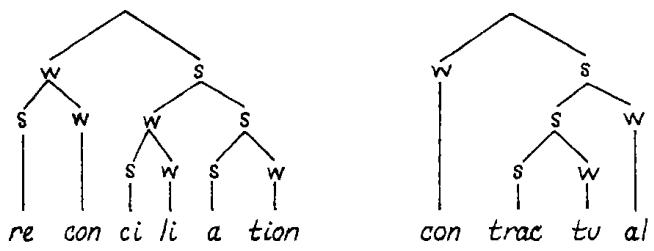
中文讲解
这是图 12.9 的图像占位符,原图数据未嵌入文本。位置位于第14页,紧接图号 12.9 并在 P0118 对其内容的文字解释之前。结合上下文可确认:该图展示的是 reconciliation 与 contractual 两个英语词在 Liberman and Prince(1977)树形标记法下的层级树结构,节点上标注 s(强)或 w(弱),叶子节点对应表层音节。由于实际图像未提供,其具体的分音节方式、强弱分支位置、树的实际形状等细节均「需查看原图」。本占位符在论证链中的作用是为 P0118 提供视觉参照,以便读者把抽象的 s/w 规则对应到具体树形上。
补充说明
图 12.9 的具体树形结构(节点数量、分支方式、强弱位置)需查看原图方可确认,本任务输入未提供图像细节,故不作具体猜测。
第8段(P0118)
原文复述
The purpose of the s and w markings is to express relative degrees of stress. In Chomsky and Halle 1968, as in previous traditions, stress was marked numerically on vowels: [1 stress] was greater than [2 stress], which in turn was greater than [3 stress], and so forth. In addition, all numbered degrees were treated as greater in stress than [unstressed]. To employ this formalism in rules, elaborate conventions had to be developed that had little to do with the linguistic insight they were intended to express. In the tree notation, by contrast, main stress falls on the syllable dominated only by ss in the tree (the designated terminal element), subsidiary stresses fall on syllables immediately dominated by s, and unstressed syllables are all immediately dominated by w. In reconciliation, for instance, the main stress falls on the penultimate syllable, subsidiary stresses fall on re- and -cil-, and the remaining syllables are unstressed; in contractual, only the single syllable -trac- is stressed. Thus the tree notation represents relative stress as explicitly relational; that is, in terms of hierarchical oppositions of ss and ws. For many reasons this is clearly superior to the theory that assigns stress in terms of numerical values; and for once a major change in linguistic theory has not met with vociferous opposition.
中文讲解
本段是本节的核心论证段,解释 s/w 标记的功能并与 SPE 的数值体系进行对比。
第一层意思:s/w 标记表达的是「相对的(relative)」重音程度,而非绝对的数值等级。这与 SPE 1968 的传统做法形成对照——SPE 把重音以数字标记在元音上:[1 stress] 大于 [2 stress],[2 stress] 大于 [3 stress],依此类推,并且所有带数字的重音级都大于 [unstressed]。要使这套数值形式在规则中可用,必须附加一整套繁琐的约定(elaborate conventions),而这些约定与其要表达的「语言学洞见」关系不大。作者借此批评 SPE 数值标记把重音概念非关系化、变成绝对刻度。
第二层意思:在树形标记法中,重音位置由节点标签直接给出,无需额外约定。具体规则三条:① 主重音落在树中只被 ss 支配(dominated only by ss)的那个音节上——这称为「指定终端元素」(designated terminal element);② 次重音落在直接被 s 支配的音节上;③ 非重读音节全部直接被 w 支配。这三条规则把重音层级化、结构化。
第三层意思:通过 reconciliation 与 contractual 两个例子检验上述规则。在 reconciliation 中,主重音落在倒数第二个音节上,re- 与 -cil- 取得次重音,其余音节为非重读音节。在 contractual 中,只有 -trac- 一个音节带重音。
第四层意思(结论):树形标记法把相对重音表示为「显式的关系性(explicitly relational)」——即通过 ss 与 ws 在层级中的对立来表达,而非通过数值大小。因此对许多理由而言,这种做法明显优于按数值大小赋予重音的理论。作者还以略带反讽的口吻加了一句:这一次的重大理论变革总算没有遭到激烈的反对(vociferous opposition),暗示音系学界对新方法的接受相对顺利。
这段在本节中起到「把形式工具与语言学直觉对接」的作用——它不只是描述树形符号,更是论证为何关系性的层级标记优于数值刻度,为后文把同一思路延伸到音乐结构做好铺垫。
补充说明
「designated terminal element(指定终端元素)」是 Liberman and Prince 1977 树形标记中的术语:在树中唯一被两个 s 节点(即 ss)层层支配的叶子音节,就是主重音所在。本段对该术语给出了操作性定义。
例子 reconciliation 中的次重音位置(re- 和 -cil-)与主重音位置(倒数第二个音节),以及 contractual 中只有 -trac- 一个音节带重音的事实,是检验「ss/s/w 三类支配关系与重音等级对应」规则的关键案例。
第9段(P0119)
原文复述
Psychological and Linguistic Connections
中文讲解
「Psychological and Linguistic Connections」,即「心理学与语言学的联系」。这是下一节的小节标题(不是本节正文),用斜体或加粗形式呈现在第14页末尾,提示读者下文将转向讨论语言结构与人类心理加工之间的联系。它结束了 P0111—P0118 关于韵律结构及其树形标记的论述,开启下一论题。
脚注 / 边栏 / 图表 / 附加信息(如有)
本小节包含一个图(图 12.9),位于 P0116 的图号与 P0118 的文字解释之间,原图未嵌入文本。该图的功能是为 Liberman and Prince(1977)的树形标记法提供视觉示例,所用案例为 reconciliation 与 contractual 两个英语词。P0118 的论证大量依赖此图来具体说明 s/w 节点与重音位置的对应关系。本小节没有脚注。
💡 本节核心要点
- 语音链同时受到形态组织与音节组织两种相互独立的支配,二者切分方式不同(如 originality 一例所示),因此音节必须是独立于形态的结构层面。
- 重音规则应当作用于音节结构而非形态结构或简单线性串,这一立场区别于 SPE(Chomsky and Halle 1968)把重音建立在形态边界上的做法。
- 许多语言的等间距重音模式表明音节之上还存在更高层级的韵律单位「音步(foot)」;词的完整韵律组织由音节聚合为音步、再由音步聚合为词而成。
- Liberman and Prince(1977)的树形标记法用节点标签 s(强)与 w(弱)把重音关系编码进结构本身:主重音落在只被 ss 支配的音节上,次重音落在直接被 s 支配的音节上,非重读音节直接被 w 支配。
- 该标记法的核心优势在于把相对重音表示为层级化的关系(ss vs ws),而非 SPE 式的绝对数值刻度,从而避免了为使用数值系统而发展出的大量繁琐但与语言学洞见无关的约定。
- 通过 reconciliation(有派生重音)与 contractual(单一词重音)两个英语词的实例,作者展示了树形标记在不同重音类型上的解释能力。
🔑 关键术语
- syllabic structure(音节结构):指由音节及其内部组织构成的结构层面,独立于形态结构。本节主张重音规则应作用于这一层面,而非简单的线性音系串或形态边界。
- foot(音步):由音节聚合而成的更高层级韵律单位。存在等间距重音的语言表明音节被组织成音步;词的韵律组织由音步聚合而成。
- tree notation(树形标记法):Liberman and Prince 1977 提出的形式工具,用树状结构表达音节聚合为音步、音步聚合为词的过程;每个非末端节点支配一强(s)一弱(w)两支。
- strong (s) / weak (w)(强/弱节点标记):树形标记法中节点上的标签,编码重音的相对关系。主重音落在只被 ss 支配的音节上,次重音落在直接被 s 支配的音节上,非重读音节直接被 w 支配。
- designated terminal element(指定终端元素):树形标记法中的术语,指树中唯一被两个 s 节点(即 ss)层层支配的叶子音节,对应词的主重音所在。
- prosodic organization(韵律组织):本节中指词的完整重音层级结构,由音节 → 音步 → 词的三层聚合关系构成,并通过树形标记法显式表达。
- relative stress(相对重音):通过层级对立(ss vs ws)而非数值大小表达的重音关系,是本节树形标记法的核心表达对象,区别于 SPE 把重音编码为绝对数值刻度的做法。
CH12.S12.3.equiv [描述性拆分] Equivalence of time-span and prosodic tree notations
第1段(P0120)
原文复述
We can now make an initial comparison of time-span reduction and prosodic structure. Abstracting away from the musical and linguistic material at the bottoms of the trees, let us examine the trees themselves. In both sorts of trees, each branch divides into branches that are classified according to a binary opposition. In the time-span-reduction tree, the opposition is head versus elaboration; in the prosodic tree, the opposition is strong versus weak. This similarity leads to the observation that the two tree notations are essentially notational variants. Taking the time-span reduction notion of head as parallel to the prosodic notion of strong, we can establish the equivalence of structures shown in 12.10.
中文讲解
本段宣告本节的中心论点:时距缩减(time-span reduction)树与韵律(prosodic)树在形式上属于"记法变体"(notational variants)。论证分三步推进:第一步,把两类树底部的具体素材(音乐和语言内容)抽掉,只看树形骨架;第二步,指出两者在每一层分叉处都基于一个二元对立来分类——时距缩减树中是 head(中心成分)vs elaboration(延伸成分),韵律树中是 strong(强)vs weak(弱);第三步,因为这两个二元对立彼此平行,所以可以用 head ↔ strong 的对应关系,把一类树的分支结构"翻译"成另一类树,从而在图 12.10 中展示其结构等价。承接上文:作者在 12.9 节分别用两种树分析了 “reconciliation” 与 “contractual”,本节开始进入对两种记法本身的形式比较。
补充说明
脚注 5(在本段末尾出现)应被理解为对"两种记法本质上是记法变体"这一观察的来源或限定说明;本段输入未给出脚注 5 的具体文字,故不在此处展开。
第2段(P0121)
原文复述
12.10
中文讲解
这是图 12.10 的编号标签,本身只是一行图序标识。原文段落中紧随其后的是该图的占位符,故此编号承担"指代即将出现的图示"的功能。
补充说明
图 12.10 用来呈现本节所说的"结构等价"示例;由于正文段没有列出该图内部细节,节点配置需查看原图。
第3段(P0122)
原文复述
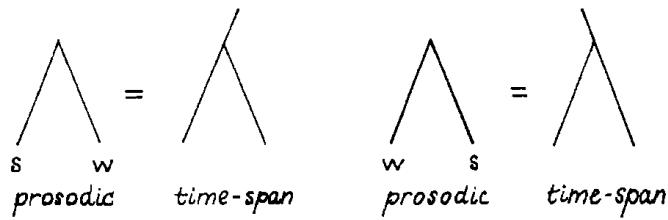
中文讲解
这是图 12.10 在第 15 页的占位符。版面位置紧接 P0121 的图序 “12.10”,故可确认它就是图 12.10 本身;图内的具体分支图样不在本任务输入可见信息中,需查阅原书。
第4段(P0123)
原文复述
With this equivalence, we can convert a prosodic tree into time-span reduction notation by systematically substituting time-span configurations for the corresponding prosodic ones at each node in the tree; that is, a right branching for an s-w configuration and a left branching for a w-s. Alternatively, we can convert time-span reductions into prosodic notation by reversing the process. Figure 12.11 is the time-span notation corresponding to the analyses of reconciliation and contractual given in 12.9. It can readily be seen that Liberman and Prince’s notion of designated terminal element (that unit dominated only by ss in a tree) translates into time-span notation as the head (that unit from which all others branch). Hence the primary stress in 12.11 is indicated by the longest branch in the tree.
中文讲解
本段把上一段宣告的"等价"落实到可操作的转换规则与术语对应上。转换规则:把韵律树改写成时距缩减树时,逐节点用时距配置替代韵律配置——具体地说,韵律树中 s-w(强-弱)配置换成"右分叉"(right branching),w-s(弱-强)配置换成"左分叉"(left branching);逆向亦然。图 12.11 即是把 12.9 节对 “reconciliation” 与 “contractual” 的韵律分析改写为时距缩减记法得到的版本。这一改写之所以可能,关键在术语对译:Liberman 与 Prince 的"指定末端成分"(designated terminal element,指树中只被 ss 支配的单元)在时距缩减记法中正好对应"head"(所有其他成分都从其分叉出去的单元)。因此在图 12.11 中,最长分支所在的单元即 primary stress(首要重音)。论证作用:本段是把"记法等价"从形貌类比升级为节点级转换规则,并用具体词汇例证明二者一一对应。
补充说明
本段中 “s-w configuration” 与 “w-s configuration”、“right branching” 与 “left branching” 的对应关系,是本节给出的唯一具体转换约定;“reconciliation” 与 “contractual” 在本任务输入中只作为 12.9 节已有分析例的两个词形出现,未给出进一步语义。
第5段(P0124)
原文复述
Chapter 12
中文讲解
这是第 12 章的页眉文字,出现在第 15 页版面顶部,仅起版面标识作用,提示读者当前所在章节。
第6段(P0125)
原文复述
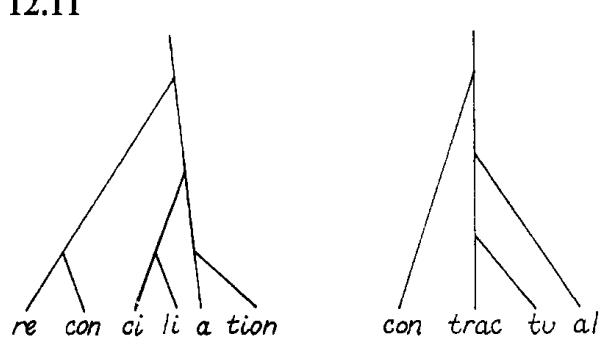
中文讲解
这是第 16 页上的图像/乐谱占位符。按本节论证流程推断,它对应的是图 12.11(“reconciliation” 与 “contractual” 的时距缩减记法示例),但本任务输入未给出图内分支细节,需查阅原图。
第7段(P0126)
原文复述
It is at least an interesting coincidence that two theories, developed independently to deal with totally dissimilar phenomena, should have arrived at equivalent notations to express their analyses. To establish a preliminary sense of the strength of the equivalence, it is useful to compare time-span and prosodic trees with syntactic trees. Both the time-span and prosodic trees represent a hierarchy of binary oppositions: head versus elaboration and strong versus weak. By contrast, syntactic trees represent a hierarchy of abstract syntactic categories, such as sentence, noun phrase, and verb phrase. Thus the form of time-span and prosodic trees is not an inevitable consequence of strict hierarchical structure alone, since there are other imaginable hierarchical organizations that lead to different types of tree structures.
中文讲解
本段对"等价"是否只是巧合做初步辨明,方法是引入第三类树——句法树(syntactic tree)——作为对照。论证逻辑:① 时距缩减树与韵律树都是"二元对立层次结构",前者的对立是 head/elaboration,后者是 strong/weak;② 句法树同样有层次性,但其内部节点代表"抽象句法范畴"(如 sentence、noun phrase、verb phrase 等),并不靠单一的二元对立来分类;③ 因此,仅"严格的层次结构"本身并不必然导致"二元对立分支"这种树形——存在其他可能的层次组织会引出不同类型的树结构。由此可以初步判断:时距缩减树与韵律树的二元分支形式不是层次性的平凡推论,从而为下一步深入比较两种理论的"规则系统"提供动机。承接上段:本段呼应 P0120 的"记法变体"声明,把它从形式巧合提升到需要进一步检验的实质性问题。
补充说明
本段输入中未提供 “abstract syntactic categories” 的具体清单,“sentence、noun phrase、verb phrase” 仅作为示例出现于原文;不要据此推测其他句法范畴。
第8段(P0127)
原文复述
Does the equivalence of the two notations mean that there is a similarity between the intuitions the two theories address? As a step toward answering this question, we will compare the rule systems that determine time-span reductions and prosodic trees, and show that they share important formal properties and even some substantive properties. By demonstrating this more extensive parallelism, we will have shown that the equivalence of notations is more than a coincidence.
中文讲解
本段是本节的小结,并把问题推向下一节。它把前面 P0120–P0126 完成的"形式等价"提升为一个更深的问题:两种记法的等价是否意味着两种理论所指向的直觉也相似?作者给出的回答路径是:比较决定时距缩减与韵律树的"规则系统",并证明两者既共享重要形式属性,也共享一些实质属性。只有展示了这种"更广泛的平行性",才能下结论说"记法等价不只是巧合"。论证作用:作为本节收尾,明确本节完成的只是"记法等价"的初步建立,下一节将进入规则层面的实质比较。
脚注 / 边栏 / 图表 / 附加信息(如有)
本节包含两个图(图 12.10 与图 12.11)以及一个未给出具体文字的脚注 5:图 12.10 用于呈现时距缩减树与韵律树的结构等价;图 12.11 是 12.9 节对 “reconciliation” 与 “contractual” 分析的时距缩减改写版本,并在本任务输入中分别由 P0122 与 P0125 的图像占位符指代;脚注 5 出现在 P0120 末尾,作用指向"两种记法本质上是记法变体"这一观察,但具体内容本任务输入未提供。
💡 本节核心要点
- 时距缩减树(head vs elaboration)与韵律树(strong vs weak)都是基于二元对立的层次分支结构。
- 两类树在节点配置层面可以互译:s-w ↔ 右分叉,w-s ↔ 左分叉;因此它们是"记法变体"。
- Liberman 与 Prince 的 “designated terminal element”(只被 ss 支配的单元)对应时距缩减中的 head,并由图中最长分支表示 primary stress。
- 把两类树与句法树对比可知:单纯的层次性并不必然导致二元对立分支结构,因此二者形式的相似并非层次性本身的平凡推论。
- 本节只建立了"形式等价";作者预告下一步将比较两种理论的规则系统,以检验其形式乃至实质属性是否平行,从而判定这种等价是否只是巧合。
🔑 关键术语
- time-span reduction (时距缩减):本节中指基于 head(中心成分)vs elaboration(延伸成分)这一二元对立的树形记法;head 对应韵律记法中的 strong,是所有其他成分由之分叉出去的单元。
- prosodic tree (韵律树):本节中指基于 strong(强)vs weak(弱)这一二元对立的树形记法;其 s-w / w-s 节点配置分别对应时距缩减记法的右分叉 / 左分叉。
- head vs elaboration (中心成分 vs 延伸成分):本节中时距缩减树每一分叉处的二元对立:head 是延伸出其他成分的"出发单元",elaboration 是从 head 分叉出去的成分。
- strong vs weak (强 vs 弱):本节中韵律树每一分叉处的二元对立;与时距缩减的 head/elaboration 平行,共同构成两类树互译的基础。
- s-w configuration / w-s configuration (强-弱 / 弱-强 配置):本节给出的节点级转换约定:韵律树中 s-w 换成时距缩减的右分叉,w-s 换成左分叉;逆向亦然。
- designated terminal element (指定末端成分):本节借自 Liberman 与 Prince 的术语,指韵律树中只被 ss 支配的末端单元;在时距缩减记法中对应 head,并由最长分支所在节点表示 primary stress。
- binary opposition (二元对立):本节中指每一分叉处只按两类标签分类(head/elaboration 或 strong/weak);作者用之与句法树按抽象范畴分类形成对比。
- syntactic tree (句法树):本节作为对照引入:节点代表 sentence、noun phrase、verb phrase 等抽象句法范畴,不依赖单一的二元对立分类,由此说明层次结构本身不必然导致二元分支树形。
CH12.S12.3.seg [描述性拆分] Prosodic segmentation rules and the layered hierarchy
第1段(P0128)
原文复述
A second-level section heading reading “Prosodic Segmentation Rules”, which marks the opening of the present subsection and signals that the discussion is turning to the rules by which prosodic (phonological) structure is segmented into categories.
中文讲解
这是本小节的二级子标题(## 级),文字为 ‘Prosodic Segmentation Rules’,直译为’音律切分规则’。它标志着第 12 章内部主题从前面已经建立的时间跨距缩减语法转入对语言学一侧音律层级的对照分析。从结构功能看,该标题同时承担两个任务:一是预告接下来要介绍 Selkirk(1978, 1980)层级音系学中的切分规则,二是与下文即将出现的 ‘Psychological and Linguistic Connections’ 这一重复主题块标题配合,构成’音乐侧 ↔ 语言侧’的并列框架。
第2段(P0129)
原文复述
We begin by summarizing the grammar of time-span reduction developed in chapters 6 and 7. There are three subcomponents. First, the segmentation rules (section 7.1) produce an exhaustive hierarchical segmentation of the musical surface into time-spans. The time-spans form what might be called a layered hierarchy. At the most local levels are the time-spans we have called subgroups, those determined by metrical structure alone and by metrical structure interacting with grouping. Next, there are one or more levels of uncadenced groups; and at the largest levels the time-spans are all cadenced groups. These layers are fixed in order from smallest level to largest and cannot mix; for example, there cannot be a level of subgroups intervening between two levels of groups. This layering, though not stressed as such in chapters 6 and 7, is important for the comparison with prosodic structure.
中文讲解
这段是整个小节的’地基回顾’,把第 6、7 章已经建立的时间跨距缩减语法提炼为三组件:(1) 切分规则(section 7.1)把音乐表层穷尽地切分成不同尺度的 time-span;(2) 良构性规则(well-formedness rules,section 7.2)决定哪些 time-span 缩减树在形式上可能;(3) 偏好规则(preference rules,sections 7.3-7.4)进一步选出每个 time-span 的实际头(head)。
作者特别强调一个在前两章里没有被作为重点、却对接下来与音律结构做严格对照至关重要的特性:time-span 形成’分层层级’(layered hierarchy)。最底层是 subgroup,由节拍结构单独决定或与分组结构共同决定;中间可能有一层或多层非收束组(uncadenced group);最上层全是收束组(cadenced group)。这些层级的顺序由小到大固定,不能混序——例如不允许出现 subgroup 层夹在两个 group 层之间。
为什么这一点对全节这么关键?因为作者随后要平行介绍 Selkirk 的层级音系学;只有先把音乐侧的’分层’特性讲清楚,才能让读者明白两条平行线在什么形式维度上严格同构,而不是仅仅停留在’都是层级’的松散类比上。
补充说明
该段明确指出’分层’在前两章中’未被作为重点强调’(’though not stressed as such’),这是对全小节论证定位的直接说明。
第3段(P0130)
原文复述
A running heading / second-level heading reading “Psychological and Linguistic Connections”.
中文讲解
这是第 12 章下’Psychological and Linguistic Connections’这一主题块的标题(也是该主题块在版面上重复出现的页眉之一)。它向读者宣告:接下来的讨论属于把音乐结构与心理/语言学现象做对照这条支线。在本节输入范围内,该标题至少出现两次(P0130 与 P0143),因此本段讲解宜保持简短,重点说明其版面对位功能。
补充说明
‘Psychological and Linguistic Connections’ 在本小节内出现两次,均为版面对位性标题。
第4段(P0131)
原文复述
The well-formedness rules (section 7.2) make up the second subcomponent of the grammar of time-span reduction. They determine a set of possible time-span reduction trees, such that every time-span has a head selected out of the heads of the time-spans it immediately contains. Third, the choice of head for each time-span is determined by the preference rules (sections 7.3 and 7.4), which are sensitive to metrical, harmonic, voice-leading, and cadential properties of the events in the time-span.
中文讲解
这段紧接 P0129,把后两个组件讲完。‘头’(head)的概念贯穿整段:well-formedness 规则保证’每个 time-span 的头必须从它直接包含的那些 time-span 的头中选出’——这是对缩减树结构的递归性约束,确保头沿着树逐层向上传递;而 preference rules 则更进一步,决定在这些合法候选中究竟哪一个胜出,依赖节拍、和声、旋律连接与收束这四类性质。
换言之,三组件可以分成两层:(a) 骨架——segmentation 与 well-formedness 合起来给出所有合法的缩减树;(b) 血肉——preference rules 在这些合法树中挑出唯一优选树。作者如此排序三组件,是为了让读者在进入语言学一侧时心里已经清楚’切分 / 良构性 / 偏好’这三个功能位置,方便逐一对应到 Selkirk 框架里的’切分规则 / 树结构规则 / 突出度规则’。
第5段(P0132)
原文复述
The version of hierarchical phonology most similar to the grammar of time-span reduction is that developed by Selkirk (1978, 1980). More than other approaches, Selkirk’s makes clear the distinction between rules of segmentation, rules that build tree structures on the basis of the segmentation, and rules that determine relative prominence of sister branches in the trees (though these distinctions are implicit in all the other approaches). To bring out the parallelism with music, we will present a version of Selkirk’s theory, slightly modified from her presentation but preserving its essential insights.
中文讲解
作者做出方法论抉择:在所有层级音系学方案中,最贴近时间跨距缩减语法的是 Selkirk(1978, 1980)的版本。为什么是 Selkirk?关键在于她把三类规则严格区分开:(1) 切分规则——把音韵串切成音节/音步/词等层级;(2) 树结构规则——在这些切分之上构造层级树;(3) 突出度(prominence)规则——决定同一层姊妹节点中谁更突出,即’头’的选择。作者承认’这些区分在其他方案里其实也隐含存在’,但 Selkirk 第一个把它们显式地说出。
该段同时告知读者一个重要的方法论标注:下文要展示的 Selkirk 理论是’略作改动后的版本’(slightly modified),但保留其核心洞见。这意味着读者看到的并非原始 Selkirk,而是为音乐—语言平行对照量身定做的版本——这是一个直接的、有据可查的方法论披露。
补充说明
该段直接给出 Selkirk 的发表年份 1978 与 1980,以及作者明确声明该理论将’略作改动但保留核心洞见’,均可由原文定位。
第6段(P0133)
原文复述
Although the pioneering study by Liberman and Prince (1977) makes use of the notions of syllable and foot, their formal role in the theory is left somewhat unclear. Selkirk, however, argues that syllables and feet must be explicitly marked as prosodic categories, and that these categories play a role in the formal statement of various phonological processes. In addition, Selkirk argues for the existence of other, larger, prosodic categories of word, phonological phrase, intonational phrase, and utterance. The result is a segmentation of the phonological string into a complex hierarchy that corresponds only in part to syntactic structure. For example, 12.12 is the segmentation of the sentence In Pakistan, Tuesday is a holiday. The levels to the left identify the prosodic categories.
中文讲解
作者对 Liberman & Prince (1977) 与 Selkirk 做对比:前者率先使用’音节’与’音步’,但它们在形式理论里的角色比较模糊;Selkirk 的推进在于明确主张’音节’与’音步’必须被显式标记为音律范畴(prosodic category),并在形式规则中直接发挥作用。
更重要的是 Selkirk 把这套层级向外扩展:除音节与音步外,还存在’词(word)—音律短语(phonological phrase)—语调短语(intonational phrase)—话语(utterance)‘四个更大的音律范畴。因此一个音韵串被切分成的层级既复杂、又只能部分对应句法结构——这是后文会持续回响的核心张力。例子 12.12 用’In Pakistan, Tuesday is a holiday’这一含前置短语、复合专名与插入语的句子,把跨词音节切分与复合名词层级一次性展示出来,左侧标注每一层的范畴名。
补充说明
Liberman & Prince (1977) 与 Selkirk (1978, 1980) 三处文献均为该段直接引用。
第7段(P0134)
原文复述
An example number heading reading “## 12.12”, introducing the example that follows.
中文讲解
这是图表编号 12.12 的标题,紧随其后的占位图(见 P0135)展示’In Pakistan, Tuesday is a holiday’按音节—音步—词—音律短语—语调短语—话语等层级切分后的树状或括号结构。
第8段(P0135)
原文复述
An image/notation placeholder on page 17: an in-text graphic whose embedded data has been omitted, but whose position and caption are retained.
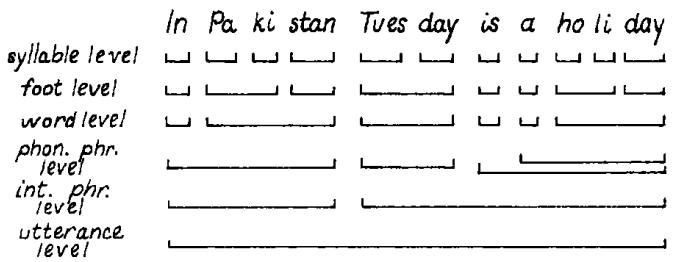
中文讲解
这是图 12.12 的占位图,标注位于第 17 页,原应展示上述句子的完整音律层级树状/括号结构,并在左侧标注各级范畴名。原图的内嵌数据已省略,需查看原书第 17 页图 12.12 才能确认层级的具体形状与标注细节;本段不承载新的论证,仅承担版面对位与对图的引导。
补充说明
原文标注’内嵌图像数据已省略;位置与图注保留’,因此本段只承担版面功能,不可推测图内具体形状或具体词例切分结果。
第9段(P0136)
原文复述
An important way in which this structure is unlike syntactic structure and like time-span segmentation is that, whereas in syntactic structure a category may recur inside one of its constituents (for instance, NP inside PP inside NP), this is impossible in the phonological segmentation.
中文讲解
这一句是本节最关键的形式断言之一。作者点出句法结构与音律结构的一个本质差异:句法允许递归同类(NP 套 PP 套 NP),但音律切分禁止这种递归——同一范畴不能出现在比自己更高一级的同类范畴之内。
这一性质使音律结构与时间跨距结构同属’分层层级’——P0138 进一步把它形式化为’词可以包含音步但不能反过来’。换言之,作者并不是简单地说两者’都是树’,而是强调两者共享一个更精细的形式约束:无递归同层。这是从结构形式层面对二者做严格平行的关键一步,而非松散的隐喻。
补充说明
‘NP inside PP inside NP’ 是该段直接给出的句法递归例证,可由原文定位。
第10段(P0137)
原文复述
A page header reading “Chapter 12”, identifying the current chapter for the reader.
中文讲解
这是第 17 页(或同页版面区域)的页眉’Chapter 12’,用于版面对位,不承载新的论证内容。
第11段(P0138)
原文复述
Words, for example, may contain feet but may not be contained in them. Thus phonological segmentation is a hierarchy that is “layered” in the same sense as time-span segmentation.
中文讲解
P0136 的’无递归’原则在这里被具体化为一个方向性规则:词可以包含音步,但音步不能包含词。换言之,层级方向是单向的、自下而上的,每一层只能容纳比自己更小的单元。这一性质正是作者借’分层层级’(layered)这个词所刻画的——同样的性质也适用于时间跨距层级(subgroup 不能跨越一个 group 而存在,详见 P0129)。
因此’分层’在作者笔下并非松散比喻,而是有明确形式定义:(a) 各层范畴类型不同;(b) 同类不能嵌套同类;(c) 各层顺序固定。这与第 6、7 章把 time-span 层级描述为’小到大、不可混序’完全同构。
补充说明
‘分层’(layered)一词在 P0129 与 P0138 中同时出现,含义一致:层级间不可混序、不可递归同类的特性。
第12段(P0139)
原文复述
As in the case of the time-span categories subgroup and group, each of the phonological categories has a different principle of segmentation. The principle for segmentation into syllables is approximately as follows: Each language has a characteristic class of syllable onsets. For example, in English, syllables (hence words) can begin either with no consonant, with any single consonant, or with a variety of clusters such as st, tr, spl, etc. but not including zd, pk, etc. The basic principle in forming the syllabic segmentation is to maximize the length of syllable onsets, in conformance with the principles of basic syllable composition of the language. So, for example, in Pakistan, a syllable boundary is placed before st, since it is an allowable syllable onset. However, in Tuesday, the medial cluster sd (phonetically zd) is not a possible syllable onset of English, so the boundary is set between the two consonants. $^{6}$ Syllable boundaries are of course set between words as well.
中文讲解
这是小节内第一个具体音律规则——音节切分原则。作者用’一般原则 + 反例对’的方式呈现:
(a) 一般原则:每种语言有一个特征性的’可作音节起首的辅音集’(onset set),切分时尽量使音节起首最大化。 (b) 英语特征:可作起首的包括无辅音、单个辅音或 st/tr/spl 等复辅音丛;排除 zd/pk 等不合法起首。 (c) 实例 1:在 ‘Pakistan’ 中,st 是合法起首,故音节界划在 st 之前,使之成为 Pak-i-stan 三个音节。 (d) 实例 2:在 ‘Tuesday’ 中,中部的 sd(实际读音 [zd])不是合法英语起首,故音节界划在 s 与 d 之间,使其成为 Tues-day。
这两个对比例的功能是把抽象规则落到具体可验证的语音事实上;它们尤其证明’最大化起首长度’并非任意,而是要受合法 onset 集合的约束——否则会得出不合英语的切分。结尾的脚注 6 是文末标出的脚注引用。
补充说明
脚注 6 在该段末尾被引用,但本节输入范围内未提供脚注 6 的正文内容,故仅标注其存在。
第13段(P0140)
原文复述
The principles for segmentation into feet vary among languages. Selkirk argues that French essentially has primarily monosyllabic feet. Vergnaud and Halle (1979), examining the literature on a wide variety of languages, find three other sorts of foot-formation rules: those establishing bisyllabic feet, those establishing trisyllabic feet, and those establishing feet of unlimited length (bounded by word boundaries or syllables of a specified type). English appears to have monosyllabic, bisyllabic, and trisyllabic feet, depending on the content of the syllables gathered up into a foot. The relevant factors are the tenseness of the syllable’s vowel and the nature of the consonants, if any, at the end of the syllable. So far as is known, syllable types are not distinguished for prosodic purposes in any language by the nature of their initial consonant(s).
中文讲解
音步切分原则因语言而异,作者把跨语言的差异类型化:
- 法语:基本上是单音节音步;
- Vergnaud & Halle (1979) 在跨语言调查中归纳出其他三类规则:双音节音步、三音节音步、长度不限的音步(以词界或某种指定类型的音节为界);
- 英语则混合使用以上三类,取决于音步内音节的内容。决定因素是音节元音的’松紧’(tenseness)与韵尾辅音的性质;作者同时强调一个反向事实:就现有知识而言,没有任何语言在音律目的上以’起首辅音的性质’区分音节类型。
这一段的功能是把音步切分的多样性介绍清楚——它不像音节切分那样有一个’最大化 onset’的通用原则,而是因语言而异的、参数化的规则集。这与音乐里 subgroup 形成的多样性(节拍单独决定、或节拍与分组共同决定,详见 P0129)在’不同范畴使用不同切分原则’这一形式特征上形成对应。
补充说明
Vergnaud and Halle (1979) 是该段直接引用的文献;作者明确否认’起首辅音性质’作为音律区分手段在已知语言中存在的观点。
第14段(P0141)
原文复述
Some examples are given in 12.13. Example 12.13a is a monosyllabic foot; 12.13b is a bisyllabic foot; 12.13c is a trisyllabic foot, which, like all trisyllabic feet in English, begins with a bisyllabic foot; 12.13d, by contrast with 12.13b, is a bisyllabic word consisting of two monosyllabic feet—the difference between this and 12.13b accounts for the fact that its second syllable bears secondary stress and that of 12.13b does not.
中文讲解
这段对应图 12.13 的四个例子,并以它们做英语音步多样性的展示:
- 12.13a:单音节音步;
- 12.13b:双音节音步;
- 12.13c:三音节音步,且如所有英语三音节音步一样,其内部以一个双音节音步作为左子结构;
- 12.13d:与 12.13b 形式上都是两个音节组成的词,但 12.13d 的内部结构是’两个单音节音步’,而非’一个双音节音步’。
作者特别用 12.13b 与 12.13d 的对比来说明一个现象:同样是两个音节组成的词,因为音步切分不同,导致次重音的分布不同(12.13d 的第二个音节带次重音,而 12.13b 则不带)。这一对比是论证’音步结构不同 → 重音分布不同’的最小反例对,把抽象规则落实到一个可观察的语音后果上。
补充说明
图 12.13 的具体词例未在文本中给出,只描述了四种音步类型的结构差异与重音结果。
第15段(P0142)
原文复述
An example number heading reading “## 12.13”, introducing the example that follows.
中文讲解
这是图表编号 12.13 的标题,对应 P0141 中已经描述过的四组英语音步结构例(12.13a–d)。
第16段(P0143)
原文复述
A page header / section heading reading “Psychological and Linguistic Connections”, marking the continuing thematic block.
中文讲解
这是页眉或子标题’Psychological and Linguistic Connections’的再次出现,与 P0130 重复,提示当前讨论仍属’心理与语言学联系’这一主题块。本节范围内该标题出现两次。
补充说明
‘Psychological and Linguistic Connections’ 在本节输入范围内出现两次(P0130 与 P0143),均为版面对位性提示。
第17段(P0144)
原文复述
For our present comparison, an interesting aspect of English foot formation is the behavior of unstressed syllables at the beginning of a word. In one proposed treatment of them, the structure of words like attire, vanilla, and America is as in 12.14 (though the mechanism for deriving this structure has been open to dispute—see Selkirk 1980).
中文讲解
作者挑出英语音步形成中的一个特殊现象——词首的非重读音节——作为与音乐侧的对照点。处理 attire(ə-tire)、vanilla(va-nil-la)、America(ə-mer-i-ca)这类词时,一种方案认为它们的结构见图 12.14。作者谨慎地标注:该结构本身被广泛接受,但生成它的形式机制仍有争议(参见 Selkirk 1980)。
这段的功能是为 P0146 的关键平行论证做铺垫:词首非重读音节的处理方式(不是简单地’加在词的开头’,而是’嫁接到下一层’)将在结构上与音乐里的 upbeats 形成对照。
补充说明
‘see Selkirk 1980’ 是该段直接给出的文献指引,作者承认’机制存在争议但结构本身被广泛接受’。
第18段(P0145)
原文复述
An example number heading reading “## 12.14”, introducing the example that follows.
中文讲解
这是图表编号 12.14 的标题,对应 P0144 中提及的 attire/vanilla/America 三词的结构例。
第19段(P0146)
原文复述
In 12.14 we find an unstressed initial syllable preceding a monosyllabic, a bisyllabic, and a trisyllabic foot. The initial syllable is not simply an odd syllable added at the beginning of the word, but is adjoined to the rest as the beginning of an extra foot level. For us this solution is particularly significant because of its parallel with the treatment of upbeats in time-span segmentation (see examples 6.4 and 6.5 and section 7.1). In each case a weak segment separated by a major boundary (a group boundary in music, a word boundary in language) from the preceding strong segment is instead adjoined to the following segment. Hence, beyond the formal parallel of a layered hierarchy in both grammars, the segmentation rules display an interesting substantive parallel. $^{7}$
中文讲解
这是本节最核心的论证段落。作者指出图 12.14 中:(a) 词首的非重读音节分别出现在一个单音节音步、双音节音步、三音节音步之前;(b) 该非重读音节并非’作为离群点被加在词的开头’,而是被嫁接(adjoined)到词的后续部分,形成一个额外的音步层的起点。
作者点出这一处理对他们的核心意义:它与时间跨距切分中 upbeats 的处理完全平行(参见 examples 6.4、6.5 与 section 7.1)。两边都遵循同一条’局部嫁接’原则——一个与前文强片段被一个重大边界(音乐中是 group boundary,语言中是 word boundary)隔开的弱片段,不再独立成层,而是被嫁接到后面的强片段上。
因此结论是:在’分层层级’这一形式平行之外,两套语法的切分规则还展示出’实质平行’(substantive parallel)。脚注 7 标记了这种平行论证的关键地位。
补充说明
脚注 7 在该段末尾被引用,但本节输入范围内未提供脚注 7 的正文内容,仅可标注其存在。
第20段(P0147)
原文复述
At the next layer of the hierarchy the segmentation into words is obvious. We only have to note that compounds such as blackboard and labor union have two word levels, as shown in 12.15.
中文讲解
进入下一层——词的切分。作者用’obvious’(显然)一词承认这是最直观的一层,但同时点出一个微妙之处:复合词(如 blackboard、labor union)具有两个’词层’——既被作为一个整体词切分,又在内部承认两个子词。这同样满足分层层级规则(‘词包含词’的递归依旧被禁止,但复合词的’双词层’是两个不同范畴层级在同一位置上的并存体现)。
第21段(P0148)
原文复述
An example number heading reading “## 12.15”, introducing the example that follows.
中文讲解
这是图表编号 12.15 的标题,对应 P0147 提到的 blackboard、labor union 等复合词的双词层结构。
第22段(P0149)
原文复述
However, it remains to be shown how the feet of a multifoot word are structured. Selkirk, following Liberman and Prince, gathers the two rightmost feet into a segment, then gathers that with the next to the left, and so on until the left-hand boundary of the word is reached. For example, reconciliation, with three feet, receives the structure shown in 12.16. (Selkirk’s notation does not accord the segment -ciliation the label “foot,” but there appears to be no harm in it.)
中文讲解
这段处理多音步词的结构问题。Selkirk 沿用 Liberman 和 Prince 的方案:先把最右侧的两个音步合并为一个节段(segment),再把这一节段与其左侧的下一个音步合并,如此向左反复直至抵达词的左边界。
以 reconciliation(包含三个音步)为例,其结构如图 12.16 所示。最后一个括号注明:Selkirk 的原始记法并未把 -ciliation 这一片段标记为’音步’,但这种简化似乎并无大碍。
作者这样收尾,把读者的注意力从’音步如何切分’引向’音步之上的层级树如何搭建’,完成与音乐侧’时间跨距树如何搭建’的对照铺垫,为接下来讨论良构性规则与偏好规则在语言学侧的对应物做好结构上的准备。
补充说明
图 12.16 的具体节点结构未在文本中给出,仅描述其由右向左逐步合并的构造方式与 reconciliation 的三音步实例。
脚注 / 边栏 / 图表 / 附加信息(如有)
本小节范围内涉及的附加材料有:(1) 图表 12.12——句子 ‘In Pakistan, Tuesday is a holiday’ 的音律层级切分(P0134/P0135,P0133 引用);(2) 图 12.13——英语四种音步结构例(P0142,P0141 描述);(3) 图 12.14——词首非重读音节嫁接结构(P0145,P0144/P0146 描述);(4) 图 12.15——复合词的双词层结构(P0148,P0147 描述);(5) 图 12.16——多音步词 reconciliation 的层级结构(P0149 描述);(6) 脚注 6——标于 P0139 末尾,本节输入未提供正文;(7) 脚注 7——标于 P0146 末尾,本节输入未提供正文;(8) 跨章/跨节引用——sections 6.4、6.5、7.1、7.2、7.3、7.4;(9) 直接引用的文献——Selkirk 1978、Selkirk 1980、Liberman and Prince 1977、Vergnaud and Halle 1979。这些材料承担论据、对比与定位功能,但其具体内容(特别是图示细节与脚注正文)需查阅原书方可确认。
💡 本节核心要点
- 时间跨距缩减语法包含三个子组件:切分规则(section 7.1)、良构性规则(section 7.2)、偏好规则(sections 7.3、7.4),分别对应’切分—树结构—突出度’三类功能位置。
- 时间跨距形成’分层层级’:subgroup、uncadenced group、cadenced group 由小到大固定排序,层间不可混序、不可递归同类——这是与音律层级做严格平行的关键形式特征。
- 音律层级对照选用 Selkirk (1978, 1980) 的层级音系学版本,因为它最显式地区分’切分规则 / 树结构规则 / 突出度规则’三类;本节展示的 Selkirk 理论是该版本的略作修改版。
- 音律结构与句法结构的关键差异在于’分层性’:同类不能嵌套同类(词可以包含音步但不能反过来),这一形式约束与时间跨距层级严格同构。
- 各音律层级(音节、音步、词、短语等)拥有各自独立的切分原则:音节切分以’最大化 onset 长度’为基础(受合法 onset 集约束),音步切分因语言而异——英语混合单/双/三音节音步,法语基本为单音节。
- 词首非重读音节在图 12.14 中的’嫁接到下一层’处理,与音乐中 upbeats 的处理在结构上平行:被重大边界分隔的弱片段不再是独立层,而是被嫁接到后随的强片段——这是两套语法在分层层级之外的’实质平行’。
🔑 关键术语
- Time-span reduction grammar / 时间跨距缩减语法:第 6、7 章建立的音乐结构分析框架,由三组件构成:切分规则、良构性规则、偏好规则。其作用是把音乐表层切分成层级化的 time-span 并选出每个 time-span 的头。
- Layered hierarchy / 分层层级:本节核心形式概念,指层级间不可混序、不可递归同类的层级结构。在音乐侧表现为 subgroup/uncadenced group/cadenced group 的固定排序,在音律侧表现为音节/音步/词/短语等范畴间严格的单向包含关系。
- Subgroup / 次级组:音乐时间跨距的最底层,由节拍结构单独决定或由节拍结构与分组结构共同决定。
- Cadenced group / Uncadenced group / 收束组与非收束组:音乐时间跨距的中间层(一个或多个非收束组)与最上层(全部为收束组);二者按尺度固定排序,不可与 subgroup 混层。
- Well-formedness rules / 良构性规则:时间跨距缩减语法的第二组件,决定哪些缩减树在形式上合法——保证每个 time-span 的头从其直接包含的 time-span 的头中选出。
- Preference rules / 偏好规则:时间跨距缩减语法的第三组件,在合法树中选出唯一的优选头;其判据依赖节拍、和声、旋律连接与收束四类性质。
- Head / 头:在每个 time-span(或音律范畴)中被选出的最突出节点;well-formedness 规则保证头沿树递归传递,preference rules 决定头的最终人选。
- Hierarchical phonology / 层级音系学:把音韵串显式切分为多层音律范畴(音节—音步—词—音律短语—语调短语—话语)的音系学方案;本节采用 Selkirk (1978, 1980) 的版本作为与音乐侧的对照目标。
- Prosodic category / 音律范畴:层级音系学中显式标记的层级类型,包括音节、音步、词、音律短语、语调短语、话语等;其层级关系满足’分层’约束。
- Syllable onset / 音节起首:音节开头的辅音(或零辅音);英语允许的起首集包括无辅音、单个辅音或 st/tr/spl 等复辅音丛,但排除 zd/pk 等;切分时尽量最大化起首长度是该原则的实质。
- Foot formation / 音步形成:把音节归并为音步的规则集,因语言而异:法语基本为单音节音步,英语混合单/双/三音节音步;判定因素为元音松紧与韵尾辅音性质,而非起首辅音性质。
- Compound word / 复合词:如 blackboard、labor union 这类由两个子词组合而成的词;其在层级音系学中具有两个’词层’,是分层层级在词层上的具体体现。
- Upbeat / 上拍(弱起):音乐时间跨距中与前文强片段被 group boundary 隔开的弱片段;按本节论证,它被嫁接到后面的强片段而非独立成层——这与词首非重读音节的处理结构上平行。
- Adjunction / 嫁接:本节核心结构操作:把一个弱片段不是作为独立层、而是作为下一层的起点附加上去;该操作在音乐(upbeats)与语言(词首非重读音节)两侧结构上平行。
CH12.S12.3.feet [描述性拆分] Foot formation, gathering directions, and large prosodic levels
第1段(P0150)
原文复述
Chapter 12
中文讲解
本段仅为章节标题。第 12 章的章号标识,不包含正文信息;它提示本小节属于第 12 章范围内的最后论述片段。
第2段(P0151)
原文复述
12.16
中文讲解
本段为小节编号,标示本节为第 12 章的第 16 节,是章节内分节的位置标记,本身不承载论证内容。
第3段(P0152)
原文复述
reconciliation
中文讲解
本段为小节标题,原文写作 “reconciliation”(调和、汇合)。该标题提示本节主旨是把语音节律结构(prosodic structure)与前面讨论的时值缩减(time-span reduction)两条线索予以并置对照,使两者在“层级化分割”这一共同原则上得到统一。
补充说明
本节标题与上下文中的音乐节律层级(subgroups、groups)和语言节律层级(syllables、feet、words)的并列直接对应。
第4段(P0153)
原文复述
syllable level
中文讲解
本段为节内的小标题,标示本章此前已论述的"音节层级"。它本身是分项条目,用以提示读者:在节律结构的层级体系中,音节是最底层、最基本的一层。
第5段(P0154)
原文复述
foot level
中文讲解
本段为节内的小标题,标示"音步层级"。音步层级处于音节之上、词之下,是节律结构中讨论最充分的中层单位,也是本节正文重点论述的对象。
第6段(P0155)
原文复述
word level
中文讲解
本段为节内的小标题,标示"词层级"。它提示节律结构中位于音步之上的层级是词层级,至此完成对"syllable—foot—word"三个语言节律层级的列举,为后续把它们与音乐中的 subgroups、uncadenced groups、cadenced groups 进行类比铺平道路。
第7段(P0156)
原文复述
Looking at a large variety of languages, Vergnaud and Halle (1979) conclude that the rule for structuring the feet of an English word is typical. The only major difference that appears is that in some languages the gathering of feet begins at the left and works rightward, in the mirror image of the English rule. ⁸ Morris Halle has suggested (personal communication) that one should expect similar mirror-image phenomena in time-span segmentation in music. Recall that the normal gathering of subgroups into larger subgroups places the strong beat on the left. However, as mentioned at the end of section 7.1, there is a musical idiom in which the strong beat appears to be on the right end of subgroups: the gamelan music described by Becker and Becker (1979). Hence the cross-linguistic possibilities for foot formation parallel the cross-idiom possibilities for subgroup formation.
中文讲解
本段包含三个紧密咬合的论点,是这一节的核心论述之一:
-
跨语言的普遍性。作者援引 Vergnaud 和 Halle(1979)对众多语言的考察,指出英语构造音步的规则具有典型性;在他们调查的语言范围内,唯一的重大差异是某些语言的"foot gathering"方向与英语相反——英语从右向左搜集(因为英语是重音在前的语言,强音节居于音步左端),而这些语言则从左向右搜集,构成英语规则的镜像。
-
把这一观察类推到音乐。Halle 通过个人交流提出:在时值缩减(time-span segmentation)中也应能观察到类似的镜像现象。回看前面:通常的 subgroup 归并会把强拍置于子群左端;但 7.1 节末尾提到过一种反向的情形——Becker 和 Becker(1979)所描述的爪哇甘美兰(gamelan)音乐中,强拍出现在子群的右端。
-
由此得出的并列结论:foot formation 在跨语言层面的方向可能性,与 subgroup formation 在跨音乐风格层面的方向可能性,彼此平行。也就是说,无论在语言还是音乐中,节律结构都允许同样的"镜像方向"变异,规则本身的形式是一样的。
这一段之所以重要,在于它把语言与音乐两条线索在结构原则上合拢:层级化的"搜集"规则+可选的镜像方向,共同支撑了节律现象的跨域类比。脚注 8 应对应关于 foot gathering 方向差异的进一步文献说明。
补充说明
作者两次使用 “mirror image”(镜像)这一措辞,意在强调:差异仅在于方向的左右对调,而结构规则的形式不变。Gamelan 音乐作为唯一的反例被援引,是因为它在前文(第 7.1 节末尾)已被建立为"强拍在右"的已知现象。
第8段(P0157)
原文复述
The larger levels of the prosodic structure—phonological phrase, intonational phrase, and utterance—have been less extensively studied than syllables, feet, and words. Selkirk’s preliminary work indicates that the rules determining segmentation at these levels are not terribly different from the rules discussed so far, except that they make use of syntactic as well as phonological properties to establish boundaries.
中文讲解
本段讨论节律结构中更高层的单位:phonological phrase(音系短语)、intonational phrase(语调短语)和 utterance(话语)。作者指出两点:第一,与已经深入研究的音节、音步、词相比,这些高层级的研究尚不够充分;第二,依据 Selkirk 的初步工作,这些高层级的切分规则与此前讨论的规则在精神上差别不大,唯一的新要素是它们需要同时调用句法(syntactic)与音系(phonological)两方面的性质来确定边界。
这段话的作用是为"音步以上的高层节律"做一个简短的现状说明与方向定位:研究尚浅,但原理可延续;新引入的"句法参与"是一个重要的差异点,提示读者在生成树构建时,高层级会比低层级多一类约束来源。
补充说明
“phonological phrase、intonational phrase、utterance” 三者的层级关系在音系学文献中通常是从小到大排列:phonological phrase ⊂ intonational phrase ⊂ utterance。原文未给出形式定义,因此本节只把它们作为"更高层节律层级"的指称来理解。
第9段(P0158)
原文复述
To sum up: We find that prosodic structure, like time-span reduction, is based on a segmentation of the surface string into a layered hierarchy. Each layer (subgroups, uncadenced groups, and cadenced groups in music; syllables, feet, words, and the like in language) in itself exhaustively analyzes the string, and of course there may be more than one such level.
中文讲解
本段是本节的小结句,承担"汇合"(reconciliation)这一小节标题所许诺的功能。作者以一句话凝练全文论点:节律结构(prosodic structure)与时值缩减(time-span reduction)一样,都是把表层线性序列切分成一个层级化的等级体系(layered hierarchy)。每一层(音乐中的 subgroups、uncadenced groups、cadenced groups;语言中的 syllables、feet、words 等等)自身都对序列进行一次穷尽性切分(exhaustively analyzes the string),并且这种层级可以多于一层。
关键概念包括:
- “exhaustively analyzes”:每一层把序列中的全部元素无遗漏地划分到某个上层单位之下,不允许有未被某层覆盖的元素;
- “layered hierarchy”:层级化意味着各层之间是包含与被包含的嵌套关系,而非并列罗列;
- “more than one such level”:明示可以存在多层并行划分,与 Selkirk 提到的多层节律层级相呼应。
这段是本节论点的总收束,也是第 12 章前面对"节律结构 vs. 时值缩减"两条线索的统一陈述。
补充说明
“surface string”(表层序列)在生成语法语境中指的是经过底层运算后输出的、尚未被切分标注的线性符号串。“exhaustively analyzes” 是生成音系学中常见的术语,强调切分必须覆盖序列中的每一元素。
第10段(P0159)
原文复述
We next turn to the principles that define the possible trees associated with a phonological segmentation.
中文讲解
本段是承上启下的过渡句,宣告下一节的论题:用于界定"与某种音系切分相联系的可能树形结构"的原则。也就是说,前文已经说明节律结构是层级化切分,下一步要追问的是:在所有形式上可能的树中,哪些是真正允许的?这就把读者从"什么是节律切分"引导到"什么树形是合法的"这一新议题。
脚注 / 边栏 / 图表 / 附加信息(如有)
本节没有独立的脚注正文(仅 P0156 出现脚注标记 ⁸,但脚注内容未在本节文本中给出)、无图表、无乐谱占位符。脚注 ⁸ 在 P0156 中出现,从语境看应当对应 Vergnaud & Halle (1979) 关于 foot gathering 方向差异的补充说明;其具体内容不在本节范围内,因此不予以补写。
💡 本节核心要点
- 节律结构(prosodic structure)与时值缩减(time-span reduction)共同具有层级化(layered hierarchy)的形式特征,每一层都对序列进行穷尽性切分。
- 英语的音步搜集规则(从右向左、强音在左)在跨语言研究中具有典型性,但存在镜像变体(从左向右搜集)。
- 镜像方向现象可类推到音乐:普通西方音乐强拍在子群左端,而 Becker & Becker(1979)所述 gamelan 音乐强拍在右端,跨语言的音步方向可能性与跨音乐风格的子群方向可能性彼此平行。
- 比音步更高的节律层级(phonological phrase、intonational phrase、utterance)研究较少,Selkirk 的初步工作表明其切分规则与低层级大体一致,但额外调用句法信息来确定边界。
- 节律结构中的层级可以是多层并存的(subgroups/uncadenced groups/cadenced groups;syllables/feet/words/…),且每层都穷尽地分析同一线性序列。
- 本节是承接性的小结,下一节转向"界定可能树形结构的原则"这一新议题。
🔑 关键术语
- prosodic structure:节律结构。本书中指语言里由音节、音步、词、phonological phrase、intonational phrase、utterance 等组成的层级化切分体系,对应音乐中的 subgroups、uncadenced groups、cadenced groups。
- time-span reduction:时值缩减。书中前面章节论述的音乐节律分析机制,与节律结构共享"层级化切分"的形式原则,本节将二者并列对照。
- foot / foot formation / gathering of feet:音步及其构造/搜集规则。英语从右向左、强音居左;某些语言呈镜像(从左向右、强音居右)。
- subgroup:音乐时值缩减中的最小节奏单位,由更小的节拍事件归并而成;通常强拍位于子群左端,但在 gamelan 音乐中可出现在右端。
- mirror image:镜像。作者用以描述 foot gathering 与 subgroup gathering 在方向上的反向变体——规则形式不变,仅方向相反。
- exhaustively analyzes:穷尽性分析。节律结构每一层都把线性序列中的全部元素无遗漏地划入上一层单位之下,不留剩余。
- phonological phrase / intonational phrase / utterance:节律结构中比音步、词更高层级的单位,由 Selkirk 等人研究,其切分需结合句法信息与音系信息。
CH12.S12.3.wf [描述性拆分] Prosodic well-formedness rules and tree construction
第1段(P0160)
原文复述
Prosodic Well-Formedness Rules
中文讲解
这是本小节的二级标题,宣告接下来要讨论韵律结构的良态性(well-formedness)规则。所谓"良态",指一棵韵律树在结构上必须满足的形式条件——本节给出的核心条件是二分性(每个段在每一层级上直接包含下一层级的 1 或 2 个段)以及在每个二分节点上对两条子分支做 s(强)或 w(弱)的标注。该标题把讨论从"如何切分音段"推进到"切分之后如何用树形结构来形式化地表达层级关系",并直接引出后文的递归构造算法。
第2段(P0161)
原文复述
The principles of segmentation apply in such a way that each segment at each level immediately contains either one or two segments of the next smaller level (this should be evident from examination of the structures in 12.12–12.16). Thus it is simple to construct a tree that reflects the segmentation. Each of the smallest segments (syllables in the version of the theory presented here) is attached to the bottom of a branch. If a segment x is the only segment immediately contained in the segment of the next larger level, nothing happens in the tree. If segments x and y are both immediately contained in the same segment z of the next larger level, the branches corresponding to x and y are joined into a branch corresponding to z; one of the two constituent branches is labeled s (strong) or w (weak). If this process is carried out recursively, all the way to the largest levels of segmentation, the result is a well-formed tree of the sort illustrated in 12.9 above, expressing the relative prominence of all the segments of the phonological string. ^9 This process parallels exactly the construction of a time-span tree.
中文讲解
本段是本节的核心操作定义,讲如何从一个音段切分逐步构造一棵合法的韵律树。
- 切分原则的形式条件:每个层级上的每个段都"直接包含"(immediate containment,即不跨过中间层级的包含)下一层级的 1 或 2 个段。这是二分性(binary branching)的来源——多于 2 或等于 0 都违反良态性。
- 构造算法分四步:(1) 把最小段(本理论版本中即 syllable 音节)挂在树的底端分支上;(2) 若某段在上层只被唯一直接包含(即"独生"情况),则在树中无事可做,无需任何合并;(3) 若两个段 x 和 y 同时被同一个上层段 z 直接包含,则把 x、y 对应的两条分支合并为 z 的一条分支,并在两条子分支中一条标 s(strong)一条标 w(weak);(4) 自下而上递归执行此过程,直到最大层级。
- 结果:得到 12.9 中那种 well-formed tree,它表达的是整个音系串中所有段之间的 relative prominence(相对突显关系)。
- 脚注 9 强调:上述递归构造过程与 time-span tree(时间跨度树)的构造"完全平行(parallels exactly)",暗示作者有意用读者熟悉的音乐分析算法来类比韵律树的构造。
- 关键术语:immediate containment 是定义二分树形状的形式条件;s/w labeling 记录两个并列成分之间的相对突显等级,与 metrical theory(音步理论)中的强弱关系直接对应。
补充说明
本段提到的 12.12–12.16 与 12.9 应理解为同一本书中前后出现的表格或图示编号,用于展示具体的切分结构与树形实例;本段文本未给出这些图示的内部细节。脚注 9 仅指出韵律树构造与时间跨度树构造完全平行,未提供进一步出处或论证。
第3段(P0162)
原文复述
Psychological and Linguistic Connections
中文讲解
这是本小节内部的一个同级小标题,把话题从"树如何形式化地构造"转向"这两种树(韵律树与时间跨度树)之间在心理学和语言学上的对应关系"。它的功能是为接下来 P0163 关于"比较两种树所表达的二元关系是否真正平行"的反思做铺垫——作者意识到仅给出形式构造算法还不够,还需审视这套形式机制是否与心理现实及语言学事实相容。
第4段(P0163)
原文复述
It is worth noting that the binary relationships the two trees express are not strictly parallel. The relationship head versus elaboration in time-span reduction trees is a relationship between events in the musical surface; a branch in a tree represents a single event. For example, the uppermost branching in the tree for a piece stands for a relation between the piece’s structural beginning and structural ending, not between its first and second halves. By contrast, the relationship strong versus weak in prosodic trees is a relationship between segments of the phonological segmentation; each branch in the tree represents a syllable, foot, or word. For example, the uppermost opposition of w and s in reconciliation (12.9) is a relationship between recon- and -ciliation. We will discuss below whether this disparity between the two theories is genuine, or whether a more complete parallelism can be obtained.
中文讲解
本段明确指出韵律树与时间跨度树虽然在形式上都递归二分,但所表达的二元关系的性质并不相同。
- 时间跨度树:分支代表的是 musical surface(音乐表层)上的 events(事件)。head vs elaboration 刻画的是事件之间的"主—从属/细化"关系——属段是对主段在时间维度上的精细化。例如一棵树最顶层的分支刻画的是该作品"结构上的开始"与"结构上的结束"之间的关系,而不是简单地把作品对半切成两半。
- 韵律树:分支代表的是 phonological segmentation 中的 segments,即 syllable(音节)、foot(音步)或 word(词)。strong vs weak 刻画的是这些语言单位之间的相对突显等级。例如 reconciliation 一词在 12.9 中最顶层的 w/s 对立对应 recon- 与 -ciliation 之间的切分,体现的是音步结构(foot structure)层面的层级,而非简单的首音节/非首音节划分。
- 核心差异:时间跨度树的分支挂接对象是"音乐事件",韵律树的分支挂接对象是"语言音段/音步/词"——两者在本体论层面不同,不只是结构差异。
- 作者悬置一个未决问题:这种差异到底是两套理论之间不可消解的真正鸿沟(genuine disparity),还是可以通过进一步的形式化让两者达成更完整的平行(a more complete parallelism)。这为后续讨论埋下伏笔。
补充说明
文中再次提到 12.9,提示读者可回看 12.9 中的具体树形来核对 reconciliation 的最顶层 s/w 划分。本段本身未展开"reconciliation 内部音步结构如何进一步二分"的细节。
第5段(P0164)
原文复述
So far we have simply constructed a set of possible prosodic trees corresponding to a particular segmentation. What is needed in addition is a set of rules of prominence to ascertain, for each branching in the tree, which branch is s and which w.
中文讲解
本段是本小节的收束与承转句。
- “So far"回溯:作者明确指出,到目前为止所做的只是给定一个切分后,如何机械地生成所有 possible prosodic trees——即可能的韵律树不止一棵。
- “What is needed in addition"引出未完成的工作:仅仅有树的构造算法还不够,在每一个二分节点上究竟哪一支标 s、哪一支标 w,需要一套独立的 rules of prominence(突显规则)来决定。
- 教学意义:本节把"构造"与"标注"严格区分——前者由 immediate containment + 递归算法保证良态性,后者由独立的突显规则提供具体赋值。两件事合在一起才构成完整的韵律树刻画。
- “rules of prominence"在功能上类似音步理论里的重音规则,但本节并未给出任何具体规则内容,只提出这一形式需求,从而把具体规则的讨论留给下一阶段。
脚注 / 边栏 / 图表 / 附加信息(如有)
附加材料方面:本小节包含 1 处脚注(即 P0161 中的脚注 9),其唯一内容是声明韵律树的递归构造过程与时间跨度树的构造"完全平行(parallels exactly the construction of a time-span tree)",未提供进一步出处或论证。文中反复出现的图/表编号 12.9、12.12–12.16 均指同书前后出现的具体图示与切分结构示例,本节文本未给出其内部细节,作用分别是:(1)12.9 展示一棵完整的 well-formed prosodic tree(reconciliation 为例),用于核对 s/w 标注;(2)12.12–12.16 用以印证"每个段在每一层级上直接包含下一层级的 1 或 2 个段"这一形式条件。
💡 本节核心要点
- 韵律切分的形式条件是 immediate containment:每个段在每一层级上直接包含下一层级的 1 或 2 个段,从而保证整棵树是二分的。
- 构造韵律树的递归算法:最小段(音节)挂底;独生段在树中无事可做;孪生段合并并在子分支上标注 s(强)/ w(弱);自下而上递归至最大层级。
- 良态韵律树所表达的是整个音系串中所有段之间的相对突显(relative prominence)关系。
- 韵律树与时间跨度树虽然都递归二分,但分支挂接对象在本体上不同——前者挂语言音段/音步/词,后者挂音乐表层事件。
- 时间跨度树的 head vs elaboration 与韵律树的 strong vs weak 刻画不同性质的关系,二者是否真正可以达成完整平行,作者明确将其作为未决问题留给后文。
- 本节只给出从切分到可能树(possible prosodic trees)的构造算法,而每个分支点上 s 与 w 的具体赋值需要另一套突显规则(rules of prominence),本节未给出具体规则内容。
🔑 关键术语
- well-formedness rule:良态性规则;判定一棵韵律树在形式上是否合法的条件。本节给出的核心是二分性与 immediate containment。
- immediate containment:直接包含;一个段被其上一层段"隔一层"地包含,是保证每一节点最多只有 1 或 2 个子段、从而构成二分树的形式定义。
- s / w labeling:强 / 弱标注;在韵律树的每个二分节点上,对两条子分支分别标 strong(强)或 weak(弱),记录并列成分之间的相对突显等级。
- time-span tree:时间跨度树;用于音乐分析、表达事件主从关系的树形结构,与韵律树形式上类似但分支挂接的是音乐事件而非语言音段。
- head vs elaboration:主段与从属段;时间跨度树中的二元关系,刻画一个音乐事件与其在时间维度上的细化事件之间的关系。
- strong vs weak:强与弱;韵律树中的二元关系,刻画语言音段(音节、音步或词)之间的相对突显等级。
- prominence rules:突显规则;用来决定在韵律树的每个分支点上哪一条子分支标为 s、哪一条标为 w 的规则集。本节只提出该需求,未给出具体规则内容。
- segmentation:切分;把音系串按层级切分为若干段的过程,是构造韵律树的前提。本节假设切分已给定,专注于从切分构造树形。
CH12.S12.3.prom [描述性拆分] Prosodic rules of prominence at each layer
第1段(P0165)
原文复述
Prosodic Rules of Prominence
中文讲解
本段是小节标题,宣布该小节的主题是层级化韵律系统中每一层上的突显规则。它从结构上把前面介绍层级切分的讨论推进到具体规则层面,预示接下来将逐层给出一条或一组决定突显关系的规则。
第2段(P0166)
原文复述
Each of the layers in the prosodic hierarchy has a characteristic rule or set of rules for determining relations of prominence. Starting from the innermost layer, the aggregation of syllables into feet, the rule for English is as follows (in present terms):
中文讲解
本段是本节的纲领性说明:每一层韵律层级都有自己的突显规则;并宣布讨论顺序从最内层开始,即音节如何聚合为音步。本段为后面按层逐一引入 Rule 1–4 提供了总体框架。脚注 10 提示此处的措辞经过重新表述,但仍是 Liberman 与 Prince 一系工作的延续。
第3段(P0167)
原文复述
Prominence Rule 1
中文讲解
本段是“Prominence Rule 1”的小节标题,标志第一条规则的正式引入。它打开音步层(即音节聚合为音步)的突显规则。
第4段(P0168)
原文复述
a. In a foot that immediately contains two syllables, the first syllable is strong.
中文讲解
规则 1a 的形式条件是:一个音步若直接包含两个音节,则第一个音节为强(s)。直观上,这是英语“trochaic(扬抑格)”倾向在形式化中的体现:双音节音步默认首音节重,次音节弱。这与英语里诸如 flounce(FLOUN-ce)、modest(MO-dest)等词中第一个音节最重的现象一致。
第5段(P0169)
原文复述
b. In a foot that immediately contains a foot and a syllable, the foot is strong.
中文讲解
规则 1b 处理的是三层音节聚合的情形:当一个音步包含一个下属音步和一个独立音节时,由下属音步占据强枝,单独音节占据弱枝。这使得在树形图上形成强—弱—弱的下行结构,保证结构内部的强枝始终由更深层次的范畴承担。
第6段(P0170)
原文复述
This rule results in the trees shown in 12.17 for flounce, modest, Pamela, attire, vanilla, and America (the segmentation is from 12.13 and 12.14). Recall that main stress goes on the syllable dominated only by ss.
中文讲解
本段交代规则 1 的经验结果:将规则 1a/1b 应用于 flounce、modest、Pamela、attire、vanilla、America 等词的音节切分(取自 12.13、12.14),即可在树形图 12.17 中得到它们的强弱层级。同时提醒读者“主重音落在只由 ss 直接支配的音节上”——这与上一节图 12.7 中“s”符号代表强枝的定义一致,确保读者能从树形图直接读出主重音位置。
补充说明
本段提及的“ss”是上一节图 12.7 中已定义的强枝符号;tree(即树形图)是节律结构的图形表达,越往下层越具体,越往上层越抽象。
第7段(P0171)
原文复述
Chapter 12
中文讲解
本段是页眉标记“Chapter 12”,属于版面信息,标识当前所在章节编号。
第8段(P0172)
原文复述
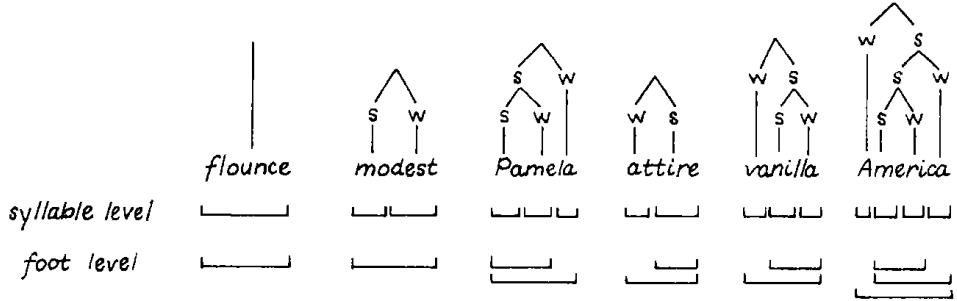
中文讲解
本段为图像占位符,对应第 22 页的某一图示(很可能即上文提到的 12.17 的树形图集)。需查看原图以获得具体树形细节。
第9段(P0173)
原文复述
Vergnaud and Halle (1979) show that there are languages in which the counterpart of rule 1a has the reverse effect, marking the second syllable strong. Rule 1b could conceivably have a mirror-image counterpart, making the foot weak; however, the empirical need for such a rule is as yet unclear.
中文讲解
本段对规则 1 进行类型学补充。Vergnaud 与 Halle(1979)证明:另一些语言把规则 1a 翻转为“第二音节为强”,即呈现抑扬格(iambic)走向。规则 1b 在理论上也可以有镜像版本(让单独音节强、下属音步弱),但作者指出目前尚无明确经验证据支持这种规则存在。这一段为英语规则提供了对照参考,并显示了节律规则的跨语言可调性。
补充说明
Vergnaud 与 Halle (1979) 以及 Liberman 与 Prince (1977) 均为生成音系学节律研究的代表性参考文献;本节在脚注 10–12 中分别给出。
第10段(P0174)
原文复述
The next layer in the hierarchy is the aggregation of feet into words. Liberman and Prince (1977) give the following rule for English:
中文讲解
本段宣布进入韵律层级的下一层:音步聚合为词,并提示规则来自 Liberman 与 Prince(1977)。它在结构上把规则 1 的音步层跃迁到词层,预告即将给出 Prominence Rule 2。
第11段(P0175)
原文复述
Prominence Rule 2 (Lexical Category Prominence) In a segment immediately containing two feet, the second is strong if and only if it branches.
中文讲解
规则 2 名为“Lexical Category Prominence(词汇范畴突显)”。其形式条件是:一个直接包含两个音步的节段,只有当第二个音步分叉(即下属两个音节)时,它才为强。“if and only if”强调双向条件:第二个音步强 ⇒ 它分叉,且它分叉 ⇒ 第二个音步强。直观意义是:在词层中,重音倾向落在结构较重(包含两个音节)的音步上;若第二个音步不分叉,则重音反由第一个音步承担。脚注 11 应是对“分叉”条件的进一步说明或文献依据。
补充说明
“branching(分叉)”指节律树上一个节点同时支配两个下属节点;这里的“segment”是节律切分产生的节段。
第12段(P0176)
原文复述
This rule results in the trees in 12.18 for gymnast, reconciliation, anecdote, and anecdotal. Notice in particular the contrast between the last two of these, where the extra syllable -al causes the second foot of anecdotal to branch, in turn altering the tree and shifting stress to -do-.
中文讲解
本段用 gymnast、reconciliation、anecdote、anecdotal 四个词展示规则 2 的结果(树形图见 12.18)。特别值得注意的是 anecdote 与 anecdotal 的对比:多出 -al 音节使 anecdotal 的第二个音步分叉为双音节,从而改变树形结构,并使主重音从 anecdote 的 -ec- 转移到 anecdotal 的 -do-。这一例子以最小对照说明“分叉”是规则 2 触发重音移动的关键条件。
第13段(P0177)
原文复述
12.18
中文讲解
本段是图编号标签 12.18,对应规则 2 所展示的树形图集。它是版面标识,单独成行。
第14段(P0178)
原文复述
syllable level
中文讲解
本段是图 12.18 的层级标签“音节层”,标识树形图中从音节开始的最底层。
第15段(P0179)
原文复述
foot level
中文讲解
本段是图 12.18 的层级标签“音步层”,标识树形图中音步聚合的中间层。
第16段(P0180)
原文复述
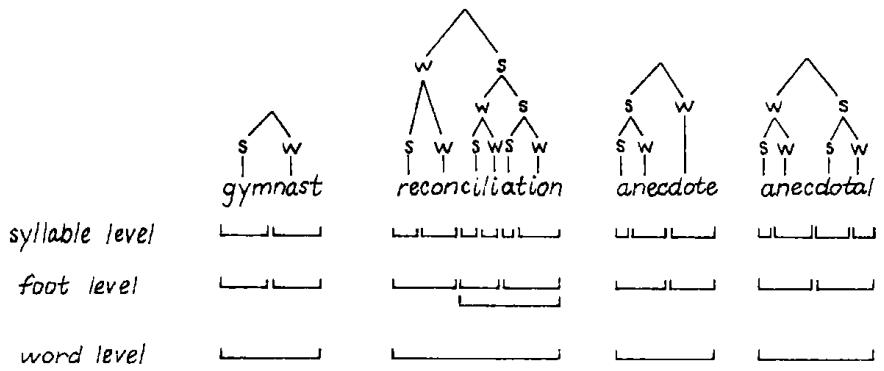
中文讲解
本段为图像占位符,对应第 22 页的图 12.18,展示规则 2 在 gymnast 等四个词上的树形结构。需查看原图才能获得具体分支与强枝位置。
第17段(P0181)
原文复述
word level
中文讲解
本段是图 12.18 的层级标签“词层”,标识树形图最上层即词层级。
第18段(P0182)
原文复述
A similar rule governs the aggregation of words into larger words:
中文讲解
本段是过渡句,宣告进入下一层:词聚合为更大的词(如复合词),并预告存在一条与规则 2 形式上平行的规则——即接下来的 Prominence Rule 3。
第19段(P0183)
原文复述
Prominence Rule 3 (Compound Stress) In a word immediately containing two words, the second is strong if and only if it branches into two words.
中文讲解
规则 3 名为“Compound Stress(复合词重音)”。形式条件:当一个词直接包含两个下属词时,第二个下属词为强当且仅当它进一步分叉为两个词。比起规则 2 中“音步分叉”,规则 3 明确要求“分叉为两个词”,这是一个更强的条件。直观意义:在复合词中,左重还是右重取决于右侧成分是否能再向下分出两个词。
补充说明
“branching into two words”是规则 3 的核心限定,与规则 2 的“branching”在层次对象上不同(音步层 vs. 词层)。
第20段(P0184)
原文复述
This rule accounts for the contrast between main stress on Rorschach in Rorschach blot and on ink in Rorschach ink-blot. In the latter only, the second word on the next-to-largest level of segmentation branches into two words. (Segmentation and tree structure are shown only from the word level up in 12.19.)
中文讲解
本段用 Rorschach blot 与 Rorschach ink-blot 的对比展示规则 3:前者重音在 Rorschach(RO-rschach BLOT),后者重音在 ink(Rorschach INK-blot)。两种切分下,第二个词只有 ink-blot 能在下一层级分叉为两个词,因此只有它取得强枝,主重音落到 ink 上。括号内说明图 12.19 只画出词层及以上的树形结构,省略更底层细节。
第21段(P0185)
原文复述
Psychological and Linguistic Connections
中文讲解
本段是边栏/小栏目标题“Psychological and Linguistic Connections”,表明该小节属于心理与语言学关联的专题栏目,提示读者本节所讨论的韵律规则同时具有跨学科意义。
第22段(P0186)
原文复述
12.19
中文讲解
本段是图编号标签 12.19,对应 Rorschach blot 与 Rorschach ink-blot 的树形图。
第23段(P0187)
原文复述
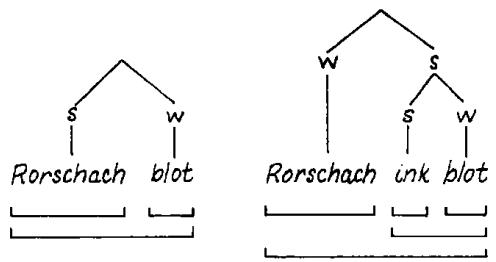
中文讲解
本段为图像占位符,对应第 23 页的图 12.19,展示两个复合词切分下的树形对比。需查看原图。
第24段(P0188)
原文复述
Notice that the rule specifies branching into two words, rather than just branching as in the previous rule. The reason for this is that the rule is not sensitive to the number of syllables or feet in the constituent words. For example, in both labor day and labor union, main stress falls on labor, even though in the latter case union branches into two syllables. (Nonetheless, one can imagine generalizing prominence rules 2 and 3 into a single rule if proper attention is paid to stating limitations on the ability of rules to cross layers in the hierarchy.)
中文讲解
本段对规则 3 的“分叉为两个词”这一限定进行解释:因为规则不关心成分词的音节或音步数目,只看其是否能进一步切分为两个词。例如 labor day 与 labor union 主重音都落在 labor 上,尽管 union 自身分叉为两个音节,但只要它不再分叉为两个词,就不影响规则 3 的判断。括号中的补充承认:若能严格规定规则不得跨层级运作,规则 2 与规则 3 在形式上可统一为一条规则。
补充说明
labor union 这一反例是规则 3 不以音节数或音步数为依据的关键证据。
第25段(P0189)
原文复述
Finally, the aggregation of words into phonological phrases is governed by this rule from Liberman and Prince 1977:
中文讲解
本段过渡到韵律层级最高一层:词聚合为音系短语(phonological phrase),并提示规则同样源自 Liberman 与 Prince(1977),脚注 12 应给出文献细节。
第26段(P0190)
原文复述
Prominence Rule 4 (Nuclear Stress) In a phonological phrase that immediately contains two phonological phrases or words, the second is strong.
中文讲解
规则 4 名为“Nuclear Stress(核心重音)”。其形式条件是:当一个音系短语直接包含两个音系短语或两个词时,第二个成分为强。与规则 2、3 不同,此规则没有“if and only if it branches”的限定——只要是第二个,就一律为强。直观意义:在短语层,重音固定地落在最后一个成分上,体现英语短语层面的“尾重”倾向。
第27段(P0191)
原文复述
This rule accounts for the stress patterns of phrases like three red hats and John ate Bill’s peach (represented only from word level up in 12.20).
中文讲解
本段用 three red hats 与 John ate Bill’s peach 两个短语说明规则 4:无论短语内部结构如何,主重音都落在最右的词上(hats 与 peach)。图 12.20 只画出从词层向上的树形结构,因短语层规则的运作不依赖更底层细节。
第28段(P0192)
原文复述
12.20
中文讲解
本段是图编号标签 12.20,对应规则 4 的短语树形图。
第29段(P0193)
原文复述
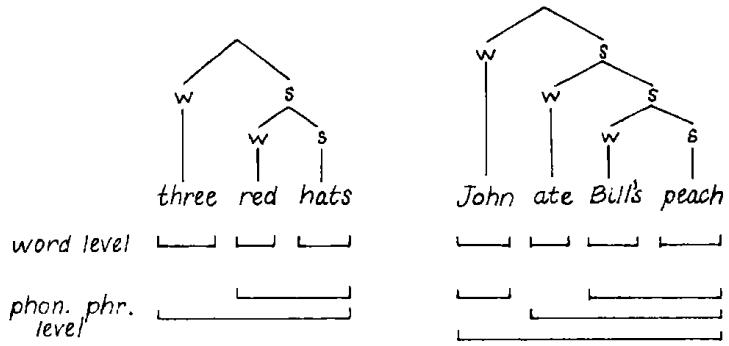
中文讲解
本段为图像占位符,对应第 23 页的图 12.20,展示短语层树形结构。需查看原图。
第30段(P0194)
原文复述
At the level of phonological phrase there is also a prominence rule that bears a more patent resemblance to rules of musical structure than the four preceding rules. This is Liberman and Prince’s rule of Iambic Reversal, also commonly called the Rhythm Rule. Its effect is to shift stress leftward in certain situations. For example, the words thirteen and Tennessee have strongest stress on the last syllable when spoken in isolation;
中文讲解
本段引入短语层的第二条规则——Liberman 与 Prince 的 Iambic Reversal(抑扬翻转),通称 Rhythm Rule(节奏规则)。其特点是:在特定情境下把重音向左移动,与前四条规则相比,与音乐结构规则的相似性更为明显。作者用 thirteen 与 Tennessee 在单独发音时主重音在末音节来铺垫下一段对短语中重音左移的对比。
第31段(P0195)
原文复述
Chapter 12
中文讲解
本段是页眉标记“Chapter 12”,属于版面信息。
第32段(P0196)
原文复述
but in the phrases thirteen men and Tennessee air their strongest stresses are on the initial syllable. Liberman and Prince explicate the rule in terms of a metrical structure not unlike the musical metrical structure described in chapters 2 and 4.
中文讲解
本段承接上一段:thirteen 与 Tennessee 在短语 thirteen men、Tennessee air 中,主重音都左移到首音节。Liberman 与 Prince 把这一规则解释为一种节拍结构(metrical structure),与第 2、4 章描述的音乐节拍结构非常相似。这一句确立了韵律规则 5 与音乐规则之间的桥梁。
第33段(P0197)
原文复述
The general idea behind the Rhythm Rule is that the stresses of a linguistic phrase form a hierarchical metrical pattern, with relatively heavy stresses corresponding to relatively strong beats and relatively weak stresses corresponding to relatively weak beats. The ideal metrical structure is one in which relatively strong and relatively weak beats alternate; in particular, two relatively strong beats are preferably not adjacent to one another. Just such a situation arises in the juxtaposition of thirteen with men and Tennessee with air: the strongest stress is on the second word, and the next strongest is on the final syllable of the first word. The Rhythm Rule alters this undesirable situation by reversing the largest w and s of the first word, thereby separating the second-strongest stress from the strongest by a relatively weak stress. Thus, instead of 12.21a and 12.21b (the tree structures one would expect given the stress patterns of the individual words), the Rhythm Rule yields the structures in 12.21c and 12.21d. Beneath the segmentation is the metrical structure (in our notation) assigned to the tree; the number of dots below a syllable is proportional to its relative prominence in the tree.
中文讲解
本段展开 Rhythm Rule 的原理:短语中的重音构成层级化节拍模式,强重音对应强拍,弱重音对应弱拍;理想模式是强弱交替,相邻强拍应被弱拍隔开。thirteen 与 Tennessee 单独发音时,主重音在末音节;进入短语后,加上规则 4 的核心重音(落在 men、air),会出现“次重音—主重音”相邻的不理想结构。Rhythm Rule 通过翻转第一个词内部最大的一对 w-s,把次重音与最强重音之间插入一个相对弱的音节,从而接近理想交替模式。最终结果:以单念时预期得到的树形(12.21a、12.21b)被改写为 12.21c、12.21d。节拍结构以圆点数量表示音节相对突显度。
补充说明
“w”和“s”是节律树中分别表示“弱枝”和“强枝”的标记(参第 12.7 节)。
第34段(P0198)
原文复述
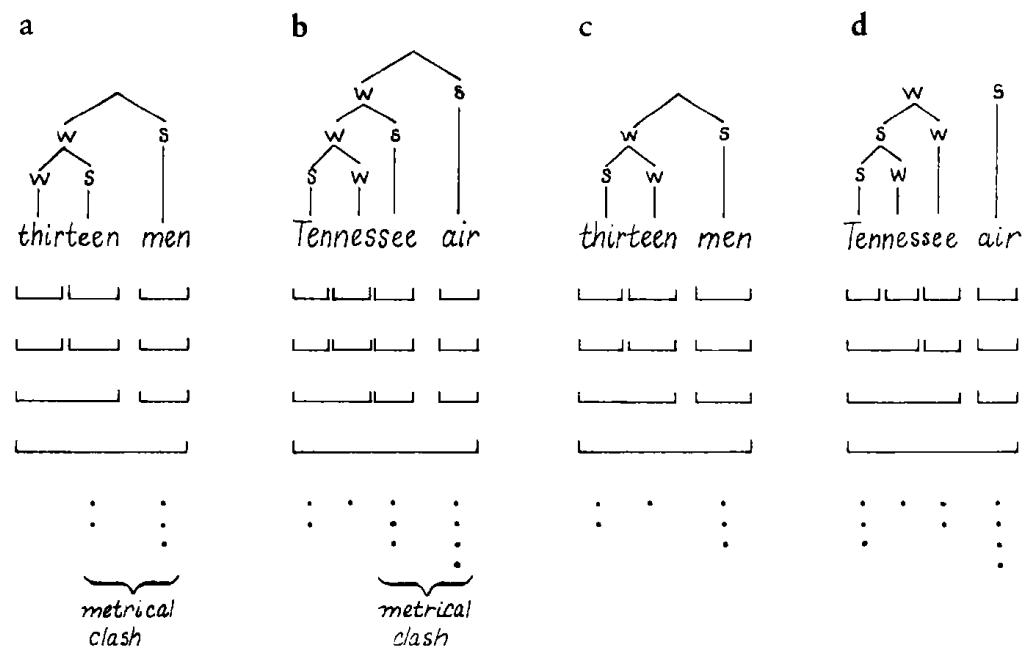
中文讲解
本段为图像占位符,对应第 24 页的图 12.21,包含四个树形与节拍结构图(a、b、c、d),展示 Rhythm Rule 的应用结果。需查看原图。
第35段(P0199)
原文复述
The Rhythm Rule can therefore be thought of as a rule that makes prosodic structure conform more closely to an ideal metrical pattern. Despite the differences in formulation, there is a clear kinship between this rule and the rules relating metrical structure to time-span reduction (MPR 9, TSRPR 1, and especially TSRPR 5). The major difference between music and language in this respect is that musical events are organized around a fixed and regular metrical structure that must be maintained throughout. In language, by contrast, the rhythm is flexible and is not required to conform to any particular pattern.
中文讲解
本段总结 Rhythm Rule 的功能:使韵律结构向理想节拍模式靠拢。作者明确指出,尽管表述不同,本规则与音乐节拍结构相关的规则(MPR 9、TSRPR 1,特别是 TSRPR 5)有清晰的亲缘关系。最后一句对比音乐与语言的核心差异:音乐以固定且规则的小节结构贯穿始终,语言节律则灵活多样,不必符合某一特定模式。这一对比为后续章节(尤其是将节拍结构延伸至表演规则)埋下伏笔。
补充说明
MPR 9、TSRPR 1、TSRPR 5 为本书前几章(特别是第 4、5 章)关于音乐节拍与时值缩减的规则编号。
脚注 / 边栏 / 图表 / 附加信息(如有)
本节末尾附图编号 12.17、12.18、12.19、12.20、12.21,对应五组树形/节拍结构图,因输入未含实际图像数据,详细结构需查原书。脚注 10–12 分别对应规则 1、规则 2、规则 4 的来源说明(提示 Rule 1 用的是“in present terms”即当下重述、Rule 2/3/4 出自 Liberman and Prince 1977,并涉及 Vergnaud and Halle 1979 的对照讨论)。
💡 本节核心要点
- 韵律层级每一层都有专属的突显规则;本节依次给出音步层(Rule 1)、词层(Rule 2)、复合词层(Rule 3)、短语层(Rule 4 与 Rhythm Rule)共五条规则。
- 规则 1a/1b 用“第一个为强”与“音步强于音节”确定音步内部强弱,对应英语的 trochaic 倾向;Vergnaud 与 Halle 1979 指出存在 1a 镜像规则的语言。
- 规则 2 与规则 3 形式上平行——“第二个为强当且仅当它分叉”,分叉对象分别是音步下属两个音节(Rule 2)与词下属两个词(Rule 3);anecdote/anecdotal、Rorschach blot/ink-blot、labor day/labor union 分别展示其触发与不触发。
- 规则 4 取消分叉条件,只要短语中第二个成分就为强,因此短语层面重音固定在尾部,体现英语尾重倾向。
- Rhythm Rule(Iambic Reversal / 抑扬翻转)在短语层运作:当两个强重音相邻时,翻转第一个词内部的 w-s,把次重音与最强重音之间插入弱音节,使结构向强弱交替的理想节拍模式靠拢;thirteen men、Tennessee air 为典型案例。
- Rhythm Rule 与音乐节拍—时值缩减规则(MPR 9、TSRPR 1、TSRPR 5)有亲缘关系,但音乐要求贯穿始终的固定节拍,语言节律则灵活可变。
🔑 关键术语
- Prosodic hierarchy:韵律层级,由小到大依次为音节、音步、词、复合词、音系短语,每一层有自身的切分与突显规则。
- Foot:音步,韵律层级中介于音节与词之间的范畴,由一个或两个音节聚合而成;英语音步通常呈扬抑格,首音节为强。
- Branching:分叉,节律树中一个节点同时支配两个下属节点;分叉与否是规则 2、3 触发重音移动的关键条件。
- Phonological phrase:音系短语,韵律层级中最接近句法的范畴;其内部由若干词或下属短语组成,规则 4 与 Rhythm Rule 在此层运作。
- Nuclear Stress:核心重音,对应规则 4:在短语中无条件地落在最右侧成分,体现英语短语的尾重倾向。
- Rhythm Rule / Iambic Reversal:节奏规则/抑扬翻转,Liberman 与 Prince 提出;通过翻转首个词内部最大的一对 w-s 来避免相邻强重音,使韵律结构向强弱交替的理想节拍靠拢。
- Metrical structure:节拍结构,把韵律树映射为强弱交替的层级化模式,本节以圆点数量表示音节相对突显度。
CH12.S12.3.rhythm [描述性拆分] The Rhythm Rule and the metrical/prominence connection
第1段(P0200)
原文复述
The labels list the following hierarchical levels, presented in vertical/columnar form: syllable level; foot level; word level; phon. phr. level (phonological phrase level); and metrical structure.
中文讲解
这一段并非连续论述,而是从一幅图示(或并列的层级示意)中提取出的标签序列,依次列出韵律层级中的五级构成单位:音节层(syllable level)、音步层(foot level)、词层(word level)、音系短语层(phonological phrase level,简写 phon. phr.)以及节律结构层(metrical structure)。它作为视觉元素的文字注解,本身不构成完整论证,但在本小节中承担定位功能:提示读者,本节讨论的“相对突显”(relative prominence)与节律结构之间的关系是建立在这一整套层级模型之上的——从最小的音节逐级上推到节律结构,突显关系在不同层级上发挥作用。理解这一点有助于把握 P0202、P0203 中所谓“相对突显与节律结构关系”的具体含义,即该关系贯穿整个层级而非局限于某一级。
第2段(P0201)
原文复述
Psychological and Linguistic Connections
中文讲解
这是一节的小标题,原文为“心理与语言的关联”(Psychological and Linguistic Connections)。它标志着本章(或本章内的一个分节)从对节律规则的纯形式描写转入跨学科的对照讨论:即把音乐节律的心理现实与语言韵律的心理学/语言学发现相联系。在本小节(CH12.S12.3.rhythm)内,它提示读者接下来的论述将要论证:音乐中相对突显与节律结构的关系,与语言中韵律规则所体现的同类关系在实质上是相同的,因此节律规则在两类媒介中具有可比性。
第3段(P0202)
原文复述
Either of these practices may be altered. In recitative, fixed meter is abandoned by dropping MWFR 3 (the spacing of strong beats two or three beats apart) and MWFR 4 (the equal spacing of beats), and more flexible, speechlike rhythms appear. In poetry, a fixed metrical pattern is imposed to which the linguistic stresses correspond; in effect, a counterpart of MWFRs 3 and 4 is adopted (see Halle and Keyser 1971 and Kiparsky 1977 for discussion).
中文讲解
本段是全节论证的核心,正面处理音乐与诗歌两种媒介中节律安排方式的差异及其与节律结构的关系。
作者指出这两种实践方式都可以发生改变。在宣叙调(recitative)中,作曲家放弃了固定节拍,途径是放弃 MWFR 3(强拍之间应相隔两拍或三拍的间隔)和 MWFR 4(拍点应等距分布),从而得到更灵活、更接近口语的节奏。这意味着在宣叙调里,节律结构的稳定性被削弱,听者不再期待规则的强弱交替和等距节拍。
而在诗歌中则相反:作者施加一个固定的韵律模板,让语言中的重音对应到模板的强位置上。也就是说,诗歌里实际上采纳了与 MWFR 3、4 功能类似的规则——保证强音在节律结构中按规律间隔出现。这里作者援引 Halle and Keyser 1971 和 Kiparsky 1977 作为语言学方面的代表性讨论,表明这一对照并非偶然,而是有专门研究支撑的。
本段的论证意义在于:通过“放弃”和“采纳”两种相反操作的对照,揭示出 MWFR 3 和 MWFR 4 在本质上是对“相对突显在节律结构中如何分布”这一更一般原则的具体实现方式——宣叙调放弃了它们,诗歌则保留了它们。这一对照为下一段的总结提供前提。
补充说明
段落中提到的两条参考文献(Halle and Keyser 1971;Kiparsky 1977)是作者为读者延伸阅读给出的语言学方面的出处,在当前 task_input 中仅作引证出现,不展开其内容。
第4段(P0203)
原文复述
Thus we can conclude that the relation of relative prominence to metrical structure is substantially the same in music and language. The difference between the relevant musical preference rules and the prosodic Rhythm Rule is a function largely of the different metrical practices of the two media.
中文讲解
本段是全节的小结,得出两条结论。
第一条是肯定的:相对突显(relative prominence)与节律结构(metrical structure)之间的关系,在音乐和语言中“实质上是相同的”(substantially the same)。这意味着无论媒介是乐音还是语音,听者/读者对“什么算强、什么位置应强”的心理期待背后的结构原则是一致的。
第二条是否定性的限定:相关音乐偏好规则(musical preference rules,即前文的 MWFRs)与语言学中的韵律规则(prosodic Rhythm Rule)之间的差异,并不在于原则本身,而“主要”来自于两种媒介各自不同的节律实践(different metrical practices)——即音乐倾向于使用规则化、固定化的节拍体系,而语言则容许更灵活的强弱分布。
需要避免的误解是:作者并不是说两者完全等同,而是说“实质性相同”;差异只是表面上的实践差异,而非底层结构差异。这一结论也呼应本小节标题所预告的“节律规则与节律/突显的连接”,把前面关于宣叙调和诗歌的对照抽象为对两类媒介共通原则的确认。
脚注 / 边栏 / 图表 / 附加信息(如有)
本小节包含一处图示/层级标签(P0200 中的 syllable / foot / word / phon. phr. / metrical structure 五级),其作用是显示相对突显关系贯穿的层级范围;以及 P0202 末尾以括注形式提供的两条参考文献出处:Halle and Keyser 1971、Kiparsky 1977,作为语言诗学/韵律学方面的延伸阅读。除上述层级标签与文献出处外,本节无其他附加材料(无脚注、无边栏、无图表说明)。
💡 本节核心要点
- 节律规则与节律/突显的连接建立在一套层级结构上,涵盖音节、音步、词、音系短语与节律结构五级。
- 音乐中的 MWFR 3(强拍间隔两拍或三拍)和 MWFR 4(拍点等距)规定了相对突显在节律结构中应如何分布;二者可被视为更一般的“相对突显—节律结构”关系的具体实现。
- 宣叙调通过放弃 MWFR 3 与 MWFR 4 来换取接近口语的灵活节奏;诗歌则通过施加固定韵律模板并使语言重音对应其强位置,在效果上采纳了与 MWFR 3、4 同类的规则。
- 由此可得出总括性结论:相对突显与节律结构的关系在音乐和语言中实质相同;二者表面差异主要来自媒介各自的节律实践,而非底层结构原则。
🔑 关键术语
- MWFR 3:节律优选规则之一,规定强拍之间应相隔两拍或三拍;本节用以刻画音乐中固定节拍对突显间隔的约束。
- MWFR 4:节律优选规则之一,规定拍点应等距分布;本节用以刻画音乐中固定节拍在时间维度上的均匀性。
- Rhythm Rule (RR):语言韵律中的节律规则,对应于音乐中的节律优选规则;本节论证其与音乐中相关规则在结构原则上实质相同。
- Relative prominence:相对突显,即某一元素相对于其他元素在强弱/轻重层级上的凸显程度;在本节中是相对突显与节律结构之间关系的核心变量。
- Metrical structure:节律结构,由强弱层级和层级间的间隔规则构成的组织形式;在本节中作为相对突显所“对应”的结构对象。
- Recitative:宣叙调,一种近似口语节奏的歌唱形式;本节用作放弃固定节拍(即放弃 MWFR 3、4)的典型实例。
- Phonological phrase (phon. phr.):音系短语,韵律层级中介于词层与节律结构层之间的一级;本节用以定位相对突显关系可作用的层级范围。
CH12.S12.3.disc [描述性拆分] Discrepancies between the two theories
第1段(P0204)
原文复述
Some Discrepancies
中文讲解
这是一个二级小节标题,宣告本节将从哪些方面讨论两种理论的差异。前三小节论证了时值缩减理论与韵律结构理论之间的形式平行,本节转入对差异的盘点:标记符号的刻画能力、分支的多元性、树的解释方式,以及差异能否调和。标题本身用复数形式 “Discrepancies”,预示将要列举多项差异,而非单一问题。
补充说明
本小节虽然以"差异"为题,但其论证目的并非否定平行性,而是通过指出差异的可调和性,进一步巩固"形式结构共享"的结论。
第2段(P0205)
原文复述
The last three subsections have shown that time-span reduction and prosodic structure are not just represented by equivalent tree notation; they are the products of grammars that carry out formally parallel operations on musical and phonological strings. In each case, the string is segmented into a layered hierarchy, in which each layer provides an exhaustive segmentation. A set of possible tree structures is defined in precisely parallel fashion over the segmentations, and preference rules or prominence rules determine which of the possible trees is the correct one. Furthermore, two substantive parallels have appeared: the treatment of augmented time-spans and augmented feet, with group boundaries and word boundaries playing equivalent roles; and the relationship of metrical structure to choices made by the prominence rules.
中文讲解
本段是承接段,先回顾前面三节已建立的论点:时值缩减和韵律结构不仅是树形标记符号上等价的,更是两套在音乐字符串与音系字符串上执行"形式平行操作"的语法。
关键的形式平行包括四点:
- 字符串都被切分为层层叠加的层级(layered hierarchy);
- 每一层都构成对该层内容的穷尽切分(exhaustive segmentation,即每一元素都被分配到某一组中,没有剩余);
- 在切分之上以平行方式定义可能的树形结构集合;
- 由偏好规则(preference rules,音乐侧)或凸显规则(prominence rules,音系侧)从中选出正确的树。
此外出现了两项实质性平行:扩张时值与扩张音步的处理,其中组边界(group boundaries)和词边界(word boundaries)扮演等价角色;以及节拍结构与凸显规则所作选择之间的关系。
本段为本节提供论证基线:差异的讨论只能在这些平行之上展开,因此差异并不推翻平行。
补充说明
“preference rules"对应音乐理论中用来在多个合法时值缩减之间进行取舍的规则;“prominence rules"对应音系理论中在多个合法韵律树之间指定重读分布的规则。两者在结构位置上是同形的。
第3段(P0206)
原文复述
Of course, the nature of the strings being segmented and most of the substance of the rules in the two theories are quite different. This only serves to make the formal parallels still more striking, particularly since the two theories were developed independently and were designed to account for radically different sorts of intuitions (though there has been interfertilization of the two theories with respect to the treatment of metrical structure). Before drawing further conclusions, however, we should consider some formal respects in which the two theories differ and discuss how the differences might be resolved.
中文讲解
本段用"Of course"承认一个事实:两种理论中被切分的字符串(音乐 vs. 音系)性质迥异,规则的具体内容也很不一样。但作者随即翻转论证:正因为这些差异显著,两套理论在形式层面上的平行才"更令人瞩目”——尤其是两套理论各自独立发展,本就是为了解释"截然不同类型的直觉”(音乐听感 vs. 语言重读感)。
作者补充了一个限定:两个理论之间已经发生了"互相受精”(interfertilization),特别是在节拍结构的处理上。这意味着差异并非完全没有交流,只是核心形式平行更值得注意。
最后一句"Before drawing further conclusions…“是过渡句,引出本节主旨:在进一步得出结论之前,应先考察形式上的差异并讨论如何解决它们。
本段的结构作用是"先让步再收束”,既不回避差异,又强调差异不抹杀平行。
补充说明
“interfertilization"是借用自生物学的隐喻,意指两个独立研究纲领之间在概念上的相互借鉴,本节下文未再展开。
第4段(P0207)
原文复述
First, although the parallelism was first motivated by the equivalence of the tree notations, the two notations actually differ somewhat in expressive power. Our discussion has shown the equivalence of prosodic trees to the plainest form of time-span trees, where only ordinary reduction has taken place. But in section 7.2 we showed that there are three other relationships that can obtain between the head of a time-span and the events within it: fusion, in which the head represents the simultaneous sounding of two or more events from the time-span; transformation, in which the head is a composite of the events in the time-span; and cadential retention, in which two successive events forming a cadence are both retained. Prosodic theory has no equivalent for these three additional relationships. Thus, if it were desirable to adopt a uniform notation for the two theories, time-span notation would be more appropriate; phonological theory would merely adopt the restrictive form with only ordinary branching. On the other hand, Morris Halle has informed us (personal communication) that recent developments suggest the possibility of other relationships in phonology not shared by music. In other words, phonology and music might share a common core of hierarchical structure but diverge in various specifics.
中文讲解
本段开始列举第一项形式差异:标记符号的"刻画能力”(expressive power)不同。
作者承认此前的平行论证最初是由树形标记的等价激发的,但严格说来,前文的等价只覆盖了"最朴素形式的"时值树——即只发生"普通缩减"的情况。第7.2节则揭示了时值头与所统辖事件之间还存在另外三种关系:
- 融合(fusion):头代表时值内部两个或多个事件的同时发声;
- 转化(transformation):头是时值内部诸事件的复合体;
- 终止保留(cadential retention):构成终止的两个相继事件都被保留为头。
这三种关系在韵律理论中都没有对应物。因此若要为两套理论采取统一的标记,时值标记更合适,音系理论则只需采取只有普通分支的限定形式。
接着作者引入一个平衡视角:Morris Halle 通过私人交流告知,音系学的新进展暗示可能存在音乐所没有的关系。因此两套理论可能共享一个"层级结构的共同核心”,但在具体细节上分道扬镳。
本段的关键论证是:差异是"局部且可编码的”——要么让音系采用更朴素的形式,要么承认双方各自有对方没有的特异性,但二者仍以共同核心为基础。
补充说明
作者引用 Halle 的私人交流,意在表明差异可能不是单方向的(即不只是音乐比音系多三种关系,音系也可能反过来有音乐没有的关系),从而支持"共享核心+具体分歧"的结论。具体的"其他关系"未在本节展开。
第5段(P0208)
原文复述
Chapter 12
中文讲解
这是版心页眉,标明当前位于第12章。它不是论证内容,仅起版面定位作用。
第6段(P0209)
原文复述
A second formal difference between the two theories concerns the plurality of branching. In time-span theory, most of the branching we have discussed has been binary; each time-span above the smallest level contains two time-spans of the next smaller level. However, in a triple meter (such as the 6/8 of Mozart K. 331), ternary branching appears at a certain subgroup level. It is also not inconceivable for a group to contain three or更多 smaller groups: for example, in strophic songs and variation forms, the largest segmentation of the piece is often into as many groups as there are verses or variations.
中文讲解
本段进入第二项形式差异:分支的多元性(plurality of branching)。
在时值缩减理论中,所讨论的大部分分支是二分的:每个大于最小层的时值包含两个下一级时值。然而作者立刻指出例外:
- 在三拍子(如莫扎特 K. 331 的 6/8)中,三分分支出现在某一子组层级;
- 一个组包含三个或更多小组在结构上并不难以想象,例如分节歌(strophic songs)和变奏曲式(variation forms)中,作品的最大切分往往和诗节数或变奏数一致。
本段的作用是把"音乐允许多分枝"作为一项与音系理论严格二分形成对照的事实提出,下一段将介绍音系侧的情况。
补充说明
莫扎特 K. 331 第一乐章的 6/8 拍主题因每小节三拍构成典型的"高分枝"案例;K. 331 也是变奏曲式的一个著名例子,与本段第二个例子互证。
第7段(P0210)
原文复述
On the other hand, prosodic theory has been formulated in terms of strictly binary branching. Where a foot, for example, contains more than two syllables, the segmentation and the resulting tree are constructed using recursive binary branching, as in 12.22a, rather than multiple branching, as in 12.22b. Is this a real difference between language and music, or is it just a consequence of the way the two theories happen to be stated?
中文讲解
本段介绍音系一侧的对照事实:韵律理论一直以严格的二分来表述。当一个音步包含两个以上音节时,其切分与生成的树用"递归二分"(recursive binary branching,如 12.22a)来构造,而不是直接用多分枝(如 12.22b)。
“递归二分"意味着:三个音节的音步不是直接三分,而是先二分,再把其中一个分支继续二分。这与时值理论中三拍子直接三分的处理形成对比。
本段以反问收尾:这种差别究竟是语言和音乐之间的真实差异,还是仅仅是两套理论碰巧采取的表述方式造成的?这一问句预告了接下来的讨论——究竟应该让哪一方让步,还是双方都不让步。
补充说明
“递归二分"与"多分枝"在数学上可互相转换(一个三分枝树等价于若干嵌套的二分枝树),但二者对"中间节点"的解释不同:递归二分允许中间节点带重音差异,多分枝则把所有下属节点视为同级。
第8段(P0211)
原文复述
12.22
中文讲解
这是图 12.22 的编号标签,用来标注下一段所描述的图例。该图被作者引用来对照"递归二分"与"多分枝"两种树形结构(对应本段提到的 12.22a 与 12.22b)。
第9段(P0212)
原文复述
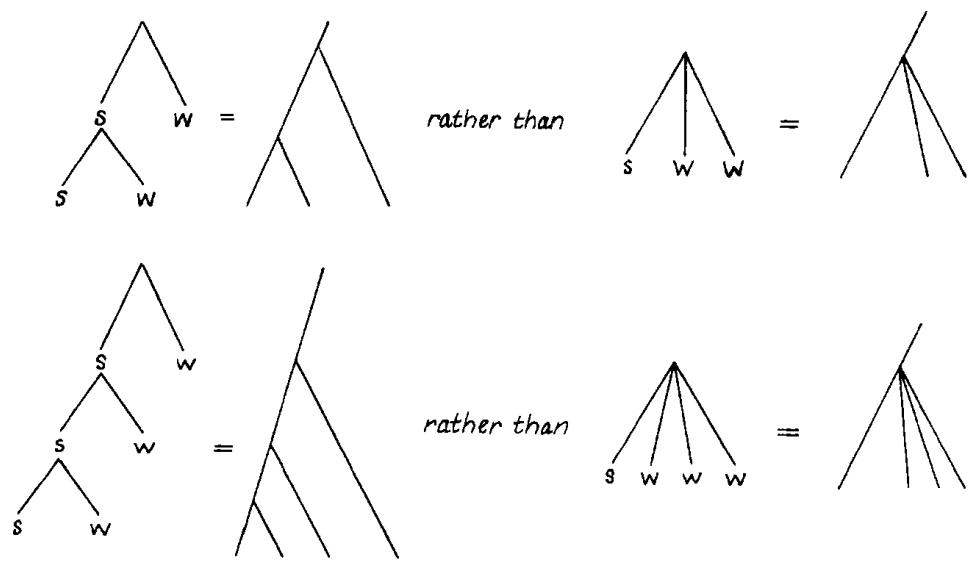
中文讲解
这是一段图像占位符,位于图 12.22 应在的位置。结合 P0210 与 P0211 可知:该图应展示韵律树的两种切分方式——12.22a 是递归二分形式,12.22b 是多分枝形式,用以对照"多音节音步"如何被刻画为树。具体的树形细节需查看原图。
补充说明
图像被省略时不应猜测不可见内容;本节论证只依赖"两种结构存在差异"这一事实。
第10段(P0213)
原文复述
Psychological and Linguistic Connections
中文讲解
这是另一个二级标题,提示本节后半段将进入"心理学与语言学关联"的讨论。在本节内部,它起到分段标志的作用:从"标记刻画力"和"分支多元性"这两项较形式化的差异,转向更深的"树的解释"问题,并在结尾引向对感知与运动组织的讨论。
补充说明
该标题所开启的论题将在 P0217 至 P0221 中展开:节拍结构、重读分布背后的感知/运动机制。
第11段(P0214)
原文复述
Here it is not clear to us which theory should give way, or even if either should. On one hand there seems to be only one use in prosodic theory for recursive binary-branching trees that cannot be equally coded into multiply branching trees: the assignment of relative degree of subsidiary stress (Liberman and Prince 1977, p. 259), which is certainly an important function. But in sections 3.4 and 3.5 of the paper Liberman and Prince suggest that subsidiary stresses are assigned by reference to the metrical structure instead (or in addition). Thus the restriction of prosodic segmentation and trees to strictly binary branching does not have as much explanatory value as might be expected.
中文讲解
本段直接回应 P0210 末尾的反问:究竟哪方应该让步?作者坦承答案并不清楚。
从韵律理论一侧看:递归二分树与多分枝树相比,只有一项用法不能被等价编码——即赋予次重音(subsidiary stress)的相对等级,作者注明此说出自 Liberman and Prince 1977 第259页。但 Liberman 和 Prince 在其论文的第3.4和3.5节又指出,次重音其实可以(甚至应)参照节拍结构(metrical structure)来指派。
因此本段的推理是:既然连"严格二分"这一形式限制的主要解释功能(指派次重音的相对等级)都可以借助节拍结构完成,那么把韵律切分与树严格限定为二分,并不像表面看来那样有那么多解释价值。这削弱了"音系必须严格二分"的论证。
本段是"消解差异"的一步:通过展示韵律侧对严格二分的依赖并不牢靠,为后续让时值理论也采纳某种"可调和"的分歧打开了空间。
补充说明
Liberman and Prince 1977 是韵律音系学的奠基性论文,本节对其论点做了简短的二次引用,作用是限定"递归二分"的解释价值,而非重新讨论其全文。
第12段(P0215)
原文复述
On the other hand, there is some potential justification for strict binary branching in time-span trees. At subgroup levels, where ternary branching occurs in connection with ternary meter, there is often motivation for an additional segmentation into 2 + 1 (♩ ♩) or 1 + 2 (♩ ♩) (the typical “oom-pah-pah” accompaniment can be thought of as a special case of the latter). Although this subgrouping would not be adhered to consistently throughout a piece, as the meter is, it could be supplied in each ternary subgroup by appropriately stated preference rules for time-span segmentation, a rule type we have so far managed to avoid.
中文讲解
本段反过来考察时值理论一侧:在子组(subgroup)层级,当三拍子引发三分分支时,往往有进一步切分为 2+1 或 1+2 的动机。作者用两种节奏型表示这一点(♩ ♩ 表示三等分中前两拍紧接、后一拍分开;♩ ♩ 则相反)。典型的"oom-pah-pah"伴奏(强弱弱型三拍子)可视作 1+2 的特例。
关键限定:这种子分组不会像拍号那样贯穿全曲,但可以通过时值切分的"偏好规则”(preference rules)在每个三分子组中按需引入。
本段还有一处自反性的注释:偏好规则正是"我们到目前为止成功避免"的一类规则。这意味着如果接受严格二分,将不得不引入新的规则类型,这是一个需要权衡的成本。
本段与 P0214 形成对照:P0214 削弱韵律侧对二分的需求;本段说明时值侧为追求严格二分需要付出引入新规则的代价。两者合起来支持作者的结论——“差异并非不可调和”。
补充说明
“oom-pah-pah"是音乐学口语中对三拍子"强-弱-弱"伴奏型的拟声描述,常见于圆舞曲等。“subgroup level"指低于组但高于最小事件的中层时值结构。
第13段(P0216)
原文复述
At larger levels, intuition seems to support the grouping of multiply branching forms such as variations by twos, in the absence of evidence to the contrary. An odd variation at the end would be adjoined to the group consisting of the previous two variations—parallel to the segmentation of trisyllabic feet in English. Thus there might be some advantage to imposing strict binary branching on time-span reductions. $^{13}$ Whatever the outcome, the first discrepancy between prosodic and time-span theory does not seem irreconcilable, or even particularly serious.
中文讲解
本段把视角扩大到更高层级。在那里,直觉支持将多分枝形式(如变奏)按"两两一组"来组织,除非有相反的证据。末尾出现"奇数变奏"时,会被邻接附加到前面两变奏组成的组之上——这与英语三音节词按音步切分的方式类似。
因此作者认为:对时值缩减施加严格二分可能有一定好处。文中标有上标 13,提示存在一条脚注(其具体内容未出现在本任务输入中,因此不在此复述;脚注可能进一步限定或例证这一观点)。
最后一句收束本差异主题:无论结果如何,时值理论与韵律理论在该差异上并不显得不可调和,甚至并不严重。
本段与 P0214–P0215 共同完成对第二项差异的"可调和化"论证。
补充说明
P0216 中上标 13 标志的脚注未在 source_paragraphs 中给出具体内容;按规范应仅注明其存在,并提示"其内容见原文脚注”,不得猜测脚注内容。“adjoined to the group consisting of the previous two variations"对应韵律音系学中的"adjunction"操作——把不属于标准结构的多余元素附加在已有结构旁边。
第14段(P0217)
原文复述
A much more important difference is in the interpretation of time-span and prosodic trees. As observed above, a branch at any level of a time-span tree stands for a single pitch-event, which is elaborated by all the events whose branches are subsidiary to it. In a prosodic tree, however, a branch is taken to stand for an entire prosodic constituent containing strong and weak parts. If the trees are interpreted so differently, can the theories really be parallel?
中文讲解
本段引出作者认为"更重要"的一项差异:树的解释(interpretation)。
作者重述两种树的语义:
- 时值树中,任一层级的一个分支代表一个单一的音高事件(pitch-event),该事件被所有下属分支所代表的事件加以"阐释”(elaborated)。
- 韵律树中,一个分支代表一个完整的韵律成分(prosodic constituent),其中包含强部与弱部。
差异的实质是:时值树把树节点对应到"点状事件”,韵律树则把树节点对应到"带内部强弱对比的整体成分”。
本段以反问收尾:若树被解释得如此不同,两套理论还能算真正的平行吗?这一问题把"标记等价"层面的平行推回到"语义"层面来审视,构成本节余下论证的核心。
补充说明
“elaborated"在本理论中有特定含义:高层节点所代表的事件通过组合下属节点的事件得以具体展开;这是时值"缩减"过程的逆向解读。
第15段(P0218)
原文复述
The contrast between the two interpretations is not unlike that between two interpretations of metrical accent in music itself. One view, that of Cooper and Meyer 1960, is that metrical weight is (in our terms) a property of time-spans—that metrical weight has duration. In section 2.3 we argued against such a view and for one in which metrical weight is a property of beats (points in time) rather than time-spans. We said there, essentially, that subsidiary elements of “strong” time-spans (time-spans beginning on a relatively strong beat) are in fact no stronger than subsidiary weak elements of “weak” time-spans. For example, in a 4/4 measure, the second beat does not receive more weight than the fourth by virtue of being in the “strong” time-span 1–2 as opposed to the “weak” time-span 3–4. The same argument applies to time-span reduction: low-level elaborations of relatively important events are themselves no more important than equally low-level elaborations of less important events. In other words, strength relative to other time-spans inheres only in the head and not in the time-span as a whole. Thus it would be incorrect to change the interpretation of time-span trees to conform to phonological theory.
中文讲解
本段用类比把两种树的解释差异连接到音乐理论内部对"节拍重音"的两种理解。
第一类观点(Cooper and Meyer 1960):节拍重音属于时值的属性——重音有持续时间(duration)。 第二类观点(第2.3节中本作者所持):节拍重音属于拍点(beats,时间点)的属性,而非时值的属性。
论证核心:在 4/4 拍中,第二拍并不因为处在"强时值"1–2 之中就比第四拍(在"弱时值"3–4 中)更重。也就是说,“强时值"中的下属元素并不比"弱时值"中的下属元素更强。
由此推论:相对于其他时值的强度只"附着于头”(inheres only in the head),而不是散布在整个时值之上。这正是时值树节点的意义——节点代表的事件(头)有强度,节点所统辖的下属事件本身并不继承这一强度。
因此作者判定:若反过来修改时值树的解释以迁就音系理论(即把节点当作带强弱两部的整体成分),那是错误的。
本段的结构是"由类比得出结论”:先把音乐内部已经解决过的争议重新摆出,再用同一论证说明为什么时值树的解释方式不应被音系理论拉过去。
补充说明
Cooper and Meyer 1960 是《The Rhythmic Structure of Music》,是节拍重音研究的经典文献;本作者在第2.3节中已经对其观点提出过反驳,此处调用该反驳服务于"树的解释"的新问题。
第16段(P0219)
原文复述
Chapter 12
中文讲解
这是版心页眉,标明当前位于第12章。它不是论证内容,仅起版面定位作用。
第17段(P0220)
原文复述
On the other hand, it does make some sense to reinterpret prosodic structure in time-span reductional terms. When main stress is applied to a phrase on the basis of a prosodic tree, it is not spread over an entire strong constituent but is applied to the designated terminal element (the head) alone. Unstressed syllables are of equivalent strength whether they are in a relatively strong or a relatively weak constituent. Hence aspects of our argument against Cooper and Meyer’s interpretation of metrical weight in music are germane here, which suggests that the musical interpretation of the hierarchical structures common to time-span and prosodic theory is the correct one.
中文讲解
本段与 P0218 对称:既然时值树的解释不应被音系理论改变,那是不是可以反过来用时值缩减的视角重新理解韵律结构?作者的回答是肯定的,并给出理由。
当主重音被赋予一个短语(依据韵律树决定)时,这一重音并不扩展到整个"强成分",而是只施加于被指定的末端元素(即头)。无论一个非重读音节处在较强还是较弱的成分中,它本身的强度是等价的。
这与第2.3节对 Cooper and Meyer 的反驳"密切相关"(germane):强度只属于头,不属于整个成分。因此,把"头代表事件、其余下属无独立强度"这一音乐式的解释投射回韵律树,比"把节点当作带强弱两部的整体"更合理。
本段的核心结论是:在两种树的解释发生冲突时,“音乐的解释是正确的”,即层级结构的语义应按"节点=事件、强度只属于头"来理解。
这样做的效果是把第12章的论证推向"音乐与语言共享的层级结构在解释上也应以音乐为准"的统一立场。
补充说明
“germane"在这里表示"与同一议题直接相关、可类比应用”,提示读者 P0218 的论证可以原样搬到这里。
第18段(P0221)
原文复述
At first glance the notion that a phonological string has a reduction like a musical string may seem rather odd. For example, the tree for reconciliation (12.11) indicates a level of reduction of the form re—ci—a, one of the form re—a, and finally one consisting of the main stressed syllable a alone. This is hardly comprehensible in morphological, syntactic, or semantic terms. However, at the phonological level of linguistic representation, we are dealing not only with linguistic information but also with its perceptual and motor organization. It is not at all impossible to think of a prosodic reduction as determining the way a phonological string is perceived, say by identifying relatively strong syllables first. It could also affect the way a string is produced, say by treating the stronger syllables as the axes around which other speech movements are marshaled. If this is a plausible view, the parallelism between music and language is still deeper.
中文讲解
本段是本节(也是本章论证)的收束句,处理"音系字符串也有像音乐一样的缩减"这一观点在直观上的怪异之处。
作者承认乍看之下确实奇怪:以 reconciliation(12.11)为例,韵律树显示一系列缩减层级——先是 re—ci—a 形式,再到 re—a 形式,最后只剩单独的主重读音节 a。这在形态学、句法或语义层面都难以理解。
但作者的关键论点是:在音系层面,我们处理的不只是语言学信息,还包括其"感知组织"与"运动组织"。因此完全可以这样设想:韵律缩减决定了音系字符串被感知的方式(例如先识别出较强的音节),也影响其产出方式(例如把较强音节当作轴,其他言语运动围绕它们排列)。
如果这一观点站得住,那么音乐与语言之间的平行就更深一层——不仅是形式的,也是感知/运动层面的。
本段将论证从纯形式结构延伸到心理语言学层面,使整节的结论具有更广的解释力。
补充说明
作者引用的 12.11 是 reconciliation 一词的韵律树图例(未在本任务输入中给出,但可从描述还原:re—con—cil—a—tion 中的重读层级)。“perceptual and motor organization"分别对应心理学中的"听感组织"和"构音/发音组织"两个层面。
脚注 / 边栏 / 图表 / 附加信息(如有)
本节附加材料说明:
- P0208、P0219 均为"Chapter 12"页眉,是版面标识,无论证内容。
- P0211–P0212 共同构成图 12.22:P0211 为图编号,P0212 为图像占位符;该图对照"递归二分”(12.22a)与"多分枝"(12.22b)两种韵律树形式。
- P0213 是另一个二级标题"Psychological and Linguistic Connections",提示本节后半段从形式差异转向心理学/语言学层面的解读。
- P0216 中的上标 13 标志一条脚注,其具体内容未包含在 source_paragraphs 中,因此不在此处复述;脚注可能限定或例证"对变奏按两两分组"的直觉。
- 本节多次引用 Liberman and Prince 1977(特别是第259页)以及 Cooper and Meyer 1960,均作为已有文献中相应论点的支撑。
- P0207 中提到 Morris Halle 的"personal communication",属私人交流,仅作权威性提示,未引用具体文献。
💡 本节核心要点
- 本节以"差异可调和"为论证目的,并不否定前文建立的形式平行:差异是局部的,共享的层级结构核心仍然成立。
- 第一项差异——标记刻画力——在于时值树允许"融合、转化、终止保留"三种额外关系,韵律树没有对应;但 Halle 的私人交流提示反向差异也可能存在,因此结论是"共享核心+具体分歧"。
- 第二项差异——分支多元性——在于时值树允许三分甚至多分枝(如三拍子、变奏曲),而韵律树采用严格二分;但严格二分对韵律侧的解释价值被 Liberman and Prince 的次重音论证削弱,对时值侧则可能需要引入新的偏好规则,因此差异"并不严重"。
- 第三项差异——树的解释——是最重要的:时值树的节点代表单一事件并被下属事件"阐释",韵律树的节点代表含强弱两部的整体成分;作者主张时值式的解释更合理,理由与第2.3节反驳 Cooper and Meyer 1960 的论证同构——“强度只属于头,不属于整个时值/成分”。
- 结尾把论证扩展到心理语言学层面:在音系层面,韵律缩减不仅编码语言学信息,还编码感知组织(先识别重读音节)与运动组织(重读音节作为其他言语运动的轴),从而把音乐与语言的平行从形式层面推向更深的层面。
🔑 关键术语
- exhaustive segmentation:穷尽切分:每一层把字符串中的所有元素都分配到某个组中、不留剩余的切分方式;时值缩减与韵律结构在每一层都满足这一性质。
- fusion / transformation / cadential retention:融合 / 转化 / 终止保留:时值头与其统辖事件之间的三种额外关系,韵律树没有对应形式;其中融合指头代表同时发声,转化指头是下属事件的复合体,终止保留指构成终止的两个相继事件都被保留。
- recursive binary branching:递归二分:把多分枝结构分解为嵌套的二分结构的方式;韵律理论用此来刻画多于两音节的音步,以保持树的严格二分。
- time-span / prosodic constituent:时值 / 韵律成分:时值树的节点代表单一音高事件并被下属事件"阐释";韵律成分则是含强部与弱部的整体;这是两种树最关键的概念差异。
- metrical weight / head strength:节拍重音 / 头强度:本作者主张节拍重音属于拍点而非时值,强度只附着于头而非整个成分;这是用来判定"哪种树的解释更正确"的关键论证。
- perceptual and motor organization:感知组织与运动组织:作者认为韵律缩减所编码的不只是语言学信息,还包括听感上"先识别重读音节"的组织和发音上"以重读音节为轴"的运动组织,是本节把音乐-语言平行推向更深层面的关键概念。
CH12.S12.3.impl [描述性拆分] General implications for cognition and temporal patterning
第1段(P0222)
原文复述
General Implications
中文讲解
这是一个二级小节标题,标志本章进入“总论性意义”部分。在前文已经分别阐述了时间跨度缩减理论(time-span reduction)与韵律结构理论(prosodic structure)的细节、并比较了它们之后,作者在此转向一个更宏观的问题:这两种理论之间的相似性对认知科学意味着什么。该标题的功能是开启一段从局部技术比较走向普遍认知含义的论证过渡。
第2段(P0223)
原文复述
No matter how the discrepancies just discussed are eventually resolved, the similarity between the theory of time-span reduction and the theory of prosodic structure seems to us to be a much more significant parallelism between music and language than has ever, to our knowledge, been pointed out. Its persuasiveness arises from the point-by-point correspondence of abstract aspects of the proposed grammars, rather than from superficial analogies between the two media. To see the force of the argument, notice, by contrast, that similarities between syntactic and musical structure—for example, those proposed by Bernstein (1976)—have not proved to be fruitful avenues of investigation. The differences between syntactic and musical trees, discussed in section 5.3, are too great for such a grammatical comparison to be meaningful.
中文讲解
本段提出本节的核心主张:无论前文讨论的若干差异(discrepancies)最终如何解决,时间跨度缩减理论与韵律结构理论之间的相似性,在作者看来是音乐与语言之间迄今为止最具实质意义的平行关系。其说服力来源于两种“所提议的语法”(proposed grammars)在抽象层面上的逐点对应(point-by-point correspondence),而非两种媒介之间的表面类比。
为了让读者体会这种论证的力度,作者做了一个反例对比:句法(syntactic)与音乐结构之间的相似性——例如 Bernstein(1976)所提出的那些——并未成为富有成效的研究路径。其原因在于,句法树与音乐树之间的差异(如第 5.3 节所讨论)过大,使得这种语法层面的比较缺乏意义。
本段的论证逻辑是一种“先让步—再立论—再反证”:即使本理论的某些细节仍存争议,它仍然比那些已有的类比更可信。作者通过把 Bernstein 式的句法—音乐类比作为“失败的对照组”,凸显出时间跨度—韵律类比之所以有力的根本原因——它发生在形式语法抽象层面,而非表象层面。
补充说明
本段提及 Bernstein (1976) 的句法—音乐类比,以及第 5.3 节关于句法树与音乐树差异的讨论;这两项信息都来自本节上下文,前者为反例,后者为作者用以解释反例失败的原因,无须外部补全。
第3段(P0224)
原文复述
Psychological and Linguistic Connections
中文讲解
这是一个次级小节标题,将上一段“总论性意义”的论题进一步聚焦到心理学与语言学的连接(connections)。它提示读者:接下来要讨论的不再只是音乐—语言的形式比较,而是这两种能力在人类认知层面的重叠与共享原则。该标题预示 P0225—P0228 将围绕“为什么会有这种平行”以及“它对其他认知能力意味着什么”展开。
第4段(P0225)
原文复述
Why should there be such a parallelism? Given that both theories are attempts to account for human cognitive abilities, the existence of parallelism between them implies a claim that these areas are a respect in which human musical and linguistic capacities overlap. In other words, both capacities make use of some of the same organizing principles to impose structure on their respective inputs, no matter how disparate these inputs are in other respects.
中文讲解
本段提出一个解释性问题:为什么音乐和语言之间会出现这种平行?作者给出的答案是认识论层面的——既然时间跨度缩减理论和韵律结构理论都意在说明人类的认知能力,那么两者之间的平行本身就蕴含一个主张:人类音乐能力与语言能力在某些方面存在重叠(overlap)。换言之,无论二者的输入材料在其他维度上多么不同,这两种能力都运用了某些相同的组织原则(organizing principles)来对其各自的输入施加结构。
作者的关键推理是:从“两种理论形式上相似”跳到“两种认知能力在结构原则层面共享”。这一步之所以重要,是因为它把音乐—语言的平行从“偶然的类比”提升为“认知层面的共享机制”。这同时也是一种归纳论证——既然两个独立发展出来的理论在抽象结构上相吻合,那么这种吻合更可能是反映了人类认知系统的共通原则,而不是设计上的巧合。
第5段(P0226)
原文复述
However, if this claim is true, it would be surprising if music and language were the only human abilities so structured. Rather, we should be led to look for something closely analogous to time-span structure in many human abilities under the rubric of “temporal patterning,” from event perception to motor control to the planning of extended strategies of behavior. In particular, we should expect a hierarchically articulated notion of head/elaboration to figure prominently in psychological theories of temporal organization.
中文讲解
本段由前段的结论进行外推:如果音乐与语言真的共享时间组织原则,那么把这种结构仅限于音乐和语言将是令人惊讶的。作者因此主张,我们应在更广范围内寻找与时间跨度结构(time-span structure)相类似的东西,并将这些现象归入一个总括性范畴——“时间模式化”(temporal patterning),涵盖从事件感知(event perception)、运动控制(motor control)到长程行为策略规划(the planning of extended strategies of behavior)。
尤其值得指出的是,作者预期一个被层级化界定的“核心/从属”(head/elaboration)概念将在心理学的各种时间组织理论中扮演突出角色。这里的“核心/从属”正是时间跨度理论中的核心结构关系:在一个层级片段中,某个成分作为“核心”居于支配地位,其他成分则作为其“从属/展开”。
本段是本节论证的转折:从“音乐与语言共享原则”扩展到“许多认知能力可能共享同一类原则”。其作用是把局部发现转化为可检验的研究纲领。
补充说明
本段将 head/elaboration 视为心理学时间组织理论的预期核心构件,这与前文时间跨度缩减理论中关于“核心成分”与“展开成分”的层级结构相对应;该术语的功能由上下文自身即可确定,无须外部补全。
第6段(P0227)
原文复述
One bit of suggestive evidence for this hypothesis is Lasher’s (1978) finding that sequences of ballet steps are invariably interpreted as a sequence of major movements, each preceded by preparatory movements. Such a description is easily seen to be a variant of time-span reduction principles, with the major movements serving as heads of larger segments and the preparatory movements as their elaborations. Notice how this description is more highly structured than one articulated only in terms of “chunking,” since it accords one element of each “chunk” the privileged status of head.
中文讲解
本段为前段的扩展假说提供了一条经验性的暗示证据:Lasher(1978)的发现表明,芭蕾动作序列总被知觉为一系列“主要动作”(major movements),而每个主要动作之前都伴随“准备性动作”(preparatory movements)。作者指出,这种描述可以自然地视为时间跨度缩减原则的一种变体——主要动作相当于较大片段的核心(heads),准备性动作则作为其展开(elaborations)。
作者进一步强调,这种描述比单纯用“组块化”(chunking)来描述更为高度结构化:它赋予每个“组块”中的一个元素以核心(head)的特权地位,而非把所有元素视为对等并列。换言之,“组块化”只能说明元素被聚拢,而“核心/展开”关系则进一步规定了组块内部的不对称结构。
本段的论证作用有二:其一,为“时间跨度结构广泛存在于人类时间性能力中”提供芭蕾舞这一非语言、非音乐的佐证;其二,借此澄清其立场与朴素的“组块化”假说之间的差别——前者是一种有层级、有主次的结构,而后者只是聚类。
补充说明
本段引用的 Lasher (1978) 是上标脚注外的正文文献标识,其内容仅由当前段落提供——即关于芭蕾动作序列知觉的发现;本节文本未进一步详述 Lasher 的研究设计,故无须且不得补写细节。
第7段(P0228)
原文复述
Whether or not other kinds of organization eventually prove amenable to more rigorous treatment along these lines, our main point should be clear: The similarity between prosodic and musical structure can be used as a point of triangulation for approaching an account of other temporally structured cognitive capacities. $^{14}$
中文讲解
本段为本节收束。作者首先做了一次让步:无论其他种类的组织最终是否能沿此路径得到更严格的处理,文章的主要论点应当已经清晰——即韵律结构与音乐结构之间的相似性,可以作为一个三角定位点(point of triangulation),用来逼近对其他时间性结构化认知能力的说明。
“三角定位”这一比喻是本节论证的核心收束:当我们只能从一个角度观察某一认知能力时,证据往往不确定;但如果我们能找到一个与之共享抽象原则的、已被较好理解的领域(如音乐与语言的韵律结构之间的对应),就可以借助这个已知的坐标来“测量”和约束我们对于未知领域的假设。
本段的功能是把整节论证从“描述一个平行”提升为“提出一种方法论”:相似性不仅是现象学上的趣事,而且是构建其他认知能力理论的参照系。句末的上标 14 对应一个脚注(具体内容未出现在本段 source_paragraphs 中,应另行核对原文)。
补充说明
本段末尾的上标 14 指示存在一个脚注,但该脚注的正文未包含在 source_paragraphs 中;其内容需查看原文页面方能确认,本节内部无法定位。
脚注 / 边栏 / 图表 / 附加信息(如有)
本节正文内未出现图表、乐谱或边栏文本。P0228 句末附有上标脚注 14,但其具体内容未包含在本次输入的 source_paragraphs 范围内,需查阅原始页面以确认该脚注的完整文本及其功能(可能与三角定位点的方法论说明相关)。此外,section_title 标注为“[描述性拆分] General implications for cognition and temporal patterning”,但正文中的实际小节标题为“General Implications”,下设子标题“Psychological and Linguistic Connections”,二者应在排版时对齐处理。
💡 本节核心要点
- 作者主张时间跨度缩减理论与韵律结构理论之间的相似性是音乐与语言之间最具实质意义的平行,其说服力源于抽象语法层面的逐点对应,而非表面类比。
- 作为反例对比,Bernstein (1976) 等提出的句法—音乐类比因句法树与音乐树差异过大而未能产生富有成效的研究,这反衬出当前类比的形式深度。
- 作者由此推断音乐能力与语言能力在认知层面共享某些组织原则,使得它们能够对各自差异极大的输入施加同类的层级结构。
- 作者进一步外推:这种时间跨度式的层级结构并非音乐和语言所独有,而应广泛出现在“时间模式化”范畴下,包括事件感知、运动控制与长程行为策略规划。
- Lasher (1978) 关于芭蕾动作序列知觉的发现被作为暗示性证据:主要—准备动作关系可视为时间跨度核心/展开结构在非音乐领域的体现,并比单纯的“组块化”假说更具结构分辨力。
- 本节最终将这种相似性定位为一种方法论资源——“三角定位点”,用以逼近对其他时间性结构化认知能力的说明。
🔑 关键术语
- time-span reduction:时间跨度缩减理论,作者提出的音乐分析理论,核心机制是把乐谱中较低层级、较短时值的成分逐步归并到较高层级、较长时值的成分之下,形成层级化的结构关系。
- prosodic structure:韵律结构理论,语言学中用以描写语句层级韵律组织的理论,作者将其与时间跨度缩减理论作点对点的形式对应。
- head/elaboration:核心/展开关系,时间跨度理论中的关键不对称结构:一个片段中存在一个居于支配地位的“核心”成分以及其他作为其“展开”的从属成分;作者认为这种关系应广泛见于心理学时间组织理论。
- temporal patterning:时间模式化,本节用以涵盖事件感知、运动控制、长程行为策略规划等共享时间组织原则的认知现象的总括性范畴。
- chunking:组块化,把连续输入聚拢为离散单元的过程;作者强调自己的 head/elaboration 模型比单纯的组块化更具结构分辨力,因为它赋予每个组块内部一个“核心”特权。
- point of triangulation:三角定位点,本节用以概括韵律—音乐相似性之方法论功能的比喻:当某一认知能力难以直接观察时,借助与之共享抽象原则的、已被理解的领域来约束和测量对该能力的假设。
- Bernstein (1976):本节中作为反例提出的句法—音乐结构类比研究;作者指出其类比因句法树与音乐树差异过大而未产生富有成效的研究路径。
- Lasher (1978):本节引用的实验性发现来源,其研究显示芭蕾动作序列总被知觉为“主要动作 + 准备动作”的序列;作者将其作为时间跨度结构在非音乐领域中存在的暗示性证据。
CH12.S12.4 [描述性拆分] 12.4 A Remark on Brain Localization
第1段(P0229)
原文复述
Some readers may ask how the parallel between music and phonology is consistent with evidence of brain localization. It is well known that the left hemisphere of the brain (in right-handed people) subserves specialized linguistic functions, and that the right hemisphere is implicated in musical perception. Bever and Chiarello (1974) report that in musically naive listeners the right hemisphere seems to be dominant for certain tasks of melodic perception, whereas in musically experienced listeners the left hemisphere is dominant. They therefore argue that “being musically sophisticated has real neurological concomitants, permitting the utilization of a different strategy of musical apprehension that calls on left hemisphere function,” namely a more analytic and less holistic or Gestalt form of processing.
中文讲解
本段以反问的方式提出本节要处理的核心问题:既然大脑功能存在偏侧化(右手者左脑管语言、右脑管音乐),那么音乐与音系之间的结构平行是否还能成立?作者引述 Bever 与 Chiarello(1974)的实验:缺乏音乐训练的听众在旋律感知任务中右脑占优,而受过音乐训练的听众则转为左脑占优。作者据此强调一个关键引语——“具有音乐修养会带来真实的神经伴随物,使其能够调用一种不同的音乐理解策略,转而诉诸左脑功能”,这种策略被刻画为“更具分析性、更少整体性(Gestalt)”。本段的功能是铺设讨论的张力:作者并不否认左右脑分工的事实,而是要为下两段拒绝“匆忙结论”做铺垫。读者必须注意,作者在这里只复述他人观点,并未表态赞同;他后续会以“至少两条理由”来质疑把 reductional(缩减性)分析功能等同于左脑定位的做法。
补充说明
本段引文出自 Bever 与 Chiarello(1974),作者用引号标示其原文表述,以便后续直接反驳。“holistic/Gestalt form of processing”指把音乐当作整体格式塔来把握的处理方式,而“analytic form of processing”则指对局部成分做分解的处理方式;这一对照将在 P0233 中被作者正面拆解。
第2段(P0230)
原文复述
12.4 A Remark on Brain Localization
中文讲解
这是 12.4 节的标题,英文直译为“关于大脑定位的一个说明”。“remark”而非“theory”或“argument”,提示作者明确预告:本节只是对脑定位证据的简短回应,不打算建构正面理论,而是对一种潜在误解进行辨析。
第3段(P0231)
原文复述
Chapter 12
中文讲解
这是位于第 29 页顶部的页眉,标示当前章节为第 12 章。它属于版面信息,不承担论证功能。
第4段(P0232)
原文复述
Given this evidence, one might conclude that the parallel of time-span reduction and phonology should be explained as follows: Time-span reduction is an analytic function in musical perception; it is therefore confined to musically sophisticated listeners; and it is localized in the left hemisphere, perhaps even in the same place as phonological functions. We would consider such a conclusion hasty, for at least two reasons.
中文讲解
本段先以让步式假设复述一种可能的推论:结合 P0229 的证据,似乎可以得出——time-span reduction 属于音乐感知中的分析性功能,因此仅限于受过音乐训练的听众,并定位于左半球,甚至可能与音系功能位于同一脑区。作者用一个明确表态“we would consider such a conclusion hasty”宣告这一推论过于草率,并预告将给出“至少两条理由”。结构上,本段承担“立靶”功能:先把最容易诱人的结论铺陈出来,再逐条反驳,使读者更容易看清反对理由的针对性。需注意作者用“perhaps”保留了脑区重合的可能性,但他并不赞同把这种可能性当作既定事实。
补充说明
“time-span reduction”(时距缩减)是作者用来解释音乐层级结构的核心理论机制;“phonology”指语言的音系结构。本节所讨论的“平行”即指二者在形式上的相似性。
第5段(P0233)
原文复述
First, we must take issue with the commonly made dichotomy between “analytic” and “holistic” processing. It should be obvious from the present study that every aspect of musical cognition involves an intricate interweaving of local and global evidence. Perception of “Gestalt” properties requires a great deal of “analytic” processing, and vice versa. Hence the musical evidence suggests that it is more difficult to make a sharp division between the functions of the hemispheres along these lines than has often been thought. One would not expect physiological functions to be any more localized than the corresponding psychological ones.
中文讲解
这是作者反对“匆忙结论”的第一条理由,针对的是 P0229 中 Bever 与 Chiarello 的“分析性 vs. 整体性”二分。作者用 take issue with(表示异议)表明正面反驳的立场:他认为这一二分在心理学层面就站不住脚,因为本书的研究已经表明,音乐认知中每一层面都交织着局部与全局证据——感知 Gestalt 性整体特征需要大量分析性加工,反之分析性加工也离不开整体参照。既然心理层面不能干净地切分,神经层面同样难以用同一标签把功能划归某一半球。作者由此推论:不能因为某功能被贴上“analytic”标签,就断言它必然定位于左脑。本段的逻辑是“自上而下”的:从认知层面的不可切分,推断神经层面的不可截然定位。
补充说明
“Gestalt”在此处特指格式塔心理学意义上的整体不可还原性;“local and global evidence”指短时局部线索与长时整体结构线索。
第6段(P0234)
原文复述
Second, we have repeatedly emphasized that the analytic structures we postulate are not confined to experienced listeners. Even the most naive listeners undoubtedly hear music as grouped; and they know where to tap their feet in time to the music, so they have assigned metrical structure. Moreover, our impression of children’s errors in singing songs and of regional variants of folk songs is that they reveal intuitions of reductional structure. Typically it seems to be reductionally unimportant pitches that are omitted or changed, while the structural skeleton remains intact. We believe, therefore, that differences among listeners concern how complex and conflicted the structures are that they can handle. This accords with Bever’s (1980, p. 206) assessment that musical sophistication is actually associated with an advantage in both hemispheres.
中文讲解
第二条理由针对 P0232 中“分析性功能仅限于训练有素的听众”这一断言。作者提出多重经验证据:即便是最缺乏训练的听众也会自然地听到音乐的分句(grouping),也会跟着节拍踩脚,这意味着他们已经具有节拍结构(metrical structure);孩子唱错歌以及民歌在不同地区的变体,所遗漏或改动的几乎都是缩减结构上不重要的音,而结构骨架却保持完整。这些现象都说明分析性的缩减结构直觉并非专家独有。作者据此重新刻画听众差异:差异不在“是否拥有缩减结构直觉”,而在“能够处理多复杂、多冲突的结构”。最后援引 Bever(1980, p. 206)的结论——音乐修养带来的优势是双侧的,并非单侧——从而削弱“左脑专属”的论断。本段的作用是从经验层面切断“分析性=训练有素=左半球”的等号。
补充说明
本段中“reduced”相关短语(如 reductionally unimportant pitches、structural skeleton)指 time-span reduction 理论中的“缩减后剩下的核心音”,与被略去的“装饰性音”相对。Bever (1980, p. 206) 的双侧优势评估呼应 P0229 的偏侧化实验,但结论方向相反。
第7段(P0235)
原文复述
Thus we are reluctant to draw any immediate connections between studies of hemispheric localization and the reduction-phonology parallel. However, given our conjecture in the preceding subsection that some form of reductional structure is a more general element in temporal patterning, we can envisage two distinct hypotheses about brain localization. First, it is possible that all functions involving reductional structure are localized in the same place. In computational terms, this would amount to a claim that reduction is a “parameterized subroutine” to which various processes refer. Alternatively, the parallel could be due to a conservatism in developing new functions; that is, reductionlike structures could appear as parts of numerous different capacities and be differently localized. Computationally, this would be like saying that many copies of essentially the same routine are present, each serving different functions. We are in no position to assess these alternatives. We do think, however, that the parallelism between the grammars of time-span reduction and prosodic structure presents an interesting challenge to any general theory of mental and neurological processing.
中文讲解
本段是本节的小结,作者先表态——“reluctant to draw any immediate connections”——明确拒绝把脑半球定位研究与 reduction–phonology 平行直接挂钩。接着以前一小节的猜想(缩减性结构是更一般的时间图式元素)为前提,提出两个互斥的脑定位假说:(1) 统一子程序假说——所有涉及缩减性结构的功能都集中于同一脑区,缩减仿佛是一个“参数化的子程序”被多种过程调用;(2) 保守演化假说——缩减式结构因演化保守性而出现在多种不同能力中,因而各自定位于不同脑区,仿佛同一例程有多个副本各司其职。作者坦承“we are in no position to assess these alternatives”,表明现有证据不足以裁决。但他还是给出肯定性收尾:无论哪种假说成立,time-span reduction 与韵律结构之间的形式平行都对任何关于心理与神经加工的一般理论构成了值得回应的挑战。本段的修辞作用是:放弃速决、承认无知、但仍坚持平行的理论意义。
补充说明
“parameterized subroutine”借自计算语言学,意为“可接受不同参数、被多个上层规则调用的通用子程序”;作者用它来类比缩减机制在多种认知功能中可能共享同一神经基础。“conservatism in developing new functions”指演化或发育过程中新功能倾向于复用已有神经回路的倾向。两个假说互不否定,可分别对应不同层次的实证预测。
脚注 / 边栏 / 图表 / 附加信息(如有)
本节包含两处学术引文:Bever and Chiarello (1974) 与 Bever (1980, p. 206)。前者提供偏侧化经验证据及分析/整体二分,是作者要反驳的靶子;后者给出“双侧优势”评估,是作者用来软化单侧定位主张的旁证。节内未出现图表、乐谱或脚注;P0229 中的引号内容为原文直接引用,作者在 P0233、P0234 中均围绕同一引语展开反驳。版面要素方面,P0231 为页眉“Chapter 12”,属于版面信息而非论证内容。
💡 本节核心要点
- 作者承认脑功能偏侧化这一经验事实,但拒绝把音乐–音系平行直接归结为左半球专属的“分析性”功能。
- 第一条反驳理由是“分析 vs. 整体”二分本身在认知层面就不成立,神经层面更不应做简单切分。
- 第二条反驳理由是分析性缩减结构并非训练有素听众所独有,naive listener 同样具备分组、节拍和缩减骨架直觉,差异只在处理复杂度。
- 作者提出两个互斥但目前无法裁决的脑定位假说:单一“参数化子程序”假说与“多副本保守演化”假说。
- 本节的最终立场不是否认脑定位研究,而是把 reduction–phonology 平行定位为“向一般心理与神经理论提出的挑战”,留给未来研究。
🔑 关键术语
- time-span reduction:作者用以刻画音乐层级结构的核心理论机制,指从更长的时距单位逐级缩减到更短核心音的过程,本节中它是“分析性功能”这一标签被指控的对象。
- holistic / Gestalt processing:把音乐当作不可还原的整体格式塔来把握的处理方式;P0229 把它与右脑联系,P0233 则被作者论证为与分析性加工不可分离。
- analytic processing:对局部成分做分解性加工的处理方式;P0229 与“左脑、音乐修养”挂钩,P0233 与 P0234 被作者证明其与整体加工及无训练听众均不矛盾。
- parameterized subroutine:计算语言学借喻,指可被多种上层过程调用、接受不同参数的通用子程序;在 P0235 中代表“缩减结构集中于同一脑区”的假说。
- conservatism in developing new functions:指演化或发育过程中新功能倾向于复用既有神经回路的保守倾向;在 P0235 中代表“缩减式结构分散于多个脑区”的另一假说。
CH12.S12.5 [描述性拆分] 12.5 Music Theory as a Cognitive Science
第1段(P0236)
原文复述
Psychological and Linguistic Connections
中文讲解
此为小节小标题,标示本段位于「心理与语言联系」之下,开启一个将音乐理论的成果与认知科学、语言学、心理学相联系的总结性论题。该小标题不是完整段落,而是章节内的栏目划线,由下一段承接其实质论证。
第2段(P0237)
原文复述
Recently a composite discipline called “cognitive science” has been emerging out of parts of psychology, linguistics, neurophysiology, philosophy, and computer science. As its name implies, this discipline is concerned with characterizing the cognitive capacities of humans and other organisms. Perhaps its most important goal is to understand the nature of mental representation. Insofar as the goals we have set for the present study are consistent with such a program of research, we have in effect claimed for music theory a place among the branches of cognitive science.
中文讲解
本段提出了本研究的学科定位主张:作者指出"认知科学"是从心理学、语言学、神经生理学、哲学与计算机科学中综合而成的新兴复合学科,其核心目标是刻画人类及其他生物的认知能力,并理解心智表征的本性。作者进而宣称,只要本书所设定的目标与该研究纲领一致,就事实上为音乐理论在认知科学诸分支中谋得了一个位置。论证的关键限定词是"insofar as"(在……范围内),意味着音乐理论只有在目标对齐的意义上方可归属认知科学。这一开篇为后文铺平道路:作者为自己设定的目标是"形式化地刻画听者对音乐结构的直觉(即其心智表征)",这与认知科学的心智表征研究一脉相承。
补充说明
本段是 P0236 小标题下展开论证的第一段,承担把全书定位引入到认知科学话语中的功能。
第3段(P0238)
原文复述
Our approach to music theory has not been concerned with questions of memory capacity, real-time processing, brain localization, and the like. We have restricted ourselves to a formal characterization of the listener’s intuitions about musical structure (that is, of his mental representation of music). Although the theory is far from complete, it is detailed enough and explicit enough to account for a rich range of musical intuitions, from very elementary ones about grouping and meter to very sophisticated ones involving prolongational structure. That alone would suffice to justify music theory as a cognitive science.
中文讲解
本段通过自我限制的方法划定本研究的范围。作者坦率承认本书未涉及记忆容量、实时加工、脑区定位等问题,仅聚焦于对听者音乐结构直觉的形式化刻画——亦即对音乐心智表征的形式化建构。尽管理论尚不完整,但它已足够详细、足够明确,能够解释从分组、节拍这种基础直觉到延展结构这种高深直觉在内的诸多音乐直觉。这一成就本身就足以使音乐理论作为认知科学的资格站得住脚。论证的关键在于"alone would suffice"(仅此一项便足够),确立了判定学科归属的最低门槛。
补充说明
本段承接 P0237 的"目标一致"主张,并将之具体化为"对心智表征的形式化刻画"。通过强调理论的解释力涵盖从基础到复杂的直觉,铺垫后文将音乐理论与视觉感知、语言学并置的论证。
第4段(P0239)
原文复述
Though it could have been the case that musical cognitive capacity had nothing in common with other aspects of human behavior about which anything is known, this chapter has shown that music theory begins to bridge the gap between two other capacities that have been been studied much more extensively: visual perception and language. Moreover, the strong parallel between time-span reduction and prosodic structure appears to provide the starting point for a more general temporal patterning theory. That our study has managed to touch base with visual and linguistic theory in such a striking fashion is in itself a vindication of the idealizations implicit in our approach.
中文讲解
本段是该节的高潮性主张之一。作者指出,假设中音乐认知能力与人类其他已知行为方面毫无共性是完全可能的,但本书展示了音乐理论开始能够架通视觉感知和语言这两类被研究得更透彻的能力之间的鸿沟。此外,时值缩减与韵律结构之间的强平行似乎为一种更一般的时间模式理论提供了起点。研究能够以如此引人注目的方式与视觉和语言理论接轨,本身便印证了本书方法中所隐含的理想化。论证的关键转折是"Though it could have been the case…but"(假设归假设,但实际上……),用反事实让步强化实证成果的价值;“vindication”(印证、辩护)是核心术语,指原先看来可疑的方法论选择在实证结果面前获得正当性。
补充说明
“prosodic structure"指韵律结构,包括重音、节律等语言学概念,与音乐理论的时值缩减相类比,构成跨学科对照的基础。
第5段(P0240)
原文复述
Thus music theory is by no means a curious side branch of cognitive science. We believe we have shown that it can provide central evidence toward a more organic theory of mind.
中文讲解
本段是 P0237 至 P0239 论证链的最终落点,作为本小节的总结句之一。作者用 “by no means”(绝非)将音乐理论与"边缘奇特的支系"明确切割开来,强调它能够为更"有机的"心智理论提供核心证据。“有机”(organic)一词暗示统一而具生长性的整体,而非各自分离的模块拼凑——意味着音乐认知应当在心智的一般理论中占有建构性位置,而非可忽略的旁支。语气上是与全书同行读者的协商性论断(“We believe”),但立场清晰。
补充说明
本段为该节论证作出收束,使章节在面向未来的研究中获得开放的尾音(“toward a more organic theory of mind”),为后续工作留下接口。
第6段(P0241)
原文复述
12.5 Music Theory as a Cognitive Science
中文讲解
此为分节题头,标示第 12 章第 5 节的小节名「音乐理论作为认知科学」,下文 P0242-P0243 起进入本章的注释部分。该标题承担开启本节整体论题的功能:论证音乐理论应被纳入认知科学的学科体系中。
第7段(P0242)
原文复述
Chapter 12
中文讲解
此为版式标头/页眉类内容,标示其后内容属于第 12 章的注释部分,属于书籍版式元素而非正文段落。
第8段(P0243)
原文复述
- This consideration militates against Goodman’s (1968) characterization of a piece as the set of performances in conformance with its score.
中文讲解
本章注释第 1 条:作者表明此处考虑反对 Goodman(1968)对"作品"概念的定义——即把一部作品定义为与其乐谱相符的所有演奏的集合。它对正文的作用是支持或限定:作者不认同那种以乐谱为甄别标准的本体论,而将作品概念对应到听者对结构的直觉上。
第9段(P0244)
原文复述
- We concur with Arnheim’s view (1974, p. 5) that “Far from being a mechanical recording of sensory elements, vision [and other sorts of perception] proved to be a truly creative apprehension of reality—imaginative, inventive, shrewd, and beautiful….the qualities that dignify the thinker and artist distinguish all performances of the mind.”
中文讲解
本章注释第 2 条:作者援引 Arnheim(1974,第 5 页)的观点——视知觉及其他感知绝非对感觉元素的机械记录,而是对现实的真正创造性把握——富于想象、富有巧思、机敏而美丽——思想者与艺术家的品格也使心智的一切运作有尊严。作者"赞同"这一观点,对正文立场起支持作用,即强调听者对音乐的认知是积极的、创造性的,而非被动记录。
补充说明
该引文与本研究"听者直觉是积极的结构建构"这一核心立场对应,与 P0237-P0240 关于认知科学与心智表征的论题保持一致。
第10段(P0245)
原文复述
- The distinction underlying this idealization corresponds to one sense of Chomsky’s (1965) distinction between competence and performance. However, since these terms have been used in many senses and have been subject to fruitless polemics, we prefer to avoid this terminology, and wish our idealization to be understood strictly in the terms outlined here.
中文讲解
本章注释第 3 条:作者指出本书所作的理想化区分对应于 Chomsky(1965)“语言能力 vs. 语言运用"区分的某一层意义,但因这些术语在多种意义上被使用,引发过无谓的论战,故作者选择避开这些用语,期望其理想化仅按本书所给出的条款来理解。该注释对正文主张起限定作用——明确本书意图,并把读者引向本章所给定的特定技术性定义。
第11段(P0246)
原文复述
- One means of testing beyond the kinds presented in this study is by laboratory experiment, as in the research reported by Dowling (1972, 1978), Deutsch (1977), Bamberger (1980), and Bever (1980). On the nature of scientific standards for a theory of mental structures such as ours, see Chomsky 1980.
中文讲解
本章注释第 4 条:作者指出除本书所呈现的检验方式之外,另一可行的检验路径是实验室实验,引用 Dowling(1972, 1978)、Deutsch(1977)、Bamberger(1980)和 Bever(1980)的研究为例;并指引读者参阅 Chomsky(1980)以了解对于像本书这样关于心智结构的理论所应采用的科学标准。这是一条关于方法的旁证性注释,扩大了本书检验路径的外延。
第12段(P0247)
原文复述
- Among music theorists, Narmour (1977) has been a vocal critic of the methodology of generative linguistics in music theory. However, Narmour’s extensive criticism of transformational linguistics does not seem to be based on any great acquaintance with the field, as the only primary source he cites in his bibliography is Chomsky 1957; furthermore, his discussion contains many elementary errors. One reason for this might be that Narmour’s main source seems to have been Robinson 1975, accurately assessed in Green 1977.
中文讲解
本章注释第 5 条:作者评论 Narmour(1977)对生成语言学方法在音乐理论中应用的批评。作者指出,Narmour 对转换语言学的广泛批评似乎并未基于对该领域的深入了解——其书目中唯一引用的主要文献是 Chomsky 1957,且其讨论中含有多处基本错误;其原因之一可能是 Narmour 主要依据的是 Robinson 1975,而后者在 Green 1977 中已被准确评析。该注释的功能是限定/批驳:他者意见的旁证,并提醒读者 Narmour 的批评不具备充分的方法论基础。
第13段(P0248)
原文复述
- In particular, we will not be concerned whether or not our theory can readily be converted into a computer program—one of the more fashionable criteria of formalization. Though we are not opposed in principle to computational embodiments of formal theories, we will argue that various aspects of the theory cannot be so formalized on the basis of present understanding of the issues (see section 3.3).
中文讲解
本章注释第 6 条:作者声明本书并不关注其理论能否被方便地转化为计算机程序——这是当下形式化较流行的标准之一。作者原则上也并不反对形式理论获得计算体现,但将论证指出理论的若干方面就当前的理解水平而言不能如此被形式化(参见 3.3 节)。该注释对方法论立场起限定作用,将本书的形式化方案与"可编程性"区别开来。
补充说明
该注释与 P0239 段中关于"理想化"的主张相互呼应,强调本书的形式化方案不必等同于算法化。
第14段(P0249)
原文复述
- Sundberg and Lindblom 1976, Kassler 1963, and Smoliar 1974 are examples of this approach. Babbitt 1972 makes similar assumptions in his discussions of music theory based on generative linguistics. Winograd 1968 is an interesting exception; although musically limited, his “analytic” approach to musical grammar is in some ways more like ours than the “synthetic” grammars cited above.
中文讲解
本章注释第 7 条:作者列举若干研究的归类——Sundberg and Lindblom 1976、Kassler 1963、Smoliar 1974 是某类路径的代表;Babbitt 1972 在基于生成语言学的音乐理论讨论中也作类似假设;Winograd 1968 则是一个有趣的例外——尽管其音乐覆盖有限,但其"分析性"的音乐语法路径在某些方面与本书的路径更为相似,而与上述"综合性"语法不同。该注释起归类旁证作用,定位本书相对于其他方法的位置。
第15段(P0250)
原文复述
Chapter 1
中文讲解
此为版式标头,标示其后内容属于第 1 章的注释部分,属于书籍版式元素。
第16段(P0251)
原文复述
- An intrinsic advantage of our “analytic” approach to generative music theory over the “synthetic” approaches listed in note 7 is that we can deal from the start with a far wider range of literature than the musically extremely limited sample each of them generates.
中文讲解
第 1 章注释第 1 条:作者指出本书所采用的"分析性"生成音乐理论路径相对于注释 7 中所列"综合性"路径的内在优势——前者从一开始就能处理比后者所生成的音乐范围(即音乐上极度有限的样本)远为广泛的文献。该注释对正文起对比强化的作用,凸显本书方法在覆盖音乐文献范围上的优势。
第17段(P0252)
原文复述
- This is a point often missed by musical laymen. For example, Hofstadter 1979 speaks of music as expressing the “structure of emotions,” but the only musical structures actually discussed are the canonic and fugal structures of such works as Bach’s Musical Offering. Although we do not deny the interest of these structures, they are superficial to an understanding of Bach’s or any other composer’s art. Their significance lies, rather, in how they mesh with the more fundamental, and very different, kinds of musical structure discussed here. The affective content of music, we believe, lies in its exploitation of the resources of the tonal system to build dramatic structure. For an influential discussion of musical affect in terms of structural “expectations,” see Meyer 1956.
中文讲解
第 1 章注释第 2 条:作者认为这一点常被音乐外行忽视。例:Hofstadter 1979 论音乐表达"情感的结构”,但其实际讨论的具体音乐结构仅限于 Bach《音乐的奉献》中的卡农与赋格结构。作者并不否认这些结构本身的趣味,但相对 Bach 或其他作曲家艺术的理解而言,这些结构只是表层的。其重要性在于它们如何与本书所讨论的更根本的不同类型的音乐结构相契合。作者相信,音乐的情感内容在于其运用调性系统的资源来建构戏剧性结构。Meyer 1956 给出了基于结构"期待"对音乐情感的代表性讨论。该注释的功能是澄清/反驳:反驳"音乐的表层结构即音乐意义"这一流行观点,并把音乐情感拉回到延展结构层面。
第18段(P0253)
原文复述
- Recent developments in generative linguistics (for example, Jackendoff 1972; Bresnan 1978) have considerably weakened the role of transformations in favor of enriched phrase-structure grammar, lexicon, and semantic interpretation. In this respect our music theory more closely resembles current linguistic theory than that of Chomsky 1957, in that it accounts for structure in terms of the interaction of several components which individually are relatively restricted. For another possible notion of musical transformational rule, which we reject, see section 11.4.
中文讲解
第 1 章注释第 3 条:作者指出生成语言学的近期发展(如 Jackendoff 1972、Bresnan 1978)已大大削弱了转换规则的地位,转而强调丰富的短语结构语法、词库与语义解释。在这一点上本书的音乐理论更接近当前的(而非 Chomsky 1957 的)语言学理论,因为本书通过若干相互作用的、每一个自身相对受限的成分来解释结构。关于另一种我们拒斥的音乐转换规则概念,可参见 11.4 节。该注释起支持/比较作用:将本书定位在语言学方法论的主流趋势中,同时排斥另一种转换规则思路。
第19段(P0254)
原文复述
- Andrew Imbrie (personal communication) has suggested possible examples of overlaps like j. We are inclined to regard them as structural ambiguities, that is, passages where two competing plausible groupings can be assigned. Though section 3.4 treats only overlaps like i, the theory could easily be expanded to accommodate case j should this prove necessary.
中文讲解
第 2 章注释第 1 条:作者援引 Imbrie(个人交流)所提出的第 j 型重叠的可能例证。作者倾向于将这类情形视为结构歧义——即可以赋予两种相互竞争的合理分组的段落。尽管 3.4 节仅讨论第 i 型重叠,但若有需要,理论可以容易地扩展以容纳第 j 型情形。该注释对正文起来源/限定作用:注明某类现象的来源(Imbrie),并将此类现象纳入可扩展空间。
第20段(P0255)
原文复述
- Sessions (1951, pp. 82–92) makes essentially the same distinctions; his “accent of weight” corresponds to structural accent, and, in a more restricted sense, his “expressive accent” corresponds to phenomenal accent. Cooper and Meyer (1960, pp. 6–8) distinguish between “stress” (phenomenal accent) and “accent,” but do not adequately define the latter term; they appear to intend it to mean metrical accent combined with aspects of grouping structure and of structural accent.
中文讲解
第 2 章注释第 2 条:作者指出 Sessions(1951,第 82-92 页)作出了本质上相同的区分:其"重音之重量"对应结构重音,在更受限意义上,“表情重音"对应现象学重音。Cooper 和 Meyer(1960,第 6-8 页)区分了"重音作用”(现象学重音)和"重音”,但对后者未给出充分定义;其用意似乎意指节拍重音结合分组结构及结构重音的某些方面。该注释起旁证/澄清作用,标示本书的概念区分与前人概念有对应与差异之处。
第21段(P0256)
原文复述
- Imbrie (1973, p. 53) and, in effect, Komar (1971, p. 52) precede us in observing that beats are durationless points in time. The spatial analogy comes from Imbrie. Komar (p. 36) also uses the term time-span in the sense we intend.
中文讲解
第 2 章注释第 3 条:作者指出 Imbrie(1973,第 53 页)以及 Komar(1971,第 52 页)早已指出节拍是无长度的时点。空间类比来自 Imbrie。Komar(第 36 页)亦以本书所意图的含义使用"时值"一词。该注释起来源标注作用,承认前人贡献并定位作者用语。
第22段(P0257)
原文复述
- Yeston 1976 (p. 67) also points this out.
中文讲解
第 2 章注释第 4 条:作者简短标注 Yeston 1976(第 67 页)也曾指出同一问题。该注释起来源标注作用。
第23段(P0258)
原文复述
- Because Komar (1971), by analogy with Schenker’s pitch theory, attempts to develop a metrical theory derived from “background” metrical levels, let us enumerate a few more general reservations we have about this approach. First, it is an unacceptable simplification to argue, as Komar must, that harmonic arrival (structural accent) and large-scale metrical accent must coincide. This requirement becomes especially problematic when one must choose between structural beginnings and cadences, which together form spans that are anything but equidistant. (We treat this matter in section 2.4.) Second, with pieces having any sectional irregularity at all (that is, with most pieces), how an analysis gets from hypothetical large-scale equal divisions to the local sense of metrical regularity is bound to be conceptually difficult and arbitrary. (See the discussion of “archetypes” in section 11.4.) Third, there is no a priori reason why metrical structure should behave like pitch structure with regard to “background” structures. It is topsy-turvy to develop an entire metrical theory from an assumption—global “metrical” divisions—so remote from the listener’s actual experience of a piece of music. A metrical theory should first of all be based on the immediate sensation of strong and weak beats.
中文讲解
第 2 章注释第 5 条:作者列出对 Komar(1971)的三点保留意见。Komar 通过与 Schenker 音高理论的类比,尝试从"背景"节拍层级出发构建节拍理论。第一,Komar 不得不主张和声到达(结构重音)与大尺度节拍重音必须重合,这是不可接受的简化;当必须在结构性开始与终止之间作出选择时,这一要求尤其成问题,因为二者所形成的跨度绝非等距(参见 2.4 节)。第二,对任何具有局部不规则的乐曲(即大多数乐曲)而言,分析如何从假设的大尺度等分过渡到局部的规则性,必然是概念上困难而任意的(参见 11.4 节关于"原型"的讨论)。第三,没有先验理由相信节拍结构在"背景"结构方面会像音高结构那样运作;从距听者实际经验如此遥远的假设(全局"节拍"划分)出发构建整个节拍理论是颠倒的。节拍理论首先应当基于对强弱拍的直接感知。该注释起反对/澄清作用,详细拆解对立方法的内在问题,并标明本书的方法论出发点。
第24段(P0259)
原文复述
Chapter 2
中文讲解
此为版式标头,标示其后内容属于第 2 章的注释部分,属于书籍版式元素。
第25段(P0260)
原文复述
Notes to pp. 6–21
中文讲解
此为版面元素,标示第 2 章的注释所对应的正文章节范围为第 6-21 页。属版式导航信息而非正文段落。
第26段(P0261)
原文复述
- For example, Bruno Walter’s performance (Columbia MS 6494) gives interpretation A; Leonard Bernstein’s (Columbia MS 7029) gives interpretation B. Epstein (1978, pp. 68–70) develops a similar analysis of this passage in somewhat different terms.
中文讲解
第 2 章注释第 6 条:作者举例——Bruno Walter 的演奏(Columbia MS 6494)给出阐释 A;Leonard Bernstein 的(Columbia MS 7029)给出阐释 B。Epstein(1978,第 68-70 页)以略为不同的术语发展了对该段落的相似分析。该注释起例证作用,标示同一段在两位指挥家诠释下的不同结果,用于佐证节拍分组的多解性。
第27段(P0262)
原文复述
- Bernstein (1976) attempts such a model for this passage (with unconvincing results, as he notes).
中文讲解
第 2 章注释第 7 条:作者注明 Bernstein(1976)尝试为该段落建立这样的模型(其本人也承认结果并不令人信服)。该注释以对照/反例方式出现,提示读者另一种建模尝试的局限性。
第28段(P0263)
原文复述
- Contemporary theories of versification no longer rely on the crude categories of traditional prosody; see Halle and Keyser 1971 and Kiparsky 1977. We have criticized Cooper and Meyer only in order to clarify theoretical issues. Their work on rhythm is seminal.
中文讲解
第 2 章注释第 8 条:作者指出当代韵律学理论已不再依赖传统诗学的粗疏分类,可参阅 Halle and Keyser 1971 和 Kiparsky 1977。作者批评 Cooper 和 Meyer 仅为澄清理论问题;其节奏研究工作具有开创性意义。该注释起背景说明和限定作用——承认批评对象的学术地位,同时指出批评目标之所在。
第29段(P0264)
原文复述
- There has been a tendency in some recent writing on rhythm (for example, Komar 1971; Westergaard 1975) to downplay grouping in favor of meter, by concentrating on the hierarchy of time-spans between beats and ignoring the hierarchy of time-spans produced by grouping structure. It should therefore be noted that the elementary distinction just made between upbeat and afterbeat would be theoretically inexpressible without the interaction of grouping and meter.
中文讲解
第 2 章注释第 9 条:作者指出某些近期节奏研究著述(如 Komar 1971;Westergaard 1975)存在一种倾向——通过聚焦节拍间时值的层级、并忽视分组结构所产生的时值层级,从而淡化分组而偏向节拍。作者强调,本书刚作出的弱起与后拍的初等区分,离开分组与节拍的相互作用便在理论上不可表达。该注释起反驳/限定作用——既指出对立方法忽视分组,又通过本书对分组的依赖来反证其重要性。
第30段(P0265)
原文复述
- A great deal has been written about this issue. For instance, Riemann (1903) construes all groupings as end-accented; that is, as leading from an upbeat to a downbeat (as in hypothesis B). Cooper and Meyer’s assertion of discontinuity between hierarchical levels is an improvement: whereas local groupings may be either beginning-accented (trochaic, etc.) or end-accented (iambic. etc.). phrases must be end-accented, because the cadence is the goal of the phrase. Thus they end up with a version of hypothesis B (Cooper and Meyer 1960, p. 61). On the other hand, writers as different as Tovey (1935) and Schenker (1935), by extension from the hierarchy of beats within a measure, have inclined in most cases toward analyses of phrases as beginning-accented (hypothesis A). Cone 1968 (pp. 26–31) is the most persuasive proponent of hypothesis C—though he goes on to accept the essentials of Cooper and Meyer’s methodology, with all its attendant problems. Westergaard 1975 (pp. 309 ff.), despite an improved notation and a different terminology (his “first primary downbeat” corresponds to Cone’s “initial downbeat,” his “second primary downbeat” to Cone’s “cadential downbeat”), also proposes a version of hypothesis C. Komar is caught between a commitment to the identification of structural accent with metrical accent (hypothesis C) and a contrary commitment to equal metrical division, with a leaning toward hypothesis B over hypothesis A. Because his system of metrical generation does not otherwise allow for initial upbeats (needed for hypothesis B), he is forced, implausibly, to postulate a nonexistent metrically strong measure, which then is erased by a subsequent operation (Komar 1971, p. 155). Morgan 1978 provides a cogent critique of some previous approaches, but ends up ignoring metrical accent and talking only about structural accent. The most sensible discussion on this and related issues that we have seen in print is Schachter 1976.
中文讲解
第 2 章注释第 10 条:作者综述前人对该问题的不同立场:Riemann(1903)将所有分组都解读为"尾重"——即从弱拍指向强拍(假说 B)。Cooper 与 Meyer 关于层级之间不连续的论断是一个进步:局部分组既可是头重(如扬抑格)也可是尾重(如抑扬格),但乐句必为尾重——因为终止是乐句的目标——因此他们最终落入假说 B 的版本(Cooper and Meyer 1960,第 61 页)。Tovey(1935)和 Schenker(1935)这些风格迥异的作者,从小节内节拍层级延伸出发,多数情况下倾向于将乐句分析为头重(假说 A)。Cone 1968(第 26-31 页)是假说 C 的最有说服力的支持者——但其随后又接受了 Cooper 与 Meyer 方法论的核心要素及相应问题。Westergaard 1975(第 309 页起)虽有改进的记号与术语(其"第一主重拍"对应 Cone 的"开始重拍",其"第二主重拍"对应 Cone 的"终止重拍"),也提出了假说 C 的一个版本。Komar 则处于两难之间——一方面坚持将结构重音等同于节拍重音(假说 C),另一方面又坚持节拍等分,且比起假说 A 略倾向假说 B;其节拍生成系统不允许起始弱拍(假说 B 所需),故不得不令人难以置信地假设一个并不存在的节拍强小节,然后再由后续操作将其抹除(Komar 1971,第 155 页)。Morgan 1978 对此前诸方法作出有力批评,但最终忽视了节拍重音而只论结构重音。作者认为在该问题及相关问题上已发表的最具识见的讨论是 Schachter 1976。该注释起位置定位和学术史梳理作用——标示本书立场(前文假说 X 的支持或反对)所处的学术辩论空间。
第31段(P0266)
原文复述
Notes to pp. 21–32
中文讲解
此为版面元素,标示其后续注释对应第 2 章正文的第 21-32 页范围。
第32段(P0267)
原文复述
- Schenker’s brief remarks about pitch-metrical relations (1935, especially paragraph 288) are consonant with the views set forth here. Also see his rhythmic analysis of the first movement of Beethoven’s Fifth Symphony (1921, pp. 27–37). On the other hand, no clear distinction is made between grouping and meter.
中文讲解
第 2 章注释第 11 条:作者指出 Schenker 关于音高-节拍关系的简略评述(1935,尤其第 288 段)与本书所述观点相合;亦可参阅其对贝多芬第五交响曲第一乐章的节奏分析(1921,第 27-37 页)。但在 Schenker 那里,分组与节拍之间并无明确区分。该注释起旁证与限定作用——既承认证据出处,又指出对方未实现本书所作的区分。
第33段(P0268)
原文复述
- In this and succeeding examples, we include the rest between groups as part of the earlier group. This is not just a convention, but corresponds to the intuition that a group normally begins with its first note. To make the intuition clearer, consider a case like measures 124–127 of the Eroica Symphony, where one clearly has the opposite sense: the rests on the downbeats of these measures are heard as part of a group that includes the two following beats. Such a striking exception makes the intuition in the normal case more evident by contrast. Apparently, then, the assignment of rests to groups is rule-governed. However, we will not pursue the details of this phenomenon here.
中文讲解
第 3 章注释第 1 条:作者注明在本书及其后的示例中,将组间的休止算作前一个组的一部分。这不仅是惯例,而是与"组通常以其第一音起"的直觉相对应。为使这一直觉更清楚,作者举《英雄交响曲》第 124-127 小节为例——该处感觉则正相反——这些小节强拍上的休止被听成包含随后两拍的组的一部分。这种鲜明的反例通过对比使常规情况下的直觉更加显著。休止归组的分配显然是有规则可循的,但作者将不在此处详述。该注释起说明/澄清作用,介绍本书处理休止问题的惯例及其直觉根据。
第34段(P0269)
原文复述
- The term preference rule should not mislead the reader into thinking that preference rules model conscious preferences. Much of musical understanding is unconscious and hence seems automatic. A “preferred” analysis represents how a musical passage is coherent to a listener.
中文讲解
第 3 章注释第 2 条:作者澄清:“偏好规则"一词不应使读者误以为这些规则在模拟有意识的偏好。音乐理解大多是无意识的,因而显得是自动发生的。“偏好"分析代表的是一段音乐对听者而言如何具有连贯性。该注释起术语澄清作用,界定"偏好"在本书中的特定含义。
第35段(P0270)
原文复述
Proximity and similarity are of course only two of many principles involved in visual and auditory perception. Another well-known principle is good continuation, one musical analog of which is the rule of prolongational connection (PRPR 3) in prolongational reduction. This rule picks out as structurally important those events that form the best connection with (are the best continuation of) surrounding structurally important events.
中文讲解
作者插入的一句说明(第 3 章注释第 2 条内的延伸):邻近性与相似性当然只是涉及视听感知的诸多原则中的两个。另一为人熟知的原则是"良好延续”——其在音乐中的一个类比即是延展缩减中的延展连接规则(PRPR 3)。该规则将那些与周围结构重要事件形成最佳连接(即构成最佳延续)的事件挑选为结构上重要的事件。该片段起补充例子作用,演示一个跨领域类比的来源。
第36段(P0271)
原文复述
- Tenney and Polansky (1980) develop a theory of “temporal gestalt-units” that corresponds in some respects to our theory of grouping preference rules. Their system includes an equivalent of GPR 1, though they make the rule a prohibition of single-element groups rather than an avoidance. They have a rule of proximity that is in essential respects identical to our attack-point rule (GPR 2b), and a rule of similarity that is close to our register and dynamics rules (GPRs 3a and 3b). Furthermore, they make clear that grouping perception relies on the interaction of the various principles. Their treatment attempts more than ours in one respect: they quantify strengths of rule application, so that grouping judgments can be simulated by a computer program. The reasons we have not taken this step are explained later in this section.
中文讲解
第 3 章注释第 3 条:作者指出 Tenney 和 Polansky(1980)提出了一种"时间格式塔单元"理论,其在某些方面对应本书的分组偏好规则。其系统包含与 GPR 1 等价的规则,但他们将其表述为对单元素组的禁止而非回避。他们有一条邻近性规则,与本书的"起音点规则”(GPR 2b)本质上相同;并有一条相似性规则,与本书的音区规则和力度规则(GPR 3a 和 3b)相近。此外,他们明确指出分组感知依赖于各种原则的相互作用。在一个方面,他们的处理比本书走得更远——他们对规则应用的强度加以量化,使得分组判断可由计算机程序模拟。作者未采取这一步骤,其原因将在本节后文说明。该注释起比较/对比作用,标示本书理论在文献谱系中的位置及其与 Tenney & Polansky 的差异。
第37段(P0272)
原文复述
- See Cone’s (1968) remarks on differences in importance of hypermeasure levels through the history of classical Western tonal music.
中文讲解
第 4 章注释第 1 条:作者指引读者参阅 Cone(1968)关于在西方古典调性音乐史中超小节层级重要性差异的评述。该注释起来源指引作用。
第38段(P0273)
原文复述
- Metrical preference rule 2, the “downbeat early” rule, predicts in addition that structure i, with the strong beat on the first note of each group, should be slightly more natural than structure ii. This seems to conform to intuition. However, if the second eighth note and the rest are replaced by a quarter note, structure ii is considerably more natural than i. We take up this effect in the next subsection. A similar situation occurs in 4.17a below.
中文讲解
第 4 章注释第 2 条:作者给出节拍偏好规则 2(“重拍在前"规则)的一项额外预测:结构 i(每组的强拍都在第一个音上)应略比结构 ii 更为自然,这似乎与直觉相符。但若把第二个八分音符及休止替换为一个四分音符,则结构 ii 比结构 i 明显更为自然。作者将在下一小节讨论这一效应。在下文的 4.17a 中也将出现类似情况。该注释起补充推论作用,对规则 2 的可检验预测作出更细的说明。
第39段(P0274)
原文复述
- Because of their similarity, it would be possible to generalize MPRs 3 and 4 into a single rule. We keep them separate only for convenience.
中文讲解
第 4 章注释第 3 条:作者注明由于 MPR 3 和 MPR 4 的相似性,可以将二者合并为单一规则;但仅为方便起见,本书保持二者分开。该注释起呈现选择的作用,说明分立仅为便利之故,理论与更一般化形式等价。
第40段(P0275)
原文复述
- Though the use of the time-span reduction in 4.32 is clear, we have not gathered definitive evidence for what in general constitutes a “relevant” level of time-span reduction for the length rule. We believe that the rule may use any time-span level that is smaller than the metrical level currently being derived.
中文讲解
第 4 章注释第 4 条:作者注明虽然 4.32 节中对时值缩减的运用是清楚的,但并未就"相关"时值缩减层级对长度规则的作用给出确定性证据。作者相信该规则可以使用任何小于当前正被推导的节拍层级的时值层级。该注释起限定与开放作用,既承认理论未完结,又提供当前可接受的最佳猜想。
第41段(P0276)
原文复述
Chapter 3
中文讲解
此为版式标头,标示其后内容属于第 3 章的注释部分。属版式元素。
第42段(P0277)
原文复述
Chapter 4
中文讲解
此为版式标头,标示其后内容属于第 4 章的注释部分。属版式元素。
第43段(P0278)
原文复述
Notes to pp. 34–83
中文讲解
此为版面元素,标示其后注释对应第 3、4 章正文的第 34-83 页范围。
第44段(P0279)
原文复述
- The applications of MPR 5e at beats 2, 6, and 10 seem to have something to do with the rhythmic restlessness of the theme at a very local level. Notice that the second half of the quoted passage, where the pitch repetitions reinforce rather than contradict other metrical preference rules, seems rhythmically more stable.
中文讲解
第 4 章注释第 5 条:作者注明 MPR 5e 在第 2、6、10 拍上的应用似乎与主题在极小尺度上的节奏不安定感有关。请注意所引段的后半部分——其音高重复与节拍偏好规则非但不矛盾,反而相互加强——因而节奏上更显得稳定。该注释起分析观察作用,将规则使用与可感知的音乐品质(节奏安定感)相联系。
第45段(P0280)
原文复述
- The pervasiveness of certain standard accompanimental patterns can in part be explained as a reinforcement of MPR 6: the “oom-pah-pah” pattern (i) naturally expresses 3/4, and the Alberti bass (ii) not only places the lowest note on the first 16th but places the second-lowest note on the third 16th, that is, on the metrically intermediate beat within the pattern.
中文讲解
第 4 章注释第 6 条:作者指出某些标准伴奏模式的普遍存在,部分可解释为 MPR 6 的强化:“呜-啪-啪"模式(i)天然地表达 3/4 拍;阿尔贝蒂低音(ii)不仅将最低音置于第一个十六分音符上,还将次低音置于第三个十六分音符——即该模式内部节拍上居间的拍位。该注释起解释作用,演示一个具体规则(MPR 6)如何解释具体的音乐实践模式。
第46段(P0281)
原文复述
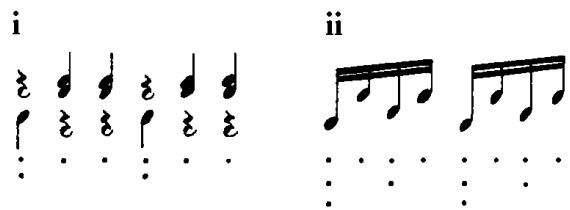
中文讲解
此为第 36 页上的图像或乐谱占位符。该图示的位置与图注已被保留,但具体图像数据已省略。图示出现在关于 MPR 5e、5f 等节拍偏好规则应用的讨论语境中(对应周围注释 P0280、P0282)。读者需参阅原书第 36 页以查看乐谱示例本身,用以验证正文中关于节拍偏好规则应用与伴奏模式的论述。
补充说明
因图像内容不可见,仅能确认其位置处于第 36 页中部;图注具体内容需查阅原书。
第47段(P0282)
原文复述
- The distinction between this rule and the parts of MPR 5 (length) that make use of time-span reduction needs some clarification. In the length rule, levels of time-span reduction smaller than the metrical level currently being derived help define what counts as a repeated pitch or prolonged harmony. In MPR 9, by contrast, hypotheses about metrical structure are tested for their consequences for levels of time-span reduction equivalent to and larger than the metrical level currently being derived; a more stable time-span outcome affects metrical choice.
中文讲解
第 4 章注释第 7 条:作者说明此规则与 MPR 5(长度)中利用时值缩减的部分需要加以区分。在长度规则中,小于当前正被推导之节拍层级的时值缩减层级,有助于界定何为重复音或延展和声。相比之下,在 MPR 9 中,对节拍结构的假设要依据其对等于及大于当前节拍层级的时值缩减的后果来检验;时值缩减结果越稳定则越影响节拍选择。该注释起技术澄清作用,澄清两个看似相近规则的关键差别。
第48段(P0283)
原文复述
- The question arises as to why the harmonic changes could not be assigned to the eighth notes immediately preceding the chords on the eighth-note metrical level. To answer this objection, we would argue that harmonic progression is not heard as significant at metrical levels smaller than the tactus, which at the speed this passage is performed (♪ = at least 240) turns out to be the quarter-note level. Thus MPR 5f (harmonic rhythm) is properly restricted in application to harmonic changes in the time-span reduction at the tactus level and higher, eliminating the potentially offending applications at beats 5, 11, 17, and 23. (This restriction eliminates the applications of MPR 5f below the half-note level in the derivation of the Mozart G Minor Symphony above. Because of the other metrical evidence, this does not change the derivation.)
中文讲解
第 4 章注释第 8 条:作者回应潜在反驳——为何和声变化不能被分配给节拍上紧接和弦之前的八分音符(八分音符节拍层级上)。作者论证,在小于 tactus 的节拍层级上,和声进行不被听成有意义的;本段演奏速度下(♪ = 至少 240)tactus 即为四分音符层级。MPR 5f(和声节奏)的应用因而应被恰当地限定到 tactus 层及更高层级的时值缩减的和声变化上,从而消除在第 5、11、17、23 拍上潜在的违规应用(在上述 Mozart g 小调交响曲的推导中,该限定消除了半音层级以下的 MPR 5f 应用——由于有其他节拍证据,这不影响推导结果)。该注释起限定与反驳作用。
第49段(P0284)
原文复述
- In Lerdahl and Jackendoff 1977 we spoke of metrical overlaps rather than metrical deletions. As Andrew Imbrie has pointed out (personal communication), beats are points in time and hence cannot overlap—as opposed to groups, which have duration. Hence the terminology is changed.
中文讲解
第 4 章注释第 9 条:作者说明在 Lerdahl and Jackendoff 1977 中曾使用"节拍重叠”(metrical overlaps)一词;Andrew Imbrie(个人交流)指出节拍是时点,因而不能重叠——分组才有时长——故本书改换了术语。该注释起术语史说明作用,标注版本间术语差异并标明其方法论原因。
第50段(P0285)
原文复述
- This analysis follows the metrical interpretation given in Lerdahl and Jackendoff 1977. In another interpretation, where the downbeats of odd-numbered bars are stronger than those of even-numbered bars, this metrical irregularity does not occur.
中文讲解
第 4 章注释第 10 条:作者说明本分析承袭 Lerdahl and Jackendoff 1977 的节拍阐释。在另一阐释下(奇数小节的强拍强于偶数小节),此处节拍不规则不出现。该注释起平行方案说明作用,标注一种可替代的阐释的可能性。
第51段(P0286)
原文复述
- See for example the brief remarks by Babbitt (1965, 1972) on these parallels. Briefly: If one downplays the Hegelian and Romantic sides of Schenker’s thought and emphasizes its more systematic aspects, Schenker can be construed (especially in Der freie Satz) as having developed a proto-generative theory of tonal music—that is, as having postulated a limited set of principles capable of recursively generating a potentially infinite set of tonal pieces. But, remarkable and precursory though his achievement was, he did not develop a formal grammar in the sense one would expect nowadays of a generative theory. Moreover, his orientation was not psychological (as that of generative linguistics is), but artistic; the chief purpose of his theory was to illuminate structure in musical masterpieces. Though our proposed theory also aspires to such illumination, its focus is on musical cognition. Despite these differences, we are profoundly indebted to Schenker’s work—as, indeed, anybody in the field must be. Readers unfamiliar with Schenker’s work can find a good introduction in Forte 1959 or Jonas 1954.
中文讲解
第 5 章注释第 1 条:作者指引读者参阅 Babbitt(1965, 1972)关于这些平行的简略评述。摘要:若淡化 Schenker 思想中的黑格尔与浪漫主义方面,强调其较为系统的一面(尤其在《自由作曲》中),则 Schenker 可被解读为已发展出一种"原生成性"的调性音乐理论——即假设一组有限的、能够递归生成潜在无穷调性作品集合的原则。尽管其成就非凡且有先驱性,但他并未发展出现代意义上的形式语法。此外,他的取向不是心理学的(如生成语言学所是的那样),而是艺术的;其理论的首要目的是阐明音乐杰作中的结构。本书的理论虽也以此类阐明为志业,但其聚焦于音乐认知。尽管有这些差异,作者对 Schenker 的工作深为感念——该领域任何人皆应如此。读者若不熟悉 Schenker,可在 Forte 1959 或 Jonas 1954 中找到良好入门。该注释起背景说明/承认先驱作用,标示本书与 Schenker 传统的延续与差异。
第52段(P0287)
原文复述
Chapter 5
中文讲解
此为版式标头,标示其后内容属于第 5 章的注释部分。
第53段(P0288)
原文复述
Notes to pp. 86–111
中文讲解
此为版面元素,标示其后注释对应第 5 章正文的第 86-111 页范围。
第54段(P0289)
原文复述
- See Kassler 1963, 1976 and Sundberg and Lindblom 1976 for studies along these lines.
中文讲解
第 5 章注释第 2 条:作者指引读者参阅 Kassler 1963、1976 以及 Sundberg and Lindblom 1976 以了解同类路径的研究。该注释起来源指引作用。
第55段(P0290)
原文复述
- Smoliar 1980 and Snell 1979 are examples of such an approach.
中文讲解
第 5 章注释第 3 条:作者注明 Smoliar 1980 和 Snell 1979 是此类路径的实例。该注释起来源指引作用。
第56段(P0291)
原文复述
- Keiler (1975, 1978a), whose broad theoretical perspective seems to resemble our own, makes this kind of transference of linguistic trees, replete with grammatical categories such as “tonic prolongation,” “tonic completion,” and “dominant prolongation.” From our viewpoint, the resultant musical trees suffer from the sort of superficial analogy between music and language for which he rightly criticizes Bernstein (1976). One also wonders how in principle Keiler’s proposed theory will be able to generalize beyond classical tonal music. A musical grammar must be conceived on a more abstract basis if it is to be relevant to the fundamental issue of musical cognition.
中文讲解
第 5 章注释第 4 条:作者评论 Keiler(1975, 1978a)。Keiler 的广义理论视角与作者本人相似,但其将语言学树直接迁移到音乐学——树中标满"主音延展"“主音完成"“属音延展"等语法范畴。从作者角度看,所得音乐之树正是因为他曾正确批评 Bernstein(1976)的那种音乐-语言浅显类比的同种弊病。作者也质疑:原则上,Keiler 所提理论如何能够超出古典调性音乐之外?若音乐语法要切中音乐认知的根本问题,必须在更抽象的基础上构思。该注释起批驳与论证作用,标示本书与"近邻"理论的关键分歧。
第57段(P0292)
原文复述
Even in the restricted context of classical tonal music, there are severe shortcomings in the descriptive adequacy of Keiler’s proposed trees (see for example Keiler 1978a, pp. 212–221). We give three examples: (1) Keiler’s trees cannot assign structure to nonharmonic tones, thus missing obvious generalizations such as the similar function of a passing chord and a passing tone. (2) Keiler’s trees cannot assign structure to such prevalent forms as an antecedent phrase or an antecedent-consequent period, because his formalism requires every “tonic prolongation” to have a “tonic completion.” But it is precisely a characteristic of “interruption” forms that at a certain point the tonic is not completed. (3) Keiler’s trees cannot assign structure to such common progressions as I-vi-I and IV-V-I, because the only categories available are “tonic” and “dominant.” Plainly a “subdominant” category is needed. (The subdominant category would also apply to the ii6 in a ii6-V progression, dubiously analyzed by Keiler as “dominant” to “tonic” under a “dominant prolongation.”)
中文讲解
(第 5 章注释第 4 条内续)作者列举即便在古典调性音乐之受限语境下,Keiler 所提出的树在描写充分性上的严重缺陷:例如 Keiler 1978a,第 212-221 页。作者给出三个例子:(1)Keiler 的树无法给非和声音赋予结构,从而遗漏经过和弦与经过音功能相似之类的明显概括。(2)Keiler 的树无法给前句或前句-后句乐段等常见形式赋予结构,因其形式体系要求每个"主音延展"必有一个"主音完成”;而"中断"形式的特征恰在于在某一处主音不被完成。(3)Keiler 的树无法给 I-vi-I、IV-V-I 等常见进行赋予结构,因其仅备"主"“属"两类。明显需要"下属"这一类(“下属"类还可应用于 ii6-V 进行中的 ii6,Keiler 勉强将其分析为"属音延展"下的"属"到"主”)。该注释起详细批驳作用。
第58段(P0293)
原文复述
Finally, we must distance ourselves from Keiler’s generative approach in one absolutely essential respect: Keiler does not develop, nor does he propose to develop, a system of rules that pairs musical surfaces with heard musical structures. He has only developed an analytic notation. Thus, despite the linguistic ambience of his work and the “syntactic” nature of his trees, he is not engaged in constructing a generative grammar in any sense normally intended by the term. (See Jackendoff and Lerdahl 1980 for further discussion.)
中文讲解
(续前注释)作者最后声明必须在关键之处与 Keiler 的生成路径划清界限:Keiler 并未发展——也不打算发展——一套将音乐表层与听感音乐结构配对的规则系统。他只发展了一种分析性记号。因此,尽管其工作带有语言学氛围且其树带有"句法"性质,他并未从事通常意义下的生成语法构建(详见 Jackendoff and Lerdahl 1980)。该注释起定义性划界作用,将"真正的生成语法"与仅"分析性记号"相区别。
第59段(P0294)
原文复述
- However, such an assignment does occur in the musical surface in conjunction with grouping overlap, where event x in 5.7c is represented twice in underlying structure. The underlying tree has one branch to each occurrence of x and is therefore well formed; hence x is assigned two distinct functions. See section 7.1.
中文讲解
第 5 章注释第 5 条:作者注明与分组重叠相结合的表层音乐中确有这种赋义——5.7c 中事件 x 在底层结构中被表征两次;底层树对 x 的每次出现各有一个分支,故树结构良好;x 因此被赋予两种不同功能(参见 7.1 节)。该注释起澄清作用,揭示一个乍看异常但合规则的赋义现象。
第60段(P0295)
原文复述
- The angles made by these branchings convey no information; they are simply a fortuitous result of where an event is on the page in relation to the geometry of the tree.
中文讲解
第 5 章注释第 6 条:作者注明这些分支之间的角度不携带任何信息;它们只是事件在页面上相对树之几何位置的偶然结果。该注释起记号约定说明作用,提醒读者树中的角度纯属版式产物。
第61段(P0296)
原文复述
- We discuss this already overdiscussed passage because, beneath its brevity and apparent simplicity, it is unusually useful in presenting issues of general significance. Reductions of a wide variety of pieces will be presented in the following chapters.
中文讲解
第 5 章注释第 7 条:作者说明之所以讨论这一已被反复讨论过的段落,是因为在其简短与表面简单之下,对呈现一般性的问题而言异常有用。各章后续将展示对多种作品的缩减分析。该注释起编辑性说明作用,说明选材理由及后续工作计划。
第62段(P0297)
原文复述
Notes to pp. 111–118
中文讲解
此为版面元素,标示其后注释对应第 5 章正文的第 111-118 页范围。
第63段(P0298)
原文复述
- Schenker’s (1925, 1935) more complex solution for the first “event” is discussed briefly in section 7.3 and more extensively in section 10.4. Such refinements may be disregarded at this stage of our presentation.
中文讲解
第 5 章注释第 8 条:作者指出 Schenker(1925, 1935)对第一个"事件"的更复杂解决方案在 7.3 节有简要讨论、在 10.4 节有更详细讨论;在本书目前的呈现阶段,这些精微化可暂置不论。该注释起编辑性指引作用,把读者引向后续讨论。
第64段(P0299)
原文复述
- The conception of time-span reduction is not new with us, though a number of refinements are totally our own. To our knowledge, the time-span approach to reduction has been developed, in various ways and to varying degrees, by Barnett (1972), Komar (1971), Lewin (1974), Schachter (1980), Westergaard (1975), and Yeston (1976). Our particular inspiration, for which we are most grateful, was Lewin’s unpublished essay on Schubert’s song “Morgengruss.”
中文讲解
第 5 章注释第 9 条:作者注明"时值缩减"概念并非本书首创,但若干精微之处完全出自本书作者。据作者所知,时值缩减方法已由 Barnett(1972)、Komar(1971)、Lewin(1974)、Schachter(1980)、Westergaard(1975)和 Yeston(1976)以各种方式、不同程度地发展过。作者特别感激 Lewin 关于 Schubert 歌曲《晨问候》的未刊论文的启发。该注释起来源承认与历史定位作用。
第65段(P0300)
原文复述
- Schachter 1976 (pp. 330–334) also draws attention to this characteristic conflict in “groupings.”
中文讲解
第 5 章注释第 10 条:作者注明 Schachter 1976(第 330-334 页)也已关注这一"分组"方面的典型冲突。该注释起来源指引作用。
第66段(P0301)
原文复述
- Lewin 1974, Komar 1971, and Schachter 1980 are examples of a metrical approach to time-span reduction. Schachter restricts his version of time-span reduction (called “durational reduction”) to relatively短 and regular examples in order to avoid hypothetical constructions. None of these works addresses the question of out-of-phase passages.
中文讲解
第 6 章注释第 1 条:作者说明 Lewin 1974、Komar 1971 和 Schachter 1980 是对时值缩减采取节拍路径的代表。Schachter 将其版本的时值缩减(称为"时值缩减”)限于相对短而规则的例子,以避免假设性构造。这些作品都未讨论"相位偏移"段落的问题。该注释起文献定位作用。
第67段(P0302)
原文复述
- Schenker himself wavers on this issue. In Der freie Satz (figure 21; paragraph 90) he advocates the interrupted V, but many of his graphs (such as the one of Bach’s chorale “Ich bin’s . . .” in Schenker 1932) prescribe the final V. Komar (1971), in keeping with his “background” metrical theory, appears to favor any salient V that approximately bifurcates the passage in question (see the analysis in the appendix of Komar 1971 of the slow movement of Beethoven’s Pathétique Sonata). Schachter (1976, pp. 290–298) argues eloquently against the necessary association of structurally important events with roughly equal time-spans; yet he concedes (1980, pp. 211–214) that when a centrally located V is sufficiently prolonged near the musical surface, it might serve as the structural dominant. We think this concession confuses surface salience with reductional function.
中文讲解
第 6 章注释第 2 条:作者综述 Schenker 本人在该问题上的摇摆:在《自由作曲》(图 21;第 90 段)中他主张"中断的属音”,但在许多图表中(如 Schenker 1932 中 Bach 众赞歌《Ich bin’s…》的图)则规定为"终止的属音”。Komar(1971)与其"背景"节拍理论一致,似乎偏好任何大致二分该段落的显著属音(参见 Komar 1971 附录中关于贝多芬《悲怆奏鸣曲》慢乐章的分析)。Schachter(1976,第 290-298 页)对将结构重要事件与近似等距时值刻板关联作出了有力反对;但又承认(1980,第 211-214 页),当中心位置的属音在表层充分延长时,可充作结构性属音。作者认为这一让步混淆了表层凸显与缩减功能。该注释起学术史梳理与立场标明作用。
第68段(P0303)
原文复述
- Even in recitative and similar metrically unstructured music, the sequence of attack points produces a minimal, possibly irregular, metrical level in terms of which time-spans can be defined. However, such music often has a less highly articulated hierarchy of time-spans than metrically more structured music.
中文讲解
第 7 章注释第 1 条:作者注明即便在宣叙调及类似的节拍无结构音乐中,起音点的序列也产生一个最小(可能不规则)的节拍层级,可据其定义时值。但此类音乐常常比起拍结构化者而言,时值层级的分化程度较低。该注释起限定/扩展作用,说明方法的最小输入条件。
第69段(P0304)
原文复述
- Example 7.8 contains several examples of a notational abbreviation we have adopted. Where a particular beat determines both a regular and an augmented time-span, only the reduction of the latter is given in the secondary notation. On the other hand, the tree indicates the complete reduction. For example, the reduction of the first three sixteenths takes place in two steps: the A and the B are reduced to B alone in the regular time-span marked w; then the G and the B are reduced to G alone in the augmented time-span marked x. The branching in the tree reflects these two steps, but the musical notation shows only the outcome of the second step.
中文讲解
第 7 章注释第 2 条:作者说明示例 7.8 含本书所采用的若干记号缩写的实例。在某拍同时决定一个规则时值和一个增补时值的情况下,副记号仅给出后者的缩减;而树则表示完整的缩减。例:开头三个十六分音符的缩减分两步:先在标记为 w 的规则时值中将 A 和 B 缩减为 B;再在标记为 x 的增补时值中将 G 与 B 缩减为 G。树中的分支对应这两步,但音乐记号仅展示第二步的结果。该注释起记号说明作用。
第70段(P0305)
原文复述
- In the case of a melody accompanied by an Alberti bass, the bass undergoes fusion while the melody undergoes ordinary reduction. Although the intuitions are clear, we have not attempted to incorporate such situations into our theory, for the same reasons we avoided contrapuntal grouping structures: a formalism to represent independent structures for separate voices becomes much too cumbersome to work with.
中文讲解
第 7 章注释第 3 条:作者注明在旋律配以阿尔贝蒂低音的情形中,低音经历"融合"而旋律经历普通缩减。尽管直觉清楚,但因同样的原因——为独立声部分别建立结构的描述会过于繁冗——作者未尝试将这些情形并入理论。该注释起限制范围说明作用。
第71段(P0306)
原文复述
Chapter 6
中文讲解
此为版式标头,标示其后内容属于第 6 章的注释部分。
第72段(P0307)
原文复述
Chapter 7
中文讲解
此为版式标头,标示其后内容属于第 7 章的注释部分。
第73段(P0308)
原文复述
Notes to pp. 118–154
中文讲解
此为版面元素,标示其后注释对应第 6、7 章正文的第 118-154 页范围。
第74段(P0309)
原文复述
- Some additional examples of transformation appear in the analysis of the Schumann song “Wehmut” in Lerdahl and Jackendoff 1977.
中文讲解
第 7 章注释第 4 条:作者注明 Lerdahl and Jackendoff 1977 中关于 Schumann《忧愁》一歌的分析还呈现了若干转换的额外例子。该注释起来源指引作用。
第75段(P0310)
原文复述
- One might wonder whether optional chords of dominant preparation might be retained in a time-span reduction along with the obligatory penult and final of full and deceptive cadences or with the obligatory V of half cadences. We have found that retention of the dominant preparation adds little to a time-span reduction’s ability to convey the sense of a phrase. The importance of dominant preparation will be reflected in prolongational reduction. See sections 8.3 and 9.4.
中文讲解
第 7 章注释第 5 条:作者回应一个潜在问题——可选的属准备和弦是否可在时值缩减中与完整/伪终止所必需的次重音与终止、或与半终止所必需的属音一同保留。经验表明,保留属准备对于时值缩减传达乐句意义的能力贡献甚微。属准备的重要性将在延展缩减中体现(参见 8.3 节和 9.4 节)。该注释起澄清作用,把时值缩减与延展缩减的功能差异具体化。
第76段(P0311)
原文复述
- This rule differs from TSRPR 1, which considers only the metrical structure within one time-span at a time. This rule considers the overall relation of a reductional level to metrical structure, a more global consideration.
中文讲解
第 7 章注释第 6 条:作者说明本规则不同于 TSRPR 1——TSRPR 1 一次只考虑一个时值内部的节拍结构;本规则则考虑缩减层级与节拍结构的整体关系,更具全局性。该注释起规则区分作用。
第77段(P0312)
原文复述
- On the other hand, occasions arise in which the cadential resolution is not at the very end of a group, but is prolonged to the end of the group. This occurs, for instance, at the end of the Chorale St. Antoni, discussed in section 8.5; the functional final cadence occurs in measures 22–23, and the final tonic is prolonged through two V7/IV–IV–I sequences to the end in measure 29. A much more extreme situation arises in the finale of Beethoven’s Fifth Symphony, where the structural cadence for the entire movement occurs long before the end; the rest is a prolongation of the resolution. These exceptions are due to the influence of prolongational reduction. See section 9.6 for discussion.
中文讲解
第 7 章注释第 7 条:作者注释另一方面,存在终止解决并不在组之最末尾、而是被延长至组之末尾的情形。例如 8.5 节讨论的众赞歌《St. Antoni》之结尾:功能性终止出现在第 22-23 小节,而终止主音通过两个 V7/IV–IV–I 进行被延长至第 29 小节末尾。更极端的情形出现在贝多芬第五交响曲末乐章:整个乐章的结构性终止出现在结尾之前很久,余下皆为该解决的延展。这些例外源于延展缩减的影响(详见 9.6 节)。该注释起例外说明作用。
第78段(P0313)
原文复述
- The following account of prolongational reduction differs from that in Lerdahl and Jackendoff 1977. We feel that the present version is a major improvement, but even so it remains less finished than the other three components. In section 10.4 we outline two possible future developments in prolongational reduction.
中文讲解
第 8 章注释第 1 条:作者说明以下对延展缩减的论述不同于 Lerdahl and Jackendoff 1977;作者认为本版本是一次重大改进,但其完成度仍低于其他三成分。在 10.4 节中勾勒延展缩减两个可能的发展方向。该注释起版本说明与前瞻作用。
第79段(P0314)
原文复述
- Various writers have found patterns of tension and relaxation to be fundamental to the nature of rhythm. For example, Sessions (1951, p. 84): “The principle of tension and relaxation is perhaps the most important single principle of musical rhythm, and its bearing on all questions of musical expression cannot be overestimated.” Also see Schachter 1976 (pp. 333–334). For a much different approach to tension and relaxation, see Hindemith’s theory of “harmonic fluctuation” (1942, pp. 115–121).
中文讲解
第 8 章注释第 2 条:作者指出许多作者都视紧张-松弛模式为节奏本质之基础。Sessions(1951,第 84 页)说:“紧张与松弛的原则也许是音乐节奏最重要的一条原则,其对所有音乐表情问题的意义无论怎么说都不会过分。“另见 Schachter 1976(第 333-334 页)。关于紧张-松弛的迥异路径,见 Hindemith 的"和声波动"理论(1942,第 115-121 页)。该注释起来源指引作用。
第80段(P0315)
原文复述
- We originally adopted this formulation (Lerdahl and Jackendoff 1977, p. 140).
中文讲解
第 8 章注释第 3 条:作者简短注明此公式最初见于 Lerdahl and Jackendoff 1977,第 140 页。该注释起来源标注作用。
第81段(P0316)
原文复述
- Rhythmic factors might instead lead to a different analysis of 8.22, in which the V/ii would be embedded within a weak prolongation of ii.
中文讲解
第 8 章注释第 4 条:作者注明另一种分析 8.22 的可能——节奏因素可能将 V/ii 嵌入 ii 的弱延展之中。该注释起替代方案提示作用。
第82段(P0317)
原文复述
- The reduction in 8.39 agrees in essentials with Schenker’s analysis of the piece (1935, figures 42,2 and 138,3). Our main disagreements—intuitive as well as technical—concern Schenker’s elevation of the V in measure 11 (the bass) to the level of the Ursatz and his treatment of the melodic E♭ in measure 15 as superordinate within its local environment (he makes it a neighboring motion at the background). In both cases Schenker radically separates bass and melodic functions; we discuss this matter in section 10.4.
中文讲解
第 8 章注释第 5 条:作者注明 8.39 的缩减在要点上与 Schenker 对该作品的分析(1935,图 42,2 与 138,3)一致。双方主要分歧——直觉上与技术上的——涉及 Schenker 把第 11 小节的属音(低音)提升至 Ursatz 层级,以及其把第 15 小节旋律 E♭ 视为在局部环境中居支配地位(他在背景中将其作为邻音运动处理)。两处 Schenker 都将低音与旋律功能截然分开;本书在 10.4 节讨论这一议题。该注释起对比与限定作用。
第83段(P0318)
原文复述
- In the course of numerous analyses we have encountered only one or two cases where one might conceivably want to choose an event two time-span levels down. Without more serious examination of a number of such cases, it is hard to determine what motivates this extremely rare weakening of the Interaction Principle.
中文讲解
第 9 章注释第 1 条:作者注明在大量分析中,作者仅遇上一两例可能想要选择时值层级再下两层的事件。若不更细致地考察若干此类案例,难以判定这种极罕见的"互动原则"弱化的驱动因素。该注释起开放性讨论作用。
第84段(P0319)
原文复述
Chapter 8
中文讲解
此为版式标头,标示其后内容属于第 8 章的注释部分。
第85段(P0320)
原文复述
Chapter 9
中文讲解
此为版式标头,标示其后内容属于第 9 章的注释部分。
第86段(P0321)
原文复述
Notes to pp. 155–228
中文讲解
此为版面元素,标示其后注释对应第 8、9 章正文的第 155-228 页范围。
第87段(P0322)
原文复述
- We have shown here only one of two possible grouping structures for sonata form. The ambiguity concerns how the three groups consisting of exposition, development, and recapitulation are to be further grouped. The grouping in 9.29 emphasizes the parallelism in endings between exposition and recapitulation, and is similar to the grouping of the binary form out of which sonata form in part grew historically (see Rosen 1980 on the origins of the sonata style). On the other hand, an emphasis on the parallelism between the beginnings of the exposition and recapitulation would result in grouping the exposition and development together. Such a grouping seems more typical of late classical sonata forms, in which the development is balanced by a long coda to give four major sections grouped by twos: exposition-development and recapitulation-coda. In such forms the beginning of the recapitulation is usually a more dramatic point than in earlier sonata movements, emphasizing the major grouping boundary; also, the repeat of the exposition is often omitted, deemphasizing the group boundary between it and the development. The interested reader can verify, however, that the first two steps in deriving the prolongational tree neutralize the grouping ambiguity: in either grouping the prolongational structure is the same.
中文讲解
第 9 章注释第 2 条:作者说明此处仅展示了奏鸣曲式的两种可能分组结构中的一种。歧义关涉"呈示-展开-再现"三组如何进一步被分组。9.29 中的分组强调呈示部与再现部在结尾处的平行,与奏鸣曲式在历史上部分由其派生而来的二部形式的分组方式相似(关于奏鸣风格起源见 Rosen 1980)。另一方面,若强调呈示部与再现部在开头的平行,则会得出将呈示与展开合为一组的分组。此种分组在晚期古典奏鸣曲式中似乎更为典型——此时展开由一段长的尾声平衡,构成按二、二分组的四大段:呈示-展开、再现-尾声。在此类曲式中,再现之开始通常比早期奏鸣乐章中更具有戏剧性,更凸显主要分组边界;此外通常省略呈示部的反复,以弱化呈示与展开之间的组边界。然而,感兴趣的读者可验证:推导延展树的前两步中和了分组歧义——无论作哪种分组,延展结构都相同。该注释起替代方案与解决方案说明作用。
第88段(P0323)
原文复述
- Andrew Imbrie has suggested this possibility (personal communication).
中文讲解
第 10 章注释第 1 条:作者简短注明 Andrew Imbrie(个人交流)曾提出这一可能性。该注释起来源标注作用。
第89段(P0324)
原文复述
- In the secondary notation in 10.7 we have quartered the note values beginning at level g in order to show hypermetrical relations more clearly. This practice is convenient only where hypermetrical beats are quite regular.
中文讲解
第 10 章注释第 2 条:作者说明在 10.7 的副记号中,作者从 g 层级起将时值四等分,以更清楚地显示超节拍关系;该做法仅在超节拍十分规则时方为便利。该注释起记号惯例说明作用。
第90段(P0325)
原文复述
- Along with these analyses should be mentioned the time-span reduction of Schumann’s song “Wehmut” in Lerdahl and Jackendoff 1977, pp. 154–155 (though now we would prefer an out-of-phase analysis with hypermetrical beats on the downbeats of odd, not even, measures). The prolongational reduction (pp. 156–157), on the other hand, represents an earlier and less satisfactory version of that component, and should be disregarded.
中文讲解
第 10 章注释第 3 条:作者说明除这些分析外,亦应提及 Lerdahl and Jackendoff 1977(第 154-155 页)中 Schumann《忧愁》一歌的时值缩减(尽管作者现在更倾向于奇数小节重拍作超节拍拍的相位偏移分析)。而该书中的延展缩减(第 156-157 页)则代表了该成分较早且较不令人满意的版本,应予忽略。该注释起版本史与读者指南作用。
第91段(P0326)
原文复述
“Guten Morgen, schöne Müllerin!
中文讲解
第 10 章注释第 4 条(一):德语歌词——“早安,美丽的磨坊姑娘!“出自 Schubert《美丽的磨坊女》。该注释完整呈现德文歌词以作为歌曲引证(中文释义由读者借助语境理解)。
第92段(P0327)
原文复述
Wo steckst du gleich das Köpfchen hin,
中文讲解
德语歌词——“你为何立刻就藏起了小脑袋?"(出自 Schubert《美丽的磨坊女》)。
第93段(P0328)
原文复述
Als wär’ dir was geschehen?
中文讲解
德语歌词——“仿佛你发生了什么不幸?"(出自 Schubert《美丽的磨坊女》)。
第94段(P0329)
原文复述
Verdriesst dich denn mein Gruss so schwer?
中文讲解
德语歌词——“我的问候竟如此令你厌烦?"(出自 Schubert《美丽的磨坊女》)。
第95段(P0330)
原文复述
Verstört dich denn mein Blick so sehr?
中文讲解
德语歌词——“我的目光竟如此令你惊扰?"(出自 Schubert《美丽的磨坊女》)。
第96段(P0331)
原文复述
So muss ich wieder gehen.”
中文讲解
德语歌词——“那我只好再次离去。"(出自 Schubert《美丽的磨坊女》,构成第 10 章注释第 4 条的结尾)。
第97段(P0332)
原文复述
- Lewin 1974 discusses these musical-poetic relationships at great length and with considerable insight. Aspects of our analysis duplicate Lewin’s.
中文讲解
第 10 章注释第 5 条:作者注明 Lewin 1974 对这些音乐与诗歌的关系作了详尽且颇富洞察的讨论;本书分析的若干方面与 Lewin 重合。该注释起来源指引与定位作用。
第98段(P0333)
原文复述
- Schenker wants to bring out linear-motivic relationships involving third spans: the ascending C#-E and B-D in measures 1-2 elaborated into A-B-C# in measures 3-4, combined with the descending E-D-C# in measures 1-4 followed by D-C#-B in measure 4. Schachter (personal communication) has argued that this in itself is enough to favor Schenker’s analysis. Such a proposal might be incorporated into our theory by invoking another preference rule supporting prolongational reductions that emphasize linear-motivic connections of a certain kind. In other words, it is a matter of weighting preference rules, involving once again the problematic issue of parallelism. We, on the other hand, have tried as much as possible to separate reductional and motivic structures; they are interactive, not equivalent, modes of organization.
中文讲解
第 10 章注释第 6 条:作者说明 Schenker 希望凸显涉及三度跨度的线性-动机关系——第 1-2 小节上行的升 C-E 与 B-D,在第 3-4 小节中扩展为 A-B-升 C;并结合第 1-4 小节下行的 E-D-升 C 后接第 4 小节的 D-升 C-B。Schachter(个人交流)主张这本身就足以支持 Schenker 的分析。这一提议可通过引入另一支持强调某种线性-动机连接的延展缩减的偏好规则而被并入本书理论。换言之,这是一个为偏好规则赋权重的问题,再次涉及平行的棘手议题。本书则尽可能把缩减结构与动机结构分开——它们相互作用的两种组织模式而非等同的组织模式。该注释起方法论比较与划界作用。
第99段(P0334)
原文复述
Chapter 10
中文讲解
此为版式标头,标示其后内容属于第 10 章的注释部分。
第100段(P0335)
原文复述
Notes to pp. 243–276
中文讲解
此为版面元素,标示其后注释对应第 10 章正文的第 243-276 页范围。
第101段(P0336)
原文复述
- All the rules developed in chapters 2–9 are listed in the rule index, and the parts of rules that we conjecture to be idiom-specific are indicated by asterisks.
中文讲解
第 11 章注释第 1 条:作者说明第 2-9 章所发展的全部规则均列于规则索引中;规则中推测为风格特有的部分以星号标示。该注释起导航作用。
第102段(P0337)
原文复述
- This does not, however, exclude the possibility that one can use other, non-musical, auditory principles to organize a musical surface. One is presumably doing this, for instance, when one hears a piece in an unfamiliar idiom as noise rather than music.
中文讲解
第 11 章注释第 2 条:作者说明这并不排除使用其他非音乐的听觉原则来组织音乐表层的可能性。例如当听者以不熟悉风格听一首作品而听成噪声而非音乐时,他/她很可能正这样做。该注释起限定作用。
第103段(P0338)
原文复述
- That our list covers as much ground as it does is due in part to a reading of Schachter 1976. This paper suggested to us that our theory could表达 more aspects of rhythm than we had realized.
中文讲解
第 11 章注释第 3 条:作者说明本书清单能覆盖如此广的范围,部分得益于阅读 Schachter 1976。该文向作者表明本书理论能比作者起初意识到的更多节奏方面。该注释起来源指引作用。
第104段(P0339)
原文复述
- The dubious aspects of Reti’s (1951) study of thematic transformations are due to his frequent disregard of hierarchical function.
中文讲解
第 11 章注释第 4 条:作者注明 Reti(1951)对主题变形研究可疑之处在于他常常忽视层级功能。该注释起限定/批评作用。
第105段(P0340)
原文复述
- Schoenberg (1911) even uses this “evolutionary” argument to support his writing of highly dissonant harmonies.
中文讲解
第 11 章注释第 5 条:作者注明 Schoenberg(1911)甚至用这一"演化"论据来支持其创作高不谐和音。该注释起背景说明作用。
第106段(P0341)
原文复述
- Some of this music is available on Lyrichord LL189.
中文讲解
第 11 章注释第 6 条:作者注明此类音乐中的一部分可于 Lyrichord LL189 找到。该注释起来源指引作用。
第107段(P0342)
原文复述
- A related and perhaps more satisfactory hypothesis has been suggested by writers as different as Mursell (1937) and Partch (1949). They maintain that the perception of relative intervallic stability is a correlate of frequency ratios: the simpler the ratio, the easier to comprehend, or the more stable, an interval is. (Johnston 1964 extends this approach to durational patterns.) Their appeal is not to a direct physical cause such as the overtone series, but to an arithmetical, mentalistic one. We take no position here on this interesting line of reasoning, except to observe that cultural convention and musical context are also critical factors. To the extent that a musical idiom does not utilize simple ratios, convention and context will play comparably greater roles.
中文讲解
第 11 章注释第 7 条:作者说明 Mursell(1937)与 Partch(1949)这些风格迥异的作者提出了一条相关而也许更令人满意的假设——他们主张相对音程稳定性的感知是频率比的关联物:比例越简单,音程越易理解或越稳定(Johnston 1964 将此路径推广至时值模式)。他们的诉诸不是诸如泛音列这样的直接物理原因,而是算术性的、心理性的原因。作者就此有趣思路不表态,但观察到文化惯例与音乐语境也是关键因素。某种音乐风格不使用简单比例时,惯例与语境的相对作用更大。该注释起并列假说与限定作用。
第108段(P0343)
原文复述
- Another example: We understand there is now a pocket computer that can store and play back tunes. Since the tunes are stored numerically, one can take the square root of a tune and play that back! We doubt, however, that such “transformations” are musically very useful.
中文讲解
第 11 章注释第 8 条:作者再举一例——据悉目前已有口袋计算机可存储并回放旋律。由于旋律以数字存储,故可以求一首旋律之平方根并回放之!但作者怀疑此类"变换"在音乐上有多大用处。该注释起反例调侃作用。
第109段(P0344)
原文复述
- One must still resist the temptation to try to account for Gestalt principles at too shallow a level. Hochberg 1974, an admirable reassessment of the Gestalt tradition, suggests a number of hypotheses, among which are “Organization can be identified with the structure of the programs of the efferent commands that would be needed to perform the oculomotor behaviors that are normally appropriate to a given stimulus pattern” and “Many of the laws of organization may simply be good cues as to which way occlusion or interposition occurs.” There is an obvious difficulty in attributing the laws of organization to programs in the visuomotor system: these laws generalize in a quite straightforward manner to the auditory domain, where there is no corresponding motor activity. We are somewhat surprised that these generalizations, cited in the earliest research in Gestalt theory, have been ignored even by specialists. Their existence seems to us to argue that the laws of organization must be formulated at a level of mental organization where spatial and temporal information are represented compatibly—the level that Lashley 1951 posits. We know of no general theory of this level.
中文讲解
第 12 章注释第 1 条:作者主张人们仍必须抵制在过浅层次上解释 Gestalt 原则的诱惑。Hochberg 1974 对 Gestalt 传统的卓越重评提出了若干假说,如"组织可被等同于对特定刺激模式通常适当的眼动行为的输出命令程序的结构"以及"许多组织法则或许只是关于遮挡或交叠发生方向的良好线索”。将组织法则归因于视动系统的程序存在明显困难——这些法则以相当直接的方式推广至听觉领域,而那里并无相应的运动活动。作者略感惊讶,这些最早已在 Gestalt 理论早期研究中援引过的概括,却被专家们忽视。其存在向我们表明,组织法则必须在心智组织的一个层次上加以表述——在该层次上空间信息和时间信息以兼容的方式被表征——即 Lashley 1951 所假定的层次。作者并不知道关于该层次的一般理论。该注释起理论深度与研究方向指引作用。
第110段(P0345)
原文复述
- Katz and Postal (1964) observe that each sentence in 12.1 is ambiguous between the readings in 12.2, but different meanings are highly preferred. By calling this difference a stylistic matter, they claim to escape the consequence that transformations change meaning. This is, however, an evasion; see Jackendoff 1972, chapter 8.
中文讲解
第 12 章注释第 2 条:作者说明 Katz and Postal(1964)观察到 12.1 中每个句子在 12.2 的两种解读间存在歧义,但某种意义是受到强烈偏好的。他们通过把这一差异称为风格问题,来声言可逃脱"转换改变意义"的后果。然而这是一种回避(参见 Jackendoff 1972 第 8 章)。该注释起反驳作用。
第111段(P0346)
原文复述
Chapter 11
中文讲解
此为版式标头,标示其后内容属于第 11 章的注释部分。
第112段(P0347)
原文复述
Chapter 12
中文讲解
此为版式标头,标示其后内容属于第 12 章的注释部分。
第113段(P0348)
原文复述
Notes to pp. 279–309
中文讲解
此为版面元素,标示其后注释对应第 11、12 章正文的第 279-309 页范围。
第114段(P0349)
原文复述
- The material in this subsection is treated in greater depth in Jackendoff (forthcoming).
中文讲解
第 12 章注释第 3 条:作者注明本小节材料在 Jackendoff(即将出版)中有更深入讨论。该注释起进一步阅读指引作用。
第115段(P0350)
原文复述
- See for example Kiparsky 1977, 1979; Selkirk 1978, 1980; Vergnaud and Halle 1979; and the papers in Safir 1979.
中文讲解
第 12 章注释第 4 条:作者指引参阅例如 Kiparsky 1977、1979;Selkirk 1978、1980;Vergnaud and Halle 1979 以及 Safir 1979 中论文。该注释起来源指引作用。
第116段(P0351)
原文复述
- One difference, however, is that the prosodic trees permit only one weak branch per node, whereas the musical trees sometimes permit more than one elaboration per node. We return to this difference later in this section; it is immaterial to the discussion here.
中文讲解
第 12 章注释第 5 条:作者指出存在一个差异——韵律树每节点仅允许一个弱分支,而音乐树有时每节点允许多于一个的展开。本节稍后会回到这一差异;此处讨论不受影响。该注释起技术性说明与延后作用。
第117段(P0352)
原文复述
- There are numerous exceptions to this principle, as shown by contrasts in English like or-che-stra versus or-ches-tral. A complete account of rules of syllabification is as yet unavailable.
中文讲解
第 12 章注释第 6 条:作者注明本原则有许多例外,英语如 or-che-stra(管弦乐队)与 or-ches-tral(管弦乐队的)这样的对照可以显示。音节划分规则的完整说明尚不可得。该注释起限定与开放作用。
第118段(P0353)
原文复述
- The structures in 12.14 are derived from the structure given in Selkirk’s (1980) example 28b. In her alternative structure (28c), which is identical to Liberman and Prince’s treatment, the initial syllable is simply adjoined at the word level. Though this choice always makes a difference in segmentation, it will only make a difference in tree structure in the case of multifoot words such as Monongahela. In such a case the 28b structure will adjoin the initial syllable to the foot -nonga-, whereas the 28c structure will adjoin it to the combination of the two feet -nonga- and -hela. We know of no empirical arguments for one or the other, beyond the musical parallel. Incidentally, Selkirk 1980 notes that feet augmented by an initial unstressed syllable occur only at the beginning of a word, not word-internally, and argues that this fact should not have to be stipulated by the theory that derives such structures. However, it is exactly parallel to the musical case, where an augmented subgroup may occur only at the beginning of a group. The parallelism suggests that the stipulation against which Selkirk inveighs is not so offensive after all.
中文讲解
第 12 章注释第 7 条:作者说明 12.14 中的结构由 Selkirk(1980)例 28b 所给结构推出。在其替代结构(28c,与 Liberman 和 Prince 的处理等同)中,初始音节仅在词层被附加。该选择始终会在切分上造成差别,但仅在像 Monongahela 这样的多音步词才会在树结构上造成差别。在此类情况下,28b 结构将初始音节附加到音步 -nonga-,而 28c 结构将其附加到两音步 -nonga- 与 -hela 之组合。除音乐平行外,作者不知道支持任一选项的实证论据。Selkirk 1980 还顺便指出,由起始非重读音节扩展的音步只出现在词首而非词内,并主张这一事实不应必须由推导出此类结构的理论明确列出。然而这恰与音乐情形平行——在音乐中扩展的次组只能出现在组的开头。这一平行提示 Selkirk 所反对的明确列出似乎并不那么令人不快。该注释起技术比较与跨领域平行作用。
第119段(P0354)
原文复述
- Selkirk raises the possibility that in fact the directionality of the English rule is only a preference rather than a necessity. This allows for the observed alternate stressing in complex words such as Ticonderoga, by means far too complex to describe here.
中文讲解
第 12 章注释第 8 条:作者简短指出 Selkirk 提出英语规则的方向性实际上仅为偏好而非必然。该偏好可解释复杂词如 Ticonderoga 上观察到的交替重音——说明太复杂,此处不述。该注释起转述与限定作用。
第120段(P0355)
原文复述
- Readers familiar with hierarchical phonology will notice that our tree does not contain category labels such as syllable and foot; these are present only in the segmentation. This separation of functions avoids a notational problem that arises in current conventional practice, where some nodes in the tree have only category labels, some have only s or w, and some have both.
中文讲解
第 12 章注释第 9 条:作者说明熟悉层级音韵学的读者将注意到本书的树不含音节、音步等范畴标签;这些范畴仅出现在切分之中。这一功能分离避免了当前惯例中的记号问题——该惯例中树中一些节点只有范畴标签、一些只有 s 或 w、一些二者皆有。该注释起记号惯例说明作用。
第121段(P0356)
原文复述
- This formulation has been designed to generalize to “upbeat” syllables, which receive separate treatment in Selkirk’s exposition. In Liberman and Prince’s account, the prominence contour of a foot is determined by the same rule that creates the segmentation; the two functions are not distinguished.
中文讲解
第 12 章注释第 10 条:作者说明此公式被设计为可推广至"弱起"音节(Selkirk 阐释中予以分别处理)。在 Liberman 和 Prince 的论述中,音步之显峰曲线由产生切分的同一规则决定——两种功能未予区分。该注释起公式设计与对比作用。
第122段(P0357)
原文复述
- Prominence rule 2 is subject to a number of classes of exceptions, discussed at length by Liberman and Prince.
中文讲解
第 12 章注释第 11 条:作者简短注明显峰规则 2 存在若干类例外,由 Liberman 和 Prince 详细讨论。该注释起来源指引作用。
第123段(P0358)
原文复述
- We have not discussed the constituency of the phonological phrase. Liberman and Prince, following Chomsky and Halle (1968), take it to be essentially identical to nonlexical syntactic categories (NP, VP, etc.). However, Selkirk 1978 argues that a more complex relationship is involved. For the examples here, the two views are indistinguishable.
中文讲解
第 12 章注释第 12 条:作者说明尚未讨论音韵短语的构成。Liberman 和 Prince 追随 Chomsky and Halle(1968),将其基本等同于非词汇性句法范畴(NP、VP 等)。但 Selkirk 1978 认为其中涉及更复杂的关系。就本书中的例子而言,两种观点无差别。该注释起论点限制作用。
第124段(P0359)
原文复述
Notes to pp. 309–324
中文讲解
此为版面元素,标示其后注释对应第 12 章正文的第 309-324 页范围。
第125段(P0360)
原文复述
- For what it is worth, Kiparsky 1977 shows that so-called triple meters in poetry (dactylic and anapestic) must be treated as duple meters with a divided weak position. The consequences of this for music are unclear.
中文讲解
第 12 章注释第 13 条:作者注明 Kiparsky 1977 显示诗中所谓三拍格律(扬抑抑格与抑抑扬格)必须被处理为带分弱位的二拍格律;这对音乐的后果尚不清楚。该注释起限定与开放作用。
第126段(P0361)
原文复述
- In this we agree with Liberman (1975, pp. 313–314), who, after demonstrating the importance of metrical structure (in our terms) to language, makes the following observation:
中文讲解
第 12 章注释第 14 条(引导句):作者注明在这一点上与 Liberman(1975,第 313-314 页)所见一致;Liberman 在展示节拍结构(按本书术语)对语言的重要性后,作出如下观察。该注释起引语过门作用。
第127段(P0362)
原文复述
There is some reason (evolutionary parsimony, if nothing else) to suppose that the cases of language, music, and dance demonstrate, in a more intuitively accessible way, a system which in fact is the organizing principle of all temporally ordered behavior….[This sup-position] suggests that the source and origin of “rhythm” is quite abstract, especially with respect to the fundamental division between event-structure [our time-span structure] and time-structure [our metrical structure]….
中文讲解
Liberman 的引文(接 P0361):“有一些理由(即便不考虑别的,演化上的简约性也足以为据)可假定语言、音乐与舞蹈的诸例以一种直觉上更易把握的方式展现了一个系统——事实上这是所有时序行为的组织原则……该假定提示’节奏’的来源与起源相当抽象,尤其关涉事件结构[本书的时值结构]与时间结构[本书的节拍结构]之间的根本区分……“该注释通过引文强化本书与 Liberman 在节拍结构跨域普遍性方面的共识。
第128段(P0363)
原文复述
It is worth pointing out that this tremendously advantageous system does seem to impose one requirement—that the behavior in question be abstractly segmented into discrete subunits. An interesting consequence of this is that there could be no music without notes (structured, say, [into continuous contours]), no language without words and phonemes (in which the meaningful units were irretrievably smeared throughout a temporally unsegmented noise), and no dance without “steps.”
中文讲解
续 Liberman 引文:“值得指出的是,这一巨大优势的系统确实似乎强加了一项要求——即相关行为必须在抽象上被切分为离散的子单元。一个有趣后果是,若行为未被切分为离散子单元(如音乐没有音符[例如被组织为连续轮廓]、语言没有词与音位[有意义单位被永久弥散于一时序未切分之噪声]、舞蹈没有’步’),则相应的艺术形式不可能存在。“该注释通过引文进一步强化:节奏系统的离散切分要求对音乐、语言、舞蹈普遍适用。
第129段(P0364)
原文复述
Notes to pp. 328–330
中文讲解
此为版面元素,标示其后内容对应规则索引前后文区域(第 328-330 页)。
第130段(P0365)
原文复述
Note: Rules marked with an asterisk are idiom-specific. We believe the rest are universal.
中文讲解
此为规则索引的编者按:标记星号的规则为风格特有(idiom-specific),其余被作者认为是普遍(universal)的。
第131段(P0366)
原文复述
GWFR 1 (p. 37)
中文讲解
此为规则索引表头——“分组结构良好成型规则 1”(Grouping Well-Formedness Rule 1),引自第 37 页。其后 P0367 给出规则内容。
第132段(P0367)
原文复述
Any contiguous sequence of pitch-events, drum beats, or the like can constitute a group, and only contiguous sequences can constitute a group.
中文讲解
GWFR 1 之内容:任何音事件、鼓点或类似的连续序列可构成一个组,且仅有连续序列可构成一个组。该规则限定组的范畴:组必须是时间上相邻的事件序列。
第133段(P0368)
原文复述
GWFR 2 (p. 38)
中文讲解
此为规则索引表头——分组结构良好成型规则 2,引自第 38 页。其后 P0369 给出规则内容。
第134段(P0369)
原文复述
A piece constitutes a group.
中文讲解
GWFR 2 之内容:整部作品构成一个组。该规则提供整篇的最大分组边界,作为分组层级之顶。
第135段(P0370)
原文复述
GWFR 3 (p. 38)
中文讲解
此为规则索引表头——分组结构良好成型规则 3,引自第 38 页。其后 P0371 给出规则内容。
第136段(P0371)
原文复述
A group may contain smaller groups.
中文讲解
GWFR 3 之内容:一个组可包含较小的组。该规则允许分组的嵌套结构,构成层级化分组树的基础。
第137段(P0372)
原文复述
GWFR 4 (p. 38)
中文讲解
此为规则索引表头——分组结构良好成型规则 4,引自第 38 页。其后 P0373 给出规则内容。
第138段(P0373)
原文复述
If a group $G_{1}$ contains part of a group $G_{2}$ , it must contain all of $G_{2}$ .
中文讲解
GWFR 4 之内容:若一个组 G₁ 包含另一个组 G₂ 的部分,则 G₁ 必须包含 G₂ 的全体。该规则要求分组边界不被部分包含——保证分组的"要么全有要么全无"特性。
第139段(P0374)
原文复述
GWFR 5 (p. 38)
中文讲解
此为规则索引表头——分组结构良好成型规则 5,引自第 38 页。其后 P0375 给出规则内容。
第140段(P0375)
原文复述
If a group $G_{1}$ contains a smaller group $G_{2}$ , then $G_{1}$ must be exhaustively partitioned into smaller groups.
中文讲解
GWFR 5 之内容:若一个组 G₁ 包含一个较小的组 G₂,则 G₁ 必被穷尽地划分为较小的组。该规则保证:若一个组被分层,则其内部必有完整的细分。
第141段(P0376)
原文复述
GPR 1, alternative form (p. 43)
中文讲解
此为规则索引表头——分组偏好规则 1(替代形式),引自第 43 页。其后 P0377 给出规则内容。
第142段(P0377)
原文复述
Avoid analyses with very small groups—the smaller, the less preferable.
中文讲解
GPR 1 替代形式之内容:避免非常小的组的分析——越小越不可取。该偏好规则体现"组不宜过小"的直觉。
第143段(P0378)
原文复述
GPR 2 (Proximity) (p. 45)
中文讲解
此为规则索引表头——分组偏好规则 2(邻近性),引自第 45 页。其后 P0379-P0381 给出规则内容。
第144段(P0379)
原文复述
Consider a sequence of four notes $n_{1}n_{2}n_{3}n_{4}$ . All else being equal, the transition $n_{2}-n_{3}$ may be heard as a group boundary if
中文讲解
GPR 2 内容之起始句:考察四个音的序列 n₁n₂n₃n₄。在其他条件相同时,转移 n₂-n₃ 可被听成组边界,若(满足以下条件之一)。
第145段(P0380)
原文复述
a. (Slur/Rest) the interval of time from the end of $n_{2}$ to the beginning of $n_{3}$ is greater than that from the end of $n_{1}$ to the beginning of $n_{2}$ and that from the end of $n_{3}$ to the beginning of $n_{4}$ , or if
中文讲解
GPR 2a(连音/休止):从 n₂ 末尾到 n₃ 开头的时间间隔,既大于从 n₁ 末尾到 n₂ 开头的间隔,也大于从 n₃ 末尾到 n₄ 开头的间隔。
第146段(P0381)
原文复述
b. (Attack-Point) the interval of time between the attack points of $n_{2}$ and $n_{3}$ is greater than that between the attack points of $n_{1}$ and $n_{2}$ and that between the attack points of $n_{3}$ and $n_{4}$ .
中文讲解
GPR 2b(起音点):n₂ 与 n₃ 起音点之间的时间间隔,既大于 n₁ 与 n₂ 起音点之间的间隔,也大于 n₃ 与 n₄ 起音点之间的间隔。
第147段(P0382)
原文复述
Grouping Structure
中文讲解
此为规则索引的栏目标题——“分组结构”,标示以下列出的为分组结构的相关规则。
第148段(P0383)
原文复述
GPR 3 (Change) (p. 46)
中文讲解
此为规则索引表头——分组偏好规则 3(变化),引自第 46 页。其后 P0384-P0388 给出规则内容。
第149段(P0384)
原文复述
Consider a sequence of four notes $n_{1}n_{2}n_{3}n_{4}$ . All else being equal, the transition $n_{2}-n_{3}$ may be heard as a group boundary if
中文讲解
GPR 3 内容之起始句:考察四个音的序列 n₁n₂n₃n₄。在其他条件相同时,转移 n₂-n₃ 可被听成组边界,若——
第150段(P0385)
原文复述
a. (Register) the transition $n_{2}-n_{3}$ involves a greater intervallic distance than both $n_{1}-n_{2}$ and $n_{3}-n_{4}$ , or if
中文讲解
GPR 3a(音区):转移 n₂-n₃ 涉及的音程距离既大于 n₁-n₂ 也大于 n₃-n₄。
第151段(P0386)
原文复述
b. (Dynamics) the transition $n_{2}-n_{3}$ involves a change in dynamics and $n_{1}-n_{2}$ and $n_{3}-n_{4}$ do not, or if
中文讲解
GPR 3b(力度):转移 n₂-n₃ 涉及力度变化,而 n₁-n₂ 与 n₃-n₄ 均不涉及时。
第152段(P0387)
原文复述
c. (Articulation) the transition $n_{2}-n_{3}$ involves a change in articulation and $n_{1}-n_{2}$ and $n_{3}-n_{4}$ do not, or if
中文讲解
GPR 3c(发音法):转移 n₂-n₃ 涉及发音变化,而 n₁-n₂ 与 n₃-n₄ 均不涉及时。
第153段(P0388)
原文复述
d. (Length) $n_{2}$ and $n_{3}$ are of different lengths and both pairs $n_{1}, n_{2}$ and $n_{3}, n_{4}$ do not differ in length.
中文讲解
GPR 3d(长度):n₂ 与 n₃ 时长不同,而 n₁ 与 n₂ 及 n₃ 与 n₄ 两对都不存在时长差异。
第154段(P0389)
原文复述
GPR 4 (Intensification) (p. 49)
中文讲解
此为规则索引表头——分组偏好规则 4(强化),引自第 49 页。其后 P0390 给出规则内容。
第155段(P0390)
原文复述
Where the effects picked out by GPRs 2 and 3 are relatively more pronounced, a larger-level group boundary may be placed.
中文讲解
GPR 4 之内容:当由 GPR 2 和 GPR 3 所挑明的效应相对更为显著时,可置一更高级的组边界。该规则把基础偏好规则"升级"为高尺度的分组边界。
第156段(P0391)
原文复述
GPR 5 (Symmetry) (p. 49)
中文讲解
此为规则索引表头——分组偏好规则 5(对称性),引自第 49 页。其后 P0392 给出规则内容。
第157段(P0392)
原文复述
Prefer grouping analyses that most closely approach the ideal subdivision of groups into two parts of equal length.
中文讲解
GPR 5 之内容:偏好最接近于将组分为等长两部分这一理想划分的分组分析。该规则建立对分组对称性的偏好。
第158段(P0393)
原文复述
GPR 6 (Parallelism) (p. 51)
中文讲解
此为规则索引表头——分组偏好规则 6(平行),引自第 51 页。其后 P0394 给出规则内容。
第159段(P0394)
原文复述
Where two or more segments of the music can be construed as parallel, they preferably form parallel parts of groups.
中文讲解
GPR 6 之内容:当音乐中两个或多个段落可被解读为平行时,它们更宜构成各组的平行部分。该规则把局部平行结构引导为分组层级的平行。
第160段(P0395)
原文复述
GPR 7 (Time-Span and Prolongational Stability) (p. 52)
中文讲解
此为规则索引表头——分组偏好规则 7(时值与延展稳定性),引自第 52 页。其后 P0396 给出规则内容。
第161段(P0396)
原文复述
Prefer a grouping structure that results in more stable time-span and/or prolongational reductions.
中文讲解
GPR 7 之内容:偏好产生更稳定时值缩减和/或延展缩减的分组结构。该规则使分组与跨组件稳定性要求相互关联。
第162段(P0397)
原文复述
Grouping Overlap (p. 60)
中文讲解
此为规则索引表头——“分组重叠”(Grouping Overlap)转换,引自第 60 页。其后 P0398-P0406 给出规则的形式定义。
第163段(P0398)
原文复述
Given a well-formed underlying grouping structure G as described by GWFRs 1–5, containing two adjacent groups $g_{1}$ and $g_{2}$ such that
中文讲解
分组重叠之条件开始:给定一个由 GWFR 1-5 所描述的良好成型底层分组结构 G,其中包含两个相邻组 g₁ 和 g₂,使得——
第164段(P0399)
原文复述
$g_{1}$ ends with event $e_1$ ,
中文讲解
g₁ 以事件 e₁ 结束。
第165段(P0400)
原文复述
$g_{2}$ begins with event $e_2$ , and
中文讲解
g₂ 以事件 e₂ 开始,且——
第166段(P0401)
原文复述
$$ e _ {1} = e _ {2},\n$$
中文讲解
(公式表达)e₁ ≠ e₂(两个相邻组分别以不同的两个事件起止——重叠要求底层结构中事件本身不同)。
第167段(P0402)
原文复述
a well-formed surface grouping structure $G’$ may be formed that is identical to $G$ except that
中文讲解
可构成一个良好成型的表层分组结构 G’,与 G 相同但有以下例外——
第168段(P0403)
原文复述
it contains one event $e’$ where G had the sequence $e_{1}e_{2}$ ,
中文讲解
G’ 包含一个事件 e’,而 G 中此处本为序列 e₁e₂。
第169段(P0404)
原文复述
$$ e ^ {\prime} = e _ {1} = e _ {2},\n$$
中文讲解
(公式表达)e’ = e₁ = e₂(即该位置的事件 e’ 同时等同于底层两个事件 e₁ 和 e₂)。
第170段(P0405)
原文复述
all groups ending with $e_{1}$ in G end with $e’$ in $G’$ , and
中文讲解
G 中以 e₁ 结束的所有组在 G’ 中以 e’ 结束,且——
第171段(P0406)
原文复述
all groups beginning with $e_{2}$ in G begin with $e’$ in $G’$ .
中文讲解
G 中以 e₂ 开始的所有组在 G’ 中以 e’ 开始。该形式定义刻画表层上把底层两个事件合并为一个事件(e₁ = e₂ = e’)所产生的分组重叠转换。
第172段(P0407)
原文复述
Grouping Elision (p. 61)
中文讲解
此为规则索引表头——“分组省略”(Grouping Elision)转换,引自第 61 页。其后 P0408-P0417 给出规则的形式定义(分"左省略"和"右省略"两种情形)。
第173段(P0408)
原文复述
Given a well-formed underlying grouping structure G as described by GWFRs 1–5, containing two adjacent groups $g_{1}$ and $g_{2}$ such that $g_{1}$ ends with event $e_{1}$ ,
中文讲解
分组省略之条件开始:给定一个由 GWFR 1-5 所描述的良好成型底层分组结构 G,其中包含两个相邻组 g₁ 与 g₂,且 g₁ 以事件 e₁ 结束。
第174段(P0409)
原文复述
Rule Index
中文讲解
此为规则索引页的栏目标题/页眉。
第175段(P0410)
原文复述
$g_{2}$ begins with event $e_2$ , and
中文讲解
续 P0408:g₂ 以事件 e₂ 开始,且——
第176段(P0411)
原文复述
(for left elision) $e_1$ is harmonically identical to $e_2$ and less than $e_2$ in dynamics and pitch range or
中文讲解
(左省略情形)e₁ 与 e₂ 在和声上一致,且在力度和音区上均小于 e₂;或——
第177段(P0412)
原文复述
(for right elision) $e_2$ is harmonically identical to $e_1$ and less than $e_1$ in dynamics and pitch range,
中文讲解
(右省略情形)e₂ 与 e₁ 在和声上一致,且在力度和音区上均小于 e₁。
第178段(P0413)
原文复述
a well-formed surface grouping structure $G’$ may be formed that is identical to $G$ except that
中文讲解
可构成一个良好成型的表层分组结构 G’,与 G 相同但有以下例外:
第179段(P0414)
原文复述
it contains one event $e’$ where G had the sequence $e_{1}e_{2}$ ,
中文讲解
G’ 在 G 中原本为序列 e₁e₂ 的位置包含一个事件 e’;
第180段(P0415)
原文复述
(for left elision) $e’ = e_2$ ,
中文讲解
(左省略情形)e’ = e₂;
第181段(P0416)
原文复述
(for right elision) $e’ = e_1$ ,
中文讲解
(右省略情形)e’ = e₁;
第182段(P0417)
原文复述
all groups ending with $e_{1}$ in G end with $e’$ in $G’$ , and all groups beginning with $e_{2}$ in G begin with $e’$ in $G’$ .
中文讲解
G 中以 e₁ 结束的所有组在 G’ 中以 e’ 结束;G 中以 e₂ 开始的所有组在 G’ 中以 e’ 开始。该形式定义刻画表层上省略其中一个事件(左省略保留 e₂,右省略保留 e₁)所产生的分组省略转换。
第183段(P0418)
原文复述
Metrical Structure
中文讲解
此为规则索引的栏目标题——“节拍结构”,标示以下列出的为节拍结构的相关规则。
第184段(P0419)
原文复述
MWFR 1 (revised) (p. 72)
中文讲解
此为规则索引表头——节拍结构良好成型规则 1(修订版),引自第 72 页。其后 P0420 给出规则内容。
第185段(P0420)
原文复述
Every attack point must be associated with a beat at the smallest metrical level present at that point in the piece.
中文讲解
MWFR 1(修订版)之内容:每一个起音点都必须在该作品此时刻所存在的最小节拍层级上关联至一节拍。该规则将每个起音点纳入节拍层级。
第186段(P0421)
原文复述
MWFR 2 (revised) (p. 72)
中文讲解
此为规则索引表头——节拍结构良好成型规则 2(修订版),引自第 72 页。其后 P0422 给出规则内容。
第187段(P0422)
原文复述
Every beat at a given level must also be a beat at all smaller levels present at that point in the piece.
中文讲解
MWFR 2(修订版)之内容:给定层级的每一节拍也必须是该作品此时刻存在的所有更小层级的节拍。该规则保障节拍层级之间的相容性——高级节拍亦是低级节拍。
第188段(P0423)
原文复述
MWFR 3* (p. 69)
中文讲解
此为规则索引表头——节拍结构良好成型规则 3(风格特有,已用 * 标示),引自第 69 页。其后 P0424 给出规则内容。
第189段(P0424)
原文复述
At each metrical level, strong beats are spaced either two or three beats apart.
中文讲解
MWFR 3 之内容:在每个节拍层级上,强拍间隔为两拍或三拍。该规则将节拍模式限定于二拍或三拍的空间排列。
第190段(P0425)
原文复述
MWFR 4 (revised)* (p. 72)
中文讲解
此为规则索引表头——节拍结构良好成型规则 4(修订版,风格特有),引自第 72 页。其后 P0426 给出规则内容。
第191段(P0426)
原文复述
The tactus and immediately larger metrical levels must consist of beats equally spaced throughout the piece. At subtactus metrical levels, weak beats must be equally spaced between the surrounding strong beats.
中文讲解
MWFR 4(修订版)之内容:tactus 及其下一更大节拍层级必须由作品整体等距分布的节拍构成。在 tactus 以下的节拍层级上,弱拍必须在两侧强拍之间等距分布。该规则区分 tactus 及更大层级的等距要求与 subtactus 的"夹于强拍之间"要求。
第192段(P0427)
原文复述
MPR 1 (Parallelism) (p. 75)
中文讲解
此为规则索引表头——节拍偏好规则 1(平行),引自第 75 页。其后 P0428 给出规则内容。
第193段(P0428)
原文复述
Where two or more groups or parts of groups can be construed as parallel, they preferably receive parallel metrical structure.
中文讲解
MPR 1 之内容:当两个或多个组或组之部分可被解读为平行时,它们更宜获得平行的节拍结构。该规则把分组层级的平行偏好带入节拍层级。
第194段(P0429)
原文复述
MPR 2 (Strong Beat Early) (p. 76)
中文讲解
此为规则索引表头——节拍偏好规则 2(强拍在前),引自第 76 页。其后 P0430 给出规则内容。
第195段(P0430)
原文复述
Weakly prefer a metrical structure in which the strongest beat in a group appears relatively early in the group.
中文讲解
MPR 2 之内容:弱偏好使最强拍出现于组中相对靠前的节拍结构。该偏好规则体现"强拍在前"的直觉倾向。
第196段(P0431)
原文复述
MPR 3 (Event) (p. 76)
中文讲解
此为规则索引表头——节拍偏好规则 3(事件),引自第 76 页。其后 P0432 给出规则内容。
第197段(P0432)
原文复述
Prefer a metrical structure in which beats of level $L_{i}$ that coincide with the inception of pitch-events are strong beats of $L_{i}$ .
中文讲解
MPR 3 之内容:偏好使与音事件起点同时发生的层级 Li 节拍成为 Li 的强拍。该规则把节拍强拍与音事件起点对齐。
第198段(P0433)
原文复述
MPR 4 (Stress) (p. 79)
中文讲解
此为规则索引表头——节拍偏好规则 4(重音),引自第 79 页。其后 P0434 给出规则内容。
第199段(P0434)
原文复述
Prefer a metrical structure in which beats of level $L_{i}$ that are stressed are strong beats of $L_{i}$ .
中文讲解
MPR 4 之内容:偏好使被强调的层级 Li 节拍成为 Li 的强拍。该规则与表演中实际强调位置一致。
第200段(P0435)
原文复述
Rule Index
中文讲解
此为规则索引页的栏目标题/页眉。
第201段(P0436)
原文复述
MPR 5 (Length) (p. 84)
中文讲解
此为规则索引表头——节拍偏好规则 5(长度),引自第 84 页。其后 P0437-P0443 给出规则内容(包含 a-f 子项)。
第202段(P0437)
原文复述
Prefer a metrical structure in which a relatively strong beat occurs at the inception of either
中文讲解
MPR 5 内容之起始句:偏好使相对较强的节拍出现于以下事件的起点——
第203段(P0438)
原文复述
a. a relatively long pitch-event,
中文讲解
MPR 5a:一个相对长的音事件;
第204段(P0439)
原文复述
b. a relatively long duration of a dynamic,
中文讲解
MPR 5b:一次相对长时长的力度变化;
第205段(P0440)
原文复述
c. a relatively long slur,
中文讲解
MPR 5c:一个相对长的连音线;
第206段(P0441)
原文复述
d. a relatively long pattern of articulation,
中文讲解
MPR 5d:一段相对长的发音法模式;
第207段(P0442)
原文复述
e. a relatively long duration of a pitch in the relevant levels of the time-span reduction, or
中文讲解
MPR 5e:时值缩减相关层级中一个音的相对长时长,或——
第208段(P0443)
原文复述
f. a relatively long duration of a harmony in the relevant levels of the time-span reduction (harmonic rhythm).
中文讲解
MPR 5f:时值缩减相关层级中一个和声的相对长时长(即和声节奏)。
第209段(P0444)
原文复述
MPR 6 (Bass) (p. 88)
中文讲解
此为规则索引表头——节拍偏好规则 6(低音),引自第 88 页。其后 P0445 给出规则内容。
第210段(P0445)
原文复述
Prefer a metrically stable bass.
中文讲解
MPR 6 之内容:偏好节拍上稳定的低音。该偏好要求低音运动与节拍层级相协调。
第211段(P0446)
原文复述
MPR 7 (Cadence) (p. 88)
中文讲解
此为规则索引表头——节拍偏好规则 7(终止),引自第 88 页。其后 P0447 给出规则内容。
第212段(P0447)
原文复述
Strongly prefer a metrical structure in which cadences are metrically stable; that is, strongly avoid violations of local preference rules within cadences.
中文讲解
MPR 7 之内容:强烈偏好使终止在节拍上稳定的节拍结构——即强烈避免在终止内违反局部偏好规则。该规则把终止视为节拍约束的优先场所。
第213段(P0448)
原文复述
MPR 8 (Suspension)* (p. 89)
中文讲解
此为规则索引表头——节拍偏好规则 8(延留,风格特有),引自第 89 页。其后 P0449 给出规则内容。
第214段(P0449)
原文复述
Strongly prefer a metrical structure in which a suspension is on a stronger beat than its resolution.
中文讲解
MPR 8 之内容:强烈偏好使延留所处节拍强于其解决所处节拍的节拍结构。该规则保留延留-解决的强弱节拍对比。
第215段(P0450)
原文复述
MPR 9 (Time-Span Interaction) (p. 90)
中文讲解
此为规则索引表头——节拍偏好规则 9(时值互动),引自第 90 页。其后 P0451 给出规则内容。
第216段(P0451)
原文复述
Prefer a metrical analysis that minimizes conflict in the time-span reduction.
中文讲解
MPR 9 之内容:偏好使时值缩减中冲突最小化的节拍分析。该规则连接节拍与时值缩减两个组件。
第217段(P0452)
原文复述
MPR 10 (Binary Regularity) (p. 101)
中文讲解
此为规则索引表头——节拍偏好规则 10(二进规则性),引自第 101 页。其后 P0453 给出规则内容。
第218段(P0453)
原文复述
Prefer metrical structures in which at each level every other beat is strong.
中文讲解
MPR 10 之内容:偏好使每一层级上每隔一拍为强拍的节拍结构。该规则建立节拍"严格二进"的偏好。
第219段(P0454)
原文复述
Metrical Deletion (p. 104)
中文讲解
此为规则索引表头——“节拍删除”(Metrical Deletion)转换,引自第 104 页。其后 P0455-P0463 给出规则的形式定义。
第220段(P0455)
原文复述
Given a well-formed metrical structure M in which
中文讲解
节拍删除之条件开始:给定一个良好成型的节拍结构 M,其中——
第221段(P0456)
原文复述
i. $B_{1}, B_{2}$ , and $B_{3}$ are adjacent beats of M at level $L_{i}$ , and $B_{2}$ is also a beat at level $L_{i+1}$ ,
中文讲解
条件 i:B₁、B₂ 和 B₃ 是 M 在层级 Li 上的相邻节拍,且 B₂ 也是层级 Li+1 上的节拍;
第222段(P0457)
原文复述
ii. $T_{1}$ is the time-span from $B_{1}$ to $B_{2}$ and $T_{2}$ is the time-span from $B_{2}$ to $B_{3}$ , and
中文讲解
条件 ii:T₁ 是从 B₁ 到 B₂ 的时值,T₂ 是从 B₂ 到 B₃ 的时值;且——
第223段(P0458)
原文复述
iii. M is associated with an underlying grouping structure G in such a way that both $T_{1}$ and $T_{2}$ are related to a surface time-span $T’$ by the grouping transformation performed on G of
中文讲解
条件 iii:M 与一底层分组结构 G 关联,而 T₁ 和 T₂ 均通过 G 上进行的分组转换与表层时值 T’ 相关;分组转换是以下两种之一——
第224段(P0459)
原文复述
(a) left elision or
中文讲解
(a)左省略,或——
第225段(P0460)
原文复述
(b) overlap,
中文讲解
(b)重叠。
第226段(P0461)
原文复述
then a well-formed metrical structure $M’$ can be formed from $M$ and associated with the surface grouping structure by
中文讲解
则可由 M 形成一个良好成型的节拍结构 M’,并与表层分组结构相关联,方式为——
第227段(P0462)
原文复述
(a) deleting $B_{1}$ and all beats at all levels between $B_{1}$ and $B_{2}$ and associating $B_{2}$ with the onset of $T’$ , or
中文讲解
(a)删除 B₁ 及 B₁ 与 B₂ 之间所有层级的全部节拍,并将 B₂ 与 T’ 的起点相关联;或——
第228段(P0463)
原文复述
(b) deleting $B_{2}$ and all beats at all levels between $B_{2}$ and $B_{3}$ and associating $B_{1}$ with the onset of $T’$ .
中文讲解
(b)删除 B₂ 及 B₂ 与 B₃ 之间所有层级的全部节拍,并将 B₁ 与 T’ 的起点相关联。该形式定义刻画由底层至表层的节拍删除转换。
第229段(P0464)
原文复述
Rule Index
中文讲解
此为规则索引页的栏目标题/页眉。
第230段(P0465)
原文复述
Segmentation Rule 1 (p. 146)
中文讲解
此为规则索引表头——“分割规则 1”(时值分割),引自第 146 页。其后 P0466 给出规则内容。
第231段(P0466)
原文复述
Every group in a piece is a time-span in the time-span segmentation of the piece.
中文讲解
分割规则 1 之内容:作品中每个组都是该作品时值分割中的一个时值。该规则把分组层级的组与时值层级的时值对等起来。
第232段(P0467)
原文复述
Segmentation Rule 2 (p. 147)
中文讲解
此为规则索引表头——“分割规则 2”,引自第 147 页。其后 P0468-P0474 给出规则内容(含 a、b、c 子项)。
第233段(P0468)
原文复述
In underlying grouping structure,
中文讲解
分割规则 2 内容之起始:在底层分组结构中,
第234段(P0469)
原文复述
a. each beat B of the smallest metrical level determines a time-span $T_{B}$ extending from B up to but not including the next beat of the smallest level,
中文讲解
分割规则 2a:最小节拍层级的每一节拍 B 决定一时值 T_B,从 B 起直至(但不包括)最小层级的下一节拍;
第235段(P0470)
原文复述
b. each beat B of metrical level $L_{i}$ determines a regular time-span $T_{B}$ , which is the union (or sum) of the time-spans of all beats of level $L_{i-1}$ (the next smaller level) from B up to but not including
中文讲解
分割规则 2b:节拍层级 Li 的每一节拍 B 决定一规则时值 T_B,即从 B 起直至(但不包括)以下两者中较早出现者——由 B 至下一较小层级 (L_i-1) 所有节拍的全部时值的并集(或和):
第236段(P0471)
原文复述
(i) the next beat $B’$ of level $L_i^*$ or
中文讲解
(i)下一节拍 B’(层级 Li+1 之类),或——
第237段(P0472)
原文复述
(ii) a group boundary,
中文讲解
(ii)一组边界。
第238段(P0473)
原文复述
whichever comes sooner, and
中文讲解
取其先到者,且——
第239段(P0474)
原文复述
c. if a group boundary $G$ intervenes between $B$ and the preceding beat of the same level, $B$ determines an augmented time-span $T_B’$ , which is the interval from $G$ to the end of the regular time-span $T_B$ .
中文讲解
分割规则 2c:若一组边界 G 介于 B 与同一层级的前一拍之间,则 B 决定一增补时值 T_B’,即从 G 到规则时值 T_B 末端的区间。该规则定义"增补时值”,处理组边界先于节拍边界出现的情形。
第240段(P0475)
原文复述
TSRWFR 1 (p. 158)
中文讲解
此为规则索引表头——时值缩减良好成型规则 1(Time-Span Reduction Well-Formedness Rule 1),引自第 158 页。其后 P0476 给出规则内容。
第241段(P0476)
原文复述
For every time-span T there is an event e (or a sequence of events $e_{1}e_{2}$ ) that is the head of T.
中文讲解
TSRWFR 1 之内容:对每一时值 T,存在一事件 e(或事件序列 e₁e₂)作为 T 的头。该规则保证每个时值都有其代表性的"头部"事件。
第242段(P0477)
原文复述
TSRWFR 2 (p. 158)
中文讲解
此为规则索引表头——时值缩减良好成型规则 2,引自第 158 页。其后 P0478 给出规则内容。
第243段(P0478)
原文复述
If T does not contain any other time-span (that is, if T is at the smallest level of time-spans), then e is whatever event occurs in T.
中文讲解
TSRWFR 2 之内容:若 T 不含任何其他时值(即 T 处于时值的最小层级),则 e 即 T 中所发生的事件。该规则为最底层时值定义其头部。
第244段(P0479)
原文复述
TSRWFR 3 (p. 159)
中文讲解
此为规则索引表头——时值缩减良好成型规则 3,引自第 159 页。其后 P0480-P0484 给出规则内容(含 a-d 子项)。
第245段(P0480)
原文复述
If T contains other time-spans, let $T_{1},\ldots,T_{n}$ be the (regular or augmented) time-spans immediately contained in T and let $e_{1},\ldots,e_{n}$ be their respective heads. Then:
中文讲解
TSRWFR 3 内容之起始:若 T 含有其他时值,令 T₁,…,T_n 为 T 中直接包含的(规则的或增补的)时值,并令 e₁,…,e_n 为它们各自的头。于是——
第246段(P0481)
原文复述
a. (Ordinary Reduction) The head of T may be one of the events $e_{1},\ldots,e_{n}$ .
中文讲解
TSRWFR 3a(普通缩减):T 的头可以是事件 e₁,…,e_n 中的一个。
第247段(P0482)
原文复述
b. (Fusion) If $e_{1},\ldots,e_{n}$ are not separated by a group boundary (“locality” condition), the head of T may be the superimposition of two or more of $e_{1},\ldots,e_{n}$ .
中文讲解
TSRWFR 3b(融合):若 e₁,…,e_n 不被组边界所分隔(即"局部性"条件),则 T 的头可以是 e₁,…,e_n 中两个或多个的叠加。
第248段(P0483)
原文复述
c. (Transformation) If $e_1, \ldots, e_n$ are not separated by a group boundary, the head of $T$ may be some mutually consonant combination of pitches chosen out of $e_1, \ldots, e_n$ .*
中文讲解
TSRWFR 3c(转换,风格特有):若 e₁,…,e_n 不被组边界所分隔,则 T 的头可以是选自 e₁,…,e_n 中的若干音高的相互协和的组合。
第249段(P0484)
原文复述
d. (Cadential Retention) The head of T may be a cadence whose final is $e_{n}$ (the head of $T_{n}$ —the last time-span immediately contained in T) and whose penult, if there is one, is the head of a time-span immediately preceding $T_{n}$ , though not necessarily at the same level.*
中文讲解
TSRWFR 3d(终止保留,风格特有):T 的头可以是一个终止,其最终为 e_n(紧邻包含于 T 的最后一个时值 T_n 的头),其次重音(若有)则是紧接 T_n 之前的时值的头(不要求在同一层级)。
第250段(P0485)
原文复述
TSRWFR 4 (p. 159)
中文讲解
此为规则索引表头——时值缩减良好成型规则 4,引自第 159 页。其后 P0486 给出规则内容。
第251段(P0486)
原文复述
If a two-element cadence is directly subordinate to the head e of a time-span T, the final is directly subordinate to e and the penult is directly subordinate to the final.
中文讲解
TSRWFR 4 之内容:若一二元素终止直接附属到时值 T 的头 e,则最终直接附属到 e,次重音直接附属到最终。该规则规定二元素终止的层级结构。
第252段(P0487)
原文复述
Time-Span Reduction
中文讲解
此为规则索引的栏目标题——“时值缩减”,标示以下列出的为时值缩减的相关规则。
第253段(P0488)
原文复述
Rule Index
中文讲解
此为规则索引页的栏目标题/页眉。
第254段(P0489)
原文复述
TSRPR 1 (Metrical Position) (p. 160)
中文讲解
此为规则索引表头——时值缩减偏好规则 1(节拍位置),引自第 160 页。其后 P0490 给出规则内容。
第255段(P0490)
原文复述
Of the possible choices for head of a time-span T, prefer a choice that is in a relatively strong metrical position.
中文讲解
TSRPR 1 之内容:对一时值 T 之头的可能选项中,偏好处于相对较强节拍位置的选项。该规则把节拍强度影响头选择。
第256段(P0491)
原文复述
TSRPR 2 (Local Harmony) (p. 161)
中文讲解
此为规则索引表头——时值缩减偏好规则 2(局部和声),引自第 161 页。其后 P0492-P0493 给出规则内容(含 a、b 子项)。
第257段(P0492)
原文复述
Of the possible choices for head of a time-span T, prefer a choice that is a. relatively intrinsically consonant,
中文讲解
TSRPR 2 内容之起始:a. 相对内禀协和;
第258段(P0493)
原文复述
b. relatively closely related to the local tonic.
中文讲解
TSRPR 2b:相对紧密地联系局部主音。
第259段(P0494)
原文复述
TSRPR 3 (Registral Extremes) (p. 162)
中文讲解
此为规则索引表头——时值缩减偏好规则 3(音区极端),引自第 162 页。其后 P0495-P0497 给出规则内容(含 a、b 子项)。
第260段(P0495)
原文复述
Of the possible choices for head of a time-span T, weakly prefer a choice that has
中文讲解
TSRPR 3 内容之起始:对一时值 T 之头的可能选项,弱偏好具有以下特征者——
第261段(P0496)
原文复述
a. a higher melodic pitch,
中文讲解
TSRPR 3a:较高的旋律音高;
第262段(P0497)
原文复述
b. a lower bass pitch.
中文讲解
TSRPR 3b:较低的低音音高。
第263段(P0498)
原文复述
TSRPR 4 (Parallelism) (p. 164)
中文讲解
此为规则索引表头——时值缩减偏好规则 4(平行),引自第 164 页。其后 P0499 给出规则内容。
第264段(P0499)
原文复述
If two or more time-spans can be construed as motivically and/or rhythmically parallel, preferably assign them parallel heads.
中文讲解
TSRPR 4 之内容:若两个或更多时值可被解读为动机上和/或节奏上平行,则更宜为之赋予平行的头。该偏好规则把平行的偏好带入时值缩减头部的选择中。
第265段(P0500)
原文复述
TSRPR 5 (Metrical Stability) (p. 165)
中文讲解
此为规则索引表头——时值缩减偏好规则 5(节拍稳定性),引自第 165 页。其后 P0501 给出规则内容。
第266段(P0501)
原文复述
In choosing the head of a time-span T, prefer a choice that results in more stable choice of metrical structure.
中文讲解
TSRPR 5 之内容:在选择一时值 T 的头时,偏好能带来更稳定节拍结构选择的结果。该规则连接时值缩减与节拍结构两个组件。
第267段(P0502)
原文复述
TSRPR 6 (Prolongational Stability) (p. 167)
中文讲解
此为规则索引表头——时值缩减偏好规则 6(延展稳定性),引自第 167 页。其后 P0503 给出规则内容。
第268段(P0503)
原文复述
In choosing the head of a time-span T, prefer a choice that results in more stable choice of prolongational reduction.
中文讲解
TSRPR 6 之内容:在选择一时值 T 的头时,偏好能带来更稳定延展缩减选择的结果。该规则连接时值缩减与延展缩减两个组件。
第269段(P0504)
原文复述
TSRPR 7 (Cadential Retention) (p. 170)
中文讲解
此为规则索引表头——时值缩减偏好规则 7(终止保留),引自第 170 页。其后 P0505-P0508 给出规则内容(含 i-iii 子条件)。
第270段(P0505)
原文复述
If the following conditions obtain in a time-span T, then label the progression as a cadence and strongly prefer to choose it as head:
中文讲解
TSRPR 7 内容之起始:若以下条件在一时值 T 中成立,则将该进行标记为终止,并强烈偏好选择其为头——
第271段(P0506)
原文复述
i. There is an event or sequence of two events $(e_{1})e_{2}$ forming the progression for a full, half, or deceptive cadence.*
中文讲解
TSRPR 7i:存在一事件或两事件序列 (e₁)e₂ 构成完整、半或伪终止的进行(风格特有)。
第272段(P0507)
原文复述
ii. The last element of this progression is at the end of T or is prolonged to the end of T.
中文讲解
TSRPR 7ii:此进行的最后元素位于 T 的末尾或被延长至 T 的末尾。
第273段(P0508)
原文复述
iii. There is a larger group G containing T for which the progression can function as a structural ending.
中文讲解
TSRPR 7iii:存在包含 T 的较大组 G,使该进行可充作结构性结尾。
第274段(P0509)
原文复述
TSRPR 8 (Structural Beginning) (p. 170)
中文讲解
此为规则索引表头——时值缩减偏好规则 8(结构性开始),引自第 170 页。其后 P0510 给出规则内容。
第275段(P0510)
原文复述
If for a time-span T there is a larger group G containing T for which the head of T can function as the structural beginning, then prefer as head of T an event relatively close to the beginning of T (and hence to the beginning of G as well).
中文讲解
TSRPR 8 之内容:若对一时值 T 存在包含 T 的较大组 G,使 T 的头可充作结构性开始,则偏好选一相对接近 T 开头(因而也接近 G 开头)的事件作 T 的头。该规则把"开始位置"的角色赋予靠近大组起点的局部头。
第276段(P0511)
原文复述
TSRPR 9* (p. 174)
中文讲解
此为规则索引表头——时值缩减偏好规则 9(风格特有),引自第 174 页。其后 P0512 给出规则内容。
第277段(P0512)
原文复述
In choosing the head of a piece, prefer the structural ending to the structural beginning.
中文讲解
TSRPR 9 之内容:在选择整部作品的头时,偏好结构性结尾胜过结构性开始。该规则明确作品全局层次的"结构性结尾优先"偏好。
第278段(P0513)
原文复述
Rule Index
中文讲解
此为规则索引页的栏目标题/页眉。
第279段(P0514)
原文复述
PRWFR 1 (p. 214)
中文讲解
此为规则索引表头——延展缩减良好成型规则 1(Prolongational Reduction Well-Formedness Rule 1),引自第 214 页。其后 P0515 给出规则内容。
第280段(P0515)
原文复述
There is a single event in the underlying grouping structure of every piece that functions as prolongational head.
中文讲解
PRWFR 1 之内容:在每部作品的底层分组结构中,存在单一事件充任延展头。该规则确立作品层级的单一主控头。
第281段(P0516)
原文复述
PRWFR 2 (p. 214)
中文讲解
此为规则索引表头——延展缩减良好成型规则 2,引自第 214 页。其后 P0517-P0520 给出规则内容(含 a、b、c 子项)。
第282段(P0517)
原文复述
An event $e_{i}$ can be a direct elaboration of another event $e_{j}$ in any of the following ways:
中文讲解
PRWFR 2 内容之起始:事件 e_i 可以以以下任何一种方式成为另一事件 e_j 的直接展开——
第283段(P0518)
原文复述
a. $e_{i}$ is a strong prolongation of $e_{j}$ if the roots, bass notes, and melodic notes of the two events are identical.*
中文讲解
PRWFR 2a:若两事件的根音、低音与旋律音均相同,则 e_i 为 e_j 的强延展(风格特有)。
第284段(P0519)
原文复述
b. $e_{i}$ is a weak prolongation of $e_{j}$ if the roots of the two events are identical but the bass and/or melodic notes differ.*
中文讲解
PRWFR 2b:若两事件根音相同但低音和/或旋律音不同,则 e_i 为 e_j 的弱延展(风格特有)。
第285段(P0520)
原文复述
c. $e_{i}$ is a progression to or from $e_{j}$ if the harmonic roots of the two events are different.*
中文讲解
PRWFR 2c:若两事件的和声根音不同,则 e_i 为相对于 e_j 的进行(风格特有)。
第286段(P0521)
原文复述
PRWFR 3 (p. 214)
中文讲解
此为规则索引表头——延展缩减良好成型规则 3,引自第 214 页。其后 P0522 给出规则内容。
第287段(P0522)
原文复述
Every event in the underlying grouping structure is either the prolongational head or a recursive elaboration of the prolongational head.
中文讲解
PRWFR 3 之内容:底层分组结构中的每个事件要么是延展头,要么是延展头的递归展开。该规则把所有事件聚拢于单一主控头的层次之下。
第288段(P0523)
原文复述
PRWFR 4 (No Crossing Branches) (p. 215)
中文讲解
此为规则索引表头——延展缩减良好成型规则 4(无交叉分支),引自第 215 页。其后 P0524 给出规则内容。
第289段(P0524)
原文复述
If an event $e_{i}$ is a direct elaboration of an event $e_{j}$ , every event between $e_{i}$ and $e_{j}$ must be a direct elaboration of either $e_{i}, e_{j}$ , or some event between them.
中文讲解
PRWFR 4 之内容:若事件 e_i 是事件 e_j 的直接展开,则介于 e_i 与 e_j 之间的每一事件必为 e_i、e_j 或介于其间之某事件的直接展开。该规则约束延展树的拓扑结构——禁止分支交叉。
第290段(P0525)
原文复述
PRPR 1 (Time-Span Importance) (p. 220)
中文讲解
此为规则索引表头——延展偏好规则 1(时值重要性),引自第 220 页。其后 P0526 给出规则内容。
第291段(P0526)
原文复述
In choosing the prolongationally most important event $e_{k}$ of a prolongational region $(e_{i}-e_{j})$ , strongly prefer a choice in which $e_{k}$ is relatively time-span-important.
中文讲解
PRPR 1 之内容:在选择延展区域 (e_i-e_j) 之中延展最重要的事件 e_k 时,强烈偏好使 e_k 相对具时值重要性的选择。该规则把时值重要性引入延展区域中的选择。
第292段(P0527)
原文复述
PRPR 2 (Time-Span Segmentation) (p. 221)
中文讲解
此为规则索引表头——延展偏好规则 2(时值分割),引自第 221 页。其后 P0528 给出规则内容。
第293段(P0528)
原文复述
Let $e_k$ be the prolongationally most important event in a prolongational region $(e_i - e_j)$ . If there is a time-span that contains $e_i$ and $e_k$ but not $e_j$ , prefer a prolongational reduction in which $e_k$ is an elaboration of $e_i$ ; similarly with the roles of $e_i$ and $e_j$ reversed.
中文讲解
PRPR 2 之内容:令 e_k 为延展区域 (e_i-e_j) 中延展最重要的事件。若存在包含 e_i 与 e_k 但不包含 e_j 的时值,则偏好使 e_k 为 e_i 之展开的延展缩减;类似地,将 e_i 与 e_j 角色互换。该规则依据时值层级优先决定局部"父-子"归属。
第294段(P0529)
原文复述
PRPR 3 (Prolongational Connection) (p. 224)
中文讲解
此为规则索引表头——延展偏好规则 3(延展连接),引自第 224 页。其后 P0530 给出规则内容。
第295段(P0530)
原文复述
In choosing the prolongationally most important event $e_{k}$ in a prolongational region $(e_{i}-e_{j})$ , prefer an $e_{k}$ that attaches so as to form a maximally stable prolongational connection with one of the endpoints of the region.
中文讲解
PRPR 3 之内容:在选择延展区域 (e_i-e_j) 中延展最重要的事件 e_k 时,偏好如此附着的 e_k——其与该区域端点之一形成最大稳定度的延展连接。该规则引入"延展连接稳定性"概念。
第296段(P0531)
原文复述
Stability Conditions for Prolongational Connection (p. 224)
中文讲解
此为规则索引表头——“延展连接的稳定性条件”,引自第 224 页。其后 P0532-P0534 给出形式表述(含 a、b 子项)。
第297段(P0532)
原文复述
- (Branching condition)
中文讲解
稳定性条件之(1)“分支条件"的标题。
第298段(P0533)
原文复述
a. Right strong prolongations are more stable than right weak prolongations, which in turn are more stable than right progressions.
中文讲解
稳定性条件 1a:右侧强延展比右侧弱延展更稳定;后者又比右侧进行更稳定。
第299段(P0534)
原文复述
b. Left progressions are more stable than left weak prolongations, which in turn are more stable than left strong prolongations.
中文讲解
稳定性条件 1b:左侧进行比左侧弱延展更稳定;后者又比左侧强延展更稳定。
第300段(P0535)
原文复述
Prolongational Reduction
中文讲解
此为规则索引的栏目标题——“延展缩减”,标示以下列出的为延展缩减的相关规则。
第301段(P0536)
原文复述
Rule Index
中文讲解
此为规则索引页的栏目标题/页眉。
脚注 / 边栏 / 图表 / 附加信息(如有)
本节(CH12.S12.5)实际为按页码顺序机械切分的内容合集,跨越第 30 至第 50 页,涵盖五类不同材料:(1)正文章节 12.5 “Music Theory as a Cognitive Science” 主体(含 P0236-P0240 及小节题头 P0241);(2)第 12 章的所有注释(P0243-P0249 及后续条目);(3)第 1-11 章的各自注释(P0251-P0258、P0261-P0265、P0267-P0268、P0271、P0279-P0283、P0286、P0289-P0293、P0294-P0296、P0299-P0300、P0301-P0302、P0303-P0305、P0309-P0312、P0313-P0317、P0318、P0322、P0323-P0325、P0326-P0333、P0336-P0345、P0349-P0358、P0360-P0363);(4)若干图像与乐谱占位符(其中第 36 页 P0281 为可定位但图像数据已省略的乐谱示例);(5)规则索引(Rule Index,P0364-P0536),分四组列出:分组结构规则(GWFR 1-5, GPR 1-7, Grouping Overlap, Grouping Elision)、节拍结构规则(MWFR 1-4, MPR 1-10, Metrical Deletion)、分割及时值缩减规则(Segmentation Rule 1-2, TSRWFR 1-4, TSRPR 1-9)、延展缩减规则(PRWFR 1-4, PRPR 1-3, Stability Conditions)。整体作用是把全书论证的元理论与形式规则系统一并陈列,便于读者查找。
💡 本节核心要点
- 正文章节 12.5 的核心论证是:音乐理论的目标(形式化刻画听者对音乐结构的心智表征)与认知科学的目标一脉相承;因此音乐理论应被视作认知科学的一个分支而非边缘旁系。
- 论证的依据包括两条:本书的理论虽不关心实时加工或脑区定位等问题,但其形式化覆盖了从分组、节拍到延展结构的诸多直觉——足以作为认知科学的合理对象;更关键的是,时间跨度的缩减(time-span reduction)与韵律结构(prosodic structure)之间的强平行,使音乐理论能与视觉感知、语言学等更成熟的认知研究领域接轨,从而印证了本书方法中的理想化。
- 书中规则系统(GWFR/GPR、MWFR/MPR、TSRWFR/TSRPR、PRWFR/PRPR)以"良好成型规则"界定合法的结构对象,以"偏好规则"在合法选项间进行选择——星号(*)规则被作者明示为风格特有,其余被视为普遍规则。
- 分组结构向表层的转换被形式化为两种基本变换:“分组重叠”(两个不同底层事件 e₁ ≠ e₂ 在表层合并为一个事件 e’ = e₁ = e₂)与"分组省略”(在满足力度/音区差条件下保留 e₁ 或 e₂ 其中之一)。
- 节拍结构与时值缩减、延展缩减的耦合通过三类规则表达:MPR 9 要求节拍选择使时值缩减冲突最小;TSRPR 5/6 要求时值缩减的头选择使节拍结构/延展缩减更稳定;PRPR 1-3 与 PRWFR 一同定义延展层级的层级化与稳定性。
- 作者对前人方法(Schenker、Schoenberg、Narmour、Komar、Keiler 等)以及当代语言学理论(Bresnan、Jackendoff、Selkirk、Liberman 与 Prince 等)的引用与并置,既承认先驱和近邻工作,也为本理论的位置与方法论选择提供合法性论证。
🔑 关键术语
- cognitive science(认知科学):由心理学、语言学、神经生理学、哲学和计算机科学综合而成的复合学科;其核心目标是理解心智表征的本性。本书作者把音乐理论纳入这一学科体系,视之与目标一致。
- mental representation(心智表征):认知科学所关注的核心概念,指主体对外部刺激形成的有结构的内在认知编码。本书理论的目标是形式化刻画听者对音乐结构的心智表征,即音乐直觉背后的表征形式。
- time-span reduction(时值缩减):本书四种结构(分组、节拍、时值缩减、延展缩减)之一,由节拍层级和分组边界共同决定事件在连续层面被归约到单一"头"事件的层级化结构;其良好成型规则 TSRWFR 1-4 与偏好规则 TSRPR 1-9 共同界定。
- prosodic structure(韵律结构):语言学中指音步、重音等抽象层级结构,与音乐中的时值缩减形式上平行——本书第 12 章以此作为音乐理论可与语言学理论互证的关键桥梁。
- idealization(理想化):本书方法论中的关键概念,指对理想的听者行为(如对节拍规则的语法判断能力)作出剥离实时加工、脑区定位等问题的形式化假设。该假设的合理性因本书与视觉/语言认知研究的接轨而被印证。
- competence vs. performance(语言能力 vs. 语言运用):Chomsky 1957 的区分——“能力"为内化语法知识,“运用"为实际语用表现。本书理想化对应于这一区分的某一意义,但作者有意避开此术语以避免争议(参见 P0245 注释 3)。
- good continuation(良好延续):Gestalt 心理学的组织原则之一;在音乐中的类比即延展缩减中的延展连接规则 PRPR 3——挑选与周围结构重要事件形成最佳连续的事件(参见 P0270)。
- well-formedness rule vs. preference rule(良好成型规则 vs. 偏好规则):本书规则系统的方法论区分——前者界定什么结构在范畴上合法(合法/非法),后者在合法选项中按偏好排序。GWFR/MWFR/TSRWFR/PRWFR 属前者,GPR/MPR/TSRPR/PRPR 属后者。
- idiom-specific vs. universal(风格特有 vs. 普遍):本书对规则域的区分——以星号(*)标示的规则(如 MWFR 3、TSRWFR 3c、PRWFR 2a-c 等)为作者推测为某种风格特有的规则;其余被认为具有普遍适用性。
- Grouping Overlap / Grouping Elision / Metrical Deletion(分组重叠 / 分组省略 / 节拍删除):本书形式化的三种底层至表层转换——重叠把两个不同底层事件 e₁ ≠ e₂ 在表层合并;省略在力度/音区差条件下保留 e₁ 或 e₂ 之一;节拍删除则在这些分组转换下删除某些节拍位置以保持节拍-分组相容性。
- prolongational connection(延展连接):延展缩减理论中的核心关系类型,刻画一区域中延展最重要事件与该区域端点之间的附着方式。其稳定性条件(右侧强/弱延展/进行的稳定性排序与左侧进行/弱延展/强延展的稳定性排序)为延展偏好规则 PRPR 3 提供判据。