目录
ch_00 Front Matter and Abstract
- ch_00_sec_01 [描述性拆分] Title Page and Declaration
- 页码:1-2
- ch_00_sec_02 Abstract
- 页码:3-4
ch_01 Table of Contents, Lists and Introduction
- ch_01_sec_01 Table of Contents
- 页码:5-5
- ch_01_sec_02 [描述性拆分] List of Illustrations and Tables
- 页码:6-6
- ch_01_sec_03 Introduction
- 页码:7-10
ch_02 Chapter One – Historical Sources and Current Literature
- ch_02_sec_01 Context of the Study
- 页码:10-12
- ch_02_sec_02 Composers and Their Output
- 页码:12-14
- ch_02_sec_03 Influence of the Lute
- 页码:15-15
- ch_02_sec_04 Compositional Style of the Prélude Non Mesuré
- 页码:16-18
- ch_02_sec_05 Use of Ornaments within the Préludes Non Mesurés
- 页码:18-22
- ch_02_sec_06 Accidentals
- 页码:23-23
- ch_02_sec_07 Primary Sources Containing Préludes Non Mesurés
- 页码:24-24
- ch_02_sec_08 Editions Addressing the Prélude Non Mesuré
- 页码:25-26
- ch_02_sec_09 Source Documents Addressing the Prélude Non Mesuré
- 页码:26-28
- ch_02_sec_10 Themes Emerging within Secondary Sources Addressing the Prélude Non Mesuré
- 页码:29-30
- ch_02_sec_11 Use of Curved Lines
- 页码:30-32
- ch_02_sec_12 Multiple Purposes of Lines in the Préludes Non Mesurés
- 页码:32-35
ch_03 Chapter Two – Comparative Analysis of Recordings
- ch_03_sec_01 Phonomusicological Sources Relating to the Prélude Non Mesuré
- 页码:36-37
- ch_03_sec_02 Discography of Performances of the D Minor Prélude Non Mesuré
- 页码:38-40
- ch_03_sec_03 [描述性拆分] Performers Selected
- 页码:40-41
- ch_03_sec_04 [描述性拆分] Comparative Analysis of Selected (Recorded) Performances
- 页码:42-43
- ch_03_sec_05 Instruments
- 页码:43-44
- ch_03_sec_06 Pitch and Temperament
- 页码:45-46
- ch_03_sec_07 [描述性拆分] Source Documents and Four-Part Schema
- 页码:47-47
- ch_03_sec_08 [描述性拆分] Aspects of Chord Playing
- 页码:48-50
ch_00_sec_01 [描述性拆分] Title Page and Declaration
第1段(P0001)
原文复述
HISTORICAL PERFORMANCE PRACTICE OF THE
中文讲解
复述:HISTORICAL PERFORMANCE PRACTICE OF THE(标题第一行)。 讲解:这是论文标题的起始片段,用全大写英文呈现,限定研究对象——历史演奏实践(Historical Performance Practice),并以定冠词 THE 表明下文将引出具体的研究对象。前置的井号属于 Markdown 标题标记,不属于正式印刷内容,但在结构上表明此处为一级标题的开始。该短语点明了论文所采用的研究视角:从历史演奏实践出发,而非纯粹的文本或理论分析,为整篇论文设定了方法论基调——即把音乐作品放回其历史语境中考察。
补充说明
Historical Performance Practice(历史演奏实践)通常指基于历史文献、乐器、演奏传统与风格证据来重建过去音乐演出方式的学术与实践领域;本段本身只点出该术语,未对其作进一步界定。
第2段(P0002)
原文复述
PRÉLUDE NON MESURÉ AND ITS RELATIONSHIP TO
中文讲解
复述:PRÉLUDE NON MESURÉ AND ITS RELATIONSHIP TO(标题第二行)。 讲解:本行引出论文的核心研究对象——PRÉLUDE NON MESURÉ(无小节线的序曲/前奏曲),其中 PRÉLUDE 为法语,意为“前奏”,NON MESURÉ 直译为“未被度量的”,在音乐学语境中专指 17 世纪法国键盘音乐中一种不使用小节线、依靠谱面符号暗示节奏时值的体裁。句末的 AND ITS RELATIONSHIP TO 表明标题尚未结束,本研究将探讨该体裁与某事物之间的关联,需要结合下一段才能看到完整标题结构。保留法语原文形式而非翻译,体现了对原始术语的尊重,也避免了中文译名(如“无量前奏曲”)可能造成的歧义。
第3段(P0003)
原文复述
RECORDING AND PERFORMANCE
中文讲解
复述:RECORDING AND PERFORMANCE(标题第三行)。 讲解:本行补完了标题,与第二行连读构成:PRÉLUDE NON MESURÉ AND ITS RELATIONSHIP TO RECORDING AND PERFORMANCE——即《无小节线前奏曲与录音及演奏的关系》。这揭示了论文的双重落点:既关注该体裁的历史演奏实践(来自前两行),也关注其与现代录音之间的关系。也就是说,作者试图在历史研究与当代媒介之间搭建桥梁,考察一种历史体裁如何被今天的演奏者和录音工业再现、诠释或重塑。三行标题共同界定了研究的三个维度:研究视角(历史演奏实践)、研究对象(无小节线前奏曲)以及对照维度(录音与演奏)。
补充说明
标题中 RECORDING 暗含现代媒介维度,与 HISTORICAL PERFORMANCE PRACTICE 形成“历史—当代”的张力结构,这一关系将在后续正文中具体展开。
第4段(P0004)
原文复述
Ariana Jane Odermatt
中文讲解
复述:Ariana Jane Odermatt。 讲解:本段为作者署名。Ariana Jane Odermatt 为作者全名,其中 Ariana 为名,Jane 为中间名,Odermatt 为姓氏。在学位论文的扉页上,作者署名通常置于标题之下、学位与机构信息之上,其功能在于明确论文的著作权归属与责任主体。同时,该署名也将在后续的版权页与原创性声明中再次出现,以建立前后一致的身份认证。
第5段(P0005)
原文复述
Australian National University
中文讲解
复述:Australian National University(澳大利亚国立大学)。 讲解:本段声明论文所属的机构。Australian National University 缩写常作 ANU,位于澳大利亚首都堪培拉,是一所研究型大学。该行单独成段,作为机构署名出现在作者名与学位说明之间,起到承接上下的过渡作用:上承作者,下接具体的学位项目与院系归属。
第6段(P0006)
原文复述
A thesis submitted for the partial fulfilment of the requirements of the degree of Master of Philosophy, School of Music,
中文讲解
复述:A thesis submitted for the partial fulfilment of the requirements of the degree of Master of Philosophy, School of Music,(提交一篇用于部分满足音乐学院攻读哲学硕士学位要求的论文)。 讲解:本段是学位论文性质的正式声明。关键词包括:thesis(学位论文)、partial fulfilment(部分满足,即此论文并非取得学位的唯一条件,通常还需结合课程、答辩或其他考核)、degree of Master of Philosophy(哲学硕士学位,缩写 MPhil,介于授课型硕士与博士之间的研究型学位)、School of Music(音乐学院)。句末逗号表明此句尚未结束,下一段将补充授予机构的名称。该声明的功能是向读者交代论文的学术层级与所属学科。
补充说明
Master of Philosophy(MPhil)与 Master of Arts(MA)等学位在性质上存在差异:MPhil 通常以独立研究为主,本段措辞已暗示本论文属于研究型产出。
第7段(P0007)
原文复述
The Australian National University.
中文讲解
复述:The Australian National University.(澳大利亚国立大学)。 讲解:本段补完上一段未结束的学位说明,明确该哲学硕士学位由澳大利亚国立大学授予。其功能与第二行作者署名上方的机构署名形成前后呼应:一次以简写形式(无冠词),一次以带定冠词的完整形式出现,符合英文扉页的常见排版规范。本段同时为整页的扉页主体画上句号,标志着作者、机构与学位信息的完整闭合。
第8段(P0008)
原文复述
© Copyright by Ariana Jane Odermatt 2018 All Rights Reserved
中文讲解
复述:© Copyright by Ariana Jane Odermatt 2018 All Rights Reserved(© 版权所有,归 Ariana Jane Odermatt 所有,2018;保留一切权利)。 讲解:本段为版权声明。© 是国际通用的版权符号;Copyright by Ariana Jane Odermatt 2018 明确著作权归属于作者本人,年份为 2018;All Rights Reserved(保留一切权利)是英美法系版权声明的传统用语,意在最大限度保留作者对复制、发行、改编等行为的专有权利。需要注意的是,作者署名与扉页一致,且未声明任何 Creative Commons 之类的开放许可,这意味着未经作者许可,他人不得随意使用本文内容。
第9段(P0009)
原文复述
Unless otherwise acknowledged in the text, this thesis represents the original research of the author
中文讲解
复述:Unless otherwise acknowledged in the text, this thesis represents the original research of the author(除非在正文中有另行说明,本论文代表作者本人的原创研究)。 讲解:本段为原创性声明(Declaration of Originality),是研究型学位论文的标准组成部分。其逻辑结构为“除非……否则……”:默认情形下,全文均为作者原创研究;若其中援引了他人的观点、数据、文字或图表等,必须在正文相应位置予以致谢或注明出处。该条款一方面保护作者的原创性主张,另一方面也为合理引用与引用致预留出制度空间——即“除非另有说明”这一限定条件,使作者得以在标注他人贡献的同时,仍能整体性地宣称本文的原创性。
第10段(P0010)
原文复述
SIGNED: ….
中文讲解
复述:SIGNED: ….(签名:……)。 讲解:本段为签名栏,以冒号加四点省略号呈现,留待作者或相关负责人在纸质版上亲笔签名。在数字版或 OCR 识别中,该省略号通常表示此处原本有手写签名或留白签名位。该项的功能是与上一段的原创性声明在形式上构成完整闭环:声明主张原创,签名则为该主张提供法律意义上的确认。
第11段(P0011)
原文复述
DATE: ….
中文讲解
复述:DATE: ….(日期:……)。 讲解:本段为日期栏,同样以冒号加四点省略号呈现,用于填写签署原创性声明的具体日期。它与签名栏并置,标明原创性声明生效的时间点,是学位论文提交时点认定的重要凭证。日期与签名共同构成了原创性声明的形式有效性要件——只有同时具备签署人与签署日期,该声明才在程序上完整。
脚注 / 边栏 / 图表 / 附加信息(如有)
本节为论文扉页与原创性声明,无脚注、图表或边栏附加材料。其中 P0010 与 P0011 中的四点省略号(….)为原文中预留的签名与日期填写位,在扫描或排版中以占位形式出现,提示读者此处原应有人手签名或日期填写。
💡 本节核心要点
- 论文标题由三行构成,分别点明研究视角(历史演奏实践)、研究对象(PRÉLUDE NON MESURÉ,无小节线前奏曲)与对照维度(录音与演奏)。
- 作者为 Ariana Jane Odermatt,所属机构为澳大利亚国立大学音乐学院,攻读哲学硕士学位(MPhil)。
- 扉页完整披露了著作权归属(2018 年版权所有)与学位授予层级(部分满足学位要求的研究型论文)。
- 原创性声明采用“除非另有说明,否则即为原创”这一标准限定式措辞,既维护作者原创性主张,又为合理引用留出空间。
- 签名与日期栏以省略号呈现,构成原创性声明的形式有效性要件,需在纸质提交时由作者亲自完成。
🔑 关键术语
- Historical Performance Practice:历史演奏实践,指基于历史证据(文献、乐器、风格记号等)重建过去音乐演出方式的研究与实践领域;本论文以此为研究视角。
- Prélude Non Mesuré:无小节线前奏曲,17 世纪法国键盘音乐中的一类体裁,其乐谱不使用小节线,而通过特殊符号暗示时值与节奏;本论文的核心研究对象。
- Master of Philosophy (MPhil):哲学硕士学位,通常以独立研究为主的学位类型;本论文为部分满足该学位要求的研究产出。
- Original Research:原创研究,指由作者本人独立完成或主导完成的研究工作;原创性声明所主张的对象。
- Copyright / All Rights Reserved:版权与保留一切权利的声明,表明作者对本文享有完整的著作权,未经许可不得使用。
ch_00_sec_02 Abstract
第1段(P0012)
原文复述
HISTORICAL PERFORMANCE PRACTICE OF THE PRÉLUDE NON MESURÉ AND ITS RELATIONSHIP TO RECORDING AND PERFORMANCE
中文讲解
这是全文的总标题。它点明了论文的双重焦点:一是"prélude non mesuré"(无节拍前奏曲)这一体裁的历史演奏实践,二是这种演奏实践与录音、表演之间的关系。标题中的法语术语"prélude non mesuré"原样保留,强调了研究对象是法国巴洛克键盘音乐中一种特殊的记谱与演奏传统。下文摘要(Abstract)正是围绕这一双焦点展开。
第2段(P0013)
原文复述
ABSTRACT
中文讲解
这是摘要部分的小标题,开启论文的英文摘要正文。该章节的功能是以浓缩的方式向读者交代研究问题、对象、材料、方法与意义。
第3段(P0014)
原文复述
‘A Prelude is a free composition, in which the imagination gives rein to any fancy that may present itself’ (François Couperin: L’art de toucher Le Clavecin, 1716) $^{1}$
中文讲解
这是一段置于摘要开头、由脚注1标注的题词(epigraph),引自弗朗索瓦·库普兰1716年的著作《论击弦古钢琴之艺术》(L’art de toucher Le Clavecin)。题词强调前奏曲的本质是"自由的创作",想象力可以在其中任意驰骋。它直接呼应了论文研究对象——“prélude non mesuré”(无节拍前奏曲)——的核心理念:这种体裁之所以特殊,正是因为它允许演奏者在节奏与拍号之外即兴发挥。放在摘要开头,作者用库普兰本人的原话为整篇论文定调,提示读者:研究的出发点是作曲家本人对这种"自由"的界定。脚注1在P0018中给出完整出处。
补充说明
题词中"A Prelude is a free composition"一句是库普兰对前奏曲的定义,作者将其放在摘要开头具有题旨作用(epigraph function),用以框定下文论证的方向。
第4段(P0015)
原文复述
The enigmatic prélude non mesuré was a short-lived genre characterised by rhythmically free croches blanches (‘flagged white notes’, rather than white quavers) $^{2}$ and sweeping lines and slurs that were generally notated without specific reference to rhythm or metre. Some of the lines appear to bind the tones into harmonic groups and to articulate cadential and rhythmic units, but the inherent freedom encoded in the notation presents a broad, complex interpretive scope to present-day performers. Given composers’ scant written and notational indications as to how they intended the works to be performed, this research seeks to address ways of interpreting the genre in an informed historical sense, whilst surveying current performing practices within Louis Couperin’s Prélude non mesuré in D minor to inform the author’s own performance.
中文讲解
本段是摘要的核心开篇,承担三项功能。
第一,界定研究对象的体裁特征。“prélude non mesuré"是一种"enigmatic”(令人费解)、“short-lived”(存在时间短暂)的体裁;它的标志性记谱符号是"croches blanches"——即带符尾的空心(白色)符头,而非普通的白色八分音符(quavers)。作者在括号中明确区分"flagged white notes"与"white quavers",强调这些白色音符虽然带有符尾,但在节奏上是"free"(自由)的。谱面上还常见到"sweeping lines and slurs"(大幅度的连线和圆滑线)。
第二,指出这种记谱在理解上的双重性。一方面,“Some of the lines appear to bind the tones into harmonic groups and to articulate cadential and rhythmic units”——即某些线条确实把音组合成和声群,并暗示终止式与节奏单位;另一方面,“the inherent freedom encoded in the notation presents a broad, complex interpretive scope to present-day performers”——即记谱本身蕴含的自由给现代演奏者留下了"广泛而复杂"的解释空间。
第三,交代研究目的。面对作曲家"scant written and notational indications"(书面与记谱说明稀少)的现实,本研究一方面"address ways of interpreting the genre in an informed historical sense"(以具备历史依据的方式探讨该体裁的诠释路径),另一方面"surveying current performing practices within Louis Couperin’s Prélude non mesuré in D minor to inform the author’s own performance"(考察路易·库普兰D小调前奏曲的当代演奏实践,以指导作者本人的演奏)。
由此可见,这一段将体裁、记谱、解释空间、研究目的四个层次同时铺开,为下文的史料综述与方法论说明提供基础。脚注2在P0019中给出对"croches blanches"的学术出处(Shirley Thompson 2002)。
补充说明
“croches blanches"与"white quavers"的区别是本段理解的关键:两者外观近似,但前者是节奏自由的特殊符号,后者是常规八分音符,作者通过括号注释避免读者混淆。“flagged white notes"中的"flagged"对应"带符尾的”,“white notes"对应"白色(空心)符头”。
第5段(P0016)
原文复述
Extant préludes non mesurés are contained within two manuscript sources (Parville and Bauyn), while commentary addressing performance interpretation of the notation is limited to three source documents specifically referencing the prélude non mesuré: Nicolas Lebègue’s preface to his Pièces de clavessin (1677), correspondence between Lebègue and an Englishman called Mr. William Dundass (1684), and the preface to François Couperin’s L’art de toucher Le Clavecin (1716). Lebègue and F. Couperin note the difficulty of creating a prelude accessible to all keyboardists. These prefaces present four stylistic aspects pertinent to the current enquiry: 1) restriking chords, 2) note placement, 3) line interpretations and 4) rhythmic variety.
中文讲解
本段交代研究的两类一手材料及其所触及的四个风格问题。
第一类材料是乐谱实物。“Extant préludes non mesurés are contained within two manuscript sources (Parville and Bauyn)"——存世的无节拍前奏曲仅见于两份手抄稿,名为Parville与Bauyn。这一信息直接限定了研究对象的物质载体。
第二类材料是关于演奏诠释的文字评论。作者明确指出此类评论"limited to three source documents”(仅限于三份文献):(1)Nicolas Lebègue 1677年《Pièces de clavessin》的序言;(2)Lebègue与一位名为William Dundass的英国人于1684年的通信;(3)François Couperin 1716年《L’art de toucher Le Clavecin》的序言。这三份文献构成了本研究的文字史料基础。
作者接着揭示这三位作曲家/演奏家所关注的共同难题:“the difficulty of creating a prelude accessible to all keyboardists”——如何写出让所有键盘演奏者都能演奏的前奏曲。这一观察为下文提取四个风格问题提供逻辑铺垫。
最后,作者从这些序言中提炼出与本研究相关的"four stylistic aspects”(四个风格维度):1) restriking chords(重新击弦的和弦)、2) note placement(音符的放置/时值安排)、3) line interpretations(线条的诠释)、4) rhythmic variety(节奏的多样性)。这四点既是历史文献所揭示的内容,也是后续分析录音与作者本人演奏时所依据的四个观察角度。
补充说明
“Parville"与"Bauyn"是法国巴洛克键盘音乐研究中两份重要手抄集的名称,作者直接以原名标注,未做翻译,说明其作为专有文献名称在学术界已有共识。Dundass这一拼写保留原文形式,未做考证性改写。
第6段(P0017)
原文复述
Given the limited scope of period performance instructions and the nebulous form of notation characteristic of the form, this dissertation considers a significant work in the genre—Louis
中文讲解
本句在页面排版上由P0017跨至P0020才完成完整句意。P0017自身是过渡句:以"Given the limited scope of period performance instructions and the nebulous form of notation characteristic of the form”(鉴于当时的演奏说明有限,且该体裁的记谱形式本身朦胧不清)作为让步状语,引出主句"this dissertation considers a significant work in the genre—Louis…"(本论文以该体裁中一部重要作品——路易·……为目标)。句中"the form"指代前文反复出现的"prélude non mesuré",而"nebulous"一词将记谱的模糊性再度凸显,呼应P0015中"inherent freedom encoded in the notation"的判断。
该句在此处的功能是过渡:从史料综述转向具体研究对象的选择。
补充说明
本句因跨页而被打断,主语"Louis"在P0020中以"Couperin’s Prélude non mesuré in D minor"补足,说明论文的具体研究对象是路易·库普兰的D小调无节拍前奏曲。
第7段(P0018)
原文复述
$^{1}$ François Couperin, L’Art de Toucher Le Clavecin (Wiesbaden: Breitkopf & Härtel, 1933), 33.
中文讲解
这是对P0014中题词出处的完整脚注。引用信息为:作者François Couperin,书名《L’Art de Toucher Le Clavecin》(论击弦古钢琴之艺术),出版地Wiesbaden,出版社Breitkopf & Härtel,出版年1933,页码33。它属于对正文(此处为题词)主张的来源出处支持,提示读者若需进一步核查该定义可直接依据此1933年德文版重印本第33页。
第8段(P0019)
原文复述
$^{2}$ Shirley Thompson, “Once More into the Void: Marc-Antoine Charpentier’s ‘Croches Blanches’ Reconsidered,” Early Music 30, no. 1 (2002): 91, http://www.jstor.org/stable/3519281
中文讲解
这是对P0015中"croches blanches"一词的学术来源脚注。引用信息为:作者Shirley Thompson,文章标题"Once More into the Void: Marc-Antoine Charpentier’s ‘Croches Blanches’ Reconsidered",期刊《Early Music》30卷第1期(2002年),第91页,并附JSTOR稳定链接。该脚注的学术功能是对体裁特征中的关键符号术语提供学术依据,将作者对"croches blanches"的判断追溯到一篇专门重新考察这一记谱现象的学术论文。它属于对正文术语的来源支持,而非限定或旁证。
第9段(P0020)
原文复述
Couperin’s Prélude non mesuré in D minor—in light of Lebègue and F. Couperin’s commentaries on the manuscript notation.
中文讲解
本句延续P0017中被打断的主句,补足研究对象:“路易·库普兰的D小调无节拍前奏曲”(Louis Couperin’s Prélude non mesuré in D minor)。破折号后的介词短语"in light of Lebègue and F. Couperin’s commentaries on the manuscript notation"(结合Lebègue与F. Couperin对手抄记谱的评论)说明研究视角:作者将以这两位作曲家/演奏家对记谱的书面评论为透镜,来分析具体作品。这一句在论证结构上完成"史料—对象"的衔接:先用P0016介绍Lebègue与Couperin的序言与通信,再用本句把他们的评论落实于对路易·库普兰这部具体作品的观照。
补充说明
“Louis Couperin"与"François Couperin"是17—18世纪法国两位同名(不同人)库普兰家族成员,文中分别简写为Louis Couperin与F. Couperin,本论文选择研究对象为前者的D小调前奏曲,而史料评论则来自后者及Lebègue。
第10段(P0021)
原文复述
As a means of informing contemporary performing practices, this study draws on period commentary and notational practices evident in the manuscripts, building an analytical framework that explores contemporary interpretive approaches to the prélude non mesuré. This structure underpins the analysis of selected recordings by a representative sample of distinguished artists from early to contemporary recordings, $^{3}$ including Ruggero Gerlin, Gustav Leonhardt, Colin Tilney, Skip Sempé and Christophe Rousset. In addition, the research reflects upon the author’s practical application of the analytical findings through performance. The process will apply knowledge derived from the analysis of the five contemporary recordings based on the period performance instructions to develop an informed interpretation, while providing evidence to support performative decisions, advancing keyboard performance practice by informing the stylistic awareness and creative endeavours of twenty-first-century practitioners in respect to the prélude non mesuré.
中文讲解
本段交代研究方法与目标,是摘要中信息量最密集的一段,可分为四个层次。
第一,研究路径。“this study draws on period commentary and notational practices evident in the manuscripts, building an analytical framework that explores contemporary interpretive approaches to the prélude non mesuré”——研究既依据当时的文字评论,也依据手抄谱中所体现的记谱实践,并由此构建一个"分析框架”(analytical framework),用于探讨当代对无节拍前奏曲的诠释路径。
第二,框架的应用对象。“This structure underpins the analysis of selected recordings by a representative sample of distinguished artists from early to contemporary recordings”——这一框架支撑对一组具有代表性的"杰出艺术家"录音的分析,时间跨度从早期到当代的录音皆被涵盖。作者列出五位演奏家的名字:Ruggero Gerlin、Gustav Leonhardt、Colin Tilney、Skip Sempé、Christophe Rousset。需要注意的是,作者称其为"five contemporary recordings"(五份当代录音),但同时又说覆盖"from early to contemporary recordings",这一表述表明所谓"contemporary"在此指的是相对于历史原作的"20世纪以来的录音实践",而非仅限最近;早期与当代均在考察之列。脚注3(P0022)给出此方法论选择的理论依据(Bowen 1999)。
第三,作者本人演奏的实践环节。“the research reflects upon the author’s practical application of the analytical findings through performance”——研究还包含作者把分析结果应用于自己演奏的反思。
第四,研究意义。“The process will apply knowledge derived from the analysis of the five contemporary recordings based on the period performance instructions to develop an informed interpretation, while providing evidence to support performative decisions, advancing keyboard performance practice by informing the stylistic awareness and creative endeavours of twenty-first-century practitioners in respect to the prélude non mesuré”——通过将"基于历史演奏说明"的录音分析所获得的知识应用于自身诠释,作者希望为演奏决策提供依据,并通过提升风格意识与创造性的自觉,来推进21世纪键盘演奏者在无节拍前奏曲这一体裁上的实践。
整体上,本段将"史料—分析框架—录音分析—本人演奏—学科贡献"五步串成一条完整的方法链。
补充说明
五位演奏家中,Ruggero Gerlin与Gustav Leonhardt属于较早的录音世代,Colin Tilney、Skip Sempé、Christophe Rousset则代表1980年代之后的诠释,作者以这五位形成一个跨越数十年的样本,以呈现诠释传统的延续与变迁。
第11段(P0022)
原文复述
$^{3}$ José A Bowen, “Finding the Music in Musicology: Performance History and Musical Works,” in Rethinking Music, Ed. Nicholas Cook and Mark Everest (Oxford: Oxford University Press, 1999), 424–51.
中文讲解
这是对P0021中关于"通过分析录音来推进演奏实践"这一方法论选择的理论依据脚注。引用信息为:作者José A Bowen,文章标题"Finding the Music in Musicology: Performance History and Musical Works",收录于Nicholas Cook与Mark Everest主编的论文集《Rethinking Music》,由Oxford University Press于1999年出版,第424—451页。该脚注的学术功能是为作者"以录音分析反哺演奏实践"这一做法提供理论支持:Bowen的论文正是探讨音乐学如何从演奏史与作品研究中重新发现"音乐本身"。它对正文主张属于方法论上的来源支持,而非对具体事实的限定。
脚注 / 边栏 / 图表 / 附加信息(如有)
本节为论文摘要(Abstract),共包含三个脚注与一个题词引用:
- 脚注1(P0018):François Couperin《L’Art de Toucher Le Clavecin》(Wiesbaden: Breitkopf & Härtel, 1933)第33页,为P0014题词提供原始出处。
- 脚注2(P0019):Shirley Thompson, “Once More into the Void: Marc-Antoine Charpentier’s ‘Croches Blanches’ Reconsidered”,《Early Music》30卷1期(2002)第91页,附JSTOR链接,为P0015中"croches blanches"这一关键符号术语提供学术依据。
- 脚注3(P0022):José A Bowen, “Finding the Music in Musicology: Performance History and Musical Works”,收录于Nicholas Cook与Mark Everest主编《Rethinking Music》(Oxford University Press, 1999)第424—451页,为P0021中以录音分析支撑演奏实践的研究方法提供理论支撑。 此外,摘要开头P0014的Couperin题词兼具题旨功能,框定全篇对"自由"前奏曲的讨论方向。
💡 本节核心要点
- 研究对象是法国巴洛克"prélude non mesuré"(无节拍前奏曲)这一短促而"enigmatic"的体裁,其记谱特征为"croches blanches"(带符尾的白色音符)及不带拍号或节拍指示的连线与圆滑线。
- 记谱本身同时蕴含"和声与终止暗示"与"广泛解释空间",使现代演奏者面对相当复杂的诠释选择。
- 存世乐谱实物仅见于Parville与Bauyn两份手抄集;而关于演奏诠释的文字史料仅限于三份文献:Lebègue 1677年序言、Lebègue与Dundass 1684年通信、F. Couperin 1716年序言。
- 论文聚焦于Louis Couperin的D小调无节拍前奏曲,并以Lebègue与F. Couperin的评论作为分析透镜,由此提炼出四个风格维度:重新击弦的和弦、音符的放置、线条的诠释、节奏的多样性。
- 研究方法为:基于史料与记谱实践构建分析框架,用以分析Gerlin、Leonhardt、Tilney、Sempé、Rousset五位艺术家的代表性录音,并将分析结果应用于作者本人的演奏实践,以提升21世纪键盘演奏者对这一体裁的风格意识与创造性。
🔑 关键术语
- prélude non mesuré:无节拍前奏曲。17世纪末至18世纪初流行于法国的一种巴洛克键盘体裁,谱面上不标注具体节奏或拍号,依靠"croches blanches"等特殊符号传达大致的时值与和声分组,留给演奏者极大的自由。
- croches blanches:字面为"白色(带符尾的)音符"。外观近似白色八分音符(white quavers),但实际意义并非精确的八分音符节奏,而是表示节奏自由的特殊符号,是"prélude non mesuré"记谱中的标志性元素。
- Parville与Bauyn:现存两部包含"prélude non mesuré"作品的手抄集名称,作者以原文形式使用,构成本研究的乐谱实物基础。
- L’art de toucher Le Clavecin:《论击弦古钢琴之艺术》,François Couperin于1716年出版的键盘演奏教学著作,其序言为本研究的关键文字史料之一;同时其题词被置于摘要开头,用以定义前奏曲的"自由"本质。
- analytical framework:分析框架。本研究基于时期评论与手抄谱记谱实践所构建的分析结构,用以系统考察不同时期录音中艺术家对"prélude non mesuré"的诠释方式,并支撑作者本人的演奏。
ch_01_sec_01 Table of Contents
第1段(P0023)
原文复述
TABLE OF CONTENTS
中文讲解
本段位于第 5 页,是整个目录页的小节标题,仅以二级标题形式呈现文字"TABLE OF CONTENTS"(目录)。它标定了后续内容的体裁——一份按章节列示并附页码的目录,本身不承载学术主张,仅起到版面导航与开篇定位的作用。在论文类文献中,目录页常常由一组连排的章、节、子节及其起始页码组成,下一段(P0024)即为该目录的实际条目。
第2段(P0024)
原文复述
ABSTRACT …. 3 LIST OF ILLUSTRATIONS…. 6 LIST OF TABLES …. 6 INTRODUCTION …. 7 CHAPTER ONE – HISTORICAL SOURCES AND CURRENT LITERATURE…. 11 CONTEXT OF THE STUDY…. 11 COMPOSERS AND THEIR OUTPUT…. 12 INFLUENCE OF THE LUTE…. 15 COMPOSITIONAL STYLE OF THE PRÉLUDE NON MESURÉ…. 16 USE OF ORNAMENTS WITHIN THE PRÉLUDES NON MESURÉS…. 18 ACCIDENTALS…. 23 PRIMARY SOURCES CONTAINING PRÉLUDES NON MESURÉS…. 24 EDITIONS ADDRESSING THE PRÉLUDE NON MESURÉ…. 25 SOURCE DOCUMENTS ADDRESSING THE PRÉLUDE NON MESURÉ…. 26 THEMES EMERGING WITHIN SECONDARY SOURCES ADDRESSING THE PRÉLUDE NON MESURÉ…. 29 USE OF CURVED LINES…. 30 MULTIPLE PURPOSES OF LINES IN THE PRÉLUDES NON MESURÉS…. 32 CHAPTER TWO…. 36 PHONOMUSICOLOGICAL SOURCES RELATING TO THE PRÉLUDE NON MESURÉ…. 36 DISCOGRAPHY OF PERFORMANCES OF THE D MINOR PRÉLUDE NON MESURÉ…. 38 PERFORMERS SELECTED…. 40 COMPARATIVE ANALYSIS OF SELECTED (RECORDED) PERFORMANCES…. 41 INSTRUMENTS…. 43 PITCH AND TEMPERAMENT…. 45 SOURCE DOCUMENTS…. 47 ASPECTS OF CHORD PLAYING…. 48 NOTE PLACEMENT…. 53 LINE INTERPRETATIONS…. 56 RHYTHMIC VARIETY…. 58 CONCLUSIONS…. 65 APPENDIX…. 73 BIBLIOGRAPHY: …. 77
中文讲解
本段是位于第 5 页的完整目录,逐行列出前置部分、两个章节及附录、参考文献的标题与起始页码:摘要(ABSTRACT)起于第 3 页;插图目录(LIST OF ILLUSTRATIONS)和表格目录(LIST OF TABLES)均起于第 6 页;导论(INTRODUCTION)起于第 7 页。第一章标题为"HISTORICAL SOURCES AND CURRENT LITERATURE"(历史资料与当代文献),自第 11 页起,下设若干小节,例如"COMPOSERS AND THEIR OUTPUT"(第 12 页)、“INFLUENCE OF THE LUTE”(第 15 页)、“COMPOSITIONAL STYLE OF THE PRÉLUDE NON MESURÉ”(第 16 页)、“USE OF ORNAMENTS WITHIN THE PRÉLUDES NON MESURÉS”(第 18 页)、“ACCIDENTALS”(第 23 页)、“PRIMARY SOURCES CONTAINING PRÉLUDES NON MESURÉS”(第 24 页)、“EDITIONS ADDRESSING THE PRÉLUDE NON MESURÉ”(第 25 页)、“SOURCE DOCUMENTS ADDRESSING THE PRÉLUDE NON MESURÉ”(第 26 页)、“THEMES EMERGING WITHIN SECONDARY SOURCES ADDRESSING THE PRÉLUDE NON MESURÉ”(第 29 页)、“USE OF CURVED LINES”(第 30 页)、“MULTIPLE PURPOSES OF LINES IN THE PRÉLUDES NON MESURÉS”(第 32 页)。第二章(第 36 页起)侧重声音—音乐学角度(PHONOMUSICOLOGICAL SOURCES RELATING TO THE PRÉLUDE NON MESURÉ),其子节涵盖:D 小调前奏曲录音目录(DISCOGRAPHY OF PERFORMANCES OF THE D MINOR PRÉLUDE NON MESURÉ,第 38 页)、演出者选择(PERFORMERS SELECTED,第 40 页)、选定(录音)演出的比较分析(COMPARATIVE ANALYSIS OF SELECTED (RECORDED) PERFORMANCES,第 41 页)、乐器(INSTRUMENTS,第 43 页)、音高与律制(PITCH AND TEMPERAMENT,第 45 页)、原始文献(SOURCE DOCUMENTS,第 47 页)、和弦演奏的若干方面(ASPECTS OF CHORD PLAYING,第 48 页)、音符放置(NOTE PLACEMENT,第 53 页)、线条诠释(LINE INTERPRETATIONS,第 56 页)、节奏多样性(RHYTHMIC VARIETY,第 58 页)。结论(CONCLUSIONS)自第 65 页起;附录(APPENDIX)自第 73 页起;参考文献(BIBLIOGRAPHY)自第 77 页起。
从这份目录可以读出本文的总体研究路径:第一章以文献与史料为主线,从语境、作曲家与作品、鲁特琴影响、prélude non mesuré 的写作风格与装饰运用、变音记号、原始资料与各版乐谱、相关文献中浮现的主题,到曲线(curved lines)与线条的多重功能——逐步建立关于这种无小节前奏曲的文本与谱面认知;第二章转入声音—音乐学路径,从录音版本比较入手,落到乐器、律制、和弦演奏、音符位置、线条诠释与节奏处理等可直接聆听分析的层面。两章在结论处汇合,附录与参考文献则提供原始材料与学术来源。这一章节布局体现了从"文本/谱面"到"声音/演奏"的研究脉络。
补充说明
由目录条目可直接确认的体例信息:第一章与第二章均以全大写的章节标题及其下若干全大写子节标题构成层级;前置部分包含摘要、插图目录、表格目录与导论;后置部分包含结论、附录与参考文献。条目中的"PRÉLUDE NON MESURÉ"(无小节前奏曲)与"PRÉLUDES NON MESURÉS"为同一对象的不同单复数形式。其他信息不补充。
脚注 / 边栏 / 图表 / 附加信息(如有)
本小节(目录页)无脚注、无图、无表,仅由一个二级标题与一组目录条目组成;其唯一附加作用是为读者提供论文各章节的起始页码索引,本身不包含论证内容。
💡 本节核心要点
- 本节位于第 5 页,由小节标题"TABLE OF CONTENTS"及其下的完整目录条目共同构成,作用是标示论文结构与起始页码。
- 前置部分包括摘要(第 3 页)、插图目录与表格目录(第 6 页)、导论(第 7 页)。
- 第一章题为"历史资料与当代文献",自第 11 页起,涵盖语境、作曲家与作品、鲁特琴影响、prélude non mesuré 的写作风格、装饰运用、变音记号、原始资料与各版本、二手文献主题以及线条(尤其曲线)的多重功能等小节。
- 第二章自第 36 页起,转入声音—音乐学路径,包含 D 小调前奏曲的录音目录、演出者选择、录音演出比较分析、乐器、音高与律制、原始文献、和弦演奏、音符放置、线条诠释与节奏多样性等小节。
- 结论自第 65 页起,附录自第 73 页起,参考文献自第 77 页起。
- 从章节布局可看出全文研究路径:由第一章的文本与谱面研究,过渡到第二章基于录音的声音—音乐学分析,并在结论处汇合。
🔑 关键术语
- TABLE OF CONTENTS:目录。本节标题,标定其后所列的论文章节及起始页码一览表。
- ABSTRACT:摘要。位于论文最前的独立部分,列于第 3 页起。
- LIST OF ILLUSTRATIONS / LIST OF TABLES:插图目录与表格目录,均自第 6 页起,分别列出文中出现的插图与表格。
- INTRODUCTION:导论,自第 7 页起,论文主体正式展开前的引导性章节。
- CHAPTER ONE – HISTORICAL SOURCES AND CURRENT LITERATURE:第一章标题,意为"历史资料与当代文献",自第 11 页起,聚焦于与无小节前奏曲相关的历史资料与既有研究文献。
- CHAPTER TWO – PHONOMUSICOLOGICAL SOURCES RELATING TO THE PRÉLUDE NON MESURÉ:第二章标题,意为"与无小节前奏曲相关的声音—音乐学资料",自第 36 页起,借助录音等听觉材料展开分析。
- PRÉLUDE NON MESURÉ / PRÉLUDES NON MESURÉS:无小节前奏曲。法语术语的单数与复数形式,指 17 世纪法国键盘音乐中一种不依循规整小节节拍、带有即兴与自由节奏特征的前奏曲体裁,本论文的核心研究对象。
- INFLUENCE OF THE LUTE:“鲁特琴的影响”,第一章小节之一(第 15 页起),在目录层面提示作者将探讨鲁特琴传统对无小节前奏曲写作的潜在影响。
- ACCIDENTALS:变音记号;第一章小节之一(第 23 页起),在此上下文中指无小节前奏曲谱面上出现的升、降等记号及其处理问题。
- USE OF CURVED LINES / MULTIPLE PURPOSES OF LINES IN THE PRÉLUDES NON MESURÉS:“曲线的使用"与"无小节前奏曲中线条的多重用途”,第一章小节(第 30 页与第 32 页起),从目录即可看出作者关注线条符号在谱面与诠释上的多重功能。
- DISCOGRAPHY OF PERFORMANCES OF THE D MINOR PRÉLUDE NON MESURÉ:D 小调无小节前奏曲演出录音目录,第二章小节之一(第 38 页起),是作者进行比较分析所用的录音材料清单。
- PITCH AND TEMPERAMENT:“音高与律制”,第二章小节之一(第 45 页起),关注录音中的实际音高设定与所采用的律制。
- ASPECTS OF CHORD PLAYING / NOTE PLACEMENT / LINE INTERPRETATIONS / RHYTHMIC VARIETY:第二章的四个演奏层面小节,分别自第 48、53、56、58 页起,分别处理和弦弹奏、音符放置、线条诠释与节奏多样性等可直接在听感层面分析的对象。
- APPENDIX / BIBLIOGRAPHY:附录与参考文献,分别自第 73 页与第 77 页起,提供原始材料与学术来源。
ch_01_sec_02 [描述性拆分] List of Illustrations and Tables
第1段(P0025)
原文复述
LIST OF ILLUSTRATIONS
中文讲解
本段是页面的章节标题,提示读者此处开始列举本书所用全部插图(Figures)。它起到目录导航的作用,把后续插图清单与正文分离开来,并预告该书的研究对象以谱例居多。读者据此可以预期后文将围绕具体乐谱片段展开论述,而非仅作抽象论述。
第2段(P0026)
原文复述
Figure 1: Denis Gaultier: Livres de tablature des Pièces de Luth – Courante…. 15 Figure 2: Louis Couperin: Prélude non mesuré: D minor (opening chord)…. 16 Figure 3: Jean-Henri d’Anglebert: Pièces de Clavecin, Prélude non mesuré: F major: opening passage…. 17 Figure 4: Jean-Philippe Rameau: Prélude non mesuré: A minor: extract…. 17 Figure 5: Louis Couperin: Prélude non mesuré: A minor: opening passage…. 19 Figure 6: Louis Couperin: Prélude non mesuré: D minor: Example of port de voix…. 20 Figure 7: Louis Couperin: Prélude non mesuré: D minor: Example of a tremblement…. 21 Figure 8: Louis Couperin: Prélude non mesuré: D minor: Example of a coulé…. 21 Figure 9: Louis Couperin: Prélude non mesuré: D minor: example of a pincé…. 22 Figure 10: Louis Couperin: Prélude non mesuré: D minor: Example of a pincé 3L1…. 22 Figure 11: Louis Couperin: Prélude non mesuré: D minor: Example of a fully notated pincé…. 23 Figure 12: Louis Couperin: Prélude non mesuré: D minor: Example of a fully notated pincé…. 23 Figure 13: Elisabeth-Claude Jacquet de la Guerre: Prélude non mesuré: D minor: extract…. 23 Figure 14: Louis Couperin: Prélude non mesuré: D minor: opening passage…. 30 Figure 15: Louis Couperin: Prélude non mesuré: D minor: Bar 10…. 31 Figure 16: Louis Couperin: Prélude non mesuré: D minor: opening passage…. 33 Figure 17: Louis Couperin: Prélude non mesuré: F major: opening passage…. 33 Figure 18: Louis Couperin: Prélude non mesuré: F major: Bar 4…. 33 Figure 19: Louis Couperin: Prélude non mesuré: C major: Bar 6…. 34 Figure 20: Louis Couperin: Prélude non mesuré: C major: Bar 9…. 34 Figure 21: Nicolas Lebègue: Les Pièces de Clavessin: Prélude: extract…. 35 Figure 22: Louis Couperin: Prélude non mesuré: D minor: opening chord…. 50 Figure 23: Johann Froberger: Toccata Number 1 in A minor FbWV 101: opening passage…. 59 Figure 24: Louis Couperin: Prélude non mesuré: A minor: opening passage…. 59 Figure 25: Louis Couperin: Prélude non mesuré: D minor: Bar 4…. 61 Figure 26: Louis Couperin: Prélude non mesuré: D minor: Bar 2…. 62
中文讲解
本段是全书26幅图(Figures)的清单,每条按"编号 — 作者与作品 — 谱例内容描述 — 页码"格式排列。从清单结构可以看到几个重要信息:
- 研究核心高度集中:Louis Couperin 的《Prélude non mesuré》(无小节线前奏曲)D minor 反复出现,从 Figure 2、6–12、14–16、18、22、25、26,几乎横跨全书,反映出该作品是本书论证的中心。
- 横向比较对象:Figure 1(Gaultier 的鲁特琴库朗特舞曲)、Figure 3(d’Anglebert)、Figure 4(Rameau)、Figure 13(Jacquet de la Guerre)、Figure 21(Lebègue)、Figure 23(Froberger)共同构成与 Louis Couperin 同体裁或同时期作品的对照样本,显示作者希望将 Louis Couperin 置于更广的法国与德奥前奏曲传统中加以考察。
- 装饰音术语集中出现:Figure 6–12 集中举出 port de voix(倚音过渡)、tremblement(颤音)、coulé(连奏)、pincé(拨奏/短倚音,以及 pincé 3L1 的特殊记法与完整记谱形式),说明本书专门讨论 Louis Couperin 在谱面上如何标记装饰音及其演奏还原。
- 引用部位信息:描述语中包含 “opening passage(开头段落)"、“opening chord(开头和弦)"、“Bar 4 / Bar 10” 等位置信息,意味着插图既包含完整片段,也包含用以佐证某一小节细节的局部截图,便于读者与正文一一对应。
补充说明
无额外补充(人名、作品名与术语均依照原文保留)。
第3段(P0027)
原文复述
LIST OF TABLES
中文讲解
本段是页面上的章节标题,提示读者此处开始列举本书所用的全部表格(Tables)。与插图清单分开标示,目的是让读者快速区分"以谱例形式的图"与"以数据或分类形式的表”,便于后续按需查阅。
第4段(P0028)
原文复述
Table 1: Represents the editions of Louis Couperin’s unmeasured preludes …. 25 Table 2: Discography of Prélude non mesuré in D minor…. 39 Table 3: Duration of the first section and the full Prélude non mesuré in D minor…. 42 Table 4: Recordings of Louis Couperin Prélude non mesuré in D minor: first section…. 43 Table 5: Duration of First Section by five selected keyboardists…. 48
中文讲解
本段是全书5张表格(Tables)的清单,每条按"编号 — 表格内容描述 — 页码"格式排列。从清单可以看出本书的论证结构:
- Table 1(Louis Couperin 无小节线前奏曲的版本汇总)表明研究首先从文献版本学入手,理清传世乐谱的不同来源。
- Table 2(D minor 版本前奏曲的唱片目录)与 Table 4(Louis Couperin D minor 前奏曲第一段的录音)一起,针对该核心曲目建立录音档案基础。
- Table 3(首段与全曲时长)与 Table 5(5位选定的键盘演奏家首段时长)则进入了演奏实践层面的量化分析,把不同录音的时长差异作为论点依据。
整体来看,表格与图谱一样紧密围绕 Louis Couperin 的 D minor 《Prélude non mesuré》展开,并在"版本—录音—时长"三个层次上提供经验支撑。
脚注 / 边栏 / 图表 / 附加信息(如有)
本节为前页前置材料(front matter)的一部分,仅包含"List of Illustrations"与"List of Tables"两个目录条目,无脚注、边栏或图注文字需要单独汇总。
💡 本节核心要点
- 本节是版面意义上的插图与表格目录,功能是导航而非论证。
- 26幅插图中 Louis Couperin 的 D minor《Prélude non mesuré》出现频率最高,是全书的核心研究对象。
- 插图还覆盖 Gaultier、d’Anglebert、Rameau、Jacquet de la Guerre、Lebègue、Froberger 等同时期或同体裁作曲家,构成与 Louis Couperin 的横向比较。
- Figure 6–12 集中标记 port de voix、tremblement、coulé、pincé 等装饰音术语,提示装饰音记谱与演奏还原是本书子论题。
- 5张表格按"版本(Table 1)— 录音(Table 2 与 Table 4)— 时长量化(Table 3 与 Table 5)“的递进结构组织,提供经验层面的证据链。
- 插图与表格的页码分布(最早 p.15,最晚 p.62)显示其贯穿正文主体,而非集中于某一章。
🔑 关键术语
- Prélude non mesuré:法文术语,指"无小节线前奏曲”,是17世纪法国键盘与鲁特琴体裁,本书围绕 Louis Couperin 等作曲家的此类作品展开论证。
- port de voix:法文装饰音术语,指在两个音之间通过倚音完成的过渡,相当于英文的 appoggiatura 或 slide,在 Figure 6 中被作为示例单独标注。
- tremblement:法文装饰音术语,即英文的 trill(颤音);在 Figure 7 中作为 Louis Couperin 装饰音谱例之一呈现。
- coulé:法文装饰音术语,指连奏式滑音或短倚音,在 Figure 8 中以 Louis Couperin D minor 前奏曲为例展示。
- pincé:法文装饰音术语,可指拨奏或短促倚音;Figure 9–12 列出其不同记法(含 pincé 3L1 这种特殊写法以及完整记谱形式),用以讨论 Louis Couperin 装饰音记谱的层级。
- FbWV:Froberger-Werkverzeichnis 编号体系(出自 Georg Hofer 等学者编订的 Froberger 作品目录),用于 Figure 23 中精确定位 Johann Froberger 的 Toccata No. 1 in A minor。
- Discography:唱片目录(录音列表),Table 2 即以此形式汇总 D minor《Prélude non mesuré》的历史录音,是研究演奏传统的文献基础。
ch_01_sec_03 Introduction
第1段(P0029)
原文复述
INTRODUCTION
中文讲解
此为章节大标题,表明论文正式开始进入导论部分,宣告下文将围绕论文主题展开总体性的说明。
第2段(P0030)
原文复述
This thesis seeks to explore the prélude non mesuré (unmeasured prelude), a genre that has fascinated modern keyboardists since its rediscovery in the mid-twentieth century. The inherent freedom presented by this genre’s notation creates possibilities for a broad and complex interpretive scope. While visually beautiful, the scores generally provide a performer with only pitch and note order, omitting conventional rhythmic indications. Although the use of barlines is minimal, the sweeping lines and slurs provide a variety of intuitive and semi-intuitive directions for the performer, potentially encoding indications of articulation and duration, while appearing to bind groups of tones into harmonic groups. It is at the discretion of the performer to identify and emphasise points of harmonic and melodic interest to ensure a performance that is uniquely convincing and musically satisfying.
中文讲解
这段是论文主题的总纲。它点明三件事:第一,研究对象是prélude non mesuré(未度量前奏曲),并指明其自二十世纪中叶被重新发现以来一直吸引着现代键盘演奏者。第二,作者解释这种体裁记谱法上具有"内在的自由”——乐谱通常只标记音高与音符顺序,不标注常规节奏记号;小节线极少,但仍有"弧形连线与延音线(slurs)“作为视觉提示,可能暗含奏法、时值甚至和声分组的指示。第三,作者强调诠释的主导权在演奏者手中:演奏者需要自主辨识并强调和声与旋律上的关键点,以使演奏既具说服力又有音乐满足感。这段是典型的"定义+特征+诠释空间"的开题结构,为后文提出研究问题(如何通过录音对比来观察诠释差异)做铺垫。
补充说明
术语prélude non mesuré在P0030首次出现并给出英文释义"unmeasured prelude”,表明其记谱法上不规定精确节奏;该术语贯穿全节。
第3段(P0031)
原文复述
There are approximately fifty préludes non mesurés written by eight composers, all French nationals, extant within two manuscripts: the Parville manuscript discovered in Italy in 1968, and the Bauyn manuscript, which dates from approximately 1690. Louis Couperin (1626–1661) had the most extensive output of préludes non mesurés, writing sixteen such works. He remained faithful to the arpeggiated croches blanches style (‘flagged white notes’, rather than white quavers). L. Couperin composed exclusively in the croches blanches style, providing no rhythmic indications.
中文讲解
这段给出作品与作曲家基础数据:现存约五十首préludes non mesurés,由八位法国作曲家创作,分别保存在两份手稿中——1968年于意大利发现的Parville手稿,以及约成书于1690年的Bauyn手稿。路易·库普兰(1626–1661)产量最大,共十六首,全部使用"琶音式croches blanches风格"(带旗的全音符,而非带旗的八分音符)。作者借此说明两个关键点:一是这种体裁是法国作曲家的专属现象,二是路易·库普兰是其代表人物,且其记谱法完全不提供节奏提示。脚注4(见P0033)指向Thompson关于该风格的论文。
补充说明
术语croches blanches在本段以法语+英文意译"flagged white notes, rather than white quavers"出现,提示读者不可与带旗八分音符混淆。
第4段(P0032)
原文复述
Only three source documents provide specific interpretative instructions for the prélude non mesuré: written correspondence between Nicolas Lebègue (1631–1702) and Englishman William Dundass in 1684, Lebègue’s preface to his Pièces de clavessin in 1677, and the 1716 treatise L’art de toucher Le Clavecin by François Couperin (1668–1733), who was the nephew of Louis Couperin. Exploration of the secondary sources reveals a broad body of literature addressing the prélude non mesuré, yet no research examines and compares multiple recordings of the same work to analyse varying interpretations. Christophe Rousset also makes this observation in his album booklet, “It would be interesting to look at the history of the interpretation of unmeasured preludes, from the first recordings by Ruggero Gerlin in 1956 to the present day, and to see how the different attempts to “clarify” Louis Couperin’s intentions have resulted in a fluidity that is characteristic in the first place of the visual score, or
中文讲解
这段指出三个第一手资料:1684年Nicolas Lebègue(1631–1702)与英国人William Dundass的通信、1677年Lebègue为《Pièces de clavessin》所写序言,以及1716年François Couperin(1668–1733,路易·库普兰之侄)的《L’art de toucher Le Clavecin》。然后作者揭示研究空白:尽管二手文献众多,却尚无研究对比同一作品的多份录音来分析诠释差异。Rousset在其唱片册页中亦指出从1956年Gerlin的首批录音至今,演奏者尝试"澄清"路易·库普兰意图,反而产生了源自乐谱视觉特征本身的流动性。这段功能是"文献回顾+研究缺口”,作者借此说明本论文填补空白的必要性。Rousset的引文在此处被截断,将延续到P0034。
第5段(P0033)
原文复述
Thompson, “Once More into the Void: Marc-Antoine Charpentier’s ‘Croches Blanches’ Reconsidered.” 91.
中文讲解
这是P0031段提及Louis Couperin所用croches blanches风格的脚注,引用Thompson的文章Once More into the Void: Marc-Antoine Charpentier’s ‘Croches Blanches’ Reconsidered第91页,对正文所称的"琶音式croches blanches风格"提供学术来源依据。
第6段(P0034)
原文复述
Notenbild". Of the limited extant research analysing recordings of the prélude non mesuré, the most common prelude to be analysed is the Prélude non mesuré in C major by L. Couperin. To date there are nineteen commercially released recordings of L. Couperin’s Prélude non mesuré in D minor.
中文讲解
这是P0032截断的Rousset引文的延续部分,以德语术语"Notenbild"(意为"音符图像/乐谱视觉外观")结尾,使Rousset的论述完整:“乐谱的视觉外观所具有的流动性”。随后作者补充两个数据点:在现有的、以录音为对象的prélude non mesuré研究中,被分析最多的是路易·库普兰的C大调Prélude non mesuré;而路易·库普兰D小调Prélude non mesuré迄今有十九份商业录音。这一段是承上启下,由"研究空白"过渡到"本研究的比较素材数量"。脚注5(见P0042)注明Rousset引文出处,脚注6(见P0043)与脚注7(见P0044)注明前人对C大调研究的两篇学位论文。
补充说明
术语Notenbild为德语,意指"乐谱的视觉外观",此处作为Rousset对"视觉记谱=流动性"表述的核心词,应原样保留。
第7段(P0035)
原文复述
This study will compare and analyse performers’ recorded interpretations spanning a fifty-year period to trace the extent to which modern interpretations of idiosyncrasies and performance style within the prélude non mesuré have changed. This thesis will synthesize the literature and compare recordings in order to critically inform twenty-first century harpsichordists and to establish trends in recent performances of this repertoire. This study contributes to other scholarly efforts and fields of research, and endeavours to clarify L. Couperin’s intentions.
中文讲解
这是论文的核心目的陈述。作者提出三个并列目标:其一,比较与分析横跨五十年之久的录音诠释,以追踪现代演奏者对该体裁中各种独特风格要素诠释的变迁程度;其二,综合文献并对比录音,以批判性地为二十一世纪大键琴演奏者提供信息,并确立近期演奏的趋势;其三,贡献于学术努力,并试图澄清路易·库普兰的创作意图。这段是典型的"研究目的/意义"段落,回应P0032所述的研究空白。
第8段(P0036)
原文复述
Recordings by selected keyboardists to be analysed include performances by Ruggero Gerlin (1899–1983), Gustav Leonhardt (1928–2012), Colin Tilney (b. 1933), Christophe Rousset (b. 1961), and Skip Sempé (b. 1958). Recordings were selected based on their contributions to the field in terms of performance and research, and the release dates of the recordings span a period of several decades.
中文讲解
作者列出五位被分析录音的演奏家——Ruggero Gerlin(1899–1983)、Gustav Leonhardt(1928–2012)、Colin Tilney(1933年生)、Christophe Rousset(1961年生)、Skip Sempé(1958年生),并说明选择标准:基于演奏与研究两方面的贡献,录音发行年代跨度几十年。这段是研究对象的明确化,与P0034中"十九份商业录音"呼应,构成"为什么分析这五份而不是其他"的依据。值得注意的是Gerlin是1956年首批录音的演奏者(见P0032),从而把研究范围的最早端固定下来。
第9段(P0037)
原文复述
As a means of creating new knowledge to inform contemporary keyboard practice, the study focuses specifically on the Prélude non mesuré in D Minor by L. Couperin, examining how interpretations vary in consideration of four stylistic aspects found in the source commentary:
中文讲解
作者将研究范围进一步收窄:从整个体裁、五十首曲目,聚焦到一首——路易·库普兰的D小调Prélude non mesuré。其切入角度是"考察诠释在四项源自史料评论的风格要素上的差异"。“作为创造新知识以指导当代键盘实践的手段"一句显示作者带有明确的实践目的导向。冒号引出下文P0038–P0041所列四项要素。
第10段(P0038)
原文复述
- “Restriking chords” or the restriking of chords to sustain the sound of the harmony;
中文讲解
第一项风格要素:“重击和弦”,即通过重复击键来延续和声的声音。这是未度量前奏曲常见的技法——因记谱未标节奏,演奏者需主动以重复击弦维持和声的延留,使乐句在听觉上保持连续。
第11段(P0039)
原文复述
• “Note placement” or how to play each note one after the other;
中文讲解
第二项风格要素:“音符安排”,即如何逐一奏出每个音符。问题在于:因缺少节奏记号,演奏者对音符的先后次序、间隔长度有诠释空间——同一乐谱在不同演奏家手里可能产生截然不同的时值序列。
第12段(P0040)
原文复述
- “Line interpretations” or how lines are used to indicate the length of time a note is held, while the other hand continues its movement to preserve harmonies; and
中文讲解
第三项风格要素:“连线的诠释”,即如何理解乐谱中弧形连线对音符持续时值的指示作用,以及另一只手在保持和声时所应做的运动。此处作者揭示该记号的双重功能:一是标记某音持续多长,二是暗示另一只手在该音持续时如何继续运动以维持和声。
补充说明
此要素呼应P0030所述"sweeping lines and slurs provide…indications of articulation and duration”。
第13段(P0041)
原文复述
- “Rhythmic variety” or how to play in a rhythmically uninhibited style.
中文讲解
第四项风格要素:“节奏多样性”,即如何在不受常规节奏约束的风格下演奏。这一项对应整个研究的核心假设——若记谱法本身节奏中立,则不同诠释理应表现出节奏多样性。
第14段(P0042)
原文复述
Rousset, Christophe. “Louis Couperin”. AP006, 2010, 16.
中文讲解
这是P0032与P0034中Rousset引文的脚注:出处为Rousset所撰"Louis Couperin"专辑册页,唱片编号AP006,2010年发行,第16页。它为正文引述提供权威来源,并提示读者该引文出自音乐家本人撰写的文字,而非纯粹学术文献。
第15段(P0043)
原文复述
Donna Dean Beccia-Schuster, “Interpretation of the unmeasured preludes of Louis Couperin as applied to Prelude No. 9 in C major” (MM diss, California State University, 1991).
中文讲解
这是P0034中"对C大调研究"之第一篇文献的脚注:Donna Dean Beccia-Schuster的硕士学位论文《Interpretation of the unmeasured preludes of Louis Couperin as applied to Prelude No. 9 in C major》,1991年于加州州立大学完成。它将前人对"被研究最多的C大调前奏曲"的研究追溯到二十世纪九十年代初。
第16段(P0044)
原文复述
Philip Chih-Cheng Chang, “Analytical and Performative Issues in Selected Unmeasured Preludes by Louis Couperin” (Doctor of Philosophy diss, Eastman School of Music, University of Rochester, 2011).
中文讲解
这是P0034中"对C大调研究"之第二篇文献的脚注:Philip Chih-Cheng Chang的博士论文《Analytical and Performative Issues in Selected Unmeasured Preludes by Louis Couperin》,2011年于罗切斯特大学伊士曼音乐学院完成。与P0043的MM论文相隔二十年,显示该研究领域已有持续的学术关注,但仍无对同一作品多份录音的系统比较(呼应P0032之研究缺口)。
第17段(P0045)
原文复述
This enquiry will ascertain if over a fifty-year period, recordings have become characterised by more or less rhythmic variety, and how such variety of rhythm might be interpreted in light of commentary within the primary sources. If the hypothesis is that rhythmically neutral notation encourages a wide variety of interpretation, then it follows that these interpretations might differ in variation through the twentieth century, with rhythmic variety perhaps increasing in later recordings. Components to be investigated within the four stylistic aspects listed above include:
中文讲解
作者明确提出可检验的研究问题:在五十年跨度的录音中,节奏多样性究竟是增多还是减少?并如何在第一手资料的评论下加以解读?作者的工作假设是:节奏中立的记谱法鼓励诠释多样性;若如此,则二十世纪不同录音中节奏多样性可能存在差异,后期的录音可能节奏多样性更大。冒号引出P0046–P0051列出的六个具体研究组件。这一段的功能是将P0037–P0041的四项风格要素落实为可操作的研究问题。
第18段(P0046)
原文复述
a) how the lines provide performance indications and how players approach the interpretation of these lines in their performances;
中文讲解
研究组件a:连线如何提供演奏指示,以及演奏者在其诠释中如何处理这些连线。这一项直接对应P0040所述的"Line interpretations"风格要素。
第19段(P0047)
原文复述
b) variances in pitch and tuning temperament used;
中文讲解
研究组件b:所用音高与调律法的差异。此处的"调律法"指历史键盘演奏实践中所采用的不同律制(如mean-tone、well-tempered等),不同律制会影响同一和声片段的音响色彩与协和度。
第20段(P0048)
原文复述
c) the difference in execution of the first section of the prelude, including duration and variances in tempi;
中文讲解
研究组件c:前奏曲开篇部分的处理差异,包括时长与速度的差异。前奏曲的起始部分通常承担确立调性、律动与气氛的功能,演奏者在此处有显著诠释自由度。
第21段(P0049)
原文复述
d) the analysis of points of harmonic and visual interest, such as the interpretation of the opening and closing chords;
中文讲解
研究组件d:对和声与视觉兴趣点的分析,例如开篇与收尾和弦的诠释方式。这呼应P0030所指"演奏者需识别并强调和声与旋律的兴趣点",并聚焦于全曲两端的和弦——它们是结构与修辞的关键。
第22段(P0050)
原文复述
e) the inclusion of additional notes, and the difference in note placement; and
中文讲解
研究组件e:附加音符的加入,以及音符安排的差异。这显示演奏者并非机械复制乐谱,而可能在某些音上添加额外的装饰或加花;同一乐谱在不同演奏中可能音符数量或顺序不同——此即P0039所述"Note placement"风格的延伸。
第23段(P0051)
原文复述
f) the interpretation and execution of ornaments, including the use of notes inégales (unequal notes).
中文讲解
研究组件f:装饰音的诠释与执行,包括"不平均音符"(notes inégales)的运用。Notes inégales是法国巴洛克键盘音乐中特有的演奏惯例,即把本应等时值的成对音符奏成不等时值(通常长-短),是法国风格的核心要素之一。脚注8(见P0054)注明该术语出处。
补充说明
术语notes inégales附法语释义"unequal notes",呼应其在法国音乐风格中的核心地位。
第24段(P0052)
原文复述
One might surmise that rhythmic variety will increase in the later recordings, as the burgeoning historical performance practice movement provides performers with the stylistic knowledge required to inform interpretations.
中文讲解
作者补充一个推测性论断:随着"原真演奏实践运动"(historical performance practice movement)的兴起,演奏者获得更多风格知识,晚期录音中的节奏多样性可能增大。这段是P0045工作假设背后的解释机制——为什么节奏多样性可能随时间增加:演奏者掌握更多历史风格信息后,会更自信地在乐谱节奏"留白"处填入不同的诠释。
补充说明
术语historical performance practice movement指自二十世纪中后期起以历史乐器与历史风格知识指导演奏的音乐学与演奏实践潮流。
第25段(P0053)
原文复述
In order to analyse variances in performance style presented by the notational practices evident within the scores, the current study compares established performers’ interpretations within various recordings, which is a methodology employed by José Bowen, and Stephen Emmerson. Bowen discusses the concept that a composition “changes through both the creation and reception of performances—that the music goes beyond the notes on the score, embracing the act of performing the work, and that the work is also what you hear.”
中文讲解
作者说明方法论:分析乐谱所揭示的记谱实践带来的演奏风格差异,研究比较成熟演奏者的多份录音——此方法已被José Bowen与Stephen Emmerson采用。Bowen的概念是:乐曲在演奏的"创造"与"接受"两端不断变化——音乐超越乐谱上的音符,包含演奏行为本身,听者所听到的亦为作品的一部分。此段的功能是为研究方法提供学术合法性,并把研究定位在"演奏研究"(performance studies)的学术脉络中。脚注9(见P0055)、脚注10(见P0056)、脚注11(见P0057)提供完整出处。
第26段(P0054)
原文复述
Frederick Neumann, “The Notes Inégales Revisited,” The Journal of Musicology 6, no. 2 (1988): 146, doi:10.2307/763711
中文讲解
这是P0051提及"notes inégales"的脚注:Frederick Neumann发表于《The Journal of Musicology》1988年第6卷第2期第146页的文章"The Notes Inégales Revisited",DOI号为10.2307/763711。它为正文讨论法国风格中的"不平均音符"提供学术依据。
第27段(P0055)
原文复述
Bowen, “Finding the Music in Musicology: Performance History and Musical Works”. 424-251.
中文讲解
这是P0053中Bowen方法论引用的脚注第一处:Bowen文章"Finding the Music in Musicology: Performance History and Musical Works"第424–251页(注:原文页码跨度方向疑为排印错误,但作者按原文照引)。
第28段(P0056)
原文复述
Stephen Emmerson; Angela Turner, Around a Rondo: Behind the Performance: Preparing Mozart’s Rondo in A Minor, K. 511 for Performance on Fortepiano, 2006.
中文讲解
这是P0053中Stephen Emmerson方法论的脚注:Emmerson与Angela Turner合著的Around a Rondo: Behind the Performance: Preparing Mozart’s Rondo in A Minor, K. 511 for Performance on Fortepiano,2006年出版。该文献是方法论参照——分析多份录音、阅读原始文献、接受导师指导以形成诠释(详见P0058)。
第29段(P0057)
原文复述
Bowen, “Finding the Music in Musicology: Performance History and Musical Works”. 242.
中文讲解
这是P0053中Bowen名言(“the music goes beyond the notes on the score…")的直接出处脚注,指向同一文章第242页。P0055的脚注给出Bowen方法论的总页范围(424–251),此处再精确到名言所在页码242。
第30段(P0058)
原文复述
Emmerson’s research tracks his process of interpretation of Mozart’s Rondo in A minor, K. 511 moving from a modern piano to fortepiano. His methodology includes analysing various recordings of the work, reading source documents, and receiving lessons from mentors to “contributing to the changing way I understood and interpreted this piece.” Nicholas Cook suggests although treatises from the period were initially considered authoritative, the written word tended to be “ambiguous at best and unintelligible at worst” and open to many varying interpretations.
中文讲解
此段详细说明Emmerson的研究方法:他跟踪记录自己从现代钢琴到古钢琴演奏莫扎特A小调回旋曲K.511的诠释过程,方法包括分析该曲多份录音、阅读原始文献、接受导师指导——这些过程共同"贡献于我理解并诠释此曲方式的不断变化”。随后引入Nicholas Cook的观点:尽管同时代论文最初被视为权威,但文字往往"充其量模棱两可、最糟则完全不可理解",并容许多种诠释。这一段将方法论与诠释本质的认识论联系起来——既然原始文献本身就模糊,那么对一份模糊乐谱的多份录音进行对比分析尤其必要。脚注12(未在P0029–P0059段中列出)应来自Emmerson文本,脚注13引自Nicholas Cook。
补充说明
术语fortepiano即古钢琴(莫扎特时代的钢琴),与现代钢琴在触键、音色、动态上均有显著差异。
第31段(P0059)
原文复述
Investigation of such characteristics will enable this investigation to establish if the lines have greater meaning beyond the modern understanding of harmonic articulation. By adopting documented musicological practices, this investigation will survey the five recordings, examining variances in performers’ improvisatory interpretations of the prélude non mesuré. To develop a useful understanding of the limited notation governing both旋律 and rhythm within the prélude non mesuré, it is expedient for twenty-first century musicians to examine such idiosyncrasies through recordings and the act of performance. Taking a methodology adopted by Emmerson, I will then use the results of the analysis to inform my own presentation of the Prélude non Mesuré in D minor. It is anticipated that the knowledge gained through the detailed analysis of significant recordings in this thesis will provide present-day keyboardists with new knowledge to facilitate their exploration of the prélude non mesuré genre through the pursuit of performance informed by historical research.
中文讲解
这是导论的收尾段,作者整合全文线索并阐明论文的实践落脚点。第一,作者指出对这些特征的研究可以判断乐谱中的连线是否具有超越现代"和声连接"理解的更深意义——即呼应P0040。第二,作者将采用已被记录的音乐学实践,调查五份录音,分析演奏者在即兴式诠释上的差异。第三,对二十一世纪音乐家而言,透过录音与演奏行为来检视未度量前奏曲的独特性是必要的。最后,作者亲自下场:采用Emmerson的方法,把分析结果用于指导自己演奏D小调Prélude non mesuré。这段功能是从"研究问题—方法—实践应用"三段式收束全节,预示论文将以作者本人演奏作为方法论闭环的终点,脚注14应进一步指向Emmerson文献。
脚注 / 边栏 / 图表 / 附加信息(如有)
本节正文段落之间嵌入了大量脚注(P0033、P0042、P0043、P0044、P0054、P0055、P0056、P0057),分别对应:Thompson关于croches blanches风格、Rousset唱片册页、Beccia-Schuster与Chang两份学位论文(研究C大调前奏曲)、Neumann关于notes inégales、Bowen两处引文与Emmerson著作。这些脚注的总体功能是:(1)对正文断言提供学术来源(如croches blanches、notes inégales);(2)说明前人研究脉络与本研究的空白(C大调前奏曲已有学位论文研究,但无对同一作品多份录音的对比研究);(3)为方法论提供学术合法性(Bowen、Emmerson的演奏研究范式)。本节没有图表、表格或乐谱占位符,所有视觉信息均以文字描述方式呈现。
💡 本节核心要点
- 本研究的核心对象是路易·库普兰的D小调Prélude non mesuré,这是一种记谱法仅提供音高与音序、节奏由演奏者自由处理的法国巴洛克键盘体裁。
- 论文填补明确的研究空白:尽管存在大量关于prélude non mesuré的文献,但此前尚无研究系统比较同一作品的多个录音来分析诠释差异。
- 研究采用四项风格要素——重击和弦、音符安排、连线诠释、节奏多样性——并细分为六个研究组件(连线指示、调律、前段处理、和声兴趣点、附加音符、装饰音与notes inégales)。
- 研究的可检验假设是:在横跨五十年的录音中,节奏多样性随时间增加,理由是historical performance practice运动为后期演奏者提供了更多风格知识。
- 方法论以Bowen与Emmerson为参照——把比较成熟演奏者的多份录音视为诠释研究的核心路径,并把分析结果回馈到作者本人对D小调前奏曲的演奏实践中。
- Nicholas Cook的提醒(原始文献本身"模棱两可甚至不可理解")为本研究对录音比较的倚重提供认识论基础。
🔑 关键术语
- prélude non mesuré:未度量前奏曲,一种法国巴洛克键盘体裁。乐谱通常只标记音高与音序,不标节奏记号;连线与和声分组靠视觉与直觉辨识;现存约五十首,分存于Parville与Bauyn两份手稿,八位法国作曲家所写,路易·库普兰贡献最多(十六首)。
- croches blanches:法语术语"带旗的全音符"(flagged white notes),指路易·库普兰在prélude non mesuré中所使用的琶音式记谱风格,与带旗八分音符(white quavers)不同,且不提供任何节奏指示。
- Notenbild:德语术语,意为"音符图像/乐谱视觉外观",Rousset用以表达prélude non mesuré乐谱视觉特征本身就蕴含一种演奏上的"流动性"。
- historical performance practice:“原真演奏实践”,指自二十世纪中后期兴起的、以历史乐器、历史调律、风格知识与历史文献来指导演奏的音乐学与演奏潮流,作者据此推测后期录音的节奏多样性会更大。
- notes inégales:法语术语"不平均音符",指法国巴洛克键盘音乐中将成对的本应等时值音符奏成不等时值(通常长-短)的演奏惯例,是法国风格的核心标识之一。
- fortepiano:古钢琴,对应莫扎特时代的键盘乐器;与现代钢琴相比在触键灵敏度、音色与动态层次上均有显著差异,是historical performance practice中的关键乐器。
- Bauyn manuscript / Parville manuscript:两份保存prélude non mesurés的手稿。Bauyn手稿约成书于1690年;Parville手稿1968年于意大利发现,是该体裁的核心文献来源。
- four stylistic aspects:本研究分析的四项风格要素,分别为重击和弦(Restriking chords)、音符安排(Note placement)、连线诠释(Line interpretations)、节奏多样性(Rhythmic variety),源自史料评论。
ch_02_sec_01 Context of the Study
第1段(P0060)
原文复述
¹² Emmerson, Around a Rondo: Preparing Mozart’s Rondo in A Minor for Performance on Fortepiano.
中文讲解
这是正文脚注12,引用Emmerson的研究Around a Rondo: Preparing Mozart’s Rondo in A Minor for Performance on Fortepiano。它出现在上一节正文中,作为支撑性文献来源被列出,本身不展开任何论点,仅提供作者与作品的检索信息。
第2段(P0061)
原文复述
¹³ Nicholas Cook, Beyond the Score (New York: Oxford University Press, 2013), 27.
中文讲解
这是正文脚注13,引用Nicholas Cook所著Beyond the Score,纽约:Oxford University Press,2013年,第27页。它同样作为上一节正文的来源支撑出现,提供出版地、出版社、年份与具体页码。
第3段(P0062)
原文复述
¹⁴ Emmerson, Around a Rondo: Preparing Mozart’s Rondo in A Minor for Performance on Fortepiano.
中文讲解
这是正文脚注14,再次引用Emmerson的Around a Rondo: Preparing Mozart’s Rondo in A Minor for Performance on Fortepiano,与脚注12是同一文献。它延续对上一节正文主张的来源支撑。
第4段(P0063)
原文复述
CHAPTER ONE – HISTORICAL SOURCES AND CURRENT LITERATURE
中文讲解
这是第一章的章节大标题,全文为"CHAPTER ONE – HISTORICAL SOURCES AND CURRENT LITERATURE"(第一章——历史来源与当代文献)。它的功能是标示论文进入历史来源梳理与既有文献综述部分,预告本章将以史源与文献回顾为主线展开,为后续围绕prélude non mesuré的具体分析提供背景框架。
第5段(P0064)
原文复述
CONTEXT OF THE STUDY
中文讲解
这是第一章下的小节标题,全文为"CONTEXT OF THE STUDY"(研究语境)。它在大章节之下进一步圈定本节任务:将该体裁所处的历史、风格与文献语境集中呈现,作为后续分析prélude non mesuré的背景性铺垫。
第6段(P0065)
原文复述
This chapter contains an overview of the préludes non mesurés (unmeasured preludes) and the composers who contributed to this genre. It will consider the period when the genre came to prominence and discusses its origins, presenting an analysis of the harmonic structure and the influences deriving from lute manuscripts. It will also explore the compositional styles of composers as evidenced by different notational possibilities, the use of ornaments and accidentals within the scores, as well as the possible influence of eighteenth-century mechanical instruments. Finally, this chapter will introduce the written literature available on the prélude non mesuré, including primary and secondary sources. François Couperin and Nicolas Lebègue were the only contemporaneous contributors to the limited extant instructional literature on performance of the prélude non mesuré. More recent research has been undertaken by practitioners including Colin Tilney, Alan Curtis and Bruce Gustafson. Contemporary literature provides a wider context, including discussions regarding meter and notation, rhythmic interpretation, ornamentation, the use of lines and how these lines might relate to harpsichord resonance, as well as the use of accidentals. Practitioners, most notably Curtis and Tilney, contributed to the field by publishing modern editions, bringing this music to generations of harpsichordists.
中文讲解
本段是本章的总览性导言。它依次交代本章五大任务:(1) 综述prélude non mesuré(无节拍前奏曲)及其作曲者;(2) 讨论该体裁兴起、起源、和声结构与鲁特琴手稿的影响;(3) 通过记谱可能性、装饰音与变化音的使用、十八世纪机械乐器等线索探讨作曲风格;(4) 综述一手与二手文献;(5) 指出Couperin与Lebègue是仅有的同期教学文献作者,而Tilney、Curtis、Gustafson等演奏家推动了当代研究,Curry与Tilney还通过现代版(modern editions)使该体裁走入羽管键琴演奏者的曲目库。值得注意的是,全文反复使用"will"(将),这是典型的论文前瞻性导言,表明本章并非已完成的历史回顾,而是预告下文将要做的工作。同时段内明确将"préludes non mesurés"括注为"unmeasured preludes",为不熟悉法语术语的读者提供英文翻译。
补充说明
本段中的脚注15指向Alan Curtis 1970年Heugel & Cie.出版的Pièces de Clavecin,脚注16指向Colin Tilney 1991年Schott出版的The Art of the Unmeasured Prelude for Harpsichord, France, 1660-1720,二者均为后续脚注信息,本段仅作概要性提及。
第7段(P0066)
原文复述
Oxford Music Online defines the term prélude non mesuré as ‘a term usually reserved for a body of seventeenth-century harpsichord preludes that are written without orthodox indications of rhythm and metre’ and is predominantly associated with lute and harpsichord music of the seventeenth century. The same resource defines the term prelude as ‘a term of varied application that, in its original usage, indicated a piece that preceded other music whose tonic, mode, or key it was designed to introduce; was instrumental (the roots ludus and Spiel mean “played” as opposed to “sung”); and was improvised (hence the French préluder and the German präludieren, meaning “to improvise”).’ Improvised keyboard preludes originated from lute preludes—the earliest examples dating from approximately 1630—and were used as a way to test an instrument before commencing playing.
中文讲解
本段借助Oxford Music Online两条定义,为两个关键术语立下基准:(a) “prélude non mesuré"专指17世纪鲁特琴与羽管键琴中无正规节拍记号的前奏曲;(b) “prelude"原义为"在它曲之前演奏的器乐即兴引子”,其词根ludus、Spiel(“演奏”,相对"唱”)、以及法语préluder、德语präludieren(“即兴”)都印证了即兴性与器乐性。本段进一步指出键盘前奏曲源自鲁特琴前奏曲,最早约1630年,主要功能是"试琴"——开演前确认乐器状态。这两层定义为后续讨论该体裁的即兴传统、记谱模糊与消失的历史逻辑预先建立概念基础。
补充说明
本段中的脚注17指向Davitt Moroney撰写的"Prélude Non Mesuré"词条,脚注18指向Howard Ferguson撰写的"Prelude"词条,两者均出自Grove Music Online(Oxford University Press),访问日期为2014年3月22日,为本段两个核心定义提供权威来源。
第8段(P0067)
原文复述
¹⁵ Alan Curtis, Pièces de Clavecin (Paris: Heugel & Cie., 1970).
中文讲解
这是正文脚注15,引用Alan Curtis编辑出版的Pièces de Clavecin,巴黎:Heugel & Cie.,1970年。它对应正文提到的Curtis所出版的现代版本,为"现代版"的具体样例提供出版信息。
第9段(P0068)
原文复述
¹⁶ Colin Tilney, The Art of the Unmeasured Prelude for Harpsichord, France, 1660 - 1720 (London: New York: Schott & Co. Ltd, 1991).
中文讲解
这是正文脚注16,引用Colin Tilney所著The Art of the Unmeasured Prelude for Harpsichord, France, 1660-1720,伦敦/纽约:Schott & Co. Ltd,1991年。它对应正文中Tilney的工作,是"现代版"与当代研究的另一具体出版物样本,标题中也明确将研究时段限定为1660至1720年。
第10段(P0069)
原文复述
¹⁷ Davitt Moroney, “Prélude Non Mesuré,” Grove Music Online. Oxford University Press, accessed 22 March 2014.
中文讲解
这是正文脚注17,标注"Prélude Non Mesuré"词条由Davitt Moroney撰写,载于Grove Music Online(Oxford University Press),访问日期为2014年3月22日。该脚注为前文所引定义提供作者与版本来源。
第11段(P0070)
原文复述
¹⁸ Howard Ferguson, “Prelude,” Grove Music Online. Oxford University Press, accessed 22 March 2014.
中文讲解
这是正文脚注18,标注"Prelude"词条由Howard Ferguson撰写,载于Grove Music Online(Oxford University Press),访问日期为2014年3月22日。该脚注为前文所引"prelude"定义提供作者与版本来源。
第12段(P0071)
原文复述
In 1684 Lebègue stated: “A prelude is nothing more than a preparation for playing the pieces in a certain key,” a concise observation, which might suggest that the act of performing in this improvised style was setting the scene, preparing the listener for the harmonic anchor. Although various methods of notating this kind of music were developed, unmeasured notation became obsolete by the time F. Couperin published his book of preludes L’art de toucher le clavecin in 1716. F. Couperin felt that performers had lost the art of realising the unmeasured notation and that the notation itself had lost its essence: its deliberate and beguiling ambiguity. However, given the continued use of the notation, and the differing approaches that this method of writing encouraged, it could be assumed that performers of the time were able to realise the croches blanches style.
中文讲解
本段以Lebègue 1684年的简洁论断切入——前奏曲不过是为某调性曲目作准备——并由此推断:即兴前奏实际上是为听者建立调性"锚点"。接着给出本节核心历史拐点:尽管无节拍记谱有多种发展形式,却在1716年F. Couperin出版L’art de toucher le clavecin时已被视作过时;Couperin认为演奏者已经丧失了实现无节拍记谱的能力,且这种记谱本身也丧失了它原本"刻意而诱人的模糊"。然而段尾出现重要转折——基于该记谱法的延续使用及其所鼓励的不同诠释路径,可推断当时的演奏者仍具备实现croches blanches风格的能力。需特别留意"croches blanches"这一术语未在本节内展开定义,需结合下文进一步理解;同时本段以"might suggest"“could be assumed"等推测性措辞呈现,意在保留作者对历史证据的克制态度,而非作断言。
补充说明
本段中的脚注19(本节未出现具体文字,按小节标注规则属于Lebègue 1684年陈述的原始出处)为Lebègue原话的文献来源,仅提供引文出处,无更多可定位内容。
脚注 / 边栏 / 图表 / 附加信息(如有)
本节除正文段落外,主要附加材料为脚注群:脚注12与14为同一来源(Emmerson的Around a Rondo),脚注13为Cook的Beyond the Score第27页;脚注15为Curtis 1970年的Pièces de Clavecin,脚注16为Tilney 1991年的The Art of the Unmeasured Prelude for Harpsichord, France, 1660-1720,二者均支撑"现代版"工作的论述;脚注17为Moroney撰写的"Prélude Non Mesuré"词条,脚注18为Ferguson撰写的"Prelude"词条,二者均出自Grove Music Online(Oxford University Press),访问于2014年3月22日,为术语定义提供权威来源;脚注19为P0071中Lebègue 1684年陈述的原始文献出处。节内无图表、谱例或边栏插文。
💡 本节核心要点
- 本章第一节以总览方式预告五项工作:体裁综述、起源与和声分析、风格线索、文献综述、当代演奏家贡献。
- 通过Grove Music Online两条定义,prélude non mesuré被限定为17世纪羽管键琴/鲁特琴中无正规节拍记号的前奏曲,prelude则被回溯到器乐即兴引子的本义。
- 键盘前奏曲源自鲁特琴前奏曲,最早可溯至约1630年,其早期功能为"试琴”,与后续Lebègue所说的"为某调作准备"形成连续脉络。
- Couperin与Lebègue是仅有的同期教学文献作者;当代则由Tilney、Curtis、Gustafson等演奏家推动研究,并通过现代版使该体裁进入现代羽管键琴曲目库。
- 历史拐点出现在1716年F. Couperin出版L’art de toucher le clavecin时,无节拍记谱被视为过时,Couperin认为演奏者丧失了实现该记谱的能力。
- 尽管记谱被视为过时,但基于该记谱法的延续使用与其所鼓励的多元诠释,作者仍审慎推测当时演奏者具备实现croches blanches风格的能力。
🔑 关键术语
- prélude non mesuré:法语术语,意为"无节拍前奏曲",专指17世纪羽管键琴与鲁特琴中以无正规节拍/拍号记谱的前奏曲;本节以此为研究核心对象。
- prelude:本节依Grove词条回溯其原义为"在它曲之前演奏、用于引入调性/调式的器乐即兴片段",词根ludus、Spiel意为"演奏",préluder/präludieren意为"即兴"。
- unmeasured notation:无节拍记谱,指不按规整拍号与节奏型记写的前奏曲谱面形式;本节指出Couperin认为此记谱形式在1716年前后已丧失其"刻意而诱人的模糊"。
- croches blanches:本节出现的具体风格/实现术语,未在本节内提供完整定义,需结合后续段落继续理解;作者推断当时的演奏者仍具备实现该风格的能力。
- L’art de toucher le clavecin:F. Couperin于1716年出版的羽管键琴演奏教学著作,本节以此书出版年份作为无节拍记谱被视为过时的时间标志。
- ornaments and accidentals:装饰音与变化音,本节列为研究prélude non mesuré作曲风格的两项可观察线索,与记谱可能性、十八世纪机械乐器可能影响共同构成风格证据来源。
ch_02_sec_02 Composers and Their Output
第1段(P0072)
原文复述
COMPOSERS AND THEIR OUTPUT
中文讲解
本句是第2.2节的小节标题,英文为"COMPOSERS AND THEIR OUTPUT",意为"作曲家及其作品"。它作为结构标识,把讨论从之前对体裁整体特征的概括,转向对具体作曲家及其在préludes non mesurés领域内贡献的逐人考察。标题预示本节将以作曲家为单位,分别梳理他们创作了多少首无小节前奏、采用何种记谱法,以及这些作品以何种形式(印刷或手稿)传世。
第2段(P0073)
原文复述
The exact birth date of Louis Couperin is undocumented. However, if Titon du Tillet’s claim is correct that L. Couperin died at the age of thirty-five, then the latter was born in 1626 in Chaumes-en-Brie, near Paris. Although L. Couperin is known for his chamber, organ, and sacred works, it is his sixteen préludes non mesurés that have intrigued scholars around the world. L. Couperin developed the highest number of préludes non mesurés available exclusively in manuscript sources utilised by professional players or composers. His notational approach provides the performer with the least amount of interpretative direction, with the onus falling on the keyboardist to consider a performance that moves beyond the harmonic structure to ultimately execute the work in an improvisatory style or in the manner of a composer. The availability of printed keyboard music saw a gradual increase in manuscripts from around 1670, providing composers the opportunity to experiment with different formats and notations, while providing a richer understanding of the préludes non mesurés interpretation, while removing the necessity for the presence of a teacher.
中文讲解
本段介绍Louis Couperin(L. Couperin)在préludes non mesurés传统中的核心地位。叙述分三层推进:第一层交代其生卒年份的不确定性——只有Titon du Tillet称他卒于35岁这一间接说法,推算下来才得出1626年生于巴黎附近Chaumes-en-Brie的结论,作者因此使用"if"和"then"这一条件句式以示推算的存疑性质;第二层指出尽管L. Couperin以室内乐、管风琴和宗教作品闻名,真正令全球学者感兴趣的却只是他所作的十六首préludes non mesurés,这十六首是现存仅见于手稿(不存于印刷本)且数量最多的无小节前奏;第三层解释其记谱风格的特点——给演奏者的指示最少,推崇演奏者超越和声结构、以即兴方式或"作曲家式"思维来呈现作品。最后一句将这种记谱传统放在17世纪70年代前后印刷键盘乐渐增的背景下,说明印刷本的普及使作曲家得以尝试不同格式与记谱,丰富了对无小节前奏的解读,也使习琴者不必再依赖教师亲临指导。换言之,本段在解释L. Couperin核心地位的同时,也铺垫了"无小节前奏依赖演奏者即兴"这一贯穿本节的关键命题。
补充说明
原文以"manuscripts"指代约1670年后渐增的"printed keyboard music"前后所见的乐谱数量增长,与前后两句话的逻辑对应:印刷本越多,作曲家越能通过模仿、变体来丰富无小节前奏的解读方式,并使学习者摆脱对教师口头传授的依赖。
第3段(P0074)
原文复述
Lebègue was one of the first composers to experiment with préludes non mesurés, as seen in his two books of suites published in 1677 and 1687. Curtis notes “that Lebègue’s preludes were unpopular with the performing public, either because of his particular style of notating them, or, more likely, because of the difficulties involved in the interpretation of these pieces, even for the 17th century performer.” However, as Lebègue published two books containing five préludes non mesurés, his preludes cannot have been greatly unpopular with the public. Lebègue did acknowledge in the preface to Les Pièces de Clavessin the “great difficulty in rendering this method of preluding intelligible enough for everyone”. Lebègue’s notational style varies from that of L. Couperin. The former employs standard note values rather than semibreves, but excludes a time signature. He irregularly uses diagonal barlines in all but the first prelude.
中文讲解
本段把Lebègue定位为最早尝试préludes non mesurés的作曲家之一,依据是其分别于1677年和1687年出版的两部组曲集。段落以"辩论—反驳—对比"三层结构展开:第一层引用Curtis的说法,提示Lebègue的前奏在演奏者受众中并不受欢迎,原因是其记谱方式独特或(更可能)即使对17世纪演奏者来说也存在解读困难;第二层以"However"转折,作者反诘:既然Lebègue先后在两部书中发表了五首无小节前奏,那就不能说他极不受欢迎,因为出版本身就是市场反应的证据;第三层用Lebègue本人在《Les Pièces de Clavessin》序言中的话来呼应Curtis——他承认"使这种前奏方法对每个人都足够清晰可懂,存在极大困难"。最后一段交代Lebègue与L. Couperin记谱上的差异:Lebègue使用标准时值的音符而非全音符(semibreves),且不使用拍号,但他除第一首前奏外,零星使用对角线的小节线(diagonal barlines)。这一对比的作用是显示:尽管同属préludes non mesurés传统,作曲家们在"如何记下无小节音乐"的问题上其实有显著差异。
补充说明
footnote 20(见P0076)补注:Lebègue的préludes non mesurés仅出现在第一本书中,第二本书虽仍属组曲集,但不再包含无小节前奏。footnote 21(见P0079)注明Curtis原话的具体来源页码。
第4段(P0075)
原文复述
Footnote 19: Bruce Gustafson, “The Art of the Unmeasured Prelude for Harpsichord: France 1660-1720 by Colin Tilney,” Music & Letters 74, no. 4 (1993): 648, doi:10.1017/CBO9781107415324.004
中文讲解
本条为脚注19,给出Bruce Gustafson的书评文献信息:评介对象是Colin Tilney所著关于法国1660至1720年间大键琴无小节前奏艺术的著作,发表于《Music & Letters》1993年第74卷第4期,第648页,并附有DOI号。功能:为本节关于L. Couperin的讨论提供关于préludes non mesurés体裁研究的学术文献支持,属于来源类脚注。
第5段(P0076)
原文复述
Footnote 20: Only the first book contained his five préludes non mesurés.
中文讲解
本条为脚注20,是作者对正文事实的限定说明:Lebègue的五首préludes non mesurés仅出现在其1677年的第一本书(即组曲集)中,第二本(1687年)不再包含此类作品。功能:限定正文所述"两本书"所包含的内容——并非两本都含无小节前奏,而是只有第一本含五首。属于限定类脚注,对正文的笼统说法作精确化处理。
第6段(P0077)
原文复述
Jean-Henri d’Anglebert’s (1629–1691) self-published book of 1689 contained three préludes non mesurés, with two versions provided. One version was notated in the croches blanches style of L. Couperin without the use of barlines. The second version provided greater rhythmic guidance through standard note values mixed with semibreve notation, the more regular use of barlines, and the inclusion of more ornaments aligned with an elaborate ornament chart. There is a fourth Prélude non mesuré in C major, written in the croches blanches style, which lacks a second rhythmical version. By providing two versions d’Anglebert recognised the préludes non mesurés may have been difficult to interpret, and the more rhythmical versions clarify musical ideas for players. Moroney notes there are three anonymous preludes contained in the Parville source that are not found in Bauyn—these could also be attributed to d’Anglebert, as they have the characteristics of d’Anglebert’s writing.
中文讲解
本段讨论d’Anglebert(1629–1691)在其1689年自费出版的书中收录的三首préludes non mesurés的独特安排——每首都提供两种记谱版本。第一种采用L. Couperin式的croches blanches(白符干音符,即不带符尾的白色音符)风格,不使用小节线;第二种则通过标准时值音符与全音符记谱混合、更规律地使用小节线,以及配以更详细的装饰音图表(与书中已有的装饰音表对应),提供更明确的节奏指引。此外另有一首C大调Prélude non mesuré,只用croches blanches风格写成,没有第二种节奏版本。作者由此推断:d’Anglebert提供双版本是因为他也意识到无小节前奏可能难于解读,因此更"有节奏"的版本起到为演奏者澄清音乐构思的作用。段落最后引用Moroney的观点:在Parville手稿中存在三首Bauyn手稿中没有的匿名前奏,根据其写作特征,可能也归属于d’Anglebert。本段的作用是显示d’Anglebert是本传统中唯一(在本节描述范围内)以"双版本对照"方式回应体裁解读难题的作曲家,体现了他在记谱上的折中姿态。
补充说明
关于croches blanches(白符干音符):这是一种法国巴洛克时期特有的记谱方式,音符以白色符干、无符尾的形态出现,不指示具体时值,由演奏者按和声与上下文自由决定节奏。“croches blanches"中的"croches"字面虽为"八分音符”,但此处作风格名,指称这种类似全音符却与全音符记谱略有差异的白色音符写法。
第7段(P0078)
原文复述
Elisabeth-Claude Jacquet de la Guerre (1665–1729) is another composer who contributed significantly to the genre, with four préludes non mesurés in her 1687 publication Pièces de clavessin. Jacquet de la Guerre was the only other composer to contribute a measured middle section between two unmeasured sections. Like L. Couperin, the measured sections were the only place she used barlines. However, the unmeasured sections include lines to indicate when two notes should be played together.
中文讲解
本段把Jacquet de la Guerre(1665–1729)作为对本传统有显著贡献的作曲家加以介绍:她1687年出版的《Pièces de clavessin》中包含四首préludes non mesurés。其独特之处有二:第一,她是除L. Couperin之外唯一一位在两段无小节段落之间插入一段有量(measured)中间段的作曲家;作者强调"the only other",意在说明这种"无—有—无"结构在体裁中极为罕见。第二,与L. Couperin相同,她只在有量段落中使用小节线;但与之不同的是,她在无小节段落中用连线(lines)标示两个音应同时奏出,提示和弦音的同时性。本段与前文Lebègue和d’Anglebert形成对比:各作曲家在"无小节"原则下加入的提示手段各不相同——有的靠拍号缺失,有的靠连线,有的靠小节线的有/无。
第8段(P0079)
原文复述
Footnote 21: Alan Curtis, “Unmeasured Preludes in French Baroque Instrumental Music.” (B.Mus diss, University of Illinois, 1956) 84.
中文讲解
本条为脚注21,给出Alan Curtis关于法国巴洛克器乐中无小节前奏的学位论文文献信息:发表于1956年伊利诺伊大学的音乐学士(B.Mus)学位论文第84页。功能:为正文Curtis关于"Lebègue前奏不受演奏者欢迎"的引述提供原始出处,属于来源类脚注。
第9段(P0080)
原文复述
Footnote 22: Richard Troeger, “The French Unmeasured Harpsichord Prelude,” Early Keyboard Journal, 1992, 92.
中文讲解
本条为脚注22,标明Richard Troeger在《Early Keyboard Journal》1992年第92页发表的文章《The French Unmeasured Harpsichord Prelude》。功能:为作者关于"既然Lebègue前后发表了两本书含五首前奏,其前奏不能称为极不受欢迎"的反诘提供论据来源,属于来源类脚注。
第10段(P0081)
原文复述
Footnote 23: D’Anglebert, Pièces de Clavessin Avec La Manière de Les Jouer: Diverses Chaconnes, Ouvertures et Autres Airs de M. de Lully Mis Sur Cet Instrument.
中文讲解
本条为脚注23,列出d’Anglebert 1689年出版的曲集原书全名:《Pièces de Clavessin Avec La Manière de Les Jouer: Diverses Chaconnes, Ouvertures et Autres Airs de M. de Lully Mis Sur Cet Instrument》。功能:作为正文提及"d’Anglebert self-published book of 1689"的完整书目信息,提供该曲集含有Lully作品的改编等更完整的出版语境,属于出版信息类脚注。
第11段(P0082)
原文复述
Footnote 24: Curtis, “Unmeasured Preludes in French Baroque Instrumental Music,” 98.
中文讲解
本条为脚注24,引自Curtis前述学位论文第98页。功能:与脚注21同属Curtis的学位论文,但定位在另一具体引文处,作者用于支持其关于"d’Anglebert为同一首前奏提供双版本"的事实陈述,属于来源类脚注。
第12段(P0083)
原文复述
Footnote 25: Thompson, “Once More into the Void: Marc-Antoine Charpentier’s ‘Croches Blanches’ Reconsidered,” 91.
中文讲解
本条为脚注25,标明Thompson所撰关于Marc-Antoine Charpentier"croches blanches"风格再探讨的学术文章第91页。功能:为正文中"croches blanches style of L. Couperin"这一术语提供更专门的史料考辨来源,属于来源类脚注。
第13段(P0084)
原文复述
Of the remaining préludes non mesurés, Louis Nicolas Clérambault (1676–1749) wrote two, Louis Marchand (1669–1732) composed one and Gaspard Le Roux (c.1660–1707) produced four. While Jean-Philippe Rameau (1683–1764) contributed only one prelude, it is the only prelude to include a repeat of an unmeasured section, before commencing a measured passage. Nicolas Siret (1663–1754) composed one prelude without barlines. Roux continued L. Couperin’s semibreve style of writing in his four pieces, although he did not replicate L. Couperin’s style of the vertical lines. He did include figures beneath the bass line, guiding the performer as to the overall harmonic structure of the piece.
中文讲解
本段集中列举几位相对次要或晚期作曲家对préludes non mesurés的贡献:Clérambault(1676–1749)两首,Marchand(1669–1732)一首,Le Roux(约1660–1707)四首,Rameau(1683–1764)一首,Siret(1663–1754)一首。其中两点尤其值得注意:第一,Rameau的唯一一首前奏是本传统中唯一含"无小节段落重复"结构的作品,紧接着进入有量段落;第二,Le Roux的四首作品延续了L. Couperin的全音符记谱方式,但有两点差异——他不复制L. Couperin那种纵向线(vertical lines)的写法,转而在低音下方加上数字(figures,即数字低音/basso continuo的标记),从而为演奏者提供整体和声结构的引导。本段一方面完成"对所有重要贡献者的清点",另一方面延续本节的核心主题——每位作曲家都在"给演奏者多少指引"与"留多少即兴空间"之间作出不同选择。
补充说明
原文中"vertical lines"在L. Couperin的乐谱中指代那些提示节奏或对位结构的纵向记号;Le Roux不沿用此写法、转用数字低音,是其记谱风格的关键差异。
第14段(P0085)
原文复述
There remain twenty-three anonymous preludes that exist within manuscript sources. Tilney notes that these pieces offer examples of simple improvisation that players should not find too difficult to interpret. By the time of François Couperin’s publication L’Art de toucher le Clavecin, which included eight fully measured preludes, some publishers had taken to removing the unmeasured format from reprinted volumes. It is unclear if this was due to the difficulty of interpreting the préludes non mesurés, or if it was a result of the inconvenience in engraving the compositions.
中文讲解
本段由两个并列事实构成。第一个事实:手稿中尚存二十三首匿名préludes non mesurés;Tilney指出这些作品提供了较简单的即兴范例,演奏者不应觉得难以解读——其作用是暗示体裁在教学层面有由简至难的层次。第二个事实:到François Couperin出版《L’Art de toucher le Clavecin》(其中包含八首完全有量的前奏)之时,部分出版商已开始从再版曲集中删除无小节体裁。但作者以"It is unclear"明确指出,删除原因可能源自解读难度,也可能源自雕版印刷这类无小节谱例在工艺上的不便。本段一方面承接前文对具体作曲家贡献的列举,转向"未被归属"的部分;另一方面引入一个体裁衰落的时间标志——François Couperin的有量前奏与出版商的删减,预示下一段将进一步从社会—文化层面解释衰落机制。
补充说明
“L’Art de toucher le Clavecin"是François Couperin于1716年(亦有1717年版本)出版的键盘演奏教学著作,原意为"键盘演奏的艺术”,其中前八首前奏完全记为有量节拍,作者在此用以标示"无小节前奏"传统走向终结。
第15段(P0086)
原文复述
There existed no specific “composer” and “performer” roles in the seventeenth century, and it was not until the later eighteenth century that these roles started to be conceptually separated. Beghin notes that “the ideal of the composer-performer is ubiquitous in almost all eighteenth-century treatises on performance, especially those on playing the keyboard, where the listener may be easily led to assume that the player also is the composer.” It is possible that the increasing divergence of the two roles throughout the eighteenth century became a factor influencing the decline of the prélude non mesuré genre. This may be due to the responsibility being placed on the composer to identify and emphasise points of harmonic and melodic interest with the use of lines and rhythmic indications, therefore removing the need for the performer to improvise. Although musicians from the seventeenth century could not resist the temptation to ornament and adapt the score, a present-day practitioner might consider playing only what was written.
中文讲解
本段提出关于体裁衰落的结构性解释。第一层提出一个历史事实:17世纪并不存在明确的"作曲家"与"演奏家"身份分野,直到18世纪后期这两种角色才开始在概念上分离。第二层引用Beghin:18世纪大多数演奏论著——尤其是键盘文献——普遍宣扬"作曲家—演奏家合一"的理想,听众容易默认坐在键盘前的人即是作曲者本人。但作者随即指出一个吊诡——伴随18世纪作曲与演奏两个角色日益分化,prélude non mesuré体裁可能正是因此走向衰落。机制在于:作曲家开始承担以小节线、节奏标记明确标出和声与旋律要点的责任,演奏者不再被期待即兴补足乐谱未写明的部分。第三层以历史与今时的对比收尾:尽管17世纪音乐家"无法抵抗装饰与改编乐谱的诱惑",当代演奏者反而倾向于"只演奏乐谱所写"。这一对照恰好为体裁衰落提供了一对文化解释——既是社会身份重塑的结果,也是演奏美学演变的产物。本段作为本节的总结性段落,把前文对个别作曲家贡献的清点提升到一个关于音乐职业史与美学史的概括层面。
补充说明
作者用Beghin的引文原意是说明18世纪论著普遍宣传"作曲家—演奏家合一"理想,与本段随后指出的"两角色分化"形成内在张力;二者并列时,作者强调的是实际身份分化(practice/role)压倒了理想合一(ideal)。
第16段(P0087)
原文复述
Footnote 26: Tilney, The Art of the Unmeasured Prelude for Harpsichord, France, 1660 - 1720. vol. 3, 1.
中文讲解
本条为脚注26,标明Tilney所著三卷本研究《The Art of the Unmeasured Prelude for Harpsichord, France, 1660-1720》第3卷第1页。功能:支持正文Tilney关于"二十三首匿名前奏提供简单即兴范例"的判断,属于来源类脚注。
第17段(P0088)
原文复述
Footnote 27: Tom Beghin, The Virtual Haydn: Paradox of a Twenty-First-Century Keyboardist (Chicago, London: The University of Chicago Press, 2015), 60.
中文讲解
本条为脚注27,标明Tom Beghin所著《The Virtual Haydn: Paradox of a Twenty-First-Century Keyboardist》(芝加哥与伦敦:The University of Chicago Press,2015)第60页。功能:为正文引用的Beghin关于"作曲家—演奏家合一理想"的判断提供原始出处,属于来源类脚注。
第18段(P0089)
原文复述
Footnote 28: John Spitzer and Neal Zaslaw, “Improvised Ornamentation in Eighteenth-Century Orchestras,” Journal of the American Musicological Society 39, no. 3 (1986): 533 doi:10.2307/831627
中文讲解
本条为脚注28,给出John Spitzer与Neal Zaslaw合撰的《Improvised Ornamentation in Eighteenth-Century Orchestras》的文献信息:发表于《Journal of the American Musicological Society》1986年第39卷第3期第533页,并附有DOI号。功能:支持正文"17世纪音乐家无法抵抗装饰与改编乐谱的诱惑"这一历史事实陈述,属于来源类脚注。
脚注 / 边栏 / 图表 / 附加信息(如有)
本节集中出现的脚注(19–28)全部为来源/出版信息类脚注,无图像、表格或边栏。具体脚注内容与功能如下: • 脚注19(P0075)— Bruce Gustafson对Tilney著作的书评信息,支撑本节关于L. Couperin的论述; • 脚注20(P0076)— 限定Lebègue五首前奏仅出现在其第一本书; • 脚注21(P0079)— 标明Curtis学位论文原页码(84页),支撑关于Lebègue前奏"不受演奏者欢迎"的引述; • 脚注22(P0080)— Troeger文章(1992年)支撑作者对Lebègue前奏"不能称为极不受欢迎"的反诘; • 脚注23(P0081)— d’Anglebert 1689年曲集原书全名; • 脚注24(P0082)— Curtis学位论文第98页,支撑关于d’Anglebert提供双版本的论述; • 脚注25(P0083)— Thompson对Charpeatier croches blanches风格的学术考辨; • 脚注26(P0087)— Tilney著作第3卷第1页,支撑关于二十三首匿名前奏的论述; • 脚注27(P0088)— Beghin著作第60页,支撑关于"作曲家—演奏家合一"理想的引述; • 脚注28(P0089)— Spitzer与Zaslaw关于18世纪管弦乐即兴装饰的论文,支撑"17世纪音乐家无法抵抗装饰与改编乐谱诱惑"的判断。 本节无图、无表、无谱例占位符。
💡 本节核心要点
- Louis Couperin以十六首préludes non mesurés成为该体裁手稿传统中产量最高的作曲家,其记谱对演奏者的指示最少,把即兴与作曲家式的诠释责任完全下放给键盘演奏者。
- 不同作曲家在"无小节"原则下发展出风格各异的记谱方案:Lebègue使用标准时值音符而省去拍号、零星使用对角线小节线;d’Anglebert对同一首前奏同时提供croches blanches无小节版与节奏更明确的有小节版;Jacquet de la Guerre在两段无小节段落之间插入唯一的有量中间段;Le Roux延续全音符风格并加入数字低音;Rameau引入无小节段落重复。
- 关于体裁受众存在张力:尽管Curtis认为Lebègue前奏不受演奏者欢迎,作者以"两书含五首"的出版事实反诘,并援引Lebègue本人在序言中承认的解读困难,显示体裁在市场上确有生存空间但又面临诠释门槛。
- 到François Couperin的《L’Art de toucher le Clavecin》出版之时,préludes non mesurés开始从再版曲集中被删去,原因可能既是解读困难,也是雕版印刷工艺的不便,体裁走向衰落。
- 作者将衰落归因于18世纪作曲家与演奏家两种身份在概念上的逐渐分化——作曲家开始以小节线、节奏标记承担起明确标注和声与旋律要点的责任,演奏家即兴补足乐谱的必要性随之消失,这一体裁赖以存在的诠释生态就此瓦解。
🔑 关键术语
- préludes non mesurés:法国巴洛克时期键盘(尤其是大键琴)体裁,指不附拍号与小节线的"无小节前奏",由演奏者根据和声与上下文自行决定节奏,常作组曲起始之用,本节考察的核心对象。
- croches blanches:法国巴洛克特有的白色音符记谱风格,符干为白色、无符尾,不指示具体时值,由演奏者即兴处理;本节中与d’Anglebert的"节奏更明确"版本形成对照。
- semibreve(全音符):无符尾、开放符头的音符,是L. Couperin及Le Roux等作曲家在préludes non mesurés中所采用的主要音符形态,本身亦不携带具体时值信息。
- diagonal barlines(对角线小节线):Lebègue在前奏中零星使用的非垂直方向小节线,用以提示乐句或重音边界,但因放置不规律、不构成完整小节框架,仍属"无小节"范畴。
- manuscript sources(手稿来源):本节多次指出préludes non mesurés主要以手抄本形式存留,区别于印刷出版;手稿性质使作品较难广为传播,也是当代对其数量与归属难以穷尽的原因。
- L’Art de toucher le Clavecin:François Couperin的键盘演奏教学著作,其中含八首完全有量的前奏;本节视之为préludes non mesurés走向被删去、由无小节转向有量的时间标志。
- composer-performer(作曲家—演奏家合一):本节用以解释préludes non mesurés存在前提的概念:17世纪两身份尚未分离,演奏者对乐谱作即兴补足是默认责任;18世纪后两身份分化,削弱了此类即兴式体裁的生存土壤。
ch_02_sec_03 Influence of the Lute
第1段(P0090)
原文复述
INFLUENCE OF THE LUTE
中文讲解
本段是章节小标题,开启本节的核心论题——17世纪法国鲁特琴对羽管键琴音乐风格的具体影响。从下文内容看,本节主要讨论两类影响:鲁特琴乐曲被改编为键盘乐曲的实践,以及由鲁特琴发展出的“style luthé / style brisé”(分解风格)在键盘音乐中的运用。作者将在此标题下解释这两种风格如何从一个家族的乐器迁移到另一个家族的乐器。
第2段(P0091)
原文复述
There are many similarities between the lute and the harpsichord – for example, both are plucked instruments. Extant treatises refer to the role of both instruments in accompaniment: a large number of lute pieces were transcribed for keyboard instruments, allowing harpsichordists to adopt styles including dance forms. Both instruments use the arpeggiated style of playing developed in the seventeenth century known today as style luthé or brisé (broken style: playing parts successively rather than simultaneously). $^{29}$
中文讲解
本段是本节论证的起点:作者先从两个相似点入手,建立鲁特琴与羽管键琴之间的风格血缘关系。一是演奏机制上的相似——两者都是拨弦发声;二是功能上的相似——现存论文都提到它们都用于伴奏,并且存在大量的鲁特琴作品被改编为键盘作品的情况,正是通过这种改编,羽管键琴家能够采用包括舞曲形式在内的鲁特琴风格。两者共同使用一种在17世纪发展出的分解式演奏风格,作者以今名“style luthé”或“brisé”指称之,并将其本质解释为“把各声部先后奏出,而非同时奏出”(broken style: playing parts successively rather than simultaneously)。这一段为整节定调:鲁特琴不只是演奏媒介,更是一种可被羽管键琴借用与转化的风格来源。尾注29指向 Ledbetter 的专著,作为这些事实的来源支持。
补充说明
本段中“style luthé / style brisé”的意义在下一段(P0092)将被进一步厘清;“broken style”这一英文解释是作者为括号中的术语补出的内在含义,并非独立术语,读者宜将两层表述视作整体。
第3段(P0092)
原文复述
Buch notes the seventeenth-century word brisé referred to a type of ornament. During his research, Buch was unable to find evidence to suggest that the term style brisé had been used prior to the twentieth century. $^{30}$ Style brisé is considered an improvisatory style based on harmonic and contrapuntal formulae and without clear harmonic structure, whereby the performer does not play notes simultaneously, but rather in an arpeggiated style. $^{31}$ As with keyboard preludes, the préludes non mesurés for lute often contain few rhythmic indications and composers provided rhythms above the tablature for other genres, (see Fig. 1). In the first bar, the straight line above and below the first set of ‘g’ represents a crochet beat. $^{32}$ Where a note lacks rhythmic indication, the composer intended the next note to be the same value (for example the following ‘f’ would also be a crochet (see red arrow)). Figure 1 presents some features, as will be noted in other examples, such as sweeping lines to convey the length a note is to be held, for example bars 7 and 9 (see blue arrows). There is also the use of vertical alignment to indicate when two notes should be played together, such as bars 1 and 2.
中文讲解
本段承接上段提出三层任务:纠正对“brisé”一词的历史理解、界定“style brisé”的本质,并介绍鲁特琴记谱法的阅读规则。
第一层是词源层面的纠偏。作者援引Buch的考证:17世纪的“brisé”本指一种装饰音;而“style brisé”这个术语本身直到20世纪才有书面证据。Buch的这一发现提醒读者,所谓“style brisé”是后人使用的标签,而非17世纪乐谱上明确写出的术语——这是历史研究中的关键限定。
第二层是“style brisé”的内在特征:作者将其刻画为一种以和声与对位公式为基础、缺乏明确和声结构的即兴式演奏,演奏者不同时发声,而是以分解方式奏出各声部。注意“without clear harmonic structure”与“improvisatory style”之间的内在关联——没有规整和声结构的即兴性,正是这种风格听起来“流动、连绵”的根源。
第三层是为读者铺设阅读图1(即P0093)所需的方法。作者先在概念上把鲁特琴的“préludes non mesurés”(无定量小节的前奏曲)与键盘前奏曲作类比:两者节奏标注都很稀少;其他体裁中作曲家则在乐谱上方写出节奏符号。接着作者给出三条具体阅读规则:① 横线(直线)表示一个crochet(四分音符)拍;② 缺省节奏记号意味着该音符与前一音等长(如“f”承袭前一音“g”的crochet值);③ 弧形曲线(sweeping lines)表示音符应被延长的时值;④ 垂直对齐表示同时奏出的两音(bars 1 and 2)。作者在此处示范的不是简单的术语解释,而是“如何用节奏符号去解码无定量记谱”,这对后续所有图例都具有方法论意义。
补充说明
本段提到了三种节奏/演奏指示方式(直线、弧形曲线、垂直对齐),以及两处对图1中具体小节的指引(第1小节的‘g’与紧接的‘f’、bars 7和9的延长线、bars 1和2的对齐)。这些是对应P0093图1的具体解读细节,读者需将本段与图1并读方可完整理解,本段内未呈现更多图外信息。
第4段(P0093)
原文复述
中文讲解
本段是图1的图注以及图片占位符。题名信息表明:作者展示的是 Denis Gaultier(丹尼斯·戈尔迪耶)的鲁特琴曲集《Livres de tablature des Pièces de Luth》中的一首 Courante(库朗特舞曲),引自该曲集第72页,原书被推定为约1680年(n.d. 表示原书未标确切日期,[1680] 是后人推断的日期)。这是本节出现的第一个具体谱例,其作用是让 P0092 中提到的三种记谱特征(节奏直线、延长弧线、垂直对齐)有可观察的实例。读者需要回到原图核对具体的谱面细节;本图注本身并不传递额外的论证主张,它服务于前一段的解释。
补充说明
图1的具体谱面内容(如各音的弦位、节奏记号的实际位置等)因图像省略而无法从本输入直接还原,需查原书(Gaultier, n.d. [1680], p.72)。
第5段(P0094)
原文复述
$^{29}$ David Ledbetter, Harpsichord and Lute Music in 17th-Century France (London: MacMillan Press Ltd, 1987), 33.
中文讲解
脚注29,David Ledbetter 著《Harpsichord and Lute Music in 17th-Century France》(1987年由MacMillan Press于伦敦出版)第33页。该脚注挂于 P0091 末句,作为“鲁特琴与羽管键琴相似性、两者均使用 style luthé / brisé”这一陈述的文献来源,对正文起到的是支持性(source / supporting)作用。
第6段(P0095)
原文复述
$^{30}$ David J Buch, “‘Style Brise, Style Luthe,’ and the ‘Choses Luthees,’” The Musical Quarterly 71, no. 1 (1985): 52, http://www.jstor.org/stable/948172.
中文讲解
脚注30,David J. Buch《‘Style Brisé, Style Luthé’ 与 ‘Choses Luthées’》,载于《The Musical Quarterly》第71卷第1期(1985)第52页,附有JSTOR链接。该脚注挂于 P0092 中关于“brisé”一词在17世纪原指装饰音、而“style brisé”作为术语直至20世纪才有书面证据的两个具体主张上,对正文起到的是来源性 / 限定性(source)作用:作者据Buch的考证为自己的措辞背书。
第7段(P0096)
原文复述
$^{31}$ Ledbetter, Harpsichord and Lute Music in 17th-Century France, 33.
中文讲解
脚注31,与脚注29同一文献(Ledbetter 1987, p. 33)。该脚注挂于 P0092 中对 style brisé 性质的界定——即兴性、基于和声与对位公式、无明确和声结构、不同时奏出而以分解式奏出——为这一组定义性陈述提供来源支持。
补充说明
脚注29与脚注31指向同一文献同一页,说明Ledbetter的同一页同时覆盖了“鲁特琴与羽管键琴的相似性”与“style brisé的性质”两类信息,作者因此分置两条脚注以示区别。
第8段(P0097)
原文复述
$^{32}$ For the purposes of this thesis, scientific pitch notation is used to identify note names. The sequence of octaves for C is as follows: (C4 equals middle C) C0, C1, C2, C3, C4, C5, C6, C7, C8, C9.
中文讲解
脚注32,论文范围内的记谱惯例说明:本论文使用“科学音高记号法(scientific pitch notation)”来标识音名;以C为例列出八度序列——C0、C1、C2、C3、C4、C5、C6、C7、C8、C9——并明确 C4 即中音 C(middle C)。该脚注挂于 P0092 中“以字母 g、f 标识具体音高”之处,是对正文所用记谱法的工具性限定,其作用是确保全文音高标识统一、可比。它并非为 P0092 的任何音乐主张提供支持,而是为后续所有谱例的音名读法奠定共同的解读规则。
补充说明
该脚注的功能属于“约定(convention)说明”,对正文论点不形成证据性的支持或反驳,仅约束后续谱例与文字中音高的解读方式。
脚注 / 边栏 / 图表 / 附加信息(如有)
本小节包含一个图(Figure 1:Denis Gaultier《Livres de tablature des Pièces de Luth》中的 Courante,引自 Gaultier, n.d. [1680], p.72)与四条脚注(29–32)。脚注29与31同源(Ledbetter 1987, p. 33),分别支撑 P0091 与 P0092 中的两类主张;脚注30(Buch 1985)支撑对术语历史的限定性考证;脚注32则属于贯穿全文的记谱惯例说明,并非对任何音乐主张的来源性支持。图1配合 P0092 中的三类记谱指示(节奏直线、延长弧线、垂直对齐),是本节唯一出现的具体谱例。
💡 本节核心要点
- 鲁特琴与羽管键琴同为拨弦乐器,且大量鲁特琴作品被改编为键盘作品,使羽管键琴家得以借鉴舞曲体裁与风格。
- 17世纪的“brisé”原本指装饰音;“style brisé”作为术语直至20世纪才有书面证据(Buch的考证)。
- Style brisé 是一种缺乏明确和声结构、基于和声与对位公式的即兴式分解演奏风格。
- 鲁特琴记谱(尤其是 préludes non mesurés)节奏指示稀少,作曲家需在谱表上方另写节奏,并以横线、弧线、垂直对齐等符号传达拍长、延音与同时击弦。
- 图1(来自 Denis Gaultier 的 Courante)是这些记谱规则的实例化示范。
🔑 关键术语
- style luthé / style brisé:17世纪在鲁特琴与羽管键琴上发展出的分解式演奏风格,亦作 brisé(broken style)。本质是把各声部先后奏出,而非同时奏出。Buch 考证表明该术语本身直至20世纪才有书面证据,17世纪的“brisé”仅指装饰音。
- tablature(鲁特琴记谱法 / 数字谱):本节中用于记录鲁特琴音乐的记谱系统;节奏信息常以谱面上方的额外符号或线条补充,谱面本身主要标记弦位/指法。本节提到的横线(节奏拍)、弧形曲线(延音)、垂直对齐(同奏两音)即是该记谱体系内的指示方式。
- préludes non mesurés:鲁特琴体裁之一,无定量小节的前奏曲,节奏指示稀少,常带有即兴性;本节将它与键盘前奏曲作类比。
- scientific pitch notation(科学音高记号法):本论文通行的音名标识法;以八度序号标记C音(C0–C9),其中C4等于中音C(middle C)。此为记谱惯例,并非音乐风格术语。
- crochet:四分音符的旧称;本节在图1解说中以一条直线代表一个 crochet beat,用以解释鲁特琴记谱中节奏符号的读法。
ch_02_sec_04 Compositional Style of the Prélude Non Mesuré
第1段(P0098)
原文复述
COMPOSITIONAL STYLE OF THE PRÉLUDE NON MESURÉ
中文讲解
本句为第2章第4节的小节标题"《非小节化前奏曲》的作曲风格"。它开启了本节的核心议题:将散体前奏曲这一体裁按其记谱与节奏惯例划分为若干风格类型,并逐一分析其在路易·库普兰、雅克·德·拉·盖尔、丹热贝、勒贝格、克莱朗博、马尔尚、拉摩、西雷等作曲家笔下的具体表现形式。该标题本身不是论述,但承担了为后续段落建立分类框架的作用。
补充说明
本节标题在原文中以两个井号标注的Markdown二级标题形式呈现,提示其在文档结构中作为独立小节存在。
第2段(P0099)
原文复述
Two styles are associated with the prélude non mesuré: the toccata style (Italian toccare: to touch, referencing the testing of a keyboard), and the tombeaux style. Four of L. Couperin’s préludes non mesurés are identified as toccatas, with two free outer sections and a measured fugal central section (numbers 1, 3, 6 and 12). Prelude No 6 ‘Prélude de Monsieur Couperin à l’imitation de Monsieur Froberger’ is derived from Johann Jakob Froberger’s (1616–1667) first organ toccata, showing a connection between the two forms. The tombeaux style was for pieces written in memory of deceased teachers, patrons and friends. Moroney notes “the tombeau-allemande style, in measured notations, is characterised by a slow tempo and a freedom of rhythm”. Three of L. Couperin’s préludes non mesurés (numbers 2, 4 and 13) are written in this tombeau-allemande style. $^{33}$
中文讲解
本段提出贯穿全节的第一组分类:散体前奏曲关联于两种风格——托卡塔风格与托姆博风格。
“托卡塔”(toccata)一词来自意大利语toccare(意为"触摸"),原指演奏者在键盘上"试探"音响的行为,因此天然带有即兴、开放的气息。路易·库普兰的12首散体前奏曲中有4首(编号1、3、6、12)被认定为托卡塔,其结构特征为:两端是自由的散体段落,中央嵌入一段有明确小节线的赋格段,呈"散—整—散"的拱形布局。其中第6首"库普兰先生模仿弗罗贝格先生所作前奏曲"直接取材于约翰·雅各布·弗罗贝格(1616–1667)的第一首管风琴托卡塔,揭示了法国散体前奏曲与意大利管风琴托卡塔之间的直接借用关系——即用法国散体写法重新包装意大利托卡塔的核心段落。
“托姆博”(tombeau,法语原义"墓碑")则是为悼念已故师友、赞助人而作的哀悼体裁。莫罗尼指出,其变体"托姆博—阿勒芒德"风格虽使用有量记谱,但具有"慢速、节奏自由"的特点。路易·库普兰的散体前奏曲中第2、4、13首属于这一类。
段尾的上标"33"指向关于莫罗尼所述的脚注,将由后续段落呈现。
本段的功能是建立第一种分类轴线:按曲式来源(托卡塔)与功能语境(悼念)将散体前奏曲划入两条传统。
补充说明
toccata与tombeau是17世纪欧洲键盘音乐中两条独立但偶尔交融的体裁脉络:前者源自意大利北部管风琴家的即兴传统,后者源自法—弗莱芒地区为悼念名人而作的礼仪性音乐传统。路易·库普兰能够在一首作品中同时整合两种传统,正说明散体前奏曲体裁具有高度的折衷性。
第3段(P0100)
原文复述
L. Couperin and Le Roux use croches blanches to indicate pitch, while utilising lines to designate notes to be sustained, or to show harmonic structure, reflecting the influence of French lutenists (see Fig. 2). $^{34}$
中文讲解
本段切入第一种记谱惯例:路易·库普兰与勒鲁所用的"白八分音符"(croches blanches,一种特殊符头形状的音符)记谱法。
其规则是:白八分音符本身只表示音高,不指示时值;与之配合的延音线(以及用于勾勒和声轮廓的额外连线)才标明哪些音需要被保持,从而暗示和声进行的骨架。这一惯例借鉴自法国鲁特琴音乐家——鲁特琴音乐在17世纪后半叶发展出大量以"符号+延音线"提示和弦与分解方式的记谱传统,因为鲁特琴多声部拨弦难以用单一音符符头同时承载音高、时值、和声三层信息。
段尾提示读者参考图2(将由P0101段落引入),上标"34"指Troeger关于法国非小节化羽管键琴前奏曲的注释。
本段的功能是为第一类风格提供具体记谱特征的描述,引出图2作为视觉例证。
补充说明
“croches blanches"直译为"白色八分音符”,是一种符头为空心或异形的八分音符形态,常用于法国巴洛克键盘文献中以区别于普通实心符头的八分音符,从而让读者一眼识别出"此处的符头不承担节奏功能"。
第4段(P0101)
原文复述
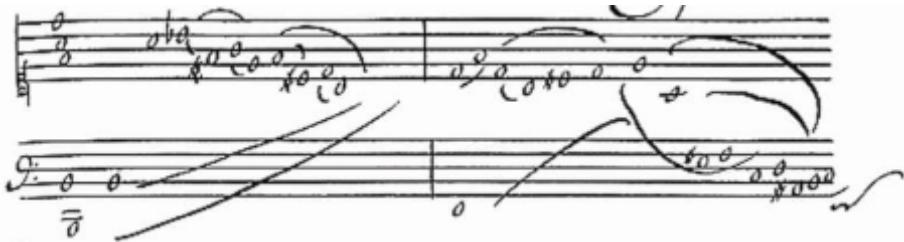
中文讲解
本条为图2的图注占位符。该图取材于蒂尔尼2009年出版的《羽管键琴前奏曲》第1卷影印本第1页,展示路易·库普兰《D小调散体前奏曲》的开篇和弦。
图注所确认的信息仅限于:作曲家(Louis Couperin)、作品体裁(Prélude non mesuré)、调性(D minor)、所截取位置(opening chord,开篇和弦)、资料来源(影印本页码)。原图细节(如音符的具体排列、和弦的构成、连线的形态、时值符头的形状)因图像数据省略而不可见,需查看原图以确认白八分音符与延音线的实际配合方式。
本条作为P0100所述"白八分音符记谱惯例"的视觉锚点,使读者能将抽象描述与具体谱例对应。
补充说明
图2的开篇和弦正是检验P0100所述记谱惯例的关键样本:观察白八分音符如何标识和弦的音高骨干,以及连线如何指定哪些音需要持续、暗示出和声进行的轮廓。
第5段(P0102)
原文复述
The second style is exemplified in Jacquet de la Guerre’s four préludes of 1687 and d’Anglebert’s préludes published two years later. In such works, sustained harmonic notes are indicated by semibreves, and passing notes are shown with either quaver or semiquaver note values, although the note value is not to be taken literally. In contrast to Jacquet de la Guerre, d’Anglebert occasionally tied a quaver to a semibreve where notes were harmonically significant. D’Anglebert concludes a section of harmonic importance with a barline (see Fig. 3):
中文讲解
本段提出第二种记谱风格,以雅克·德·拉·盖尔1687年的四首前奏曲与丹热贝两年后(1689年)出版的前奏曲为代表。
其规则是:用全音符(semibreves)指示需要持续的和声骨干音,用八分音符(quaver)或十六分音符(semiquaver)指示经过音——但这些时值符号"不应被字面化地解读",即它们只是标记音的功能分类(持续音/经过音),并不严格规定演奏时长。这一约定与第一种风格(P0100所述)共享"时值符号不严格对应演奏时值"的本质,但用了不同的符头体系来区分两类音符。
段中进一步辨析两位作曲家的差异:丹热贝偶尔将一个八分音符与一个全音符用延音线相连,标记该位置的和声重要性;并在和声上具有结构意义的段落结尾处加上小节线,以提示"此处和声已构成可识别的终止或分段"。雅克·德·拉·盖尔则不使用这种小节线提示。
段尾提示参考图3(P0105将引入)。
本段的功能是引入第二种风格并以丹热贝的差异化处理说明该风格内部的微妙变体,为下一段的图3做铺垫。
补充说明
丹热贝使用小节线划分和声段落的做法暗示了"非小节化前奏曲"并非绝对拒绝小节线,而是在某些关键结构点——尤其是终止式或和声明显换位处——借用小节线以提示结构。这一做法为后文P0106引入的"含节奏量值"第三种风格埋下伏笔。
第6段(P0103)
原文复述
$^{33}$ Davitt Moroney, “Prélude non mesuré.” Grove Music Online. Oxford University Press, accessed 22 March 2014.
中文讲解
本条为脚注33,提供P0099中莫罗尼所述"托姆博—阿勒芒德风格在有量记谱下以慢速与节奏自由为特征"这一陈述的文献来源。
来源信息:作者Davitt Moroney;词条标题"Prélude non mesuré";收录于《Grove音乐在线》(Grove Music Online),由牛津大学出版社出版;查阅日期为2014年3月22日。
该脚注对正文主张构成来源支持:它把"托姆博—阿勒芒德风格具有慢速与节奏自由特征"这一描述锚定在权威音乐辞书的具体词条上,使正文论述具备可追溯的学术依据。
补充说明
Grove Music Online是英语世界最具影响力的音乐学辞书,其词条通常由领域专家撰写并经过同行评审,是西方音乐学论文中常见的权威参考来源。
第7段(P0104)
原文复述
$^{34}$ Troeger, “The French Unmeasured Harpsichord Prelude.”, 90.
中文讲解
本条为脚注34,提供P0100关于路易·库普兰与勒鲁使用白八分音符记谱惯例的文献来源。
来源信息:作者Troeger;论文标题"The French Unmeasured Harpsichord Prelude"(《法国非小节化羽管键琴前奏曲》);引用页码为第90页。
该脚注对P0100中"使用白八分音符指示音高、配以延音线指示持续音/和声结构、并受到法国鲁特琴家影响"这一陈述构成来源支持。
补充说明
Troeger的研究是该领域被频繁引用的专题论文,专门处理法国散体羽管键琴前奏曲的记谱问题,因此其对各类记谱惯例的描述具有较高的参考价值。
第8段(P0105)
原文复述
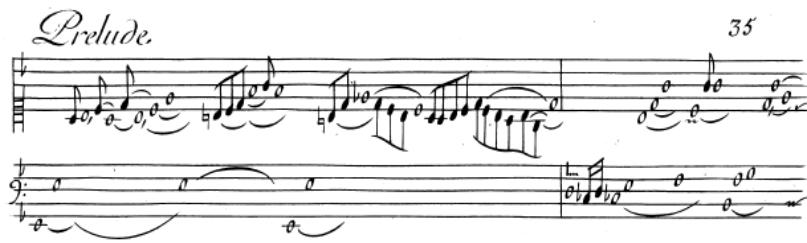
中文讲解
本条为图3的图注占位符,展示让-亨利·丹热贝《羽管键琴曲集》中《F大调散体前奏曲》的开篇段落。
图注所确认的信息仅限于:作曲家(Jean-Henri d’Anglebert)、作品集(Pièces de Clavecin)、体裁(Prélude non mesuré)、调性(F major)、截取位置(opening passage,开篇段落)、资料来源(蒂尔尼2009年第1卷影印本第83页)。原图细节因数据省略而不可见,需查看原图以确认丹热贝如何用全音符标记持续和声音、八分音符标记经过音、偶尔用八分音符-全音符延音线连接以及声段末的小节线提示等具体做法。
本条作为P0102所述第二种风格(特别是丹热贝的差异化处理)的视觉例证。
补充说明
丹热贝1689年出版的《Pièces de Clavecin》是路易十四时期法国羽管键琴音乐最重要的印刷出版物之一,其记谱实践对后世法国键盘音乐有持续影响。
第9段(P0106)
原文复述
The third style used by Lebègue, Clérambault, Marchand, Rameau and Siret employs rhythmic note values from the breve to the demisemiquaver. It retains a level of improvisation as necessary, while demonstrating characteristics of a measured composition. Troeger notes “that much multiple-value prelude notation shows passages whose rhythmic and even metric coherence makes them essentially measured; and that many “unmeasured” passages in single- or dual-value notation fall into regular patterns that strongly suggest explicit rhythmic/metric treatment”. $^{35}$ This can be seen in the solitary example by Rameau (see Fig. 4). The first line begins with a croches blanches style showing quavers before intervals to be articulated (see red arrow). The melody proceeds to three descending passages that could be executed in a measured style (see blue arrows):
中文讲解
本段提出第三种风格,由勒贝格、克莱朗博、马尔尚、拉摩与西雷等作曲家所采用,涵盖从全音符(breve)到三十二分音符(demisemiquaver)的完整节奏量值谱系。
其特征是:尽管仍保留一定的即兴空间,但作品已呈现出有量音乐(mesured composition)的诸多特点。Troeger指出两个值得注意的现象——(1)多重时值记谱的许多段落,其节奏乃至拍号的一致性使它们"实际上已经是有量"的;(2)单时值或双时值记谱的许多"非小节化"段落,会落入具有规则形态的节奏型,强烈暗示明确的节奏/拍号处理。
这两个观察对"非小节化前奏曲"这一体裁名称本身提出挑战:所谓"非小节化"并非真正无节拍,而是以不同方式暗示或保留节拍信息。
本段随即以拉摩唯一的散体前奏曲为例(参图4,由P0107引入):第一行以白八分音符风格起笔,标记出需被清晰奏出的音程(红箭头所示);之后旋律进入三段下行片段,可按有量风格演奏(蓝箭头所示)。上标"35"指Troeger同一著作第91页的进一步论述。
本段的功能是引入第三种风格,并通过Troeger的论述揭示"非小节化"与"有量化"之间的边界模糊性,为本节末段(P0109)解释"为何要在即兴体裁中加入更多节奏信息"奠定基础。
补充说明
从短到全音符(breve)至三十二分音符(demisemiquaver)的完整量值使用,意味着作曲家在此类散体前奏曲中允许的节奏精度最高、规定最细,与P0100、P0102所述的"符头不严格对应时值"形成连续光谱。
第10段(P0107)
原文复述
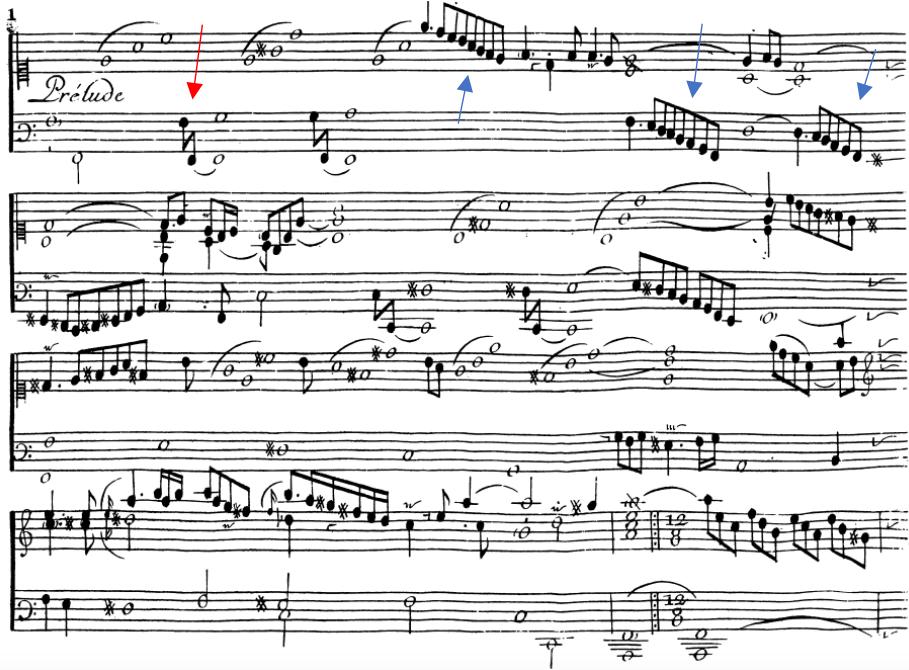
中文讲解
本条为图4的图注占位符,展示让-菲利普·拉摩《A小调散体前奏曲》的节选片段。
图注所确认的信息仅限于:作曲家(Jean-Philippe Rameau)、体裁(Prélude non mesuré)、调性(A minor)、截取位置(extract,节选)、资料来源(蒂尔尼2009年第1卷影印本第96页)。原图细节因数据省略而不可见,需查看原图以确认第一行白八分音符风格的具体写法、红箭头所指的需清晰奏出的音程位置以及蓝箭头所指三段下行片段的节奏形态。
本条作为P0106所述第三种风格的具体例证,提示读者拉摩这首作品同时具备P0100所述的白八分音符风格特征与P0106所述的可有量化执行的下行片段——正是第三种风格混合特征的直观体现。
补充说明
拉摩作为法国巴洛克晚期最重要的作曲家之一,其散体前奏曲仅有此一例,被收入其1722年《Pièces de Clavecin》之前曾以独立形式流传。该作品因此在学界常被视为研究第三种风格的标志性样本。
第11段(P0108)
原文复述
$^{35}$ Ibid., 91.
中文讲解
本条为脚注35,提供P0106中Troeger关于多重时值与单/双时值记谱段落如何呈现有量特征的进一步论述来源。
来源形式"Ibid., 91"意为"同上引书,第91页",即继续引用Troeger"The French Unmeasured Harpsichord Prelude"第91页的内容。
该脚注对P0106所述"许多段落实际上已是有量"以及"许多非小节化段落落入规则节奏型"这两个观察构成来源支持,且指向原书紧接P0100所述脚注(90页)之后的论述,说明Troeger的讨论按页推进地涵盖了从白八分音符风格到多重时值风格的多种记谱现象。
补充说明
“Ibid.“是拉丁文ibidem的缩写,意为"在同处”,用于紧接上一脚注引用同一来源的不同页码,避免重复列出完整的来源信息。
第12段(P0109)
原文复述
Reasons why composers provided this additional rhythmic information to a style intended to be improvisatory is worth noting. It may imply they felt the prevailing style of notation did not adequately provide the information required for performers to interpret the prélude non mesuré in the appropriate manner. It may also suggest a lack of knowledge as to how to interpret the préludes non mesurés. The absence of barlines and coherent metrical symmetry may also simply emphasise to the player that the piece should be performed without too rigid an application of tactus.
中文讲解
本段作为本节的小结与延伸,对前述三种风格所呈现的"在即兴体裁中加入额外节奏信息"现象提出三种可能解释:
第一种解释:作曲家认为主流记谱方式未能为演奏者提供足够信息以正确诠释散体前奏曲,因此加入节奏信息作为补充提示。
第二种解释:作曲家自身可能并不真正了解散体前奏曲应如何被演奏,因此添加他们熟悉的节奏标记(即便在概念上与体裁的即兴精神相悖)。
第三种解释:缺失小节线与对称的拍号结构,本身就是给演奏者的暗示——提示该作品不应被过于僵硬地以固定tactus(基本拍单位)来执行,而是要保持节奏的灵活性。
这三种解释并非互斥:前两种是"作曲家意图层面"的猜测,第三种是"记谱空白作为积极信号"的解读。三者合在一起,揭示了散体前奏曲这一体裁在历史实践中所承受的张力——它既被期待为即兴的、开放的,又被谱面要求附加越来越具体的节奏信息。
本段的功能是为本节前述的分类(P0099–P0106)与记谱描述(P0100–P0107)提供一个反思性的总结,引向下一节可能展开的演奏诠释问题。
补充说明
“tactus"是早期音乐理论中的核心概念,指贯穿全曲的基本拍单位(如全音符等于一拍),演奏者以此为基准组织整体节奏。“过于僵硬地应用tactus"即指把每个音符都精确地按tactus均匀分配,而忽略体裁所要求的弹性处理。
脚注 / 边栏 / 图表 / 附加信息(如有)
本节包含三幅图(Figure 2、3、4)与三条脚注(33、34、35)。
图2(路易·库普兰《D小调散体前奏曲》开篇和弦)支持P0100关于白八分音符记谱惯例的描述;图3(丹热贝《F大调散体前奏曲》开篇段落)支持P0102关于丹热贝用全音符标记持续和声音、用小节线划分和声段落的论述;图4(拉摩《A小调散体前奏曲》节选)支持P0106关于第三种风格兼有白八分音符与可量化执行片段的论述。三幅图共同覆盖了本节所述三种风格的视觉证据链。
脚注33(Moroney, Grove Music Online)为P0099中关于托姆博—阿勒芒德风格的描述提供权威辞书来源;脚注34(Troeger, p. 90)为P0100中关于白八分音符记谱与法国鲁特琴家影响的描述提供专题论文来源;脚注35(Ibid., p. 91)为P0106中关于多重/单/双时值记谱段落具有隐性有量特征的论述提供同一著作下一页的来源。三条脚注均为来源支持型,未出现限定、反驳或反例型脚注。
💡 本节核心要点
- 散体前奏曲在风格来源上关联两大传统:源自意大利管风琴即兴传统的托卡塔(路易·库普兰的1、3、6、12号),以及源自法国悼念传统的托姆博(路易·库普兰的2、4、13号)。
- 记谱惯例可分为三类:白八分音符加延音线型(路易·库普兰、勒鲁,受法国鲁特琴影响);全音符+八分/十六分音符型(雅克·德·拉·盖尔、丹热贝,丹热贝进一步用小节线划分和声段);含完整节奏量值的多重时值型(勒贝格、克莱朗博、马尔尚、拉摩、西雷)。
- 三种风格的共同特征是:谱面时值符号均不应被字面化解读,演奏者需根据记谱惯例与体裁精神灵活处理实际时长。
- 丹热贝在和声段末使用小节线、并在和声关键处将八分音符与全音符相连,揭示了"非小节化"体裁内部对结构提示的差异化处理。
- Troeger指出,许多标称"非小节化"的段落实际上已具备规则节奏型与拍号一致性,使"非小节化"与"有量化"的边界变得模糊。
- 作曲家在即兴体裁中加入额外节奏信息,可能源于:对既有记谱的补充需求、对体裁传统的认知模糊,或以记谱空白暗示演奏者避免僵硬tactus的处理。
🔑 关键术语
- Prélude non mesuré:法国巴洛克时期羽管键琴(或管风琴)音乐中的一种前奏曲体裁,特点是缺少小节线与稳定的拍号结构,留给演奏者相当的节奏自由与即兴空间,核心思想是"以记谱的开放性提示演奏的弹性”。
- Toccata / toccare:源自意大利语toccare(“触摸”),17世纪键盘音乐的一种体裁,原指演奏者"试探"键盘音响的即兴段落;其结构通常为两端自由散体、中央嵌入赋格段,本节中作为散体前奏曲所关联的第一种风格来源。
- Tombeau / tombeau-allemande:17世纪键盘音乐中为悼念已故师友、赞助人而作的体裁;其"托姆博—阿勒芒德"变体虽使用有量记谱,但以慢速与节奏自由为特征,本节中作为散体前奏曲所关联的第二种风格来源。
- Croches blanches:白色八分音符,一种符头异形的八分音符记谱形式,路易·库普兰与勒鲁用以标识音高而非严格时值,配合延音线指示持续音与和声结构,源自法国鲁特琴音乐传统。
- Semibreve / quaver / semiquaver / demisemiquaver:分别为全音符、八分音符、十六分音符、三十二分音符的英文学名;本节中第三种风格使用从breve(倍全音符)到demisemiquaver的完整节奏量值谱系,呈现最为具体的节奏规定。
- Tactus:早期音乐理论中的基本拍单位概念,是演奏者组织全曲节奏的基准;本节末段指出散体前奏曲缺失小节线与对称拍号的部分功能,正是暗示演奏者避免对tactus作过于僵硬的应用。
ch_02_sec_05 Use of Ornaments within the Préludes Non Mesurés
第1段(P0110)
原文复述
USE OF ORNAMENTS WITHIN THE PRÉLUDES NON MESURÉS
中文讲解
本句是第二部分第五节的标题,其作用在于宣告本节将专门讨论路易·库普兰(Louis Couperin)在《前奏曲》(préludes non mesurés)中对装饰音的处理方式。标题中的“Ornaments”指向颤音、 mordent、coulé、port de voix 等具体装饰符号,“Use of”则提示读者下文将说明这些装饰在谱面中如何被标记、如何被完整写实,以及为何作曲家同时使用缩写符号与全音符记法。
第2段(P0111)
原文复述
L. Couperin was the only composer to use both shorthand ornament symbols, and to fully realise ornaments in large-note notation within the body of the music. The two most common ornament symbols used by L. Couperin were the tremblement (trill) and the pincé (mordent). Given the performance conventions of the day, it might be assumed that L. Couperin’s written out ornaments were meant to be executed with the exact number of notes notated. Further hypothesis suggests they were simply longhand indications of ornaments that were often denoted by symbols, and therefore intended to be realised more freely to replicate the idea of the préludes non mesurés. One could also say the symbol lacked specificity, as ornament symbols were interpreted differently depending on prevailing performance conventions in different countries. By choosing to write out the ornament without abbreviations or symbols, L. Couperin is ensuring a performer has the correct information for the execution of the ornament, as per his ornamentation style, removing one factor that may contribute to a performers uncertainty in their interpretation of this free genre. Cook, however, suggests it is unclear as to the exact purpose of written out ornamentation, as it could have been a guide for beginners, a guide for good practice or the pursuit to reproduce what a composer intended. It is for the performer to decide if they wish to execute written out tremblements exactly as written, or if they simply use it as example, in order to maintain the improvisatory nature of the performance. The nature of the préludes non mesurés remove the worry about rhythm, giving a beginner the more ability to concentrate of other elements, such as written out ornaments. By providing a written out ornament, the beginner is provided with a realisation before being introduced to the ornament symbols.
中文讲解
本段提出了本节的核心命题:路易·库普兰是唯一在同一首作品中同时使用装饰音缩写符号并将装饰音完整用大音符写实的作曲家,最常见的两种缩写符号是颤音(tremblement)与 mordent(pincé)。作者进而给出三种关于“为何要写实”的解释:一是假定写实音符必须被精确弹奏;二是写实只是符号的展开形式,演奏者可较为自由地即兴发挥;三是不同地区对符号解读不同,写实可消除歧义。库克(Cook)则把这一行为归纳为三重可能:为初学者提供范例、作为良好演奏规范的指引,或是为了还原作曲家本意。本段的关键在于,作者并未在三种解释中选定其一,而是把决定权交给演奏者,让他们根据是否保留“即兴精神”来判断;同时指出,《无小节前奏曲》本身不存在节拍顾虑,因此对初学者而言,先看到装饰音的完整实现再学习符号,反而更易掌握。
补充说明
文中提到“the symbol lacked specificity”,结合脚注 36(d’Anglebert 的装饰表),可看出作者暗示同一符号在不同国家有不同释义,这是本段“缺乏明确性”论点的内部依据。
第3段(P0112)
原文复述
36 The ornament table referenced in this thesis is from a contemporary of L. Couperin: d’Anglebert’s Pièces de clavecin publication, 1689. See Appendix.
中文讲解
这是脚注 36。它告诉读者:本论文所引用的装饰音对照表来自路易·库普兰的同时代人 d’Anglebert,其《Pièces de clavecin》一书出版于 1689 年;详见附录。脚注的作用是为前文“最常见的两种装饰符号”提供来源依据,并把符号体系与附录联系起来。
第4段(P0113)
原文复述
37 Cook, Beyond the Score, 27.
中文讲解
这是脚注 37,给出前文 Cook 观点的出处:著作《Beyond the Score》第 27 页。脚注的作用是为“写实装饰音目的不明确”这一引述标明文献来源。
第5段(P0114)
原文复述
The use of ornaments indicated in this manner may also have been influenced by mechanical instruments. Automatic instruments from the eighteenth century provide the modern scholar more context than treatises, as every ornament needed to be precisely pinned on the surface of a barrel for the automatic instrument to play the composition correctly. The barrel showed how ornaments were interpreted in real musical settings when compared with the ornament tables provided by composers.
中文讲解
本段从“机械乐器”角度切入,指出十八世纪的自动乐器(automatic instruments)能比理论论著提供更直接的装饰音演奏实据:每一个装饰音都必须被精确地钉在滚筒(barrel)表面,才能让机器正确演奏;因此滚筒上的钉位实际上呈现了装饰音在真实演奏中的形态,与作曲家出版的装饰表形成对照。段落的作用是为后文 Engramelle 的论述作铺垫——若无机械乐器,就没有这种“钉位即演奏”的物质证据。
第6段(P0115)
原文复述
In 1775 Marie Dominique Joseph Engramelle (1727–1805) wrote a treatise called La tonotechnie ou L’art de noter des cylindres. Unlike François Couperin and Carl Philipp Emanuel Bach (1714–1788) who wrote about how to interpret and perform ornaments, Engramelle’s intended audience were the arrangers of mechanical organ music. Engramelle provided a description of the processes within ornamentation, creating a shorthand in preparation for the pinning of a score. As time (horizontal) progresses evenly, pitches are shown on the score accordingly in configurations (vertical). Visually the two styles appear similar, and the prélude non mesuré could conceptually be the prototype for the pinned scripts of later barrel organs in the eighteenth century. This style of composing gave the composer/performer freedom from the constrictions of metre, and resulted in a visually satisfying way to convey musical intentions. For example, the composer could write out an arpeggio in a wholly realised form (see Fig. 5).
中文讲解
本段介绍 Engramelle 1775 年的《La tonotechnie ou L’art de noter des cylindres》,并将他与库普兰、C.P.E. 巴赫区分:前者面向“机械风琴改编者”,后两者面向演奏者。Engramelle 描述了为“钉谱”所准备的装饰音速记过程,并把时间画在水平轴、音高以纵向排列的方式记下。作者由此推断:滚筒风琴钉谱与《无小节前奏曲》在视觉上相似,因此后者可能在概念上是前者(十八世纪滚筒风琴钉谱)的原型。段落最后强调,这种写法让作曲家摆脱节拍束缚,并以全音符写出的琶音作为视觉化的范例(见图 5)。
第7段(P0116)
原文复述
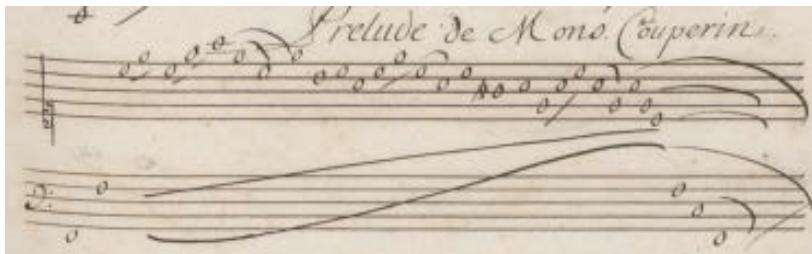
中文讲解
这是图 5 的图注,提示读者查看《A 小调无小节前奏曲》的开篇段落,来源为 Tilney 2009 年版第一卷《Facsimiles》第 17 页。配合前文论述,该图旨在展示“把琶音完全写实”的视觉范例,以说明无小节前奏曲与滚筒钉谱在“横向时间、纵向音高”这一记谱概念上的视觉相似性。原图为乐谱,需查看原图才能确认具体音符走向。
第8段(P0117)
原文复述
Musicians of L. Couperin’s time were expected to embellish. Treatise authors wrote against the culture of pervasive embellishment, when addressing eighteenth-century orchestral practices. Johann Joachim Quantz (1697–1773) explained this widespread practice of improvised ornamentation referring to the influence of the solo and lower-class playing styles. “Musicians are accustomed to ornamenting their parts when they play concertos or sonatas; they persist in the practice when they play in orchestras.” Musicians who accompanied dance music in informal social settings would continue their habit of including additional ornaments when they were in the more refined orchestral setting. When joining in the argument that soloists make poor ripienists, Leopold Mozart (1719–1787) felt that few soloists could read music proficiently, due to their habits of including additional notes and ornaments. This statement supports the view that composers wanted musicians to play the score exactly as written and saw the rise of the performer as someone who had a completely different role from the composer. Zaslaw notes these statements imply that improvised ornamentation infiltrated orchestral playing from virtuoso, soloistic, literate practice, along with the non-notated tavern practice. The act of improvising was considered by many in the seventeenth and eighteenth centuries to be a core competency expected of any court and church musician. One need only consider the famous improvisational skills of J.S Bach, Buxtehude and d’Anglebert.
中文讲解
本段铺垫时代背景:库普兰时代的音乐家被期望进行装饰,而十八世纪的理论家对“过度装饰”提出批评。Quantz 将此归因于独奏风格与下层演奏习惯的影响,并用引文说明这种习惯从协奏曲延伸到乐队合奏;Leopold Mozart 进一步认为独奏家因常加额外音符而视读能力差,呼应了“独奏家不适合做乐队伴奏者”的论点。作者据此推断,作曲家希望演奏者严格按谱演奏,并强调“演奏者”与“作曲家”角色的分化。Zaslaw 的总结指出,即兴装饰是经由“炫技独奏式”与“酒馆非记谱式”两个途径渗入乐队的。最后,作者提醒读者:十七、十八世纪宫廷与教堂音乐家的核心能力之一就是即兴,J.S. 巴赫、Buxtehude、d’Anglebert 都是例证。本段的作用是为后文讨论 L. Couperin 选择写实装饰提供反衬——在“普遍装饰”的语境里,写实反而成为克制与教学手段。
补充说明
文中引文直接译自 Spitzer 与 Zaslaw 所引 Quantz 原话,与后文脚注 40 的页码相对应。
第9段(P0118)
原文复述
38 David Fuller, “An Introduction to Automatic Instruments,” Early Music 11, no. 2 (1983): 166, http://www.jstor.org/stable/3137828
中文讲解
这是脚注 38,为前文关于“自动乐器”和“滚筒装饰”的论述标注来源:David Fuller,《An Introduction to Automatic Instruments》,载《Early Music》第 11 卷第 2 期(1983 年)第 166 页,并给出 JSTOR 链接。
第10段(P0119)
原文复述
39 Spitzer and Zaslaw, “Improvised Ornamentation in Eighteenth-Century Orchestras.”, 533. 40 Ibid., 541.
中文讲解
这是脚注 39 与 40,标明上文关于“十八世纪乐队中即兴装饰”论述的来源:Spitzer 与 Zaslaw 合著的《Improvised Ornamentation in Eighteenth-Century Orchestras》一文,第 533 页与第 541 页。脚注 40 用“Ibid.”表示与上一脚注同书,仅页码不同。
第11段(P0120)
原文复述
Within L. Couperin’s préludes non mesurés there are clear examples of four specific types of ornament: tremblement, coulés, port de voix (see Fig. 6) and pincé, which are notated and expressed in an idiosyncratic fashion. One can find examples of these ornaments within the Prélude non mesuré in D minor (see Fig. 6 – 12 below). Ornaments were used to offer the performer a guide as to which notes to accentuate as they were generally accompanied by strong beats. These beats also correlated with harmonic change, which would also result in an accent at the start of a group of beats.
中文讲解
本段从总览层面指出 L. Couperin 的《无小节前奏曲》中可清楚识别四种装饰音:颤音(tremblement)、coulés、port de voix、pincé,且记谱方式“别具一格”(idiosyncratic)。段落明确以《D 小调无小节前奏曲》为例,对应图 6 至图 12。装饰音的功能被界定为“提示演奏者重音位置”,通常与强拍相伴,而这些强拍又与和声变化同步,因此起始音自然得到重音。本段为本节后续的逐个装饰音分析做铺垫。
第12段(P0121)
原文复述
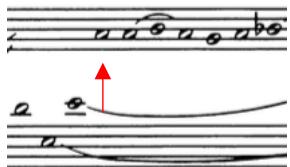
中文讲解
这是图 6 的图注,说明图中显示的是《D 小调无小节前奏曲》中 port de voix 的例子,参考位置为 7R9-11,红色箭头标示 7R9,来源为 Tilney 2009 年版第二卷《Modern Transcriptions》第 2 页。原图为乐谱,需查看原图以确认音高位置与连线。
第13段(P0122)
原文复述
As a means of referencing a specific note, Tilney uses the following method: the first number refers to the bar number; ‘L’ refers to the left hand, ‘R’ to the right hand; the final number references the note’s placement. The tremblement figure (Fig. 7: 4L1-14) creates parallel fifths, albeit alternating in a diminished fifth, therefore technically acceptable. Given the diminished interval created, L. Couperin may have written this ornament in large-note notation in order to confirm his intentions, and to ensure a performer didn’t amend the F# to an F natural. Examples demonstrate two parts built around a third part with the D.
中文讲解
本段先介绍 Tilney 的定位标记法:小节数-手别-音符位置,如 4L1-14 表示第 4 小节左手第 1 至第 14 个音。接着分析图 7 中的颤音片段(4L1-14):它形成平行五度,但因交替出现减五度而在理论上“可接受”。作者由此推测,L. Couperin 把这一装饰音完整写出,可能是为了明确表达意图——尤其是防止演奏者把 F# 误改成 F natural。最后一句“Examples demonstrate two parts built around a third part with the D”是该例在和声结构上的概括,但其具体含义需结合乐谱确认。
补充说明
脚注 45(Drabkin 关于连续五度与连续八度的条目)为“技术上可接受”这一判断提供理论依据。
第14段(P0123)
原文复述
41 Ibid., 541.
中文讲解
这是脚注 41,与上一来源(Spitzer 与 Zaslaw)相同,仅页码为 541。
第15段(P0124)
原文复述
42 Ibid., 544.
中文讲解
这是脚注 42,来源仍为 Spitzer 与 Zaslaw 同文,页码 544。
第16段(P0125)
原文复述
43 Richard Troeger, “Metre in Unmeasured Preludes,” Early Music 11, no. 3 (1983): 343,
中文讲解
这是脚注 43 的开头部分,标明前文关于“装饰音伴随强拍、与和声变化一致”这一论述的来源:Richard Troeger,《Metre in Unmeasured Preludes》,载《Early Music》第 11 卷第 3 期(1983 年)第 343 页。
第17段(P0126)
原文复述
http://www.jstor.org.virtual.anu.edu.au/stable/3138021
中文讲解
这是脚注 43 网址部分的延续,给出 JSTOR 的虚拟访问链接。该链接用于补全 Troeger 文章的出处。
第18段(P0127)
原文复述
In Prélude non mesuré in D minor, 1L1 references to the note in bar 1 that is the first left hand note (D3/D2); 10R6 refers to bar 10, and the sixth note in the right hand (C4). 1R3-6 refers to the first bar, right hand notes – third until the sixth (Bb4 – F#4 – G4 – E4). Multiple notes that are vertically aligned are considered as one within this system. Given the simplicity of such a referencing system, the present study employs a similar approach.
中文讲解
这是脚注 44,进一步举例说明 Tilney 的定位系统:1L1 指第 1 小节左手第一个音(D3/D2),10R6 指第 10 小节右手第六个音(C4),1R3-6 指第 1 小节右手第三到第六个音(依次为 Bb4、F#4、G4、E4)。同一时值上纵向对齐的多音在该系统中被视为一个音。作者指出,因该系统简洁,本研究采用类似方法。
补充说明
此脚注与正文 P0122 中的定位法说明相互呼应,二者共同构成本论文的乐谱定位约定。
第19段(P0128)
原文复述
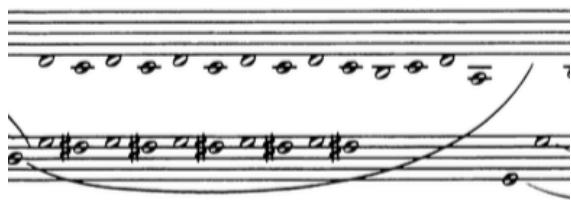
中文讲解
这是图 7 的图注,标示《D 小调无小节前奏曲》中颤音的位置 4R1-14,来源为 Tilney 2009 年版第二卷《Modern Transcriptions》第 2 页。原图为乐谱,需查看原图以确认音符与连线。
第20段(P0129)
原文复述
L. Couperin also fully writes a cadence beginning from below, rather than using the symbol (5L1-15), as suggested in d’Anglebert’s ornament table (Appendix 1). There is no clear indication as to why he chose to thoroughly notate this ornament. Perhaps he was visually balancing the activity between the two hands, and by writing out the full ornament, the left hand is an equal to the right hand. It also suggests the right hand is to linger on the previous notes of harmonic importance, rather than rushing into the ascending scale passage.
中文讲解
本段分析另一个“写实”装饰的案例:位置 5L1-15 的下行起始收束(cadence from below),作者对照 d’Anglebert 装饰表(附录 1)发现原本可用符号,他却选择完整写实。对于这一选择的原因,作者提出两种推测:一是“视觉平衡”——把左手写满后,左手与右手在谱面上的活动量对等;二是“音乐意图”——右手不必匆忙进入上行的音阶段落,而应在前一和声重要音上稍作停留。两种解释都强调:写实不仅传递音符,更传递结构与表情意图。
第21段(P0130)
原文复述
The literature presents three examples of the written out coulé, each with a line connecting the first to the third note (see Fig. 8 – red arrows). As the second note is not also attached to a line, it appears to be a passing note between the two outer notes. L. Couperin may have chosen to write these ornaments out in full, in order to avoid writing the first and third note as a chord, and to retain the visual flow of the music.
中文讲解
本段讨论写实版的 coulé。文献提供三个例子(图 8 中以红箭头标示):每个例子中,第一与第三音之间有一根连线,第二音未与连线相连,因此第二音被理解为“经过音”。作者推测,L. Couperin 选择完整写实,是为避免把第一与第三音记成和弦而失去“视觉流动感”。也就是说,写实在此承担了“区分装饰音内部结构”和“维持谱面流动性”两个功能。
第22段(P0131)
原文复述
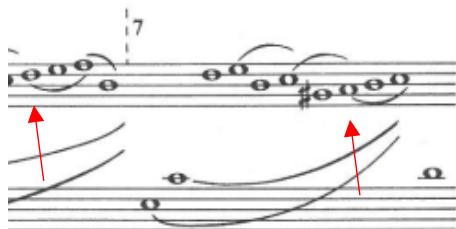
中文讲解
这是图 8 的图注,标示《D 小调无小节前奏曲》中 coulé 的两处例子,位置分别为 6R22-24 与 7R6-8,来源为 Tilney 2009 年版第二卷《Modern Transcriptions》第 2 页。原图为乐谱,需查看原图以确认连线与音符走向。
第23段(P0132)
原文复述
45 William Drabkin, “Consecutive Fifths, Consecutive Octaves,” Grove Music Online, Oxford University Press, accessed January 31, 2017.
中文讲解
这是脚注 45,为前文关于“连续五度在交替减五度情况下技术可接受”的论述标明来源:William Drabkin,《Consecutive Fifths, Consecutive Octaves》,载《Grove Music Online》(牛津大学出版社),访问日期为 2017 年 1 月 31 日。
第24段(P0133)
原文复述
The only example of a pincé illustrated with a sign is in the left hand, rather than written out fully. This is likely due to fact that the preceding note in the right hand (3R3) is the same F#3 and L. Couperin may have used the symbol to avoid confusion (Fig. 9).
中文讲解
本段把目光转向唯一一处使用符号而非写实的 pincé。作者指出,它出现在左手,且右手前一音(3R3)正是同一音高 F#3,因此若完整写出会造成双手同音的视觉冲突,L. Couperin 故而使用符号以避免混淆。这说明“写实还是符号”并非作曲家刻意统一,而是受局部记谱条件驱动的实用选择。
第25段(P0134)
原文复述
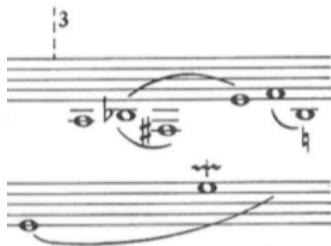
中文讲解
这是图 9 的图注,标示《D 小调无小节前奏曲》中 pincé 的例子,来源为 Tilney 2009 年版第二卷《Modern Transcriptions》第 2 页。原图为乐谱,需查看原图以确认符号位置。
第26段(P0135)
原文复述
In addition to the ornaments identified by Tilney that utilise a sign (Fig 10), two examples of written out pincé are found in the first section of the Prélude non mesuré (Figs. 11 and 12). Although both examples are not part of a rising melodic passage, they are at the peak of each short musical statement. It is not possible for these written out ornaments to be turns, as they are not preceded by a tremblement. Both examples preface the downward falling melody pattern found at the beginning of the piece (1R3-7). In writing out this ornament rather than using a symbol, L. Couperin is supplying the third of each chord. In the first example (4R16-18), this helps the listener to identify the harmonic progression, where he moves from a G major to a G minor chord. The notes do not have any lines attached to suggest that this passage should be accentuated. In the second example, the ornament provides variety to the melodic passage, as L. Couperin uses the same opening figure (1R3-7: see Fig. 14) six times within a two-bar section. Again, this example does not have any lines attached to indicate that the notes should be sustained at all. This suggests that these examples are written out ornaments, and not of harmonic importance that need to continue to sound. In both examples, a musician could execute these notes as up-beats, playing them quickly before leaning on the following note, which has harmonic importance.
中文讲解
本段是本节最长的具体分析,集中讨论两处写实 pincé(图 11 与图 12),位于《D 小调无小节前奏曲》第一段。其共性是:两例都不在上升旋律中,而是各自短句的“顶点”;前方皆无颤音,因此不可能是回音(turn);两例都先于下行旋律型 1R3-7 出现。作者推断,L. Couperin 写实而非使用符号,是为了让 pincé 提供“和弦的三音”:第一例(4R16-18)使听者可辨识 G 大调到 g 小调的和声进行;第二例因 1R3-7 在两小节内重复六次而需要变化,写实的 pincé 提供“旋律变体”。两例都没有附加连线,意味着这些音不应被持续强调。因此,作者强调这些写实音并非和声上需要延续的音,而是装饰,演奏者可作“弱起”处理,快速地“倾向”下一个具有和声重要性的音。
第27段(P0136)
原文复述
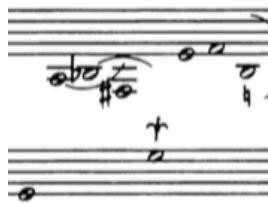
中文讲解
这是图 10 的图注,标示《D 小调无小节前奏曲》中 pincé 的例子,位置为 3L1,来源为 Tilney 2009 年版第二卷《Modern Transcriptions》第 2 页。原图为乐谱,需查看原图以确认符号形态与位置。
脚注 / 边栏 / 图表 / 附加信息(如有)
本节附有多条脚注(36–45),其作用分为:标注装饰音表与版本来源(脚注 36–38,42、44、45)、为库普兰时代装饰风气的引述标明文献(脚注 39–43)。本节共有 8 张图(图 5 至图 12,其中 P0136 对应图 10),全部由 Tilney 2009 年版的《Volume 1 Facsimiles》或《Volume 2 Modern Transcriptions》提供;图 5 展示完整写实的琶音,以视觉上呼应滚筒钉谱;图 6 至图 12 则针对颤音、port de voix、coulé、pincé 各给出乐谱范例,红色箭头在本论文中提示作者所要论述的具体位置。
💡 本节核心要点
- 路易·库普兰是唯一在同一首《无小节前奏曲》中同时使用装饰音缩写符号与完整大音符写实的作曲家,最常见符号为颤音与 pincé。
- 对于写实装饰的目的,文献存在多种解释:精确演奏、教学规范、还原作曲家意图,作者最终把决定权交还演奏者,并由“初学者先看写实再学符号”进一步说明写实的教学价值。
- 十八世纪的自动乐器(尤其是滚筒风琴)及其钉谱为装饰音的“真实演奏形态”提供物质证据;Engramelle 1775 年的记谱法在视觉上与《无小节前奏曲》相似,作者由此提出后者可能是前者的概念原型。
- Quantz 与 Leopold Mozart 等人的论述显示,十八世纪普遍存在“过度装饰”现象,并导致“独奏家不适合做乐队伴奏者”的争论,为本节讨论写实装饰的“克制”取向提供时代反衬。
- L. Couperin 的《D 小调无小节前奏曲》中可识别颤音、coulé、port de voix、pincé 四种装饰,每种都因局部记谱条件、和声意图或双手视觉平衡而被选择写实或使用符号。
- 逐例分析(颤音 4L1-14 的减五度交替、下行起始收束 5L1-15、coulé 的连线区分经过音、两例写实 pincé 的和弦三音功能)显示,写实在此不仅传递音符,更承担防止误读、维持视觉流动、凸显和声走向与旋律变化的功能。
🔑 关键术语
- tremblement:颤音装饰,对应现代意义上的 trill,是 L. Couperin 在《无小节前奏曲》中最常用的缩写符号之一,本节有完整写实的例子(4L1-14)。
- pincé:mordent 装饰,本节既有完整写实的例子(图 11、图 12),也有一处唯一以符号标示的左手例子(3L1)。
- coulé:一种在第一与第三音之间加连线的装饰音,中间第二音为经过音;本节通过图 8 中的三个例子说明其写实形态如何避免被误记为和弦。
- port de voix:在主音前加上一个邻音的装饰,对应图 6 中的例子(7R9-11),用以示意主音前的预备音。
- préludes non mesurés:无小节前奏曲,本节研究对象。其特征是没有固定节拍,以视觉化的方式呈现作曲家意图,作者主张它可能成为滚筒钉谱的概念原型。
- shorthand ornament symbols:装饰音缩写符号。L. Couperin 同时使用此类符号与完整写实的大音符写法,作者认为后者可消除因国别差异造成的解读歧义。
- d’Anglebert:L. Couperin 的同时代人,其 1689 年《Pièces de clavecin》中收录的装饰音表是本论文(脚注 36)所参照的版本。
- Engramelle / La tonotechnie:1775 年《La tonotechnie ou L’art de noter des cylindres》的作者,本节指出他为滚筒风琴改编者所写的记谱体系在视觉上与无小节前奏曲相似。
- barrel / pinning:滚筒及其钉位工艺。自动乐器要求每个装饰音都被精确钉在滚筒表面,故滚筒上的钉位成为研究“装饰音实际演奏形态”的物质证据(脚注 38)。
- parallel fifths / diminished fifth:平行五度与减五度。本节在颤音 4L1-14 中讨论其交替出现,因此技术可接受(脚注 45:Drabkin 关于连续五度与八度的条目)。
- ripienists:乐队伴奏者。本节引用 Quantz 与 Leopold Mozart 时出现的术语,与“soloist”相对,指在合奏中担任伴奏、不应擅自装饰的角色。
ch_02_sec_06 Accidentals
第1段(P0137)
原文复述
ACCIDENTALS
中文讲解
本段是章节小标题,开启关于 préludes non mesurés 中临时记号(accidentals)书写惯例的论题。该小节将围绕一个具体的乐谱惯例问题展开:在没有规则小节线的情况下,作曲家如何处理升降号的延续与撤销。
第2段(P0138)
原文复述
By the end of the seventeenth century, it was standard practice for barlines to indicate the termination of accidentals. However, as there are no regularly occurring barlines within many of préludes non mesurés, composers returned to the earlier seventeenth-century standard practice of re-notating an accidental as required, as noted in Lebègue’s second prelude, third stanza, and Jacquet de la Guerre’s first prelude, third stanza (see Fig. 13, red arrows):
中文讲解
本段的中心主张是:在 préludes non mesurés 中,作曲家放弃十七世纪末通行的“由小节线终止临时记号”的惯例,而恢复更早的“需要时重新标注”惯例。
论证逻辑分两层:第一层,陈述历史背景——十七世纪末的通行做法是临时记号(升、降、还原号)作用到下一个临时记号出现或下一个 barlines 为止;第二层,引入例外情境——préludes non mesurés 缺少规整出现的小节线,通行惯例失去了依托,因此作曲家回到更早期的“按需重新标注”惯例。
作者用两个具体乐谱实例支撑这一结论:Lebègue 第二首前奏曲的第三段,以及 Jacquet de la Guerre 第一首前奏曲的第三段(见 Fig. 13 的红色箭头)。这些例子证明在文本所讨论的作品中,确实出现了同音反复处再次书写临时记号的现象,从而验证“按需重新标注”这一惯例的存在。
易误解之处:本段不是说 préludes non mesurés 完全没有 barlines,而是说“没有规则出现(regularly occurring)的 barlines”,因此不能依靠 barlines 来界定临时记号的作用范围。
在本节整体论证中,本段承担“提出规则 + 给出谱例指引”的功能,为读者观察 Fig. 13 提供理论框架。
补充说明
“préludes non mesurés”指十七世纪末至十八世纪初法国的一种无小节线、无固定节拍的前奏曲体裁,正文中以斜体形式出现,原文已保留斜体以示专名。脚注 46 在此首次出现,为本段关于“十七世纪末 barlines 终止临时记号”的通行惯例提供出处支持(Hiley,《Grove Music Online》关于“Accidental”的条目)。
第3段(P0139)
原文复述
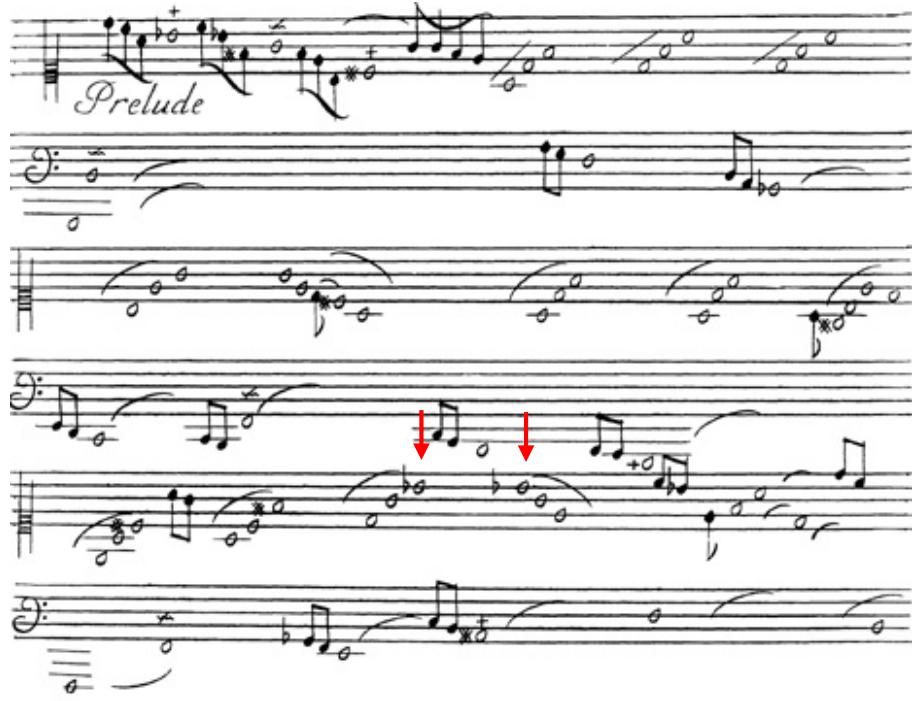
中文讲解
本段为图 13 的图像占位符与图注。位置紧接 P0138 末所提“see Fig. 13, red arrows”之后,作用是为读者提供可供查验的谱例。
图注信息显示该谱例取自 Elisabeth-Claude Jacquet de la Guerre 的《Prélude non mesuré》,D 小调,仅为节选;来源为 Tilney 2009 年版第一卷影印本第 72 页。结合 P0138 的论述,该图中红色箭头所指应为同音重复处重新书写的临时记号。
由于内嵌图像数据被省略,需查阅原图以核实红色箭头位置及具体音符;但图注本身已明确给出了作者、作品、调性与来源,可用于定位原版。
第4段(P0140)
原文复述
$^{46}$ David Hiley, “Accidental,” Grove Music Online, Oxford University Press, 2001,
中文讲解
本段为脚注 46 的前半部分,提供文献来源信息:作者 David Hiley,词条标题“Accidental”,出自 Oxford University Press 出版的 Grove Music Online,2001 年版。该脚注支持正文中关于“十七世纪末 barlines 终止临时记号为通行惯例”的历史陈述。
第5段(P0141)
原文复述
http://www.oxfordmusiconline.com.virtual.anu.edu.au/subscriber/article/grove/music/00103
中文讲解
本段为脚注 46 的后半部分,给出 Grove Music Online 中“Accidental”词条的订阅访问 URL,域名中的 virtual.anu.edu.au 表明该链接经由澳大利亚国立大学(ANU)的电子资源代理访问。该 URL 与 P0140 的文献条目合并,构成本节关于临时记号惯例的完整来源。
脚注 / 边栏 / 图表 / 附加信息(如有)
本节附有一幅谱例(Figure 13),节选自 Jacquet de la Guerre《Prélude non mesuré》D 小调,来源标注为 Tilney, 2009, Volume 1 Facsimiles, p.72。该图与正文配合,红色箭头指示同音重复处重新书写的临时记号,用以印证“按需重新标注”这一书写惯例。
本节含一条脚注(第 46 号),出处为 David Hiley 撰写的 Grove Music Online 词条“Accidental”(Oxford University Press, 2001),URL 给出。该脚注为正文关于“十七世纪末 barlines 终止临时记号”这一通行惯例的权威来源。
💡 本节核心要点
- 十七世纪末的通行惯例:barlines 用于终止临时记号的作用。
- préludes non mesurés 由于缺少规则出现的小节线,使上述惯例失去依托。
- 由此作曲家回归十七世纪更早期的做法:每当需要时即重新书写临时记号。
- Lebègue 第二首前奏曲第三段与 Jacquet de la Guerre 第一首前奏曲第三段是该惯例的实例(见 Fig. 13 红色箭头)。
- 图 13 与脚注 46 共同构成正文主张的谱例与文献支撑。
🔑 关键术语
- accidental:临时记号(如升号、降号、还原号)。本节讨论其在 préludes non mesurés 中的书写与延续规则:因无规则 barlines,作曲家需按需重新标注,而非依赖 barlines 自动终止其作用。
- barline:小节线。本节强调十七世纪末通行惯例中,barlines 充当临时记号作用范围的终止标志;该功能在无规则 barlines 的 préludes non mesurés 中无法直接套用。
- préludes non mesurés:无小节线、无固定节拍的前奏曲,法国十七世纪末至十八世纪初的键盘体裁。本节围绕该体裁讨论临时记号书写惯例的特殊处理。
- standard practice (earlier seventeenth-century):十七世纪更早期通行做法,即每当需要即重新书写临时记号,本节称之为作者在 préludes non mesurés 中回归的惯例。
ch_02_sec_07 Primary Sources Containing Préludes Non Mesurés
第1段(P0142)
原文复述
PRIMARY SOURCES CONTAINING PRÉLUDES NON MESURÉS
中文讲解
本段为章节标题,宣告本节将讨论包含"未节拍小前奏曲”(préludes non mesurés)的一手乐谱来源。该标题所开启的论题是:现存约五十首未节拍前奏曲究竟依赖哪些原始抄本来传承与研究,因此下文将逐一介绍这些抄本的版本状况、年代与内容构成。
第2段(P0143)
原文复述
As noted earlier, there are approximately fifty extant préludes non mesurés, with the majority contained within two manuscripts together considered to be the most valuable sources of French keyboard music. The Bauyn and the Parville manuscripts contain most known keyboard pieces by L. Couperin, amongst other French composers. There is also a significant privately owned manuscript containing works by L. Couperin, Chambonnières and d’Anglebert. This document helps to clarify the derivation of works, as it contains all of L. Couperin’s organ works (with date and location noted). However, access to the manuscript is strictly controlled, and to date the full manuscript has not been published. Of these three manuscripts, the Bauyn is considered to be the more reliable of editions, although the Parville does provide alternative suggestions that are also considered credible. $^{47}$
中文讲解
本段为本节的核心概述。作者首先点明现存约五十首未节拍前奏曲集中于两部抄本——Bauyn 与 Parville——并称二者合起来被视为法国键盘音乐最珍贵的资料来源;这一限定(“集中于两部抄本”)解释了为何下文会用较大篇幅讨论这两份手稿。除两部主要抄本外,作者还提到一份收藏路易·库普兰、夏博尼耶与当格勒贝尔作品的私人抄本,其特殊价值在于收录了 L. 库普兰的全部管风琴作品并标注了日期与地点,对于追溯作品来源与版本谱系具有澄清作用;但因该抄本受严格管控且至今未完整出版,研究者实际上仍主要依赖 Bauyn 与 Parville。在版本可信度上,作者明确判断 Bauyn 较 Parville 更为可靠,但同时承认 Parville 仍能提供同样被学界认可的替代读法。这一双重判断为后续具体数字与作品归属的论述预设了立场:凡两本相合之处更可信,凡有出入之处则需谨慎。脚注 47 指向 Chung 关于 L. 库普兰未节拍前奏曲中 Port de Voix 的研究,意味着前文关于 Bauyn 版本可信度与 Parville 替代读法的判断建立在已有的专题文献之上。
补充说明
本段中提到的 “port de voix” 是一个具体的键盘演奏术语,脚注 47 提示其专题研究见 Chung (2012),但本段正文并未展开讨论,故此处仅作来源指向。
第3段(P0144)
原文复述
The Parville manuscript was discovered in Italy in 1968, and dates from approximately 1670. The Bauyn manuscript dates from approximately 1690 and is said to have belonged to the Bauyn d’Angervilliers family. $^{48}$ The Bauyn manuscript was brought to modern attention by Guittard in 1901 in his study on Chambonnières’s music. Dating of the document has since been revised over the years and still no accurate date has been assigned. Research by the likes of Moroney (2014), Gustafson (1977) and Fuller (n.d.) have led researchers to believe that the much of the Bauyn manuscript’s contents were copied into the source two or three decades after the works were composed. $^{49}$ It contains 149 compositions, of which fifty-six are attributable to (Mr) Coupprain, Couprain, Couprin and Couperin (various misspellings of the Couperin surname). Couperin is never referred to by his full name and it is not clear which Couperin wrote the works. Ten préludes non mesurés are common to both Parville and Bauyn. Bauyn contains four that are not in Parville, and the Parville contains two not found in Bauyn.
中文讲解
本段对两份主要抄本的物理与编目史作了详细交代,并提出一个对演奏与校勘都有直接意义的论断:抄写年代往往晚于作品创作年代约二三十年。Parville 抄本 1968 年于意大利被发现,定年约为 1670 年;Bauyn 抄本定年约为 1690 年,相传属 Bauyn d’Angervilliers 家族所有。Bauyn 进入现代学术视野是 1901 年由 Guittard 在其研究夏博尼耶音乐的论著中首次引起关注,此后其年代被多次修订,至今仍无确切定年。Moroney (2014)、Gustafson (1977) 与 Fuller (未定出版年) 等人的研究共同推动了一个判断:Bauyn 中大部分内容是在作品创作约二三十年后才被誊录入册。这一判断至关重要,因为它意味着抄本所反映的可能是后世演奏者或编纂者对作品的整理,而非作曲家本人的原始意图,对解读未节拍前奏曲的记谱尤其关键。Bauyn 共含 149 部作品,其中 56 部归于 Coupprain、Couprain、Couprin、Couperin 等不同拼写之下,由于抄本从不写全名,至今无法确定这些作品的作者究竟是哪一位库普兰。最后一段数字统计极为精确——十首未节拍前奏曲两本共有,Bauyn 独有四首,Parville 独有两首——这意味着研究者最多可以见到约十六首分别抄入这两部抄本的未节拍前奏曲。脚注 48 指向 Bauyn 抄本重印本的版本信息,脚注 49 则指向 Chung 2015 年专文,可作为下文校勘与归属争议的参考。
补充说明
本段在数字上与 P0143 段略有差异需留意:P0143 称现存约五十首未节拍前奏曲,而 P0145 将 Bauyn 总体规模表述为 345 部作品;本段所给的 149 部是 Bauyn 中被讨论或被引用为前奏曲归属样本的子集还是另一统计口径,原文未澄清,应以原文并存理解为宜。
第4段(P0145)
原文复述
The Bauyn manuscript consists of 345 works and provides primary sources for half of L. Couperin’s harpsichord compositions. The manuscript collection is broken into three parts. The first section contains Chambonnières (118 pieces, introduction of manuscript), the second section L. Couperin (122 pieces) and the third section contains pieces by other composers such as d’Anglebert, Lebègue and Gilles Hardel (c. 1611—d. unknown), as well as transcriptions of works by lutenists such as Denis Gautier (1597 or 1603—1672), René Mesangeau (late sixteenth century—1638) and others. There are also works by two composers outside France: Giralamo Frescobaldi (1583—1643) and Froberger. Frescobaldi taught Froberger, and Frescobaldi’s influence on the toccata style was passed from Froberger to L. Couperin. $^{50}$ Although many of the composers were French, the widespread distribution of these manuscripts suggests the style extended beyond France into Italy, Germany and Scotland.
中文讲解
本段从抄本整体规模转向内容构成,并借此铺陈一条贯穿欧洲的师承与风格传播链条。Bauyn 抄本共 345 部作品,构成路易·库普兰羽管键琴作品约一半的一手来源——这一比例意味着,任何关于 L. 库普兰作品的断代、归属与风格研究都必然要先经由 Bauyn。抄本分三部分:第一部分为夏博尼耶 118 首,并兼作抄本引言;第二部分为 L. 库普兰 122 首,是本节最直接相关的核心;第三部分为其他作曲家,含 d’Anglebert、Lebègue、Gilles Hardel 等法国作曲家,以及 Denis Gautier、René Mesangeau 等鲁特琴家的转写作品;此外还有两位非法国作曲家——Frescobaldi 与 Froberger。作者借此结构引出一个传承关系:Frescobaldi 教过 Froberger,其托卡塔风格经 Froberger 传至 L. 库普兰,这一"师—生—再传"链条说明未节拍前奏曲虽冠以法国之名,却有清晰的意大利根源。最后作者指出,尽管多数作曲家是法国人,这些抄本的广泛流传意味着该风格已跨越法国,扩展至意大利、德国与苏格兰,从而把焦点从单部抄本的物质史转向风格的国际流通。脚注 50 所引的传承关系出自脚注出处而非正文展开,正文仅以承袭关系一笔带过。
补充说明
本段与 P0143、P0144 在 Bauyn 的总曲数与归属数字之间存在不同口径(P0144 称 149 部与 56 部归库普兰姓氏,P0145 称 345 部总曲数与 122 首 L. 库普兰),原文未对两套数字进行调和,读者应理解为分属不同统计单元(前者或为前奏曲子集,后者为全抄本规模),不得擅自合并。
第5段(P0146)
原文复述
$^{47}$ David Chung, “The Port de Voix in Louis Couperin’s Unmeasured Preludes: A Study of Types, Functions and Interpretation,” in Performer’s Voices across Centuries and Cultures (London: Imperial College Press, 2012), 59–84, 59.
中文讲解
本段为正文 P0143 后所附脚注 47 的完整内容,引用 Chung 于 2012 年出版的论文,载于伦敦帝国学院出版社论文集《Performer’s Voices across Centuries and Cultures》第 59–84 页,引文页为 59。该研究聚焦于路易·库普兰未节拍前奏曲中的"port de voix”,从类型、功能与诠释三个角度展开,是正文在评价 Bauyn 版本可靠性时所援引的专题文献依据,对正文主张起来源与支撑作用。
第6段(P0147)
原文复述
$^{48}$ Manuscrit Bauyn, Pièces de Clavecin c.1660, ed. Minkoff Reprint, Res. Vm7 6 (Paris: Bibliothèque Nationale, 1977), 2.
中文讲解
本段为正文 P0144 后所附脚注 48 的完整内容,标注 Bauyn 抄本现代版本的出版信息:抄本名称为 “Manuscrit Bauyn, Pièces de Clavecin”,推估抄写年代约为 1660 年,由 Minkoff Reprint 出版,编号 Res. Vm7 6,藏所标注为巴黎国家图书馆(Bibliothèque Nationale),出版年 1977 年,引文页为第 2 页。该条目对正文"Bauyn 抄本属于 Bauyn d’Angervilliers 家族"的判断起版本来源与馆藏定位作用,使读者得以核对抄本的物质实体。
补充说明
本条目出版年标注为 1977,但 P0144 正文将抄本定年写在"约 1690 年",二者并不冲突——前者是现代影印出版年,后者是学者对抄本实际抄写年代的估算,二者应区分理解。
第7段(P0148)
原文复述
$^{49}$ David Chung, “The Bauyn Manuscript: Harpsichord Music from the Seventeenth Century,” Music Library Association 72 (1) (2015): 216–21.
中文讲解
本段为正文 P0144 后所附脚注 49 的完整内容,引用 Chung 于 2015 年发表于《Music Library Association》第 72 卷第 1 期第 216–221 页的文章,专论 Bauyn 抄本中的十七世纪羽管键琴音乐。该文献与 P0143 脚注 47 同出一位作者,构成对 Bauyn 抄本的系统性研究两条主要参考线,对正文中关于"抄本年代被多次修订"、“抄写晚于创作约二三十年"等判断起直接来源作用。
💡 本节核心要点
🔑 关键术语
- préludes non mesurés:未节拍小前奏曲,指 17 世纪法国键盘音乐中不标明确切时值、留给演奏者自由诠释的小前奏曲体裁;本节所有抄本讨论的目的即在于为这约五十首作品定位原始来源。
- Bauyn manuscript:约 1690 年抄成的法国键盘音乐抄本,相传属 Bauyn d’Angervilliers 家族,含 345 部作品,是路易·库普兰羽管键琴作品约一半的一手来源,被本节作者判定为三个抄本中版本最可靠者。
- Parville manuscript:约 1670 年抄成、1968 年于意大利被发现的法国键盘音乐抄本,其版本虽次于 Bauyn,但仍提供被学界认可的替代读法;与 Bauyn 共有十首未节拍前奏曲,并另有二首为其独有。
- Port de voix:法国键盘音乐中的一种倚音式装饰或经过音型,脚注 47(Chung 2012)专文研究其在 L. 库普兰未节拍前奏曲中的类型、功能与诠释。
- Toccata style / toccata 风格:本节指经由 Frescobaldi 创立、Froberger 传递、并最终影响 L. 库普兰的即兴式键盘风格;该传承链是本节解释未节拍前奏曲何以呈现"非节拍"特征的关键历史背景。
ch_02_sec_08 Editions Addressing the Prélude Non Mesuré
第1段(P0149)
原文复述
EDITIONS ADDRESSING THE PRÉLUDE NON MESURÉ
中文讲解
这是本节的小节标题,表明接下来要讨论的是针对“无小节线前奏曲”(Prélude non mesuré)的各个编辑版本。它标志着论述重心从前期对术语或音乐本体的讨论,转向对具体乐谱版本之间差异的梳理。
第2段(P0150)
原文复述
Although this research is not specifically concerned with modern editions, it is worth addressing that notable performers, such as Moroney, Curtis and Tilney have released their own interpretations, based on their interpretation of the Bauyn and Parville manuscripts (see Appendix 2). In total there have been seven editions:
中文讲解
本段说明本研究虽然不以现代版本为主要对象,但仍值得指出 Moroney、Curtis 和 Tilney 等重要演奏家都曾基于 Bauyn 与 Parville 手稿(见附录 2)发布各自诠释版本,并提到目前已有七个版本可供选择。它承接上一小节的讨论,自然过渡到对版本细节的关注;也提示读者:之所以必须讨论各版,是因为不同编辑在乐谱细节上存在分歧,这些分歧会影响演奏诠释。
补充说明
“Bauyn”和“Parville”两份手稿是本节乃至全文判断乐谱细节差异的两个核心底本,附录 2 将列出各版所依据的手稿情况。
第3段(P0151)
原文复述
Chung notes a discrepancy between the two manuscripts in Louis Couperin’s D minor Prélude non mesuré. Using Tilney’s edition (see Appendix 2), note 2L1 (see footnote 44) is written as A2, as per the Parville edition. However, the Bauyn manuscript shows this note as F2. Of the five editions to utilise both editions Curtis, Wilson and Chapelin-Dubar choose the Bauyn F2, and
中文讲解
本段切入具体例子:Chung 指出,在 Louis Couperin 的 D 小调 Prélude non mesuré 中,两份手稿对同一音的记录不一致。在 Tilney 版本中(参附录 2),编号 2L1(参脚注 44)的音写作 A2,与 Parville 手稿一致;而 Bauyn 手稿却记为 F2,两者相差三度。在利用两份手稿的五个版本里,Curtis、Wilson 和 Chapelin-Dubar 选择了 Bauyn 的 F2。本段的核心功能在于用一个可量化的细节差异(A2 与 F2)说明:编辑版本的选择不是抽象问题,而是直接关系到具体音高、进而影响演奏的决定。
补充说明
“2L1”是作者采用的音符编号体系,用于在文中准确指代乐谱上的某一具体音,从而避免歧义;脚注 44 应当进一步解释此编号规则。
第4段(P0152)
原文复述
$^{50}$ Ledbetter, Harpsichord and Lute Music in 17th-Century France, 90.
中文讲解
这是正文第 50 号脚注,引用 Ledbetter《17 世纪法国的羽管键琴与鲁特琴音乐》第 90 页。该脚注承担来源支持的功能,为正文所述历史背景或音乐事实提供学术出处,本身不展开论证。
第5段(P0153)
原文复述
$^{51}$ Chung, “The Port de Voix in Louis Couperin’s Unmeasured Preludes: A Study of Types, Functions and Interpretation.”, 72.
中文讲解
这是正文第 51 号脚注,引用 Chung《Louis Couperin 无小节线前奏曲中的 Port de Voix:类型、功能与诠释研究》第 72 页。该脚注是 P0151 中关于 Chung 指出两份手稿在 D 小调前奏曲中存在音符差异这一论述的直接文献来源,属于支持性引用。
第6段(P0154)
原文复述
Moroney and Tilney using the A2. For this research the Tilney edition has been chosen, due to availability and ease of use.
中文讲解
本段紧接 P0151:在五个同时使用两份手稿的版本中,Moroney 和 Tilney 选择的是 A2(即与 Parville 手稿一致的音高)。随后,作者交代本研究之所以采用 Tilney 版本,是出于“可获得性”和“使用便利性”的考量。它一方面完成了对五个版本选择的完整交代(A2 派两人:Moroney、Tilney;F2 派三人:Curtis、Wilson、Chapelin-Dubar),另一方面也表明作者在版本分歧中并未声称为某一手稿正名,而是基于实用理由作选择,这暗示读者:后续分析中所引用的乐谱细节将基于 Tilney 版。
补充说明
本句同时收束了版本对比的讨论,并交代了下文乐谱细节将统一以 Tilney 版本为准,读后续段落时应注意此版本前提。
脚注 / 边栏 / 图表 / 附加信息(如有)
本节包含两条脚注(第 50、51 号),分别引自 Ledbetter 与 Chung 的相关著作,为正文提供学术来源支持;此外,正文指向附录 2,其中应包含各版本及其所依据手稿的对照信息。
💡 本节核心要点
- 本节聚焦于 Louis Couperin《D 小调 Prélude non mesuré》的七个编辑版本及其所依据的 Bauyn、Parville 两份手稿。
- 两份手稿在音符 2L1 处存在差异:Parville 记为 A2,Bauyn 记为 F2,相差三度。
- 在同时使用两份手稿的五个版本中,Curtis、Wilson、Chapelin-Dubar 采用 Bauyn 的 F2,而 Moroney、Tilney 采用 Parville 的 A2。
- 作者明确说明本研究选用 Tilney 版本,理由是其可获得性与使用便利性。
- 脚注 50、51 为 Ledbetter 与 Chung 的著作页码,承担来源支持功能。
🔑 关键术语
- Prélude non mesuré:无小节线前奏曲,法国 17 世纪羽管键琴文献中的一类体裁,以无固定节拍记号为特征。
- Bauyn manuscript:本节讨论所依据的两份核心手稿之一,是现代编辑版本比较时的关键底本。
- Parville manuscript:本节讨论所依据的另一份核心手稿,常与 Bauyn 手稿在音符细节上存在差异。
- note 2L1:作者对乐谱中某一具体音符的编号,用以在文中精准指代,便于跨版本比较音高。
- A2 / F2:指具体音高,本节中体现为两份手稿对同一音符记录相差三度的分歧。
ch_02_sec_09 Source Documents Addressing the Prélude Non Mesuré
第1段(P0155)
原文复述
SOURCE DOCUMENTS ADDRESSING THE PRÉLUDE NON MESURÉ
中文讲解
本句为小节标题,宣告作者将要逐一介绍几种专门讨论“无量前奏曲”(prélude non mesuré)演奏实践的一手文献。该标题意味着以下段落将转入史料陈述阶段,列举并摘录相关原始文本。
第2段(P0156)
原文复述
There are three primary sources that specifically reference performance practices within the prélude non mesuré, two of which are written by Lebègue. There is correspondence from 1684 between Lebègue and an Englishman William Dundass, in addition to Lebègue’s preface to the Pièces de clavessin (1677) and François Couperin’s L’art de toucher Le Clavecin (1716).
中文讲解
作者点明本节的核心证据基础:共有三份直接谈及无量前奏曲演奏方式的主要文献,其中两份出自勒贝格之手。其一为勒贝格与英国人威廉·邓达斯(William Dundass)于1684年的通信;其二为勒贝格1677年《羽管键琴曲集》(Pièces de clavessin)的序言;其三为弗朗索瓦·库普兰1716年《羽管键琴演奏艺术》(L’art de toucher Le Clavecin)。这一句为整节划定了证据范围,读者应将其视为后文引述的合法性来源。
第3段(P0157)
原文复述
The first reference is a letter that Lebègue sent responding to an enquiry by Dundass. Although the original letter is no longer available, a copy of Lebègue’s response is transcribed on the front of a 1677 copy with a polite closing note, informing Dundass that Lebègue would find “great satisfaction” in making his acquaintance, should clarification be required. This correspondence demonstrates Lebègue’s willingness to meet and discuss the works with fellow musicians.
中文讲解
这是对第一项史料的来由交代:现存文本是勒贝格写给邓达斯的复信副本,原信已佚。值得注意的是,这份副本被誊抄在1677年版曲集封面上,并附有礼貌的结尾,表示若邓达斯仍需说明,勒贝格乐意结识并当面交流。作者借此勾勒出勒贝格愿意与英国同好面对面切磋作品的态度,这既有人情意味,也暗示其前奏曲在当时的欧洲已有跨国影响。
第4段(P0158)
原文复述
The page is laid out in two columns with Lebègue’s French response on the left and the translation into “rather garbled English” on the right, along with an English translation of Lebègue’s explanation. Presumably the writer of the columns was the translator, as a monetary fee paid to Dundass on July 3, 1684 is written in the same handwriting. The first point reiterates the idea that the preludes were preparatory material preceding other pieces in the same key. For this reason, Lebègue notes (from the English translation) that:
中文讲解
本段说明抄本的版式与可能的译者身份:左栏是法文原文,右栏是英文译本(被形容为“相当蹩脚的英文”,原文加引号)。抄写者很可能就是译者,因为1684年7月3日支付给邓达斯的款项是同一笔迹所写。在引述第一条要点之前,作者先重提前奏曲作为同调性其他乐曲前的“准备段落”的功能定位,为下一段勒贝格原文提供语境。
第5段(P0159)
原文复述
“I was not at the pains to separate them by measure, as the pieces are, because they have nothing of determined in them’. He also provides the advice ‘Now to give some light for regular touching of ye preludes ye must know first, that ye must touch all the nottes the on[e] after the other, that is to say, to touch those first w[hi]ch appeared first to the sight, whither they be of the line of the base or of that of the treble, and the other afterward.”
中文讲解
这是第一点要点的英文译文摘录(含十七世纪英文用法与拼写,括号内[e]、[hi]表示原文缺字补全)。其要点有二:其一,勒贝格之所以不在前奏曲中按小节线分隔音符,是因为前奏曲本身“无确定之物”(nothing of determined),即不具节拍规律;其二,他对“规则地触键”提出操作建议——按照谱面上音符自下而上、自左至右出现的先后依次奏出,无论其属于低音线还是高音线。这两条共同说明无量前奏曲在演奏法上的双重特征:一为节拍的不确定性,二为音符进行的视觉化空间顺序。
第6段(P0160)
原文复述
In his second point, Lebègue writes:
中文讲解
这是引导句,引出勒贝格通信中第二条要点的法文原文。
第7段(P0161)
原文复述
2°, Le petit cercle qui prend de la notte d’en bas et qui contenüe jusqu’à celle d’en haut, signifie qu’il faut tenir toutes les nottes que ledit cercle entoure sans en quitter pas une apres que vous les avez touché, et cela pour conserver l’harmonie.
中文讲解
第二条要点的法文原文。意思是:从低音起、向上延伸至同一条线高处的“小圆圈”表示必须将圆圈所包围的全部音符持续按住,触键之后一个都不能离开,目的是“保留和声”。这揭示了勒贝格前奏曲中圆圈符号的功能——既不同于节拍标记,也不同于连音线,而是一种“持续音”标记,使某些纵向和声在水平线条铺展时仍得到保留。
第8段(P0162)
原文复述
$^{52}$ Bruce Gustafson, “A Letter from Mr Lebegue Concerning His Preludes,” “Recherches” sur La Musique Française Classique XVII, 1977, 10.
中文讲解
脚注52,标于“great satisfaction”之后。这是通信内容所依据的现代学术文献出处:Bruce Gustafson于1977年发表在《Recherches sur la Musique Française Classique》第十七卷第10页的文章“A Letter from Mr Lebegue Concerning His Preludes”。该脚注用于支撑P0157对通信副本来源与措辞的描述。
第9段(P0163)
原文复述
$^{53}$ Ibid., 9.
中文讲解
脚注53,标于“rather garbled English”之后。同上出处,即Gustafson 1977年文第9页。该脚注用于支持作者对英文译文“相当蹩脚”的评价。
第10段(P0164)
原文复述
$^{54}$ Ibid., 9-10.
中文讲解
脚注54,标于P0159引文末尾。同上出处第9—10页。这是支撑第一点要点英文译文的来源。
第11段(P0165)
原文复述
2°, The little circle which begins at the note below, and continues to a notte aboue (in the same line) doth signife that ye must hold out all the nottes enclosed by that cercle without quyting any of them after ye haue touched them and that for preserving of the harmonie.
中文讲解
这是P0161第二条要点的英文译文(保留十七世纪英文拼写,如“aboue”“nottes”“signife”“cercle”“harmonie”)。其内容与法文一致:自下而上在同一谱线延伸的小圆圈要求演奏者将所围音符全部持续按住,不得在触键后再行放开,以保留和声。通过英、法对照可看出译文不仅有拼写古旧,还存在少量不准确(如doth signife代does signify)。
第12段(P0166)
原文复述
The third point concerns the tenües:
中文讲解
小标题,引出勒贝格通信中第三条关于“tenües”(持续音/持续音标记)的要点。
第13段(P0167)
原文复述
Quand apres un grand accord vous troverez des tenües ou cercles, et qu’une autre partie roulera et se promenera, C’est a dire qu’il faut toujours tenir le dit accord pendant cela.
中文讲解
第三条要点的法文原文。意思是:当在某个完整的“大和弦”(grand accord)之后看到tenües或圆圈标记,而另一声部将在上方流动展开时,演奏者必须始终按住该和弦不放,直到另一声部进行完毕。此句在前两条基础上进一步明确圆圈的功能——它指示对纵向和弦的“贯穿式保留”,使水平展开的旋律始终有和声底座支撑。
第14段(P0168)
原文复述
When after a great accord you find bindings or circles, and that the other part glydes or walketh on, the meaning is that you always hold out that accord during the tyme the other part is moving forward.
中文讲解
P0167第三条要点的英文译文(保留古旧拼写:glydes、tyme、haue)。译文中将“tenües”译作“bindings”,将roulera et se promenera译作“glydes or walketh on”,形象地传递出在纵向持续音之上方有流动进行的演奏意图。读者通过此句应理解:圆圈与tenües在此类文献中同义,皆指代对和弦的持续保持。
第15段(P0169)
原文复述
The second reference, the preface to Lebègue’s Pièces de clavessin, states (as translated by Troeger):
中文讲解
引导句,引出第二项史料——勒贝格1677年曲集序言,并提示译文出自Troeger之译笔。
第16段(P0170)
原文复述
J’ay taché de mettre les préludes auec toute la facilité possible tant pour la Conformité que pour le toucher du Claucin, dont la manière est de Separer et de rebattre plus-tost les accords que de les tenir comme a l’Orgue si quelque chose s’y rencontre vn peu difficile et obscure le prie messrs. les intelligents de vouloir suppleer aux deffaux en considerant la grande difficulté de render cette metode de Preluder assé intelligible a vn chacun.
中文讲解
勒贝格曲集序言的法文原文(含十七世纪拼写:ay、taché、auec、Claucin、Separer、plus-tost、Orgue、vn、le prie、suppleer、deffaux、render、assé)。大意是:他已尽力将前奏曲写得尽可能简易,以兼顾记谱的统一性(Conformité)与羽管键琴演奏技法(toucher du Claucin)。羽管键琴的特征是将和弦“分解并立即重击”(Séparer et rebattre),而非像管风琴那样持续地按住;若仍有晦涩难解之处,他请通晓之士补足欠缺,考虑到要将“这种前奏方法”对每个人讲清楚实属不易。
第17段(P0171)
原文复述
I have tried to present the preludes with all possible simplicity, as much for [notational] consistency as for harpsichord technique, whose style is to separate [i.e., arpeggiated] and immediately restrike chords rather than to hold them as on the organ; if anything is found to be a little difficult and obscure I ask the intelligent [readers] to be willing to supply what is lacking, considering the great difficulty of rendering this method of preluding intelligible enough for everyone.
中文讲解
P0170法文序言的Troeger英译。译者在两处加上方括号注释:[notational]指出“conformité”实指记谱的一致性;[i.e., arpeggiated]与[readers]对Séparer和les intelligents做了语义补足。本句在小节中的作用关键:它证明勒贝格本人意识到羽管键琴与管风琴在和弦处理方式上的差异——前者为分解—重击,后者为持续——并主张前奏曲的记谱须与羽管键琴特性相符。同时也承认其方法不易讲清,恳请“通人”补足。这一态度揭示了无量前奏曲在十八世纪初仍缺乏公认记谱规范。
第18段(P0172)
原文复述
Besides demonstrating how widespread Lebègue’s works were disseminated, there is no additional information contained within the correspondence.
中文讲解
作者就第一项史料(邓达斯通信)作出小结:除证明勒贝格作品传播之广外,通信内容未提供额外的演奏或教学信息。这一句话从功能上将通信定位为“传播史”证据,而非“演奏法”证据,从而为下面引出库普兰的教学性文本作铺垫。
第19段(P0173)
原文复述
The third reference by François Couperin notes his more structured notational style was to make the interpretation of the preludes easier for the general public, while maintaining an unmeasured style. It is of interest that F. Couperin references teaching and learning the prélude non mesuré, and not the act of performing them:
中文讲解
引导句,介绍第三项史料——库普兰《羽管键琴演奏艺术》。作者指出:库普兰采取更有结构的记谱方式,目的是让普通演奏者更易诠释前奏曲,同时仍保持“无量”风格。值得玩味的是,库普兰讨论的是前奏曲的“教与学”,而非“演奏”本身,这暗示其文本的受众是教师与学生,而非专业即兴演奏者。这一观察为下文的两段库普兰引文铺垫了阅读框架。
第20段(P0174)
原文复述
$^{56}$ Ibid., 9-10.
中文讲解
脚注56,引于P0165末尾。同上出处Gustafson 1977文第9—10页,进一步支撑对第二条要点的英文译文引用。
第21段(P0175)
原文复述
$^{55}$ In this context the term ‘cercle/circle’ implies the phrasing lines.
中文讲解
脚注55(虽编号在前,但其引用标记位置应在P0165附近)。作者自注:“cercle/circle”一词在本上下文中实指“乐句线”(phrasing lines),即圆圈并非和声持续符号,而是划分乐句的线条标识。这条自注意义重大:它修正了前文对圆圈功能“持续和声”的解读,提示读者圆圈亦承担乐句划分之职。然而此注与P0161、P0165中“pour conserver l’harmonie/preserving of the harmonie”的字面陈述存在张力;理解时应注意,圆圈在勒贝格笔下兼具两种功能。
第22段(P0176)
原文复述
$^{57}$ Ibid., 9-10.
中文讲解
脚注57,引于P0168末尾。同上出处Gustafson 1977文第9—10页,支撑第三条要点英文译文。
第23段(P0177)
原文复述
$^{58}$ Troeger, “The French Unmeasured Harpsichord Prelude,” 92.
中文讲解
脚注58,引于P0171英译末尾。出处为Troeger所撰“The French Unmeasured Harpsichord Prelude”第92页,明确该英译依据Troeger的翻译。
第24段(P0178)
原文复述
Quoy que ces Préludes soient ècrits mesurés, il y a cependant un goût d’usage qu’il faut suivre. Je m’explique. Prélude, est une composition libre, ou l’imagination se livre à tout ce qui se présente à elle. Mais, comme il est assés rare de trouver des genies capables de produire dans l’instant; il faut que ceux qui auront recours à Préludes-réglés, les jouent d’une manière aisée sans trop s’attacher à la précision des mouvements; à moins que je ne l’aye marqué exprés par le mot de, Mesuré: Ainsi, on peut hazarder de dire, que dans beaucoup de choses, la Musique (par comparaison à la Poésis) a sa prose, et ses Vers.
中文讲解
库普兰《羽管键琴演奏艺术》中第一段引文的法文原文(含古旧拼写:Quoy、ècrits、goût、j’explique、assés、hazarder、Poésis)。大意是:尽管这些前奏曲在谱面上被记成“有量”的(mesurés),但仍须遵循一种由惯例所决定的风格。他解释道:前奏曲本是一种自由体裁,想象在其中任意驰骋;然而能够当场即兴的天才毕竟稀少,故使用“记谱前奏”(Préludes-réglés)者应以从容自在的方式演奏,不必拘泥于节奏的精确,除非他(库普兰)特别用“Mesuré”一词明示。库普兰继而将音乐与诗相比:音乐亦有“散文与韵文”之分,前奏曲即音乐的散文。
第25段(P0179)
原文复述
Une des raisons pour laquelle j’ai mesuré ces Préludes, ça, été la facilité qu’on trouvera, soit à les enseigner; ou à les apprendre.
中文讲解
库普兰第二段引文的法文原文。意思是:他将这些前奏曲记为有量的原因之一,是为了使教与学都更为便利。这是P0173引导句所预告的“教与学”主题的直接引证:将“量”的记谱作为教学辅助手段,但又要求演奏者保持自由从容的风格,二者并存。
第26段(P0180)
原文复述
Although these Preludes are written in measured time, there is, nevertheless, a style, dictated by custom, which must be observed. I will explain what I mean. A Prelude is a free composition, in which the imagination gives rein to any fancy that may present itself. But as it is rather rare to find geniuses capable of production on the spur of the moment, those who have recourse to these non-improvised Preludes should play them in a free, easy style, not sticking too closely to the exact time, unless I have expressly indicated this by the word Mesuré (Measured time): Thus one may venture to say that in many things, Music (as compared with Poetry) has its prose, and its verse.
中文讲解
P0178法文原文的英译。译文中保留括号注释“Mesuré (Measured time)”以助读者理解。其要义与法文一致:库普兰一方面承认前奏曲在谱面上写为有量,另一方面坚持演奏须遵循由“惯例/用法”(usage、custom)所规定的自由风格,仅在特别标注“Mesuré”之处才严格按节拍进行;并以音乐—诗的类比(前奏曲即音乐之散文)作为结句。
第27段(P0181)
原文复述
One of the reasons why I have written these Preludes in measured time was to make them easier, as will be found to be the case, whether in teaching them, or in learning them.
中文讲解
P0179法文原文的英译。译文简洁,重申库普兰将前奏曲标为有量的目的在于便利教学两端。这一句在文献链条中位置关键:它与P0171中勒贝格“尽力使前奏曲简易化”形成对照——两位作曲家皆承认无量前奏曲在教学上的难度,并采取了不同应对方式(勒贝格偏向简化记谱,库普兰则加入“量”的标记)。
第28段(P0182)
原文复述
Tilney identifies the final sentence as the epitaph for préludes non mesurés in general.
中文讲解
作者援引Tilney的判断:将库普兰上述引文末句“音乐有散文与韵文”作为整个无量前奏曲体裁的“墓志铭”。这意味着Tilney认为库普兰的比喻实质上标志着无量前奏曲作为独立体裁走向终结——它已由原本的纯即兴“散文”,过渡到可记谱、可教学的“韵文”。本句为整节提供一个收束性的学术评论。
第29段(P0183)
原文复述
Tsuruta notes two additional references, although these are not specific to the préludes non mesurés. St Lambert addresses the use of slurs within the context of preludes in his Les principes de clavecin. The second reference is C.P.E Bach’s Versuch über die wahre Art das Clavier zu spielen, in which the author discusses the metre of unmeasured free fantasias and the act of improvising, noting that a performer requires a natural talent, especially in regard to the ability to improvise.
中文讲解
本段引述Tsuruta补列的两项旁证:其一为圣朗贝尔(St Lambert)《羽管键琴原理》(Les principes de clavecin),讨论前奏曲中的连线(slurs)用法;其二为C.P.E.巴赫《键盘乐器演奏真谛》(Versuch über die wahre Art das Clavier zu spielen),讨论无量自由幻想曲的节拍与即兴演奏,并强调即兴须依赖演奏者的天赋。这两部文献虽不专门针对无量前奏曲,但分别从前奏曲记号与即兴能力两个角度扩展了语境:圣朗贝尔涉及连线符号,C.P.E.巴赫则提供了无量前奏曲同源体裁(自由幻想曲)中的节拍观。
第30段(P0184)
原文复述
$^{59}$ François Couperin, L’Art de Toucher Le Clavecin (Wiesbaden: Breitkopf & Härtel, 1933), 33.
中文讲解
脚注59,引于P0181英译末尾。出处为库普兰《羽管键琴演奏艺术》1933年Wiesbaden: Breitkopf & Härtel版第33页。这是支撑库普兰两段引文的版本依据。
第31段(P0185)
原文复述
$^{60}$ Tilney, The Art of the Unmeasured Prelude for Harpsichord, France, 1660 - 1720. vol. 3, 4.
中文讲解
脚注60,引于P0182“Tilney identifies”之后。出处为Tilney《The Art of the Unmeasured Prelude for Harpsichord, France, 1660-1720》第3卷第4页。支撑Tilney关于库普兰末句乃无量前奏曲“墓志铭”的判断。
第32段(P0186)
原文复述
$^{61}$ Saint-Lambert, Les Principes Du Clavecin.
中文讲解
脚注61,引于P0183圣朗贝尔之后。出处为Saint-Lambert《Les Principes Du Clavecin》(出版信息原文未详列)。这是支撑圣朗贝尔关于前奏曲中连线用法的引用来源。
第33段(P0187)
原文复述
$^{62}$ C.P. E. Bach, Essay on the True Art of Playing Keyboard Instruments (Lowe & Brydone Printers Ltd, 1949), 430.
中文讲解
脚注62,引于P0183 C.P.E.巴赫之后。出处为C.P.E.巴赫《Essay on the True Art of Playing Keyboard Instruments》,1949年Lowe & Brydone Printers Ltd版第430页。这是支撑巴赫关于自由幻想曲节拍与即兴天赋论述的引用来源。
脚注 / 边栏 / 图表 / 附加信息(如有)
本节附加材料全部以脚注形式出现,编号52至62。其中52–54与56–57均引自Bruce Gustafson, “A Letter from Mr Lebegue Concerning His Preludes,” Recherches sur la Musique Française Classique XVII (1977), 9–10,是通信文本及其英译的全部学术依据;脚注55为作者自注,明确“cercle/circle”在该上下文中亦指乐句线(phrasing lines),需与P0161、P0165、P0167中的“持续和声”功能并读;脚注58引Troeger译笔(P0171英译依据);脚注59引库普兰原书1933年Breitkopf & Härtel版第33页;脚注60引Tilney第3卷第4页以支撑其“墓志铭”说;脚注61、62则分别为圣朗贝尔与C.P.E.巴赫原书的简略出处。这些脚注一方面提供一手版本信息,另一方面起到限定译文权威与标注作者自注的作用。
💡 本节核心要点
- 本节证据基础由三份一手史料构成:1684年勒贝格致邓达斯通信、1677年勒贝格《羽管键琴曲集》序言、1716年库普兰《羽管键琴演奏艺术》;另以圣朗贝尔与C.P.E.巴赫的论述作为旁证。
- 勒贝格通信中阐明无量前奏曲不依小节线分隔音符,并要求依谱面音符自下而上、自左至右的视觉顺序触键;圆圈(cercle/circle)与bindings(tenües)被规定为“保留和声”的持续音标记。
- 勒贝格序言明确羽管键琴演奏以“分解并立即重击”而非“持续”处理和弦,与管风琴形成对照,体现前奏曲须依键盘乐器特性记谱。
- 库普兰虽将前奏曲在谱面上记为有量,却要求演奏者保持由惯例决定的自由风格,仅在特别标“Mesuré”处才严格按节拍;其末句“音乐有散文与韵文”由Tilney视作无量前奏曲体裁的“墓志铭”。
- 库普兰将“有量化”视为教学便利手段,反映无量前奏曲在十八世纪初已开始从纯即兴体裁向可记谱、可教学的形态过渡。
🔑 关键术语
- prélude non mesuré:无量前奏曲,十七至十八世纪法国羽管键琴体裁,其特征为不严格依节拍线分隔音符,常以符号(圆圈、tenües)提示持续音或乐句分组。
- cercle / circle:在本节上下文中既被勒贝格通信解释为“保持圆圈内音符以保留和声”的持续音标记,作者自注又指出其兼具乐句线(phrasing lines)功能。
- tenües / bindings:表示对某和弦的持续保持(tenüe = held/tenuto),常与cercle同义使用,须在另一声部流动进行时仍按住不放。
- grand accord:“大和弦/完整和弦”,勒贝格第三条要点中出现,指结构完整、需在其上方声部流动时始终保持按下的纵向和弦。
- Séparer et rebattre:勒贝格序言中用以描述羽管键琴和弦处理方式的关键短语:即将和弦分解(arpeggiate)后立即重击,与管风琴持续按弦相对。
- Préludes-réglés:库普兰用语,指“非即兴的、已记谱成文的前奏曲”,区别于完全依赖演奏者当场即兴的前奏曲。
- goût d’usage:库普兰用语,指“由惯例/传统所规定的风格”,即虽谱面记为有量,但演奏仍须遵循的自由风格。
- Mesuré:库普兰在其前奏曲中所使用的术语;当他特别以此词标注时,表示该段须严格依节拍进行,区别于默认的自由风格。
- Conformité:勒贝格序言用语,Troeger译为“notational consistency”(记谱一致性),指前奏曲记谱须统一、便于教学与演奏。
ch_02_sec_10 Themes Emerging within Secondary Sources Addressing the Prélude Non Mesuré
第1段(P0188)
原文复述
THEMES EMERGING WITHIN SECONDARY SOURCES ADDRESSING THE PRÉLUDE NON MESURÉ
中文讲解
本段是第二章第十节的章节标题,原文为英文大写格式。该标题点明本节的核心任务:从既有二手文献(即关于prélude non mesuré的学术研究)中梳理出反复出现的主题。标题中的“Themes Emerging”提示读者接下来将以主题归类而非按学者逐人介绍的方式来组织材料;“Secondary Sources”表明作者不依赖原始乐谱或作曲家手稿,而是回顾前人研究。Prélude Non Mesuré在本节始终特指法国巴洛克时期的无小节线古钢琴前奏曲,主要由Louis Couperin、Lebeègue等作曲家创作。
补充说明
该标题与前文的关系:作者在进入具体主题前,先以本节提供研究综述,作为后文对其个人演奏分析立场的文献铺垫。
第2段(P0189)
原文复述
Research analysing the performance traditions of préludes non mesurés is limited. Various themes have emerged through scholarship of the last fifty years. The first modern scholar to investigate the prélude non mesuré in French Baroque instrumental music was Alan Curtis. His work was not concerned with how to perform the prélude non mesuré, but with the presentation of an historical study of the form. Moroney’s research investigates performance of the prélude non mesuré, as well as contributing to the topic for Grove Music Online. Gustafson is the only scholar to address the source documentation by Lebègue in 1677. Troeger’s research addresses the metre in prélude non mesuré and the notation and performance of the prélude non mesuré. Tilney’s publication contains both facsimiles and his transcriptions of all existing préludes non mesurés, with a commentary on interpretation.
中文讲解
本段首先承认专门研究prélude non mesuré演奏传统的学术成果有限,但过去五十年间已逐渐形成若干主题。随后逐一简介六位先行学者的研究侧重:Alan Curtis是该领域最早的现代学者,但只做历史研究而非演奏指导;Moroney同时研究演奏实践并为《Grove Music Online》撰稿;Gustafson是唯一处理Lebègue 1677年原始文献的学者;Troeger研究节拍与记谱演奏两个维度;Tilney则提供了所有现存préludes non mesurés的影印件、作者本人转写与诠释评注。作者之所以这样排列,意在让读者看出既有研究在“历史/文献”“演奏实践”“记谱/节拍”“综合转写”四个方向上的分布,并暗示本节将围绕这些主题展开。注意原文明确区分Curtis(不做演奏研究)与Moroney(专攻演奏)这两种取向,这一边界是本节论证的基础。
补充说明
段落中提到的脚注63-69将在本节末尾或正文相应位置出现(即P0193、P0192、P0194-P0198);这些先行学者的研究方向差异,构成本节下文“主题”分类的依据。
第3段(P0190)
原文复述
In the same year as Tilney’s publication, Beccia-Schuster examined the interpretation of the Prélude non mesuré in C major, comparing the style of tombeaux, allemandes and toccatas by other early Baroque composers such as Froberger. Her conclusions suggest that in-depth analysis of these extemporised works offer interpretive understandings of L. Couperin’s préludes non mesurés. More recently, Chang applied Schenkerian analysis to Préludes non mesurés in A minor and C major to explore rhythm and tonality, while categorising the function of the lines within the prélude non mesuré.
中文讲解
本段延续P0189的学者综述,介绍与Tilney同年出版的Beccia-Schuster研究以及更晚近的Chang研究。Beccia-Schuster选择C大调prélude non mesuré作为个案,通过与Froberger等早期巴洛克作曲家所作的tombeaux(悼曲)、allemandes(阿勒曼德舞曲)、toccatas(托卡塔)进行风格比较,推断即兴性作品的深度分析可为L. Couperin的préludes non mesurés提供诠释依据。Chang则运用Schenkerian analysis(申克分析,一种以和声深层结构解释音乐作品的方法)来分析A小调与C大调两首préludes non mesurés,目的在于探索其节奏与调性,并对各声线的功能进行分类。作者将这两项研究并列,意在表明既有学术路径既有“通过相邻体裁的类比”也有“通过现代音乐理论的分析”,并以此丰富本节“主题”层面——演奏诠释与音乐分析两类。
补充说明
Beccia-Schuster的研究与Tilney同年发表,作者未具体指出年份,但提示读者两人的工作在时间上几乎同时;Chang应用Schenkerian analysis作为外部分析工具介入前奏曲研究,是该领域相对少见的路径。
第4段(P0191)
原文复述
An unpublished dissertation by Tsuruta analyses the similarity of twentieth-century interpretations examining recordings by teacher Ruggero Gerlin (1899—1983) and student Blandine Verlet (1942—) produced some forty years later. Tsurata concludes that Gerlin’s interpretation maintains the order of the notes as written, a theory that conflicts with my analysis of Gerlin’s recording of the Prélude non mesuré in D minor (see Note Placement, p.53).
中文讲解
本段介绍Tsuruta一篇未发表的博士论文,聚焦20世纪两位古钢琴家的演奏——教师Ruggero Gerlin(1899—1983)与其学生Blandine Verlet(1942— ),两人的录音相隔约四十年。Tsuruta得出的结论是:Gerlin的演奏保留了乐谱所示的音符顺序,这一理论与作者本人对Gerlin所录《Prélude non mesuré in D minor》(D小调无小节线前奏曲)所做的分析相冲突,作者指出可见其后文章节“Note Placement”(音符位置,第53页)。本段的关键意义在于:作者首次亮出与二手文献的分歧——即Tsuruta认为Gerlin忠于原谱,而作者认为Gerlin在D小调一曲中实际调整了音符顺序。这为本节确立作者立场、为自己后续分析做铺垫。
补充说明
作者名字在本段中拼写为“Tsurata”(而非后文的“Tsurata”/“Tsuruta”),原文不一致;本节只如实复述,不进行修正。原文中“Tsurata concludes”应理解为指Tsuruta博士的结论。
第5段(P0192)
原文复述
$^{64}$ Davitt Moroney, “The Performance of Unmeasured Harpsichord Preludes,” Early Music 4, no. 2 (1976): 143–51, http://www.jstor.org.virtual.anu.edu.au/stable/3125509
中文讲解
本段为正文脚注64,给出Davitt Moroney文章《The Performance of Unmeasured Harpsichord Preludes》(无小节线古钢琴前奏曲的演奏)的完整出处:发表于Early Music期刊第4卷第2期,1976年,页码143–151,并附JSTOR链接。该脚注对应正文P0189中提到的Moroney“investigates performance of the prélude non mesuré”,属于支撑演奏实践主题的核心来源文献。
补充说明
URL中“virtual.anu.edu.au”表明作者使用澳大利亚国立大学(ANU)的代理访问JSTOR。
第6段(P0193)
原文复述
$^{63}$ Curtis, “Unmeasured Preludes in French Baroque Instrumental Music.”
中文讲解
本段为正文脚注63,引用Alan Curtis所撰《Unmeasured Preludes in French Baroque Instrumental Music》(法国巴洛克器乐中的无小节线前奏曲)。该脚注对应正文P0189中Curtis作为该领域首位现代学者的提及,作为该研究方向起点的来源标记。
第7段(P0194)
原文复述
$^{65}$ Moroney, “Prélude Non Mesuré.”
中文讲解
本段为正文脚注65,引用Moroney为《Grove Music Online》撰写的词条《Prélude Non Mesuré》。对应正文P0189中Moroney“为Grove Music Online撰稿”的描述,属于工具书性质的参考来源。
第8段(P0195)
原文复述
$^{66}$ Gustafson, “A Letter from Mr Lebegue concerning His Preludes.”
中文讲解
本段为正文脚注66,引用Gustafson所撰《A Letter from Mr Lebegue concerning His Preludes》(Lebègue论其前奏曲的一封信)。该脚注对应正文P0189中Gustafson“唯一一位处理Lebègue 1677年原始文献的学者”,是该原始文献研究的唯一二手来源。
第9段(P0196)
原文复述
$^{67}$ Troeger, “Metre in Unmeasured Preludes.”
中文讲解
本段为正文脚注67,引用Troeger所撰《Metre in Unmeasured Preludes》(无小节线前奏曲中的节拍)。该脚注对应正文P0189中Troeger关于“metre in prélude non mesuré”的研究方向,是节拍主题的代表性文献。
第10段(P0197)
原文复述
$^{68}$ Troeger, “The French Unmeasured Harpsichord Prelude.”
中文讲解
本段为正文脚注68,引用Troeger所撰《The French Unmeasured Harpsichord Prelude》(法国无小节线古钢琴前奏曲)。对应正文P0189中Troeger关于“notation and performance of the prélude non mesuré”的研究方向,覆盖记谱与演奏两大主题。
第11段(P0198)
原文复述
$^{69}$ Tilney, The Art of the Unmeasured Prelude for Harpsichord, France, 1660 - 1720.
中文讲解
本段为正文脚注69,引用Tilney的著作《The Art of the Unmeasured Prelude for Harpsichord, France, 1660-1720》(法国1660–1720年古钢琴无小节线前奏曲的艺术)。该脚注对应正文P0189中Tilney“包含所有现存préludes non mesurés的影印件、本人转写与诠释评注”的描述,是本领域兼具原始材料与诠释的综合文献。
补充说明
原文中时间区间写作“1660 - 1720”(含空格),本段如实保留。
第12段(P0199)
原文复述
$^{70}$ Donna Jean Beccia-Schuster, “Interpretation of the Unmeasured Preludes of Louis Couperin as Applied to Prelude No. 9 in C Major.”
中文讲解
本段为正文脚注70,引用Donna Jean Beccia-Schuster所撰《Interpretation of the Unmeasured Preludes of Louis Couperin as Applied to Prelude No. 9 in C Major》(Louis Couperin无小节线前奏曲的诠释——以C大调第9号为例)。对应正文P0190中Beccia-Schuster以C大调prélude non mesuré为个案的研究,属于诠释主题下的具体文献。
第13段(P0200)
原文复述
$^{71}$ Philip Chih-Cheng Chang, “Analytical and Performative Issues in Selected Unmeasured Preludes by Louis Couperin.”
中文讲解
本段为正文脚注71,引用Philip Chih-Cheng Chang所撰《Analytical and Performative Issues in Selected Unmeasured Preludes by Louis Couperin》(Louis Couperin若干无小节线前奏曲中的分析与演奏议题)。对应正文P0190中Chang应用申克分析对A小调与C大调两首作品的研究,属于将现代分析理论引入prélude non mesuré研究的代表文献。
第14段(P0201)
原文复述
$^{72}$ Tamiko Tsuruta, “Twentieth-Century Performance Practices of Préludes Non Mesurés by Louis Couperin” (ProQuest Dissertations Publishing, 2010).
中文讲解
本段为正文脚注72,引用Tamiko Tsuruta的博士论文《Twentieth-Century Performance Practices of Préludes Non Mesurés by Louis Couperin》(Louis Couperin无小节线前奏曲的二十世纪演奏实践),由ProQuest Dissertations Publishing于2010年出版。对应正文P0191中关于Tsuruta对比Gerlin与Verlet录音的研究,是该节中唯一关注演奏传统传承与变化的专题文献。
第15段(P0202)
原文复述
Tsurata establishes that Verlet’s performance does not show the influence of her teacher Gerlin, rather her interpretation is influenced by the ideas suggested by the more recent research by Moroney and Tilney that address metre and performance styles of the prélude non mesuré.
中文讲解
本段是P0191的延续,进一步阐明Tsuruta研究的关键结论:Verlet的演奏并未显示出其教师Gerlin的影响,而是更多受到Moroney与Tilney较新研究的启发——这些研究处理无小节线前奏曲的节拍与演奏风格问题。作者由此揭示出20世纪后半叶prélude non mesuré演奏传统的实际传承路径并非简单的师徒相传,而是学术研究介入并塑造演奏观念。这意味着在本节主题层面,演奏传统既受教学链影响,也受学术写作影响——后者甚至取代了前者。这一发现为作者后续从Gerlin的D小调录音出发、提出与Tsuruta不同看法埋下伏笔。
补充说明
Tsuruta名字在本段中仍写作“Tsurata”,延续原文拼写。
脚注 / 边栏 / 图表 / 附加信息(如有)
本节集中出现的附加材料为脚注63–72(P0192–P0201),共计十条脚注,分别对应正文P0189–P0191中所提学者(Curtis、Moroney、Gustafson、Troeger、Tilney、Beccia-Schuster、Chang、Tsuruta)的原始出处。这些脚注构成了本节文献综述的可追溯证据链,使读者可以核查每位学者的具体研究主题与发表信息。脚注中包含一篇期刊文章(Moroney 1976)、一篇工具书词条(Moroney为Grove)、七篇专题论文或著作,以及一篇未发表的博士论文(Tsuruta 2010, ProQuest)。其中P0192还提供了JSTOR的ANU代理访问链接。
💡 本节核心要点
- prélude non mesuré演奏传统的学术研究数量有限,过去五十年间形成了若干可归纳的主题。
- 既有文献大致围绕四条主线展开:历史/文献研究(Curtis、Gustafson)、演奏实践研究(Moroney、Tilney、Tsuruta)、节拍与记谱研究(Troeger)、现代分析介入研究(Chang)。
- 不同学者采用的路径差异显著:Beccia-Schuster通过tombeaux、allemandes、toccatas等相邻体裁进行类比诠释,Chang则引入Schenkerian analysis进行结构分析。
- Tsuruta比较Gerlin与Verlet相隔四十年的录音,结论是Verlet并未受教师Gerlin直接影响,而更多受Moroney与Tilney关于节拍与演奏风格的研究启发。
- 作者明确与Tsuruta在Gerlin《Prélude non mesuré in D minor》的诠释上存在分歧——Tsuruta认为Gerlin维持原谱音符顺序,而作者通过分析认为并非如此,从而在第53页“Note Placement”部分给出自己的分析。
- 本节整体定位是为作者的演奏分析立场提供学术坐标系,既承认先行研究的贡献,又以分歧点引出作者自己的研究价值。
🔑 关键术语
- Prélude non mesuré:法国巴洛克时期的无小节线古钢琴前奏曲,主要由Louis Couperin、Lebègue等作曲家创作;本节围绕其演奏、记谱与分析等二手文献展开综述。
- Schenkerian analysis:由Heinrich Schenker发展的音乐分析方法,通过逐层缩减揭示作品的和声深层结构;本节中Chang将其用于解读prélude non mesuré的节奏、调性与声线功能。
- extemporised works:即兴性作品,本节中Beccia-Schuster借助Froberger等的tombeaux、allemandes、toccatas等体裁作为比较对象,推断L. Couperin即兴风格的prélude non mesuré的诠释线索。
- facsimile:原版乐谱的影印件;本节中Tilney的出版物包含所有现存prélude non mesurés的影印件、作者转写与诠释评注,是兼具原貌与编辑的综合性资料。
- Note Placement:作者本人分析框架中的子主题,见第53页;指音符在演奏中的位置安排,是作者就Gerlin《D小调无小节线前奏曲》与Tsuruta产生分歧的关键议题。
- ProQuest Dissertations Publishing:美国博士论文出版与检索平台;Tsuruta 2010年的论文通过该平台出版,因此正文称其为“未发表的博士论文”。
ch_02_sec_11 Use of Curved Lines
第1段(P0203)
原文复述
USE OF CURVED LINES
中文讲解
本段为本节的小节标题,仅一句话,提示接下来讨论的主题是前奏曲中弧线(curved lines)的功能。在préludes non mesurés(非度量前奏曲)这一17世纪法国羽管键琴体裁中,由于没有小节线和确定的节拍,作曲家必须用弧线、休止符记号、谱面间距等手段暗示节奏、时值与表情逻辑;其中弧线承载了最丰富的演奏指示。本节的任务就是按Tilney的框架把这些弧线分成四类,并以Louis Couperin的《D小调非度量前奏曲》为例逐一说明。
第2段(P0204)
原文复述
Much research investigating the interpretation of curved lines used in the préludes non mesuré has emerged in recent years. Tilney summarises the alternate interpretations of the lines employed by different composers. Four kinds, or uses, of lines can be found within the préludes non mesurés:
中文讲解
本段交代学术背景与本节的论述框架。作者指出近年来围绕préludes non mesurés中弧线解读的研究明显增多,并由Tilney对这些不同作曲家的不同弧线用法进行了总结。Tilney把谱面所见的所有弧线归纳为四种功能:单线(Single/tenues)、复线(Multiple/liaisons)、现代圆滑线(acting as a modern slur)、以及把两个音连成装饰或表情对的连线。冒号引出下文列表,相当于把读者带入分类框架。它在本节的作用是说明:尽管谱面弧线看起来一样,其语义实际上高度多样,演奏者不能仅凭视觉直觉判断。
补充说明
Tilney在本节被反复援引;下文四类弧线以及页29(注:原文页码)所引证据都出自其Transcribing and Editing the Unmeasured Prelude与Art of the Unmeasured Prelude for Harpsichord两套三卷本。
第3段(P0205)
原文复述
– Single (tenues)
中文讲解
弧线分类的第一项:单线(Single),法语术语为tenues。它指只在一端附着一个音符的弧线,表示该音符必须持续到弧线结束。这类弧线的核心功能是延长一个音,是四种弧线中结构最简单的一类。
第4段(P0206)
原文复述
– Multiple (liaisons)
中文讲解
弧线分类的第二项:复线(Multiple),法语术语为liaisons。它指两端都附在音符上的弧线,把多个音串成一个连贯的和声群;要求所有和声上相关的音都被保持到弧线末端最后一个音被弹奏之后。它是弧线分类中语义最复杂的一类,直接关系到和弦如何延续。
第5段(P0207)
原文复述
• Curved lines acting as a modern slur
中文讲解
弧线分类的第三项:起现代圆滑线(slur)作用的弧线。它把若干个本不应各自强调的非重音音连成一组,要求legato(连贯)地弹出。其语义接近今天我们仍在使用的圆滑线记号,但使用前提是在préludes non mesurés这一非度量语境中。
第6段(P0208)
原文复述
– Linking two notes together
中文讲解
弧线分类的第四项:把两个音连成一对。Tilney进一步指出这种连线有两种次类:其一用于构成装饰音(如port de voix),其二用于构成一对带重音的、节奏上有表情起伏的音对,重音落在第一个音上。它是四种弧线中语义最细、装饰性最强的一类。
补充说明
port de voix是法国巴洛克装饰音的一种,通常表现为在主要音之前以一个相邻音做轻微的上行或下行倾向,具体形态在此处留给读者查阅原谱。
第7段(P0209)
原文复述
Tilney breaks down the different applications of the lines. “Single lines, attached to one note at their start, require that note to be held at least until the end of the line… Multiple lines have both ends attached to notes and imply that all harmonically relevant notes should be held until the final note has been played; in many cases, the chord – or certain notes from it – should be held longer still”. 73 The references that Tilney provides for each linear example in Prélude non mesuré in D minor are Single – 1L1 and 2, Multiple – 1R3-6 and 7-10 (see Fig. 14).
中文讲解
本段展开前两类弧线的精确定义。单线只在一端附有音符,规定该音符至少持续到弧线结束;复线两端都附有音符,要求所有和声上相关的音被保持到弧线末端的最终音被弹奏之后,甚至在很多情况下整个和弦(或其中若干音)需要保持得更久。Tilney在Louis Couperin的《D小调非度量前奏曲》中标注了具体例证:单线的例子在1L1与1L2;复线的例子在1R3-6与1R7-10(参见图14)。本段在本节中的功能是:把抽象分类落到具体小节定位,使后续演奏解释能够对照谱面。它也是后文出现footnote 73的原因——这条定义直接引自Tilney。
补充说明
谱面坐标体系(如1L3、1R11)中,数字为小节号,L/R分别表示左、右手;这一对照体系贯穿整节,读者必须把它当作定位语言来理解。
第8段(P0210)
原文复述
Figure 14: Louis Couperin: Prélude non mesuré: D minor (opening passage) (Source: Tilney, 2009. Volume 2 Modern Transcriptions, p.1)
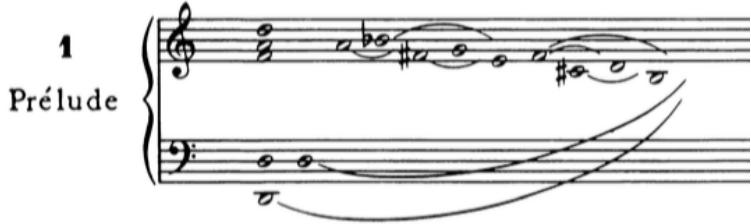
中文讲解
这是图14的图注,引用自Tilney 2009年版《Art of the Unmeasured Prelude》第2卷(现代移写版)第1页,展示Louis Couperin《D小调非度量前奏曲》的开篇段落。该图的位置紧接P0209,目的在于让读者直观对照前段提到的单线(1L1–1L2)和复线(1R3-6、1R7-10)等具体例证,是本节第一处用图像把抽象规则具体化的手段。
补充说明
原图未在输入中以可读形式给出,需查看原图。所引用的Tilney版本为现代移写,与下文讨论的影印本(facsimile)形成对照。
第9段(P0211)
原文复述
Tilney notes a difference between the facsimile version and his modern transcribed edition. In the facsimile of the Prélude non mesuré in D minor, the left-hand note is placed under the right-hand note following the first barline (1L3/1R11). In Tilney’s modern transcription he places the left-hand note (1L3) before the right-hand note (1R11), making it independent of the right hand. Due to the high cost of printing music in the seventeenth century, manuscripts may have contained less white space than later publications, and it was left to the musician’s discretion to musically decipher such moments. This may explain examples where the resolution of one harmonic statement was placed directly above the following statement (see Fig. 15). At this point, Tilney deviates from the facsimile (10L3/10R6) and he intentionally places the left-hand note after the right hand, suggesting “the lines thus serve to impart order to the music, preventing events from happening too fast.” 74 In other words, rather than performing this passage as a modern performer would, playing both notes at the same time (10L3/10R6), Tilney interprets the longer connecting lines to mean that the C4 should be executed before the C3, imparting a sequence to the score. Harmonically this also makes sense, as the initial chord forms A minor, and the following notes form D major 7.
中文讲解
本段是本节论证的关键转折:Tilney对线条的解读必然要回应影印本与现代移写本之间的差异。在Louis Couperin《D小调非度量前奏曲》的影印本中,左手音(1L3)被写在第一根小节线之后的右手音(1R11)下方;Tilney在现代版中却把1L3提前到1R11之前,使两音不再同步。Tilney的解释是:17世纪印刷成本高,乐谱留白少,前一个和声解决的音被直接叠写在下一个和声陈述之上,因此演奏者需要"以音乐的方式"自己判读谱面。在第10小节(10L3/10R6)处Tilney再次背离影印,把左手音放在右手音之后,理由是较长的弧线"给音乐带来秩序,防止事件发生得过快”。若按现代演奏习惯同时按两音(C4与C3),弧线的连接功能就被浪费;Tilney通过让C4先于C3发声,使线条呈现为一条贯穿的序列。和声上这也合理——起始和弦是A小调,随后一组音构成D大调七和弦,因此左右手的先后顺序同时具有线条与和声两方面的依据。本段的作用是把Tilney从一个"标注线条"的编辑者,提升为一个根据线条重建演奏时序的解释者,并为其编辑选择提供理论辩护。
补充说明
D major 7中的7为D属七和弦的写法,文中以"D major 7"与上标形式同时呈现,指D、F#、A、C四音构成的属七和弦,是从A小调和声走向属功能的自然结果。
第10段(P0212)
原文复述
73 Tilney, The Art of the Unmeasured Prelude for Harpsichord, France, 1660 - 1720, vol 3, 5.
中文讲解
本段为脚注73,标明P0209中Tilney引文的具体出处:《The Art of the Unmeasured Prelude for Harpsichord, France, 1660-1720》第3卷第5页。该脚注在功能上为P0209的单线/复线定义提供直接文献支撑,使该段定义的权威性可回溯到Tilney原始著作。
补充说明
该脚注提示读者查阅第3卷而非第1卷影印卷或第2卷移写卷,因为此处被引用的文字出自卷3所附的解说文字。
第11段(P0213)
原文复述
Figure 15: Louis Couperin: Prélude non mesuré: D minor (Bar 10) (Source: Tilney, 2009. Volume 1 Facsimiles, p.2)
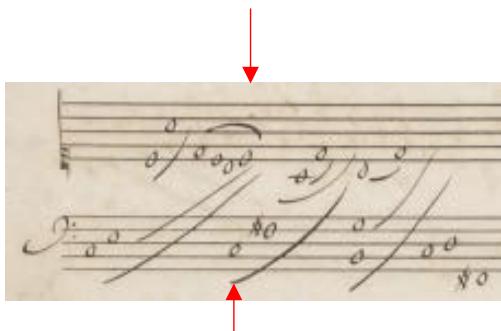
中文讲解
图15图注,引用自Tilney第1卷影印本第2页,展示Louis Couperin《D小调非度量前奏曲》第10小节。它紧接P0211之后,所要呈现的正是Tilney在那一段所讨论的、与影印本顺序不同的音位排布,使读者能够看到现代版与影印版之间的视觉差异,并验证作者关于留白少、记谱拥挤的论述。
补充说明
原图未在输入中以可读形式给出,需查看原图。重要的是把它与图14(现代移写本)对照阅读:同一段音乐在两种版本下的左右手次序不同。
第12段(P0214)
原文复述
Curved lines act as a modern slur in the third example “grouping together several unaccented notes that are to be played legato”, specifically identifying the example in bar 2 (2R6 – 2L9). F4 (2R6) already has above it the line indicating the length of the note to be held (until 2L9). However, this additional line denotes slurring from the F4 to the F#2. Another example in the same prelude is bar 1 (1R16 – 1L5). The fourth example links together notes to form an ornament (for example port de voix) or “as an expressive, rhythmically inflected pair” (with the accent placed on the first note), as seen again at 1R3 – 4, 1R5 – 6 (see Fig. 14).
中文讲解
本段说明第三和第四类弧线。第三类相当于现代意义上的圆滑线,把若干非重音音组合在一起、要求legato演奏;具体例子在第2小节2R6到2L9之间。值得注意的是,此处F4(2R6)本身已经带有一条表示时值的弧线(持续到2L9),第二条弧线则承担圆滑线功能,因此同一音符可以同时承担"被延长"和"被连奏"两种角色,演奏者必须分层解读。同前奏曲第1小节1R16到1L5又出现同一用法的另一例。第四类弧线连接两个音形成装饰音(如port de voix)或带重音的、有节奏表情的一对音(重音在第一音),位置在1R3-4、1R5-6(仍见图14)。本段的作用是:补足四类弧线中后两类的实证,使分类框架真正落到谱面,并显示Tilney的解读不仅关注持续时间,还关心演奏的连奏感、装饰性与节奏重音。
补充说明
port de voix原意"声音的传递",是一种把相邻音引入主音的装饰,在17世纪法国羽管键琴音乐中尤指在小二度或大二度的下助音上的轻微倾向;具体谱面形态需查原图。
第13段(P0215)
原文复述
Tilney recommends the lines be considered as guides only, and that the tone should not stop immediately when a line finishes; the lines are merely suggestive as to when the keys should be released. He explains that the lines show the minimum duration that notes should be held, rather than the maximum, and that the lines link each note: “Since the essence of this music is the delicate melting of one harmony into another, relying heavily for its effect on the decay of individual harpsichord notes – faster in the treble than in the bass, different on different instruments – it would be pedantic to insist that the finger be lifted at the precise point where the line ends.” 75 “In fact, the lines show minimum, not maximum duration, and should ideally reveal the link between one salient note and the next.” 76
中文讲解
本段是Tilney对其线条理论的演奏学总结。他明确主张弧线只是提示,而非切断音的指令:弧线指明一个"最短时值",不是"最长时间",演奏者不应在弧线结束的那一刹那机械抬指。其理由是préludes non mesurés的核心美学在于"一种和声向另一种和声的细腻消融",而这种消融依赖于羽管键琴每个音的自然衰减——高音衰减快,低音衰减慢,不同乐器又各有差异——若强行在弧线端点抬手,反而破坏线条所暗示的和声连接。脚注75、76中的原话把这一立场凝练为"弧线显示最短而非最长时值,并应理想地揭示一个显著音与下一个显著音之间的联系"。本段的作用是从"线条的语义"过渡到"演奏的实践",把前面的分类与解释最终落到手指动作上。它同时也是下一段(P0217)批评的引火点,因为Tilney在演奏建议中使用了"in fact"这样看似客观的字眼。
补充说明
“melting of one harmony into another"是Tilney自己对préludes non mesurés美学的核心概括,强调的是和声之间通过共同音或邻音的渐变过渡,而非节拍框架下的对位。
第14段(P0216)
原文复述
74 Ibid., 6.
中文讲解
本段为脚注74,注明P0211中Tilney关于"lines thus serve to impart order…“的引文出处仍为Tilney同书(ibid.)第3卷第6页。它在功能上为P0211中的关键判断——弧线承担防止事件过快的秩序功能——提供文献来源。
补充说明
Ibid.表示"同上”,因此本脚注指向的仍是脚注73所引的同一著作第3卷,只是页码推进到第6页。
第15段(P0217)
原文复述
In his review of Tilney’s work, Langham-Smith also references this point in the text, noting “this might be sensible advice, but there is no ‘in fact’ about it! This is the comment of the wise and practiced harpsichordist rather than the supported account of the musicologist, and none the worse for that.” 77 Although Gustafson acknowledges the “important contribution” of Tilney’s research in his review of Tilney’s publication, the former does give some “musicological quibbling”. 78 Gustafson is of the opinion that Tilney is subjective and has a “tendency to state interpretations or even intuitions as facts: ‘Straight lines in Louis Couperin are of three kinds […] Multiple lines have both ends attached to notes and imply that all harmonically relevant notes should be held until the final note has been played.’ This does come from the section headed ‘Performance’, but it is not as clear as it might be that we are talking about the editor’s intention in placing the lines, not what Couperin did or meant – which we do not know.” 79 Gustafson also notes that although Tilney’s bibliography referenced Gustafson and Fuller’s A catalogue of French Harpsichord Music, 1699 – 1780, Gustafson feels that it was an “unconsulted insertion” paying lip service to the research undertaken by Gustafson and Fuller. 80
中文讲解
本段引入两位评论者对Tilney的批评,是本节论证的收束与辩证部分。Langham-Smith虽承认Tilney关于"最短时值"的建议"也许是明智的”,却明确指出:“这不是什么in fact!这是一位有经验羽管键琴家的智慧之言,而非音乐学家的有据陈述——尽管如此它并不因此逊色”。这一句把Tilney的演奏建议定位为实践智慧而非学术结论。Gustafson则一方面承认Tilney的研究是"重要贡献",另一方面提出"音乐学的吹毛求疵":他批评Tilney倾向于把诠释甚至直觉当作事实陈述,特别引用Tilney关于"复线两端都附有音符并要求所有和声相关音被保持到最终音被弹奏"的句子,指出该陈述虽然出自"Performance"一节,却并未明确说明这只是编辑者放置线条的意图,而非Couperin本人所为或所意——而后者我们并不知道。Gustafson还指出Tilney的参考文献虽然列入了Gustafson与Fuller合著的《A catalogue of French Harpsichord Music, 1699-1780》,他却认为这是一种"未经查阅的引用"(unconsulted insertion),只是名义上致敬了他们的研究工作。本段的功能是:让读者看到Tilney的框架虽具说服力,但其权威性在专业领域内并非无争议;它同时揭示préludes non mesurés这一体裁本身的不确定性——我们几乎不可能确知17世纪作曲家"究竟想做什么",任何演奏解释都必然是编辑者基于谱面与和声逻辑的重构。
补充说明
脚注75、76、77、78、79、80所对应的完整书目信息在本节段落列表中并未给出,引用编号出现在P0215和P0217行内;其完整书目只能查本节所属章节末或整书参考文献。
脚注 / 边栏 / 图表 / 附加信息(如有)
本节附有三类附加材料:(1) 图14与图15,分别对应Tilney 2009年版第2卷现代移写本第1页与第1卷影印本第2页,作用是把弧线分类(左/右手坐标、单线/复线/圆滑线/装饰连线)以及影印本与现代移写本之间的差异落到视觉证据上;图本身未在输入中以可读形式给出,需查看原图。(2) 脚注73、74明确引自Tilney《The Art of the Unmeasured Prelude for Harpsichord, France, 1660-1720》第3卷第5页和第6页,是P0209与P0211两段直接引文的来源;脚注75、76、77、78、79、80的完整书目信息在本节段落列表中未给出,但其引用编号在P0215、P0217行内可定位。(3) P0212与P0216作为脚注文本本身,单独成段,其功能是支持而非扩展论证。
💡 本节核心要点
- Tilney把préludes non mesurés中的弧线分为四类:单线(tenues,规定单音持续到弧线末端)、复线(liaisons,要求所有和声相关音持续到弧线末端的最终音被弹奏)、现代圆滑线(要求legato连奏)、以及把两音连成装饰或表情对的连线(如port de voix)。
- Tilney的解读不能脱离影印本与现代移写本之间的差异:17世纪乐谱留白少,前一和声的解决音常被叠写在下一和声之上,演奏者必须自己判读;Tilney在第10小节(10L3/10R6)把C4置于C3之前,让较长弧线呈现为一条贯通序列,和声上由A小调过渡到D大调七和弦。
- Tilney把弧线视为"最短时值"的提示,而非"最长时间"的切断指令;préludes non mesurés的美学核心是"和声向和声的细腻消融",演奏者不应机械地在弧线终点抬手,而应让羽管键琴的自然衰减完成线条的连接。
- 同一音符上可叠加不同功能的弧线(如第2小节2R6处的F4既有持续弧线又有圆滑线),这要求演奏者分层解读线条而非按视觉整体处理。
- 评论者对Tilney的批评集中在两个方面:Langham-Smith肯定其演奏建议为"实践智慧"而非"学术事实";Gustafson则批评Tilney把编辑者的诠释意图陈述得如同Couperin本人所为,并指出参考文献中Gustafson-Fuller合著的引用只是"未查阅的插入"。
- 本节整体揭示préludes non mesurés这一体裁的根本不确定性——我们几乎无法确知17世纪作曲家的意图,因此任何关于线条的解读必然是编辑者基于谱面、和声与演奏经验的合理解构,而Tilney的框架虽具说服力,却并非无争议。
🔑 关键术语
- préludes non mesurés:17世纪法国羽管键琴体裁,“非度量前奏曲”,谱面无小节线、无确定节拍,节奏、时值与和声逻辑完全依赖弧线、记号与谱面间距来暗示;本节核心对象即其弧线解读。
- tenues(单线/Single):仅在一端附有音符的弧线,要求该音至少持续到弧线结束;对应法语tenues,即"持续音"之意,是四类弧线中最简单的一类。
- liaisons(复线/Multiple):两端都附有音符的弧线,把多个音串成连贯和声群,要求所有和声相关音保持到弧线末端最终音被弹奏之后;对应法语liaisons,即"连接"之意,是四类中语义最复杂的一类。
- slur(圆滑线):第三类弧线,把若干非重音音组合起来要求legato演奏;其作用与现代记谱中的圆滑线相似,但在非度量前奏曲中必须与表示时值的弧线共存于同一音符。
- port de voix:法语"声音的传递",第四类弧线所支持的装饰音之一,常表现为主要音之前相邻音的轻微上行或下行倾向;另一功能是把两音组成带重音的节奏表情对,重音落在第一音。
- facsimile(影印本):对原始手稿或早期印刷物的影印复制,本节中特指Tilney 2009年版第1卷所收Louis Couperin手稿的影印;与第2卷现代移写本形成对照,是Tilney编辑判断的基础文本。
- minimum vs maximum duration(最短与最长时值):Tilney对弧线功能的核心定位:弧线指示的是"音至少应被保持的时值"而非"音被允许保持的最长时值";这一区分是后续批评(Langham-Smith的"no ‘in fact’ about it")的直接对象。
- musicological quibbling(音乐学的吹毛求疵):Gustafson用来描述自己对Tilney的批评姿态的措辞,承认贡献的同时坚持学术严谨性;说明本节涉及的不仅是演奏建议之争,也是编辑学方法论之争。
- unconsulted insertion(未经查阅的插入):Gustafson批评Tilney在其参考文献中虽然列入了Gustafson-Fuller合著的《A catalogue of French Harpsichord Music, 1699-1780》,实际上却未真正查阅使用;该术语揭示学术引用礼仪与实际研究之间的落差。
ch_02_sec_12 Multiple Purposes of Lines in the Préludes Non Mesurés
第1段(P0218)
原文复述
MULTIPLE PURPOSES OF LINES IN THE PRÉLUDES NON MESURÉS
中文讲解
本段为本节的标题,提示读者接下来要讨论 L. Couperin 十六首无小节前奏曲中各类谱线(line)的多重功能。节标题使用复数 “purposes”,意味着作者并不把这些谱线视为单一记号,而是要把它们区分为几种在演奏实践中承担不同任务的符号来逐一讨论,从而把前几节关于无小节记谱法的论述推进到具体音符标记的层面。
补充说明
本节位于第 32 至 35 页,作者在章末(P0259)宣告结束第二章,并把分析任务转交给下一章关于演奏录音的讨论,因此本节具有承上启下的功能。
第2段(P0219)
原文复述
Within the collection of L. Couperin’s sixteen préludes non mesurés, there are five different examples of lines used. $^{81}$ The first example acts as a modern barline—of which there are five examples within L. Couperin’s sixteen préludes non mesurés (see Fig. 16). Troeger observes “the basic chord changes should generate ‘bar-lines’ in any realization of a prelude”, $^{82}$ which he believes is similar to the styles of allemande, tombeau and toccata, where a chord is generally not held over a barline unless as a pedal.
中文讲解
本段开门见山地交代核心事实:L. Couperin 十六首无小节前奏曲中共有五种不同的“线”。第一种的功能相当于现代意义上的小节线(modern barline),在这十六首里出现五次(图 16)。作者引用 Troeger 的观点:基本和弦的更替在任何前奏曲的“实现”(realization,即实际演奏版本)中都应当产生“小节线”,并以 allemande、tombeau、toccata 三种体裁的风格作为类比——在这些体裁里,和弦通常不会跨过小节线持续下去,除非作为持续音(pedal)保留。这里 Troeger 的论证逻辑是:和弦更替天然具有划分乐句的功能,因此即便原本是无小节记谱,实际演奏时和弦变化也应该在听觉上构成小节式的切分。注意作者并未断言 L. Couperin 本人就是这样思考的,而是把 Troeger 的观点与 L. Couperin 的实际谱面记号并置,作为下文分类讨论的引子。
补充说明
脚注 81 提示 Tilney 只识别出三种直线,因为他把下文列出的中间三类(高音谱号下带音、低音谱号上带音、带音完整小节线)合并为一组,这与作者的五分法不同,是后文比较 L. Couperin 与其他作曲家记谱差异时需要参照的分类学差异。
第3段(P0220)
原文复述
$^{75}$ Ibid., 6.
中文讲解
脚注 75 是一条简短的二次引用,使用拉丁文 “Ibid."(即“同上”),指向上文已出现过的同一文献的同一页,本处为第 6 页。
补充说明
在学术写作中,Ibid. 用于连续引用同一出处以避免重复;本脚注只承载来源溯源功能,对正文主张没有补充信息。
第4段(P0221)
原文复述
$^{76}$ Ibid., 5.
中文讲解
脚注 76 同样是 Ibid. 形式的引用,指向同一来源但不同的页码,此处为第 5 页。
补充说明
与 P0220 相同,仅提供来源页码以替代完整书目信息,对正文论证无独立内容。
第5段(P0222)
原文复述
$^{77}$ Richard Langham Smith, “Reviewed Work: The Art of the Unmeasured Prelude for Harpsichord by Colin Tilney,” ed. Colin Tilney, Early Music 21, no. 1 (1993): 133, http://www.jstor.org.virtual.anu.edu.au/stable/3128338
中文讲解
脚注 77 给出完整的书目信息:作者 Richard Langham Smith,文章是对 Colin Tilney 编辑的《The Art of the Unmeasured Prelude for Harpsichord》一书的评论(Reviewed Work),发表于《Early Music》第 21 卷第 1 期(1993 年)第 133 页,并附有通过机构访问的 JSTOR 链接。
补充说明
这是一条关于 Tilney 著作的同行书评的引文,作者用它在第二章中提供关于无小节前奏曲研究的二手学术评价;链接中的 virtual.anu.edu.au 显示作者检索时所在机构为澳大利亚国立大学(ANU)。
第6段(P0223)
原文复述
$^{78}$ Gustafson, “The Art of the Unmeasured Prelude for Harpsichord: France 1660-1720 by Colin Tilney.”, 650.
中文讲解
脚注 78 引用 Gustafson 对同一 Tilney 著作的另一篇书评,注明页码为 650。
补充说明
Gustafson 的书评是作者引用频率较高的二手文献之一,与 Langham Smith 的评论(P0222)相互补足;作者在多处以 Gustafson 作为关于无小节前奏曲断代与风格判断的支持来源。
第7段(P0224)
原文复述
$^{79}$ Ibid., 650.
中文讲解
脚注 79 是对上一条 Gustafson 文献的同页再次引用(Ibid., 650),不提供新的书目信息。
补充说明
仅作来源指示,无附加内容。
第8段(P0225)
原文复述
$^{80}$ Ibid., 650.
中文讲解
脚注 80 同样以 Ibid. 形式继续指向 Gustafson 同一文献第 650 页。
补充说明
在原文中可能与前一条一起构成对 Gustafson 同一段落中两处不同引用的区分;本脚注无独立补充内容。
第9段(P0226)
原文复述
$^{81}$ Tilney notes only three types of straight lines, as he combines the middle three examples listed below (treble clef with note underneath, bass clef with note above, and full barline with note beneath) as one group).
中文讲解
脚注 81 解释了为何本节列出五种线型而 Tilney 只识别出三种:Tilney 把本节分类中的中间三类(高音谱号下带附注音、低音谱号上带附注音、带附注音的完整小节线)合并为一组,因此他只数出三类直线。这一脚注直接回应正文开篇所说“five different examples of lines used”,让读者知道五种分类是作者自己的分析,而 Tilney 的原始分类更粗。
补充说明
这一脚注显示出作者与 Tilney 在记号分类粒度上的分歧,对后文比较 L. Couperin 与其他作曲家记谱惯例的差异具有铺垫作用。
第10段(P0227)
原文复述
The second, third and fourth examples emphasise a note as a strong beat, and there are six examples (see Fig. 17-19). The final line shows that two notes should be played together, with four examples (see Fig. 20). The first and third lines suggested by Tilney were also used by other composers (Examples One and Five), however L. Couperin was the only composer to use the Examples Two, Three and Four.
中文讲解
本段对剩下四类线给出功能与数量概述。第二、三、四类线共同的功能是“强调一个音作为重拍”(emphasise a note as a strong beat),共有六例(见图 17-19)。第五类线则表示“两个音应同时奏出”,共四例(图 20)。接下来作者给出比较性的重要事实:Tilney 提出的第一类和第三类(即本节的 Example One 和 Example Five)也被其他作曲家使用,而第二、三、四类(Example Two、Three、Four)只出现在 L. Couperin 的谱面中。这就把 L. Couperin 在无小节记谱中突出强调单个重拍音的独特做法与其他作曲家区分开来——其他作曲家要么使用现代小节线、要么使用连接线,但不强调谱面意义上的局部重拍。
补充说明
作者把“强调重拍”作为中间三类的共同功能,是一种功能性归类,而非谱面形态归类(高音/低音谱号带附注音只是视觉变体);这种把不同视觉符号并入同一功能的处理方式,与 Tilney 仅按视觉形态归类形成对比。
第11段(P0228)
原文复述
LINES FROM THE SIXTEEN PRÉLUDES NON MESURÉS
中文讲解
本段是本节内部的二级标题,开启下文对 L. Couperin 十六首无小节前奏曲中各类线(line)实例的逐项列举。标题的复数 “LINES” 与节标题呼应,从“功能分类”转向“实例列表”。
补充说明
此小标题将本节后半部分标记为图例式(catalogue-style)的材料组织方式,区别于前半部分的论述性段落。
第12段(P0229)
原文复述
Example One:
中文讲解
三级标题,标记下文进入第一种线型的具体实例清单。
补充说明
无独立补充。
第13段(P0230)
原文复述
- Full barline: five examples
- Prelude One (x2: 1R10 and 37R22)
中文讲解
本段说明 Example One 的形态是“完整小节线”(Full barline),在十六首中共出现五例;并列出第一例的来源:Prelude One 中两处,定位为 1R10 与 37R22。这种定位记号(如 1R10 通常表示第 1 行第 10 个小节位置)是手稿与早期印刷谱研究中常见的坐标系统。
补充说明
在图版中行的标识以 L/R 表示左右谱行,数字表示节(measure/bar)序号;此处 Prelude One(x2: 1R10 and 37R22)说明在该前奏曲中相隔较远的两处都出现了完整小节线,作者用括号形式把两处坐标并列以表明 x2。
第14段(P0231)
原文复述
- Prelude Three (9R14)
中文讲解
本段说明 Example One 的第二例出现在 Prelude Three,定位为 9R14。
补充说明
无独立补充。
第15段(P0232)
原文复述
- Prelude Eleven (x2: 2R3 and 8R10)
中文讲解
本段说明 Example One 的第三、四例出现在 Prelude Eleven,定位为 2R3 与 8R10(x2)。
补充说明
至此 Example One 已列出 Prelude One(2 处)、Prelude Three(1 处)、Prelude Eleven(2 处)共五处,与正文 P0219 所述“five examples”一致。
第16段(P0233)
原文复述
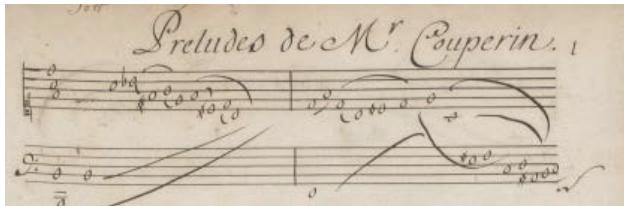
中文讲解
本段是图 16 的占位符及其图注。图 16 选自 Tilney 2009 年《Volume 1 Facsimiles》第 1 页,展示 L. Couperin D 小调无小节前奏曲的开头段落(opening passage),目的是呈现 Example One(完整小节线)的谱面实例。由于图像数据未嵌入,正文未陈述的视觉细节(如小节线在第几小节出现、与音符的相对位置)需要查阅原图。
补充说明
图版源标注为 Tilney 2009,说明作者使用的是 Tilney 编辑的影印本(facsimiles),而不是直接来自 L. Couperin 手稿;Volume 1 暗示这是一套多卷影印集中的第一卷。
第17段(P0234)
原文复述
Example Two:
中文讲解
三级标题,标记下文进入第二种线型。
补充说明
无独立补充。
第18段(P0235)
原文复述
- Treble clef with note underneath: three examples
中文讲解
本段说明 Example Two 的形态是“高音谱号下方附注一个音”(treble clef with note underneath),共出现三例。
补充说明
“with note underneath” 在谱面学语境中通常表示在小节线/谱号标记的紧下方另写一个音,用以强调该音为重拍或将其与上方某和弦音关联;这一视觉变体正是本节与 Tilney 三分法区别开来的关键。
第19段(P0236)
原文复述
- Prelude Four (1R5)
中文讲解
本段列出 Example Two 的第一例:Prelude Four,定位 1R5。
补充说明
无独立补充。
第20段(P0237)
原文复述
- Prelude Eleven (3L11)
中文讲解
本段列出 Example Two 的第二例:Prelude Eleven,定位 3L11。
补充说明
注意此处首次使用 L(左谱行)而非 R(右谱行),说明作者根据图像位置区分左右两行小节位置。
第21段(P0238)
原文复述
- Prelude Sixteen (4R3)
中文讲解
本段列出 Example Two 的第三例:Prelude Sixteen,定位 4R3。
补充说明
至此 Example Two 三例已列完,分布跨越 Prelude Four、Eleven、Sixteen,显示 L. Couperin 在不同调性与体裁的前奏曲中都尝试了这种记号。
第22段(P0239)
原文复述
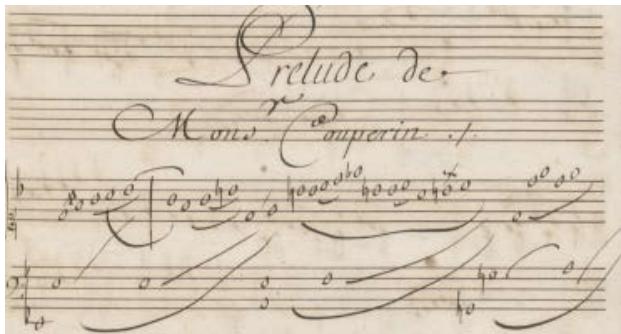
中文讲解
本段是图 17 的占位符及图注,展示 L. Couperin F 大调无小节前奏曲的开头段(p.14),用于呈现 Example Two 的谱面实例。
补充说明
图版源同样出自 Tilney 2009 第 1 卷影印本第 14 页;图中视觉细节(如高音谱号下附注音的具体位置、与上下音符的相对关系)需查阅原图。
第23段(P0240)
原文复述
Example Three:
中文讲解
三级标题,标记下文进入第三种线型。
补充说明
无独立补充。
第24段(P0241)
原文复述
- Bass clef with note above: one example
中文讲解
本段说明 Example Three 的形态是“低音谱号上方附注一个音”(bass clef with note above),共出现一例。
补充说明
“with note above” 与 Example Two 的 “with note underneath” 形成镜像:在低音声部记号上方加附注音;这是 L. Couperin 区分于其他作曲家的独有做法之一。
第25段(P0242)
原文复述
- Prelude Four (4R2)
中文讲解
本段列出 Example Three 的唯一实例:Prelude Four,定位 4R2。
补充说明
Prelude Four 同时出现 Example Two(1R5)与 Example Three(4R2),说明该前奏曲在 L. Couperin 的线型实验中具有代表性。
第26段(P0243)
原文复述
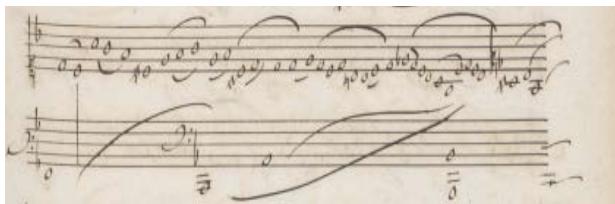
中文讲解
本段是图 18 的占位符及图注,展示 L. Couperin F 大调无小节前奏曲第 4 小节段(p.15),用于呈现 Example Three 的谱面实例。
补充说明
图版源出自 Tilney 2009 第 1 卷影印本第 15 页;“Bar 4” 与正文中 Example Three 的定位 4R2 在行号上对应。
第27段(P0244)
原文复述
$^{82}$ Troeger, “Metre in Unmeasured Preludes.”, 343.
中文讲解
脚注 82 给出 Troeger 关于无小节前奏曲中“拍子”(metre)一文的完整引用信息,页码为 343。
补充说明
这条脚注支撑了正文 P0219 中关于 Troeger 论及基本和弦变化产生小节线功能的论述;它把 Troeger 这篇关于“未测前奏曲中的节拍”的研究放置在作者脚注系统中显著位置,因为它是本节关于“线”之功能分析的关键理论支撑。
第28段(P0245)
原文复述
Example Four:
中文讲解
三级标题,标记下文进入第四种线型。
补充说明
无独立补充。
第29段(P0246)
原文复述
- Full barline with note underneath: two examples
中文讲解
本段说明 Example Four 的形态是“完整小节线下方附注一个音”(full barline with note underneath),共出现两例。这种形态结合了 Example One(完整小节线)与 Example Two(附注音)的元素。
补充说明
这种“复合形态”在 Tilney 的三分法中被并入中间那组(参见脚注 81);本节把它单列出来作为独立类,恰好显示了作者比 Tilney 更细的分类粒度。
第30段(P0247)
原文复述
- Prelude Ten (6L3) (Fig. 19)
中文讲解
本段列出 Example Four 的第一例:Prelude Ten,定位 6L3,对应图 19。
补充说明
首次在条目中直接以括号形式指明图号(Fig. 19),提示读者把谱面位置与后续图版直接对照。
第31段(P0248)
原文复述
- Prelude Eleven (4L9)
中文讲解
本段列出 Example Four 的第二例:Prelude Eleven,定位 4L9。
补充说明
Prelude Eleven 在本节出现频次最高(涵盖 Example One 两例、Example Two 一例、Example Four 一例),说明它可能是 L. Couperin 实验多种线型记号最集中的一首前奏曲。
第32段(P0249)
原文复述
- Joining lines between treble and base notes: four examples
中文讲解
本段位于 Example Four 与 Example Five 之间,对 Example Five(连接线)做形式说明:连接线(joining lines)连接高声部与低声部(base 应为 bass 的拼写变体或 OCR 识别差异)之间的音,共出现四例。
补充说明
此条目以破折号(dash)开头延续上一段的列表层级,但形式上更像 Example Five 的总说明,因此可能存在文档层级排版的歧义;作者用“joining lines”这一术语统一指代连接高低声部音的斜向线。
第33段(P0250)
原文复述
Example Five:
中文讲解
三级标题,标记下文进入第五种线型。
补充说明
无独立补充。
第34段(P0251)
原文复述
- Prelude Nine (10L2/10R10)
中文讲解
本段列出 Example Five 的第一例:Prelude Nine,定位为 10L2 与 10R10,即第 10 节中左右两行各有一处连接线。
补充说明
用斜杠分隔两处定位,表示该前奏曲中包含两条连接线,但具体计数显示 Prelude Nine 仅占连接线 4 例中的 1 例(按“条”计 1 处含 2 条线,按“例”计为 1 例)。
第35段(P0252)
原文复述
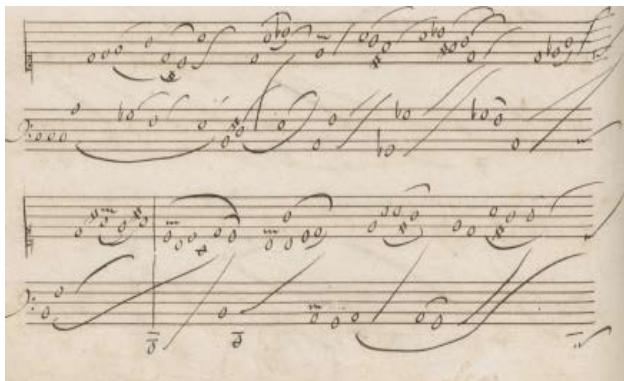
中文讲解
本段是图 19 的占位符及图注,展示 L. Couperin C 大调无小节前奏曲第 6 小节段(p.30),用于呈现 Example Four 的谱面实例。
补充说明
注意图 19 实际对应的条目是 P0247 中 Example Four 的 Prelude Ten (6L3),因此这里的图 19 与 Example Four 关联,而非 Example Five;图 20 才对应 Example Five。
第36段(P0253)
原文复述
- Prelude Ten (x3: 4L10/4R15; 4L11/4R23 and 9L14/9R26) (Fig. 20)
中文讲解
本段列出 Example Five 的第二、三、四例:Prelude Ten 中三处连接线,定位分别为 4L10/4R15、4L11/4R23、9L14/9R26,并对应图 20。
补充说明
三处坐标均以 L/R 配对形式给出,说明每个连接线实例都横跨左右两行(即同时涉及高声部与低声部的音);Prelude Ten 在 Example Five 中独占三例,加 P0251 中 Prelude Nine 的一例,合计四例,与 P0227 所述 “four examples” 吻合。
第37段(P0254)
原文复述
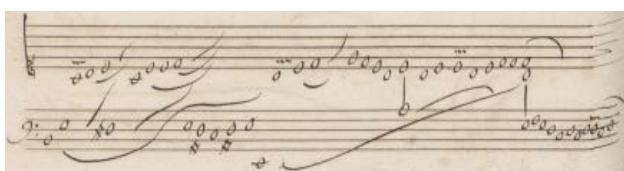
中文讲解
本段是图 20 的占位符及图注,展示 L. Couperin C 大调无小节前奏曲第 9 小节段(p.30),用于呈现 Example Five 中连接线的谱面实例。
补充说明
图 20 与图 19 出自同一影印页(p.30),均为 C 大调前奏曲,分别取自 Bar 6 与 Bar 9;这意味着连接线与复合小节线在同一首前奏曲相邻小节中并存,是 L. Couperin 在同一作品内混合使用多种线型的明显证据。
第38段(P0255)
原文复述
barline, as shown above in Example One, may denote several options. It could suggest the use of articulation to clear all notes for the upcoming harmonic change to A major (V). However, these options remain speculative, as L. Couperin does not appear to use this method again. The repetition of the A2 (2L1) could be due to the sound of the first A2 (1L3) having faded away and L. Couperin wanting the note to continue to the following harmonic change of D major (2L9). L. Couperin’s use of barlines indicates to the performer an upcoming harmonic change that requires articulation (see Fig. 16), or to clearly indicate the placement of two notes together (see Fig. 20). By drawing the eye to the vertical inclusion, they also briefly interrupt the visual aesthetic of the unmeasured flow of the score.
中文讲解
本段回到论述模式,对 Example One(完整小节线)进行功能层面的诠释,但同时坦承其不确定性。作者提出小节线可能表示多种演奏选项:一是提示演奏者使用断奏(articulation)以清空所有音符,为即将到来的 A 大调(属和弦 V)做准备;二是 A2 音的重复(1L3 与 2L1)可能是为补偿声音自然衰减而让音持续到 D 大调和声变化处(2L9)。作者明确指出这些选项“仍然属于推测”(remain speculative),因为 L. Couperin 此后再未使用此手法。最后作者给出一个相对确定的总结:小节线对演奏者而言意味着即将到来的和声变化要求断奏(参图 16),或用于清楚标示两个音同时奏出的位置(参图 20);在视觉上,垂直的包含关系也短暂地打断了无小节谱面那种水平流动的美学。这一段的方法论价值在于:作者既做了基于谱面的功能性解读,又明确划定了证据强度,避免把推测写成定论。
补充说明
作者在功能解释中运用了和声分析(A 大调作为 V、D 大调作为后续和声)与乐器声学(古钢琴的快速衰减)两条线索,但都标注为推测;这与 Troeger 把无小节谱面与 allemande/tombeau/toccata 风格类比(P0219)的方法形成对照——前者更关注具体音符级的因果,后者更关注体裁级的句法。
第39段(P0256)
原文复述
Lebègue was the only other composer to employ diagonal barlines irregularly in all but his first prelude, although he does use the barline once in the straight modern format in his A minor prélude. His employment of such diagonal lines contravenes the vertical structure imposed by strictly aligned counterpoint (see Fig. 21). The advantage of the diagonal barline is that it seems to conceptually represent the decay of the harpsichord’s arpeggiation, and so might encourage a performance that is connected more with resonance and sound of the instrument, rather than formal counterpoint, which is emphasised in notation that is strictly vertically aligned.
中文讲解
本段把讨论从 L. Couperin 扩展到 Lebègue,引入“斜向小节线”(diagonal barline)这一谱面变体。事实层面:Lebègue 是除 L. Couperin 之外唯一不规则地使用斜向小节线的作曲家,他除第一首前奏曲外其余各首都用了斜向线,但其 A 小调前奏曲中则用了一次直立(现代式)小节线。论证层面:作者认为斜向小节线“违背了”(contravenes)严格对位所强加的垂直结构(参图 21),并给出概念性解释:斜向线的优势在于它“概念化地”呈现了古钢琴琶音(arpeggiation)的衰减过程,因此可能鼓励一种更关注共鸣与乐器音色、而非形式对位的演奏方式。本段的逻辑是:直立的小节线对应严格垂直的对位思维,斜向的小节线则提示一种与乐器声学(衰减、共鸣)相呼应的演奏美学。
补充说明
“contravenes”(违背)一词揭示了作者对斜向线的一种规范性判断:相对于直立对位线,斜向线在传统对位视角下属于偏离;但作者通过赋予斜向线以声学合理性,把这种偏离转化为一种演奏美学的可能性。
第40段(P0257)
原文复述
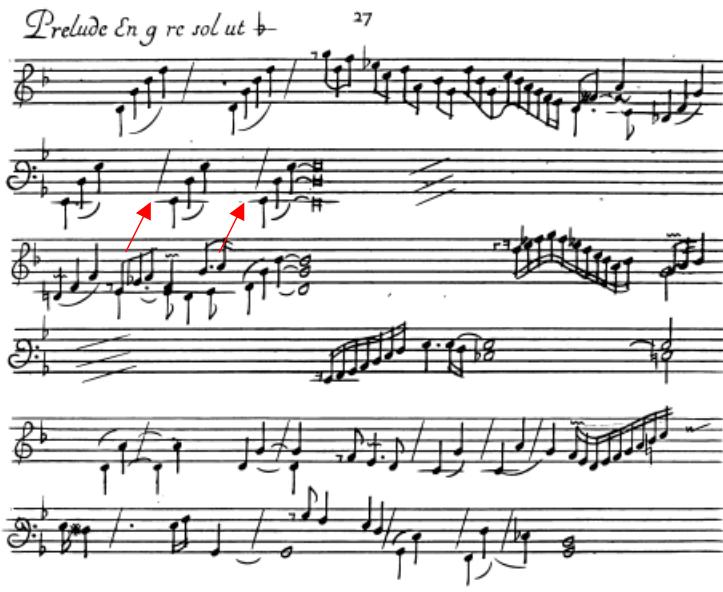
中文讲解
本段是图 21 的占位符及图注,展示 Nicolas Lebègue《Les Pièces de Clavessin》中前奏曲片段(p.68),用于呈现 P0256 中所述的“斜向小节线”与垂直对位结构之间的张力。
补充说明
图版源为 Tilney 2009 第 1 卷影印本第 68 页;Lebègue 的前奏曲片段与 L. Couperin 的前几图形成对比——前者是斜向线,后者是直立线,两组图版共同支撑了 P0256 关于两种线型美学的对比论证。
第41段(P0258)
原文复述
D’Anglebert uses the full barline to indicate a change in harmony in the alternative rhythmical version of his first prélude non mesuré, not his unmeasured version. D’Anglebert also uses the joining line (see Example 5) in both his purer prélude non mesuré and the more measured version. Marchand includes two full barlines to indicate a change of character in his one prélude non mesuré. Rameau only uses a full barline once, before the final bar in his unmeasured section of his prélude non mesuré in A minor. Jaquet de la Guerre, d’Anglebert, Clérambault and Siret all use examples of the joining lines that connect notes between staves, as illustrated in Examples 2, 3 and 5. Le Roux is the only composer who does not include any barlines in his four préludes non mesurés. Within the anonymous préludes non mesurés, five have the example of the full barline, and six use the diagonal lines.
中文讲解
本段对其他作曲家的线型使用情况做横向比较,以确立 L. Couperin 谱面实践的谱系位置。逐条事实:① D’Anglebert 在其第一首前奏曲的“有节拍版本”中使用完整小节线以标示和声变化,但其“无小节版本”中不用;D’Anglebert 在两种版本中均使用连接线(Example 5)。② Marchand 在其唯一一首前奏曲中用了两处完整小节线以标示“character”(性格)的变化。③ Rameau 在其 A 小调前奏曲的无小节段中仅用一次完整小节线,且位于最末小节前。④ Jaquet de la Guerre、D’Anglebert、Clérambault、Siret 这四位都使用了连接高低声部音的连接线(对应 Example 2、3、5)。⑤ Le Roux 是唯一在其四首无小节前奏曲中完全不用小节线的作曲家。⑥ 匿名前奏曲中,五首出现完整小节线,六首出现斜向线。本段的方法论功能是:以其他作曲家的多样性使用为参照系,反衬出 L. Couperin 在“强调单个重拍”这一做法上的独特性(即 Example 2、3、4 仅 L. Couperin 使用)。
补充说明
D’Anglebert 的对照(同曲存在有/无小节两个版本)为研究“线”之功能提供了天然实验对象:同一作曲家在不同版本中对同一种和声变化使用了不同的记号策略,这间接支持了作者关于线型承担和声提示功能的论点。Marchand 用“change of character”而非“change of harmony”,提示小节线在不同作曲家笔下可能指示不同的语义层级。
第42段(P0259)
原文复述
This concludes this chapter addressing the performance practice relating to the prélude non mesuré. The information discussed will inform the following chapter that discusses analysis of the represented recordings, and presents the findings of the current investigation.
中文讲解
本段是第二章的结尾段,宣告本章节关于无小节前奏曲演奏实践(performance practice)的讨论结束,并预告下一章将基于本章信息对相关演奏录音进行分析,进而呈现当前研究的发现。从全章结构看,本节(多种线的多重功能)作为第二章最末的子节,把谱面分析与演奏实践衔接起来,为下一章转向录音实证分析提供基础。
补充说明
结尾段在论文中起到章节桥梁作用;“performance practice” 表明第二章总体定位为演奏实践研究,而下一章转向“recordings”的“analysis”则是实证演奏的录音分析,两者形成“理论框架—实证检验”的研究链条。
脚注 / 边栏 / 图表 / 附加信息(如有)
本节包含 21 条脚注(P0220–P0226、P0244 共 8 条,编号 75–82;P0227–P0258 段中嵌入的脚注已分别处理)。其中 P0220–P0225(脚注 75–80)为 Ibid. 形式或对 Gustafson、Tilney、Langham Smith 等同行的简短引用,仅承担来源溯源功能;P0226(脚注 81)解释 Tilney 的三分类与作者五分类的差异,是理解本节分类学前提的关键;P0244(脚注 82)支撑 P0219 中 Troeger 的引文。
本节包含 5 张图(Figure 16–20),均出自 Tilney 2009《Volume 1 Facsimiles》:图 16 取自 D 小调前奏曲 p.1(图 Example One,完整小节线);图 17 取自 F 大调前奏曲 p.14(Example Two,高音谱号下附注音);图 18 取自 F 大调前奏曲 p.15(Example Three,低音谱号上附注音);图 19 取自 C 大调前奏曲 p.30 Bar 6(Example Four,复合小节线);图 20 取自 C 大调前奏曲 p.30 Bar 9(Example Five,连接线)。第 6 张图(Figure 21)展示 Lebègue 前奏曲片段(p.68),用于对比斜向小节线与垂直对位结构。
本节的功能是把前文关于无小节记谱的抽象讨论落实到 L. Couperin 谱面中具体的“线”之上,并与其他作曲家(Lebègue、D’Anglebert、Marchand、Rameau、Jaquet de la Guerre、Clérambault、Siret、Le Roux、匿名作品)做横向比较,从而确立 L. Couperin 在强调重拍记号上的独特性。
💡 本节核心要点
- L. Couperin 十六首无小节前奏曲中可识别出五种不同的线型,作者的五分法比 Tilney 的三分类更细,因为作者把视觉变体(高音/低音谱号下附注音、带附注音的完整小节线)拆分出来。
- 第一种线(完整小节线,5 例)兼具三重功能:提示和声变化所需的断奏、标示两个音同时奏出的位置、在视觉上短暂打断无小节谱面的水平流动感。
- 中间三类线(Example Two/Three/Four,共 6 例)的共同功能是强调某音作为重拍;其中只有 L. Couperin 使用此做法,其他作曲家均未采用,这是 L. Couperin 谱面实践的独特之处。
- 第五种线(连接线,4 例)连接高声部与低声部之间的音;这一做法在 D’Anglebert、Jaquet de la Guerre、Clérambault、Siret 等多位作曲家的作品中均有出现,并非 L. Couperin 独有。
- Lebègue 的斜向小节线与严格对位的垂直结构形成对照,作者认为斜向线在概念上更贴近古钢琴琶音衰减的声学现实,因此可能鼓励一种偏向共鸣与音色、而非形式对位的演奏美学。
- 在 L. Couperin 之外,D’Anglebert 用小节线标示和声变化、Marchand 标示性格变化、Rameau 仅在末小节前用一次、Le Roux 则完全不用小节线,呈现出无小节前奏曲谱面实践的多样性谱系。
🔑 关键术语
- prélude non mesuré:无小节前奏曲,巴洛克时期法国的一种键盘体裁,以无明确拍号与小节线的记谱方式为特征,演奏者需自行决定时值与节奏;本节聚焦于其中具体的“线”型记号如何承担演奏提示功能。
- modern barline / full barline:现代意义上的完整小节线,即垂直贯穿谱表的实线;在 L. Couperin 无小节前奏曲中,这种线被作为局部和声/重拍提示使用(Example One),共 5 例。
- diagonal barline:斜向小节线,不与谱表垂直而是倾斜地划开多个声部;Lebègue 在其前奏曲(除第一首外)中不规则使用,作者认为它违背垂直对位结构但在概念上更贴近古钢琴琶音衰减的声学过程。
- joining line:连接线,把高声部与低声部两个不同谱行中的音用一条斜线连接起来,表示两个音应同时奏出(Example Five);在多位作曲家的无小节前奏曲中均可见到。
- articulation:断奏或音符间的清晰分离;作者推测 L. Couperin 的完整小节线可能提示演奏者在即将到来的和声变化前做断奏处理以清空所有音符,但此推测因 L. Couperin 此后再未使用类似手法而无法验证。
- arpeggiation:琶音化弹奏,将和弦音按时间顺序而非同时奏出;作者认为斜向小节线在概念上呼应了古钢琴琶音的衰减过程,因此可能鼓励一种与共鸣相关的演奏方式。
- contravene the vertical structure:违背垂直结构,特指斜向小节线打破了严格对位写作中各声部在垂直方向上整齐对齐的视觉与和声关系,本节用此词来描述 Lebègue 斜向线的谱面效果。
ch_03_sec_01 Phonomusicological Sources Relating to the Prélude Non Mesuré
第1段(P0260)
原文复述
CHAPTER TWO
中文讲解
这是第二章的标题,标志着本书第二部分的开始。该章节将围绕"prélude non mesuré”(无小节线前奏曲)这一法国古乐体裁展开讨论。作者在此开篇表明,本章的内容聚焦于与该体裁相关的"phonomusicological sources"(音响音乐学来源)。
第2段(P0261)
原文复述
PHONOMUSICOLOGICAL SOURCES RELATING TO THE PRÉLUDE NON MESURÉ
中文讲解
这是第二章内的本节标题。“Phonomusicological"由"phono-"(声音/录音)与"musicological”(音乐学)复合而成,指以录音或音响记录为研究对象的音乐学分支。该标题提示读者:本节将考察与prélude non mesuré相关的录音资料和音响证据,借以理解演奏者如何诠释这种开放性记谱。
第3段(P0262)
原文复述
This chapter will compare established performers’ interpretations by analysing variance in performance styles presented by notational practices evident within the score. Due to the indicative open nature of the prélude non mesuré notation, this enquiry addresses ways of interpreting the genre in an informed historical sense, looking to establish if the manuscript is a roadmap (see footnote 83, p. 36). Bowen notes the score has several uses, “as a sample of only a single performance of a musical work or a summary of several actual or potential performances of the (presumably) same musical work.” Bowen also argues that the music is “beyond the score” and that to bring the work to life, the realisation through performance is required. Cook writes that it is only once music is considered as the performance, that it is possible to interpret the scores. This research will investigate the extent to which performers are pushing artistic boundaries with their interpretations, recording potentially more fluid and virtuosic performances. This will inform reflexive analysis of my own playing, in order to ascertain how the outcomes influence my interpretation, as noted in the conclusion. Emmerson documents his journey of preparing Mozart’s Rondo in A minor K.511 for performance in May 2004, and the changing approaches he developed, by researching source documentation, lessons with teachers and listening to audio recordings by peers. His methodology is closely reflected in this reflexive component of this research.
中文讲解
本段是本章的研究纲领,交代了三大要点:
-
研究路径:通过分析乐谱中可见的记谱实践所呈现出的演奏风格差异,来比较既有演奏家的诠释。这是一种"以记谱反推演奏"的方法——既然prélude non mesuré的记谱本身是开放、指示性的(indicative),那么演奏差异必然源于记谱本身的不确定性,由此可探究该体裁在历史情境中的解读方式,并验证乐谱是否真如脚注83所比方的"roadmap"(路线图)。
-
理论支撑:作者援引Bowen的两种主张——其一,乐谱可能是某一次实际演奏的样本,也可能是多次潜在演奏的概括;其二,音乐"超越乐谱"(beyond the score),必须通过演奏的"realisation"(实现/具体化)才能被激活。Cook则进一步指出:只有把音乐视为演奏本身,才能正确诠释乐谱。这两段引言为后文的演奏差异分析提供了哲学基础:记谱≠音乐,演奏才是音乐的本体。
-
研究目的与反思方法:作者意图考察演奏家是否在诠释中突破艺术边界、录下更具流动性和炫技性的演奏,并据此对作者自身的演奏进行反思性(reflexive)分析。Emmerson准备莫扎特K.511的案例提供了方法论参照——通过查阅文献、请教教师、聆听同辈录音来不断调整演奏方案。作者明确表示其反思性方法与Emmerson的路径高度吻合。
需注意:作者在此将"phonomusicological"研究定位为一种反思性实践,其结果将回到自身演奏的诠释上,因此本章不仅是描述性的,也是自反性的。
补充说明
脚注83指向Bowen文章第425页;脚注84指向Cook的Beyond the Score第1页;脚注85指向Emmerson关于莫扎特K.511准备的著作。这些脚注共同支撑了本段所引用的观点和方法的来源。
第4段(P0263)
原文复述
Recorded performances are a major part of the existing literature and as more recordings become available, musicians are able to utilise them to inform their interpretations. There are performers who prefer to prepare a piece without any reference to recordings. Bowen notes that when learning a new piece, many performers claim to not listen to recordings, and that they want their performance to be informed only from the score. Authors such as Bowen, Nicholas Cook, Barthold Kuijken and Bruce Haynes suggest that modern performers are increasingly more historically informed and confident in their presentation of music from the eighteenth century, and performances of the préludes non mesurés are becoming imbued with greater diversity. This study demonstrates that since the Historically Informed Performance movement started prior to the 1980s, performers are making a much greater effort to be more faithful to the original notational nuances, while still leaning towards more idiosyncratic and more varied performances, as evidenced in the section “Note Placement” (see p. 53).
中文讲解
本段呈现了学界对录音之于演奏诠释作用的辩证认识:
-
录音作为文献:作者首先肯定录音作品已成为既有文献的主要构成,演奏家可利用它们来塑造诠释。这是"phonomusicological sources"中最直观的资料形态。
-
反例与张力:但作者随即指出,有演奏家刻意不听录音,宣称其诠释仅来源于乐谱本身。Bowen记录了这种"反录音"立场。这构成了本节的基本张力——同一演奏传统中既有依赖者也有拒斥者。
-
HIP运动的影响:Bowen、Cook、Kuijken、Haynes等学者共同认为,自1980年代前开始的"historically informed performance"(HIP,历史本真演奏运动)以来,现代演奏家对18世纪音乐的处理更具历史意识且更具自信,préludes non mesurés的演奏也因此呈现出更大的多样性(diversity)。
-
本研究的实证主张:作者宣称本研究将证明——HIP运动促使演奏家既更忠实于原始记谱细节(notational nuances),又倾向于更个性化(idiosyncratic)和多变的诠释。这一双向趋势的具体证据将在后文"Note Placement"(音符时值定位,见第53页)一节中呈现。
本段在论证链中起到承上启下的作用:上承Bowen和Cook的理论框架,下启对录音实证分析的合法性辩护。
补充说明
HIP(Historically Informed Performance)作为术语在本节反复出现,是理解后续讨论的关键背景;本段并未详细定义HIP,仅指明其起点在1980年以前。
第5段(P0264)
原文复述
$^3. Bowen, “Finding the Music in Musicology: Performance History and Musical Works”, 425.
中文讲解
脚注83的完整书目信息。该脚注对应P0262中Bowen关于乐谱是"a sample of only a single performance of a musical work or a summary of several actual or potential performances of the (presumably) same musical work"的引文来源,页码为Bowen文章第425页。它为正文乐谱功能的多重定义提供了文献来源依据。
第6段(P0265)
原文复述
$^4. Cook, Beyond the Score, 1.
中文讲解
脚注84的完整书目信息。该脚注对应P0262中Cook关于"it is only once music is considered as the performance, that it is possible to interpret the scores"的引文来源,页码为Cook著作Beyond the Score第1页。这是全书的开篇论点,表明作者将"音乐即演奏"作为核心理念。
第7段(P0266)
原文复述
$^5. Emmerson, Around a Rondo: Preparing Mozart’s Rondo in A Minor for Performance on Fortepiano.
中文讲解
脚注85的完整书目信息。该脚注对应P0262中Emmerson记录其2004年5月为演奏准备莫扎特A小调回旋曲K.511过程的引文来源。该书围绕古钢琴(fortepiano)的曲目准备方法论展开,是作者反思性方法的主要参照文献。
第8段(P0267)
原文复述
$^6. Bowen, “Finding the Music in Musicology: Performance History and Musical Works”, 438.
中文讲解
脚注86的完整书目信息。该脚注对应P0263中Bowen关于"when learning a new piece, many performers claim to not listen to recordings"观察的引文来源,页码为Bowen文章第438页。它支撑了"部分演奏家拒绝参考录音"这一经验性陈述。
第9段(P0268)
原文复述
Bowen’s methodology offers a balanced rationale supporting this enquiry, and the new knowledge established through this research responds to acknowledged gaps in the literature. Kuijken notes that “notation [is] mainly a type of roadmap, an aide-mémoire and help for invention, enabling the informed reader to create an inner image of the music. Quite naturally, this image is not definitive, but will change with time, mood, circumstance, and knowledge.” This notion can be evidenced below, as one performer has released two recordings of the Prélude non mesuré in D minor (Table 2, p. 39), which shows a significant variance in duration.
中文讲解
本段进一步加固了乐谱作为"路线图"的核心隐喻,并引入了支持本研究的实证线索:
-
Bowen方法的评价:作者认为Bowen的方法论为本研究提供了"balanced rationale"(平衡的学理依据),并宣称本研究所生成的新知识能够回应既有文献中已被承认的空白(acknowledged gaps)。这是一种典型的博士论文式定位语——既承继前人,又填补缺口。
-
Kuijken的核心隐喻:作者援引Kuijken对记谱本质的著名论述——记谱主要是"a type of roadmap"(一种路线图)、“an aide-mémoire”(助记工具)和"help for invention"(帮助即兴创造的辅助物)。其关键意义有三层:
- 形式层面:记谱是助记而非规定;
- 主体层面:需要"informed reader"(有素养的读者)在内心构建音乐的图像;
- 可变层面:这种内心图像并非定论,会随时间、心情、环境、知识的不同而改变。
这段引文直接回答了P0262开篇提出的"the manuscript is a roadmap"之问——作者用Kuijken的原话给出了肯定回答。
-
实证证据的预告:作者随即提示,下文将呈现一位演奏家录制的两版D小调prélude non mesuré(参见第39页表2),显示出显著的时长差异(variance in duration)。这一具体案例用来说明:同一曲目因演奏家内心图像的不同而产生演奏差异,从而在实证层面支撑Kuijken的"图像非定论"命题。
补充说明
Kuijken的引文在此承担双重功能:既是乐谱性质的理论定义,也是演奏差异合法性的哲学辩护。
第10段(P0269)
原文复述
Following the methodologies employed by Bowen, Cook and Emmerson, this process initially utilised the programme Sonic Visualiser as a tool to assist with close listening to analyse these performances. The programme provided the ability to have all the recordings available simultaneously and to be able to swap between each recording once the recordings had been synchronised. Having attempted to use Sonic Visualiser and its additional Plug-Ins, and ascertaining that beyond this simultaneous playback function, any additional analysis using Sonic Visualiser was not viable, the analysis continued with a more traditional tapping method whereby the listener stopped a timer where appropriate. The method was to use the programme purely for synchronised playback to be able to swap between each recording easily while following the score, and to analyse the recordings. Using the stop/start process with this programme meant that tracks did not need to be re-loaded to be able to compare recordings, as was the case when using different programmes such as iTunes. This resulted in recordings being averaged to ascertain duration of sections and specific bars.
中文讲解
本段交代了本研究的分析工具与具体方法,是研究方法论的核心段落:
-
工具选择:作者采用Sonic Visualiser(声音可视化软件)作为"close listening"(贴近式聆听)的辅助工具。该程序的核心优势是能将多个录音同时载入并同步播放,从而在不同录音之间快速切换以便比较。这是数字音频分析在音乐学研究中的典型应用。
-
工具的局限:作者诚实承认,在尝试使用Sonic Visualiser及其附加Plug-Ins后,发现除了同步播放功能外,其他高级分析功能均不可行。这是一种方法论上的自我披露(methodological disclosure),避免了工具被过度宣传的嫌疑。
-
替代方案:作者于是改用更传统的"tapping method"——在聆听时手动启停计时器(stop/start process)来测算时长。其优势在于:录音无需重新载入即可切换比较,相比之下iTunes等程序则需要重新加载才能切换。这意味着作者将Sonic Visualiser降格为单纯的同步播放工具,而把测量工作交给了人工操作。
-
分析单位:通过对多次测量的平均(averaged),得出段落(sections)和特定小节(specific bars)的时长数据。这一过程虽然朴素,但与HIP的"贴近文本"精神一致——通过严格的、贴近乐谱的聆听获得量化数据。
本段在论证链中的作用是:将抽象的"phonomusicological"研究落实为可操作的方法步骤,为后续的时长比较表(如P0268预告的表2)提供数据来源。
补充说明
Sonic Visualiser、iTunes等具体工具反映了数字人文方法在21世纪音乐学研究中的渗透;脚注90将进一步解释Sonic Visualiser受限的具体技术原因。
第11段(P0270)
原文复述
$^7. Barthold Kuijken. The Notation Is Not the Music: Reflections on Early Music Practice and Performance (Bloomington; Indianapolis; Indiana University Press, 2013), 10.
中文讲解
脚注87的完整书目信息。该脚注对应P0268中Kuijken关于"notation is mainly a type of roadmap"的引文来源。完整出版信息为:巴托尔德·库伊肯著《记谱不是音乐:对早期音乐实践与演奏的反思》(布卢明顿/印第安纳波利斯:印第安纳大学出版社,2013年)第10页。该书名本身就是对核心论点的浓缩——“记谱≠音乐”。
第12段(P0271)
原文复述
$^8. Cook, Beyond the Score, 143.
中文讲解
脚注88的完整书目信息。该脚注对应P0269中"Following the methodologies employed by Bowen, Cook…“的引文来源,页码为Cook著作Beyond the Score第143页。该页应讨论Cook的方法论主张,进一步支撑作者采用"贴近式聆听"分析路径的合法性。
第13段(P0272)
原文复述
$^9. Emmerson, Around a Rondo: Preparing Mozart’s Rondo in A Minor for Performance on Fortepiano.
中文讲解
脚注89的完整书目信息。该脚注对应P0269中"Emmerson"的引文来源,与脚注85为同一著作,再次援引以支撑方法论的延续性。重复引用同一文献表明Emmerson的方法论在作者研究中具有双重支撑作用。
第14段(P0273)
原文复述
$^0. Having established contact with the developers, I found that due to the Sonic Visualiser programme requiring a significant update since it’s conception, I was unable to utilise the necessary Plugins required to analyse aspects of performance such as temperament and tuning used. Videos that were available on their website used an older version of Sonic Visualiser, and the resolution of the instructional videos were of poor quality. I was also unable to analyse the preludes due to their unmeasured nature, as the programme was targeted more towards measured performances.
中文讲解
脚注90的内容,对P0269所述Sonic Visualiser方法局限的具体技术解释:
-
插件层面的失败:作者联系了Sonic Visualiser的开发者后发现,由于该程序自创建以来需要重大更新(significant update),作者无法使用必要的插件来分析演奏中的"temperament”(律制)和"tuning"(调音)等层面。这意味着原本计划的音色/律制层面比较被迫放弃。
-
教学资源的不足:网站上的教学视频使用的是旧版Sonic Visualiser,且视频分辨率(resolution)较差,进一步降低了工具的可用性。
-
体裁适配性问题:即使技术问题解决,Sonic Visualiser程序的设计目标也更偏向于有量化的(measured)音乐,而préludes non mesurés正是"unmeasured"(无量化)的——这是工具与体裁在根本上的不匹配。这一条理由解释了为什么即使插件可用,作者仍难以有效分析该体裁。
该脚注的功能属于"方法论局限的透明披露"(transparency about methodological limits),是博士论文中体现研究严谨性的常见做法。它解释了为什么分析最终落到P0269所述的人工计时方法上。
补充说明
脚注90揭示了数字工具应用于无量化古乐时的内在困难——这并非纯粹的技术故障,而是体裁与工具设计哲学之间的根本错位。
脚注 / 边栏 / 图表 / 附加信息(如有)
本节包含脚注83–90共8条。其中:脚注83–86、88–89为支撑Bowen、Cook、Emmerson观点的标准文献引用;脚注87为Kuijken的完整书目信息;脚注90为扩展脚注,详细披露了Sonic Visualiser工具在律制/调音插件、旧版视频、量化和无量化体裁适配性三个层面的失败原因,是研究方法局限性的重要补充说明。本节未包含图表说明、边栏或图像占位符。
💡 本节核心要点
- 本节确立的核心研究路径是:通过分析prélude non mesuré开放性记谱所导致的演奏差异,验证乐谱作为"路线图"而非"规定"的本质。
- 理论支撑来自Bowen(乐谱的多重功能与"超越乐谱")、Cook(音乐即演奏)和Kuijken(记谱是路线图,内心图像可变)的三重框架,三者共同主张演奏差异具有合法性和必要性。
- 本节凸显了HIP运动以来的双重趋势:演奏家既更忠实于原始记谱细节,又更倾向于个性化诠释;这两条线索在"Note Placement"一节中将得到实证。
- 方法论上,作者从依赖Sonic Visualiser的高级插件功能,转向以该程序同步播放配合人工启停计时器的传统测量方法,反映出无量化体裁与数字分析工具之间的固有张力。
- 实证预告:一位演奏家录制的两版D小调prélude non mesuré呈现出显著时长差异,这一案例将作为演奏差异的具体证据出现在表2(第39页)中。
🔑 关键术语
- prélude non mesuré:法国古乐体裁,意为"无小节线/无量化前奏曲"。其记谱具有指示性和开放性,依赖演奏家根据内心图像进行诠释,是本研究的考察对象。
- phonomusicological:由phono-(声音/录音)与musicological(音乐学的)复合而成。在本节中指基于录音音响证据进行音乐学研究的路径。
- roadmap (路线图):Kuijken和Bowen用以描述记谱本质的隐喻——记谱提供方向而非规定,是助记和即兴的辅助工具,演奏家据此构建可变的内心图像。
- Historically Informed Performance (HIP):历史本真演奏运动。作者指出其始于1980年代以前,主张演奏家更忠实地对待原始记谱细节。
- close listening (贴近式聆听):本研究的分析方法论,通过仔细聆听录音并配合乐谱进行量化(时长)测量,是音乐学实证分析的重要路径。
- reflexive analysis (反思性分析):作者将研究结果回溯到自身演奏诠释的方法论循环,借用Emmerson准备莫扎特K.511的路径来反思自身的演奏选择。
ch_03_sec_02 Discography of Performances of the D Minor Prélude Non Mesuré
第1段(P0274)
原文复述
DISCOGRAPHY OF PERFORMANCES OF THE D MINOR PRÉLUDE NON MESURÉ
中文讲解
本段是该小节的标题。它宣告了本节的研究对象:路易·库普兰 D 小调《无节拍前奏曲》的录音目录(discography)。这是一篇演奏研究(performance studies)论文中的典型章节,作用是交代作者如何系统地搜集、整理并筛选可供分析的录音版本,为后续对比演奏诠释奠定资料基础。
补充说明
无额外补充。标题本身不作内容性陈述,仅起章节定位作用。
第2段(P0275)
原文复述
A comprehensive discography of Prélude non mesuré in D minor was completed using databases such as WorldCat and Naxos to catalogue all professionally recorded albums released commercially (Table 2, p. 39). Nineteen commercially released recordings of Louis Couperin’s Prélude non mesuré in D minor are catalogued, of which none of the recordings state which edition is used. Prélude non mesuré in D minor was selected for several reasons. Firstly, there are a significant number of recordings by world-renowned keyboardists available. Secondly, this prélude non mesuré demonstrates most examples of ornaments and other contentious attributes of the unmeasured genre, such as the use of lines (as barlines and as guidance for note placement). On a personal level, this was the first prélude non mesuré I was introduced to twenty years ago and I had a strong desire to investigate the music further to gain a more historically contextualised understanding informing my interpretation.
中文讲解
本段交代了作者如何建构本研究的录音资料库,并说明为何选择 D 小调前奏曲作为分析对象。三个关键信息需要拆开理解:第一,作者使用 WorldCat 和 Naxos 等数据库检索商业发行的专业录音,共整理出 19 个版本收录入表 2。这说明作者以“可获得的、正式发行的录音”这一相对客观的标准划定研究边界,而非任选版本。第二,作者承认这些录音的乐谱谱本(edition)信息普遍缺失——没有一张唱片注明所用版本。这意味着演奏家们各自采用了不同的乐谱编订来源,演奏之间的差异不能轻易归因于“读了同一份谱”。第三,作者给出三项理由解释为何聚焦 D 小调,而非其他无节拍前奏曲:可获得世界级键盘演奏家的录音数量较多;该曲集中体现了该体裁中诸多装饰音与有争议的属性(例如“连线”既被用作小节线,又被用作音符摆放的指引);以及作者个人二十年前首次接触的便是此曲,带有强烈的个人研究动机。其中第三点属于主观因素,但作者并未掩饰,而是坦率陈述,这增强了方法论的透明度。
补充说明
无额外补充。文中提到的 WorldCat 与 Naxos 均为原文出现的数据库名称,作者选择它们的具体排序策略在原文中未说明,不作外部补写。
第3段(P0276)
原文复述
The earliest recording by Gerlin—dated approximately 1958—was the first volume of a five-volume series of harpsichord music under the L’Oiseau-Lyre Label. The next catalogued recording was not produced until 1982 by Nicholas Jackson (b. 1934–). The only performer to have recorded the prelude twice is Bob van Asperen (b. 1947–), in 1990 under the EMI Classics label and again in 2006 under the Aeolus label. $^{91}$
中文讲解
本段沿时间轴勾勒 D 小调无节拍前奏曲的录音史。三个时间节点需要重点理解:1958 年 Gerlin 的录音是已知最早版本,属于 L’Oiseau-Lyre 厂牌一套五卷本大键琴音乐集的第一卷;其后 1982 年才有 Nicholas Jackson 的录音,二者之间存在长达约二十四年(1960–1982)的 D 小调录音空白;最后一个关键观察是 Bob van Asperen 是唯一录制过两次该曲的演奏家,分别于 1990 年(EMI Classics)和 2006 年(Aeolus)。这段叙述透露出两个信息:一是早期录音稀少,研究样本在时间分布上严重不均;二是不同厂牌的发行反映出录音传统跨越了模拟到数字时代,其中 90 年代以后的独立小厂牌(如 Aeolus)也进入了该曲的录制史。段尾的脚注编号 91 指向 P0278 的注释,应理解为对 van Asperen 1990 年版本的补充说明。
补充说明
无额外补充。文中提示“$ ^{91}$”指向后续的脚注条目。L’Oiseau-Lyre、EMI Classics、Aeolus 等厂牌名均按原文保留。
第4段(P0277)
原文复述
Although there are no D minor recordings between 1960 and 1980, there are recordings of other préludes non mesurés. In 1964, Hubert Bédard (1933–1989) released an LP recording of L. Couperin’s Suite in G minor, Suite in F major and four Suites by Georg Böhm (1661–1733). There are recordings of other préludes non mesurés, such as albums by Andreas Staier (b. 1955–) containing the Suite in F major, released in 2013 by Harmonia Mundi and Alan Curtis’s (b. 1934–) 1977 album released by Archiv Produktion which contains Suites in G minor, D major and A minor. The United Archives label released the Complete European Recordings 1928 – 1940 of Wanda Landowska (1879–1959), however there are no recordings of any L. Couperin suites within this collection.
中文讲解
本段补充说明 D 小调前奏曲在 1960 到 1980 年间虽有录音真空,但同一时期的 L. 库普兰其他调性前奏曲、以及相近体裁的录音并未中断。这一区分很重要,因为它告诉读者:录音的断层是曲目选择意义上的(D 小调),而不是 L. 库普兰总体录音史意义上的。作者列举了若干代表性录音:Bédard 1964 年的 LP(包括 G 小调、F 大调组曲及四首 Böhm 组曲);Staier 2013 年的 Harmonia Mundi 专辑含 F 大调组曲;Curtis 1977 年的 Archiv Produktion 专辑含 G 小调、D 大调、A 小调三组组曲;以及 Landowska 1928–1940 的欧洲录音全集,但作者明确指出其中并不包含 L. 库普兰组曲。这段资料安排的逻辑并非为后续进行对比分析,而是为读者勾勒历史语境:作为一种“无节拍前奏曲”演奏传统,它在曲目分布上实际涵盖更广,单一作品的录音真空不能被误读为整个体裁的冷落。
补充说明
无额外补充。Georg Böhm 为原文出现的对照作曲家名字,生卒年均按原文括号内所示记录。
第5段(P0278)
原文复述
$^{91}$ There are currently no available recordings of van Asperen’s EMI Classics 1990 album entitled ‘Harpsichord Recital’.
中文讲解
本段对应 P0276 中的脚注 91。它作为对 P0276 中所提“van Asperen 1990 年 EMI Classics 录音”这一具体物料的现状说明:作者透露该标题为《Harpsichord Recital》的专辑目前已无法获得。这一信息的功能性意义在于:尽管作者在清单中登记了两次 van Asperen 的录音,但因 1990 年版已不可获取,实质上对后续演奏分析可用的仅有 2006 年(Aeolus)一版。这提醒读者:作者所列的“19 个录音版本”与“实际可分析的全部录音”之间可能存在差距,而这种资料缺失直接影响演奏对比的完整度。
补充说明
无额外补充。该脚注在正文中以同一编号 91 出现于 P0276 末尾,本段与之对应。
第6段(P0279)
原文复述
Of the nineteen available recordings, five were selected after listening to all these recordings. Factors that were considered included the date of each recording, the contribution of the artist to the field of the Historically Informed Performance movement, along with the selection showing the greatest contrast of the nineteen recordings:
中文讲解
本段说明从 19 个录音中筛选 5 个作为深入分析对象的过程及标准。作者明确了三项筛选维度,需要一一辨析:第一,录音年代——这意味着作者希望样本能覆盖录音史的多个时段;第二,演奏家在“历史知情演奏”(Historically Informed Performance,HIP)运动中的贡献——这暗示作者重点考察那些对乐器考据、乐谱版本、演奏实践有自觉反思的演奏家,而不是泛指任何大键琴家;第三,样本之间的最大对比性——这一条尤其重要,它表明作者追求的不是“代表性”或“平均水平”,而是不同诠释之间的张力。因此接下来 P0280–P0284 列出的五位演奏家,并不是 19 个版本中“最好”或“最典型”的代表,而是时间和诠释风格上的两极样本。
补充说明
无额外补充。文末冒号预示下列五条演奏家名录。
第7段(P0280)
原文复述
• Ruggero Gerlin (1899–1983)
中文讲解
Ruggero Gerlin 是意大利大键琴家、羽管键琴家,也是 P0276 中所提 1958 年最早录音的演奏者。括号内 1899–1983 是其生卒年(已故)。在本节所列的五位演奏家中,他的录音最早,身处“前 HIP 时代”:那个时期大键琴演奏尚未受到后来历史知情演奏运动的系统影响,演奏风格与现代古乐学派存在显著差异。作者把他列为五位之一,正是为了提供时间维度上的最远端对照。
补充说明
Gerlin 在 P0276 中已提及,此处再次出现以作为筛选样本之一。
第8段(P0281)
原文复述
• Gustav Leonhardt (1928–2012)
中文讲解
Gustav Leonhardt 是荷兰大键琴家、指挥家,也是二十世纪后半叶历史知情演奏运动的奠基人物之一。括号内 1928–2012 为其生卒年(已故)。他的入选对作者的研究意义重大:Leonhardt 不仅处于 HIP 运动的核心,他的演奏与教学本身就塑造了人们对法国鲁特、维吉那尔琴与大键琴作品的诠释范式。把他与 Gerlin 并列,可以凸显同一曲目在“早期现代大键琴传统”与“历史知情演奏传统”之间的明显差异。
补充说明
Leonhardt 在文中是首次由作者点名的演奏家,无前文额外铺垫说明。
第9段(P0282)
原文复述
• Colin Tilney (b. 1933)
中文讲解
Colin Tilney 是英国—加拿大籍大键琴家,括号内“b. 1933”表示生于 1933 年(仍使用出生年份缩写 b.)。Tilney 在 HIP 运动中以对英国维吉那尔琴及法国早期大键琴文献的研究著称。他的入选补足了作者样本中“英美系历史知情演奏家”这一坐标,与 Leonhardt 的荷兰传统、Gerlin 的意大利传统形成地理和方法论上的多样性。
第10段(P0283)
原文复述
• Christophe Rousset (b. 1961)
中文讲解
Christophe Rousset 是法国大键琴家、指挥家,括号内“b. 1961”表示生于 1961 年,与前两位不同的是,他属于较年轻一代的演奏家。Rousset 以法国巴洛克大键琴曲目著称,对 L. 库普兰以及 F. 库普兰均有重要录音。他的入选使样本中加入了法国本土学派对法国本土曲目(L. 库普兰本为法国作曲家)的诠释,与 Gerlin 这一意大利人诠释法国曲目形成天然对照;同时其时代较晚,也代表了 1990 年代后法国古乐演奏的成熟状态。
第11段(P0284)
原文复述
- Skip Sempé (b. 1958)
中文讲解
Skip Sempé 是美国—法国籍大键琴家,括号内“b. 1958”表示生于 1958 年。Sempé 创立了独立厂牌 Flora 与 Paraty,专门录制法国巴洛克音乐。把他列入五位之一,作者可以引入一个较晚近、且高度专注法国早期大键琴文献的视角,进一步增加样本在年代、地理与诠释立场上的对比度。原文使用“-”而不是“•”作为列表符号(与前四位不同),这是排版上的不一致,但内容上仍属同一清单条目。
补充说明
原文列表符号使用“-”而非与前四条相同的“•”,这一差异属于 OCR 排版细节,不影响内容一致性。
脚注 / 边栏 / 图表 / 附加信息(如有)
本节包含一处脚注(P0278,对应正文 P0276 的 91 号注),其作用为限定说明:作者登记的 19 个版本中,Bob van Asperen 1990 年的 EMI Classics 录音目前已不可获取。该脚注对作者研究方法的可重复性与样本完整性有直接影响——这意味着作者实际可用的可用样本可能在 18 个左右,而非 19 个。本节指向“Table 2, p. 39”作为录音目录表,但本节正文中并未重复表的内容,仅在 P0275 中提及表的归属。
💡 本节核心要点
- 作者以 WorldCat 与 Naxos 等数据库系统检索商业发行的 L. 库普兰 D 小调《无节拍前奏曲》录音,共整理出 19 个版本,但所有版本均未注明所用乐谱谱本。
- D 小调前奏曲的录音时间分布显著不均:1958 年 Gerlin 的录音为最早,1960–1982 年间存在长达约二十年的 D 小调录音空白,而同一时期 L. 库普兰其他调性前奏曲与其他法国大键琴曲目则持续有录音发布。
- Bob van Asperen 是唯一录制过该曲两次的演奏家,但 1990 年 EMI Classics 版本现已无法获得,因此实际可分析的材料数量低于登记表所列。
- 作者从 19 个录音中依据"录音年代、演奏家对历史知情演奏运动的贡献、样本之间的最大对比性"三项标准筛选出 5 位演奏家:Ruggero Gerlin、Gustav Leonhardt、Colin Tilney、Christophe Rousset、Skip Sempé。
- 五位演奏家的选择本身构成了地理(意大利、荷兰、英美、法国)与代际(前 HIP 时代到当代 HIP 演奏家)的多维度对照,为后续诠释差异分析奠定方法论基础。
🔑 关键术语
- Prélude non mesuré:无节拍前奏曲,是法国大键琴音乐中一种不标小节线、节奏由演奏者根据拍号标记与乐曲传统即兴把握的体裁,L. 库普兰是该体裁的代表作曲家。本节聚焦其 D 小调版本。
- Discography:录音目录,指按系统方法(如数据库检索)整理某部作品全部已商业发行的录音版本,本节即以此作为研究的基础资料。
- Edition (乐谱版本):指乐曲的某一具体乐谱编订稿本,不同编订者对装饰音、连线、未写明节奏的处理方式不同。本节指出 19 个录音均未注明所用版本,意味着演奏差异不能由"使用同一谱本"来解释。
- Historically Informed Performance (HIP):历史知情演奏运动,二十世纪中后期兴起的演奏思潮,主张以历史乐器、原始谱本与文献研究为依据重塑巴洛克与早期音乐的演奏实践。Leonhardt、Rousset、Sempé 等皆与该运动密切相关。
- L’Oiseau-Lyre:英国老牌古乐唱片厂牌(创立于二十世纪上半叶),Gerlin 1958 年的录音即由其发行,是古乐早期录音史上的重要厂牌。
ch_03_sec_03 [描述性拆分] Performers Selected
第1段(P0285)
原文复述
Gerlin was selected as the first recording produced prior to the rise of the Historically Informed Performance (HIP) movement (see appendix for full biographies); Leonhardt, due to his stature in establishing the HIP movement and Tilney through the significance of his research on L. Couperin’s preludes. Sempé and Rousset represent the younger generation with robust performance reputations within the early music community. Excluding Gerlin, Leonhardt also forms a link between the remaining three performers in his role as a teacher, as he taught many of the leading harpsichordists of this period. However, this does not mean that every student taught by Leonhardt will have a similar interpretation when presenting the préludes non mesurés. Van Asperen is the only performer to record this prélude non mesuré twice, releasing the first album in 1990 and the more recent in 2006.
中文讲解
本段交代了六位演奏者入选研究样本的理由及其相互关系,是后续比较研究的“样本说明”段。
中心主张可分三层:
- 样本的时间/流派覆盖:Gerlin 代表 HIP(历史本真演奏运动)兴起之前的最早录音;Leonhardt 是 HIP 运动的奠基人之一;Tilney 则凭借对 L. Couperin 前奏曲的研究入选。Sempé 与 Rousset 是较年轻、在声誉上同样稳健的早期音乐演奏者。这种“老—中—青”三代并置,使样本在年代和风格上具有对照价值。
- 师承关系:除 Gerlin 外,Leonhardt 是其余三人(Sempé、Rousset、Van Asperen 中部分)的教师,因此他在样本中既是演奏者,也是连接其他演奏者的“枢纽”。但作者特别强调,师承并不等于风格一致——每位 Leonhardt 的学生在 préludes non mesurés 上仍可能做出不同诠释。
- 重复录制:Van Asperen 是唯一两次录制该 prélude non mesuré 的演奏者(1990 与 2006),这一信息为后续比较同一演奏者不同时期的演绎差异提供了独特素材。
关键术语:HIP(Historically Informed Performance)、préludes non mesurés(无小节线/无固定时值的前奏曲,作者刻意保留法语形式)、L. Couperin(Louis Couperin,路易·库普兰,17 世纪法国大键琴/管风琴作曲家)。
“appendix for full biographies”提示正文后附录列有详细生平,故本段不必赘述传记。
补充说明
本段提到的“préludes non mesurés”是法国巴洛克键盘音乐中不标固定时值、依赖演奏者诠释的一种体裁;HIP 指 20 世纪后期兴起的、依据历史文献与原始乐器来演奏早期音乐的潮流。Leonhardt 是该潮流在荷兰/欧洲的重要代表人物。
第2段(P0286)
原文复述
Each performer has an individual style. A review of Gerlin’s recordings notes:
中文讲解
这是一个引导句,作用是从“选人理由”过渡到“风格评述”。作者先用一句原则性判断(每位演奏者风格不同)点明接下来要逐一举例说明,然后引出关于 Gerlin 录音的一条乐评作为第一条例证。
理解时应把它和 P0287 连读:P0286 本身不包含任何评述信息,只是“引子”,真正的内容在 P0287 的引文里。
第3段(P0287)
原文复述
He has an impressive sense of climax, so that even the short movements sound grand (as they should) as well as gay or pathetic. Indeed his performances of all the pieces – from the conception of mood and architecture down to minute details of ornamentation – is more or less as I had imagined them in my mind’s ear; and no musicologist, heaven save us, could say fairer than that! $^{92}$
中文讲解
这段是乐评人对 Gerlin 演奏的赞誉引文,脚注 92。
逐句要点:
- “an impressive sense of climax”:Gerlin 对“高潮感”把握出色,哪怕短小的乐章也能奏得宏大、欢快或悲切,与音乐性格相符。
- “conception of mood and architecture down to minute details of ornamentation”:从整体的情绪构思与曲式架构,到细部的装饰音处理,都照顾到位。
- “as I had imagined them in my mind’s ear”:乐评人认为 Gerlin 的演绎接近其“心中之耳”的理想版本。
- “no musicologist…could say fairer than that”:带有反讽与幽默——意思是“音乐学家都没法比这说得更好了”,同时暗含一点对学术评论的调侃。
理解时要注意:这是 1957 年 Mellers 撰写的评论,是 HIP 兴起之前对 Gerlin 的评价;它把 Gerlin 定位于“想象精准、情绪饱满、装饰细致”,这与后文 Leonhardt 的“冷静、克制”风格形成对比。
补充说明
本段末的脚注编号 92 对应 P0290–P0291 的出处信息(Mellers, 1957)。该评论发表于《Music & Letters》,是 HIP 之前的代表性乐评。
第4段(P0288)
原文复述
Leonhardt spoke openly of his cooler, more calculated, performance style, and was noted for his seriousness. $^{93}$ This is also acknowledged in Leonhardt’s obituary:
中文讲解
本段引入对 Leonhardt 风格的描述。关键信息有两条:
- 自我描述:Leonhardt 本人公开承认自己的演绎“更冷、更具算计性、更严肃”。这是少有的演奏者自我定性。
- 外部评价:他人亦公认其严肃。
段末以“his obituary”引出下一段(P0289)的讣告引文——这是一种“自我陈述 + 第三方讣告”的双源印证结构,用以确立 Leonhardt 风格的客观属性。理解时要把 P0288–P0289 连读,才能完整把握 Leonhardt 的风格特征及其随年龄的变化。
补充说明
脚注 93 对应 P0292(Tom Service 在 The Guardian 2012 年的文章)。本段是 P0288–P0289 的过渡句,不应单独理解。
第5段(P0289)
原文复述
Gustav Leonhardt’s playing has always symbolized what is most admirable about authentic period performance: technical precision wielded with musical conviction and a good knowledge of his sources. Inevitably, there has been a certain sobriety about it—partly associated with his Netherlandish heritage, partly the result of the mantle he has borne with such integrity. Now he has arrived at a stage in his career when he feels able to shrug off what are, in a refined sense, limitations and to play with a newfound freedom and delight: the music fairly sparkles under his fingers on this new recording of pieces by members of the Couperin family. $^{94}$
中文讲解
本段是 Leonhardt 讣告中的一段引文,是理解 Leonhardt 风格演变的关键文本。
逐层要点:
- 一贯风格:“technical precision wielded with musical conviction and a good knowledge of his sources” —— 技术精准、由音乐信念驱动、并熟稔文献来源。这是 HIP 理想演奏家的样板。
- 伴随的代价:“a certain sobriety”——一种冷静、肃穆的气质,部分源于其荷兰传统(Netherlandish heritage),部分来自他所承担的责任。
- 晚年转折:讣告作者观察到 Leonhardt 已能“shrug off what are…limitations”,在新录音中展现“newfound freedom and delight”,音乐在他的指下“sparkles”。
理解意义:作者选择这段引文,是为了让读者既看到 Leonhardt 作为 HIP 标志人物的“冷静精确”一面,又看到其晚年的自由与活力。这与作者在 P0285 中提到的“Leonhardt 的学生不一定与他诠释相同”相互呼应——同一演奏者自身在不同时期也会变化,更不用说学生。
阅读时也要注意:这段引文针对的是 Couperin 家族作品的新录音,而非专门针对 L. Couperin 的 préludes non mesurés。
补充说明
脚注 94 对应 P0299–P0300(Guest 1988 年发表于 The Guardian / Gramophone 的评论)。讣告中的“soberity”评价与 P0288 的“cooler, more calculated, seriousness”互证。
第6段(P0290)
原文复述
$^{92}$ Wilfrid Mellers, “French Classics on the Gramophone,” Music & Letters 38, no. 1 (1957): 68,
中文讲解
这是 P0287 末尾脚注 92 的完整文献出处。Wilfrid Mellers 是英国著名音乐学家与乐评人;该文发表于 1957 年《Music & Letters》第 38 卷第 1 期第 68 页,篇名为“French Classics on the Gramophone”。
理解脚注时应注意:1957 年发表意味着它属于 HIP 兴起之前的早期乐评,因此作者引用它,意在为“Gerlin 是 HIP 之前的代表性演绎”提供历史证词,而非作为当代评价。
第7段(P0291)
原文复述
http://www.jstor.org.virtual.anu.edu.au/stable/730638
中文讲解
这是脚注 92 的在线访问链接,指向 JSTOR 数据库中该文章的稳定 URL(注意域名中包含 anu.edu.au,说明作者通过澳大利亚国立大学的图书馆代理访问)。
作为版面信息,它本身不包含新论点,仅供读者核验出处。
第8段(P0292)
原文复述
$^{93}$ Tom Service, “Gustav Leonhardt: Precision, Coolness, Brilliance - and Alfa Romeos,” The Guardian, 2012, https://www.theguardian.com/music/tomserviceblog/2012/jan/19/gustav-leonhardt-
中文讲解
这是 P0288 脚注 93 的完整出处。Tom Service 是《卫报》的音乐评论家;文章发表于 2012 年 1 月 19 日,标题为“Gustav Leonhardt: Precision, Coolness, Brilliance - and Alfa Romeos”。
标题本身已高度概括了 Leonhardt 的形象:精准、冷峻、才华横溢,并附以“阿爾法·羅密歐汽車”这一带有人情味的细节,使读者注意到 Leonhardt 个性中的另一面。这与 P0288 “cooler, more calculated” 的自我描述形成对照。
第9段(P0293)
原文复述
Tilney is noted to have a “more consonant, balanced, unflamboyant and intimate sound”. $^{95}$ There is only one review of Tilney’s Forerunners album, and it addresses the pieces selected, rather than the style of Tilney’s playing. A review of Rousset’s Pièces de Clavecin album of L. Couperin notes:
中文讲解
本段同时开启对 Tilney 与 Rousset 两位演奏者的评述,是本节由 Leonhardt 过渡到年轻一代的关键节点。
要点:
- Tilney 的风格——“more consonant, balanced, unflamboyant and intimate”:更协和、平衡、不张扬而内省。这是 Jonathan Woolf 在脚注 95 中给出的评价。
- 现有乐评的局限——作者坦承 Tilney 的 Forerunners 专辑只有一篇乐评,且该乐评“addresses the pieces selected, rather than the style of Tilney’s playing”,即只讨论曲目选择而非演奏风格。这一坦诚说明作者清楚 Tilney 的风格描述基于的二手资料相对有限。
- 过渡到 Rousset——段末以“A review of Rousset’s…notes”引入下一段(P0294)的引文。
理解时要注意:作者在这里主动披露样本中的文献偏倚(某些演奏者乐评较少),这本身是研究方法论上的诚实表态。
补充说明
脚注 95 对应 P0301(Jonathan Woolf 在 Music Web International 上的 Byrd 键盘作品评论,其中提到 Tilney 的声音特征)。
第10段(P0294)
原文复述
When you remember that Couperin’s scoring was “unmeasured” (conveying far fewer indications of note value than later music usually does) Rousset has a huge task to interpret tempi, phrasing and expression. That he does so with such grace and so successfully – yet evidently faithfully to what Couperin wanted – is a great achievement. Rousset’s playing has flow, currency, style and precision. But it’s also extremely conducive to our responding to the inner spirit that Couperin possessed. Further, Couperin (who died too young, at 35) was remembered immediately after his death chiefly as a harmonist. Rousset is just as successful here, in offering the harmonies and resulting delights of Couperin’s inventions.“96
中文讲解
本段是关于 Rousset 演奏 L. Couperin Pièces de Clavecin 的乐评引文(脚注 96),是本节最重要的风格描述之一。
逐层要点:
- 任务难度:L. Couperin 的记谱是 “unmeasured”(即 préludes non mesurés 这类无固定时值的谱面),它“far fewer indications of note value than later music usually does”,因此演奏者在速度、分句与表情上必须独立判断。
- Rousset 的成就:乐评人认为 Rousset 在“grace”与“fidelity to what Couperin wanted”之间取得平衡,是“a great achievement”。
- 风格特征:“flow, currency, style and precision”——流畅、新颖、风格纯正、精准。
- 精神层面:他不仅技术过硬,更能让人“responding to the inner spirit that Couperin possessed”,呼应 L. Couperin 内在的精神气质。
- 和声贡献:乐评补充指出,L. Couperin 在世时主要以和声家闻名,Rousset 的演绎同样成功传达了其和声之美。
理解意义——这段乐评直接说明 Rousset 在“无小节线前奏曲”这种体裁上的诠释能力,是作者将其纳入比较研究的核心理由之一。同时它也呼应了 P0285 中关于“préludes non mesurés 需要演奏者自行判断”这一挑战。
补充说明
脚注 96 对应 P0302–P0303(Mark Sealey 2011 年在 Classical Net 上的 CD 评论)。L. Couperin 去世于 1665 年,享年约 35 岁(按乐评所述),其生前作品以手稿形式流传。
第11段(P0295)
原文复述
Reviewer James Leonard addresses Leonhardt’s influence on his student Sempé. “Sempé has demonstrated that he is the heir as well as the student of Gustav Leonhardt… Sempé gets it, all of it, and plays it with everything he’s got. Although there have been notable recordings of Louis Couperin’s harpsichord music in the past – notably Davitt Moroney’s magnificent, complete Pieces de Clavecin – one has to go back to Leonhardt’s magisterial 1968 and 1980 recordings to hear Couperin played with this kind of conviction and inner compulsion.” $^{97}$
中文讲解
本段是 James Leonard 对 Sempé 演奏 L. Couperin 的评论(脚注 97),将本节“演奏者评述”收束到师承关系上。
关键论点:
- 继承性:Sempé 不仅“是 Leonhardt 的学生”,更是其“继承人”(heir)。用词从“student”升级到“heir”,暗示两者风格虽有关联,但 Sempé 已具备独立地位。
- 诠释深度:Sempé “gets it, all of it, and plays it with everything he’s got”——意指他对作品的全面把握,并以全部心力投入演奏。
- 历史定位:乐评指出,要听到像 Sempé 这样“with this kind of conviction and inner compulsion”的库普兰演绎,需要回溯到 Leonhardt 1968 与 1980 年的“权威”(magisterial)录音;并提及 Davitt Moroney 的完整版 Pièces de Clavecin 作为另一参照。
理解意义——这段引文直接回应了 P0285 的“Leonhardt 既是学生们的老师”这一论点:用第三方乐评的“heir”一词,说明师承关系确实带来了风格延续,但延续并非雷同。此外,乐评明确把 Leonhardt 的 1968 与 1980 录音作为标杆,提示这两版录音在后续比较分析中具有特殊地位。
补充说明
脚注 97 对应 P0297–P0308(James Leonard 2004 年在 AllMusic 上的 CD 评论)。Davitt Moroney 是另一位录制并系统研究 L. Couperin 的重要大键琴家/学者,其完整录音是后文比较研究时常被援引的对照点。
第12段(P0296)
原文复述
COMPARATIVE ANALYSIS OF SELECTED (RECORDED) PERFORMANCES
中文讲解
这是页 41 上的大写小节标题,宣告本节下半部分(甚至下一节)进入“比较分析”阶段。它标志着行文从“演奏者介绍与风格评述”转向“跨演奏者的对照分析”。
理解时要注意:标题中的“SELECTED (RECORDED)”明确说明比较的对象是“已被选入研究的具体录音”,而非泛泛的演奏风格讨论;这与本节上半部分给出的六位演奏者样本直接对接。
补充说明
无额外补充;这是版式上的章节标题。
第13段(P0297)
原文复述
$^{97}$ James Leonard, “CD Review: Skip Sempe Plays Louis Couperin,” All Music, 2004, http://www.allmusic.com/album/skip-sempé-plays-louis-couperin-mw0001842979
中文讲解
这是 P0295 脚注 97 的完整出处信息:James Leonard 2004 年在 AllMusic 上发表的 CD 评论,篇名为“CD Review: Skip Sempé Plays Louis Couperin”,并附 AllMusic 专辑页链接。
理解时应注意作者署名形式是“Skip Sempe”,对应专辑标题,但文中以“Sempé”(带变音符号)出现,说明作者沿用了演奏者的正式法文拼写。
第14段(P0298)
原文复述
harpsichord-early-music
中文讲解
这是上一个 URL 的延续部分,与 P0297 共同构成完整的 AllMusic 网址。由于排版原因被拆为两段,但内容上属于同一链接。
作为版面信息,它本身不引入新论点,仅提供检索路径。
第15段(P0299)
原文复述
$^{94}$ Guest, “CD Review: Couperin Family Harpsichord Works,” The Guardian, 1988,
中文讲解
这是 P0289 脚注 94 的完整出处:作者署名仅以“Guest”出现(很可能是 Gramophone 杂志当时由“Guest Contributor”或类似笔名发表的评论),文章题为“CD Review: Couperin Family Harpsichord Works”,发表于 1988 年的 The Guardian(虽然域名后接 Gramophone,说明是转载或合作内容)。
理解时要知道:在 P0289 中作者把这段引文称为“Leonhardt’s obituary”,但此处出处实际是 1988 年的 CD 评论,时间早于 Leonhardt 真正去世(2012)。这里的“obituary”用法值得读者留意——作者可能是用此词宽泛地指“对其艺术地位的总结性评价”,或引用了后续真正的讣告段落而误标了较早的来源;这是阅读时需要小心辨别之处。
补充说明
Leonhardt 于 2012 年去世,本段出处年份为 1988,因此“obituary”一词可能并非严格意义的讣告,而是对其艺术贡献的高度总结性评论。
第16段(P0300)
原文复述
http://www.gramophone.co.uk/review/ouperin-family-harpsichord-works
中文讲解
这是 P0299 出处的在线网址,指向 Gramophone 杂志的相关评论页。注意 URL 中“ouperin”疑为原网页拼写错误(应为“couperin”),不影响文献本身的识别。
作为版面信息,仅供读者查证出处。
第17段(P0301)
原文复述
$^{95}$ Jonathan Woolf, “Review: Contrapuntal Byrd,” Music Web International, n.d., http://www.musicweb-international.com/classrev/2016/Apr/Byrd_keyboard_CD1288.htm
中文讲解
这是 P0293 脚注 95 的完整出处:Jonathan Woolf 在 Music Web International 上发表的评论,篇名为“Review: Contrapuntal Byrd”,年代标注为“n.d.”(无确切日期),但 URL 路径中显示发布于 2016 年 4 月,主题为 Byrd 键盘作品(CD1288)。
理解时应注意:评论的标题虽是 Byrd 作品,但在其中提及了 Tilney 的演奏声音特征(“more consonant, balanced, unflamboyant and intimate”)。这说明 Tilney 的风格概括来自一次并非专评他的 Byrd 录音评论,作者引用它时已注明其非专评性质(P0293 中亦已说明)。
第18段(P0302)
原文复述
$^{96}$ Mark Sealey, “CD Review: Pièces de Clavecin,” Classical Net, 2011,
中文讲解
这是 P0294 脚注 96 的完整出处:Mark Sealey 2011 年在 Classical Net 上发表的 CD 评论,篇名为“CD Review: Pièces de Clavecin”。
理解时只需将其与 P0294 引文对应——乐评针对的是 Rousset 录制的 L. Couperin Pièces de Clavecin 专辑。
第19段(P0303)
原文复述
http://www.classical.net/music/recs/reviews/a/apt00006a.php
中文讲解
这是 P0302 出处的在线网址,指向 Classical Net 网站上的该篇评论完整页面。
作为版面信息,仅供读者核验。
脚注 / 边栏 / 图表 / 附加信息(如有)
本节末尾集中收纳了五条脚注(92–96)及其在线 URL(P0290–P0291、P0292、P0297–P0298、P0299–P0300、P0301、P0302–P0303),用于支撑上半部分对 Gerlin、Leonhardt、Tilney、Rousset、Sempé 五位演奏者风格的乐评引文。每条脚注都对应一位演奏者,构成“引文—出处”的小表,对后续比较分析至关重要。
页 41 出现的居中大写小节标题 P0296(COMPARATIVE ANALYSIS OF SELECTED (RECORDED) PERFORMANCES)功能上是“过渡标题”,宣告下文将从演奏者风格描述转入跨演奏者的对照分析。
💡 本节核心要点
- 样本选择具有时间—流派—师承三重维度:Gerlin 代表 HIP 之前的演绎;Leonhardt 是 HIP 奠基人与教师枢纽;Tilney、Sempé、Rousset 代表中青代;Van Asperen 提供同一演奏者跨期录音(1990 vs 2006)。
- 每位演奏者风格特征明确:Gerlin 以“情绪高潮与曲式架构”取胜;Leonhardt 以“冷静、精确、文献熟稔”著称,但晚年展现“自由与活力”;Tilney 声音“协和、平衡、内敛”;Rousset 在无小节线前奏曲中“流畅、精准且忠于原作”;Davitt Moroney 与 Leonhardt 1968/1980 录音被作为历史标杆。
- 作者坦承文献覆盖不均:Tilney 的 Forerunners 专辑仅有一篇评论,且该评论未涉及演奏风格;这是研究方法论上的诚实披露。
- 师承 ≠ 风格雷同:Sempé 被乐评称为 Leonhardt 的“继承人”(heir),既体现延续又强调独立性;Leonhardt 的讣告也提示其晚年风格已突破“soberity”这一标签。
- 无小节线前奏曲(préludes non mesurés)的诠释是本节反复回到的核心难题:缺乏固定时值记号使演奏者在速度、分句、表情上必须独立判断,因此不同风格本身具有合理性。
- 页 41 的小节标题宣告进入比较分析阶段,上半部分为下半部分铺平了样本与风格基线。
🔑 关键术语
- Historically Informed Performance (HIP):历史本真演奏运动,兴起于 20 世纪后期的早期音乐复兴潮流,强调依据历史文献、原始乐器和演奏实践来演绎早期音乐。Leonhardt 是该运动的奠基人之一,Gerlin 的录音则早于该运动的兴起。
- préludes non mesurés:“无小节线/无固定时值的前奏曲”,17 世纪法国巴洛克键盘音乐的一种体裁,乐谱上不标注固定时值,依赖演奏者自行判断速度、分句与表情。L. Couperin 是该体裁的代表作曲家。其诠释是本节比较分析的核心难点。
- L. Couperin:指 Louis Couperin(路易·库普兰,约 1626–1665),17 世纪法国大键琴与管风琴作曲家,以无固定时值前奏曲和以和声手法著称;35 岁早逝,生前主要以和声家闻名。本节研究的演奏者样本围绕其作品录制。
- Netherlandish heritage:指 Leonhardt 的荷兰传统背景,乐评认为他身上那种“冷静、肃穆”(sobriety)的风格部分源于此。这一文化背景被引文用来解释其演奏气质。
- magisterial recording:乐评用词,指 Leonhardt 1968 与 1980 年录制的库普兰作品被公认为权威性演绎;与 Davitt Moroney 的完整版 Pièces de Clavecin 并列为重要的历史参照点。
- heir as well as student:乐评 James Leonard 用以形容 Sempé 与 Leonhardt 的关系——既是学生也是继承人,体现师承延续与风格独立的双重特征。
ch_03_sec_04 [描述性拆分] Comparative Analysis of Selected (Recorded) Performances
第1段(P0304)
原文复述
Table 3: Represents the duration of the first section and the full Prélude non mesuré in D Minor. The names bolded represent those recordings selected for this analysis.
中文讲解
本段为表 3 的标题说明。该表呈现路易·库普林 D 小调《非节拍前奏曲》第一部分以及全曲的演奏时长,加粗的姓名代表被选入本章进行比较分析的录音版本。换言之,表 3 既提供所有可获取录音的时长数据,也通过加粗标识告诉读者本节作者从十九份录音中具体挑出哪几份作为深入比较的对象。这是一种典型的“数据 + 选取标记”复合表格说明,使读者在阅读后文论述时能够随时回查具体录音及其时长。
补充说明
表 3 的具体数值未在正文中列出,需查看原表方可确认每位演奏家及其对应时长。
第2段(P0305)
原文复述
The Prélude non mesuré in D minor by Louis Couperin is identified as a toccata, due to the two freer outer sections and a measured fugal centre section. Each performer brings a different approach to structuring the piece, treating cadences in a contrasting manner, while interpreting the rich harmonic section uniquely. These variances feed into the duration of sections and the overall piece. Of the nineteen available recordings of the Prélude non mesuré, there is a variance of just under one minute (58 seconds) between the fastest interpretation of the first section by Nicholas Jackson, whose recording is one of the earliest (1982), and the longest interpretations by Gerlin (1958), Moroney (1989) and Tilney (2009) (see Table 3). Additionally, there are significant variances in duration of the full piece. Again, Jackson has the fastest interpretation (0:04:33) and the longest is recorded by Byron Schenkman (0:07:18), making a variance of two minutes and 45 seconds. As one of the longest recordings, Tilney’s performance has a slow, thoughtful pace. Leonhardt’s is measured and constant, while Sempé’s is fast and fiery. Van Asperen plays with such energy in his 2006 recording that the listener can sometimes hear the jacks knocking the jack rail.
中文讲解
本段是本小节分析的核心段落,包含多个层次的论证。第一层次给出体裁定位:路易·库普林 D 小调《非节拍前奏曲》被归为托卡塔体裁,理由是其两端的自由段落与中间带有明确节拍的赋格段构成 “A–B–A” 的对照结构。第二层次指出演奏差异的来源:每位演奏家在结构布局、终止处理以及对丰富和声段落的诠释上各有不同,这些差异最终都会反映到各部分乃至全曲的时长上。第三层次进入具体的时长比较:在十九份可获取的录音中,第一部分最快者为 Nicholas Jackson(1982 年录音,属于最早一批),最慢者为 Gerlin(1958)、Moroney(1989)与 Tilney(2009),差距约 58 秒;全曲最快者仍是 Jackson(0:04:33),最慢者则是 Byron Schenkman(0:07:18),差距达 2 分 45 秒。第四层次进入性格化描述:作者以 Tilney “缓慢、深思”、Leonhardt “平稳而恒定”、Sempé “快速而激烈”、Van Asperen 2006 年版 “能量极大以至可听到击弦机敲击键盘挡条的声音” 来呈现不同演奏家处理同一作品时截然不同的美学取向。段落结尾处关于击弦机敲击声的细节具有双重功能:其一证明 Van Asperen 的演奏强度极高,其二也是对前述 “van Asperen 演奏最快” 这一时长数据的听觉佐证。
补充说明
Jackson 的录音年份(1982)使其同时具备"最早"与"最快"两个标签,作者借此提示速度可能与录音年代相关,但此处尚未明确推出年代趋势,这一步由 P0307 完成。Van Asperen 2006 年录音中可听到击弦机噪声的细节属于羽管键琴演奏的特殊现象,并非凭空补充信息,而是 P0305 原文已写明的内容。
第3段(P0306)
原文复述
98 Moroney, “Prélude Non Mesuré.” 99 Ibid.
中文讲解
本段为正文段落 P0305 的两条脚注。脚注 98 指向 Moroney 的文献《Prélude Non Mesuré》,用以支撑正文将库普林 D 小调《非节拍前奏曲》归为托卡塔体裁这一主张;脚注 99 注明 “Ibid.",表示该脚注同样引自 Moroney 的同一文献,用以支撑紧接其后的 “两段自由外段 + 中段有节拍赋格” 的形式描述。由于两条脚注都来自同一出处,作者用 “Ibid.” 避免重复著录。
补充说明
脚注内容极为简短,仅给出文献题名而无页码或出版信息;其功能是为体裁判定与形式结构描述提供来源依据,而非补充新的事实主张。
第4段(P0307)
原文复述
Comparatively, it appears to take less time overall to perform the first section of the Prélude non mesuré in D minor than in previous years (see Table 4). The two recordings by van Asperen also support this claim. In 1990, van Asperen recorded the first section in 0:01:46, and in 2006 the first section was 0:01:43 (not a particularly significant decrease). However, over the duration of the whole prelude there is a larger variance, as in 1990 he recorded the whole prelude in 0:05:28 and in 2006 it was 00:05:11, a variance of 17 seconds. Such an interpretation may indicate that performers are choosing to maintain a steady unwritten beat, rather than letting the resonance of the instrument dictate when the musician should continue with the melody.
中文讲解
本段完成本小节的最终论证:从纵向比较来看,D 小调《非节拍前奏曲》第一部分的演奏总时长相比早年似有缩短趋势(参表 4)。作者随即以 Van Asperen 本人的两次录音作为佐证:1990 年录第一段为 0:01:46,2006 年录第一段为 0:01:43,缩短 3 秒,作者本人也指出这一差异 “并不特别显著”。然而一旦把比较范围扩展到全曲,则差异明显扩大——1990 年 Van Asperen 录全曲为 0:05:28,2006 年为 0:05:11,全曲共缩短 17 秒。作者据此提出解释性假设:演奏者似乎更倾向于维持一个稳定而未被写出的节拍脉动,而不再让乐器的共鸣自然衰减来决定下一句旋律何时进入。该假设的意义在于把 “时长缩短” 从单纯的数字现象提升为演奏美学的转变——演奏家对作品结构的主动控制增强,而对羽管键琴自然延音的依赖减弱。需注意,作者使用的是 “may indicate”(可能表明),语气为推测而非定论。
补充说明
本段数字应严格按原文表述:1990 年第一段 0:01:46,2006 年第一段 0:01:43,差 3 秒;1990 年全曲 0:05:28,2006 年全曲 0:05:11,差 17 秒。“steady unwritten beat” 与 “letting the resonance of the instrument dictate” 构成对照,前者强调演奏家的主动节拍控制,后者强调顺从乐器共鸣,二者共同说明作者对 “非节拍前奏曲” 演奏传统可能正在发生转变的判断。
脚注 / 边栏 / 图表 / 附加信息(如有)
本小节涉及两张表格(Table 3、Table 4),其中 Table 3 见 P0304,Table 4 在 P0307 中被引用但未给出表题或具体内容,需查看原书相应页面方可获取详细数据。脚注 98 与 99 均指向 Moroney 的同一文献,仅提供体裁判定与形式描述的出处,并未补充新的事实主张。表 3 中的 “加粗姓名” 与表 4 中 Van Asperen 的两次录音(1990、2006)共同构成 “同曲跨录音” 与 “同演奏家跨年代” 两类比较,前者支撑本节横向比较的速度差异,后者支撑纵向的年代趋势判断。
💡 本节核心要点
- 路易·库普林 D 小调《非节拍前奏曲》被界定为托卡塔体裁,因其具有两段自由外段与一段有节拍的赋格中段。
- 在十九份可获取录音中,第一部分最快(Jackson, 1982)与最慢(Gerlin/Moroney/Tilney)相差 58 秒,全曲最快与最慢相差 2 分 45 秒。
- 不同演奏家在速度与性格上差异显著:Tilney 缓慢而深思,Leonhardt 平稳,Sempé 快速激烈,Van Asperen 力度极大甚至可听见击弦机噪声。
- 以 Van Asperen 1990 与 2006 两次录音作纵向比较:第一段仅缩短 3 秒(不显著),全曲则缩短 17 秒(较显著)。
- 作者据此推测演奏美学可能正在转变——演奏家倾向于维持一个稳定但未明示的节拍脉动,而非顺从乐器的自然共鸣来决定句法推进。
🔑 关键术语
- Prélude non mesuré:路易·库普林等法国作曲家创作的 “无节拍前奏曲”,记谱中不标示具体拍值或小节线,由演奏家根据和声进行与乐句呼吸自行决定节奏;本节讨论的是其在 D 小调中的具体版本。
- Toccata:本节用以界定该前奏曲体裁的标签;作者依据其 “两端自由 + 中段有节拍赋格” 的结构将其归入托卡塔传统。
- Fugal centre section:位于全曲中央的赋格段,是该前奏曲唯一带有明确节拍与对位规则的部分,与两端自由段落形成对比。
- Jacks / jack rail:羽管键琴(harpsichord)机械部件;击弦时 “jacks” 会撞击 “jack rail”(键盘挡条)。本节以此声音作为 Van Asperen 演奏力度极大的听觉证据。
- Steady unwritten beat:作者在 P0307 中提出的概念,指演奏家虽未在谱面标示节拍,却在演奏中维持一种稳定、内在的脉动;与依赖乐器自然共鸣的演奏方式形成对照。
ch_03_sec_05 Instruments
第1段(P0308)
原文复述
INSTRUMENTS
中文讲解
小节标题“INSTRUMENTS”(乐器)。该标题宣布本节将讨论录音中所使用乐器的相关情况,包括乐器本身的年代与型号,以及演奏者在不同音栓/键盘(registration)配置上所做出的选择。它承接上文对版本与录音历史的介绍,并把论证焦点从“谁在演奏、演奏了什么”转向“用什么样的乐器在演奏”,为后面区分早期与近期录音在乐器取向上的差异做铺垫。
第2段(P0309)
原文复述
Many of the nineteen album booklets do not list or specify the instruments employed in the recordings, however from the evidence available, it appears that performers are using more authentic instruments than those of the period before historical models were popular. This can be seen in the shift from Gerlin, who was known to record on a Pleyel harpsichord in the 1950s, to Rousset and Jovanka Marville (c. 1965) recording their albums on what is considered one of the oldest surviving French harpsichords, a restored 1658 Louis Denis instrument. A difference can be heard between the two recordings by Rousset and Marville, as the Marville recording does not have the same reverberation as does the recording by Rousset. It is difficult to state why this may be the case, with many factors that could have contributed, including the venue and the ambient temperature, in addition to the different recording technology that might have been used. The only mention in Tilney’s notes is that he plays an eighteenth-century Italian harpsichord, possibly from the workshop of Cristofori in Florence. Sempé also provides limited information, merely that the instrument was made by Bruce Kennedy in 1985, after a French model. In Leonhardt’s album booklet, the instrument appears to be an afterthought or indicator of added value, as a sticker is placed on the inside cover stating, “Harpsichord built by Martin Skowroneck of Bremen after a French model of the late seventeenth century”.
中文讲解
本段的核心主张是:在19张专辑的小册子中,多数并未注明所用乐器,但从现有证据看,演奏者所使用的乐器比“历史模型流行之前那段时期”所用的更接近原作原貌(more authentic)。作者用一个对比链来证明这一趋势:1950年代的Gerlin已知使用Pleyel古钢琴;约1965年,Rousset与Jovanka Marville则改用一把被视为法国现存最早之一的古钢琴——经过修复的1658年Louis Denis琴。这一对比不仅显示乐器年代上的飞跃,也暗示了“演奏什么时代的琴”本身就承载着诠释立场。
在Louis Denis这把琴的两版录音(Rousset与Marville)之间,作者听到“Marville的混响不如Rousset”,但立刻声明难以断言原因——可能涉及录音场地、环境温度、录音技术差异等多种变量。这一处表述很关键:作者并不是简单把声音差异归因于乐器,而是在提醒读者,乐器只是影响听感的诸多变量之一。
接下来,本段逐一交代信息来源有限的几个案例:Tilney只提到“一把18世纪意大利古钢琴,可能出自佛罗伦萨Cristofori作坊”;Sempé仅说明乐器由Bruce Kennedy于1985年仿法国样式制作;Leonhardt的小册子里关于乐器的信息像是“事后想起”或附加价值的体现,因为封内只是贴了一张标签,注明“由不来梅的Martin Skowroneck仿17世纪末法国样式制作”。
由此可见,本段的功能是双重的:一方面建立“乐器越来越走向历史真实”的总体趋势,另一方面通过信息残缺、来源不一致的例子说明:乐器层面的论证基础并不完整,作者只能依据现有文字材料进行有限推断。这也直接为下文讨论“音栓配置不清晰”埋下伏笔。
补充说明
段中提到的Pleyel是19世纪以后著名的法国钢琴/古钢琴制造品牌,与本文讨论的“历史乐器”取向形成对照;Louis Denis是17世纪法国著名古钢琴制作师,其乐器被视为法国早期古钢琴的范本;Cristofori通常被视作钢琴的发明者,本段提及此事只是标明这把琴可能的出处,不做评价。
第3段(P0310)
原文复述
The registration configuration of most of the instruments used in the recordings is unclear. There is minimal reference in source documentation regarding harpsichord registration, although there was sporadic use of fort (loud) and doux (soft) and 1er and 2e to indicate moving between manuals. L. Couperin is noted as one of the first to provide examples of these references in his compositions. As the prélude non mesuré does not include any suggestions for changing manuals, one might assume that L. Couperin did not expect the performer to alter registration between or within sections.
中文讲解
本段把焦点从“哪把琴”切换到“怎么配置音栓/键盘”。作者明确指出:大多数录音所用乐器的具体音栓配置并不清楚;原始资料中关于音栓(registration)的记载极少,只有零星出现的fort(强)、doux(弱)以及1er(第一键盘)与2e(第二键盘)等标记,用来指示上下键盘之间的切换。
接着,作者引入一个历史线索:L. Couperin被记述为最早在其作品中提供此类标记范例的作曲家之一。但立刻对本节的具体曲目——prélude non mesuré(无小节线前奏曲)——做出推论:由于这类前奏曲乐谱本身并未提示换键盘,因此可以合理推断,L. Couperin并不期望演奏者在段落之间或段落之内更改音栓配置。
这段在本小节中的作用是:第一,承认音栓层面的证据稀薄;第二,为后文比较Gerlin、Sempé、Rousset、Leonhardt、Tilney等演奏者实际使用的音栓方式设下标尺——他们到底是否遵守了“不换键盘”这一作曲家的隐含意图。
第4段(P0311)
原文复述
One can ascertain that Gerlin, Sempé and Rousset record on double manual instruments and Gerlin and Sempé utilise the different registers of the instrument to produce contrasting colours. Gerlin moves between the two manuals and Sempé plays with the four-foot engaged for the entire first section. In Leonhardt and Tilney recordings, they both use only one eight-foot register.
中文讲解
本段是上一段“音栓证据稀薄”之后,给出作者实际能够确认的事实清单。它把演奏者分为两类:
一是使用双键盘(double manual)古钢琴并主动利用不同音栓以制造音色对比的——Gerlin、Sempé、Rousset。其中Gerlin会在两排键盘之间来回切换;Sempé则在第一整个段落中始终让四英尺音栓(four-foot)处于接合状态,这意味着他在该段落里一直保留着更明亮、带八度叠加效果的音色。
二是只用单一八英尺音栓(8-foot register)的——Leonhardt与Tilney,即只走单键盘、单一音色档位的克制路线。
这一对照揭示了演奏者在音色塑造策略上的两种不同取向,并隐含与上一段末句的对照:L. Couperin的prélude non mesuré并未写明换键盘的指示,而Gerlin/Sempé却在演奏中实际换键盘或启用四英尺——这是否构成对作曲家隐含意图的偏离,正是本节后面要继续考察的问题。
第5段(P0312)
原文复述
Unfortunately, it was difficult to establish if the increased reverberation of the harpsichords encouraged the performers to interpret the prélude non mesuré differently. As noted with the recordings by Rousset and Marville, there is a 22 second variance between the duration of the first section, even though both use the Louis Denis instrument. The differing instruments used, the development in recording technology over fifty years, and that no two recordings had the same location or recording engineers makes it challenging to analyse the data in order to be more specific.
中文讲解
本段坦诚承认方法论上的局限:作者本想考察“古钢琴混响增多是否会促使演奏者以不同方式诠释prélude non mesuré”,但无法确立二者之间的因果关系。
支撑这一谨慎结论的具体证据是:Rousset与Marville虽然同样使用Louis Denis古钢琴,他们第一段的时长却相差22秒。这个反直觉的事实表明——即便乐器完全相同,演奏长度仍可能有可观差异。作者随即列出三类可能干扰因素:所用乐器不同、五十年来录音技术的发展、以及没有任何两次录音处于同一地点或同一录音师团队。这些变量使作者难以把任何听感或时长的差异干净地归因于单一原因。
因此,本段一方面阻止读者对“乐器决定诠释”做过度简化,另一方面也提醒后文:任何跨录音的对比,都必须把这些不可控变量考虑在内。这与作者整体谨慎、限定条件充足的学术写作态度一致。
第6段(P0313)
原文复述
$^{100}$ Having also played the Louis Denis instrument, I was surprised at its delicate sound, after hearing the two recordings. I assumed a larger, more robust sound would be created by the instrument.
中文讲解
这是脚注100,对应正文P0309中关于Rousset与Marville两版Louis Denis琴录音“听起来不同”的讨论。脚注内容表明:作者本人也曾亲手演奏过这把Louis Denis琴,原本基于两版录音的听感,他以为该乐器会发出“更大、更厚实”的声音,亲身演奏后才惊讶于其音色其实相当纤细(delicate)。
这一脚注的作用是支持并限定正文:它通过演奏者本人的一手经验,补充了乐器本身的实际声音特征,从而部分解释了两版录音听感差异的来源——即演奏者(甚至混响处理)所营造的声响与乐器原始音量/质地之间存在落差。它一方面印证正文中“难以断言原因”的谨慎态度,另一方面又把“乐器”维度从听感猜测拉回到亲身体验。
第7段(P0314)
原文复述
$^{101}$ Gustav Leonhardt, “Armand-Louis, François, Louis Couperin - Pièces de Clavecin” (1987) Front cover, doi:00028942093928
中文讲解
脚注101,是P0309中关于Leonhardt专辑小册子里那张贴纸式乐器说明的来源标注。它指向Gustav Leonhardt的专辑《Armand-Louis, François, Louis Couperin - Pièces de Clavecin》(1987年),并给出封面的doi编号:00028942093928。
这一脚注为正文主张提供文献来源,证明Leonhardt的小册子里对乐器的描述确实仅以封面贴纸的形式出现,正是作者判断“乐器信息像是事后想起或附加价值”的实证依据。
第8段(P0315)
原文复述
$^{102}$ David Fuller, “Harpsichord Registration,” Diapason 69 8 (1978): 6.
中文讲解
脚注102,是P0310中关于“音栓标记最早范例出现在L. Couperin作品中”这一说法的来源标注,引自David Fuller发表于《Diapason》第69卷第8期(1978年)第6页的《Harpsichord Registration》一文。
该脚注为正文的历史性陈述提供学术出处,使“L. Couperin是最早提供音栓切换标记范例的作曲家之一”从作者个人观察上升为有据可查的研究结论,同时也让本节在涉及早期法国古钢琴音乐演奏实践时具备基本的文献支撑。
脚注 / 边栏 / 图表 / 附加信息(如有)
本小节包含三条脚注(编号100、101、102),分别提供:(1)作者本人演奏Louis Denis琴的一手经验,以支持和限定正文关于该琴音色的讨论;(2)Leonhardt 1987年专辑封面对乐器贴纸信息的文献来源;(3)David Fuller 1978年关于古钢琴音栓的论文,作为L. Couperin最早提供音栓标记范例这一陈述的学术出处。小节正文中无图表或谱例,所有论证均围绕文字证据(专辑小册子、乐谱标记、研究文献)展开。
💡 本节核心要点
- 19张专辑的小册子多未注明乐器,但现有证据显示演奏者所用乐器比“历史模型流行之前”更接近原作原貌,Gerlin 1950年代的Pleyel琴到Rousset与Marville c. 1965年使用的1658年Louis Denis琴构成关键对比。
- 即便乐器相同(Rousset与Marville均用Louis Denis琴),两版录音第一段仍相差22秒,作者据此强调录音场地、环境温度、技术差异等变量难以控制,方法论上需保持谨慎。
- 关于音栓配置的直接资料极少;L. Couperin虽被记述为最早提供fort/doux与1er/2e标记的作曲家之一,但其prélude non mesuré并未提示换键盘,暗示作曲家并未要求演奏者更改音栓。
- Gerlin、Sempé、Rousset使用双键盘并实际利用不同音栓制造音色对比(如Sempé在第一段全程接合四英尺音栓),而Leonhardt与Tilney仅用单一八英尺音栓,呈现两种不同的诠释策略。
- 脚注系统补强正文:脚注100通过作者亲身演奏经验限定对Louis Denis琴音色的预期,脚注101提供Leonhardt专辑的文献来源,脚注102为L. Couperin的音栓标记历史定位提供学术出处。
🔑 关键术语
- registration:音栓/音栓配置。在古钢琴上指对各排琴弦(8英尺、4英尺等)及上下键盘接合状态的选择与切换;本节用它来比较不同演奏者如何在prélude non mesuré中塑造音色与响度。
- double manual / 1er / 2e:双键盘/第一键盘与第二键盘。古钢琴常设两排琴弦与两组键盘以实现音色切换,本节用1er与2e表示演奏者在上、下键盘之间的移动,是registration的具体表现方式之一。
- fort / doux:强(fort)/弱(doux)。本节说明原始资料中仅零星出现这两个标记,用来指示古钢琴演奏中音量或音栓的强弱选择,是registration标记的最早形式之一。
- Louis Denis harpsichord:1658年由法国制作师Louis Denis制作的古钢琴,本节将其作为“现存最早的法国古钢琴之一”引用,是Rousset与Marville两版录音共用的乐器,构成同一乐器下听感差异讨论的关键案例。
- prélude non mesuré:无小节线前奏曲。L. Couperin等作曲家所作的不设小节线、依赖演奏者即兴节奏处理的体裁;本节强调其乐谱未提示换键盘,由此推断作曲家并不期望演奏者在段落内更改音栓配置。
ch_03_sec_06 Pitch and Temperament
第1段(P0316)
原文复述
PITCH AND TEMPERAMENT
中文讲解
这是本小节的标题,引出关于羽管键琴演奏中"音高"与"律制"两大议题的讨论。该标题功能在于把后续段落分入两条相互关联但性质不同的论证线索:一条关于不同时期演奏音高的差异与演变,另一条关于不同律制(temperament)对音阶各音之间音分差异的处理方式。
第2段(P0317)
原文复述
Although pitch and temperament are related, these two aspects are also quite distinct from each other. Temperament affects the variances between each degree of the scale. Pitch, however, was created by musicians as a point of reference for tuning (in appropriate temperaments) and has fluctuated significantly over the last four hundred years.¹⁰³ Historical pitches were used to ensure that the character of the instrument was being conveyed. These variances in pitches would also change the quality of a piece. Charpentier notes in his 1690s treatise Règles de composition, the affect associated with D minor was ‘Grave et dévot’ (Grave and devout). Mattheson wrote in his 1713 publication addressing the affects that he was referencing Cammerton associated with woodwind and other instruments, rather than Chorton associated with organ or brass instruments (although Haynes states this is still not an accurate means for establishing pitch).¹⁰⁴
中文讲解
本段是本小节的总论部分,先在概念上把"音高”(pitch)和"律制”(temperament)加以区分:律制管的是音阶各音之间的相对音分距离,而音高则是音乐家为调律而设定的参照点,过去四百年间波动显著。音高的历史意义在于塑造乐器本身的音色性格,并改变乐曲的"质感"。随后作者用两个 17—18 世纪的文献例证来说明历史演奏中的音高选择并非中立的工具,而是与"情感"(affect)相挂钩:夏庞蒂(Charpentier)在 1690 年代的《作曲法规则》中将 D 小调对应为"Grave et dévot"(庄重与虔敬);马泰松(Mattheson)在 1713 年的论著里又区分了木管类乐器使用的 Cammerton 与管风琴、铜管使用的 Chorton。作者还援引 Haynes 的意见,提醒读者即便 Mattheson 这种按乐器类型区分音高的方式也未必准确。这一段的论证功能是:第一,为下文关于 415 Hz、392 Hz 等具体音高的讨论提供概念框架;第二,提示读者不同音高背后牵涉乐器性格与情感表达,这正是为什么本研究的演奏者选择不同音高值得分析的原因。
补充说明
Cammerton 与 Chorton 是德语区历史演奏实践中的两个术语,前者指木管与弦乐常用的较明亮音高,后者指管风琴与铜管常见的较低音高;其区分见 Haynes 的相关著作。Cammerton、Chorton 与 A=415、A=392 的具体对应并非本文段落所给出,因此不在此处进一步推断。
第3段(P0318)
原文复述
This research shows that as time progresses, there is evidence that performers are becoming better informed as more knowledge becomes available. This can be seen when analysing the various pitches used, and van Asperen’s recordings support this statement. In his 1990 recording, van Asperen uses A=415 Hz, and in 2006 he records at A=392 Hz, a pitch identified as a more traditional French Baroque pitch. Only two performers, Gerlin and Tilney, record at A=440 Hz, considered modern pitch. That Gerlin uses A=440 Hz is not surprising, given the lack of available literature into historical pitches available at the time of his recording. However, that Tilney also uses it in 2009 suggests that he did not feel that pitch was as an important aspect of the genre to address, given his prélude non mesuré research published in 1991. Gerlin and Tilney both record the longest first section at 2:20, and there are only two recordings that are longer for the overall piece.
中文讲解
本段从实证角度论证"演奏者对历史音高越来越了解"的总体趋势。证据集中在三组对照上:(1) van Asperen 在 1990 年用 A=415 Hz,2006 年改用 A=392 Hz,被作者标定为更贴近法式巴洛克传统的音高——其前后调整本身展示了从一般历史音高走向更具体的法式巴洛克音高的认知深化;(2) 仅 Gerlin 和 Tilney 二人采用被视为现代音高的 A=440 Hz,对 Gerlin 而言是时代条件限制(彼时相关文献尚未普及),对 2009 年的 Tilney 而言,作者推测是其个人并不把音高视为该体裁需要专门解决的问题(结合他 1991 年的 prélude non mesuré 研究做出推断);(3) 这两位用 A=440 的演奏者录下了全曲第一段最长的 2:20,整曲时长也排在前列。该段在本节论证中的作用是从个案层面支撑"史料—演奏实践"之间的演化关系,并把"音高选择"纳入演奏诠释的一部分来理解。
第4段(P0319)
原文复述
Seven keyboardists record at A=415 Hz, including Sempé, and the earliest recording is in 1990 by van Asperen, showing that even as his first recording, he is still leading the way in using historical pitch. There is a period between 1990 and 2003 where all the recordings were at 415 Hz, followed by the period where 392 Hz became the prevailing pitch used. This suggests that performers were becoming more historically informed in the French Baroque pitch. Seven musicians use the more traditional tuning of French Baroque pitch of 392 Hz, including Leonhardt as the first example in 1988, and Rousset as one of the later examples in 2010. Rousset’s CD booklet notes ‘The instrument’s tuning is around 392Hz, which is what it must have been at the time, if we take into account the length of the vibrating part of the C3 string".¹⁰⁵ There is not a specific pattern to the use of 392 Hz since 1958, as this tuning is scattered throughout. However, after Leonhardt and Moroney (in 1989) five of the seven between 2003 and 2010 are recorded at 392 Hz, suggesting a wider increase in historical tuning knowledge.
中文讲解
本段对全部录音样本的音高选择进行统计式的呈现,从分布形态上印证前一段的演化趋势。一方面,七位键盘演奏家选用 A=415 Hz,其中最早的是 1990 年的 van Asperen,作者强调即便只是他的"首张录音"也已走在采用历史音高的前列;另一方面,七位选用更符合法式巴洛克传统的 A=392 Hz,时间跨度从 1988 年的 Leonhardt 一直到 2010 年的 Rousset,作者引用 Rousset 的 CD 说明书以佐证 A=392 Hz 是基于 C3 弦振动长度推算出来的历史原貌。值得注意的是,作者并未在 1958 年以后的 A=392 Hz 用法中找到线性规律,但指出 1989 年的 Moroney 与 Leonhardt 之后,2003—2010 年间七人中即有五人采用 A=392 Hz,暗示这一时期对法式巴洛克音高的认知有显著扩展。该段的功能是用数字分布把上一段的趋势论断具体化、时期化。
第5段(P0320)
原文复述
¹⁰³ Bruce Haynes, A History of Performing Pitch: The Story of “A” (Maryland and Oxford: Scarecrow Press Inc, 2002), xxxiv.
中文讲解
这是脚注 103,为 P0317 中关于"音高过去四百年间波动显著"以及"历史音高用于传达乐器性格"等主张提供文献出处。其功能为来源支持(source citation),引导读者查阅 Haynes 关于演奏音高史著作的序言部分。
第6段(P0321)
原文复述
¹⁰⁴ Ibid., xli.
中文讲解
这是脚注 104,承接 P0317 中 Haynes 对 Mattheson 以 Cammerton/Chorton 区分音高之做法的批评意见,作为同一著作(同上)相关页码的再次指引。其功能为来源延续(ibid.),强化 P0317 中 Haynes 的修正性观点。
第7段(P0322)
原文复述
In the booklet accompanying his recording, Richard Egarr notes that he plays at 398Hz, suggesting the pitch varied for this repertoire, being “anywhere from a’ = 360Hz (-ish) to a’=407(-ish)… My instrument (the Ruckers copy) decided, after some months of rest and relaxation with Louis, that it liked precisely (according to my Korg tuner) 20 cent sharp of a’ = 392Hz. – which is around a’ = 398. And so the decision was made.“¹⁰⁶ He is the only performer to record at 398 Hz.
中文讲解
本段以 Egarr 的录音说明书为例,呈现一种独特的 398 Hz 音高选择,其推理链条是把历史音高视为在 360—407 Hz 之间的浮动区间,并参考 Ruckers 复制琴(“Louis”)的实际共振偏好——比 A=392 Hz 高 20 音分(cent)——作为决策依据。Egarr 是所有受统计演奏者中唯一采用 398 Hz 的人,这构成对前段"绝大多数集中于 415 或 392 Hz"分布的一个例外。段落功能有二:一是用具体案例说明演奏者可以从"与乐器长期相处后的自然音高"出发决定音高;二是为后续段落关于"音高选择应考虑历史研究但仍可有演奏者个体判断"的结论做铺垫。
第8段(P0323)
原文复述
Haynes notes the shift in performing style did not begin to occur until the 1960s, with questions only occasionally being raised regarding pitch, instruments, ensemble sizes and unfamiliar playing techniques as a result of the closer study of original period instruments.¹⁰⁷ The variance between the other four performers supports the evidence of the fluctuating A1 during the 1600s. Prior to the instrument revolution of c.1670, the pitch of A1 could vary anywhere between A=388 to A=490, depending on country, region within the country and the instrument used.¹⁰⁸ This analysis shows that although a modern performer could use any pitch, it is recommended that they consider the realm of historical research to inform their choice of pitch. Based on Egarr’s example, a performer may consider becoming familiar with their instrument prior to recording, thus establishing a pitch to which the instrument naturally gravitates.
中文讲解
本段是本小节中关于音高的总结性段落,把具体案例(Egarr)回收到更大的历史脉络中。作者援引 Haynes 指出演奏风格的转变自 1960 年代才真正起步,对音高、乐器编制、演奏技术等问题的提问是与对历史乐器的研究同步出现的。继而,作者用 1670 年前后那次乐器变革前的音高数据(A=388 至 A=490)来印证 17 世纪 A1 的确存在巨大浮动,并指出不同国家、地区、乐器的选择都会影响音高。最后,作者给出方法论建议:现代演奏者虽然可以自由选择音高,但应当参考历史研究;并基于 Egarr 的实例建议演奏者在录音前先与乐器长期相处,让乐器本身的共振偏好成为决策依据。该段在本节中的作用是从个案分析上升为方法论建议,闭合关于音高的论述。
第9段(P0324)
原文复述
The question of temperament is more difficult to address, as the method using Sonic Visualiser was not available, and only three recordings offered information regarding temperament, all identified as meantone. Egarr notes he uses an adjusted quarter-comma meantone or ordinaire, which was common during the first half of the seventeenth century. He notes this “brings a strong, pungent taste (more Roquefort than Brie) to the music’s highly charged chromatic/harmonic content.“¹⁰⁹ The three different temperaments Catherine Perrin (b. unknown—) uses are meantone, Vallotti and equal, and her interpretation of Prélude non mesuré in D minor is in meantone.¹¹⁰ It is possible that temperament influences Egarr’s recording, as he dwells slightly at points where the tuning is more pronounced, for example at 6R21-22, a point where the melody moves from C#5 to D5. Perrin also uses the tuning to emphasise points of interest, with moments where she chose to linger slightly to accentuate the character of the temperament. Jane Chapman is the third to use quarter-comma meantone. Given that all the other recordings do not offer any information, it would suggest that modern performers consider using meantone when performing the Prélude non mesuré in D minor, although this is more speculation rather than the identification of solid evidence.
中文讲解
本段把论证从音高转向律制(temperament)。作者首先承认律制问题在方法论上的难度:因为 Sonic Visualiser 这一分析手段在本次研究中并未使用,所以只能依赖演奏者在录音说明书里提供的信息,而全部录音中仅三位演奏者给出律制说明,且均为 mean tone(中古调律)家族。Egarr 使用的是调整过的四分之一音差平均律(quarter-comma meantone)或称 ordinaire,常见于 17 世纪上半叶;他用食物类比(“更像 Roquefort 而非 Brie"的强烈风味)说明该律制强化了乐曲的半音化与和声张力的听觉效果。Catherine Perrin 三种律制(mean tone、Vallotti、equal)并用,其中 D 小调 prélude non mesuré 使用 mean tone;Jane Chapman 是使用四分之一音差平均律的第三位作者继而分析律制对演奏的实际影响:Egarr 在音准感知特别突出的位置(例如第 6 行第 21—22 小节旋律从升 C 5 升 D 5 的过渡处)会稍作停留;Perrin 也会在律制色彩鲜明的位置略微延长以强调其特性。该段论证功能在于:既呈现了演奏者对律制选择的实例,又坦承资料稀缺从而把"现代演奏者倾向使用 mean tone"的结论限定为推测而非定论。
第10段(P0325)
原文复述
¹⁰⁵ Christophe Rousset, “Louis Couperin” (2010), 19.
中文讲解
这是脚注 105,标注 P0319 中 Rousset 关于"A=392 Hz"的 CD 说明书原文。其功能为来源支持(引自演奏者本人发布的录音文献),将演奏者的音高决策与其方法论(依据 C3 弦振动长度推算)相联系。
第11段(P0326)
原文复述
¹⁰⁶ Richard Egarr, “Louis Couperin: Pièces de Clavecin” (2011), 5. doi:HMU907511.14.
中文讲解
这是脚注 106,标注 P0322 中 Egarr 关于 A=398 Hz 选择理由的说明书原文,并给出 DOI 编号。其功能为来源支持,把 Egarr 的个人化音高决策与 Ruckers 复制琴的实际物理特性联系起来。
第12段(P0327)
原文复述
¹⁰⁷ Bruce Haynes, The End of Early Music: A Period Performer’s History of Music for the Twenty-First Century (Oxford; Oxford University Press, 2007), 45.
中文讲解
这是脚注 107,为 P0323 中"演奏风格转变自 1960 年代才起步"以及由此带出的对音高、乐器编制等问题的提问提供文献出处。其功能为来源支持,呼应 Haynes 关于早期音乐演奏史的论著。
第13段(P0328)
原文复述
¹⁰⁸ Haynes, A History of Performing Pitch: The Story of “A”., 99.
中文讲解
这是脚注 108,承接 P0323 中关于 1670 年前后 A1 可在 388—490 Hz 区间浮动的史实判断,为同一作者的《演奏音高史》一书第 99 页。其功能为来源支持,把 17 世纪音高区间跨度大的论断落实到具体页码。
脚注 / 边栏 / 图表 / 附加信息(如有)
本节包含五条脚注(103—108),均位于两页之间(45—46 页):103、104 支撑 P0317 关于音高波动与 Mattheson 分法的论述;105、106 分别支撑 Rousset 的 A=392 Hz 和 Egarr 的 A=398 Hz 两条演奏者自述;107、108 支撑 P0323 中 Haynes 对 1960 年代演奏风格转向以及 1670 年前 A1 跨度的史实陈述。脚注的功能整体为来源支持与修正性补充(104 号对 Mattheson 的做法提出保留)。本节未涉及图表或边栏内容。
💡 本节核心要点
- 本节首先在概念上区分"律制”(管音阶各音之间的音分差距)与"音高”(作为调律参照点,过去四百年波动显著)两条线索。
- 基于演奏录音样本,呈现从 A=415 Hz(1990 年 van Asperen 为代表)向更法式巴洛克传统的 A=392 Hz(1988 年 Leonhardt、2010 年 Rousset 为代表)演化的趋势,作者把它解读为演奏者对历史音高的认知不断深化。
- 两个例外被特别标注:Gerlin 与 Tilney 因不同理由采用被视为现代音高的 A=440 Hz;Egarr 以其 Ruckers 复制琴的物理共振偏好为依据,采用唯一的 A=398 Hz。
- 关于律制,由于分析方法不可用,仅三位演奏者(Egarr、Perrin、Chapman)提供信息,均为 mean tone 家族;作者指出该律制可能影响演奏者在半音或和声色彩鲜明处的延长处理,但承认这是推测而非确证。
- 结论性建议:现代演奏者虽可自由选择音高,但应参考历史研究;并可借鉴 Egarr,在录音前与乐器长期相处以发现其自然共振音高。
🔑 关键术语
- Temperament(律制):本节中指音阶各音之间的相对音分差距的调律方案,例如 mean tone、Vallotti、equal、quarter-comma meantone 等;它决定乐曲在半音与和声处的色彩。
- Pitch(音高):本节中指作为调律参照点的绝对频率,最常以 A1 或 a’ 为基准;其历史取值在过去四百年间因国家、地区、乐器而大幅波动。
- Cammerton / Chorton:P0317 提及的历史演奏术语:Cammerton 通常与木管及弦乐相关,Chorton 通常与管风琴及铜管相关;作者借 Haynes 的批评指出该二分法本身并不精确。
- Mean tone(中古调律)家族:P0324 重点讨论的律制统称,包括普通形式的 ordinaire 与四分之一音差平均律(quarter-comma meantone);其特征是三度音程纯正、半音差异明显,因而在 17 世纪上半叶常用于强化半音化与和声紧张度。
- Cent(音分):等程律中一个半音为 100 音分;P0322 中 Egarr 指出其乐器"比 A=392 Hz 高 20 音分”,由此得出 A=398 Hz。
ch_03_sec_07 [描述性拆分] Source Documents and Four-Part Schema
第1段(P0329)
原文复述
SOURCE DOCUMENTS
中文讲解
这是一个二级标题(以 “##” 标示),用英文写就,开启本节关于"原始文献"的论述。该标题的功能是宣告本小节将集中讨论作者用以构建分析框架的一手文献(即 Leègue 与 F. Couperin 关于无小节前奏曲演奏诠释的论述),并由此引出下文用以分析演奏录音的四部分类目体系。
第2段(P0330)
原文复述
Drawing on the information addressed in the period commentary and the notational practices evident in the manuscripts, analysis of the duration of the first croches blanches section of the prélude non mesuré in D minor explores modern interpretive approaches using the four-part schema noted below. The Bowen framework underpinned the analysis of five selected recordings in order to show how modern performers’ interpretations of notational detail and performance style within the prélude non mesuré itself changed.
中文讲解
本段交代本节分析的材料基础与方法架构。核心信息有三层:第一,分析建立在两类信息之上——其一是时代评论文献(period commentary)中关于无小节前奏曲的论述,其二是手稿中可见的记谱实践(notational practices);第二,分析对象具体到 D 小调无小节前奏曲中第一个 croches blanches(白八分音符)段落,意在通过时值对比考察现代诠释路径;第三,分析工具是下文即将列出的四部分类法(four-part schema),其理论支撑则是 Bowen 框架,该框架被用于剖析五份选定录音,以揭示现代演奏者对无小节前奏曲内部记谱细节与演奏风格的处理方式如何发生了变化。也就是说,本段将前文关于"时代文献—手稿记谱—现代录音"三层证据的链条凝聚为以四部分类法与 Bowen 框架为骨架的分析程序,为下文逐项展开四项风格要素做铺垫。
补充说明
“croches blanches” 在法语中指白八分音符,即符头为空心、符尾为单旗的八分音符,在无小节前奏曲中常作为节拍与节奏组织的基准单位;“Bowen framework” 在本节中即作者所采用的、源自 Bowen 的分析框架,被用以衡量现代演奏诠释与原始文献之间的契合度。
第3段(P0331)
原文复述
As noted above, Lebègue and F. Couperin address the difficulty of making the genre of the prélude non mesuré genre intelligible to all keyboardists. These two performer/composers were the only practitioners to provide source documents that discussed performance interpretation relating specifically to the Prélude non mesuré.
中文讲解
本段回指前文(“As noted above”),并明确本节所依据的两份原始文献的来源:Lebègue 与 F. Couperin。这两位既是演奏家又是作曲家的人,回应了如何使无小节前奏曲这一体裁对所有键盘演奏者都清晰可解(intelligible)的难题。作者进而强调,他们是仅有的两位实践者(the only practitioners)留下了专门针对无小节前奏曲演奏诠释进行讨论的原始文献。这一限定条件至关重要:它解释了为什么本节的分析只能建立在 Lebègue 与 F. Couperin 的论述之上,而非综合多位作家的观点;也意味着本节四项风格要素的提取范围被严格限定在这两份文献之内。
第4段(P0332)
原文复述
Within their source commentaries, four stylistic aspects are presented:
中文讲解
本段是一句过渡导引句(lead-in),宣告紧随其后的内容是来自上述两份原始评论文献的四个风格维度。它本身不包含实质性论断,仅起结构提示作用:将下一段至 P0336 的四个并列条目组织为一个统一的列表。
第5段(P0333)
原文复述
- Aspects of chord playing
中文讲解
这是四部分类法中的第一项:和弦弹奏的方面(Aspects of chord playing)。它指的是演奏者在处理无小节前奏曲中和弦织体时所采用的触键方式、力度分配、声部平衡与延音处理等具体做法。该项之所以被列为风格要素之一,是因为 Lebègue 与 F. Couperin 的原始评论都专门讨论过在缺乏小节线的情况下应如何安排和弦的弹奏与发音。
第6段(P0334)
原文复述
- Note placement
中文讲解
这是四部分类法中的第二项:音符的位置安排(Note placement)。它指演奏者对音符在时间轴上出现时刻的微观处理——即在无小节线的情况下,某个音应当被安放在何处、提前或滞后多少、如何与相邻音符构成节奏关系等。该要素是分析"现代录音中音符的时值与节奏安排是否与原始记谱相符"时的关键考察对象。
第7段(P0335)
原文复述
- Line interpretations
中文讲解
这是四部分类法中的第三项:声部线条的诠释(Line interpretations)。它指演奏者对无小节前奏曲中各声部(旋律线、内声部、低音线)走向与相互关系的处理方式,包括声部独立性、连断法(legato/staccato)、声部之间的呼应与对话等。Lebègue 与 F. Couperin 在原始评论中都对如何在缺乏小节节律约束的文本中保持声部清晰度给出过指引。
第8段(P0336)
原文复述
- Rhythmic variety
中文讲解
这是四部分类法中的第四项:节奏的多样性(Rhythmic variety)。它指演奏者通过节奏型的对比、时值的伸缩与重音的转移,在无小节前奏曲中创造出节奏层面的丰富变化。这一要素与无小节前奏曲体裁本身的本质特征密切相关——既然没有小节线规定节拍,演奏者就必须在节奏多样性与整体自由流动之间取得平衡,而原始评论正是围绕这一张力展开论述的。
第9段(P0337)
原文复述
109 Egarr, “Louis Couperin: Pièces de Clavecin.”, 5.
中文讲解
这是第 109 号脚注,引用了 Egarr 撰写的关于 Louis Couperin 羽管键琴作品的论述文献(标题为 “Louis Couperin: Pièces de Clavecin”),引文页码为第 5 页。该脚注在原文中通常作为旁证或来源标注,作用是为正文关于记谱实践或演奏诠释的某一具体陈述提供文献支持。
第10段(P0338)
原文复述
110 Catherine Perrin, “24 Preludes” (1998), 8.
中文讲解
这是第 110 号脚注,引用了 Catherine Perrin 撰写的《24 首前奏曲》(“24 Preludes”),出版年份为 1998 年,引文页码为第 8 页。该脚注作为另一份外部文献来源,与上一脚注共同为正文中关于无小节前奏曲演奏诠释或体裁特征的论述提供旁证。
脚注 / 边栏 / 图表 / 附加信息(如有)
本节末尾包含两条脚注:脚注 109(Egarr,《Louis Couperin: Pièces de Clavecin》,第 5 页)与脚注 110(Catherine Perrin,《24 Preludes》,1998 年,第 8 页)。二者均作为外部文献来源,为正文中关于无小节前奏曲演奏诠释、记谱实践或体裁特征的陈述提供旁证与支持性引用。
💡 本节核心要点
- 本节将分析建立在两类信息之上:时代评论文献(Lebègue 与 F. Couperin 的论述)与手稿中可见的记谱实践。
- Lebègue 与 F. Couperin 是仅有的两位留下专门针对无小节前奏曲演奏诠释之原始文献的实践者,因此本节的分析范围被严格限定在这两份文献之内。
- 作者提出一个四部分类法作为分析工具:和弦弹奏(chord playing)、音符位置(note placement)、声部线条诠释(line interpretations)、节奏多样性(rhythmic variety)。
- 该四部分类法与 Bowen 框架共同被应用于五份选定现代录音的分析,以揭示现代演奏者对无小节前奏曲记谱细节与演奏风格的诠释方式如何发生变化。
- 本节的分析对象具体到 D 小调无小节前奏曲中第一个 croches blanches(白八分音符)段落,通过时值对比来考察现代诠释路径。
🔑 关键术语
- Prélude non mesuré:无小节前奏曲,法国巴洛克时期一种不设小节线的键盘体裁;本节以 D 小调无小节前奏曲作为分析对象,其内部自由节奏的诠释正是本节分析的核心问题。
- Croches blanches:法语术语,指白八分音符(空心符头、单旗符尾的八分音符);在无小节前奏曲中常被用作节奏组织的基准单位,本节以首个 croches blanches 段落的时值作为考察现代诠释的切入点。
- Bowen framework:本节作者所采用的、源自 Bowen 的分析框架,被用以衡量现代演奏诠释与原始文献(Lebègue 与 F. Couperin 论述)之间的契合程度,是分析五份录音的方法论支撑。
- Source documents:本节特指由 Lebègue 与 F. Couperin 留下的、关于无小节前奏曲演奏诠释的原始论述文献;它们是构建本节四部分类法的唯一文本依据。
- Four-part schema:本节提出的四部分类法,包含:和弦弹奏的方面(aspects of chord playing)、音符的位置安排(note placement)、声部线条的诠释(line interpretations)、节奏的多样性(rhythmic variety),用于系统化地剖析现代录音中的诠释选择。
ch_03_sec_08 [描述性拆分] Aspects of Chord Playing
第1段(P0339)
原文复述
On the harpsichord, restriking an arpeggiated chord serves to sustain the tone, much as the organ sustains sound, so that the harmonic sonority remains audible to the listener. Lebègue refers to this technique of restriking the chord in the preface to his Pièces de clavessin, as is noted on page 27 of this thesis. Table 5 sets out the differences in interpretation between the five performers of the first section, including how each handles the opening and closing chords.
中文讲解
本段是本节的总论点:在大键琴上,由于拨弦发声后音量迅速衰减,演奏者需要用「重新击弦」(restriking) 来延续琶音和弦的声响,使和声能被听众所听见——这是模拟管风琴那种持续音的逻辑。Lebègue 在《Pièces de clavessin》的序言中曾提到这一做法,作者提醒读者相关讨论见论文第 27 页(即前文的理论部分)。接着,作者把视角转入实证比较:表 5 将集中呈现五位演奏家对第一段开头与结尾和弦的不同处理。本句本身是论证起点,引出「建议 vs. 实际演奏」的对照。
补充说明
「Pièces de clavessin」是法国巴洛克作曲家 Nicolas Lebègue 的羽管键琴曲集,本节用作历史演奏建议的来源依据。
第2段(P0340)
原文复述
Gerlin’s Pleyel harpsichord lacks a lingering, resonant sound. Instead of re-sounding the note, Gerlin leaves melodic passages without the support of the bass harmonies. He postpones the placing of D5 at 6L7, playing it simultaneously with the right hand at 6R19 midway through the melody, rather than restriking the chord. He sustains certain bass notes for longer than the written lines would suggest—for instance, 7L12 can still be heard at 8R16, instead of being lifted at 8R14 as the line indicates. Gerlin does not restrike chords in order to consolidate a harmony.
中文讲解
本段分析 Gerlin 的演奏:他所用的 Pleyel 大键琴没有长延音,因此低音声部持续时间有限。Gerlin 并未通过重新击弦来弥补低音的衰退,致使旋律段落失去低音和声支撑。具体表现有二:一是 6L7 处的 D5 被推迟到 6R19 才与右手同时按下;二是 7L12 处的低音一直被保留到 8R16,比谱面建议的 8R14 离键位置更长——这是另一种「保持」策略。整段说明 Gerlin 完全不遵循 Lebègue 关于重新击弦以巩固和声的建议。
第3段(P0341)
原文复述
Leonhardt’s recording is extremely resonant, and the listener can clearly perceive the bass notes climbing smoothly from 2L9 (F#6), 2L10 (G6), through 3L2 (A6). One can also hear the A minor chord at 14L1 carried through the descending A scale before being released so that the left hand may join in the ascending A scale. Nevertheless, Leonhardt does not follow Lebègue’s advice, and throughout his recording no chord is restruck in order to maintain harmonies.
中文讲解
本段介绍 Leonhardt 的录音特征:乐器共鸣非常丰富,听众可以清楚听到 2L9 的 F#6、2L10 的 G6 一直平滑上升到 3L2 的 A6;14L1 的 a 小调和声也能延续到下行 A 音阶结束。然而即便拥有这样延音充足的乐器,Leonhardt 依然没有采用重新击弦——和声之所以能持续,是靠乐器自身的长共鸣,而非演奏者的主动补足。这与 Gerlin 的「保持时间不足」形成对比,但同样背离 Lebègue 的建议。
第4段(P0342)
原文复述
Sempé’s recording is similarly sonorous, and as one of the quickest recordings of the first section, it conveys a sense of brilliance—fast melodic passages, minimal deliberate pauses that underline harmonic changes, and rapid execution of tremblements. However, because of the speed of the first section, there is rarely a moment of reflection in his interpretation. The continuous forward motion means that he does not restrike any left-hand chords in order to preserve their sound, since the chords remain audible throughout the right-hand harmonic passage. Sempé does linger briefly over the chords at 14L9–14R18.
中文讲解
Sempé 的录音同样具有丰满的共鸣,但他的演奏速度是五人中较快的之一,速度本身营造出「辉煌」(brilliance) 的风格特征——快速经过句、刻意精简的停顿(用来强调和声变化)、颤音 (tremblements) 急速完成。速度也带来后果:几乎没有「反思性停顿」(moment of reflection),这意味着他没有为重新击弦留出时机。事实上,左手的和弦在右手和声段持续期间本身就已足够响亮,无需补足。但 Sempé 在 14L9–14R18 处略有停留,与 Gerlin/Leonhardt 那种无停留的节奏形成微差。
补充说明
tremblements 一词源自法语,指巴洛克键盘音乐中的颤音/震音 (trill) 装饰。
第5段(P0343)
原文复述
Tilney’s slower execution of the moving melody could have afforded opportunities to repeat the chord, yet he refrains from this practice. The harpsichord used in his recording possesses a bass register that remains audible longer than those of the other recordings, such as Rousset’s instrument, with the result that the melodic line is supported by the bass register for longer. However, Tilney’s slower tempo means that the bass harmony still fades away, leaving the right hand unsupported—for instance, at 4L11–5R5. Tilney does not linger at 14L9–14R18, meaning there is no break between the two chords.
中文讲解
Tilney 的演奏速度较慢,按理说应当有更多时机去重复击弦,但他刻意回避此种做法。他所用的大键琴低音区比其他录音(包括 Rousset 所用琴)持续更久,因此旋律线本来就能获得更长时间的低音支撑。但速度慢本身也意味着低音和声终究会衰减,无法始终支撑右手——4L11–5R5 是典型例证。在 14L9–14R18 处,Tilney 并不停留,因此两个和弦之间没有断开 (no break)。整体看,Tilney 的策略是「依赖乐器低音区的长共鸣」,而不是「通过重新击弦补足」。
第6段(P0344)
原文复述
Rousset pauses at the chord 4L11–4R15 for so long that the G octave (G2/3) in the left hand is no longer audible. This results in the absence of bass harmony to reinforce the G major-to-G minor shift in the right hand suggested by the sweeping lines held until 5L5. This could have been an opportune moment for Rousset to repeat the chord in order to sustain the harmony, if one chooses to follow Lebègue’s advice. He holds the A major chord at 14L1–14R8 until it becomes inaudible, again leaving the subsequent scales without a sustained bass line, even though L. Couperin’s use of the lines once more suggests some form of harmonisation. Rousset repeats this technique at the close of bar 14, holding the chord 14L9–14R18 until it cannot be heard—unlike Tilney’s swifter execution. Nowhere in the first section does Rousset restrike a chord.
中文讲解
Rousset 的策略与前几位形成鲜明对比:他长时间按住 4L11–4R15 的和弦,结果左手的 G 八度(G2/3)反而听不见了——本应支撑右手由 G 大调到 g 小调转换的低音和声因此缺失。作者明确指出:此处正是按 Lebègue 建议重新击弦以延续和声的绝佳时机。14L1–14R8 的 A 大调和弦、Rousset 也将其保留到完全消失;同样地,在第 14 小节末尾的 14L9–14R18 和弦他亦按到无法听闻——这与 Tilney 在该处的快速处理形成对照。结论:Rousset 在第一段自始至终从未重新击弦,因此尽管 L. Couperin 的连音线 (lines) 暗示了某种和声延续,实际音响上常常是「缺席」的。
补充说明
「L. Couperin」即 Louis Couperin;此处连音线 (sweeping/lines) 指乐谱上的延音连线,作者用它作为「和声本应延续」的谱面证据。
第7段(P0345)
原文复述
Each performer interprets the opening and closing chords differently (see Table 5). The length of these chords is not indicative of the duration of the whole section. For instance, Gerlin’s interpretation of the opening chord is the second fastest, yet his is the slowest first section in duration, equalling Tilney’s. Leonhardt has one of the longest closing chords (6.00 seconds), yet his first section was the second fastest (1:50 min). Among the five selected performers, the overall trend for the duration of the opening chord is an increase by modern performers, suggesting that the greater resonance of modern harpsichords is encouraging performers to enjoy the sound of their instruments more. Of the remaining fourteen examples drawn from the discography, only one performer is marginally longer in execution than Tilney—namely Schenkman (8.19 seconds). The fastest execution of the opening chord is by Spieth (2.02 seconds).
中文讲解
本段是小结 + 统计观察:(1) 个体差异显著——例如 Gerlin 的开篇和弦是第二快的,但整段时长却是最慢之一(与 Tilney 持平);Leonhardt 收尾和弦偏长(6.00 秒),但第一段总时长却排第二快(1:50)。(2) 总体趋势:现代演奏家更倾向于延长开篇和弦,作者将其归因于现代大键琴共鸣更佳、演奏家更愿意「享受乐器的声音」。(3) 横向比较:剩余 14 位录音中只有 Schenkman(8.19 秒)比 Tilney 稍长;最快的 Spieth 仅用 2.02 秒。这一段为下一段进入「具体和弦如何弹奏」(style brisé) 提供了铺垫。
补充说明
作者区分「所选 5 位」与「discography 中剩余 14 位」,表明论文已建立较完整的录音语料库。
第8段(P0346)
原文复述
Gerlin plays the first D minor chord in style brisé; however, rather than stopping at the top of the chord, he returns down the arpeggio, taking 2.40 seconds to complete the gesture (see Fig. 22).
中文讲解
本段切入一个新维度——和弦的弹奏「风格」(style) 而非「重复次数」。Gerlin 以 style brisé(断奏风格)演奏第一个 d 小调和弦,但区别于通常停在最高音的做法,他让琶音再「下回」一次,整个手势耗时 2.40 秒。这是 Gerlin 的个人诠释选择,作者将在图 22 中呈现。
补充说明
style brisé 是法国巴洛克键盘音乐中的典型织体:和弦并非同时奏出,而是从下到上、或上下交替地快速依次拨响,本节专门讨论这种风格下的不同处理。
第9段(P0347)
原文复述
[Figure 22 caption] Louis Couperin: Prélude non mesuré: D minor (opening chord). This figure shows Gerlin’s style brisé interpretation of the opening chord of the D minor prélude non mesuré (Source: Tsurata, 2010. 109). [The embedded image data has been omitted; the position and caption are preserved.]
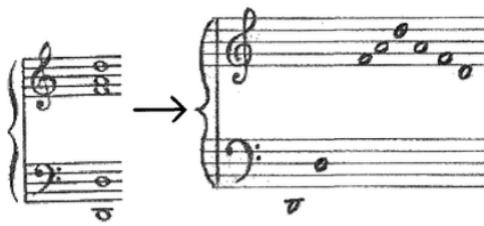
中文讲解
图 22 呈现 Gerlin 对 Louis Couperin《D 小调无小节 Prelude》开篇和弦的 style brisé 弹法。注:图注中嵌入的图像数据已被省略,仅保留其版面位置和说明文字;具体音符起止需查看原图。该图作为视觉佐证,配合 P0346 的文字描述——Gerlin 的琶音并非停在顶部,而是再下行一次。
补充说明
图源标注 (Tsurata, 2010. 109) 表示该图引用自外部文献第 109 页;本图作用是让读者直观看到「Gerlin 琶音回弹」的实际奏法。
第10段(P0348)
原文复述
Leonhardt quickly rolls upwards without restriking the chord or adding any further embellishments (2.63 seconds). Sempé is the fastest of the five performers, executing the first chord in 2.23 seconds. Tilney expands on Gerlin’s idea further: he rolls up, then down, and completes the style brisé by rolling up the chord once more. This makes Tilney’s opening chord the longest, taking 8.18 seconds to complete. Rousset also plays as written (4.73 seconds), like Leonhardt, but his execution is nearly twice the length of Leonhardt’s and half that of Tilney’s.
中文讲解
本段将五位演奏家弹奏同一个开篇和弦的具体方式放在一起对照:Leonhardt「快速上滚」且无装饰 (2.63 秒);Sempé 是五人中最快 (2.23 秒);Tilney 在 Gerlin「上滚后下回」的基础上再加一次上滚,构成「上→下→上」三次琶音,因此耗时最长 (8.18 秒);Rousset 依谱面弹奏 (4.73 秒),约为 Leonhardt 的两倍、不到 Tilney 的一半。读者从这张「时值坐标图」可看出:同一和弦在风格、方向、装饰、速度上的自由度极大。
第11段(P0349)
原文复述
In order to further emphasise the differences each performer brings to the structure of the piece, it is worth comparing the final cadence of this section in bar 15, having examined the opening chord. Gerlin and Leonhardt offer differing interpretations. Where Gerlin joins the two left-hand notes together at the beginning of bar 15 (14L1–2), Leonhardt phrases the left-hand D3 (15L2) with the right-hand notes, producing a five-note pattern rather than four. Leonhardt pauses slightly between the two slurred notes (15R1–2, 15R3–4), and then plays the three-note descending stepwise pattern quickly the first time (15R6–8). Like Gerlin, he plays a ritardando for the second three-note pattern (15R14–16). Both Gerlin and Leonhardt’s recordings allow the sound to continue through to the final chord, but Leonhardt slowly rolls the final chord, pausing before he places the final F#4.
中文讲解
本段以第 15 小节的终止式 (final cadence) 与开篇和弦作首尾对照,重点比较 Gerlin 与 Leonhardt。两人差异有三:(1) 左手处理——Gerlin 把 14L1–2 的两个左手音连在一起;Leonhardt 则将 15L2 的 D3 与右手音连成「五音模式」而非四音模式。(2) 时值节奏——Leonhardt 在两个连音 (15R1–2, 15R3–4) 之间作微小停顿,三音下行级进模式第一次出现时 (15R6–8) 弹得快;第二次 (15R14–16) 与 Gerlin 一样做渐慢 (ritardando)。(3) 收尾——两人都让声音延续到最终和弦,但 Leonhardt 缓慢地滚奏 (roll) 最终和弦,并在按下最后一个 F#4 之前稍作停顿。本段是结构上的「首尾呼应」式收束,用具体差异凸显演奏诠释对作品结构的实质影响。
脚注 / 边栏 / 图表 / 附加信息(如有)
本节涉及的非正文材料较少,主要为:(1) 图 22 (P0347),图源:Tsurata, 2010, p. 109;作用是直观展示 Gerlin 对开篇 D 小调和弦 style brisé 弹法的「上→下回」具体形态;(2) 表 5 (在 P0339、P0345 中两次提及),作用是以表格形式量化五位演奏家开篇/收尾和弦的时值差异;(3) Lebègue《Pièces de clavessin》序言 (在 P0339 中引用,理论依据见论文第 27 页),为「重新击弦」这一演奏建议的权威出处。
💡 本节核心要点
- 大键琴由于拨弦发声衰减迅速,演奏者历史上需用「重新击弦」来延续和声;Lebègue 在其《Pièces de clavessin》序言中明确建议这一做法。
- 本节选取的五位演奏家在第一段中均未遵循重新击弦的建议,但他们以不同方式弥补低音和声的衰退——或靠乐器自身长共鸣 (Leonhardt、Sempé、Tilney),或靠延后离键 (Gerlin),或长时间按住不放 (Rousset)。
- 和声的实际听觉效果与谱面 (lines) 所暗示的延续性常常不一致:当低音消退而演奏者不补足时,听众听到的「和声支持」是缺席的,Rousset 的 4L11–4R15 处是最典型反例。
- 开篇与收尾和弦的弹奏方式 (style brisé 的方向、是否回弹、是否滚奏) 体现了演奏家的高度诠释自由度;同一 d 小调和弦的耗时从 Spieth 的 2.02 秒到 Tilney 的 8.18 秒不等。
- 现代演奏家倾向于延长开篇和弦,作者认为这与现代大键琴更佳的共鸣以及演奏家「享受乐器声音」的取向相关。
- 首尾对照 (开篇和弦 → 第 15 小节终止式) 显示,连线、滚奏、ritardando 等具体手法可根本性地改变作品的句法结构,Gerlin 与 Leonhardt 在终止式的差异即为明证。
🔑 关键术语
- restriking (重新击弦):在大键琴上重复击打同一和弦以延缓其衰减、维持和声可闻度的演奏技法;Lebègue 在其序言中作为演奏建议提出。本节五位演奏家均未采用此法。
- style brisé:法国巴洛克键盘织体,和弦以快速自下而上(有时配合下行)的顺序而非同时奏出;本节比较五位演奏家对同一开篇和弦的不同 brisé 处理 (上滚、上滚+回弹、上滚+下回+上滚等)。
- arpeggiated chord (琶音和弦):和弦的各音依序而非同时奏出;本节讨论此和弦被「重新击弦」时如何维持整体和声听觉。
- tremblements:法语术语,指巴洛克键盘音乐中的颤音 / trill;本节用以描述 Sempé 演奏中的装饰速度。
- ritardando:渐慢;本节用以比较 Gerlin 与 Leonhardt 在终止式第二次三音模式时的共同处理。
- lines (连音线):乐谱上指示延音或句法连贯的连线;作者用 L. Couperin 谱面上的连线作为「和声本应延续」的谱面证据,与实际演奏中低音先于谱面消失的现象形成对照。
- Prélude non mesuré (无小节 Prelude):法国巴洛克特有的自由节拍前奏曲体裁;本节所分析的具体作品为 Louis Couperin 的 D 小调无小节 Prelude。