目录
ch_2_1 Techniques of Phrase Rhythm Chapter 2
- sec_2_1_1 [描述性拆分] Chapter Introduction and Overview
- 页码:1-1
- sec_2_1_2 Periods, Phrases, and Subphrases
- 页码:1-1
- sec_2_1_3 [描述性拆分] Phrase Pairing: The Period — Antecedent and Consequent
- 页码:1-2
- sec_2_1_4 [描述性拆分] Modulating Consequent and Fore-phrase/After-phrase Distinction
- 页码:2-2
- sec_2_1_5 [描述性拆分] Periods, Hypermeasures, and the Phrase–Hypermeter Relationship in the Blue Danube
- 页码:2-4
- sec_2_1_6 [描述性拆分] Accelerations within Phrases — The Drive to the Cadence
- 页码:4-5
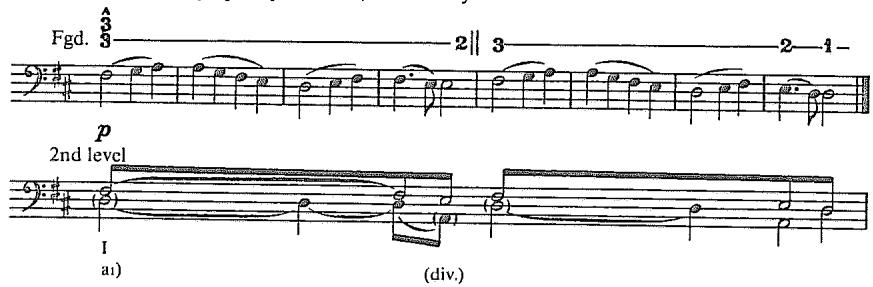
- sec_2_1_7 [描述性拆分] Internal Structure of the Phrase — Schoenberg’s Period and Sentence
- 页码:5-6
- sec_2_1_8 [描述性拆分] Phrase Structure Versus Hypermeter — Conceptual Clarification
- 页码:6-8
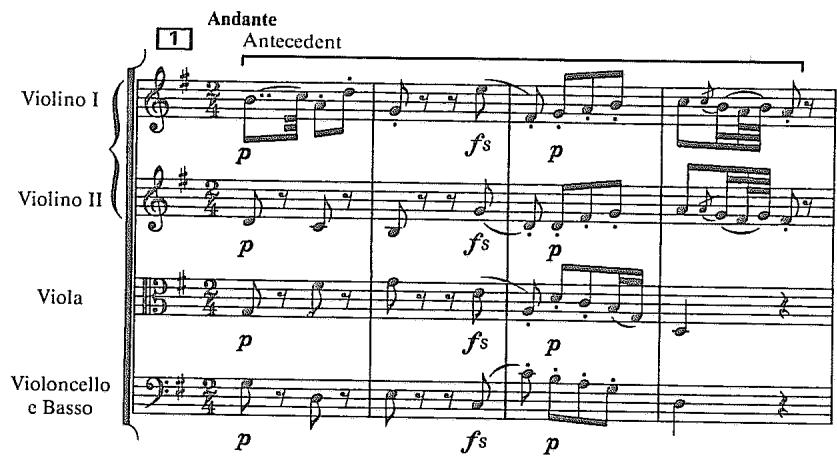
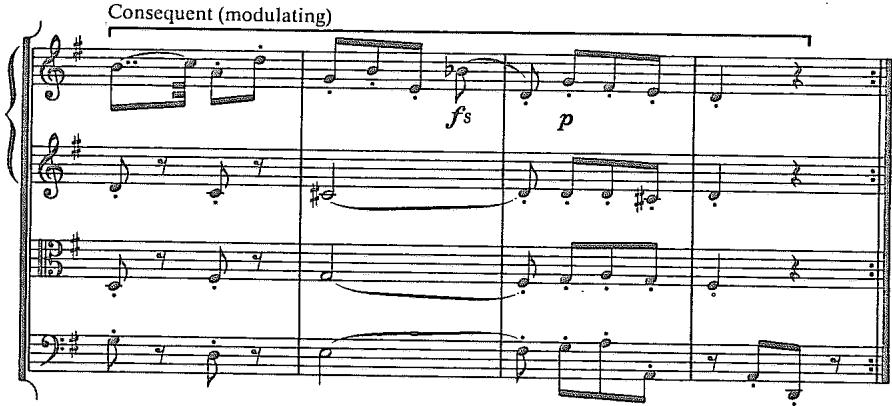
- sec_2_1_9 [描述性拆分] Subphrases — Definition, In-Phase and Out-of-Phase Groupings
- 页码:8-9
- sec_2_1_10 [描述性拆分] Regularity and Irregularity — Duple vs. Non-Duple Construction
- 页码:9-11
- sec_2_1_11 [描述性拆分] Non-Duple Hypermeter — Theory and Examples
- 页码:11-13
- sec_2_1_12 [描述性拆分] The Manipulation of Hypermeter — Elongated Upbeats and Cadenza-like Deviations
- 页码:13-14
- sec_2_1_13 [描述性拆分] Techniques of Phrase Linkage — Overview and Phrase Overlap
- 页码:14-17
- sec_2_1_14 [描述性拆分] Overlaps in Afterbeat Patterns and Subphrase Overlap
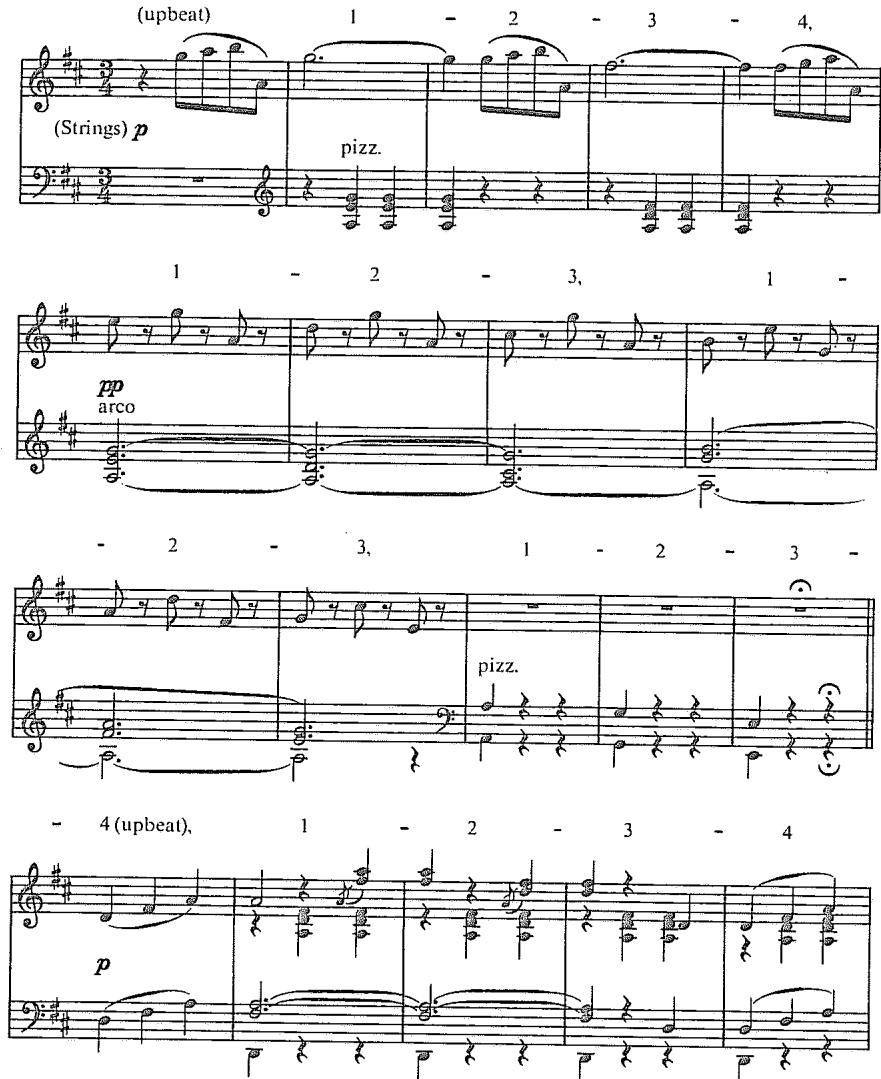
- 页码:17-18
- sec_2_1_15 The Lead-in
- 页码:18-19
- sec_2_1_16 [描述性拆分] Metrical Reinterpretation — Definition, Mechanism, and Examples
- 页码:19-21
- sec_2_1_17 [描述性拆分] Elongated Upbeats — Refinement and Schenker’s Example
- 页码:21-21
- sec_2_1_18 [描述性拆分] Successive Downbeats — Reinterpretation, Contraction, and Split Downbeats
- 页码:22-24
sec_2_1_1 [描述性拆分] Chapter Introduction and Overview
第1段(P0001)
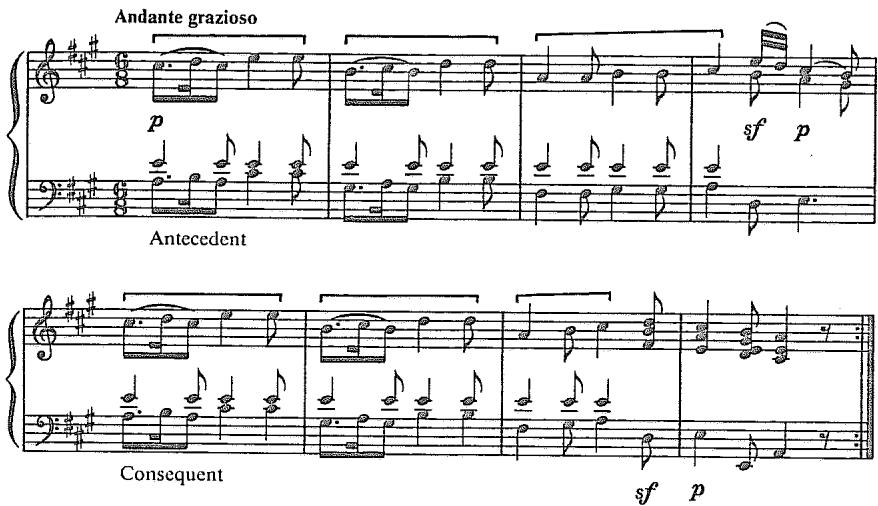
原文复述
Techniques of Phrase Rhythm Chapter 2
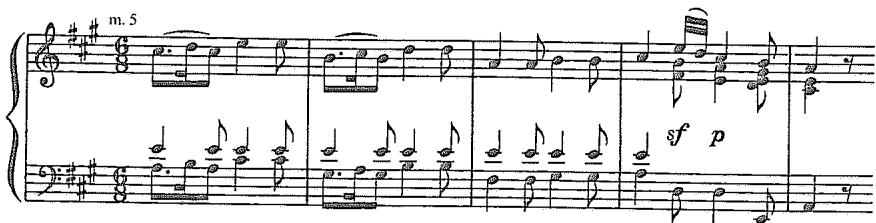
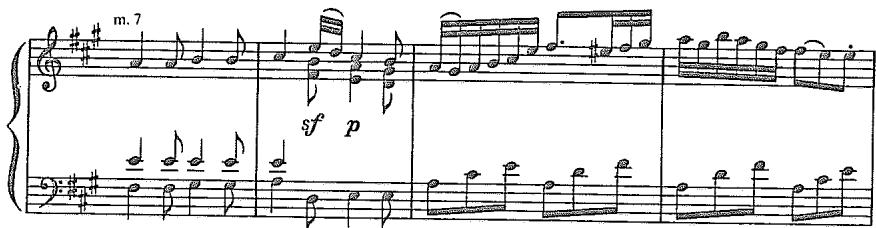
中文讲解
这是第二章的标题。标题由两部分组成:上一行标明本书主题"Techniques of Phrase Rhythm"(乐句节奏技法),下一行以"Chapter 2"表明这是该书第二章。作为章节起始标记,它告诉读者本章所讨论的核心范畴——分析乐句节奏的具体技术方法——并把读者带入第二章的内容范围。标题本身不包含论点,仅起导航作用,因此不需要补充额外的背景。
第2段(P0002)
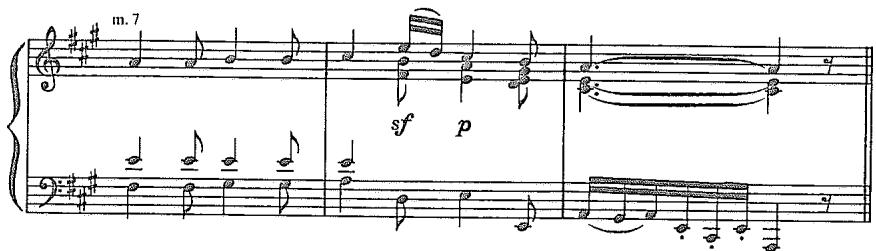
原文复述
Few of the ideas contained in this chapter are original; most derive from the writings of other theorists, from the 18th century to the present day. I have, however, presented their ideas—and occasionally modified them—in such a way as to represent my own understanding of phrase rhythm.
中文讲解
本段是作者的来源声明与免责说明。中心主张包含两层限定:第一层是"Few… most",作者明确承认本章中原创性观点很少,绝大多数思想来源于从18世纪到当代其他理论家的著作,这意味着读者应当把本章视为对前人成果的整理与综合,而非全新理论体系;第二层是"however… occasionally modified… in such a way as to represent my own understanding",作者用"however"转折,说明他虽借用了他人观点,但呈现方式(甚至偶有修正)反映的是其个人对乐句节奏的理解,这为后文可能出现的非正统论述做了铺垫。
理解本段需注意三点:其一,作者并未说自己只是"翻译"或"总结"前人观点,而是强调组织与解释方式具有个人色彩,因此读者不应苛求每一处论述都能找到唯一出处;其二,“from the 18th century to the present day"界定了本章的思想渊源跨度,暗示乐句节奏理论是一个历史悠久且持续演变的领域;其三,这段话的功能是学术诚信声明与作者立场预告,而非论证本身,因此不宜从中提炼具体的乐句节奏规则。
第3段(P0003)
原文复述
This chapter is divided into three parts. The first part deals with the single phrase, its subdivisions, and the pairing of phrases; the second addresses issues of regularity and irregularity in phrase construction; and the third examines various ways in which the junctures between phrases may be treated in compositions.
中文讲解
本段是全章的总体路线图,明确告知读者本章由三个部分组成,并依次交代每部分的研究对象。
第一部分聚焦"the single phrase, its subdivisions, and the pairing of phrases”——即单个乐句本身、其内部细分(subdivisions)以及乐句之间的配对(pairing)。这三者是递进关系:先看一个乐句的内部构成,再看两个乐句如何组合,这一顺序符合由小到大的分析逻辑。
第二部分转向"regularity and irregularity in phrase construction",即乐句构造中的规则性与不规则性问题。作者用"addresses issues of"而非"lists"或"defines",提示这部分不是简单地罗列现象,而是要讨论规则与变例之间的张力,这是乐句节奏分析中最具张力的论题之一。
第三部分处理"the junctures between phrases… in compositions",即在具体作品中乐句与乐句衔接处(junctures)的各种处理方式。“various ways"一词暗示作者将列举多种不同的衔接手法,强调创作实践中处理的多样性。
三部分之间的逻辑关系是:先建立基本单位与组合(第一部分),再讨论构造中的规则与例外(第二部分),最后把分析扩展到作品中的衔接层面(第三部分)。本段作为引言,本身不展开论证,但为后续阅读提供了明确的预期框架。
脚注 / 边栏 / 图表 / 附加信息(如有)
无。本节为章节开篇导言,不包含脚注、图表或边栏等附加材料。
💡 本节核心要点
- 本章标题为"Techniques of Phrase Rhythm”(乐句节奏技法),属于全书第二章,开宗明义地划定研究范畴。
- 作者明确声明本章绝大多数观点源自18世纪以来的其他理论家原创,本章的贡献在于作者对这些观点的整理、呈现与偶有修正,反映其个人对乐句节奏的理解。
- 本章由三个递进的部分组成:第一部分分析单个乐句、其内部细分以及乐句配对;第二部分讨论乐句构造中的规则性与不规则性;第三部分考察实际作品中乐句之间衔接处的多种处理方式。
- 三部分呈现由"基本单位"到"构造规则"再到"作品衔接"的逐步扩展逻辑,构成完整的乐句节奏分析框架。
- 本章作为方法论章节,重在技术层面的梳理与综合,而非提出全新理论体系。
🔑 关键术语
- phrase rhythm:乐句节奏,指音乐中乐句(phrase)这一结构层面的节奏组织方式,是本书的核心研究对象,涵盖乐句内部的时值布局、细分与组合模式。
- subdivisions:在本节中指单个乐句内部的细分结构,即一个完整乐句如何被进一步切分为更小的节奏单位,是理解乐句节奏的起点。
- pairing of phrases:乐句配对,指两个乐句之间的组合关系,例如问—答、前句—后句式的呼应结构,是乐句节奏向更大规模扩展的基本方式。
- regularity and irregularity:规则性与不规则性,在本节中指乐句构造中长度、节拍布局、节奏型重复等方面的常规模式与例外变例之间的张力,是第二部分的核心议题。
- junctures between phrases:乐句之间的衔接处,指在完整作品中一个乐句结束、下一乐句开始时的过渡或连接处理方式,第三部分将讨论其多种处理手法。
sec_2_1_2 Periods, Phrases, and Subphrases
第1段(P0004)
原文复述
Periods, Phrases, and Subphrases
中文讲解
本行为二级标题,正式开启本章的小节 2.1.2。标题同时列出三个层级概念:Periods(乐段/乐句对)、Phrases(乐句)、Subphrases(子乐句)。三者由大到小依次呈现,暗示本节将先讨论乐句本身的界定与构成,再上升到两个乐句如何组合成更大的乐段结构。读者应留意“子乐句”这一术语——它是层级性原则的具体体现,只有在承认乐句可大可小、可嵌套之后才有意义。
第2段(P0005)
原文复述
The definition of phrase outlined in Chapter 1 was still somewhat fluid. We stressed there the decisive importance of tonal motion to the determination of phrase boundaries: “A phrase should be understood as, among other things, a directed motion in time from one tonal entity to another; these entities may be harmonies, melodic tones (in any voice or voices), or some combination of the two.” We also recognized a hierarchical aspect to phrase structure: “A phrase is not necessarily a single thing: large phrases may contain smaller ones.”
中文讲解
作者首先承认第 1 章给出的乐句定义仍留有弹性(somewhat fluid),并把这一节的实例分析定位为对该定义的检验与具体化。段中通过两段直接引文复述了第 1 章的两条核心原则,必须分别理解:第一条是“调性运动决定边界”——乐句被界定为“在时间中从一个调性实体朝另一个调性实体的有方向运动”,这里的实体可以是和声、任何声部的旋律音,或两者的混合。这意味着判断乐句在哪里结束,不能仅凭小节线或乐谱表面的句读,而要看调性张力是否完成了一次从起点到相对终止点的方向性过程。第二条是“层级性”——大乐句内部可以包含更小的乐句,这一原则为本节标题中的 Subphrases(子乐句)一词做了概念上的铺垫,也为后续分析乐句的嵌套结构提供依据。作者用“among other things”这一限定语,表明调性运动只是界定乐句的若干要素之一,而非唯一标准;这与“somewhat fluid”的措辞前后呼应,提示读者乐句定义允许容纳其他维度的考量(如动机、节奏等),但调性运动始终是决定性因素。
补充说明
两段引文是对第 1 章定义原文的直接复述,并非本节新提的论点。“somewhat fluid”明确承认定义尚未完全凝固,从而为后续用实例逐步收紧定义留出空间。
第3段(P0006)
原文复述
Let us now examine some phrases and pairs of phrases, keeping in mind the two ideas above. Later in this chapter we will see how contrasting phrases may be connected to each other and what kinds of collisions sometimes occur at the points of juncture.
中文讲解
这是一段承上启下的过渡。作者邀请读者进入具体的实例分析阶段,并明确要求在阅读时“将上述两条原则(调性运动决定边界、乐句的层级性)记在心中”,以避免实例被当成孤立的乐谱切片来阅读。“pairs of phrases”这一表述直接呼应小节标题中的 Periods(乐段),暗示接下来要看的不仅是单个乐句,还有两个乐句如何配对成更大的结构。末句则预告本章稍后部分将触及两个相关议题:一是对比性乐句(contrasting phrases)之间的连接手段,二是乐句或子乐句在接合处(points of juncture)发生的“碰撞”,即不同调性方向或终止类型在交界点相互冲突的现象。这两个议题共同构成本节乃至本章后半段的两条分析主线:连接(connection)与冲突(collision)。
脚注 / 边栏 / 图表 / 附加信息(如有)
本小节范围内无脚注、无图表、无边栏或乐谱占位符;段落 P0005 中的两段引文为正文中的直接引语而非脚注,已在正文中处理。
💡 本节核心要点
- 第 1 章提出的乐句定义仍具弹性,本节将用实例进一步具体化该定义。
- 核心原则一:调性运动是判断乐句边界的决定性依据,乐句被理解为调性实体之间有方向的运动,调性实体可以是和声、旋律音或二者组合。
- 核心原则二:乐句结构具有层级性,大乐句可包含更小的子乐句,这一原则直接支撑本节标题中的 Subphrases 概念。
- 本节的分析对象不仅是单个乐句,还包括两个乐句如何配对构成乐段(Periods)。
- 作者明确预告后续将考察对比性乐句的连接方式以及乐句接合处(juncture)可能出现的碰撞,构成“连接与冲突”两条分析主线。
🔑 关键术语
- Phrase (乐句):在时间中从一个调性实体到另一个调性实体的有方向运动;是本节分析的基本单位,可包含更小的子乐句。
- Tonal motion (调性运动):和声或旋律从一个调性点到另一个调性点的进行,是判断乐句起止的决定性依据。
- Subphrase (子乐句):嵌套于较大乐句内部的较小乐句,体现乐句结构的层级性。
- Period (乐段 / 乐句对):两个或多个乐句成对组合而成的较大结构,本节标题已暗示将讨论其构造方式。
- Juncture (接合处):相邻乐句或子乐句相连接的位置,后续将分析此处可能出现的调性方向或终止类型的碰撞。
sec_2_1_3 [描述性拆分] Phrase Pairing: The Period — Antecedent and Consequent
第1段(P0007)
原文复述
Phrase Pairing: The Period
中文讲解
这是本节的标题,宣告讨论主题:短语(phrase)如何两两配对形成更大的结构单元——乐段(period)。标题以“短语配对”点明两个乐句之间存在功能性的呼应关系,而“The Period”则预先提示这种配对将产生一个更大的乐段层级。
第2段(P0008)
原文复述
A familiar example will be used to introduce a familiar concept (Example 2.1). This is the “Ode to Joy” theme, which, on its first appearance in Beethoven’s Ninth Symphony, is unaccompanied. It begins with two phrases of four measures each: the first phrase leads to a half cadence, with the implication of a dominant harmony; the second phrase begins just like the first but leads to a full (authentic) cadence, with the implication of a tonic harmony. When two consecutive phrases stand in this relationship to each other, we will use the traditional terms antecedent and consequent (short for antecedent phrase and consequent phrase) to describe them.
中文讲解
本段是本节论证的入口。作者选择贝多芬第九交响曲终乐章“欢乐颂”主题作为引子,原因有二:一是素材广为人知、读者容易唤起听觉记忆;二是它典型地展示了后文要讨论的“前句—后句”关系。该主题在首次出现时是无伴奏的,由两个各四小节的乐句构成。第一个乐句以半终止(half cadence)收束,暗示属功能(V)尚未解决;第二个乐句起首与第一乐句相同,但收束于完全(正格)终止(authentic cadence),暗示主功能(I)确立。作者由此把这两个乐句分别命名为 antecedent(前句/前导句)和 consequent(后句/后续句),并注明这两个术语分别是 antecedent phrase 与 consequent phrase 的简称。本段的关键在于:作者不是从抽象定义出发,而是先用听感清晰的例子(半终止的“未解决”vs. 完全终止的“解决”)来锚定概念,然后才把术语安放到听感之上。这是“先例后名”的教学顺序,对没有读过本段的读者而言,比直接背诵定义更易跟进。
第3段(P0009)
原文复述

中文讲解
本条为 Example 2.1 的图像占位符:贝多芬第九交响曲终乐章“欢乐颂”主题起始部分的乐谱。在当前文本中,乐谱的具体音符内容被省略,但图注完整保留。从上下文可确认,该图正是 P0008 所描述的那个由两个四小节乐句构成、前句落半终止、后句落完全终止的实例;“需查看原图”方能核对每个小节的和声与终止位置。
第4段(P0010)
原文复述
Notice that we are allowing a half cadence to mark the end of a phrase (m. 4). A half cadence by its nature does not create as strong a close as a full cadence, but it is sufficient to create the impression of a minimally complete musical thought. In fact, it is common for a considerable section of a piece to end with a half cadence. A phrase that ends with a half cadence is usually dependent on the following phrase, in the sense that the two phrases together form a larger unit. The cadence of the second phrase serves as the cadence for the whole unit (itself a large phrase); this larger unit is called a period. Note, however, that the term period can refer to any phrase that contains at least two smaller phrases; it is not necessary that any of the smaller phrases end with a half cadence.
中文讲解
本段承 P0008,将“前句—后句”关系推向更高一层:定义 period(乐段)。作者先做一个看似宽松的许可——承认半终止可以标记乐句结束(第 4 小节)。这是反直觉的:半终止比完全终止“弱”,通常被视为乐思未完成;但作者指出,对“最小完整的乐思”(a minimally complete musical thought)而言,半终止已经足够。事实上,一首作品中有相当规模的段落以半终止收束,这并不反常。由此推得:以半终止收束的乐句通常依赖于其后的乐句,两者合在一起形成一个更大的单元;后一句的终止事实上充当了整个更大单元的终止。这个更大单元本身就是一个“大乐句”,称作 period。作者在此明确一个容易误解之处:period 一词并不要求内部小乐句必须以半终止收束——只要一个乐句内部至少包含两个更小的乐句,就可以称作 period;半终止—完全终止的配对只是最常见、最典型的情形。本段的功能是为读者准备好一个“层级观念”:乐句之上还有乐段,乐段本身又是一种乐句;并区分“典型情况”(前句半终止、后句完全终止)与“广义定义”(任意两个以上小乐句即可)。
第5段(P0011)
原文复述
The specific type of period shown in Example 2.1 is called a parallel period. A parallel period consists of antecedent and consequent phrases in the sense described above. The “parallel” aspect of such a period refers to the similar beginnings of the two phrases.
中文讲解
本段给 P0008 那个具体例子贴上专属标签:parallel period(平行乐段)。它由前句与后句构成(按 P0010 的定义),而之所以被称为“parallel(平行)”,是因为两个乐句的起首材料彼此相似(“similar beginnings”)。这是对例 2.1 形态特征的精确刻画:前句与后句开头像一对“镜像兄弟”,只在结尾的终止式上分道扬镳——一句弱收(半终止),一句强收(完全终止)。读者由此明白:parallel period 是 period 的一个子类,而“parallel”一词专指起首材料的相似性,不涉及其余部分。
第6段(P0012)
原文复述
The relation of antecedent to consequent involves not just a harmonic dependency—the half-cadential V is heard to resolve to the tonic at the end of the period—but a melodic one as well. This melodic dependency was first formulated in theoretical terms by Heinrich Schenker (see Example 2.2).
中文讲解
本段为整个论证补上“旋律”这一维度。作者提醒:前句对后句的从属关系不仅是和声上的——前句半终止中的 V 被听成“需要解决到主音”,而后句末的完全终止兑现了这一期待——而且也是旋律上的。旋律层面的从属关系,由理论家 Heinrich Schenker(申克尔)首次以理论术语加以形式化,引出例 2.2。这一句是过渡句,作用是预告下一段将从“和声依赖”转向“旋律依赖”,并把这一观点的来源归到申克尔的传统。读者需注意:这里说的“melodic dependency”不是泛指任何旋律相似,而是指一种结构性的线性进行被“打断—完成”的关系,这正是下一段要展开的内容。
第7段(P0013)
原文复述
Beethoven, Ninth Symphony, 4th mvt., “Ode to Joy”
中文讲解
本条为图注文字(出现在 Example 2.2 图注中或附近),指明所分析的对象仍是贝多芬第九交响曲第四乐章“欢乐颂”。它并非新论题,仅起标识作用,便于读者将 Example 2.2 的分析对应到与 Example 2.1 同一主题。
第8段(P0014)
原文复述
中文讲解
本条为 Example 2.2 的图像占位符,附完整版权与来源信息:图取自 Heinrich Schenker《Free Composition》(中译常作《自由作曲》),Ernst Oster 翻译并编辑,图 109 的 e3 片段节选;版权 1979 年 Schirmer Books(原版 Longman),重印获许可。图的具体声部进行被省略,但图注完整保留。从 P0012 与 P0015 可确认该图用以展示申克尔的旋律层级分析;“需查看原图”方可核对每个音符的音区与连线。
第9段(P0015)
原文复述
The basic, underlying melodic progression is shown by the horizontal beams connecting the “half notes” in Example 2.2. (The note values in the example do not indicate duration; the added bass voice shows the implied harmonies.) The overall melodic motion describes the descent of a third, from F#(3) to D (1). This motion is interrupted at E (2) on its first attempt, and it is therefore begun again and, this time, completed successfully. The melodic expectation aroused by 2—that it will continue to the more stable 1—corresponds to the harmonic expectation aroused by the half cadence. A similar melodic expectation would have been aroused by 7 (the leading tone) in place of 2, and in fact this substitution is often made. In Schenker’s terms, the overall melodic motion describes a descending third-progression, and its two-part division, 3-2 || 3-2-1 , is logically called an interruption.
中文讲解
本段是本节的核心分析段。作者首先说明 Example 2.2 的读图约定:水平横梁连接的是“全音符”位置,但这里的“全音符”并不表示时值,只代表结构骨架上的节点;额外加入的低音声部用以暗示和声。整体旋律走向是一条“下行三度进行”——从 F#(3)下行到 D(1)。这一下行不是一气呵成,而是第一次尝试在 E(2)处被打断,于是重新启动,并在第二次完成从 3 经 2 到达 1 的全下行。作者继而把这种“半途而废—重起—完成”的结构与和声期待对应起来:2(re)暗示继续下行到更稳定的 1(do),这与半终止中 V 期待解决到 I 的听感同构。并且这种期待同样可能由 7(导音,leading tone)替代 2 而产生,实际上这种替换在作品中常出现。最后作者引入申克尔的术语:下行三度进行的两段划分 3–2 || 3–2–1 称为 interruption(打断)。本段的功能是把抽象的“前句依赖后句”落到具体的线性进行图式上,使读者看到:和声上的半终止—完全终止,与旋律上的 3–2 || 3–2–1,是同一结构事件在两个层面上的体现。
第10段(P0016)
原文复述
Interruption is also possible when a descending linear progression—a melodic motion proceeding by step through an interval of a third or more—starts from a different note of the tonic triad, namely 5 or 8, and ultimately descends to 1. In the case of 5, the interruption will take place at the penultimate note: 5-4-3-2 || 5-4-3-2-1 (a descending fifth-progression with interruption). Interruptions starting from 8 (interrupted octave-progressions) are possible but very rare. 1
中文讲解
本段把 P0015 的 interruption 概念推广到其他起音。作者先重申定义:interruption 适用于“通过级进下行跨越至少一个三度的旋律进行”,目标都是下行到 1。前段示范的起音是主三和弦的 3;本段补充另外两种起音——同样是主三和弦中的 5 或 8。起自 5 时,打断发生于倒数第二个音,形式为 5–4–3–2 || 5–4–3–2–1(带打断的下行五度进行)。起自 8 的“打断八度进行”理论上存在,但作者明确指出非常罕见,并用脚注 1 指向更详细的说明(脚注正文未在当前文本中给出)。读者需注意:本段不是介绍新概念,而是拓宽 interruption 的覆盖面——从“下行三度”扩展到“下行五度甚至更大”,并以“罕见”标记八度情形以避免误以为该结构常见。
补充说明
脚注 1 在原文中被引用以说明“interrupted octave-progressions”(打断八度进行)的细节,但脚注正文未包含在当前 source_paragraphs 中,故其具体内容不在本节可定位的范围之内。
第11段(P0017)
原文复述
The antecedent-consequent relation generally involves an interruption of this sort, with a descending linear progression starting from 3 or 5. Thus a definite melodic tension is added to the harmonic tension of the half cadence. Both tensions, harmonic and melodic, are resolved by the full cadence at the end of the parallel period.
中文讲解
本段是本节的小结,把分头建立起来的两条线索——和声与旋律——重新收束到一个统一图景里。作者指出:前句—后句关系在一般情况下涉及的就是 P0015/P0016 所讨论的那种 interruption,且起音多为 3 或 5。由此,前句半终止所造成的和声张力,被叠加上一条明确的旋律张力(下行进行被“悬而未决”);两者都必须在后句末尾的完全终止处一并得到解决。从小节结构看,本句完成了从“前句—后句术语”(P0008)、到“period 定义”(P0010)、到“parallel period 命名”(P0011)、再到“和声与旋律双重依赖”(P0012、P0015–P0016)的论证闭合:读者现在同时具备和声与旋律两把尺子,能用它们共同衡量任何一个平行乐段如何在前句“制造张力”、在后句“完成解决”。
脚注 / 边栏 / 图表 / 附加信息(如有)
本节包含两个图像占位符(Example 2.1 与 Example 2.2),其具体乐谱/分析图内容在当前文本中被省略,仅图注完整保留;两图均需查看原图方可核对细节。P0016 末尾以角标 “1” 引用了脚注,但脚注正文未出现在当前 source_paragraphs 中,因此其内容不在本节可定位的信息范围内。
💡 本节核心要点
- 本节以贝多芬第九交响曲终乐章“欢乐颂”为典型例子,引入 antecedent(前句)与 consequent(后句)这对术语,并把两乐句之间的关系落到了“半终止—完全终止”的和声对照上。
- Period(乐段)被定义为内部至少包含两个更小乐句的乐句;典型形态是前句半终止、后句完全终止,但 period 一词本身不强制要求内部含半终止。
- Parallel period(平行乐段)是 period 的一个子类,其“平行”专指前、后两句起首材料的相似,而非整句相同。
- 前句对后句的依赖不仅是和声上的(半终止的 V 期待解决到 I),也是旋律上的——申克尔以“下行线性进行被打断”形式化了这种旋律依赖。
- Interruption(打断)在本节特指一个下行线性进行(如 3–2 || 3–2–1,或 5–4–3–2 || 5–4–3–2–1)分成前后两段、前段被悬置、后段完成的形式;它可以起自主三和弦中的 3 或 5,起自 8 则罕见。
- 本节论证的闭合在于:和声张力(半终止的 V)与旋律张力(被打断的下行线性进行)在前句同时累积,并在后句末尾的完全终止处被一并解决。
🔑 关键术语
- antecedent (phrase) / consequent (phrase):前句与后句。本节中两个连续乐句的术语:前者以半终止收束、暗示尚未解决的和声/旋律期待;后者以完全终止收束、承担解决前句期待的功能;二者合在一起构成更大的乐句单位(period)。
- half cadence:半终止。本节中作为前句的标准收束方式,本身并不构成如完全终止那样强的完结,但足以标志一个乐思最小完整,并制造出对后续乐句的依赖。
- full (authentic) cadence:完全(正格)终止。本节中作为后句的标准收束方式,暗示主和声确立,履行对前句半终止所引发之期待进行解决的功能。
- period:乐段。本节定义为内部至少包含两个更小乐句的乐句;典型情况是前句半终止、后句完全终止,但术语本身不强制要求内部含半终止。
- parallel period:平行乐段。period 的子类,由前句与后句构成;之所以称“平行”,专指两个乐句起首材料的相似。
- interruption:打断。申克尔术语,指一条下行线性进行(如 3–2 || 3–2–1)被分为前后两段:前段未完成即收束,后段重新启动并完成;本节将其用作“前句—后句”关系的旋律形式化。
- descending linear progression:下行线性进行。本节指通过级进下行至少跨越一个三度的旋律进行;典型示例是起自主三和弦中 3 的下行三度进行,以及起自 5 的下行五度进行;interruption 是这类进行的两段划分形式。
- dominant / tonic (V / I):属功能与主功能。半终止暗示属功能尚未解决到主功能,完全终止则完成该解决;本节用 V/I 这对功能术语刻画前句对后句的和声依赖。
sec_2_1_4 [描述性拆分] Modulating Consequent and Fore-phrase/After-phrase Distinction
第1段(P0018)
原文复述
An important exception to this pattern occurs when the second of the two phrases in a parallel period ends in a different key, as in Example 2.3.
中文讲解
本段是一个承上启下的过渡句:作者指出,刚才在第2.1.3小节确立的规则(平行周期中第二乐句回到主调的全终止)存在一个重要例外——当平行周期的第二个乐句结束在不同的调上时。“this pattern"指的是前文刚建立的“regular consequent”模式(两个乐句都在原调内,并以半终止—全终止形成呼应)。作者用"important exception"提示读者注意:这种例外并非边缘现象,而是后面将引入新术语的根据。Example 2.3(Haydn《第104交响曲》第二乐章开头)将作为该例外的具体音乐例证。
补充说明
本句中的"this pattern"指前文P0015-P0017所讨论的regular consequent结构;“parallel period"在前文已定义,即两个乐句开头相似的周期结构。Example 2.3位于本节末尾(P0023),读者需要结合乐谱才能看到G大调到D大调的转调过程。
第2段(P0019)
原文复述
Here, as in the Beethoven example, there are two phrases of four measures each. The first phrase leads to a half cadence in the original key, G major. The second phrase begins like a regular consequent—that is, just like the first phrase—but it leads to a full cadence in D major, the key of the dominant. We will refer to such a relationship between two phrases with the terms antecedent and modulating consequent.
中文讲解
本段具体描述Example 2.3中两个乐句的关系,作为P0018所提例外的具体化。结构上有四点:(1)规模——与前文的Beethoven例子相同,都是两个4小节的乐句;(2)前半句的功能——结束于原调G大调的半终止;(3)后半句的形态——开头与前句相同(因此属于"平行周期”),但结束于属调D大调的全终止;(4)术语引入——将这种"前句半终止+后句不同调上全终止"的关系命名为antecedent和modulating consequent。
作者的关键论证是:modulating consequent虽然调性发生了转移,但它仍然具备regular consequent的"回答功能”——它是对antecedent半终止所产生的紧张的回答,只不过这个回答不是回到原调解决,而是把紧张引向一个新的调中心。从这个意义上,“modulating"是对"regular"的功能性变体而非否定。
补充说明
“key of the dominant"指G大调的属调D大调;半终止(half cadence)与全终止(full cadence)的具体位置需通过Example 2.3的乐谱确认。术语"antecedent"和"modulating consequent"在本段首次正式引入,P0020将对其作进一步限定。
第3段(P0020)
原文复述
Many authors have used the terms “antecedent” and “consequent” to denote any two successive phrases that exhibit some kind of interdependence. This is a perfectly logical usage, but I prefer to reserve these common terms for the specific types of harmonic and melodic interdependence just described. That is, an antecedent, in this book, will always feature a half cadence as its goal. A consequent will begin more or less as the antecedent did, and it will either proceed to a full cadence in the same key (a regular consequent) or end with a half or full cadence in a different key (a modulating consequent).
中文讲解
本段是术语定义段,作者做三件事:(1)承认既有用法——很多作者把antecedent/consequent用于任何相互依存的两个乐句,这逻辑上无可挑剔;(2)表明自己的取舍——他要把这两个词"保留"给更特定的和声与旋律依存关系;(3)给出本书定义——antecedent必然以半终止为目标;consequent以与antecedent相似的方式开始,并以两种可能结束:在同调上的全终止(regular consequent),或在不同的调上的半终止或全终止(modulating consequent)。
这段定义的关键意义在于:它把"antecedent-consequent"从一种松散的依存描述收紧为一个由和声目标驱动的强结构。这样做的好处是,读者在分析作品时,只要看到半终止,就能预期后句将以某种方式"回答”;而"回答"的方式(regular还是modulating)则提示调性走向。“always feature a half cadence as its goal"这一限定排除了很多其他可能被宽泛称作antecedent的情形。
补充说明
本段的"half cadence"和"full cadence"指古典调性体系中的标准终止式;半终止通常以V或V7结束,全终止以V-I结束。第二种consequent情况"end with a half or full cadence in a different key"中包含"half cadence"的可能性——意味着modulating consequent不仅可以通过全终止转调,也可以通过半终止转调,这是P0019 Haydn例子(full cadence转调)之外的另一种modulating consequent形态。
第4段(P0021)
原文复述
When we encounter two successive phrases that are not in antecedent-consequent relation but that nonetheless form a period, we will use the terms fore-phrase and after-phrase to describe them. (These are translations, borrowed from the English theorist Ebenezer Prout, of the German terms Vordersatz and Nachsatz.) Although the literal meaning of these terms is obviously very close to “antecedent” and “consequent,” it is still to our advantage to have separate terms for the specific and the general cases. For example, we could call the two small phrases (sixteen measures each) of Strauss’s “Blue Danube” Waltz (Example 1.1) a fore-phrase and an after-phrase, but in the sense used here they are not an antecedent and a consequent. The specific harmonic tension represented by the half cadence is lacking; after the first phrase, we expect an answering second phrase not because a harmonic resolution is demanded, but because as yet there has been virtually no melodic motion. The element that unifies the two phrases—beyond the obvious repetitive features of texture, motive, and surface rhythm—is the middleground structure (see Example 1.4), particularly the ascending melodic arpeggiation A-D-F#. By contrast, the element that unifies an antecedent-consequent pair—beyond the parallelism of the two phrase beginnings—is the tension created by the antecedent’s half cadence and melodic non-resolution; this tension is either resolved by a full cadence (in a regular consequent), or it is heightened by an unexpected modulation (in a modulating consequent).
中文讲解
本段是本节的核心论证段,做了四件事:
(1)引入新术语:对于"不构成antecedent-consequent关系但仍组成周期"的两个乐句,命名为fore-phrase(Vordersatz)和after-phrase(Nachsatz),借自Ebenezer Prout对德文术语的英译。
(2)论证术语独立的必要性:虽然字面意思与antecedent/consequent接近,但作者主张需要术语来区分"特定情形”(antecedent-consequent)和"一般情形”(fore-phrase/after-phrase)。“to our advantage"暗示这一区分给分析带来可操作性。
(3)以Strauss《蓝色多瑙河》华尔兹(Example 1.1)作为fore-phrase/after-phrase的实例:两段各16小节的小乐句形成周期,但缺少半终止所代表的特定和声紧张,期待后句的原因不是和声上"必须解决”,而是"旋律上几乎没有运动"。统一的元素是中层结构(middleground structure),特别是A-D-F#的上行旋律分解。
(4)对比antecedent-consequent的统一机制:除开头平行外,统一的元素是antecedent半终止与旋律未解决所形成的紧张;这一紧张在regular consequent中由全终止解决,或在modulating consequent中由意外转调"加重"。
这一对比揭示了作者分析框架的核心二分:“靠和声紧张—解决驱动的周期"与"靠中层旋律结构驱动的周期”。前者用antecedent-consequent,后者用fore-phrase-after-phrase。这一区分使读者可以判断一个周期的统一力来自何处。
补充说明
本段提到的"Example 1.1"(Strauss《蓝色多瑙河》)和"Example 1.4"(middleground结构示意)在第1章已出现过,本节以回顾方式引用。A-D-F#是D大调主和弦的分解音(D大调是《蓝色多瑙河》的调性);“Vordersatz"字面意为"前置句”,“Nachsatz"字面意为"后续句”。Ebenezer Prout是19世纪末英国音乐理论家,本段明确注明其译名的出处。
第5段(P0022)
原文复述
中文讲解
本条为第2页上的图像或乐谱占位符。由于内嵌图像数据已被省略,仅能根据P0018-P0019和P0023的上下文推断:该图位于本节正文中段,可能是与Example 2.3相关的音乐分析图示(如G大调到D大调的转调图、和声进行示意,或与前文Beethoven例子相关的谱例)。具体内容需查阅原书第2页图像。
补充说明
无额外补充;建议结合原书P0018-P0019的文字与P0023的图注定位该图的具体内容。
第6段(P0023)
原文复述
中文讲解
本条为Example 2.3的图注:Haydn《第104交响曲》第二乐章的开头。该例即P0018所提的"重要例外"以及P0019所详细描述的G大调—D大调(属调)modulating consequent结构。由于乐谱数据已被省略,具体音符、对位与和声细节需查看原书第2页的Example 2.3。
补充说明
结合P0019可知该例结构为:两个4小节乐句,第一句在G大调上以半终止结束,第二句开头与第一句平行,结束于D大调(全终止)。这是antecedent + modulating consequent的标准实例。
脚注 / 边栏 / 图表 / 附加信息(如有)
本节包含两个图像/乐谱占位符:P0022位于正文段间(具体内容未在文字中明确说明,可能与P0018-P0019所述结构相关);P0023为Example 2.3图注,明确标识为Haydn《第104交响曲》第二乐章开头,是modulating consequent概念的核心例证。两个图例均需结合原书第2页的乐谱与图示阅读。P0021中回溯引用了第1章的两个例子:Example 1.1(Strauss《蓝色多瑙河》华尔兹)和Example 1.4(middleground结构示意),二者作为fore-phrase/after-phrase的实例支撑与中层结构统一机制的图示依据。
💡 本节核心要点
- Modulating consequent是平行周期的一个重要例外:第二乐句虽然以与第一乐句平行的方式开始,但结束于不同的调(通常为属调)的全终止,而非回到原调。
- 作者明确限定antecedent-consequent术语:antecedent必须以半终止为目标;consequent以相似方式开始,并以同调全终止(regular)或不同调半/全终止(modulating)结束,这就把术语从宽泛的"依存关系"收紧为特定的和声—旋律结构。
- fore-phrase/after-phrase被引入,用于指称那些组成周期但不具有antecedent-consequent特定和声紧张的两个乐句;术语借自Prout对德文Vordersatz/Nachsatz的英译。
- fore-phrase/after-phrase的统一力来自中层旋律结构(如《蓝色多瑙河》中A-D-F#的上行分解),而非半终止所代表的和声紧张—解决;这是与antecedent-consequent最关键的区分。
- antecedent-consequent周期的统一力来自antecedent半终止所制造的紧张,regular consequent通过同调全终止"解决"这一紧张,modulating consequent则通过意外转调"加重"这一紧张。
- 本节通过这一术语—概念二分,使读者能够判断一个周期结构的统一机制来自何处:和声驱动(antecedent-consequent)还是旋律—结构驱动(fore-phrase-after-phrase)。
🔑 关键术语
- antecedent:在本书中指周期结构中以半终止为目标的第一乐句;其和声紧张是后句出现的根据。
- consequent:在本书中指回答antecedent的第二乐句,以与antecedent相似的方式开始,并以同调全终止(regular consequent)或不同调半/全终止(modulating consequent)结束。
- modulating consequent:consequent的一种类型:结束于不同于antecedent原调的调上的半终止或全终止;本节以Hayden第104交响曲第二乐章开头(G大调—D大调)为例。
- regular consequent:consequent的标准类型:结束于与antecedent相同的调上的全终止,从而在同调内解决antecedent的半终止紧张。
- fore-phrase / Vordersatz:指周期结构中不构成antecedent-consequent关系的第一乐句;德文术语Vordersatz由Prout英译为fore-phrase,字面意为"前置句"。
- after-phrase / Nachsatz:指周期结构中不构成antecedent-consequent关系的第二乐句;德文术语Nachsatz由Prout英译为after-phrase,字面意为"后续句"。
- half cadence:半终止,通常以V或V7结束;本节中它是antecedent的标志性目标,是antecedent-consequent关系中"紧张"的来源。
- full cadence:全终止,以V-I结束;本节中它出现在regular consequent(同调)或modulating consequent(不同调)的末尾,承担解决或加重紧张的功能。
- parallel period:由两个开头相似的乐句组成的周期结构;本节讨论的modulating consequent是其中一个特殊变体。
- middleground structure:中层结构,指介于表层节奏—动机与深层调性布局之间的结构层次;本节中它是fore-phrase/after-phrase统一性的来源(如《蓝色多瑙河》中A-D-F#的上行旋律分解)。
sec_2_1_5 [描述性拆分] Periods, Hypermeasures, and the Phrase–Hypermeter Relationship in the Blue Danube
第1段(P0024)
原文复述
As we have already noted, large phrases are traditionally called periods. There is much less confusion about what constitutes a period than about what constitutes a phrase. This is probably because the danger of confusing phrases with hypermeasures diminishes somewhat as the length of the units increases. The longer a hypermeasure is, the more likely it is to contain a complete phrase or period. Generally speaking, a large phrase or period will either be roughly coextensive with a large hypermeasure or it will lack any clear hypermeter. (I say “roughly coextensive”
中文讲解
本段是本节理论铺垫的核心陈述。作者开门见山地交代一个传统命名惯例:大的乐句传统上称为"乐段"(period),并指出与"乐句"(phrase)相比,“乐段"这个概念的争议要小得多。作者对此给出的解释是功能性的:随着单位长度的增加,乐句与小节超拍(hypermeasure)混淆的危险就降低了;超拍越长,它越有可能完整地包含一个乐句或乐段。
本段的关键判断是经验性的概括而非严格规则:大的乐句或乐段通常要么与大超拍大致重合,要么缺乏清晰的超拍。这种"大致重合"的措辞很重要,它意味着作者意识到边界并不总是严丝合缝,这恰好为下一段(讨论溢出上拍小节)埋下伏笔。括号中未完成的"I say ‘roughly coextensive’“是排版上的延续,解释将在P0026给出。
对读者的教学要点:区分乐句/乐段与小节超拍之所以困难,是因为它们长度可比、范围重叠,但本质不同——前者是旋律—和声—节奏共同塑造的"活"的结构单位,后者是拍子层级向上延伸的规则性分组。本段的作用是为"为什么长单位反而更好认"提供功能性理由,同时为下面"大致重合"的限定预留空间。
第2段(P0025)
原文复述
The image contains no text. The horizontal lines are stylistic or background elements and must be ignored according to the rules. Therefore, the correct OCR output is an empty string.
(No text to output)
中文讲解
本条不是正文段落,而是版面中的图像占位符。OCR识别结果显示其中没有可读文字,水平线仅为装饰性或背景元素,按规则应忽略。本书在此处仅存在视觉版面,不承载论证信息。
第3段(P0026)
原文复述
because frequently a phrase or period will spill slightly over the boundaries of a hypermeasure, as do the two sixteen-measure phrases of the “Blue Danube”: each phrase includes an upbeat bar.) Furthermore, periods almost always end with a strong cadence—either a full cadence or an emphatic half cadence. $^{2}$
中文讲解
本段接续P0024中括号未完成的解释,限定了"大致重合"的真实含义:乐句或乐段常常会略微跨越超拍的边界,而不是与之完全对齐。作者以《蓝色多瑙河》的两个十六小节乐句作为例证——每个乐句都包含了一个上拍小节,因此严格地讲,它们并不与小节超拍完全重合,而是稍稍"溢出”。
后半句补出第二条关于"乐段"的经验规律:乐段几乎总是以一个强的终止结束——要么是完全终止(full cadence),要么是强调的半终止(emphatic half cadence)。这里的"almost always"和"强"两词均为限定词,不能省略:作者并非宣称乐段必然以强终止结束,而是说在通常情况下如此。
教学要点:(1)“spill slightly over the boundaries"是小节超拍与乐句乐段关系的关键现实特征,单纯的算术对齐在音乐中并不可靠;(2)强的终止作为乐段的标志,使"乐段"在听觉上比"乐句"更易被识别——这与P0024"长单位争议较小"的判断相呼应。脚注标记2将引导到对终止类型的进一步说明。
补充说明
本段脚注标记为 $^{2}$,对应正文中关于"full cadence"与"emphatic half cadence"的进一步来源或定义说明;具体内容需参见本书相应脚注。
第4段(P0027)
原文复述
The term period is useful in discussing phrase structure because it simplifies references to different levels of structure. In the “Blue Danube,” for example, we can speak of a fore-phrase of sixteen measures (including an upbeat bar), an after-phrase of sixteen measures (again including an upbeat bar), and a period totaling either thirty-two or thirty-three measures (depending on whether we include m. 33 or not; this question will be taken up shortly). Throughout this book, we will use the term period in a relative sense only, to indicate large phrases that contain smaller ones. Phrase remains the generic term: a period is a species of phrase.
中文讲解
本段阐述使用"乐段"一词的功能性理由:它简化了对不同层级结构的指称。以《蓝色多瑙河》为例,作者建立起一组具体术语——前乐句(fore-phrase)十六小节(含上拍小节),后乐句(after-phrase)十六小节(同样含上拍小节),而整个乐段则是三十二或三十三小节。作者在此处已埋下关键疑问:到底是三十二还是三十三小节,取决于是否把小节33算入。这个问题将在本节稍后讨论(P0034、P0035),体现了本节内部"先立疑—后解析"的论证布局。
作者随后声明全书的术语使用原则:“乐段"只用作相对意义,用来指那些包含更小乐句的大乐句;“乐句"始终是一般性总称,乐段只是乐句的一种(a species of phrase)。这是一项重要的术语纪律——它防止读者把"乐段"当作一个独立的、与"乐句"并列的范畴。
教学要点:(1)本段是术语层面的"规章设定”,它的目的是为后续具体测量(小节33是否计入)提供清晰的概念坐标系;(2)“相对意义"四个字值得反复强调——它意味着同一个段落结构,对它的下位单位而言是"乐段”,对它的上位单位而言又可能只是"乐句”。
第5段(P0028)
原文复述
The reader has probably wondered how, in the “Blue Danube,” two sixteen-measure phrases could conceivably add up to a thirty-three-measure period. This arithmetic curiosity is in fact highly instructive: it allows us to understand more clearly the difference between phrases and hypermeasures.
中文讲解
本段是一个简短但承上启下的过渡段。作者设想读者心中已浮现的疑问:两个十六小节的乐句为什么加起来不是三十二小节,而是三十三小节?这种"算术怪事”(arithmetic curiosity)在作者笔下不是瑕疵,而是教学的契机——正是这种算术上的不整齐,才使我们能更清晰地理解乐句与小节超拍之间的本质区别。
教学要点:本段的论证功能是"问题化”,它把前面看似中性的术语界定(P0027)转化为一个需要解决的悬念。三小节的差额(从32到33)将在P0029至P0035通过具体的和声—旋律相位关系得到解释。本段还隐含一个方法论提示:当理论与算术看似冲突时,往往是理论本身的边界暴露出来的时刻,而不是数据出错。
第6段(P0029)
原文复述
Refer again to Examples 1.1 and 1.2. We know that, starting from the second measure, there are two hypermeasures of sixteen bars each (these were shown more clearly in Example 1.5). But the first phrase—and the period as a whole—certainly includes the initial upbeat bar, which lies outside the first hypermeasure. A more difficult question is whether the first phrase also includes m. 17, the last bar of the first sixteen-bar hypermeasure. On first glance it would seem that the answer must be no, because m. 17 contains the melodic upbeat to the second phrase. But consider the bass line. The bass note D, which concludes the first phrase, lasts for four measures, just like the preceding bass notes D, E, and A. There is no good reason to divorce this note’s final measure from its first three, just because the melody is simultaneously beginning the next phrase. It is true that m. 17 corresponds to m.1, which grouped with the following mm. 2–16 in the melody; so should m. 17 not group similarly with mm. 18–32, rather than with the preceding measures 2–16? The answer is yes—and no. First of all, m.1 also bears a relationship to what precedes it. It completes a four-measure unit begun by the three pizzicato measures at the end of the introduction (see Example 2.4).
中文讲解
本段开始正面回答P0028的算术问题,是本节论证最核心、最长的一段推理。作者先确认已知事实:从第二小节起,存在两个各十六小节的超拍(已在例1.5中更清晰显示)。但前乐句——乃至整个乐段——必然包含作为上拍小节的第一小节,这一小节位于第一个超拍之外,由此引出真正困难的问题:第一乐句是否也包含小节17?
“显然"的答案是"否”:因为小节17包含向第二乐句过渡的旋律上拍。但作者用一句转折(“But consider the bass line”)引入低音线作为反证:结束第一乐句的低音D持续了四小节,与前面的低音D、E、A时值相同;没有充分理由仅仅因为旋律同时在开始下一乐句,就把这一音符的最后一小节与它的前三小节分开。这里作者示范了一种分析判断准则:和声(通过低音体现)不应被旋律单独决定。
接着作者用对称推理再次质疑自己的判断:小节17确实在结构上对应小节1,而小节1在旋律中是与后面的小节2–16组合的;那么小节17是否也应与小节18–32组合,而非与前接的小节2–16组合?作者的回答是"是—也是否"。这种双重归属并非武断,而是因为小节1本身同时承担向前和向后的关系:它完成了引子末尾三个拨奏小节所开启的四小节单位(参看例2.4)。
教学要点:(1)本段示范了如何用"和声—旋律相位错位"来解释边界小节的双重属性;(2)作者明确采用多重证据(低音持续、旋律上拍、与引子的呼应)综合判断,而非依赖单一标准;(3)“yes—and no"的回答模式提醒读者:好的结构分析常常需要容纳双重归属,而不是强行二选一。
补充说明
本段引用了例1.1、例1.2、例1.5和例2.4。例2.4将在P0031处给出图注。这些乐谱例用于支撑本段的论证,但具体音符内容需查看原图。
第7段(P0030)
原文复述
The concluding passage of the introduction dissolves the four-bar hypermeter that was established from the beginning of the piece. A three-measure grouping is suggested in the final nine measures $(3 \times 3)$ before the double bar. But, in a wonderfully subtle way, the first measure of the waltz proper adds itself metrically to the three preceding bars—in spite of the intervening fermata—thus preparing the reestablishment of four-bar hypermeter in the waltz itself. So, if m. 17 of the waltz (Example 1.1) refers both forward and backward—to the first phrase in the bass and to the second phrase in the melody—the situation is not unprecedented. In both cases, m. 1 and m. 17, m. 1 and m. 17, the lack of any change of bass note is the critical factor. Because of this, the unaccompanied melodic arpeggiation of the D major triad in m. 1 of the waltz sounds like an anticipation of the tonic harmony rather than like the tonic harmony itself. The preceding fermata, and the ritardando that it implies for the three pizzicato measures, also help to explain the slow tempo at which m. 1 of the waltz is usually taken (the basic tempo then being reestablished in m. 2). The anticipatory effect of the tonic arpeggiation in m. 1—the clash with the prevailing dominant harmony—is heightened by such a free performance.
中文讲解
本段接续P0029对小节1的双重关系的讨论,将其与小节17的同类问题正式建立为"有先例的情况”。
作者先描述引子末尾的拍子状态:从全曲开始建立起来的四小节超拍在引子结尾处被瓦解;在双纵线前的最后九小节暗示了一个三小节的分组($3 \times 3$)。但紧接着用"in a wonderfully subtle way"强调了华彩段第一小节(即圆舞曲正题第一小节)如何"尽管中间有延长记号",仍以节拍方式把自己算入引子末尾的三小节,从而为圆舞曲主体四小节超拍的重新确立做了准备。这说明四小节超拍的延续并不是靠人为规定,而是靠小节1对小节2之前四小节单位的"补足"。
由此作者把本节的核心案例(小节17既前看又后看)和小节1的同类现象并置:两者都不是前所未闻,关键的共同判据都是"没有低音变化"。基于这一判据,m.1中无伴奏的D大调主和弦琶音听起来不像主和声本身,而像对主和声的"预现"(anticipation)。作者还补充了表演实践层面的解释:引子末尾的延长记号以及它所暗示的渐慢(ritardando),有助于解释为什么圆舞曲m.1通常被演奏得较慢,而基本速度在小节2才重新确立。这种自由的演奏方式加强了m.1主和弦琶音的预现效果——它与持续的属和声相撞,形成听感上的张力。
教学要点:(1)本段是P0029低音判据的延伸:“无低音变化即视为同一和声单位"成为贯通全节的分析原则;(2)作者将结构性分析与表演实践(延长、渐慢、基本速度的恢复)结合起来,提示读者:节拍归属不能脱离演奏语境来讨论;(3)“anticipation"一词在此有特定含义:m.1的旋律在和声上指向尚未真正确立的主和声,因此是"先到的主和声"而不是"主和声本身”。
补充说明
本段原文文本中"m. 1 and m. 17, m. 1 and m. 17"似为排版造成的重复,作者真正意图是强调这两种情形为同类。读者应注意按"两次并列情形"理解。
第8段(P0031)
原文复述
中文讲解
本条为图注占位符。图中所示为约翰·施特劳斯《蓝色多瑙河》圆舞曲引子末尾与第一首圆舞曲开头的乐谱,对应P0029和P0030中关于引子四小节单位、拨奏小节、延长记号以及圆舞曲正题m.1的讨论。具体音符、力度与连线需查看原图。
补充说明
无额外补充;图像细节需查看原图。
第9段(P0032)
原文复述
Many previous theories of phrase rhythm have dealt with melody exclusively. We can see now that such a view is simplistic. Harmony determines phrase structure as much as melody does, sometimes more. In this case melody and harmony—the latter represented by the bass line—are out of phase with each other. (The terms in phase and out of phase are taken from the work of Fred Lerdahl and Ray Jackendoff.) $^{3}$ We might say that the fore-phrase of the waltz is sixteen measures long in both the melody and the harmony, but that the melody’s sixteen measures are mm. 1–16 while the harmony’s are mm. 2–17. $^{4}$ The changes of harmony thus correspond precisely to the hypermeter, while the melody consistently follows an upbeat pattern that puts it out of phase with the hypermeter. This is a common situation: when only one of the two elements, melody or harmony, is out of phase with the metrical pattern, it is usually the melody. Harmonic rhythm—the rhythm of harmonic change—is such a powerful means of establishing a metrical pattern (and of supporting it once it is established) that it usually corresponds fairly closely to the prevailing hypermeter.
中文讲解
本段是本节理论升华的关键。作者先把前人理论作为对照点提出批评:以往许多关于乐句节奏的理论只处理旋律,这种看法是简单化的。和声对乐句结构的决定作用与旋律相当,甚至更大。
随后作者引入分析本案例的核心概念:相位(in phase / out of phase)。术语出处见Lerdahl与Jackendoff的研究,脚注标记3。这一对概念使作者能用一句话精确刻画本案例:圆舞曲前乐句在旋律和和声两个层面都是十六小节,但旋律的十六小节是m.1–16,而和声(以低音线为代表)的十六小节是m.2–17。两者"长度相同但起点不同”,即彼此相位错开。
由此得出本节最重要的概括性观察:和声变化严格对应超拍,而旋律因一贯采用上拍起句模式而与超拍错相位。作者进而把这一观察推广为一般规律:当旋律与和声之中只有一个与拍子模式错相位时,错相位的通常是旋律。理由在于和声节奏(harmonic rhythm)具有强大的确立与维持拍子模式的功能,它通常与小节超拍高度吻合。
教学要点:(1)“out of phase"是本节最值得记住的概念工具,它把"小节1是否属于前句"这种局部问题升格为乐句结构与拍子层级关系的通论;(2)作者借此暗示:和声节奏是节拍结构最稳固的支撑,而旋律上拍则更自由地浮动于其上;(3)脚注4将引出对低音判据的进一步说明或来源。
补充说明
本段脚注标记 $^{3}$ 对应Lerdahl与Jackendoff关于"in phase / out of phase"术语的引用,脚注标记 $^{4}$ 对应低音线分析或前乐句和声范围的相关说明;具体内容需参见本书相应脚注。
第10段(P0033)
原文复述
The image contains no text. The horizontal line is a stylistic or background element and must be ignored according to the rules.
中文讲解
本条不是正文段落,而是版面中的图像占位符。OCR结果显示没有可读文字,水平线仅为装饰或背景元素,按规则应忽略。本处不承载论证信息。
第11段(P0034)
原文复述
Now that we have determined where m. 17 “belongs,” we can see that the final bar of the second hypermeasure, m. 33, presents a similar case. Since there is no new bass note or new harmony here, the tonic harmony of m. 32 is assumed to continue to the end of the hypermeasure. The melody, however, begins the next section of the waltz at the same time: m. 33 is another upbeat measure, like m. 1 and m. 17. Thus this measure, too, looks both backward and forward. The melodic, forward-looking aspect is the more prominent one here (even visually, because of the double bar between mm. 32 and 33). But the first harmony of the new section, V of V, arrives only in m. 34 (not shown), and this factor insures that we will hear m. 33 as belonging harmonically to the preceding phrase.
中文讲解
本段把小节17的论证逻辑直接套用到小节33,解决P0028悬而未决的问题:到底把m.33算进当前乐段,还是算进下一个段落?
由于小节33没有新的低音,也没有新的和声,听者会把小节32的主和声假定为延续到本超拍结束;旋律方面,小节33却开启了圆舞曲的下一个部分,它与小节1、小节17一样是上拍小节。因此小节33同样具有既前看又后看的双重属性。但作者特别指出,与m.17的情况相比,m.33的"向前看"的一面更突出——视觉上也能看出来,因为小节32和33之间有一条双纵线(double bar)。
然而,和声上的事实压倒了视觉上的区隔:新段落的首个和声"V of V"直到小节34才出现(m.34此处未显示)。正是这一和声事实保证了m.33在听觉上仍属于前一段落。
教学要点:(1)本段把"相位错位"与"双纵线"的视觉信号并置,揭示了视觉边界与和声边界的不一致;(2)“V of V"虽未在乐谱中显示,但和声判断的延迟(推迟到m.34)成为m.33归属的决定性证据;(3)这是P0032所确立的"和声节奏决定拍子归属"原则的又一次具体运用。
第12段(P0035)
原文复述
Therefore, with the qualification that, melodically, m. 33 belongs to the following period, we will include it as the last measure of the period we have been discussing (mm. 1–33). Thus it is that we arrive at the arithmetic oddity that a fore-phrase of sixteen measures (mm. 1–16, melody, and mm. 2–17, bass) and an after-phrase of sixteen measures (mm. 17–32, melody, and 18–33, bass) together yield a period of 33, not 32 or 34 measures. It is the double meaning of the upbeat measures (1, 17, and 33) that is at fault for the curious arithmetic. Hypermeter, being by definition predictable and regular, rarely leads by itself to such results. Phrases, which are living, breathing things—the metaphorical language so often used to describe them is really not so inapt—often resist simple arithmetic interpretation.
中文讲解
本段是本节的小结。它正式裁定:m.33虽然旋律上属于下一乐段,本书仍将它计入当前所讨论的乐段(m.1–33)作为最后一小节。这是全节论证的目的性陈述。
由此推出那个被推迟到本节末尾才解释的"算术怪事”:前乐句十六小节(旋律m.1–16,低音m.2–17)与后乐句十六小节(旋律m.17–32,低音m.18–33)相加得出三十三小节,而非三十二或三十四小节。作者明确指出"罪魁祸首"是小节1、17、33这三个上拍小节的双重意义:它们在旋律上属于前方、在和声上属于后方,或者反之。
最后一段是本节理论立场的诗意化总结,也是它与P0024开篇判断的呼应:小节超拍由其定义所决定,是可预测且规则的,单凭它几乎不会产生这种结果;而乐句是"有生命的、呼吸的事物”(living, breathing things),因此往往拒绝简单的算术解释。作者承认此前关于乐句的"隐喻性语言"(如把乐句视为有生命之物)其实并不不当。
教学要点:(1)本段将局部案例(小节17、小节33)的双重归属上升为乐句概念的本体论特征——乐句本质上是动态、有"呼吸"的;(2)“算术的奇异性"不是分析的失败,而是乐句—超拍—和声—旋律多重关系交互作用的必然产物;(3)作者通过把"双重意义"归咎于上拍小节,把全节论证收束于一个简洁的、可记忆的判断。
脚注 / 边栏 / 图表 / 附加信息(如有)
本节包含两处脚注标记( $^{2}$ 与 $^{3}$ / $^{4}$):脚注2对应P0026中关于"full cadence"与"emphatic half cadence"的进一步说明;脚注3对应P0032中所引Lerdahl与Jackendoff关于"in phase / out of phase"的术语出处;脚注4对应低音线分析或前乐句和声范围的补充说明。脚注内容需参见本书相应位置。本节包含两处乐谱例引用:例2.4(位于P0031,标题为Johann Strauss, Jr.: “Blue Danube” Waltz, end of introduction and beginning of Waltz No. 1),以及前文已出现过的例1.1、例1.2、例1.5,这些例共同支撑了m.1、m.17、m.33归属的分析。
💡 本节核心要点
- 大乐句(乐段)与小节超拍常常"大致重合”,但并非严丝合缝;乐句或乐段可能略微跨越超拍边界(如《蓝色多瑙河》中每个十六小节乐句都包含一个上拍小节)。
- 本书将"乐段"用作相对术语,用来指包含更小乐句的大乐句;“乐句"始终是更具一般性的总称——乐段是乐句的一种。
- 《蓝色多瑙河》圆舞曲前乐句与后乐句各十六小节,但相加得出三十三小节的乐段,原因是三个上拍小节(m.1、m.17、m.33)同时承担向前与向后的双重归属。
- m.17归属问题的判据是低音线:结束第一乐句的低音D持续四小节,因此m.17应归入第一乐句的和声范围(m.2–17),尽管它的旋律开启了第二乐句。
- 本节的核心分析工具是"相位”(in phase / out of phase):旋律的十六小节为m.1–16,和声(以低音线代表)的十六小节为m.2–17,二者长度相同但起点错开;和声变化精确对应超拍,旋律则因上拍起句模式与超拍错相位。
- 本节得出的通论是:当旋律与和声中只有一个与拍子模式错相位时,错相位的通常是旋律;和声节奏是确立并维持小节超拍的最强支撑。
🔑 关键术语
- Period(乐段):在本书中用作相对术语,指那些包含更小乐句的大乐句;它仍是乐句的一种(a species of phrase),并非与乐句并列的独立范畴。乐段几乎总是以强的终止结束。
- Hypermeasure(小节超拍):节拍层级向上延伸形成的规则性分组(如四小节为一超拍)。本节指出它通常与和声变化严格对应,但与上拍旋律之间可能存在相位错开。
- In phase / Out of phase(同相位 / 错相位):借自Lerdahl与Jackendoff的术语。本节中用以刻画旋律与和声虽然总长相同但起点不同(旋律m.1–16,和声m.2–17)的结构性错位。
- Harmonic rhythm(和声节奏):和声变化的节奏。本节强调它是确立和维持小节超拍的最强手段,因此通常与小节超拍高度吻合,而旋律则更易与之错相位。
- Anticipation(预现):本节中特指圆舞曲m.1无伴奏D大调主和弦琶音:由于没有新的低音支撑,它听来不像主和声本身,而像对尚未真正确立的主和声的预现,与持续的属和声形成听感上的张力。
- Fore-phrase / After-phrase(前乐句 / 后乐句):本节为《蓝色多瑙河》圆舞曲设定的具体结构名称。前乐句十六小节(含上拍m.1),后乐句十六小节(含上拍m.17),共同构成三十三小节的乐段(m.1–33)。
sec_2_1_6 [描述性拆分] Accelerations within Phrases — The Drive to the Cadence
第1段(P0036)
原文复述
Accelerations within Phrases
中文讲解
本段是小节标题(Markdown 二级标题),原文仅写 “Accelerations within Phrases”。它宣布本节要讨论的主题:在一个乐句(phrase)内部,朝向终止式(cadence)出现的节奏加速现象。任务输入里小节全称中的 “— The Drive to the Cadence”(“通向终止式的冲力”)并未出现在这段原文里,只作为章节编辑信息存在,因此本段正文只是开启论题的标题,不展开任何论述。
第2段(P0037)
原文复述
Example 1.5 has shown that there is a marked acceleration toward the end of the after-phrase of the “Blue Danube.” Both the melody and, especially, the bass begin moving in much faster note values than before. Such an acceleration—we might call it a “drive to the cadence”—is characteristic of a great many phrases as they approach their goals. It is especially frequent in consequents and after-phrases, where the cadence concludes not only a small phrase but a larger period.
中文讲解
中文译文:例 1.5 已经表明,《蓝色多瑙河》的后乐句(after-phrase)末端出现了明显的加速;旋律、尤其是低音声部,都开始使用比此前更短的音符时值。这种加速——我们可以称之为"通向终止式的冲力"(drive to the cadence)——是大量乐句接近其目标时的共同特征。它在后乐句与对句(consequent)中尤为常见,因为终止式同时结束了一个小乐句和更大的乐段(period)。
讲解:这是本节的核心定义段。它先回扣前文的例 1.5(《蓝色多瑙河》),给读者一个具体的加速实例(低音尤其明显);然后给现象命名——“drive to the cadence”;最后点出它出现的统计规律:越是要同时承担小乐句和大乐段双重终止功能的位置,越容易出现这种加速。这意味着加速不是作曲家的随意发挥,而是终止功能密度增加带来的结构后果。
补充说明
本段提到"例 1.5"和"《蓝色多瑙河》",表明本节与此前关于后乐句的讨论直接相连;其论断——“drive to the cadence"在 consequents 与 after-phrases 中尤为常见——是本节理论框架的核心命题。
第3段(P0038)
原文复述
The pre-cadential acceleration serves several purposes. As a change in the harmonic rhythm, it helps to signal the coming cadence, often in conjunction with other changes (for example, changes in texture or surface rhythm). It also provides a climax of rhythmic activity just before the cadential relaxation, thus helping to give a satisfying shape to the entire phrase. Finally, the increased rhythmic excitement counteracts the inherent harmonic predictability of the pre-cadential situation, thus holding the listener’s interest to the end of the phrase. $^{5}$
中文讲解
中文译文:终止前的加速具有多种功能。其一,作为和声节奏(harmonic rhythm)的变化,它有助于提示即将到来的终止式,常与其他变化(例如织体或表层节奏的变化)配合。其二,它在终止式松弛到来之前形成节奏活动的高点,使整个乐句呈现令人满足的弧形。最后,加速带来的节奏兴奋抵消了终止前和声本身固有的可预测性,从而将听众的兴趣维持到乐句结束。脚注 5。
讲解:此段为前面提出的现象列出三条功能理由,逻辑上是递进的:第一条解决"听觉提示"问题(让听众预感到终止),第二条解决"形状"问题(让乐句有弧度而非平铺),第三条解决"兴趣维持"问题(因为终止前和声本身就预示答案,单靠和声会显得无聊,必须靠节奏的额外能量来补偿)。脚注 5 在原书中有具体出处,但本任务输入未提供其内容,故此处不展开。
补充说明
三个功能共同构成一个统一论证:加速不是装饰,而是终止具有意义的必要条件。三者之间的递进关系——提示、塑形、维持兴趣——是阅读本段时应当把握的层次。
第4段(P0039)
原文复述
In a parallel period, especially one with a regular (non-modulating) consequent, the drive to the cadence may serve yet another purpose, illustrated by the familiar passage shown in Example 2.5.
中文讲解
中文译文:在平行乐段(parallel period)中,尤其是对句保持本调(不作转调)的规则情形下,“通向终止式的冲力"还可以承担另一种功能,将由例 2.5 这段熟悉的主题加以说明。
讲解:此段从前一段的"三条功能"过渡到本节的具体案例分析。它把范围收窄到一类特殊情形——非转调的平行乐段——并预告接下来将用莫扎特 K. 331 第一乐章开头的著名主题作为分析对象。“yet another purpose” 一语提示读者:这里要揭示的,是超出前段三种功能之外的、第四种功能。
补充说明
“regular (non-modulating) consequent"指对句在同调内结束而非转调到新调区的情形;这是后面论证成立的关键前提——只有在对句不转调时,两句的时值对称问题才会以"加速"而非"转调补偿"的方式解决。
第5段(P0040)
原文复述
中文讲解
这是例 2.5 的图注与图像占位符:莫扎特《A 大调钢琴奏鸣曲》K. 331 第一乐章开头。原始乐谱图像在任务输入中已被省略(仅保留图注与位置标记)。读者需查阅原书方可看到具体音符;本节随后的分析(P0041、P0048 等)所提到的音高、时值与终止位置都应回到原谱核对。
第6段(P0041)
原文复述
The most prominent textural event in each of the two phrases in Example 2.5 is the abandonment of the parallel tenths between melody and bass with which each phrase begins. This change of texture occurs just before the cadence in each phrase —on the third eighth-note beat of m. 4 and the last eighth note of m. 7. (Note the sf at each of these points.) The change coincides with the pre-dominant harmony (II) in each cadence and with the descending melodic tone $\hat{4}$ ( $d^2$ ). The antecedent phrase exhibits an interruption, ending with $\hat{2}$ over the half cadence (V), while the consequent completes the motion to $\hat{1}$ and I. Up to their points of cadence, the two phrases are very much alike—so much alike, in fact, that with just a little tampering we could make the resemblance complete (see Example 2.6).
中文讲解
中文译文:例 2.5 两个乐句中各自最显著的织体事件,是抛弃了每个乐句开头处旋律与低音声部之间的平行十度(parallel tenths)。这一织体变化出现在每个乐句终止式之前——分别是第 4 小节的第三个八分音符拍点和第 7 小节的最后一个八分音符(注意这两处的 sf 重音)。该变化与每个终止式中的下属和声(II)以及旋律中下行的 $\hat{4}$($d^2$)同步出现。前句(antecedent)在 $\hat{2}$ 落于半终止(V)处形成中断(interruption),而后句(consequent)则完成向 $\hat{1}$ 与主和弦(I)的进行。除了各自的终止点之外,两句彼此极为相似——事实上只要稍加改动,就可以让它们完全相同(见例 2.6)。
讲解:此段是莫扎特例子的核心分析。它挑出三个同时发生的现象作为乐句终止的标志:织体上抛弃平行十度、和声上到达下属 II、旋律上到达下行的 $\hat{4}$;并指出两句在终止前的高度相似——区别仅在于前句用中断终止停在 $\hat{2}$/V,后句用完全终止到达 $\hat{1}$/I。这一相似性为下一段的"重写实验"埋下伏笔:既然两者如此接近,作者就可以通过重写让对句"彻底对齐"前句,并观察代价是什么。脚注 6 在原书中应有进一步说明,本输入未提供。
补充说明
“parallel tenths”(平行十度)指两声部相隔十度作同向进行;它在莫扎特主题中作为开篇框架出现,终止前被抛弃形成织体对比。sf 重音点明两个乐句终止前的节奏高点——这也是"drive to the cadence"在听觉上的体现。
第7段(P0042)
原文复述
If Example 2.6 is substituted for the consequent phrase in Example 2.5, it will be seen that the change of texture now occurs at precisely the same point in each phrase, instead of appearing half a measure earlier in the consequent than in the antecedent. The cadential $^{6}$ chord also appears at the same point in each phrase, in the middle of the fourth bar. But now the consequent no longer fits into a four-measure unit, as the antecedent did. Since it contains one extra chord—the final tonic—the consequent phrase shown in Example 2.6 occupies at least one extra beat’s worth of time. This might be appropriate if we sought to link the end of the consequent with the beginning of a new phrase through a phrase overlap, a technique to be explored later in this chapter (see Example 2.7).
中文讲解
中文译文:如果用例 2.6 来替代例 2.5 中的后句,就会发现:织体变化现在出现在两乐句的同一位置,而非比前句早半小节。终止和弦同样出现在两乐句的同一位置——第四小节中部。但这样一来,对句就无法像前句那样容纳在四小节单位之中:它多出一个和弦——最终的主和弦——因此例 2.6 的对句至少占用多出一拍的时值。这种延长在一种情况下是合适的:当我们想通过对句的尾部与下一新乐句的开头以"乐句重叠”(phrase overlap)的方式相衔接时,这一技术将在本章稍后讨论(见例 2.7)。脚注 6。
讲解:此段描述"假如对句与前句完全对称"的虚拟结果。关键观察有三:(1)原本莫扎特将对句的终止事件提前半小节以换取四小节对称;(2)若不提前,终止和弦虽然与前句对齐,对句却多出一拍的主和弦尾巴;(3)这一拍在某些语境下并非缺陷——若下一乐句以"乐句重叠"方式提前进入,则多余的一拍正好被吸收。这个反例为下一段莫扎特本人的解决方案做了铺垫。脚注 6 同样未在输入中提供内容。
补充说明
“phrase overlap”(乐句重叠)是本章后续将要展开的技术;本段用其作为"对句延长并非绝对错误"的反例,提示读者莫扎特放弃对称化方案可能是因为此处不允许重叠。
第8段(P0043)
原文复述
中文讲解
这是例 2.6 的图注与图像占位符:对莫扎特 K. 331 对句的重写版本。原始乐谱未在任务输入中给出;读者需参阅原书方可核对具体音符。该例的作用在于把对句重写为与前句"对称"的版本——从而显出莫扎特原方案中"提前半小节"这一加速手法的功能。
第9段(P0044)
原文复述
中文讲解
这是例 2.7 的图注与图像占位符:在例 2.6 的基础上,加入一个新乐句与对句的终止重叠进行。原始乐谱未给出。它是 P0042 所预告的"乐句重叠"技术的具体示范:当对句多出一拍主和弦时,下一新乐句可以从该延长处顺势进入,从而使延长不再显得笨拙。
第10段(P0045)
原文复述
But since Mozart intended this parallel period to be a discrete section, with repeat signs—it is the first section of a theme for variations—the extra length of the consequent is awkward. Either a single measure of 3/8 is created, contradicting the prevailing 6/8 meter, or a whole 6/8 measure must be filled with the final tonic—something like Example 2.8.
中文讲解
中文译文:然而,莫扎特原本打算让这个平行乐段作为独立段落——带有反复记号,它是变奏曲主题的第一段——因此对句的延长就显得尴尬了。要么会产生一个 3/8 拍的单小节,与贯穿全曲的 6/8 拍相矛盾;要么就得用整个 6/8 小节来容纳最终的主和弦——类似例 2.8 那样。
讲解:此段揭示莫扎特不能采用"对称化对句"的原因:这是一个带有反复记号、作为独立段落出现的变奏曲主题段。任何多余的长度都无法被下一乐句吸收。因此,对句必须被压缩到与前句相同的四小节之内——这就反过来解释了为什么莫扎特必须使用"drive to the cadence”。两种不理想的补救方案——孤立的 3/8 小节、或被主和弦填满的整个 6/8 小节——预告了例 2.8 的具体演示。
补充说明
“theme for variations”(变奏曲主题)与"repeat signs”(反复记号)这两个语境信息是莫扎特必须保持四小节对称的根本原因——段落的独立性与可反复性都要求它自身在结构上完整。
第11段(P0046)
原文复述
中文讲解
这是例 2.8 的图注与图像占位符:在例 2.6 的基础上,把对句延长处理为整个 6/8 小节充满终止主和弦的版本。原始乐谱未给出。该例是 P0045 所描述"两种尴尬补救方案"中第二种方案的具体化。
第12段(P0047)
原文复述
Having manhandled Mozart’s theme in this example, we can better appreciate the beauty of his solution (Example 2.5). The equal lengths of the two phrases produce a pleasing symmetry, and incidentally confirm the four-bar hypermeter; while the acceleration in m. 7, which permits the equality of length, provides a rhythmic climax for the entire period. By comparison, the seventh and eighth measures of our Example 2.8 sound hopelessly dragged out, and of course the symmetry is lost.
中文讲解
中文译文:在本例中"摆弄"了莫扎特主题之后,我们得以更好地领会他(例 2.5 中)解决方案之妙。两乐句等长带来令人愉悦的对称,同时也确认了四小节的超量度(hypermeter);而第 7 小节的加速——它使得这种等长成为可能——为整个乐段提供了节奏高潮。相比之下,我们例 2.8 中的第 7 与第 8 小节听起来拖沓不堪,对称性也荡然无存。
讲解:这是对莫扎特方案的"评价段"。它把三个原本分立的审美属性——对称、超量度、节奏高潮——追溯到同一根源:对句的加速。作者通过与例 2.8 的对比反证:如果不加速,对称、超量度、节奏高潮三项都会同时丧失。“manhandled"一词以幽默的口吻承认前面重写实验的"暴力"性质,为随后赞美莫扎特的精巧做铺垫。
补充说明
“hypermeter”(超量度)指在量度之上由若干小节聚合而成的更高一级节拍层级;本例中四小节为一超量度单位。
第13段(P0048)
原文复述
The acceleration in m. 7 of the theme (relative to mm. 3–4) is especially effective because the antecedent exhibited a retardation at just this point. The last of the three ascending thirds in the melody—C#-E, B-D, and A-C#—is stretched out with the help of a passing tone (see the brackets in Example 2.5). This stretching out actually increases the tension of the passage, as it emphasizes the dissonance on the downbeat of m. 3 and delays the return of the tonic harmony (which is being prolonged from m. 1 to the downbeat of m. 4). $^{6}$ In the consequent this retardation is revoked, so that the last ascending third, in m. 7, takes no more time than the other two. In relation to the antecedent, however, this equalization of the ascending thirds has the effect of an acceleration, and it is the acceleration that allows the cadence to be completed within the four-measure unit.
中文讲解
中文译文:主题第 7 小节的加速(相对于第 3–4 小节)之所以尤其有效,是因为前句在同一位置使用了"减速”(retardation)。旋律中三个连续的上行三度——升 C–E、B–D、A–升 C——的最后一个借由经过音(passing tone)被拉长(见例 2.5 中括号所示)。这一拉长实际上增加了段落的紧张度,因为它强调了第 3 小节正拍上的不协和音,并延迟了主和弦的回归(该主和弦从第 1 小节一直持续延伸到第 4 小节正拍)。脚注 6。在对句中,这一减速被取消,因此第 7 小节中的最后一个上行三度所占时间与其他两个相同。然而相对于前句而言,这种三度时值的"拉平"产生了加速的效果,而正是这一加速使终止式能在四小节单位内得以完成。
讲解:此段揭示加速的具体实现机制。前句并非没有节奏变化——它在相应位置上做了一个"减速",借助经过音把第三个上行三度拉长。这种拉长虽说是节奏放慢,却通过突出第 3 小节正拍的不协和音、推迟主和弦到达,反而增强了紧张感。对句取消了这一减速:三个上行三度时值均等,相对前句就表现为加速。这正是莫扎特"drive to the cadence"的微观实现方式。脚注 6 在原书中有更细致的论述,本任务输入未提供。
补充说明
“retardation”(减速)与"acceleration"(加速)在本段形成对照:莫扎特并非简单"在对句里加快",而是"在对句里撤销前句的减速",这使得对句的加速具有一种"还原本应相同之长度"的逻辑必然性,而不是人为的强行压缩。
第14段(P0049)
原文复述
Most parallel periods, we recall, feature an interrupted linear progression, either $\hat{3}-\hat{2}\parallel\hat{3}-\hat{2}-\hat{1}$ (interrupted third-progression) or $\hat{5}-\hat{4}-\hat{3}-\hat{2}\parallel\hat{5}-\hat{4}-\hat{3}-\hat{2}-\hat{1}$ (interrupted fifth-progression). It is immediately evident that in either case the second part of the progression, which corresponds to the consequent phrase, contains one tone and one harmony more than the first part, which corresponds to the antecedent. Therefore, if the two phrases are to occupy equal spans of time, an acceleration of the consequent relative to the antecedent is necessary. This necessity is reflected in Mozart’s theme.
中文讲解
中文译文:我们记得,大多数平行乐段都含有中断的线形进行(linear progression),或是 $\hat{3}-\hat{2}\parallel\hat{3}-\hat{2}-\hat{1}$(中断的三度进行),或是 $\hat{5}-\hat{4}-\hat{3}-\hat{2}\parallel\hat{5}-\hat{4}-\hat{3}-\hat{2}-\hat{1}$(中断的五度进行)。显然,无论哪种情形,进行的第二部分——对应于对句——都比第一部分——对应于前句——多出一个音级与一个和声。因此,若要两个乐句占据相等的时值,对句相对于前句的加速就是必要的。这一必要性在莫扎特的主题中得到了体现。
讲解:此段把莫扎特个例上升为普遍原则。逻辑链是:(1)平行乐段普遍含有中断的线形进行;(2)中断的对句比前句多一个音与一个和声;(3)若两句要等长,对句必须压缩——即加速。这一论证把"drive to the cadence"从一种风格上的偏好,重塑为平行乐段结构的内在必然性。莫扎特的 K. 331 主题即此原则的具体体现。整段以"we recall"开头,与本节以外的更早章节相呼应。
补充说明
“interrupted linear progression”(中断的线形进行)这一概念在本节之外的章节应已有正式定义;本段以"we recall"唤起读者对它的记忆,因此此处不必重述其形式条件。
脚注 / 边栏 / 图表 / 附加信息(如有)
本小节涉及的附加材料如下:(1)脚注 5 在 P0038 处被引用,应是对"加速抵消和声可预测性"这一论断的来源注释;本任务输入未提供脚注内容。(2)脚注 6 在 P0042 与 P0048 处被引用,应分别涉及重写例中的终止和弦与前句中不协和音延留的进一步说明;本任务输入未提供脚注内容。(3)谱例 2.5 为莫扎特《A 大调钢琴奏鸣曲》K. 331 第一乐章开头的原谱,分析的对应点(第 4 小节第三八分音符拍点、第 7 小节最后一八分音符及其 sf 重音、旋律三个上行三度)需对照原谱核对。(4)谱例 2.6、2.7、2.8 是为对比而作的重写版本:2.6 把对句改写为与前句对称但多出一拍;2.7 在 2.6 基础上加入下一乐句的重叠;2.8 用整个 6/8 小节容纳延长出的主和弦,以演示莫扎特原方案之必要。三例的乐谱图像在输入中均被省略。
💡 本节核心要点
- “Drive to the cadence"是乐句接近终止时常见的加速现象,旋律与低音同步加快,且在后句与后乐句中尤为频繁。
- 该加速承担三种功能:提示终止、形成节奏高潮、抵消终止前和声的可预测性;这三种功能共同使终止成为有意义的结构事件。
- 在非转调的平行乐段中,加速还承担第四种功能:因对句在中断进行中必然多出一个音级与一个和声,对句必须压缩以保持与前句等长。
- 莫扎特 K. 331 第一乐章主题是这一原理的典范:第 7 小节通过对句撤销前句在相应位置上的减速(第三个上行三度的拉长),实现等时压缩。
- 加速同时带来三种审美收益:两句等长的对称、四小节超量度的确认、以及整段节奏高潮的统一获得。
- 重写对照(例 2.6、2.8)从反面证明:若不做此加速,要么产生与全段拍号相冲突的孤立 3/8 小节,要么牺牲对称与超量度。
🔑 关键术语
- drive to the cadence:“通向终止式的冲力”。本节核心术语,指乐句接近终止时旋律与和声节奏整体加快的现象;在本节中作为"pre-cadential acceleration"的同义表达使用,特指终止前出现的局部加速,而非全曲速度变化。
- pre-cadential acceleration:“终止前的加速”。与 drive to the cadence 同义,更偏向技术性表达;指终止前通过对齐句中事件时间分布以实现等长收束的功能性手段。
- parallel period:“平行乐段”。由前句与对句组成的乐段结构,两句在主题材料上彼此对应,前句常以较弱的中断终止收束,对句以较强的完全终止结束。
- antecedent / consequent:“前句 / 对句”。平行乐段的两半:前句提出音乐问题并在中断终止(半终止)处悬置,对句在完全终止处回答并解决。
- interruption (interrupted cadence):“中断(中断终止)"。前句结束于半终止(V),旋律停在 $\hat{2}$,将 $\hat{2}-\hat{1}$ 的解决留给对句。本节论证的逻辑起点即:中断必然让对句多一个音级与和声。
- interrupted linear progression:“中断的线形进行”。平行乐段中下行音级运动的典型形式,本节给出两种典型:$\hat{3}-\hat{2}\parallel\hat{3}-\hat{2}-\hat{1}$(中断三度进行)与 $\hat{5}-\hat{4}-\hat{3}-\hat{2}\parallel\hat{5}-\hat{4}-\hat{3}-\hat{2}-\hat{1}$(中断五度进行)。它是论证对句必须加速的根本前提。
- hypermeter:“超量度”。在量度之上由若干小节聚合而成的更高级节拍层级。本节中指四小节为一超量度单位;莫扎特的对句加速正是为维持这一四小节超量度的完整性。
- phrase overlap:“乐句重叠”。下一乐句在对句终止尚未结束时即进入的技术。本节提到此技术仅是为说明:若容许重叠,对句延长一拍主和弦并非缺陷。莫扎特在此例中因有反复记号而不能采用此技术,故必须加速。
- parallel tenths:“平行十度”。两个声部相距十度作同向进行;本例中旋律与低音以此方式开场,终止前被抛弃形成织体对比——这是莫扎特主题中"驱动"发生的听觉标记之一。
- pre-dominant (II):“下属和声(II)"。在终止进行中为主属(V)作准备的和弦;本例中织体抛弃与旋律 $\hat{4}$ 的下行恰与 II 和声同时出现,构成终止前的复合提示。
sec_2_1_7 [描述性拆分] Internal Structure of the Phrase — Schoenberg’s Period and Sentence
第1段(P0050)
原文复述
Internal Structure of the Phrase
中文讲解
This is the section heading that opens the present unit. Its function is to signal a shift from the typology of phrases (parallel, contrasting, etc., presumably treated in the preceding sections of the chapter) to the internal anatomy of an individual phrase—how its smaller components (motives, sub-phrases) combine. The author is about to survey how previous theorists, especially Schoenberg, have dissected phrase-internal structure, and will use this survey as a foil for his own analytical approach later in the chapter.
补充说明
The heading itself marks the transition from external phrase relations (period, phrase group) to internal phrase construction.
第2段(P0051)
原文复述
An extensive discussion of the ways in which individual phrases are formed is beyond the scope of this book. In any case, it would be impossible to treat the subject exhaustively.
中文讲解
The author declares two limits at once: the book as a whole will not attempt a comprehensive treatment of phrase formation, and even in principle such an exhaustive treatment is impossible. This double disclaimer functions both as honest scoping and as a justification for the selective approach that follows. The reader should not expect a systematic morphology of the phrase; rather, the author will single out a few influential theoretical frameworks (Schoenberg, Riemann) for critical discussion.
补充说明
This sets the rhetorical tone for the section: selective, critical, and oriented toward the author’s own analytical priorities rather than toward completeness.
第3段(P0052)
原文复述
There have been several attempts in the theoretical literature to deal more or less systematically with the internal organization of phrases. Most notable among these have been certain works of Hugo Riemann and Arnold Schoenberg. Both Riemann and Schoenberg have approached the problem from the standpoint of the motive, although their conceptions of “motive” differ somewhat. In discussing their ideas, we encounter the usual problems arising from the lack of a standardized terminology. The reader is cautioned not to confuse their definitions of terms (such as “phrase” and “period”) with the definitions used elsewhere in this book.
中文讲解
The author identifies two prior theorists—Riemann and Schoenberg—as the main historical points of reference for the internal organization of the phrase. Both built their theories “from the standpoint of the motive,” meaning they took the motive as the building block of larger structures; however, each defined the motive differently, a divergence the author flags immediately. The warning that their definitions of “phrase” and “period” may not match those used elsewhere in the book is crucial: Schoenberg’s “phrase,” for instance, is much shorter than the phrase unit the author has been working with so far. Readers who already hold a fixed sense of what “phrase” and “period” mean must reset those meanings when entering the discussion of these two theorists.
补充说明
The author is here pre-empting terminological confusion that would otherwise undermine the rest of the section; the reader must mentally partition Schoenberg’s vocabulary from the author’s own.
第4段(P0053)
原文复述
Of the two theorists, Schoenberg is to be preferred for the practical applicability of his ideas. This is in large part a result of his compositional orientation, which contrasts sharply with Riemann’s speculative approach. Schoenberg’s principal work in the area of phrase rhythm is his posthumously published Fundamentals of Musical Composition. 7 Since this book is fairly well known and readily available, we will only touch upon some of its most distinctive features here.
中文讲解
Between the two, the author openly prefers Schoenberg and gives his reason: Schoenberg was a practicing composer, so his theoretical categories arose from and remained answerable to real compositional practice. Riemann, by contrast, is labeled “speculative,” implying his system was more a priori than empirical. The author further narrows scope by saying he will only sketch “the most distinctive features” of Schoenberg’s theory, partly because Fundamentals of Musical Composition is widely available and the reader can consult it directly. The phrase “posthumously published” is a small historical detail about the book itself, not about the theory.
补充说明
Footnote 7 is attached here but its text is not supplied in the input; only the reference is visible. The author’s decision to summarize rather than paraphrase at length reflects the book’s accessibility.
第5段(P0054)
原文复述
Schoenberg’s definition of motive is approximately the traditional one: “The features of a motive are intervals and rhythms, combined to produce a memorable shape or contour which usually implies an inherent harmony.” Thus the motive is a short melodic figure of distinctive character; “[it] generally appears in a characteristic and impressive manner at the beginning of a piece.” Furthermore, once the motive has been stated initially, the subsequent course of (at least) the melody is determined by more or less closely related “motive-forms”—variants of the basic motive. For Schoenberg, the constant use of related forms of the basic motive is one of the principal sources of unity in music—including most of his own music.
中文讲解
Here the author quotes Schoenberg to define motive. Three components make up a motive: intervals, rhythms, and a resulting “memorable shape or contour” that usually implies a harmony. Importantly, Schoenberg holds that a piece typically launches with such a distinctive figure, and that almost everything melodic afterward is generated from it through “motive-forms”—variants, not unrelated material. The theoretical claim is strong: motivic derivation is “one of the principal sources of unity” in music, and Schoenberg is reported to apply this principle to most of his own compositions. The word “usually” and the parenthetical “(at least)” are significant qualifications: not everything after the opening motive must be a strict variant, and the inherent harmony is only “usually” implied. These hedges prevent the reader from over-rigidifying the rule.
补充说明
The quotation marks indicate direct citation from Schoenberg’s Fundamentals of Musical Composition; the footnotes attached to the quotations reference the source page numbers (8 and 9), whose text is not included in the input.
第6段(P0055)
原文复述
In Schoenberg’s usage, a “phrase”—a very short melodic unit, shorter than most of those we have examined here—may be built by connecting two or more motive-forms together, while observing certain general principles regarding contour, harmony, surface rhythm, and so forth. Phrases may then be linked together to form larger melodic units, of which Schoenberg identifies two basic types, the “period” and the “sentence.”
中文讲解
This paragraph fixes Schoenberg’s scale of units. His “phrase” is explicitly shorter than the phrase-units the author has been analyzing up to this point—so the reader must recalibrate. A Schoenbergian phrase is built from two or more motive-forms joined under general constraints of contour, harmony, and surface rhythm. Phrases, in turn, combine into two larger types: period and sentence. The hierarchical stack is therefore motive → phrase → period/sentence. The phrase “observing certain general principles” deliberately stays vague: Schoenberg is said not to codify these principles as strict rules but to describe them as general orientation.
补充说明
The phrase “general principles regarding contour, harmony, surface rhythm, and so forth” is intentionally non-exhaustive; the author does not list them, mirroring Schoenberg’s own loose articulation in Fundamentals.
第7段(P0056)
原文复述
A period, in Schoenberg’s terminology, in most cases corresponds to what we have called a parallel period. That is, it consists of two divisions (called antecedent and consequent), usually of equal length, which begin in a similar way. Characteristically, Schoenberg stresses the relationship of the various motive-forms used: if the antecedent and consequent are each four measures long (as they often are), mm. 3–4 contain motive-forms that are only distantly related to the basic motive, while mm. 5–6—which begin the consequent—return either to a simple repetition of the basic motive or to a closely related variant of it.
中文讲解
Schoenberg’s period aligns, for the most part, with the author’s earlier category of “parallel period”: two divisions (antecedent and consequent), usually of equal length, with similar openings. The author’s distinctive contribution is to recast this familiar layout in motivic terms. In a typical 4+4 period, the second half of the antecedent (mm. 3–4) drifts away from the basic motive, taking up only distantly related motive-forms, whereas the opening of the consequent (mm. 5–6) snaps back to the basic motive or to a close variant. In other words, the similarity between antecedent and consequent is explained not by surface resemblance but by motivic return. The author uses “in most cases,” “usually,” and “as they often are” to keep the description flexible—this is the typical case, not an absolute rule.
补充说明
Footnote 11 marks this paragraph in the source; its content is not available in the input.
第8段(P0057)
原文复述
“The sentence,” according to Schoenberg, “is a higher form of construction than the period.” The distinguishing feature of a sentence is the immediate repetition, often transposed or otherwise varied, of the initial melodic segment. Thus, if the sentence is eight measures long, mm. 3–4 will be a repetition or closely related variant of mm. 1–2 (the initial segment), while mm. 5–8 contain more distantly related variants. These later variants tend to diminish progressively in length, as parts of the initial segment are omitted or compressed. This process of progressive shortening obviously produces an acceleration or “drive to the cadence,” a phenomenon that we have already noted in other contexts. Schoenberg’s term for this process is “liquidation”; the term refers to the increasing compression of the segments (whereby the characteristic features of the basic motive are gradually lost), rather than to the acceleration that is a by-product of the process.
中文讲解
Schoenberg elevates the sentence above the period because of its internal dynamism. The defining feature is the immediate repetition of the opening segment. In a typical eight-measure sentence, mm. 1–2 state the basic segment, mm. 3–4 restate it (possibly transposed or varied), and mm. 5–8 develop further variants. Crucially, those later variants grow shorter as the music approaches the cadence—parts of the initial segment are dropped or compressed—and this shortening produces an acceleration or “drive to the cadence.” Schoenberg calls the shortening process itself “liquidation,” a metaphor of dissolution: the motive’s distinctive features are progressively lost. The author is careful to clarify that “liquidation” names the compression, not the resulting acceleration, which is only a side effect. This anticipates the author’s later use of similar phenomena elsewhere in the book; here the reader is reminded that “drive to the cadence” has appeared in other contexts too.
补充说明
Footnote 12 marks this paragraph in the source; its text is not included in the input. The phrase “drive to the cadence” is being flagged as a recurring analytical concept the author has already introduced in prior sections.
第9段(P0058)
原文复述
The typical proportions of a sentence are as just described—1:1:2 or some multiple of this series. In other words, a melodic segment is initially stated; it is then repeated or varied in a segment equal in length to the first statement; this is followed, finally, by a passage twice the length of the initial segment, in which the basic motive is developed further (often by liquidation) and a cadence is achieved. These proportions need not be precisely adhered to, especially as regards the final, longest passage; but they are typical.
中文讲解
The author abstracts the prior description into the ratio 1:1:2. The sentence opens with a statement of one unit, follows with a restatement (or varied restatement) of equal length, and concludes with a passage double that length in which the motive is further developed—often through liquidation—and the cadence is reached. The author immediately softens this: “These proportions need not be precisely adhered to, especially as regards the final, longest passage.” The ratio is a norm, not a recipe; deviations are expected, especially in the closing portion. The phrase “some multiple of this series” allows for sentences scaled up or down, as long as the internal ratios hold.
补充说明
Footnote 13 is attached at the end of this paragraph in the source; its content is not available in the input.
第10段(P0059)
原文复述
The structure described above has been described by others before Schoenberg. In fact, it is virtually identical to one type of compound phrase (“zusammen geschobener Satz”) described by Heinrich Koch. It is also reminiscent of the “bar” form (AAB) described by Richard Wagner in his opera Die Meistersinger von Nürnberg and found in many German chorale melodies. Original with Schoenberg, however, is the emphasis on the motivic process of the whole, the role of “developing variations” (Schoenberg’s term) in the formation of the melodic utterance.
中文讲解
The 1:1:2 sentence is not Schoenberg’s invention. The author shows two historical antecedents. First, Heinrich Koch described a compound phrase type he called “zusammen geschobener Satz” (literally “pushed-together sentence”) whose structure is “virtually identical” to Schoenberg’s sentence. Second, the bar form (AAB) from Wagner’s Die Meistersinger von Nürnberg and from many German chorale melodies is “reminiscent” of the same shape. What is genuinely Schoenberg’s, the author claims, is the motivic-process framing—the idea that the whole sentence is generated through “developing variation,” a term of art that treats the closing development as a continuous transformation of the opening material rather than as new material. The word “virtually” and “reminiscent” register degrees of similarity: identity for Koch, looser resemblance for Wagner/chorale.
补充说明
Footnotes 14 and 15 are attached here in the source; their texts are not included in the input. The German term “zusammen geschobener Satz” and “Abgesang” (which appears later in P0060) are retained in their original language for scholarly accuracy.
第11段(P0060)
原文复述
There remains some question, though, whether Schoenberg’s stress on motivic unity may be excessive, and specifically whether such single-minded motivic working out is strictly necessary for the construction of a “sentence” (or a “period,” for that matter). In the characteristically Germanic quest to discover unity in works of music, Schoenberg concentrated largely on the thematic-motivic aspect while his contemporary Schenker focused on the harmonic-contrapuntal process. (This is an oversimplification on both sides, but broadly true nevertheless.) By contrast, Koch’s compounding of relatively large phrases from separate, smaller ones may not be productive of great art, but it at least shows that such things are possible given certain minimal similarities between the melodic segments involved. Similarly, it would be difficult in many cases to trace motivic derivations in the latter part (or “Abgesang”) of a chorale melody in bar form. There are sources of unity in music other than motivic ones.
中文讲解
The author now mounts a measured critique of Schoenberg. Three points structure it. First, the author doubts whether strict motivic derivation is strictly necessary for a structure to qualify as a sentence or a period. Second, he situates Schoenberg within a broader German intellectual tradition of seeking unity in artworks, and contrasts him with his contemporary Schenker, who located unity in harmonic-contrapuntal deep structure rather than in surface motivic working. The parenthetical admission that this is “an oversimplification on both sides” prevents the contrast from being read as a full account. Third, the author marshals two counterexamples: Koch’s “zusammen geschobener Satz,” which can produce a large phrase by joining smaller phrases that share only “minimal similarities”; and the Abgesang (the third, closing section) of a chorale in bar form, where motivic derivations are often simply not traceable. The closing sentence is the author’s thesis statement: “There are sources of unity in music other than motivic ones.” This explicitly limits the scope of motivic analysis without rejecting it.
补充说明
The author’s deployment of Koch and the chorale Abgesang as counterexamples is deliberate: it shifts the discussion from theoretical definition to empirical possibility, showing that the same surface form can exist without the motivic underpinning Schoenberg demands.
第12段(P0061)
原文复述
Riemann’s conception of the motive differs from Schoenberg’s in that, for Riemann, the motive is primarily a rhythmic unit, consisting of an upbeat followed by a downbeat (always in that order, unless the motive is incomplete). Motives link together to form “phrases” and “periods.” Every type of rhythmic unit—motive, phrase, and period—has a similar accentual shape, according to Riemann: an unaccented part always leads to an accented part. Thus, the second measure of a phrase is always accented relative to the first; the fourth measure is more accented than the second; and—in an eight-measure period, which Riemann takes to be the undeviating standard—the eighth measure is the most accented of all. Periods that are not eight measures long are invariably analyzed by Riemann as modified eight-measure periods (the possible modifications are exhaustively treated in his System der musikalischen Rhythmik und Metrik).
中文讲解
The section now pivots to Riemann, whose motive concept is fundamentally different from Schoenberg’s: for Riemann, the motive is a rhythmic, not a melodic-harmonic, entity. Its core is the upbeat-downbeat pair (with a stated exception for incomplete motives). A central axiom governs every level of Riemann’s hierarchy: an unaccented part always leads to an accented part. This produces a strict crescendo of accent: in a phrase, measure 2 is accented relative to measure 1; in a period, measure 4 is more accented than measure 2; and the eighth measure of an eight-measure period is the maximum accent. Riemann treats the eight-measure period as the “undeviating standard”; any period of a different length is interpreted as a modification of this eight-measure norm. The phrase “exhaustively treated” refers to Riemann’s System der musikalischen Rhythmik und Metrik, signaling to the reader that the details of modification are catalogued there but not reproduced here. The “always” and “invariably” qualifiers signal the rigidity of Riemann’s system, which the next paragraph will criticize.
补充说明
Footnote 16 is attached here in the source; its text is not provided in the input. The reader should note that Riemann’s “phrase” and “period” are accentual-rhythmic units built on an unaccented-to-accented template, sharply distinct from Schoenberg’s motivic-melodic usage of the same words.
第13段(P0062)
原文复述
Riemann has been widely, and for the most part justly, criticized for the rigid apriorism of his thinking. His theories of rhythm and meter are on the whole quite foreign to the spirit of this book. However, some of his ideas about phrase expansion are compatible with my own, and for that reason we will return to them in Chapter 3.
中文讲解
The closing paragraph performs a two-part judgment on Riemann. The author endorses the general critical consensus that Riemann’s system is rigidly aprioristic—predetermined by abstract principles rather than responsive to actual music—and says Riemann’s theories of rhythm and meter do not align with the spirit of this book. Yet he holds open a narrow endorsement: certain of Riemann’s ideas about phrase expansion dovetail with his own, so the reader can expect Riemann to reappear in Chapter 3 in a more sympathetic, qualified context. The phrase “for the most part justly” softens but does not retract the criticism; the phrase “on the whole” likewise indicates a general rather than total rejection. The forward reference to Chapter 3 is the section’s structural exit ramp.
补充说明
The author’s distinction between (a) Riemann’s rhythm-and-meter theories, which he rejects, and (b) Riemann’s phrase-expansion ideas, which he partly embraces, prefigures the selective use to come in Chapter 3.
脚注 / 边栏 / 图表 / 附加信息(如有)
The paragraphs carry footnote markers (numbers 7 through 16) at various points, but the texts of these footnotes are not included in the supplied input. The footnote indicators are located as follows: footnote 7 attaches to the first mention of Schoenberg’s Fundamentals of Musical Composition (P0053); footnotes 8 and 9 attach to the two quoted definitions of motive in P0054; footnote 10 attaches to the discussion of phrase construction in P0055; footnote 11 attaches to the analysis of period proportions in P0056; footnote 12 attaches to the discussion of liquidation in P0057; footnote 13 attaches to the typical sentence proportions in P0058; footnotes 14 and 15 attach to the historical antecedents (Koch, Wagner, chorale) in P0059; footnote 16 attaches to Riemann’s System der musikalischen Rhythmik und Metrik in P0061. No figures, tables, or musical examples are present in this section.
💡 本节核心要点
- The section surveys two competing theories of phrase-internal structure—Schoenberg’s motivic-melodic approach and Riemann’s accentual-rhythmic approach—as foils for the author’s own analytical method.
- Schoenberg builds a hierarchy of motive → phrase → period/sentence; his “phrase” is shorter than the phrase units the author has been using elsewhere in the book, a terminological caveat the reader must keep in mind.
- In Schoenberg’s period, the second half of the antecedent typically departs from the basic motive, while the consequent returns to it; this motivic return, not surface resemblance, is what makes the period “parallel.”
- In Schoenberg’s sentence (a “higher form” than the period), the basic segment is immediately repeated and then developed through progressively shorter variants—a process Schoenberg calls “liquidation”—producing a drive to the cadence.
- The typical sentence proportions are 1:1:2 (statement, restatement, longer developmental passage), but these are norms rather than rules; the 1:1:2 shape had been described earlier by Koch and is reminiscent of Wagner’s bar form (AAB).
- The author critiques Schoenberg’s insistence on motivic derivation by counterexample (Koch’s compound phrase, the chorale Abgesang) and argues that sources of musical unity are not limited to motivic ones, contrasting Schoenberg’s focus with Schenker’s harmonic-contrapuntal approach.
- Riemann’s motive is a rhythmic upbeat-downbeat pair, and his theory imposes a strict crescendo of accent culminating in an eight-measure period as the undeviating standard; the author accepts the general critical view that this is too rigid, but reserves some of Riemann’s phrase-expansion ideas for reconsideration in Chapter 3.
🔑 关键术语
- motive (Schoenberg):In Schoenberg’s usage, a short, distinctive melodic figure defined by intervals, rhythms, and a memorable contour that usually implies an inherent harmony. It typically opens a piece, and subsequent melodic material is generated as “motive-forms,” i.e., more or less closely related variants of this basic motive.
- motive-form:A variant of the basic motive—either a close restatement or a more distant transformation. For Schoenberg, the ongoing use of motive-forms derived from a single basic motive is one of the principal sources of unity in music.
- phrase (Schoenberg):In Schoenberg’s terminology, a very short melodic unit, shorter than the phrase units the author has been using in the rest of the book. It is built by connecting two or more motive-forms under general principles of contour, harmony, and surface rhythm.
- period (Schoenberg):A larger unit consisting of two divisions (antecedent and consequent), usually of equal length and beginning similarly—corresponding, for the most part, to what the author elsewhere calls a parallel period. Schoenberg explains the antecedent-consequent similarity as a motivic return in the consequent.
- sentence (Schoenberg):A higher-level melodic unit distinguished by the immediate repetition (possibly transposed or varied) of the initial segment, followed by progressively shorter, more distantly related variants that drive toward the cadence. Schoenberg calls this shortening process “liquidation.”
- liquidation:Schoenberg’s term for the progressive compression of melodic segments toward the cadence, in which characteristic features of the basic motive are gradually lost. The term names the compression itself, not the acceleration that results as a by-product.
- developing variation:Schoenberg’s term for the process by which the entire melodic utterance of a sentence is generated as a continuous transformation of the basic motive; identified by the author as the genuinely original element in Schoenberg’s account of the sentence, distinguishing it from Koch’s and Wagner’s prior descriptions of the same shape.
- zusammen geschobener Satz:Heinrich Koch’s term for a type of compound phrase formed by joining smaller phrases that need share only minimal similarities; cited as a structural antecedent of Schoenberg’s sentence and as a counterexample to the necessity of strict motivic derivation.
- bar form (AAB):The three-part form (Stollen, Stollen, Abgesang) described by Wagner in Die Meistersinger von Nürnberg and found in many German chorale melodies; the author notes its resemblance to the 1:1:2 proportions of Schoenberg’s sentence.
- Abgesang:The third, closing section of a bar form (AAB). The author uses it as a counterexample, noting that motivic derivations in the Abgesang of chorale melodies are often difficult or impossible to trace.
- motive (Riemann):For Riemann, primarily a rhythmic unit consisting of an upbeat followed by a downbeat (in that order, unless the motive is incomplete), sharply distinct from Schoenberg’s melodic-harmonic conception.
- eight-measure period (Riemann):For Riemann, the undeviating standard period, with a strict crescendo of accent culminating in the eighth measure. Any period of a different length is analyzed as a modification of this eight-measure norm, the possible modifications being catalogued in Riemann’s System der musikalischen Rhythmik und Metrik.
sec_2_1_8 [描述性拆分] Phrase Structure Versus Hypermeter — Conceptual Clarification
第1段(P0063)
原文复述
There remains one issue to be clarified concerning the internal structure of the phrase, and that is the relationship between the individual phrase and any hypermeter that might be present. For we already know (from Chapter 1) that a phrase can exist without hypermeter; we also know that the boundaries of phrases and hypermeasures do not always coincide, even when the two different units are of the same length. (See the discussion of the “Blue Danube” Waltz on pp. 20–22.)
中文讲解
本段是该小节的总纲,说明接下来要澄清的最后一个内部结构问题:乐句与可能存在的超小节之间的关系。作者预先援引第一章的两个已知结论:第一,乐句完全可以独立于超小节而存在;第二,即便乐句与超小节长度相同,它们的边界也不必然重合,并以《蓝色多瑙河》圆舞曲(第20–22页)的讨论为实例佐证。这两句话的功能是为整节设定讨论前提:读者须先承认乐句与超小节在概念上是分离的、在时间中只是可能重合的两个层级,才能理解后文关于"两者并不等同"的反复论证。
第2段(P0064)
原文复述
A phrase is first of all a unit of tonal motion. However, since every motion in music must take place in time, the phrase is simultaneously a rhythmic unit. The rhythmic aspect of the phrase, in the larger context of a whole piece, arises principally from its length. Although we can certainly speak of the internal rhythmic shape of a phrase—as we have already done in the case of internal accelerations, for example—it is the length of successive phrases that gives rise to phrase rhythm in the most literal sense.
中文讲解
本段确立乐句的双重性质。首先,它是调性运动的单位——这是它的根本属性;其次,由于任何音乐运动都必须在时间中发生,乐句同时也是一种节奏单位。在全曲的更大语境中,乐句的节奏意义主要源自其长度。作者承认乐句内部可以有自身的节奏形态(例如之前讨论过的内部加速),但强调:当我们从"段落—段落"的角度谈论"乐句节奏"时,我们其实是在谈论连续乐句所占据的时间长度。本段为后文对比乐句与超小节奠定基础:乐句的本质在调性,而其节奏感来自跨乐句的长度。
第3段(P0065)
原文复述
The image contains no text. The horizontal lines are stylistic or background elements and must be ignored according to the rules. Therefore, the correct OCR output is an empty string.
(No text to output)
中文讲解
此段为版面占位说明。原文页面上仅有装饰性的水平线条,并无可识别文字,因此OCR结果为空。它在该小节中不承担论述功能,仅起到分隔或版面衔接的作用;其余三栏相应保持简短。
第4段(P0066)
原文复述
Keeping in mind the difference between phrase structure and hypermeter will help us to avoid some common misunderstandings concerning the relation between the two. Some authors, for example, recognizing the overriding tonal significance of the beginning and end of the phrase, have tried to base their conceptions of phrase rhythm almost entirely on those two points. $^{17}$ Because of this focus, they have tended to ignore the importance of hypermeter. Some have even declared that hypermeter and phrase motion are incompatible in principle, because metrical patterns (at any level) are beginning-accented while phrases are goal-oriented. $^{18}$ But hypermeter is no more incompatible with goal-oriented tonal motion than is simple meter. Meter, at any level, moves away from and toward downbeats, and a downbeat is simultaneously the beginning of a new metrical unit. Phrases, periods, and ultimately whole pieces move toward tonal goals—that is, toward endings. The two kinds of motion—beginning-accented meter and goal-oriented phrase—coexist in a state of creative tension.
中文讲解
本段反驳两类对乐句—超小节关系的误解。第一类:一些学者过分看重乐句起止的调性意义,几乎完全以此两点为基础建立乐句节奏观念(脚注17),由此忽视了超小节的重要性。第二类更为极端:有人宣称超小节与乐句运动在原则上不相容,理由是节拍模式(任何层级)皆为"重音在前”,而乐句是"目标取向"的(脚注18)。作者的反驳是:超小节并不比普通节拍更与目标取向的调性运动相冲突;节拍在任何层级都既远离又朝向重拍,而一个重拍同时是新单位的起点;乐句、乐段乃至整首作品朝向调性目标——即朝向终止。两类运动(重音在前的节拍与目标取向的乐句)以"创造性的张力"共存。本段的关键概念是"创造性张力”——两类逻辑方向不同的运动可以同时作用于同一段音乐,构成其内在动力。
补充说明
脚注17与18在本段中作为引文出处出现,作者并未在正文内展开其内容,而是以此引出两类对立观点并予以驳斥。
第5段(P0067)
原文复述
The goal of a phrase, the cadence, is not by its nature also a new beginning. Phrase endings may be used as new beginnings—this is what happens in the case of the phrase overlap (see pp. 44–51)—but a double entendre of this sort is not inherent in the nature of the phrase. By contrast, except at the very highest levels metrical patterns are perceived as moving toward downbeats and thus toward new beginnings. (In general, only when a piece ends with a metrical downbeat is that downbeat not also a new beginning, and even then the continuation of a new metrical unit may be implied.) Thus a continuous renewal of rhythmic energy seems to be inherent in the nature of meter to a degree that cannot be said of phrase structure. With phrase structure it is the tonal relationships, especially the feelings of harmonic completeness or incompleteness, that tend to provide the impetus for continued motion.
中文讲解
本段进一步辨明节拍与乐句在"终点"上的本质差异。乐句的目标(即终止)本质上并非"新的开始”;只有通过特殊手法(如乐句重叠,第44–51页),乐句的终止才可兼任新起点,但这种双重功能并非乐句与生俱来的属性。相反,除了整首作品结束这类最高层级的情况,节拍模式普遍被感知为朝向重拍、并因此朝向新的起点——也就是说,一个重拍天然就是下一个单位的开端。结果是:节拍天然内含一种"节奏能量的持续更新",而乐句则不具备这一属性。推动乐句继续前进的,是调性关系,尤其是和声的完满感或不完满感。这一区分解释了为什么节拍可以独立地、永不停歇地往下走,而乐句却必须依赖调性"拉力"来延续运动。
第6段(P0068)
原文复述
Because of the difference between phrase structure and hypermeter, phrases—especially the simpler ones—can end very comfortably in relatively weak metrical positions, for example in the last bar of a four-bar hypermeasure. When a phrase ends in this way, there is no contradiction between the weak metrical position and the arrival of an important tonal goal (presumably a cadence). This is because the experience of “accent”—of heightened importance—that is involved in reaching a tonal goal is not the same as the experience of a metrical accent—the impulse felt upon reaching a metrical downbeat. Unfortunately, many theorists from the 18th century to the present have insisted that cadences must fall on downbeats, or, worse, that cadences are downbeats regardless of where they fall. In so doing these theorists have confused tonal emphasis (the arrival at a cadence) with metrical emphasis (the arrival at a downbeat). The consequences of this confusion have been severe. Composition manuals of the late 18th century, including Koch’s, insist that phrases must end on downbeats, while the music of their own time contradicts them. (Admittedly, their rule was more generally followed in the early part of the century.) Rhythmic theorists of our time have often found themselves unable to follow hypermeter even in simple instances because they have been paralyzed by their confusion of categories. $^{19}$
中文讲解
本段将上一段的理论区分落到具体音乐实践上。核心论点:调性"重音"(抵达终止带来的重要性)与节拍"重音"(到达重拍带来的冲力)是两种不同的体验,因此乐句可以毫无矛盾地在节拍上的弱位结束——例如四小节超小节的最后一小节。作者批评一种长期流传的理论混淆:从18世纪至今,许多理论家坚持终止必须落在重拍上,甚至断言终止无论落在何处都"就是"重拍。这种混淆把"调性强调"与"节拍强调"当作同一件事。其后果是严重的:18世纪晚期的作曲教科书(包括Koch的著作)规定乐句必须结束于重拍,而同时代的音乐却违反了这条规则;当代节奏理论家也常因这种范畴混淆而在简单的超小节实例面前束手无策(脚注19)。本段的真正用意,是借由拆解这种历史悠久的混淆,为读者后续识别"乐句在弱位终止"这一普遍现象扫清障碍。
补充说明
脚注19是作者对当代节奏理论批评的来源说明,正文中仅以注释标号形式出现。
第7段(P0069)
原文复述
It is common, especially in simple melodies, for the boundaries of a phrase and of a hypermeasure to coincide exactly. This is the case in Examples 2.1, 2.3, and 2.5, all of which are parallel periods. The phrases in these examples are each four measures long; the periods are eight measures. The hypermeter is in every case duple. We can distinguish three levels of hypermeter, consisting of hypermeasures of two, four, and—in the larger context of each piece—eight measures. Since each phrase begins right on the downbeat of a four-bar hypermeasure and ends in the fourth bar, the phrase fits precisely within the hypermeasure. In such simple phrases it is easy to perceive the tension between the metrical pattern, with its consistent accents on the odd-numbered measures, and the phrase motion, which stretches so audibly from the first to the fourth (metrically weak) measure of each phrase. This tension is especially noticeable in the third measures of Examples 2.3 and 2.5: the downbeat of m. 3 is deliberately de-emphasized. In the Haydn example, inward leaps (downward in the upper voice, upward in the bass) following the dynamically stressed final note of m. 2 weaken the third measure’s downbeat. In the Mozart, the downbeat chord of m. 3 is clearly on its way to some more stable harmony, and this tonal transience counteracts the chord’s metrical emphasis.
中文讲解
本段描写最常见的乐句—超小节关系:边界完全重合。三个例(2.1、2.3、2.5)皆为平行乐段,每个乐句长四小节,乐段长八小节,超小节一律为偶数。作者进而区分超小节的三个层级:两小节、四小节以及(在全曲更大语境下的)八小节单位。在这种简单乐句中,乐句精确地嵌入四小节超小节之内。由于节拍模式持续把重音放在奇数小节,而乐句运动却明显地从第一小节延伸至(节拍上弱位的)第四小节,二者的张力因此变得可以感知。这种张力在例2.3和例2.5的第三小节尤为明显:Haydn通过第二小节末的强音之后、上声部向下与低声部向上的内向跳进,弱化了第三小节的节拍重音;Mozart则通过第三小节重拍和弦本身正在向更稳定的和声进行,以调性的"转瞬即逝"抵消了该和弦的节拍强调。本段通过具体例证说明:当乐句与超小节同边界时,调性与节拍的张力并非消失,反而以"对比"方式凸显。
第8段(P0070)
原文复述
The tension between phrase motion and hypermeter is increased when the phrase does not begin on a hypermetrical downbeat—in other words, when the phrase and hypermeasure boundaries are out of phase. The “Blue Danube” was a good example of this type: each phrase of the waltz begins one bar before the downbeat of a hypermeasure. As is usual in such cases, the pattern of upbeat beginnings, once established, is repeated with each new phrase, and in fact each four-bar hypermeasure except the last is preceded by a similar upbeat. Upbeat patterns such as this one are very common, although usually the upbeat is less than a full measure long.
中文讲解
本段指出当乐句与超小节边界"失相"时,张力会进一步加大。作者以《蓝色多瑙河》圆舞曲为典型:每一乐句在超小节重拍之前一小节即开始,即所谓"弱拍起句"。一旦这种弱拍起始的模式确立,它便随每个新乐句重复出现——除了最后一个,每个四小节超小节之前都有一个类似的弱起。作者强调此类弱起模式在音乐中极为常见,只是通常弱起的时值不到完整的一小节。本段揭示一种规律:超小节边界与乐句边界越错位,乐句"跨越"重拍的程度越深,调性与节拍的对位张力也随之增强。
第9段(P0071)
原文复述
Somewhat less common than upbeat patterns are afterbeat patterns, in which the phrase—and often each of a series of phrases—begins shortly after a metrical or hypermetrical downbeat. Afterbeat patterns are often encountered in the music of J. S. Bach. In Bach’s C Major Invention (Example 2.9), as often in his music, the afterbeat groupings—extending from the second sixteenth note of some metrical unit to a following strong beat—are pervasive. Not only every phrase, but almost every measure and half-measure is grouped in this way. (Note, however, that the downbeat of m. 1 is not sounded; the first appearance of the principal motive will therefore be heard as upbeat rather than afterbeat.) In Example 2.9, the subphrases are indicated with dotted slurs; units complete enough to be called phrases are delineated with square brackets. There are two levels of phrase in the example: the larger phrase in mm. 1–7 is divided into three smaller phrases. The first of these extends to the downbeat of m. 3, constituting an introductory motion leading to the principal melodic tone $\hat{3}$ ( $e^{2}$ ) over a I–V–I progression. The second small phrase comprises the modulation to G major (V) and concludes with a weak imperfect cadence in that key. The third small phrase confirms the new tonal center and leads to a perfect cadence; note the melodic descent $\hat{3}$ - $\hat{2}$ - $\hat{1}$ in G major. Typically for late
中文讲解
本段引入与"弱起"相对的"次强拍起句"(afterbeat):乐句——常常是一连串乐句中的每一个——在节拍或超小节重拍之后不久便开始。这种模式在J. S. Bach的音乐中频繁出现。以《C大调二部创意曲》(例2.9)为例,作者描述了次强拍分组的普遍性:从某个节拍单位的第二个十六分音符延伸至下一强拍,这类分组不仅贯穿每个乐句,而且几乎贯穿每个小节和半小节。作者特地提醒一个例外:第一小节的重拍并未实际奏出,因此主题动机的首次出现应被视为"弱起"而非"次强拍起句"。谱面标记约定:虚线小连线表示次级乐句,方括号表示可独立成句的乐句单位。例2.9中存在两个层级的乐句——较大乐句(第1–7小节)划分为三个较小乐句:第一小乐句延伸至第3小节重拍,是一段引子性运动,经I–V–I进行引向主旋律音\hat{3}(e²);第二小乐句包含向G大调(V)的转调,并在该调上以弱不完全终止结束;第三小乐句确认新调中心,引向完全终止,并出现\hat{3}–\hat{2}–\hat{1}的G大调旋律下行。作者在此展示了巴洛克音乐中典型的层级化乐句结构与多重终止层级。
第10段(P0072)
原文复述
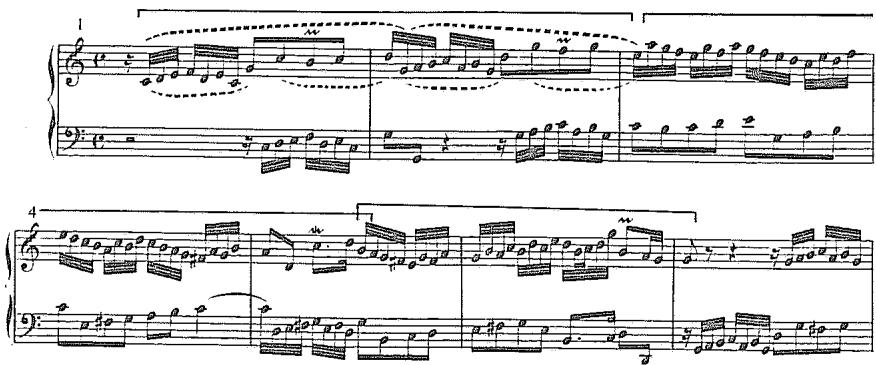
中文讲解
此为乐谱图像占位符。位置:在P0071所述对巴赫《C大调二部创意曲》开始部分的详细分析之后;图注指示其内容为该作品的开头。由于内嵌图像数据已被省略,具体的音高、节奏、力度、谱号与连音线等细节需查阅原图方能确认。本占位符在论证链中的作用是:与P0071的文字描述一一对应,使读者能将"虚线小连线—方括号—三层级乐句结构"等分析记号映射到谱面之上。
第11段(P0073)
原文复述
Baroque music, the phrase boundaries are obscured by the relatively undifferentiated rhythmic motion (sixteenth notes) at the surface level.
中文讲解
本段作为对例2.9的总结性收束:之所以巴洛克音乐的乐句边界往往不易听辨,是因为表层的十六分音符节奏运动相对均匀、缺乏分化。换言之,正是表层节奏的"非差异化"使得乐句的重音与终止感不像古典时期那样由节奏自身凸显,而必须依靠和声与旋律走向来揭示。作者借此提示:当我们分析巴洛克音乐时,乐句的清晰度问题不能仅在节奏层面寻找答案,必须同时考量调性运动的强度。
补充说明
本段在文本结构上承接P0071末尾被打断的句子,补全"Typically for late Baroque music…“这一未完成短语。
脚注 / 边栏 / 图表 / 附加信息(如有)
本小节中的脚注仅以编号(17、18、19)形式出现于P0066与P0068正文中,未给出脚注正文,因此本节无法进一步提取其内容。本小节涉及的图表有:(1)例2.9(J. S. Bach《C大调二部创意曲》开头),仅以图注形式出现在P0072处,内嵌图像数据已省略;(2)上文提及的例2.1、2.3、2.5(Haydn与Mozart的平行乐段)作为平行引用出现于P0069,原图不在本小节范围内。
💡 本节核心要点
- 乐句与超小节是两个独立的时间组织层级:乐句本质上是调性运动单位,超小节则是节拍模式的高层级延伸;二者可以重合,也可以失相,但从不互相取消。
- 调性"重音”(抵达终止时的重要性)与节拍"重音"(抵达重拍时的冲力)是两类不同的体验,不应混为一谈——这是历史上许多教科书规则与音乐实践冲突的根源。
- 乐句最常见的超小节配置是边界重合(弱位终止于四小节超小节末),但此时调性运动与节拍模式之间的"创造性张力"反而以对比方式被凸显(如Haydn的内向跳进与Mozart的进行中和声)。
- 边界失相时张力加大:弱起模式(如《蓝色多瑙河》)使每个乐句跨越超小节重拍;次强拍起句模式(如巴赫)则在重拍之后即刻引入新的乐句单位。
- 巴洛克音乐的乐句边界常因表层十六分音符的均质化而被掩盖,其清晰度必须依靠调性运动来揭示,这使其乐句—超小节关系的辨识比古典时期更依赖和声分析。
🔑 关键术语
- phrase:乐句;本节中首要定义为调性运动单位,同时因时间属性而具备节奏意义。其节奏感在更大语境下主要来自跨乐句的长度对比,而非内部细节。
- hypermeter:超小节;节拍模式在高于小节层级上的延伸,由二、四、八等偶数小节构成的重音层级。本节强调它与乐句虽常重合但本质上是独立的运动组织方式。
- hypermeter / hypermeasure:超小节单位;与hypermeter相关,指构成超小节层级的具体小节组合(如四小节超小节、八小节超小节)。
- cadence:终止;本节中作为乐句的调性目标出现,是乐句运动终点处的和声完满或不完满时刻。作者强调终止在本质上并非"新的开始",与节拍重拍性质不同。
- downbeat:重拍;本节中作为节拍模式的起点单位出现,是节拍能量的释放点。作者区分抵达重拍时的节拍强调与抵达终止时的调性强调为两种不同的"重音"体验。
- goal-oriented motion:目标取向的运动;本节用以描述乐句(以及乐段、整首作品)朝向终止运动的性质,对立于节拍"重音在前"(beginning-accented)的性质。
- phrase overlap:乐句重叠;本节提及的特殊手法(参见原书第44–51页),即一个乐句的终止同时充当下一乐句的起始,使乐句终点具有"双重功能"。
- upbeat pattern:弱起模式;乐句在超小节重拍之前开始的配置,《蓝色多瑙河》为本节典型例子。
- afterbeat pattern:次强拍起句模式;乐句在节拍或超小节重拍之后不久开始的配置,巴赫音乐中尤为常见。
- parallel period:平行乐段;本节例2.1、2.3、2.5皆属此类,是乐句与超小节边界精确重合的典型场景。
sec_2_1_9 [描述性拆分] Subphrases — Definition, In-Phase and Out-of-Phase Groupings
第1段(P0074)
原文复述
Subphrases
中文讲解
本段是该小节的标题,宣告本节讨论的对象是 Subphrases(次乐句/子乐句)。它开启了关于比 phrase(乐句)更小的旋律构成单位的定义、分组方式(in-phase 与 out-of-phase)以及其与 hypermeter(超小节律动)关系的论题。
第2段(P0075)
原文复述
Until now we have said relatively little about subphrases, although we have identified such units in the “Blue Danube” Waltz and in the Bach invention just discussed. Identification of melodic units as subphrases is based on the incompleteness of their tonal contents. Thus, for example, mm. 1–2 of this invention, up to and including the downbeat of m. 2, represent a motion from C to D, $\hat{1}$ to $\hat{2}$, in the upper voice (see Example 2.10). But the goal of this small motion, $\hat{2}$, is itself a passing tone within the ascending third-progression C–D–E ($\hat{1}-\hat{2}-\hat{3}$). The unity of this third-progression is emphasized by the complete I–V–I harmonic motion that accompanies it.
中文讲解
本段给出 subphrase 的核心定义与判别标准:识别一个旋律片段是否为 subphrase,关键在于其调性内容是否不完整。作者回顾之前分析过的 Bach Invention(第 1 首),举 mm. 1–2 上声部从 C 到 D(即 $\hat{1}$ 到 $\hat{2}$)的运动为例:虽然到达了 $\hat{2}$,但 $\hat{2}$ 本身只是上行三度 C–D–E($\hat{1}-\hat{2}-\hat{3}$)中的一个经过音;伴随这一三度进行的和声是完整的 I–V–I,正是这完整的和声弧线把整体三度进程连为一个 unit,从而使前面的 C–D 只能被视为一个调性上"不完整"的次级单位,即 subphrase。
教学要点:(1)subphrase 的判断不是看长度或力度,而是看调性终止性——它的到达音不构成真正的和声目标;(2)作者将"调性不完整"与和声完整(I–V–I)这一对术语用作判定分层的尺度,这是 Rothstein 调性分析法的典型操作;(3)例子证明:$\hat{2}$ 在声部中是旋律到达点,但在更宏观的和声—调性层级上只是过程音,由此确立 subphrase 与 phrase 的层级关系。
补充说明
原文继续提到在"Blue Danube" Waltz 和 Bach Invention 中都曾识别过 subphrase 单位;其中 Bach Invention 的详细 voice-leading reduction 详见 Example 2.10(本段提及但图见 P0076 占位符)。
第3段(P0076)
原文复述
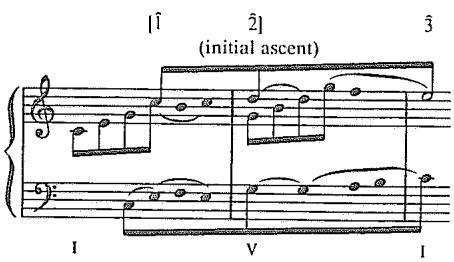
中文讲解
本段是图注占位符,标明了图的位置与功能:它是 Bach《二部创意曲》第 1 首 mm. 1–3 的声部进行缩减图(voice-leading reduction),用于支撑 P0075 中关于 subphrase 内 $\hat{1}$–$\hat{2}$–$\hat{3}$ 三度进程以及 I–V–I 和声弧线的论述。由于图像数据已省略,需查看原书图 2.10 才能确认其具体记谱形态。
第4段(P0077)
原文复述
In both the Bach invention and the Strauss waltz, it is a repetitive motivic pattern that establishes the groupings on the subphrase level. The groupings in the Bach are consistently afterbeat: (7) ♩♩♩♩♩♩♩♩♩♩. In the Strauss they are consistently upbeat on the hypermetrical (four-bar) level: (♩|♩♩♩|♩|♩|♩). Motivic repetition is only one of several factors that may determine subphrase grouping, but it is an especially powerful one. When subphrase grouping is determined motivically, motive and phrase become two aspects of a single, more generalized shaping process—grouping in the broadest sense—although, as I see it, the hierarchy of motive, phrase, and period is still rather different from that described by Riemann. $^{20}$
中文讲解
本段转向 subphrase 分组的实际机制:动机重复(motivic repetition)是塑造次级分组的重要手段。在 Bach Invention 中,分组一致地落在 afterbeat(弱拍后位),用小节图示显示为一系列从弱拍起的八分音符模式;在 Strauss《蓝色多瑙河》中,分组则一致地落在 hypermetric(四小节)层级上的 upbeat(弱拍起)。
作者同时限定:动机重复只是若干决定 subphrase 分组的因素之一,但尤其有力量。当分组由动机决定时,motive(动机)与 phrase(乐句)就成为同一个更广义的"分组"过程的两个面向;但作者明确指出,他对 motive、phrase、period 三者层级的看法仍与 Riemann 的理论有别(脚注 20 为此提供出处)。
教学要点:作者用具体节拍图示把"afterbeat 分组"与"hypermetric upbeat 分组"对比,提示读者 subphrase 边界并非必然与小节重拍对齐;脚注 20 提示这是与 Riemann 理论的对话点。
补充说明
脚注 20 在本节 image/footnote 数据中未展开,但其作用是提供作者与 Riemann 关于 motive/phrase/period 层级理论差异的学术来源。
第5段(P0078)
原文复述
When a phrase begins with either an upbeat or an afterbeat, we have said that it is “out of phase” with the hypermeter. Subphrases, too, often follow upbeat or afterbeat patterns that put them out of phase with the metrical structure, either at the measure level or at some low level of hypermeter. However, with subphrases the out-of-phase relationship is even more common, because at this level it is vital to keep the rhythm flowing from one measure to the next. A complete phrase may reach its close at the end of a hypermeasure without disturbing the rhythmic flow too much—also, other means exist at the phrase level to avoid excessive breaks in continuity—but it is relatively uncommon for a subphrase to be precisely and unambiguously in phase with a single measure.
中文讲解
本段提出 subphrase 的相位(phase)概念。承接前文:若乐句以 upbeat 或 afterbeat 起首,则与 hypermeter"失相位"(out of phase)。subphrase 也常呈现 upbeat/afterbeat 图式,使其与小节或低层 hypermeter 失相位;但与完整乐句不同,subphrase 层级上保持跨小节的节奏流动是至关重要的,因此 out-of-phase 关系在 subphrase 层级更为普遍。完整乐句可以在 hypermeasure 末尾收束而不严重打断流动,因为乐句层级还有别的手段来避免连续性断裂;而 subphrase 精确而毫无歧义地与小节同相位(in phase)则相对少见。
教学要点:“in phase / out of phase"是 Rothstein 用来描述旋律单位与 hypermeter 对齐关系的术语;本段的论点是——越是小的单位,越需要避免与小节边界硬切,因为这会破坏小节间的节奏驱动,因此 out-of-phase 在 subphrase 层级是常态而非例外。
第6段(P0079)
原文复述
This, however, is just what happens in each of the first two bars of Chopin’s famous Prélude in C Minor, Op. 28, No. 20 (Example 2.11). Since m. 1 and m. 2 each feature a self-contained harmonic progression, I–IV–V–I (in C minor and A♭ major respectively), one might even regard each of these measures as a small phrase unto itself. But clearly the entire four measures are intended as a single fore-phrase, to be answered by the repeated after-phrase of mm. 5–8 and 9–12.
中文讲解
本段举 Chopin Op. 28 No. 20(C 小调前奏曲)作为 in-phase subphrase 的反例。前两小节各自包含自足的和声进行:m. 1 为 C 小调 I–IV–V–I,m. 2 为 ♭A 大调 I–IV–V–I;凭这一点,理论上甚至可以把每一小节看作一个小型乐句。但作者指出,整整四小节明显构成一个单一的前乐句(fore-phrase),将由 mm. 5–8 与 mm. 9–12 的重复后乐句(after-phrase)来应答。
教学要点:这是一个反例,目的不是否定 in-phase 的存在,而是用极端清晰的例子展示:当小节内和声确实自足时,听者仍可能选择将四小节合并为一个更高层级的乐句单位;这进一步说明 subphrase 与 phrase 的切分在分析上具有分层性,作者借此铺垫下一段关于 subphrase 边界"模糊性"的讨论。
补充说明
Example 2.11(Chopin 前奏曲开头)的图像见 P0080 占位符。
第7段(P0080)
原文复述
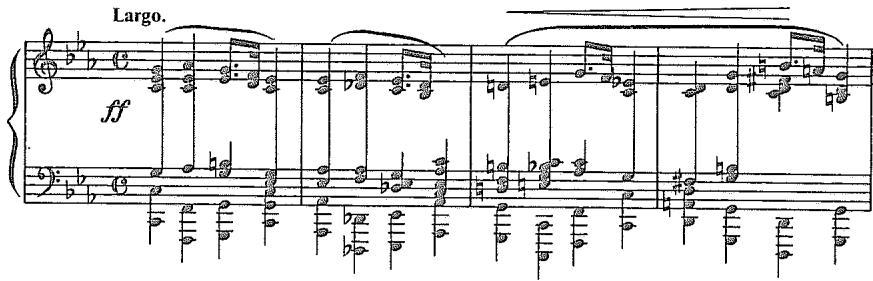
中文讲解
本段为图注占位符,标明 Example 2.11 为 Chopin Op. 28 No. 20 前奏曲开头的乐谱示例,配合 P0079 关于前两小节各自包含完整 I–IV–V–I 的论述。图像数据已省略,需查看原书才能确认具体音型与和声记谱。
第8段(P0081)
原文复述
It is somewhat more common for a longer subphrase—one of two or more measures’ length—to be in phase with a hypermeasure of the same length. This situation seems to occur especially in phrases of the “sentence” type. In Example 2.12a (cited as a sentence by Schoenberg in Fundamentals of Musical Composition, p. 70), the first two subphrases are isolated by rests. The hypermeter is duple: the four-bar hypermeasures are subdivided into two two-bar hypermeasures each. The two complementary subphrases, mm. 1–2 and mm. 3–4, together comprise the fore-phrase, which is characterized by the complete harmonic progression I–V–I and by an ascending third-progression, heavily embellished, in the melody. (See the voice-leading analysis of the fore-phrase in Example 2.12b.) The after-phrase, mm. 5–8, might be analyzed into smaller subphrases, but only with the assumption of several overlaps and lead-ins (that is, connecting passages between melodic units). Such an analysis is attempted in Example 2.12a, but it should not be taken as definitive. In general, divisions between subphrases tend (as here) to be subtler and more ambiguous than those between complete phrases. For the purposes of musical analysis, it is sometimes pointless to insist on a single set of subphrase divisions for a given phrase. A certain ambiguity in this respect may, in many cases, be the source of a melody’s fluidity.
中文讲解
本段展开 subphrase 与 hypermeasure 长度匹配的"in-phase"情况。比起单小节单位的 in-phase,更常见的是两小节或更长 subphrase 与等长 hypermeasure 对齐;这种情形在"sentence”(句式乐句)中尤其典型。
作者举 Haydn E 小调钢琴奏鸣曲 Hob. XVI:34 第二乐句(Example 2.12,Schoenberg《作曲基本原理》第 70 页引为例句)为例:hypermeter 为双拍——四小节 hypermeasure 各分为两个两小节 hypermeasure;前两个 subphrase(mm. 1–2 和 mm. 3–4)由休止符隔开,共同构成 fore-phrase,其特征是完整的 I–V–I 和声进行以及一条被大量装饰的旋律上行三度进程(声部进行见 Example 2.12b)。后乐句(mm. 5–8)虽可分析为更小的 subphrase,但需要假设多处 overlap 与 lead-in(即旋律单位之间的连接段),Example 2.12a 尝试了这种分析,但不应视为定论。
核心论断:subphrase 之间的切分往往比完整乐句之间更微妙、更具歧义;在音乐分析中,坚持为某一乐句给出唯一的 subphrase 切分有时并无意义;这种歧义本身就可能是旋律流畅感的来源。
教学要点:(1)in-phase 的 subphrase 在 sentence 类型乐句中常见;(2)Schoenberg 的 sentence 概念被作者借用,但加入了 Rothstein 式的调性—声部进行判据;(3)作者明确反对对 subphrase 作单一硬性切分,承认"歧义"作为美学—分析价值的可能性。
补充说明
Schoenberg《作曲基本原理》第 70 页是作者引用该例作为 sentence 类型的出处;Haydn 例的具体图示见 P0086(Example 2.12 的图注占位符)。
第9段(P0082)
原文复述
The image contains no text. The horizontal lines are stylistic or background elements and must be ignored according to the rules. Therefore, the correct OCR output is an empty string.
(No text to output)
中文讲解
本段为 OCR 处理说明,指出该位置虽被识别为图像区域,但图中只有装饰性横线,无可识别文字,因此 OCR 输出为空。这是技术性元说明,与本节论述内容无直接关系。
第10段(P0083)
原文复述
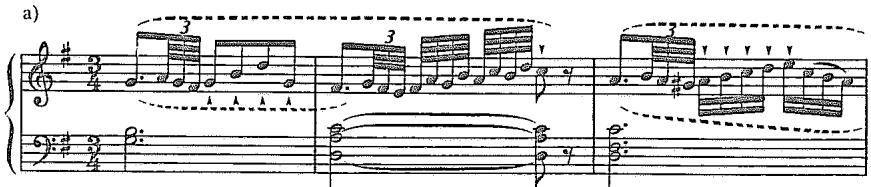
中文讲解
本段为第 9 页的图像/乐谱占位符,图像数据已省略。仅由通用占位符说明标记为"第9页图像或乐谱示例",需查看原书第 9 页才能确认其具体内容与对应 P0081 中 Haydn 例的相关位置。
第11段(P0084)
原文复述
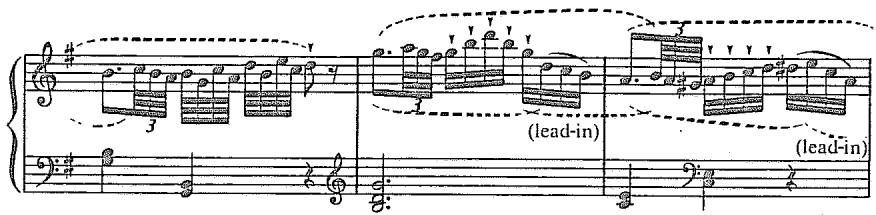
中文讲解
本段为第 9 页的图像/乐谱占位符,图像数据已省略。同 P0083,需查看原书第 9 页才能确认其具体内容;推测可能对应 Example 2.12a 或 2.12b 的一部分,但因图像缺失,无法进一步断定。
第12段(P0085)
原文复述
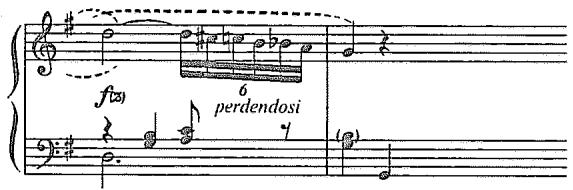
中文讲解
本段为第 9 页的图像/乐谱占位符,图像数据已省略。同 P0083、P0084,需查看原书第 9 页才能确认其内容;推测对应 Example 2.12 系列示例中的某一部分,但无法在当前输入范围内进一步确认。
第13段(P0086)
原文复述
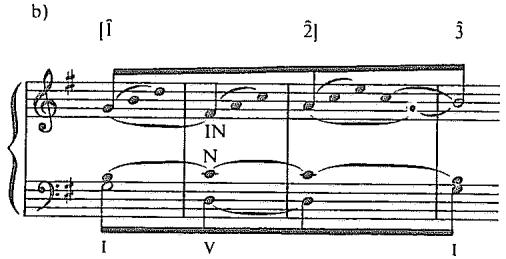
中文讲解
本段为图注占位符,标明 Example 2.12 的完整说明:曲目为 Haydn《E 小调钢琴奏鸣曲》Hob. XVI:34 第二乐句,包含两个子图——a 为乐句开头,b 为 mm. 1–4 的声部进行缩减(voice-leading reduction)。该例支撑 P0081 关于 sentence 类型 fore-phrase 的 I–V–I 和声进程与装饰化三度旋律的论述。图像数据已省略,需查看原书才能获得具体记谱。
脚注 / 边栏 / 图表 / 附加信息(如有)
本节包含一个脚注引用(脚注 20,位于 P0077 末尾),作者用以标记自己关于 motive、phrase、period 层级关系的观点与 Riemann 理论的差异;但该脚注的具体内容在当前输入的可见段落中未展开。
本节包含多个乐谱示例,均以图像占位符形式呈现:
- Example 2.10(P0076):Bach Invention No. 1, mm. 1–3 的声部进行缩减,支撑 P0075 的 subphrase 定义;
- Example 2.11(P0080):Chopin Prélude Op. 28 No. 20 开头,支撑 P0079 的 in-phase 反例;
- Example 2.12(P0083–P0086 一组占位符):Haydn Sonata Hob. XVI:34 第二乐句,含 a(乐句开头)与 b(mm. 1–4 的声部进行缩减)两个子图,支撑 P0081 关于 sentence 类型乐句中两小节 subphrase 与两小节 hypermeasure 对齐的论述。
P0082 为 OCR 处理说明(空文字输出),非正文内容。
💡 本节核心要点
- Subphrase 的定义依据是旋律单位在调性—和声上的不完整性:当一个片段到达的音只是更大调性进程中的过程音时(如 Bach Invention 中 $\hat{2}$ 作为 $\hat{1}-\hat{2}-\hat{3}$ 的经过音),该片段即被识别为 subphrase。
- Subphrase 分组的实际机制有多种,其中动机重复(motivic repetition)尤其有力;Bach Invention 的分组一致落在 afterbeat,《蓝色多瑙河》的分组则一致落在 hypermetric upbeat,提示 subphrase 边界不必然与小节重拍对齐。
- Out-of-phase(与 hypermeter 失相位)在 subphrase 层级比在乐句层级更普遍,原因是 subphrase 必须维持跨小节的节奏流动;因此 subphrase 精确而毫无歧义地与单小节 in phase 相对少见。
- In-phase 的 subphrase 多见于两小节或更长的单位与等长 hypermeasure 对齐的情形,尤其在 Schoenberg 所说的"sentence"(句式)乐句中;Haydn Hob. XVI:34 第二乐句即为典型。
- Subphrase 之间的切分通常比完整乐句之间更微妙、更具歧义;作者主张音乐分析有时不必为某一乐句坚持唯一的 subphrase 切分,这种歧义本身可能就是旋律流畅感的来源。
🔑 关键术语
- subphrase:次乐句/子乐句。指比完整乐句更小、但仍能构成可识别旋律分组的单位;其判别依据是其调性—和声内容的不完整性(所到达音常为更大调性进程中的过程音)。
- in-phase / out-of-phase:同相位 / 失相位。用于描述一个旋律单位(乐句或 subphrase)的起讫与 hypermeter(超小节律动)之间的关系:边界与 hypermeasure 重合或对齐为 in-phase;以 upbeat 或 afterbeat 起首从而与 hypermeter 错位为 out-of-phase。
- hypermeter / hypermeasure:超小节律动 / 超小节。把若干小节组织成更高层级的节拍—分组单位(如四小节 hypermeasure),并具有自身的强弱层级;是判断相位关系的参考结构。
- afterbeat / upbeat grouping:弱拍后位 / 弱拍起分组。subphrase 边界落在小节重拍之后(afterbeat)或之前(upbeat),从而与小节重音错位的分组方式;与 in-phase 的对齐方式相对。
- voice-leading reduction:声部进行缩减。把作品中各声部的细节节奏与装饰音简化、保留骨干声部进行与和声骨架的分析方法,用于展示深层的调性—旋律进程。
- sentence (Schoenberg):句式乐句。Schoenberg 在《作曲基本原理》中提出的一种乐句结构:通常由一个 fore-phrase(多为 1+1 或 2+2 小节两 subphrase 构成的基础乐思)后接 after-phrase(引申与收束)组成;本节以 Haydn 例展示其在 subphrase in-phase 上的典型性。
- overlap / lead-in:重叠 / 引接段。指旋律单位之间作为连接段而出现的过渡性材料;当一个乐句的后部 subphrase 切分需借助这些连接段才能成立时,分析的歧义性会增加。
sec_2_1_10 [描述性拆分] Regularity and Irregularity — Duple vs. Non-Duple Construction
第1段(P0087)
原文复述
Regularity and Irregularity in Phrase Construction Duple vs. Non-Duple Construction
中文讲解
本句为小节标题,宣告本节议题:在乐句建构层面,二拍/偶数长度结构(duple,含二、四、八、十六小节)与非二拍结构(non-duple)之间的关系。标题并列“规律性与不规律性”和“二拍对非二拍”,暗示作者将在二拍规范的特权地位之外,为非二拍乐句寻找独立的分析依据。
第2段(P0088)
原文复述
Most theorists, whatever their conceptual framework and vocabulary, have recognized that phrases of two, four, eight, and sixteen measures enjoy a privileged status in tonal music. There is no general agreement as to why this should be so. Some might think it merely a statistical phenomenon; these phrase lengths simply occur more often than others. At the other extreme, authors such as Riemann and Prout have held that all phrases of non-duple length—those of other than two, four, eight, or sixteen measures—can best be understood as variations of “normal” phrases of duple length. Riemann goes so far as to warn composers that they can never escape the norm of the eight-measure period, even if they try, any more than they can escape the laws of tonality. (This warning appeared five years before Schoenberg’s first atonal works were composed, and less than a decade before The Rite of Spring!)
中文讲解
本段开门见山指出:尽管理论家们理论框架与术语各异,但都承认二、四、八、十六小节长度的乐句在调性音乐中享有特权地位。然而其原因并无共识,可归纳为三种立场:其一为统计派,认为这仅是出现频率较高的现象;其三为以Riemann与Prout为代表的极端派,主张所有非二拍乐句都应被理解为“正常”二拍乐句的变体;Riemann甚至警告作曲家无法摆脱八小节乐句规范,恰如无法摆脱调性法则一般。作者以脚注形式补充:Riemann发出此警告时,Schoenberg的第一批无调性作品尚未问世,《春之祭》也将在不到十年内写成——这构成对Riemann断言的有力反讽。本段的作用是勾勒立场光谱,为下文中庸立场的引入作铺垫。
补充说明
脚注21:指出Riemann警告发表的时间早于Schoenberg无调性作品和《春之祭》,用以暗示历史证伪了“无法逃脱八小节规范”的断言。该信息仅作为历史事实出现于脚注,不构成本段主要论点。
第3段(P0089)
原文复述
There is also a middle position on this question, and—like many middle positions—it is the most sensible one. It was first advanced by the 18th-century theorists Riepel, Kirnberger, and Koch. All three believed that duple phrase lengths are the “best” or “most natural.” All believed, nonetheless, that phrases of other lengths may be used to good effect. Some of these non-duple phrases may be produced by modifying regular (that is, duple) phrases in various ways; others, however, cannot be so produced and must be considered as irregular phrases independent of duple models. Analytically, too—especially for Koch—many but not all non-duple phrases may be traced to duple origins.
中文讲解
本段推出作者认为最合理的中庸立场,由18世纪Riepel、Kirnberger、Koch三位理论家最先提出。三人共同点在于:既承认二拍乐句是“最佳”或“最自然”的,又允许其他长度乐句的有效使用。关键区分在于非二拍乐句的来源:一部分可通过修改规则(亦即二拍)乐句产生;另一部分则无法如此产生,必须作为独立于二拍模型的不规则乐句来对待。Koch的分析尤其强调:许多(但不是全部)非二拍乐句可追溯到二拍起源。本段为后续论证确立基本原则——非二拍乐句不必一律化约为二拍模型。
第4段(P0090)
原文复述
Early 19th-century writers such as Anton Reicha and Gottfried Weber started from premises similar to those of their 18th-century predecessors, but with a somewhat greater emphasis on the presumed virtue of “symmetry.” Gradually, asymmetrical phrases—especially those of odd-numbered lengths—came to be looked upon with something resembling moral disapproval; this attitude is clearly evident in Czerny’s writings, for example. The speculative theorist Moritz Hauptmann sometimes lost touch with musical reality altogether in his search for a music-philosophical system based on Hegelian principles. Riemann, finally, despite his undeniable erudition, can be viewed as the climax of a wrong-headed development nearly a century in the making.
中文讲解
本段梳理从18世纪中庸立场向19世纪极端立场滑移的历程。早期19世纪Reicha与Weber虽从前提出发,但其“对称”之说已开始强化二拍规范的道德色彩;及至Czerny,对奇数不对称乐句的“道德式不赞成”已成显例。Hauptmann的思辨则因完全基于黑格尔哲学体系而脱离音乐现实。最后,Riemann——尽管学识渊博——被作者判定为这一“错误发展方向”近百年积累的顶点。作者的态度鲜明:这种把二拍规范绝对化的倾向是历史性的偏差,而非永恒真理。
补充说明
脚注22(由P0090末尾的标记可见):作者将Riemann置于“错误发展”的顶点,呼应P0088中Riemann关于作曲家无法逃避八小节规范的警告。此脚注将用于强化历史批评。
第5段(P0091)
原文复述
In our century, it was principally Schenker and his followers who have given renewed currency to many 18th-century ideas, in rhythm as in other areas such as counterpoint and voice-leading generally. It is unlikely, however, that Schenker himself knew the works of Riepel and Koch, which have remained fairly obscure until quite recently. Nevertheless, Schenker’s view of phrase lengths, while still influenced by 19th-century ideas, is essentially closer to the 18th-century view. His position might be summarized as follows. A preference for duple organization is innate to human beings for physiological and psychological reasons. This innateness leads a powerful normative influence to duple structures, which is one reason why so many non-duple phrases can be understood as modified duple ones. However, the norm is not all-pervasive: some non-duple structures do not depend on duple models but must be understood in other ways.
中文讲解
本段进入20世纪,说明Schenker及其追随者重新激活了18世纪的诸多观念(涵盖节奏、对位与声部进行等领域)。然而Schenker本人很可能未读过Riepel与Koch(这些著作直到晚近才被重新发掘),因此其立场相近属独立发展而非直接继承。Schenker的乐句长度观可总结为:人类对二拍结构的偏好根植于生理与心理的先天倾向;这种先天使二拍结构获得强大的规范影响力,因而许多非二拍乐句可被理解为修改后的二拍乐句;但规范并非全能的——部分非二拍结构独立于二拍模型,必须以其他方式理解。本段的关键在于作者如何用Schenker为18世纪中庸立场背书:先天的二拍偏好解释了规范的影响力,但又保留非二拍乐句的独立性。
补充说明
脚注23:可能用于支持“规范并非全能”这一限定,或指明Schenker论及此议题的具体著作。原文未给出更多细节。
第6段(P0092)
原文复述
Schenker identified the binary cycle of the human heartbeat (systole and diastole) as one reason for our predisposition in favor of duple metrical patterns. Carl Schachter has drawn attention to the bilateral symmetry of the human body in the same connection. (Both of these authors are referring to all levels of meter, but particularly to the larger or hypermetrical levels.) The bilateral structure of the body is especially relevant to the dance, and it is no coincidence that duple organization—specifically, duple hypermeter—became prevalent in dance music long before it was adopted more generally. Riemann points this out in his own way, citing 1500 as the date by which duple organization (in the form of the Riemannian “eight-measure period”) had gained ascendancy in dance music; actually, the trend was evident much earlier. One could also cite the prevalence of duple organization in much Western folk music—especially secular folk music, which has tended to be allied with dance. In fact, the history of phrase rhythm in tonal music is closely bound up with the history of the influence that dance and folk music exerted on art music during the tonal era. We will examine this relationship in Part II.
中文讲解
本段解释二拍偏好的人类学根源:Schenker援引人类心跳的二元周期(收缩与舒张),Schachter则提示人体的左右对称结构。两人所论适用于一切节拍层级,尤其强调大尺度或超节拍层级。身体的左右对称与舞蹈关系尤为密切,因而二拍组织——尤其是二拍超节拍——在舞蹈音乐中先于其他体裁普及便非偶然。Riemann以自己的方式指出1500年前后二拍组织(以“八小节乐段”形式)已在舞蹈音乐中取得主导地位,作者补充说这一趋势实际上更早已见端倪。再者,西方民俗音乐(尤其是与舞蹈结合的世俗民俗音乐)也普遍存在二拍组织。本段最后点出本节主题与全书的更宏观联系:调性音乐的乐句节奏史与舞蹈及民俗音乐对艺术音乐的影响史紧密交织,这一议题将在第二部分展开。
补充说明
脚注24:可能指明Schachter论述人体对称与节拍关系之具体出处。脚注25:可能对Riemann所引1500年这一时间点提供进一步文献支持或修正。本段核心论点是舞蹈与民俗音乐为二拍规范提供了历史土壤。
第7段(P0093)
原文复述
There are many ways in which non-duple phrases may occur without being derived from, or reducible to, duple ones. Of particular significance is the construction of a phrase on the basis of the number of principal tones contained in that phrase. Schenker seems to have been the first to discuss this type of construction; more recently, Carl Schachter has given a clearer account of it. In the example Schachter cites, Schubert’s song “Wandrers Nachtlied,” D. 768 (in B♭ major), a phrase of five half-measures corresponds to the succession of five principal tones in the melody, B♭-C-D-C-B♭ (the phrase is “Warte nur, warte nur, balde ruhest du auch”). Somewhat similarly, in Example 2.13 from Dvořák’s Serenade for Strings (Op. 22), a five-measure phrase seems to grow out of the rhythm of the bass: each of five bass tones, E-A-F♯-G♯-C♯, is given exactly one measure.
中文讲解
本段引入非二拍乐句独立于二拍模型的第一种重要方式:以乐句所含主要音(principal tones)的数量为建构依据。Schenker似为最早讨论此类建构者,Schachter近期给出更清晰的阐述。Schachter援引的例证为Schubert艺术歌曲《流浪者夜歌》D. 768(B♭大调):五个半小节的乐句正对应旋律中五个主要音的连续——B♭-C-D-C-B♭(对应歌词“Warte nur, warte nur, balde ruhest du auch”)。与此类似,例2.13(Dvořák弦乐小夜曲Op. 22之圆舞曲起始)中,五小节乐句似源于低音节奏——五个低音音E-A-F♯-G♯-C♯各占恰好一小节。这两个例子共同显示:非二拍乐句可由乐句内部结构(音数或音的时值分配)直接决定,无需借助二拍模型。
补充说明
脚注26:可能指明Schenker与Schachter对此类“按音数建构”讨论的具体出处或更多例证。
第8段(P0094)
原文复述
Another way to use non-duple phrases is to sneak them in, so to speak, under cover of a larger, duple phrase (or period) that contains them. That is, the total length of the phrases will be duple, but the constituent phrases themselves need not be. Example 2.14 illustrates this device; here, mm. 1–8, which together constitute a large antecedent phrase, are subdivided into two smaller phrases—a four-measure phrase (mm. 1–4) plus a five-measure phrase that uses the cadence of the first phrase as its starting point (mm. 4–8). This is therefore an instance of phrase overlap, a technique to be discussed shortly. Example 2.15 separates the two phrases and shows the basic tonal motion of each. The first phrase describes a I–V–I harmonic progression with a complete descending scale in the first violin (f^2 – f^1). The second phrase features a prolonged harmonic motion I–IV–V, ending on a half cadence; in the melody, the first violin ascends by step from f^1 to c^2 (picking up the c^2 from m. 2) and from there basically descends to g^1, a point of interruption in the Schenkerian sense (see pp. 17–18 of the foregoing discussion). In the process of descending in mm. 7–8, the first violin again touches on f^2, the high note that began the movement.
中文讲解
本段介绍非二拍乐句出现的第二种方式:将其“偷偷”嵌入更大的二拍乐句或乐段之中。总体长度仍为二拍,但内部组成的乐句不必为二拍。例2.14(Haydn《F大调弦乐四重奏》Op. 77 No. 2第一乐章起始)即展示此手法:mm. 1–8构成一个大型前乐句,其内部又划分为两个小乐句——mm. 1–4为四小节乐句,mm. 4–8为五小节乐句;后者以前者的终止为起点,形成“乐句重叠”(phrase overlap)。例2.15将两个乐句分开,揭示各自的基本调性运动:第一乐句呈I–V–I和声进行,伴以第一小提琴完整下行的音阶(f²–f¹);第二乐句则展现拉长的I–IV–V和声运动,结束于半终止;旋律上第一小提琴由f¹级进上行至c²(接续m. 2的c²),再基本下行至g¹——这在Schenker意义上为“中断”(interruption)点(参见前述17–18页)。下行过程中于mm. 7–8再次触及f²——开篇之音,构成首尾呼应。本段的关键概念是“乐句重叠”:较小乐句的边界与较大乐句的边界错开,从而在不破坏外部二拍结构的前提下容纳内部非二拍划分。
补充说明
脚注27:可能对Haydn例的来源版本或分析细节作补充说明。
第9段(P0095)
原文复述
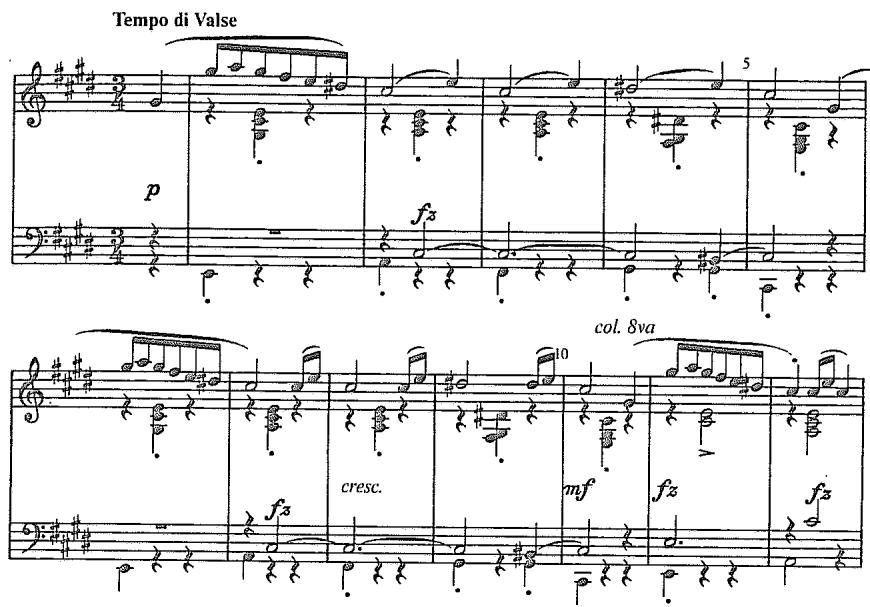
中文讲解
此为P0094所在第10页的图示或乐谱占位符(图像数据已被省略)。它对应P0094所述的Haydn例2.14与例2.15的视觉化呈现,需查看原书以获取完整谱例与分析图。建议读者结合文本中的调性运动描述阅读原图。
补充说明
无额外补充(图像内容不可读,无法核实细节)。
第10段(P0096)
原文复述
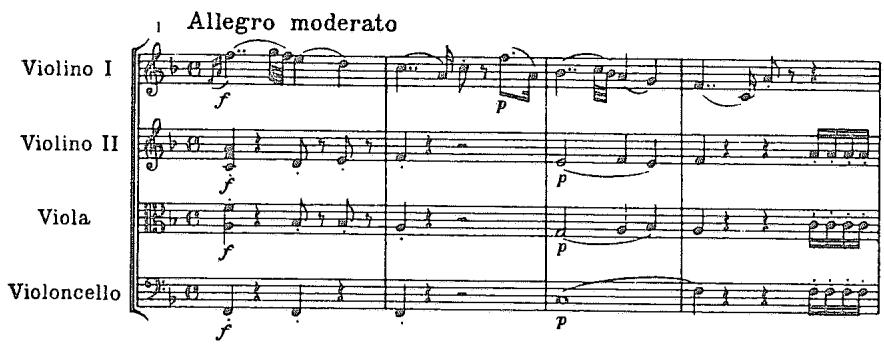
中文讲解
此为图注占位符,对应P0093所述的例2.13:德沃夏克《弦乐小夜曲》Op. 22圆舞曲起始。文本中描述的五小节乐句与五个低音音E-A-F♯-G♯-C♯各占一小节的对应关系,需查看原图方能核实。
补充说明
无额外补充(图像数据不可读)。
第11段(P0097)
原文复述
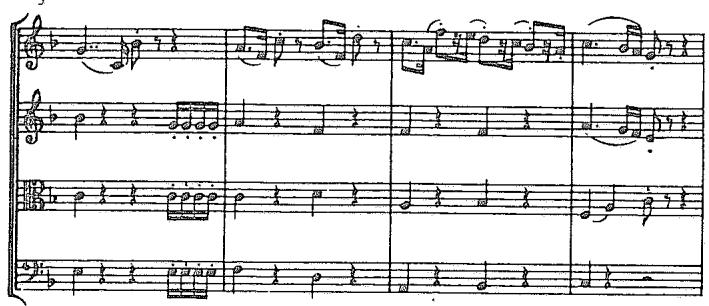
中文讲解
此为图注占位符,对应P0094所述的例2.14:海顿《F大调弦乐四重奏》Op. 77 No. 2第一乐章起始。文本所述的四小节乐句加五小节乐句构成八小节前乐句(伴m. 4处的重叠),其细节需查看原图。
补充说明
无额外补充(图像数据不可读)。
第12段(P0098)
原文复述
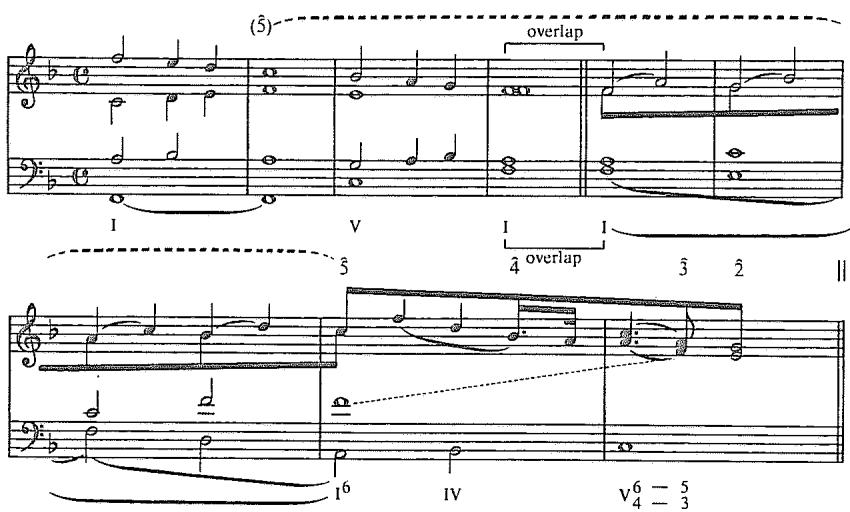
中文讲解
此为图注占位符,对应P0094所述的例2.15:例2.14的分析图。该图将前段合并的乐句分开,分别显示其基本调性运动(第一乐句的I–V–I与第二乐句的I–IV–V半终止),以及旋律线的中断点。需查看原图以核实Schenkerian层级图示。
补充说明
无额外补充(图像数据不可读)。
第13段(P0099)
原文复述
The sum of the two phrase lengths is thus nine measures, 4 + 5, rather than eight. However, the overlap at m. 4 makes it unnecessary to repeat that measure, which is made to serve as both end and beginning. Thus the total length of the antecedent is modified and becomes eight measures. The following consequent phrase, mm. 9–16 (not shown), confirms the eight-measure length as standard, even though another phrase overlap occurs in m. 16.
中文讲解
本段紧接例2.14分析进行算术上的澄清:若把两个组成乐句的各自长度简单相加,应为4+5=9小节,而非8小节。然而m. 4处的重叠使该小节无需重复——它同时充当第一乐句的结束与第二乐句的开始。因此前乐句的总长度被修改为八小节。后续后乐句(mm. 9–16,未显示)则进一步确认八小节为规范长度,即便m. 16处又发生一次乐句重叠。本段的要旨在于揭示:八小节长度并非简单加和的结果,而是通过乐句重叠这种“偷换”手法使非二拍内部划分与二拍外部长度兼容。
第14段(P0100)
原文复述
Phrases such as Haydn’s antecedent have an odd effect. They are recognizably duple on the larger level—here, the eight-measure level—but they are not subdivided in the usual way into segments of two or four measures; they are thus non-duple on the smaller level. Since the smaller level is apprehended more immediately than the larger one, the symmetry and duple regularity of the larger structure are established rather covertly. Nevertheless, these are essential qualities of the phrases and should not be discounted.
中文讲解
本段揭示Haydn此类前乐句所产生的奇特听觉效果:在较大层级上(此处为八小节层级)显然属于二拍,但在较小层级上并未按惯常方式划分为二或四小节,故为非二拍。由于较小层级的感知先于较大层级,较大结构的二拍规律与对称性反而是“隐蔽地”建立的。本段的修辞性提示是:隐蔽不等于可有可无——这些性质仍是乐句的本质品质,分析者不可因其不显眼而忽视。这一观察为下文的超节拍讨论奠定基础。
第15段(P0101)
原文复述
The non-duple constituents of a duple phrase may be subphrases rather than phrases. An example is mm. 9–16 of the andante movement from Haydn’s Symphony No. 104; mm. 1–8, constituting a parallel period, were shown in Example 2.3. The divisions of this eight-measure phrase are five and three measures respectively; each of these segments is further subdivided, unequally of course (into 2 + 3 and 1 + 2 respectively). The entire phrase is a prolongation of the dominant reached in m. 8.
中文讲解
本段提示:二拍乐句内部的非二拍组成单位可以是“次乐句”(subphrases)而非完整乐句。例证为Haydn《第104交响曲》行板乐章的mm. 9–16;其mm. 1–8构成平行乐段,前述例2.3已示。这一八小节乐句划分为五加三小节两段,每段又作不均等的细分(分别为2+3与1+2)。整个乐句是m. 8所达属音的延续(prolongation)。本段的要旨在于:非二拍细分不必提升至完整乐句层级——次乐句的层级也足以容纳不对称性,且其功能往往是延展某稳定和声(如属音),而非形成新的乐句边界。
补充说明
无额外补充(例2.3在前述讨论中已出现,本节未复述其内容)。
第16段(P0102)
原文复述
When a large duple phrase is divided into non-duple segments, the hypermeter is likely to be suspended or even nonexistent. Hypermeter is strongly influenced by phrase (grouping) structure, and the perception of duple hypermeter cannot easily survive a strongly asymmetrical phrase construction. If two- and four-bar levels of hypermeter are not present, it is difficult for an eight-bar hypermeter to emerge convincingly. Only, perhaps, when an eight-bar hypermeter has already been established—as is the case in Symphony No. 104 because of the repetition of mm.
中文讲解
本段从乐句结构转向超节拍(hypermeter)层级:当一个大型二拍乐句被划分为非二拍段落时,其超节拍很可能被悬置甚至不存在。超节拍深受乐句(或称音群)结构影响;强烈的非对称乐句建构难以维系二拍超节拍的感知。若二拍与四拍层级的超节拍未先确立,则八拍超节拍难以令人信服地浮现。本段由Haydn《第104交响曲》之例承接:因为mm. 1–8已被重复(暗示八拍超节拍已先行确立),后续非二拍划分的mm. 9–16才可能被听为八小节超节拍单位之内的事件。本段为下文关于“已有超节拍”的条件句铺路。
第17段(P0103)
原文复述
1–8—is it possible to hear an asymmetrical eight-measure phrase as a metrical unit of eight bars. (However, if subsequent events confirm an eight-bar hypermeter, it may be possible in retrospect to hear even an asymmetrical opening phrase, such as Example 2.14, hypermetrically.)
中文讲解
本段接续P0102未完成的句子,限定何种情况下才能将非对称的八小节乐句听为八小节超节拍单位:唯有当八拍超节拍已被先行确立时——正如《第104交响曲》因mm. 1–8的重复而具备此条件——非对称的八小节乐句才能被听为八小节的节拍单位。括号内的补充进一步指出一种回顾性可能:若后续事件确认了八拍超节拍,即便起初非对称的开篇乐句(如例2.14)也有可能被回溯性地以超节拍方式聆听。本段强调超节拍感知的双重条件——既可前瞻预设(先有重复建立超节拍),也可回顾重构(后续事件提供超节拍证据)。
脚注 / 边栏 / 图表 / 附加信息(如有)
本节包含四处脚注标记(21、22、23–25一带、26、27),分别关联Riemann的八小节规范警告与Schoenberg历史反讽(Riemann发表警告后无调性音乐与《春之祭》的相继出现)、19世纪二拍规范道德化的批评、Schenker先天二拍偏好的论据来源、Schachter对按音数建构的阐述出处,以及Haydn例2.14–2.15的可能版本说明。本节还包含三处乐谱/分析图占位符(例2.13、例2.14、例2.15),分别对应P0093所述Dvořák弦乐小夜曲的按低音节奏建构的五小节乐句、P0094所述Haydn弦乐四重奏Op. 77 No. 2起始处的四加五小节乐句重叠结构,以及该例的分析图(含I–V–I与I–IV–V的调性运动、中断点、首尾呼应的高音f²)。由于图像数据被省略,谱例的视觉细节无法核实,但图注文字与正文描述完全对应。
💡 本节核心要点
- 乐句长度的二拍特权是调性音乐中跨流派的共识,但其原因存在三种立场:统计派、Riemann/Prout的极端化派(视一切非二拍为二拍的变体)、以及Riepel/Kirnberger/Koch所代表并经Schenker延续的中庸派。
- 中庸立场的核心在于承认二拍规范的影响力,但同时承认部分非二拍乐句独立于二拍模型——这是本节为非二拍乐句争取分析合法性的理论基础。
- 19世纪的极端化倾向(从Reicha/Weber的对称崇拜到Czerny的道德式不赞成,再到Riemann的巅峰)被作者批评为脱离音乐现实的错误发展。
- 二拍偏好的根基被认为是生理与心理的:心跳的二元周期(systole/diastole,Schenker)与人体的左右对称(Schachter)。这一先天倾向与舞蹈音乐的兴起及西方民俗音乐传统共同构成二拍规范的历史土壤。
- 非二拍乐句的独立来源之一是按乐句内主要音(principal tones)的数量建构——Schubert《流浪者夜歌》的五半小节乐句对应五个主要音;Dvořák弦乐小夜曲的五小节乐句对应五个低音音各占一小节。
- 非二拍乐句的另一种来源是将其嵌入更大的二拍结构:通过乐句重叠(phrase overlap)使非二拍的内部划分与二拍的外部长度兼容(如Haydn Op. 77 No. 2的4+5重叠为8),但这会使二拍对称性被“隐蔽地”建立,并倾向于悬置超节拍——除非超节拍已先行确立或被后续事件回顾性确认。
🔑 关键术语
- duple phrase (二拍乐句):长度为二、四、八或十六小节的乐句。本节主张这类长度在调性音乐中享有特权地位,但其“特权”并非绝对,部分非二拍乐句独立于二拍模型。
- non-duple phrase (非二拍乐句):长度非二、四、八或十六小节的乐句。本节论证此类乐句不必一律视为二拍乐句的变体;其来源可包括按主要音数建构、或借助乐句重叠嵌入二拍结构。
- principal tone (主要音):本节指Schachter意义上的旋律骨架音,决定乐句长度。一个五半小节乐句可对应五个主要音(如Schubert《流浪者夜歌》B♭-C-D-C-B♭),由此独立产生非二拍长度。
- phrase overlap (乐句重叠):两个组成乐句共用同一个小节作为各自的结束与开始的技术。本节以Haydn Op. 77 No. 2为例:m. 4同时是四小节乐句的结束与五小节乐句的开始,由此将4+5=9压缩为外部八小节的前乐句长度。
- hypermeter (超节拍):在小节层级之上的节拍组织,常以二、四、八小节为单位。本节指出,当乐句作非二拍细分时,超节拍感知易被悬置;唯有先行确立(如重复)或后续事件回顾性确认时,非对称乐句才能被听为完整超节拍单位。
- interruption (中断):本节在P0094分析Haydn第二组成乐句时使用此Schenkerian术语,指旋律自高音下行至结构性低点(此处为g¹)的位置,构成与开篇结构相呼应的关键节点。
- prolongation (延续):本节在P0101用以描述Haydn《第104交响曲》mm. 9–16的功能:整个八小节乐句是对m. 8所达属音的延续,亦即非二拍细分服务于稳定和声的延展而非构成新乐句边界。
sec_2_1_11 [描述性拆分] Non-Duple Hypermeter — Theory and Examples
第1段(P0104)
原文复述
Non-Duple Hypermeter
中文讲解
本段是节标题 “Non-Duple Hypermeter”(非偶数超拍),承担版面划分功能。它开启一个独立论题:在非偶数长度(如 3、5、7 等拍数)的乐句连续出现时,听者如何形成规则循环的重音感,并由此产生与乐句可能重合、也可能分离的"超拍"层级。该标题把接下来的论证范围与第 2.1 节前面的偶数超拍讨论清楚地区分开来。
第2段(P0105)
原文复述
When a phrase of non-duple length occurs, it often does so in isolation, neither preceded nor followed by other phrases of the same length. However, if two or more non-duple phrases, each of the same length, follow each other in direct succession, a feeling of regularly recurring accents is likely to be created, and with it a feeling of hypermeter.
中文讲解
作者先给出一条经验性观察:非偶数长度的乐句(non-duple phrase)通常单独出现,前后并无同等长度的乐句陪衬。但一旦两段或更多相同长度的非偶数乐句连续并列,听者就会产生一种规则循环的重音感受(regularly recurring accents),并由此生成超拍感(a feeling of hypermeter)。这里的逻辑是:超拍不是单凭乐句长度就能成立的现象,它依赖于"等长乐句的连续叠置"这个触发条件;缺少连续性,超拍感知就难以巩固。
补充说明
本段为下文的定义性铺垫服务:在用 Cooper–Meyer 和 Schachter 重新定义重音之前,先界定非偶数超拍产生的最简前提——“连续等长的非偶数乐句”。
第3段(P0106)
原文复述
This is perhaps an appropriate point at which to dispel a common misunderstanding concerning the nature of musical meter in general and of hypermeter in particular. It is sometimes thought that metrical patterns are established by means of dynamic accents—by singing or playing certain notes more loudly than others. This is not a necessary condition for the establishment of meter, as an increasing number of theorists have come to realize. In particular, the common view reflects a seriously impoverished conception of musical accent. Grosvenor Cooper and Leonard Meyer have formulated what is perhaps the best general definition of accent, and it is very general indeed: “An accent . . . is a stimulus (in a series of stimuli) which is marked for consciousness in some way. It is set off from other stimuli because of differences in duration, intensity, pitch, timbre, etc.” $^{28}$
中文讲解
作者先指明行文意图:在此处澄清一个关于节拍(meter)与超拍(hypermeter)的常见误解。误解的要点是——节拍模式必须由"动力性重音"(dynamic accents)建立,即某些音被唱得或奏得更响。但作者强调,动力性重音并非节拍成立的必要条件,越来越多理论家已认识到这一点。他随后引用 Grosvenor Cooper 与 Leonard Meyer 给出的一般性重音定义:在一连串刺激之中,重音是因持续时长、强度、音高、音色等方面的差异而"为意识所标记"的刺激。这里的论证目的不只是修辞,而是为下一段 Schachter 的进一步阐发清除前提障碍:既然重音远不止于"强弱",那么超拍同样可以建立在非动力性的差异化之上。这一理论铺垫直接支撑了后文用动机重复、和声变化等手段建立非偶数超拍的做法。
补充说明
脚注 28 是该 Cooper–Meyer 引文的出处,是本段论证的来源依据,而非对正文主张的限定或旁证。
第4段(P0107)
原文复述
More recently, Carl Schachter has clarified the nature of meter and metrical accent. According to Schachter, many kinds of musical patterning can make the listener aware of equal spans of time—“patterns of long and short, of loud and soft, of repetition and change, of voice leading and harmony, of all of these elements and others, singly and in any imaginable combination.” $^{29}$ The beginning of each new span receives an accent in the mind of the listener, just by virtue of its position in time; therefore it need not be given an accent by the performer:
中文讲解
作者进一步援引 Carl Schachter 对节拍与节拍重音的阐释。Schachter 的核心论点是:让听者意识到等长时间跨度的途径是多种多样的——长与短、强与弱、重复与变化、声部进行与和声,单一元素或任意组合都可以起作用。每个新跨度的起点,仅因其时间位置(position in time)就在听者心中获得一个重音,因此它不必由演奏者"实际地"给出重音。
这一句是该节论证的关键枢纽:作者把"超拍"的来源从演奏行为移到了听者的认知结构。一旦听者意识到等长跨度,新跨度的起点就自动获得节拍重音。这为后文用动机重复、和声缓慢变化等纯结构手段建立非偶数超拍提供了理论合法性。
补充说明
脚注 29 为 Schachter 该引文的出处,扮演支持性来源的角色,不改变正文的限定条件。
第5段(P0108)
原文复述
If one condition is met, the listener’s awareness of time spans automatically produces accents that punctuate his experience of the music; these accents result from the heightened attention attracted by the boundary points of the spans. The necessary condition is the presence of non-accents, for a thing is accented only in relation to a comparable thing that is not. . . . Accents produced by the awareness of time spans differ from all others in that they arise out of temporal position alone and not from any special emphasis in the composition or its performance. Of course some kind of emphasis is required initially in order to make the listener aware of the spans, but equal divisions, once established, can persist in the listener’s consciousness without special sensory reinforcement. Indeed, they can persist for a time in the face of strongly contradictory signals. . . . Once the listener becomes aware of recurrent durational units—beats, bars, and larger periodicities—that awareness, in and of itself, adds another layer of accentuation to the musical image. The accents thus produced are true metrical accents—metrical because they arise directly out of the listener’s awareness of the equal divisions of time that measure the music’s flow. $^{30}$
中文讲解
这段较长的 Schachter 引文需要分层阅读。
第一层(条件):只要一个前提被满足——存在"非重音"(non-accents)——听者对时间跨度的意识就会自动产生重音来"切割"他的音乐经验。逻辑是:某事物之所以成为重音,仅在于它与一个可比较的"非重音"形成对照;因此"非重音"的存在是节拍重音得以成立的必要条件。
第二层(独特性):由时间跨度意识所产生的重音区别于其他一切重音,它的来源纯粹是时间位置(temporal position alone),不依赖于作品或演奏中的任何特殊强调。当然,最初仍需某种强调让听者意识到这些跨度;但一旦等分结构建立起来,它便可在听者意识中持续存在,无需进一步的感官强化,甚至能在强烈相反信号下维持一段时间。
第三层(结论):一旦听者察觉到反复出现的时值单位——拍、小节、以及更大的周期——这种察觉本身就为音乐意象增添了一层重音。这种重音才是真正的节拍重音(metrical accent),因为它直接源自听者对"度量音乐进程之等分时间"的意识。
本段把 P0106—P0107 的理论铺垫推进到可操作的定义层级:节拍重音的成立不依赖演奏者施加强弱,它本身就是听者认知等分时间的副产品。这一结论直接支撑后文用动机重复、和声缓慢变化等手段建立"非偶数超拍"——只要听者感知到等长跨度,超拍就成立。
补充说明
脚注 30 是该 Schachter 引文的出处;该引文承担本节定义节拍重音的核心论证功能,是关键的支持来源而非旁证。
第6段(P0109)
原文复述
According to this view of meter, a succession of discrete units of, say, five measures each will form a metrical pattern—namely, five-bar hypermeter. A series of three-measure units will likewise be perceived metrically; and other non-duple hypermeters may be similarly formed. As we shall see, however, the difference between phrase structure and hypermeter can make this scheme less simple than it appears. When phrases and hypermeasures roughly coincide, there is generally no difficulty: even if the two types of unit are out of phase with each other, there is a consistent and predictable relationship between them. But when phrase structure and hypermeter diverge significantly, as they sometimes do, a series of equal, non-duple phrases might not imply an equivalent hypermeter.
中文讲解
作者把前述理论落到非偶数超拍的应用上:在这种节拍观下,连续五个小节一个单位会形成五小节超拍;连续三个小节一个单位同样会被节拍化地感知;其他非偶数超拍依此类推。
但作者立刻指出,这种方案看上去简洁,实际上没那么简单——关键在于"乐句结构"(phrase structure)与"超拍"(hypermeter)可能并不一致。当两者大致重合时,即使相位错开,关系也保持一致且可预测。然而,当两者显著分离时——这种情况确实存在——一组等长的非偶数乐句并不一定意味着与之对应的超拍。这一警示非常重要:它预告了后文两个例子之间的对比——一个是"乐句即超拍"(Dvořák,Example 2.13),一个是"乐句存在但超拍并非简单的六小节"(Mozart K. 575,Example 2.17)。
补充说明
无额外补充;本段为后续例子的分类提供了判别标准。
第7段(P0110)
原文复述
In certain simple cases, most common in rapid tempi, a repetitive motivic pattern may itself create a non-duple hypermeter. The repetition provides the emphasis necessary to establish the awareness of equal spans. Such a case is the famous ritmo di tre battute (“rhythm of three beats”—that is, three measures) passage from the Scherzo of Beethoven’s Ninth Symphony (Example 2.16).
中文讲解
作者进入第一类例子:相对简单的情形,多见于快速段落。重复的动机模式本身就能产生非偶数超拍——重复提供了建立等长跨度意识所需的"强调"(emphasis)。作者举贝多芬第九交响曲谐谑曲中著名的 ritmo di tre battute(“三拍的节奏”,即三小节)段落(例 2.16)为代表。这一过渡句的作用是:把抽象理论挂到具体可听的现象上,并预告这一段将以"重复 + 缓慢和声变化"作为非偶数超拍的支撑手段。
补充说明
节奏术语 ritmo di tre battute 在本节作为专用术语出现,作者以括号注明其字面含义"三拍的节奏"并明确这里指"三小节"。
第8段(P0111)
原文复述
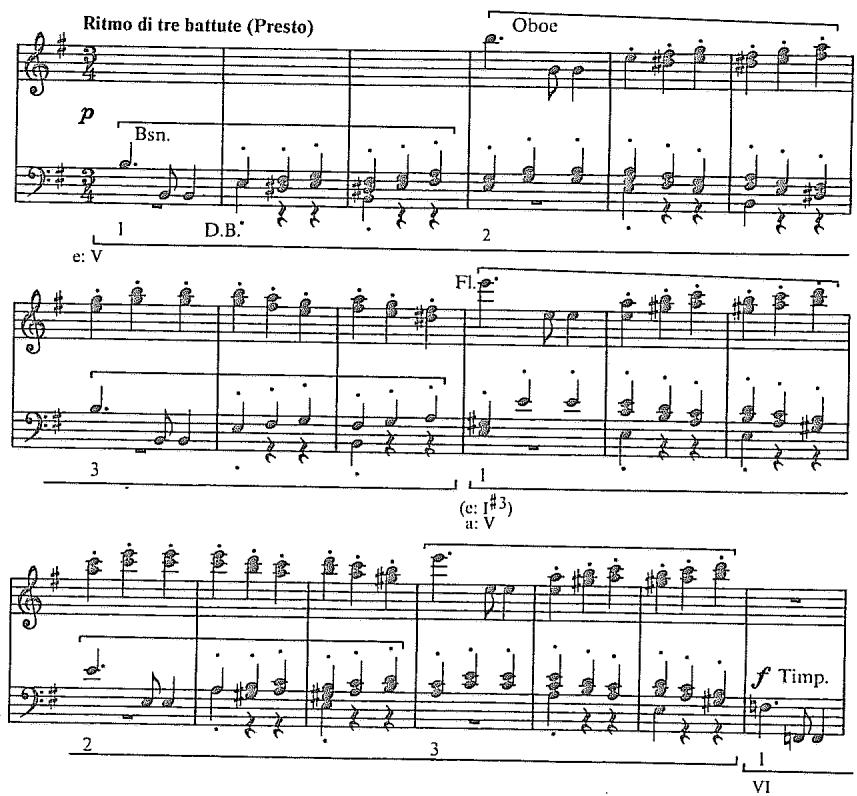
中文讲解
这是例 2.16 的图注占位符,标题为"贝多芬:第九交响曲,谐谑曲,ritmo di tre battute"。该谱例承载了作者论证非偶数超拍所需的视觉证据:三小节动机的方括号标记、九小节和声节奏的标注、以及 m. 195 处从 9-bar(3×3) 到 12-bar(4×3) 的超拍变化。具体音型、和声走向、力度记号、配器色彩等可见细节需查看原图才能确认,本节论证不能脱离该谱例成立。
第9段(P0112)
原文复述
The three-measure motive is highlighted in this example with square brackets. Its constant repetition, coupled with changes in orchestration, establishes the “rhythm of three beats (measures).” Since the harmony is extremely static, changing essentially every nine measures (as indicated in the example), the three-bar units are clearly hypermeasures rather than phrases. (The oscillation between dominant and tonic within each nine-measure span is really an oscillation within a single harmonic entity.) The entire passage, containing just three harmonies, comprises only the beginning of a very long and slowly moving phrase. The nine-measure units, created by changes of harmony and orchestration, are therefore also hypermeasures and not phrases. After m. 195 this larger hypermeter changes, becoming twelve-bar $(4 \times 3)$ rather than nine-bar $(3 \times 3)$ . $^{31}$
中文讲解
本段是对例 2.16 的逐层解释。论证链条如下:
第一层:三小节动机以方括号标出。其不断重复加上配器变化,确立了"三拍的节奏"(即三小节)。
第二层:由于和声极度静止——基本上每九小节才变化一次,所以这三小节单位理应被听成超拍(hypermeasures)而非乐句(phrases)。作者还做了一个补充判断:在每个九小节跨度的内部,主—属之间的来回振荡其实属于同一个和声实体的内部运动。
第三层:整个段落只含三个和声,因此它本身只是一段非常长、移动缓慢的乐句的开头。
第四层:九小节单位(由和声与配器变化造就)因此同样是超拍而非乐句。
第五层:在 m. 195 之后,更大层级的超拍发生变化——由九小节(3×3)变为十二小节(4×3)。
这一例子的论证价值在于:它示范了"重复动机 + 极慢和声节奏"如何在快速段落里建立一个层级化的非偶数超拍结构,并展示超拍本身也可在过程中转换层级。
补充说明
脚注 31 为这一超拍层级变化的来源;该来源支持正文对 m. 195 处由 3×3 变为 4×3 的描述,不构成对论点的限定。
第10段(P0113)
原文复述
In Example 2.13, the Waltz from Dvořák’s Serenade for Strings, the five-measure units are not only phrases but hypermeasures as well. The metrical quality of these units is emphasized by the eightfold repetition—four repetitions, doubled by a repeat sign—of essentially the same phrase. The most interesting metrical aspect of this example is the fact that the five-measure unit does not subdivide in any obvious way: most five-bar hypermeasures are compounded either of $2 + 3$ or $3 + 2$ .
中文讲解
本段讨论例 2.13,主题是德沃夏克《弦乐小夜曲》中的圆舞曲乐章。论证要点有三:
第一,五小节单位同时既是乐句也是超拍——两者重合而非分离,是 P0109 所说"大致重合"情形的最简例子。
第二,其节拍特性由"实质上同一乐句的八次重复"(四次重复,再加反复记号翻倍)所强化。
第三,最有趣的节拍现象是:该五小节单位不以任何显而易见的方式细分为更小节拍——而大多数五小节超拍通常由 2+3 或 3+2 复合而成。本段的论点是:Dvořák 这例提供了一个"不细分"的反例,提示读者非偶数超拍的内部组织并非千篇一律。
补充说明
本段与例 2.16 形成对照:例 2.16 是"乐句与超拍分离"且超拍层层嵌套;例 2.13 是"乐句即超拍"且超拍内部不显式细分。
第11段(P0114)
原文复述
When a piece begins, like the Dvořák, in a non-duple hypermeter, it commonly reverts to duple hypermeter later on, as if to emphasize that its beginning was metrically abnormal. This is the case in the Serenade, and in the similarly constructed Dvořák’s Piano Trio in G Minor, Op. 26 Scherzo. Haydn and Mozart follow similar patterns in a number of their minuets, and occasionally in other pieces as well. An especially striking example is the first movement of Mozart’s String Quintet in C Major, K. 515 (to be shown in Example 2.30). In that piece, as in Example 2.16, the non-duple units at the beginning—five-bar in this case—are hypermeasures but not phrases, because the harmonic rhythm is so slow. (Each hypermeasure contains a subphrase, however.) Duple hypermeter is most clearly expressed at the beginning of the second group, starting at m. 86.
中文讲解
本段揭示一种常见的曲式行为模式:以非偶数超拍开篇的乐章,往往在之后回归偶数超拍,仿佛是为了凸显开篇在节拍上的"异常"。
作者给出多个佐证:Dvořák 的《弦乐小夜曲》、g 小调钢琴三重奏 Op. 26 的谐谑曲都遵循这一模式。海顿、莫扎特的小步舞曲以及偶尔的其他作品也出现类似做法。特别突出的例子是莫扎特 C 大调弦乐五重奏 K. 515 的第一乐章(将在例 2.30 中展示)。
作者还为该例做了一个内部区分:和例 2.16 类似,开头的非偶数单位(此处为五小节)是超拍而非乐句,原因是和声节奏极慢(每一超拍包含一个次级乐句)。偶数超拍则在第二组开始处(m. 86 起)得到最清晰的表达。
本段既给出一个可推广的曲式规律,又通过 K. 515 与例 2.16 重新连接 P0109 提出的"乐句与超拍分离"主题。
补充说明
无额外补充;本段为后文例 2.30 的预告作铺垫。
第12段(P0115)
原文复述
More difficult is a case like Example 2.17. Here there are obviously equal spans—namely, two six-measure phrases—but the ear refuses to hear them as six-bar hypermeasures. Evidently the existence of equal spans is not in itself sufficient to assume a hypermeter based on those spans. Or, to put it differently, there may be other factors that can override such a “first-glance” metrical interpretation.
中文讲解
作者笔锋一转,进入"更困难"的一类情形。例 2.17 中存在着明显等长的跨度——两个六小节乐句——但听者的耳朵拒绝把它们听成六小节超拍。
由此作者得到一条方法论上的修正:等长跨度的存在本身不足以据此假设超拍;换言之,可能存在其他因素压倒这种"第一眼看上去"的节拍解读。这一句是 P0109 警告(乐句与超拍可能分离)的实证化:等长乐句不一定意味着等长超拍,听者的实际节拍感受可能由其他结构因素重塑。
补充说明
本段为下一段对例 2.17 的具体分析设置悬念。
第13段(P0116)
原文复述
One of the chief factors at work in Example 2.17 is the appearance, within each six-measure phrase, of a self-contained phrase of four measures. This smaller phrase is led by the cello, with the viola providing bass支持; by comparison, the preceding two bars seem merely introductory. The thinner texture, lack of bass, and harmonic instability of those two bars cause them to sound like an upbeat to the four-measure phrase that follows. In fact, the two-measure upbeats could be omitted entirely, and the remaining eight-measure period (mm. 3–6 plus mm. 9–12) would still make perfect sense. This phenomenon of the elongated upbeat—an upbeat lasting a full measure or more—will be discussed further (see pp. 56–57); here it is only necessary to realize that such an occurrence may force adjustments to our usual sense of hypermeter. In this case, the hypermeter is actually duple (four-bar), but the hypermeasures are separated by elongated upbeats. $^{32}$ (The upbeats themselves derive from a similar figure in the preceding Menuetto, where they have a different metrical status.)
中文讲解
本段是对例 2.17 的具体分析,论证链条如下:
第一层,关键因素:在每个六小节乐句内部出现了一个自足的四小节乐句——这一更小的乐句由大提琴主导,中提琴提供低音支持。
第二层,比较效果:相比之下,开头的两小节听起来只是引子。其织体更薄、缺少低音、和声不稳定,使它们听起来像是随后四小节乐句的弱起(upbeat)。
第三层,假设检验:实际上,如果删去这两小节的弱起,剩下的八小节段落(mm. 3–6 加 mm. 9–12)依然完美成立。
第四层,理论术语化:作者把这种现象命名为"延长弱起"(elongated upbeat)——持续整小节或更长的弱起,并预告后续章节(pp. 56–57)将专门讨论。此处只需知道:这种现象可能迫使我们调整通常的超拍感。
第五层,本例结论:该处的超拍实际上是偶数的四小节超拍,但各超拍之间被延长弱起隔开。脚注补充说,这些弱起承自前一 Menuetto 中类似音型,只是节拍地位不同。
本段是 P0115 警告的具体兑现:等长六小节乐句的"表面节拍"被四小节自足乐句的嵌套结构所压倒,超拍实际是偶数四小节,但被延长弱起切碎。
补充说明
脚注 32 指向本例超拍归属的依据;该来源支持正文对"四小节超拍 + 延长弱起"的判断。本例中 viola 与 cello 的声部关系是解释四小节自足结构成立的关键论据。
第14段(P0117)
原文复述
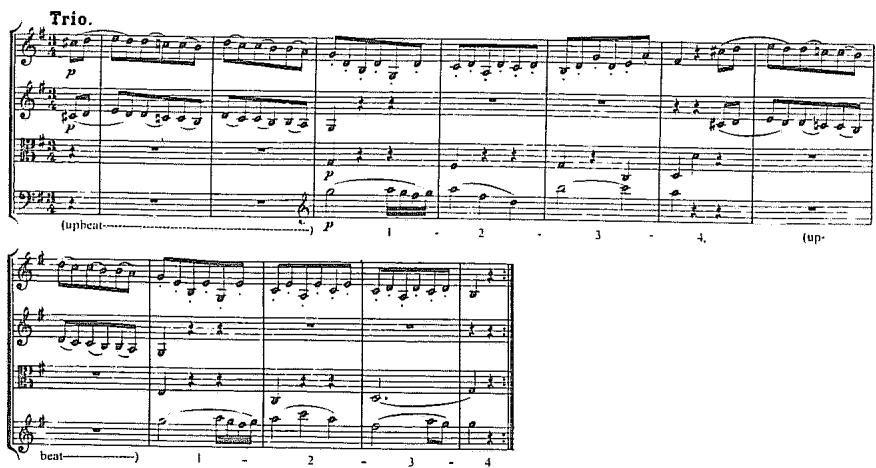
中文讲解
这是例 2.17 的图注占位符,标题为"莫扎特:D 大调弦乐四重奏 K. 575,第三乐章,Trio(开头)"。该谱例承载了作者论证"等长乐句 ≠ 等长超拍"所需的视觉证据:每个六小节单位内部的四小节自足乐句结构、前两小节弱起的织体与和声特征、大提琴主导与中提琴提供低音的声部分配,以及 mm. 3–6 与 mm. 9–12 构成完整八小节段落的可删减性测试等。具体音高、力度、连线、和声进行等可见细节需查看原图方可确认。
脚注 / 边栏 / 图表 / 附加信息(如有)
本节含两处乐谱占位符(例 2.16 与例 2.17)以及四处正文脚注(28、29、30、31、32)。脚注 28、29、30 分别支撑 Cooper–Meyer 重音定义、Schachter 关于多元素建立等分跨度的引文、Schachter 关于"非重音必要条件"及"真正节拍重音"的引文,均为关键来源;脚注 31 支撑例 2.16 在 m. 195 处超拍由 3×3 变为 4×3 的描述;脚注 32 支撑例 2.17 的超拍归属与延长弱起的判断。两处谱例本身是论点的视觉证据,本节论证不能脱离它们成立。
💡 本节核心要点
- 非偶数超拍并非自动成立:它需要"两段或更多等长的非偶数乐句直接连续叠置"作为触发条件(P0105)。
- 节拍重音的来源不是动力性的强弱,而是听者对等长时间跨度的意识;这一前提由 Cooper–Meyer 的广义重音定义与 Schachter 关于"非重音必要条件"的论证共同奠定(P0106–P0108)。
- 乐句结构与超拍可能重合也可能分离:当两者显著分离时,等长非偶数乐句并不自动意味着对应的等长超拍(P0109)。
- 例 2.16(贝多芬第九,谐谑曲)示范"重复动机 + 缓慢和声节奏"如何建立三层嵌套的非偶数超拍,且超拍自身可在 m. 195 后由 3×3 变为 4×3(P0110–P0112)。
- 例 2.13(德沃夏克《弦乐小夜曲》圆舞曲)示范"乐句即超拍 + 内部不显式细分"的非偶数超拍(P0113);以非偶数超拍开篇的乐章常常随后回归偶数超拍(P0114)。
- 例 2.17(莫扎特 K. 575,Trio)示范"等长六小节乐句≠六小节超拍"——内部嵌套的四小节自足乐句与延长弱起迫使超拍成为偶数四小节(P0115–P0116)。
🔑 关键术语
- Non-duple hypermeter:非偶数超拍:以非偶数(如 3、5、7 等)小节数为单位形成的超拍层级;本节论证其成立的触发条件(等长非偶数单位的连续叠置)以及它与乐句结构可能分离的复杂性。
- Hypermeter:超拍:由若干小节组成的更高级别节拍层级;本节强调其重音不必由演奏施加强弱,而可由听者对等长跨度的认知自动产生。
- Metrical accent / dynamic accent:节拍重音 / 动力性重音:节拍重音指听者因感知等分时间跨度而获得的重音;动力性重音特指由演奏者通过强弱变化施加的重音。本节论点是动力性重音并非节拍成立的必要条件。
- Accent (Cooper–Meyer definition):Cooper–Meyer 重音定义:在一连串刺激之中,因持续时长、强度、音高、音色等方面的差异而"为意识所标记"的刺激,是一种广义、非动力性的重音概念。
- Non-accents:非重音:Schachter 论证中"重音得以成立"的必要条件——某事物之所以成为重音,仅在与一个可比较的非重音形成对照时才成立。
- Hypermeter vs. phrase structure:超拍与乐句结构:两者在长度上可重合也可分离;本节以此区分两组例子——例 2.13(重合)、例 2.16 与 2.17(分离)。
- ritmo di tre battute:“三拍的节奏”,本节指三小节为单位的节奏;用于称呼贝多芬第九交响曲谐谑曲中的著名段落。
- Elongated upbeat:延长弱起:持续整小节或更长的弱起;本节通过例 2.17 论证它可以切断超拍归属,使表面的等长六小节乐句对应实际为四小节的偶数超拍。
sec_2_1_12 [描述性拆分] The Manipulation of Hypermeter — Elongated Upbeats and Cadenza-like Deviations
第1段(P0118)
原文复述
The Manipulation of Hypermeter
中文讲解
这是本小节的标题,开启一个新的论题:在双层小节单位(hypermeter)的层面讨论节奏操控,包括加长的上拍与华彩式的偏离。标题点明本节的核心对象不再是单层小节内部的节拍,而是更高一层的小节组合如何被作曲家有意地拉长、悬置或中断。
第2段(P0119)
原文复述
The preceding example has shown that duple hypermeter can exist even where the hypermeasures themselves are separated from each other by “extra” material. This may seem strange when we consider the usual definitions of meter. Almost all of these definitions have in common a requirement that strong and weak pulses must alternate in some specified and regular way. Now it appears that we must revise this notion to accommodate a new and more complex reality.
中文讲解
本段回顾前例所揭示的事实:即使两个超小节之间插入"额外"材料,双层小节仍然可以被听辨出来。作者承认,这与一般节拍定义中"强弱律动必须有规则地交替"的要求相抵触,因此需要修正这一传统观念以容纳更复杂的现实。其论证策略是先用一句话指出新现象,再用"几乎所有定义都要求……“来设置传统预期,最后以"现在看来我们必须修正这一观念"宣告立场的转变。
第3段(P0120)
原文复述
We defined hypermeasures in Chapter 1 as “suprameasure units that are perceived as if they were measures, because they exhibit a regular alternation of strong and weak ‘beats’ analogous to that of single measures.” In other words, a hypermeasure can be thought of as a single measure writ large. But we now find that the regular pattern of beats from one hypermeasure to the next may be interrupted by an elongated upbeat. Is such a thing also possible in simple meter, from one measure to the next?
中文讲解
本段先回溯第一章的定义,将超小节界定为"被感知为小节的上层单位”,并明确说明"超小节可视作放大的小节"。随即指出新现象:相邻超小节之间的规律律动可能被加长的上拍打断,并由一个问题过渡到单层小节层面——同样的现象是否也可能出现在简单节拍中相邻小节之间?这种设问为下一段在歌剧与协奏曲中寻找对应现象做铺垫,体现了从双层节拍到单层节拍的类比推理。
第4段(P0121)
原文复述
Although the phenomenon is less common in simple meter than in hypermeter, it occurs in both. In simple meter it is most often found where a solo instrument or voice is allowed an improvised or improvisatory lead-in (“improvisatory” means “in the style of an improvisation”) from one measure to the next. Its natural home is therefore the opera and the concerto. An example from each genre is given in Examples 2.18 and 2.19. In these examples, as in Example 2.17, we perceive that an expected pattern of beats has been temporarily detained; the meter itself has not been overthrown. The situation is not essentially different from one level of meter (simple meter) to the next (hypermeter). Indeed, if a hypermetrical pattern is present, an improvisatory lead-in will disrupt the hypermeter in much the same way that it disrupts the simple meter. The greatest difference between Example 2.17 and the present examples is that, in the former case, the lead-in (which appears as an elongated upbeat) is measured. That is, it occupies actual bars and thus participates in the simple meter—3/4 in the Mozart example—though not in the hypermeter. An analogous occurrence in simple meter would involve the adding of extra beats between measures, instead of extra bars between hypermeasures, thus resulting in one or more extra-long bars. This is very rare: but see, for example, Beethoven’s Sonata in E Major, Op. 109, first movement, m. 15; also m. 23 of Brahms’s Intermezzo in A Minor, Op. 76, No. 7.
中文讲解
本段回答了上一段的问题,并系统比较了两个层级的现象。三个关键论点:(1) 现象在两个层级都存在,但在简单节拍中较少见,且最常出现在允许独奏乐器或声乐作"即兴式引入"之处,因此其"天然家园"是歌剧与协奏曲;(2) 在谱例2.18、2.19以及2.17中,被预期的律动模式只是被"暂时搁置",节拍本身并未被推翻;(3) 单层与双层节拍中的情况本质上相同,最大区别在于:谱例2.17中的加长上拍是"被计量的",它占据实际的小节(莫扎特例为3/4拍),因此参与单层节拍但不参与双层节拍。段末以两个罕见例子——贝多芬《E大调奏鸣曲》Op.109第一乐章m.15以及勃拉姆斯《a小调间奏曲》Op.76 No.7的m.23——说明在简单节拍中"在小节之间加额外拍"会产生超长小节。 作者用"暂时被拘押(temporarily detained)“的措辞隐喻节拍被暂停但未崩溃,强调听者的预期仍然悬置但完整保留。
第5段(P0122)
原文复述
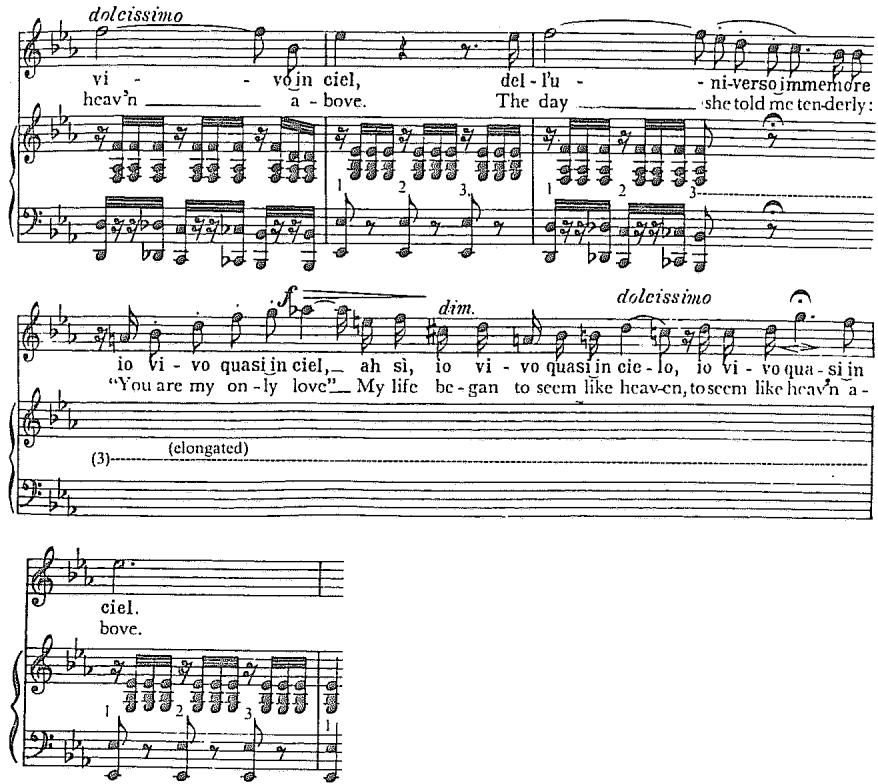
中文讲解
这是谱例2.18的图注及位置占位符。该谱例选自威尔第《茶花女》中咏叹调"De’ miei bollenti spiriti”(“我沸腾的精神”)的片段,用以演示前文所讨论的、发生在歌剧咏叹调中的即兴式上拍(improvisatory lead-in)现象,与谱例2.17(莫扎特)以及紧随的谱例2.19(贝多芬钢琴协奏曲)共同构成三个层面对应案例。 图中实际乐谱内容此处被省略,需查看原书以确认具体的上拍长度与节拍配置。
第6段(P0123)
原文复述
The conventional definition of meter, with its requirement for equally spaced beats, is contradicted at every turn by musical experience. If the requirement truly applied, every ritardando, accelerando, or fermata would disorient the listener metrically, and that is obviously not the case. On the other hand, our metrical perception of these phenomena seems to use the idea of equally spaced beats as a point of reference. We intuitively measure a ritardando, for example, against a hypothetical continuation of a steady tempo: the difference between that which is heard and that which is imagined (or remembered) accounts for the effect that a ritardando has on us.
中文讲解
本段以日常音乐经验反驳节拍的"等距律动"定义,并以渐慢、渐快、延长记号为例:如果真的要求严格等距,那每一次rubato都会让听者失去节拍感,但事实上并非如此。作者由此提出一个关键折中:等距律动不作为绝对规则,而作为"参照点"起作用——我们在听渐慢时,会在想象中维持一个稳定的tempo,并把实际听到的节奏与之对照,“听到"与"想象/记忆"之间的差异就构成渐慢带给我们的效果。 这段是后面"等距律动作为规范"概念的伏笔,论证了节拍可被打断而不被摧毁,因为听者始终在用内在的稳定tempo作参照。
第7段(P0124)
原文复述
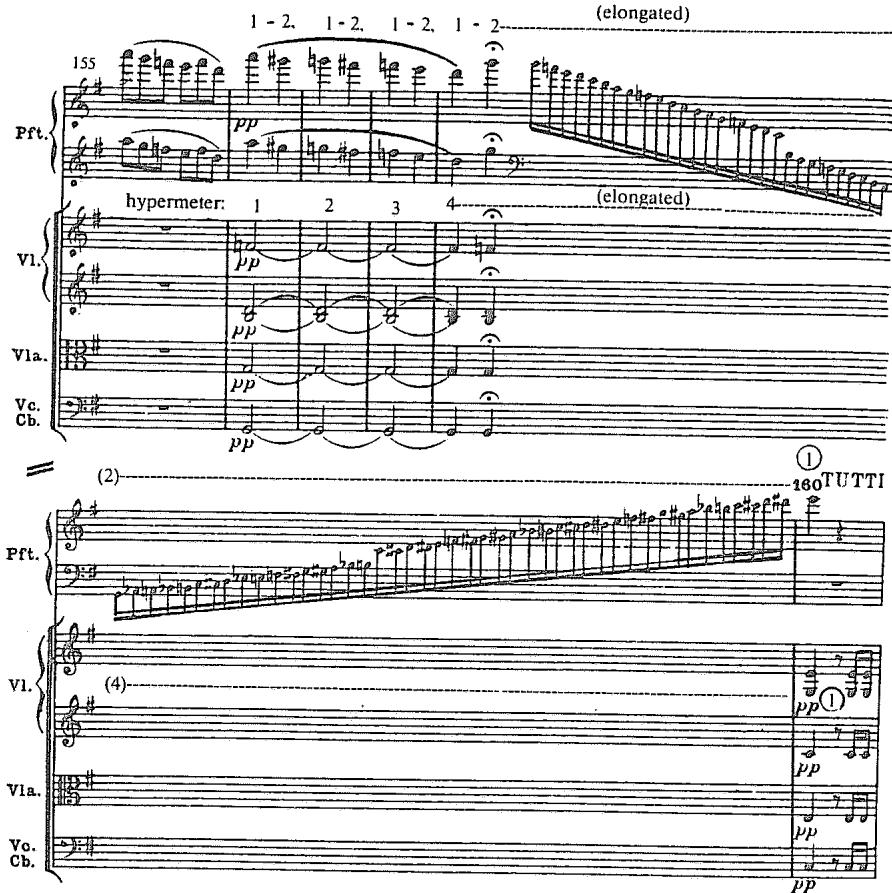
中文讲解
这是谱例2.19的图注及位置占位符。该谱例选自贝多芬《第四钢琴协奏曲》Op.58回旋曲乐章第155–160小节,对应前文提到的"协奏曲中的即兴式上拍"案例,与谱例2.17(莫扎特)和2.18(威尔第)合为三种不同体裁的对比实例。 图中乐谱内容此处被省略,需查看原书以确认具体声部进行与节拍安排。
第8段(P0125)
原文复述
An analogous process of comparison is at work when a metrical pattern is temporarily suspended, as in Examples 2.17–2.19. We figuratively—or even literally—hold our breath until the pattern is resumed, measuring the deviation from “strict time” according to the length of the delay before the expected downbeat. The reference here to the human breath is intended as more than a metaphor. Not only is breathing an analogous example of a duple pattern subject to temporal variation within certain limits, but there is an explicit connection—derived from vocal music—in the phenomenon of the cadenza. The cadenza in an aria or concerto is the extreme example, in tonal music, of an interpolation that delays the continuation of a fixed structure; the formal design and (often) the metrical pattern are forced to wait, along with the orchestra, until the soloist sees fit to resume the piece. (This remains true even if the composer has written out the cadenza.) In the Baroque aria, where the cadenza originated, it was apparently expected—at least ideally—that a cadenza would be completed in one breath of the singer. This rule was often abused or ignored, but its psychological foundation was a sound one. The tension engendered by a finite but indefinite suspension of a metrical pattern (cadenzas were largely unmeasured) corresponds perfectly to the tension—experienced either directly or vicariously—created by an indefinite prolongation of the human breath.
中文讲解
本段将"等距律动作参照"这一机制扩展到节拍模式被悬置的情形:当一个律动模式被临时悬置(如谱例2.17–2.19),听者会——无论在比喻还是字面意义上——“屏住呼吸”,用预期下拍到来之前所延迟的时长来衡量偏离"严格时值"的程度。 作者随即强调"呼吸"并非只是修辞:(1) 呼吸本身就是一种"允许在一定范围内作时值变化的双拍模式"的典型例子;(2) 在声乐传统中存在与华彩段(cadenza)的明确关联。华彩段是调性音乐中"打断固定结构延续"的极端形式,结构设计乃至节拍模式必须与乐队一起等待独奏者决定何时续接——即使作曲家已经把华彩段写定亦如此。在起源于华彩段的巴洛克咏叹调中,理想上要求华彩段能在歌手一口气之内完成;这条规则虽常被违反,但其心理基础是合理的:有限但不确定的节拍模式悬置(华彩段大多不计入节拍)所制造的张力,与人类呼吸被不确定地延长时所产生的张力完全对应。 本段的论证链条是:从节奏的"屏息"比喻,到人类呼吸的物理经验,再到声乐传统中华彩段的一口气规则,最后将"有限而不可预期的悬置"作为双层节拍操控的心理基础。
第9段(P0126)
原文复述
Victor Zuckerkandl, a musician of strongly philosophical bent, advanced a conception of musical meter based not on equal spans of time but on alternating and complementary phases of perceived motion. In his view, what is essential to a metrical pattern is not so much the maintenance of equally spaced pulses as the establishment of a kinetic cycle consisting of a moving away from and moving toward a series of goal points (that is, downbeats). Zuckerkandl’s conception differs from the common one in that it focuses on the quality of motion between beats rather than on the beats themselves or on the absolute distance between them.
中文讲解
本段引述Victor Zuckerkandl的节拍观作为理论支撑。Zuckerkandl不以"等距时间"而以"感知运动的交替与互补相位"为基础来定义节拍。他所认为的本质是建立一个由"远离下拍"与"趋向下拍"组成的运动循环(kinetic cycle)。其理论与传统定义的区别在于:关注点放在拍点之间运动的"质性”,而非拍点本身或拍点间的绝对距离。 此段为作者自己的综合论点做准备:把Zuckerkandl的"运动循环"与传统的"等距律动参照点"结合,就可以同时解释节拍的稳定性与其被悬置的能力。
第10段(P0127)
原文复述
We need not rehearse Zuckerkandl’s argument here to find something intuitively attractive about his idea. If we add to it the notion that the equally spaced beats of the conventional metrical model retain their relevance as a point of reference—a norm against which all deviations are to be measured—we will have arrived at a better and more useful understanding of the nature of meter. We can then conceive of rhythmic phenomena that disrupt a metrical pattern without destroying it. In a sense, such phenomena amount to a kind of composed rubato. What a performer’s rubato achieves on a relatively small scale—“stretching” the meter without breaking it—the controlled disruption of hypermeter can achieve on a much larger scale. As a source of variety and tension, the manipulation of hypermeter is a resource of inestimable value to the tonal composer.
中文讲解
本段是本节立场的综合与提升。作者指出,无需详细重述Zuckerkandl的论证便能直觉地感受到其吸引力;只要再补上"传统等距律动作为参照点"这一观念,就能得到一个更好的节拍理解。由此我们可以设想那些"打断节拍模式却不摧毁它"的现象——它们本质上是一种"被写定的弹性速度(composed rubato)"。 由此引出本节的核心类比:演奏家的rubato在相对小的尺度上"拉伸节拍而不打破它",而对超小节的可控打断则在远为更大的尺度上达成同样的效果。作为变化与张力的来源,超小节操控是调性作曲家具有不可估量价值的资源。 此段的功能是把前文的所有例证(莫扎特、威尔第、贝多芬、巴洛克华彩段)归并到一个统一的概念框架下,并为本节标题中的"cadenza-like deviations"提供理论落脚点。
第11段(P0128)
原文复述
The types of manipulation discussed thus far represent only a tiny fraction of the available possibilities. Other types will be treated in the next section. The most elaborate techniques, however, occur in conjunction with phrase expansion; Chapter 3 is devoted to that subject.
中文讲解
本段为过渡段,明确本节已讨论的类型只占可能性的极小一部分:其他类型将在下一节继续讨论,而最复杂的技术则与"乐句扩展"(phrase expansion)相关,留待第三章处理。 这段同时承担"收束本节"与"开启下文"两重功能:提示读者本节只是双层小节操控论题的初步铺陈,更复杂的形态——尤其是与乐句扩张结合的操控——将在第三章详细展开。
脚注 / 边栏 / 图表 / 附加信息(如有)
本小节涉及两处脚注标记:P0121中关于贝多芬Op.109第一乐章m.15与勃拉姆斯Op.76 No.7 m.23的注释(编号33),用以说明"在简单节拍中两小节之间加额外拍从而形成超长小节"的罕见实例;以及P0126中关于Zuckerkandl理论的注释(编号34)。两段脚注均为正文主张提供具体谱例佐证与理论来源说明,而非限定或反驳正文。 本小节包含两幅被省略的谱例:Example 2.18(威尔第《茶花女》“De’ miei bollenti spiriti"摘录)与Example 2.19(贝多芬《第四钢琴协奏曲》Op.58回旋曲乐章mm.155–60)。它们的作用是与谱例2.17(莫扎特)合为三类不同体裁——歌剧咏叹调与协奏曲——中的即兴式上拍案例,演示前文P0121关于"双层与单层节拍均可被独奏者的引入暂时打断"的论点。需查看原图以确认具体声部进行与节拍配置。
💡 本节核心要点
- 双层小节可以在相邻超小节之间插入"额外"材料的情况下仍被听辨出来,这与传统的"强弱必须规则交替"的节拍定义相冲突,因此需要修正对节拍的定义。
- 加长上拍(elongated upbeat)的现象既可发生在双层小节之间,也可发生在单层小节之间;在后者中更少见,且最常见于歌剧与协奏曲中独奏者的即兴式引入。
- 谱例2.17(莫扎特)中加长上拍占据实际小节,因此参与单层节拍但不参与双层节拍;而在单层节拍中出现的对应用例则是"小节间加额外拍"形成超长小节(罕见,如贝多芬Op.109/1 m.15、勃拉姆斯Op.76/7 m.23)。
- 等距律动的传统模型不应被抛弃,而应被理解为听者用以衡量偏离的参照点;听者把实际听到的节奏与内在想象的稳定tempo相对照,“听到"与"想象/记忆"的差异即构成rubato的效果。
- 节拍模式被悬置时的听感与"屏住呼吸"相关;人类呼吸本身即一种允许在一定范围内时值变化的双拍模式,声乐传统中华彩段"一口气内完成"的规则与该心理基础相吻合。
- Zuckerkandl把节拍本质理解为"远离下拍—趋向下拍"的运动循环,关注拍点之间运动的质性而非绝对距离;将其与"等距律动作为参照"结合,可得到节拍可被打破而不被摧毁的更佳理解。
- 对双层小节的可控打断相当于一种"被写定的rubato”:演奏家在较小尺度上拉伸节拍而不破坏它,作曲家则在更大尺度上通过操控双层小节达成同样的效果,是调性音乐中变化与张力的宝贵资源。
- 本节只是双层小节操控论题的初步铺陈,更复杂的类型留待下一节,而最复杂的技术与乐句扩展相关,留待第三章。
🔑 关键术语
- Hypermeter (双层小节):由两个或多个单层小节组成的更高一层节拍层级,本节将其定义为"被感知为小节的上层单位”,相当于"放大的小节"。本节讨论的核心对象即这一层级上的节拍操控。
- Elongated upbeat (加长上拍):在两个超小节之间插入的"额外"材料,它打乱了从超小节到下一超小节的规律律动,但并未推翻节拍本身;其角色相当于将正常上拍拉长到跨越多个小节。
- Improvisatory lead-in (即兴式引入):由独奏乐器或声乐在小节或超小节之间所作的"风格上类似即兴"的引子,是加长上拍在单层与双层节拍中最常见的触发情境;其天然家园是歌剧与协奏曲。
- Point of reference / norm (参照点 / 规范):传统节拍模型中等距律动的概念在本节中被降格为一种"规范":它不强制约束实际音乐,而是作为衡量所有偏离的内在尺度,听者以此想象一个稳定的tempo来对照实际听到的节奏。
- Composed rubato (被写定的弹性速度):本节提出的核心概念:作曲家通过在乐谱中预设的、可控的节奏打断来实现的"rubato"——它拉伸节拍却不摧毁之,与演奏家在表演中实现的rubato性质相同,但规模更大。
- Cadenza (华彩段):在咏叹调或协奏曲中,独奏者在固定结构(通常是返回主调或终止式)之前所作的即兴或写定段落;在巴洛克咏叹调中理想上应在"一口气"内完成,构成本节将节拍悬置与人类呼吸相类比的历史依据。
- Kinetic cycle (运动循环):Zuckerkandl节拍理论中的核心概念:节拍的本质不是等距的拍点,而是由"远离下拍"与"趋向下拍"两个相位交替构成的感知运动循环;该理论使节拍被打断而不被摧毁成为可理解的现象。
sec_2_1_13 [描述性拆分] Techniques of Phrase Linkage — Overview and Phrase Overlap
第1段(P0129)
原文复述
Techniques of Phrase Linkage
中文讲解
这是本节的标题,宣告接下来要讨论把各个乐句连接起来的技术手段。标题以复数形式呈现,说明作者将介绍不止一种衔接方法,而是从“环节链接”这一总体视角出发审视多种常见做法。
补充说明
小节标题的页面属性,原文无额外脚注。
第2段(P0130)
原文复述
In this section we will examine several techniques that are often used to link together individual phrases. These are techniques common to many styles of tonal music, although they may be used somewhat differently in different styles. Our focus will be on the actual points of linkage between phrases, rather than on the internal structure of the phrases involved or on the larger shapes created by the conjunction of phrases.
中文讲解
本段为本节确立讨论范围与边界。作者声明:本节将考察多种常用的乐句衔接技术,这些技术在许多调性音乐风格中都很常见,但在不同风格中用法可能略有差异。关键限定在于:讨论的焦点是“衔接点”本身,而非乐句内部的句法结构,也非由多个乐句联合形成的大尺度整体形态。
补充说明
无额外补充。该限定为后续讨论划定了清晰的层级:本节只关心“句与句之间”这一层。
第3段(P0131)
原文复述
When dealing with individual phrases, it is easy to lose sight of the fact that coherent tonal music is not composed by stringing together stray phrases one by one. No amount of ingenuity in the juxtaposition of phrases can substitute for a unified conception of an entire piece. Since phrase structure is hierarchical by nature, the connection of any two successive phrases derives its ultimate meaning from the larger phrase motions that govern the whole. Although our present concern is with local techniques of continuity and contrast, these must eventually be viewed within the larger contexts of actual compositions.
中文讲解
本段是一段方法论上的提醒,意在防止读者把本节内容教条化。核心主张是:连贯通顺的调性音乐不是把零散乐句一个接一个串起来的产物;任何巧妙的乐句并置都无法代替对整首作品的统一构思。其理论依据是乐句结构天然具有层级性,因此任意两个相邻乐句的衔接,其最终意义都源自支配全局的更大乐句运动。结论是:本节虽聚焦局部的连续与对比手法,但这些手法终究必须在完整作品的大语境中得到考察。这一段为前段划定的“衔接点”视角加上一层全局的约束,防止分析时只见树木不见森林。
第4段(P0132)
原文复述
Phrase Overlap and Subphrase Overlap
中文讲解
这是本节第一个小标题,宣告接下来将集中讨论“乐句重叠”与“亚乐句重叠”这两种衔接技术。标题以并列方式呈现,提示两者本质相同而尺度不同。
补充说明
小节标题,无脚注。
第5段(P0133)
原文复述
The very common technique of overlap, which has been described by various authors, 35 has already been encountered at the phrase level in Examples 2.7, 2.9, and 2.14. At the subphrase level, overlaps occurred in Examples 2.9 and 2.12. Simply stated, two phrases may be said to overlap when the last note (or chord) of the first phrase acts simultaneously as the first note (or chord) of the second phrase. (Subphrase overlap is precisely analogous.) Sometimes, though more rarely, more than one note or chord may be common to two overlapping phrases. Several examples of phrase overlap are given in Examples 2.20–2.26.
中文讲解
本段给出“重叠(overlap)”的定义。重叠是一种非常常见、由多位作者描述过的衔接技术,在前文实例2.7、2.9、2.14的乐句层面以及2.9、2.12的亚乐句层面已经出现过。简言之:当第一个乐句的最后一个音(或和弦)同时充当第二个乐句的第一个音(或和弦)时,这两个乐句即为重叠;亚乐句重叠与此完全类似。作者亦指出,虽然更少见,但有时两个重叠的乐句可能有不止一个共同音或和弦。后文将以实例2.20—2.26给出更多乐句重叠的谱例。脚注35指向相关参考文献。
补充说明
脚注35标志对“多位作者曾讨论过这一技术”的来源说明,本段正文未展开内容。
第6段(P0134)
原文复述
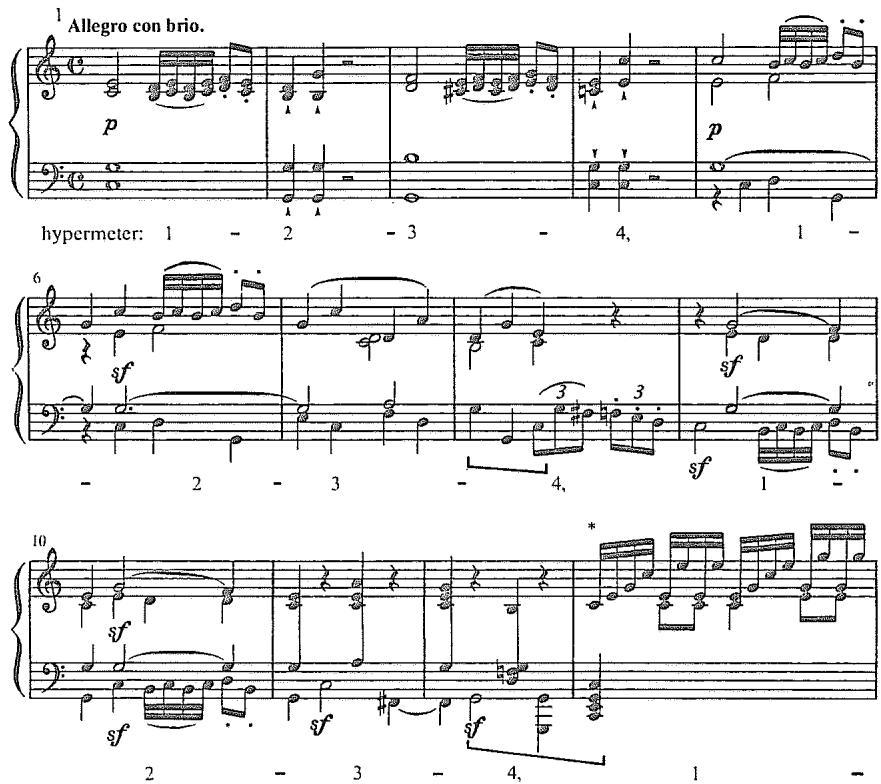
中文讲解
此为谱例2.20的占位符,原图为贝多芬《C大调钢琴奏鸣曲》Op. 2 No. 3第一乐章开头的乐谱。在原文中位于定义之后,作为第一个句法重叠的实例。
补充说明
谱例占位符,需参见原图以获取声部细节、和声进行与超拍号标记等。
第7段(P0135)
原文复述
Example 2.20 comprises one full period plus the beginning of a second period. The first period ends at the downbeat of m. 13 and comprises a fore-phrase (mm. 1–4) and two after-phrases (mm. 5–8 and 9–13). The double after-phrase is motivated by the imperfect cadence in m. 8: the second after-phrase is a variation of the first one (with the motive now in the bass), leading to a perfect cadence in m. 13. The second period begins precisely at this cadential point, indicated by the asterisk in Example 2.20.
中文讲解
本段描述实例2.20的全局句法结构。该实例包含一个完整的乐段及第二个乐段的开头;第一个乐段在第13小节正拍处结束,由一个前句(第1–4小节)和两个后句(第5–8与第9–13小节)组成。双后句由第8小节的不完全终止推动:第二个后句是第一个后句的变化重复(动机这次出现在低音),最终导向第13小节的完全终止。第二个乐段正始于此终止点上,谱例中的星号标示该位置。这段说明为后文讨论“该重叠为何并非不可避免”奠定结构基础。
第8段(P0136)
原文复述
The hypermetrical structure of Example 2.20 is indicated by numbers beneath the bass staff. It is evident that the point of overlap of the two periods coincides with a hypermetrical downbeat. This is the typical situation where phrase overlap is concerned. Less evident, perhaps, is the fact that the overlap was not inevitable. The first after-phrase completed itself within a four-bar hypermeasure, mm. 5–8; the second one, being a variation of the first, could easily have done likewise (see Example 2.21).
中文讲解
本段分析实例2.20的超拍号层级。超拍号结构由低音谱表下方的数字标示。两个乐段的重叠点恰好位于一个超拍号正拍上——这正是句法重叠的典型情形。然而,更进一步的事实是:这种重叠并非不可避免。第一个后句本身已在一个四小节的超小节内完整结束(第5–8小节);而第二个后句作为第一个后句的变体,本可以同样在四小节内结束(参见实例2.21)。本段由此引出贝多芬刻意为之的扩张手法。
第9段(P0137)
原文复述
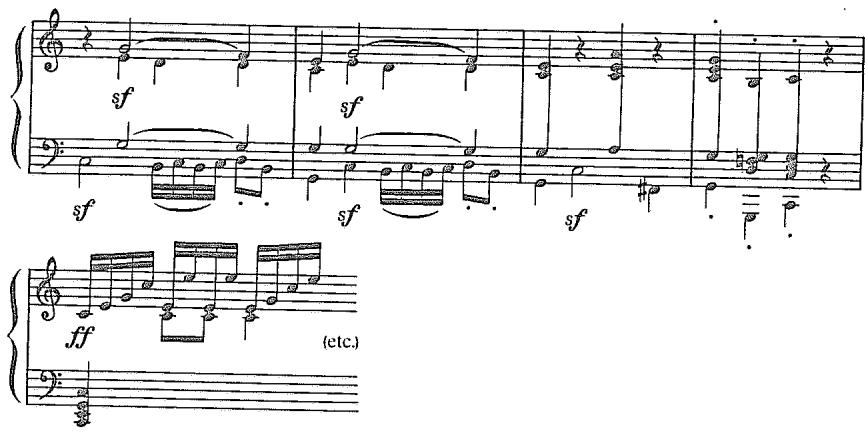
中文讲解
此为谱例2.21的占位符,原图是对贝多芬Op. 2 No. 3第9–13小节的“重组版本”,即假设没有扩张、没有句法重叠时会呈现的形态。
补充说明
谱例占位符,需参见原图以观察原本可在四小节内结束的终止形态。
第10段(P0138)
原文复述
In fact, Beethoven has expanded the final cadence of the period in order to make the overlap possible. The brackets in m. 8 and mm. 12–13 of Example 2.20 suggest how this has been done: the cadential figure g-G-c in the bass of mm. 12–13 has been slowed down, using the bass syncopation that began in m. 11 (which itself imitates the earlier syncopations in mm. 6, 9, and 10). Example 2.21 revokes this composed-out ritardando, and with it the phrase overlap.
中文讲解
本段揭示贝多芬为实现句法重叠所采取的作曲手法。贝多芬确实扩张了乐段的最终终止,以使重叠成为可能。实例2.20第8小节与第12–13小节中的方括号标示出这一做法:第12–13小节低音中的终止音型g-G-c被拉慢,所用的则是第11小节已经开始的低音切分(它本身又模仿了第6、9、10小节的切分节奏)。实例2.21撤销了这种“被谱写出来的渐慢(composed-out ritardando)”,句法重叠也随之消失。作者用“composed-out ritardando”这一生动比喻把扩张性的节奏拉宽比作乐器演奏层面的渐慢,并把重叠视为节奏积累的顶点之一。
补充说明
“composed-out ritardando”是一个分析性比喻,意为作曲家通过延长音符时值与切分造成渐慢效果,从而把本不需要的速度变化以谱面形式写出来。
第11段(P0139)
原文复述
Two other facts become clear when one compares Example 2.20 with its recomposed version. First, it is easy to see why Beethoven wanted the two periods to overlap. The rhythmic isolation of the various segments, which was such a prominent feature of the fore-phrase (mm. 1–4), becomes intolerable when continued as far as m. 13. Even the addition of a lead-in between the periods, perhaps in imitation of the triplet lead-in of m. 8, could not eliminate the plodding impression that Example 2.21 makes. Beethoven’s phrase overlap is the immediate culmination of a rhythmic process that spans the entire first period—a process whereby the isolated melodic fragments of the fore-phrase are gradually turned into a rhythmically fluent statement in the two after-phrases. (The unbroken sixteenth-note motion of mm. 13–26 represents the further consequence of this process.)
中文讲解
本段回答了“贝多芬为何需要重叠”这一问题。第一,如果节奏上的孤立片段(前句第1–4小节中尤为明显的特征)一直延续到第13小节,将变得难以忍受;即便在两个乐段之间加上一个引子(也许模仿第8小节的三连音引子),也无法消除实例2.21那种沉重笨拙的印象。因此,贝多芬的句法重叠是贯穿整个第一乐段的节奏过程的直接顶点——这一过程把前句中相互孤立的旋律片段逐步转变为两个后句中节奏流畅的陈述(第13–26小节不断的十六分音符运动是该过程进一步的结果)。作者由此把句法重叠升格为整体节奏逻辑的产物,而非单纯的句法装饰。
第12段(P0140)
原文复述
Secondly, Example 2.21 shows that the chord that would have ended the first period, if the periods were separated, is not precisely the same as the chord that begins the second period. The outer voices are identical, but the disposition of the inner voices is different. In many phrase overlaps the difference between the hypothetical ending and beginning chords—when one separates them as in Example 2.21—is much greater than it is here, involving a change in register, in instrumentation, in upper-voice tone, or (more rarely) even in harmony. In their book A Generative Theory of Tonal Music, Fred Lerdahl and Ray Jackendoff use the term “elision” rather than “overlap” to denote cases in which the ending and beginning chords of the two phrases would not be identical if the phrases were separated. 36 This is a logical distinction, since one hypothetical和弦 (almost always the last chord of the first phrase) has indeed been omitted or elided in the conjunction of the two phrases. But since the perceived effect is still one of phrases overlapping—the listener “hears” the elided chord subsumed in the actual one—we will use the term overlap whether or not an elision is present.
中文讲解
本段揭示重叠中潜在的“缺省”并介绍术语争议。实例2.21表明:将重叠拆开来看,原本会结束第一乐段的和弦与实际开启第二乐段的和弦并不完全相同;外声部一致,但内声部排列不同。在许多句法重叠中,假想终止与起始和弦之间的差异远比此处更大,可能涉及音区、配器、上声部音色,甚至和声本身的变化。Lerdahl与Jackendoff在《生成调性音乐理论》中用“elision(吞并)”一词替代“overlap”,专指那些若拆分两乐句则首尾和弦必然不同的情况——因为两乐句相接时某和弦(几乎是第一乐句的末尾和弦)确实被省略了。然而,由于听感上仍然是乐句在重叠,听者把被吞并的和声“听进了”实际听到的和声中,本书统一使用“overlap”一词,不论是否存在吞并。脚注36指明该术语出处。
补充说明
术语分歧:本书统一用overlap,而Lerdahl与Jackendoff以elision指代首尾和弦不同的情形;本书选择优先依据听感印象而非假设和声结构。
第13段(P0141)
原文复述
In Example 2.22, which shows another phrase overlap, there is more than one note or chord common to both phrases. This is an antecedent-consequent structure—a parallel period. However, the half cadence of the antecedent is overlapped by the beginning of the consequent in m. 9. The antecedent really ends at the second beat of m. 9, with e 1 in the melody. The consequent begins at the third beat of m. 8, which corresponds to the initial upbeat of the antecedent. The overlap itself is thus three beats long, the equivalent of an entire measure, at least in the melody. (See mm. 8–9 in Example 2.22.)
中文讲解
本段引入第二个重叠实例(实例2.22)并描述其结构特征。与实例2.20不同,这里的两个乐句共享不止一个音或和弦;整段呈“起句—承句”结构的平行乐段。前句的半终止被位于第9小节后句开头的部分所重叠:前句实际上在第9小节第二拍、旋律音e¹处结束;后句则始于第8小节第三拍,对应于前句原本的起拍位置。因此该重叠在旋律层长达三拍,相当于整整一小节(参见实例2.22的第8–9小节)。作者借此说明,重叠的范围可以超过单音单和弦,扩展到完整的乐句头部。
第14段(P0142)
原文复述
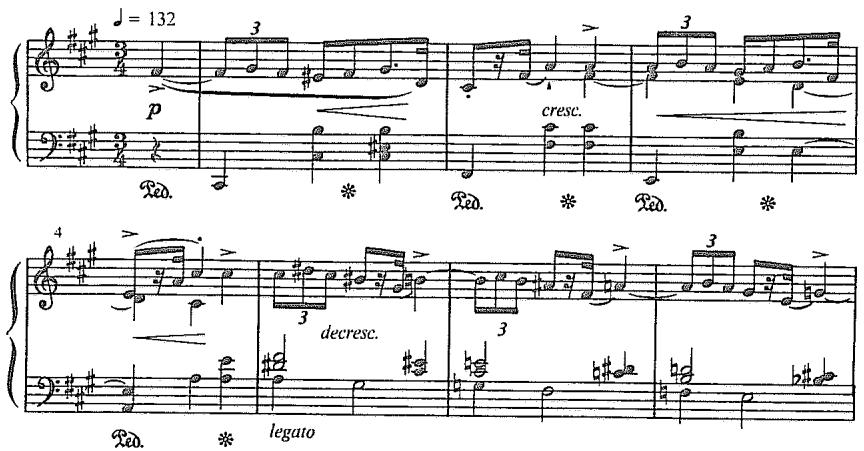
中文讲解
此为谱例2.22的占位符,原图为肖邦《升f小调玛祖卡》Op. 6 No. 1开头的乐谱,展示本段所述的起承句重叠。
补充说明
谱例占位符,需参见原图。
第15段(P0143)
原文复述
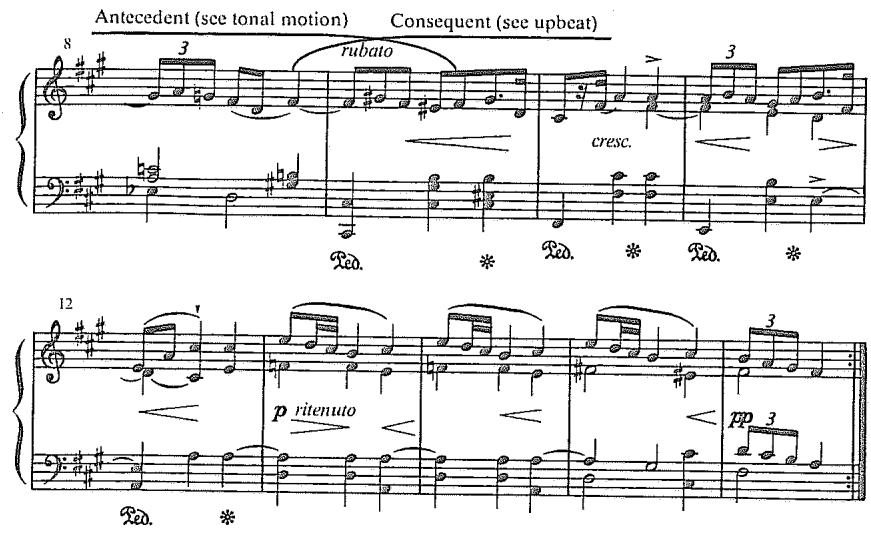
中文讲解
此为谱例2.22续页的占位符,对应原图中跨页显示的后续小节。
补充说明
谱例占位符续页。
第16段(P0144)
原文复述
Example 2.23 separates the antecedent’s end from the consequent’s beginning, omitting the seventh (b) from the half-cadential V harmony in order to clarify the harmonic goal of the antecedent. In this mazurka, as in Example 2.20, the phrase overlap does not disturb the hypermeter. (The Chopin is pervasively duple metrically, with hypermeasures of two, four, and eight bars.) In fact, as Example 2.23 demonstrates, the overlap actually preserves the hypermeter. Unlike the second after-phrase of the Beethoven (see Example 2.21), the antecedent phrase of the
中文讲解
本段继续分析肖邦案例,介绍实例2.23——把前句末尾与后句开头分离以便观察的重组版本,其中省略了半终止V和弦的七音b,以清晰显示前句的和声目标。与实例2.20一样,这里的句法重叠并未打乱超拍号——这首玛祖卡整体为复二拍,含二、四、八小节的超小节。事实上,实例2.23表明,重叠反而保留了超拍号;与贝多芬实例2.21中可被压缩入四小节的后句不同,肖邦的前句因后文(第5小节起的半音下行及每小节第三拍的动机性切分)而无法被压缩。段尾句子被截断,引出下一段继续讨论前句长度问题。
第17段(P0145)
原文复述
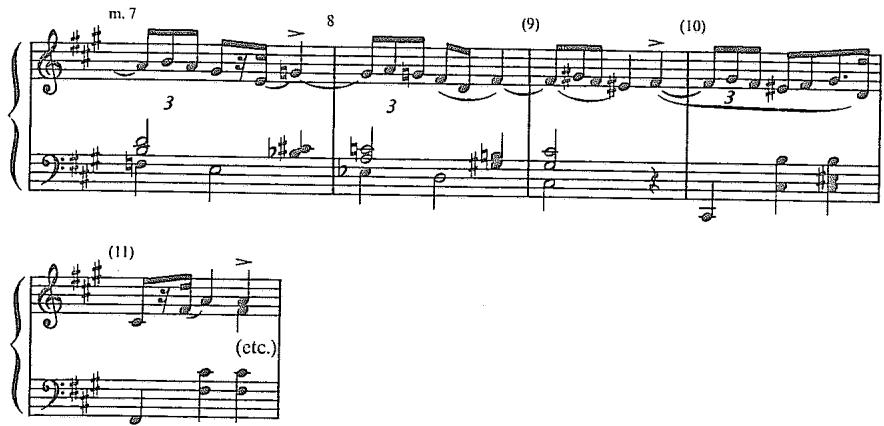
中文讲解
此为谱例2.23的占位符,原图为对肖邦Op. 6 No. 1第7–10小节的重组版本,展示没有句法重叠时的起承句结构。
补充说明
谱例占位符,需参见原图。
第18段(P0146)
原文复述
Chopin could not be fitted into a duple hypermeasure without altering its structure radically. Given the chromatic descent starting in m. 5 and the motivically important syncopation on the third beat of each measure, the phrase must occupy nine measures (4 + 5) . Since non-duple phrase lengths are uncharacteristic of most dance music, Chopin takes advantage of the fact that his principal theme begins with a dominant (C#) in the bass, rather than with a tonic: 37 by making the half-cadential V coincide with the beginning of the consequent phrase, he turns the ninth measure of the antecedent into a first measure, thus giving the impression of a symmetrical period of 8 + 8 measures. The arrival of the double-edged dominant in m. 9 is marked rubato by Chopin; the performer should take special care to bring out its full meaning.
中文讲解
本段解释肖邦选用九小节前句(4+5)的根本原因。前句若强行压缩入复拍超小节,其内部结构将被彻底改变:第5小节起的半音下行与每小节第三拍的动机性切分共同决定了前句必须横跨九小节。然而非复拍数的乐句长度在大多数舞曲中都不典型——玛祖卡尤其忌讳不对称。于是肖邦利用主题以属音C♯而非主音开始这一事实,使半终止的V与后句起点同处一拍,从而把前句的第九小节“变成”后句的第一小节,制造出8+8小节对称乐段的错觉。第9小节“双重身份的属音”(既是前半句收束又是后半句开端)处,肖邦标有rubato,提示演奏者应特别细致地呈现其含义。脚注37与属音开始的乐曲惯例有关。
补充说明
脚注37提示以属音起首的乐曲惯例,与本段利用“主属错位”形成对称结构的论述相呼应。
第19段(P0147)
原文复述
As we noted in the discussion of Example 2.20, phrase overlaps tend to coincide with hypermetrical downbeats. If more than one note or chord is involved in the overlap, as in Example 2.22, the overlap will still include a hypermetrical downbeat in most cases. Knowing these facts, we can generalize as follows: A phrase overlap is most likely to occur when the first of two phrases ends either at (or just after) a hypermetrical downbeat.
中文讲解
本段对重叠与超拍号的关系做出归纳性概括。承接实例2.20的讨论,句法重叠往往与超拍号正拍同时出现;即便像实例2.22那样重叠涉及多个音,重叠区间在多数情况下仍包含一个超拍号正拍。由此可概括为:两个乐句中前者结束于“超拍号正拍处或紧接其后的位置”时,最有可能发生句法重叠。这一规律为整个小节的讨论作了收束,把贝多芬与肖邦两个案例统一在一个原则之下。
补充说明
本段既是归纳也是预测性原则,可用以在分析新作品时定位潜在的重叠点。
脚注 / 边栏 / 图表 / 附加信息(如有)
本节(pp. 14–17)共涉及三处脚注标记:P0133的脚注35注明“多位作者曾讨论过重叠”,P0140的脚注36注明Lerdahl与Jackendoff的术语出处,P0146的脚注37与主题以属音起首的惯例相关。三脚注在本段正文中均起限定与来源作用,未对论点作扩展说明。谱例2.20、2.21、2.22、2.22续页、2.23均为插图占位符,其功能是分别呈现原始谱面与“去除重叠后的重组谱面”的对照,从而让读者直观体会重叠的处理方式。
💡 本节核心要点
- 句法重叠是常见且多作者使用的衔接方式,其本质是让前句末音与后句首音同时发声;亚乐句重叠原理相同但尺度更小。
- 重叠点通常与超拍号正拍重合,这是重叠的典型位置——但重叠并非不可避免,它往往依赖作曲家的扩张处理(例如贝多芬实例2.20的低音切分拉慢)。
- 若假设拆分两乐句,其首尾和弦可能不一致(甚至涉及音区、配器、和声差异),Lerdahl与Jackendoff称之为“elision”;本书统一以“overlap”涵盖这两种情况,强调听感印象优先。
- 实例2.22表明,重叠可以扩展到整小节而非仅止于单一音和弦的范围。
- 肖邦案例揭示,重叠有时是解决乐句长度与超拍号对称冲突的工具:九小节非对称前句通过与后句共享半终止V而被“伪装”为8+8对称周期,该处也由作曲者标记为rubato以强调其双重意义。
- 全节最终归纳为可预测的原则:前句终结于超拍号正拍或其紧后位置时,句法重叠最有可能发生。
🔑 关键术语
- Phrase Overlap(句法重叠/乐句重叠):两个乐句(或亚乐句)共享末端与起端音或和弦的衔接技术——前句最后一音同时充当后句第一音。
- Subphrase Overlap(亚乐句重叠):在亚乐句尺度上发生的完全相同的重叠现象。
- Fore-phrase / After-phrase(前句 / 后句):术语来自Schachter等学者的句法层级:在一个由前后句组成的复合句(compound period)中,前句常含前句,后句通常成对出现(双后句)以扩充终止。实例2.20的mm. 1–4为前句,mm. 5–8与mm. 9–13为成对的后句。
- Hypermetrical downbeat(超拍号正拍):高一级拍组(如二、四、八小节构成的超小节)的起始位置。本节强调句法重叠通常与此位置重合。
- Composed-out ritardando(谱写出来的渐慢):分析性比喻,指作曲家通过拉长音符时值、切分等手段,在乐谱层面模拟演奏中的渐慢效果,用于解释贝多芬扩张终止的句法功能。
- Elision(吞并):Lerdahl与Jackendoff使用的术语,指拆分两乐句后其首尾和弦本不相同的重叠情况;本书出于听感优先的理由仍统一使用overlap。
- Imperfect cadence / Half cadence(不完全终止 / 半终止):句法结构中推动双后句或前句扩张的常见动力来源。实例2.20在m. 8的不完全终止推动了第二个后句的出现;实例2.22前句的半终止成为重叠的关键节点。
sec_2_1_14 [描述性拆分] Overlaps in Afterbeat Patterns and Subphrase Overlap
第1段(P0148)
原文复述
Earlier in this chapter we became acquainted with upbeat and afterbeat patterns, in which a phrase or series of phrases is slightly out of phase with the hypermeter. In an afterbeat pattern, the less common of the two types, a phrase beginning with an afterbeat ends either at or just after a hypermetrical downbeat. The generalization we have just made suggests that the juxtaposition of phrases in an afterbeat pattern can easily take on the appearance of a series of phrase overlaps.
中文讲解
本段是本节的开场,承前文把两个概念勾连起来:在本章早前介绍过的 upbeat 与 afterbeat pattern 都是短语与 hypermeter 之间存在轻微相位偏移的模式;其中 afterbeat 是较少见的一类——短语从 afterbeat 开始,但其结尾却落回或紧贴 hypermetrical downbeat 之后。这种"相位错位"使得相邻短语的尾部与头部在交界处自然挤在一起,从而让 afterbeat pattern 看起来像是一连串 phrase overlap。读者要把握的关键在于:这里的"重叠外观"是 afterbeat 结构本身的产物,并非作曲家刻意制造的真正重叠——这也是下一节要区分表观重叠与真实重叠的伏笔。
补充说明
upbeat pattern(弱起模式)则是短语在强拍前起奏、其重音落在弱位,与 afterbeat 模式方向相反。两种模式都属于本章前半部分已建立的概念,本段只做回顾式引用,不重新展开。
第2段(P0149)
原文复述
Example 2.24, from a violin sonata by Brahms, illustrates this tendency; here the hypermeter is duple. Hypermeasures are of two and four bars, with the former probably the more prominent owing to the rather slow tempo (andante tranquillo). The odd-numbered measures are metrically strong, even though the bass line begins at m. 2 rather than m. 1. The example retains Brahms’s legato slurs. To avoid any possible confusion between phrase structure and articulation, square brackets (rather than slurs) are used to delineate phrases; dotted brackets delineate subphrases.
中文讲解
本段为分析对象——Brahms《A 大调钢琴与小提琴奏鸣曲》Op.100 第二乐章开头——设定节拍背景。该例 hypermeter 为双数,二小节和四小节 hypermeasure 并存;但因速度为 andante tranquillo(安静的行走速度),作者认为二小节 hypermeasure 反而更突出。值得注意的是 bass line 虽然从 m.2 才进入,奇数小节仍维持节拍上的强位——这是 afterbeat pattern 的典型表现。同时作者约定谱面记号:保留 Brahms 原有的连音线(legato slurs),但乐句改用方括号(实线)、子句用虚线方括号,以避免连音线与乐句结构混淆。这一约定对后续所有分析都至关重要。
补充说明
andate tranquillo 是 Brahms 自题的指示词,常见于室内乐语境;慢速会让听者更倾向于感知较短的 hypermeasure 单元,这是本节选定此例作为分析对象的前提条件之一。
第3段(P0150)
原文复述
As frequently happens at the beginning of an afterbeat pattern, the downbeat is sounded in the accompaniment in m. 1. The first complete phrase extends to the downbeat of m. 5 (also a hypermetrical downbeat); it consists of two rhythmically similar subphrases, mm. 1–3 and 3–5. The first of these actually ends with a f¹ on the downbeat of m. 3, the second then beginning with c² on the second half of the beat. But Brahms uses the rhythmic motive ☐ as a link between the two subphrases, thereby making it seem as if the first one extends to the second eighth note of m. 3. Because of the link (which of course derives from m. 2), the two subphrases appear to overlap at the second eighth. (See the asterisk at that point in Example 2.24.) Example 2.25, a slight reduction of the passage, clarifies the situation: the overlap is merely apparent as far as the actual subphrases are concerned; the impression of overlap is caused by the use of the linking motive.
中文讲解
本段是本节核心分析的第一段:m.1–5 之间的"表观重叠"。第一完整乐句从 m.1 延至 m.5 的 downbeat(同时也是 hypermetrical downbeat),由两个节奏相似的子句 m.1–3 与 m.3–5 组成。按 afterbeat 原则,第一个子句本应结束在 m.3 downbeat 上的 f¹,第二个子句从该拍后半的 c² 开始——这是干净的衔接,并无真正的重叠。然而 Brahms 在两子句之间插入了一个源自 m.2 的节奏动机作为链接,使第一个子句听起来仿佛延伸到了 m.3 的第二个八分音符,由此在视觉与听觉上造成"重叠"的错觉(谱例 2.24 中相应位置的星号 *)。Example 2.25 的简化图揭示:实际子句并无真正重叠;所谓的 overlap 完全由链接型 motive 制造。本段的论证意义在于把"真正的 subphrase overlap"与"由 motive 制造的表观重叠"区分开。
补充说明
f¹ 与 c² 的音程关系(大六度上行跳进)与 motive 的插入位置共同形成作者的判断依据;该判断在 Example 2.25 的简化图中以方括号的形式可视化呈现。
第4段(P0151)
原文复述
At m. 5, however, a genuine phrase overlap occurs. The phrase that begins here starts precisely on the downbeat, recalling the piano motive of m. 1 and overlapping the final note of the first phrase. (See the second asterisk in Example 2.24.) However, Brahms continues the afterbeat orientation more subtly—by delaying the melodic peak g² until the second eighth note and by syncopating the bass. In addition, both the initial subphrase (mm. 5–6) and the phrase as a whole end on downbeats—despite Brahms’s slurs. (Note that mm. 5–6 imitate mm. 4–5; see the brackets in Example 2.25.) The downbeat of m. 6 is therefore an overlap at the subphrase level.
中文讲解
m.5 处发生的是真正的 phrase overlap,与 m.3 的表观重叠形成对照:新乐句精确地在 downbeat 起奏,呼应 m.1 的钢琴 motive,并在节拍位置与第一乐句的尾音重叠(谱例 2.24 中第二个星号)。但 Brahms 并不因此放弃 afterbeat 的整体倾向——他通过两个更隐蔽的手法维持语感:把旋律高点 g² 推迟到第二八分音符(不在重拍上),以及让 bass 切分(syncopation)。结果,尽管 Brahms 在谱面上写了连音线,初始子句(m.5–6)与整个乐句都落在 downbeat 上——这与 P0148 所述 afterbeat 短语"结束在 downbeat 或刚过 downbeat"完全一致。m.5–6 还模仿了 m.4–5(谱例 2.25 方括号所示),故 m.6 的 downbeat 既是模仿点又是 subphrase overlap。本段的关键是:在真实 overlap 发生的瞬间,作者仍能通过细节维持 afterbeat 的整体律动,这是 afterbeat 与 overlap 共存的关键证据。
补充说明
m.5–6 对 m.4–5 的模仿让 subphrase overlap 同时具有模仿对位的功能,使 overlap 与动机发展合二为一,这是 Brahms 音乐写作的一个典型特征。
第5段(P0152)
原文复述
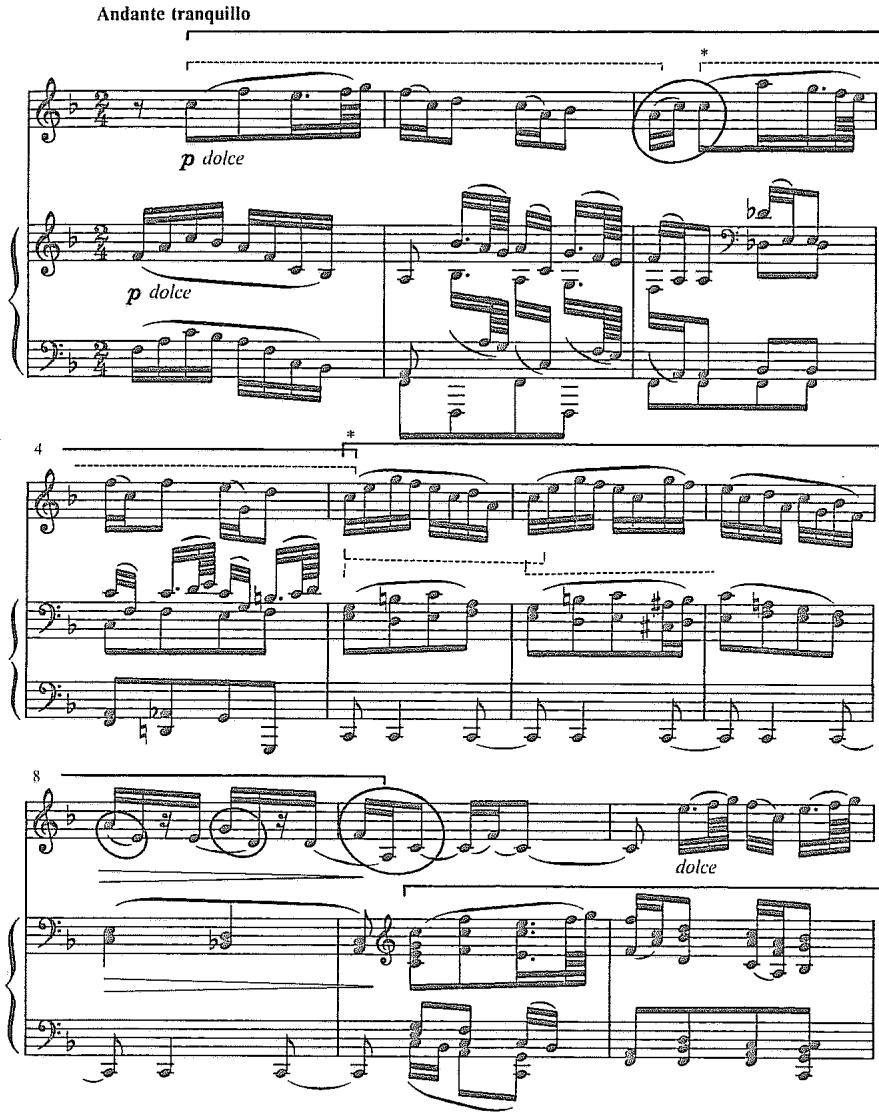
中文讲解
这是谱例 2.24 的图位——Brahms Op.100 第二乐章开头的乐谱。图中保留 Brahms 原有的连音线(legato slurs),乐句与子句分别用实线方括号、虚线方括号标注。两个星号(*)分别标示 m.3 第二八分音符处的表观重叠与 m.5 处的真正重叠;圆圈标注 m.9 附近的音(与 P0155 涉及的下行四度跳跃有关)。由于图注与文字描述明确对应,原图是本节论证不可替代的依据。
补充说明
需查看原谱以确认每个声部的具体音高、节奏型与和声进行;文字描述无法替代原谱细节。
第6段(P0153)
原文复述
The following table contains two columns: the first column contains a series of dots (e.g., 1, 2, 3, 4, 5, 6, 7, 8, 9, 10, 11, 12, 13, 14, 15, 16, 17, 18, 19, 20) and the second column contains a single dot (e.g., 1, 2, 3, 4, 5, 6, 7, 8, 9, 10, 11, 12, 13, 14, 15, 16, 17, 18, 19). The second column contains three rows of dots (e.g., 1, 2, 3, 4, 5, 6, 7, 8, 9, 10, 11, 12, 13, 14, 15, 16, 17), each with a vertical line extending to the right. The third column contains four dots (e.g., 1, 2, 3, 4, 5, 6, 7, 8, 9, 10, 11, 12, 13, 14, 15, 16), each with a horizontal line extending to the right. The fourth column contains five dots (e.g., 1, 2, 3, 4, 5, 6, 7, 8, 9, 10, 11, 12, 13), each with a vertical line extending to the right. The fifth column contains six dots (e.g., 1, 2, 3, 4, 5, 6, 7, 8, 9, 10, 11, 12, 13), each with a horizontal line extending to the right. The sixth column contains seven dots (e.g., 1, 2, 3, 4, 5, 6, 7, 8, 9, 10, 11, 12, 13), each with a vertical line extending to the right.
中文讲解
本段疑为某幅非乐谱插图(可能为表格、流程图或示意图)的 OCR 残留文本,其内容(点列、连线、数字编号)与本节关于 afterbeat 与 subphrase overlap 的讨论无明显对应关系,且行文风格与上下文叙述差异显著。推测可能是原书页面上某处误被 OCR 捕获的图像描述,或不同版本排版遗留的占位文本。读者应将其视为版面瑕疵,不参与本节论证;具体含义需查阅原书确认。
补充说明
原文明显是 OCR 误读结果,与音乐内容脱节;本节真实谱例已由 P0152、P0154、P0157 三处图位完整覆盖,故此段不影响对节义的理解。
第7段(P0154)
原文复述

中文讲解
这是谱例 2.25 的图位——Brahms Op.100 第二乐章 m.1–9 的旋律简化图。该图把原谱压缩为只显示骨架式的旋律线,并用方括号(实线、虚线)标示乐句与子句边界,目的是让 m.3 的"表观重叠"与 m.5 的真正重叠更容易被肉眼识别。简化图揭示的核心事实是:m.3 处的子句衔接实际发生在 downbeat 上,所谓"重叠"是链接型 motive 在表层造成的错觉。
补充说明
旋律简化(melodic reduction)是音乐分析常用手法——剥离和声、节奏型等细节,仅保留旋律骨干与结构划分,从而把分析者注意力集中到 phrase-level 的问题上。
第8段(P0155)
原文复述
Another and more complicated phrase overlap occurs in m. 9; we will not analyze it in full detail. A repetition of the opening melody begins in the piano on the second eighth note of m. 9, while the violin becomes accompanimental. On the downbeat, an expected root-position tonic has been suppressed, partly in order to reproduce the unstressed, upbeat-like quality of m. 1. Rather as in m. 3, the rhythmic motive is used in the violin to link a melodic goal tone (f¹ on the downbeat of m. 9) with the afterbeat. (The goal quality of f¹ is undermined, however, by the lack of a tonic in the bass.) This time the rhythmic motive serves as something more than a link: as the circled notes in Example 2.24 suggest, the rhythmic motive serves to complete a descending leap of a fourth, f¹–c¹, in imitation of the similar fourths in the preceding two measures. That this fourth is repeatedly taken up by both instruments after m. 9 is of course no accident.
中文讲解
本段进一步分析 m.9 处更复杂的 phrase overlap,作者声明只作重点而不做全分析。开篇旋律在 m.9 第二八分音符由钢琴重复出现,小提琴则转为伴奏;m.9 downbeat 上原本预期的根位主音被刻意抑制,以重现 m.1 那种"轻拍性"。f¹ 出现在 downbeat 上看似构成目标音,但因 bass 缺乏主音支持,其目标性被削弱——这与 m.3 的处理相似:节奏动机再次扮演链接角色。然而 m.9 处 motive 的功能不止于"链接"——谱例 2.24 中的圆圈提示它还补完了一个下行四度跳跃 f¹–c¹,模仿前两小节的类似四度。这一四度跳跃在 m.9 之后被两声部反复接力,构成 motive 发展的延伸。该段论证意义:m.9 是 afterbeat pattern 与 phrase overlap 共存的更复杂样本,并展示了 motive 如何同时承担"链接"与"动机构造"双重任务。
补充说明
下行四度跳跃的反复接力是 Brahms 室内乐写作的典型特征;该段没有给出 f¹–c¹ 在何处被两声部接力的全部细节,是作者主动略去的部分,留待读者结合谱例自行补完。
第9段(P0156)
原文复述
If we return to our original example of afterbeat patterns, Bach’s C Major Invention (first presented as Example 2.9), we see how easily an afterbeat pattern can give rise to overlaps, and how imperceptibly the one phenomenon shades into the other. For convenience, the passage is reproduced here as Example 2.26, with phrases and subphrases indicated by solid and dotted slurs respectively; in addition, the basic motive is marked with square brackets. ³⁸ At the ends of the first two subphrases there is no question of any overlap, because of the leaps between the subphrases and because of the clear use of the basic motive in either its original or inverted form. (These considerations apply to the right hand only.) From the middle of m. 3, however, the leaps between melodic segments disappear, leaving continuous stepwise motions that betray less and less of their afterbeat origins. Through a voice-leading device, namely, the exchange of voices (indicated by crossed diagonal lines in Example 2.26), Bach encourages the listener to hear each new subphrase as beginning on the beat rather than after it. By the third beat of m. 5 at the latest, this hint of Bach’s has become irresistible, and one cannot but perceive an overlap at this point. Probably one has already heard a continuous overlapping of segments from the beginning of m. 4.
中文讲解
本段把分析拉回到本章最早的 afterbeat 范例——Bach C 大调第一号 Invention(先前以 Example 2.9 出现,现重排为 Example 2.26),目的有二:一是用本节获得的概念(phrase overlap)反观原例,二是揭示 afterbeat 与 overlap 之间可以"不知不觉地相互过渡"。分析分两步:第一步,前两个子句结尾处因跳跃和动机清晰(原始或倒影形式)而无 overlap 嫌疑(仅限右手声部);第二步,从 m.3 中部起,跳跃消失,连续级进掩盖了 afterbeat 的起源。关键手法是"声部交换"(voice exchange,谱例 2.26 中交叉对角线)——Bach 通过声部角色的互换,引导听者把每个新子句听成"正拍开始"而非"后半拍开始"。到 m.5 第三拍为止,这种暗示变得不可抗拒,重叠感不可避免;实际上从 m.4 起可能就已经在感知连续重叠。本段对本节整体的意义在于:用 Bach 的简洁对位语言演示了 Brahms 例中较复杂的现象如何在更朴素的织体里逐渐浮现。
补充说明
脚注 38 在本段末尾被引用,但脚注内容不在本节 source_paragraphs 内;其作用可能是补充谱例 2.26 或 Bach 该作品的版本/出处信息,但具体内容需查阅原文页脚。
第10段(P0157)
原文复述
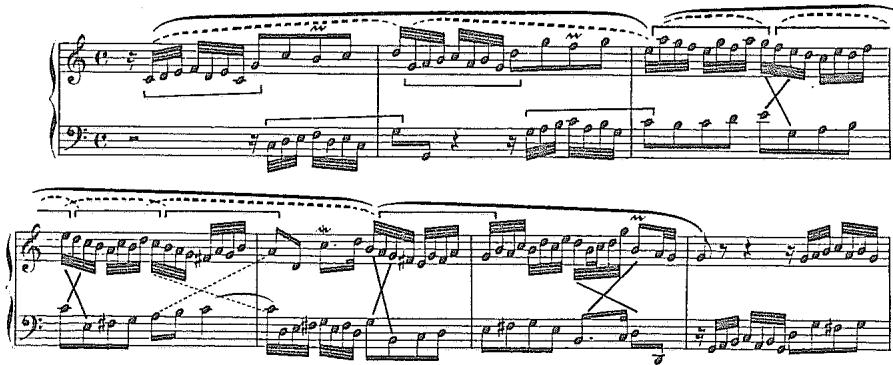
中文讲解
这是谱例 2.26 的图位——Bach C 大调第一号 Invention 开头的乐谱。图中实线连音线标示乐句,虚线连音线标示子句,方括号标示基本动机,交叉对角线标示 voice exchange 的发生位置。该谱例与文字描述中的所有标注一一对应,是 P0156 论证的视觉基础。
补充说明
Invention No.1 in C Major (BWV 772) 是 Bach 为长子 Wilhelm Friedemann 写作的二声部教学作品,本身就是研究对位与乐句结构的经典样本,本节用它来演示 afterbeat 与 overlap 的渐进过渡。
第11段(P0158)
原文复述
As the foregoing examples have demonstrated, composers use phrase and subphrase overlap chiefly to secure a greater feeling of continuity in the melody. When two melodic segments overlap, a point of melodic punctuation—to use an 18th-century expression—is eliminated or transcended. Overlap is particularly frequent in those styles in which surface melodic continuity is most highly prized. The late Baroque and late Romantic periods are therefore especially notable for their heavy use of this technique, although it appears in all styles of tonal music.
中文讲解
本段是本节总结,回应开篇 P0148 的预告,把 afterbeat pattern → 看似重叠 → 真实重叠的论证链收束到核心功能上:作曲家用乐句与子句重叠的主要目的是增强旋律的连续感。当两个旋律片段重叠时,一个"旋律停顿点"(melodic punctuation,作者特意注明这是 18 世纪的术语)被消除或超越。因此,overlap 集中出现在那些把表面旋律连续性视为最高价值的风格中——晚巴洛克(Bach、Handel 等)与晚浪漫主义(Brahms、Wagner 等)尤为突出;但事实上所有调性音乐风格里都能见到这一技巧。该段意义在于把本节具体分析与作者的整体方法论(旋律连续性优先)联系起来,并暗示这是一个贯穿调性音乐史的普遍现象。
补充说明
18 世纪的 melodic punctuation 概念通常与 Koch、Sulzer 等理论家对"乐句"与"句读"的论述相关;本段注释为引用前人术语,未进一步展开。
脚注 / 边栏 / 图表 / 附加信息(如有)
本节包含三处图位(Example 2.24 在 P0152、Example 2.25 在 P0154、Example 2.26 在 P0157)以及一段疑似 OCR 残留的图注(P0153)。三处图位的标题与位置已保留,但音符、和声、连线等具体谱面信息因图像数据被省略,需查阅原书核实;其中 Example 2.24 与 Example 2.25 在 P0150–P0151 与 P0155 的分析中分别被文字反复指涉(星号 *、圆圈、方括号、motive 链接等),Example 2.26 在 P0156 中被文字反复指涉(实线/虚线 slurs、方括号、交叉对角线)。P0153 的内容(点列与连线)显然不属于本节乐谱语境,可能是不同图像/表格的 OCR 误捕,建议忽略该段。P0156 末尾的脚注 38 在本节 source_paragraphs 中未出现脚注本身,仅在正文出现上标编号,推测其内容为 Bach Invention 的版本/出处或关于谱例的旁注,需查原书页脚。
💡 本节核心要点
- Afterbeat pattern 的短语尾部落在 hypermetrical downbeat 附近,这种"相位错位"使相邻短语在交界处自然看起来像是一连串 phrase overlap,这是本节论证的逻辑起点。
- Brahms Op.100/ii 的 m.3 处显示:两个子句之间用源自前小节的节奏动机作为"链接",可以造成"表观重叠";Example 2.25 的简化图揭示实际子句边界并无真正重叠,重叠感完全来自 motive 的链接作用。
- 同一例的 m.5 处发生的是真正 phrase overlap:新乐句精确起奏于 downbeat 并覆盖前句尾音;但 Brahms 通过延迟旋律高点 g² 与切分 bass,仍然维持 afterbeat 的整体律动——这是 afterbeat 与 overlap 共存的典型证据。
- m.9 的 overlap 更为复杂:节奏动机既作链接又补完下行四度跳跃 f¹–c¹,并在 m.9 之后被两声部反复接力,演示了 motive 在 overlap 框架内同时承担结构连接与材料发展的双重功能。
- Bach C 大调 Invention 显示 from afterbeat 到 overlap 的渐进过渡:m.3 中部起跳跃消失、级进掩盖 afterbeat 起源;voice exchange(声部交换)进一步引导听者把每个新子句听成"正拍开始";到 m.5 第三拍重叠感不可抗拒,可能从 m.4 起就已经在感知连续重叠。
- 本节最终结论:乐句与子句 overlap 的核心功能是消除"旋律停顿点",增强表面连续性;这一技巧集中于晚巴洛克与晚浪漫主义这两类高度重视旋律表面连续性的风格,但在所有调性音乐中都可见到。
🔑 关键术语
- Afterbeat pattern:短语从弱拍(afterbeat)起奏、其结尾落回或紧贴 hypermetrical downbeat 的模式;与 upbeat pattern 方向相反,是本节论证的起点。
- Phrase overlap / Subphrase overlap:两个旋律片段(短语或子句)在交界处真实地共享音或节拍位置;subphrase overlap 跨度更短,仅在子句之间发生。区别于本节讨论的"由链接 motive 制造的表观重叠"。
- Hypermeter / hypermeasure:跨小节的节拍层级,由若干小节组成(如二小节或四小节 hypermeasure);afterbeat pattern 的 downbeat 即 hypermetrical downbeat。
- Linking motive:在两个子句之间起链接作用的节奏或旋律动机;可造成子句之间"表观重叠"的听觉错觉,但不一定改变实际的子句边界。
- Voice exchange(声部交换):对位手法之一:声部间互换旋律与伴奏角色;本节中 Bach 借此引导听者把每个新子句听成"正拍开始",从而让 afterbeat 听起来像 overlap。
- Melodic punctuation:18 世纪理论术语,指旋律中的停顿点;phrase/subphrase overlap 的核心功能即是消除或超越这种停顿点,以增强旋律的表面连续性。
- Andante tranquillo:Brahms 在 Op.100 第二乐章自题的速度与表情指示;较慢的速度让二小节 hypermeasure 比四小节 hypermeasure 更突出,是本节选定此例为分析对象的节拍前提。
sec_2_1_15 The Lead-in
第1段(P0159)
原文复述
The Lead-in
中文讲解
这是本节的小节标题"The Lead-in"(导入),标志着对音乐句法中"导入"这一概念的正式讨论。本节紧接前一节对细分句(subphrase)的介绍,转而讨论另一种连接完整乐句、使音乐语句衔接更紧密的特殊片段——即标题所说的 lead-in。
第2段(P0160)
原文复述
The author attributes the description of the lead-in to Koch, noting in parentheses that Koch did not himself use this term. The reference is to Koch’s Introductory Essay on Composition.
中文讲解
这一段交代了一个重要的署名与术语问题:Heinrich Christoph Koch 在《Introductory Essay on Composition》(《作曲入门论》)中确实描述了我们今天称为 lead-in 的现象,但此术语并非 Koch 自创(括号"the term is not his"明确点出此点)。作者在此做了一项术语上的让步——为清晰起见采用后人归纳的"lead-in"作为现代术语,但仍指明概念源自 Koch。这是学术写作中"借用前人概念、用现代术语包装"的典型处理方式,也为下文 Koch 原文引述设下了语境。
补充说明
需要读者特别留意"the term is not his"这一括号说明:下文 Koch 原文中的德文原词需另行回译对照,而本节的"lead-in"是作者用现代术语替代 Koch 原词的转写。
第3段(P0161)
原文复述
Koch’s text states: “Finally the caesura [cadential] note of a phrase is decorated also by this means: the space from a caesura note struck in the strong part of the measure or delayed by an appoggiatura is filled with notes until the tone with which the following phrase begins. In this case, the following phrase is connected more closely with the preceding one. For instance, instead of the mere caesura in the phrase [shown here in Example 2.27a], it is composed as in [Example 2.27b].” A superscript footnote 39 is appended.
中文讲解
这是 Koch 对 lead-in 现象的原始描述(由作者引述并转写为英文,原文为德文)。其要点有四:
- 作用对象:caesura note(终止音),即乐句末尾的终止音;方括号"[cadential]“是译者加的同义或对应性说明,揭示该术语的核心含义实为"cadential note(终止音)"。
- 触发条件:该终止音需落在强拍,或由倚音(appoggiatura)延后出现,从而形成一段尚未真正结束的时值空隙。
- 操作方式:把"从该终止音到下一乐句首音"这一段时值空隙用音填满。
- 功能效果:让两个乐句之间的衔接"更紧密”(more closely connected)。 Koch 还提供了具体对比:Example 2.27a 是"仅仅是 caesura"的版本(mere caesura),Example 2.27b 是把这段空隙"补满音符"的版本(composed),以直观方式展现 lead-in 如何把原本分裂的两个乐句拉近距离。脚注 39 是 Koch 原文出处的版本学注释。
第4段(P0162)
原文复述
Image/score placeholder on page 18. Embedded image data is omitted in this transcription; only the placeholder tag with its position and the note that the image has been removed are preserved.
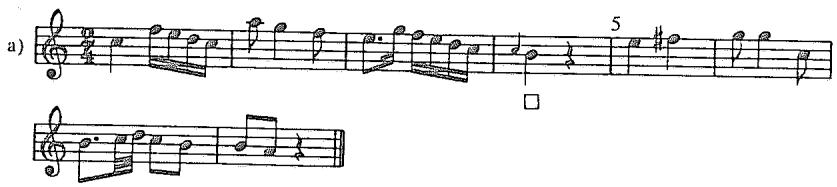
中文讲解
这是第 18 页上的图像或乐谱占位符。由于转写过程省略了内嵌图像数据,需查阅原图才能确认其视觉内容。结合上下文判断,该占位符可能对应 Koch 原书第 34 页版式或与 Example 2.27 上下文相关的乐谱片段,但其具体曲例尚未呈现——真正的视觉对比信息由下一占位符 Example 2.27 提供。
补充说明
需查看原图。如有学术研究需要,建议核对 Koch 《Introductory Essay on Composition》原版第 34 页。
第5段(P0163)
原文复述
Image caption for Example 2.27, citing Koch, Introductory Essay on Composition, p. 34. Sub-labels: (a) two phrases juxtaposed; (b) same two phrases connected by a lead-in.
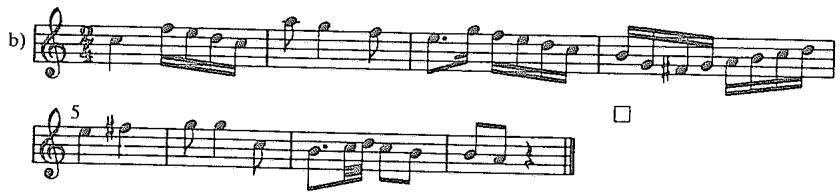
中文讲解
这是 Example 2.27 的图注说明。出处为 Koch《Introductory Essay on Composition》第 34 页。a 部分展示两个乐句"并列(juxtaposed)"——即仅用终止音分隔、没有 lead-in;b 部分展示同样两个乐句"由一个 lead-in 连接"——即在终止音后增加一段导入片段接通至下一句首音。a 与 b 的对比,正是 Koch 在引文中所说的"mere caesura"对应"composed"的两个版本。
第6段(P0164)
原文复述
The cadential note in the fourth measure of Example 2.27 (in both parts a and b) is b-flat¹. Together with the surrounding context this forms a half cadence in C major. In part b, however, the cadential note is shortened to a sixteenth note, and a lead-in is added that ascends up to the first note of the second phrase, e². The lead-in consists of all the notes from the second sixteenth note of measure 4 up to and including the downbeat of measure 5. (To verify that e² belongs to the lead-in, the reader is invited to play or imagine the lead-in segment so that it stops at d².) This is why we say that the added segment “leads in” to the new phrase.
中文讲解
这是对 Example 2.27 的详细技术解读,分四层:
- 共性——a、b 两个版本的第 4 小节终止音都是 b♭¹,与周围音共同构成 C 大调的半终止(half cadence in C major)。这是两个版本的"共同起点"。
- 差异——a 中 b♭¹ 保留原本的长度,b 中被缩短为十六分音符,从而腾出空间来填入 lead-in 片段。这是两版本唯一的结构差异,也是 lead-in 赖以成立的句法动作。
- lead-in 的范围——从第 4 小节第二个十六分音符起、一直延续到第 5 小节正拍(即 d² 之上的 e²),整段都属于 lead-in。
- 验证方法——作者提出了一个极为巧妙且具教学性的听觉/想象实验:把 lead-in 片段弹(或想)到 d² 为止;此时音乐听上去会"未结束",从而凸显 e² 才是真正"承上启下"的接力点。这一实验揭示:e² 虽然从乐句结构上看是下一乐句的句首第一个音,却同时承担着"将 lead-in 闭合"的句法结束功能——正是这种双重身份,使该片段被称之为"leading in to the new phrase"。
教学要点:要理解从 b♭¹ 终止音向 e² 的运动,需把它放在 C 大调的属—主框架中理解:b♭ 接近属音(下属系统中主调的属方向相关音),e² 接近主音上方的较高音区中心。这一运动实质是从属和弦松散状态(半终止)向主和弦中心音区的攀升,被 Koch 包装成乐句之间的延续运动。
补充说明
关于 d²/e² 的诠释所依赖的"C 大调与终止—导入运动方向"信息均直接出自原文(“half cadence in C major"以及"stop at d²"的听觉测试),无外部补充。
第7段(P0165)
原文复述
By its nature, the lead-in entails an overlap—specifically, an overlap between the added segment (the lead-in itself) and the beginning of the following phrase. Also by its nature, a lead-in is a melodic unit that is less complete than, and usually shorter than, the phrases which it connects. It is, however, not a subphrase, because it does not belong as a component to any complete phrase, but serves merely as a link between two such phrases.
中文讲解
这一段给出 lead-in 的两条本质性定义和一条否定性辨析,是概念厘清的核心:
- 重叠性(overlap):lead-in 与"下一句的开头"在时间和音符上重叠。也就是说,末端的若干音(如本例中的 e² 在句首落下时)既是 lead-in 的终点,又是下一乐句真正的起点。这种"共用音/共用节拍"的设计,正是导致听感上"两个乐句被拉近"的具体机制。
- 完整性(completeness):lead-in 是一个"较不完整"的旋律单位,且通常比它所连接的两个乐句要短。这里的"较不完整"是与完整乐句对比而言——它没有自身完整的节奏、终止、和声骨架。
- 否定——为什么 lead-in 不是 subphrase:subphrase 是完整乐句内部的次级结构(属于该乐句的一部分),而 lead-in 不属于任何完整乐句的内部,它只是"两个乐句之间的纽带”。这是关键辨析:subphrase 是"向内"的层级分解,lead-in 是"横向"的连接关系。
教学要点:lead-in 的"双重身份"——同时是 a 的结束与 b 的开始——典型地体现了音乐句法研究中所说的"句法重叠(syntactic overlap)“或"过渡—重叠(transition-overlap)"。读者若还记得前节关于 subphrase 的定义,应特别留意 subphrase 与 lead-in 的对立关系:它们都是"小单位”,但归属完全不同。
补充说明
“subphrase"是上一节已介绍的术语,指隶属于某完整乐句内部的次级单位。本段之所以特别强调 lead-in 不是 subphrase,正是为了把这一新概念从读者已有的"小单位"印象中剥离出来。
第8段(P0166)
原文复述
At larger levels of phrase structure, it is possible that a complete phrase may act as a lead-in, connecting two larger periods. For example, at the end of the development section in a sonata form, a period generally ends with a dominant (half cadence) of the main key. The next period begins the recapitulation, usually starting with the tonic harmony. A phrase leading from dominant to tonic may connect these two periods. This would be a lead-in at a larger level.
中文讲解
这一段把 lead-in 的概念"上推一个层级”——即从局部的小片段尺度上升到大型周期(period)尺度。论证步骤如下:
- 递归性原则:lead-in 概念不限于局部片段,在更大的句法层级同样适用。
- 实例——奏鸣曲式:发展部(development)结束时通常以主调的属持续(dominant half cadence)收束;再现部(recapitulation)开始时通常以主和弦(tonic harmony)打开。这两块之间的和声—调性跨度极大(从属持续跳到主和弦)。
- 解决方案:在发展部末尾与再现部开头之间,可以安插一个完整乐句,专门"从属走向主",它就成为一个大型 lead-in。
- 论证意义:作者借此说明 lead-in 是一个"分形(fractal-like)“概念——它在不同层级之间用同一套逻辑运作。这也从侧面呼应了 Koch 在第一段所说的"让两个相邻的较大单位靠得更近”——只不过这次的"两个相邻较大单位"是奏鸣曲式中的两个 period。
教学要点:递归性(recursive)或层级化(hierarchical)的概念是这一段最重要的方法论贡献。它告诉读者:理解小尺度的句法现象(lead-in)与理解大尺度的曲式现象(奏鸣曲式中的过渡)可以用同一套逻辑——前者靠加几个音把两个乐句拉近,后者靠一个完整乐句把两个 period 拉近。这种"小尺度逻辑在大尺度上的同构复制"是音乐分析中非常重要的类推原则。
补充说明
关于奏鸣曲式的发展部与再现部(sonata form 的 development/recapitulation 划分、属—主的和声框架)等知识来自奏鸣曲式的基本理论;本节仅作为论证 lead-in 概念层级扩展的例证加以使用,并不展开奏鸣曲式自身的结构讨论。
脚注 / 边栏 / 图表 / 附加信息(如有)
本节包含两处图像占位符(对应 P0162 与 P0163):其中 P0163 的图注明确给出 Example 2.27 的来源与子标题——取自 Koch《Introductory Essay on Composition》第 34 页,a 表示两个乐句并列(juxtaposed),b 表示同样两个乐句由 lead-in 连接,这一图注对理解全节论证至关重要。引文段落 P0161 末尾的脚注 39 为 Koch 原文出处的版本学注释,承担引用支撑功能。
💡 本节核心要点
- lead-in 的术语并非 Koch 提出,但 Koch 在《Introductory Essay on Composition》中已描述过该现象——它表现为把乐句末终止音与下一句首音之间的时值空隙填满音符,从而缩短两个乐句之间的句法距离。
- lead-in 与 subphrase 的关键区别在于:subphrase 隶属于某个完整乐句的"内部"(向内分解),而 lead-in 跨越两个完整乐句之间(横向连接);这是判断"小片段属于何处"的核心判据。
- lead-in 在结构上与下一乐句的开头存在重叠(overlap),其尾部一个或几个音既是 lead-in 的结束又是新句的开始——这一重叠机制在例 2.27b 中体现为终止音缩短为十六分音符并将起音 e² 同时计入 lead-in。
- 例 2.27 用对照说明 lead-in 的运作:a 是仅有 b♭¹ 终止音(构成 C 大调半终止)的两个并列乐句;b 是 b♭¹ 缩短为十六分音符后由一段音区上行片段"导入"至 e² 的连接版。
- lead-in 是一个分层的(hierarchical / recursive)概念,不只存在于小片段层级——在奏鸣曲式中,一个从属走向主的完整乐句也可以充当连接发展部与再现部的 lead-in,这是同一逻辑在大型句法尺度上的同构复制。
- 作者用"将 lead-in 在 e² 处停住、改为结束于 d²"的听觉实验,揭示 lead-in 的"双重身份"——既属于前句的延伸、又属于后句的开启——这是 lead-in 之所谓"导入"的最直接句法证据。
🔑 关键术语
- lead-in(导入):本节的核心对象。指为缩短两个相邻完整乐句之间的句法距离、在前句终止音与下句首音之间所加入的连接性片段。结构上与下一句句首形成重叠,不属于任何完整乐句内部,因而不构成 subphrase。术语本身并非 Koch 提出,但其描述源自 Koch《Introductory Essay on Composition》。
- caesura note / cadential note(终止音):Koch 引文中以"caesura"加上方括号"[cadential]“说明的术语,意指乐句末的最后一个音。该音常落在强拍或被倚音延迟出现,正是 lead-in 操作由此开始。本节中通常指例 2.27 第 4 小节的 b♭¹。
- subphrase(细分句):上一节已介绍的术语,指隶属于某完整乐句内部的次级单位。lead-in 与 subphrase 在表面上都可能呈"小片段"形式,但归属不同:subphrase 是一个完整乐句的组成部分,而 lead-in 是跨越两个完整乐句的连接纽带,因此 lead-in 严格区别于 subphrase。
- half cadence(半终止):属和弦上以非主音结束的暂停性终止。本节中例 2.27 第 4 小节的 b♭¹ 与周围属持续共同构成 C 大调的半终止;lead-in 即自此半终止之后展开上行运动至下一句首音 e²。
- overlap(重叠):lead-in 的本质结构特征:末端若干音在时间上和下一句的开头共用。这一"共用"是 lead-in 之所以能使两个乐句"靠得更近"的具体机制,也是它兼具前句延伸与后句开启两重身份的句法基础。
- period(周期/大型句法单位):较乐句更高一级的句法结构单元,可由若干乐句构成。本节论及 lead-in 在大型尺度上的对应物——即一个完整乐句充当连接两个 period 之间的"导入”(如奏鸣曲式中发展部与再现部之间的连接乐句)。
- sonata form(奏鸣曲式):本节用作 lead-in 概念上升至大型句法尺度的曲式范例。发展部以主调的属半终止结束、再现部以主和弦开始——二者之间的"从属走向主"的乐句可承担 lead-in 功能,是 lead-in 概念在不同层级同构复制的关键论据。
sec_2_1_16 [描述性拆分] Metrical Reinterpretation — Definition, Mechanism, and Examples
第1段(P0167)
原文复述
Metrical Reinterpretation
中文讲解
这是本小节的标题,宣告主题转入"节拍重释"(Metrical Reinterpretation)。作者将在此定义这一现象、说明其作用机制,并给出典型谱例。它与前文讨论的乐句重叠(overlap)密切相关,但作者强调必须把两者作为不同结构层级的概念区分开来。
第2段(P0168)
原文复述
Metrical reinterpretation is a well-known phenomenon. It was described by Riepel and Koch in the 18th century, and by several authors since then. $^{40}$
中文讲解
作者开门见山指出节拍重释是一个早已被认知的现象。最早的描述可追溯到18世纪的Riepel与Koch,此后又有数位作者讨论过这一议题。该判断为整节奠定历史与学术定位,说明所讨论的现象不是作者个人命名,而是已有研究传统。尾注40指向相关历史文献。
补充说明
尾注40指明Riepel与Koch的原始出处及其后续研究的参考文献。
第3段(P0169)
原文复述
Reinterpretation is to metrical structure approximately what overlap is to phrase structure. Reinterpretation occurs when the last bar of one hypermeasure is treated simultaneously as the first bar of a new hypermeasure. (Occasionally two bars are reinterpreted in this way, though this is much less common.) When a bar is reinterpreted, one measure that “should” have occurred does not: the last bar of a hypermeasure, rather than being followed by a new first bar, becomes that first bar. In this way two two-bar hypermeasures may be represented by three measures of music, two four-bar hypermeasures by seven measures of music, and so forth. Lerdahl and Jackendoff term this phenomenon “metrical deletion” because of the missing measure; similarly, Koch calls it “the suppression of a measure.” However, “reinterpretation” (Schenker’s term) seems to describe best the way the phenomenon is actually perceived.
中文讲解
本段给出节拍重释的核心定义与机制。
- 概念类比:重释对节拍结构而言,类似于重叠对乐句结构的作用。两者作用于不同层级但遵循类似逻辑。
- 机制:当一个超小节(hypermeasure)的最后一小节同时被当作新超小节的第一小节来处理时,即发生重释。偶尔会出现两小节同时被重释的情况,但较少见。
- 数学含义:原本"应当"出现的小节被吞掉——本应接续的第一小节被前一超小节末小节替代——因此两个双小节超小节可只占三小节,两个四小节超小节可只占七小节,依此类推。
- 命名分歧:Lerdahl与Jackendoff称之为"metrical deletion"(节拍删减),Koch称之为"the suppression of a measure"(小节压制),但作者认为Schenker所用的"reinterpretation"最贴近听者实际感知——也就是说,听者并非觉得某小节被删除,而是重新理解了同一小节的节拍地位。
理解要点:作者选择"重释"一词,强调该现象本质上是听者认知结构的调整,而非音的缺失或曲谱的真正裁切。
第4段(P0170)
原文复述
Metrical reinterpretation seems always to occur in conjunction with an overlap in the phrase (or subphrase) structure—I am not aware of a single instance where this is not true. Apparently, without an overlap there would be no reason for the listener to assume a reinterpretation in the metrical structure.
中文讲解
作者提出一条经验性论断:节拍重释似乎总是与乐句(或子乐句)层级的重叠同时出现。他坦言自己找不到任何反例。其逻辑推理是:若乐句之间不存在重叠,听者没有理由去重新解释节拍结构。换言之,重释是乐句重叠在节拍层级投射出来的副产品,没有乐句层面的触发条件,重释就不会发生。这为下一段关于两个概念区分的强调作铺垫。
第5段(P0171)
原文复述
Nevertheless, it is important to keep the concepts of overlap and reinterpretation clearly distinct; it is only too easy to confuse them. (The common conjunction of overlap and reinterpretation is itself a possible source of confusion.) Overlap refers to phrase structure, reinterpretation to metrical structure. Overlap often occurs without reinterpretation, but reinterpretation (apparently) never occurs without overlap.
中文讲解
本段强调术语的清晰划界。虽然重释与重叠常常同时出现,但二者分属不同结构层级:重叠属于乐句结构,重释属于节拍结构。混淆的根源之一正是二者经常共现。作者用一句不对称命题总结经验规律:重叠可以单独发生(无重释),但重释(据作者所知)绝不脱离重叠单独发生。这一不对称命题既是对P0170论断的重申,也预先回答读者可能的疑问——它告诉读者:当你看到重释时,必然能在乐句层级找到重叠作为成因。
第6段(P0172)
原文复述
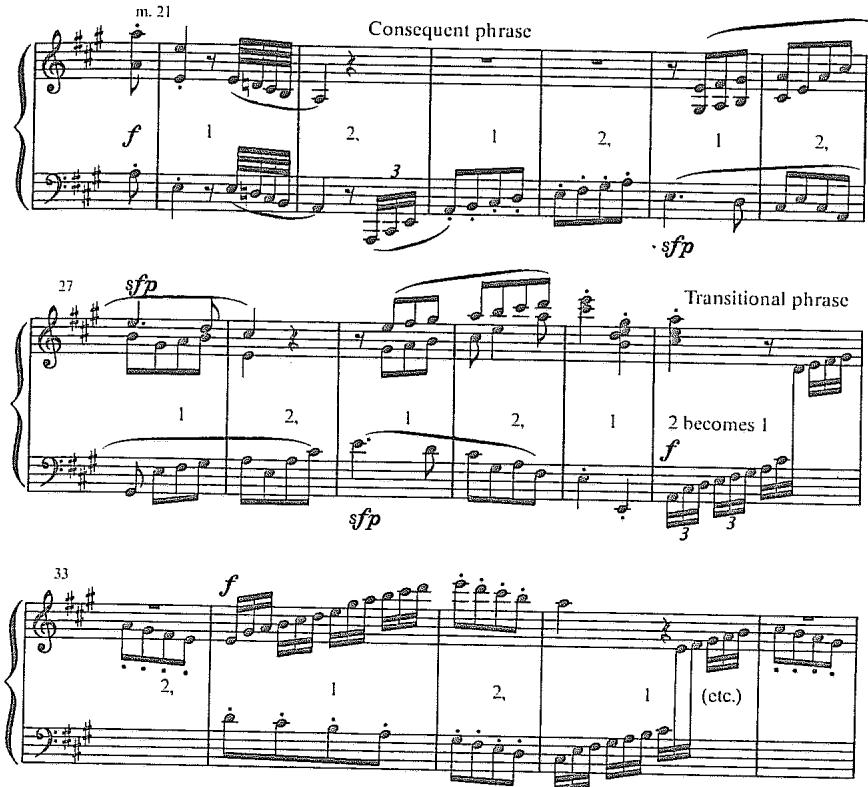
中文讲解
谱例2.28的图注(图像本体已省略)。图注标明:贝多芬《A大调钢琴奏鸣曲》Op. 2 No. 2第一乐章,mm. 21–37。此谱例用于说明节拍重释的典型用法,应配合下一段文字解读。
补充说明
需查看原谱。其作用是为P0173的文字论述提供可对照的乐谱实例。
第7段(P0173)
原文复述
Example 2.28 illustrates one of the most typical uses of metrical reinterpretation. This example, from a Beethoven sonata, shows the consequent phrase of the first theme (mm. 23–32, with mm. 21–22 as an introductory motto) and the beginning of the transition (mm. 32 ff.). The hypermeter of the excerpt is two-bar, as indicated by the numbering between the staves. (Hypermeasures of four bars exist part of the time, but we need not consider them for our purposes here.) At m. 32 the first theme reaches its final cadence, in the weak bar of a hypermeasure. At the same time the triplet motive of the transition begins; the downbeat of m. 32 is thus a point of phrase overlap. The transition, starting at m. 32, is unmistakably grouped in two-measure units, and the two-bar hypermeter is confirmed by changes of harmony—tonic in mm. 32–33, dominant in mm. 34–35, tonic again in mm. 36–37. Retrospectively, the listener has reinterpreted m. 32—which was initially weak metrically—as the first or strong bar of a new hypermeasure. This becomes especially clear if we eliminate the phrase overlap and separate the end of the first theme from the beginning of the transition, as shown in Example 2.29.
中文讲解
本段以贝多芬Op. 2 No. 2第一乐节mm. 21–37为典型案例,逐步演示重释机制:
- 结构定位:mm. 23–32是第一主题的应答乐句(consequent phrase),mm. 21–22为引子动机;mm. 32起为过渡段(transition)开始。
- 超小节背景:节拍记号提示摘录的基本超小节为两小节(中间有数字编号)。四小节超小节虽部分时段存在,但此处讨论不依赖它。
- 重叠发生点:m. 32同时承担两件事——它是第一主题终止式落点(且落在超小节的弱拍),又是过渡段三连音动机的起拍。因此m. 32构成乐句重叠点。
- 节拍证据:过渡段明显以两小节为单位组织(和声变化证实:mm. 32–33主、mm. 34–35属、mm. 36–37又主)。
- 重释过程:听者回顾性地(retrospectively)将原本节拍地位较弱的m. 32重新理解为新超小节的第一拍(强拍)。
- 验证方法:作者预告例2.29将通过"消除重叠、分离主题结束与过渡段开始"来反证重释——一旦剥离乐句重叠,重释就不再必要,m. 32的节拍地位恢复为弱拍。
理解要点:“回顾性"是关键词。重释不是听者当下即时的计算,而是听到后段结构之后回头修正对前段节拍地位的理解。这正是为什么该现象用Schenker的"重释"一词最贴切。
第8段(P0174)
原文复述
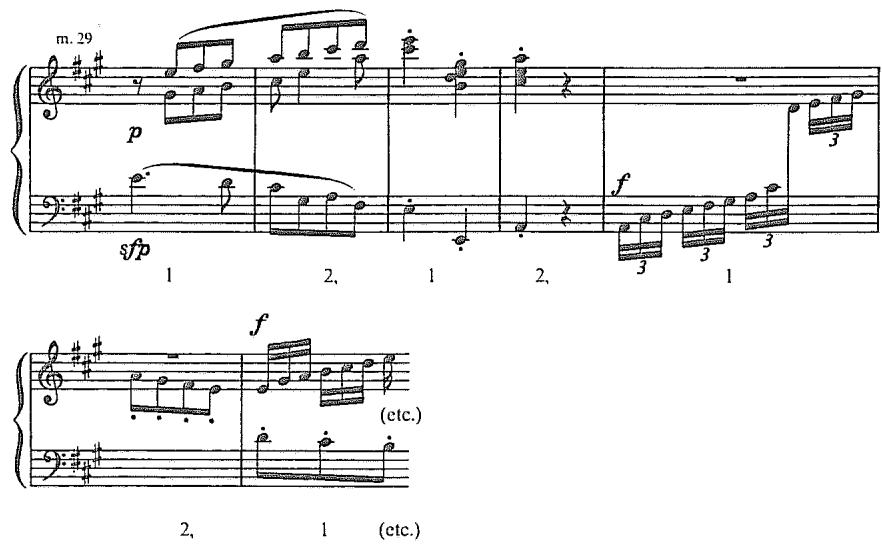
中文讲解
谱例2.29的图注(图像本体已省略)。图注标明:对贝多芬Op. 2 No. 2 mm. 29–34的"重写”(recomposition)。此谱例用于演示一旦消除乐句重叠,节拍重释即不复存在,从而反证原例的重释由重叠驱动。
补充说明
需查看原谱。其作用是作为例2.28的反例对照,验证"重叠是重释的必要条件"这一论断。
第9段(P0175)
原文复述
Example 2.29 is strikingly similar to Example 2.21, a recomposition of an analogous passage from another early sonata by Beethoven. In that passage—shown in its original form in Example 2.20—there was no metrical reinterpretation, because the cadence of one phrase (the second after-phrase) had been expanded in order to end on a hypermetrical downbeat. $^{41}$ Since the length of the phrase was modified, the hypermeter did not have to be; overlap occurred without reinterpretation. The opposite is true of Example 2.28: since the cadence of the consequent phrase is not expanded, the hypermeter must be adjusted in order to effect the phrase overlap.
中文讲解
本段通过对照P0173案例与早前例2.20/2.21,揭示作曲家解决"主题终止式与下一段落衔接"问题的两种策略。
- 例2.20/2.21的策略:第二后乐句(after-phrase)的终止式被扩展,使其落在超小节强拍上。由于乐句长度被修改,超小节不必调整——故只有重叠,没有重释。
- 例2.28的策略:应答乐句的终止式未被扩展,故必须调整超小节来达成乐句重叠——故既有重叠,也有重释。
这一对照的功能不只是举例,而是建构一条作曲家写作技术上的选择逻辑:当终止式落在弱拍时,作曲家要么扩展终止式以对齐强拍(保留节拍格局),要么保留短终止式并通过重释调整节拍格局(保持乐句短小)。两种策略听起来最终衔接都顺畅,但实现的结构路径不同。尾注41可能与此对照谱例相关。
补充说明
尾注41对应例2.20/2.21的来源或与终止式扩展相关的参考文献。
第10段(P0176)
原文复述
Two often-cited examples of metrical reinterpretation occur at precisely analogous points of two symphonic movements in sonata form—the first movement of Haydn’s Symphony No. 104 (overlap with reinterpretation at m. 16 of the allegro) and the first movement of Beethoven’s Symphony No. 8 (overlap with reinterpretation at m. 12). The purpose of the overlap and reinterpretation is the same in both of these cases, and in Example 2.28 as well: since the first theme in each of these movements ends with a perfect authentic cadence, there is a danger that the end of the theme will sound too final, thus hindering the forward thrust of the exposition as a whole. The overlap of the first theme’s cadence with the beginning of the transition prevents any break in continuity, while the metrical reinterpretation propels the motion onward with great force.
中文讲解
作者扩展案例库:海顿《第104交响曲》第一乐章快板m. 16与贝多芬《第8交响曲》第一乐章m. 12,是另外两例学界常引用的节拍重释,均出现在奏鸣曲式呈示段第一主题结束与过渡段开始的衔接点上。
本段进一步给出重释的功能性解释(音乐意义层面的):
- 问题情境:第一主题以完满正格终止式(perfect authentic cadence)结束,存在"过于收束"的危险——这会妨碍呈示段整体的前进动力。
- 重叠的作用:让第一主题的终止式与过渡段的开始同时发声,避免连贯性中断。
- 重释的作用:在节拍层级将这股前进动力推得更猛——弱拍转强拍的回顾性重释,本身就带有强烈的动能释放效果。
作者因此把重释从纯结构现象提升为戏剧性手段:它不仅解决衔接问题,还制造了推进力。
第11段(P0177)
原文复述
In Example 2.17 we saw previously how an elongated upbeat could delay the appearance of a hypermeasure, so that two four-bar hypermeasures, together with their upbeats, occupied a total of twelve bars. Metrical reinterpretation presents another example of what might be termed nonliteral hypermeter. With this technique, too, a non-duple number of measures may be understood to represent a duple number.
中文讲解
本段把节拍重释纳入更大的概念框架——“非字面意义的超小节”(nonliteral hypermeter)。作者回顾例2.17曾展示另一种非字面情况:延长弱起拍使两个四小节超小节及其弱起加起来共占12小节。重释是另一类非字面超小节:用之,一组非偶数小节也可以被听者理解为表现偶数个超小节。
理解要点:作者在建立一个"非字面超小节现象集",重释和延长弱起都是该集合的成员。它们都让小节数与听感上的超小节数出现偏差,但偏差方式不同——延长弱起是"多了小节",重释是"少了小节"。
第12段(P0178)
原文复述
This is not to imply that reinterpretation occurs only in connection with duple hypermeters. Example 2.30 shows reinterpretation in the context of five-bar hypermeter.
中文讲解
作者主动澄清可能的误解:节拍重释并非只在偶数超小节(duple hypermeters)情境下发生。例2.30将展示五小节超小节中的重释。这一句提示下面即将分析的是一个不常见但重要的特殊案例。
第13段(P0179)
原文复述
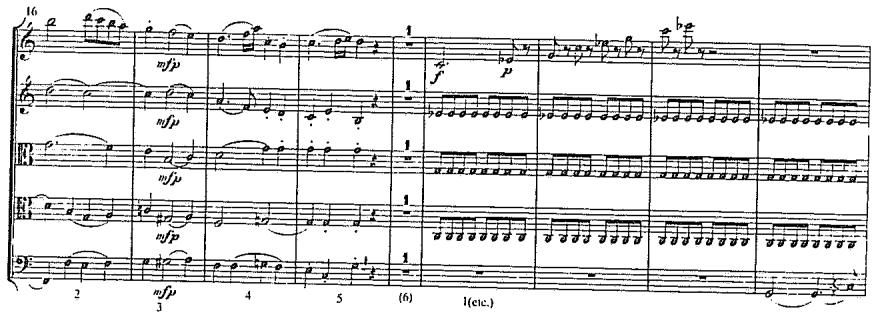
中文讲解
谱例2.30的图注(图像本体已省略)。图注标明:莫扎特《C大调五重奏》K. 515第一乐章开头。此谱例用于说明五小节超小节中的节拍重释。
补充说明
需查看原谱。其作用是为P0180讨论提供五小节超小节中重释的实例。
第14段(P0180)
原文复述
Later in the same movement where this material is used—in the transition and, particularly, at the beginning of the development section—the last bar of each five-bar subphrase is overlapped by the first bar of the next subphrase, resulting in a clear four-bar hypermeter (see Example 2.31). Since it would have been possible even at the beginning of the movement (Example 2.30) to bring in the cello one bar earlier at each of its motivic entrances after m. 1—that is, to counterpoint the first violin in m. 5 with the cello in m. 6, and similarly to overlap mm. 10 and 11—one might be tempted to consider the overlapping version the “normal” one because of its duple hypermeter. In that case, the eventual appearance of the overlapping version would be understood as a rectification of the metrically abnormal opening, rather than as a series of reinterpretations within a five-bar hypermeter. Given the predominance of duple hypermeter elsewhere in the movement—as we noted earlier, the second group is predominantly duple—this analysis has its attractions. $^{42}$
中文讲解
本段引入一个开放性的分析难题:
- 现象描述:在K. 515第一乐章后段(尤其是展开段开始处),每个五小节子乐句的最后一小节都被下一子乐句的第一小节重叠,产生清晰的四小节超小节(例2.31)。
- 替代分析的可能性:若大提琴在每次动机进入时提前一小节出现(即第一小提琴在m. 5,大提琴在m. 6;m. 10与m. 11同理),开头的乐段也能呈现偶数超小节。有人会因此把"重叠版本"当作"正常版",把后来出现的偶数超小节理解为对开头"超小节异常"的纠正(rectification),而非五小节超小节内部的重释。
- 替代分析的吸引力:考虑到该乐章其他段落(尤其是第二主题群)以偶数超小节为主流,把整首作品视为基本偶数超小节、把开头视为待"修正"的特例,确实具有相当的解释力。
- 论证的开放性:作者用"this analysis has its attractions"表达对其合理性的承认,但并未明示哪种分析最终为正。尾注42可能涉及对偶数超小节主流分布的进一步佐证或文献出处。
理解要点:本段示范了音乐分析中常见的多义性——同一谱面现象可被两种不同结构框架(“五小节超小节中的重释"vs.“偶数超小节主框架下的开头异常”)解释,且两者都有内在说服力。作者借此说明节拍重释的判定依赖于分析者所选择的整体节拍假设。
补充说明
尾注42对应本段关于第二主题群以偶数超小节为主这一断言的来源或佐证。
第15段(P0181)
原文复述
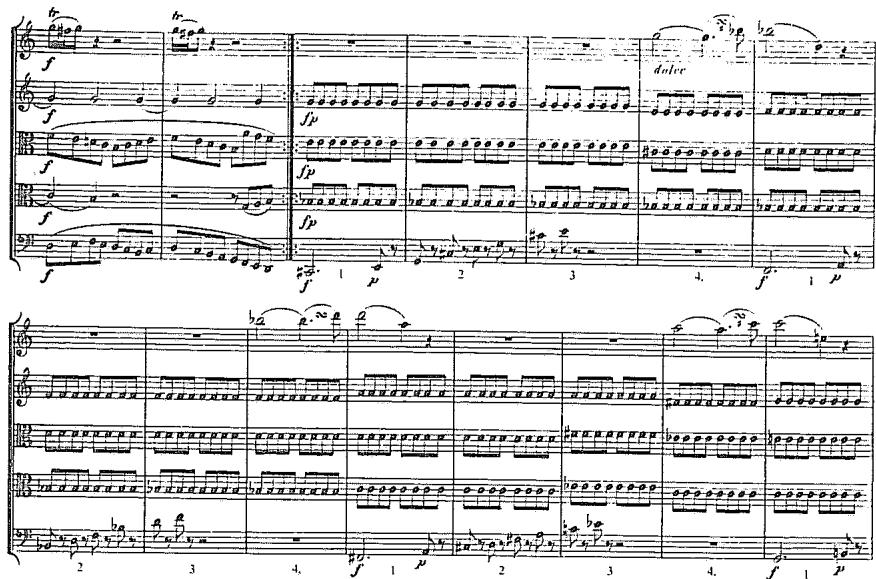
中文讲解
谱例2.31的图注(图像本体已省略)。图注标明:莫扎特《C大调五重奏》K. 515第一乐章展开段开始处。此谱例用于展示该乐章后段出现的清晰四小节超小节重叠版本,与例2.30开头的五小节超小节形成对照。
补充说明
需查看原谱。其作用是为P0180的对照分析提供后段实例。
脚注 / 边栏 / 图表 / 附加信息(如有)
本节包含三处谱例(例2.28、例2.29、例2.30、例2.31)和两处尾注(脚注40、41、42)。脚注40锚定Riepel与Koch的历史出处;脚注41与例2.20/2.21的对照分析相关;脚注42与P0180关于第二主题群偶数超小节为主的判断相关。谱例功能各异:例2.28为重释典型用例,例2.29为重写的反证对照,例2.30为五小节超小节中重释的实例,例2.31为后段偶数超小节重叠版本的对照实例。
💡 本节核心要点
- 节拍重释指一个超小节的最后一小节被同时视为新超小节的第一小节,造成"应当出现"的小节在听感中被吞掉。
- 节拍重释似乎从不在乐句重叠缺席时单独出现;重叠是重释的必要条件,但反之不成立。
- 贝多芬Op. 2 No. 2第一乐节m. 32的典型案例显示:当第一主题终止式落在超小节弱拍时,乐句重叠迫使节拍层级发生回顾性重释。
- 作曲家常在奏鸣曲式呈示段第一主题与过渡段衔接处使用重释,以对抗完满终止带来的"过于收束"感,推动音乐前进。
- 节拍重释是"非字面超小节"的一种,与延长弱起等技术并列,都使小节数与听感超小节数产生偏差。
- 莫扎特K. 515案例说明节拍重释的判定并非唯一——五小节超小节中的重释与把整曲视为偶数超小节框架下的"开头异常"两种解读各具解释力。
🔑 关键术语
- metrical reinterpretation:节拍重释。一个超小节最后一小节被同时当作新超小节第一小节,造成"少一小节"的听感效果。该术语源自Schenker,比Lerdahl与Jackendoff的"metrical deletion"和Koch的"suppression of a measure"更贴近听者实际感知。
- overlap:乐句重叠。两个乐句在时间上部分重合——前一乐句的结束与后一乐句的开始在同一小节或动机上同时发声。它与节拍重释经常共现,但属于乐句层级。
- hypermeasure:超小节。由若干小节组成的更高一级节拍单位(如两小节超小节、四小节超小节)。超小节层级也有强拍弱拍之分,构成"非字面"的次级节拍组织。
- nonliteral hypermeter:非字面超小节现象的总称。指小节数与听感上的超小节数不严格对应的情况,包括延长弱起(多小节)、节拍重释(少小节)等技术。
- retrospective reinterpretation:回顾性重释。听者依据后段结构回头修正对前段节拍地位的理解。重释不是实时计算,而是事后调整。
- perfect authentic cadence (PAC):完满正格终止式。主音在强拍、根音位置且终止式以V-I形式完成的终止。该终止式常带来较强的收束感,是奏鸣曲式主题结尾常见的写作选择,但在过渡段衔接处可能产生"过于终止"的张力。
sec_2_1_17 [描述性拆分] Elongated Upbeats — Refinement and Schenker’s Example
第1段(P0182)
原文复述
Elongated Upbeats
中文讲解
This is a section heading. It opens a short subsection that refines the previously introduced notion of the elongated upbeat, now building toward a concrete analytical example drawn from Schenker’s Free Composition.
补充说明
No additional supplementation needed.
第2段(P0183)
原文复述
After the foregoing discussion (including the earlier discussion of Example 2.17), there remains little to add concerning the elongated upbeat. To review our definition: an elongated upbeat is an upbeat that precedes the first bar of a hypermeasure, and that itself lasts at least one full bar. Generally, it is necessary to call an upbeat “elongated” only if its inclusion results in the appearance of one or more extra bars between hypermeasures, or preceding the first hypermeasure of a piece. These extra bars are not counted as part of any hypermeasure—neither the one they follow (if any) nor the one they precede.
中文讲解
This paragraph both acknowledges that the concept has been largely covered and recaps its definition in a sharper, operational form. An “elongated upbeat” is defined by three coordinated conditions: (1) it precedes the first bar of a hypermeasure; (2) it lasts at least one full bar in itself; and (3) its inclusion produces one or more extra bars—either between two hypermeasures or before the opening hypermeasure. The decisive analytical move is the counting rule in the final sentence: those extra bars are assigned to neither the preceding nor the following hypermeasure. They are metrically orphaned, and it is precisely this orphaning that justifies calling the upbeat “elongated” in the first place. The author also signals that the term need not be invoked whenever an upbeat happens to be long, but only when it changes the bar-by-bar alignment of hypermeasures.
补充说明
The reference to “the foregoing discussion” and “the earlier discussion of Example 2.17” ties this subsection to material that has already appeared earlier in the chapter; Example 2.17 itself is referenced again in the next paragraph as the prototypical instance.
第3段(P0184)
原文复述
Metrically, therefore, an elongated upbeat disrupts the hypermeter by delaying the beginning of a hypermeasure by a bar or more. When the elongated upbeat occurs between two hypermeasures, it separates them, and thus has the effect of suspending the hypermeter momentarily.
中文讲解
This paragraph draws out the metrical consequence of the counting rule just stated. Because the extra bars are excluded from both adjacent hypermeasures, the downbeat that would normally mark the start of the next hypermeasure is pushed back by a bar or more. When the elongated upbeat sits between two hypermeasures, it acts as a kind of hypermetric “rest”—the regular alternation of hypermeasures is briefly suspended before resuming. The connective “therefore” marks this as a logical consequence of P0183’s definition rather than new information.
补充说明
The distinction between hypermeter (the higher-level alternation) and the individual hypermeasure is implicit here; the elongated upbeat interrupts the former without being counted inside the latter.
第4段(P0185)
原文复述
It is more difficult to make any general statement concerning the effect that an elongated upbeat has on phrase structure. The fact that an extra measure is heard as an upbeat implies that it is an upbeat to something—that it groups with whatever follows it. This is certainly true in the vast majority of instances, including our Example 2.17. (There the upbeats could readily be omitted, leaving complete phrases, but this is not always the case.) It is also possible, however, to embed an elongated upbeat between two phrases in such a way that it relates to both, the preceding phrase as well as the following one. Schenker, in Free Composition, cites an example from Beethoven’s Seventh Symphony (shown here as Example 2.32) that includes two elongated upbeats; the second one (at least) is of the type described here.
中文讲解
This paragraph shifts the discussion from meter to phrase structure and acknowledges that the phrase-structural consequences are less uniform. The default expectation is that an extra bar heard as an upbeat will group forward with what follows, and in Example 2.17 this expectation is so strong that the upbeats could in principle be excised while leaving the underlying phrases intact. The author then introduces the exception that motivates the Schenker example: an elongated upbeat can be embedded between two phrases so that it closes the preceding phrase and opens the following one at the same time. Schenker’s Free Composition supplies exactly this case in Example 2.32 (Beethoven’s Seventh Symphony), where two elongated upbeats occur; at least the second exhibits this dual phrase relationship. The paragraph thus prepares the reader to read the upcoming analytical example not as a generic illustration but as a specific instance of overlap.
补充说明
“Free Composition” and “Beethoven’s Seventh Symphony” appear here as named sources for the example that follows; no further bibliographic or biographical detail is provided in this paragraph.
第5段(P0186)
原文复述
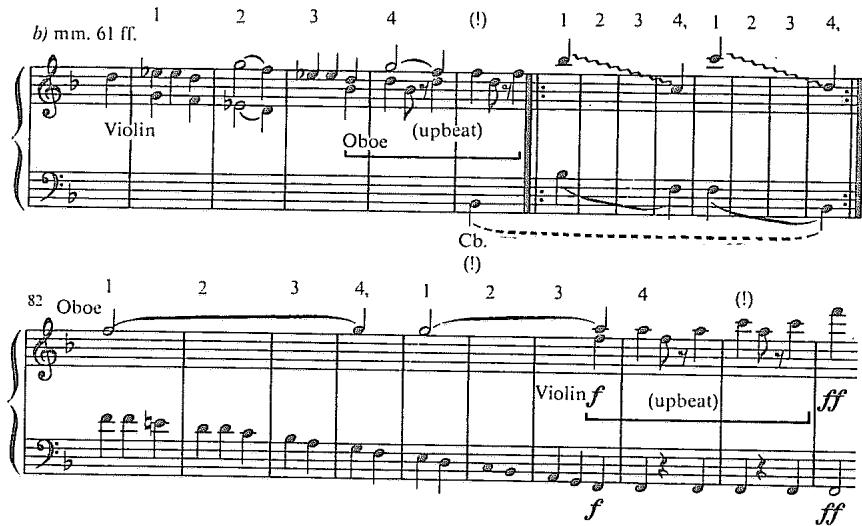
中文讲解
这是图2.32及其图注与占位符。图像内容在原书页面中被省略(“内嵌图像数据已省略”),读者需要查阅原图才能看到实际谱例。原图出自申克尔《自由作曲》(Free Composition)图146的6b部分,转录自Ernst Oster编辑翻译的英译本,版权1979年由Schirmer Books持有(原版由Longan出版)。它在正文中用于配合下一段对贝多芬第七交响曲谐谑曲中两个延长弱起的具体分析。
补充说明
图注中的"Figure 146, 6b”、“Example 2.32"以及版权信息均直接来自原文;由于嵌入图像数据被省略,谱例中小节号、声部与具体音高需查阅原图方可核对。
第6段(P0187)
原文复述
Although the upbeat in this scherzo is two measures long plus a quarter note, its inclusion each time adds only one extra measure to the music. The oboe’s rising third, begun in m. 82, should logically complete itself in its eighth bar, as the same motive has done on each of its previous appearances (bassoons, mm. 66–73 and 74–81). But the sudden intrusion of the upbeat causes the goal tone, a², to arrive one measure early (m. 88), along with the bass’s goal tone F (tonic harmony), which is similarly early. However, the upbeat itself (mm. 89–90) incorporates both of these goal tones; thus they also appear in their “proper” position, m. 89. Thus the upbeat belongs to both phrases and participates in a phrase overlap. It is unusual for an overlap to occur, as here, on a hypermetrical upbeat. This is part of what gives mm. 88–90 such an odd flavor: we have already arrived at our goal (the tonic, the goal of the first phrase), but in another sense we are not “there” yet (since the downbeat hasn’t arrived).
中文讲解
This paragraph carries out the analysis that P0185 set up. The scherzo’s upbeat is in fact two measures plus a quarter note long, yet its insertion only “adds” one extra measure to the count—the metric asymmetry the author noted earlier. The motive in question is the oboe’s rising third starting at m. 82, which on its two prior statements (bassoons at mm. 66–73 and 74–81) lasted exactly eight bars and reached its goal tone a² on the eighth bar. The sudden intrusion of the upbeat shortens that span by one bar, so a² arrives at m. 88 instead, alongside the bass’s goal tone F (root of the tonic harmony). Crucially, however, the upbeat itself (mm. 89–90) absorbs both of these goal tones, so they are also heard in their “proper” location at m. 89. The upbeat therefore stands between two phrases and belongs to both—a phrase overlap. The author notes that such overlap is itself uncommon, and overlap on a hypermetrical upbeat is rarer still; this rarity is offered as the source of the distinctive character of mm. 88–90. The listener has tonally reached the goal of the first phrase, yet metrically the downbeat that would formally confirm arrival has not yet sounded. The “odd flavor” is therefore not a matter of vague aesthetic impression but a precise mismatch between tonal and metric arrival.
补充说明
All measure numbers (mm. 66–73, 74–81, 82, 88, 89–90), the pitch a², and the bass pitch F with the gloss “tonic harmony” come from the paragraph itself; the author identifies the overlapping relationship explicitly as a “phrase overlap.”
脚注 / 边栏 / 图表 / 附加信息(如有)
The subsection contains one numbered musical example, Example 2.32, presented only as a caption with an in-line placeholder because the embedded image data is omitted. The caption records Schenker’s Free Composition, Figure 146, 6b, names the translator/editor Ernst Oster, and gives the 1979 Schirmer Books copyright with credit to the original Longan imprint. The example is functionally tied to the closing analytical paragraph, which refers to specific measures (mm. 66–73, 74–81, 82, 88, 89–90), the oboe’s rising-third motive, and the goal tones a² (oboe) and F (bass, tonic) that the reader can only verify by consulting the original figure. No further footnotes, sidebars, or tables appear in this subsection.
💡 本节核心要点
- An elongated upbeat is operationally defined by three conditions: it precedes the first bar of a hypermeasure, it lasts at least one full bar, and its presence produces extra bars that are not assigned to either adjacent hypermeasure.
- Those extra bars disrupt the hypermeter by delaying the start of the following hypermeasure and, when placed between two hypermeasures, briefly suspend the regular alternation of hypermeasures.
- Phrase-structurally, the default expectation is that an elongated upbeat groups forward with the following phrase; in many cases (such as Example 2.17) the upbeat could be removed without damaging phrase completeness.
- The exceptional case—motivating Schenker’s Example 2.32—is an elongated upbeat embedded between two phrases so that it simultaneously closes the preceding phrase and opens the following one, producing a phrase overlap.
- In Beethoven’s Seventh Symphony scherzo, the upbeat’s insertion shortens the oboe’s rising-third span so that its goal tone a² (and the bass’s tonic F) arrive a measure early at m. 88, yet the same goal tones are incorporated into the upbeat at m. 89, giving mm. 88–90 their characteristic mismatch between tonal arrival and metric arrival.
🔑 关键术语
- elongated upbeat:在本节中定义为:出现在某超小节首小节之前、自身长度至少为完整一小节的弱起;其加入会在两个超小节之间或全曲首超小节之前制造不属于任何超小节的"额外小节”。
- hypermeasure:本书中贯穿使用的高一级节拍单位;延长弱起位于其首小节之前,且其额外小节不被计入任一超小节之内。
- hypermeter:超小节层面的节拍规律,即超小节之间的交替;延长弱起会打断或短暂悬置这一规律。
- phrase overlap:两个乐句互相重叠的结构现象:一乐句的尾部材料与下一乐句的开头材料同时出现;在本节中以延长弱起作为重叠载体出现。
- goal tone:乐句或动机所趋向的目标音;在贝多芬第七交响曲谱例中,双簧管的a²与低音的F(主音)作为目标音出现。
- tonic harmony:以主音F为根音的主和弦;文中以"the bass’s goal tone F (tonic harmony)“的方式加以说明。
- Free Composition (Der freie Satz):申克尔的理论著作;本节图2.32即出自其英译本(Ernst Oster编辑翻译,1979年Schirmer Books,原版Longan)图146的6b部分。
sec_2_1_18 [描述性拆分] Successive Downbeats — Reinterpretation, Contraction, and Split Downbeats
第1段(P0188)
原文复述
Successive Downbeats
中文讲解
这是本节的总标题「Successive Downbeats(连续下行拍)」。它预告本节将讨论一种表面上不易处理的现象:当一个已经代表上行拍结束(downbeat)的节拍点之后,又紧跟着出现另一个代表下行拍开始的节拍点,两个"下行拍"在节拍意义上连续出现。作者将从理论上区分这类情况的几种成因:节拍重释(reinterpretation)、收缩(contraction)与分体下行拍(split downbeat)。
第2段(P0189)
原文复述
It is easy to speak of elongated upbeats, but one would not speak of an elongated downbeat. As Carl Schachter has noted, upbeats tend to be perceived as having duration and leading toward downbeats; downbeats, by contrast, are more or less instantaneous points of release. $^{43}$ This difference in meaning is concealed by the double definition conventionally accorded the word “beat,” a term that signifies both a single point in time and the temporal distance between two such points. (Some authors have objected to this definitional ambivalence, but it actually has certain advantages, especially if one’s conception of meter is as flexible as that outlined on pp. 40–57 of the foregoing discussion.)
中文讲解
本段为本节确立基本理论前提。作者借助 Carl Schachter 的观察指出:上行拍(upbeat)通常被视为有长度、且朝向下行拍运动的过程,而下行拍(downbeat)则是相对瞬时的"释放点”——也就是说,“下行拍可以被拉长"这种说法在常识上并不成立。文中以脚注 43 注明 Schachter 的相关论述。
但这种意义差异却被"beat(拍)“一词的双重定义所掩盖:同一个词既指时间上的一个瞬间点,也指两个瞬间点之间的时距。作者承认有学者反对这种定义上的含混,但认为只要把节拍理解为本书前文(第 40–57 页)所论述的那种灵活概念,这种双重性其实具有优势——它允许"拍"在讨论点(释放点)与间距(持续长度)之间灵活切换,从而既可以描述上行拍的拉长,又可以讨论下行拍的瞬时性。
本段为本节提供语言与概念上的铺垫:既然下行拍本身不能被拉长,那么紧接着出现的"连续两个下行拍"就需要从其他角度——重释、收缩或分体——来解释。
补充说明
脚注 43 为 Carl Schachter 关于上行拍/下行拍感知差异的出处,本段未给出具体文献信息;不可据本段内容以外的知识补充。
第3段(P0190)
原文复述
While a downbeat cannot be elongated, it is possible for two hypermetrical downbeats to follow each other in successive measures. This can happen in one of four distinct ways:
中文讲解
本段从理论前提过渡到本节的核心命题:尽管单个下行拍本身不能被拉长,但两个超节拍层级上的下行拍(hypermetrical downbeats)确实可以在相邻小节中相继出现。作者预先宣告这种现象可能以四种不同的方式发生,引出下文编号的四种类型清单。
句式上的转折(“While…is possible…")提示:连续下行拍并非节拍结构的常态,而是需要由特定作曲手段或结构机制来解释的例外情形。
第4段(P0191)
原文复述
- If, in two-bar hypermeter, a metrical reinterpretation occurs, two strong measures will succeed each other directly, as happened in Example 2.28.
中文讲解
第一种类型:在双小节超节拍(two-bar hypermeter)中发生节拍重释(metrical reinterpretation)时,两个原本不应该都强的强拍小节会被强行挤压到一起,从而形成连续的强小节。作者用 Example 2.28 作为先例(先前章节中的实例),提示读者该例子之前已经分析过。
这条规则的关键在于:重释意味着某个原本在节拍上弱的小节在听感中被删略或吸收,使原本应隔开的两小节直接相邻,因此两个强拍小节接连出现。
第5段(P0192)
原文复述
- If a hypermeasure—generally a four- or eight-bar hypermeasure—is contracted through the omission of a bar, two relatively strong measures may succeed each other, although they will not be equally strong.
中文讲解
第二种类型:当一个超小节(一般指四小节或八小节组成的超小节)通过省略一整小节而被压缩时,原本在层级上处于不同强度位置的两个相对强小节会接踵而至。但作者特别强调:这两个小节虽然都"相对强”,却并不等强——它们的强度差异来源于它们在更高层级节拍中的不同位置。
与第一种"等强"的重释不同,压缩产生的是层级错位造成的相对强弱,故文中用"relatively strong"而非"strong”,体现两层意义上的区分。
第6段(P0193)
原文复述
- If a phrase ends with a hypermetrical downbeat, the next phrase may begin with another hypermetrical downbeat in the following measure.
中文讲解
第三种类型:当一个乐句以超节拍层级上的下行拍结束时,紧接着的下一小节又以另一个超节拍下行拍开启下一个乐句。这里两个下行拍分别承担不同功能——前一个结束乐句,后一个开始新乐句——但在节拍强度上几乎等强。
这是连续下行拍中最难用"对常规结构的修改"来解释的一种,因为两个下行拍在结构上是各自独立的两个乐句的连接,而非对一个统一超小节的内部压缩。
第7段(P0194)
原文复述
- In a melody-and-accompaniment texture, a hypermetrical downbeat may be “split,” appearing first in the accompaniment, then in the melody.
中文讲解
第四种类型:在旋律加伴奏(melody-and-accompaniment)的织体中,超节拍下行拍可能被"分体”:它先在伴奏声部出现,然后在旋律声部再次出现。同一节拍事件被分置到两个声部和两个小节中,因此从听感上像两个相继的下行拍。
“split"这一比喻是本节最重要的概念之一:它意味着一个原本应同时存在的下行拍,被作曲家有意拆解到两个声部、两个小节中分别实现。
第8段(P0195)
原文复述
With respect to (1), we already know that the juxtaposition of two strong measures through metrical reinterpretation results from a transformation in the metrical structure: a metrically weak bar has been omitted from the musical surface. The listener understands that one measure functions metrically both as a second (weak) measure and as a first (strong) measure, so that three measures—in Example 2.28, mm. 31–33—stand for four (two two-bar hypermeasures). If some higher level of hypermeter also exists—say, a four-bar hypermeter—the two successive downbeat bars will not be equally strong, because one bar (probably the second) will function as a downbeat at the four-bar level, while the other will not. (In Example 2.28, m. 32 acts as a hypermetrical downbeat at the four-bar level.)
中文讲解
本段是对第一种类型的详细展开。核心机制是:一个原本节拍上弱的小节在听感中被删除;听者把一个真实小节同时理解为一个弱小节(第二小节)和另一个强小节(第一小节)的合并体,因而三个真实小节代表四个节拍小节(即两个双小节超小节)。
接下来,作者补充了更高层级超节拍存在时的情况。如果在双小节超节拍之上还有一个四小节超节拍,那么这两个连续出现的下行拍小节强度就不再相等——其中之一(可能是第二个)将在四小节层级上充当下行拍,另一个则不会。以 Example 2.28 为例,m. 32 在四小节层级上扮演超节拍下行拍的角色。
本段为类型 (1) 加入了"层级嵌套"的考虑:连续下行拍的等强并非绝对,它取决于所处超节拍层级之间的耦合方式。
第9段(P0196)
原文复述
Contraction, described in (2), is a technique we have not encountered up to now. Example 2.33, from another sonata by Beethoven, shows the contraction of a phrase. In the very compact exposition of this sonata, mm. 1–8 form the antecedent and mm. 9–15 the modulating consequent of the first group; m. 16 begins the second group, in B♭ major. The consequent is only seven measures long $(4 + 3)$ instead of the expected eight $(4 + 4)$ —expected because of the eight-measure length of the antecedent. If the consequent were a full eight measures long, its last four bars might look something like Example 2.34, assuming that we follow the structure of the antecedent as closely as possible.
中文讲解
本段引入第二种类型——收缩(contraction),并明确指出这是本书此前未讨论过的新技法。例证来自贝多芬的另一首钢琴奏鸣曲 Example 2.33。
作者先勾勒该奏鸣曲呈示段的结构布局:mm. 1–8 是第一主题组的前句(antecedent),mm. 9–15 是其调性转移的对应句(modulating consequent),m. 16 起进入第二主题组(降 B 大调)。作者关注的焦点是对应句的长度:它只有七小节(4 + 3),而非由前句八小节(4 + 4)所暗示的八小节——也就是说,对应句的第二个四小节超小节被压缩成三小节。
作者随后假设:若对应句按前句结构保持四小节超节拍,其最后四小节可能如 Example 2.34 所示。这一假想性"重构"为下一段分析贝多芬实际采用的压缩方式提供了对照基础。
补充说明
结构术语补充:antecedent/consequent(前后句)在本节上下文中指呈示段中主题组的两个对仗乐句,前句陈述主题,对应句作调性转移;modulating consequent 指具有转调功能的对应句。
第10段(P0197)
原文复述
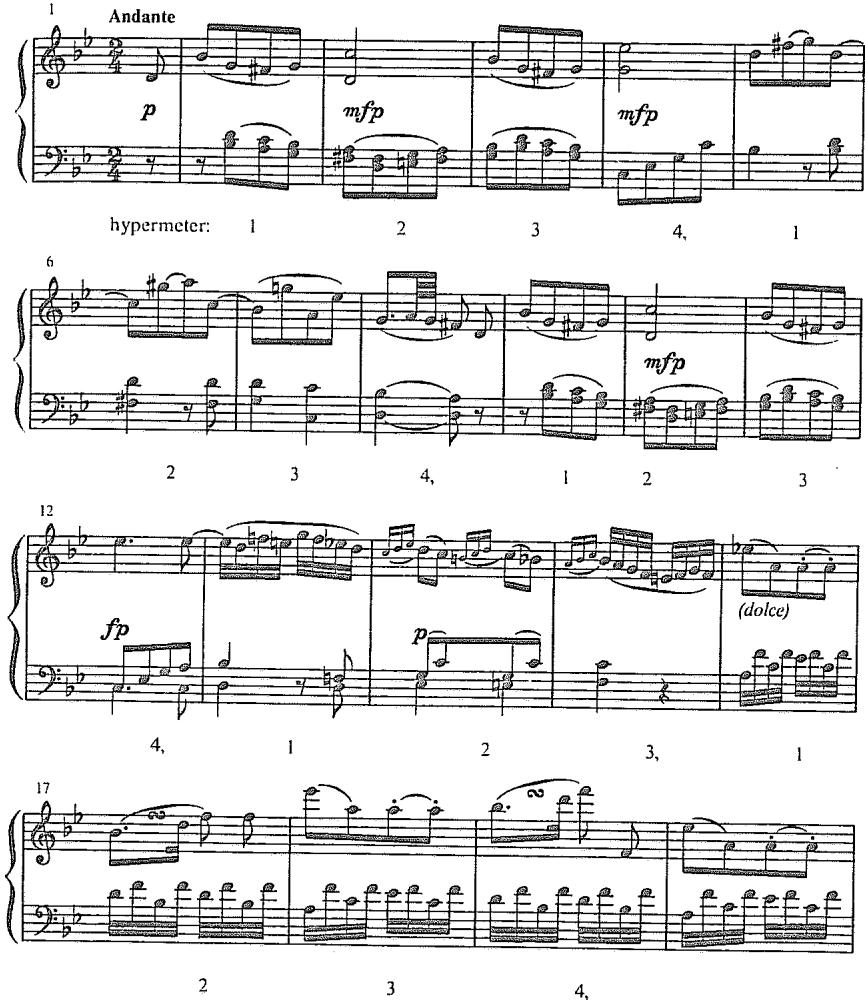
中文讲解
该位置为图示占位符:Example 2.33,贝多芬《G 小调钢琴奏鸣曲》Op. 49 No. 1 第一乐章开头。结合上下文,这是用以说明呈示段紧凑结构以及对应句被压缩为七小节(4 + 3)的核心谱例。实际乐谱细节需查原图。
第11段(P0198)
原文复述
The version shown in Example 2.34 maintains the four-bar hypermeter strictly. Instead of this, Beethoven contracts the second hypermeasure of the consequent by omitting a fourth bar. The relatively strong third bar of this hypermeasure (m. 15) is thus followed directly by the first bar of the next hypermeasure. (Note that, as a third bar, m. 15 is weaker metrically than m. 16, a first bar.) However, the impact of the hypermetrical downbeat in m. 16 is diminished considerably by the lack of any harmonic change from the previous bar (only a seventh is added to the harmony— the root remains unchanged). In the recapitulation, interestingly, the first group’s consequent phrase appears without contraction, in full eight-measure form (mm. 72–79).
中文讲解
本段将假想版本(Example 2.34)与贝多芬实际版本进行对照分析。假想版本严格保持四小节超节拍;但贝多芬实际的处理是:把对应句的第二个超小节的第四小节省略掉,从而该超小节由四小节压缩为三小节。结果是该超小节中相对较强的第三小节(m. 15)直接与下一个超小节的第一小节(m. 16)相连——形成了连续两个相对强的小节。
但作者进一步指出:m. 15 作为第三小节,其节拍强度弱于 m. 16 这个第一小节;并且从和声角度看,m. 15 到 m. 16 之间并未发生真正的和声变化(只是增加了一个七音,根音不变),所以 m. 16 的下行拍冲击被这种和声延续所削弱。
最后,作者附带一个有趣的对比:在再现部中,第一主题组的对应句以完整的八小节形式(mm. 72–79)出现,不再压缩。这说明压缩是一种由呈示段内部张力需求驱动的局部手段,而非贯穿全曲的固定处理。
第12段(P0199)
原文复述
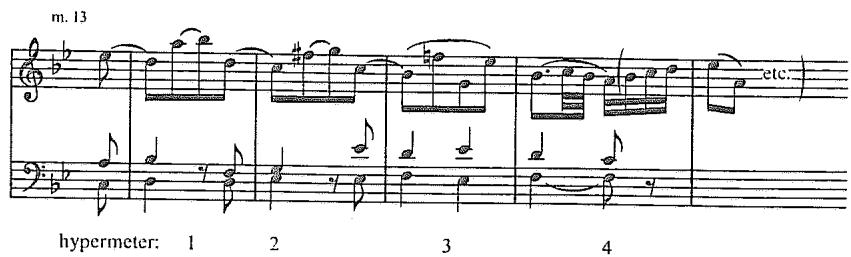
中文讲解
该位置为图示占位符:Example 2.34,对贝多芬 Op. 49 No. 1 mm. 13–15 的"重构”。这是一个假想版本,按前句结构完整保留四小节超节拍,用以与贝多芬实际采用的压缩版(Example 2.33)对照。实际乐谱细节需查原图。
第13段(P0200)
原文复述
With respect to (1) and (2), the succession of two metrically strong bars could be understood as a variation of some more regular structure—either two two-bar hypermeasures pressed together by means of a metrical reinterpretation, or one longer hypermeasure contracted through the omission of a bar. In the case of (3), two consecutive strong measures are of more or less equal strength, and it is more difficult to analyze the situation as the modification of some more regular structure. Our example of this type (Example 2.35) is taken from yet another early Beethoven sonata.
中文讲解
本段对前三种类型进行方法论层面的归纳:类型 (1) 与类型 (2) 的共同点是,连续出现的两个强小节都可以被理解为某种更常规结构的变体——要么是双小节超节拍通过重释被挤压在一起,要么是更长的超小节因省略而收缩。听者通过比较实际听到的结构与"假设的常规结构"之间的差异来理解这些连续下行拍。
然而类型 (3) 不同:两个连续强小节的强度近乎相等,并且不容易被还原为某一常规结构的简单修改。这使类型 (3) 在分析上更具挑战性。
作者预告:Example 2.35 将作为类型 (3) 的实例,取自又一部早期的贝多芬奏鸣曲(即不再重复使用 Op. 49 No. 1)。
第14段(P0201)
原文复述
This excerpt shows the final cadence of the second theme and the beginning of the closing theme in the first movement’s exposition. $^{44}$ Measures 37 and 41 are downbeat measures within a prevailing four-bar hypermeter. The hypermeasure beginning at m. 41 is expanded by the varied repetition of its third and fourth bars an octave lower. (This repetition is necessary to prepare the register for closing theme.) Thus m. 46, like m. 44, is understood as the last bar of a hypermeasure, and the perfect cadence in m. 47 is heard as a hypermetrical downbeat. But the rhythmic motion does not stop once the cadence is reached: an upbeat of three eighth notes leads to a new four-bar hypermeasure—and a new theme—beginning with the next bar; thus m. 48 is also a hypermetrical downbeat. One downbeat measure, m. 47, acts as the end of a phrase; the other, m. 48, is the beginning of a new phrase.
中文讲解
本段是类型 (3) 的具体分析,材料来自贝多芬的 Example 2.35(脚注 44)。作者先交代乐句位置:节选片段展示了第一乐章呈示段中第二主题的终止终止式(final cadence of second theme)以及结束主题(closing theme)的开头。
接下来描述节拍骨架:m. 37 和 m. 41 在一个贯穿全段的四小节超节拍中均为下行拍小节。从 m. 41 开始的超小节通过对其第三、第四小节的变奏重复(移低八度)而扩展——这种重复是为了声区上的准备,以便承接结束主题。因此,m. 46 与 m. 44 类似,被听作一个超小节的最末小节,而 m. 47 的完全终止式(perfect cadence)则被听作超节拍下行拍。
关键转折在于:在终止式之后,节奏运动并未停止。三个八分音符构成的上行拍引向一个新的四小节超小节和新的主题(结束主题),其开始于下一小节——因此 m. 48 同样是一个超节拍下行拍。
最终呈现的局面是:m. 47 作为一个下行拍承担乐句的结束功能,m. 48 作为另一个下行拍承担新乐句的开始功能;两个强度相近、功能不同的下行拍紧邻出现,正好符合类型 (3) 的定义。
补充说明
脚注 44 的具体内容本段未给出,不可据外部知识补充。
第15段(P0202)
原文复述
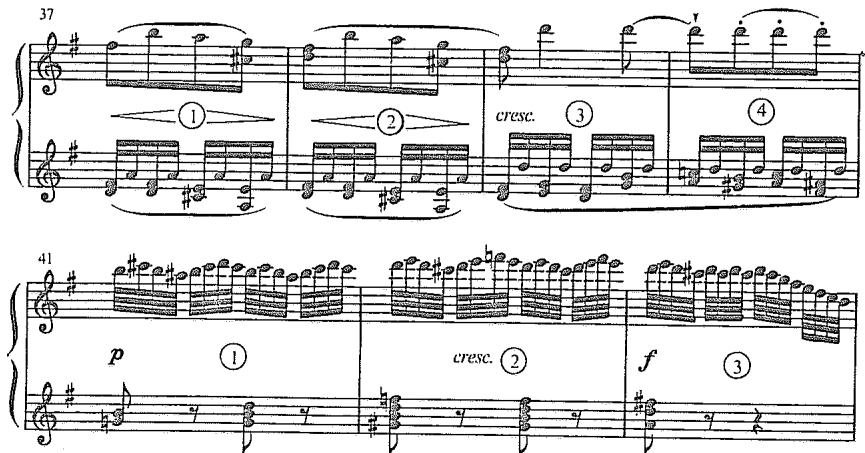
中文讲解
该位置为图示占位符:Example 2.35,贝多芬《G 大调钢琴奏鸣曲》Op. 14 No. 2 第一乐章 mm. 37–51。这是本节讨论类型 (3)(乐句结束与下一乐句开始以等强下行拍相邻)的核心谱例。实际乐谱细节需查原图。
第16段(P0203)
原文复述
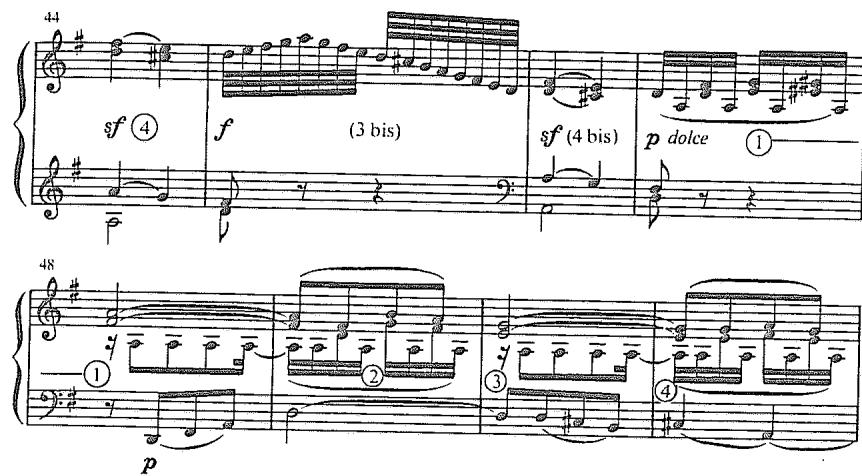
中文讲解
该位置为图示占位符:Example 2.35 的续页/续图。谱例跨多页,连续呈现同一片段以保证分析所需的乐句完整。实际乐谱细节需查原图。
第17段(P0204)
原文复述
In a situation such as this it seems as if the usual dual function of the downbeat—as goal of one metrical cycle and beginning of the next—has been split in two: the two functions are expressed consecutively rather than simultaneously. The difference in metrical function is thrown into relief by the fact that the same harmony underlies both downbeats. And in a way, such a juxtaposition of downbeats suggests a would-be phrase overlap: if only the melodic tones on the two downbeats were the same, as the harmony is, they could have been fused together in a shared downbeat, as Example 2.36 attempts to illustrate.
中文讲解
本段是对 Example 2.35 所呈现现象的理论提炼。
正常情况下,一个下行拍同时承担两个功能——它是一个节拍周期的终点,也是下一个节拍周期的起点。Example 2.35 的特殊性在于:这两个功能被"分体"了,不再由同一个下行拍同时承担,而是由两个连续的下行拍分别承担——一个是终点(m. 47),一个是起点(m. 48),顺序而非同时。
作者进一步指出:两个下行拍底下是同一个和声,这一和声延续反衬出它们在节拍功能上的不同。如果两个下行拍上的旋律音也相同,那么原本可以合并为一个共享的下行拍——这正是 Example 2.36 所试图展示的"假想合并"。
因此,本段既解释了为何类型 (3) 的连续下行拍"不易被还原为更常规结构的修改",又为下一段引入 Example 2.36 的重构做了铺垫:用一个和声相同、旋律相同的合并版本,揭示实际版本对常规结构的偏离。
第18段(P0205)
原文复述
This reconstruction is obtained by linking the final cadence of the second theme (m. 47) with that of the closing theme (m. 58), omitting the closing theme itself. In fact, such a phrase overlap is precisely what happens at m. 58 of Beethoven’s version, so it is not at all unreasonable for us to second-guess the composer in this way. If anything, Example 2.36 helps to explain the slightly parenthetical effect that the closing theme, marked dolce, has: after the conventionally tumultuous rhetoric of mm. 41 ff., the sweetness of the closing theme seems even sweeter because it is—structurally speaking—a reverie, a respite from the necessary formal business at hand.
中文讲解
本段说明了 Example 2.36 的具体构造方法:将第二主题的终止终止式(m. 47)与结束主题的终止终止式(m. 58)直接相连,中间的结束主题被略去。这样得到的版本中,m. 47 和 m. 58 共享同一个下行拍,构成一个"乐句重叠(phrase overlap)"。
有意思的是,这种乐句重叠其实正是贝多芬实际版本中在 m. 58 处发生的现象——所以作者认为"事后揣测作曲家"并非毫无根据。Example 2.36 不是凭空假想,而是把贝多芬自己在再现段落中已经做到的事情"借到"此处来想象。
最后,作者赋予这种结构偏离以美学意义:在 mm. 41 之后惯常出现的"喧嚣修辞"之后,结束主题(标以 dolce,即"甜美地"演奏)听起来格外甜美——因为从结构上看,它像是一次"白日梦(reverie)",是从必要的曲式事务中暂时抽身的一种喘息。结构上"本不该独立"的小节,被作曲家拆分成两个下行拍,反而获得了抒情的悬置效果。
补充说明
术语 dolce 为意大利语"甜美地",是力度/表情术语,本段作为引文保留原文。
第19段(P0206)
原文复述
The fourth and last type of construction involving successive downbeats (4) occurs frequently in melody-and-accompaniment textures. The accompanying component in such a texture may begin a phrase one or two measures before the melody, playing (sometimes repeatedly) some accompanimental figure. If this figure sounds a single harmony—say, the tonic—and the melody then enters over the same harmony, the resulting effect is often that of a single hypermetrical downbeat split between the two parts of the texture. Example 2.37 illustrates this effect. Here, the theme of Schubert’s rondo is initially stated with an introductory “vamp” in the accompaniment; the first hypermetrical downbeat occurs in m. 3, and the hypermeter is four-bar. After a contrasting eight-measure period (mm. 11–18), the theme returns in m. 19 with an abbreviated “vamp.” Since m. 18 was the final bar of a hypermeasure, m. 19—bringing the return of tonic harmony—sounds like a hypermetrical downbeat. But m. 20 is also a downbeat bar, like m. 3. The phrase actually begins twice, first in the left hand and then in the right, and both beginnings establish hypermetrical downbeats. The “extra” bar—m. 19—results from Schubert’s decision not to introduce the melodic upbeat into the second half of m. 18, preferring instead a three-beat lead-in in the left hand.
中文讲解
本段展开第四种类型——旋律加伴奏织体中的分体下行拍。其一般机制是:伴奏声部在旋律之前一两个小节就开始,演奏(有时是反复地)某种伴奏音型;如果这个音型只建立单一和声——例如主和弦——而旋律随后在同一和声上进入,那么听感上就会像单一的超节拍下行拍被"劈开"为伴奏和旋律两部分。
作者以舒伯特回旋曲(Example 2.37)为例。该主题首次陈述时,伴奏以一段引导性的"vamp"(即反复伴奏音型)出现,第一个超节拍下行拍在 m. 3,超节拍为四小节单位。经过一段八小节对比乐句(mm. 11–18)后,主题在 m. 19 再现,使用了缩写版的 vamp。由于 m. 18 是一个超小节的最末小节,m. 19 通过主和弦的回归听起来像是一个超节拍下行拍;但 m. 20 也是一个下行拍小节,类似首次陈述中的 m. 3。结果,乐句实际上"开始"了两次——先在左手,再在右手——两次开始都确立了超节拍下行拍。
多出来的那个小节(m. 19)的成因是:舒伯特没有把旋律的上行拍引入到 m. 18 的后半,而是在左手中保留了一个三拍子的引导进入。这一作曲选择产生了"多出"的一小节,从听感上看即一次分体下行拍。
补充说明
vamp 在本段为反复性的短伴奏音型(常用以等待旋律进入),此处保留原文术语并在中文释义中说明其在本节的用法。
第20段(P0207)
原文复述
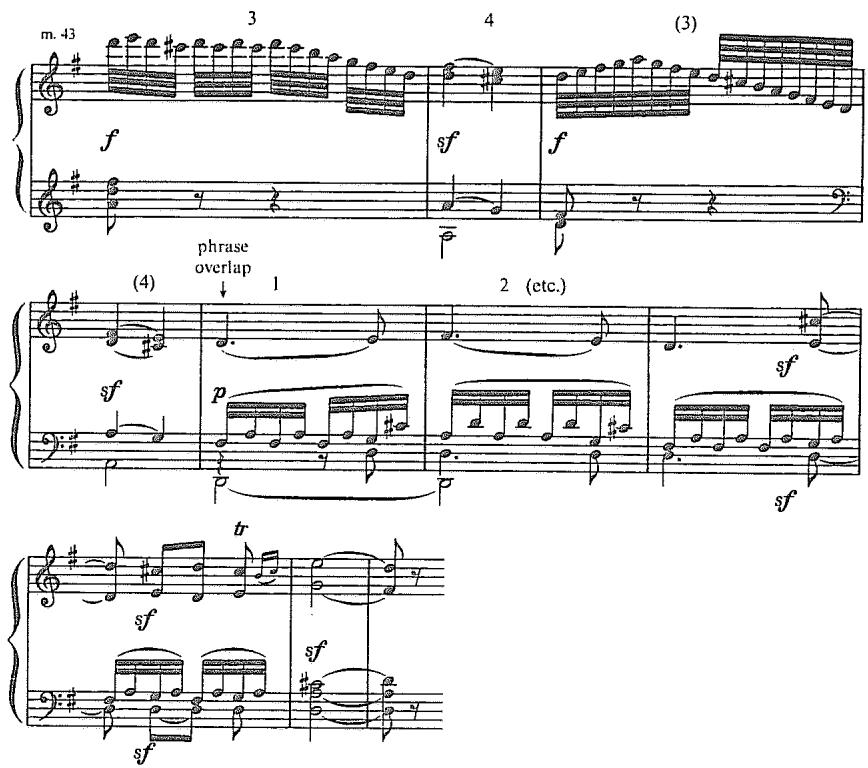
中文讲解
该位置为图示占位符:Example 2.36,对贝多芬 Op. 14 No. 2 mm. 43 之后(到呈示段结束)的重构版本。它把第二主题终止式与结束主题终止式直接相连,省略中间的结束主题,用以说明实际版本中的连续下行拍与一种"乐句重叠"假想之间的关系。实际乐谱细节需查原图。
第21段(P0208)
原文复述
The difference between this example and Example 2.35—another type of “split” downbeat—is that, in the Schubert, both downbeat measures are phrase beginnings.
中文讲解
本段用一句话对比两类"分体下行拍":舒伯特 Example 2.37 与贝多芬 Example 2.35 在结构上虽然都属于"下行拍被分体",但功能不同——在舒伯特中,两个下行拍小节都是乐句的开始;而在贝多芬中(见下一段详述),第一个下行拍是乐句的结束。
这一对比为接下来的两句细致区分作了铺垫。
第22段(P0209)
原文复述
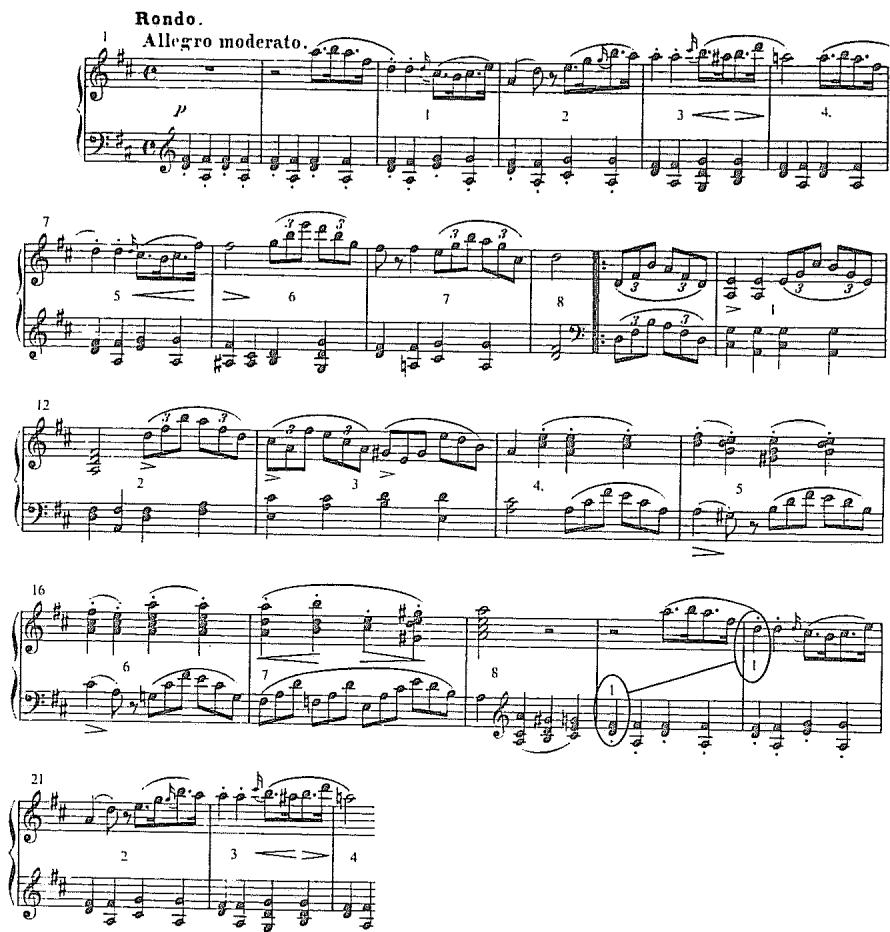
中文讲解
该位置为图示占位符:Example 2.37,舒伯特《D 大调钢琴奏鸣曲》D. 850(Op. 53)第四乐章开头。这是本节讨论第四种类型(旋律加伴奏中的分体下行拍)的核心谱例。实际乐谱细节需查原图。
第23段(P0210)
原文复述
In the Beethoven example, the first downbeat measure is a phrase ending (cadence).
中文讲解
本段以一句简短的对比,明确贝多芬 Example 2.35 中第一个下行拍小节(m. 47)承担的是乐句结束(终止式)的功能——它通过完全终止式收束上一乐句;第二个下行拍小节(m. 48)才是新乐句的开始。
这与上一段所描述的舒伯特情况恰好相反:舒伯特中两个下行拍都是乐句的开始。这一区别揭示了"分体下行拍"概念的两种变体——一种是连续两次"开始",另一种是"结束"紧接着"开始"。
第24段(P0211)
原文复述
The basic requirement for a “split” downbeat such as that shown in Example 2.37 is that a hypermeter must be clearly established both before and after the double downbeat. The first measures of both accompaniment and melody must be affirmed as downbeat measures by the hypermetrical context. At the beginning of a piece, an initial measure of accompaniment cannot unequivocally be interpreted as a hypermetrical downbeat if the first measure of melody is itself a downbeat measure. $^{45}$
中文讲解
本段提炼出分体下行拍成立的基本前提:双重下行拍之前和之后都必须有清晰可辨的超节拍结构作为依托;伴奏与旋律各自的首小节都必须被超节拍语境确认为下行拍小节。
作者还特别指出一条限制情形:乐曲开头的小节里,如果旋律的第一小节本身就是一个下行拍小节,那么伴奏的初始一小节就不能被毫无疑义地解释为超节拍下行拍——因为在乐曲开头,超节拍尚未建立,单独的伴奏进入不足以构成一个独立的超节拍锚点。这一限制由脚注 45 进一步支持(具体内容本段未给出)。
因此,分体下行拍依赖于既有的超节拍框架;缺乏这种框架(如乐曲开端),分体下行拍就难以成立。
补充说明
脚注 45 的具体内容本段未给出,不可据外部知识补充。
第25段(P0212)
原文复述
The accompanimental downbeat also represents a kind of phrase prefix, a type of phrase expansion in which extra material is appended to the beginning of a phrase. Phrase expansion is the subject of the next chapter.
中文讲解
本段是本节的收束与过渡。作者指出:分体下行拍中伴奏声部先行出现的下行拍,实质上构成了"乐句前缀(phrase prefix)"——一种乐句扩张(phrase expansion)的形式,即在乐句的开头附加额外材料。
作者以这一概念为桥梁,把讨论引向下一章(关于乐句扩张)。也就是说,分体下行拍不只是节拍层面的特殊现象,它同时也是乐句结构层面的一种扩张手段。
本段因此承担双重功能:既为本节分析作出归纳(伴奏下行拍 = 乐句前缀),又为下一章的议题(乐句扩张)提供衔接。
脚注 / 边栏 / 图表 / 附加信息(如有)
本节图示材料:Example 2.28(前文讨论的节拍重释实例,本节仅回溯引用)、Example 2.33(贝多芬 Op. 49 No. 1,呈示段压缩实例)、Example 2.34(对 2.33 mm. 13–15 的重构)、Example 2.35(贝多芬 Op. 14 No. 2 mm. 37–51,类型 3 实例)、Example 2.36(对 Op. 14 No. 2 mm. 43 之后到呈示段结束的重构)、Example 2.37(舒伯特 D. 850 第四乐章开头,类型 4 实例)。本节出现的脚注:43(Schachter 关于上行拍/下行拍感知差异的出处)、44(关于第二主题终止式与结束主题开头的语境说明)、45(关于乐曲开头能否确立超节拍下行拍的限制条件)。上述脚注的具体内容在 source_paragraphs 中未给出,故仅作引用标注。
💡 本节核心要点
- 连续下行拍这一现象之所以需要专门解释,根源在于下行拍在感知上是瞬时释放点而非可拉长的过程,因此两个下行拍相继出现必然依赖于特殊的作曲手段。
- 类型 (1) 节拍重释:弱小节被省略,使一个真实小节同时充当弱小节与下一强小节,导致等强连续下行拍。
- 类型 (2) 收缩:四小节或八小节超小节被省略一整小节,使相对强的小节相连,强度由更高层级超节拍决定,常见和声延续削弱下行拍冲击。
- 类型 (3) 乐句衔接:前句以超节拍下行拍结束,紧接新乐句以另一个超节拍下行拍开始,二者强度近乎相等,难以还原为某一常规结构的修改。
- 类型 (4) 分体下行拍:旋律加伴奏织体中伴奏先于旋律进入同一和声,使一个超节拍下行拍被分置到伴奏与旋律两个声部、两个小节中分别实现。
- 分体下行拍成立的基本前提是双重下行拍前后必须有清晰可辨的超节拍结构作为依托,乐曲开端因缺乏超节拍框架而难以构成这种分体。
- 伴奏声部先现的下行拍同时也是乐句前缀(phrase prefix),即乐句扩张的一种形式,连接本节分析与下一章关于乐句扩张的讨论。
🔑 关键术语
- downbeat:超节拍层级中具有结构释放功能的节拍点;与上行拍相对。本节核心前提:下行拍在感知上是相对瞬时的,不能被拉长,但在作曲手段作用下可与其他下行拍紧邻出现。
- upbeat:朝向下行拍运动的过程性节拍,常被视为具有长度;与下行拍构成节拍意义上的基本对照(参见 Schachter 的相关论述)。
- hypermetrical downbeat:在超节拍层级上承担强拍功能的小节;本节讨论的"连续下行拍"均指此类。
- metrical reinterpretation:节拍重释——原本节拍上弱的小节在听感中被省略或吸收,导致一个真实小节同时充当两个不同节拍位置,从而把若干小节重新解释为另一组超节拍。
- contraction:收缩——通过省略一整小节把超小节从典型长度(如四小节或八小节)压缩;连续下行拍由此产生,但不等强。
- split downbeat:分体下行拍——一个超节拍下行拍被分置到伴奏与旋律两个声部或两个小节中分别实现,使听感上出现连续两个下行拍;本节类型 (3) 与类型 (4) 的核心术语。
- phrase overlap:乐句重叠——后一乐句在小节上承接前一乐句的终止式而开始,从而使两个乐句共享同一下行拍;本节用 Example 2.36 展示其作为类型 (3) 的潜在对照。
- phrase prefix:乐句前缀——附加在乐句开头、起到铺垫作用的额外材料;在本节中与伴奏声部先现的分体下行拍概念对应,连接本节分析与下一章乐句扩张议题。
- antecedent / consequent:前后句——呈示段中一对结构对仗的乐句;本节在讨论收缩时以前句八小节(4+4)作为推断对应句应有长度的依据。
- vamp:反复性短伴奏音型,常用于等待旋律进入;本节在分析舒伯特回旋曲时用以描述伴奏先于旋律出现的引导性片段。