目录
ch_1 [描述性拆分] Bermudo on Scalar Fingerings and Voice Distribution
- 1.1 [描述性拆分] Scalar Fingerings for Left and Right Hands
- 页码:1-1
- 1.2 [描述性拆分] Redistributing Voices and Octave Fingerings
- 页码:1-1
- 1.3 [描述性拆分] Short Octave Layout and Interval Fingerings
- 页码:2-2
- 1.4 [描述性拆分] Second Fingering Warning and the Monachordio Diagram
- 页码:3-3
ch_2 [描述性拆分] Bermudo on Tuning, Transposition, Modes, and Glosa
- 2.1 [描述性拆分] Tuning the Monachordio and Keyboard Transposition
- 页码:4-4
- 2.2 [描述性拆分] Mixed Modes and the Condemnation of Glosa
- 页码:5-5
- 2.3 [描述性拆分] Book V on Monody, Counterpoint, and the Unprinted Book VI
- 页码:5-6
ch_3 [描述性拆分] Venegas de Henestrosa: Libro de cifra nueva
- 3.1 Luis Venegas de Henestrosa: Libro de cifra nueva para tecla, harpa, y vihuela (1557)
- 页码:6-6
- 3.2 [描述性拆分] Scope and Tablature of the Libro de cifra nueva
- 页码:7-7
- 3.3 [描述性拆分] Right-Hand Scalar Fingerings
- 页码:8-8
- 3.4 [描述性拆分] Left-Hand Fingerings and Practice Recommendations
- 页码:9-9
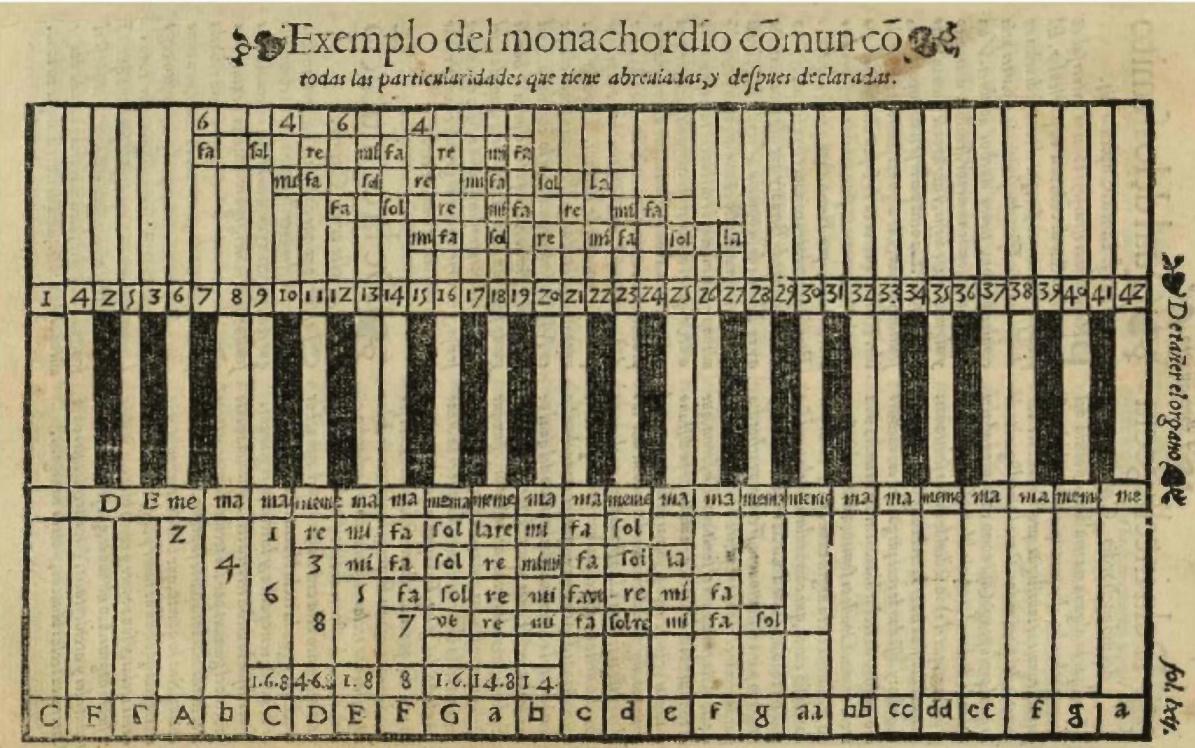
- 3.5 [描述性拆分] Clavichord versus Organ Notation and Ornamentation
- 页码:9-10
ch_4 [描述性拆分] Santa María: Arte de tañer fantasia
- 4.1 Fray Tomás de Santa María: Arte de tañer fantasia, así para tecla como para vihuela (1565)
- 页码:10-10
- 4.2 [描述性拆分] Structure of the Arte de tañer fantasia
- 页码:11-13
- 4.3 [描述性拆分] Pedagogical Approach and Types of Quiebros
- 页码:13-15
- 4.4 [描述性拆分] Long Ornaments and Rhythmic Groupings for Scales
- 页码:15-15
ch_5 [描述性拆分] Santa María on Touch and Buen Ayre
- 5.1 [描述性拆分] Six Elements of Touch (1–3)
- 页码:16-16
- 5.2 [描述性拆分] Six Elements of Touch (4–6) and Articulation
- 页码:17-18
- 5.3 [描述性拆分] Buen Ayre and Three Modes of Executing Eighth Notes
- 页码:18-20
ch_6 [描述性拆分] Hernando de Cabezón: Obras de música
- 6.1 Hernando de Cabezón: Obras de música para tecla, arpa y vihuela (1578)
- 页码:21-21
- 6.2 [描述性拆分] Scalar and Interval Fingerings for Beginners
- 页码:21-23
- 6.3 [描述性拆分] Short Ornaments and Execution of Quiebros
- 页码:23-23
ch_7 [描述性拆分] Correa de Arauxo: Facultad orgánica
- 7.1 [描述性拆分] Francisco Correa de Arauxo: Libro de tientos y discursos de música práctica, y teórica de órgano intitulado Facultad orgánica (1626)
- 页码:24-24
- 7.2 [描述性拆分] Preambular Treatise and Genera
- 页码:25-26
ch_8 [描述性拆分] Correa on Mensuration and Time Signatures
- 8.1 [描述性拆分] Tiempo Imperfecto and Tiempo Imperfecto Partido
- 页码:27-30
- 8.2 [描述性拆分] Tiempo Perfecto de por Medio and Compás Ternario
- 页码:31-33
- 8.3 [描述性拆分] Tiempo Perfecto Absoluto and the Unnamed Signature with 3
- 页码:34-36
ch_9 [描述性拆分] Correa on Proportions, Sesquialtera, Ornaments, and Fingerings
- 9.1 [描述性拆分] Proportions and Sesquialtera (Major and Minor)
- 页码:36-40
- 9.2 [描述性拆分] Repetitions and the Quiebros
- 页码:40-42
- 9.3 [描述性拆分] Redobles, Cadential Use, and Keyboard Fingering
- 页码:42-44
- 9.4 [描述性拆分] Scalar Fingerings and Organ Registration
- 页码:45-46
ch_10 CHAPTER 3: THE SPANISH VIHUELA DIFERENCIAS OF NARVÁEZ, MUDARRA, AND VALDERRÁBANO
- 10.1 CHAPTER 3: THE SPANISH VIHUELA DIFERENCIAS OF NARVÁEZ, MUDARRA, AND VALDERRÁBANO
- 页码:47-47
- 10.2 [描述性拆分] The Vihuela Variation Publications and Their Composers
- 页码:48-50
- 10.3 [描述性拆分] Narváez’s Diferencias on O gloriosa Domina
- 页码:50-50
1.1 [描述性拆分] Scalar Fingerings for Left and Right Hands
第1段(P0001)
原文复述
When ascending in such long passages with the left hand, the player should begin with the fourth finger and continue with the third, second, and first. (Footnote 18 is attached to the instruction.)
中文讲解
本段给出了一条针对左手的长乐句上行指法规则:因为左手的手指数编号与右手相反(小指为4号),所以在长段落上行时改用4、3、2、1指的顺序来弹奏。需要注意的是,原文使用了"such long passages"和"follow with",意味着这是接续前文所讨论的某一类较长音阶/经过句型的指法建议,而非所有左手指法的普遍规则。该句带有脚注18,说明作者在文献上有依据;脚注的具体内容本节输入未提供。
补充说明
句中出现的"such"回指前文已讨论的某类长音型段落,本段输入未给出该前文的完整内容,故不补述。脚注18仅作为正文主张的来源标记被引用,不在本节文本范围内展开。
第2段(P0002)
原文复述
Bermudo uniformly considers the right hand, and proceeds to explain that,
中文讲解
本段是一个过渡句,作用是引出下文对右手规则的直接引用。它指出:本小节所引述的规则来自理论家Bermudo,且Bermudo的论述是统一围绕右手建立的。换言之,作者即将给出的右手指法,原文是以Bermudo的权威论述为根据转述的。“uniformly"一词强调Bermudo对右手的论述具有一贯性,而非零散举例。这段本身不包含技术内容,只是为下一段的引文作铺垫。
第3段(P0003)
原文复述
“For the exercise of the right hand, it will be all the opposite. To ascend, start with the first finger until the fourth, and to descend, from the fourth finger to the first.” (Footnote 19 is attached to the quote.)
中文讲解
本段是Bermudo关于右手训练的直接引语,其核心主张用"all the opposite”(完全相反)来标定——与左手(4-3-2-1)相反,右手上行时从第一指按顺序弹至第四指,下行时则反向从第四指回到第一指。这条规则明确了两个方向:上行(1→2→3→4)和下行(4→3→2→1)。作者用"all the opposite"将左右手规则用一句话对应起来,凸显了双手指法方向上的镜像关系。该引语附脚注19,为Bermudo原典出处。
补充说明
引文中"first finger"和"fourth finger"沿用了Bermudo原典的指法编号传统,与现代常见的拇指为1号、小指为5号的编号并不完全一致——本段输入未明确说明具体编号体系,读者需结合上下文语境理解。此为对文本内部关系的提示,不引入外部信息。
第4段(P0004)
原文复述
The theorist clarifies that fingerings for a keyboard instrument must be modified whenever further parts are played in combination with the basic scale. Accordingly,
中文讲解
本段是作者的转述性说明,交代下文规则将引入什么限制条件:键盘乐器上的指法规则必须根据情况加以调整——当基本音阶/经过句之上还有其他声部同时进行时,简单的"左右手镜像规则"就不再直接适用,必须修改指法。这段起到一种"原则+修正"的过渡作用:前面给出的左右手音阶指法是默认情形,本段正式预告还存在例外情形,下一段(P0005)就是对该例外的具体陈述。“further parts … in combination with the basic scale"点明了修改指法的触发条件:附加声部的加入。
第5段(P0005)
原文复述
“The rule of ascending and descending with both hands in long passages assumes that the hand that has to play each passage would be loose and free. For if it is bound and occupied with other notes, then whichever fingers are free should play the ascending and descending passages.” (Footnote 20 is attached to the quote.)
中文讲解
本段是关于指法规则适用条件的引语,分两层讲清。 第一层(前提条件):前几条左右手音阶指法规则的有效前提是"弹奏该段音型的那只手必须是松弛、自如的”(loose and free),即该手当时没有被别的声部占用。 第二层(例外与替代原则):一旦该手被束缚、被其他音符占住(即同时还须弹其他声部),那么上一段(P0004)预告的"修改"就具体化为:哪几根手指是空闲的,就由这几根空闲手指来负责音阶上下的弹奏。 逻辑上,本段把"镜像规则"确立为常规、把"按空闲指改配"确立为例外,但并未给出具体的改指方案,只是确立了一条改指原则。这与前一段"must be modified"的预告相互承接。脚注20为出处。
补充说明
“loose and free"与"bound and occupied"是一对对照概念:前者描述手部无其他负担、可以严格按规则分配手指的状态,后者描述手部被其他声部牵制的状态。本节输入未提供关于"free"具体指"完全无他声"还是"部分手指定空"的进一步说明,故仅依文本对译。
脚注 / 边栏 / 图表 / 附加信息(如有)
本小节包含三处脚注引用:P0001末尾的脚注18、P0003末尾的脚注19、P0005末尾的脚注20。这些脚注仅作为正文规则主张的来源或旁证标记被引用,未在本节源文本中展开其具体内容;因此本节不对脚注内容进行复述或推测。
💡 本节核心要点
- 左手长乐句上行指法的默认顺序是四、三、二、一指。
- 理论家Bermudo针对右手提出的规则与左手完全相反:右手上行从第一指到第四指,下行从第四指回到第一指。
- 前述左右手规则的有效前提是执行该音型的手必须"loose and free”(松弛、无其他负担)。
- 当该手被其他声部占用时,规则需作修正,改由当时空闲的手指来弹奏音阶上下行。
- 本节体现了一种"常规指法规则+例外修正原则"的双层结构,而非给出所有情况下的具体指法方案。
🔑 关键术语
- Scalar fingerings:即音阶/经过句型的指法配置。本节指在键盘乐器上弹奏上下行长音阶片段时左右手各指的分配方式。
- Long passages:指篇幅较长、连续上下的音阶型乐句;本节为指法规则所适用的对象,并非泛指任意短片段。
- Bermudo:本节所引指法规则的来源理论家;P0002明示其论述"uniformly considers the right hand",故P0003的右手规则是直接引自Bermudo原典。
- loose and free / bound and occupied:本节用来限定指法规则适用条件的一对术语:手部无其他声部牵制即为loose and free,可严格按规则配指;被其他音符占住即为bound and occupied,须按空闲指改配。
- further parts … in combination with the basic scale:指在基本音阶之上同时进行的多声部附加声部;其出现是触发指法规则修改的条件。
1.2 [描述性拆分] Redistributing Voices and Octave Fingerings
第1段(P0006)
原文复述
Bermudo recommends that a keyboard player should consistently attempt to relieve the hand executing the running scale of any other parts altogether, shifting them instead to the opposite hand. The theorist thus describes the practical procedure that,
中文讲解
本段提出 Bermudo 关于声部再分配的总原则:执行快速音阶(running scale)的那只手应被完全解放出来,不再承担其他声部,而是把那些声部转移到另一只手上。句末以 that 结尾,是一个引导从句的开头,预示下文(P0007)将通过具体情境展开"theorist 所描述的实际操作程序"。这一原则是本节论证的起点:它把技术变形(指法)问题与和声配置(声部归属)问题联系在一起——只有先重新分配声部,单手音阶才有可能用标准的顺次指法来弹奏。
补充说明
本段与上一节谈到的"长段(passos largos / paños largos)“的指法选择直接相关:前节假设单手可以自由按规则指法弹音阶,本段则说明在多声部实际演奏中如何为这种自由创造条件。
第2段(P0007)
原文复述
If within an octave, three or four voices are played, the left hand could take two or three of the voices and the right hand could also take one. At all times the right hand should remain as free as possible, playing only the top line (tiple) in order to play ornaments (redoble). ²¹
中文讲解
本段是 P0006 总原则的具体化,给出一个量化的声部分配方案:当一个八度之内需要安置三或四个声部时,左手承担其中两或三个,右手只承担一个;右手应当尽可能只弹最上面那一行(tiple,即最高声部),以便腾出手来加花(redoble,装饰音/颤音类的快速加花动作)。这里的逻辑是:装饰花奏是右手最重要的特色义务,因此整首曲子的声部布局应优先保证右手能腾出指头来作 redoble。脚注 21 标记意味着英文转述来自 Bermudo 原文(fol. 61r.),由 P0012 提供原文。
补充说明
tiple 与 redoble 在 P0007 是首次出现,下文脚注 21(P0012)以西班牙语原文对应;两者构成 Bermudo 右手装饰传统的一对核心术语。
第3段(P0008)
原文复述
Bermudo asserts that octaves, with the exception of the so-called “short” octave at the bottom of the keyboard, should be played with the fingers one and five, intervals of sixths played with one and four or two and five, and thirds with one and three or two and four. The contemporary short octave typically appears to encompass the notes E₁, F₁, F₁#, G₁, G₁#, A₁,
中文讲解
本段从声部再分配切换到固定音程的指法规则。Bermudo 的规定:八度(键盘最低处的"short octave"除外)用 1 指和 5 指;六度可用 1-4 或 2-5;三度可用 1-3 或 2-4。每一项都给出两种备选,体现了对不同手形或前后衔接的灵活考量。最后一句开始介绍 short octave 所涵盖的音,但句末被截断(以 A₁, 结束),说明在本页范围内并未完整列出。第一句开头的 with the exception 提示:short octave 的指法不能套用 1-5,因为它在键盘最底端的物理排布与普通八度不同。
补充说明
“short octave” 的指法规则在本节内未展开,仅承认其为规则的例外;段末对 short octave 音列的列举也被截断,不可凭推测补全。
第4段(P0009)
原文复述
Ibid., Quando en los tales passos largos subierdes con la mano yzquierda: començareys con el quarto dedo, y seguirseban tercero, segundo, y primero. (fol. 61r.)
中文讲解
这是脚注 18,给出 Bermudo 原文(fol. 61r.)关于左手在长段(passos largos)上行时指法的明文规定:先用第四指,然后依次接第三、第二、第一指。该顺序与一般人直觉相反(上行通常从 1 指),由此看出 Bermudo 体系的左右手明显非对称。注意原文是古西班牙语拼写:yzquierda(左手)、subierdes(subierdes,你们上行)、seguirseban(seguirse han,将接着)。
补充说明
本脚注与 P0010(脚注 19)配对,共同构成"左右手非对称指法"的完整规则。
第5段(P0010)
原文复述
Ibid., Para el exercicio dela mano derecha sera todo al contrario. Al subir començareys con el dedo primero hasta el quarto: y al abaxar desde el dedo quarto hasta el primero. (fol. 61v.)
中文讲解
这是脚注 19,右手的指法被明确写成"完全相反(todo al contrario)":上行从第一指开始到第四指,下行从第四指回到第一指。把 P0009 与 P0010 并读即可得到完整对照:左手上行 4-3-2-1,下行 1-2-3-4;右手则正好相反,上行 1-2-3-4,下行 4-3-2-1。作者用"完全相反"一词强调两手指法镜像对称,是本节技术建议的核心规矩。ulo desde el quarto hasta el primero:起点和终点决定了"上行起点 = 下行终点”,即两手在跨越中段时共享同一序位的指头。
第6段(P0011)
原文复述
Ibid., La regla del subir y abaxar con ambas manos enlos paños largos se entiende: quando la mano que el tal paño ha de hazer, estuuiere suelta y libertada. Porque si esta ligada, y occupada cō algunas consonancias: cō aquellos dedos subireys, o abaxareys: que tienen libertad. (fol. 61v.)
中文讲解
这是脚注 20,对前两条指法规则加上关键的限制条件:双手在上行长段中上行/下行的标准指法,只有在该手"suelta y libertada"(空闲且自由)时才能套用;如果该手被一些 consonancias(和声音,即和弦上的音)和弦"ligada y occupada"(绑定且占用)着,则只能用那些仍然自由的指头来上行或下行。换言之,Bermudo 的指法规则以"手被解放出来"为前提,而这一前提正是 P0006-P0007 谈到的声部再分配所要实现的。三个脚注合起来构成完整的逻辑链:先重分配声部(21)→ 左手按 4-3-2-1(18)、右手按 1-2-3-4(19)→ 但只有手真自由时才适用(20)。
补充说明
脚注 18-20 是一条内在完整的复合规则,建议在教学复述时把它们作为一组同时引出。
第7段(P0012)
原文复述
Ibid., Si en vna octaua diessen tres, o quatro bozes: con la mano siniestra se tamarian las dos, o las tres: y con la mano derecha la vna. Todas las vezes que la mano derecha pudiere quedar libertada con solo el tiple: se deue hazar para el redoble. (fol. 61r.)
中文讲解
这是脚注 21,给出 P0007 英文转述的西班牙语原文(fol. 61r.)。原文要点:在同一八度内如果给出三或四个声部,左手(mano siniestra)取其中两或三个,右手(mano derecha)取一个;只要右手能仅靠 tiple(最高声部)就获得自由,就应当这么做,以备 redoble(装饰加花)。原文用古拼写:octaua、vna、siniestra、tamarian、hazar(应为 hazer 的异体)。这里的"se deue hazer para el redoble"点出再分配的目的论——整个声部布局的最终理由就是为了让右手腾出来做装饰。
补充说明
脚注 21 是 P0007 的唯一一处底注,脚注 18-20 则共同支撑 P0008 的指法声明;四则脚注合起来完成了 P0006 所预告的"实际程序"的全貌。
脚注 / 边栏 / 图表 / 附加信息(如有)
本节在 P0006-P0008 的正文叙述中标注了四处脚注(18、19、20、21),全部指向 Bermudo 同一部著作(用 Ibid. 指代上文已出现过的著作),分别出自 fol. 61r. 或 fol. 61v.。脚注 18、19、20 形成左手/右手/限制条件的三件套,用于支撑 P0008 的指法;脚注 21 单独支撑 P0007 的声部再分配。P0006 与 P0008 在句末均被截断(前者以逗号结尾,后者以 A₁, 结尾),说明本节内容跨页或跨节,未完成的部分不在本次范围内。
💡 本节核心要点
- 再分配原则:弹长段音阶的手必须完全解放,承担其他声部的任务转移到另一只手上(P0006)。
- 量化分配:同一八度内三或四声部时,左手承担二或三声部,右手承担一声部并优先只弹 tiple,以便腾出手做 redoble(P0007,P0012)。
- 指法规定:八度用 1-5、六度用 1-4 或 2-5、三度用 1-3 或 2-4;short octave 为例外,但本节未给出例外指法(P0008)。
- 左右手非对称:左手上行长段自 4 指起按 4-3-2-1;右手则完全相反,上行 1-2-3-4(P0009、P0010)。
- 条件限制:上述规则只有在执行该长段的手完全自由时才适用;若手被和声音占用,则仅用仍自由的指头(P0011)。
- 逻辑链:声部再分配(脚注 21)为指法规则(脚注 18、19)创造前提,而指法规则又被其适用条件(脚注 20)所制约——三者合起来构成 Bermudo 弹奏实践的完整程序。
🔑 关键术语
- tiple:最高声部,即键盘演奏中的最上面那一行。本节中它被指定为右手唯一应承担的声部,目的在于让右手腾出手来做装饰。
- redoble:右手在 tiple 上做出的快速装饰加花动作(类似颤音或急速反复),是手解放后的具体用途之一。
- short octave:本节中作为八度指法规则(1-5)的例外,指键盘最低处那种按历史调律方式排列、弦长不一致的八度;本节只承认其存在并开始列举其音名,未说明其指法。
- passos largos / paños largos:本节指左右手需要贯穿弹奏的长段音阶/经过句;上述再分配与指法规则都以演奏"这样的长段"为应用情境。
- consonancias:和声音或和弦音;手如果被这些音"占用",则不能再套用标准指法,只能用仍自由的指头。
1.3 [描述性拆分] Short Octave Layout and Interval Fingerings
第1段(P0013)
原文复述
$B_{1}b$ , $B_{1}$ , and C, but actually sounds, respectively, the notes $C_{1}$ , $F_{1}$ , $D_{1}$ , $G_{1}$ , $E_{1}$ , $A_{1}$ , $B_{1}b$ , $B_{1}$ , and C, essentially simply exchanging the lowest E in the bass for a C natural, the F sharp for a D natural, and the G sharp for an E natural. $^{22}$ Consequently, a keyboard player would be able to stretch the intervals of the tenths comprising $C_{1}$ to E, $D_{1}$ to F sharp, and $E_{1}$ to G sharp just as effortlessly as intervals of octaves elsewhere on the keyboard. $^{23}$ The standard C/E short octave of the sixteenth century would also extend the typical keyboard compass beyond the usual range without increasing the physical dimensions of the instrument, while further supplying the low diatonic tones characteristic of the bass parts of many contemporary compositions. Regarding these recommended fingerings of particular intervals, the theorist specifically suggests that,
中文讲解
本段是整小节的开篇,承担两个任务:(1)描述"短八度"键盘布局的具体形态及其与普通八度布局的差异;(2)解释这种布局为何对演奏宽音程(十度)有利,从而为下文Bermudo的指法规则做铺垫。
“短八度”(short octave)是一种节省物理空间的设计:键盘最左端若干键并非按其表面刻字发音,而是被调成相邻或更低的自然音音高。本段所描述的是C/E短八度——最左端原本应当发出低音E、F♯、G♯的那三个键,实际发出的是C、D♮、E♮。因此从左至右的实际音响是$C_{1}$、$F_{1}$、$D_{1}$、$G_{1}$、$E_{1}$、$A_{1}$、$B_{1}b$、$B_{1}$、C。作者刻意强调这三处"替换"(低音E→C、F♯→D、G♯→E),是因为它们同时决定了低音区的可用音与缺省音。
这一压缩的实用价值体现在宽音程的演奏上:通常$C_{1}$到高八度的E是一个十度(octave + third),需要在键盘上跨越13个半音键;低音D₁到F♯、E₁到G♯同样如此。但借助短八度的错位发音,这些音响上的十度在物理键位上只相当于普通八度的距离,演奏者的手不必过度拉伸即可到位——这正是作者所说"just as effortlessly as intervals of octaves elsewhere on the keyboard"。作者列举这三个十度(C₁–E、D₁–F♯、E₁–G♯),正是低音声部常见的音程跨度。
更深一层,作者点出C/E短八度在16世纪得以普及的两大原因:(a)在不增大乐器体积的前提下扩展了低音区的可用音域;(b)提供了与当时低音旋律写作风格相匹配的低位自然音(diatonic tones)。这意味着演奏者不仅"能"演奏低音,更"被需要"演奏低音。
末句"Regarding these recommended fingerings…“明确从布局描述转入指法建议,承上启下地引出Bermudo关于具体音程指法的三条规则。
补充说明
本段是P0013单独成段的完整内容,结尾的逗号与引出P0014直接相连,提示下文是Bermudo原话的引述。脚注22、23分别指向Hermosillo与Stevenson两人的研究,将在P0019、P0020中给出完整文献信息。
第2段(P0014)
原文复述
The first rule would be, that to play an octave with either hand, commonly take it with the first finger and the fifth. $^{24}$
中文讲解
这是Bermudo指法建议中的"第一条规则”:无论用哪只手,演奏八度音程通常采用1指(拇指)与5指(小指)。这是文艺复兴键盘演奏的常规配置,本质上利用了拇指与小指之间最大的指距来覆盖八度跨度。
该规则之所以被列为"第一条"并加"commonly"(通常地)一词,是因为它是后续所有八度指法的基准;同时,作者随后将提出例外情形(见P0018),即在乐句开头的八度处可改用其它指法。因此本句既给出默认方案,也为变体留出空间。
需要特别留意的是,“first finger"在历史文献中通常指拇指,而非现代某些乐器(如小提琴)以食指为1指的体系。这是键盘演奏文献的传统。
补充说明
句末脚注24指向Bermudo原文(fol. 61r.),将在P0021给出西班牙语原文。P0014与P0015之间存在引述结构:P0015是引述标记,承上文"the theorist specifically suggests”(P0013末),启下文具体规则(P0014–P0016)。
第3段(P0015)
原文复述
Concerning additional types of intervals, Bermudo recommends that,
中文讲解
本句是引述结构中的过渡句:先用"Concerning additional types of intervals"(至于其它类型的音程)将话题从八度扩展到六度、三度等;再用"Bermudo recommends that"提示下面又是Bermudo的原话引述。
这一句虽短,但在论证结构上承担重要的衔接功能:前一句(P0014)完成了"第一条规则"(八度指法),本句开启关于六度、三度的新规则块。读者应当把它视为引语标记(quotation marker),而非新的主张。
补充说明
无额外补充。本句的功能完全由其在引述结构中的位置决定。
第4段(P0016)
原文复述
The interval of a sixth sometimes is played with the first finger and fourth and at other times with the second finger and fifth. The interval of a third is sometimes played with the first finger and third and at other times played with the second finger and fourth. It is therefore common to play the sixth so that the middle fingers are free, and the third so that one finger is free between the two that are playing. $^{25}$
中文讲解
本段陈述Bermudo对六度与三度指法的两种可选方案及其背后的统一原则。
具体配置如下:
- 六度:1–4指 或 2–5指
- 三度:1–3指 或 2–4指
作者并非简单罗列指法,而是提炼出统一的"留指原则"——六度应使两个中间指(middle fingers)闲置,三度应使一根手指闲置在被演奏的两指之间。这一原则的演奏意义在于:在演奏较长音程(六度)时,腾出多根手指便于后续衔接;而在演奏较短音程(三度)时,仍需保留一根手指以便快速转向相邻位置。这是一种"前瞻性"的指法选择,不只解决当前两音,更为下一动作做准备。
“sometimes … at other times"的措辞意味着两种指法并无绝对优劣,应视上下文决定——这与现代键盘演奏教学中"依乐句而定"的思路一致。
此段在论证链中的位置:紧接P0014的八度1–5基本规则后,进一步细化其它音程,构成"主规则+变体规则"的指法体系。
补充说明
脚注25指向Bermudo原文(fol. 61r.),将在P0022给出西班牙语原文。需注意原文使用的是"consonancia”(协和音程)一词,而非单纯"interval",暗示六度、三度在16世纪理论中首先被视为协和音程类别,而非纯几何距离。
第5段(P0017)
原文复述
The theorist also presents an alternative fingering technique for octaves, explaining that,
中文讲解
本句为引述结构中的过渡句,预示下文将给出八度指法的替代方案。“alternative fingering technique"一词明确表示,作者即将引入与P0014的"第一条规则”(1–5指)不同的另一种处理方式。
这句话的作用是:既保持对Bermudo指法体系的整体描述(P0014的常规八度指法、P0016的六度三度指法),又预告存在针对特殊情境的替代方案。
第6段(P0018)
原文复述
To play some of the octaves that occur at the beginning of a passage, treat them as a sixth with the first finger and fourth. The lowest key of an octave [excluding short octaves] should be played with the two lowest fingers, placing one on top of the other, in the best interest of the music and to allow the player a little rest. $^{26}$
中文讲解
本段陈述Bermudo对八度指法的替代/补充方案,包含两层内容:
第一层:乐句开头的某些八度,可按"六度"方式处理,即使用1指与4指。这与P0014的1–5指常规规则形成对比。理由可从音乐与生理两个角度理解:在乐句开始时,5指(小指)尚未承担重负,使用1–4指可使5指保留体力;同时4指较5指更灵活,乐句起音更可控。
第二层:八度的最低键可用最下两根手指叠按(一上一下)来演奏,并特别注明"excluding short octaves"(短八度除外)——这意味着该建议仅适用于普通布局的八度,原因是短八度最低键的实际音响位置与指法空间本就特殊(见P0013),不应再叠指。方括号"[excluding short octaves]“显然是译者或编辑者所加的限定,原文Bermudo应仅讨论常规情形。
“in the best interest of the music and to allow the player a little rest"一句同时给出此技巧的两重动因:服务于音乐表现(更好的乐句起音控制)与演奏者生理(让手指短暂休息)。这种"音乐–生理"双重的措辞,揭示了文艺复兴指法文献的特点:指法不仅是技术问题,也是乐句表达与身体耐力的综合考量。
本段在小节论证中的角色:作为八度指法的"例外情形”,使P0014的"第一条规则"不显得过于绝对;并通过短八度的例外标注,与P0013的开篇描述形成呼应。
补充说明
句末脚注26指向Bermudo原文(fol. 61v.),将在P0023给出西班牙语原文。本段是英文段落中唯一一处带方括号的限定([excluding short octaves]),该限定形式提示其为编辑性添加而非Bermudo原文。
第7段(P0019)
原文复述
$^{22}$ Hermosillo, 15.
中文讲解
本条为脚注22的文献出处:Hermosillo著作第15页。该脚注位于P0013中关于"短八度三处替换”(低音E→C、F�→D、G♯→E)的描述之后,因此其作用是为该具体描述提供二手研究依据。
补充说明
本输入未提供Hermosillo的完整书目信息,仅有姓氏与页码,故不补充其著作全名或出版信息。
第8段(P0020)
原文复述
$^{23}$ Stevenson, 50.
中文讲解
本条为脚注23的文献出处:Stevenson著作第50页。该脚注位于P0013中关于"短八度使十度音程的演奏变得像普通八度一样轻松"的论断之后,因此为该演奏便利性的判断提供研究依据。
补充说明
本输入未提供Stevenson的完整书目信息,仅有姓氏与页码,故不补充其著作全名或出版信息。
第9段(P0021)
原文复述
$^{24}$ Bermudo, Sea la primera regla, que para tomar la octaua con qualquiera delas manos: se toma cōmunmente con el dedo primero y el quinto. (fol. 61r.)
中文讲解
本条为脚注24,给出P0014(八度指法规则)的西班牙语原文出处。原文出自Bermudo著作第61r叶(fol. 61r.),原句直译为:“第一条规则:用任何一只手演奏八度音程时,通常以第一指与第五指来演奏。”
需要注意的是原文使用的是古西班牙语正字法:“octaua"对应现代西文"octava”,“qualquiera"对应"cualquiera”,“cōmunmente"带鼻化长音符号(即字母o上的macron,表示该字母带鼻音n,cōmunmente = comunmente)。原文使用"consonancia"一词的同源词族(如octaua本身在乐理术语中即被理解为协和音程),与P0022中的"consonancia de sexta / tercera"一致。
该脚注的作用:为英文译文提供权威原文出处,使读者可核对Bermudo的措辞;同时也表明"first finger"对应的西班牙原文确实是"dedo primero”(第一指),即现代意义上的拇指。
补充说明
原文中的长音符号(macron,如cōmunmente中的ō)是16世纪西班牙语印刷品的常见特征,提示该词带有鼻化元音。“dedo primero"指拇指,与现代西班牙语"dedo pulgar"或英语"thumb"不同。
第10段(P0022)
原文复述
$^{25}$ Ibid., La consonancia de sexta vnas vezes se toma con el dedo primero y quarto: y otras vezes con el dedo segundo y quinto. La consonancia de tercera vnas vezes se toma con el dedo primero y tercero: y otras vezes se toma con el dedo segundo y quarto. Es pues lo cōmū para tomar la sexta que dar dos de dos sueltos, y libres en medio delos dos que hierē la tal consonancia: y para tomar la tercera quedar vno. (fol. 61r.)
中文讲解
本条为脚注25,给出P0016(六度与三度指法规则)的西班牙语原文出处,同样出自Bermudo著作第61r叶(fol. 61r.)。“Ibid.“指示其文献与脚注24相同,即Bermudo同一著作的相邻页面。
原文可意译为:“六度协和音程有时用第一指与第四指来演奏,有时用第二指与第五指来演奏。三度协和音程有时用第一指与第三指来演奏,有时用第二指与第四指来演奏。因此通常演奏六度时,要留出两根自由手指在被演奏的两指之间;演奏三度时,要留出一根。”
原文中有两点特别值得注意:
- Bermudo使用"consonancia”(协和音程)一词而非"intervalo”,与16世纪音乐理论中将六度、三度视为协和音程类别的传统一致。
- 古正字法特征明显:“vnas vezes”(现代西文"unas veces”,鼻化长音符号);“cōmū”(即"común"的简写);“hierē”(即"hieren",第三人称复数)。这些形式保留了16世纪印刷品特有的简写与符号。
“dedo primero"在原文中仍指拇指(与P0021一致),“quarto”=“cuarto”,“tercero”=“tercero”,依此类推。该脚注证实P0016的英文译文忠实传达了Bermudo关于"留指"原则的原话。
补充说明
原文"consonancia"一词揭示出Bermudo指法讨论的理论语境:六度、三度首先被视为"协和音程"类别,而非纯粹的几何距离,这是文艺复兴乐理的典型观念。原文鼻化长音符号(vnas、cōmū、hierē等)提示这是早期近代西班牙语正字法的典型形式。
第11段(P0023)
原文复述
$^{26}$ Ibid., Al tomar alguna delas octauas que son recogidas al principio del juego: se toman como se fueße sexta, con el dedo primero y quarto. La tecla mas baxa desta tal octaua sedeue tomar con dos dedos vltimos poniendo el vno encima del otro: para mayor prouecho dela Musica, y descanso del tañedor. (fol. 61v.)
中文讲解
本条为脚注26,给出P0018(八度指法替代方案)的西班牙语原文出处,出自Bermudo著作第61v叶(fol. 61v.),与前两段脚注所在的61r叶相邻(即同一对开页的背面)。“Ibid.“再次指示文献同前。
原文可意译为:“在演奏乐句开头被收紧的某些八度时:以第一指与第四指将其作为六度来演奏。此种八度的最低键应用最末两根手指来按,将一指叠于另一指之上:如此更能有益于音乐,也使演奏者得以稍事休息。”
关键术语与细节:
- “recogidas al principio del juego”(被收紧在乐句开头):“recogidas"字面意为"收紧、聚拢”,即指乐句起音处的八度被压缩处理;“juego"在16世纪西班牙键盘语境中可指"演奏动作"或"乐句”,与P0017中的"passage"对应。
- “como se fueße sexta”(如同它是六度):虚拟式"fuesse”(原文作"fueße”,其中"ß"为长s)保留假设语气,与P0014的"commonly"形成语气对比——常规规则用陈述语气,例外情形用虚拟语气。
- “dos dedos vltimos”(最末两根手指):即4指与5指,因为手指序号从拇指起算。“poner el vno encima del otro”(将一指叠于另一指之上)描述的是P0018所译"placing one on top of the other"的叠指技巧。
- “para mayor prouecho dela Musica, y descanso del tañedor”(更有益于音乐,并使演奏者休息):原文使用"prouecho”(即"provecho",长s写作"prouecho")和"tañedor"(演奏者)两个词,与P0018译文的"best interest of the music"和"player"对应,但更明确地把"音乐之利"与"演奏者之息"并列为双重目的。
注意:原文并未出现P0018中"[excluding short octaves]“的限定,故可推断该方括号为英文译者所加的注释,目的是避免读者将该建议错误地套用到短八度低音键上。
补充说明
“juego"在16世纪西班牙音乐文献中除"演奏"外,也可指"曲目"或"一组音”;“tañedor"特指乐器演奏者(动词tañer = 弹奏)。原文使用"ß”(长s)写法,是16世纪印刷正字法的典型特征。
脚注 / 边栏 / 图表 / 附加信息(如有)
本小节共含五条脚注(22–26)。其中脚注22与23(P0019、P0020)为现代二手研究文献(Hermosillo第15页、Stevenson第50页),作用是为P0013中关于C/E短八度的描述及其演奏便利性提供研究依据。脚注24–26(P0021–P0023)则为Bermudo西班牙语原文引文,分别出自fol. 61r.(八度基本规则与六度/三度规则)与fol. 61v.(八度替代规则),作用是为英文译文提供权威出处并保留原典措辞。所有脚注仅起到来源标注作用,未引入新的论证内容。
本小节无图表、图像或乐谱占位符。P0018中出现的方括号”[excluding short octaves]“是英文译文中的编辑性限定,原文Bermudo并无此句,故不构成原文材料的一部分。
💡 本节核心要点
- C/E短八度是16世纪标准键盘布局:低音E、F♯、G♯三个键实际分别调为C、D♮、E♮,使得最左端九键的实际音响依次为C、F、D、G、E、A、B♭、B、C。
- 短八度的核心功能在于:在不增大乐器体积的前提下扩展低音区可用音域,同时使低音声部常见的十度音程在物理键位上变得与普通八度一样容易演奏。
- Bermudo的指法体系分三层:(1)八度通常用1–5指;(2)六度可选1–4或2–5指、三度可选1–3或2–4指,统一原则是"留指”——六度留两根中间指,三度留一根指,便于后续衔接;(3)乐句开头的八度可改按六度处理(1–4指),且最低键可用两根手指叠按以节省体力。
- 三层指法并非互相矛盾,而是"基本规则—同音程内的灵活变体—跨音程的替代处理"的递进关系,反映了文艺复兴指法文献兼顾音乐表达与演奏者生理的实用传统。
- Bermudo以"consonancia"(协和音程)一词描述六度与三度,揭示出16世纪指法讨论的理论语境:音程首先被视为协和关系类别,而非几何距离。
- 短八度的具体描述(P0013)与八度指法规则的展开(P0014–P0018)构成完整的论证链:先描述乐器物理布局,再说明在此布局上应如何分配指法。
🔑 关键术语
- Short octave / 短八度:本节P0013描述的键盘低音区布局。最左端若干键并非按其表面刻字发音,而是被调成相邻或更低的自然音音高,从而在节省物理空间的同时扩展低音可用音域。C/E短八度是其中一种标准类型。
- C/E short octave / C/E短八度:P0013所讨论的具体短八度类型。其特点是最低键实际音响为C,其次跳至E(通过F♯键调成D、G♯键调成E的错位发音实现),故名C/E短八度,是16世纪键盘乐器常见配置。
- Tenth / 十度:P0013中讨论的宽音程。一个十度等于一个八度加一个三度(10个自然音级)。在普通键盘上,十度音程需要极大指距;但在短八度布局下,原本需要跨13个半音键的十度在物理键位上仅相当于一个普通八度。
- Compass / 音域:P0013中"keyboard compass"一词所指,指键盘从最低音到最高音的范围。短八度在不增加乐器尺寸的前提下扩展了低音端的有效音域,即扩大了可用compass。
- Diatonic / 自然音:P0013末"low diatonic tones"一词所指,指大调(或自然小调)音阶中的七个基本音级,与含升、降号的"变化音"(chromatic)相对。短八度之所以普及,部分原因是它提供了与16世纪低音旋律风格相符的低位自然音。
- Fingering / 指法:本节核心议题之一,特指键盘演奏中将特定手指(拇指为1指、小指为5指)分配给特定键位的规则。Bermudo分别就八度、六度、三度给出指法建议,并区分基本规则与例外情形。
1.4 [描述性拆分] Second Fingering Warning and the Monachordio Diagram
第1段(P0024)
原文复述
In closing his treatment of fingerings, Bermudo turns to the equal employment of all the fingers in performance; in that context, he expands on the second of his fingering recommendations and sets out a further warning.
中文讲解
本段是一句过渡性引导语,把前一节的指法讨论引向本节的核心——“第二条指法建议"的具体内容。句中equal employ of all fingers(所有手指均衡使用)是引出该警告的语境前提:Bermudo之所以给出这条警告,正是因为他认为演奏者在乐曲中的任一时点都可能需要用到任何一根手指,所以练习阶段必须保证每根手指都已做好准备。这一句看似简短,实际承担了从一般性指法论述转入具体警告的功能过渡作用。
第2段(P0025)
原文复述
His second warning consists in this: one must exercise and limber up all of the fingers, because a passage may at any moment arise that will demand the use of every one of them.
中文讲解
本段是Bermudo关于指法的"第二条警告"的英文转述。其核心主张并非简单地说"所有手指都要用到”,而是把这一点放进时间维度:Bermudo认为今天的练习曲目或许并不依赖某根弱指,但"将来某一段"(tal passo puede venir)可能恰恰需要它。因此他把"锻炼并放松所有手指"的必要性,建立在"乐曲具有偶然性"这一论点上——演奏者无法预知何时需用弱指,所以必须让每根手指都达到可用状态。这是前段"均衡使用"原则的实践推论:所谓"均衡使用",其前提恰是每根手指都已具备同等的灵活度,而不是只有某些惯用指被训练过。
补充说明
本段是第27号脚注对应的正文,原西班牙语措辞见P0029。
第3段(P0026)
原文复述
After this substantial second chapter of Book IV of the Declaración, Bermudo places a full-page diagram of the monachordio keyboard at folio 62 of the work, reproduced below; this diagram is a modified and somewhat expanded version of the chart given at folio 23 of the earlier El arte tripharia.
中文讲解
本段叙述了文本版面上的一个重要转折。Bermudo在《Declaración》第四卷这一大段指法论述结束之后,于第62对开页插入了一整幅monachordio键盘图。“monachordio"是Bermudo对键盘示意装置的称呼(字面源自"单弦”),并非现代意义上的演奏键盘,而是用于在书页中以图形方式展示指法位置与音程关系的教学图表。本段特别说明此图与前作《El arte tripharia》第23对开页图表的关系——它是后者的"修改并扩展版"。这意味着Bermudo在两部著作之间对同一类图表进行了迭代:下段即将讨论的"可唱"与"不可唱"半音分类,正是建立在这种图表传承之上。本段在本小节中的作用是承上启下:既标记了指法章节的结束,又引出图表及其分类体系的分析。
补充说明
第62对开页的位置在页面坐标系中由P0030的脚注具体落实为 fol. 62r.
第4段(P0027)
原文复述
第3页页面中嵌入的图像或乐谱占位符;其markdown标记内的实际图像数据已被省略,但页面位置与图注区域仍然保留。结合P0026的导语可知,原图为Bermudo《Declaración》第62对开页上的整页monachordio键盘示意图。
中文讲解
本条不是文字段落,而是P0026所述"整页图示"的版面占位符。它在原文版式中的功能,是把Bermudo第62对开页上的monachordio键盘图直接呈现在读者面前,让读者能边看图边读后续的分类分析(P0028)。需要查看原图才能确认图中的具体键位排列、“singable / unsingable"标注的具体位置、转调表的具体内容,以及P0028之外是否还有未在文中提及的其他视觉元素;在不能查看原图的情况下不应臆测这些不可见细节。
补充说明
该占位符紧接P0026对图像位置的描述,并先于P0028对图像内容的文字分析;其版面功能即"图文配合、读者边看边读”。
第5段(P0028)
原文复述
In both of the diagrams, Bermudo divides the semitones into two categories: some are labeled “singable,” namely intervals with the exact string-length ratio of 16 to 15, while others are labeled “unsingable.” According to the theorist, the only semitones capable of being “sung” are those from C-sharp to D, from D to E-flat, from E to F, from F-sharp to G, from G-sharp to A, from A to B-flat, and from B to c, together with their corresponding octaves; no others qualify. Bermudo maintains that those semitones which cannot be sung ought likewise not to be played on a keyboard instrument. The diagram at folio 62 additionally includes a table of transpositions.
中文讲解
本段是本小节的核心主张所在,揭示了monachordio键盘图最关键的分类逻辑。Bermudo对所有半音进行了二分法:“可唱”(singable)对应弦长比精确等于16:15的半音,这正是纯律中的自然半音(diatonic semitone)比值,也正是人声在无伴奏齐唱中能够自然发出的小二度。Bermudo据此列出了全部七对可唱半音——C♯→D、D→♭E、E→F、F♯→G、G♯→A、A→♭B、B→c——以及它们的八度对应;其它所有半音(即变音半音 / chromatic semitone)均为"不可唱"。本段最关键的一步是把"歌唱性"标准延伸到键盘演奏:Bermudo明言"不可唱"的半音同样不应在键盘乐器上奏出,从而以声学的物理可唱性来约束乐器的选音与指法。最后一句补充说明第62对开页的图还包含一张"转调表",这是其相对于第23对开页版本的扩展之处。
补充说明
16:15这一比值对应纯律中的自然小二度,与同度差比25:24的平方相区别;Bermudo排除的恰是后一类变音半音。“转调表"的具体形式本段未给出,须查原图(第62对开页)。
第6段(P0029)
原文复述
Nota 27. Remite a la obra anteriormente citada (Ibid.): ‘El segundo auiso sea, que exerciteys y faciliteys todos los dedos: porque tal passo puede venir, que de todos ellos tengays necesidad.’ (fol. 61r.)
中文讲解
本条是第27号脚注,提供P0025所引文句的西班牙语原文。“Ibid.“为拉丁文缩写,意为"出处同上”,指此前已引用过的Bermudo《Declaración》;括号内的 “fol. 61r.“指明该引文所在的版面位置,即该对开叶的正面(recto / 右页)。该引文本身就是Bermudo本人的措辞,从其用词——auiso(建议/警告)、faciliteys(使之灵活)、passo(段落/乐段)、necesidad(需要)——可看出16世纪西班牙语正字法的特点(如以y代替i)。该脚注的功能是为正文P0025的英文转述提供原始拼写与直接引文来源,让读者可以核对译文。
第7段(P0030)
原文复述
Note 28. Citing the same work: Ibid., fol. 62r.
中文讲解
本条是第28号脚注,简短地标注monachordio键盘图所在的对开叶位置——即《Declaración》第62对开叶的正面(recto,右页)。“Ibid.“再次指向此前已引用的同一著作。该脚注为P0026关于图表位置的描述、P0027的图像占位符以及P0028对该图内容的分析提供了版面定位依据,将正文中的"folio 62"精确锁定为 fol. 62r.。
脚注 / 边栏 / 图表 / 附加信息(如有)
本小节附带两条编号脚注(第27号与第28号,分别对应P0029–P0030),均以编号上标形式出现在P0025与P0026的末尾。第27号脚注提供Bermudo原文的西班牙语直引及其所在 fol. 61r. 的版面位置,作用是为正文英文转述提供原文依据;第28号脚注则仅标注monachordio键盘图所在的 fol. 62r. 位置,为图像定位提供版面依据。两条脚注均为来源/定位脚注。此外P0027为图像占位符,对应P0026所述的整页monachordio键盘示意图,其内容分析见P0028;该图本身含一张转调表,是相对前作版本的扩展之处。
💡 本节核心要点
- Bermudo的第二条指法警告以"乐曲偶然性"为论据:演奏者无法预见何时需用到某根弱指,因此必须预先锻炼并放松所有手指,使每根手指都达到可用状态。
- “所有手指均衡使用"既是练指的目标,也是演奏的原则;其前提是练习阶段已经使每根手指都具备同等灵活度,而非仅限于常用指。
- Bermudo在《Declaración》第四卷第二章之后于第62对开页插入整页monachordio键盘图(fol. 62r.),此图为前作《El arte tripharia》第23对开页版本的修改并扩展版。
- monachordio图最核心的分类是"可唱"vs"不可唱"半音,判据是弦长比是否精确等于16:15——即纯律中自然小二度的比值,亦即人声可自然发出的小二度。
- Bermudo据此列出七对可唱半音(C♯–D、D–♭E、E–F、F♯–G、G♯–A、A–♭B、B–c)及其八度对应,将其它半音归为不可唱;他进一步把歌唱性延伸到键盘演奏——不可唱半音同样不应在键盘上奏出。
- fol. 62r.的版本相对 fol. 23r. 的较早图表额外包含一张转调表,属于Bermudo对原图的扩展。
🔑 关键术语
- monachordio:Bermudo对一种键盘示意装置的称呼(字面意为"单弦琴/一弦仪”),用于在书页中以图形方式展示键位、指法位置与半音分类。它是教学图表,而非现代意义上的演奏用键盘乐器。
- 16:15 string-length ratio:纯律中自然小二度(diapente下的子比例)对应的弦长比。Bermudo将其作为判定半音是否"可唱"的物理标尺:弦长比恰为16:15的半音视为可唱,其余视为不可唱。
- “singable” / “unsingable” semitones:Bermudo对半音的二分法。“可唱"半音是那些弦长比精确等于16:15的小二度及其八度对应;“不可唱"半音包括所有变音(chromatic)半音。Bermudo把这种歌唱性标准延伸到键盘演奏,主张不可唱者亦不应在键盘上奏出。
- El arte tripharia:Bermudo早于《Declaración》的一部著作;其第23对开页已包含monachordio键盘图的较早版本。本节第62对开页的图被明确定位为该图的"修改并扩展版”。
- folio (fol.):早期印刷或手抄本书籍中对折叶的两面,按recto(正面,右页)/ verso(背面,左页)编号。本小节中 fol. 61r. 与 fol. 62r. 即指此类版面定位:脚注27号指明引文所在,正文脚注28号指明图像所在。
- table of transpositions:指fol. 62r.的monachordio图中附带的转调对应表,是相对于fol. 23r.较早版本的新增内容;其具体形式与条目因原文未给出须参看原图。
2.1 [描述性拆分] Tuning the Monachordio and Keyboard Transposition
第1段(P0031)
原文复述
Chapters 4 to 11 in the fourth book of the treatise concern the tuning of the monachordio. The term is most typically translated simply as the clavichord, but often encompasses the entire family of contemporary keyboard instruments. In Chapter 16 of the section, Bermudo criticizes the use of the term monachordio. Chapters 20 through 40 discuss the eight modos modernos, while chapter 38 presents a method of immediate keyboard transposition, explaining a technique used to extend the range of a composition and conveying that,
中文讲解
这一段是整节的纲领性介绍,交代本节所引用的贝穆多(Bermudo)论述在原书第四卷中的章节分布。需要把握三层信息:第一,第四卷第4至11章专门处理"monachordio”(通常译为 clavichord 击弦古钢琴)的调律,但作者明确指出这个词在贝穆多笔下实际上涵盖了当时所有键盘乐器家族,而不仅限于击弦古钢琴这一种;第二,第16章中贝穆多本人对"monachordio"这一术语本身提出了批评,这说明该词在当时的用法并不统一;第三,第20至40章讨论"eight modos modernos”(八个近代调式),其中第38章提出了一种即时的键盘移调方法,目的是扩展乐曲的音域(compass)。本段最后以"conveying that"引出后面的引文,是典型的"概述+引文"结构——作者先用概述说明第38章讲什么,再用原文翻译呈现具体内容。因此P0032至P0034实际上都来自贝穆多原著第38章的同一段论述。
第2段(P0032)
原文复述
The player who wants the work he plays to cover a wide compass must lower or raise some voices an octave from where they are written. When the treble (tiple) descends close to the alto it can be raised an octave higher. And if the three remaining voices are not arranged to be played with the left hand, the alto can be raised another octave. When the bass voice ascends close to the tenor, it can be lowered an octave. And if the three remaining voices are not arranged to be played with the right hand, the tenor can be lowered another octave. $^{29}$
中文讲解
这是贝穆多第38章原文的英译,阐述键盘移调的具体规则。核心原则是:当一首作品原本的音域(compass)超出键盘的舒适演奏范围时,演奏者可以"立即”(in performance, not on paper)把某些声部整体上移或下移一个八度,而不必改写乐谱。规则按四种情况列出:(1) 当最高声部 tiple(女高音/最高声部)下行到接近 alto(中音)时,可将其整体上移一个八度;(2) 如果剩余三个声部无法由左手弹奏,alto 也可以再上移一个八度;(3) 当最低声部 contrabaxo(低音)上行接近 tenor(次中音)时,可将其整体下移一个八度;(4) 如果剩余三个声部无法由右手弹奏,tenor 也可以再下移一个八度。注意这里的判断标准始终是演奏者双手的物理可达性——左手管低音区、右手管高音区——以及声部之间的音高接近程度。这条规则的根本目的是让乐曲"听起来覆盖更宽的音域”,但演奏起来仍然在键盘的合理范围之内。
补充说明
本段末尾的上标 29 指向同一页的脚注 P0035,提示读者可在脚注中查阅对应的西班牙语原文与出处(fol. 80v)。
第3段(P0033)
原文复述
Bermudo maintains the musical procedure of this transposition within keyboard compositions, communicating that,
中文讲解
这是夹在前两段引文之间的一句过渡/连接语,作用是:(1) 强调上述移调方法只适用于键盘乐曲,是键盘演奏特有的处理手法(“maintains the musical procedure of this transposition within keyboard compositions”),而不是为其他乐器或为人声设计的;(2) 用"communicating that"引出第二条引文(P0034),告诉读者接下来的引文仍然是贝穆多本人的话,但侧重于演奏实践层面的叮嘱,而不是音域规则本身。本段虽然简短,但在结构上承担了"分隔两条引文+重申范围限定"的双重功能。
第4段(P0034)
原文复述
That this ability or contentment would have to use: in such a manner lower or raise one or several voices so that the hands will be free to execute the ornaments (redobles) and can go on playing for some measures so moved. I mean to say, that to transpose for only one or two measures would not seem right, but instead it should be many at a time. Whoever knows how to put this way of transposing into practice and work with curiosity, will give great satisfaction to those desiring to play over all the keys. $^{30}$
中文讲解
这是贝穆多同段论述的第二部分英译,重点从"是否移调"转向"如何正确移调”。需要抓住三组要点:第一,移调的目的不仅是扩展音域,更是为了"解放双手”——使演奏者能够腾出手来弹奏 redobles(颤音、倚音一类的装饰音),并能连续演奏若干小节;如果因为声部挤在一起而绑住了手,就丧失了装饰音应有的表现力。第二,贝穆多明确否定了零散的移调:“只移动一两小节不行,必须一次移动许多小节”,这说明移调应当是段落性、结构性的,而不是逐小节即兴处理。第三,贝穆多以赞赏的口吻总结:懂得把这种移调方式付诸实践、并以"curiosidad”(细致/讲究的精神)去演奏的人,将使"想要把所有键都弹到"的演奏爱好者获得极大满足。这里的"play over all the keys"呼应了前一段"cover a wide compass"的总目标,但更强调了演奏者主动运用技巧所产生的审美效果。
补充说明
本段末尾的上标 30 指向同一页的脚注 P0036,对应西班牙语原文中关于装饰音 redobles、“许多小节一起移"以及"curiosidad"等关键词的原文。
第5段(P0035)
原文复述
$^{29}$ Ibid., El tañedor que quisiere; que la obra que pone, ande en muchos pítos abaxe, o suba algunas bozes octaua de donde estan puntadas. Quando vn tiple abaxa cerca de el contra alto: lo pueden subir octaua arriba. Y si las tres bozes no quedaren en disposicion para ser tañidas con la mano yzquierda: puede subir el contra alto otra octaua. Quando el contrabaxo sube cerca de el tenor: lo pueden abaxar vna octaua. Y si las tres bozes no quedan en disposicion para ser tañidas con la mano derecha: abaxe el tenor otra octaua. (fol. 80v.)
中文讲解
这是 P0032 那段英译所对应的西班牙语原文(脚注29),引自原书 fol. 80v(同一页的两个版本出自同一引文,标"Ibid.")。这段原文与英译一一对应:El tañedor que quisiere = “The player who wants”;que la obra que pone, ande en muchos pítos abaxe, o suba algunas bozes octaua de donde estan puntadas = “that the work he plays should range widely downward or raise some voices an octave from where they are written”;Quando vn tiple abaxa cerca de el contra alto: lo pueden subir octaua arriba = “When a treble descends close to the alto: they can raise it an octave higher”;等等。读者可以借助这段原文核对译文的准确性。需要特别注意几处拼写:原文使用的是 16 世纪西班牙语的拼写传统,例如"octaua”(现代拼写 octava)、“abaxe”(现代 bajar 的早期形式)、“yzquierda”(现代 izquierda)、“vn"代替"un"等。“pítos"一词在标准西班牙语中无此词形,从上下文判断很可能是"puntos”(音符/音位)一词的 OCR 或排印讹误;“puntadas”(写在谱上的)正好与之呼应。“bozes"为"voces”(声部)的早期形式。
补充说明
本脚注的引文出处标注为 fol. 80v,与 P0036 同属贝穆多原书第38章的同一段论述。
第6段(P0036)
原文复述
$^{30}$ Ibid., El que esta abilidad, o contentamiento vuiera de usar: de tal manera abaxe, o suba alguna, o algunas bozes: que no se ate las manos para hazer los redobles, y que puedar tañedo algunos compases por lo mudado. Quiero dezir, que mudar solo vn compas, o dos no parecera bien: sino han de ser muchos de vna vez. Quien esta manera de mudar supiere poner en practica, y obra con curiosidad: dara gran contentamiento a los desseosos de tañer por todas las teclas. (fol. 80v.)
中文讲解
这是 P0034 那段英译所对应的西班牙语原文(脚注30),同样引自 fol. 80v。关键词逐一对应:redobles 即英文译文中的"ornaments”(装饰音/颤音一类);compases 即"measures"(小节);mudar 与"transposing"对应(意为"变换/移动");curiosidad 译为"curiosity",但在 16 世纪西班牙语中带有"细致、讲究、勤勉"之意,比现代英语"curiosity"含义更积极;teclas 即"keys"(琴键);contentamiento 即"contentment"。同样要注意古拼写:vuiera(现代 hubiera)、dezir(现代 decir)、vna/vn(现代 una/un)、desseosos(现代 deseosos)、practica(现代 práctica)、puedar(很可能是"pueda"的讹误,意为"能够")、tañedo(很可能是"tañer"的讹误,意为"演奏")。贝穆多最后一句"dara gran contentamiento a los desseosos de tañer por todas las teclas"将这种移调技术升华为一种演奏理想——让想"走遍所有琴键"的人在音乐上获得满足。
补充说明
两段脚注(P0035、P0036)合起来提供了贝穆多论述移调那一段完整的西班牙语原文,读者可用以核对英译的精确度;同时也保留了 16 世纪西班牙语在拼写上的时代特征(如 octaua、abaxe、dezir 等),这些特征本身也是研究早期音乐理论文献的重要信息。
脚注 / 边栏 / 图表 / 附加信息(如有)
本节共有两条例证引文(编号 29 和 30),均出自贝穆多原书 fol. 80v 的同一段论述(即第38章中关于即兴键盘移调的内容)。脚注 29 对应 P0032 的英文翻译,脚注 30 对应 P0034 的英文翻译。两条例证的功能是:(a) 提供西班牙语原文以便核对英译;(b) 标明原书出处位置(fol. 80v);(c) 保留 16 世纪西班牙语的拼写形态,为研究早期音乐理论文献提供原始语料。节中无独立的图表、谱例或边栏。
💡 本节核心要点
- 贝穆多第四卷第4–11章讨论 monachordio 的调律;monachordio 一词虽常译为 clavichord,但实际上涵盖整个键盘乐器家族,而贝穆多本人在第16章中对这一术语提出过批评。
- 第四卷第20–40章讨论八个近代调式(ocho modos modernos),其中第38章提出了一种即兴键盘移调方法,目的是扩展乐曲的音域(compass)。
- 移调规则的核心是按声部分别移动一个八度:当最高声部 tiple 下行接近 alto 时可上移一个八度;若三个声部无法由左手弹奏,alto 也可再上移一个八度;同理低音 contrabaxo 上行接近 tenor 时可下移,必要时 tenor 也可再下移。
- 移调判断的标准始终是演奏者双手的物理可达性,以及声部之间的音高接近程度——它是一种即兴的演奏处理,而非改写乐谱。
- 贝穆多强调移调必须服务于演奏实践:要让双手腾出来弹奏装饰音(redobles),并能连续演奏若干小节;他明确反对只移动一两小节的做法,认为必须一次移动多个小节。
- 贝穆多以欣赏的口吻总结:以细致讲究的精神(curiosidad)运用此法的演奏者,将使想"走遍所有琴键"的人获得极大的音乐满足——这是把一种实用技巧升华为演奏理想的修辞手法。
- 脚注 29、30 提供对应的西班牙语原文与 fol. 80v 的出处,方便研究者核对英译精度并接触 16 世纪西班牙语原文的真实形态。
🔑 关键术语
- monachordio:贝穆多论述中使用的术语,通常被译为 clavichord(击弦古钢琴),但在原书中实际涵盖整个当代键盘乐器家族;贝穆多本人在第16章对此术语的用法提出过批评。
- clavichord:monachordio 一词最常见的英译,指击弦古钢琴;但在本节上下文中,这一译名不足以覆盖贝穆多所指的整个键盘家族。
- ocho modos modernos / eight modos modernos:“八个近代调式”,贝穆多在第四卷第20–40章集中讨论的对象,与中世纪教会八调式形成对照。
- immediate keyboard transposition:即兴键盘移调,贝穆多第38章提出的方法,指演奏者在不改动乐谱的前提下,于演奏现场把一个或多个声部整体上移或下移一个八度,以扩展乐曲的可用音域。
- compass:在 P0032 中指乐曲所覆盖的音域宽度(range);贝穆多论述的目标之一就是让乐曲"covering a wide compass",即尽量走遍键盘的全部音区。
- tiple / contra alto / tenor / contrabaxo:贝穆多所指键盘作品中的四个声部,由高到低分别为最高声部(treble)、中音(alto)、次中音(tenor)、低音(bass);移调规则针对这四个声部的相对位置与双手可达性展开。
- redobles:贝穆多使用的术语,英文译为 ornaments,指颤音、倚音一类需要双手配合的装饰音;移调规则的重要目的之一就是为弹奏 redobles 留出双手的余裕。
- curiosidad:在 16 世纪西班牙语中带有"细致、勤勉、用心"之意,比现代英语 curiosity 更积极;贝穆多用来赞扬能把移调付诸实践并讲究地演奏的人。
- octaua / octava:“八度”,是移调操作的基本单位——所有声部的移动都以一个八度为最小步长进行。
- compás:小节;贝穆多强调一次移调应覆盖"许多小节",反对只移动一两小节的处理方式。
2.2 [描述性拆分] Mixed Modes and the Condemnation of Glosa
第1段(P0037)
原文复述
Chapter 40 goes on to describe the implementation of mixed modes, with the theorist complaining that the continual combining of the musical modes would destroy the traditional modal system. Consistent with conventional modal theory, each mode in the theorist’s understanding represents a particular character. Bermudo contends that when a mode that should gladden is mixed with one that should sadden, the listener wonders where he is—on land or on water. The paragraph then turns to Chapter 43, in which the theorist criticizes the practice of “glossing,” a compositional method of ornamenting vocal music in keyboard transcriptions, admonishing that
中文讲解
本段将论述焦点从前文对教学模式与教学材料的说明,转到第40章与第43章两条以批评为主的线索:第40章针对’混合调式’的实践,第43章针对’glosa’(格罗萨,即在键盘转写中对声乐旋律加花装饰)的实践。
第一层主张:理论家认为持续把不同调式混合使用会破坏传统的调式体系。这里的’传统’指中世纪以来的八调式(教会调式)体系,每个调式依据其结束音、音域和音程色彩被认为带有某种稳定的’特性’(character),对应某种稳定的情绪倾向。理论家把’欢愉型’调式与’哀伤型’调式相混时,听者会失去稳定的情绪参照。作者用’不知身处陆地还是海上’这一比喻来描述听者失去方位感的混乱状态——这是16世纪键盘音乐语境中对调式与情绪对应之传统理解的延伸。
第二层是过渡:作者用一句引导把读者从第40章带到第43章的glosa批评。末尾的’admonishing that,‘是一个悬垂引语的引导词,下一段(P0038)会给出理论家的原话训诫,需将两段合读。
在本小节的整体论证中,本段的功能是同时设定两条互相关联的批评线索——它们都涉及’对既有作品结构进行非必要的添加或改造’(调式混合即添加新调式,glosa即添加装饰线条)。两条线索共同支撑作者对当代键盘实践的规范性立场。
补充说明
本段同时开启两个批评主题(混合调式、glosa),但本小节标题只提及glosa,说明混合调式在此处的作用是为glosa批评作概念上的铺垫。原文的’admonishing that,‘与下一段(P0038)的引语构成跨段引用关系,须将两句合读。
第2段(P0038)
原文复述
The theorist issues the following direct warning to the player: that when playing music one must not add glosas, but should instead play it as it is written. The theorist concedes that music in the old style may have needed glosas to offset its dullness, but the music of today does not need them. He declares that he does not know how a performer playing the works of excellent men could escape being judged badly educated, ignorant, and insolent, if he adds glosas.
中文讲解
本段是第43章中理论家训诫的直接引语,针对的是在键盘演奏中给声乐作品添加glosa(加花装饰)的实践。整段文字以强烈的人称语气出现(‘I do not know… can avoid being considered’),表明作者并非中立讨论,而是要明确树立规范。
三层含义逐层递进。第一,演奏应当忠实于乐谱原文(’the way it is written, it should be played’),这是16世纪晚期’作品文本权威’观念的体现——作曲家写在纸上的记谱被视为不可随意改动的规范文本,演奏者的职责是还原而非二度创作。第二,作者驳斥了为加花辩护的最常见理由:‘旧音乐枯燥,需要加花才动听’。作者把这一理由作了历史化的限定——旧音乐确实可能需要glosa,但今日新音乐已经不需要,因此沿用加花习惯在今天是过时的、不合时宜的。第三,对’在伟大作曲家作品上添加glosa’的行为给出强烈道德评价:badly educated(缺乏教养)、ignorant(无知)、insolent(放肆)——这不只是技术批评,而是把演奏行为纳入道德与人文教育(education)评价的范畴,显示作者把音乐演奏视为个人修养的一部分。
三个否定词连用(‘badly educated, ignorant and insolent’)是文艺复兴时期道德修辞的常见手法,意在让被批评者感到羞耻,从而约束其行为。
本段是glosa批评的核心证据,为整段小节提供最强的语势支撑;同时也给出了glosa禁令的最直接、最不容争辩的训诫形式。
第3段(P0039)
原文复述
Bermudo goes on to denounce the unnecessary addition of a glosa, describing that
中文讲解
本段是过渡句,承接上一段(P0038)的训诫,提示下一段(P0040)将继续给出Bermudo对glosa的批评原话。
‘continues to decry’(继续谴责)表明前一段只是glosa批评的第一波,这里引入第二波;‘describing that,‘再一次使用悬垂引语格式,下一段是引语。
本段没有新的实质论点,其作用是文学/修辞性的——强化作者立场的一致性,并把段落节奏从直接引语切换回描述语再切回引语。这是学术文本中常见的’引—述—引’结构,使读者在两段引语之间形成节奏感,并显示Bermudo的立场前后连贯。
第4段(P0040)
原文复述
The theorist defines the excellence of a player as consisting in such clarity that the singers who hear him can enjoy what he plays. He maintains that the music of the present time possesses such “wings” and contains so many quick notes that it provides its own text and its own glosa.
中文讲解
本段是Bermudo对’优秀演奏者’标准的正面定义,与前段的负面训诫形成对照。
正面定义:优秀演奏的本质是’clarity’(清晰),目的是让听到演奏的声乐歌手能够’enjoy’(听清/享受)所奏内容。这意味着键盘演奏在声乐伴奏场景中应承担支持功能——为声乐演唱提供清晰可辨的支撑,而非用装饰炫技遮蔽歌唱线条。’then’一词把本句与前段训诫作逻辑连接:既然不应添加glosa,那么何为优秀?答案:清晰。
第二句是新音乐美学的核心陈述:当代音乐本身包含’wings’(隐喻,意指飞翔性/流动性)和大量’quick notes’(快速音符),这些特点使音乐自带’text and glosa’——即当代音乐文本已经足够丰富、自身已经具有装饰效果,因而演奏者无需再外部添加。
这背后是一种音乐史观:当代(16世纪)键盘音乐相比旧音乐已经更华丽、更复杂,所以传统上的’加花补足’已经失去功能上的必要性。这与前段承认旧音乐’因枯燥需glosa’形成时间对照——同样的装饰实践,在不同时代获得不同的功能性评价。
两个层面合奏下,本段提供了glosa禁令的正面美学理由:不只是道德义务(不要傲慢),更是审美判断(清晰即优秀,加花已经过时)。这使整段小节的批评具有美学深度,而非纯粹的礼仪指责。
补充说明
‘wings’一词在此为隐喻用法,指当代键盘音乐的流动性与飞翔般的快速音型,是文艺复兴晚期音乐修辞中常见的比喻手法。
第5段(P0041)
原文复述
Following the final chapter of the fourth book is an appended section containing original keyboard compositions, including five arrangements of hymns and four tientos.
中文讲解
本段是结构性的版面描述,指出第四册正文的最后一章之后紧接一个附录。
该附录收录原创键盘作品,包括五首赞美诗改编曲(hymn arrangements)和四首’tientos’。这一信息为Bermudo的理论论述提供了实物参照:他既在理论上批评glosa、提倡清晰与原作权威,又通过附录给出具体的曲例——使理论与实践在同一本书中相互印证。
本段的功能是给读者交代第四册的收束形态,把抽象的批评规范与具体的曲例联系起来。附录中与赞美诗改编并列收录的tientos,正好与Bermudo前文所谓’今日音乐有翅、有快速音符’的描述呼应,可视为作者所倡导音乐风格的活样本。
由此,小节的论证形成一个完整的闭环:先提出批评(混合调式破坏特性、glosa不当添加),再给出正面标准(清晰、原作权威、新音乐自带装饰),最后落到实物参照(附录中的键盘作品作为范例)。
补充说明
’tientos’在本任务输入中未给出定义,仅与五首赞美诗改编并列出现在第四册附录的作品列表中。
脚注 / 边栏 / 图表 / 附加信息(如有)
本小节共出现三处脚注编号(31、32、33),分别对应第40章混合调式比喻(31)、第43章第一段glosa训诫(32)、以及第43章第二段glosa训诫(33),作用是为各引语标明Bermudo原文出处;本任务输入未给出脚注正文内容。本小节没有图像、表格或乐谱占位符;P0041提到的五首赞美诗改编和四首tientos在原书中以乐谱形式呈现于附录,但本任务输入仅含文字描述。
💡 本节核心要点
- Bermudo在第40章批评混合调式,认为把不同情绪倾向的调式相混会破坏调式特性并使听者迷失(‘不知身处陆地还是海上’)。
- Bermudo在第43章强烈反对在键盘演奏中给声乐作品添加glosa(加花装饰),训诫演奏应忠实于原谱,违者将被视为缺乏教养、无知与放肆。
- glosa禁令既有道德维度(违反即品行污点),也有审美维度(优秀演奏的本质是’clarity’即清晰)。
- Bermudo的史观是:旧音乐因’枯燥’需要glosa,今日音乐因自带流动性与快速音符已不需要外部加花。
- 第四册末尾附录收录五首赞美诗改编与四首tientos,作为作者所倡导音乐风格的实物参照,使本节论证形成’批评—标准—范例’的闭环。
🔑 关键术语
- mixed modes:混合调式。在本节中指把不同调式混用在同一作品或段落中;Bermudo认为这会破坏每个调式自带的’特性’,使听者失去情绪定向。
- character(调式的特性):原文术语,指每个教会调式被认为带有的某种稳定情绪色彩(如本段提到的’gladden’欢愉与’sadden’哀伤),是理论家坚持每个调式应保持独立性的依据。
- glosa:加花装饰。原文定义为’a compositional method of ornamenting vocal music in keyboard transcriptions’(在键盘转写中装饰声乐旋律的作曲方法),在本节中Bermudo批评在当代音乐演奏中仍延续这种外部加花做法。
- tientos:本任务输入未给出该词的体裁定义,仅说明第四册附录中收有四首,与五首赞美诗改编并列。
- clarity(清晰):Bermudo所定义的优秀演奏者核心品质,即让声乐歌手能够听清所奏旋律;与glosa式的装饰做法相对立,是禁令的正面美学标准。
- wings:原文使用的隐喻修辞,形容当代音乐的流动性与飞翔般的快速音符群,是Bermudo论证’无需外部glosa’的史观依据。
2.3 [描述性拆分] Book V on Monody, Counterpoint, and the Unprinted Book VI
第1段(P0042)
原文复述
Book V of the treatise describes the composition of musical monody, the art of improvisation and composition of counterpoint above a given cantus firmus, and the composition of polyphony. The fifth book is introduced by a commendation from Christóbal de Morales, entitled Epistola del egregio musico Morales, or “Letter from the illustrious musician Morales.” Within this gracious letter of recommendation, Morales applauds Bermudo’s theoretical work and encourages the reader to study and appreciate the importance of outstanding musical compositions. The fifth book of the volume is separated into thirty-three chapters. The first chapter questions the interchangeability of the terms “mode” and “tone.” Chapters 3 through 5 describe the distinctive, emotion-generating quality associated with each of the eight musical modes. In the fifth chapter, Bermudo also claims a particular astral influence for each tone. Chapters 10 through 15 discuss the musical difficulties of the average monodist. The following eleven chapters, comprising numbers 16 to 26, concern counterpoint. Chapters 27 to 33 continue with nineteen musical illustrations within the text.
中文讲解
本段是对Bermudo《 Declaración 》第五卷的结构性概述,揭示了该卷在整部论著中的核心定位与教学编排逻辑。
第一层定位:第五卷承担三重写作任务——独唱曲(monody)的写作、在给定cantus firmus之上即兴与对位写作、以及复调(polyphony)写作。这是文艺复兴时期器乐/声乐教学从“谱面模仿”走向“即兴—对位—复调”系统训练的典型架构,说明Bermudo在此卷中试图为读者提供从单声部到多声部的完整作曲路径。
第二层权威性铺垫:以Christóbal de Morales的推荐信《 Epistola del egregio musico Morales 》开篇,这一安排并非装饰,而是借助当时最受尊敬的西班牙作曲家之一的声望为理论著作背书,同时让读者带着“先入之见”——即优秀音乐作品值得深入研究——进入技术细节。
第三层章节分布的关键节点需要逐项理解:
- 第1章讨论“mode(调式)”与“tone(音列/调)”是否可互换,这是中世纪调式理论遗留的术语分歧,Bermudo对二者的区分将贯穿全卷;
- 第3-5章是“调式情感论”的核心,每一个八种调式都对应独特的情感激发功能,第5章更进一步将每种tone与某种星象影响(astral influence)挂钩,显示Bermudo仍保留文艺复兴时期常见的“音乐—宇宙”类比思维;
- 第10-15章讨论一般独唱者(monodist)所遇到的音乐困难,反映作者对中等水平读者实际瓶颈的回应;
- 第16-26章(共11章)转向对位,是篇幅最长也最技术化的板块;
- 第27-33章含有19个文本内嵌的音乐示例(musical illustrations),体现理论与谱例并置的教学法。
本段的核心功能是为读者勾出第五卷的内部地图:推荐信确立权威、术语辨析清理前提、情感/星象论提供美学框架、技术章节面向实践、谱例面向可操作的音乐文本。它本节论证中的作用是“描述性拆分”的主体之一——告诉读者若要进入本卷应按何顺序阅读各章。
补充说明
cantus firmus 是一段预设的、通常取自素歌(plainchant)旋律的固定声部,后来的对位声部在此旋律上方构建。Bermudo在第五卷中对位的实践正是建立在这一概念之上的。文中“eight musical modes”指中世纪以来的八个教会调式(authentic + plagal各四),Bermudo的“情感—调式”论述属于文艺复兴调式情感论(musica humana/affectus)传统的一部分,与后世纯粹的功能和声视角不同。
第2段(P0043)
原文复述
Stevenson, 54.
中文讲解
这是一个版面性质的脚注标记。Stevenson 是指研究Bermudo及其同时代西班牙音乐理论家的学者(一般指Robert Stevenson的西班牙音乐专著),页码54指该参考书中第54页。该脚注的功能是为前段中关于Bermudo的某一具体事实或引述提供二手学术出处。本段本身无独立论证价值,仅作为文献指向存在。
补充说明
在音乐学领域,“Stevenson”通常默认指Robert Stevenson,其多卷本《Spanish Cathedral Music in the Golden Age》《Music in Aztec & Inca Territory》等是研究16世纪西班牙音乐的标准二手文献。若读者需核证本卷概述,可从该书第54页入手。
第3段(P0044)
原文复述
Bermudo, El tañedor sobre todas las cosas tenga vn auiso: y es, que al poner la Musica no heche glosas, sino dela manera que esta puntado: se ha de poner. Si la Musica de la ley vieja por su pesadumbre auia menester glosas: la de estos tiempos no tiene necesidad. No se yo como puede escapar un tañedor poniêdo obras de excelenres hombres de mal criado, ygnorante, y atreuido: si las glosa. (fol. 84v.)
中文讲解
此段为西班牙语原版脚注,直接引自Bermudo原书第84v页。内容是Bermudo对演奏者(tañedor)的训诫:首要的告诫是,演奏音乐时不得加入“glosas”(装饰、变奏或加花),而应严格按照所印刷的记谱来演奏;他给出的论证是:旧约时代的音乐因其朴拙需要glosas来润饰,而当代音乐已无此必要。进一步地,Bermudo以反诘语气指出:一个演奏者若对优秀作曲家(obras de excelenres hombres)的作品自作主张地加glosas,便是一个教养不足、愚昧无知、轻率妄为之人,他看不出这样的人如何能免于非议。
这段引文显示了Bermudo区别于许多同时代理论家的保守立场:他不鼓励演奏者擅自“装饰”乐谱,要求对作曲家文本保持忠实。在第十六世纪西班牙音乐实践中,演奏者即兴加花是常见做法,Bermudo的反对声音具有反潮流意味,也为他后续对“演奏技艺”提出更高要求(见下一段脚注)做了铺垫。
另外,该段落也提供了原书版面信息(fol. 84v.),便于研究者定位原典。原文中的拼写(如“vn”=“un”、“auiso”、“excelenres”——应为“excelentes”的印刷偏差)保留着16世纪西班牙语的拼写习惯,无需按现代西班牙语校正。
补充说明
glosa 在文艺复兴西班牙音乐术语中有双重含义:作为散文/韵文注释体裁,亦作为器乐/声乐中在既有旋律之上添加装饰或对位声部的即兴变奏实践。Bermudo此处使用的是后者意义。ley vieja(“古律/旧约”)和“de estos tiempos”(“当今”)的对立,是文艺复兴常见的“古今之争 (querelle des anciens et des modernes)”的镜像,反映Bermudo也接受了当代音乐不需要额外装饰的时代审美。
第4段(P0045)
原文复述
Ibid., La excelencia pues del tañedor es, que tanga limpio: para que los cantores que le oyeron, gusten delo que tañe. Es tan dimimuyda y bolada la Musia de este tiêpo: que ella es texto y glosa. (fol. 85r.)
中文讲解
此段为同一引述来源(Ibid.=前述Bermudo原书)的第二段西班牙语脚注,定位在原书第85r页。内容是Bermudo论演奏者(tañedor)的卓越品质(excelencia)在于演奏得“干净”(limpio),使倾听其演奏的歌手们能够品味(catando)他所奏的内容。Bermudo接着给出一个重要的美学判断:当代音乐(dimusica de este tiempo)本身已是“轻盈灵动且音符饱满”的,以至于音乐本身即是texto(“正文”),同时也是glosa(“注释/装饰”)——也就是说,音乐不必再外加装饰,它本身就是装饰与正文的合体。
该段的关键在于Bermudo用“texto y glosa”这一修辞统合了两段脚注的论点:第一段反对演奏者乱加glosas,第二段则将glosa的正当性从“演奏者添加”转移到“作曲家已经写入谱中”。换言之,真正的装饰不应来自即兴发挥,而应来自作曲家精心编写的音乐文本本身。这种立场既保留了Bermudo对谱面忠实的保守立场,也承认了当代音乐在记谱层面已经吸纳了原本属于即兴领域的装饰成就。
拼写说明:原文保留了16世纪的拼写特点,如“tanga”(应为“toque”或现代拼写)、“musica”前的“dimimuyda”应为“diminuta”的印刷或拼写偏差、“bolada”为“volada”(翱翔、灵动),“tiempo”前带重音符号的拼写等,均为原文风貌,注释中不应擅自校正为现代西班牙语。
补充说明
“texto y glosa”是中世纪晚期到文艺复兴文学与音乐中常见的成对概念:texto为正文(通常为某段权威文本),glosa为对正文的逐句注释或扩展。在音乐中,该对偶帮助Bermudo把“作曲家写出的音乐”提升到与原文同等的权威地位,从而反驳演奏者自作主张加入装饰的传统做法。这一概念也是Bermudo第五卷强调理论与谱例并置这一教学法的潜在线索。
第5段(P0046)
原文复述
According to the theorist’s explanations, the sixth, unprinted book of the Declaración would have contained six tractates. The first four sections were to have refuted Bermudo’s fourteen Spanish predecessors’ mistakes, the fifth discussed musical genera, including the diatonic, chromatic, enharmonic, and semichromatic forms, while the sixth would have indicated how to best tune and play the theorist’s own newly invented instruments.
中文讲解
本段聚焦于Bermudo《 Declaración 》从未刊行的第六卷——这是整部论著中最具推测性、最体现作者雄心的部分。根据作者本人的解说,第六卷本应包含六篇论文(tractates),构成三组内容:
第一组(前四篇,定位为“论战性/纠错性”):Bermudo计划逐一驳斥其十四位西班牙前人(十四位predecessores)著作中的错误。值得注意的是“十四位”这一具体数字,以及作者对“本国同传统前辈”的针对性反驳——这意味着Bermudo有意将自己的体系塑造为对西班牙音乐理论传统的彻底修正,而不仅仅是补充。
第二组(第五篇,定位为“理论纵深”):讨论音乐genre(体裁/种属)问题,明确列出四种体裁——diatonic(自然音阶,dia-tonos,即“贯穿全音”)、chromatic(半音体系,chroma指四分之一音)、enharmonic(含二分之一音的微分音体系)以及semichromatic(半半音混合体系)。这些是古希腊音乐理论家如亚里士多塞诺斯(Aristoxenus)、托勒密(Ptolemy)以及后来经由Boethius传入中世纪欧洲的四分法。即使在16世纪,实践音乐早已仅使用自然音与半音,Bermudo仍坚持将古典四genre纳入论著,显示其理论雄心是复活古典体系而不仅描述当代实践。
第三组(第六篇,定位为“实践推广”):介绍如何最佳地调律与演奏Bermudo自己新发明的若干乐器(own newly invented instruments),这意味着第六卷同时具有发明史和乐器学(organology)价值。
最后一句中的脚注35标记,提示此处有学术出处的备注。对全节论证的意义:本段与第一段(第五卷概述)形成一对——第五卷是已刊的实践教学,第六卷作为未刊的“理论—纠错—发明”三位一体,构成Bermudo留给后学的未竟蓝图,从而也帮助读者理解为何《 Declaración 》在16世纪西班牙音乐理论中既是集大成之作又是未完成方案。
补充说明
Bermudo是16世纪中叶重要的乐器发明者与改革者之一,本段提及的“newly invented instruments”指的正是他自己设计或改造的键盘/拨弦类乐器(如改进的h ARP 类或vihuela变体),也是后续关于其器物贡献的研究入口。然而本说明仅基于本节文本本身的提示,不引入具体乐器名称或年份。musical genera一概念源自希腊文“γένη”,经波伊提乌斯的《音乐体制》(De institutione musica)传入拉丁中世纪,在文艺复兴理论中常作为古典遗产而非实用类别出现。
💡 本节核心要点
🔑 关键术语
- cantus firmus:固定的、用于承载对位声部的基础旋律(通常取自素歌)。在本节第五卷结构中,所有“counterpoint above a given cantus firmus”的写作都建立在此旋律之上。
- musical mode (与 tone 的辨析):第五卷第1章所处理的概念区分——mode为有终结音与情感色彩的调式单位,tone则可指更偏音阶排列/位序的层面;二者是否可互换是Bermudo调式理论的入口问题。
- astral influence:第5章中Bermudo对八种tone各指派一种星象的影响,将音乐秩序与宇宙秩序作类比,是文艺复兴常见的新柏拉图主义/赫尔墨斯主义思维在调式理论中的延续。
- glosa:在Bermudo原书中既可指“注释/装饰”也指“对既有旋律的即兴加花”;Bermudo批判演奏者滥加glosas,主张作曲家谱面本身即“texto y glosa”。
- musical genera (diatonic, chromatic, enharmonic, semichromatic):源于古希腊经波伊提乌斯传入欧洲的四分法;Bermudo在未刊第六卷第5篇中论及,提示其理论雄心延伸至古典微分音体系,即使16世纪实践已仅用全音/半音。
- musical monody:单一旋律线的独唱或独奏体裁;Bermudo在第五卷中将其与即兴/对位/复调并列为三大教学目标之一。
3.1 Luis Venegas de Henestrosa: Libro de cifra nueva para tecla, harpa, y vihuela (1557)
第1段(P0047)
原文复述
Luis Venegas de Henestrosa: Libro de cifra nueva para tecla, harpa, y vihuela (1557)
中文讲解
This is a section heading marking the beginning of the subsection on Luis Venegas de Henestrosa and his 1557 publication. The title itself conveys three layers of information: (1) the compiler’s full name, Luis Venegas de Henestrosa; (2) the book’s full title, Libro de cifra nueva para tecla, harpa, y vihuela — Spanish for “New Cipher Book for Keyboard, Harp, and Vihuela”; and (3) the publication year, 1557. The phrase “cifra nueva” (new cipher/tablature) signals that the volume is notated in a particular tablature system suited to these three instruments rather than in staff notation. Within the larger chapter, this heading opens the discussion of a source whose principal importance, as the following paragraph makes clear, is that it is the first printed Spanish keyboard anthology and a key documentary source for Antonio de Cabezón’s output.
第2段(P0048)
原文复述
Venegas was also born in Écija, Spain around the year 1510 and died in Taracena, near Guadalajara, in December of 1570. Now remembered principally as a Spanish composer and compiler of musical works, Venegas also served as a priest in the diocese of Toledo and was employed by the Cardinal of Toledo between 1535 and 1545. The Libro de cifra nueva of 1557 represents the first collection of keyboard music to achieve Spanish publication and serves as an essential preliminary source for the compositions of Cabezón. The volume provides an extensive compilation of 138 instrumental works, including seventy anonymous compositions. The book includes important works by numerous Spanish composers, comprising pieces by musicians from the Spanish court as well as composers from Sigüenza Cathedral in Guadalajara. Certain compositions within the volume provide simple instrumental arrangements of pieces from contemporary vihuela and lute collections, including the works of Narváez, Francesco da Milano (1497-1543), Perino Fiorentino (1523-1552), and Diego Pisador (1509/1510- after 1557). The keyboard compositions attributed to Cabezón comprise some forty musical pieces. Sources for the remaining compositions are broad. The compilation includes fantasias, tientos, settings of hymns and other plainchant melodies, and arrangements of secular and sacred compositions by musicians such as Josquin and Clemens non Papa, among others. The Libro de cifra nueva also contains multiple sets of secular keyboard variations, an instrumental duet based on a chanson by Crecquillon, and a fuga for forty voices.
中文讲解
这一段是整节的核心信息,承担了两项任务:交代维内加斯本人的生平身份,并由此定位《Libro de cifra nueva》在西班牙键盘音乐史和卡韦松(Cabezón)研究中的文献价值。
生平线索: Venegas 约1510年生于西班牙埃西哈(Écija),1570年12月卒于塔拉塞纳(Taracena),靠近瓜达拉哈拉。他的双重身份——既是“作曲家与音乐汇编者”,又是托莱多教区(diocese of Toledo)的神职人员——解释了为何一本世俗键盘合集的主编者由一位神父出面。1535至1545年间他在托莱多枢机(Cardinal of Toledo)手下任职,这段宫廷—教会双重经历为本书的编纂提供了社会背景。
核心定位: 句子 “represents the first collection of keyboard music to achieve Spanish publication and serves as an essential preliminary source for the compositions of Cabezón” 是全段的“判断句”。它同时给出两层定性:(1) 这是西班牙第一部付梓的键盘乐集,因此具有起点意义;(2) 对于 Cabezón 的作品而言,本书是“preliminary source”——即在 Cabezón 自己作品集出现之前、最早公开刊行的相关曲集,因此在 Cabezón 文献链中处于先导位置。注意作者用“preliminary”一词而非“complete”或“definitive”,说明本书收录的 Cabezón 作品是后人追溯、识别其早期流传形态的依据,而非最终权威定本。
曲目的量化结构: 全书 138 首乐器作品中,70 首为佚名,约占一半多;明确归于 Cabezón 的有 40 首左右。这两个数字暗示了书目的真实用途:它不仅是一部个人作品集,更是一部供键盘演奏者使用的混合曲选。其余作品的来源用 “Sources for the remaining compositions are broad” 一笔带过,强调来源的多元而非具体。
体裁与改编层面: 段中提到的 “simple instrumental arrangements of pieces from contemporary vihuela and lute collections” 揭示了一种 16 世纪常见的体裁移植现象——把为维韦拉琴和琉特琴写的曲子改作键盘演奏。列举的 Narváez、Francesco da Milano、Perino Fiorentino、Diego Pisador 均为当时活跃的西班牙及意大利琉特/维韦拉琴名家(给出卒年表示作者已核过基本生卒信息),其中 Narváez 与 Pisador 是西班牙本土、da Milano 与 Fiorentino 是意大利名家。这种改编说明当时的键盘曲目在很大程度上与维韦拉琴传统共享曲源。
曲目的体裁范围: fantasias(幻想曲)、tientos(“触摸曲”,西班牙本土键盘体裁)、赞美歌与素歌的键盘设置(settings of hymns and other plainchant melodies)、Josquin 与 Clemens non Papa 等北方作曲家作品的世俗与神圣改编、世俗键盘变奏曲、以 Crecquillon 尚松为素材的键盘二重奏(instrumental duet)、以及所谓的 “fuga for forty voices”(一个40声部对位构造的键盘曲)——这些体裁共同勾勒出1557年西班牙键盘曲目所能涉及的全部范围:幻想性即兴写作、宗教调式改编、世俗声乐曲的键盘化、变奏技术、以及极端对位试验。
与前文衔接: 前文 (3.0 综述或前一节) 应当是关于西班牙早期键盘音乐的整体语境,本段用 “was also born in Écija”(also)暗示作者与 Cabezón 同乡这一对照,并因此引出 Venegas 作为独立人物的独立价值。
易误读处: “fuga for forty voices” 并非 40 个真人同时演奏,而是指一首在纸面上由 40 条独立声部线编织而成的键盘“赋格”/对位曲,是 16 世纪典型的人造对位奇观,类似 Josquin 等人试验的“声部叠加”写法。
补充说明
本段末尾提到的 “fuga for forty voices” 在多数二手研究中与 Venegas 书中那首著名的四十声部键盘赋格曲相关,但其声部数字与实际演奏机制的具体说明在本节范围内没有展开,仅按原文保留即可。对 Crecquillon(尚松作者)、Clemens non Papa(北方作曲家)的身份补充属于输入之外,本节不予扩展。
第3段(P0049)
原文复述
^34 Annoni, 57.
中文讲解
脚注34:内容仅为一条简略的文献指引——Annoni(应为某一学术专著或论文,作者名)一书第57页。这是典型的简注体例,提示读者查阅 Annoni 的著作以获取相关论点的进一步佐证或原文出处。由于本节正文中并未出现与该页直接对应的具体陈述(脚注34 在正文中以悬空形式出现,可能连接上一节关于西班牙键盘音乐或 Venegas 的某种总体判断,或指向本段中某项不易单独标注的概括性信息),其作用相当于“旁证 / 进一步阅读指引”。读者由此被引导至 Annoni 著作第57页以获得更详细的背景。
补充说明
脚注编号 34 与正文中其他较高编号的脚注相邻出现,提示其原始位置应接在前一小节(即关于 Cabezón 或关于 Écija 同乡背景的段落)末尾,承担“上一节补充资料来源”的功能。
第4段(P0050)
原文复述
^35 Stevenson, 36.
中文讲解
脚注35:内容同样为简略指引——Stevenson(应为研究西班牙音乐史的学者 Robert Stevenson)的著作第36页。与脚注34相同,这是一条高度浓缩的二次文献指引;Stevenson 的著作是关于西班牙伊比利亚音乐的标准英文参考书之一,被引用来说明正文(很可能仍是上一节关于 Venegas 出身、身份或《Libro de cifra nueva》作为西班牙首部键盘印刷曲集这一事实)中某一论点的来源。
补充说明
脚注编号 35 紧接脚注 34,可推断其原始位置亦在前一小节中相邻出现,承担“Stevenson 著作补充佐证”的功能。
第5段(P0051)
原文复述
^36 Grove Music Online, s.v. “Luis Venegas de Henestrosa” (by Louis Jambou), http://www.oxfordmusiconline.com (accessed Jan. 27, 2012).
中文讲解
脚注36:这是本段中标注在正文 “was employed by the Cardinal of Toledo between 1535 and 1545” 之后的脚注。其内容为一份完整的网络数据库引证——出自 Grove Music Online(《格罗夫音乐在线辞典》),词条标题为 “Luis Venegas de Henestrosa”,撰稿人为 Louis Jambou(路易·让布,法国西班牙音乐学者),URL 指向 oxfordmusiconline.com,访问日期为 2012 年 1 月 27 日。
作用: 该脚注专门支撑 Venegas 的生平细节(出生地、出生年、卒于 Taracena、神职身份、在托莱多枢机手下 1535–1545 年任职)。Grove Music Online 是公认权威的英语音乐学参考工具书,由 Louis Jambou 这样的西班牙音乐专家撰稿意味着该词条在 Venegas 研究中具有标准参考价值。访问日期的注明反映学术规范:在引用网络资源时必须记录查阅时间,因为数据库词条日后可能被修改。
来源与正文的对应关系: 该脚注提供的是 生平事实 的来源,而非《Libro de cifra nueva》曲目或历史地位判断的来源;曲目与历史定位的来源应另见正文段中未具体标明的脚注37(“an essential preliminary source for the compositions of Cabezón” 后所标的 ^37)以及正文未直接出现的其他注释。
补充说明
脚注中 “s.v.” 是拉丁文 “sub verbo” 的缩写,意为“在该词条下”,是工具书引注的标准写法。
脚注 / 边栏 / 图表 / 附加信息(如有)
本小节的附加内容为三则脚注(P0049、P0050、P0051),均为来源指引:脚注34引 Annoni 第57页,脚注35引 Stevenson 第36页,两者在正文中以编号悬空形式出现,其原始位置可能接于前一小节,作用是提供关于西班牙键盘音乐语境或 Venegas 总体判断的进一步阅读依据;脚注36(Louis Jambou 撰写的 Grove Music Online 词条)则明确支撑 Venegas 的生平事实(生卒年、出生地、神职身份、1535–1545年任职于托莱多枢机)。本节无插图、乐谱或边栏内容。
💡 本节核心要点
- Luis Venegas de Henestrosa(约1510–1570)出生于西班牙埃西哈,卒于塔拉塞纳,曾任托莱多教区神父,并于1535至1545年间在托莱多枢机手下任职。
- 《Libro de cifra nueva》(1557)是西班牙第一部公开出版的键盘音乐曲集,也是后世追溯 Cabezón 作品来源的“先行性”原始资料。
- 全书138首作品中约70首佚名,明确归于 Cabezón 的有约40首,其余作品来源广泛,体现该书作为演奏用混合曲选的实用属性。
- 书中包含对同时代维韦拉琴与琉特琴曲目(如 Narváez、Francesco da Milano、Perino Fiorentino、Pisador 的作品)的简单键盘改编,显示西班牙键盘与维韦拉琴传统共享曲源。
- 曲目的体裁范围涵盖 fantasias、tientos、赞美歌与素歌设置、对 Josquin 与 Clemens non Papa 等声乐曲的世俗/神圣改编、世俗键盘变奏曲、以 Crecquillon 尚松为素材的二重奏,以及一首 40 声部键盘赋格曲。
- Cabezón 的40首键盘作品在本节中处于特殊地位:尽管不是全书全部,但通过 Venegas 的编纂首次得以公开刊布,因而成为研究 Cabezón 的关键早期文献。
🔑 关键术语
- Libro de cifra nueva:Venegas de Henestrosa 于1557年在西班牙出版的键盘、竖琴与维韦拉琴曲集;“cifra nueva”指新式数字谱(tablature)记谱法,本书为西班牙首部公开出版的键盘曲集。
- Cabezón:Antonio de Cabezón(1510–1566),西班牙文艺复兴时期最重要的盲人管风琴与键盘作曲家;Venegas 的1557年曲集是其在生前即得以公开刊布的少数来源之一。
- tiento:西班牙特有的键盘体裁名称,可视为西班牙本土版本的“利切卡尔”或幻想曲,以即兴对位与和声探索为特征。
- fuga for forty voices:“四十声部赋格”,16世纪特有的声部叠加试验,本节中特指 Venegas 曲集中一首在纸面上由40条独立声部构成的键盘对位作品。
- diocese of Toledo:托莱多教区,16世纪西班牙天主教会最重要的主教辖区之一;Venegas 作为其神职人员,本职工作可能涉及礼拜音乐,这为本书中包含赞美歌与素歌改编提供制度性解释。
- Cardinal of Toledo:托莱多枢机,1535–1545年间为西班牙红衣主教 Juan Pardo de Tavera;Venegas 在此期间受其雇用,提示其编纂工作与高级教会—宫廷圈子存在直接关联。
3.2 [描述性拆分] Scope and Tablature of the Libro de cifra nueva
第1段(P0052)
原文复述
The surviving compilation appears to be only the first of an intended set of seven eventual volumes. The Libro de cifra nueva was the only portion of the larger project that actually reached completion. The book’s title refers to a “new” form of contemporary tablature notation, aimed at players of the keyboard, harp, and vihuela, in which the numerals one through seven stand for the successive diatonic degrees of the standard scale. The preface to the collection supplies material on music theory and on instrumental performance practice, including instructive detail on keyboard fingerings and ornamentation. No full English translation of the preface exists, but the author’s own translations in this study draw on the prior work of Brauchli, Barry Ife, and Barbara Sachs.
中文讲解
本段为全节奠定研究素材的范围与性质,需把握三层信息。
第一层是文献的体量与完整性:作者明确指出,现存这部汇编只是一个原本规划为七卷之巨著中的第一卷,而《Libro de cifra nueva》是整个庞大项目中唯一真正完成的部分。这意味着作者所依据的文献本身就是一部未竟之作的孤本,研究对象天然带有不完整、不对称的性质——它呈现的是作者本人规划的前三分之一前段,而非均衡的全貌。这一限定对后续所有音乐学判断都具有约束力。
第二层是书名与记谱法的实质:标题中"cifra nueva"(新数字谱)说明了该书所用记谱法的特征。“Cifra"在当时即指数字谱工尺体系,“nueva"意指其采用的一种新的当代变体,专为键盘、竖琴和维韦拉琴演奏者设计,最基本的工作原理是用数字1至7来代表传统音阶中的七个自然音级(即 do、re、mi、fa、sol、la、si 这一序列)。这与早期直接用字母或符号的指法谱不同,是一种用数字直接对位音名的简洁方式,目的在于让器乐演奏者快速读谱。
第三层是序言的功能与作者的工作条件:序言本身涵盖乐理与器乐演奏实践两部分,包含具体的键盘指法提示与装饰音奏法细节。然而迄今并不存在完整的英译本,作者本人在本研究中进行的翻译,参考了前人 Brauchli、Barry Ife 与 Barbara Sachs 的工作——这意味着作者并非白手起家,而是站在前人译述基础上做推进和修订。理解这一点有助于读者评估后续引文与译文判断的可靠程度。
补充说明
本段中"my own translations in this study consult the previous work of Brauchli, Barry Ife, and Barbara Sachs"一句,提示作者在第3.2节就已经为后续凡涉序言内容的引用预先交代了译源依据;它与本节末尾脚注37所引的 Anglés 1965年刊本形成呼应——前者是翻译前驱,后者是原始底本的权威现代版本。两者共同划定了作者工作的文本基础。
第2段(P0053)
原文复述
^[37] La música en la Corte de Carlos V.: Con la transcripción del “Libro de Cifra Nueva para tecla, harpa y vihuela” de Luys Venegas de Henestrosa (Alcalá de Heares, 1557), ed. Higinio Anglés, Monumentos de la Música Española II, vol. 1-2 (Barcelona: Instituto Español de Musicología, 1965).
中文讲解
本条为脚注37,是一份完整的书目引用,作用是提供《Libro de Cifra Nueva》在20世纪权威的现代学术版本信息。括号外主标题为《La música en la Corte de Carlos V.(卡洛斯五世宫廷中的音乐)》,副标题说明此书附录了对 Luys Venegas de Henestrosa 于1557年在 Alcalá de Heares 出版的《Libro de Cifra Nueva para tecla, harpa y vihuela》(为键盘、竖琴与维韦拉写作的新数字谱书)的转录。编者 Higinio Anglés 将其收入《Monumentos de la Música Española II》(西班牙音乐史料集第二辑)第1—2卷,由巴塞罗那的 Instituto Español de Musicología 于1965年出版。
此脚注承担两重功能:其一,确立正文论述所依据的文本底本——作者虽未明言,但事实上其引用与转录均搭建在这一权威版本之上;其二,构筑学术传承脉络——Anglés 这一版本是后世学者(包括脚注中所提 Brauchli、Ife、Sachs 等)研究 Venegas de Henestrosa 文献的共同起点。理解这一点也有助于读者判断本节乃至全书引文与版本选择的可靠性。
补充说明
脚注中拼写"Alcalá de Heares"应理解为原书排印形式;正文分析中并不依赖此拼写差异,因此无外部订正的必要。该脚注仅提供文献出处,属于来源型脚注,不对正文主张作进一步限定或修正。
脚注 / 边栏 / 图表 / 附加信息(如有)
本节正文中主体段落交代了《Libro de cifra nueva》的成书背景(仅为七卷规划中唯一完成的一卷)、书名意涵(“新"的数字谱)及序言功能与译者依据;紧随其后唯一的一条脚注(37)提供了 Luys Venegas de Henestrosa 原书(1557年Alcalá de Henares版)的权威现代学术版本——Higinio Anglés 1965年 Monumentos de la Música Española II 辑本,它既是本研究的工作底本,也是 Brauchli、Ife、Sachs 等前人译述的共同文本基础。脚注的作用为来源型,未对正文主张作进一步限定。
💡 本节核心要点
- 现存汇编仅是 Venegas de Henestrosa 原本规划七卷之中的第一卷,而《Libro de cifra nueva》又是整个项目中唯一实际完成的部分,研究对象因此具有先天的片段性。
- 书名中的"cifra nueva"指一种新的数字谱记谱法,其核心规则是用数字1至7对应传统自然音阶的七个音级,专供键盘、竖琴与维韦拉琴演奏者使用。
- 序言同时承担乐理讲解与器乐(尤其是键盘)演奏实践指南两类功能,涵盖指法与装饰音等具体内容。
- 序言迄今尚无完整英译本,作者在本研究中的翻译工作基于 Brauchli、Barry Ife、Barbara Sachs 三位前人的既有译述推进。
- 脚注37指向 Anglés 1965年版(《Monumentos de la Música Española II》卷1—2),为整项研究提供了权威的现代转录底本,并构成前人翻译与现代研究的共同文献基础。
🔑 关键术语
- cifra nueva:西班牙语术语,意为"新数字谱”。在本节中指 Venegas de Henestrosa 所采用的一种当代数字谱变体,工作原理为以数字1至7对应自然音阶的七个音级,专为键盘、竖琴和维韦拉琴演奏者设计。
- tablature:器乐记谱法。本节特指用数字而非音符符号表示音位与按指位置的数字谱,是 cifra nueva 的形式载体。
- diatonic degrees:自然音阶的七个音级。在 cifra nueva 体系中,这七个音级被逐一对应到数字1至7,从而构成数字谱译读时最基础的音高映射关系。
- vihuela:西班牙文艺复兴时期流行的有指板拨弦乐器,属于本节所述 cifra nueva 所适用的三种乐器之一(另两种为键盘与竖琴)。
3.3 [描述性拆分] Right-Hand Scalar Fingerings
第1段(P0054)
原文复述
The introduction to Venegas’s collection includes a discussion of solmization and choirbook notation, an explanation of the new form of keyboard tablature in which the book is printed, and rudimentary instructions regarding the keyboard and vihuela. Regarding keyboard fingerings, the theorist suggests a combination of consecutive and paired methods in the right hand, initially describing the standard ascent of scalar passages, suggesting,
中文讲解
本段是3.3小节的开篇,作用是为后续专门讨论右手音阶指法做铺垫。Venegas《Libro de Cifra Nueva》的序言部分内容广泛:先讲唱名法(solmization,即用do、re、mi等音节命名音级的体系)和合唱乐谱记谱法(choirbook notation,多声部同页抄写的乐谱格式),再解释本书所用键盘谱表(一种以字母/符号而非五线谱记录键盘音乐的记谱法),并给出键盘和维韦拉琴(vihuela,西班牙文艺复兴时期的弹拨乐器)的入门说明。这些"基本说明"是进入正题前的语境。在涉及键盘指法时,作者点出关键信息:Venegas建议右手采用"连续指法”(consecutive,即相邻手指依次弹奏)与"成对指法”(paired,即两个手指合作)的组合方式,并且首先描述的是上行音阶的标准走法。这一句的句末以"suggesting"挂出下文,是典型的引语预告结构,因此P0055直接进入Venegas原文(英文译本)的引用。
第2段(P0055)
原文复述
You should begin by putting the hands on the keyboard, ascending and descending in this manner: with the right hand, start with the thumb (which is the first finger) because the hand is better positioned, or with the second or third, and on arriving at the fourth, return to the middle finger and ascend with these two fingers, three and four, as far as you wish.
中文讲解
本段是Venegas关于右手上行音阶指法的直接引语(英文译本),其教学逻辑分两层。
第一层:起始指。Venegas明确说明"thumb(which is the first finger)"——大拇指被计为第一指,这是文艺复兴时期尤其西班牙传统中的常见编号方式,与现代常见的"拇指=5"的编号相反。理由是"the hand is better positioned"(手的位置更自然),同时允许第二指或第三指作为替代起始指。
第二层:到达第四指后的转折。Venegas要求"return to the middle finger"(回到中间指,即第三指),然后用"these two fingers, three and four"(第三、第四指成对)继续上行。这里揭示的就是现代键盘演奏中"拇指穿越/指跨拇指"的雏形:一旦上行到第四指位置,就不再继续让小指接第五指,而是用中指承担"接力",与小指形成固定的双指搭档,继续上行至任意需要的高度。
因此这段引语同时呈现了"consecutive"(拇指或第二/第三指起,依次弹相邻音)与"paired"(第三、第四指搭档)的两种指法逻辑,正好对应P0054预告的内容。
补充说明
在本节论证链中,本段是右手上行规则的核心证据,应与脚注39(即P0060给出的西班牙原文)对照阅读,以确认译文的准确性。
第3段(P0056)
原文复述
With comparable technical recommendations for the right hand descent, Venegas additionally describes the proposed technique, writing,
中文讲解
本段是一句过渡性的引导句,功能是把读者的注意力从"右手上行"切换到"右手下行"。“comparable technical recommendations"指下行的指法建议在结构上与上行对称——同样涉及连续指与配对指的组合,但方向相反。“additionally describes"提示读者:Venegas并非简单地把上行规则翻转叙述,而是单独给出另一段专门论述下行的文字。句末的"writing,“再次以引语预告词挂出P0057的引文。
第4段(P0057)
原文复述
And to descend with the same hand, you should begin with the fourth or fifth finger and descend as far as the thumb and then go back to the one in the middle and play the note that is beyond the thumb; and then go to the second finger and on arriving at the first (which is the thumb) go back to the third finger, crossing it over the thumb, and so descend as far as you wish.
中文讲解
本段是Venegas关于右手下行音阶指法的核心引语(英文译本),与P0055的上行规则形成镜像,但细节更复杂,体现出Venegas意识到下行比上行需要更多技术安排。
具体步骤可拆解为:
- 起始指:第四指或第五指(小指侧),即"靠外侧的手指先下”,从最高音往拇指方向下行至大拇指所按的键;
- 关键转折"go back to the one in the middle”——回到中指(即第三指),去弹"the note that is beyond the thumb”(拇指所按键之后、即音高上低于拇指的那个音);
- 接着用第二指(食指)继续下行;
- 当再次到达第一指(拇指)时,“go back to the third finger, crossing it over the thumb”——回到第三指,让它"crossing it over the thumb"(跨过拇指之上)。这正是键盘演奏中"跨拇指"技术的明确早期文献表述:用一个手指(这里是第三指)越过拇指去弹更低的音,从而保证下行连贯不断裂;
- 然后再以此类推继续下行至任意音高。
这段引语的关键意义在于:它把"拇指穿越"(上行的"指下拇指")与"跨拇指"(下行的"指过拇指")作为一个完整系统的两端呈现出来,奠定了Venegas右手音阶指法的理论完整性。
补充说明
下行步骤中"crossing it over the thumb"一句是理解早期键盘指法史的关键证据,应与脚注40(即P0060)所引西班牙原文"tornará cruzando el tercero dedo sobre el pulgar"对照。
第5段(P0058)
原文复述
The theorist further explains that “you may also descend very well with the second and third fingers.” Continuing with the appropriate fingering techniques for the left hand, Venegas recommends the alternating combination suggested for the ascent of the right hand when descending and a completely consecutive fingering pattern when ascending, conveying that,
中文讲解
本段在结构上承担两件事:一是补全Venegas右手下行的次要选项,二是预告左手指法的主题切换。
第一处补全:“you may also descend very well with the second and third fingers”——Venegas允许演奏者只用第二、第三指(食指、中指)两指交替完成下行。这是一种简化、保守的替代方案,表明Venegas既给出主流的"跨拇指"技术,又留出灵活余地,对初学者更友好。
第二处主题切换:作者开始介绍"appropriate fingering techniques for the left hand"。这里给出关键的对比关系——
- 左手下行:使用与"右手上行"相同的"alternating combination"(交替指组合,本质即上行时所用的拇指穿越模式)。
- 左手上行:使用"completely consecutive fingering pattern"(完全连续的指法,即相邻手指依次弹奏,不用跨指)。
这种安排之所以合理,源于左右手在键盘上的对称:左手在键盘左侧演奏时,其"上行"对应物理上由内向外的展开(拇指、小指方向的展开),无需跨指;其"下行"则需以右旋镜像方式处理跨越拇指的问题,因此可借用右手上行的逻辑。作者以"conveying that,“挂出下一段(即下一个小节中才出现的)左手指法引文,本节在此结束。
补充说明
“alternating combination"与"completely consecutive fingering pattern"是本节末段提出的两个总结性概念,建议结合下节3.4(或下一段Venegas原文引语)一同验证。
第6段(P0059)
原文复述
38 Barbara Sachs and Barry Ife, eds. and trans. Anthology of Early Keyboard Methods (Cambridge: Gamut Publications, 1981), 68.
中文讲解
这是脚注38,提供了P0054所引观点的二手来源:Sachs与Ife编辑翻译的《早期键盘方法选集》(1981年剑桥Gamut出版社,第68页)。本脚注对正文主张的作用为"来源/旁证”:作者借助这本权威选集来支持"Venegas序言涵盖唱名法、合唱乐谱记谱法、键盘谱表说明以及键盘和维韦拉琴的基本指引"这一描述。该书是英语学界研究文艺复兴键盘教学法的重要文献,因此引用它具有工具书性质的权威性。
补充说明
此脚注确认P0054对Venegas序言整体结构的概述来自Sachs与Ife的整理,而非直接出自1557年原版。
第7段(P0060)
原文复述
39 Luis Venegas de Henestrosa, Libro de Cifra Nueva para tecla, harpa y vihuela (Alcalá: Ioan de Brocar, 1557), Biblioteca Nacional de Hispania, http://bibliotecadigitalhispanica.bne.es (accessed Mar. 9, 2013), Ha de començar a poner las manos en la tecla, subiendo y descendiendo en esta manera: Con la mano derecha, ha de començar con el pulgar (que es el primero dedo) porque está mejor puesta la mano, o del segundo, o tercero, y en llegando al quarto, tornar al de en medio, y subir con estos dos dedos, tercero y quarto hasta donde quisiere. (fol. 7v.) 40 Ibid., Y para descendir con la misma mano, se ha de començar con el quarto, o quinto dedo, y baxar hasta el pulgar, y luego tornar con el de enmedio, y tocar la tecla que está adelante del pulgar; y luego vaya el segundo dedo, y en llegando al primero (que es el pulgar) tornará cruzando el tercero dedo sobre el pulgar, y assí descendir hasta donde quisiere. (fol. 7v.)
中文讲解
这是合并的脚注39与脚注40,提供P0055和P0057两段英文引语的西班牙原文出处与原始措辞。
脚注39的文献信息:作者Luis Venegas de Henestrosa,书名《Libro de Cifra Nueva para tecla, harpa y vihuela》(1557年Alcalá由Ioan de Brocar印行),藏于西班牙国家图书馆(Biblioteca Nacional de Hispania),可通过bibliotecadigitalhispanica.bne.es访问(作者登录日期2013年3月9日),引文位于fol. 7v(原稿第7页背面)。脚注40以"Ibid.“指代同一文献。
西班牙原文要点:
- 上行段(对应P0055):“Ha de començar…con el pulgar (que es el primero dedo)"——明确大拇指=第一指;“tornar al de en medio, y subir con estos dos dedos, tercero y quarto”——回到中指、用第三第四指成对上行。
- 下行段(对应P0057):“tornará cruzando el tercero dedo sobre el pulgar”——让第三指"cruzando”(跨越)“sobre el pulgar”(在拇指之上),这是"crossing it over the thumb"的精确西班牙原文,是上行段"tornar al de en medio"的镜像表达。
此脚注对正文主张的作用为"来源”:直接提供原始一手西班牙文献的位置与措辞,是研究者验证译文的必要材料。
补充说明
文献版本为1557年初版,作者注明电子版访问日期为2013年3月9日;引文页码统一标注为fol. 7v,可与脚注41(P0061)比对。
第8段(P0061)
原文复述
41 Ibid., También se puede descendir muy bien con el segundo y tercero dedos. (fol. 7v.)
中文讲解
脚注41,继续以"Ibid.“指代1557年Venegas原书,提供P0058首句"you may also descend very well with the second and third fingers"的西班牙原文:“También se puede descendir muy bien con el segundo y tercero dedos”(亦可以非常方便地用第二、第三指下行)。出处仍为fol. 7v,与脚注39、40同一页背面,说明这一"次要替代选项"与主流指法建议紧邻并列。本脚注对正文主张的作用为"来源”,与P0058所述右手下行可仅用第二、第三指的简化方案一一对应。
补充说明
此句的西班牙原文极短,但证明Venegas在同一段落里既给出完整的"跨拇指"主流方案,又附加更简易的备选方案,体现出循序渐进的入门式教学思路。
脚注 / 边栏 / 图表 / 附加信息(如有)
本节附加材料集中于三处脚注(P0059、P0060、P0061):脚注38(P0059)提供Venegas序言整体结构的二手综述出处(Sachs & Ife 1981,p. 68);脚注39–40(P0060)合并给出Venegas 1557年原书《Libro de Cifra Nueva》(Alcalá: Ioan de Brocar)的完整出版信息、馆藏地(Biblioteca Nacional de Hispania)、电子访问URL及两段右手音阶指法的西班牙原文(fol. 7v);脚注41(P0061)补充了"仅用第二、第三指下行"这一替代方案的西班牙原文(同为fol. 7v)。脚注整体作用为:脚注38属旁证/来源,脚注39–41属直接来源,与正文三段引语(P0055、P0057、P0058中的次要选项)一一对应,使本节的指法分析具有可核验的文献基础。本节无独立图表或边栏。
💡 本节核心要点
- Venegas序言内容广泛(唱名法、合唱乐谱记谱法、键盘谱表、键盘与维韦拉琴入门),键盘指法只是其中一节,但其规则自成完整系统。
- 右手上行指法的核心是"连续指+配对指"组合:起始可用大拇指(计为第一指)或第二/第三指,到达第四指后回到第三指,用第三、第四指搭档继续上行。
- 右手下行指法为上行的镜像:从第四或第五指开始下行至拇指,再回到中指跨过拇指去弹更低音,明确使用了"crossing it over the thumb"的跨指技术。
- Venegas另提供简化替代方案:右手下行可仅用第二、第三指交替完成,体现对初学者的灵活照顾。
- 左手指法的逻辑与右手形成对照:左手下行采用与右手上行相同的"交替/跨拇指"组合,左手上行则采用完全连续的相邻指法,不再跨指。
- 在Venegas的编号系统中,大拇指被计为"第一指”,这与今天的拇指=第五指编号相反,是理解其指法描述的前提。
🔑 关键术语
- Solmization(唱名法):用音节(如do、re、mi、fa、sol、la等)来标记音级、便于视唱与教学的体系;在P0054中被列为Venegas序言的第一个讲解主题。
- Choirbook notation(合唱乐谱记谱法):文艺复兴时期多声部音乐常用的抄写格式,各声部分置于同一对开页的不同位置;P0054指其为Venegas序言讨论的第二个主题。
- Keyboard tablature(键盘谱表):不用五线谱而以字母、数字或符号直接对应键盘按键的记谱方式;Venegas的书所用即这种"新式"谱表,P0054中明确点出。
- Vihuela(维韦拉琴):西班牙文艺复兴时期流行的弹拨乐器,形制类似吉他但外形依琴体形状有多种;Venegas的书中同时教授键盘与维韦拉,故在序言里并列说明。
- Scalar passage(音阶段落):以音阶式(即逐级上下)走法进行的乐段;P0054中"标准上行"指的就是音阶段落的标准指法。
- Consecutive fingering(连续指法):以相邻手指依次弹奏相邻琴键的指法模式;本节中表现为"拇指起—第二—第三—第四"的直线式进行。
- Paired fingering(成对指法):用两个固定搭配的手指(如第三、第四指)合作弹奏的指法模式;本节中出现在上行到第四指之后"成对上行"的环节。
- Alternating combination(交替指组合):在本节特指含跨拇指动作的指法模式;Venegas建议左手下行时借用此模式,与右手上行同构。
- Crossing over the thumb(跨拇指):在键盘演奏中用一个手指越过拇指去弹更远一侧琴键的技术;本节P0057的英文译本与P0060的西班牙原文"cruzando el tercero dedo sobre el pulgar"是该术语的关键早期文献证据。
- 拇指编号=第一指:Venegas(及当时西班牙传统)将大拇指计为"第一指",而非现代常见的拇指=第五指;理解这一编号是正确解读其指法描述的前提。
3.4 [描述性拆分] Left-Hand Fingerings and Practice Recommendations
第1段(P0062)
原文复述
In order to ascend on the left hand, the player should start with the fourth finger, then move onward up to the first finger (which is the thumb), and come back down to the middle finger; after that, the same three-finger pattern used on the right hand should be continued for as many notes as desired. (Author’s footnote 42.)
中文讲解
本段给出左手上行(上行指沿琴颈向低音方向移动并按相邻品位)的指法规则:起点是四指,依次经过三指、二指到达一指(拇指),再回到二指(中指);之后便沿用右手那套“三指顺次按弦”的模式,想按多远就按多远。这与前文已交代的右手三指法相呼应,强调左右手在同一指序逻辑下分别负责高把位与低把位的不同起手位置。四指→三指→二指→一指再回到二指的闭合回路,是为左手专门设计的“可逆型”练习模板,让初学者不必为了记住顺序而犹豫。脚注42在此承接,可视为对该指序规则的原文出处或编者注。
补充说明
本段中的“ascend”是把位上的方向描述,需要放在吉他/琉特类乐器语境中理解:所谓“ascend”指按向品位更高、即音更高的方向,因此从四指出发再回到中指,构成本节后续所谓“ascending and descending”慢练的指序前提。
第2段(P0063)
原文复述
And, in addition,
中文讲解
本句是一个承上启下的过渡短语,单独成段,功能是把上一段左手上行规则切换到下一段左手下行规则,相当于中文的“并且进一步说”“此外”。它本身不携带实质教学内容,因此本节真正的指法与下行规则集中在紧随其后的段落中。
第3段(P0064)
原文复述
To descend with the same left hand, the player should begin with the thumb and go as far as the fourth finger, then return to the third finger; afterwards, using these two fingers—three and four—one may continue as far as one wishes. It is also permissible to ascend using the first and second fingers. (Author’s footnote 43.)
中文讲解
本段给出左手的下行指法:起点是一指(拇指),依次推到四指,再回到三指;随后只保留三指和四指这一对,继续向想要的方向延伸。这里出现了与上行不同的“双指”扩展法(仅用3、4指),并补充提示“也可以用1、2指上行”。这意味着作者给出的并非唯一指法,而是给初学者一个“安全默认值”,同时预留变体空间。脚注43承接此处的指法替代方案。理解此段的关键在于:上行强调四指起手并回到中指,下行强调拇指起手并回到三指,二者构成对称的“可逆模板”,而后续的双指扩展则用于长距离下行。
补充说明
本段中“descend”在乐器指法语境里与P0062的“ascend”方向相反——把位更低、音更低的相邻品位方向。读者应当把“ascend/descend”看作按弦手指位置沿指板移动的方向,而不是音高的升降;这一点与琉特/吉他家族乐器的品位排列一致。
第4段(P0065)
原文复述
Venegas directs his comments regarding correct methods of fingering to musicians who are just beginning, and accompanies them with further recommendations that touch on instrumental teaching and effective ways of practicing, by advising that,
中文讲解
本段是编者对前文指法段落的功能定位说明:作者Venegas把关于指法的评论对象设定为初学者,并在此基础上加入乐器教学和有效练习两方面的建议。换言之,作者并未把读者默认为演奏家,而是作为需要被手把手指导的入门者来组织语言。这一设定也解释了为何前文给出的是“必须遵守的指序”而非“可选方案”。本段以“recommending that,”结尾,把具体的练习指令留给下一段。
第5段(P0066)
原文复述
The student should devote two or three days to practicing ascents and descents slowly in the manner just described; then a further three days should be spent playing a little more quickly, using half notes (mínimas) and quarter notes (semínimas), until eighth notes (corcheas) can be executed very cleanly. It must be understood that this regimen is intended for beginners. Once facility has been developed, the player will be able to finger a passage however it happens to come. (Author’s footnote 44.)
中文讲解
本段给出Venegas为初学者设计的具体练习日程:先以慢速做两到三天的上下行练习,再以稍快的速度用半音符(mínimas)和四分音符(semínimas)练三天,直到能干净地奏出八分音符(corcheas)。明确指出该方案仅适用于初学者;技术熟练之后,可以“见到什么乐句就用什么指法”,不再受制于这套固定模板。这段话在本节承担双重作用:一是把前文的指法规则落到可执行的练习计划上,二是为读者划清适用范围——这套规则不是永恒法则,而是入门阶段的脚手架。需要注意的是,原文保留了三处西班牙文术语,并用括号标注英文名,体现了西班牙语原文中节奏命名的传统。脚注44对应此练习计划。
补充说明
mínimas、semínimas、corcheas是早期西班牙音乐理论中的节奏术语,分别对应全音符时值的一半(半音符)、半音符的一半(四分音符)、四分音符的一半(八分音符)。它们在本段中的功能是给出明确的时值阶梯,让初学者按“慢—中速—更快”的节奏梯度推进。
脚注 / 边栏 / 图表 / 附加信息(如有)
本小节包含三处脚注(42、43、44),均出现在具体指法或练习规则之后,属于原书编辑层面对正文主张的来源/出处标识,在本节中的作用是支撑指序规则与练习计划的权威性,不引入新的主张。本小节没有独立图表或边栏。
💡 本节核心要点
- 左手上行从四指起手,经三指、二指到一指(拇指),再回到中指,与右手的三指法共享同一组核心指序。
- 左手下行从拇指起手到四指,再回到三指,并可仅用三指、四指继续延伸;上行亦可改用一、二指,指法存在允许的变体。
- Venegas将所有指法建议的对象限定为初学者,超出此范围后,演奏者可“见句即用”,不再依赖固定指序。
- 练习计划具有明确的节奏梯度与天数安排:慢速上下行2–3天,再用半音符、四分音符稍快练习3天,直至能干净地奏出八分音符。
- 全节以“规则→适用范围→练习日程”的逻辑收束,把抽象指序转化为可操作的初学者训练方案。
🔑 关键术语
- ascending / descending:在本节指法语境中,分别指沿指板向品位更高(音更高)和品位更低(音更低)的方向移动,是左右手指序练习的两个基本方向。
- fourth finger / thumb / middle finger:作者以“一/二/三/四指”命名手指,其中一指即拇指(西班牙传统指法记号与传统欧洲命名一致);它们是本节左手上下行指序的起止与关键节点。
- three fingers (right hand pattern):指前文右手上行所用的三指按弦模式(四→三→二→三的闭合回路),本节左手上行在到达中指后即沿用此模式继续延伸。
- mínimas / semínimas / corcheas:西班牙语传统节奏术语,分别对应半音符、四分音符、八分音符;本节用作练习节奏梯度,由慢到快推进。
- beginners (principiantes):Venegas本节指法与练习方案的明确适用对象;作者据此把规则设计得保守、固定,并预留熟练后“见句即用”的进阶路径。
3.5 [描述性拆分] Clavichord versus Organ Notation and Ornamentation
第1段(P0067)
原文复述
Referencing a sixteenth-century convention in Spanish keyboard tablature that a written note should last until the entrance of the following note in the same part unless cancelled by a rest, the theorist presents a performance direction conveying the individual methods appropriate for playing different types of keyboard instruments. According to this notational convenience, measures appearing to be blank actually contain any number of tied notes. The instruction to repeat these notes in performance on the monacordio as longs or breves emphasizes that such notes must be restruck on the more minimally sustaining instrument once a measure in order to maintain the requisite full tone. Venegas writes that,
中文讲解
本段引入一个十六世纪西班牙键盘乐谱记谱法上的惯例:在同一声部中,一个写出的音符在遇到下一个音符或休止符之前,其时值应一直延续。理论家在此惯例之上,给出了针对不同键盘乐器的具体演奏指示。按这一记谱规则,表面看起来“空白”的小节实际上包含若干被系音延续着的音值。理论家进一步指出,在monacordio(古钢琴/击弦古钢琴,即clavichord)上演奏时,必须把这些延续的音重新击响一次(作为longa或breve时值),原因在于击弦古钢琴的延音能力极为有限,必须每个小节重新触键,才能维持音符所要求的完整时值长度。本段在论证链条中的作用是:先把六世纪西班牙记谱法中的“延音书写规则”摆出来,再以此为基础引出Venegas对clavichord(monacordio)与organ(管风琴)这两种乐器在演奏方式上的差异说明——这是本节标题“Clavichord versus Organ”的逻辑起点。段末以“Venegas writes that,”引出后文的直接引述。
补充说明
monacordio是西班牙语中对clavichord(击弦古钢琴)的称呼;long与breve是中世纪/文艺复兴时期的长音符时值单位,本段中的功能相当于“按小节反复击键以保持满时值”的实操要求。
第2段(P0068)
原文复述
$^{42}$ Ibid., Ha de començar para subir con la mano yzquierda del quarto dedo, y proseguir hasta el primero (que es el pulgar) y tornar al de enmedio, como hizo con la mano derecha, y proseguir con estos tres dedos hasta do quisiere. (fol. 7v.)
中文讲解
这是第42号脚注,原文为西班牙语,呈现的是Venegas对左手上行指法的指示。要点:上行时左手应以第四指起手,依次上行直到第一指(即拇指),再回到中指(即第三指);并说明这一顺序应与右手保持一致,然后用这三指(一、二、三指;或此处的拇指、中指、第三指)继续上行直到任意位置。该指示引自fol. 7v.。作为脚注,它对P0067所引述的演奏规则提供谱例依据,作用属于来源/旁证性的支持材料。
补充说明
mano yzquierda为旧西语拼写,等同于现代西语mano izquierda;quarto dedo即第四指(无名指),primero即第一指(拇指),de enmedio即中间指(中指)。do quisiere意为“到达需要的地方/任意想要的位置”。
第3段(P0069)
原文复述
$^{43}$ Ibid., Para descendir con la misma mano yzquierda, ha de començar con el pulgar, y llegar hasta el quarto dedo, y tornar al de enmedio, y con estos dos dedos, tercero, y quarto llegar do quisiere. También se sube con el primero y segundo dedos. (fol. 7v.)
中文讲解
第43号脚注,原文为西班牙语,呈现的是Venegas对左手下行及另一种上行指法的指示。要点:左手下行时应以拇指(pulgar)起手,一直下行到第四指,再回到中指;然后可用第三、第四这两指下行到任意位置。该段还补充:“也可使用第一、第二指上行”,即提供另一种指法方案。引自fol. 7v.。与第42号脚注(上行指法)配对,共同构成左手上行与下行的完整指法规格,属于对P0067论证中具体左手演奏方式的补充证据。
补充说明
primero y segundo dedos指第一指(拇指)和第二指(食指)。两段脚注共同表明:Venegas在同一段落(fol. 7v.)中既给出标准指法,也给出替代指法,以适应不同乐句的便利性。
第4段(P0070)
原文复述
$^{44}$ Ibid., En esta manera se ha de subir y descendir, estudiando en ello dos o tres días de espacio: y otros tantos más apriessa, de mínimas y semínimas, hasta hazerlo de corcheas muy limpio, entiéndese esto para los principiantes, que después como se le offreciere el paso, así pondrá los dedos, como lo haga con más facilidad. (fol. 7v.-8r.)
中文讲解
第44号脚注,原文为西班牙语,是Venegas给出的针对前述指法的练习方案。要点:应以此方式(上行与下行)练习两到三天的间隔时间;再以同样的天数稍快一点的速度练习minimas(半全音符,即半音符)和semínimas(半minima,即四分音符);最后做到用corcheas(八分音符)演奏得很干净。这一套练法仅适用于初学者(principiantes);之后,当遇到乐句时,可按最便利的方式选择指法。引自fol. 7v.-8r.。本脚注的功能是将前述规则(脚注42、43)转译为一份按难度递进的练习计划,并限定其适用范围仅限初学者——这是对P0067演奏规则在教学层面的限定。
补充说明
minimas、semínimas、corcheas是文艺复兴时期西班牙使用的音符时值名称,分别相当于半全音符(half note,minima)、四分音符(semínima)、八分音符(corchea)。此处的递进顺序体现了从慢速长时值到快速短时值的渐进训练逻辑。
第5段(P0071)
原文复述
And one must know that there is a difference between the clavichord (monacordio) and the organ in that when a note or notes come at the beginning of a measure, and then there are several blank measures, on the organ, the fingers should remain on that notes or note, but on the clavichord that note should be played in each measure as a breve or a long, etc. $^{45}$
中文讲解
本段是Venegas本人对clavichord与organ之间关键差异的直接陈述。要点:必须知道clavichord(monacordio)与organ(管风琴)之间存在一种演奏差异——当一个或多个音出现在小节开头、随后是若干“空白”小节时,在管风琴上,手指应保持在这些音(键)之上不动;而在clavichord上,则必须在每一个小节中以breve或longa的时值重新击响该音。带第45号脚注。本段在本节论证中的核心作用是:将P0067所提出的“记谱惯例”具体化为两种乐器各自对应的演奏动作——管风琴依靠延音键维持,“空白”小节无需重击;clavichord则需每小节重击一次以维持音的满时值。这是本节标题“Clavichord versus Organ”的实质性差异陈述。
补充说明
本段直接呼应P0067中的演奏学逻辑:从“记谱空白=延音”推出“在管风琴上保持按压、在clavichord上每小节重击”的差异指令。段中提及的“as a breve or a long, etc.”即对应P0067中“as longs or breves”的同义重复。
第6段(P0072)
原文复述
Relating fingering to ornamentation, the theorist addresses the practical implications of teaching beginning students of the keyboard to play the instrument. Providing precise directions for inserting ornaments into the musical line of the right hand, Venegas carefully describes a technique for contemporary ornamental implementation, writing,
中文讲解
本段是衔接性段落,将论题由“指法”过渡到“装饰音”。要点:理论家把指法与装饰音(ornamentation)联系起来,目的是阐明教授键盘初学者时的实际操作含义;Venegas在描述右手如何把装饰音插入到音乐线条中时,给出了一种对应于当时装饰音演奏习惯的技术,段末以“writing,”引出后文的直接引述。该段在本节中的作用是从“乐器间演奏差异”转向“演奏技术本身的具体实施”,为后文P0073右手装饰音指法与P0075左手装饰音指法作铺垫。
补充说明
“contemporary ornamental implementation”中的contemporary是就Venegas所处时代(十七世纪初)而言,并非现代意义上的“当代”。本段并未给出具体指法数字,仅作为引述的导言。
第7段(P0073)
原文复述
You should also practice the ornaments (quiebros) in this way: with the right hand, playing the required note with the longest finger and then with the second, and go back to the middle one and play with the fourth and trill (quedarse quebrando) with the two fingers, three and four. $^{46}$
中文讲解
本段是Venegas对右手装饰音(quiebros)指法的直接陈述(带第46号脚注)。要点:装饰音也应以此方式练习——右手先以最长的手指(第四指)弹奏所要求的音,再用第二指(食指),再回到中间指(中指),并用第三、第四这两指进行颤音(quedar quebrando,即持续颤动/震音)。该段的功能是把P0072所述的“装饰音插入技术”具体化为右手指法序列:4—2—中—(3+4颤音)。本段是教学层面的精确操作指令,强调装饰音不是抽象符号,而是对应具体手指动作。
补充说明
“longest finger”即第四指(无名指);“the second”即第二指(食指);“the middle one”即中指;括号内“quedarse quebrando”为西班牙语原文保留形式,意指“保持在颤动/震音状态”,是该节关键术语。
第8段(P0074)
原文复述
Again addressing the beginner, the theorist suggests that the novice performer of the keyboard should “do this slowly at first and then a little faster until it can be done freely.” $^{47}$ Extending the description of ornamentation to the left hand, Venegas gives alternative recommendations for effective fingering choices, also explaining that,
中文讲解
本段包含两层内容。第一,再次针对初学者给出练习节奏建议——初学者应“先慢练,再稍快,直至能自由地演奏”。这是对P0073右手装饰音指法的练习节奏限定,呼应前文P0070脚注中“两到三天基础练习,再快一些的练习”之递进逻辑。带第47号脚注。第二,理论家把装饰音的讨论延伸到左手,Venegas对左手提出了另一种指法选择方案,并随后进行解释,段末以“also explaining that,”引出P0075的直接引述。本段在本节中的功能是把装饰音教学从“右手”扩展到“左手”,并重申“针对初学者”这一受众限定。
补充说明
“do this slowly at first…”这一速度递进建议与P0070脚注中的mínimas—semínimas—corcheas三阶段练习思路在教学哲学上一致:先慢长时值、再快短时值。
第9段(P0075)
原文复述
An ornament (quiebro) in the left hand should begin with the third finger and arrive at the thumb. And then trill (quedarse quebrando) with the second and first, until the beginning of the next measure. $^{48}$
中文讲解
本段是Venegas对左手装饰音(quiebro)指法的直接陈述(带第48号脚注)。要点:左手的装饰音应以第三指(中指)起手,到达拇指(第一指);然后用第二指(食指)和第一指(拇指)这两指进行颤音(quedarse quebrando),持续到下一小节开始处。与P0073右手的“4—2—中—(3+4颤音)”指法序列相比,左手采用的是不同的指法配置(3—1—(2+1颤音)),并明确给出了颤音延续的时值边界——“直到下一小节开始”。该段的功能是完成本节左手装饰音教学的闭环,并通过“until the beginning of the next measure”把装饰音的时值控制与小节结构联系起来,再次回应P0067—P0071中关于“小节”与“延音”之间的关系。
补充说明
该段是本节关于装饰音指法的最后一条具体规则。与P0073右手方案的对比表明:装饰音不是固定动作,而是因左右手生理结构不同而有差异化的指法方案;同时颤音结束点(“到下一小节开始”)的限定使装饰音成为具有结构性意义的节奏事件,而非自由发挥。
脚注 / 边栏 / 图表 / 附加信息(如有)
本节包含的脚注(42–48号)均为对正文中Venegas原文的引用,出处集中于其著作的fol. 7v.–8r.。其中第42–44号脚注集中讨论左手指法与初学者练习计划,第45号脚注直接支持P0071中关于clavichord与organ差异的引文,第46–48号脚注则提供装饰音(quiebros / quedarse quebrando)的左右手指法方案。这些脚注共同构成对本节两主题——“记谱差异下的乐器演奏差异”与“装饰音指法”——的谱例支持。
💡 本节核心要点
- 十六世纪西班牙键盘记谱惯例中“延音书写”是本节讨论的逻辑起点:表面空白的记谱小节实际包含被系音延续的音值。
- clavichord(monacordio)与organ的关键差异在于延音能力:管风琴上“空白”小节保持按压即可,clavichord上则必须每小节以longa或breve的时值重新击键以维持满音值。
- Venegas对左手指法给出了完整规格:上行(quarto→primero→enmedio)、下行(pulgar→quarto→enmedio)等方案,并在脚注中提供初学者两到三天的递进练习计划。
- 装饰音(quiebros)与指法直接挂钩:右手序列为第四指—第二指—中指—(第三、第四指)颤音;左手序列为第三指—拇指—(第二、第一指)颤音至下一小节。
- 装饰音颤音(quedarse quebrando)在本节中被界定为有结构性边界的节奏事件(延续至下一小节开始),而非无限制的即兴发挥。
- 本节所有具体演奏技术(指法与装饰音)均明确限定为针对“principiantes”(初学者),成熟演奏者可按乐句便利自行选择指法。
🔑 关键术语
- monacordio:西班牙语中对clavichord(击弦古钢琴)的称呼;在本节中用于讨论其延音能力较弱、需每小节重击以维持音值的演奏特性。
- long / breve:中世纪及文艺复兴时期的音符时值单位;在本节中用作“在clavichord上每小节重击一次”的实际时值参考。
- tie(延音书写惯例):指西班牙十六世纪键盘乐谱的记谱规则——同声部中前一音的时值延至下一音或休止符出现之前;在本节中是“空白小节内含系音”理解的基础。
- quiebro:西班牙语术语,本节英译为ornament(装饰音);指Venegas所讨论的、需要以特定指法序列演奏的装饰性音形。
- quedarse quebrando / quedar quebrando:西班牙语短语,意为“保持在颤动/震音状态”,本节英译为trill;指用两指持续交替触键以制造颤音效果,并需延续至下一小节开始。
- mano yzquierda / mano izquierda:旧西语与现代西语拼写差异,均意为“左手”;出现在本节第42–43号脚注中,作为左手指法指示的标识。
4.1 Fray Tomás de Santa María: Arte de tañer fantasia, así para tecla como para vihuela (1565)
第1段(P0076)
原文复述
Fray Tomás de Santa María: Arte de tañer fantasia, así para tecla como para vihuela (1565)
中文讲解
这是一段章节标题,引出对本节主角——修士托马斯·德·圣玛利亚及其著作《演奏幻想曲之艺,适用于键盘及维韦拉》(1565)的讨论。标题本身已经透露出三个关键信息:作者的道明会修士身份(以“Fray”标示)、著作主题(演奏幻想曲,即即兴演奏)、适用乐器(tecla 键盘、vihuela 维韦拉)以及成书出版年份。原文中“así para tecla como para vihuela”表明该著作并非仅面向单一乐器的演奏者,而是同时面向键盘与维韦拉这两种十六世纪西班牙最重要的乐器演奏者,扩大了其教学受众。
第2段(P0077)
原文复述
We know very little about Santa María’s life, and the biographical data that does exist is for the most part unreliable. The theorist and composer appears to have been born in Madrid and to have died in 1570 at Ribadaiva in northwestern Spain (footnote 49). Santa María entered the Dominican order as a friar in Madrid in March 1536 and served as organist at several Dominican monasteries across Castilla. The Arte de tañer fantasia is a comprehensive treatise covering instrumental technique, composition, and improvisation. According to the title page and prologue, the work was examined and approved by Antonio and Juan de Cabezón. Although Santa María seems to have begun the volume by 1541, it was not licensed until 1557, and the book’s publication was apparently held up by a paper shortage. It was re-licensed in 1563 and printed at Valladolid in 1565. The Arte de tañer fantasia is principally a pedagogical work, concerned with clavichord performance and with the process of teaching a student to play fantasia—that is, to improvise a musical piece in an imitative style.
中文讲解
本段以高度学术审慎的口吻勾勒出三件事——圣玛利亚的生平、其著作的基本情况、其著作的意图——从而为后面具体引文(第45–48号脚注)的引用与解读搭建背景。需要逐层读懂的重点:
-
生平的可靠性问题。作者开篇即指出,关于圣玛利亚生平的可信资料极少且大多“spurious”(伪造或存疑),随后才谨慎用“seems to have”“apparently”等限定语给出仅存的几个事实坐标(生于马德里、卒于1570年西北部的Ribadaiva)。这一限定态度本身就是史料批判意识的体现,提醒读者对后续传记性陈述保持距离。
-
双重身份与著作定位。圣玛利亚的身份有三重:道明会修士(1536年3月在马德里入会)、卡斯蒂利亚地区多座道明会修道院的管风琴师,以及理论家与作曲家。他兼具演奏实践与文本写作能力,是该著作权威性的来源。
-
著作的核准与出版史。作者明确将著作的核准与卡贝松父子(Antonio 与 Juan de Cabezón)联系起来。卡贝松家族是十六世纪西班牙最重要的键盘音乐家族之一,由他们出面核准,意味着该著作在当时的演奏权威圈获得了认可。出版时间线则呈现出明显的拖延:1541年前后开始写作→1557年才获许可→因纸张短缺延迟→1563年再次获许可→1565年终于在巴利亚多利德印行。这条时间线并非闲笔,它解释了为什么这部本应在十六世纪中期就完成的著作,最迟至1565年才问世。
-
教学意图与fantasia 的具体所指。作者强调该著作的“primary intent”为教学,涵盖两件事:在clavichord(古钢琴/击弦键盘)上演奏,以及教导学生演奏“fantasia”。作者在段末对fantasia给出明确释义——“improvise a musical piece in an imitative style”,即以模仿对位方式即兴演奏一首乐曲。这一释义不是普通意义上的“幻想”,而是十六世纪西班牙键盘与维韦拉音乐中一项高度技术性的即兴能力,正是后续脚注中所引教法所针对的对象。
补充说明
本段末尾标注的脚注49承担对出生与死亡时间地点的来源支撑;本节正文之后紧随的脚注45–48则全部引自该著作fol. 8r(第八对开页正面)的西文原文,构成本节的实物证据层。
第3段(P0078)
原文复述
$^{45}$ Ibid., Y es saber, que ay diferencia del monacordio al órgano: en que quando viene una cifra o cifras, al principio del compás, y passan algunos compasses en blanco en el órgano, ha de tener quedos los dedos en las dichas cifras, o cifra: mas en el monacordio ha de golpear en cada compás de aquella cifra de breue o longo, etc. (fol. 8r.)
中文讲解
此为脚注45,从同一来源(圣玛利亚的著作)摘录。原文大意为:须知 monacordio(此处指古钢琴 clavichord)与 órgano(管风琴)之间有一项差别——当小节开头出现一个或多个 cifra(数字谱符号),随后小节留空不计时,管风琴演奏者须让手指停留在这些符号所对应的键上不动;但在古钢琴上,则必须在该 cifra 每次以 breve(倍全音符)或 longa(全音符)出现于每一小节时重新击键。
这段引文的功能不是史料,而是技术细节的实证:它表明圣玛利亚在著作中细致地区分两类键盘乐器在“留空小节”处理上的差异,并据此调整指法逻辑。在管风琴上,由于风箱送风使琴键持续发声,手指停留即可维持;而古钢琴靠拨弦发声、声音迅速衰减,故每次音符再现都必须重新触发。作者引用这一段,意在证明该著作并非泛论,而是对具体演奏决策有精确指引。
补充说明
“Ibid.”为拉丁文“ibidem”之缩写,意指“出处同上一条注释”。“fol. 8r.”指第八对开页的正面(recto)。cifra 在十六世纪西班牙音乐中通常指以数字代表音高与时值的记谱符号体系,与意大利、西欧的tablature传统相通。
第4段(P0079)
原文复述
$^{46}$ Ibid., También se ha de hazer ábito en el quiebro que será en esta manera: Con la mano derecha, tocando en la tecla que quisiere con el dedo más largo, y luego con el segundo: y tornar al de enmedio, y dar con el quarto, y quedar quebrando con los dos dedos, tercero y quarto. (fol. 8r.)
中文讲解
此为脚注46,仍引自圣玛利亚著作同页。原文大意为:还须把右手的 quiebro(颤音/花音指法)练成习惯,其方法如下:以最长的一指先按想按的键,再用第二指按,随后回到中间指,再以第四指触键,最后以第三、第四指一同颤动完成 quiebro。
这段引文揭示两个层面。其一,quiiebro 并非笼统的装饰音,而是有具体指法顺序:长指(按通常人体比例约对应无名指或小指,此处指最长的手指)—第二指—中间指—第四指—最终落于第三、第四指。其二,作者强调“hacer hábito”,即通过重复让这一指法序列成为本能,这正是fantasia 即兴演奏所需的反射式指法。
补充说明
“ábito”疑为印刷误植或古拼法,原意当为“hábito”(习惯)。quiebro 是十六世纪西班牙音乐中一种以多指交替触键构成的花音、颤音或“破碎”式装饰动作;其指法在左右手之间并不同,是该著作教学重点之一。
第5段(P0080)
原文复述
$^{47}$ Ibid., Y esto haga drimero a espacio, y luego un poco más apriessa, hasta hazerlo sueltamente. (fol. &r.)
中文讲解
此为脚注47,引自同书同页。原文大意为:先缓慢地做此动作,然后再稍快一点,直至能流畅(sueltamente)地完成。
这一段虽极短,却概括了圣玛利亚教学法的核心节奏原则:由慢至快,分阶段提速,最终达到“sueltamente”(即不假思索的流畅)。这一原则与脚注46中所教的指法动作直接挂钩——quiiebro 不是学会指法即可,还要经过这种从慢练到流畅的反复训练,才能在即兴场合中无需思考便自然做出。这是fantasia训练中不可或缺的一步。
补充说明
“drimero”疑为古体或印刷变体,原意当为“primero”(首先)。原页码标注“fol. &r.”中“&”应为印刷误识,原文当为“fol. 8r.”,与上下文一致。
第6段(P0081)
原文复述
$^{48}$ Ibid., El quiebro de la mano yzquierda se ha de començar con el tercero dedo, y llegar hasta el pulgar: y luego quedarse quebrando con el segundo y primero, hasta que venga otra mouimiento del compás que se sigue. (fol. 8r.)
中文讲解
此为脚注48,引自同书同页。原文大意为:左手的 quiebro 须以第三指起手,再延伸至拇指(pulgar),随后以第二指与第一指持续颤动,直至下一小节的下一个动作(mouimiento)出现为止。
此段与脚注46构成对照:右手的 quiebro 起始于最长指、最终落于第三与第四指;左手则起始于第三指、最终落于第二指与第一指(拇指)。两手的指法序列不同,正反映出古钢琴上左右手功能与生理条件的不对称。结尾处“hasta que venga otra mouimiento del compás que se sigue”表明颤音的延续时间取决于乐曲进行至下一拍、下一动作,提示演奏者须同时倾听拍点与乐句结构来控制装饰音的时长,而不止是机械重复指法。
补充说明
“yzquierda”为古拼法,今作“izquierda”(左);“mouimiento”为古拼法,今作“movimiento”(动作/运动);“començar”今作“comenzar”(开始)。这些古体写法属于十六世纪西班牙正字法的特征。
脚注 / 边栏 / 图表 / 附加信息(如有)
本节附加材料由脚注45、46、47、48组成(均出自圣玛利亚《Arte de tañer fantasia》fol. 8r的西文原文),共同承担一项功能:以原典实物证据支撑正文对著作性质、教学对象与意图的概述。脚注45提供“monacordio vs. órgano”的指法差异证据;脚注46与48分别给出右手、左手 quiebro 的具体指法步骤;脚注47给出由慢至快的练习方法学原则。四条脚注层层递进——先指出差别,再教指法,最后给练习法——构成了该著作教学逻辑的缩影,也佐证了正文所述该著作的“pedagogical”(教学性)自我定位。
💡 本节核心要点
- 关于圣玛利亚的生平资料极少且多数不可靠,作者以审慎语气(seems to have、apparently、largely spurious)提示读者对传记性陈述保持距离。
- 该著作以道明会修士、管风琴师、作曲家三重身份的作者亲自执笔,并由当时西班牙最具权威的键盘音乐家族卡贝松父子核准,使其具备官方与实务双重权威。
- 出版史上的拖延(1541始作、1557首获许可、因纸荒延宕、1563再获许可、1565终于于巴利亚多利德印行)解释了这部本应更早问世的著作为何在1565年才出现。
- 该著作的自陈意图是教学,涵盖两件事:在古钢琴(clavichord)上演奏,以及教导学生以模仿对位的风格即兴演奏fantasia。
- 脚注45–48所引fol. 8r原文揭示出圣玛利亚的教学法具有高度操作性:区分乐器指法、规定左右手quiiebro具体指法、要求由慢至快直至流畅,每一步都对应fantasia即兴所需的具体反射能力。
🔑 关键术语
- Fray Tomás de Santa María:十六世纪西班牙道明会修士、管风琴师、理论家与作曲家,《Arte de tañer fantasia》(1565)的作者。
- Arte de tañer fantasia:圣玛利亚所著教学性论著,书名意为“演奏幻想曲之艺”。本书涵盖键盘与维韦拉两类乐器的技术、作曲与即兴教学。
- Fantasia:在本节语境中,指“按模仿对位风格即兴演奏一首乐曲”的能力,是十六世纪西班牙键盘与维韦拉演奏者的高级技艺。
- Quiebro:西班牙文艺复兴时期的装饰音/颤音技术,依靠多指交替触键形成“破碎”式的花音。圣玛利亚在著作中分别规定了右手与左手的不同指法序列与练习方法。
- Monacordio:在本节中指古钢琴(clavichord),与管风琴(órgano)相对。两者因发声机制不同,在留空小节的处理上须采取不同的指法策略。
- Cifra:西班牙数字谱体系,以数字或符号代表音高与时值,是十六世纪键盘与维韦拉音乐的常用记谱方式,与tablature传统相通。
- Antonio and Juan de Cabezón:西班牙文艺复兴时期最重要的键盘音乐家族,核准并为圣玛利亚著作背书,使其获得当时演奏权威圈的认可。
- fol. 8r.:对开页(folio)第八页正面(recto)的缩写,是本节所引脚注45–48的共同来源位置标记。
4.2 [描述性拆分] Structure of the Arte de tañer fantasia
第1段(P0082)
原文复述
The Arte de tañer fantasia is divided into two main parts, with two smaller sections within each part, comprising a total of four major sections. In the initial prologue of the treatise, Santa María classifies the first part of the work as necessary in providing the essential rudiments for the performer, while the second part of the volume deals more directly with playing fantasia. In the first section of Part 1, Chapters 1 to 23 present fundamentals of music theory, notation, and keyboard technique. These preliminary instructions include details of notes, accidentals, clefs, hexachords, solmization, and mutations. Santa María further describes the musical metric system, explaining contemporary theories of measure (compás), note values, and rests. This initial section also includes an expansive explanation of note names and intervals on the keyboard. Santa María describes “singable” and “unsingable” semitones on the keyboard, as well as difficulties in the division of the tone. In Chapter 11, the theorist disallows the intervals of augmented and diminished fourths, fifths, and octaves in instrumental performance, both melodically and harmonically. Chapter 12 depicts the low short octave of contemporary Iberian keyboards and provides a technical exercise for beginning keyboard students.
中文讲解
本段是全节的总纲,先勾勒《Arte de tañer fantasia》的整体结构——两大主体部分,每部分下又各含两个次级小节,合计四个主要板块。这一四分结构是后续所有讲解的骨架,因此放在最前面。作者特别引用了Santa María本人序言中的分类:第一部提供演奏者必备的入门基础知识,第二部则更直接地处理fantasia(幻想曲)的实际演奏问题,这就把全书定位为"由通论走向专门技术"的渐进修习教材。
进入第一部第一节(Chapter 1–23)的具体内容时,段落把内容分为三个层次:
- 记谱与理论层面——音名、变化音、谱号、六音列(hexachord)、唱名法(solmization)和"变位"(mutation)。这些是16世纪键盘学生必须先掌握的通用乐理。
- 节奏与计量层面——compás(小节)、音符时值、休止符。其中compás一词保留西文原文,因为它是当时伊比利亚半岛音乐度量体系的专门概念,泛指"拍组"或"时值组合的循环单位"。
- 键盘实体层面——键盘音名、半音与全音的划分、可唱与不可唱的半音。其中"singable/unsingable semitones"指键盘上某些半音因为被黑键位置拆分而难以在歌唱或听觉中清晰辨认,体现了键盘器在音律与可表演性上与人声乐器的差异。
随后两处规则格外重要:Chapter 11禁止在器乐演奏(无论旋律还是和声)中出现增四度、减四度、增五度、减五度以及增/减八度,这是该书对器乐音响纯净度的硬性约束;Chapter 12则专门描述当时伊比利亚键盘上"短八度"(short octave)低音区的实际音高排列,并附初级键盘练习,把理论规则立刻落到演奏指法上。本段的核心作用是为读者建立"全书=基础+演奏+即兴"的功能分区印象,并预告第一部第一节在性质上接近现代意义上的"乐理与键盘入门教材"。
补充说明
本段中"compás"、“hexachords”、“solmization”、“mutations"皆为16世纪通行的理论与教学术语,在本节语境下分别承担"节奏单位/拍组”、“六音列调式系统”、“唱名唱法”、“调式间六音列切换"的功能;它们共同构成Part I第一节"通识基础"的教学内容,与后半部进入fantasia演奏所需的专门技术形成对照。“singable/unsingable semitones"中的singable指的是听觉上能被旋律线明确辨认的半音,而unsingable则指因同音异名或黑键均分导致的听觉模糊半音,这一区分直接影响键盘指法的选择。
第2段(P0083)
原文复述
$^{49}$ Grove Music Online, s.v. “Tomas de Santa Maria” (by Almonte Howell and Miguel A. Roig-Francoli), http://www.oxfordmusiconline.com (accessed Feb. 1, 2012).
中文讲解
本段是脚注49,引用《Grove Music Online》中由Almonte Howell与Miguel A. Roig-Francolí撰写的"Tomas de Santa Maria"词条,访问来源为oxfordmusiconline.com,引用日期为2012年2月1日。脚注的作用属于来源/出处类,为作者关于Santa María其人其书的论述提供权威辞书依据,与正文P0082中对Santa María作为理论家身份的描述相配合。
补充说明
在本节范围内,此脚注是P0082论及Santa María时所用背景信息的来源凭证;正文中并未对Santa María生平进一步展开,因此脚注仅起支撑作用,不引入新的论点。
第3段(P0084)
原文复述
Following this introductory discussion of instrumental rudiments within the first twelve chapters of the work, Chapters 13 through 19 provide important details of specialized keyboard technique, including elements of hand position, touch, articulation, fingering, and ornamentation. Chapters 20 to 23 concern the performance of composed works and the appropriate application of glosa, or melodic embellishment. The second section of the first part of the treatise, in Chapters 24 through 26, describes polyphonic modality and cadences, including compositional techniques of voice-leading, consonance, and dissonance.
中文讲解
本段紧接P0082,把第一部第一节再细分为三块:
- Chapter 13–19:专门的键盘演奏技法——手型、触键、奏法(articulation)、指法、装饰音。这一段是从"通用乐理"过渡到"键盘专用身体技术"的关键衔接。
- Chapter 20–23:进入已有作品演奏层面,核心概念是"glosa”(旋律加花/装饰性变奏),即如何在保留既有作品骨架的前提下加入即兴性的装饰。
- Chapter 24–26:第一部第二节的内容,转向复调调式(polyphonic modality)与终止式(cadences),涉及声部进行(voice-leading)、协和与不协和等作曲技术。
本段真正的论证作用在于揭示Santa María的编排逻辑:先把"演奏者身体"训练好(Chapter 13–19),再训练"如何装饰既有作品”(Chapter 20–23),最后才进入"如何构建多声部结构"(Chapter 24–26)。这三步对应着从器乐演奏到作曲思维的层层上升。也正因为如此,作者特意用"second section of the first part"一语标记出Chapter 24–26与前文Chapter 1–23属于同部但不同节的关系,为读者提供结构坐标。
补充说明
“glosa"一词在本节被界定为"旋律加花”(melodic embellishment),是16世纪伊比利亚键盘文献中常见的即兴装饰实践,常以保留原曲骨架(cantus firmus或主要声部轮廓)为前提,在其他声部或节奏位置上加入经过音、倚音等装饰。本段将它与"声部进行"“终止式"并列出现,提示了它在本书中既是演奏技术(Chapter 20–23)又是通向复调结构(Chapter 24–26)的桥梁。
第4段(P0085)
原文复述
Part II of Santa María’s work describes particular harmonic, contrapuntal, and structural procedures, aimed entirely at teaching the sixteenth-century improvisatory art of performing the keyboard fantasia. Part II is the technical and artistic core of the work; its first section, Chapters 1 to 30, explores contemporary harmonic considerations. In general, this section forms a systematic study of the technique of chordal improvisation that Santa María terms “playing in consonances,” a bass-oriented method of vertical composition roughly similar to later thoroughbass technique. Chapters 1 and 2 consider dissonances and their proper use as passing tones, suspensions, and as anticipations in cadences. Chapters 3 begins an investigation of intervallic consonances. Chapters 6 through 10 then categorize these consonances in three and four voices. Santa María’s technique of playing in consonances is expanded within chapters 11 to 30. Chapter 15 and 16 further describe the harmonization of particular note values and melodic progressions, embracing the practical implementation of fabordones.
中文讲解
本段将视角从第一部切换到第二部,宣告全书的核心目的:教授16世纪键盘fantasia的即兴演奏艺术。第二部专门处理和声、对位与曲式结构等"专门技术”,这与第一部"通识入门"形成对照。
第二部第一节(Chapter 1–30)的方法论核心是Santa María所谓"playing in consonances"(在协和音上演奏)。作者用三组限定刻画这一概念:
- 它是一种"系统的和声化即兴技术"(systematic study of chordal improvisation);
- 它以"低音为出发点"(bass-oriented),属"纵向作曲"(vertical composition),即以低音为骨架同时建构上方各声部;
- 它"大致类似于后来的通奏低音(thoroughbass)技法",但又仅是"roughly similar",提示读者不能直接把Santa María的实践等同于17世纪成熟的数字低音体系。
具体内容上,Chapter 1–2先处理不协和音及其作为经过音、挂留(suspensions)、终止式预期音(anticipations)的合法用法;Chapter 3开始研究协和音程本身;Chapter 6–10在三声部与四声部语境中对协和音程进行分类;Chapter 11–30对"playing in consonances"技术加以扩展;Chapter 15–16讨论特定音符时值与旋律进行的和声化,并明确引入了"fabordones"的实际运用。“fabordones"指一种以平行六度或十度为特征的简易和声化歌唱/演奏手法,在本书中已被纳入键盘即兴的实践范围。
本段的论证价值在于:它把第二部第一节定位为"通论式的和声即兴教程”,相当于fantasia演奏前的纵向和声预备阶段,为下一节进入真正的模仿性、对位性fantasia写作(即第二部第二节)打下纵向技术基础。
补充说明
“playing in consonances"在作者笔下被作为Santa María的专门术语处理,对应一种"在指定低音之上即时构筑协和纵向结构"的键盘即兴方法,与17世纪之后通奏低音(thoroughbass)共享"以低音为锚点自上构建和声"的逻辑,但缺乏通奏低音的数字标记与规则化体系,因此作者谨慎地只说"roughly similar”。“fabordones"指平行六度/十度进行的声部化手法,在本书中属于"playing in consonances"体系下的具体和声化策略之一。
第5段(P0086)
原文复述
The second section of Part II of the Arte de tañer fantasia contains Chapters 31 through 53 and presents an extended theoretical discussion on the imitative, contrapuntal, and formal musical techniques requisite for an uninitiated performer attempting to understand appropriate improvisation of the keyboard fantasia. Chapters 31 to 51 include procedures necessary for creating imitative pieces in four parts, with emphasis on suitable methods of voice-pairing. Chapter 31 explains that the most typical number of voices within the standard fantasia is four, but allows for sections in two or three voices for artistic variety. Chapters 32 and 33 explore duet writing, including canonic and free imitative styles. Chapter 34 explains the challenges of producing coherent instrumental counterpoint in a three-voice texture. Chapters 35 and 36 involve single and paired imitation in four voices, while Chapters 37 to 51 explore compositional connections between the different phrases of a fantasia. The final few chapters of the work summarize performance recommendations and describe tuning methods of the clavichord and vihuela.
中文讲解
本段是第二部第二节(Chapter 31–53)的逐章导读,标志着全书内容从"纵向和声即兴"正式转入"模仿性、对位性fantasia写作”。
开篇明确指出本书的目标读者是"uninitiated performer"(尚无经验的演奏者),并把这一节定性为"extended theoretical discussion"——意即它篇幅最长、理论最密,是学习fantasia即兴的核心章节。
内部又可分为三段递进:
- Chapter 31奠定声部数量规则:标准fantasia以四声部为主,但出于"艺术变化"的需要可插入二声部或三声部段落。这一规则同时是惯例与例外——作者用"but allows for sections in two or three voices for artistic variety"显式留下变通空间。
- Chapter 32–36按声部数从少到多展开技法:32–33讨论二声部写作(含卡农式与自由模仿式);34讨论三声部器乐对位中"如何保持织体清晰"的难题;35–36回到四声部,分别讨论"单一模仿"与"成对模仿"两种模式。
- Chapter 37–51处理fantasia内部不同段落之间的"作曲性连接"(compositional connections between phrases),即曲式逻辑层面的问题。
最末段(“final few chapters”)回到表演实务:总结演奏建议,并描述clavichord(古钢琴/击弦键琴)与vihuela(维韦拉琴,西班牙拨弦乐器)的调律方法。这一收束颇具匠心——它让全书以"调律与演奏"结尾,把抽象的fantasia技法重新拉回到具体乐器物质层面,提示读者所有即兴与作曲最终都要落实在某台真实乐器的物理条件上。
补充说明
“voice-pairing"在本节中指将四声部配对为两两组合(如S/A与T/B)后进行模仿与对位展开的写法,是16世纪fantasia中组织模仿进入次序的常见策略。“canonic and free imitative styles"分别对应严格卡农(按固定时间距精确模仿)与自由模仿(仅保持主题轮廓相似但不必时值对应)两种模式,作者将其并置说明模仿技法具有由严到宽的连续光谱。clavichord与vihuela的并列出现,提示Santa María的键盘fantasia技法虽以键盘为本,但其调律论述兼顾了当时伊比利亚音乐生活中共用的拨弦键盘/拨弦乐器传统。
脚注 / 边栏 / 图表 / 附加信息(如有)
本节包含一条脚注(P0083,注49),引用Grove Music Online中由Almonte Howell与Miguel A. Roig-Francolí撰写的"Tomas de Santa Maria"词条(访问日期2012年2月1日),为正文中关于Santa María其人其书的论述提供权威辞书依据。节内无独立插图或表格。
💡 本节核心要点
- 《Arte de tañer fantasia》整体上呈"两大部分、每部分两小节、合计四节"的四分结构,Santa María本人在序言中将第一部定位为演奏者通识基础,第二部定位为fantasia即兴演奏的专门技术。
- 第一部第一节(Chapter 1–23)以乐理、记谱与键盘基本概念为核心,并在Chapter 11–12给出器乐演奏禁用增减四度、五度、八度的硬性规则与伊比利亚短八度音区的具体说明。
- 第一部第一节内部呈"通用技法(13–19)→ 既有作品演奏与glosa(20–23)→ 复调调式与终止式(24–26)“的递进,标志从演奏身体到作曲思维的过渡。
- 第二部第一节(Chapter 1–30)以"playing in consonances"为方法论核心,建立一种以低音为锚、自上构建纵向和声的即兴体系,作者谨慎指出其与后来通奏低音只是大致相似。
- 第二部第二节(Chapter 31–53)以四声部fantasia为主、兼及二、三声部变体,系统讨论模仿、对位与曲式连接;末章回到clavichord与vihuela的调律方法,使全书以乐器物质层面收束。
🔑 关键术语
- compás:16世纪伊比利亚音乐度量单位,可理解为"拍组"或"循环的时值组合”;在本书第一部第一节中被Santa María用作节奏教学的核心概念。
- hexachord / solmization / mutation:六音列体系、唱名法与调式间六音列的切换;构成本书通识教学层面的基础调式/记谱内容。
- glosa:旋律加花/装饰性变奏;在本书中被纳入"如何演奏既有作品"的章节,是从演奏通往作曲的桥梁概念。
- playing in consonances:Santa María提出的以低音为出发点即时构筑纵向协和结构的键盘即兴方法;与后来通奏低音思路相近但体系不完整。
- fabordones:以平行六度或十度为特征的简易和声化手法;在本书中被纳入"playing in consonances"的具体和声化实践。
- voice-pairing:把四声部两两配对(高两声部对与低两声部对)以安排模仿进入次序的写法,是16世纪fantasia中常见的模仿组织策略。
- short octave:16世纪伊比利亚键盘低音区对八度音的实际排列方式,常用调整音高以使演奏者更易触及常用低音;Chapter 12专门加以描述。
4.3 [描述性拆分] Pedagogical Approach and Types of Quiebros
第1段(P0087)
原文复述
Through the work, Santa María provides clear and systematic pedagogical information, detailing the very beginning stages of instruction in performance and continuing through the intricate art of imitative improvisation. Each technical and compositional objective is illustrated with a musical example. Each example is written using a type of vocal notation in which every part uses an individual staff with no barring or alignment and further incorporates a simple compositional style of imitative polyphony. In addition, as indicated in the prefatory materials and throughout the musical examples, the treatise relates directly to the musical genres, techniques, structures, and styles of the works of Cabezón.
中文讲解
本段是对 Santa María《Arte de tañer fantasia》整体教学结构的总括性介绍,承接前文对作品内容的大致勾勒,进一步具体说明其编纂方式。核心主张有三层:第一,教材编排具有清晰的系统性,从演奏教学的最初阶段一直延伸到模仿式即兴这一精深艺术,呈一条由浅入深的进阶路径;第二,每个技术与作曲目标都配有谱例,体现“理论结合实例”的写作取向;第三,谱例采用一种特殊的声乐式记谱——每一声部各自占一行五线谱,不加小节线、不作纵向对齐——并采用简朴的模仿复风格式。此外,作者指出 Santa María 在序言材料和所有谱例中都明确关联到了 Cabezón 的音乐体裁、技法、结构与风格,因此该教材并非脱离西班牙键盘音乐传统而孤立存在的理论写作,而是以 Cabezón 的实践为参照系而展开教学。理解时须注意:“vocal notation”是借用声乐记谱的方式书写键盘音乐,这是16世纪键盘文献常见的权宜做法,并不意味着该教材歌唱使用。
补充说明
本段提到“very beginning stages of instruction in performance”和“imitative polyphony”,与本书前后讨论的 Santa María 关于 fugas、glosas 等内容形成呼应;本段本身没有补充新概念,仅勾勒整体框架。
第2段(P0088)
原文复述
Beyond providing instruction on the improvisation of extended glosas to embellish melodic lines, Santa María explains the use of individual ornaments, identified as quiebros and redobles, as a necessary component in the performance of keyboard music. While these names of specific ornaments are typical in contemporary theoretical writings, particular musical utilization is not standardized in any way. In the Arte de tañer fantasia, Santa María uses the terms redoble and quiebro reyterado, or repeated quiebro, to represent various forms of longer trills, as seen below, $^{50}$ and quiebro senzillo, or simple quiebro, for the short forms that are roughly equivalent to modern turns, mordents, or inverted mordents. $^{51}$
中文讲解
本段将论述焦点由前段的总括式教学介绍收束到一种具体的装饰音技法——quiebro 与 redoble。其教学要点包括:第一,作者指出 Santa María 不仅是把即兴加花(extended glosas)作为教学对象,还把个别装饰音(quiebros、redobles)视为键盘演奏的一个必要组成部分,因此即兴装饰与即兴加花是同一教学体系中的两类对象;第二,作者明确警告一个术语学陷阱:尽管 quiebro、redoble 这些名称在当时的理论著作中频繁出现,但具体演奏方式并非统一标准,因此读者不能凭字面就推定其含义;由此引出第三点——Santa María 自己赋予这些术语的特定含义:redoble 与 quiebro reyterado(重复式 quiebro)用来指代各种较长的颤音;quiebro senzillo(简单 quiebro)则用来指代较短的形式,约略对应现代的回音、倚音或下倚音。理解时需注意“roughly equivalent”的限定:这是与现代术语的近似对照,并不主张装饰音技术完全等同,差异仍需结合谱例本身判断。脚注50、51指示后续谱例与参考来源。
补充说明
作者用“roughly equivalent to modern turns, mordents, or inverted mordents”提示读者:Santa María 的分类无法与现代装饰音类别一一对应,必须以 Santa María 自身的定义为准,此处理解对后续谱例解读至关重要。
第3段(P0089)
原文复述
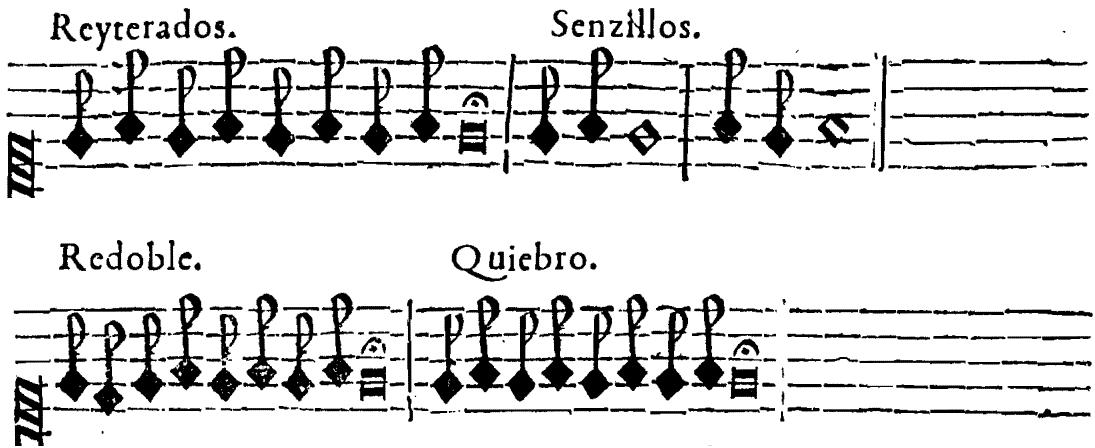
中文讲解
这是一处图像/乐谱占位符,位于第14页,紧跟 P0088 关于 redoble 与 quiebro reyterado 的介绍文字之后(即脚注50所标记的位置),用于展示 Santa María folio 47r 中关于长颤音类装饰音的谱例。占位符提示:原文图像未在此处嵌入,无法凭文字判断具体音符、符尾数或写法细节;判断其内容需回到 folio 47r 原件或扫描页。
第4段(P0090)
原文复述
The theorist describes the quiebro senzillo as using quarter notes and moving from the primary tone to the upper neighbor. Santa María suggests another ornament, apparently implemented only on the clavichord and suggesting the extended performance of the main note. As the theorist describes, in this distinctive method the performer must depress and sustain the primary key of the quiebro senzillo while also quickly touching the auxiliary tone.
中文讲解
本段把焦点具体落到 quiebro senzillo 的实际奏法上。Santa María 的描述包含两层动作:第一,基础奏法是以四分音符构成,由主音上行到上方邻音后回到主音,这是该装饰音在乐谱上的常规写法;第二,他还提出一种特殊的奏法,似乎只在 clavichord(击弦古钢琴/古翼琴)上使用,其特征是“延长主音的时值”——演奏者须在按压并保持主音琴键的同时,快速触击邻音,由此形成一种主音持续而装饰音敏捷闪过的音响效果。注意原文此处在书写时用了“queibro”(拼写变体),而非统一使用的“quiebro”,这属于原书文本现象。教学意义在于:Santa María 并非只给出纸面写法,而是区分了通用奏法与适用于特定乐器的特殊奏法,因此读者需根据演奏乐器判断其可行性。
补充说明
本段提到“apparently implemented only on the clavichord”,作者使用了“apparently”一词表示其依据是 Santa María 的文字描述,并未提供更直接的乐器学证据,读者应注意此处为基于文本的推断。
第5段(P0091)
原文复述
Beyond the quiebro reiterado, Santa María also indicates the quiebro de mínimas, or quiebro for half notes, as displayed below, with the explanation that this type of ornament should not be used with any musical value smaller than a half note. $^{52}$
中文讲解
本段在已经介绍过的 quiebro reiterado 之外,增加第三种 quiebro——quiebro de mínimas(即“用于二分音符的 quiebro”),由此完成 Santa María 关于 quiebro 类型的列举。其教学要点在于 Santa María 给出的使用约束:这种装饰音必须依附于二分音符或更长的音符值,绝不可在小于二分音符的时值上使用。这一限定表明,Santa María 的装饰音分类与节奏-时值结构是直接挂钩的,装饰音并不是任意附着于任何乐句的装饰,而受制于其下层音符的时值。脚注52对应 Santa María 原书 folio 47v,并以“as displayed below”提示后续谱例。
补充说明
短短一段话同时完成“命名引入”和“使用规则”两件事,是 Santa María 写作中“以规则限定术语”的典型方式,呼应本段整节教学的整体风格。
第6段(P0092)
原文复述
$^{50}$ Santa María, fol. 47r.
中文讲解
脚注50 出处:Santa María 原书 folio 47r,对应正文 P0088 所提“redoble and quiebro reyterado, to represent various forms of longer trills, as seen below”之处的谱例来源。该脚注性质为原典引用,作用是支持正文关于 Santa María 将长颤音类装饰音以 redoble / quiebro reyterado 命名的说法。
第7段(P0093)
原文复述
$^{51}$ Parkins, 318.
中文讲解
脚注51 出处:Parkins 一书第318页,对应正文 P0088 关于 quiebro senzillo “roughly equivalent to modern turns, mordents, or inverted mordents”的近似现代对照。该脚注性质为二手学术来源,作用是为作者用现代术语类比 Santa María 短装饰音的做法提供旁证,而非 Santa María 原典的直接引文。
第8段(P0094)
原文复述
$^{52}$ Santa María, fol. 47v.
中文讲解
脚注52 出处:Santa María 原书 folio 47v,对应正文 P0091 关于 quiebro de mínimas “should not be used with any musical value smaller than a half note”的限定规则与谱例来源。该脚注性质为原典引用,作用是支持正文中关于该装饰音使用时值的硬性规定。
补充说明
folio 47r 与 47v 出处相邻,提示 Santa María 在该正反两页集中处理装饰音术语与规则。
第9段(P0095)
原文复述
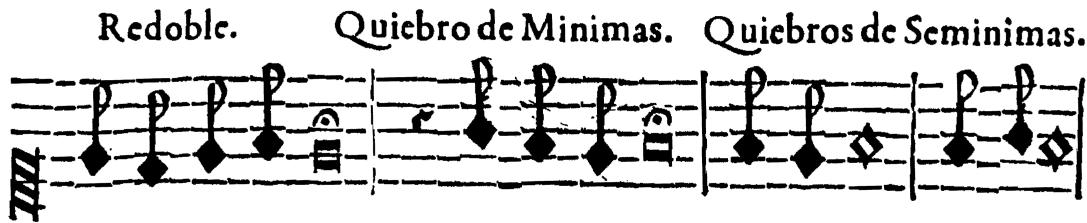
中文讲解
这是一处图像/乐谱占位符,位于第15页(即P0091所述“as displayed below”所对应的图示位置),用于展示 Santa María folio 47v 中 quiebro de mínimas 的谱例。占位符提示:原文图像未在此处嵌入,无法凭文字判断其实际音符构成;具体内容须查阅 folio 47v 原件。
脚注 / 边栏 / 图表 / 附加信息(如有)
本节包含两处图谱占位符(P0089位于第14页、P0095位于第15页),分别对应脚注50和脚注52所指向的 Santa María 原典谱例:folio 47r 用于展示长颤音类装饰音(redoble / quiebro reyterado),folio 47v 用于展示 quiebro de mínimas。三条脚注共同构成本节所引装饰音规则的来源支持:脚注50、52为 Santa María 原典直接出处(分别位于 fol. 47r、47v),脚注51(Parkins, 318)为现代近似对照的二手旁证。整体上,本节附加材料服务于“规则—术语—谱例”三位一体的论述结构。
💡 本节核心要点
- Santa María 的教学具有系统性,从演奏入门到模仿即兴呈渐进路径,所有技术与作曲目标均配以谱例。
- 教材采用各声部独占一行五线谱、不加小节线、不作纵向对齐的声乐式记谱,并以简朴的模仿复风格式写作,全书在序言和谱例中均以 Cabezón 的体裁、技法、结构与风格为参照。
- 除即兴加花外,Santa María 把个别装饰音(quiebros、redobles)作为键盘演奏的独立教学对象,与 glosas 并列。
- 尽管 quiebro、redobles 之名为常见术语,其具体用法在当时的理论写作中并无统一标准,必须以 Santa María 自身的定义为依据。
- Santa María 将装饰音明确区分:redoble / quiebro reyterado 为较长颤音;quiebro senzillo 为短形式,约略对应现代回音、倚音或下倚音,并以四分音符构成,由主音上行到上方邻音。
- Santa María 还提出仅适用于 clavichord、延长主音的装饰音奏法——保持主音键并快速触击邻音。
- Santa María 进一步区分 quiebro de mínimas,即专用于二分音符或更长时值的装饰音,不得在小于二分音符的时值上使用,体现装饰音分类与节奏时值直接挂钩。
🔑 关键术语
- qui:qui
4.4 [描述性拆分] Long Ornaments and Rhythmic Groupings for Scales
第1段(P0096)
原文复述
Further concerning this type of longer ornament, the theorist stipulates that proper performance should include a whole tone in addition to a semitone, the latter characteristically falling below the former, as exhibited below. (footnote 53)
中文讲解
本段进入本节第一个实质性论题:长型装饰音的音程构成。原文使用的“this type of longer ornament”表明它承接前文已介绍过的某类较长装饰音;此处的规则是对该类的进一步规定,不是泛指。Santa María(文中称“the theorist”)要求演奏者在装饰音中加入一个全音(whole tone)和一个半音(semitone),并且半音“characteristically falling below the former”——即位置在全音下方,这是该规则的典型/惯常形态,不是唯一形态。原文用“stipulates”显示这是规范性要求,而非描述性观察;“as exhibited below”提示后文(或图示)会给出具体的音程排布。需要注意:半音“falling below the whole tone”是装饰音内部两音之间的相对位置关系,应把它理解为装饰音结构本身的一部分,而非单独的演奏提示。
补充说明
本段与 P0097(图像/谱例占位)以及 P0098(描述装饰音形态)直接呼应:P0096 给出音程规则,P0097 提供图示,P0098 说明音符走向,三者构成一个对同一长装饰音从规则、图示到形态的完整小论证单元。
第2段(P0097)
原文复述
[Image / musical example placeholder on page 15, retained for position and caption context.]
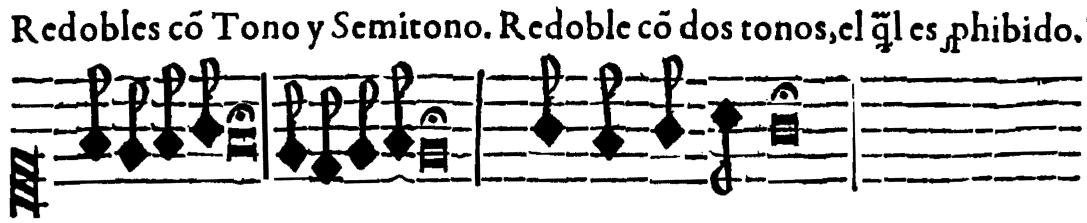
中文讲解
本段为第15页的图像或乐谱示例占位符,原书的内嵌图像数据在当前文本中已被省略,仅保留其位置与图注信息。结合上下文,它最直接的功能是配合 P0096 中“as exhibited below”这一提示,具象展示那条“全音+位于其下方的半音”的装饰音结构;其后 P0098 进一步用文字描述该图示中的运动轨迹。由于原图未呈现,本节讲解不能对其音符位置、谱号或具体时值做任何推测,只能确认它在该论证链中扮演“图示证据”这一角色。读者如需复核,应回到原书第15页查看。
补充说明
无额外补充(本段全部可定位信息仅为版面占位与位置说明)。
第3段(P0098)
原文复述
The ornament uses multiple alternations between the principal note and its upper neighbor, beginning and ending on the primary tone. (footnote 54)
中文讲解
本段紧承 P0096 的音程规则与 P0097 的图示,用一句话概括该长装饰音的运动形态。关键结构有三:(1) 主音(principal / primary note)始终是支点;(2) 装饰音反复交替的对象是“上方邻音”(its upper neighbor),即紧邻主音上方的那一音,因此反复在主音与上邻音之间进行;(3) 起点和终点都落在主音上(beginning and ending on the primary tone),这保证了装饰音完成后回到稳定的主音,不至于悬而未决。结合 P0096 可知,每一次交替所使用的不只是单一邻音,而是按规则安排的全音与位于全音下方的半音;P0098 揭示了这些音程反复出现的“路径”,与 P0096 共同回答了“装饰音由什么音组成”和“这些音如何排列运动”两个问题。
第4段(P0099)
原文复述
Regarding specific fingering recommendations, Santa María indicates that the third finger of the right hand should serve as the primary finger in performance, while the left hand has two principal fingers, the second as well as the third. The theorist provides multiple fingering suggestions for scales and runs of different tempos. For linear fingerings, the musician describes a connection between rhythmic values and the number of fingers in a group to be repeated. For example, consecutive long notes, such as whole or half notes, are to be played with one or two fingers only, while faster passages require groups of three or four fingers. For scales consisting of whole notes alone, Santa María suggests the use of only the third finger of the right hand and the second or third fingers of the left hand on every note. This recommendation also illustrates intended articulation, since a purely legato sound would be difficult, if not impossible, with one finger alone. For the performance of repeated notes, Santa María recommends using two fingers in alternation.
中文讲解
本段从装饰音本身转入更一般性的“指法体系”,是本节最长、信息量最大的一段,可分为四个层次。
第一层,规定基本主力指:右手一律以第三指为主力指;左手则有两个主力指——第二指与第三指。这暗示了 Santa María 指法体系的不对称性:右手只有一个中心指,左手却有两个。
第二层,给出节奏值与指数组数的对应关系,这是本段最具方法论意义的规则。Santa María 把“音的时值长短”与“反复使用的指头数量”直接挂钩:长音(全音符 half notes 和全音符 whole notes)只用 1 至 2 个指头演奏;快速段落则需 3 至 4 个指头组成一组反复演奏。换言之,时值越短、音越密,需要参与的指头越多;时值越长、指头数反而越少。
第三层,把上一规则应用于全音符音阶:每个音都由右手第三指或左手第二/第三指单独承担。这不仅是指法建议,更暗中说明了奏法(articulation)——若每个音只用一根指头且要在不同指头之间切换,那么在键盘乐器上很难(甚至不可能)实现真正的连奏(legato),因此这种指法暗示的是一种“每音清楚断开”的非连音奏法。原文用“if not impossible”这一让步结构,强调的是“用一指不可能做到纯连奏”,用以反推作者的奏法意图。
第四层,专门处理重复音:重复音应用两根指头交替演奏,这同样服务于让每一下发音清晰均匀的目的。
整段的论证逻辑是:从主力指的总原则,到节奏—指法的配比规则,再到以全音符音阶为例的特例,并由此推导出奏法结论,最后以重复音的小规则收尾。它回答的不是“音符应如何被装饰”,而是“音符应如何被手指实际触及”,并由此揭示出 Santa María 心目中的理想音响。
补充说明
P0099 在本节内部承接 P0096–P0098 的“装饰音”讨论,但已转向更一般的指法/奏法话题;本节的小标题“Long Ornaments and Rhythmic Groupings for Scales”也提示后者才是 P0099 的核心议题。原文并未交代为何右手只有一个主力指而左手有两个,亦未给出第三指/第二指以外指头的角色,这些都属于原书未提供的信息,故此处不补。
第5段(P0100)
原文复述
[Footnote 53] Ibid.
中文讲解
本段是脚注 53,内容仅一个拉丁缩写 Ibid.(= ibidem,出自同一出处)。其功能是为 P0096 中“as exhibited below”所指向的图示或前文所引观点提供同一来源标注,与上一脚注出处相同。结合本节的脚注链(53–55)来看,作者在每个实质性段落末尾都用脚注注明Santa María 原书及现代研究文献的页码,构成稳定的学术规范。
补充说明
脚注 53 与 P0101、P0102 共同构成 P0096、P0098、P0099 三段正文的来源标注链;其中 53 标注的是 P0096 的引文/图示出处。
第6段(P0101)
原文复述
[Footnote 54] Holland, 92.
中文讲解
本段是脚注 54,标注 P0098 中关于“主音与上邻音多次交替、起止于主音”的描述出自 Holland 第 92 页。功能为现代研究文献出处标注,性质为支持性引用,说明该结论并非作者本人新说,而是对 Holland 已有研究的转述。
第7段(P0102)
原文复述
[Footnote 55] Parkins, 319.
中文讲解
本段是脚注 55,标注 P0099 中关于指法与节奏值对应关系的那段论述(长音用 1–2 指、快速段用 3–4 指反复)的来源为 Parkins 第 319 页。其功能亦为现代研究文献的页码出处,属支持性引用,并标明 P0099 中指法规则的细节转引自该研究。
补充说明
本节中 P0099 的内容跨越多段,但只有脚注 55 直接挂在第一句之后;其后关于全音符音阶指法、单指不可能连奏、以及重复音交替指法等内容虽在同一段内,原文未单独加注,故其出处归属应理解为同样来自 Parkins 第 319 页所对应的 Santa María 原书段落,作者未再拆分标注。
脚注 / 边栏 / 图表 / 附加信息(如有)
本小节共含三条脚注(P0100–P0102)以及一个图像/乐谱示例占位符(P0097)。脚注 53(Ibid.)标注 P0096 关于“全音+其下方半音”这一长装饰音构成规则及配套图示的出处;脚注 54(Holland, 92)标注 P0098 关于主音与上邻音反复交替、起止于主音的形态说明;脚注 55(Parkins, 319)标注 P0099 中指法与节奏值对应关系(长音 1–2 指、快速段 3–4 指反复)那一核心规则。三条脚注功能一致:均为现代研究文献的页码出处,属支持性引用,而非限定或反驳。P0097 的图示位置与 P0096 中“as exhibited below”的提示直接呼应,承担“图示证据”作用,但本输入未呈现原图细节,故本节不依赖该图作进一步推论。
💡 本节核心要点
- Santa María 规定长型装饰音的构成须包含一个全音和一个位于其下方的半音,半音在全音下方是该结构的典型形态;该规则在 P0097 的图示中得到具象展示。
- 该装饰音的运动模式是:在主音与上方邻音之间多次反复交替,并始终以主音作为起点与终点,保证装饰结束后回到稳定的主音。
- Santa María 的指法体系具有不对称性:右手仅以第三指为主力指,左手则同时以第二指与第三指为主力指。
- Santa María 把节奏时值与指头数量直接挂钩:长音(全音符/半音符)只用 1–2 指演奏,快速段落需 3–4 指组成一组反复演奏——节奏越密,参与指头越多。
- 全音符音阶采用单指(右手第三指、左手第二或第三指)演奏,其引申含义是:单指无法在键盘上实现真正的连奏,因此这种指法暗示的是非连音的清晰奏法。
- 重复音须以两指交替演奏,与单指奏法共同支持一种“每音清晰发声、避免黏连”的整体音响取向。
🔑 关键术语
- longer ornament:本节讨论的“较长型装饰音”,由一个全音加位于其下方的一个半音构成;这是与较短装饰音相对的一类,需在装饰音内部进行多次音的交替。
- whole tone / semitone:全音与半音,是构成该装饰音的两类音程元素;Santa María 规定两者并存,且半音“characteristically falling below the former”,即典型地处于全音下方。
- principal note / upper neighbor:主音与上方邻音。装饰音的所有反复交替都在主音及其上方紧邻音之间进行,并且起止都落在主音上。
- primary finger / principal fingers:Santa María 指法体系中的主力指:右手为第三指;左手为第二指与第三指并立;其它指头在主力指之外承担辅助或反复的角色。
- legato:连奏。本节中作为“反证”出现:作者指出用单一指头不可能实现真正的 legato,由此反推出单指指法所暗含的实际奏法是每音清晰断开,而非平滑连贯。
5.1 [描述性拆分] Six Elements of Touch (1–3)
第1段(P0103)
原文复述
The theorist provides extensive details within the Arte de tañer fantasia of appropriate touch, and correspondingly, articulation, of the fingers at the keyboard. In Chapter 15, entitled Del modo de herir las teclas, or “The Way to Strike the Keys,” Santa María describes six elements necessary for proper touch, initially explaining appropriate hand position, indicating that,
中文讲解
本段是小节的开篇铺垫,交代材料来源与位置:论者(即 Santa María)在《Arte de tañer fantasia》中对键盘上"触键"以及随之产生的"articulation”(指触键后音符呈现出来的清晰度与连断状态)作了极为详尽的论述。这里特别点出触键(touch)与发音(articulation)是一体两面——手指怎样落键,音符就怎样呈现,因此谈触键其实就是在谈 articulation。本节聚焦的正是全书第 15 章,章题 Del modo de herir las teclas 直译为"击键的方式”,herir(击、撞)是 Santa María 全章反复使用的核心动词。在正式列出六个要素之前,作者先从"合适的手位"开始讲解。本句末尾以 indicating that 引出 P0104 的英文转译段落,形成原文→转译的对应结构。
第2段(P0104)
原文复述
The first thing is to strike the keys with the keys with the tips of the fingers in such a way that the nails never touch the keys. This can be done by lowering the wrists and extending the fingers forward from the middle finger, whereby the notes sound fully, softly and sweetly. The reason for this is that the flesh is a soft material and strikes softly and sweetly. Moreover, in this way one plays cleanly because the fingers are properly positioned on the keys and cannot slip or slide anywhere. $^{57}$
中文讲解
本段是六要素中的"第一点"。Santa María 给出的动作规范包含三层含义:(1) 触键部位:必须用指尖肉垫(tips of the fingers),绝不能以指甲碰键;(2) 动作方法:放低手腕(lowering the wrists),并以中指为基准把其余手指向前伸展(extending the fingers forward from the middle finger),由此构成正确的手位与触键姿态;(3) 由此带来的声音效果:音符响起时是 fully, softly and sweetly(饱满、柔和、甜美)。Santa María 还给出两层理由——第一层是物理理由:肉是柔软的物质,所以敲击本身天然柔和甜美;第二层是演奏整洁的理由:手指在键上有稳定的"坐落",因此不会向任何方向滑脱(slip or slide)。这一条表面上是讲"手位与触键部位",实则把"柔软甜美"作为好的触键应有的声音理想固定了下来,构成后续要素的对照基线。
第3段(P0105)
原文复述
Next, the theorist describes,
中文讲解
这是一个极短的过渡句,引出第二点。在功能上,它将"第一点"的引文结束,并承接"第二点"的引文。Next 与 P0103 末尾 indicating that 共同构成"作者引导—Santa María 原话"的两段式写作结构。
第4段(P0106)
原文复述
The second thing is to strike the keys with strength and determination, that is, played with energy, and then the notes have great presence and spirit. $^{58}$
中文讲解
本段是六要素中的"第二点"。其主张只有一句:触键要 rezio con impetu——英译为 with strength and determination(有力且果决),并解释为 played with energy(带能量地弹)。由此带来的声音效果是 great presence and spirit——音符具有宏大的"在场感"与"精神气"。如果把第一点(柔和甜美)与第二点(有力带精神)放在一起读,可见 Santa María 的触键观并不是单向的轻柔,而是要求演奏者具备宽广的力度变化能力:从最柔美的肉垫触键,到带气势的果断击键。两条共同构成了"轻—重"两端的声音理想,为下一条"双手平衡"提供音色范围。
第5段(P0107)
原文复述
The third element of proper touch concerns balance between the two hands,
中文讲解
过渡句,把读者从第二点(力度)引到第三点(双手平衡)。作者用 element 一词再次回到"六要素"的计数中,提示读者这是第三个独立项目;并明确点出第三点的主题:左右手之间的均衡。
第6段(P0108)
原文复述
The third thing is that both the two hands should strike the keys equally, that is, that one hand must not play louder or softer than the other but both hands equally. Thus, although many voices are played at one time, such as when there is a chord with three, four or more voices, both hands must strike the keys together so that they seem to be a single voice. Likewise, I note that even when the fingers play the keys softly they still must touch them with a certain momentum. This advice concerning touch is one of the most essential things that there is in order to play anything with perfection. $^{59}$
中文讲解
本段是六要素中的"第三点",它把触键问题从单手扩展到了双手协奏。主张包含三层:(1) 双手击键要相等——一手不得比另一手更响或更轻;(2) 即使同时处理多声部(voices),例如三声、四声或更多声部的和弦,两手也必须同下一击(strike the keys together),让整体听起来如同一条单一声部(a single voice);(3) 即使手指是"轻轻地"触键(softly),其中仍须带有某种 momentum(推进力),换言之不可软弱无力。作者随即强调,这是演奏中能够达到 perfection 的最关键事项之一。第三点的核心其实是"齐一性"——不仅是力度的齐一,更是起落时机的齐一,目的是在多声部键盘织体中制造统一的线条感。它把前两条的"声音理想"(甜美、有精神)从单手扩展到整个键盘织体,是六要素中最具织体控制意义的一条。
第7段(P0109)
原文复述
$^{56}$ Holland, 107.
中文讲解
这是脚注 56 的内容,是一条简短的书目指引:参 Holland(即 Jon Holland 对 Santa María 的英译/编注本)第 107 页。由于本节正文并未直接引述这条注释的对应位置,而 56 号排在 57、58 之前,因此它指向的应是节外更早处的某处论述,而非 P0104 或 P0106 的引文;其作用是为前文某句提供 Holland 译本的页码旁证。
第8段(P0110)
原文复述
$^{57}$ Santa María, La primera es herir las teclas con las yemas de los dedos, de tal manera que las Vñas no alleguen ni toquen cō mucho a las teclas, lo qual se hara baxando las Muñecas, y estendido los dedos del medio dedo adelāte, porque hiriendo desta manera, suenan las bozes enteras, dulces y suaues. La razon desto es, porque como la carne sea cosa blanda, hiere con blandura y suauidad. Y de mas desto se tañe con limpieza, porque como los dedos hazen asiento en las teclas, no pueden deslizar ni huyr a ninguna parte. (fol. 37v.)
中文讲解
本条是脚注 57,给出 Santa María 原书第 37v 页上的西班牙语原文,作为 P0104 英译的来源依据。逐句对照:第一句 La primera es herir las teclas con las yemas de los dedos 与 P0104 “strike the keys with the tips of the fingers” 对应;yemas 是指尖肉垫,Vñas(uñas 的古拼写)是指甲;alleguen 与 toquen cō mucho(con mucho 的缩写)指"(指甲)够到或太多地碰到"键面;第二句 lo qual se hara baxando las Muñecas 对应 lowering the wrists,estendido los dedos del medio dedo adelāte 对应 extending the fingers forward from the middle finger;第三句 suenan las bozes enteras, dulces y suaues 对应 “the notes sound fully, softly and sweetly”——bozes 即"声音/声部"。随后给出两层理由:carne sea cosa blanda → hiere con blandura y suauidad(肉是柔软之物,故敲击自然柔美),以及 dedos hazen asiento en las teclas → no pueden deslizar ni huyr(手指在键上"落座",故不能滑动或逃逸),分别对应 P0104 的两层解释。
补充说明
脚注 57 提供的西班牙语原文中存在 16 世纪西班牙语的拼写特征:Vñas(带长 V 起头的 uñas)、cō(con 的缩写符号)、adelāte(adelante)、suaues(suaves)等,对理解原书印本形态有帮助。
第9段(P0111)
原文复述
$^{58}$ Ibid., La segunda cosa, es herir las teclas rezio con impetu, lo qual por otro nombre llaman herir tiesso, y entonces las bozes lleuã gran ser y espiritu. (fol. 37v.)
中文讲解
本条是脚注 58,给出 Santa María 原书第 37v 页上"第二点"的西班牙语原文,作为 P0106 英译的来源依据。逐句对照:La segunda cosa, es herir las teclas rezio con impetu 对应 “strike the keys with strength and determination”——rezio 与 impetu 两个副词叠加,传达"有力且带冲劲";lo qual por otro nombre llaman herir tiesso 是 Santa María 自加的同义注释,意为"这又被叫做 herir tiesso",tiesso 在古西班牙语中含"硬、紧、坚定"之意,英译未直译而以 played with energy 解释;y entonces las bozes lleuã gran ser y espiritu 对应 “the notes have great presence and spirit”——bozes 仍指"声音/声部",lleuã(llevan 的缩写形式)意为"具有、带有",ser 与 espiritu 一对抽象名词,ser 直译为"存在/实体",spiritu 为"精神",合在一起即英文 presence and spirit 的双层效果。
脚注 / 边栏 / 图表 / 附加信息(如有)
本小节的附加材料集中体现在三处脚注:脚注 56(Holland, 107)为简短书目指引,可能旁证节外更早处论述;脚注 57 与脚注 58 完整转录了 Santa María 原书第 37v 页上"第一点"与"第二点"的西班牙语原文,让读者可以把 P0104 与 P0106 的英译逐句与原典对照,尤其有助于理解 rezio con impetu / herir tiesso / bozes lleuã gran ser y espiritu 等关键术语的原文面貌与英译选择。本小节没有图表、乐谱或边栏内容。
💡 本节核心要点
- 本节聚焦 Santa María《Arte de tañer fantasia》第 15 章 Del modo de herir las teclas,呈现六要素中的前三项:手位与触键部位、触键力度、双手平衡。
- 第一点的核心是用指尖肉垫触键、降低手腕、以中指为基准前伸手指,由此得到"饱满、柔和、甜美"的声音;并以"肉为柔软之物"和"手指在键上落座不滑"两层理由支撑。
- 第二点要求触键"有力且果决"(rezio con impetu / herir tiesso),声音应具有"在场感与精神",与第一点的柔美形成轻—重两端的力度范围。
- 第三点把触键扩展到双手层次:双手击键必须同等响度、同时落下,使多声部和弦听起来如同一条单一声部;即便轻弹也需带有 momentum;作者称此为达到 perfection 的最关键事项之一。
- 脚注 57、58 给出西班牙语原文,便于读者核对英译选词(rezio、tiesso、bozes、ser y espiritu 等),并展现 16 世纪西班牙语印本的拼写特征(如 Vñas、cō、adelāte、lleuã)。
🔑 关键术语
- Arte de tañer fantasia:Santa María 的键盘演奏理论著作,书名直译为"幻想曲演奏技艺";本节所引六要素出自其中第 15 章。
- Del modo de herir las teclas:第 15 章章题,西班牙语意为"击键的方式";herir(击、撞)是全章贯穿的核心动词,决定了 Santa María 用"撞击"而非"按压"来描述触键动作。
- yemas de los dedos / tips of the fingers:指尖肉垫;第一点的关键触键部位,与指甲(uñas / nails)形成对照,强调用肉的柔软去击键以获得柔美的音色。
- herir tiesso / strike with strength and determination:第二点的关键动词组合,tiesso 在古西班牙语中含"坚硬、紧实、果决"之意;与第一点的柔美相对,构成轻—重两端的力度范围。
- bozes / voices:原文中既指"单音"也指键盘织体中的"声部",因此同一词可译作 notes 或 voices;第三点中以"多声部和弦听起来如同一条单一声部"的方式处理,即把多声部整合为统一线条。
- momentum:第三点引入的触键术语,指即便在 soft(轻)触键时手指仍须保持的"前进冲量",用于防止轻奏软弱无力,与第二点的 impetu 在音色两端形成呼应。
- perfection:第三点结尾出现的总体目标词,指演奏达到完美境界;Santa María 把双手齐一性视为通向 perfection 的最关键事项之一,提升了第三点在六要素中的权重。
5.2 [描述性拆分] Six Elements of Touch (4–6) and Articulation
第1段(P0112)
原文复述
Santa María then describes the fourth condition required for an appropriate interpretation at the
中文讲解
This is a transitional sentence fragment belonging to the introductory frame of the section. It signals that the author is moving from the first three conditions (established earlier) to the fourth, and is the first half of a longer introductory sentence. The clause trails off at “at the” only because the next paragraph picks up with “keyboard”; together P0112–P0113 form one bridging sentence before the direct quotation from Santa María in P0114. Readers should not interpret the fragment as a standalone claim but as scaffolding for the quotation that follows.
第2段(P0113)
原文复述
keyboard, further indicating specific hand position, writing,
中文讲解
This fragment completes the introductory sentence begun in P0112. It names the fourth condition as a matter of “hand position” at the keyboard and then introduces, by the participle “writing,” the author’s quotation of Santa María’s own text (the full Spanish source is given in footnote 60, P0119). The phrase “specific hand position” should be read broadly, since P0114 goes on to specify finger height, lifting amplitude, perpendicular trajectory, palm stability and the point of contact on each key—rather than a single static posture. The comma before “writing,” followed by another comma in P0114, reflects text-extraction artifacts rather than normal punctuation.
第3段(P0114)
原文复述
The fourth thing is not to strike the keys from too high, for what is necessary is to bring the fingers close to the keys, and then once each finger has struck the key, to raise it very little. And moreover, the fingers should fall on the keys perpendicularly and be raised in the same way and to the same place and arrangement as before, from where they will again be prepared to play. All this gives the music a great sweetness and softness and the notes sound very well, while the keys almost not at all. To the contrary, when one strikes the keys from too high, this causes disgrace and displeasure in the music for the ears because the keys make much sound and the notes very little. This shortcoming is caused by raising the fingers too high after having played the keys. In raising the fingers too high and then lowering them, one wastes time and shortens the time during which the voices would still be sounding had the fingers remained over the keys. Thus, to properly strike the keys it is necessary not to raise the palms, but only the fingers, which must strike the keys while the palms remain still. Furthermore, white as well as black keys should be struck at the extremity or end, that is, towards the outside of the keyboard. To strike the keys well is also one of the first and most essential things that there is in playing. 60
中文讲解
这一段是本节的核心,展开了Santa María关于"第四件事"的全部论述,可拆为五个互相关联的要求。第一是落键高度:手指必须贴近琴键,击键后只需将手指略微抬起(“very little”),不可抬高再砸下。第二是垂直运动:手指须垂直落下、垂直抬回,回到与击键前完全相同的位置与准备状态。第三是动静分区:抬起的只能是手指,掌心(palms)必须保持静止——这一条把要求具体化到了腕与指的分工。第四是击键点的选择:无论白键黑键都应击在键的尾端(extremity/Remato),即朝向键盘外侧的一端。第五是作者的总结性判断:“按键击得好也是演奏中最首要、最根本的事之一。” 整段的论证策略是先给出正确做法,再给出错误做法及其听觉后果(音乐出现"disgrace and displeasure",琴键声大而乐音少),接着解释错误成因(抬指过高)以及时间上的代价(抬指浪费了弦音本应延续的持音时间)。最后用功能理由(sweetness/softness,琴键几乎无声而乐音饱满)和价值判断(“首要而根本”)双重收束,因此从论证角度看,本段既示范规范又给出负面对照,是"正—反—因—果—断"的完整论述结构。
补充说明
本段末尾的上标 “60” 对应 P0119 中的脚注 60,引用 Santa María 西班牙语原文 “La quarta cosa…” 作为权威出处;脚注并不补充新论据,仅供原文核对。
第4段(P0115)
原文复述
Santa María explains a fifth element concerning the proper pressure of the fingers on the keys of
中文讲解
This transitional sentence fragment announces that the author is moving from the fourth condition (finger height) to the fifth, and previews that the fifth condition concerns “the proper pressure of the fingers on the keys.” As with P0112, the sentence is broken by the next paragraph’s continuation “a clavichord,” so P0115–P0116 together serve as a single introductory bridge to the quotation in P0117. The verb “explains” and the noun “element” signal that the fifth condition will be presented as a discrete technical item within the larger list of six.
第5段(P0116)
原文复述
a clavichord, communicating that,
中文讲解
This is the second half of the introductory sentence begun in P0115. It narrows the topic to the clavichord specifically, foreshadowing that P0117 will discuss how key-depression depth affects the instrument’s tangents. The “##” at the beginning is a markdown formatting artifact left over from the source file and carries no semantic content; it should not be read as a heading. The verb “communicating that” introduces the upcoming direct quotation from Santa María (footnoted as 61). Readers should treat P0115 + P0116 as one frame sentence leading into P0117.
第6段(P0117)
原文复述
The fifth thing is to depress the keys as far as they could best be lowered so that, if the instrument is a clavichord (monacordio), the tangents will properly lift the strings in such a way that the notes do not go out of tune which is caused by pressing the fingers too much. On other instruments the keys must be depressed until they touch the cloth that is below them. That is, if the keys could go down to touch the cloth. 61
中文讲解
本段提出"第五件事",中心主张是:按键必须被按到该仪器所能允许的最大深度。在克拉维科德(原文称 monacordio)上,键下压过深会使 tangent(触弦的小金属片)过度顶起琴弦,从而改变张力,使音变高(“go out of tune”);因此手指不可按得过重。在其他键盘乐器(非克拉维科德)上,键下方有一块布(“cloth”,即止音/缓冲用布),键应被按到触及该布的程度——一旦触及就达到了该乐器的行程下限。两套乐器的判据虽然不同,但都指向同一个原则:把键压到该乐器恰当的最低点,既不过头也不欠缺。这一条在逻辑上是承接上一段(手指动作的姿态)转向"下压力度与行程",并以"触底"作为可量化的操作上限,以避免压弦走音这一可听得见的副作用。需要注意的是脚注标号 61 出现两次(段尾与句末),属原文排版情况,并非两个不同脚注。
补充说明
“monacordio” 是 Santa María 原文对 clavichord 的西班牙语称谓,本段在英文转写时同时给出英文 clavichord,二者指的是同一乐器;“tangents” 是克拉维科德上由键带动、直接顶起琴弦发声的小金属条,与钢琴的锤不同。
第7段(P0118)
原文复述
59 Ibid., La tercera cosa es, que ambas a dos manos hieran las teclas ygualmente, esto es, que la vna mano no hiera mas rezio, ni mas quedo que la otra, sino ambas a dos manos ygualmente, y assi mesmo ambas a dos manos han de herir tan juntamente ala par, que aunque de vna vez hieran muchas bozes, como quando se da Consonancia a tres o a quatro bozes o mas, todas ellas parescan vna sola boz. Assi mesmo se aduierta, que aunque las manos hieren las teclas quedo, con todo esso las han de herir con vn poco de impetu. Esto sobredicho del herir, es vna de las cosas muy essenciales, que ay para tañer con perfection qualquiera cosa. (fol. 37v.-38r.)
中文讲解
本段是脚注 59,给出 Santa María 著作中关于"第三件事"(双手均等地击键)的西班牙语原文,位置在 fol. 37v.–38r.。脚注并不引入新的论据,而是为前文已给出的英译文提供原文比对。原文要点有三:其一,两手击键必须力度相等,一只手不能比另一只更响或更弱;其二,即使同时发多个声部(如三或四声部甚至更多的协和音程),所有声部听起来应像是"一个声音"——这是对均匀性和同时性的最高要求;其三,即使要求触键轻柔,双手仍须带一定冲量(impetu)击下,不能软弱无力。末尾以"这是演奏完美所需的最根本事项之一"作结,与英译文中的判断一致。
本节讨论的是第四至六项,因此本脚注实为支撑上一节(5.1)已出现过的"第三件事"。读者应把它视为本节起首处"third—fourth"过渡的可对照原典,而非本节内容的补充。
补充说明
西班牙语原文使用了早期近代西班牙语的拼写特征(ygualmente、assi mesmo、auiēdo 等),“v/u”、“i/j"互换、“ç"等多种拼法并存,这些是 16 世纪印刷传统,并非现代西语标准。
第8段(P0119)
原文复述
60 Ibid., La quarta cosa, es no herir las teclas de alto, para lo cual es necesario traer los dedos cerca de las teclas, y despues que cada dedo aya herido la tecla, leuantarle muy poco, y de mas desto han de herir los dedos cayendo derechos, y en el mesmo derecho leuantarse, de suerte que bueluan a ponerse en el mesmo lugar y disposicion que antes estauã. Lo qual todo causa gran dulçura y suauidad en la musica, de mas de sonar mucho las bozes, y poco o casi nada las teclas. Por el contrario, quãdo se hiere de alto, se causa gran desgracia y desgusto en la musica para los oydos, de mas de sonar mucho las teclas, y poco las bozes. Este defecto se comete por leuãtar mucho los dedos despues de auer herido las teclas. Assi mesmo el tiempo que se gasta en leuãtar mucho los dedos y en baxarlos, quita parte del tiempo, que las bozes auían de estar sonando, teniêdo los dedos sobre las teclas. Assi mesmo para herir bien las teclas, es necesario no leuantar las palmas, sino solos los dedos, los cuales han de herir las teclas, estando se quedas las palmas. De mas desto, las teclas assi blancas como negras, se hã de herir al Cabo, o Remato dellas. Esto se entien hazia fuera. El bien herir las teclas es tambien vna de las cosas muy essenciales y primas que ay en el tañer. (fol. 38r.)
中文讲解
本段是脚注 60,给出 P0114 英译所对应的西班牙语原文,位置在 fol. 38r.,是整节四条主要脚注中与第五件/第六件直接关联的一条。结构与英译文完全对应:(1) 不从高处落键(“no herir las teclas de alto”),要把手指带近琴键;(2) 击键后只需微抬(“leuantarle muy poco”),并要求手指垂直落下、垂直抬起,回到原位;(3) 效果上带来"gran dulçura y suauidad”(巨大的甜润与柔和),声部响而琴键几乎不响;(4) 反之从高处落则造成"gran desgracia y desgusto”(巨大的刺耳与不悦),琴键响而乐音少;(5) 病因是击键后抬指过高;(6) 高抬低放浪费了本该让弦继续发声的时间(“teniêdo los dedos sobre las teclas”);(7) 抬起的是手指而非手掌(“no leuantar las palmas, sino solos los dedos”);(8) 白键黑键都应在键的尾端(“Cabo o Remato”)朝外侧击下(“hazia fuera”);(9) 落键好是演奏最根本的事之一(“muy essenciais y primas que ay en el tañer”)。脚注的存在表明这是英译者严格依据 Santa María 原文逐句转写的,而非译者补写。
补充说明
“Cabo o Remato” 是同一概念的两种说法(端/末梢),“hazia fuera”(向外)的具体方位在原文中显式给出,但并未说明是否对所有键型/所有键位都成立,应用条件上仍以原文为准。
第9段(P0120)
原文复述
Finally, the theorist presents a sixth requisite regarding keyboard pressure, conveying,
中文讲解
This transitional sentence fragment marks the move into the final element of the six-element list. The adverb “Finally” signals that this is the last item, and “regarding keyboard pressure” previews that the topic will shift from key descent-depth (the fifth condition) to the residual pressure applied after the key has been struck. As with P0112/P0115, the sentence trails off into the next paragraph’s continuation. The word “requisite” parallels “element” and “condition” used earlier, indicating the same generic category of technical rule.
第10段(P0121)
原文复述
The sixth thing is, that after striking the keys, that the fingers do not put too much pressure on them (otherwise the hands become sluggish and weighty and, moreover, the notes will have a tendency to go out of tune, the pressure making them sharp). Nor should the fingers release the pressure in such a way that the notes falter, but instead the fingers should remain on the keys without pressing too much or relaxing or lifting until the point that they have to strike other keys. In this way the notes will always have the same continuity of sound. 62
中文讲解
本段提出"第六件事",主题已经从"下压到最低点"转为"按到底之后是否继续加压"。Santa María 给出双向禁止与一条正向规则:
· 反面禁令一:击键之后不可对键继续加压,否则会带来两项后果——手上的感觉变"sluggish and weighty"(迟滞、沉重),以及音会变高(“sharp”,即走音,与 P0117 因压弦过度走音的方向一致)。
· 反面禁令二:但也不可放松按压使得声音"falter"(犹豫/中断),即不能因提早松手而切断正在振动的声音。
· 正向规则:手指应停留在键上,既不进一步加压,也不在需要击下一个键之前松开或抬起。
· 论证目的:这一停留保证了"continuity of sound"——乐音的连贯不断。
本段在整节中的论证作用,是把前两条(“接近键面后几乎不抬"和"按到底”)整合到一条操作时间线里:手指击键、下沉到行程下限、到达后停留、保持声部连续、把手指留在键上直至下一次击键所需时刻。它为下一段(P0123)所讨论的"legato 式分离"做了前提铺垫,因为只有在击键后维持轻接触,下一指的抬起和落下才能形成作者所要求的"前指先离、后指再落"的清晰节奏。
补充说明
本段末尾的上标 “62” 对应下一节之外、但本节外的脚注,编号 62 对应 P0122 后续段落中 Santa María 关于"清晰与分明"演奏的引文出处(参见 P0123 后的脚注编号与 P0122–P0123 内容)。
第11段(P0122)
原文复述
Santa María recommends a keyboard articulation with some degree of separation between the tones, forming almost a non-legato, stating that,
中文讲解
This transitional sentence introduces the articulation section proper, after the sixth condition has been stated. It previews the performer’s recommendation with a key technical term: “almost a non-legato,” meaning the ideal lies between full legato (notes blending into one another) and full staccato (notes fully separated). The phrase “some degree of separation between the tones” frames the upcoming detailed prescription (P0123), which will explain exactly how to produce this near-non-legato. The verb “recommends” indicates that this is the author’s normative preference within a broader range of possibilities, not the only available style.
补充说明
“non-legato” 在键盘演奏史中特指接近连奏但各音可辨认的触键方式,与"legato"(连奏、声音连贯)和"staccato"(断奏、声音相互分开)相对;本文所主张的几乎接近 non-legato,是 Santa María 所偏好的中间状态。
第12段(P0123)
原文复述
In order to play the notes with clarity and distinction, which is the fourth condition, it should be noted that for this two things are required. The first and most significant is that to strike the fingers on the keys, the first finger to hit the keys must always be raised before the next finger strikes the following key. This is true whether one is ascending or descending the keyboard. One must always proceed in this manner, because, otherwise, one finger will catch up to the other and, consequently, one note will catch up and get caught with the next, as if one were playing seconds. Such a technique results in clumsy playing, with no distinction or clearness in the voices. The second thing that is required is to raise each finger up slightly after having struck the key, and in no way should the finger be pulled away from the keys, nor contracted, nor bent too quickly, which would cause great noise in the keys, except in the ornaments (redobles and quiebros), as will be treated later.
中文讲解
本段展开"清晰与分明的演奏"这一第四条件(注:作者在本节重新编号,把该条称为与触键六要素并列的清晰条件),由两条规则组成:
· 规则一(最关键)——指序清洁:每根手指必须在它还停在键上时被后一根手指接替,而不是后指还没落键、前指就先抬起。也就是说,无论上行还是下行,前指先离、后指再落。若违反此序,“一个指头追上另一个”,声音就会像演奏二度音程那样前后挤在一起,听感笨拙(“clumsy playing”),声部之间没有区分。这一条的实质是用指序的时序差保证相邻音之间产生间隙,从而实现 P0122 所预告的"近 non-legato"效果。
· 规则二——收指动作:每根手指击键后只需略微抬起,“绝对不可"把手指从键上拉走(“pulled away”)、收拢(“contracted”)、或过快地弯曲——这些动作都会使琴键产生明显的机械噪音。例外情况是装饰音(redobles 与 quiebros),其处理方式将在后文讨论,作者在这里显式留出"先说清常规、后讲例外"的写作顺序。
从论证结构看,本段把前半节(P0112–P0114 关于手指如何落下/抬起)的技术细节,嫁接到"清晰度"这一审美目标上:手指抬高不超过必要、指序前后错开、收指时不制造琴键噪音——这三项共同构成清晰演奏的技术基础,从而把"几乎 non-legato"从一个抽象风格偏好落实为可操作的触键规范。
补充说明
“redobles” 与 “quiebros” 是 16 世纪西班牙键盘音乐中两类装饰音术语,作者预告将在后文单独处理,本段只是为它们预留一个例外位置,而不解释其具体弹法。
脚注 / 边栏 / 图表 / 附加信息(如有)
本节的附加材料主要为脚注。脚注 59(P0118)以西班牙语原文呈现了"第三件事”(双手等力度击键)的论述,位置在 fol. 37v.–38r.,虽属本节末尾,但在内容上对应前节 5.1 已译出的第三条规则;脚注 60(P0119)以西班牙语原文呈现"第四件事"(不抬高击键)的完整论述,位置在 fol. 38r.,即为本节 P0114 英译的原文出处。两段脚注共同起到"可回溯的原文证据链"作用,使得本节对键面接近高度、击键角度、触键位置(extremity/Remato)、掌心静止等要求都有 Santa María 的西语原文可对照。脚注 61、62 的编号出现在正文段尾但其具体西语原文未在本节段落中给出,可在 P0117、P0121 的末尾上标处看到。本节无图、无谱例、无表格。
💡 本节核心要点
- 第四件事(低抬指):手指应贴近键面击键,击后仅微抬,并以垂直路径回到原位;同时掌心保持静止、白键黑键都击在键的外端;其后果是甜润柔和、声部响而琴键几乎不响,反之则刺耳且耗时。
- 第五件事(按到底):键须被压至该乐器所允许的最低点;克拉维科德上不可压得太重以免 tangent 过度顶弦而走音,其他键盘乐器则压到触及键下布为止,二者共享"到达行程下限"的判据。
- 第六件事(按键后留停):既不可继续加压(否则手变迟滞、音易变高),也不可提早松手(否则声音断续),应保持手指轻触键面直至下一次击键所需时刻,以保证乐音连贯。
- 清晰演奏的指序规则:每一指必须在后指落键之前抬起,避免相邻指互相"追上"形成二度挤叠,从而实现声部之间的清晰区分。
- 清晰演奏的收指规则:击键后手指仅略抬起,不可拉离、收拢或过快弯曲(否则会产生琴键噪音);装饰音(redobles、quiebros)作为唯一例外,将在后文单独讨论。
- 贯穿六要素的总风格:Santa María 主张的是一种"几乎 non-legato"的触键——靠近、垂直、低抬、停留——把六条规则统一在"声音清楚而连贯"的美学目标之下。
🔑 关键术语
- monacordio / clavichord:两种称谓指同一种键盘乐器。Santa María 用西语 monacordio,P0117 的英译给出 clavichord。其内部以 tangent(金属小条)顶起琴弦发声,按键越深则 tangent 顶弦越甚,弦的张力变化会导致走音(go out of tune / sharp),这是本节第五件事存在的原因。
- tangent(触弦片):克拉维科德中连接键尾、直接顶起弦使之发声的小金属条。本节指出,若手指把键压得过头,tangent 把弦顶得过多,张力改变就会使音变高,故第五件事要求按键压到该乐器恰当的最低点。
- extremity / Cabo o Remato(键的外端):击键点位置,即朝向键盘外侧(“hazia fuera”,outward)的键尾。本节把它作为第四件事的子项之一,认为白键黑键都应击于此处。
- non-legato(近连奏):本节末段所主张的整体触键风格,介于 legato(连贯无间隙)与 staccato(明显断开)之间,依靠前指先离、后指再落的指序实现"几乎分离但仍连贯"的声音。
- redobles 与 quiebros:16 世纪西班牙键盘音乐中的两类装饰音;P0123 显式把它们留作本规则之外的例外,预告在后文单独论述。
- continuity of sound(声音连贯):P0121 提出的第六件事之核心目标:手指既不继续加压也不提早松手,使声音在键停留期间持续振动直至下一次击键所需时刻,是实现 Santa María 所主张之"几乎 non-legato"风格的物理基础。
5.3 [描述性拆分] Buen Ayre and Three Modes of Executing Eighth Notes
第1段(P0124)
原文复述
Another topic of performance practice for the keyboard explored in detail in the Arte tañer fantasia is the matter of playing with so-called buen ayre, a prevalent practice during the sixteenth and seventeenth centuries where groups of notes with ostensibly identical rhythmic values are performed with subtle rhythmic inflections, similar in style to the French notes inégales. Santa María describes the practice as follows, initially explaining the appropriate
中文讲解
本段在章节层级上开启了新主题:从《Arte tañer fantasia》中拈出又一个键盘演奏实践问题——buen ayre(“好气质/好品味”之意)。作者指出这是16、17世纪普遍存在的做法:演奏者面对时值看似相同的成组音符时,会施加细微的节奏微偏(subtle rhythmic inflections),并类比法国人熟知的 notes inégales(不均等音符),以帮助读者跨越文化去想象。句子在末尾以“initially explaining the appropriate”截断,留待P0127承接。读者由此明白:Santa María并不是只讨论“弹什么”,而是一再回到“弹得是否有品味”这种风格的层面。
补充说明
脚注63即将在P0134出现,本段中仅为引用标记,不展开。
第2段(P0125)
原文复述
61 Ibid., La quinta cosa, es hunder las teclas todo lo que buenamente pudieren baxar, de suerte que si el instrumento fuere Monacordio, los toques leuāten bien las cuerdas, mas de tal manera, que las bozes no salgan de su tono subiendo de boz, lo qual se causa apretando demasiadamente los dedos, y si fuere otro qualquiera instrumento, las teclas se han de baxar hasta juntar con el paño, que esta de baxo dellas. Esto se entiède, si las teclas pudieren baxar hasta juntar con el paño. (fol. 38r.)
中文讲解
脚注61给出Santa María第五件事(La quinta cosa)关于按键深度的原文。其中心主张是:键盘演奏者应当尽量把琴键按到底,但前提是不能让声音走调。具体区分两种乐器:一是Monacordio(monochord,单弦键盘类),要使琴键抬起时能带响琴弦,但又不可让手指按压过紧造成声音走调(“subiendo de boz”即音高被顶高);二是其他键盘,要把键按到与下方覆盖的布(paño)接触。括号内的限制条件同样重要:如果琴键根本按不到布,则不强制要求触底。本段作为脚注,是前文关于触键论述的原文证据,对正文起“来源支持”的作用。
补充说明
出处页码 fol. 38r.;‘Ibid.’表明仍引自前一注所指的同一文献。
第3段(P0126)
原文复述
62 Ibid., La sexta cosa es, que despues de heridas las teclas, ni se aprieten tanto los dedos sobre ellas (porque de mas de salir las bozes de tono subiendo de boz, se entorpescê las manos, como si las atassen) ni tampoco se afloxê los dedos, de manera que las bozes desmayen, sino que los dedos se esten sobre ellas, sin apretarlos demasiado, ni afloxarlos, ni leuantarlos, hasta el punto que ayan de herir en otras teclas. De suerte que las bozes tengan siempre vn mesmo ser de tono. (fol. 38r.)
中文讲解
脚注62是Santa María“第六件事”(La sexta cosa),讲按键之后的停留状态。其中心主张是:手指既不应继续用力压键(否则声音走调且手会僵硬,像被绑住一样),也不应放松以至于声音衰减,而应静止地停在键上,既不重压、也不松开、更不抬起,直到下一次击键的时刻,从而保持稳定的音色(“vn mesmo ser de tono”)。这一段是对P0125触键深度规定的延伸——前者规定击键瞬间,此处规定击键之后,构成完整的力度控制闭环。脚注作用:补充并限定正文中关于键面接触与音色稳定性的论述。
补充说明
出处 fol. 38r.;与脚注61同页,前后衔接。
第4段(P0127)
原文复述
performance of a series of nominally equivalent quarter notes, stating that,
中文讲解
本段是衔接句,把P0124的引文开端与接下来的Santa María原文段落连起来。它告诉读者:Santa María先解释了如何对名义上等值的四分音符(seminimas)施加buen ayre,即“先把目光放在表面上时值一样的四分音符群上”。短句“stating that,”为下一段直接引语做引语标记,本身不提供新的主张。
第5段(P0128)
原文复述
When playing with buen ayre (good taste), which is the seventh condition, it must be noted that for this it is necessary to play the quarter notes (seminimas) in one manner and eighth notes (corcheas) in another. The way that it has to have to play the quarter notes is to linger on the first and hasten on the second, and neither more nor less linger the third and hasten on the fourth. And in this way all the quarter notes must be played, as if the first quarter note were dotted and the second were an eighth note. Similarly, the third quarter note will seem dotted and the fourth as if it were an eighth note, and in this manner all the quarter notes should be performed. And please note that the quarter note that hastens [the second quarter note] should not move too quickly, but somewhat moderately.
中文讲解
本段为英文意译,对应Santa María“第七件事”(la septima condición),即以buen ayre演奏。中心主张分两层:(1)规则范围——buen ayre下四分音符与八分音符各需不同的处理方式;(2)四分音符具体做法——以两个为一组:第一音“滞留”(detenerse / linger),第二音“加快”(correr / hasten);第三、第四音重复同样的比例,因此形成“长-短-长-短”的交替,听起来仿佛第一与第三音附点、第二与第四音相当于八分音符。Santa María特别补充限定条件:加快的音符不应走得太快,而应“适度”(vn poco moderada)。这一段是后文三种八分音符处理法的前置,因为后文的论述以四分音符这一基本单位为参照。
补充说明
对照西班牙原文脚注64(P0135)可看到西班牙术语“detenerse”“correr”“puntillo”“Seminima”“Corchea”。脚注号64对应本段。
第6段(P0129)
原文复述
The theorist continues with a discussion of three basic patterns employed in performing eighth
中文讲解
本段为过渡句,点出Santa María在论及四分音符之后转入一个新论题:八分音符(corcheas)演奏中的三种基本模式。句子未完,到“performing eighth”处截断,由P0130补足“notes…”。本身不包含独立主张。
第7段(P0130)
原文复述
notes according to contemporary buen ayre, writing,
中文讲解
本段继续承接P0129,把未完的句子补成“notes according to contemporary buen ayre”,并以“writing,”提示接下来是Santa María的直接引语。其作用仅为引出对三种八分音符处理方式的第一种描述,本身不提供主张。
第8段(P0131)
原文复述
Of the three ways to execute eighth notes (corcheas), two have almost the same manner; that is lingering on one eighth note and hastening on the other. They differ from one another in that, in the one way, lingering begins on the first eighth note, hastening on the second, and neither more nor less lingering on the third and hastening on the fourth. And all the eighth notes must be played in this manner as if the first eighth note were dotted and the second eighth note a sixteenth, and similarly, the third eighth note would be dotted and the fourth eighth note would be a sixteenth (semicorchea), continuing in this way for all the eighth notes. This manner serves for works of counterpoint and for long and short passages of glosas.
中文讲解
本段进入对三种八分音符处理方式中第一种的具体描述。中心主张是:(1)在三种方式里,前两种“几乎相同”,都遵循“一留一赶”的规则;区别只在于留从哪个音开始;(2)第一种方式——第一音留(相当于附点),第二音赶(相当于十六分音符),第三、四音重复同样的比例,效果如“附点-十六分-附点-十六分”交替;(3)这种方式的适用语境——为“对位作品”以及“长、短经过句的glosas(华丽装饰段)”所用。该规则本质上是把P0128对四分音符的“长-短”规则按比例缩到八分音符层级,因此听起来类似法国 notes inégales 中“下行长音起”的常见走向。
补充说明
对照西班牙原文脚注65(P0136);脚注65对应本段。
第9段(P0132)
原文复述
Subsequently relating the second method of performance, Santa María describes that,
中文讲解
本段是过渡句,宣告接下来要介绍第二种八分音符处理方式,并以“describes that”引出下一段直接引语。句子本身不提供主张,仅起结构提示作用。
第10段(P0133)
原文复述
The second way to execute eighth notes is to hasten on the first and linger on the second; hastening no more and no less on the third and lingering on the fourth, and continuing in this way for all the eighth notes. The result is as if the first eighth note were a sixteenth note and the second dotted, and similarly as if the third eighth note were a sixteenth and the fourth dotted, and proceeding in this way. In this manner the eighth notes which have a dot never arrive on the beat, but in between. This way serves for short glosas in works such as the fantasia. And note that this way is more elegant [galana, or gallant] than that previously mentioned.
中文讲解
本段论述第二种方式。中心主张分四层:(1)规则方向反转——第一音赶、第二音留,第三、四音重复;(2)听觉效果如“十六分-附点-十六分-附点”交替;(3)关键限定——带附点的音符(也就是每个“二分位”上那一个留住的音)不会落在拍点上(nunca hieren en golpe, sino en vago),而是落在拍与拍之间,这是它和第一种方式的根本区别;(4)评价与用途——Santa María明确说这种方式比第一种“更优雅”(galana,可译gallant),适用于fantasia等作品中的短glosas。作者的态度在“galana”一词中流露:他对这种打破强拍位置的方式给予了正面审美判断。
补充说明
对照西班牙原文脚注66(位于P0143);术语“galana”在原文中注释为gallant,暗示一种宫廷审美取向。
第11段(P0134)
原文复述
63 Kastner, The Interpretation, 61.
中文讲解
脚注63是关于buen ayre概念本身的二手出处,指向Kastner《The Interpretation》第61页。它对正文起“旁证/参考来源”的作用,提示读者若想进一步了解buen ayre与法国notes inégales的比较,可查阅Kastner的著作。脚注本身不引入新主张。
第12段(P0135)
原文复述
64 Santa María, Qvanto al tañer con buen ayre, que es la septima condició, se aduierte, que para esto se requiere tañer las Seminimas de vna manera, y las Corcheas de tres. La manera que se ha de tener para tañer las Seminimas, es detenerse en la primera, y correr la segunda, y ni mas ni menos detenerse en la tercera y correr la quarta, y desta forma todas las Seminimas, lo qual se haze, como si la primera Seminima tuuiesse pútillo, y la segunda fuesse Corchea, y semejanteměte la tercera tuuiesse puntillo, y la quarta fuesse Corchea, y desta manera todas las Seminimas. Y tengase auiso, que la Seminima ~q se corre, no ha de yr muy corrida, sino vn poco moderada. (fol. 45v.)
中文讲解
脚注64是P0128那段英文意译所对应的Santa María西班牙原文,标题为“Qvanto al tañer con buen ayre, que es la septima condición”,明确把buen ayre定位为“第七件事”。原文要点:四分音符以一种方式、八分音符以三种方式演奏;四分音符的规则是“detenerse en la primera, correr la segunda”,循环处理;听觉效果类比为“第一四分音符带附点,第二为八分音符”;最后以“tengase auiso”给出限定——跑动的音符不可过急,应保持适度(vn poco moderada)。这是把P0128英文译文与原始西班牙文本并置,让读者看到原文中的术语:detenerse(滞留)、correr(赶)、puntillo(附点)。脚注作用:直接来源证据。
补充说明
出处 fol. 45v.;符号‘~q’为‘que’的缩写形式,反映当时印刷习惯。
第13段(P0136)
原文复述
65 Ibid., De las tres maneras de las Corcheas, las dos se hazen quasi de vna mesma manera, que es deteniendose en vna Corchea, y corriendo otra. Difieren la vna dela otra en que, en la vna manera se comienza a detener en la primera Corchea, corriendo la segunda, y ni mas ni menos deteniendose en la tercera, y corriendo la quarta, y desta manera todas, lo qual se haze, como si la primera Corchea tuuiesse puntillo, y la segunda Corchea fuesse Semicorchea, y semejantemente, la tercera Corchea tuuiesse puntillo, y la quarta Corchea, fuesse Semicorchea, y desta forma todas. Esta manera sirue para las obras que son todas de contrapunto, y para passos largos y cortos de glosas. (fol. 45v.)
中文讲解
脚注65是P0131第一种八分音符方式的西班牙原文。其结构与P0135四分音符规则一致,但术语升一级:四分音符变成corcheas,留下的变成puntillo(附点),赶动的变成semicorchea(十六分音符)。同样指出三种方式里前两种几乎一致,区别只在“detenerse从哪一个音开始”。最后限定使用范围:所有对位作品以及glosas中的长、短片段。脚注作用:为P0131提供原文证据,便于读者对照术语。
补充说明
出处 fol. 45v.;与脚注64同页。
第14段(P0137)
原文复述
Conveying a third manner of interpreting the rhythmic inflections of eighth notes, the musician
中文讲解
本段是过渡句,预告接下来将介绍第三种(也是最后一种)八分音符处理方式。句子以“the musician”截断,由P0138补完。
第15段(P0138)
原文复述
writes that,
中文讲解
本段补完P0137未竟的句子(“the musician writes that”),并以“that,”引导接下来的直接引语。短句本身无独立主张。
第16段(P0139)
原文复述
The third means of execution is to hasten three eighth notes and linger on the fourth, and then hasten the following three following and linger on the fourth. And note that this lingering must be as long as necessary so that the fifth eighth note comes on its proper beat at the half measure, and always continuing in this manner. Consequently, these eighth notes proceed in groups of four by four, which are played as if the three eighth notes were sixteenth notes and the fourth eighth note had a dot. This third way is the most elegant of all, which serves for short and long glosas.
中文讲解
本段介绍第三种方式。中心主张分四层:(1)新的分组单位——不再以两音为一组,而是以四音为一组,前三音赶、第四音留;(2)节奏对齐的关键限定——第四音的滞留必须足够长,以确保第五音能准确地落在小节中点(medio compas)上,也就是说整个四音组要对齐强拍;(3)听觉效果——前三音听起来像十六分音符,第四音像带附点;(4)评价与用途——Santa María明确说这是三种方式里“最优雅的”(la mas galana de todas),可用于长、短glosas。这种四音一组的结构在西班牙键盘音乐中很常见,它把整个小节切分为两个重音点(medio compas),从而提供比前两种更强的脉动感。
补充说明
对照西班牙原文脚注67(位于P0143);术语“medio compas”是其节奏核心。
第17段(P0140)
原文复述
Finally, Santa María emphasizes the subtlety required for a successful implementation of this
中文讲解
本段为过渡句,提示小节即将进入尾声——Santa María本人对这套微偏节奏的总体告诫。句子以“this”截断,由P0141补完。
第18段(P0141)
原文复述
rhythmically varied style of performance, communicating that,
中文讲解
本段补完P0140未竟的句子(“rhythmically varied style of performance”),并以“communicating that”引出Santa María的告诫。短句本身无独立主张。
第19段(P0142)
原文复述
Please note that this lingering on the eighth notes should not be much, but only just enough to be noticed and heard a little because too much lingering causes great disgrace and ugliness in the music. For this same reason, the three eighth notes that are hastened should not be hastened too much but rather with moderation, conforming to the lingering used on the fourth eighth note.
中文讲解
本段是Santa María关于buen ayre的总告诫,也是整个小节的收束。中心主张可归纳为两条互相对称的“适度原则”:第一,留的幅度不能太大——只留到刚好能被听出来一点点(quanto se señale, y se de a entender vn poco),因为过度滞留会让音乐“失体且丑陋”(grã desgracia y fealdad);第二,赶的幅度同样不能过头,三音的赶动要和第四音的滞留成比例、保持中庸。两条合起来的意思是:好的buen ayre是“克制的装饰”,不是夸张的rubato。这是Santa María审美态度最清晰的一次表态:微偏节奏服务于品味,过度则破坏品味。
补充说明
对照西班牙原文脚注68(P0144);本段对应脚注68。
第20段(P0143)
原文复述
66 Ibid., La segunda manera se haze, corriendo la primera Corchea, y deteniendose en la segunda, y ni mas ni menos corriendo la tercera, y deteniendose en la quarta, y desta manera todas, lo qual se haze como si la primera Corchea fuesse Semicorchea, y la segunda Corchea tuuiesse puntillo, y semejantemête la tercera Corchea fuesse Semicorchea, y la quarta Corchea tuuiesse puntillo, y desta suerte procediêdo. En esta manera las Corcheas que tienen puntillo, nunca hieren en golpe, sino en vago. Esta manera sirue para glosas cortas, que se hazen assi en las obras como en la fantasia. Y notese, que esta manera es muy mas galana, ~q la otra sobredicha. (fol. 45v.-46r.) 67 Ibid., La tercera manera se haze, corriendo tres Corcheas, y deteniendose en la quarta, y despues corriendo otras tres, y deteniendose en la quarta, y aduiertase, que este detenimiento ha de ser todo el tiempo que fuere necesario, para que la quinta Corchea venga a herir a su tiempo en el medio Compas, y desta manera todas. De suerte que van de quatro en quatro, lo qual se haze como si las tres Corcheas fuessen Semicorcheas, y la quarta Corchea tuuiesse puntillo. Esta tercera manera es la mas galana de todas, la qual sirue para glosas cortas y largas. (fol. 46r.)
中文讲解
本条脚注合并给出第66与第67两条Santa María原文,分别对应第二种与第三种八分音符方式。第66号原文:第二方式以“corriendo la primera, deteniendose en la segunda”开始,听起来像“十六分-附点”交替;关键限定句“nunca hieren en golpe, sino en vago”——带附点的音永远不在拍点上、而在拍间;评价“muy mas galana que la otra sobredicha”(比前一种更优雅);用途为glosas cortas(短经过句),既见于一般作品也见于fantasia。第67号原文:第三方式是“三赶一留”,并明确要求第四音的滞留足以让第五音在“medio Compas”(小节中点)准时击下;按四音一组推进,听起来像“三十六分加一个附点”;Santa María评价其为“la mas galana de todas”(所有方式中最优雅),可用于长、短glosas。两条原文合起来呈现一个审美梯度:第一种为基础,第二种因拍点错位而更“gallant”,第三种因四音一组的呼吸感与中点对齐最为优雅。脚注作用:为P0133与P0139的英文意译提供原文证据。
补充说明
出处分别为 fol. 45v.-46r. 与 fol. 46r.;两段在同一文献中前后相连。
第21段(P0144)
原文复述
68 Ibid., Tengase auiso, que el detenimiento en las Corcheas no ha de ser mucho, sino solamente quanto se señale, y se de a entender vn poco, porque el mucho detenimiento causa grã desgracia y fealdad en la musica, y assi mesmo por esta mesma razon, las tres Corcheas que se corren, no se han de correr demasiadamente, sino con moderacion, conforme al detenimiento que se hiziere en la quarta Corchea. (fol. 46r.)
中文讲解
脚注68是P0142英文意译的西班牙原文。其主张即Santa María的“适度原则”原文:以“tengase auiso”(请注意)起句——滞留不可过甚,只需“quanto se señale, y se de a entender vn poco”(足以被察觉、稍稍显露即可),因为过度滞留会让音乐“grã desgracia y fealdad”(极大的失体与丑陋);同理,赶动也要有“moderacion”(节制),与第四音的滞留保持比例。结尾一句“conforme al detenimiento que se hiziere en la quarta Corchea”尤其关键——明确把赶动的幅度与第三方式中第四音的滞留挂钩,说明三种方式在审美上彼此相通,都要求“留-赶”之间维持微妙的平衡。脚注作用:为小节末尾的告诫提供原始措辞证据。
补充说明
出处 fol. 46r.;与脚注67同页,紧接其后。
脚注 / 边栏 / 图表 / 附加信息(如有)
本小节附加材料由6条脚注构成(编号61–68),可分三类:(1)脚注61、62是上一小节(关于触键深度与按键后停留)的延续原文,置于本小节P0125、P0126处,对本节主题起前后照应作用,说明Santa María在讲节奏微偏前先讲完力度控制;(2)脚注63是Kastner《The Interpretation》第61页的二手参考,提示读者把buen ayre与法国notes inégales并置阅读;(3)脚注64–68为Santa María本人原文中关于四分音符规则与三种八分音符方式及最终告诫的西班牙文段落,按 fol. 45v.–46r. 的顺序连续排列,提供直接原文证据,并在第三种方式中通过“la mas galana de todas”给出Santa María本人的审美评价。所有脚注整体作用是:让本节英文意译与Santa María的西班牙原文并置,并保留术语(detenerse、correr、puntillo、Corchea、Semicorchea、Seminima、medio compas、galana)的精确性。
💡 本节核心要点
- buen ayre是Santa María在《Arte tañer fantasia》中提出的键盘演奏实践:对名义等值的音符群施加细微节奏微偏,与法国notes inégales相通。
- 四分音符(seminimas)的规则是“一留一赶”,以两音为循环单位,听感如同“附点-八分音符”交替,且跑动须保持适度。
- 三种八分音符(corcheas)方式的核心差异在“留”从哪一音开始与分组单位大小:第一种以两音为单位、第一音留;第二种以两音为单位、第一音赶,从而把附点音移到拍间,被作者评为“更优雅(galana)”;第三种以四音为单位、前三赶一留、滞留须使第五音对齐小节中点,被作者评为“最优雅”。
- 三种方式形成一个审美梯度:基础对位 → 拍点错位的装饰 → 强重音四音组呼吸感,分别适用于对位作品与fantasia等中的长短glosas。
- Santa María对小节整体收束于“适度原则”:滞留只需“稍稍被听出来”,过度即造成“grã desgracia y fealdad”;赶动亦须节制,与第四音滞留保持比例。
- 本节与上一节关于按键深度、按键后停留的论述共同构成Santa María键盘美学的两翼——前者管力度与音色稳定,后者管节奏微偏与品味。
🔑 关键术语
- buen ayre:西班牙语,意为“好气质/好品味”,在本节中指16–17世纪键盘演奏中对名义等值音符群施加细微节奏微偏的实践,与法国notes inégales相通;Santa María将其列为“第七件事(la septima condición)”。
- notes inégales:法语,意为“不均等音符”,指法国音乐传统中对成对等值音符施加长-短比例的演奏风格;本节正文用其作为buen ayre的类比,方便读者跨文化理解。
- seminima:西班牙语,指“四分音符”;本节中按“detenerse(留)en la primera, correr(赶)la segunda”的规则演奏,听感如附点四分接八分。
- corchea / semicorchea:西班牙语,分别指“八分音符 / 十六分音符”;本节三种八分音符方式的“留”音听起来像带附点的corchea,“赶”音听起来像semicorchea。
- detenerse / correr:Santa María原文中关于buen ayre的两个核心动词,分别意为“滞留/拉长”和“赶动/缩短”;两者按比例成对出现,是本节所有规则的语义基础。
- puntillo:西班牙语,意为“附点”;本节用它来描述buen ayre“留”音的听感(如“como si tuuiesse puntillo”)以及分组结构。
- galana:西班牙语,可译为gallant/优雅/华丽;Santa María用以评价第二、第三种八分音符方式,认为它们比第一种更优雅,并称第三种为“la mas galana de todas”。
- medio compas:西班牙语,意为“小节中点”;在第三种方式中,第四音的滞留长度以使第五音能落在medio compas为准,是该方式节奏对齐的关键限定。
- glosa(s):本节中指作品内的“经过句/装饰段”;Santa María分别用三种八分音符方式对应“长glosas”“短glosas”或“长短皆可”,作为各方式的适用语境标签。
- Monacordio:西班牙语形式,指单弦键盘类乐器(monochord);在脚注61中作为特例说明:按键深度对它的影响与其他键盘不同,需让触键动作能带响琴弦,但又不使声音走调。
6.1 Hernando de Cabezón: Obras de música para tecla, arpa y vihuela (1578)
第1段(P0145)
原文复述
Hernando de Cabezón: Obras de música para tecla, arpa y vihuela (1578)
中文讲解
这是第 6 章第 1 节的小节标题,单独成行,用英文给出:编者名为 Hernando de Cabezón(埃尔南多·德·卡韦松),所编曲集全名为 Obras de música para tecla, arpa y vihuela(《键盘、竖琴与维韦拉琴音乐作品集》),出版年份为 1578。标题以英文呈现,表明它在原文版面中即以英文形式出现,而非从西班牙语原题翻译而来。整节围绕这份 1578 年曲集展开,先交代编者生平与职位,再逐项说明其前置文字(扉页、献辞、版权、前言)以及前言内部的结构与功能,因此该标题同时承担"界定研究对象"和"预告论证范围"两种作用。
第2段(P0146)
原文复述
Hernando was born in Madrid, baptized in September of 1541, and died in Valladolid in October of 1602. 69 Serving as substitute organist to the royal chapel, organist to Sigüenza Cathedral in Guadalajara, and ultimately succeeding his father as organist to the king, Hernando traveled extensively and composed proficiently. The Obras de música of 1578 contains the bulk of Antonio de Cabezón’s surviving musical works as well as one or two pieces attributed to his brother Juan and five compositions written by Hernando himself.
中文讲解
本段为编者 Hernando de Cabezón 勾勒生平与职业履历,作用有三:第一,用"生于马德里,1541 年 9 月受洗,卒于巴利亚多利德,1602 年 10 月"这一组精确日期确立其历史坐标;第二,按时间顺序列出三段任职——皇家礼拜堂的替补管风琴师、瓜达拉哈拉省西贡萨大教堂管风琴师,以及最终接替其父成为国王的管风琴师——由此暗示他不仅有地方教堂经历,更有宫廷最高音乐职位作为背书;第三,强调其"广泛游历且擅长作曲",以说明他作为编者所具备的视野与专业资格。段末进一步说明 1578 年《Obras de música》的曲目构成:曲集的主体是其父 Antonio de Cabezón 现存作品中的大多数,另外收录据信出自其兄 Juan 的一两首作品,以及 Hernando 本人所写的五首。这里"the bulk of"是关键限定词,表明 Antonio 的遗作并非全部收入此集;“one or two"与"five"也是精确数字,不应随意放宽。Hernando 在这里同时扮演三重角色:父亲遗作的整理出版者、兄长作品的把关者、自身创作的署名作者——这三重身份解释了为何下文要专门讨论由他撰写的前言与表谱说明。
补充说明
需要在本段内部参照的一条线索是:Hernando “接替父亲成为国王的管风琴师"这一职位,使他获得了编辑父亲遗作并奉献给现任君主(腓力二世/三世)的宫廷正当性,这直接解释了 P0147 中将献辞题献给"el Rey Don Philippe nuestro señor"的合理性。原文未提供 Antonio 的卒年与具体任职细节,故此处不补述。
第3段(P0147)
原文复述
Following the title page, a dedication to “el Rey Don Philippe nuestro señor,” and a royal copyright, Hernando presents the “Preface to the Reader in Praise of Music,” or the Proemio al lector en loor de la música. 70 The text used by the theorist in this introductory material is somewhat difficult to decipher, with little separation of the written language into clear lines or sections. Although only minimally informative in comparison to the other principal theoretical works of the time, the preface to the collection conveys certain instructive remarks concerning keyboard ornamentation and fingering. However, within its relatively brief thirteen folios, the majority of the introduction is dedicated to an extensive encomium about music, the organ, and the compiler’s famous father. 71 Following seven full folios presenting this commendation, Hernando explains the tablature of the book, followed by a brief examination of notational proportions and tempos.
中文讲解
本段交代 1578 年曲集前言部分的物质结构与内容比例,需要逐层拆解。第一层是开篇的版式序列:扉页之后依次是题献给"el Rey Don Philippe nuestro señor”(“我们的主君唐·费利佩国王”)的献辞、一份皇家版权声明,以及由编者 Hernando 撰写的"Preface to the Reader in Praise of Music”,西班牙语原题为 Proemio al lector en loor de la música(“致读者的、赞颂音乐的前言”)。第二层评估文本质量:作者坦承这份前言材料"somewhat difficult to decipher"——分行与分节都不清晰——并指出与当时其他主要理论著作相比,它在理论信息量上"only minimally informative",但仍包含关于键盘装饰音与指法的若干教学性意见。第三层是本段的论证重心:在总共仅十三对开页(thirteen folios)中,“the majority"被用于对音乐、管风琴以及编者那位"famous father"作冗长的赞辞(encomium);具体而言,赞辞就占满七个完整对开页(seven full folios),其后 Hernando 才转入对全书所用表谱(tablature)的说明,再以一段简短的篇幅讨论记谱中的"proportions and tempos”(比例与速度)。作者借此呈现一种反差——曲集以"理论前言"自我标榜,但实际分量却偏向文学性颂词;这不仅影响读者如何使用该前言,也折射出 16 世纪西班牙宫廷音乐印刷品中常见的颂美体(encomiástico)惯例。
补充说明
本段内部需要照应的术语关系:(1) “tablature"在本节特指西班牙键盘/维韦拉文献中常见的数字谱或字母谱体系,与 P0146 的演奏实践直接相关;(2) “notational proportions"指中世纪与文艺复兴记谱法中用于规定时值缩短或扩展的"比例记号”(如 diminutio、augmentatio),“tempos"则是与之配套的速度指示,二者常在前言中一起界定;(3) 脚注 70 指向 Proemio al lector en loor de la música 这一西班牙语原名,脚注 71 指向对该赞辞内容的具体出处或讨论,这些脚注在原文版面中以编号形式标出,本节中只标号不展开。原文未提供"其他主要理论著作"的具体所指,故此处不补述其内容。
脚注 / 边栏 / 图表 / 附加信息(如有)
本节共引用三处编号脚注(69、70、71),均由原文以行内数字标出,但本节文本本身未给出脚注内容。脚注 69 大概率对应 Hernando 生卒年与任职的史料出处;脚注 70 对应 Proemio al lector en loor de la música 这一西班牙语原题或所据版本;脚注 71 对应当中七对开页赞辞部分的来源或讨论。脚注的功能分别为:来源(69)、原题标识(70)、内容佐证或讨论(71)。本节不含独立图表或边栏。
💡 本节核心要点
- Hernando de Cabezón(1541–1602)兼具替补与正式宫廷管风琴师身份,并曾任西贡萨大教堂管风琴师,其宫廷最高职位为他编辑父亲遗作提供了合法性。
- 1578 年《Obras de música para tecla, arpa y vihuela》的主体是 Antonio de Cabezón 现存作品中的大多数,另有 Juan 的少量作品与 Hernando 自撰的五首。
- 曲集的前置文字按顺序为:扉页、献辞(题献给"el Rey Don Philippe nuestro señor”)、皇家版权、以及由 Hernando 撰写的《Proemio al lector en loor de la música》。
- 前言文本共约十三对开页,其中七对开页是关于音乐、管风琴与编者之父的赞辞,实际涉及装饰音、指法、表谱说明、比例与速度的内容相对有限。
- 与同时代主要理论著作相比,该前言在信息量上"仅勉强够格”,但仍包含对键盘实践具有教学价值的若干意见;其文学性大于理论性,提示读者应把它视为颂美体写作与实用指南的混合体。
🔑 关键术语
- Obras de música para tecla, arpa y vihuela:Hernando de Cabezón 于 1578 年编订出版的曲集全名,西班牙语原题,意为"为键盘、竖琴与维韦拉琴所作的音乐作品集";本节研究对象即此书。
- Proemio al lector en loor de la música:Hernando 撰写的前言的西班牙语原题,意为"致读者的、赞颂音乐的前言";与英文版译名"Preface to the Reader in Praise of Music"对应,是本节重点讨论的卷首文献。
- tablature:本节中所指为西班牙键盘与维韦拉文献中使用的表谱体系(以数字或字母指示弦/键位与时值);前言后半段由 Hernando 专门解释这一记谱系统。
- notational proportions and tempos:中世纪至文艺复兴记谱法中用于规定时值比例缩短或扩展的"比例记号"以及与之配套的速度指示;在本节前言中以"a brief examination"的形式出现。
- encomium:修辞学意义上的正式赞颂文体;本节用以指明前言中七个完整对开页是对音乐、管风琴及编者之父所作的冗长颂辞。
- royal chapel (capilla real):西班牙宫廷中负责宗教仪式音乐的机构;Hernando 先后任其替补管风琴师与正式管风琴师(接替其父),是该曲集得以题献给国王的制度基础。
6.2 [描述性拆分] Scalar and Interval Fingerings for Beginners
第1段(P0148)
原文复述
At the conclusion of the prefatory materials of the Obras de música, followed only by a table of contents and errata, Hernando finally introduces simple fingering suggestions apparently intended for the beginning keyboard student. Concerning the fingering technique for ascending and descending passages on the keyboard, Hernando describes a single method, providing no further alternatives as would be expected for implementation by a more advanced musician. Generally, the theorist suggests paired fingerings for scalar passages in the right hand and predominantly consecutive fingerings for the left hand. Explicitly addressing the beginning student of music, Hernando proposes that,
中文讲解
这段是本小节的导言,主要交代三个层面的信息。第一,文本定位:Hernando 在《Obras de música》的序言材料之后,仅接着目录和勘误表,就引入了为初学键盘者设计的指法建议,这说明该建议在全书结构中处于前部、面向入门读者的位置。第二,作者倾向:Hernando 对音阶式的上下行只给出一种指法,没有为更高水平的演奏者列出多套备选方案——这一点本身就暗示了受众是新手。第三,核心规则概述:右手用成对指法(paired fingerings),左手则主要用连续指法(consecutive fingerings)。‘paired’与’consecutive’的对照在下面 P0153–P0155 会得到具体展开;这里先以提要形式提出,因此本段的功能是’预告+框定’,而不是’论证’。读者应留意 ‘apparently intended’、’no further alternatives’ 这类限定语,它们为后续段落承认高水平演奏者可自选指法(P0163–P0164)预留了空间。
第2段(P0149)
原文复述
$^{69}$ Grove Music Online, s.v. “Hernando de Cabézon” (by Louis Jambou), http://www.oxfordmusiconline.com (accessed Jan. 27, 2012).
中文讲解
这是脚注 69,给出 Grove Music Online 中由 Louis Jambou 撰写的 “Hernando de Cabézon” 条目的检索信息,包括网址与访问日期。该脚注作为正文人物的参考来源出现,属于版面对外参考文献性质,不承担论证功能。
补充说明
脚注编号 69 与正文叙述人物 Hernando 的背景信息相对应;本段仅为出处信息。
第3段(P0150)
原文复述
$^{70}$ Antonio de Cabezón, Obras de Música para Tecla, Arpa y Vihuela (Madrid, 1578), ed. Higinio
中文讲解
这是脚注 70 的前半部分,标明引用的是 Antonio de Cabezón 的《Obras de Música para Tecla, Arpa y Vihuela》,1578 年马德里版,由 Higinio Anglés 编辑。条目以 “Higinio” 收尾,未完成,在下一段 P0151 中续完。
补充说明
此条是关于原始文献的关键引用。
第4段(P0151)
原文复述
Anglés (rev. after Felipe Pedrell), Monumentos de la Música Española XXVII, vol. 3 (Barcelona: Instituto Español de Musicología, 1966).
中文讲解
这是脚注 70 的后半部分,续完上一段未完的引用:编辑为 Higinio Anglés(经 Felipe Pedrell 修订),收入 Monumentos de la Música Española 第 XXVII 卷第 3 册,由巴塞罗那的 Instituto Español de Musicología 于 1966 年出版。这是一份学术校勘版的完整出处信息。
补充说明
P0150 与 P0151 应作为一个完整的脚注 70 阅读。
第5段(P0152)
原文复述
$^{71}$ Sachs, 66.
中文讲解
这是脚注 71,极为简短,仅写 “Sachs, 66."。在正文未直接出现对应引文的情况下,这是作者指向 Sachs 著作第 66 页的文献出处。鉴于其简略形式,它在本小节中起的是外部参照作用,不展开独立论证。
第6段(P0153)
原文复述
With the right hand they [those who wish to make use of this book and do not know how to play] should ascend with the third and fourth finger and descend with the third and second, counting from the thumb, which is the first. $^{72}$
中文讲解
这是一段译成英文的 Hernando 原文引语,讲右手音阶指法。括号中 ’those who wish to make use of this book and do not know how to play’ 是作者对原文中 ’los que se quisieren aprovechar deste libro y no supieren tañer’ 的翻译式补充,明确指出本条指法针对’想使用本书但不会弹琴的人’。规则本身只有两条:上行用第三指和第四指;下行用第三指和第二指。指序从大拇指算起,拇指为第一指。这里 ’third and fourth’ 与 ’third and second’ 的共同点是都以第三指作为轴心,区别在于另一指——上行越过拇指前先用三四指,下行回缩后用三二指。脚注 72 指向原西班牙语版本第 10v 页,下文 P0159 会给出原文与完整出处。
补充说明
本段的方括号内补注揭示了 Hernando 指法建议的受众——‘想用本书但不会弹的人’,呼应 P0148 ’explicitly addressing the beginning student’ 的判断。
第7段(P0154)
原文复述
Also addressing the left hand, Hernando recommends,
中文讲解
这是作者承上启下的过渡句,提示读者接下来 Hernando 将同样明确地讨论左手指法。‘Also addressing’ 一词与 P0148 中的 ‘Explicitly addressing the beginning student’ 相呼应,强调左右手是被分别、独立处理的。
第8段(P0155)
原文复述
With the left hand they should ascend with the fourth and go consecutively to the first, and then return to the fourth and so go on ascending as far as is desired. They should descend from the thumb to the fourth and then go on descending with the third and fourth as far as is desired. $^{73}$
中文讲解
本段是 Hernando 关于左手音阶指法的英文转译,与右手规则(P0153)形成对照。规则要点:(1) 上行——从第四指开始,依次连续弹到第一指(拇指),然后’回到第四指’继续上行,循环推进;(2) 下行——从拇指(第一指)一路下行到第四指,再以第三、第四指继续下行。关键区别在于左手采取了’从外侧回到内侧再到外侧’的循环结构,而右手只以第三指为轴做对称的’三四/三二’切换。这种差异源自左右手生理与演奏逻辑的不同:左手在小字组更常用 4–3–2–1 这种连续收回的动作。脚注 73 指向同一文献同一页(fol. 10v.),与 P0159 一致。
补充说明
本段 ‘return to the fourth’ 的循环模式是 P0148 所说 ‘predominantly consecutive fingerings’ 的具体表现——左手明显是连续指序,而非成对指法。
第9段(P0156)
原文复述
The theorist also explains the proper execution of particular intervals, offering precise fingering possibilities and expressing that,
中文讲解
这是过渡句,提示接下来 Hernando 不再讨论音阶(scalar passages),而是转入’特定音程’(particular intervals)的具体指法。‘offering precise fingering possibilities’ 这一措辞暗示接下来给出的指法不止一种,而是提供多组备选。
第10段(P0157)
原文复述
Sixths and fifths with the right hand as well as the left should be played with the first and fourth [or] with the first and third fingers; thirds played with the fourth and second, and first and third, and third and fifth fingers. $^{74}$
中文讲解
本段是 Hernando 关于音程指法的英文转译,包含两层规则。规则一:六度和五度——不论左右手,都用第一指(拇指)和第四指,或者第一指和第三指来弹。这是两组可替换的指法(‘or’),都跨越拇指到另一指,体现对’开张音程’的统一处理。规则二:三度——左手不区分,给出三组可选指法:第四与第二、第一与第三、第三与第五。这与五、六度只用含拇指的组合形成对比,揭示三度由于跨度较小、不必然需要拇指,可以有更多替代。值得注意的是,左手在此没有单独列出方案,与 P0153–P0155 中左右手分别论述不同。脚注 74 指向原西班牙文 fol. 10v.–11r.,对应原文见 P0161。
补充说明
‘first and fourth [or] with the first and third’ 中方括号内 ‘or’ 是译者为明示备选关系而加入的;原文使用 ‘y’(‘和’),但上下文是并列两种可行指法。
第11段(P0158)
原文复述
Further emphasizing the primary intended audience, Hernando indicates a beginner’s customary musical difficulties, offering that,
中文讲解
这是过渡句,再次强调 Hernando 的主要受众是初学者,并将介绍新手常遇到的演奏困难。‘a beginner’s customary musical difficulties’ 提示接下来是从’指法规则’过渡到’演奏注意事项’,是入门教学而非高级技术的层面。
第12段(P0159)
原文复述
$^{72}$ Hernando de Cabezón, Obras de música para tecla, arpa y vihuela (Madrid: Francisco Sanchez, 1578), Biblioteca Nacional de Hispania. http://bibliotecadigitalhispanica.bne.es (accessed Mar. 9, 2013), Con la mano derecha han de subir con el tercero y quarto dedo, y baxar con el tercero y segundo, contando desde el pulgar, que es el primero. (fol. 10v.)
中文讲解
这是脚注 72,完整对应 P0153 的英文引语。它给出原始西班牙文版本(Francisco Sanchez 出版于 1578 年马德里)的完整书目信息及数字化网址,并附上西班牙文原文 ‘Con la mano derecha han de subir con el tercero y quarto dedo, y baxar con el tercero y segundo, contando desde el pulgar, que es el primero.’,标明位于原书第 10v 页。该脚注支持 P0153 的英文译述,提供第一手出处。
补充说明
脚注 72 是 P0153 英文引文的第一手西语原文与版本依据。
第13段(P0160)
原文复述
$^{73}$ Ibid., Con la yzquierda han de subir con el quarto, y yr consecutivamente hasta el primero y luego tornar al quarto, y así vaya subiendo todo lo que quisiere. Ha de baxar desde el pulgar hasta el quarto, y después yr baxando con tercero y quarto hasta donde quisiere. (fol. 10v.)
中文讲解
这是脚注 73,‘Ibid.’ 表明引用同一文献(同上一脚注的 1578 年版),给出 P0155 左手指法的完整西班牙文原文:‘Con la yzquierda han de subir con el quarto, y yr consecutivamente hasta el primero y luego tornar al quarto, y así vaya subiendo todo lo que quisiere. Ha de baxar desde el pulgar hasta el quarto, y después yr baxando con tercero y quarto hasta donde quisiere.’,位于第 10v 页。该脚注为 P0155 的英文译述提供原始文本与页码支持。
补充说明
‘yr’ 是 16 世纪西班牙文中 ‘ir’(去、前往)的拼写变体;‘consecutivamente’ 在原文与英文转译中分别出现一次,是理解 ‘predominantly consecutive fingerings’ 提法的直接依据。
第14段(P0161)
原文复述
$^{74}$ Ibid., Las sextas y quintas, ansí con la mano derecha como con la yzquierda, han de dar con primero y quarto, con primero y tercero dedos; terceras se dan con quarto y segundo, y primero y tercero, y tercero y quinto dedos. (fol. 10v.-11r.)
中文讲解
这是脚注 74,‘Ibid.’ 表明沿用同一文献,给出 P0157 音程指法的完整西班牙文原文:‘Las sextas y quintas, ansí con la mano derecha como con la yzquierda, han de dar con primero y quarto, con primero y tercero dedos; terceras se dan con quarto y segundo, y primero y tercero, y tercero y quinto dedos.’,位于 fol. 10v.–11r.。该脚注为 P0157 的英文转译提供第一手文本依据,并显示五度六度规则原文中以 ‘con primero y quarto, con primero y tercero dedos’ 列举两种指法,与英文转译中的 ‘with the first and fourth [or] with the first and third’ 在结构上对应。
补充说明
脚注 74 中 ‘fol. 10v.-11r.’ 横跨一页,与音程指法跨越 fol. 10v 至 11r 相对应。
第15段(P0162)
原文复述
This is made for those who do not know anything about playing, and they should be careful not to play two notes with one finger and take care to play whatever they set very cleanly, and until they can play one piece in time and without mistakes they should not set another which would be a waste of effort. $^{75}$
中文讲解
本段是 Hernando 给入门者的演奏注意事项的英文转译,包含三条具体要求:(1) 不要用一根手指同时按两个音——这通常指的是避免把跨度本应由两根手指分担的音程误用一指硬按,是新手最容易犯的指法错误;(2) 弹奏要’很干净’(cleanly),即清晰、连贯;(3) 在能完整、准确、有节拍地弹好一首曲子之前,不应同时另起一首,否则’白费力气’(a waste of effort)。这条规则把重点从’用什么指法’转向’怎么练习’,反映 Hernando 对入门者既要规范指法又要规范练琴节奏的双重要求。脚注 75 在输入范围内未给出,但此处仅指明此处有该脚注。
补充说明
‘a waste of effort’ 的措辞与本段开头的 ‘This is made for those who do not know anything’ 共同强化了’针对完全新手’的受众定位,与 P0148、P0158 相呼应。
第16段(P0163)
原文复述
Yet Hernando also acknowledges that as a keyboard player develops further musical proficiency, alternative fingering possibilities could become more individually suitable, writing that,
中文讲解
这是关键的过渡句,引入与前文’单一规则’的张力。‘Yet’ 一词明示转折:前面 Hernando 给的是统一规范,但此处他承认随着演奏者技术提高,‘替代指法可能更适合个人’。‘alternative fingering possibilities could become more individually suitable’ 中 ‘could become’ 表示这是一种可能性而非必然,是 Hernando 为高水平演奏者预留空间的让步,也是对 P0148 中 ‘providing no further alternatives’ 的修正。
补充说明
‘Yet’ 的转折功能是本节论证的小高潮——它将’统一规范’与’个体适配’两种立场在同一文本中并置。
第17段(P0164)
原文复述
And later they will encounter glosas that will not take this order of fingers; everyone must play them with the fingers that best suit them. $^{76}$
中文讲解
本段是 Hernando 上述让步的原文(英文转译):‘后来他们会遇到 glosas(装饰变奏/华彩段落),这些段落不会遵循前述指法顺序;每个人必须用最适合自己手指的方式去弹。’ 这里 ‘glosas’ 指对原始旋律进行装饰化变奏的段落,通常涉及更复杂的指法安排;‘will not take this order of fingers’ 表明 P0153–P0157 的规则不适用于 glosas;’everyone must play them with the fingers that best suit them’ 则把指法选择权交给演奏者本人。该段完成了本小节从’统一入门规则’到’个体化指法选择’的论证弧线,说明 Hernando 的指法建议是有层次的:基本规范 → 进阶开放。脚注 76 在输入范围内未给出,但表明此处为引用出处。
补充说明
‘glosas’ 是本节新增的关键词,意为对既有旋律作装饰化变奏的段落(diminutions/glosas),通常出现在十六世纪键盘与琉特琴文献中,与本小节术语表对应。
脚注 / 边栏 / 图表 / 附加信息(如有)
本小节涉及的附加材料以脚注为主:脚注 69 给出 Grove Music Online 中 Hernando 条目作为背景出处;脚注 70(跨 P0150–P0151)给出 Antonio de Cabezón《Obras de Música para Tecla, Arpa y Vihuela》1578 年版的 Higinio Anglés 学术校勘版完整出处(Monumentos de la Música Española XXVII, vol. 3, 1966);脚注 71 指向 Sachs 著作第 66 页;脚注 72、73、74(P0159–P0161)依次为 P0153、P0155、P0157 三段引语提供第一手西班牙文原文与版本页码(fol. 10v. 至 11r.),是本节最关键的文献依据;脚注 75、76 在输入文本中仅以编号出现,未附具体出处文字。这些脚注共同构成本节’引文—原文—版本’三层证据链,使作者对 Hernando 指法建议的英文转译具有可核验性。
💡 本节核心要点
- 本节论述对象是 Hernando de Cabezón 在《Obras de música》序言后、目录和勘误表前所插入的入门指法建议,其受众被作者明确判定为初学键盘者。
- 右手音阶指法只有一套:上行第三指与第四指,下行第三指与第二指,以拇指为第一指;这与作者所述’成对指法’(paired fingerings)相对应。
- 左手音阶指法以’连续指法’(consecutive fingerings)为主:上行从第四指开始连续到拇指,再回到第四指循环;下行从拇指到第四指,再以第三、四指继续下行。
- 音程指法中,六度与五度无论左右手均推荐含拇指的两种组合(1–4 与 1–3);三度则有三组备选(4–2、1–3、3–5),不强制使用拇指。
- Hernando 同时给出练习层面的注意事项:避免一指按双音、追求’干净’的弹奏、在完整掌握一首之前不要并行另起一首,以避免白费力气。
- 本节结尾以 ‘Yet’ 转折,承认高水平演奏者会面对装饰变奏(glosas)等不再适用统一指法顺序的段落,应根据手指条件自行选择指法,从而把指法规范从’统一规则’过渡到’个体适配’。
🔑 关键术语
- Hernando de Cabezón:本节核心人物;他是 Antonio de Cabezón 之子,参与整理其父的《Obras de música》(1578),并在该书序言部分为初学者撰写指法建议。
- Obras de Música para Tecla, Arpa y Vihuela:1578 年马德里出版的键盘、竖琴与维韦拉琴作品集,本节所有 Hernando 指法建议的原始出处。
- paired fingerings / consecutive fingerings:作者用以概括 Hernando 指法的两套模式:成对指法(以第三指为轴在另外两指之间切换,右手典型)与连续指法(从一指顺序推进至另一指后折返,左手典型)。
- glosas:十六世纪键盘与琉特琴文献中对既有旋律作装饰化变奏的段落,常涉及超出基本指法规则的复杂技巧;Hernando 明确指出这类段落不适用其入门指法顺序。
- fol. 10v.–11r.:原书第 10 对开页背面至第 11 对开页正面的页码范围,本节三条主要指法引语(脚注 72、73、74)的物理位置。
- Francisco Sanchez (Madrid, 1578):《Obras de música》的出版者与年代信息;脚注 72 中给出,是本节一手引语的版本依据。
- Biblioteca Nacional de Hispania / Biblioteca Digital Hispánica:本节所引 1578 年版的现存馆藏地及其数字化网址(脚注 72)。
6.3 [描述性拆分] Short Ornaments and Execution of Quiebros
第1段(P0165)
原文复述
Following these fingering recommendations, the theorist continues with ornamentation. Hernando conveys a preference in performance for short, rapidly executed ornaments. From consideration of indicated fingerings, the musician also suggests contemporary approximations of upper and lower mordents. 77 Accordingly,
中文讲解
本段在论证链中起过渡作用:作者先讨论了指法建议如何揭示装饰奏原则,现在过渡到装饰奏(quiebros)的具体演奏规则。“the theorist"指Cabezón本人,其原始文本从指法讨论转入装饰奏议题。Hernando是现代研究者,他通过考察Cabezón指法的暗示,推断出Cabezón偏好短促而迅疾的装饰奏。关键解读在于"从所指法出发,现代学者(援引Sachs,第66页)提出这些指法组合近似于现代意义上的上波音与下波音”——也就是说,Cabezón并非使用现代术语来描述mordents,而是其指法模式本身暴露出与上下波音执行逻辑的对应关系。段末"Accordingly"提示下一段(P0166)将给出具体的指法配置。
第2段(P0166)
原文复述
Ornaments (quiebros) with the right hand should be played with the third and fourth, and with the second and third fingers; and with the left hand with the third and second, and with the second and first fingers. 78
中文讲解
本段是Cabezón关于装饰奏(quiebros)指法的英译,给出了两手各自的指法配对:右手用3-4指与2-3指;左手用3-2指与2-1指。注意其非对称设计——右手依靠较弱的小指(4)配合3指,左手则动用最有力的拇指(1)配合2指。这反映了键盘演奏力学上的合理化安排:让力量较强的指承担关键的相邻交替,且全部使用相邻手指以保证装饰奏的迅疾性。本段在论证中的功能是把抽象的"迅疾短小装饰奏"原则落到具体的指法执行层面,是从P0165的总论到具体操作规则的桥接。
第3段(P0167)
原文复述
The following passage concerning the practice of beginning a keyboard ornament on the upper auxiliary is somewhat ambiguous, as the phrase de la parte de arriba could refer to either the upper tone of the ornament or the upper part of the music.
中文讲解
本段是Hernando对下一段西班牙原文的考据性注解。其作用是预警读者:西文短语"de la parte de arriba”(直译"从上方一侧")存在双重歧义。它可能指装饰奏本身的"上方助音"(即从主音上方邻音起奏),也可能指乐曲结构上的"高声部/上声部"。这种歧义对演奏实践有实际影响:装饰奏从上方音起还是从主音起,会直接影响装饰奏的性格与听感。作者在此明示其意识到原文的多义性,体现其考据的审慎态度,为接下来引用原文做铺垫。
第4段(P0168)
原文复述
And play quiebros from the upper part as quickly as possible; they should not be long, but as short as possible, always accenting on the keyboard the note that the figure in the tablature indicates where you may wish to play a quiebro. 79
中文讲解
本段是Cabezón原话的英译,规定装饰奏执行的三项原则:(1) 速度——“as quickly as possible”(尽快);(2) 时值——“as short as possible”(越短越好),与P0165中Hernando归纳的"短促迅疾"偏好直接呼应;(3) 重音——始终强调数字谱(cifra/tablature)所标示的音符,即使在加装饰的位置,也要把结构音奏得突出。这是装饰奏修辞功能的核心:装饰音不应淹没骨干音,而是要衬托骨干音。本段与其下一条脚注(P0173,西班牙原文)形成译文—原文的对照。
第5段(P0169)
原文复述
75 Ibid., Esto se pone para los que no saben ninguna cosa tañer, y adviertan que nunca den dos teclas con un dedo y tengan mucha qüenta de tañer muy limpio lo que pusieren, y hasta que tañan una obra muy a compás y sin errar, no pogan otra, que será trabajar en vano. (fol. 11r.)
中文讲解
脚注75提供Cabezón指法规则的西班牙原文出处(fol. 11r.)。其内容是教学性训诫:本表所列指法是为完全不会弹琴之人设置;务必不要用一个手指同时按两个键;要极其注意把所奏内容弹得干净;直到能按节拍且无误地弹完一首作品,才可以开始下一首,否则就是徒劳。这段在论证中的作用是为前文指法建议提供教学语境——Cabezón是针对初学者给出严格规则,作者借此说明这些规则所适用的层级和目的。其功能是对正文主张的支持性来源。
第6段(P0170)
原文复述
76 Ibid., Y después toparán glosas que no se podrá tener esta orden de dedos; cada uno las haga con los dedos que mejor se amañare. (fol. 11r.)
中文讲解
脚注76给出Cabezón原文的另一段:演奏者会遇到glosas(变奏或装饰变体),此时不可能严格遵守上述指法次序;每个人应使用自己最顺手(“mejor se amañare”)的手指处理。这在论证中非常重要:它显示Cabezón自己也承认严格指法规则有其限度,在即兴或变奏段落里演奏者有自由发挥的空间。其作用是对前文指法规则的限定(限定条件),与正文形成互补——既给出规则又承认例外。
第7段(P0171)
原文复述
77 Sachs, 66.
中文讲解
脚注77为简短文献引用,指向Sachs所著文献第66页。它支撑的是P0165中关于"基于指法可推得上下波音的现代对应形式"这一现代解读,说明该解读并非作者凭空主张,而是依据音乐学权威文献。这是来源性脚注,为正文的具体学术主张提供出处。
第8段(P0172)
原文复述
78 Cabezón, Los quiebros se han de hazar con la mano derecha, con tercero y quarto, y con segundo y tercero dedos; y con la mano yzquierda, con tercero y segundo, y con segundo y primero dedos. (fol. 11r.)
中文讲解
脚注78是P0166英文译文的西班牙原文出处(Cabzón, fol. 11r.),原文中"hazear"(应为hacer之印刷异体)、“yzquierda”(应为izquierda之古拼法)等保留了Cabezón时代印刷与拼写的真实面貌。它对应正文译文中"Ornaments (quiebros) with the right hand should be played with the third and fourth…“那段,是来源性脚注,使读者可对照原文核查译文准确性。
第9段(P0173)
原文复述
79 Ibid., Y quiebren de la parte de arriba lo más apriesa que pudieren; y no ha de ser largo, sino lo más corto que pudiere, haziendo siempre fuerça en la tecla que la figura de la cifra demonstrare, donde a él le pareciere hazar quiebro. (fol. 11r.)
中文讲解
脚注79是P0168英文译文的西班牙原文出处(fol. 11r.)。原文"haziendo siempre fuerça en la tecla"即"始终在该键上用力/施加重音”,对应译文中的"always accenting"。“la figura de la cifra demonstrare"对应"the figure in the tablature indicates”。这段原文同时呼应了P0167所警告的"de la parte de arriba"歧义问题。脚注功能是提供原文以供核查,并对正文P0167的考据形成旁证。
脚注 / 边栏 / 图表 / 附加信息(如有)
本小节包含四条脚注(P0169–P0173),按编号顺序分别承担不同功能:75(P0169)提供指法规则的教学语境,76(P0170)作为指法规则的限定条件,77(P0171)为现代波音解读的文献来源,78与79(P0172、P0173)为正文英译对应的西班牙原文出处。整小节没有图像、表格或边栏材料,所有附加信息均为脚注形式。
💡 本节核心要点
- Cabezón的装饰奏(quiebros)原则是"短促迅疾"——速度要快、时值要短。
- 装饰奏指法配对:右手3-4与2-3指、左手3-2与2-1指,体现键盘演奏力学的非对称安排。
- Hernando指出"de la parte de arriba"(从上方起奏)一语存在歧义,可能指上方助音或乐曲上声部,反映其考据的审慎。
- 装饰奏执行时必须强调数字谱所标示的结构音,使装饰音衬托而非淹没骨干音。
- Hernando依据Sachs等学者的研究,提出Cabezón的指法模式可对应于现代意义上的上、下波音。
- Cabezón自己也承认在glosas(变奏段落)中严格指法不可行,允许演奏者自选最顺手的手指,体现出规则与例外的并存。
🔑 关键术语
- quiebros:西文术语,意为装饰奏/装饰音,特指Cabezón讨论的键盘装饰性快速音型,在本节中常被现代学者与mordents(波音)等装饰类型相对应。
- mordents:现代音乐术语,指包含主音与上方(或下方)助音快速交替的装饰音;Hernando援引Sachs的理论,将Cabezón指法模式解读为相当于上下mordent的执行方式。
- glosas:西文术语,指对旋律进行装饰性变奏或即兴展开的段落;Cabezón承认在此类段落中严格的指法次序无法维持,演奏者可自行选择最适合的手指。
- cifra / tablature:数字谱/键盘表谱记谱法,本节装饰奏论述中作为"结构音指示记号"出现,决定演奏者应强调的骨干音。
- de la parte de arriba:西文短语,直译"从上方一侧";在本节中存在双重歧义,可能指装饰奏本身的上方助音起奏,也可能指乐曲高声部起奏。
- upper auxiliary:英文术语,指装饰奏中位于主音上方的相邻音(即上助音),是装饰奏起奏点讨论的关键对象。
7.1 [描述性拆分] Francisco Correa de Arauxo: Libro de tientos y discursos de música práctica, y teórica de órgano intitulado Facultad orgánica (1626)
第1段(P0174)
原文复述
Francisco Correa de Arauxo: Libro de tientos y discursos de música práctica, y teórica de órgano intitulado Facultad orgánica (1626)
中文讲解
本段为第7.1节的小节标题。原西班牙文书名可译为《通奏低音(实为’试奏曲’)与音乐论述之书——管风琴之实践与理论,称作〈管风琴之机能〉》,标题本身已预告本书的三个特征:第一,体裁上以tientos(试奏曲/即兴曲)与discursos(论述曲)为主;第二,性质上兼具práctica(实践/作品)与teórica(理论/论说)两重功能;第三,专用乐器为órgano(管风琴)。该标题为本节设定论题:从一部具体出版物入手,考察Correa其人其艺。
第2段(P0175)
原文复述
Although precise details concerning the birth and biographic particulars of the life of Correa remain historically elusive, it is commonly acknowledged that the Spanish composer, organist, and theorist was baptized in Seville in September of 1584. In 1599 Correa accepted a position as organist at the Collegiate Church of San Salvador in Seville and was subsequently ordained into the priesthood. Although the musician remained in Seville until 1636, Correa’s career throughout the lengthy appointment seems to have been plagued by personal difficulties, consistent struggles with church officials, and chronic illnesses. Following his departure from Seville, Correa accepted a position as the organist of Jaén Cathedral, remaining only four years, followed by Segovia Cathedral, where the musician stayed until his death in 1654. It seems that Correa received no true formal theoretical training, but instead developed a proficient musical style through the careful study of contemporary creative works by such composers as Diego del Castillo (c. 1544-1601) and Francisco de Peraza (1564-1598).
中文讲解
本段集中交代Correa de Arauxo的生平轨迹与学习背景,为后文讨论其作品提供传记性铺垫。要点包括:(1)资料的局限——作者开宗明义承认其生平细节"historically elusive"(史实难考),因此下文只能依赖部分被普遍接受的事实;(2)身份的多重性——他既是作曲家、又是管风琴家、还是理论家,这三重身份恰好与Facultad orgánica兼具作品集与论著的特点相呼应;(3)职业生涯的三段式结构——塞维利亚San Salvador学院教堂任职长达37年(1599-1636),哈恩主教座堂仅四年,再到塞戈维亚直至1654年去世;其中塞维利亚阶段虽最长,却被描述为充满个人困扰、与教会官员摩擦及长期疾病;(4)学习方式为自学——没有接受过正式的理论训练,而是通过对同时代作曲家作品(如Castillo与Peraza)的精研而自成一格,这一’自学成才’的叙述对于理解其作品风格的来源十分关键。
补充说明
脚注80位于’被施洗于1584年9月’之后,对应生平事实;脚注81位于提及Castillo与Peraza之后,对应其自学途径的论断,二者均为本段核心论点的来源支撑。
第3段(P0176)
原文复述
Correa’s only known publication is the Facultad orgánica, initially issued by Alcalá de Henares in 1626 while the musician was still living and working in Seville. Unlike earlier compilations and theoretical volumes with preliminary designations comprising all manner of keyboard and other polyphonic instruments, the title of Correa’s work indicates a particular compositional intent for the organ alone. The publication contains an extensive collection of the composer’s musical works, notated in cifra organ tablature, as well as an instructive treatise presenting detailed information of music theory and keyboard performance practices. As the title Libro de tientos specifies, the large majority of the compositions are tientos, comprising sixty-two of the sixty-nine works in the volume. Within this assortment, the thirty-six tientos de medio registro greatly outnumber the other pieces, signifying the increasing Spanish popularity of organs with divided stops. The remaining compositions of the Facultad orgánica comprise two chanson intabulations, two cantus firmus settings of sacred melodies, and three sets of variations, two of which will be described later in this study. Correa arranges the works in five stages based on musical difficulty, with the final compositions, designated as discursos and including the relevant diferencias, incorporating extensive technical complexities for the performer.
中文讲解
本段是7.1节的核心,描述Facultad orgánica的出版与内容,为后续音乐分析提供总体框架。须注意的几个层次:(1)唯一性——‘only known publication’点明Correa的全部存世理论遗产几乎集中于这一部书;(2)出版地Alcalá de Henares,是16-17世纪西班牙最重要的学术与出版中心之一;(3)书名的界定性——与早期冠以’通奏低音’之类笼统书名、覆盖所有键盘与复调乐器的合集不同,本书明确将对象限定为管风琴,这一’专门化’是Correa此书的标志性特征;(4)双重性质——既是一部用cifra数字谱记写的作品集,也是一部附有理论与演奏实践说明的论著,‘Libro de tientos’与’instructive treatise’两类内容并置;(5)体裁统计——69首作品中tientos占62首,比例约为90%;其中tientos de medio registro(半栓tientos)达36首,远超其余,反映了当时西班牙分栓管风琴的流行;(6)其余7首的构成——2首chanson intabulations(法语尚松的键盘改编)、2首定旋律圣咏曲、3首变奏曲(其中2首将在后文详述);(7)结构安排——按演奏难度分五阶段递进,最末阶段为discursos(含diferencias变奏曲),技术最为复杂,这种’由浅入深’的编排在教学性出版物中具有典型意义。
补充说明
作者预告’two of which will be described later in this study’,表明本节之后的音乐分析将聚焦于两首具体的变奏曲;将’最复杂的作品置于卷末’的编排与文艺复兴以来乐器教程从易到难的传统一致。
第4段(P0177)
原文复述
80 Parkins, 336.
中文讲解
此为正文P0175中关于Correa于1584年9月在塞维利亚受洗这一论断所附的脚注(编号80),出处为Parkins著述第336页。该脚注为传记性事实提供来源支撑。
补充说明
Parkins著述的具体名称及出版信息在输入中未给出,故不另行补充。
第5段(P0178)
原文复述
81 Grove Music Online, s.v. “Francisco Correa de Arauxo” (by Barton Hudson and Louis Jambou), http://www.oxfordmusiconline.com (accessed Feb. 1, 2012).
中文讲解
此为正文P0175中关于Correa自学途径(研习Castillo与Peraza作品)这一论断所附的脚注(编号81)。其来源为《Grove音乐在线辞典》中由Barton Hudson与Louis Jambou合撰的’Francisco Correa de Arauxo’词条,检索时间为2012年2月1日。
补充说明
Grove音乐在线为《新格罗夫音乐与音乐家辞典》的网络版,是当代最权威的音乐百科全书之一;URL与访问日期的标注体现学术引用规范。
脚注 / 边栏 / 图表 / 附加信息(如有)
本节附加材料仅含两条脚注:80号脚注(Parkins, 336)支撑Correa的受洗时间和地点;81号脚注(Grove Music Online词条,由Hudson与Jambou撰写,2012年2月1日访问)支撑其自学途径的论述。两者均为人物传记性事实的来源,无音乐本体内容的附加材料,也未提供图表或边栏。
💡 本节核心要点
- Correa de Arauxo(1584-1654)的生平细节虽史实不全,但可知其为塞维利亚出身的作曲家、管风琴家与理论家三重身份合一的人物。
- 其职业生涯历经三站:1599-1636年在塞维利亚San Salvador学院教堂任职37年(其间多受困扰),之后短暂任职于哈恩主教座堂,最终在塞戈维亚主教座堂直至1654年去世。
- Correa未受过正式理论训练,而是通过对同时代作曲家Diego del Castillo与Francisco de Peraza作品的自学钻研形成自己的风格。
- Facultad orgánica(1626,阿尔卡拉-德埃纳雷斯出版)是Correa唯一已知出版物,兼具cifra数字谱记写的作品集与理论论著的双重性质。
- 该书与早期汇编的关键差异在于:书名明确将对象限定为管风琴,而非泛指一切键盘或复调乐器,反映出乐器专门化趋势。
- 全书69首作品中62首为tientos,其中36首tientos de medio registro反映出西班牙分栓管风琴的流行;作品按难度分五阶段递进,末段为技术最复杂的discursos(含diferencias)。
🔑 关键术语
- Facultad orgánica:西班牙语’管风琴的机能/能力’。Correa 1626年出版的书名,既指管风琴演奏的’才能’或’学识’,也作为管风琴系统音乐实践与理论的统称。
- Tientos:西班牙管风琴音乐体裁,相当于即兴性的前奏曲或自由结构乐曲,是16-17世纪伊比利亚半岛最具代表性的键盘体裁之一。
- Tientos de medio registro:半栓试奏曲。利用管风琴上分栓音栓的音色对比,在不同音区或手键盘上呈现不同音色,从而在单一乐曲中形成音色与力度层次。
- Cifra (organ tablature):西班牙管风琴数字谱记谱法。以数字与符号代表音高与奏法,是16-17世纪伊比利亚键盘音乐的主要传承方式。
- Discursos:西班牙语’论述/讲演’。Correa曲目分级中最复杂的乐曲类型,位于全书最末段,强调对位与技术的极致发挥。
- Diferencias:西班牙语’变奏曲’。基于固定旋律(多取自通俗或圣咏素材)的连续变奏形式,与意大利’variationi’、英国’divisions’同类。
- Cantus firmus:拉丁语’定旋律’。源自圣咏或既有旋律的预存声部,作为对位写作的基础线。
- Chanson intabulations:将法语尚松(chanson,文艺复兴时期多声部法语世俗歌曲)改编为键盘独奏形式的乐谱,常保留原旋律与对位结构。
- Collegiate Church (Colegiata):学院教堂或议事司铎团教堂。地位介于主教座堂与普通堂区教堂之间,由议事司铎而非主教主持。
- Divided stops:分栓。管风琴上某些音栓被划分到键盘的不同音区(如高、低八度分别使用不同音栓),是tientos de medio registro得以发挥音色对比的物质基础。
- Alcalá de Henares:西班牙城市,毗邻马德里,是16-17世纪伊比利亚半岛最重要的学术与出版中心之一,曾以科米利亚斯大学的印刷业著称。
7.2 [描述性拆分] Preambular Treatise and Genera
第1段(P0179)
原文复述
Before Correa’s musical compositions, the Facultad orgánica presents an extensive treatise devoted to ornamentation, rhythmic alteration, fingering, the rudiments of keyboard tablature, and other important aspects of correct performance practice. Further contents of this prefatory material concern the use of various dissonances and intervals—particularly the interval of a fourth—the performance of sesquialtera, and hand positioning. Beyond this comprehensive prefatory section, the theorist places brief explanatory notes at the beginning of each individual piece. These descriptive ‘preambles’ typically consist of several instructive sentences that give specific information about the identity of the musical genus and its characteristics, the number of notes per measure, and notable features of the piece—including details of difficulty, tempo, time signatures, proportion, theoretical elements, registration, and distinctive forms of ornamentation.82 Correa presents several ideas within the treatise and the subsequent compilation as ’new and curious’ features: the use of explanatory preambles; the classification of compositions into musical genera; the claim that no works can exist for divided stops in certain keys; previously ‘unknown’ proportions of five and seven notes per beat; and a bold new dissonance, the punto intenso contra remisso, which indicates the simultaneous sounding of a note with its chromatic alteration.83
中文讲解
本段是7.2小节的总括段,从两个层面勾勒出Facultad orgánica前理论部分的结构,并摆出作者所提炼的Correa自陈"新奇"主张清单。
第一层是乐曲之前的整卷理论绪论(treatise),覆盖装饰音、节奏变化、指法、键盘表记法(tablature)的基础,以及包括四度音程在内的多种不协和音程与音程关系、sesquialtera(成三比二比例的节奏处理)的演奏实践、手位安排等演奏要素。
第二层是每首乐曲开头的短小"前文"(preambles)。这些前文通常由几句话构成,逐首告诉演奏者该曲所属的"genus"及其特征、每小节中的音符数,以及难度、速度、拍号、比例、理论因素、音栓配置、特有装饰形式等具体信息。前文与绪论正文构成"通用规则—具体提示"的双层互补关系:绪论讲通用框架,前文讲该曲的特殊要求。
段末则总结Correa自认为的五大"新奇"主张: (1)使用前文(preambles)这种写作形式本身即被列为新意; (2)将乐曲按"genus"分类——这是本节后文要重点展开的概念; (3)声称在某些调上不可能存在"分开音栓"(divided stops)的乐曲,此条具有强限制性,约束了作曲与演奏的允许范围; (4)使用此前不为人知、五或七个音符对一拍的比例(proportions),打破了传统三或二倍数节奏; (5)引入名为punto intenso contra remisso的新不协和音程,演奏指令为"一个音符与其半音变化同时发声",即将一个音与它的升降形态叠置。
本段的功能是为整节定下框架:先摆出前文与绪论这两层文本形式,然后引入五条自陈新奇主张,把读者注意力引向genus概念、不协和音与非常规比例这三条主要的新意,对应后面P0181(结构层次)与P0182(genus分类)的展开对象。
补充说明
段中谈到的"前文"与下段(P0181)所提"许多乐曲前文"对应;“genus"概念将于P0182具体展开。脚注82与脚注83分别为本段两处论断提供出处——前者覆盖绪论/前文形式的描述,后者覆盖Correa自我定位"新奇"的总述。
第2段(P0180)
原文复述
82 Holland.
中文讲解
本条为脚注82,引用来源简记为"Holland”。该脚注出现在P0179对绪论与各前文内容的描述末尾,意在为作者所总结的Facultad orgánica前文写作形式提供归属。该脚注属于来源出处脚注,不是限定或补充说明性脚注;它把综观性的形式描述上溯到Holland的研究。
第3段(P0181)
原文复述
After the twelve preliminary folios containing the title page, a list of errata, an index of the musical contents of the book arranged by level of difficulty, a dedication, the ‘Prologue in Praise of the Cifra’ (Prólogo en Alabança de la Cifra), and the Advertencias (consisting of sixteen separate theoretical considerations), Correa introduces a section entitled the Siguese el Arte de Poner por Cifra. This section, the ‘Art of Making Notations by Means of Cifra,’ contains instructions on the genera, the arrangement of notes and voices across the hands, ornaments, proportions, fingerings, intervals, and techniques for tuning the clavichord. The treatise is only loosely organized: theoretical, pedagogical, and performance indications scattered throughout both the prefatory section and the many informative preambles to individual compositions.
中文讲解
本段把Facultad orgánica开篇的目录框架明确化,把前一段的两层文本形式(绪论+前文)落实到具体的篇目中。
首先是"十二张预备对开页"(twelve preliminary folios),依次为:扉页、勘误表、按难度排列的乐曲索引、献词、《Cifra赞》(西班牙文原题Prólogo en Alabança de la Cifra)、Advertencias(含十六条彼此独立的理论条目)。这十二张预备页之后,才进入名为Siguese el Arte de Poner por Cifra(“以Cifra作记法之艺”)的章节。
“作记法之艺"才是Correa集中阐述理论的正文区。其涵盖议题正好对应P0179所列全部主题:genus分类、左右手音符与人声分配、装饰音、比例、指法、音程以及为击弦古钢琴调律的方法。这些议题被并置在同一章节内,但并未按严整逻辑排列。
末句"编排松散"至为关键:作者点明这些理论、教学、演奏指示既散布在绪论正文,又散布在各乐曲前文之中。这一观察为读者理解P0182讨论genus时为什么要回到注释中与各前文去找材料提供了语境。
本段总体功能是"由篇目层面落实P0179”:一方面承接其层级图式(绪论+前文),另一方面为P0182聚焦genus铺垫了结构坐标。
补充说明
“Cifra"为西班牙语,意为数字/记号(cipher),在本书中等同于键盘表记法(tablature),即以数字或符号标记琴键位置与音高的速记谱;“Advertencias"为西班牙语"提醒、注意”,用以命名全书前的预备性理论条目章。
第4段(P0182)
原文复述
On the opening folio of the introductory Advertencias, Correa sets forth a ’new language and manner of speaking'84 in classifying the tientos according to musical genera—a contemporary theoretical notion loosely characterized as an early form of key signature and functionally related to the Renaissance modal system. The theories on the genera appear to encompass a broad Renaissance adaptation of ancient Greek musical theory, yielding a transposition of mode through chromatic alteration and contextual rearrangement. Within this technical framework, Correa delineates five possible genera: the diatonic genus, consisting only of the natural notes of the keyboard; two chromatic genera—the soft and hard semichromatic genera—containing one flat and one sharp respectively; and two enharmonic genera—the soft and hard semienharmonic genera—containing three flats and three sharps respectively. Correa further relates the musical genera to the traditional twelve-mode system.
中文讲解
本段是本节的核心内容,集中展开Correa的genus分类理论及其理论根基。
首先定位:在Advertencias章的首页,Correa本人为这套分类冠以"新语言与新说法”(notaras el nuevo lenguaje, y modo de hablar,对应P0184脚注84)。这意味着Correa主动用"新"字把自己的术语与传统教本区分开来,意在自陈原创性。
其次澄清概念性质:在Correa所处的同时代理论语境中,genus既不是纯粹古希腊意义上的调式分类,也不是后来巴洛克—古典意义上的调号,而是介于二者之间的某种早期"调号先声",功能上与文艺复兴调式系统相互关联。作者使用"loosely characterized"与"functionally related"两组限定,表明这是类比意义上的接近,而非严格等同。
再次揭示理论根基:Correa的genus理论是一次"文艺复兴对古希腊音乐理论的广泛挪用"——通过引入半音变化(chromatic alteration)和上下文再置(contextual rearrangement),使调式(mode)得到某种再组织(transposition of mode)。Correa借用了diatonic/chromatic/enharmonic这组古典三分法,并以半音数差异再行细分。
最后落到五类genus的具体音内容:
- 全音阶genus(diatonic genus):只用键盘上的本位音,不含任何升降。
- 半音阶genus(chromatic genera)二种:
- 柔半音阶genus(soft semichromatic genus):含一个降号(♭)。
- 刚半音阶genus(hard semichromatic genus):含一个升号(♯)。
- 增四/减五度genus(enharmonic genera)二种:
- 柔增四/减五度genus(soft semienharmonic genus):含三个降号(♭♭♭)。
- 刚增四/减五度genus(hard semienharmonic genus):含三个升号(♯♯♯)。
段末补充:Correa把genus进一步与中世纪—文艺复兴通用的"十二调式"(twelve-mode system)挂接,向读者强调genus并非取代调式,而是与之并存且功能互补的组织原则。
本段为本节最为实质的内容:落实"新奇的genus"(对应P0179清单第2条)究竟是什么、与什么理论传统相关、有几种、各自的音列如何。
补充说明
段中"soft/hard"(柔/刚)的对偶命名被应用于各亚类:soft对应含降号的genus,hard对应含升号的genus;这一对偶在五类genus的细分中保持稳定。“semi-“前缀表示"半"含义,与古希腊三分法中"全"扩展相区别,提示Correa的细分带有缩降色彩。
第5段(P0183)
原文复述
83 Ibid., 2.
中文讲解
本条为脚注83,内容为"Ibid., 2."。“Ibid."(ibidem,拉丁语"出处同上”)加页码2,表明此处所引材料仍来自同一文献——结合P0180脚注82署名为"Holland”——的第2页。该脚注附在P0179对Correa五条"新奇"主张清单的末尾,用以支撑这一概括性论断。功能为来源出处脚注,属于"同书另页"型引用。
补充说明
脚注83与脚注82同源,构成对P0179的两条出处标注:脚注82支持"前文写作形式"的描述,脚注83支持"五条新奇主张"的总述。
第6段(P0184)
原文复述
84 Correa. “Notaras el nuevo lenguaje, y modo de hablar.” (fol. 1r.)
中文讲解
本条为脚注84,直接引用Correa本人原文的标题片段并给出原档位置:“Notaras el nuevo lenguaje, y modo de hablar”(“你将会注意到这种新的语言和说法的样式”),位于印本第1对开页的正面(fol. 1r)。此条对应P0182首句所述,Correa在Advertencias章首页把genus分类命名为"新语言与新说法”——脚注84为该引用提供"作者亲笔措辞"层面的原档定位。功能属于"作者自陈"的来源脚注。
补充说明
该脚注使读者可回到Advertencias章首页复核原句,定位genus分类作为"新语言"之说辞的源头。“Notaras"是西班牙语"未来时—你会注意到"的虚拟式/将来时拼写,构成Correa直接对读者的写作口吻。
脚注 / 边栏 / 图表 / 附加信息(如有)
本小节附有三条脚注,无图表、无边栏、无图像占位符:
- 脚注82(P0180):署名"Holland”,为P0179开头对绪论与各乐曲前文形式的综观性描述提供出处;
- 脚注83(P0183):“Ibid., 2.“指向同一文献第2页,为P0179末尾对Correa五条"新奇"主张的总结提供出处;
- 脚注84(P0184):直接引Correa本人题为"Notaras el nuevo lenguaje, y modo de hablar”,并定位为Advertencias章的fol. 1r,支撑P0182将Correa这套分类称作"新语言和新说法”。 三条脚注全部为来源出处脚注,没有限定性、扩展性或辩驳性附注。
💡 本节核心要点
- Facultad orgánica具有双层文本形式:一是乐曲前的整卷理论绪论(treatise),二是每首乐曲开头以几句话形式出现的前文(preambles),两者构成"通用规则—具体提示"的互补关系。
- 全卷开篇的"十二张预备对开页"为正文框架,依次为扉页、勘误表、按难度排序的索引、献词、《Cifra赞》、含十六条理论条目的Advertencias,再到名为Siguese el Arte de Poner por Cifra的正文区。
- 正文区集中讲述genus分类、左右手安排、装饰音、比例、指法、音程以及为击弦古钢琴调律等主题,但其编排松散,理论与演奏指示散布在绪论正文和各前文之间。
- Correa的genus分类是其自陈五大"新奇"主张之一,他将之命名为"新语言和新说法",借用了古希腊diatonic/chromatic/enharmonic三分法,并加以文艺复兴式的半音化挪用。
- Correa把genus具体化为五类:diatonic(仅含本位音)、soft/hard semichromatic(含一降或一升)、soft/hard semienharmonic(含三降或三升),并将此分类与传统十二调式系统并行关联。
🔑 关键术语
- Cifra:西班牙语,本意为数字/密码,本书中作为键盘数字谱记法(tablature)的代称,与英文cipher同源,指以数字或符号标记琴键位置与音高的速记谱式。
- Genera(genus的复数):本节核心概念。Correa借自古希腊调式三分(diatonic/chromatic/enharmonic)但加以文艺复兴式挪用的分类,被作者描述为调号的早期形式、与文艺复兴调式系统功能相关的理论范畴;在本节被具体化为五个子类。
- Preambles(前文):Correa置于每首乐曲开头、用几句话写成的简介,告知演奏者该曲的genus、小节音符数、难度、速度、拍号、比例、理论因素、音栓配置及独有装饰等具体信息。
- Punto intenso contra remisso:Correa自创的不协和音术语,被本书作者描述为"将一个音符与其半音变化同时发声",即把一个音与它的升降形态叠置构成的和声现象。
- Sesquialtera:源自拉丁语的节奏术语,指三对二(3:2)比例的节奏实践,使不同时值的节拍形成切分或复合效果;本书将其归入演奏实践要素之一。
- Advertencias:Correa为全书设置的预备性理论章名,含十六条彼此独立的理论条目;本书的genus分类即在其首页展开。西班牙语原意为"提醒、注意"。
- Diatonic / Chromatic / Enharmonic genus:Correa在P0179—P0182中列举的三大类genus:diatonic仅含本位音;chromatic细分为soft(含一♭)与hard(含一♯)两种亚类;enharmonic细分为soft(含三♭)与hard(含三♯)两种亚类。
- Twelve-mode system(十二调式系统):中世纪—文艺复兴通用的调式分类系统(八种教会调式加四种衍生调式的十二种分类)。本书末尾指出Correa把genus分类与传统十二调式系统并行参照。
8.1 [描述性拆分] Tiempo Imperfecto and Tiempo Imperfecto Partido
第1段(P0185)
原文复述
Within the treatise, Correa links the newly emerging variability of the customary tactus to earlier proportional considerations, recognizing that distinct time signatures are deployed throughout the Facultad orgánica to distinguish the different tempos required in performance. The most frequent time signature in the volume—used in forty-eight compositions—is the tiempo imperfecto, notated by a large “C” placed at the opening of a piece or above the score at the point where mensuration is to begin. In the Septimo Punto of the fourth folio, the theorist states that he assigns the “[tiempo] imperfecto [C] to those [works] of sixteen notes to the measure.” The tiempo imperfecto therefore appears to mark a higher level of technical difficulty for beginning players, who would generally have been unable to execute such passages at fast speeds with contemporary fingerings. Similarly, in the didactic preamble to the Quarto Tiento de Quarto Tono, exhibited below, Correa asserts that,
中文讲解
本段是引入 tiempo imperfecto [C] 的中心论述段。科雷亚把通行的 tactus(拍节单位)中正在出现的可变性,与早期比例论传统对接,承认《Facultad orgánica》全卷以不同拍号来标记不同的演奏速度。最常见的拍号是 tiempo imperfecto,以一个大写 “C” 标示,出现于四十八首作品。其形式定义由 Septimo Punto(第四对开页第七要点)给出:每拍十六个音符。从教学实践出发,C 标记所对应的难度高于普通初学者的能力——他们难以在当时指法下快速奏出十六分音符密集的乐段。本段最后一句引出紧接的 P0186 引文,作为该论断的具体例证。
补充说明
本段包含两处脚注引用——P0188(脚注 86)提供 Septimo Punto 引文的西班牙语原文,P0191(脚注 89)则与 P0186 引文对应。P0187、P0189 给出 Holland 与 Kastner 两部现代研究著作的页码,作为外部文献支撑。
第2段(P0186)
原文复述
“It is easy for average performers, for it does not have much polyphony. Nonetheless, I indicate it with the [tiempo] imperfecto [C] because it has some (although few), sixteenth notes.”
中文讲解
这段是 P0185 中所引科雷亚之 Quarto Tiento de Quarto Tono 序言的英文译文。其要点并非说明曲子难度——作者明确承认曲子对中等水平演奏者容易、复调不多——而是为 C 标记的形式条件提供例证:尽管曲子总体简易,只要含有少量十六分音符,就坚持以 tiempo imperfecto [C] 标示。换言之,C 标记的依据是局部十六分音符的存在,而非作品整体难度。脚注 89(P0191)将给出西班牙语原文。
第3段(P0187)
原文复述
Holland, 62.
中文讲解
脚注 85:出处 Holland 第 62 页。
补充说明
为 P0185 中"tiempo imperfecto 是全卷最常见拍号,用于四十八首作品"这一陈述提供现代学术出处。
第4段(P0188)
原文复述
Correa, Y el imperfecto a las de a diez y seis. (fol. 4r.)
中文讲解
脚注 86:科雷亚原文——“Y el imperfecto a las de a diez y seis”(“不完全时归于每拍十六个音”),出处第四对开页正面(fol. 4r.)。
补充说明
为 P0185 中 Septimo Punto 英译文提供西班牙语原文依据。
第5段(P0189)
原文复述
Kastner, The Interpretation, 55.
中文讲解
脚注 87:出处 Kastner《The Interpretation》第 55 页。
补充说明
为 P0185 中"tiempo imperfecto 对初学者意味着更大技术难度"这一推论提供现代学术出处。
第6段(P0190)
原文复述
Correa, fol. 49v.
中文讲解
脚注 88:科雷亚原典第 49 对开页背面(fol. 49v.)。
补充说明
指出 P0186 引文与下文 P0192、P0193 所示 Quarto Tiento de Quarto Tono 序言所在的原典位置。
第7段(P0191)
原文复述
Correa, fol. 49v. Es acomodado para medianos tañedores, por no tener mucha trauazón. Lo qual no obstante, lo punto con el imperfecto; porque tiene algo (aunque poco) de a diez y seys.
中文讲解
脚注 89:科雷亚原文——“Es acomodado para medianos tañedores, por no tener mucha trauazón. Lo qual no obstante, lo punto con el imperfecto; porque tiene algo (aunque poco) de a diez y seys”(“适合中等水平演奏者,因其复调不多。虽如此,我仍以 imperfecto 标记之;因其中有一些(虽少)十六分音符”)。出处 fol. 49v.。
补充说明
为 P0186 英译文提供西班牙语原文依据。原文使用古正字法(trauazón 而非 trabazón)。
第8段(P0192)
原文复述
QVARTO TIENTO DE QVARTO TONO, LA, YMI, por elami, diatonico, como los paffados. Es acommodado para medianos ra ñedores, por no tener mucha trauazon. Lo qual no obftante, lo punto con el imperfecto; porque tiene algo (aunque poco) de a diez y feys.
中文讲解
这是 Quarto Tiento de Quarto Tono 序言的西班牙语原版印刷文本,使用 17 世纪西班牙古正字法:V 代替 U(QVARTO、VMI),长 ſ,f 代长 s(paffados、obftante、trauazon、accommodado、ra ñedores、feys),y 与 i 不分(ymi, feys)。内容与 P0186、P0191 一致——该曲适合中等水平演奏者,复调不多,但因含少量十六分音符,仍以 imperfecto 标记。
补充说明
此印刷文本是 P0186 英译文与 P0191 西班牙语引文的实物形态,紧随其后的 P0193 是该页乐谱起始部分的图像占位符。
第9段(P0193)
原文复述

中文讲解
此处为第 28 页上的图像或乐谱示例占位符,原图像数据未内嵌,仅保留位置标记。结合上下文,该图位于 P0192(Quarto Tiento de Quarto Tono 序言印刷文本)之后,应为该曲的乐谱起始部分。
补充说明
具体谱面细节需查阅原书第 28 页图像。
第10段(P0194)
原文复述
In the Septimo Punto as well as the preamble to the Segundo Tiento de Quarto Tono, the theorist describes the tiempo imperfecto [C] as representing a relatively slow speed of performance. Contrastingly, the primary time signature in thirteen of the tientos of the Facultad orgánica and the secondary form of mensuration in one additional work is the tiempo imperfecto partido, or divided imperfect time, designated by a large “C” with a vertical slash through the center [¢]. Correa explains that this symbol is used in works with eight notes to the measure, although these compositions may also contain a few sixteenth notes. The theorist continues in the Septimo Punto of the treatise “that the proper role of the de por medio [also signifying the tiempo imperfecto partido, ¢] is to make two measures into one.” Furthermore, in the explanatory preamble to the Segundo Tiento de Primero Tono, as displayed below, he explains that,
中文讲解
本段是引入 tiempo imperfecto partido [¢] 的核心段落。它先确立 C 标记对应"较慢速度"这一演奏属性,然后对比性地引入 ¢:十三首 tientos 以 ¢ 为主要拍号,另有一首以 ¢ 为次要 mensuration。¢ 的形式条件为"每拍八音",但可含少量十六分音符。Septimo Punto 中进一步规定,¢ 的本质功能(所谓 de por medio)是"把两个小节归并成一个"——这是一个比例性的、合并性的操作,与 C 截然不同。最后一句引向 P0195 所示 Segundo Tiento de Primero Tono 序言中的具体说明。
补充说明
本段完成 C 与 ¢ 两种拍号的对比性引入:C→每拍 16 音 + 慢速;¢→每拍 8 音 + 可归并。脚注 90(P0196)给出 Septimo Punto 中"de por medio"职能说明的西班牙语原文。
第11段(P0195)
原文复述
“This tiento must be light (but well balanced), and for this reason I indicate it with the tiempo [imperfecto] de por medio, because from two fast measures one can make one slow, and this (actually) indicates this tiempo.”
中文讲解
“本 tiento 之拍号须轻快(但须控制得当),故我以 tiempo [imperfecto] de por medio 标记之;盖两个快之小节可合为一舒缓之小节,此(严格说)即此拍号之意义。"——这一引文阐明三个要点:①¢ 对应的演奏要求是"轻快而受控”;②科雷亚给出拍号的形式理由是"以二合一"的比例归并;③这一比例功能内嵌于拍号本身的语义。脚注 91(P0197)提供西班牙语原文。
第12段(P0196)
原文复述
Correa, fol. 4r. Y que propriamente el oficio de el de por medio, es hazer de dos compases vno.
中文讲解
脚注 90:科雷亚原文——“Y que propriamente el oficio de el de por medio, es hazer de dos compases vno”(“而 de por medio 之真正职能,是把两个小节变成一个”)。出处 fol. 4r.。
补充说明
为 P0194 中"the proper role of the de por medio … is to make two measures into one"引文提供西班牙语原文依据。古正字法:hazer’s vn。
第13段(P0197)
原文复述
Correa, fol. 42r. En este tiento se a de llevar el compás ligero (estando bien sugeto se entiende), y por esto lo punto con el tiempo de por medio; porque de dos compases apriessa, se puede hazer vno bien a espacio, y esto (en rigor) significa este tiempo.
中文讲解
脚注 91:科雷亚原文——“En este tiento se a de llevar el compás ligero (estando bien sugeto se entiende), y por esto lo punto con el tiempo de por medio; porque de dos compases apriessa, se puede hazer vno bien a espacio, y esto (en rigor) significa este tiempo”(“本 tiento 之拍号须行轻快(前提是节拍控制得当),故我以 tiempo de por medio 标记之;盖两个紧凑之小节可合为一舒缓之小节,此(严格说)即此拍号之意义”)。出处 fol. 42r.。
补充说明
为 P0195 英译文提供西班牙语原文依据。古正字法:apriessa、vn、ſugeto。
第14段(P0198)
原文复述
SEGVNDO TIENTO DE
中文讲解
西班牙语版式标题——“SEGVNDO TIENTO DE”(“第二 tiento 之”),使用 17 世纪西班牙古正字法,V 代替 U。
补充说明
此处仅是曲名标题的版面片段;下一段 P0199 才是 Segundo Tiento de Primero Tono 序言的完整印刷文本。
第15段(P0199)
原文复述
PRIMERO TONO DIATONICO, DE OCHO al compas, y facil para principiantes. Fenece en dela folre, re, y fol; alsientan se todos los quatros en bemi blanco. Forma fu diapafon dende el dicho figno, fubiendo y diziendo: re, mi, fa, tol, re, mi, fa, fol. En elte tiento fe a de lle uar el compas ligero, (ettando bien fugeto le entiende) y por elto lo punto con tiempo de por medio; porque de dos compales aprieta, fe puede hazer vno bien acfacio, y elto (en rigor) significa elte tiempo.
中文讲解
此为 Segundo Tiento de Primero Tono 序言的西班牙语原版印刷文本,含古正字法(ſ 长 s、f 代 s、V 代 U、y 与 i 混用)。序言大意为:本曲为第一调、Diatónico 体系,每拍八音,易于初学者;终止于 folre, re, fol;所有四度置于 bemi 白键上;八度自该音起上行唱 re, mi, fa, sol, re, mi, fa, sol。拍号须行轻快(前提是节拍控制得当),故以 tiempo de por medio 标记;两个快之小节可并为一舒缓之小节,此即此拍号之严格意义。
补充说明
此印刷文本与 P0195、P0197 内容一致;末尾处"en rigor significa este tiempo"与 P0195 英译文"actually indicates this tiempo"对应同一表述。该段还透露乐曲的终止式、八度音列与四度设置等具体曲式信息。
第16段(P0200)
原文复述

中文讲解
此处为第 29 页上的图像或乐谱示例占位符,原图像数据未内嵌,仅保留位置标记。该位置紧接 P0199(Segundo Tiento de Primero Tono 序言印刷文本)之后,应为该曲的乐谱起始部分。
补充说明
具体谱面细节需查阅原书第 29 页图像。
第17段(P0201)
原文复述
In the preamble to the Quarto Tiento de Baxon de Septima Tono, the musician describes the difference between the two time signatures and the appropriate utilization and associated performance indication of each, stating that,
中文讲解
在 Quarto Tiento de Baxon de Septima Tono 的序言中,科雷亚描述了这两种拍号的差异、它们各自适宜的使用方式以及相应的演奏指示,陈述如下——
补充说明
此段是引入 P0202 与 P0204 两段连续引文的过渡;这两段引文共同构成对 C 与 ¢ 区分的系统论证。
第18段(P0202)
原文复述
“I would just like to explain to professional musicians that in compositions with eight notes to the measure I use the time signature proper to the tiempo [imperfecto] partido.”
中文讲解
“我想向专业乐师说明:在每拍八音的作品中,我使用 tiempo [imperfecto] partido 所对应的拍号。"——这一简短声明表明科雷亚是有意识地把 ¢ 与"每拍 8 音"的形式条件严格绑定,并预设了读者中存在持不同看法的"专业乐师"群体(即 P0214、P0215 中所提的"许多同时代大师”)。脚注 92(P0207)将提供西班牙语原文。
第19段(P0203)
原文复述
Correa continues that,
中文讲解
“科雷亚接着说——”
第20段(P0204)
原文复述
“The reasons for this have been mentioned on folio 42 and I repeat that in those [compositions] of sixteen sixteenth notes (semicorcheas) to the measure one cannot remove the [tiempo] imperfecto or the slow tempo; that is why one cannot reduce two measures to one as in those [compositions] of eight [notes to the measure].”
中文讲解
“其理由已在第 42 对开页提及,我再次重申:在每拍十六个十六分音符(semicorcheas)的作品中,无法去除 [tiempo] imperfecto 或慢速拍号;正因如此,也无法像每拍八音的作品那样把两个小节归并为一个。"——这是 P0202 之后的论证补充,明确给出 C 与 ¢ 的形式边界:¢ 的"以二合一"归并功能只适用于每拍 8 音;C(每拍 16 音)则因音符密度过高无法归并,必须保留慢速。脚注 93(P0208)提供西班牙语原文。
补充说明
此段与 P0194、P0195 的比例论相互印证,是 C 与 ¢ 形式条件区分的紧凑表述。
第21段(P0205)
原文复述
At the beginning of the Segundo Tiento de Quarto Tono, the theorist designates the tiempo
中文讲解
在 Segundo Tiento de Quarto Tono 的开头,科雷亚标示了 tiempo——
补充说明
此句在原文中并未结束,与下一段 P0206 共同构成一个完整句子。
第22段(P0206)
原文复述
imperfecto [C] and provides the performance suggestion that “in the tiempo imperfecto one has to play slowly and equally.” An indication preceding the Quarto Tiento de Medio Registro de Tiple de Septimo Tono further recommends the correct tempo in performance of the tiempo imperfecto partido [ $\phi$ ], stating that,
中文讲解
承接 P0205:imperfecto [C],并附演奏建议"在 tiempo imperfecto 中须缓慢而均匀地演奏”。在 Quarto Tiento de Medio Registro de Tiple de Septimo Tono 之前的一处标示进一步建议了 tiempo imperfecto partido [ $\phi$ ] 的正确演奏速度,措辞如下——
补充说明
此段把 C 标记与"缓慢而均匀"(a espacio, y igual)的演奏指示对应起来,并把 ¢ 标记引向下一段(P0209)的演奏建议——即"轻快"。脚注 94(P0216)提供 C 演奏指示的西班牙语原文。
第23段(P0207)
原文复述
Correa, fol. 86v. Bien veo que algunos entendidos en la facultad an de notar, como punto los discursos de a ocho al compás, con este tiempo partido proprio de compás mayor.
中文讲解
脚注 92:科雷亚原文——“Bien veo que algunos entendidos en la facultad an de notar, como punto los discursos de a ocho al compás, con este tiempo partido proprio de compás mayor”(“我深知本专业的某些内行会注意到,我以这种 partido 拍号、即大拍号所特有的拍号来标注每拍八音的乐段”)。出处 fol. 86v.。
补充说明
为 P0202 英译文提供西班牙语原文依据。“tiempo partido proprio de compás mayor"一语揭示科雷亚所理解的 ¢ 实质上对应于传统"大拍号(compás mayor)"。
第24段(P0208)
原文复述
Correa, fol. 86v. A los cuales si bien lo an entendido) tengo satisfecho atrás folio 42. y de nuevo satisfago: que a los de diez y seys semicorcheas al compás, no se les puede quitar el imperfecto, ni el compás moroso; respecto de lo qual no se pueden dos compases reduzir también a vno, como en este de a ocho.
中文讲解
脚注 93:科雷亚原文——“A los cuales si bien lo an entendido) tengo satisfecho atrás folio 42. y de nuevo satisfago: que a los de diez y seys semicorcheas al compás, no se les puede quitar el imperfecto, ni el compás moroso; respecto de lo qual no se pueden dos compases reduzir también a vno, como en este de a ocho”(“对那些已经妥善理解者,我已在 fol. 42 处予以说明;今再作说明:每拍十六个十六分音符者,不可去除 imperfecto,亦不可去其 moroso 之拍号;正因如此,不能像此每拍八音者那样把两个小节归并为一个”)。出处 fol. 86v.。
补充说明
为 P0204 英译文提供西班牙语原文依据。“moroso”(缓慢)一词明确了 C 拍号所暗示的速度属性。
第25段(P0209)
原文复述
“With eight [notes] to the measure to be performed lightly, as indicated by the tiempo [imperfecto] partido found at the beginning [of the piece]. This is easy for players without much dexterity of the hands, and on organs with heavy keyboards.”
中文讲解
“每拍八音,须以轻盈方式演奏,如曲首所标示的 tiempo [imperfecto] partido 所示。此曲对双手灵活度不高的演奏者,以及键盘触感沉重的风琴都适用。"——这是 ¢ 拍号演奏指示的另一例证(“ligero”,轻盈),与 C 的"a espacio”(缓慢)形成对照。值得注意的两点是:①此曲适宜"双手灵活度不高者"以及"键盘触感沉重的风琴”;②从演奏实践层面再次印证 ¢ 对应较快速度。脚注 95(P0217)提供西班牙语原文。
第26段(P0210)
原文复述
In the preamble to the Tiento de Medio Registro de Baxon de Sexto Tono, Correa also indicates the tiempo imperfecto partido [¢] and further describes that,
中文讲解
在 Tiento de Medio Registro de Baxon de Sexto Tono 的序言中,科雷亚同样标示 tiempo imperfecto partido [¢],并进一步描述——
第27段(P0211)
原文复述
“With eight [notes] to the measure, which is easy for beginners, as it was for my own beginnings. The tempo is fast, as I have indicated, and as the time signature (tiempo) denotes.”
中文讲解
“每拍八音,对初学者容易,正如我自身起步时那样。速度须急促,正如我所标示,亦如拍号所示。"——这是 ¢ 与急促演奏的又一例证(“apresurado”)。“as it was for my own beginnings"透露科雷亚本人亦曾以 ¢ 曲目作为入门练习。脚注 96(P0218)提供西班牙语原文。
补充说明
“apresurado"与 P0209 的"ligero”、P0195 的"compás apriessa"属于同一语族,皆为 ¢ 标记演奏速度的描述。
第28段(P0212)
原文复述
In the Tiento Pequeño y Facil de Septimo Tono, the theorist writes,
中文讲解
在 Tiento Pequeño y Facil de Septimo Tono 中,科雷亚写道——
补充说明
曲名"Pequeño y Facil”(小型且简易)本身已暗示该曲面向初学者。
第29段(P0213)
原文复述
“With eight [notes] to the measure. . . The tempo has to be more or less light, according to the capability and facility of the player or the difficulty the composition presents. This rule must be generally observed throughout this book.”
中文讲解
“每拍八音……拍号须或多或少地轻快,依据演奏者的能力与熟练度,或乐曲本身的难易而定。此规则须在全书中普遍遵守。"——这是 ¢ 演奏速度的总体规则表述:速度虽有可调性(“más o menos”),但基本方向是轻快;且该规则须作为全书通则普遍适用。脚注 97(P0219)提供西班牙语原文。
补充说明
此段提供了 ¢ 演奏速度的可调性原则:速度以轻快为基本方向,但可因人因曲而调整。这一弹性原则与 P0209、P0211 中的"ligero / apresurado"形成层级关系。
第30段(P0214)
原文复述
While Correa seems to pursue mensural continuity in assigning a specific time signature to a musical piece, he acknowledges in the Septimo Punto that many contemporary musicians would have used the indications for tiempo imperfecto [C] and tiempo imperfecto partido [Φ] indiscriminately, communicating that,
中文讲解
尽管科雷亚在为每首作品指定特定拍号时追求 mensural continuity(节拍量度的一致性),他在 Septimo Punto 中承认,许多同时代的音乐家曾不加区分地使用 tiempo imperfecto [C] 与 tiempo imperfecto partido [Φ] 的指示,并陈述——
补充说明
此段是 P0215 长引文的导言,揭示科雷亚的核心动机:他追求节拍量度的体系性,并与同时代"随意混用"的做法形成对照。
第31段(P0215)
原文复述
“I have seen many compositions by very great masters indicated indifferently, now with tiempo imperfecto [C], now with the [tiempo imperfecto] partido [¢]. And there is no reason for doing so, as these time signatures differ very much from one another. I agree with Father Manuel Rodriguez Coelho’s indications in the book that he wrote on polyphony for performers of the keyboard, etc., because he uses the [tiempo] imperfecto in compositions of sixteen sixteenth notes (semicorcheas) to the measure, without mixture of any other tiempo. I further agree that the proper role of the de por medio [the tiempo imperfecto partido, $\phi$ ] is to make two measures into one, and that this can be better done in compositions of eight [notes] to the measure. Therefore, I decided to attribute the tiempo [imperfecto] partido [ $\phi$ ] to those [work] of eight [notes to the measure] and the [tiempo] imperfecto [C] to those [works] of sixteen [notes to the measure], as it really should be. This will make clear the difference which must exist when treating the time in one [case] and in the other.”
中文讲解
“我见过许多出自伟大大师之手的作品被随意标记,时而用 tiempo imperfecto [C],时而用 [tiempo imperfecto] partido [¢]。这种做法毫无根据,因为这两种拍号彼此差异极大。我赞同 Father Manuel Rodriguez Coelho 在其论键盘乐器复调演奏之著作中的标记法,因为他把 [tiempo] imperfecto 用于每拍十六个十六分音符(semicorcheas)的作品,且不掺杂任何其他 tiempo。我也赞同 de por medio(即 tiempo imperfecto partido $\phi$)的真正职能是把两个小节变成一个,且这一归并在每拍八音的作品中能更好地实现。因此,我决定把 tiempo [imperfecto] partido [ $\phi$ ] 归于每拍八音的作品,把 [tiempo] imperfecto [C] 归于每拍十六音的作品,正如理应如此。这将使两种情形下处理拍号时必须存在的差异得以显明。"——这是本节的核心论点:科雷亚以 Coelho 的体例为权威依据,明确建立 C 与 ¢ 的形式-功能对应,并把同时代"随意混用"的实践作为反面参照。
补充说明
此长引文是本节论证的中心,其结构为:①观察到混用现象;②引用 Coelho 权威;③形式条件严格对应;④自我归类与全书通则的宣示。该段与 P0185、P0194 共同构成本节的论证框架。
第32段(P0216)
原文复述
Correa, fol. 45v. En el tiempo imperfecto se a de llevar a espacio, y igual.
中文讲解
脚注 94:科雷亚原文——“En el tiempo imperfecto se a de llevar a espacio, y igual”(“在 tiempo imperfecto 中须缓慢而均匀”)。出处 fol. 45v.。
补充说明
为 P0206 中"in the tiempo imperfecto one has to play slowly and equally"引文提供西班牙语原文依据。
第33段(P0217)
原文复述
Correa, fol. 73r. Y de ocho al compás el qual se a de llevar ligero, como lo demuestra el tiempo partido puesto al principio. Es acomodado para tañedores que no tienen mucha soltura de manos, y para órganos muy rezios de juego.
中文讲解
脚注 95:科雷亚原文——“Y de ocho al compás el qual se a de llevar ligero, como lo demuestra el tiempo partido puesto al principio. Es acomodado para tañedores que no tienen mucha soltura de manos, y para órganos muy rezios de juego”(“每拍八音者,须以轻快演奏,如曲首所标示之 tiempo partido 所示。适合双手灵活度不高的演奏者,以及键盘触感沉重的风琴”)。出处 fol. 73r.。
补充说明
为 P0209 英译文提供西班牙语原文依据。“de ocho al compás"明确 ¢ 标记对应每拍 8 音的形式条件。
第34段(P0218)
原文复述
Correa, fol. 110v. Y de ocho al compás, el qual es facil para principiantes, y de mis principios. El compás se lleue apresurado, como ya lo tengo aduertido, y el tiempo lo denota.
中文讲解
脚注 96:科雷亚原文——“Y de ocho al compás, el qual es facil para principiantes, y de mis principios. El compás se lleue apresurado, como ya lo tengo aduertido, y el tiempo lo denota”(“每拍八音,易于初学者,我自身初学亦然。拍号须急促,正如我已标示,拍号本身即表明”)。出处 fol. 110v.。
补充说明
为 P0211 英译文提供西班牙语原文依据。“de mis principios"一语透露科雷亚本人的学习经历。
第35段(P0219)
原文复述
Correa, fol. 85r. De ocho al compás. . . Ase de tañer ligero el compás, más o menos, conforme la capacidad del practicante, y la facilidad, o dificultad de la obra lo pidiere: la qual regla se guarde generalmente en todo este libro.
中文讲解
脚注 97:科雷亚原文——“De ocho al compás. . . Ase de tañer ligero el compás, más o menos, conforme la capacidad del practicante, y la facilidad, o dificultad de la obra lo pidiere: la qual regla se guarde generalmente en todo este libro”(“每拍八音……拍号须或多或少轻快地演奏,取决于演奏者的能力,以及乐曲难易所需:此规则须在全书中普遍遵守”)。出处 fol. 85r.。
补充说明
为 P0213 英译文提供西班牙语原文依据。“guarde generalmente en todo este libro"一句把 ¢ 演奏速度规则升格为全书通则。
脚注 / 边栏 / 图表 / 附加信息(如有)
本节附录性材料包括两类。其一,第 28 页(P0193)与第 29 页(P0200)各含一幅乐谱/图像占位符,分别对应 Quarto Tiento de Quarto Tono 与 Segundo Tiento de Primero Tono 的曲谱起始部分,原图像数据未内嵌,需查阅原书相应页面。其二,本节共含 14 处脚注(编号 85–97,以及 P0215 引文所附脚注 98),按功能分为两组:一组为现代研究著作的页码出处(Holland 第 62 页、P0187;Kastner《The Interpretation》第 55 页、P0189),分别支撑 P0185 中关于 C 标记出现频次与 C 对初学者难度两项陈述;另一组为科雷亚原典的 fol. 编号与西班牙语原文回溯(P0188、P0191、P0196、P0197、P0207、P0208、P0216、P0217、P0218、P0219,以及 P0215 引文所附出处),把英译文逐句对应到 fol. 4r.、42r.、45v.、49v.、73r.、85r.、86v.、110v. 等具体对开页,构成全节 C 与 ¢ 论证的原文证据链。
💡 本节核心要点
- tiempo imperfecto [C] 与 tiempo imperfecto partido [¢] 在《Facultad orgánica》中是两种形式-功能截然不同的拍号:C 对应每拍 16 音(含少量十六分音符),¢ 对应每拍 8 音(可含少量十六分音符)。
- ¢ 的本质是比例性符号,其核心功能为"de por medio”,即把两个小节归并为一个,使两个快速小节对应一个缓慢单位;这一归并功能仅适用于每拍 8 音的形式条件,每拍 16 音者不可归并。
- 演奏速度上,C 对应"缓慢而均匀”(a espacio, y igual),¢ 对应"轻快 / 急促”(ligero / apresurado),两者构成对照。
- 科雷亚以葡萄牙管风琴家 Manuel Rodriguez Coelho 的键盘复调著作为权威依据,明确建立两种拍号的形式-功能对应,并把 ¢ 演奏速度规则作为全书通则(“guarde generalmente en todo este libro”)。
- 科雷亚承认同时代许多大师随意混用 C 与 ¢,但仍坚持区分,以追求 mensural continuity(节拍量度的一致性);其区分既是理论形式条件的厘清,也是对实践随意性的反驳。
- 区分的实践意义在于:¢ 曲目多面向初学者、手不够灵活者或键盘沉重的风琴(“fácil para principiantes … tañedores que no tienen mucha soltura de manos … órganos muy rezios de juego”),而 C 曲目因音符密度高、技术难度大,对演奏者要求更高。
🔑 关键术语
- tiempo imperfecto:[C] 拍号。科雷亚在《Facultad orgánica》中所指的形式条件为"每拍十六个音符(含少量十六分音符)";其演奏指示为"缓慢而均匀”(a espacio, y igual);在 48 首作品中使用,是全卷最常见的拍号。
- tiempo imperfecto partido:[¢] 拍号,即"加竖线的大写 C”。形式条件为"每拍八个音符(可含少量十六分音符)";本质功能是比例性归并(“把两个小节变成一个”,即 de por medio);演奏指示为"轻快 / 急促”(ligero / apresurado);在 13 首 tientos 中作为主要拍号,在 1 首中作为次要 mensuration。
- de por medio:科雷亚用以指称 tiempo imperfecto partido [¢] 的同义术语,源自该拍号"把两个小节合为一个"的比例性职能。其与 ¢ 在 Septimo Punto(fol. 4r.)中明确等同。
- semicorcheas:十六分音符。科雷亚以"每拍十六个 semicorcheas"作为 tiempo imperfecto [C] 拍号的形式定义,这一表述与"每拍 16 音"等价,并出现在多段引文与脚注中(如 P0204、P0208、P0215)。
- Septimo Punto:《Facultad orgánica》第四对开页正面(fol. 4r.)中的第七要点,是科雷亚阐述 C 与 ¢ 拍号体系的核心文本;本节中关于"每拍 16 音→C"与"de por medio 把两个小节变成一个"两项定义均出自此处。
- Manuel Rodriguez Coelho:科雷亚在 P0215 长引文中援引的权威——葡萄牙管风琴家与理论家,其键盘复调演奏著作为科雷亚区分 C 与 ¢ 的体例依据。科雷亚赞同 Coelho 把 [tiempo] imperfecto 用于每拍十六个十六分音符且不掺杂其他 tiempo 的做法。
- Facultad orgánica:Francisco Correa de Arauxo 所编风琴曲集(1626 年于阿拉纳多出版),本节所讨论的 C / ¢ 拍号体系、C 与 ¢ 形式条件的论证,以及引文所涉序言,均出自此书。
- tactus:通行拍节/拍速单位。本节 P0185 提及"newly emerging variability of the customary tactus",表明科雷亚时代 tactus 已出现可变性,不同拍号对应不同 tactus 速度。
8.2 [描述性拆分] Tiempo Perfecto de por Medio and Compás Ternario
第1段(P0220)
原文复述
Beyond the two duple time signatures, the tiempo perfecto de por medio, or divided perfect time, indicated by a large “O” with a vertical slash through the center [Φ], serves as the primary time signature in four works of the Facultad orgánica. In the Septimo Punto of the fourth folio and the preamble to the Tiento de Medio Registro de Baxon de Noveno Tono, as seen below, Correa describes the tiempo perfecto de por medio as signifying a tempo somewhere between the slow tempo of the tiempo imperfecto and the faster tempo of the tiempo imperfecto partido. 99
中文讲解
本段开启8.2节的核心议题:在前文介绍的两种二拍子(tiempo imperfecto 与 tiempo imperfecto partido)之外,作者引入第三种拍号 tiempo perfecto de por medio(大写"O"中央带竖划的符号 [Φ]),直译为"分开的完全拍"。它的位置在拍速谱系中处于中间:慢于 imperfecto,快于 imperfecto partido。Correa 的 Facultad orgánica 中有四首作品以此拍号为主要拍记,并将在第四对开本的 Septimo Punto(第七点)和第九音低音半音栓的 Medio Registro Tiento 的前言中对该拍号进行正式说明。脚注 99 标注该前言引文所在的 fol. 102r。
补充说明
Φ 与 Φ 是同一谱系中的不同拍号,本段未给出二者的具体字形比较,需结合 P0226 中"gives more value than [Φ] and less than [C]“一句来理解相对关系。
第2段(P0221)
原文复述
98 Ibid., Muchas obras de muy grandes Maestros e visto puntadas, ya con tiempo imperfecto, ya con el partido, indiferentemente. Y no es razon, que teniendo estos tiempos entre si tan grande disparidad vsen de ellos sin diferencia alguna. Contentome el modo de vsar de el, del padre Manuel Rodriguez Coello en el libro que escriuio en cāto de organo para tañedores de tecla etc. por quanto vsa del imperfecto en obras de a diez y seis semicorcheas al compas, sin mexcla de otro tiempo; y assi considerando yo esto mismo, y que propriamente el oficio de el de por medio, es hazer de dos compases vno, y que esto se puede mejor hazer en obras de a ocho al compas: determiné attribuir el tiempo partido a las de a ocho por la dicha razon, y el imperfecto a las de a diez y seis como de jure se le deve: para dar a entender, la diferencia que a de auer, en llevar el compas en vno, y en otro. (fol. 4r.) 99 Ibid., fol. 102r.
中文讲解
这是与 P0220 配套的脚注 98/99 文本。Correa 在此声明:他曾目睹许多大师的作品将 imperfecto 与 partido 不加区别地混用,而他认为这两种拍号之间存在巨大差异,不应被随意替换。他接受了 Manuel Rodríguez Coello 在其键盘演奏法著作里的做法——在每拍十六个三十二分音符(semicorcheas)的作品中一律使用 imperfecto,不混入其他拍号。基于同样的逻辑并考虑到 de por medio 的本职就是"将两个小节合为一个”,而这种合并在每拍八分音符的作品中更容易实现,他便将 tiempo partido 归于每拍八分音符的作品,将 imperfecto 归于每拍十六个三十二分音符的作品,从而让两种拍号的实际差异得以在演奏中被听见。该段位于 fol. 4r;脚注 99 标记 P0220 引文的出处为 fol. 102r。原文保留了 17 世纪西班牙语的正字法特征(如 vse、mexcla、determiné 等)。
补充说明
本脚注为 P0220 中 Septimo Punto 引文的来源支撑,并同时回扣 8.1 节中 tiempo imperfecto 与 partido 的对应规则,是前后文拍号体系的规则化依据。
第3段(P0222)
原文复述
TIENTO DE MEDIO
中文讲解
这是一个独立的小节标题,意为"半音栓的 Tiento",承接 P0220 中提到的《Tiento de Medio Registro de Baxon de Noveno Tono》。它开启了下一段 Correa 对该作品前言的西语原文引用,因此其作用是引入原典文本本身,而非理论论述。
第4段(P0223)
原文复述
REGISTRO DE BAXON DE NOVENO TONO LA, Y re, por alamire, del genero diatonico, y de ocho al compas. Efte tiento es algo dificultofo respecto de que en la mayor parte del glofan dos vozes fimul tancamente, y por efta caufa fe a de lleuar el compas; nia efpacio como de a diez y feys, ni apriefa como de a ocho, fino en vn medio, y affi lo punto con el tiempo perfecto de por medio, el qual en mis obras tiene efta fignificacion. El diapafon es: re, mi, fa, re, mi, fa, fol, la.
中文讲解
此为 Correa 自己撰写的作品前言(preamble),原文用 17 世纪西班牙语正字法写成:f 与长 s(ſ)混用,且 v/u、j/i 不分,常见的难点词如 glofan(glosa,即装饰化变奏段落)、diapafon(diapasón,调律八度)。作者说明:本曲属于第九调(Noveno Tono),调律为 la、re 经 alamire(古 solmisation 唱名系统中的六度关系),属自然音阶(diatónico)体系,每拍八分音符(de ocho al compas)。其演奏难度在于:大部分段落有两声部同时进行(glofan dos vozes juntamente),因此小节不能拖得像每拍十六个三十二分音符那样慢(a espacio como de a diez y seys),也不该像一般每拍八分音符那样快(apriessa como de a ocho),而应取其中间速度。正是为了标明这一中间速度,他才使用 tiempo perfecto de por medio,并声明在他的作品里这一拍号始终具有此种"中间速度"的含义。最后还列出本曲的 diapafon 八度为 re, mi, fa, re, mi, fa, sol, la。
补充说明
“glofan"是"glosa”(装饰变奏)的古体动词形式;“por alamire"指向中世纪六声音阶唱名系统中从 la 到 re 的六度音程关系;“diapafon"即 diapasón,指乐器或乐曲所基于的八度音列。
第5段(P0224)
原文复述
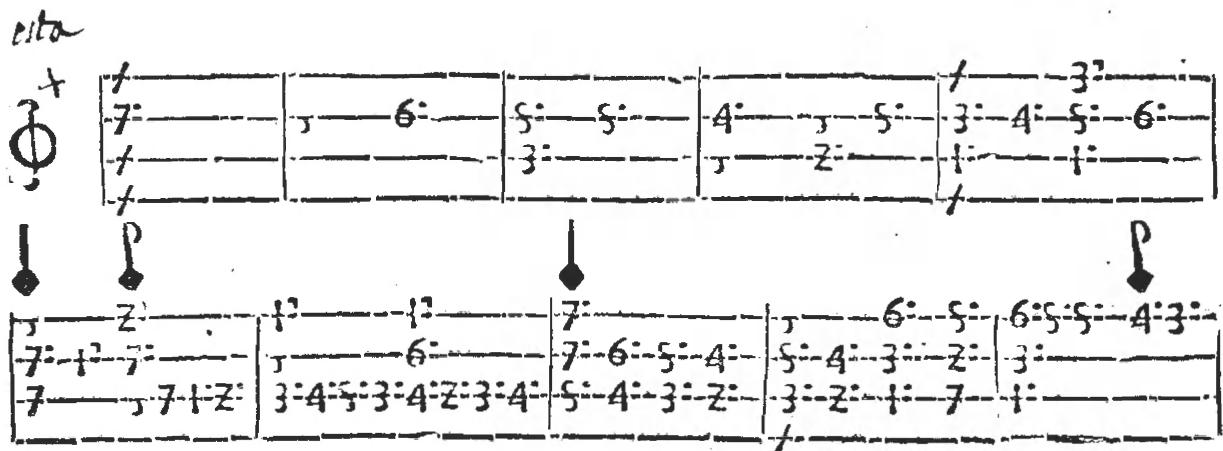
中文讲解
这是页面上的乐谱或图像占位符,位置出现在 P0223 的前言原文之后、P0225 的英译与理论讨论之前。结合上下文,它最可能展示的是《Tiento de Medio Registro de Baxon de Noveno Tono》开头处实际标有 tiempo perfecto de por medio [Φ] 拍号的乐谱,用以印证 P0220 与 P0223 中的理论说明;具体细节需查阅原图。
第6段(P0225)
原文复述
The musician seems to use this time signature primarily in works including eight notes to the measure, or containing principally eighth notes. Such compositions, Correa conveys, must be played somewhat slower due to their consistency. Continuing from the previous description of the tiempo imperfecto [C] and tiempo imperfecto partido [Φ] in the Septimo Punto, the theorist explains the tiempo perfecto de por medio [Φ], describing,
中文讲解
本段在原典前言(P0223)之后进行理论归纳:Correa 将 Φ 主要用于每拍八分音符(以八分音符为主)的作品。又因为这类作品音符密度较为均匀(consistency),所以必须稍慢地演奏——这与 P0223 中"a espacio como de a diez y seys, ni apriessa como de a ocho, sino en vn medio"一致。紧接着,作者准备在 P0226 中继续引用 Septimo Punto 的相应段落,以翻译形式呈现 Correa 对 Φ 的正式定义,过渡到 8.1 节中 tiempo imperfecto [C] 与 tiempo imperfecto partido [Φ] 的比较框架。
补充说明
本段在 Septimo Punto 中将三种拍号 [C]、[Φ]、[Φ] 串成一条"慢—中—快"的拍速序列:imperfecto 最慢,perfecto de por medio 居中,imperfecto partido 最快。
第7段(P0226)
原文复述
And because between these extremes of slow and fast times usually there is also a medium one, it is good that it should have the time signature of the tiempo perfecto de por medio [Φ], which gives more value to its major figures than the [tiempo] imperfecto partido [Φ], and less than the [tiempo] imperfecto [C]. Thus, this will do for those compositions which, although they have eight [notes] to the measure, demand, because of their tight context, a little more space. And for those [compositions] with eight [notes to the measure] that are loose and contain free glosa, one would also attribute the [tiempo] perfecto de por medio [Φ] as, of all [the signatures], it gives less value and less time to the figures. 100
中文讲解
本段是 Septimo Punto 中 Correa 论述的英文译文。中心主张是:在慢拍(imperfecto [C])与快拍(imperfecto partido [Φ])这两种极端之间,通常还存在一种中间拍速,因此需要有相应拍号来表示,这就是 tiempo perfecto de por medio [Φ]。其节奏价值高于 imperfecto partido、低于 imperfecto。Correa 进一步规定它的两种适用情形:(1) 那些虽然每拍八分音符、但因织体紧凑(por su travazón)而需要更多空间的乐曲;(2) 那些每拍八分音符但较为松散、含自由装饰变奏(glosa rodada)的乐曲——后者在所有拍号中获得最短的音值与最短的时间。脚注 100 标注其西语原文出处 fol. 4r。
补充说明
本段同时印证了 P0221 的归因规则:每拍八分音符的作品使用 partido 而 imperfecto 留给每拍十六个三十二分音符的作品,而当这种八分音符作品需要在快慢之间取中时,则引入 perfecto de por medio。“glosa rodada"意为"流畅的装饰变奏”,与 P0223 中的"glofan dos vozes"形成对应。
第8段(P0227)
原文复述
100 Ibid., Y porque entre estos extremos de compas a espacio, y compas a priesa, suele auer vn medio tambien, es bien que le aya en la dicha señal, y esta sera el tiempo perfecto de por medio, el qual da mas valores a sus mayores
中文讲解
此为脚注 100 的西语原文第一段。它在结构上与 P0226 的英译文一一对应,开头一句"Y porque entre estos extremos de compas a espacio, y compas a priesa, suele auer vn medio tambien"即对应译文"between these extremes of slow and fast times usually there is also a medium one”。本脚注在原书中应与 P0233 共同构成完整引文,本段止于"figuras"一词后断行。
补充说明
脚注 100 与 P0233 拼接起来构成 Septimo Punto 关于 tiempo perfecto de por medio 的完整西语引文。
第9段(P0228)
原文复述
Four works in the volume employ an even slower tempo through the compás ternario, ternary time, indicated by a slashed “O” and followed by a ratio of 3/2 [Φ 3/2], as displayed through the multiple proportional time signatures of the Tiento de Medio Registro de Tiple de Dozeno Tono below. 101
中文讲解
本段引入第四种——也是 Facultad orgánica 中拍速最慢的一类——拍号:compás ternario(三拍子,或三分拍)。其符号形式为带斜划的"O"后再标记比例数 3/2,记作 [Φ 3/2]。该拍号在卷中用于四首作品,速度比前述任何拍号都更慢。脚注 101 标记该引文出处 fol. 106v,并以《Tiento de Medio Registro de Tiple de Dozeno Tono》(第十二调高声部半音栓的 Tiento)作为示例。
补充说明
“ratio of 3/2"指明此处拍号带比例记号,意味着小节内三全音符对二全音符的比例关系,是 17 世纪西班牙比例记谱法(proportiones)的典型写法。
第10段(P0229)
原文复述
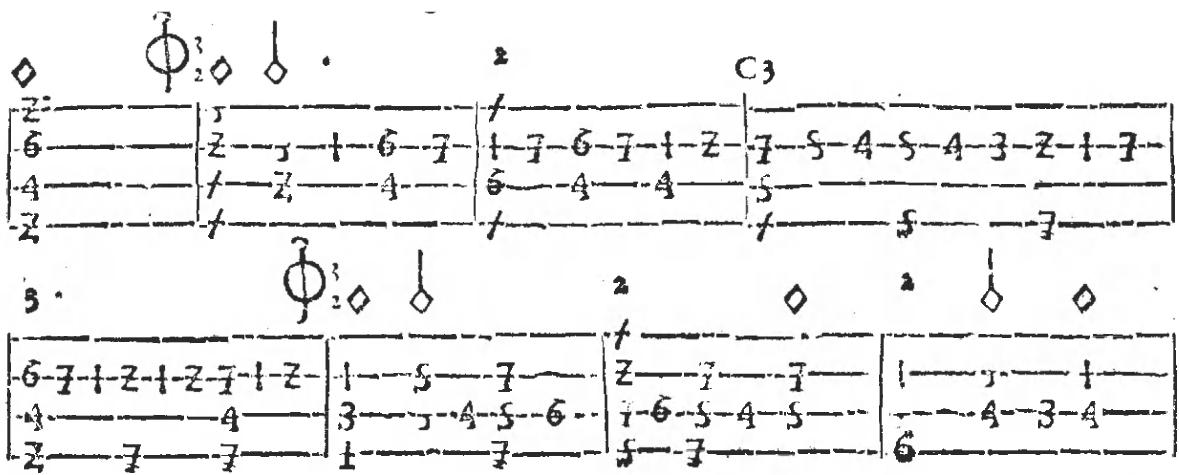
中文讲解
这是页面上的乐谱占位符,紧接 P0228 中所提到的《Tiento de Medio Registro de Tiple de Dozeno Tono》。结合上下文,它应展示该作品开头或片段中实际使用的 [Φ 3/2] 拍号及其比例关系,但具体细节需查阅原图。
第11段(P0230)
原文复述
In the Punto Treze of folio 8, Correa describes the characteristics of this time signature, explaining that,
中文讲解
本段为引文过渡句,告知读者 Correa 对 compás ternario [Φ 3/2] 的正式说明出现在 fol. 8 的 Punto Treze(第十三点)中,下一段(P0231)即给出该段原文的英文译文。
第12段(P0231)
原文复述
In the compás mayor ternario (colloquially called major proportion), there are three whole notes (semibreves), six half notes (minimas), twelve quarter notes (seminimas). Consequently, it follows that there are twenty-four eighth notes (corcheas) and forty-eight sixteenth notes (semicorcheas). Those who have such fast manual technique at the keyboard and responsive reed in their chirimia that they can articulate so many notes in one measure may very well practice them. 102
中文讲解
本段是 Punto Treze 的英文译文。Correa 定义 compás mayor ternario(口语称为"proporción mayor”):一小节容纳 3 个 semibreves(全音符)、6 个 mínimas(二分音符)、12 个 seminimas(四分音符),由此推得 24 个 corcheas(八分音符)和 48 个 semicorcheas(十六分音符)。他以反讽的口吻说:键盘演奏者若手指速度极快,或 chirimia(西班牙古管乐器,类似唢呐)簧片反应灵敏,能在小节内清晰奏出如此多音符,那么大可练习此曲。该定义说明 compás ternario 是以 3:2 的比例扩展而来的拍号体系:每小节的内容比 imperfecto 更多但与 imperfecto partido 之间并不直接对应;它的拍速最慢,是为了容纳密度极高的音符群。脚注 102 标出处 fol. 8r。
补充说明
P0232 紧接着以"最慢速度"的描述引入 tiempo perfecto(又称 perfecto absoluto 或 compás mayor binario),暗示本节讨论将延续至下一拍号的层次结构。
第13段(P0232)
原文复述
The slowest tempo in the Facultad orgánica is indicated by the tiempo perfecto, also called the perfecto absolute or the compás mayor binario, in each case signified by a large “O”
中文讲解
本段开启对第五种——也是 Facultad orgánica 中拍速最慢——拍号的简要预告:tiempo perfecto,又称 perfecto absolute 或 compás mayor binario,记号为大写"O”。由于该拍号的具体定义和示例未在本节范围内展开,本句仅作引子,将详细讨论留给后续小节。
补充说明
“perfecto absolute"与"compás mayor binario"是 Correa 在原书中对该拍号使用的等价名称,三者均指同一拍号体系。
第14段(P0233)
原文复述
figuras que el imperfecto partido, y menos que el imperfecto: y assi este seruira para aquellas obras que aunque son de a ocho al compas, pero por su trauazon piden vn poco de mas espacio y a las de a ocho, q son sueltas y de glosa rodada, se les atribuyria el perfecto de por medio, por ser el que (de todos) da menos valor, y menos tiêpo a sus figuras. (fol. 4r.)
中文讲解
本段是脚注 100 西语原文的延续,与 P0227 拼接构成完整引文。内容回应 P0226 的英译文:从"figuras que el imperfecto partido"开始,逐一交代拍号价值排序(高于 partido、低于 imperfecto),随后规定适用对象——(1) 每拍八分音符但因织体紧凑(travazón)需略宽空间的乐曲;(2) 每拍八分音符且松散、含自由装饰变奏(glosa rodada)的乐曲同样适用,因为 Φ 在所有拍号中给予音符最短的时值与时间。出处标注 fol. 4r。
补充说明
“travazón"即织体紧密度,与"sueltas y de glosa rodada”(松散且带流畅装饰)形成对比,是判断用 [Φ] 还是 [Φ] 的关键演奏学标准。
第15段(P0234)
原文复述
101 Ibid., fol. 106v.
中文讲解
此为脚注 101 的简短出处标注,对应 P0228 中关于 compás ternario [Φ 3/2] 在《Tiento de Medio Registro de Tiple de Dozeno Tono》中的引用,位置在 fol. 106v。
第16段(P0235)
原文复述
102 Ibid., En el compas mayor ternario (vulgarmente dicho proporcion mayor) entran tres semibreves, seys mínimas, doze seminimas: cōsequentemēte se sigue, que entraran beynte y quatro corcheas, y quarenta y ocho semicorcheas: por lo qual quien tuuiese tan veloces manos en la tecla, y lengua en la chirimia que las pudiese pronunciar en vn compas muy bien las podría practicar. (fol. 8r.)
中文讲解
此为脚注 102 的完整西语原文,与 P0231 的英译文一一对应。Correa 说明:在"compás mayor ternario”(俗称"proporción mayor")中容纳 3 个 semibreves、6 个 mínimas、12 个 seminimas,并依次推得 24 个 corcheas 和 48 个 semicorcheas。随后以反讽语气评论:键盘上若手指极快(veloces manos en la tecla),或 chirimia 上簧片反应灵敏(lengua en la chirimia),能在一小节中清晰奏出这些音符,便大可练习此曲。出处标注 fol. 8r。
补充说明
“lengua en la chirimia"中的"lengua"在管乐器语境中指演奏者口中控制簧片的舌头动作,而非字面意义上的"舌头”;这是 17 世纪西班牙管乐器术语的典型用法。
脚注 / 边栏 / 图表 / 附加信息(如有)
本节包含四组脚注材料:脚注 98/99(P0221)出自 fol. 4r 与 fol. 102r,引述 Correa 关于 imperfecto 与 partido 归因规则的 Septimo Punto 全文;脚注 100(P0227+P0233)出自 fol. 4r,为 Septimo Punto 中关于 tiempo perfecto de por medio 的完整西语原文;脚注 101(P0234)出自 fol. 106v,仅作简短出处指引;脚注 102(P0235)出自 fol. 8r,为 Punto Treze 中关于 compás mayor ternario 的完整西语原文。两处图像占位符(P0224 与 P0229)分别对应《Tiento de Medio Registro de Baxon de Noveno Tono》与《Tiento de Medio Registro de Tiple de Dozeno Tono》的实际乐谱示例,用以印证前述拍号体系的视觉外观。
💡 本节核心要点
- Facultad orgánica 中除 imperfecto [C] 与 imperfecto partido [Φ] 外,还存在 tiempo perfecto de por medio [Φ] 与 compás ternario [Φ 3/2] 两种非二拍子拍号,形成由慢至快的完整拍速谱系。
- tiempo perfecto de por medio [Φ] 的速度居中,主要用于每拍八分音符、且因织体紧凑或装饰变奏流畅而需要中间速度的作品;其在所有拍号中对音符时值的赋值最为宽松。
- Correa 的拍号归因规则明确:imperfecto 留给每拍十六个三十二分音符的作品,partido 归于每拍八分音符的作品,而 de por medio 居于二者之间填补速度空白。
- compás ternario [Φ 3/2] 又称 proporción mayor,每小节容纳 3 个 semibreves、48 个 semicorcheas,是卷中最慢的拍号体系,要求演奏者具备极高的键盘与簧片乐器技巧。
- Correa 在 Septimo Punto 与 Punto Treze 中分别以原文与翻译形式给出拍号定义,并以作品前言(如 Tiento de Medio Registro de Baxon de Noveno Tono)作为理论规则的实际演奏注脚。
🔑 关键术语
- tiempo perfecto de por medio:中央带竖划的大写"O"拍号 [Φ],拍速介于 tiempo imperfecto 与 tiempo imperfecto partido 之间,用于每拍八分音符但需要中间速度的乐曲;在所有拍号中对音符时值的赋值最为宽松。
- compás ternario / proporción mayor:带斜划的"O"后接 3/2 比例的拍号 [Φ 3/2],每小节容纳 3 个 semibreves、48 个 semicorcheas,是 Facultad orgánica 中拍速最慢的拍号体系。
- travazón:织体紧密度,Correa 用以判断是否需要稍宽的演奏空间;当每拍八分音符的作品因 travazón 而需要更多时间时,即采用 tiempo perfecto de por medio。
- glosa rodada:流畅的装饰变奏,与紧致织体相对;当作品每拍八分音符但松散并含自由装饰变奏时,同样归入 tiempo perfecto de por medio。
- chirimia:17 世纪西班牙古管乐器,类似唢呐;Correa 在讨论 compás mayor ternario 时以其簧片反应(lengua)作为衡量演奏速度的对照标准。
8.3 [描述性拆分] Tiempo Perfecto Absoluto and the Unnamed Signature with 3
第1段(P0236)
原文复述
and specifically displayed at the beginning of the following Siguense Quatro Obras de a Treinta y Dos Numeros al Compas. $^{103}$
中文讲解
本段是一句承接句,承接前文关于某一时间记号的讨论,并指向紧接其后的「Siguense Quatro Obras de a Treinta y Dos Numeros al Compas」(接下来的四首每小节三十二个音符的作品)这一组作品,并注明该记号显示在这些作品的开头。脚注103指向原始文献folio 153v。它本身并不提出新论点,而是为下一段P0238的论证作过渡。
补充说明
本段中的西班牙语「Siguense Quatro Obras de a Treinta y Dos Numeros al Compas」可直译为「接下来的四首以三十二个音为小节的作品」,是Facultad orgánica原文中一组作品的标题。
第2段(P0237)
原文复述
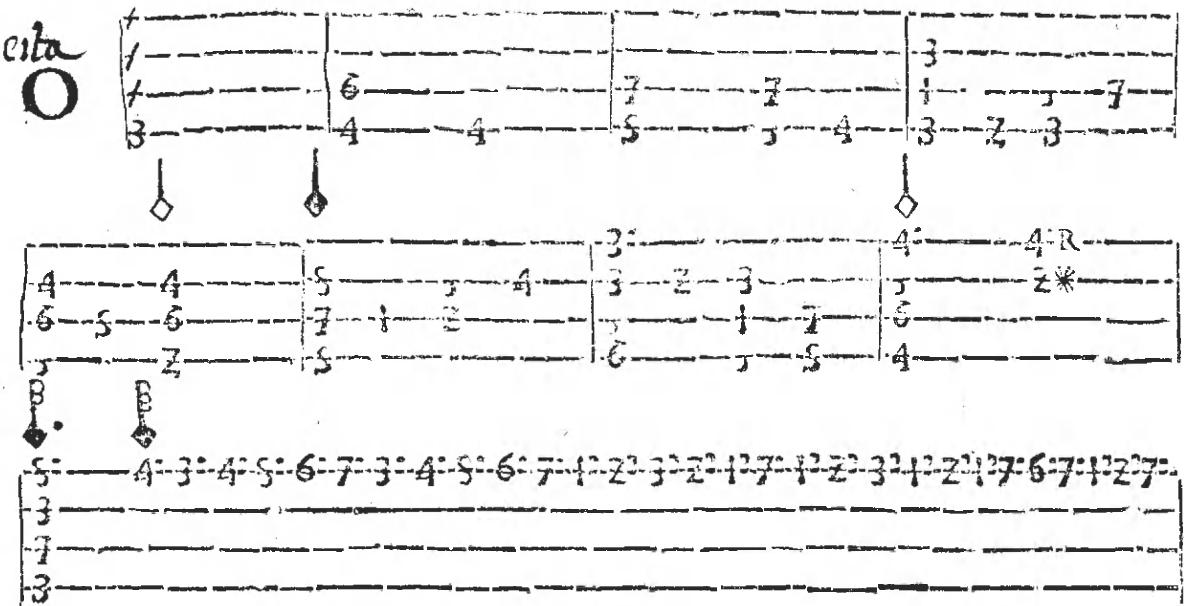
中文讲解
这是一个位于第34页的图像或乐谱占位符。从上下文可确认,其用途是显示上述「Siguense Quatro Obras」一组的开头处所使用的具体时间记号(结合后文应为tiempo perfecto absoluto「O」)。由于内嵌数据已省略,需查阅原书第34页方可确认记号的实际书写形态。
补充说明
本占位符紧接P0236所示的「Siguense Quatro Obras」标题说明,位置正符合「displays at the beginning of the following」这一表述。
第3段(P0238)
原文复述
Correa continues in the Punto Treze that any performer implementing this time signature must “go one doubling one breve, two whole notes (semibreves), four half notes (minimas), etc., until reaching thirty-two sixteenth notes (semicorcheas) to the measure.” $^{104}$ Furthermore, proceeding within the substantial musical description provided by the Septima Punto, the theorist indicates that,
中文讲解
本段首先引述Correa在Punto Treze(第十三条)中的具体规定:使用该时间记号时,演奏者须从小节一拍一个breve(全音符)开始,逐层倍增,依次为两个semibreve、四个minima,直至每小节包含三十二个semicorchea。这一组数字序列揭示了所谓「32个音符一小节」是按层级递减音符时值的体系计算所得的最末一层。随后作者过渡到Septima Punto(第七条)中给出的更宏观的音乐论述。脚注104对应原文fol. 8r.。
补充说明
Punto Treze与Septima Punto均为Correa原著中的章节编号,「Punto」一词在此应为Correa写作中分条论述的「条/点」。
第4段(P0239)
原文复述
The [tiempo] perfecto is used because it denotes slow time and it is halved with a three in front because it indicates major proportion, the slowest of all. Those [compositions] with thirty-two notes to the measure are to be annotated with tiempo perfecto absoluto [O], this with no shift at all, because it is the slowest time and indicates the greatest delay as to the manner of leading time. $^{105}$
中文讲解
本段集中给出tiempo perfecto absoluto [O] 这一记号的理论依据。论证分三步:(1)tiempo perfecto本身指「慢速」;(2)前面加上数字3后表示「major proportion(大比例)」,是所有比例中最慢的一种;(3)因此每小节32个音符的乐谱应记为tiempo perfecto absoluto(即「O」,不加任何附标),因为它是最慢的时间,最能表示「manner of leading time」上最大的拖延。「this with no shift at all」特别强调该记号不附加任何变化符号,与其「绝对」的名称相呼应。脚注105对应fol. 4v.。
补充说明
段落中[major proportion]与tiempo perfecto的关系:Correa把「perfecto」与慢速对应,并通过前置3引入「mayor proporción」,使该记号成为全书最慢的组合之一。
第5段(P0240)
原文复述
$^{103}$ Ibid., fol. 153v.
中文讲解
脚注103。「Ibid.」指前一注释的同一文献(即Correa的Facultad orgánica),此处为fol. 153v。该脚注为正文P0236中所述记号「displayed at the beginning」的位置提供版本依据。
第6段(P0241)
原文复述
$^{104}$ Ibid., Y por el consiguiente sabido que en compas mayor binario, vã vn breue, dos semibreues, quatro minimas, etc. hasta treinta y dos semicorcheas al compas. (fol. 8r.)
中文讲解
脚注104,引自fol. 8r.。西班牙语原文大意为:「相应地已知,在compás mayor binario(大二拍子)中,每小节含一个breve、两个semibreve、四个minima,等等,直到每小节三十二个semicorchea。」此条原文与正文英文译文相对应,证实P0238中所述音符层级体系确为Correa原文所述,且出现在compás mayor binario的语境中。
第7段(P0242)
原文复述
$^{105}$ Ibid., Con el perfecto porque denota compas graue, de por medio con tres delante: porque denota proporcion mayor, y la mas graue de todas. Las de treinta y dos figuras al compas, se puntaran con el tiempo perfecto absoluto, esto es sin mas adminiculo, por quanto este tiempo es el mas graue y el que significa mayor demora en el modo de lleuarlo. (fol. 4v.)
中文讲解
脚注105,引自fol. 4v.。西班牙语原文对应正文P0239的英文翻译。关键短语:「Con el perfecto porque denota compas graue」(用perfecto因为它表示沉重的拍子),「de por medio con tres delante」(在中间分隔,前置三),「proporcion mayor, y la mas graue de todas」(大比例,所有中最沉重的),「sin mas adminiculo」(不加任何附加符号),「mayor demora en el modo de lleuarlo」(在演奏方式上最大的拖延)。这些措辞强化了tiempo perfecto absoluto作为最慢、最沉重记号的地位。
补充说明
「adminiculo」一词在原文中指加在时间记号上的辅助符号,例如数字3或斜线;「sin mas adminiculo」即不附加任何此类标记。
第8段(P0243)
原文复述
One additional unnamed mensuration signature is used in the Facultad orgánica, indicated by a slashed circle followed only by the number three $[\Phi3]$ , as shown below in the Siguense Quatro Obras de Compas Ternario, with minimal explanation concerning the meaning and intended implementation of this sign. $^{106}$
中文讲解
本段介绍Facultad orgánica中另一种时间记号:[Φ3],即带斜线的圆后仅跟数字3,文中称之为「unnamed mensuration signature」。它出现在「Siguense Quatro Obras de Compas Ternario」一组作品的开头。作者强调Correa对该记号仅给出极少的解释,故其含义与使用规范需从其他段落(P0246)中推断。脚注106对应fol. 178r.。
补充说明
该记号[Φ3]与前面讨论的[O]记号形成对比:[O]是无附标的tiempo perfecto absoluto,而[Φ3]则是加了数字3的tiempo perfecto de por medio。
第9段(P0244)
原文复述
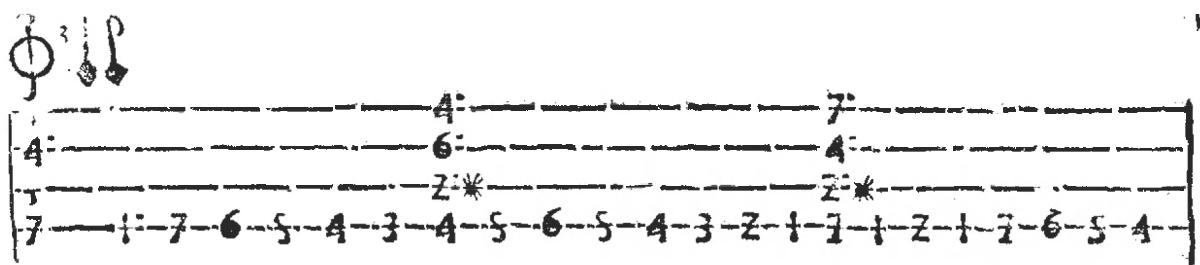
中文讲解
第35页的图像或乐谱占位符,其用途是显示上述「Siguense Quatro Obras de Compas Ternario」一组开头处所使用的[Φ3]时间记号。内嵌图像数据已省略,需查阅原书方可确认记号具体形态。
补充说明
本占位符紧接P0243所述的「Siguense Quatro Obras de Compas Ternario」标题说明。
第10段(P0245)
原文复述
The theorist does describe the unnamed signature $[\Phi 3]$ in the Septimo Punto of the volume, explaining that,
中文讲解
本段为承接句,说明Correa的确在第七条(Septimo Punto)中给出对[Φ3]记号的解释,承接下一段的引文。它本身不展开论证,但揭示了该记号的依据来源。
补充说明
Septimo Punto与前述P0242中tiempo perfecto absoluto的来源fol. 4v.以及P0241中Punto Treze的来源fol. 8r.属同一文献的不同条。
第11段(P0246)
原文复述
And as compositions with twenty-four and thirty-two notes to the measure ask for different speed as to the manner of controlling time, these will be indicated in the following manner: those of twenty-four, as long as they consist of three equal parts, and are ternary, should have a number 3 in front of the time signature and must be in major time or major proportion. They ask for slower time than the previously mentioned and will be annotated with the tiempo perfecto de por medio, with a 3 in front $[\Phi3]$ , as has been said. $^{107}$
中文讲解
本段引述Correa在Septimo Punto中对[Φ3]记号的解释。论证链如下:(1)每小节24个音符与32个音符的作品在「manner of controlling time」上要求不同的速度;(2)24音符者为「三等分」(three equal parts)结构,属于ternary(三部)性质,故应在时间记号前置数字3;(3)记号必须是major time或major proportion(compás mayor);(4)其速度比先前所述更慢,因此记为「tiempo perfecto de por medio」前置3,即[Φ3]。该段使P0243所述「minimal explanation」得到具体内容。脚注107对应fol. 4r.-4v.。
补充说明
「three equal parts」与「ternary」的关系:Correa把每小节24个音符视为由三个等分部分构成,因此属三拍子性质。
第12段(P0247)
原文复述
The musician further emphasizes that the chosen tempo relies on the technical difficulty and musical content of each piece, explaining within the Tiento de Medio Registro de Tiple de Segundo Tono, designated with an “O,” that,
中文讲解
本段为承接句,引出Correa另一段论述:节奏(tempo)的选择取决于乐曲的技术难度与音乐内容。承接的具体作品是「Tiento de Medio Registro de Tiple de Segundo Tono」,其时间记号为「O」(即tiempo perfecto absoluto),下一段引文即来自此曲。
补充说明
「Tiento」为西班牙文艺复兴与巴洛克时期键盘音乐中一种基于固定主题展开的作品体裁,「Medio Registro」指中间声部音区,「Tiple」指高声部。
第13段(P0248)
原文复述
Following are four compositions with thirty-two notes to the measure, in four voices… All these works I have marked with the tiempo (commonly) called perfecto in order to explain the slow tempo which is due to so much diminution. How slow the movement will be depends on the major or minor speed which each player has naturally in his hands. Therefore, those who have a better technique will play less slowly and those whose technique is less will take more time, though in either case the playing will be equal in both the plain and in the glosado of 8, 12, 16, 24, or 32 [notes]. Equality, touch and cleanliness matter considerably in these compositions. $^{108}$
中文讲解
本段引自记号为「O」的Tiento,主要阐述节奏与演奏技法之间的关系。要点:(1)这四首作品每小节32个音符,四声部,因此使用tiempo perfecto「O」标记,以说明「so much diminution」(高度细分音符)所导致的慢速;(2)实际速度快慢取决于演奏者手头的天然快慢(major or minor speed);(3)技术好的演奏者弹得没那么慢,技术差的则更慢;(4)但无论快慢,「plain」(原本声部)与「glosado」(装饰/对位声部)在8、12、16、24、32音符各层面上都应保持统一;(5)「equality, touch and cleanliness」——平衡、触键与清晰——在这些作品中至关重要。该段揭示Correa的演奏美学:不以固定节拍为单位,而以演奏者技术相对调整实际速度,但要求声部间一致性。脚注108对应未在输入中给出的具体folio(仅在正文中标记)。
补充说明
「glosado」指对原始旋律加以装饰、花奏或变奏的对位处理,「plain」则指原始的未经装饰的声部。
第14段(P0249)
原文复述
$^{106}$ Ibid., fol. 178r.
中文讲解
脚注106。「Ibid.」指前一注释的同一文献,即Correa的Facultad orgánica。此处为fol. 178r.,为P0243中所述[Φ3]记号出现位置提供版本依据。
第15段(P0250)
原文复述
$^{107}$ Ibid., Y por que las obras de beinte y quatro, y de treinta y dos figuras al compas, pidē diferente mora, en el modo de llevarlo, se puntaran en la forma siguiente. Las de beinte y quatro por quanto son compuestas de tres partes yguales, y son ternarias y se les deue poner vn numero 3, delante del tiempo, y este a de ser compas mayor, o proporcion mayor, y piden compas mas largo que los dichos, por tanto se puntaran con el tiempo perfecto de por medio, con un 3. delante como dicho es. (fol. 4r.-4v.)
中文讲解
脚注107,引自fol. 4r.-4v.。西班牙语原文对应P0246英文翻译。其中关键短语:「pidē diferente mora, en el modo de llevarlo」(在演奏方式上要求不同的mora/停留/拖延),「compuestas de tres partes yguales, y son ternarias」(由三等分构成,属三部的),「se les deue poner vn numero 3, delante del tiempo」(须在时间记号前置数字3),「compas mayor, o proporcion mayor」(大拍子或大比例),「compas mas largo que los dichos」(拍子比前述更长)。此条与P0241引述的Punto Treze内容相互独立,分别对应「O」与「Φ3」两种记号。
补充说明
「mora」一词在原文中指停留、拖延或时值长度,与英语译文中的「speed / manner of controlling time」相对应。
第16段(P0251)
原文复述
Furthermore, in the Tiento de Medio Registro de Bajón de Noveno Tono, indicated with a time signature of tiempo perfecto de por medio [Φ], Correa writes,
中文讲解
本段为承接句,引入另一首Tiento的具体讨论:「Tiento de Medio Registro de Bajón de Noveno Tono」,其时间记号为tiempo perfecto de por medio [Φ]。它显示了在作品内部Correa对tiempo选择的具体说明,下一段引文即出自此曲。
补充说明
「Bajón」指低音古低音管声部或低音区,「Noveno Tono」为教堂调式体系中的第九调式。
第17段(P0252)
原文复述
And with eight [notes] to the measure. This tiento is somewhat more difficult in that respect because in most of it two voices are glossing simultaneously. Consequently, the tempo is neither as slow as with sixteen [notes per measure], nor as fast as with eight [notes per measure], but in between. This is what is to be understood in those of my compositions which have the indication tiempo perfecto de por medio. $^{109}$
中文讲解
本段引自记号为[Φ]的Tiento。要点:(1)此曲每小节8个音符;(2)比对应作品更难,因为大部分段落中两声部同时进行「glosado」(变奏/装饰);(3)因此实际节奏既不像16音符那样慢,也不像8音符那样快,而是介于两者之间;(4)这是理解所有标注为「tiempo perfecto de por medio」的Correa作品时应把握的原则。该段揭示了为何[Φ]与「O」不同:它代表「中间的」节奏,因技术复杂度(双声部glosado)而需要既不太慢也不太快的处理。脚注109对应未在输入中具体列出的folio位置(仅在正文中标注)。
补充说明
该段与P0248相对照:P0248讨论[O]记号下的32音符作品强调演奏者技术差异;本段讨论[Φ]记号下的8音符作品强调声部数量对节奏的限定。
脚注 / 边栏 / 图表 / 附加信息(如有)
本节附有以下非正文材料:(1)两个图像/乐谱占位符(P0237、P0244)分别显示「O」与「Φ3」两种时间记号在实际乐谱中的书写位置,但内嵌数据已省略,需查阅原书方可确认。(2)脚注103(P0240)指向fol. 153v.,为「Siguense Quatro Obras de a Treinta y Dos Numeros al Compas」一组作品的来源依据。(3)脚注104(P0241)提供Punto Treze的西班牙语原文(fol. 8r.),论及compás mayor binario中的音符层级体系。(4)脚注105(P0242)提供tiempo perfecto absoluto的西班牙语原文(fol. 4v.),论证该记号为何为最慢。(5)脚注106(P0249)指向fol. 178r.,为「Φ3」记号出现位置的来源依据。(6)脚注107(P0250)提供Septimo Punto中关于24与32音符作品标记的西班牙语原文(fol. 4r.-4v.)。(7)脚注108对应P0248引文出处,脚注109对应P0252引文出处,两者folio编号未在本节输入中具体给出。整体而言,脚注群既给出Correa原文的英文—西班牙语对照,也为各记号提供folio层级的版本依据。
💡 本节核心要点
- Correa的Facultad orgánica使用三种主要时间记号:[O](tiempo perfecto absoluto)、[Φ](tiempo perfecto de por medio)和[Φ3](带数字3的tiempo perfecto de por medio)。
- [O]用于每小节32个音符的作品,是所有记号中最慢、最沉重的,因为它前置数字3对应major proportion,且不加任何附标(「sin mas adminiculo」)。
- [Φ3]用于每小节24个音符(由三等分构成的三部性作品)的作品,速度比先前所述更慢,论证来自Septimo Punto(fol. 4r.-4v.)。
- Correa的tiempo perfecto体系逻辑:「perfecto」本身指慢速;前置3则引入major proportion,使整体更慢;不加3则为「绝对」(absoluto)形式。
- 实际节奏(tempo)由技术难度与音乐内容决定:P0248指出32音符四声部作品使用[O],但具体快慢取决于演奏者天然手速与glosado/plain声部一致性;P0252指出双声部glosado使节奏需介于8与16音符之间,对应[Φ]记号。
- Correa演奏美学的核心要求是「equality, touch and cleanliness」——在不同音符密度(8、12、16、24、32)和声部层次(plain与glosado)下保持统一、触键与清晰。
🔑 关键术语
- tiempo perfecto absoluto [O]:Correa在Facultad orgánica中用于每小节32个音符作品的时间记号。代表最慢、最沉重的节奏。前置数字3对应major proportion,但不附加任何「adminiculo」(辅助标记),故称「absoluto」。
- tiempo perfecto de por medio [Φ]:Correa的另一种时间记号。「de por medio」即「在中间」,表示介于慢与快之间的节奏。用于双声部glosado等需要平衡处理的作品。
- unnamed signature [Φ3]:带斜线的圆后仅跟数字3的记号,Correa在Facultad orgánica中使用但未明确命名。用于每小节24个音符(由三等分构成)的ternary作品,对应tiempo perfecto de por medio前置3的形式。
- major proportion (proporción mayor):Correa体系中所有比例中最慢的一种。前置数字3引入此比例,使相关记号节奏更慢。
- septima punto / septimo punto:Correa原著中的章节编号(即「第七条」),Septimo Punto包含对[Φ3]与24音符作品标记的说明。
- Punto Trece:Correa原著中的章节编号(即「第十三条」),包含对compás mayor binario中音符层级体系(从breve到32个semicorchea)的具体规定。
- Tiento de Medio Registro de Tiple de Segundo Tono:Correa Faculdad orgánica中一首作品,使用[O]记号。该曲的相关引文说明32音符作品下tempo与演奏者技术之间的关系。
- Tiento de Medio Registro de Bajón de Noveno Tono:Correa另一首作品,使用[Φ]记号,相关引文说明8音符、双声部glosado下节奏应介于8与16音符之间。
- glosado:在原始旋律(plain)之上或之外进行装饰、变奏或对位处理的声部。在高密度音符的作品中,glosado与plain声部的统一是Correa演奏美学的核心要求。
- plain:未经装饰或变奏的原始声部,与glosado相对。两者在8、12、16、24、32音符等不同密度下都应保持节奏统一。
9.1 [描述性拆分] Proportions and Sesquialtera (Major and Minor)
第1段(P0253)
原文复述
Closely related to the use of time signatures in the Facultad organica is the subsequent discussion of compositional proportions. In the first folio of the Advertencias, Correa describes the innovative use of proportions in the volume, explaining that,
中文讲解
本段是9.1节的引言性铺垫,把上一节的拍号话题自然过渡到本节的主题——比例。作者点出三个关键信息:①讨论对象是Francisco Correa de Arauxo《Facultad orgánica》中的"比例"(proportions);②这些内容出自卷首《Advertencias》的第一对开页(fol. 1r.-1v.);③Correa自陈这些比例是前所未有的创新。这一句的论证功能在于:先把比例设定为"创新",为后面罗列5、9、11、18等奇特数值提供合理性铺垫。读者应注意,“proportion"在文艺复兴与巴洛克音乐理论中并非数学意义上的简单比值,而是改变音符时值或小节中音符数的记谱指示,与现代的"比例"概念有显著差异。
补充说明
本节聚焦比例与sesquialtera的演奏实践,与第8章末段拍号讨论构成连续推进;两者均出自《Facultad orgánica》卷首《Advertencias》。
第2段(P0254)
原文复述
You will also find some proportions not previously known of five, nine, eleven, and eighteen notes to the measure, and others which are in the versos. $^{110}$
中文讲解
这是对Correa原文中"比例"创新性的直接引证,原文为西班牙语,本段是英译。引文揭示三要点:①比例的数值是5、9、11、18这样的奇数或非常规数,而非传统的2或3;②这些比例以"X notes to the measure”(每小节X个音符)的形式出现,意味着改变了小节内的音符数量;③还有更多比例出现在"versos"(versos,复调曲式的一种)之中。脚注110指向原文出处(fol. 1r.-1v.),用以坐实引文的具体位置。理解时需注意:在mensural notation体系中,比例数字写在谱表上方,表示以新比例替代基本时值,因此"5个音符一小节"意味着原本只容纳较少音符的小节被扩展。
补充说明
脚注110引向P0258中第110号脚注的西班牙语原文。“versos"在Correa处特指一类以诗句为定旋律的复调形式,与tientos(无固定旋律的即兴性乐曲)形成对比。
第3段(P0255)
原文复述
In the explanatory preamble to the Segundo Tiento de Sexto Tono, the theorist also explains his
中文讲解
这是一段过渡句,主语The theorist指Correa,谓语"also explains his"悬而未决,需要与下一段(P0256)合读才能完成语法。“Segundo Tiento de Sexto Tono"是《Facultad orgánica》中一首具体作品的标题,意为"第六调式的第二首Tiento”,属实践层面的乐曲,而非理论段落。作者用"preamble”(序言/前言)表明这种节奏复杂性的解释嵌入在作品之前,作为演奏指引。理解这段时要把它与P0256、P0257视为一个完整引文单位:本句只是引入。
第4段(P0256)
原文复述
unique use of such rhythmic complexities, stating that,
中文讲解
此句继续完成P0255的语法,承接"explains his…stating that",完整句意为"这位理论家也解释了他对这类节奏复杂性的独特使用,解释道……"。“unique use"呼应P0253的"innovative”,强调Correa自视为先行者;“rhythmic complexities"则呼应"proportions”,把抽象的"比例"翻译成可感的"节奏复杂性"。这一表述为下一段的直接引语做铺垫,使读者带着"独特性"的预期去阅读。
第5段(P0257)
原文复述
I use some figures that are not found in polyphony, such as the figure that includes five quarter notes (seminimas), five eighth notes (corcheas), and others in this manner. I have seen these figures used in cifra by those who are (without exception) the most eminent masters of organ of our Spain. $^{111}$
中文讲解
这是Correa自陈其比例使用独特性的核心引文(英译),由三部分组成:①声明自己使用的"figures"(图形/音符)在传统复调(polyphony)中不存在;②举例——包含5个seminimas(4分音符)或5个corcheas(8分音符)的figure;③为这种创新辩护——他见过西班牙最杰出的管风琴大师在cifra(数字谱/字母谱,即keyboard tablature)中使用这些图形。括号中的术语(seminimas、corcheas)表明译者在为不懂西语的读者做译注。理解时需注意三层修辞:自陈创新(“not found in polyphony”)、权威援引(“most eminent masters”)、谱面定位(“cifra"而非一般复调)。脚注111指向fol. 57r.,对应《Facultad orgánica》第二册中《Segundo Tiento de Sexto Tono》的实际序言。
补充说明
cifra是西班牙键盘音乐的字母/数字记谱体系,与白音符/黑音符的复调记谱相对,更便于键盘演奏者使用。
第6段(P0258)
原文复述
$^{108}$ Ibid., Sígvense quatro obras de a trienta y dos numeros al compás, a quatro voças… Todas las cuales obras dichas las punto con el tiempo (comunmente) llamado perfecto, para dar a entender la morosidad del compás, respecto de la mucha diminución: Que tardança aya de ser esta, se collegirá de la velocidad mayor, o menor, que cada vno naturalmente tuviere en las manos: de modo que el que la tuviere mayor, causará menos tardança, y el que menor, causará más tardança en el lleuar de el compás; el qual será por igual así en lo llano como en lo glosado de a 8. 12. 16. 24, y 32. Ygualdad, toque, y limpieza encargo mucho en estas obras. (fol. 153v.) $^{109}$ Ibid., Y de ocho al compás. Este tiento es algo dificultoso respecto de que en la mayor parte del glosan dos vozes simultáneamente, y por esta causa se a de lleuar el compás; ni a espacio como de a diez y seys, ni apriesa como de a ocho, sino en vn medio, y assi lo punto con el tiempo perfecto de por medio, el qual en mis obras tiene esta significació. (fol. 102r.) $^{110}$ Ibid., Encontraras assi mismo algunas proporciones no conocidas de cinco, de nueve, onze, y diez y ocho figuras al compas, y otras mas que estan en el de versos. (fol. 1r.-1v.) $^{111}$ Ibid., Vso de algunas figuras que no se hallan en cão de órgano: como de figura que vale cinco seminimas, cinco corcheas, y otras a este modo, lo qual é visto (sin ecepción) practicado en discursos de cifra, de los más eminentes maestros de sórgano de nuestra España. (fol. 57r.)
中文讲解
这是页脚集中放置的108-111号脚注块,原文均为西班牙语,按学术规范如实复述(不译成中文)。各条对应关系为:108号对应fol. 153v.,解释"32个音符一小节"的四首作品及tiempo perfecto(完美拍)的速度控制方式;109号对应fol. 102r.,解释一首"每小节8个音符"的tiento,论证使用"中等完美拍”(tiempo perfecto de por medio)的必要性;110号对应fol. 1r.-1v.,是P0254英译引文的西语原文;111号对应fol. 57r.,是P0257英译引文的西语原文。从内容看,108与109号脚注承担旁证功能——它们展示Correa在不同作品中如何通过"完美拍"处理高度细分节奏,与正文关于"比例创新"的讨论构成互证;110、111则是直接提供引文的原文出处,便于研究者核对。理解时要意识到这四条脚注构成了Correa关于拍号、速度与比例三层论述的物质证据。
补充说明
无额外补充(脚注本身的学术定位已完整复述)。
第7段(P0259)
原文复述
Correa frequently adds proportional numbers to the different time signatures in the Facultad organica to create unusual mensural indications., such as compás ternario $[\Phi\frac{3}{2}]$ and the unnamed signature $[\Phi3]$ . Other altered time signatures within the volume comprise the tiempo imperfecto followed by a 3 [C3], the same sign, “C,” followed by a ratio of 5/3 $[C\frac{5}{3}]$ , and the tiempo imperfecto partido followed by a proportion of 3/2 $[\Phi\frac{3}{2}]$ . The first [C3] and last $[\Phi\frac{3}{2}]$ of these time signatures use sesquialtera, or a proportion of three to two. The $[C\frac{5}{3}]$ indication seemingly signifies a quintuple proportion, with five notes occupying the same time as three in the preceding tempo. $^{112}$ Several proportional specifications also appear in the compositions of the Facultad organica without corresponding time signatures, including symbols for 7/3, 9/6, and 5/2. In these designations, the top number typically represents the number of notes in the new tempo intended to replace the number of notes from the preceding tempo signified by the lower number. In the Decimo Punto of the treatise, Correa explains how the downbeat and upbeat are to be placed in any proportion. $^{113}$ For general, in any proportion that can be divided into three equal parts, the downbeat is placed on the first part and the upbeat on the third. For any proportion that cannot be divided into three equal parts, the theorist describes a complicated process of adding one or two to the number of notes in the measure, then dividing by three to determine the number of notes performed on the upbeat, with all remaining notes performed on the downbeat.
中文讲解
本段是本节的理论核心,集中罗列Correa所用的非常规拍号与比例标记。信息密度大,可分三层理解:①带比例数的拍号——compás ternario [Φ3/2]、未命名[Φ3]、C3、C5/3、Φ3/2等;②其中[C3]与[Φ3/2]是sesquialtera(3:2比例)的两种标记法,[C5/3]则表示五重比例(5个音符占3个音符的时间);③无对应拍号的比例标记——7/3、9/6、5/2等,仅以分数符号出现,分子代表新比例音符数,分母代表原比例音符数。Correa还在《Decimo Punto》(第十条要点)中给出落拍与提拍(downbeat/upbeat)的判定规则:能被3整除的比例,落拍在第一部分、提拍在第三部分;否则用"加1或加2再除以3"的复杂算法算出提拍占几个音符,其余归落拍。理解时需注意:①mensural指示中比例写在拍号之后或上方;②作者用"seemingly"(似乎)修饰[C5/3]的解释,说明这是学界推断而非确证;③落拍/提拍规则是演奏实践的延伸——它把抽象的数字比例落到具体的重音位置。脚注112引自Holland第73页,脚注113指向Correa fol. 5v.-6r.。
补充说明
tiempo imperfecto partido即Φ符号加竖线(现代含义的"二拍子"),与不加竖线的"perfecto"(三拍子)相对。Decimo Punto即《Advertencias》第十条要点。
第8段(P0260)
原文复述
A further aspect of keyboard performance practices in the Facultad organica involves sesquialtera, a proportion roughly similar to the modern triplet. In the Undecimo Punto of the Advertencias, Correa describes two techniques for executing the proportion, communicating that,
中文讲解
本段从"比例的标记"过渡到"比例的演奏",聚焦sesquialtera。关键信息:①sesquialtera是Facultad orgánica键盘演奏实践的核心内容;②它是3:2的比例,约略相当于现代意义上的triplet(三连音);③Correa在《Advertencias》的《Undecimo Punto》(第十一条要点)中描述了两种执行这一比例的技法。本句的论证功能是:把抽象的拍号-比例记号与具体的演奏动作连接起来——读者接下来要看到的不是数学,而是手指如何落键。理解时要意识到,作者用"roughly similar"做限定,说明古代的sesquialtera与现代triplet只是"约略"相似,实际上还包含节奏不均(inequality)的成分,这是后面P0264-P0274要展开的内容。
补充说明
Undecimo Punto即《Advertencias》第十一条要点。
第9段(P0261)
原文复述
$^{112}$ Holland, 73.
中文讲解
这是脚注112的简写条目,仅标注出处为"Holland, 73",未提供更多内容。从其位置(P0259末尾)可知,它支撑的是"[C5/3] seemingly signifies a quintuple proportion"这一推断性解释。理解时不必深究Holland是谁、出版于何年;按学术规范如实复述即可。
第10段(P0262)
原文复述
$^{113}$ Correa, fol. 5v.-6r.
中文讲解
脚注113的简写条目,指明P0259中关于落拍/提拍规则的论述出自Correa原书fol. 5v.-6r.,即《Advertencias》第十条要点的位置。这是出版规范上的指引性脚注。
第11段(P0263)
原文复述
The same number of figures and note values can be played in two different manners. The one we call sexquialtera proportion, and has six or twelve figures to the measure; the other has nine or eighteen figures to the measure. $^{114}$
中文讲解
这是Correa《Undecimo Punto》的核心命题引文(英译):相同的音符数量与时值可以用两种方式演奏——一种是sesquialtera比例,每小节6或12个音符;另一种是每小节9或18个音符。这句话是接下来整段演奏技法论述的逻辑起点。理解时需注意:①"same number of figures and note values"是控制变量——记谱相同,但演奏不同;②6/12与9/18看似不同,但实际上都源自3:2这一根本比例,前者把3个音符的时值分成2个音符(“minor”),后者把2个音符的时值分成3个音符(“major”);③这正是P0264与P0267要分别展开的两种方法。脚注114指向fol. 6r.。
补充说明
脚注114的西班牙语原文见P0268。
第12段(P0264)
原文复述
The first method to perform sesquialtera, which the theorist categorizes as a major proportion, divides the notes into three groups consisting of two notes each, with three whole notes equal to six half notes and twelve quarter notes. Correa signifies this technique with a number two above the score, as demonstrated below within the Síguense Dies y Seis Glosas sobre el Canto Llano: Guárdame las Vacas, $^{115}$ and explains, continuing in the Undecimo Punto, that the notes should be played equally, stating that,
中文讲解
本段介绍sesquialtera的第一种演奏方法——“major proportion”(大比例)。三要点:①分组方式——把音符分成三组,每组两个音符(如3个全音符=6个半音符=12个4分音符);②谱面记号——在乐谱上方标注数字"2";③演奏特征——音符要弹得"equal"(均匀)。作者选择《Síguense Dies y Seis Glosas sobre el Canto Llano: Guárdame las Vacas》(“16首对平原歌的装饰:守护我的母牛”)作为实例。这是Correa以著名旋律"Guárdame las Vacas"为基础的变奏曲集,共16首,是西班牙键盘音乐中常见的教学与炫技曲目。本段的论证作用在于:用具体作品落地抽象理论,让读者能在乐谱上看到"2"这个标记。脚注115指向fol. 193r.,即该作品所在页。
第13段(P0265)
原文复述
The first manner is the easiest, and is to play all of them evenly and plainly, that is to say, without lingering more on one note than another. This manner of execution is like major proportion which consists, of three equal whole notes (semibreves) or six equal half notes (minimas), or twelve equal quarter notes (seminimas) to the measure, all of them plain and without inequality (ayrezillo). $^{116}$
中文讲解
这是Correa《Undecimo Punto》中关于第一种演奏方法的完整引文(英译),与P0264共同构成对"major proportion"的全面说明。关键信息:①这是"最简单"(easiest)的方法;②演奏方式——“evenly and plainly”,即均匀、不在任何音上停留更久;③音符组合——3个全音符、或6个半音符、或12个4分音符,每小节;④特别强调"without inequality (ayrezillo)"——不带有"小风韵"(ayrezillo)。术语ayrezillo是本节核心:它指代西班牙键盘音乐中特有的"轻微不均"演奏法,类似法式notes inégales。理解本段时要把"without ayrezillo"作为锚点——它提示读者,下一段(P0267起的"minor proportion")才是真正包含ayrezillo的、更"西班牙味"的演奏法。脚注116指向fol. 6r.。
补充说明
ayrezillo是西班牙文艺复兴/巴洛克键盘演奏的术语,直译"小风韵",指有意的轻微节奏不均,是西班牙风格区别于其他欧洲键盘传统的标志之一。
第14段(P0266)
原文复述
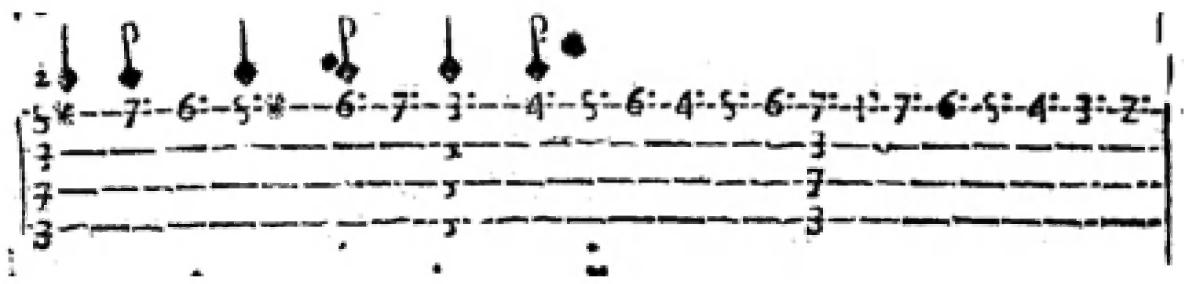
中文讲解
这是第38页的图像/乐谱占位符,说明此处原本嵌有一份图示,用以示范P0264所述的"数字2标在谱面之上"的major proportion记谱法。由于图片数据被省略,无法描述具体谱面细节;本占位符在文本中起到的功能是视觉佐证——让读者把"2"这个抽象标记与真实乐谱对应起来。需查看原图才能确认谱号、调号、具体音符内容与"2"出现的位置。
补充说明
原书第38页对应的实例曲是《Guárdame las Vacas》。
第15段(P0267)
原文复述
While Correa describes this first method as the easiest way to perform sesquialtera, he also presents a second technique, which he identifies as most frequently used by organists. In this second method, referred to in the treatise as a minor proportion, the notes are divided into two groups of three notes each, as demonstrated below in the same work, Síguense Dies y Seis Glosas sobre el Canto Llano: Guárdame las Vacas.
中文讲解
本段引出第二种方法——“minor proportion”(小比例),与P0264的"major proportion"形成对比。关键信息:①作者明确这是"organists most frequently used"(管风琴家最常用)的方法;②分组方式——两个三音符组(如6个半音符分成2组×3个);③使用同一首作品《Guárdame las Vacas》示范,便于读者对照。本段的论证作用是用"easier vs. most frequent"这一对照把两种方法区分开:理论上的"易"不等于实践中的"常用"。理解时要注意,major proportion与minor proportion之名看似反直觉(major=3个音一组却比minor简单),但反映了"复节奏细分方向"的不同——major把"短"细分,minor把"长"细分。
第16段(P0268)
原文复述
$^{114}$ Ibid., De dos modos diferentes se puede tañer unas mismas figuras en numero, de la que llamamos proporcion sexquialtera, que es de seys, o doze figuras al compas, y de la de nueve, y de diez y ocho figuras al compas tambien. (fol. 6r.)
中文讲解
这是P0263英译引文的西班牙语原文脚注。原文为:“可以用两种不同方式弹奏数量相同的相同图形,一种是所谓的sesquialtera比例,每小节六或十二个图形,以及每小节九或十八个图形”(fol. 6r.)。按学术规范如实复述西语原文,不译。理解时只需把它视为P0263的西语对应版本。
第17段(P0269)
原文复述
$^{115}$ Ibid., fol. 193r.
中文讲解
脚注115,简短标注major proportion实例所在的页码——fol. 193r.,即《Guárdame las Vacas》变奏集中出现"2"标记的具体谱例页。这是出版规范性的指引脚注。
第18段(P0270)
原文复述
$^{116}$ Ibid., El primer modo y mas facil, es tañerlas yguales, y llanas, esto es, sin detenerse mas en vna que en otra, y este ayre es como de proporcion mayor, en la qual van tres semibreues, y seys minimas, y doze seminimas al compas iguales, llanas y sin ayrezillo. (fol 6r.)
中文讲解
这是P0265英译引文的西班牙语原文脚注。原文完整复述为:“第一种方式,也是最简便的,是把它们弹得相等、平直,即不在任何一个音上多停留。这种风韵类似大比例,其中每小节走三个全音符、六个半音符、十二个四分音符,相等、平直且不带ayrezillo”(fol. 6r.)。理解时要把握:“sin ayrezillo”(不带ayrezillo)这句话是Correa自我界定"major proportion"的核心标准——它是"平直的",作为与下一种minor proportion的对照锚点。
第19段(P0271)
原文复述

中文讲解
这是第39页的图像/乐谱占位符,且其占位文本本身嵌入了叙述性的过渡句——“The musician describes this style of performance of the sesquialtera, conveying that,"(音乐家描述了这种sesquialtera的演奏风格,说道:)。这意味着图片占位符同时承担了引语引导的功能,下一段P0272才是引文本身。图片位置应与P0266的谱例对照:P0266示范"2"的major proportion记号,本图示范"3"的minor proportion记号。需查看原图才能确认具体谱面细节。
第20段(P0272)
原文复述
The second manner is to play them somewhat unequally, and with that air (ayrezillo) and graciousness of a minor proportion. This manner (although difficult) is the most usual among organists, and is performed by lingering more on the first note and less on the second and third, and then lingering on the fourth and less on the fifth and sixth. It is (almost) like playing the first as a half note (minima) and the second and third as quarter notes (seminimas), or by the half, one quarter note and two eighth notes (corcheas), and continuing like so throughout all of the measure. $^{117}$
中文讲解
这是Correa《Undecimo Punto》中第二种演奏方法的完整引文(英译),揭示minor proportion的核心——“inequality”(不均)。关键信息:①演奏方式——“somewhat unequally”,带ayrezillo与小比例的"graciousness”(优雅);②操作细节——每个三音组的第一个音停留稍长,第二、第三音较短;③具体换算——第一个音如半音符(minima),第二、第三音如4分音符(seminimas);或第一个音为4分音符,第二、第三音为两个8分音符(corcheas);④全小节按此规律重复。括号中的"almost"(几乎)一词是Correa的自谦式限定,承认这种换算是近似而非绝对等价。理解时要把这段看作Correa对ayrezillo的首次具体化描述:它不是任意的不均,而是有规律的"长短长短长短"模式。脚注117指向fol. 6r.-6v.。
第21段(P0273)
原文复述
Correa calls this technique the ayrezillo and indicates its intent through a number three written above the score, further describing,
中文讲解
本段是过渡句,承担两个功能:①给这种不均技法一个正式名称——ayrezillo;②给出对应的谱面记号——乐谱上方的数字"3"。这是与major proportion的"2"相对应的镜像标记。“further describing"提示下段(P0274)仍是Correa本人的进一步描述。理解时要意识到:“2"代表平直(平分),“3"代表不均(带风韵),数字本身就是演奏方式的速记符号。
第22段(P0274)
原文复述
The second manner, which is when notes are played with inequality of tempo (lingering more on the first, fourth, seventh, tenth, etc., and less on the those in between, which is like playing a quarter note and two eighth notes, as nothing is more enjoyable), is always indicated with a three on top, denoting the air of minor proportion and inequality of tempo in the lengthening, or pronunciation, of such figures of sexquialtera, as in the works of Cabezón, Manuel Rodríguez Pradillo, and many others. $^{118}$
中文讲解
这是P0273引导出的Correa进一步描述的完整引文(英译),与P0272互补,但信息更密。要点:①操作序列——在第一、第四、第七、第十等位置上的音停留更长,其间的音较短;②具体换算——“一个4分音符加两个8分音符"的组合;③情感评价——“as nothing is more enjoyable”(没有什么比这更悦耳),这是Correa罕见的审美评价;④谱面标记——始终用谱上方的"3"表示;⑤风格归属——Cabezón、Manuel Rodríguez Pradillo等人的作品都使用这一手法。括号内的"as nothing is more enjoyable"是英文译者的转译,原文为"es, no es mas amenos”(再没有比这更悦耳的了),这一情感表述揭示了Correa对ayrezillo的强烈偏好。理解时要把Cabezón(16世纪西班牙管风琴泰斗)与Pradillo(同时代西班牙管风琴家)视为ayrezillo传统的代表人物,他们的作品是这种演奏法的"现实证据”。脚注118指向fol. 6v.。
补充说明
Cabezón即Antonio de Cabezón,是西班牙文艺复兴时期最重要的管风琴家之一;Manuel Rodríguez Pradillo是其后的西班牙管风琴家,二者的作品都体现出ayrezillo传统。
第23段(P0275)
原文复述
Finally, the musician summarizes the preceding theoretical information, concluding that,
中文讲解
本段是引出总结性引文(P0278)的过渡句。“Finally"提示这是本小节的收束句,“summarizes the preceding theoretical information"点明它的功能——把前面的比例与sesquialtera论述浓缩为一条规则。理解时把它与P0278视为一个整体。
第24段(P0276)
原文复述
$^{117}$ Ibid., El segundo modo es, tañerlas algo desiguales, y con aquel ayrezillo, y graciasidad de proporcion menor, y este (aïque dificultoso) es el mas usado de los organistas, y es deteniendose mas en la primera figura; y menos en la segunda y tercera: y luego deteniêdose en la quarta, y menos en la quinta y sexta. Y es (casi) como haziendo la primera minima, y la següda y tercera seminimas, o por la mitad, vna seminima y dos corcheas, y assi prosiguiendo por todas las figuras de cada cõpas. (fol. 6r.-6v.)
中文讲解
这是P0272英译引文的西班牙语原文脚注。原文完整复述:“第二种方式是,把它们弹得稍不均,带上那种ayrezillo与小比例的优雅;这种方式(虽然困难)是管风琴家最常用的,即在第一个图形上停留更多,第二、第三上少停留;然后在第四上多停留,第五、第六上少停留。它(几乎)等于把第一个弹作半音符,第二、第三弹作4分音符;或者换半,一个4分音符加两个8分音符,并按此推及每一小节的所有图形”(fol. 6r.-6v.)。理解时注意"graciasidad”(优雅)是Correa对ayrezillo审美维度的命名,与"dificultoso”(困难)形成对照,揭示这一技法兼具审美愉悦与演奏难度。
第25段(P0277)
原文复述
$^{118}$ Ibid., El segundo modo, que es quando se tañen con desigualdad de tiempo (teniêdose mas en la primera, quarta, setima, dezena, etc. y menos en las de en medio, que es como haziendo una seminima y dos corcheas, es, no es mas amenos) este tal modo segundo, siempre se a puntado con vn tres encima, denotador del ayre de proporcion menor, y denotador de la desigualdad de tiempo en la prolacion, o pronunciacion de las tales figuras de sexquialtera: Cabeçon, y Manuel Rodriguez Pradillo, et alij per multi. (fol. 6v.)
中文讲解
这是P0274英译引文的西班牙语原文脚注。原文完整复述:“第二种方式,即当以时间的不均弹奏时(在第一、第四、第七、第十等音上停留更多,中间的音停留更少,等于做一个4分音符加两个8分音符,再没有比这更悦耳的了),这第二种方式始终在谱上标注一个"三”,它标示着小比例的风韵,也标示着这些sesquialtera图形在发音或吐音上的时间不均:Cabezón、Manuel Rodríguez Pradillo,以及其他许多人”(fol. 6v.)。理解时注意"prolacion, o pronunciacion”(发音/吐音)这一对表达——Correa把ayrezillo视为一种发声层面的不均,而非纯粹的时值差异,这是西班牙键盘传统与意大利/法国传统在概念上的微妙差异。末尾"et alij per multi"是拉丁语"et alii per multi"(以及许多其他人)的缩写,Correa借用拉丁习语强调传统的人多势众。
第26段(P0278)
原文复述
In conclusion: the three on top of such figures (in polyphony) and numbers (in tablature) indicates the so-called inequality (ayrezillo) of minor proportion and ternary number, and the two, equality of figures, as in the binary. $^{119}$
中文讲解
这是Correa的小结性结论(英译),把整节的内容浓缩为一句速记规则。要点:①谱上方的"3"——在复调记谱中写在figure上方、在数字谱(tablature)中写在number上方,指示minor proportion的三元性与ayrezillo不均;②谱上方的"2"——指示figure的相等,即二元性。括号内"in polyphony"与"in tablature"分别对应两种谱面(白音符/黑音符复调记谱与数字谱),揭示Correa的规则跨越记谱体系通用。脚注119指向具体出处。理解时要把这一句视为本节乃至整章的"钥匙"——它把抽象的比例理论、具体的演奏技法、谱面记号三者用"2 vs 3"的对照统一起来,构成整个sesquialtera论述的归纳收束。
补充说明
脚注119对应原书的具体出处(按学术规范如实复述引文出处即可)。
脚注 / 边栏 / 图表 / 附加信息(如有)
本节末尾的脚注119指向Correa原书《Advertencias》的总结段落,与P0278的引文直接对应。脚注108、109是旁证性质的扩展脚注,分别从fol. 153v.与fol. 102r.展示Correa对其他节奏细分(32个音符一小节、8个音符一小节)的拍号处理,为本节核心议题提供同类证据。第38页与第39页各有一处图像/乐谱占位符,分别示范major proportion(谱上标"2")与minor proportion(谱上标"3")的记谱实例,对应作品均为《Guárdame las Vacas》变奏集。
💡 本节核心要点
- Correa在《Facultad orgánica》中使用的比例(5、9、11、18等)是前所未有的创新,他自陈这些figure在传统复调中不存在,但在西班牙顶尖大师的cifra中被实践。
- 《Facultad orgánica》中存在多种带比例数的拍号变体(如Φ3/2、Φ3、C3、C5/3、Φ3/2),其中[C3]与[Φ3/2]是sesquialtera(3:2比例)的两种记号。
- 比例的上行数字代表新比例下每小节音符数,下行数字代表原比例每小节音符数;Correa在Decimo Punto中给出落拍/提拍的判定规则。
- sesquialtera有两种演奏方法:major proportion(每组2音,谱上标"2",弹得平直、不带ayrezillo)是最简单的方法;minor proportion(每组3音,谱上标"3",带ayrezillo的不均)是管风琴家最常用的方法。
- ayrezillo是西班牙键盘音乐特有的"轻微不均"演奏法,操作方式是在第一、第四、第七、第十等音上停留更长,其间的音较短,类似"一长两短"的节奏模式。
- Correa以Cabezón与Manuel Rodríguez Pradillo等人为权威,把"2 vs 3"作为谱面记号与演奏方式的总速记,使规则跨越复调记谱与数字谱两种记谱体系通用。
🔑 关键术语
- proportion(比例):本节中特指mensural体系中改变小节内音符数或音符时值的记谱指示,与现代数学意义上的"比例"有显著差异;Correa所用的5:1、9:1等非常规比例是其创新所在。
- sesquialtera:3:2的比例关系,约略相当于现代的三连音(triplet),但在本节语境下还包含西班牙特有的ayrezillo不均演奏维度,是本节的核心对象。
- major proportion:sesquialtera的第一种演奏方法,把音符分成三组每组两个音符(3个全音符=6个半音符=12个4分音符),弹得平直均匀,谱上标"2",不带ayrezillo。
- minor proportion:sesquialtera的第二种演奏方法,把音符分成两组每组三个音符,弹得"一长两短"地不均,谱上标"3",带ayrezillo,是管风琴家最常用的方法。
- ayrezillo:西班牙语"小风韵"之意,指西班牙键盘音乐中特有的轻微节奏不均演奏法,类似于法式notes inégales,是西班牙风格区别于其他欧洲键盘传统的标志之一。
- tiempo perfecto / tiempo imperfecto:Correa使用的拍号记号,Φ代表perfecto(完美拍,理论上的三拍子),C代表imperfecto(非完美拍,二拍子),加竖线的Φ即"partido"。
- compás ternario:Correa在比例记号中使用的术语,指Φ后加3/2分数的拍号,是sesquialtera比例与拍号结合的实例。
- cifra:西班牙键盘音乐的字母/数字记谱体系(keyboard tablature),与白音符/黑音符的复调记谱相对,便于键盘演奏者使用,Correa声称其创新figure在此谱系中被西班牙大师使用。
- Decimo Punto / Undecimo Punto:Correa《Advertencias》中的第十条与第十一条要点,分别讨论落拍/提拍规则与sesquialtera的两种演奏方法,是本节理论论述的两大主要来源。
- Síguense Dies y Seis Glosas sobre el Canto Llano: Guárdame las Vacas:Correa《Facultad orgánica》中以著名旋律"Guárdame las Vacas"为基础的16首变奏曲集,是本节major proportion与minor proportion实例的主要来源(fol. 193r.)。
9.2 [描述性拆分] Repetitions and the Quiebros
第1段(P0279)
原文复述
These differing methods of performing sesquialtera will be further discussed in the fifth chapter below within particular sets of variations by the composer.
中文讲解
本段是一句承上启下的过渡句:作者提醒读者,前文所区分的几种 sesquialtera(二等三比例的不同执行方式)将在下文的第五章中,结合具体作曲家的变奏组再做深入讨论。它的功能是把当前主题(描述性拆分层面的 sesquialtera 实践)推迟到一个更具体的章节去处理,并提示后文的分析将围绕“具体作曲家—具体变奏集”展开,从而把方法论差异与作品语境联系起来。
补充说明
本段不引入新规则,仅作章节衔接;其中 sesquialtera 在前文已作为描述性拆分原则被引出,本节将先讨论重复与 quiebro 的问题,sesquialtera 留待第五章再展开。
第2段(P0280)
原文复述
Concerning repetitions in a work, Correa invites the interpreter to proceed according to individual taste, considering such repetitions as beneficial in giving a certain grace and variety to a composition. 120 In the instructions at the conclusion of the Tiento Tercero de Sexto Tono, the theorist explains that “at the end of each one, two, or three of these six verses one can repeat the refrain in order to more or less enlarge this phrase.” 121
中文讲解
本段切入本节第一个主题——重复(repetitions)。作者指出 Correa 对乐段中“重复”的处理持开放态度:演奏者可根据个人趣味决定,因为重复被视为能给作品带来某种优雅与变化(grace and variety)。随后作者以 Correa 在《Sexto Tono 第三首 Tiento》末尾所附的说明为例,原文引用为:“在这些六句诗节中,每一句、两句或三句结束时,可以重复副句(refrain/presa),以便或多或少地扩展这一乐思。”这段引文有两层教学意义:第一,重复不是机械地整段再来,而是以“副句(presa)”为单位进行选择性重复;第二,重复的密度(一、二或三句重复一次)可以调节,从而控制扩展幅度。读者应理解:Correa 把重复视为演奏者可塑的“装饰性时间”,而非曲式本身强制的结构。
补充说明
脚注 120 指向 Kastner《The Interpretation》p.84,是上一句关于演奏者个人趣味的二手出处;脚注 121 提供 Correa 原文(fol. 85r.[63]),即上述西语原文。presa 在此处可理解为“副句、叠句”或乐曲段落之间的重复点。
第3段(P0281)
原文复述
While Correa devotes substantial space to issues of ornamentation, many of his remarks are closely related to those of his theoretical predecessors. In short, the theorist asserts that the consonant main note should generally fall on the beat, that longer ornaments, termed redobles, should be attached to longer note values, and that short ornaments, called quiebros, should fall on shorter notes. 122 For each of the two types of ornaments in the volume, the quiebro and the redoble, Correa describes two different forms, the senzillo, or simple, and the reiterado, or repeated, also called the doblado, or double. Such specification produces four different varieties of ornamentation.
中文讲解
本段为整节装饰理论搭好骨架,包含两个层次的分类。第一层是装饰与节拍骨干的关系:协和的主音(consonant main note)一般落在拍点上,长装饰 redoble 配较长时值的音符,短装饰 quiebro 配较短时值的音符——这是一种“装饰的时值依附”原则,确保装饰不会模糊拍点结构。第二层是装饰本身的内部形态:Correa 把每类装饰又分为两种——senzillo(简单式)和 reiterado(重复式,又称 doblado 双重式)。由于有 quiebro 和 redoble 两类,因此两两相乘得到四种装饰变体。本段的论证作用是:先确立装饰的节拍—时值原则,再确立装饰的形态分类,从而为后文逐一讲解四种装饰(重点是两种 quiebro)的位置与执行提供逻辑前提。
补充说明
脚注 122 指向 Parkins p.340,是对 Correa 上述原则的二手出处;本段本身未给出 Correa 原文引文。consonant main note 指协和主音而非不协和经过音,落在拍点上以维持和声骨架的清晰。
第4段(P0282)
原文复述
The quiebro senzillo characteristically consists of three notes, beginning with the primary pitch, moving to the lower neighbor tone, and returning again to the primary pitch, as shown below.
中文讲解
本段定义第一种装饰——quiebro senzillo(简单式 quiebro)的具体音型。其典型形态由三个音构成:①从主音(primary pitch)出发,②下行至主音的下邻音(lower neighbor tone),③再回到主音。即所谓“主—下邻—主”的三音环绕(neighbor figure)。作者说“as shown below”,意味着紧接其后应有谱例来直观呈现这一音型(见 P0287 处的图像占位符)。理解这一形态的意义在于:它是最短、最克制的装饰,因此才适合配在短时值音符上(呼应 P0281“短装饰配短音符”的原则)。
补充说明
本段后接 P0287 的图像占位符(第 41 页),用以图示三音下邻音型;原书此处应给出具体的键盘谱例与符号说明。
第5段(P0283)
原文复述
119 Ibid., Y assi queda assentado: que el tres encima de las dichas figuras (en canto de organo) y numeros (en cifra) significa el dicho ayresillo de proporció menor, y numero ternario, y el dos, ygualdad de figuras como en el binario. (fol. 6v.)
中文讲解
这是脚注 119,引用 Correa 原文(fol. 6v.)说明“3”和“2”这两个数字标记的含义:在“canto de organo”(键盘记谱法)中,标记“3”表示 sesquialtera(proporció menor、三元比例);标记“2”表示与二等比例相当的均等时值(igualdad de figuras como en el binario)。这一脚注属于本节上游关于 sesquialtera 标记系统的来源说明,作用是支撑作者在前文对 sesquialtera 描述性拆分的论述。读者据此可知:Correa 用数字 3 直接等同于“短时值乘以三分之三”的三元比例含义。
补充说明
本脚注中的“cifra”指数字低音记谱法(西语 cifra 即 cipher/keyboard notation);“ayresillo”是 Correa 习惯使用的“airy/小流动”的口语化术语,与 sesquialtera 同义。
第6段(P0284)
原文复述
120 Kastner, The Interpretation, 84.
中文讲解
脚注 120,简短出处,指向 Kastner《The Interpretation》第 84 页。这是 P0280 第一句“演奏者可按个人趣味决定重复”论断的二手文献来源。
第7段(P0285)
原文复述
121 Correa, En fin de cada uno, o de cada dos, o tres, de destes seys Versos, se puede repetir la presa, para dilatar mas o menos este pensamiento. (fol. 85r. [63])
中文讲解
脚注 121,是 P0280 第二句引文的原始出处。原文大意为:在这些六句 versículos 中,每一句、或每两句、或每三句结束时,可以重复 presa(副句/叠段),以或多或少地扩展该乐思(pensamiento)。这与英文译文在语义上完全一致,并补充了“pensamiento(乐思)”这一西语术语——把重复的目的界定为对乐思的延展,而非简单加长。
补充说明
folios 的双重编号(85r.[63])表明原书后续版本或现代版本使用不同页码系统;本脚注对正文起支持性作用,提供原典出处。
第8段(P0286)
原文复述
122 Parkins, 340.
中文讲解
脚注 122,简短出处,指向 Parkins 的研究第 340 页,对应 P0281 中关于装饰节拍—时值原则以及四种装饰形态的论述来源。
第9段(P0287)
原文复述

中文讲解
此处为第 41 页的图/谱占位符,位置紧接 P0282 对 quiebro senzillo 形态的文字说明,因此其功能应是直观图示该三音下邻音型(主—下邻—主)。原书此处应有键盘谱例与符号注解,因图像数据未提供,具体音符位置与指法需查阅原图。
补充说明
无法从输入中确认具体音符细节;标注“需查看原图”以便读者对照 Correa 原文 fol. 15v.–16r. 的相关谱例。
第10段(P0288)
原文复述
In the second part of the fifth chapter of the Facultad orgánica, entitled Síguese el Modo, y Tiempo en que se a de usar de estos Quiebros, y Redobles; senzillos, y reiterados, or “The Way and Place in which Quiebros and Redobles, Senzillos and Reiterados, Must Be Used,” Correa emphasizes the appropriate placement and musical use of the quiebro senzillo, stating that,
中文讲解
本段是论述位置转换的引导句。它指明下文引文出自 Correa《Facultad orgánica》第五章第二部分,原章节标题为“Síguese el Modo, y Tiempo en que se a de usar de estos Quiebros, y Redobles; senzillos, y reiterados”(“关于 quiebros 与 redobles、senzillo 与 reiterado 的使用方式与时机”)。其作用有三:①明示这是 Correa 本人对装饰位置的权威说明;②点明本节焦点是“何时何地”使用,而非“如何演奏”;③预示作者即将引用 Correa 原话来讨论 quiebro senzillo 的位置规则。
补充说明
原书章节标题中的拼写“a de usar”保留 17 世纪西语习惯用法,应理解为“ha de usar”(应当使用);这一标题本身就是装饰分类的完整呈现(两类 × 两式)。
第11段(P0289)
原文复述
The quiebro senzillo can (and even should) be used at the beginning of all versos, or short works, more properly speaking; and in the middle of these works in all the whole notes (semibreves) and half notes (minimas) in whichever hand is found to be unoccupied with a glosa; and whenever one plays in half time (compas ligero or compas mayor). 123
中文讲解
本段是 Correa 关于 quiebro senzillo 位置规则的核心引文,可拆为三条规则:①位置一——所有 verso(短小作品)的开头皆可、且应当使用;②位置二——在这些作品中间,凡是全音符(semibreve)或半音符(mínima)且没有被 glosa(经过句/对位旋律线)占据的那只手,皆可使用;③位置三——凡是演奏 compas ligero(轻拍/快节拍)或 compas mayor(大切分)这种二等节拍时,皆可使用。三条共同勾勒出“短小作品 + 短段落 + 短时值 + 二等节拍”的统一语境,与 P0281 中“短装饰配短音符”的原则完全呼应。注意“can (and even should)”的语气:作者强调这不仅是允许,而是建议;这是装饰位置原则中语气最强的一条。
补充说明
脚注 123 是该引文的 Correa 原文(fol. 16r.)。verso 在此特指短小 tiento 类作品;glosa 指对位性的分解旋律或经过句;当某只手正承担 glosa 时,不应在该手上同时加装饰,以避免线条被打断。
第12段(P0290)
原文复述
The quiebro reiterado begins one note above the principal note, descends to the principal tone and its lower neighbor, and finally returns to the principal note, as indicated below.
中文讲解
本段定义第二种装饰——quiebro reiterado(重复式 quiebro,又称 doblado)的音型。其展开为四步:①从主音上方邻音开始;②下行至主音;③再到主音的下邻音;④回到主音。即“上邻—主—下邻—主”的四音弧形。与 P0282 的三音型相比,本音型在开始处多了一个上邻音,因此音域跨度更大,更具“炫耀”意味——这也解释了后文(P0293)为何将其归于“discurso 长的、严肃的作品”之用。
补充说明
本段后接 P0291 的图/谱占位符(第 41 页),图示该四音弧形;理解这一音型对把握后文“开篇使用”的规则至关重要。
第13段(P0291)
原文复述

中文讲解
此处为第 41 页第二幅图/谱占位符,紧接 P0290 对 quiebro reiterado 形态的文字描述,作用是图示“上邻—主—下邻—主”四音音型。原书此处应有键盘谱例与指法或时值标记,因图像数据未提供,具体音符位置需查阅原图。
补充说明
标注“需查看原图”;可参照 Correa 原文 fol. 16v. 的相关谱例。
第14段(P0292)
原文复述
The theorist subsequently communicates the intended execution of this ornament, explaining that,
中文讲解
本段是连接性短句,作用是从“音型是什么”(P0290–P0291)过渡到“在哪里、如何使用”(P0293)。它提示读者:Correa 在给出音型后会紧接着说明该装饰的执行时机与位置。
第15段(P0293)
原文复述
The quiebro doblado, or quiebro reiterado (which is played with three fingers and in four movements) should be placed at the beginning of discursos, or long, serious works, and in compositions in common time (compas grave), such as those with sixteen or more notes to the measures, and when in these works there is an unoccupied whole note in a measure (or sometimes half note) without a glosa that might impede the execution of the ornament. 124
中文讲解
本段是 quiebro doblado(即 reiterado)的位置规则,与 P0289 对 senzillo 的规则形成对照。关键信息有四:①指法——“用三指、四次动作”完成,强调其物理复杂度高于 senzillo;②位置一——用于 discurso(长的、严肃的作品)开头;③位置二——用于 compas grave(grave time/common time)这类每小节十六音以上的缓慢、庄重节拍;④位置三——在这种作品中,凡小节内有未被 glosa 占据的全音符(或偶为半音符)皆可使用,条件是该音符足够长、不被对位线条干扰。整体规则可概括为“长作品 + 长节拍 + 长时值 + 空手”,与 senzillo 的“短作品 + 短节拍 + 短时值”恰成镜像。
补充说明
脚注 124 是 Correa 原文(fol. 16v.),西语中“diez y seis figuras al compas, y de ay para arriba”直译为“每拍十六个音符及以上”,与英译文“sixteen or more notes to the measures”对应。
第16段(P0294)
原文复述
123 Correa, Quiebro senzillo se puede (y aun se deue) vsar en todo principio de verso, o obra pequeña mas propriamente: y en medio de ella, en todos los semibreues, y minimas en q la mano, (qualquiera q sea) se hallare desocupada de glosa: y quando se tañere el cōpas ligero, o a cōpas mayor. (fol. 16r.)
中文讲解
脚注 123,是 P0289 引文的 Correa 原文(fol. 16r.)。可与英文对照:se deue = should(应当);cōpas = compas;tañere = 演奏。原文以拉丁语/西语混合保留 17 世纪印刷字体(u/v 混用、长 s),不影响语义对照。脚注对正文起直接支持作用,提供原典出处。
补充说明
versos 与 obra pequeña 在西语中略有差别:verso 在 Correa 用法中更倾向于“段、诗节”,obra pequeña 指更小的整体作品;两者在 P0289 中均译为“short works”,属于合理的概括。
第17段(P0295)
原文复述
124 Ibid., Quiebro doblado, o reiterado (que es de tres dedos, y de quatro mouimientos) se deue hazer en principio de discurso, o obra larga grave, y en cosas de compas graue, como de diez y seis figuras al compas, y de ay para arriba, y quando en estas obras huviere vn semibreue (o minimas a vezes) desocupado en el compas, sin glosa que estorue el hazerlo. (fol. 16v.)
中文讲解
脚注 124,是 P0293 引文的 Correa 原文(fol. 16v.)。其中“de tres dedos, y de quatro mouimientos”(三指、四动)与英文译文“three fingers and in four movements”完全对应;“sin glosa que estorue el hazerlo”意为“无 glosa 妨碍其执行”,对应英文“without a glosa that might impede the execution”。该脚注提供原典出处,使读者可以校验英译的准确性。
补充说明
“diez y seis figuras al compas” 的“compas” 在此处应理解为“拍/小节单位”,与英文“notes to the measures”相符;Correa 以“y de ay para arriba”(由此往上)表示十六及以上皆属“grave”节拍。
第18段(P0296)
原文复述
According to Correa, both types of quiebro, unlike the redoble, can be placed on any pitch, regardless of the use of a semitone in the ornament,
中文讲解
本段是衔接段,提出一个关于 quiebro 与 redoble 区别的关键命题:两种 quiebro(senzillo 与 doblado)皆可放置在任何音高上,无论装饰是否涉及半音;而 redoble 则受到限制。这一对比具有教学意义:它揭示了 quiebro 在音高选择上的“普遍可移植性”,因此当 redoble 因音程关系(如在两音之间)无法使用时,演奏者可以退而求其次地使用 quiebro。这一灵活性使 quiebro 成为装饰策略中“通用备用件”。
补充说明
“regardless of the use of a semitone” 暗示 redoble 受限于特定音程结构(如二度或半音位置),而 quiebro 因其围绕主音的邻音结构,对半音或全音均可适用。
第19段(P0297)
原文复述
And all of these, the quiebro senzillo, as well as the quiebro doblado, can be played on all the voices and notes: C, D, E, F, G, and A. And so when the redoble cannot be used because it is between tones, one may use the quiebro instead. 125
中文讲解
本段是 P0296 命题的引文支撑。Correa 明确指出:quiebro senzillo 与 quiebro doblado 都可以在所有声部、所有音高(C、D、E、F、G、A)上演奏;当 redoble 因处于“两音之间”(entre tonos)而无法使用时,可改用 quiebro 代替。这一引文有双重教学功能:①以音名清单(C–A,对应当时常见的自然音列)证明“全音高可移植性”;②以“redoble → quiebro”的替代规则,给演奏者提供一种实操决策逻辑。读者应注意:Correa 把这一选择称为“权宜之策”,而非优先方案——redoble 在不涉及半音限制的位置仍优先使用。
补充说明
脚注 125 应指向 Correa fol. 16v. 或相关段落的二次出处(原文输入未给出该脚注的西语原文);“entre tonos”(在两音之间)暗指 redoble 装饰与音程结构冲突的情形。
第20段(P0298)
原文复述
The theorist suggests the use of both varieties of quiebro within certain musical circumstances, communicating that,
中文讲解
本段为下一段引文的引导句,提示读者:Correa 将给出在何种“音乐情境”下使用两种 quiebro 的具体建议。其作用是从“任何位置/音高皆可用”的普遍规则,过渡到“何时实际使用”的情境化指导。
第21段(P0299)
原文复述
If the music is plain throughout (or for the most part), you must embellish it with these ornaments. Therefore, on all whole notes and half notes you can play one of them (conforming to what has been said), and it seems acceptable from time to time to leave some notes plain, without ornaments. In slow passages you may add a simple quiebro to every other half note, but not to all of them. I have seen this done on eighth notes (in very slow rhythm, and following sixteenth notes), though very rarely, but on sixteenth notes never. 126
中文讲解
本段是 Correa 关于装饰密度的最后一条情境规则,可拆为五条:①触发条件——若乐曲整体(或大部分)平淡,必须用装饰加以润色;②基础规则——所有全音符与半音符皆可加装饰(须遵守前述位置规则);③容许度——偶可留一些音符不加装饰,以避免过度;④慢速段——可在每两个半音符之一上加一个简单 quiebro,但不要每个都加;⑤非常规扩展——在极慢且跟在十六分之后的八分音符上偶尔可见,但十六分音符上绝不可加。这段引文的关键教学意义在于:装饰不是越多越好,而是要“按音乐情境节制使用”,这与现代早期音乐演奏美学的“谨慎装饰”原则一致。读者应特别留意“我曾见过……但十六分音符上绝不”这种个人经验性陈述——它表明 Correa 在规则之外也承认存在罕见例外,但严格划定十六分音符为装饰禁区。
补充说明
脚注 126 应指向 Correa 原文中关于装饰密度的段落;eighth notes 与 sixteenth notes 在此对应 17 世纪常用的全音符—二分—四分—八分—十六分体系;Correa “I have seen this done” 的表述透露出他作为演奏者的实践观察。
脚注 / 边栏 / 图表 / 附加信息(如有)
本节附有三处图/谱占位符(第 41 页两幅、分别图示 quiebro senzillo 与 quiebro reiterado 的音型),以及六条脚注(119–122、123–126)。脚注 119 来自 Correa fol. 6v.,说明数字 3 与 2 在键盘记谱和数字记谱中的含义(3=sesquialtera/三元比例,2=二等均等),属于上游主题“描述性拆分”中 sesquialtera 标记的来源支撑。脚注 120(Kastner, p.84)、122(Parkins, p.340)是 P0280 与 P0281 的二手文献出处。脚注 121、123、124 分别是 Correa 关于重复规则、quiebro senzillo 位置规则、quiebro doblado 位置规则的原文(fol. 85r.[63]、16r.、16v.)。脚注 125、126 对应 P0297 与 P0299 引文(具体原典段落由原书交代)。这些脚注与图像共同构成本节的论证支撑体系:脚注提供原典可核性,图像提供装饰音型的直观形态。
💡 本节核心要点
- 本节分为两个紧密相连的子主题:上半段讨论 Correa 对作品内重复(repetitions)的态度——演奏者可按个人趣味决定,副句(presa)可在每 1、2 或 3 句处重复以延展乐思。
- 装饰分类遵循两层结构:横向分 quiesro(短装饰)与 redoble(长装饰),纵向分 senzillo(简单式)与 reiterado/doblado(重复式/双重式),合计四种变体;装饰主音落在拍点,长装饰配长音符,短装饰配短音符。
- quiebro senzillo 是三音型(主—下邻—主),用于 verso 等短小作品的开头、中段空闲的全/半音符、以及 compas ligero 或 compas mayor 等短节拍情境,语气为“can (and even should)”。
- quiebro reiterado/doblado 是四音型(上邻—主—下邻—主),用三指四动完成,用于 discurso 等长而严肃的作品的开头,以及每拍十六音以上的 compas grave 慢节拍中无 glosa 占据的全/半音符上。
- 与 redoble 相比,两种 quiebro 具备“全音高可移植性”(C–A 皆可用),且不依赖半音位置;因此当 redoble 因处于两音之间而无法使用时,可退而求其次使用 quiebro 替代。
- 装饰密度须依音乐情境节制:平淡音乐应加装饰,全/半音符皆可加,但允许留空;慢速段可每隔一个半音符加一个简单 quiebro;八分音符在极慢节奏且跟在十六分之后时偶尔可用,十六分音符上绝不加装饰。
🔑 关键术语
- sesquialtera:在本节上游语境中指“二等三比例”的不等时值划分;在本节中作为前文议题被顺带提及,留待第五章具体作曲家变奏集中再讨论。Correa 用数字标记“3”代表该比例,“2”代表二等均等。
- presa:Correa 用语,指乐曲中的副句/叠段/重复点。演奏者可在每 1、2 或 3 句结束时重复 presa,以“dilatar mas o menos este pensamiento”(或多或少地延展乐思)。它体现了重复的弹性与解释空间。
- glosa:本节语境下指键盘作品中对位性的分解旋律或经过句。当一手承担 glosa 时,该手不可叠加装饰;装饰只可施加于“无 glosa 妨碍”的那一手,以避免线条被打断。
- verso / obra pequeña:Correa 用语,指短小的 tiento 类作品,是装饰位置规则的语境界定;二者在本节引文中近乎同义,泛指“适合短装饰的短篇幅乐曲”。
- discurso / obra larga grave:Correa 用语,指长的、严肃的作品,是 quiebro doblado/reiterado 的主要适用语境,区别于 verso 类短作。
- compas ligero / compas mayor / compas grave:三种节拍/小节类型:compas ligero 与 compas mayor 属短节拍(半时值或大切分),适合短装饰;compas grave 指每拍十六音及以上的缓慢、庄严节拍,适合长装饰。
- semibreve / mínima:全音符与半音符,是本节装饰规则中最常被提及的两个时值等级;装饰可施加于此二者的空闲手上,但不可施加于更短的十六分音符(绝不可加)。
- senzillo / reiterado / doblado:装饰内部形态分类:senzillo=简单式,reiterado/doblado=重复式或双重式。两者与 quiebro、redoble 横向类相乘得到四种装饰变体。
- quatro movimientos:指 quiebro doblado 的演奏动作数为四(上邻—主—下邻—主),与“三指”共同构成其物理复杂度的标记,区别于 senzillo 的三音、三步。
9.3 [描述性拆分] Redobles, Cadential Use, and Keyboard Fingering
第1段(P0300)
原文复述
The redoble appears to function essentially as a type of trill, often marked within the score by the letter “R.” The redoble senzillo consists of three pitches: it begins on the lower neighbor, then moves to the principal note, and finally reaches the upper neighbor, as shown below.
中文讲解
本段定义本小节的核心装饰音 redoble(轮音/双颤音),并给出最简形式 redoble senzillo(简单轮音)的三音结构:下邻音→主音→上邻音。作者把 redoble 比作颤音(trill),且指出乐谱中常用字母 R 标记,这与第9.1、9.2小节讲过的 quiebro 标记形成对照。这里的 “principal note”(主音)是装饰围绕的中心音,“neighbor”(邻音)指与主音相邻的上、下方音。该三音结构是后续更复杂的 redoble reiterado(重复轮音)以及在何处、何时使用 redoble 的基础。
第2段(P0301)
原文复述
[Image/musical example on page 42: embedded image data omitted; position and caption retained]

中文讲解
该条目为第42页的图像或乐谱占位符,按原书编排紧接在 P0300 之后,应是对 redoble senzillo 三音结构的具体谱例展示。由于内嵌图像数据已省略,本讲解无法描述具体音符位置,需查看原书第42页方能确认谱例内容。
第3段(P0302)
原文复述
From this point, a variable number of alternations between the principal note and its upper neighbor follow, ending by moving from the principal note to the lower neighbor, returning to the principal note, and resolving to the upper neighbor. In the redoble reiterado, one further pitch—two notes below the principal pitch—is added to the beginning of the redoble, as shown below.
中文讲解
本段补充了 redoble senzillo 的完整走向:从前述的三音开头(邻下音—主音—邻上音)之后,进入主音与上邻音的"自由次数"的交替,最终通过"主音→下邻音→主音→上邻音"的方式收束,即主音先向下离开再回到自身再向上解决。本段后半引出 redoble reiterado(重复轮音)的关键差异:在原 redoble 开头再加一个比主音低两个音级的音,使装饰音整体下移扩展。这种"开头多加一个低音"的设计延长了装饰时值并增加下行级进色彩,与 P0300 中简单的三音 redoble senzillo 构成层次区别。
第4段(P0303)
原文复述
[Nota 125] Ibid., «Y todas estos, assi el senzillo como el doblado, se pueden hacer en todas las vozes, y signos: en el vt, re, mi, fa, sol, y la; y assi quando no se pudiere hazer el redoble, por ser entre tonos, se haga este en su lugar.» (fol. 16v.)
中文讲解
这是脚注 125,所引《Facultad orgánica》fol. 16v 的西班牙语原文,大意为:所有这些(不论简单型还是重复型)都可以在所有声部和所有唱名(ut、re、mi、fa、sol、la)上做出;当因处在两个全音之间而无法做 redoble 时,就用(quiebro 等)替代。脚注 125 为前段对 redoble 类型的描述提供原始出处,并补充说明:redoble 适用范围覆盖六个唱名级;当遇到全音关系(例如 C-D、D-E、F-G、G-A 等处无法做邻音装饰)时须用其他装饰音替代,这直接对应了本节后续关于"不可在两个全音之间用 redoble"的禁令。
第5段(P0304)
原文复述
[Nota 126] Ibid., «Si fuere musica totalmente llana (o muy gran parte) la aueis de adornar cō estos accidentes; y assi en todos los golpes de semibreues, y minimas, podeis hazer vno de ellos (conforme esta declarado) y parecera bien dexar algunos puntos llanos, de quādo en quādo sin ellos. En seminimas podeis hazer el quiebro senzillo, en compas de espacio, en vna si, y en otra no: de modo que no en todas. En corcheas (en compas muy despacio, y siguiendose semicorcheas), lo e visto hazer, aunque raras vezes, en semicorcheas nunca.» (fol. 16v.)
中文讲解
脚注 126 引自 fol. 16v,规定装饰音按节奏密度的使用频率:全素歌或大部分素歌的乐段须用这些装饰音润色;全音符/二全音符的时值可在每次"击点"上做装饰,间隔留一些不装饰的点也合适;次小音符级(seminimas)可在慢拍中做简单 quiebro,但"做一次、不做一次"交替,不可连用;八分音符(corcheas)只在极慢拍且后接十六分音符时偶见使用,十六分音符上绝不使用。该脚注为正文 P0306、P0307 关于 redoble 放置位置与节拍时值的论断提供原始材料,并通过节奏分级显示装饰密度应随音符时值缩短而递减。
第6段(P0305)
原文复述
[Image/musical example on page 43: embedded image data omitted; position and caption retained]

中文讲解
第43页的图像或乐谱占位符,紧跟 P0304 之后。从上下文位置看,应与 redoble reiterado 的具体谱例或后续 cadential 用法示意相关,但因图像数据已省略,需查看原书第43页才能确认具体音符走向。
第7段(P0306)
原文复述
In the «Síguese el Modo y Tiempo en que se ha de usar de estos Quiebros y Rodobles sencillos y reiterados», Correa describes the intended placement of the redoble on all unornamented leading tones, as well as on all other pitches resolving upward by semitone in cadences of at least one measure in length. As the musician explains,
中文讲解
本段以章节小引的方式过渡到 redoble 的具体使用情境,介绍《Facultad orgánica》中题为"接下来谈简单与重复 quiebro 和 redoble 应在何种方式与节拍下使用"的小节。Correa 在此规定两处必须使用 redoble 的位置:所有未经装饰的导音(leading tones);以及任何在上方半音进行解决的音(在至少一小节长的终止处)。这一段是"cadential use"(终止处使用)小标题的依据:redoble 不是任意装饰,而专门服务于半音上行解决的功能性场合。
第8段(P0307)
原文复述
«The redoble must be used on the sustained note of each plain cadence with a duration of one measure or more, and on all the E’s (Mies), so that one will end on the F’s (Faes) immediately above by way of a cadence; in conclusion, on each unornamented major semitone that lasts a measure.» ^{127}
中文讲解
本段是脚注 127 所引 Correa 原文的英文译述,明确 redoble 的三条强制使用规则:(1) 每个素歌终止(clausula llana)中持续一小节或更长的"保持音"(sustenido);(2) 所有 E(Mi),使乐句结束到上方紧邻的 F(Fa);(3) 总结性地说,凡是未经装饰的大二半音、持续一小节者,皆须使用 redoble。该三条规则实质上把 redoble 锁定为"半音功能性装饰":它强化上行半音解决(如 E→F),因此不能在两个全音之间使用。这与 P0302 中描述的 redoble 主音结构(围绕主音上下邻音来回)共同界定 redoble 的语法。
第9段(P0308)
原文复述
On the clavichord, Correa suggests placing the redoble on the first note of any long work beginning on the lower part of a semitone. However, on the organ, the theorist instead recommends the use of a quiebro. Furthermore, a redoble should never be used between whole tones. As Correa describes,
中文讲解
本段在"长作品开端"这一新情境下进一步细化规则,并首次引入乐器区别:击弦古钢琴(clavichord/monacordio)上,长作品以半音下端音开始时应用 redoble;而管风琴(organ)上,作者则以个人意见(“in my opinion”)建议改用 quiebro。此外,再次重申禁止在两个全音之间使用 redoble 这一硬性规定。乐器区分的意义在于:clavichord 触键敏锐、支持复杂装饰,redoble 的快速交替可被清晰听见;organ 因延音特性,quiebro 之类较舒缓的装饰更合适。下一段将给出 Correa 原文的英文译述。
第10段(P0309)
原文复述
«Likewise, when played on the clavichord (monacordio), it must be used at the beginning of every long work that begins on E. But on the organ (in my opinion) you must not start with a redoble if the piece begins with only one voice, but rather, with a quiebro; and you must never use a redoble (in my opinion), between two tones such as C, D; and D, E; and F, G; and G, A; but rather between the semitones, E, F, or F-sharp.» ^{128}
中文讲解
这是脚注 128 所引 Correa 原文的英文译述,逐条落实 P0308 给出的三个论点:(1) 在 monacordio(古钢琴)上,凡长作品以 E 开头者必须用 redoble;(2) 在 organ(管风琴)上,作者以"我的意见"强调:单声部开头的作品不可用 redoble 开头,须用 quiebro;(3) 同样以"我的意见"强调:绝不在两个全音(C-D、D-E、F-G、G-A)之间使用 redoble,只在 E-F 或 F-升 F 这类半音上使用。脚注 127、128 中两度出现 “de mi voto / de mi consejo / in my opinion”,提示 Correa 本人在乐器选择与全音规则上带有个人立场,并非教条。
第11段(P0310)
原文复述
[Nota 127] Ibid., «Redoble se a de vsar en el sustenido de toda clausula llana, que dure vn compas, o mas, y en todos los Mies para acabar en los Faes immediatos mas arriba, por via de clausula; en conclusion en todo semitono mayor llano, que dure vn compas.» (fol. 16r.)
中文讲解
脚注 127 引自 fol. 16r 的西班牙语原文,与 P0307 英文译述对应:redoble 必须用在每个素歌终止、持续一小节或更久的"保持音"上,以及所有的 Mi(E),使乐句以终止形式结束到上方紧邻的 Fa(F);总结而言,凡是未经装饰的大半音、持续一小节者,皆须使用 redoble。该脚注为 P0307 的英文译述提供原西班牙语出处。
第12段(P0311)
原文复述
[Nota 128] Ibid., «Item, se a de vsar en todo principio de obra larga, que entrare en mi, tañendo en el monacordio, pero en el organo (de mi voto) no comenceis con redoble, con vna voz sola; sino con quiebro; y nunca vseys de redoble (de mi consejo) entre dos tonos, como son: vt, re; y re, mi; y fa, sol; y sol, la; sino en semitono, mi, fa, o sustenido.» (fol. 16r.)
中文讲解
脚注 128 引自 fol. 16r 的西班牙语原文,逐条对应 P0309 英文译述:在 monacordio(古钢琴)上,凡长作品以 mi 开头者须用 redoble;然而在 organ(管风琴)上,按作者意见,单声部不可用 redoble 开头而应改用 quiebro;同样按作者意见,绝不在两个全音(ut-re、re-mi、fa-sol、sol-la)之间使用 redoble,只在 mi-fa 或带升号(sustenido)的半音上使用。“de mi voto” 与 “de mi consejo” 两处插入语保留在原文中,提示这些规则含有作者个人判断的成分。
第13段(P0312)
原文复述
Finally, Correa provides a certain degree of ornamental freedom for the player, suggesting that the interpreter choose further ornaments, even those emanating from other composers, at will. The theorist communicates the generous idea that «some masters have invented other redobles and these I leave to your good judgment: enough on this for now.» ^{129}
中文讲解
本段从规则陈述转向装饰自由度的开放:Correa 承认其他作曲家曾"发明"其他种类的 redoble,并将其选择权交由演奏者自行判断,附以"关于这一点至此为止"的简短收束。这一收束呼应本节开头对 redoble 类型的规范化描述,并以脚注 129 给出西班牙语原句作为本装饰议题的小结。作者由此完成从"严格规定"到"承认其他传统存在"的过渡,体现出 Correa 既重视规范、又给演奏者保留审美自由的立场。
第14段(P0313)
原文复述
Beyond the topics of performance practices already discussed, Correa also provides detailed information regarding recommended keyboard fingerings. The method of numbering the fingers within the Facultad orgánica corresponds to the system used by preceding Spanish theorists, beginning with the thumb, designated as one, and continuing to the little finger, indicated as five. The theorist asserts that at the beginning of musical works, particularly when one voice enters alone, a performer should employ the third finger of the right hand and the second finger of the left hand. Correa recommends the second and third fingers of either hand for the ornamental execution of the quiebro senzillo. Contrastingly, the quiebro reiterado should be played with the fourth, third, and second fingers of the right hand, and the first, second, and third fingers of the left hand. The theorist suggests performance of the redoble senzillo with the second, third, and fourth fingers of the right hand and the third, second, and first fingers of the left hand. Finally, for the redoble reiterado, Correa recommends the addition of the thumb in the right hand and the fourth finger of the left hand.
中文讲解
本段进入本节第二主题——键盘指法。Correa 采用与先前西班牙理论家相同的指法编号体系:拇指=1,小指=5。作者按演奏场景给出四组指法:(1) 作品开头(尤其单声部进入)——右手 3 指、左手 2 指;(2) quiebro senzillo(简单波音)——任意手 2、3 指;(3) quiebro reiterado(重复波音)——右手 4、3、2 指,左手 1、2、3 指;(4) redoble senzillo(简单轮音)——右手 2、3、4 指,左手 3、2、1 指;(5) redoble reiterado(重复轮音)——在 (4) 基础上再加右手拇指和左手 4 指。左右手指序反向排列体现了对称的镜像原则,目的是让双手都能从手腕最自然的位置出发完成装饰动作。这段为 P0314 关于音程指法表做铺垫。
第15段(P0314)
原文复述
The eighth chapter of the Facultad orgánica presents appropriate fingering methods for the performance of specific intervals. Correa provides an extensive list of preferred intervals, but also describes multiple acceptable alternatives for practical use in actual performance. The theorist discusses possible fingerings for scalar patterns, with the primary fingerings intended for passages with only white notes. For the right hand, the recommended fingers for a scale of white notes alone include the second, third, and fourth in ascending scale passages, as displayed below, and the third and second fingers in descending patterns. ^{130}
中文讲解
本段转入《Facultad orgánica》第八章关于具体音程的指法规范。Correa 不仅给出推荐指法,还列出多种可接受的替代方案以适应实际演奏。在音阶指法中,主要指法面向"全白键"(无升降号)音阶:右手上行用 2、3、4 指;右手下行用 3、2 指。该"三指核心 + 两指回落"的设计体现了 16、17 世纪西班牙键盘理论中的"中指为核心"传统,使最灵活的中指承担音阶骨架。注意该段以脚注 130 收尾,提示原书第44页紧接有上行音阶的谱例展示。
第16段(P0315)
原文复述
[Nota 129] Ibid., «Otros Redobles an inuentado algunos maestros, y essos los remito a su buena enseñança: de esto baste por agora.» (fol. 16r.)
中文讲解
脚注 129 引自 fol. 16r 的西班牙语原文,对应 P0312 中英文译述的西班牙语出处:大意为"其他大师曾发明过别的 redoble,我把这些交由演奏者自己的好判断;关于这一点至此为止。“该脚注与脚注 125、127、128 一同构成 Correa 关于装饰音规则的四段西班牙语原文出处,结尾的 “de esto baste por agora” 在原书中正式结束了 redoble 议题的论述。
脚注 / 边栏 / 图表 / 附加信息(如有)
本小节共包含 5 条脚注(编号 125、126、127、128、129)与 2 幅图像/乐谱占位符。脚注 125、126 引自 fol. 16v,分别规定 redoble 的可用声部/唱名范围以及不同音符时值下装饰音的使用密度;脚注 127、128、129 引自 fol. 16r,分别规定 redoble 在终止处与乐曲开头处的强制使用、clavichord 与 organ 上的乐器差异以及作者对其他作曲家所创 redoble 的开放态度。两幅占位符分别位于 P0300 后、P0305 后,按上下文应分别为 redoble senzillo 与 redoble reiterado 的具体谱例示意,需查看原书第42、43 页方能确认具体音符位置。
💡 本节核心要点
- redoble 是以 “R” 标记的装饰音,功能上类似于颤音,其核心结构围绕主音及其上下邻音展开;redoble senzillo 由"下邻音—主音—上邻音"开头并以主音—上邻音解决,redoble reiterado 在此基础上再添加主音下方两级的起始音。
- redoble 的使用被严格限定在半音关系处:必须用于所有未经装饰的导音、以及所有以半音向上解决的、持续至少一小节的音;禁止在 C-D、D-E、F-G、G-A 等两个全音之间使用。
- Correa 在乐器选择上给出有差别的建议:在 clavichord(monacordio)上,长作品以 E(Mi)开头者必须用 redoble;在 organ 上,他以"in my opinion / de mi voto"的措辞主张单声部开头应改用 quiebro;同时再次强调 redoble 绝不可用于两个全音之间。
- 尽管 redoble 有严格规则,Correa 在结尾仍承认其他作曲家所创 redoble 的合法性,将选择权交由演奏者自行判断,体现规范与审美自由并存的立场。
- Correa 给出系统化的键盘指法编号(拇指=1 至小指=5),并为装饰音与乐曲开端各场景规定具体指法:作品单声部开头用右手 3 指/左手 2 指;quiebro senzillo 用 2、3 指;quiebro reiterado 右手 4-3-2、左手 1-2-3;redoble senzillo 右手 2-3-4、左手 3-2-1;redoble reiterado 在此基础上再加右手拇指与左手 4 指。
- 第八章中 Correa 还针对全白键音阶给出右手上行 2-3-4、下行 3-2 的主要指法,并辅以多种可接受的替代方案以适应实际演奏需要。
🔑 关键术语
- redoble:一种键盘装饰音,常在乐谱中以字母 “R” 标记,功能上类似于颤音(trill)。其核心结构围绕主音及其上下邻音;redoble senzillo(简单轮音)以"下邻音—主音—上邻音"开头并在主音与上邻音间交替后解决;redoble reiterado(重复轮音)则在原结构前多加一个比主音低两级的音。
- redoble senzillo:简单型 redoble,由"下邻音—主音—上邻音"起头,其后主音与上邻音交替任意次数,最后回到主音—下邻音—主音—上邻音解决;Correa 规定须用于半音关系,禁止用于两个全音之间。
- redoble reiterado:重复型 redoble,在 redoble senzillo 的开头再加一个比主音低两级的起始音;演奏上右手加拇指、左手加 4 指以扩展音域。
- quiebro:本节前文已讨论过的西班牙键盘装饰音;Correa 在管风琴单声部开头的场合以 quiebro 替代 redoble。
- quiebro senzillo / reiterado:简单与重复两种 quiebro,本节给出具体指法:senzillo 用 2、3 指;reiterado 右手 4-3-2、左手 1-2-3。
- monacordio:即 clavichord(击弦古钢琴),Correa 在该乐器上允许以 redoble 开启长作品(以 Mi 开头者)。
- organo:管风琴。Correa 以个人意见主张在 organ 上单声部开头的作品不应以 redoble 开始,而应用 quiebro。
- clausula llana:素歌终止;Correa 规定 redoble 必须用于其中持续一小节或更久的"保持音”。
- sustenido:“保持音”(持续音),用以延长时值;redoble 须施加于其上以强化半音上行解决的功能。
- Mi / Fa:西班牙唱名体系中的 E 与 F(以及升号形式 F-sharp);Correa 以 Mi-Fa 为典型半音关系举例说明 redoble 的合法使用位置。
- ut, re, mi, fa, sol, la:中世纪至 17 世纪西班牙使用的六音唱名(无 si),脚注 125 列举的六个音级覆盖了 redoble 适用的唱名范围。
- 手指编号体系:拇指=1、食指=2、中指=3、无名指=4、小指=5,Correa 沿用前期西班牙理论家的这一编号法来指明各装饰音与起音的指法。
9.4 [描述性拆分] Scalar Fingerings and Organ Registration
第1段(P0316)
原文复述
EXEMPLO.
中文讲解
这是葡萄牙语“EXEMPLO”(意为“示例”)的标题,标识紧随其后的一段为示范段落。由于该行只承担排版标记功能,不承载论述内容,故需对照原书查看其所引领的乐谱或指法谱例。
第2段(P0317)
原文复述
中文讲解
该行为一串数字,在上下文中应被理解为指法数字(fingering numerals),即弹奏相应音高时所应使用的左手指编号。原书在此处与下一行的“Dedos”序列共同构成对上一页已结束指法讨论的具体示范,需查阅原谱确认其与具体音高的对应关系。
第3段(P0318)
原文复述
Dedos. 4.234.234.234.234.234.234.
中文讲解
葡萄牙语“Dedos”意为“指法”。此处用“4”单独标出后接以“234”为循环单元的指法序列:右手以第4指(大拇指,对应数字4)起音,随后以2—3—4三指循环完成上行音阶。这一模式是本节中Correa右手首选指法的具体呈现,其特征是绕开了第5指(小指),并以“跨指—穿指”方式连接各音组。
补充说明
在键盘指法传统中,数字1—5代表拇指至小指;作者此处以“4”起音即暗示大拇指在右手音阶起始处的核心地位,与本节后文对左手用指的讨论形成对照。
第4段(P0319)
原文复述
For the left hand, the corresponding preferred fingers comprise the third, second, and first in ascending passages, as also seen below, and the third and fourth fingers in descending scale patterns. ¹³¹
中文讲解
中文释义:对于左手而言,上行音阶段落中首选的指法由第3、第2和第1指组成;下行音阶段落则改用第3指与第4指。教学性说明:上一段展示了右手以拇指(4)起音、以2—3—4三指循环的模式,本段则把视角转向左手,明确给出上行(3—2—1,即由中指向拇指收拢)与下行(3—4,即由中指、无名指交替)两组对偶指法。这种“上紧下松”的安排是为了让左、右手在交叉八度或齐奏音阶时各自在最顺手的位置收尾,避免在乐句中途出现拗手的越指动作。
补充说明
上行用1—2—3、下行用3—4的指法方案,对应着键盘乐器音阶中以拇指过中指(cross-over)为核心的古典指法逻辑。
第5段(P0320)
原文复述
EXEMPO.
中文讲解
葡萄牙语“EXEMPO”(意为“示例”)标题,标记紧随其后的内容为示范段落。与前文“EXEMPLO”词形略有差异(疑为印刷或抄录变体),仍承担排版标记功能,需查阅原书查看其所引领的具体乐谱或指法谱例。
第6段(P0321)
原文复述
1⁄3 2·3·4·5·6·7·2·3·4·5·6·7·12·3·4·5·6·7·12·3²
中文讲解
该行是一段带分数与上标的指法数字序列,由1⁄3起首,后接2—3—4—5—6—7等数字,并以圆点分隔若干指法组。在本书的编辑体例中,这种写法通常用于在同一行内同时呈现左手与右手的指法,或对个别音的指法做特殊标注(如分数、小字上标代表替换指法)。具体音高与指法对应关系需查阅原谱确认。
第7段(P0322)
原文复述
Correa also provides numerous fingerings for what he terms extraordinary scales, one indication of which is viewed below, employing black and white notes together. ¹³²
中文讲解
中文释义:Correa还为“他所称的‘非凡音阶’(extraordinary scales)”提供了大量指法方案,下文可见一例,该例同时使用键盘上的黑键与白键。教学性说明:作者由此把讨论从“常规全音阶”扩展到“调式混合或含变化音的音阶”,提示Correa的指法体系并非只覆盖大调或自然音体系,也顾及包含黑键的复杂音型;这类指法需要拇指与小指在跨键区段重新调整位置,因此专门被作者单列出来。
第8段(P0323)
原文复述
EX E M P L O.
中文讲解
葡萄牙语“EXEMPLO”的间隔排印形式,作为示例标识使用。其功能仍是引入紧随其后的乐谱或指法示范,需对照原书查看具体内容。
第9段(P0324)
原文复述
1234567123456712345671234
中文讲解
该行数字序列为指法谱例:以1—7的指法数字循环完成若干组。该写法与上文中以“234”或“4.234”循环的右手常规指法模式并置,可视为“非凡音阶”指法方案的具体呈现。具体音高与左/右手归属须查阅原书乐谱确认。
第10段(P0325)
原文复述
These recommended fingering patterns do not incorporate the fifth finger of either hand, but the theorist acknowledges that this finger can be employed when it falls naturally at the extreme end of a scalar passage. The musician also admits an individual mixture of fingering techniques from two different patterns as a specific situation may necessitate.
中文讲解
中文释义:这些被推荐的指法模式均不包含左、右手的第5指;但Correa承认,当该指自然处于音阶段落的极端位置时,仍可使用。该演奏家也容许根据具体情境的需要,将两种不同指法方案中的技术进行个别混合。教学性说明:本段是对前文具体指法范例(右手4.234循环、左手上行3—2—1下行3—4,以及非凡音阶指法)所作的总体性限定与说明。它揭示了三层信息:其一,Correa的“首选模式”主动回避小指,以保持手位稳定;其二,这是一种“建议”而非“禁令”,作者承认小指在最外端音上是合理的;其三,两套指法可以局部混合,体现Correa并不要求演奏者机械套用单一方案。这一限定使前文所有具体指法范例都被放在“灵活可调”的语境下理解。
第11段(P0326)
原文复述
¹³⁰ Ibid., fol. 22v.
中文讲解
脚注130:“Ibid., fol. 22v.”意为“同上书,第22叶背面”。这是对前文相关论述或指法范例的来源指示,所引仍是Correa《Facultad orgánica》抄本第22v叶。该脚注支持正文关于右手指法“4.234”模式的文献溯源。
第12段(P0327)
原文复述
¹³¹ Ibid., fol. 23r.
中文讲解
脚注131:“Ibid., fol. 23r.”意为“同上书,第23叶正面”。指示P0319所论左手上行(3—2—1)与下行(3—4)指法的原始出处仍为Correa《Facultad orgánica》第23r叶,与脚注130构成连续的抄本页码引用。
第13段(P0328)
原文复述
¹³² Ibid.
中文讲解
脚注132:“Ibid.”意为“同上”。指示P0322所讨论的“非凡音阶”指法同样出自上一脚注已标注的Correa抄本,未另注新页码。
第14段(P0329)
原文复述
Correa scatters suggestions of organ registration among the explanatory preambles to the musical works of the Facultad orgánica, though without mention in the text of the treatise. The theorist therefore seems to be the first Iberian writer to introduce this important aspect of keyboard performance practices. ¹³³ Most recommendations involve the medio registro pieces, those compositions intended for “half-stop,” a sixteenth-century innovation which would allow a stop to sound on one side of the keyboard alone, permitting an organ to play two different sounds simultaneously through the use of only one keyboard. Within this context, Correa suggests the flautado for the accompanying voices, a lleno (the principal chorus) or a mixture (a combination of several flue stops) for the treble solo, and the lleno or a trompeta for bass solos. On large organs tuned at a low pitch, the theorist recommends the omission of the lowest stop, usually a flautado or bordon, from a combination in order to eliminate an indistinct sonority.
中文讲解
中文释义:Correa将关于管风琴音栓配置(registration)的建议零散地放置在《Facultad orgánica》各曲作品前的解释性序言中,却并未在理论正文里提及。因此,该理论家似乎成为首位在著作中引入这一键盘演奏实践重要方面的伊比利亚(Iberian)作家。绝大多数建议都涉及medio registro(“半音栓”)作品,这类作品是为“半音栓”(half-stop)而作的——“半音栓”是16世纪的一项创新,使某音栓仅在键盘一侧发声,从而让一架管风琴仅凭单键盘同时奏出两种不同的音响。在此语境下,Correa建议:伴奏声部使用flautado;高声部独奏使用lleno(主合唱栓)或mixture(由若干管风琴笛管音栓组合而成);低声部独奏使用lleno或trompeta。对于以低八度音高调律的大型管风琴,他建议在音栓组合中省去最低音栓(通常为flautado或bordon),以避免含混不清的音响。教学性说明:本段是小节的转折与升华,从“指法”转入“音栓配置”,是两条互不重叠但共同构成键盘演奏完整图景的技术线索。其论证要点有四:第一,Correa并未把registration写入理论正文,而是散见于曲前序言,这一“形式上的缺席”反而使其成为史料意义上的首创;第二,“半音栓”作为16世纪的机械创新,使单键盘能分奏两种音色,从而解释了为什么medio registro作品会呼唤分层的音栓建议;第三,作者具体列出三组对应(伴奏/高声部/低声部)的不同音栓选择,揭示Correa把音栓视为“按声部功能分配音色”的工具;第四,对低八度调律大琴的“去最低音栓”建议,是基于听感美学而非教条。整体来看,本段既把Correa置于伊比利亚键盘写作史的源头位置,又具体描绘了他如何处理“键盘性能”与“作品体裁”的关系。
第15段(P0330)
原文复述
¹³³ Parkins, 342.
中文讲解
脚注133:“Parkins, 342.”指示关于Correa作为首位在著作中讨论音栓配置的伊比利亚作家的论断,引自Parkins著作第342页。该脚注为P0329中所提“the theorist therefore seems to be the first Iberian writer to introduce this important aspect of keyboard performance practices”这一史学判断提供二手文献支持,而非直接引自Correa原书。
脚注 / 边栏 / 图表 / 附加信息(如有)
本小节附加材料包括四条脚注(130—133)。脚注130—132均标注“Ibid.”并附页码(22v、23r、未标),指向Correa《Facultad orgánica》抄本连续页码,是本节前半(P0317—P0325)所有具体指法范例的原始出处。脚注133“Parkins, 342.”则跳出现代二手文献,用于支持P0329中关于Correa在伊比利亚键盘写作史上首创音栓配置论述的史学判断。乐谱占位符方面,本节包含三处“EXEMPLO/EXEMPO”示例标识(对应P0316、P0320、P0323),所引领的具体音阶指法谱例需查阅原书。
💡 本节核心要点
- Correa针对右手给出以拇指(4)起音、后接2—3—4三指循环的标准指法模式,左手则上行用3—2—1、下行用3—4,形成与右手互补的指法体系。
- Correa的指法模式主动回避第5指,但仍允许其在音阶最外端自然落指时使用,并允许两套不同模式按需混合,体现“首选而非强制”的灵活性。
- Correa在《Facultad orgánica》中专门为含黑键的“非凡音阶”提供指法,表明其指法体系覆盖非常规音阶形态。
- Correa在曲前序言中零散给出音栓配置建议,本身未在理论正文展开讨论,却使其成为首位在著作中涉及此项键盘演奏实践的伊比利亚作家。
- 音栓建议主要针对medio registro(半音栓)作品:伴奏用flautado,高声部独奏用lleno或mixture,低声部独奏用lleno或trompeta;低八度调律的大琴则需去除最低的flautado或bordon以避免含混音响。
🔑 关键术语
- EXEMPLO / EXEMPO:葡萄牙语“示例”。本节中作为排版标记,标识紧随其后的具体指法或音阶谱例,非论述正文。
- Dedos:葡萄牙语“指法”。引出具体指法数字序列,在本节中用于标识Correa所记右手首选指法。
- Facultad orgánica:Correa所著管风琴曲集/论著名,本节所有指法与音栓建议均出自此书曲前序言或正文。
- Extraordinary scales:Correa用语,指同时使用黑键与白键的非常规音阶;本节以此说明Correa指法体系对变化音音型的覆盖。
- Medio registro / Half-stop:“半音栓”,16世纪的机械创新,使音栓仅在键盘一侧发声,从而让一架单键盘管风琴同时奏出两种音色;是本节音栓配置建议的主要适用体裁。
- Flautado:一种管风琴音栓(通常对应基础音栓/principal),在本节中被Correa建议用于伴奏声部,或作为低八度调律大琴中需被去掉的最低音栓之一。
- Lleno:“全合唱栓”(principal chorus),Correa建议用于高声部或低声部独奏的强力音栓组合。
- Mixture:由若干笛管音栓组合而成的复合音栓;Correa建议在高声部独奏时与lleno二选其一。
- Trompeta:管风琴小号音栓;Correa建议用于低声部独奏。
- Bordon:管风琴低音笛管音栓;与flautado同被Correa列为在低八度调律大琴中可能造成含混音色的最低音栓,需在组合中省去。
10.1 CHAPTER 3: THE SPANISH VIHUELA DIFERENCIAS OF NARVÁEZ, MUDARRA, AND VALDERRÁBANO
第1段(P0331)
原文复述
CHAPTER 3: THE SPANISH VIHUELA DIFERENCIAS OF NARVÁEZ, MUDARRA, AND VALDERRÁBANO
中文讲解
这是第三章的标题,正式宣告本章的研究对象:纳瓦埃斯(Narváez)、穆达拉(Mudarra)和巴尔德拉瓦诺(Valderrábano)三位西班牙维韦拉琴(vihuela)作曲家的“diferencias”(变奏曲)。标题用三位作曲家的并列方式表明本章将把他们作为一个整体风格传统来考察,为后续讨论这一传统如何影响卡韦松(Cabezón)及其在欧洲的传播奠定范围。
第2段(P0332)
原文复述
The early Spanish variations for vihuela serve as a primary stylistic foundation for the later keyboard style of Cabezón, establishing a musical tradition that will spread throughout Europe and provide a continuous Iberian style stretching through the seventeenth-century compositions of Cabanilles. Although a multiple-strain technique of compositional variance, in which successive thematic sections are repeated with various musical alterations, producing a general structure of AA’ BB’ CC’… etc., had been used within previous sixteenth-century continental instrumental compositions, the single-strain form of variation, with one primary theme progressively varied throughout an entire work, gained significant popularity with the Spanish vihuelists.¹ This single-strain variation technique seems to have originally served to produce a maximum of dance material from a minimum of original music.²
中文讲解
本段是本章的核心论点陈述,作用相当于“导论”。它提出三个层次的主张:
- 西班牙维韦拉琴的早期变奏是卡韦松键盘风格的主要风格根基,由此衍生出一条贯穿欧洲的音乐传统,并延续到17世纪卡瓦尼列斯(Cabanilles)的作品。
- 在16世纪欧洲大陆的器乐作品中,作曲家早已使用“多段式变奏”(multiple-strain variation),即把若干主题段落依次呈现并各自加以变奏,形成 AA’ BB’ CC’ 的结构。但西班牙维韦拉琴家使“单段式变奏”(single-strain variation)大获流行——只用一个主题,在整部作品中不断对它进行变化。
- 作者推测这种单段式变奏最初的功能是“以最少的原始素材产出最多的舞曲材料”,即服务于舞蹈实用目的。
作者用“seems to have originally served”表明这是推测性论断,而非确证。脚注¹指向 Horsley 的研究以支持上述结构区分,脚注²具体支持“最少原始素材产最多舞曲材料”的说法。读者应注意:作者并不否认多段式变奏的存在,而是强调西班牙人对单段式变奏的特殊偏好,正是这种偏好构成卡韦松风格的基础。
补充说明
段末的两个上标编号对应页末的两条脚注(P0334、P0335),分别引用 Horsley 1959 年文章的总体论点和其中第125页的具体观点。
第3段(P0333)
原文复述
Throughout this time, the foundational material was not usually treated as a distinct musical unit, but as a skeletal base to be permeated with successive creative procedures. Consecutive sections are distinguished with differing forms of figuration and distinct rhythmic and melodic motivic patterns. Throughout these early works for vihuela, the principal method of composition incorporates melodic diminution, in which the essential thematic tones appear on the rhythmically important consonances and repeated motives make up the remainder of the contrapuntal figuration. This technique of instrumental variation is maintained within the subsequent works of Cabezón, forming a recognizable style that quickly spreads throughout Europe and placing Iberian musical practices outside of the accepted periphery and well within the standard creative community of the time. In addition, common forms of figuration are used throughout the vihuela works, including repeated motivic patterns transferred successively between various voices and often involving scalar figures, dotted rhythms, and certain parallel motion, as well as passages initiating with a longer held, tied, or dotted note, various shifts in rhythmic emphasis, and repeated ornamental turn figures, among others, in compositional styles continued in the following variations of Cabezón and throughout the lasting instrumental tradition.
中文讲解
本段深入解释单段式变奏在维韦拉琴作品中的具体作曲手法,并明确它如何被卡韦松继承。要点包括:
- “基础材料”不是作为完整独立的乐段来呈示,而是当作“骨架”(skeletal base),其上不断叠加各种创作手法。换言之,主题在每一次变奏中都被“渗透”进新的对位与装饰,主题本身往往不以可辨认的完整旋律面貌出现。
- 区分各段的主要方式不是主题差异,而是“音形”(figuration)、节奏与旋律动机的不同——这恰恰证实了“单段式”特征。
- 最核心的作曲方法是“旋律减值”(melodic diminution):主题的核心音被放在节拍上重要的协和音位置上,其余部分由反复出现的动机音形来填充对位结构。这种“骨干音 + 装饰性减值”的手法正是卡韦松所沿用的核心技法。
- 作者进一步宣称这种风格迅速传遍欧洲,使伊比利亚音乐实践不再处于主流边缘(outside of the accepted periphery),而是进入当时标准化的创造共同体中心。
- 段末列举了一连串常见的音形类型:声部间轮换的反复动机、音阶式进行、附点节奏、平行进行、以较长音/附点音/延留音开头的段落、节奏重音的转移、回音装饰等——并指出这些手法在卡韦松及其后整个器乐传统中延续。
理解此段的关键在于:作者不只是描述维韦拉琴的风格,而是要证明“维韦拉琴传统 → 卡韦松 → 欧洲传播”是一条可追溯的技术传承链,每一种具体的音形习惯都是这条链上的具体环节。
第4段(P0334)
原文复述
¹ Imogene Horsley, “The 16th-Century Variation: A New Historical Survey,” Journal of the American Musicological Society 12, no. 2/3 (Summer-Autumn 1959): 118-132, http://www.jstor.org (accessed Feb. 12, 2012).
中文讲解
这是正文上标 ¹ 对应的脚注,给出 Horsley 1959 年发表于《美国音乐学会会刊》的文章完整书目信息,包括期刊卷号、期号、季节、页码、JSTOR 网址及访问日期。该脚注为正文中关于“多段式变奏与单段式变奏的区分”这一历史性论断提供学术来源支持。
第5段(P0335)
原文复述
Musicological Society 12, no. 2/3 (Summer-Autumn 1959): 118-132, http://www.jstor.org (accessed Feb. 12, 2012). ² Ibid., 125.
中文讲解
此条由两部分组成:前半段是脚注 ¹ 排版换行后延续的期刊信息(页码起止、JSTOR 网址及访问日期),使得脚注 ¹ 的完整出处得以呈现;后半段是脚注 ²,用 “Ibid."(意为“同上”)指向上引书目即 Horsley 同篇文章,页码为 125,支撑正文中关于单段式变奏最初功能(“以最少原始素材产出最多舞曲材料”)的具体说法。两条脚注共同表明,作者的概括性论断与功能性论断都来自同一篇 Horsley 的研究。
脚注 / 边栏 / 图表 / 附加信息(如有)
本节包含两条脚注:脚注 1(P0334 + P0335 前半)为 Imogene Horsley《16世纪变奏曲:一项新的历史考察》,载于《美国音乐学会会刊》12卷2/3合刊(1959年夏秋),118–132页,JSTOR 链接,访问日期2012年2月12日;脚注 2(P0335 后半)为 Ibid., 125,指向同文第125页。两条脚注均为正文段(P0332)提供来源支撑,一条覆盖多段式/单段式变奏的总体区分,一条覆盖单段式变奏产生舞蹈材料的原始功能推测。
💡 本节核心要点
- 本章以纳瓦埃斯、穆达拉、巴尔德拉瓦诺三位西班牙维韦拉琴作曲家为对象,把他们视为一个统一的早期变奏风格传统的代表。
- 与16世纪欧洲大陆已有的多段式变奏(AA’ BB’ CC’)不同,西班牙维韦拉琴家使“单段式变奏”大获流行,即整部作品只用一个主题持续变化。
- 单段式变奏的最初功能被推测为:以最少原始素材产出最多舞蹈材料,服务于舞蹈实用需要。
- 基础主题并非作为独立乐段呈示,而是作为骨架,被旋律减值(主题骨干音落在协和音上,其余由反复动机填充)等手法不断渗透。
- 常见音形——声部间轮换的反复动机、音阶式进行、附点节奏、平行进行、长音/附点音起头、节奏重音转移、回音装饰——在维韦拉琴作品与卡韦松的键盘变奏中持续使用。
- 作者据此构建一条传承链:维韦拉琴传统 → 卡韦松 → 欧洲传播 → 17世纪卡瓦尼列斯,并主张伊比利亚音乐实践由此进入欧洲主流创作共同体。
🔑 关键术语
- diferencias:西班牙维韦拉琴文献中的变奏曲体裁名称,是本章的核心研究对象;本章把它与欧洲大陆既有的多段式变奏进行区分,强调其单段式变奏特征。
- multiple-strain variation(多段式变奏):指 AA’ BB’ CC’ 结构,即由多个主题段落依次出现并各自加以变奏;本章指出这种形式在16世纪欧洲大陆已有,但并非西班牙维韦拉琴家的偏好。
- single-strain variation(单段式变奏):指全曲只基于一个主题进行持续变化的变奏形式;西班牙维韦拉琴家使这种形式大获流行,并被作者视为卡韦松键盘风格的主要风格根基。
- melodic diminution(旋律减值):本章指认的维韦拉琴核心作曲手法:主题的核心音被保留在节拍上重要的协和音位置上,其余声部由反复出现的动机音形填充对位,是“骨架 + 减值”思路的具体体现。
- figuration(音形):本节用以区分变奏各段落的主要手段,包括反复动机、音阶式进行、附点节奏、平行进行、回音装饰等;这些音形习惯构成维韦拉琴与卡韦松之间可追溯的技术纽带。
- skeletal base(骨架):作者用来描述主题材料在单段式变奏中地位的概念——主题不是作为独立乐段被聆听,而是作为不断被渗透、装饰、改写的基础结构。
10.2 [描述性拆分] The Vihuela Variation Publications and Their Composers
第1段(P0336)
原文复述
The sixteenth-century Spanish vihuela diferencias include works by Narváez, Alonso Mudarra (c.1510-1580), and Valderrábano. The Iberian variation sets of Narváez are contained within a publication of 1538 entitled Los seys libros del Delphin de música de sifra para tañer vihuela and comprise two compositions based on a sacred theme, presented within the fourth book of the collection and entitled O gloriosa Domina and Sacris solemniis, as well as three variations on secular foundations in the sixth book with titles of Cuatro diferencias sobre Guárdame las vacas, Ventidós diferencias de Conde Claros, and Otras tres diferencias. Two additional sets of vocal variations stylistically associated with the Spanish villancico are included in the fifth book of the compilation. A copy of the original publication is currently maintained at the Biblioteca Nacional de España in Madrid and available electronically through the associated Biblioteca Digital Hispánica. The variations for vihuela by Mudarra are presented in a publication of 1546, entitled Tres libros de música en cifra para vihuela, and comprise three compositions in the first book, called Conde Claros, Romanesca I O guárdame las vacas, as well as a diferencia indicated for performance on the Spanish guitar and identified as Romanesca II O guárdame las vacas. Contrasting other contemporary sets of variations, Mudarra refers to individual structural sections as maneras rather than the typical diferencias. An original copy of this collection is also housed at the Biblioteca Nacional de España in Madrid and available in digital form through the Biblioteca Digital Hispánica. The variation sets of Valderrábano are included within the Libro de música de vihuela, intitulado Silva de Sirenas, published in 1547, and comprise six works entitled Pavana, Tres diferencias sobre la dicha Pavana por otro tono, Siete diferencias sobre Guárdame las Vacas, Diferencias sobre el tenor del Conde Claros, Otras diferencias sobre el Conde Claros, por otro tono, and a composition called Sobre el canto llano del Conde Claros (para dos vihuelas en tercera menor). The system of notation used in all three of these collections is similar to contemporary Italian lute tablature, with stopped frets indicated by individual numbers and the lowest line of the staff representing the highest pitched course.
中文讲解
本段是小节的核心介绍,逐一交代了16世纪西班牙维韦拉(vihuela)变奏曲的三位作曲家及其出版物的内容。中心主张是:纳尔瓦埃斯(Narváez)、穆达拉(Mudarra)和巴尔德拉瓦诺(Valderrábano)的变奏作品构成了16世纪西班牙维韦拉diferencias(变奏)的主要文献来源,并且三人的出版物在馆藏与数字化方面都可获取。
关于纳尔瓦埃斯,作者列出了1538年出版的《Los seys libros del Delphin》中的五套变奏:第四册的两首以宗教主题为基础的作品《O gloriosa Domina》和《Sacris solemniis》,以及第六册的三首世俗变奏《Cuatro diferencias sobre Guárdame las vacas》《Ventidós diferencias de Conde Claros》和《Otras tres diferencias》。第五册还包括两套与西班牙villancico风格相关的声乐变奏,但作者将焦点放在器乐变奏上。
关于穆达拉,作者指出其1546年《Tres libros de música en cifra para vihuela》第一册中包含三首作品:《Conde Claros》《Romanesca I O guárdame las vacas》,以及一首标注为西班牙吉他演奏的《Romanesca II O guárdame las vacas》。值得注意的是,穆达拉使用“maneras”(方式)而非当时通行的“diferencias”来指称变奏的各结构段落,这一体例上的差异是本段一个关键的术语对比。
关于巴尔德拉瓦诺,作者列出1547年《Silva de Sirenas》中的六部作品:《Pavana》《Tres diferencias sobre la dicha Pavana por otro tono》《Siete diferencias sobre Guárdame las Vacas》《Diferencias sobre el tenor del Conde Claros》《Otras diferencias sobre el Conde Claros, por otro tono》以及《Sobre el canto llano del Conde Claros (para dos vihuelas en tercera menor)》。其中最后一部是为两把维韦拉以三度音程(en tercera menor)演奏而作,属于重奏作品。
段末总结三套曲集所用的记谱法类似意大利琉特琴的数字谱:品格按数字标示,五线谱最底下一线代表最高音弦。这一说明对理解乐谱的实际阅读方式至关重要,因为西班牙数字谱并不像现代五线谱那样以高音在上。
本段为后续作者生平和作品的讨论铺垫了文献基础,三位作曲家的变奏作品反复使用相同的旋律模式——Guardame las vacas与Conde Claros——这些共同主题将在小节中作为分析对照的核心材料。
补充说明
“diferencias”是西班牙语中对变奏的称谓;“maneras”意为“方式”,是穆达拉独有的术语选择,作者特别指出其与“diferencias”的对比。三种曲集中的变奏主题Guárdame las vacas(看管好我的牛)与Conde Claros(克拉罗斯伯爵)是当时西班牙广泛流行的旋律,跨作曲家共享同一主题是本节后续对比的基础。
第2段(P0337)
原文复述
Narváez, Los seys libros del Delphin de música de sifra para tañer vihuela (Valladolid, 1538), ed. Emilio Pujul, Monumentos de la Música Española III (Barcelona: Instituto Español de Musicología, 1971).
中文讲解
这是脚注3,为正文P0336中关于纳尔瓦埃斯1538年曲集的引用提供完整的版本信息:注明出版地为西班牙巴利亚多利德(Valladolid),原版年份为1538年,由Emilio Pujol编辑,收入《西班牙音乐古迹》(Monumentos de la Música Española)系列的第III册,1971年由巴塞罗那的西班牙音乐学研究所出版。该脚注是文献溯源类脚注,为正文关于纳尔瓦埃斯曲集的论述提供权威的现代版本依据。
第3段(P0338)
原文复述
Alonso Mudarra, Tres libros de música en cifra para vihuela (Sevilla, 1546), ed. Emilio Pujol, Monumentos de la Música Española VII (Barcelona: Instituto Español de Musicología, 1984).
中文讲解
这是脚注4,为正文P0336中关于穆达拉1546年曲集的引用提供完整版本信息:原版出版于西班牙塞维利亚(Sevilla),年份为1546年,由Emilio Pujol编辑,收入《西班牙音乐古迹》系列第VII册,1984年由西班牙音乐学研究所出版。该脚注同样为文献溯源类脚注,与脚注3形成版本对照,证实三位作曲家的现代编辑工作均由同一学者Pujol在西班牙音乐学研究所完成。
第4段(P0339)
原文复述
Narváez was born in Granada, Spain and worked as a composer and vihuelist from approximately 1526 to 1549. The musician entered into the service of Francisco de los Cobos, Charles V’s secretary, around the year 1526, residing in Valladolid until 1547. The composer is listed among the musicians comprising the Royal Chapel from the year 1548, also teaching music to the boy choristers during this time. Within this context, Narváez would have joined Cabezón to travel abroad with the household of Prince Philip of Spain beginning late in the year 1548. With the exception of two independent motets, the entirety of the composer’s musical works are contained within the Los seys libros del Delphin of 1538. The variation sets of Narváez represent the first known compositions identified as such.
中文讲解
本段为纳尔瓦埃斯的生平与创作背景。中心主张是:纳尔瓦埃斯的创作生涯集中在1526—1549年间,且他的变奏作品是已知最早被明确标识为“变奏”的音乐作品。
关于生平,作者列出几条关键信息:出生于西班牙格拉纳达;约1526年起为神圣罗马帝国皇帝查理五世的秘书Francisco de los Cobos服务,直到1547年一直居住在巴利亚多利德;1548年被列入王家礼拜堂(Royal Chapel)乐师名单,同时承担童声唱诗班的教学;1548年末起随西班牙王子菲利普(即后来的菲利普二世)的家庭出访国外,期间与卡韦松(Cabezón)同行。作者特意点明这一跨国旅行背景,因为卡韦松的维韦拉变奏正是后续讨论的重点之一,两人同行的史实为两位作曲家之间可能的艺术交流提供了语境。
在创作方面,作者强调:除了两首独立经文歌外,纳尔瓦埃斯的全部作品都包含在1538年的《Los seys libros del Delphin》中。这意味着该曲集几乎是其全部音乐遗产的唯一载体,是研究其风格与变奏技法的核心文献。最后一句“他的变奏作品是已知最早被明确标识为变奏的作曲”,是本段也是本小节最重要的史实主张:纳尔瓦埃斯的变奏不仅在年代上最早,而且在曲集内部已被明确命名为“diferencias”,这一命名行为本身就是音乐史上的创举。
理解此段时应避免的常见误区是:不要将“最早被标识为变奏”误解为“最早的变奏作品”,作者仅就命名与归属而言,而非泛指所有变奏实践。
补充说明
Francisco de los Cobos是查理五世的核心政治人物,纳尔瓦埃斯为其服务说明他进入了帝国高层文化圈。Cabezón(安东尼奥·德·卡韦松)是盲人管风琴家与作曲家,与纳尔瓦埃斯同在王家礼拜堂,二者的关联在本节中具有承上启下的作用,因为卡韦松的变奏作品将在后续小节中讨论。
第5段(P0340)
原文复述
Enríquez de Valderrábano, Libro de música de vihuela, intitulado Silva de Sirenas (Valladolid, 1547), ed. Emilio Pujol, Monumentos de la Música Española XXII, vol. 1-2 (Barcelona: Instituto Español de Musicología, 1965).
中文讲解
这是脚注5,为正文P0336中关于巴尔德拉瓦诺1547年曲集的引用提供完整版本信息:原版于巴利亚多利德出版,年份为1547年;由Emilio Pujol编辑,收入《西班牙音乐古迹》系列第XXII册,分为两卷(vol. 1-2),1965年由巴塞罗那西班牙音乐学研究所出版。该脚注为文献溯源类脚注,与脚注3、4一同构成三位作曲家曲集的版本来源。值得注意的是,与纳尔瓦埃斯、穆达拉的曲集相比,巴尔德拉瓦诺的现代版本分为两卷,且晚至1965年才编辑出版,说明其原始材料可能更为复杂。
第6段(P0341)
原文复述
Grove Music Online, s.v. “Luys de Narváez” (by Hopkinson K. Smith and John Griffiths), http://www.oxfordmusiconline.com (accessed Mar. 19, 2012).
中文讲解
这是脚注6,为正文P0339中关于纳尔瓦埃斯生平(出生地、生卒年、任职期间等)的论述提供文献来源。条目出自《格罗夫音乐在线》(Grove Music Online)中由Hopkinson K. Smith和John Griffiths撰写的“Luys de Narváez”词条,访问日期为2012年3月19日。该脚注为来源类脚注,特别用于支撑“约1526—1549年间作为作曲家和维韦拉演奏家活动”这一史实陈述。该条目对研究纳尔瓦埃斯而言是关键参考工具,作者通过学术权威工具书的条目来为生平年代背书。
第7段(P0342)
原文复述
Mudarra was born around the year 1510 and died in Seville in April of 1580. The Spanish vihuelist and composer was raised in Guadalajara in the household of the third and fourth dukes of the Infantado, and it seems probable that the musician traveled in the entourage that accompanied Charles V to Italy in 1529. Mudarra subsequently entered the priesthood and continued in musical and organizational service to the Seville Cathedral until his death in 1580. Little historical or biographical information survives on the Spanish vihuelist and composer Valderrábano, including only what little is conveyed in his Silva de Sirenas of 1547.
中文讲解
本段为穆达拉的生平以及巴尔德拉瓦ano史实残缺状况的简要交代。中心主张是:穆达拉与巴尔德拉瓦诺的史料保存状况极不平衡,前者相对丰富而后者近乎空白。
关于穆达拉,作者提供几个要点:约1510年出生,1580年4月在塞维利亚去世;在瓜达拉哈拉的因凡塔多公爵府邸中长大(先后服务于第三任和第四任公爵),这意味着他自幼接受贵族文化圈的礼仪与音乐训练;很可能曾于1529年随查理五世前往意大利——这一点之所以用“it seems probable”表述,是因为缺乏决定性史料,但与因凡塔多家随皇帝出行的史实一致;他后来成为神职人员,并在塞维利亚大教堂从事音乐与组织工作直至去世。塞维利亚大教堂任职这一背景,也呼应了P0336中指出其1546年曲集在塞维利亚出版的事实。
关于巴尔德拉瓦诺,作者明确陈述:关于他的历史与传记信息几乎不存,仅有的一点也是其1547年《Silva de Sirenas》中附带的信息。这一表述承接了上一段中纳尔瓦埃斯有格罗夫词条等丰富二手资料,对比之下凸显巴尔德拉瓦ano作为作曲家的历史地位评估困难重重——其作品的史料价值远超其生平的可考程度。
理解本段时应注意:作者使用“it seems probable”这一谨慎措辞,表明1529年意大利之行是合理的史学推论而非确证事实;神职身份是穆达拉与纳尔瓦埃斯(Cabezón圈子)之间一个明显的身份差异。
脚注 / 边栏 / 图表 / 附加信息(如有)
本小节包含三处正文脚注(P0337、P0338、P0340)和两处生平脚注(P0339所引脚注6即P0341,P0342所引脚注7、P0342所引脚注8在原文中未给出内容)。所有曲集版版本脚注均指向Emilio Pujol主编的《Monumentos de la Música Española》系列,说明20世纪西班牙音乐学界对16世纪维韦拉文献的系统整理工作集中于单一学者与机构。P0336段末关于记谱法的说明可视为一种类图表说明,描述了西班牙数字谱的视觉规则:最低线代表最高音弦,与现代五线谱的视觉方位相反。
💡 本节核心要点
- 16世纪西班牙维韦拉变奏的核心作曲家是纳尔瓦埃斯、穆达拉和巴尔德拉瓦诺,三人分别于1538、1546、1547年出版各自的曲集
- 纳尔瓦埃斯的变奏是已知最早被明确标识为“diferencias”(变奏)的作品,这一命名具有首创性
- 三人都使用了相同的流行旋律作为变奏主题——尤其是Guárdame las vacas与Conde Claros——为作曲家之间的对比研究提供了共同基础
- 穆达拉在术语选择上独树一帜,使用“maneras”而非“diferencias”来指称变奏的各结构段落
- 纳尔瓦埃斯的创作生涯依附于帝国高层(Francisco de los Cobos)与王室(王家礼拜堂、菲利普王子随行),且与卡韦松有同行经历;穆达拉则在因凡塔多公爵府与塞维利亚大教堂任职;巴尔德拉瓦诺的生平资料几乎全无
- 三部曲集均使用类似意大利琉特琴的数字谱,最底下一线代表最高音弦,阅读方式与现代五线谱相反
🔑 关键术语
- vihuela:维韦拉,16世纪西班牙流行的拨弦乐器,形制与琉特琴相近,是本节讨论的变奏作品所用乐器
- diferencias:西班牙语中对变奏的称谓,本节讨论的西班牙维韦拉变奏的核心术语
- maneras:穆达拉用来指称其变奏中各结构段落的术语,意为“方式”,与其他作曲家使用的“diferencias”形成对比
- villancico:西班牙传统声乐体裁,本节指出纳尔瓦埃斯第五册中的两套变奏在风格上与villancico相关
- Romanesca:16世纪广泛流传的和声进行模式(formula)之一,本节中作为穆达拉作品的标题基础
- Biblioteca Nacional de España / Biblioteca Digital Hispánica:西班牙国家图书馆及其数字化平台,三位作曲家的原始出版物均藏于此处并可通过该数字平台获取
- Royal Chapel:王家礼拜堂,纳尔瓦埃斯自1548年起被列入其乐师名单,并参与童声唱诗班教学
- Cabezón:安东尼奥·德·卡韦松,盲人管风琴家与作曲家,与纳尔瓦埃斯同在王家礼拜堂并曾一同随菲利普王子出访
10.3 [描述性拆分] Narváez’s Diferencias on O gloriosa Domina
第1段(P0343)
原文复述
This preliminary set of variations for vihuela on an early Spanish hymn includes six separate diferencias, with each section written distinctly from the others and completed in the original notation with a concluding fermata. The entire composition thus encompasses a series of fully independent sections instead of the customary contemporary structure of notationally continuous segments that will ultimately provide the typical model for the Spanish tradition. Along with the following composition on the Sacris solemniis theme, this work uses a traditional plainchant melody and contains numerous compositional techniques of the contemporary vocal
中文讲解
本段是对纳瓦埃斯(Narváez)这首维韦拉曲目的整体结构性描述,需把握以下几个层次:
第一,作品定位与编制。“preliminary set of variations"点明这是其差异变奏集中的第一组(与下一首 Sacris solemniis 形成对应),“for vihuela"说明为维韦拉(西班牙拨弦乐器)而作,“early Spanish hymn"指其所用圣歌母题 O gloriosa Domina——这本身是一首历史悠久的西班牙赞美诗。
第二,数量与结构特征。作品包含六个 diferencias,且每一段都是"written distinctly from the others”,即在乐谱书写上彼此独立,而非前后相连的段落;每一段结束时都有一个 fermata(延长记号),作为该差异段落的明确终止标志。
第三,与当时惯例的对比。作者特别指出,这种"一系列完全独立的段落"的结构,区别于当代常见的"notationally continuous segments”(在记谱上前后衔接、连贯不分段的写法),并暗示这一独立分段写法将"ultimately provide the typical model for the Spanish tradition”,即成为西班牙差异变奏传统的典型范式。换言之,纳瓦埃斯此作具有范式开创意义。
第四,音乐材料与技法。作品以"traditional plainchant melody”(传统素歌旋律)为母题,与紧随其后的 Sacris solemniis 主题变奏共享这一素材来源;并且运用了"numerous compositional techniques of the contemporary vocal"(当时声乐写作中的多种作曲技法)。
需注意,本段在"contemporary vocal"处戛然而止,句子未完,对’vocal’之后的内容(如 vocal polyphony、vocal ornamentation 等)的猜测不应补入讲解。
补充说明
本段中的"following composition on the Sacris solemniis theme"指紧随 O gloriosa Domina diferencias 之后的另一组差异变奏,两首在曲集中前后相连、共享素歌母题这一来源,因此本段实际上在引出下一首作品的讨论。“Fermata"在差异变奏的语境中不仅是时值记号,更标志每段差异的完结,与本段"fully independent sections"的判断直接呼应。
第2段(P0344)
原文复述
7 —-, “Alonso Mudarra” (by John Griffiths), http://www.oxfordmusiconline.com (accessed Mar. 19, 2012). 8 —-, “Enríquez de Valderrábano” (by John Griffiths), http://www.oxfordmusiconline.com (accessed Mar. 19, 2012).
中文讲解
这是页面的两条脚注,编号分别为 7 和 8。两条均采用’—-‘代替作者名,表示作者与上一条脚注(即前一页脚注 6 或更早条目)相同,作者均为 John Griffiths,文章标题分别为 Oxford Music Online 中关于 Alonso Mudarra 和 Enríquez de Valderrábano 的词条,访问日期为 2012 年 3 月 19 日,URL 均为 http://www.oxfordmusiconline.com。
它们的作用是为正文中涉及 Mudarra 与 Valderrábano 的相关讨论提供来源依据。两位都是与纳瓦埃斯同时代的西班牙维韦拉作曲家(Valderrábano 更与纳瓦埃斯同属一个时代并同样出版有差异变奏集),作者在论及西班牙维韦拉传统时需要参考这些权威词条来支撑其论述,因此以脚注形式列出。其在正文中是来源/旁证性质的引用,而非定义或限定正文主张。
补充说明
两条脚注都使用了’—-‘这种重复作者符号,提示其作者承接自前面脚注条目;本段文本范围内未提供该承接条目本身的标题细节,故不再外推。所列两位作曲家 Mudarra 与 Valderrábano 在维韦拉曲目史中与 Narváez 关系密切,正文中若涉及对他们的对照或援引,这两条脚注即为对应的引文出处。