目录
ch01 Composition and Improvisation in the School of J. S. Bach
- ch01_s001 Composition and Improvisation in the School of J. S. Bach
- 页码:1-2
- ch01_s002 [描述性拆分] Footnotes 1–4
- 页码:2-3
- ch01_s003 [描述性拆分] Manuscript header and continuation of intro paragraph
- 页码:3-4
- ch01_s004 [描述性拆分] Footnotes 5–9
- 页码:4-4
- ch01_s005 [描述性拆分] Strict counterpoint in the Bach circle
- 页码:4-5
- ch01_s006 [描述性拆分] Footnotes 10–12
- 页码:6-43
ch01_s001 Composition and Improvisation in the School of J. S. Bach
第1段(P0001)
原文复述
Chapter Title: Composition and Improvisation in the School of J. S. Bach Chapter Author(s): David Schulenberg
中文讲解
这是JSTOR平台展示的章节元数据,标明本章节的标题为《约翰·塞巴斯蒂安·巴赫学派中的作曲与即兴》,作者为David Schulenberg。在JSTOR的版权页中,章节元数据独立列示于书名与编者之上,因此这一条目仅承担书目识别功能,本身不展开学术论述。
第2段(P0002)
原文复述
Book Title: Bach Perspectives, Volume 1
中文讲解
书目元数据之一,标明本章节所属的书籍为《巴赫视角》第一卷(Bach Perspectives, Volume 1)。该丛书由University of Illinois Press出版的“巴赫研究”系列论文集之一,作者David Schulenberg所撰章节收录于本卷。
第3段(P0003)
原文复述
Book Editor(s): Russell Stinson
中文讲解
书目元数据之一,标明本卷的编者为Russell Stinson。在JSTOR的著录格式中,编者与章节作者分列,以表明本文属于编辑主导的论文集中的一篇,而非独立专著。
第4段(P0004)
原文复述
Published by: University of Illinois Press. (2024)
中文讲解
书目元数据之一,标明出版机构为伊利诺伊大学出版社,出版年份标注为2024。在JSTOR展示页中,出版社与年份用于版本溯源,但不直接参与章节的学术论证。
第5段(P0005)
原文复述
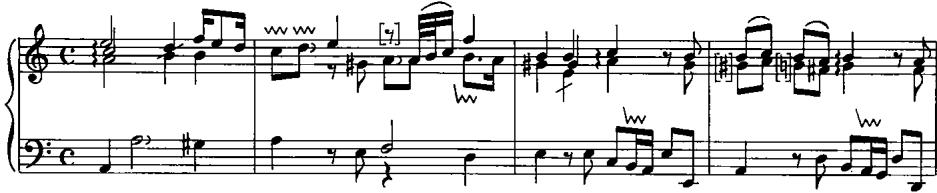
Stable URL: https://www.jstor.org/stable/10.5406/jj.25910457.5
中文讲解
书目元数据之一,标明本章节在JSTOR上的永久网址。该URL是访问与引用本文的稳定入口,包含JSTOR分配的内部编号10.5406/jj.25910457.5,本身不承载学术信息。
第6段(P0006)
原文复述
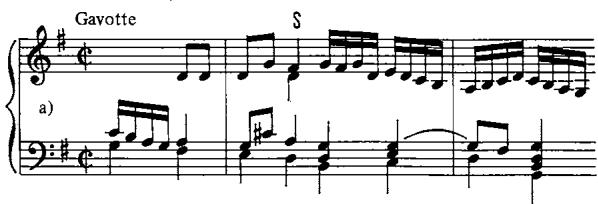
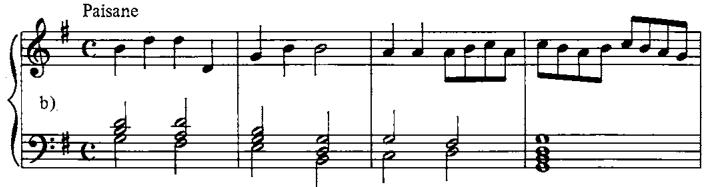
JSTOR is a not-for-profit service that helps scholars, researchers, and students discover, use, and build upon a wide range of content in a trusted digital archive. We use information technology and tools to increase productivity and facilitate new forms of scholarship. For more information about JSTOR, please contact support@jstor.org.
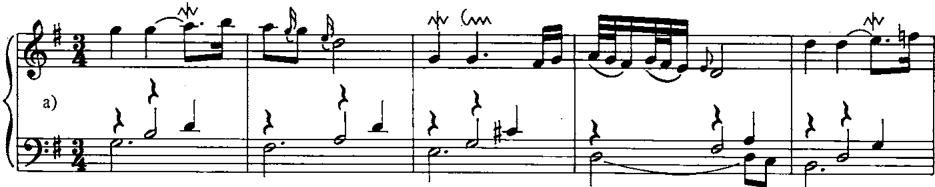
中文讲解
这是JSTOR平台的标准机构说明,介绍JSTOR作为非营利数字档案服务的定位与功能。它强调JSTOR帮助学者、研究者与学生发现、使用并拓展可信的数字内容,并运用信息技术促进新的学术形态。该说明属于版权页与机构介绍,与章节正文论证无关。
第7段(P0007)
原文复述
Your use of the JSTOR archive indicates your acceptance of the Terms & Conditions of Use, available at https://about.jstor.org/terms
中文讲解
这是JSTOR标准使用条款提示,说明访问与使用JSTOR档案即视为接受其使用条款,完整条款见所附网址。该条目是平台合规提示,不包含章节的学术内容。
第8段(P0008)
原文复述

中文讲解
此处为JSTOR第1页中的图像或乐谱示例占位符,原文标注其为“第1页图像或乐谱示例”,具体嵌入图像数据已省略,仅保留位置与图注信息。该占位符位于版权说明段落之间,按版面惯例可能与该书或该章节相关的封面、徽标或装饰图相关,但因原图未呈现,具体内容需查看原图方可确定。
第9段(P0009)
原文复述
This book is licensed under a Creative Commons Attribution-NonCommercial 4.0 International License (CC BY-NC 4.0). To view a copy of this license, visit https://creativecommons.org/licenses/by-nc/4.0/.
中文讲解
这是本电子书的开放许可声明:全书采用知识共享署名-非商业性使用4.0国际许可协议(CC BY-NC 4.0),并附许可协议网址。这意味着读者可以在署名本作者与出处的前提下进行非商业性的再利用,但对商业使用设有限制。该声明为版权与使用方式说明,不属于章节的学术论证。
第10段(P0010)
原文复述
University of Illinois Press is collaborating with JSTOR to digitize, preserve and extend access to Bach Perspectives, Volume 1
中文讲解
这是关于本卷数字化合作的机构声明:伊利诺伊大学出版社正与JSTOR合作,对《巴赫视角》第一卷进行数字化、保存并扩展其访问渠道。该条目交代了本文电子版本得以在JSTOR上呈现的合作背景。
第11段(P0011)
原文复述
J
中文讲解
这是JSTOR页面版面上的单字母标记,仅为版面元素而非正文内容,可能与JSTOR品牌的字母标志有关,本身不承载章节信息。
第12段(P0012)
原文复述
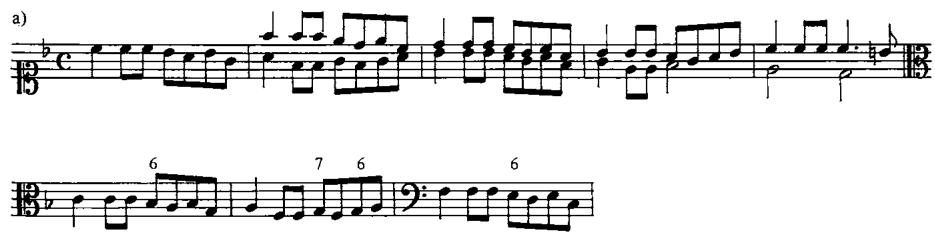
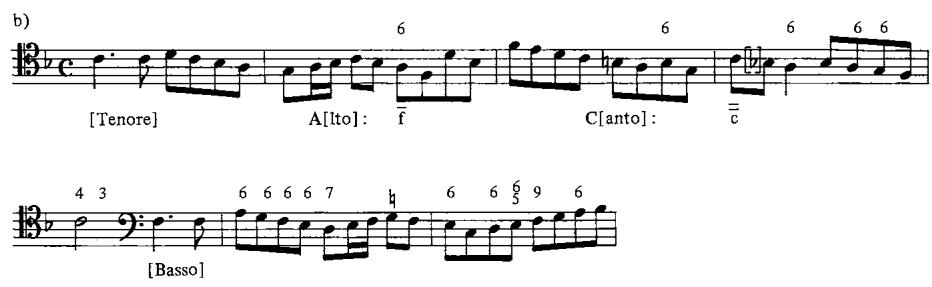
JSTOR
中文讲解
此为JSTOR页眉/页脚中的平台署名文字,作为版面识别元素出现,与章节内容无关。
第13段(P0013)
原文复述
This content downloaded from 140.182.176.13 on Fri, 07 Aug 2026 05:24:24 UTC All use subject to https://about.jstor.org/terms
中文讲解
这是JSTOR自动生成的访问追踪信息,记录本次内容下载的IP地址、日期与时间(2026年8月7日,UTC时间05:24:24),并再次指向使用条款链接。该条目仅用于访问审计与合规,不参与章节的学术论述。
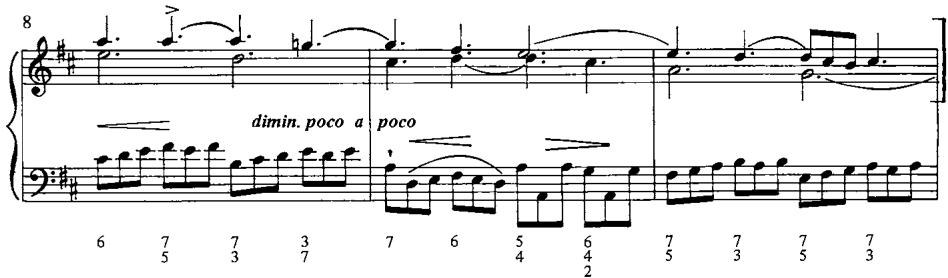
第14段(P0014)
原文复述
Composition and Improvisation in the School of J. S. Bach
中文讲解
这是本章节正文的标题行,以Markdown一级标题的形式标示章节名《约翰·塞巴斯蒂安·巴赫学派中的作曲与即兴》。该标题确立了本章的两个核心议题——作曲与即兴——并将研究范围限定在J.S.巴赫的“学派”语境中,暗示作者关注的不只是巴赫本人,也包括其门生与教学传统。
第15段(P0015)
原文复述
David Schulenberg
中文讲解
这是作者署名行,单列于章节标题之下,表明本章节由David Schulenberg撰写。在学术惯例中,此处署名常作为副标题前的独立元数据,便于读者在引用时快速定位作者。
第16段(P0016)
原文复述
For almost as long as Bach’s music has been enjoyed and studied, his practice and teaching of composition have been a focus of interest nearly as intense. What is offered here is a review of the evidence concerning the subject as well as a consideration of the close relationship in the Bach circle between composition and improvisation and of how this may affect our views of music history during the period. The emphasis here will be on composition and improvisation at the keyboard since this was the primary sphere in which Bach taught these subjects. $^{1}$
中文讲解
这是本章的导言段,作者Schulenberg开篇即设定历史纵深——巴赫的演奏与作品被研究和欣赏多久,他的作曲实践与教学就几乎同样久地成为学界关注的焦点。接下来作者交代了本章的双重任务:一是综述关于该议题的现有证据,二是考察巴赫圈子中作曲与即兴之间的紧密关系,并讨论这种关系可能如何影响我们对那个时期音乐史的理解。最后作者限定了研究范畴:本文以键盘乐器上的作曲与即兴为重点,因为这是巴赫教授这两类技艺的主要场域。段尾的上标“1”指向脚注,预示下文会对巴赫教学语境的来源作注。
理解这一段的关键在于三点:其一,作者把“作曲”和“即兴”并置提出,暗示二者在巴赫学派中并非截然分离;其二,作者明确把“键盘”乐器作为研究聚焦点,这与巴赫本人作为键盘演奏家与教师的身份相符;其三,作者已经预告本章不仅描述巴赫的实践,还会反思这一实践对更宏观的“音乐史叙事”可能产生的修正作用。
补充说明
脚注标记“1”出现于本段末尾,对应P0017之后或本章他处的脚注条目;本节正文未给出该脚注的具体内容,故此处不作展开。
第17段(P0017)
原文复述
The close relationship between composition and improvisation in eighteenth-century music is well known. Yet the details of the improvisation process and the precise nature of its relationship to composition have rarely been considered. Moreover, the apparent paradox of a strong tradition of improvisation within a musical culture that prized rational structure and highly stylized ornament raises historical and aesthetic issues that remain to be explored. Perhaps it is inevitable that Bach studies, even more than most most branches of musical scholarship, have tended to focus on documents, in part because Sebastian and Emanuel Bach were themselves avid collectors of scores and careful revisers and editors of their own music. But those who study early chant or non-Western musical traditions understand that what happens to be written down represents only a small fraction of the musical culture under study. Even in dealing with a composer as strongly oriented to the written note and word as J. S. Bach, we might bear in mind that his musical culture was much more aural than our own. The surviving documents represent only the tip of the iceberg, the visible remains of musical practices and musical thought that are largely hidden to us, although perhaps not entirely unrecoverable.
中文讲解
这是承接导言的第二段,作者进一步铺陈本章的方法论前提与问题意识。
第一层逻辑:作者承认“十八世纪音乐中作曲与即兴关系密切”已是常识,但随即指出即兴的具体过程及其与作曲的精确关系却鲜被深入考察。这是一个“知其然不知其所以然”的判断,为本章的学术价值定位。
第二层逻辑:作者提出一个“悖论”——在一种崇尚理性结构与高度程式化装饰的音乐文化中,竟存在深厚的即兴传统。这一悖论本身蕴含着历史与美学两层议题,构成本章的张力。
第三层逻辑:作者反思巴赫研究的学科倾向——巴赫学比其他音乐学分支更依赖文献,这部分是因为塞巴斯蒂安与埃马努埃尔·巴赫本人就是乐谱的热心收藏者与自身音乐的细致修订者。这一自传性因素塑造了学科偏好,但作者随即借助早期圣咏与非西方音乐研究的类比提醒读者:被书写下来的内容只是其所属音乐文化的极小一部分。
第四层逻辑:作者将上述一般原则落回到巴赫本人。即便面对像J.S.巴赫这样极度重视书写音符与文字的作曲家,我们仍应记住他所处的音乐文化远比当代更依赖听觉。现存文献只是冰山一角,是那些大多已隐没、但或许并非完全不可复原的音乐实践与音乐思维的可见残迹。
理解本段的关键是把握作者的方法论姿态:他既不否定文献的价值,又主张把文献置于更广阔的“听觉文化”之中,并以“冰山一角”的隐喻形象化了这一立场。这一隐喻也是本章后续展开证据综述与历史反思的修辞支点。
脚注 / 边栏 / 图表 / 附加信息(如有)
本节涉及的附加材料包括:① P0008中的图像/乐谱占位符(数据已省略,位置在版权说明段落之间);② P0009的CC BY-NC 4.0许可声明;③ P0016末尾的上标脚注标记“1”,指向本章其他位置的脚注,但该脚注正文未包含在当前段落范围内,故本节不作展开;④ P0013的JSTOR下载追踪信息(含下载时间2026-08-07与IP地址)。以上均为版本/版权/访问类元数据,不构成章节论证内容。
💡 本节核心要点
- 本章的核心议题是在J.S.巴赫学派的语境下,重新审视作曲与即兴之间的紧密关系,并以键盘音乐作为主要聚焦点。
- 作者指出学界对巴赫作曲实践与教学的关注几乎与对巴赫作品的研究一样久远,本章的任务是综述相关证据并反思这一关系对音乐史叙事的影响。
- 作者承认“作曲与即兴密切相关”是常识,但强调即兴的具体过程及其与作曲的精确关系仍少被系统考察。
- 本章提出一个核心悖论:在崇尚理性结构与程式化装饰的音乐文化中,仍存在深厚的即兴传统,这一悖论引出历史与美学两层议题。
- 巴赫研究过度依赖文献,部分源于巴赫父子本人热衷收藏与修订乐谱;但作者借用早期圣咏与非西方音乐的类比,提醒读者文献只是其音乐文化的极小一部分。
- 即便面对高度书写化的J.S.巴赫,其所处的音乐文化仍远比当代更依赖听觉;现存文献是“冰山一角”,代表大量已隐没、但或许并非完全不可复原的实践与思维。
🔑 关键术语
- Bach circle (Bach circle / 巴赫圈子):本节中指围绕J.S.巴赫及其家族(尤其是其子埃马努埃尔·巴赫)形成的作曲与教学传统,是本章考察作曲—即兴关系的核心语境单位。
- composition (作曲):在本节中指以书面形式固定下来、可被研究的具体音乐作品或写作过程,与“即兴”形成对照——两者在巴赫学派中被作者视为紧密关联而非截然分离。
- improvisation (即兴):在本节中指在演奏或教学现场实时创作音乐的过程;作者强调十八世纪即兴传统深厚,但其具体过程与作曲之间的精确关系尚未被充分考察。
- rational structure and highly stylized ornament (理性结构与高度程式化的装饰):本节中用来指十八世纪主流音乐文化的审美与风格特征;作者将其与即兴传统并置,构成本章所谓的“悖论”。
- tip of the iceberg (冰山一角):本节末尾的修辞隐喻,指现存乐谱与文献只是巴赫所属音乐文化极小、可见的一层,其下仍有大量口头与即兴实践等待复原。
- aural culture (听觉文化):本节中用来刻画J.S.巴赫所处时代的音乐传播方式,与当代以书面与录音为主导的音乐文化形成对比,是作者论证“文献仅是冰山一角”的关键背景概念。
ch01_s002 [描述性拆分] Footnotes 1–4
第1段(P0018)
原文复述
- Thus C. P. E. Bach wrote to Johann Nicolaus Forkel (letter of 13 January 1775): “Since he himself [Sebastian] had composed the most instructive pieces for the clavier, he brought up his pupils on them” (BDOK 3, no.803; translation taken from BR, 279). Because of the emphasis here on keyboard music, little reference will be made to what is still the principal study of Bach’s compositional process: Robert Lewis Marshall, The Compositional Process of J. S. Bach: A Study of the Autograph Scores of the Vocal Works, 2 vols. (Princeton, N.J.: Princeton University Press, 1972).
中文讲解
这是脚注 1,由两部分组成。第一部分是 C. P. E. Bach(卡尔·菲利普·埃马努埃尔·巴赫,塞巴斯蒂安之子)于 1775 年 1 月 13 日致 Johann Nicolaus Forkel(福克尔)的信中一段引文,强调 Sebastian Bach 自己写过最具教学价值的键盘曲,并以这些曲子作为教学材料(BDOK 3, no.803;英译本 BR, 279)。这段引文作为主文(讨论巴赫键盘音乐教学传统)的支撑证据出现,先行引出"教学依托于作曲家本人创作的最具教学性的作品"这一论点。第二部分是作者的方法论说明:因为本节聚焦键盘音乐,所以对学界现有的、仍属权威性的 Bach 作曲过程研究(Robert Lewis Marshall 1972 年普林斯顿大学出版社两卷本,研究 Bach 声乐作品手稿)将较少援引。换言之,作者主动将自己的研究范围限于键盘音乐与教学传统,并交代了不充分覆盖 Marshall 路线(声乐作品手稿)的理由。
补充说明
BDOK 3, no.803 与 BR, 279 是 Bach 文献的两套常见引用编号体系,BDOK 指 Bach-Dokumente,BR 指 Bach Reader;二者在本节被作为权威原始文献的检索坐标。
第2段(P0019)
原文复述
This content downloaded from 140.182.176.13 on Fri, 07 Aug 2026 05:24:24 UTC All use subject to https://about.jstor.org/terms
中文讲解
此为 JSTOR 平台的标准下载声明页眉/页脚(version 包含 IP 地址、下载时间戳以及使用条款链接),属于电子资源副本的固定版面信息,不含学术内容。读者可忽略其内容,仅需注意其作为数字出版物来源的版面属性。
第3段(P0020)
原文复述
With respect to keyboard music, many of the documents concerning teaching and practice in the Bach circle relate not to composition as such but to a tradition in which composition and improvisation were two aspects of a single activity. What Bach and other keyboard players of his day actually did in fulfilling their professional obligations involved a great deal of improvisation: the realization of figured-bass accompaniments, the performance of preludes during a church service, and so forth. Written-out solo pieces were employed principally for teaching and study, although Sebastian Bach was noted for his use of written scores in his public recitals, at least “to set his powers of imagination” in motion. Moreover, Sebastian, like other organists, was expected to improvise fugues and chorale fantasies in his auditions for organ posts, and any responsible teacher would have made preparation for such trials an important part of teaching. We might suppose that this, but not composition as such, was part of the “instruction suitable for an organist” that Bach received from his older brother Johann Christoph, according to a report by Emanuel Bach. Emanuel himself and other members of his generation must have received the same from Sebastian.
中文讲解
本段是本节的核心论证段,确立了一个关键的学术框架:巴赫圈内关于键盘音乐的文献,大多不直接论述"作曲"本身,而是论述一种"作曲与即兴演奏共享同一活动"的传统。作者以三组证据支撑这一框架:① 巴赫圈内职业键盘演奏家的实际工作包含大量即兴成分——实现数字低音伴奏、在教堂礼拜中演奏前奏曲等;② 写下来的独奏曲虽然主要用于教学与学习,但 Sebastian Bach 以在公开独奏会上使用乐谱闻名,其目的至少包括"激发想象力";③ 巴赫像其他管风琴家一样,在应聘管风琴师职位时需要即兴演奏赋格与众赞幻想曲,因而任何负责的老师都会将这种应试训练视为教学的重要部分。最后,作者据 Emanuel Bach 的报告作出推论:Johann Christoph 教给 Sebastian 的"适合管风琴师的训练"很可能仅指这种即兴应试训练,而非书面的作曲(composition as such);Emanuel 那一代也必然从 Sebastian 那里接受了同样的训练。本段的作用是为后续讨论"即兴与作曲共享同一心智训练"铺路的逻辑前提。
补充说明
“figured-bass accompaniments”(数字低音伴奏的实现)、“preludes”(教堂礼拜前奏曲)以及"fugues and chorale fantasies"(赋格与众赞幻想曲)三类活动,显示了巴赫时代键盘演奏家职业实务中即兴成分的具体形态;“instruction suitable for an organist”(适合管风琴师的训练)一词直接呼应脚注 3 中关于 Emanuel Bach 信件的具体出处。
第4段(P0021)
原文复述
Although the sources say little if anything specifically about training in improvisation, this skill clearly depended on many of the same concepts and mental disciplines as did composition. Quantz, for example, mentioned the need for flutists to understand “harmony” (die Harmonie), presumably meaning figured bass, in order to improvise embellishments in an adagio. Emanuel Bach
中文讲解
本段承接上段,承认原始文献几乎没有专门讨论即兴演奏的训练,但作者仍提出一个重要推断:即兴演奏与作曲依赖许多相同的概念与心智训练(mental disciplines)。这一论断本身就是认识论层面的关键桥梁——它解释了为什么文献虽少提及即兴训练,前段的推理仍可成立。证据之一是 Quantz(昆茨):他提到长笛演奏者需要理解"和声"(die Harmonie,应理解为数字低音),以便在慢板(adagio)中即兴装饰音。这一具体例证说明:18 世纪音乐家将即兴能力与和声理论知识直接挂钩,因而即兴训练的心智基础与作曲训练高度重合。段末以"Emanuel Bach"中断,这是排版上的延续标志,提示下一段继续展开 Emanuel 的相关论述。
补充说明
Quantz 此处的"harmony"在 18 世纪德语语境中通常意味着数字低音实践,而不仅指和声学理论——这一用法与上段"realization of figured-bass accompaniments"形成横向呼应。
第5段(P0022)
原文复述
- See the report by T. L. Pitschel in BDOK 2, no.499; and BR, 290.
中文讲解
这是脚注 2,为正文"Sebastian Bach was noted for his use of written scores in his public recitals, at least ’to set his powers of imagination’ in motion"一句提供出处。引文出自 T. L. Pitschel 的报告,见 Bach-Dokumente 第 2 卷第 499 号,以及 Bach Reader 第 290 页。脚注形态极为简短,仅作文献溯源之用,未对正文论断作进一步评论。
补充说明
BDOK 2, no.499 与 BR, 290 与脚注 1 中 BDOK 3 与 BR 同属 Bach 研究的引用体系;说明本节几乎所有关于 Sebastian Bach 公开独奏使用乐谱的史料都来自 Bach-Dokumente 与 Bach Reader 这两套汇编。
第6段(P0023)
原文复述
- Letter to Forkel, 13 January 1775. Since Emanuel is evidently answering Forkel’s questions about Sebastian’s study of composition, the implication is that Emanuel does not believe that Johann Christoph provided instruction in written composition.
中文讲解
这是脚注 3,对正文推论(Johann Christoph 教给 Sebastian 的只是即兴训练而非书面的作曲)作文献根据与解释。脚注指出:1775 年 1 月 13 日 Emanuel Bach 致 Forkel 的信,与脚注 1 所引为同一封信。然而二者在用途上分工——脚注 1 引用的是直接谈及教学曲目的句子,脚注 3 则提示全信的语境:Emanuel 明是在回应 Forkel 关于 Sebastian 学习作曲的问题,因此 Emanuel 之所以未提 Johann Christoph 教过书面作曲,是因为他(Emanuel)显然不信 Johann Christoph 真的教过书面作曲。这个推论是"未言说即不存在"型逻辑(argument from silence),作者通过呈现其语境来加固而非弱化它。脚注机制上,这条脚注对正文论断是"限定性支持"——它增加了正文推论的可信度,但也明示了论断的间接性。
补充说明
Emanuel Bach 此信的语气与背景——作为 Sebastian 之子回应外人的询问——意味着其叙述带有"家庭记忆"性质,这正是研究巴赫传承史常用的重要证据来源,但同时也带有回忆的局限。
第7段(P0024)
原文复述
- Johann Joachim Quantz, Versuch einer Anweisung die Flöte traversiere zu spielen (Berlin, 1752; reprint, with introduction by Barthold Kuijken, Wiesbaden: Breitkopf & Härtel, 1988); trans. Edward J. Reilly as An Essay on Playing the Flute (London: Faber & Faber, 1966), 14.3. According to Burney, Quantz attributed his knowledge of how to perform an adagio and to “compose
中文讲解
这是脚注 4 的起始部分,承接正文"Quantz… mentioned the need for flutists to understand ‘harmony’… in order to improvise embellishments in an adagio"的引文出处。脚注给出了 Quantz《横笛演奏教程》(Berlin, 1752;1988 年 Wiesbaden Breitkopf & Härtel 影印本,由 Barthold Kuijken 作序)的完整书目信息,以及 Edward J. Reilly 1966 年英译本《An Essay on Playing the Flute》(London: Faber & Faber)的对应章节号 14.3。脚注最后一句以引号开始(“compose)但未结束,明显因排版原因被截断,提示读者该脚注/段落将在下一页继续完成。其与正文的关系是对前述"Quantz 提及长笛演奏者需要理解’和声’以即兴慢板装饰音"的精确出处溯源。Burney 提及的 Quantz 自我归因(关于慢板演奏与"compose"的能力)正是未完结部分将要展开的内容。
补充说明
Quantz 1752 年《Versuch》是 18 世纪管乐演奏与教学的奠基性文献,14.3 章节专门讨论慢板演奏及其装饰;脚注引述与正文论题的对应关系,说明作者跨乐器种类(长笛与键盘)援引同一时期表演实践文献的类比策略。
脚注 / 边栏 / 图表 / 附加信息(如有)
本节包含 4 条脚注(编号 1–4),分别服务于正文中的四处具体主张:脚注 1(BDOK 3, no.803 / BR, 279;Marshall 1972 书目)支撑 Emanuel 关于 Sebastian 自创教学曲的引文,并交代本节范围限于键盘音乐;脚注 2(BDOK 2, no.499 / BR, 290)支撑 Pitschel 关于 Sebastian 在公开独奏会上使用乐谱的记述;脚注 3(1775 年 1 月 13 日 Emanuel 致 Forkel 信)对正文关于 Johann Christoph 教学内容的推论提供文献语境,使该推论由"沉默的证据"明确为"Emanuel 主动回答关于作曲学习的问题”;脚注 4(Quantz, Versuch 1752 / Reilly 1966 译本 14.3 节)支撑 Quantz 关于长笛演奏者需理解’和声’以即兴装饰的引文。脚注 4 在本节末尾未完结,预计在后文继续。P0019 为 JSTOR 平台下载声明页眉/页脚,不含学术内容。
💡 本节核心要点
- 本节确立了一条核心论证:巴赫圈内的键盘音乐文献所讨论的’教学’,并非书面意义上的作曲(composition as such),而是’作曲与即兴演奏共享同一活动’的传统。
- 支撑这一框架的三类证据:① 数字低音实现、教堂礼拜前奏曲、应聘管风琴职位时的赋格与众赞幻想曲即兴演奏等职业实务;② 写下来的独奏曲主要用于教学与学习,而 Sebastian 在公开独奏会上使用乐谱至少是为’激发想象力’;③ Emanuel Bach 的报告暗示 Johann Christoph 教给 Sebastian 的只是’管风琴师应有的训练’,即即兴应试训练,而非书面作曲。
- 作者承认原始文献对即兴训练着墨甚少,但提出推断:即兴演奏与作曲依赖相同的概念与心智训练(mental disciplines),Quantz 关于长笛演奏者需理解’和声’(即数字低音)以即兴慢板装饰的论述即为该推断的类比证据。
- 脚注 1 与脚注 3 共享同一封信(Emanuel Bach 致 Forkel, 1775 年 1 月 13 日),但分工不同:脚注 1 引用教学曲目句子,脚注 3 通过全信语境说明 Emanuel 明显认为 Johann Christoph 未教过书面作曲——两条脚注共同支撑正文中关于’教学传统’与’书面作曲’分离的论证。
- 脚注 2(BDOK 2, no.499)与脚注 4(Quantz, Versuch 14.3)以文献溯源形式短促存在,分别为正文中关于 Sebastian 使用乐谱、Quantz 关于’和声’的引文提供可靠出处;脚注 4 在本节末尾未闭合,体现学术注释的开放式追溯特征。
🔑 关键术语
- composition as such:指严格意义上的书面作曲,而非包含即兴演奏在内的更宽泛的’音乐创作活动’。本节作者以此对照’composition and improvisation were two aspects of a single activity’(作曲与即兴演奏是同一活动的两个方面),用以分离两类不同的训练传统。
- figured bass:数字低音,18 世纪通奏低音实践的核心;演奏者依据数字符号在低音线之上即兴实现和声进行。本节用它作为’即兴演奏活动’与’和声理论知识’之间最直接的桥梁——Quantz 提到的’和声’(die Harmonie)即指此。
- instruction suitable for an organist:直接引用 Emanuel Bach 的措辞,特指管风琴师职业所必需的即兴演奏能力(包括赋格与众赞幻想曲的即兴)以及视谱、数字低音等技能,而非学习书面作曲的’作曲课’。本节以此推论 Johann Christoph 给 Sebastian 的教学不含书面作曲。
- mental disciplines:心智训练/思维习惯,指作曲与即兴演奏共同依赖的内在认知能力(如和声感、曲式结构感知、对位能力等)。本节以此推断:尽管文献极少谈及即兴训练,由于即兴与作曲共享这些心智训练,前段关于教学传统的推论仍可成立。
- BDOK / BR:Bach 研究的两套权威文献汇编:BDOK 指 Bach-Dokumente(巴赫文献集),BR 指 Bach Reader(巴赫读本);本节脚注 1、2、3 均以此为引用坐标,跨欧美学界共享。
ch01_s003 [描述性拆分] Manuscript header and continuation of intro paragraph
第1段(P0025)
原文复述
This content downloaded from 140.182.176.13 on Fri, 07 Aug 2026 05:24:24 UTC All use subject to https://about.jstor.org/terms
中文讲解
该段是JSTOR平台自动生成的使用声明/页脚信息,记录本文档的下载来源IP地址(140.182.176.13)、下载时间(2026年8月7日05:24:24 UTC),并声明所有使用须遵守JSTOR的条款(about.jstor.org/terms)。它不包含学术内容,仅是平台水印与版权提示。
第2段(P0026)
原文复述
Composition and Improvisation in the School of J. S. Bach
中文讲解
这是一个一级章节标题,开启全书的核心论题:以J. S. 巴赫及其家族/弟子圈子(the School of J. S. Bach)中的“作曲”(Composition)与“即兴演奏”(Improvisation)两大实践为研究对象。标题中并列的两个关键词暗示作者将围绕两者之间的连续性与相互渗透展开论证,而非将二者截然分开。
第3段(P0027)
原文复述
refers to his father’s pedagogic use of figured-bass realization, and indeed we possess a written-out realization of the bass of an Albinoni sonata by Bach’s student Heinrich Nicolaus Gerber. Similar exercises must have led to the scrupulous attention that Emanuel Bach devotes to voice leading in the section of his Essay devoted to figured bass. Yet the Essay is concerned with the “true manner of keyboard playing,” and any written exercises given to Emanuel’s pupils must have complemented practical ones.
中文讲解
本段承接前文(被省略的引文),通过具体材料证据来支持“巴赫家族注重数字低音实践教学”的论点。作者依次给出三层支撑:(1) 巴赫的学生海因里希·尼古拉斯·格伯(Heinrich Nicolaus Gerber)留存了一份对阿尔比诺尼(Albinoni)奏鸣曲低音的“书面化实现”(written-out realization),这是父亲用数字低音教学法留下的实物证据;(2) 类似训练可以解释为何Emanuel Bach在《试论键盘乐器正确演奏法》(Essay on the True Manner of Keyboard Playing)论数字低音的章节中,对声部进行(voice leading)表现出极度严谨的态度;(3) 然而《试论》的主题是“键盘演奏的真正方式”(the true manner of keyboard playing),因此任何给Emanuel学生的书面练习,必然是用来补充其实践训练的——意即:理论与书面练习服务于演奏与即兴能力,而非独立存在。作者借此例同时强调两件事:教学法可在学生作品中留下可考的痕迹,以及写作训练与实际演奏训练互为表里。
补充说明
段落开头的“refers to”说明这是一句接续前一段被截断引文的句子,本节起始处被边界截断;阅读时应将其与前段中提及巴赫父亲使用数字低音教学的引文合并理解。脚注标记⁵、⁶、⁷在此处出现,将在P0031之后的脚注区中给出对应说明。
第4段(P0028)
原文复述
THE SOURCES
中文讲解
这是二级小节标题,开启名为“资料来源”(The Sources)的新小节。它向读者预告:接下来的内容将交代作者筛选与使用证据的原则,并说明附录中所列材料的范围与判断标准。
第5段(P0029)
原文复述
The relevant evidence is summarized in the appendix. Obviously, almost any composition and any autograph source by Bach might be considered relevant; the sources listed are those that seem to bear directly on the question of how Bach and his students understood the act of composition or improvisation.
中文讲解
本段交代研究的资料取舍标准。作者承认:原则上几乎任何巴赫的作品或其亲笔手稿(autograph source)都可能与论题相关,因此不可能全数纳入;附录中所列的,是那些能够直接说明“巴赫本人及其学生如何理解作曲或即兴这一行为”(how Bach and his students understood the act of composition or improvisation)的资料。这段话的功能是限定证据范围,将研究焦点从“作品本身的美学”转向“作曲/即兴作为被理解与被实践的‘行为’”。脚注⁸在此出现,提示读者可参考其出处说明。
补充说明
脚注标记⁸对应于对“资料取舍标准”的补充说明,将在后续脚注中给出。
第6段(P0030)
原文复述
Two aspects of the appendix are noteworthy. First, an important category of material conspicuous by its absence is learned counterpoint. But learned counterpoint occupies a somewhat ambiguous place in the Bach circle. Today we tend to see Bach as a proponent of strict fugue, canon, and other such forms. In this we observe a distinction between him and his contemporaries (such as Handel) that was already being made during his own lifetime. Bach himself contributed to this impression through his publication of several late works concerned with strict counterpoint. The Art of Fugue was even advertised after Bach’s death as a sort of textbook in learned counterpoint, in the form of exemplary compositions.
中文讲解
本段指出附录中两项值得注意的特征中的第一项——“学问对位”(learned counterpoint)在资料中的显著缺席,并解释其原因。论证分以下几步:(1) 附录中明显缺少一类资料:严格的学问对位作品(赋格、卡农等)。(2) 但学问对位在“巴赫圈子”中地位本就暧昧:今天我们倾向于把巴赫视为严格赋格与卡农的代表,从而与同时代人(如亨德尔)形成对比——这一区分在巴赫生前就已被其同代人作出。(3) 巴赫本人通过出版若干晚期严格对位作品(《赋格的艺术》等)加深了这种印象;其死后《赋格的艺术》(The Art of Fugue)甚至被宣传为“以范例作品形式呈现的学问对位教科书”。作者借此说明:之所以附录中没有大量学问对位材料,并非忽视,而是因为它与“巴赫及其学生如何理解作曲/即兴的行为”关系较为间接——严格对位作品更像是“已完成的可示范文本”,而非揭示创作/即兴过程的教学材料。脚注⁹与¹⁰在此出现。
补充说明
《赋格的艺术》(The Art of Fugue,BWV 1080)为巴赫晚年未完成的严格对位作品集;此处属于原文语境中已出现的信息,仅作衔接说明,不引入额外史实。脚注⁹、¹⁰将在后续脚注中给出具体出处。
第7段(P0031)
原文复述
in many parts” to Pisendel (see Charles Burney, The Present State of Music in Germany … [London, 1775]; ed. Percy A. Scholes as An Eighteenth-Century Musical Tour in Central Europe and the Netherlands [London: Oxford University Press, 1959], 187).
中文讲解
本段是一个脚注的延续部分。该脚注引用了英国音乐旅行家、史学家查尔斯·伯尼(Charles Burney)1775年在伦敦出版的著作《德国音乐现状》(The Present State of Music in Germany …),并标注其由珀西·A·斯科尔斯(Percy A. Scholes)编辑后以《十八世纪中欧与荷兰音乐旅行记》(An Eighteenth-Century Musical Tour in Central Europe and the Netherlands)为名再版,出版方为牛津大学出版社(Oxford University Press, 1959),具体页码为第187页。从被截断的引文(“in many parts” to Pisendel)来看,伯尼原文曾用类似“在许多声部上”这样的描述来评价皮森德尔(Pisendel,约翰·格奥尔格·皮森德尔,巴洛克时期著名小提琴家与作曲家,曾与巴赫家族交往)的演奏或写作。脚注的功能是为正文主张提供旁证/文献来源。
补充说明
该脚注起始部分被边界截断(“in many parts”前的内容不在本节内),其完整上下文应与正文引用合并阅读;Pisendel此处仅作为脚注所引证的人物出现,正文未对其展开论述。
脚注 / 边栏 / 图表 / 附加信息(如有)
本节包含三类非正文内容:(1) P0025为JSTOR平台下载声明/页脚;(2) P0026与P0028分别为一级章节标题“Composition and Improvisation in the School of J. S. Bach”与二级小节标题“THE SOURCES”;(3) P0031为脚注的延续部分,引用Charles Burney《The Present State of Music in Germany》(London, 1775)及其Scholes编辑版(Oxford University Press, 1959, p. 187),用以为正文提供关于Pisendel的旁证来源。脚注⁵–¹⁰的其余具体出处说明应在本节之外的脚注区中查阅。
💡 本节核心要点
- 本章核心论题为J. S. 巴赫及其弟子圈子中“作曲”与“即兴演奏”两个相互渗透的实践。
- 通过Gerber对Albinoni奏鸣曲低音的书面实现、以及Emanuel Bach《试论》中对声部进行的严谨处理,作者论证巴赫家族以数字低音为核心教学法,且书面练习与实践训练互为补充。
- 《试论》的关注对象是“键盘演奏的真正方式”,故教学法以演奏/即兴能力为最终旨归,理论与写作服务于实践。
- “THE SOURCES”小节限定了证据范围:附录只收录能直接说明巴赫及其学生“如何理解作曲/即兴这一行为”的资料,而非一切可能相关的作品或手稿。
- 附录显著缺失“学问对位”(严格赋格、卡农)类材料,其原因是该类作品在巴赫圈中地位暧昧,且巴赫晚期出版的严格对位作品(如《赋格的艺术》)更像是“已完成的可示范文本”,与揭示创作/即兴过程的教学语境较为间接。
🔑 关键术语
- figured-bass realization:数字低音的实现,即根据乐谱上标记的数字与低音线条,在上方各声部填入和声化旋律;本节中它是巴赫家族教学法的核心活动,并通过Gerber对Albinoni奏鸣曲的书面实现而留下可考证据。
- voice leading:声部进行,指多声部音乐中各声部线条在音程、对位与连络方面的处理方式;Emanuel Bach在《试论》论数字低音章节中对之表现出极度严谨的态度。
- Essay on the True Manner of Keyboard Playing:C. P. E. 巴赫的《试论键盘乐器正确演奏法》(Versuch über die wahre Art das Clavier zu spielen, 1753),本节中其作为理解巴赫家族键盘教学法——尤其是数字低音与声部进行——的关键文献。
- autograph source:亲笔手稿/作者本人书写的一手文献;本节中作者强调附录只收录与“作曲/即兴行为之理解”直接相关者,而非全部亲笔材料。
- learned counterpoint:学问对位,泛指严格对位写作(如严格赋格、卡农等),本节中作者指出其在巴赫圈中地位暧昧:既是巴赫晚期出版作品的显赫面向,却又在揭示作曲/即兴“行为”的意义上被附录排除。
- The Art of Fugue:《赋格的艺术》(BWV 1080),巴赫晚期严格对位作品集;本节提及它曾在巴赫死后被宣传为“以范例作品形式呈现的学问对位教科书”,用以解释为何该类作品在附录中并未作为核心证据。
ch01_s004 [描述性拆分] Footnotes 5–9
第1段(P0032)
原文复述
- Letter to Forkel, 13 January 1775.
中文讲解
这是第5条脚注,引用一封写于1775年1月13日、收信人为Forkel的书信。Forkel即约翰·尼古拉斯·福克尔(Johann Nikolaus Forkel),他是18世纪末的德国音乐学者与J.S.巴赫的第一位重要传记作者。该脚注仅以这一简短的文献信息支撑正文某处关于巴赫的论断——在脚注群体中,它属于最简短的一类,仅提供日期与通信对象,没有指明发信人、收藏地点或具体页码,其支持功能是辅助性的,让读者知道相关陈述源自一份与福克尔相关的早期文献,而不是作者本人的推断。
补充说明
本页其他脚注往往附有完整的版本信息或文摘定位,而本条仅给出年份、月份、日期与收信人,因此属于最小化的文献指认;正文作者在脚注编排上明显区分了主要文献(带完整书目信息)与次要文献(仅给日期与人物)。
第2段(P0033)
原文复述
- Gerber’s realization (with Bach’s corrections) appears in sBB MUS. MS 455, ed. in Philipp Spitta, Johann Sebastian Bach, 2 vols. (Leipzig: Breitkopf & Härtel, 1873-80; reprint, Wiesbaden: Breitkopf & Härtel, 1979), vol. 2, Musikbeilagen, pp.1-11.
中文讲解
这是第6条脚注,引用Gerber(盖尔伯)对某段音乐的“实现”(realization,即为数字低音填写的具体演奏/演唱版本),并指出该实现经过了巴赫本人的修订。这份材料的原始手稿收藏在Staatsbibliothek zu Berlin(柏林国家图书馆)音乐手稿部,编号MUS. MS 455。它由19世纪巴赫传记作者Philipp Spitta(菲利普·施皮塔)编辑出版,收入其两卷本《约翰·塞巴斯蒂安·巴赫》(1873-80年初版,1979年威斯巴登重印本),位于第2卷的Musikbeilagen(音乐附录/曲谱附件)第1-11页。该脚注的作用是为正文提供一份兼具巴赫亲自修订与权威编辑的关键乐谱文献,是本节论证的重要原典依据。
补充说明
“realization”一词在脚注语境中特指将通奏低音的符号(数字低音记号)转化为实际演奏声部的过程;脚注特别强调“with Bach’s corrections”,意在说明这一版本的权威性高于一般Gerber手稿,因为它承载了作曲家本人对Gerber诠释的修正痕迹。
第3段(P0034)
原文复述
- C. P. E. Bach, Versuch über die wahre Art das Clavier zu spielen (Berlin, 1753–62; reprint, Wiesbaden: Breitkopf & Härtel, 1981); trans. William J. Mitchell as Essay on the True Art of Playing Keyboard Instruments (New York: W. W. Norton & Co., 1949).
中文讲解
这是第7条脚注,引用C. P. E. Bach(卡尔·菲利普·埃马努埃尔·巴赫,约1748-51年间定居柏林)所著的《论键盘乐器演奏的真谛》(Versuch über die wahre Art das Clavier zu spielen)。原版由柏林出版,跨越1753至1762年;本脚注使用的是1981年威斯巴登Breitkopf & Härtel的重印本。英译本由William J. Mitchell(威廉·J·米切尔)翻译,名为Essay on the True Art of Playing Keyboard Instruments,1949年由纽约W. W. Norton & Co.出版。该脚注向读者同时提供德文原版与英文译本的版本信息,使具备不同语言能力的读者均可查阅,是关于18世纪键盘演奏实践的核心文献之一。
补充说明
《Versuch》是18世纪最重要的键盘演奏理论著作之一,本脚注在该书中承担的是本节讨论18世纪键盘即兴实践时的关键理论参照来源;Mitchell译本是英语学界长期通行的标准译本。
第4段(P0035)
原文复述
- The appendix incorporates a number of items included in an earlier overview of the subject in Hans-Joachim Schulze, “Cembaloimprovisation bei Johann Sebastian Bach: Versuch einer Übersicht,” Studien zur Aufführungspraxis und Interpretation von Instrumentalmusik des 18. Jahrhunderts 10 (1980): 50–57.
中文讲解
这是第8条脚注,说明本书附录(appendix)吸收了Hans-Joachim Schulze(汉斯-约阿希姆·舒尔策)先前一篇综述性文章中的若干条目。该文的德文标题为《约翰·塞巴斯蒂安·巴赫的大键琴即兴演奏:一次综述尝试》(Cembaloimprovisation bei Johann Sebastian Bach: Versuch einer Übersicht),发表于《18世纪器乐演奏实践与诠释研究》第10卷(Studien zur Aufführungspraxis und Interpretation von Instrumentalmusik des 18. Jahrhunderts 10),1980年,第50-57页。该脚注明确承认本书附录与Schulze 1980年文章之间的继承关系,对正文论证起到学术渊源说明的作用。
补充说明
“appendix”一词表明本节原文出自一本附有附录的著作,且该附录的内容并非完全原创,而是部分整合了Schulze已发表的目录式综述;这种对前人成果的整合关系是脚注层级中的“来源/旁证”功能。
第5段(P0036)
原文复述
- See, e.g., Marpurg’s 1749 distinction between “the works of the invaluable Handel and the learned Bach,” emphasizing the latter’s appeal to “the practiced ear” (BOK 2, no. 581).
中文讲解
这是第9条脚注,举例说明Marpurg(弗里德里希·威廉·马普格)在1749年所作的一种区分:在“不可估量的亨德尔的作品”和“学识渊博的巴赫的作品”之间作出对比,并特别强调巴赫的作品诉诸于“训练有素的耳朵”(the practiced ear)。引文出处标注为BOK 2, no. 581,其中“BOK 2”是马普格汇编的《音乐通讯汇编》(Beiträge zur Aufnahme der Musik)第2卷,第581号条目。该脚注以当时一位重要评论家的同期评价作为旁证,揭示在巴赫在世时已有人将其音乐风格与亨德尔作比较,并将其特质概括为“博学”与对“训练有素的耳朵”的吸引力。
补充说明
该脚注通过“Marpurg 1749”这一时间坐标,把正文中关于巴赫风格的论述锚定到巴赫在世年份,从而构成一种“同期文献旁证”;“the practiced ear”与“learned Bach”的并置暗示当时评论界已注意到巴赫作品对听众素养有较高要求。
💡 本节核心要点
🔑 关键术语
ch01_s005 [描述性拆分] Strict counterpoint in the Bach circle
第1段(P0037)
原文复述
This content downloaded from 140.182.176.13 on Fri, 07 Aug 2026 05:24:24 UTC All use subject to https://about.jstor.org/terms
中文讲解
该段为JSTOR平台的自动生成的页眉/页脚水印,标明本文档的下载来源IP、下载时间(2026年8月7日05:24:24 UTC)以及使用条款链接(about.jstor.org/terms)。它不属于正文论证内容,仅是平台版权与访问记录标识。
第2段(P0038)
原文复述
Yet these publications seem to have been directed less toward students than toward “those already practiced in this study,” to quote a phrase that Bach himself used in the title of Book 1 of the Well-Tempered Clavier. $^{[11]}$ Indeed, we possess almost no evidence, in the form of students’ notebooks or reports, about Bach’s teaching of learned counterpoint. Friedemann and Emanuel Bach must at least have made experimental efforts as composers of learned counterpoint since they contributed a few canonic pieces to writings and anthologies by Marpurg and Kirnberger, and Emanuel Bach’s works include a number of essays in strict contrapuntal style. $^{[12]}$ Yet, in his letters and in accounts by Forkel and Charles Burney, C. P. E. Bach has almost nothing good to say about the study of counterpoint. While there appears to have been a resurgence of theoretical interest in strict counterpoint in the decades following Bach’s death, in works like Marpurg’s Abhandlung von der Fuge one can already detect an academic, inorganic approach to the study of fugue. Contrapuntal technique is discussed as if it had no relationship to motivic work, tonal planning, and other essential aspects of Bach’s own fugues – even though Marpurg purportedly had discussed “matters pertaining to fugue” with Bach himself. $^{13}$
中文讲解
本段是小节的核心论述,围绕"巴赫圈子内严格对位的传承状况"展开三个层次的观察:
-
出版物并非针对学生。 作者借巴赫自己在《平均律键盘曲集》第一卷标题中所用的措辞——“those already practiced in this study”(已习于此道者)——来说明,这些出版物预设的读者是已有相当修养的实践者,而非入门学习者。这为后文关于缺乏教学证据的判断埋下伏笔。
-
教学证据极为稀薄。 作者明确指出,几乎没有学生笔记或报告类的材料可以让我们了解巴赫如何教授"学究式对位"(learned counterpoint)。Friedemann 与 Emanuel Bach 至少以创作方式做过尝试:他们为 Marpurg 与 Kirnberger 的著作与曲集贡献了若干卡农作品,Emanuel 的作品中也包含一些严格对位风格的练习。但同一段中,作者又立刻用 C. P. E. Bach 在书信以及 Forkel、Charles Burney 的记述中"几乎说不出对位学习的好话"来反转这一印象,暗示第二代的实际态度与表面贡献之间存在张力。
-
巴赫身后的对位研究走向学术化、脱离音乐本身。 作者承认巴赫去世后数十年间严格对位出现了理论兴趣的复兴,但他随即批判 Marpurg 的《赋格论》(Abhandlung von der Fuge)已显露一种"academic, inorganic"(学究式、无机的)方法:对位技术被讨论得仿佛与动机展开、调性布局这些巴赫本人赋曲中的核心要素毫无关系。讽刺的是,作者补充说 Marpurg 据称曾与巴赫本人讨论过"赋格相关的问题"——也就是说,与巴赫有过直接接触的 Marpurg,在著作中反而把对位技术从巴赫实践的整体语境中剥离出来。
整体来看,本段的作用是:把前文可能暗示的"巴赫通过出版物系统传承严格对位"这一假设拆解掉,转而指出传承证据稀薄、且即便在巴赫自己的儿子和门生圈子里,对严格对位的态度也参差不齐甚至带否定色彩,而后续理论化写作则进一步把对位从它本来的音乐语境中孤立出来。
补充说明
段末脚注编号 13 出现在 P0038 之后,但本节内未提供该脚注的文本,因此其内容无法在此处复述。文中提及的人物、书名与短语在 P0039–P0041 的脚注中有进一步出处。
第3段(P0039)
原文复述
- “Der Kunst der Fuga in 24 Exempeln” (from the notice of 1 June 1751 in the Leipziger Zeitungen [BDOK 3, no.639]).
中文讲解
这是第10号脚注,对应正文中提及《赋格的艺术》(The Art of Fugue)的相关讨论。它给出了该曲集德文原名"Der Kunst der Fuga in 24 Exempeln"(《赋格的艺术,以24个范例》),并指明消息来源为1751年6月1日《莱比锡报》(Leipziger Zeitungen)上的通告,引证标号为 BDOK 3, no.639。该脚注为正文提供了一手出版史料,证实《赋格的艺术》在1751年已经作为出版物进入公众视野。
第4段(P0040)
原文复述
- “Derer in diesem studio schon habil” (BDOK 1, no.152; BR, 85).
中文讲解
这是第11号脚注,解释P0038中引用的巴赫原话出处。原文是拉丁化的德文短语"Derer in diesem studio schon habil",意指"已习于此道者"(those already practiced in this study)。脚注给出引证标号 BDOK 1, no.152 以及 BR, 85,用于定位《平均律键盘曲集》第一卷标题与该表述的原始文献位置。这条脚注证明作者引用的是巴赫本人使用的措辞,而非作者本人的概括。
第5段(P0041)
原文复述
- See the musical examples in Friedrich Wilhelm Marpurg, Abbandlung von der Fuge, 2 vols. (Berlin, 1753–54; reprint, Hildesheim: Georg Olms, 1970), vol. 2; and in Johann Philipp Kirnberger, Die Kunst des reinen Satzes in der Musik, 3 vols. (Berlin and Königsberg, 1771–79; reprint, Hildesheim: Georg Olms, 1968); vol. 1 and vol. 2, pt. 1, trans. David Beach and Jurgen Thym as The Art of Strict Musical Composition [New Haven, Conn.: Yale University Press, 1982]). Marpurg published annotated editions of C. P. E. Bach’s fugues H.76 (w.119/1), H.101 (w.119/4), and H.102 (w.119/6); for sources and editions, see E. Eugene Helm, Thematic Catalogue of the Works of Carl Philipp Emanuel Bach (New Haven, Conn.: Yale University Press, 1989). The closing fugue of Emanuel’s Magnificat H.772 (w.215) was later reworked in his Easter Music of 1784, H.807 (w.243), with many additional “contrapuntal devices” (viele contrapunktische Künste), as Emanuel described them in a letter to Princess Anna Amalie (printed in C. H. Bitter, Carl Philipp Emanuel Bach und Wilhelm Friedemann Bach und deren Brüder, 2 vols. [Berlin: Wilhelm Müller, 1868; reprint, Kassel: Bärenreiter, 1973], 2:305; newly ed. in Rudolph Angermüller, “Carl Philipp Emanuel Bachiana: Briefe, die bei Ernst Suchalla nicht veröffentlicht wurden,” in Jahrbuch des Staatlichen Instituts für Musikforschung Preussischer Kulturbesitz 1985/86 [Berlin: Merseburger Verlag, 1989], no. 69).
中文讲解
这是第12号脚注,篇幅较长,为P0038中关于 Friedemann 与 Emanuel Bach 严格对位实践的判断提供具体文献支撑,可分为三层:
-
18世纪德国对位论著的版本信息。 脚注首先列举 Marpurg《赋格论》(Abhandlung von der Fuge,柏林,1753–54年,2卷;1970年奥尔姆斯出版社再版)第2卷中的谱例,以及 Kirnberger《音乐中纯正作曲的艺术》(Die Kunst des reinen Satzes in der Musik,柏林与柯尼斯堡,1771–79年,3卷;1968年再版;Beach 与 Thym 译为《严格音乐作曲的艺术》,耶鲁大学出版社1982年出版)第1卷与第2卷第1部分的谱例。这些是支持"Emanuel 作了若干严格对位风格尝试"这一判断的原始乐谱来源。
-
C. P. E. Bach 赋格曲的编辑与编号信息。 脚注指出 Marpurg 出版过 H.76(w.119/1)、H.101(w.119/4)、H.102(w.119/6)三首 C. P. E. Bach 赋格的注本,并指引读者参阅 E. Eugene Helm 的 C. P. E. Bach 作品主题目录(耶鲁大学出版社1989年)。H./w.两套编号系统分别来自 Helm 目录与 Wotquenne 旧目录。
-
Emanuel 的《圣母尊主颂》终曲与复活节音乐的重写关系。 脚注说明 Emanuel 的《圣母尊主颂》H.772(w.215)终曲赋格在1784年复活节音乐 H.807(w.243)中被重写,加入许多额外的"contrapuntal devices"(德文 viele contrapunktische Künste,意为"许多对位技巧")。Emanuel 在致 Anna Amalie 公主的信中如此描述。该信收录于 C. H. Bitter 编辑的巴赫兄弟合传(柏林,1868年;Bärenreiter 1973年再版)第2卷第305页;并由 Rudolph Angermüller 在1985/86年柏林普鲁士文化遗产国家音乐研究所年刊中以"在 Ernst Suchalla 处未发表的信件"为题重新编辑,编号69。
整条脚注的作用是为正文"Emanuel 至少作过严格对位尝试"这一陈述提供具体作品编号、版本信息和书信来源,使读者可以追溯到一手材料。
第6段(P0042)
原文复述
This content downloaded from 140.182.176.13 on Fri, 07 Aug 2026 05:24:24 UTC All use subject to https://about.jstor.org/terms
中文讲解
该段与P0037相同,是JSTOR页面的自动水印,标注下载来源、下载时间与使用条款链接。它不是正文内容,仅是平台版权标识。
脚注 / 边栏 / 图表 / 附加信息(如有)
本小节内的附加材料集中为脚注(编号10、11、12),分别承担不同功能:脚注10给出《赋格的艺术》德文原名与1751年《莱比锡报》通告出处;脚注11为正文中巴赫原话"those already practiced in this study"提供拉丁化德文原文与文献编号(BDOK 1, no.152;BR, 85);脚注12为 Emanuel 与 C. P. E. Bach 的严格对位实践提供具体作品编号、版本与书信来源。P0037 与 P0042 为 JSTOR 平台自动生成的页眉/页脚水印,不属于论证内容。脚注编号 13 出现在 P0038 末尾但其文本未出现在本节范围内。
💡 本节核心要点
- 巴赫圈子内的对位出版物面向的是"已习于此道者"而非学生,这由巴赫自己在《平均律键盘曲集》第一卷标题中使用的措辞所证实。
- 关于巴赫教授学究式对位(learned counterpoint)的学生笔记或报告等一手教学证据几乎完全缺失。
- Friedemann 与 Emanuel Bach 通过为 Marpurg、 Kirnberger 曲集撰作卡农及严格对位习作,作出了有限但可证实的实践尝试。
- C. P. E. Bach 在其书信以及 Forkel、 Burney 的记述中,对对位学习几乎全无正面评价,与上文所述表面贡献形成张力。
- 巴赫去世后数十年间严格对位虽出现理论复兴,但 Marpurg 的《赋格论》已显露学究化、把对位技术从动机展开与调性布局中剥离的倾向。
- 讽刺之处在于:曾据称与巴赫本人讨论过赋格问题的 Marpurg,其著作反而把对位从巴赫实践的整体语境中孤立出来。
🔑 关键术语
- learned counterpoint(学究式对位):指严格遵循对位规则、不以表现性或即兴性为优先的写作方式;本节以此概念讨论巴赫及其子辈与门生在严格对位上的实践与传承。
- strict counterpoint(严格对位):与"学究式对位"含义相近,强调按规则书写的对位技术;本节用它来指18世纪德国理论家(Marpurg、 Kirnberger 等)所讨论的对位范式。
- Well-Tempered Clavier(《平均律键盘曲集》):巴赫的键盘作品集;本节引用其第一卷标题中的德文措辞"Derer in diesem studio schon habil",用以说明出版物预设的读者群。
- Abhandlung von der Fuge(《赋格论》):Marpurg 关于赋格的论著(1753–54),本节用以指代巴赫身后出现的对位研究学究化倾向的代表作品。
- canon(卡农):一种严格的模仿式对位体裁;本节提到 Friedemann 与 Emanuel Bach 为 Marpurg、 Kirnberger 曲集撰作卡农,作为他们实践学究式对位的证据。
- contrapuntal devices / viele contrapunktische Künste(对位技巧):Emanuel 在致 Anna Amalie 公主信中描述自己在1784年复活节音乐中加入的"许多对位技巧",是判断其严格对位实践程度的直接文献证据。
ch01_s006 [描述性拆分] Footnotes 10–12
第1段(P0043)
原文复述
A second point concerns the nature of the evidence regarding improvisation. Recent discussions of medieval music indicate a need for a precise understanding of the concept of improvisation, and the same is doubtless true in eighteenth-century studies as well. It should be self-evident that all improvisation is, to some degree, prepared ahead of time and is controlled by convention and conscious planning. From written documents we may gain some idea of the nature of the conventions governing improvisation in particular traditions as well as of the music that resulted. But all written compositions, including those originating in improvisation, contain a certain amount of rationalization. Thus we cannot assume that improvised pieces attained the pure voice leading and rational architecture found in virtually all written ones from the Bach circle. On the other hand, we should not assume the contrary, that improvised pieces necessarily sounded “improvisatory” in the usual sense of the word. The one work by Bach that we know to have originated in an actual improvisation, the three-part ricercar from the Musical Offering, hardly seems as improvisatory as, say, a toccata by Frescobaldi.
中文讲解
本段提出了讨论即兴演奏证据时必须警惕的两个偏差。首先,即兴并非完全无准备——它受惯例与有意识的构思约束,文献只能反映惯例与音乐成品的部分面貌。其次,所有书面作品(包括源自即兴的作品)都经历了一定程度的"理性化",因此不能简单地把即兴等同于杂乱未完成,也不能简单地把书面作品等同于即兴现场录音。作者用音乐奉献中的三声部里切尔卡作为反例:这是已知唯一源自巴赫真实即兴的作品,但听起来远不如弗雷斯科巴尔迪的托卡塔那样"即兴"。本段为整章确立方法论基调:讨论巴赫圈子的即兴时,必须同时反对过度浪漫化与过度理性化两种倾向。
补充说明
前段讨论已指出关于即兴本质的精确理解尚待澄清,本段进一步限定证据使用的方法学边界。“理性化”(rationalization)一词在这里指书面化过程中对即兴瑕疵的清理。
第2段(P0044)
原文复述
The newspaper account describing Bach’s visit to Potsdam in 1747 quoted him as planning to publish a “regular” (ordentliche) fugue based on the royal theme. Indeed, in his dedication of the completed Musical Offering to Frederick the Great, Bach apologized for his failure at Berlin to give the king’s subject the treatment it deserved. This may have been less an admission of failure than a way of indicating that the published fugue lacked the irregularities that inevitably must have occurred in improvisation. Hence in its printed form the three-part ricercar might be seen in the same light as those engravings of Baroque opera scenes in which heroes rise to heaven or armies attack one another without any visible inconvenience from gravity or balky stage machinery. It presents an idealized version of what actually took place, purged of the errors in voice leading and the momentary hesitations or changes of direction likely to have occurred in impromptu playing.
中文讲解
本段继续论证印刷版本如何"理想化"了即兴原貌。关键证据:1747年巴赫访问波茨坦时报章报道他计划把腓特烈主题写成"正规的"(ordentliche)赋格;他在题献中向国王致歉。这种"致歉"可能并非承认失败,而是暗示印刷版缺失了即兴中不可避免的不规则性。作者用巴洛克歌剧雕版画的比喻——英雄飞天、军队厮杀而不受重力或机械限制——来说明印刷乐谱如同那种"理想化"图像:清理了即兴中可能出现的声部进行错误、犹豫和方向转变。本段与前段共同构建了"印刷即兴=被理性化的即兴"这一核心论点。
补充说明
1747年波茨坦会见是巴赫晚期著名事件,由此产生《音乐的奉献》。“ordentliche”(正规的)一词在此与即兴场合可能出现的随意处理形成对照。
第3段(P0045)
原文复述
- “Gewisse Materien, welche die Fuge betrafen” (BDOK 3, no.701; BR, 257).
中文讲解
脚注13提供了正文某处所引德文短语"Gewisse Materien, welche die Fuge betrafen"(与赋格有关的一些材料)的文献出处:巴赫文献全集 BDOK 第3卷第701号,以及 Bach Reader (BR) 第257页。这是文献来源脚注,属于支持性引证。
补充说明
BDOK 指 Bach-Dokumente;BR 指 The Bach Reader。两者是巴赫研究中标准文献汇编。
第4段(P0046)
原文复述
- See the “Communications” concerning improvisation in chant and secular monophony by Leo Treitler and Hendrik van der Werf, respectively, in Journal of the American Musicological Society 44 (1991): 513-24.
中文讲解
脚注14为正文关于"近期中世纪音乐讨论表明需要精确理解即兴概念"这一说法提供出处,指向Treitler和van der Werf在《美国音乐学学会杂志》1991年第44期513-24页发表的关于吟唱与世俗单声部即兴的"Communications"。这是支持性引证,表明即兴概念的精确化在中世纪领域已被讨论。
补充说明
Leo Treitler 和 Hendrik van der Werf 是中世纪音乐即兴研究的重要学者。
第5段(P0047)
原文复述
- See BDOK 2, no. 554; BR, 176; and BDOK 1, no. 173; BR, 179.
中文讲解
脚注15为正文关于巴赫访问波茨坦的报章报道及音乐奉献题献文字提供出处:BDOK 第2卷第554号、BR 第176页,以及 BDOK 第1卷第173号、BR 第179页。这是对历史文献的来源标注,属于支持性引证。
补充说明
前一组对应1747年波茨坦报章报道,后一组对应音乐奉献题献。
第6段(P0048)
原文复述
This content downloaded from 140.182.176.13 on Fri, 07 Aug 2026 05:24:24 UTC All use subject to https://about.jstor.org/terms
中文讲解
这是JSTOR数字图书馆的访问水印/页脚标识,说明该文本下载自JSTOR平台,使用条款由about.jstor.org规定。此类页脚每页重复出现,本节复述其版面属性。
补充说明
JSTOR 是学术文献电子数据库。该水印为自动化添加,不含论证内容。
第7段(P0049)
原文复述
To be sure, the relatively uncomplicated sequences used in the first episode of the ricercar (mm.38–52) might have been easily improvised. Moreover, the unusually long episode that follows the decisive arrival in the dominant minor (m.109, marking the formal midpoint) is perhaps improvisatory in the usual sense, consisting of a series of rapidly modulating phrases whose material is only loosely connected with that of the rest of the piece. Several ideas are introduced and then quickly abandoned, in particular a little fuga per diminutionem (mm.118–23) and an apparent quotation from the subject of the D-minor fugue in Book 2 of the Well-Tempered Clavier (mm.128–29). That very fugue, however, is constructed almost as loosely – it contains only one or perhaps two statements of the complete subject after the opening exposition – while the fugue in F major in the same volume contains a central episode that is proportionately even larger than the one in the ricercar. Despite their improvisatory qualities, both the ricercar and the F-major fugue employ a device that seems calculated to produce the impression of a solid “architectural” framework: both conclude only after a transposed recapitulation of the phrase that previously led to the cadence in the dominant (marking the end of the first large section). The ricercar contains several additional and more substantial recurring passages as well. One must doubt that such nearly verbatim restatements or recapitulations could have occurred in an improvisation. Instead, what Bach printed was a piece that captures some of the effect of a discursive improvisation even while satisfying the mid-eighteenth-century demand for a rationally organized symmetrical tonal结构 articulated by recurring material.
中文讲解
本段对里切尔卡作了具体音乐分析,并对比《平均律键盘曲集》卷二中的D小调和F大调赋格,说明"即兴性"与"建筑性"可以并存。关键观察:(1) 第一插部(mm.38-52)相对简单,可能容易即兴;(2) 进入属小调(m.109,形式中点)后的长插部由快速转调乐句组成,材料松散,包含fuga per diminutionem和对D小调赋格主题的引用,这种松散属于"通常意义的即兴性";(3) 但D小调赋格本身也几乎同样松散,说明松散并非即兴专属;(4) 然而里切尔卡和F大调赋格都采用了"移位再现"手法——在终止于属调后通过主题材料的变调重现来营造"建筑感"。这种近乎逐字的重述在真正即兴中难以实现。作者结论:巴赫印刷的里切尔卡是一种"理想化"的即兴,既捕捉了即兴的"漫谈感",又满足了18世纪中叶对理性对称结构的期待。
补充说明
fuga per diminutionem(缩减赋格)是一种主题以缩短时值出现的对位技巧。形式中点的属小调到达是18世纪赋格常见布局。
第8段(P0050)
原文复述
RHETORIC
中文讲解
小节标题 RHETORIC(修辞学)开启了一个新主题:探讨18世纪作曲与即兴的修辞学模型。从即兴证据问题转入"作曲家/即兴者头脑中究竟如何构思"的讨论。
补充说明
修辞学(rhetoric)在18世纪被视为作曲与即兴的共同基础。
第9段(P0051)
原文复述
What actually would have gone through the mind of an organist called on to improvise a chorale fantasy or a fugue? How would a court composer have
中文讲解
本段以两个修辞性提问开启 RHETORIC 一节:被要求即兴众赞歌幻想曲或赋格的风琴师脑中究竟发生什么?宫廷作曲家又会如何处理?这些问题承接前面对即兴证据的讨论,转入对创作过程的内在机制探讨。
补充说明
句子在"have"处被截断,下一段接续。
第10段(P0052)
原文复述
- One might view in the same light the “cadenza” in the Fifth Brandenburg Concerto, which, as Bach’s dedication to Christian Ludwig suggests, apparently records an earlier performance.
中文讲解
脚注16:作者建议把第五勃兰登堡协奏曲中的"华彩段"也视为类似印刷里切尔卡的"理想化即兴"——即一份对先前表演的记录,基于巴赫题献给Christian Ludwig时的暗示。属于支持性旁证。
补充说明
Christian Ludwig 是勃兰登堡侯爵,巴赫协奏曲的题献对象。
第11段(P0053)
原文复述
- The episode in mm. 29–52 of the F-major fugue occupies almost precisely a quarter of the total length, the episode in the ricercar only about a sixth.
中文讲解
脚注17提供了具体小节数字统计:F大调赋格(卷二)mm.29-52的插部占总长度的约四分之一,里切尔卡的相应插部只占约六分之一。这一对比支持正文论点——F大调赋格的"即兴性"特征同样显著。
补充说明
此为定量证据脚注。
第12段(P0054)
原文复述
This content downloaded from 140.182.176.13 on Fri, 07 Aug 2026 05:24:24 UTC All use subject to https://about.jstor.org/terms
中文讲解
JSTOR数字图书馆访问水印页脚。
补充说明
无新增内容。
第13段(P0055)
原文复述
gone about writing a cantata on short notice? These may once have seemed wholly unanswerable questions, but in light of the evidence summarized in the appendix we can at least posit some suggestions.
中文讲解
本段承接 P0051 的提问——宫廷作曲家如何匆忙赶写康塔塔?作者承认这些问题曾被视为完全不可回答,但凭借附录所汇总的证据,至少可以提出某些建议。这是从思辨性提问过渡到具体证据讨论的桥梁段落。
补充说明
附录(appendix)位于文章末尾,按主题分类列出相关文献与曲目清单。
第14段(P0056)
原文复述
To judge from literary sources, the basic model for both composition and improvisation was rhetoric. This is clear even from the musical terminology; words such as thema and subjectus are taken from rhetoric, and the basic idea of playing a fugue on a given theme forms a parallel with the idea of delivering a sermon on a given Bible verse or a disquisition on a given legal question or text. The metaphor proved useful for分析 and criticism, as the writings of Scheibe, Mattheson, and others show, and there is evidence that some musicians really did follow precepts derived from it. Scheibe, for example, wrote in his Compendium musices that “the loci topici are a great help to those who lack the gift of producing their [musical] thoughts on their own.”
中文讲解
本段确立核心论点:从文学证据看,修辞学是作曲与即兴的共同基本模型。论据有三:(1) 音乐术语来源——thema、subjectus 等词直接借自修辞学;(2) 结构类比——在给定主题上演奏赋格,相当于在给定圣经经文上讲道、在给定法律问题上撰写专论;(3) 实际运用——Scheibe、Mattheson 等人的著述显示修辞类比确用于分析与批评。Scheibe 引文(loci topici 即"论题场所")显示修辞范畴清单确实被音乐家用作辅助构思的工具。这一段与下一段共同构成对"修辞模型有效性"的完整评估。
补充说明
loci topici 是古典修辞学中用于发现论据的范畴清单(如人、地、时、事、因、果等),在音乐中类比为作曲家的题材库。
第15段(P0057)
原文复述
Yet beyond providing a convenient list of categories for the musician to consider, such as the time, place, occasion, affect, and other circumstances of a piece or performance, Scheibe provides no concrete examples of how to apply rhetoric to music. Nor is there other contemporary evidence for the application of rhetorical terms in any systematic way to the procedures of instrumental music, as is apparently envisaged in many modern treatments of the subject. Apart from furnishing simple metaphors for musical processes – useful, perhaps, in the instruction of beginners and laypersons – it is difficult to see how rhetoric would have helped a professional performer or composer deal with the purely musical problems at hand. These were of a peculiarly musical character, requiring principles of musical construction for their solution.
中文讲解
本段对前段的修辞模型论点施加了重要限定:尽管Scheibe 提供了范畴清单(时间、地点、场合、情感等),他并未给出具体的音乐应用范例;同时也没有其他同时代证据显示修辞术语被系统化地运用于器乐创作的程序中。结论:除了为初学者和外行提供简单隐喻外,修辞学难以帮助专业音乐家处理纯粹的音乐问题——后者需要的是音乐构造的原则。本段在论证链中起到"降温"作用:先承认修辞作为外部类比的价值,再指出其作为内部方法学的局限,为下一节 VARIATION 转向真正的音乐构造原则作铺垫。
补充说明
本段的结论暗示:研究巴赫圈子作曲与即兴,更需从音乐自身规律入手,而非外部修辞类比。
第16段(P0058)
原文复述
VARIATION
中文讲解
小节标题 VARIATION(变奏)开启第二主题,转向讨论"音乐构造原则"。这里"变奏"不是常规意义上的旋律变奏,而是指通奏低音的展开式实现(composing-out)。这是作者论证链的关键转向:从外部类比(修辞)走向内在原则(变奏技法)。
补充说明
variation 在此有特定含义,下段将定义。
第17段(P0059)
原文复述
One such principle is variation. By this is meant not a series of varied settings of a melody or theme but rather the elaborate realization or composing-out of a figured-bass line, as described, for example, in Friedrich Erhardt Niedt’s
中文讲解
本段定义本节 VARIATION 的核心含义:不是旋律主题的多样化变奏,而是通奏低音线条的"展开式实现"或"被作曲化"(composing-out)。作者点明 Friedrich Erhardt Niedt 是该技法的关键文献来源。句子在 Niedt’s 之后被截断,下一段接续。
补充说明
composing-out(展开式实现)指把一个简洁的低音线条通过添加对位、装饰等手段扩展为完整作品的过程。
第18段(P0060)
原文复述
- “Die Loci topici sind insgemein eine gute Hülffe vor Leute, so nicht gleich die Gabe haben ihre Gedancken von sich zu geben” (Johann Adolph Scheibe, Compendium musices, ed. in Peter Benary, Die deutsche Kompositionslehre des 18. Jahrhunderts [Leipzig: VEB Breitkopf & Härtel, 1960], 3.2.3).
中文讲解
脚注19为正文Scheibe 引文提供完整出处:德文原文"Die Loci topici sind insgemein eine gute Hülffe vor Leute, so nicht gleich die Gabe haben ihre Gedancken von sich zu geben"出自Scheibe 的 Compendium musices,编辑见Peter Benary《18世纪德国作曲理论》(1960)第3.2.3节。属于支持性引证。
补充说明
此为完整原始德文引文,比正文英译更精确。
第19段(P0061)
原文复述
- See, e.g., Daniel Harrison, “Rhetoric and Fugue: An Analytical Application,” Music Theory Spectrum 12 (1990): 1-42.
中文讲解
脚注20提示现代研究中将修辞术语系统运用于器乐程序(如赋格分析)的范例,指向Daniel Harrison《修辞学与赋格:一种分析应用》,载《音乐理论谱系》1990年第12卷1-42页。作者引此意在表明:现代一些处理过度强调了修辞术语的系统性应用,而同时代并无对应证据。
补充说明
Harrison 的文章是支持性反面引证。
第20段(P0062)
原文复述
This content downloaded from 140.182.176.13 on Fri, 07 Aug 2026 05:24:24 UTC All use subject to https://about.jstor.org/terms
中文讲解
JSTOR数字图书馆访问水印页脚。
补充说明
无新增内容。
第21段(P0063)
原文复述
Musicalische Handleitung. The precise connection, if any, between Niedt and the circle around J. S. Bach remains uncertain. But other sources (see sec. 3 of the appendix) make it clear that the principles taught by Niedt were known and used in the Bach circle. Even Scheibe, best known for his criticism of Bach’s vocal works, may also be a witness to Bach’s teaching. His composition treatise includes a discussion of variatio explicitly based on Heinichen’s figured-bass treatise, yet the examples illustrating it have a distinctly Bachian flavor. Scheibe’s treatise dates from no later than 1736, five years after he had received from Bach a testimonial concerning his “knowledge in musicis” and his ability in composition; thus, even if Scheibe was not an actual student of Bach, his writings are likely to reflect familiarity with Bach’s teaching.
中文讲解
本段承接 P0059,介绍Niedt 的《音乐指导》及其与巴赫圈子的关系。关键论点:(1) Niedt 与巴赫圈子的直接联系虽不确定,但附录第3节其他来源表明Niedt 教授的原则确实在该圈子被知晓和使用;(2) 即使是对巴赫声乐作品多有批评的Scheibe,其作曲论著中的变奏讨论基于Heinichen 的通奏低音论著,例子却带有明显的巴赫风格;(3) Scheibe 论著不晚于1736年,而他在1731年从巴赫获得过证明其"音乐知识"与作曲能力的推荐信,因此即便Scheibe 不是巴赫正式学生,其著作也很可能反映了巴赫教学的影响。这段构建了一个"间接证据链":通过Scheibe、Niedt 等二手来源反推巴赫教学。
补充说明
Scheibe 曾批评巴赫的声乐作品,但与巴赫有正式交往;其论著中的"巴赫风格"暗示了对巴赫教学的了解。
第22段(P0064)
原文复述
As for Bach’s own studies, Robert Hill has pointed to the considerable number of works on ground basses, among them several variation-suites attributable to Reinken and others, in the Möller Manuscript and the Andreas Bach Book – two large collections assembled by Bach’s older brother and teacher Johann Christoph. Reinken was a central figure in the musical life of Hamburg during Bach’s student years at nearby Lüneburg; Niedt also appears to have spent time in Hamburg, and his treatise was published there. Hill is properly skeptical of any direct connection between Reinken and Niedt. Nevertheless it seems significant that the pieces in the volume of Niedt’s treatise on “variation,” while uniformly weak, are close to the north German style – for example, in the inclusion of a chaconne within the Praeludium, a feature also adopted by Buxtehude (e.g., in BUXWV 137).
中文讲解
本段追溯巴赫本人对变奏技法的学习基础。证据链:(1) Robert Hill 指出 Möller 手稿和 Andreas Bach Book 中有大量通奏低音作品,包括Reinken 等人的变奏组曲——两者由巴赫之兄兼早期教师 Johann Christoph 汇编;(2) Reinken 在巴赫于Lüneburg 求学期间是Hamburg 音乐生活的中心人物,Niedt 也曾在Hamburg 活动,论著在Hamburg 出版;(3) Hill 虽正确地对Reinken 与Niedt 的直接联系持怀疑,但Niedt 论著中变奏曲虽弱,却近北德风格——例如Praeludium 中含chaconne(恰空),这也是Buxtehude 采用的特征(如BUXWV 137)。本段为巴赫的北德音乐传承提供了地理与人物网络的支持。
补充说明
Reinken(约翰·亚当·赖因肯)是汉堡著名管风琴家;Möller Manuscript 和 Andreas Bach Book 是两部重要的巴赫家族手稿。
第23段(P0065)
原文复述
- BDOK 1, no.68; BR, 126.
中文讲解
脚注24给出巴赫为Scheibe 出具推荐信的文献出处:BDOK 第1卷第68号、BR 第126页。属于支持性引证。
补充说明
巴赫的此类推荐信是其教学活动的旁证。
第24段(P0066)
原文复述
- Friedrich Erhardt Niedt, Musicalische Handleitung, 3 vols. (Hamburg, 1700, 1706, 1717); rev. ed. by Johann Mattheson (Hamburg, 1721; reprint, Buren: Frits Knuf, 1976); trans. Pamela Poulin and Irmgard Taylor as The Musical Guide (Oxford: Clarendon Press, 1989).
中文讲解
脚注21为Niedt《音乐指导》提供完整版本信息:三卷本分别于1700、1706、1717年在汉堡出版;1721年由Mattheson 修订;1976年 Knuf 重印;1989年由Poulin 和Taylor 英译为《音乐指南》(Clarendon 出版社)。属于支持性引证,是理解Niedt 变奏原则的基础文献。
补充说明
Niedt 的论著是巴赫圈变奏技法最重要的二手文献。
第25段(P0067)
原文复述
- Walter Heimann (Der Generalbass-Satz und seine Rolle in Bachs Choral-Satz [Munich: Emil Katzbichler, 1973], 131), identifying the teacher described in the preface to the first volume of Niedt’s treatise as Johann Nicolaus Bach of Jena, suggested that Niedt transmitted a Bach family tradition (Familientradition). The Niedt-Bach connection is strengthened by Hans-Joachim Schulze (Studien zur Bach-Überlieferung im 18. Jahrhundert [Leipzig: Edition Peters, 1984], 126), who shows that the extracts from Niedt in Brussels, Bibliothèque du Conservatoire Royale de Musique, MS AA 27. 224, were owned by a student at the Leipzig Thomasschule. Pamela Poulin reports new documentation of Niedt’s early career in her preface to The Musical Guide, xvii–xix and 25n.
中文讲解
脚注22列出三条支持Niedt—巴赫联系的研究文献:(1) Heimann《通奏低音与巴赫众赞歌》指出Niedt 序言中提到的教师是耶拿的Johann Nicolaus Bach,认为Niedt 传承了巴赫家族传统;(2) Schulze《18世纪巴赫传承研究》指出布鲁塞尔皇家音乐学院藏抄本(MS AA 27.224)中的Niedt 节录属于莱比锡托马斯学校学生所有,强化了Niedt—巴赫联系;(3) Poulin 在《音乐指南》序中报告Niedt 早期生涯的新文献。本脚注为正文"Niedt 原则在巴赫圈子被知晓和使用"的论断提供具体二手支持。
补充说明
三条证据分别从家族传承、文献流传、新文献三方面支持Niedt—巴赫联系。
第26段(P0068)
原文复述
- Johann David Heinichen, Der General-Bass in der Composition (Dresden, 1728), referred to in Scheibe, Compendium musices, 3.1.3, and elsewhere.
中文讲解
脚注23注明Heinichen《作曲中的通奏低音》(1728年德累斯顿出版)为Scheibe《音乐纲要》3.1.3节及多处所引用。这是Scheibe 变奏讨论的依据文献,属于支持性引证。
补充说明
Heinichen 是18世纪重要的通奏低音理论家。
第27段(P0069)
原文复述
- SBB MUS. MS 40644 and MBLPZ III.8.4, respectively. See Robert S. Hill, “Stilanalyse und Überlieferungsproblematik: Das Variationssuiten-Repertoire J. A. Reinkens,” in Dietrich Buxtehude und die europäischer Musik seiner Zeit, ed. Arnfried Edler and Friedhelm Krummacher (Kassel: Bärenreiter, 1990), 204–14. Variation-suites by Bach、Reinken 和 Zachow are published in Robert Hill, ed., Keyboard Music from the Andreas Bach Book and the Möller Manuscript (Cambridge, Mass.: Department of Music, Harvard University, 1991).
中文讲解
脚注25为Möller Manuscript(SBB MUS. MS 40644)和 Andreas Bach Book(MBLPZ III.8.4)提供完整手稿编号,并指引Hill 关于Reinken 变奏组曲风格分析与传承问题的研究,以及Hill 编辑的巴赫、Reinken、Zachow 变奏组曲键盘作品集。属于支持性引证。
补充说明
SBB 是柏林国家图书馆Staatsbibliothek 缩写;MBLPZ 是莱比锡市立音乐图书馆缩写。
第28段(P0070)
原文复述
This content downloaded from 140.182.176.13 on Fri, 07 Aug 2026 05:24:24 UTC All use subject to https://about.jstor.org/terms
中文讲解
JSTOR数字图书馆访问水印页脚。
补充说明
无新增内容。
第29段(P0071)
原文复述
Whatever the precise relationships between Niedt, Reinken, and Bach, variation technique seems to have been of particular importance to north German composers around 1700, when the young Bach went to Lüneburg. Handel, who arrived in Hamburg shortly after Bach left Lüneburg (in 1703), also seems to have devoted considerable attention to it in his early years. While Handel, like Bach, avoided the thoroughgoing variation-suite in which all movements遵循 same harmonic-contrapuntal framework, substantial portions of many of his courantes are based on the preceding allemande. Handel’s famous penchant for borrowing might even be seen as a development of the variation technique acquired in his youth since the manner in which the courante quotes from or varies passages of the allemande is often similar to Handel’s borrowings from his own works or from works by other composers. Bach is known to have composed only one true variation-suite, the early Praeludium et partita, BWV 833, but he also made a keyboard transcription (BWV 965) of one of the chamber sonatas from Reinken’s Hortus musicus, and here the allemande and the courante form a variation pair.
中文讲解
本段拓展变奏技法的地理与人物网络。论点:(1) 1700年前后北德作曲家普遍重视此技法,包括青年巴赫(彼时在Lüneburg)和稍后到达汉堡的亨德尔;(2) 巴赫与亨德尔都回避了严格的变奏组曲(所有乐章共享同一和声—对位框架),但亨德尔许多 courante 的实质部分基于前曲 allemande;(3) 亨德尔著名的"借用"癖好可视为青年时期习得的变奏技法的延伸——courante 引用或变奏 allemande 的方式,与他从自己或其他作曲家作品借用素材的方式相似;(4) 巴赫只写了一部真正的变奏组曲(BWV 833),但他为Reinken《Hortus musicus》中的一首室内奏鸣曲作了键盘改编(BWV 965),其中的 allemande 与 courante 构成变奏对。本段通过并置亨德尔与巴赫,强化了北德变奏传统的整体图景。
补充说明
Hortus musicus 是Reinken 1687年出版的器乐组曲集。
第30段(P0072)
原文复述
The purpose and date of this transcription remain in doubt, but Hill has described Reinken’s Hortus musicus as an important “statement” on the variation-suite, comparable to Niedt’s treatise. Bach’s transcription is a large and im-
中文讲解
本段开启对BWV 965 的进一步讨论。Hill 将Reinken《Hortus musicus》视为关于变奏组曲的重要"声明",其地位可比Niedt 论著。巴赫的改编是一件重要作品,句子在"im-“处被截断(下段接续)。
补充说明
本段为BWV 965 作为巴赫教学工具的论断铺路。
第31段(P0073)
原文复述
- Hill, “Stilanalyse und Überlieferungsproblematik,” 210.
中文讲解
脚注26为正文 Hill 关于Reinken《Hortus musicus》的"声明"地位论断提供页码出处(Hill 文章第210页)。属于支持性引证。
补充说明
无新增内容。
第32段(P0074)
原文复述
- Niedt’s Praeludium is a multisectional piece built on a bass line related to that used as the basis of the variation-suite that follows. In the printed abstract to a version of this paper read at the 1991 meeting of the American Musicological Society in Chicago, Georg Böhm was mentioned as one of Bach’s probable influences in this regard. But, as Hill points out (“Stilanalyse und Überlieferungsproblematik,” 211), no firmly attributed suite by Böhm has a variation structure.
中文讲解
脚注27解释Niedt 的Praeludium 实际是一首多段式作品,建立在与后续变奏组曲相关的低音线条之上;同时说明:1991年美国音乐学学会芝加哥会议印发的本论文摘要曾提到Georg Böhm 是巴赫此方面可能的影响,但Hill 指出Böhm 没有可靠归属的变奏结构组曲,故该猜测被否定。这是限定性引证,澄清一项早期假设。
补充说明
Georg Böhm 是北德管风琴家,曾被推测为巴赫的影响来源。
第33段(P0075)
原文复述
- See, e.g., the free reuse of fragments from the allemande in the courantes of the suites HWV 439 (in G minor) and HWV 451 (in G major).
中文讲解
脚注28为正文亨德尔 courante 自由引用 allemande 乐段提供具体例证:HWV 439(g小调)和HWV 451(G大调)组曲。属于支持性引证。
补充说明
HWV 是亨德尔作品标准编号(Handel-Werk-Verzeichnis)。
第34段(P0076)
原文复述
- Hill, “Stilanalyse und Überlieferungsproblematik,” 205.
中文讲解
脚注29为Hill《Reinken 变奏组曲》一文第205页(关于《Hortus musicus》是变奏组曲重要声明的论断)提供页码。属于支持性引证。
补充说明
无新增内容。
第35段(P0077)
原文复述
This content downloaded from 140.182.176.13 on Fri, 07 Aug 2026 05:24:24 UTC All use subject to https://about.jstor.org/terms
中文讲解
JSTOR数字图书馆访问水印页脚。
补充说明
无新增内容。
第36段(P0078)
原文复述
portant piece that was copied by both Walther and Kellner, two copyists who were themselves important teachers. Hence besides confirming the importance of Reinken as an example or influence for Bach – a role to which Christoph Wolff has previously drawn attention – BWV 965 might be counted as evidence that Bach himself taught the doctrine of “variation.” Although the variation-suite passed out of fashion after the first decade of the century, Bach evidently continued to employ it as a teaching device, for there is a fragmentary example attributed to “Richter” in the Clavierbüchlein vor Wilhelm Friedemann Bach.
中文讲解
本段以BWV 965 的流传史论证巴赫教学实践。关键论点:(1) 该曲被Walther 和Kellner 两位本身也是重要教师的抄写员抄录;(2) 因此BWV 965 既印证了Reinken 作为巴赫榜样的重要性(Wolff 已指出),也是巴赫本人教授"变奏"学说的证据;(3) 虽然变奏组曲在该世纪第一个十年后退出流行,巴赫显然继续将其作为教学手段——Wilhelm Friedemann Bach 笔记本中有一首归名"Richter"的片段式例证。本段将抄写流传史转化为论证巴赫教学连续性的关键。
补充说明
Walther 和Kellner 是18世纪重要的音乐抄写员与教师;Clavierbüchlein vor Wilhelm Friedemann Bach 是巴赫为长子Wilhelm Friedemann 编写的教学笔记本。
第37段(P0079)
原文复述
Several other entries in the Clavierbüchlein may also bear a relationship to variation technique. Indeed, the problems surrounding one piece, the little Prelude in A Minor, BWV 931, might be explained by assuming it to have been a realization – by the copyist (Friedemann Bach?) – of a preexisting bass line. Its apparently unbachisch stylistic characteristics raise questions about its authorship, and indeed the diffuse upper voices lack the motivic logic found even in Bach’s simplest preludes. The bass, however, opens with a paradigmatic progression, and the bass as a whole forms a more cogent line than the upper parts (see ex.1).
中文讲解
本段转向弗里德曼笔记本中的另一可疑曲目 BWV 931(a小调小前奏曲)。作者推测此曲可能是抄写员(或许是弗里德曼本人)依据现有低音线条的"实现"作品。证据:风格特征"不像巴赫”;上方声部缺乏动机逻辑(即使在巴赫最简单的前奏曲中也存在);但低音本身以典型进行起始,作为整体比上方声部更连贯。这一假设与本节 VARIATION 主题一致——从低音线条展开为完整作品。
补充说明
BWV 931 的归属问题展示了变奏技法对归属判定的潜在影响。
第38段(P0080)
原文复述
中文讲解
图例 EX.1 位置占位符:标注为 BWV 931 a小调前奏曲第1-4小节。原文图像数据已省略,但图注位置与编号保留。结合前段可知,该例用于展示BWV 931 低音线条的"范式性进行"(paradigmatic progression)以及上方声部的松散。需查看原图。
补充说明
图注的曲名与位置已保留,但谱例本身的图像无法在此复述。
第39段(P0081)
原文复述
The prelude bears a family likeness to the many pieces by Bach students whose opening themes appear to have been conceived as variations over archetypal bass lines. For example, three of the seven distinct movements in C. P. E. Bach’s Magnificat are built over a descending scale in the bass that has been ob-
中文讲解
本段进一步将BWV 931 与巴赫学生的类似作品建立"家族相似性"——那些开头主题明显作为典型低音线条变奏构思的作品。具体例证:C.P.E. 巴赫《圣母尊主颂》七个不同乐章中有三个建立在下行音阶低音之上。句子在"ob-“处被截断,下段接续。
补充说明
“家族相似性”(family likeness)借用维特根斯坦术语,暗示无单一本质特征但有重叠特征群。
第40段(P0082)
原文复述
- Christoph Wolff, “Johann Adam Reinken und Johann Sebastian Bach: Zum Kontext des Bachschen Frühwerkes,” Bach-Jahrbuch 71 (1985): 99–117; trans. as “Johann Adam Reinken and Johann Sebastian Bach: On the Context of Bach’s Early Works,” in J. S. Bach as Organist: His Instruments, Music, and Performance Practices, ed. George Stauffer and Ernest May (Bloomington: Indiana University Press, 1986), 57–80; translation reprinted in Christoph Wolff, Bach: Essays on His Life and Music (Cambridge, Mass.: Harvard University Press, 1991), 56–71.
中文讲解
脚注30为正文"Christoph Wolff 已指出Reinken 作为巴赫榜样"提供完整文献信息:Wolff《赖因肯与巴赫:论巴赫早期作品语境》原载《巴赫年鉴》1985年第71卷99-117页;英译见Stauffer 与 May 编辑《巴赫作为管风琴家》(1986)57-80页;又重印于Wolff《巴赫:生平与音乐文集》(1991)56-71页。属于支持性引证。
补充说明
Wolff 是当代最重要的巴赫学者之一。
第41段(P0083)
原文复述
This content downloaded from 140.182.176.13 on Fri, 07 Aug 2026 05:24:24 UTC All use subject to https://about.jstor.org/terms
中文讲解
JSTOR数字图书馆访问水印页脚。
补充说明
无新增内容。
第42段(P0084)
原文复述
served elsewhere in his music. Kirnberger, whose Kunst des reinen Satzes was envisioned as a systematic setting out of Bach’s pedagogy, illustrated the technique, under the rubric “Von dem verziehrten oder bunten einfachen Contrapunkt” (embellished or florid simple counterpoint), by showing various realizations of a harmonic骨架 derived from Handel’s so-called Harmonious Blacksmith air. In an anonymous suite in G major apparently copied by the alleged Bach student Homilius, the opening themes of most of the fourteen movements are built over bass lines selected from just three common types. One of these types, employed in ex.2, resembles the bass of the Goldberg Variations (see ex.3a), which is, among other things, a more sophisticated demonstration of the same principle of variation.
中文讲解
本段从多角度展示"低音线条变奏"在巴赫学生作品中的普遍运用。例证:(1) C.P.E. 巴赫《圣母尊主颂》中基于下行音阶低音的乐章;(2) Kirnberger《纯正作曲艺术》作为巴赫教学的系统化展示,其中"装饰或华丽简单对位"一节展示了对亨德尔"和谐铁匠"旋律和声骨架的各种实现;(3) 一首G大调无标题组曲(疑由巴赫学生Homilius 抄写),其十四个乐章中的开头主题建立在仅三种常见低音类型之一上;(4) 其中一种类型(用于例2)类似《哥德堡变奏曲》的低音(例3a),后者是同一变奏原理更精微的展示。本段用大量旁证确立变奏技法作为巴赫圈子普遍创作原理的地位。
补充说明
Kirnberger 是巴赫最重要的学生兼理论家之一;《和谐铁匠》是亨德尔D大调组曲 HWV 430 中的著名咏叹调。
第43段(P0085)
原文复述
As Wolff has shown, the bass of the Goldberg Variations is closely related to that of another variation work from the Bach circle, Johann Christoph Bach’s Sarabanda con 12 variazioni (see ex.3b). Thus it would be hasty to connect the anonymous suite with the Goldberg Variations, even though they are in the same key and appear to be roughly contemporary with one another.
中文讲解
本段对前段比较施加方法论克制。Wolff 已证明《哥德堡变奏曲》的低音与巴赫家族Johann Christoph Bach 的《萨拉班德十二变奏》低音密切相关。因此,即便那首无标题组曲与《哥德堡变奏曲》同调且年代相近,直接建立联系仍属轻率。本段示范了作者在用音乐特征相似性构建联系时的小心态度。
补充说明
Johann Christoph Bach(1642-1703)是J.S. 巴赫的叔辈家族成员。
第44段(P0086)
原文复述
- Suzanne Clercx relates such bass lines to the ostinato technique used in the chaconne (“La Forme du rondo chez Carl Philipp Emanuel Bach,” Revue de musicologie 16 [1935]: 156-57; see also David Schulenberg, The Instrumental Music of Carl Philipp Emanuel Bach [Ann Arbor, Mich.: UMI Research Press, 1984], 34-42). The movements in question in the Magnificat are the chorus no.1, the aria no.5, and the duet no.6; the opening theme of the aria no.3 includes a prominent sequence (mm.4-7) built on the same bass line.
中文讲解
脚注31为正文C.P.E. 巴赫《圣母尊主颂》中基于下行音阶低音的乐章提供具体编号与文献支持。Clercx《C.P.E. 巴赫回旋曲形式》将此类低音线条与恰空所运用的固定低音技术联系起来;Schulenberg《C.P.E. 巴赫器乐》进一步讨论。具体涉及乐章:第1首合唱、第5首咏叹调、第6首二重奏;第3首咏叹调开头主题的突出音列(mm.4-7)也基于同一低音线条。属于支持性引证。
补充说明
本脚注既为正文论断提供出处,也展示了"同一低音线条被多种乐章共用"的内部关系网络。
第45段(P0087)
原文复述
- From the suite HWV 430, published in the Suites de pièces pour le clavecin (London, 1720). See Kirnberger, Die Kunst des reinen Satzes, 1.11, especially the examples in 1:195, 205–8, etc. (exx.11.9 and 11.22–26 in the translation). Kirnberger cannot, however, have followed Bach’s teaching in all respects; see, e.g., Heimann, Der Generalbass-Satz, 16–19.
中文讲解
脚注32为正文Kirnberger 关于"和谐铁匠"旋律各种实现的讨论提供具体出处:旋律出自HWV 430 组曲(《键盘组曲集》伦敦1720),Kirnberger《纯正作曲艺术》第1卷第11节,第195、205-208页等例证(英译例11.9和11.22-26)。同时提醒:Kirnberger 并未在所有方面遵循巴赫教学,可参Heimann《通奏低音》第16-19页。属于支持性与限定性双重引证。
补充说明
《键盘组曲集》(Suites de pièces pour le clavecin)1720年伦敦出版是亨德尔键盘作品重要里程碑。
第46段(P0088)
原文复述
- The suite occurs in SBB MUS. MS BACH P 368, listed as a Homilius copy in Paul Kast, Die Bach-Handeschriften der Berliner Staatsbibliothek (Trossingen: Hohner-Verlag, 1958), 131, despite many inconsistencies in handwriting among the copies in the manuscript assigned to Homilius. The work itself is designated in Kast as Incerta 68 and is likely by a Bach student. Homilius is probably not the student in question; indeed, Hans John (Der Dresdner Kreuzkantor und Bach-Schüler Gottfried August Homilius: Ein Beitrag zur Musikgeschichte Dresdens im 18. Jahrhundert [Tutzing: Hans Schneider, 1980]) can, despite his title, can, despite his title, adduce only slender evidence that Homilius actually studied with Bach (see pp.12–14). Peter Wollny, however, kindly points out to me that one movement of Incerta 68 is a version of the Polonoise H. 340, elsewhere attributed to C. P. E. Bach and identical to Kast’s Wq. n. v. 54 (see Helm, Thematic Catalogue, 71).
中文讲解
脚注33为正文G大调无标题组曲提供详细文献信息:藏于SBB MUS. MS BACH P 368;Kast《柏林国家图书馆巴赫手稿》将其列为Homilius 抄本,但同抄本中各乐章字迹存在许多不一致;Kast 将该作品编为"不确定作品68”(Incerta 68),更可能出自某巴赫学生之手。Homilius 是否确为巴赫学生存疑(John 著作中证据薄弱);Wollny 提示Incerta 68 的一个乐章是Polonoise H.340的版本——该曲另归C.P.E. 巴赫(Kast 的Wq. n. v. 54)。本脚注通过详细归属争论,展示"巴赫学生作品"判定的复杂性。
补充说明
Homilius 是18世纪德累斯顿的Kreuzkantor;Kast 编号系统是巴赫手稿重要目录。
第47段(P0089)
原文复述
- Walter Emery and Christoph Wolff, eds., NBA v/2 (Zweiter Teil der Klavierübung, Vierter Teil der Klavierübung, Vierzehn Kanons BWV 1087), KB, 110.
中文讲解
脚注34为正文Wolff 关于《哥德堡变奏曲》与Johann Christoph Bach《萨拉班德十二变奏》低音密切相关的论断提供具体出处:Emery 和Wolff 编辑的《新巴赫全集》第V卷第2册(《第二部分键盘练习曲集》《第四部分键盘练习曲集》《十四首卡农》BWV 1087)评注本第110页。属于支持性引证。
补充说明
NBA 是 Neue Bach-Ausgabe(新巴赫全集)的标准缩写。
第48段(P0090)
原文复述
This content downloaded from 140.182.176.13 on Fri, 07 Aug 2026 05:24:24 UTC All use subject to https://about.jstor.org/terms
中文讲解
JSTOR数字图书馆访问水印页脚。
补充说明
无新增内容。
第49段(P0091)
原文复述
中文讲解
图例 EX.2 位置占位符:Kast Incerta 68(G大调无标题组曲)第4乐章前半部分和第7乐章第1-4小节。结合前段,该例展示了"无标题组曲"所用低音类型与《哥德堡变奏曲》低音的相似。需查看原图。
补充说明
图注的曲名、编号与位置已保留。
第50段(P0092)
原文复述
中文讲解
第13页的乐谱示例图像占位符。原文标注"图像或乐谱示例"但无具体图注编号,可能是EX.2 谱例的实际音乐图像。需查看原图。
补充说明
无法在缺失数据中确认具体内容,仅保留位置。
第51段(P0093)
原文复述
中文讲解
图例 EX.3 位置占位符:a.《哥德堡变奏曲》BWV 988 Aria 第1-8小节;b. Johann Christoph Bach(1642-1703)《萨拉班德十二变奏》之萨拉班德(出自SBB MUS. MS BACH P 4/2)。这两个例证用于直接对比两组作品低音线条的相似性。需查看原图。
补充说明
图注已保留双方作者与出处信息。
第52段(P0094)
原文复述
中文讲解
第13页的乐谱示例图像占位符之一。原文标注"图像或乐谱示例",可能是EX.3 的部分内容图像。需查看原图。
补充说明
无具体图注编号,仅保留位置。
第53段(P0095)
原文复述

中文讲解
第13页的乐谱示例图像占位符之一。原文标注"图像或乐谱示例",可能是EX.3 的部分内容图像。需查看原图。
补充说明
无具体图注编号,仅保留位置。
第54段(P0096)
原文复述
This content downloaded from 140.182.176.13 on Fri, 07 Aug 2026 05:24:24 UTC All use subject to https://about.jstor.org/terms
中文讲解
JSTOR数字图书馆访问水印页脚。
补充说明
无新增内容。
第55段(P0097)
原文复述
same key and appear to be roughly contemporary with one another. Still, the evidence seems clear that among Bach’s pupils thematic material was conceived as proceeding from figured-bass realization. Harmonia was the mother of inventio.
中文讲解
本段承接 P0085 的方法论克制,最终给出本节 VARIATION 主题的核心结论:尽管不能直接把无标题组曲与《哥德堡变奏曲》联系起来,但证据已清楚表明——在巴赫学生圈中,主题材料被视为从通奏低音实现中产生。最后一句拉丁格言 “Harmonia was the mother of inventio”(和声乃发明之母)凝练表达了核心论点:和声(低音线条)先于主题动机(inventio)而存在。
补充说明
此句是本节论证的格言式总结。
第56段(P0098)
原文复述
This was probably true even in the contrapuntal genres, where abstract linear subjects had once been the rule (and still tended to be so in works in the stile antico). A clear harmonic framework underlies many of Bach’s fugue subjects, and even the combination of the subject and its countersubjects is often harmonically conceived (as in the E-minor fugue from Book 2 of the Well-Tempered Clavier). The Goldberg Variations includes a fugue – actually two fugues, if one includes the second part of variation 16 (in overture form) – not to mention the nine canons. Even chorale settings could be understood as products of variation, which could be used to produce works ranging from “simple” four-part settings of a melody to imitative chorale fantasies. The use of the same principle in both homophonic and contrapuntal genres belies the notion that figured bass is based on chords, that it represents “harmony” in some vertical sense, as opposed to “linear” counterpoint. That this is a false dichotomy becomes clear from C. P. E. Bach’s detailed treatment of voice leading in the second volume of his Essay. Thus it is no contradiction to suppose that Bach and his students conceived of music in the “contrapuntal” genres in much the same terms as other music.
中文讲解
本段将"和声即发明之母"原则从主调音乐拓展到对位体裁,挑战传统"对位vs. 和声"二元对立。论证层次:(1) 即便在以抽象线性主题为传统的对位体裁(包括stile antico 古风格作品)中,许多巴赫赋格主题之下都有清晰的和声框架;(2) 主题与对题的结合也常常是和声构思的(如《平均律》卷二e小调赋格);(3) 《哥德堡变奏曲》包含赋格(变奏16的第二部分若计入则有两首),还有九首卡农;(4) 即便众赞歌也可视为变奏产物,从简单四部到模仿性众赞歌幻想曲;(5) 同原则在主调与对位体裁中的并行使用,否定了"通奏低音基于和弦即垂直和声而非线性对位"的看法;(6) C.P.E. 巴赫《试论》第二卷对声部进行的详细处理表明此为虚假二元对立。本段是本节理论主张的高峰。
补充说明
stile antico(古风格)指文艺复兴时期的复调风格,18世纪仍被学习。
第57段(P0099)
原文复述
Niedt had already reported that his model teacher, evidently Johann Nicolaus Bach, proceeded from figured bass to the playing of suites and the improvisation of fugues. This may or may not be a reference to improvised
中文讲解
本段把Niedt 论著中的重要见证引入核心论点:Niedt 的模范教师(显然即耶拿的Johann Nicolaus Bach)从通奏低音出发,进而演奏组曲并即兴赋格。这把"和声即发明之母"的当代源头追溯到巴赫家族传统。句子在"improvised"后被截断。
补充说明
Johann Nicolaus Bach 来自耶拿一支的巴赫家族成员。
第58段(P0100)
原文复述
- Although the term inventio has been accorded great significance in some modern writings, it seems often to have been merely an equivalent for Erfindung, i.e., the “discovery” of (musical) ideas (see Wulf Arlt, “Zur Handhabung der ‘inventio’ in der deutschen Musiklehre des frühen achtzehnten Jahrhunderts,” in New Mattheson Studies, ed. George J. Buelow and Hans Joachim Marx [Cambridge: Cambridge University Press, 1983], 380).
中文讲解
脚注35为正文 inventio 一词提供词义限定:尽管此词在某些现代写作中被赋予重大意义,但在18世纪初德国音乐理论中通常仅相当于德文Erfindung(“想法的发现”)。指引Arlt 关于inventio 在德国早期18世纪音乐理论中运用的研究(Buelow 和Marx 编辑《新Mattheson 研究》)。属于限定性引证。
补充说明
此脚注防止把"发明"理解为浪漫主义意义上的"创造性天才"。
第59段(P0101)
原文复述
- See Claus-Jürgen Sachs, “Die ‘Anleitung …, auff allerhand Arth einen Choral durchzuführen,’ als Paradigma der Lehre und der Satzkunst Johann Sebastian Bachs,” Archiv für Musikwissenschaft 37 (1980): 135–54. I am grateful to Russell Stinson for bringing this article to my attention.
中文讲解
脚注36为正文"众赞歌可理解为变奏产物"的论断提供文献支持:Sachs《巴赫对众赞歌进行处理的’指南’作为其教学与作曲艺术的范式》(《音乐学档案》1980年第37卷135-154页)。作者感谢Russell Stinson 提示此文献。属于支持性引证。
补充说明
Sachs 的文章是巴赫众赞歌教学研究的重要文献。
第60段(P0102)
原文复述
- As assumed, e.g., in Heimann, Der Generalbass-Satz, 40 and 132, evidently following Hans Heinrich Eggebrecht, “Arten des Generalbasses im frühen und mittleren 17. Jahrhundert,” Archiv für Musikwissenschaft 14 (1957): 74–75.
中文讲解
脚注37限定正文关于"通奏低音基于和弦"的看法所反对的对象:Heimann《通奏低音》第40、132页采纳了这一看法,显然追随Eggebrecht《关于17世纪早中期通奏低音类型》(《音乐学档案》1957年第14卷74-75页)。属于限定性引证。
补充说明
Eggebrecht 是20世纪德国重要音乐学家。
第61段(P0103)
原文复述
- Niedt, Musicalische Handleitung, introduction, par. 21.
中文讲解
脚注38为正文"Niedt 的模范教师从通奏低音出发演奏组曲并即兴赋格"提供出处:Niedt《音乐指导》序言第21段。属于支持性引证。
补充说明
无新增内容。
第62段(P0104)
原文复述
This content downloaded from 140.182.176.13 on Fri, 07 Aug 2026 05:24:24 UTC All use subject to https://about.jstor.org/terms
中文讲解
JSTOR数字图书馆访问水印页脚。
补充说明
无新增内容。
第63段(P0105)
原文复述
partimento fugues, such as the four-part example in Niedt’s first volume (see ex. 4a). In fact there is little difference between free fugal improvisation and the realization of a figured-bass accompaniment in an a cappella fugue. Both types of exercise seem to have been widely used by teachers during the late seventeenth and early eighteenth centuries, and it would hardly be a surprise if Bach himself employed similar pieces. At any rate, a number of compositions from the Bach circle illustrate techniques similar to those through which a figured-bass line might have been turned into a keyboard piece. Among them are the partimento preludes and fugues BWV 907 and 908 and the so-called sketches for several chorale settings.
中文讲解
本段接续 P0099,承接"improvised"之后。论证层次:(1) Niedt 论著中提到的可能是"partimento 赋格",如第一卷中四声部例证(例4a);(2) 实际上,自由赋格即兴与无伴奏赋格中的通奏低音实现差别甚微;(3) 17世纪末至18世纪初,两类练习在教师中广泛使用,若巴赫本人也采用类似作品则毫不奇怪;(4) 无论如何,巴赫圈子中有若干作品展示了把通奏低音线条转化为键盘作品的技术,包括BWV 907、908(partimento 前奏曲与赋格)以及若干众赞歌"草稿"。本段是本节核心论点的关键应用。
补充说明
partimento 在18世纪指通奏低音数字低音的实现练习,是即兴与作曲训练的重要途径。
第64段(P0106)
原文复述
While some sources attribute BWV 907 and 908 to J. S. Bach, others contain an alternate attribution to Gottfried Kirchhoff, organist at Halle, and Bach may well have had nothing to do with them. Marpurg mentioned that Kirch-
中文讲解
本段转向BWV 907、908 的归属问题。一些来源归于巴赫,另一些归于Halle 管风琴家Gottfried Kirchhoff,巴赫可能与此无关。Marpurg 的相关记述将出现在下一段。句子在"Kirch-“处被截断。
补充说明
Kirchhoff 是当时Halle 的重要管风琴家,与巴赫圈子有交往。
第65段(P0107)
原文复述
- Ibid., chap.10, labeled “Two-Part Fugue” in The Musical Guide, 48, although in fact indicating entries for four distinct voices. Heimann (Der Generalbass-Satz, 30n) assumes that Niedt’s introduction refers to the realization of partimenti.
中文讲解
脚注39为正文"Niedt 第一卷四声部例证"提供出处:Niedt 同书第10章(英译《音乐指南》第48页标为"Two-Part Fugue”,实为四声部)。Heimann《通奏低音》第30页注假设Niedt 序言所指即partimento 的实现。属于支持性与解释性双重引证。
补充说明
“Two-Part” 与实际四声部的差异揭示了标题与内容的张力。
第66段(P0108)
原文复述
- Among other partimenti one might mention those of Bernardo Pasquini, reproduced in Alexander Silbiger, ed., London, British Library, Add. ms.31501 (Bernardo Pasquini, Partial Autograph), 17th Century Keyboard Music: Sources Central to the Keyboard Art of the Baroque, vol.8 (New York: Garland Publishing, 1988). Two modern editions are both inaccurate: Maurice Brookes Haynes, ed., Bernardo Pasquini: Collected Works for Keyboard, Corpus of Early Keyboard Music, vol.5/7 (Rome: American Institute of Musicology, 1968); and Walter Kolneder, ed., Bernardo Pasquini: Vierzehn Sonaten für bezifferten Bass (Lottstetten: Albert K. Kunzelmann, 1987). Several examples by Handel and from the Bach circle are reproduced in Alfred Mann, ed., Georg Friedrich Händel: Aufzeichnungen zur Kompositionslehre aus den Handschriften im Fitzwilliam Museum Cambridge, Hallische Händel-Ausgabe, Supplement, vol.1 (Kassel: Bärenreiter, 1978), 46, 48–51; Bach’s authorship of the example on p.47, from SBB MUS. MS BACH P 296, is questioned by Wolfgang Schmieder (Thematisch-systematisches Verzeichnis der musikalischen Werke von Johann Sebastian Bach, rev. ed. [Wiesbaden: Breitkopf & Härtel, 1990], xvii), primarily on stylistic grounds. The reference in Schmieder to a set of exercises in keyboard chorale arrangement, corrected by Bach (in MBLPZ, GO. s.302), is erroneous, according to Hans-Joachim Schulze, ed., Katalog der Sammlung Manfred Gorke: Bachiana und andere Handschriften und Drucke des 18. und früben 19. Jahrhunderts (Leipzig: Musikbibliothek der Stadt Leipzig, 1977), 74. See also Alfred Mann, “Handel’s Successor: Notes on John Christopher Smith the Younger,” in Music in Eighteenth-Century England: Essays in Memory of Charles Cudworth, ed. Christopher Hogwood and Richard Luckett (Cambridge: Cambridge University Press, 1983), 145.
中文讲解
脚注40为正文"其他partimento 范例"提供大量文献细节:Pasquini 的partimento 见于Silbiger 编辑(大英图书馆Add. ms.31501);两种现代版本(Haynes 1968、Kolneder 1987)皆有误;亨德尔与巴赫圈子的例子见于Mann 编辑《亨德尔作曲理论笔记》(Hallische Händel-Ausgabe 补遗第1卷,第46、48-51页);第47页例子(SBB MUS. MS BACH P 296)的巴赫归属被Schmieder《巴赫作品主题系统目录》以风格理由质疑;Schmieder 关于巴赫批改键盘众赞歌编排练习的引述被Schulze《Gorke 收藏目录》指为错误;另参Mann《亨德尔的继承者》。本脚注展示了partimento 文献研究的复杂性。属于限定性与背景性引证。
补充说明
脚注信息密度极高,反映了partimento 研究领域的源流复杂性。
第67段(P0109)
原文复述
- See the discussion in Russell Stinson, The Bach Manuscripts of Johann Peter Kellner and His Circle: A Case Study in Reception History (Durham, N.C.: Duke University Press, 1989), 127-29.
中文讲解
脚注41为正文BWV 907、908 归属问题的讨论提供文献:Stinson《J.P. Kellner 与其圈子的巴赫手稿》(1989)第127-129页。属于支持性引证。
补充说明
Kellner 是18世纪重要的巴赫手稿抄写者之一。
第68段(P0110)
原文复述
This content downloaded from 140.182.176.13 on Fri, 07 Aug 2026 05:24:24 UTC All use subject to https://about.jstor.org/terms
中文讲解
JSTOR数字图书馆访问水印页脚。
补充说明
无新增内容。
第69段(P0111)
原文复述
中文讲解
第16页的乐谱示例图像占位符之一。原文标注"图像或乐谱示例"但无具体图注编号,可能是EX.4 内容。需查看原图。
补充说明
无具体图注编号,仅保留位置。
第70段(P0112)
原文复述
中文讲解
第16页的乐谱示例图像占位符之一。原文标注"图像或乐谱示例",可能是EX.4 内容。需查看原图。
补充说明
无具体图注编号,仅保留位置。
第71段(P0113)
原文复述
EX.4. a, Niedt, fugue (Musicalische Handleitung, 1.10), mm.1–8. b, Handel, fugal exercise (from Cambridge, Fitzwilliam Museum, MS 30.H.10), mm.1–7. c, Fugue in D Major, BWV 908/2, with realization, articulation, and dynamic indications by Czerny (his fingerings omitted), figures from SBB MUS. MS BACH P 804, mm.1–10
中文讲解
图例 EX.4 完整图注:a. Niedt《音乐指导》1.10 中赋格第1-8小节;b. 亨德尔赋格练习(出自剑桥Fitzwilliam Museum MS 30.H.10)第1-7小节;c. D大调赋格 BWV 908/2,配Czerny 的实现、articulation、力度标记(指法省略),数字低音数字来自SBB MUS. MS BACH P 804,第1-10小节。三个例证并置用于展示partimento 赋格、亨德尔赋格练习、巴赫圈子赋格在主题进入与数字低音标注方面的相似性。需查看原图。
补充说明
Czerny 是19世纪钢琴教育家,其编订对理解巴赫数字低音实现有参考价值。
第72段(P0114)
原文复述
中文讲解
第16页的乐谱示例图像占位符之一。原文标注"图像或乐谱示例",可能是EX.4 a 或b 的图像。需查看原图。
补充说明
无具体图注编号,仅保留位置。
第73段(P0115)
原文复述

中文讲解
第16页的乐谱示例图像占位符之一。原文标注"图像或乐谱示例",可能是EX.4 a 或b 的图像。需查看原图。
补充说明
无具体图注编号,仅保留位置。
第74段(P0116)
原文复述
中文讲解
第16页的乐谱示例图像占位符之一。原文标注"图像或乐谱示例",可能是EX.4 c 的图像。需查看原图。
补充说明
无具体图注编号,仅保留位置。
第75段(P0117)
原文复述
This content downloaded from 140.182.176.13 on Fri, 07 Aug 2026 05:24:24 UTC All use subject to https://about.jstor.org/terms
中文讲解
JSTOR数字图书馆访问水印页脚。
补充说明
无新增内容。
第76段(P0118)
原文复述
hoff had composed a set of partimento fugues, now lost, “to teach his students figured bass together with the manner of the various entries in a fugal composition.” This suggests that Kirchhoff’s pieces took the same form as Handel’s partimento fugues, where entries in the upper parts are merely indicated by letters (see ex.4b). Handel and Kirchhoff had studied with the same teacher, Zachow; perhaps it is no coincidence that a variation-suite by Zachow 紧随 Bach’s (BWV 833) in the Möller Manuscript.
中文讲解
本段接续 P0106 末尾。引用Marpurg 关于Kirchhoff 的记述:Kirchhoff 曾创作一套现已失传的partimento 赋格,“用以同时向学生教授通奏低音与赋格作品中各种进入方式”。这暗示Kirchhoff 的作品与亨德尔的partimento 赋格形式相同——上方声部的进入仅以字母标示(如例4b)。亨德尔与Kirchhoff 都师从Zachow;或许不是巧合,Zachow 的变奏组曲紧随巴赫的(BWV 833)出现在Möller Manuscript 中。本段通过教师网络(Zachow → Kirchhoff、Handel;以及Zachow 变奏组曲与BWV 833 的抄本邻近)强化了变奏传统的传承证据。
补充说明
Zachow 是哈勒的重要管风琴教师,亨德尔与Kirchhoff 的共同老师。
第77段(P0119)
原文复述
In the fugues of BWV 907 and 908, however, each entry of the subject is written out. Indeed, the opening expositions of both fugues are fully notated through the third entry, as are the episodes (see ex.4c, where all the unbracketed notes as well as the continuo figures are original). The bass figuration is unusually thorough; thus in m.7 of ex.4c the figure “2” dictates a passing tone, included in Czerny’s realization. Moreover, both preludes and fugues are in fully idiomatic keyboard style. None could be mistaken for the continuo parts of a chorus in stile antico, as is often the case with partimenti. All this suggests that Bach might at least have been responsible for adapting these pieces from works by Kirchhoff. Certainly they go beyond the relatively elementary exercises in Mattheson’s Exemplarische Organisten-Probe, which contains exercises in figured-bass realization in all keys, as Kirchhoff’s collection reportedly did. But Mattheson’s pieces do not demand the same level of keyboard skill required by BWV 907 and 908, nor do they include exercises in fugue.
中文讲解
本段对BWV 907、908 与Kirchhoff 原作以及Mattheson 练习作精细比较。观察:(1) BWV 907、908 中每个主题进入都被完整写出(不同于亨德尔partimento 仅标字母的方式),前三次进入及插部被完整记谱;(2) 低音数字标注异常详尽,如例4c 第7小节数字"2"指示经过音,Czerny 在其实现中保留;(3) 前奏曲与赋格都是地道键盘风格,不会被误认为stile antico 合唱的通奏低音声部;(4) 这暗示巴赫至少可能改编了Kirchhoff 原作,使之超出Mattheson《管风琴师示范》相对初级的练习水平(后者也包含所有调性的通奏低音实现练习);(5) 但Mattheson 的作品既不要求BWV 907、908 同等的键盘技巧,也不包含赋格练习。本段通过比较得出:即便巴赫非原作者,至少可能是改编者,将Kirchhoff 的教学素材提升为更高级的键盘练习。
补充说明
Mattheson《Exemplarische Organisten-Probe》(1719)后并入其《大通奏低音学校》(1731)。
第78段(P0120)
原文复述
Either Kirchhoff’s or Mattheson’s works might have suggested to Bach the idea of the Well-Tempered Clavier, although there is no evidence that those publications had reached the Bach circle before 1722, the date of the fair-copy autograph of the first book of Bach’s collection. Nevertheless, several Bach fugues seem to resemble the products of an improvised partimento. One is the Fughetta in G Major, BWV 902/2, which was copied along with another simple Bach 赋格 by Kellner in 1726 or 1727. Here the accompaniments to
中文讲解
本段从Kirchhoff/Mattheson 影响《平均律键盘曲集》构思的可能性过渡到具体巴赫作品。BWV 902/2(G大调小赋格)被Kellner 在1726/1727年抄录,作者认为此曲主题进入的伴奏像是"被即兴化"的partimento 产物。句子在"accompaniments to"处被截断,下段接续。
补充说明
《平均律键盘曲集》卷一的亲笔誊清稿定1722年是巴赫作品编年的关键节点。
第79段(P0121)
原文复述
- “Dass er seinen Schülern zugleich den Generalbass und die Art der verschiedenen Eintritte eines Fugensatzes beybrächte” (Marpurg, Abhandlung von der Fuge, 1:150). Marpurg’s reference to Kirchhoff is noted by Schulze, Studien, 124–25.
中文讲解
脚注42为正文Marpurg 关于Kirchhoff “向学生教授通奏低音与赋格进入方式"的引文提供完整德文原文与出处:Marpurg《赋格论》第1卷第150页。Schulze《18世纪巴赫传承研究》第124-125页指出了Marpurg 对Kirchhoff 的提及。属于支持性引证。
补充说明
Marpurg《赋格论》(Abhandlung von der Fuge)是18世纪重要的赋格理论著作。
第80段(P0122)
原文复述
- Johann Mattheson’s Exemplarische Organisten-Probe (Hamburg, 1719) was later incorporated into his Grosse General-Bass-Schule (Hamburg, 1731).
中文讲解
脚注43为正文Mattheson《管风琴师示范》提供版本信息:1719年汉堡出版,后被并入其《大通奏低音学校》(1731)。属于背景性引证。
补充说明
无新增内容。
第81段(P0123)
原文复述
- The earliest surviving copies of BWV 907 and 908 cannot be earlier than the mid-1720s (see Stinson, Bach Manuscripts, 127–28).
中文讲解
脚注44为正文"BWV 907、908 抄本不早于1720年代中期"提供出处:Stinson 第127-128页。这是年代学限定,引证。
补充说明
这一年代学限定影响了对Kirchhoff 影响的判断。
第82段(P0124)
原文复述
- In SBB MUS. MS BACH P 804/5; the dating is from Stinson, Bach Manuscripts, 23. The other
中文讲解
脚注45给出BWV 902/2 抄本信息:藏于SBB MUS. MS BACH P 804/5,年代判定据Stinson 第23页。脚注在"The other"处被截断,下一段接续。
补充说明
SBB P 804 是18世纪重要的巴赫手稿抄本。
第83段(P0125)
原文复述
This content downloaded from 140.182.176.13 on Fri, 07 Aug 2026 05:24:24 UTC All use subject to https://about.jstor.org/terms
中文讲解
JSTOR数字图书馆访问水印页脚。
补充说明
无新增内容。
第84段(P0126)
原文复述
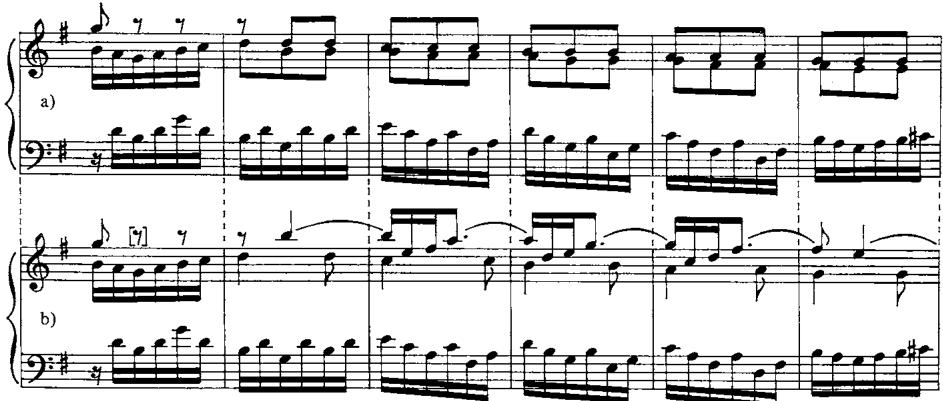
中文讲解
第18页的乐谱示例图像占位符。原文标注"图像或乐谱示例”,可能是EX.5(BWV 902/2 与BWV 907/2、908/2 对比图例)。需查看原图。
补充说明
无具体图注编号,仅保留位置。
第85段(P0127)
原文复述
the subject consist largely of chords in two, sometimes three, voices, such as might arise in a realization of BWV 907/2 or 908/2 (compare exx.4c and 5). The G-major fughetta was later included in the second book of the Well-Tempered Clavier (see BWV 884/2), but only after revisions that seem to have been prompted, in part, by the perfunctory nature of the original counterpoint. Presumably Bach did not wish anything that looked unduly improvisatory to appear in one of his “official” compendia. Nevertheless, the earlier version may represent the sort of counterpoint that one heard often in improvised fugues, in the Bach household and elsewhere. Bach himself could reportedly tell immediately whether a particular fugue subject was suitable for use in
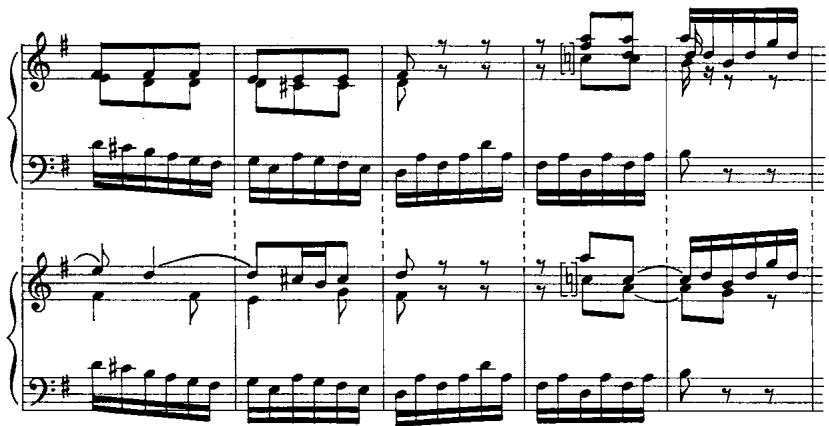
中文讲解
本段接续 P0120 末尾,分析BWV 902/2 主题伴奏的"即兴"特征:主要由二三声部和弦构成,可视为BWV 907/2 或908/2 的实现产物(对比例4c 与例5)。该小赋格后来被纳入《平均律键盘曲集》卷二(BWV 884/2),但仅在修订之后,修订部分动机在于原作对位的草率性质。作者推测巴赫不希望任何看起来过分即兴的东西出现在其"官方"汇编中。然而早期版本可能代表了巴赫家庭及其他地方即兴赋格中常见的对位类型。句子在"use in"后被截断,下段接续。
补充说明
BWV 884/2 收录于《平均律键盘曲集》卷二的修订版本中,体现了从即兴原始素材到正式版本的转化。
第86段(P0128)
原文复述
work in this fascicle of P 804 is BWV 953, also preserved in the Clavierbüchlein vor Wilhelm Friedemann Bach.
中文讲解
脚注45 的延续:SBB P 804/5 fascicle 中的另一作品为BWV 953,也保存于Wilhelm Friedemann Bach 的笔记本中。属于补充性文献信息。
补充说明
BWV 953 同样收录于弗里德曼笔记本,反映了早期家庭教学素材的流通。
第87段(P0129)
原文复述
This content downloaded from 140.182.176.13 on Fri, 07 Aug 2026 05:24:24 UTC All use subject to https://about.jstor.org/terms
中文讲解
JSTOR数字图书馆访问水印页脚。
补充说明
无新增内容。
第88段(P0130)
原文复述
EX.6. a, “Vom Himmel hoch, da komm ich her,” BWV 738a, opening. b, Suite in A Major, BWV 806a, prelude, mm.1–2
中文讲解
图例 EX.6 完整图注:a.《从天而降,啊我今来》BWV 738a 开头;b. A大调组曲 BWV 806a 前奏曲第1-2小节。该例证用于展示同一装饰手法在众赞歌"草稿"与正式英国组曲前奏之间的几乎逐字再现,论证"公式化"(formula)作为共享词汇库的存在。需查看原图。
补充说明
“Vom Himmel hoch” 是巴赫多次谱曲的著名圣诞众赞歌。
第89段(P0131)
原文复述
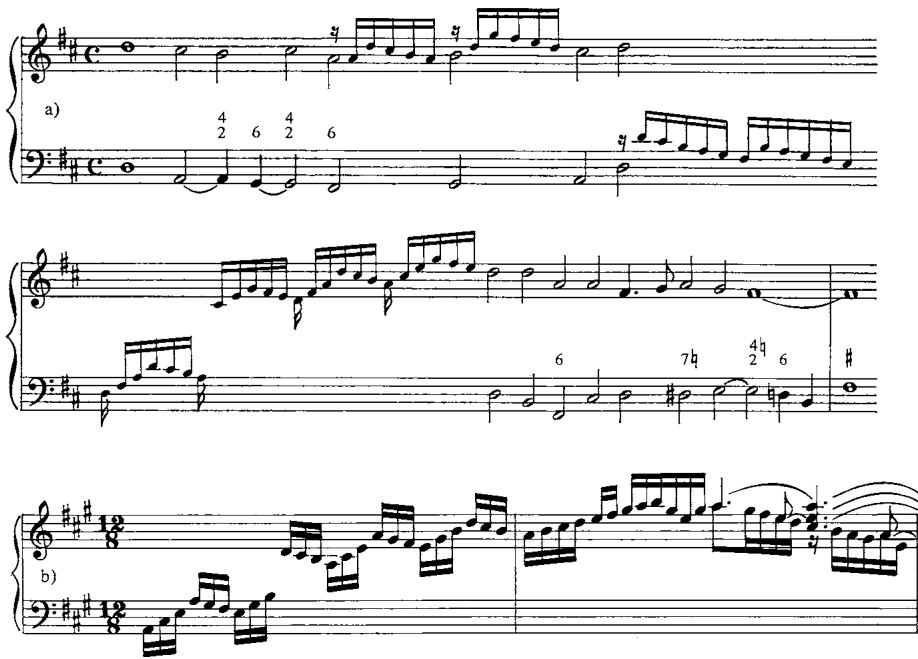
中文讲解
第19页的乐谱示例图像占位符。原文标注"图像或乐谱示例",可能是EX.6 内容的图像。需查看原图。
补充说明
无具体图注编号,仅保留位置。
第90段(P0132)
原文复述
stretto or some other learned technique. But the report refers to Bach listening to a fugue by someone else, and even his own improvisations are likely to have employed, at least occasionally, the simple and quite free counterpoint of BWV 902/2.
中文讲解
本段接续 P0127 末尾。报告说巴赫能立即判断某个赋格主题是否适合用于stretto 或其他学术技巧;但该报告指的是巴赫听他别人的赋格。即便巴赫自己的即兴,至少偶尔也会使用BWV 902/2 那样的简单自由对位。本段为巴赫的即兴实践作了合理化推断。
补充说明
stretto(紧接模仿)是赋格中主题在声部间紧密重叠的技巧。
第91段(P0133)
原文复述
Similar considerations apply to the so-called chorale sketches, which are preserved in copies by Johann Tobias Krebs, who studied with Bach at Weimar (see ex.6a). Together with their later versions, these suggest the manner in which a simple four-part chorale setting could be turned into a keyboard prelude or even a fantasy. Yet the Beethovenian idea of a “sketch” seems inappropriate here, for even in their “unfinished” forms the pieces were evidently copied out by a student and put to practical use. While Bach did occasionally jot down ideas and even work them out in a manner that could be described as “sketching,” these chorale settings – like the early versions of the French Suites (which lack most of their ornaments) or the early forms of some of the preludes from the Well-Tempered Clavier – are better regarded as incompletely notated compositions, meant to be fully realized in performance, than as unfinished works in the nineteenth-century sense. Although we cannot be sure how Krebs might have used them, in conjunction with their “finished” versions – either studied in score or heard in performances by Bach – they could have served as models for both improvisation and composition.
中文讲解
本段对所谓"众赞歌草稿"重新定义:这些作品由Krebs(巴赫魏玛时期学生)抄录,与其后期版本共同表明简单四部众赞歌如何被转化为键盘前奏曲甚至幻想曲。但"草稿"一词的贝多芬式理解不适用——即便是"未完成"形式,这些作品显然由学生抄出并付诸实用。巴赫确实偶尔会快速记下想法并以"草稿"方式展开,但这些众赞歌——如法国组曲早期版本(缺少多数装饰)或《平均律》前奏曲早期形式——应被视为"未完整记谱"的作品(意在演奏中被完整实现),而非19世纪意义上的未完成作品。我们无法确定Krebs 如何使用,但结合其"完成"版本(无论读谱还是听巴赫演奏),它们可以作为即兴与作曲的范例。本段批判性地拒绝了"草稿"的浪漫主义解读。
补充说明
J.T. Krebs 是巴赫魏玛时期的学生,其抄本保留了这一时期的教学素材。
第92段(P0134)
原文复述
- See, e.g., C. P. E. Bach’s letter of around the end of 1774 to Forkel (BDOK 3, no.802; BR, 277).
中文讲解
脚注46为正文巴赫能判断赋格主题是否适合stretto 的报告提供文献:约1774年末C.P.E. 巴赫致Forkel 信(BDOK 3 no.802;BR 277)。属于支持性引证。
补充说明
无新增内容。
第93段(P0135)
原文复述
- See BWV 722a, 729a, 732a, and 738a, all unica from SBB MUS. MS BACH P 802. These are edited, together with the later versions BWV 722, 729, etc., in Hans Klotz, ed., NBA IV/3 (Die einzeln überlieferten Orgelchoräle).
中文讲解
脚注47为众赞歌"草稿"提供具体曲目与文献:BWV 722a、729a、732a、738a,皆为SBB MUS. MS BACH P 802 独有作品;与后期版本BWV 722、729 等一起编辑于Klotz《新巴赫全集》IV/3《独立传世的管风琴众赞歌》。属于支持性引证。
补充说明
SBB P 802 是巴赫家族手稿中保留众赞歌草稿的关键抄本。
第94段(P0136)
原文复述
This content downloaded from 140.182.176.13 on Fri, 07 Aug 2026 05:24:24 UTC All use subject to https://about.jstor.org/terms
中文讲解
JSTOR数字图书馆访问水印页脚。
补充说明
无新增内容。
第95段(P0137)
原文复述
In fact the “sketches” are conceptually identical to a partimento fugue with partially written-out upper parts, the only difference being that the “subject” is a cantus firmus in the soprano, rather than as a theme wandering from one voice to another. This indicates the close relationship between the improvisation of fugues and chorales. Bach even treated certain赋格 subjects, including those of the Chromatic Fugue, BWV 903/2, and the Musical Offering, somewhat like cantus firmi; these subjects consist primarily of long notes that are combined with livelier figuration. The expositions of a fugue, of course, often alternate with bridges or episodes; this appears to have been especially true of improvised fugues, if BWV 907 and 908, or the three-part ricercar and other Bach works, accurately reflect improvisatory practices. But ritornellos or interludes could equally well be inserted into a simple chorale setting. Indeed, the phrases of the chorale melodies in the “sketches” are already articulated by short passages of free figuration (as was apparently customary).
中文讲解
本段将众赞歌"草稿"与partimento 赋格概念等同化,论证即兴赋格与众赞歌之间的紧密关系。论证层次:(1) “草稿"与部分写出上方声部的partimento 赋格概念相同,差异仅在于"主题"是女高音声部的固定旋律(cantus firmus)而非在不同声部间游走的主题;(2) 巴赫甚至将某些赋格主题(如半音阶赋格BWV 903/2、音乐奉献)当作固定旋律处理,这些主题主要由长音组成,与活泼的装饰相结合;(3) 赋格呈示部常与桥段或插部交替,这在即兴赋格中尤为明显(若BWV 907、908、三声部里切尔卡等准确反映即兴实践);(4) ritornello 或插段同样可插入简单众赞歌设置;(5) 实际上"草稿"中众赞歌旋律的乐句已由自由装饰短句连接(似为习俗)。本段是众赞歌与赋格即兴关系的关键论证。
补充说明
cantus firmus(固定旋律)是众赞歌等既有旋律作为对位基础的传统技法。
第96段(P0138)
原文复述
- Marshall (Compositional Process, 1:31–32) discusses “sketches,” but these are limited for the most part to “memory aids” and “tentative marginal sketches for … opening themes.” Several of Bach’s early keyboard works employ a sketch-like type of notation that includes figured bass. But in the partita BWV 833 and the capriccio BWV 922 this occurs in movements intended to imitate genres scored for voice and continuo. Similarly, the figures in the sonata BWV 967 and the echo movement of the doubtful suite BWV 821 may have been intended to reflect the orchestral scoring imitated in these pieces. Thus, while these works may call for improvisational realization comparable to that employed in playing the chorale “sketches,” none of these pieces provides evidence that Bach actually wrote preliminary sketches that employed figured bass.
中文讲解
脚注48限定正文关于"草稿"的讨论。Marshall《作曲过程》第1卷31-32页讨论的"草稿"主要限于"记忆辅助"和"开头主题的暂定边注草稿”。巴赫早期键盘作品中确有类似草稿的记谱(包含数字低音),但在BWV 833 partita 和BWV 922 capriccioso 中出现于模仿人声与通奏低音体裁的乐章;类似地,BWV 967 奏鸣曲和归属存疑的BWV 821 组曲"回声"乐章的数字可能意在反映所模仿的乐队编制。因此虽然这些作品可能要求类似演奏众赞歌"草稿"的即兴实现,但无任何作品证明巴赫确实写过采用数字低音的预备草稿。本脚注严格限定"草稿"一词在巴赫语境中的使用边界。
补充说明
Marshall《作曲过程》是研究巴赫作曲过程的重要文献。
第97段(P0139)
原文复述
This content downloaded from 140.182.176.13 on Fri, 07 Aug 2026 05:24:24 UTC All use subject to https://about.jstor.org/terms
中文讲解
JSTOR数字图书馆访问水印页脚。
补充说明
无新增内容。
第98段(P0140)
原文复述
SCHULENBERG
中文讲解
作者署名 SCHULENBERG。本节中出现作者姓名作为小节分隔标识。
补充说明
在JSTOR电子版本中,作者姓名常作为版面分隔出现。
第99段(P0141)
原文复述
VARIATION AND FORMULA
中文讲解
小节标题 VARIATION AND FORMULA(变奏与公式)开启下一主题。本节从抽象的"变奏"原则转向具体的"公式化"创作手法:装饰性乐句、起句手势等可重复使用的共享词汇库。
补充说明
formula(公式)在音乐分析中指可重复使用的固定乐句或模式。
第100段(P0142)
原文复述
One of these flourishes (in BWV 738a) recurs almost note for note at the opening of the First English Suite, probably a Weimar work (see ex.6b). Moreover, practically the same figure occurs in an anonymous chorale “sketch” from P 802; the latter resembles the “sketches” attributed to Bach but is possibly the work of the copyist Krebs (see ex.7). Although the exactness of the paral-
中文讲解
本段以具体例证开启"公式"主题:BWV 738a 中的一个装饰性乐句在第一英国组曲开头几乎逐字重现(英国组曲可能作于魏玛时期,见例6b)。同一乐句几乎原样出现在P 802 中的一首无标题众赞歌"草稿"中——后者类似归于巴赫的"草稿"但可能是抄写员Krebs 的作品(例7)。句子在"paral-“处被截断。
补充说明
第一英国组曲A大调 BWV 806 通常被认为作于魏玛时期(约1715年前后)。
第101段(P0143)
原文复述
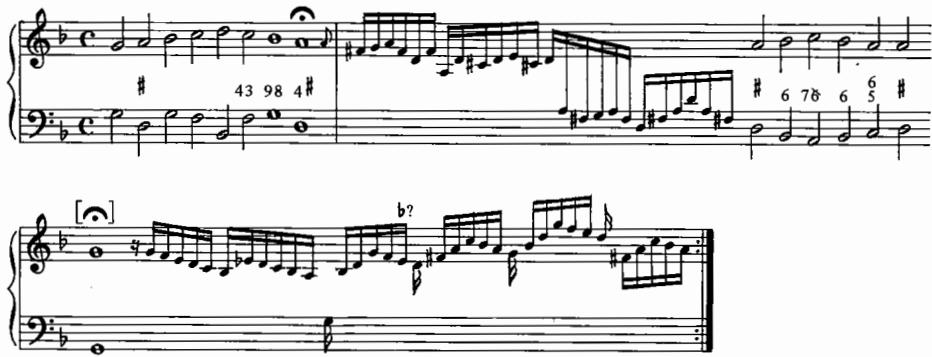
中文讲解
图例 EX.7 位置占位符:疑为J.T. Krebs 的《Jesu, der du meine Seele》,Kast Incerta 29(出自SBB MUS. MS BACH P 802)Stollen 部分。该例证用于展示"几乎逐字再现"的装饰乐句在第三件作品中的存在,论证"公式词汇库"的共享性。需查看原图。
补充说明
Stollen 是诗歌的第一部分(对应音乐的第一段)。
第102段(P0144)
原文复述
lels between these examples may be unusual, the implication is that Bach and his students possessed a vocabulary of flourishes and other ornamental gestures that could be inserted at appropriate points into pieces of various genres. Some formulas, such as the virtuoso alternating-hand figures seen in exx.6 and 7, might have been favorite personal inventions. Others would have corresponded to conventional cadential and sequential patterns or to established opening and closing gestures. Indeed, in genres such as the prelude there must have been a fairly well-established protocol regarding the proper use of such formulas. Many preludes in Book 1 of the Well-Tempered Clavier, for example, begin with a variation on a simple cadential progression – often over a pedal point, as in ex.8.
中文讲解
本段承接 P0142 末尾,确立本节"公式"主题的核心论点:尽管三个例证的精确平行可能不常见,但其含义是巴赫与学生拥有可在不同体裁作品的适当位置插入的装饰乐句与手势词汇库。一些"公式”(如例6、7 中的双手交替炫技乐句)可能是个人偏好;其他则对应传统终止与模进模式,或既定的起止手势。在前奏曲等体裁中,必须有相当明确的公式使用协议。例如《平均律》卷一许多前奏曲以简单终止进行的变奏起头——常在持续音之上(例8)。本段引入"protocol"(协议)概念,暗示公式使用具有约定性。
补充说明
alternating-hand figures(双手交替)即左右手轮流演奏的炫技型乐句。
第103段(P0145)
原文复述
It is easy to multiply these examples of opening formulas. Another occurs at the opening of the C-major prelude BWV 924, the first prelude in the Clavier-
中文讲解
本段预告更多起句公式的例证将出现在BWV 924(C大调前奏曲),Clavierbüchlein vor Wilhelm Friedemann Bach 中的第一首前奏曲。句子在"Clavier-“处被截断,下段接续。
补充说明
BWV 924 是巴赫早期前奏曲之一,归属有争议。
第104段(P0146)
原文复述
- The early version, BWV 806a, exists in a copy by Walther in SBB MUS. MS BACH P 803, a manuscript closely related to the source containing the chorale “sketches.”
中文讲解
脚注49为正文"第一英国组曲大概作于魏玛时期"提供文献:BWV 806a 早期版本存于Walther 抄本SBB MUS. MS BACH P 803,与众赞歌"草稿"来源抄本密切相关。属于支持性引证。
补充说明
Walther 是18世纪重要的音乐理论家与抄写员。
第105段(P0147)
原文复述
- I am grateful to Russell Stinson for bringing this and several other Krebs copies to my attention and for supplying a facsimile.
中文讲解
脚注50为正文P 802 中Krebs 抄本的无标题众赞歌提供致谢:感谢Russell Stinson 提示这些Krebs 抄本并提供影印件。属于辅助性文献信息。
补充说明
Russell Stinson 是研究巴赫教学传播史的学者。
第106段(P0148)
原文复述
This content downloaded from 140.182.176.13 on Fri, 07 Aug 2026 05:24:24 UTC All use subject to https://about.jstor.org/terms
中文讲解
JSTOR数字图书馆访问水印页脚。
补充说明
无新增内容。
第107段(P0149)
原文复述
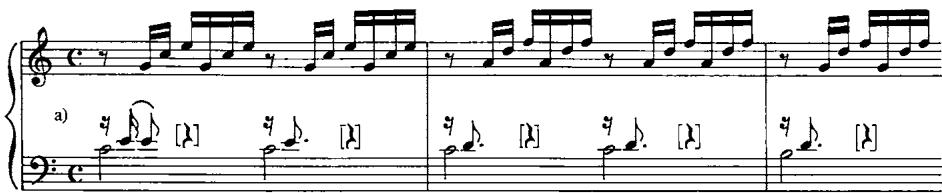
中文讲解
图例 EX.8 位置占位符:a. C大调前奏曲 BWV 846a/1 第1-4小节;b. G大调前奏曲 BWV 860/1 第1-2小节。两个例证用于展示"简单终止进行的变奏"作为常见起句公式,《平均律键盘曲集》卷一首曲的早期版本与卷一其他前奏曲的对比。需查看原图。
补充说明
BWV 846a/1 是《平均律》卷一C大调前奏曲的早期版本。
第108段(P0150)
原文复述
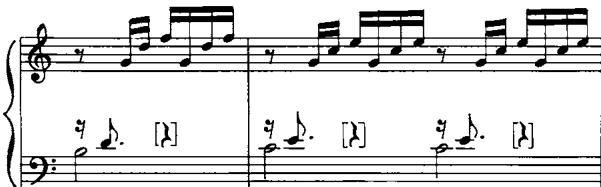
中文讲解
第22页的乐谱示例图像占位符之一。原文标注"图像或乐谱示例”,可能是EX.8 内容的图像。需查看原图。
补充说明
无具体图注编号,仅保留位置。
第109段(P0151)
原文复述

中文讲解
第22页的乐谱示例图像占位符之一。原文标注"图像或乐谱示例",可能是EX.8 内容的图像。需查看原图。
补充说明
无具体图注编号,仅保留位置。
第110段(P0152)
原文复述
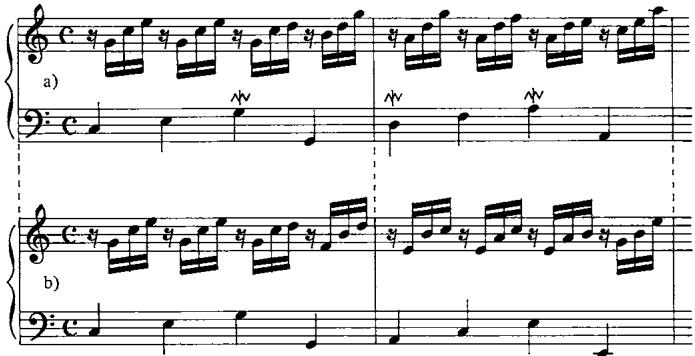
中文讲解
图例 EX.9 部分图注及正文讨论:C大调前奏曲 mm.1-2 的两个例证 a BWV 924 与 b BWV 924a。büchlein vor Wilhelm Friedemann Bach 中同时包含BWV 924 和BWV 924a(同调另一首前奏曲)。后者常被视为BWV 924 的替代版本,但更准确的描述是"同一基本计划的第二次实现"(例9)。两首的计划在表1上半部分总结——都以同一起句手势开始,进入简单转调模进,最终到达属持续音;BWV 924a 的最终终止前有简单cadenzia。同样的计划以更大规模重现于《平均律》卷一同调前奏曲的各版本(表1下半部分)。句子在"büchlein"前被截断。
补充说明
本段展示了同一基本计划的多次实现,凸显"公式协议"的具体运用。
第111段(P0153)
原文复述
This content downloaded from 140.182.176.13 on Fri, 07 Aug 2026 05:24:24 UTC All use subject to https://about.jstor.org/terms
中文讲解
JSTOR数字图书馆访问水印页脚。
补充说明
无新增内容。
第112段(P0154)
原文复述
modulating sequence that leads eventually to a dominant pedal. The final cadence soon follows, preceded by a simple cadenza in BWV 924a. A similar plan recurs, on a somewhat larger scale, in the various versions of the prelude in the same key that opens the first book of the Well-Tempered Clavier (see table 1, lower portion).
中文讲解
本段接续 P0152 末尾:转调模进最终到达属持续音;BWV 924a 中最终终止前有简单华彩段;类似计划以更大规模重现于《平均律》卷一同调前奏曲的各版本。
补充说明
本段独立成段的标记反映了原文页面排版。
第113段(P0155)
原文复述
Much the same initiating gesture – that is, the ascending triad in the bass – recurs in one of Friedemann’s fantasies (F.14), also in C major (see ex.10). Another common initiating gesture, the cadential formula over a pedal point, recurs in a fantasy recently identified as a work of Emanuel Bach, H.348 (ex.11). In both cases the bass gesture is dressed up in new figuration, but this too can be found elsewhere. The figuration of F.14 recurs in Friedemann’s Fantasy in E Minor, F.21 (see ex.12a), while that of H.348 seems to come from a much better-known source, the Chromatic Fantasy (ex.12b).
中文讲解
本段展示"起句手势"在巴赫家族成员作品中的重现。(1) 同样的起句手势——低音上行三和弦——出现在Friedemann 的幻想曲F.14(C大调,例10);(2) 另一常见起句手势——持续音上的终止公式——出现在最近被确认为Emanuel 巴赫作品的幻想曲H.348(例11);(3) 在两例中低音手势都被新装饰所包装,而这些装饰也见于别处——F.14 的装饰再现于Friedemann 的e小调幻想曲F.21(例12a),H.348 的装饰可能来自更著名的《半音阶幻想曲》(例12b)。本段通过家族成员作品中的交叉参照,构建"公式词汇库"的传承图谱。
补充说明
F.14 和 H.348 分别是Friedemann 和Emanuel 巴赫作品的标准编号。
第114段(P0156)
原文复述
This content downloaded from 140.182.176.13 on Fri, 07 Aug 2026 05:24:24 UTC All use subject to https://about.jstor.org/terms
中文讲解
JSTOR数字图书馆访问水印页脚。
补充说明
无新增内容。
第115段(P0157)
原文复述
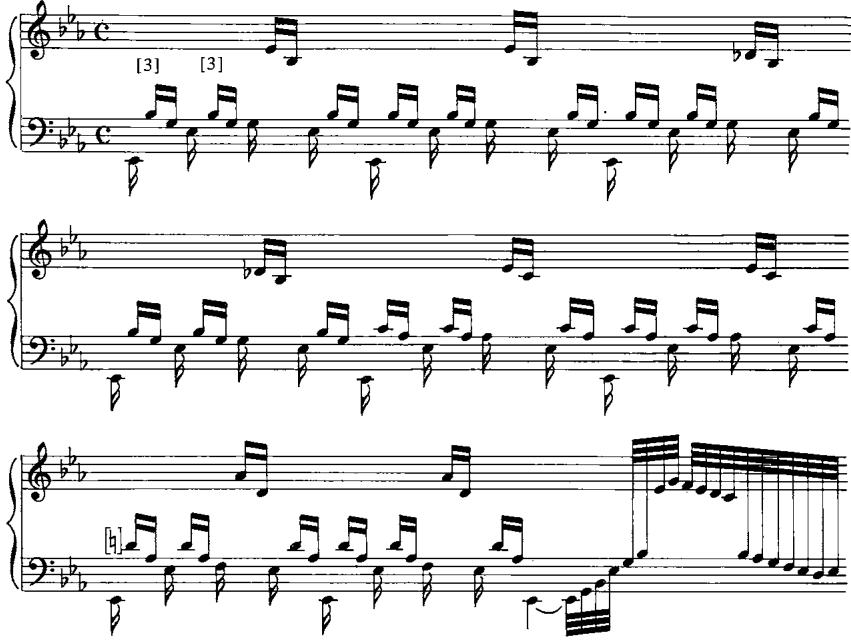
中文讲解
第24页的乐谱示例图像占位符之一。原文标注"图像或乐谱示例",可能是EX.10、11 或12 的图像。需查看原图。
补充说明
无具体图注编号,仅保留位置。
第116段(P0158)
原文复述
The use of formula is not confined to pieces in the expressly improvisatory genres, such as preludes and fantasies, although it is naturally most common there and in passages such as cadenzas that were meant to sound like improvisations (even if they did not actually originate as such). Thus George Stauffer has pointed to the similarity of certain figuration in the Chromatic Fantasy to that in the great harpsichord solo (“cadenza”) in the first movement of the Fifth Brandenburg Concerto. Another passage in this solo, the sequence of
中文讲解
本段扩展"公式"使用的范围。论点:(1) 公式使用不限于明确即兴体裁(前奏曲、幻想曲),但在这些体裁及本应听起来像即兴的乐段(如华彩段,即便实际并非即兴产生)中最为常见;(2) Stauffer 已指出《半音阶幻想曲》的某些装饰与第五勃兰登堡协奏曲第一乐章大键琴独奏(“华彩段”)装饰的相似性。本段进入该独奏的另一段(被截断):“the sequence of”。
补充说明
第五勃兰登堡协奏曲是巴赫著名的协奏曲作品。
第117段(P0159)
原文复述
- On the authorship of H.348, previously ascribed to Nichelmann, see Douglas A. Lee, “C. P. E. Bach and the Free Fantasia for Keyboard: Deutsche Staatsbibliothek Mus. Ms. Nichelmann 1N,” in C. P. E. Bach Studies, ed. Stephen L. Clark (Oxford: Clarendon Press, 1988), 177–84.
中文讲解
脚注51为正文"H.348 最近被确认为Emanuel 巴赫作品"提供文献:Lee《C.P.E. 巴赫与键盘自由幻想曲》(Clark 编辑《C.P.E. 巴赫研究》,1988)第177-184页。此前归于Nichelmann。属于支持性引证。
补充说明
Nichelmann 是18世纪汉堡的音乐家,与C.P.E. 巴赫有交往。
第118段(P0160)
原文复述
- George B. Stauffer, “‘This fantasia … never had its like’: On the Enigma and Chronology of Bach’s Chromatic Fantasia and Fugue in D Minor, BWV 903,” in Bach Studies, ed. Don O. Franklin (Cambridge: Cambridge University Press, 1989), 176.
中文讲解
脚注52为正文Stauffer 关于《半音阶幻想曲》与第五勃兰登堡协奏曲独奏装饰相似性的论断提供出处:Stauffer《“此幻想曲……前无古人”》(Franklin 编辑《巴赫研究》1989)第176页。属于支持性引证。
补充说明
Stauffer 是巴赫研究的重要学者。
第119段(P0161)
原文复述
This content downloaded from 140.182.176.13 on Fri, 07 Aug 2026 05:24:24 UTC All use subject to https://about.jstor.org/terms
中文讲解
JSTOR数字图书馆访问水印页脚。
补充说明
无新增内容。
第120段(P0162)
原文复述
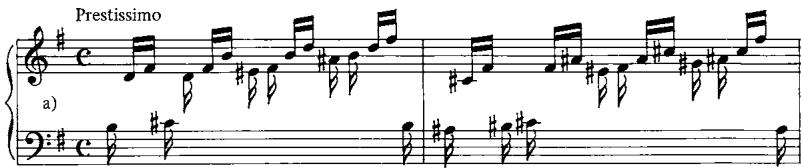
中文讲解
第25页的乐谱示例图像占位符之一。原文标注"图像或乐谱示例",可能是相关谱例的图像。需查看原图。
补充说明
无具体图注编号,仅保留位置。
第121段(P0163)
原文复述

中文讲解
第25页的乐谱示例图像占位符之一。原文标注"图像或乐谱示例",可能是相关谱例的图像。需查看原图。
补充说明
无具体图注编号,仅保留位置。
第122段(P0164)
原文复述
descending diminished chords in mm.199–201 – whose dazzling effect remains undiminished by nineteenth-century abuse of the same harmonic progression – recurs in somewhat different form in the hand-crossing gigue of the First Partita (BWV 825/7, mm.34–39). Here the formula consists not of the figuration as such but of the underlying harmonic progression. Although the latter is unusual in earlier music, it is quite simple, and we might imagine Bach astonishing first-time listeners – among them the margrave of Brandenburg at Berlin or Volumier and other notables at Dresden – with what was, in fact, a relatively cheap trick from his arsenal. It was evidently a favorite, for it is already present in the early version of the “cadenza,” where Bach jumps to it in the third measure (BWV 1050a/1, mm.157–58).
中文讲解
本段接续 P0158 末尾,分析勃兰登堡协奏曲独奏中的下行动音和弦序列(mm.199-201)。论点:(1) 该序列的炫目效果未因19世纪对同一和声进行的滥用而减弱;(2) 该序列以略不同的形式重现于第一帕提塔(BWV 825/7)双手交叉吉格舞曲(mm.34-39);(3) 此处的"公式"不是装饰本身,而是其基础和声进行;(4) 虽然该和声进行在早期音乐中不常见,却很简单,可想象巴赫以此"便宜技巧"让初次听众(包括勃兰登堡侯爵或Volumier 等Dresden 名流)惊叹;(5) 它显然是巴赫的偏爱,因其已出现在"华彩段"的早期版本(BWV 1050a/1, mm.157-58)。本段揭示了和声进行作为"公式"的独立性。
补充说明
Volumier 是18世纪德累斯顿宫廷的著名舞蹈家与艺术赞助人。
第123段(P0165)
原文复述
The passage suggests that (like the analogous “capriccios” inserted into Bach’s models) the entire “cadenza” was the product of a series of improvised interpolations. Sebastian probably expected players to insert improvised solos into other concertos; there is a Cadenza al arbitrio in the third movement (just before the last ritornello) of what appears to be an early version of the D-minor harpsichord concerto BWV 1052a. Since BWV 1052a is independent of
中文讲解
本段扩展巴赫对协奏曲中即兴插入的预期。论点:(1) 该段暗示"华彩段"整体是一系列即兴插段的产品,类似巴赫范本中插入的"随想曲";(2) Sebastian 可能期待演奏者在其他协奏曲中插入即兴独奏;(3) D小调大键琴协奏曲BWV 1052a(早期版本)第三乐章末尾ritornello 之前有一处"Cadenza al arbitrio"(自由华彩)。句子在"independent of"处被截断,下段接续。
补充说明
“Cadenza al arbitrio” 是协奏曲中标示演奏者可自由发挥的段落指示。
第124段(P0166)
原文复述
- The likely models for the Brandenburg “cadenza” are the two long optional solos in Vivaldi’s concerto RV 208 (see Luigi Ferdinando Tagliavini, “Bach’s Organ Transcription of Vivaldi’s ‘Grosso Mogul’ Concerto,” in Bach as Organist, 240–55).
中文讲解
脚注53为正文"勃兰登堡华彩段类似巴赫范本中插入的随想曲"提供文献:可能范本是Vivaldi RV 208 协奏曲中的两个长可选独奏(Tagliavini《巴赫对维瓦尔第"大莫卧儿"协奏曲的管风琴改编》)。属于支持性引证。
补充说明
Vivaldi RV 208 即"大莫卧儿"协奏曲,是巴赫学习维瓦尔第的重要案例。
第125段(P0167)
原文复述
- The indication occurs in the string parts of the sole source, SBB MUS. MS BACH ST 350; the keyboard part at this point has the direction ad libitum. The occasional corrections in ST 350 provide little evidence that the arrangement is the work of the copyist, C. P. E. Bach, confirming the doubts expressed in Helm, Thematic Catalogue, 105, about Emanuel’s authorship of BWV 1052a (which is listed in Helm as the “doubtful” work H.484). For an argument to the contrary, see Andreas Glöckner, “Neuerkenntnisse zu Johann Sebastian Bachs Aufführungskalender zwischen 1729 und 1735,” Bach-Jahrbuch 67 (1981): 43–75. I am grateful to Joshua Rifkin for making available his copy of st 350.
中文讲解
脚注54为正文"BWV 1052a 中的Cadenza al arbitrio"提供详细文献:指示出现于唯一来源SBB MUS. MS BACH ST 350 的弦乐声部,键盘声部此时标注ad libitum;ST 350 中的偶尔订正不表明该改编是抄写员C.P.E. 巴赫的作品,确认Helm《主题目录》第105页对Emanuel 归属BWV 1052a 的怀疑(Helm 将其列为"可疑"作品H.484)。Glöckner《1729-1735巴赫演出日历新识》(《巴赫年鉴》1981)持相反论点;感谢Joshua Rifkin 提供ST 350 副本。属于限定性与背景性引证。
补充说明
本脚注涉及巴赫作品的归属争论细节。
第126段(P0168)
原文复述
This content downloaded from 140.182.176.13 on Fri, 07 Aug 2026 05:24:24 UTC All use subject to https://about.jstor.org/terms
中文讲解
JSTOR数字图书馆访问水印页脚。
补充说明
无新增内容。
第127段(P0169)
原文复述
Extended solos such as those found in BWV 1050 and 1052 can be constructed relatively easily through the more or less formulaic composing-out of routine sequences. Even counterpoint could be reduced to formula. In a sense, this is what happens in the permutational designs that Bach must have learned from works such as the fugues in Reinken’s Hortus musicus. Certainly Bach was aware of various ready-made canons and strettos that could be inserted into contrapuntal pieces whose subjects incorporated appropriate motives. One such is the little canon known as the Trias harmonica, which bears a close relationship to the strettos in Contrapunctus 5 of the Art of Fugue. Naturally Bach avoided a too obvious reliance on contrapuntal formulas in his written fugues. But ready-made strettos bearing some relation to the opening motive of a fugue subject – such as occurs in the central harpsichord solo in the last movement of the Fifth Brandenburg Concerto (mm.163–77) – might well have impressed a jury hearing an organist’s audition.
中文讲解
本段将"公式化"原则拓展到扩展独奏与对位领域。论点:(1) BWV 1050、1052 中的扩展独奏可通过或多或少的公式化"展开式实现"常规序列来相对容易地构建;(2) 对位也可归约为公式,如巴赫从Reinken《Hortus musicus》赋格等作品学到的置换设计;(3) 巴赫清楚知道各种可插入对位作品的现成卡农与紧接模仿,前提是其主题包含适当动机;(4) 一个例子是称为Trias harmonica 的小卡农,与《赋格的艺术》第5对位的紧接模仿密切相关;(5) 巴赫自然避免其书面赋格过于明显依赖对位公式,但现成的、与赋格主题开头动机相关的紧接模仿——如第五勃兰登堡协奏曲末乐章中央大键琴独奏(mm.163-77)——可能给听管风琴师试奏的评审留下印象。本段从表面装饰公式深入到结构性对位公式。
补充说明
Trias harmonica 是巴赫的著名三声部卡农,BWV 1072。
第128段(P0170)
原文复述
The use of formula by Bach and his students is hardly surprising in the light of what we know of Baroque style in general. Following the model of Printz and earlier writers, Niedt set out various melodic embellishments that might be applied to a bass line and evidently assumed a similar approach in the invention of melodic material in the upper voices. George Buelow has pointed to a discussion of moduli in Mattheson’s Vollkommener Capellmeister and has shown how Handel repeatedly employed certain archetypal melodic patterns in his opening themes. Among the papers of C. P. E. Bach and the Bach student and associate Johann Gottfried Müthel are collections of fragments and cadenzas that appear to represent exercises or exemplary “ideas” for use in improvisation and composition. No doubt individual players also invented their own formulas, and indeed the “discovery of ideas” was evidently something that Sebastian looked for in his composition students. But, once discovered, many ideas might have served as modular devices that could be inserted into almost any improvisation or composition.
中文讲解
本段将巴赫圈子的"公式化"创作置于巴洛克风格的普遍语境中。背景论据:(1) 追随Printz 及更早作者的模式,Niedt 列出了可应用于低音线条的各种旋律装饰,显然假设上方声部旋律材料的发明也采取类似方法;(2) Buelow 已指出Mattheson《完美宫廷乐长》中的moduli 讨论,并展示亨德尔如何反复运用某些原型旋律模式作为开头主题;(3) C.P.E. 巴赫与巴赫学生Johann Gottfried Müthel 的文稿中有片段与华彩段的集合,似为代表即兴与作曲练习或示范"想法";(4) 个人演奏者无疑也会发明自己的公式,且"想法的发现"显然是Sebastian 在作曲学生身上寻找的东西;(5) 一旦被发现,许多想法可作为模块化装置插入几乎任何即兴或作曲中。本段把"公式"作为巴洛克普遍现象定位巴赫实践。
补充说明
Printz(普林茨)是17世纪德国音乐理论家;Mattheson《完美宫廷乐长》是18世纪重要的音乐美学著作;Müthel 是巴赫晚期学生。
第129段(P0171)
原文复述
350 provide little evidence that the arrangement is the work of the copyist, C. P. E. Bach, confirming the doubts expressed in Helm, Thematic Catalogue, 105, about Emanuel’s authorship of BWV 1052a (which is listed in Helm as the “doubtful” work H.484). For an argument to the contrary, see Andreas Glöckner, “Neuerkenntnisse zu Johann Sebastian Bachs Aufführungskalender zwischen 1729 und 1735,” Bach-Jahrbuch 67 (1981): 43–75. I am grateful to Joshua Rifkin for making available his copy of st 350.
中文讲解
脚注54 的延续段落:内容与 P0167 重复——ST 350 中的订正不表明该改编是抄写员C.P.E. 巴赫的作品,Helm 已表达怀疑;Glöckner 持相反论点;感谢Joshua Rifkin。属于支持性与背景性引证。
补充说明
原文此处为脚注内容的重复。
第130段(P0172)
原文复述
- BWV 1072, given in Marpurg’s Abhandlung von der Fuge, vol. 2, Tabula 37.
中文讲解
脚注55为正文Trias harmonica 小卡农提供出处:BWV 1072,见Marpurg《赋格论》第2卷Tabula 37。属于支持性引证。
补充说明
Tabula 是Marpurg 论著中的图表编号。
第131段(P0173)
原文复述
- Compare the examples in the first volume of Niedt’s Musicalische Handleitung with those in Wolfgang Caspar Printz, Phrynis Mytilenaeus oder Satyrischer Componist (Quedlinburg, 1676-77).
中文讲解
脚注56为正文"追随Printz 及更早作者的模式"提供比较指引:比较Niedt《音乐指导》第一卷中的例证与Printz《Phrynis Mytilenaeus 或讽刺作曲家》(1676-77)。属于背景性引证。
补充说明
Printz 是17世纪德国重要音乐理论家,《Phrynis Mytilenaeus》是其著名著作。
第132段(P0174)
原文复述
- George Buelow, “Mattheson’s Concept of ‘Moduli’ as a Clue to Handel’s Compositional
中文讲解
脚注57 部分内容被截断。Buelow 关于Mattheson “moduli” 概念作为理解亨德尔作曲实践的线索,文章标题出现于此。句子在"Compositional"后被截断,下段接续。
补充说明
无新增内容。
第133段(P0175)
原文复述
This content downloaded from 140.182.176.13 on Fri, 07 Aug 2026 05:24:24 UTC All use subject to https://about.jstor.org/terms
中文讲解
JSTOR数字图书馆访问水印页脚。
补充说明
无新增内容。
第134段(P0176)
原文复述
One by-product of the reliance on formula, especially in little preludes and the like, may be the questions of attribution that they frequently raise. Indeed, it is striking how many of the pieces under discussion here are of uncertain authorship. The copy of BWV 924a is in the hand of Wilhelm Friedemann, who might have been its composer. But the idea of a composer in such a piece may be something of an anachronism. Many such pieces may, to some degree, be the products of collaboration between student and teacher. Even when this is not the case, such pieces may belong to a network of related works using recurring formulas that were regarded as common property. Indeed, when we consider how many of these pieces are probably merely the visible survivals of an improvising tradition, we are faced with a situation not unlike the traditions of early chant or, for that matter, oral poetry.
中文讲解
本段从"公式"原则推出归属判定问题。论点:(1) 依赖公式的副作用之一,特别是在小前奏曲等作品中,是归属问题频发——本文讨论的许多作品归属皆不确定;(2) BWV 924a 的抄本出于Friedemann 之手,他可能就是作曲者,但"作曲家"概念在此类作品中可能略嫌时代错置;(3) 许多此类作品在一定程度上是师生合作的产物;(4) 即便非合作,它们也属于使用重复公式的网络,这些公式被视为共同财产;(5) 考虑到这些作品可能只是即兴传统的可见遗存,我们面对的情形与早期吟唱传统或口传诗歌传统无异。本段是本节论证的高峰:从"公式化"创作推导出归属模糊与即兴传统的连续性。
补充说明
本段开启了与口传文学的类比,铺垫下一节关于"口传诗歌"理论的讨论。
第135段(P0177)
原文复述
It is possible that some of these pieces, especially the simpler preludes, might be described in terms derived from the study of oral literature, as Leo Treitler has done for chant and Lawrence Gushee for jazz. Yet, even if the works in question could be shown to display the characteristics of an oral repertory, a study along the lines of “Homer, Gregory, and Sebastian” might not be terribly enlightening. For one thing, it is difficult to apply the details of the Parry-Lord theory of oral-formulaic composition to music, especially in the absence of authentic eighteenth-century improvisers. Individual melodic ideas might be matched with the formulas of oral poetry, and what are called themes in the study of oral literature perhaps correspond with the formal protocols mentioned earlier. But there appears to be nothing in Bach’s musical structures to correspond to the strict poetic meter and foreordained narratives of epic and other types of traditional verse, whose exacting formal requirements have no precise parallel in eighteenth-century music.
中文讲解
本段谨慎评估"口传文学"类比的适用性。论点:(1) 一些更简单的作品可能如Treitler 之于吟唱、Gushee 之于爵士乐般,以口传文学术语描述;(2) 但即便能证明这些作品展现出口传曲目特征,沿"荷马、格里高利与塞巴斯蒂安"思路的研究未必富有启发性;(3) Parry-Lord 口传公式化作曲理论的细节难以应用于音乐,尤其缺乏18世纪真正即兴者;(4) 个别旋律想法可与口传诗歌的公式匹配,口传文学中所谓的主题也许对应早先提到的"公式协议”;(5) 但巴赫的音乐结构中似乎无对应史诗等传统诗歌的严格诗律与预定叙事——后者的严格形式要求在18世纪音乐中无精确对应。本段对类比的局限性作了清晰分析。
补充说明
Parry-Lord 理论是研究口传史诗(如荷马)“公式化"创作的核心学术框架。
第136段(P0178)
原文复述
Practice,” Göttinger Händel-Beiträge 3 (1989): 272–78. The reference is to Johann Mattheson, Der vollkommene Capellmeister (Hamburg, 1739), 122–23.
中文讲解
脚注57 延续:Buelow 文章全名《Mattheson “moduli” 概念作为理解亨德尔作曲实践的线索》(《哥廷根亨德尔论集》1989年第3卷272-278页),所指Mattheson 原典为《完美宫廷乐长》(1739)第122-123页。属于支持性引证。
补充说明
Buelow 是著名亨德尔与巴洛克音乐学者。
第137段(P0179)
原文复述
- “Was die Erfindung der Gedancken betrifft, so forderte er gleich anfangs die Fähigkeit dazu” (C. P. E. Bach, letter to Forkel, 13 January 1775). C. P. E. Bach’s collection of “ideas” is represented by the Miscellanea musica, H.867 (w.121), a manuscript collection of unpublished sketches and other片段; for Müthel, see the so-called Technische Übungen in SBB MUS. MS 15,762/1.2, discussed in Peter Reidemeister, “Johann Gottfried Müthels ‘Technische Übungen,’ oder Von der Mehrdeutigkeit der Quellen,” Basler Jahrbuch für historische Musikpraxis 13 (1989): 55-98. Müthel includes extracts not only from the Chromatic Fantasy (as noted by Reidemeister) but also from Emanuel’s fantasy-like sonata H.46 (w.65/16); copies by Müthel survive of both works. No doubt other pieces are quoted or echoed in both collections.
中文讲解
脚注58为正文"“想法的发现"是Sebastian 在作曲学生身上寻找的东西"提供引文:“Was die Erfindung der Gedancken betrifft, so forderte er gleich anfangs die Fähigkeit dazu”——C.P.E. 巴赫1775年1月13日致Forkel 信。C.P.E. 巴赫的"想法"收藏以Miscellanea musica H.867(w.121)为代表;Müthel 的所谓Technische Übungen 藏于SBB MUS. MS 15,762/1.2(Reidemeister 1989文章)。Müthel 不仅摘录《半音阶幻想曲》,还摘录Emanuel 的幻想曲式奏鸣曲H.46(w.65/16);两者的Müthel 抄本皆存。属于支持性引证。
补充说明
Miscellanea musica 是C.P.E. 巴赫的重要手稿。
第138段(P0180)
原文复述
- Evidence of such collaborations in the Bach circle can be found in Bach’s having participated in the copying of parts for BWV 1025 and 1038, both probably student works, and in references to a joint composition by him and Emanuel (on the apparently lost trio sonata H.566, see Helm, Thematic Catalogue, 123). Likewise, the symphony H.667 appears to be a collaboration between Emanuel and Prince Lobkowitz.
中文讲解
脚注59为正文"师生合作"的论断提供证据:巴赫参与了BWV 1025、1038(可能皆为学生作品)的分谱抄写;有关他与Emanuel 联合作曲(已佚的三重奏鸣曲H.566,见Helm 第123页)的记载;交响曲H.667 似乎是Emanuel 与Lobkowitz 王子的合作。属于支持性引证。
补充说明
Lobkowitz 是波希米亚贵族音乐赞助人。
第139段(P0181)
原文复述
This content downloaded from 140.182.176.13 on Fri, 07 Aug 2026 05:24:24 UTC All use subject to https://about.jstor.org/terms
中文讲解
JSTOR数字图书馆访问水印页脚。
补充说明
无新增内容。
第140段(P0182)
原文复述
Hence the analogies to oral poetry are at best imprecise. Perhaps the formulas bear a closer relationship to what Robert Gjerdingen has described as schemata in eighteenth-century music. These schemata appear to be, in essence, certain types of pattern that a listener extrapolates from their recurrences in various pieces. While not every formula is a schema, schemata provide the basis of many formulas. They represent, for example, the elements common to the initiating gestures of the Chromatic Fantasy and certain preludes from the Well-Tempered Clavier.
中文讲解
本段引入Gjerdingen 的"schema”(图式)概念作为"公式"的更精确类比。论点:(1) 口传诗歌的类比最多是模糊的;(2) 公式或许与Gjerdingen 描述的18世纪音乐"图式"关系更密切;(3) 图式本质上是从听者从各种作品重现中推断出的某些模式类型;(4) 并非每个公式都是图式,但图式提供许多公式的基础;(5) 图式代表了《半音阶幻想曲》与《平均律》某些前奏曲起句手势中共同的元素。本段将口传文学类比替换为更精确的认知—音乐学概念。
补充说明
Gjerdingen 的"schema"理论是当代音乐认知研究的重要框架。
第141段(P0183)
原文复述
- See Leo Treitler, “Homer and Gregory: The Transmission of Epic Poetry and Plainchant,” Musical Quarterly 60 (1974): 333–72; and the contributions by Lawrence Gushee and Treitler to the panel discussion “Transmission and Form in Oral Traditions,” published in International Musicological Society: Report of the Twelfth Congress, Berkeley, 1977, ed. Daniel Heartz and Bonnie Wade (Kassel: Bärenreiter, 1981), 151–69, 202–11.
中文讲解
脚注60为正文口传文学类比提供文献:Treitler《荷马与格里高利:史诗与素歌的传承》(《音乐季刊》1974年第60卷333-372页);Gushee 与Treitler 在"口传传统的传承与形式"专题讨论中的贡献,载于国际音乐学学会第十二届大会报告(Berkeley 1977,Heartz 与Wade 编辑,1981)151-169、202-211页。属于支持性引证。
补充说明
Treitler 的文章是吟唱与口传文学比较研究的重要文献。
第142段(P0184)
原文复述
- The classic account of the oral-formulaic theory of ancient Greek epic is A. B. Lord, The Singer of Tales (Cambridge, Mass.: Harvard University Press, 1960). For one set of criteria for an “oral” literature, see Ruth Finnegan, Oral Poetry: Its Nature, Significance and Social Context (Cambridge: Cambridge University Press, 1977), 16–24.
中文讲解
脚注61为正文口传公式化理论提供经典文献:Lord《故事的歌手》(1960);Finnegan《口传诗歌》(1977)第16-24页关于"口传"文学标准。属于支持性引证。
补充说明
Lord《故事的歌手》是口传史诗研究的奠基性著作。
第143段(P0185)
原文复述
- See Gregory Eugene Smith, “Homer, Gregory, and Bill Evans? The Theory of Formulaic Composition in the Context of Jazz Piano Improvisation” (Ph.D. diss., Harvard University, 1983), esp.142–58 and 207–15.
中文讲解
脚注62为正文"Homer, Gregory, and Sebastian"类比的潜在研究路径提供文献:Smith《荷马、格里高利与Bill Evans?爵士钢琴即兴中的公式化作曲理论》(哈佛大学博士论文,1983),特别是第142-158、207-215页。属于支持性引证。
补充说明
Bill Evans 是著名爵士钢琴家。
第144段(P0186)
原文复述
- See, e.g., the discussion of epic economy or “thrift” in Milman Parry, “Studies in the Epic Technique of Oral Verse-Making: I. Homer and Homeric Style,” in The Making of Homeric Verse: The Collected Papers of Milman Parry, ed. Adam Parry (Oxford: Oxford University Press, 1987), 278–79; see also Adam Parry’s introduction, pp. xxviii, xxxi. The role of economy in Homer has been questioned in recent years (see, e.g., David M. Shive, Naming Achilles [Oxford: Oxford University Press, 1987], esp.123–39). Its use (and the degree of “orality”) in Homeric epic remains controversial, with possible implications for studies of oral-formulaic composition in Western music.
中文讲解
脚注63限定正文关于口传诗歌与音乐类比的论述。讨论史诗经济性或"节约"见Parry《口传韵文史诗技巧研究》(Adam Parry 编辑1987年论文集)第278-279页及Adam Parry 序xxviii、xxxi;近年Shive《命名阿喀琉斯》(1987)第123-139页对荷马的经济性提出质疑。“口传性"在荷马史诗中的程度仍有争议,可能影响西方音乐口传公式化作曲研究。属于限定性引证。
补充说明
本脚注展示了口传理论的当代争议。
第145段(P0187)
原文复述
- Robert O. Gjerdingen, A Classic Turn of Phrase: The Psychology of Convention (Philadelphia: University of Pennsylvania Press, 1988).
中文讲解
脚注64为正文Gjerdingen “schema"概念提供原始文献:Gjerdingen《经典的措辞:惯例心理学》(1988)。属于支持性引证。
补充说明
Gjerdingen 此书是schema 理论的重要学术著作。
第146段(P0188)
原文复述
This content downloaded from 140.182.176.13 on Fri, 07 Aug 2026 05:24:24 UTC All use subject to https://about.jstor.org/terms
中文讲解
JSTOR数字图书馆访问水印页脚。
补充说明
无新增内容。
第147段(P0189)
原文复述
MUSICAL DESIGN
中文讲解
小节标题 MUSICAL DESIGN(音乐设计)开启下一主题。本节从表面"公式"深入到整体"设计"问题:变奏、公式、图式虽能解释表面甚至某种程度的深层结构,但不能充分解释作品的完整设计或形状。
补充说明
本节聚焦于整体形式的设计问题。
第148段(P0190)
原文复述
While variation, formula, and schema may account for much in the surface of the music and even (to some degree) at deeper levels of structure, they cannot adequately explain the design or shape of the whole. In the real world one does not find whole sonatas and other such pieces composed on preexisting bass lines. Yet this is indeed the case with several presumably pedagogic works listed in the appendix. Moreover, in his Essay, C. P. E. Bach presents the rule of the octave and other bass lines as幻想曲即兴的基础。 It is conceivable that the most elaborate of these bass lines, which Emanuel presents as the generating principle for the model free fantasy H.160 (w.117/14), is actually an analytical construct, produced after the fact. Yet, where we would employ the symbols of functional harmony to describe modulations or tonal plans, Emanuel seems routinely to have used figured-bass notation.
中文讲解
本段引入本节核心问题:变奏、公式、图式能解释表面乃至某种深层结构,但不能充分解释整体设计。论点:(1) 现实中不存在整部奏鸣曲建立在预先存在的低音线条之上——但附录中列举的若干可能教学性作品确实如此;(2) C.P.E. 巴赫《试论》将八度规则与其他低音线条作为幻想曲即兴的基础;(3) Emanuel 在model free fantasy H.160 中作为生成原则的最精心低音线条,可能是事后分析性构建;(4) 在我们用功能和声符号描述转调与调性计划之处,Emanuel 似乎常规使用通奏低音记谱。本段设置本节关键张力:表面构造(公式)与深层设计(大型调性布局)的关系。
补充说明
H.160 是C.P.E. 巴赫的关键幻想曲教学范本。
第149段(P0191)
原文复述
From this and other evidence, two principles can be inferred about how form or design was conceived at the large level. First, the rounded modulating designs that characterize mature 18th-century style were understood in terms of cadences in a series of different keys; second, large designs were expansions of smaller ones. These ideas are familiar to us from the writings of
中文讲解
本段提出本节核心论点:关于大型形式或设计如何构思,可推断两条原则。第一,成熟18世纪风格的圆润转调设计被理解为一系列不同调性中的终止;第二,大型设计是小型设计的扩展。这两条原则在18世纪后期理论家(如Koch)的著作中为人熟知,句子在"from the writings of"处被截断。
补充说明
这两条原则是从本节"整体设计"角度对"变奏"主题的延伸。
第150段(P0192)
原文复述
- Schemata also seem close to the phenomenon referred to by van der Werf, in his writings on medieval song, as the “frame of reference” or “underlying structure” (see his “Communication,” 520).
中文讲解
脚注65为正文"图式"概念补充与van der Werf 中世纪歌曲研究的联系:van der Werf 在中世纪歌曲论著中称之为"参考框架"或"底层结构”(见其"Communication"第520页)。属于背景性引证。
补充说明
此脚注揭示schema 概念在中世纪音乐研究中的对应物。
第151段(P0193)
原文复述
- In particular BWV 1021 and 1038 and H.150, 156, and 157. These works are discussed in David Schulenberg, “Composition as Variation: Inquiries into the Compositional Procedures of the Bach Circle of Composers,” Current Musicology 33 (1982): 57–87.
中文讲解
脚注66为正文"附录列举的若干教学性作品"提供具体编号:BWV 1021、1038、H.150、156、157。讨论见作者本人文章《作为变奏的作曲》(《当代音乐学》1982年第33期57-87页)。属于支持性引证。
补充说明
这是作者自己早期文章的自我引证。
第152段(P0194)
原文复述
- See the last two chapters of the Essay (pp.426ff. in the Mitchell translation).
中文讲解
脚注67为正文C.P.E. 巴赫《试论》将八度规则与低音线条作为幻想曲即兴基础的论断提供出处:《试论》最后两章(Mitchell 英译第426页及以后)。属于支持性引证。
补充说明
《试论》是C.P.E. 巴赫最重要的键盘演奏与作曲理论著作。
第153段(P0195)
原文复述
- Much of the Miscellanea musica consists of figured bass lines delineating a great variety of harmonic progressions and modulations. For further examples of C. P. E. Bach’s contrapuntal conception of harmonic progression, see Richard Kramer, “The New Modulation of the 1770s: C. P. E. Bach in Theory, Criticism, and Practice,” Journal of the American Musicological Society 38 (1985): 552n.
中文讲解
脚注68为正文"Emanuel 常规使用通奏低音记谱描述转调与调性计划"提供支持:Miscellanea musica(H.867)大量内容为通奏低音线条,描绘各种和声进行与转调;另参Kramer《1770年代的新转调》(《美国音乐学学会杂志》1985年第38卷552页注)。属于支持性引证。
补充说明
Kramer 是18世纪音乐研究的著名学者。
第154段(P0196)
原文复述
This content downloaded from 140.182.176.13 on Fri, 07 Aug 2026 05:24:24 UTC All use subject to https://about.jstor.org/terms
中文讲解
JSTOR数字图书馆访问水印页脚。
补充说明
无新增内容。
第155段(P0197)
原文复述
Koch and other theorists of the later eighteenth century, and there is good reason to think that Bach and his students held similar ideas.
中文讲解
本段接续 P0191 末尾:这两条原则在18世纪后期理论家(如Koch)的著作中为人熟知,且有充分理由认为巴赫及其学生也持类似观念。
补充说明
Koch 是18世纪后期德国重要音乐理论家。
第156段(P0198)
原文复述
Thus the bass lines underlying works like Richter’s variation-suite, the fantasy H.160, or the Goldberg Variations define not only the immediate successions of harmonies but the larger modulating design. That such designs were understood as flexible, expandable skeletons is already clear from Bach’s early variation-suite BWV 833. There, after the double bar, the allemande makes a passing move through the supertonic G minor (m.14); in the courante this becomes a formal cadence (mm.24–25).
中文讲解
本段以BWV 833 为例展示"设计作为可扩展骨架"原则。论点:(1) Richter 变奏组曲、幻想曲H.160、《哥德堡变奏曲》等作品下的低音线条不仅定义了即时的和声连接,还定义了更大的转调设计;(2) 这些设计被理解为灵活可扩展骨架,在巴赫早期变奏组曲BWV 833 中已清晰显示——双纵线后allemande 暂时通过上主音G小调(m.14),在courante 中这成为正式终止(mm.24-25)。本段以BWV 833 的内部发展证明"小设计扩展为大设计"的具体机制。
补充说明
上主音(supertonic)是调式二级音,此处的G小调是A大调或A小调上主小调。
第157段(P0199)
原文复述
More substantial types of expansion occurred in Bach’s revisions of many later works, notably the preludes from the first book of the Well-Tempered Clavier and several chorale settings. In addition, a few chorale fantasies of doubtful authorship (see sec.7 of the appendix) apparently originated as student exercises, produced through the insertion of ritornellos into Bach’s own chorale preludes. One such arrangement, BWV ANH.73, is preserved in two copies; one of these is attributed to Emanuel Bach by the copyist, Anonymous 303. The style of the added ritornellos bears out the contention that Emanuel is indeed the composer. It seems obvious why Emanuel would not have acknowledged such an exercise in the posthumously published catalog of his works known as the Nachlassverzeichnis, despite the skillfulness of the adaptation.
中文讲解
本段转向更大型的"设计扩展"实例。论点:(1) 更大型的扩展类型发生于巴赫对许多后期作品的修订,特别是《平均律》卷一前奏曲及若干众赞歌;(2) 此外,几首归属存疑的众赞歌幻想曲(见附录第7节)明显源于学生练习——通过在巴赫自己的众赞歌前奏曲中插入ritornello 产生;(4) 一个例子BWV ANH.73 存两份抄本,其中一份被抄写员Anonymous 303 归于Emanuel 巴赫;所加ritornello 的风格支持Emanuel 即作曲者的论断;(5) Emanuel 不承认此类练习(甚至在身后出版的Nachlassverzeichnis 中)的原因显而易见,尽管改编相当精湛。本段揭示巴赫作品如何被学生用作"扩展基础”,以及这类作品的归属复杂性。
补充说明
Nachlassverzeichnis 是Emanuel 巴赫身后出版的作品遗作目录。
第158段(P0200)
原文复述
- See, e.g., Marpurg’s Principes du clavecin (Berlin, 1756; reprint, Geneva: Minkoff Reprint, 1974), 44–50, containing analytic material not in the German edition, Anleitung zum Clavier-spielen (Berlin, 1755; facsimile of the zweyte, verbesserte Auflage [Berlin, 1765], Hildesheim: Georg Olms, 1970). On Heinrich Christoph Koch and concerto form, see Jane R. Stevens, “An Eighteenth-Century Description of Concerto First-Movement Form,” Journal of the American Musicological Society 24 (1971): 85–95.
中文讲解
脚注69为正文"这两条原则在Koch 等18世纪后期理论家著作中为人熟知"提供文献:Marpurg《键盘原理》(柏林1756;日内瓦1974年重印本)第44-50页含德文版所无的分析材料;《键盘演奏指南》(柏林1755;1765年第二修订版Hildesheim 1970年影印)。关于Koch 与协奏曲形式,见Stevens《18世纪对协奏曲第一乐章形式的描述》(《美国音乐学学会杂志》1971年第24卷85-95页)。属于支持性引证。
补充说明
Marpurg 与Koch 都是18世纪后期德国重要音乐理论家。
第159段(P0201)
原文复述
- For a legible facsimile from MBLPZ MS R 25, see Heinz-Harald Löhlein, ed., NBA IV/1 (Orgelbüchlein, Sechs Choräle von verschiedener Art [Schübler Choräle], Orgelpartiten), KB, 122-24. Löhlein regards the work as “probably” by C. P. E. Bach (p.82); I am grateful to Russell Stinson for bringing it to my attention. Another example of the same process, also perhaps carried out by a Bach student, can be observed in BWV 691a, based on a work copied in both the second Clavierbüchlein for Anna Magdalena Bach (SBB MUS. MS BACH P 225) and the Clavier-büchlein vor Wilhelm Friedemann Bach. For further discussion, see Ulrich Leisinger and Peter Wollny, “Altes Zeug von mir’: Carl Philipp Emanuel Bachs kompositorisches Schaffen vor 1740,” Bach-Jahrbuch 79 (1993): 127-204.
中文讲解
脚注70为正文BWV ANH.73 提供详细文献:MBLPZ MS R 25 影印见Löhlein 编辑《新巴赫全集》IV/1(《小管风琴曲集》《六首众赞歌》《许布勒众赞歌》《管风琴帕提塔》)评注本122-24页;Löhlein 认为该曲"可能"出自C.P.E. 巴赫之手(第82页);感谢Russell Stinson 提示。同一过程的另一例(BWV 691a,可能亦出自巴赫学生)可观察。深入讨论见Leisinger 与Wollny《“我的旧物”:C.P.E. 巴赫1740年前的作曲创作》(《巴赫年鉴》1993年第79卷127-204页)。属于支持性引证。
补充说明
BWV ANH.73 在Löhlein 编辑中有清晰影印。
第160段(P0202)
原文复述
- Verzeichniss des musikalischen Nachlasses des verstorbenen Capellmeisters (Hamburg, 1790); ed. Heinrich Miesner as “Philipp Emanuel Bachs musikalischer Nachlass,” Bach-Jahrbuch 35 (1938):
中文讲解
脚注71 部分内容:《已故宫廷乐长遗作目录》(汉堡1790);Miesner 编辑为《Philipp Emanuel Bach 的音乐遗作》(《巴赫年鉴》1938年第35卷),本段在页码处被截断。
补充说明
Nachlassverzeichnis 是研究C.P.E. 巴赫作品的关键文献。
第161段(P0203)
原文复述
This content downloaded from 140.182.176.13 on Fri, 07 Aug 2026 05:24:24 UTC All use subject to https://about.jstor.org/terms
中文讲解
JSTOR数字图书馆访问水印页脚。
补充说明
无新增内容。
第162段(P0204)
原文复述
A comparable procedure was carried out to form the outer movements of the Triple Concerto, BWV 1044 – whether or not it was Sebastian himself who was responsible for the arrangement. Sebastian certainly carried out a similar process in at least two chorale preludes from the Orgelbüchlein, BWV 631 and 641, in the latter instance producing the piece once regarded as his “deathbed chorale.” But, while expansion of this sort might have originated in impromptu playing at the keyboard, reports of the wholesale即兴 of chorale fantasies must be taken with a grain of salt. Any organist would have prepared himself for auditions by practicing variations and fantasies on the jury most likely to be selected by juries. Bach’s obituary reports that he “performed extempore the chorale An Wasserflüssen Babylon” in Reinken’s presence at a Hamburg concert in 1720, provoking a much-quoted compliment from the aged Reinken. But it would be no surprise if this improvisation had incorporated – perhaps as a climactic conclusion – the double-pedal fantasy BWV 653b composed at Weimar.
中文讲解
本段拓展"设计扩展"原则至更大型作品,并对"大规模即兴"报告施加方法论怀疑。论点:(1) 类似程序被用于形成三重协奏曲BWV 1044 的外乐章——无论Sebastian 本人是否负责此安排;(2) Sebastian 至少在两首《小管风琴曲集》众赞歌前奏曲(BWV 631、641)中明确执行了类似过程,后者曾被视为"临终众赞歌";(3) 但即便此类扩展可能源自键盘即兴演奏,关于众赞歌幻想曲"大规模即兴"的报告应持保留态度;(4) 任何管风琴师都会通过练习评审可能挑选的众赞歌变奏与幻想曲为试奏做准备;(5) 巴赫计告报告他1720年在Reinken 面前汉堡音乐会上"即兴演奏众赞歌An Wasserflüssen Babylon",引发老年Reinken 经常被引用的赞美;(6) 但若此即兴包含——可能作为高潮结尾——魏玛时期所作的双踏板幻想曲BWV 653b,则毫不奇怪。本段将"设计扩展"与"实际即兴"的关系精细化。
补充说明
“An Wasserflüssen Babylon” 是著名众赞歌旋律;BWV 653b 即"Schübler 众赞歌"中相关作品的双踏板幻想曲版本。
第163段(P0205)
原文复述
That Sebastian Bach actually taught along the lines suggested here might be inferred from several students’ copies of preludes and fugues from the Well-
中文讲解
本段开启巴赫教学实证证据的讨论:从学生抄录的《平均律》前奏曲与赋格可推断巴赫实际沿上述路线教学。句子在"Well-“处被截断。
补充说明
学生抄本是研究巴赫教学实践的关键史料。
第164段(P0206)
原文复述
103–36, 36 (1939): 81–112, and 37 (1940–48): 161–81; facsimile ed. Rachel W. Wade as The Catalog of Carl Philipp Emanuel Bach’s Estate (New York: Garland, 1981).
中文讲解
脚注71 延续:Miesner 编辑C.P.E. 巴赫遗作目录的完整出处——1938年第35卷103-136页,1939年第36卷81-112页,1940-48年第37卷161-181页;Wade 影印编辑为《C.P.E. 巴赫遗产目录》(1981)。属于支持性引证。
补充说明
Wade 的影印版是研究Emanuel 巴赫作品的现代版本。
第165段(P0207)
原文复述
- The most recent (1989) discussion of BWV 1044 (in Dietrich Kilian, ed., NBA VII/3 [Konzerte für Violine, für zwei Violinen, für Cembalo, Flöte und Violine], KB, 47-48) does not entirely lay to rest the doubts raised by the lateness of the sources, the absence of an autograph, and questions of style and keyboard range. The outer movements of BWV 1044 are based on the prelude and fugue BWV 894; the slow movement is based on that of the organ sonata BWV 527 (or its prototype), with the addition of varied reprises. The ritornello theme of the last movement is a reduction of the fugue subject used in the solo passages.
中文讲解
脚注72为BWV 1044 提供完整文献:1989年Kilian 编辑《新巴赫全集》VII/3(小提琴、双小提琴、大键琴、长笛与小提琴协奏曲)评注本第47-48页的讨论未能彻底消除因抄本年代晚、无亲笔稿、风格与键盘音域问题而产生的怀疑。BWV 1044 外乐章基于BWV 894 前奏曲与赋格;慢乐章基于管风琴奏鸣曲BWV 527 慢乐章(或其原型),加入变化再现;末乐章ritornello 主题是独奏段中所用赋格主题的缩减。属于支持性引证。
补充说明
BWV 1044 通常被称为三重协奏曲,但其来源与归属仍有争议。
第166段(P0208)
原文复述
- BWV 668 is based not directly on BWV 641 but apparently on a somewhat simpler prototype. On the origins of BWV 668, see Christoph Wolff, “Johann Sebastian Bachs ‘Sterbechoral’: Kritische Fragen zu einem Mythos,” in Studies in Baroque Music in Honor of Arthur Mendel, ed. Robert L. Marshall (Hackensack, N.J.: Joseph Boonin; Kassel: Bärenreiter, 1974), 283–97; trans. as “The Deathbed Chorale: Exposing a Myth,” in Wolff, Bach: Essays on His Life and Music, 282–94.
中文讲解
脚注73为BWV 668"临终众赞歌"的起源提供文献:BWV 668 非直接基于BWV 641,而显然基于更简单的原型。Wolff《“临终众赞歌”:批判性问题》(Marshall 编辑《巴洛克音乐研究致敬Arthur Mendel》1974年Hackensack 与Kassel)第283-297页;英译《临终众赞歌:揭示神话》见Wolff《巴赫:生平与音乐文集》282-294页。属于支持性引证。
补充说明
Wolff 此文是揭穿"临终众赞歌"神话的重要学术文献。
第167段(P0209)
原文复述
- BDOK 3, no.666; BR, 219. The obituary was written in part by C. P. E. Bach, according to his 1774 letter to Forkel (BDOK 3, no.801; BR, 276) – which does not mean that it is precisely accurate concerning events at which C. P. E. Bach could not have been present.
中文讲解
脚注74为巴赫计告提供文献出处:BDOK 3 no.666;BR 219。计告部分由C.P.E. 巴赫撰写(据其1774年致Forkel 信,BDOK 3 no.801;BR 276)——这并不意味着该计告对C.P.E. 巴赫不在场的事件精确可靠。属于支持性兼限定性引证。
补充说明
巴赫计告由C.P.E. 巴赫与Agricola 合撰。
第168段(P0210)
原文复述
- Russell Stinson kindly points out to me that Reinken’s enormous fantasy on the same chorale melody ends, like Bach’s, with a descending scale.
中文讲解
脚注75为正文"BWV 653b 可能被纳入1720年汉堡即兴"的猜测补充:Stinson 提示Reinken 在同一众赞歌旋律上的大型幻想曲以——如巴赫的——下行音阶结尾。属于支持性引证。
补充说明
Reinken 的对应幻想曲也以"An Wasserflüssen Babylon"为基础。
第169段(P0211)
原文复述
This content downloaded from 140.182.176.13 on Fri, 07 Aug 2026 05:24:24 UTC All use subject to https://about.jstor.org/terms
中文讲解
JSTOR数字图书馆访问水印页脚。
补充说明
无新增内容。
第170段(P0212)
原文复述
Tempered Clavier. The significance of these copies has been noted by Alfred Dürr, who identified Bach as probably having added the analytical figures and other markings in one of the copies (see ex.13). Each figure marks the inter-
中文讲解
本段接续 P0205 末尾。Dürr 已注意到这些抄本的意义,认为巴赫可能在一份抄本中添加了分析性数字与其他标记(例13)。每个数字标记了某音与每个乐句中由字母f 标示的局部主音(finalis)之间的音程。句子在"inter-“处被截断。
补充说明
Alfred Dürr 是20世纪巴赫研究最重要的学者之一。
第171段(P0213)
原文复述
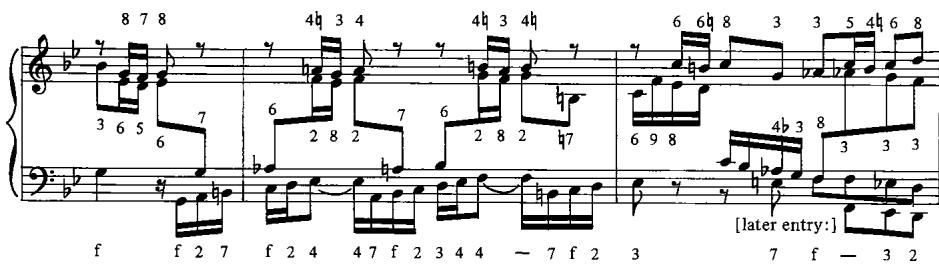
中文讲解
图例 EX.13 位置占位符:c小调赋格 BWV 847/2(出自SBB MUS. MS BACH P 401)第18b-20小节。该例证用于展示抄本上的分析性数字标记,每个数字标示某音与每乐句由f 标记的局部主音间的音程。需查看原图。
补充说明
P 401 是抄录《平均律》卷一的重要学生抄本。
第172段(P0214)
原文复述
val between a tone in the musical surface and a local tonic (finalis) designated in each phrase by the letter f. This is, among other things, a way of setting out the tonal plan of the piece in relation to the bass – thus in effect a simple reductive analysis. As such it might have provided the germ for Kirnberger’s more sophisticated analyses, including those of two movements from the Well-Tempered Clavier.
中文讲解
本段接续 P0212 末尾,解释EX.13 中数字标记的含义:每个数字标记音乐表层某音与每乐句由f 标示的局部主音(finalis)之间的音程。这是一种将作品的调性计划与低音联系起来的方式——实际上是简单的简化分析。此类分析可能成为Kirnberger 更精密分析的雏形,包括对《平均律》两乐章的分析。本段揭示巴赫教学中的简化分析传统。
补充说明
finalis 在中世纪音乐理论中指每乐句的结束音,本处借用此概念。
第173段(P0215)
原文复述
- Alfred Dürr, “Ein Dokument aus dem Unterricht Bachs?” Musiktheorie 1 (1986): 163–70. Errors have been pointed out, however, that must cast Bach’s connection with these annotations in some doubt (see Joel Lester, Compositional Theory in the Eighteenth Century [Cambridge, Mass.: Harvard University Press, 1992], 82–87; as well as the “Anmerkungen” by Heinrich Deppert, Musiktheorie 2 [1987]: 107–8). The failure of the annotator to recognize a copying mistake in BWV 851/1 is particularly telling; other analytical “errors” cited by Lester and Deppert possibly reflect only their twentieth-century understanding of modulation.
中文讲解
脚注76为正文巴赫可能添加分析标记的论断提供文献并施加限定。Dürr《“一份来自巴赫教学的文件?"》(《音乐理论》1986年第1卷163-170页)持肯定意见;但Lester《18世纪作曲理论》(1992)第82-87页及Deppert《评论》(《音乐理论》1987年第2卷107-108页)指出的错误使巴赫与这些注释的联系存疑——特别是注释者未能识别BWV 851/1 的抄写错误。Lester 和Deppert 引用的其他分析"错误"可能仅反映他们对转调的20世纪理解。本脚注既支持又限定Dürr 的论断。
补充说明
Lester 的著作是18世纪作曲理论的当代重要研究。
第174段(P0216)
原文复述
- Reductive analyses of a somewhat different type are also found in Scheibe’s Compendium musices, in the discussion of Variatio (3.1.5).
中文讲解
脚注77补充正文简化分析传统:稍有不同的简化分析也见于Scheibe《音乐纲要》变奏讨论中(3.1.5)。属于背景性引证。
补充说明
Scheibe 的简化分析与Kirnberger、巴赫圈子的简化分析并行。
第175段(P0217)
原文复述
- In Die wahren Grundsätze zum Gebrauch der Harmonie … (Berlin, 1773; reprint, Hildesheim: Georg Olms, 1970). The treatise was actually written by Kirnberger’s student Schulz, according to David Williams Beach, “The Harmonic Theories of Johann Philipp Kirnberger: Their Origins and Influences” (Ph.D. diss., Yale University, 1974), 11; but see Lester, Compositional Theory, 240, n.5. A Zugabe to vol.1 of Die Kunst des reinen Satzes includes a similar analysis of what is apparently one of Kirnberger’s own赋格 (no.35 in the thematic catalog in Ruth Engelhardt, “Untersuchungen über Einflüsse Johann Sebastian Bachs auf das theoretische und praktische Wirken seines Schülers Johann Philipp Kirnberger” [Ph.D. diss., University of Erlangen, 1974] = BWV ANH.94). The piece is misplaced in the reprint to just after the preface (Vorrede) to vol.1. A note in the Beach-Thym translation of Die Kunst des reinen Satzes (p.234) points out other eighteenth-century examples of reductive analysis.
中文讲解
脚注78为正文Kirnberger 对《平均律》两乐章的更精密分析提供详细文献:Kirnberger《真正和声使用原则》(柏林1773;Hildesheim 1970年重印本)。Beach 1974年耶鲁博士论文第11页指出该论著实为Kirnberger 学生Schulz 所作;但Lester 第240页注5提出保留意见。《纯正作曲艺术》第1卷附录包含对显然是Kirnberger 自己赋曲(Engelhardt 1974年Erlangen 博士论文主题目录第35号=BWV ANH.94)的类似分析。重印本中此曲被错误置于第1卷序言之后。Beach-Thym 英译第234页指出其他18世纪简化分析例证。本脚注展现了Kirnberger 文本谱系的复杂性。
补充说明
Kirnberger 论著的真正作者归属问题反映了18世纪学术传承的复杂性。
第176段(P0218)
原文复述
This content downloaded from 140.182.176.13 on Fri, 07 Aug 2026 05:24:24 UTC All use subject to https://about.jstor.org/terms
中文讲解
JSTOR数字图书馆访问水印页脚。
补充说明
无新增内容。
第177段(P0219)
原文复述
Yet the analysis seems strangely superficial. It reveals nothing about motivic work or large form; even the entries of the subject are not marked. Perhaps this is because the analytical notations were intended merely to identify the vertical intervals. But even in fugue there is little evidence that Bach or his students engaged in the type of precompositional planning that we tend to assume must have taken place. Planning the series of entrances ahead of time would have been necessary only in the relatively small number of fugues that follow unconventional modulatory designs or complicated contrapuntal schemes.
中文讲解
本段对前段巴赫圈"简化分析"的论断施加方法论怀疑。论点:(1) 然而该分析似乎异常表面——未揭示动机工作或大型形式,连主题进入都未标记;(2) 或许是因为这些分析记号仅意在识别垂直音程;(3) 但即便在赋格中,也很少证据表明巴赫或其学生从事我们倾向于假设的那种"前置作曲规划”;(4) 提前规划进入顺序仅在相对少数遵循非传统转调设计或复杂对位计划的赋格中才有必要。本段对"前置规划"作为巴赫赋格创作过程的常规假设提出质疑。
补充说明
本段挑战了现代学者关于巴赫赋格"精密计划"的浪漫化假设。
第178段(P0220)
原文复述
Still, ex.13 does contain evidence of Bach’s conscious concern with formal design. In m. 20, the last three notes of the bass have been doubled at the octave below; the lower notes correspond with a revised reading in the autograph. In the same measure, the soprano enters with the subject in the tonic – the first such entry since the opening exposition. Moving the bass to the deeper register lends the passage greater weight and perhaps strengthens the sense of tonic return at this point, exactly two-thirds of the way through the piece.
中文讲解
本段承认EX.13 仍包含巴赫对形式设计有意识关注的证据。论点:(1) 在m.20,低音最后三音在下方八度被重复——下方音对应亲笔稿中的修订读法;(2) 同一小节,女高音以主题在主调进入——这是自开篇呈示部以来首次此类进入;(3) 低音移至更深音区为该段增添分量,可能加强此时主调回归的感觉——恰在全曲三分之二处。本段是前段方法论怀疑的必要修正——巴赫仍关注形式设计。
补充说明
“三分之二处的主调回归"是奏鸣曲式"双重回归"原则的早期体现。
第179段(P0221)
原文复述
This is hardly the only Bach work to rely on the principle of the double return, familiar to us from its use in Classical sonata form. The principle is especially prominent in the preludes from Book 2 of the Well-Tempered Clavier, many of which are in fact sonata movements. Indeed, when Friedemann, Emanuel, and Bach’s later students began to compose, they appear to have adopted as models the regular, clearly articulated formal designs found in sonata and concerto movements by Telemann, the Graun brothers, and other German contemporaries admired by J. S. Bach himself, according to Emanuel Bach’s testimony. The remarkably close stylistic and formal parallelisms between the flute sonatas BWV 1031 and 1020 appear to reflect this, regardless of which member or members of the Bach circle actually composed them and of whether they were modeled specifically on Quantz’s sonata QV 2:18. Forkel, evidently repeating a comment that Emanuel Bach had also made to Burney, mentioned that Bach’s sons had had to invent their own styles since they could not match their father on his own terms. Yet their styles depended to a considerable degree on the individualistic elaboration of fairly simple designs, as Charles Rosen recognized in designating their generation as “mannerist.”
中文讲解
本段确立巴赫圈"双重回归"原则的重要性。论点:(1) 这远非唯一依赖"双重回归"原则的巴赫作品——该原则在古典奏鸣曲式中为人熟知,在《平均律》卷二前奏曲中尤为突出(许多实际是奏鸣曲乐章);(2) 当Friedemann、Emanuel 和巴赫后期学生开始作曲时,他们似乎采用了Telemann、Graun 兄弟等德国同时代人奏鸣曲与协奏曲乐章中规整清晰的形式设计——巴赫本人也赞赏这些人(据Emanuel 证词);(3) 长笛奏鸣曲BWV 1031 与1020 之间在风格与形式上的极接近平行反映了这一点,无论作者是谁、是否专门基于Quantz 奏鸣曲QV 2:18;(4) Forkel 显然重复Emanuel 对Burney 的评论,提到巴赫的儿子们不得不发明自己的风格,因为他们无法在巴赫的条件下与父亲匹敌;(5) 然而他们的风格在相当程度上依赖于对相当简单设计的个性化展开,正如Rosen 称他们这一代为"风格主义者"所认识到的。本段把"双重回归"从巴赫本人拓展到其儿子们的创作。
补充说明
Graun 兄弟是18世纪德国著名作曲家;Quantz 是普鲁士国王的宫廷长笛教师与作曲家。
第180段(P0222)
原文复述
sity of Erlangen, 1974] = BWV ANH.94). The piece is misplaced in the reprint to just after the preface (Vorrede) to vol.1. A note in the Beach-Thym translation of Die Kunst des reinen Satzes (p.234) points out other eighteenth-century examples of reductive analysis.
中文讲解
脚注78 延续段落(重复内容):Engelhardt 1974年Erlangen 大学博士论文=BWV ANH.94;重印本中此曲位置错误;Beach-Thym 英译第234页指出其他18世纪简化分析例证。属于支持性引证。
补充说明
原文此处脚注内容重复排版。
第181段(P0223)
原文复述
- A recent study of this very work makes just that assumption (see Ulrich Siegele, “The Four Conceptual Stages of the Fugue in C Minor, WTC 1,” in Bach Studies, 197–224).
中文讲解
脚注79为正文"前置作曲规划"假设提供反例文献:Siegele《c小调赋格 WTC 1 的四个概念阶段》(《巴赫研究》第197-224页)对这同一作品的研究恰恰作出了那种假设。属于背景性引证。
补充说明
Siegele 的研究是支持"前置规划"假设的代表性文献。
第182段(P0224)
原文复述
- Letter to Forkel, 13 January 1775.
中文讲解
脚注80为正文"巴赫本人也赞赏Telemann、Graun 兄弟等"的Emanuel 证词提供出处:1775年1月13日致Forkel 信。属于支持性引证。
补充说明
无新增内容。
第183段(P0225)
原文复述
- As Jeanne Swack argues in “Quantz and the Sonata in E-flat Major for Flute and Cembalo, BWV 1031,” read at the 1991 meeting of the American Musicological Society (forthcoming in Early Music). The vexed issue of the authorship of BWV 1031 is also discussed in Robert L. Mar-
中文讲解
脚注81 部分内容:Swack《Quantz 与降E大调长笛与大键琴奏鸣曲 BWV 1031》(1991年美国音乐学学会会议宣读,刊于《早期音乐》);Marshall 也讨论BWV 1031 归属问题。本段在"Mar-“处被截断。
补充说明
BWV 1031 归属问题在当代研究中仍持续。
第184段(P0226)
原文复述
This content downloaded from 140.182.176.13 on Fri, 07 Aug 2026 05:24:24 UTC All use subject to https://about.jstor.org/terms
中文讲解
JSTOR数字图书馆访问水印页脚。
补充说明
无新增内容。
第185段(P0227)
原文复述
The result was a significant change in the relationship between invention and design, for large form became far more conventionalized than it had been with J. S. Bach. While originality or “invention” was evidently prized, it seems often to have involved only the most superficial level of the music, structurally speaking: the addition of chromaticism to a diatonic skeleton or the半音化 to a diatonic骨架 or the substitution of unexpected embellishments or arpeggiations for expected ones. Although Friedemann and Emanuel became famous for their improvisations and their improvisatory free fantasies, they appear to have written down few such pieces until relatively late in life. Perhaps this was because such music did not seem to satisfy the demanding requirements for written composition as established at Leipzig in the 1720s and 1730s.
中文讲解
本段总结巴赫儿子们作品中的"发明与设计"关系变化。论点:(1) 结果是发明与设计关系的重大变化——大型形式远较J.S. 巴赫时代更规约化;(2) 虽然原创性或"发明"显然受重视,结构上看似乎只涉及音乐最表层——半音化加于自然音骨架,或用意外的装饰与琶音替代预期者;(3) 尽管Friedemann 和Emanuel 以即兴及即兴性自由幻想曲闻名,他们似乎直到相对晚季才写下少量此类作品;(4) 或许是因为此类音乐无法满足1720-30年代莱比锡所建立的书面作曲严格标准。本段解释为何巴赫儿子们的自由幻想曲多为晚年之作——即兴不符合其时代书面作曲的严格规范。
补充说明
“mannerist”(风格主义者)由Rosen 在《古典风格》中提出,指过度依赖既有结构并在其上施加个人风格的倾向。
第186段(P0228)
原文复述
THE FREE FANTASY
中文讲解
小节标题 THE FREE FANTASY(自由幻想曲)开启下一主题。本节聚焦于巴赫最独特的即兴性作品——自由幻想曲,以《半音阶幻想曲》为核心案例研究"理想化即兴"如何转化为书面杰作。
补充说明
free fantasy(自由幻想曲)是18世纪键盘音乐中最自由的即兴性体裁。
第187段(P0229)
原文复述
Sebastian himself was responsible for at least one exception. George Stauffer brought attention to this in the title of his article on the Chromatic Fantasy, quoting Forkel’s remark that “this fantasia is unique, and never had its like.”
中文讲解
本段引入巴赫圈内的例外——Sebastian 本人至少有一首例外作品。Stauffer 在其《半音阶幻想曲》论文标题中引用Forkel 的评价"此幻想曲独一无二,前无古人”。
补充说明
Forkel 是19世纪早期德国重要音乐学者与巴赫首位传记作者。
第188段(P0230)
原文复述
shall, “J. S. Bach’s Compositions for Solo Flute: A Reconsideration of Their Authenticity and Chronology,” Journal of the American Musicological Society 32 (1979): 465–66; reprinted, with additions, in Robert L. Marshall, The Music of Johann Sebastian Bach: The Sources, the Style, the Significance (New York: Schirmer Books, 1989), 201–25. I am grateful to Professor Swack for allowing me to see an advance copy of her paper, and to both authors for kindly sharing their thoughts with me on this and related matters.
中文讲解
脚注81 延续:Marshall《J.S. 巴赫独奏长笛作品:其真实性与编年的再考虑》(《美国音乐学学会杂志》1979年第32卷465-466页;并增补重印于Marshall《巴赫音乐:来源、风格、意义》1989年201-225页);感谢Swack 教授允许阅读其论文预印本,及两位作者分享见解。属于支持性引证。
补充说明
Marshall 是20世纪后期重要巴赫学者。
第189段(P0231)
原文复述
- Johann Nicolaus Forkel, Ueber Johann Sebastian Bachs Leben, Kunst und Kunstwerke (Leipzig, 1802; reprint, Frankfurt a.M.: H. L. Grahl, 1950), 44; BR, 333. Compare Burney, Musical Tour, 217: “he [C. P. E. Bach] has ever disdained imitation,” i.e., of his father (this passage is in the section that was replaced by Emanuel’s autobiography in the德国版).
中文讲解
脚注82为正文Forkel 关于巴赫儿子们的评论提供完整出处:Forkel《论J.S. 巴赫的生平、艺术与艺术作品》(莱比锡1802;法兰克福1950年重印)第44页;BR 333。对比Burney《音乐旅行》第217页:“他(指C.P.E. 巴赫)一直不屑于模仿”(指模仿其父,此段在德文版中被Emanuel 自传取代的位置)。属于支持性引证。
补充说明
Burney《音乐旅行》是英国音乐家Burney 在18世纪欧洲音乐旅行的记录。
第190段(P0232)
原文复述
- Charles Rosen, The Classical Style: Haydn, Mozart, Beethoven (New York: W. W. Norton & Co., 1972), 47.
中文讲解
脚注83为正文Rosen 将巴赫儿子们这一代称为"风格主义者"提供出处:Rosen《古典风格:海顿、莫扎特、贝多芬》(1972)第47页。属于支持性引证。
补充说明
Rosen《古典风格》是20世纪音乐学经典著作。
第191段(P0233)
原文复述
- Stauffer, “This fantasia …,” quoting Forkel, Bachs Leben, 55–56 (BR, 342). Forkel seems to have actively sought out other such works from Bach’s sons. He took some trouble to obtain two such works by W. F. Bach (see George B. Stauffer, ed., The Forkel-Hoffmeister & Kühnel Correspondence: A Document of the Early 19th-Century Bach Revival [New York: C. F. Peters,
中文讲解
脚注84 部分内容:Stauffer《“此幻想曲……"》引Forkel《巴赫生平》第55-56页(BR 342);Forkel 似乎主动向巴赫儿子们寻求此类作品;为获取两首W.F. 巴赫此类作品颇费周折(见Stauffer 编辑《Forkel-Hoffmeister & Kühnel 通信集》)。本段在页码处被截断。
补充说明
Hoffmeister & Kühnel 是19世纪初莱比锡的音乐出版商。
第192段(P0234)
原文复述
This content downloaded from 140.182.176.13 on Fri, 07 Aug 2026 05:24:24 UTC All use subject to https://about.jstor.org/terms
中文讲解
JSTOR数字图书馆访问水印页脚。
补充说明
无新增内容。
第193段(P0235)
原文复述
The apparent singularity of the Chromatic Fantasy has led to a romantic view of it and probably encouraged the romanticizing accretions to its文本 that are already evident in the versions stemming from Forkel; these reached a climax in the notorious edition by Hans von Bülow. The same view remains evident in twentieth-century efforts to resuscitate Spitta’s interpretation of the work as a quasi-programmatic composition.
中文讲解
本段批判”《半音阶幻想曲》独特性"叙事所滋生的浪漫化解读。论点:(1) 《半音阶幻想曲》的表面独特性导致对其的浪漫看法,可能鼓励了对文本的浪漫化增补——这些已在源自Forkel 的版本中显现,并在Bülow 的臭名昭著版中达到顶点;(2) 同一观点在20世纪重新发掘Spitta 将此曲解释为准标题性作品的尝试中仍可见。本段是批判性方法论的展现:解构《半音阶幻想曲》的浪漫神话。
补充说明
Hans von Bülow 是19世纪著名指挥家与钢琴家;Spitta 是19世纪末巴赫的伟大传记作者。
第194段(P0236)
原文复述
Yet it might be better to say merely that the fantasy was the only one of its like ever written down. For it is hard to believe that such a piece could have emerged out of thin air, as an isolated and indeed anomalous unicum in Bach’s output. Not only does it open with a formulaic harmonic progression; the entire first section is an enormous expansion of what was referred to above as the protocol of a simple prelude, and a striking progression in one of the arpeggio sections recurs in the little-known Prelude in B Minor, BWV 923. Even the idea of an embellished instrumental recitative has a likely precedent in the second movement of the “Grosso Mogul” Concerto, RV 208, one of the Vivaldi works that Bach transcribed for organ (as BWV 594), and perhaps in other works as well. The chromatic harmony and the modulating plan are exceptional, of course. Yet even the bizarre half-step dislocation, from A to Ab at the beginning of the recitative section, has a precedent of a sort in the central modulating episode in the fugue of the early Ouverture in G Minor, BWV 822, which makes an astonishing move to Gb. From such examples one gathers that the principles of tonal design explained by C. P. E. Bach in the last chapter of his 1762 treatise had been guiding his father since the first years of the eighteenth century.
中文讲解
本段提出反命题:《半音阶幻想曲》并非凭空产生的孤立异常作品,而是连续传统的产物。论据:(1) 它以公式性和声进行起始;(2) 整个第一段是早先提到的"简单前奏曲协议"的巨大展开;(3) 一个琶音段中的醒目进行重现于鲜为人知的b小调前奏曲BWV 923;(4) 装饰性器乐宣叙调的想法可能源于Vivaldi《大莫卧儿协奏曲》RV 208 第二乐章——巴赫将其改编为管风琴曲BWV 594;(5) 半音和声与转调计划确实例外,但即使是宣叙调开头从A到Ab 的怪诞半音错位,也可在g小调序曲BWV 822 赋格中央转调插段(惊人地移至Gb)中找到某种先例;(6) 从这些例证可推知,C.P.E. 巴赫1762年论著末章解释的调性设计原则,从18世纪最初几年起就已指导其父。本段将《半音阶幻想曲》置于连续传统中,消解其孤立性。
补充说明
BWV 822 是巴赫早期序曲,归属偶有争议。
第195段(P0237)
原文复述
1990], letter 28 [4 April 1803]). C. P. E. Bach’s letter of 7 October 1774 to Forkel was evidently written in reply to a request for fantasies or fantasy-like pieces (see no.191 in Ernst Suchalla, ed., Briefe von Carl Philipp Emanuel Bach an Johann Gottlob Immanuel Breitkopf und Johann Nikolaus Forkel [Tutzing: Hans Schneider, 1985]).
中文讲解
脚注84 延续:完整出处至Stauffer 编辑《Forkel-Hoffmeister & Kühnel 通信集》第28封信(1803年4月4日);C.P.E. 巴赫1774年10月7日致Forkel 信显然是对索取幻想曲或幻想性作品的回复(见Suchalla 编辑《C.P.E. 巴赫致Breitkopf 与Forkel 信集》1985年第191号)。属于支持性引证。
补充说明
Suchalla 编辑的C.P.E. 巴赫通信集是该领域重要文献。
第196段(P0238)
原文复述
- Forkel’s edition was published in 1802 (Leipzig: Hoffmeister & Kühnel) and influenced later ones by Griepenkerl (Leipzig: C. F. Peters, 1819) and Naumann (in BG 36:71ff.). Bülow’s edition (Berlin: Bote & Bock, 1859-65) is still available in reprints.
中文讲解
脚注85为正文Forkel 版及后续版本提供完整文献:Forkel 版1802年莱比锡Hoffmeister & Kühnel 出版,影响Griepenkerl 1819年莱比锡Peters 版及Naumann BG 36:71页起的版本;Bülow 版(柏林Bote & Bock 1859-65)至今仍有重印本。属于支持性引证。
补充说明
BG 是Bach-Gesellschaft(巴赫协会)全集缩写。
第197段(P0239)
原文复述
- See Wolfgang Wiemer, “Carl Philipp Emanuel Bachs Fantasie in c-Moll – ein Lamento auf den Tod des Vaters?” Bach-Jahrbuch 74 (1988): 166.
中文讲解
脚注86为正文"20世纪重提Spitta 准标题性解释"提供文献:Wiemer《C.P.E. 巴赫c小调幻想曲——父亲的挽歌?》(《巴赫年鉴》1988年第74卷166页)。属于支持性引证。
补充说明
Wiemer 的文章涉及对Emanuel 巴赫c小调幻想曲的"挽歌"解读。
第198段(P0240)
原文复述
- Compare BWV 903/1, mm. 35–36, with the progression developed sequentially in BWV 923, mm. 24–25, 27–28, 31–32, etc. BWV 923 is preserved at (among other places) the end of SBB MUS. MS BACH P 401, a copy of the first book of the Well-Tempered Clavier in the hand identified as Anonymous 5 – possibly Johann Schneider, who was praised by Mizler in 1747 for his (improvised?) organ preludes (BDOK 3, no. 565; BR, 233n). On the identity of Anonymous 5, see the discussion by Marianne Helms in Alfred Dürr, ed., NBA v/7 (Die sechs Englischen Suiten), KB, 183–95.
中文讲解
脚注87为正文”《半音阶幻想曲》与BWV 923 的并行"提供具体比较指示:对比BWV 903/1 第35-36小节与BWV 923 第24-25、27-28、31-32小节中序列展开的进行。BWV 923 除其他处外还保存于SBB MUS. MS BACH P 401 末尾——此为《平均律》卷一抄本,字迹被认定为Anonymous 5(可能是Johann Schneider,1747年被Mizler 称赞其——即兴的?——管风琴前奏曲,BDOK 3 no.565;BR 233n)。Anonymous 5 身份讨论见Helms 在Dürr 编辑《新巴赫全集》V/7(《六首英国组曲》)评注本183-195页。属于支持性引证。
补充说明
Johann Schneider 是18世纪德国管风琴家。
第199段(P0241)
原文复述
- I am grateful to Penny Zokaie for pointing out to me the presence of Recitativo movements (so designated) in Bonporti’s Inventioni, op.10 (1712), and Telemann’s Essercizii musici (1739–40), although the latter was published too late to have influenced the Chromatic Fantasy.
中文讲解
脚注88为正文"装饰性器乐宣叙调想法的先例"补充:感谢Penny Zokaie 提示Bonporti《发明》op.10(1712)与Telemann《音乐练习》(1739-40)中存在Recitativo 乐章(如此标示),但后者出版太晚,不可能影响《半音阶幻想曲》。属于辅助性文献信息。
补充说明
Bonporti 是18世纪初意大利作曲家;《音乐练习》是Telemann 重要的独奏奏鸣曲集。
第200段(P0242)
原文复述
This content downloaded from 140.182.176.13 on Fri, 07 Aug 2026 05:24:24 UTC All use subject to https://about.jstor.org/terms
中文讲解
JSTOR数字图书馆访问水印页脚。
补充说明
无新增内容。
第201段(P0243)
原文复述
Understanding the Chromatic Fantasy as one exemplar of a continuous tradition helps demystify it, making it seem less of a historical anomaly. On the other hand, although it seems more improvisatory than most Bach works, even the Chromatic Fantasy shows signs of having been rationalized or idealized. Two of the cadenza-like passages in the opening section underwent revision, and one wonders whether the chords in the recitative were originally written out, as they are in all surviving sources, or were notated in figured bass (like the chorale “sketches”), as in the recitative passages of works by W. F. Bach (fantasy F.21) and C. P. E. Bach (Prussian Sonata no.1, H.24 [w.48/1]). Here, as elsewhere, Bach must have preferred not to leave a piece in sketchy or ungrammatical form.
中文讲解
本段对"消解神秘化"论断施加平衡修正。论点:(1) 将《半音阶幻想曲》理解为连续传统的范例有助于去除其神秘色彩,但——(2) 尽管它看似比大多数巴赫作品更即兴性,《半音阶幻想曲》仍显示被"理性化"或"理想化"的迹象;(3) 开篇段中两处华彩段乐段经历修订,令人疑问宣叙调中和弦原本是否被完整写出——如所有现存抄本那样——还是以通奏低音记谱(如W.F. 巴赫幻想曲F.21、C.P.E. 巴赫《普鲁士奏鸣曲》第一首H.24的宣叙调段那样);(4) 与别处一样,巴赫显然不愿留下"草稿"或"不合语法"的形式。本段体现作者精密的辩证论证。
补充说明
F.21 是W.F. 巴赫e小调幻想曲;H.24 是C.P.E. 巴赫普鲁士奏鸣曲第一首。
第202段(P0244)
原文复述
The tradition represented by the Chromatic Fantasy hardly ended with its being written down. Attempts have long been made to connect it with the free fantasies of Bach’s sons. To the intermediary examples by Johann Ludwig Krebs, which have been placed in the 1740s, one might now add the much more important fantasy H.348, which Douglas Lee convincingly dates “before 1749.” As Lee notes, this work already shows many features of Emanuel Bach’s later fantasies, such as the use of an opening arpeggiando passage that is later recapitulated. Interspersed with this “quasi-ritornello section,” as Lee calls it, are modulatory passages in a style resembling accompanied recitative. 其调性计划 includes a central move to a key removed by one half step from the tonic, has parallels not only in Emanuel’s later works but in the Chromatic Fantasy.
中文讲解
本段把《半音阶幻想曲》传统延伸到巴赫儿子们的作品。论点:(1) 《半音阶幻想曲》所代表的传统不会因其被写下而结束;(2) 长期尝试将其与巴赫儿子们的自由幻想曲联系起来;(3) 在1740年代归位的Johann Ludwig Krebs 中介例证之外,可加入更重要的幻想曲H.348——Lee 令人信服地将其年代定为"1749年前”;(4) Lee 指出,此作已展现Emanuel 后期幻想曲的许多特征,如开头琶音段在后的重现;(5) Lee 所称"准ritornello 段"之间插入类似伴奏宣叙调风格的转调乐段;(6) 其调性计划包括中央向距主调半音的调移动,不仅与Emanuel 后期作品且与《半音阶幻想曲》有平行关系。本段建立《半音阶幻想曲》与Emanuel 早期幻想曲之间的传承链。
补充说明
Johann Ludwig Krebs 是巴赫魏玛时期的学生,常被视为巴赫儿子们的同代人。
第203段(P0245)
原文复述
- See BWV 822, mvt.1, mm.68–76. On the attribution and original form of BWV 822, see Hartwig Eichberg and Thomas Kohlhase, eds., NBA V/10 (Einzeln überlieferte Klavierwerke II und Kompositionen für Lauteninstrumente), KB, 77–85; further discussion can be found in David Schulenberg, The Keyboard Music of J. S. Bach (New York: Schirmer Books, 1992), 33.
中文讲解
脚注89为正文BWV 822 提供具体例证小节与文献:第1乐章mm.68-76;归属与原始形式见Eichberg 与Kohlhase 编辑《新巴赫全集》V/10(《独立传世键盘作品II》及鲁特琴作品)评注本77-85页;进一步讨论见作者Schulenberg《巴赫键盘音乐》(1992)第33页。属于支持性引证。
补充说明
BWV 822 的归属问题反映了18世纪序曲体裁作品的复杂性。
第204段(P0246)
原文复述
- The same argument suggests that apparent references to BWV 903/1 in later works – such as the “Reminiszenz” that Wiemer (“Bachs Fantasie in c-Moll,” 168–69) finds in the Largo section of C. P. E. Bach’s C-minor fantasy H.75/3 (w. 63/6/3) – are fortuitous.
中文讲解
脚注90为正文消解神秘化的论证补充:同样论点表明后来作品中看似引用BWV 903/1 的地方——如Wiemer 在C.P.E. 巴赫c小调幻想曲H.75/3(w.63/6/3)Largo 段发现的"回忆”——乃是巧合。属于支持性引证。
补充说明
本脚注进一步弱化对《半音阶幻想曲》影响的直接追溯。
第205段(P0247)
原文复述
- See the alternate readings for mm.17 and 21-24, respectively, in the early version BWV 903a (given in BG 36:125) and in the copy by J. T. Krebs in P 803 (see BG 36:xliii).
中文讲解
脚注91为正文"两处华彩段乐段经历修订"提供具体出处:早期版本BWV 903a(BG 36:125)及J.T. Krebs 在P 803 中的抄本(BG 36:xliii)分别显示mm.17 与mm.21-24 的替代读法。属于支持性引证。
补充说明
BG 36 是巴赫协会全集中包含《半音阶幻想曲与赋曲》的卷次。
第206段(P0248)
原文复述
- As early as 1955 Heinrich Besseler argued for the influence of J. S. Bach’s improvised fantasias on the style of his sons Emanuel and Friedemann (see “Bach als Wegbereiter,” Archiv für Musikwissenschaft 12 [1955]: 1-39; reprinted in Johann Sebastian Bach, ed. Walter Blankenburg [Darmstadt: Wissenschaftliche Buchgesellschaft, 1970], 196-246).
中文讲解
脚注92为正文"长期尝试将《半音阶幻想曲》与巴赫儿子们的自由幻想曲联系起来"提供经典文献:Besseler《巴赫作为开路者》(《音乐学档案》1955年第12卷1-39页;并重印于Blankenburg 编辑《巴赫》1970年196-246页)。属于支持性引证。
补充说明
Besseler 是20世纪重要音乐学家,其论点为后来讨论奠基。
第207段(P0249)
原文复述
- See Peter Schleuning, Die Freie Fantasie: Ein Beitrag zur Erforschung der klassischen Klaviermusik (Göppingen: Alfred Kümmerle, 1973), 109.
中文讲解
脚注93为正文"Krebs 中介例证归位于1740年代"提供文献:Schleuning《自由幻想曲:对古典钢琴音乐的研究贡献》(1973)第109页。属于支持性引证。
补充说明
Schleuning 此书是18世纪自由幻想曲研究的重要专著。
第208段(P0250)
原文复述
This content downloaded from 140.182.176.13 on Fri, 07 Aug 2026 05:24:24 UTC All use subject to https://about.jstor.org/terms
中文讲解
JSTOR数字图书馆访问水印页脚。
补充说明
无新增内容。
第209段(P0251)
原文复述
These parallels, however, probably point not to the direct modeling of one composition on another but to their emergence out of a common tradition. By the 1740s the traditions governing improvisation might have dictated the use of distant, experimental modulations as well as the free reuse of opening material as a sort of ritornello, although in practice the restatements were probably never as exact as in the书面 examples. References to recitative may have been another conventional element, although this is unlikely to have had any specific expressive significance, such as the Traueraffekt that has been claimed for it. Actual recitative has a broad range of expressive effects, and thus there is no reason to associate its imitation in instrumental music with any particular affect, although it presumably does indicate a heightened expressive intent. It is true that the poet Gerstenberg added two texts to C. P. E. Bach’s C-minor fantasy H. 75/3; both texts are related in some way to death. But while representing moments of great pathos – Hamlet’s soliloquy and the death of Socrates, respectively – neither text can be described precisely as a “lament,” and, in his letters toGerstenberg 和其他作者, C. P. E. Bach hardly encourages such hermeneutic interpretations.
中文讲解
本段对宣叙调引用的传统性与象征意义施加限制。论点:(1) 这些平行可能不指向一首作品对另一首的直接模仿,而是源于共同传统;(2) 到1740年代,即兴传统可能要求使用远距实验性转调以及作为ritornello 的开头材料自由重用——尽管实际中重现可能不像书面例证那么精确;(3) 引用宣叙调可能是另一惯例元素,虽不可能有特定表现意义(如被声称为"哀悼情感");(4) 实际宣叙调有广泛表现效果,因此无理由将器乐中对其的模仿与任何特定情感关联,尽管可能确实表明强烈的表现意图;(5) 诗人Gerstenberg 确为C.P.E. 巴赫c小调幻想曲H.75/3 添加两段文本,皆与死亡相关——哈姆雷特独白与苏格拉底之死,但皆不可精确称为"挽歌",且Emanuel 致Gerstenberg 与他人的信中几乎不鼓励此类解释学解读。本段延续前段"消解神秘化"的论证,弱化宣叙调引用的情感象征意义。
补充说明
Traueraffekt(哀悼情感)是18世纪美学中关于特定情感对应的概念;Gerstenberg 是18世纪德国诗人。
第210段(P0252)
原文复述
One attraction of recitative style may simply have been that it made possible the use of Heinichen’s “theatrical” liberties of harmony, not to mention irregularities of tempo and meter impossible in a more “composed” piece. This, however, presented a danger if the score was to fall into the wrong hands. As Emanuel wrote – with an explicit reference to Gerstenberg – “how many are there who love free fantasias, and can also understand and play them well?” The likelihood of being misunderstood was evidently one of the reasons for C. P. E. Bach’s reluctance, noted by Lee, to publish his fantasies.
中文讲解
本段进一步解释宣叙调风格的功能。论点:(1) 宣叙调风格的一个吸引力可能在于它使Heinichen 的"戏剧性"和声自由成为可能,更不用说更"完成"作品中不可能的速度与拍号不规则;(2) 但如果乐谱落入错误之手,这构成危险;(3) Emanuel 明确提及Gerstenberg 写道:“有多少人热爱自由幻想曲,又能理解并良好演奏它们?";(4) 被误解的可能性显然是Lee 所指C.P.E. 巴赫不愿出版其幻想曲的原因之一。本段从实用角度解释为何幻想曲传统保留为口头即兴,而非书面形式。
补充说明
Heinichen 关于"戏剧性"和声自由的论述见其通奏低音论著。
第211段(P0253)
原文复述
- Lee, “C. P. E. Bach and the Free Fantasia,” 180.
中文讲解
脚注94为正文"Lee 令人信服地定H.348 为'1749年前’“提供页码(Lee 文章第180页)。属于支持性引证。
补充说明
无新增内容。
第212段(P0254)
原文复述
- Schleuning, Die Freie Fantasie, 136.
中文讲解
脚注95为正文"宣叙调不可能有特定表现意义(如被声称为Traueraffekt)“提供文献:Schleuning《自由幻想曲》第136页。属于支持性引证。
补充说明
Schleuning 在该页讨论了"哀悼情感"主张的局限性。
第213段(P0255)
原文复述
- On these texts, see E. Eugene Helm, “The ‘Hamlet’ Fantasy and the Literary Element in C. P. E. Bach’s Music,” Musical Quarterly 58 (1972): 281–82.
中文讲解
脚注96为正文"Gerstenberg 为C.P.E. 巴赫c小调幻想曲H.75/3 添加两段文本"提供文献:Helm《“哈姆雷特"幻想曲与C.P.E. 巴赫音乐中的文学元素》(《音乐季刊》1972年第58卷281-282页)。属于支持性引证。
补充说明
Helm 是C.P.E. 巴赫研究的重要学者。
第214段(P0256)
原文复述
- Heinichen’s General-Bass in der Composition allows various licenses in the “theatrical” treatment of dissonances (theatralische Resolutiones der Dissonantien) (see George Buelow, “Heinichen’s Treatment of Dissonance,” Journal of Music Theory 6 [1962]: 216-73).
中文讲解
脚注97为正文"Heinichen 的’戏剧性’和声自由"提供文献:Heinichen《作曲中的通奏低音》允许"戏剧性"不协和音处理(theatralische Resolutiones der Dissonantien)的各种自由;详见Buelow《Heinichen 对不协和音的处理》(《音乐理论杂志》1962年第6卷216-273页)。属于支持性引证。
补充说明
Heinichen 的"戏剧性"概念是18世纪和声理论中的重要技术术语。
第215段(P0257)
原文复述
This content downloaded from 140.182.176.13 on Fri, 07 Aug 2026 05:24:24 UTC All use subject to https://about.jstor.org/terms
中文讲解
JSTOR数字图书馆访问水印页脚。
补充说明
无新增内容。
第216段(P0258)
原文复述
That the unwritten free fantasy was, however, already flourishing by the 1740s is evident from a number of sonatas by Emanuel Bach from that decade that incorporate apparent borrowings from the improvised genre. For example, a formula used in H.348 to prolong the dominant of G minor recurs – in the same key – in the奏鸣曲 H.47 (w.65/17), whose first movement opens with an unbarred passage in the style of a fantasy that serves as the opening theme (see ex.14). The sonata dates from 1747 and may in fact have been composed before the fantasy was written down. Yet the point of the passage is clear: to incorporate fantasy style into a sonata, just as Emanuel had previously incorporated recitative into his First Prussian Sonata of 1740. The idea might have been suggested not only by the Chromatic Fantasy but also by instances in Sebastian’s cantatas where recitative interrupts choruses or arias. Such effects would have had little meaning if the interruption were not immediately recognized as representing the incursion of a free or improvisatory genre into the formal architecture of a sonata movement or an aria.
中文讲解
本段以Emanuel 1740年代奏鸣曲证明"未写下"的自由幻想曲传统。论点:(1) 未写下的自由幻想曲在1740年代已盛行——从Emanuel 该十数年奏鸣曲中借用即兴体裁的明显痕迹可见;(2) 例证:H.348 中用于延长g小调属音的公式在同调奏鸣曲H.47(w.65/17)中重现,后者第一乐章以幻想曲风格的无小节段落作开头主题(例14);(3) 该奏鸣曲作于1747年,可能事实上作于幻想曲被写下之前;(4) 该段意义明确——将幻想曲风格纳入奏鸣曲,正如Emanuel 此前在1740年《第一普鲁士奏鸣曲》中纳入宣叙调;(5) 这一想法可能不仅由《半音阶幻想曲》也由Sebastian 康塔塔中宣叙调打断合唱或咏叹调的实例所提示;(6) 若中断不能立即被识别为自由或即兴体裁侵入奏鸣曲乐章或咏叹调的形式建构,此类效果将毫无意义。本段构建了"幻想曲风格"在Emanuel 奏鸣曲中的有意识运用,并追溯到J.S. 巴赫康塔塔中的先例。
补充说明
H.47 与H.348 同调(g小调)的巧合强化了影响关系的论证。
第217段(P0259)
原文复述
But even if fantasies, along with preludes, fugues, and chorales, were commonly improvised in the Bach household, Sebastian’s apparent use of written exercises and Emanuel Bach’s testimony that his father generally composed away from the keyboard imply a certain suspicion of improvisation. To judge from his own late publications, Sebastian wished to be remembered as a rational, even scientific, composer of learned contrapuntal works. Emanuel, too, was reluctant to write down and publish his improvisations, but eventually did so, as he wrote to Breitkopf, so that after his death people might know what
中文讲解
本段对巴赫与即兴的关系施加辩证视角。论点:(1) 即便幻想曲及前奏曲、赋格、众赞歌在巴赫家中被普遍即兴,Sebastian 显然使用书面练习以及Emanuel 关于父亲通常不在键盘前作曲的证词,都暗示对即兴的某种怀疑;(2) 从Sebastian 自己的晚期出版作品判断,他希望作为学习对位作品的理性甚至科学的作曲家被记住;(3) Emanuel 也不愿写下并出版其即兴,但最终这样做——如他致Breitkopf 所写——是为了身后人们知道"什么是”。句子在"what"后被截断,下段接续。
补充说明
“a Fantast”(幻想家)一词是Emanuel 自嘲式地描述自己的术语。
第218段(P0260)
原文复述
- Letter to Forkel, 10 February 1775; no.191 in Suchalla, ed., Briefe.
中文讲解
脚注98为正文Emanuel 引文"how many are there who love free fantasias…“提供出处:1775年2月10日致Forkel 信;Suchalla 编辑信集第191号。属于支持性引证。
补充说明
无新增内容。
第219段(P0261)
原文复述
- Lee, “C. P. E. Bach and the Free Fantasia,” 183.
中文讲解
脚注99为正文"被误解的可能性是Emanuel 不愿出版幻想曲的原因之一”(Lee 指出)提供页码:Lee 文章第183页。属于支持性引证。
补充说明
无新增内容。
第220段(P0262)
原文复述
- The passage in question is not visible in the facsimile from H.348 given in Lee, “C. P. E. Bach and the Free Fantasia,” 180. H.47 is best consulted in the facsimile edition by Darrell Berg, The Collected Works for Solo Keyboard by Carl Philipp Emanuel Bach, 1714–1788, 6 vols. (New York: Garland Publishing, 1985), 3:291ff.
中文讲解
脚注100为正文"H.348 中用于延长g小调属音的公式在H.47 中重现"提供版本指引:所讨论段落在Lee 文章第180页H.348 影印本中不清晰;H.47 最佳查阅版本为Berg 编辑《C.P.E. 巴赫1714-1788 独奏键盘作品集》(1985)第3卷291页及以后。属于支持性引证。
补充说明
Berg 编辑的多卷本是C.P.E. 巴赫键盘作品的重要现代版本。
第221段(P0263)
原文复述
- See, e.g., the tenor aria “Die schäumenden Wellen” in Cantata 81.
中文讲解
脚注101为正文"Sebastian 康塔塔中宣叙调打断合唱或咏叹调的实例"提供例证:康塔塔81 中男高音咏叹调"Die schäumenden Wellen”。属于支持性引证。
补充说明
康塔塔81《耶稣基督,我的生命》是J.S. 巴赫著名作品。
第222段(P0264)
原文复述
This content downloaded from 140.182.176.13 on Fri, 07 Aug 2026 05:24:24 UTC All use subject to https://about.jstor.org/terms
中文讲解
JSTOR数字图书馆访问水印页脚。
补充说明
无新增内容。
第223段(P0265)
原文复述
EX.14. C. P. E. Bach: a, Fantasy in Eb Major, H.348, from first section; b, Sonata in G Minor, H.47 (w.65/17), mvt.1, from m.1
中文讲解
图例 EX.14 完整图注:C.P.E. 巴赫 a. 降E大调幻想曲 H.348 第一段;b. g小调奏鸣曲 H.47(w.65/17)第1乐章,从第1小节起。该例证用于直接比较"用于延长g小调属音的公式"在幻想曲与奏鸣曲中的平行呈现。需查看原图。
补充说明
本例是本节核心论点的视觉证据。
第224段(P0266)
原文复述
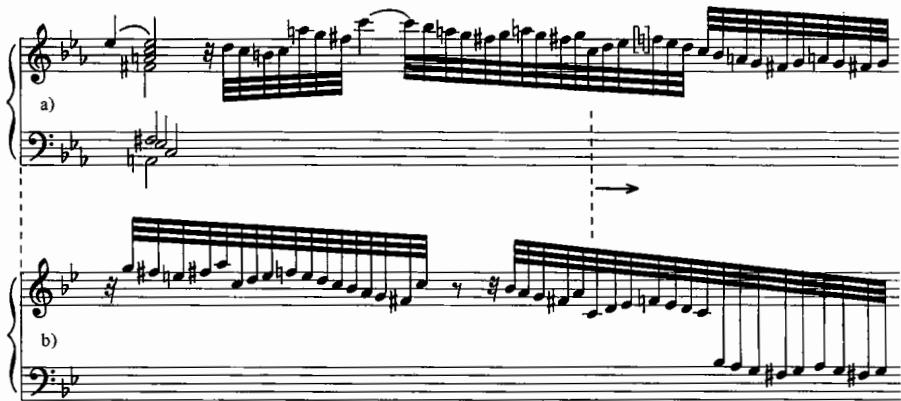
中文讲解
第39页的乐谱示例图像占位符之一。原文标注"图像或乐谱示例”,可能是EX.14 内容的图像。需查看原图。
补充说明
无具体图注编号,仅保留位置。
第225段(P0267)
原文复述
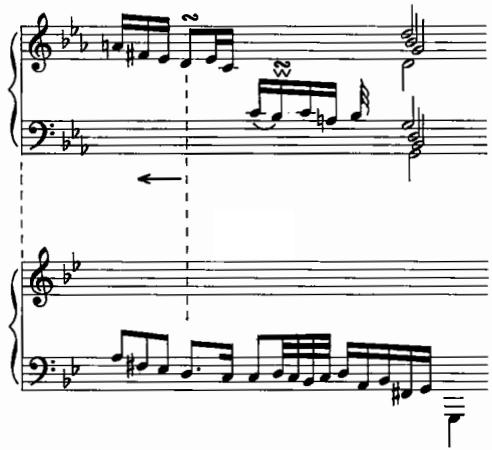
中文讲解
第39页的乐谱示例图像占位符之一。原文标注"图像或乐谱示例”,可能是EX.14 内容的图像。需查看原图。
补充说明
无具体图注编号,仅保留位置。
第226段(P0268)
原文复述
a Fantast he had been. The change in musical aesthetics that had occurred during the intervening thirty years is clear.
中文讲解
本段接续 P0259 末尾:“a Fantast he had been”(他曾是一个幻想家)。句中"a Fantast"是Emanuel 自嘲式描述——他作为"幻想家"曾是什么样的人。结尾"这三十年间发生的音乐美学变化是明显的"是对比J.S. 巴赫时代与Emanuel 时代美学差异的总结。
补充说明
Emanuel 的自嘲"a Fantast"揭示了他对自己即兴家身份的双重态度。
第227段(P0269)
原文复述
There is, however, a constant factor, one that seems to have been a special characteristic of music in the Bach circle: that embellishments, cadenzas, even entire pieces that might have originated in disciplined but still improvisatory flights of fancy could – indeed, must – be fixed and brought to perfection by writing them down as precisely as possible. To be sure, writing down a free fan-
中文讲解
本段总结巴赫圈音乐的特殊常数:即便来自有纪律但仍即兴的奇想的装饰、华彩段甚至整部作品,都可——实际必须——被尽可能精确地记下并完善。本段开启全文终曲的总结:记下即兴是巴赫圈特殊品质。句子在"fan-“处被截断,下段接续。
补充说明
本段是全文核心论点的最后一次完整表述。
第228段(P0270)
原文复述
- Letter of 15 October 1782; no.123 in Suchalla, ed., Briefe.
中文讲解
脚注102为正文"Emanuel 致Breitkopf 希望身后人们知道他是Fantast"提供出处:1782年10月15日信;Suchalla 编辑信集第123号。属于支持性引证。
补充说明
Emanuel 此信反映其晚年对自身遗产的反思。
第229段(P0271)
原文复述
This content downloaded from 140.182.176.13 on Fri, 07 Aug 2026 05:24:24 UTC All use subject to https://about.jstor.org/terms
中文讲解
JSTOR数字图书馆访问水印页脚。
补充说明
无新增内容。
第230段(P0272)
原文复述
tasy, even if only as part of a sonata, was an admission that music did not always follow the rules and patterns of eighteenth-century style, even as formulated and taught in the Bach household. Bach’s habit (shared by his son Emanuel) of revising, indeed editing, his keyboard music led to an image – encouraged by Forkel, among others – of Bach as the model composer of an unblemished corpus of masterpieces. This view tended to emphasize the archaic contrapuntal aspects of the keyboard works over their “galant” elements while suppressing the early, more improvisatory pieces – discounted as youthful indiscretions by Forkel – and the early versions of familiar works such as the Well-Tempered Clavier. But the messy reality of surviving early versions belies this view, as does the likelihood that improvisations not preserved would have presented a somewhat different picture of Bach. In short, we cannot consider the history of music in the school of J. S. Bach solely from the surviving scores; they are at best a pale reflection of music as studied in the Bach circle.
中文讲解
本段是全文结尾段,提出总结性反思。论点:(1) 记下自由幻想曲(即便仅作为奏鸣曲的一部分)等于承认音乐并非总遵循18世纪风格规则与模式——即便如巴赫家庭所表达与教授;(2) 巴赫修订——甚至编辑——其键盘音乐的习惯(其子Emanuel 同样)导致一种形象(Forkel 等鼓励)——巴赫作为无瑕杰作文库的典范作曲家;(3) 这种看法倾向于强调键盘作品中过时的对位因素而非"华丽"元素,同时压制早期更即兴的作品——被Forkel 视为年轻时不检点——以及《平均律》等熟悉作品的早期版本;(4) 但现存的混乱早期版本事实反驳了这种看法,未保存的即兴也本会展示巴赫的不同形象;(5) 总之,我们不能仅凭现存乐谱考虑J.S. 巴赫学校中的音乐史;它们至多是巴赫圈子所研究音乐的苍白反映。本段以方法论反思结束全文:研究巴赫圈子必须超越传世书面乐谱的局限。
补充说明
“galant”(华丽风格)是18世纪中期的音乐风格;本段批评Forkel 倾向于将巴赫塑造为"无瑕典范”。
第231段(P0273)
原文复述
AUTHOR’S NOTE
中文讲解
小节标题 AUTHOR’S NOTE(作者注)开启补充说明,作者在此补充Joel Lester 新著的相关内容。
补充说明
Author’s Note 是学术著作中常见的作者补充说明。
第232段(P0274)
原文复述
Joel Lester’s Compositional Theory in the Eighteenth Century (Cambridge, Mass.: Harvard University Press, 1992) appeared too late for me to incorporate substantial references to it in the body of this essay. I am grateful to the editor for permitting me to add the following:
中文讲解
本段说明Lester《18世纪作曲理论》(1992)出版太晚,作者未能将实质性引证纳入正文;感谢编辑允许加入以下补充内容。
补充说明
Lester 此书是18世纪作曲理论的重要当代学术著作。
第233段(P0275)
原文复述
Lester’s most important suggestion regarding the Bach circle is that C. P. E. Bach, Kirnberger, and others incorporated significant elements of Rameau’s harmonic theories into their thought. In particular, Lester suggests that Nichelmann and Kirnberger could have had a “common source for their fundamental-bass ideas” (p.255). Elsewhere he cites the claim by Christoph Gottlob Schröter to have studied Rameau’s Traité de l’harmonie (1722) with Johann Nicolaus Bach of Jena (pp.124–25) and argues that C. P. E. Bach “orders his chapters [on thoroughbass] according to [Rameau’s] theory” (p.58).
中文讲解
本段陈述Lester 关于巴赫圈子的最重要论点:(1) C.P.E. 巴赫、Kirnberger 等在其思想中融入了Rameau 和声理论的重要元素;(2) Lester 认为Nichelmann 与Kirnberger 可能"有共同的根本低音观念来源"(第255页);(3) 他引用Schröter 关于曾与耶拿Johann Nicolaus Bach 一同研究Rameau《和声论》(1722)的主张(124-25页);(4) 并认为C.P.E. 巴赫"按[Rameau]理论安排其通奏低音章节"(第58页)。本段补充正文中未涉及的Rameau 影响问题。
补充说明
Rameau《和声论》(1722)是18世纪和声理论里程碑著作。
第234段(P0276)
原文复述
C. P. E. Bach’s reported remark that he and his father were “anti-Ramellian” (see Lester, p.232) implies that both were nevertheless acquainted with some aspect of Rameau’s thought. But, as Lester shows, it is difficult to determine how familiar Rameau’s theories were even to writers like Marpurg who acknowledged his influence. J. S. Bach himself used the term Fundamental-Noten for the underlying bass in works like the Goldberg Variations, but this has little to do with Rameau apart from the use of the word “fundamental.”
中文讲解
本段处理"反Rameau"标签的复杂性。论点:(1) C.P.E. 巴赫据称说与父亲都是"反Rameau 派"(Lester 第232页),但这意味着他们都熟悉Rameau 思想的某些方面;(2) 然而如Lester 所示,即便对承认Rameau 影响的Marpurg,也难以确定其对Rameau 理论熟悉程度;(3) J.S. 巴赫本人在《哥德堡变奏曲》等作品中用Fundamental-Noten 一词指底层低音,但这与Rameau 除了"根本"一词外无太多关联。本段表明:尽管巴赫圈子可能在术语上吸收Rameau,实质理论继承需谨慎评估。
补充说明
“anti-Ramellian”(反Rameau 派)揭示巴赫圈对法国和声理论的复杂态度。
第235段(P0277)
原文复述
The ordering of C. P. E. Bach’s chapters on figured bass only incidentally resembles Rameau’s. Proceeding from purely consonant to increasingly dissonant chords, they treat each progression through a strictly contrapuntal type of analysis reflecting an orientation toward harmony and improvisation very different from that of Rameau, whose figured-bass method (bk.4 of the Traité) is close in its surprisingly pragmatic approach to earlier French treatises. Rameau, for example, offers advice on fingering, while Emanuel makes few concessions to the convenience of the player even when contrapuntal considerations lead to progressions that lie awkwardly under the hands. Far from “reflecting the gradual disappearance of extempore thoroughbass realizations” (Lester, p.52), the attention to correct voice leading evidently demanded even in improvised accompaniments suggests the degree to which Bach trained his pupils to be guided by rigorous musical思考 rather than by considerations of performance technique.
中文讲解
本段深入对比C.P.E. 巴赫与Rameau 通奏低音方法。论点:(1) C.P.E. 巴赫通奏低音章节的安排只是表面上类似Rameau;(2) 从纯协和到渐增不协和和弦,他对每种进行的处理通过严格对位式分析,反映出与Rameau 截然不同的和声与即兴取向;(3) Rameau 的通奏低音方法(《和声论》第4卷)在其惊人的实用方法上更接近早期法国论著——如Rameau 提供指法建议,而Emanuel 几乎不为演奏者便利让步,即便对位考虑导致进行在手下不便;(4) 远非"反映即兴通奏低音实现的逐渐消失"(Lester 第52页),即便在即兴伴奏中也显然要求正确声部进行的关注,提示巴赫训练其学生以严格音乐思维——而非演奏技术考量——为指导。本段是关键的方法论澄清:表面类似不等于理论继承。
补充说明
本段进一步反驳了Lester 关于Emanuel 受Rameau 系统影响的论点。
第236段(P0278)
原文复述
This content downloaded from 140.182.176.13 on Fri, 07 Aug 2026 05:24:24 UTC All use subject to https://about.jstor.org/terms
中文讲解
JSTOR数字图书馆访问水印页脚。
补充说明
无新增内容。
第237段(P0279)
原文复述
APPENDIX
中文讲解
小节标题 APPENDIX(附录)开启按主题分类的补充材料清单,是文章最后主体部分。
补充说明
附录按主题列举相关文献、作品及曲目,作为正文论证的实物证据库。
第238段(P0280)
原文复述
Sources
中文讲解
附录子标题 Sources(来源),开启附录的第一部分——文献来源说明。
补充说明
此子标题提示读者完整文献信息在正文注释中。
第239段(P0281)
原文复述
Full bibliographic information is found in the notes.
中文讲解
附录来源说明:完整文献信息见正文注释。
补充说明
此句为附录使用说明。
第240段(P0282)
原文复述
1. WRITINGS BY BACH STUDENTS AND ASSOCIATES
中文讲解
附录第1节标题:巴赫学生与相关者的著作。本节列出与正文论证相关的巴赫圈人物的理论著作。
补充说明
此附录按主题分类排列文献与作品。
第241段(P0283)
原文复述
Niedt, Musicalische Handleitung (1700–1717/21; manuscript extracts copied? by a Bach student)
中文讲解
附录第1节第1项:Niedt《音乐指导》(1700-1717/21;手稿节录可能由巴赫学生抄录)。此为正文中提到的变奏原则的核心文献。
补充说明
该项目包含来源类型(出版物)及可能的巴赫学生抄本。
第242段(P0284)
原文复述
Scheibe, Compendium musices (MS, ca.1736)
中文讲解
附录第1节第2项:Scheibe《音乐纲要》(手稿,约1736)。此为反映巴赫教学影响的次要文献。
补充说明
此为正文中讨论Scheibe 与巴赫联系的关键文献。
第243段(P0285)
原文复述
Marpurg, Abhandlung von der Fuge (1753–54), etc.
中文讲解
附录第1节第3项:Marpurg《赋格论》(1753-54)等。Marpurg 是18世纪重要的赋格理论家,其论著是研究Kirchhoff 与巴赫圈的关键。
补充说明
Marpurg 论著是研究18世纪赋格与partimento 教学的重要文献。
第244段(P0286)
原文复述
C. P. E. Bach, Versuch (1753–62); letters to Forkel
中文讲解
附录第1节第4项:C.P.E. 巴赫《试论》(1753-62);致Forkel 信。C.P.E. 巴赫的《试论》是18世纪键盘演奏与作曲理论最重要的著作;致Forkel 信包含关于其父教学与本人美学的重要证词。
补充说明
C.P.E. 巴赫《试论》是研究巴赫教学传统的第一手文献。
第245段(P0287)
原文复述
Kirnberger, Kunst des reinen Satzes (1771–79), etc.
中文讲解
附录第1节第5项:Kirnberger《纯正作曲艺术》(1771-79)等。Kirnberger 作为巴赫学生的代表,其理论著作是对巴赫教学最系统的展示。
补充说明
Kirnberger 是巴赫教学最重要的代言人。
第246段(P0288)
原文复述
This content downloaded from 140.182.176.13 on Fri, 07 Aug 2026 05:24:24 UTC All use subject to https://about.jstor.org/terms
中文讲解
JSTOR数字图书馆访问水印页脚。
补充说明
无新增内容。
第247段(P0289)
原文复述
SBB P 401 (Anonymous 5). Well-Tempered Clavier, Book 1: preludes in D minor, B minor; fugue in C minor
中文讲解
附录第2节第1项:SBB P 401(Anonymous 5)。《平均律键盘曲集》卷一:d小调、b小调前奏曲;c小调赋格。此为抄本上含简化分析标记的关键抄本。
补充说明
P 401 是研究巴赫教学分析传统的核心抄本。
第248段(P0290)
原文复述
SBB P 1075 (Penzel). Well-Tempered Clavier, Book 1: preludes in C major, C minor, D major, Eb minor, E minor
中文讲解
附录第2节第2项:SBB P 1075(Penzel)。《平均律键盘曲集》卷一:C大调、c小调、D大调、降e小调、e小调前奏曲。此为另一份含简化分析的抄本。
补充说明
Penzel 是18世纪重要的抄写员。
第249段(P0291)
原文复述
Kirnberger, Die wahren Grundsätze (1773). Well-Tempered Clavier, Book 1: prelude in A minor; fugue in B minor
中文讲解
附录第2节第3项:Kirnberger《真正和声使用原则》(1773)。《平均律键盘曲集》卷一:a小调前奏曲;b小调赋格。Kirnberger 对《平均律》乐章的分析是其简化分析方法论的实例。
补充说明
Kirnberger 的简化分析反映了巴赫教学传统的延伸。
第250段(P0292)
原文复述
This content downloaded from 140.182.176.13 on Fri, 07 Aug 2026 05:24:24 UTC All use subject to https://about.jstor.org/terms
中文讲解
JSTOR数字图书馆访问水印页脚。
补充说明
无新增内容。
第251段(P0293)
原文复述
3. MUSICAL WORKS TRANSMITTED IN THE BACH CIRCLE
中文讲解
附录第3节标题(部分):巴赫圈子中传承的音乐作品。
补充说明
此节开启作品清单。
第252段(P0294)
原文复述
EXEMPLIFYING “VARIATION”
中文讲解
附录第3节子标题:体现"变奏"的作品。本节列举体现变奏技法的具体作品。
补充说明
此子标题明确本节主题。
第253段(P0295)
原文复述
Variation-suites (including BWV 833) in the Andreas Bach Book and the Möller Manuscript
中文讲解
附录第3节第1项:Andreas Bach Book 与Möller Manuscript 中的变奏组曲(包括BWV 833)。这些是变奏传统的核心实物证据。
补充说明
BWV 833 是巴赫唯一的真正变奏组曲。
第254段(P0296)
原文复述
This content downloaded from 140.182.176.13 on Fri, 07 Aug 2026 05:24:24 UTC All use subject to https://about.jstor.org/terms
中文讲解
JSTOR数字图书馆访问水印页脚。
补充说明
无新增内容。
第255段(P0297)
原文复述
Composition and Improvisation in the School of J. S. Bach
中文讲解
本页出现的章节大标题:“Composition and Improvisation in the School of J. S. Bach”(巴赫学校的作曲与即兴)。这是文章的总标题,出现在此页作为版面元素。
补充说明
此为文章主标题的重复出现。
第256段(P0298)
原文复述
Concerto transcriptions, BWV 592–96, 972–87 (esp. BWV 975, mvt.3) Agrémens and doubles in English Suites, BWV 806a, 806–11 Alternate movements and doubles in suites BWV 818–19 Richter, allemande and courante (Clavierbüchlein for W. F. Bach) Polonoise BWV ANH.117 (two versions in Clavierbüchlein for Anna Magdalena Bach) Alternate versions (BWV 855a/855) of Well-Tempered Clavier, Book 1, prelude in E minor Goldberg Variations BWV 988 Violin sonata BWV 1021 Triple concerto BWV 1044 C. P. E. Bach, varied reprises in many pieces; Veränderungen … für Scholaren, H.164; sonata H.150 “zweymahl durchaus verändert” (H.156–57)
中文讲解
附录第3节作品的延续列表:协奏曲改编 BWV 592-96、972-87(特别BWV 975 第3乐章);英国组曲BWV 806a、806-11 中的agréments 与doubles;组曲BWV 818-19 中的替代乐章与doubles;Richter 的allemande 与courante(弗里德曼笔记本);Polonoise BWV ANH.117(安娜·玛格达莱娜笔记本两版本);《平均律》卷一e小调前奏曲的替代版本BWV 855a/855;《哥德堡变奏曲》BWV 988;小提琴奏鸣曲BWV 1021;三重协奏曲BWV 1044;C.P.E. 巴赫多曲中的变化再现;《为学者而作的变奏》H.164;奏鸣曲H.150"完全变奏两遍"(H.156-57)。本列表系统呈现体现变奏技法的作品类型。
补充说明
agréments 与doubles 都是18世纪装饰与变奏实践。
第257段(P0299)
原文复述
This content downloaded from 140.182.176.13 on Fri, 07 Aug 2026 05:24:24 UTC All use subject to https://about.jstor.org/terms
中文讲解
JSTOR数字图书馆访问水印页脚。
补充说明
无新增内容。
第258段(P0300)
原文复述
4. REALIZED FIGURED BASSES
Of Albinoni, op. 6, no. 6 (by H. N. Gerber, corrected by J. S. Bach) Of the trio sonata from the Musical Offering, BWV 1079/3 (by Kirnberger; in BDOK 3, no. 855)
中文讲解
附录第4节标题:实现通奏低音。第1项:Albinoni op.6 no.6(H.N. Gerber 实现,巴赫批改);第2项:《音乐奉献》中的三重奏鸣曲BWV 1079/3(Kirnberger 实现,BDOK 3 no.855)。本节呈现巴赫圈通奏低音实现的实物证据。
补充说明
Gerber 是18世纪音乐学者与作曲家;这些实物展示了巴赫教学的具体实践。
第259段(P0301)
原文复述
- “SKETCHES,” PARTIMENTI, AND RELATED PIECES Keyboard chorales in SBB P 802 (BWV 722a, 729a, 732a, 738a; Kast Incerta 26, 29) Fantasy BWV 944/1; preludes BWV 923, 846a/1, 872a/1 Preludes and fugues BWV 907–8 Mattheson, Exemplarische Organisten-Probe (1719) Short fugues in SBB P 296 Müthel, Technische Übungen C. P. E. Bach, Miscellanea musica, H.867
中文讲解
附录第5节标题:“草稿”、partimenti 及相关作品。列举:SBB P 802 中的键盘众赞歌(BWV 722a、729a、732a、738a;Kast Incerta 26、29);幻想曲BWV 944/1;前奏曲BWV 923、846a/1、872a/1;前奏曲与赋格BWV 907-8;Mattheson《管风琴师示范》(1719);SBB P 296 中的小赋格;Müthel《技术练习》;C.P.E. 巴赫《音乐杂录》H.867。本节集中展示未完成或部分完成的即兴性训练素材。
补充说明
这些作品与partimento 教学传统直接相关。
第260段(P0302)
原文复述
6. PRESERVED IMPROVISATIONS (?)
中文讲解
附录第6节标题:保存的即兴(?)。括号中的问号体现作者对"真正即兴"归属的保留态度。
补充说明
标题中的"?“是关键的方法论标记。
第261段(P0303)
原文复述
“Cadenzas” in BWV 894, 1050, 1052, etc. Well-Tempered Clavier, Book 2: prelude in Bb major, fugue in G major (revision of BWV 902/2) Ricercar a 3 from the Musical Offering, BWV 1079/1 Fantasies: BWV 903/1; H.348, 75/3, 160, etc.; F.14-23
中文讲解
附录第6节内容:BWV 894、1050、1052 等中的"华彩段”;《平均律》卷二降B大调前奏曲、G大调赋格(BWV 902/2 的修订);《音乐奉献》中的三声部里切尔卡BWV 1079/1;幻想曲:BWV 903/1;H.348、75/3、160 等;F.14-23。本节列举被认为可能源自即兴的作品。
补充说明
本节是全文论点的实物证据库。
第262段(P0304)
原文复述
- STUDENT EXERCISES (?) ILLUSTRATING PARTICULAR COMPOSITIONAL TECHNIQUES Preludes, BWV 924a, 931 (in Clavierbüchlein for W. F. Bach) Pieces in Clavierbüchlein for Anna Magdalena Bach
中文讲解
附录第7节标题:展示特定作曲技法的学生练习(?)。第1项:前奏曲BWV 924a、931(弗里德曼笔记本);第2项:安娜·玛格达莱娜笔记本中的作品。问号表示作者对学生作品与师生合作作品的归属保留态度。
补充说明
本节集中展示可能的学生练习作品。
第263段(P0305)
原文复述
This content downloaded from 140.182.176.13 on Fri, 07 Aug 2026 05:24:24 UTC All use subject to https://about.jstor.org/terms
中文讲解
JSTOR数字图书馆访问水印页脚。
补充说明
无新增内容。
第264段(P0306)
原文复述
SCHULENBERG
中文讲解
作者署名 SCHULENBERG。本节末尾再次出现作者姓名作为版面分隔。
补充说明
JSTOR电子版本中作者姓名作为版面分隔标识。
第265段(P0307)
原文复述
Suite, Kast Incerta 68
中文讲解
附录第7节作品之一:Kast Incerta 68 组曲。此为附录 P0088 详细讨论的那首归属存疑的G大调组曲。
补充说明
Incerta 68 是本研究重要的归属存疑作品。
第266段(P0308)
原文复述
Trio sonata BWV 1038 (same bass as violin sonata BWV 1021; arranged and expanded as BWV 1022)
中文讲解
附录第7节作品之一:三重奏鸣曲BWV 1038(与小提琴奏鸣曲BWV 1021 同低音;改编并扩展为BWV 1022)。本作品展示了"扩展设计"作为教学实践的具体例证。
补充说明
BWV 1038、1021、1022 之间的关系是巴赫圈子作品扩展的典型案例。
第267段(P0309)
原文复述
Flute sonatas BWV 1020, 1031
中文讲解
附录第7节作品之一:长笛奏鸣曲BWV 1020、1031。两首在风格与形式上的极接近平行反映巴赫学生作曲采用Telemann 等的规整清晰形式设计。
补充说明
BWV 1020 与1031 的归属问题在当代研究中仍持续。
第268段(P0310)
原文复述
Keyboard chorales BWV 691a, ANH.73 (? by C. P. E. Bach)
中文讲解
附录第7节作品之一:键盘众赞歌BWV 691a、ANH.73(可能由C.P.E. 巴赫所作)。问号表示Emanuel 归属的保留态度,与正文 P0199 的讨论对应。
补充说明
BWV ANH.73 是ritornello 插入众赞歌前奏曲的典型例证。
第269段(P0311)
原文复述
This content downloaded from 140.182.176.13 on Fri, 07 Aug 2026 05:24:24 UTC All use subject to https://about.jstor.org/terms
中文讲解
JSTOR数字图书馆访问水印页脚。
补充说明
无新增内容。
脚注 / 边栏 / 图表 / 附加信息(如有)
本节为David Schulenberg《J.S. 巴赫学校的作曲与即兴》主体部分(含部分脚注与附录),包含大量乐谱示例(EX.1-EX.14)及一个分类附录。附录按七大主题分类:1) 巴赫学生与相关者著作;2) 巴赫作品中的分析注释;3) 体现"变奏"的音乐作品;4) 已实现的通奏低音;5) “草稿”、partimenti 及相关作品;6) 保存的即兴(带问号);7) 展示特定作曲技法的学生练习(带问号)。脚注与正文交叉引用密集,体现了作者论证的丰富学术基础。
本节还包含一个"作者注",补充Joel Lester 1992年新著关于巴赫圈子吸收Rameau 元素的论点,作者既承认Lester 提示的可能性,又通过具体分析指出巴赫圈子对位式通奏低音方法与Rameau 的实质性差异。
💡 本节核心要点
- 巴赫圈子的即兴与作曲共享"和声即发明之母"的原则——主题材料被视为从通奏低音线条实现中产生,这一原则跨越主调与对位体裁。
- 巴赫与学生拥有可重复使用的"公式"词汇库,包括装饰乐句、起句手势、终止模式等,这些公式在多部作品中几乎逐字重现。
- 公式化创作导致归属判定的复杂性,许多作品可能是师生合作的产物或共同财产,类似早期吟唱传统。
- 整体设计遵循两条原则:成熟18世纪风格的圆润转调设计被理解为一系列不同调性中的终止;大型设计是小型设计的扩展。
- 《半音阶幻想曲》非孤立异常作品,而是连续传统的产物——其表面上独特的元素(半音和声、转调设计、宣叙调引用)均有先前传统先例。
- 巴赫圈音乐的特殊常数:即便来自有纪律但仍即兴的奇想的作品,都可被尽可能精确地记下并完善。
- 研究巴赫圈不能仅凭现存乐谱——它们至多是所研究音乐的苍白反映,必须结合未保存即兴的可能性。
- 巴赫早期变奏技法来自北德传统(Niedt、Reinken、北德管风琴学派),通过变奏组曲与partimento 教学进入巴赫教学法。
🔑 关键术语
- variation(变奏):在本节中特指"通奏低音线条的展开式实现"(composing-out),即把简洁低音线条通过添加对位、装饰等手段扩展为完整作品的过程,不同于旋律主题的多样化变奏。
- partimento:18世纪通奏音数字低音的教学与即兴练习,是巴赫圈子作曲与即兴训练的重要方法。
- formula(公式):本节中指可重复使用的固定乐句或模式——装饰性乐句、起句手势、终止模式等,跨多部作品重现的共享词汇库元素。
- schema(schema):Gjerdingen 提出的概念,指听者从各种作品重现中推断出的模式类型——比formula 更精确的分析概念,提供许多公式的基础。
- cantus firmus(固定旋律):以既有旋律(通常为众赞歌)作为对位基础的传统技法,本节中用于解释巴赫将某些赋格主题当作固定旋律处理。
- double return(双重回归):奏鸣曲式中主调主题在展开部后回归的原则,本节用于解释《平均律》卷二前奏曲及巴赫圈的整体设计。
- figured bass(通奏低音):用数字标注低音上方和声进行的记谱方式,是本节变奏技法与partimento 教学的核心工具。
- stile antico(古风格):指文艺复兴时期的复调风格,本节用于讨论18世纪赋格与古风格传统之间的张力。
- Traueraffekt(哀悼情感):18世纪美学中关于特定情感对应的概念,本节中被作者批评为对器乐宣叙调引用的过度象征化解读。
- Nachlassverzeichnis(遗作目录):Emanuel 巴赫身后出版的作品遗作目录,本节用于讨论Emanuel 不承认某些学生练习性作品的原因。