目录
C1 What Is an Invention?
- S1 [描述性拆分] Bach’s “Straightforward Instruction” and the Title “Inventio”
- 页码:1-1
- S2 [描述性拆分] Invention as a Rhetorical Topic of Discovery
- 页码:1-2
- S3 [描述性拆分] The Rhetorical Divisions of Oratory and Their Musical Adaptation
- 页码:2-3
- S4 [描述性拆分] Inventio and Dispositio in Eighteenth-Century Musical Theory
- 页码:3-4
- S5 [描述性拆分] Bridging Rhetorical Theory and Bach’s Compositional Practice
- 页码:5-5
- S6 [描述性拆分] Mattheson’s Threefold Scheme and His Loci Topici
- 页码:6-6
- S7 [描述性拆分] Mattheson on Disposition and the Limits of His Rhetorical Mapping
- 页码:7-7
- S8 [描述性拆分] Was Bach a Musical Rhetorician? Reconsidering Kirkendale and Birnbaum
- 页码:8-8
- S9 [描述性拆分] Bach’s Teaching Methods and the Working Notion of Invention
- 页码:9-9
- S10 [描述性拆分] Introducing the C Major Invention (BWV 772) as a Sample Analysis
- 页码:10-10
- S11 [描述性拆分] Identifying Inventions as Repeated Functional Segments
- 页码:11-12
- S12 [描述性拆分] Hierarchy of Compositional Processes and Inventions as Self-Transforming Mechanisms
- 页码:13-13
- S13 [描述性拆分] The Invention: Deriving α₁ and α₂ from mm. 1–2
- 页码:14-14
- S14 [描述性拆分] The Invention: β as Melodic Chain of X(INV) over Parallel Tenths
- 页码:15-15
- S15 [描述性拆分] The Invention: Harmonic Upstaging and the Manuscript Evidence for β
- 页码:16-17
- S16 [描述性拆分] Transforming β: Voice-Exchange, Mode-Switch, and the Failed Melodic Inversion
- 页码:18-19
- S17 [描述性拆分] The Disposition: Mapping α and β Across the Work
- 页码:20-21
- S18 [描述性拆分] Choosing β₃ and Composing a New Ending
- 页码:22-22
- S19 [描述性拆分] The Elaboration: γ and δ as Connective Links
- 页码:22-23
- S20 [描述性拆分] The Elaboration: δ and ε—Bach’s Cadential Craftsmanship
- 页码:24-24
- S21 [描述性拆分] The Decoration and Execution: Ornaments Gracing Inventions
- 页码:25-25
- S22 [描述性拆分] Summary of the C Major Invention Analysis
- 页码:26-26
- S23 [描述性拆分] Mechanism versus Organicism: The Project’s Theoretical Posture
- 页码:27-28
- S24 [描述性拆分] Style Criticism and the Historically Imaginable Analysis
- 页码:29-29
- S25 [描述性拆分] Reconciling Historical Language with Present-Day Analysis
- 页码:30-30
- S26 [描述性拆分] The Paradox of Invention and the Plan of the Book
- 页码:31-32
C2 Composing against the Grain
- S27 [描述性拆分] Bach’s 1730 Leipzig Memorandum on the State of Church Music
- 页码:33-33
S1 [描述性拆分] Bach’s “Straightforward Instruction” and the Title “Inventio”
第1段(P0001)
原文复述
What Is an Invention?
中文讲解
这是一级标题(章节标题),位于全书首页第一段,用问句形式点出全书的核心议题:何为“invention”(创意/发明/构思)。作者用一个看似简单却承载着丰富修辞学与音乐史内涵的术语作为开篇,是为了把读者引向一个被现代人忽视的问题——巴赫所用的“invention”并不是今天意义上的“创造力”,而是一个从古典修辞学借来的、有着完整方法论传统的概念。问句本身即暗示后文将围绕该词的含义、谱系与转变展开论证。
补充说明
此标题是全书(或第一部分)的纲领性问题,所有后续讨论都将围绕“invention”这一术语在巴赫时代、古典修辞学传统、以及18世纪末美学转型中的不同含义展开。
第2段(P0002)
原文复述
Sometime in 1723, Johann Sebastian Bach, Capellmeister to his Serene Highness the Prince of Anhalt-Cöthen, inscribed the title page to a small handwritten volume of keyboard pieces which were to be understood as a
中文讲解
本段在语法上是一个跨段长句的前半句,原文因换页或排版原因被切分至下一段。内容给出了三组关键信息:时间(Sometime in 1723,1723年前后)、作者头衔(Johann Sebastian Bach, Capellmeister to his Serene Highness the Prince of Anhalt-Cöthen,约翰·塞巴斯蒂安·巴赫,安哈尔特-克滕宫廷乐长)、以及事件(为一部手抄键盘乐曲集撰写扉页)。作者特意写明巴赫的宫廷头衔与亲笔抄写这两个细节,意在强调该卷册不是出版作品,而是巴赫本人题写献词的私人教学手稿,这直接影响了下文对其教学意图的判定。下一段紧接的“a”引出该卷册的完整副标题。
补充说明
Capellmeister(宫廷乐长)一职表明巴赫当时为克滕宫廷服务;Anhalt-Cöthen(安哈尔特-克滕)的小宫廷以器乐为主,不设唱诗班,这解释了巴赫为何在克滕时期大量创作纯器乐键盘作品。该卷册最终在1801年由著名巴赫学生Johann Nicolaus Forkel以印刷形式首次公开,题为《十五首二声部创意曲》(15 Inventionen),并附有十五首三声部交响曲(15 Sinfonien, BWV 787–801)。
第3段(P0003)
原文复述
Straightforward Instruction, in which amateurs of the keyboard, and especially the eager ones, are shown a clear way not only (1) of learning to play cleanly in two voices, but also, after further progress, (2) of dealing correctly and satisfactorily with three obbligato parts; at the same time not only getting good inventions, but developing the same satisfactorily, and above all arriving at a cantabile manner in playing, all the while acquiring a strong foretaste of composition.
中文讲解
本段是巴赫1723年手抄曲集扉页副标题的英译文,原文为德语。作者将其完整保留并加脚注1,意在让读者直接面对巴赫本人对作品意图的自述。这段话实际上包含了三层递进的教学目标:(1)首先教会业余键盘学习者“干净地演奏二声部”,这是入门;(2)进一步“正确而令人满意地处理三个 obbligato 声部”,即三声部对位;(3)同时获得“好的创意(inventions)并使其得到令人满意的发展”,最终达到“歌唱般的(cantabile)演奏风格”,并“对作曲获得强烈的预尝(a strong foretaste of composition)”。巴赫用括号编号 (1)(2) 标明进阶路径,说明他将二声部与三声部写作视为通向作曲的两个台阶;而“obbligato part”“cantabile manner”“foretaste of composition”等术语揭示了这部作品不只是练习曲,而是作曲教学法的一部分——“invention”在此既是作品的标题,也是学生必须学会“发现并发展”的作曲要素本身。
补充说明
脚注1:此处巴赫副标题的原文为德语“Auffrichtige Anleitung …”,其中“auffrichtig”意为“正直/坦率/直截了当”,本书英译为“Straightforward”;副标题全文包括对二声部(zwei Stimmen)与三声部(drey obligate Partien)写作能力的培养,并强调“gute Inventiones … nicht allein zu erfinden, sondern auch selbige recht wohl durchzuführen”之意,与英译本一致。obbligato part 指“对位中必须严格按规则独立进行”的声部;cantabile 强调声部进行应如人声般流畅歌唱。
第4段(P0004)
原文复述
The fifteen pieces for two voices that followed (BWV 772–786) were arranged in ascending order by key and were each labeled an Inventio. The works were not, in fact, newly composed, for they had already been entered in the Clavierbüchlein vor Wilhelm Friedemann Bach, a musical notebook for Bach’s eldest son, in which Johann Sebastian and the twelve-year-old Wilhelm Friedemann jointly copied this set of two-part imitative works sometime between the autumn of 1722 and the end of winter, 1723. In the Clavierbüchlein, however, Bach had entitled each work a Praeambulum—originally an organist’s extemporized introduction to an ensemble work, now commonly referring to a short prelude. For his “Straightforward Instruction,” then, Bach apparently changed the title of these pieces from Praeambulum to Inventio to stress their pedagogical value: they were designed not only to encourage the pupil’s facility on the keyboard, he tells us, but also to serve as models for good “inventions” and their subsequent development.
中文讲解
本段交代了三组事实与一项关键推断。事实一:随附的十五首二声部作品(BWV 772–786,巴赫作品编号体系中的标准编号)按调性上行排列,每首命名为 Inventio。事实二:这些作品并非新创,其前身出现在《为威廉·弗里德曼·巴赫所记键盘小册》(Clavierbüchlein vor Wilhelm Friedemann Bach)中,那是巴赫为长子所用的教学笔记本;这部笔记的抄写时间是1722年秋至1723年冬末,由父亲与当时十二岁的长子共同完成。事实三:在《键盘小册》中,这些曲目被称为 Praeambulum(引子),原本指管风琴师在合奏作品前即兴演奏的开场段落,到巴赫时代已常用来指短前奏曲。基于这三组事实,作者提出关键推断:巴赫在编制新的教学卷册时,有意将标题从 Praeambulum 改为 Inventio,目的在于凸显其教学价值——这些作品不仅要训练演奏者的键盘技巧,更要作为“好的创意及其后续发展”的范例。由此,标题的改变本身成为一项史料:它说明在巴赫的教学体系中,演奏训练与作曲训练是合二为一的,而“invention”一词承载的核心就是“主题构思及其对位化展开”。
补充说明
脚注2:巴赫《键盘小册》至今仍保存于柏林国家图书馆—普鲁士文化基金会(Staatsbibliothek zu Berlin – Preußischer Kulturbesitz),抄本号为 Mus.ms. Bach P 202;其中收录了二声部与三声部创意曲的早期版本(编号 P1–P15、P16–P30),前者的原始标题即为 Praeambulum。威廉·弗里德曼·巴赫(WFB)生于1710年11月22日,1722年秋时为十二岁,与本段所述时间一致。BWV 772–786 即后世所称的“二声部创意曲”十五首。
第5段(P0005)
原文复述
Bach’s use of the word “invention” may seem confusing unless one realizes that it did not name a recognized musical genre, but rather was a term borrowed from rhetoric used colloquially to designate the essential thematic idea underlying a musical composition. Bach’s title-page, in other words, understands “invention” as a conventional metaphor for the idea behind a piece, a musical subject whose discovery precedes full-scale composition. It is important to realize that this sense of invention (inventio in Latin, heuresis in Greek, Erfindung in German), along with a whole range of related meanings, must be recovered from a time when rhetoric, much like etymology and natural philosophy, was a modeling science par excellence. That is, one must return to a time before the late eighteenth-century Enlightenment, when critical theory abandoned rhetoric in favor of aesthetics, replacing the perfectible art of invention with the godlike realm of creativity. As late as Alexander Gerard’s Essay on Taste (1759), one reads that “the first and leading quality of genius is invention.” By the time of Kant’s third Critique (1790), on the other hand, the paradigm has shifted so that “creative imagination is the true source of genius and the basis of originality.”
中文讲解
本段是全书的概念奠基段,作者系统阐明了为什么不能用现代“创作/创意”去理解巴赫的“invention”。第一层澄清:在巴赫时代,invention 不是一个音乐体裁,而是一个从古典修辞学借来的术语,用来指称支撑一首作品的“核心主题意念”,即先于完整作曲而存在的“构思”。第二层把术语放入更广的智识史:inventio(拉丁)/ heuresis(希腊)/ Erfindung(德语)属于修辞学传统,而修辞学在17、18世纪初仍与词源学、自然哲学一样,是一门“建模型的科学(modeling science par excellence)”——也就是说,它提供了一套发现并组织观念的可教可学方法,而非神秘灵感。第三层是历史断代:作者明确划界——“必须回到18世纪晚期启蒙运动之前”,因为彼时批评理论抛弃修辞学、转向美学(aesthetics),用“创造力的神圣王国(the godlike realm of creativity)”取代“可教可学的发明之术(the perfectible art of invention)”。作者随后用两个时间锚点展示这一范式转移:1759年,亚历山大·杰拉德(Alexander Gerard)在《论趣味》(Essay on Taste)中仍把“invention”列为天才的第一品质;仅仅三十一年后,1790年康德《判断力批判》(third Critique)则已把“创造性想象力(creative imagination)”重新定义为天才的真正源头。由此,“invention”从一种可习得的、规则化的发现方法,被替换为不可习得、不可教的天才属性——这正是巴赫标题所处世界与现代理解之间的鸿沟。
补充说明
脚注3:Alexander Gerard(1728–1795),苏格兰阿伯丁大学(King’s College, Aberdeen)神学与修辞学教授;其《论趣味》(Essay on Taste, 1759)一书汇集了英国经验主义美学讨论,把“invention”作为天才的第一要素。康德《判断力批判》指1790年出版的《判断力批判》(Kritik der Urteilskraft),其中§49 将“独创性”与“天才”明确绑定于“创造性的想象力”。修辞学五艺中的 inventio(构思/发现论)是寻获论证素材的方法论,与 dispositio(布局)、elocutio(措辞)、memoria(记忆)、pronuntiatio(表达)并列;这一框架是巴赫时代作曲教学(尤其是对位法的“寻找主题”教学)所共享的智识资源。
脚注 / 边栏 / 图表 / 附加信息(如有)
本节出现的脚注共三条:脚注1标注巴赫1723年扉页副标题的英译来源与德文原貌;脚注2标注《为威廉·弗里德曼·巴赫所记键盘小册》的抄写时间、抄写者及与本卷册曲目的关系;脚注3标注1759年杰拉德《论趣味》对“invention”作为天才首要品质的论断。三条脚注共同支撑一个核心论点:巴赫的“invention”不是浪漫主义意义上的“天才创意”,而是修辞学传统中可教可学的“构思”,它在18世纪末才被美学的“创造力”范畴所取代。
💡 本节核心要点
- 巴赫1723年为一部键盘教学手稿题写副标题,明确将作品定位为从二声部到三声部对位、最终通向作曲预尝的渐进教学法。
- 该卷册所收十五首二声部作品(BWV 772–786)并非新创,原以 Praeambulum 之名收入1722–1723年间为长子威廉·弗里德曼所抄的《键盘小册》;巴赫将标题改为 Inventio 旨在强化其作为作曲范例的教学价值。
- “Invention”在巴赫时代并非音乐体裁名称,而是借自古典修辞学的术语,意为作品背后的核心主题构思(inventio / heuresis / Erfindung)。
- 在修辞学作为“建模型科学”的智识语境中,invention 是一项可教、可学、可臻于完美的发现方法,而非不可习得的天才灵感。
- 18世纪末启蒙运动之后,批评理论由修辞学转向美学,“invention”被“创造性想象力”取代:杰拉德1759年仍把 invention 列为天才第一品质,康德1790年已把天才归于创造性的想象力。
- 本节的论证目的,是通过澄清巴赫标题所处的概念史坐标,为后续以修辞学范畴重读巴赫作品铺平道路。
🔑 关键术语
- Inventio:源自拉丁语,本义为“发现/构思”,是古典修辞学五艺之首“inventio”(构思论)所命名的方法论范畴;在巴赫作品中并非音乐体裁,而是“作品背后核心主题意念”之意,其发现先于完整作曲。
- Praeambulum:原指管风琴师在合奏作品前的即兴引子,到巴赫时代已常指短前奏曲;巴赫在《键盘小册》中以此命名这些作品,后在1723年教学卷册中改名为 Inventio,以突出作曲教学意涵。
- Clavierbüchlein vor Wilhelm Friedemann Bach:《为威廉·弗里德曼·巴赫所记键盘小册》,巴赫为长子使用的教学笔记本,约1722–1723年间父子共同抄写;其中保存了二声部与三声部创意曲的早期版本。
- obbligato part:“必须严格按对位规则独立进行”的声部;巴赫用其指代三声部写作中每个声部都需保持独立对位线条的写作要求,是通往严格复调写作的关键环节。
- cantabile manner:“歌唱般的演奏风格”,要求每个键盘声部的进行如人声般连贯流畅,是巴赫认为业余演奏者通过本卷册应达到的最高演奏境界。
- heuresis / Erfindung:heuresis 为希腊语对应词,Erfindung 为德语对应词,三者(inventio / heuresis / Erfindung)共同指古典修辞学意义上的“构思/发现”,而非现代意义上的“创造”。
- modeling science:“建模型科学”,指修辞学、词源学、自然哲学在17–18世纪初所共享的智识特征——以可教的规则和模型去“发现”并组织真理,而非依赖不可传授的天才灵感。
- creativity / 创造性想象力:18世纪末由美学(康德《判断力批判》为代表)所确立的天才范畴,把 invention 替换为不可教、不可学的“神性”创造力,是本书所要与之划清界限的现代概念。
S2 [描述性拆分] Invention as a Rhetorical Topic of Discovery
第1段(P0006)
原文复述
Dreyfus, Laurence. Bach and the Patterns of Invention. E-book, Cambridge, Mass.: Harvard University Press, 1996, https://hdl.handle.net/2027/heb05561.0001.001. Downloaded on behalf of Indiana University, Bloomington.
中文讲解
本段并非正文,而是电子书页面上方的版式信息(页眉/文献出处行):依次给出作者 Laurence Dreyfus、书名 Bach and the Patterns of Invention、版本形式 E-book、出版地 Cambridge, Mass.、出版社 Harvard University Press、出版年份 1996、永久链接,以及下载来源说明 Downloaded on behalf of Indiana University, Bloomington。它提示读者当前文本摘自哈佛大学出版社的电子版,且该电子版由印第安纳大学布卢明顿分校代为下载;并不承担论证功能,仅用于文献标识。
补充说明
该条目属于图书馆电子借阅的元数据行;其作用在于让后续引用可追溯到具体电子版本,与正文论证无内容上的承接关系。
第2段(P0007)
原文复述
According to the traditional usage, invention denoted not only the subject matter of an oration, but also a mechanism for discovering good ideas. An orator had at his disposal an entire array of such tools—called the “topics of invention”—and with these topics one devised or “invented” a fruitful subject for a discourse. One basic technique of invention was to study the works of reputable authors both to develop good taste and to spur one’s own ingenuity, what Johann Mattheson called the locus exemplorum. In keeping with this pedagogical belief, Bach’s “Straightforward Instruction” not only provides suitable examples of “good inventions” but also demonstrates how they can be properly developed (“auch selbige wohl durchzuführen”). This important notion of development or realization, moreover, implies that a successful invention must be more than a static, well-crafted object, but instead like a mechanism that triggers further elaborative thought from which a whole piece of music is shaped. This is why Bach alludes to invention as “a foretaste of composition”: by crafting a workable idea, one unlocks the door to a complete musical work.
中文讲解
本段为小节核心命题段,作用是给出“invention(发明/构思)”一词在传统修辞学中的定义,并由此桥接到 Bach 的教学实践。中文要点如下:
一、修辞学传统中的 invention 具有双重含义:它既指演说的题材本身,也指发现好题材的机制。也就是说,发明既是一种“产物”,也是一种“方法”。
二、修辞学家提供了一整套用于构思的工具,称为“topics of invention”(发明论题),演说者借助它们来 devise 或 “invent” 出富有内容的论述题材。
三、其中一项基本技法是研究权威作者的作品,既培养良好品味,又激发自己的创造力——Johann Mattheson 将其命名为 locus exemplorum(范例论题/先例论证)。也就是说,传统教学相信:通过研习典范可以训练出构思能力。
四、Bach 的《简易指南》(“Straightforward Instruction”)正体现了这种教学观念:它不仅提供“好发明”的合适范例,还示范如何把这些范例充分展开(德文“auch selbige wohl durchzuführen”)。注意 Bach 的教学不只是给出静态样板,而是把范例作为可被“发展”的东西。
五、由此推出一项关键的概念升级:成功的 invention 不是一个静态、精心制作的“物件”,而是一种触发器——它启动进一步的展开性思维,并由此塑造出整部音乐作品。
六、最后一句以 Bach 自述式的比喻作结:invention 是 composition 的“先尝”(“foretaste of composition”)。换言之,一旦造出一个可用的想法,整部作品的门户就随之打开。
本段在小节论证中承担奠基作用:先把 invention 重新安置回修辞学的“发现方法”传统,再借 Mattheson 的 locus exemplorum 把 Bach 的教材实践归入这一传统,从而为下文引用 Forkel、C. P. E. Bach、Mattheson 的材料做铺垫。容易误解之处在于:invention 在此并非指“创造力的神秘天赋”,而是一种可教、可学、可由范例与论题工具加以训练并加以展开的技艺。
补充说明
段落内“topics of invention”出自古典修辞学的五艺(inventio, dispositio, elocutio, memoria, pronuntiatio)中的 inventio;“locus exemplorum”属于修辞 loci(论题/论证处所)系统中以先例为依据的一类,作者直接借 Mattheson 的命名强调 Bach 的范例教学。句尾“foretaste of composition”这一比喻为 Bach 自述,故以引号标记,与本段德文短语“auch selbige wohl durchzuführen”共同构成 Bach 观点的两条原话线索。
第3段(P0008)
原文复述
From a variety of evidence it is clear that Bach, in keeping with many of his German contemporaries, considered “invention” a fundamental concept underlying both the training and the activity of a composer. Johann Nikolaus Forkel—whose information stemmed from correspondence with the composer’s two eldest sons—tells how Bach’s pupils had to master thoroughbass and four-part chorales before trying to write down their own ideas: “He also made his pupils aim at such excellencies in their exercises; and, till they had attained a high degree of perfection in them, he did not think it advisable to let them attempt inventions of their own. Their sense of purity, order, and connection in the parts must first have been sharpened on the inventions of others, and have become in a manner habitual to them, before he thought them capable of giving these qualities to their own inventions.” Carl Philipp Emanuel Bach, moreover, reports that his father considered invention a talent that must manifest itself early on in a youth’s training: “As for the invention of ideas, my late father demanded this ability from the very beginning, and whoever had none he advised to stay away from composition altogether.” This belief in a talent for invention, though, did not mean that Bach minimized the role of arduous study in the pursuit of inventions. A “Straightforward Instruction” in “getting good inventions” is proof that he put stock in a rigorous approach to composition, as was his reported answer to those who asked him how he mastered the art of music: “I have had to work hard; anyone who works just as hard will get just as far.” While there was undeniably some false modesty in this confession, one can also read it as a tribute to the exacting demands of craftsmanship, a skill requiring certain natural talents, but one demanding nurture and self-improvement as well. Bach’s attitude was probably not far removed from Johann Mattheson’s, who writes in the Vollkommener Capellmeister (1739) that “though invention . . . is not easily taught nor learned . . . still, when necessary, many a person can be helped and be pointed in a direction which will assist his innate gifts and with which he would be on the right path.”
中文讲解
本段承接 P0007 对 invention 概念的修辞学定位,提供多重历史证据,说明 Bach 及其德意志同代人如何把 invention 同时视作作曲训练与作曲活动的基本概念,并以之平衡“天资”与“苦学”两端。中文讲解按论证层次展开:
一、整体论断。多种证据表明,Bach 与许多德意志同时代人一样,把 invention 视为作曲家训练与创作活动的基础概念。注意这一论断被作者本人作为“共识”提出,因此后文证据的作用不是“创立”而是“落实”该论断。
二、Forkel 的间接证据。作者首先诉诸 Johann Nikolaus Forkel——其材料来源于与 Bach 两位长子的通信——描述 Bach 的教学顺序:学生必须先精通通奏低音(thoroughbass)与四声部圣咏体(four-part chorale)的写作,才被允许记下自己的“inventions”。所引 Forkel 长句中出现的两个对照尤其重要:(1) 学生先在“他人之 invention”上磨砺纯净、秩序、连接的感知,使之成为习惯;(2) 然后才被认为有能力把同样的品质赋予“自己的 inventions”。这一对照直接呼应了 P0007 借 Mattheson 的 locus exemplorum 所确立的“通过典范养成能力”的教学逻辑。
三、C. P. E. Bach 的家族证据。其次,Carl Philipp Emanuel Bach 报告其父把 invention 视为必须在少年训练早期即显露的天赋:“对观念的发明而言,我已故的父亲从一开始便要求这种能力;凡不具备者,他便劝其不要踏足作曲。”这一句把 invention 从单纯的训练结果提升为某种“早熟的可识别资质”,但它并不否认训练,而是规定了进入训练的门槛。
四、Bach 自述的“苦学”立场。作者随即明确指出:承认 invention 的天赋色彩,并不意味着 Bach 轻视苦修。其《简易指南》本身就是“获得好发明”的严谨方法的明证;另一条证据是 Bach 被问及如何精通音乐时的回答——“我曾不得不勤苦用功;任何人若同样勤苦,也能走到同样远。”这一自述同时承担两层意义:表面上或许含有谦逊姿态,但作者主张也可读作对手艺严格性的致敬——既需要天资,也需要教养与自修。
五、Mattheson 的横向参照。最后以 Johann Mattheson《完全乐队指挥》(Vollkommener Capellmeister, 1739)中的名言作结:尽管 invention 不易教、不易学,但在必要时,许多人可以借助引导而走上正路,借此扶持其天生禀赋。作者由此把 Bach 的态度与 Mattheson 并置,暗示在十八世纪德语音乐圈,发明既非纯天赋亦非纯技艺,而是一种需要引导与训练才能被激活的能力。
本段在小节中的作用是“以证据加固定义”:先通过教学史(Forkel)与家族回忆(C. P. E. Bach)证明 invention 是 Bach 训练体系的核心,再用 Bach 自己的“勤学”自述与 Mattheson 的并行论断,修正可能出现的“纯天才论”误读,为下一节进入 Bach 教材的具体实践铺平道路。容易误解之处是“天赋—苦学”的二分;本段明确显示 Bach 的立场是二者并存而非择一。
补充说明
段落内部存在两组并列:Forkel 与 C. P. E. Bach 并列作为“他人记述”的来源;Bach 自述与 Mattheson 引文并列作为“作者本人—同时代人”的旁证。脚注序号 4、5、6、7 在本段与 P0007 中分布,其中脚注 4 大概率对应 Mattheson 的 locus exemplorum、脚注 5 对应 C. P. E. Bach 的回忆、脚注 6 对应 Bach “勤学”自述、脚注 7 对应 Mattheson Vollkommener Capellmeister 引文,但本任务输入未提供脚注正文,故此处仅作对照提示而不补写脚注内容。
脚注 / 边栏 / 图表 / 附加信息(如有)
本节(P0007、P0008)共引用 4 处脚注(标注 4、5、6、7),分别对应 Mattheson 的 locus exemplorum、C. P. E. Bach 关于 invention 早现天赋的回忆、Bach 关于“勤学”之自述、以及 Mattheson《Vollkommener Capellmeister》(1739)中关于 invention 可经引导被扶持的论断。脚注在正文中承担两类作用:(1) 为“invention 作为可教可学之能力”提供同时代权威来源(如 Mattheson);(2) 为 Bach 本人的教学与自述提供传记性来源(如 Forkel 转述、C. P. E. Bach 回忆)。无图表或边栏材料。
💡 本节核心要点
- 传统修辞学中的 invention 既是演说的题材,也是发现好题材的方法;Bach 的 invention 概念被作者明确归入这一传统。
- Johann Mattheson 命名的 locus exemplorum(以研习权威作者作品来培养构思能力)是 Bach《简易指南》教学法的理论先驱。
- Bach 的 invention 不是静态“物件”,而是触发后续展开性思维的机制,故 Bach 称其为 composition 的“先尝”。
- Forkel 与 C. P. E. Bach 的证据表明 invention 在 Bach 训练体系中既是需要长期打磨的能力,也是必须早期显露的天资。
- Bach 本人“勤学方能致远”的自述与 Mattheson“invention 虽难教却可被引导扶持”的论断,共同把 invention 定位为天资与教养并行的事业,而非纯天才或纯技艺。
🔑 关键术语
- invention:在本节中既指演说的题材或音乐中的“可工作之观念”(产物义),也指发现此类题材/观念的整套论题与范例方法(机制义);Bach 以之作为作曲训练与创作活动的核心概念。
- topics of invention:传统修辞学中供演说者“发明”/构思题材的一整套论题工具,作者以此说明 invention 并非凭空灵感,而有可循的发现机制。
- locus exemplorum:Johann Mattheson 所命名的修辞“论题”类别,指通过研习权威作者作品来培养品味并激发构思;本节中作为 Bach 范例教学法的理论依据。
- foretaste of composition:Bach 自述式比喻,把 invention 视为整部作品的“先尝”,强调 invention 是开启完整作品的门户,而非终点。
- thoroughbass / four-part chorale:Forkel 记载的 Bach 教学顺序:学生必须先精通通奏低音与四声部圣咏体,才被允许写下自己的 inventions;本节用以证明 invention 在 Bach 体系中位于扎实对位训练之后。
- Vollkommener Capellmeister (1739):Johann Mattheson 关于“完全乐队指挥”之著作;本节援引其中关于 invention“可经引导扶持天生禀赋”的论断,与 Bach “勤学致远”的态度并置,作为同时代共识的旁证。
S3 [描述性拆分] The Rhetorical Divisions of Oratory and Their Musical Adaptation
第1段(P0009)
原文复述
Bach and the Patterns of Invention
中文讲解
这是一段页眉(running header),位于第 2 页顶部,仅重复全书的标题 “Bach and the Patterns of Invention”。它本身不承担论证功能,仅起到版面标识与章节定位的作用,提示读者当前所在的是 Dreyfus 该书的内文部分。
第2段(P0010)
原文复述
Dreyfus, Laurence. Bach and the Patterns of Invention. E-book, Cambridge, Mass.: Harvard University Press, 1996, https://hdl.handle.net/2027/heb05561.0001.001. Downloaded on behalf of Indiana University, Bloomington
中文讲解
这是一段自动生成于电子书阅读器的版心脚注/版权水印信息,标明作者 Laurence Dreyfus、书名、版本(E-book)、出版地(Cambridge, Mass.)、出版机构(Harvard University Press)、出版年份(1996)、Handle 数字资源链接,以及下载代理(on behalf of Indiana University, Bloomington)。它属于辅助的版本与来源信息,不参与正文论证,仅供读者核实所引用电子文本的来源与下载条件。
第3段(P0011)
原文复述
As a methodical activity, invention belongs to the so-called “divisions” of rhetoric which hark back to Cicero and which were well known in early eighteenth-century Germany—at least in their schematic outline—to anyone with even a modest classical education. According to Cicero’s De Inventione, there are five stages in creating an oration: (1) invention (inventio); (2) arrangement (dispositio); (3) style (elocutio); (4) memory (memoria); and (5) delivery (pronuntiatio or actio). Cicero explains them as follows in De Oratore: “[An orator] must first hit upon what to say; then manage and marshal his discoveries [inventa], not merely in orderly fashion, but with a discriminating eye for the exact weight, as it were, of each argument; next go on to array them in the adornments of style; after that keep them guarded in his memory; and in the end deliver them with effect and charm.” ⁸ One can easily see in this classic formulation the obvious affinities between inventing and delivering a speech and composing and performing a piece of music, although it was not entirely obvious, even to humanists, to what extent the analogy between music and oratory should hold. Seventeenth-century German music theory, for example, took over the idea of the divisions of oratory but reduced their number from five to three. Christoph Bernhard, a pupil of Heinrich Schütz, writes that “there otherwise belong to Composition three things: Inventio (Discovery), Elaboratio (Amplification), and Executio (Realization or Performance), which display a rather close relationship with oratory or rhetoric.” ⁹
中文讲解
本段交代全书核心概念——“invention(发明/构思)”——的古典修辞学来源,因此是全章论证的基础铺陈。
一、它首先指出 invention 是一项“方法性的活动”,隶属于所谓修辞学的“divisions(分部/步骤)”。这些步骤可远溯至西塞罗,在十八世纪初的德国,即使只受过一般古典教育的人也能掌握其纲要。这就为下文把音乐创作纳入修辞框架提供了文化和教育上的可接受性——读者不必是专业的修辞学家也能理解这一类比。
二、它随即列出《De Inventione》中提出的五阶段:(1) inventio(构思,发现论据);(2) dispositio(安排,部署次序);(3) elocutio(文辞,风格修辞);(4) memoria(记忆,熟记内容);(5) pronuntiatio 或 actio(讲演/发声/呈现)。作者用括号注明拉丁原文术语,是为了让熟悉英语的读者也能在德语音乐理论文献中对应识别这些关键词。
三、紧接的西塞罗《De Oratore》引文是对这五阶段的程序性描述:先想该说什么;再以辨别性的眼光安排所发现的内容;接着用文辞加以装点;存入记忆;最后以有效果与魅力的方式讲出。作者引这段话不是为了介绍修辞学史,而是为了引出下一句核心论断。
四、那句核心论断是:本段里很容易看到“构思并讲演一篇演说”与“作曲并演奏一首乐曲”之间的明显亲缘关系;但作者立即加了一个限定——“although it was not entirely obvious, even to humanists”——即这种类比究竟在多大程度上成立,对人文主义者来说也并非全然自明。这一限定很重要:它为后文细致辨析“音乐家如何在自身专业范围内改写修辞学”留下空间。
五、随后给出这一改写的实例:十七世纪的德国音乐理论引入了修辞分部观念,却把五部减为三部。这里需要小心理解:这不是简单的“压缩”,而是出于音乐家自身实践逻辑的取舍——他们真正关心的几个步骤被保留,其余被略去。
六、具体到 Christoph Bernhard(海因里希·舒茨的学生)所给出的三部:Inventio(Discovery,发现)、Elaboratio(Amplification,展开/扩充)、Executio(Realization or Performance,实现/演出)。这三部都“与演说或修辞学有相当密切的关系”。Bernhard 此处的引文既是历史证据,也隐含着全书的判断:音乐理论虽然借用了修辞学的话语,但其分部的简化已经反映了音乐家自身的理解重心——构思、展开、实现,其中后两项尤具音乐操作意义。
总体上,本段的功能是为全书建立“音乐—修辞”这一类比的合法性框架:先给出经典出处与五阶段的完整图式,再指出这一图式被音乐理论在十七世纪改写为三部的史实,为下一段进一步聚焦于“构思 vs. 展开”的二元区分作准备。
补充说明
脚注 8 对应《De Oratore》中关于五阶段的引文;脚注 9 对应 Bernhard 三部论的引文。两注均为正文中观点提供原始文献支撑,非限定或反驳。
第4段(P0012)
原文复述
This three-part division hints at a more idiomatic understanding of invention and rhetoric as grasped by musicians, who—within the realm of composition—by and large confined themselves to the binary distinction between discovery of musical ideas, on the one hand, and their arrangement or elaboration, on the other. (Cicero underscores this distinction when he defines invention as “the discovery of valid or seemingly valid arguments to render one’s cause plausible,” while arrangement is the “distribution of arguments thus discovered in the proper order.”) ¹⁰ Johann David Heinichen, for example, writes that “it is not ever enough that a composer writes down a naturally occurring, good invention expressing the words and pleasing the good taste of intelligent listeners. It also requires an artist to work out [these inventions] at the right occasion according to the rules and to prove that he possesses knowledge and good taste.“¹ Johann Mattheson also expresses this sentiment when he writes: “Many a person supposes, if he has perhaps a small supply of inventions, then he is well off as a composer. This is by no means correct, and nothing is achieved by invention alone, although it certainly comprises about half the matter.“¹² Johann Adolph Scheibe, too, conceives of invention as a distinctly musical (and hence less formally rhetorical) category when he writes that invention “is a capacity [Eigen-schaft] of the composer . . . to think musically” and identifies it further with the main theme (Hauptsatz) of a musical work “in which the invention is expressed.” This main theme, according to Scheibe, from which the subsequent material “necessarily arises,” must be distinguished from the rest of the piece, which is mostly “elaboration and belongs to the [consideration of the] style [Schreibart].“¹³ Bach therefore places himself squarely in this tradition when his title page to the “Straightforward Instruction” distinguishes between “not only . . . getting good inventions, but developing the same satisfactorily.”
中文讲解
本段承接前段 Bernhard 的“三部”框架,把它进一步聚焦为作曲家真正操作的二元区分,并以 Heinichen、Mattheson、Scheibe 三位德国音乐理论家的引文为证据,最终落到 Bach 自己的标题页用语。
一、首句把 Bernhard 的三部压缩为作曲范畴内的二元对立:一端是“音乐观念的发现(discovery of musical ideas)”,另一端是“它们的安排或展开(arrangement or elaboration)”。Executio(演出)这一项被有意略去,因为这是一位作曲家通常不直接负责的环节;这表明音乐家对修辞分部的取舍完全以作曲家的职业实践为准。
二、括注内重新给出 Cicero 对 inventio 与 dispositio 的定义:前者是“发现使己方立场看似可信的有效或看似有效的论据”,后者是“把所发现的论据依恰当顺序分配”。这一对照的意义在于:它把方才的二元区分重新锚定在古典权威上,使读者确信这不是 Dreyfus 的个人提炼,而是修辞学内部固有的、由 Cicero 本人就已经强调过的对照。
三、随后是三位德国音乐理论家逐层递进的引证:
- Heinichen 强调,光有“自然涌现的好 invention、表达歌词并取悦有品味听者”是不够的,还必须在“合适的时机依规则去 work out(展开)这些 invention”,以证明作曲家的知识与品味。这里把 invention 与 elaboration 视为一个艺术家必须同时具备的两项能力。
- Mattheson 用一句更通俗的格言强化同一观点:以为“多几支 invention 就能算个好作曲家”是错的;invention 单独不成事,虽然它大约占了“事情的一半”。这句话说出了全书的一个重要比例感——构思是必要而非充分的。
- Scheibe 则把 invention 重新界定为“作曲家的一项能力(Eigenschaft),即‘以音乐的方式思考’”,并把它等同于一部音乐作品的 Hauptsatz(主要主题),即“invention 在其中得以表达”的那个主题;其余部分则大多是 elaboration,归入 Schreibart(风格)的考量。Scheibe 此处完成了关键的概念转换:invention 从修辞学的“论据”变成了音乐作品开端的“主要乐思/主题”,因此被视为“音乐性的(distinctly musical)”范畴,而较少具有形式上的修辞学色彩。
四、最后一句把 Bach 拉回这条传统:Bach 为《Straightforward Instruction》(即《为初学者编写的键盘小曲集》/Kleine Präludien und Fughetten 之类作品的标题页用语,本节按原文表述)所写的文字区分了“不仅要获得好的 inventions,还要令人满意地展开它们”。作者用 places himself squarely in this tradition(将自己牢牢置于这一传统之中)作结,意在说明:Bach 不是这一传统的旁观者,而是自觉延续并实践了“invention 与 elaboration 之二元”的作曲家。
总体上,本段的功能是把概念史落实为音乐家内部的“行业共识”,并以 Bach 自己的措辞为这一传统作当代(在十八世纪初)见证,从而为全书随后分析 Bach 如何“展开(develop)”音乐主题铺设理论框架。
补充说明
脚注 10 对应 Cicero 对 inventio 与 dispositio 的定义引文;脚注 11、12、13 分别对应 Heinichen、Mattheson、Scheibe 三人的引文。Eigen-schaft 一词在原文中被作者以连字符标出,疑为 OCR 处理痕迹,对应德语 Eigenschaft(特征/能力),其在 Scheibe 文本中的功能是把 invention 定义为作曲家的内在能力而非外在程序。
第5段(P0013)
原文复述
Dreyfus, Laurence. Bach and the Patterns of Invention. E-book, Cambridge, Mass.: Harvard University Press, 1996, https://hdl.handle.net/2027/heb05561.0001.001. Downloaded on behalf of Indiana University, Bloomington
中文讲解
这是再次出现的电子书阅读器版心脚注/水印,与 P0010 内容完全一致,标明书的电子版出处与下载代理。它位于第 3 页底部,是因电子版自动重复而出现的版式要素,不承载新的论证信息。
脚注 / 边栏 / 图表 / 附加信息(如有)
本小节中出现的脚注编号为 8、9、10、11、12、13。其中:脚注 8 出自 Cicero《De Oratore》,支撑本节对演说五阶段的程序性描述;脚注 9 出自 Christoph Bernhard,支撑“修辞分部在十七世纪被压缩为三部”的史实判断;脚注 10 出自 Cicero(再度引用),用以重申 inventio 与 dispositio 的二元区分;脚注 11、12、13 分别对应 Heinichen、Mattheson、Scheibe 的原话,作为德国音乐理论家在“构思—展开”二元上的三位代表性证言。此外,每页底部出现的 “Dreyfus, Laurence. Bach and the Patterns of Invention…” 为电子书下载水印/版心脚注,并非论证性内容。
💡 本节核心要点
- 古典修辞学自 Cicero 起即把演说过程分为五部(inventio、dispositio、elocutio、memoria、pronuntiatio/actio),这一图式在十八世纪初的德国属于受过一般古典教育者皆知的常识。
- 十七世纪德国音乐理论在借用修辞分部观念时将其简化为三部(Inventio、Elaboratio、Executio),代表人物为 Heinrich Schütz 的学生 Christoph Bernhard。
- 在作曲范畴内,音乐家进一步把五部乃至三部压缩为二元——音乐观念的发现 vs. 其安排或展开——Cicero 本人对 inventio 与 dispositio 的定义已为此提供依据。
- Heinichen、Mattheson、Scheibe 三位德国理论家一致主张:仅凭 invention 不足以成就作曲家,elaboration(按规则与风格展开)同样不可或缺;Scheibe 更将 invention 等同于一部作品的 Hauptsatz(主要主题)。
- Bach 在《Straightforward Instruction》标题页中所用 “getting good inventions … developing the same satisfactorily” 之语,被作者视为其自觉归属于这一“构思—展开”音乐传统的自我表态。
🔑 关键术语
- inventio(invention):源自古典修辞学第一部,意指“构思/发现论据”;在本节中被音乐理论家重新理解为作曲家“发现音乐观念”的能力,并在 Scheibe 处被等同于一部作品的 Hauptsatz(主要主题)。
- dispositio(arrangement):古典修辞学第二部,指把所发现的论据按恰当顺序安排;在音乐范畴中对应把所发现的音乐材料依规则展开、安排为完整作品的程序。
- elocutio(style):古典修辞学第三部,指文辞与风格的修辞性装点;在 Bernhard 的简化框架中通常被并入 Elaboratio 或 Schreibart 之范畴。
- pronuntiatio / actio(delivery):古典修辞学第五部,指公开讲演与发声呈现;在 Bernhard 的音乐三部中被改写为 Executio(实现/演出)。
- Elaboratio(Amplification):Bernhard 音乐三部的第二项,指对所发现音乐材料的展开与扩充;在 Heinichen、Mattheson、Scheibe 的引文中被反复强调为与 invention 同样不可或缺的作曲家能力。
- Executio(Realization or Performance):Bernhard 音乐三部的第三项,指将作曲成果实现并表演出来;本节指出在作曲范畴的讨论中它常被略去,因为作曲家通常不直接负责演出。
- Hauptsatz:德语“主要主题/主句”,在 Scheibe 的用法中指一部音乐作品中 “invention 在其中得以表达” 的开端主题,是 invention 的具体音乐载体。
- Schreibart:德语“风格/写法”,Scheibe 用以指 invention 之外、属于 elaboration 的那部分作品的属性范畴,与 Hauptsatz 形成对照。
- Eigenschaft / Eigen-schaft:德语“特征/能力”,原文中以连字符形式出现(疑为 OCR 痕迹),Scheibe 用以将 invention 界定为作曲家的内在能力,即“用音乐的方式思考”。
S4 [描述性拆分] Inventio and Dispositio in Eighteenth-Century Musical Theory
第1段(P0014)
原文复述
What Is an Invention?
中文讲解
这是一段小节标题,英文原文为 “What Is an Invention?"(何谓"发明/invention”?),在原书中起承上启下的作用。从本节锚点范围(P0014–P0016)以及前文涉及历史修辞学与十八世纪音乐理论中 inventio、dispositio 的论述来看,这个标题位于作者完成历史回顾之后、正面亮出自己研究立场之前,所开启的论题是:从历史资源中借用的 “invention” 这一概念,今天能否、以及如何被用作一种批判工具来理解巴赫的音乐。因此它并非真正意义上的"段落”,而是以提问方式标记论证从"史实梳理"转入"作者自身的批评纲领”。
补充说明
该标题属于非正文内容,仅承担划分章节、提出核心问题的版面功能;其与紧接其后的 P0015 在论证上构成"问题—回答"关系。
第2段(P0015)
原文复述
Given this historical support for the concept of invention, the author takes as his point of departure the question of whether one can use this idea today as a critical tool with which to understand Bach, and he argues that one can. What is at stake here is not so much a return to the terminology of historical rhetoric or musical theory, but rather a fresh approach to musical structure and affect that tries to make historical sense of Bach as a composer and thinker. Rather than restricting invention to a purely analytical category—although it will be revealing to see how far this particular usage can be extended—he has in mind the formulation of a critical outlook that will help shed light on Bach’s extraordinary historical and aesthetic achievement, an achievement that differs both in quality and in kind from that of his contemporaries. He frames this as a pervasive problem within the study of the arts, no less within historical musicology and musical analysis: the fact that contemporary scholarship, for all its accomplishments and methodological sophistication, so often becomes reticent when it comes to capturing some semblance of a profound musical experience. Both music history and analysis, it is probably fair to say, are well equipped to provide a kind of refuge from the problem of aesthetic理解, despite the fact that everyone who contributes to these disciplines does so presumably out of a shared conviction in the aesthetic value of the music studied. Although the brute facts of Bach’s towering greatness within the canon of European art music are easily asserted, it is a far more complex matter to allow these facts to play a role within a sober and scholarly mode of discourse. The challenge therefore lies in developing a critical language in which this greatness can be transmitted while at the same time trying to say something other than what is already intuited when performing and listening to this music. In this book, he suggests, developing the idea of “invention” and its myriad patterns provides a new way forward to meet this challenge.
中文讲解
这段是本节论证的核心,承担"亮出作者立场"的功能,可以分为三层来理解。
第一层是"亮题与定位”:作者以"今天能否用 invention 来理解巴赫"这一问题为出发点,明确给出肯定回答。但他随即对回答的范围作出重要限定——他追求的"并不是回到历史修辞学或音乐理论的术语本身,而是提出一种新的音乐结构与情感(affect)研究路径”。这一句话否决了两种最容易被误解的读法:一是把 invention 当成原样复活的古董术语,二是把它当成单纯的修辞史脚注。它真正的诉求是"做出具有历史感(historically sense-making)的解读”,既关注巴赫作为作曲家的一面,也关注巴赫作为思想者的一面。
第二层是"分析范畴 vs. 批评眼光"这一关键区分。作者明确说,他并不打算把 invention 限制为纯粹的分析范畴(虽然他承认看看这个用法能被推到多远是颇有启发的),他的目标是"形成一种批评眼光(critical outlook)"。两者的区别在于:分析范畴把 invention 当作可操作的工具去拆解作品;批评眼光则借助 invention 去照亮巴赫"在品质和种类上都与同时代人不同的"历史与美学成就。换言之,分析范畴解决"它怎么运作”,批评眼光解决"它为什么重要、为什么独特"。
第三层是作者为这一立场所作的"问题诊断",也是本段最有力、字数最多的部分。作者承认当代学术成果丰富、方法论精致,但在面对"捕捉某种深刻的音乐体验"时却常常"变得沉默(reticent)"。他的诊断包括几个递进判断:音乐史与音乐分析虽然精熟,却为研究者提供了一种"对美学理解问题的避难所(refuge)";但凡在这些领域工作的人,理应共享对研究对象美学价值的信念;巴赫在欧洲艺术音乐正典中的伟大地位是不言自明的事实,却极难在冷静、学术化的论述中真正发挥作用;因此真正的挑战在于"发展一套批评语言,既能传达这种伟大,又能说出那些在演奏和聆听时已经直觉到、却尚未被命名的东西"。这里的核心修辞是"说出某种已直觉到却尚未被言说的东西",表明作者承认演奏者与听众的直觉优先于学者的表述,他的目标不是取代直觉,而是为直觉补上一套学术语言。
综合起来,本段在本小节中的功能是:承接前面对 inventio 等历史概念的回顾,把"invention"从历史素材重新锻造为作者本人的研究纲领;同时为全书的论证方向(“发明及其模式 patterns of invention”)做一次明确的预告。容易误解之处在于:作者并不主张回到旧术语,而是借旧概念建立一个能同时处理结构与情感、分析与评价的新框架;其针对的真正对手不是某一派学者,而是整个音乐学界在"如何谈论伟大"上的失语。
补充说明
段落内部出现的几个限定与转折值得注意:“not so much … but rather”(强调新方法而非复古术语)、“although … will be revealing”(承认纯分析用法并非无价值,但仍非终点)、“it is probably fair to say”(对"音乐史与分析是避难所"这一较重判断加以缓和)、“a far more complex matter”(将"断言伟大"与"论述伟大"明确区分)。这些限定共同限定了作者的论点强度,避免被读成全盘否定当代音乐学。
第3段(P0016)
原文复述
4 Bach and the Patterns of Invention
Dreyfus, Laurence. Bach and the Patterns of Invention. E-book, Cambridge, Mass.: Harvard University Press, 1996, https://hdl.handle.net/2027/heb05561.0001.001. Downloaded on behalf of Indiana University, Bloomington.
中文讲解
本段并非正文论证,而是该电子书页面的非正文版面元素,包含两项内容。
第一项是章节标识 “4 Bach and the Patterns of Invention”——这是 Dreyfus 这本书的第 4 章标题,说明读者目前所在的章节名称,即"巴赫与发明的诸种模式"。它在版面上起定位作用,对正文而言属于元信息(meta-information),并不是新的论证内容;它与 P0014 的小节标题 “What Is an Invention?” 形成层级关系,前者是全书层面的小章名,后者是该章内的小节名。
第二项是版权/下载来源说明,包含作者署名(Dreyfus, Laurence)、书名(Bach and the Patterns of Invention)、载体形态(E-book)、出版地(Cambridge, Mass.)、出版社(Harvard University Press)、出版年份(1996)、可检索的句柄链接(https://hdl.handle.net/2027/heb05561.0001.001)以及下载主体(Indiana University, Bloomington 下载于其代理)。它对正文主张起"来源与版本"的支撑作用,表明本书的电子版由密歇根大学 HathiTrust 数字资源库托管,供印第安纳大学布卢明顿分校授权下载使用,本身不参与作者的论证。
补充说明
无额外补充。本段为电子书页面的版面信息(含章号、书名、出版社与下载来源),不承载独立论点,讲解中宜保持简短,避免对出版社、大学的外部背景作未经原文许可的扩展。
脚注 / 边栏 / 图表 / 附加信息(如有)
本小节锚定范围内(P0014–P0016)共三段,其中 P0014 为小节标题,承载提问功能;P0015 为唯一的论证正文,篇幅最长,承担"亮出作者立场"的作用;P0016 为电子书页面的非正文版面元素,包含第 4 章标题 “Bach and the Patterns of Invention”、作者署名、出版信息(HathiTrust 句柄链接)以及下载代理方(Indiana University, Bloomington)。本节无脚注、无图、无表格、无乐谱。
💡 本节核心要点
- 作者以"今天能否用 invention 理解巴赫"为出发点,明确给出肯定回答,但同时限定其目标不是复古术语,而是借历史概念建立一种新的音乐结构与情感研究路径。
- 作者在 invention 的两种用法之间作出关键区分:作为纯粹分析范畴的用法,与作为"批评眼光(critical outlook)“的用法;他追求的是后者,以照亮巴赫与同时代人在品质与种类上均不同的成就。
- 作者诊断当代音乐学的一个普遍问题:在方法论精致的同时,却对捕捉"深刻的音乐体验"变得沉默;音乐史与音乐分析为研究者提供了"对美学理解问题的避难所”。
- 作者承认演奏者与听众的直觉优先于学者表述,其挑战被界定为:发展一套学术化的批评语言,既能传达巴赫的伟大,又能说出那些在演奏与聆听中已直觉却尚未被命名之物。
- 全书提出的应对方案是:发展 “invention” 及其诸种模式(patterns of invention),为该挑战提供一条新的前进路径。
- 本节本身是论证转折点:它从对 inventio、dispositio 等历史概念的事实回顾,过渡到作者本人以 invention 为核心的研究纲领,从而为全书确立基本方向。
🔑 关键术语
- invention(inventio):本节核心术语。作者并非要求把它当作十八世纪音乐理论的旧术语原样恢复,而是把它重新锻造为一种同时处理"结构"与"情感(affect)“的批评眼光,并以此来理解巴赫区别于其同时代人的成就。
- critical outlook(批评眼光):作者对 invention 用法的自我界定。它高于"纯粹的分析范畴”,意指一种能够照亮作品的历史与美学意义、而不只是拆解其运作方式的解释框架,与本节中"分析范畴"形成对照。
- affect:在 “musical structure and affect” 的搭配中出现,指音乐所承载的情感—体验层面。作者将 structure 与 affect 并列,说明其 invention 框架同时面向作品的形式组织与情感表达。
- aesthetic understanding(美学理解):作者指出当代音乐史与音乐分析尽管方法论精致,却常常回避正面处理的目标,即对音乐"深刻体验"作出学术化的把握;它是本书批评语言所要重新建立的对象。
- refuge from the problem of aesthetic understanding:作者对音乐史与音乐分析的一种功能性诊断:它们的精细化操作在一定程度上充当了回避美学判断与体验问题的"避难所";作者并不否认这些学科的成就,而是指出其在此一特定任务上的局限。
S5 [描述性拆分] Bridging Rhetorical Theory and Bach’s Compositional Practice
第1段(P0017)
原文复述
My aim in this opening chapter is to set the stage for the later methodological discussions and then to offer a kind of sample analysis which demonstrates what one kind of invention might look like. I begin by suggesting how one might rescue the idea of Bachian invention from the danger of too intellectualized a reading and then propose that analyzing inventions as structured repetitions reveals aspects of the composer’s thinking that are not otherwise apparent. I conclude by explaining how this first foray into an analysis of invention interacts with the kinds of critical reflections developed in the later chapters.
中文讲解
本段是全章(也是开篇章节)的纲领性陈述。作者 Dreyfus 明确本章承担三重功能:(1)为后续方法论讨论做铺垫(set the stage);(2)提供一次"示范性分析"(a kind of sample analysis),让读者看到对一首 invention 的分析实际展开时会是什么样子;(3)说明这次初步尝试如何与后面章节发展出的批判性反思相呼应(interacts with the kinds of critical reflections developed in the later chapters)。
理解这一段的关键在于把握作者的两种"防御姿态":其一,他要 rescue Bachian invention from the danger of too intellectualized a reading——也就是说,他意识到学界存在一种把 Bach 的 invention 过度理性化、过度理论化的倾向,他要主动把这种倾向拉回来;其二,他提出 analyzing inventions as structured repetitions 这一替代路径,意思是:与其把 invention 当作抽象思想,不如把它视作"结构化的重复",借此揭示作曲家的思维方式中用其他方法看不到的方面。
因此本段不展开任何具体分析,而是为后续段落确立两件事:分析的对象(invention 作为结构化重复)和分析所反对的立场(过度知识化的解读)。它在 P0018–P0019 讨论修辞学传统之前,先宣告了作者自己方法论的入口。
补充说明
本段是程序性段落(programmatic statement),本身不引入新材料,但明确点出后文将出现两个分析对象:一是修辞学—音乐关系的理论史(P0018、P0019),二是具体的 invention 作品分析。它所说的"a kind of sample analysis"与本节末尾的小标题"What Is an Invention?“相呼应,预示示范分析将在下一节展开。
第2段(P0018)
原文复述
Since invention arose as an operative concept of rhetoric, it is important to clarify to what extent Bach could have understood invention in a strictly rhetorical sense, subscribing, as some writers seem to do, to the arcane Latin topics that animated literary and forensic rhetoric. Since Johann Mattheson, more than any other writer of his generation, made a special point of championing the general validity of rhetorical principles in music, and went so far (in his late writings) as to suggest that musical composition was an explicit ars inveniendi, it is useful to detail his views as a kind of benchmark against which to imagine Bach’s own. In the first place, it is important to note that even Christoph Bernhard, an important seventeenth-century codifier of musical-rhetorical figures, had not submitted music to a strict rhetorical method but had merely observed “a rather close relationship” (eine ziemliche nahe Verwandschafft) between the two realms. Music and rhetoric are analogous, but not synonymous. By the time of the Vollkommener Capellmeister (1739), on the other hand, Mattheson was unable to decide whether music could be better understood via rhetoric, or whether music in fact possessed substantive rhetorical properties. To be sure, there was no such thing as a unified theory of rhetoric to draw on, so he had to pick and choose.
中文讲解
本段是方法论的反思性段落,提出一个前提问题:Bach 究竟能在多大程度上把"invention"理解为严格意义上的修辞学概念?作者明确否认一种他称之为"arcane Latin topics"的做法——即把 Bach 套进驱动文学与法庭修辞的拉丁 topic 体系中。
为了给 Bach 的立场定位,作者挑选 Mattheson 作为基准(benchmark)。原因有二:(1)Mattheson 在同时代作家中最为突出地主张修辞学原则在音乐中的普遍有效性;(2)Mattheson 在其晚期著作中甚至提出音乐创作本身即是一种明确的 ars inveniendi(发明之术)。换言之,Mattheson 是"音乐 = 修辞"这一立场最强有力的代言人,所以 Bach 是不是也这样想,必须以 Mattheson 为对照来衡量。
然后作者引入一个关键的限定:即使是十七世纪音乐修辞格最重要的编纂者 Christoph Bernhard,也没有把音乐纳入一套严格的修辞方法,而只是观察到两者之间 eine ziemliche nahe Verwandschafft(一种相当密切的关系)。由此作者得出本节核心命题之一:Music and rhetoric are analogous, but not synonymous(音乐与修辞是类似关系,而非等同关系)。
但到了 Mattheson 的 Vollkommener Capellmeister(1739),情况变了:Mattheson 自己也无法决定音乐究竟应当通过修辞学来理解,还是本身就具备实质性的修辞属性。作者紧接着给出理由——当时并不存在一种统一的修辞学理论可供征用(no such thing as a unified theory of rhetoric to draw on),因此 Mattheson 不得不有所取舍(pick and choose)。
理解本段的关键是把握三层递进:Bernhard 的"类比但非等同”→ Mattheson 的"走向等同但又犹豫"→ Bach 究竟站在哪一端。这三层共同奠定了作者后面用"结构化重复"而非"严格修辞方法"来分析 Bach 的 invention 的合法性。
补充说明
本段中两处细节值得标记:(1)ars inveniendi 是文艺复兴以来古典修辞学中"inventio(发明/觅材)“作为一项艺术(ars)的标准拉丁术语,作者保留原文;(2)eine ziemliche nahe Verwandschafft 是 Bernhard 原文德语,作者用括号附在英文译文之后以便核查;Vollkommener Capellmeister(1739)这一时间点是 Mattheson 立场发生摇摆的标志,本节后文将进一步展开其具体分类法。
第3段(P0019)
原文复述
Mattheson began by conflating the fivefold Ciceronian model with Christoph Bernhard’s threefold division. In this way he could retain categories that corresponded most obviously to musical activities. Consider Figure 1.1. As can be seen, Mattheson has rejected Cicero’s nomenclature of elocution and pronunciation in favor of the more obviously musical categories of decoration (that is, ornamentation) and execution (that is, performance). Cicero’s “elocution” (“arraying the adornments of style”) is reformulated as “decoration,” referring to musical ornaments which “depend more on the skill and sound judgment of a singer or player than on the actual prescription of the composer.” Mattheson has also eliminated memoria, which is naturally irrelevant to a composer who commits his ideas to paper. The third category, elaboratio, stemmed from Bernhard, but its function was already implied in Cicero’s idea of disposition. Apparently, Mattheson thought it worthwhile to distinguish between two distinct aspects of disposition: on the one hand, his new, restricted category of disposition refers to the order of events and overall schematic plan for a composition, “almost,” he says, “the way one contrives and designs a building and makes a plan or design in order to show where a room, a parlor, a chamber, etc. should go.” Elaboration, on the other hand, “roughly twice as easy,” was a more routine process of “filling in” through typical methods of amplifying the basic ideas. In fact, elaboration “requires little instruction, for one encounters a path which has been prepared, and already knows for certain where one wants to go.” These three stages of composition make very different demands on the musical orator. “Invention,” he says, “requires fire and spirit” while “disposition” calls only for “order and measure” and “elaboration, cold blood and circumspection.”
中文讲解
本段是 P0018 提出"以 Mattheson 为基准"之后的具体展开,详细说明 Mattheson 如何改造修辞学五段式以服务于音乐。作者指出 Mattheson 的核心操作是 conflating(合并):把 Cicero 的五段模型与 Bernhard 的三段划分融合,目的是只保留那些"最明显对应音乐活动"的范畴。
具体的合并方式分三点:
第一,替换名词。Mattheson 抛弃了 Cicero 的 elocution(措辞/文采)和 pronunciation(发音),换成了更"音乐化"的 decoration(装饰,即 ornamentation)和 execution(执行,即 performance)。作者特别用括号澄清:elocution 在 Cicero 那里意指"arraying the adornments of style”(布置风格的各种修饰),在 Mattheson 笔下被改写为 decoration,指称那些"更依赖歌手或演奏者的技巧与判断,而非作曲家本人规定"的音乐装饰。这一改动把"修辞装饰"从静态文本规则变成了现场表演判断。
第二,删除 memoria。Memoria(记忆)之所以被删,作者的解释是:对于一个把想法写在纸上的作曲家来说,记忆自然无关紧要(naturally irrelevant)。
第三,重新切分 inventio/dispositio/elaboratio 三阶段。第三类 elaboratio(展开/详述)源自 Bernhard,但其功能其实已经被 Cicero 的 dispositio(布局)所包含。Mattheson 之所以还要单列它,是因为他想区分 disposition 的两个不同面向:一方面,新的、被收窄的 disposition 指作曲中事件顺序和总体图式计划,Mattheson 自己的比喻是"几乎就像设计一栋建筑,画出图样,表明哪间是房间、哪间是客厅、哪间是卧房等等";另一方面,elaboration 被他形容为"roughly twice as easy"(几乎容易一倍)的、更程式化的"填充"过程——用放大基本乐思的典型手法来铺陈。最后他借由一句箴言式的话总结:展开"几乎不需要指导,因为路径已经铺好,去向也已确定"。
段落最后一句是本节最具修辞色彩的金句:音乐演说者(musical orator)在三个阶段面对的要求截然不同——“Invention 需要 fire and spirit(火焰与精神),disposition 只需 order and measure(秩序与分寸),elaboration 则需要 cold blood and circumspection(冷静与审慎)"。作者让这三种气质形成对照:发明 = 热情,布局 = 节制,展开 = 冷静。
理解本段的关键是把握 Mattheson 的"实用主义合并”:他没有照搬任何一套修辞学体系,而是按音乐活动的实际需要来重新切分三阶段。这也是 P0018 末尾"pick and choose"的具体兑现——为后文把 Bach 的 invention 拉回到一种既借用修辞学又不等同于修辞学的"结构化重复"分析埋下伏笔。
补充说明
(1)本段提及 Consider Figure 1.1,作者用图示呈现 Mattheson 的合并结果,本节文本中未复现图表内容,但提示读者"从图 1.1 中可见"。 (2)段落中三处引文——关于"arraying the adornments of style"、“the way one contrives and designs a building…"、“roughly twice as easy”——以及末尾"fire and spirit / order and measure / cold blood and circumspection"的对照句,都标注了脚注 14–17,但本节输入未含这些脚注的正文内容,其具体出处需查阅原书页脚。 (3)musical orator(音乐演说者)这一称呼本身即保留了音乐—修辞类比:演奏者/作曲家被视为修辞学意义上的 orator。
第4段(P0020)
原文复述
Dreyfus, Laurence. Bach and the Patterns of Invention. E-book, Cambridge, Mass.: Harvard University Press, 1996, https://hdl.handle.net/2027/heb05561.0001.001. Downloaded on behalf of Indiana University, Bloomington
中文讲解
这是一段页脚/出处信息(library citation header),不属于正文论证。它声明本书的作者为 Laurence Dreyfus,书名为 Bach and the Patterns of Invention,电子版由 Harvard University Press 于 1996 年出版,托管于 hdl.handle.net/2027/heb05561.0001.001,由印第安纳大学伯明顿分校代表下载。
就本节论证而言,此段不引入任何新观点;它只是电子版数据库自动加入的版权与下载来源标识,用以说明正文截取自哪一具体版本。读者理解正文时无需对之做内容性解读。
补充说明
此为电子书平台自动插入的元数据行,与 P0017–P0019 的论证无直接关联;引用 URL(hdl.handle.net/2027/heb05561.0001.001)表明该电子版托管于 HathiTrust 或类似数字图书馆系统。
第5段(P0021)
原文复述
What Is an Invention?
中文讲解
这是一个小节标题(section heading),不是论述段落。“What Is an Invention?"(什么是 invention?)在结构上开启下一节,预示作者将从理论史(修辞学的五段式、Bernhard 与 Mattheson 的合并)转入对 Bach 二声部与三声部 Invention 这一具体体裁的概念界定。
需要注意的是,作者在此使用的是小写 invention(在 Bach 的用法中通常指 Bach 亲自命名的体裁,即 BWV 772–786/787–801 等二声部、三声部键盘作品),而非 P0018 中讨论的修辞学术语 inventio。这种从"修辞学的 inventio"到"体裁的 invention"的术语切换,正是这一小标题即将承担的工作。
补充说明
无额外补充。该标题单独成行,是节与节之间的视觉分隔。
💡 本节核心要点
🔑 关键术语
- invention / inventio:在 P0017–P0019 中,invention(与拉丁文 inventio)指修辞学传统中"觅材/发明"这一阶段;它源于 Cicero 的五段式,与 dispositio、elocutio、memoria、pronunciatio 并列。至 P0021 的小标题,invention 又切换为 Bach 体裁意义上的"二声部/三声部 Invention”。两种含义在本节先后出现,读者须根据上下文区分。
- ars inveniendi:拉丁术语,意为"发明之术”,作者用其描述 Mattheson 晚期立场——把音乐创作视为一种明确的发明艺术;保留拉丁原文是为了精确对应 Mattheson 自己的修辞学—音乐论断。
- eine ziemliche nahe Verwandschafft:Bernhard 原文德语,意为"一种相当密切的关系"。作者用其指代 Bernhard 对音乐与修辞关系的限定:密切但非等同,并以此作为反对把音乐强行套入严格修辞方法的关键证据。
- Vollkommener Capellmeister (1739):Mattheson 的著作,作者借此标志 Mattheson 在 1739 年前后立场发生摇摆——既不能决定音乐应通过修辞学来理解,也不能肯定音乐本身就具备修辞属性。该时间点是本节论证 Mattheson “pick and choose” 的关键坐标。
- decoration / execution:Mattheson 用以取代 Cicero 的 elocution 与 pronunciation 的"音乐化"标签。Decoration 指 ornamentation(装饰),其判断更多依赖演奏者/歌手的技巧而非作曲家规定;execution 指 performance(演奏/演唱)。这两项替换是 Mattheson 把五段式改造成适合音乐活动的核心步骤。
- elaboratio:源自 Bernhard 的第三阶段,作者解释其功能其实已包含在 Cicero 的 dispositio 之中;Mattheson 仍保留它,是为了把它与新近收窄的 disposition 区分开来。Mattheson 将其定性为"几乎容易一倍"的程式化"填充"过程,要求"cold blood and circumspection"。
- musical orator:作者沿用 Mattheson 的修辞学比喻,把作曲家/演奏者比作修辞学意义上的演说者(orator)。三阶段对应三种气质:inventio = fire and spirit(火焰与精神),dispositio = order and measure(秩序与分寸),elaboratio = cold blood and circumspection(冷静与审慎)。
S6 [描述性拆分] Mattheson’s Threefold Scheme and His Loci Topici
第1段(P0022)
原文复述
Mattheson’s overall scheme of “musical oratory” seems to capture with remarkable insight the kinds of hierarchies one detects in the music, until he begins, though not without some misgivings, to outline concrete procedures attached to the stages of rhetoric—specifying some fifteen topics of invention “which can occasionally provide quite pleasing expedients . . . in melodic composition” as well as six parts of a proper disposition “whose components . . . [one] will come across in a clever sequence . . . [in] good melodies.” (Mattheson also alludes to some thirty “great figures for elaboration.”) While some of his analogies between rhetorical and musical processes are mere plays on words or involve assigning Latin names to the most elementary musical patterns, others amount to useless fabrications and make it clear that Mattheson was engaged in an essentially empty scholasticism.
中文讲解
本段是对Mattheson体系的总评。开头先承认其宏观方案的价值:Mattheson提出的"音乐演说"框架在捕捉音乐内部的层级关系方面展现出相当的洞察力。然而,一旦他开始把修辞学的具体步骤强行套用到音乐上——列出十五项"发明主题"、六个"布局部件"以及大约三十种"展开大图形"——问题就出现了。作者引用Mattheson自己的措辞(“偶尔能提供相当悦人的便利”、“会以巧妙序列出现”),暗示Mattheson本人在落笔时也并非毫无犹豫。本段的真正锋芒在最后一句:部分类比只是文字游戏(例如给最简单的音型冠以拉丁文名),另一部分则是"无用的编造"(useless fabrications),整项事业本质上是一种空洞的经院哲学(empty scholasticism)。这就把上一段对Mattheson的肯定(捕捉层级)与下一段将展开的具体批评(具体程序站不住脚)连接起来:宏观类比或许可取,微观操作则流于形式。阅读时需注意"scholasticism"在此并非中性词,作者借此表达对Mattheson把形式逻辑强加于音乐的批评态度。
补充说明
段尾脚注18指向Mattheson原文出处,是支撑所引两段引文(十五主题与六部件)的来源标注;脚注的内容将在P0023及后续段落中进一步发挥,本段不展开。
第2段(P0023)
原文复述
For example, the first of his listings for the loci topici of invention—the tools or sources for coming up with good ideas—is the locus notationis. In rhetoric, this topic suggests that the orator focus on the actual letters of a name or thing in order to “associate” to new ideas. Mattheson “translates” this topic into music by seeking out etymological resemblances. Since “notation” in music refers to notes (as equivalent to “letters” in written language), he reads the topic as suggesting four ways of varying the notes: “through the value of the notes, through inversion or permutation, through repetition or reiteration, or through canonic passages.” However one chooses to read this passage, the haphazard manner in which Mattheson derives his motley assortment of musical techniques is certainly striking for its arbitrariness: one can scarcely imagine a musician finding any use for this hodgepodge of discovery procedures. Nor do the other topics inspire confidence that Mattheson was engaged in anything more than a pedantic exercise. The locus oppositorum, for example, instructs the musical inventor to consider “different meters, counter-movements, the high and the low, the slow and the fast, the calm and the violent, together with many other opposites” as a source for fresh ideas. While the content of the topics is unobjectionable, Mattheson offers nothing more than musical common sense dressed up in erudite Latin. (Mattheson differed from his German predecessors such as Herbst, Kuhnau, and Heinichen in seeking to apply an ars inveniendi to the whole of musical composition. They, on the other hand, had understood the links between rhetoric and music solely as an aid to the composition of texted music. Thus the widely disseminated idea that Bach or his contemporaries composed instrumental music on the basis of strictly rhetorical procedures is on weak ground: the only text to attempt this is Mattheson’s Vollkommener Capellmeister [1739], which continually concedes the questionable status of the topics.)
中文讲解
本段是P0022判断的具体展开,举两个例子来说明"空洞经院哲学"究竟指什么。
第一个例子:locus notationis(“记号主题”)。在修辞学里,这个主题指演说者关注某词或某物的实际字母,借以联想出新观念。Mattheson的"翻译"逻辑是:音乐中的"记号"等于乐谱上的"音符",而"音符"对应文字中的"字母",因此该主题在音乐中应导出"变换音符的四种方法"——音符时值的变化(value)、转位或置换(inversion/permutation)、重复或重申(repetition/reiteration)、卡农式进行(canonic passages)。作者指出,无论怎么解读这段文字,Mattheson得出这些音乐技巧的过程都显得任意武断(arbitrary),是一堆大杂烩式的"发现程序",几乎无法想象有音乐家真正用得上。
第二个例子:locus oppositorum(“对立主题”)。它指示音乐发明者去考虑"不同拍子、反向进行、高与低、慢与快、平静与激烈"等对立面,作为新观念的来源。作者承认这些内容本身无可非议(unobjectionable),但Mattheson所做的不过是用博学的拉丁术语把"音乐常识"包装起来。
段末括号内的旁注意义重大:作者指出,Mattheson与德国前辈(如Herbst、Kuhnau、Heinichen)的关键区别在于,前辈只把修辞—音乐的关联用于带词音乐的创作,而Mattheson试图把"发明术"(ars inveniendi)扩展到全部音乐创作。由此作者得出一个具有颠覆性的结论:那种广泛流传的看法——Bach或其同代人按严格修辞程序创作器乐曲——其实缺乏根据,因为唯一尝试这么做的文本是Mattheson 1739年的《完全的乐队指挥》(Vollkommener Capellmeister),而该书本身就不断承认这些主题的地位是可疑的。
理解本段需要抓住两层:表层是用两个例子证明Mattheson的具体操作是"任意+冗余+卖弄";深层是为后面讨论Bach是否真用修辞程序作曲做铺垫——如果唯一系统化推行这套程序的人自己都底气不足,那么后人把Bach也说成修辞作曲家就是缺乏文本支持的过度推论。
补充说明
本段含三个脚注(19、20、21)。脚注19对应locus notationis在修辞学传统中的来源;脚注20对应Mattheson本人对四种音符变化法的原文出处;脚注21对应括号内关于Mattheson与德国前辈差异及《Vollkommener Capellmeister》的论述依据。这三个脚注共同支撑本段的批评性立场:连引证来源本身也不利于Mattheson方案的严谨性。
loci topici(拉丁文,发音近似"洛奇·托皮奇")是古典修辞学中的"发明主题"清单,源自西塞罗、昆体良等传统;Mattheson把这一古典清单移植到音乐中,是其方案的核心移植动作。
locus notationis与locus oppositorum都是loci topici中的具体条目,前者强调从字面记号出发联想,后者强调从对立范畴出发联想,二者在修辞传统中各自独立,Mattheson分别做了"音乐化"处理。
第3段(P0024)
原文复述
Bach and the Patterns of Invention
中文讲解
本条是一个章节或小节标题,标志着论述对象从Mattheson的修辞—音乐理论转向对Bach本人创作中"发明模式"的实际考察。它提示读者:前文是对十八世纪修辞音乐学方法论的批判性盘点,下一阶段将进入对Bach具体作品的分析。
第4段(P0025)
原文复述
Dreyfus, Laurence. Bach and the Patterns of Invention. E-book, Cambridge, Mass.: Harvard University Press, 1996, https://hdl.handle.net/2027/heb05561.0001.001. Downloaded on behalf of Indiana University, Bloomington.
中文讲解
本条是本书的版本与下载来源说明:作者为Laurence Dreyfus,作品《Bach and the Patterns of Invention》,由哈佛大学出版社1996年出版,本次为电子版,由印第安纳大学布卢明顿分校代理下载。该信息用于确认前文所引用的页码、脚注及论点均出自此版本。
脚注 / 边栏 / 图表 / 附加信息(如有)
本小节包含三处脚注(编号18、19、20、21,其中P0023段内连续引用19、20、21三个):脚注18支撑P0022中Mattheson关于十五主题、六部件的引文来源;脚注19对应locus notationis在修辞学传统中的依据;脚注20对应Mattheson本人对四种音符变化法的原文出处;脚注21对应P0023段末括号内关于Mattheson与德国前辈差异及《Vollkommener Capellmeister》的论述依据。这四个脚注共同的功能是:既给出引文出处,又通过脚注中所引文献本身的措辞(如Mattheson自己的"偶尔能提供相当悦人的便利"、《完全的乐队指挥》自身承认主题地位"可疑")反衬出作者对Mattheson方案的批评立场。
💡 本节核心要点
- Mattheson的"音乐演说"宏观框架在捕捉音乐层级上确有洞察力,但其把修辞学具体程序(十五发明主题、六布局部件、三十展开图形)移植到音乐中的做法多为文字游戏甚至任意编造。
- locus notationis与locus oppositorum两个例子表明,Mattheson得出的"音乐技术"在内容上不过是不值一提的常识,只是被裹上了博学的拉丁术语外衣,本质是空洞的经院哲学。
- Mattheson与德国前辈(Herbst、Kuhnau、Heinichen)的关键差异在于:前者试图把"发明术"扩展到全部音乐创作,而后者仅限于带词音乐;这种差异使Mattheson的方案格外激进,也格外缺乏支撑。
- 由此推出一个具有颠覆性的结论:认为Bach按严格修辞程序创作器乐曲的流行观点文本基础薄弱,因为唯一系统化推行此方案的Mattheson《完全的乐队指挥》(1739)本身就不断承认主题的地位可疑。
- 小节末以"Bach and the Patterns of Invention"作标题性收束,标志论述由方法论批判转向对Bach具体作品中"发明模式"的实证考察。
🔑 关键术语
- loci topici:拉丁文"发明主题",源自古典修辞学(西塞罗、昆体良传统)的一组发现新观念的思维出发点;Mattheson将其作为核心概念移植到音乐,用以声称音乐"发明"也有系统化来源。
- locus notationis:“记号主题”,属loci topici之一;在Mattheson音乐化处理中被解读为通过音符时值变化、转位/置换、重复/重申、卡农式进行四种方式变换乐思;本节用来揭示Mattheson推导的任意性。
- locus oppositorum:“对立主题”,属loci topici之一;Mattheson指示音乐发明者考虑拍子、正向与反向、高低、快慢、静动等对立面寻找素材;本节用来证明所谓"主题"只是用拉丁术语包装的常识。
- ars inveniendi:拉丁文"发明之术",指系统化寻找与生成观念的方法;Mattheson的特殊之处在于把这一原本限于修辞学的范畴扩张到全部音乐创作(包括器乐),从而使其方案远比Herbst、Kuhnau、Heinichen激进。
- musical oratory:“音乐演说”,Mattheson对音乐与修辞类比的整体称呼;作者承认其在揭示音乐内部层级上有洞察力,但否定其具体程序的有效性。
- Vollkommener Capellmeister:Mattheson 1739年出版的著作,是唯一系统尝试把修辞程序应用于整部音乐创作的文本;作者指出该书本身就不断承认所列主题的"地位可疑",因此把Bach器乐曲视为严格修辞产物的流行观点缺乏文本支撑。
S7 [描述性拆分] Mattheson on Disposition and the Limits of His Rhetorical Mapping
第1段(P0026)
原文复述
Mattheson’s account of the disposition of a musical work, although cautious about how strictly the scheme must be applied, nevertheless insists that rhetorical procedures correspond exactly to music. In his view, a properly composed piece will conform to the six parts of an oration: the introduction (exordium), the narration, the discourse, the corroboration, the confutation, and the conclusion. He supports this by offering a sustained analysis of an aria by Marcello, in which these correspondences are demonstrated in action. However, Mattheson has to bend his analysis to fit the sixfold division of disposition—as when he claims that a ritornello, identified as an exordium or introduction, can both begin and end a piece of music. In oratory, by contrast, the exordium only functions as a starting point “in which the listeners are . . . stimulated to attention.” This concession implies that a musical disposition does not, in fact, follow an oratorical one. His later discussion of topics for elaboration and decoration, though less detailed, similarly treats these rhetorical divisions as procedures “we have already used . . . for so long without knowing what they are called or what they mean.” As a kind of reductio ad absurdum, Mattheson likens the composer’s grasp of rhetorical topics to Monsieur Jourdain in Molière’s Le bourgeois Gentilhomme, who “did not know that it was a pronoun when he said: I, you, he.“²² But this analogy between the bourgeois gentleman and the unconsciously rhetorical composer is unconvincing: Jourdain was only being given a name for a category he already understood implicitly, while the composer is being asked to recognize a new and random set of terms that displaces a competing group of clearly defined musical concepts. For Mattheson’s scheme to make any sense at all, then, he must pretend a kind of amnesia toward autonomous musical theories of composition, as if they did not really matter.
中文讲解
本段是本节的核心论证段落,集中暴露马泰松(Mattheson)将修辞结构强加于音乐之上的内在矛盾,可分三层理解。
第一层是方案的设立。马泰松主张一段合格的音乐作品在结构上应符合演说的六个部分——引言(exordium)、叙述、论述、佐证、反驳、结论——并以马尔切洛(Marcello)的一首咏叹调作为示范分析,将整套修辞术语移植到音乐之上。
第二层是方案在具体分析中被迫变形。马泰松把里托奈罗(ritornello)归为引言(exordium),却承认它既可出现在作品开头也可出现在结尾——这与演说中引言只能位于开头、其功能是"唤起听众注意”(stimulated to attention)的位置逻辑直接冲突。作者由此得出关键结论:马泰松实际上已经默认"音乐的 disposition 并不遵循演说的 disposition”,但他并未承认这一点,反而继续强行匹配六分法。
第三层是借儒尔丹(Monsieur Jourdain)类比来反思马泰松的论证策略。马泰松把不自觉使用修辞格的作曲家比作莫里哀《贵人迷》(Le bourgeois Gentilhomme)中不知道自己说的"我、你、他"是代词的儒尔丹。但作者指出这一类比并不成立:儒尔丹学到的只是他已经会做之事的名字,而作曲家被要求接受的却是一套随机的、取代既有清晰音乐概念的新术语。要让这套新框架说得通,马泰松只能"假装失忆"(feign a kind of amnesia),仿佛自足的音乐创作理论根本不重要。
因此本段揭示:当一套外来的概念框架被强行覆盖在已有的、自洽的音乐理论之上时,框架内部的矛盾会被掩盖,唯一能挽救框架的办法是让原有理论暂时消失——这正是马泰松方案的内在逻辑代价。
补充说明
本段末尾的"²²"为脚注标记,脚注正文未出现在当前任务输入中,无法直接引用其内容;“exordium"与"introduction"在原文中以同位语形式互相解释,可视作等同。
第2段(P0027)
原文复述
Although Mattheson would have preferred his rules to mirror procedures a composer actually uses in daily practice, those rules are better understood as attempts to confer a quasi-scientific status on musical composition. No better witness to the purely academic character of this theory can be found than Mattheson himself, who, in a remarkable aside, concedes that “authors might sooner have thought on their death than on such guidelines, especially composers.“²³ By any measure this is a startling admission, and it must be taken seriously if one is not to overstate the link between Mattheson’s speculations and the practical world of a German composer. Mattheson’s oratorical procedures should therefore be read, at best, as translations of musical commonplaces into the metalanguage of rhetoric—an effort that obscured genuine musical insights behind literary pretension and a good deal of wishful thinking.
中文讲解
本段紧接上一段对马泰松具体方案的批评,从整体上定性这一方案的真实性质。
作者先承认马泰松本人希望自己的规则能反映作曲家在日常创作中的实际做法,紧接着就翻转了这一印象:这些规则更准确的定位是试图赋予音乐作曲一种"准科学”(quasi-scientific)的地位。这一翻转的关键证据来自马泰松自己的一句旁白——“作者们宁愿想到死,也不会想到这些准则,尤其是作曲家们”。此语之所以具有决定性,是因为它来自方案的提出者本人,而非外部批评者,因此不可能被解释为误读或恶意曲解。
作者强调这是"任何标准下都令人吃惊的承认”,并指出如果不认真对待它,就会高估马泰松的思辨与"德国作曲家实际世界"之间的关联。在此基础上,作者给出最终的再定位:马泰松的演说程序至多是"把音乐的常识性做法翻译成修辞的元语言”。这里的"元语言"(metalanguage)是一个关键概念——它意味着修辞并不是音乐实践本身,而是用来描述音乐实践的另一套语言;用元语言改写常识,并不等于揭示实践的真实结构,反而以文学姿态与一厢情愿的投射遮蔽了真正的音乐洞见。
由此本段完成了从"方案失败的具体证据"(上一段)到"方案本质上是学术姿态"的论证升级,为下一小节"What Is an Invention?“重新聚焦"inventio(材料的发明)“这一更接近音乐创作核心的概念做了铺垫。
补充说明
段末的"²³"为脚注标记,脚注正文未出现在当前任务输入中,无法直接引用其内容。
第3段(P0028)
原文复述
What Is an Invention?
中文讲解
此句不是正文段落,而是下一小节的标题,英文写作"What Is an Invention?"。它标志着论述焦点从 disposition(结构布局)切换到 invention(材料/题材的发现与生成)。Disposition 处理的是"如何安排已有材料”,而 invention 处理的是"材料从哪里来”——前一节对 disposition 的批判自然延伸到对 invention 的审视。该标题以问句形式出现,预示作者将在下一节追问:在马泰松把修辞术语整套移植到音乐之上的过程中,invention 这一概念究竟意味着什么,它是否真正对应于作曲家产生材料的实际过程。
第4段(P0029)
原文复述
Dreyfus, Laurence. Bach and the Patterns of Invention. E-book, Cambridge, Mass.: Harvard University Press, 1996, https://hdl.handle.net/2027/heb05561.0001.001. Downloaded on behalf of Indiana University, Bloomington
中文讲解
此段不是正文,而是书籍引用与下载来源信息(页脚性质)。它说明当前所在页出自 Laurence Dreyfus 所著《Bach and the Patterns of Invention》一书,由哈佛大学出版社(Harvard University Press)于1996年以电子书(E-book)形式出版,附有 Handle 持久标识符链接(https://hdl.handle.net/2027/heb05561.0001.001),并由印第安纳大学布卢明顿分校(Indiana University, Bloomington)代为下载。该信息用于标识文本来源与版本,对正文论证无直接贡献。
脚注 / 边栏 / 图表 / 附加信息(如有)
本小节涉及两处脚注标记:P0026 末尾的 ²² 与 P0027 末尾的 ²³,但这两条脚注的正文均未出现在当前任务输入中,无法从本任务输入中直接确认其内容。P0028 为下一小节"What Is an Invention?“的标题;P0029 为所在书的引用与下载来源信息(页脚性质),不属于论述正文。
💡 本节核心要点
- 马泰松主张音乐作品的 disposition 应严格对应演说的六个部分(引言、叙述、论述、佐证、反驳、结论),并以马尔切洛的咏叹调作为示范,将整套修辞术语移植到音乐之上。
- 这一对应在实际分析中被迫变形:里托奈罗作为"引言"既可出现在开头也可出现在结尾,与演说中引言只能位于开头以唤起注意的位置逻辑相冲突,迫使马泰松实质上承认"音乐的 disposition 并不遵循演说的 disposition”。
- 马泰松所借用的儒尔丹类比并不成立:作曲家被要求学习的不是为已有实践命名,而是一套取代既有清晰音乐概念的随机新术语;为使框架自洽,马泰松只能对自足的音乐理论"假装失忆"。
- 马泰松本人的旁白——“作者宁愿想到死,也不会想到这些准则”——是其方案本质上是学术性、姿态性而非实践性的最直接证据,且因其出自方案提出者本人而更具分量。
- 因此,马泰松的修辞程序至多是把音乐常识翻译成修辞的元语言,其效果是以文学姿态与一厢情愿的投射遮蔽真正的音乐洞见,而非为作曲实践提供可操作的指南。
- 本节末尾的"What Is an Invention?“预示下一节将焦点从 disposition(结构布局)转向 invention(材料/题材的生成),延续对马泰松把修辞术语整套移植到音乐之上这一做法的批判性审视。
🔑 关键术语
- Disposition:修辞学中指演说的结构布局,分为引言、叙述、论述、佐证、反驳、结论六部分;马泰松将其作为音乐作品的结构方案移植到音乐中,是本节批判性分析的核心对象。
- Six parts of an oration:演说的六个组成部分——引言(introduction/exordium)、叙述(narration)、论述(discourse)、佐证(corroboration)、反驳(confutation)、结论(conclusion);马泰松主张合格的音乐作品在结构上应与之对应。
- Exordium:演说的引言部分,其功能是"唤起听众注意”,因此在位置上只能是开头;马泰松把音乐中的里托奈罗归为 exordium,正是这一对应首先破裂之处。
- Ritornello:此段中指马泰松所分析的一段器乐段落。马泰松将其归为引言(exordium),却又承认它既可出现在开头也可出现在结尾,从而暴露了音乐 disposition 与演说 disposition 不可简单比附的内在矛盾。
- Reductio ad absurdum:归谬法,通过将前提推导至明显荒谬的结论来反驳论证。本节中,作者借马泰松自己的儒尔丹类比作为归谬的起点,反过来揭示该类比的不成立。
- Metalanguage of rhetoric:修辞学的元语言,即用修辞的概念框架去描述与谈论音乐实践的"另一层语言"。作者认为,将音乐常识翻译为这种元语言并未揭示实践的真实结构,反而以文学姿态遮蔽了真正的音乐洞见。
- Topics (in rhetorical sense):修辞学意义上的"论题"或"题材库",用于展开与装饰论证;马泰松将其对应于音乐中的展开与装饰手法,并以此论证作曲家在"不自觉"中早已运用修辞程序。
S8 [描述性拆分] Was Bach a Musical Rhetorician? Reconsidering Kirkendale and Birnbaum
第1段(P0030)
原文复述
It may well not be coincidental that, just when Mattheson’s case for a rhetorical art of invention stood at the peak of its prestige, Johann Adolph Scheibe attacked Bach for “not taking an especial interest in the sciences actually needed by a learned composer, . . . [namely in] the rules of rhetoric and poetics.“²⁴ On the basis of this accusation one might seem justified in grouping Bach together with Mattheson’s naïve musicians “who would sooner have thought on their death” than on a rhetorical super-science guiding composition. (Scheibe, who was a disciple of Gottsched, cared less for the topics of invention than for a rhetorical grasp of the hierarchy of styles.) Yet not everyone would agree. Some writers have in fact maintained that Bach was a musical rhetorician par excellence; that he possessed a sure knowledge of invention and elaboration that went well beyond colloquial acquaintance; that he actually used his works as a showplace for humanistic learning. Perhaps the most sensational attempt to adduce evidence for Bach as rhetorician is Ursula Kirkendale’s study of the Musical Offering, which, we are told, must be read as a page-by-page gloss on Quintilian’s forensic rhetoric.²⁵ To back this claim from outside, Kirkendale quotes the response to Scheibe by Abraham Birnbaum—a professor of rhetoric at the University of Leipzig and a personal friend of the composer: “[Bach] has such perfect knowledge of the parts and merits which the working-out of a musical piece has in common with rhetoric, that one not only listens to him with satiating pleasure when he focuses his conversations on the similarity and correspondences of both [music and rhetoric]; but one also admires their clever application in his works. His insight into poetry is as good as one can expect from a great composer.“²⁶
中文讲解
本段为整节设立一个争议焦点:巴赫是否可以被视为音乐修辞学家。作者先把两件时间上重合却方向相反的事情并置:一方面,马蒂森(Mattheson)所主张的修辞性"发明之艺”(inventio)正享有最高声誉;另一方面,恰恰在此刻,约翰·阿道夫·沙伊贝(Scheibe)却攻击巴赫不关心一位博学作曲家所必需的学问——即修辞学与诗学规则。这种并置暗示一种尴尬的可能:按照沙伊贝的逻辑,人们很容易把巴赫归入马蒂森讽刺过的、只会想到"死"而不会想到修辞超级学问的那类平庸乐人之列。括号内补充限制了沙伊贝的兴趣范围:他师承戈特舍德(Gottsched),并不在意"发明的主题”,而在乎风格等级体系,即古典修辞学中的"高、中、低三体"问题。紧接着作者提出对立面:有学者主张巴赫是顶级的音乐修辞学家,对发明与展开的掌握远超一般了解,并以作品作为弘扬人文主义学问的展示窗。最戏剧化的代表是厄休拉·柯肯戴尔(Kirkendale)对《音乐的奉献》的研究:她认为此曲必须被读作对昆体良(Quintilian)法庭修辞学逐页的注解。柯肯戴尔引用莱比锡修辞学教授、巴赫的私友亚伯拉罕·比尔恩鲍姆(Abraham Birnbaum)为巴赫的辩护——即"本段末尾那段长引文”——作为外部支撑。从结构上看,这一段先把"是”(par excellence)的论点完整地铺陈出来,但在末尾把最关键的证人(Birnbaum)亮出来,等于预先提示读者:后面若要动摇整个论点,最薄弱的一环就是 Birnbaum 本人。
补充说明
本段中三处上标编号(²⁴、²⁵、²⁶)分别对应沙伊贝原话、柯肯戴尔研究,以及比尔恩鲍姆的辩护之出处,皆出现在任务输入中。“Quintilian’s forensic rhetoric"中的forensic指古典修辞三体(议事、典礼、论辩/法庭)中之法庭体(Judicial / Forensic),适用于法律辩论。本节首次出现的脚注编号即从此段开始累计。
第2段(P0031)
原文复述
But Birnbaum is not entirely credible. His defense was issued in the course of a heated controversy in which he felt compelled to repudiate point by point all the charges Scheibe had leveled at Bach, charges that denied Bach the learned name of “musicus” and demoted him to the rank of mere “Musikant.” As a confessed musical amateur, Birnbaum may have overreached his grasp of concrete musical matters in his appreciation of these music-rhetorical correspondences. (Christoph Gottlieb Schröter, for example, heartened by the tone of Birnbaum’s second defense [1739], notes that “the opinion given of the knowledge necessary to a finished composer is a little too sparing,” but excuses Birnbaum “since music is only his avocation.")²⁷ No other contemporary, after all, ever claimed that Bach was a humanist. On the contrary, his sketchy education shows itself in his woefully awkward prose style, the main reason, surely, why he felt unable to respond to Scheibe personally. Scheibe, a former pupil of Bach’s, was quick to take advantage of this deficiency when, in a satire, he credits Bach with “never having taken the time to learn how to write an extensive letter,” a needless bit of cruelty, to be sure, but hardly a secret to anyone in the Bach circle. Even Lorenz Mizler, a pupil and defender of Bach, admits in his obituary that “our lately departed Bach did not, it is true, occupy himself with deep theoretical speculations on music, but was all the stronger in the practice of the art.“²⁸ And commenting on this passage to Forkel, Emanuel Bach reiterates that “the departed was, like myself or any true musician, no lover of dry mathematical stuff.“²⁹ One is on uneasy ground, therefore, when suggesting that a traditional German Capellmeister such as Bach had anything more than passing familiarity with or interest in the nitty-gritty of rhetorical theory. (Bach’s education in rhetoric at the Lüneburg Lateinschule has now been shown to consist, not of the likes of Quintilian, but of a poor boy’s pocket compendium of Latin terms to be memorized tout court by the pupils for rote recitation.)³⁰
中文讲解
本段从三个层次系统拆解比尔恩鲍姆的可信度,以动摇柯肯戴尔立论的人证。
第一层——情境压力:比尔恩鲍姆的辩护发生在与沙伊贝的激烈论战中,他被迫逐条反驳"musicus 与 Musikant"之争,这驱使他的判断带着论战色彩;第二层——专业局限:他自认是音乐业余者,论战对手施勒特(Schröter)在读到 1739 年第二次辩护时即委婉指出,他对作曲家所需学识的肯定"略嫌过头”,并以"音乐只是他的业余爱好(avocation)“为比尔恩鲍姆开脱,亦即同时暗示他的判断应被打折。
第三层——回到巴赫本人,并援引亲巴赫阵营的证词:作者刻意走"反方证人"策略——让巴赫的盟友自己来否认巴赫的人文主义形象。证据包括:(一)当时没有人称巴赫为人文主义者;(二)巴赫所受有限教育体现在其笨拙的散文,这正是他无力亲自回应沙伊贝的主因;(三)巴赫昔日学生沙伊贝甚至在讽刺里嘲笑巴赫从未学会写一封像样的长信——这虽是残忍之语,但在巴赫圈内并非秘密;(四)巴赫的学生兼捍卫者洛伦茨·米茨勒(Mizler)在悼词中亲自承认"巴赫确未深入音乐理论思辨,但在实践方面尤为强健”;(五)米茨勒把这段话向福克尔(Forkel)转述时,伊曼纽尔·巴赫进一步附和:真正的音乐家正与他自己一样,无人喜爱干巴巴的数学。
由此作者推论:声称一位典型德国宫廷乐长(Capellmeister)对修辞学有非泛泛的了解,已经"踩在令人不安的地带”(uneasy ground)。括注中进一步以文献结论收尾:巴赫在吕讷堡拉丁学校(Lüneburg Lateinschule)所受的修辞教育,不是什么昆体良式的研读,而只是一本穷人用的袖珍拉丁术语小册子,让学生整段整段死记硬背。综合而言,本段以"亲巴赫圈"的内部证词从内部瓦解"巴赫是修辞学家"的论点,把读者引向下一阶段:从外部的修辞学史料,转向巴赫作品内部实际可见的"发明模式”。
补充说明
本段中的脚注编号依次对应:²⁷ 施勒特对第二次辩护的反应,²⁸ 米茨勒悼词,²⁹ 伊曼纽尔·巴赫致福克尔信,³⁰ 关于吕讷堡拉丁学校修辞课程的最新研究结论。“musicus"与"Musikant"是德语—拉丁词对照:前者指博学型音乐理论家(亦即贯通广义的"音乐科学"者),后者指仅会操作的乐匠。“tout court"在原文中为法语短语嵌入英文写作,意为"照原样地、整体地、直接地”,强调逐字死记而非理解消化。“dry mathematical stuff"呼应"theoretical speculations”,指纯理论、抽象思辨,与"实践之艺"构成对照。
第3段(P0032)
原文复述
Bach and the Patterns of Invention
中文讲解
这是一行单独的章节标题,可视为本节内的次级分节标题,结束了此前关于"巴赫是否为音乐修辞学家"的历史性争论(前两段已动摇柯肯戴尔/比尔恩鲍姆的核心人证),并预告新一阶段的议题重心:从"巴赫是否信奉修辞学"这种外部归类,转向"巴赫究竟如何在作品中实际运作发明模式”。标题中的"patterns of invention"特意区别于前一阶段所使用的"invention"所带有的昆体良式修辞含义,预示一种更注重乐谱内部可观察的发明形态而非系统化修辞学的进路。
补充说明
该标题字符串同时出现在 P0033 的书目信息中,作为该章节所在之书的书名,两处对应可在任务输入内直接核实。
第4段(P0033)
原文复述
Dreyfus, Laurence. Bach and the Patterns of Invention. E-book, Cambridge, Mass.: Harvard University Press, 1996, https://hdl.handle.net/2027/heb05561.0001.001. Downloaded on behalf of Indiana University, Bloomington
中文讲解
此为页面边栏/页眉性质的书目信息,交代本章节的文献出处:作者为 Laurence Dreyfus,书名 Bach and the Patterns of Invention(哈佛大学出版社,1996 年版),电子版经 HathiTrust 平台以指定 handle 链接存档,且该次下载系代表布卢明顿的印第安纳大学(Indiana University, Bloomington)用户作出。其功能在于:一是署名版权/来源提示,二是证实 P0032 的小标题正与本书书名一致,从而把前几页的局部争论置于 Dreyfus 整部研究计划的语境中。
补充说明
无额外补充。该条目为页面边缘的引用/版权行,本身不带可单独成立的主张。
脚注 / 边栏 / 图表 / 附加信息(如有)
本节中 P0030 与 P0031 内共有五个脚注编号(²⁴–³⁰),依次对应沙伊贝原话、柯肯戴尔对比尔恩鲍姆的引用、比尔恩鲍姆的辩护原文、施勒特对 1739 年第二次辩护的反应、米茨勒悼词、伊曼纽尔·巴赫致福克尔信,以及关于吕讷堡拉丁学校修辞课程的研究。这些脚注在正文层面并未构成新论点,主要功能是为修辞学家画像/反画像双方提供原始史料的精确出处。P0033 为页缘书目/版权信息行,功能为表明章节来源(P0032 的小标题与书名重合)。本节无独立图表、谱例或方框。
💡 本节核心要点
- 本节核心问题:巴赫是否可被称为音乐修辞学家,作者主张此问题必须重新审视。
- 支持巴赫为修辞学家的最强证据链是柯肯戴尔对比尔恩鲍姆的引用:比尔恩鲍姆赞美巴赫对音乐与修辞相通之处的把握,《音乐的奉献》被读作昆体良法庭修辞学的逐页注解。
- 比尔恩鲍姆的可信度被三方面削弱:论战情境压力、自承业余,以及亲巴赫阵营(施勒特、米茨勒、伊曼纽尔·巴赫)内部也一致把巴赫描绘为实践家而非理论家。
- 当代巴赫圈子无一人称巴赫为人文主义者;沙伊贝讽刺巴赫连一封像样的信都写不好;巴赫也确未亲自回应沙伊贝的指控。
- 吕讷堡拉丁学校的最新研究表明巴赫所受修辞教育只是拉丁术语袖珍手册的死记硬背,并非昆体良式的系统学习,进一步削弱其"修辞学家"形象。
- 据此论证,作者在下一分节转入巴赫作品内部实际可观察的"发明模式”,从外部归类之争切换到乐谱分析。
🔑 关键术语
- musicus 与 Musikant:十八世纪德语音乐论述中一对关键对照:musicus(拉丁借词)指博学型音乐理论家/贯通"音乐诸学"的作曲家;Musikant 指仅会操作演奏、缺乏理论修养的乐匠。沙伊贝的攻击在本质上即指责巴赫被贬入后者之列。本节整段论证均围绕这一身份归属展开。
- invention(inventio,发明):古典修辞学五步之首,指按"论题/场所”(topoi)寻找与组织论证素材的步骤。在马蒂森与本节论争中,“invention"既可指昆体良式系统化的论题寻找,也可指巴赫作品内部可观察的旋律—和声模式之生成。本节标题"Patterns of Invention"刻意把含义从前者偏向后者。
- hierarchy of styles(风格等级体系):古典修辞学传统关于文体的等级分判(高、中、低三体),源自昆体良等。本节中用来标识沙伊贝的真正兴趣所在:他所关心的是修辞学里"何种风格配何种题材/对象"的体裁论问题,而非狭义的"发明论题”——这一区分决定了他为何不把巴赫列入马蒂森式的修辞发明阵营。
- forensic rhetoric(法庭修辞):古典修辞三大体裁之一(与 deliberative、epideictic 并列),专用于法律案件之控辩。柯肯戴尔据此判定《音乐的奉献》是一部法庭修辞之"逐页注解”,意味着阅读时应像读控辩状词那样按"起诉/辩驳"框架解读乐章。
- topics/topoi(论题/场所):古典修辞学的"事物通用范畴"(如定义、因果、对比、前例等),被列为发明可援用的场所。本节在 P0030 区分沙伊贝与马蒂森的修辞学兴趣时点明此术语:沙伊贝在此处并不关心论题系统,而关心风格等级。
S9 [描述性拆分] Bach’s Teaching Methods and the Working Notion of Invention
第1段(P0034)
原文复述
Bach is described as one of Germany’s foremost music teachers of the eighteenth century, a standing attested by numerous surviving reports about his teaching methods. In practice, he appears to have insisted on rigorous musical training while entirely excluding book learning. His pupils did not study counterpoint from textbooks—notably not from Fux’s celebrated Gradus ad Parnassum (1725)—but instead began their musical formation primarily on Bach’s own works. Forkel, for instance, reports that “as long as his scholars were under his musical direction, he did not allow them to study or become acquainted with any but classical works, in addition to his own compositions” (footnote 31). The previously cited remark by Emanuel Bach, that a pupil was required to generate his own inventions, likewise sets aside any doctrine of learned “topics of invention” and, on the contrary, implies that if a student lacked invention Bach “advised [the pupil] to stay away from composition altogether.” What therefore remained for Bach, out of the musical annexation of rhetorical territory, was a notion of musical invention that was far less analogical but far more metaphorical—a notion, to be sure, that carried its own rules and practices. As Emanuel Bach and Agricola wrote in Bach’s obituary, a central quality of his art was his engagement with “the most hidden secrets of harmony . . . No one was able to arrive at so many inventive [erfindungsvolle] and unfamiliar thoughts from otherwise seemingly dry artifices as he was” (footnote 32). It was undoubtedly this notion of invention that governed Bach’s work.
中文讲解
中心主张:本段要回答"Bach 实际工作意义上的 invention 究竟是什么"——答案是:一种脱离书本和修辞学类比的、带有自身规则的隐喻式 invention 观念;并通过三条独立证据(Forkel 的证言、Emanuel Bach 关于学生的陈述、Emanuel Bach 与 Agricola 合写的悼词)把这个观念在 Bach 处的真实形态锁定下来。
承接与推进:第 8 节已讨论 18 世纪理论界存在"音乐兼并修辞领地"的类比式主张;本段以 Bach 的教学实践与悼词为证据,论证 Bach 手中的 invention 并不是修辞学理论的直接延伸,而是一种"远不那么类比、却更具隐喻性"的观念——它仍带有自身的规则与实践。于是,第 8 节末段提出的"理论性 invention"与"Bach 实际工作观念"之间的鸿沟在此被正面承认。
关键概念与术语释义:
- “to the utter exclusion of any book learning”:并非 Bach 反对读书本身,而是他不让生徒通过教科书(如 Fux 的《通往帕纳索斯之阶》1725)这种二手路径学对位,而是直接啃他本人的作品。
- “topics of invention”:修辞学里关于"如何寻找题材"的标准清单或程式;Emanuel Bach 的陈述恰恰显示 Bach 教学绕开了这些程式。
- “musical annexation of rhetorical territory”:第 8 节标题性的隐喻,意为音乐把修辞学概念"兼并"过来;本段说 Bach 从这次兼并中保留下来的,是一种"远不那么类比性、更具隐喻性"的 invention 观念。
- “erfindungsvolle”:德文,意为"富于发明的、充满 Erfindung 的",悼词里为 Bach 的"invention"提供德文对应词。
- “otherwise seemingly dry artifices”:和声技法中看似干枯、机械的材料;悼词说 Bach 能从中提炼出众多新奇、富有创意的乐思——这正是 Bach 式 invention 的核心形象:从技术材料里"挖出"音乐思想。
例子与论证的对应关系:
- Forkel 引言证明教学层面的"排斥书本"。
- Emanuel Bach 关于学生"必须自创 invention"的话证明教学层面的"排斥 topics of invention",并引出 Bach 对缺乏 invention 的学生劝退这一行为。
- 悼词引文证明审美层面——Bach 能在"看似干枯的和声材料"中提炼出 erfindungsvolle、出人意料的乐思。
- 三条证据合起来支撑本节核心命题:Bach 的 invention 是一种隐喻性、有自身规则的观念,不是修辞学理论的简单类比延伸。
小节作用:把第 8 节里"理论性 invention 观念"与"Bach 实际工作观念"之间的鸿沟摆在读者面前,并先用证据把 Bach 那侧的形状描出来,为下一段的方法论宣告做铺垫。
容易误解之处:注意"far less analogical but far more metaphorical"并不是说 Bach 完全脱离修辞传统,而是说他手中的 invention 不再以类比方式直接对应修辞学的某个范畴,而是以一种"隐喻"方式被构想——所以紧接其后的"with its own rules and practices"必须保留,否则就变成 Bach 完全没有章法。
补充说明
本段两次提到"前文已述"(Forkel 证言以及 Emanuel Bach 关于学生须自创 invention 的陈述),说明 P0034 处于已经积累了多条证据的位置。脚注 31 和 32 分别标注在 Forkel 引文与悼词引文之后,但其完整脚注文本并未包含在本节 source_paragraphs 内,因此本栏无法进一步复述其内容。
第2段(P0035)
原文复述
Between theoretical notions of musical invention and what can be reconstructed about Bach’s actual outlook on composition, the author acknowledges a substantial gulf, which he now proposes to bridge. In the demonstration that follows—and in the analyses found in later chapters—he treats invention as a fundamental working tool of the early eighteenth-century composer and uses it to investigate how Bach assembled his pieces. To do so he provisionally asserts (initially for heuristic purposes) that the procedure of “pulling pieces apart” by identifying and examining their leading inventions corresponds, to a meaningful degree, to what the composer himself would recognize as the reverse of the process by which he originally put the pieces together. Analysis, in this rather literal sense, is therefore the inverse of synthesis or composition.
中文讲解
中心主张:本段是方法论过渡段——作者宣布将以 invention 为分析工具去"拆解" Bach 的作品,并提出一个明确标为"启发性"的核心命题:分析(analysis)是综合/作曲(synthesis/composition)的逆过程。
承接与推进:P0034 刚刚论证完"Bach 的 invention 不是修辞理论的直接类比",本段紧接其后正式承认理论与 Bach 实际作曲观之间存在 substantial gulf,并宣告要在后续分析中亲自去"搭桥"。这是从"概念定位"走向"操作程序"的关键一跳。
关键概念释义:
- “substantial gulf”:理论与作曲家实际工作之间的显著差距。
- “for heuristic purposes”:作者明确指出"分析是综合之逆"这一命题只是工作假设,不是已被证明的事实。
- “pulling pieces apart … the reverse of the way he has put the pieces together”:把作品拆开、识别其 leading inventions,等于作曲家的合成过程的反向播放;这是把"analysis"一词的字面义(分解、解剖)与"synthesis/composition"(合成、作曲)正面相对。
- “invention as a fundamental tool of the early eighteenth-century composer”:invention 被界定为 18 世纪初作曲家的工作核心工具,是后续所有分析的前提。
论证意义:这一段承担方法论宣告的功能。它没有给出新事实,而是规定后续章节(及下一节即将展开的演示)以何种思路读谱:先识别作品里的 leading inventions,再把它们与 Bach"如何拼合作品"的过程相对应。
小节作用:在 P0034 完成"概念定位"之后,本段把概念转译为可操作的分析程序,并明确告诉读者:后续章节将按照"分析 = 综合之逆"的启发性命题展开。
容易误解之处:“heuristic"一词不可忽略——作者主动声明这个"反向合成过程"的命题是分析者构造的模型,不是作曲家本人明文承认的工作流程;因此后续分析中任何把分析结果直接说成"Bach 实际就是这样想的"的表述都需要保留余地。
补充说明
“heuristic purposes"一词界定了后续分析的论证强度;其参照对象"analyses found in later chapters"提示 P0035 是全书方法论的枢纽段,而不仅仅是第 8 节内部的过渡。
第3段(P0036)
原文复述
Dreyfus, Laurence. Bach and the Patterns of Invention. E-book, Cambridge, Mass.: Harvard University Press, 1996. https://hdl.handle.net/2027/heb05561.0001.001. Downloaded on behalf of Indiana University, Bloomington.
中文讲解
本段是电子书版本的版权与下载来源信息(页眉/页脚性质的元数据条目),包含作者、书名、电子书标识、出版地(马萨诸塞州剑桥)、出版社(哈佛大学出版社)、出版年份(1996)、Handle 永久链接以及下载机构(印第安纳大学伯明顿分校)。它本身不参与论证,仅用于标注本电子文本的版本来源与下载渠道。
补充说明
本段是版面元数据条目,与 P0034—P0035 的论证内容不发生语义关联。
第4段(P0037)
原文复述
What Is an Invention?
中文讲解
“What Is an Invention?” 是一个章节小标题,开启下一节对 invention 概念的定义性讨论。读者可预期:作者将先给出一个可操作的定义,再把这一概念应用到 Bach 具体作品的分析之中。本标题本身不承载论证信息。
补充说明
本条为小节标题,不属于论证正文;它在结构上把第 8 节(本节)的概念铺垫与下一节的概念界定分开。
脚注 / 边栏 / 图表 / 附加信息(如有)
P0034 中以脚注 31 标注的 Forkel 引文,以及以脚注 32 标注的 Emanuel Bach 与 Agricola 合写的 Bach 悼词引文,其完整脚注文本并未包含在本节 source_paragraphs 内,因此无法在本节内进一步复述。P0036 是电子书版本与下载来源的版权/出处元数据条目(哈佛大学出版社 1996 年电子版,Handle 永久链接,由印第安纳大学伯明顿分校代为下载),不构成论证内容。P0037 是即将开始的下一节标题,其内容尚未在本节范围内展开。
💡 本节核心要点
- Bach 的教学排斥教科书(如 Fux 的《Gradus ad Parnassum》1725),生徒直接啃 Bach 自己的作品,Forkel 的证言锁定这一点。
- Bach 手中没有修辞学意义上的"topics of invention”,而是要求学生自创 invention;缺乏 invention 的学生被 Bach 劝退,Emanuel Bach 的陈述锁定这一点。
- 从"音乐兼并修辞领地"的进程中留下来的,是一种"远不那么类比、却更具隐喻性"的 invention 观念,有其自身的规则与实践。
- Emanuel Bach 与 Agricola 在 Bach 悼词中把 Bach 式 invention 刻画为:从看似干枯的和声材料中提炼出 erfindungsvolle、出人意料的乐思——这是本节对 invention 内部形态的核心刻画。
- 作者承认理论性 invention 与 Bach 实际作曲观之间存在 substantial gulf,并宣告在后续章节中以 invention 为工具去搭桥。
- 方法论核心命题(被明确标为"启发性”):分析是通过识别 leading inventions 来"拆开作品",相当于作曲(综合)的逆过程——这一命题界定了全书后续分析的论证强度。
🔑 关键术语
- Invention:在本节同时承担两层含义:一是 18 世纪修辞—音乐理论里的"发明"概念,二是 Bach 实际工作中"领导性的音乐构思"。两层之间的差距是本节试图刻画的对象,也是后续分析要使用的工具。
- Gradus ad Parnassum (1725):Fux 撰写的对位法教科书,在 P0034 中被作为 Bach"排斥书本学习"的对照参照,说明 Bach 让生徒绕开此类二手教材、直接啃他本人的作品。
- Topics of invention:修辞学中关于"如何寻找题材"的标准程式。P0034 指出 Bach 教学绕开了这些程式,要求学生自己生成 invention。
- Erfindungsvolle:德文,意为"富于发明的",在 Bach 悼词中作为 invention 的对应词出现,强调 Bach 能从看似干枯的材料中提炼出富于发明性的乐思。
- Musical annexation of rhetorical territory:本节(第 8 节)反复使用的隐喻式表达,指音乐领域对修辞学概念的吸收与改造;P0034 说 Bach 从这种兼并中保留下来的是一种"远不那么类比、更具隐喻性"的 invention 观念。
- Heuristic:在 P0035 中明确指"为探索方便而暂时采用的工作假设",标识"分析是综合之逆"这一命题的论证强度——它是分析者构造的模型,而不是作曲家本人明文承认的工作流程。
- Leading invention:P0035 引入的分析单位,指作品中起到构思核心作用的 invention,是后续"拆开作品"、进行反向综合的对象。
- Synthesis / Composition:与 analysis(分解)相对,指作曲家把素材拼合成完整作品的过程;P0035 把 analysis 界定为 synthesis 的逆过程,从而把分析的程序与作曲的程序正面相对。
S10 [描述性拆分] Introducing the C Major Invention (BWV 772) as a Sample Analysis
第1段(P0038)
原文复述
Taking my cue from Mattheson’s adaptation of Cicero and Bernhard, I begin by examining a seemingly simple piece of music—the first two-part invention in Bach’s “Straightforward Instruction”—in order to show how one such analysis might proceed. My interest here is to account first for the concrete workings of a complete piece of music by identifying the properties of its core inventions and only then showing how they are “disposed” or arranged during the course of the piece, elaborated by connective links, and decorated by suitable ornaments. While Mattheson’s notion of invention is preferable to modern methods premised on large-scale formal processes and structures, it is only a jumping-off point to explore the subtle ways in which Bach conceives of an invention and its elaboration: although Bach maintains a distinction between a basic idea and its development, the surface appearances tend to suggest that both contain a similar degree of artifice. Within the composition of a thematic idea, moreover, Bach is especially adept at encoding mechanisms that ensure its elaboration, which is the same as saying that complex inversions and harmonic twists are worked out in advance.
中文讲解
本段是整个小节的总纲,交代了分析的出发点、分析对象和分析方法三个层面的问题。
第一,作者借用了 Mattheson 对 Cicero 和 Bernhard 观点的改造作为切入角度。这里要特别留意“taking my cue from”这一表述:Mattheson 的概念被借来,但并非被全盘接受,后面紧接着就指出它只是一个起点(jumping-off point)。
第二,分析对象被刻意选定为 Bach《二部创意曲集》(直译为“平直的指导”,即 Inventions and Sinfonias)中的第一首 C 大调二部创意曲,理由是它“看似简单”。选择简单作品是为了把注意力集中到核心主题及其展开的内在逻辑上,避免作品规模本身的复杂性干扰讨论。
第三,分析方法的层次被清楚区分:先识别(identifying)核心主题自身的特性,然后再展示这些主题在乐曲进程中如何被“disposed”(布置、分配)、如何被“connective links”(连接段)所展开、如何被“ornaments”(装饰音)所装点。注意这三个动词对应三种不同的音乐操作:布置对应结构安排,连接对应过渡,装饰对应表面润色。三者构成从骨架到表层的分析层次。
第四,作者对 Mattheson 概念的取舍:与依赖“大尺度曲式过程和结构”(large-scale formal processes and structures)的现代分析方法相比,Mattheson 的“invention”概念更具优势,但只是探索 Bach 自身如何构想 invention 及其展开的起点。
第五,关键的辩证关系:作者承认 Bach 在“基本乐思”和“其发展”之间保留了区分,但同时指出乐曲的表面常常表现出两者具有同等程度的“artifice”(人工技巧性)。这意味着听者/分析者不能从外观直接推断哪一部分是“原形”,哪一部分是“派生”。
第六,最重要的一句命题:Bach 在构思主题时就已经预先编码(encoding mechanisms)了确保该主题能够被展开的机制。也就是说,看似复杂的转位(inversions)和和声转折(harmonic twists)实际上在主题诞生之前就已经在作曲家的构思中被“提前算好”(worked out in advance)。这是“机械化”(mechanist)分析视角的核心声明。
第2段(P0039)
原文复述
By the end of the analysis, I hope to have provided an account of the entire piece which explains the hierarchical relations between the various parts and the musical thought that underlies these hierarchies. To embark on this kind of analysis is to imagine the piece of music not so much as a static object but as a residue of human thoughts and actions. The analysis also serves to introduce analytic concepts and procedures that underlie discussions in several later chapters, though it must be stressed that the kind of permutational invention that the analysis reveals is not characteristic of every Bachian genre. Finally, to distinguish this approach from other methods, I focus on the advantages of favoring a “mechanist” over an “organicist” analysis, while admitting that the distinction may have greater value as a heuristic tool than as a clearly defined opposition.
中文讲解
本段交代了分析的预期成果、分析姿态、适用范围和方法论立场,是对前一段方法论声明的收束与补充。
第一,分析的目标:到分析结束时,要给出整首作品的完整说明(account of the entire piece),解释各部分之间的层级关系(hierarchical relations)以及这些层级背后的音乐思维(musical thought that underlies these hierarchies)。这里的“层级关系”呼应前段“核心主题—连接—装饰”的层次划分,但更强调这些层次之间不是平等的,而是有上下隶属的。
第二,分析的姿态(这是理解全书的关键比喻):把作品“想象为人类思想与行动的残留物”(a residue of human thoughts and actions),而非一个静止的客体(static object)。这一比喻否定了把音乐当作纯形式对象去观察的“有机主义”立场,强调乐曲背后有一位在思考、在操作的作曲家。这与本段末尾“mechanist”一词直接呼应——既然作品是人的操作产物,分析就应当去追溯那些可被分解的操作步骤。
第三,分析在全书的角色:本案例分析同时承担“引入”后续若干章节共同分析概念和方法的任务,因此它具有方法论示例的功能。但作者立刻加了重要限定:本分析揭示出的“置换式发明”(permutational invention)并非 Bach 所有体裁的共同特征。这一限定说明作者并不打算把本案的结论全盘推广到 Bach 的所有作品。
第四,方法论自我定位的明确表态:作者明确偏好“mechanist”(机械化论/机制论)立场而非“organicist”(有机论)立场。但立刻诚实承认——这两者的对立作为启发性工具(heuristic tool)的价值,可能大于其作为明确对立范畴(clearly defined opposition)的价值。也就是说,作者并不认为这是一组互斥的本体论范畴,而是一种引导分析方向的工作姿态。
阅读这段时要注意:本段是承上启下的桥梁段落,既总结前面 P0038 的方法论声明,又为后续具体分析(BWV 772 的主题观察)做铺垫。
第3段(P0040)
原文复述
In considering the familiar work that opens Bach’s “Straightforward Instruction,” the Inventio in C major (BWV 772), one can pose an obvious question: where is the invention in it? (See Ex. 1.1.) While a composer need not begin a work with only a single musical object in mind, even a brief glance at this well-known piece will identify the first seven notes as a key component in the invention of the work, its subject. When one examines the piece more closely, it is conspicuous that this subject appears in all but three measures of the piece (mm. 6, 14, and 22), if one considers both its basic form, labeled Subject X (in m. 1), and its melodically inverted form, labeled X(INV) (in m. 3). The C major Invention, one might say, is “about” the subject called X.
中文讲解
本段从抽象方法论进入具体作品观察,提出一个看似朴素却能直接撬动整篇分析的问题:在这首作品里,“invention”(发明/创意)究竟在哪里?
第一,作品的确认:Bach《二部创意曲集》的开篇作品,C 大调创意曲,BWV 772。这里“BWV”是 Bach-Werke-Verzeichnis 的标准缩写,作者未在文中解释,但属于音乐学常识中的标识符,仅作作品编号使用。
第二,问题意识:作者先用一个反问句设置悬念——“这首作品里的 invention 在哪里?”这是一个看似常识却需要被论证的问题。作者没有立刻给出答案,而是通过层层递进的观察来回答它。
第三,关键限定:作者承认作曲家动笔时脑中未必只有单一的音乐对象。这一限定很重要——它防止读者把“invention”误解为作曲家心中唯一的灵感来源;但作者随后立刻用“even a brief glance”转折,指出即便是粗略一看,也能识别出前七个音是关键成分。
第四,主题(subject)的定义与符号化:开头的前七个音被定义为该作品的“subject”(主题),这是本分析最核心的术语之一。
第五,主题的存在范围(这是支撑“invention 在哪里”这一回答的实证观察):这个 subject 出现在整首作品中除三个小节(mm. 6、14、22)之外的所有位置——但前提是要同时考虑它的两种形式:
- Subject X:基本形态,出现在第 1 小节;
- X(INV):旋律倒影形态,出现在第 3 小节。
“INV” 是 inversion(倒影/转位)的缩写。这里需要特别注意:之所以要“考虑两种形式”,是因为仅看基本形态,主题会在某些小节似乎“消失”;一旦把倒影形态也纳入考虑,主题的覆盖范围就扩大到几乎整首作品。这个观察本身就是机械化分析的代表性操作:先把同一对象的多种变形形式识别出来,再统计其分布。
第六,总结性命题:作者以“可以说,这首 C 大调 Invention 是关于(about)那个叫做 X 的主题”的表述收束。这一表述把整首作品框定为对单一主题 X 的展开/变奏,与 P0038 中“作曲机制预先编码在主题中”的命题相互印证——既然作品就是关于 X,那么 X 内部必然已经包含了整首作品的展开机制。
此外,作者还提示有 Example 1.1(谱例 1.1)作为辅助说明,但本输入中未包含该谱例内容。
补充说明
关于 BWV 772 在本输入中的定位:BWV 仅作为作品编号使用,作者在文中未对其含义作任何解释。关于 mm. 6、14、22 三个主题缺席的小节,作者也未给出具体乐理原因,分析中这些位置的作用留待后续段落讨论。
第4段(P0041)
原文复述
Bach and the Patterns of Invention
中文讲解
这是章节标题或运行标题(running header),位于第 10 页。在版面结构中起到标识当前章节名称的作用,本身不承载论证内容,而是开启下一阶段的论题——全书的核心主题是 Bach 作品中的“发明模式”(Patterns of Invention)。
此标题出现在 P0040 对 BWV 772 的具体观察之后,表明作者即将转入该作品的进一步分析或本章节余下的内容。它在文中起到路标作用,提示读者接下来的内容仍在“Patterns of Invention”这一总论题之下。
第5段(P0042)
原文复述
Dreyfus, Laurence. Bach and the Patterns of Invention. E-book, Cambridge, Mass.: Harvard University Press, 1996, https://hdl.handle.net/2027/heb05561.0001.001. Downloaded on behalf of Indiana University, Bloomington
中文讲解
这是本电子书版本的来源信息/版权声明(citation/footer),属于版面包信息而非正文论据。其作用是表明:作者是 Laurence Dreyfus,书名为《Bach and the Patterns of Invention》,由哈佛大学出版社于 1996 年出版,此为电子书版本,附有 HathiTrust 等数字图书馆的永久链接(handle 编号 heb05561.0001.001),并标注此电子书系为印第安纳大学伯明顿分校(Indiana University, Bloomington)用户的访问而下载。
这段信息对正文论证而言是来源标识(标明本书身份与所引版本),而非论证依据。
脚注 / 边栏 / 图表 / 附加信息(如有)
本小节包含一处对谱例的指引(Ex. 1.1),出现在 P0040 中,作者提示读者参考该谱例以直观理解主题 X 与其倒影 X(INV) 的对应关系;但本任务输入中未包含谱例的图像或乐谱内容,故仅能依据正文的文字描述进行讲解。此外,P0041 为页内运行标题(书名),P0042 为电子书的来源/版权脚注信息,均为版面包内容,不承担论证功能。
💡 本节核心要点
- 本小节确立分析的方法论起点:借用 Mattheson(综合 Cicero 与 Bernhard)的 invention 概念来分析 Bach 的 C 大调二部创意曲 BWV 772,以此替代依赖大尺度曲式结构的现代分析方法。
- 分析路径分两步:先识别核心主题(core inventions)的内在特性,再考察这些主题在乐曲中如何被布置(disposed)、连接(elaborated by connective links)和装饰(decorated by ornaments)。
- 作者主张 Bach 在构思主题时即预先编码(encode)了确保主题能够展开的机制,复杂的转位与和声转折都是“提前算好”的,这是机械化(mechanist)分析立场的核心声明。
- Bach 的 C 大调 Invention 的 invention 即为前七个音构成的主题 X;该主题以基本形态和倒影形态 X(INV) 两种形式出现,几乎贯穿全曲,仅在 mm. 6、14、22 三小节缺席。
- 作者将作品视为作曲家“思想与行动的残留物”(residue of human thoughts and actions),而非静止客体,以此区别于有机主义(organicist)分析;但承认机械化与有机主义的对立更多是启发性工具而非明确范畴。
- 本分析揭示的“置换式发明”(permutational invention)并不适用于 Bach 的所有体裁,因此本案例分析是方法论示例,不被作者推广为普遍结论。
🔑 关键术语
- BWV 772:Bach-Werke-Verzeichnis(Bach 作品目录)编号 772,对应 C 大调二部创意曲,是 Bach《二部创意曲集》的开篇作品,也是本小节全部具体分析的对象。
S11 [描述性拆分] Identifying Inventions as Repeated Functional Segments
第1段(P0043)
原文复述
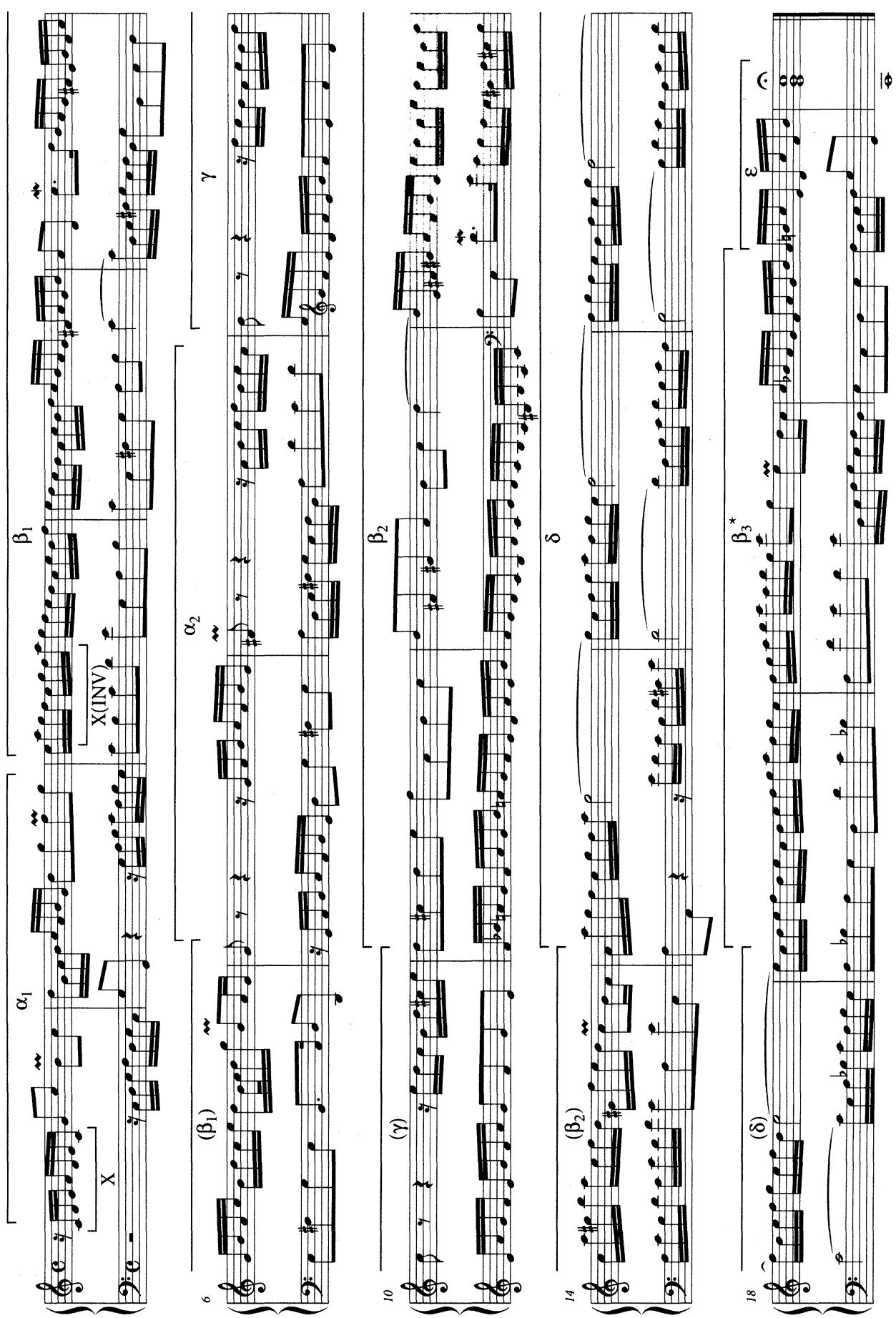
中文讲解
该条目是书中 Example 1.1 的图注占位符,原图为 Bach 二部创意曲集第一首 C 大调 BWV 772 的乐谱片段或缩编谱例,标题为 “Inventio in C major, BWV 772”。从位置看,它出现在小节标题 “What Is an Invention?” 之前,作用是为接下来的概念讨论提供一个具体可指认的音乐对象——即 BWV 772 首句的主题(Subject X),使读者在阅读方法论说明时有一个可直接参照的样本。由于内嵌图像数据已省略,实际谱例需查阅原书第 11 页插图。
补充说明
占位符中的"内嵌图像数据已省略"意味着本节输出的任务输入中并未包含乐谱图像本身,因此本段讲解无法描述具体音符走向;只能依据图注判断其指向 Bach 二部创意曲 No.1(C 大调,BWV 772)的开头主题,这也是后文反复提到的"Subject X"所对应的那段材料。
第2段(P0044)
原文复述
What Is an Invention?
中文讲解
这是位于第 12 页的小节标题,英文原标题直译为"什么是一项发明(invention)?"。它既是全章也是 S11 这一小节的论题入口:在已经展示了 BWV 772 主题这一具体样本之后,正式追问 Dreyfus 笔下 “invention” 这一术语的所指。它开启的论题是:如何把主题(或 Subject X)这一过小、过频繁出现的元素,与真正承担作品结构功能、并在乐曲中反复出现的"更大的功能片段"区分开来,从而界定 Dreyfus 意义上的 inventions。
补充说明
该标题中的 “Invention” 在本书中是一个被作者重新定义的技术术语,既对应 Bach 自题 Inventions 曲集中的体裁,也对应修辞学意义上 inventio(构思/寻材)的概念;二者在本节后续讨论中通过 Mattheson 的五分法被显式联系起来。
第3段(P0045)
原文复述
Dreyfus, Laurence. Bach and the Patterns of Invention. E-book, Cambridge, Mass.: Harvard University Press, 1996, https://hdl.handle.net/2027/heb05561.0001.001. Downloaded on behalf of Indiana University, Bloomington
中文讲解
这是电子书页面中重复出现的出版/下载来源信息,属于页眉或页脚性质的版面元数据。它记录了作者 Laurence Dreyfus、书名 Bach and the Patterns of Invention、出版机构 Harvard University Press、出版年 1996、载体形式 E-book、Handle 解析链接,以及由印第安纳大学布卢明顿分校代为下载的事实。对正文论证没有直接贡献,仅用于标明版本与获取来源。
第4段(P0046)
原文复述
This statement, however, becomes trivial if one considers all occurrences of Subject X “democratically.” While some belong to recognizably larger units that repeat during the composition, others form local patterns that figure far less prominently. One might even say that the recognition of X’s omnipresence in the piece hinders an understanding of what Bach has done with it. So, to avoid confusing structure with ornament, one can seek out units larger than X that play a major role in the composition. As a first step in isolating what can be called a work’s “inventions,” one can extract those functional segments that appear repeatedly during the course of the work—in a complete treble-bass framework, if possible—and, recalling the distinction between inventio and dispositio, analyze their construction independent of the ultimate measure-by-measure order in which they are used. For example, if a progression is used repeatedly within a piece, one should think of it as a patch of inventive “work.” Its discovery was scarcely arbitrary, considering the use to which it is put, and must have cost the composer some effort. Similarly, if a passage is restated in the opposite mode (as in a passage in major “switched” into minor), a procedure that for harmonic reasons succeeds only erratically, it makes sense to consider both versions as two sides of the same inventive “coin.” The sum of inventions underlying this (kind of) work is therefore composed of all the repeated functional segments and their transformations.
中文讲解
这段是 S11 小节的方法论核心,作者由此确立了他识别 inventions 的具体操作规则。前文已经指出 Subject X 在 BWV 772 中"无所不在",本段进一步指出:如果对所有 X 的出现一视同仁地加以考虑,这一论断就会变得 trivial(无意义、无信息量),因为其中有些 X 隶属于在乐曲中反复出现的更大单位,有些只是不太显著的局部装饰花纹;过度强调 X 的"无处不在"反而会妨碍理解 Bach 究竟对 X 做了什么。
为避免把结构与装饰混淆,作者建议去发现比 X 更大、在作品中扮演主要角色的单位;作为分离 inventions 的第一步,可以把那些"在作品进程中反复出现的功能片段"抽取出来——如果可能,应是带有完整高音声部和低音声部框架的片段——并且在分析时回到 inventio(构思)与 dispositio(布局)的区分,将这些片段的构造独立于它们最终在小节序列中的先后顺序来加以考察。
接着作者用两个例子落实这一操作规则:第一,如果一段进行(progression)在作品中被反复使用,应将其视作一处发明性"劳作"(work)的斑块——它的被发现并非任意,考虑到它被投入使用的方式,其发现必定花费了作曲家相当的精力;第二,如果一段材料在相反的调式上被重新陈述(例如大调被"切换"到小调,而出于和声理由这种切换往往只是不规律地成功),那么把两个版本视作同一枚发明性"硬币"的两面是合理的。
最后总结:支撑此类作品的 inventions 之总和,由所有反复出现的功能片段及其变换形式所构成。作者用"硬币两面"的比喻是想说:大调版和小调版并不是两个独立的 invention,而是同一 invention 的两种变换;变换不应被误认为新材料。本段的功能是把"invention"从一个单一主题(subject)扩展为"反复出现的功能片段及其变换"的总和,这是后续讨论 disposition、elaboration、decoration 三阶段的基础。
补充说明
原文中"treble-bass framework"提示作者的取样单位偏好完整的高-低两声部织体,这正符合 Bach 二部创意曲的典型织体;“inventio 与 dispositio 的区分"是修辞学五步骤中的前两步,作者此处以简写形式重新引入,为下一段补充 elaboration、decoratio 做铺垫。
第5段(P0047)
原文复述
The subsequent activity called disposition lays out these inventions in a reasonable order—taking into account both their function and more general harmonic guidelines—while the elaboration (appealing to Mattheson’s fivefold division) links up inventions and otherwise fills in any remaining gaps. Finally, the decoration takes care of suitable ornaments, so that, in the execution, the player can perform the piece; thus these last two processes are at the greatest distance from the initial “discovery.” While this scheme by no means implies that Bach actually proceeded in this order—human faculties are far too chaotic to be contained by any such blueprint—the distinction between the compositional faculties underscores the logical importance of some kinds of thought over others within the mind of the composer. To put it another way: even though the sequence of conceived thoughts does not matter to the ultimate order of the piece, the final decisions that “won out” resulted from a hierarchy that rated acts of invention over their arrangement, a hierarchy to which the completed piece is witness.
中文讲解
本段紧接 P0046 提出"inventions 之总和"之后,补全了修辞学意义上的作曲过程:disposition(布局)把这些 inventions 按照合理顺序排开,需同时考虑它们各自的功能以及更一般的和声规则;elaboration(展开)援引 Mattheson 的五分法,连接各个 inventions 并填补剩余空缺;decoration(装饰)则处理合适的装饰音,使演奏者在演奏中能够呈现乐曲。
作者特别强调:后两个过程(elaboration 和 decoration)与最初的"发现”(discovery,即 inventio)距离最远。但他随即设置一个重要限定:这一方案绝不意味着 Bach 实际上就是按 inventio → dispositio → elaboratio → decoratio 的顺序工作的——人的心理能力过于混乱,无法被任何这样的蓝图所容纳。这一限定的修辞效果是双重的:既避免了把方法论顺序误读为编年顺序,又保留了不同"心理机能"在逻辑层级上的差异。
最后一句把上述限定换一种说法重申:所想到的念头出现的先后顺序,对乐曲的最终顺序并不重要;真正起决定作用的是最终"胜出"的那些决定——它们源自一种将"发明"看得高于"安排"的等级秩序,而完成的乐曲本身即为该秩序的见证。本段的功能是把"如何识别 inventions"的方法论放到完整的修辞学四/五阶段框架中,并为 P0048 中对替代方案的反驳留出空间:因为本节要辩护的核心是"invention 不应被等同于主题的首次出现",所以这里必须先把 inventio 与 dispositio 的顺序关系确立清楚。
补充说明
“Mattheson’s fivefold division"指 Johann Mattheson 在 Der vollkommene Capellmeister 等著作中给出的修辞—作曲五步骤,作者在本书中常常回到该框架;Dreyfus 引入它的目的不是断言 Bach 模仿了修辞学,而是希望借助修辞学的概念区分来组织对 Bach 作品的分析。
第6段(P0048)
原文复述
One does not have to adopt Mattheson’s scheme to reach essentially the same analysis. It would have been possible, for example, to call a musical object an invention only in its prime form, seeing operations performed on it as elaborations, and then disposing them in a logical order. The links between segments could then be considered part of the decoration. Apart from the trivial consideration that the rhetorical order is then altered to read “inventio—elaboratio—dispositio—decoratio,” it is not clear that eighteenth-century writers confined an invention to the first occurrence of a theme. Scheibe, for example, writes that an improvising organist often “has a good deal of time to play something suitable [so that] he can quite easily show how far his invention extends [emphasis added] and how skilled he is.“33 A more serious problem in restricting invention to the prime form of a subject is that it rigidly distinguishes the initial thought from its elaboration, whereas so often in Bach the elaboration is latent in the invention. For this reason I have preferred Mattheson’s divisions of rhetoric, which allow me to interpret Bach’s inventions as mechanisms ensuring their own transformations. Another advantage of this model is that the relatively ancillary character of Mattheson’s elaboration (that is, following the disposition) captures the plausible distinction in Bach’s music between primary (mechanist) and secondary (arbitrary) processes.
中文讲解
本段进入对替代方案的反驳与对自身选择的论证。作者承认即使不采用 Mattheson 的方案,也能得到本质上相同的分析:可以只把一个音乐对象的"初始形态”(prime form)称作 invention,把它之上的所有操作视作 elaboration,再把这些形态安排到逻辑顺序中,片段之间的连接则归入 decoration。这种替代方案虽然把修辞学顺序改写为 inventio—elaboratio—dispositio—decoratio,但作者认为这只是表面变化。
然后作者提出两个反对该替代方案的实质性理由。第一,史料上不清楚 18 世纪作家是否把 invention 限制在主题的首次出现;他援引 Scheibe 的论述:一位即兴演奏的风琴手常常"有充裕的时间演奏合适的内容,因而能够相当容易地展示他的 invention 延伸到了什么程度、他有多么熟练”。Dreyfus 在"how far his invention extends"上加了着重号,意在表明 Scheibe 把 invention 看作一种可以延展的能力或材料,而不是某一主题的首次出现。第二,也是更严重的问题:把 invention 限定为主题的初始形态,会僵硬地区分"初始念头"与"其展开”,但在 Bach 那里,展开往往已经潜伏在 invention 之中。换句话说,Bach 的 invention 本身就蕴含着使其自身发生变换的机制,把它限定为 prime form 反而切断了这一内在联系。
由此作者交代了方法论选择:之所以偏向 Mattheson 的修辞学划分,正是因为它允许把 Bach 的 inventions 解读为"保证其自身变换得以发生的机制"。附加的好处是:在 Mattheson 的体系中 elaboration 处于较附属的位置(紧跟在 disposition 之后),这恰好与 Bach 音乐中"首要的(机械性的)过程"和"次要的(任意的)过程"之间可信的区分相吻合。
本段的功能是为 P0046 提出的"功能片段及其变换 = inventions"这一界定做正名:通过反驳"只把初始形态算作 invention"的替代方案,让读者明白 Dreyfus 选择 Mattheson 框架是有意识的方法论决定,而不是默认套用。本段也是 S11 的论证收口:到此处为止,“如何识别 invention"的方法论基础已经全部铺好。
补充说明
脚注 33 是本段唯一的脚注索引(Dreyfus 在 Scheibe 引文末尾标注的"33”),指向上文提到 Scheibe 原话的来源;任务输入中未提供该脚注的具体内容,因此其具体页码、章节或 Scheibe 著作名无法在本节内核实,只能确认其在文中作为支持"18 世纪并非把 invention 限定为主题首次出现"这一史实例证的来源出现。
第7段(P0049)
原文复述
Bach and the Patterns of Invention
中文讲解
这是电子书页面上重复出现的页眉,标示当前章节或当前阅读位置所属的书名 Bach and the Patterns of Invention。它不引入新主张,仅起版面定位作用。
第8段(P0050)
原文复述
Dreyfus, Laurence. Bach and the Patterns of Invention. E-book, Cambridge, Mass.: Harvard University Press, 1996, https://hdl.handle.net/2027/heb05561.0001.001. Downloaded on behalf of Indiana University, Bloomington
中文讲解
这是与 P0045 相同的电子书出版与下载元数据,重复出现在页面底部,属于页脚性质。对正文论证无直接贡献,仅用于标明版本与获取来源。
脚注 / 边栏 / 图表 / 附加信息(如有)
本小节范围内可识别的附加材料包括:(1)一幅乐谱图占位符(图注为 Example 1.1 Inventio in C major, BWV 772,图像本身在任务输入中已省略),作用是为即将给出的"Subject X 无处不在"以及"反复出现的功能片段"等论断提供具体可指认的样本;(2)脚注 33,对应 P0048 中 Scheibe 关于即兴演奏风琴手"展示 invention 延伸程度"的引文,作为支持"18 世纪并未把 invention 限定为主题首次出现"这一史实例证的来源;(3)重复出现的电子书来源信息(P0045、P0050)与书名页眉(P0049),三者均属版面元数据,本身不参与论证。
💡 本节核心要点
- Dreyfus 把 inventions 定义为"在作品进程中反复出现的功能片段及其变换形式",从而把 Subject X 这种过小、过频繁的元素与真正承担结构功能的单位区分开来。
- 反复出现的功能片段在分析时应被独立于其在作品中的小节序列(即独立于 dispositio)来考察,其构造本身才属于 inventio。
- 变换形式——例如同一进行的大调版与小调版——应被视作同一枚发明性"硬币"的两面,而不是各自独立的新材料。
- 完整的作曲过程被还原为 inventio → dispositio → elaboratio → decoratio 四阶段,但作者明确否认 Bach 实际按此顺序工作;该顺序只是不同心理机能之间的逻辑层级。
- 作者选择 Mattheson 的修辞学框架而非"只把主题首次出现视作 invention"的替代方案,理由是该框架允许把 Bach 的 inventions 解读为"保证其自身变换得以发生的机制",与 Bach 音乐中展开已潜伏于主题的现象相契合。
- Mattheson 体系中 elaboration 的附属位置,恰好对应 Bach 音乐中首要(机械性)过程与次要(任意性)过程的可信区分,这是该框架的额外优势。
🔑 关键术语
- invention:在本书中既指 Bach 自题 Inventions 曲集中的体裁,也指作者重新定义的技术概念:在作品进程中反复出现的功能片段及其变换形式;它是 inventio(构思)一词在分析 Bach 作品时的具体所指,不等同于主题的首次出现。
- Subject X:作者对 BWV 772 开头主题的占位称呼,用以指代贯穿全曲的核心短动机;在本节中被用作反例——它虽然无处不在,但本身不是 invention,因为它太短、太频繁,需要被纳入更大的功能片段中考察。
- functional segment:作者从作品中抽取出来的分析单位,指在作品中反复出现、最好带有完整高音声部与低音声部框架的功能片段;它是 invention 的载体。
- inventio / dispositio / elaboratio / decoratio:修辞学—作曲过程的四个阶段:Dreyfus 借 Mattheson 的五分法使用,分别对应构思(发明)、布局(安排)、展开(连接并填空)、装饰(为演奏而加花);本节强调该顺序是逻辑层级而非编年顺序。
- prime form:P0048 中所讨论的替代方案所使用的术语,指一段音乐材料未经变换的初始形态;作者反对把 invention 限定为 prime form,因为那样会切断 Bach 主题中"展开已潜伏于 invention"这一核心现象。
- Mattheson’s fivefold division:Johann Mattheson 在其音乐修辞学著作中提出的作曲五步骤划分;Dreyfus 借用其框架来组织对 Bach 作品的分析,但否认 Bach 在心理上按此顺序工作。
- mechanist vs. arbitrary processes:P0048 末尾出现的对照:mechanist(机械性的、首要的)过程对应 invention 与 disposition 中由材料自身逻辑驱动的部分;arbitrary(任意的、次要的)过程对应 elaboration 与 decoration 中更具偶然性、更多受演奏与装饰惯例影响的部分。
S12 [描述性拆分] Hierarchy of Compositional Processes and Inventions as Self-Transforming Mechanisms
第1段(P0051)
原文复述
A straightforward point argues that a hierarchy of logical processes must have existed. Whenever a passage is to undergo several transformations within the course of a piece, Bach must have foreseen at least some of those transformations in advance; otherwise, how could he have known whether they would succeed? Thus, while there is no reason to suppose that Bach necessarily composed a piece in the order in which the finished piece proceeds, there is every reason to suppose that he composed parts of it out of sequence. Consider, for instance, cases of double counterpoint in which two themes are inverted at the octave: the composer must have contemplated the voice-exchange—at least in some cursory way—before arriving at the measure in which the device appears, if he wished to avoid the forbidden dissonances that would result from that voice-exchange. To believe otherwise would mean that Bach, having arrived midway through the composition of a double fugue, inverted the two themes, and then congratulated himself on his good fortune that the themes inverted flawlessly. Common sense argues against this scenario, as does the testimony of Emanuel Bach, who writes that “when [J. S. Bach] listened to a rich and many-voiced fugue, he could soon say, after the first entries of the subjects, what contrapuntal devices [contrapuncktische Künste] it would be possible to apply, and which of them the composer by rights ought to apply, and on such occasions, when I was standing next to him, and he had voiced his surmises to me, he would joyfully nudge me when his expectations were fulfilled.” In other words, even the bare first appearance of a theme set in motion an inexorable mental process determined to work out the latent possibilities. And if Bach summoned forth this mechanism when listening to other people’s music, how much more pronounced a role it must have played in works of his own invention. Note also that Emanuel does not say that his father predicted the order in which the contrapuntal maneuvers would occur, but rather only the number of feasible devices that would properly exploit a subject.
中文讲解
本段是Dreyfus论证Bach创作机制的核心段落,提出一个看似简单但推论有力的主张:作曲家在创作时必然依赖一套’逻辑过程的层级’。
论证的起点是一个假设:若一个段落在一首作品中被多次变换,作者必须至少预先设想其中一些变换,否则他无从判断变换是否成立。这里’成立’的内涵由下一个例子具体化——八度双重对位(double counterpoint at the octave),即两个声部主题互相倒影的技术。在这类技术中,某些纵向结合会产生’禁用的不协和音程’(forbidden dissonances,最典型的是增减音程的不当碰撞),因此作曲家必须在动笔写到该技法出现的小节之前,就已在脑中粗略推演过声部交换会带来的纵向结果。Dreyfus用反讽笔调描述替代情景:Bach在赋格写到一半时倒影两主题,结果’撞大运’般地一切顺利——这一图景被常识排除,也被接下来 Emanuel Bach 的证词排除。
Emanuel Bach 的引文是本段唯一的历史文献支撑,关键观察是:Bach 在听到主题的最初几次进入(first entries of the subjects)之后,就能说出哪些对位技法’可能’应用、哪些’应该’应用。这说明 Bach 脑中存在一个由主题触发的、‘不可抗拒的心理过程’(inexorable mental process),会自动展开主题中潜在的对位可能。引文中保留的德文术语 contrapuncktische Künste 即’对位的艺术/技巧’,作者特意括注以保留原文色彩。
最后一句学理分寸非常重要:Dreyfus提醒读者,Emanuel所说的Bach并不是预测对位手法’将以何种顺序出现’,而是预测’可行的手法数量与类型’。这是一个刻意的限定——它让该机制既足以支撑’Bach在脑中预演过变换’的论断,又不至于滑向’Bach已完全确定整首作品细节’的过度断言。
整段在本小节中的功能:为后续讨论’invention’概念提供因果性铺垫——既然主题会触发不可抗拒的心理展开过程,那么’发明’就不仅是写下来的动机,更是一旦建立就会自我变换的机制。
补充说明
本段引用了脚注34的Emanuel Bach证词,但该脚注的完整文本未包含在本节输入的段落中,因此无法在本节范围内进一步引述其内容。括号中的德文 contrapuncktische Künste 是作者对’contrapuntal devices’一词的原文标注,应理解为’对位的艺术(复数)’,在Dreyfus的引用策略中起保留史料原貌的作用。
第2段(P0052)
原文复述
Generally, the more important the invention, the more times Bach repeats it, though usually in some varied form. (Significant exceptions include declamatory works such as simple recitatives; works such as free preludes and dances in which the thoroughbass itself constitutes the invention; and works that elaborate a pre-existing invention, such as four-part chorale settings.) Passages worthy of the name “invention” will therefore tend to occur more than once during the course of the piece or movement, by which fact their membership in a single class or paradigm is demonstrated. Segments can be said to belong to the same paradigm when they stand in relation to one another through some clearly mechanical—that is, definable—operation, such as melodic inversion, voice-exchange, or the reversal of mode. These relations can be thought of much like the vertically arranged paradigms used to teach Latin or German declensions, in which the root of a word is operated upon in specific ways depending on the case (or grammatical function) of the word within a sentence.
中文讲解
本段定义’invention’概念的核心特征,并引入’paradigm(范式)‘这一关键比喻。
前半段提出一个一般性原则:动机越重要,Bach重复它的次数越多,但通常以某种变化形式重复。紧接着作者坦率列出三类例外——宣叙调类的declamatory作品(旋律性陈述本身即内容,不需要动机重复);自由前奏曲与舞曲(此处数字低音thoroughbass本身就是发明);以及四声部圣咏改编一类对既有发明进行加工的作品。这三类例外表明’重要性—重复’规则不是普遍公理,而是有明确适用边界的经验法则。
后半段是术语操作:凡在一首作品或一个乐章中出现多于一次的段落,便通过这一重复事实证明了它们属于同一’类’或’范式’(paradigm)。范式成员的判定标准是彼此之间存在’机械的、可被定义的’操作关系——旋律倒影、声部交换、调式翻转都属于此类。
最后的语言学类比是本段最值得驻足之处:Dreyfus把音乐范式比作拉丁语或德语教学中纵向排列的’变格表’——词根是固定元素,格的差异对应同一词根被施加的不同规则操作。音乐主题是’词根’,倒影、换位、调式翻转是各种’格’。这一类比的功能是:第一,把抽象的’机械操作’形象化为学习者熟悉的语法形式;第二,强调范式成员之间关系是规则化的、可预测的,而不是任意的联想——这与上一段论证的’心理过程的不可抗拒性’在逻辑上互为表里。
本段在论证链中的作用是从’过程层级’过渡到’结构产物’——如果主题触发心理展开,那么展开的产物就是一组互相通过机械操作关联的段落,即一个范式。
补充说明
括号内的’例如宣叙调’等三类例外,其作用是防止读者把’重复—重要’规则误读为对所有巴洛克体裁的普适描述,它们各自提示了’invention’概念不适用的体裁条件。
第3段(P0053)
原文复述
What Is an Invention?
中文讲解
这是一个小节标题,英文为What Is an Invention?(何谓invention?),作用是从上文对’invention’功能的描述与类比,转入对’invention’概念本身的定义性讨论。标题本身以问句形式提出,预示下一节将给出正面界定。
第4段(P0054)
原文复述
Dreyfus, Laurence. Bach and the Patterns of Invention. E-book, Cambridge, Mass.: Harvard University Press, 1996, https://hdl.handle.net/2027/heb05561.0001.001. Downloaded on behalf of Indiana University, Bloomington.
中文讲解
这是页面底部的版本/出处信息(bibliographic footer / watermark),标明本文摘自 Laurence Dreyfus 所著《Bach and the Patterns of Invention》一书的电子版,由 Harvard University Press 于1996年出版,通过 HathiTrust 数字图书馆平台(handle.net 链接)访问,下载代理方为 Indiana University, Bloomington。该信息用于学术引用追溯,不承载论证内容。
💡 本节核心要点
🔑 关键术语
S13 [描述性拆分] The Invention: Deriving α₁ and α₂ from mm. 1–2
第1段(P0055)
原文复述
The Invention
中文讲解
这是一个二级小节标题,标志着本节正式切入对 “invention(创意单元)” 这一概念的正面讨论。在前文已建立基本动机单元 X 的分析框架之后,标题 “The Invention” 提示读者:Dreyfus 将要回答的不是抽象定义问题,而是要通过对 C 大调 Praeambulum 前两小节的实际剖析,反向界定究竟什么样的音乐片段可以被称为一个 “invention”。此标题开启了本节的核心论题——通过具体材料(mm. 1–2)来推导出 α₁ 与 α₂,从而把 “invention” 从抽象术语落实为可观察、可重复、可被进一步处理的具体段落。
第2段(P0056)
原文复述
Rather than trying to define an invention abstractly—a fruitless effort, since the type of invention will depend on many different factors such as genre and style—let us look carefully at the C major Praeambulum, which Bach evidently took as his first example of suitable inventions and how to develop them. Searching for a component somewhat larger than X, one alights on the first two measures as the first repeatable unit. (Despite the clear derivation of m. 2 from m. 1, Bach does not treat the opening bar as a paradigm on its own.) Here is a passage that invites further inventive treatment, as in mm. 7–8, and also serves to define a specific key (the tonic). This segment—labeled α₁—will therefore be understood as an invention. (See Ex. 1.2.) The second occurrence of α—labeled α₂—results initially from an attempt at voice-exchange, a function I call ROTATE in Ex. 1.2b. (One may ignore the shift in key up a perfect fifth, since transposition belongs more properly to the disposition than to invention.) It is typical of double counterpoint that the inversion of two musical lines will often result in certain improprieties. As the asterisks show in Ex. 1.2b, an unprepared dissonant fourth occurs at the beginning of the second measure while the progression at the end of the measure, though correct in terms of strict counterpoint, had led to a misleading false accent on a root-position tonic chord which falls misleadingly on a weak beat. (See the voice-leading reductions just below the main staves.) Ex. 1.2c shows how Bach’s refurbished version of α—which elegantly resorts to invertible counterpoint at the 12th in the second measure—avoids the musical solecisms and restores a reasonable facsimile of α’s harmonic function. The adjustments in the treble in m. 8 therefore resulted neither from artistic whimsy nor from a desire for variation but from a need to replace the result of a faulty transformation. Necessity, as the proverb has it, is the mother of invention.
中文讲解
本段是本节的核心论证,集中阐释 α₁ 与 α₂ 的由来及其揭示的对位逻辑。可以分五层来理解:
第一,方法论说明。作者明确放弃给 invention 下抽象定义,因为 “invention 的类型取决于体裁、风格等多种因素”——给抽象定义将是徒劳。他转而以 C 大调 Praeambulum 为具体样本,因为这是 Bach 显然选作第一个 “合适的 invention 及如何展开” 的范例。这一立场意味着:invention 的定义应通过分析 Bach 本人的实际做法来反推,而非先验地规定。
第二,α₁ 的识别标准。作者寻找一个比 X(基本动机)稍大、并且可重复的单元,落在 mm. 1–2 上。作者特意说明:尽管 m. 2 明显派生自 m. 1,但 Bach 并不把单独的小节 1 当作范式——可见 “invention” 的尺度大于单小节。α₁ 的入选还有两条标准:(1) 它在 mm. 7–8 那里又出现并被进一步作创意处理,说明它具有可被复用、可被延展的潜力;(2) 它确立了主调(tonic),具备明确的功能定位。因此 mm. 1–2 被命名为 α₁,视为 invention 的具体化身。
第三,α₂ 的产生机制——ROTATE。第二次出现的 α(α₂)源自一次声部交换(voice-exchange)的尝试,作者称之为 ROTATE(见 Ex. 1.2b)。括号中作者提醒可以忽略调性上移纯五度这一现象,因为移调属于 “disposition(布局)” 的范畴,而非 invention 的范畴——这一定界再次划清了 invention 与 disposition 的概念分工。
第四,对位操作固有的瑕疵。α₂ 揭示出一个普遍原则:在二重对位(double counterpoint)中,两条旋律线的互换常常会产生一些不规范之处。具体而言,作者在 Ex. 1.2b 中用星号标出两处问题:(1) m. 2 开头出现一个未准备的四度不协和音;(2) m. 2 末尾虽然严格对位意义上无误,但落在一个原位主和弦上,而这个主和弦出现在弱拍,形成误导性的伪重音(false accent)。作者提示读者可参看主谱表下方的声部进行缩减(voice-leading reductions)来确认这一点。这两处瑕疵为下一步的修补提供了诊断依据。
第五,修补方案——Ex. 1.2c。Ex. 1.2c 显示 Bach 对 α 进行的 “翻新” 版本:在第二小节中巧妙地运用了十二度可动对位(invertible counterpoint at the 12th),从而避免了前述对位失误,并恢复了 α 原有的和声功能的一个合理面貌(reasonable facsimile)。由此可以推出 m. 8 高音声部所做的调整既非出于艺术上的任性,也非出于对变奏的喜好,而是出于用一个正确的转换结果来替换一个错误的转换结果的实际需要。
末句 “Necessity, as the proverb has it, is the mother of invention”——“需要乃发明之母”——既呼应 α₂→α 的修补逻辑,也呼应全节的方法论:用具体需要(避免对位瑕疵)来界定何为 “invention”,而非用先验定义。本段因此完成了三项任务:确立 α₁ 的具体范围、揭示 α₂ 在对位操作上的必然缺陷、并通过 Bach 的修正方案来说明 “invention” 的形成正是出于实际功能性的需求。
补充说明
X(动机基本单元)、invention、disposition 的概念区分在前文已建立;ROTATE 是作者本节引入的对位变换操作名称,详见 Ex. 1.2b。本段中 ROTATE 与 “invertible counterpoint at the 12th” 的对比,构成 “有瑕疵的简单声部互换” 对 “可动对位的精细化运用” 的对照,二者皆属 “transformation” 的具体形式,但前者暴露问题、后者解决问题。
第3段(P0057)
原文复述
The longer passage starting at m. 3 until the beginning of m. 7—labeled β—presents a more complex design of the original subject, in which two intermingled types of processes occur. First, Bach has devised a clever pattern of adjacent forms of X(INV) in the soprano. As shown in Exx. 1.3a, 1.3b, 1.3c, and
中文讲解
本段开启了对 β 区段(自 m. 3 起至 m. 7 开头)的论述。作者先指认 β 为一个比 α₁ 更长、设计上更复杂的段落,其中交织着两类处理过程(intermingled types of processes)。随后才展开第一类:女高音声部中相邻形式的 X(INV)(即 X 的倒影形式)所构成的精巧模式(clever pattern),并以 Ex. 1.3a、1.3b、1.3c 为证——但段落文本在 “and” 之后中断,未给出后续内容。
因此本段在本节的作用是:(1) 与 α₁/α₂ 构成层级对照——α 是 2 小节、单一过程的 “invention” 单元,β 是 4 小节、复合过程的展开;(2) 预告 β 内部将涉及 X(INV) 的相邻模式及进一步的变换操作;(3) 留给下一小节续写。在讲解时需要明确:本段文字本身在此处截断,相关细节(相邻 X(INV) 模式的具体形态、Ex. 1.3 的实际内容、第二类过程是什么)均超出本段可见范围,不应补写。
第4段(P0058)
原文复述
Bach and the Patterns of Invention
中文讲解
这是页眉(running header),标示本书书名:Laurence Dreyfus, Bach and the Patterns of Invention。作为版面元素,它不属于论证正文,仅起定位作用,表明本页内容出自该书第 14 页。
第5段(P0059)
原文复述
Dreyfus, Laurence. Bach and the Patterns of Invention. E-book, Cambridge, Mass.: Harvard University Press, 1996, https://hdl.handle.net/2027/heb05561.0001.001. Downloaded on behalf of Indiana University, Bloomington
中文讲解
这是该电子书版本的版权与下载来源说明(页脚类信息)。它表明:作者为 Laurence Dreyfus;书名为 Bach and the Patterns of Invention;出版地为美国马萨诸塞州剑桥,出版方为 Harvard University Press,出版年 1996;载体形式为电子书;电子资源标识符(Handle)为 https://hdl.handle.net/2027/heb05561.0001.001;下载由 Indiana University, Bloomington 代理完成。该信息为来源出处说明(source citation),并不参与正文论证,仅用于版本核验与学术引用。
脚注 / 边栏 / 图表 / 附加信息(如有)
本节包含的主要附加材料为:
- 谱例 Ex. 1.2(含 1.2a、1.2b、1.2c)——分别对应 α₁ 的原型、α₂ 经 ROTATE 后的结果(带星号标记瑕疵)、以及 Bach 修正后的可动对位版本(运用十二度可动对位)。谱例下方的 voice-leading reductions 用于声部进行的简化演示,帮助读者确认弱拍上的原位主和弦造成的伪重音。
- 谱例 Ex. 1.3a、1.3b、1.3c——按本节文字预告,它们将展示 X(INV) 在女高音声部的相邻模式,但本节文字在介绍这些谱例之前即被截断,故其具体内容须参看原文后续小节。
- 页眉与电子版下载页脚——版本与来源标识,不参与论证。 以上附加材料中,Ex. 1.2 系列对本段论证起直接支撑作用:它将抽象的 “ROTATE” 操作和 “invertible counterpoint at the 12th” 落实为可对比的乐谱,使 α₂ 的瑕疵与 α 的修正都变得可观察。
💡 本节核心要点
- 方法论上,invention 不应被抽象定义,而应通过对 Bach 实际作品的剖析反推;C 大调 Praeambulum 被选作第一个适合作为 invention 范例的样本。
- α₁ 之所以被识别为 invention,取决于三个条件:长度略大于 X、mm. 7–8 处可被进一步作创意处理、以及能确立主调;mm. 1 单独不够,mm. 1–2 合在一起才是 α₁。
- α₂ 由 ROTATE(声部互换)操作产生,但移调部分属于 disposition 而非 invention,可被忽略。
- 二重对位的变换天然易产生瑕疵——本例中表现为未准备的四度不协和音与弱拍上的原位主和弦伪重音——因此 α₂ 在严格对位意义上不合格。
- Bach 在 Ex. 1.2c 中通过十二度可动对位修正 α,m. 8 高音声部的调整既非任性也非求变,而是出于功能性的修补需要;“需要乃发明之母” 既是对该修补的字面总结,也是对 invention 概念的方法论定性。
- 本节后半段将进入 β 区段(mm. 3–m. 7 开头)的讨论,其内部将出现 X(INV) 相邻模式的精巧处理与两类交织的展开过程,但本节文字在介绍 Ex. 1.3 之前即截断。
🔑 关键术语
- invention:在本节中,invention 指一个比基本动机单元 X 稍大、且具备可重复与可展开潜力的音乐段落;它不是一个先验的抽象类别,而是通过对 Bach 具体作品(此处为 C 大调 Praeambulum 的 mm. 1–2)的分析反推而出的具体单元(α₁)。
- Praeambulum:Bach 对该 C 大调前奏曲性片段所用之术语,Dreyfus 在本节中以之作 invention 定义的首要分析样本。
- X:本节已建立的基本动机单元;invention(α₁)的尺度判定为 “略大于 X 且可重复”,因此 α₁ 不是 X 本身,而是包含 X 在内的一个更上层单位。
- α₁ / α₂:α₁ 指 mm. 1–2 的原型段落,被定为第一个 invention;α₂ 指 α 第二次出现时经 ROTATE 操作所得的产物,因对位瑕疵需被 Bach 在 m. 8 处以可动对位替换。
- ROTATE:Dreyfus 在 Ex. 1.2b 中使用的对位变换操作名称,特指声部互换(voice-exchange);在本节中 ROTATE 产生的 α₂ 暴露了二重对位常见的瑕疵。
- disposition:与 invention 并列的概念范畴;本节明言移调(如 α₂ 中调性上移纯五度)属于 disposition 而非 invention,因此在界定 invention 时可以忽略。
- double counterpoint:二重对位,即两条旋律线互换位置后仍保持对位关系;Dreyfus 指出二重对位的变换天然易于产生某些不规范之处(improprieties),α₂ 即其例。
- invertible counterpoint at the 12th:十二度可动对位;Ex. 1.2c 中 Bach 修正 α 时所采用的对位手段,使 m. 8 处的高音声部调整能够既保持对位严谨又恢复 α 原有的和声功能。
- β:本节末段引入的更长段落,自 m. 3 起至 m. 7 开头,比 α₁ 更复杂、内部交织两类展开过程,是与 α₁/α₂ 形成层级对照的下一层级单元。
S14 [描述性拆分] The Invention: β as Melodic Chain of X(INV) over Parallel Tenths
第1段(P0060)
原文复述
Image/figure placeholder on page 15; the embedded image data has been omitted, but the caption’s intended position is preserved. No textual content other than this figure marker is present at this point in the source.
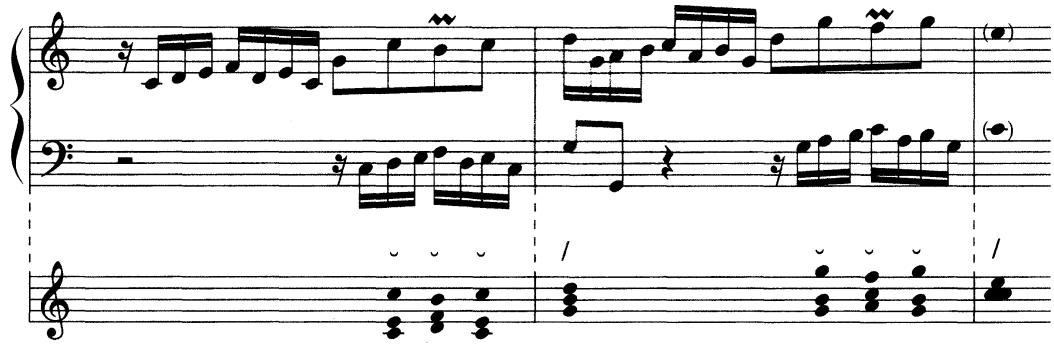
中文讲解
该段是页面上的一处图像占位符,原图数据已被省略,仅保留图注位置信息。由于没有可读的图文内容,对应的乐谱或谱例细节须通过查阅原书第15页获得,本任务材料中无可直接引用的文字说明。讲解者在此处应避免对乐谱音符、和声或具体走向做出任何未在原文出现的猜测。
第2段(P0061)
原文复述
Image/figure placeholder on page 15 with the caption “b) ROTATE α₁ (TRANSPOSE ↑ P5)”. The embedded image data itself has been omitted, but the caption’s wording and position are preserved as given.
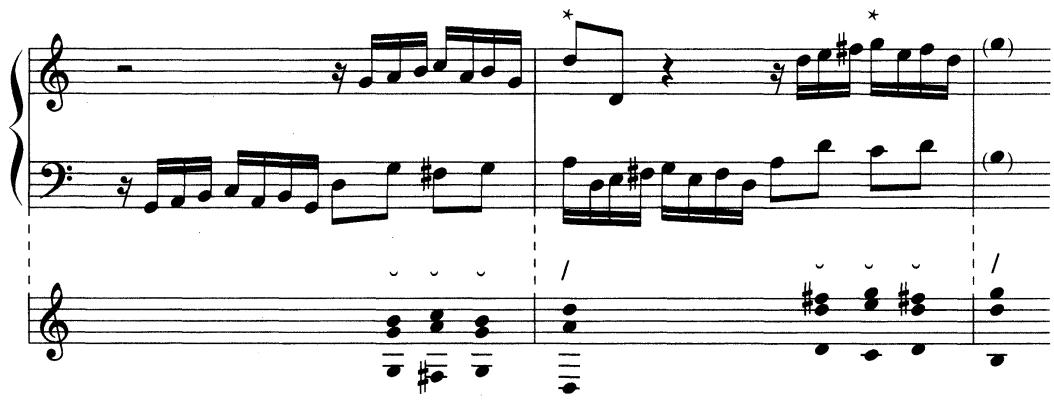
中文讲解
此处为带图注的图像占位符。图注为 “b) ROTATE α₁ (TRANSPOSE ↑ P5)",意指对 α₁ 进行“旋转”操作,并以向上纯五度(↑ P5)作移调;该图注与前一图共同构成第15页上的某个分项(标为 b 项)。需要查看原书第15页方可了解谱面上具体展示了哪些音符或和声进行,本任务材料没有提供额外文字说明,因此讲解不应超出图注本身所明示的信息。
补充说明
图注里的 P5 是 Perfect Fifth(纯五度)的英文缩写,α₁ 是该书对主题 (Subject) α 之第一个变换对象的标记,二者都源自本节上下文所引用的同一套符号。
第3段(P0062)
原文复述
Image/figure placeholder on page 15 with the caption “Example 1.2 Properties of invention in α (BWV 772)”. The embedded image data itself has been omitted, but the title and position are preserved as given.
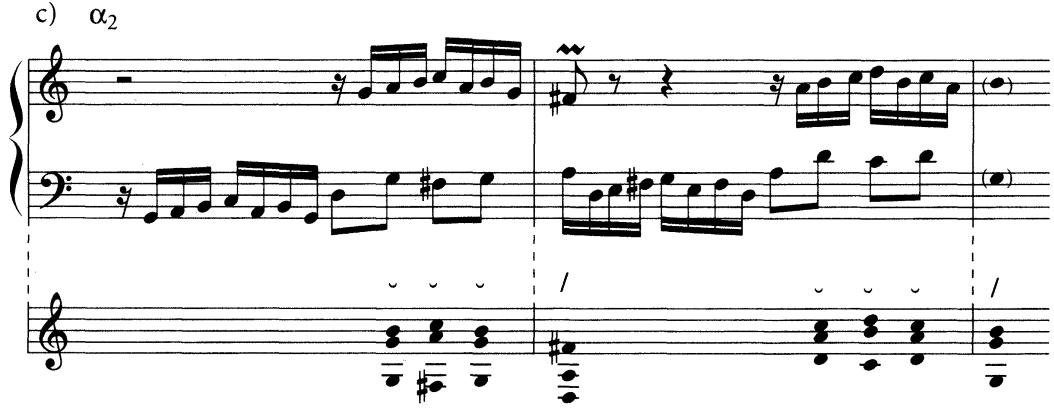
中文讲解
此处为乐谱/示例占位符,标题为 “Example 1.2 Properties of invention in α (BWV 772)",即 BWV 772(巴赫《二部创意曲》第二首)之上,对 α 主题“作为发明曲的性质”之图示。原书例 1.2 在此处被嵌置,是 P0063 段落将 β 描述为“X(INV) 在平行十度之上的旋律链”时所需要的对照谱例。具体音符内容须查阅原图确认,本任务不携带可引用的细节。
补充说明
BWV 772 是巴赫《二部创意曲集》(Inventions and Sinfonias, BWV 772–801)中的第二首 A 小调二部创意曲,这是 Bach-Werke-Verzeichnis 编号体系下的标准编号,仅作为图注事实复述。
第4段(P0063)
原文复述
In Ex. 1.3d, the sequence chains together statements of the inverted subject (now taken to embrace eight notes rather than only the original seven), and it seems likely that in composing β Bach took pains to exploit this ability of Subject X to form a coherent chain. In fact, the form of X(INV) shown in Ex. 1.3b, which ultimately initiates the sequence, is only one of two melodic inversions of X that preserve the intervalic content of X without leaving C major. The other inversion—which preserves both interval and mode—begins on E. The parallel tenths that Bach sets in the bass to accompany the melodic chain (see Ex. 1.3e) can then be seen as a simple and convenient counterpoint that will easily adapt to later inversions.
中文讲解
本段是本节的核心论述,揭示 β 的“发明性”究竟建立在何种结构性技巧之上。
第一句指出:在 Ex. 1.3d 中,这一序列是把“倒影主题” (inverted subject) 的若干陈述串接起来;这里所谓“倒影主题”已被重新界定为涵盖八个音的形态,而非原本的七个音。所以“链 (chain)”并不是简单地把原来的七音主题来回移位,而是依托一个能够自洽上接下连的八音版本。文中脚注 35 提示关于“八音”取舍有更详细的依据,详见脚注。
第二句过渡到作者的判断:作者推测,作曲者在写 β 时是有意识地利用了主题 X 这种“可被串成连贯链状”的能力。这是建立在谱面观察之上的合理化解读,而非纯粹臆测;它把 β 的成功定位为“预先设计”的产物。
第三、四句给出更有约束力的观察:Ex. 1.3b 中那个启动整个序列的 X(INV) 形式,只是“在不离开 C 大调的前提下保持 X 原音程内容”的两种旋律倒影之一;另一种既保持音程又保持调式(mode)的倒影,则是从 E 音起头。也就是说,作者先把可能性框定为“二选一”,再说明 Bach 选的是 Ex. 1.3b 中的那一种——而不是对其选择做随意处理。
最后一句把焦点转到低音部:Bach 让低音以平行十度 (parallel tenths) 配合这条旋律链(参 Ex. 1.3e)。作者把这种低音写法定位为“简单、便利的对位”,关键功能在于——它能够“为后来出现的其他倒影形式灵活适配”。换言之,作者并不是单纯把“平行十度”解读为巴洛克常见的写作惯例,而是反过来主张:Bach 选择平行十度,正是因为它能容许他后续对 X(INV) 做不同的音高起点而无需重写低音。
阅读本段时需要留意的几处容易误解的点:① “八音”较“七音”多出来的那个音,作者并不在此段说明其位置,需结合脚注与谱例;② “preserve the intervalic content of X without leaving C major”是指“音程内容”与“调性框架”双重约束,是非常严格的限制,因此“两种倒影”是穷举后的结果;③ “会便于适配后续倒影”是把低音写法解释为对调式网络的支持,而不是单纯描述其音响效果。
第5段(P0064)
原文复述
What Is an Invention?
中文讲解
这是本节末尾出现的一句小节标题“什么是发明曲?”,用以开启下一段对“invention(发明曲)”体裁本体的提问与界定。标题本身把读者的注意力从“β 是 X(INV) 在平行十度之上的旋律链”这种具体分析,转向对体裁本身定义性问题的反思,即“什么样的写作才构成 invention”。在结构上,这一标题是下一节即将进入的讨论入口。
第6段(P0065)
原文复述
Dreyfus, Laurence. Bach and the Patterns of Invention. E-book, Cambridge, Mass.: Harvard University Press, 1996, https://hdl.handle.net/2027/heb05561.0001.001. Downloaded on behalf of Indiana University, Bloomington
中文讲解
这是第15页的页脚/出处说明,标明本电子文本源自 Laurence Dreyfus《Bach and the Patterns of Invention》一书,1996 年由哈佛大学出版社在马萨诸塞州剑桥出版,电子书由印第安纳大学布卢明顿分校的用户下载。该项信息为版本与来源凭证,与正文论点无直接对应关系,但对引用与版权确认具有支持作用。
脚注 / 边栏 / 图表 / 附加信息(如有)
本小节在第15页末尾除正文段落之外,还包含若干非正文项:① P0060 为不带图注的图像占位符;② P0061 为图注 “b) ROTATE α₁ (TRANSPOSE ↑ P5)” 的图像占位符;③ P0062 为标题 “Example 1.2 Properties of invention in α (BWV 772)” 的图像占位符;④ P0063 正文中提及 Ex. 1.3b、Ex. 1.3d、Ex. 1.3e 三处谱例,其中 Ex. 1.3d 与 Ex. 1.3e 的实际谱面在本任务所提供的材料中未直接出现(仅由 P0063 的文字指代),如需确认须查阅原书;⑤ P0063 正文中带有上标脚注编号 35,其内容未包含在所提供的段落里,需在原书对应页码查找;⑥ P0064 为下一节小标题 “What Is an Invention?”;⑦ P0065 为电子书的版本出处信息(页脚)。上述各项均不承担独立论证,其作用为“图示位置标注”“脚注引用”“后续章节锚点”与“来源凭证”。
💡 本节核心要点
- β 的核心特征被界定为:以 X(INV) 的串接式陈述构成的旋律链,并辅以低音声部的平行十度进行(参 Ex. 1.3d 与 Ex. 1.3e)。
- 作者强调 Bach 在写作 β 时是有意识地利用主题 X “能被串接成连贯链”这一性质,而非偶然为之。
- 在不离开 C 大调、且保持主题 X 原音程内容的严格约束下,X 的旋律倒影只有两种可能:一种即 Ex. 1.3b 中启动序列的 X(INV);另一种从 E 音起头,同时保持音程与调式——作者由此论证 Bach 是在这“二选一”中作了具体选择。
- 文中将原本七音的“主题”概念延伸为八音形态,从而使倒影主题的串接在结构上自洽;这是本段对“invention 内部主题外延”所做的一个重要修正(脚注 35 提供了进一步依据)。
- 低声部采用平行十度并非单纯的风格惯例,而是为后续让 X(INV) 以不同音高起点(即包括从 E 起头的那种倒影)进行再做倒置时,无需彻底重写低音,因此是“便利且适配”的对位安排。
- 本节末尾以 “What Is an Invention?” 一句标题作结,由具体技术分析过渡到对“发明曲”体裁本体的定义性提问,为下一节埋下枢纽。
🔑 关键术语
- X(INV):主题 X 的旋律倒影形式(melodic inversion of Subject X)。本节中它是指在 C 大调内、保持 X 原音程内容的前提下,Bach 所使用的(且非唯一的)那种倒影,Ex. 1.3b 给出其形态并启动整条序列。
- inverted subject (倒影主题):本段特指被扩展为八音(而非原本七音)形态的主题 X 之倒影,是 β 中序列每一环节所陈述的对象;其八音身份是支撑“串接为链”的关键。
- melodic chain (旋律链):指 β 中 X(INV) 的若干陈述首尾相互衔接所形成的连续进行;本节的核心主张是:β 的 invention 性质正是建立在这种连贯可链式串接之上。
- parallel tenths (平行十度):低声部与上声部之间持续保持十度音程关系的进行方式,本段把它解读为 Bach 选择的“便利”低音对位,使 X(INV) 在以不同起点(包括 E 音起头的另一种倒影)做后续倒置时仍能保持稳定。
- preserves both interval and mode (同时保持音程与调式):本段对第二种 X 倒影的严格描述:它既保持 X 原有的音程内容,又保持在原调式(mode)之内。文中说这种倒影从 E 起头,并以此穷举出 C 大调内的所有可能性。
S15 [描述性拆分] The Invention: Harmonic Upstaging and the Manuscript Evidence for β
第1段(P0066)
原文复述
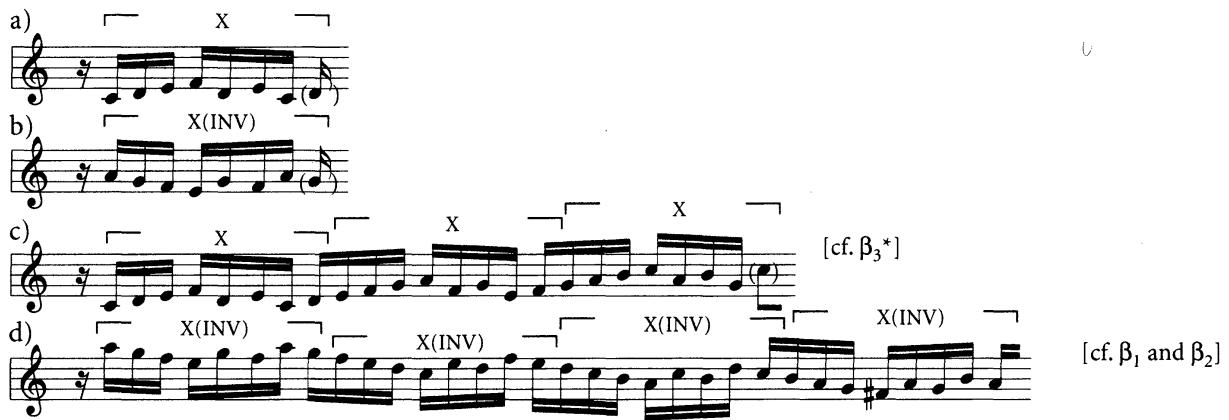
中文讲解
这是第16页上一处图像或乐谱占位符,原图内容(OCR或内嵌数据)已被省略,仅保留位置标记与图注占位。本节聚焦于 β 的推演(Example 1.3),因此此处图片很可能属于该例的谱例局部;具体谱面需查看原图方可确认。
补充说明
占位符位于第16页,紧邻 Example 1.3 的图题(P0069),应理解为该例中某一组片段(可能为 Example 1.3a–d 之一)的乐谱截图。其与本节论证的关联在于:用以呈现作者所分析的 X 与 X(INV) 的具体形态,以及上下声部的进行方式,但具体音高与节奏不可在文本中确认。
第2段(P0067)
原文复述
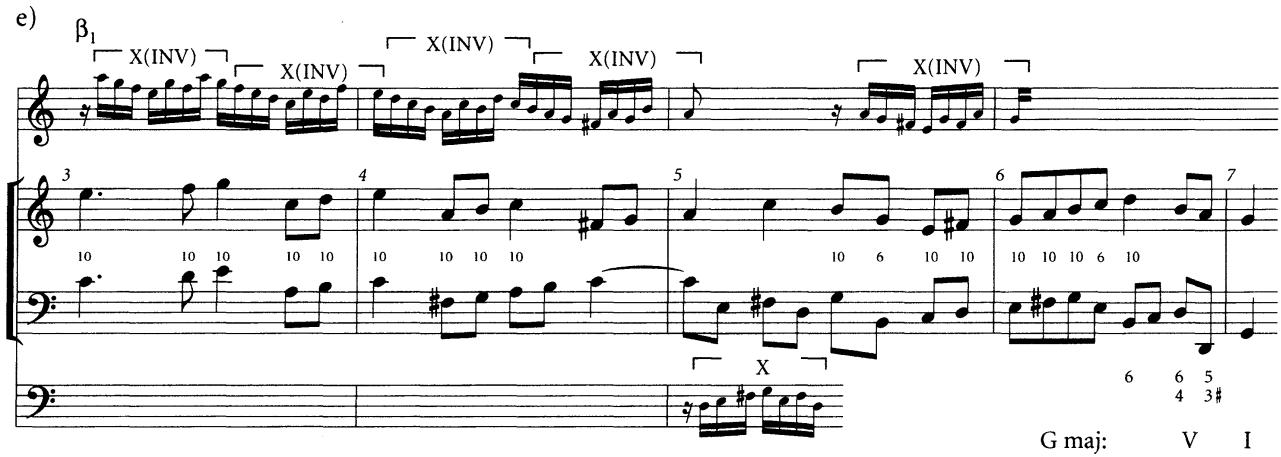
中文讲解
这是第16页上的第二处图像或乐谱占位符,原图内容已被省略。在本节(关于 β 的推演)语境下,它应与前后的 P0066、P0068 共同组成 Example 1.3 的一组乐谱片段;具体显示哪一段需要查看原图。
补充说明
该占位符与 P0066、P0068 位于同一页,疑为 Example 1.3 中的子图之一(可能为 1.3a、1.3b、1.3c 或 1.3d 之一),用以呈现 β 中 X 与 X(INV) 的不同陈述形态。仅凭占位符无法判断其显示哪一片段。
第3段(P0068)
原文复述
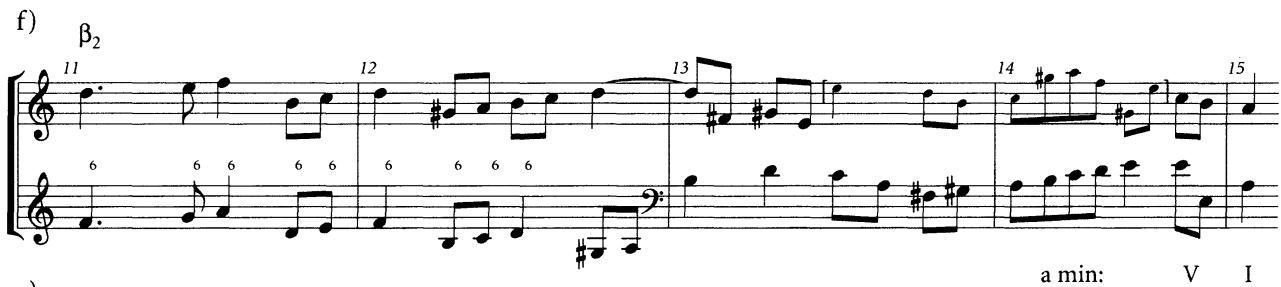
中文讲解
这是第16页上的第三处图像或乐谱占位符,原图内容已被省略。结合紧随其后的图题 P0069(Example 1.3:The derivation of β (BWV 772)),可知 P0066–P0068 三处占位符很可能共同构成 Example 1.3 的多个子图谱例,用以视觉化作者对 β 的逐步推演。
补充说明
该占位符连同 P0066、P0067 与 P0069 图题,构成 Example 1.3 的图组。作者在后文 P0073 中提到 “the outer staves of Ex. 1.3e”,说明该例至少包含子图 e;P0066–P0068 中至少有一处对应外声部的简化谱例(voice-leading reduction)。
第4段(P0069)
原文复述
Example 1.3 The derivation of $\beta$ (BWV 772)
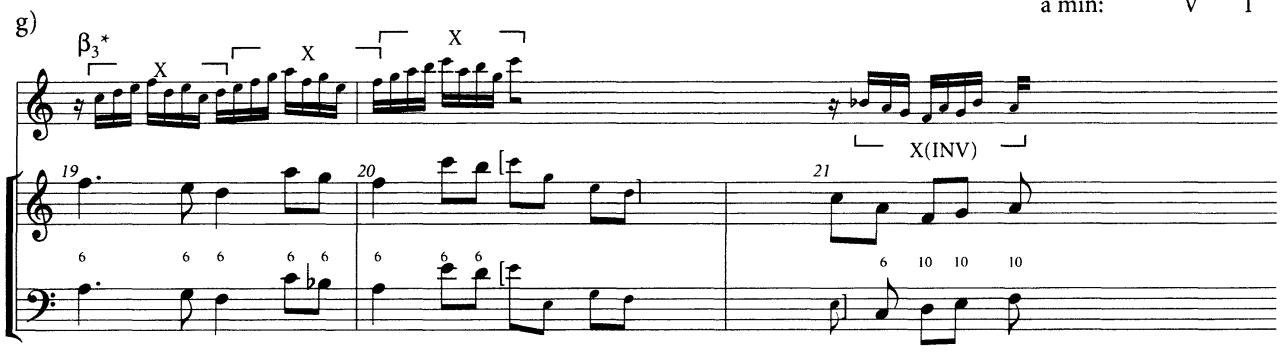
中文讲解
这是 Example 1.3 的图题,标明了本例的对象:β(BWV 772 即《二部创意曲集》第一首)这一片段的推演。该标题提示读者:本节将围绕如何在 BWV 772 中"推出"β 这一主题进行论证,并以乐谱形式(Example 1.3)作为视觉佐证。
补充说明
BWV 772 即 J. S. Bach《二部创意曲》第一首;β 是作者为该曲第一乐句中段所取的标签,与之相对的是 α。BWV 编号、α/β 标记以及 Example 编号共同构成本节的论证坐标。
第5段(P0070)
原文复述
Bach and the Patterns of Invention
中文讲解
这是第16页的页眉(running head),表明本章所属的著作名称:Laurence Dreyfus 的《Bach and the Patterns of Invention》。它仅起版面标识作用,不承载论证内容。
补充说明
页眉重复出现(P0077 处改为 “What Is an Invention?",对应本节的小节题)。页眉变化反映所处章节/小节的不同。
第6段(P0071)
原文复述
Dreyfus, Laurence. Bach and the Patterns of Invention. E-book, Cambridge, Mass.: Harvard University Press, 1996, https://hdl.handle.net/2027/heb05561.0001.001. Downloaded on behalf of Indiana University, Bloomington
中文讲解
这是电子书版权/下载来源页信息,标识本书的责任者(Dreyfus, Laurence)、题名(Bach and the Patterns of Invention)、出版信息(Cambridge, Mass.: Harvard University Press, 1996)、电子版 handle 链接,以及下载方(Indiana University, Bloomington)。它属于电子书版页面附带的版次与获取说明,不参与正文论证。
补充说明
该信息会在每一章首页重复出现(P0078 为第17页对应的重复条目),属于电子书分章切片产生的版面内容,并非正文论述。
第7段(P0072)
原文复述
(It makes no sense to view the tenths in mm. 3–4 as a determinative parameter, since this would imply that the obvious links in the melodic chain in the treble were merely a fortuitous by-product of voice-leading.)
中文讲解
这是一段括注,作用是先排除一种可能的对位分析思路。作者指出:若把小节 3–4 中的十度音程视为"决定性参数”,将导致一个无法接受的后果——即高声部旋律链中那些"明显"的关联,反而只能被解释为声部进行(voice-leading)的偶然副产品。括号内的陈述是一个反证:作者借此否定把十度视为第一因的解读,为后文把十度(进而把和声进行)视为真正驱动力的论证铺垫。
补充说明
“mm. 3–4” 指 BWV 772 第 3–4 小节;“treble” 指高声部。“voice-leading”(声部进行)是 Schenkerian/传统对位分析中描述各声部相互关系的概念。括注放在 P0073 之前,是为了先消除一种反例性解读,确保读者进入下文时已接受:高声部旋律链是先行的事实,而非十度进行的衍生物。
第8段(P0073)
原文复述
By the downbeat of m. 5, even though X and X(INV) are still present (see the outer staves of Ex. 1.3e), the pattern of events seems driven by a new motor. This pattern no longer plays on the intervalic properties of X but is ruled by a sequence of (primarily) ascending tenths leading to a cadence in G. (See the voice-leading reduction in Ex. 1.3e.) To read the passage this way is to observe that a fundamentally harmonic activity—the pattern of ascending tenths leading to the cadence—has upstaged the fundamentally melodic operations performed on X. As a result, it is no longer the surface occurrences of X that can be said to pull the strings; it is rather the voice-leading pattern and the cadence in the second half of $\beta$ that assert control. Indeed, as the outer staves in Ex. 1.3e show, X disappears in m. 6 precisely when harmonic necessity prevents Bach from finding any use for it at all. The design of $\beta$ was therefore influenced by operations performed on X even though the overall goal of the segment—a modulation—was independent of X.
中文讲解
本段是本节的核心论证段落,提出"和声夺席(harmonic upstaging)“这一关键概念。要点如下:
- 转折点在小节 5 的强拍:尽管 X 及其倒影 X(INV) 仍然在场(见 Ex. 1.3e 外声部),但段落的运行逻辑已被一种新的"马达"所驱动——一系列(主要为)上行的十度,通向 G 大调的终止式。
- 这种新的驱动不再依赖 X 的音程属性,而是被和声进行本身所支配。作者用 “upstaged”(夺席/抢戏)一词形容:原本由旋律操作(在 X 上展开)所主导的地位,被一种根本性的和声活动所取代。
- 因果关系由此反转:表面上的 X 陈述不再"牵线”,真正起控制作用的是 β 后半段的声部进行模式与终止式。
- 进一步佐证:X 在小节 6 消失,正好是当和声需要使 Bach 完全找不到 X 的用武之地之时。这说明 X 的隐现服从于和声约束。
- 综合结论:β 的设计虽然受到在 X 上所施操作的影响,但其段落的总体目标(一次转调)独立于 X。换言之,和声逻辑夺走了旋律操作的"指挥权”。 这一段是"和声夺席"论断的集中表述,并为 P0074 引入的手稿证据提供了理论前提。
补充说明
X(INV) 指主题 X 的倒影形式;“outer staves” 提示 Ex. 1.3e 是含有最外两声部(高声部与低声部)的简化谱例(voice-leading reduction);G 大调的终止式(cadence in G)对应从 a 小调主调转向属方向 G 大调的转调过程。“upstaged” 是戏剧术语的借用,本节标题 “Harmonic Upstaging” 即由此而来。
第9段(P0074)
原文复述
This change in function prompts us to consider the voice-leading reduction in two contrasting ways: first as result and only later as cause. At the beginning of the segment, the voice-leading constitutes an ancillary component rather than an active mechanism. Only at the end of the segment where harmonic concerns take over does the voice-leading assume a clearly commanding role as it moves toward the cadence. Some intriguing manuscript evidence illuminates this shift in the “balance of power.” $^{36}$ (See Ex. 1.4.) In the Notebook for Wilhelm Friedemann where Bach had composed the piece, the bass line in m. 5 originally proceeded directly to the cadence as shown in the example, for which I have supplied a hypothetical treble part. From this evidence one can infer that Bach later expanded the original cadence into the final version of mm. 5–6 (with its ascent to the cadence) when he discovered that he could pack yet another statement of X (in the second half of m. 5) into the prime form of $\beta$ . As a result of this shift in hierarchy—from melodic to harmonic invention—it makes sense to see the voice-leading only sometimes as structural and determining while at other times it is merely epiphenomenal.
中文讲解
本段由 P0073 的理论判断转入实证支撑,论证步骤如下:
- 功能变化导致对声部进行简化谱例的两种相反读法:先作为"结果”,后作为"原因"。在段落开头,声部进行只是附属成分而非主动机制;只有到了段落末尾、和声关切占主导时,声部进行才在走向终止的进程中显出明确的"指挥"地位。
- 引入手稿证据(脚注 36,指 Ex. 1.4):在《为威廉·弗里德曼的小笔记本》(Clavierbüchlein vor Wilhelm Friedemann Bach)中,Bach 当初写下这首曲子时,第 5 小节的低音原本直接走向终止。作者为此补写了一个"假想"的高声部,以示该早期版本的面貌。
- 由手稿推断:Bach 后来把原来的终止扩展成最终版的小节 5–6(即具有向终止上行的那一段),原因是他发现可以在 β 的原型(prime form)中再塞入一句 X 的陈述(位于第 5 小节后半)。
- 综合判断:随着创作过程从"旋律式发明"转为"和声式发明",层级关系发生了变化;因此声部进行只能在某些时候被视作结构性、决定性的,在另一些时候则只是附带现象(epiphenomenal)。 这段的功能是为"和声夺席"提供一手史料层面的支撑,使读者看到从早期版本到最终版本中,Bach 的创作重心实际从旋律操作转向了和声布局。
补充说明
脚注 36 是 Ex. 1.4 的来源说明(即 Wilhelm Friedemann Bach 的笔记本谱例)。“prime form of β” 指 β 的原始原型/基本形态,而非任何变体。“epiphenomenal”(附带现象)一词借自哲学/科学哲学讨论意识的术语,作者借此强调:当和声逻辑不要求时,声部进行并不构成独立的原因性力量。
第10段(P0075)
原文复述
Transformed statements of $\beta$ appear twice later in the piece, so that this segment will be considered, like a, one of Bach’s underlying inventions for the
中文讲解
本段宣告 β 在作品后文中还有"变形陈述"(transformed statements)出现两次,因此 β 与 α 一样,被视为 Bach 在此曲中的一项"底层发明(underlying invention)"。句子在 “for the” 处中断,说明文本在该页被切断,下一页将继续完成这个短语(可能为 “for the rest of the piece” 之类)。这一收束既是对 β 地位的总结,也是为下一节讨论 β 在曲中后段的变形运用埋下伏笔。
补充说明
“underlying inventions” 是作者 Dreyfus 在本书中的核心概念之一,指 Bach 在创意曲内部反复使用、变形并支撑整体结构的基本材料;α 与 β 同列于此,说明两者在乐章层面具有同等地位,而非 β 仅从属于 α。
第11段(P0076)
原文复述
Example 1.4 BWV 772, mm. 3–6, ante-correcturam version found in Clavierbüchlein vor Wilhelm Friedemann Bach

中文讲解
这是 Example 1.4 的图题,表明该例呈现 BWV 772 第 3–6 小节、且为 Wilhelm Friedemann 笔记本中所保存的"修改前(ante-correcturam)“版本。该版本是 P0074 论证的关键一手史料——它显示了 Bach 在最终版之前,第 5 小节低音直接进入终止、尚未插入那次额外 X 陈述的形态。
补充说明
“ante-correcturam” 为拉丁语,意为"改正前”,是版本学/手稿研究中描述文本修订前的样貌的术语;与 “post-correcturam”(改正后)相对。“Clavierbüchlein vor Wilhelm Friedemann Bach” 是 Bach 为长子 Wilhelm Friedemann 编写的一本键盘曲集笔记本,其中收录了《二部创意曲》的早期草稿,是研究 BWV 772 创作过程的重要原始资料。
第12段(P0077)
原文复述
What Is an Invention?
中文讲解
这是第17页的页眉,与 P0070(“Bach and the Patterns of Invention”)相对应地标识出本节的小节题 “What Is an Invention?"。它仅起版面标识与导航作用,提示读者本节讨论对象是"何为创意曲/何为 invention"这一概念。
补充说明
页眉从 “Bach and the Patterns of Invention”(著作名)切换到 “What Is an Invention?"(小节题),意味着读者已进入关于 invention 概念的专门讨论区段。
第13段(P0078)
原文复述
Dreyfus, Laurence. Bach and the Patterns of Invention. E-book, Cambridge, Mass.: Harvard University Press, 1996, https://hdl.handle.net/2027/heb05561.0001.001. Downloaded on behalf of Indiana University, Bloomington
中文讲解
这是第17页上重复出现的电子书版权/下载来源信息,与 P0071 内容完全一致。它属于电子书分章切片产生的版次说明,并非正文论证。
补充说明
在电子书按章切分页面时,相同信息常在每章首页重复出现;P0071 与 P0078 互为重复条目,读者据此可识别本章的版权与获取来源。
脚注 / 边栏 / 图表 / 附加信息(如有)
本节包含两处脚注性图例与一处脚注 36:
- Example 1.3(P0069,附 P0066–P0068 三处图像占位符):The derivation of β (BWV 772)。该图组至少含子图 1.3e 的声部进行简化谱例(外声部 + 中间结构),用以视觉化 X 与 X(INV) 的陈述以及小节 5–6 中"上行的十度序列”。
- Example 1.4(P0076,附脚注 36):BWV 772 第 3–6 小节在 Clavierbüchlein vor Wilhelm Friedemann Bach 中的 ante-correcturam 版本。该例提供原始低音直接走向终止、早期版本未含第 5 小节后半 X 陈述的形态,作者并为之补写了"假想的高声部”。
- P0071 与 P0078 为相同的电子书版权/下载来源页说明(Harvard University Press, 1996;handle 链接;下载方 Indiana University, Bloomington),属于电子书版版面信息,无正文论证作用。
- 页眉 P0070(“Bach and the Patterns of Invention”)与 P0077(“What Is an Invention?")分别对应著作名与小节题,仅作版面标识。
💡 本节核心要点
- 在小节 5 强拍处,β 的运行逻辑从"在 X 上施行的旋律操作"被一种"上行的十度序列导向 G 大调终止式"的和声模式所取代,作者将这一权力交接命名为 harmonic upstaging(和声夺席)。
- X 在小节 6 消失并非偶然,而是和声需求使 Bach 找不到 X 的容身之处;这反向证明:和声逻辑此时才是真正的控制变量,X 只是受其约束的表面现象。
- 声部进行简化谱例(voice-leading reduction)在段落开头只是附属结果,在段落末尾才上升为推动终止的结构性原因;因此同一谱例在不同位置具有不同的因果地位。
- Wilhelm Friedemann 笔记本中的 ante-correcturam 谱例(Ex. 1.4)显示:早期版本第 5 小节低音直接进入终止,最终版扩展成小节 5–6 的上行走向终止,并借此塞入又一次 X 的陈述,说明 Bach 的创作重心在实际过程中由旋律式发明转向和声式发明。
- 由此,β 与 α 同列,被定位为整首 BWV 772 中的一项"底层发明(underlying invention)",其变形陈述将在后文再次出现,承担全曲的结构支柱作用。
- 作者的方法论结论:声部进行只是有时为结构性、决定性的,有时仅为附带现象(epiphenomenal);阅读对位谱时必须先区分"作为结果"与"作为原因"两种身份。
🔑 关键术语
- harmonic upstaging:本节核心术语。指在 β 内部,一种和声活动(上行十度序列导向终止)取代了原本对 X 进行的旋律操作的"主导地位”,像戏剧中配角抢戏一样接管了控制权。
- voice-leading reduction:声部进行简化谱例。Schenkerian 风格的分析工具,把作品中若干声部压缩为最外声部与一个或数个内声部骨干音,用以揭示潜在的进行方向;本节用 Ex. 1.3e 呈现 β 后半的简化结构。
- X(INV):主题 X 的倒影(inversion)形式。即把 X 的音程方向上下翻转所得到的旋律轮廓;在 β 中与 X 同时出现,是分析其内部分层的重要标识。
- epiphenomenal:附带现象。借自意识哲学概念;在本节中指当和声逻辑不需要时,声部进行只是表面现象而非结构性原因,因而只能被视为结果而非动因。
- ante-correcturam version:修改前版本。版本学术语,指作曲家在最终修订之前的文本形态;本节用以指 Wilhelm Friedemann 笔记本中所存 BWV 772 早期草稿(Ex. 1.4),是论证"和声夺席"的关键一手史料。
- underlying invention:底层发明。Dreyfus 在本书中的核心概念之一,指 Bach 在一首创意曲内部反复变形使用、支撑整体结构的基本材料;本节将 β 与 α 并列为 BWV 772 的底层发明之一。
- Clavierbüchlein vor Wilhelm Friedemann Bach:为 Wilhelm Friedemann Bach 所编的键盘曲笔记本。其中保存的 BWV 772 早期草稿(ante-correcturam 版本)是本节论证手稿证据的直接来源。
S16 [描述性拆分] Transforming β: Voice-Exchange, Mode-Switch, and the Failed Melodic Inversion
第1段(P0079)
原文复述
本段为书中第18页上的一处内嵌图像或乐谱示例占位符。原图(含乐谱)的实际数据已被省略,仅保留其在版面上的位置与图注。读者若要查看原图谱例,需查阅原书第18页。

中文讲解
本段是第18页上一组连续出现的内嵌图像/乐谱占位符(P0079–P0083)中的第一幅。结合下文中对 Ex. 1.5 的多次引用(1.5b、1.5c、1.5d、1.5e),可以推断本页这五幅图示正是 Ex. 1.5 的多个子谱例,集中展示 β₂ 的生成过程。占位符的图注与说明文字在本书文本中没有保留,原始谱面音符走向需要查看原书才能核验。
第2段(P0080)
原文复述
本段为书中第18页上的一处内嵌图像或乐谱示例占位符。原图数据已被省略,仅保留其在版面上的位置与图注。读者若要查看原始谱例,需查阅原书第18页。

中文讲解
本段为 P0079 之后紧邻出现的第二幅图示占位符,与 P0079、P0081–P0083 同处第18页,疑为 Ex. 1.5 的另一幅子谱例(具体对应 1.5a–e 中的哪一幅需查阅原书)。占位符并未附带图注文本,故仅能依靠正文叙述(P0086–P0089)反推画面内容。
第3段(P0081)
原文复述
本段为书中第18页上的一处内嵌图像或乐谱示例占位符。原图数据已被省略,仅保留其在版面上的位置与图注。读者若要查看原始谱例,需查阅原书第18页。

中文讲解
本段是 Ex. 1.5 系列谱例中的第三幅图示占位符。在 P0086 的讨论里,作者会以 ‘In Ex. 1.5b…’、‘as Ex. 1.5c shows…’ 等方式先后点引这些子谱例,因此这五幅占位符在论证链上具有先后次序。具体乐谱内容只能查阅原书确认。
第4段(P0082)
原文复述
本段为书中第18页上的一处内嵌图像或乐谱示例占位符。原图数据已被省略,仅保留其在版面上的位置与图注。读者若要查看原始谱例,需查阅原书第18页。

中文讲解
本段是 Ex. 1.5 系列的第四幅图示占位符。根据 P0089 ‘In Ex. 1.5d, the segment in major is played in the minor’ 的提法,可知此处对应 Ex. 1.5d 的谱面,展示把大调段转入小调(MODESWITCH)之后的状态。原始声部进行需查阅原书。
第5段(P0083)
原文复述
本段为书中第18页上的一处内嵌图像或乐谱示例占位符。原图数据已被省略,仅保留其在版面上的位置与图注。读者若要查看原始谱例,需查阅原书第18页。

中文讲解
本段是 Ex. 1.5 系列的第五幅、即末幅图示占位符。根据 P0089 ‘Ex. 1.5e shows the adjustments reflected in the final version of β₂’ 可知,此处对应 Ex. 1.5e 的最终调整谱例。它体现了把声部交换与调式转换两步操作叠加后,又对失败处(星号标出)进行修补,最终形成的 β₂ 完整面貌。
第6段(P0084)
原文复述
$$\beta_{1}$$
中文讲解
本段为数学公式占位符,显示希腊字母 β 配以下标 1。该符号是 Dreyfus 在本书中为 β 段主题之’原始/原型版本’设定的标签:β₁ 是整个 β 段所有派生版本(包括 β₂ 与 β₃)的共同种子材料。它在不同谱例和行文中反复出现,作为尚未施加任何变换操作时的’基形’参照。
第7段(P0085)
原文复述
$$\beta_{2},$$
中文讲解
本段为数学公式占位符,显示 β 的右下标为 2,并在公式末尾保留了一个逗号。该逗号反映了原书中此公式嵌在某段叙述里作行内并列(如 ‘β₁ … β₂, … β₃’)时的句法节奏。β₂ 是对 β₁ 施加一系列变换(包括后述的 ROTATE 与 MODESWITCH 等操作)后所得到的第二版本。
第8段(P0086)
原文复述
…piece. What logic underlies its transformations? That is, how did the operations performed on β₁ result in the ultimate versions in β₂ and β₃? Ex. 1.5 depicts a mechanism for the derivation of β₂, and thus details the individual steps intervening between Ex. 1.3e and Ex. 1.3f. In Ex. 1.5b, the two voices of β₁ exchange positions—that is, they are inverted contrapuntally at the octave. (This operation is labeled ROTATE in the musical example.) Since much of the passage consists of parallel tenths, the contrapuntal inversion produces entirely usable parallel sixths, a feature that was surely built into the design of β₁ for precisely this purpose. Nonetheless, as the asterisks in Ex. 1.5b show, this voice-exchange causes the parts to cross at the end of the segment in a way that unacceptably muddles the identities of the lines. To eliminate this problem, the last three notes of the two voices are ‘rotated’ back to their original positions, as Ex. 1.5c shows. In
中文讲解
本段紧接上页末行(以小写 ‘piece.’ 起头,属跨页续接句),正式对本节提出核心问题:β₁ 经由什么逻辑变换出最终的 β₂ 与 β₃?为此作者引入 Ex. 1.5,用它来展示 β₂ 的详细生成机制,也就是填补 Ex. 1.3e 与 Ex. 1.3f 之间的具体加工步骤。
论证分两层推进:
-
第一次正面示范——ROTATE。Ex. 1.5b 把 β₁ 的两个声部互换位置,也就是在八度上做对位性倒转,作者在乐谱中把这个操作标记为 ROTATE。这一操作之所以可行,是因为 β₁ 中已有大量平行十度,对位倒转后会得到完全可用的平行六度——可见 β₁ 的素材从一开始就被刻意设计成’既便于原貌使用、又便于旋转换位’的双向资源。
-
失败与修正。然而 Ex. 1.5b 的星号标示出该次倒转在段尾造成声部交叉,使两条旋律线的’身份’被搅乱,故不得不接受的程度被破坏。解决方式(Ex. 1.5c)是把两声部末三个音’反向旋转’回原位——即局部撤销 ROTATE。
教学要点:这一段揭示 Dreyfus 分析法的两个关键特征。其一,ROTATE 并非放之四海皆准的算子;它只能成功作用在 β₁ 这类’预备好的’材料上。其二,故障点并非例外,而是该方法论的内在组成:作者以星号标出受挫处,并明确允许通过局部’取消旋转’来缝补,这正是后续 β₂ 微调的伏笔。
补充说明
P0086 段尾以小写 In 结尾,表示该段也跨页继续,承接自 P0089 起首的 ‘Ex. 1.5d…’。这种跨页断句是原书排版所致。
第9段(P0087)
原文复述
Bach and the Patterns of Invention
中文讲解
本段是第18页的页眉——书名 Bach and the Patterns of Invention,属于版面标识,用于提示读者当前页所属专著。它并非论述内容,故不参与本节论证链。
第10段(P0088)
原文复述
Dreyfus, Laurence. Bach and the Patterns of Invention. E-book, Cambridge, Mass.: Harvard University Press, 1996, https://hdl.handle.net/2027/heb05561.0001.001. Downloaded on behalf of Indiana University, Bloomington
中文讲解
本段是第18页底部的页脚——一段引文/版本信息,包含作者 Laurence Dreyfus、书名、电子书格式、出版地与机构(哈佛大学出版社,1996)、Handle 系统的永久 URL(heb05561.0001.001)以及授权下载方(印第安纳大学布卢明顿分校)。这是数字版本留下的版权与来源标识,对正文论点无直接影响,但有助于读者核对所引用页码的具体出版版本。
第11段(P0089)
原文复述
Ex. 1.5d, the segment in major is played in the minor: I call this operation a MODESWITCH, that is, when either a melodic line or a harmonic progression is switched into the opposite mode. (Here and elsewhere in this book I use type in small capitals for procedures of invention that can be formalized as quasi-mechanical functions.) The maneuver works flawlessly until the asterisks, where the minor version produces an unacceptable progression (among other infelicities, parallel tritones between the upper and implicit middle parts at the asterisks). Ex. 1.5e shows the adjustments reflected in the final version of β₂. I need to stress that this imagined derivation is not intended to plot the exact sequence of Bach’s thoughts but rather to imagine a plausible reconstruction of the ‘rules’ that would have guided his compositional choices, even if—given the daily practice of his art—he conceived of β₂ in a momentary flash. By postulating a hierarchy of processes underlying Bach’s compositional actions, the analysis aspires to simulate a kind of ‘mechanism’ that accounts for the preliminary planning within the inventive ‘work’ that ensured the transformations some degree of success as well as the execution of the connective links that constitute the piece as a whole.
中文讲解
本段承接 P0086 的末字 ‘In’,继续 β₂ 的两步生成叙事。
第一步是新操作的命名:在 Ex. 1.5d 中,把大调段改写成小调,作者称此操作为 MODESWITCH(调式切换),即把一条旋律或一段和声进行转入相反调式。作者用括号显式说明他在全书中用小型大写字母标记那些’可被形式化为准机械函数的’发明程序——ROTATE 与 MODESWITCH 即是该术语之下的两个范例。
第二步是该操作的失败与补救:MODESWITCH 在大部分地方顺畅无碍,但星号处小调版本制造出不可接受的进行——其中最显眼的是上声部与隐含中声部之间出现了平行三全音。Ex. 1.5e 展示了反映在 β₂ 最终版本中的具体补救调整。
第三步是关键的方法论自陈:作者强调,‘这种想象出的生成路径’并不意味着如实还原 Bach 的实际思维次序,而是要重构出足以引导其作曲选择的一套’规则’——即便 Bach 可能凭借日常技艺在一瞬间便构想出 β₂ 整体。Dreyfus 的真正意图是:在 Bach 的作曲行为之下假设一种过程层级,让分析模拟出某种’机制’,以解释发明’工作’内部那些确保变换获得一定成功、并保证连接段落把整首作品连为一体的预备性规划。
教学要点:Dreyfus 的分析哲学在此亮明——他既不声称能读心,也不放弃规则化解释;他刻画的是’假设的工序’而非’确凿的过程’,把不可还原的直觉(‘momentary flash’)与可形式化的工序(ROTATE/MODESWITCH)并置,使 β₂ 这种局部组装也能用层级解释。
第12段(P0090)
原文复述
The composition of β₃ boasts the most spectacular ‘feats’ with which Bach manipulated his inventions in this little piece, and its derivation is therefore perhaps the most intriguing. The compositional strategy here began with a sequential chain (now comprised of forms of X) that provided a mirror image to the one used in β₂ (see Ex. 1.3e). But not content to perform this one operation alone, Bach envisaged a more extraordinary tour de force by imagining a melodic inversion of the entire β-segment, as shown in Ex. 1.3g. (In the version preserved in the Clavierbüchlein for Wilhelm Friedemann, Bach was apparently unaware of how far he could actually go with β₃, since the bass in m. 20—a - d - e - f—abandons the melodic inversion right from the start. This means that Bach’s original imagined version of β₃ was faulty, a mistake he rectified only some months later while copying the piece for the ‘Straightforward Instruction.’ The mental activity of invention therefore extended even into the process of revision, in which the composer sought even greater discipline in the application of his strictest compositional procedures.) That is, all ascending intervals in both voices are now made to descend while descending intervals are made to ascend, a kind of melodic inversion that preserves the mode rather than the intervalic species of the major or minor seconds. This operation—equivalent to a contrapuntal mirror found in the most arcane kinds of fugal writing—was riskier than any other in the piece and, as Ex. 1.3g shows, was far less successful than any other inventive move. For this reason, Bach had to be satisfied with a more modest success. Interestingly, though, he makes use of the transformed segment until the very moment when it becomes unusable (at the third quarter of m. 20) where, unable to persevere with the inversion, Bach sneaks in a misplaced snippet of β in its prime form at m. 21 before terminating the transformation altogether. But even this retreat in the face of the contrapuntal odds was not to be seen as ruinous to the overall invention: for this final intervalic progression deriving from β₁ (6–10–10–10) neatly ‘compensates’ for the failure of the contrapuntal inversion in the corresponding portion of β₂ (last quarter of m. 13), where Bach had been forced to alter the treble. Where β₂ had abandoned the strict letter of the invention as a result of its MODESWITCH, a new passage now reiterated what could be done without such a constraint. The derivation of β₃* (notated with a ‘defective’ asterisk because it had to be discontinued in midstream) and its continuation thus illustrates an economic principle common to all craftsmen: learn from failed experiments and put them to good use.
中文讲解
本段是本节最长的分析段,围绕 β₃ 的’最壮观演出’展开。把论证脉络拆成五层:
-
起点:与 β₂ 镜像相对的序列链。β₃ 的写作策略始于一条序列链(其中含有 X 的各种形态),它形成了与 β₂ 所用序列彼此镜像的关系(参 Ex. 1.3e)。这意味着 β₃ 的底层结构已经是一次’对 β₂ 的反向叙述’。
-
更宏伟的设想:整体 β 段做旋律反向。然而 Bach 并不止步于镜像序列,他更进一步设想出整段 β 的旋律反向——也就是 Ex. 1.3g 所展示的处理。括号中的版本史注释是论证关键:在 Wilhelm Friedemann 用的 Clavierbüchlein 中保留下来的那版,Bach 似乎还没意识到他能走多远,因为第 20 小节的低音声部(a-d-e-f)一上来就放弃了旋律反向——这就说明 Bach 最初设想的 β₃ 版本存在缺漏;他直到几个月后为 ‘Straightforward Instruction’ 抄录该曲时才加以修正。改写本段由此推出一个重要结论:发明的心智活动延伸到修订过程中,Bach 在修订时还会追求对其最严格作曲程序的更大纪律性。
-
操作定义:作者明确给出’旋律反向(melodic inversion)‘的规则——所有上行音程变为下行、所有下行音程变为上行;这种反向’保留调式’,而’不保留大二度或小二度的音程种类’。也就是说,这是反向’方向’而非反向’音程性质’的镜像——它属于最玄奥的赋格写作中的对位镜像手法。
-
风险与被迫节制。这一操作比全曲其他任何手法都更冒险,而 Ex. 1.3g 显示它的成功度也最低。因此 Bach 不得不接受一次’较为温和的成功’:他使用变换后的段落直到它彻底失效的那一刻(第 20 小节第三拍)——继续不下去时,他便在第 21 小节处塞进一段’错位’的 β 原型片段,然后终止整个变换。
-
失败之用:‘抵偿’与匠人经济。即便如此,这次退缩并不毁损全局发明:源自 β₁ 的最终音程进行(6–10–10–10)恰好’抵偿’了 β₂ 在 m. 13 末拍因对位倒转失败而被迫改动高声部的那个缺陷;β₂ 因 MODESWITCH 而放弃了发明的’严苛条文’,β₃ 此刻则以另一个段落重新演示了在没有该约束时能做成什么。作者给被中途放弃的变换起名为 β₃*(用’有缺陷的’星号标记,因为它不得不中途停用)并以一句匠人信条作结——这是一条所有工匠共通的经济原则:从失败的实验中学习,并善加利用。
教学要点:本段示范了 Dreyfus 方法的三个标志性动作。其一,以版本史(CFB 中的早期抄本与 ‘Straightforward Instruction’ 的后期抄本)对照来重构作曲家的修订痕迹,把’发明’延展到’修订’之中。其二,对’旋律反向’与’音程反向’严格区分——后者(大二度↔小二度)会改变调式色彩,而前者只翻转方向;这种定义限定是分析的精度所在。其三,‘失败之用’:β₃* 的缺陷恰好给出一个 6-10-10-10 序列,正好用来对照 β₂ 中的失败处,把两次失败串成同一套补救资源——这就把局部瑕疵转化为整体一致性。
补充说明
本段括号中的版本史细节(Clavierbüchlein for Wilhelm Friedemann 与 ‘Straightforward Instruction’)均出自原文,可直接核验;据此可推出 Bach 的两套抄本年代上有先后,但 P0090 文本本身并未给出确切日期。
第13段(P0091)
原文复述
What Is an Invention?
中文讲解
本段是第19页的页眉——篇章标题 What Is an Invention?(什么是创意曲?)。它的设问式标题提示本节所在的整体章节正在叩问这一体裁的本质,因此 β₁/β₂/β₃ 的工序化分析正是对该问题的具体回答之一。
第14段(P0092)
原文复述
Dreyfus, Laurence. Bach and the Patterns of Invention. E-book, Cambridge, Mass.: Harvard University Press, 1996, https://hdl.handle.net/2027/heb05561.0001.001. Downloaded on behalf of Indiana University, Bloomington
中文讲解
本段是第19页底部的页脚,与 P0088 内容完全相同:作者、书名、出版社、年份、Handle URL 与下载授权机构。它仅是电子书版本重复出现的来源/版权标签,不参与本节论证。
脚注 / 边栏 / 图表 / 附加信息(如有)
本节含有五类版面对位文本,均应按非正文处理而非扩写:(1) 第18页上有五幅紧邻的内嵌图像/乐谱占位符 P0079–P0083,疑为 Ex. 1.5 的五个子谱例,其图面内容需要查阅原书。(2) 两个数学公式占位符 P0084(β₁,无标点)与 P0085(β₂, 末尾带逗号)作为 β 段各版本的标签反复出现。(3) 第18页眉 P0087 与第19页眉 P0091 分别是书名(‘Bach and the Patterns of Invention’)与章名(‘What Is an Invention?’),作用是版面定位。(4) 第18页脚 P0088 与第19页脚 P0092 是该电子书的来源/版权信息(Dreyfus 著、哈佛大学出版社 1996 电子版、Handle URL、印第安纳大学布卢明顿分校授权下载)。
💡 本节核心要点
- β₂ 是由 β₁ 经一组层级化、可形式化的’准机械’操作加工出来的:从声部互换(ROTATE,八度对位倒转)到调式切换(MODESWITCH,大调→小调),每一步都可能在边界处失败(星号处)而需局部修补。
- ROTATE 与 MODESWITCH 这两个被作者以小型大写字母标记的程序,并非 Bach 实际思维的忠实记录,而是 Dreyfus 用来解释并模拟 Bach 作曲行为的分析性规则;其目的是揭示’机制’层级,而非还原时序。
- β₃ 的生成承担本曲最宏大的工序:在镜像序列之上叠加整体 β 段的旋律反向(把上行音程一律改为下行、下行改为上行,但保留大小二度的调式而非音程种类)。该手法相当于赋格写作中最深奥的对位镜像。
- Bach 在 Wilhelm Friedemann 的 Clavierbüchlein 抄本与后来的 ‘Straightforward Instruction’ 抄本之间的差异,被用作证据:发明活动延伸到修订阶段,最严格的程序在修订时也仍受更严的纪律约束。
- β₃ 的反向处理在 Ex. 1.3g 中被认为’远不如其他发明举措成功’,作者以 β₃*(带’有缺陷的’星号)来标记这种中途停用的变换体;它的最终音程进程(6–10–10–10)反过来’抵偿’了 β₂ 中因 MODESWITCH 而被迫改动高声部的对应段落,由此把两次局部的失败转化为全曲的一致性资源。
- 整节凝结为一句匠人原则——‘从失败的实验中学习,并善加利用’——它把 Dreyfus 的工序化分析定位为对作曲家经济性的隐喻性刻画。
🔑 关键术语
- β₁ / β₂ / β₃:本节为 β 段主题(在 Bach 的 C 大调二声部创意曲的 B 段中)设立的三种版本标签:β₁ 是未经变换的原始形态;β₂ 是经过声部交换(ROTATE)与调式切换(MODESWITCH)后的派生版本;β₃ 是叠加了镜像序列与整体旋律反向的版本。它们共同用于追踪同一段主题素材被反复加工的层级。
- ROTATE:作者用小型大写字母标记的’可形式化发明程序’之一。其作用是把一段二声部材料的两条旋律线在八度上互换位置,即做八度对位倒转。本节例子里 β₁ 的平行十度经 ROTATE 后变成可用的平行六度,但段尾会出现声部交叉,需以反向操作局部撤销。
- MODESWITCH:作者小型大写字母标记的’可形式化发明程序’之一。其作用是把一段旋律或一段和声进行转入相反调式(此处即从大调切入小调)。它在本节中作为 β₂ 生成路径的第二道工序,但同样会在一些位置(星号处)造成平行三全音等不可接受的和声后果。
- Melodic inversion(旋律反向):本节所演示的第三道工序:将两个声部中所有上行音程一律改为下行、所有下行音程一律改为上行。它’保留调式’而’不保留大小二度的音程种类’,因此属于方向镜像而非音程性质镜像;它被作者比作赋格写作中最深奥的对位镜像手法,也是全曲风险最高的操作。
- Asterisks(星号):在 Ex. 1.5b–e 与 Ex. 1.3g 中用来标出某一准机械操作失败的’故障点’——例如声部交叉、平行三全音、或被迫放弃旋律反向的低音进行。星号既是分析的诊断标记,也是后续调整(局部撤销、修补)的指引。
- β₃(‘defective’ asterisk)*:作者为本节中被中途停用的变换体所起的特殊记号,意为’有缺陷的’或’夭折的’ β₃。它指向 Bach 在小节 20 第三拍之后无法继续整体旋律反向、不得不在 m. 21 插入 β 原型片段的妥协结果;但恰恰是这个折衷体的最终音程进行(6–10–10–10)反哺了 β₂ 的失败处。
- Clavierbüchlein for Wilhelm Friedemann:原文中用以指代 Bach 于 1720 年前后为长子 Wilhelm Friedemann 设立的练琴笔记本;其中保存的本节作品版本中,Bach 尚未把 β₃ 的整体旋律反向贯彻到底(m. 20 的低音 a-d-e-f 一上来就放弃反向),被作者作为’早期有缺陷版本’的关键证据。
- ‘Straightforward Instruction’:本节用以指代 Bach 后来整理、旨在供学生练习的’创意曲合集’(即 P0090 中所称的 Straightforward Instruction 的抄写本)。Bach 几个月后在该抄录过程中修正了 β₃ 的早期失误,‘发明’活动因此被明确延伸到’修订’阶段。
- Procedures of invention(发明程序):作者在全书中以小型大写字母标记、且可被形式化为’准机械函数’的作曲操作集合;本节举例的 ROTATE、MODESWITCH、旋律反向均属此类。它们不声称如实还原 Bach 的内在思维时序,而是被用来搭建层级化的’生成机制’以解释素材派生与最终乐曲整体之间的衔接。
S17 [描述性拆分] The Disposition: Mapping α and β Across the Work
第1段(P0093)
原文复述
The Disposition
中文讲解
这是小节标题“The Disposition”(布局/配置),与原section_title相对应。作者从此处开始讨论继“invention”(构思/发明)之后的第二个核心概念——disposition,即把已发明的素材在作品整体的时间跨度中安置到位。标题的功能是宣告论题切换:前文讨论的是α与β的诞生,本节讨论它们如何被铺排。
第2段(P0094)
原文复述
With the invention of α and β (which embrace all their transformations), Bach had largely determined the content of his piece. And because both segments manifested such clear harmonic functions, he had charted much of its course as well. By its very nature, α could be used to open the work and tonicize important neighboring keys (this function is called DEFINE) while β would prepare and execute cadences in secondary areas that modulated up a fifth. The top portion of Figure 1.2 represents the sum of Bach’s inventions with their associated functions. Note also that α is designed to link up with β, so that the invention of the two segments constituted a complete “opening move” for the piece.
中文讲解
本段阐述α与β的发明(invention)实质上已经决定了作品的内容与走向。关键推理有三层:
- 因为α和β连同其各种转位/变形已经把所需材料穷尽,所以乐章的“内容”已基本确定。
- 由于两段都呈现出明确的和声功能,作者据此也能勾画出乐章的大致“路线”。
- 两种材料各司其职:α用以开启全曲并对相邻近的调加以主音化(tonicize,文中括号注明此功能被称为DEFINE);β则在向上五度的次属区域中准备并完成终止式(cadence)。
段末补充一个重要设计:α特意被写作可以与β衔接,因此α+β的组合本身构成了作品的一个完整“开局动作”(opening move)。这说明作者的思路不是把两段看作互不相关的储备,而是把它们配对成可启动全局叙事的单元。作者在图1.2的顶部已经标出了各项发明与对应功能,本段文字相当于对该图的导读。
补充说明
“DEFINE”在原文中以括号插入语出现,属于原始占位/标记,本段复述原样保留;在中文讲解中解释其上下文含义为“对相邻近的调进行主音化(tonicize)”。“tonicize”在功能和声中指将另一调性临时当作临时主音来确立,区别于真正转入新调的modulate,此处用于精确刻画α的功能角色。
第3段(P0095)
原文复述
The invention of segments α and β, moreover, already implied important aspects of their disposition, that is, how they would figure in the plan of the work as a whole. Nevertheless, it becomes meaningful to talk of disposing the work only when the inventions (and their transformations) are mapped out across the imagined terrain of the completed work. (Naturally this kind of distinction between invention and disposition only prevails when the invention is not wholly synonymous with the harmonic structure in a small-scale movement, as in certain preludes from the Well-Tempered Clavier which formally recall the dance pieces that Friedrich Erhard Niedt generated from a common thoroughbass in his Handleitung zur Variation [1706]. Niedt specifically calls his thoroughbass “the foundation of my Invention” and suggests how his method provided “a very easy method [for obtaining] many thousands of inventions through diligence and hard work.”) 37 A fundamental way to approach the disposition of inventions was to follow one of several recognized guidelines for the harmonic plan of a piece. (German writers sometimes discuss this subject under the rubric of species of cadences, or clausulae.) A composer began by positioning the inventions in the tonic and dominant at the beginning of the piece, saving transposed versions for the middle of the piece. The end of the piece would require either an invention that could end in the main key or some newly composed passage that closed in the tonic. The number of times times inventions could be repeated was limited by the size of the musical genre: in a preamble such as the C major Inventio, Bach thought of confining the size to about the length of a page. Disposition therefore means gauging gross size as well as thinking sequentially in time, imagining events from beginning to end. This is why it is useful to think of repeatable inventions in vertical paradigms, while their disposition is best appreciated in a horizontal syntagm, that is, in an ordered string that represents the time (and, if you will, space) spanned by the entire piece. Figure 1.2 displays such a hypothetical arrangement under “Disposition.”
中文讲解
本段是本节最核心的方法论说明,需要逐层拆解:
-
概念区分的提出:作者承认α、β的发明已经蕴含了它们日后如何被安置的某些方面(how they would figure in the plan of the work as a whole),但只有在把这些发明与它们的变形投射到“已完成作品的想象地形”上时,“布局”(disposition)才成为有意义的讨论对象。也就是说,发明是材料层面的发现,布局是把材料按时间与空间铺开的设计。
-
区分的适用边界(脚注37的内容):作者紧接着指出,发明与布局之分只在“发明并不完全等同于小型乐章的和声结构”时才成立。他用韦尔滕克雷维尔《平均律键盘曲集》中的某些前奏曲作为反例,这类前奏曲形式上令人联想到Niedt《变奏指南》(1706)里从同一通奏低音生成舞曲的做法。Niedt将通奏低音称作“我发明(Invention)的基础”,并强调用勤奋和苦功可以获得“成千上万种发明”。这段引文的功能是说明:当一个通奏低音本身就等于整首小品的和声结构时,谈“布局”就是多余的。作者援引它,是为了给发明/布局之分划定适用范围,而不是把它当作主线理论。
-
布局的指导原则:作者介绍18世纪德语理论中的“终止式种类”(species of cadences / clausulae)。布局通常遵循若干可识别的和声规划准则——把发明安排在主调与属调的开头,转位版本留到中段,结尾要么用一个能在主调结束的发明,要么另写一段收束在主调的新材料。
-
体裁对布局的约束:重复发明的次数受乐章体裁大小限制。以C大调《Inventio》这类序奏(preamble)为例,巴赫认为全曲大致限于“一页篇幅”。因此布局不只是顺序安排,还包括对总体规模的估算。
-
纵向范式与横向句段:作者用一个语言学类比收束——可重复使用的发明最好放在“纵向范式”(vertical paradigms,即按和声功能并列)中理解,而它们的布局则属于“横向句段”(horizontal syntagm),即按作品时间跨度排列的有序串。这一对照为图1.2“Disposition”行提供了概念框架。
总体来看,本段完成了三件事:定义disposition、限定其与invention之分的使用条件、并给出可操作的和声规划准则与体裁限制。
补充说明
本段末尾一句指引读者去图1.2中标注为“Disposition”的部分,以观察这些原则如何在一个假设性安排中体现。脚注37中的Niedt引文属于历史例证,仅用于界定invention/disposition之分的边界,不能当作作者理论的主体来源。paradigm/syntagm这一语言学对比出自索绪尔传统,作者借以把“同时性的和声关系”和“历时性的时间排列”区分清楚。
第4段(P0096)
原文复述
Bach and the Patterns of Invention
中文讲解
这是页眉(running header),标明当前页所属的著作名称。它属于版面信息,不承载论证内容。
第5段(P0097)
原文复述
Dreyfus, Laurence. Bach and the Patterns of Invention. E-book, Cambridge, Mass.: Harvard University Press, 1996, https://hdl.handle.net/2027/heb05561.0001.001. Downloaded on behalf of Indiana University, Bloomington
中文讲解
这是电子书版本的版权/下载来源信息脚注(access footer),交代作者、书名、出版地、出版社、出版年份以及电子书获取地址和下载机构。它不属于论证文本,仅用于版本溯源。
第6段(P0098)
原文复述
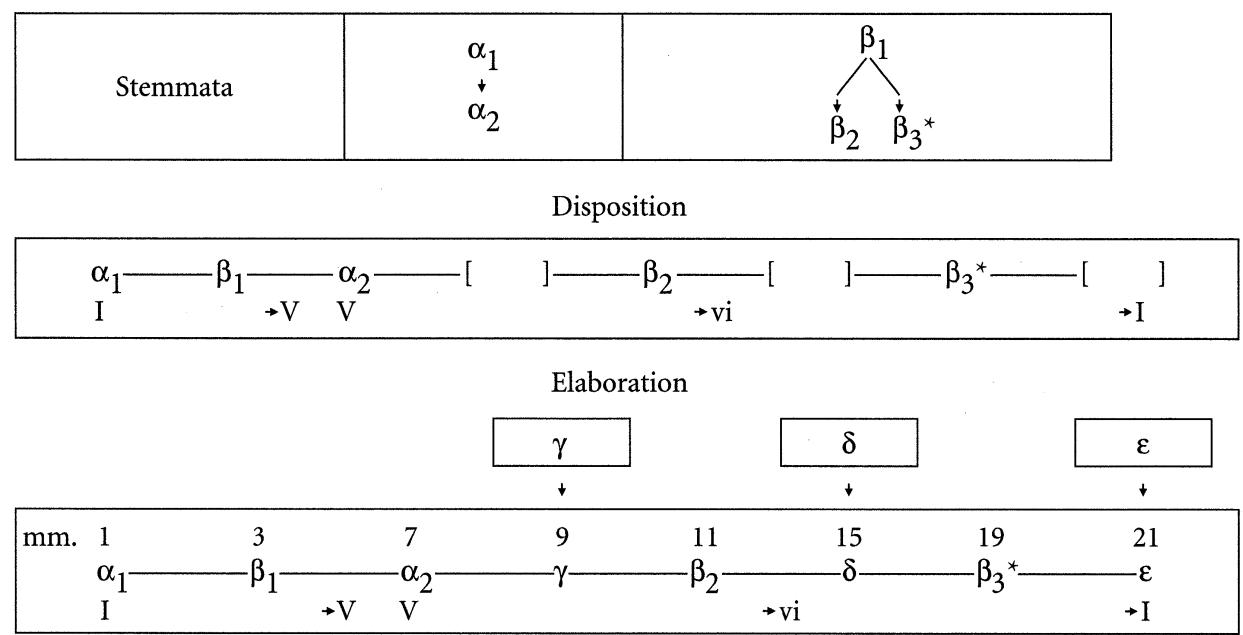
中文讲解
此处是图1.2的占位符,原图未在文本中嵌入,仅保留了位置与图注“Figure 1.2 Map of C major Invention, BWV 772”(C大调《二部创意曲》BWV 772的布局图)。按上下文可确认:该图分为上下两部分,上半部分(“Inventions with associated functions”)列出α与β的各次变形及其和声功能,下半部分(“Disposition”)则把这些发明沿时间轴排成横向句段,并留有空括号表示结尾尚待补写的空缺小节。该图是本节论证的可视化核心,但具体音符与图例需查看原图。
补充说明
图中信息需要通过查看原图获得,本节文字提到的内容(图分两部分、底部有空括号、α链接到β等)都对应于图1.2的可读结构。
第7段(P0099)
原文复述
Whereas convention dictated that the second occurrence of α should take place on the dominant, the ending point for β₂ was more flexible: among desirable minor scale degrees, II or III might also have been feasible, though perhaps not in a version with a full authentic cadence. As it turns out, a transposed form of β₁ could have ended the piece: Ex. 1.6 shows such a hypothetical ending that begins a fifth lower and thus cadences on C, a procedure used elsewhere, such as in the Inventio 8 in F major. But Bach chose a typically more daring solution by deploying β₃, surely relishing the opportunity to show that the melodic chain formed with X(INV) and exploited in β₂ also worked equally well with X itself. As a consequence, though, he had to compose a new ending for the piece. The brackets enclosing empty spaces in Figure 1.2 stand for the gaps that needed to be filled for the final measures. Of the twenty-two measures in the final version, fourteen—nearly two-thirds—are already accounted for even in this still rudimentary stage of the disposition.
中文讲解
本段把本节抽象的“布局原则”落实到C大调《二部创意曲》的具体选择上,分三层推进:
-
惯例与弹性的对比:按惯例,α第二次出现应当在属调上,这一点没有弹性;β₂的终止落点则有较大余地——小调式的II级或III级也可以被接受,只要不用完整的正格终止(full authentic cadence)。作者借此暗示作曲家在终止环节拥有比开篇更多的选择自由。
-
本可以成立却未被采用的方案:把β₁下移五度就可以在C上终止,作者称之为“假设性结尾”,并以例1.6(F大调《Inventio 8》中也用过同样手法)作为旁证,说明这条路在巴赫自己的实践中并非孤例。然而巴赫并未采用这条更直接的路径。
-
巴赫的选择及其代价:他选择了更大胆的β₃,因为β₂中由X(INV)形成的旋律链同样可以在X本身上顺畅展开——这等于在更宏观的尺度上证明了同一构思的可塑性。但代价是必须新写一个收束段落。图1.2底部括号内的空白就是这些尚待填补的最终小节。
末句给出关键的量化总结:在布局尚处雏形时,最终版22小节中的14小节(约三分之二)已经被现有材料覆盖。这一数字直接说明:发明阶段已经完成了全曲大部分的实质工作,布局阶段更多是顺序与衔接的设计,而不是新材料的堆砌。
补充说明
X(INV)与X的关系需结合前文理解:X(INV)是X的逆行(inversion)变形,巴赫借此证明同一“旋律链”机制在原形与变形上同样奏效,从而强化其“发明(invention)”的内在一致性。例1.6未在文本中嵌入,需查看原谱。
第8段(P0100)
原文复述
Dreyfus, Laurence. Bach and the Patterns of Invention. E-book, Cambridge, Mass.: Harvard University Press, 1996, https://hdl.handle.net/2027/heb05561.0007.001. Downloaded on behalf of Indiana University, Bloomington
中文讲解
这是页脚(access footer),重复本卷电子书版本信息,与P0097属于同一性质的版面信息,不承载论证。
第9段(P0101)
原文复述
What Is an Invention?
中文讲解
这是下一小节的标题,预示着在完成对C大调《Inventio》布局的剖析后,作者将把讨论拉回到更基础的问题——究竟什么是“invention”。它的功能是开启新论题,与本节(关于disposition)形成衔接:先讲发明如何被安置,再回头追问“发明”本身该如何定义。
💡 本节核心要点
🔑 关键术语
S18 [描述性拆分] Choosing β₃ and Composing a New Ending
第1段(P0102)
原文复述
Example 1.6: Possible ending for BWV 772 using a transposed form of β₁. (Embedded image data omitted; position and figure caption retained.)

中文讲解
本段并非正文段落,而是页面中的一处图位占位符(图片本身的数据已被省略,仅保留图注与位置信息)。图注原文为:「例1.6 使用β₁移调形式为BWV 772所作的可能结尾」。从其措辞可以获得以下可由原文直接确认的信息:
- 图注编号为「例1.6」,表明它是正文中被作者援引的一个具体谱例;
- 该例子的用途是展示「BWV 772的一种可能结尾」;
- 构造这一结尾所使用的手法,是把某个记号为β₁的素材做「移调(transposed)」处理之后再行使用。
值得注意的是,本节的小节标题是「Choosing β₃ and Composing a New Ending」(选择β₃并构造一个新结尾),但该图所展示的素材却来自β₁的移调形式,而非β₃。这暗示作者在介绍β₃之前,先以β₁为例,演示「把既有主题片段移调后用作新结尾」这一一般性技术,使读者在面对后续β₃的选择讨论时已有具体参照。由于原图数据未给出,本讲解无法也不应推测谱例的具体音高、节奏或对位细节;如需判断作者示范的「移调」究竟涉及何种音程关系或对位安排,必须回到原书查看图像本身。
补充说明
无额外补充。图片实际内容(具体音符、移调音程、织体形态)未在输入中提供,相关细节需查阅原书图例。
脚注 / 边栏 / 图表 / 附加信息(如有)
本节范围内仅含一处图位占位符(对应「例1.6」),无脚注、边栏或表格等其他附加材料。
💡 本节核心要点
- 本节核心论题为「在BWV 772中如何选择β₃并据此构造一个新结尾」。
- 图例1.6展示的是把已有的β₁材料作移调处理后,用作BWV 772可能结尾的一种方案。
- 该图位于标题点明的β₃讨论之前,因此其作用很可能是以β₁为例,先建立「移调既有材料→充当结尾」这一通用技术的具体印象,为后文对β₃的取舍提供参照。
- 由于图片本体未给出,谱例中的具体音高关系、对位处理或终止式形态在本输入范围内不可核验,需查看原图。
🔑 关键术语
- BWV 772:原文图注中出现的一件作品编号;本节围绕它讨论结尾部分的改写与构造。该编号本身所对应的具体作品在输入中未作说明,讲解不据此补充。
- β₁ (beta₁):原文用以指称BWV 772中的某一音乐素材片段的记号;图例1.6展示了它经「移调(transposed)」后被用作可能结尾的情形。该记号在更早段落中的定义不在本节输入范围内。
- transposed form / 移调形式:图注中明确使用的手法,即将原有素材在保持其内部音程关系的同时整体移高或移低,以产生新的旋律或终止写法;本节以此作为构造新结尾的备选策略之一。
S19 [描述性拆分] The Elaboration: γ and δ as Connective Links
第1段(P0103)
原文复述
The Elaboration
中文讲解
这是本节的标题。原标题为 “The Elaboration”(展开/展开段),在Markdown中以二级标题呈现,标志着本节开始进入对 elaboration(展开段)这一概念及其在巴赫发明曲中具体实现的系统讨论。从节标题与下文的衔接可以看出,作者将围绕展开段与 invention(主题陈述/发明)之间的对比关系,以及展开段本身如何在不同主题之间起连接作用展开论证。
第2段(P0104)
原文复述
Elaboration, according to Mattheson, “requires little instruction, for one encounters a path which has been prepared and already knows for certain where to go.” While there is some truth in this statement, it surely misses the surprising care that Bach lavished on his episodic passages. One might even be tempted to say that in Bach’s works both invention and elaboration are marked by an almost equally intense mental activity. A crucial difference, nonetheless, separates the two activities: whereas invention is work, elaboration is play. While invention requires foresight, planning, consistency, savvy, and seriousness of purpose, elaboration is content with elegance, an associative logic, and an eye for similarities. The bottom section of Figure 1.2 depicts the composition of the three elaborative passages—γ, δ, and ε—that can be thought of both as connecting links between the inventions and as faint echoes of their surface patterns. On the one hand, each elaborative segment plays a carefully circumscribed role. As Examples 1.7a and 1.7b show, γ and δ had to travel only a short distance from the terminal point of the preceding invention to the starting point of the succeeding one; each used simple, stepwise sequences to reach its goal. On the other hand, Bach goes out of his way to devise intricate motivic relations between his elaborative passages and inventive segments.
中文讲解
本段确立了本节的核心区分:invention(发明/主题陈述)与 elaboration(展开段)的根本差异。
-
起点:作者引用 Mattheson 的观点——展开段"几乎不需要指导,因为所走的路早已铺好,作曲家清楚地知道要去哪里"。Mattheson 暗示展开段是一种近乎自动的、按既定方向推进的过程。作者承认此话有一定道理,但同时指出此说忽略了巴赫在其插部段落上所投入的令人惊讶的精心处理。作者甚至提出一个较强的判断:在巴赫作品中,发明与展开都几乎同等强度地体现着密集的精神活动。
-
核心对立:尽管两者精神投入相当,作者仍然划分出一条关键界线——“invention is work, elaboration is play”。发明是"工作",需要远见(foresight)、规划(planning)、一致性(consistency)、圆熟(savvy)与目的的严肃性(seriousness of purpose);展开则是"游戏",满足于优雅(elegance)、联想式逻辑(associative logic)和对相似性的敏感(an eye for similarities)。这一对子不仅是修辞对比,更是作曲思维模式的二分。
-
双重身份:图1.2下半部所描绘的三段展开段——γ、δ、ε——具有双重功能。它们既是各发明段之间的连接环节(connecting links),也是相应发明段表面形态的微弱回响(faint echoes of their surface patterns)。也就是说,展开段同时承担"结构性连接"与"主题性回响"两种角色。
-
“on the one hand … on the other hand” 的结构:前一方面,每段展开段都扮演着严格限定的角色——据示例1.7a与1.7b所示,γ与δ只需从前一发明段的终止音行进到后一发明段的起始音,且都使用简单的级进序列即可达成。后一方面,巴赫又不遗余力地设计展开段与发明段之间复杂的动机关系。作者由此引出下文对 γ 和 δ 各自动机的精细分析。
此段在全节中的作用是铺垫:先立概念框架(invention vs elaboration、工作 vs 游戏、连接 vs 回响),再预告三个展开段各自的局部角色与隐秘动机联系。
补充说明
本段明确把 “elaboration” 译作"展开段/展开",并在本节体系下把它定位为 invention 之间的过渡材料;γ、δ、ε 是作者为此分析专设的展开段标记,α、β 是先行的发明段标记。文中提及的 “Figure 1.2” 与 “Examples 1.7a, 1.7b” 属于本节图示与谱例,但图本身未被收录在本节文本中。
第3段(P0105)
原文复述
Consider the passage connecting m. 9 to m. 11, called γ. At first glance, γ appears to derive from a by processes of melodic inversion (formalized as the function INVERT) and voice-exchange (formalized as the function ROTATE). But try as one might, γ cannot be seen to derive directly from a even though, by preserving the motivic resemblance, Bach takes pains to make them appear similar. A more fundamental difference between the two passages lies in their function. Whereas a announces a beginning by presenting the tonic and dominant in succession, γ functions as linear connective tissue linking (by consecutive parallel sixths) a₂ (mm. 7–8) with β₂ (mm. 11–14) by alternating forms of X(INV). Given a gap in the disposition between a₂ and β₂, one can easily imagine Bach’s pen elaborating the stepwise linear ascent with forms of X. But logically this move belongs to a later stage of composition: only after having decided on the precise deployment of α and β (in the dispositio) could Bach have reflected on a connective link between them. The passage thus performs a primarily local function that knits together an open seam. γ might also have resulted from a rejected moment in Bach’s invention when he considered whether a melodic inversion could be performed on α. (Voice-exchange, after all, had been used to derive α₂.) But because a hypothetical α(INV) was unusable—even its bare-bones outline fails to preserve a key-defining function—Bach resurrected a shadow of its idea when he came to seek out an elaborative link between α₂ and β₂. Thus, while there is no doubt that γ is a kind of weak substitution for an operation performed upon α that he could not undertake, the fact that γ could be temporarily mistaken for a form of α attests to Bach’s fascination with episodic play which comes to resemble inventive work.
中文讲解
本段是对 γ 的个案解剖,是本节论证最密集的一段,揭示出展开段的"游戏性"如何伪装成"发明性"。
-
表面错觉:γ 连接 m.9 至 m.11。乍看之下,γ 似乎从 a 派生而来,过程包括旋律倒影(形式化为函数 INVERT)和声部交换(形式化为函数 ROTATE)。然而无论怎样尝试,γ 都无法被认定为直接从 a 派生。巴赫通过保留动机上的相似性,刻意让两者看似相近——这是一种"形似而非派生"的现象。
-
真正差异在功能层面:a 的功能是"宣告开始"(通过连续呈现主音与属音),γ 的功能则是"线性连接组织"(linear connective tissue)——它以一连串平行六度(consecutive parallel sixths)把 a₂(第7–8小节)与 β₂(第11–14小节)连接起来,方式是交替使用 X(INV) 形式。
-
创作阶段逻辑:在 dispositio(布局阶段)中,a₂ 与 β₂ 之间留有间隙,可以想象巴赫用 X 的形式去"装饰"那段级进上行。但此步骤逻辑上属于较后阶段:只有先决定好 α 与 β 的精确部署(dispositio),巴赫才会反思二者之间的连接环节。因此 γ 执行的是一种"局部功能"(primarily local function),缝合的是一道敞开的接缝(an open seam)。
-
创作过程的反推:γ 也可能源于巴赫在 invention 阶段的一次被否决的设想:他曾考虑对 α 施以旋律倒影(α(INV)),但因为即便其骨架也无法保留"调性确定功能"(key-defining function),这一设想被放弃。(声部交换已被用于派生 α₂。)后来当巴赫要为 α₂ 与 β₂ 寻找展开性连接时,便让 α(INV) 这一被拒想法的"影子"得以复活。
-
段末结论:γ 无疑是巴赫对 α 之上那次"无法实施的运算"所作的某种"弱替代"(weak substitution)。但 γ 之所以能暂时被误认为 α 的一种形式,正反映了巴赫对"插部性游戏"的迷恋——这种游戏竟可伪装成发明性的工作。这一观察把本节开端"elaboration is play"的命题落到 γ 的具体机制上。
本段是全节论证的高潮:它既展示了展开段的局部缝合功能,又揭示其动机外观可能源于对一次未果倒影的"残影式救赎"。
补充说明
段中 “dispositio” 一词在原文中以斜体出现,指布局阶段;与发明(invention)作为素材构思相对。函数符号 INVERT、ROTATE、X(INV) 是作者为倒影、声部交换及其组合所设的形式化标记,本节只对它们的功能做提示性说明,详细规则依作者前文或谱例而定。α(INV) 之所以"不可用",是因为即便其骨架也丧失对调性中心的指认能力。
第4段(P0106)
原文复述
Bach and the Patterns of Invention
中文讲解
此为版心页眉(running header),属于版面信息,提示本页所在著作的书名。在电子书中通常每页重复出现,用以辅助导航与定位,本身不含论证内容。
第5段(P0107)
原文复述
Dreyfus, Laurence. Bach and the Patterns of Invention. E-book, Cambridge, Mass.: Harvard University Press, 1996, https://hdl.handle.net/2027/heb05561.0001.001. Downloaded on behalf of Indiana University, Bloomington
中文讲解
此为电子书页脚式的版本/出处信息,含作者全名 Laurence Dreyfus、书名 “Bach and the Patterns of Invention”、载体形式 E-book、出版地 Cambridge, Mass.、出版社 Harvard University Press、出版年 1996,以及可解析的 hdl.handle.net 持久链接,最后注明下载机构为 Indiana University, Bloomington。属于引用元数据,对正文论证无直接限定作用,仅用于版本溯源。
第6段(P0108)
原文复述
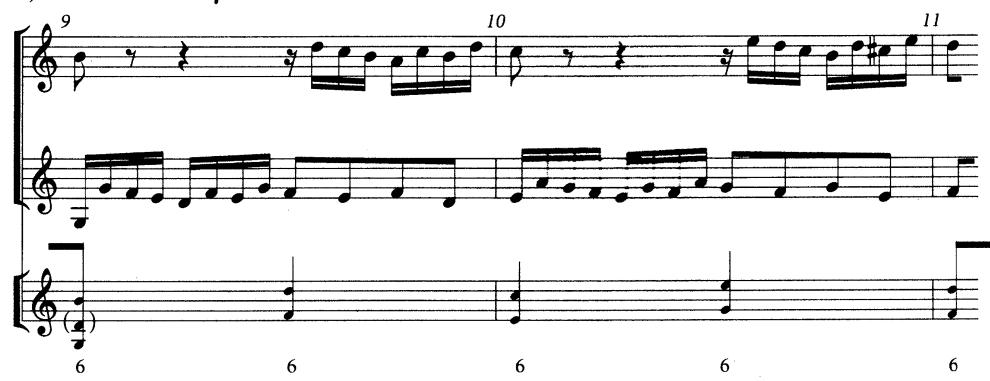
中文讲解
此为图像占位符。图注提示此图分为两部分:a) Derivation of γ(γ 的派生);b) Derivation of δ(δ 的派生)。从上下文判断,它对应正文所讨论的 γ(连接 m.9 至 m.11)和 δ(应连接另一对发明段),用以可视化展示两个展开段如何由其前后发明段派生或关联。原文复述已省略内嵌图像的具体数据,但保留图题与位置,以便与正文论述对应。需查看原图才能获知谱例细节。
第7段(P0109)
原文复述
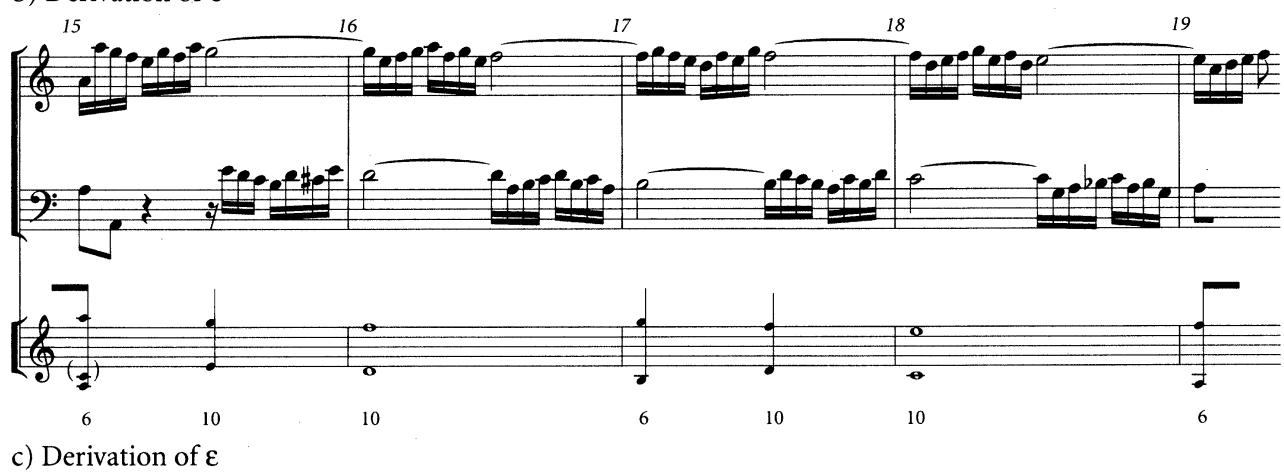
中文讲解
此为第23页的图像或乐谱占位符。根据其位置(紧接于图注 P0108 与下一图注 P0110 之间),它可能属于 P0108 所引图示的一部分,或为示例 1.7 的视觉补充。其精确内容、谱例范围与谱号需查看原图。
第8段(P0110)
原文复述
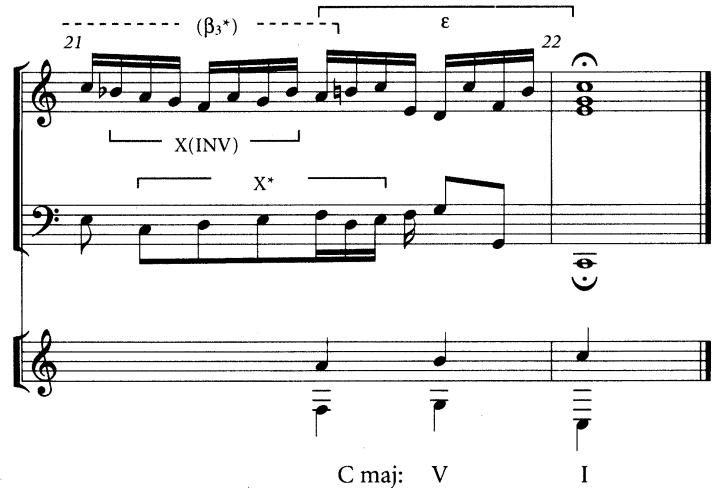
中文讲解
此为 Example 1.7 的图注占位符,全题为 “Derivation of elaborative segments”(展开段的派生)。它与正文 P0104 中明确提到的 “Examples 1.7a and 1.7b” 相对应,作为正文论证 γ 与 δ 如何从前一发明段过渡到后一发明段的乐谱依据。具体谱例内容(含 a、b 两子例)需查看原图方可核对。
第9段(P0111)
原文复述
What Is an Invention?
中文讲解
此为版心页眉或章题式文字,写作 “What Is an Invention?"(何为发明?)。从位置判断(第23页紧接示例1.7之后),它可能是下一节的标题或章节栏外题,用以引导后续章节。它本身不承载论证,但在版面层级上提示本节之后将转入关于 invention 定义的讨论。
第10段(P0112)
原文复述
Dreyfus, Laurence. Bach and the Patterns of Invention. E-book, Cambridge, Mass.: Harvard University Press, 1996, https://hdl.handle.net/2027/heb05561.0001.001. Downloaded on behalf of Indiana University, Bloomington
中文讲解
此为电子书页脚式版本/出处信息,与 P0107 完全一致,再次出现于第23页底部,作用相同:注明 Laurence Dreyfus 所著《Bach and the Patterns of Invention》(Harvard University Press, 1996)的电子书版本,附 hdl.handle.net 链接与下载机构 Indiana University, Bloomington。属重复版面信息,对正文论证无新限定。
脚注 / 边栏 / 图表 / 附加信息(如有)
本节包含的附加材料:1) 两个重复出现的电子书页脚(P0107、P0112),提供版本与下载来源;2) 三个图像占位符(P0108、P0109、P01010),对应正文提到的 γ 与 δ 的派生图示及 Example 1.7(Derivation of elaborative segments);3) 两个页眉/标题型文字(P0106 书名页眉,P0111 下一节标题 “What Is an Invention?")。所有附加材料均不构成新论证,仅起导航、版本溯源与图示支撑作用。
💡 本节核心要点
- Mattheson 认为展开段几乎不需指导,作者承认此见有部分道理,但强调巴赫对其展开段投入了惊人的精心处理。
- 本节核心二分:invention = work(远见、规划、一致性、圆熟、目的之严肃),elaboration = play(优雅、联想逻辑、对相似性的敏感)。
- 展开段 γ、δ、ε 在结构上是发明段间的连接环节,在主题上是发明段表面形态的微弱回响,兼具连接与回响双重功能。
- γ 的双重面貌:表面看似由 a 经 INVERT 与 ROTATE 派生(形似),实则功能上是从 a₂(mm.7–8)到 β₂(mm.11–14)的线性连接组织,以连续平行六度交替 X(INV) 完成。
- γ 在创作时序上属于 dispositio 之后的局部缝合步骤,其动机外观可能源于巴赫对一次被否决的 α(INV) 的"影子式救赎”——一种弱替代。
- γ 能被暂时误认为 α 的一种形式,证明巴赫的"插部性游戏"可以伪装成"发明性工作”,呼应本节"elaboration is play"的总命题。
🔑 关键术语
- Elaboration:在本节中指发明曲中各主题陈述段之间的过渡/插部段落。γ、δ、ε 即作者为本曲标出的三段展开段。相对于 invention 的"工作"属性,elaboration 被定性为"游戏"。
- Invention:在本节中指发明曲中具有主题呈示与调性确立功能的核心段落,以 α、β 为代表。其属性被定性为需要远见、规划与严肃目的的"工作"。
- INVERT (function):作者形式化的运算函数,表示旋律倒影。在本节中 γ 表面看似由 a 经 INVERT 派生,但作者论证 γ 实际上并非直接从 a 倒影而来。
- ROTATE (function):作者形式化的运算函数,表示声部交换(voice-exchange)。文中用以解释 a 与 γ 的表面相似机制之一,并指出 ROTATE 曾被用于派生 α₂。
- dispositio:布局阶段,指作曲家在已有素材(α、β 等)确定其先后部署之后才进行的阶段。γ 之类的连接段在逻辑上属于 dispositio 之后的工作,而非素材构思本身。
- γ, δ, ε:作者为本曲设定的展开段标记。γ 连接 m.9–m.11(在 a₂ 与 β₂ 之间),δ 与 ε 各连接相邻发明段;本节详论 γ,并以示例 1.7a、1.7b 分别展示 γ 与 δ 的派生。
- α, β:作者为本曲设定的发明段(主题陈述)标记。α 与 β 在 dispositio 阶段被决定其部署,γ、δ 等展开段在它们之间起连接与回响作用。
- a, a₂:a 指 α 的初次陈述(在某个内部小节位置),a₂ 指 α 的二次陈述(mm.7–8),是 γ 在结构上所要缝合的两端之一。
- parallel sixths:连续平行六度。文中描述 γ 通过 consecutive parallel sixths(连续平行六度)把 a₂ 与 β₂ 连缀起来,是 γ 在和声—对位层面的具体实现方式。
- α(INV):对 α 作旋律倒影所得到的假设形式。在文中被描述为"不可用",因为其骨架也无法保留"调性确定功能"(key-defining function),故在 invention 阶段被否决,其"影子"在 γ 中以弱替代的形式复活。
S20 [描述性拆分] The Elaboration: δ and ε—Bach’s Cadential Craftsmanship
第1段(P0113)
原文复述
The elaborative passage called δ, somewhat more complex than the little connective γ, similarly provides a link to the subsequent invention through a simple linear sequence. (See Ex. 1.7b.) The ingenuity of the passage is revealed by the observation that paired statements of X(INV) and X, sharing identical pitch content, generate a downward stepwise sequence that ‘backtracks’ each time the pattern restarts at the lower neighbor. In concrete terms, both m. 15 and m. 16 drew on the same set of notes (e², f², g², a²) to articulate the two forms of X; presented in the order ‘inversion then prime form,’ they produced a patterned sequence that descended at half the rate of an ordinary stepwise variety. Given that the terminus of β₂ and the starting point of β₃ lie only a third apart in the treble, Bach here shows how to fill a substantial four-measure span with directed motion that, at the same time, covers very little ground. The circuitous quality of this sequence—so notable because it occurs nowhere else in the piece—draws the listener’s attention away from the subordinate voice-leading and, like γ, recalls the alternating gestures of α, lending a remarkable unity to the surface of the work.
中文讲解
本段聚焦展开段 δ。它在功能类别上比小巧的连接段 γ 略复杂,但仍以一段简洁的线性序列通往随后的呈示段(原文仅称之为 “the subsequent invention”,并未明确指定具体是哪一个呈示段,因此中文讲解也不应断言 δ 承接的就是 β₃——β₃ 一词在本节是出现在下一段 P0114 讨论 ε 的语境中)。
作者的解析可拆为四点:
-
核心机制:X(INV) 与 X 两式共享完全相同的一组音(e², f², g², a²)。以"先倒影后原形"的顺序叠置后,本应逐步下行的序列在低位重新起步,于是形成了"回溯(backtracks)“效果——表面在前进,实际音高材料始终在那四个音之间循环。这正是 δ 既有方向感又"几乎不离原地"的奥秘。
-
速度变体:因为同一组音被反复使用,序列实际下行的速度"只有通常级进序列的一半(twice as slowly)"——这正是 δ 与一般级进序列的关键区别。
-
空间张力:尽管 β₂ 终点与 β₃ 起点的距离(在高音部)只有三度,Bach 却能借此"回溯"机制填满整整四小节,让音乐看似在流动,实则极少声部横向移动。
-
统一作用:这种迂回式序列在整首曲子中独此一处(“occurs nowhere else in the piece”)。它的表面形态把注意力从低声部进行拉开,并和 γ 一样回想起开篇 α 的交替姿态——动机 X 与 X(INV) 之间一问一答的摆动——从而为作品表层带来显著的整体感。
第2段(P0114)
原文复述
As was shown earlier, the need for a final cadential passage in the piece—labeled ε—arose from Bach’s choice to pair a defective segment carrying a new element of invention (β₃) against a transposed but content-empty complete segment. Although ingenuity within the highly conventionalized cadence schemes is limited, Bach devises an ending that hints at a further new challenge: the contrapuntal combination of X and X(INV). As Ex. 1.7c demonstrates, he took the truncated end of β₃—a statement of X(INV)—and appended two notes (d and e) so as to make it appear that X had entered in the bass in augmentation, a special contrapuntal feat. The maneuver is only partly successful: Bach must omit the final note of X in the bass and accelerate its augmented version; nevertheless, it generates a striking flourish at the close. This elaborative gesture nonetheless falls short of a true invention—had Bach been able to combine X and X(INV) flawlessly, he would surely have showcased that proud accomplishment earlier in the piece.
中文讲解
本段分析终末终止段 ε,可分两层。
第一层:ε 为何必须出现。 前文已交代,Bach 选择了"残缺的、表达新要素的 β₃"去对位"虽经移调但无新意的完整段”。这一不对称配置带来结构上的缺口,因此必须再补一段专门的终止序列来收拾——ε 由此应运而生。
第二层:ε 真正的挑战与成败。 作者认为 ε 巧妙地暗示了一种新的对位难题:X 与 X(INV) 的真正组合对位。其手法是——把 β₃ 那个"中断的尾部"(即 X(INV) 的陈述)取来,再贴上两个音 d 与 e,使低音看起来仿佛是主题 X 以扩大时值(augmentation,即音值拉长)的样式进入,这是一类难度极高的对位技巧。
然而作者的判断很冷静:这一尝试"只部分成功"。Bach 不得不:(1) 略去 X 在低音中的最后一个音;(2) 把扩大版本的节奏加快。两处妥协意味着此处并未真正完成 X 与 X(INV) 的完美对位结合。因此作者明确归类:ε 仍属"展开段(elaborative gesture)“而非"真正的呈示段(true invention)"。其背后的逻辑是——若 Bach 真能毫无破绽地把两者结合,他理应早早地把这一骄人成果亮出来,不会留到末尾草草收尾。
与 δ 的镜像关系:δ 用看似不同其实相同的素材填出迂回序列,ε 用残缺的素材强贴对位难题——两者都体现了 Bach 那种"在他人视为最无趣处投注最多精力"的展开段工艺。
第3段(P0115)
原文复述
Although Mattheson may be right in claiming that ‘order and measure’ suffice for the disposition of a work, Bach’s own elaborations—with their intricate detail and elegant correspondences—cannot have emerged merely from ‘cold blood and circumspection.’ For it is the refined quality of Bach’s elaborative segments that distinguishes him from his German contemporaries, who typically treated elaboration as a far more casual matter. In no other composer of the period does one find such fanatical zeal directed so often toward those parts of a composition that others considered the least interesting. Indeed, it is this hallmark of Bach’s style that led earlier analysts to characterize his music as an organic mass of motivic connections. While those connections may have suggested to some that composition meant pasting a single basic motive across the length of a piece, an analysis attuned to the distinction between inventions and their elaborations permits an understanding that is at once more varied in scope and more vivid in its recovery of human actions.
中文讲解
本段是结论性评述,把 δ、ε 的局部观察升华到全章方法论层面。
-
对 Mattheson 立场的修正:Mattheson 主张一首作品的整体布局只需"秩序与节度(order and measure)“即可,但作者认为 Bach 的展开段所展现的精微细节与优雅呼应,远非"冷静而审慎的盘算(cold blood and circumspection)“所能解释。
-
同时代作曲家的对比:Bach 的德语同代人多将"展开段"视为相对随意、无足轻重的部分;而 Bach 却对这些"他人眼中最无趣之处"投注了近乎狂热(fanatical zeal)的精力——这正是其风格最易识别的标志(hallmark)。
-
早期分析者的总评:正是这一风格特征,使早期分析者(earlier analysts)倾向于把 Bach 的音乐描述为一团"由动机联系编织而成的有机整体(organic mass of motivic connections)",表面上 Bach 似乎只是把一个基本动机铺满整首作品。
-
本书方法的辩护:作者的回应是——区分"呈示段(inventions)“与"展开段(elaborations)“才是理解 Bach 的关键。这种区分使分析既在更广范围内变动(more varied in scope),又能更生动地揭示背后的人之活动(human actions,指 Bach 的具体创作抉择与技术选择)。
本段的功能,是把 δ、ε 的局部工艺观察延伸为对整本书分析框架的概括:拒绝把 Bach 的展开段仅当作静态的连接物或动机的简单铺排,而要把它们视作一个独立可分析、并折射作曲家具体个性的层级。
补充说明
关于 Mattheson,本节原文仅以"强调秩序与节度"概括其立场,未涉及其生平或具体著作,故此处不进一步展开其外部背景。
第4段(P0116)
原文复述
Bach and the Patterns of Invention
中文讲解
这是页面顶部的栏目标识(running header),用以标示当前章节所属的全书名《Bach and the Patterns of Invention》。它不承载新的论述内容,仅起版式定位作用。
第5段(P0117)
原文复述
Dreyfus, Laurence. Bach and the Patterns of Invention. E-book, Cambridge, Mass.: Harvard University Press, 1996, https://hdl.handle.net/2027/heb05561.0001.001. Downloaded on behalf of Indiana University, Bloomington
中文讲解
这是本章所在电子书的版本出处与下载来源说明——作者为 Laurence Dreyfus,作品为 Bach and the Patterns of Invention,电子版由 Harvard University Press 于 1996 年出版,链接指向 HathiTrust 数字图书馆镜像(handle 编号 he-b05561.0001.001),并标注系代 Indiana University, Bloomington 下载。该信息用于版本溯源,不进入正文论证。
脚注 / 边栏 / 图表 / 附加信息(如有)
本节末尾的页眉 P0116(Bach and the Patterns of Invention)为全书书名在每页顶部的栏目标识,提示当前章节所从属的著作。紧接其后的 P0117 为本书的电子版出处记录,说明本书系 Laurence Dreyfus 所著、Harvard University Press 1996 年出版的电子版(经 HathiTrust he-b05561 镜像代 Indiana University, Bloomington 下载)。两者均起版式与版本溯源作用,不构成正文论述的一部分。
💡 本节核心要点
- δ 段以 X(INV) 与 X 共享同一组音(e²-f²-g²-a²)所形成的"回溯式下行序列"为核心:表层看似在流动,实际声部几乎不离开原地,是 Bach 用以填充 β₂ 终点与 β₃ 起点间那段极小三度空间的精微手法。
- δ 的表面节奏"只有通常级进序列的一半(twice as slowly)",加之整首作品中仅此一处(occurs nowhere else),使其在独占一格的同时仍像 γ 一样回想起 α 的交替姿态,从而为作品表层贡献显著的整体感。
- ε 段的存在,由 Bach 选择"残缺的 β₃"对位"经移调但无新意的完整段"所引致——这一不对称配置造成结构缺口,需专门补一个终止序列。
- ε 的具体手法是把 β₃ 中 X(INV) 的截尾段贴上两音(d 与 e),使低音仿佛呈现 X 的扩大时值(augmentation);但 Bach 不得不略去 X 在低音的最后一音并加快扩大版本的节奏,故被作者判定为"只部分成功”,归类为展开段而非真正的呈示段。
- Bach 对展开段的精细投入远超出 Mattheson “秩序与节度"所主张的克制风格,正是他区别于同时代德语作曲家、把"他人眼中最无趣之处"也当作艺术重点的核心标记。
- 区分"呈示段(inventions)“与"展开段(elaborations)“是本书分析框架的关键;它既拒绝把 Bach 音乐简化为"动机铺排而成的有机体”,也使分析能更宽广且更生动地还原 Bach 的具体创作抉择。
🔑 关键术语
- δ (delta):本节讨论的展开段之一,比小巧的连接段 γ 更复杂;以共享同一组音高的 X(INV) 与 X 形成"回溯式下行序列”,从而在看似流动的表层之下几乎不离开原来的音区。
- ε (epsilon):终末的终止段。其必要性来自 Bach 选用"残缺段对位无新意段"所留下的结构缺口;其手法是把 X(INV) 截尾段贴上两音(d、e)以模拟低音 X 的扩大时值对位,作者判定为"只部分成功"的展开段,而非真正的呈示段。
- X(INV) 与 X:本书分析框架中两个核心对位要素——主题 X 及其倒影形式 X(INV)。它们之间的交替/呼应贯穿 α、γ、δ、ε 等多个段中。
- stepwise sequence / 级进序列:按音阶级数逐音移动的序列化手法。δ 的特点是把"通常的级进序列速度减半(twice as slowly)",借回溯效应制造迂回感。
- augmentation / 扩大时值:对位技巧之一,把主题音的时值拉长(通常翻倍)后再引入。ε 的核心尝试即是把 X 以扩大时值样貌植入低音,但因为略音与加速而只部分成功。
- “cold blood and circumspection” / “冷静而审慎的盘算”:作者借 Mattheson 立场引出的概念,用来形容理论家眼中仅靠秩序与节度即可完成作品布局的克制风格;本节把它对照为 Bach 展开段"精微而热情"的工艺。
- “organic mass of motivic connections” / “由动机联系编织的有机整体”:早期分析者用以概括 Bach 音乐风格的标签。本书通过区分呈示段与展开段来修正这一总评,避免把 Bach 音乐简化为单一动机的铺排。
S21 [描述性拆分] The Decoration and Execution: Ornaments Gracing Inventions
第1段(P0118)
原文复述
The Decoration and Execution
中文讲解
本段为小节标题「装饰与演奏」(The Decoration and Execution)。它开启的论题是:C大调三部创意曲(BWV 772)中那些被作曲家实际记谱下来的装饰音——包括波音(mordents)与颤音(trills)——并不改变发明(invention)本身的结构实质,而是通过在恰当位置放置恰当类型的装饰,呼应并强化各段(α₁、α₂、β₁、β₂ 等)的结构与对位意图。同时,本节也将讨论演奏者在执行中补入装饰的合理性。
第2段(P0119)
原文复述
The art of decorating or embellishing rarely affects the substance of an invention; rather it is a matter of matching the frequency and kind of ornaments to the style of the piece. (The well-known variant of the C major invention, BWV 772a, in which Bach substituted triplet sixteenths for the duplet sixteenths on the second and fourth beats of the subject must be considered therefore a product of decoration rather than any change in the compositional intent.) In the C major invention, the few notated decorations—two mordents and five trills—are of interest because they grace only inventive segments. The trills in α₁ help frame its two-measure length, while the trill in m. 8 in α₂ places weight on the f#1 which had substituted for the prominent octave jump in α₁. The identically placed mordents (m. 5, m. 13) call attention to the striking leap of a minor seventh that immediately precedes the drive to the cadence in β₁ and ensures in β₂ that one hears the voice-exchange. The parallel trills in these β-segments (m. 6, m. 14), moreover, highlight the identical endings in β₁ and β₂, underscoring that β₂ had swapped parts once again at its cadence.
中文讲解
本段集中讨论装饰与发明实质之间的关系。中心主张是:装饰只是「频率与种类的匹配」问题,不会改变invention的作曲意图;作者用括号中BWV 772a的变体(三连音替代二连音十六分音符)作为反证——音符时值的细分纯属装饰层面,并未触动作曲构思。这一限定很重要:它把「真正的对位/结构变化」与「装饰变体」严格区分开。
随后作者具体分析C大调创意曲中仅有的7个记谱装饰(2个波音+5个颤音)的功能。他指出这些装饰全部落在「发明性段落」(inventive segments,即α、β段),而非γ这种过渡展开段。每个装饰的位置都有明确理由:α₁的颤音框定其两小节长度;α₂第8小节的颤音强调f#1,补偿该段因音域限制而无法保留的α₁中的八度跳跃;β₁第5小节和β₂第13小节位置上相同的波音,提示其前那个「小七度跳进」,并保证β₂中「声部交换」(voice-exchange)能被听见;β段第6、14小节平行的颤音则强调两段终止处的相同性,强化β₂在终止处再次交换声部的事实。
因此本段的论证意义在于:用具体装饰的位置分析,反过来证明这些装饰并非任意——它们精确地标记着结构与对位的关键节点。这种「装饰跟着结构走」的观察,为后文讨论演奏者能否自由补加装饰提供了基础。
补充说明
α₁、α₂指主题前两次呈现的段落(subject segments);β₁、β₂指第二次invention中的两个对应段落;γ为连接或过渡段。「voice-exchange」指两声部互换旋律位置的对位手法。「f#1」为小字一组的升F音,是α₂中替代α₁八度跳进的那个音。BWV 772a为该创意曲已知带三连音主题的早期变体版本。
第3段(P0120)
原文复述
It is also telling that no trills appear in mm. 9–10, a significant absence that heightens the contrast between α₂, a structured invention, and γ, a passage of elaboration en route to a more important destination. Of course an argument from absence—ad ignoratiam—is rarely persuasive on its own. I can think of no good reason, for example, why a performer would not add a trill on the last quarter of m. 20, following the example of mm. 6 and 14. As the one in charge of executing the piece, the player would reason that the composer expected him or her to supply the missing ornament, that this was part of the job of a thinking musician. This logic holds even for Bach, whom Scheibe accused of “expressing in notes every ornament, every little grace, and everything that one thinks of as belonging to the method of playing."$^{38}$ Naturally this accusation is highly exaggerated. Although there is in fact precious little room in Bach’s works to add flourishes of melodic ornamentation, the modest addition of so-called essential ornaments omitted by common conventions of musical shorthand rarely poses any problem. One should not infer from Scheibe’s reproach, in other words, that Bach only intended embellishments where he explicitly marked them, although there is often a musical reason that caused him to notate them where he did.
中文讲解
本段处理一个关键反例:第9–10小节没有颤音。作者承认这种「以缺席为据」(ad ignoratiam,诉诸无知)的论证单独看并不有力,但他认为这种缺席仍然有意义——它强化了α₂(结构化的发明)与γ(朝更重要目标过渡的展开段)之间的对比。
随后转向演奏实践:作者认为演奏者完全可以参照第6、14小节的先例,在第20小节末拍补加颤音;这是「会思考的音乐家」的职责所在。这一逻辑即使对巴赫也成立。接着引入18世纪评论家Scheibe对巴赫的著名指控——后者被批评「把每个装饰、每个小优雅音、以及一切属于演奏方法的细节都用音符写出来」(脚注38)。作者明确反驳此说,指出该指控被严重夸大:巴赫作品确实少有空间可加旋律性花饰,但依据当时通用的「音乐速记」惯例补入少量「必需装饰」(essential ornaments)通常没有问题。换言之,Scheibe的批评并不意味着「未明确标记处即无装饰意图」;巴赫在记谱装饰处的位置选择通常仍有音乐上的理由。
本段在小节中的作用是:既解释了C大调创意曲中某些位置为何「不写装饰」(结构区分的需要),又为演奏者的装饰自由划定了边界——补加必需装饰可以,但不可任意添加旋律花饰。这与前段形成互补:前段证明装饰标记有结构性意义,本段则说明装饰缺席同样可能服务于结构区分。
补充说明
「essential ornaments」是18世纪键盘演奏理论中的术语,指那些在缺乏明确记谱时被视作理所当然应补入的装饰音(如终止式颤音等),区别于演奏者自行发挥的「旋律性花饰」。Scheibe为巴赫同时代的乐评人,曾在《Der critische Musikus》中批评巴赫作品繁复、难以演奏。脚注38对应Scheibe的原始引文。
第4段(P0121)
原文复述
Drawing on a colloquial interpretation of the divisions of rhetoric, I have shown how the C major Invention had a subject, namely, the first seven notes, which was treated in different ways. In the first instance, this subject was molded into two inventions, each a complete two-voice framework. While the first invention constituted an opening gesture and was key-defining, the second worked on the subject first through the derivation of a melodic chain and then by using it to approach a cadence in the dominant. Each of these two core inventive ideas was constructed in such a way as to permit orderly transformations of its materials. The process of invention therefore included thinking through the feasibility of operations such as voice-exchange (contrapuntal inversion at the octave), melodic inversion, and a reversal of mode. The various operations were not always realizable, and much of the ingenuity of the piece can be traced to adjustments Bach made to circumvent the contrapuntal or harmonic improprieties as they arose. Sometimes simple substitutions were in order and the basic function of the segment was kept intact. At other times operations could be performed only on part of a segment: here the successful bit of the transformation found its way into the piece while the ungrammatical bit was discarded.
中文讲解
本段是对前文整个C大调创意曲分析的回顾与小结。中心主张是:作者借修辞学的「colloquial divisions」(古典修辞中主题展开的阶段划分)类比,证明这首创意曲拥有一个由前七个音构成的主题(subject),并以不同方式加以处理。
具体而言:(1)该主题被塑造成两个invention,每个都形成完整的二声部框架;(2)第一个invention起「开场姿态」作用,并确立调性;(3)第二个invention先通过派生出「旋律链」(melodic chain)来加工主题,再利用主题导向属音终止。每个核心创意都被构造得能容纳对其材料的「有序变换」。
由此,作者得出方法论结论:「发明」这一作曲过程本身,就包含了对若干对位操作可行性的预判——声部交换(八度上的对位倒影)、旋律倒影(melodic inversion)、调式转换(reversal of mode)。但作者强调这些操作并非总能实现;巴赫的匠心很大一部分体现在:当对位或和声上出现「不当」(improprieties)时,如何调整以绕开。有时只需简单替换、保持段落基本功能;有时操作只能对段落的一部分成功——此时成功的部分被保留,“不合语法"的部分则被舍弃。
本段在小节论证链中的作用是收束与升华:它把前面关于α、β、γ各段的细致分析,抽象为对「invention作为作曲思维过程」的整体定义,为后文讨论其他创意曲与symphony奠定方法论框架。
补充说明
「colloquial interpretation of the divisions of rhetoric」指借用古典修辞学中主题陈述、扩展、回应等阶段划分的非严格方式来描述音乐的主题处理。「melodic chain」指主题音型通过级进或模进而形成的连续旋律线。「ungrammatical bit」是修辞借喻,指对位变换后违反和声或对位规则的部分。
第5段(P0122)
原文复述
Dreyfus, Laurence. Bach and the Patterns of Invention. E-book, Cambridge, Mass.: Harvard University Press, 1996, https://hdl.handle.net/2027/heb05561.0001.001. Downloaded on behalf of Indiana University, Bloomington
中文讲解
本段是版心位置的电子版引用信息(citation/access block),标明本书的作者为Laurence Dreyfus,书名为《Bach and the Patterns of Invention》,由哈佛大学出版社于1996年出版电子版,附有HathiTrust数字图书馆的持久链接,并注明该电子版系为印第安纳大学布卢明顿分校用户下载。该信息仅用于版本溯源,本身不构成论证内容。
第6段(P0123)
原文复述
What Is an Invention?
中文讲解
本段为下一小节的标题「What Is an Invention?」(何为创意曲?),以问句形式预示接下来的论题转向:从C大调创意曲的个案分析,过渡到对「Invention」这一体裁与作曲思维概念的更一般性界定与追问。该标题属于章节层级结构标记,并不展开论证。
脚注 / 边栏 / 图表 / 附加信息(如有)
本节涉及的附加材料主要包括:(1)脚注38,对应Scheibe关于巴赫「把每个装饰都用音符写出」的批评,引文见P0120;该脚注支持作者对Scheibe夸张指控的反驳立场。(2)P0122为整书的电子版引用信息块,属于版心页面属性,非正文论证内容。(3)P0123作为下一节标题预告,本节未涉及。
💡 本节核心要点
- 装饰不改变invention的实质;BWV 772a三连音变体证明此类变动属装饰层面而非作曲意图层面。
- C大调创意曲中仅有的7个记谱装饰(2波音+5颤音)全部落在inventive segments,并通过精确位置标记对位/结构关键点(如八度跳进的替代音、声部交换、终止处声部再交换)。
- 第9–10小节装饰的缺席服务于结构区分:突出α₂(结构化)与γ(过渡展开)的对比,但作者承认诉诸无知的论证单独不充分。
- 演奏者在「essential ornaments」范围内补加装饰是合理且被期待的,但不能据此推断巴赫仅在明确标记处才有装饰意图。
- Scheibe的指控被作者视为夸大:巴赫作品本身就少有空间可加旋律花饰,但少量补入必需装饰并无问题。
- 本节以对C大调创意曲分析的回顾作结,确立方法论框架:invention是包含声部交换、旋律倒影、调式转换等操作可行性预判的作曲思维过程,巴赫的匠心体现在规避对位/和声「不当」的调整之中。
🔑 关键术语
- invention:在Dreyfus的用法中既指巴赫《二部与三部创意曲集》中的具体曲式体裁,也指一种作曲思维过程——即对主题材料进行有序变换(声部交换、旋律倒影、调式转换等)的运作。
- voice-exchange:对位手法,指两个声部互换旋律位置(如高声部接替低声部的线条),在本节中被作者等同于八度上的对位倒影。
- essential ornaments:18世纪键盘演奏术语,指按当时通行音乐速记惯例应补入的必需装饰(如终止颤音等),区别于演奏者自由发挥的旋律性花饰;本节中作者承认其在巴赫作品中的补入合理性。
- ad ignoratiam:逻辑学术语「诉诸无知」,指以「未被证伪」或「未被证明」为由断言某命题成立;作者用此标签自我限定其在第9–10小节装饰缺席问题上的论证力度。
- melodic chain:作者用以描述第二个invention中由主题音型通过级进或模进而派生的连续旋律线条,是该段加工主题的方式之一。
- Scheibe:巴赫同时代的乐评人,曾在《Der critische Musikus》中批评巴赫作品繁复演奏困难;本节引用其关于巴赫「用音符表达每个装饰」的指控作为被反驳对象。
S22 [描述性拆分] Summary of the C Major Invention Analysis
第1段(P0124)
原文复述
Because inventions had clear functions, we were also able to tell when melodic or harmonic processes had the upper hand. By thinking through the deployment of this collection of inventions, it became clear which links in the composition had to be forged and which gaps filled. While the terminal points for these elaborations (and hence their local function) were set in advance by the voice-leading, their content was determined in each case by a unique, if informal, manipulation of the subject. Some elaborations were made to resemble inventions; others evoked the form of an invention that could not be realized. Finally, the piece was decorated with tasteful embellishments (some of which help to highlight the structure) and handed to the player to realize in performance. Taken as a guide to hearing the piece (as well as penetrating its structure), this analysis shows the C major Invention as a product of both inspiration and work. The piece is inspired because Bach was able to discover a subject that could be rethought in myriad ways. The piece demonstrates hard work in the rigorous handling of the inventions, in their ingenious manipulations which manage to sound so uncontrived, in the clever adjustments that keep the transformations viable, and in the elegant connections that cement it all together. The analysis may even alter the experience of the work in that it challenges both players and listeners to draw parallels, to accentuate real oppositions (and to downplay false ones), to hear functions in context, and to note the final decorative gloss—in short, to appreciate the most subtle distinctions the piece has to offer. Finally, the analysis demonstrates how thoroughly Bach has exhausted his little subject, how he has, in other words, understood it. Within the modest world of a little preamble, this is saying a great deal.
中文讲解
本段是Dreyfus对C大调二声部创新曲(C major Invention)整体分析的总结性陈述,核心主张是:这首小品同时是灵感与劳作的双重产物,分析师的任务就是把这双重性显化出来。
逐层来看:(1)创新曲作为分析单位之所以有效,是因为它们各自有明确的功能,因此可以判断哪一段旋律过程或和声过程占据主导(had the upper hand);(2)把这些创新曲的部署(deployment)放在一起思考时,就能看清作品中哪些连接需要锻造(forged)、哪些空缺需要填补(gaps filled),也就是说,分析不仅描述成品,更揭示作曲家所面对的写作任务;(3)延伸段(elaborations)的终止点及其局部功能,由声部进行(voice-leading)预先决定,但具体内容则是对主题(subject)进行独特、却非形式化的操控的结果——这一句精准区分了"结构框架的必然性"与"填充内容的偶然性”;(4)延伸段分两类:有的像创新曲一样被实现,有的则唤起某种无法真正实现的创新曲形态(evoked the form of an invention that could not be realized),后者实际上承担了"反向证明"或"风格暗示"的作用;(5)最后整首曲子被加上有品味的装饰音(tasteful embellishments),部分装饰本身就起到凸显结构的作用,然后交给演奏者去实现。
在评价层面,Dreyfus明确提出:分析既是聆听作品的指南,也是穿透其结构的途径,它把C大调创新曲呈现为灵感与劳作的结合体。“灵感"指Bach发现了可以被无数次重新思考的主题;“劳作"则体现在:对创新曲的严格处理、听起来毫不做作的精巧操控、让转形始终可行的巧妙调整,以及把所有材料黏合起来的优雅衔接。
更关键的是,分析对演奏者和听者都会改变其体验:促使人主动画平行、突出真正的对立(同时弱化虚假的对立)、在上下文中听功能、注意最终的装饰性光泽——简言之,去领会作品最精微的区分。最后一句"Bach如何彻底穷尽了他的小主题——换言之,如何理解了它"是本段的方法论落脚点:在"一首小小前奏曲"的范围内,做到这点已经是了不起的成就。
理解要点:本段既是对前文分析的回望,也是一种写作姿态的宣示——Dreyfus通过"exhausted"和"understood"两个词把分析从外部观察升级为对作曲家心智过程的还原。
补充说明
本段中的"invention"在Dreyfus的术语中既指巴赫体裁意义上的二声部/三声部创新曲,也指前文分析中识别出的具体功能性片段(melodic/harmonic process)。“subject"延续前文,指乐章开头的核心旋律素材。“voice-leading"在本节语境中指决定延伸段终点位置的和声/对位框架。
第2段(P0125)
原文复述
One might characterize the project undertaken here as an analysis of compositional mechanisms whose workings produce a kind of map of musical thought. This idea of a conceptual map differs somewhat from the more common idea of musical structure in that the function and relationships between key ideas outweigh a preoccupation with the sequence in which they are ultimately heard. Inventive processes are thereby understood as pragmatic actions that are in great measure amenable to rational reconstruction. Casting a wary eye at the idea of analyzing music as an organism—an idea allied with later German idealism—this approach builds on the positive qualities valued in the pre-Romantic notion of mechanism, which, in the words of M. H. Abrams, sees art as “a deliberate craft of ordering means to ends.” Rather than conceiving musical structure as unconscious growth—an aesthetic model that presumes a spontaneous invention beyond the grasp of intentional human actions—I prefer to highlight the predictable and historically determined ways in which the music was “worked on” by the composer. This intention to speculate on Bach’s willfulness invites us to imagine a piece of his music not as inevitably the way it is, but rather as a result of a musicality that devises and revises thoughts against a resilient backdrop of conventions and constraints. This is why the analysis of a piece of music can include an account not only of fulfilled intentions but also of frustrated desires. The benchmark against which one measures the plausibility of such readings is far from mysterious: one has merely to take into account the ultimate set of harmonic and contrapuntal possibilities and limitations which Bach, after all, accepted as preternaturally binding. Thus, while it is true that parts and whole in Bach cohere in a way that is often just short of miraculous—a metaphorically guided perception that has always fueled organicist analyses—I find it more profitable to chip away at musical “miracles,” pursuing instead Bach’s inclination to regard certain laws as binding and others as breakable, to accept certain limits as inviolate and others as restrictive, to judge certain techniques productive and others fruitless, and to admire some ideas as venerable while rejecting others as outmoded. In brief, I favor analyses that capture Bach as a thinking composer.
中文讲解
本段是全书方法论的纲领性自陈,Dreyfus交代了他写这本书的学术立场与对巴赫作品的预设。
核心命题:本书是一项对作曲机制(compositional mechanisms)的分析,其工作方式是绘制出一张"音乐思想的地图”(a map of musical thought)。这张"概念地图"区别于通常所说的"音乐结构”——后者往往关心材料被听到的顺序,而概念地图更看重关键观念之间的功能与关系。也就是说,分析单位的优先级从"时序"转向了"功能与关系”。
由此,“创新过程”(inventive processes)被理解为可大体被理性重构的实用行动(pragmatic actions amenable to rational reconstruction)。这一表述包含两层立场:第一,它拒绝把创新过程神秘化;第二,它假定作曲家的决定虽然非形式化,却是有理可循的。
接下来Dreyfus明确划出两条他不同意的路径:其一是把音乐当作有机体来分析(这种思路与后来的德国唯心主义结盟);其二是把音乐结构理解为无意识的生长——一种假定存在超越人类意图的自发创造的审美模型。他借用M. H. Abrams(脚注39)把艺术视为"将手段有目的地安排到目的上的刻意工艺”(a deliberate craft of ordering means to ends)的定义,主张回到前浪漫主义关于"机制”(mechanism)的正面价值上,强调作曲家对作品"施作”(“worked on”)的可预期且历史性地被决定的方式。
由此引出他最看重的姿态:推测巴赫的意志性(willfulness),把一首作品看作不是"必然如此”,而是音乐性(musicality)在惯例与限制所构成的坚韧背景下不断设计与修正思想的结果。所以音乐分析不仅要讲实现的意图(fulfilled intentions),还要讲被挫败的欲望(frustrated desires)——后者是把作曲家还原为"思考的人"的关键证据。
可塑性判据:Dreyfus承认这种解读需要可信度检验,而检验标准并不神秘:只需考虑巴赫所接受、且被他视为超常约束(preternaturally binding)的和声与对位的可能性与局限性。换言之,作曲家本人的规则集合就是分析不能越过的边界。
最后Dreyfus一方面承认,巴赫作品部分与整体的契合常近乎奇迹(just short of miraculous)——这一隐喻式的感受正是有机论分析长盛不衰的燃料;另一方面,他主张更有效的工作是去"凿掉"这些音乐"奇迹”,去追踪巴赫对法则的区分态度:哪些规律被视为不可违背,哪些被认为可破;哪些限制被当作不可侵犯,哪些被当作束缚;哪些技巧被判断为有效,哪些被判为徒劳;哪些观念被尊为可敬,哪些被弃为过时。
收束句"我倾向于把分析塑造成把巴赫当作思考着的作曲家来呈现"是全书的态度签名:分析的目的不是揭示神性,而是还原人力。
理解要点:理解本段需要把握"反有机论"与"机制论"的方法论对峙,并把Dreyfus关于"frustrated desires"的提法视为本书最具特色的洞察之一——它意味着分析的对象不仅是写下的音符,还有作曲家在规则之内放弃或拒绝的可能路径。
补充说明
脚注39指向M. H. Abrams对前浪漫主义艺术观的概括,所引"deliberate craft of ordering means to ends"是支撑Dreyfus方法论立场的关键引文。本段中的"organicist analyses"与前浪漫主义的"mechanism"形成正反对照,是理解全书写作姿态的二元坐标。 "
第3段(P0126)
原文复述
26 Bach and the Patterns of Invention Dreyfus, Laurence. Bach and the Patterns of Invention. E-book, Cambridge, Mass.: Harvard University Press, 1996, https://hdl.handle.net/2027/heb05561.0001.001. Downloaded on behalf of Indiana University, Bloomington
中文讲解
此为电子书第26页的页眉与版权/下载信息区:上方"26 Bach and the Patterns of Invention"是该页页眉(页码+书名),属于版面标识;下方为电子书引用块,依次给出作者全名(Laurence Dreyfus)、书名(Bach and the Patterns of Invention)、载体(E-book)、出版地与出版社(Cambridge, Mass.: Harvard University Press)、出版年(1996)、HathiTrust数字资源标识符(https://hdl.handle.net/2027/heb05561.0001.001),以及下载代理方说明(Downloaded on behalf of Indiana University, Bloomington)。该区域不承载分析论述,仅作为版本与来源凭证。
补充说明
该段对应页面版权与电子访问信息,是电子书自动添加的版面元素,本身不是作者论证内容;分析时只需识别其版面属性,不需将其纳入论证链。
脚注 / 边栏 / 图表 / 附加信息(如有)
本节中段P0125含一处脚注引用(编号39),所引内容为M. H. Abrams对前浪漫主义艺术观的定义"a deliberate craft of ordering means to ends”,该引文是Dreyfus构建其"机制论"分析路径的关键理论依据。P0126为电子书第26页的页眉(“26 Bach and the Patterns of Invention”)及电子书版权与下载信息块(Harvard University Press, 1996, HathiTrust链接,由Indiana University, Bloomington代为下载),属于版面/版本信息,不构成论证内容。
💡 本节核心要点
- Dreyfus把C大调二声部创新曲的总体特征概括为"灵感与劳作的双重产物”,其中灵感来自主题可被反复重思的潜力,劳作体现在对创新曲的严格操控、让转形可行的巧妙调整以及把材料黏合的优雅衔接。
- 延伸段(elaborations)的终点位置由声部进行预先决定,但其具体内容是作曲家对主题进行非形式化操控的结果;其中部分延伸段真正具备创新曲功能,部分则唤起某种无法被实现的创新曲形态。
- 全书方法论的核心定位是绘制"音乐思想的地图"——其关心的是关键观念之间的功能与关系,而非材料在听感中的时序。
- Dreyfus明确拒绝有机论与无意识生长模型,主张回到前浪漫主义"机制"观,把创新过程理解为可在理性上重构的实用行动,由此把巴赫还原为"思考着的作曲家"。
- 音乐分析不仅应解释已实现的意图(fulfilled intentions),还应解释被挫败的欲望(frustrated desires),其可信度由巴赫本人所接受的和声与对位规则集合来衡量。
- 对巴赫作品"近乎奇迹"的有机契合,Dreyfus的态度是"凿掉"这些奇迹,去追踪巴赫如何在"哪些规则必守、哪些可破、哪些限制不可侵犯、哪些可弃、哪些技巧有效、哪些观念过时"之间做出主动选择。
🔑 关键术语
- conceptual map / map of musical thought:Dreyfus用以描述本书分析产物的核心隐喻。区别于以时序为优先的"音乐结构",它强调关键观念之间的功能与关系,是机制论分析的目标物。
- compositional mechanism / mechanism:本节立论基础。Dreyfus回到前浪漫主义的"机制"观(借M. H. Abrams定义),把作曲视为将手段安排到目的上的刻意工艺,从而为"可被理性重构"的创新过程分析提供合法性。
- organicist analysis:Dreyfus所拒斥的对立面。把音乐视为有机体或无意识生长的产物,假定存在超越人类意图的自发创造;本节认为这种思路与后来的德国唯心主义结盟,会掩盖作曲家的主动选择。
- fulfilled intentions / frustrated desires:本节提出的分析对象二元结构。前者是作品中被实现的作曲意图,后者是作曲家在规则约束下放弃或拒绝的可能路径;二者共同还原巴赫作为"思考着的作曲家"的形象。
- preternaturally binding:Dreyfus用来描述巴赫所接受的和声与对位规则之约束力的形容词,意指这些规则在巴赫看来具有超乎寻常的强制性,构成分析判断"frustrated desires"是否可信的基准。
- subject / invention / elaboration / voice-leading:承袭前文的关键分析术语。subject指乐章开头的核心旋律素材;invention在Dreyfus的用法中既指巴赫体裁,也指分析中识别出的功能性片段;elaboration指在声部进行框架内填充的具体延展段落,其终点由voice-leading预先设定,内容由对主题的操控决定。
S23 [描述性拆分] Mechanism versus Organicism: The Project’s Theoretical Posture
第1段(P0127)
原文复述
The concept of invention on which this enterprise rests arises, then, not out of mere historical interest but out of a concern that an analytic indifference to “inventions” effectively licenses methods that are, in fundamental respects, grossly anachronistic. Although most analysts regard the question of whether a theory is historically appropriate as settled and dead—the received wisdom being that theory so often lags behind practice that theory need only concern itself with logical consistency and explanatory power—the author holds that historical propriety, along with the commitment to a plausible reconstruction of Bach’s thought, is an indispensable component of analysis. In its simplest sense, historical propriety means refusing explanations of a piece of music that one could justifiably claim were utterly inconceivable to the composer himself. Pragmatically, this means remaining wary of terms that collide with the well-established concepts and assumptions current in Bach’s day, while at the same time daring to theorize beyond what can be reconstructed from the explicit statements found in eighteenth-century writings about music.
中文讲解
本段是整章立场的总纲。Dreyfus 先给出他写作此书的双重动机——既来自历史兴趣,也来自对当下分析实践的焦虑:分析家若对历史语境中的"发明"范畴漠不关心,就等于默认允许大量"粗暴的年代倒错"进入对巴赫作品的解读。
他随后澄清一个被广泛持有的成见:理论既然总是跟在实践之后跑,那么只要它在逻辑上自洽、解释力够强,就不必过问历史是否合适。Dreyfus 明确反对这一立场,主张"历史的合宜性"(historical propriety)与"对巴赫思想的可信重构"是分析中不可省略的成分——他用的是"indispensable",分量极重。
“历史的合宜性"在本段被赋予了一个操作性的定义:拒绝任何可以断言"巴赫本人绝不可能想到"的解释。换言之,一条分析陈述如果超出了 18 世纪上半叶音乐概念所能容纳的范围,即使它表面上自洽,也应被怀疑。
但 Dreyfus 并不滑向另一极端——他并未要求分析只能复述 18 世纪文献的原话;他强调在警惕"年代错位术语"的同时,仍要敢于在明确文献之外作理论推演。
这一立场直接决定了后两段对"形式主义"与"申克尔主义"的双重批判:两者之所以成问题,正是因为它们各自把本属于其他时代、其他音乐观念体系中的范畴(blocks of themes、Urlinie descent types)强加给巴赫。
补充说明
本段与本节标题"Mechanism versus Organicism"的对应关系:所谓"Mechanism"一侧主要由本段定义的"历史合宜性"原则所代表,对它的违背即构成"年代倒错”,是本节后两段两种主要批判对象的共同病灶。
第2段(P0128)
原文复述
In one kind of anachronistic model—perhaps the most widespread—analysts privilege form (dispositio) over invention; that is, they judge the nominal order of events more important than the logical hierarchy of ideas. The most widespread version of this formalism is the watered-down Adolph Bernhard Marx that has been packaged as “listeners’ guides” and “music appreciation” texts, namely the familiar view that music consists of “forms” composed of patterned blocks of time filled out by themes (binary form, rondo form, sonata form). Judged from this admittedly simplistic standpoint, Bach’s music comes across as either trivial—because large-scale events are utterly predictable, as in his arias—or amorphous, because the formal schemata are so often blurred, as in his concertos. More often from this perspective, Bach’s “forms” must be treated as sui generis, which is why fugue, in our century, has been demoted from a form to a mere texture (a point to be developed in Chapter 5). In the early eighteenth century, by contrast, form was seen as an occasional feature of a genre, not as the general theoretical category that subsumes the genres, which it later became. The anachronistic reversal of priorities, which treats individual genres as illustrations of larger forms, is what sends analysts hunting for Bach’s “forms” under the mistaken assumption that Bach and his contemporaries chose their compositional strategies on that basis.
中文讲解
本段瞄准第一类年代倒错——以形式 (dispositio) 压过"发明"的分析模型。其最大宗来源是 A. B. Marx 的形式理论经过稀释、改写成"听众指南"和"音乐欣赏"教材后的版本:音乐被看作由主题填充的"时间样式块",于是有了二段式、回旋曲式、奏鸣曲式等标签。
Dreyfus 指出,若用这一框架去衡量巴赫的咏叹调,由于大尺度事件高度可预测,音乐会显得"琐碎";若去衡量他的协奏曲,由于形式图式常常模糊,音乐又会显得"无定形"。这恰恰暴露了该框架的失败——它既解释不了可预测,也解释不了模糊,因此常常被迫把巴赫的"形式"一律判作 sui generis(独此一类)。最典型的代价即本段指出的:赋格在本世纪被从"曲式"降格为"织体"(这一论点留待第 5 章展开)。
本段最关键的史实判断在最后一句:18 世纪初,“形式"只是某一体裁中偶然出现的特征,而不是后来那个凌驾于所有体裁之上的总类。把体裁当作大曲式的例证,是把后来才形成的范畴倒贴回巴赫时代——这是形式主义"年代倒错"的根源。Dreyfus 借此说明:分析家之所以满世界找巴赫的"曲式”,是因为他们先假定巴赫选择作曲策略的依据就是这种曲式范畴,而这本身就是错的。
补充说明
“binary form, rondo form, sonata form"三种曲式被并列提及,用以代表"主题块"式的曲式观;它们并非偶然例举,而是 19 世纪形式理论中最具代表性的三种图式。“demoted from a form to a mere texture"是 20 世纪分析学界关于赋格地位的关键判断,Dreyfus 在此处先标记,留到第 5 章正面处理。
第3段(P0129)
原文复述
Dreyfus, Laurence. Bach and the Patterns of Invention. E-book, Cambridge, Mass.: Harvard University Press, 1996, https://hdl.handle.net/2027/heb05561.0001.001. Downloaded on behalf of Indiana University, Bloomington.
中文讲解
本段不是论述文字,而是电子书页面顶部的版心引用/版权来源说明。它重复了书名、作者、出版社、版本、下载来源机构(Indiana University, Bloomington)以及 HathiTrust 的句柄链接,其功能是标识后续页面中所有引用文字均来自该电子版。它对本节论证本身不增加任何论点。
补充说明
无额外补充;此类引用头在不同页面会重复出现,不应在解释中赋予论证含义。
第4段(P0130)
原文复述
What Is an Invention?
中文讲解
这是章内一个小节标题,问句形式:“什么是发明?"。它把读者的注意力从刚才对两大对立学派(马克思式形式主义与申克尔派)的批判,转向正面给出本书核心范畴"invention"的内涵。标题用问句而不是陈述句,预示接下来 Dreyfus 不会给出现成定义,而是要通过揭示既有分析框架的盲点反过来界定它。
补充说明
该标题是章节内部的小节(sub-section)标号,而非整章标题;它开启的内容范围对应于下一段(P0131)对"形式主义"概念的扩展与对申克尔派的批评。
第5段(P0131)
原文复述
Yet formalists are not merely those who think in adjoining schematic units. They also include anyone for whom the order of musical events is a primary motor of analytic thinking. Schenkerians, for instance—who make a special point of downplaying the surface order of events and disparaging the superficiality of Marxian forms—nonetheless depend on their own formal typologies (one-part form, two-part interruption form, and so on) structured by the number and kind of descents of the Urlinie, and thereby insist that the voice-leading of an entire composition, regardless of genre, size, and musical content, is a fundamental determinant of its structure. Historical precedents that look similar are often cited as foreshadowings of Schenker—C. P. E. Bach’s writings on diminution or F. E. Niedt’s expansion of a pre-existing thoroughbass line in a set of dances. But what these appeals to historical models fail to take into account is the question of genre and invention. For as soon as one considers works in which invertible counterpoint is prominent (fugues, arias, preludes, sonatas, even some dances) or genres in which inflected paradigms such as ritornellos are prominent (arias, choruses, concertos, and some preludes), it stands to reason that local voice-leading will often be a by-product of these more involved contrapuntal and harmonic operations rather than some underlying motor. Subscribing to universal schemes of tonal voice-leading irrespective of genre and style therefore amounts to a futile exercise in organicism, precisely because the imagined composer is implausibly made to jump through several hoops located simultaneously in distant rings of the circus. (These issues are taken up in Chapter 6.) Even without further debating this theoretical orientation, it is worth pondering how a primary concern for the order of events elevates the ancillary category of disposition to a position of stature far exceeding its importance as an operative concept in Bach’s day. As a result, it is easy to see how the paradigms of invention and their related processes may be neglected.
中文讲解
本段把批判范围从"主题块式"形式主义扩展到以"音乐事件顺序"为首要驱动力的所有分析者,包括表面上反对马克思式形式的申克尔派。Dreyfus 揭示了一个重要矛盾:申克尔派虽刻意淡化表面事件顺序、批评马克思式曲式的肤浅,但他们自己仍依赖一套按 Urlinie 下行次数与类型来划分的"曲式类型学”(one-part form、two-part interruption form 等),并坚持一部作品——无论体裁、规模、内容——其结构最终都由整体声部进行所决定。这就把"顺序”(order)推到了本不属于它的统摄地位。
随后 Dreyfus 拆解了为申克尔派寻找历史先声的常见做法:C. P. E. Bach 论减值的文字、F. E. Niedt 在一组舞曲中扩展既有通奏低音线条的实例。这些被援引为"申克尔的前兆”,但都绕开了体裁与发明(invention)的真正问题。
本段最具论证力的观察是:一旦考虑对位与和声操作高度活跃的作品类型——以"可逆对位"显著的赋格、咏叹调、前奏曲、奏鸣曲乃至部分舞曲;以"反复出现且有变化的范式"(inflected paradigms)如利都奈罗显著的咏叹调、合唱、协奏曲、部分前奏曲——局部的声部进行就不再是"原动力",而是更复杂的对位与和声操作的副产品。
由此推出全段最尖锐的判断:把一套与体裁、风格无关的"通调声部进行图式"套用到所有作品,等于做了一次徒劳的有机主义演练——它把想象中那位作曲家同时放到马戏团不同圈子里跳圈,物理学上不可能。Dreyfus 用这一比喻具体化了有机主义比喻的内部不连贯:若要每首作品都从同一个 Urlinie 生长出来,许多对位主导的作品就无法被合理安放。
末尾他再回到历史合宜性:把"顺序"放到首位的分析传统,使 disposition(布局)这一在巴赫时代只是辅助性的范畴获得了远超其历史分量的地位,结果就是"发明的范式及其相关过程"被忽视。
本段在本小节中的功能是把"形式主义"由狭义扩展为广义,并把申克尔式有机主义作为第二大批判靶子,与第一靶子(马克思式形式主义)并置,从而引出本书关于"发明"的正面主张。
补充说明
“one-part form, two-part interruption form"等是申克尔曲式分析的术语;它们按 Urlinie 在不同结构层级的下行类型来划分。“inflected paradigms"译为"有变化的范式”,指在反复出现中保留辨识度又有变形的过程模型,利都奈罗即典型。“Distant rings of the circus"是 Dreyfus 的原创比喻,指同一首作品必须在多个不相干的分析层级各自满足条件,其荒诞性类似让表演者同时穿越分散于场地不同位置的多个圆环。C. P. E. Bach 与 F. E. Niedt 在此被作为常被援引为申克尔先驱的 18 世纪作家提及,Dreyfus 否定这种援引的合理性,理由是他们各自的处理都受限于具体体裁。
第6段(P0132)
原文复述
28 Bach and the Patterns of Invention. Dreyfus, Laurence. Bach and the Patterns of Invention. E-book, Cambridge, Mass.: Harvard University Press, 1996, https://hdl.handle.net/2027/heb05561.0001.001. Downloaded on behalf of Indiana University, Bloomington.
中文讲解
本段是第 28 页的页眉与版心引用:先给出页码"28"与书名"Bach and the Patterns of Invention”,再重复电子书来源(HathiTrust)、下载机构(Indiana University, Bloomington)等版权信息。它与 P0129 功能相同,均为电子版自动插入的版式元素,对本节论证不提供任何补充论点。
脚注 / 边栏 / 图表 / 附加信息(如有)
本节内的附加版面元素共有三处:(1) P0129 为第 27 页顶部 HathiTrust 电子书来源声明,重复书名、作者、出版社、下载机构及句柄链接;(2) P0130 为章节内部小节标题"What Is an Invention?",标志着从对两大对立分析流派的批判转向正面界定核心范畴;(3) P0132 为第 28 页页眉,页码 28 后接书名,并再次出现同一电子书来源声明。三者均为版式或结构性标识,无独立论证内容。本节正文段落中提及两处后续章节呼应:P0128 预告第 5 章将讨论赋格从"曲式"降为"织体”;P0131 预告第 6 章将进一步处理声部进行与体裁/发明的张力。
💡 本节核心要点
- 作者把"历史的合宜性"定义为分析中不可省略的成分,要求避免任何"巴赫本人绝不可能想到"的解释,同时仍允许在 18 世纪明确文献之外作理论推演。
- 本节确立的第一类批判对象是马克思式形式主义(以"主题块+时间样式"理解曲式),它在面对巴赫的咏叹调(琐碎)与协奏曲(无定形)时双双失效,并迫使巴赫的"形式"被一律判作 sui generis,甚至导致赋格从曲式被降为织体。
- 本节确立的第二类批判对象被扩展定义为"以事件顺序为首要驱动力"的广义形式主义,包括申克尔派——他们虽然贬低表面顺序,但仍依赖按 Urlinie 下行类型建立的曲式类型学,本质上同样把 disposition 抬到了超出其历史分量的位置。
- Dreyfus 的关键历史论断是:在 18 世纪初,“形式"只是某一体裁中偶尔出现的特征,而不是统摄所有体裁的总类;后来那种把体裁视为大曲式之例证的范畴层级本身就是年代倒错的结果。
- 对申克尔派而言,真正的盲点在于忽视体裁与发明:在对位高度活跃或利都奈罗主导的作品中,局部声部进行只是复杂对位与和声操作的副产品,而非最终原动力。
- 本节的总体功能是把"mechanism versus organicism"的对峙描述清楚——马克思式形式主义与申克尔式有机主义虽路径相反,却共享同一个错误前提:用非巴赫时代的范畴凌驾于体裁之上,结果就是"发明的范式及其相关过程"被系统性地忽视。
🔑 关键术语
- invention (发明):本书核心范畴,指 18 世纪上半叶音乐中可被识别并加以变化、组合的"过程范式”;在本节中主要以负面方式出现——Dreyfus 通过指出既有分析流派忽略此范畴来说明它为何必须被重新置于中心。
- historical propriety (历史的合宜性):Dreyfus 的分析伦理准则:在解释作品时拒绝任何可断言为作曲家本人"绝不可能想到"的范畴或术语,但又不局限于复述 18 世纪文献原文。
- anachronism / anachronistic (年代倒错):本节的核心病灶:将后世的音乐范畴(如主题块式曲式图式、Urlinie 类型学)回填到巴赫所处的时代。本节两大批判对象均被归入此类。
- Marxian formalism / formalism (马克思式形式主义):由 A. B. Marx 的形式理论经稀释而成,主张音乐由"主题填充的时间样式块"构成(二段式、回旋曲式、奏鸣曲式)。本节第一类批判对象。
- dispositio (布局/安排):传统修辞学中"安排材料"的步骤,对应音乐中"形式/顺序"这一层面。Dreyfus 指出其在巴赫时代只是辅助性范畴,却被后世(尤其申克尔派)拔高为统摄性范畴。
- Schenkerian analysis / Schenkerians (申克尔式分析):以 Heinrich Schenker 为代表的分析流派,强调通过 Urlinie 的多层延伸来揭示作品的深层声部进行结构;本节第二类批判对象。
- Urlinie (基础线条):申克尔分析中的核心概念,指从主音出发、按特定音级下行的线性进行;按其下行方式与结构层级可划分出不同的"曲式类型"。
- voice-leading (声部进行):申克尔派用以描述作品结构的根本维度;Dreyfus 主张在体裁/对位操作活跃的作品中,局部声部进行常是对位与和声操作的副产品而非原动力。
- organicism (有机主义):将音乐作品比作生物有机体、强调其由单一深层结构"生长"而成的分析姿态;Dreyfus 批评它迫使想象中作曲家同时满足多个互不相关的层级条件。
- invertible counterpoint (可逆对位):对位法中可交换声部位置而和声仍有效的技法;在赋格、咏叹调、前奏曲、奏鸣曲乃至部分舞曲中常居核心地位,是本节用来质疑声部进行主导论的关键反例。
- ritornello (利都奈罗):反复出现且每次带有变化的器乐或声乐段落模式,在咏叹调、合唱、协奏曲、部分前奏曲中显著;Dreyfus 用以代表"inflected paradigms"(有变化的范式)。
- genre (体裁):在巴赫时代作为音乐分类的根本单位,Dreyfus 认为发明与体裁紧密绑定,反对任何超越体裁、规模与内容差异的普适分析图式。
S24 [描述性拆分] Style Criticism and the Historically Imaginable Analysis
第1段(P0133)
原文复述
Style critics, having taken over the connoisseurial methods of painting, treat the outward dress of musical material as the defining feature of classification and meaning. As a result one commonly meets arguments that classify a work—or even try to date it—solely on the basis of the external character of its musical subject. Bach’s Sixth Brandenburg Concerto, for instance, has been classified as an early work because of its old-fashioned five-part scoring and its use of antiquated viola da gambas; on these assumptions, its style is held to determine the character of the piece. (The author promises to reexamine this argument in Chapter 7.) Translated into rhetorical terms, style criticism privileges decoration over invention, a stance that makes little sense for any composer so committed to ‘good inventions and developing them satisfactorily.’ This totalizing view of style as an organic composite of every possible empirical description—already dismissed as superficial by analytic formalists—forgets that ‘clothes don’t make the man’: musical inventions can be clad in garbs of many colors, and such colors seldom alter the substance of the compositional idea.
中文讲解
本段界定并批评了"风格批评"(style criticism)这一音乐分析方法。作者的核心论点如下:
- 风格批评家借用了绘画领域的鉴赏方法(connoisseurship),把音乐材料的外在装饰(配器、谱面形态等表层特征)当作分类和意义的主导依据,并据此对作品进行分类乃至断代。
- 作者给出一个具体例证:巴赫《第六勃兰登堡协奏曲》之所以被定为早期作品,正是因为其"老式"的五部编制以及使用古旧的维奥尔琴(viola da gambas);在风格批评家看来,作品的风格决定了作品的性质。作者提示将在第7章重新检视这一论证。
- 作者用修辞学术语概括这种取向:风格批评偏重"装饰"(decoration)而轻视"发明"(invention),这与一位如此执着于"良好发明并使其得到令人满意的发展"(good inventions and developing them satisfactorily)的作曲家形成根本矛盾。
- 作者进而指出,将风格视为"对一切可能的经验描述的有机综合"(organic composite of all possible empirical descriptions)是一种总体化(totalizing)的观念,已被分析形式主义者(analytic formalists)斥为表面化(superficial)。作者援引谚语"衣服不造就人"(clothes don’t make the man),强调音乐发明可以披上种种色彩的外衣,但这些色彩几乎不会改变作曲构思的实质(substance)。
本段在本节中的功能:作者把"风格批评"立为自身方法论的对照面(foil)。通过揭示风格批评的失误,作者为下文提出基于"历史可想象性"(historically imaginable)的另一条分析路径做了铺垫。
补充说明
文中提及的"第7章"是本书内部的前向指引;“分析形式主义者"则是与作者立场形成对照的另一分析学派。这些对照关系是作者在全书中持续展开的方法论论辩的一部分。
第2段(P0134)
原文复述
To worry about unnecessary anachronism, of course, only warns the analyst away from some theories; it alone does not amount to a theoretical statement. To think positively about appropriate context is to propose a hypothesis of the historically imaginable, together with the hope that an explanation might have been fathomable to Bach. Some will regard this as futile, asking how—given our historical distance—one can pretend to think in Bach’s terms. Yet to imagine an explanation the composer would have found plausible is not the same as confining oneself to the language and conceptual apparatus of the early eighteenth century, although it remains useful to know whether an eighteenth-century equivalent exists for a given theoretical term. For, beyond the usual objection that theory follows belatedly on the heels of practice, one must face the unavoidable ‘we-they problem’ in treating invention as both historical category and analytic object. We are interested in the analysis of Bach’s works in order to show them as products of genius; they (writers contemporary with Bach) were interested, for the most part, in teaching amateur composers. A more appropriate formulation of the question might be this: how can we appeal to the linguistic habits of eighteenth-century writers if the purpose of their language was never meant to serve our present-day interests?
中文讲解
本段从对风格批评的批评过渡到方法论原则的正面阐述。
- 作者承认,避免时代错置(anachronism)是必要的,但单靠这一点还不够——它只能将某些理论排除在外,本身并不构成一种理论立场。
- 真正积极的做法是提出一种"历史可想象性”(historically imaginable)的假说:希望所给出的解释是巴赫本人会觉得可以理解(fathomable)的。
- 作者预见到反对意见:鉴于历史距离,我们怎么可能假装以巴赫的方式思考?作者回应:设想一个作曲家本人会觉得合理的解释,并不等于把我们自己局限在18世纪早期的语言和概念框架内;但了解当时是否存在某个理论术语的18世纪对应物始终是有用的。
- 作者进而提出一个更深层的方法论难题——“我们—他们"问题(we-they problem):当我们试图把"发明”(invention)同时当作历史范畴(historical category)和分析对象(analytic object)来处理时,这一矛盾不可避免。
- “我们”(现代分析者):关心的是把巴赫作品分析为天才(genius)的产物;
- “他们”(与巴赫同时代的作家):大体上关心的是教导业余作曲者(amateur composers)。
- 作者将难题表述为一个尖锐的问题:如果18世纪作家使用语言的目的从来就不是为我们的当下兴趣服务,我们如何能够援引他们的语言习惯?
本段的功能:作者把风格批评(表层取向)与历史距离难题(深层取向)连接起来,为下一段提出自己的建设性答案铺平道路。
第3段(P0135)
原文复述
The answer to this dilemma is more a postulate than an argument: in fact we intuitively understand a great deal about Bach’s music and do not find the culture in which he worked especially mystifying. Although this statement admits of no proof, it seems a good place to begin. As an axiom it is more attractive than a position indifferent to interpretation, which substitutes mere theoretical consistency in its place. While intuitive understanding must occasionally be questioned, the author sees no reason for an inveterate skepticism that retreats into abstract theorizing unconcerned with the composer as thinker. Moreover, the often-assumed difficulty of reconstructing the commonplaces of musical thought for Bach and his compatriots is highly overrated. Many available sources can guide us: theoretical treatises, music dictionaries, practical textbooks, published controversies—all impart a sense of what was taken for granted and allow the construction of a context in which Bach could devise his own unique response to his environment. Even in their more casual uses of language—personal letters, official memoranda, title pages—Bach and his contemporaries willingly reveal the common terms of their thought. From those common terms much can be inferred, not least that certain of our (anachronistic) concerns are strikingly absent—the weighty preoccupation with a composition’s ’external form’ is a good example. Hence even when the functions of a mechanist analysis are formalized (as in the author’s use of capital letters) to capture the sense of a strict or ‘automated’ procedure, the underlying ideas are for the most part those named and discussed in the first half of the eighteenth century. 40 Rather than rejecting eighteenth-century terminology as primitive and inadequate, it is more revealing to unearth its meanings so as to lay bare the substratum of musical thought.
中文讲解
本段是作者对前段所提"我们—他们"问题的实质性回答,包含其方法论的核心主张。
- 作者坦承,他的答案与其说是论证(argument),不如说是一种设定(postulate):事实上,我们凭直觉(intuitively)就能理解巴赫音乐的大量内容,并不觉得他身处的文化特别神秘。
- 作者承认这一点无法被证明,但把它视作一个好的出发点。作为公理(axiom),它比另一种立场——对解释漠不关心、仅以理论一致性(mere theoretical consistency)取而代之——更具吸引力。
- 作者容许直觉理解需要不时受到质疑,但反对"积习性怀疑论"(inveterate skepticism)所导致的退路:即退回抽象理论化而不再关心作为思考者的作曲家(composer as thinker)。
- 作者进一步主张:通常被认为极其困难的"为巴赫及其同时代人重建音乐思想的常识"(reconstructing the commonplaces of musical thought)其实被大大高估了(highly overrated)。
- 作者列出大量可资指引的资料来源:理论论著(theoretical treatises)、音乐辞典(music dictionaries)、实用教科书(practical textbooks)、公开出版的论争(published controversies)。这些材料能够传达当时被视为理所当然的常识,并允许建构一种语境,使巴赫能够对环境作出独特的回应。
- 即便是更随意的语言使用——私人信件(personal letters)、官方备忘录(official memoranda)、扉页(title pages)——巴赫及其同时代人也不自觉地透露了思想中的共有术语(common terms)。
- 从这些共有术语可以推断出许多事情,其中之一就是:我们(现代人)某些(时代错置的)关切在他们那里惊人地缺席,例如对一部作品"外部形式"(external form)的沉重执迷。
- 作者补充说明:即便其"机械论分析"(mechanist analysis)的功能被形式化(例如使用大写字母)以把握某种严格或"自动化"(automated)程序的感觉,这些程序所依据的根本观念,在很大程度上仍是18世纪上半叶所命名和讨论的那些观念(脚注40)。
- 作者的方法论结论:与其把18世纪术语当作原始且不充分的而加以拒绝,不如发掘其含义,以揭示音乐思想的底层结构(substratum of musical thought)。
本段在本节中的功能:在批评风格批评(P0133)、提出历史距离与"我们—他们"难题(P0134)之后,作者在此给出建设性的方法论核心:直觉理解为出发点,以18世纪丰富的文献为语境资源,认真对待而非贬低18世纪的术语体系。
补充说明
本段末尾的脚注40指向本书中关于大写字母标记的"机械论分析"具体方案的注释,本任务输入未提供脚注的具体内容。
第4段(P0136)
原文复述
Source citation footer: Dreyfus, Laurence. Bach and the Patterns of Invention. E-book, Cambridge, Mass.: Harvard University Press, 1996. URL: https://hdl.handle.net/2027/heb05561.0001.001. Downloaded on behalf of Indiana University, Bloomington.
中文讲解
本段是页面的来源引用脚注(citation footer),并非论证性内容。它提供了所引用电子书的书目信息:作者劳伦斯·德莱福斯(Laurence Dreyfus),书名《巴赫与发明的模式》(Bach and the Patterns of Invention),电子版由哈佛大学出版社(Harvard University Press)于1996年在马萨诸塞州剑桥(Cambridge, Mass.)出版,附有Handle系统永久链接,并由印第安纳大学布卢明顿分校(Indiana University, Bloomington)代表下载。
该页脚用于标明引文的电子文献来源,属于版面元信息而非论证内容。
第5段(P0137)
原文复述
Section heading: ‘What Is an Invention?’
中文讲解
本段是小节标题(heading),并非论证段落。标题"什么是发明?"(What Is an Invention?)开启了本书下一节的内容,预示着将对"发明"(invention)这一贯穿前文方法论讨论的核心概念作出正面界定。
该标题的功能是承上启下:从本节关于风格批评、历史可想象性、研究方法等问题的讨论,过渡到对"发明"概念本身的定义与分析。
脚注 / 边栏 / 图表 / 附加信息(如有)
本节(P0133–P0137)范围内还包含两类非正文版面元素:(1) P0136 为电子书来源引用脚注,提供书目与下载来源信息;(2) P0137 为下一节的标题。P0135 中提及的脚注40指向本书关于大写字母标记的机械论分析方案的注释,但本任务输入未包含其具体内容。
💡 本节核心要点
- 风格批评借用绘画鉴赏方法,把音乐材料的外在装饰当作分类、意义乃至断代的主导依据;巴赫《第六勃兰登堡协奏曲》因五部编制与维奥尔琴而被定为早期作品即为典型例证。
- 作者用修辞学术语总结风格批评:偏重"装饰"而非"发明",这与巴赫本人执着于"良好发明并使其得到令人满意的发展"形成根本矛盾;其"总体化"的风格观念已被分析形式主义者斥为表面化。
- 在方法论上,作者既要求避免时代错置,也要求正面提出"历史可想象性"假说:所给出的解释应该是巴赫本人会觉得合理的,但不要求我们必须局限于18世纪早期的语言。
- 核心方法论难题——“我们—他们"问题:现代分析者以揭示天才为目的,18世纪作家以教导业余作曲者为目的;两套目的之间存在张力,使援引18世纪语言习惯的做法变得复杂。
- 作者的回应是设定性的而非论证性的:我们对巴赫音乐的直觉理解是合理的出发点;通常被认为艰难的"重建音乐思想的常识"被作者认为被高估了。
- 可资利用的资料来源极其丰富——理论论著、音乐辞典、实用教科书、公开论争,乃至私人信件、官方备忘录、扉页等随意性文本——足以重建语境、揭示共有术语,并暴露我们某些关切(如对"外部形式"的执迷)在18世纪语境中的时代错置性。
🔑 关键术语
- 风格批评 (Style criticism):一种音乐分析方法,借用绘画中的鉴赏方法,将音乐材料的外在装饰(配器、谱面特征等表层要素)视为分类、意义乃至断代的主导依据;作者在本节中将其作为自身方法论的对照面加以批评。
- 历史可想象性 (Historically imaginable):作者提出的方法论假说:分析者应努力设想一种作曲家本人会觉得可以理解(fathomable)的解释,但不要求现代分析者放弃当代分析语言;它构成作者方法论的核心概念。
- “我们—他们"问题 (we-they problem):作者提出的方法论难题:当把"发明"同时当作历史范畴和分析对象来处理时,现代分析者(以揭示天才为目的)与18世纪作家(以教导业余作曲者为目的)之间不可避免地存在目的与语言习惯的差异。
- 机械论分析 (Mechanist analysis):作者使用的分析方式,通过大写字母等标记将分析功能形式化,以把握严格或"自动化"程序;作者强调其根本观念仍是18世纪上半叶所命名和讨论的那些观念。
- 发明 (Invention):作者在本书中作为分析对象的音乐概念;与"风格"或"装饰"形成对照。巴赫本人对"良好发明并使其得到令人满意的发展"的承诺,使作者将"发明"确立为分析的核心而非作品的表层风格。
S25 [描述性拆分] Reconciling Historical Language with Present-Day Analysis
第1段(P0138)
原文复述
It is a truism, of course, that historians cannot be entirely satisfied with terminology contemporary with the events, if only to take advantage of the manifold perspectives afforded both by a backward-looking glance as well as an engagement with the issues of the present. But the question in analysis and theory has often been mistakenly posed as choosing between two exclusive alternatives—either the “historical” language of the past or the “theoretical” language of the present—a binary opposition that begins to unravel upon closer inspection. Although it is useful to suspect the self-evidence of present-day concepts as well as the guaranteed authenticity of those of the past, a sympathetic appropriation of both can spur on a process of discovery that can help attain a closer focus on a musical object and its human inventor.
中文讲解
本段是作者方法论立场的一段纲领性宣示,核心主张是:分析者不必在"历史语言"与"当代理论语言"之间二选一,而应同时利用两者的视角。
首先,作者承认一个老生常谈的前提:历史学家不能只用与事件同时代的术语,否则就浪费了"回望"与"回应当下议题"所提供的多元视角。这里的"当下议题”(issues of the present)并非泛指,而是与作者后文将要做的事相关——即用一种既能贴合十八世纪又能服务于今日音乐学讨论的方式来谈巴赫的"发明”(invention)。
接着,作者指出一项常见的错误框定方式:把分析问题伪装成"要么用过去的历史语言,要么用今天的理论语言"这样一个非此即彼的选择。他用了"mistakenly posed"和"exclusive alternatives"来明确这种做法是误置的,并进一步用"binary opposition"这个来自后结构主义语汇的概念,暗示这种二元对立一旦细察便会瓦解(“begins to unravel upon closer inspection”)。作者并非笼统反对理论或历史,而是在批评一种懒于反思的对立姿态。
最后,作者给出方法论提议:既要怀疑当代概念的"自明性"(self-evidence),也要怀疑过去概念的"保证真实性"(guaranteed authenticity);对两者作"同情式的挪用"(sympathetic appropriation),可以推动发现的过程,使分析更贴近音乐作品(musical object)及其人类创造者(human inventor)。注意"sympathetic"在此不是情感意义上的"同情",而是学术语境中"设身处地理解其内在理路"的意思;“human inventor"则与本节标题"Bach and the Patterns of Invention"形成呼应,把音乐重新挂回到作曲家的具体创作活动上。
补充说明
本段中的"binary opposition"一词与"sympathetic appropriation"构成本节方法论的两个关键支柱,二者在后文 P0139 关于"historical modus operandi"与"analyzing the genial"的论述中将再次得到回响。
第2段(P0139)
原文复述
What I hope to show, then, is why pursuing Bach’s inventions is an intuitively appealing way to approach his music. Instead of allowing abstract notions of music structure to set the analytical agenda—as in theories demonstrating organic unity—one searches for the historical modus operandi that informs the practice of Bach’s daily craft. This goal remains attractive despite the fact that the notion of invention embodies a contradiction, asking us, in effect, to make do with two logically incompatible positions. On the one hand, writers in a long and venerable tradition assert that invention cannot be taught: you must have a talent for it. On the other hand, the same sources maintain that invention is only learned by studying models of good inventions. Yet if invention is inborn, why teach it? The eighteenth century was not bothered by this question and had a ready answer available. As Scheibe put it: “Invention is inborn in us, and art and hard work adorn it in suitable attire.“41 This metaphorical solution suggests, perhaps, that it is best to leave the paradox unresolved so that we recognize its power to capture our persistent belief in the metaphysics of genius at the same time that we merrily go about analyzing the “genial.” Invention is therefore no mere historical curiosity but actually a forceful and timely idea, precisely because it crystallizes deeply held views about high art while at the same time challenging us to reflect on the human actions that produce it.
中文讲解
本段是整章的纲领段落,集中说明作者为什么要以"invention(发明/创意)“作为切入巴赫音乐的钥匙,并通过一个核心悖论来论证这个概念在今日仍然有力。
第一层,作者明确本书的目标:解释为什么"追踪巴赫的inventions"是一条直觉上吸引人的接近巴赫音乐的途径。这里的"inventions"既指巴赫的《二部创意曲》《三部创意曲》等具体作品,也指更广义的作曲中"构思创意"的活动,是一语双关。
第二层,作者划出自己与某种主流分析传统的界限:他不打算让抽象的"音乐结构"概念——例如"有机统一”(organic unity)理论——来设定分析议程;相反,他要去寻找巴赫日常创作背后的"历史运作方式”(historical modus operandi)。“modus operandi"是法律与思想史术语,意指某人行事的一贯方式、习惯做法,作者借此强调他要还原的是巴赫作为一种"手艺实践”(daily craft)的具体步骤,而不是用现代形式理论自上而下地套用。注意这里"craft"与"genius"形成对照,正是本段第三层悖论的伏笔。
第三层,作者承认"invention"这一概念本身内含一个矛盾:一方面,长久而可敬的传统都说"invention不能被教,你必须天生有这方面的才能”;另一方面,同一些来源又主张"invention只能通过研究优秀invention的范例来学习”。如果invention是与生俱来的,那又何必教它呢?作者用"logically incompatible positions"与"why teach it?“两处短句把这个矛盾尖锐化,以显示并非作者在制造问题,而是十八世纪关于天才的论述本身就内嵌这一悖论。
第四层,作者给出十八世纪对此悖论的现成答案:引用 Scheibe 的比喻——“Invention is inborn in us, and art and hard work adorn it in suitable attire."(发明天生就在我们身上,艺术与勤奋为它披上合身的衣装)。这句话的功能不是消解矛盾,而是用"天生+后天装饰"的意象让矛盾看似和解。作者随即点明,他赞同的是"将悖论保留为悖论”(leave the paradox unresolved),因为正是这个悖论同时容纳了两件事:我们对"天才形而上学”(metaphysics of genius)的持久信仰,以及我们对所谓的"genial(天才之作)“所作的愉快分析。换言之,作者既不打算推翻"天才"神话,也不打算天真地相信它,而是要在承认这一信念的同时,把天才的产物作为人工制品来分析。
第五层,作者由此作出总判断:“invention"因此不是单纯的史学古董(no mere historical curiosity),而是一个在今天仍然有力、及时(forceful and timely)的观念——它把人们对高雅艺术的深层信念结晶出来(crystallizes deeply held views about high art),同时又促使我们去反思那些产生这些艺术的人类行为(human actions that produce it)。“crystallizes"与"challenging"的对举,是本段最后一句的双重力量:既保留信念,又质问信念的来源。
整体而言,本段既是一份"我为什么要这样写"的写作告白,也是一段对十八世纪美学中"天才"与"技艺"关系的精炼概括,为接下来进入"Bach and the Patterns of Invention"正文章节做好准备。
补充说明
本段同时是 P0138 方法论宣示的具体化:作者既然已经声明要"同情式挪用"历史与当代两套语言,本段便把这一立场落到"invention"这个核心范畴上——它既是十八世纪历史词汇,也是当代分析概念,因此正是检验这种双重挪用是否可行的试金石。脚注 41 对应 Scheibe 这条引文,本字段未提供完整出处信息,故不补写。
第3段(P0140)
原文复述
Bach and the Patterns of Invention
中文讲解
本段为章节标题,完整原样复述英文书名 “Bach and the Patterns of Invention”(中译可作《巴赫与发明之模式》)。作为版面元素,它标志着由前述方法论与概念铺垫转向本书主体——即对巴赫作品中"invention"具体模式的分析。其标题功能在于把"invention"既当作巴赫一类作品(Inventions)的指称,又当作贯穿全书的分析范畴来双重使用,从而与 P0139 中 “pursuing Bach’s inventions” 的双关语遥相呼应,开启论题。
第4段(P0141)
原文复述
Dreyfus, Laurence. Bach and the Patterns of Invention. E-book, Cambridge, Mass.: Harvard University Press, 1996, https://hdl.handle.net/2027/heb05561.0001.001. Downloaded on behalf of Indiana University, Bloomington
中文讲解
本段为页脚性质的版本与来源信息,复述以下要点:作者为 Laurence Dreyfus;书名为 Bach and the Patterns of Invention;版本为 E-book(电子书);出版地为 Cambridge, Mass.(马萨诸塞州剑桥市),出版社为 Harvard University Press,出版年为 1996;并附有 Handle 数字资源链接 https://hdl.handle.net/2027/heb05561.0001.001;最末注明该电子本由 Indiana University, Bloomington 替用户下载(Downloaded on behalf of Indiana University, Bloomington)。从功能上看,这段是电子版数据库自动添加的版权/来源页脚,其作用是声明文献来源与访问渠道,并非正文论证的一部分,因此对正文主张不构成支持、限定或反驳,仅作为版本与取用记录的旁证。
脚注 / 边栏 / 图表 / 附加信息(如有)
本小节唯一附注类材料为 P0141 所载的电子版版本与来源页脚(Dreyfus, Laurence. Bach and the Patterns of Invention. E-book, Cambridge, Mass.: Harvard University Press, 1996, https://hdl.handle.net/2027/heb05561.0001.001. Downloaded on behalf of Indiana University, Bloomington),其功能是声明电子书版本出处与下载机构,并非正文论证内容;正文内出现脚注编号 41(Scheibe 引文出处),但 P0141 页未给出脚注 41 的完整信息,故本字段不作扩展。
💡 本节核心要点
- 本节的方法论主张是:分析者不必在"历史语言"与"当代理论语言"之间作非此即彼的选择,而应对两者作"同情式挪用”,以贴近音乐作品及其人类创造者。
- 作者将自己与以"有机统一"为代表的抽象结构分析传统划开,主张去追寻巴赫日常创作的"历史运作方式”(historical modus operandi),把作曲视为手艺实践。
- “invention(发明/创意)“是本节的核心范畴,作者指出它既是巴赫一类作品(Inventions)的指称,也是贯穿全书的分析概念,因此天然适合检验历史与当代语言的双重挪用。
- 十八世纪关于 invention 的论述内嵌一个悖论:它既被视为与生俱来、不可教,又被认为只能通过研习优秀范例来学;Scheibe 的"天生+艺术与勤奋为之披衣"正是对此悖论的比喻式保留。
- 作者由此提出,“invention"并非单纯的史学古董,而是一个在今日仍然有力的观念——它同时容纳我们对天才的信仰与对天才之作的分析,因此为反思"高雅艺术"的人类生产方式提供了切入点。
🔑 关键术语
- invention:在本节中具有双重含义:一指巴赫的《二部创意曲》《三部创意曲》一类具体作品;二指十八世纪美学中"构思/创意"这一范畴,兼含"天生才能"与"后天习得"两层张力,是作者借以同时调用历史语言与当代分析语言的核心概念。
- historical modus operandi:作者用以替代抽象结构分析的概念,指巴赫日常创作实践中的具体运作方式与习惯做法,强调把作曲还原为一种可观察的手艺活动,而非自上而下的形式理论推演。
- sympathetic appropriation:作者方法论的关键短语,指既不完全信任当代概念的自明性,也不盲目相信过去概念的真实性,而是设身处地理解两套术语的内在理路并加以综合运用。
- organic unity:作者点出但不认同的一种主流分析传统所追求的目标,即把音乐作品视为有机的、自洽的整体;本节中作为对照,说明作者选择绕开抽象结构议程。
- metaphysics of genius / the “genial”:指十八世纪以来关于"天才"的形而上学信念,即创作能力源自某种超验禀赋;作者并不否认这种信念的存在,而是主张在承认其持续影响力的同时,把所谓的"天才之作"作为人工制品来分析。
S26 [描述性拆分] The Paradox of Invention and the Plan of the Book
第1段(P0142)
原文复述
There is more to the pursuit of Bach’s inventions than merely identifying and analyzing them: ultimately one needs to judge them as products of history which continue to speak meaningfully today. Rather than distilling these ideas into a unitary notion of Bach’s “style,” I refer to the range of tendencies that one encounters in Bach’s oeuvre as his “patterns of invention.” With this phrase I mean to signal the web of compositional thoughts and actions that Bach brings to his works, patterns that not only govern the creation of a single piece of music but, what is far more important, disclose a human experience in which music plays a privileged role. To be sure, the C major Preambulum offers only the most modest foreshadowing of what these patterns of invention are capable, exhibiting, in Bach’s words, merely “a foretaste of composition.” What the piece nonetheless embodies is a neat paradox embracing freedom and necessity, showing how one is inextricably linked to the other, how the exhilarating discovery of new thoughts brings with it severe responsibilities—in short, showing how one assumes risk and draws the appropriate consequences. This inherent respect for music demonstrates nothing less than a respect for the inherent meaningfulness of the world and every manner of res severa found in it.
中文讲解
本段是整个小节的核心立论段。作者首先划定本书工作的目标:研究巴赫的“发明”不能止于识别与分析,最终必须把这些发明当作“历史产物”来评判,因为它们在今天依然有意义。接着,他用一个关键术语替换替换另一个——他不用统一的“风格”(style)来概括巴赫,而用“发明的模式”(patterns of invention)。这一替换的深意是:他不愿把巴赫压缩成一种静态的美学签名,而是要捕捉巴赫作品中那一整套“作曲思维与行为的网络”。这种网络既支配单首作品的生成,更重要的,是揭示一种“音乐在其中扮演特权角色的人类经验”。作者用C大调前奏曲(Preambulum,BWV 846a)作为例证:这首曲子只能非常有限地预示“发明的模式”所能达到的高度,巴赫本人仅称它为“作曲的预尝”(a foretaste of composition)。但即便如此,这首曲子已经包含全书要论证的中心悖论——“自由与必然”的悖论:发现新思想的喜悦必然伴随沉重的责任,二者不可分割;创作者承担风险并承担其后果。最后一句把这种对音乐的尊重,提升到对世界本身固有意义(res severa)的尊重,从而把音乐学问题上升到哲学层面。
补充说明
“res severa”是拉丁语,意为“严肃之事”“庄严之事”,源自古罗马将音乐视为严肃事务(res severa est music)的传统观念;作者借此把巴赫对音乐的尊重上升为对世界固有意义性的尊重。“a foretaste of composition”援引巴赫本人对C大调前奏曲的手稿题词(原文“Vorhof der Composition”),用于强调这首前奏曲在本书体系中只是“开端中的开端”。
第2段(P0143)
原文复述
Rather than seeking a universal method of invention—a thesis that defies both common sense and the historical evidence—the following chapters dwell on distinct kinds of inventive processes specific to various musical genres without any attempt to survey the entire field of Bach’s wide-ranging oeuvre. Several genres are observed in some detail, first, to reflect on the nature of their beginning points, and second, to show how these beginning points bring about contrasting procedures of disposition and elaboration in the completed work. By describing how an “invention” depends on the genre in which it operates, I aim at readings that show how Bach’s approach to invention results not in well-wrought artifices appealing to good taste, but rather in profound interpretations of contemporary traditions that alter the very assumptions underlying musical experience. Throughout this book, I ask why Bach emulates his models so idiosyncratically, which is nearly the same as asking why his works still cause us to marvel at their enigmatic beauty.
中文讲解
本段交代全书的写作计划与方法论。两条边界必须读出:其一,作者明确反对寻找“统一的发明方法”,因为这既违背常识也违背历史证据;其二,全书并不打算覆盖巴赫庞大作品集的全貌,而是选择若干体裁(genres)作较细致的观察。对每个体裁,作者关注两件事——一是其“起点”(beginning points)的性质,二是这些起点如何导向不同的“布局与展开”(disposition and elaboration)程序。也就是说,作者主张“发明”是体裁依赖的(genre-dependent):同一种思维在协奏曲、赋格、康塔塔中会触发完全不同的处理程序。他进一步将自己的解读与单纯“迎合良好趣味的精巧工艺品”(well-wrought artifices appealing to good taste)划清界限——他追求的是“改变音乐经验本身之预设的、对当时传统的深刻诠释”。本段最后提出贯穿全书的核心问题:巴赫为什么以如此独特(idiosyncratic)的方式模仿其典范?这几乎等同于追问:为什么他的作品至今仍让我们为其“隐秘的美”(enigmatic beauty)惊叹?问题被一拆为二:模仿方式之“独特”,与作品之“隐秘之美”,是同一现象的两面。
补充说明
disposition(布局、安排)与elaboration(展开、发挥)是源于古典修辞学、经由17、18世纪音乐修辞学(musical rhetoric)传统被吸收进作曲理论的两个程序术语;作者选用这一对术语,意在暗示巴赫的发明逻辑在结构层面与修辞写作相通:先“布置”材料,再“展开”说服。well-wrought artifices是古典主义—新古典主义美学用以形容技艺精巧的“工艺品”的常见表述,作者借此把音乐学里那种只重技法、不追问意义的解读路径明确排除在外。
第3段(P0144)
原文复述
I have intentionally begun with a rather limited notion of invention because it was Bach’s pedagogical idea to begin with a strictly defined musical idea and observe its development and realization. But one cannot stop here, for “invention” embraces a wide variety of processes and musical actions. Perhaps the most important beginning point is a pre-critical step that apprehends and assimilates the inventions of other composers both past and present. Although this idea has traditionally been studied under the rubric of “influence,” it is worth pursuing in the case of Bach how he adapts, alters, and often transforms in unexpected ways the inventions of others, a process I call “composing against the grain” in Chapter 2. In the case of the concerto and the fugue, Bach’s inventions can be understood as eminently practical tools, where the process of discovery is used to formulate a complex mechanism for crafting large-scale movements. Here (as discussed in Chapters 3 through 8) one can observe Bach testing his “compositional machines,” spurring them on to produce beyond their capabilities, and pressing them onward to a point where the distinction between invention and its elaboration begins to evaporate. Bach’s inventions can also be construed as beginning points for musical thought in less formally mechanized patterns, as when he works with hybrid genres (discussed in Chapters 4 and 8) in which two sets of inventive procedures overlap or when the conventions of a serious genre are allowed to overcome those of a more modest one. In addition, since Bach was a musician paid above all to compose vocal music, I explore how the realm of invention might map musical ideas to the setting of verbal texts (treated cursorily in Chapters 3 and 8). Taken as a complex matrix of thought about how music is seen to be discovered as well as to discover itself, Bach’s notion of invention also represents, finally, a philosophical and theological position about the status of music itself. Here (as seen in Chapters 4 and 8) Bach’s music will be situated within the context of an early Enlightenment theory of signs phenomenally ill-equipped to accept what his music was prepared to say. As the discoverer and tinkerer standing behind his inventions, Bach too must be judged as taking a stand on the nature of musical meaning, the ability and power of music not merely to play a humble supporting role in representing the sensate world but also to take a critical hand in interpreting and changing it. While it is true that Bach will never be fully comprehended—much will remain beyond our grasp—we can nevertheless share in a good number of his secrets.
中文讲解
本段是全书的“路线图”段,把“发明”这一概念从巴赫教学意义上的“狭义”逐步扩展为多层含义,并标明每一层对应的章节。第一层是巴赫教学意义上的“有限”概念——从一个严格定义的音乐动机出发观察其发展与实现。第二层是最重要的起点:一种“前批判的”步骤,即先吸收、同化古今其他作曲家的发明。传统上这一现象被笼统称为“影响”,但作者指出在巴赫身上值得追问的是他如何适应、改变并常常以出人意料的方式转化他人的发明;这一过程在第2章被称为“逆纹作曲”(composing against the grain)。第三层,在协奏曲与赋格中,发明是高度实用的工具——一种为打造大型乐章而设计的复杂机制;在第3至第8章中,巴赫不断测试这些“作曲机器”(compositional machines),驱使它们超出自设的能力,并把发明与展开之间的区分推到近乎消失的临界点。第四层,发明也可作为不那么形式机械化的起点——出现在两套发明程序交叠的混合体裁(第4、8章),或严肃体裁的惯例压倒较朴素质地的情形。第五层,由于巴赫首先是受雇于声乐创作的作曲家,作者探讨“发明”如何把音乐观念对应到歌词的设置(第3、8章简要涉及)。第六层,最终,发明构成一个关于音乐本体地位的哲学与神学立场;巴赫的音乐将被置于早期启蒙的符号理论(theory of signs)之中加以检视——而那种符号论“惊人地无法容纳”巴赫音乐所要表达的内容。最后,作者指出巴赫作为其发明背后的“发现者与修补匠”,必须被理解为对“音乐意义之性质”作出了立场声明:音乐不应只是谦卑地辅助再现感性世界,而应主动地参与对世界的诠释与改变。作者诚实承认巴赫永远不会被完全理解,许多东西将始终超出我们的把握,但“我们仍可分享他相当一部分的秘密”。
补充说明
“composing against the grain”(逆纹作曲)是作者在第2章集中展开的概念,强调巴赫并非被动接受“影响”,而是主动地逆着他所继承的范式纹路进行改写、挪用甚至颠覆。“compositional machines”(作曲机器)是把对位与曲式技法比喻为可被调试、被推到极限的机械装置,暗合巴赫本人对位法教学的工艺性。“early Enlightenment theory of signs”指17—18世纪围绕符号如何表征意义展开的哲学讨论(如莱布尼茨、克里斯蒂安·沃尔夫等传统),这类理论倾向于把音乐视为情感的辅助表征工具,因而“惊人地无法”容纳巴赫音乐中所暗示的更主动地“诠释与改变”世界的力量。
第4段(P0145)
原文复述
Dreyfus, Laurence. Bach and the Patterns of Invention. E-book, Cambridge, Mass.: Harvard University Press, 1996, https://hdl.handle.net/2027/heb05561.0001.001. Downloaded on behalf of Indiana University, Bloomington
中文讲解
此条为电子书的版本引用脚注,说明所引文本的来源:劳伦斯·德雷福斯著《巴赫与发明的模式》,哈佛大学出版社1996年出版,由密歇根大学安娜堡分校代表印第安纳大学布卢明顿分校下载于HathiTrust数字图书馆(handle号为heb05561.0001.001)。这是一条书目性质的脚注,仅用于标识文本的版本来源,不对正文主张作支持、限定或反驳。
第5段(P0146)
原文复述
What Is an Invention?
中文讲解
此条为下一节的小节标题“什么是发明?”它标志作者从前一段关于全书整体方法的导言,过渡到直接追问全书核心术语“invention”本身的定义与谱系。该标题本身即是研究问题的浓缩:作者不预设一个现成的答案,而是要在接下来的章节中通过巴赫的具体作品把“发明”的含义逐步打开。
第6段(P0147)
原文复述
32 Bach and the Patterns of Invention Dreyfus, Laurence. Bach and the Patterns of Invention. E-book, Cambridge, Mass.: Harvard University Press, 1996, https://hdl.handle.net/2027/heb05561.0001.001. Downloaded on behalf of Indiana University, Bloomington
中文讲解
此条为电子书版面的页眉组合,包含页码“32”、书名《巴赫与发明的模式》以及完整的版本引用信息(哈佛大学出版社1996年E-book版,由HathiTrust提供给印第安纳大学布卢明顿分校)。这是电子书下载打印件的标准版面元素,不含实质性论证。
脚注 / 边栏 / 图表 / 附加信息(如有)
本节附加材料包括两条重复出现的版本引用信息(P0145与P0147),用以标明电子书文本来源:Laurence Dreyfus, Bach and the Patterns of Invention (Cambridge, MA: Harvard University Press, 1996),经HathiTrust(handle: heb05561.0001.001)由印第安纳大学布卢明顿分校下载;以及下一节标题“What Is an Invention?”(P0146),预告全书将进入对核心术语“invention”的直接追问。这些材料仅为版本与版面信息,不构成对正文主张的支持、限定或反驳。
💡 本节核心要点
- 作者用“发明的模式”(patterns of invention)替代统一的“风格”(style),意在捕捉贯穿巴赫作品的整套作曲思维与行为网络,并由此揭示“音乐在其中扮演特权角色”的人类经验。
- 全书的中心悖论是“自由与必然”:新思想的发现必然伴随责任,创作者承担风险并承担后果;C大调前奏曲(巴赫自言仅“作曲之预尝”)已包含这一悖论的微缩版本。
- 全书不寻求“统一的发明方法”,而按体裁分别考察其“起点”以及由此导出的不同“布局与展开”(disposition and elaboration)程序;贯穿全书的根本问题是:巴赫为何以如此独特的方式模仿其典范——这与其作品至今令人惊叹的“隐秘之美”是同一现象。
- “发明”在巴赫身上至少包含六层含义:教学意义上的狭义概念;“前批判地”吸收并转化他人发明的“逆纹作曲”;在协奏曲与赋格中作为打造大型乐章的“作曲机器”;混合体裁与体裁惯例压倒的情形;把音乐观念对应到歌词的设置;以及最终关于音乐本体地位的哲学与神学立场。
- 巴赫的发明被置于早期启蒙的符号理论背景下加以检视——那种符号论“惊人地无法容纳”巴赫音乐所要表达的内容;巴赫本人作为“发现者与修补匠”,其立场是:音乐不只是谦卑地辅助再现感性世界,更应主动诠释并改变世界。
- 作者坦承巴赫永远不会被完全理解,许多东西仍超出我们的把握,但我们仍可分享他“相当一部分的秘密”,这一谦逊而开放的姿态为全书定了调。
🔑 关键术语
- patterns of invention (发明的模式):作者用以替代巴赫“风格”的核心术语,指巴赫作品中可辨识的整套作曲思维与行为之倾向;既支配单首作品的生成,也揭示一种以音乐为特权角色的人类经验。
- res severa (拉丁语:严肃之事/庄严之事):源自古罗马将音乐视为res severa的传统;作者借此把巴赫对音乐的尊重提升为对世界固有意义性的尊重。
- composing against the grain (逆纹作曲):作者第2章提出的概念,描述巴赫如何主动地逆着他所继承的范式纹路,去适应、改变乃至颠覆他人的发明,以区别于传统“影响”研究。
- compositional machines (作曲机器):作者隐喻,指协奏曲、赋格等体裁中可被调试、被推到极限的对位—曲式机制;在巴赫手中它们被驱使到发明与展开几近合一的状态。
- disposition and elaboration (布局与展开):源自音乐修辞学的两个程序术语——前者安排、布置音乐材料,后者对其加以展开、发挥;作者用此强调巴赫发明的体裁依赖性。
- early Enlightenment theory of signs (早期启蒙的符号理论):17—18世纪围绕符号如何表征意义展开的哲学传统;作者指出它“惊人地无法容纳”巴赫音乐所暗示的、主动诠释并改变世界的力量。
S27 [描述性拆分] Bach’s 1730 Leipzig Memorandum on the State of Church Music
第1段(P0148)
原文复述
Composing against the Grain
中文讲解
这是本小节的标题。“Composing against the Grain"直译为"逆流而作"或"违背既有趋向而创作”,标题以隐喻方式预告了本节的核心论题:巴赫并非顺应现成条件创作,而是要在资源缩减、品味变迁、外国影响涌入的环境下坚持并争取更高标准的教会音乐。该标题统领P0149至P0151,提示读者注意巴赫在为创作争取空间时所面对的阻力与自我定位。
第2段(P0149)
原文复述
In August of 1730 Bach submitted a carefully worded memorandum to the Leipzig Town Council, in which he appealed for a restoration of subsidies to support the performance of church music under his direction. Funds allotted to his predecessors, Bach wrote, had been withdrawn, and the result was that music-making at the municipal churches had fallen into an appalling “decline.” Only a renewed monetary commitment on the part of the town authorities would enable the Thomas-Cantor to attain an adequate standard by permitting him to hire and rehearse additional choristers and instrumentalists. In further support of his argument, Bach noted that the urgency of his “short but most necessary draft for a well-appointed church music” sprang from the increasingly urbane flavor of German musical life. As he put it (in the long-winded style typical of his prose):
中文讲解
这段交代了1730年8月巴赫向莱比锡市议会递交备忘录的历史背景与修辞策略。巴赫并非单纯抱怨,而是以一份措辞审慎(“carefully worded”)的请愿,要求恢复对他的前任曾经享有、但后来被削减的教会音乐补贴。关键词是"appalling decline”(骇人的衰落):巴赫把经费缩减与音乐水准下滑直接挂钩,从而把财政问题转化成质量问题,再以"只有市议会重新出资,Thomaskantor才能达到合格标准"作为唯一出路。值得注意的是,巴赫自称为"Thomaskantor”(托马斯教堂乐监),把音乐水准与城市教会声誉绑在一起,使补贴请求显得近乎公益诉求。第二层论据是"increasingly urbane flavor of German musical life”(德国音乐生活日益都市化、精致化):巴赫借此暗示今日所需已非旧日标准可比,从而为本段末尾引出的长引文做铺垫。所谓"long-winded style"是作者对巴赫文风的评价,提示读者接下来的引文将冗长但论证密集。
补充说明
Thomaskantor即莱比锡托马斯教堂及市立教会音乐的首席音乐负责人,负责主要教堂的音乐事务与市立学校歌唱训练。Bach于1723年就任该职。
第3段(P0150)
原文复述
The state of music is quite different from what it was, since our artistry has increased very much, and taste has changed astonishingly, and accordingly the former style of music no longer seems to please our ears, and considerable help is therefore all the more needed in order to choose and appoint such musicians as will satisfy the present musical taste, master the new kinds of music, and thus be in a position to do justice to the composer and his work . . . It is, anyhow, somewhat strange that German musicians are expected to be capable of performing at once and ex tempore all kinds of music, whether it come from Italy or France, England or Poland, just as may be done, say, by those virtuosos for whom the music is written and who have studied it long beforehand. $^{1}$
中文讲解
这是巴赫备忘录正文的长段直接引文,由译者从德文转成英文,需要逐层拆解。第一句构成因果链:艺术水平提高→品味惊人地变化→旧式音乐不再悦耳→因此更需要资源去遴选和任命能顺应新品味、掌握新风格、对得起作曲家及其作品的乐师。这里"do justice to the composer and his work"并非虚词,而是巴赫论证的关键支点:作曲家的产出只有在合格的演奏下才不致被浪费,从而把作曲家本人也纳入需要保护的对象。第二句以"somewhat strange”(颇为奇怪)引出对照:意大利、法国、英国、波兰的曲目不断涌来,德国乐师却被期望即时(“at once”)且视谱即奏(“ex tempore”)地应付一切,而那些专为演奏而写并早已事先研习的virtuoso(名家)反而没有这种压力。这等于在说:经费削减所造成的恶果,不仅是量的问题,更是质的问题——演奏者没有时间研习新派曲目,就无法公正地呈现当代作品。脚注标记1指示此段引文有来源注释,详见P0152。
补充说明
ex tempore为拉丁语,意指"即兴地、视谱即时地",在十八世纪音乐语境中特指未经事先排练即当场视奏的能力。virtuosos指当时以炫技和深度研习某一作曲家作品著称的明星演奏家,他们的曲目通常由作曲家专门题献或为之写作。
第4段(P0151)
原文复述
Underlying this argument in the Memorandum is an implied narrative of renewal and regeneration, and in it Bach charts the arrival of a new cosmopolitanism within German musical life to which the modern composer must self-consciously adapt. Since so much demanding “foreign” repertoire must be mastered by German musicians, it stands to reason—the Memorandum
中文讲解
这段从修辞分析的角度提升一层,指出巴赫的请愿背后隐含一种"更新与再生"(renewal and regeneration)的叙事:巴赫并不只是在抱怨,而是在勾勒一幅德国音乐进入新世界主义(cosmopolitanism)的图景,并把现代作曲家定位为必须自觉适应这一新格局的人。“self-consciously adapt"提示这是一种有意识的姿态调整,而非被动的随波逐流。句子在"it stands to reason—the Memorandum"处突然中断,“the Memorandum"作为悬置的主语为下一句预留,可见P0151的物理边界在原文中并未结束此意群;但就本节而言,作者想要强调的核心是:巴赫的论辩实质上把一次行政性的经费申请,转化为一份关于德国音乐如何迈入国际化时代的纲领性诊断。
第5段(P0152)
原文复述
Dreyfus, Laurence. Bach and the Patterns of Invention. E-book, Cambridge, Mass.: Harvard University Press, 1996, https://hdl.handle.net/2027/heb05561.0001.001. Downloaded on behalf of Indiana University, Bloomington
中文讲解
这是与P0150中脚注标记1对应的文献来源条目,说明本节引用巴赫备忘录原文所依据的版本:Laurence Dreyfus所著《Bach and the Patterns of Invention》(哈佛大学出版社1996年电子版)。其作用是为P0150的长段引文提供权威出处,证明作者所引英文译文并非凭空改写,而是基于Dreyfus学术著作中的呈现。该条本身不承载新的论点,仅承担版本与版权意义上的来源功能。
脚注 / 边栏 / 图表 / 附加信息(如有)
本节含一条脚注(P0152),对应P0150中巴赫引文末尾的上标1,提供引文来源:Dreyfus, Laurence. Bach and the Patterns of Invention. E-book, Cambridge, Mass.: Harvard University Press, 1996. 其作用是为引文提供权威版本依据,并无补充论证内容。
💡 本节核心要点
- 1730年8月巴赫向莱比锡市议会提交备忘录,请求恢复前任曾享有但被削减的教会音乐补贴。
- 巴赫将经费不足与教会音乐水准的"骇人衰落"直接挂钩,把财政问题转化为质量问题。
- 巴赫以"德国音乐日益都市化、品味惊人变化"为论据,论证现有乐师队伍已不足以应对新局,需要额外资源遴选与排练新人才。
- 巴赫主张现代作曲家必须自觉适应新世界主义,演奏者必须掌握来自意大利、法国、英国、波兰等国的曲目,否则便无法公正呈现当代作品。
- 备忘录表面是行政请愿,实质上构建了一个"更新与再生"的叙事:德国音乐进入国际化阶段,作曲家与演奏者都需相应调整姿态。
- 标题"Composing against the Grain"以隐喻方式概括了巴赫在资源受限、外来风格涌入的环境下坚持高标准创作的处境。
🔑 关键术语
- Memorandum (备忘录):1730年8月巴赫致莱比锡市议会的正式书面请愿,本节围绕其内容、修辞与深层叙事展开讨论。
- Thomas-Cantor (Thomaskantor):莱比锡托马斯教堂乐监,兼管市立教堂音乐与学校歌唱训练,巴赫自1723年起担任此职,是其署名立场的制度性身份。
- cosmopolitanism (世界主义):本节用以描述德国音乐生活中多国风格并存、外来曲目大量涌入的新格局,巴赫视之为必须自觉适应的现实。
- ex tempore:拉丁语,指视谱即奏、未经事先排练的即时演奏能力;巴赫以此对照德国乐师被不合理地要求立即胜任外国新派曲目。
- virtuoso(s):十八世纪指为某作曲家专门研习其作品并以精湛演奏著称的明星乐师;巴赫以其为反例,说明事先研习与合适资源对演奏质量的重要性。
- renewal and regeneration (更新与再生):作者用以概括备忘录背后隐含的叙事框架:把一次经费申请转化为德国音乐进入新阶段、需要自我革新的纲领性主张。