目录
C1 Chapter Five: The G-minor Presto
- S1 [描述性拆分] Abstract and Introduction
- 页码:1-1
- S2 [描述性拆分] Paganini’s Moto perpetuo and Its Metric Hierarchy
- 页码:2-3
- S3 [描述性拆分] The Metric Hierarchy of Bach’s Presto
- 页码:3-5
- S4 An Obscure Metric Notation
- 页码:6-8
- S5 Baroque versus Later Metrics
- 页码:8-9
- S6 [描述性拆分] Bach’s and Schumann’s Accompaniments to the E-major Preludio
- 页码:9-12
- S7 [描述性拆分] Deciding How to Analyze Rhythm in Bach’s Music
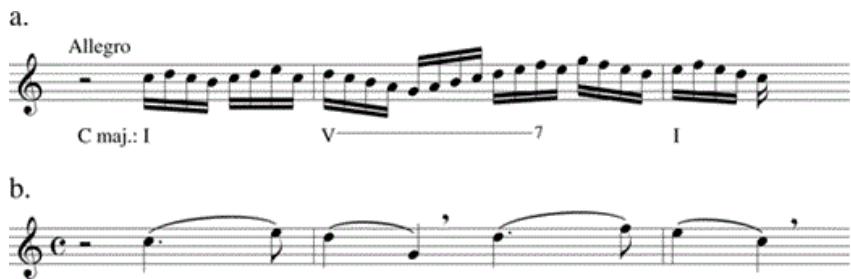
- 页码:13-14
- S8 Binary Form and (vs.?) Increasing Levels of Activity
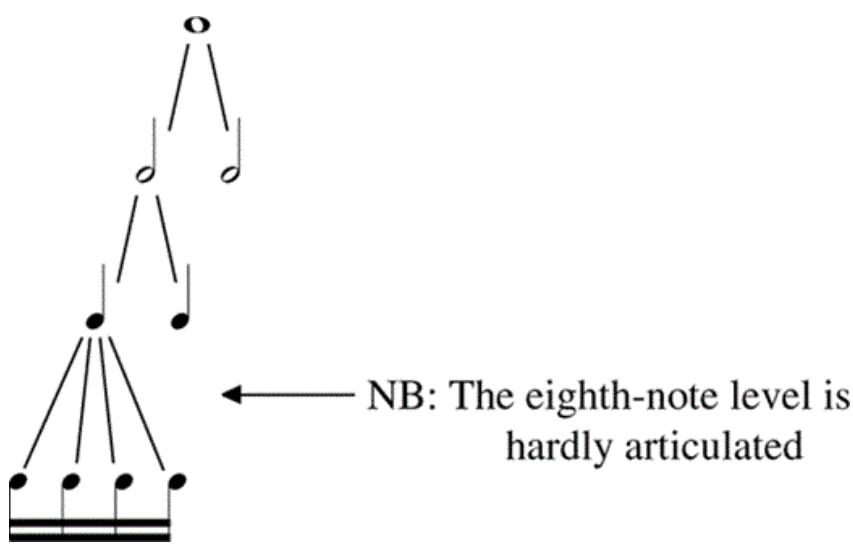
- 页码:14-15
- S9 [描述性拆分] Permutational Theory and the Emergence of Musical Form
- 页码:16-16
- S10 [描述性拆分] Heightened Activity and Structure in the Presto
- 页码:17-22
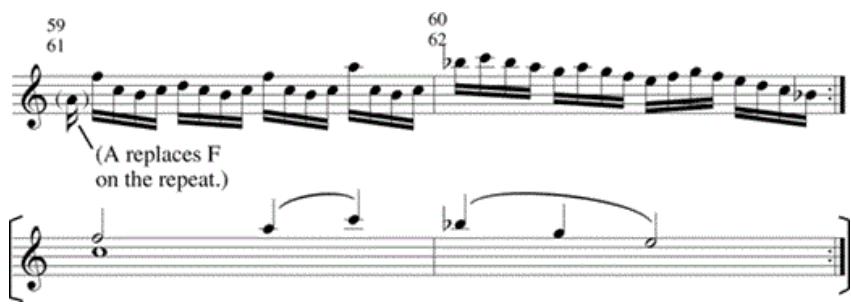
- S11 [描述性拆分] Schumann’s Interpretation of the Form of the Presto
- 页码:22-23
- S12 Performance Issues in the G-minor Presto
- 页码:23-24
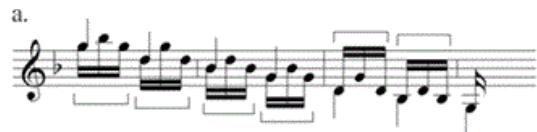
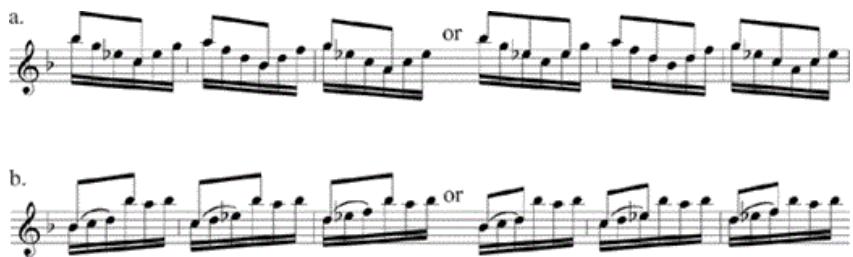
- S13 The Finales to the A-minor and C-major Sonatas
- 页码:24-25
- S14 Notes
- 页码:25-27
S1 [描述性拆分] Abstract and Introduction
第1段(P0001)
原文复述
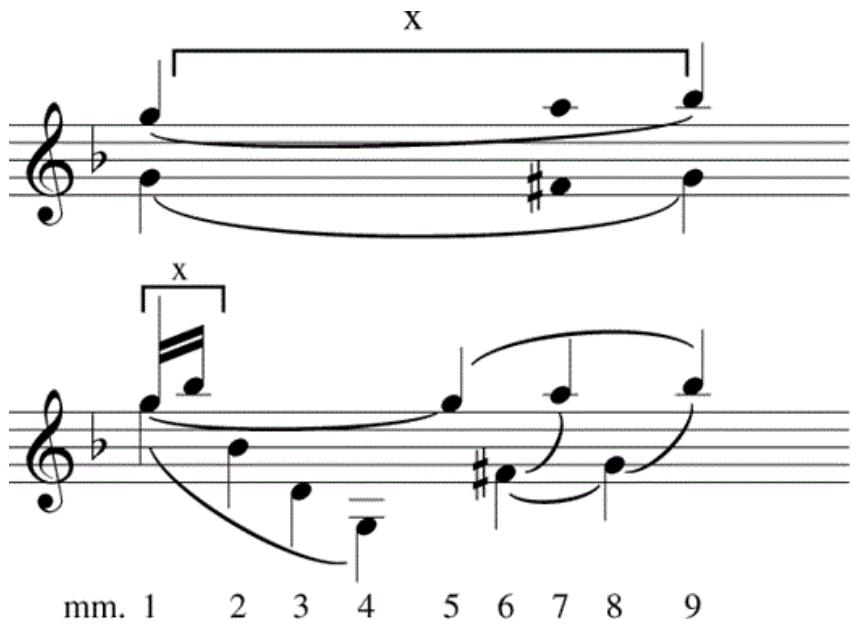
CHAPTER
中文讲解
这是页面中的章节标识,用于提示后续内容属于章节正文;它本身没有提出音乐分析主张。
第2段(P0002)
原文复述
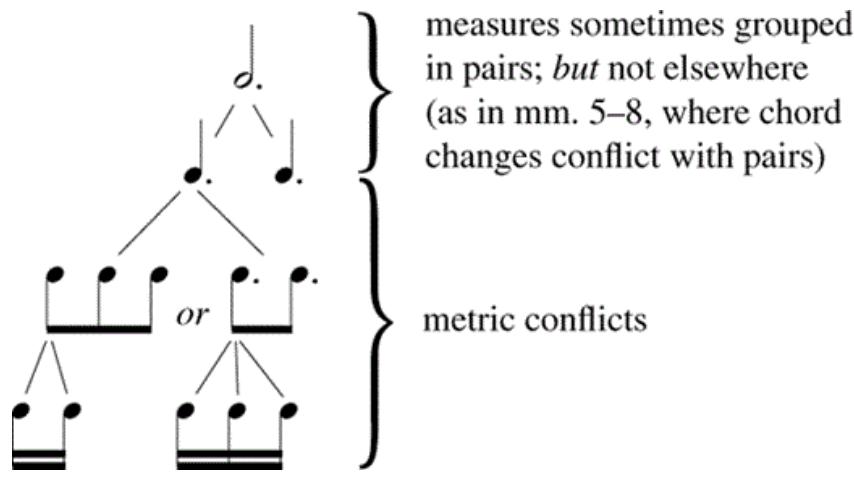
Five The G-minor Presto
中文讲解
标题将本节讨论对象锁定为 G 小调 Presto,并由此引出核心问题:该乐章的连续快速音符、表面形式与后来的 perpetual-motion movements 或 binary forms 既有表面相似,是否又具有不同的节奏和形式结构。标题末尾的符号不承载可确认的论证内容。
补充说明
标题末尾的符号属于版面或界面标记,需查看原页确认其具体样式;它不影响从标题中确认的论题。
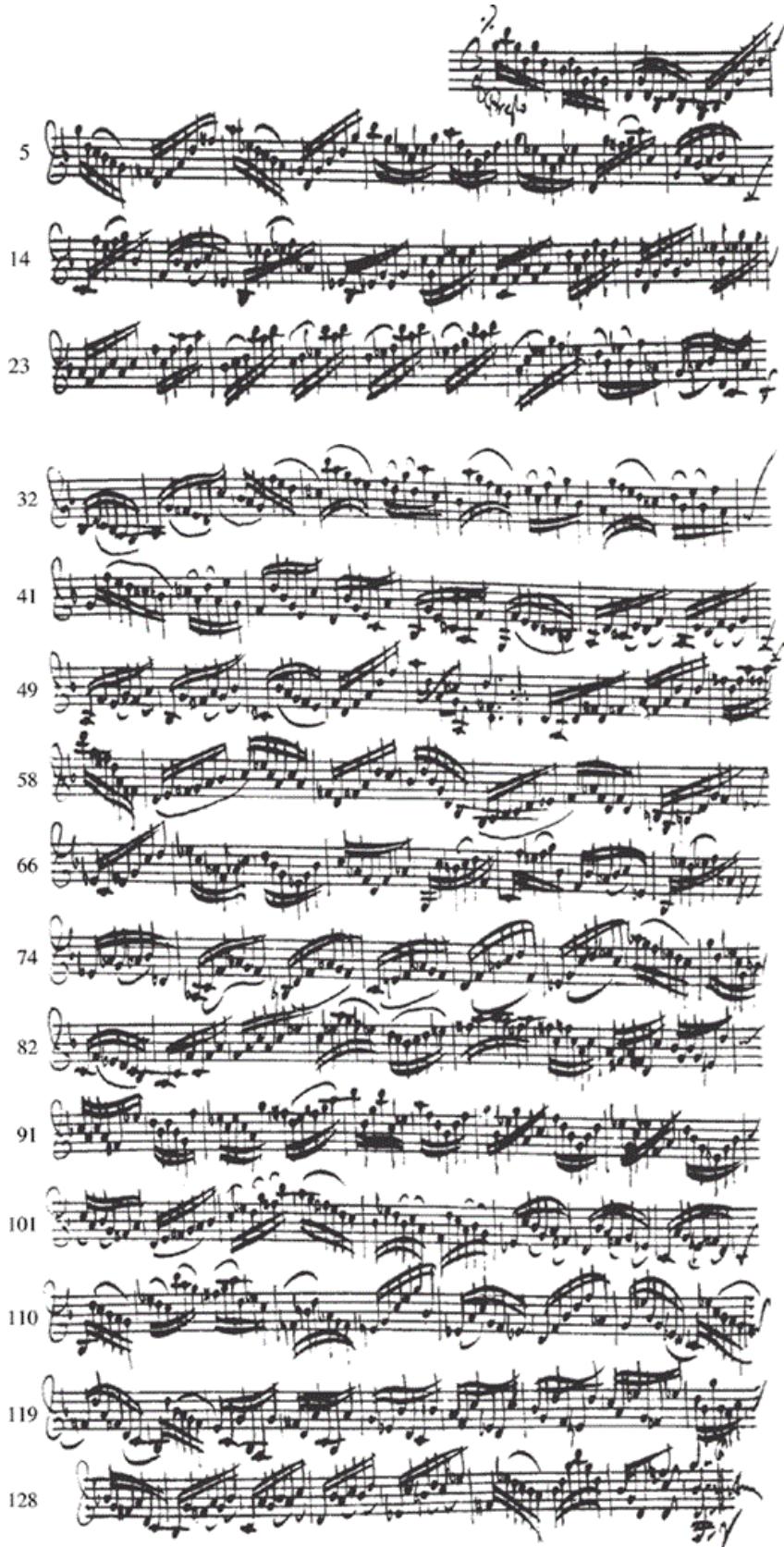
第3段(P0003)
原文复述
Joel Lester
中文讲解
这是作者署名行,交代后续关于 Bach 的 Presto 的论述归于 Joel Lester;它不参与具体音乐论证。
第4段(P0004)
原文复述
https://doi.org/10.1093/acprof:oso/9780195120974.003.05 Pages 108–138
中文讲解
这是章节的书目定位信息,提供了 DOI,并标示该章所在的页码范围为 108–138。它帮助读者定位这一版本,但不改变摘要所提出的音乐分析内容。
第5段(P0005)
原文复述
Published: 21 October 1999
中文讲解
这一行给出该版本的出版日期,即 1999 年 10 月 21 日;它属于出版元数据,而不是对 Presto 的年代、风格或结构的判断。
第6段(P0006)
原文复述
Abstract
中文讲解
“Abstract”标题说明接下来的一段是摘要,先行呈现本节或本章的中心判断:连续的快速音符和形式外观可能造成与后来作品的相似印象,但这种相似并不等于内部节奏组织和形式结构相同。
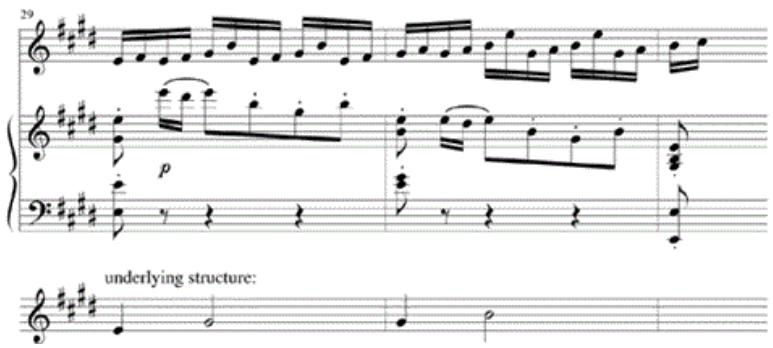
第7段(P0007)
原文复述
The continuous sixteenth notes of the Presto may seem akin to later composers’ perpetual-motion movements. But whereas later instances (such as Paganini’s) have a swift and supple surface overlaying a bel canto texture, the rhythms and metric hierarchy of Bach’s Presto create a vibrant rhythm that articulates many cross rhythms. This recurrent feature of Bach’s style versus later styles affects all sorts of textures—exemplified by the differences between the C-major Prelude in the Well-Tempered Clavier and Gounod’s Ave Maria (that adds a melody to that prelude), and the differences between Bach’s orchestration of his E-major Preludio and Robert Schumann’s accompaniment to the same movement. Parallel-section construction with heightening activity offers deeper insights into Bach’s two-part movements than later notions of “binary form.”
中文讲解
摘要的中心不只是指出 Presto 使用连续的十六分音符,而是把“看起来像 perpetual motion”本身作为一个需要检验的比较点。Paganini 等后来的例子被描述为在 bel canto texture 之上形成 swift and supple surface;相比之下,Bach 的 Presto 通过 rhythms 与 metric hierarchy 产生 vibrant rhythm,并使许多 cross rhythms 得以 articulated。作者由此强调,Bach 风格与后来风格的差异会实际影响各种 textures。两个对照进一步说明这一点:Gounod 的 Ave Maria 被说成是在 Well-Tempered Clavier 的 C-major Prelude 之上加入 melody;另一个对照是 Bach 对 E-major Preludio 的 orchestration 与 Robert Schumann 对同一乐章的 accompaniment。摘要最后提出方法论结论:分析 Bach 的 two-part movements 时,parallel-section construction 与 heightening activity 的结合,比直接采用后来的 binary-form notions更能揭示其结构。
补充说明
Gounod 的 Ave Maria 和 Robert Schumann 的 accompaniment 在原文中被用作织体差异的例子;原文没有进一步补充它们的历史、来源或完整结构。
第8段(P0008)
原文复述
Keywords: perpetual motion, rhythm, metric hierarchy, parallel sections, heightening activity, binary form, Paganini, Moto perpetuo, Gounod, Ave Maria, Robert Schumann, accompaniments
中文讲解
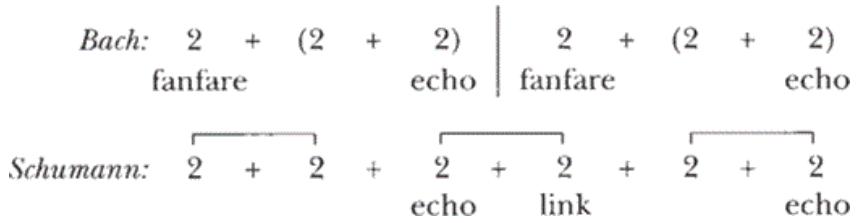
关键词把本章的核心概念集中为 perpetual motion、rhythm、metric hierarchy、parallel sections、heightening activity 和 binary form,同时列出 Paganini、Moto perpetuo、Gounod、Ave Maria、Robert Schumann、accompaniments 等比较对象或相关名称。它们显示,论述将围绕节奏组织、形式结构以及伴奏或配器关系所造成的织体差异展开。
第9段(P0009)
原文复述
Subject: Musicology and Music History, Strings, Baroque Music
中文讲解
主题分类将材料归入 Musicology and Music History、Strings 和 Baroque Music 三类。这是出版或数据库的学科分类信息,不是摘要中具体音乐论证的替代品。
第10段(P0010)
原文复述
Collection: Oxford Scholarship Online
中文讲解
“Collection”字段说明所摘录内容来自 Oxford Scholarship Online,属于出版集合或平台标识,而非音乐分析本身。
第11段(P0011)
原文复述
The Presto’s continuous fast notes and two pairs of repeat signs recall nineteenth-century perpetual motions and binary forms. Indeed, Johannes Brahms (1833–97) turned this very movement into two compositions with precisely those features: piano etudes for developing facility. In one etude he kept Bach’s solo in the right hand and wrote continuous sixteenths against it in the left hand, and in the other he kept Bach’s solo in the left hand and wrote continuous sixteenths against it in the right hand.
中文讲解
这一段从两个表面特征建立比较:连续的快速音符和两对反复记号,使人联想到十九世纪的 perpetual motions 与 binary forms。接着,Johannes Brahms(1833–97)把这个乐章变成两部用于训练演奏能力的 piano etudes,原文明确写出的配置分别是:一首保留 Bach 的 solo 在右手、让左手以 continuous sixteenths 对抗它;另一首则把 Bach 的 solo 放在左手、用右手的 continuous sixteenths 对抗它。这个例子把抽象的相似性具体化,也显示相同的连续音符和独奏材料可以被置于不同的手部关系中。
补充说明
Brahms 的两个 etude 是作者用来呈现“相同材料、不同配置”的具体例证;本段没有进一步说明这些改编的全部音乐细节。
第12段(P0012)
原文复述
But similarities between this movement and later perpetual motions and binary forms are deceptive. The dynamic of Bach’s rhythms and forms is fundamentally at odds with later apparently similar compositions. This chapter contrasts Bach’s Presto (and some other continuous-rhythm movements from the solo-violin works) with nineteenth-century perpetual motions and contrasts the Presto’s two-section outline with later binary forms. Differentiating Bach’s practices from those of later eras allows his own inherent structures to emerge.
中文讲解
这一段修正了前一段可能造成的印象:乐章与后来的 perpetual motions、binary forms 的相似性具有欺骗性。Bach 的 rhythms and forms 内部所具有的 dynamic,与后来表面上相似的 compositions 根本不同。作者随后明确本章的比较范围:把 Bach 的 Presto,以及来自 solo-violin works 的一些其他 continuous-rhythm movements,与十九世纪的 perpetual motions 对照;又把 Presto 的 two-section outline 与后来的 binary forms 对照。区分 Bach 与后来的实践不是目的本身,而是为了让 Bach 自身固有的 structures 显现出来。因此,本章不是把 Bach 直接归入后来的形式类别,而是通过差异化比较揭示其内部组织。
补充说明
“fundamentally at odds”表达了作者强烈的结构性对比判断;本段没有对该判断作量化说明。
第13段(P0013)
原文复述
Downloaded from academic.oup.com/book/5913/chapter/149232198 by Indiana University - Bloomington user on 12 August 2026
中文讲解
这是下载页脚,记录该版本由 Indiana University - Bloomington 的用户于 2026 年 8 月 12 日从 academic.oup.com/book/5913/chapter/149232198 下载。它属于访问或版面信息,不参与关于 Bach Presto 的音乐论证。
脚注 / 边栏 / 图表 / 附加信息(如有)
无额外补充;本节未提供脚注、图表或边栏材料。书目信息、关键词、主题分类、馆藏字段和下载页脚均已在相应段落中说明。
💡 本节核心要点
- Presto 的连续快速音符、两对反复记号以及形式外观,可能使人把它与十九世纪的 perpetual motions 和 binary forms 联系起来,但这些只是表面相似。
- 摘要把 Bach 与后来作品的关键区别放在节奏组织上:Presto 的 rhythms 和 metric hierarchy 产生 vibrant rhythm,并使许多 cross rhythms 得以 articulated,而后来例子的表面则被描述为 swift and supple 的 bel canto surface。
- 织体差异是风格差异的实际表现;Gounod 的 Ave Maria 对 Prelude 的旋律添加,以及 Bach 的 E-major Preludio 与 Robert Schumann 对同一乐章的 accompaniment 之间的差异,承担了说明这一点的例证功能。
- Johannes Brahms 的两首 piano etudes 保留了 Presto 的独奏材料,却分别把连续十六分音符置于另一只手中,具体展示了同一运动性材料可以被转化为不同的练习配置。
- 本章的正式方法不是把后来的 binary-form notions 直接套到 Bach 身上,而是通过 parallel-section construction 和 heightening activity 分析 Bach 的 two-part movements;这种差异化比较旨在让 Bach 自身的 inherent structures 显现。
🔑 关键术语
- perpetual motion:“持续运动”或“永动式进行”。在本节中指后来作品中与连续快速音符相关、因而表面上类似 Presto 的运动类型;作者强调这种表面相似并不等于内部结构相同。
- bel canto texture:“bel canto 式织体”。原文用来描述后来例子中 swift and supple surface 所依托的织体性质,并以此与 Bach 的节奏组织方式形成对照。
- metric hierarchy:“节拍层级”或“度量层级”。指 Presto 中不同节奏层面的组织关系;在本节中,它与 rhythms 一起使 cross rhythms 得以呈现。
- cross rhythms:“交叉节奏”。原文说 Bach 的 Presto 通过 vibrant rhythm articulated many cross rhythms,强调其节奏结构同时呈现出多重交叉关系。
- parallel-section construction:“平行段落构造”。本节提出的 Bach 二部性乐章分析概念,指从段落之间的平行关系观察作品结构,并与 heightening activity 一起使用。
- heightening activity:“活动性增强”或“逐步增强的活动”。原文将其与 parallel-section construction 并列,作为理解 Bach 二部性乐章的切入点;本节没有进一步规定其具体实现方式。
- binary form:“二部曲式”。本节将后来的 binary-form notions 与 Bach 的 two-section outline 进行对照,并认为前者不如平行段落构造加活动性增强的分析视角更能揭示 Bach 的结构。
- continuous-rhythm movements:“连续节奏型乐章”。指来自 solo-violin works 的一些相关乐章;本章将它们与十九世纪的 perpetual motions 一起置于比较范围内。
S2 [描述性拆分] Paganini’s Moto perpetuo and Its Metric Hierarchy
第1段(P0014)
原文复述
Paganini’s Moto perpetuo and Its Metric Hierarchy
中文讲解
这是一节(小节)的标题,本身不是论述段落。它标明了本节的论题:用层级化的节拍(metrical)视角去分析帕格尼尼《无穷动》(Moto perpetuo)。标题里的 “metric hierarchy” 是本节的核心概念,作者接下来会论证:在《无穷动》看似均匀的连续十六分音符之下,实际上存在多层不同节拍层级的活动——表层十六分音符只是装饰音,真正决定乐句走向的旋律线是在更大的节拍单位(四分音符、二分音符等)上展开的。
第2段(P0015)
原文复述
The Moto perpetuo by Niccolò Paganini (1782–1840), whose opening appears in Example 5-1a, is the nineteenth-century epitome of its genre. The melodic fluidity encourages violinists (and even flutists—witness James Galway’s famous recording) to aim for a thrilling sense of speed. This fluidity is not merely a factor of the actual speed—it arises even more from the rhythms inherent in the melodic line. In the first four beats of the melody, for instance, a chord tone appears on every strong, odd-numbered sixteenth (the first and third sixteenths of each beat) and a nonharmonic tone on almost every weak, even-numbered sixteenth. Every nonharmonic tone is a neighbor or passing tone that connects to the preceding and following notes by step, so that no nonharmonic tone jumps out of the texture because of a prominent skip. In addition, chord tones, not nonharmonic tones, adorn the tops and bottoms of most significant melodic spans: E atop the opening tonic chord, D and G during the following dominant, and so forth. As a result, every prominent note is a chord tone as well as a tone on a relatively strong metric point.
中文讲解
本段为本节的第一段正文,核心主张是:《无穷动》的"流动感"并不仅仅来自演奏速度,而更来自旋律线内部本身的节奏安排。作者用乐曲开头四小节来具体说明这一结构:每个拍子里的第一和第三个十六分音符(强位/奇数位)落上和声内音(chord tone),第二和第四个十六分音符(弱位/偶数位)落非和声内音(nonharmonic tone)。这种安排不是随意装饰,而是精心设计——所有非和声内音都通过级进(by step)与相邻音连接,要么是邻音(neighbor tone),要么是经过音(passing tone),因此不会因为大跳而从织体中"跳出来"。再加上每个重要旋律乐句的最高点和最低点都安排在和声内音上(如开篇主和弦上方的 E,随后属和弦中的 D 和 G),于是每一个突出的音就同时是"和声上稳定"和"节拍上强位"的音。这段分析为下一段引入"节拍层级"概念做了具体的微观铺垫:表层十六分音符虽密,但真正塑造乐句的是其中那些同时处于强拍、强位、和声稳定点的音。
补充说明
本段内的术语关系:和声内音/非和声内音的对位(chord tone vs. nonharmonic tone)与强位/弱位(odd- vs. even-numbered sixteenths)的对位相互平行,二者在本段中通过例子被绑定为同一现象的两个侧面。James Galway 的录音被作者作为旁证,说明这首作品原本为小提琴而作,却被移植到长笛后仍保留同样的速度魅力,但其分析并不依赖于这一旁证。
第3段(P0016)
原文复述
[Figure caption:] Example 5-1. Paganini, Moto perpetuo (New York: International, n.d.): (a) mm. 1–3; (b) the underlying bel canto melody.
中文讲解
这是 Example 5-1 的图注。该图示包含两个部分:(a) 帕格尼尼《无穷动》原谱的前三小节,(b) 在表层十六分音符之下的潜在美声旋律线。图注里注明了版本信息(New York: International, n.d.,即纽约 International 出版社,无具体日期),并明确把 (b) 称为"underlying bel canto melody"(潜在的美声旋律)——这一称呼与下一段正文里把十六分音符视为"填充物"、把潜在的慢速旋律视为"本体"的论述直接对应。
补充说明
无额外补充;图像本身的音符内容需查阅原书图 5-1 才能确认。
第4段(P0017)
原文复述
These melodic features contribute to the impression that the sixteenths are merely filler in a leisurely bel canto melody with clearly marked phrase subdivisions, as Example 5-1b illustrates. No significant level of rhythmic activity exists between this melody and the running sixteenths that fill in the melodic gaps; that is, one level of essential rhythmic activity (the actual notes of the piece) features fluid sixteenth notes, and another essential level of rhythmic activity delineates the underlying melody depicted in Example 5-1b. No intermediate levels receive any strong articulation: nothing in the texture focuses regular attention on the eighth-note level, and even quarter-note activity only projects when the underlying melody notes move at that pace. Figure 5-1 graphically depicts the levels of the metric hierarchy. With such a metric hierarchy, no matter how fast the sixteenths go (and the faster they go, the more thrilling the ride), the Moto perpetuo unfolds with the Italianate grace and poise of a lyrical aria by one of Paganini’s operatic contemporaries like Gaetano Donizetti (1797–1848) or Vincenzo Bellini (1801–35).
中文讲解
本段是本节的核心论证段,把前一段的微观观察提升为节拍层级(metric hierarchy)的理论主张。作者的推理分四步推进:第一,重述前段的结论——十六分音符只是"填充",真正起结构作用的是一条舒缓的、带有清晰乐句划分的美声旋律。第二,提出"层间空白"判断:在表层十六分音符和底层旋律之间,不存在中等节拍层级的显著活动;也就是说,作品里只有两个本质性的节拍层级——表层的流动十六分音符层和深层的旋律音层。第三,列举被排除的中间层:八分音符层完全没有获得突出;四分音符层只有当下层旋律音本身以四分音符时值运动时才被感知——也就是说它不是独立的层级,只是下层旋律的"副产品"。第四,把这种层级结构(Figure 5-1 图示化)与其美学效果联系起来:无论十六分音符演奏得多快,整首作品始终保持着意大利美声咏叹调的从容与优雅——作者以多尼采蒂(1797–1848)和贝利尼(1801–35)这两位同时代歌剧作曲家作为风格坐标。这一对比是关键:表层越是炫技的高速,底层越是显示出歌剧咏叹调般的稳重,两者的反差恰恰构成《无穷动》的魅力。
补充说明
本段引用的两个作曲家(Donizetti, Bellini)只在本节内作为风格参照出现,作者用他们的名字来概括一种"意大利式歌剧美声"的审美氛围,并不展开讨论他们各自的歌剧风格。两个生卒年只与作者提供的原文信息一致,不应引申到他们具体作品的比较。Figure 5-1 的具体图示需查阅原书。
第5段(P0018)
原文复述
p. 109
中文讲解
这是页码标记(位于第 109 页),属于版面信息,正文内容为空白。
第6段(P0019)
原文复述
p. 110
中文讲解
这是页码标记(位于第 110 页),属于版面信息,正文内容为空白。
第7段(P0020)
原文复述
Downloaded from academic.oup.com/book/5913/chapter/149232198 by Indiana University - Bloomington user on 12 August 2026
中文讲解
这是 OUP(牛津大学出版社)学术网站常见的下载来源水印,记录下载时间(2026 年 8 月 12 日)、下载用户所属机构(Indiana University - Bloomington),属于版面元信息,不构成作者论述。
第8段(P0021)
原文复述
[Figure caption:] Figure 5-1. The metric hierarchy in Paganini’s Moto perpetuo.
中文讲解
这是 Figure 5-1 的图注,标题指明该图示化了本节核心概念——帕格尼尼《无穷动》中的节拍层级。结合 P0017 的正文可知,这张图是用图形方式把"表层十六分音符层"与"底层美声旋律层"之间的层级关系(以及中间层级未被突出的事实)直观呈现出来,是为正文的理论论述提供可视化支持。
补充说明
图的具体形态(一般表现为不同长度的水平线、点状音符或方块层级)需查看原图确认。
第9段(P0022)
原文复述
To be sure, Paganini does not maintain exactly this state of affairs throughout the piece. Already in m. 2 he skips out of the nonharmonic tone E at the end of the third beat and places a passing tone on the third sixteenth of the next beat (the same E). But even with these minor disruptions to the alternation of chord tones and nonharmonic tones, the main melodic notes are all on the beats. Even later in the Moto perpetuo, when a more agitato effect emerges, the same features predominate. In the passage from the development section in Example 5-2, where there are many more skips than at the opening, the main melodic notes are still entirely on the beat, and the figuration has the effect of reinforcing the disparity between the surface rhythm of rapid sixteenths and the essential melody activity in quarters and half notes. These metric and textural features of Paganini’s Moto perpetuo characterize innumerable nineteenth-century rapid continuous-rhythm textures.
中文讲解
本段对前两段的论证进行了限定与推广,做了三件事。第一,承认开头的整齐交替并不是全曲统一的:第 2 小节里帕格尼尼就打破了非和声内音与和声内音的严格交替(在第三拍末尾出现了一个跳出的 E,并把同一个 E 改放在下一拍的第三个十六分音符上作为经过音),但即便如此,主要旋律音仍然落在拍点上——也就是说,“主要旋律音在强位"这一更核心的特征并未被破坏。第二,把观察延伸到展开部(Example 5-2):即使到了更激动的段落、十六分音符中出现了更多跳跃,核心旋律音依然完整地落在拍点上,从而进一步强化了"表层速度 vs. 底层旋律节奏"之间的反差。第三,把这一观察从《无穷动》这一首曲子推广到一类作品:“这些节拍与织体特征是无数十九世纪快速连续节奏织体所共有的”——这是把单作品分析上升为体裁(genre)层面归纳的关键一句,为后续章节讨论十九世纪速度织体做了铺垫。结构上,本段以"To be sure"开头,承担的是"先承认反例,再守住核心命题"的论辩功能,体现出作者论证的严谨性。
补充说明
本段中"development section”(展开部)的说法需结合 Example 5-2 的图示理解(mm. 59–62);“agitato"是速度/表情术语,指激动、急促的效果,作者用它来描述《无穷动》后段情绪更为激动的状态,但并未展开这一术语的音乐学背景。
第10段(P0023)
原文复述
[Figure caption:] Example 5-2. Paganini, Moto perpetuo, mm. 59–62.
中文讲解
这是 Example 5-2 的图注,标示了帕格尼尼《无穷动》第 59–62 小节的乐谱。该例证直接对应 P0022 中关于展开部的论述,作者正是以此例说明:即使在跳进增多、情绪更为激动的段落,主要旋律音依然完整地落在拍点上,从而强化表层快速十六分音符与底层四分/二分音符级旋律活动之间的反差。
补充说明
图中具体的音符、和声进行以及跳进位置需查看原书图示确认。
脚注 / 边栏 / 图表 / 附加信息(如有)
本节包含两类附加信息:(1) 图示与乐谱——Example 5-1(mm. 1–3 原谱及其下层美声旋律还原)、Figure 5-1(节拍层级图示)、Example 5-2(mm. 59–62 展开部片段),它们分别承担"微观例证”、“理论图示”、“延展例证"三种功能,与正文论证一一对应。(2) 版面元信息——第 109、110 页的页码,以及 OUP 学术网站下载水印(2026 年 8 月 12 日,Indiana University - Bloomington 用户),均不属于作者论述。脚注本节内未出现。
💡 本节核心要点
- 《无穷动》的"流动感"主要不来自于演奏速度,而来自于旋律线内部精心安排的强弱位与和声内/非和声内音的对应关系:奇数位十六分音符承载和声内音,偶数位十六分音符承载级进的邻音或经过音。
- 全曲表面上是一个均匀的十六分音符层,实质上存在两个本质性的节拍层级——表层流动十六分音符层与深层美声旋律层;二者之间不存在被独立突出的中间层级(八分音符层缺失,四分音符层仅当下层旋律本身以四分音符运动时才被附带感知)。
- 无论十六分音符演奏得多快,深层旋律始终保持着意大利歌剧咏叹调般的从容与优雅;表层速度与底层稳重之间的反差正是该曲魅力的来源。
- 前两小节那种"和声内音/非和声内音严格交替"的模式并不是全曲统一规则——第 2 小节起即有小规模打破——但"主要旋律音仍落在拍点(强位)上"这一更核心的特征贯穿全曲,即使在展开部跳进增多、情绪更为激动(agitato)的段落也是如此。
- 这种"快速连续节奏织体表层 + 四分/二分音符级深层旋律"的节拍与织体安排,并非《无穷动》所独有,而是十九世纪同类快速作品中普遍存在的特征,为后续讨论同类体裁作品提供了归纳基础。
🔑 关键术语
- Moto perpetuo:意大利语"永动"之意,指全曲从头到尾保持快速、近乎机械式连续运动(通常为十六分音符流)的器乐曲体裁。帕格尼尼的《无穷动》被作者视为十九世纪该体裁的典范代表。
- Metric hierarchy / 节拍层级:本节核心概念。指作品中同时存在的多个不同时间长度的节拍/节奏活动层级(八分音符层、四分音符层、二分音符层等),其中只有部分层级获得强烈的听觉突出,构成"本质性"的节奏活动,其它层级则不被独立感知。本节论证《无穷动》只存在两个本质层级:十六分音符层与底层美声旋律层。
- Chord tone / 和声内音:属于当前和弦的音。在本节论述中,它不仅承担和声功能,还被有意识地放在每个拍子的强位(奇数位十六分音符)以及重要旋律乐句的最高/最低点上,兼具和声与节拍的双重突出性。
- Nonharmonic tone / 非和声内音:不属于当前和弦的音。本节中指放在每个拍子弱位(偶数位十六分音符)的邻音(neighbor tone)或经过音(passing tone),通过级进与相邻和声内音连接,避免因跳进而从织体中"跳出来”。
- Bel canto / 美声:意大利语"美妙的歌唱"之意。本节中用来形容《无穷动》底层那条舒缓、带有清晰乐句划分的旋律线——它实质上是一条意大利歌剧式的歌唱性旋律,十六分音符只是围绕它的装饰。
- Passing tone / 经过音:连接两个不同音高的、通常以级进方式出现在它们之间的非和声内音。在 P0022 的限定讨论中,正是这种经过音偶被放在原本应为和声内音的拍点强位上,构成了对严格交替模式的"小规模打破"。
- Agitato:音乐速度/表情术语,意为"激动地"。本节中用来描述《无穷动》展开部等后段中情绪更为激动的状态,作者强调即使在这种状态下,主要旋律音仍然完整地落在拍点上。
S3 [描述性拆分] The Metric Hierarchy of Bach’s Presto
第1段(P0024)
原文复述
The Metric Hierarchy of Bach’s Presto
中文讲解
本节的小节标题,宣告本部分将讨论巴赫《G小调独奏小提琴奏鸣曲》末乐章 Presto 中存在的多层节拍(metric)等级结构。这一标题提示读者:作者不是把节拍当作单一的强弱周期,而是把它当作多个层级(hierarchy)互相作用的活动来处理。
第2段(P0025)
原文复述
The type of texture and metric hierarchy found in Paganini’s Moto perpetuo is entirely foreign to Bach’s style. Bach’s continuous sixteenth-note textures almost invariably project a metric hierarchy in which all levels project significant activity and in which a range of accentuations occur on metrically weak points, often boldly conflicting with one another and creating metric ambiguities. By deploying these interacting levels of significant rhythmic activity creatively, Bach was able to create his characteristic increase in overall activity even in movements where the surface rhythm seems to be merely a continuous stream of sixteenths.
中文讲解
本段是本节的总论点,提出巴赫的写法与帕格尼尼《无穷动》截然不同:帕格尼尼采用表面快速、音型匀质的织体,而巴赫则在持续十六分音符的表层下,让所有节拍层级都参与有意义的节奏活动。关键点有四:①所有节拍层级都"显著活动";②重音常常落在节拍弱位上;③这些错位重音彼此冲突,由此产生节拍歧义(metric ambiguity);④正是这种多层级互动,使巴赫即使在表面看似均匀的十六分音符流中也能制造整体活动度的上升。这为本节随后对 Presto 开头的 3/8 与 6/16 双重听感、以及 m. 1 中 B♭ 弱位冲突的讨论定下了理论框架。
补充说明
“metric hierarchy”(节拍层级)指乐曲中同时存在的多个节拍周期——例如十六分音符、八分音符、小节——彼此构成的强弱关系网络;本段强调在巴赫这里,这些层级之间会产生张力。
第3段(P0026)
原文复述
Consider the opening of the G-minor Presto. Excitement and ambiguity abound even in the first three measures: Is the meter 3/8 or 6/16? Both duple and triple patternings seem to be embedded in Bach’s figuration. Each group of three notes replicates the opening three-note motive one stage lower in the downward arpeggiation of the tonic chord shown in Example 5-3a. At the same time, as Example 5-3b shows, alternate notes mark the eighth-note beats, yielding a measure-by-measure outline of the motto voicing of the G-minor tonic chord of the first movement—a voicing of the tonic chord that ends the Presto. Furthermore, this metric ambiguity emerges in other figurations throughout the Presto, such as those shown in Example 5-4.
中文讲解
本段用 Presto 开头三小节作为具体例证,展开 P0025 的总论点。作者指出,开头就存在节拍歧义:节拍究竟是 3/8(三个八分音符为一拍,每拍三拍为一小节)还是 6/16(六个十六分音符为一拍,每拍两拍为一小节)?表面上,三音一组的写法构成三拍子(向下琶音的主和弦动机,对应 Example 5-3a);但如果把每两个十六分音符连起来听,alternate notes(每隔一个的十六分音符)实际上勾勒出八分音符重拍,由此得到 6/16 的二拍子听感(对应 Example 5-3b)。这层 6/16 听感不是装饰,而是呼应了第一乐章 G 小调主和弦的"格言式"(motto)和声排列,而这一和声排列恰恰也是 Presto 结尾收束时的和弦,因此首尾呼应。同时作者预告,这一节拍歧义并不限于开头,Example 5-4 显示它在乐章其他音型中也会再现。
补充说明
motto voicing 指以一个紧凑、短小的音程排列作为整首作品反复出现的"格言式"和声骨架;Example 5-3a、b 与 Example 5-4 在原文中以图示给出(OCR 中以图像占位符表示)。
第4段(P0027)
原文复述
p. 111
中文讲解
这是原文第 111 页的页码标记,属于版面信息,表明 P0026 的论述结束于第 111 页。
第5段(P0028)
原文复述
Downloaded from academic.oup.com/book/5913/chapter/149232198 by Indiana University - Bloomington user on 12 August 2026
中文讲解
这是 Oxford Academic 电子书页脚的水印信息,说明该页面于 2026 年 8 月 12 日由印第安纳大学伯明顿分校的机构用户下载,属于来源标识而非正文内容。
第6段(P0029)
原文复述
中文讲解
这是第 4 页上方一个无法识别的图像/乐谱占位符。在 P0030 和 P0031 的图注中可知,第 4 页主要展示 Example 5-3(开头 1–4 小节在 3/16 与 3/8 两种解读下的对照)和 Example 5-4(3/8 vs. 3/16 节拍冲突的另外两次出现:mm. 9–11 与 mm. 25–29)。本占位符所指的应是页面顶部这一片乐谱区域,“需查看原图"以确认谱面细节。
第7段(P0030)
原文复述

中文讲解
图注对应 Example 5-3:巴赫《G小调独奏小提琴奏鸣曲》Presto 开头 1–4 小节的两种节拍解读。子图 (a) 把乐谱记为 3/16(以十六分音符为基本拍,三个十六分音符构成一拍小节),子图 (b) 把同样的音符记为 3/8(以八分音符为基本拍,每拍三连)。该图用视觉对照说明 P0026 所论证的"同一串音符可以同时被听成两种节拍”。
第8段(P0031)
原文复述
中文讲解
图注对应 Example 5-4,展示 Presto 中 3/8 与 3/16 节拍冲突在后文段落中的另外两次出现:子图 (a) 为第 9–11 小节,子图 (b) 为第 25–29 小节。该例支持 P0026 末尾的预告——节拍歧义不是局部现象,而是贯穿整个乐章的结构特征。
第9段(P0032)
原文复述
Remarkably, neither metric patterning seems strong enough to overwhelm the other. No matter which way violinists think they are playing the passage, the other interpretation remains quite audible in their performance. I urge violinists to record themselves playing the passage conceptualizing it both ways and then listen immediately to their own performances and see how much residue of the other interpretation remains in each rendition. I have played recordings of the opening measures of the Presto for several musicians and asked which meter projected. Invariably, I received varying answers, confirming that the metric ambiguity here is so deeply embedded that some residue of it projects no matter how hard the violinist aims for a single vision.
中文讲解
本段把 P0026 的理论分析落到演奏实践上,强调这两种节拍听感势均力敌,谁也无法完全压倒对方。无论演奏者主观上以哪一种节拍构思音乐演奏,另一层节拍的"残影"(residue)都会从演奏中透出。作者提出一个具体练习:先以 3/8 的概念录一段、再以 6/16 的概念录一段,立刻回听,就会发现另一种节拍的痕迹仍在。作者还报告了一个非正式的演奏学测试——他对多位音乐家播放同一段录音并询问他们感受到的是哪种节拍,结果答案不一,证明节拍歧义是被"深深嵌入"乐谱的,演奏者即使刻意追求单一节拍也无法完全消除另一层。脚注 2(出现于本段末)暗示还有进一步的延伸讨论。
补充说明
本段末尾的上标 “2” 表示此处有脚注 2,但脚注内容未出现在本小节段落内;其作用为补充或延伸说明,需结合脚注正文理解。
第10段(P0033)
原文复述
Even more strikingly, whichever metric interpretation a performer or listener desires for any of these passages, prominent notes conflict with it, beginning right in m. 1. The highest note in that measure, B♭, falls on a weak metric point in both the 3/8 and 6/16 interpretations. Yet that weak metric placement of the high B♭ is by no means a compositional miscalculation on Bach’s part. The opening G–B♭ foreshadows the motion between the same two pitches that underlies the opening G-minor music stretching from m. 1 to m. 9, as shown by the “x” brackets in Example 5-5 (urging violinists to articulate that B♭ clearly no matter which meter they hear).
中文讲解
本段将节拍歧义的讨论推进到单音层面:在 m. 1,无论采用 3/8 还是 6/16 解读,全小节最高的音 B♭ 都恰好落在节拍弱位上。一个表面上"应该"是结构性重音的最高音却出现在弱位,这是表面"事故",实为有意为之。理由在于:开头的 G–B♭ 这一音程运动预示并贯穿了 m. 1 到 m. 9 的整个 G 小调音乐(Example 5-5 中以 “x” 括号标出)。也就是说,B♭ 的弱位放置并非创作失误,而是让一个重要的旋律—和声骨架音突破节拍重音规则的限制。作者借此提醒小提琴演奏者:无论把这段听成哪种节拍,都要清晰地把这个 B♭ 奏出来。
补充说明
Example 5-5 见 P0036 的图注;“x” brackets 是作者在乐谱中标注 m. 1–9 内 G–B♭ 这一对位旋律框架的记号。
第11段(P0034)
原文复述
p. 112
中文讲解
原文第 112 页的页码标记,属版面信息,说明 P0033 的论述结束于第 112 页。
第12段(P0035)
原文复述
Downloaded from academic.oup.com/book/5913/chapter/149232198 by Indiana University - Bloomington user on 12 August 2026
中文讲解
Oxford Academic 电子书页脚的水印信息,说明第 112 页于 2026 年 8 月 12 日由印第安纳大学伯明顿分校用户下载,属来源标识而非正文内容。
第13段(P0036)
原文复述
中文讲解
图注对应 Example 5-5,展示 Presto 第 1–9 小节中隐藏的结构层。该图通过 “x” 括号把 m. 1 中 G–B♭ 的音程关系延伸到第 9 小节,以可视化方式支持 P0033 的主张:B♭ 的"弱位"高音并非偶然,而是整段 G 小调基础和声—旋律骨架的一部分。
第14段(P0037)
原文复述
The 1+5 slurring that begins in m. 5 calls attention to a different sort of metric conflict: a syncopation that the skips would have projected even if the measure were unslurred.
中文讲解
本段短小但承担转折:第 5 小节开始的"1+5"连弓(即把第 1 拍音与后面 5 个音连成一弓)引出又一种节拍冲突。这次冲突不再来自 B♭ 的弱位放置,而是来自跳进音型本身造成的切分感。作者指出,即使不标连弓,这种跳进本就会产生切分;连弓只是把这个潜在的切分凸显出来。这说明巴赫的节拍歧义并非依赖单一的"重音错位"手段,而有多种技术来源。
补充说明
“1+5 slurring” 指将一拍音与其后五音连弓,是巴赫无伴奏小提琴作品中常见的弓法模式,可视为一种隐含的强弱划分。
第15段(P0038)
原文复述
All this purposeful metric complexity stands in sharp contrast to Paganini’s bel canto. Bach’s figuration creates the metric hierarchy shown in Figure 5-2. Instead of Paganini’s fast surface flashily elaborating a much slower simple melody, Bach’s metric hierarchy offers musical interest at every level: in the prominent sixteenths contesting the meter, in 3/8 versus 6/16, or in the alternation of different patterns in mm. 5–8.
中文讲解
本段再次把巴赫与帕格尼尼对照,作为本节的总结性比较。帕格尼尼《无穷动》是 bel canto 式写法——快速表层围绕一条更慢、更简单的旋律;而巴赫的 Presto 没有这种表层—深层的简单分工,其节拍等级(参 Figure 5-2)在每一层都提供独立的音乐趣味:①显著的十六分音符与节拍重音相争;②3/8 与 6/16 两种节拍解读并存;③第 5–8 小节中不同音型的交替本身形成结构。也就是说,“节拍等级"不是抽象理论,而是巴赫用以替代帕格尼尼式旋律—伴奏二分法的具体作曲策略。
补充说明
bel canto(美声)一词在文中指帕格尼尼式的歌唱性主题加炫技音型展开,与巴赫的"多层级独立活动"形成对照;Figure 5-2 见 P0039 的图注。
第16段(P0039)
原文复述
中文讲解
图注对应 Figure 5-2:以图示方式呈现 Presto 中的节拍层级结构,即十六分音符、3/8 与 6/16、以及第 5–8 小节的音型交替等多层节拍组织相互嵌套的关系,作为 P0038 论断的可视化总结。需查看原图。
第17段(P0040)
原文复述
These ambiguities even affect interpretation of strong and weak measures. Consider mm. 4–8. Returning to the opening high G on the downbeat of m. 5 seems to begin a new unit of phrasing: an alternation in two-measure units of two patterns, implying a strong–weak alternation beginning in m. 5 that makes odd-numbered measures strong. But the changes of harmony occur instead on the even-numbered measures. Either the strong–weak patterning changes to adjust to the harmonic rhythm (creating, at least in retrospect, a three-measure unit in mm. 1–3) or a measure-level syncopation arises because of harmonic changes—the factor that is usually decisive in locating downbeats.
中文讲解
本段把讨论从单音层级推进到小节层级的强弱判定,进一步揭示节拍歧义的结构后果。以 mm. 4–8 为例:从乐句层面看,m. 5 强拍上的高音 G 似乎开启了一个新的两小节单元(两小节两音型交替),由此暗示从 m. 5 起是"强—弱—强—弱”,奇数小节为强拍。但和声进行却发生在偶数小节,造成乐句重音与和声节奏之间的错位。由此产生两种解决路径:要么"强—弱"图式让位于和声节奏(回头看,mm. 1–3 实际构成一个三小节单元);要么由于和声变化而产生小节层级的切分。作者指出,在判定下拍(downbeat)的位置时,和声节奏通常是决定性因素,这呼应了 P0025 关于"弱位出现有意义活动"的总论点。“Returning to p. 113” 是引导读者翻回(或翻到)第 113 页的版式提示。
补充说明
“Returning to p. 113” 是跨页指示,对应原书中前文已出现过的第 113 页内容;“downbeat” 指小节或节拍单元的第一拍。
第18段(P0041)
原文复述
Downloaded from academic.oup.com/book/5913/chapter/149232198 by Indiana University - Bloomington user on 12 August 2026
中文讲解
Oxford Academic 电子书页脚水印,说明第 113 页于 2026 年 8 月 12 日由印第安纳大学伯明顿分校用户下载,属来源标识而非正文内容。
脚注 / 边栏 / 图表 / 附加信息(如有)
本节涉及的附加材料包括:Example 5-3(P0030)、Example 5-4(P0031)、Example 5-5(P0036)、Figure 5-2(P0039)以及一个未单独标注图题的页面图像占位符(P0029)。这些图示共同支撑本节论证:Example 5-3a/b 用两种节拍记法对照说明开头 1–4 小节可同时被听成 3/16 与 3/8;Example 5-4 证明 3/8 vs. 3/16 冲突在 mm. 9–11 与 mm. 25–29 处再次出现;Example 5-5 通过 “x” 括号显示 m. 1 中的 G–B♭ 框架贯穿 m. 1–9,解释 B♭ 的弱位放置;Figure 5-2 以图形方式呈现 Presto 中的多层节拍层级,作为对帕格尼尼式表层—旋律二分法的对照模型。此外,P0032 末尾出现脚注上标 “2”,提示本节引入了脚注 2,但脚注正文不在本小节输入范围内,因此其具体内容无法在本节内复述;版面元素还包括 P0027(p. 111)、P0034(p. 112)的页码以及 P0028、P0035、P0041 的下载水印。
💡 本节核心要点
- 巴赫 Presto 与帕格尼尼《无穷动》在织体与节拍等级上完全不同:巴赫让所有节拍层级都参与有意义的节奏活动,并在弱位安排重音,由此产生节拍歧义。
- 开头 1–4 小节同时支持 3/8(向下琶音三音组)与 6/16(交替音勾勒八分音符重拍)两种听感,其中 6/16 的轮廓呼应第一乐章 G 小调主和弦的"格言式"和声排列,也是 Presto 结尾的和弦。
- m. 1 最高音 B♭ 在两种节拍下都落在弱位,但这并非创作失误;G–B♭ 这一音程是 m. 1–9 整段 G 小调音乐的结构骨架(见 Example 5-5 的 “x” 括号)。
- m. 5 起的 1+5 连弓凸显跳进带来的切分感,揭示节拍歧义的另一技术来源:跳进本身的潜在切分。
- mm. 4–8 中,乐句的"强—弱"图式(从 m. 5 起以两小节为单位)与和声进行(落在偶数小节)相互错位;和声节奏通常是判定下拍的决定性因素。
- 巴赫的"节拍等级"用多层独立活动取代了帕格尼尼式表层快速炫技围绕慢速主旋律的简单分工,构成一种独特的织体策略(参 Figure 5-2)。
🔑 关键术语
- metric hierarchy(节拍等级):本节核心概念,指乐曲中同时存在的多个节拍周期(如十六分音符、八分音符、小节等)彼此构成的强弱关系网络;在巴赫 Presto 中,这些层级各自独立地提供音乐趣味并互相冲突。
- metric ambiguity(节拍歧义):指同一段音乐可被同时听成两种不同节拍(如本节中的 3/8 与 6/16)的现象;本节论证其根源在于不同节拍层级上的重音同时被激活。
- 3/8 vs. 6/16:本节反复出现的节拍对照:3/8 以八分音符为基本拍、每小节三拍,6/16 以十六分音符为基本拍、每小节两拍;Presto 开头同时支持两种解读。
- motto voicing(格言式和声排列):指作品反复出现的紧凑、短小的和声音程骨架;本节指 G 小调主和弦在第一乐章与 Presto 末尾共用的排列方式,由此使 Presto 开头 6/16 的"八分音符轮廓"获得和声意义。
- downbeat(下拍):小节或节拍单元的第一拍;本节用以指代节拍层级的最强位置,并指出在巴赫这里,和声节奏通常比表层重音更决定下拍的位置。
- 1+5 slurring(1+5 连弓):将一拍音与其后五音连成一弓的弓法;本节指出它在 m. 5 起凸显跳进造成的潜在切分,是节拍冲突的另一种来源。
- bel canto:本节借用以概括帕格尼尼《无穷动》的写法:歌唱性主旋律加炫技音型展开;与巴赫"多层节拍独立活动"形成对照。
S4 An Obscure Metric Notation
第1段(P0042)
原文复述
An Obscure Metric Notation
中文讲解
这是第5章下一个小节的小节标题,原文以 “An Obscure Metric Notation”(一种鲜为人知的节拍记谱法)开启。该标题提示作者接下来将讨论巴赫手稿中一种含义不明、但具有节拍/韵律意味的特殊小节线写法——每隔一条小节线只画一个短笔画而非完整的小节线。本节围绕这一现象提供具体例证、列举使用场合,并考察其可能含义与现代演奏者的处理方式,承接前文对巴赫3/8拍记谱及小节线画法的讨论。
第2段(P0043)
原文复述
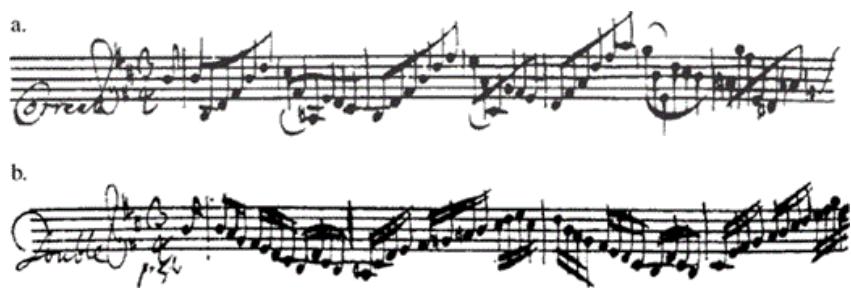
To be sure, Bach supplements his 3/8 meter signature with a special barring: Every other bar line is just a short stroke, not a full bar line, as shown in Figure 5-3. Bach occasionally employed this notation elsewhere, as in the Corrente (written in 3/4) of the B-minor Solo-Violin Partita, the opening of which appears in Figure 5-4a. He also seems to have begun to write bar lines in the same manner in the Presto Double of that movement (which has the same meter signature as the Corrente). As Figure 5-2b shows, the second bar line of the Double seems to have been written twice, perhaps to make it a complete bar line—thereafter, all the bar lines are single strokes of the usual length. A puzzling instance of this notation occurs in Bach’s A-minor Three-Part Invention. In the Clavierbüchlein vor Wilhelm Friedemann Bach wrote short bar lines every other measure, whereas in his later autograph of all the inventions he wrote normal barring.⁴
中文讲解
本段是本节的核心段落,描述现象并列举四组例证,作用是为下一段(关于含义的讨论)提供事实基础。
作者首先给出基本定义:在3/8拍记号之外,巴赫还以小节线的形式补充了一种特殊写法——每隔一条小节线只画一个短笔画(短杠),而非贯穿全行的小节线;图5-3展示了这一写法。这一句需要强调"supplements"(补充)和"Every other bar line"(每隔一条)两个关键词:特殊写法并非取代常规小节线,而是与常规小节线交替出现,从而把每一"大拍"内部又视觉性地切分为两个"半小节"。
接着作者用三组例证扩展此现象的适用范围,每一组都为下一段的解释提供素材:
- B小调无伴奏小提琴帕蒂塔的Corrente(3/4拍),开头见图5-4a;
- 该乐章的Presto Double(速度标记为Presto,与Corrente拍号相同)。作者特别指出Double的第二条小节线被画了两次,可能本想画一条完整的小节线,但随后又放弃了——所有小节线都变成了单笔短画。原稿指向"Figure 5-2b",但根据上下文(Double对应图5-4b),此处疑为排印或OCR误读;
- A小调三声部创意曲:在《为威廉·弗里德曼·巴赫而作的小键盘曲集》(Clavierbüchlein vor Wilhelm Friedemann Bach)中,巴赫每隔一小节画短小节线;但在后来更晚期的全部创意曲自稿中,他却改用了常规小节线。
这一并列证据的目的是制造张力:同一位作曲家的同一部作品在同一时期(甚至同一抄本)出现两种截然不同的小节线处理,且后期还自我修正。这意味着该记谱不可能只是抄写员的偶然失误,而是带有意图——但意图究竟是什么,作者将在下段展开讨论。段尾的脚注⁴即为讨论A小调创意曲两版差异的来源注。
补充说明
- “Clavierbüchlein vor Wilhelm Friedemann Bach”(为威廉·弗里德曼·巴赫而作的小键盘曲集)是巴赫1722年前后为长子所编的键盘教材集,收录二声部与三声部创意曲,本段中两版自稿的对比正是基于此集与后来的"晚期自稿"。
- 文中出现"Figure 5-2b",但从上下文判断,所讨论对象是Double of the Corrente,而本节实际给出的对应图版为图5-4b;此处可能是原稿或转写中编号不一致,需参照原书图版核实。
- 段尾脚注⁴的内容在本节正文中未展开,其详细讨论留给additional_information汇总。
第3段(P0044)
原文复述
Downloaded from academic.oup.com/book/5913/chapter/149232198 by Indiana University - Bloomington user on 12 August 2026
中文讲解
这是Oxford Academic电子书中典型的下载来源页脚,仅说明文档获取方式与下载者身份(印第安纳大学伯明顿分校用户,2026年8月12日下载)。它不属于正文论证,不携带论据信息;只需识别其版面属性即可,不影响对作者论证的理解。
第4段(P0045)
原文复述
Figure 5-3. Bach, Sonata in G Minor, Presto, autograph score.
中文讲解
这是图5-3的图题与图版占位符(图本身未显示),标识此图为巴赫《g小调奏鸣曲》第三乐章Presto的自稿乐谱。其与正文的对应关系已由P0043明确指出:图中可见每隔一条小节线画短笔画的"半小节线"写法,是本节核心现象(3/8拍下的特殊小节线处理)的第一手视觉证据。具体音符与谱例细节需查看原书插图。
第5段(P0046)
原文复述
Downloaded from academic.oup.com/book/5913/chapter/149232198 by Indiana University - Bloomington user on 12 August 2026
中文讲解
同P0044,这是页脚下载信息,属于版面元素而非论证内容;不影响作者推理。
第6段(P0047)
原文复述
Figure 5-4. Bach, Partita in B Minor for Violin Solo, autograph score: (top) Corrente, mm. 1–7; (bottom) Double of the Corrente, mm. 1–4.
中文讲解
这是图5-4的图题与图版占位符,对应巴赫《b小调无伴奏小提琴帕蒂塔》的自稿谱例。图片由上、下两部分组成:上半为Corrente第1–7小节(即P0043中所引"图5-4a"),下半为该乐章Double第1–4小节。这两段乐谱正是P0043用来证明"半小节线"在巴赫3/4拍作品中也偶尔出现的关键证据,且下半谱例中第二条小节线被写了两次的细节,可与P0043的描述相互印证。具体音符细节需查看原图。
第7段(P0048)
原文复述
p. 1145 The significance of these short bar lines remains obscure. I know of no eighteenth-century discussion and am unaware of any modern discussion. The notation may have carried some implications for tempo, which could explain why Bach began to notate the Double of the Corrente in the B-minor Partita with these half bar lines and then corrected himself, perhaps after he realized that he had written Presto for the Double but not for the Corrente. But then why would he have written out the A-minor Invention once with these half bar lines and once without them? Perhaps the half bar lines are supposed to indicate strong and weak measures. If that is the case, however, many violinists disregard the notation. Many recordings of the Presto shift the strong–weak measure groupings during the course of the movement. Probably the most extreme recording I know in that respect is that by Nathan Milstein, who plays the cadential arrival of each half of the movement so strongly in a metrical sense—even though they are notated in midmeasure—that he then inserts an entire (weak) measure of silence before taking each repeat or continuing to the next section!⁵
中文讲解
本段是本节的高潮与结论性段落,承接P0043罗列的现象,从"是什么"转入"为什么"。作者的态度与论证层次非常清晰:
-
开篇即承认含义不明(remains obscure),并坦白自己既未发现18世纪的相关讨论,也未见到现代学界的相关研究。这一陈述并非故作谦虚,而是为后续的几种假说提供合法空间——既然没有定论,列举假说就成了必要的探索。
-
第一个假说:暗示速度。作者用B小调帕蒂塔中Double的实例来支撑此说:Double标了Presto而Corrente没有,巴赫最初用半小节线来画Double,但随后自我修正。可能的逻辑是:半小节线=辅助演奏者理解快速乐句内部的小单位划分,一旦乐谱上已有Presto速度标记,这种辅助就不再必要,于是改回常规小节线。这一假说解释了"修正"现象,但作者立刻用反问推翻了它对全部例证的普适性:如果是速度暗示,为什么A小调创意曲在同一时期会存在两个版本——一个用半小节线,一个不用?两者速度相同却记谱不同,无法用速度假说解释。
-
第二个假说:暗示强弱拍。作者提出"或许半小节线表示强拍与弱拍的交替"。但紧接着,他用现代演奏实践来削弱此说:即便承认此假说成立,许多小提琴家在实际演奏中并不遵循这一记谱——许多录音在乐章进行过程中会重新组合强—弱拍分组。最后,他给出极端例子:小提琴家米尔斯坦(Nathan Milstein)在Presto中把每一"半段"的终止都演奏得在节拍上如此强烈,以至于——尽管谱面上终止落在小节中间——他在每次反复或进入下一段之前插入整整一个(弱)小节的休止。这个细节既幽默又具说服力:它表明无论巴赫的原始意图是什么,现代演奏实践已不再受此记谱法的约束。
本段的结构是"承认无知—提出假说—用反例推翻—展示现代实证",是典型的学术审慎论证。它使本节不流于"猎奇式记谱趣闻",而是对"图面证据 vs. 音乐意图"这一更大议题的有力切入。段尾脚注⁵对应米尔斯坦录音的出处,详见additional_information。
补充说明
- “p. 1145"是该段在原书(论文集/著作)第1145页的页码标识,说明此段与上一段(P0043所在的第6–7页)属于不同页码范围,是页面位置提示。
- “Clavierbüchlein"在P0043已说明,此处再次出现"the A-minor Invention once with these half bar lines and once without them”,是P0043所述两版自稿差异的回扣:作者用同一现象的内部矛盾来否定"速度暗示"假说。
- “Nathan Milstein”(1904–1992)是著名俄裔美籍小提琴家,此处用以代表一种极端的现代演绎倾向;脚注⁵应给出其具体录音信息,详见additional_information。
脚注 / 边栏 / 图表 / 附加信息(如有)
本节包含两个脚注(脚注⁴与脚注⁵)以及两幅图版(图5-3与图5-4)。
- 脚注⁴位于P0043末尾,对应A小调三声部创意曲在Clavierbüchlein vor Wilhelm Friedemann Bach与后来全部创意曲自稿之间的小节线差异。其作用是为"同一作品存在两种自稿记谱"这一关键事实提供文献支持,是本节反证"速度暗示"假说的实证基础。
- 脚注⁵位于P0048末尾,对应小提琴家Nathan Milstein关于G小调奏鸣曲Presto的极端录音。其作用是以一个具体的现代演绎案例支撑"许多小提琴家忽略半小节线"的判断,是本节从历史记谱延伸到现代演奏实践的关键衔接。
- 图5-3(位于P0045处):巴赫《g小调奏鸣曲》Presto自稿谱例,是"每隔一条小节线为短笔画"现象的首次直观展示,对应P0043的核心定义。
- 图5-4(位于P0047处):上半为《b小调独奏小提琴帕蒂塔》Corrente第1–7小节自稿,下半为该乐章Double第1–4小节自稿。其中下半谱例中的"第二条小节线被画两次"的细节,是P0043关于"巴赫自我修正"论证的直接视觉证据。 两幅图共同支撑本节的实证基础,但具体音符、谱面细节需查阅原书插图。
💡 本节核心要点
- 本节讨论的特殊记谱法是:在3/8(或3/4)拍中,巴赫把每隔一条小节线画成短笔画而非完整小节线,使每一拍在视觉上再细分为两个"半小节”。
- 作者列举至少四处例证来界定此现象的适用范围:G小调奏鸣曲Presto、B小调帕蒂塔的Corrente与Double、A小调三声部创意曲。
- 关键证据是巴赫对同一作品的自我修正(Double的第二条小节线被画两次)和对同一作品的两版不同自稿(创意曲的早期与晚期抄本),这表明该记谱具有意图而非偶然错误。
- 关于含义,作者坦言没有18世纪与现代学术的明确讨论;提出两种假说——暗示速度、暗示强弱拍——并分别用反例(创意曲两版速度相同、强弱拍假说被现代演奏忽略)加以质疑。
- 米尔斯坦的极端录音(终止处插入整小节休止)是本节的高潮证据:它表明无论巴赫原意如何,现代演绎实践已游离于这一记谱法之外。
- 本节整体论证逻辑是:现象描述→例证扩展→承认无知→假说提出→反证推翻→现代实证,最终把这一"不透明的记谱"放在"图面证据与演奏意图之间张力"的更大论题中。
🔑 关键术语
- half bar lines / short bar lines(半小节线 / 短笔画小节线):本节核心对象:巴赫手稿中每隔一条常规小节线所画的短笔画,不贯穿全行。其功能与含义是本节讨论的焦点,作者最终未能给出定论。
- 3/8 meter signature(3/8拍记号):指乐谱开头标明的三八拍子记号。本节讨论的半小节线写法是在3/8或3/4拍下的特殊补充,并不取代拍号本身。
- Corrente:意大利文,意为"奔跑",是巴洛克组曲中的第三乐章,常为快速的3/4或3/8拍。本节中特指《B小调独奏小提琴帕蒂塔》中的Corrente乐章(3/4拍)。
- Double:巴洛克组曲中紧接某一乐章之后的变奏性乐章,通常保持原拍号但常标注更快的速度(如Presto)。本节中指上述Corrente之后的Double乐章。
- Presto:意大利文,意为"急速",是速度标记。本节中用于解释巴赫为何在Double中尝试半小节线又自我修正——可能因为已有Presto标记后此辅助记谱显得多余。
- Clavierbüchlein vor Wilhelm Friedemann Bach(《为威廉·弗里德曼·巴赫而作的小键盘曲集》):巴赫约1722年为长子威廉·弗里德曼编订的键盘教材集,包含二声部与三声部创意曲。本节中两版自稿对比(早期此集与后来的全部创意曲自稿)是关键证据。
- autograph(自稿):作曲家本人书写的乐谱原件。本节中两版A小调创意曲的自稿对比是判断"半小节线具有意图"的核心依据。
- strong and weak measures(强拍小节与弱拍小节):本节讨论的第二种假说:半小节线可能暗示强—弱拍的循环。作者通过现代演奏实践(特别是米尔斯坦录音)质疑此说。
- cadential arrival(终止到达):乐句或乐段在终止处的音乐"落地"。本节中特指Presto乐章每个"半段"结尾处的终止,米尔斯坦的演奏在这些位置强烈地强调了节拍感,从而暴露出与原谱记谱的距离。
S5 Baroque versus Later Metrics
第1段(P0049)
原文复述
Baroque versus Later Metrics
中文讲解
本段是小节标题,宣告本节的核心论题:将巴洛克时期的节奏—节拍观念与后世(尤其是十九世纪)的相应观念进行对比。标题里的“Later Metrics”不是泛指一切后世格律,而是引导读者进入一种历时比较的视角——巴洛克作曲家所运用的多层节拍相互作用,在十九世纪音乐家的耳朵和笔下往往会被改写或掩盖。本节的任务正是揭示这种改写的发生方式与后果。
第2段(P0050)
原文复述
The vibrant, continually changing interaction among the energized levels of the Presto’s metric hierarchy characterizes much high-Baroque music. But such rhythmic, metric, and phrasing situations were foreign to nineteenth-century styles. Charles Gounod (1818–93), for instance, heard in the opening prelude from Bach’s Well-Tempered merely a rippling accompaniment against which to compose his “Ave Maria,” shown in Example 5-6a. He failed to hear that Bach had written not a mere arpeggio, but an intricate Baroque pattern with several conflicting structures as shown in Example 5-6b (recalling multiple possibilities in the G-minor Presto’s figuration). Gounod’s slowly unfolding bel canto melody takes center stage, suppressing these complexities and turning Bach’s Baroque prelude into a nineteenth-century texture stylistically quite similar to Paganini’s Moto perpetuo.
中文讲解
本段是本节论证的第一次具体落地,可拆为三层:
-
普遍性主张。作者先用一句话概括了前几节反复论证的结论——“Presto 的节拍层级之间那种充满活力、持续变化的相互作用”是大量高水平巴洛克音乐的共同特征。这一主张承袭自前文对 G 小调 Presto 的多重可能性分析。
-
历史分界。紧接着,作者用一个转折句(“But … were foreign to nineteenth-century styles”)划出一条时代分界线:十九世纪的音乐风格根本不把这种节奏—节拍—句法交互当作常规语汇。所谓“foreign”,并不是说十九世纪作曲家完全不懂,而是说该时期的常规听觉与作曲习惯与这种处理方式格格不入。
-
案例剖析。Gounod(1818–1893)在巴赫《平均律键盘曲集》C 大调前奏曲之上叠加《圣母颂》(Ave Maria)即是一个具体证据。作者要论证的不是 Gounod 的旋律本身,而是他的“听法”:他只把巴赫的前奏听成“一片涟漪般的伴奏”,于是把自己的旋律搁在前景,旋律之下本应是前景的巴洛克式多重结构被他压成了陪衬。结果是,原本充满内在冲突结构的巴洛克前奏被改写成一种与帕格尼尼《无穷动》(Moto perpetuo)几乎同质的十九世纪织体——即“主调化、旋律突出、低声部持续均匀流动”的常规音色。
-
关键术语解释:
- “energized levels of the metric hierarchy”:节拍层级的“被激活”,指多个节拍层次同时以各自的方式活跃地推进,而不是只有拍号那一层在动。
- “conflicting structures”:冲突的结构,指同一时间片段里存在不止一种合法的节拍划分或重音分组,它们彼此并不完全一致,形成内在张力。
- “Moto perpetuo”:无穷动,指音符持续均匀快速流动、缺乏明显对比的炫技性织体;放在这里是用来比喻 Gounod 把巴赫文本“改写”成的结果样式。
- 本段在论证链中的作用。本段给出的是一个典型的“误读—覆盖”案例:一个十九世纪作曲家面对巴赫原谱时,自身的风格惯性反过来重塑了巴赫原谱的呈现方式。作者借此为下一段提出更直接的对照(同曲对比)埋下伏笔。
补充说明
本段中括号内的“recalling multiple possibilities in the G-minor Presto’s figuration”是显式的内部回指,提醒读者这里所演示的“多重节拍可能性”并非 C 大调前奏曲独有,而是与前文 G 小调 Presto 的讨论在分析方法上一致:不要把乐谱上写下的音符简单地折叠到一个单一的节拍网格里去读。
第3段(P0051)
原文复述
Example 5-6. (a) Gounod, “Ave Maria,” opening of melody; (b) Bach, Prelude in C Major, Well-Tempered Clavier, vol. 1, m. 1, patternings.
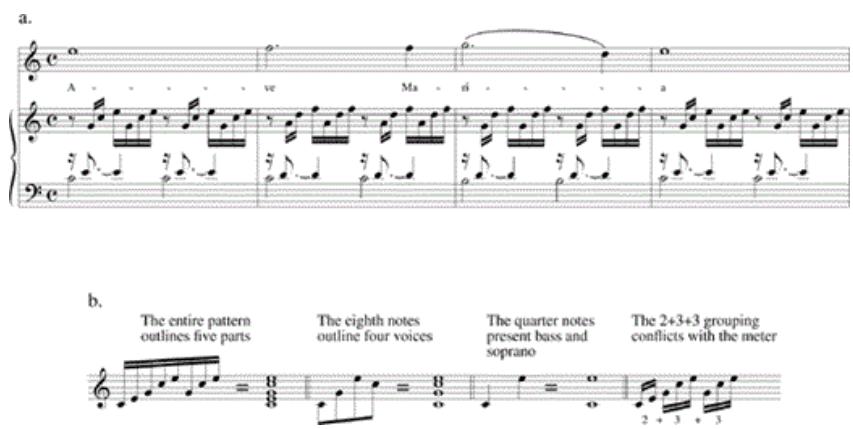
中文讲解
这是图 5-6 的图注,对应本节论证的实物证据。两条信息需要分别理解:
- (a) Gounod 的《圣母颂》旋律开头部分:在叠加层中显示为前景的“旋律”对象;作者意在让人看到这一层在节奏上是缓慢展开的、突出长线条的“bel canto”风格。
- (b) 巴赫《平均律键盘曲集》第一卷 C 大调前奏曲第 1 小节“patternings”(即多种可能的节拍划分或重音分层方案):作者意在让人看到同一段低音层里并存的多重结构,呼应前文“conflicting structures”的说法。
图注本身不展开论证,但作为版本说明,让读者知道 (a) 与 (b) 并非同一个谱面:前者是 Gounod 写出的旋律,后者是巴赫原谱中存在的多重模式化方案;“patternings”用复数,正说明作者主张不止一种合法的读法。需查看原图以核对具体的重音标记或分组符号。
补充说明
图注中“patternings”一词提示图 (b) 中可能含有多重叠加的节拍重音标记或方括号分组,用以直观展示作者所谓“several conflicting structures”;具体标记形式需对照原图才能确认,本任务输入未提供图像细节,故不做猜测。
第4段(P0052)
原文复述
Downloaded from academic.oup.com/book/5913/chapter/149232198 by Indiana University - Bloomington user on 12 August 2026
中文讲解
这是页面页脚的来源水印,说明该书电子版由学术平台(academic.oup.com,牛津大学出版社学术资源)提供,本章下载者为印第安纳大学伯明顿分校用户,下载日期 2026 年 8 月 12 日。这一行与本节的论证内容没有直接关系,仅作为电子文本的版本与来源标识。
第5段(P0053)
原文复述
It is of course instructive to compare early-eighteenth-century compositions to nineteenth-century ones to study the differences between Baroque and nineteenth-century notions of rhythm and texture. But as luck would have it, we possess an even more striking bit of evidence to compare early-eighteenth- and nineteenth-century notions of rhythmic structure in the same piece. Bach himself and a major nineteenth-century composer—Robert Schumann—set themselves the identical compositional task: to write a full accompaniment to the same movement from one of Bach’s solo violin works. These accompaniments demonstrate clearly how differently these two ages conceptualized rhythm and style. Zeroing in on these differences helps us as performers and listeners to realize how many of our notions of Bach style remain under the influence of nineteenth-century ideas.
中文讲解
本段为本节第二案例做铺垫,逻辑链清楚:
-
普遍做法(比较研究)。跨时代比较十八世纪初与十九世纪的作品,研究节奏与织体观念的差异,这种做法本身就是“instructive”的。
-
转折——“更直接的证据”。但作者笔锋一转,用“as luck would have it”推出一个更具说服力的设计:同一首曲子,同时由巴洛克作曲家本人(巴赫)和一位十九世纪大师(舒曼)各自写了一份完整的伴奏。两人面对的是“identical compositional task”——为巴赫某首无伴奏小提琴作品中的同一乐章写作伴奏。
-
这一设计的论证力。其说服力来自“控制变量”:原作完全相同,被伴奏的对象完全相同,因此伴奏中任何节奏与风格上的差异,都只能归因于两位作曲家各自时代的节奏—织体观念,而不是因为被伴奏的旋律不同。
-
修辞落点。作者最终把这一比较的目的从“学术对比”落到演奏与聆听的实践上:通过对差异的辨察,演奏者和听众得以意识到——我们今天关于“巴赫风格”的许多成见,其实仍在十九世纪观念的笼罩之下。换言之,作者是在用乐谱证据做一次风格史的祛魅:所谓“原汁原味地演奏巴赫”本身可能就含有十九世纪的滤镜。
-
与上段的承接关系。上一段以 Gounod 的“误听”为例证明:十九世纪作曲家会用自己时代的听觉去覆盖巴赫原谱;本段则更进一步,把这种覆盖提升为“两个时代在同一首作品上各写一份伴奏”的对照实验,由此把“覆盖”从偶然个案变成可系统比较的现象。
补充说明
“zeroing in on these differences”这一表述中的“zeroing in”意为把焦点对准、仔细锁定差异;作者用“how many of our notions of Bach style remain under the influence of nineteenth-century ideas”给本节留了一个开放式的警示:当代巴赫演奏实践本身可能并非中立,而是十九世纪风格的延续。这一警示与上段把 Gounod 的改写称为“foreign to nineteenth-century styles”相呼应——作者并不只是在历史比较,也在反思我们自身。
脚注 / 边栏 / 图表 / 附加信息(如有)
本节范围内的非正文附加材料有两类:
- 图 5-6(Example 5-6):位于 P0050 与 P0051,由 (a) Gounod《圣母颂》旋律开头与 (b) 巴赫《平均律键盘曲集》第一卷 C 大调前奏曲第 1 小节多重节拍划分两部分组成,作为本节第一次“误读—覆盖”论证的实物证据。
- 页脚来源水印(P0052):academic.oup.com 电子版下载信息,印第安纳大学伯明顿分校用户于 2026 年 8 月 12 日下载,仅作版本来源说明,与论证内容无关。
- 上标 6:P0050 末尾标注的脚注序号 6 在本次任务输入中未给出具体脚注正文,故其内容无法定位,不做展开。
💡 本节核心要点
- 巴洛克高水准音乐的典型特征是节拍层级之间充满活力、持续变化的多重相互作用。
- 这种节奏—节拍—句法的多重性在十九世纪风格中并不属于常规语汇,因此十九世纪作曲家面对巴洛克乐谱时,常以自己时代的听觉惯性去听解并改写它。
- Gounod 在巴赫《平均律》C 大调前奏曲之上叠加《圣母颂》,是“误听—覆盖”模式的典型案例:巴赫原本具有多层冲突结构的前奏被改写为接近帕格尼尼《无穷动》的十九世纪织体。
- 本节进一步提出一个“控制变量”式的对照实验:巴赫与舒曼分别为巴赫某首无伴奏小提琴作品的同一乐章写作完整伴奏,使两人节奏与风格观念的差异可在同一被伴奏对象上直接对照。
- 本节的最终落点不是单纯的历史比较,而是对当代巴赫演奏与聆听实践的反思:我们今天所持的许多“巴赫风格”观念,仍可能处在十九世纪观念的影响之下。
🔑 关键术语
- metric hierarchy(节拍层级):在本节中指同一段音乐里同时存在的多个节拍组织层次(如 16 分音符层、4 分音符层、2 分音符层等),它们各自以不同方式被“激活”并相互作用,是巴洛克音乐中产生内在张力的基本机制。
- energized levels(被激活的层次):指节拍层级中那些并非被动跟随,而是主动以重音、细分或延展等方式参与音乐推进的层次;多个层次同时被激活时,便形成作者所说的“充满活力的持续变化”。
- conflicting structures(冲突的结构):指同一时间片段中存在不止一种合法的节拍划分或重音分组,且彼此并不完全一致;本节以此说明巴赫原谱不是单一节拍网格的展开,而是多重可能性的并存。
- patternings(多种划分方案):图 5-6(b) 图注中的复数名词,指对巴赫同一段前奏所作的多种节拍分组或重音标记;用复数形式本身即暗示作者主张读法不止一种。
- Moto perpetuo(无穷动):指音符持续、均匀、快速流动且缺乏显著对比的炫技性织体;本节用它来比喻 Gounod 把巴赫前奏改写后所接近的十九世纪典型样式,而非指巴赫原作本身。
- bel canto(美声):在本节中指 Gounod《圣母颂》旋律那种缓慢展开、突出长线条歌唱性的十九世纪旋律风格;与巴洛克的多层节拍相互作用形成对照——前者要求前景旋律主导,后者则要求各层共同参与。
- accompaniment(伴奏):在本节中不仅指背景和声层,更被用作对比两位不同时代作曲家节奏—织体观念的载体;舒曼与巴赫各自为同一首无伴奏小提琴作品所写的“完整伴奏”,是本节“控制变量”论证的关键对象。
S6 [描述性拆分] Bach’s and Schumann’s Accompaniments to the E-major Preludio
第1段(P0054)
原文复述
Bach’s and Schumann’s Accompaniments to the E-major Preludio
中文讲解
这是本节的标题行,宣布论题转向:从此前讨论节拍律动、表面效果等一般性问题,进入对巴赫与舒曼各自为 E 大调前奏曲(Preludio)所写伴奏的具体比较。标题中的“Accompaniments”点明本节聚焦的是两位作曲家在不同时代、不同体裁中对该独奏小提琴乐章所作的配器或钢琴化改写——巴赫用于康塔塔第 29 号的 Sinfonia,舒曼用于其全部无伴奏小提琴作品的钢琴伴奏版。
第2段(P0055)
原文复述
Both Bach and Schumann wrote accompaniments to the Preludio from the E-major Partita: Bach in order to turn the movement into the Sinfonia to Cantata no. 29; Robert Schumann in his piano accompaniments to all the solo works. Particularly striking is the manner in which Bach’s arrangement maintains an eighteenth-century sound, whereas Schumann’s accompaniment turns the movement into a nineteenth-century moto perpetuo.
中文讲解
本段提出本节的核心对比:巴赫将该前奏曲改编为康塔塔第 29 号开头的 Sinfonia(管弦乐伴奏版),舒曼则在其为巴赫全部无伴奏小提琴作品所写的钢琴伴奏版本中处理同一乐章。两人目标虽不同,却都必须在原独奏旋律之外添加伴奏;其结果截然不同——巴赫保留了十八世纪的织体与律动风格,舒曼则把它变成了十九世纪典型的“无穷动”(moto perpetuo)式流动。这一对比为本节后面的细节分析埋下伏笔:相同的旋律素材在两位作曲家手中如何产生时代性的风格差异。
第3段(P0056)
原文复述
Remarkably, this stylistic transformation takes place even though Schumann, other than adding his accompaniment, altered not a single note in the violin part and hardly chose a single harmony that Bach might not have used—Schumann’s rhythmic profile alone begets this stylistic transformation. Bach, when he wrote an orchestral accompaniment to the Preludio, built upon the already active rhythms of the violin solo and linked this local activity to larger metric units by strong articulations of all the intermediate levels of the metric hierarchy. By contrast, Schumann, in his accompaniment, emphasized the swing of the meter and downplayed metric levels between the continuous sixteenth notes and the measure, creating a more lyrical surface not unlike that of Paganini’s Moto perpetuo and Gounod’s “Ave Maria.”
中文讲解
本段是本节论证的关键转折:作者指出,舒曼对旋律本身只字未改,所用和声也几乎都在巴赫可能使用的范围内——然而风格却发生了彻底的转移。这说明风格差异并不来自音高或和声选择,而纯粹来自节奏“型态”(rhythmic profile)的差异。接着给出两种不同的做法:巴赫在已有的活泼独奏节奏之上,通过清晰勾画节拍层级中每一个中间层,把局部律动与大尺度节拍单位联系起来;舒曼则突出节拍的“swing”(向前推进的摇摆感),削弱了十六分音符与小节之间的中间节拍层次,使得表面呈现出帕格尼尼《无穷动》和古诺《圣母颂》那样的连绵抒情质地。这段因此为本节的核心论点提供了因果解释:节奏层级处理的不同,而非音高材料的不同,造就了十八世纪连续节奏与十九世纪无穷动之间的差别。
第4段(P0057)
原文复述
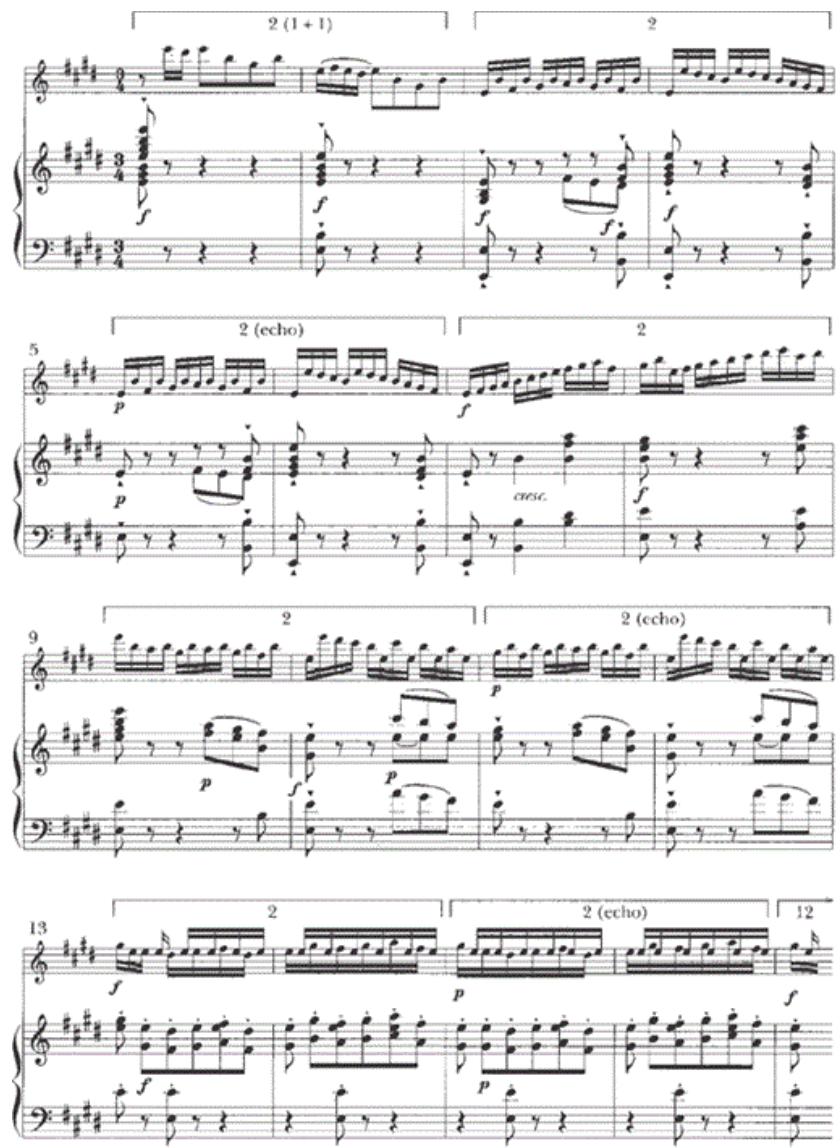
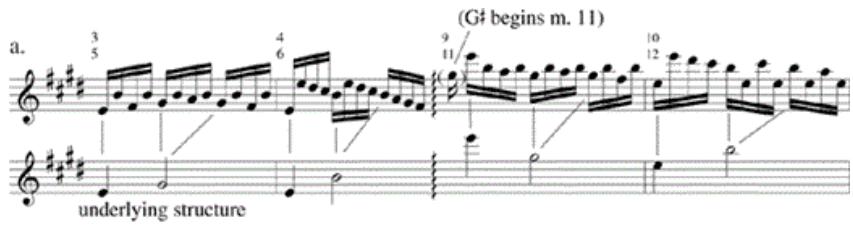
The opening of the E-major Preludio (with Schumann’s accompaniment) appears in Example 5-7. In Bach’s violin solo, every level of the metric hierarchy from the two-measure level down to the sixteenths possesses a clear profile. The two-measure rhythmic level in Bach’s solo is quite regular, with measures grouped in pairs by repeated or echoed patterns, as noted by the groupings over the score. The measure level features a frequent sarabande-like articulation of the second beat: in mm. 1–2, the eighths begin on beat 2; in mm. 3–6 and 9–12, a new chord member appears in the moving part on the second beat and remains until the end of the measure, as shown in Example 5-8a. Indeed, such stressed second beats characterize many later figures, including the one shown in Example 5-8b.
中文讲解
本段正式进入谱面分析。作者提示读者,对照例 5-7(带有舒曼伴奏的开头)与例 5-8 来看,可见巴赫独奏部分中的节拍层级——从两小节超小节(hypermeasure)一直到十六分音符——每一层都有清晰可辨的“轮廓”(profile)。具体表现为:(1)两小节层级非常规则,通过反复或回声式的音型把每两小节配为一对;(2)小节层级则有一种类似萨拉班德舞曲的重音特点——第二拍被强调。在第 1–2 小节里,第八分音符直接落在第二拍上;在第 3–6 和 9–12 小节中,移动声部在第二拍引入新的和弦音并持续到小节末尾(如例 5-8a 所示)。这种“强调第二拍”的处理在该前奏曲中反复出现,包括后段例 5-8b 中的音型。读者由此可看出,巴赫的节拍层级并非平铺直叙,而是在每一级都有可听辨的强弱对比与音型逻辑。
第5段(P0058)
原文复述
p. 116
中文讲解
页码标记,标识本节内容印于原书第 116 页。这只是版面信息,不承载论述内容。
第6段(P0059)
原文复述
p. 118
中文讲解
页码标记,标识原文对应的第 118 页。仅为版面信息。
第7段(P0060)
原文复述
Downloaded from academic.oup.com/book/5913/chapter/149232198 by Indiana University - Bloomington user on 12 August 2026
中文讲解
学术数据库(Oxford Academic)下载信息与使用者标识,标明下载者(印第安纳大学伯明顿分校用户)与日期(2026 年 8 月 12 日)。这是电子期刊版本固定的页脚信息,不参与论证。
第8段(P0061)
原文复述
中文讲解
该占位符位于第 10 页,表明此处原本嵌有一幅图像或乐谱图例,但具体像素数据已省略。其位置紧接 P0060 的下载脚注与 P0062 的图 5-7 之前,应为版面中的图版起始位置;具体内容需查看原书或原 PDF 图像。
第9段(P0062)
原文复述
中文讲解
图 5-7 的图注:巴赫《E 大调帕蒂塔》前奏曲第 1–17 小节,并附有舒曼的钢琴伴奏。该谱例是本节讨论舒曼伴奏时反复引用的核心文献。它把独奏小提琴声部与舒曼增加的钢琴声部并置,使读者能够直接看到舒曼在哪些节拍位置上添加了重音和弦或连接性八分音符,从而把巴赫原本的局部重音“覆盖”。由于图像省略,具体音符需查阅原书。
第10段(P0063)
原文复述
中文讲解
图 5-8 的图注,分两部分:(a) 巴赫《E 大调帕蒂塔》前奏曲第 3–6 小节与 9–12 小节;(b) 第 29–31 小节,并附舒曼的伴奏。前者展示第二拍新和弦音进入的萨拉班德式重音(即 P0057 提到的现象),后者则展示后段中“上行从弱八分音符起、下行到弱十六分音符止”的旋律起伏,并可在舒曼伴奏下观察其被削弱的方式。
第11段(P0064)
原文复述
Downloaded from academic.oup.com/book/5913/chapter/149232198 by Indiana University - Bloomington user on 12 August 2026
中文讲解
第 10 页末尾的下载脚注,与 P0060 相同。仅为数据库使用记录。
第12段(P0065)
原文复述
Faster levels of the metric hierarchy spice up this relatively regular meter and hypermeter. Having the piece open with a rest means that perception of both the 3/4 meter and the two-measure regularity is delayed (since no one hears the silent downbeat except retroactively), imparting to the listener a less symmetrical impression than the two-measure groupings above Example 5-7 imply. Melodic high and low points, pattern beginnings, and other accentuations tend to occur off the beats. For instance, the top note of the moving voice in m. 3 highlights a metrically weak eighth. In the later figure in Example 5-8b, each ascent begins on the weak eighth of a beat and ends on the weak second sixteenth of a beat. The interaction of the metric grid with these accentuations creates the imaginative rhythmic complexity that enlivens continuous rhythms, deceptively bland in appearance in so many other Bach passages (in sharp contrast to the relatively unarticulated sixteenth-note surface in Paganini’s Moto perpetuo).
中文讲解
本段继续分析巴赫独奏部分的节拍层级,但这次聚焦更快的层级如何“点缀”(spice up)相对规则的小节与超小节布局。关键观察有三:(1)乐章开头是一拍休止,听众因此只能“事后”才意识到 3/4 拍与两小节超节拍规律的存在,这造成比谱面两小节分组所示更为非对称的听感;(2)旋律高点、低点、音型起始以及其他强调点几乎都落在拍点之外——例如第 3 小节旋律声部的最高音正落在拍点上较弱的八分音符上,例 5-8b 中的每个上行也是从弱八分音符起、止于弱十六分音符;(3)这种“网格”与“偏移重音”之间的相互作用产生了富有想象力的节奏复杂性,正是这种复杂性让表面上连续不断的十六分音符“活”了起来——这与帕格尼尼《无穷动》中相对缺乏重音雕刻的十六分音符表面形成鲜明对比。
第13段(P0066)
原文复述
In Schumann’s version, powerful downbeats in mm. 1–12 overshadow these local accentuations. Schumann ignores any hints of the sarabande rhythm that might distract from these emphatic downbeats. In mm. 3, 5, and 9–12, Schumann does not initiate eighths on the second beat to articulate the sarabande rhythm but, rather, starts the accompanying eighths after that beat primarily to lead strongly to the next downbeat. Indeed, by his slurring, by the marcato chords on the last eighth in mm. 3 and 5, and by the tied Es in mm. 10 and 12, Schumann deliberately prevents even the third beat from being articulated. In his desire to project the swing from one downbeat to the next, he blots out all of Bach’s characteristic rhythms.
中文讲解
本段转向舒曼的伴奏做法,论证为何相同旋律在舒曼手中会失去巴赫的节奏性格。核心是“强势的下拍”(powerful downbeats):舒曼在第 1–12 小节中让下拍特别突出,以至于局部的萨拉班德式第二拍重音完全被遮蔽。具体技术包括:在第 3、5、9–12 小节中,舒曼没有在第二拍起新的八分音符以彰显萨拉班德节奏,而是在第二拍之后才开始伴奏八分音符,目的仅是“强有力地引向下一个下拍”;他用连线(slurring)、第 3 与第 5 小节最后一个八分音符上的重音和弦(marcato chords),以及第 10 与 12 小节中跨拍连写的 E(tied Es),有意避免第三拍被清晰地刻画出来。作者由此归纳:舒曼一心要把“从一个下拍到下一个下拍”的推进感投射出来,因此把巴赫原本具有的特征性节奏一笔抹去。
第14段(P0067)
原文复述
this third beat from being articulated. In his desire to project the swing from one downbeat to the next, he blots out all of Bach’s characteristic rhythms. This is not necessarily unappealing. A well-known living composer once told me that he really enjoyed the swing of Schumann’s version.
中文讲解
本段承接上段(P0066)的论证结尾并补上一个作者亲身听闻的小插曲。语义上说明:(1)舒曼那种“一拍到下一拍”的 swing 手法固然抹去了巴赫的特征节奏,但作者并不认为这种处理本身是“不好听的”;(2)作者引述某位在世著名作曲家对舒曼版本“swing”质感的欣赏,作为佐证这种听觉体验并非作者个人偏见。这一轶事以自传性口吻弱化了论辩的火药味,使读者意识到风格差异未必等同于音乐价值的高低。
第15段(P0068)
原文复述
The rhythmic profile of Bach’s orchestrated accompaniment, shown in Example 5-9, differs strikingly from Schumann’s. At the very opening and again in mm. 7–9 and 11, chords occur on each beat—not solely on the downbeat as in Schumann’s version. Bach ingeniously divides these chords into two groups of two chords each: one in the three trumpets, the other in the strings-plus-oboes. As a result, even within the steady quarter-note articulations of the chords, he creates a complex rhythmic as well as timbral and registral antiphony between falling motions in one instrumental choir and rising motions in the other. His orchestration thereby not only articulates each beat but also projects two separate beat groupings: 1–2–rest, 1–2–rest vs. 1–rest, 3–1–rest, 3–1–rest. In mm. 9 and following, when Bach, like Schumann, doubles the moving part in thirds and sixths, Bach creates an eighth-note figure in the strings whose octave leaps or sixteenth pair stresses the second beats, highlighting the sarabande-like syncopations that Schumann ignores.
中文讲解
本段进入巴赫为该前奏曲所作的管弦乐改编(即例 5-9),并把它与舒曼的钢琴伴奏直接对照。关键差异在于:(1)巴赫在开头以及第 7–9、11 小节中让和弦在每一拍都出现(不仅仅是下拍),从而让每拍都可被独立刻画;(2)巴赫巧妙地把这些和弦分成各含两个和弦的两组——一组由三支小号承担,另一组由弦乐加双簧管承担——由此在稳定的四分音符节拍框架内制造出两组乐器之间的“应答”(antiphony):一组下行,另一组上行,这既是节奏上的、也是音色与音区上的对比;(3)这种配器因此同时刻画了“每一拍”和“两组拍子组合”两个层级:一组是 1–2–rest, 1–2–rest,另一组是 1–rest, 3–1–rest, 3–1–rest;(4)到了第 9 小节及之后,巴赫虽然也和舒曼一样在平行三度与六度上复制独奏旋律,但他让弦乐奏出一个八分音符音型,其八度跳进或十六分音符成对地强调了第二拍,使原本的萨拉班德式切分被保留——而这恰恰是舒曼所忽略的。本段因此在操作层面把巴赫“保留并加强所有中间节拍层级”的做法讲得非常具体。
第16段(P0069)
原文复述
p. 119
中文讲解
页码标记,对应原书第 119 页。仅版面信息。
第17段(P0070)
原文复述
p. 120
中文讲解
页码标记,对应原书第 120 页。仅版面信息。
第18段(P0071)
原文复述
p. 121
中文讲解
页码标记,对应原书第 121 页。仅版面信息。
第19段(P0072)
原文复述
Downloaded from academic.oup.com/book/5913/chapter/149232198 by Indiana University - Bloomington user on 12 August 2026
中文讲解
第 11 页末尾的下载脚注,与之前相同。仅为电子期刊使用记录。
第20段(P0073)
原文复述
As with the different metric profiles of the G-minor Presto versus Paganini’s Moto perpetuo, or the C-major Prelude from the Well Tempered versus Gounod’s “Ave Maria,” the differences between Bach’s and Schumann’s accompaniments to the E-major Preludio spell out the characteristic differences between early-eighteenth-century continuous-rhythm passages and nineteenth-century perpetual motions. Bach’s accompaniment to the Preludio stresses multiple emphases on individual beats and their groupings, granting each level of the metric hierarchy its own integrity, and re-creating his characteristic articulated rhythms in a new climate. Schumann’s accompaniment primarily stresses the swing of the measure level, omitting the intermediate levels that in Bach’s version link the measure level and the more local rhythmic vitality.
中文讲解
本段是本节的高潮性总结,把 E 大调前奏曲的对照纳入全章更大的类比框架——即此前已讨论过的 G 小调 Presto 对帕格尼尼《无穷动》、C 大调《平均律》前奏曲对古诺《圣母颂》这两组对照。共同点在于:这些对照都揭示了“早期十八世纪连续节奏”与“十九世纪无穷动”之间的典型差别。具体到本节:(1)巴赫的伴奏强调每个拍及其组合上的多重重音,让节拍层级的每一级都保持自身完整性,从而在一个全新的(管弦乐)气候里重新塑造了他标志性的、富有刻画的节奏;(2)舒曼的伴奏则主要强调小节层级的 swing,省略了原本在巴赫版本中连接小节与更小尺度节奏活力的中间层级。作者由此把细节分析上升为一般性结论。
第21段(P0074)
原文复述
These differing rhythmic profiles also affect phrasing. As shown in Figure 5-5, Bach brings back the timbral and registral antiphony from mm. 1–2 in mm. 7–9, marking m. 7 as a new beginning parallel to m. 1, thereby articulating the opening measures as two groups of six: a two-measure fanfare, a repeated two-measure group, then the same again. Schumann’s mm. 7–8 simply fill the gap between mm. 5–6 and 9–12, promoting regular four-measure groups: mm. 1–4 followed by a two-measure echo and a two-measure link in mm. 5–8 (adding up to a second four-group) and then another group of four. Once again, Bach’s version has more vibrant articulations on several levels, whereas Schumann’s accompaniment promotes greater regularity beneath the speedy sixteenth notes.
中文讲解
本段把节奏层级差异落实到“分句”(phrasing)层面。如图 5-5 所示:(1)巴赫把第 1–2 小节的音色与音区“应答”手法在第 7–9 小节中再现,使第 7 小节成为一个与第 1 小节平行的新起点,从而把开头刻画为“六个小节一组”的结构:一个两小节号角式乐句、一个重复的两小节组,然后再重复一次;(2)舒曼的第 7–8 小节只是填充第 5–6 小节与第 9–12 小节之间的空缺,因此小节组织呈现更规则的四个一组:第 1–4 小节是一个四小节组,第 5–8 小节由一个两小节“回声”加一个两小节“连接”构成另一组,再往后又是四个一小节。作者再次归纳:巴赫在多个层级上都保有更生动的刻画,而舒曼则在飞快的十六分音符底下推动更大的规则性。这一收尾段落与 P0073 的总结共同把本节从“节拍层级”扩展到“分句结构”,强化了“节奏型态决定风格”这一定论。
第22段(P0075)
原文复述
Downloaded from academic.oup.com/book/5913/chapter/149232198 by Indiana University - Bloomington user on 12 August 2026
中文讲解
第 12 页末尾的下载脚注,与前几处相同。仅为电子期刊下载记录,不参与论证。
脚注 / 边栏 / 图表 / 附加信息(如有)
本节包含以下附加材料:图 5-7(P0062,巴赫《E 大调帕蒂塔》前奏曲第 1–17 小节并附舒曼钢琴伴奏,用于直观对照两种伴奏在第 1–12 小节中的差异);图 5-8(P0063,分 (a) 第 3–6、9–12 小节与 (b) 第 29–31 小节,附舒曼伴奏,用以展示萨拉班德式第二拍重音及其后段被弱化的情况);图 5-9(P0068 在正文中提及,巴赫管弦乐伴奏的节拍型态);图 5-5(P0074 在正文中提及,对照巴赫与舒曼在小节组织与音色应答上的差异)。此外有三处学术数据库下载脚注(P0060、P0064、P0072、P0075),仅记录下载来源与时间,无实质内容。本节未包含独立的脚注或边栏文献。
💡 本节核心要点
- 巴赫与舒曼为同一首 E 大调前奏曲分别写作伴奏:巴赫用于康塔塔第 29 号的 Sinfonia(管弦乐),舒曼用于其全套巴赫无伴奏小提琴作品的钢琴伴奏。
- 舒曼对原独奏旋律只字未改、和声也几乎未动,但他笔下的节奏型态却把十八世纪的连续节奏转化为了十九世纪的无穷动式流动——风格的转变纯由节奏型态造成。
- 巴赫的伴奏在每一拍上都做清晰刻画,并在节拍层级的每一中间层(小节、两小节超小节、四分音符、十六分音符等)都维持独立可辨的强弱对比与音色/音区应答。
- 舒曼的伴奏把节拍层级“压平”为两极:连续十六分音符与小节下拍,强调“一拍到下一拍”的 swing,因此删除了巴赫式的萨拉班德第二拍重音与中间节拍层次。
- 两种伴奏不仅在节拍层级上不同,也在小节与分句组织上不同:巴赫把开头刻画为“6+6”的两段式(号角+重复),舒曼则形成规则的“4+4+4”四小节组合。
- 本节呼应了作者此前对 G 小调 Presto / 帕格尼尼《无穷动》与 C 大调《平均律》前奏曲 / 古诺《圣母颂》的对比,把 E 大调前奏曲纳入“早期十八世纪连续节奏”与“十九世纪无穷动”的通论框架。
🔑 关键术语
- moto perpetuo:意大利语术语,意为“无尽的运动”,指通篇由快速、均匀的音型(多为十六分音符或更短的时值)贯穿到底的音乐风格。本节以帕格尼尼的《Moto perpetuo》和古诺《圣母颂》为代表,被用来形容舒曼伴奏下产生的十九世纪式连绵律动。
- metric hierarchy:节拍层级,指音乐中由大到小、由慢到快的不同节拍组织单位(如小节、两小节超小节、四分音符、八分音符、十六分音符等)所形成的层级结构。本节核心论点是:巴赫让每一层级都有清晰独立的刻画,而舒曼则压制中间层级,仅保留小节下拍与十六分音符表面两极。
- sarabande-like articulation:类似萨拉班德舞曲的重音方式。萨拉班德是三拍子舞曲,常在第二拍上做明显强调。本节指出巴赫在该前奏曲中频繁以“第二拍进入新和弦音”的方式造成这种重音感,并认为这是其“特征性节奏”的一部分。
- antiphony:原指教堂两组合唱队之间的应答式对唱,在本节中借指两组乐器在音色与音区上的交替与对照。巴赫在小号组与弦乐+双簧管组之间制造的下行/上行应答,是其节奏刻画与音色刻画同时进行的关键手段。
- swing (of the meter):节拍“摇摆感”,指从一个强拍向前推进到下一个强拍的整体律动感。本节用此词形容舒曼伴奏的听觉效果:节拍层级被简化为两极后,连续十六分音符带来的“向前甩”的整体律动。
- marcato:意大利语术语,意为“着重地、清晰地”。在 P0066 中,舒曼在第 3 与第 5 小节最后一个八分音符上标记 marcato,以强化下一小节的下拍。
- hypermeasure:超小节,指由两个或更多小节在听感上组合而成的更大节拍单位。本节中两小节的反复/回声式音型即形成两小节超小节,是巴赫伴奏中保持完整层级刻画的关键一级。
S7 [描述性拆分] Deciding How to Analyze Rhythm in Bach’s Music
第1段(P0076)
原文复述
Figure 5-5. Phrasing in Bach’s and Schumann’s Accompaniments to the Preludio of the E-Major Partita.
中文讲解
这是一个图像占位符对应的图注,位于第13页。图注告知读者:图5-5展示的是巴赫为E大调第二帕蒂塔前奏曲所作的独奏版本,与舒曼为同一前奏曲所写的钢琴伴奏版本,在乐句划分上的对比。配合P0077中关于舒曼版“迅捷的表层节奏和摇曳式伴奏”及其演奏传统的叙述,这张图意在以乐句断分的差异来呈现巴洛克与十九世纪两种风格在句法层面的根本不同。原图的图像数据虽被略去,但图注已点明其位置与功能,读者若需对照具体分句应回到原文查看原图。
补充说明
本段仅作为图5-5的图注,与P0077形成图—文互补:图示乐句分句的差异,文字解释这种差异背后的十九世纪演奏传统。
第2段(P0077)
原文复述
Schumann’s nineteenth-century vision of the Preludio, with its swift surface and swinging accompaniment, is reflected in the Preludio performances by the great nineteenth-century violinist Pablo de Sarasate (1844–1908), whose flashy technique is reflected in his own compositions, in the pieces he commissioned (most notably the 1875 Symphonie espagnole by Édouard Lalo [1823–92]), and in a few recordings he made at the very end of his life. Sarasate “took pride in rushing [the Preludio] to death in the shortest possible time,” as in his turn-of-the-century recording. There was a long nineteenth-century tradition of playing the E-major Preludio with accompaniment reflected not only in Schumann’s accompaniment but also in performances such as that by the nineteenth-century virtuoso Dame Wilma Norman-Neruda (1838–1911), accompanied by the Berlin Philharmonic conducted by Joseph Joachim in the 1880s, and another celebrating the dedication of a new building for the Berlin Hochschule in which no fewer than forty violin pupils performed the Preludio in unison, backed by Schumann’s accompaniment. The violinist-composer Fritz Kreisler (1875–1962) published his own accompaniment to the E-major Preludio early in the twentieth century.
中文讲解
这段是前一图(P0076)的正文展开,旨在用具体的人和事证明十九世纪存在一整套按舒曼式“迅捷表层+摇曳伴奏”演奏巴赫前奏曲的传统。作者列举了几条互相关联的证据链:萨拉萨泰(Pablo de Sarasate, 1844–1908)以炫技闻名,他甚至自称“以尽可能短的时间把前奏曲赶向死亡”为傲,他留下的世纪之交录音印证了这种极速演奏;他委托拉罗(Édouard Lalo)创作的1875年《西班牙交响曲》也透露出同样的炫技美学。接着是诺曼-内鲁达(Dame Wilma Norman-Neruda, 1838–1911),由约阿希姆(Joseph Joachim)指挥柏林爱乐于1880年代以舒曼伴奏演出;以及柏林高等音乐学校新楼落成时多达四十名小提琴学生齐奏前奏曲配舒曼伴奏的庆典演出;最后是二十世纪初小提琴家兼作曲家克莱斯勒(Fritz Kreisler, 1875–1962)自己出版的前奏曲伴奏版本。整段的作用是为随后的小节标题做铺垫:既然有大量十九世纪风格的巴赫演奏存在,那么用什么“语言”去分析巴赫原作的节奏,就成了作者必须正面回答的方法论问题。容易误解之处在于:作者并非全盘否定这种十九世纪传统,而是借此传统作为反衬,引出巴洛克节奏与十九世纪节奏在分析概念上的根本差异。
补充说明
本段人物、年份与作品名信息密集,是用来支撑“有长期的十九世纪舒曼式伴奏演奏传统”这一论断的实证素材;其中“萨拉萨泰把前奏曲‘赶向死亡’的录音”与“四十名学生齐奏”是两件最具画面感的代表性事例。
第3段(P0078)
原文复述
Deciding How to Analyze Rhythm in Bach’s Music
中文讲解
这是一个小节标题,英文为“决定如何分析巴赫音乐中的节奏”,出现在第13页。它的功能是宣告本节将转入方法论层面的讨论:在进入具体分析之前,先回答“用什么概念工具去把握巴赫的节奏”。从此处起,论述由前一节对十九世纪演奏传统的铺陈,切换到对分析工具本身的反思。
第4段(P0079)
原文复述
The traits that differentiate Bach’s rhythms and phrasing from nineteenth-century music affect the very context and concepts—the analytical tools—we use to conceptualize music of the Baroque period. Bach’s fully active metric hierarchies do not easily parse into the articulated phrasing patterns that were developed from the late eighteenth century onward to deal with music since the Classical era.
中文讲解
本段提出本节的核心论点:把巴赫的节奏与乐句同十九世纪音乐区别开来的那些特征,会反向影响我们用来概念化巴洛克音乐的语言和分析工具本身。也就是说,分析工具不是中性的,巴洛克对象塑造了它。作者进一步指明具体障碍所在——巴赫的“完全活跃的节拍层级”(fully active metric hierarchies)很难被切分进那些自十八世纪末以来为应对古典时期音乐而发展出来的、句法边界清晰的乐句模式。这是一段带有方法论宣示的引论:作者在此明确告诉读者,古典—浪漫时期的“articulated phrasing”标准并非普适,它在被借用到巴洛克时会遇到结构性困难。理解时应注意“fully active”和“articulated phrasing”是两套对立的修辞——前者意味着节拍各级都不停地有事件发生,后者意味着句法有清晰的外轮廓与停顿。
第5段(P0080)
原文复述
The changes in rhythmic and articulative style between the Baroque and later music have been acknowledged by candid comments of major theorists. Heinrich Schenker, for instance, in his final treatise, Free Composition, illustrates his interpretation of phrase rhythm in a large number of excerpts by Haydn, Mozart, Beethoven, Chopin, Mendelssohn, and Brahms. Then Schenker turns to the opening of Bach’s C♯-minor Fugue, Well-Tempered Clavier, vol. 1, and suggests but immediately questions a series of continual metric reinterpretations at each subject entry, as illustrated in Example 5-10: “As long as musical content moved principally in imitations of canonic and fugal forms, it was somehow illogical to presuppose a specific metric scheme. Each of the numerous imitations, after all, involved reinterpretation. Where would we find ourselves if we were to pursue the idea of reinterpretation in the manner indicated [in Example 5-10]?” Schenker does not suggest an answer to this troubling question. More recently, William Rothstein takes note in the preface to his study of Phrase Rhythm in Tonal Music of the “virtual exclusion of Baroque music from this book … I simply do not understand Baroque phrase rhythm as well as I think I understand rhythm in later tonal music.” The reason for these difficulties lies, as Rothstein continues, in “the profound differences that exist between the phrase rhythms of the Baroque and those of Classic and Romantic music.” The analytical tools that were developed during and after the Classic period to explain Classic music—notions of periodic phrasing and the like—simply do not produce musical results when applied to much Baroque music.
中文讲解
本段用两位重要理论家的自述来为P0079的方法论宣示提供权威支撑。第一位是申克尔(Heinrich Schenker),在《自由作曲》(Free Composition)这部遗著中,他先用大量海顿、莫扎特、贝多芬、肖邦、门德尔松、勃拉姆斯片段来图示“乐句节奏”,随后才转向巴赫《平均律键盘曲集》卷一升c小调赋格的开头,针对每次主题进入都提出“持续不断的节拍重新解释”(continual metric reinterpretations),并以例5-10为证。但申克尔随即反诘:既然每次模仿都涉及节拍重释,去预设一个固定节拍图式在卡农式与赋格式音乐中本来就不合逻辑;他进一步追问若真按例5-10那样追求“再解释”,我们最终会把自己带到哪里?而他自己也不给出答案。第二位是罗特斯坦(William Rothstein),在《调性音乐的乐句节奏》(Phrase Rhythm in Tonal Music)的前言中坦承此书“几乎排除了巴洛克”,理由是他“并不像理解后调性音乐的节奏那样真正理解巴洛克乐句节奏”,并把根源归结为“巴洛克与古典、浪漫乐句节奏之间存在深刻差异”。整段的论证作用是:用两位最负盛名的节奏理论家自己的话,证明“古典—浪漫的分析工具在巴洛克音乐上失效”并非作者一人的主张,而是早已被这两位权威承认的、悬而未决的方法论难题。理解时应注意:(1) 申克尔对“continual metric reinterpretations”的怀疑指向的是“每次主题进入都重新解释节拍”这一做法本身的危险;(2) 罗特斯坦的“virtual exclusion”是他自觉的取舍,而非忽略巴洛克;(3) 两位理论家的“candid comments”是作者精心挑选的、用来为他自己接下来提出替代分析工具做铺垫。
补充说明
本段为本节核心论点的理论史证据段落:申克尔《自由作曲》、罗特斯坦《调性音乐的乐句节奏》是两部讨论乐句节奏的标志性著作,作者引用它们各自承认无法把巴洛克纳入古典—浪漫框架的自述,为下文重构巴赫节奏的分析工具张本。
第6段(P0081)
原文复述
p. 122
中文讲解
这是页面标识“p. 122”,属版面元素,记录作者论述在原书第122页。功能仅为定位,不承载论证内容。
第7段(P0082)
原文复述
p. 123
中文讲解
这是页面标识“p. 123”,属版面元素,记录作者论述在原书第123页。功能仅为定位,不承载论证内容。
第8段(P0083)
原文复述
Downloaded from academic.oup.com/book/5913/chapter/149232198 by Indiana University - Bloomington user on 12 August 2026
中文讲解
这是页脚下载来源标识,记录此文本从 academic.oup.com 第5913号书籍第149232198章节下载,由印第安纳大学伯明顿分校用户于2026年8月12日获取。属纯版面元信息,不进入正文论证。
第9段(P0084)
原文复述
Example 5-10. Schenker, Free Composition, Fig. 149/8a.

中文讲解
这是例5-10的图注,标识其来源为申克尔《自由作曲》(Free Composition)原书图149/8a。这是P0080所提到的“continual metric reinterpretations”的可视化材料——读者需回到原文查看原图,以看到申克尔对升c小调赋格每次主题进入所做的连续节拍重释图示。理解时应注意:图注中的“Fig. 149/8a”是申克尔原书中的图号,作者在此直接挪用作为例5-10的内容。
补充说明
本段作为例5-10的图注,与P0080正文引文相互呼应:正文引用了申克尔的反问,图注则提供具体的申克尔原图位置以便核对。
第10段(P0085)
原文复述
A large part of the reason for this lies in the difference between the metric hierarchies of Baroque and of later music. In Paganini’s Moto perpetuo, in Gounod’s “Ave Maria,” and in Schumann’s accompaniment to the E-major Preludio, there are relatively uninteresting metric levels between the excitement of the surface rhythms and the lyrical flow of the underlying phrase rhythms, promoting the sense of a lyrical nineteenth-century texture. In the metric hierarchy of Bach’s orchestration of the E-major Preludio, no such gap exists, since every level offers interesting activity. And Bach takes care to create such multileveled activity even in the unaccompanied version of the Preludio—and in his other movements that feature continuous sixteenths.
中文讲解
本段为前面方法论宣示(P0079–P0080)补上结构性原因:巴洛克与后古典音乐的“节拍层级”(metric hierarchies)本身就不一样。作者举三件十九世纪代表作——帕格尼尼《无穷动》(Moto perpetuo)、古诺《圣母颂》(“Ave Maria”)、以及舒曼为E大调前奏曲所作的伴奏——指出它们的共同特征是:表层节奏的“兴奋”与底层乐句节奏的“抒情流动”之间,存在若干“相对无趣的节拍层级”,正是这些中间层烘托出抒情性的十九世纪织体。换言之,十九世纪音乐在节拍层级之间留有空隙,使得表层炫技与深层抒情可以分层共存。而巴赫对同一前奏曲的编配(无论是否加伴奏)则不留这种空隙——每一节拍层级都“有趣”、都“活跃”。作者还特别强调:哪怕在独奏版前奏曲、以及其它连续十六分音符的乐章中,巴赫仍然在所有节拍层级上安排事件。本段在论证链上的作用是:把P0080的“理论家承认困难”具体化为“可测量的层级差异”,从而把方法论问题锚定在节拍层级的结构层面,为下文重构巴赫节奏分析工具奠定实证基础。容易误解之处:“relatively uninteresting metric levels”并非贬义,而是对十九世纪织体“抒情性缝隙”的结构性描述;“every level offers interesting activity”也不是说巴赫更“好”,而是说他的节拍结构更饱满、更连续。
补充说明
本段提及的帕格尼尼《无穷动》、古诺《圣母颂》、舒曼E大调前奏曲伴奏与P0077的舒曼伴奏传统相互呼应;Bach的“orchestration of the E-major Preludio”指的是巴赫自己的乐队编配版本,独奏版前奏曲的连续十六分音符则是同一多层级活跃原则的纯独奏体现。
脚注 / 边栏 / 图表 / 附加信息(如有)
本节包含两个非正文版面元素:图5-5(P0076)的图注位于第13页,配合P0077正文论述十九世纪舒曼式伴奏演奏传统;例5-10(P0084)的图注位于第14页,标识其来源为申克尔《自由作曲》原书图149/8a,是P0080所引申克尔“continual metric reinterpretations”段落的可视化材料。其余P0081–P0083为页码与下载来源页脚,无附加论证作用。
💡 本节核心要点
- 本节的方法论核心:巴赫节奏与乐句的特质反向决定了对巴洛克音乐应使用何种分析工具,十八世纪末以来为古典音乐发展出的articulated phrasing模式并不天然适用于巴洛克。
- 申克尔在《自由作曲》中转用巴赫升c小调赋格时,对每次主题进入都提出continual metric reinterpretations,却以反诘收尾、不给答案,这是古典—浪漫节奏分析框架遭遇巴洛克赋格的经典困境。
- 罗特斯坦在《调性音乐的乐句节奏》前言中坦承对巴洛克乐句节奏理解不足,并把原因归结为巴洛克与古典—浪漫之间“深刻的差异”,说明这是被权威理论家自觉承认的方法论难题。
- 结构性原因落在metric hierarchies:十九世纪作品(帕格尼尼《无穷动》、古诺《圣母颂》、舒曼伴奏)在表层节奏与底层乐句节奏之间留有“相对无趣的中间层级”,而巴赫的E大调前奏曲编配乃至独奏版与其它连续十六分音符乐章中,每个节拍层级都活跃、不留空隙。
- 本节由“十九世纪演奏传统的实证描述”(图5-5与P0077)转入“分析概念是否适切”的方法论反思,并以节拍层级差异为具体抓手,为后续提出新的巴赫节奏分析工具奠定基础。
🔑 关键术语
- metric hierarchies:节拍层级,指音乐中从最小音值、节拍单位、小节到大段落之间的多层节拍—节奏结构;本节用以刻画巴洛克与十九世纪音乐在层级之间是否有“空隙”上的根本差异。
- articulated phrasing patterns:十八世纪末以来发展出来的、带有清晰句法轮廓与停顿的乐句模式;本节将其界定为古典—浪漫时期的分析工具,作者认为它在巴洛克音乐上常常失效。
- continual metric reinterpretations:持续不断的节拍重新解释,指在每次主题进入或模仿发生时对节拍层级重新切分;申克尔在《自由作曲》中以巴赫升c小调赋格为例提出此做法,但随即质疑其逻辑后果。
- phrase rhythm:乐句节奏,研究乐句层级与节拍层级之间相互关系的理论议题;申克尔与罗特斯坦的代表著作均以此为核心。
- Moto perpetuo:帕格尼尼的《无穷动》,本节作为十九世纪表层炫技而底层抒情、节拍层级之间留有空隙的代表性作品。
S8 Binary Form and (vs.?) Increasing Levels of Activity
第1段(P0086)
原文复述
Binary Form and (vs.?) Increasing Levels of Activity
中文讲解
本条是第8节的小节标题。标题中的"Binary Form(二段体)“点明本节将要讨论的形式概念——巴洛克时期典型的、由两个反复段落构成的结构;而括号中的"vs.?“暗示作者将在形式层面与19世纪以来关于"逐渐增长的活动性”(increasing levels of activity)的经典曲式观进行对照。标题的功能是引入一个新的分析层级:不再局限于表面节奏、节拍与乐句这些"局部"层级,而是把分析推到乐章整体的"最大"节奏层级——形式(form)以及段落先后衔接的逻辑过程。
补充说明
标题中"vs.?“的问号提示作者并非简单否定19世纪曲式理论,而是要追问:当这些分析工具被用来处理巴洛克音乐时是否仍有效,或是否需要另一种思路。
第2段(P0087)
原文复述
The differences in rhythm between Baroque and nineteenth-century styles extend beyond the relatively local levels of surface rhythm, meter, and phrasing to the very largest rhythmic levels of a piece: to “form” or the sequence of sections of a movement through time and the processes that motivate that sequence. Once again, the analytical tools developed early in the nineteenth century to describe and explain form in the music of the Classical composers do not work that well when applied to Baroque music.
中文讲解
本段承接前几节关于节奏、节拍与乐句等"局部"层级的论述,把焦点推向最大的节奏层级——乐章的"形式”,即段落随时间展开的次序及其内在驱动逻辑。作者再次声明:早期19世纪为描述和解释古典作曲家(如海顿、莫扎特、贝多芬)的音乐形式所发展出来的分析工具,并不能很好地适用于巴洛克音乐。这呼应了前文反复出现的方法论立场:分析框架与其所针对的风格传统密不可分。本段的功能是为接下来引入二段体(binary form)的讨论设置前提——形式是节奏差异的最高层级,而巴洛克形式不能用19世纪的曲式理论直接套用。
第3段(P0088)
原文复述
The Presto of the G-minor Sonata has two repeated sections—two “reprises,” as eighteenth-century theorists would have called them. When we nowadays look at a movement like this, we categorize it as a type of binary form. Figure 5-6 lays out the outer features of this form as it appears in this movement.
中文讲解
本段引入具体分析对象——G小调奏鸣曲的急板(Presto)乐章。它由两个带反复记号的段落构成;18世纪理论家会称这两个反复段落为"reprises”(反复段落)。现代分析者则将其归入二段体(binary form)的范畴。第5-6图随后将展示该乐章形式的外在特征。本段的功能是从笼统的方法论讨论过渡到具体作品分析,并通过术语对照(reprise vs. binary form)暗示古今观察方式的不同:现代术语"二段体"是后人强加的类别标签,而"reprise"则是作曲家与同时代人使用的概念。
第4段(P0089)
原文复述
$$ \begin{array}{l l l l l} \text {Measures:} & |: 1 - 5 4 & : |: 5 5 - 1 3 6 & : | \ \text {Sections:} & |: A \dots B (= \text {cad. in v}) & : |: A ^ {\prime} \dots B ^ {\prime} (= \text {cad. in i}) & : | \ \text {Keys:} & |: i - \text {III} - v & : |: \text {on V} - \text {iv} - i & : | \end{array} $$
中文讲解
这是图5-6中的形式分析图表。它以三行对应三个维度来展示急板乐章的形式结构:第一行"Measures(小节)“标出每个大段的起止小节号,分别为第1–54小节和第55–136小节;第二行"Sections(段落)“显示两半各自被进一步切分为A和B部分(第二半记为A’与B’,撇号表示与第一半对应但有变化),并注明B在属调(v)上结束、B’在主调(i)上结束;第三行"Keys(调性)“给出实际的调性进行——第一半从i(小调主和弦)经III到大调属和弦v,第二半从V(即属音上的延续)经iv回到主调i。整张图通过三栏对齐直观呈现"小节—段落—调性"三层结构的关系,使读者一眼看到二段体在长度、内部段落划分和调性布局上的特征。
补充说明
图表中"i"代表小调主音,“v"代表小调属音(和声小调升高七级),“III"代表大调III级(自然小调形态),“iv"代表小调下属音,“V"代表大调属音。撇号”’"(A’、B’)表示该段落对应前一段但并非完全相同的变体。
第5段(P0090)
原文复述
Notes: Both halves begin similarly, but with inverted motives. The cadence (approach and conclusion) that ends the second half is a modified transposition of the cadence that ends the first half.
中文讲解
本段是图5-6下方的注解,旨在让读者注意到图表之外的两个重要细节。第一,两半虽然都以相似的主题材料开始,但动机被"倒影”(inverted)——即旋律或节奏走向呈反向运动。第二,结束第二半的终止(cadence,即终止前的准备与最终到达)是结束第一半的终止的"变形的移调”(modified transposition)。这意味着两次终止不是简单重复,而是把同一和声框架在不同的调高上重演,并伴随一定程度的改写。本注解的功能是提醒读者:“相似"并不等于"相同”,巴洛克二段体的两半之间存在结构性对位与变形。
第6段(P0091)
原文复述
Figure 5-6. “Binary form” in the Presto.
中文讲解
本条是图5-6的标题——“急板乐章中的’二段体’"。标题上特意给"Binary form"加引号,暗示作者意识到这个术语是后人对18世纪实践所做的命名,并不一定等同于当时作曲家对自身形式的理解。该图示的功能在于:以小节数、段落名和调性三栏对照,呈现急板乐章的形式轮廓。
补充说明
原图为分析图示,需查看原书方能对照乐谱。
第7段(P0092)
原文复述
As taught by innumerable textbooks published during the past two centuries, the form is clearly binary because of the two sets of repeat signs. As in many such movements by Bach, each large section begins with the same thematic material and each large section ends with similar cadential material. The middles of each half—the material between the opening and cadence—differ somewhat between the two large reprises. Also as is ubiquitous in Bach’s two-reprise movements of any substantial size, the two reprises have opposite tonal orientations. The first reprise moves from tonic to nontonic keys (here from G minor to B♭ major and then D minor), while the second moves conversely from being away from the tonic to cadence in the tonic (here from beginning on the dominant to eventually being in the tonic).
中文讲解
本段详细解释为何这个乐章被归为二段体,以及它表现出哪些巴洛克两段反复结构(two-reprise)的典型特征。论证逐层推进:(1)两百年来无数教科书以两套反复记号作为二段体的形式依据;(2)像巴赫这样的作曲家在许多此类乐章中,让每个大段都以相同的主题材料起始、以类似的终止材料收束;(3)两半"中间"的部分(开头与终止之间的过渡材料)则彼此有差异;(4)最关键的特征——两半的调性取向(tonal orientation)相反:第一半从主调出发移向非主调(这里从G小调经降B大调到D小调),第二半则从远离主调的位置出发,最终回到主调结束(这里从属调位置开始,最终落回主调)。这一"调性对称"是巴赫大规模两段反复乐章中普遍存在的现象。本段的功能是让读者把握巴洛克二段体不仅是一个分段反复的形式模板,更是一种调性布局策略——两半以镜像方式处理"主—非主"的关系。
补充说明
本段提及的"调性取向相反”(opposite tonal orientations)与图5-6中Keys行的内容相对应:第一半为i–III–v,第二半为on V–iv–i。
第8段(P0093)
原文复述
Edward T. Cone has pointed out that in such Baroque binary forms the combination of key scheme and tonal orientation creates a permutational relationship between the sections. Every time the end of a reprise leads into the beginning of a reprise, the cadential material leads to some form of the opening thematic material, but with a different tonal relationship. When the first repeat is taken, the cadence proceeds to the opening music in a nontonic-to-tonic (NT→T) relationship; the next time the first reprise ends, the same thematic events occur as NT→NT. When the second repeat is taken, the same thematic events occur once again, but now as T→NT. As a result, three of the four possible tonal interactions occur: NT→T, NT→NT, and T→NT. The only possibility that does not occur is T→T, which would happen only if the entire movement were immediately repeated.
中文讲解
本段介绍爱德华·T·康(Edward T. Cone)的观察:在巴洛克二段体中,调性布局(key scheme)与调性取向(tonal orientation)的结合,使各段落之间形成"排列组合关系”(permutational relationship)。论证逻辑如下——每当一个反复段结束、过渡到下一个反复段的开头时,终止处的和声总会引向某种形式的开头主题材料,但每次所伴随的"主—非主"调性关系都会不同。具体枚举:(1)第一次反复(第一半结束后回到第一半开头)是从非主调回到主调(NT→T);(2)第一次反复第二次(第一半第一次真正结束、过渡到第二半开头)是从非主调再到非主调(NT→NT);(3)第二次反复(第二半结束后回到第二半开头)是从主调再到非主调(T→NT)。如此一来,四种可能的"主—非主"组合中三种都已出现:NT→T、NT→NT、T→NT;唯一不出现的是T→T——那种关系只有在整首乐章被立即反复时才会发生。本段的功能是把巴洛克二段体重新概念化为"排列组合"的产物,强调乐章内部衔接关系并非单一走向,而是多种调性交互的轮换。这一观察为后文进一步将巴洛克音乐与18世纪作曲家们对"排列”(Permutation)的兴趣联系起来埋下伏笔。
第9段(P0094)
原文复述
p. 124
中文讲解
此条为页码(位于第124页)的版面信息。除标记当前页码外不承担论述功能。
第10段(P0095)
原文复述
Downloaded from academic.oup.com/book/5913/book/5913-chapter-149232198 by Indiana University - Bloomington user on 12 August 2026
中文讲解
此条为页面底部的来源信息(出版方下载页、用户机构与下载日期),属于电子资源的水印/版权声明。除版面属性外不承担论述功能。
第11段(P0096)
原文复述
The permutational aspect of the form relates such “Baroque binary” movements to all the aspects of permutation that were frequently discussed by eighteenth-century musicians. For instance, Bach’s favorite thoroughbass manual, that by Friedrich Erhard Niedt (1674–1708), teaches the transition from simple, block-chord thoroughbass realizations to the creation of real compositions by listing dozens of possible melodic variants to elaborate every interval and applying these variants to unadorned lines. Example 5-11 illustrates how Niedt elaborates a simple bass line by applying the variants he has previously presented for each interval; the numbers refer to the numbered variant of each interval. With about 30 variants for every interval, the possible permutations that might arise from applying Niedt’s approach would generate a seemingly infinite number of compositional possibilities.
中文讲解
本段把康的"排列组合"观察扩展到整个18世纪音乐家共同关心的话题——“排列”(Permutation)。具体方法是引用巴赫最常用的通奏低音(thoroughbass)教材,即弗里德里希·埃尔哈德·尼特(Friedrich Erhard Niedt,1674–1708)的著作。尼特教导读者如何从简单的"块状和弦"通奏低音走向真正的作曲:他针对每一个音程列出几十种可能的旋律变体(variants),并示范如何把这些变体应用到一个原本朴素的低音线上。第5-11例展示了尼特如何把已给出的每种音程变体应用到一段简单的低音线,其中数字标注指明使用的是第几号变体。关键论点:每一个音程大约有30种变体,应用尼特的方法进行排列组合,可以产生看似无穷无尽的作曲可能性。本段的功能是把巴洛克二段体中发现的"排列性"与同时代通奏低音教材中反复强调的"排列组合思维"连接起来——两者共享同一美学与方法论:把有限的元素系统地变体化,从而生成庞大乃至无穷的结果。
补充说明
通奏低音(thoroughbass/basso continuo)指的是巴洛克时期以数字低音标示和声走向、由键盘乐器即兴演奏填充的实践。
第12段(P0097)
原文复述
Permutations crop up in the writings of another of Bach’s contemporaries discussed in the preceding chapters of this book: Johann Mattheson (1681–1764). Mattheson at one point wonders aloud whether we will ever run out of new musical melodies since, he argues, there are only a limited number of musical notes. He disposes of the question by suggesting that if each note of the chromatic scale could occur only once in a melody, the number of resulting melodies would be immense: 479,001,600 (or twelve factorial). In effect, Mattheson invented a crude counting of the number of 12-tone rows that can exist—in 1725, about two centuries before Arnold Schoenberg developed his “method of composing with twelve tones.”
中文讲解
本段继续用同时代另一位理论家约翰·马泰松(Johann Mattheson,1681–1764)的论述,来印证18世纪音乐家对"排列"的普遍兴趣。马泰松在文中提出一个疑问:既然可用的音只有那么多,新的旋律会不会有用尽的一天?他对此的回答是:若十二个半音阶中的每一个音在一条旋律中只允许出现一次,则可能产生的旋律数将极其庞大——479,001,600(即12的阶乘)。作者随即评论:实质上,马泰松在1725年就发明了对"十二音列”(12-tone row)可能数量的一种粗略计算方式,而这比阿诺德·勋伯格(Arnold Schoenberg)发展其"十二音作曲法”(method of composing with twelve tones)早了约两个世纪。本段的功能是把巴洛克时期的"排列"思维与20世纪序列音乐在数学构想上做了一个引人注目的远距离对照,从而凸显"排列组合"作为18世纪音乐美学核心范畴之一的份量。
补充说明
本段中提到的"12阶乘"(12! = 479,001,600)是不重复排列十二个不同元素的方式数;马泰松的这一计算前提是"每个半音在旋律中只出现一次"。“12-tone rows"即十二音列,指每个音只出现一次、不重复的十二音序列。
第13段(P0098)
原文复述
Joseph Riepel (1709–82), perhaps the first important theorist of the new musical styles of the midcentury, also was fascinated by permutations. He suggested that composers could become aware of the variety of compositional resources by working out permutations of rhythms, of bowings or articulations, and even of the notes that could join each other in chords. Many musicians both famous and unknown proposed dice games by which permutations would produce a seemingly endless series of dance movements. And more recent theorists have applied permutations to the analysis of Bach compositions, noting, for instance, that the C-minor Fugue in the first volume of the Well-Tempered Clavier presents five of the six possible arrangements of the Fugue subject and its two countersubjects. In sum, Cone’s application of permutational thinking to Baroque binary form joins a distinguished heritage of applying such ideas to Bach’s music.
中文讲解
本段以更全面的历史回顾来支撑"巴洛克音乐与排列思维密不可分"的论点,分四步展开:(1)18世纪中期新型风格的首位重要理论家约瑟夫·里佩尔(Joseph Riepel,1709–1782)也对排列着迷,他建议作曲家通过列出节奏、弓法/奏法乃至和弦内各音位置的排列,来意识到作曲资源的丰富性;(2)许多著名或不知名的音乐家提出过"掷骰子游戏”(dice games),即通过排列组合来生成看似无穷无尽的舞曲;(3)更近期的理论家则把排列用于分析巴赫作品,例如《平均律键盘曲集》第一卷中的C小调赋格呈现了赋格主题与两个对题之间六种可能排列方式中的五种;(4)总结——康把排列思维应用于巴洛克二段体,延续了一条把此类观念运用于巴赫音乐的优良传统。本段的功能是确立"排列"作为贯穿18世纪乃至后世巴赫研究的共同话语,证明康的二段体观察并非孤例,而是某种历史悠久的方法。
补充说明
“掷骰子作曲游戏”(dice games / Musikalisches Würfelspiel)由18世纪多位音乐家提出,写作时不依靠主观灵感,而用随机或半随机方法决定参数以生成作品。“对题”(countersubjects)是赋格中与主题(subject)形成对位的固定旋律线,常在主题每次出现时随之出现。
第14段(P0099)
原文复述
Viewing the interaction of themes and keys as permutational raises questions about the whole nature of musical “form” in such movements. The topic of musical form as we know it arose around the turn of the nineteenth century from theorists’ attempts to deal with the regularities that were apparent in recent instrumental compositions. This was the historical period in which discussions about music took a decidedly new turn. Previously, vocal music was deemed a higher genre than purely instrumental music and musical meaning was often considered in terms of the expression of the words. The essence of this position is
中文讲解
本段把前文建立起来的"排列"视角所引发的更宏观问题抛出:当主题与调性的交互被视作排列时,关于此类乐章中音乐"形式"的整体性质便出现了疑问。作者随后转向历史语境的勾勒——我们今天所熟知的"曲式"(musical form)这一话题,是在大约19世纪之交由理论家提出,用以处理近期器乐作品中呈现出来的规律性。这是一段音乐讨论发生决定性新转向的时期:在那之前,声乐被视为比纯器乐更高的体裁,音乐的意义也常常被理解为对歌词情感的表达。本段在句子末尾戛然而止(“The essence of this position is”),句子不完整,意味着论述将在下一页继续。本段的功能是为下一个论证单元搭建历史框架:把巴洛克"排列式形式"与19世纪才兴起的"曲式"概念进行对照,从而进一步论证分析框架必须历史化。
补充说明
本段在"The essence of this position is"之后中断,说明原文此处发生跨页,且下一行进入下一页(页码出现"p. 125"标记)。
第15段(P0100)
原文复述
p. 125
中文讲解
此条为页码(位于第125页)的版面信息。除标记当前页码外不承担论述功能。
第16段(P0101)
原文复述
Downloaded from academic.oup.com/book/5913/book/5913-chapter-149232198 by Indiana University - Bloomington user on 12 August 2026
中文讲解
此条为页面底部的来源信息(出版方下载页、用户机构与下载日期),属于电子资源的水印/版权声明。除版面属性外不承担论述功能。
脚注 / 边栏 / 图表 / 附加信息(如有)
本节含有两处图表/示例说明:图5-6以"小节—段落—调性"三栏对照急板乐章的二段体形式,并在注解中说明两半开头主题的"倒影"关系以及终止间的"变形移调"关系;第5-11例(在P0096中提及)展示尼特如何在一条简单低音线上按编号变体进行通奏低音的旋律化扩展。两处图示分别对应本节两个核心论点:前者支撑"形式层面的排列组合观察",后者把这种观察延伸至"通奏低音实践中的排列思维"。脚注:本节未出现单独的脚注内容。
💡 本节核心要点
- 节奏差异不仅存在于表面节奏、节拍与乐句等"局部"层级,还延伸至乐章整体的形式层级,因而19世纪为古典音乐发展出来的曲式理论工具不能直接套用于巴洛克音乐。
- 巴洛克二段体(两段反复)的核心特征不仅在于形式上由两套反复记号划分的两半,更在于两半之间"调性取向相反"的镜像式调性布局(主→非主 vs. 非主→主)。
- 康(Edward T. Cone)指出,巴洛克二段体的调性布局与调性取向共同使段落之间形成"排列组合关系":在NT→T、NT→NT、T→NT、T→T四种"主—非主"交互中,前三种在该乐章中均已出现,唯一未出现的T→T仅在整乐章被立即反复时才会发生。
- “排列”(Permutation)并非现代分析者强加的范畴,而是18世纪音乐美学的核心议题之一:尼特在通奏低音教材中按音程编号列出几十种变体;马泰松在1725年以12阶乘的规模估算可能旋律数;里佩尔建议对节奏、弓法、和弦内各音进行排列组合;18世纪作曲家甚至提出过掷骰子作曲游戏。
- 把"主题与调性的交互"视为排列组合,引出对巴洛克乐章中"形式"整体性质的疑问,进而把讨论导向19世纪之交曲式概念诞生的历史语境:声乐曾被视为高于纯器乐的体裁,而音乐意义常与歌词表达相联系——这正是下一页将要展开的反差背景。
🔑 关键术语
- Binary form(二段体):本节讨论的形式概念。指由两段组成、且每段通常带反复记号的乐章结构,源自18世纪的"两段反复"实践,但"binary form"本身是后来教科书所给出的标签。
- Reprise(反复段):18世纪理论家对带反复记号的两大段中任一段的称呼,比现代"二段体"一词更贴近当时作曲家对自身实践的理解。
- Tonal orientation(调性取向):指一个段落从主调出发还是从非主调出发、再回到主调还是非主调的"朝向"。本节用它来描述巴洛克两段反复乐章中两半"调性取向相反"的镜像布局。
- Permutation(排列组合):本节用以重新概念化巴洛克二段体的关键范畴。指对有限元素按不同顺序或位置进行系统化变体,从而生成多种组合的方式。康用它来描述段落间主题材料与调性关系的四种可能组合。
- Permutational relationship(排列组合关系):康的术语,用以指代巴洛克二段体中由调性布局与调性取向共同造成的"主题+调性"在不同段落连接处的不同组合关系(NT→T、NT→NT、T→NT三种)。
- Thoroughbass / basso continuo(通奏低音):巴洛克时期以数字低音标示和声走向、由键盘乐器即兴演奏填充的实践。尼特的教材是巴赫最常用的通奏低音手册,本节援引它来说明"排列"思维在通奏低音教学中的核心地位。
- Dice games(掷骰子作曲游戏):18世纪由多位音乐家提出的一种作曲方式:作曲家不依赖主观灵感,而是用随机或半随机的方法(如掷骰子)决定参数来生成作品,从而以"排列组合"产生看似无穷的乐曲。
- 12-tone row(十二音列):指每个音在序列中只出现一次、不重复的十二音序列。本节指出,马泰松在1725年以12阶乘计算的"若每个半音在旋律中只出现一次则旋律总数极大",实质上是对十二音列可能数量的一次早期估算。
S9 [描述性拆分] Permutational Theory and the Emergence of Musical Form
第1段(P0102)
原文复述
—encapsulated in the famous remark of the French scholar Bernard le Bovier Fontenelle (1657–1757), who asked, “Sonata, what do you want of me?” (footnote 17)
中文讲解
本段是一句跨段承接的残片,以过去分词encapsulated(被……所概括)开头,承接本节输入范围之外的前一句主句(很可能是一句关于纯器乐曲意义之难下定论的开场语)。作者借此援引法国学者丰特内尔(Bernard le Bovier Fontenelle, 1657–1757)那句已成音乐美学史经典的反问——“奏鸣曲啊,你想对我说什么?"——以凝练地呈现18世纪甚至更早时期听众面对独立器乐曲时的根本困惑:在没有歌词文本可依的情况下,一首奏鸣曲究竟要表达什么?这句反问本身即一个时代的隐喻:它既显示出当时器乐尚未取得独立表达地位的窘境,也反向衬托出下文将要论述的"绝对音乐"观念兴起所具有的突破意义。脚注17标示该名言在原书中的文献出处。
补充说明
本段是跨段衔接的残片,encapsulated为过去分词,需要主句承接;前文主句不在本节输入范围内,读者只应将其视为引出Fontenelle名言的承接句,不必再作推测。Fontenelle本人作为17世纪末18世纪初的著名学者与文人的具体背景信息未在本节出现,故此处不另行补充。
第2段(P0103)
原文复述
But during the latter part of the eighteenth century, the notions of instrumental music as “absolute” music began to gain widespread credence, a development chronicled in two recent studies: one by Carl Dahlhaus (who concentrates on the notion of absolute music), the other by John Neubauer (who concentrates on the liberation of discourse about musical meaning from the belief that music’s primary power was in imitation of nature). A signal event in this transformation was the 1810 review of Beethoven’s Fifth Symphony by the writer and composer E. T. A. Hoffmann (1776–1822), a review that speaks at great length of the meaning of the music despite the absence of a text or of specific “tone painting” or “imitation.” (footnotes A18, 19)
中文讲解
本段把视角从Fontenelle的质疑切换到18世纪后期的转折点:器乐作为"绝对音乐”(absolute music)的观念开始被广泛接受。所谓"绝对音乐",在本节语境中特指那些不再被视为对自然声响、情感或文字的模仿,而被认为拥有独立意义结构的纯器乐。作者提示,关于这一观念史已有两部重要的近期研究:达豪豪斯(Carl Dahlhaus)聚焦于"绝对音乐"概念本身的形成,纽鲍尔(John Neubauer)则关注关于音乐意义的论述如何从"模仿自然"这一旧信念中解放出来。
作为这一转型的标志性事件(signal event),作者举出1810年由作家兼作曲家E. T. A. 霍夫曼(E. T. A. Hoffmann, 1776–1822)撰写的那篇评论贝多芬《第五交响曲》的著名书评。其例证的说服力在于:贝多芬第五既无歌词文本(a text),也没有具体的"音画"(tone painting)或明确的"模仿"(imitation),但霍夫曼却长篇讨论其"意义"(the meaning of the music)。这一反常案例由此成为"绝对音乐"观念已被默认接受的关键证据:哪怕在最缺乏外在所指的器乐作品中,听者/批评家也已经认定音乐具有独立意义。整段为下文关于和声教材与曲式理论兴起的论述作铺垫。脚注A18与19分别标示达豪豪斯与纽鲍尔的研究出处以及霍夫曼评论的版本来源。
补充说明
“absolute music"在本节中应理解为"具有独立意义、不依赖外在所指的纯器乐”,以区别于以模仿自然、描绘情景或服务于歌词为存在理由的器乐;“tone painting"指以音响具体模拟外在形象(如鸟鸣、暴风雨、战场等),是18世纪标题音乐与模仿美学的典型手法。霍夫曼对贝多芬第五的评论之所以成为"signal event”,是因为它把"音乐可以脱离所指而具备意义"这一观念首次以完整的批评写作形式呈现出来。
第3段(P0104)
原文复述
Many forces propelled this transformation in musical aesthetics—forces that included changes in venues in which music was presented, changes in the social classes for whom concert music was important, and the new musical styles of important composers like Haydn, Mozart, and Beethoven (without whose creations there would have hardly been much impetus to redefine what purely instrumental music could mean). Although a full accounting of this transformation has yet to be written, interesting chapters have already appeared, including the studies of Dahlhaus and Neubauer just cited and the decision by Charles Rosen to precede technical discussions in his 1980 study, Sonata Forms, with a chapter on “Social Function.” But even in the absence of a full study of this aesthetic transformation, it is clear that many of our basic attitudes toward concert music nowadays derive from that transformation in musical aesthetics and its effects. (footnote 20)
中文讲解
本段回答上一段遗留的"何以可能"的问题:究竟是什么力量推动了"绝对音乐"观念的兴起?作者给出三类相互交织的动因:(1)音乐演出场所的变化(音乐从宫廷、教堂等专属空间走向公开音乐厅);(2)所服务的听众阶层的转变(中产市民逐渐成为音乐会的主要消费者);(3)海顿、莫扎特、贝多芬等作曲家所创作的器乐新风格——作者特别强调,若没有这些杰作,“重新定义纯器乐能意味着什么"就几乎没有推动力。这一句带破折号的插入语揭示出作者方法论上的一个核心立场:美学观念的转型不是纯粹观念史,而是与社会—物质条件以及具体艺术实践共生的过程。
接着,作者坦承,截至目前学界尚无一部完整的论著能涵盖这一转型全过程,但已出现若干引人入胜的章节——包括上文已提及的达豪豪斯与纽鲍尔的研究,以及查尔斯·罗森(Charles Rosen)1980年《奏鸣曲式》(Sonata Forms)一书所采取的做法:把"社会功能”(“Social Function”)一章前置在所有技术讨论之前。罗森的安排本身即为一种声明:曲式分析必须首先在社会语境中才能被正确理解。
段末作者进一步断言:即使尚未出现一部完整的转型研究,我们今天对音乐会音乐的基本态度,根子上仍来自这场美学转型及其后果——这是一个具有强烈作者立场的总括句,把整章的方向锁定在"当代音乐观念的历史性来源"上。脚注20标示此段所引研究的具体出处。
补充说明
罗森把"社会功能"前置这一处理,是研究伦理层面的表态:曲式不是脱离社会的抽象结构,而是特定历史条件下形成与被接受的。作者在本节反复把社会条件与美学观念并置,是为了让读者在进入后文关于曲式理论的技术叙述之前,先建立"曲式是一种历史产物"的意识。
第4段(P0105)
原文复述
One effect concerns as mundane a matter as the examples in “harmony” texts. As music began to be respected for itself and not merely as a background to the text, individual musical works rather than abstract examples began to take center stage. Through the early eighteenth century, thoroughbass manuals had simply laid out abstract examples, apparently based on the supposition that harmonies and chord progressions existed apart from any particular musical pieces. Most early- and mid-eighteenth-century treatises on harmony did the same, such as works by Jean-Philippe Rameau (1683–1764) from the 1720s through the 1760s and by Friedrich Wilhelm Marpurg (1718–1795) in the 1750s and 1760s. During the years of Beethoven’s lifetime, books that resembled modern harmony texts first began to appear, analyzing musical pieces. The major harmony text published in 1771–76 by Johann Philipp Kirnberger (1721–83) (who had studied briefly with J. S. Bach in 1741) includes, among a large number of abstract examples, a comparison of 26 settings of a chorale melody by J. S. Bach. Abbé Georg Joseph Vogler (1749–1814), a theorist based in Mannheim, published volumes of musical analyses beginning in the 1770s. And Gottfried Weber (1779–1839), the theorist who made Roman numerals the standard symbols for analyzing harmonic progressions, illustrated all progressions he discussed with numerous excerpts from well-known works in his harmony texts beginning in 1817. (footnotes 21, 22, 24)
中文讲解
本段把上一段抽象的美学转型论断落到了一个看似"日常"却极具说明力的细节:和声教科书(“harmony” texts)中究竟用什么样的例子来教和声。其逻辑是:随着音乐开始被视作独立于歌词、值得尊重的对象,具体的音乐作品(individual musical works)而非抽象和声例题(abstract examples)便逐渐成为教材的主角。
作者以教材史为证据重构这一转变,分三层推进:
(1)整个18世纪早期,通奏低音(thoroughbass)教材只是简单罗列抽象和声例题,其隐含预设是"和声与和声进行可以脱离具体作品而独立存在";
(2)18世纪早、中期的大多数和声论著亦复如此,作者以拉莫(Jean-Philippe Rameau, 1683–1764)1720s–1760s的著作、马普格(Friedrich Wilhelm Marpurg, 1718–1795)1750s–1760s的理论书为例;
(3)到了贝多芬在世期间(贝多芬生卒1770–1827),与现代和声教科书相似的著作才首次出现——其特征是开始分析真实的音乐作品。
随后作者列举三个标志性的节点:基恩贝格尔(Johann Philipp Kirnberger, 1721–83;曾于1741年短暂随J. S. 巴赫学习)1771–76年间出版的鸿篇和声巨著——其中除大量抽象例外,特别包含对J. S. 巴赫同一首众赞歌旋律的26种不同配置的比较;曼海姆理论家阿贝·福格勒(Abbé Georg Joseph Vogler, 1749–1814)1770s起陆续出版成卷的音乐分析;以及戈特弗里德·韦伯(Gottfried Weber, 1779–1839)——正是他使罗马数字成为和声进行分析的标准符号,其1817年起出版的和声教材中所讨论的每一种进行都配以广为人知的作品片段为例。
作者以"教材举例"这一微观史证明:和声理论的合法性来源从"抽象规则"转向了"具体作品",这一转向正是"绝对音乐"观念在教学层面的具体化。脚注21、22、24分别标示这些教材与理论著作的文献出处。
补充说明
通奏低音(thoroughbass / figured bass)教材的本质功能是为演奏者提供即兴伴奏的依据,长期以孤立的和声公式为内容而非具体作品——这一体例本身就内含"和声可脱离作品存在"的预设。基恩贝格尔在大量抽象例之中首次引入对同一旋律26种不同处理的并置比较,已经具有"作品分析"的雏形,因此成为本节作者从抽象规则转向作品分析之过渡期的标本。
第5段(P0106)
原文复述
At the same time, and spurred by the same aesthetic transformation, the notion of musical form began to take center stage. The theorist Heinrich Christoph Koch (1749–1816), whose multivolume treatise published in the 1780s–90s discussed harmonic progressions with abstract examples, analyzed phrasing and larger constructions with examples that resembled real compositions and quoted compositions by Haydn and others. The Czech-German musician Anton Reicha (1770–1836), who knew Beethoven when they were both boys in Bonn and was a central composer and theorist in the Paris Conservatory for decades, discussed a wide range of standard musical forms in the early nineteenth century in terms that we easily recognize today. Similar discussions appeared in the works of Carl Czerny (1791–1857), a pupil of Beethoven. And the German theorist Adolf Bernhard Marx (1795–1866), who taught in Berlin for many decades, categorized musical forms, establishing much of the nomenclature that still characterizes textbooks on forms. (footnotes 25, 26, 28)
中文讲解
本段与P0105构成姊妹段:与"和声教材转向作品分析"同步,并由同一种美学转型所推动,“曲式”(musical form)这一观念开始占据中心位置。
作者以四位理论家的递进谱系勾勒曲式理论的成形过程:
(1)海因里希·克里斯托夫·科赫(Heinrich Christoph Koch, 1749–1816)——其1780s–1790s的多卷本论著内部存在有趣的"双重体例":讨论和声进行时仍用抽象例题(呼应旧传统),但在分析"乐句结构"(phrasing)和更大的结构单位时,已经使用接近真实作品的例子,并直接引用海顿等人的作品作为曲式范本(开启新传统)。
(2)捷克—德国音乐家安东·赖夏(Anton Reicha, 1770–1836)——与贝多芬同为波恩少年时代的相识,后在巴黎音乐学院任作曲与理论教席数十年;他于19世纪初所讨论的标准曲式类型,其用语至今仍能被我们轻易识别。
(3)卡尔·车尔尼(Carl Czerny, 1791–1857)——贝多芬的弟子,其著作中亦有与赖夏相似的曲式讨论。
(4)阿道夫·贝恩哈德·马克思(Adolf Bernhard Marx, 1795–1866)——长期在柏林执教的德国理论家,他对曲式进行了系统的分类,确立了至今仍为曲式教科书所沿用的大量术语。
整段的核心论点是:曲式作为独立范畴正是在18世纪末19世纪初这段时期内被建立起来的;其建立方式不是纯粹的抽象演绎,而是通过对作曲家(特别是海顿、贝多芬)实际作品的归纳——这与P0105中"和声教材转向分析作品"的逻辑完全平行。脚注25、26、28标示相关研究的具体出处。
补充说明
科赫论著内部的"双重体例"本身就是从旧传统向新传统过渡的活化石:和声部分(抽象例)与曲式部分(作品例)使用不同的合法性依据;赖夏与贝多芬的同乡兼少年交往、马克思对术语体系的奠定,这两条线索都提示本节作者强调"曲式理论的形成不是纯学究工程,而是与作曲家群体及其音乐实践紧密共生"。
第6段(P0107)
原文复述
The notion of musical form is predicated on the ideas of melodic/thematic contrast and on separate sections with distinct formal functions (expository, developmental, recapitulatory). As these notions became a standard part of musical knowledge, they were applied retroactively to Bach’s music. But this endeavor is inherently anachronistic. Bach’s music was written before the advent of the articulated phrasing that Koch and later
中文讲解
本段先为"曲式"这一概念给出形式条件(即操作性定义):曲式观念预设两个前提——(1)旋律或主题上的对比(melodic/thematic contrast),(2)作品内部不同段落承担不同的形式功能(distinct formal functions),其典型三分即呈示(expository)、展开(developmental)、再现(recapitulatory)。这一三分模型实际上就是后文将反复讨论的奏鸣曲式骨架,因此本段在为后文铺路的同时,也把"曲式"明确化为可分析的形式范畴。
接着,作者抛出一个具有方法论反思意义的陷阱:随着这套观念成为标准音乐知识,分析者们便把它回溯性地(retroactively)应用到J. S. 巴赫的音乐上。然而,作者明确判定这种做法在本质上就是时代错置(inherently anachronistic)——因为巴赫的音乐写作于科赫(Koch)所代表的"明确乐句结构"(articulated phrasing)出现之前。原文在此处被截断,结尾"Koch and later"未完成句子,明显延续至本节之外的下一段。
由此,本段同时承担两个功能:一是为"曲式"提供操作性定义;二是对后世把曲式概念逆推到巴赫作品上的做法保持强烈警惕。这一强限定语"inherently anachronistic"意味着作者认为这种回溯性应用不仅是细节失真,更是范畴误用——这是作者在第一章将要展开的方法论批判的序章。
补充说明
expository、developmental、recapitulatory三分对应于奏鸣曲式的呈示部、展开部、再现部;巴赫时代的键盘曲(如前奏曲与赋格、组曲、众赞歌前奏曲)所遵循的结构原则,与18世纪末19世纪初归纳出的"曲式"框架并非同一回事,故任何用奏鸣曲式标签硬套巴赫作品的做法都会引入范式错置。本句末尾在"Koch and later"处被截断,明显将延续到本节之外的下一段。
第7段(P0108)
原文复述
[Page footer] Downloaded from academic.oup.com/book/5913/chapter/149232198 by Indiana University - Bloomington user on 12 August 2026
中文讲解
本段是Oxford Academic平台自动生成的下载水印页脚,注明本章PDF由印第安纳大学伯明顿分校的用户于2026年8月12日从academic.oup.com下载。它属于版本元信息(出版平台的访问追踪标记),并非正文内容;既不构成对音乐美学或曲式理论的任何主张,也与本节的论证结构无关,读者阅读时应直接忽略。
脚注 / 边栏 / 图表 / 附加信息(如有)
本节涉及的脚注编号集中在17–28之间(包括17、A18、19、20、21、22、24、25、26、28),按学术出版惯例,这些脚注用于标示Fontenelle名言出处、达豪豪斯与纽鲍尔的著作、霍夫曼1810年评论的版本、Rosen的《Sonata Forms》、各教材与理论家著作的文献信息;脚注的详细书目内容不在本节输入中,需查阅原书末参考文献。本节无图表、谱例或边栏等附加材料。
💡 本节核心要点
- 18世纪末"绝对音乐"观念兴起:纯器乐不再被视为对自然或文本的模仿,而被承认为具有独立意义;1810年E. T. A. 霍夫曼对贝多芬《第五交响曲》的长篇评论是关键标志事件。
- 推动这一美学转型的三种社会—文化力量:演出场所的变化、所服务听众阶层的转变,以及海顿、莫扎特、贝多芬的器乐新风格——没有后者,重新定义纯器乐的意义就几乎没有推动力。
- 教学层面的具体表现之一:和声教科书从抽象和声例题转向分析真实音乐作品,节点为基恩贝格尔(1771–76)、福格勒(1770s起)、韦伯(1817起)。
- 教学层面的具体表现之二:曲式作为独立范畴占据中心位置,由科赫(1780s–90s)、赖夏、车尔尼、马克思先后奠基;马克思确立了至今沿用的曲式术语。
- 曲式概念的两个形式前提:旋律/主题对比,以及呈示—展开—再现等功能分明的段落划分——这一框架在19世纪初被归纳出来。
- 方法论反思:把后来确立的曲式范畴回溯性地套用到巴赫作品上是"内在的时代错置",因为巴赫音乐写作于科赫所代表的"明确乐句结构"出现之前——这是作者在第一章将要展开的方法论批判的序章。
🔑 关键术语
- Absolute music(绝对音乐):指被认为具有独立意义、不依赖文本、模仿自然或外在所指的纯器乐;本节中此观念在18世纪后期开始被广泛接受,是理解本章全部分析的总体背景。
- Thoroughbass / Figured bass(通奏低音):18世纪通行的即兴伴奏记谱体系,以低音加数字标记和弦;本节用其教材举例说明早期和声教学以抽象例题为中心的传统,从而凸显后续教材转向作品分析的转折意义。
- Tone painting(音画/标题性描绘):以音乐音响具体模仿或描绘外部对象或场景的手法,是18世纪标题音乐与模仿美学的典型表现;本节以霍夫曼评论贝多芬第五时强调该曲"无音画、无模仿"却仍具意义,以此反衬"绝对音乐"观念。
- Sonata form(奏鸣曲式):呈示—展开—再现三段式曲式模型;本节指出它是19世纪理论家从作品归纳而来的范畴,将其回溯套用到巴赫音乐具有内在的时代错置性。
- Articulated phrasing(明确乐句结构):把音乐切分为具有清晰句法关系(动机、乐句、乐段)的乐句与更大单位的观念,本节以科赫(Koch)作为其历史标志点;巴赫时代的音乐先于此观念的成熟。
- Anachronistic application(时代错置的运用):把产生于某时代的范畴回溯性地套用于此前作品的方法论错误;本节以巴赫研究为典型案例引入此概念,并预先为后文对这类研究取向的批判设下伏笔。
S10 [描述性拆分] Heightened Activity and Structure in the Presto
第1段(P0109)
原文复述
theorists described and before the advent of large formal structures with separate sections that offered distinct formal functions. Many of Bach’s movements are structured in ways fundamentally different from the Classical-era forms: as preludes built from thoroughbass patterns, as fugues, as seemingly “formless” structures (such as toccatas or movements like the Siciliana of the G-minor Solo-Violin Sonata), and as ritornello structures.
中文讲解
本段是上一节内容的延续片段。它点明本节的背景:在“具有独立部分且各部分承担不同形式功能的大型曲式结构”出现之前,理论家已经描述了一些与此相关的形态。作者随即指出,巴赫的许多乐章与古典时期的曲式在结构方式上存在根本差异,并列举了四类典型结构:1. 由通奏低音模式构建的前奏曲;2. 赋格;3. 看似“无形式”的结构,例子里以托卡塔和G小调无伴奏小提琴奏鸣曲的西西里舞曲为代表;4. 利都奈罗(ritornello)结构。作者用“seemingly”限定“无形式”,暗示这只是表面印象。
补充说明
此段是上一节末尾的延续,开头为残句,因此只需忠实复述其可见内容。术语“thoroughbass”即通奏低音;“Siciliana”为西西里舞曲,是一种慢速的6/8拍舞曲类型;“ritornello”原意为小段器乐反复出现的乐句,在巴洛克协奏曲中通常指全奏段落。
第2段(P0110)
原文复述
There are, to be sure, Bach movements that seem more amenable to being analyzed with Classical-era formal tools: especially the binary movements from suites and sonatas—movements like the Presto of the G-minor Sonata. As the formal diagram for the Presto given previously shows, there are indeed formal parallels between the sections: both halves begin with the same thematic material, both end with transposed cadences, and the portion after the double bar wanders tonally and seems to develop more thematic material than occurs in the first half of the movement.
中文讲解
本段承认存在一类看似可以用古典曲式分析工具来处理的巴赫乐章,特别是来自组曲和奏鸣曲中的二段体(binary)乐章,比如G小调奏鸣曲的急板(Presto)。作者用“to be sure”作让步,引出后文将提供的对照证据——此前给出的Presto曲式图显示两半之间确实存在形式上的平行:两半都从相同的主题材料开始,都以移位的终止结束;反复记号(double bar)之后的部分在调性上游移并展开比第一半更多的材料。
补充说明
“binary form”即二段体,是巴洛克键盘与器乐中常见的曲式结构,由两段组成,中间以反复记号(double bar)分隔,第二段常较第一段在调性布局与材料展开上更为复杂。
第3段(P0111)
原文复述
Heightened Activity and Structure in the Presto — p. 128
中文讲解
这是本节的标题行,标出本节讨论的对象是G小调奏鸣曲急板中“不断增强的活动性与结构”。“p. 128”指正文所在原始页码。
第4段(P0112)
原文复述
But as with the earlier three movements of the G-minor Sonata, the principle of continuously heightened activity is more revealing than these rather superficial similarities between the Presto and later binary forms. Every musical element that appears in the first half of the movement recurs in the second half, recomposed to heighten the level of activity. And within each half, each new element is more active than its predecessors, right up to the final cadence. As a result, both on the local level (the succession of ideas within each half) and on the larger level (the way the second half intensifies recurring elements from the first half) the levels of intensity are heightened.
中文讲解
本段提出本节的核心论点:尽管Presto表面上有与后世的二段体相似的特征,但“持续增强的活动性”(continuously heightened activity)这一原则才是揭示其结构的关键。该原则在本节所分析的急板中得到两重体现:1. 局部的——每半之内,新元素总是比前一个更活跃,直至最终终止;2. 整体的——后半中重提前半元素时都会重新组织以提升活动强度。作者明确把这种“superficial similarities”(表层相似)归为不可靠的判断,将注意力转向两半之间材料的对位与变形逻辑。本段与前一段(P0110)形成转折关系。
补充说明
“activity”在音乐分析语境下既可指音高运动的速度与频度,也可指织体密度、张力与不协和程度;本节用法兼容多种含义。
第5段(P0113)
原文复述
Example 5-12 lays out various parallel elements in the two halves of the Presto. In each case, the element appears in the second half of the movement more intensely than in the first half. The initial arpeggio at the beginning of the movement (mm. 1–4 in Example 5-12a) proceeds downward, spelling out the motto voicing of the tonic chord of the entire sonata; with the high B♭, this arpeggio announces the registral limits of the entire first half of the Presto. The corresponding arpeggio that begins the second half ascends, quickly breaking through that registral peak to attain the highest note of the entire Presto. The harmony is dominant, not tonic, pushing ahead.
中文讲解
本段开始具体例示前述原则,引入Example 5-12作为配对工具。作者先把讨论聚焦到乐章开头的琶音(mm. 1–4):1. 方向向下;2. 拼出整首奏鸣曲主和弦的“motto voicing”(动机排列);3. 最高音B♭确立了Presto前半的音区上限。然后进入对照:1. 后半开头的对应琶音方向向上;2. 迅速突破前半的音区峰值,达到全Presto的最高音;3. 和声处于属音而非主音,意味着音乐继续推进而非终止。这一组对照说明同一类元素在再现时通过“反向运动+音区突破+和声不稳定”三种方式叠加强度。
补充说明
“motto voicing”指开篇处把一组核心音以某种特定音程关系排布的方式,类似动机性陈述;它在乐章开始时就宣告了整首奏鸣曲的核心和声材料。
第6段(P0114)
原文复述
[Page footer: Downloaded from academic.oup.com/book/5913/chapter/149232198 by Indiana University - Bloomington user on 12 August 2026]
中文讲解
这是Oxford Academic平台对第17页的页脚说明,记录该电子文本由印第安纳大学伯明顿分校的用户于2026年8月12日下载。该信息仅用于版本溯源,不构成正文主张。
第7段(P0115)
原文复述
[Image/musical score placeholder on page 18 — embedded image data omitted; position and caption retained]

中文讲解
这是第18页上的第一个图像/乐谱占位符,原图数据未提供。从其在P0132图注中的位置可判断,它是Example 5-12(a)或其后若干小节乐谱的一部分,需结合原图查看具体音符与编辑标记。
补充说明
由于图像数据未提供,仅能确认其为Presto的乐谱配对图(Example 5-12)相关页面的一部分。
第8段(P0116)
原文复述
[Image/musical score placeholder on page 18 — embedded image data omitted; position and caption retained]

中文讲解
第18页上的第二个图像/乐谱占位符,属于Example 5-12系列的乐谱内容,具体小节与材料需查看原图。
第9段(P0117)
原文复述
[Image placeholder on page 18, with caption marker “b.”]
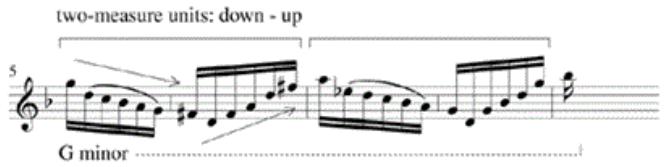
中文讲解
第18页上带图注标记“b.”的图像占位符,对应Example 5-12(b),即mm. 5–9 vs. 59–67 的配对段落——这部分将讨论两半之间“调性—属调—调性”和声模式的对照。
补充说明
图注中“b.”与P0132中Example 5-12(b)的描述相对应:mm. 5–9 vs. 59–67。
第10段(P0118)
原文复述
[Image placeholder on page 18, with caption annotation “four-measure units: up - down - up - down”]
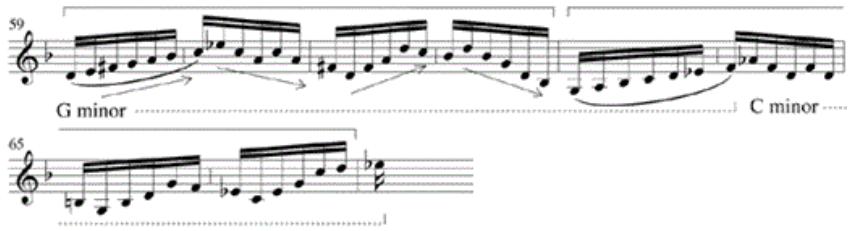
中文讲解
第18页上的图像占位符,附文字说明“four-measure units: up - down - up - down”(四小节单位:上行—下行—上行—下行)。这一图注提示读者:对应于前半的两小节单位结构,后半被拉长为四小节单位且方向交替。
补充说明
这一简短图注与P0133中对mm. 59–67的分析相呼应,是作者用箭头型图示展示音区与时值扩展的工具。
第11段(P0119)
原文复述
[Image/musical score placeholder on page 18 — embedded image data omitted; position and caption retained]

中文讲解
第18页上的另一个图像/乐谱占位符,属Example 5-12系列中的某一片段,需查看原图。
第12段(P0120)
原文复述
[Image/musical score placeholder on page 18 — embedded image data omitted; position and caption retained]

中文讲解
第18页最后一个图像/乐谱占位符,属Example 5-12系列;具体对应哪一组对位需查看原图。
第13段(P0121)
原文复述
[Page footer: Downloaded from academic.oup.com/book/5913/chapter/149232198 by Indiana University - Bloomington user on 12 August 2026]
中文讲解
第18页的相同页脚下载信息,重复出现表明每页底部都印有该条说明。
第14段(P0122)
原文复述
[Image/musical score placeholder on page 19 — embedded image data omitted; position and caption retained]
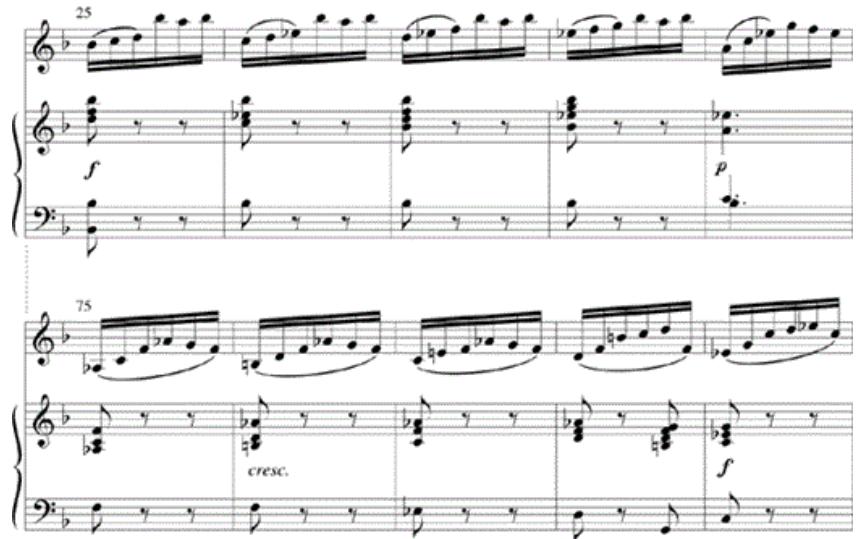
中文讲解
第19页上的第一个图像/乐谱占位符,属于Example 5-12系列中部的乐谱内容,需查看原图以确认具体小节范围。
第15段(P0123)
原文复述
[Image/musical score placeholder on page 19 — embedded image data omitted; position and caption retained]
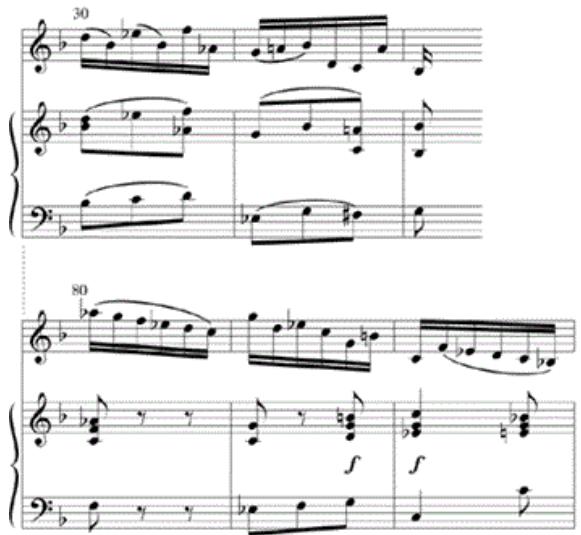
中文讲解
第19页上的第二个图像/乐谱占位符,同属Example 5-12系列;具体小节对应需查看原图。
第16段(P0124)
原文复述
[Page footer: Downloaded from academic.oup.com/book/5913/chapter/149232198 by Indiana University - Bloomington user on 12 August 2026]
中文讲解
第19页底部相同的下载来源页脚。
第17段(P0125)
原文复述
[Image placeholder on page 20, with caption marker “f.”]
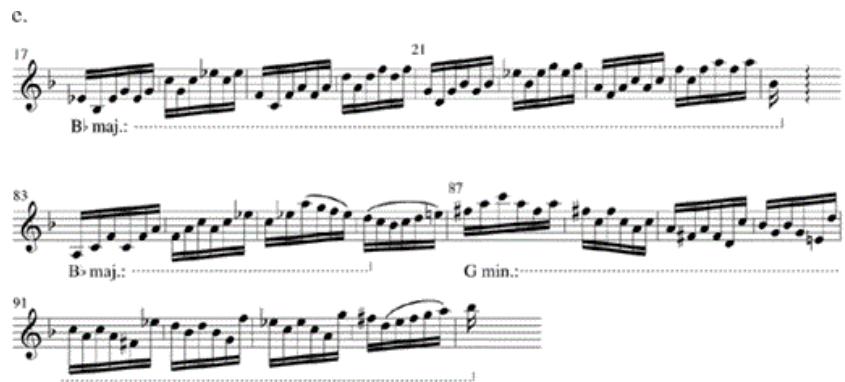
中文讲解
第20页上带图注“f.”的图像占位符,对应Example 5-12(f),即mm. 43–54 vs. 121–36(含其潜在对位)配以舒曼伴奏的部分。这是全例中最复杂的一组对位,显示Presto末尾“序列”的剧烈强化。
补充说明
P0132的图注说明(f)包含mm. 43–54 vs. 121–36的对比以及舒曼所作伴奏版本。
第18段(P0126)
原文复述
[Image/musical score placeholder on page 20 — embedded image data omitted; position and caption retained]
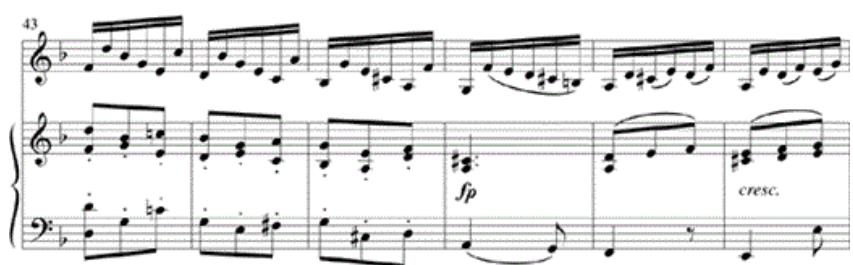
中文讲解
第20页上的一个图像/乐谱占位符,属Example 5-12系列;具体对应关系需查看原图。
第19段(P0127)
原文复述
[Image/musical score placeholder on page 20 — embedded image data omitted; position and caption retained]
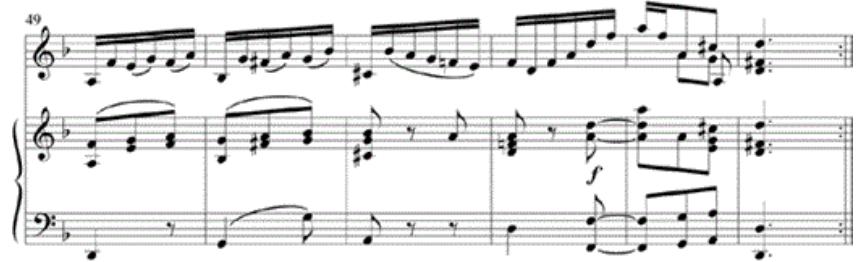
中文讲解
第20页上的另一个图像/乐谱占位符,属Example 5-12系列。
第20段(P0128)
原文复述
[Image/musical score placeholder on page 20 — embedded image data omitted; position and caption retained]
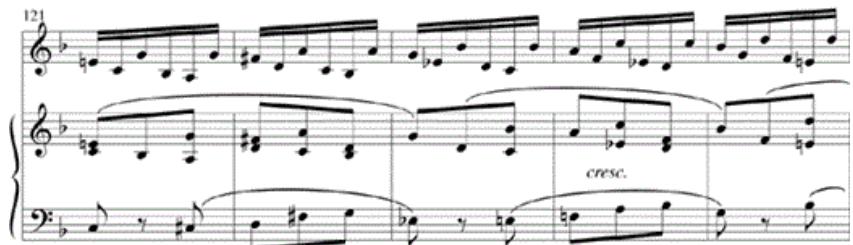
中文讲解
第20页上的另一图像/乐谱占位符,属Example 5-12系列。
第21段(P0129)
原文复述
[Image/musical score placeholder on page 20 — embedded image data omitted; position and caption retained]
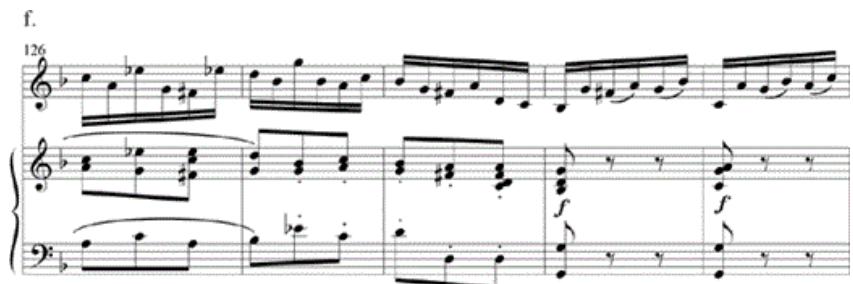
中文讲解
第20页上的另一图像/乐谱占位符,属Example 5-12系列。
第22段(P0130)
原文复述
[Image/musical score placeholder on page 20 — embedded image data omitted; position and caption retained]
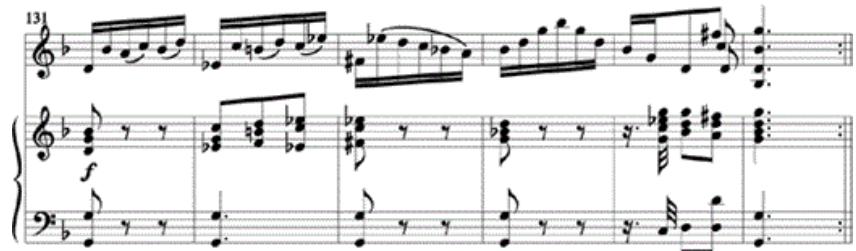
中文讲解
第20页上的最后一处图像/乐谱占位符,属Example 5-12系列。
第23段(P0131)
原文复述
[Page footer: Downloaded from academic.oup.com/book/5913/chapter/149232198 by Indiana University - Bloomington user on 12 August 2026]
中文讲解
第20页底部相同的下载来源页脚。
第24段(P0132)
原文复述
Example 5-12. Bach, Sonata in G Minor, Presto, parallels between the two halves: (a) mm. 1–5 and 54–59; (b) mm. 5–9 vs. 59–67; (c) mm. 9–17 vs. 67–74; (d) mm. 25–312 vs. 75–82, with Schumann’s accompaniment; (e) mm. 17–25 vs. 83–95; (f) mm. 43–54 vs. 121–36 (and its underlying counterpoint), with Schumann’s accompaniment.
中文讲解
这是Example 5-12的总图注,列出全部六组对位段的位置信息:1. (a) mm. 1–5 vs. 54–59(琶音与材料引入);2. (b) mm. 5–9 vs. 59–67(首次和声运动);3. (c) mm. 9–17 vs. 67–74(看似单纯移位的下行音型);4. (d) mm. 25–31(原文标为312,可能为排印异常) vs. 75–82,附舒曼伴奏版本;5. (e) mm. 17–25 vs. 83–95(音型强化);6. (f) mm. 43–54 vs. 121–36(含其潜在对位),附舒曼伴奏版本。图注本身并不下结论,但已暗示后续分析将逐组展示“同一元素—更强烈的再现”这一原则。
补充说明
“Schumann’s accompaniment”指罗伯特·舒曼曾为巴赫小提琴无伴奏奏鸣曲中的部分乐章所作的钢琴伴奏版,本例将其作为对照参考置于对位材料下方。原文“25–312”按其他组对照(如43–54对应121–36)的逻辑及小节走向推断应为排印问题,此处暂依原样保留。
第25段(P0133)
原文复述
The Presto’s next element, in Example 5-12b, offers the movement’s first harmonic motion: tonic–dominant–tonic (imitating a perfect cadence, as Rameau would have explained in the Treatise on Harmony that he was writing as Bach composed this sonata), outlining harmonic stability. Its recurrence in mm. 59–67 is anything but stable: the two-measure pacing of mm. 5–9, with its single ascent and descent within each pair of measures, expands into a four-measure pacing in mm. 59–67 with several registral undulations; the key now changes from tonic to subdominant; and the dissonance level heightens as the two dominant chords (the D chord in mm. 59–61 and the G chord in mm. 63–65) display themselves as full dominant ninths (even though the ninth resolves within the dominant each time before the chord moves), not the dominant triad of mm. 6–7.
中文讲解
本段以Example 5-12(b)为例详细论证“再现时更强烈”的原则。前半mm. 5–9呈现“主—属—主”这一和声运动,作者类比拉莫(Rameau)当时正在写作的《和声论》(Treatise on Harmony)对完全终止的解释,将其界定为“和声稳定”的典型形态——即一个模仿完全终止的封闭和声过程。到了后半mm. 59–67,这一对位材料不再稳定,而是从以下三方面叠加了张力:1. 时值扩张——从两小节一组扩展为四小节一组;2. 调性转移——从主调转向下属调;3. 不协和程度升高——原本D和弦、G和弦为三和弦属音,现在则以完整的属九和弦出现,即便九音在属音内部先解决再行移位。三个维度共同把同样的和声运动“重新组织”为更高强度的版本。
补充说明
Rameau为法国作曲家与理论家,其《Treatise on Harmony》(《和声论》)是18世纪初和声理论的重要文献;作者在本节中数次引用其论点和声运动的动因。属九和弦(dominant ninth chord)指根音上同时堆叠三度、五度、七度与九度的属功能和弦。
第26段(P0134)
原文复述
Indeed, the chord progression in mm. 59ff. corresponds exactly to what Rameau discussed as the motivation for harmonic movement. Rameau believed that consonant triads had little motivation to progress to other harmonies; only dissonances, such as the seventh of a dominant chord, impelled a chord toward a new harmonic goal. According to this view, the D-major triad in mm. 54–59 adds a seventh (and ninth) in mm. 60–61 to propel it toward its goal of G; the G chord, which starts as a minor triad, transforms itself into a dominant by adding a seventh (and ninth) and raising its third to become a leading tone in mm. 64–65 to propel itself toward its C-minor goal.
中文讲解
本段把上段观察与拉莫的理论对接。作者引用拉莫的论断:协和三和弦本身缺乏向其他和声进行的动力;只有不协和音(如属和弦的七音)才“迫使”一个和弦走向新的和声目标。以此为框架,作者解析Presto后半mm. 54起进行中的和弦逻辑:1. D大调三和弦在mm. 60–61加上七音(以及九音),从而被推动向G和弦行进;2. G和弦最初以小三和弦出现,再通过加上七音与九音并将其三音升高为导音(在mm. 64–65),从而将自己转化为属功能,最终推向C小调目标。作者指出这一进行恰好印证了拉莫关于“不协和驱动和声运动”的观点,揭示出巴赫在作曲层面对同时期理论的呼应。
补充说明
“leading tone”即导音,第七级音的升高形式,倾向于上行解决到主音;“ninth”在此处指根音上方叠加的两个三度音程,遵循古典和声写法时通常下行解决到属和弦的五音。
第27段(P0135)
原文复述
The next element, in Example 5-12c, seems to be a simple transposition when it recurs in the second half. But because it occurs a fifth lower on its recurrence, it runs into the lower registral limit of the violin and therefore must be less regular in its figuration: the F in m. 72 and E♭ in m. 74 are an octave higher than they would have been in a direct transposition. Such details may seem like an unfortunate result of the violin’s registral limits, but it is striking that Bach, who was a fine violinist, seems to run into such registral limits primarily on restatements of such patterns, turning a registral disadvantage into a compositional advantage that promotes heightened activity.
中文讲解
本段讨论Example 5-12(c)的对位——一个看似只是简单下移五度的材料。表面上看后半个乐章只是把音型下移五度,但这样做的结果是撞到了小提琴的最低音区,作者以mm. 72的F和mm. 74的E♭为例:若严格按移位逻辑演奏,它们本应低一个八度。作者强调,乍看这是乐器的音区限制造成的“不幸”结果,但巴赫身为优秀小提琴家,恰恰把这种限制“主要”集中安排在材料的再现处,从而将“音区劣势”转化为“提升活动性”的优势。这一观察揭示巴赫并非被动迁就乐器,而是将限制纳入构图。
补充说明
“registral limits”指乐器音域上下限,是作曲时需考虑的物理约束;“figuration”指具体的音型化旋律模式。
第28段(P0136)
原文复述
The immediately following passage in the second half of the movement brings back a slightly later portion of the first half of the movement, as shown in Example 5-12d. In the first half of the movement, the music in mm 25–32 expresses a closed progression in B♭ major, beginning and ending on a tonic chord. The recurrence in mm. 75–82 expresses a single key but begins off the tonic chord, creating a single-minded progression toward a new goal.
中文讲解
本段讨论Example 5-12(d):第二半紧接c组之后,回到的并非c组而是更靠后的第一半段落(mm. 25–32 vs. 75–82)。前半mm. 25–32是一个在降B大调上、起讫皆在主和弦的“封闭进行”;到后半mm. 75–82虽然仍保持单一调性,但不再从主和弦起头,而是偏离主和弦开始,从而产生“单向推进”的目标感。这种从“闭环”到“开环”的转变是强度提升的另一种手段。
补充说明
“closed progression”指起讫落于同一和弦从而造成和声闭合感的进行方式;“single-minded progression”指和声目标明确、无回环的进行方式。
第29段(P0137)
原文复述
The second half then doubles back to pick up the preparation for the music in B♭ from the first half. As shown in Example 5-12e, mm. 83–95 greatly intensify the simpler figuration of mm. 17–25. Not only are the patterns expanded and interspersed with other figurations, but also the direction of the pattern reverses between mm. 83–85 and 87–89. Furthermore, whereas there are only consonant triads from a single key in mm. 17–25, mm. 83–95 feature a change of key and many seventh chords.
中文讲解
本段以Example 5-12(e)继续展示“再现时的强化”:第二半往回取用前半中“降B段”的准备材料(mm. 17–25 vs. 83–95)。具体强化方式有三:1. 音型扩展并与其他音型穿插;2. 音型方向在mm. 83–85与mm. 87–89之间发生倒转;3. 前半mm. 17–25只有单一调性内的协和三和弦,后半mm. 83–95则发生转调,并出现大量七和弦。作者通过“方向反转+和声复杂化+织体穿插”进一步推高活动强度。
第30段(P0138)
原文复述
The process of bringing back intensified parallel passages is itself greatly intensified approaching the cadence that ends each half of the movement. Example 5-12f shows the sequence in mm. 43–46 that prepares for the precadential dominant pedal during the first half of the movement and its dramatically intensified return in mm. 121–27. On its recurrence, the sequence is nearly twice the length, ascends rather than descends, is more irregular in figuration (as shown by the underlying counterpoint), and includes more chromaticism—even outlining an upper-voice diminished octave from E to E♭.
中文讲解
本段将视角推到“每半之内”最靠近终止的环节,以Example 5-12(f)作为收束示例:1. 前半mm. 43–46的序列为终止前的属音持续音做预备;2. 后半mm. 121–27对该序列进行了多方面的强化——长度几乎翻倍;方向从下行变为上行;音型更不规则(潜在对位可证);半音化显著增加,甚至在高声部勾画出一条从E到E♭的减八度(diminished octave)。作者由此指出,越是临近终止,“强化再现”这一过程本身也被进一步强化,构成一个层层递增的层级结构。
补充说明
“precadential dominant pedal”指终止前属和弦持续音,通常作为终止前的延长与张力积累手段;“diminished octave”指两个音相距一个减八度(含六个半音),常出现在紧张化进行中。
第31段(P0139)
原文复述
[Page reference markers: p. 129 / p. 130 L]
中文讲解
此处为版面留下的页码与栏位标记:原书p. 129开始部分内容、p. 130左侧栏(L表示左栏)。这些标记属于版面引用,不构成正文内容。
第32段(P0140)
原文复述
[Page reference marker: p. 131]
中文讲解
版面留下的页码引用:原书p. 131。该标记属于版式,不构成正文主张。
第33段(P0141)
原文复述
[Page reference marker: p. 133]
中文讲解
版面留下的页码引用:原书p. 133。该标记属于版式,不构成正文主张。
第34段(P0142)
原文复述
[Page footer: Downloaded from academic.oup.com/book/5913/chapter/149232198 by Indiana University - Bloomington user on 12 August 2026]
中文讲解
第21页底部相同的下载来源页脚。
第35段(P0143)
原文复述
The final cadence itself is also intensified on its recurrence. The dominant pedal of mm. 47–49 recurs as an ascending bass scale in mm. 129–31. Here again (as with mm. 9–17 versus mm. 67–74 shown in Example 5-12c) Bach has bumped into the lower registral limit of the violin—he could not place a low F in m. 47 parallel to the low B♭ in m. 129. Once again, he used the more dramatic version for the recurrence, with a stable pedal in the first half of the movement but an ever-ascending bass in the second half. Even the seemingly slight alteration of the antepenultimate measure (m. 134 versus m. 52) serves to heighten the drama: whereas the bass leading tone C♯ in m. 51 resolves to a bass D in m. 52, the bass F♯ in m. 133 moves, if at all, to a G in the higher octave in m. 134.
中文讲解
本段进入对终止本身再现时的强化分析。前半mm. 47–49的属持续音在后半mm. 129–31被改写为不断上升的低音阶(ascending bass scale)。作者把这一处理与Example 5-12(c)中的音区限制问题并置——同样,巴赫在两处都碰到了小提琴最低音区的限制(例如m. 47无法写一个平行于m. 129处低音B♭的F),于是他再次选择为再现处写出“更具戏剧性”的版本:前半用稳定的持续音,后半则用持续上行的低音。作者最后甚至把目光投向倒数第三小节的细微改动:m. 52处低音C♯作为导音解决到低音D,而m. 134处的低音F♯即使要解决,也只能走向更高八度的G。这种“看似微小的改变”也被纳入到强化戏剧张力的整体策略中。
补充说明
“antepenultimate measure”指倒数第三小节,此处位于终止前倒数第三的位置;“bass leading tone”指低声部的导音,本段中即低音区的升高音级。
第36段(P0144)
原文复述
In addition to participating in the heightening of activity between the halves of the movement, each figuration shown in Example 5-12 also participates in an intensification within each half of the movement. Consider harmonic rhythm. Each half of the movement begins with five measures on a single harmony (mm. 1–5 and 54–58 in Example 5-12a); such a sustained harmony never happens elsewhere. The relatively uniform measure-long patterning of repeated figurations in many places, like mm. 9–11 and 67–69 in Example 5-12c, contrasts with the much more complex figurations in mm. 43–46 and 121–27 in Example 5-12f.
中文讲解
本段从“每半之内的强化”维度补充说明“活动性递增”的原则。作者以和声节奏(harmonic rhythm)作为切入:1. 每半开头的5小节(mm. 1–5和mm. 54–58)停留在单一和声之上,这种长时间的和声保持仅出现在乐章开头,后文再无同类情形;2. 大量地方(如mm. 9–11与mm. 67–69)呈现出“每小节一个音型重复”的相对均匀模式,而到mm. 43–46与mm. 121–27(Example 5-12(f))处则出现远为复杂的音型化结构。作者由此得出结论:Example 5-12所展示的每一组对位材料,既参与两半之间的强化,也参与每半内部从“稳定—均匀—复杂”的递增过程。
补充说明
“harmonic rhythm”指和声变换的速率(每多少拍或多少小节发生一次和弦变化),是衡量和声紧张度的常用指标。
第37段(P0145)
原文复述
As a result, both within each half of the movement and between these halves the ruling compositional principle is heightened activity. It is thus not surprising that early-eighteenth-century treatises discuss issues like permutations of figuration (which relates to heightening activity), whereas discussions of binary musical forms (which relate to sectional balance and articulated phrasing) are largely absent. Early-eighteenth-century theory discussed only the most superficial features of such binary forms, ignoring the marriage of tonal motion and thematic design that later ages concretize as theories of form or structure. In sum, the two halves of the Presto offer the characteristics of Bach’s other parallel-section works discussed in chapter 4.
中文讲解
本段为本节作出总结性收束,呼应开头P0109-P0110所铺陈的历史背景:1. 在每半之内与两半之间,“活动性递增”是Presto的主导构图原则;2. 因此18世纪初期的理论著作才会集中讨论音型变体(permutations of figuration)这类与“活动性”直接相关的议题,而对二段体曲式本身(关乎段落平衡与清晰乐句划分)几乎不专门讨论;3. 当时理论只触及二段体的最表层特征,忽略了“调性运动与主题设计的结合”这一后来被发展为形式理论的层面;4. 作者最后点明,Presto两半所呈现的特征与第4章所讨论的巴赫其他“平行段落”作品具有共通性,把本节与全书既有的论点网络挂钩。本段因此兼具归纳、回扣历史背景与向外延展三层功能。
补充说明
“permutations of figuration”指通过节奏、音区或装饰等方式对同一基本音型进行变形的手法,在巴洛克作曲教学与即兴理论中常被讨论。
脚注 / 边栏 / 图表 / 附加信息(如有)
- Example 5-12的总图注位于P0132,列出了六组对位的具体小节位置与舒曼伴奏的标记,是贯穿P0113–P0144所有论证的视觉支架。2. 第18–20页(P0115–P0130)一系列图像/乐谱占位符共同构成Example 5-12的多页乐谱排版;由于原图像数据未提供,无法对其内部细节作进一步描述。3. P0111、原文各页页脚(P0114、P0121、P0124、P0131、P0142)以及P0139–P0141的页码引用标记均属版面信息,与论证内容无直接关联。4. P0145末尾把本节论证与“第4章”所讨论的巴赫其他“parallel-section works”挂钩,是本节论证网络的延伸点。
💡 本节核心要点
- 本节核心论点:G小调奏鸣曲Presto的主导构图原则是“持续增强的活动性”(heightened activity),它比“与后古典二段体的表层相似”更能揭示乐章的真实结构。
- 该原则同时在两个层级运作:每半之内从稳定—均匀—复杂的递增;两半之间通过材料再现并“重新组织”来叠加张力。
- Example 5-12以六组对位段(a–f)配以舒曼伴奏,把这种强化关系可视化:开篇琶音由下行反向突破音区上限、第一次和声运动由属九和弦与调性转移推动、看似单纯的移位被音区限制反向塑造成更高音型、封闭进行变为单向推进、准备段被扩展并伴随方向反转、终止前的属持续音变为持续上行的低音阶。
- 拉莫(Rameau)《和声论》中“不协和驱动和声运动”的观点,为Presto后半和声逻辑提供了同时期理论框架,巴赫的实践呼应了这一框架。
- 巴赫在小提琴音区限制处的处理并非迁就乐器,而是有意识地将“限制”集中在材料再现处,从而把劣势转化为提升活动性的优势。
- 由此可以解释18世纪初期理论著作为何集中讨论音型变体(与活动性相关),而对二段体曲式结构着墨甚少——后者对应的是后世的形式理论关注点。
🔑 关键术语
- heightened activity (持续增强的活动性):本节的核心原则,指在材料再现或新元素出现时通过方向、长度、密度、不协和度、音区等多维度叠加张力,使活动水平逐层递增。
- binary form (二段体):由反复记号分隔的两个段落组成的曲式;本节承认Presto在表面特征上与古典时期的二段体相似,但指出这种表层相似不足以解释其内部结构逻辑。
- ritornello (利都奈罗):巴洛克时期反复出现的器乐段落,常用于协奏曲的全奏部分;与本节对比的“古典以前”的曲式结构之一。
- thoroughbass (通奏低音):一种以数字低音记号指示和弦进行的巴洛克键盘/通奏低音实践;本节用以说明巴赫前奏曲的来源方式。
- motto voicing (动机排列):把一组核心和弦音按某种特定音程关系排布的陈述方式,Presto开篇琶音即以此方式拼出整首奏鸣曲的主和弦。
- dominant ninth chord (属九和弦):根音上同时堆叠三度、五度、七度与九度的属功能和弦;本节以之作为Presto后半mm. 59–67和声“强化”的关键标志。
- precadential dominant pedal (终止前属持续音):终止前属和弦的持续音,常作为张力积累;Presto前半mm. 43–46的序列即为其预备段。
- harmonic rhythm (和声节奏):和声变换的速率;本节以之展示每半之内从稳定单一和声、均匀重复到复杂多变音型的活动性递增过程。
- registral limits (音区限制):乐器可演奏的音高上下限;本节讨论巴赫在再现处主动“撞上”小提琴下限,并把这种限制转化为构图优势。
- diminished octave (减八度):两个音相距一个减八度的音程,含六个半音;Presto后半mm. 121–27的高声部即勾画出一条从E到E♭的减八度,作为强化紧张度的极端手段。
- permutations of figuration (音型变体):通过节奏、音区或装饰等方式对同一基本音型进行变形的手法;本节以之解释18世纪初期理论著作对“活动性”议题的关注。
S11 [描述性拆分] Schumann’s Interpretation of the Form of the Presto
第1段(P0146)
原文复述
Schumann’s Interpretation of the Form of the Presto, p. 134.
中文讲解
本段是章节小标题,标明下文将进入对舒曼为巴赫《G小调奏鸣曲》末乐章急板所作伴奏中“形式”观念的讨论,并附原书页码 134。标题同时揭示本节的核心张力:舒曼对这首两段反复式乐章的形式理解,与本章此前所主张的“持续强化”阅读之间存在冲突。
第2段(P0147)
原文复述
Decisions on the nature of form in the Presto—whether the movement is essentially in a nineteenth-century binary form or exemplifies a process of continual intensification both within and between the reprises—are by no means academic. They affect how we interpret the music as performers and how performers transmit that interpretation to listeners and analysts.
中文讲解
作者开宗明义地指出,急板的形式归属——是十九世纪意义上的二段体(simple binary / sonata form),还是展现“段内与段间持续强化”的过程——并非纯学理之争,而是直接影响演奏者的诠释及其向听众与分析者传达的内容。这一句把形式判断与演奏实践直接挂钩,预告全节将以舒曼伴奏如何塑造或改造形式印象为重点。
第3段(P0148)
原文复述
Just as Schumann’s accompaniment to the E-major Preludio (discussed earlier in this chapter) differs from Bach’s orchestration in its presentation of rhythm and meter and Schumann’s accompaniment to the Presto of the G-minor Sonata reflects the same features, his accompaniment to the Presto also reflects a nineteenth-century vision of the “form” of that two-reprise movement—a vision that is at odds with the notions of continual intensification offered in this chapter.
中文讲解
本段将本节论证嵌入全章主线:作者此前已论证舒曼为《E大调前奏曲》所作伴奏偏离了巴赫原作的节奏与节拍处理方式,舒曼对 G 小调奏鸣曲急板的伴奏同样如此。本句的关键推进在于指出:舒曼的伴奏不仅偏离节奏与节拍,还体现了一种十九世纪对两段反复乐章“形式”的理解——这一理解与本章通篇主张的“持续强化”阅读相左。也就是说,作者即将展开的不仅是对舒曼具体伴奏手法的描述,更是对其形式观念的对照分析。
第4段(P0149)
原文复述
As a mid-nineteenth-century composer, Schumann saw Bach’s two-reprise Presto as an instance of the binary forms he frequently composed: simple binary forms and sonata form. When Schumann worked out an accompaniment of parallel passages in the two reprises, he fit Bach’s music into those forms. Consider, for instance, his handling of the end of the two reprises, which diverges sharply from Bach’s conception. The parallel ends of the two reprises in Bach’s Presto appear in Example 5-12f with Schumann’s accompaniment. Within both reprises, these passages in Bach’s violin solo represent a higher level of activity than previous music (as discussed above); and the parallel passage in the second reprise is considerably more active than that in the first reprise.
中文讲解
作者提出解释舒曼伴奏选择的历史语境:作为十九世纪中叶作曲家,舒曼自然把巴赫的两段反复急板视为他所熟悉的二段体(simple binary)或奏鸣曲式。因此,当他为两段反复中的对应段落写作伴奏时,他有意识地把巴赫的音乐“装入”这些他熟悉的曲式结构中。作者随即以两段反复结尾段的处理(例 5-12f)为切入点:巴赫原作中,两段结尾处的小提琴独奏段都比各自段内先前音乐更为活跃,且第二段的对应段在复杂度与戏剧性上比第一段更高。作者将在下文展示,舒曼的伴奏处理与这一“逐步升级”的逻辑背道而驰。
第5段(P0150)
原文复述
Schumann does realize that the sequences in both passages are more active than previous music: for mm. 43–46, his accompaniment reflects the more active pattern by means of the staccato eighth-note harmonic rhythm. But where Bach’s pattern is notable for its evenness (the same figuration in each measure and the implicit descent through similar harmonic changes in each measure), Schumann’s accompaniment, by changing the type of harmonic progression in each measure, adds an unevenness that obscures the…
中文讲解
本段(与下一段连读)开始细部分析第一段反复结尾(mm. 43–46):作者承认,舒曼并非完全忽视此处比段内先前音乐更活跃的事实——他用断奏八分音符的和声节奏来呼应这种活跃感。但巴赫此处织体的显著特征是“均匀”:每小节使用相同的音型,并通过相似的和声变化形成隐含的下行。舒曼却通过每小节变换和声进行类型,制造出一种“不均匀”,从而模糊了小提琴旋律线条原本的平滑感。这是一处典型的例子,说明舒曼虽然保留了“更活跃”的表层信号,却改变了塑造该信号的和声与节奏结构。
第6段(P0151)
原文复述
Downloaded from academic.oup.com/book/5913/chapter/149232198 by Indiana University - Bloomington user on 12 August 2026.
中文讲解
本段为下载页脚,记录该书章节被印第安纳大学伯明顿分校用户于 2026 年 8 月 12 日从 Oxford Academic 平台下载,属于版权与访问来源信息,与正文论证无关。
第7段(P0152)
原文复述
…smoothness of the violin sequences. And whereas Bach composed the parallel passage in the second reprise (mm. 121–27) to be more active (with a more complex internal pattern and with the more dramatic ascent replacing the descent), Schumann makes it less so: legato instead of staccato, with a slower harmonic rhythm, and with regular two-measure sequences (instead of the irregular harmonic changes he provides for mm. 43–46). In the approach to the final cadence, where Bach replaces the beginning dominant pedal in the first reprise (mm. 47–49) with a relentlessly rising bass throughout the entire passage in the second reprise (mm. 129–33), Schumann obscures the driving bass ascent in the second reprise by creating a tonic pedal. In essence, where Bach saw these passages as the climax of each reprise and saw the second passage as a heightening of that climax to conclude the entire movement, Schumann saw the end of the second reprise in terms of a recapitulatory gesture—a diminution of the level of intensity appropriate to the ending of the movement.
中文讲解
本段继续上段并完成对两段反复结尾的全部分析。在第二段对应位置(mm. 121–27),巴赫把音乐写得比第一段更活跃——内部结构更复杂、上行取代下行以增强戏剧性。舒曼的处理却反向:连奏代替断奏、和声节奏减慢、规则的两小节一组序列取代了 mm. 43–46 处那种不规则的和声变化。在导向终止式之处,巴赫用持续上升的低音(mm. 129–33)替换了第一段开头(mm. 47–49)的属持续音;舒曼却用主持续音掩盖了上行低音的推动力。作者点出观念上的根本差异:巴赫把这两处视为每段的顶点,并把第二段视为对整个乐章顶点的再次拔高;舒曼则把第二段结尾视为“再现性姿态”,即顺应乐章结束所需的强度降低。
第8段(P0153)
原文复述
Bach and Schumann also differ on the roles of the main keys of each reprise. Once again, Bach hears the parallel reprises that explore materials in ever more complex ways. Each reprise presents three main keys: G minor, B♭ major, and D minor in the first reprise and G minor (starting on the dominant), C minor, and G minor in the second reprise. The two composers’ treatment of the middle key of each section varies the most. For Bach, the music in the middle key in both reprises intensifies previous music and the parallel music in the second reprise intensifies that in the first reprise. The main B♭ music in the first reprise is a closed phrase that begins and ends on the tonic (mm. 25–32, shown in Example 5-12d), prepared by a modulating sequence (in mm. 17–24) that leads to the tonic of B♭, and ending with a cadence in that key. The parallel music in the second reprise (mm. 75–82, also in Example 5-12d) is a phrase that modulates to C minor only in its second measure.
中文讲解
本段将对照从节奏、和声层面推进到调性层面。两段反复各有三个主要调:第一段为 g 小调、♭B 大调、d 小调;第二段为 g 小调(始于属音)、c 小调、g 小调。作者指出,两位作曲家处理上差异最大的,是两段各自的“中间调”。在巴赫那里,两段中的中间调音乐都强化各自段内先前音乐,且第二段的对应音乐又比第一段更复杂、更具强化效果。具体而言:♭B 段(mm. 25–32)是一个从主音开始、在主音上结束的封闭乐句,由 mm. 17–24 的转调序列准备并以该调终止;与之平行的 c 小段(mm. 75–82)则是一个只在第二小节短暂转调到 c 小调的乐句。这些差异为下文的舒曼式“奏鸣曲式”解读提供了事实基础。
第9段(P0154)
原文复述
Schumann probably viewed these two passages in terms of their possible roles in a sonata-form structure. He probably heard the music in B♭ in the first reprise as the beginning of the second theme in a three-key exposition (I–III–v), whereas the music in C minor was for him part of a development section. When he gets to B♭, he adds a bass pedal to slow down the pacing, as if to make it a lyrical second theme. Instead of participating in the gradually increasing activity levels of the first reprise, the music now is a point of relaxation akin to what commonly happens at the beginning of the second theme in a nineteenth-century sonata-form movement. Schumann also suppresses the cadence on B♭ in m. 32 with a chromatic deceptive progression that reduces its independence as a key.
中文讲解
本段将舒曼的伴奏选择解释为他把巴赫的音乐“听成”奏鸣曲式:第一段中的 ♭B 段被他视为三调呈示部(I–III–v)中的第二主题开端,第二段中的 c 小段则被他归入发展部。依据这一图式,舒曼在 ♭B 处加入低音持续音以放慢节奏,使该处听起来像抒情性第二主题——也就是一个对应于十九世纪奏鸣曲式第二主题开头的“放松点”,而非参与到第一段逐步升级的活动中。舒曼还在 m. 32 用半音阻碍进行抑制了 ♭B 上的终止式,从而削弱该调作为独立调性的地位。整段的关键在于:舒曼的每一项具体改动都来自他对巴赫音乐形式的奏鸣曲式式“重新想象”。
第10段(P0155)
原文复述
In the second reprise, Schumann ends the music in C minor in mm. 81–82 with a clear cadence (reinforced by the fortes in mm. 81 and 82). For Bach, the two reprises are parallel in structure, with the second more complex; B♭ major and C minor stand in parallel positions, but C is less stable than B♭. For Schumann, the model for a large movement with two reprises is sonata form, in which the two reprises are not parallel: the first reprise presents themes in two keys and includes transitions and other passagework, while the second reprise is a development (in which a foreign key may be established) and a recapitulation. Accordingly, Schumann both tried to enhance the sense of a relaxing arrival on B♭ in the first reprise and weakened the status of B♭ by aborting the cadence. Where Bach created progressive intensification within two parallel reprises, Schumann heard sections that corresponded to the musical forms of his age.
中文讲解
本段总结全节论点。在第二段反复中,舒曼用清晰的终止式(并由 mm. 81–82 的强奏强化)结束 c 小段;这与第一段反复中他抑制 ♭B 终止式的处理形成镜像。观念对照由此完整呈现:巴赫把两段反复视为平行结构,第二段比第一段更复杂——♭B 与 c 小调位置平行,但 c 不如 ♭B 稳定。舒曼则以奏鸣曲式为模板,认为两段反复本质上不平行:第一段是包含主题、转连接段等的两调呈示,第二段则是发展部(可建立新调)与再现部的组合。由此他既要强化 ♭B 作为第一段“抒情抵达点”的放松感,又要通过取消终止式削弱 ♭B 的独立调性。作者最终把两种解读并置:巴赫构建的是两段平行反复中的渐进强化,舒曼听到的则是与他所处时代曲式相契合的段落结构。
脚注 / 边栏 / 图表 / 附加信息(如有)
无(本节内除学术下载页脚外,没有脚注、图表说明或边栏需要单独汇总)。
💡 本节核心要点
- 对急板形式归属的二选一并非纯学理问题,而是直接影响演奏诠释与听众接收。
- 舒曼作为十九世纪中叶作曲家,自然以 simple binary 或 sonata form 理解巴赫的两段反复急板,并据此重塑伴奏。
- 在两段反复的对应结尾处,巴赫追求“逐步升级”:第二段比第一段更活跃、更具戏剧性;舒曼却通过和声、节奏、织体的处理把第二段拉回,使其呈现“再现性”减弱。
- 在调性布局上,两位作曲家对“中间调”(♭B 与 c 小调)处理差异最大:巴赫保留其作为段内强化的功能,舒曼则按奏鸣曲式将 ♭B 视为第二主题开端、c 小调视为发展部。
- 舒曼的具体改动(低音持续音、抑制 ♭B 上的终止式、强化 c 小调终止式)均服务于他把巴赫音乐“装入”奏鸣曲式框架的目的。
- 全节核心对立:巴赫——两段平行反复中的渐进强化;舒曼——与其时代曲式相符的奏鸣曲式化段落。
🔑 关键术语
- binary form(二段体 / 二部曲式):本节指十九世纪常见的二段曲式(含简单二段体与奏鸣曲式),是舒曼用以理解巴赫两段反复急板的参照框架。
- sonata form(奏鸣曲式):本节被用作舒曼诠释巴赫的关键模板:呈示部(可含三调 I–III–v)、发展部、再现部;舒曼据此把第一段 ♭B 当作第二主题开端、把 c 小段当作发展部。
- continual intensification(持续强化):本章通篇主张的阅读方式:段内与段间逐步升级的活动度与张力。舒曼的伴奏被认为偏离了这种理解。
- harmonic rhythm(和声节奏):和声变换的频率。本节多次用其快慢(断奏八分音符 vs 连奏更慢节奏)来刻画舒曼伴奏对巴赫原结构均匀感的改造。
- deceptive progression(阻碍进行):舒曼在 m. 32 处用以抑制 ♭B 上的终止式、削弱其作为独立调性的半音和声手法,是他把巴赫音乐纳入奏鸣曲式框架的关键手段之一。
- recapitulatory gesture(再现性姿态):作者用以概括舒曼对第二段结尾的诠释:在奏鸣曲式思维下,该处被理解为再现部性质的能量回收,而非巴赫意义上的顶点再度拔高。
S12 Performance Issues in the G-minor Presto
第1段(P0156)
原文复述
Performance Issues in the G-minor Presto
中文讲解
这是本章的总标题,开启了对G小调奏鸣曲(与独奏奏鸣曲中所有连续十六分音符段落)演奏议题的讨论。标题点明主题不是乐谱分析,而是演奏层面——演奏者在面对该乐章时会遇到的实际选择。标题的限定词“在G小调奏鸣曲的Presto里”表明讨论对象具有典型性,作者将以它为切入案例,由此引申到同类段落乃至独奏奏鸣曲中的双再现段落。
第2段(P0157)
原文复述
This chapter compares the Presto of the G-minor Sonata—and, by analogy, all the continuous-sixteenth-note movements in the solo sonatas—to nineteenth-century perpetual motions. It continues by relating the apparent binary form of the Presto—and, once again by analogy, the apparent binary form of all the two-reprise movements in the solo sonatas—to early-eighteenth-century compositional principles that precede the development of the notion of “form” as we have understood it for the past two centuries.
中文讲解
本段是章节开篇的中心宣告,交代两项工作:其一,把G小调奏鸣曲的Presto“以及”独奏奏鸣曲中所有连续十六分音符音型段落,与十九世纪的“永续运动”(perpetual motions)进行对比;其二,把Presto以及所有双再现段落表面上呈现的“二部形式”,与十八世纪早期先于“形式”概念成熟之前的作曲原则相联系。作者两次使用“by analogy”作限定,表明对该类作品与Presto的对比属于类比推理而非完全等同,并保留“apparent”(表面上的)一词来限定“二部形式”,承认这只是表层观察而非定论。“for the past two centuries”明确了被比较对象:现代意义上的曲式学传统,作者意图说明作品应回到该传统形成之前的话语中去理解。
第3段(P0158)
原文复述
Including these perspectives in their thinking will inevitably affect violinists preparing the movement for performance. There is, of course, no single “correct” way to perform any piece of music. And any thoughts introduced in the present discussion are only intended as suggestions to stimulate a violinist’s imagination.
中文讲解
本段为本章定下方法论边界:作者明确指出把上述视角纳入思考,会不可避免地影响准备演奏该乐章的小提琴家,并通过三重限定为自己设防——“no single ‘correct’ way”(不存在单一的“正确”演奏方式)、“of course”(当然)渲染不言自明的前提,以及将本章观点降格为“suggestions to stimulate a violinist’s imagination”(激发想象力的建议)。本段承接P0157的对比性结论,将其从分析层面过渡到演奏实践层面:作者承认自身提议属于建议性意见,不是规定性真理,并邀请演奏者在此基础上自由发挥。
第4段(P0159)
原文复述
p. 136
中文讲解
此为版面要素,属于页码标识(136页)。
第5段(P0160)
原文复述
p. 135
中文讲解
此为版面要素,属于页码标识(135页)。
第6段(P0161)
原文复述
Downloaded from academic.oup.com/book/5913/chapter/149232198 by Indiana University - Bloomington user on 12 August 2026
中文讲解
此为版面要素,属于电子数据库下载来源及访问者信息(牛津学术电子书,印第安纳大学布卢明顿分校用户于2026年8月12日下载)。
第7段(P0162)
原文复述
Recordings of the movement vary fairly widely in tempo. Often violinists known for extremely different styles of playing choose nearly identical tempos. For instance, two of the slowest recordings are one of the earliest recordings (by Yehudi Menuhin in 1935) and a performance by one of the violinists most concerned with replacing the legacy of nineteenth-century violin playing by a return to greater historical authenticity (Jaap Schröder), both of whom recorded the Presto at just under 210 eighths per minute (just under 70 per measure). Likewise, among the fastest recordings are those by Gidon Kremer, who averages 263 eighths per minute (about 88 per measure), and Joseph Szigeti, who averages 247 eighths per minute (about 82.5 per measure).
中文讲解
本段以录音速度为证据切入,说明Presto的演奏速度区间非常宽泛,并同时强调一个反直觉现象:风格截然不同的演奏家有时会选择接近的速度。作者提供了两极对照:最慢的两种录音(1935年的Menuhin与Jaap Schröder,分别以早期历史录音和当代“历史本真”派的代表身份出现)均略低于每分钟210个八分音符(约每个小节70);最快的两种录音则来自Kremer(每分钟约263个八分音符,约每小节88)和Szigeti(每分钟约247个八分音符,约每小节82.5)。需要关注的是,最慢代表里同时包含早期和“本真派”两种风格,打破了“本真=更快”的预设;同时指名Schröder“最为关注以回归更大的历史真实性来取代十九世纪小提琴演奏传统”,进一步印证P0157对“十九世纪永续运动式演奏”的批判对象。该段尾注编号31表示后续可查证的录音来源。
第8段(P0163)
原文复述
A striking feature common to almost all recordings is the uniformity of bow strokes used throughout the movement, despite all the changes in surface figuration. Exceptions are most obvious in Jascha Heifetz’s 1935 recording, which includes a much wider palette of bow strokes in the second reprise, and Jaap Schröder’s recording, which projects different affects for the various sections of the movement.
中文讲解
本段指出第二个可观察现象:几乎所有录音在弓法与情绪处理上都呈现高度“统一”,尽管表面上音乐花纹变化丰富。例外被特意点出——Heifetz 1935年在第二再现里使用更丰富的弓法色彩;Schröder为各段落投射不同的情感内涵(different affects)。作者以对比形式让读者体会:弓法统一是一种约定俗成的处理,而非必然;Heifetz在早期录音中已展现差异化意识,Schröder则以“历史本真”视角加入了情感差异。“affects”一词呼应十七、十八世纪修辞学和音乐美学中将具体情感赋予具体段落的传统,提示读者:差异化的弓法与差异化的情感投射可能是原意所在。该段尾注编号32进一步引向对音乐结构的补充说明。
第9段(P0164)
原文复述
The uniformity of bow stroke and affect of most recordings approaches the implicit ideal behind the nineteenth-century moto perpetuo of the performer as a machine, producing an absolutely regular consistency of great speed and control despite the varying demands of different passages within a piece. To be sure, performances that attain that ideal are hair-raising—think, for instance, of Heifetz’s unsurpassable tempo of sextuplets in his 1955 recording of the first movement of the Suite, op. 10, by Christian Sinding (1856–1941). The speedy recordings of the Presto of the G-minor Sonata by Kremer and Szigeti—recordings that maintain their fast pace across all the changes in figuration—evoke the same ideal. The great nineteenth-century violin virtuoso Pablo de Sarasate made a tradition of performing the E-major Prelude in this manner, as witnessed by a recording cited earlier in this chapter. Is that ideal appropriate, however, for this Presto, with its continual heightening of activity levels and its wide range of figurations?
中文讲解
本段推进论证:把P0163描述的弓法与情绪“统一”现象,归结为一种隐含的“十九世纪永续运动式”理想——演奏家被视作机器,需要在不同段落中保持绝对的、规律的速度与控制。作者先以Heifetz 1955年的Sinding《第一小提琴组曲》Op.10首乐章六连音的“令人毛发悚然”的速度为例,证明达到该理想时确能产生惊人效果。进而指出Kremer与Szigeti的Presto录音是该理想的再现,Sarasate则进一步把E大调前奏曲演成传统。先给出肯定之后,作者以反问作转折——这种理想是否“适合”这一Presto,问题意识直接来自“its continual heightening of activity levels and its wide range of figurations”(其持续提升的活动层级与宽广的花纹范围):当音乐本身存在层次推进时,机械式统一可能并非恰当选择。这是章节论点的核心一问,定下后续讨论的方向。
第10段(P0165)
原文复述
Another quite different performance tradition of the nineteenth and early twentieth centuries embraces a great deal of tempo shift, both above and below the basic tempo of a movement. As already noted in chapter 2 of this book, bias against rubatos over the basic tempo is a fairly modern phenomenon, arising only in the twentieth century. I see no reason to believe that in ages prior to the widespread use of the metronome there was any way that performers were even fully aware of their divergences over time from the basic tempo of a movement. (After all, anyone who has ever practised with a metronome is aware of the wizardry of that marvelous invention, which seems always to speed up and slow down at exactly the same places!)
中文讲解
本段转入另一个对照传统:十九世纪至二十世纪初的另一种演奏传统包含大量“速度位移”(tempo shift),围绕乐章基本速度上下浮动。作者援引前一章(第2章)的观点,反对基本速度上的rubato被偏见地视为“现代现象”,明确指出此类偏见仅是二十世纪才出现的现象,并提出一项观察:在节拍器广泛使用之前,演奏家甚至未必意识到自己在时间维度上对“基本速度”的偏离。括号中的补充以节拍器“总是恰好在同一处加快或减慢”为反讽,说明脱离节拍器的演奏在速度维度上本就有自然的起伏。该段承接P0164的反问,揭示出其潜台词:十九世纪机器式速度理想并非唯一传统,前后呼应P0157对“十九世纪永续运动”这一参照系的批判性使用。
第11段(P0166)
原文复述
The predilection of performers for varying tempos surely extended to performances of Bach’s unaccompanied violin works. As noted in chapter 2, Joseph Joachim’s recording of the Adagio of the G-minor Sonata includes noticeable tempo changes. And Adolf Busch (1891–1952), in a 1929 recording of the Chaconne (as part of a recording of the entire D-minor Partita), takes different passages at a fairly wide range of tempos.
中文讲解
本段把速度变化的传统延伸至巴赫无伴奏小提琴作品,并以两条具体证据巩固:Joachim在G小调奏鸣曲Adagio的录音里存在显著的速度变化;Adolf Busch(1891—1952)在1929年D小调帕蒂塔全本Chaconne的录音中以颇为宽广的速度区间处理不同段落。两位演奏家均为十九世纪晚期至二十世纪上半叶德奥小提琴传统的代表,他们的速度处理表明“差异化的速度”并非孤例,而是该传统的常态。整段为P0164的反问提供历史背景:当十九世纪既有机器式统一风格,也有速度位移的传统时,作者选择让读者思考——哪一种传统更贴近巴赫时期的Presto。
💡 本节核心要点
- 本章以G小调奏鸣曲Presto为窗口,借“类比”讨论独奏奏鸣曲中所有连续十六分音符段落与所有双再现段落,但不等于完全等同。
- 论题核心在于挑战一种隐含的十九世纪“永续运动”演奏传统:演奏家如机器般保持速度与弓法的绝对统一。
- 录音证据显示Presto的速度选择空间宽广,弓法与情绪上几乎所有录音都过于统一,反例(Heifetz 1935、Schröder)凸显差异化处理的可能性。
- 十九世纪至二十世纪初同时存在另一种速度浮动的演奏传统,作者通过对Bach无伴奏作品的证据(Joachim、Busch)将其延伸到巴赫语境。
- 基本速度上的rubato被现代偏见误解;节拍器出现之前,演奏家未必意识到自己对基本速度的偏离。
- 全章以反问收束:当乐章本身持续提升活动层级并具有宽广花纹范围时,“机器式统一”是否仍是恰当的理想,预留进一步讨论空间。
🔑 关键术语
- perpetual motion:“永续运动”,指十九世纪一种追求极高、绝对均匀速度的演奏风格,演奏家被比作“机器”,在本章中作为被批判的参照系。
- binary form:“二部形式”,此处以“apparent binary form”(表面上呈现的二部形式)出现,作者提醒读者这只是观察的描述,不必直接套用后来的曲式概念。
- moto perpetuo:意大利语“永续运动”,与 perpetual motion 同义,指Presto类段落中保持一贯速度和均匀弓法的十九世纪理想。
- affects:“affect”的复数形式,指十七、十八世纪美学中具体情感范畴(如悲、喜等)的投射,是讨论弓法差异化时对应的修辞学概念。
- rubato:“自由速度”,本段特指在基本速度之上的速度伸缩,作者指出对基本速度上rubato的偏见仅是二十世纪现象。
- historical authenticity:“历史本真性”,指Schröder所属的、试图通过回归更大程度的历史真实以取代十九世纪小提琴演奏传统的演奏取向。
S13 The Finales to the A-minor and C-major Sonatas
第1段(P0167)
原文复述
The Finales to the A-minor and C-major Sonatas
中文讲解
这是本节的标题,开启的是对Bach三首无伴奏小提琴奏鸣曲中最后乐章的对比研究。小节聚焦A小调和C大调奏鸣曲的末乐章,并以P0168所指出的方式延续了前文对G小调奏鸣曲Presto的分析框架:共同点(快速节拍、密集节奏)以及第二reprise对第一reprise材料的引申加工。
第2段(P0168)
原文复述
Like the Presto of the G-minor Sonata, the last movements of the two other solo-violin sonatas are in fast tempos with fast rhythmic values throughout (sixteenths and thirty-seconds in the A-minor Allegro and sixteenths with occasional eighths in the C-major Allegro assai) and feature two reprises, the second of which roughly follows the musical materials of the first, but intensified. As a result, each second reprise is longer than the comparable first reprise (10 measures longer in the A-minor Allegro and 18 measures longer in the C-major Allegro assai), because both of expanded materials and interpolations of new materials.
中文讲解
本段把A小调和C大调奏鸣曲的末乐章与前文已经分析过的G小调Presto放在同一框架里比较,确立两个共同特征:
- 速度与节奏层面——整个乐章保持快速节拍和快速节奏值。A小调Allegro以十六分音符加三十二分音符为主,C大调Allegro assai以十六分音符为主、偶尔穿插八分音符,这比G小调Presto在节奏细分上更为细碎。
- 结构层面——两乐章均包含两次reprise,第二reprise在材料上追随第一reprise,但是被"intensified"(强化、引申)。
由此产生的直接量化结果便是第二reprise更长:A小调Allegro长出10小节,C大调Allegro assai长出18小节。作者把增长原因归结为两点:材料的扩展(expanded materials)和新材料插入(interpolations of new materials)。这些数字不是随意给出,而是为后文比较两乐章各自具体的重写方式提供基准刻度。
第3段(P0169)
原文复述
As we would expect of Bach, within these overall similarities each movement offers unique material and works with that material in unique ways. In the A-minor Allegro, most patterns in the first reprise recur in
中文讲解
本段起到论证转折的作用。P0168刚刚强调了两首末乐章之间的相似性,本段则把分析重心切换到差异上——作者提醒读者:在表面相似之下,每个乐章都有"独特的材料"与"独特的运作方式"。这是Bach风格的一个核心比喻:宏观框架可以一致,但在该框架内填充什么、怎样填充,每次都不一样。
段末断在"first reprise recur in…",句子没有写完,可以判断是P0168的延续页(跨页造成的视觉断句)。读者应特别注意:这里的incomplete sentence并非段落真正结尾,而是文本流被P0170的页眉打断了,作者的语义在下一页才补完。
第4段(P0170)
原文复述
Downloaded from academic.oup.com/book/5913/chapter/149232198 by Indiana University - Bloomington user on 12 August 2026
中文讲解
本段不是正文内容,而是Oxford Academic平台的下载水印,含有book ID(5913)、chapter ID(149232198)、下载机构(Indiana University - Bloomington)以及下载日期(12 August 2026)。这类元数据的版面功能是版权与访问审计记录,与作者论述无关。
第5段(P0171)
原文复述
significantly more complex forms in the second reprise. The opening figure in m. 1, for instance, is a closeposition arpeggio and scale but recurs with an octave leap and a neighbor figure in m. 25 (which places the clashing interval G–D♯ on consecutive eighths on the second and fourth beats, replacing the consonant E–C in the parallel positions in m. 1). The sixteenth-plus-thirty-seconds rhythm lasts only two beats in mm. 3–4 but extends almost to the very end of the measure in mm. 27–28. The regular up-and-down arpeggios of mm. 5–6 with the low and high notes on the beats recur in mm. 29–30 as irregular arpeggios with melodic peaks consistently on the second sixteenths of the beat. Similar intensifications elaborate most of the other patterns as they recur.
中文讲解
本段是P0169未完成句子的补完,也是A小调Allegro具体的旋律—节奏层面论证。核心机制是"recur in intensified form"(再现有强化):第一reprise中的核心动机在第二reprise回归时变得更复杂、更有张力,而非简单重复。
作者选了三个最具体的对比向读者演示这种"强化":
- m. 1的开头形象在m. 25重现——第一reprise是密位琶音加音阶;第二reprise增加了八度跳进和邻音装饰。最关键的对比是协和解决E–C(m. 1的二四拍)被一个不协和的G–D♯替代,连续的八分音符在二、四拍制造出半音冲突,把"和声色彩"的容忍度从协和推向刺耳。
- 十六分加三十二分的密集节奏——在mm. 3–4只持续两拍,到mm. 27–28则延展到小节末尾。作者通过小节号标注让读者意识到同一个节奏型如何被"撑长",从而提升戏剧性。
- mm. 5–6的规则上下琶音——低音和高音都在拍位上;第二reprise(mm. 29–30)变为不规则琶音,旋律高点都落在每拍的第二个十六分音符上,形成有方向感的旋律轮廓而非对称的分解和弦。
段末用"Similar intensifications elaborate most of the other patterns as they recur"把以上三个例子泛化为一般规律:第二reprise对第一reprise的强化是贯穿性的,少数例子足以代表整体策略。
第6段(P0172)
原文复述
On a larger scale, the first reprise lays out two tonal areas, each of which clearly expresses its tonic as soon as the key arrives: i in mm. 1–11 and v. The second reprise, by contrast, uses the same thematic material to roam through four separate tonal areas, all of which except the first avoid a strong statement of their tonic chord for a while: v in mm. 25–33, ♭VII in mm. 34–36 (with a weak cadence in the middle of m. 36), III in mm. 37–44 (with a cadence in the middle of m. 44), and i in mm. 45–58. The closing key of the first reprise features two cadences (in mm. 19 and 24), but the second reprise features three cadences: in the middles of mm. 53 and on the downbeat of m. 56 and then that fantastically imaginative chromatic passage in mm. 56–58—the sole passage marked piano in the entire solo-violin cycle that is not part of an echo effect—that leads to a transposition of the cadence that ended the first reprise.
中文讲解
本段把视角从"动机层面"提升到"调性布局层面",观察同一素材在两个reprise中所走的和声路径不同。
第一reprise的调性布局:只有两个调区——主调i(mm. 1–11)以及下属/属方向的v。每一个新调一旦进入,便"as soon as the key arrives"立即确立主音和弦,调性声明干脆透明。
第二reprise的调性布局:调区数量翻倍为四个——v、♭VII、III、i。区别不仅在数量,更在策略:除了第一个调区v以外,其余三个新调(♭VII、III、i)的到达都被延宕,主和弦被推迟声明(avoidea strong statement…for a while),并各自内部有"弱的终止"或"中间终止",让调性成了一种逐渐揭示的过程而非宣告。
接下来聚焦结尾:第一reprise有两处终止(m. 19、m. 24);第二reprise变成三处终止(m. 53中部、m. 56强拍、以及mm. 56–58)。最后这个段落被作者形容为"fantastically imaginative chromatic passage",并给了一个非常具体的实证:它是"the sole passage marked piano in the entire solo-violin cycle that is not part of an echo effect"(整部无伴奏小提琴作品中,唯一一个不是回声效果的piano段落)。这一句话具有双重教学价值:
- 在循环作品中找到一个孤例需要通读全部材料,作者显然做了详尽普查;
- 它把一个孤立的力度标记提升为整体结构层面的信号——在密集、激烈的最后冲刺中突然变pino,意味着此处情绪由外向内敛,与结束第一reprise的cadence以"transposition"方式回归。
也就是说,第二reprise不只是"再走一遍",而是用相同的素材漫游了更远、和声更曲折、收束更戏剧化。
第7段(P0173)
原文复述
In the C-major Allegro assai, the two reprises contain more literal transpositions than in the A-minor Allegro. Thus the first dozen measures of the second reprise are an absolutely literal transposition of mm. 1–12. Likewise, the closing six measures of the two reprises are literal transpositions of each other—but with one significant alteration. These measures in the first reprise stubbornly insist on maintaining the minor form of the dominant, changing to the more typical dominant major only in the very last measure, as if presenting a Picardy third in a movement in the minor key that had modulate d to the minor dominant (like the end of the first reprise in the G-minor Presto). In the second reprise, Bach changes to the major mode one measure earlier, even inserting a cautionary natural sign (one of the very few cautionary accidentals in the entire manuscript) to make absolutely clear that the sonata ends in the major mode.
中文讲解
本段开启对C大调Allegro assai的论证。关键方法是与刚分析完的A小调Allegro形成对照:A小调属于"高度变奏"型(同一材料被大幅改写),C大调则属于"高度移调"型(材料几乎字面照搬)。
具体观察:
- mm. 1–12——第二reprise前12小节是mm. 1–12的完全字面移调(absolutely literal transposition)。作者用"absolutely"这种强调词来凸显与A小调那种强烈变形的根本性差异。
- 结尾6小节——两reprise的结尾也是互相的字面移调,但蕴含一个关键改写。
关键改写是关于结束处的调性色彩:
- 第一reprise的处理:在小节末以前一直坚持属和弦的小调形式(minor form of the dominant),只在"very last measure"才改成大调属。这被作者形容为"as if presenting a Picardy third in a movement in the minor key that had modulated to the minor dominant"——也就是说,Bach在为"已经转到小调属"的乐章做了一个Picardy third。作者把这个做法类比于G小调Presto第一reprise结尾的处理,形成跨乐章的呼应。
- 第二reprise的处理:Bach把"改成大调"的时机提前一小节;并特意加上一个cautionary natural sign(cautionary accidental),以"make absolutely clear that the sonata ends in the major mode"。
cautionary accidental在本段具有特别的证史价值——作者强调它属于"one of the very few cautionary accidentals in the entire manuscript"。这意味着Bach在亲笔手稿里加入这个细节并不是随手为之,而是一次罕见的明确指令:他要确保无论谁抄写或演奏,都不会出现小调结尾的歧义。终曲必须是大调。这种通过加注警戒变音记号来"强制"调性色彩决定,是Bach在无伴奏作品中表达结构意图的非常具体的笔迹证据。
第8段(P0174)
原文复述
But despite these parallels, the second reprise extends and intensifies music from the first reprise in many ways. Mm. 1–12 lead to a reinforcing cadential progression in the tonic in m. 14, whereas the subsequent music in the second reprise omits anything parallel to mm. 13–14, instead continuing the preceding material and then using parallel materials from the first reprise to move through several new tonal areas. Thus the dominant pedal in mm. 21–26 is still in the original tonic key, whereas the parallel passage in mm. 69–74 is on the dominant of ii. And the soaring stratospheric dominant pedal in mm. 89–92—reminiscent of several of the arpeggiating and string-crossing dominant pedals earlier—forms one of the highest and most virtuosic passages in the entire cycle of solo-violin works.
中文讲解
本段是P0173的"但书"段落(But despite…)。前面的论证已经表明C大调第二reprise含有大量字面移调,作者现在补充:即便如此,第二reprise仍然在多处"extends and intensifies"对第一reprise的音乐,这是与本小节P0168的总论点(A小调与C大调第二reprise更长、更强化)相符的。
具体的三个证据:
- mm. 13–14的对位消失——第一reprise中,mm. 1–12在m. 14引入加强型的终止式;第二reprise则"omits anything parallel to mm. 13–14",删掉了原本的终止型过渡,而是"continuing the preceding material"直接接续前段。然后借助与第一reprise平行的材料来漫游入多个新的调区。这一对比表明,第二reprise不仅在重复,还在重新组织过渡方式。
- 属持续音的调性转换——第一reprise中mm. 21–26的属持续音仍处于原调主调;同样的位置在第二reprise(mm. 69–74)变成了ii的属。也就是说,相同的持续音技巧被换到了不同的和声功能语境中,调性由主调滑向了远关系区域。
- mm. 89–92的高空属持续音——这是整段的高潮论证。它"reminiscent of several of the arpeggiating and string-crossing dominant pedals earlier",是对全循环作品中前几次属持续音技巧的回收与扩张;而其位置之高(“stratospheric”)、演奏难度之艰(most virtuosic),使它成为"the entire cycle of solo-violin works"中最辉煌的段落之一。
“stratospheric"与"soaring"这两个形容词的语义重点不是音高本身,而是音乐气势的拉升——它引导读者把第二reprise看作不仅是结构变奏,也是情感升级。作者通过"reminsiscent"一词把C大调这一结尾段落与全循环作品历史关联起来,提示读者:C大调奏鸣曲的末乐章是Bach无伴奏作品整体的一个高点。
脚注 / 边栏 / 图表 / 附加信息(如有)
本节未包含独立的脚注、图表、谱例说明或边栏材料。P0170的下载水印属于平台元数据,不构成作者论述的一部分;其在排版上打断了P0169的句子,但语义上下一句由P0171接续。
💡 本节核心要点
- A小调和C大调奏鸣曲的末乐章与G小调Presto共享快速节拍、密集节奏和"两reprise结构,第二reprise强化第一reprise材料"的总体框架。
- 量化体现:A小调第二reprise长10小节,C大调第二reprise长18小节,原因为材料扩展与新材料插入。
- A小调Allegro在第二reprise中对材料进行旋律—节奏层面的强化:八度跳进、邻音装饰、不协和音程(G–D♯替代E–C)、节奏型延展、不规则琶音。
- A小调Allegro在调性布局层面也将两个调区扩展为四个调区(v、♭VII、III、i),且新调的主和弦声明被延宕。
- A小调第二reprise结尾mm. 56–58是整部无伴奏小提琴循环中唯一非回声效果的piano段落,标志着一个独特的内敛时刻。
- C大调Allegro assai与A小调的强化策略不同:第二reprise包含大量字面移调(mm. 1–12、结尾6小节均如此);结构改写集中在特定点。
- C大调尾声中Bach通过cautionary accidental(变音提示记号)将属和弦从小调改大调的时机提前一小节,明确保证终曲为大调——这是手稿中极罕见的提示性变音记号。
- C大调第二reprise在字面移调之外仍多处扩展:通过删除m. 13–14终止型、把属持续音移到ii的属上,最终以mm. 89–92的"stratospheric"高空属持续音达到整部无伴奏小提琴作品中最辉煌的高点之一。
🔑 关键术语
- reprise:本节中指奏鸣曲式或类似结构中主题材料的重复段落。第一次出现为第一reprise,第二次为第二reprise(往往伴随变奏、强化或调性移动)。
- closeposition arpeggio and scale:“密位"琶音与音阶的结合:和弦音按紧密的音程排列并以琶音方式奏出,紧接音阶式进行。在m. 1是A小调的主题开篇,被Bach在第二reprise重写为带八度跳进和邻音装饰的版本。
- Picardy third:“皮卡第三度”——小调乐曲或段落结束时把大三度加入结束和弦,使其成为大调。Bach在本节被用来类比C大调第一reprise在小节末才由小调属转为大调属的写法。
- cautionary accidental:“变音提示记号”(如括号内的还原号)——加在已经记过的变音上,提醒演奏者此处已经恢复原调音。本节中Bach手稿在整部作品中极罕见地使用了这一记号,以确保终曲明确为大调。
- dominant pedal:属持续音——长时间持续在同一低音或同一和弦的属音上。Bach在mm. 21–26、mm. 69–74以及mm. 89–92分别安排属持续音,后者被作者形容为整部无伴奏小提琴作品中位置最高、最辉煌的段落之一。
- ♭VII / III:小调调性框架中的远关系功能和弦——下中音(♭VII、降七级)和相对大调的中音(III、相对大调的主音)。在A小调Allegro第二reprise中,Bach用它们漫游远关系调区,体现更强的调性探索欲。
S14 Notes
第1段(P0175)
原文复述
Notes
中文讲解
本段是章节标题“Notes”(注释),开启本节的内容。该节集中列出前文正文中出现的脚注编号与对应的来源、版本、引用页码等学术参考信息,性质为参考文献清单或脚注汇编,而非正文论证。
第2段(P0176)
原文复述
- Note 5 in chapter 1 provides details on these two arrangements.
中文讲解
本脚注指向第1章的注释5,说明正文中所提到的“两种安排(arrangements)”的细节在第1章注释5中已有详述。其作用是避免重复,让读者通过内部交叉引用回到第1章的相关注释。脚注中出现的“arrangements”需结合上下文(第1章注释5)才能确定所指对象,这里不展开。
第3段(P0177)
原文复述
- One discussion of how a performer conceptualizes a meter and how that meter projects appears in Joel Lester, “Notated and Heard Meter,” Perspectives of New Music 24/2 (1986): 116–28 10.2307/833216 .
中文讲解
本脚注为正文关于“节拍如何被演奏者概念化以及如何被投射出去”的讨论提供参考文献:Joel Lester 发表于 Perspectives of New Music 1986 年第24卷第2期第116–128页的文章《Notated and Heard Meter》(被记谱的节拍与被听到的节拍),并附有 JSTOR 数字对象标识符 10.2307/833216。来源为学术期刊文章,体例完整(含作者、文章名、期刊名、卷期、年份、页码、DOI)。
第4段(P0178)
原文复述
- The factors that create meter and their relative strengths are discussed in Joel Lester, The Rhythms of Tonal Music (Carbondale: Southern Illinois University Press, 1986), Chapters 2 and 3.
中文讲解
本脚注指出:关于“创造节拍的因素及其相对强弱”的讨论见 Joel Lester《The Rhythms of Tonal Music》(调性音乐的节奏),Carbondale:Southern Illinois University Press,1986年,第2章与第3章。该脚注提供的是一本专著中具体章节的指引,作用是为正文关于节拍形成的论述给出更系统的理论依据。
第5段(P0179)
原文复述
- The Three-Part Invention in A Minor appears as Fantasia 6 on pp. 128–29 of the facsimile edition of the Clavierbüchlein vo Wilhelm Friedemann Bach (New Haven: Yale University Press, 1959). Bachʼs autograph of the complete inventions appears in a facsimile edited by Ralph Kirkpatrick, Johann Sebastian Bach Inventionen und Sinfonien (New York: C. F. Peters, 1948).
中文讲解
本脚注提供两处文献来源:一是 A 小调三声部《 inventions》(三声部创意曲)作为 Wilhelm Friedemann Bach《Clavierbüchlein》(小键盘曲集)第6首幻想曲(Fantasia 6),见于 Yale University Press 1959年影印版第128–129页;二是 Bach 全部《Inventionen und Sinfonien》(创意曲与交响曲)的亲笔手稿影印版,由 Ralph Kirkpatrick 编辑,C. F. Peters 出版社 1948 年于纽约出版。前者为正文中提到的具体作品提供谱例来源,后者为整组作品的手稿文献来源。原文中的“Clavierbüchlein vo”应为 OCR 误差,正确应为“Clavierbüchlein vor/von Wilhelm Friedemann Bach”。
第6段(P0180)
原文复述
- Reissued on CD by Deutsche Grammophon as 423 294–2.
中文讲解
本脚注给出某录音(结合上下文,应为前文某位演奏家或某部作品的录音)的 CD 再版信息:由 Deutsche Grammophon(德意志留声机公司)以编号 423 294–2 再版发行。该脚注属于“录音载体与版本信息”类注释,目的是让读者能够查到具体的 CD 版本。
第7段(P0181)
原文复述
- Edward T. Cone discusses this aspect of Bachʼs prelude in Musical Form and Musical Performance (New York: W. W. Norton,
中文讲解
本脚注开始一条较长的引文:Edward T. Cone 在《Musical Form and Musical Performance》(音乐的形式与音乐表演)一书中讨论了 Bach 这首前奏曲的某一方面。出版地为纽约,出版社为 W. W. Norton。该脚注因排版跨页被分到下一段继续(出版年份与页码在 P0184 给出)。其作用是为正文中关于 Bach 前奏曲某方面的论述提供二手学术文献依据。
第8段(P0182)
原文复述
p. 138
中文讲解
本段仅为引用信息中的页码片段“p. 138”。它属于上一条脚注(P0181)所引文献的页码延续,单独看没有完整含义,需与前段和后续段合并阅读。这是排版造成的跨段引用现象。
第9段(P0183)
原文复述
Downloaded from academic.oup.com/book/5913/chapter/149232198 by Indiana University - Bloomington user on 12 August 2026
中文讲解
本段为页面页脚信息(footer),标明本文档由 Indiana University – Bloomington 的用户在 2026 年 8 月 12 日从 academic.oup.com/book/5913/chapter/149232198 下载。该信息属于图书馆/数据库访问记录,与正文学术内容无关,仅反映该 PDF 的来源用户与日期。
第10段(P0184)
原文复述
1968), 63–65.
中文讲解
本段为前一条脚注(编号6,P0181–P0183)所引文献出版信息的收尾:出版年份为 1968 年,所引用页码为 63–65 页。完整合并起来即:Edward T. Cone, Musical Form and Musical Performance (New York: W. W. Norton, 1968), 63–65。该条脚注为正文中关于 Bach 前奏曲某方面(如形式与表演关系)的论述提供具体的页码依据。
第11段(P0185)
原文复述
- Sarasateʼs recording was reissued on LP by the American Stereophonic Corporation around 1960. Andreas Moserʼs description, probably recounting performances he had heard, appears in “Zu Joh. Seb. Bachs Sonaten und Partiten für Violine allein,” Bach-Jahrbuch 17 (1920): 62. Moserʼs article is also the source of the performance anecdotes later in this paragraph.
中文讲解
本脚注提供三方面信息:(1)Sarasate(小提琴家 Pablo de Sarasate)的某录音约于 1960 年由 American Stereophonic Corporation 以 LP(黑胶唱片)形式再版;(2)Andreas Moser 对演奏的描述(可能基于其本人听过的演出)见《Zu Joh. Seb. Bachs Sonaten und Partiten für Violine allein》一文,载 Bach-Jahrbuch 第17卷(1920年)第62页;(3)Moser 的这篇文章也是该脚注所在正文段落中后文表演轶事的来源。该脚注兼具录音版本信息和二手文献来源功能。
第12段(P0186)
原文复述
- Heinrich Schenker, Free Composition, trans. Ernst Oster (New York: Longman, 1979), chapter 4, “Meter and Rhythm,” especially figures 141–49. Originally published as Der freie Satz (Vienna: Universal, 1935).
中文讲解
本脚注为关于节拍与节奏的正文论述提供 Schenker 的重要文献:Heinrich Schenker《Free Composition》(自由作曲),由 Ernst Oster 翻译,Longman 出版社 1979 年于纽约出版,所引为第4章《Meter and Rhythm》(节拍与节奏),尤其是图 141–49。原文最早以德文《Der freie Satz》(自由作曲)于 1935 年由 Universal 在维也纳出版。该脚注同时给出英译本与德文原版信息,方便读者查找。
第13段(P0187)
原文复述
- Ibid., p. 126.
中文讲解
本脚注极短,使用拉丁文“ibid.”(ibidem,意为“同上”),指向上面同一文献(Schenker《Free Composition》),具体引用第 126 页。其作用是为正文某处主张给出 Schenker 同书的另一处页码作为补充依据。
第14段(P0188)
原文复述
- William Rothstein, Phrase Rhythm in Tonal Music (New York: Schirmer, 1989), vii.
中文讲解
本脚注引用 William Rothstein《Phrase Rhythm in Tonal Music》(调性音乐中的乐句节奏),纽约 Schirmer 出版社,1989年,所引为序言第vii页。该脚注为正文关于乐句节奏的论述提供来源;引用序言通常是引述作者对全书核心立场的概括。
第15段(P0189)
原文复述
- Cone, Musical Form and Musical Performance, 48.
中文讲解
本脚注再次引用 Edward T. Cone《Musical Form and Musical Performance》,具体页码为第48页。采用短引格式(只写作者姓氏、书名、页码),因为前文已给出完整出版信息。其作用是为正文相关论述再次提供该书的页码依据。
第16段(P0190)
原文复述
- Friedrich Erhard Niedt, Musikalische Handleitung, 2d ed., part 2 (Hamburg, 1721; English translation by Pamela Poulin and Irmgard Taylor as The Musical Guide, Oxford: Clarendon Press, 1988).
中文讲解
本脚注引用 18 世纪德国音乐理论家 Friedrich Erhard Niedt 的著作《Musikalische Handleitung》(音乐指南),所用版本为 1721 年汉堡出版的第二版第2部分;同时指出英译本由 Pamela Poulin 与 Irmgard Taylor 翻译,书名《The Musical Guide》,Clarendon Press 1988 年于牛津出版。该脚注为正文引用 Niedt 观点提供原始版本与英译版本双重依据。
第17段(P0191)
原文复述
- Johann Mattheson, Critica musica, vol. 2 (Hamburg: Thomas von Wierings Erben, 1725; facsimile ed., Amsterdam: Frits A. M. Knuf, 1964), 6–7.
中文讲解
本脚注引用 Johann Mattheson 的《Critica musica》(音乐批评)第二卷,原版由 Thomas von Wierings Erben 于 1725 年在汉堡出版;另有 Frits A. M. Knuf 1964 年于阿姆斯特丹出版的影印本;引用页码为第6–7页。该脚注为正文中 Mattheson 的相关论述提供具体出处。
第18段(P0192)
原文复述
- Joseph Riepel, Grundregeln zur Tonordnung insgemein (Regensburg: Johann Leopold Montag, 1755). A discussion of some aspects of permutations in Riepelʼs writings appears in Joel Lester, Compositional Theory in the Eighteenth Century (Cambridge: Harvard University Press, 1992), 226–28.
中文讲解
本脚注提供两条信息:(1)Joseph Riepel《Grundregeln zur Tonordnung insgemein》(音序基本通则),由 Johann Leopold Montag 于 1755 年在雷根斯堡出版;(2)关于 Riepel 著作中“置换”(permutations)某些方面的讨论,见 Joel Lester《Compositional Theory in the Eighteenth Century》(十八世纪作曲理论),Harvard University Press 1992 年于剑桥出版,第226–228页。该脚注兼具原始文献与二手研究指引功能。
第19段(P0193)
原文复述
- Herbert Gerigk surveys dice games in “Würfelmusik,” Zeitschri für Musikwissenscha 16 (1934): 359–63.
中文讲解
本脚注引用 Herbert Gerigk 对“骰子音乐游戏”(dice games)的综述性文章《Würfelmusik》,发表于《Zeitschrift für Musikwissenschaft》(音乐学杂志)第16卷,1934年,第359–363页。该脚注为正文关于骰子游戏音乐(Currendi musicae / Musikalisches Würfelspiel 等)的论述提供学术综述来源。原文中的“Zeitschri”与“Musikwissenscha”存在 OCR 截断,正确词应为“Zeitschrift”与“Musikwissenschaft”。
第20段(P0194)
原文复述
- For example, Heinrich Schenker, “Das Organische der Fuge,” in Das Meisterwerk in der Musik, vol. 1 (Munich: Drei Masken Verleg, 1925), 55–95.
中文讲解
本脚注给出 Schenker 关于赋格“有机性”论述的具体来源:Heinrich Schenker《Das Organische der Fuge》(赋格的有机性),收入《Das Meisterwerk in der Musik》(音乐中的杰作)第1卷,Drei Masken Verlag 1925 年于慕尼黑出版,第55–95页。该脚注为正文相关论点(如赋格的有机结构观)提供 Schenker 的原始文献依据。
第21段(P0195)
原文复述
- “Sonate, que me veux tu?” as quoted by Jean-Jacques Rousseau (1712–78) in the article “Sonate” in his Dictionnaire de musique (Paris: 1768; facsimile eds., Hildesheim: Georg Olms, 1969, and New York: Johnson Reprint, 1969).
中文讲解
本脚注追溯正文中提到的反诘“Sonate, que me veux tu?”(奏鸣曲,你要我做什么?)的出处:由 Jean-Jacques Rousseau(1712–1778)在其《Dictionnaire de musique》(音乐辞典)“Sonate”词条中引用,原书 1768 年于巴黎出版;另有 Georg Olms 1969 年于希尔登斯海姆以及 Johnson Reprint 1969 年于纽约出版的两种影印本。该脚注既给出原始出处,也提供了现代影印版本信息。
第22段(P0196)
原文复述
- Carl Dahlhaus, Die Idee der absoluten Musik (Kassel: Bärenreiter, 1978; English translation by Roger Lustig as The Idea of Absolute Music, Chicago: University of Chicago Press, 1989); John Neubauer, The Emancipation of Music from Language (New Haven: Yale University Press, 1986).
中文讲解
本脚注给出两种关于“绝对音乐”观念的文献:(1)Carl Dahlhaus《Die Idee der absoluten Musik》(绝对音乐的思想),Bärenreiter 1978 年于卡塞尔出版;英译本由 Roger Lustig 翻译,书名《The Idea of Absolute Music》,University of Chicago Press 1989 年于芝加哥出版;(2)John Neubauer《The Emancipation of Music from Language》(音乐从语言中的解放),Yale University Press 1986 年于纽黑文出版。该脚注为正文中关于“纯音乐”与“音乐自治”观念提供学术依据。
第23段(P0197)
原文复述
- His review first appeared in E. T. A. Homann, Allgemeine musikalische Zeitung, 1810. An English translation by F. John Adams appears in the Norton Critical Score of Beethovenʼs Fih Symphony, edited by Elliot Forbes (New York: W. W. Norton, 1971), 150–63.
中文讲解
本脚注追溯某篇评论(结合上下文应为 E. T. A. Hoffmann 对贝多芬第五交响曲的著名评论)的最初出处:发表于 Hoffmann 自己主编的《Allgemeine musikalische Zeitung》(通用音乐杂志),1810 年;英译本由 F. John Adams 完成,收录于 Elliot Forbes 编辑的《Norton Critical Score of Beethoven’s Fifth Symphony》(诺顿贝多芬第五交响曲评注谱),W. W. Norton 1971 年于纽约出版,第150–163页。原文中的“Homann”与“Fih”存在 OCR 截断,正确应为“Hoffmann”与“Fifth”。该脚注兼具原始文献与现代英译版本信息。
第24段(P0198)
原文复述
- Charles Rosen, Sonata Forms (New York: W. W. Norton, 1980; revised ed., 1988), chapter 2.
中文讲解
本脚注引用 Charles Rosen《Sonata Forms》(奏鸣曲式),W. W. Norton 1980 年于纽约出版(1988年修订版),所引为第2章。该脚注为正文中关于奏鸣曲式的论述提供 Rosen 这部经典研究的章节定位。
第25段(P0199)
原文复述
- Rameauʼs first harmony treatise appeared in 1722 (see note 19 in chapter 1 for details); his last, the Code de musique pratique, in 1761. Marpurg published several works that deal with harmony in the 1750s and 1760s. Many examples in all these books are abstract chord progressions.
中文讲解
本脚注说明三件事:(1)Rameau 的第一部和声论著出现于 1722 年(细节见第1章注释19);(2)他的最后一部论著《Code de musique pratique》(实用音乐法典)出现于 1761 年;(3)Marpurg 于 1750、1760 年代出版了多部论及和声的著作;并指出所有这些书中大量例子是抽象的和弦进行。该脚注同时提供时代背景(18 世纪和声理论写作)和方法论提示(抽象和弦进行),为正文讨论和声理论风格提供重要语境。
第26段(P0200)
原文复述
- Johann Philipp Kirnberger, Die Kunst des reinen Satzes, vol. 2 (Berlin: 1776; English translation by David Beach and Jürgen Thym as The Art of Strict Musical Composition by Johann Philipp Kirnberger, New Haven: Yale University Press, 1982), chapter 1, pp. 300–305.
中文讲解
本脚注引用 Johann Philipp Kirnberger《Die Kunst des reinen Satzes》(严格作曲的艺术)第2卷,柏林 1776 年出版;英译本由 David Beach 与 Jürgen Thym 翻译,书名《The Art of Strict Musical Composition by Johann Philipp Kirnberger》,Yale University Press 1982 年于纽黑文出版,所引为第1章第300–305页。该脚注为正文关于严格作曲的论述提供 Kirnberger 经典理论的来源。
第27段(P0201)
原文复述
- Georg Joseph Vogler, Betrachtungen der Mannheimer Tonschule, 3 vols. (Mannheim: 1778–81; facsimile ed., Hildesheim: Georg Olms, 1974). The most comprehensive study of Vogler is Floyd and Margaret Grave, In Praise of Harmony: The Teachings of Abbé Georg Joseph Vogler (Lincoln: University of Nebraska Press, 1987).
中文讲解
本脚注给出两条信息:(1)Georg Joseph Vogler(Abbé Vogler)《Betrachtungen der Mannheimer Tonschule》(曼海姆乐派观察)三卷本,1778–81 年于曼海姆出版;另有 Georg Olms 1974 年于希尔登斯海姆的影印本;(2)关于 Vogler 最全面的研究为 Floyd Grave 与 Margaret Grave 合著的《In Praise of Harmony: The Teachings of Abbé Georg Joseph Vogler》(赞颂和谐),University of Nebraska Press 1987 年于林肯出版。该脚注兼具 Vogler 原著与最新二手研究指引。
第28段(P0202)
原文复述
- Gottfried Weber, Versuch einer geordneten Theorie der Tonsetzkunst (Mainz: B. Schott, 1817–19; 2d ed., Mainz: B. Schottʼs Söhne, 1824; 3d ed., 1830–32).
中文讲解
本脚注引用 Gottfried Weber《Versuch einer geordneten Theorie der Tonsetzkunst》(走向体系化作曲理论的尝试),B. Schott 1817–19 年于美因茨出版;第二版由 B. Schott’s Söhne 1824 年于美因茨出版;第三版于 1830–32 年出版。该脚注列出三个连续版本,说明该著作在不同时期反复修订再版,为正文讨论 Weber 理论提供版本谱系信息。
第29段(P0203)
原文复述
- Heinrich Christoph Koch, Versuch einer Anleitung zur Composition (Leipzig: Adam Friedrich Böhme, 1782–93; partial English translation by Nancy Baker as Introductory Essay on Composition, New Haven: Yale University Press, 1983). Discussions of Kochʼs notions of musical structure appear in Nancy Baker, “Heinrich Koch and the Theory of Melody,” Journal of Music Theory 20 (1976): 1–48 10.2307/843603 , and Joel Lester, Compostitional Theory in the Eighteenth Century (Cambridge: Harvard University Press, 1992), chapter 11.
中文讲解
本脚注给出三类信息:(1)Heinrich Christoph Koch《Versuch einer Anleitung zur Composition》(作曲指南的尝试),Adam Friedrich Böhme 1782–93 年于莱比锡出版;另有 Nancy Baker 部分英译本《Introductory Essay on Composition》,Yale University Press 1983 年于纽黑文出版;(2)关于 Koch 音乐结构观念的两篇研究:Nancy Baker《Heinrich Koch and the Theory of Melody》载《Journal of Music Theory》第20卷,1976年,第1–48页(含 DOI 10.2307/843603),以及 Joel Lester《Compositional Theory in the Eighteenth Century》第11章。原文中“Compostitional”疑为“Compositional”拼写误差。
第30段(P0204)
原文复述
- Reichaʼs ideas on form appear in his Traité de mélodie (Paris: 1814). The next note contains information on translations. A good summary of his thinking appears in Roger Graybill, “Sonata Form and Reichaʼs Grande coupe binaire of 1814,” Theoria 4 (1989): 89–105.
中文讲解
本脚注说明 Reicha 的形式思想见于其《Traité de mélodie》(旋律论),1814 年于巴黎出版;下一条注释(编号27)将提供该书翻译信息;同时给出 Roger Graybill《Sonata Form and Reicha’s Grande coupe binaire of 1814》一文作为其思想的良好综述,发表于《Theoria》第4卷,1989年,第89–105页。该脚注既指明原始文献,也提示读者跳转下一注释以及二手综述。
第31段(P0205)
原文复述
- Czerny published two discussions of forms, including sonata form. The first is in an appendix to his German translation of Anton Reichaʼs Traité de mélodie (1814), described in the preceding note: Reichaʼs Compositions-Lehre (Vienna: A. Diabelli, ca. 1832–34; reprinted in Musiktheorie 1 [1986]: 261–76; English translation as Course of Musical Composition; or Complete & Methodical Treatise of Practical Harmony. A. Reicha … Translated from the Original (with the Remarks of Carl Czerny Translated from the German) by the Late Arnold Merrick and Edited by John Bishop, London: Robert Cocks, [1854]). His second, somewhat dierent discussion appears in Die Schule der praktischen Tonsetzkunst (Bonn: Simrock, [1849–50]; English translation by John Bishop as School of Practical Composition, London: Robert Cocks, [1848]; facsimile ed. of the English translation, New York: Da Capo, 1979).
中文讲解
本脚注指出 Czerny 曾就曲式(含奏鸣曲式)发表过两次讨论:(1)第一次为他为 Reicha《Traité de mélodie》(1814年)所作德译本的附录《Reichaʼs Compositions-Lehre》(作曲教学),约 1832–34 年由 A. Diabelli 于维也纳出版;1986 年《Musiktheorie》第1卷第261–276页重刊;英译本由已故的 Arnold Merrick 译、John Bishop 编辑,伦敦 Robert Cocks 约 1854 年出版,名为《Course of Musical Composition; or Complete & Methodical Treatise of Practical Harmony》;(2)第二次(措辞“somewhat dierent”中的“dierent”应为“different”,存在 OCR 截断)讨论见于《Die Schule der praktischen Tonsetzkunst》(实用作曲学校),约 1849–50 年由 Simrock 于波恩出版;英译本由 John Bishop 翻译为《School of Practical Composition》,伦敦 Robert Cocks 约 1848 年出版;英译本影印版由 Da Capo 1979 年于纽约出版。该脚注为正文关于 Czerny 曲式思想的论述提供详尽的版本谱系。
第32段(P0206)
原文复述
Downloaded from academic.oup.com/book/5913/chapter/149232198 by Indiana University - Bloomington user on 12 August 2026
中文讲解
本段为页面页脚信息(footer),标明本文档由 Indiana University – Bloomington 的用户在 2026 年 8 月 12 日从 academic.oup.com/book/5913/chapter/149232198 下载。该信息属于图书馆/数据库访问记录,与正文学术内容无关。
第33段(P0207)
原文复述
- Marxʼs composition treatise is Die Lehre von der musikalischen Komposition, 4 vols. (Leipzig: Breitkopf & Härtel, 1837–47), and many later editions; abridged English translation by Hermann Saroni as Theory and Practice of Musical Composition, New York: Huntington & Law, [1851]). A comprehensive discussion of Marxʼs ideas on form appears in Scott Burnham, “The Role of Sonata Form in A. B. Marxʼs Theory of Form,” Journal of Music Theory 33 (1989): 247–71 10.2307/843794 .
中文讲解
本脚注给出两条信息:(1)A. B. Marx 的作曲论著《Die Lehre von der musikalischen Komposition》(音乐作曲教学)四卷本,1837–47 年由 Breitkopf & Härtel 于莱比锡出版,并有多种再版;另有 Hermann Saroni 的节译本《Theory and Practice of Musical Composition》,Huntington & Law 约 1851 年于纽约出版;(2)关于 Marx 曲式观念的综合性讨论见 Scott Burnham《The Role of Sonata Form in A. B. Marx’s Theory of Form》,载《Journal of Music Theory》第33卷,1989年,第247–271页(含 DOI 10.2307/843794)。该脚注为正文关于 Marx 奏鸣曲式理论的论述提供原始文献与现代学术综述的双重依据。
第34段(P0208)
原文复述
- A summary of Rameauʼs harmonic theories appears in Lester, Compositional Theory, chapters 4–5. A more complete discussion of Rameauʼs changing thinking appears in Thomas Christensen, Rameau and Musical Thought in the Enlightenment (Cambridge: Cambridge University Press, 1993), chapters 4–6.
中文讲解
本脚注提供两条参考文献,均为关于 Rameau 和声理论的二手研究:(1)Lester《Compositional Theory in the Eighteenth Century》第4–5章对 Rameau 和声理论进行了概述;(2)Thomas Christensen《Rameau and Musical Thought in the Enlightenment》(Rameau 与启蒙时代的音乐思想),Cambridge University Press 1993 年于剑桥出版,第4–6章对 Rameau 不断变化的思想进行了更全面的讨论。该脚注为正文关于 Rameau 的论述提供层级化的研究指引(概述与详论)。
第35段(P0209)
原文复述
- For example, Johann Gottfried Walther (1684–1748) suggests measure numbers and cadential goals for various dance types in his Musicalisches Lexicon (Leipzig: Wolgang Deer, 1732; facsimile ed., Kassel: Bärenreiter, 1953).
中文讲解
本脚注以 Johann Gottfried Walther(1684–1748)的《Musicalisches Lexicon》(音乐辞典)为例,说明 18 世纪音乐辞典中曾为不同舞曲类型提出具体的小节数与终止目标;原版由 Wolfgang Deer 1732 年于莱比锡出版;Bärenreiter 1953 年于卡塞尔出版影印本。原文中“Wolgang”存在 OCR 截断,正确应为“Wolfgang”。该脚注以具体词典条目支持正文关于舞曲类型规范化的论述。
第36段(P0210)
原文复述
- Menuhinʼs 1935 recording was reissued on CD by EMI in 1989 as CHS-763035 2. Schröderʼs recording is on CD by the Smithsonian Collection of Recordings Classics as 0777 7 64494 25. Gidon Kremerʼs 1980 recording was reissued on CDs by Philips as 416 651-2. Originally recorded in 1946, Szigetiʼs recording was reissued in 1993 on CD under the Music and Arts label as CD-774.
中文讲解
本脚注集中列出四位小提琴家演奏(结合上下文应为巴赫《恰空》或某独奏小提琴作品)的录音 CD 再版信息:(1)Menuhin 1935 年录音由 EMI 1989 年以 CHS-763035 2 再版;(2)Schröder 的录音由 Smithsonian Collection of Recordings Classics 以 0777 7 64494 25 出版 CD;(3)Gidon Kremer 1980 年录音由 Philips 以 416 651-2 再版;(4)Szigeti 1946 年原录,由 Music and Arts 厂牌 1993 年以 CD-774 再版。该脚注为正文所讨论的不同演奏版本提供具体的载体与编号信息,便于读者获取特定历史录音。
第37段(P0211)
原文复述
- Heifetzʼs recording was reissued on CD by EMI Classics in 1992 as 0777 7 64494 25.
中文讲解
本脚注给出 Heifetz(小提琴家 Jascha Heifetz)某录音的 CD 再版信息:由 EMI Classics 于 1992 年以编号 0777 7 64494 25 再版。该编号与上一条脚注(编号31)中 Schröder 的录音编号相同,说明这两位不同演奏家的录音由同一母盘或同系列发行。脚注的作用是为正文提供具体的历史录音版本信息。
第38段(P0212)
原文复述
- RCA Victor LM 1832.
中文讲解
本脚注极短,仅给出 RCA Victor 厂牌的黑胶唱片编号 LM 1832。该编号对应某具体录音(结合上下文应为正文中讨论的某位演奏家或某部作品),作用是为读者提供原始 LP 版本的精确编号以便检索。
第39段(P0213)
原文复述
- Robert Philip, Early Recordings and Musical Style (Cambridge: Cambridge University Press, 1993).
中文讲解
本脚注引用 Robert Philip《Early Recordings and Musical Style》(早期录音与音乐风格),Cambridge University Press 1993 年于剑桥出版。该书是讨论 20 世纪早期历史录音与演奏风格关系的经典研究,为正文关于历史录音作为风格证据的论述提供学术依据。
第40段(P0214)
原文复述
- Buschʼs recording of the D-minor Partita was reissued on CD by EMI in 1990 as CDH 7 63494 2.
中文讲解
本脚注给出 Adolf Busch 演奏的 D 小调帕蒂塔(Partita)录音的 CD 再版信息:由 EMI 于 1990 年以编号 CDH 7 63494 2 再版。该脚注为正文讨论的某具体作品(D 小调帕蒂塔)与具体演奏家(Busch)的历史录音提供载体与版本信息。
第41段(P0215)
原文复述
Downloaded from academic.oup.com/book/5913/chapter/149232198 by Indiana University - Bloomington user on 12 August 2026
中文讲解
本段为页面页脚信息(footer),标明本文档由 Indiana University – Bloomington 的用户在 2026 年 8 月 12 日从 academic.oup.com/book/5913/chapter/149232198 下载。该信息属于图书馆/数据库访问记录,与正文学术内容无关,结束本章注释部分。
脚注 / 边栏 / 图表 / 附加信息(如有)
本节为脚注汇编(Notes),共 35 条编号注释(P0176–P0214),覆盖三类附加材料:(1)文献来源条目——引用 Lester、Schenker、Cone、Rothstein、Rameau、Kirnberger、Vogler、Weber、Koch、Reicha、Czerny、Marx、Rothstein 等学者的专著与文章;(2)原始与历史文献——Riepel、Niedt、Mattheson、Walther 等 18 世纪音乐理论家的原著;(3)录音版本信息——以 CD 编号、LP 编号、再版年份与厂牌形式列出 Sarasate、Menuhin、Schröder、Kremer、Szigeti、Heifetz、Busch 等演奏家的录音。另有三段 OUP 下载页脚(P0183、P0206、P0215),反映该 PDF 由 Indiana University – Bloomington 用户下载。脚注中部分词条存在 OCR 截断现象(如“Clavierbüchlein vo”、“Zeitschri für Musikwissenscha”、“Homann”、“Fih”、“dierent”、“Wolgang”),但未影响理解。
💡 本节核心要点
- 本节为集中脚注区,包含 35 条编号注释(P0176–P0214),不展开论证,仅提供引用来源。
- 文献来源分两大类:18 世纪原始理论著作(Rameau、Kirnberger、Vogler、Weber、Koch、Reicha、Czerny、Marx、Riepel、Niedt、Mattheson、Walther 等)与近现代二手研究(Lester、Schenker、Cone、Rothstein、Philip、Christensen、Burnham 等)。
- 多条脚注同时给出原著的早期版本与英译本/影印本(如 Schenker《Der freie Satz》/《Free Composition》、Niedt《Musikalische Handleitung》英译、Vogler 影印本、Czerny《Die Schule》英译等),方便读者追溯。
- 历史录音的脚注(编号 5、7、31、32、33、35)以厂牌与编号形式提供精确的载体信息,反映作者对早期录音作为风格证据的重视,并与 Philip《Early Recordings and Musical Style》形成呼应。
- 个别脚注因排版跨页被拆分为多段(如编号 6 被分为 P0181、P0182、P0184,中间隔着页脚 P0183),处理时需合并理解。
🔑 关键术语
- Schenkerian analysis:脚注 8、9、16 均引用 Heinrich Schenker 的著作,表明正文运用 Schenker 学派的节拍—节奏分析(如《Free Composition》第4章),强调节拍与节奏的层级与投射。
- Phrase Rhythm:脚注 10 引用 Rothstein《Phrase Rhythm in Tonal Music》,表明正文涉及调性音乐中乐句节奏的论述。
- Dice games / Würfelmusik:脚注 15 引用 Gerigk 对“骰子游戏音乐”(通过掷骰子随机组合音乐片段的作曲游戏)的综述,为正文涉及该话题提供出处。
- Absolute music:脚注 18 引用 Dahlhaus《Die Idee der absoluten Musik》与 Neubauer《The Emancipation of Music from Language》,表明正文涉及“绝对音乐”观念史的讨论。
- Sonata form (奏鸣曲式):脚注 20、26、27、28 均围绕奏鸣曲式,引用 Rosen、Reicha、Czerny、Marx 等的曲式理论,构成正文奏鸣曲式讨论的文献基础。
- Historical recordings (历史录音):脚注 5、7、31、32、33、34、35 集中提供 Sarasate、Menuhin、Schröder、Kremer、Szigeti、Heifetz、Busch 等的历史录音版本信息,是正文“早期录音与演奏风格”论述的物质基础。