目录
ch_1 Musical-Rhetorical Figures and the Elocutio of the Klangrede
- 1.1 [描述性拆分] The Emergence of Musical Figurenlehre from Rhetorical Elocutio
- 页码:1-1
- 1.2 [描述性拆分] Repetition Figures in Music: The Climax/Gradatio and Dissonance-Based Figures
- 页码:2-3
- 1.3 [描述性拆分] Fugal Techniques and the Borrowing of Rhetorical Tropes (Metalepsis and Apocope)
- 页码:4-5
- 1.4 [描述性拆分] Conclusion of the Klangrede: Memoratio and Pronuntiatio as Minor Stages
- 页码:5-5
- 1.5 [描述性拆分] Closing Reflections on the Klangrede and the Rhetorical Dispositio in Buxtehude, Bruhns, and Bach
- 页码:6-6
ch_2 Musical-Rhetorical Figures and Textual Depiction: Examples from Chorale Preludes by Dieterich Buxtehude and Johann Sebastian Bach
- 2.1 [描述性拆分] Introduction to Textual Depiction in Chorale Preludes
- 页码:8-8
- 2.2 [描述性拆分] The North German Organ Chorale Tradition up to Buxtehude
- 页码:9-10
- 2.3 [描述性拆分] Cantar d’affetto and Buxtehude’s Vocal Ornamentation of the Cantus Firmus
- 页码:11-11
- 2.4 [描述性拆分] Buxtehude’s Durch Adams Fall ist ganz verderbt (BuxWV 183): Opening Stanza and ‘Fall’ Imagery
- 页码:12-13
- 2.5 [描述性拆分] Durch Adams Fall: The Third Chorale Line and the Passus Duriusculus / Parrhesia
- 页码:14-15
- 2.6 [描述性拆分] Durch Adams Fall: Antitheton, Climax, and ‘Trost’ (Redemption Imagery)
- 页码:16-17
- 2.7 [描述性拆分] Durch Adams Fall: The Serpent Motive, Hyperbole, and Final Exclamatio
- 页码:18-18
- 2.8 [描述性拆分] Buxtehude’s Ach Herr, mich armen Sünder (BuxWV 178): Opening Lines and Pathopoeia
- 页码:19-20
- 2.9 [描述性拆分] Ach Herr, mich armen Sünder: Dissonances, Catachresis, and Aetfectus Timoris
- 页码:21-22
- 2.10 [描述性拆分] Werckmeister’s Theological Symbolism of Intervals and the Trias Harmonica
- 页码:23-24
- 2.11 [描述性拆分] Ach Herr, mich armen Sünder: The Sixth Line and Allegory of Eternal Life
- 页码:25-26
- 2.12 [描述性拆分] Buxtehude’s Der Tag, der ist so freudenreich (BuxWV 182): Joyful Figures of Repetition
- 页码:26-29
- 2.13 [描述性拆分] Bach’s Orgelbüchlein: Genesis, Chronology, and Types of Chorale Preludes
- 页码:29-33
- 2.14 [描述性拆分] The Orgelbüchlein as Bach’s Didactic Lexicon of Musical-Rhetorical Symbolism
- 页码:34-34
- 2.15 [描述性拆分] Bach’s Durch Adams Fall ist ganz verderbt (BWV 637): Saltus and Parrhesia as Allegory
- 页码:35-36
- 2.16 [描述性拆分] Bach’s Das alte Jahr vergangen ist (BWV 614): Chromatic Fourth and Sighing Figures
- 页码:37-40
- 2.17 [描述性拆分] Sighing Motives in Bach’s Cantatas and the Fantasy and Fugue in C minor (BWV 537)
- 页码:40-43
- 2.18 [描述性拆分] Bach’s Ach wie flüchtig, ach wie nichtig (BWV 644): Fleeting Scalar Figuration
- 页码:44-45
- 2.19 [描述性拆分] Joyful Allegory in Bach’s Erstanden ist der heil’ge Christ (BWV 628) and In dir ist Freude (BWV 615)
- 页码:45-48
- 2.20 [描述性拆分] Concluding Summary: The Function of Rhetorical Figures in Chorale Settings
- 页码:48-48
ch_3 Rhetorical Structure in Organ Works: The Dispositio in Buxtehude’s Free Organ Preludes and Its Impact on Bruhns and Bach
- 3.1 [描述性拆分] Introduction to the Rhetorical Dispositio in Buxtehude’s Free Preludes
- 页码:49-49
- 3.2 [描述性拆分] The Italian Toccata from Renaissance Antecedents to Frescobaldi’s Affective Style
- 页码:50-50
1.1 [描述性拆分] The Emergence of Musical Figurenlehre from Rhetorical Elocutio
第1段(P0001)
原文复述
Following the dispositio, the third branch of the rhetorical framework was the elocutio, the section that involved the application of the technical devices employed by orators in order to embellish their ideas with rhetorical imagery and create a greater persuasive effect. Accordingly, and because rhetoric and rhetorical terminology had spread into musical circles, a musical Figurenlehre developed from the need to equate pre-existing musical concepts with familiar rhetorical terminology. While early references to musical-rhetorical figures were shaped by the expression of the text according to the rules of sixteenth-century imitative counterpoint, it was during the seventeenth and eighteenth centuries that musical-rhetorical figures acted as principal agents for the arousal of the affections. The large number of musical-rhetorical treatises that appeared after Burmeister first compiled his Musica poetica (1606) testifies to the application of the rhetorical approach to musical composition and to its ensuing acceptance during the Baroque era. However, because each individual writer supplied his own concept of Figurenlehre—whether grounded on dissonance treatment (C. Bernhard), rhetorical context (J. Nucius, J. Thuringus), or expression of the affections (A. Kircher)—conflicts in the definitions of figures and discrepancies in terminology were unavoidable. Thus, no one can claim that a systematic doctrine of Figurenlehre was formulated in Baroque theoretical sources.
中文讲解
本段在更大的修辞学框架中定位 Figurenlehre:作者先说明古典修辞五部中的 elocutio(措辞/文饰)是第三步,其任务是用技术手段美化思想、形成更强烈的说服效果;这一原则被移植到音乐中,便催生了“音乐修辞格体系”(musical Figurenlehre)。这里要抓住一个隐含的因果链:修辞术语在音乐圈扩散 → 理论家为既有音乐概念寻找对应的修辞名词 → 形成音乐修辞格。
随后作者给出时间分期:16 世纪的“早期”音乐修辞格仍以模仿对位规则服务歌词表达;17–18 世纪则转向以“唤起情感”(arousal of the affections)为首要功能。Burmeister 1606 年的《Musica poetica》是这一传统的开端,随后大量同类论著涌现,证明修辞法在巴洛克被作曲界普遍接受。
但作者同时强调一个关键限定:每位作者的理论出发点不同——Bernhard 立足不协和音处理、Nucius 与 Thuringus 看重修辞语境、Kircher 强调情感表达——因此“figure”的定义彼此冲突,术语使用也不统一。基于这一现实,作者明确否认巴洛克理论中存在“系统化”的 Figurenlehre 教条。这一句是本段也是本小节的结论性判断:所谓“音乐修辞格体系”是“借用”而非“移植”,在巴洛克理论中始终是多源而非统一的。
第2段(P0002)
原文复述
The definitions of a large number of musical figures demonstrate a close connection with the original rhetorical terminology, while in other cases musical nomenclature was coined to emulate the rhetorical one. In some instances, affective figures were defined by the same expressive content in both music and rhetoric, as for example in the cases of the exclamatio and the interrogatio. It was the same also for the figures of silence, which were translated musically in close context with their initial rhetorical function. In rhetoric, the most expressive of the silent figures was the aposiopesis, which Susenbrotus defined as a figure that occurred “[…] when a part of the oration is cut off for the sake of the affection, other interruption, or even transposition, or for some other reason.” The aposiopesis was considered an intentional suppression that usually followed a rhetorical question, when the orator broke off on purpose the flow of his speech, allowing the listener to presume the answer on his own. The majority of German writers related the aposiopesis to a general rest in all voices of a composition, while its affective content was linked to texts that dealt with death or eternity. On the other hand, musical figures sometimes featured technical devices with expressive characteristics (e.g., dissonance treatment), as in the case of the saltus duriusculus, a musical device without a rhetorical counterpart, encountered only in Bernhard’s Tractatus compositionis augmentatus.
中文讲解
本段承接 P0001“多源不统一”的判断,转而具体展示“音乐修辞格”如何被界定。作者区分了两类情况:
-
承袭类:大量音乐修辞格与原始修辞术语保持紧密对应。其中情感类 figure(如 exclamatio、interrogatio)在音乐与修辞中承载相同的表达内容;沉默类 figure(如 aposiopesis)也被原样“翻译”进音乐,保留修辞原义。
-
仿造类:有时音乐术语是为模仿修辞命名习惯而新造的,并非真有对应修辞原型。
作者用 aposiopesis 作为“沉默类”figure 的核心案例:Susenbrotus 给出的定义是“演说中途为情感、其他打断、甚至转调或其他理由而切断”;在音乐中,德国理论家多把 aposiopesis 对应到“全体声部同时休止”,并赋予其与“死亡/永恒”文本相关的情感含义。这条例子揭示了“翻译”机制的具体形态——保留修辞功能,但把“言语中断”转译为“全休止”,并把“修辞张力”转译为“特定情感联想”。
作者最后用 saltus duriusculus 反向说明边界:它是不协和处理类的纯音乐 device,没有修辞对应物,仅见于 Bernhard 的《Tractatus compositionis augmentatus》。这与开篇形成呼应:Figurenlehre 既包含“翻译自修辞”的格,也包含“纯粹音乐技术”而借修辞之名包装的格;前者保留修辞功能,后者只是借修辞词汇做音乐自身的表达分析。
补充说明
Susenbrotus 的引文来自其修辞学著作,用以锚定 aposiopesis 在古典修辞中的原始定义;该引文在本段同时充当“音乐定义”的语义来源,使读者可对照“言语中断”与“全体声部休止”之间的功能对应。
第3段(P0003)
原文复述
Footnote 235: Bartel, pp. 82–83.
中文讲解
本条脚注为正文“development of a musical Figurenlehre emerged from a need to equate pre-existing musical concepts with familiar rhetorical terminology”提供文献来源,指向 Bartel 著作第 82–83 页,属于背景性来源脚注,用于支持关于修辞术语向音乐领域扩散并促成 Figurenlehre 形成的论断。
第4段(P0004)
原文复述
Footnote 236: ibid., pp. 84–85.
中文讲解
本条脚注支撑正文末尾的判断——“no one can claim that a systematic doctrine of Figurenlehre was formulated in Baroque theoretical sources”。ibid. 表明其与上注同样出自 Bartel 著作,但页码推进到第 84–85 页,属于同一文献中关于巴洛克理论缺乏统一 Figurenlehre 体系这一观点的进一步证据。
第5段(P0005)
原文复述
Footnote 237: Gorman, p. 23. See also Bartel, p. 87.
中文讲解
本条脚注支撑正文开头“definitions of a large number of musical figures demonstrate a close connection with the original rhetorical terminology, while in other cases musical nomenclature was coined to emulate the rhetorical one”,主引 Gorman 第 23 页,并交叉参见 Bartel 第 87 页。该脚注使作者关于“音乐术语承袭或仿造修辞术语”的双重判断同时获得两家文献的支撑。
第6段(P0006)
原文复述
Footnote 238: Bartel, pp. 87–88. According to Bartel, the exclamatio or ecphonesis was defined as “a musical exclamation, frequently associated with an exclamation in the text”, while the interrogatio was “a musical question rendered variously through pauses, a rise at the end of the phrase or melody, or through imperfect or phrygian cadences” (Bartel, pp. 265 and 312).
中文讲解
本条脚注为正文中“affective figures were defined by the same expressive content in both music and rhetoric, as for example in the cases of the exclamatio and the interrogatio”提供定义依据。它把 exclamatio(亦称 ecphonesis)界定为“音乐中的呼喊,常与文本中的呼喊相应”,把 interrogatio 界定为“音乐中的疑问,可通过休止、句末或旋律上行、不完全终止或弗里几亚终止等多种方式实现”,并把详细出处指向 Bartel 同书第 265 页和第 312 页。这条脚注同时示范了“同一情感内容如何在不同音乐技术中得以实现”,与正文“承袭类”figure 的论点互为表里。
补充说明
脚注末尾出现的 “pp. 265 and 312” 是 Bartel 同书内的两处补充定义页码,属于词条层面的二次引用;本段不引入额外的词源或人物背景信息。
脚注 / 边栏 / 图表 / 附加信息(如有)
本节附注全部为页码式文献脚注(P0003–P0006),分别支撑正文中关于“音乐修辞格体系的产生”、“巴洛克未形成系统化教条”、“音乐术语承袭/仿造修辞术语”以及“exclamatio 与 interrogatio 定义”四处主张;脚注本身不包含独立论证,仅承担来源标注与定义补充的功能。
💡 本节核心要点
- Figurenlehre 起源于古典修辞五部中的 elocutio:修辞术语扩散入音乐界后,理论家为既有音乐概念寻找修辞对应物,由此形成“音乐修辞格体系”。
- 时间分期:16 世纪的音乐修辞格以模仿对位服务文本表达;17–18 世纪则转为以“唤起情感”为主要功能,自 Burmeister《Musica poetica》(1606) 起论著大量涌现。
- 巴洛克理论界并未形成统一的 Figurenlehre 体系:Bernhard 立足不协和处理,Nucius 与 Thuringus 立足修辞语境,Kircher 立足情感表达,三者导致定义与术语冲突。
- 音乐修辞格与修辞原型的关系有两条路径——“承袭类”(保留修辞功能与情感内容,如 exclamatio、interrogatio、aposiopesis)与“仿造类”(借修辞之名为纯音乐技术命名,如 saltus duriusculus)。
- aposiopesis 是“沉默类”figure 的核心例证:修辞原义为“有意切断演说以留白”,在音乐中转译为全体声部同时休止,并常与“死亡/永恒”文本相连,承载情感张力。
🔑 关键术语
- Figurenlehre:“音乐修辞格体系”,指 17–18 世纪德国音乐理论中将修辞学的“格”(figure)概念移植到音乐,用以命名并分析具有特定表达效果的音乐手法(音程、进行、休止、终止等)的学说;在本节中作者强调它并非统一的系统,而是多源、术语不一的传统。
- elocutio:古典修辞学五部(invention、disposition、elocutio、memoria、pronuntiatio)中的第三部,意为“措辞/文饰”,指运用语言技术手段(比喻、格、对仗等)美化思想、增强表达力;本节以它作为音乐 Figurenlehre 的直接母体。
- arousal of the affections:“唤起情感”,17–18 世纪音乐修辞学的核心目标,即通过特定的音乐手法激发听者特定的情感反应;与 16 世纪“服务歌词表达”的功能相对,构成作者给出的时代分期标志。
- aposiopesis:修辞学中的“突然中断”格(沉默类 figure),Susenbrotus 定义为“为情感或其他原因有意切断部分演说”;在音乐中通常被德国理论家对应为全体声部同时休止,并常用于与死亡或永恒相关的文本以营造情感张力。
- saltus duriusculus:“不协和跳进”,一种纯音乐技术手法(不协和音处理)而非修辞原型,仅见于 Christoph Bernhard《Tractatus compositionis augmentatus》;在本节中作为“借修辞之名而无修辞对应物”的反例。
1.2 [描述性拆分] Repetition Figures in Music: The Climax/Gradatio and Dissonance-Based Figures
第1段(P0007)
原文复述
Furthermore, because features of repetition were highly esteemed in verbal rhetoric, where they were generally connected with emphasis or amplification, particular musical-rhetorical figures represented elements of repetition, while certain fugal techniques received musical-rhetorical terminology. A figure only occasionally encountered in rhetoric was the climax, or gradatio. Quintilian described it not only as a form of repetition but also as an amplificatio through which the orator lingered over arguments already presented before proceeding to those that followed. [242] In music, Nucius and Thuringus identified the figure with ascending or descending parallel motion between two voices, whether the soprano and bass moved in parallel tenths or the bass and tenor moved in parallel thirds. Walther, in Musicalisches Lexicon (1732), extended the application of climax to music by associating it with the repetition of a passage at progressively higher pitches. Scheibe and Forkel, finally, emphasized the intensification inherent in gradatio through a stepwise progression from weak to strong passages, reflected in dynamics—for example, a gradual crescendo from piano to fortissimo. [243]
中文讲解
本段是本小节的总论,说明音乐中的重复为何被纳入音乐修辞:修辞学重视以重复突出重点或扩大表达,因此某些音乐图形专门表现重复,某些赋格技术也获得了音乐修辞名称。gradatio 的关键不只是“再次出现”,而是重复、停留与升级同时发生:先延续已经提出的内容,再由此形成放大,并在转入新内容之前对其加以展开。Nucius 与 Thuringus 把它落实为两声部的同向平行进行,Walther 落实为音高逐步升高的段落重复,Scheibe 与 Forkel 则落实为由弱到强的力度上升。这里的“图形”因此不能被某一种形式定义穷尽;平行进行、升高重复和力度渐强都是作者列举的音乐实现方式。Quintilian 的脚注还限定说,gradatio 较为人为、不那么自然,应当节制使用,所以任何反复、升高或渐强都不能仅凭表面形式自动归入这一图形。
补充说明
本段所列三种实现方式的共同点是重复中的提升,但观察层面不同:两声部平行属于声部与音程关系,逐级升高属于旋律位置变化,由弱到强属于力度变化。
第2段(P0008)
原文复述
Footnote 239: Johannes Susenbrotus, Epitome troporum, p. 27, translated by Bartel, p. 204.
中文讲解
这是一个文献出处脚注,指向 Johannes Susenbrotus 的 Epitome troporum 第27页,并说明相关文字由 Bartel 译出,译文见第204页。脚注没有说明其具体支持哪一项正文主张;当前输入也未显示相应的正文上标,因此只能确认文献与页码,不能进一步确定其对应关系。
第3段(P0009)
原文复述
Footnote 240: Bartel, pp. 203–04. According to Spiess, “the aposiopesis, suppression, concealment, silence, occurs when either all voices are silenced through a general pause, or when a single voice stops and breaks off when it should actually continue to sing and progress into the appropriate cadence” (Meinrad Spiess, Tractatus, p. 155, cited and translated by Bartel, p. 206).
中文讲解
脚注通过转引 Spiess,给出 aposiopesis、suppression、concealment 和 silence 的解释。其判断标准是音乐进程发生中断:所有声部因全体暂停而沉默,或者单一声部在按常规本应继续并走向适当终止时突然停止。这里提供的是定义性说明,而不是具体作品的实例;输入没有给出可以据以判断中断效果的实际乐谱。
第4段(P0010)
原文复述
[241] Bartel (p. 87) mentions transitus as an example. The same point also applied to figures describing dissonances—passus duriusculus and saltus duriusculus—or even the consonance figure salto semplice: none could be formed on a rhetorical counterpart. Both passus duriusculus and saltus duriusculus were determined by the Latin adjective durus, meaning “hard” or “harsh.” Under the figure saltus duriusculus, Bernhard described forbidden leaps that were, during his time, permitted in the stylus luxurians communis; these included a diminished fourth, minor sixth, diminished fifth, diminished seventh, and even leaps of a regular seventh and ninth (see Bernhard, Tractatus compositionis augmentatus, §§1–5, as it appears in Hilse, p. 105). Passus duriusculus was also a musical figure based on no rhetorical nomenclature and described “harsh steps” in a musical line through the use of chromatic semitones (Bernhard, Tractatus, §§1–7; Hilse, pp. 103–04). Finally, Printz related salto semplice to leaps of consonant thirds, fourths, fifths, sixths, and octaves (Bartel, p. 380). Although none of these figures could be expressed in verbal rhetoric, in musical rhetoric—particularly in the stylus recitativus—they were connected with the effective expression of the text, “[…] where these leaps may be admitted to suit certain affects” (Bernhard, Ausführlicher Bericht, Chapter 9, §4, as it appears in Hilse, p. 72).
中文讲解
本段修正了“音乐修辞图形都来自语言修辞”这一简单理解。transitus 被列为同类例子,而 passus duriusculus、saltus duriusculus 和 salto semplice 都不能在语言修辞中建立对应原型,其名称和划分直接依据音乐中的音程运动。passus duriusculus 与 saltus duriusculus 共用拉丁形容词 durus,即“坚硬”或“刺耳”;前者以半音化进行形成“艰难的步进”,后者则涉及减四度、小六度、减五度、减七度以及普通七度和九度等跳进。这里的“forbidden”不能理解为无条件禁止,因为正文同时说明,这些跳进在 stylus luxurians communis 的特定语境中可以获得许可。salto semplice 则是另一类图形,Printz 所列的是三度、四度、五度、六度和八度的协和跳进。最后一句把这些图形的合法性与文本表达联系起来:尤其在 stylus recitativus 中,跳进可以为了适应某些 affects 而被采用。原文没有进一步规定某个特定音程必然对应某一种 affect。
补充说明
durus 是 passus duriusculus 与 saltus duriusculus 共同的拉丁形容词;salto semplice 没有使用这一限定,而是被单独界定为协和音程跳进。
第5段(P0011)
原文复述
Another, more affective figure of repetition was paronomasia (adnominatio), a device that occurred when an orator repeated words or phrases with additions or alterations in order to emphasize his arguments and achieve greater intensity. [244] In Der critische Musikus, Scheibe related paronomasia to amplification by describing it as the repetition of a musical passage with certain modifications. [245] Musical repetition and alteration could be represented through the addition of notes, changes in dynamics and duration, or changes in rhythm, because the composer’s rhetorical objective was to heighten the appropriate affective expression. [246] As Scheibe maintained:
中文讲解
paronomasia 或 adnominatio 的基本结构是“重复中带有增加或改变”:原有话语或材料仍然构成重复的依据,但通过局部变化取得新的表达强度。Scheibe 将这种语言修辞关系转换为音乐中的段落重复与修改,而不是要求乐段完全相同。修改可以落在四个不同层面:增加音符,改变力度,改变音符时值,或者改变节奏。因而,判断 paronomasia 的重点不是变化幅度必须很大,而是重复与改变同时存在,并以合适的情感表达为目标。“appropriate”一词尤其重要:变化并非为变化而变化,而应加强相应的 affective expression。下一段将给出 Scheibe 对这一规则的具体说明。
补充说明
本段末尾的“As Scheibe maintained”只是引出下一段的具体引文;列举音符、力度、时值和节奏变化的完整实例在 P0012 中。
第6段(P0012)
原文复述
[The paronomasia] is used in instrumental and vocal music with equal emphasis. Very frequently a few notes in a passage are repeated with a special and new short addition, which might consist of only one note. Furthermore, certain passages can be repeated with the specification soft (piano) or strong (forte). […] Repetitions of only a few notes can also occur with a changed or slower beat or with notes of double duration. In any case, however, the repetition must strengthen the emphasis of the expression and must lend it a singular beauty. [247]
中文讲解
这段引文把 P0011 的原则具体化,并说明 paronomasia 同时适用于器乐和声乐。重复对象的规模可以很小:只重复几个音,甚至只增加一个新音,便可能构成这一图形。变化也可以只涉及一个参数,例如标为 piano 或 forte、采用改变后的或较慢的拍律,或者把音符延长为双倍时值。真正具有约束力的标准不是形式清单,而是结果:重复必须加强表达的强调作用,并赋予表达一种独特之美。因此,这种变奏式重复不能被理解为任意装饰;是否服务于情感表现和表达力度,是判断其是否成立的关键。
补充说明
P0012 末尾带有脚注247的标记,但当前输入没有提供脚注247的正文,因此不能补写其出处或内容。
第7段(P0013)
原文复述
Footnote 242: Quintilian, Institutio oratoria, iii (1976), Book IX. iii. 54–55, pp. 476–77: “Gradation, which the Greeks call climax, necessitates a more obvious and less natural application of art and should therefore be more sparingly employed. Moreover, it involves addition, since it repeats what has already been said and, before passing to a new point, dwells on those which precede.”
中文讲解
这一脚注既补充定义,也构成限制。它说明 gradatio 即 Quintilian 所说的 climax:通过 addition 重复已经出现的内容,并在转向新论点以前停留于前面的内容。这直接支持 P0007 对其“重复兼放大”结构的概括。但 Quintilian 同时强调,这种图形需要较为明显而不那么自然的人工经营,因此应当较为节制地使用。由此可见,逐级升高或力度增强只是可能的音乐表现,不能仅凭这些现象就断定某一处必然是 gradatio。
补充说明
这是 Quintilian 的直接引文,兼具定义来源与使用限定的作用;它没有提供独立的音乐形式规则。
第8段(P0014)
原文复述
Footnote 243: For definitions of the gradatio, as discussed by different authors, see Bartel, pp. 220–24.
中文讲解
脚注243把读者引向 Bartel 第220至24页,以查阅不同作者对 gradatio 的定义。它是交叉参考,本身没有增加新的定义或判断;本段正文已经通过 Nucius、Thuringus、Walther、Scheibe 和 Forkel 的不同说明呈现了定义上的差异。
第9段(P0015)
原文复述
Footnote 244: Quintilian, Institutio oratoria, iii (1976), Book IX. iii. 66–67, pp. 484–85: “There is a third class of figures which attracts the ear of the audience and excites their attention by some resemblance, equality or contrast of words. To this class belongs paronomasia, which we call adnominatio. This may be effected in different ways. It may depend on the resemblance of one word to another which has preceded, although the words are in different cases. […] Or the same word may be repeated with greater meaning […].”
中文讲解
这个脚注把 paronomasia 放在通过词语的相似、相同或对比来吸引听者并唤起注意的一类修辞图形中,并为 P0011 的“重复并增加或改变”提供语言修辞依据。引文展示了至少两种方式:当前一个词与先前出现、但格不同的词彼此近似时,可以形成 paronomasia;也可以重复同一个词并赋予它更大的意义。音乐段落中的音符增加、力度、时值和节奏变化,正是 P0011 对这种“带有变化和新增意义之重复”的类比。引文中的省略号表明这里只提供部分说明,不能当作全部方式的穷尽清单。
补充说明
脚注244提供的是 Quintilian 的部分定义性引文,而不是对 paronomasia 所有可能形式的完整列举。
第10段(P0016)
原文复述
Footnote 245: See also pp. 122–23 of this chapter.
中文讲解
脚注245只是指向本章第122至23页的内部交叉参考。输入没有给出该处内容,因而不能据此增加任何事实或判断;它仅表示读者可以在所指页码继续查阅相关论述。
第11段(P0017)
原文复述
Footnote 246: Bartel, pp. 350–52.
中文讲解
脚注246提供 Bartel 第350至52页的文献入口。它在正文中紧随关于增加音符以及改变力度、时值和节奏的列举之后,直接作用是标示该说明的进一步文献来源;当前输入没有重复那些页码中的具体内容。
脚注 / 边栏 / 图表 / 附加信息(如有)
本节可确认的附加材料为脚注239至247。脚注239给出 Johannes Susenbrotus 的 Epitome troporum 第27页,并注明 Bartel 的译文见第204页;脚注240转引 Bartel,并引述 Spiess 对 aposiopesis、suppression、concealment 和 silence 的定义;脚注241随 P0010 出现,除 transitus 外,还涉及无法由语言修辞原型构成的 passus duriusculus、saltus duriusculus 和 salto semplice;脚注242直接引 Quintilian 界定 gradatio/climax,并提出应较为节制使用的限制;脚注243把不同作者的定义引向 Bartel 第220至24页;脚注244直接引 Quintilian 界定 paronomasia/adnominatio;脚注245仅提供本章第122至23页的内部参见;脚注246指向 Bartel 第350至52页;P0012 末尾标有脚注247,但当前输入没有提供脚注247的正文。整体上,这些材料分别承担文献出处、术语定义、使用限定和交叉参考的功能。提供范围内没有独立的图像、表格或边栏。
💡 本节核心要点
- 本节首先把音乐重复置于修辞传统中:重复在语言修辞中通常服务于强调或扩大表达,因此音乐修辞图形和部分赋格技术也获得了相应的修辞名称,但这种对应并不是所有音乐图形与语言修辞之间的一一对应。
- gradatio/climax 的共同逻辑是保留并延续先前材料,同时通过停留、升高或力度增加形成强化;不同作者分别把它描述为两声部平行、逐级升高的段落重复以及由 piano 到 fortissimo 的渐进增强,而 Quintilian 要求较为节制地使用。
- passus duriusculus、saltus duriusculus 和 salto semplice 展示了另一类来源:这些图形不能由语言修辞原型构成,其名称直接依据半音化进行、困难跳进或协和跳进等音乐特征,并在 stylus recitativus 中与文本的情感表达相联系。
- paronomasia/adnominatio 的核心不是完全相同的复现,而是重复一个音乐段落并对其加以增加或改变;改变可以涉及音符数量、力度、时值和节奏。
- 所有这些重复形式都受表达目的约束:修改必须加强相应的情感表达和强调作用,并形成独特的美,而不是为了形式变化而任意重复。
🔑 关键术语
- gradatio / climax:语言修辞中的逐步推进或层层强化:重复已经提出的内容,在转向新内容以前对其继续展开;本段列举的音乐实现包括声部平行、逐级升高的段落重复和由弱到强的力度变化。
- amplificatio:通过重复、停留和展开使原有表达得到扩大或强化;Quintilian 将 gradatio 视为 amplificatio 的一种方式。
- paronomasia / adnominatio:重复词语或音乐段落时加入变化,以突出表达并增强强度;音乐上的变化可以是一个新音,也可以是力度、时值或节奏的改变。
- durus:拉丁形容词,意为“hard”或“harsh”;passus duriusculus 与 saltus duriusculus 共用这一限定,分别表示困难的音级进行和困难的跳进。
- passus duriusculus:没有语言修辞原型的音乐图形,以 chromatic semitones 构成音乐线条中的“harsh steps”。
- saltus duriusculus:描述困难跳进的音乐图形,涉及减四度、小六度、减五度、减七度以及普通七度和九度;正文同时说明这些跳进在 stylus luxurians communis 的特定语境中可以被许可。
- salto semplice:Printz 所称的协和跳进,包括三度、四度、五度、六度和八度;它与使用 durus 限定的两个 duriusculus 图形分开说明。
- stylus recitativus:本段把所列音乐图形的文本表达功能特别关联到这一风格语境;输入没有进一步界定这一术语。
- affects:原文用来说明某些跳进可以为了适应特定的情感表现而被采用;本节没有进一步规定个别 affects 与特定音程之间的固定对应关系。
1.3 [描述性拆分] Fugal Techniques and the Borrowing of Rhetorical Tropes (Metalepsis and Apocope)
第1段(P0018)
原文复述
Finally, although fugal composition was connected to the objective parts of the oration—those generally tied to aspects of logical reasoning—particular fugal techniques nevertheless received rhetorical designations. The double fugue serves as one instance of this practice. The rhetorical term (trope) chosen to describe a fugue with a two-part subject was the metalepsis, also called transumptio, which in rhetoric denoted a figure in which two unrelated terms were brought together through a third, transitional one (the transumptio). Vossius rephrased the same idea in his Commentatorium rhetoricorum: ’the metalepsis occurs when the subsequent is understood from the antecedent, or the antecedent from the subsequent.’ Burmeister adopted this concept in his Musica poetica, defining the metalepsis as a double fugue in which two subjects are introduced simultaneously by two voices, while the remaining voices take up and alternate between the two subjects throughout the composition. The same impulse behind Burmeister’s project of modeling a musical Figurenlehre on rhetorical foundations also appears in his definition of the musical figure apocope. Although the literal meaning of the apocope was the omission of a word’s final letter or syllable, Burmeister applied it to a premature truncation of the statement of the subject in one of the voices within an imitative texture. Thuringus later adapted Burmeister’s definition—framing the apocope as a deficiency in the exposition of the fugal theme and describing it as an incomplete ending of a musical texture. Walther, finally, drew attention to the affective character of the apocope, illustrating its text-expressive application:
中文讲解
本段承接前文关于"赋格与演说术客观部分(涉及逻辑推理的板块)相关联"的论述,把焦点从整体对应推进到"具体赋格技巧 ↔ 具体修辞 trope"的层面,并以 metalepsis 与 apocope 为两个核心案例展开。本节论证主线——德国音乐修辞学传统借修辞 tropes 建立系统的音乐 Figurenlehre——由此具体化。
metalepsis 案例展示"形式条件对应"如何使映射显得自然:修辞学原义为"两个不相干的词经由第三过渡词而连通"(Quintilian 后文脚注中的 cano–canto–dico 即为经典示例),Vossius 进一步表述为"后项由前项推出,或前项由后项推出",强调两端之间的双向推导。Burmeister 把这一结构映射为 double fugue:两声部同时陈述各自主题,其余声部在乐曲进行中交替使用这两个主题——“两端经由中介互通"在音乐中转化为"两声部主题经由对位交织互通”,其形式条件保留一致。这种映射的合理性来自两端"互换/互通"这一共同结构特征。
apocope 案例展示"字面义—音乐义"的延续:原义"省略词尾字母或音节",Burmeister 借以指"模仿性织体中某一声部对主题的陈述提前被截断",Thuringus 改写为"音乐织体未完结的结束",Walther 进一步指出"最后一音未充分保持即被急促切断,用以表达那些似乎需要这种效果的歌词",由此加入情感—文本表达维度。
这一三阶段递进揭示同一修辞 trope 在音乐迁移过程中不断被赋予新维度:从 Burmeister 偏重形式描述,到 Thuringus 延续并改写形式层面,再到 Walther 拓展至情感—文本表达层面。作者在此并非简单并列三个定义,而是在展示德国音乐修辞学传统中"形式 vs 表达"两条路径的并存与渐进融合。
补充说明
脚注 248(Quintilian,见 P0020)、249(Vossius,见 P0021)、250(Burmeister,见 P0022)、254(Walther,见 P0023)均为本段中各定义声明的文献出处;脚注 251–253 是关于 apocope 字面义、其 Burmeister 应用与 Thuringus 改写的引文标记,本任务输入未给出这些注脚的正文。
第2段(P0019)
原文复述
Footnote 247: Scheibe, Der critische Musikus, p. 691ff., cited and translated by Bartel, pp. 351–52.
中文讲解
此为文献引文注脚,指向 Scheibe《Der critische Musikus》第 691 页及之后的内容,并通过 Bartel pp. 351–52 进行转引与英译。注脚号 247 显示其原本锚点在本节起始段落之前(即上一节末尾),作为前文关于赋格与演说术客观部分对应关系论述的支撑来源。本注脚本身仅提供文献出处,无可独立考据的实质论点。
第3段(P0020)
原文复述
Footnote 248: Quintilian, Institutio oratoria, iii (1976), Book VIII.vi.38, pp. 322–23: “It is the nature of metalepsis to form a kind of intermediate step between the term transferred and the thing to which it is transferred, having no meaning in itself, but merely providing a transition. […] The commonest example is the following: cano is a synonym for canto and canto for dico, therefore cano is a synonym for dico, the intermediate step being provided by canto.”
中文讲解
此为 Quintilian《演说术原理》(Institutio oratoria)第 8 卷第 6 章第 38 节关于 metalepsis 的原文。引文包含两层信息:(1)metalepsis 的本质是"在两词之间提供一个仅起过渡作用而无独立意义的中介词";(2)以 cano–canto–dico 为典型例——cano 与 canto 同义,canto 与 dico 同义,故 cano 与 dico 经由 canto 中介而互通。
这是 metalepsis 在古典修辞学中的权威来源,为 Burmeister 把 metalepsis 借用为 double fugue 的命名提供了古典合法化的基础——其所保留的核心形式条件是"经由中介在两端建立联系"。
第4段(P0021)
原文复述
Footnote 249: Gerardus Vossius, Commentatorium rhetoricorum, ii (Leiden, 1606), p. 162, cited and translated by Bartel, p. 322.
中文讲解
此注脚为正文中 Vossius 关于 metalepsis 的引文标注来源,引自 Vossius《Commentatorium rhetoricorum》第 ii 册 p. 162 (Leiden, 1606),由 Bartel p. 322 进行英译与转引。Vossius 给 metalepsis 的定义为"后项由前项推出,或前项由后项推出"——相较于 Quintilian 的"中介过渡"表述,更强调两端之间的双向推导关系。Burmeister 在借 metalepsis 命名 double fugue 时所依赖的形式条件——两声部主题的对称交换——与这种双向推导结构正相对应。
第5段(P0022)
原文复述
Footnote 250: In his Musica autoschediastikē Burmeister defined metalepsis as follows: “Metalepsis is that manner of fugue in which two voices on the one hand, and the remaining voices on the other, present different melodies simultaneously or at a temporal distance. The second group of voices [then] exchange melodies here and there with the first pair and proceed in fugue […]” (Musical Poetics, by Joachim Burmeister, trans. by Benito V. Rivera, pp. xxvi). Both the metalepsis and the hypallage (inversion of the fugal subject) were described by Burmeister in his three treatises (Hypomnematum musicae poeticae, Musica autoschediastikē, and Musica poetica), in which he cited musical examples from works of Clemens non Papa and Orlando Lassus. Burmeister obviously realized the need for alterations in his definitions, since, in the final version of his Musica poetica, he supplied a more concise definition of the metalepsis: “Metalepsis is that manner of fugue in which two melodies are interchanged here and there in the polyphony and treated fugally” (Musical Poetics, by Joachim Burmeister, trans. by Benito V. Rivera, p. xxix).
中文讲解
此注脚详细追溯 Burmeister 在其三部著作(Hypomnematum musicae poeticae、Musica autoschediastikē、Musica poetica)中如何逐步修改 metalepsis 的定义,并展示其在 Musica autoschediastikē 与最终 Musica poetica 中的两版定义,反映了 Burmeister 持续打磨其音乐修辞术语的过程。
对比两版定义可见核心一致点在于"两旋律在复调中相互交换并以赋格方式处理",但 Musica autoschediastikē 版更教学化,明确区分"前两声部组"与"其余声部组"在"同时"或"非同时"情况下陈述不同旋律、并相互交换;而 Musica poetica 终版则把这一描述压缩为"两旋律在复调中相互交换并以赋格方式处理"。从冗长到简洁的演化,既反映了 Burmeister 自身术语的成熟,也呼应了 17 世纪德国音乐修辞学从繁复注释走向精炼术语的趋势。
注脚还提到 hypallage(赋格主题的"inversion")作为 Burmeister 论述中的另一相关 trope,并指出他引用 Clemens non Papa 与 Orlando Lassus 的作品作为音乐实例。这表明 Burmeister 的 Figurenlehre 不是纯抽象的术语构造,而是扎根于同时代复调实践。
补充说明
注脚同时点出 Burmeister 论及的另一相关修辞 trope hypallage(修辞学原义为"互换/倒置"),被 Burmeister 用于描述赋格主题的倒影或转位形式(inversion of the fugal subject),与 metalepsis 相邻并论。
第6段(P0023)
原文复述
Footnote 254: “The apocope is a musical figure which occurs when the last note of a musical passage is not completely held out but rather is quickly snapped off. It is used to express those words which seem to require such treatment.”
中文讲解
此为正文段落末尾所预告的 Walther 关于 apocope 的原文引文,是脚注 254 所附内容。
Walther 的定义在 Burmeister 与 Thuringus 的形式/结构描述之上,加入了三个新要素:(1)“不充分保持”(not completely held out)与"急促切断"(quickly snapped off)的对比性描述;(2)“用以表达那些似乎需要如此处理的歌词”(used to express those words which seem to require such treatment),明确把这一音乐 figure 绑定到"文本—情感表达"功能;(3)使用"passage"而非严格的"fugal subject"措辞,提示 Walther 把 apocope 的使用范围从赋格主题陈述扩展到更一般的音乐段落。
这反映了从 Burmeister(纯形式描述)→ Thuringus(形式描述的延伸)→ Walther(情感—文本表达维度的引入)的演化轨迹:同一修辞 trope 在音乐迁移过程中不断被赋予新维度,逐渐从纯结构单位扩展为兼具情感—文本表达功能的单位。
补充说明
脚注号 254 与正文 P0018 末尾"Walther, finally, alluded to the affective character of the apocope illustrating its text-expressive application"形成直接照应;本注脚即该预告句所引 Walther 原文。
脚注 / 边栏 / 图表 / 附加信息(如有)
本节所含脚注均为文献引用性质,按出现顺序:
- 注 247(P0019):Scheibe《Der critische Musikus》p. 691ff.,Bartel 转引并英译 pp. 351–52。其锚点在本节起始段落之前(即上一节末尾),作为前文关于赋格与演说术客观部分对应关系的来源;本注脚本身仅提供文献出处。
- 注 248(P0020):Quintilian《Institutio oratoria》viii.vi.38,metalepsis 的古典权威来源,附 cano–canto–dico 经典示例。
- 注 249(P0021):Vossius《Commentatorium rhetoricorum》ii (Leiden, 1606) p. 162,Bartel p. 322 转引。
- 注 250(P0022):Burmeister 三部著作中 metalepsis 定义的演化,并引用同时代音乐实例(Clemens non Papa、Orlando Lassus)。
- 注 254(P0023):Walther 关于 apocope 情感—文本表达功能的原文引文。
- 注 251–253:在原书前文已出现,本节段落中作为定义引用标记,本任务输入未提供这些注脚的正文。
💡 本节核心要点
- 本节从"赋格与演说术整体对应"推进到"具体赋格技巧借用具体修辞 trope"的层面,以 metalepsis 与 apocope 为核心案例具体化德国音乐修辞学传统中的 Figurenlehre 建构。
- Burmeister 借修辞 trope 的形式条件建立音乐 Figurenlehre:metalepsis 之"两端经由中介互通"映射为 double fugue 之"两声部主题经对位交织互通";apocope 之"省略字尾"映射为"主题陈述提前截断"——两者均保留原概念的形式特征。
- metalepsis 与 apocope 的音乐义呈现 Burmeister(纯形式)→ Thuringus(形式的延伸)→ Walther(情感—文本表达)的三阶段演化,同一修辞 trope 在音乐迁移过程中不断被赋予新维度。
- Burmeister 在其三部音乐修辞学著作中持续打磨 metalepsis 定义,从 Musica autoschediastikē 的教学化版本走向 Musica poetica 的精炼版本,反映其术语构造趋于成熟。
- Quintilian 与 Vossius(分别为古典与近代修辞学权威)为 Burmeister 的术语借用提供合法化来源;而 Walther 的拓展则预示了 18 世纪上半叶德国音乐修辞学传统中"文本—情感表达"维度的强化。
- Burmeister 同时论述 hypallage(赋格主题的倒置/转位)作为相邻 trope,并引用 Clemens non Papa 与 Orlando Lassus 的作品作为实例,使 Figurenlehre 扎根于同时代复调实践而非纯抽象术语构造。
🔑 关键术语
- metalepsis / transumptio:修辞 trope,原义为"两个不相干的词经由第三过渡词互通"(Quintilian 例:cano–canto–dico;Vossius 表述为"后项由前项推出,或前项由后项推出"的双向推导);Burmeister 在《Musica poetica》中借用以命名 double fugue(两声部同时陈述各自主题、其余声部交替使用两主题的赋格形式)。
- apocope:修辞 trope,原义为"省略词的最后一个字母或音节";Burmeister 借以指"模仿性织体中某一声部对主题陈述提前被截断",Thuringus 扩展为"音乐织体的不完结结束",Walther 加入"未充分保持即急促切断以配合歌词情感表达"的功能。
- Figurenlehre:17 世纪德国音乐修辞学传统中的"音乐 figure 学说",由 Burmeister 系统化,旨在以修辞 tropes 系统命名并分类音乐技法;其基础工作包括把 metalepsis 对应 double fugue、apocope 对应主题提前中断、hypallage 对应赋格主题倒置等。
- double fugue:含两主题的赋格形式;通常两主题同时由两声部引入,其余声部在乐曲进行中交替使用两主题,对应 Burmeister 借 metalepsis 所命名的结构。
- imitative texture:模仿性织体,即各声部通过主题/动机的相互模仿而形成的对位结构,是 Burmeister 论 metalepsis 与 apocope 时所依托的织体类型。
- objective parts of the oration:演说术的"客观部分",通常指涉及事实陈述与逻辑推理的段落,区别于诉诸情感的"subjective parts";前文已建立赋格与这一部分的整体对应,本节进一步推至具体技巧的层面。
- hypallage:修辞 trope,原义为"互换/倒置";Burmeister 用于描述赋格主题的"inversion",即主题倒影或转位形式,与 metalepsis 相邻并论(见注 250)。
- trope(修辞 trope):修辞学术语,指具有特定形式特征的修辞格;本节展示 tropes 作为一种"可迁移的形式条件集合"被借用到音乐技法命名中。
1.4 [描述性拆分] Conclusion of the Klangrede: Memoratio and Pronuntiatio as Minor Stages
第1段(P0024)
原文复述
Following the discussion of the elaboration of the Klangrede with expressive musical-rhetorical figures, the last two steps that concluded the arrangement of a rhetorically based musical composition were the memoratio (memorization) and the actio or pronuntiatio (delivery and performance of the musical speech). Baroque music theory and practice were oriented towards the first three structural steps (inventio, dispositio, and elocutio), since the aim of musica poetica was to adopt an orderly rhetorical plan, rather than a theatrical presentation of a rhetorical speech. Although Renaissance rhetoric tended to favour effective delivery (pronuntiatio), the German Baroque context encouraged a methodical construction rather than a dramatic delivery of the Klangrede. The preponderance of the inventio, dispositio, and elocutio sections over the memoratio and pronuntiatio was reflected initially in German rhetorical textbooks; Vossius, for instance, in his Commentatorium rhetoricorum, elaborated in his five books on the inventio, dispositio, and elocutio, while memoratio and pronuntiatio were briefly discussed in two short chapters at the end of the fifth book. Accordingly, composers’ attempts to structure a musical composition emulating a rhetorical discourse were mostly determined by inventio’s loci topici, dispositio’s well-conceived sections, and elocutio’s expressive rhetorical figures, than by stages concerning memory, delivery, and performance.
中文讲解
本段是本小节的收束段落,承担双重功能:一是交代 Klangrede 编排流程的最后两个步骤——memoratio(记忆)与 actio / pronuntiatio(宣讲/表演);二是解释为什么这两步在德意志巴洛克语境中被边缘化。作者把巴洛克音乐理论的核心目标概括为“adopt an orderly rhetorical plan, rather than a theatrical presentation of a rhetorical speech”(采纳一套有条理的修辞计划,而非对修辞讲辞的戏剧化呈现),这把矛头直接指向 pronuntiatio 的舞台化潜质。关键的对照结构是 Renaissance versus German Baroque:文艺复兴修辞推崇有效的 delivery(宣讲),而德意志巴洛克却推崇 methodical construction(方法性的构造)。作者用 Vossius 的《Commentatorium rhetoricorum》作为决定性证据——前三个步骤占去五本书,而 memoratio 与 pronuntiatio 仅被压缩在第五卷末尾的两章之内,以书目篇幅的不对称来证明学统内部的价值排序。最后一句把这种学统结构投射到作曲家的实际创作选择上:作曲家的注意力被 inventio 的 loci topici、dispositio 的段落布局与 elocutio 的表情修辞格所主导,而非被记忆与表演所主导。读者须注意,作者此处并不否认 memoratio 与 pronuntiatio 的存在,而是论证它们在巴洛克修辞化音乐中的权重低于前三步;这一论点为本节讨论 Klangrede 的整体结构画上句号。
补充说明
本段中的 Vossius 即 Gerardus Joannes Vossius(1577–1649),荷兰人文主义学者;其《Commentatorium rhetoricorum》出版于 1606 年,是十七世纪修辞学的重要教科书。本段末尾以 than by stages concerning memory, delivery, and performance 收束,与本节小标题“Minor Stages”相互呼应,提示 memoratio 与 pronuntiatio 并非被否定,而是被视为次要阶段。
第2段(P0025)
原文复述
“Apocope means ‘a cutting off.’ In rhetoric: ‘What is apocope? It is, at the end of a word, the cutting off [abscisio] of a letter, as in Achilli instead of Achillis, or of a syllable, as in do instead of doma, in Homer’”, in Lucas Lossius, Erotemata dialecticae et rhetoricae Philippi Melanchthonis et praeceptionum Erasmi Roterodami (Frankfurt: Petrus Brub, 1552), p. 185, quoted by Benito V. Rivera in Musical Poetics, by Joachim Burmeister, p. 163 (footnote no. 13).
中文讲解
这是脚注 251,提供 apocope(“砍削”)一词的古典修辞定义:词尾字母的省去(如 Achilli 代 Achillis)或音节的省去(如 do 代 doma)。出处为 Lucas Lossius 1552 年出版的《Erotemata dialecticae et rhetoricae Philippi Melanchthonis et praeceptionum Erasmi Roterodami》(综合了梅兰希通的辩证法与修辞学以及伊拉斯谟的修辞准则),由 Benito V. Rivera 在其翻译的 Burmeister《Musica Poetica》中转引(第 163 页脚注 13)。该脚注服务于前文关于“apocope”这一音乐—修辞格的讨论,其作用是为该术语提供词源与辞格学锚点,使读者明白德意志音乐理论家是借自古典语言修辞的“截断”概念,再将其移植到音乐结构上。本脚注与本节 P0024 的核心主张(memoratio 与 pronuntiatio 为次要阶段)无直接对应关系,属于页面脚注流的延续。
补充说明
原书页 185 的拉丁定义中保留了 abscisio 一词作为“砍断”的同位语;Lossius 此书长期作为新教中等学校的修辞学入门读本,影响波及德意志巴洛克音乐修辞学家。
第3段(P0026)
原文复述
“Apocope (apokope) is a fugue that is not completed in all the voices. Instead, its subject, interrupted in mid-fugue, is cut off in one voice for some reason […]” (Musical Poetics, by Joachim Burmeister, trans. by Benito V. Rivera, pp. 163-65).
中文讲解
这是脚注 252,给出 Burmeister《Musica Poetica》中的音乐定义:apocope 是一种未在所有声部都完成的赋格——其主题在中途被截断,某一(或某些)声部因故“被砍断”而未完成主题的呈示。出处为 Rivera 英译本第 163–165 页。该脚注与脚注 251 互补:251 提供语言学上的“截词”原型,252 则展示该原型如何被 Burmeister 移植到对位/赋格写作中——从“砍掉词尾字母”类比到“砍掉声部对主题的完整陈述”。两者共同奠定了音乐修辞格 apocope 的术语谱系。本脚注同样与 P0024 的主旨无直接对应,属于前文讨论余波。
补充说明
Rivera 在译本中标注 Burmeister 的 apocope 概念属“incomplete fugue”家族,与后续要讨论的截断式音乐修辞格形成连续体;脚注的省略号 […] 表示原引文此处被节略。
第4段(P0027)
原文复述
Thuringus described the apocope as follows: “What is an apocope? It occurs when the final note is substantially cut and the composition is ended with a nota minima, resulting in an incomplete ending”, in Joachim Thuringus, Opusculum bipartitum de primordiis musicis (Berlin: G. Runge, 1624), p. 127, cited and translated by Bartel, p. 202.
中文讲解
这是脚注 253,引述 Joachim Thuringus 1624 年《Opusculum bipartitum de primordiis musicis》第 127 页对 apocope 的定义:乐曲的最后一个音符被实质性截去,整部作品以 nota minima(最短时值的音符)收束,从而造成一种“不完整的终止”(incomplete ending)。转引自 Bartel 第 202 页。该定义比 Burmeister 的更收窄也更技术化:Burmeister 谈的是赋格中途被砍的声部,Thuringus 谈的则是终止处的音符被砍、且以最短音符收尾。这一收窄表明在德意志巴洛克理论内部,对同一修辞格可以有不同的操作化方式。该脚注与 P0024 的中心论点之间没有直接支持关系,仍属前节术语讨论的延伸。
补充说明
Thuringus 即 Joachim Thuringus(活动于 17 世纪初),其《Opusculum bipartitum》分两部分讨论音乐原理,是德意志早期作曲理论的重要文献;nota minima 在当时记谱法中是最小时值单位,以此收束意味着在视觉与听觉上都呈现明显的“未完结感”。
第5段(P0028)
原文复述
Walther, Musicalisches Lexicon (Faksimile-Nachdruck; Kassel/ Basel: Bärenreiter, 1953), p. 41, translated by Bartel, p. 202.
中文讲解
这是脚注 254,标注 Johann Gottfried Walther《Musicalisches Lexicon》第 41 页(Faksimile-Nachruck 影印本,Kassel/Basel:Bärenreiter,1953),经由 Bartel 第 202 页翻译。该条目延续脚注 251–253 的术语线索,证明“apocope”作为音乐修辞格进入十八世纪初德意志的音乐词典传统,从而成为巴洛克晚期通行的专业词汇。该脚注与 P0024 的核心论证不构成直接证据链,而是页面脚注流的延续。
补充说明
Walther 的《Musicalisches Lexicon》(1732 年首版)是第一部以德语编纂的音乐百科词典,为后世德意志音乐术语学奠定基础;脚注中标注影印重印本,反映出本节作者所使用的是现代再版而非原版。
第6段(P0029)
原文复述
Bartel, pp. 67-68.
中文讲解
这是脚注 255,简短出处为 Dietrich Bartel 第 67–68 页。它直接支撑 P0024 中的核心主张:巴洛克音乐理论与实践聚焦于 inventio、dispositio、elocutio 三个结构性步骤,因为 musica poetica 的目标是“采纳一套有条理的修辞计划”,而非对修辞讲辞进行戏剧化呈现。Bartel 是研究巴洛克修辞化音乐(musica poetica)的重要二手文献作者,其论点常被用于论证“巴洛克音乐修辞的重心在于构造而非表演”。本脚注在该段中所起的功能是支持——为本段最具概括性的史学判断提供学界公认的依据。
补充说明
Bartel 通常指 Dietrich Bartel,其著作《Musica Poetica: Musical-Rhetorical Figures in Seventeenth-Century Music》是该领域的标准参考文献;第 67–68 页所在章节通常讨论修辞五步骤在德意志语境中的不等权重问题。
第7段(P0030)
原文复述
Wilson, Buelow, and Hoyt, p. 261.
中文讲解
这是脚注 256,简短出处为 Wilson、Buelow、Hoyt 合著文献第 261 页。它直接支撑 P0024 中的对照判断:“文艺复兴修辞倾向于推崇有效的 delivery(pronuntiatio)”。作者以此脚注说明该对照并非个人推测,而是有学术综述层面的来源支持。该脚注在段落中的功能是支持——为“文艺修辞与德意志巴洛克的对照”这一史学判断提供可追溯的二手依据。
补充说明
Wilson、Buelow、Hoyt 通常指 The New Grove Dictionary of Music and Musicians 或同类工具书中由三人合作撰写的修辞史或音乐修辞学词条;第 261 页所在段落一般集中讨论文艺复兴时期 pronuntiatio 传统在音乐中的回响。
脚注 / 边栏 / 图表 / 附加信息(如有)
本节页面(p. 5)携带 6 条脚注(251–256)。脚注 251–254 实际属前节对修辞格 apocope 的术语考辨,由 Burmeister、Thuringus、Walther 三家文献串联出“截词 → 截声 → 截尾”的谱系;脚注 255 与 256 直接支撑 P0024 的核心主张,分别出自 Bartel 与 Wilson/Buelow/Hoyt 的二手综述。页面未出现图像、表格或谱例;所有脚注均为文本型出处说明。
💡 本节核心要点
- Klangrede 编排流程的最后两个步骤是 memoratio(记忆)与 actio / pronuntiatio(宣讲/表演),在本节中被定性为“次要阶段(Minor Stages)”。
- 巴洛克 musica poetica 的核心目标被概括为“有序的修辞计划”,而非对修辞讲辞的戏剧化呈现,由此把前三步(inventio、dispositio、elocutio)置于优先地位。
- 本节以文艺复兴修辞偏好有效宣讲作为对照——这是 pronuntiatio 在德意志巴洛克被边缘化的关键修辞史背景。
- Vossius《Commentatorium rhetoricorum》的篇幅分配(五书论前三步、第五卷末两章论后两步)被用作学统内部价值排序的文本证据。
- 作曲家在创作实践层面的注意力被引向 inventio 的 loci topici、dispositio 的段落布局与 elocutio 的音乐—修辞格,而非记忆与表演环节。
- 脚注 251–254 留下 apocope(截断)这一修辞格在 Burmeister、Thuringus、Walther 三家文献中的谱系延展,为本节所讨论的“elocutio 优先”提供具体的术语例证。
🔑 关键术语
- Klangrede:德语术语,指“声音讲辞”或修辞化构造的音乐话语;在本节中作为整体对象,其编排涵盖五步骤(inventio、dispositio、elocutio、memoratio、pronuntiatio),但本节论证的是后两步处于次要地位。
- memoratio:古典修辞五步骤之第四步——对已编排好的讲辞加以熟记;在本节中被论证为巴洛克 Klangrede 编排流程中的次要阶段。
- pronuntiatio / actio:古典修辞五步骤之第五步——讲辞的宣讲与表演;在本节中被论证为文艺复兴修辞所推崇、但在德意志巴洛克语境中被方法性构造所压倒的次要阶段。
- inventio / dispositio / elocutio:古典修辞前三步,分别为素材发现、整体布局、文辞修饰;在本节中对应巴洛克 musica poetica 的三个核心阶段,是作曲家最集中投入精力的环节。
- musica poetica:德意志巴洛克时期的作曲理论学科,把作曲视为一项遵循修辞规则的“诗艺”;本节强调其目标是“有序的修辞计划”,由此解释为什么前三步被优先化。
- loci topici:inventio 阶段使用的“论题库”或常见议题来源;在音乐修辞中对应可被反复调用的旋律、和声或情感常规起点,是作曲家在“发现素材”环节的主要资源。
- Vossius(Gerardus Vossius):十七世纪荷兰人文主义学者;《Commentatorium rhetoricorum》以五书论前三步、以第五卷末两章论后两步的篇幅安排,是本节论证“前三步优先于后两步”的关键文本证据。
- apocope:古典修辞中的“截词”格,意为词尾字母或音节的砍削;本节页面的脚注 251–254 沿 Burmeister、Thuringus、Walther 三家文献追溯其在德意志巴洛克音乐理论中的移植过程(截声、截尾)。
1.5 [描述性拆分] Closing Reflections on the Klangrede and the Rhetorical Dispositio in Buxtehude, Bruhns, and Bach
第1段(P0031)
原文复述
The author concludes by recalling the earlier-established fact that the close bonds between classical rhetoric and music gave rise to the unique phenomenon of musical rhetoric (Klangrede), a concept that emphasized the orderly, structured and affection-oriented aspects of musical composition. Although the rhetorical approach and the application of rhetorical figures were initially identified within texted music—where the interactions between the two disciplines were more obvious—theorists including Johann Adolph Scheibe and Johann Mattheson subsequently introduced the representation of rhetorical ideas and the depiction of musical-rhetorical figures into the domain of instrumental music.
中文讲解
这一段是本章的收束性回顾,承担两重功能:先重申Klangrede(音乐修辞)这一核心概念的定义性特征,再交代研究范围的扩展。Klangrede被界定为强调「秩序井然、结构清晰、以情感为导向」的音乐写作理念,它源自古典修辞与音乐的紧密联结。需要特别注意原文的限定——「the rhetorical approach was initially identified in texted music」——即修辞手法最早是在带歌词的音乐中被识别出来的,原因在于「修辞—文本」之间的对应关系最为直观、可证。但随后以Scheibe和Mattheson为代表的理论家把这套方法推进到了纯器乐领域,这正是作者后续讨论Buxtehude、Bruhns、Bach等管风琴前奏曲得以成立的逻辑前提。换言之,这一段的功能是为下文的器乐分析提供理论合法性的回溯:如果没有Scheibe和Mattheson这类理论家,纯器乐中的修辞分析将缺乏学术依据。
补充说明
本段中「Scheibe」与「Mattheson」的具体著作内容未在当前输入中展开,supplement仅就段内关系做澄清:他们是使修辞分析从声乐扩展至器乐的关键理论中介。
第2段(P0032)
原文复述
Despite the idiosyncrasies inherent in any theory of the ideal Klangrede’s function in musical composition, the ultimate arbiter that determined the validity of any particular approach was the application of a well-articulated classical rhetorical dispositio, together with the prominent use of expressive musical-rhetorical figures. The praeludia of the Danish composer Dieterich Buxtehude stand as an exceptional case within Baroque organ music, exemplifying a style that reflects the order, inner logic, and specifications of the rhetorical dispositio. Buxtehude’s free organ works demonstrate a good sample of the stylus phantasticus, tightly organized in texture and harmony, and show that a rhetorical approach was inherent in the composer’s musical thought whether or not he was acquainted with the treatises of his time. The multisectional structure typical of north German organ works usually entitled toccatas or fantasias also appears in the compositions of Buxtehude’s pupil Nicolaus Bruhns (praeludia in E minor and G major), while Johann Sebastian Bach’s early organ works—particularly the Prelude in A minor, BWV 551—reveal the young composer’s efforts to structure his music according to the rhetorical dispositio, taking the Buxtehudian manner as his model. Although neither Bruhns nor Bach managed to emulate the unique Klangrede that Buxtehude propagated, aspects related to musical-rhetorical figures and texture remain fundamental to their musical thought. The specific type of dispositio found in Buxtehude’s preludes—a tightly woven structure alternating between free and fugal sections—is identified only in Bach’s Prelude in A minor (BWV 551), a piece dating from 1703/04; in other early organ works (such as the Preludes in C major, BWV 531, and in C minor, BWV 549) Bach applied a simpler form of dispositio, consisting of a main fugal section (confirmatio) prefaced and concluded by a free segment (exordium and peroratio). In every case, Bach followed the rhetorical tradition that treated the exordium and peroratio as the affective parts of the discourse—requiring eloquent language for the arousal of the emotions—and the narratio/confirmatio as the objective parts that supported the statement of the fugal subject. The identification of musical-rhetorical figures in organ chorale preludes, and the application of rhetorical structure in specific free organ works, will be the subject of the following chapters.
中文讲解
这一段是本节(也是本章)的论证核心,可以拆解为五条相互衔接的子论点:
-
判断标准的确立:作者承认任何关于Klangrede的理论都难免带有个人的特殊性(idiosyncrasies),但他提出一个客观判据——即「古典修辞dispositio是否被清晰运用」加上「音乐修辞格是否被突出使用」。这一句话是后文所有作曲家评价的方法论基准。
-
Buxtehude作为典范:丹麦作曲家Buxtehude的前奏曲被定位为「巴洛克管风琴音乐中的特殊个案」,原因在于其风格同时体现了秩序、内在逻辑以及对修辞dispositio规范的遵循。作者还强调,Buxtehude的free organ works是stylus phantasticus(幻想曲风格)的一个良好样本,其织体与和声高度组织化;并且无论Buxtehude本人是否读过当时的相关论著,其音乐思维本身就内蕴着修辞路径——这一点对作者的方法论至关重要,因为它把「修辞性」从一种理论姿态还原为一种作曲思维的现实。
-
传承链条:Buxtehude的多段落(multisectional)结构——通常以toccata或fantasia命名——也出现在其弟子Bruhns的E小调和G大调前奏曲中;而Bach的早期管风琴作品(特别是BWV 551,A小调前奏曲)则显示年轻Bach以Buxtehude为范式来构建修辞dispositio的努力。
-
未能复制但承其精神:原文用Although转折明确——Bruhns和Bach都没能复制Buxtehude那种独一无二的Klangrede,但「音乐修辞格」与「织体」层面的要素在他们各自的音乐思维中依然是基础性的。这一限定十分关键:它区分了「整体精神」与「具体手法」两个层面。
-
Bach的dispositio分两种:作者精细地区分了Bach的两种dispositio运用——只有BWV 551(A小调前奏曲,约1703/04)采用了Buxtehude式的「自由段与赋格段紧密交织」的多段结构;而BWV 531(C大调)和BWV 549(C小调)则采用了更简单的dispositio,即「自由段(exordium)—赋格段(confirmatio)—自由段(peroratio)」的三段式。最后一句的术语对照表尤其重要:作者沿用古典修辞传统,把exordium和peroratio归为「情感性段落」(需要富有感染力的语言来唤起情感),而把narratio/confirmatio归为「客观性段落」(承担赋格主题陈述的论证功能)。
段末过渡句(最后一句)明确指出:后续章节将处理「圣咏前奏曲中的音乐修辞格识别」以及「特定free organ works中修辞结构的应用」,这是对全文章节结构的预告,也说明本章(1.5)实际上承担了方法论奠基的功能。
补充说明
段内术语对照关系可澄清:BWV编号体系下,531、549、551均为Bach早期前奏曲;「自由段」对应引言/结尾,「赋格段」对应主体论证,这种对应关系是理解本段dispositio分类的关键。BWV 551被作者标定为1703/04年的作品,是目前输入中唯一给出具体创作年代信息的早期前奏曲。
第3段(P0033)
原文复述
Footnote 257: Bartel, p. 67.
中文讲解
这是一个简短的引文脚注,编号257,仅指向Bartel著作的第67页。在本节语境中,它属于「佐证类脚注」——为正文关于Klangrede或修辞dispositio的某处论断提供二手文献支持。由于当前输入没有正文标记与该脚注的具体对应位置,也无法在task_input中查到Bartel著作的完整信息,因此本条脚注的功能只能确认为「外部文献支撑」,不进一步引申。
补充说明
脚注原文极简,仅含作者姓氏和页码;正文中没有可定位的引文上下文,因此不做超出输入的引申。
第4段(P0034)
原文复述
Footnote 258: The rhetorical structure of Buxtehude’s free organ works is discussed in detail by Sharon Lee Gorman in her ‘Rhetoric and Affect in the Organ Praeludia of Dieterich Buxtehude (1637-1707)’ (unpublished doctoral dissertation, Stanford University, 1990).
中文讲解
这是本节中信息量最大的脚注(编号258),对应正文中关于「Buxtehude的前奏曲是巴洛克管风琴音乐中的特殊个案」这一论断。它为读者提供了一条外部研究路径:Sharon Lee Gorman在斯坦福大学1990年完成的未发表博士论文《Rhetoric and Affect in the Organ Praeludia of Dieterich Buxtehude (1637-1707)》专门讨论了Buxtehude free organ works的修辞结构。从功能上看,这条脚注属于「外部专题文献指引」,意在告诉读者:若想深入理解作者对Buxtehude修辞结构的判断,可以参看Gorman的专题研究。脚注中Buxtehude的生卒年(1637-1707)也在此处首次以完整形式出现,与正文中的「Danish composer」身份信息形成互证。
补充说明
脚注中Buxtehude的生卒年(1637-1707)由本输入首次提供,与正文中「Danish composer」和「Buxtehude’s pupil Nicolaus Bruhns」构成同一人物档案的内部呼应。
脚注 / 边栏 / 图表 / 附加信息(如有)
本节包含两条脚注:第257号脚注(位于上一节或本节开头对Klangrede的总体定义处)仅给出Bartel p. 67的极简指引,属外部佐证类脚注;第258号脚注则针对正文中Buxtehude前奏曲的修辞结构论断,为读者指明了Gorman 1990年斯坦福大学博士论文这一专门研究资源,属于外部专题文献指引。本节没有图表、乐谱占位符或边栏内容,所有附加信息均以脚注形式出现。
💡 本节核心要点
- Klangrede的合法判据在于是否清晰运用了古典修辞的dispositio,以及是否突出使用音乐修辞格;理论分歧本身不影响这一判据的有效性。
- Buxtehude被定位为巴洛克管风琴前奏曲中践行修辞dispositio的特殊个案,其作品无论作者本人是否读过相关论著,都内在地体现了修辞性思维。
- Buxtehude的多段落(自由段—赋格段交替)结构经由其弟子Bruhns传承,并被年轻Bach在BWV 551中作为范式加以效法,但Bruhns与Bach均未能复制Buxtehude独有的Klangrede整体精神。
- Bach的早期前奏曲存在两种dispositio形态:只有BWV 551承袭Buxtehude式的紧密交织结构;BWV 531与BWV 549则采用「exordium—confirmatio—peroratio」的三段简化型。
- 修辞传统将exordium与peroratio归为情感性段落(需修辞语言以唤起情感),将narratio/confirmatio归为客观性段落(承担赋格主题的陈述与论证)。
- 本节明确将「圣咏前奏曲中的修辞格识别」与「特定free organ works中修辞结构的应用」指派给后续章节,由此完成从方法论奠基到个案分析的过渡。
🔑 关键术语
- Klangrede:德语术语,意为「音乐修辞」或「音响语言」,在本节中指强调秩序性、结构性与情感性相结合的音乐写作概念,是古典修辞与音乐联姻所产生的独特现象。
- musical-rhetorical figures:音乐修辞格,指借鉴自古典修辞的、在音乐织体或旋律中可识别的修辞手法(如重复、停顿、反问式音型等),在本节中是判断Klangrede是否有效运用的两大判据之一。
- rhetorical dispositio:古典修辞中的「布局/谋篇」概念,指演说辞各部分(引言、叙述、论证、结论)的有序安排;在本节中被借用来描述器乐曲中自由段与赋格段之间的整体结构安排,是Klangrede有效性的另一核心判据。
- stylus phantasticus:巴洛克时期一种强调即兴性、幻想性、织体高度自由的作曲风格,本节中Buxtehude的free organ works被作者视作该风格的一个「良好样本」,但同时强调其织体与和声仍是「高度组织化」的。
- praeludium (praeludia):前奏曲,巴洛克时期北德管风琴音乐中常见的体裁,名称常与toccata或fantasia互换;本节聚焦于其作为修辞dispositio范例的功能。
- exordium / peroratio / narratio / confirmatio:古典修辞四要素中的术语,分别对应「开端—结尾—叙述—论证」;在本节中被作者分别对应到音乐中的「自由段(情感性)」与「赋格段(客观性)」,构成情感性/客观性段落的功能划分。
- Buxtehudian manner:本节用以指称Buxtehude在前奏曲中所建立的修辞dispositio范式,Bach的BWV 551即以之作为结构模仿的对象。
2.1 [描述性拆分] Introduction to Textual Depiction in Chorale Preludes
第1段(P0035)
原文复述
3. MUSICAL-RHETORICAL FIGURES AND TEXTUAL DEPICTION: EXAMPLES FROM CHORALE PRELUDES BY DIETERICH BUXTEHUDE AND JOHANN SEBASTIAN BACH
中文讲解
这是一节(第3节)的标题,使用Markdown二级标题标记。该标题界定了本章的两个核心议题:音乐—修辞格(musical-rhetorical figures)与文本描绘(textual depiction);并限定了讨论的载体范围——Buxtehude与J. S. Bach的众赞歌前奏曲(chorale preludes)。标题暗示作者将把修辞学概念移植到器乐领域,并以这两位作曲家的具体作品作为例证来源,开启了从「修辞格—文本象征—音乐表达」三方面进行论证的章节主题。
第2段(P0036)
原文复述
Before discussing the application of the rhetorical structure in the free organ works of Dieterich Buxtehude and in the early compositions of Johann Sebastian Bach, it is useful to examine aspects of musical-rhetorical figures in chorale preludes by the above composers, which support the notion that rhetorical figures were used in order to portray the theological symbolism of the text. Although the close bonds between rhetorical figures and music are mostly apparent in vocal works, in instrumental music, chorale preludes composed on simple Lutheran melodies demonstrate that composers were in most cases inclined towards the arousal of the emotional content and the illustration of the exegetical meaning of the chorale texts. Liturgical practice with its emphasis on Scripture and exegesis constituted the basis of Luther’s theology, and Lutheran hymns held a particular place in the theological tradition. As a result of the close relationship between music and theology, and since organ chorales might have occasionally accompanied the congregation in singing, chorale settings were rooted in a tradition in which the musical-textual basis was exegetical. Accordingly, composers of chorale preludes borrowed an extensive number of figures from rhetoric in order to depict the allegorical meaning of the text inherent in the chorale melody. Whether specific figures were adopted by Baroque composers in order to illustrate the spirituality of the text or not has been a subject of dispute among modern scholars. The following examples of chorale preludes by D. Buxtehude and J. S. Bach will show that these two composers considered the text an influential factor regarding the music they were setting, and, in the majority of cases, the application of expressive musical-rhetorical figures was determined by the symbolism and the general ‘affect’ of the text.
中文讲解
本段是本节的开篇导论,承担着「为后续作品分析铺设前提」的功能,可分四层理解:
-
论证的入口选择:作者说明在正式讨论Buxtehude的自由管风琴作品及Bach早期作品中的修辞结构之前,先借助众赞歌前奏曲来佐证一个核心命题——作曲家使用修辞格是为了「刻画文本的神学象征」。也就是说,众赞歌前奏曲在本节中不是终点,而是支撑更大论点的「证据」。
-
器乐与声乐的对照:作者承认修辞格与音乐的紧密联系「主要」体现在声乐作品中(因此在声乐作品中较为明显),随即转向器乐领域:基于简单路德宗旋律创作的众赞歌前奏曲显示,作曲家在多数情况下倾向于唤起情绪内容并阐释经文含义。这里隐含一个逻辑——若器乐作品也表现出这种倾向,则说明修辞思维已渗透至器乐写作。
-
神学—礼仪背景的奠基:作者援引路德神学,强调「以圣经与经文释义(exegesis)为中心的礼仪实践」构成了路德神学的基础,路德宗圣咏在这种神学传统中占有特殊地位。管风琴众赞歌既可能偶尔伴随会众歌唱,又因音乐与神学之间的紧密关系而被植根于一种「以经文释义为音乐—文本根基」的传统。这段背景为后文「修辞格描绘文本寓意」提供了合法性——不是作曲家的随意发挥,而是礼仪与神学语境的内在要求。
-
论点的提出与限定:基于以上,作者指出众赞歌前奏曲的作曲家们「借用」了大量修辞格以描绘内含于众赞歌旋律中的文本寓意。但随即承认现代学者对「具体修辞格是否被有意识地用来图解文本的精神性」存在争议。这一让步并非削弱论点,而是为下文具体例证留下空间——作者承诺「以下例子将表明」两位作曲家视文本为音乐设定的「影响力因素」,且在多数情况下,富有表现力的音乐修辞格之运用由文本的象征意义与一般「情感」(affect,加引号提示该词为理论术语)所决定。
关键术语「affect」是巴洛克音乐修辞学与情感论中的核心概念,指作品所意图传达的特定情感状态;作者加引号使用,表明他将其视为一个需要被解释的技术性范畴而非日常意义上的「情感」。
补充说明
本段是第3节的开篇导论;五处上标数字(1–5)分别对应后续的脚注P0037–P0041(注:P0041不在本节输入范围内,故此处只出现至脚注5的开头)。脚注标记的密集出现提示作者对每一个事实主张都附有文献支撑,呈现典型的学术写作风格。
第3段(P0037)
原文复述
1 Manfred Bukofzer, ‘Allegory in Baroque Music’, Journal of the Warburg and Courtauld Institutes, 3 (1939-40), 1-21. For aspects regarding allegory in Bach’s vocal music, see Eric Chafe, Tonal Allegory in the Vocal Music of J. S. Bach (Berkeley: University of California Press, 1991). Chafe’s theories on tonal allegory, as well as Bukofzer’s general arguments on musical allegory and symbolism, are denounced by David Schulenberg in his “Musical Allegory” Reconsidered: Representation and Imagination in the Baroque’, The Journal of Musicology, 13.2 (Spring 1995), 203-39.
中文讲解
这是正文中上标1所对应的脚注,对应原文「修辞格与音乐的紧密联系主要在声乐作品中显现」这一事实主张。它提供了三条文献线索:
- 正面论据:Manfred Bukofzer 1939–40年发表于《Warburg与Courtauld研究所学刊》的《巴洛克音乐中的寓意》一文,是早期讨论巴洛克音乐寓意问题的重要文献。
- 延伸论据:Eric Chafe 1991年由加州大学出版社出版的《J. S. Bach声乐作品中的调性寓意》,专门讨论Bach声乐作品中的调性寓意问题。
- 反方批评:David Schulenberg 1995年发表于《音乐学杂志》第13卷第2期的《「音乐寓意」再思考:巴洛克中的再现与想象》,公开「denounced」(驳斥/抨击)了Chafe的调性寓意理论与Bukofzer关于音乐寓意与象征的一般论点。
本脚注的结构具有典型学术综述功能:既给出支持性文献,也指出这些文献受到的重要反驳,为正文中可能存在的争议预先铺垫,使作者后续对「修辞格—文本象征」关系的论述显得更为审慎。
第4段(P0038)
原文复述
2 Robert Clark and John David Peterson, ‘The Orgelbüchlein: Musical Figures and Musical Expression’, The American Organist, 19.3 (March 1985), 79-81 (p. 80).
中文讲解
这是正文中上标2对应的脚注,对应原文关于「器乐众赞歌前奏曲的作曲家倾向于唤起情绪内容并阐释经文含义」的主张。作者援引Robert Clark与John David Peterson合著、发表于1985年3月《美国管风琴家》杂志第19卷第3期的文章《Orgelbüchlein:音乐修辞格与音乐表现》,并具体到第80页。该脚注的唯一功能是为正文中关于「Bach的器乐众赞歌前奏曲承载文本阐释功能」这一论断提供文献来源。脚注体例严格(作者、文章名、期刊名、卷号、期号、出版年月、页码、具体页码),符合音乐学学术规范。
补充说明
Orgelbüchlein(《小管风琴书》)是J. S. Bach于1708–1717年间创作的46首(外加4首残稿)众赞歌前奏曲集,是讨论Bach早期众赞歌前奏曲与修辞格关系时最常被引用的核心曲集之一。但请注意:本节输入文本中并未出现这一作品名,故此说明仅在「脚注所引文章标题本身」的范围之内,不引入外部历史背景。
第5段(P0039)
原文复述
3 E. Ann Matter, ‘Buxtehude and Pietism? A Reappraisal’, The American Organist, 21.5 (May 1987), 81-83 (p. 82). D. Buxtehude, and particularly J. S. Bach, were negative towards Pietism and both were committed to Lutheran Orthodoxy. According to Clark and Peterson (p. 80), Bach’s dedication to Lutheran Orthodoxy was the reason why he rejected the position of Cantor at Halle in 1714.
中文讲解
这是正文中上标3对应的脚注,对应原文「路德的礼仪实践以圣经与经文释义为中心,路德宗圣咏在神学传统中占特殊地位」这一段。它包含两条信息:
- 文献来源:E. Ann Matter发表于1987年5月《美国管风琴家》第21卷第5期的文章《Buxtehude与虔敬主义?一个再评价》,定位到第82页。
- 作者补充的事实陈述:Buxtehude,尤其是Bach,对虔敬主义(Pietism)持否定态度,二人均信奉路德正统派(Lutheran Orthodoxy)。此处脚注承担了「事实补强」的功能——当正文泛指「路德神学」时,脚注具体说明两位作曲家所归属的并非广义的路德宗,而是其中较为保守的「路德正统派」一支,并且特别排斥当时兴起的虔敬主义。
- 具体历史例证:依据Clark与Peterson第80页,Bach于1714年拒绝哈勒Liebfrauenkirche的乐长(Cantor)职位,其原因即在于他对路德正统派的忠诚。
这一脚注的作用是使正文中关于「路德神学」的笼统说法变得精确:作者真正要论证的,是一种与虔敬主义对立的、坚持经文释义传统的路德正统派背景。这种背景直接关系到后文「众赞歌前奏曲具有经文释义性」的论点。
补充说明
无额外补充(Liebfrauenkirche与哈勒Cantor职位的具体细节均来自本脚注原文,未引入外部信息)。
第6段(P0040)
原文复述
4 Clark and Peterson, ‘The Orgelbüchlein’, p. 80.
中文讲解
这是正文中上标4对应的脚注,对应原文「管风琴众赞歌可能偶尔伴随会众歌唱,众赞歌设置植根于经文释义传统」的论断。该脚注极其简短,仅给出Clark与Peterson合著文章《The Orgelbüchlein》第80页这一来源。其作用在于为正文中关于「器乐众赞歌在礼仪实践中的位置」这一功能性论断提供学术依据:作者借用Clark与Peterson的论述,确立众赞歌前奏曲并非纯抽象的器乐作品,而是嵌入在会众歌唱与经文释义传统中的实践。
脚注 / 边栏 / 图表 / 附加信息(如有)
本节(第3节,标题见P0035)正文段落P0036是开篇导论,正文中以五处上标脚注(1–5)链接到密集的学术文献体系,其中脚注1–4(即本节输入中的P0037–P0040)依次承担以下功能:脚注1(Bukofzer / Chafe / Schulenberg)从「音乐寓意」整体争论的角度为正文「修辞格描绘文本象征」的命题提供既有正反文献;脚注2(Clark & Peterson,1985)专门支撑「器乐众赞歌前奏曲承载情绪与释义功能」这一具体主张;脚注3(Matter, 1987;并交叉引用Clark & Peterson)将正文中泛指的「路德神学」精确化为「路德正统派」,并以Bach 1714年拒绝哈勒Cantor职位为例,补充作曲家神学立场的事实背景;脚注4(Clark & Peterson再次出现)支撑「器乐众赞歌植根于会众歌唱与经文释义传统」的功能性论断。脚注5(未在本节输入中给出)属于本节正文P0036末尾的争议性陈述(「Whether specific figures…has been a subject of dispute among modern scholars」)的来源,但因页码超出本节边界,未在本次输入中收录。综上,本节脚注系统呈「正面论据—反方批驳—神学背景—具体历史例证」的多层结构,使开篇导论虽短却具有充分的学术支撑。
💡 本节核心要点
- 本节的核心命题是:Buxtehude与Bach的众赞歌前奏曲通过借用大量修辞格来描绘文本的神学象征意义,文本是音乐设定的「影响力因素」。
- 作者选择以众赞歌前奏曲而非自由管风琴作品作为切入点,是因为器乐中的修辞现象比声乐更易引起争议,需要先在较为明确的「文本—旋律—音乐」对应关系中提供可信例证。
- 修辞格—文本的对应不是作曲家的随意发挥,而是源自路德神学与礼仪实践所奠定的「以经文释义(exegesis)为根基」的写作传统;作者进一步将这一传统精确化为「路德正统派」(Lutheran Orthodoxy)的立场,而非当时兴起的虔敬主义。
- 作者承认现代学界对「具体修辞格是否被有意识地用来图解文本精神性」存在争议,并明确以脚注1(Schulenberg对Bukofzer与Chafe的驳斥)作为对这一争议的标识;但作者仍承诺将以具体例证展示其论点。
- 本节为后续作品分析铺设了三个分析维度——文本象征(symbolism)、一般「情感」(affect)、以及富有表现力的音乐修辞格(expressive musical-rhetorical figures),构成后续讨论Buxtehude与Bach作品时的论证框架。
🔑 关键术语
- musical-rhetorical figures(音乐—修辞格):源自古典修辞学的概念,被巴洛克时期的音乐家借用,指音乐中具有特定表现意义的作曲手法或结构模式(如切分、重复、级进、跳进等),用以模拟修辞中的强调、疑问、感叹等表达功能。本节中用于讨论器乐作品如何移植声乐修辞传统以描绘文本。
- chorale prelude(众赞歌前奏曲):基于路德宗圣咏(chorale melody)创作的器乐形式,通常由管风琴演奏。其旋律来源具有明确的文本,因此是讨论「器乐如何承载文本象征」时的典型研究对象。本节即以Buxtehude与Bach的此类作品为分析样本。
- exegesis(经文释义 / 释经):对圣经文本进行系统解释的神学活动。在本节中,作者指出路德礼仪实践以圣经与经文释义为基础,而管风琴众赞歌前奏曲的写作传统即植根于此——作曲家通过修辞格来「阐释」文本的含义。
- Lutheran Orthodoxy(路德正统派):指17世纪路德宗神学中相对保守、坚持以经文释义为核心的派别,与当时兴起的虔敬主义(Pietism)形成对照。本节脚注3特别指出Buxtehude与Bach均信奉此派而非虔敬主义,并将Bach 1714年拒绝哈勒Liebfrauenkirche的Cantor职位归因于这一神学立场。
- Pietism(虔敬主义):17世纪后期兴起于路德宗的宗教运动,强调个人虔诚体验与内在情感。本节脚注3明确指出Buxtehude与Bach对虔敬主义持否定态度,这一对照关系有助于理解两位作曲家在文本处理上的「以经文释义为本」而非「以内在情感为本」的取向。
- ‘affect’(加引号的「情感」/ 情感论范畴):巴洛克音乐修辞学与情感论(Affektenlehre)中的核心概念,指作品意图传达的特定情感状态。本节作者在「the general ‘affect’ of the text」一语中加引号,提示这是一个理论性技术范畴而非日常情感词汇;它在本节中是连接「文本象征」与「音乐修辞格」之间的中介变量:作曲家根据文本的象征意义与affect来决定具体修辞格的使用。
2.2 [描述性拆分] The North German Organ Chorale Tradition up to Buxtehude
第1段(P0041)
原文复述
In the tradition established in Lutheran Germany, one of the principal responsibilities of the north German organist was to elaborate expressively the hymns used in German Lutheran worship. The Danish composer Dieterich Buxtehude (1637–1707), who took over from Franz Tunder in 1668 as organist at the St Marienkirche in Lübeck, produced forty-seven highly elaborate chorale settings. These are divided into chorale variations, chorale ricercars, chorale fantasias, and chorale preludes, each illustrating a distinct way of treating the chorale. The most characteristic group are his twenty-seven short four-voice chorale preludes, easily understandable as chorale variations, which served as improvised introductions to the hymn that was to be sung by the congregation. Buxtehude’s chorale preludes written for two manuals and pedal display one of his characteristic compositional techniques: the cantus firmus appears complete in a single voice — in most cases the soprano — richly furnished with elaborate yet subtle ornamentation, while the successive lines of the chorale are separated from one another by extended rests.
中文讲解
本段作为整节的开篇,先从制度层面界定北德管风琴师的职能:在路德宗的礼拜传统中,用富有表现力的方式展开会众咏唱的德语赞美诗是其首要职责之一。这条线索立刻落到 Buxtehude 身上,作者由此把他定位为该传统的代表性继承者,并同时给出三条关键锚点——丹麦籍作曲家身份、1668 年接替 Franz Tunder、任职于吕贝克 St Marienkirche。接续的产出数据是 47 首精心展开的众赞歌作品,分为变奏(chorale variations)、利切卡尔(chorale ricercars)、幻想曲(chorale fantasias)与前奏曲(chorale preludes)四类,每一类对应一种与众赞歌旋律打交道的不同方式。这种四分法提示 Buxtehude 并非以单一手法处理圣咏,而是发展出多套平行范式。作者随即从四类中选出“最具有代表性”的 27 首短小四声部众赞歌前奏曲,并说明其实用功能:在会众唱诗之前作即兴引子使用。这一功能性论述把作品直接嵌入礼拜程序,也解释了它们为何最容易被“理解为众赞歌变奏”——结构短小、变奏式展开、紧接在会众唱诗之前。最后一句进入技术层面:写给两架手键盘与脚键盘的作品中,cantus firmus(定旋律,圣咏旋律)通常完整出现在一个声部(多半是高声部)上,被精心却克制的装饰音包裹,而众赞歌的各句之间以较长的休止彼此隔开。这里的“elaborate yet subtle”是理解 Buxtehude 装饰美学的关键词——既不喧宾夺主,又不流于朴拙;而“两架手键盘+脚键盘”的乐器配置为多个独立声部的对位运行提供了物质条件。
补充说明
本段已经为整节定下师承骨架:Buxtehude 上承 Tunder,更远的源头 Scheidemann 将在 P0048 中正式出现。四类体裁的边界区分(变奏/利切卡尔/幻想曲/前奏曲)将在 P0048 通过 Tunder 的实践进一步落实。
第2段(P0042)
原文复述
Footnote 5 begins with Clark and Peterson, who conclude their discussion of the Orgelbüchlein (p. 81) with the comment: ‘Fourth is the fascinating and never-ending task of relating Bach’s use of musical materials to the specific or general meaning of the text. Here a performer should be thoroughly original, and at least initially reject any notion that a figure automatically carries an implied meaning or symbol.’ The footnote then points the reader to several writings by Peter Williams: ‘Need Organists Pay Attention to Theorists of Rhetoric?’, in The Diapason, 73 (1982), pp. 3–4; ‘The Snares and Delusions of Musical Rhetoric: Some Examples from Recent Writings on J. S. Bach’, in Alte Musik: Praxis und Reflexion, edited by Peter Reidemeister and Veronica Gutmann (Winterthur: Amadeus, 1983), pp. 230–40; ‘Figurenlehre from Monteverdi to Wagner’, in The Musical Times, 120 (1979), pp. 476–79, 571–73, 648–50, 816–18; and ‘Encounters with the Chromatic Fourth… or, More on Figurenlehre, 1 & 2’, in The Musical Times, 126 (May & June 1985), pp. 276–78 and 339–43.
中文讲解
这是一条方法论性的脚注:作者援引 Clark 与 Peterson 在讨论 Bach 的 Orgelbüchlein 时的告诫——演绎者应当具有原创性,并至少在一开始就拒绝“某种音乐修辞格必然暗含某种象征意义”的预设。换句话说,作者要把读者从一种自动化的“音乐-语义”对应中拉回来。同一位学者 Peter Williams 在 1979–1985 年间发表了一系列文章,从《Diapason》《Musical Times》一路写到会议论文集,持续质疑对 J. S. Bach 音乐中的“Figurenlehre”(音乐修辞格理论)所作的轻率解读。“Figurenlehre from Monteverdi to Wagner”跨度极大,提示这是一场关于整个音乐修辞学传统的反思;“Encounters with the Chromatic Fourth”则针对“四度音程”这一具体修辞格提出质疑。在本节语境下,这条脚注承担的是反面参照系的功能:当作者接下来讨论 Buxtehude 作品的“象征性”时,他已经预先排除了“任意一个音型都自动带有特定含义”这种过强主张。
补充说明
这条脚注的内容延续自前一节关于 Orgelbüchlein 与音乐象征的论述;它在本节中的作用是为随后讨论 Buxtehude 作品的象征性预先划出方法论上的边界。
第3段(P0043)
原文复述
Footnote 6 states that two of the most striking examples of musical symbolism are the settings of the chorale melody Durch Adams Fall ist ganz verderbt by D. Buxtehude and by J. S. Bach. Other chorale preludes demonstrate simpler treatments of the original melody, such as Ich ruf’ zu dir, Herr Jesu Christ (BWV 639) from the Orgelbüchlein, which can be considered symbolic in a general way, since the absence of expressive musical-rhetorical figures coincides with the plaintive character of the text.
中文讲解
这条脚注勾勒了一个“象征性的强弱光谱”。光谱的强端:Durch Adams Fall ist ganz verderbt(“因亚当的堕落全然败坏”)是一首以《创世记》堕罪叙事为内容的著名众赞歌,Buxtehude 与 Bach 各自为之所作的设置被视为“最具说服力的音乐象征”案例——其下行的旋律本身就承载罪坠落的意象,作曲家用音乐修辞强化文本逻辑。光谱的弱端:Bach 的 Ich ruf’ zu dir, Herr Jesu Christ(BWV 639,出自 Orgelbüchlein)几乎没有使用戏剧化的修辞格,作者把这种“修辞格的缺席”本身视作与文本哀求语气相符的象征——“以无言表哀情”。这种“以克制为象征”的逻辑与上一条脚注中 Clark/Peterson 与 Williams 的方法论警告形成呼应:象征不必是某一音型的明示对应,整体气质与文本性格的吻合同样算数。
补充说明
BWV 639 出自 Bach 专为教学与礼拜用途编订的 Orgelbüchlein;Durch Adams Fall 作为“著名案例”在本节与下一节都会被反复提及。
第4段(P0044)
原文复述
Footnote 7 cites Kerala J. Snyder, ‘Buxtehude, Dieterich’, in The New Grove Dictionary of Music and Musicians, edited by S. Sadie and J. Tyrrell, 2nd edn, 29 vols (London: Macmillan Publishers Ltd, 2001), iv, pp. 695–710 (specific reference p. 701). It also points to the same article reprinted in The New Grove North European Baroque Masters, edited by Stanley Sadie, The Composer Biography Series (London: Macmillan, 1985), pp. 173–213. For a complete bibliography on Dieterich Buxtehude, the footnote directs the reader to Kerala J. Snyder, Dieterich Buxtehude: Organist in Lübeck (New York: Schirmer; London: Collier-Macmillan, 1987). It notes that some portions of Snyder’s 1987 monograph had appeared earlier in commemoration of the 350th anniversary of Buxtehude’s birth, in The American Organist, 21.5 (May 1987), pp. 58–91.
中文讲解
这条脚注为前一段 P0041 中关于 Buxtehude 的生平要点(出生年 1637、去世年 1707、1668 接任、任职吕贝克 St Marienkirche、47 首众赞歌作品)提供了标准学术依据。它给出的不是一个零散条目,而是一整组互相呼应的权威文献:Snyder 在 2001 年《新格罗夫》中的“Buxtehude, Dieterich”辞条(被引页为 701 页,正好对应生平叙述段落);同一辞条曾以《北欧洲巴洛克大师》单行本形式再版;1987 年 Snyder 又出版了迄今仍为权威的专题专著《Buxtehude: Organist in Lübeck》,而该书的若干章节曾提前在《美国管风琴家》杂志刊出,以纪念 Buxtehude 诞辰 350 周年。作者用这样一组互相承接的文献为 Buxtehude 的传记事实提供了多重独立来源。
补充说明
脚注中被引的页码 701 在 Snyder 的 New Grove 条目里对应 Buxtehude 任职吕贝克的段落,这是 P0041 中“1668 年接替 Tunder”一句的直接来源。
第5段(P0045)
原文复述
Footnote 8 gives the citation: Wilhelm Stahl, ‘Franz Tunder und Dietrich Buxtehude’, in Archiv für Musikwissenschaft, 8 (1926), pp. 1–77.
中文讲解
这是一条简短的德语音乐学早期文献引注。Stahl 于 1926 年在《音乐学档案》(Archiv für Musikwissenschaft)发表的《Franz Tunder 与 Dietrich Buxtehude》是 20 世纪上半叶关于 Tunder—Buxtehude 关系的一份重要专题论文,全文长达 77 页,主要建立在德国本土的教会与城市档案之上。它与上一条 Snyder 的英语文献共同支撑 P0041 中关于 1668 年接任这一史实,但侧重于德语学界对两位北德管风琴师关系的早期构建。
补充说明
在 P0041 的生平叙述中,这是接替 Tunder 这一史实的另一独立来源。
第6段(P0046)
原文复述
Footnote 9 cites Willi Apel, The History of Keyboard Music to 1700, translated and revised by Hans Tischler (Bloomington: Indiana University Press, 1972), pp. 610–23.
中文讲解
Apel 的《1700 年以前的键盘音乐史》是英语学界第一部全面覆盖早期键盘音乐的综述性专著,由 Tischler 翻译、修订并扩充,于 1972 年由印第安纳大学出版社出版。其中第 610–623 页专门讨论 Buxtehude,是 P0041 中关于其 47 首众赞歌作品分为变奏、利切卡尔、幻想曲、前奏曲四类这一分类框架的标准依据。
补充说明
Apel 的体裁分类与本节 P0048 中关于 chorale fantasia 的更细论述彼此呼应——后者将依靠同一谱系中的德语专门研究作进一步支撑。
第7段(P0047)
原文复述
Footnote 10 explains that it was thanks to Johann Gottfried Walther, who copied out Buxtehude’s chorale preludes, that a large number of them has survived; see Philipp Spitta, Johann Sebastian Bach: His Work and Influence on the Music of Germany, 1685–1750, vol. 1, pp. 256–310 (p. 285).
中文讲解
这是一段关于曲目如何存续的脚注。Johann Gottfried Walther(1684–1748)是 J. S. Bach 的表亲、魏玛管风琴师兼音乐词典编纂者,正是他抄录了 Buxtehude 的众赞歌前奏曲,使其中相当数量得以传世。Spitta 1880 年代的经典 Bach 传记(英译本三卷,此处为卷一)是这份抄本史实的主要出处。理解这一史实的重要性在于:Buxtehude 在生前并未系统出版自己的管风琴作品,今日我们能看到这些前奏曲,在相当程度上要归功于 Walther 的抄录与 Spitta 等后世学者的发掘。
补充说明
Walther 在 P0041 的论述中并未出现;他作为“曲目的实际保存者”只在此处被引入。
第8段(P0048)
原文复述
Buxtehude’s style, as formulated in his chorale preludes, can be traced back to Heinrich Scheidemann (1623–1722), who had developed extensively the genre of the ‘monodic’ organ chorale. In this format the cantus firmus, vocally inspired with gesture-like figures, appeared in the soprano, while the lower voices supported the harmony or occasionally pre-imitated the next line of the chorale melody. Franz Tunder (1616–1674), in his chorale fantasias, exploited the same monodic style as Scheidemann and developed ‘a new kind of figuration […] in which a note is stressed expressively by an individual figure only here and there.’ Tunder particularly cultivated the chorale fantasia, an imposing musical genre with strong German and Italian influences, in which each chorale line is presented twice — once in an ornamented form in the soprano, and once unadorned in the bass. The fragmentation technique forms the basis of Tunder’s chorale fantasias: a few notes of the chorale line provide motives that are treated imitatively, usually employing echo repetitions, while the cantus firmus appears either embellished with virtuoso running passages or — more closely to Scheidemann’s style — with affective ornamentation.
中文讲解
本段完成整节的核心论证:把 Buxtehude 的风格置于一条清晰的师承链上——Scheidemann → Tunder → Buxtehude。师承链的起点是 Scheidemann(1623–1722,注意其寿命横跨近百年)与“独唱式”管风琴众赞歌(monodic organ chorale):定旋律(cantus firmus)置于高声部,配以人声式的、带姿态性的(gesture-like)音型;下三声部承担和声支持,偶尔还会预先模仿(pre-imitate)下一句众赞歌旋律。这种“预先模仿”是非常细腻的写作手法——下声部在当前乐句尚未结束时,就已暗示下一句的轮廓。中间的 Tunder(1616–1674)继承了同一独唱式风格,并发展出“一种新的装饰方式”:不把每个音都装饰起来,而是“仅在某些地方”以个别音型对个别音作表现性强调。这种“局部加重”是对 Scheidemann 通篇均匀装饰手法的精细化修正。Tunder 还特别培育了 chorale fantasia 这一体裁——一种规模宏大、融合德意志与意大利因素的体裁:每一句众赞歌旋律出现两次,第一次在高声部以装饰形态出现,第二次在低声部以未经装饰的形态出现。两次呈现之间的对比是该体裁美学的核心。Tunder 的 chorale fantasia 又以“碎片化”技法(fragmentation technique)为基础:从每一句圣咏旋律中抽取几个音作为动机,进行模仿式展开,往往用回声式重复(echo repetitions);与此同时,完整定旋律或被炫技性跑句装饰,或被更接近 Scheidemann 风格的情感性装饰音(affective ornamentation)装饰。换言之,Tunder 在“炫技”与“情感”之间提供了两条处理路径,而 Buxtehude 正是在这两条路径的基础上继续展开。
补充说明
本段是整节论证的中枢:它把 P0041 中对 Buxtehude 的静态描述升级为对风格来源的动态叙述,确立 Scheidemann 与 Tunder 两位先驱作为后续讨论不可绕开的人物。
第9段(P0049)
原文复述
Footnote 11 cites Robert L. Marshall and Robin A. Leaver, ‘Chorale Settings’, in The New Grove Dictionary of Music and Musicians, edited by S. Sadie and J. Tyrrell, 2nd edn, 29 vols (London: Macmillan Publishers Ltd, 2001), v, pp. 747–63 (specific reference p. 758). The same footnote adds, in a ‘See also’ clause: ‘Dietrich Buxtehude. Organ Music Vol. 2. Julia Brown. Naxos: The Organ Encyclopedia. CD 8.555775. Naxos has released three volumes of Buxtehude’s organ music, all containing, apart from the composer’s well-known free organ works, a large number of his chorale variations, chorale preludes, and chorale fantasias. Volker Ellenberger and Wolfgang Rübsam have recorded volumes 1 and 3 respectively.’ Immediately following is Footnote 12: Apel, The History of Keyboard Music to 1700, p. 621.
中文讲解
这条脚注同时承担学术文献与音响文献两重功能。学术方面,Marshall 与 Leaver 合撰的 New Grove“众赞歌设置”辞条是关于该体裁最常被引用的标准参考,所指 758 页对应 Buxtehude 相关段落。音响方面,作者特别列出 Naxos 旗下“管风琴百科”系列中 Buxtehude 管风琴作品三卷(其中第二卷由 Julia Brown 演奏,第一、三卷分别由 Volker Ellenberger 与 Wolfgang Rübsam 演奏),让读者得以通过录音接触 P0041 中所说的众赞歌变奏、前奏曲与幻想曲全貌。紧随其后的脚注 12 给出 Apel《1700 年以前的键盘音乐史》第 621 页,正是 P0041 关于“cantus firmus 完整出现在一个声部、高声部为主、配以装饰、句间长休止”这一技术描述的直接出处。
补充说明
Naxos 录音项目为本节所述的三类 Buxtehude 众赞歌作品(变奏、前奏曲、幻想曲)提供了完整音响样本,与文本论述互为印证。
第10段(P0050)
原文复述
Footnote 13 cites Geoffrey Webber, ‘The North German Organ School’, in The Cambridge Companion to the Organ, edited by Nicholas Thistlethwaite and Geoffrey Webber (Cambridge: Cambridge University Press, 1998), pp. 219–35 (specific reference p. 225). It then directs the reader to Werner Breig, ‘Die geschichtliche Stellung von Buxtehudes monodischem Orgelchoral’, in Dietrich Buxtehude und die europäische Musik seiner Zeit: Bericht über das Lübecker Symposion 1987, edited by Arnfried Edler and Friedhelm Krummacher (Kassel: Bärenreiter, 1990), pp. 260–74 (p. 266), and to Arnfried Edler, ‘Buxtehude und die norddeutsche Choralfantasie’, in the same Lübeck 1987 symposium volume, pp. 275–88 (p. 277).
中文讲解
这条脚注汇集三篇关于北德管风琴学派的核心文献。Webber 在《剑桥管风琴同伴》中的章节把“北德管风琴学派”作为整体加以勾勒,所引 225 页正对应 Scheidemann → Buxtehude 这一风格脉络。两条 See also 都出自 1987 年吕贝克 Buxtehude 学术研讨会的报告集:Breig 的论文专论 Buxtehude “独唱式”管风琴众赞歌的历史定位(266 页),Edler 的论文则讨论 Buxtehude 与北德众赞歌幻想曲的关系(277 页)。换言之,这条脚注既覆盖 P0048 关于“monodic organ chorale”的论述,也覆盖关于“chorale fantasia”的论述,为整段叙述提供完整的德语-英语学界互证。
补充说明
1987 年吕贝克研讨会的报告集是 Buxtehude 研究的一座里程碑——它距 Buxtehude 诞辰 350 周年(1987 年)正好同年。
第11段(P0051)
原文复述
Footnote 14 states that Scheidemann also wrote elaborate and extended chorale fantasias; the most characteristic include Ein feste Burg and Wir glauben all an einen Gott; see Webber, ‘The North German Organ School’, p. 225.
中文讲解
这条脚注对 P0048 中关于 Scheidemann 的描述作了一个重要的补全:Scheidemann 不只是“独唱式”管风琴众赞歌的代表,他也创作了大量篇幅长大的众赞歌幻想曲;最典型者包括《Ein feste Burg》(“上主是我坚固保障”,路德所作著名圣咏)与《Wir glauben all an einen Gott》(“我等众相信独一真神”,路德宗信经众赞歌)。这两首作品的共同特征是文本具有强烈的“战斗”与“信德”色彩,因此常被作为北德学派众赞歌幻想曲的代表作。
补充说明
两首代表作均出自宗教改革核心时期,路德本人作词(或改写)的众赞歌;它们在 17 世纪北德管风琴文化中的崇高地位,与路德宗本身在北德的统治地位互为表里。
第12段(P0052)
原文复述
Footnote 15 cites John Butt, ‘Germany and The Netherlands’, in Keyboard Music Before 1700, edited by Alexander Silbiger (New York: Schirmer, 1995), pp. 147–234 (specific reference p. 191). It then refers the reader to Frederick Hudson, ‘Franz Tunder, the North-Elbe Music School and its Influence on J. S. Bach’, in The Organ Yearbook, 7 (1977), pp. 20–40.
中文讲解
这条脚注围绕 Franz Tunder 提供两条独立来源。Butt 在 Silbiger 主编的《1700 年以前的键盘音乐》中专章讨论德国与荷兰(147–234 页,跨度极大),其中 191 页对应 Tunder 的讨论。Hudson 的文章则提出一个地域-机构概念——“易北河以北的音乐学派”(the North-Elbe Music School),把 Tunder 视为该学派的代表人物,并将其影响一直追溯到 J. S. Bach。这条脚注与 P0048 中关于 Tunder 的论述互为印证:Tunder 不只是 Buxtehude 的前任,更是连接 17 世纪北德学派与 18 世纪 Bach 的一条线索。
补充说明
Hudson 文章题目中的“its Influence on J. S. Bach”提示整节的论述链条最终将延伸到 Bach——这是本节乃至全书下一节论证方向的重要伏笔。
第13段(P0053)
原文复述
Footnote 16 cites Apel, The History of Keyboard Music to 1700, p. 594, and Lawrence Archbold, ‘Towards a Critical Understanding of Buxtehude’s Expressive Chorale Preludes’, in Church, Stage, and Studio: Music and its Contexts in Seventeenth-Century Germany, edited by Paul Walker, Studies in Music, 107 (Ann Arbor, Mich.: UMI Research Press, 1990), pp. 87–106 (p. 89).
中文讲解
这条脚注为 P0048 中关于 Tunder “新的装饰方式”的直接引文提供出处——Apel 原书第 594 页正是该段文字所在。Archbold 的文章标题本身“迈向对 Buxtehude 表现性众赞歌前奏曲的批判性理解”提示一个方法论立场:作者反对把 Buxtehude 的表现性装饰音作过强的修辞学-语义学解读,这与脚注 5 中 Clark/Peterson 与 Williams 的警告一脉相承。
补充说明
P. Walker 主编的论文集标题《Church, Stage, and Studio》(教堂、舞台与工作室)暗示 17 世纪德国音乐的多重社会语境,与本节聚焦的“教堂语境下的管风琴众赞歌”形成宽广对照。
脚注 / 边栏 / 图表 / 附加信息(如有)
本节由两段主体论述(P0041、P0048)与十一个脚注段落(P0042、P0043、P0044、P0045、P0046、P0047、P0049、P0050、P0051、P0052、P0053)组成。脚注 P0042、P0043 内容上属于前节关于 Orgelbüchlein 与音乐象征的论述,承担方法论定位功能;P0044–P0047、P0049 支撑 P0041 的生平、分类与传承史事实,P0049 还附有 Naxos 三卷录音的实用信息;P0050–P0053 支撑 P0048 关于 Scheidemann—Tunder—Buxtehude 师承链的具体论断。脚注编号从 5 跳至 16,与前后节编号连续,未见图表或谱例。
💡 本节核心要点
- 北德管风琴师的核心制度性职责是对路德宗教仪中的众赞歌作富有表现力的展开;Buxtehude 47 首众赞歌作品按体裁分为变奏、利切卡尔、幻想曲与前奏曲四类。
- 在这四类中,27 首短小四声部众赞歌前奏曲最为典型,它们功能上是会众唱诗之前的即兴引子,可被直接读作众赞歌变奏。
- Buxtehude 的两架手键盘+脚键盘前奏曲具有标志性技术:定旋律(cantus firmus)完整出现在一个声部(多半是高声部),以精致而克制的装饰音展开,众赞歌各句之间以长休止隔开。
- Buxtehude 的风格可追溯至 Heinrich Scheidemann 的“独唱式”管风琴众赞歌传统——高声部承担带姿态性音型的定旋律,下声部作和声支持或预先模仿下一句。
- Franz Tunder 继承同一独唱式风格并发展出一种新的“局部加重”装饰法——仅在个别位置以个别音型强调个别音符;其众赞歌幻想曲每句旋律呈现两次(高声部装饰形态+低声部朴形态),并以从圣咏中抽取短动机的“碎片化”技法为基础。
- 师承链 Scheidemann → Tunder → Buxtehude 经由 Tunder 的“炫技性跑句”与“情感性装饰”两条路径,最终通向北德学派并延伸到 J. S. Bach。
🔑 关键术语
- cantus firmus:“定旋律”,指预先存在的旋律线条(此处为路德宗众赞歌旋律)在新作品中作为结构性骨架使用;在本节中它通常被完整置于高声部,并被装饰音包裹。
- chorale prelude:“众赞歌前奏曲”,指放在会众唱诗之前演奏的管风琴短曲;在本节中特指 Buxtehude 的 27 首四声部作品,可同时被理解为众赞歌变奏。
- chorale fantasia:“众赞歌幻想曲”,一种规模宏大、融合德意志与意大利因素的管风琴体裁;在 Tunder 笔下其结构特征是每句众赞歌旋律出现两次(高声部装饰形态+低声部朴形态),并以碎片化技法展开。
- chorale variations / chorale ricercar:“众赞歌变奏”与“众赞歌利切卡尔”:Buxtehude 47 首众赞歌作品四分法中的两类,与幻想曲、前奏曲平行,强调对原旋律作变奏式或模仿对位式(ricercar 式)的展开。
- monodic organ chorale:“独唱式”管风琴众赞歌,由 Scheidemann 发展成熟:定旋律置于高声部并以人声式的姿态性音型装饰,下三声部承担和声或偶尔预先模仿下一句旋律。
- fragmentation technique:“碎片化”技法,从众赞歌旋律中抽取少量音构成短动机,对其进行模仿式展开(多用回声式重复),同时完整定旋律作并行陈述。
- two manuals and pedal:“两架手键盘与脚键盘”,指管风琴上由双手分别操作的两组手键盘与由双脚操作的脚键盘共同构成的键盘配置;它为本节所述的多个独立声部对位运行提供物质条件。
- echo repetitions:“回声式重复”,碎片化技法中常用的修辞手段:动机在一声部陈述后立即在另一声部以较小音量或较窄音域加以重复,以营造呼应或回声效果。
2.3 [描述性拆分] Cantar d’affetto and Buxtehude’s Vocal Ornamentation of the Cantus Firmus
第1段(P0054)
原文复述
The chorale-based compositional genre, as pioneered by Scheidemann and Tunder, was taken up by Buxtehude, who, in his chorale preludes, appropriated the same tradition by embellishing the cantus firmus with ‘vocal’ ornaments (¹⁹), imitating, in some way, the human voice. (²⁰) This practice is reminiscent of the Italian manner of singing as Christoph Bernhard described it in his Von der Singe-Kunst oder Manier (c. 1650), where he set out two singing techniques: the Manier and the cantar passagiato. (²¹) The first of these was further divided into two sub-styles. The cantar sodo (plain singing) was “[…] the kind dwelling only upon the notes themselves […]” (²²), in which the singer could master several ‘refinements’, adding a few passing notes and trills. (²³) The second, the cantar d’affetto, was
中文讲解
本段是本节的开篇,承担两项工作:一方面把布克斯特胡德的圣咏前奏曲嵌入由谢德曼 (Scheidemann) 与通德 (Tunder) 开创的"圣咏定旋律加装饰"传统链条之中,另一方面借助克里斯托夫·伯恩哈德 (Christoph Bernhard) 的《Von der Singe-Kunst oder Manier》(约1650年)为之提供意大利声乐理论的参照系。本节的核心论断是:布克斯特胡德对定旋律 (cantus firmus) 所施装饰是"歌唱性"的,因为它们在某程度上模仿人声 (imitating, in some way, the human voice)。伯恩哈德的分类由此登场:他把歌唱分为两大类——Manier(歌唱的手法/风格)与 cantar passagiato(带经过句的唱法);前者又再二分——cantar sodo(平实的唱法)“仅停留于音符本身”,仅容加入少量经过音与颤音;后者即本章主题 cantar d’affetto(带情感的唱法),其定义因原文引文跨段而在 P0054 末尾与 P0055 衔接。从论证结构看,作者将一位北德管风琴家 (Buxtehude) 的器乐实践与一位德国—普鲁士理论家所转述的意大利歌唱做法并置,搭起跨地域、跨媒介的类比,这是为后文讨论"歌唱性装饰"之合理性与情感意涵所做的概念铺垫。读者须留意:cantar sodo 与 cantar d’affetto 的对照——前者贴近音符表面,后者联系歌词与情感——正是本节理论骨架的两根支柱。
补充说明
原文中带括号数字上标的脚注记号 (¹⁹、²⁰、²¹、²²、²³) 指向页下注释,分别出自马歇尔与利弗、斯奈德、阿佩尔以及伯恩哈德的著述,将在对应脚注条目 (P0059–P0063) 中复述;脚注 ²² 引用的正是伯恩哈德对 cantar sodo 的原文定义,脚注 ²³ 罗列其在 §6–§25 中允许的全部九种"润饰"。
第2段(P0055)
原文复述
“[…] meant for singers only, as they alone are confronted with a text. Even so, instrumentalists can to some extent apply its principles, insofar as they know how to produce and control joyous or melancholy sounds upon their instruments.” (²⁴)
中文讲解
本段续接 P0054 末尾被截断的伯恩哈德引文,完成对 cantar d’affetto 的定义:它"专为歌唱者而设",因为只有歌唱者才会"面对歌词"——唯有歌词才是情感生发的载体。然而作者紧接着提示一个关键放宽:器乐演奏者亦可在某程度上运用其原则,前提是他们懂得在自己的乐器上"产生并控制欢快或忧郁的音色"。这一句话在本节中具有枢纽性的地位,因为正是它把一个原本只在声乐范围内有效的概念合法地移植到器乐领域,由此解释了布克斯特胡德为何能把 cantar d’affetto 当作管风琴装饰的范式来挪用——并不是因为他的乐器要"唱",而是因为他的器乐能够在"无词"的状态下制造出与歌词情感相对应、可控的快乐或忧郁音色。这条逻辑线也是日后作者分析具体装饰音型时据以判断其情感修辞的母线。
补充说明
开头"[…]“表明本段是 P0054 引文的延续,二者合起来构成伯恩哈德对 cantar d’affetto 的一条完整的原文引述。脚注 ²⁴ 标出该引文出处:Bernhard, Von der Singe-Kunst, §26,转引自 Hilse 编辑本 p. 20。
第3段(P0056)
原文复述
According to Bernhard, the thorough understanding of the text and the arousal of the inherent affects were two of the singer’s primary responsibilities, while music set appropriately to the words of the text could easily arouse noble affects, such as joy, sorrow, anger, and contentment. (²⁵) Furthermore, Bernhard observed that the use of refinements of the Manier style such as piano, cercar della nota, anticipatione della syllaba, and anticipatione della nota would reinforce the melancholy affect of music. (²⁶)
中文讲解
本段为 P0055 中"情感"一词的纵深展开,将伯恩哈德的理论梳理为三层递进结构。第一层:歌唱者承担两项基本职责——彻底理解歌词,并唤起歌词中内在的情感 (affects)。第二层:当音乐与歌词的设置得当时,便能轻易唤起所谓的"高贵"情感,作者列举为喜、悲、怒、满足四种。第三层(对后文最关键的一层):若干种属于 Manier 类别的"润饰” (refinements)——piano(弱奏)、cercar della nota(在某音周围缠奏/求近某音)、anticipatione della syllaba(音节的提前,即"抢字")、anticipatione della nota(音符的提前,即"抢音")——在伯恩哈德看来能够强化"忧郁"这一特定情感。从本节论证链看,这一层为后文把布克斯特胡德的具体装饰手法与"忧郁"情感挂钩事先铺好了理论弹药:当读者在后文遇到这四类润饰形态时,便有理由将之读作"忧郁情感修辞"的具体载体。
补充说明
四个意大利术语均为伯恩哈德润饰分类的成员:cercar della nota 大致指在某音周围盘绕/求近某音,两个 anticipatione 都涉及节奏层面上的"提前",分别针对歌词音节与音符两个维度。这四种中有三种 (piano、anticipatione della syllaba、anticipatione della nota、cercar della nota) 也出现在 P0063 罗列的全部九种 cantar sodo 润饰之中。
第4段(P0057)
原文复述
¹⁷ Apel, p. 594.
中文讲解
脚注 17,一条简明的文献指引,仅指向阿佩尔 (Apel) 著述第 594 页。
第5段(P0058)
原文复述
¹⁸ ibid., p. 594. See also Marshall and Leaver, ‘Chorale Settings’, p. 757.
中文讲解
脚注 18,仍指阿佩尔著述第 594 页 (“ibid.” 即 ibidem,意为"出处同上"),并附加参见马歇尔与利弗 (Marshall and Leaver)《圣咏曲设置》一文第 757 页。
补充说明
两条文献合并出现,意在提示读者交叉核对阿佩尔与马歇尔/利弗两处讨论。
第6段(P0059)
原文复述
¹⁹ Marshall and Leaver, ‘Chorale Settings’, p. 758.
中文讲解
脚注 19,文献指引:马歇尔与利弗《圣咏曲设置》第 758 页。该脚注支撑 P0054 中"布克斯特胡德在圣咏前奏曲中以’歌唱性’装饰润饰定旋律"这一主张。
补充说明
此脚注置于 P0054 之中"‘vocal’ ornaments"之后,是该提法的直接文献来源。
第7段(P0060)
原文复述
²⁰ Snyder, ‘Buxtehude, Dieterich’, in The New Grove Dictionary of Music and Musicians, p. 701. The plethora of gesture-like figures that dominate in Buxtehude’s chorale preludes is reminiscent of the figurations employed by the vocal art of his time, and are particularly encountered in his solo cantatas (Apel, p. 621). See also Christoph Wolff, ‘Präludium (Toccata) und Sonata: Formbildung und Gattungstradition in der Orgelmusik Buxtehudes und seines Kreises’, in Orgel, Orgelmusik und Orgelspiel: Festschrift Michael Schneider zum 75. Geburtstag, ed. by Christoph Wolff (Kassel: Bärenreiter, 1985), pp. 55-64.
中文讲解
脚注 20,分两路为 P0054 中"模仿人声"的主张背书。第一路:斯奈德 (Snyder) 在《新格罗夫音乐与音乐家辞典》中布克斯特胡德词条第 701 页——指出布克斯特胡德圣咏前奏曲中大量充斥的"手势式"音型让人联想到其时代声乐艺术所用的音型,这些音型尤其集中见于他的独唱康塔塔 (solo cantatas),参阿佩尔第 621 页。第二路:交叉参见克里斯托夫·沃尔夫 (Christoph Wolff) 论文《Präludium (Toccata) und Sonata: Formbildung und Gattungstradition in der Orgelmusik Buxtehudes und seines Kreises》,收入沃尔夫所编、为米夏埃尔·施奈德 (Michael Schneider) 75 寿辰所作纪念文集《Orgel, Orgelmusik und Orgelspiel》(卡塞尔:Bärenreiter,1985)第 55–64 页,从体裁与形式传统角度提供佐证。
补充说明
这条脚注把 P0054 中较为修辞性的提法 (“在某种程度上模仿人声”) 落实为三条证据线索:(a) 手势式音型的普遍存在;(b) 声乐化装饰在独唱康塔塔中的实例;(c) 沃尔夫对管风琴音乐形式与体裁传统的分析。
第8段(P0061)
原文复述
²¹ Snyder, Dieterich Buxtehude: Organist in Lübeck, pp. 268-69. For the cantar passagiato, see the discussion in the first chapter of this study, p. 58.
中文讲解
脚注 21,文献指引:斯奈德《迪特里希·布克斯特胡德:吕贝克管风琴家》第 268–269 页,为 P0054 中关于伯恩哈德分类 (Manier 与 cantar passagiato) 的提法提供支撑;并提示读者,关于 cantar passagiato 的讨论见本研究第一章第 58 页。
补充说明
本节主题是 cantar d’affetto,cantar passagiato 的详述则由第一章承担——本脚注构成跨章节的内容分工与呼应。
第9段(P0062)
原文复述
²² Bernhard, Von der Singe-Kunst oder Manier, §5, as it appears in Hilse, p. 13.
中文讲解
脚注 22,引文出处:伯恩哈德《歌唱之艺术或风格》§5,转引自 Hilse 编辑本第 13 页。该出处对应 P0054 中关于 cantar sodo “仅限于音符本身” (dwelling only upon the notes themselves) 的定义引文。
第10段(P0063)
原文复述
²³ These included the following: fermo, forte, piano, trillo, accento, anticipatione della syllaba, anticipatione della nota, cercar della nota, and ardire; see Bernhard, Von der Singe-Kunst, §§6-25 (Hilse, pp. 14-20). See also Butt, Music Education and the Art of Performance in the German Baroque, p. 134.
中文讲解
脚注 23,扩充 P0054 中"少量经过音和颤音"的笼统提法——明确罗列出伯恩哈德在 §6–§25 论述的九种"润饰" (refinements):fermo、forte、piano、trillo、accento、anticipatione della syllaba、anticipatione della nota、cercar della nota、ardire;文献指向 Hilse 编辑本第 14–20 页。另请参巴特 (Butt)《德国巴洛克时期的音乐教育与表演艺术》第 134 页。
补充说明
九种润饰中,前四项 (fermo 稳持、forte 强、piano 弱、trillo 颤音) 与第五项 accento (重音) 为较为通用的音乐手法名称;anticipatione della syllaba、anticipatione della nota、cercar della nota 三项在 P0056 中被点名为强化忧郁情感的手段;ardire (大胆即兴) 是带自由即兴意味的装饰。其中 fermo、forte、piano、trillo、cercar della nota 五种兼具静态 (维持某状态) 与动态 (走向某目标) 的双重性格,可为读者进一步阅读伯恩哈德原典提供分类索引。
第11段(P0064)
原文复述
²⁴ Bernhard, Von der Singe-Kunst, §26, as it appears in Hilse, p. 20.
中文讲解
脚注 24,引文出处:伯恩哈德《歌唱之艺术》§26,转引自 Hilse 编辑本第 20 页。该出处对应 P0055 中关于 cantar d’affetto “专为歌唱者而设"以及器乐演奏者"在某种程度上"可运用其原则的论述。
脚注 / 边栏 / 图表 / 附加信息(如有)
本节附加材料全部由页下脚注构成,没有图例、谱例或边栏方框。具体而言:脚注 17–18 引自阿佩尔《哈佛音乐辞典》(Apel) 第 594 页,附马歇尔与利弗《圣咏曲设置》第 757 页交叉参见 (P0057–P0058);脚注 19 引马歇尔/利弗《圣咏曲设置》第 758 页 (P0059);脚注 20 引斯奈德 (Snyder)《新格罗夫辞典》布克斯特胡德词条第 701 页与阿佩尔第 621 页,并交叉参见沃尔夫 (Christoph Wolff) 论布克斯特胡德管风琴音乐形式与体裁传统的论文(载沃尔夫编、米夏埃尔·施奈德 75 寿辰纪念文集,卡塞尔 Bärenreiter,1985,第 55–64 页)(P0060);脚注 21 引斯奈德《迪特里希·布克斯特胡德:吕贝克管风琴家》第 268–269 页,并指向第一章第 58 页对 cantar passagiato 的讨论 (P0061);脚注 22 引伯恩哈德《歌唱之艺术或风格》§5(Hilse 本第 13 页)(P0062);脚注 23 列出伯恩哈德所述九种润饰 (fermo、forte、piano、trillo、accento、anticipatione della syllaba、anticipatione della nota、cercar della nota、ardire) 并参巴特《德国巴洛克时期的音乐教育与表演艺术》第 134 页 (P0063);脚注 24 引伯恩哈德 §26(Hilse 本第 20 页)(P0064)。这些脚注的功能为:(a) 为正文中关于布克斯特胡德装饰手法之"歌唱性"与历史继承的主张提供文献来源;(b) 在跨章节、跨文献之间建立参见网;(c) 为正文所引伯恩哈德原文给出标准引文坐标 (章节号与 Hilse 本页码)。
💡 本节核心要点
- 布克斯特胡德的圣咏前奏曲沿用由谢德曼—通德开创、后由他本人继承的圣咏作曲传统,以装饰手法润饰定旋律 (cantus firmus),这些装饰具有"歌唱性”,在某程度上模仿人声。
- 作者借助伯恩哈德《Von der Singe-Kunst oder Manier》(约 1650 年)的理论框架,把布克斯特胡德的器乐装饰与同时代的意大利歌唱做法对接起来,使"歌唱性装饰"这一概念获得理论凭据。
- 伯恩哈德把歌唱划分为 Manier 与 cantar passagiato 两大类;Manier 之下又分 cantar sodo(“平实”,仅停留于音符本身,可加少量润饰)与 cantar d’affetto(“带表情”,专为歌唱者而设,紧扣歌词与情感)。
- cantar d’affetto 表面只对歌唱者有效,但作者强调:器乐演奏者若懂得在乐器上"产生并控制"快乐/忧郁音色,即可在某种程度上挪用其原则——这是布克斯特胡德把声乐做法应用于管风琴装饰的合法性支点。
- 伯恩哈德提出歌唱者两项基本职责:彻底理解歌词,并唤起歌词内在情感;与歌词匹配的音乐可唤起喜、悲、怒、满足四种"高贵"情感。
- 若干种 Manier 润饰——piano、cercar della nota、anticipatione della syllaba、anticipatione della nota——在伯恩哈德看来能够强化"忧郁"情感,作者据此为后文把布克斯特胡德的具体装饰音型与忧郁情感修辞挂钩预先埋下伏笔。
🔑 关键术语
- Cantus firmus:定旋律,原有的圣咏旋律;本节中既是布克斯特胡德装饰的对象,也是他从谢德曼—通德传统继承下来的结构性骨架。
- Manier:伯恩哈德《歌唱之艺术》中的两大歌唱类型之一,意为"手法/风格";下分 cantar sodo 与 cantar d’affetto 两个子类,是本节讨论歌唱性装饰的理论框架。
- Cantar passagiato:伯恩哈德两大歌唱类型中的另一类,偏向大量经过句/华彩化的唱法;本节未展开,其详述见本研究第一章第 58 页(脚注 21)。
- Cantar sodo:伯恩哈德 Manier 之下的"平实唱法",定义为"仅限于音符本身",仅容许少量润饰(含 fermo、forte、piano、trillo、accento、anticipatione della syllaba、anticipatione della nota、cercar della nota、ardire 等九种);与 cantar d’affetto 形成"平实—带表情"的对照。
- Cantar d’affetto:意大利语,意为"带情感/有表情的唱法",本节标题与核心术语;专为歌唱者设计,理由是歌唱者直面歌词与情感,但器乐演奏者若能控制乐器音色亦可在某种程度上运用其原则——这是布克斯特胡德装饰手法被视作"歌唱性"的理论入口。
- Affect / Affekt(情感):本节借自伯恩哈德的概念,指音乐可被设置出来并唤起的"高贵"情感,具体在文本中列举为喜、悲、怒、满足;在 P0056 中又特别举出"忧郁"情感可由 piano、cercar della nota、anticipatione della syllaba、anticipatione della nota 四种润饰强化,是布克斯特胡德装饰风格被解读的情感坐标。
- Refinements (润饰):伯恩哈德分类系统中允许的装饰/修饰手法集合;cantar sodo 中列举了 fermo、forte、piano、trillo、accento、anticipatione della syllaba、anticipatione della nota、cercar della nota、ardire 共九种(P0063),其中四种被 P0056 明确指为强化忧郁情感之用。
- Christoph Bernhard:德国—普鲁士音乐理论家,《Von der Singe-Kunst oder Manier》(约 1650 年)一书的作者;本节以其歌唱分类体系 (Manier / cantar passagiato;cantar sodo / cantar d’affetto) 作为讨论布克斯特胡德"歌唱性装饰"的主要理论来源。
2.4 [描述性拆分] Buxtehude’s Durch Adams Fall ist ganz verderbt (BuxWV 183): Opening Stanza and ‘Fall’ Imagery
第1段(P0065)
原文复述
Buxtehude’s chorale preludes demonstrate undeniable evidence of word-painting, in which music, harmony, and affective ornamentation depict the general allegory and the symbolism of the text through a unique combination of the Lutheran chorale with the stylus phantasticus. One of the finest examples, very close to what has been described above as cantar d’affetto, is the chorale prelude Durch Adams Fall ist ganz verderbt (BuxWV 183) - its original hymn melody dates from the early Reformation - which illustrates the sense of man’s fall through the application of expressive rhetorical figures.
中文讲解
本段是本节的总纲,完成了从一般论述到具体作品(BuxWV 183)的过渡。作者先把Buxtehude的众赞歌前奏曲定性为"词画"(word-painting)的典型证据——通过音乐、和声与情感化的装饰,把路德宗圣咏的寓意和象征意义,用结合"stilus phantasticus"(幻想风格)的手法表现出来。接着将BuxWV 183定位为这一传统中最接近cantar d’affetto的范例,说明它通过"富有表现力的修辞手法"刻画"人因堕落而败亡"的含义。三个关键词需要把握:(1) word-painting——音乐对词义的具体描绘;(2) stilus phantasticus——北德管风琴学派强调即兴性、自由对位与炫技的风格;(3) cantar d’affetto——前文已定义的"情感化歌唱"风格,作者以此作为衡量BuxWV 183品质的标准。
补充说明
本段是承上启下的枢纽:既承接前文对cantar d’affetto的论述,又引出本节具体作品分析。原文标注的脚注27指向Wolff关于Buxtehude与Bach比较研究的文章(p. 46-47),为"word-painting"判断提供学术依据。
第2段(P0066)
原文复述
[Example 1. Durch Adams Fall ist ganz verderbt (original melody) (内嵌图像数据已省略;位置与图注保留)]
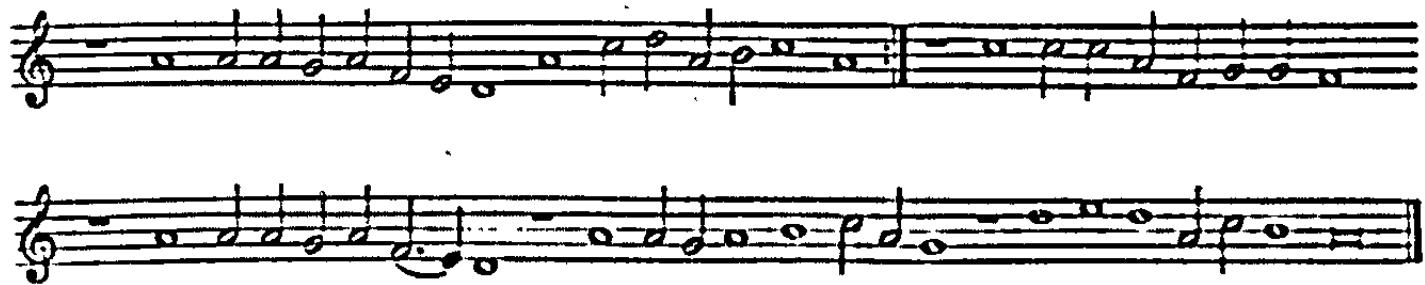
中文讲解
此为乐谱/图像占位符,对应Example 1,呈现"Durch Adams Fall ist ganz verderbt"的原旋律。原旋律据脚注29引自Peter Williams的The Organ Music of J. S. Bach(2003年第2版,第304页)。该图的存在让读者可以同步对照Buxtehude的处理与原始旋律形态。
补充说明
原图为内嵌图像数据,当前文本不可见;图注保留。需查看原图以确认旋律记谱形态及其与正文所论修辞分析的对应位置。
第3段(P0067)
原文复述
Buxtehude’s treatment of the chorale follows the pathos-laden character of the text inherent in the first stanza of the hymn, and although later stanzas convey the sense of redemption and the hope for salvation through Christ, it was probably the allegory of the first stanza that the composer illustrated when he set harmony to the chorale melody. In Buxtehude’s chorale preludes, the first and second line of the chorale are repeated with different harmonization, in contrast to the chorale preludes from the Orgelbüchlein, where Bach simply indicates a repetition of the first two lines.
中文讲解
本段阐明Buxtehude选择第一段歌词的依据:圣咏后几段虽然传达救赎与希望,但作曲家所配和声更可能针对第一段中"因Adam堕落而败亡"的寓意。“pathos-laden”(充满悲怆)说明Buxtehude选材的方向——把音乐悲情与歌词悲情对齐。最后一句是与Bach的对比:Buxtehude的前两行圣咏用不同和声重复处理,而Bach在《Orgelbüchlein》中仅以记号提示重复,并未改写和声。这一对比提示Buxtehude通过和声改写深化修辞表现,而Bach追求的是更克制的呈现方式。脚注30为此处的判断提供Spengler 1524年原诗文本及英译。
补充说明
脚注30给出Lazarus Spengler 1524年原诗第一段及英译,为下文的逐句音乐分析提供文本依据。
第4段(P0068)
原文复述
[Footnote 25] Bernhard, Von der Singe-Kunst oder Manier, §31 (Hilse, p. 21).
中文讲解
脚注25,引自Johann Bernhard的Von der Singe-Kunst oder Manier第31节(Hilse编校本第21页)。这是对前文cantar d’affetto概念的德语修辞学/歌唱学文献来源。
补充说明
该脚注属于前文背景论述的旁证;为前文cantar d’affetto的定义提供德语一手文献依据。
第5段(P0069)
原文复述
[Footnote 26] ibid., §32 (Hilse, p. 21).
中文讲解
脚注26,同上书第32节(同前页)。与脚注25连续,表明cantar d’affetto概念在Bernhard著作中有相邻条目的界定支撑。
补充说明
与脚注25同源,构成对cantar d’affetto连续论述的文献支撑。
第6段(P0070)
原文复述
[Footnote 27] Christoph Wolff, ‘Buxtehude, Bach, and Seventeenth-Century Music in Retrospect’, in his Bach: Essays on his Life and Music (Cambridge, MA: Harvard University Press, 1991), pp. 39-55 (pp. 46-47).
中文讲解
脚注27,引Christoph Wolff《Buxtehude, Bach, and Seventeenth-Century Music in Retrospect》一文,收于其Bach: Essays on his Life and Music(哈佛大学出版社,1991),第39-55页,此处指第46-47页。该文为前文"Buxtehude众赞歌前奏曲展示word-painting"判断提供学术支持。
补充说明
Wolff文章比较Buxtehude与Bach,是本节关键二手文献来源。
第7段(P0071)
原文复述
[Footnote 28] Snyder, Dieterich Buxtehude: Organist in Lübeck, p. 269.
中文讲解
脚注28,引Kerala J. Snyder的Dieterich Buxtehude: Organist in Lübeck第269页。该书是Buxtehude研究的权威专著,为BuxWV 183原始旋律源自宗教改革时期的判断提供来源。
补充说明
Snyder专著为Buxtehude生平与作品研究的核心文献;此处仅作为旋律年代判定的支持。
第8段(P0072)
原文复述
[Footnote 29] Adopted from Peter Williams, The Organ Music of J. S. Bach, 2nd edn (Cambridge: Cambridge University Press, 2003), p. 304.
中文讲解
脚注29,说明Example 1(原旋律谱例)系采用自Peter Williams, The Organ Music of J. S. Bach第2版(剑桥大学出版社,2003年)第304页。
补充说明
该脚注解释Example 1的来源;注意此处为Williams关于Bach管风琴音乐的著作,而非Buxtehude专著。
第9段(P0073)
原文复述
[Footnote 30] The first stanza of Lazarus Spengler’s hymn (1524) is as follows: Durch Adams Fall ist ganz verderbt/ menschlich Natur und Wesen/ dasselb Gift ist auf uns geerbt/ dass wir nicht konnten gnesen/ ohn Gottes Trost, der uns erlöst/ hat von dem grossen Schaden/ darein die Schlang Eva bezwang/ Gottes Zorn auf sich zu laden. English translation: Through Adam’s fall is totally spoiled/ all human nature and being/ the same poison is bequeathed to us/ from which we cannot be delivered/ without the solace of God, who has/ redeemed us from the great disgrace/ by which the serpent forced Eve/ to draw God’s anger down upon herself. See Williams, The Organ Music of J. S. Bach, p. 304.
中文讲解
脚注30引出Lazarus Spengler 1524年圣咏第一段的德语原文及英文翻译,并附英译来源(Williams, p. 304)。这是本节音乐分析所对应的完整歌词文本。逐句内容:‘Durch Adams Fall ist ganz verderbt’(人的本性因Adam的堕落全然败坏);‘menschlich Natur und Wesen’(人类的天性与本质);‘dasselb Gift ist auf uns geerbt’(同一毒害遗传到我们身上);‘dass wir nicht konnten gnesen’(无人能自行康复);‘ohn Gottes Trost, der uns erlöst’(若无上帝安慰,无人能得救赎);‘hat von dem grossen Schaden’(脱离如此重大损害);‘darein die Schlang Eva bezwang’(蛇所诱骗Eve陷入);‘Gottes Zorn auf sich zu laden’(承担上帝的愤怒)。本节P0074和P0076的分析将明确指向这些歌词片段。
补充说明
脚注30既给出歌词文本,又为后文"ganz verderbt"等具体歌词片段的修辞分析提供完整上下文。
第10段(P0074)
原文复述
Adam’s fall is illustrated in the second bar of the first line of the prelude with a salto semplice (a leap of a perfect fifth) in the bass, acting as a hypotyposis figure (the representation of the sense of fall), which is also intensified by the expressive rest before the first pedal note (tmesis). The same illustration in the bass, commencing with a tmesis and followed by two salti semplici occurs two bars later (bars 4-5, where the cantus firmus sings the phrase ‘ganz verderbt’), resulting in an anaphora (repetitio).
中文讲解
本段进入具体小节分析,揭示第一行歌词(Durch Adams Fall…)的音乐修辞映射。两个核心手法:(1) 第2小节低音的纯五度跳进(salto semplice)作为hypotyposis(情景呈现)——音乐跳进摹拟"堕落"的物理动势;该跳进前的延音休止(tmesis,修辞性停顿)进一步强化张力。(2) 第4-5小节(cantus firmus唱"ganz verderbt"时)低音先以tmesis起始,再以两个salto semplici收束,构成anaphora(repetitio,反复)——把"完全败坏"的内容以重复手法放大。两个手法叠加:hypotyposis呈现"坠入"姿态,anaphora以重复强化"全然"的语义强度。值得注意:本段是首次同时调用三个拉丁文修辞学术语(hypotyposis、tmesis、anaphora),是理解后续分析的概念基础。
补充说明
salto semplice、hypotyposis、tmesis三个术语在P0077、P0078脚注中将得到进一步界定。
第11段(P0075)
原文复述
[Example 2. BuxWV 183: Durch Adams Fall ist ganz verderbt (bars 1-7) (内嵌图像数据已省略;位置与图注保留)]

中文讲解
Example 2的乐谱/图像占位符,呈现BuxWV 183的第1-7小节,对应P0074与P0076前半段所讨论的音乐修辞实例。脚注33说明本节所有谱例与小节号均引自Beckmann编辑的Buxtehude管风琴作品全集第3卷(Choral Settings A-Ma,1995年修订版)。
补充说明
原图为内嵌图像数据,当前文本不可见。读者需对照原谱确认:第2小节低音纯五度跳进、第3小节前的休止、第4-5小节的两次跳进、第5-7小节内声部的延留与解决。
第12段(P0076)
原文复述
The first line concludes in bar 5, where the two inner voices illustrate a free transition to the next phrase with suspensions (syncopatios) followed by decorative resolutions in the tenor heard four times in a descending sequence (climax). Additionally, the dissonances occurring between the tenor and the alto on the accented beats (starting from the third beat of bar 5 until the second beat of bar 7), illustrate the figure commissura/ transitus irregularis (or symblema). The chorale melody enters again in bar 7, while in bars 9-10 the auxesis (incrementum) figure is illustrated with the vehement stepwise repetition of the first motive of the discant (bar 9); the same figure (auxesis) also occurs in the inner voices (starting from the third beat of bar 9), reinforced by the expressive rest before each quaver chord (tmesis). After the end of the second line, the chorale melody is announced in the bass (vorimitation technique, bars 11-12), before the introduction of the third line (bars 13-17), illustrating the paronomasia figure.
中文讲解
本段是本节最密集的技术分析,依次揭示三组修辞手法:(1) 第5小节两内声部用延留(syncopatio/syncopatios——注:原文为拉丁语变格形式)推动转句,次中音随后以四次下行级进装饰性解决构成climax(高潮/渐进),呈现张力积累;(2) 第5小节第3拍到第7小节第2拍间,次中音与上声部在重拍上的不协和音构成commissura/transitus irregularis(即symblema),即通过不规则声部进行形成连续的不协和对照;(3) 第7小节圣咏旋律再次进入;第9-10小节高音旋律的动机级进反复形成auxesis(incrementum,增益),同时内声部也通过休止(tmesis)后紧接八分音符和弦再现auxesis;第11-12小节圣咏先在低音出现(vorimitation,先行模仿),第13-17小节引入第三行,体现paronomasia(双关/同音异义)。整体思路:每个修辞手法都对应一个具体的音乐技术点(延留、下行级进、不协和重拍、动机反复、先行模仿),文本中"lust verderbt"等"全然败坏"语义被多层次修辞映射强化。
补充说明
本段调用大量修辞学术语,读者宜按"先理解拉丁术语含义,再对照具体小节与声部"的次序阅读。术语commissura、transitus irregularis、symblema为同一修辞范畴的不同命名;auxesis即incrementum;paronomasia在音乐修辞中通常对应动机或音型的反复/变化重复。
第13段(P0077)
原文复述
[Footnote 31] Tmesis, a figure of silence, illustrates expressive rests, which, according to Athanasius Kircher, serve “to express the effect (Affekt) suspirantis animae ‘of a sighing of a spirit.’” See Athanasius Kircher, Musurgia universalis (1650), Part 2, para. 8, p. 144, cited in Benitez, ‘Musical-Rhetorical Figures in the Orgelbüchlein of J. S. Bach’, p. 10. See also Peter Reichert, ‘Musikalische Rhetorik in den Choralvorspielen von Dietrich Buxtehude’, Acta Organologica, 24 (1994), 145-84 (p. 164).
中文讲解
脚注31对P0074、P0076中的tmesis(“插入/分离”,此处作"休止之图")进行界定:它是"沉默的修辞",通过表达性休止来呈现。Athanasius Kircher在1650年Musurgia universalis第二部分第8节第144页中将其界定为用以表达"灵魂叹息"(suspirantis animae)的效果,引文为Benitez研究Bach《Orgelbüchlein》文章所转引(p. 10)。另参Peter Reichert关于Buxtehude圣咏前奏曲音乐修辞的专文(Acta Organologica, 24卷,1994年,第145-184页,此处p. 164)。该脚注把P0074的低音休止与P0076内声部的休止都纳入"叹息"情感范畴,与歌词的悲剧性对应。
补充说明
tmesis在Kircher体系中属"沉默类"修辞,其情感内涵(affectus suspirantis animae)将作曲家所意图唤起的悲怆与文本语义对齐。
第14段(P0078)
原文复述
[Footnote 32] The anaphora (repetitio) describes a general form of repetition, while different definitions have been given by different authors. Burmeister restricted the anaphora to the repetition of a bass line, Nucius (Musices poeticae) described anaphora as a repetition of a theme in the same voice but on different pitches, while according to Kircher (Musurgia universalis, Book 8, p. 144), “[…] anaphora or repetitio occurs when a passage is frequently repeated for emphasis’s sake. It is often used in vehement affections such as ferocity or scorn, as exemplified in a composition based on the text […]” (cited and translated by Bartel, p. 188).
中文讲解
脚注32对P0074的anaphora(repetitio,反复)给出多家定义:Burmeister将其限定为低音线的重复;Nucius在Musices poeticae中将其界定为"同一声部、不同音高上的主题重复";Kircher在Musurgia universalis第8册第144页给出最宽的定义:“anaphora或repetitio指为强调而频繁重复的段落,常用于激烈情感如凶猛或蔑视”(引自Bartel译本第188页)。三家的范围宽窄不一,说明这一术语在17世纪修辞学传统中尚未统一。本节作者采用Kircher较宽的定义,将BuxWV 183第2小节与第4-5小节低音跳进的相似性视为"为强调而重复",对应歌词"ganz verderbt"(全然败坏)的语义强度。
补充说明
三家定义揭示出17世纪音乐修辞学的术语流动性;本节在具体分析中实际采用宽义(Kircher),故对重复的认定并不局限于低音。
第15段(P0079)
原文复述
[Footnote 33] Unless otherwise noted, the examples and bar numbers given are drawn from Beckmann’s edition of Buxtehude’s chorale preludes; see Dietrich Buxtehude, Sämtliche Orgelwerke, ed. by Klaus Beckmann, rev. edn, vol. 3, Choral Settings A-Ma (Wiesbaden: Breitkopf & Härtel, 1995).
中文讲解
脚注33为版本说明:除非另有标注,本节所有谱例与小节号均依据Klaus Beckmann编辑的Buxtehude管风琴作品全集第3卷(Choral Settings A-Ma,Breitkopf & Härtel出版社,1995年修订版)。这意味着本节所有"第几小节"的定位都建立在这套权威版本上,读者若查阅其他版本需注意小节差异。
补充说明
脚注33保证全节分析的可复现性;如对照其他Buxtehude圣咏前奏曲版本(如Breitkopf旧版或Bärenreiter版),小节号可能略有出入。
脚注 / 边栏 / 图表 / 附加信息(如有)
本节包含三处图像占位符:Example 1(原旋律,引自Williams 2003版,第304页)与Example 2(BuxWV 183第1-7小节,引自Beckmann版第3卷)。两例均不可在当前文本中显示,需查阅原图。其余非正文材料为七条脚注(25-31号及32、33号),构成三层支撑:(1) 文献源头(Bernhard、Wolff、Snyder、Williams)为前文判断提供学术依据;(2) 术语界定(Kircher、Burmeister、Nucius)为P0074与P0076所用修辞术语给出古典权威定义;(3) 版本说明(Beckmann版)为小节号定位确立标准。三层功能分明,无重复。
💡 本节核心要点
- BuxWV 183作为Buxtehude众赞歌前奏曲中cantar d’affetto的典范,通过"词画"手法将圣咏第一段的"堕落"寓意以音乐修辞呈现。
- 第一行圣咏的核心修辞映射:第2小节低音纯五度跳进(salto semplice)作为hypotyposis摹拟坠入姿态,配以tmesis(表达性休止)形成"叹息"效果;第4-5小节(‘ganz verderbt’处)重复此跳进手法构成anaphora,强化"全然败坏"的语义强度。
- 第一行结束至第二行的转句处理:内声部以延留(syncopatios)与下行装饰性解决形成climax;次中音与上声部在重拍上的连续不协和构成commissura/transitus irregularis(symblema)。
- 圣咏旋律在第7小节再入后,第9-10小节以动机级进反复与休止强化呈现auxesis(incrementum);第11-12小节低音先行模仿(vorimitation)后,第13-17小节引入第三行,体现paronomasia。
- Buxtehude与Bach的关键差异:前者对前两行圣咏用不同和声重复处理,后者《Orgelbüchlein》仅以记号提示重复——Buxtehude通过和声与修辞手法的多重叠加深化情感表现。
- 本节术语来源:tmesis依Kircher Musurgia universalis,anaphora兼采Burmeister、Nucius、Kircher三家定义(实际采用Kircher宽义),所有小节号以Beckmann 1995修订版为标准。
🔑 关键术语
- word-painting:音乐对歌词语义的直接描绘。本节中Buxtehude通过和声、跳进、休止等手法具体映射"堕落"与"败坏"的词义。
- stilus phantasticus:北德管风琴学派的即兴性、自由对位风格。Buxtehude在众赞歌前奏曲中结合此风格与路德宗圣咏,形成本节所论的"词画"基础。
- cantar d’affetto:前文已界定的"情感化歌唱"风格;本节将BuxWV 183定性为该风格在Buxtehude作品中最贴近的范例。
- salto semplice:纯五度跳进;本节第2小节与第4-5小节低音出现此跳进,作为hypotyposis摹拟"堕落"姿态。
- hypotyposis:情景呈现修辞;通过纯五度跳进在低音摹拟"坠入"的物理动势。
- tmesis:插入/分离修辞,此处指"沉默之图";Kircher界定为表达"灵魂叹息"(suspirantis animae)的效果。本节中体现为低音跳进前的休止及内声部auxesis中的休止。
- anaphora (repetitio):反复修辞;Kircher定义为"为强调而频繁重复"。本节第2小节与第4-5小节低音跳进的相似性被界定为该手法。
- syncopatio(s):延留;本节第5小节内声部用延留推动自由转句。注:原文为拉丁语变格形式。
- climax:高潮/渐进;本节指次中音四次下行级进装饰性解决形成的渐进。
- commissura / transitus irregularis / symblema:不规则声部进行;本节指第5小节第3拍至第7小节第2拍间次中音与上声部在重拍上的连续不协和。
- auxesis (incrementum):增益修辞;本节体现为第9-10小节高音旋律动机的级进反复,以及内声部在休止后八分音符和弦的反复。
- vorimitation:先行模仿;本节第11-12小节圣咏旋律先在低音出现,作为第三行正式进入前的准备。
- paronomasia:双关/同音异义修辞;本节中对应第三行(bars 13-17)的引入手法。
2.5 [描述性拆分] Durch Adams Fall: The Third Chorale Line and the Passus Duriusculus / Parrhesia
第1段(P0080)
原文复述
Example 3. BuxWV 183: Durch Adams Fall ist ganz verderbt (bars 8-23). [Embedded image data omitted; caption and location preserved.]
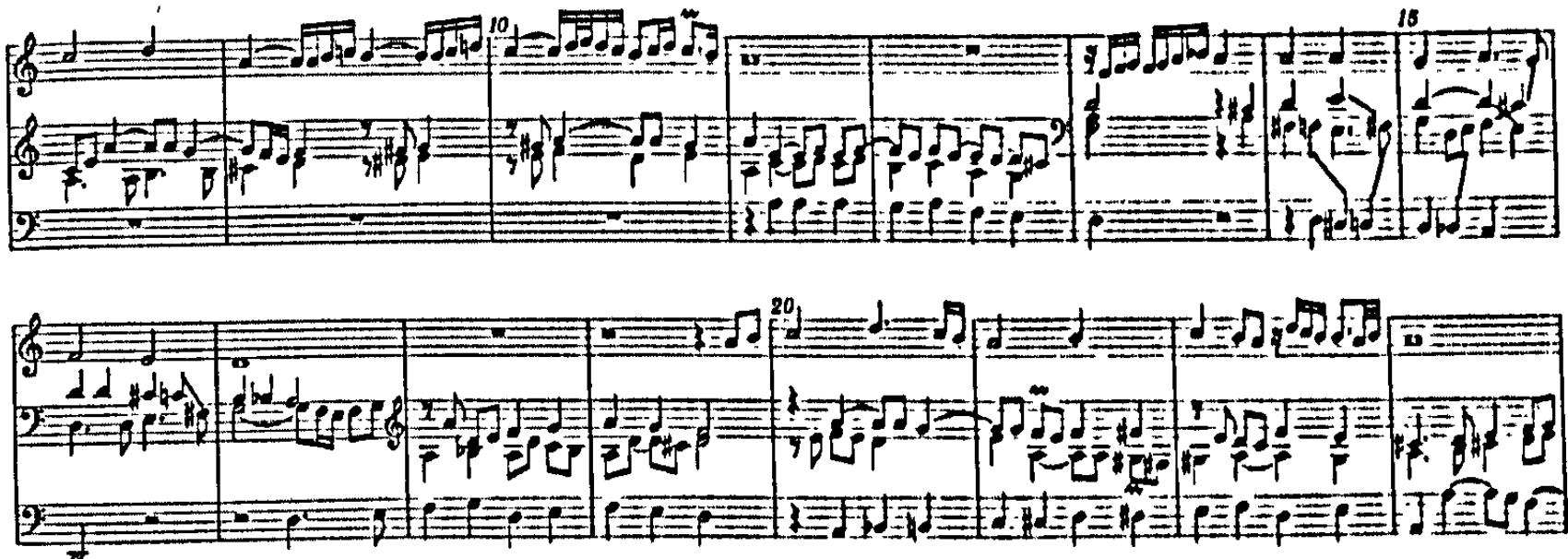
中文讲解
这是图例3(Example 3)的标题,标注了所引用的乐谱为Buxtehude的众赞歌前奏曲BuxWV 183,节选范围为第8至第23小节。该范围对应紧随其后的正文段落所分析的第三句众赞歌歌词(‘dasselb Gift ist auf uns geerbt’)。由于内嵌图像数据已省略,读者需查阅原书以查看实际乐谱与谱例内容;标题本身仅起版面定位作用,说明此处插入了与正文分析对应的谱例。
第2段(P0081)
原文复述
The third chorale line ‘dasselb Gift ist auf uns geerbt’ (’the same poison is bequeathed to us’) is introduced by a free embellishment beginning on the downbeat (bar 13), of which the semiquaver rapid passage spanning a fourth (f-b’ flat) illustrates a maniera called tirata mezza. 38 The chorale line is dominated by the descending chromatic-moving figure in the bass (bars 14-15), known as passus duriusculus, which is taken up by the alto in the following bars 16-17 (polyptoton). 39 The passus duriusculus is further reinforced by the parrhesia figure, giving rise to dissonances known as relationes non harmonicae, in other words the false relations that occur between the voices in the diagonal position, illustrated by the minor sevenths and the augmented and diminished intervals in bars 14-16. 40 Regarding the theological symbolism of this particular figure, the parrhesia has been related to the depiction of human sin and corruption, and in this case it has been interpreted as a symbolism of the forbidden freedom (licentia) that Adam and Eve dared to take. 41 The relationes non harmonicae inherent in the parrhesia were described by Christoph Bernhard in the second chapter of his Tractatus (Of the General Rules of Counterpoint), in which he commented that “voices should not have false relations with one another, such as a tritone, a diminished fifth, an augmented octave, etc.” 42
中文讲解
本段是本小节的分析核心,将四个修辞格(musical-rhetorical figures)同时叠加到第三句众赞歌之上。其中心主张是:Buxtehude通过多层次的修辞手法,将’被继承的毒’这一神学命题转化为听觉上可感知的’越轨’。具体而言:(1)tirata mezza以强拍起始的快速十六分音符四度进行(f–降b)作为引入装饰;(2)bass在14-15小节的半音下行是passus duriusculus(‘艰难的下行’),随后在16-17小节由alto在不同音高上承接,构成polyptoton(‘重复’);(3)passus duriusculus又由parrhesia强化,产生relationes non harmonicae——也就是对位声部在斜向进行(diagonal position)中形成的小七度、增音程与减音程等假关系;(4)这些被禁忌的不协和被赋予神学含义,象征Adam与Eve所敢于窃取的’禁自由’(licentia)。Bernhard的引文是规范的对比项:他的对位通则明令禁止声部之间出现三全音、减五度、增八度等假关系;Buxtehude恰恰在passus duriusculus段落公然违反此规则,以音乐上的’违规’呼应神学上的’违规’(原罪)。本段接续上文第二句的修辞词汇,将之推向更集中、更密集的修辞-神学并置。
补充说明
四个figure之间的关系是层级化的:passus duriusculus提供bass的半音下行骨架,parrhesia在此骨架上叠加禁忌不协和,relationes non harmonicae则是实际产生的不协和音程;polyptoton描述的是alto在16-17小节对bass的音高移位承接,属于结构层面的重复技巧,而非音色层面。
第3段(P0082)
原文复述
35 Nucius (Musices poeticae) describes commissura directa as “[…] a dissonance on the downbeat that is nonetheless admitted on account of the following consonance, which usually occurs in all formal cadences and in syncopationes” (cited and translated by Bartel, p. 419). See also Peter Reichert, ‘Musikalische Rhetorik’, p. 164. Both the commissura and the transitus irregularis describe dissonances that occur on the beat and should only descend, while all the uneven parts of the bars (in thesis) must be consonant.
中文讲解
本脚注给出commissura directa的技术定义:一种出现在强拍上的不协和音,由于其后跟随协和音而被允许,常见于正式终止与syncopationes中。注释并对比transitus irregularis:两者都描述强拍上的不协和,且必须下行;弱拍部分(in thesis)则必须协和。本脚注实际服务于前一小节对第二句众赞歌的commissura讨论;其出现在第14页是印刷排版的物理位置,而非本节论证的直接组成部分。
第4段(P0083)
原文复述
36 According to Walther (Musicalisches Lexicon, Faksimile-Nachdruck, 1953, p. 60), “the auxesis occurs when a passage or a melody is repeated twice or three times, while at the same time, however, always rising higher”, translated by Bartel, pp. 211-12. Burmeister, in his Musica poetica, had already referred to the auxesis in vocal music: “The auxesis occurs when the harmonia grows and increases with a single, twofold, threefold, or further repetition only of combined consonances [noema] using one and the same text” (Musica poetica, p. 61, cited and translated by Bartel, p. 211). It is the auxesis (incrementum) that creates the sense of incremental growth in this section, rather than the climax (gradatio) figure. For the aesthetic differences between the auxesis and the climax, see Bartel, pp. 209-10.
中文讲解
本脚注定义auxesis为’反复两次或三次但每次都升高’的修辞格,分别引证Walther的《音乐辞典》(1953年影印版第60页)与更早的Burmeister《Musica poetica》。作者明确:第二句众赞歌中产生的’递增’感来自auxesis(又称incrementum),而非gradatio(climax,高潮格)。两者的差异在于:auxesis通过同一片段在不同音高上的反复来制造渐进扩张;gradatio则通过其他手段制造顶点式高潮。
补充说明
脚注末尾’For the aesthetic differences between the auxesis and the climax, see Bartel, pp. 209-10’将读者引向Bartel对两者修辞差异的进一步讨论,是参考文献性指引。
第5段(P0084)
原文复述
37 According to Forkel (Allgemeine Geschichte der Musik, p. 57) “the paronomasia does not repeat a passage just as it already occurred but rather with new and powerful additions. These additions might apply either to single notes or can also be effected through a stronger or a weaker delivery” (cited and translated by Bartel, p. 352). As Scheibe commented in his Der critische Musikus (p. 691), “in any case, however, the repetition must strengthen the emphasis of the expression and must lend it a singular beauty” (cited and translated by Bartel, p. 352).
中文讲解
本脚注定义paronomasia为’带新而有力之添加的重复’,引证Forkel《音乐通史》第57页与Scheibe《批评的音乐家》第691页。其与简单重复的关键区别在于:paronomasia必须通过附加(无论是单音的添加还是力度的强弱变化)来强化表达,并赋予重复以独特之美。该脚注服务于前一小节对第二句众赞歌paronomasia的讨论,提供权威原始来源。
第6段(P0085)
原文复述
Example 4. False dissonances according to C. Bernhard (adopted from Hilse, p. 33). [Embedded image data omitted; caption and location preserved.]

中文讲解
这是图例4(Example 4)的标题,呈现Bernhard所列的假不协和(false dissonances)谱例,采自Hilse编辑本第33页。由于内嵌图像数据已省略,读者需查阅Hilse所版本以查看实际记谱——其中应包括三全音、减五度、增八度等被禁忌的音程形式。该图例在视觉上锚定正文段落P0081所引Bernhard《Tractatus》第二章第12节的规则条文。
第7段(P0086)
原文复述
After the end of the third line (bar 17), the bass again introduces the chorale melody, which is repeated by the soprano two bars later with rhythmical and metrical alterations, transposed up a fifth (polyptoton). Just as in the previous phrase, the passus duriusculus appears once more in the bass spanning the interval of a minor sixth from bar 20 to bar 22 (‘dass wir nicht konnten gnesen’, ‘from which we cannot be delivered’). The dramatic character of the section culminates in the aposiopesis figure, 43 described by the expressive rest in the cantus firmus before the cadence (bar 22).
中文讲解
本段将分析推进至第四句众赞歌。其要点有三:第一,第17小节之后bass再次引入众赞歌旋律,两小节后由soprano以节奏与节拍变化在高五度上重复——这一重复同样被标为polyptoton,与前一句中alto对bass的承接使用同一修辞格;第二,passus duriusculus在小六度音程上(第20-22小节)再度出现,形成跨越全曲的半音下行修辞延续;第三,本段戏剧性顶点由aposiopesis(‘突然中断’)修辞格实现,具体形式为第22小节终止式前众赞歌旋律(cantus firmus)中的一个表情性休止。该休止与修辞学中的aposiopesis(言语突然中断)形成类比,制造出戏剧性的悬停瞬间,使’我们无法被解救’这一神学困境获得极具张力的听觉表达。
补充说明
aposiopesis修辞格对应的脚注43未在本节输入范围内出现,应在下一节中给出。第20-22小节passus duriusculus的回归维持了第三句建立的半音下行修辞母题,构成全曲修辞上的连续性。
第8段(P0087)
原文复述
38 Bartel, p. 409. The tirata is also used, more effectively, in the final chorale line (see pp. 143-44 of this chapter).
中文讲解
本脚注短小,仅引证Bartel第409页作为P0081中tirata修辞格的来源,并预告:tirata还出现在全曲最后一句众赞歌中(第143-44页),且使用得’更有效’。这暗示Buxtehude对众赞歌前奏曲修辞格的部署贯穿全曲并在末句达到修辞强度的顶点。
第9段(P0088)
原文复述
39 The polyptoton is encountered only in Vogt’s Figurenlehre and is used to describe the repetition of a passage at different pitches; see Bartel, pp. 367-69.
中文讲解
本脚注说明:polyptoton这一figure名称仅见于Vogt的《Figurenlehre》,在作者所参考的修辞格文献中为孤例;其含义为’在不同音高上重复同一片段’。引Bartel第367-69页供读者深入查阅。该脚注澄清了P0081与P0086中alto与soprano对前一声部旋律的承接为何使用同一figure名。
第10段(P0089)
原文复述
40 The parrhesia (licentia in Latin) is described as a brief musical freedom, illustrating forbidden dissonances within the contrapuntal texture, such as tritones, augmented and diminished intervals, and cross relations that occur in such a way that they do not offend the listener. For the definition of the parrhesia with all references to Baroque treatises, see Bartel, pp. 352-56. The parrhesia is also illustrated by J. S. Bach in his treatment of the same melody Durch Adams Fall (BWV 637) in the Orgelbüchlein.
中文讲解
本脚注定义parrhesia(拉丁文同义词licentia)为’短暂的音乐自由’,即在对位织体中引入禁忌不协和——三全音、增音程、减音程与交叉关系——而仍不冒犯听者。引Bartel第352-56页供完整定义及巴洛克文献溯源。本脚注最具延伸性的一句是:J. S. Bach在《Orgelbüchlein》中对同一首众赞歌旋律Durch Adams Fall(BWV 637)的处理同样使用了parrhesia figure。该跨作曲家参照强化了parrhesia作为描绘罪恶与禁自由之公认修辞传统的地位。
第11段(P0090)
原文复述
[1]
中文讲解
本段仅含标记’[1]’,似为孤立的脚注编号占位符或OCR残留,未对应本节输入范围内的任何脚注正文。在印刷原书中这可能是一个脚注标记,但其注释文本未包含在当前输入中。
第12段(P0091)
原文复述
Parrhesia figure, as illustrated by J. C. Gottsched in his Ausführliche Redekunst, cited in Hugo Riemann, Musik Lexikon: Sachteil, ed. by Wilibald Gurlitt (Mainz: B. Schott’s Söhne, 1967, p. 706): parrhesia “[…] wird meist zur Darstellung des Verderbten, Schwankenden, Widrigen und Sündhaften verwendet […].”
中文讲解
本脚注为P0081中parrhesia神学象征含义的原始来源,引证J. C. Gottsched《Ausführliche Redekunst》中的定义(经Hugo Riemann《Musik Lexikon》Sachteil 1967年版第706页转引)。德文原文指出:parrhesia’主要用于描绘堕落的、动摇的、令人反感的以及有罪的事物’。该引文确证了Buxtehude在第三句众赞歌(讲述由Adam之罪继承的毒)中采用parrhesia figure,乃是一种与传统修辞-神学联想相契合的有意选择——‘禁自由’的神学内涵正好对应修辞格的传统用法。引文链(Gottsched→Riemann→Bartel)解释了为何出处信息中同时出现两部著作。
补充说明
Gottsched的Ausführliche Redekunst通过Riemann的Musik Lexikon转引而非直接引用,故出处信息中包含两部著作。
第13段(P0092)
原文复述
42 Bernhard, Tractatus, Chapter 2, §12, as it appears in Hilse, p. 33.
中文讲解
本脚注为简短的文献定位指引,精确指向P0081中Bernhard引文的所在位置:《Tractatus compositionis augmentatae》第二章第12节,按Hilse编辑本第33页的呈现形式。该脚注为Bernhard关于’声部之间不应有假关系’的规范对位规则提供了原始文献锚点,正是Buxtehude的passus duriusculus与parrhesia段落为表现目的而公然违反的规则。
脚注 / 边栏 / 图表 / 附加信息(如有)
本小节含两幅内嵌图:图例3(P0080,BuxWV 183第8-23小节乐谱)与图例4(P0085,Bernhard假不协和谱例,采自Hilse第33页),均因内嵌图像数据省略需查原书。第14页物理位置上同时承载脚注35(P0082)、脚注36(P0083)、脚注37(P0084),但其内容实际上服务于前一小节对第二句众赞歌commissura、auxesis、paronomasia的讨论,因页码边界而落入本节范围。脚注41(P0091)通过Gottsched德文原文为parrhesia的神学象征(描绘堕落的、有罪的)提供了权威的巴洛克修辞传统依据。段落P0090仅含标记’[1]’,疑为孤立的脚注编号占位符或OCR残留,无对应正文。脚注43(aposiopesis)虽在本节正文P0086中被引用,但其内容未包含在当前输入范围内。
💡 本节核心要点
- 第三句众赞歌(Durch Adams Fall BuxWV 183)由四个层级化修辞格共同塑造:tirata mezza(强拍起始的快速引入)、passus duriusculus(bass半音下行)、polyptoton(alto在不同音高上的承接)、parrhesia(禁忌不协和的引入)。
- passus duriusculus与parrhesia共同产生relationes non harmonicae——对位声部斜向进行中的假关系(小七度、增音程、减音程),Buxtehude有意违反Bernhard《Tractatus》第二章第12节的规范对位规则,以音乐违规呼应神学违规(原罪)。
- parrhesia figure的神学象征根植于巴洛克修辞传统(Gottsched):用于描绘堕落的、动摇的、令人反感与有罪的事物;本节将其解释为Adam与Eve所敢于窃取之’禁自由’(licentia)的音乐-神学类比。
- 第四句众赞歌中各修辞格重现并强化:passus duriusculus在小六度音程(第20-22小节)上回归,形成贯穿全曲的半音下行修辞母题;本段戏剧性顶点由aposiopesis figure实现——终止式前众赞歌旋律中的表情性休止(第22小节),与修辞学中’言语突然中断’形成类比。
- 作者跨作曲家参照J. S. Bach《Orgelbüchlein》中对同一首旋律BWV 637的处理亦使用parrhesia figure,揭示出巴洛克作曲家之间共享的修辞-格传统。
- 本节论证策略是:将巴洛克修辞格文献中的规范定义(Bernhard、Gottsched、Walther、Burmeister、Forkel、Scheibe等)与具体乐谱实例一一对应,使音乐违规成为神学命题(被继承之罪、不可被解救)的修辞等价物。
🔑 关键术语
- tirata mezza:作为maniera(装饰性手法)的一种快速乐句,此处为第13小节起始、横跨四度(f–降b)的十六分音符进行,用作第三句众赞歌的装饰性引入;脚注38提示其在全曲末句使用得’更有效’。
- passus duriusculus:半音下行的bass修辞格(‘艰难的下行’)。在本节中于14-15小节支配第三句众赞歌,并在20-22小节以小六度音程再现于第四句,构成贯穿全曲的bass修辞母题,对应’被继承之罪’与’不可被解救’的神学命题。
- polyptoton:‘在不同音高上重复同一片段’的修辞格,此名称仅见于Vogt的Figurenlehre。本节中用于描述alto在16-17小节对bass半音下行的音高移位承接,以及soprano在第四句中将众赞歌旋律高五度重复并加节奏-节拍变化。
- parrhesia (licentia):‘短暂的音乐自由’,在对位织体中引入禁忌不协和(三全音、增音程、减音程、交叉关系)而不冒犯听者。其神学象征(依Gottsched《Ausführliche Redekunst》):描绘堕落的、动摇的、令人反感的、有罪的事物;此处被解释为Adam与Eve所敢于窃取之’禁自由’(licentia)。
- relationes non harmonicae:对位声部斜向进行中形成的假关系(false relations),即第14-16小节的小七度、增音程与减音程;由passus duriusculus与parrhesia共同产生。Bernhard《Tractatus》第二章第12节明令禁止此类声部间假关系。
- aposiopesis:修辞学中’言语突然中断’的figure,此处以第22小节终止式前众赞歌旋律(cantus firmus)中的表情性休止实现,标志本段戏剧性顶点。其对应脚注43的具体内容未包含在本节输入范围内。
2.6 [描述性拆分] Durch Adams Fall: Antitheton, Climax, and ‘Trost’ (Redemption Imagery)
第1段(P0093)
原文复述

中文讲解
本段为乐谱插图占位符,图注指示这是BuxWV 183《Durch Adams Fall ist ganz verderbt》的第24–30小节谱例,与下文P0094–P0095对该片段的分析直接对应。该谱例呈现的是副歌第五行前后三声部填充和声、以及旋律先后在低音与高音声部出现的情形。
补充说明
本图应为示例5的乐谱位置标记,需查看原图以确认具体音高与声部线条;其范围(bars 24-30)正好覆盖下文P0094末尾所提及的antitheton/climax区域以及P0095所述第五行起始部分。
第2段(P0094)
原文复述
From that point onwards (bars 23-24) until the fifth line, the bass, alto, and tenor fill in the harmony by illustrating the antithesis (antitheton or contrapositum), a figure in which the bass descends, while the tenor and alto ascend in stepwise progression. The ascending parallel thirds in the tenor and the alto also function as a climax (gradatio), “[…] a musical passage which ascends by step, and is often used in affections of divine love and yearning for the heavenly kingdom […]”, $^{44}$ influenced by the theological content of the next line, which emphasizes trust in God for man’s salvation.
中文讲解
本段承接P0092中已出现的aposiopesis(哑断)效果,说明自bars 23–24起直到第五行,副歌的三声部(低音、女低音、男高音)以antithesis(antitheton或contrapositum)这一音乐修辞图形来填充和声。其具体形态是低音下行,男高音与女高音则以级进方式上行。其中男高音与女高音两条上行的平行三度同时充当climax(gradatio)——一种按级数上行的乐段,依据Kircher的定义常用于表达神性的爱与对天国之渴慕的情感。作者指出,此处的图形选择受第五行神学内容的引导:该行强调人对上帝拯救之信靠,因此音乐用上行级进表现出"上升"与"向往"的修辞意涵。
补充说明
antitheton/contrapositum与gradatio两个修辞名目并非互斥,而是同一片段同时承担两种身份:低-高反向的声部进行构成antitheton,而男高音/女高音两条以平行三度上行的声部本身又构成gradatio。引用编号44指向下一页Kircher与Walther的定义脚注。
第3段(P0095)
原文复述
In the fifth line of the chorale (‘ohn Gottes Trost, der uns erlöst’), the melody is first heard in the bass (bar 25) with the application of syncopations (syncopatios), while the soprano almost immediately takes up the melody in a more embellished form (paronomasia). As an antithesis to the preceding climax, the descending movement of the bass (bars 25-29) spanning the interval of a tenth (catabasis) - the soprano and alto descend by a fifth and sixth respectively - also illustrates a hypotyposis figure, as a depiction of the word ‘Trost’ (solace), emphasizing man’s redemption through trust in God. The symbolism of the line is further depicted through the illustration of the word ‘Gottes’ (third beat of bar 26) with the faux bourdon or catachresis figure. This particular device employs two chords moving in parallel sixths and including the progression of a perfect to an augmented fourth between the alto and the tenor, a figure, which according to Werckmeister, was used to express sorrowful affections. $^{45}$
中文讲解
本段聚焦副歌第五行(“ohn Gottes Trost, der uns erlöst”)的多重音乐-修辞刻画。其主要分析可分四层:(1) 旋律声部换位——定旋律起初在低音(第25小节)出现,并加入syncopatios(切分);女高音声部紧接以更花哨的形式接过旋律,作者称之为paronomasia,即旋律的装饰性变体。(2) 与前文gradatio构成对照——低音出现跨十度的下行catabasis(bar 25-29),女高音、女低音分别下行五度与六度;这种下行在功能上是antithesis,但在修辞学层面又构成hypotyposis(描绘式图形),用以图形化"Trost(安慰)“一词,从而强调人因信靠上帝而得救赎。(3) 词-图关系再深化——“Gottes"一词(第26小节第三拍)以faux bourdon或catachresis图形来表现:两条声部以平行六度运动,和弦包含女低音与男高音之间由纯四度到增四度的进行。(4) 情感意义——依Werckmeister所述,这类进行常用于表达悲伤情感(sorrowful affections),因此作者将它读作对神性话语"Gottes"之庄严乃至痛楚感的描绘,与"安慰/救赎"主题相互支撑。
补充说明
同一片段以多重视角叠合:换位(paronomasia)、反向(antitheton)、行进方向(catabasis)、形象描写(hypotyposis)、纵向和声图形(faux bourdon/catachresis)。引用编号45对应P0100脚注,关于faux bourdon与catachresis两词之历史与定义。
第4段(P0096)
原文复述
43 According to Spiess (Tractatus, p. 155), “the aposiopesis, suppression, concealment, silence, occurs when either all voices are silenced through a general pause, or when a single voice stops and breaks off when it should actually continue to sing and progress into the appropriate cadence” (cited and translated by Bartel, p. 206).
中文讲解
本段为编号43的脚注,引用Spiess《Tractatus》第155页对aposiopesis(哑断、静默、掩饰)的定义:要么所有声部在全体停顿中沉默,要么单一声部本应继续进行到合适终止却突然中断。该定义由Bartel在第206页转引并翻译。它支撑正文中对bars 22-23处aposiopesis图形的认定,说明"哑断"在巴洛克音乐修辞中具体表现为乐句的中止或全休止。
补充说明
本注属正文P0092讨论bars 22-23哑断效果的来源脚注,属于支持性引证,而非新材料。aposiopesis与同段中提到的abruptio等概念在词源上同义,本注仅取Spiess一处说法。
第5段(P0097)
原文复述
$^{44}$ Kircher, Musurgia universalis, Book 8, p. 145, cited and translated by Bartel, p. 223. The same figure with the same function occurs also in the chorale prelude Ach Herr, mich armen Sünder (BuxWV 178). Walther (Musicalisches Lexicon, p. 172) summarizes the functions of the climax (gradatio) in the following definitions: “[…] a musical figure which occurs when two voices progress upwards and downwards by step in parallel thirds; […] when a passage with or without a cadence is immediately repeated several times at progressively higher pitches […]”, translated by Bartel, p. 224.
中文讲解
本段为编号44的脚注,从三方面补充正文P0094对gradatio/anthitheton的认定:(1) 来源——引Kircher《Musurgia universalis》第8册第145页,由Bartel在第223页转引并翻译;(2) 类比——同样的图形与功能亦出现于众赞歌前奏曲《Ach Herr, mich armen Sünder》(BuxWV 178),表明这是Buxtehude反复运用的手法;(3) 概念补足——Walther《Musicalisches Lexicon》第172页给出gradatio两层定义:两条声部以平行三度级进上行或下行;以及一个段落(无论是否有终止)被即时在更高音高上重复若干次。两条定义合起来恰好涵盖bars 23-24男高音/女高音平行三度上行的具体形态。
补充说明
本注将gradatio概念追溯至Kircher与Walther两家权威,且引入BuxWV 178作为同手法并置,强化"Buxtehude在Durch Adams Fall中所用手法并非孤例"的论断,但需注意该对比仅出自本注,作者未在正文展开分析。
第6段(P0098)
原文复述

中文讲解
本段为乐谱插图占位符,图注指示这是BuxWV 183《Durch Adams Fall ist ganz verderbt》的第31–37小节谱例,紧接P0099对该片段的修辞学分析。该谱例对应第六行的开始,以及bars 30-31处低音octave anabasis后接女低音、男高音的gradatio等关键修辞段落。
补充说明
示例6的范围(bars 31-37)对应P0099所讨论的中间段落及第六行前段,并涵盖bar 35终止;与示例5(bars 24-30)在时序上前后衔接。需查看原图方可核对音高与声部装饰细节。
第7段(P0099)
原文复述
In contrast to the descending movements that dominated all voices in the previous line, in the intermediate section (bars 30-31) the bass illustrates an anabasis figure that spans an octave, which is followed by similar progressions, first in the alto and then in the tenor (bars 31-32; climax, gradatio). After the introduction of the first four notes of the sixth line, the bass again introduces an antitheton figure through a catabasis - in contrast to the climax that just preceded - as an interpretation of the allegory of the word ‘Schaden’ (disgrace). The soprano accompanies the descending bass with the most ornamented version of the cantus firmus up to that point, consisting of a combination of tirata mezza and superjectio (accentus) figures $^{46}$ that dominate for two bars (33-34) leading to the cadence in bar 35.
中文讲解
本段聚焦第六行之前过渡段(bars 30-31)与第六行开头,分析分三层:(1) 与上行对照——在第五行全声部下行的背景下,bars 30-31先由低音展示跨八度的anabasis(上行),随后由女低音、男高音依序模仿(bars 31-32),构成又一次gradatio (climax);这与上一行末尾的下行态势形成强烈反差。(2) 下行/catabasis与hypobole——在引入第六行前四音后,低音再次以catabasis呈现antitheton,与紧接其前的gradatio构成对照;此处catabasis触及modus(音域/调式)的最低可行范围,故称hypobole,作者把它读作对"Schaden(耻辱/损害)“一词之隐喻的音乐化表现,即"下降至最低处"对应堕落/受损之意涵。(3) 旋律装饰——女高音在catabasis之上叠加了截至该处最为繁复的定旋律版本,结合tirata mezza与superjectio (accentus)两类图形,维持于bars 33-34两小节,然后进入bar 35的终止。该分析将"Schaden"的下行语义与"歌尾的终止"联系起来,使音乐修辞与神学寓意(受损与救赎)同步推进。
补充说明
本段涉及的多重图形堆叠方式,与P0094–P0095相近:同一段落同时被标记为anabasis→gradatio(上行段)以及antitheton→catabasis→hypobole(下行段);superjectio (accentus)的解释见编号46脚注(P0101)。hypobole的概念需结合"modus"指音域/调式系统理解,与P0095的hypotyposis词形相近但功能不同。
第8段(P0100)
原文复述
45 Starting from Joachim Burmeister, the term faux bourdon is first encountered in his figurae tam harmoniae quam melodiae in order to signify a progression of successive sixths, a term also known as simul procedentia, meaning “simultaneous progressions” (Bartel, p. 272). Thuringus was the first to describe the musical phenomenon with the rhetorical term catachresis (abusio) in order to refer to harsh progressions of parallel fourths in the harmonic texture. J. G. Walther, in his Lexicon (p. 149), described catachresis or abusio as “[…] an abuse or incorrect use. This occurs when a dissonance is resolved in an unusual and harsh manner. The progression of numerous successive fourths which are made acceptable through the bass is also called a catachresis. According to the Pythagoreans, fourths are also considered perfect consonances and therefore are not permitted to immediately follow each other”, translated by Bartel, p. 276.
中文讲解
本段为编号45的脚注,专门厘清faux bourdon与catachresis两个术语的来源与含义,对正文P0095中"Gottes"一词的图形化分析提供文献支持。(1) faux bourdon——最早见于Burmeister《figurae tam harmoniae quam melodiae》,用以指连续六度的进行,又称simul procedentia(同步进行);(2) catachresis (abusio)——由Thuringus首先以这一修辞学术语描述和声中平行四度等生硬进行的现象,暗示其为"误用/滥用”;(3) Walther综合定义——catachresis或abusio指不和谐音以异常、生硬方式解决的图形;当数个连续四度由低音保持支持而变得可接受时,亦称catachresis;又援引毕达哥拉斯传统说明四度本身被视为完全协和音程故不应紧接出现。作者据此将女低音-男高音间由纯四度到增四度的进行定性为catachresis,并赋以悲伤情感(Werckmeister之见)。
补充说明
本注显示faux bourdon与catachresis在17世纪术语系统中既相关又有区别:faux bourdon强调六度平行,catachresis强调四度平行之生硬,但二者皆可视作同一"化平行为可接受"传统的不同名称。作者在正文中将两词并列于"Gottes"一处,融合两种传统。
第9段(P0101)
原文复述
$^{46}$ According to Christoph Bernhard (Tractatus, Chapter 22, §1), “superjectio, otherwise generally called accentus, occurs when a note is placed next to a consonance or dissonance, a step above. This happens most often when the notes should naturally fall a second”, as it appears in Hilse, p. 92.
中文讲解
本段为编号46的脚注,援引Bernhard《Tractatus》第22章第1节关于superjectio(亦通称accentus)的定义:在协和或不协和音的上方邻接一音,按级进行;最常见于本应自然下行二度的位置。该定义由Hilse在第92页转录。脚注直接支撑P0099末句将女高音部分解读为superjectio(accentus)的论断,即在定旋律本应下行的位置上以紧邻上方的装饰音进行,从而形成"应下行而未下行"的强调效果。
补充说明
superjectio与accentus两词在该定义中等价;本注仅提供Bernhard一家之说,与P0097中Kircher、Walther的gradatio定义形成术语来源上的分工。
脚注 / 边栏 / 图表 / 附加信息(如有)
本节包含两处谱例占位符(Example 5:bars 24-30;Example 6:bars 31-37)以及四条编号脚注(43–46)。谱例用于可视化bars 23-35区间内的声部走向与图形化修辞;脚注43承上界定aposiopesis,脚注44–45分别为gradatio与faux bourdon/catachresis提供Kircher、Burmeister、Thuringus、Walther、Werckmeister五家文献依据,脚注46援引Bernhard解释superjectio (accentus)。这些附加材料的功能均限于术语界定与文献来源,不引入新的分析主张。
💡 本节核心要点
- bars 23-24通过低音下行+男高音/女高音平行三度上行同时实现antitheton与gradatio,对应Kircher所述"对神性之爱与天国渴慕"的情感意义。
- 第五行(“ohn Gottes Trost”)以旋律换位(低音先出+女高音paronomasia)、下行catabasis对应hypotyposis的方式图形化"Trost(安慰)“一词,并通过faux bourdon/catachresis描绘"Gottes”,传达悲伤与救赎之张力。
- 在第五行全声部下行的反衬下,bars 30-31先由低音octave anabasis开启上行gradatio(女低音→男高音依次模仿),随即在第六行前四音之后低音反向catabasis抵及modus最低域,构成hypobole,对应"Schaden(耻辱/损害)"。
- 女高音在第六行前段以tirata mezza与superjectio (accentus)叠合,形成截至当时最为繁复的定旋律版本,引领至bar 35的终止,将修辞化下行与终止汇合于救赎场景末端。
- 本节段落层层堆叠antitheton→gradatio→catabasis→hypotyposis→hypobole等修辞名目,使"下降—上升—再下降至最低—救赎"的修辞弧线紧扣歌词语义。
🔑 关键术语
- antitheton (antithesis / contrapositum):反向对比式图形:一组声部上行,另一组声部下行;在本节bars 23-24表现为低音下行与男高音/女高音上行之对峙。
- gradatio (climax):级进上行的音乐修辞图形;Kircher定义为"按级数上升的乐段,用于表达神性之爱与对天国之渴慕”。本节bars 23-24男高音/女高音的平行三度上行即属此类。
- catabasis:下行进行的图形;本节bars 25-29低音跨十度下行、女高音下行五度、女低音下行六度,对应"Trost"之描绘。
- hypotyposis:描绘式修辞图形;本节以bars 25-29的下行声部图形化"安慰(solace)",强调经由对神信靠而获救。
- faux bourdon / catachresis (abusio):平行六度(faux bourdon)/平行四度(catachresis)的传统;本节用于bars 26第三拍"Gottes"处,构成女低音-男高音由纯四度到增四度的进行,表达悲伤情感。
- anabasis:上行行进图形;本节bars 30-31低音跨八度上行,开启新一轮gradatio。
- hypobole:抵达modus(音域/调式)之最低可行范围的修辞图形;本节第六行前低音catabasis抵及音域底部,对应"Schaden"之隐喻。
- paronomasia:旋律装饰性变体;本节指第五行女高音接过定旋律时较之低音原形更为花哨的版本。
- tirata mezza:半连续进行的装饰图形;与superjectio共同构成P0099中女高音bars 33-34处截至当时最为繁复的定旋律变体。
- superjectio (accentus):在协和或非协和音之上邻接一音之图形;Bernhard定义为在本应自然下行二度的位置上方进行,本节用以解释女高音在catabasis过程中对旋律的装饰。
2.7 [描述性拆分] Durch Adams Fall: The Serpent Motive, Hyperbole, and Final Exclamatio
第1段(P0102)
原文复述

中文讲解
这是一处图像占位符,对应谱例 7,展示 BuxWV 183《Durch Adams Fall ist ganz verderbt》第 38–43 小节的乐谱。谱例紧接 P0103 所讨论的第 37 小节起句文字描绘(蛇—夏娃—强迫),以便让读者同时看到第 38–43 小节谱面与歌词描绘的对应关系;具体音型细节需查阅原图。
第2段(P0103)
原文复述
After the short intervening section, in which the tenor and alto continue with stepwise ascending progressions (anabasis), the seventh line begins in bar 37 (‘darein die Schlang Eva bezwang’), in which the textual interpretation is depicted in the most elaborate way. The word ‘Schlang’ (snake), representing the serpent crawling in the Garden of Eden, is symbolized with a snaky movement of semiquavers in bar 39, beginning with a rapid scalar tirata defectiva. Moreover, in bar 40 the name ‘Eva’ is emphasized by a faux bourdon/ catachresis figure on the first two beats, while the verb ‘bezwang’ (forced) goes back to the Biblical text (second half of bar 40), in which the arrogance of the false promise “and you will be like God” is depicted through the excessive leap of a tenth in the bass, a figure described by the rhetorical hyperbole.
中文讲解
本段聚焦第 37 小节起的第七行歌词 ‘darein die Schlang Eva bezwang’(大意:因蛇强迫了夏娃),是整首前奏曲中文字描绘最集中、最精致的一段。承接关系:作者先交代,前面的过渡小节中,男高音与女高音继续做级进上行(anabasis,音阶上扬的修辞图式);以此为铺垫,作者宣告进入第七行的精细描绘。逐词分析包含三层:(1) ‘Schlang’(蛇)——用第 39 小节半音阶十六分音符的蜿蜒运动来象征伊甸园中爬行的蛇,作者把这一蛇形跑动的开端明确归入 tirata defectiva(未达八度的音阶式短跑句);(2) ‘Eva’——第 40 小节前两拍用 ‘faux bourdon/ catachresis figure’ 加以强调;(3) ‘bezwang’(强迫、压制)——回指《圣经》中 ‘and you will be like God’ 的虚假承诺,该承诺的傲慢通过低音十度大跳来刻画,作者将这一过大音程视作修辞格 hyperbole(夸张法)的音乐体现。理解时需注意两点:其一,原文以并列方式提及 ‘faux bourdon/ catachresis’,并未断言二者是同一谱面现象的两种称谓,也未给出具体对位构成,因此讲解不宜在此层补造定义。其二,十度大跳对应 hyperbole 的逻辑是:低音区一次性跨越过大的音程,一如修辞中言过其实、超越事实——这与蛇之承诺’夸大其词’的语气相呼应。
第3段(P0104)
原文复述
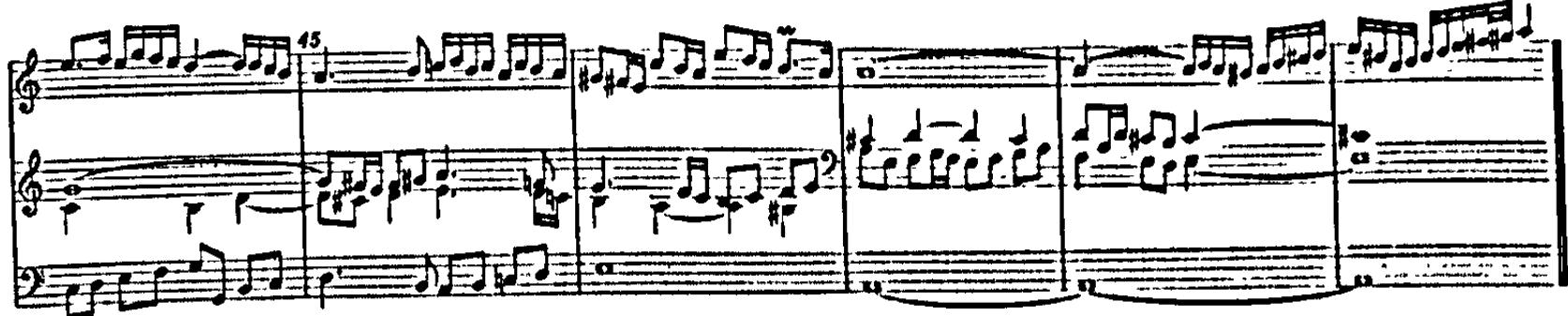
中文讲解
这是谱例 8 的占位符,展示 BuxWV 183 第 44–49 小节的乐谱,紧接 P0105 所讨论的最后一行(‘Gottes Zorn auf sich zu laden’)及其音乐描绘,让读者能配合谱面核对作者对末行的逐处分析;具体音型细节需查阅原图。
第4段(P0105)
原文复述
Finally, the last line of the chorale prelude, preceded by simple figurations including examples of figurae cortae in bar 42, presents another ornamented form of the cantus firmus. The closing line ‘Gottes Zorn auf sich zu laden’ (’to draw God’s anger down upon herself’) is a section determined by a pathos-laden figuration of the affectus cholericus that depicts the ultimate human despair and “the darkness of damnation.” Both the beginning and the conclusion of the line are framed by tirata figures; the first one (tirata mezza, bar 43) illustrates the word ‘Zorn’ (anger), while the second one (tirata aucta or excedens, from g#’ in bar 48 to a’’ in bar 49) functioning as an elaboration of the final note, incorporates a more joyful meaning through its ascending movement, alluding to the salvation of man through Christ. The affective character of the last line is intensified particularly in bar 46, where man’s hopelessness is expressed through an exclamatio in the discant, “[…] a veritable scream resulting from extreme dismay or astonishment because of horrifying or atrocious events frequently of the highest order of despair […].” The prelude concludes with an elaborate maniera (tirata perfecta, bar 49), which creates an exalted atmosphere in strong contradiction to the “imbued with sorrow” character of the chorale.
中文讲解
本段论述全曲最后一行的修辞—情感结构,承接前面对’蛇—夏娃—强迫’一行’最精致’描绘的分析,进入全曲情绪最为凝重、也最具戏剧反差的收束段。结构上分四层。其一,前奏性铺垫:第 42 小节使用 figurae cortae 等简洁修饰,引出圣咏定旋律的又一次装饰性变奏,作为从上文’复杂描绘’回到’较朴素’的过渡。其二,全段情绪定调:末行歌词 ‘Gottes Zorn auf sich zu laden’(将上帝的愤怒加于自身)被作者归入 affectus cholericus(怒—忧型情感范畴),其音乐功能被设定为刻画’人类终极的绝望’与’永罚的黑暗’。其三,两条 tirata 框架:句首与句末各以 tirata 包围,形成镜像式呼应——句首 tirata mezza(第 43 小节)紧扣 ‘Zorn’(愤怒)一词;句末 tirata aucta / excedens(第 48 小节 g#’ 至第 49 小节 a’’)作为圣咏最终音的展开,其上行运动被赋予’较为欢欣’的含义,暗示人因基督而得救。一悲一喜,构成’绝望—救赎’的隐微对照。其四,情感最高点与全曲反收:第 46 小节女高音声部以 exclamatio(惊呼格)将人的’无望’推到顶点(作者引述称其为’因骇人事物而生的近乎尖叫’);最末第 49 小节以 tirata perfecta(完满跨越八度的音阶式跑句)作为精心打造的 maniera,营造一种崇高、升华的氛围,与圣咏本身’浸透哀愁’的基调形成强烈反差。这一反差被作者视作本前奏曲戏剧性结尾的关键。
第5段(P0106)
原文复述
“There are four kinds of tirata: (1) the tirata mezza or mezza tirata, consisting at most of three or four sixteenth notes which span a fourth or fifth, including the following note; (2) the tirata defectiva, which […] exceeds the fifth but does not reach an octave; (3) the tirata perfecta, which fulfills the octave completely, so that neither a note more nor a note less appears; and (4) the tirata aucta or excedens, which exceeds the range of an octave by a few notes” (Walther, Musicalisches Lexicon, p. 609, translated by Bartel, pp. 410-11).
中文讲解
这条脚注引自 Walther《Musicalisches Lexicon》(经 Bartel 英译),给出 tirata(音阶式快速跑句)的四种分类:(1) tirata mezza / mezza tirata——至多三四个十六分音符,跨越纯四或纯五并含其后的尾音;(2) tirata defectiva——超过纯五但未达八度;(3) tirata perfecta——恰好完整跨越八度,‘不能多也不能少’;(4) tirata aucta / excedens——超出八度若干音。该脚注是 P0103 与 P0105 中四处 tirata(defectiva、mezza、aucta / excedens、perfecta)的定义依据,让读者可对照具体小节(第 39、43、48–49、49 小节)来识别其所属的修辞类型。
第6段(P0107)
原文复述
Genesis 3. 5; see Reichert, ‘Musikalische Rhetorik’, p. 165.
中文讲解
这条脚注标明 P0103 中所引的 ‘and you will be like God’ 出自《创世记》3:5,并附 Reichert《Musikalische Rhetorik》第 165 页作为参考。其作用是为文中关于’虚假承诺之傲慢’的经文来源提供权威依据。
第7段(P0108)
原文复述
“The hyperbole occurs when the words or oration exceed the truth for the sake of over- or understatement. According to Mancinellus, a transgression of the actual truth occurs through the hyperbole. It is also called superlatio, dementiens superjectio, eminentia, or excessus”, in Susenbrotus, Epitome, p. 18, cited and translated by Bartel, p. 306.
中文讲解
这条脚注引自 Susenbrotus《Epitome》第 18 页(经 Bartel 英译),给出修辞格 hyperbole(夸张法)的定义与同义术语:当言说为达成’过强’或’过弱’的表达而超出真相时,即为 hyperbole;据 Mancinellus 的说法,hyperbole 是对实际真相的’逾越’。其同义拉丁术语包括 superlatio、dementiens superjectio、eminentia、excessus。该脚注为 P0103 中’低音十度大跳’对应 hyperbole 提供理论依据:音程一次性跨越过大范围,一如言辞超越事实,构成对蛇之傲慢’夸大其词’的修辞对应。
第8段(P0109)
原文复述
Figura corta describes a figure that consists of three successive notes, one of which equals the sum of the other two (Bartel, p. 234).
中文讲解
这条脚注给出 figura corta(短图式)的形式定义:由三个连续音构成,其中一音在音程关系上等于另两音之和。该定义支持 P0105 中对第 42 小节 figurae cortae 的判断,让读者明白此处的简洁修饰属于’两音之和等于第三音’的算术型短图式。
脚注 / 边栏 / 图表 / 附加信息(如有)
本节包含两幅谱例图与四条脚注。谱例图:Example 7(第 38–43 小节)与 Example 8(第 44–49 小节),分别对应正文逐词描绘与末行修辞—情感结构的乐谱位置,原图未在文本中呈现,需查阅原图核对细节。脚注:47 引自 Walther《Musicalisches Lexicon》(Bartel 英译),为 tirata 四分类(mezza、defectiva、perfecta、aucta / excedens)提供形式定义,是 P0103、P0105 中四处 tirata 的依据;48 标注《创世记》3:5 与 Reichert 文献,为 P0103 中’虚假承诺’提供经文来源;49 引自 Susenbrotus《Epitome》(Bartel 英译),为 P0103 中 hyperbole 提供理论定义与同义术语;50 引自 Bartel,为 P0105 中 figura corta 提供形式定义。整体上,脚注为正文中具体修辞图式与情感范畴提供权威与定义性来源。
💡 本节核心要点
- 第 37 小节起的第七行 ‘darein die Schlang Eva bezwang’ 是全曲文字描绘最精致的一段,作者按词逐层刻画蛇、夏娃、强迫三个关键词。
- ‘Schlang’(蛇)通过第 39 小节半音阶蜿蜒十六分音符象征,其开端归入 tirata defectiva;‘Eva’(夏娃)由第 40 小节的 faux bourdon / catachresis 图形强调;‘bezwang’(强迫)由低音十度大跳对应修辞格 hyperbole(夸张法)。
- 末行 ‘Gottes Zorn auf sich zu laden’ 被定性为 affectus cholericus(怒—忧型情感),承担刻画’人类终极绝望’与’永罚黑暗’的修辞功能。
- 末行由两条 tirata 包围:句首 tirata mezza 表现 ‘Zorn’(愤怒),句末 tirata aucta / excedens 上行暗示基督救赎,构成’绝望—救赎’的隐微对照。
- 第 46 小节 discant 的 exclamatio(惊呼格)将人的’无望’推到顶点;第 49 小节 tirata perfecta 作为最终 maniera,营造崇高、升华的氛围,与圣咏’浸透哀愁’的基调形成强烈反差,构成全曲戏剧性收束。
🔑 关键术语
- tirata (defectiva / mezza / perfecta / aucta 或 excedens):音阶式快速跑句的四种亚类,按跨度与是否到达 / 超过八度区分;本节四处(第 39、43、48–49、49 小节)分别对应 tirata defectiva、tirata mezza、tirata aucta / excedens 与 tirata perfecta。
- hyperbole:修辞格’夸张法’,指言说超出事实真相;本节中由低音十度大跳体现,对应蛇之虚假承诺’夸大其词’的傲慢语气。
- faux bourdon / catachresis:第 40 小节用于强调 ‘Eva’(夏娃)的图形,原文以并列方式提出,本节不进一步将其等同化或定义其具体对位构成。
- figura corta:由三个连续音构成、其中一音等于另两音之和的短图式,第 42 小节出现,作为末行前的简洁修饰。
- affectus cholericus:怒—忧型情感范畴,末行 ‘Gottes Zorn auf sich zu laden’ 的总体情绪定调,刻画人的终极绝望与永罚黑暗。
- exclamatio:惊呼格修辞图式,第 46 小节 discant 用以表达人在’最高等级绝望’中的’无望’,近乎尖叫。
- anabasis:音阶上行修辞图式,前一过渡段中 tenor 与 alto 沿用之,作为第七行精细描绘前的铺垫。
- maniera:精致的展开 / 收束式写作手法,第 49 小节 tirata perfecta 被作者称为 elaborate maniera,营造崇高、升华的氛围。
2.8 [描述性拆分] Buxtehude’s Ach Herr, mich armen Sünder (BuxWV 178): Opening Lines and Pathopoeia
第1段(P0110)
原文复述
The Phrygian chorale prelude Ach Herr, mich armen Sünder (BuxWV 178), 55 based on a tune also associated with the words ‘Herzlich thut mich verlangen’, demonstrates another case in which musical-rhetorical figures combined with slow-moving polyphonic rhythm describe the affects of affliction and sorrow, to which Kircher referred as affectus timoris et afflictionis. 56 The first line of the chorale is announced in the first bar with the usual vorimitation technique (also encountered in Durch Adams Fall) in the alto (bars 1-2), while the tenor and the bass repeat the introductory motive in bars 2-3 and 4-5 (polyptoton).
中文讲解
本段是 2.8 小节的开篇,引入 Buxtehude 的 BuxWV 178 这一分析案例。它点明两个关键背景:第一,该圣咏前奏曲以利底亚调式(Phrygian)写成,而利底亚调式因小二度倾向性而被传统视为哀痛调式,与本曲"痛苦与忧伤”(affliction and sorrow)的情感目标一致;第二,所用旋律同时与"Herzlich thut mich verlangen"(即著名的"O Sacred Head, Now Wounded"曲调)共享,因此本曲在音乐修辞分析中常被拿来与 Bach 的使用方式作对照。
作者援引 Kircher 的术语 affectus timoris et afflictionis(恐惧与苦楚之情),把整段音乐的目的定位为以"音乐-修辞手法 + 缓慢的复调节奏"来描绘这种特定情感,从而把分析框架从纯和声层面上升到修辞表现层面。
在具体谱面描述上,第一句歌词进入第 1 小节,主题以 vorimitation(先行模仿)手法在 alto 声部呈现(1-2 小节),这一手法在前一小节分析的 Durch Adams Fall 中也出现过,构成前后案例的呼应。紧接着 tenor 与 bass 在 2-3 和 4-5 小节重复引入动机,构成 polyptoton(同一动机的多重复现)。这里的多重复现不仅制造了模仿对位,更在节奏上形成"缓慢拉长"的感觉,与利底亚调式一起塑造出沉重的情绪基调。
承接关系:从前一节对 Durch Adams Fall 的分析过渡到本节对 BuxWV 178 的分析,两者都用 vorimitation,但 BuxWV 178 更突出 pathopoeia(半音化情感修辞),下文将逐小节展开。
补充说明
vorimitation 与 polyptoton 两个术语在前文 2.7 节已出现,本段延续其用法;Kircher 的 affectus timoris et afflictionis 见 P0116 的脚注回指。
第2段(P0111)
原文复述
52 Apel, p. 622.
中文讲解
脚注 52:引自 Apel 的著作第 622 页,是上方正文中相关论述的文献出处;脚注本身只提供页码信息,未在原文中展开具体观点。
第3段(P0112)
原文复述
51 Reichert, ‘Musikalische Rhetorik’, p. 165.
中文讲解
脚注 51:出处为 Reichert《Musikalische Rhetorik》第 165 页,对应上一段或前文中关于音乐修辞的某项主张;脚注仅作文献定位。
第4段(P0113)
原文复述
53 Mattheson, Der vollkommene Capellmeister, Part II, Chapter 9, §67, p. 194; translation of the German text quoted here from Bartel, p. 269.
中文讲解
脚注 53:出处为 Mattheson《Der vollkommene Capellmeister》第二部分第九章 §67 第 194 页,文中所引德文段落的中译转引自 Bartel 第 269 页。该脚注承担双重角色:既给出德语原文的权威版本,又通过 Bartel 提供英译参考。
第5段(P0114)
原文复述
54 Snyder, Dieterich Buxtehude: Organist in Lübeck, p. 269.
中文讲解
脚注 54:出处为 Snyder 的《Dieterich Buxtehude: Organist in Lübeck》第 269 页,为正文中关于 Buxtehude 生平或作品背景的某项陈述提供来源。
第6段(P0115)
原文复述
55 Ach Herr, mich armen Sünder/ straf nicht in deinen Zorn/ dein ernsten Grimm doch linder/ sonst ists mit mir verlorn/ ach Herr, wollst mir vergeben/ mein Sünd und gnädig sein/ dass ich mag ewig leben/ entfliehn der höllen Pein; see Charles Sanford Terry, The Four-Part Chorals of J. S. Bach: With the German Text of the Hymns and English Translations (London: Oxford University Press, 1964), p. 167. For a literal English translation, see W. Gillies Whittaker, The Cantatas of Johann Sebastian Bach: Sacred and Secular, 2 vols (London: Oxford University Press, 1959), ii, pp. 121-22: Ah Lord, me poor sinner/ punish not in Thine anger/ Thy stern wrath but mitigate/ else is it with me lost/ Ah Lord, wilt me forgive/ my sin and gracious be/ that I may ever live/ escape from hell’s torment.
中文讲解
脚注 55:完整引出本曲歌词的德文原文及英译,并给出两份参考版本(Terry 1964、Whittaker 1959)。歌词八行依次为:“主啊,我这可怜的罪人/ 求你不要在你的怒中惩罚我/ 你的严厉怒火求你减轻/ 否则我就完了/ 主啊,求你赦免我/ 我的罪并恩待我/ 使我能永生/ 逃脱地狱的苦痛”。内容由恳求怜悯、避免上帝愤怒、得赦免、永生得救四层递进构成,恰好对应正文所要分析的"恐惧与苦楚之情"。它同时说明该旋律还对应"Herzlich thut mich verlangen",证实 P0110 中曲调共享的判断。
补充说明
歌词文本本身是分析的对象之一:作曲家通过音乐-修辞手法逐字刻画"Sünder(罪人)““Zorn(愤怒)“等关键词。
第7段(P0116)
原文复述
56 Reichert, p. 156. For a list of specific affects, as described by Athanasius Kircher in his Musurgia universalis (1650), see Chapter 1 of the present work, pp. 37-38.
中文讲解
脚注 56:引自 Reichert 第 156 页,对应正文"affectus timoris et afflictionis"这一术语的来源;同时指引读者参看本书第一章第 37-38 页,那里列出了 Kircher《Musurgia universalis》(1650) 中所描述的具体情感清单。本脚注为该术语提供权威定位,并提示其更广泛的情感分类背景。
第8段(P0117)
原文复述

中文讲解
【图示占位符】此处为谱例 9(Example 9),标题为 BuxWV 178《Ach Herr, mich armen Sünder》第 1-8 小节,原图数据未提供,位置与图注保留。该谱例配合 P0118 对第 1-8 小节 pathopoeia 与关系解决(relationes non harmonicae)的逐小节分析。具体音高、和声与声部进行需查看原图。
第9段(P0118)
原文复述
What dominates in the first line is the sense of gravity, presented in the simple unadorned minim movement of the melody in bars 3-7. ‘Poignant’ harmonic events give rise to the relationes non harmonicae strengthened in bar 6 (‘Sünder’, sinner) by the false relations (diminished fifth and augmented fourth intervals) created between the passus duriusculus in the bass and the tenor. 57 The passus duriusculus, described by J. P. Kirnberger as a figure suited for the arousal of lament and sorrow, 58 illustrates the pathopoeia, a “[…] figure in which the text is expressed through semitones in such fashion that no one appears to remain unmoved by the created affection.” 59 The bass introduces a second pathopoeia in the following bar 7 (one would expect the sharpened quaver in the pedal to follow a natural one), in which the ascending chromatic line from the previous bar is interrupted by a tmesis, the depiction of man’s separation from God as a result of his sins.
中文讲解
本段集中分析 BuxWV 178 第 1-8 小节的情感修辞,是本节论证的核心段落。
首先,作者指出第一句歌词(第 1-7 小节后半段旋律展开的核心区)的主调情感是 gravity(庄重、沉重),而这种庄重的塑造方式非常克制:旋律在第 3-7 小节以朴素的、未加装饰的二分音符(minim)平稳行进,没有任何花腔——这种"少即是多"的处理本身就传达出一种"压抑下的重量”,与歌词中"可怜的罪人"的自我卑微形成内容上的同构。
接着,作者指认第 6 小节"Sünder(罪人)“一词出现时出现了不协和的关系(relationes non harmonicae),具体表现为 bass 与 tenor 之间的假关系(false relations):减五度与增四度。这两个不协和音程是在 passus duriusculus(“艰难下行的半音阶”)内部形成的。passus duriusculus 由 Kirnberger 定义为"激发哀叹与悲痛的修辞格”,本段借用 Kirnberger 的权威把这一下行半音阶与"悲叹"情感直接挂钩,使读者理解为何仅仅半音下行就具有表现力。
随后,本节的关键术语 pathopoeia(情感修辞格)正式登场。作者引用 Burmeister 的定义:“一种以半音表现文本,使听者无不为之所动、产生情感"的修辞格。换言之,pathopoeia 不是某一具体音型,而是作曲家借半音化运动唤起情感的总体手法。BuxWV 178 的第 6 小节减五度 + 增四度的假关系,正是 pathopoeia 的典型实施。
第 7 小节,作者观察到第二处 pathopoeia 出现在 bass:按惯例,pedal(持续低音)上的升记号八分音符之后应接自然音,但 Buxtehude 在此打断上行半音进行的预期方向,造成"中断”,这种中断在修辞学上称为 tmesis(语义切割、修辞中断)。作者把它解读为对"人因罪而与神分离"这一神学主题的描绘:上行本意味着接近上帝(如同第 6 小节向高音攀升的半音),但在即将到达时被切断,恰好表现罪人未能真正与神和好。这一笔把神学释义与半音修辞紧密缝合。
本段在整节中的作用:把 pathopoeia 这一概念用具体谱面事件(第 6、7 小节)落实,让读者既看到半音手法的"是什么”,也理解其"为什么动听/动人”——既为后面的扩展段(第 8-12 小节)提供节奏与情感对比的参照点,也呼应了 P0110 关于"affectus timoris et afflictionis"的总目标。
第10段(P0119)
原文复述

中文讲解
【图示占位符】此处为谱例 10(Example 10),标题为 BuxWV 178《Ach Herr, mich armen Sünder》第 9-16 小节,原图数据未提供,位置与图注保留。该谱例配合 P0120 对第 7-12 小节节奏强化、tirata mezza、passus duriusculus、transitus irregularis / symblema 的逐小节分析。具体音高与对位细节需查看原图。
第11段(P0120)
原文复述
In contrast to the preceding gravity, the intermediate section (bars 8-9) demonstrates an intensification of the rhythm, commencing from bar 7 with the dotted crotchets in the bass and the tenor moving in parallel motion (climax/gradatio). The second line (bar 9) begins with a tirata mezza in the cantus firmus (‘straf’), a depiction of “[…] a shot or spear throw […]” 60 of God’s wrath, leading in bar 10 to the augmented chord that emphasises the plaintive content of the word ’nicht’. The passus duriusculus reappears in the bass and the alto (bar 11), while the line concludes with a striking transitus irregularis/ symblema (suspensions creating an augmented fourth and a minor seventh) on the accented beats of bar 12, showing again Buxtehude’s emphasis on the vivid representation of the allegory of the text (‘Zorn’, rage).
中文讲解
本段聚焦 BuxWV 178 第 7-12 小节(即歌词第二行的呈现),是承接 P0118 庄重基调之后的情感升级与修辞多样化。
作者以"与前述庄重形成对照"开篇,提示一种整体论证的对照结构:前段(1-8 小节)以朴素的二分音符呈现"压抑的庄重",中段(8-9 小节起)则用节奏强化推进情感。第 7 小节 bass 与 tenor 同时切入附点四分音符(dotted crotchets)并形成平行运动,作者指认此为 climax/gradatio(递进 / 渐强层进)。这里的"递进"既是旋律走向的层进(如音区逐级上升),也是节奏重音密度的层进:附点节奏带来"撞击感",与第一句"缓慢压抑"形成鲜明对比。
第二句歌词进入第 9 小节,cantus firmus(定旋律)在词"straf(惩罚)“上首次出现 tirata mezza(半音快速直进)这一修辞格。tirata 在 Mattheson 的释义中被比作"射出或掷出长矛”,把上帝之怒具象化为一次迅猛的攻击;作者把它与歌词"straf nicht in deinen Zorn(不要在你的怒中惩罚我)“中"怒"字的爆发性对应起来,使音乐的速度化运动成为对"神怒之箭"的描绘。
紧接着第 10 小节出现的增三和弦(augmented chord)落在词"nicht(不要)“上,作者解读为对"恳求/哀诉"内容的强调——增三和弦的不稳定性本身具有"恳求未得回应"的悬停感,是音乐修辞与文本语义高度耦合的一例。
第 11 小节,passus duriusculus 在 bass 与 alto 同时再现,意味着哀叹情感的延续;而本句的终止落在第 12 小节重拍上的 transitus irregularis / symblema(不规则过渡 / 符号式不协和),由挂留音形成增四度与小七度,正好对应词"Zorn(愤怒)"。作者用"striking(震撼)“形容此终止,并以"再次显示 Buxtehude 对文本寓意的生动再现"收束,呼应了 P0110 的总论点:作曲家通过修辞手法在每一个关键词上呈现情感意义。
本段在小节中的作用:完成从"压抑"到"猛烈"再到"未解的哀诉"的情感弧线,使全曲修辞密度逐层升高,并为下一节可能的延续段(如果存在)做铺垫;同时通过具体案例(tirata mezza、augmented chord、transitus irregularis)让 pathopoeia 这一节的总论点获得支撑。
第12段(P0121)
原文复述
57 Reichert, pp. 156-57.
中文讲解
脚注 57:引自 Reichert 第 156-157 页,对应 P0118 中关于 passus duriusculus 与假关系在第 6 小节"Sünder"处的具体论述。
第13段(P0122)
原文复述
58 ibid., pp. 156-57.
中文讲解
脚注 58:再次引自 Reichert 第 156-157 页(ibid. 指同一文献),对应 P0118 中 Kirnberger 对 passus duriusculus “激发哀叹与悲痛"功能的描述。两条相邻脚注都指向同一文献区段,提示作者此处集中参考 Reichert 对修辞格与情感关系的论述。
第14段(P0123)
原文复述
59 Burmeister, Hypomnematum musicae poeticae, cited and translated by Bartel, p. 361.
中文讲解
脚注 59:pathopoeia 的定义出自 Burmeister 的《Hypomnematum musicae poeticae》,引文与英译转引自 Bartel 第 361 页。本脚注是 P0118 中 pathopoeia 定义的文献定位,确立了 Burmeister 作为该术语最权威的古典出处。
第15段(P0124)
原文复述
60 Mattheson, Der vollkommene Capellmeister, Part II, Chapter 3, §43, p. 117, translated by Bartel, p. 411.
中文讲解
脚注 60:tirata mezza 被比作"射出或掷出长矛"的表述出自 Mattheson《Der vollkommene Capellmeister》第二部分第三章 §43 第 117 页,英译引自 Bartel 第 411 页。该脚注为 P0120 中 tirata mezza 的修辞含义提供权威释义来源。
脚注 / 边栏 / 图表 / 附加信息(如有)
本节包含两个谱例占位符(Example 9:bars 1-8;Example 10:bars 9-16),分别承载对开篇利底亚调式主题呈现与半音 pathopoeia 的视觉证据(Example 9),以及第二句歌词进入后节奏强化、tirata mezza、transitus irregularis 的视觉证据(Example 10)。六条脚注(编号 51-56 与 57-60)主要出自 Reichert《Musikalische Rhetorik》、Apel、Mattheson《Der vollkommene Capellmeister》、Snyder《Dieterich Buxtehude: Organist in Lübeck》、Burmeister《Hypomnematum musicae poeticae》、Kircher《Musurgia universalis》以及 Terry 与 Whittaker 的 Bach 研究专著,作用在于:为 pathopoeia、passus duriusculus、tirata mezza 等修辞格提供经典定义出处,为歌词德文与英译提供参考版本,以及指引读者回到本书第一章查阅 Kircher 的情感清单。
💡 本节核心要点
- BuxWV 178 以利底亚调式与 vorimitation/ polyptoton 开篇,把"affectus timoris et afflictionis"作为整段音乐的情感目标。
- 第一句歌词(第 1-7 小节)以朴素的二分音符呈现 gravity(庄重、沉重),为后续情感升级提供压抑底色。
- 第 6 小节"Sünder"处通过 bass 与 tenor 之间的假关系(减五度与增四度)实施第一处 pathopoeia,Kirnberger 将 passus duriusculus 与哀叹情感挂钩。
- 第 7 小节第二处 pathopoeia 以被中断的上行半音(tmesis)象征人因罪与神分离,把神学释义融入修辞结构。
- 中段(第 8-9 小节起)以附点四分音符的平行运动(climax/gradatio)打破庄重,开启节奏强化。
- 第二句歌词"straf"处使用 tirata mezza,比作"射出或掷出长矛”,把上帝之怒具象化为迅猛一击;“nicht"处的增三和弦则强调恳求的悬停感。
- 终止于"Zorn"处的 transitus irregularis / symblema(增四度 + 小七度挂留)再次展现 Buxtehude 以修辞格对关键词进行寓言化再现的创作手法。
🔑 关键术语
- pathopoeia:Burmeister 提出的音乐-修辞格名,指通过半音运动表现文本情感以打动听众的修辞手段;在本节中以假关系、passus duriusculus、被中断的上行半音等形式出现,是 2.8 节的核心分析对象。
- passus duriusculus:“艰难下行"半音阶修辞格,Kirnberger 将其描述为激发哀叹与悲痛;本节中它出现在 BuxWV 178 第 6 小节(bass 与 tenor 之间)与第 11 小节(bass 与 alto 之间)。
- relationes non harmonicae / false relations:非协和关系 / 假关系,本节特指第 6 小节"Sünder"处 bass 与 tenor 之间形成的减五度与增四度假关系,由 passus duriusculus 内部半音碰撞产生,强化悲情效果。
- tirata mezza:“半直进"修辞格,Mattheson 把它比作"射出或掷出长矛”;本节中它在 BuxWV 178 第 9 小节定旋律"straf"处出现,描绘上帝之怒。
- transitus irregularis / symblema:“不规则过渡 / 符号式不协和”,本节指第 12 小节重拍上由挂留音产生的增四度与小七度,对应词"Zorn”,再次显示 Buxtehude 以修辞格再现文本寓意的偏好。
- vorimitation:“先行模仿”,即在一个声部完整呈现主题之前,由另一声部先以动机片段预示主题;本节 BuxWV 178 的 alto 在 1-2 小节以 vorimitation 引出第一句歌词。
- polyptoton:本节指同一动机在 tenor(2-3 小节)与 bass(4-5 小节)的多重复现,借助重复加深主题印象并延缓节奏,制造沉重感。
- climax / gradatio:“递进 / 渐强层进”,本节指第 7 小节起 bass 与 tenor 以附点四分音符平行运动形成的节奏强化,对照前段的庄重二分音符节奏。
- tmesis:修辞学中的"语义切割 / 中断”;本节指第 7 小节 bass 中本应连续的上行半音被中断,作者把它解读为对"人因罪与神分离"的神学描绘。
- affectus timoris et afflictionis:Kircher《Musurgia universalis》中的情感分类术语,意为"恐惧与苦楚之情”;本节把 BuxWV 178 的整体情感目标定位于此。
2.9 [描述性拆分] Ach Herr, mich armen Sünder: Dissonances, Catachresis, and Aetfectus Timoris
第1段(P0125)
原文复述
After the end of the second line, the short intervening section illustrates an antithetical character. The sense of the previous phrase (‘Zorn’) is carried forward in the next line through the first syncopatio in bar 13, while the tenor and the alto proceed in a climax (gradatio) figure, which culminates at the beginning of the next line. The following phrase ‘dein ernsten Grimm doch linder’ is also determined by the application of striking dissonances that are undoubtedly related to the symbolism of the text. In contrast to the climax, the tenor and the alto progress in a downward motion in bar 14 (catabasis), while dissonances appearing in bar 16 (‘Grimm doch’) between the tenor and the alto are described by the catachresis (abusio) figure, in other words the irregular progression of fourths in orderly motion. The catachresis is further reinforced by the tirata mezza in the tenor (bar 16), while in the word ’linder’ (bar 17) Buxtehude supplied the most ornamented version of the cantus firmus up to that point, consisting of a groppo and a figura corta figure.
中文讲解
这一段描述的是这首众赞歌前奏曲第二行之后的过渡段,作者用’对位性性格’(antithetical character)来概括它。先回顾一下前文留下的词意:‘Zorn’(愤怒)继续通过第13小节的第一个syncopatio(切分)被带入下一行,同时男高音与女高音声部以渐强(gradatio,克雷马克斯)结构推进,到下一行开头达到顶点。接下来的歌词’dein ernsten Grimm doch linder’(却平息你严厉的怒气)由强烈的、明显与歌词象征相关的不协和音所支配。与上行渐强相反,男高音与女高音声部在第14小节下行(catabasis),第16小节’Grimm doch’(怒气)处的两声部不协和被归入catachresis(abusio)格律,即在有序进行里出现的四度进行’越规’。这种catachresis又被男高音在第16小节的tirata mezza进一步加强。到了’linder’(平息)所在的第17小节,Buxtehude给出了迄今为止定旋律(cantus firmus)最华丽的装饰——一个groppo加一个figura corta组合。这里的关键在于:作者不是简单地在罗列术语,而是要论证每一处不协和音与歌词语义一一对应——怒→张力上行后下行,平息→最复杂装饰,速度与起伏都被音乐化为’语义’。
补充说明
本段中提到的几个关键修辞/音乐格律(syncopatio, gradatio, catabasis, catachresis/abusio, tirata mezza, groppo, figura corta)的具体定义与历史来源,可参照本节其余段落(P0129、P0130)及相关脚注中给出的词条。本段并未对术语本身下定义,只用以说明第13–17小节的分析。
第2段(P0126)
原文复述
The faux bourdon (bar 18), together with the climax (gradatio, bar 19) illustrate the intervening section as an antithesis to the strong dissonances that dominated in the preceding line, while the following phrase ‘sonst ists mit mir verlorn’ demonstrates another case in which music is set according to the allegory of the text.
中文讲解
本段简短,但完成了一个对比闭环。第18小节的faux bourdon(假布尔东)和第19小节的gradatio共同使这一过渡段成为’前一行强不协和’的对立面——这与P0125开头提到的’antithetical character’直接呼应,把音乐上的’对比/缓解’诠释为’对比性的性格’(antithesis)。紧接着的歌词’sonst ists mit mir verlorn’(否则我就完了)再次作为例证,呈现音乐按文本寓意进行配置——即’灭亡’这一语义在声音中也被刻意安置。这段话的功能,是把前面逐小节展开的不协和/装饰论证收束为一个更宏观的结构原则:副歌的每一行都在用音乐实现文本的寓意层面(allegory)。
补充说明
本段没有补充外部信息;faux bourdon的具体术语史可参本节P0129脚注中的展开。
第3段(P0127)
原文复述
61 Reichert, p. 157.
中文讲解
脚注61,只提供一条文献定位:Reichert著作第157页。它对应正文P0125中关于第二行之后过渡段具有’antithetical character’的论断。这是引用型脚注,不展开论证,仅指出文献来源。
第4段(P0128)
原文复述
62 For the affect of the climax (gradatio) in relation to the theological text, see the reference to Kircher on p. 141 of this chapter (Durch Adams Fall).
中文讲解
脚注62,是交叉引用:关于gradatio(渐强)在神学文本中所对应的情感(affect),可参本(章)中关于’Durch Adams Fall’(因亚当的堕落)那一节第141页提到的Kircher论述。这里把当前分析的’克雷马克斯具有情感含义’与同章前一部分已讨论过的Kircher观点链接起来,避免重复论述。
补充说明
本脚注只指向同一章节内的另一个段落,不引入新文献信息。
第5段(P0129)
原文复述
Although the original term faux bourdon (catachresis) is more commonly used to describe parallel fourths that occur within sixth-chord progressions, the progression of parallel fourths alone was also considered a forbidden freedom (licentia). Thuringus was the first to choose a Greek equivalent (catachresis) for the term faux bourdon, while its Latin counterpart (abusio) was consistently used to refer to the progression of parallel fourths in counterpoint. Adam Fulda, first in his Musica (1490), described this irregularity in contrapuntal composition with particular reference to parallel fourths, while Walther later in his definition of catachresis included, apart from parallel fourths, any other irregularities in harmony, including unusual resolutions of dissonances (Bartel, p. 273).
中文讲解
这是一条关键的术语史脚注,对应正文P0125中catachresis/abusio的用法。其内容可拆为四点:① 严格意义上的faux bourdon指在六和弦进行内部出现的平行四度,但即使孤立的平行四度进行本身也被视为一种’被禁止的自由’(licentia);② Thuringus最早为faux bourdon选择了一个希腊语对应词catachresis,而其拉丁对应词abusio则在复调语境中始终指平行四度进行;③ Adam Fulda于1490年在《Musica》中首次把这种对位法中的’越规’与平行四度联系起来描述;④ Walther后来在其catachresis定义中,把范围扩大——除了平行四度,还包括其他和声不规则,如不协和音的不寻常解决(出处:Bartel, p. 273)。
对正文的作用:它把P0125中所说的’catachresis(abusio)图’从一个修辞格律术语,提升到有完整理论史的范畴,并指出在Buxtehude的时代catachresis的指称已比早期更宽泛,这为作者把’不寻常解决’也视作catachresis提供合法性。
补充说明
本段信息全部可在本脚注内定位。Thuringus、Adam Fulda、Walther作为术语史的具体承担者仅作转述,不补充其他传记信息。
第6段(P0130)
原文复述
64 Printz (Phrynis Mytilenaeus, Part 2, p. 48) described groppo as a figure that “[…] consists of four rapid notes which form a half-circle, the first and third being the same, the second and fourth having different positions. It can be either ascending or descending” (cited and translated by Bartel, p. 291).
中文讲解
脚注64,给出groppo的定义:四个快速音符构成一个’半圆’形——第一与第三音相同,第二与第四音位置不同,可上行也可下行。出处为Printz《Phrynis Mytilenaeus》第二部分第48页,经Bartel(p. 291)引用并译出。该定义对应正文P0125中第17小节’linder’处定旋律的groppo装饰,让学生明白作者用groppo这个术语时是有Printz式定义的,而不是泛指装饰音。
补充说明
无额外补充。Printz与Bartel的更多信息若超出本脚注/章节范围,不予补入。
第7段(P0131)
原文复述
Example 11. BuxWV 178: Ach Herr, mich armen Sünder (bars 17-22)

中文讲解
这是图示占位符:示例11,对应BuxWV 178《Ach Herr, mich armen Sünder》的第17–22小节。位置在第22页,紧接P0126与P0132的论述之中,用以让读者对照文本分析查看谱面。该图用于直观展示P0125末段讨论的第17小节’linder’的groppo/figura corta装饰,以及P0132中第21–22小节’mir’处的不协和与exclamatio图。
补充说明
图像数据未提供,不推测谱面细节;分析依赖的描述须以正文段落为准。
第8段(P0132)
原文复述
The fourth phrase commences with an expressive figura suspirans in the cantus firmus, functioning also as a hypotyposis for the loss and the isolation implied by the text (‘verlorn’). The plaintive character of the line is expressed in the exclamatio figure (diminished fifth) in the discant (bars 21-22, ‘mir’), intensified by dissonances in the accompanying voices, reminiscent of man’s sinful character and God’s rage (also described in the previous phrases).
中文讲解
本段处理的是第四个乐句。开头定旋律中出现一个表现力很强的figura suspirans(叹息格律),同时它也作为hypotyposis(形象化描绘)刻画文本中’verlorn’(沦丧)所暗示的失落与孤立。接下来第21–22小节高音唱’des mir’(对我)的旋律里出现减五度,被归入exclamatio(呼喊)图——这是哀诉性格的标志,而伴随声部中的不协和进一步强化这种哀诉,并把听觉经验拉回到前几句已描写过的’人的罪性与神的愤怒’主题。
关键点有三:① suspirans与hypotyposis同时挂在同一处——音乐既要’叹息’又要’形象化描绘’失落;② exclamatio被具体化为减五度,这是有特定音程含义的,不能误读为笼统的’激动’;③ 不协和被作者解释为对前文’罪/怒’主题的回声,从而让这首众赞歌在局部上具有统一的象征语义场。
补充说明
exclamatio以减五度为标志的更多细节可在P0135脚注中找到(Marpurg 1754)。
第9段(P0133)
原文复述
The non-harmonic intervallic relations that dominate in almost all the chorale lines discussed so far can only be understood if one relates them to the theological symbolism of the numerical proportions, a notion that prevailed during the Baroque era. The proportional complexity of the musical intervals was considered a factor that determined the sounding effect and content of the relationes non harmonicae, which could not be expressed in simple数学比例, and, as a result, were far away from the unison (proportion 1:1). This approach was based on the cosmo-theological principle, according to which the closer an intervallic proportion was to the unison (therefore to the Creator), the more perfect the resulting harmony would be. On the other hand, dissonances in music were the result of proportions that strayed from the unison (i.e. God, the Creator), leading, therefore, to reprehensible and confused resolutions.
中文讲解
这一段从微观分析跃迁到宏观原理,是本节的理论支柱。它主张:迄今为止所讨论的众赞歌各行中主导的非和声音程关系(relationes non harmonicae),只有在和’数字比例的神学象征意义’挂钩之后才能被理解,这是巴洛克时期流行的观念。
要点逐条:① 音乐音程的’比例复杂性’(proportional complexity)被视为决定非和声音程的声音效果与内涵的因素,简单数学比例无法涵盖它们,因此它们’远离1:1的同度’;② 这背后是一个cosmo-theological(宇宙—神学)原则——一个音程比例越接近同度(因此越接近造物主),所产生的和谐就越完美;③ 反之,不协和来自偏离同度的比例(也就是偏离神/造物主),于是其解决也变成’应受谴责’且’混乱’的。
也就是说,前几段提到的所有’不协和=罪/怒’的对应关系,并不只是修辞性的比喻,而是建立在一个具体的形而上学假设上:协和/不协和有神学—宇宙论上的位阶。这一段为前面的逐处对应提供了理论根据,也把分析的层次从’这一处不协和描绘罪’提升为’整个音乐不协和之所以可象征罪,是因为宇宙观如此’。
补充说明
本段所提cosmo-theological原则的具体文献出处见P0136脚注(Bartel, p. 14;Piet Kee论文)。
第10段(P0134)
原文复述
The contrast between dissonances and consonances is apparent in the chorale prelude under discussion, while their theological symbolism is understood when interpreted through the writings of the composer and theorist Andreas
中文讲解
这一句是过渡/导引:作者强调这首众赞歌前奏曲中不协和与协和的对比是清晰可闻的,而要理解它们的神学象征,则需要借助’作曲家和理论家Andreas’的著作来解读。文末’Andreas’显然是Andreas Werckmeister的姓氏,但本段文本在此被截断,没有在输入范围内给出姓氏或具体文献,因此不能在此补出。
就本节论证功能看,这句话承接P0133的宇宙—神学原则,引出下文(超出本节范围)将以Werckmeister的著作为桥梁,把本曲的不协和/协和对比与新教神学象征挂钩。
补充说明
姓氏’Werckmeister’未在本段或本节其余段中出现,故不在本节输出中补全。
第11段(P0135)
原文复述
65 According to Marpurg (1754), joyful exclamations were expressed by upward leaps such as major thirds, perfect fourths or fifths, while sad exclamations could also be illustrated through downward leaps including minor thirds, perfect fourths, or perfect fifths. See Lena Jacobson, ‘Musical Figures in BWV 131’, The Organ Yearbook, 11 (1980), 60-83 (p. 79, footnote no. 22). 66 Reichert, p. 159.
中文讲解
脚注65为正文中exclamatio图提供理论史支撑:Marpurg(1754)认为欢快的呼喊通过上行跳进(大三度、纯四、纯五)表达,而悲伤的呼喊则可由下行跳进(小三度、纯四、纯五)表达。这一区分解释了为什么P0132中的减五度被作者视为哀诉性(exclamatio)。出处方面,除Marpurg原典外,作者还指向Lena Jacobson《Musical Figures in BWV 131》(《管风琴年鉴》第11卷,1980年,第60–83页,注22)。脚注66则只是文献定位:Reichert, p. 159。
补充说明
本脚注转述的Marpurg区分(上行=欢快/下行=哀伤)只用于解释P0132,不在本节其他位置出现。
第12段(P0136)
原文复述
67 Bartel, p. 14. See also Piet Kee, ‘Number and Symbolism in the Passacaglia and the Ciacona: A Forgotten and Hidden Dimension’, Loosemore Occasional Papers, 2 (Cambridge: The Tavistock Press Ltd, 1988). The same paper had already appeared in the Het Orgel, 82.5 & 6 (May & June 1986).
中文讲解
脚注67为P0133的宇宙—神学原则提供两条文献:① Bartel, p. 14(给出cosmo-theological原则的文本依据);② Piet Kee《Number and Symbolism in the Passacaglia and the Ciacona: A Forgotten and Hidden Dimension》,发表于《Loosemore Occasional Papers》第2卷(Cambridge: The Tavistock Press Ltd, 1988),并提示该文先前已刊于《Het Orgel》82卷第5、6期(1986年5、6月)。其作用是把’音乐比例=神学象征’的论证与更广的帕萨卡利亚/恰空体裁中的数字象征研究相连接。
补充说明
无额外补充;Piet Kee论文的完整书目信息已在本脚注内给出。
脚注 / 边栏 / 图表 / 附加信息(如有)
本节包含的附加材料:
- 脚注61 (Reichert, p. 157):定位’antithetical character’论断的文献来源。
- 脚注62:交叉指引同章’Durch Adams Fall’部分第141页关于Kircher的论述。
- 脚注63:catachresis/abusio术语史的系统梳理——Thuringus、Adam Fulda 1490《Musica》、Walther,来源Bartel p. 273。
- 脚注64:groppo的定义引自Printz《Phrynis Mytilenaeus》Part 2, p. 48,经Bartel p. 291转引并英译。
- 图示占位符Example 11:对应BuxWV 178第17–22小节谱例,位置在第22页,辅助P0125末段与P0132的论述。
- 脚注65 (Marpurg 1754):为exclamatio提供’上行=欢快/下行=哀伤’的区分,并指引Lena Jacobson 1980文章。
- 脚注66 (Reichert, p. 159):定位性脚注。
- 脚注67 (Bartel p. 14;Piet Kee 1988/1986):为’数字比例的神学象征’原则提供文献依据。
这些附加材料共同把逐小节的音乐修辞分析与巴洛克宇宙—神学—对位法的术语史连接起来。
💡 本节核心要点
- 本节以逐小节的方式论证BuxWV 178中每一处不协和音与歌词语义(怒/平息/沦丧/哀诉)的一一对应关系,并将这种对应建立在’音乐修辞格律’(syncopatio, gradatio, catabasis, catachresis, suspirans, exclamatio等)之上。
- antithetical character是本节过渡段的关键词:第18–19小节的faux bourdon与gradatio构成对前一行强不协和的’对立面/缓解’,从而在结构层面体现文本的语义对位。
- catachresis/abusio既指’有序进行中的平行四度越规’(狭义),也指’包括不寻常解决在内的其他和声不规则’(Walther之后的广义),本节采用广义以涵盖Buxtehude在’Grimm doch’处的不协和用法。
- 在第17小节’linder’上,Buxtehude给出全曲截至该处最华丽的定旋律装饰(groppo + figura corta),在Printz的定义下,这一’半圆形四音’装饰具有明确的形制含义。
- exclamatio在Marpurg的体系里与音程方向挂钩:上行大三/纯四/纯五=欢快,下行小三/纯四/纯五=哀伤;故第21–22小节减五度被读作哀诉性的exclamatio,并作为前几句’罪与怒’主题的回声。
- 全节的理论支柱是巴洛克时期流行的cosmo-theological原则:音程比例越接近同度(1:1)越接近造物主、越完美;偏离同度即不协和,因此象征罪/怒,这为前述逐处的’语义—和声’对应提供了形而上学根基。
🔑 关键术语
- syncopatio:本节提到的切分/错位格律,第13小节出现的第一个syncopatio被用来延续前句’Zorn’(怒)的语义紧张度。
- gradatio:渐强/高潮格律(亦称climax);本节中第13–16小节(上行至行首)、第19小节(作为对立面)分别出现,承载情感递进或对前段紧张度的反向平衡。
- catabasis:下行运动格律;本节指第14小节男高音与女高音声部的下行,与前后的gradatio形成方向对比,用于配合’平息’的语义。
- catachresis / abusio:狭义指有序进行中的平行四度’越规’(licentia),广义还包括其他不协和音的不寻常解决(Walther);Thuringus首次为faux bourdon配上希腊语catachresis,拉丁对应词为abusio。本节用此格律描述第16小节’Grimm doch’处的不协和。
- tirata mezza:半连奏/快速经过性音型;本节指第16小节男高音声部,对catachresis起加强作用。
- groppo:由四个快速音符组成半圆形的格律,第一与第三音相同,第二与第四音位置不同,可上可下(Printz定义);本节指第17小节’linder’处定旋律装饰。
- figura corta:短格律;本节与groppo在第17小节’linder’处共同构成全曲截至该处最华丽的定旋律装饰。
- faux bourdon:通常指六和弦进行内部的平行四度;本节第18小节作为对前段强不协和的’对立面’出现,与第19小节gradatio一起承担antithetical character。
- figura suspirans / hypotyposis:叹息格律同时作为形象化描绘(hypotyposis);本节用于第20小节起的定旋律,刻画’verlorn’(沦丧)的失落与孤立。
- exclamatio:呼喊格律;Marpurg 1754体系内与音程方向关联,本节第21–22小节减五度属哀诉性exclamatio,被解读为对’罪与怒’的回声。
- relationes non harmonicae:非和声音程关系;本节主张只有与巴洛克时期’数字比例的神学象征’挂钩才能理解其在众赞歌前奏曲中的功能。
- cosmo-theological principle:宇宙—神学原则:音程比例越接近同度(1:1, 造物主)越完美,越偏离越不协和,因此可象征罪与混乱——本节用以解释全曲不协和/协和对比的神学象征(Bartel p. 14; Piet Kee 1988/1986)。
2.10 [描述性拆分] Werckmeister’s Theological Symbolism of Intervals and the Trias Harmonica
第1段(P0137)
原文复述
Werckmeister (1645–1706), who brought into a balanced equilibrium the mathematical and theological components of the musical intervals. In his Musicalische Paradoxal-Discourse, Werckmeister discussed the inexplicable force of the numerical proportions of musical intervals, and drew a parallel between dissonances that depart from the unison and, therefore, cannot lead to pleasant resolutions, and people who, due to their sins go astray from God and, as a result, cannot harmonize with Him. Man’s fall and sin, as discussed so far, are represented in both chorale preludes (Durch Adams Fall and Ach Herr, mich armen Sünder) through dissonances (successive fourths – catachresis), an illustration that contradicts the one in the fifth line ‘ach Herr, wollst mir vergeben mein Sünd und gnädig sein’. This particular phrase is dominated by the trias harmonica perfecta, which was considered God’s reflection, and to which Werckmeister referred as follows:
中文讲解
本段引出本小节的核心人物——安德烈亚斯·韦克迈斯特(Andreas Werckmeister, 1645–1706),并定位其理论贡献:将音乐音程中的数学性与神学性两重维度置于一种"平衡的均衡"之中。这一表述意味着韦克迈斯特并非将数字比例视为纯粹的数学抽象,而是把它与神学意义熔于一炉,使比例同时具有可计算的理性结构与神圣秩序的象征意义。
段落随即概括《音乐悖论论述》(Musicalische Paradoxal-Discourse)中的一条核心论点:音乐音程的数字比例蕴含一种"不可解释的力量”(inexplicable force)。作者特别强调韦克迈斯特所作的一组类比——偏离同度(unison)而无法获得愉快解决的"不协和音”,与因罪远离上帝、从而无法与上帝"和谐共在"(harmonize with Him)的罪人之间的对应。这是一种典型的新教神学化的音乐语义学:和声=与神合一,失调=背离神而无法被接纳。
接下来,作者把这条理论回扣到前文已分析的两首众赞歌前奏曲——《因亚当堕落》(Durch Adams Fall)与《啊主,怜悯我这罪人》(Ach Herr, mich armen Sünder》——指出它们的"人的堕落与罪"主题都通过连续四度(successive fourths, 即catachresis “误用/错配”)这种不协和手段加以体现。然而,第五句歌词"ach Herr, wollst mir vergeben mein Sünd und gnädig sein"(“主啊,求你赦免我的罪,向我施恩”)却与前述形成矛盾——它不再由不协和音主导,而是被"完美的和谐三和弦"(trias harmonica perfecta)所贯穿,被视为上帝的"映像"(God’s reflection)。
理解本段的关键在于抓住"矛盾"二字:作者并不是在批判韦克迈斯特,而是借韦克迈斯特的理论框架说明同一首前奏曲内部不同乐句之间的修辞张力——罪的不协和 vs. 赦免的完全协和。这为P0144将 C 大调主三和弦解读为"神恩与赦免"提供了理论合法性。最后一句"to which Werckmeister referred as follows"是为P0138引出韦克迈斯特原典引文做铺垫。
补充说明
术语catachresis原为修辞学概念,指"词的误用/不恰当搭配",此处被借用来说明连续四度作为"偏离规范"的不协和用法在神学语义上的功能。trias harmonica perfecta在韦克迈斯特体系中特指C-g-e这种完全三和弦结构,被视为上帝三位一体或神圣秩序的映像,与"偏离unison的不协和"在隐喻上形成对照。
第2段(P0138)
原文复述
If we go even further, we will see that God Almighty not only created everything harmonically, but ordered the children of men to make everything according to the rules of harmony. […] For instance, Noah’s ark was 300 cubits long, 50 cubits wide and 30 cubits high. When one applies these proportions on the monochord, the harmonic triad, C-g-e, will be found. In the same way, the Ark of the Covenant, the Seat of Mercy, […], the Tabernacle, the Temple of Solomon, and all the other edifices were built by order of God, according to the musical proportions.
中文讲解
这是一段直接引自韦克迈斯特《音乐悖论论述》的英译文本,核心主张是:上帝不仅以和谐方式创造万物,还命令人子按"和谐规则"(the rules of harmony)建造万物。引文的关键例证是诺亚方舟的尺寸——《创世记》6:15记载方舟长300肘、宽50肘、高30肘。韦克迈斯特声称:把这组比例应用到单弦琴(monochord)上,就会得到"C–g–e"这一"和谐三和弦"(harmonic triad),即C大调的主三和弦。
这段引文在论证上有两个层次。第一是形而上层次:宇宙秩序(诺亚方舟、会幕、约柜、施恩座、所罗门圣殿等一切圣物建筑)皆按音乐比例建造,因此"和声比例"是上帝创世与启示的共同语法。第二是数学层次:通过将300:50:30这一比例关系映射到单弦琴上的弦长比,恰好对应C-g-e音程关系,从而把神圣建筑学与音律学绑定在数字比例之中。
对本节而言,这段引文的作用是把上一段提到的抽象概念"trias harmonica perfecta"具体化为一个可操作的数学实体——C-g-e三和弦,并且赋予它"上帝之映像/神圣建筑蓝图"的多重神学意义。作者随后便可合法地论证:每当巴克斯泰胡德在众赞歌前奏曲中突出C大三和弦,就是在以声音复制诺亚方舟与会幕的几何神圣比例,进而象征上帝的恩典与怜悯。
需要注意的是,作者在P0143脚注中特别指出:“Although these aspects might sound like superstitions to modern ears, it was not the same for the period under discussion.” 这一限定条件提醒读者不要以现代理性主义视角将韦克迈斯特的理论视为荒诞——它是17世纪晚期路德宗虔敬派与自然神学交汇处的合法世界观。
补充说明
monochord(单弦琴)是文艺复兴与巴洛克时期用于演示音程比例的教学与理论仪器,通过将弦按不同比例划分产生不同音高。300:50:30这一比例对应到单弦琴上的具体映射方法(即如何从长度比例换算为音高比例)属于古典比例理论范畴,原文未展开,本节也不深究。
第3段(P0139)
原文复述
$2^{\mathrm{nd}}$
中文讲解
该条目为页面上残留的一个孤立数学排版片段,形式为带 “2nd” 上标的公式符号 “$2^{\mathrm{nd}}$"。从上下文判断,这极可能是上页或同页某处的脚注/上标编号标记(如"第2版"即"2nd edition"的缩写,或是某个脚注数字的误植),而非正文语句。它本身不构成完整论断,仅是版面残留。
第4段(P0140)
原文复述
$^{68}$ George J. Buelow, ‘Werckmeister, Andreas’, in The New Grove Dictionary of Music and Musicians, ed. by S. Sadie and J. Tyrrell, 2nd edn, 29 vols (London: Macmillan Publishers Ltd, 2001), xxvii, pp. 286–87.
中文讲解
这是P0137开头对韦克迈斯特(1645–1706)生平信息所作的第68号脚注,提供了传记与进一步研究的文献来源。它引用《格罗夫音乐与音乐家新辞典》第二版(Sadie与Tyrrell主编)第27卷第286–287页中由George J. Buelow撰写的"Werckmeister, Andreas"词条。该脚注的功能是来源支持:让读者在标准的音乐学术工具书中查证韦克迈斯特的生卒年、身份与历史定位。
在本节论证中,此脚注承担的是"权威性背书"功能——表明作者所引述的韦克迈斯特生平数据(C0137开头)有可靠辞书依据,而非作者自行推算。
第5段(P0141)
原文复述
69 Andreas Werckmeister, Musicalische Paradoxal-Discourse (Quedlinburg, 1707); repr. in Hypomnemata musica und andere Schriften (Hildesheim: Georg Olms Verlag, 1970), p. 29: “[…] denn wie alle Zahlen so der Unitat gar nahe sind / eine Harmoniam mit derselben machen / also können alle Menschen / wenn sie ihr Gemüth von Gott nicht entfernen / mit ihm harmoniren: Und gleich wie die Disonantien in der Musica, wenn sie gar zu weit / und gräulich sich von ihrer Unitat abwenden zu keiner angenehmen Resolution können gebracht werden / also können die gar zu weit von Gott entfernete Sünder / wenn sie verstockt / und sich nicht wieder zu Gott wenden / mit Gott nimmer vereiniget werden” (cited in Reichert, p. 159).
中文讲解
这是P0137中关于"不协和音–罪人"类比一节的第69号脚注,提供了韦克迈斯特原文(德语)的完整出处与引文。版本信息为:初版Quedlinburg, 1707;现代重印收录于《音乐备忘录及其他著作》(Hypomnemata musica und andere Schriften, Hildesheim: Georg Olms Verlag, 1970),第29页。该德语段落由作者经由Reichert(p. 159)转引。
德语引文是P0137那段"dissonances that depart from the unison… cannot lead to pleasant resolutions"与"people who, due to their sins go astray from God… cannot harmonize with Him"的原文依据。其关键概念如下:
- Unitat(统一性/同度):作为所有和声的数学与神学原点,象征上帝。
- “je näher die Zahlen der Unitat sind”(越接近unitat的数字):越接近同度的音程越能与之和谐,对应"人若不让心灵远离上帝,便能与上帝和谐”。
- Disonantien(不协和音):“gar zu weit und gräulich sich von ihrer Unitat abwenden”(过于远离、可怕地背离其unitat),便"zu keiner angenehmen Resolution können gebracht werden"(无法带来愉快的解决)。
- “gar zu weit von Gott entfernete Sünder”(过于远离上帝的罪人):“wenn sie verstockt und sich nicht wieder zu Gott wenden, mit Gott nimmer vereiniget werden”(若顽梗不返回向上帝,便永不能与上帝合一)。
因此该脚注的功能是双重:一是作为P0137类比的原始文献证据(来源功能),二是提供德文原文使读者可以核实"心不远离上帝即可与神和谐"这一新教虔敬主义式的灵魂论命题。脚注编号69与P0137中"cannot lead to pleasant resolutions, and people who… cannot harmonize with Him"的尾注标记相对应。
补充说明
Reichert在本节中作为二手转引来源,其完整文献信息需查阅脚注或参考文献列表;脚注本身未给出其全名,按学术规范应是本论文参考文献中的某条目,本节不应补写。Hypomnemata musica为拉丁文,意为"音乐备忘/札记",是韦克迈斯特的理论著作合集。
第6段(P0142)
原文复述
/ […] /
中文讲解
此条目为版面上的一个独立片段,呈德语引文段落分隔符形式 “/ […] /",意指引文内部的省略段落标记。结合上下文判断,它是P0141脚注德语引文中两个分号段之间的省略区间分隔符,或P0143长脚注德文引文内部某段的断句记号。它本身不包含完整语句,只是排版/OCR残留。
第7段(P0143)
原文复述
$^{70}$ ibid., p. 28: “Wenn wir nun weiter gehen / so sehen wir dass der grosse Gott nicht allein alles harmonisch geschaffen / sondern er hat auch nach dem / alles harmonisch zu bauen / denen Menschen Kindern befohlen […]. Zum Exempel: Die Kast Noae war 300. Ellen lang / 50. breit und 30. hoch. Wenn man diese [Masse] auf das Monochordum appliciret / so befindet man Triadem harmonicam, C g e. Also waren die Lade des Bundes / der Gnadenstuhl / […] / die Hütte des Stiffts / der Tempel Salomonis / und alle Gebäude harmonisch / nach den Musicalischen Proportionibus, aus Gottes Befehl gebauet”, cited in Reichert, pp. 159–60, translated by the author. For the relevant Biblical text, see Genesis 6. 15. Although these aspects might sound like superstitions to modern ears, it was not the same for the period under discussion. Werckmeister’s writings were certainly familiar to Buxtehude, while the existence of the famous astronomical clock in the St Marienkirche in Lübeck makes it possible that mathematical and cosmical features influenced Buxtehude’s compositions in many cases (e.g. the seven keyboard suites depicting the features of the seven planets). Moreover, for the influence of Werckmeister’s theological ideas on
中文讲解
这是P0138那段英译引文的原始德文出处与作者评注,对应第70号脚注。它包含三个层次的信息:
第一,文献来源层:注明该引文出自韦克迈斯特《音乐悖论论述》同一版本(同前书 ibid.)的第28页,转引自Reichert第159–160页,译者为本文作者。圣经原文出处见《创世记》6:15(诺亚方舟尺寸记载)。
第二,原文德文引文层:“Wenn wir nun weiter gehen / so sehen wir dass der grosse Gott nicht allein alles harmonisch geschaffen / sondern er hat auch nach dem / alles harmonisch zu bauen / denen Menschen Kindern befohlen”——上帝不仅以和谐创造万物,还命令"人子”(Menschen Kindern)按和谐建造万物。“Die Kast Noae war 300. Ellen lang / 50. breit und 30. hoch”——诺亚方舟长300肘、宽50肘、高30肘。“Wenn man diese [Masse] auf das Monochordum appliciret / so befindet man Triadem harmonicam, C g e”——把这些尺寸应用到单弦琴上,便得到"和谐三度组"(Triadem harmonicam)C–g–e。“die Lade des Bundes / der Gnadenstuhl / […] / die Hütte des Stiffts / der Tempel Salomonis / und alle Gebäude harmonisch / nach den Musicalischen Proportionibus, aus Gottes Befehl gebauet”——约柜、施恩座、会幕、所罗门圣殿及一切建筑,皆按音乐比例、奉神之命建造。
第三,作者的限定与扩展论断层:作者承认"these aspects might sound like superstitions to modern ears"(这些内容在现代听来或许像迷信),但强调"it was not the same for the period under discussion"(在所论时代并非如此)。接着论证巴克斯泰胡德(Buxtehude)的创作环境与韦克迈斯特理论的联系:(a)韦克迈斯特的著作巴克斯泰胡德"certainly familiar"(一定熟悉);(b)吕贝克圣玛丽教堂(St Marienkirche in Lübeck)著名的天文钟的存在使数学与宇宙论特征影响巴克斯泰胡德作曲"in many cases"成为可能——例如七首键盘组曲描绘七大行星特性的例子。
该脚注的功能是:既是P0138英译段落的原文证据,又是为后文将韦克迈斯特理论应用到巴克斯泰胡德作品上提供历史合理性的限定说明。“translated by the author"一句也明确告知读者:P0138的英文是作者译自德文,而非韦克迈斯特原作。最后"Moreover, for the influence…“一句被截断,由P0149续完。
补充说明
St Marienkirche in Lübeck天文钟作为巴克斯泰胡德创作环境的宇宙论符号背景,是本节将音乐—神学—数学绑定的关键史实支撑;其详细描述需参见原文及P0149的Chafe参考文献。Triadem harmonicam即拉丁文"和谐三和弦”,与英译的harmonic triad对应。
第8段(P0144)
原文复述
The C major tonic triad dominates the following section that describes God’s will, with stronger emphasis on the first beat of bar 28, in which the first inversion and root position chords of C major emphasize God’s mercy and forgiveness (‘vergeben’).
中文讲解
本段将韦克迈斯特理论落实到巴克斯泰胡德《啊主,怜悯我这罪人》(BuxWV 178)作品的具体小节。论断有三层:
第一,“the C major tonic triad dominates the following section”——C大调主三和弦主导了描述"上帝旨意"的后续段落。这与P0137论及的"trias harmonica perfecta… God’s reflection"形成呼应:C大三和弦在此被作为"上帝意象"的和声代理。
第二,“with stronger emphasis on the first beat of bar 28”——其重点强调落在第28小节第一拍。这是把抽象神学符号精确锚定到谱面位置的关键句:第28小节第一拍承载了意义的高峰。
第三,“in which the first inversion and root position chords of C major emphasize God’s mercy and forgiveness (‘vergeben’)"——在该位置上,C大调的"第一转位”(first inversion, 即六和弦)与"原位”(root position, 即C-E-G)两种形态被同时使用,以强调歌词"vergeben"(赦免)。值得注意的是,转位与原位之间的快速交替或并置,从修辞上既保留了主三和弦"上帝映像"的稳定意义(根音C),又通过转位产生的低音变化来象征"怜悯的倾覆/施予"——这恰好对应韦克迈斯特"按音乐比例建造"的神圣秩序观念。
本段在论证链中的位置:从P0137-P0138的韦克迈斯特理论,到本段的谱面落实,作者完成了"理论→作品分析"的跳跃。P0145紧接其后的谱例12(BuxWV 178, 第23–30小节)即是这一论断的视觉证据。
补充说明
first inversion指和弦的三音置于低音(如C大调的E-G-C),与原位(C-E-G)形成对比;这是和声分析中的标准术语,作者借此说明即使在转位形态下,主三和弦的"神圣映像"功能依然通过音高集合的同一性得以维持。‘vergeben’作为歌词动词出现在第28小节附近,对应图像需查看P0145的谱例12。
第9段(P0145)
原文复述

中文讲解
此条目为第24页的图像占位符,图注为"Example 12. BuxWV 178: Ach Herr, mich armen Sünder (bars 23-30)"。它位于P0144之后,直接为P0144关于"C大调主三和弦主导、第28小节第一拍强调’赦免’“的论断提供谱面证据。
“BuxWV 178"是巴克斯泰胡德作品编号体系(Buxtehude-Werke-Verzeichnis, BuxWV)下的第178号,对应的就是《啊主,怜悯我这罪人》众赞歌前奏曲。“bars 23-30"标明了谱例覆盖的小节范围,正好框住P0144所论及的关键位置(第28小节第一拍)及其上下文。
由于图像数据本身被省略(“内嵌图像数据已省略;位置与图注保留”),本节无法也不应对谱面细节(具体音高、和声、织体)作进一步推论;解读必须回到P0144的文字描述。
补充说明
需查看原图(谱例12)以核实第28小节第一拍的实际和声配置及’first inversion and root position chords’的具体声部排列。
第10段(P0146)
原文复述
The trias harmonica perfecta is depicted in other chorale preludes as well, in which the text refers to God’s intervention. Particular instances are illustrated in the already discussed Durch Adams Fall at the beginning of the fifth phrase (‘ohn Gottes Trost, der uns erlöst’, bars 25-29), as well as at the beginning of the second line of the chorale prelude Es ist das Heil uns kommen her (bar 8, ‘von Gnad und lauter Güte’, ’through grace and pure goodness’).
中文讲解
本段将"完美和谐三和弦”(trias harmonica perfecta)的象征性使用从《啊主,怜悯我这罪人》扩展到其他巴克斯泰胡德众赞歌前奏曲,构成一个小型类型学(typology)归纳。
核心论断是:每当歌词指向"上帝的介入”(God’s intervention)时,巴克斯泰胡德倾向于以C大三和弦(或其等价的完全协和三和弦)来作音乐表达。作者给出两个具体例证:
(a)《因亚当堕落》(Durch Adams Fall, BuxWV 183):第五乐句起始处"ohn Gottes Trost, der uns erlöst”(“若无上帝的安慰,那位救赎我们的”),位于第25–29小节——这里本应是"堕落与罪"主题的延续,却被"完美和谐三和弦"所标记。这与P0137中关于《啊主,怜悯我这罪人》第五句的论述形成呼应:同样是罪—救赎的转折点,同样以协和三和弦作为神学标记。
(b)《救恩已临到我们》(Es ist das Heil uns kommen her, BuxWV 186):第二行歌词起始处(第8小节),“von Gnad und lauter Güte”(“出于恩典与纯粹的良善”)——这里再次出现trias harmonica perfecta作为上帝"恩典介入"的标记。
本段在论证结构上的功能:从单一作品的精细分析(P0144关于BuxWV 178)扩展到跨作品的修辞归纳,验证韦克迈斯特式"三和弦=上帝映像"理论在巴克斯泰胡德实践中的可重复性。这一归纳也呼应了P0143脚注中的预言:“mathematical and cosmical features influenced Buxtehude’s compositions in many cases”——本段就是"in many cases"的具体展开。
补充说明
本段涉及的三个BuxWV编号(BuxWV 178, 183, 186)分别对应三首众赞歌前奏曲,形成巴克斯泰胡德"救恩主题"组曲的核心样本;它们之间的互文关系是作者论证巴克斯泰胡德运用韦克迈斯特符号系统的关键。‘ohn Gottes Trost, der uns erlöst’意为"若无上帝的安慰,那位救赎我们的",其语法结构含蓄假设了救赎的存在,与"恩典介入"主题吻合。
第11段(P0147)
原文复述

中文讲解
此条目为第24页的图像占位符,图注为"Example 13. BuxWV 183: Durch Adams Fall ist ganz verderbt (bars 24-30)"。它位于P0146之后,作为该段所述"在《因亚当堕落》第五句起始(第25–29小节)使用完美和谐三和弦"论断的谱面证据。
值得注意的是,谱例范围是"bars 24-30",略大于P0146文字所述的"bars 25-29"——这意味着谱例多覆盖了第24小节和第30小节作为上下文,使读者能够看到协和三和弦进入前的准备及其之后的延续,从而判断"上帝安慰/救赎"这一主题在和声上是否被刻意标记。
与谱例12不同的是,本谱例对应的是一首被认为"描绘人的堕落"的前奏曲,却被作者论证为同样包含"上帝介入"的三和弦标记——这种"在罪的主题中嵌入恩典"的修辞,是本节解读的关键修辞策略之一。
补充说明
需查看原图(谱例13)以核实第25小节起始处的具体和声配置。
第12段(P0148)
原文复述
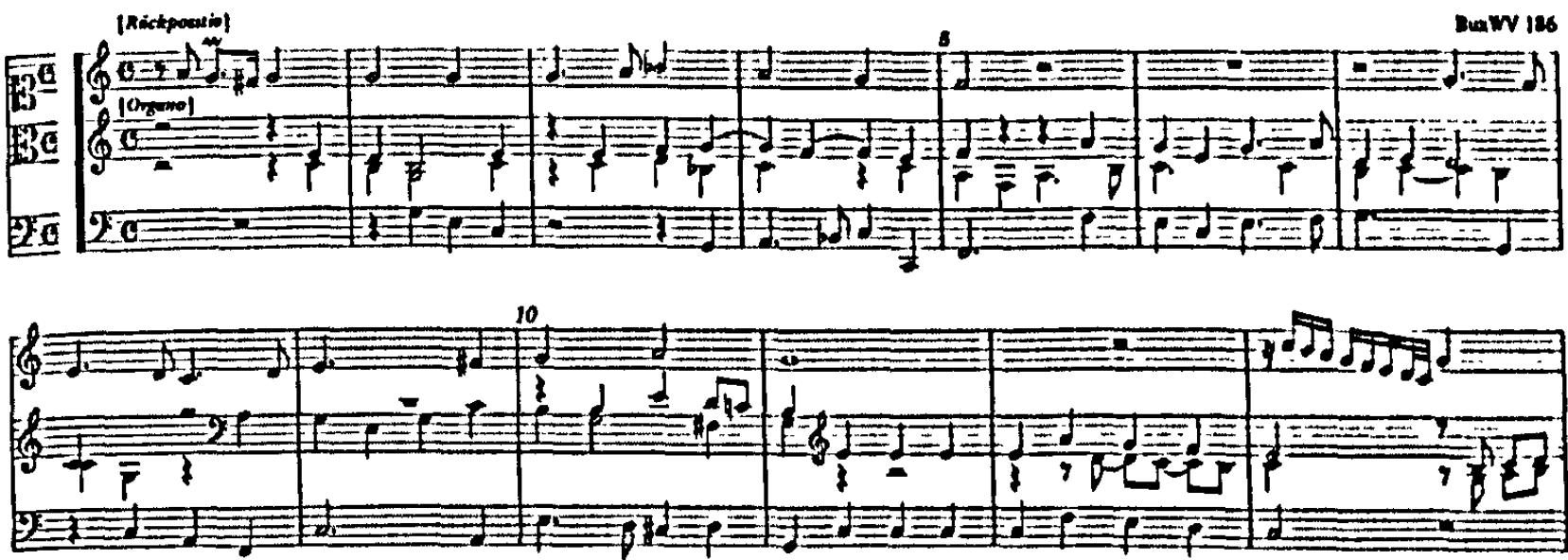
中文讲解
此条目为第24页的图像占位符,图注为"Example 14. BuxWV 186: Es ist das Heil uns kommen her (bars 1-13)"。它位于P0146之后,作为该段所述"在《救恩已临到我们》第二行歌词起始(第8小节)使用完美和谐三和弦标记’von Gnad und lauter Güte’“论断的谱面证据。
谱例范围"bars 1-13"覆盖了前奏曲的开头至第二行歌词结束,使读者能够同时看到乐曲整体结构及第8小节"恩典介入"处的和声选择。这与谱例12、13的小范围截取形成对比,提示该首前奏曲的整体布局是作者论证trias harmonica perfecta作为"上帝介入"标记的更完整样本。
补充说明
需查看原图(谱例14)以核实第8小节的具体和声配置及与’von Gnad und lauter Güte’歌词的对应关系。
第13段(P0149)
原文复述
hermeneutics and allegory of musical materials including triads, consonances, dissonances, and time signatures, see Eric Chafe, ‘Allegorical Music: The “Symbolism” of Tonal Language in the Bach Canons’, The Journal of Musicology, 3.4 (Autumn 1984), 340–62.
中文讲解
此条目是P0143第70号脚注的延续段落(脚注因版面原因被分到下一页)。它为韦克迈斯特神学观念对巴赫(Bach)卡农作品的影响提供进一步文献指南,把论证的外延从巴克斯泰胡德扩展到巴赫——即从北德管风琴传统扩展到更广义的"音乐材料的寓意释义学”(hermeneutics and allegory of musical materials)。
所引文献为Eric Chafe, ‘Allegorical Music: The “Symbolism” of Tonal Language in the Bach Canons’, 发表于The Journal of Musicology第3卷第4期(1984年秋季号),第340–362页。该文研究的是巴赫卡农作品中"三和弦、协和、不协和、拍号"等音乐材料的象征意义。
这一引用的功能是:为读者提供一条通向更广义"音乐寓意学"学术传统的入口。它并非直接证据,而是一种"语境扩展"——告诉读者:本文所采用的"协和=神性/不协和=背离"释义策略并非作者独家发明,而是西方音乐学界自1980年代以来已系统讨论的议题(虽然Chafe研究的是巴赫,方法学可迁移)。
补充说明
Eric Chafe的研究以巴赫卡农为对象,但与本节对巴克斯泰胡德众赞歌前奏曲的释义方法学有亲缘关系——两者都假设作曲家在和声/拍号层面植入寓意性符号。Chafe原文的具体论证思路超出本节范围,本节不应补写。
脚注 / 边栏 / 图表 / 附加信息(如有)
本节包含三项附加材料:(1) 脚注68–70构成P0137–P0138理论引用的完整文献基础,其中脚注68提供韦克迈斯特传记出处(Buelow《格罗夫辞典》词条),脚注69–70提供韦克迈斯特《音乐悖论论述》的德文原典引文及圣经出处(《创世记》6:15),并由作者提供英译;脚注70的扩展段落还包含关于韦克迈斯特理论在巴克斯泰胡德创作环境中的合理性的限定说明(吕贝克圣玛丽教堂天文钟、行星组曲),以及指向Eric Chafe关于巴赫卡农寓意音乐研究的进一步文献。(2) 三个谱例(Example 12: BuxWV 178 bars 23-30;Example 13: BuxWV 183 bars 24-30;Example 14: BuxWV 186 bars 1-13)共同构成作者对trias harmonica perfecta在不同众赞歌前奏曲中反复出现的视觉证据。(3) 图像数据本身被省略,需查阅原图以核实和声细节。
💡 本节核心要点
- 韦克迈斯特(1645–1706)的核心贡献是把音乐音程中的数学比例与神学象征置于"平衡的均衡"之中,从而提出以"协和=与神合一、不协和=背离神而无法被解决"为核心的音乐神学语义学。
- 韦克迈斯特以《创世记》6:15中诺亚方舟尺寸(300×50×30肘)为例,论证这些比例映射到单弦琴上得到C–g–e和谐三和弦,进而宣称一切神圣建筑(约柜、施恩座、会幕、所罗门圣殿)皆按音乐比例建造。
- 作者将这一理论框架应用于巴克斯泰胡德的众赞歌前奏曲:《啊主,怜悯我这罪人》(BuxWV 178)第28小节第一拍的C大调主三和弦(包含原位与第一转位)被解读为对"vergeben"(赦免)一词的神学标记。
- 作者通过跨作品归纳(同时引用BuxWV 183与BuxWV 186)证明:每当歌词指向"上帝的介入/恩典"时,巴克斯泰胡德倾向于以完全协和三和弦作为修辞标记,从而在巴洛克北德管风琴传统中确立了可重复的寓意性实践。
- 作者明确承认这些理论在"现代听来或许像迷信",但强调在所论时代(17世纪末至18世纪初)的虔敬派与自然神学语境中属合法世界观,并以吕贝克圣玛丽教堂天文钟、行星组曲等史实为巴克斯泰胡德所受影响提供历史合理性。
🔑 关键术语
- trias harmonica perfecta:完美和谐三和弦,特指C–g–e这一完全协和的三和弦结构;在韦克迈斯特体系中被视为上帝的映像、神圣秩序与三位一体的和声代理,是本节核心分析对象。
- catachresis:原为修辞学概念"词的误用/不恰当搭配";在本节中被借用指代"连续四度"等偏离规范的不协和用法,特用于表达"人的堕落与罪"的神学主题。
- monochord:单弦琴,文艺复兴与巴洛克时期用于演示音程比例的理论仪器,通过将弦按不同比例划分产生不同音高;韦克迈斯特以此作为将建筑尺寸比例转换为音高比例的中介工具。
- Musicalische Paradoxal-Discourse:韦克迈斯特1707年于Quedlinburg出版的德文音乐理论著作,1970年由Georg Olms Verlag重印于《Hypomnemata musica und andere Schriften》;本节所有韦克迈斯特原典引文均出自该书第28–29页。
- Unitat (统一性/同度):韦克迈斯特神学—数学体系中的核心概念,指所有音程回归的数学与神学原点(unison),象征上帝;越接近unitat的音程越能与之和声,象征人若心不远离上帝便能与上帝和谐。
- BuxWV (Buxtehude-Werke-Verzeichnis):巴克斯泰胡德作品编号体系;本节涉及BuxWV 178(《啊主,怜悯我这罪人》)、BuxWV 183(《因亚当堕落》)、BuxWV 186(《救恩已临到我们》)三首众赞歌前奏曲作为trias harmonica perfecta象征性的样本。
2.11 [描述性拆分] Ach Herr, mich armen Sünder: The Sixth Line and Allegory of Eternal Life
第1段(P0150)
原文复述
Returning to the chorale prelude under discussion, the fifth line concludes with a cadence on the C major triad, while in the next one (‘dass ich mag ewig leben’), Buxtehude proceeds to the depiction of the plaintive character of the chorale through the expressive figures already encountered in the preceding phrases.
中文讲解
本段把分析焦点重新拉回到这首前奏曲上,作为第六行(“dass ich mag ewig leben”,即“使我能够永远活着”)详细分析的过渡句。两个关键信息:其一,前一句歌词以 C 大三和弦的收束式(cadence)作结,形成明确的段落终止感;其二,新一句延续前文已经出现过的“表现性音形”(expressive figures),继续刻画圣咏整体的哀痛(plaintive)语气。也就是说,作者在分段上以和声终止来划分行(line),并提示接下来要分析的“哀痛”情绪并非新引入的修辞策略,而是前几行已经建立起来的修辞传统的延续。
补充说明
本段在论证链上的功能是承上启下:上一节对前几行作了节奏、节拍与音形上的铺垫,本段在此宣告第六行仍然沿用相同的修辞语汇,这为 P0152 中对“ich mag”所做的密集音形分析作了铺垫。
第2段(P0151)
原文复述

中文讲解
这是图例占位符,标示例 15,对应 BuxWV 178 《Ach Herr, mich armen Sünder》第 31–37 小节。图例的版面位置紧跟在 P0150 之后,正好覆盖第六行歌词“dass ich mag ewig leben”对应的乐段,因此它在论证中作为视觉参照,用以配合 P0152 中关于第 34 小节起“ich mag”之重复、第 34–35 小节女高声部的 extensio、以及第 35–37 小节各声部相互呼应的描述。原图的具体谱例细节(如音高、节奏型、装饰音)需查阅原书。
第3段(P0152)
原文复述
The sixth line commences with a polyptoton in bar 34 (‘ich mag’), in which the alto and the soprano imitate the bass and tenor statements of the preceding section (bar 32). The pathos-laden significance of the passus duriusculus in bars 32 and 34 stresses the exegetical content of the phrase ‘ich mag’ (i.e. the desire for eternal life implied by the text), a sense that is heightened by the extensio figure in d" in the soprano in bars 34-35. As a result of the extensio, the soprano proceeds with a syncopated accent (’ewig’), intensified in the alto and the bass (bar 35), as well as in the soprano in the next bar by the circulatio, a figure illustrating “[…] not only circular concepts but also the eternal, infinite, and complete, ultimately symbolizing God.” The affective representation of eternity is also heightened by a second passus duriusculus in the bass (bar 36) functioning this time as a pathopoeia, an allegory of the plea to God for eternal life. The contradiction between the earthly and the eternal life is also illustrated through the antithetical movement between manuals and pedal, stressed by the parembole (interjectio) figure, which fills in the structure through the addition of a supplementary voice that proceeds parallel to the other voices in the middle of bar 37.
中文讲解
这是本节的核心段落,逐层分析第六行歌词中“ich mag ewig leben”(我能够永远活着)所对应的音乐修辞。作者把这一行分成三个层面来解读:
- 重复与哀痛的强调——第 34 小节出现 polyptoton(同一词根在不同声部的重复),女高与女中模仿第 32 小节男低与男高的陈述;第 32 和 34 小节的 passus duriusculus(半音下行的“苦音进行”)承担了“哀情”(pathos)功能,把“ich mag”解读为对永生的渴望。
- 永生的象征——女高声部在第 34–35 小节通过 d″ 上的 extensio(延留音)把节拍拖过强拍,形成切分重音落在“ewig”(永远)上;同一手法随后扩展到女中与男低(第 35 小节),并在下一小节由女高以 circulatio(环绕音型)进一步强调“永恒”。这里作者引用 Bartel 的说法,把 circulatio 视为不仅表达“循环”概念,更象征“永恒、无限、完满,最终指向神”的图像。
- 尘世与永恒的张力——第 36 小节男低再出现一次 passus duriusculus,此处它不再只是单纯的苦音进行,而是被定性为 pathopoeia(情感刻画),是对“向上帝祈求永生”的寓言式(allegory)表达;最后第 37 小节中部由 parembole(亦称 interjectio,插入式补充声部)造成手键盘与脚键盘之间的反向运动,凸显尘世与永恒之间的对立。
整体上,这一段以“哀痛—永生—张力”三段式把音乐修辞、歌词释义(exegesis)和神学寓意(allegory)紧密缝合,论证布克斯特胡德通过密集的音形叠加来“画”出“渴望永生”这一神学主题。
第4段(P0153)
原文复述
With his emphasis on the figures of dissonance, Christoph Bernhard, in his Tractatus compositionis augmentatus (1650) described the extensio as a prolongation or an extension of a dissonance. The extensio would usually result in a rhythmic irregularity on the following strong beat of the harmony, which is exactly what Buxtehude achieves in the phrase under discussion. For the extensio, see Bartel, pp. 269-71.
中文讲解
这是脚注 71,为正文 P0152 中 extensio 一词提供理论根据。脚注追溯到 1650 年 Christoph Bernhard 的《Tractatus compositionis augmentatus》,把 extensio 定义为“不协和音的延长或延伸”,并指出其典型后果是在下一个强拍上出现节奏的不规则性——这正是布克斯特胡德在该乐句中所实现的效果。脚注最后指向 Bartel《Handbuch der musikalischen Figurenlehre》第 269–271 页作为延伸阅读。
第5段(P0154)
原文复述
Reichert, p. 161. The circulatio (circulo, kyklosis, circulo mezzo) was described as a short motive consisting either of four or eight notes, always returning to the beginning note. According to Printz (Phrynis Mytilenaeus, Part 2, p. 49), “the circulo mezzo forms a half-circle in musical notation, and consists of four rapid notes moving by step, in which the second and fourth notes are on the same pitch while the first and third notes have different pitches. It is either intendens, beginning with ascending notes, or remittens, beginning with descending notes”, cited and translated by Bartel, p. 218. For a complete discussion of the circulatio, see Warren Kirkendale, ‘Circulatio-Tradition, Maria Lactans, and Josquin as Musical Orator’, Acta Musicologica, 56 (1984), 69-92.
中文讲解
这是脚注 72,为 P0152 中 circulatio 一词作术语考据。脚注首先列出三种拉丁/希腊同义名称(circulo、kyklosis、circulo mezzo),并概括其结构定义:4 或 8 音的短动机,结束音回到起音。接着引述 Printz 在《Phrynis Mytilenaeus》第二部分第 49 页的定义:circulo mezzo 在记谱上呈半圆形,由四个级进快速音组成,第二与第四音同高、第一与第三音异高,又分“intendens”(上行起)与“remittens”(下行起)两种;引文出自 Bartel 第 218 页的翻译。最后指引读者参阅 Kirkendale 发表于《Acta Musicologica》1984 年第 56 卷的文章,以获得更全面的讨论。
第6段(P0155)
原文复述
Bartel, p. 216.
中文讲解
这是脚注 73,仅一处简短出处,指向 Bartel 第 216 页。该页是 P0152 中所引关于 circulatio 象征“永恒、无限、完满、最终象征神”的引文来源。
第7段(P0156)
原文复述
Reichert, p. 161.
中文讲解
这是脚注 74,仅一处简短出处,指向 Reichert 第 161 页。该页支撑 P0152 中把第 36 小节男低的 passus duriusculus 定性为 pathopoeia(即对“向上帝祈求永生”的情感刻画与寓意表达)的论述。
第8段(P0157)
原文复述

中文讲解
这是图例占位符,标示例 16,对应 BuxWV 178 第 38–44 小节。图例紧接 P0156 之后出现,正好覆盖 P0158 中所讨论的最后一句歌词“entfliehn der höllen Pein”(逃离地狱的痛苦)对应的乐段,因此在论证中作为视觉参照,支撑作者对第 38 小节踏板上的 anabasis(上行音阶)、第 40 小节男低的重复、第 41 小节踏板对圣咏的模仿、第 41 小节女中的 extensio 以及倒数第二小节 congeries(和弦叠置)的描述。具体的谱例细节(如音区、节奏、装饰音形态)需查阅原书。
第9段(P0158)
原文复述
The final phrase ’entfliehn der höllen Pein’ (’escape the deadly pain’) is introduced with an anabasis in the pedal (bar 38), which demonstrates the sense of escaping (running) through the fuga figure, a symbol that “[…] refers to a musical passage which is employed when the words indicate a flight, thereby illustrating their content in as like manner as possible.” As a depiction of the running character of the text, the bass repeats an anabasis in bar 40, while the ornamented cantus firmus of bar 39 is also imitated by the pedal (polyptoton, bar 41). The extensio in the alto (bar 41) and the unexpected seventh chord that supports the last note of the phrase illustrate the plaintive character of the text (‘höllen Pein’), while the prelude concludes with a congeries (synathroismos) in the penultimate bar, in other words the accumulation of alternating root position and second inversion triads.
中文讲解
这是本节分析的收束段落,逐层刻画末句“entfliehn der höllen Pein”(逃离地狱的痛苦)的音乐修辞。可分为三层:
- “逃离”的图像——第 38 小节踏板以 anabasis(上行音阶)引入,配合 fuga(遁走音型)刻画“奔跑/逃逸”之感;作者引用定义把 fuga 界定为“当歌词暗示飞遁时,用以尽可能贴切地表现其内容的乐段”。第 40 小节男低再次出现 anabasis 以巩固“逃离”的图像;第 41 小节踏板又以 polyptoton 模仿第 39 小节经过装饰的 cantus firmus(定旋律),形成声部间的呼应链。
- “痛苦”的强调——第 41 小节女中以 extensio(延留)拖过强拍,最后一个音又被突如其来的七和弦支撑,使“höllen Pein”(地狱之痛)这一哀痛的语义在和声与节奏上同时被放大。
- 终曲的修辞收束——倒数第二小节以 congeries(亦称 synathroismos)收束,即交替叠置原位三和弦与第二转位三和弦,这种和弦“堆叠”在修辞学传统中本身就是“累积”之意,构成全曲修辞上的句号。
整体上,本段与 P0152 呼应,把“渴望永生”的上行冲动和“逃离地狱痛苦”的下行/回避冲动在末句中汇合,并以 congeries 在倒数第二小节作“累积式”收束,使全曲在修辞与神学双重层面上得到完成。
脚注 / 边栏 / 图表 / 附加信息(如有)
本节包含两幅谱例占位符(Example 15:bars 31–37;Example 16:bars 38–44)以及四个脚注(71–74)。两幅谱例均用以视觉支撑 P0152 和 P0158 中对第六行与末句的音形分析;脚注 71–74 则分别就 extensio、circulatio、其象征意涵以及 passus duriusculus 的 pathopoeia 定位提供理论文献支持,作用依次为:术语定义与历史出处、术语定义与延伸阅读、引文来源、出处佐证。
💡 本节核心要点
- 第六行(‘dass ich mag ewig leben’)在和声上以第五行的 C 大三和弦收束作为过渡,延续前文已经建立的‘哀痛’修辞语汇。
- 作者用 polyptoton 与 passus duriusculus 强调‘ich mag’一词所暗含的‘渴望永生’,并通过 d″ 上的 extensio 把切分重音落在‘ewig’上,将修辞强度推向极致。
- circulatio 在本节中被定位为不仅表达‘循环’,更象征‘永恒、无限、完满乃至神’,是作者音乐—神学寓言解读的关键音形之一。
- 第六小节男低的第二个 passus duriusculus 被定性为 pathopoeia,即对‘祈求永生’的寓言式情感刻画;parembole(interjectio)造成的‘手键盘—脚键盘’反向运动则凸显尘世与永恒的对立。
- 末句(‘entfliehn der höllen Pein’)以踏板上的 anabasis 与 fuga 刻画‘逃离/奔跑’,再以 alto 的 extensio 与突发七和弦强化‘地狱之痛’的哀情。
- 全曲在倒数第二小节以 congeries(synathroismos)收束——原位与第二转位三和弦的交替叠置——兼具修辞学‘累积’之意与和声上的句读功能。
🔑 关键术语
- polyptoton:同一词根在相邻乐句或声部中的重复;在本节中指第 34 小节女高与女中对第 32 小节男低与男高陈述的模仿,以及第 41 小节踏板对第 39 小节 cantus firmus 的模仿。
- passus duriusculus:‘苦音进行’,半音下行的修辞音形,在本节先后承担‘哀情’与‘情感刻画/寓意’(pathopoeia)双重功能,分别对应‘渴望永生’与‘祈求永生’的神学主题。
- extensio:‘延留’或‘不协和音的延伸’,源自 Christoph Bernhard 1650 年《Tractatus compositionis augmentatus》的定义;在本节中通过把不协和音拖过下一强拍形成切分重音,先后用于强调‘ewig’与末句的哀痛语气。
- circulatio:4 或 8 音的级进环绕音型,结束音回到起音,又分‘intendens’(上行起)与‘remittens’(下行起)两类;在本节中被作者借 Bartel 的论述诠释为不仅象征循环,更象征‘永恒、无限、完满乃至神’。
- pathopoeia:对某种情感或情绪的音乐刻画;在本节中特指第 36 小节男低的第二个 passus duriusculus 被定性为对‘祈求永生’的寓言式情感表达。
- parembole (interjectio):‘插入式补充声部’,在本节中以一条平行于其他声部的补充声部填充结构,造成手键盘与脚键盘之间的反向运动,用以凸显尘世与永恒之间的张力。
- anabasis:上行音阶,本节中第 38 小节踏板与第 40 小节男低各出现一次,用以刻画‘逃离/奔跑’的图像,呼应歌词‘entfliehn’。
- fuga:‘遁走音型’,本节引用定义:用于当歌词暗示飞遁时,以尽可能贴切地表现其内容的乐段,在本曲中用以配合 anabasis 强化‘逃离地狱之苦’的语义。
- congeries (synathroismos):‘累积/堆叠’,本节特指倒数第二小节原位三和弦与第二转位三和弦的交替叠置,兼具修辞学‘累积’之意与全曲的和声收束功能。
2.12 [描述性拆分] Buxtehude’s Der Tag, der ist so freudenreich (BuxWV 182): Joyful Figures of Repetition
第1段(P0159)
原文复述
Figures of melodic repetition, melodic ornaments, and rhythmical motives related to the depiction of the joyful and jubilant character of the Biblical text are also encountered in Buxtehude’s expressive chorale preludes, among which the chorale prelude Der Tag, der ist so freudenreich (BuxWV 182) demonstrates some fine examples. 79
中文讲解
本段是本小节的总起,承接前文对音乐—修辞手法(figures of repetition, melodic ornaments, rhythmical motives)的讨论,把焦点从一般性概念转向Buxtehude的实例。作者主张,Buxtehude的"表现性众赞歌前奏曲"(expressive chorale preludes)同样使用了上述三类手法来描绘圣经文本中"欢欣、喜悦"(joyful and jubilant)的特征;并预告BuxWV 182《Der Tag, der ist so freudenreich》将作为展示这些手法的"优秀范例"。注意时态与限定词——作者用的是"also encountered",表示这是一种跨体裁的普遍现象,而非Buxtehude的独创;并强调这些figure的功能是"depiction"(描绘、象征),即音乐修辞服务于文本内涵。这一句脚注79指向后续的德文歌词文本。
补充说明
脚注79在P0164给出整首众赞歌的德文原文与英文翻译位置。“expressive chorale preludes"是德语概念"expressiver Choralvorspiel"的英译,泛指巴洛克北德地区带有强烈情感修辞色彩的众赞歌前奏曲。
第2段(P0160)
原文复述
75 Reichert, p. 161. The parembole is only mentioned by Burmeister with regard to fugal structure and is enlisted among his figurae melodiae: “Parembole occurs when at the beginning of the piece two or more voices carry on the subject of the fugue, and another voice is mingled that proceeds alongside them without contributing anything pertinent to the nature or process of fugue. It merely fills vacant spaces in the consonances while those other voices carry on the fugue” (Musical Poetics, by Joachim Burmeister, trans. by Benito Rivera, pp. 177-79).
中文讲解
这是脚注75,注明前文parembole一词来自Reichert著作第161页。脚注本身进一步对术语作出两层信息补充:(1) Burmeister只在涉及"赋格结构"时讨论parembole,并将其归入figurae melodiae(旋律性修辞手法);(2) 借助Rivera英译的Burmeister《Musical Poetics》第177-79页给出定义——一首作品开头若有两条或以上声部承担赋格主题、另有某声部与之并行但不参与赋格本身的实质进程,仅以协和填补空隙,即为parembole。这一定义的关键在于"并行而不参与赋格逻辑”,因此parembole是一种装饰性、填充性的辅助结构,区别于主导声部对主题的真正展开。
补充说明
无额外补充。“figurae melodiae"是Burmeister在《Musica Poetica》(1606)中划分的修辞手法大类之一,与figurae harmoniae(和声类)、figurae textuales相对。
第3段(P0161)
原文复述
76 Reichert, p. 162. Walther, Musicalisches Lexicon, p. 267, translated by Bartel, p. 289.
中文讲解
脚注76只是文献来源标识,注明前文关于某术语(与Walther《Musicalisches Lexicon》第267页对应)的讨论出自Reichert第162页,并由Bartel在第289页给出Walther词条的英译。这种简短的来源脚注在学术著作中用以回溯定义和翻译,本节正文并不在此段中复述Walther的定义。
第4段(P0162)
原文复述
77 Apel, p. 103.
中文讲解
脚注77,单一文献来源标识——Apel著作第103页。这是著作末尾常见的简略注释形式,作用是标明前文某一术语或例证出自Apel。原页内容未在此展开。
第5段(P0163)
原文复述
78 Bartel, p. 230.
中文讲解
脚注78,单一文献来源标识——Bartel著作第230页。作用为标注前文某一定义或例证引用位置。原页内容未在此展开。
第6段(P0164)
原文复述
79 Der Tag, der ist so freudenreich/ aller Kreature/ denn Gottes Sohn vom Himmelreich/ über die Nature/ von einer Jungfrau ist geborn/ Maria, du bist auserkorn/ dass du Mutter wärest/ Was geschah so wundergleich?/ Gottes Sohn vom Himmelreich/ der ist Mensch geboren. English
中文讲解
脚注99所附的众赞歌德文歌词原文,共十行,分属同一节诗的若干对句。各行内容按顺序直译大致为:这一天如此充满喜悦/为了万有受造之物;因为上帝之子从天国/超越自然;由一位童贞女所生;马利亚,你被拣选/成为母亲;可有什么如此奇迹一般?/上帝之子从天国/他作为人而诞生。歌词表达了圣诞的"普世喜悦”(freudenreich)、神性超越自然(über die Nature)、童贞女降生、圣母被拣选以及降生成人的"奇迹"(wundergleich)几层主题。结尾的"English"提示此处要插入英文译文。
补充说明
P0170是该德文歌词的英文译本。诗中"über die Nature"“wundergleich"“auserkorn"为古德语/高地德语色彩词汇,需保留拼写以反映历史语境。
第7段(P0165)
原文复述

中文讲解
这是第27页上的图像或乐谱占位符。其版面位置紧接德国歌词脚注之后,处于本小节进入作品分析前的页面起始位置。从版面逻辑推断,它可能是该作品的整体手稿/版本图示或纯装饰图;由于嵌入图像数据已省略,无法进一步识别具体内容。其作用仅为承载后续引用的乐谱例的视觉背景。
补充说明
原图内容不可见,分析时需参看纸本或高分辨率扫描件。
第8段(P0166)
原文复述
Example 17. BuxWV 182: Der Tag, der ist so freudenreich (bars 1-11)

中文讲解
乐谱例17的图注:曲目为Buxtehude《Der Tag, der ist so freudenreich》(BuxWV 182)第1—11小节。例17在文中紧接P0167的论述,用以图示开头乐句的写作特征,因此分析这一片段时需对照该乐谱。
补充说明
图注对应乐谱例17,需打开原图像查看具体声部进行与谱例细节。
第9段(P0167)
原文复述
In contrast to the previous chorale prelude (Ach Herr), where the character of the piece was determined by the slow-moving minims of the cantus firmus, this chorale displays a joyful content (‘so freudenreich’, ‘so full of joy’) through the application of driving quavers in the melody and in the accompanying voices. The figurae cortae (bars 3-4) intensify the melodic motion, while the auxesis/incrementum (bars 9-10) in the pedal contributes to the portrayal of the exultant character of the text.
中文讲解
本段以"对比"入笔,先回溯前一首《Ach Herr》:其中众赞歌旋律以"缓慢移动的二分音符"决定整体庄重或悲剧性;接着转而强调本曲的"欢欣特质”。作者列出三种促成欢欣感的手段:(1) 旋律与伴奏声部统一使用"推进性八分音符”(driving quavers),代替先前的二分音符长音,制造活跃律动;(2) 第3—4小节出现figurae cortae(短促重复型修辞手法),密集重复的音型强化旋律运动;(3) 第9—10小节踏板声部出现auxesis/incrementum(递增/增长),以音高或音程逐级攀升,表现"exultant"(欢腾、狂喜)性格。本段作用是确立该曲"欢欣"基调所对应的修辞—音乐手段。“figurae cortae"字面意为"短音符组成的图形”;“auxesis"“incrementum"在音乐修辞中均指逐渐增长或上升,常以音程递增或逐级模进达成。
补充说明
与前文《Ach Herr, mich armen Sünder》形成对立构图:一首以慢长音为悲,一首以快重复为喜,作者借此建立"音乐—情感—文本"三重对应的方法论。
第10段(P0168)
原文复述
Example 18. BuxWV 182: Der Tag, der ist so freudenreich (bars 12-16)

中文讲解
乐谱例18图注:曲目为BuxWV 182第12—16小节。该乐谱例服务于P0169对该片段"denn Gottes Sohn von Himmelreich"一句的修辞分析,须对照查看声部细节方能验证所述重复组与上行模进。
补充说明
图注对应乐谱例18,需打开原图像查看具体节奏与音高。
第11段(P0169)
原文复述
The second phrase (‘denn Gottes Sohn von Himmelreich’, ‘because God’s Son from Heaven’) demonstrates an amply ornamented version of the cantus firmus, in which groups of repetitions in the soprano voice serve as depictions of the symbolism of the text. The first small group (third and fourth beats of bar 13) is immediately repeated into the following bar emphasizing God’s presence - anaphora - (the trias harmonica perfecta appears on the first beat of bar 14 as a symbolism of God), while the second melodic group (the third and fourth beats of bar 14) is heard three times in ascending sequence (auxesis/ incrementum). The figure culminates in g’’ in the soprano (bar 16), - a hypotyposis figure as an illustration of the heavenly Kingdom - which is accompanied by the ascending movement of the bass (bars 14-15 and 15-16).
中文讲解
本段聚焦第二乐句"denn Gottes Sohn von Himmelreich"的修辞塑造。中心主张是:高声部对定旋律(cantus firmus)作出"充分装饰"的版本,并以"重复音组"来表现文本象征意义。具体的修辞—语义对应关系如下:(1) 第13小节第3、4拍的小音组被原样重复到下一小节——作者标记为anaphora(头语重复/反复),用以"强调神的临在”;第14小节第1拍出现的trias harmonica perfecta(完全协和的三和弦,是音乐修辞中"神"的象征)进一步强化这一神学指涉;(2) 第14小节第3、4拍的第二个音组以"auxesis/incrementum(递增)“形式连续上行模进三次,象征向上攀升;(3) 整条旋律在第16小节高音g’’(g的小字二组)到达顶点,作者认为这一高音点是hypotyposis(情景化图形)——“天国"的图像化象征,因为高位置即"上"“天"的隐喻;低音部第14—15和15—16小节的上行运动配合,以纵横双向的"上行"完成"上达天国"的描绘。本段的作用是为本小节提供"重复音组—文本象征"最密集、最清晰的案例。
补充说明
“anaphora"本为语言修辞中"句首重复”,此处移植至音乐指"动机原样紧邻重复”;“trias harmonica perfecta"作为"神"之象征是17世纪音乐—修辞系统的标准符号;“hypotyposis"意为"对情境的形象摹绘”,在修辞学传统中以生动性见长。
第12段(P0170)
原文复述
translation: This is the day so full of joy/ for all creatures/ because God’s Son from Heaven/ transcending nature/ is born of a Virgin/ Mary you are chosen/ to be the mother/ was anything so miraculous?/ God’s Son from Heaven/ he is born man. See Peter Williams, The Organ Music of J. S. Bach, pp. 248-49.
中文讲解
本段是歌词脚注79的英文译文主体以及参考来源说明。逐行译文:这一天如此充满喜悦/为了万有受造之物;因为上帝之子从天而来/超越自然/由一位童贞女所生;马利亚,你被拣选/成为母亲;可有什么如此奇迹一般?/上帝之子从天而来/他作为人而诞生。最后一句指引读者可参考Peter Williams的《The Organ Music of J. S. Bach》第248-49页——这是一部权威的巴赫管风琴作品研究著作,提示该众赞歌旋律在巴赫研究中也常被讨论。本段作为附录性内容,对P0164德文原文和正文修辞解读提供语言桥梁。
补充说明
Williams著作把同一旋律置于巴赫传统中考察,可帮助读者比较Buxtehude与Bach对该文本的处理差异,但作者在此并未展开比较。
第13段(P0171)
原文复述
Particular figures in the following phrases also stand for the allegorical meaning of the Biblical text. The climax/ gradatio, a symbol often alluding to divine affections, is amply demonstrated in bars 28 and 31-32 (‘von einer Jungfrau ist geborn’, ‘is born of a Virgin’), further stressed by the accentus (superjectio, bar 29), a figure usually reflecting exclamations of triumph. 80 Finally, the joyful message of Christ’s birth is emphasized in bars 44-48 (‘was geschah so wundergleich’, ‘was anything so miraculous’) through the elaborate movement of the pedal (catabasis) spanning consecutive intervals of salti semplici (octave leaps).
中文讲解
本段集中论述中间段落中的两组修辞—象征对应。第一组:在"von einer Jungfrau ist geborn”(由童贞女所生)对应处——第28小节以及第31—32小节出现climax/gradatio(高潮/渐进),这是"通常指涉神圣情感"的修辞符号;第29小节进一步叠加accentus/superjectio(重音/上抛),以"通常反映凯旋式呼喊"的语气强调之,组合起来表达"圣母感生"的神圣壮丽。第二组:在"was geschah so wundergleich”(可有什么如此奇迹)对应处——第44—48小节踏板声部写作elaborate movement,标记为catabasis(下降),但其内部跨度由consecutive intervals of salti semplici(连续八度跳越)构成。这一组合乍看矛盾——catabasis本应是"下降”,但落地处的"八度跳越"作为"跳跃性"姿态反而以急剧的音程跨越强化"惊异"之感——作者以此喻"基督降生之奇迹”。两个例证功能相同:把抽象修辞与具体文本片段逐一对应,证明"这一首前奏曲通篇以修辞图形承载文本寓意"。
补充说明
“climax"与"gradatio"在音乐修辞传统中常互训;“superjectio"为"自下而上的抛出”,故与凯旋/惊叹相连;“salti semplici"指"简单跳进”,与"salti composti”(复合跳进)相对应。
第14段(P0172)
原文复述
Example 19. BuxWV 182: Der Tag, der ist so freudenreich (bars 27-32)

中文讲解
乐谱例19图注:曲目为BuxWV 182第27—32小节。该片段对应P0171所述"von einer Jungfrau ist geborn"处的climax/gradatio与superjectio配合实例,需对照阅读方能确认所述高潮音型与上方重音。
补充说明
图注对应乐谱例19,需打开原图像查看具体声部进行。
第15段(P0173)
原文复述
Example 20. BuxWV 182: Der Tag, der ist so freudenreich (bars 44-49)

中文讲解
乐谱例20图注:曲目为BuxWV 182第44—49小节。该片段对应P0171所述"was geschah so wundergleich"处踏板catabasis结合salti semplici的实例,需对照阅读以观察踏板声部跨越八度的具体节奏与音高。
补充说明
图注对应乐谱例20,需打开原图像查看踏板线条与八度跳进。
第16段(P0174)
原文复述
The two closing lines of the piece demonstrate two significant musical-rhetorical figures, each illustrating the text in a particular way. The hypobaton, 81 the “‘underpassing’ (hypobatus, infragradiens) of one voice in relation to another” 82 occurs in bars 51-53 (“Gottes Sohn vom Himmelreich”), with the soprano voice being transferred below the alto range, a figure Scheibe described as “[…] exceptionally appropriate for a clear and emphatic expression of the words as well as for the arousal of the affections.” 83 The next figure is illustrated in the two closing bars of the final line ‘der ist Mensch geboren’. The joyful message of Christ’s birth receives an ecstatic character in which the cantus firmus (soprano) exceeds its boundaries, illustrating a figure described by Burmeister as hypobole, namely the “[…] understepping of the melodia under the lowest terminum of the ambitus […].” 84
中文讲解
本段聚焦作品末尾两行的两个标志性修辞图形。第一个:hypobaton(从下方穿越),定义为"一声部相对于另一声部’从下方穿过’(hypobatus, infragradiens)",出现在第51—53小节"Gottes Sohn vom Himmelreich"处——具体做法是高声部(soprano)位置被移到次女高(alto)音域之下,即本应作为定旋律的最高声部这次向下穿越,从而体现"来自天国"降至人间的文本意象。Scheibe评价这种图形"对于清晰而有力的词义表达以及激发情感特别适合"。第二个:hypobole(从中穿越或自下越出范围),定义为Burmeister所说的"旋律低于其音域最低terminus(极限音)的下越",出现在末行"der ist Mensch geboren"的结尾两小节——soprano定旋律"超出(突破)其固有的音域范围"向下越出常规下限,把"基督作为人而诞生"的"狂喜性"喜讯描绘得"ecstatic"(出神、忘形)。两组图形分别象征"天降"与"突破",与文本含义(神从天国降临、化作肉身)双重映射。本段是全小节的收束,把"重复—装饰—修辞—象征"的论证推向"神圣奥秘"主题。
补充说明
“hypobaton"与"hypobole"在词源上均以hypo-(自下)为前缀,但修辞功能不同:前者是声部间的相对穿越,后者是某声部突破自身音域下限。前者源自修辞学,后者是音乐修辞的扩展概念。
第17段(P0175)
原文复述
80 Vincent Benitez, ‘Musical-Rhetorical Figures in the Orgelbüchlein of J. S. Bach’, p. 9. 81 Reichert, p. 154.
中文讲解
脚注80—81合并段。脚注80标注:关于superjectio作为"胜利呼喊"图形的说法引自Vincent Benitez论文《Musical-Rhetorical Figures in the Orgelbüchlein of J. S. Bach》第9页。脚注81标注:hypobaton一词所在的Reichert著作第154页。两个来源回溯作用:Benitez论文立足巴赫《Orgelbüchlein》小曲库,作者引用以说明"superjectio与凯旋欢呼"这一经典对应;Reichert第154页则是hypobaton定义的来源页。
补充说明
Benitez研究以巴赫为对象,但Buxtehude与Bach同属北德管风琴—修辞传统,故术语可互证。
第18段(P0176)
原文复述
82 Bartel, p. 301.
中文讲解
脚注82,单一文献来源标识——Bartel著作第301页。回溯hypobaton(hypobatus, infragradiens)的定义译文出处。原页细节未在此展开。
第19段(P0177)
原文复述
83 Scheibe, Der critische Musikus, p. 688, cited and translated by Bartel, p. 303. In verbal rhetoric, Gottsched had described the hyperbaton/ hypobaton as the transference of words, phrases, or thoughts from their natural position to another, as a result of the content (affection) of the speech
中文讲解
脚注83,包含两层信息。(1) 来源:Scheibe《Der critische Musikus》第688页,Bartel在第303页引用并英译了关于hypobaton"对清晰表达和情感激发特别合适"的那段话。(2) 词源对照:作者补充说明,在语言修辞学中Gottsched曾把hyperbaton/hypobaton定义为"词、短语或思想因其内容(情感)而从其自然位置转移到另一位置”。这一补充帮助读者理解hypobaton概念的跨学科脉络——它本是修辞学术语,被音乐修辞学借用,含义从"语序的调整"转换为"声部位置的调整",但二者都以"服务情感"为最终目的。
补充说明
Gottsched为18世纪德国经典修辞学家,《Critische Dichtkunst vor die Deutschen》是其代表作;Scheibe同时是音乐评论家与音乐修辞理论家,二者之间的术语流通显示出音乐—修辞概念在18世纪德语学术中的交互网络。
第20段(P0178)
原文复述
Example 21. BuxWV 182: Der Tag, der ist so freudenreich (bars 51-61)
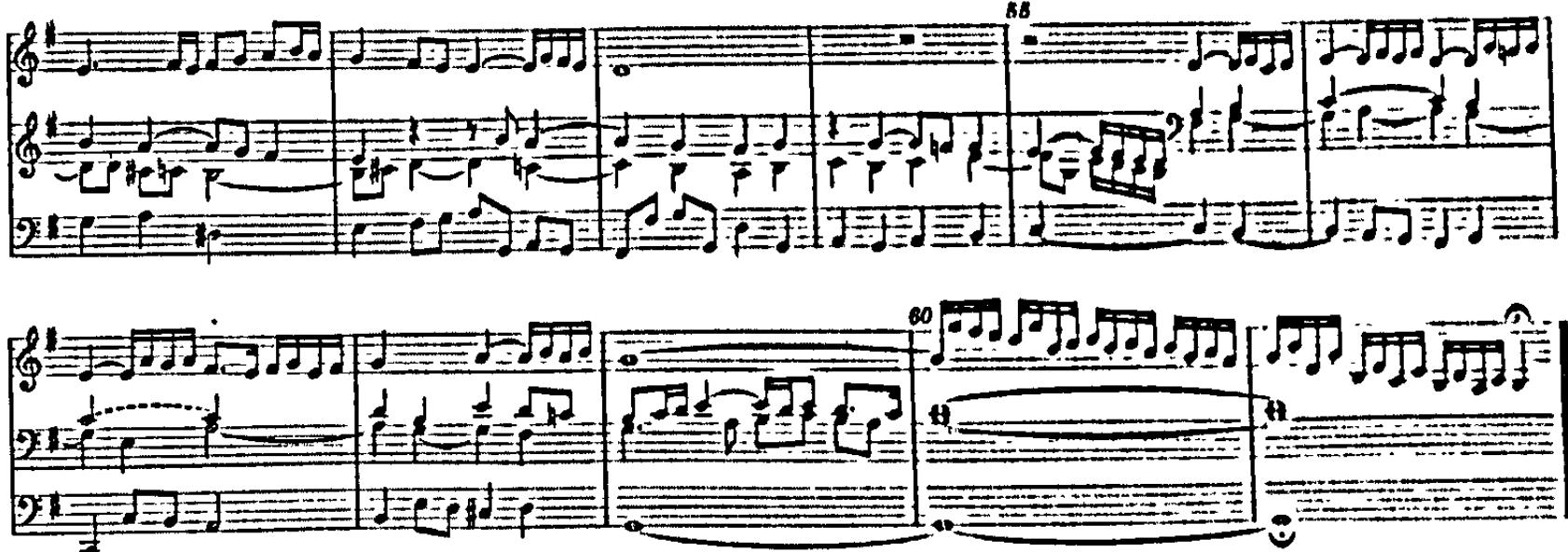
中文讲解
乐谱例21图注:曲目为BuxWV 182第51—61小节。该片段对应P0174所述结尾两行hypobaton(bars 51-53)与hypobole(末两小节)两组修辞图形实例,为本节分析提供最终视觉证据。需对照查看soprano声部在51—53下穿alto以及末段突破音域下限的具体写作。
补充说明
图注对应乐谱例21,需打开原图像查看结尾声部进行。
脚注 / 边栏 / 图表 / 附加信息(如有)
本小节附加材料集中于(1)脚注链:脚注75—78为前文讨论的术语学出处,脚注79含德文歌词,P0170为其英译,脚注80—83则为本小节独有,分别回溯Benitez论文、Reichert第154页、Bartel第301页、Scheibe《Der critische Musikus》第688页(Bartel英译)及Gottsched对hyperbaton的语言修辞学定义;(2)四组乐谱例(例17—21)按bars 1-11、12-16、27-32、44-49、51-61序列逐步呈现作品的修辞高峰段落,构成"图—文"互证结构。歌词文本(德文+英译)在体裁上属于"圣诗歌词附录",兼具原文记录与英语读者可达性的双重作用。
💡 本节核心要点
- Buxtehude的BuxWV 182《Der Tag, der ist so freudenreich》是与前一首《Ach Herr, mich armen Sünder》构成对照的"欢欣型"前奏曲——以推进性八分音符、figurae cortae、踏板auxesis等手段塑造喜悦与狂喜特质
- 歌词"freudenreich"“über die Nature"“wundergleich"“auserkorn"等关键词逐句对应到具体修辞图形:repeat组(anaphora)+ 神圣三和弦(trias harmonica perfecta)强调神的临在;三次上行模进(auxesis/incrementum)与高音点g’‘的hypotyposis象征天国降临
- 中段"von einer Jungfrau ist geborn"以climax/gradatio叠加superjectio描绘神圣诞生;尾段"was geschah so wundergleich"则以踏板catabasis跨八度跳越(salti semplici)体现惊异
- 结尾两行先后动用hypobaton(声部间下穿)与hypobole(旋律突破自身音域下限):前者象征神从天降下,后者以"出神"的姿态表达基督肉身降生之喜
- 本小节同时展示音乐修辞概念从语言修辞学(hyperbaton/hypobaton在Gottsched、Scheibe的定义)与17世纪musica poetica传统(Burmeister的hypobole、trias harmonica perfecta)的双重词源
🔑 关键术语
- figurae cortae:由短音符组成的修辞音型。本节指第3—4小节密集的短重复音组,以加速旋律运动强化欢欣情绪。
- auxesis / incrementum:递增/增长——通过音高或时值的逐级上升表现"攀升"“欢腾”。本节见第9—10小节踏板声部及第14小节高声部的三次上行模进。
- anaphora:原为语言修辞中的句首重复;音乐修辞中指动机的紧邻原样重复。本节中第13小节第3—4拍音组紧随其后的重复用以"强调神的临在”。
- trias harmonica perfecta:完全协和的三和弦,在17世纪音乐—修辞传统中是"神"的象征符号。本节第14小节第1拍出现该和弦,作为对"denn Gottes Sohn"神学指涉的音乐符号。
- hypotyposis:情景化图绘修辞——以生动音响描绘情境。本节中第16小节高音g’‘作为"天国"的形象化书写。
- climax / gradatio:高潮/渐进修辞,常用于指涉神圣情感。本节在"von einer Jungfrau ist geborn"句第28、31—32小节出现。
- accentus / superjectio:重音/上抛——通常反映胜利式惊叹,本节位于第29小节,与gradatio配合强调降生。
- catabasis:下降——本节第44—48小节踏板声部以此呈现"was geschah so wundergleich"中的惊异感受。
- salti semplici:简单跳进(本节为八度跳越)——与salti composti(复合跳进)相对。
- hypobaton (hypobatus / infragradiens):声部间下方穿越——本节第51—53小节"Gottes Sohn vom Himmelreich"处soprano下穿alto,象征神从天降临人间。
- hypobole:旋律低于自身音域最低terminus(极限音)的下越——本节末两小节soprano突破其常态音域下限,以"出神"方式传递降生喜讯。
2.13 [描述性拆分] Bach’s Orgelbüchlein: Genesis, Chronology, and Types of Chorale Preludes
第1段(P0179)
原文复述
The organ chorale music of J. S. Bach represents the culmination of a synthesis of different styles and genres within the Lutheran chorale tradition that had been established in central and north Germany through the compositions of Dieterich Buxtehude and his predecessors. Chorale compositions make up more than half of Bach’s organ works, and they are typically classified into short or long forms on the basis of three criteria: the complete or incomplete presentation of the cantus firmus, the presence or absence of interludes between the chorale phrases, and finally the illustration of one or more verses of the chorale melody. The collection that has received the lion’s share of attention from scholars is the Orgelbüchlein (BWV 599-644), a collection of forty-five chorale preludes that Bach was engaged in while in the service of Duke Wilhelm Ernst at Weimar (between 1713 and 1716), but left unfinished when he moved to Cöthen in 1717 (the title-page of the autograph was actually signed by Bach while at Cöthen).
中文讲解
本段是整节的开篇,定位巴赫管风琴圣咏音乐的历史坐标。论断有三层:第一,巴赫的管风琴圣咏音乐是中、北德路德宗圣咏传统(以Buxtehude及其前辈为关键传承者)综合的集大成之作;第二,圣咏作品占巴赫管风琴作品的过半,并按三条标准被分为短形式与长形式——即(1)cantus firmus(定旋律)是否完整呈现,(2)圣咏乐句之间是否插入间奏段,(3)所涉旋律句数是否覆盖一段以上歌词——这三条标准随后将贯穿本节的形式分析;第三,《Orgelbüchlein》(BWV 599-644)是学界关注最多的曲集,含45首圣咏前奏曲,主要写作于魏玛Wilhelm Ernst公爵任内(1713-1716),1717年巴赫迁居Cöthen时未完成。作者用括号补充一个易被忽略的细节:手稿扉页是巴赫在Cöthen才签署的,说明即便地理上已离开魏玛,他在概念上仍把该项目带到了Cöthen。
第2段(P0180)
原文复述
[—] that obstructed the consideration of proper word order by the poet. The figure is first encountered in Scheibe’s musikalische Figurelehre, who identified it as: “[—] when either a note or an entire thought is transferred from its natural position to a different one. In the first case it agrees with the harmonic exchange, namely when a note which belongs in a higher voice is set in a lower one, or when a note which belongs in a lower voice is set in a higher one [—]” (Der critische Musikus, p. 688, cited and translated by Bartel, p. 302).
中文讲解
本段从句子中途起首,是上一节关于音乐修辞格(musical-rhetorical figures)讨论的延续;本节范围内不再展开这一术语。所谓该修辞格即把一个音或一个完整乐思从其本应所在的位置转移到另一位置,其第一种情形(单音的转移)与"和声互换”(harmonic exchange)一致——本应属于高音部的音被置于低音部,反之亦然。Scheibe的德文原文由Bartel在其著作第302页转引并英译,本段引文即来自Bartel的译文。读者应意识到:作者在此仅承接前文论题,本节对音乐修辞格的具体讨论将自P0207起另启新题。
补充说明
此段实际是从上一节"音乐修辞格"主题中延续下来的内容,本节内不再使用此处的修辞格术语(hypallage/换位);本节的相关讨论另起于P0207。
第3段(P0181)
原文复述
Footnote 84: Burmeister, Musica poetica, p. 64, cited and translated by Bartel, p. 307.
中文讲解
脚注84引用Burmeister《Musica poetica》(1606年德国音乐修辞学里程碑)一书第64页,由Bartel在第307页转引并翻译。该脚注对应正文前一段对某一音乐修辞格(紧接P0180的论题)所作论述的来源标注。
补充说明
此脚注为上一节主题(音乐修辞格)的参考文献,不进入本节形式分析的论域。
第4段(P0182)
原文复述
Footnote 85: Marshall and Leaver, ‘Chorale Settings’, p. 759.
中文讲解
脚注85为P0179中"圣咏作品占巴赫管风琴作品一半以上"与"按三条标准分为短/长形式"两个论断提供文献出处:Marshall与Leaver合撰的"Chorale Settings"一文第759页。
第5段(P0183)
原文复述
Footnote 86: The collection actually contains forty-six chorale preludes and a fragment of a forty-seventh; Liebster Jesu, wir sind hier (BWV 633 and 634) appears in two versions, while Bach also supplied sketches for O Traurigkeit, o Herzeleid.
中文讲解
脚注86对P0179中"45首"的整数计法作出重要订正:手稿实际包含46首完整前奏曲和1首(第47首)的片段;其中《Liebster Jesu, wir sind hier》存在BWV 633与BWV 634两个版本,《O Traurigkeit, o Herzeleid》仅有草稿。这意味着学界通行说法"45首"只是约定的整数计法,从目录学严格意义上说,曲目数量与编号更复杂。这一订正对后续引用具体作品编号时尤为关键。
补充说明
BWV即巴赫作品标准目录编号,正文以BWV 599-644指代《Orgelbüchlein》的曲目范围。
第6段(P0184)
原文复述
Comparing the handwriting styles that appear in the Orgelbüchlein with other surviving dated examples of Bach’s handwriting, Heinz-Harald Löhlein suggested three compositional stages for the Orgelbüchlein: from Advent 1713 to Pentecost 1714 (stage one), from Advent 1714 to Easter 1715 (stage two), and finally from Christmas 1515 [sic, Christmas 1715] to Passiontide 1716. The latest entries date from the composer’s time in Leipzig (1740), when Bach added the fragment O Traurigkeit, o Herzeleid and the chorale prelude Helf mir Gotts Güte preisen (BWV 613), and revised a small number of other preludes (BWV 620 and 631). The only serious objections to Löhlein’s suggested chronologies were raised by Christoph Wolff, who insisted that, since Bach’s manuscript style does not imply any precise composition dates, the compilation of the Orgelbüchlein could be traced back to the composer’s early years in Weimar (1708-1709). According to Wolff, the earliest entries date from the Advent-Christmas season of 1708-1709 after Bach had taken up his post in Weimar in the summer of 1708, while the major part of the work was probably completed before 1714, a view that reduces the gap between the Orgelbüchlein and Bach’s early organ chorales.
中文讲解
本段是本节关于《Orgelbüchlein》编订年代的核心论述,并呈现两种主要学术观点的对峙。Löhlein通过对《Orgelbüchlein》笔迹与巴赫其他可断代笔迹的比对,提出三阶段创作时间表:1713将临期至1714五旬节(第一阶段)、1714将临期至1715复活节(第二阶段)、1715圣诞节至1716受难期(第三阶段);1740年巴赫在莱比锡又补入《O Traurigkeit, o Herzeleid》片段和BWV 613,并修订BWV 620、631等少量前奏曲。Wolff提出反驳:巴赫手稿风格无法精确断代,因此整部《Orgelbüchlein》的编订可上溯至魏玛早期(1708-1709),最早条目出自1708-1709年将临-圣诞季,主要部分很可能在1714年前完成。Wolff的立场实际上缩短了《Orgelbüchlein》与巴赫早期管风琴圣咏之间的年代距离,暗示这些作品可能与Arnstadt时期甚至更早的素材相关联。读者应特别注意:这两种观点构成巴赫研究中长期存在的学术争议,本节后续对作品类型的分析需要以此为时间背景加以理解。
补充说明
将临期(Advent)、五旬节(Pentecost)、受难期(Passiontide)、复活节(Easter)均为基督教礼仪年的重要节点;巴赫圣咏前奏曲按礼节编排的方式与P0190段所列164首原拟曲目的分配方式相一致。
第7段(P0185)
原文复述
Footnote 87: Walter Emery and Christoph Wolff, ‘Johann Sebastian Bach’, in The New Grove Dictionary of Music and Musicians, ed. by S. Sadie and J. Tyrrell, 2nd edn, 29 vols (London: Macmillan Publishers Ltd, 2001), ii, pp. 309-82 (pp. 318 and 340). For an earlier version of the same article, see Walter Emery, Christoph Wolff, and Nicholas Temperley, ‘Johann Sebastian Bach’, in The New Grove Bach Family, ed. by Stanley Sadie, The Composer Biography Series (London: Macmillan, 1983), pp. 44-250.
中文讲解
脚注87为P0179中"45首前奏曲"和"手稿扉页在Cöthen签署"两事实提供权威出处:Emery与Wolff合撰的《Johann Sebastian Bach》条目,载于《新格罗夫音乐与音乐家辞典》第二版第2卷第309-382页(具体引自第318与340页)。同时列出1983年《New Grove Bach Family》中由Emery、Wolff与Temperley合撰的同题较早版本(第44-250页),便于读者追溯学术史。
第8段(P0186)
原文复述
Footnote 88: Russell Stinson, The Orgelbüchlein, ed. by George B. Stauffer, Monuments of Western Music Series (New York: Schirmer, 1996), pp. 12-13. See also J. S. Bach. Orgelwerke Vol. 5: Präludien und Fugen, Pastorale. Ewald Kooiman. Coronata 1613.
中文讲解
脚注88为P0184中Löhlein笔迹断代说及其反对意见提供基础文献:Stinson的《The Orgelbüchlein》专论第12-13页。同时附以Kooiman录制的巴赫管风琴作品第五卷(Coronata 1613)作为可听参考。
第9段(P0187)
原文复述
Footnote 89: Christoph Wolff, ‘Chronology and Style in the Early Works: A Background for the Orgel-Büchlein’, in his Bach: Essays on his Life and Music (Cambridge, MA: Harvard University Press, 1991), pp. 297-305 (p. 299), and the postscript to the same article/essay on pages 426-27; originally published as ‘Zur Problematik der Chronologie und Stilentwicklung des Bachschen Frühwerkes, insbesondere zur musikalischen Vorgeschichte des Orgelbüchleins’, in Bericht über die wissenschaftliche Konferenz zum V. internationalen Bachfest der DDR in Verbindung mit dem 60. Bachfest der neuen Bachgesellschaft, ed. by Winfried Hoffmann and Armin Schneiderheinze (Leipzig: VEB Deutscher Verlag für Musik, 1988), pp. 449-55.
中文讲解
脚注89标明P0184中Wolff反对意见的原始出处:Wolff论文《Chronology and Style in the Early Works: A Background for the Orgel-Büchlein》,载于其论文集《Bach: Essays on his Life and Music》(哈佛大学出版社1991年版)第297-305页,正文在第299页,后记在第426-27页。脚注同时披露该文最早以德文版(标题为"Zur Problematik der Chronologie und Stilentwicklung des Bachschen Frühwerkes…")发表于1988年莱比锡第五届国际巴赫节暨新巴赫学会第60届巴赫节会议报告集(第449-55页)。这一脚注把英、德两个版本并列,体现了Wolff观点的双语学术传播路径。
第10段(P0188)
原文复述
Footnote 90: Wolff, ‘Chronology and Style in the Early Works’, p. 299.
中文讲解
脚注90为二次引用,指向Wolff同一篇文章第299页,对应P0184中"最早条目出自1708-1709年将临-圣诞季"这一具体主张。
第11段(P0189)
原文复述
Footnote 91: ibid., p. 427. See Christoph Wolff, ‘Bach’s Organ Music: Studies and Discoveries’, in The Musical Times, 126 (March 1985, ‘Bach Tercentenary Issue’), 149-52, where Wolff discusses the connection between the Orgelbüchlein chorale preludes and the recently (1985) discovered chorales from the Neumeister collection (Yale University Manuscript LM 4708), since BWV 601 and 639 from the Orgelbüchlein appear first in the LM 4708 manuscript; also Christoph Wolff, ‘The Neumeister Collection of Chorale Preludes from the Bach Circle’, in his Bach: Essays on his Life and Music (Cambridge, MA: Harvard University Press, 1991), pp. 107-27 (pp. 117-21). The same view according to which these two preludes date from the Arnstadt period is supported by Wolff in his Johann Sebastian Bach: The Learned Musician (Oxford: Oxford University Press, 2002), p. 94. See also the preface to Johann Sebastian Bach: Organ Chorales from the Neumeister Collection (Yale University Manuscript LM 4708), ed. by Christoph Wolff (New Haven: Yale University Press, 1985). Also Werner Breig, ‘Textbezug und Werkidee in Johann Sebastian Bachs frühen Orgelchorälen’, in Musikkulturgeschichte: Festschrift für Constantin Floros zum 60. Geburtstag, ed. by Peter Petersen (Wiesbaden, 1990), pp. 167-182.
中文讲解
脚注91是P0184学术讨论的延伸:先指向上文Wolff文后记第427页(关于"主要部分在1714年前完成”),随后引出Wolff于1985年《The Musical Times》巴赫三百周年专号上发表的《Bach’s Organ Music: Studies and Discoveries》一文(第149-152页)。该文讨论了《Orgelbüchlein》圣咏前奏曲与同年新发现的Neumeister藏本(耶鲁大学LM 4708手稿)的关联——BWV 601和639这两首前奏曲首先出现在LM 4708手稿中,因此被推测属更早的Arnstadt时期。脚注继续列出Wolff在1991年同书第107-27页(具体为第117-21页)、在2002年《The Learned Musician》第94页以及在1985年Wolff编辑的Neumeister藏本耶鲁版序言中的相关论述;并附Breig的德文论文《Textbezug und Werkidee in Johann Sebastian Bachs frühen Orgelchorälen》(载Floros祝寿文集,1990年,第167-182页)。整条脚注构成《Orgelbüchlein》早期断代问题的核心文献网络。
补充说明
脚注涉及的LM 4708手稿即"Neumeister Collection",是1985年才被发现并研究的巴赫圣咏前奏曲新文献,是支撑"《Orgelbüchlein》部分曲目可能早于魏玛时期"观点的重要实物证据。
第12段(P0190)
原文复述
The autograph manuscript preserved in the Staatsbibliothek in Berlin shows that the surviving music constitutes just a fragment of Bach’s initial project that was planned to cover the entire liturgical year following the layout of traditional hymnbooks of his time. Bach originally entered one hundred and sixty-four chorale titles at the top of blank pages; sixty of them were designated for the church seasons (de tempore), while the remaining one hundred and four (omne tempore) were intended for any church occasion or festival (the Lord’s Prayer and Penitence are among them). Notwithstanding the aims of the initial project, Bach abandoned work on the Orgelbüchlein after having completed forty-five chorale arrangements, four of which were composed for Advent, ten for Christmas and three for New Year, seven for Passiontide and six for Easter, while the remaining fifteen were intended for other church occasions. Under the influence of traditional Lutheran hymnody, Bach included in his original plan approximately thirty chorales ascribed to Luther himself, while over half of the chorales set for the collection date from the Reformation era.
中文讲解
本段以手稿实物证据揭示《Orgelbüchlein》“未完成"的多重含义。柏林国家图书馆所藏巴赫亲笔手稿显示,现存乐谱只是巴赫原计划的片段——原计划参照当时传统赞美诗集的体例覆盖整个礼仪年。巴赫原在空白页顶端列出了164首圣咏题目,其中60首为教会节期专用(拉丁术语de tempore,“按时节”),104首为任何场合通用(omne tempore,“随时”),通用类中包括"主祷文"和"悔罪"等主题。实际完成45首的具体分配是:4首将临期、10首圣诞、3首新年、7首受难期、6首复活节,其余15首用于其他教会场合。最后两句话揭示了原计划与路德宗传统圣咏的关系:原计划中约有30首圣咏归于路德本人所作,所设圣咏超过半数来自宗教改革时期。这段数字与分布为后文"为何该曲集对路德宗礼拜至关重要"提供了统计基础。
补充说明
拉丁术语de tempore(按时节)和omne tempore(随时)是礼仪音乐目录学中的标准分类,前者特指与特定节期绑定的圣咏,后者则不依赖节期。
第13段(P0191)
原文复述
The Orgelbüchlein forms part of Bach’s organ repertoire composed while in Weimar, which aimed to furnish the organist at the court chapel with chorale arrangements that functioned as preludes, interludes, or accompaniments of congregational hymns. Moreover, it constitutes a didactic tool, since in the preface to the collection Bach outlined his objectives, which embodied a systematic approach to chorale composition through an artful combination of pedal and contrapuntal techniques with affective musical-rhetorical language. The introduction to the Orgelbüchlein reads as follows:
中文讲解
本段阐明《Orgelbüchlein》的双重功能。第一重是礼拜功能:它属于巴赫在魏玛时期为宫廷教堂管风琴师所写的管风琴作品,使管风琴师能够以这些圣咏改编曲作为众赞歌的前奏(preludes)、间奏(interludes)或伴奏(accompaniments)。第二重是教学功能:巴赫在曲集前言中明确表达了教学目标,即通过脚键盘技巧、对位技法与情感化音乐-修辞语言的"艺术结合”,让学习者系统掌握圣咏写作。换言之,《Orgelbüchlein》既是礼拜用书,又是教学手册——这一双重身份解释了它为何既强调实用性(每首仅10-20小节)又强调多样性(三种类型)。段末引出巴赫亲自撰写的前言原文,作为下一段引文的过渡。
第14段(P0192)
原文复述
Footnote 91 (continued): [Johann Sebastian Bach: The Learned Musician, Oxford University Press] 2002, p. 94. See also the preface to Johann Sebastian Bach: Organ Chorales from the Neumeister Collection (Yale University Manuscript LM 4708), ed. by Christoph Wolff (New Haven: Yale University Press, 1985). Also Werner Breig, ‘Textbezug und Werkidee in Johann Sebastian Bachs frühen Orgelchorälen’, in Musikkulturgeschichte: Festschrift für Constantin Floros zum 60. Geburtstag, ed. by Peter Petersen (Wiesbaden, 1990), pp. 167-182.
中文讲解
此条为脚注91的接续,列出与"《Orgelbüchlein》部分作品源于Arnstadt时期"观点相关的延伸阅读:Wolff《The Learned Musician》(2002)第94页、1985年Wolff编辑的Neumeister藏本序言(耶鲁版)、以及Breig的论文《Textbezug und Werkidee in Johann Sebastian Bachs frühen Orgelchorälen》(载Floros祝寿文集,1990,第167-182页)。
第15段(P0193)
原文复述
Footnote 92: Stinson, The Orgelbüchlein, p. 2.
中文讲解
脚注92为P0190中"原计划164首标题"和"45首实际完成"两数据提供Stinson专论第2页的来源。
第16段(P0194)
原文复述
Footnote 93: Robin A. Leaver, ‘Bach and Hymnody: The Evidence of the “Orgelbuchlein”’, Early Music, 13.2 (Bach Tercentenary Issue, May 1985), 227-36 (p. 228).
中文讲解
脚注93为P0190中"在路德宗传统圣咏影响下"一句提供来源:Leaver《Bach and Hymnody: The Evidence of the ‘Orgelbuchlein’》,载《Early Music》1985年5月巴赫三百周年专号(13卷2期)第227-236页,具体第228页。
第17段(P0195)
原文复述
Footnote 94: Stinson, p. 10.
中文讲解
脚注94为P0190最后两句"原计划约30首归路德所作"和"半数以上来自宗教改革时期"提供Stinson专论第10页的来源。
第18段(P0196)
原文复述
Footnote 95: ibid., p. 27.
中文讲解
脚注95指向Stinson专论第27页,对应P0191中"《Orgelbüchlein》属于魏玛时期为宫廷教堂管风琴师所作礼拜用圣咏"这一说法。
第19段(P0197)
原文复述
Footnote 96: Emery and Wolff, ‘Johann Sebastian Bach’, in The New Grove Dictionary of Music and Musicians, p. 340.
中文讲解
脚注96为P0191关于"教学工具"和"系统性圣咏作曲"两个论断提供权威出处,即Emery与Wolff合撰的《New Grove》巴赫条目第340页。
第20段(P0198)
原文复述
Little Organ Book, in which guidance is given to an inquiring organist in how to implement a chorale in all kinds of ways, and at the same time to become practised in the study of pedalling, since in the chorales found therein the pedal is treated completely obbligato.
中文讲解
这是巴赫为《Orgelbüchlein》亲笔撰写的序言原文(Williams英译)。巴赫自谦地称之为"小管风琴书"(Orgelbüchlein直译即"小书"),并陈述该书的两大目的:其一,引导求知者掌握以各种方式实现圣咏的处理;其二,让学习者熟悉脚键盘演奏,因为曲集中的脚键盘"完全作为obbligato(必需声部)“使用。obbligato一词在此至关重要:它意味着脚键盘不是可选的即兴支撑,而是作品结构中不可分离的组成部分——这一要求本身就使《Orgelbüchlein》具备教学价值,初学者必须练就"脚键盘独立声部化"的技能。
补充说明
obbligato一词在巴洛克音乐中泛指"不可省略的声部”,与ad libitum(可任意处理)相对;脚键盘作为obbligato使用,标志巴赫对管风琴脚踏技术的系统化训练要求。
第21段(P0199)
原文复述
The so-called Orgelbüchlein-type of chorale prelude is a short composition usually between ten and twenty bars long, with the chorale melody in its original rhythmic and melodic shape set against a contrapuntal accompaniment, whose motivic material is, in many cases, determined by the symbolism and the allegory of the theological text. Three types of chorale prelude are illustrated in the collection. The first (and the one most frequently encountered) is the melody chorale, in which the chorale tune appears in the soprano, usually in an unadorned version, without the intervention of any interludes between the phrases. Moreover, the melody is presented in the same rhythmic design as would occur in congregational singing, while of the four contrapuntal parts, the inner two illustrate unified motivic material usually with points of imitation. Finally, with the addition of an obbligato rather than an ad libitum pedal, Bach increases the harmonic diversity, since the pedal is sometimes assigned the same figurations as the inner voices, and sometimes demonstrates individual motives.
中文讲解
本段是本节对《Orgelbüchlein》作品类型学的关键铺垫。开头先给出"Orgelbüchlein型前奏曲"的总体特征:短(10-20小节)、保留圣咏旋律的原始节奏与音形、对位伴奏的动机材料常由歌词的神学象征和寓义决定。随后宣告全曲集体现三种类型,并首先介绍第一种——旋律圣咏(melody chorale),它是最常见的一类。其形式特征有五条:(1)旋律置于高声部(soprano),不加装饰;(2)各乐句之间无插段(interludes);(3)旋律的节奏设计与会众齐唱时完全一致;(4)四个对位声部中,内两声部呈现统一的动机材料并常以模仿对位(points of imitation)写成;(5)脚键盘声部为obbligato而非ad libitum,和声由此更丰富——脚键盘有时复用内声部的音型,有时则呈现独立动机。这五点共同构成"旋律圣咏"的判别标准,读者在后续修辞格分析中应能据此辨识此类作品。
补充说明
文中区分obbligato(必需声部)与ad libitum(可任意处理)两术语,是判断巴赫圣咏前奏曲结构是否依赖脚键盘的关键标记;points of imitation指各声部依次模仿同一动机材料的对位技法。
第22段(P0200)
原文复述
The influence of Buxtehude’s expressive chorale preludes on Bach’s compositional process is most prominent in the ornamental chorales, a group represented by three pieces in the Orgelbüchlein (Das alte Jahr vergangen ist, O Mensch, bewein dein Sünde gross, and Wenn wir in höchsten Nöten sein). In these works the cantus firmus appears in the soprano just as in the melody chorales but, under the north German influence, in a highly embellished form. On the other hand, and in contrast to Buxtehude’s chorale preludes that featured extended interludes between the chorale phrases, the embellished chorale preludes of the Orgelbüchlein are the first instances of ornamental settings with no interludes between the phrases. However, Bach calls for the use of two manuals for all three ornamental chorale settings of the collection, following the northern tradition established by Buxtehude that favoured the presentation of the ornamented chorale tune on the Rückpositiv (i.e. the manual division behind the organist and close to the congregation).
中文讲解
本段介绍《Orgelbüchlein》中第二种类型——装饰性圣咏(ornamental chorale),并把它置于巴赫与Buxtehude的传承关系中加以考察。装饰性圣咏在曲集中只有三首代表:《Das alte Jahr vergangen ist》(旧年已逝)、《O Mensch, bewein dein Sünde gross》(人啊,哀哭你的大罪)和《Wenn wir in höchsten Nöten sein》(当我们处于极度患难中)。其与旋律圣咏的相同点是圣咏置于高声部;与北德乐派(Buxtehude)影响有关的特征是旋律被高度装饰化。但巴赫的装饰性处理与Buxtehude又有两点关键差异:(1)Buxtehude的前奏曲在圣咏乐句之间设有"延展性插段",巴赫则首次以"无插段"形式处理装饰圣咏;(2)巴赫要求三首都使用两套手键盘(manuals),并按北德传统把装饰后的旋律安置在Rückpositiv(管风琴演奏者身后、靠近会众的后排手键盘)。这两个差异构成"装饰性圣咏"作为独立类型的判别标准,也揭示了巴赫在吸收北德传统时的个人创新。
补充说明
Rückpositiv是巴洛克管风琴特有的空间布局概念:管风琴师背对会众时,靠近会众一侧设有第二层手键盘及其音管,使装饰旋律更具亲切感;这一布局在德国北部传统中尤为突出。
第23段(P0201)
原文复述
Footnote 97: Translated by Williams, The Organ Music of J. S. Bach, p. 227.
中文讲解
脚注97指明P0198的《Orgelbüchlein》前言英译出自Williams的《The Organ Music of J. S. Bach》第227页。
第24段(P0202)
原文复述
Footnote 98: Marshall and Leaver, ‘Chorale Settings’, p. 759.
中文讲解
脚注98为P0199中"Orgelbüchlein型前奏曲"的形式定义(10-20小节、保留圣咏原貌、对位受神学寓意驱动)提供Marshall与Leaver的"Chorale Settings"一文第759页的出处。
第25段(P0203)
原文复述
Footnote 99: Stinson, pp. 18-19. Since the discussion of musical-rhetorical figures that will follow in the next pages will focus on specific examples drawn from chorale preludes from each category, a summary of the different styles encountered in the Orgelbüchlein was considered indispensable.
中文讲解
脚注99有两层功能:一是给出P0199中"三种圣咏前奏曲"分类的Stinson文献出处(第18-19页);二是作者的解释性自注——说明为何要在进入音乐修辞格分析之前先总结《Orgelbüchlein》中的风格分类:后续修辞格讨论将以每类前奏曲中的具体例证为分析对象,因此对风格类型的概览被视为"不可或缺"。
第26段(P0204)
原文复述
Footnote 100: Herman Keller, The Organ Works of J. S. Bach: A Contribution to their History, Form, Interpretation and Performance, trans. by Helen Hewitt (New York: C. F. Peters, 1967), pp. 197-98; originally published as Die Orgelwerke Bachs: Ein Beitrag zu ihrer Geschichte, Form, Deutung und Wiedergabe (Leipzig: Edition Peters, 1948). The only exception is the chorale prelude Christum wir sollen loben schon (BWV 611) in which the cantus firmus appears in the alto.
中文讲解
脚注100为P0199中"旋律置于高声部"提供Keller《The Organ Works of J. S. Bach》第197-198页的文献支持(该书德文原版1948年由莱比锡Edition Peters出版,英译本1967年由纽约C. F. Peters出版,由Hewitt翻译)。脚注还标注一个唯一例外:《Christum wir sollen loben schon》(BWV 611)把圣咏置于中声部(alto)而非高声部,为旋律圣咏的判别标准提供一个反例。
补充说明
alto在此指管风琴四声部中的次高声部(中音女高音);BWV 611是旋律圣咏类型中唯一让cantus firmus不出现在soprano的特例。
第27段(P0205)
原文复述
Footnote 101: Stinson, pp. 62-70.
中文讲解
脚注101指向Stinson专论第62-70页,对应P0199关于"内两声部统一动机材料、点状模仿、脚键盘obbligato形式"等旋律圣咏特征的讨论。
第28段(P0206)
原文复述
Finally, nine chorale preludes of the Orgelbüchlein are set in canonic form (chorale canon), in which two voices carry the cantus firmus canonically within a thick contrapuntal texture, either at the interval of the fifth (O Lamm, Gottes unschuldig, BWV 618) or at the octave (Gott, durch deine Güte, BWV 601). Just as in the ornamental chorales, Bach specifies the use of two manuals in this case in order to let the chorale melody stand out clearly, while the canonic treatment of four out of the seven Passion chorales has been explained as being determined by the allegory and the theological symbolism of the chorale text.
中文讲解
本段介绍《Orgelbüchlein》中第三种类型——卡农式圣咏(chorale canon)。其形式特征是:在厚重的对位织体中,两个声部以卡农方式承担圣咏旋律。卡农音程的设定有具体规范——五度卡农(例:《O Lamm, Gottes unschuldig》BWV 618)或八度卡农(例:《Gott, durch deine Güte》BWV 601)。与装饰性圣咏相同,巴赫在此类型中亦要求使用两套手键盘,使圣咏旋律清晰地浮于织体之上。本段还附带一个耐人寻味的事实:七首受难期圣咏中有四首采用卡农处理,这一现象被学界解释为"由歌词的神学寓意与象征所决定"——亦即音乐结构的选择背后有文本逻辑的驱动。这一收尾句把前文已经铺垫的"音乐-修辞-神学"关联明确化,为本节进入下一阶段"音乐修辞格"分析埋下伏笔。
补充说明
卡农(canon)是一种严格的对位形式:一个声部先陈述主题,另一声部在延迟若干小节后以同样旋律进行模仿;模仿可发生在不同音程上(八度、五度等),由此形成"八度卡农"“五度卡农"等子类。
第29段(P0207)
原文复述
As a Lutheran church musician, Bach was acquainted with the chorale texts when he was setting his music, and the Orgelbüchlein stands as a unique collection where the text, although silent, is implied by the cantus firmus with its exegetical context being furnished by the counter-voices. During his years in Weimar, Bach was undoubtedly acquainted with Walther’s Praecepta der musicalischen Composition and Musicalisches Lexicon, while his mastery as a musical orator was described by Johann Abraham Birnbaum, Professor of Rhetoric at Leipzig University:
中文讲解
本段是本节由"作品类型"过渡到"音乐修辞"的关键桥梁。它提出一个核心命题:《Orgelbüchlein》是一部"独特"的曲集——圣咏文本虽未被实际唱出(silent),却由cantus firmus(定旋律)所暗示,其释经语境则由对位声部提供。换言之,每一首前奏曲都是一部小型"音乐释经学"作品:歌词→圣咏旋律→对位声部层层暗示,文本意义通过音乐结构被无声地"朗读"出来。这一认识与巴赫作为路德宗教会音乐家的身份相一致:他在写作时熟悉歌词的内容,因此能够通过音乐手段对文本进行再阐释。本段随后引入两个重要的理论支撑:巴赫在魏玛时期熟读Walther的《Praecepta der musicalischen Composition》和《Musicalisches Lexicon》(这是当时最重要的作曲理论与音乐辞书);以及Birnbaum(莱比锡大学修辞学教授)对巴赫"音乐演说家"地位的描述(下一段引文)。这些支撑材料共同证明:巴赫在创作《Orgelbüchlein》时具备把音乐与修辞学结合的自觉意识,这正是后续章节分析修辞格的方法论前提。
补充说明
文中"the text, although silent, is implied by the cantus firmus"是本节最重要的方法论命题之一——它意味着后续的音乐修辞格分析须从"对位声部如何暗示歌词的释经意义"这一角度展开。
第30段(P0208)
原文复述
The parts and advantages, which the elaboration of a musical piece has in common with rhetoric, he [Bach] knows so perfectly, that one doesn’t listen to him only with satisfying pleasure, when he directs his thorough discourses to the similarity and conformity of both; but one admires also the skilful application of the same in his works. His understanding of poetry is as good, as one can expect from a great composer.
中文讲解
本段是Birnbaum为巴赫辩护的英文译文(出自Benitez对Birnbaum原文的英译转引)。Birnbaum的核心论断是:巴赫完美地掌握"音乐作品展开与修辞学所共有之部分与优势”,这使得聆听者不仅在他以彻底论述揭示音乐与修辞的相似性时获得满足的愉悦,更在其作品中对这种相似性的"巧妙应用"感到敬佩;最后一句"他对诗学的理解……配得上伟大作曲家"确认巴赫兼具诗学修养。这一文献是本节在论证"巴赫自觉运用音乐-修辞手法"时最常被引用的18世纪一手史料。
补充说明
Birnbaum的辩护针对的是同时代批评家Scheibe对巴赫的批评;此处的引文是18世纪关于巴赫是否自觉运用修辞学最关键的同期证据。
第31段(P0209)
原文复述
Footnote 102: Stinson, pp. 70-72.
中文讲解
脚注102指向Stinson专论第70-72页,对应P0200关于"装饰性圣咏"与Buxtehude传统差异(无插段、两套手键盘、Rückpositiv安置)的论述。
第32段(P0210)
原文复述
Footnote 103: ibid., p. 72.
中文讲解
脚注103为P0200"按北德传统安置于Rückpositiv"一句提供Stinson专论第72页的出处。
第33段(P0211)
原文复述
Footnote 104: James C. Moeser, ‘Symbolism in J. S. Bach’s Orgelbuechlein’, The American Organist, 48.3 (March 1965), 16-22.
中文讲解
脚注104为P0206"四首受难期卡农由歌词神学寓意决定"这一解释提供Moeser 1965年发表于《The American Organist》第48卷3期(第16-22页)的文章。
第34段(P0212)
原文复述
Footnote 105: Marshall and Leaver, ‘Chorale Settings’, p. 759.
中文讲解
脚注105指向Marshall与Leaver"Chorale Settings"一文第759页,对应P0207"《Orgelbüchlein》中文本虽未唱出但由cantus firmus暗示"这一命题。
第35段(P0213)
原文复述
Footnote 106: Birnbaum’s defence on J. S. Bach against Johann Adolph Scheibe’s criticism, as it appears in Der critische Musikus, p. 997, translated by Vincent Benitez, ‘Musical-Rhetorical Figures in the Orgelbüchlein of J. S. Bach’, p. 5.
中文讲解
脚注106为P0208 Birnbaum引文标注三层出处:原始德文版见于《Der critische Musikus》(即Scheibe创办的批评性杂志)第997页;英译出自Benitez论文《Musical-Rhetorical Figures in the Orgelbüchlein of J. S. Bach》第5页。这一脚注是本节中直接引向Scheibe-Birnbaum论战的文献入口。
补充说明
Scheibe是18世纪对巴赫提出批评的代表,Birnbaum为其辩护;这场论战是后世"巴赫作为修辞家"研究的关键史实基础。
脚注 / 边栏 / 图表 / 附加信息(如有)
本节涉及的脚注集中于两个文献群:其一为《Orgelbüchlein》的断代与编订史(P0184及FN 87-91),引用Emery-Wolff《New Grove》条目、Stinson专论、Wolff系列论文以及Neumeister藏本研究;其二为本节核心主张(作品类型与音乐-修辞关联)提供直接出处的Marshall-Leaver(Chorale Settings)、Stinson、Keller、Moeser、Birnbaum-Benitez文献。本节未出现独立图表或谱例,但P0198的《Orgelbüchlein》前言原文是重要的"嵌入式文献",是后续讨论教学功能与脚键盘训练的核心一手证据;P0208的Birnbaum引文则是进入"音乐修辞格分析"的关键过渡史料。P0180及脚注84虽位于本节文本流中,实质上是从上一节"音乐修辞格"主题中延续下来的内容,应在阅读时归入前节论域。
💡 本节核心要点
- 巴赫的管风琴圣咏音乐是北德路德宗圣咏传统(以Buxtehude及其前辈为代表)综合的集大成者;圣咏作品占其管风琴作品半数以上,按cantus firmus呈现完整度、有无插段、涉及旋律句数等标准被分为短/长两种形式。
- 《Orgelbüchlein》(BWV 599-644)原为覆盖整个礼仪年164首的大型计划(60首de tempore、104首omne tempore),巴赫实际完成45首,分将临期4首、圣诞10首、新年3首、受难期7首、复活节6首、其他15首;其中约30首归于路德本人所作,过半来自宗教改革时期。
- 创作年代存在两大学术对峙:Löhlein基于笔迹比对提出1713-1716三阶段;Wolff认为应上溯至1708-1709魏玛早期,主要部分在1714年前完成(部分作品或可追溯至Arnstadt时期,得益于1985年新发现的Neumeister藏本)。
- 《Orgelbüchlein》兼具礼拜功能(作为众赞歌的前奏、间奏或伴奏)与教学功能(巴赫在序言中明示为"小管风琴书",要求脚键盘以obbligato方式使用)。
- 曲集体现三种圣咏前奏曲类型:旋律圣咏(最常见,旋律置于高声部、保留原节奏、内声部模仿对位、脚键盘obbligato,BWV 611为alto例外)、装饰性圣咏(受Buxtehude影响但去除插段、要求两套手键盘并安置于Rückpositiv,代表作《Das alte Jahr》等三首)、卡农圣咏(两声部以五度或八度卡农承担旋律,共九首,其中四首为受难期卡农)。
- 《Orgelbüchlein》的核心艺术特征是"文本虽未唱出却由cantus firmus暗示、由对位声部提供释经语境",巴赫作为路德宗教会音乐家熟读Walther的作曲与辞书,且据Birnbaum证实具备把修辞学原则"巧妙应用"于音乐的自觉能力。
🔑 关键术语
- Orgelbüchlein:巴赫的"小管风琴书"(BWV 599-644),是一部由45首(外加1首片段、1首双版本)管风琴圣咏前奏曲组成的曲集,原计划覆盖整个礼仪年,是本节的核心研究对象。
- cantus firmus:定旋律,指在多声部音乐中作为结构基础而被反复或贯穿陈述的旋律线,通常取自已有的圣咏旋律;其是否完整呈现是本节区分短/长形式的首要标准。
- Buxtehude:巴赫之前北德管风琴音乐传统中的代表作曲家,其圣咏前奏曲以富于表情的装饰化处理著称;本节把它作为巴赫装饰性圣咏的源头与对照对象。
- Löhlein / Wolff:关于《Orgelbüchlein》创作年代的两派代表学者;前者基于笔迹提出1713-1716三阶段说,后者主张上溯至1708-1709。两派对峙构成P0184的核心张力。
- de tempore / omne tempore:路德宗礼仪音乐的两大分类,前者按教会节期编排(60首),后者不依赖特定节期(104首),是本节P0190中164首原拟曲目的基本结构。
- obbligato / ad libitum:巴洛克音乐中的两种声部使用规范,前者指不可或缺的固定声部,后者指可由演奏者任意处理的声部;本节P0198与P0199以此区分脚键盘的不同角色。
- Rückpositiv:巴洛克管风琴中位于演奏者身后、靠近会众一侧的手键盘,常用于突出装饰化的旋律;本节P0200指出巴赫按北德传统把装饰性旋律安置于此。
- ornamental chorale:装饰性圣咏前奏曲,本节所述《Orgelbüchlein》三类型之一;旋律置于高声部但高度装饰化,无乐句间插段,要求两套手键盘,代表作共三首。
- chorale canon:卡农式圣咏,两声部以严格卡农方式承担圣咏旋律;本节所述三类型之一,共九首;四首为受难期卡农,被解释为受歌词神学寓意驱动。
- Neumeister Collection:1985年发现的耶鲁大学LM 4708手稿,其中部分圣咏前奏曲与《Orgelbüchlein》中的BWV 601、639重合,为《Orgelbüchlein》部分作品可上溯至更早时期(Arnstadt时期)提供手稿证据。
- Walther:巴赫同时代音乐理论家与辞典编纂者,其《Praecepta der musicalischen Composition》和《Musicalisches Lexicon》是巴赫在魏玛时期必读的作曲与音乐辞书,本节P0207以其作为巴赫修辞自觉的理论支撑。
- Birnbaum:莱比锡大学修辞学教授,为巴赫辩护Scheibe"学究气"批评的关键18世纪人物;本节P0208引文是"巴赫自觉运用修辞"的同期一手证据。
- points of imitation:模仿对位,各声部依次模仿同一动机材料的对位技法;本节P0199指出旋律圣咏的内两声部常以此技法写成。
2.14 [描述性拆分] The Orgelbüchlein as Bach’s Didactic Lexicon of Musical-Rhetorical Symbolism
第1段(P0214)
原文复述
Albert Schweitzer characterized the Orgelbüchlein as “[…] the lexicon of Bach’s musical speech,” in which “the characteristic motives of the various chorales correspond to many of Bach’s later emotional and pictorial tone-symbols.” Bach’s approach to portraying the deep relationship between text and music aligns with the principle that prevailed throughout the Baroque era, by which composers tended to depict the textual significance in vocal music—a notion that soon extended into the area of instrumental composition. In 1746, Bach’s Weimar student Johann Gotthilf Ziegler (1686-1747) reported that he was instructed by his teacher “[…] Capellmeister Bach, who is still living, not to play the songs [chorales] merely offhand but according to the sense [Affect] of the words.” Bach’s expressive rendering of the symbolism of the text is evident in the Orgelbüchlein, in which the chorale preludes depict the allegorical content of the hidden words through the deliberate application of the most affective musical-rhetorical figures.
中文讲解
本段是整节的开篇定位段,确立 Orgelbüchlein 作为"巴赫音乐修辞词典"的整体论证框架。需要逐层讲清四点:
-
Schweitzer 的比喻"lexicon of Bach’s musical speech"是本节标题和立论的核心来源,作者借用这一比喻把 45 首众赞歌前奏曲重新定位为一部可查阅的"象征图谱"——每首曲子示范一种音乐修辞手法与文本象征的对应关系。这一比喻把零散的乐曲集合上升为系统性的教学样本。
-
巴洛克通行的"文本—音乐描绘"原则及其从声乐向器乐的延伸:本段强调作曲家首先在声乐中描绘文本内涵,这一原则随即渗透到器乐创作中。这解释了为什么看似纯器乐的管风琴众赞歌前奏曲也能承担"描绘"任务——音乐—修辞描绘并不限于声乐体裁。
-
Ziegler 1746 年的报告是关键的一手教学证据:它把"按词义演奏"从抽象原则变成有具体教师要求的实践规范。引文"Capellmeister Bach, who is still living"暗示这份记录写于巴赫在世时期(1746 年时巴赫仍担任莱比锡的宫廷乐长),是同时代人记录巴赫教学要求的重要文献。
-
段尾"allegorical content of the hidden words"点明 Orgelbüchlein 的修辞功能:通过精心选用最具情感效力的音乐修辞格,众赞歌前奏曲在表面上承袭固定旋律的同时,把歌词所蕴含的隐喻性意义呈现出来——这是下一段以 BWV 637 为案例展开论证的过渡铺垫。
此外,本段为本节确立了从原则(修辞描绘原则)→ 教学证据(Ziegler 报告)→ 作品实证(Orgelbüchlein 文本)的三段式论证骨架。
补充说明
Ziegler 的 1746 年报告出自 The New Bach Reader 修订版第 336 页,是 Ziegler 本人在 Weimar 受教于巴赫期间所记。“Affect"在巴洛克语境下指情感—修辞范畴(如哀悼、喜悦、恳求等),与现代意义上的"感情"含义不同——巴洛克修辞学将其视为可被音乐手段客观表现的对象类别。“Capellmeister"是当时对宫廷乐长的德文称谓。
第2段(P0215)
原文复述
One of the most striking melody chorales, and perhaps the setting in which Bach most clearly portrays the hidden text, is Durch Adams Fall ist ganz verderbt (BWV 637). This prelude is dominated by an abundance of expressive chromatic ideas, namely the passus duriusculus and saltus duriusculus figures, which Spitta was the first to interpret as depictions of Adam’s fall from grace and as allegories of grief and human corruption. Chromatically altered melodic lines are also encountered in Bach’s vocal music, as, for instance, in the following aria from the St Matthew Passion, where the saltus duriusculus reflects the pathos-laden significance of the text (penance and remorse).
中文讲解
本段从总论(词典说)转入个案分析,以 BWV 637 为代表样本论证上半节的原则。需要解释:
-
“melody chorales”(众赞歌旋律体)指 Orgelbüchlein 中以完整众赞歌旋律为主线加以装饰的体裁,相对于 Bach 后期更自由的众赞歌前奏而言,是保留众赞歌旋律框架最完整的早期形式,因此"描绘"任务更集中地落在修辞格而非旋律变形上。
-
两种半音化修辞格的区分及其在本例中的具体功能:
- passus duriusculus(艰难下行):半音下行进行,“duriusculus"意为"略艰难的”,象征悲痛、绝望、堕落;
- saltus duriusculus(艰难跳进):突然的七度等大跳,本例中脚键盘的七度跳进被 Spitta 解读为"人的堕落”——从高处跌落。
-
Spitta 作为最早解释者(first to interpret)这一点至关重要:说明这种半音象征的解读传统并非后人的过度诠释,而是始于 19 世纪 Bach 学界的开创性学者 Philipp Spitta。Spitta 的解读因此成为后继讨论的基线。
-
段末的延伸转向是关键:作者预告下一段将以 St Matthew Passion 中的咏叹调作为声乐对照——同一 saltus duriusculus 出现在声乐中表达忏悔与痛悔之情(penance and remorse)。这是本节"声乐—器乐互通"论点的关键证据:同一修辞格在两个体裁中承载相同的情感—象征含义,使 Orgelbüchlein 的解读能够与巴赫声乐作品相互印证。
补充说明
“hidden text”(隐藏的文本)并非指 Orgelbüchlein 标题中通常标明的中文/德文歌词字面意义上的隐藏,而是相对于无标题的纯器乐音乐而言的潜在文本层——管风琴前奏曲虽然不唱词,但所依据的众赞歌歌词始终是音乐描绘的对象。
第3段(P0216)
原文复述
Footnote 107: Albert Schweitzer, J. S. Bach, translated by Ernest Newman, 2 volumes (London: Adam & Charles Black, 1923), volume i, p. 284; originally published as Jean-Sébastian Bach, le musicien-poète (Leipzig: Breitkopf & Härtel, 1905).
中文讲解
此脚注为正文 P0214 中 Schweitzer 的引文提供完整书目信息:英文译本由 Ernest Newman 翻译,1923 年由伦敦 Adam & Charles Black 出版社分两卷出版;原法文版以《让-塞巴斯蒂安·巴赫,音乐家—诗人》(Jean-Sébastian Bach, le musicien-poète)为题,1905 年由莱比锡 Breitkopf & Härtel 出版。所引页为第一卷第 284 页。
第4段(P0217)
原文复述
Footnote 108: Stinson, pp. 37-38.
中文讲解
此脚注指向 Stinson 著作第 37-38 页,作为 P0214 中关于巴洛克时期"作曲家描绘文本内涵"原则的文献来源。脚注仅给出页码范围,未列出完整书目条目,应回查正文或参考书目确认 Stinson 的具体著作名称。
补充说明
脚注内未给出完整书目信息,仅以姓氏加页码形式标注。
第5段(P0218)
原文复述
Footnote 109: The New Bach Reader, rev. edn, p. 336.
中文讲解
此脚注指向 The New Bach Reader 修订版第 336 页,即支撑 P0214 中 Ziegler 1746 年报告的具体出处。The New Bach Reader 是 Bach 文献的英译选编本,Ziegler 报告的全文可在此查阅。
第6段(P0219)
原文复述
Footnote 110: For further readings on symbolism and pictorial representation in Bach’s choral music, see Albert Schweitzer, J. S. Bach, vol. 2, Chapters 21 and 22, pp. 25-74; moreover, Arnold Schering, ‘Bach und das Symbol’, Bach-Jahrbuch, 22 (1925), 40-63; 25 (1928), 119-37; 34 (1937), 83-95; also Hans Luedtke, ‘Zur Entstehung des Orgelbüchleins (1717)’, Bach-Jahrbuch, 16 (1919), 62-66; idem, ‘Seb. Bachs Choralvorspiele’, Bach-Jahrbuch, 15 (1918), 1-96; Dietrich Fritz, ‘J. S. Bachs Orgelchoral und seine geschichtlichen Wurzeln’, Bach-Jahrbuch, 26 (1929), 1-89.
中文讲解
此脚注为延伸阅读书目,按四个研究方向组织:(1) Schweitzer 第 2 卷第 21-22 章(第 25-74 页)系统讨论 Bach 声乐作品中的象征与图画性描绘;(2) Arnold Schering 在 Bach-Jahrbuch 上发表的三篇系列论文(1925、1928、1937),题为"Bach und das Symbol”,是该领域核心研究;(3) Hans Luedtke 关于 Orgelbüchlein 起源(1717)与 Bach 众赞歌前奏的两篇论文(1918、1919);(4) Dietrich Fritz 关于 Bach 管风琴众赞歌前奏及其历史根源的长篇论文(1929)。整体构成本节研究主题(象征—描绘)从一般原则到体裁专论的文献网。
补充说明
Schering、Luedtke、Fritz 三人的研究均发表于 Bach-Jahrbuch——巴赫学会年鉴,是巴赫研究的核心德文学术期刊。
第7段(P0220)
原文复述
Footnote 111: According to Spitta (Johann Sebastian Bach: His Work and Influence on the Music of Germany, 1685-1750, volume i, pp. 602-03), “Through Adam’s fall the human race has lost its grace by nature” is the first line of a hymn on the atonement; and the pedal indicates the fall of man by an episode in leaps of sevenths. Let us not blame this as being a mere trivial illustration of the first line, for the image it contains of a fall from a condition of innocence to the state of sin governs the whole poem; it was only such images as these that Bach was ever wont to set in music."
中文讲解
此脚注是本节最长的引文脚注,直接引用 Spitta《约翰·塞巴斯蒂安·巴赫:他的工作及对德国音乐的影响,1685-1750》第一卷第 602-603 页中的话。它作为 P0215 中"Spitta 是最早将七度跳进解读为堕落象征"这一论断的原始文献依据,承担三重作用:
-
描述具体手法:Spitta 指出 BWV 637 中"脚键盘(the pedal)以七度跳进的片段指示人的堕落(the fall of man)"——直接为 saltus duriusculus 与"堕落"的对应提供物理位置(脚键盘)与音程(七度)两个层面的说明。
-
解释歌词背景:“Through Adam’s fall the human race has lost its grace by nature"是关于赎罪圣诗的第一行,确立该众赞歌的文本核心。
-
反驳琐碎图解读:Spitta 主动回应"这只是第一行歌词的琐碎图解"的潜在批评,强调"从无罪状态到罪之状态的堕落"这一意象贯穿整首圣诗,因此巴赫正是用这种意象来谱曲——即修辞格并非装饰性的局部描述,而是与全曲文本主题结构对应的系统化处理。
末句"it was only such images as these that Bach was ever wont to set in music"是 Spitta 对巴赫创作方法的核心论断:巴赫所谱的正是这种具有贯穿性象征意义的"意象”(images),而非简单的旋律装饰。
补充说明
Spitta 的此段论述被作者置于 P0215 之后,是为了在引用术语 saltus duriusculus 的同时直接给出该术语的原始学术解释——脚注在此承担了术语词典的功能,这恰好呼应了 P0214 中 Schweitzer"词典"比喻的隐含结构。
脚注 / 边栏 / 图表 / 附加信息(如有)
本节共包含 5 个脚注(编号 107-111),无图表。其中:脚注 107(Schweitzer 书目信息)、108(Stinson 页码)、109(New Bach Reader 出处)、110(延伸阅读)均与 P0214 的总论段落关联;脚注 111(P0220)是 P0215 个案分析的关键引文,引用 Spitta 原文为 saltus duriusculus 与"堕落"象征的解读提供一手文献支撑,并主动反驳"琐碎图解"的批评意见。整体脚注布局形成"原则陈述 → 文献佐证 → 个案引文"的三层支撑结构。
💡 本节核心要点
- Schweitzer 将 Orgelbüchlein 定性为巴赫"音乐修辞词典",是本节的核心立论比喻,把零散的众赞歌前奏曲重释为系统化的象征—修辞教学样本。
- 巴洛克通行的"文本—音乐描绘"原则从声乐延伸至器乐,使看似纯器乐的管风琴众赞歌前奏曲同样承担描绘文本内涵的功能。
- Ziegler 1746 年的同时代报告证明巴赫在教学中明确要求"按词义(Affect)演奏",把抽象的修辞描绘原则落实为具体的教学规范。
- BWV 637(Durch Adams Fall ist ganz verderbt)以 passus duriusculus 与 saltus duriusculus 两种半音化修辞格,分别象征悲伤/堕落与突发的跌落。
- Spitta 是首位对这些半音修辞格做出"堕落"解读的学者,其 19 世纪论述已主动反驳"琐碎图解"的批评,奠定了 Bach 音乐修辞研究的学术起点。
- 同一修辞格在 St Matthew Passion 的声乐咏叹调中以"忏悔与痛悔"的语义再次出现,体现本节"音乐修辞跨越声乐—器乐体裁互通"的核心论点。
🔑 关键术语
- Orgelbüchlein:巴赫约 1717 年前后于 Weimar 期间编纂的小型管风琴众赞歌前奏曲集,是本节的核心研究对象;Schweitzer 将其比喻为巴赫音乐修辞的"词典"。
- passus duriusculus:拉丁文巴洛克音乐—修辞术语,“艰难下行"之意,指半音下行进行;在 BWV 637 等作品中象征悲伤、痛苦、堕落,是本节个案分析的关键修辞格之一。
- saltus duriusculus:拉丁文巴洛克音乐—修辞术语,“艰难跳进"之意,指突然的大跳(本例为七度);Spitta 将 BWV 637 中脚键盘的七度跳进解读为"人的堕落”,并在 St Matthew Passion 咏叹调中表达忏悔与痛悔。
- Affect:巴洛克情感—修辞范畴,指可被音乐手段客观表现的情感类别(如哀悼、喜悦、恳求),而非现代意义的个人化情感;Ziegler 报告中巴赫要求"按词义"演奏即按 Affect 演奏。
- music-rhetorical figures(音乐—修辞格):将古典修辞学的"格”(figures)移植到音乐创作中形成的体系化作曲手法,是本节论证的核心概念框架。
- tone-symbols:Schweitzer 使用的术语,指 Bach 后期作品中具有象征意义的音调或旋律动机;在 Orgelbüchlein 中已经以"众赞歌特征动机"的形式预演。
2.15 [描述性拆分] Bach’s Durch Adams Fall ist ganz verderbt (BWV 637): Saltus and Parrhesia as Allegory
第1段(P0221)
原文复述
Figure caption: “Example 22. Aria (Alto 1): Matthäus-Passion, No. 6 (bars 29-42) ¹¹².” The embedded image data has been omitted; only the caption text and its position are preserved.
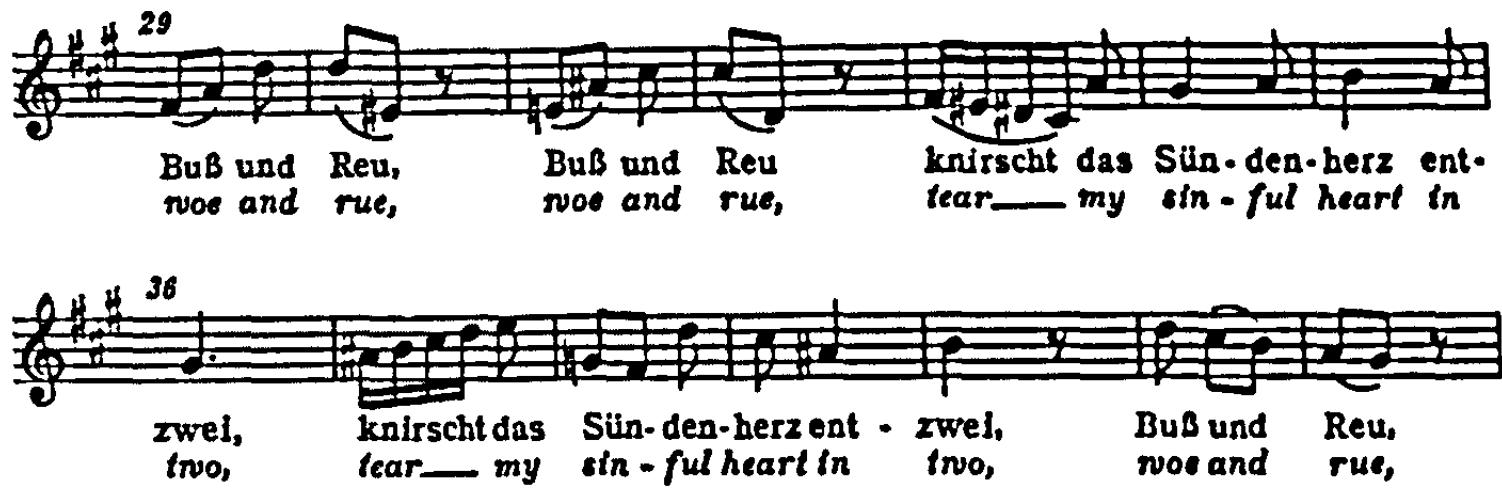
中文讲解
本条是图注(图片内容省略),引用的并非本节核心作品 BWV 637,而是 J. S. Bach《马太受难曲》BWV 244 第 6 首女低音(Alto 1)咏叹调的第 29–42 小节。该图出现在 P0222 之前的版面位置,作用是与下文对 BWV 637 的分析形成互文参照——它作为对比素材出现,让读者在熟悉的《马太受难曲》语境中检视某些音型。由于内嵌图像数据缺失,具体谱例形态不可见,需查看原图。
补充说明
图注中的脚注编号 112 对应 P0225 的文献出处说明,该图与下文讨论的关系可在 P0225 的脚注中找到编辑依据。
第2段(P0222)
原文复述
In contrast to Buxtehude’s setting of the same chorale melody, where Adam’s fall was depicted through leaps of perfect fifths in the opening five bars, Bach’s prelude is more persistently characterized by descending diminished-seventh leaps distributed throughout (anaphora, repetitio). The salti duriusculi, which are most conspicuous in the pedal part, are intensified by expressive tmeses (rests suspirantis animae) that illustrate man’s separation from God. In addition to the chromatic pedal leaps, the false relations between the lower voices graphically represent the corrupting effect of Adam’s fall; meanwhile the passus duriusculus in the alto (bar 1, moving from f sharp to f natural), which renders the major/minor dualism through a figura corta, has likewise been read as a metaphor for moral corruption.
中文讲解
本段是本节的核心论证,揭示 Bach 与 Buxtehude 在同一首众赞歌旋律上采取的不同象征策略。Buxtehude 通过前 5 小节的纯五度跳进象征堕落;Bach 则更加彻底,用贯穿全曲的下行减七度跳进(salti duriusculi)反复渲染,并通过踏板声部加以强调。文中三个修辞概念需要解释:(1) anaphora、repetitio——拉丁文辞格,表示反复,强调 Bach 把减七度跳进在全曲反复使用而非仅出现一次;(2) tmesis(tmeses 是其复数),希腊—拉丁辞格,意为“切断”,这里指乐句中插入的“叹息式”休止(rests suspirantis animae,“叹息灵魂的休止”),用断裂感象征人神分离;(3) passus duriusculus 与 figura corta:passus duriusculus 是巴洛克音乐修辞中常见的“艰难步进”,本段特指半音下行的四度;figura corta 是“短小音型”,此处指高音声部第 1 小节 f♯–f♮ 之间的半音下行,它把大调与小调色彩并置(dualism),被解读为道德堕落的隐喻——音乐内部的“违和”对应道德秩序的崩坏。段中两处关键限定必须保留:“更持续地使用”“最突出于踏板”,说明 Bach 的象征手法是全曲性的而非局部装饰。
补充说明
文中脚注 113(tmesis 的情感含义)将本段与本章稍后(第 138 页附近)讨论 Buxtehude 同首前奏的段落建立对照;脚注 114(Stinson, p. 97)为“道德堕落隐喻”之说提供文献依据。这两条脚注的内容在 P0226 给出。
第3段(P0223)
原文复述
Figure caption: “Example 23. BWV 637: Durch Adams Fall ist ganz verderbt (bars 1-3) ¹¹⁵.” The embedded image data has been omitted; only the caption text and its position are retained.

中文讲解
图注指向 BWV 637 的第 1–3 小节,这是前奏曲开头的三小节,对应 P0222 中讨论的减七度跳进(salti duriusculi)以及高音声部第 1 小节的 passus duriusculus(f♯–f♮)。由于图像数据被省略,谱面细节不可见,需查阅原图以核对音程关系和声部走向。该图是支撑 P0222 论证的关键乐谱证据。
补充说明
图注中的脚注 115 对应 P0227,是 Bach 管风琴作品版本依据的说明(Neue Bach Ausgabe)。
第4段(P0224)
原文复述
The symbolism derived from the theological text of the hymn is for the most part depicted in the penultimate line of the prelude (bars 9-10, on the words ‘darein die Schlang Eva bezwang’); the snaky chromatic motive audible in the tenor voice has been interpreted as a depiction of the serpent writhing in the grass of Eden.
中文讲解
本段将焦点从开篇引子推进到第 9–10 小节,对应歌词“darein die Schlang Eva bezwang”(在那里蛇诱惑了夏娃)。“倒数第二行”这一限定意味着:作者并非把整首众赞歌逐句逐字刻画,而是选择最具代表性的诗行——蛇诱惑夏娃这一堕落的核心事件。音乐—图像的对应关系是:男高音声部出现蜿蜒式的半音进行(chromatic motive),其形态被比作蛇在伊甸园草丛中的蠕动。需要注意的是,作者使用了“已被诠释为”(has been interpreted as)的措辞,这是学术写作中的让步语,说明这是学界的解读而非作者本人的定论。
补充说明
脚注 116(Luedtke, p. 60)是“蛇形半音动机”解读的出处,详见 P0228。
第5段(P0225)
原文复述
Footnote 112: Source citation for Example 22 — J. S. Bach, Matthäus-Passion (BWV 244), Vocal Score Based on the Urtext of the New Bach Edition, prepared by Alfred Dürr (Kassel: Bärenreiter Verlag, 1974).
中文讲解
这是图注中脚注 112 的完整内容,标明 Example 22 引自《马太受难曲》BWV 244 第 6 首女低音咏叹调的声乐谱,版本依据是 Alfred Dürr 校订的新巴赫全集(Neue Bachausgabe)Urtext 净版,1974 年由 Bärenreiter 出版社(卡塞尔)出版。该脚注为前文比较性例证提供版本权威性,与本节 BWV 637 的分析属于平行参照。
第6段(P0226)
原文复述
Footnote 113: Cross-reference directing the reader to the discussion of Buxtehude’s chorale prelude Durch Adams Fall ist ganz verderbt on page 138 of this chapter, where the affective implications of the tmesis are treated. Footnote 114: Citation to Stinson, p. 97, in support of the claim that the passus duriusculus in the alto of BWV 637 functions as a metaphor for moral corruption.
中文讲解
脚注 113 是内部交叉指引,提示读者本章第 138 页附近对 Buxtehude 同首前奏中 tmesis 之情感含义的专门讨论——这意味着 P0222 中“rests suspirantis animae”作为人神分离象征的说法,其理论背景将在该处详述;放在本节仅作概念引入。脚注 114 出处为 Stinson, p. 97,是“高音声部 passus duriusculus = 道德堕落隐喻”这一具体说法的文献依据。两条脚注都起到限定与支撑作用,而非引入新材料。
第7段(P0227)
原文复述
Footnote 115: Editorial note stating that, unless otherwise indicated, all cited musical examples and bar numbers in the discussion follow the Neue Bach Ausgabe of Bach’s complete organ works. Reference: Johann Sebastian Bach, Orgelwerke, edited by Heinz-Harald Löhlein, Urtext of the New Bach Edition, volume 1: Little Organ Book, Six Chorales ‘von verschiedener Art’ (“Schübler-Chorales”), Chorale-Partitas (Kassel: Bärenreiter Verlag, 1984).
中文讲解
脚注 115 是版本说明,声明本节所有引用的谱例与小节号(除非另注)均依据新巴赫全集管风琴作品卷。具体卷次为第 1 卷,收入《小管风琴曲集》(Little Organ Book,即 Orgelbüchlein)、《六首不同性质的众赞歌》即“许布勒众赞歌”以及众赞歌帕蒂塔,由 Heinz-Harald Löhlein 编辑,1984 年 Bärenreiter 出版。这是一条总括性版本脚注(umbrella footnote),为后续 Example 23、24、25 以及文中所有小节定位提供权威依据。
第8段(P0228)
原文复述
Footnote 116: Citation to Luedtke, ‘Seb. Bachs Choralvorspiele’, p. 60.
中文讲解
脚注 116 是 P0224 中“男高音声部蜿蜒半音动机 = 蛇在伊甸园草丛中蠕动”这一解读的出处:Luedtke 的论文《Seb. Bachs Choralvorspiele》(塞巴斯蒂安·巴赫的众赞歌前奏曲)第 60 页。该脚注的学术功能是支持一种图像式音乐解读(iconic interpretation),而非提供独立的音乐分析。
第9段(P0229)
原文复述
Figure caption: “Example 24. BWV 637: Durch Adams Fall ist ganz verderbt (bars 9-10).” The embedded image data has been omitted; only the caption text and its position are retained.
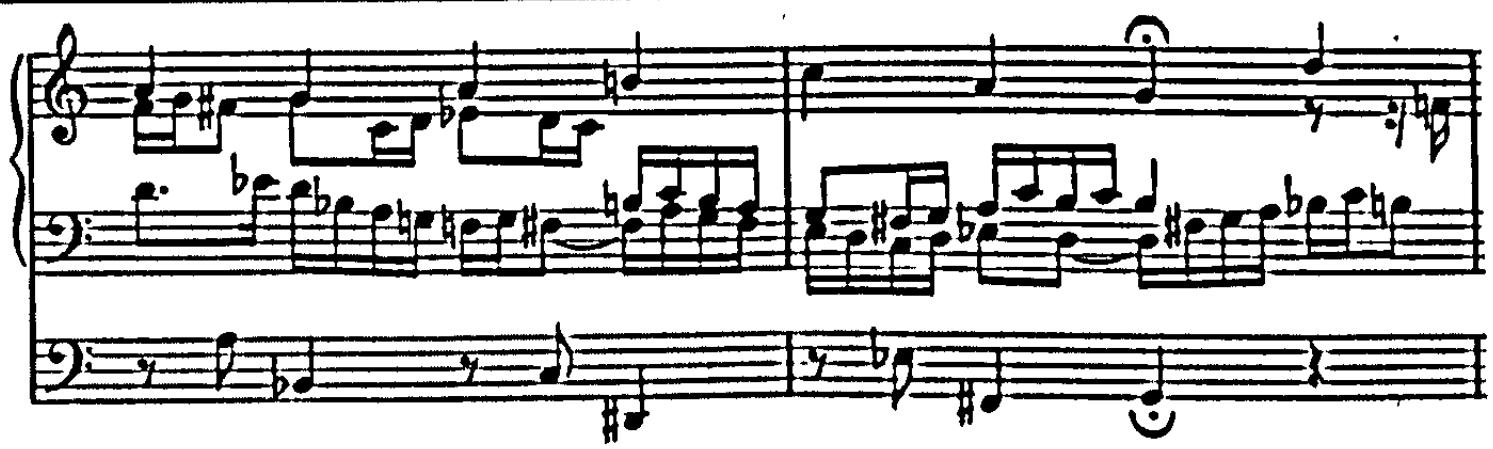
中文讲解
图注指向 BWV 637 的第 9–10 小节,正好对应 P0224 中讨论的诗行“darein die Schlang Eva bezwang”以及男高音声部的“蛇形”半音动机。该图是 P0224 文字论述的直接乐谱证据。与 Example 22、23 不同,本图未带脚注编号,说明它属于同一谱例系统的连续展示。需查阅原图以核对动机形态。
第10段(P0230)
原文复述
The chromatic writing is further intensified by the parrhesia figure at the end of the prelude (bars 11-12), which gives rise to false relations (tritones, augmented and diminished intervals) appearing between the voices in diagonal position (see Example 25). This unorthodox contrapuntal language—termed relationes non harmonicae—is also encountered in Buxtehude’s treatment of the same chorale melody; it heightens the negative Affekt of the piece, in which forbidden freedoms (licentiae) flout all the rules of regular part-writing, symbolizing the breaking of moral rules and ‘[…] the depravity of the human race.’ Finally, the strong contrast created between the rising figure in the tenor that leads to the final major cadence and the diminished-seventh leaps in the pedal illustrates the antitheton figure, an interpretation of the antithesis between man’s original sin and the trust placed in Christ.
中文讲解
本段将分析推进到前奏曲末段(第 11–12 小节),引入三个关键修辞概念:(1) parrhesia——希腊辞格,意为“直言、坦率、放胆”,在巴洛克音乐修辞中对应大胆突破常规和声规则的进行;(2) relationes non harmonicae(“非和谐关系”)与 licentiae(“自由、破例”)——两者均指作品中违反严格对位规范的做法,被解读为“禁戒之自由”,其越界象征道德秩序的破坏;(3) antitheton(“对立、对照”)——本曲末段男高音声部的上行音型导向结束的大调终止,与踏板持续出现的减七度跳进形成“原罪 vs. 信赖基督”的对照。文中两处直接引文“the depravity of the human race”需注意其引号与方括号省略号,表明是学界既有表述的转引。整段论证逻辑是:尾部半音化 → parrhesia → 非和谐关系 → 道德隐喻;末段对照 → antitheton → 神学对照,结构上是“高密度道德越界 + 终极救赎希望”的双重收束。
补充说明
文中两处脚注 117、118 分别为:117 出处 Stinson, p. 98,并参 Wolfgang Budday 关于“巴赫管风琴众赞歌《Durch Adams Fall ist ganz verderbt》中的音乐修辞作为作曲技术自由”的论文;118 出处 Vincent Benitez 关于 Orgelbüchlein 中音乐修辞的论述,第 10 页。这两条脚注支撑本段两个并列结论(licentiae = 道德破戒;antitheton = 原罪/救恩对照)。
第11段(P0231)
原文复述
Figure caption: “Example 25. BWV 637: Durch Adams Fall ist ganz verderbt (bars 10-12) ¹¹⁹.” The embedded image data has been omitted; only the caption text and its position are retained.
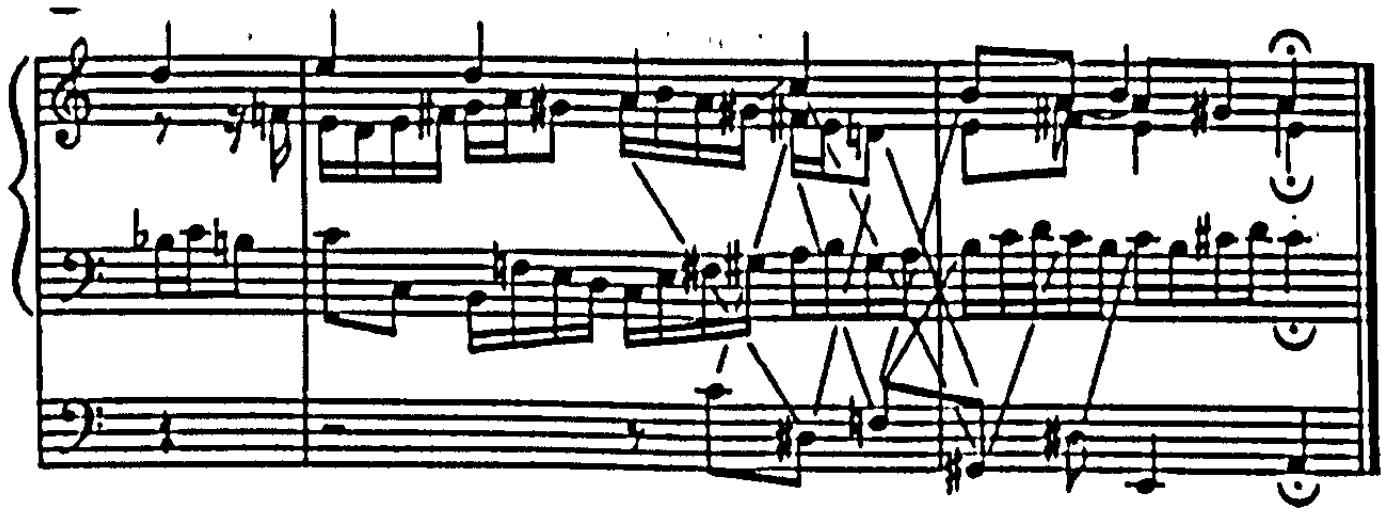
中文讲解
图注指向 BWV 637 的第 10–12 小节,正是 P0230 论述的尾部区域,对应 parrhesia、relationes non harmonicae 以及 diagonal position 上声部间的假关系。该图与 Example 24 在小节上前后衔接(24 为 9–10 小节,25 为 10–12 小节),形成连续展示。需查阅原图以核对斜向位置上的三全音、增/减音程等非常规和声现象。
补充说明
脚注 119 出处为 Budday, ‘Musikalische Figuren als satztechnische Freiheiten’, p. 153,详见 P0235。该图系作者从 Budday 论文中采用(adopted),属转引谱例。
第12段(P0232)
原文复述
The chorale prelude Das alte Jahr vergangen ist (BWV 614), one of the three ornamental chorales of the Orgelbüchlein, exhibits an abundant use of the passus duriusculus (commonly known as the chromatic fourth), a chromatic figure whose connection with the affects of grief and sorrow in this particular piece has been seriously questioned. The first verse of the hymn (attributed to Johann Steurlein, 1588), a prayer of thanksgiving to Jesus for the old year and a supplication for His protection in the coming one, does not in fact refer to anything melancholy. Nevertheless, sorrowful subjects are implied in the following stanzas, particularly the fourth and the fifth, which leads to the conclusion that Bach was probably attempting to depict the general sense of the hymn, referring ‘[…] not merely to the passing of the old year — and thus the transitory nature of human existence — but also danger and (in stanza 4) the sins of the old year.’
中文讲解
本段已超出本节标题所指的 BWV 637,实质上开启了下一个分析对象——BWV 614《旧年已逝》(Das alte Jahr vergangen ist),属 Orgelbüchlein 中三首装饰性众赞歌之一。其论证链条是:(1) 提出观察——这首前奏大量使用 passus duriusculus(chromatic fourth,半音下行的四度);(2) 提出质疑——这种通常与悲伤、哀痛情感相联的音型,在此曲中却引发了“是否真的与悲伤情感有关”的严肃疑问;(3) 考察文本——第一节诗由 Johann Steurlein 作于 1588 年,是感谢主赐旧年并祈求新年护佑的祷文,本身并不涉及哀伤;(4) 给出解答——后续诗节(特别是第 4、5 节)隐含悲伤主题;(5) 推断结论——Bach 可能在描绘这首众赞歌的“整体意涵”,而非仅对应第一节;引文显示学界认为 Bach 同时指向“旧年之罪”与“人生无常”。这段话的功能是为下一小节奠定“修辞—文本是否一致”这一问题意识,是从 BWV 637 到 BWV 614 的过渡。
补充说明
本段引用脚注 120–123(具体内容不在当前节选范围之内),分别对应:passus duriusculus 与悲伤情感关系的质疑(120)、Steurlein 1588 年文本归属与首节祈祷性质(121)、第 4、5 节的悲伤主题(122)、引文“not merely to the passing of the old year…”(123)。这些脚注的内容在输入中未直接出现,本节不展开。
第13段(P0233)
原文复述
Footnote 117: Citation to Stinson, p. 98. Cross-reference to Wolfgang Budday, ‘Musikalische Figuren als satztechnische Freiheiten in Bachs Orgelchoral “Durch Adams Fall ist ganz verderbt”’, published in Bach-Jahrbuch, 63 (1977), pp. 139-59.
中文讲解
脚注 117 是 P0230 中“depravity of the human race”引文与“licentiae 象征道德破戒”论断的文献依据。其结构为双重引用:先给 Stinson, p. 98 作为直接引文出处,再以“另见”方式引导读者参 Budday 1977 年发表于《巴赫年刊》第 63 卷的专文(页 139–159)。该专文与脚注 119 的谱例来源(Budday, p. 153)属同一篇论文,是本节 BWV 637 分析的主要二手文献支撑。
第14段(P0234)
原文复述
Footnote 118: Citation to Vincent Benitez, ‘Musical-Rhetorical Figures in the Orgelbüchlein of J. S. Bach’, p. 10.
中文讲解
脚注 118 是 P0230 中 antitheton(“原罪 vs. 信赖基督”之对立)解读的文献依据:Vincent Benitez 关于《巴赫 Orgelbüchlein 中的音乐修辞》一文第 10 页。这条脚注与脚注 117 共同构成 BWV 637 分析的文献双柱——前者聚焦“堕落/破戒”侧,后者聚焦“救恩/对立”侧。
第15段(P0235)
原文复述
Footnote 119: Source note stating that Example 25 was adopted from Budday, ‘Musikalische Figuren als satztechnische Freiheiten’, p. 153.
中文讲解
脚注 119 是 P0231 图注的谱例来源声明:Example 25(第 10–12 小节)系从 Budday 论文第 153 页采用。这表明作者本人未亲自重制谱例,而是直接转引 Budday 论文中的谱例分析,属于规范的学术引用处理。
脚注 / 边栏 / 图表 / 附加信息(如有)
本节包含 4 个乐谱图(Example 22–25),其中 Example 22 来自 BWV 244《马太受难曲》第 6 首,Example 23–25 均来自 BWV 637,对应小节分别为 1–3、9–10、10–12。乐谱图与正文的对应关系如下:Example 22 提供与 BWV 637 的跨作品比较;Example 23 支撑 P0222 关于开篇 salti duriusculi 与高音声部 passus duriusculus 的论述;Example 24 支撑 P0224 关于第 9–10 小节“蛇形”半音动机的论述;Example 25 支撑 P0230 关于尾部 parrhesia、relationes non harmonicae 与 antitheton 的论述。脚注方面,本节脚注 112–119 中:112 为版本与出版社信息,113 为内部交叉指引(指向本章第 138 页对 Buxtehude 的讨论),114–115 与 117–119 为文献依据(Stinson, p. 97/98;Budday 1977;Benitez;Luedtke),116 为单一文献依据。第 119 脚注表明 Example 25 谱例系转引自 Budday。第 P0232 段已开启对 BWV 614 的新分析,所涉脚注 120–123 在本节选范围之外,仅以提及方式存在。
💡 本节核心要点
- Bach 在 BWV 637 中用贯穿全曲的下行减七度跳进(salti duriusculi)取代 Buxtehude 同首前奏中“前 5 小节纯五度跳进”的做法,以 anaphora/repetitio 的反复辞格渲染亚当堕落的持续性。
- 踏板声部的半音跳进、低声部之间的假关系(false relations)、以及高音声部 f♯–f♮ 的 passus duriusculus(figura corta)共同构成“道德堕落”的三重音乐隐喻,分别对应秩序崩塌、声部冲突、大小调色彩对立。
- 中段(第 9–10 小节,对应歌词“蛇诱惑夏娃”)通过男高音声部的蜿蜒半音动机(snaky chromatic motive),将音乐形态直接图像化为蛇的蠕动;尾部(第 11–12 小节)以 parrhesia 与 relationes non harmonicae(licentiae)象征被禁戒的自由——即道德越界。
- 末段男高音的上行终止式与踏板中持续出现的减七度跳进形成 antitheton 辞格,象征“原罪 vs. 信赖基督”的神学对立,使整首前奏在道德沦丧与救赎希望的张力中收束。
- 本节分析依赖版本与二手文献两条支柱:版本上以新巴赫全集(Bärenreiter, 1984)为小节定位依据;文献上以 Stinson、Budday(1977)、Benitez、Luedtke 为主要支撑,其中 Budday 是被直接转引谱例的来源。
- P0232 已开启对下一首前奏 BWV 614 的讨论,提出“修辞音型与文本情感是否一致”的方法论问题,为本节主题向下一节过渡。
🔑 关键术语
- salti duriusculi(艰难跳进):拉丁文,巴洛克音乐修辞术语,指不协和音程的大跳(本节特指下行减七度),象征剧烈、突变或道德失序。在 BWV 637 中分布于踏板声部,全曲反复出现。
- tmesis(切断):希腊—拉丁辞格,原意为“切割”,在巴洛克音乐中指乐句中插入的停顿或休止。本节中以 rests suspirantis animae(“叹息灵魂的休止”)为人神分离的象征。
- passus duriusculus(艰难步进 / chromatic fourth):半音下行的四度音程,巴洛克音乐修辞中传统上与悲伤、哀痛相关。本节高音声部第 1 小节 f♯–f♮ 即此音型,作者同时以大小调色彩并置(figura corta)将其延伸为“道德堕落”的隐喻。
- figura corta(短小音型):巴洛克音乐修辞术语,指短促、紧凑的音型。本节中指高音声部第 1 小节 f♯–f♮ 的半音进行,因其短小并兼跨大小调而被解读为道德堕落的浓缩隐喻。
- parrhesia(直言、放胆):希腊辞格,原意为“坦率陈词”,在巴洛克音乐修辞中指突破常规对位与和声规则的大胆进行。在 BWV 637 末段(第 11–12 小节)产生声部间的假关系,被解读为“被禁戒的自由”,象征道德越界。
- relationes non harmonicae(非和谐关系):拉丁文,指对位写作中违反常规和声进行的声部关系,常见形式包括三全音、增减音程。本节中与 licentiae 并列出现,用以强调 Bach 故意偏离规则对位以表达负面 Affekt。
- licentiae(破例、自由):拉丁文,指作曲中的“破格”处理。在本节中被赋予伦理寓意:音乐中的“违规”象征人类道德规则的破坏,与“depravity of the human race”引文呼应。
- antitheton(对立、对照):拉丁文辞格,指通过对照呈现对立面。本节中具体指末段男高音的上行音型(导向大调终止)与踏板持续减七度跳进之间的对比,象征“原罪 vs. 信赖基督”的神学对立。
- anaphora / repetitio(头韵 / 反复):拉丁文辞格,指同一手法在文本或音乐中反复出现。本节中用以说明 Bach 并非仅在开篇使用一次减七度跳进,而是贯穿全曲反复施加该手法以强化象征。
- Affekt(情感):德文,巴洛克美学核心概念,指作品所欲传达的特定情感状态。本节中 relationes non harmonicae 与 licentiae 被说明为强化“负面 Affekt”的手段。
2.16 [描述性拆分] Bach’s Das alte Jahr vergangen ist (BWV 614): Chromatic Fourth and Sighing Figures
第1段(P0236)
原文复述
Figure caption (Example 26): BWV 614, Das alte Jahr vergangen ist, bars 1–2.
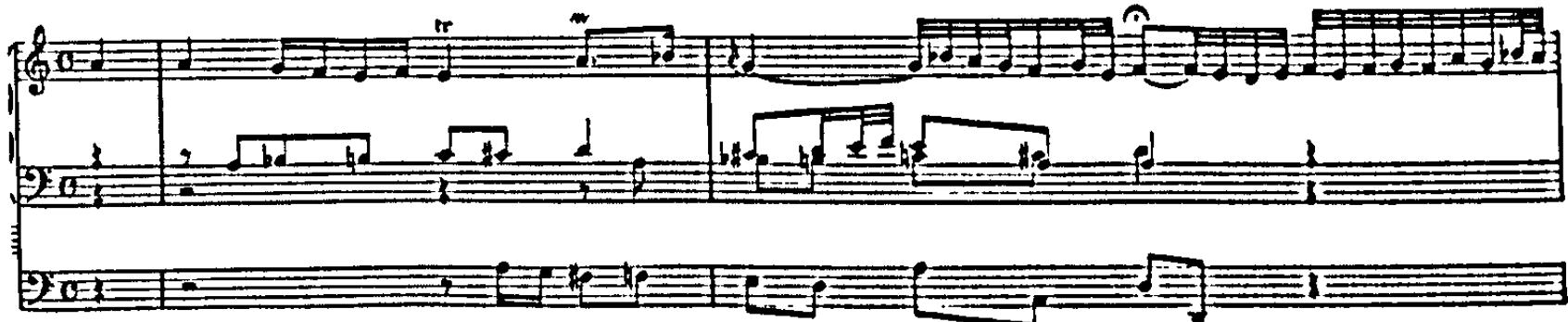
中文讲解
本条不是正文,而是第26例的图注,指示该谱例取自BWV 614《旧岁已逝》前两小节。它是后续关于cantus firmus花唱、passus duriusculus在低声部模仿进入等论述所依据的视觉材料,需对照原谱查看线条与具体音。
补充说明
原谱图像未提供,仅图注存在;欲复核作者对前两小节节奏型与对位关系的描写,需查阅原始乐谱。
第2段(P0237)
原文复述
Footnote 120. In a series of articles published in The Musical Times, Peter Williams supplies numerous examples demonstrating the use of the passus duriusculus throughout music history; see ‘Figurenlehre from Monteverdi to Wagner’, The Musical Times, 120 (1979), 476–79, 571–73, 648–50, 816–18; also, ‘Encounters with the Chromatic Fourth… or, More on Figurenlehre, 1 & 2’, The Musical Times, 126 (May & June 1985), 276–78 and 339–43. In his effort to devalue the concept of musica poetica, Peter Williams attempts, falsely, to relate the descending chromatic fourth and the general sense of the musikalische Figurenlehre with the music of Beethoven, Verdi, and Wagner, resulting in numerous misunderstandings regarding the true concept of musica poetica. Although no one can underestimate the expressiveness of this figure in music history, one should be aware of the particular affective significance that musical-rhetorical figures such as the passus duriusculus had for the Baroque concept of musical rhetoric only. In one of his early essays (1983) Williams attacks the approach to the Orgelbüchlein based on the examination of particular figures (e.g. the chorale prelude Durch Adams Fall ist ganz verderbt discussed before) by describing such an approach as “[…] a desk-bound study made in isolation, […] in which good figural analysis is pushed in the same Schweitzerian direction” (see ‘The Snares and Delusions of Musical Rhetoric’, p. 238). In his discussion of Das alte Jahr vergangen ist, rejecting the idea that this particular work might express a sorrowful content, Williams belongs among the few scholars to raise the question: “[…] is the ‘melancholy’ heard in it by organists over the last century or so justified by the ‘objective’ traditionalism of its key motif?” (The Organ Music of J. S. Bach, p. 265).
中文讲解
本脚注的核心是评述Peter Williams对Figurenlehre和musica poetica的批判态度。作者一方面承认Williams提供的passus duriusculus历史例证极为丰富(列出1979年与1985年两批Musical Times文章),另一方面明确反对Williams把下降半音四度推广到贝多芬、威尔第、瓦格纳的做法,认为这会曲解musica poetica在巴洛克语境下的本来含义。作者由此划定一个原则:passus duriusculus这类音乐修辞格只在巴洛克音乐修辞体系内才具有特殊的affect意义,不能跨时代滥用。脚注还包含两层具体攻击:其一,Williams讥讽以修辞格分析Orgelbüchlein是“书斋里的孤立研究”,把好的图式分析推向Schweitzer的方向;其二,Williams拒绝把《旧岁已逝》解读为悲伤内容,反问“过去一个世纪管风琴家所听到的‘忧郁’是否被其核心动机之‘客观的’传统性所支持”。作者的立场隐含在脚注中:他认为Williams对悲情解读的怀疑正是源于他否认musica poetica的有效性,而作者本人则准备正面运用修辞格来重建悲情解读。
补充说明
本脚注同时承担反驳与铺垫两个功能:一方面驳斥Williams对Figurenlehre的过度解构,另一方面为后文把BWV 614读作带有死亡与哀恸内涵的文本象征预作论证支撑。
第3段(P0238)
原文复述
Footnote 121. Note that in this particular chorale the first melodic line is repeated, while both the first and the last lines of each stanza are repeated in order to fit the chorale melody. The first stanza reads as follows: Das alte Jahr vergangen ist/ das alte Jahr vergangen ist/ wir danken dir, Herr Jesu Christ/dass du uns hast in mancher Gfahr/ so gnädilich behüt’ dies Jahr/ so gnädilich behüt’ dies Jahr; see Johann Sebastian Bach, Orgelwerke, ed. by Heinz-Harald Löhlein, Urtext of the New Bach Edition, vol. 1, p. xii. English translation: The old year has gone by/ we thank you, Lord Jesus Christ/ that in such great danger/ you preserved us this year so graciously (Williams, The Organ Music of J. S. Bach, p. 264).
中文讲解
本脚注交代众赞歌本身的文本结构特点:第一行旋律重复,并且为了配合旋律,每节诗的第一行与最后一行也被重复,从而形成歌辞的扩展形式。第一节德文歌词被完整引出,并附英译:“旧岁已逝/我们感谢您,主耶稣基督/在如此巨大的危难中/您这一年如此恩慈地保守了我们”。这一节奠定了全首众赞歌“辞旧—感恩—求保守”的基本情绪基调,对应巴洛克新年的虔敬语境,也为后文分析第五节涉及“死亡与天国”的延伸提供逻辑前提。
补充说明
原文保留拼写“gnädilich”(应为“gnädiglich”),是作者直接转录文本的痕迹,提示编者保留原始拼写习惯。
第4段(P0239)
原文复述
Footnote 122. The text of the fourth stanza is as follows: Hilf, dass wir von der Sünd ablan/ hilf, dass wir von der Sünd ablan/ und fromm zu werden fahen an/ kein’r Sünd des alten Jahrs gedenk/ ein gnadenreich Neujahr uns schenk/ ein gnadenreich Neujahr uns schenk; English translation: Thy Spirit keep us free from sin/ create us quite anew within/ remember no transgressions past/ Thy mercy all our years outlast (Charles Sanford Terry, The Four-Part Chorals of J. S. Bach, p. 60). Footnote 123. Stinson, p. 110.
中文讲解
本条由两个脚注合并而成。脚注122给出第四节诗的德文原文与Terry的英译:祈求圣神使我们脱离罪孽、重建新人、不纪念旧年之罪、以恩典赐予新年。这一节的关键短语“der Sünd ablan”(脱离罪孽)将在后文P0241中被作为花唱装饰与tirata mezza等修辞格的文本依据,因此此处看似单纯的歌词引述,实为后段音乐–文本象征论证的伏笔。脚注123只有一行“Stinson, p. 110”,是后文论及Bach在Arnstadt众赞歌中插段手法的Stinson出处。
补充说明
Terry英译将“gnadenreich Neujahr uns schenk”译为“Thy mercy all our years outlast”,把原诗中“赐一个恩慈的新年”转化为更普泛的“恩典贯穿我们所有岁月”,与德文原意有细微出入,分析时以德文为准。
第5段(P0240)
原文复述
From the beginning of the chorale, the cantus firmus demonstrates an expressive melismatic coloratura, accompanied by the passus duriusculus presented in imitation in the lower voices (see examples 26–27), both in canonic stretto form (anaphora) and in invertible counterpoint (see bars 1–4). For the sake of intensification, Bach introduces the accompanying material just after the statement of the second note of the cantus firmus (see upbeat–bar 1), while the solo figuration between the first two chorale lines illustrates a rare case of a transitional interlude, an aspect reminiscent of Bach’s compositional style illustrated in the Arnstadt Congregational Chorales.
中文讲解
本段是本节正文论证的起点,确立两条同时展开的音乐–修辞事实。第一,cantus firmus自始即呈花唱coloratura,伴随低声部以模仿形式进入的passus duriusculus;这种模仿不仅在低音声部间进行(前两小节起),而且以canonic stretto(即anaphora,紧密卡农式首音重叠)和可转位对位两种方式呈现,构成多声织体。第二,作者指出Bach为强化效果,在cantus firmus第二个音陈述之后立即引入伴随材料,这一安排让花唱尚未展开前,修辞格已先声夺人。第三,第一、二行众赞歌之间的solo花唱被读作少见的过渡性interlude,作者把这一处理与Bach在Arnstadt众赞歌中所体现的作曲风格相联系。换言之,本段一方面奠定修辞格分析的基础,另一方面把本曲纳入Bach青年时期形成的“带过渡间奏”传统,为后续论证确立谱系与作品内部的纵横坐标。
补充说明
术语上anaphora在此被定义为canonic stretto(即首音重叠的卡农式进入),passus duriusculus作为核心修辞格在本节被反复使用,其在第一小节低声部以模仿形式入场是本曲最具识别度的特征。
第6段(P0241)
原文复述
On the second beat of bar 1 the chorale melody demonstrates a mezzo circolo figure, while a variety of musical-rhetorical figures, including a tirata mezza (second beat of bar 2) and a groppo (fourth beat of bar 2) appear at the end of the first line and during the free transition to the second one (illustrating, according to the text of the fourth stanza, the phrase ‘der Sünd ablan’). The incorporation of figures that embellish a melodic passage—in this case, the last beats of bar 2—demonstrates the passaggio or variatio figure; this, according to Walther “[…] occurs when an unadorned vocal or instrumental melody is altered and embellished through the introduction of smaller notes, yet in such a manner that the principal melody notes can still be perceived and understood.”
中文讲解
本段延续P0240的修辞格辨认,把第1小节第二拍标记为mezzo circolo(小弧线型),并在第一行末尾到第二行之间的自由过渡中识别出tirata mezza(第2小节第二拍)与groppo(第2小节第四拍)。作者将这些修辞格的文本对应锁定在第四节“der Sünd ablan”(脱离罪孽)这一短语,由此把“脱离—上升—净化的运动”读作对“脱离罪孽”这一语义的动作化转译。本段第二层是定义性的:通过Walther《音乐词典》,把对旋律进行小音符装饰、同时仍可辨认骨干音的手法定义为passaggio或variatio,并以第2小节末尾数拍为例。如此,作者既示范了如何把Walther定义与谱面节拍一一对应,也表明他对“装饰—骨干可辨”这一巴洛克原则的引用。
补充说明
tirata mezza、groppo、passaggio等术语属于musikalische Figurenlehre的常见范畴,其功能是把抽象的图式(Figur)转化为可谱面定位的节拍片段;作者用Walther的权威定义为passaggio/variatio下定义,意在为自己的谱面辨认提供文献支持。
第7段(P0242)
原文复述
Figure caption (Example 27): BWV 614, Das alte Jahr vergangen ist, bars 3–5.

中文讲解
本条为第27例图注,标记BWV 614第3–5小节。该谱例承载作者关于高声部出现passus duriusculus、cantus firmus第三行处passus duriusculus的展开以及“升—降”双向版本之论证的视觉基础;离开原谱难以验证作者所述的走向和音程关系。
补充说明
图像未内嵌,标注仅保留位置与图题,需查阅原始乐谱以核实细节。
第8段(P0243)
原文复述
Furthermore, in this exhaustive application of the chromatic fourth throughout the prelude, the appearance of the passus duriusculus in the soprano (third phrase, bars 4–5) makes plausible the assumption that Bach could have derived the passus duriusculus from the cantus firmus of the chorale, as can be seen from the decorated version of the melody in bar 5 (see example 27). The expressive passus duriusculus appears in the cantus firmus in the third line of the prelude (example 27), and if one follows the text of the third line of the fifth stanza (‘zu sterben, und hernach fröhlich’), it becomes obvious that “[…] the sense of man’s eternal concern for the passing of his own existence” probably made Bach apply this figure both in its original ascending state (in the soprano) and in a descending version (in the alto).
中文讲解
本段推进论证,主题有二:其一,推测passus duriusculus的来源。在第三乐句(bars 4–5),高声部出现passus duriusculus,且第5小节呈现装饰化旋律,作者由此提出一个合理但非确证的假设:Bach可能正是从众赞歌自身的cantus firmus中“提炼”出passus duriusculus。这就把花唱与修辞格的同一性从“模仿”上升到“衍生”,揭示了花唱和修辞格在谱面生成层面的同源性。其二,文本—象征层面的推理。引用第五节第三行“zu sterben, und hernach fröhlich”(死后方可乐)以及Moeser的总结——“对自身存在流逝之永恒关切”,作者推断:Bach正是基于这种对生命流逝的关怀,把passus duriusculus既以原始上行形态置于高声部,又以反向的下行形态置于中声部,从而以“上—下”双向运动呼应“死亡—天国”的人生走向。此处“exhaustive application of the chromatic fourth throughout the prelude”也提示passus duriusculus在整首前奏曲中是主导性的统一修辞格,而非偶然装饰。
补充说明
作者使用“makes plausible the assumption”这一谨慎措辞,表明这是一个基于谱面相似性的推断,而非文献史料的证实;分析时应将其视作合理假说而非定论。
第9段(P0244)
原文复述
Footnote 124. Benitez, p. 8.
中文讲解
本条为正文P0240中“cantus firmus以花唱coloratura开始并配以低声部passus duriusculus”论述的出处注,引自Benitez第8页。它标明作者对P0240谱面观察的主要文献依据来自Benitez的研究。
第10段(P0245)
原文复述
Footnote 125. Stinson, pp. 110–11.
中文讲解
本条为正文P0240“solo figuration between the first two chorale lines illustrates a rare case of a transitional interlude”这一判断的出处,指向Stinson关于Bach管风琴作品过渡段处理的论述第110–111页,呼应作者关于Arnstadt众赞歌风格渊源的论断。
第11段(P0246)
原文复述
Footnote 126. Benitez, p. 8.
中文讲解
本条为正文P0241中关于mezzo circolo、tirata mezza、groppo等修辞格在第一行末尾与向第二行过渡处出现之论述的来源注,仍引自Benitez第8页,与P0244所引同一页,提示Benitez文是该段系列修辞格辨认的主要依据。
第12段(P0247)
原文复述
Footnote 127. Walther, Musicalisches Lexicon, p. 628, translated by Bartel, p. 437.
中文讲解
本条为正文P0241中Walther关于passaggio/variatio定义引文的出处注:德文原文见Walther《音乐词典》第628页,英文译文引自Bartel编辑本第437页。作者借助这一权威词典条目为passaggio图式提供原始文献界定。
第13段(P0248)
原文复述
Footnote 128. Benitez, p. 8. See also Peter Williams, The Organ Music of J. S. Bach, p. 265.
中文讲解
本条为正文P0243关于高声部在第三乐句出现passus duriusculus、且Bach可能由cantus firmus衍生出该修辞格之论述的来源注:主要依据仍是Benitez第8页,并辅以Williams《巴赫管风琴音乐》第265页,形成一个由正面分析(Benitez)与Williams中立性描述并置的文献支持结构。
补充说明
Williams在此被作为旁证而非论辩对象引用,与P0237中作为批判对象的Williams形成对比。
第14段(P0249)
原文复述
Figure caption (Example 28): BWV 614, Das alte Jahr vergangen ist, bars 9–12.
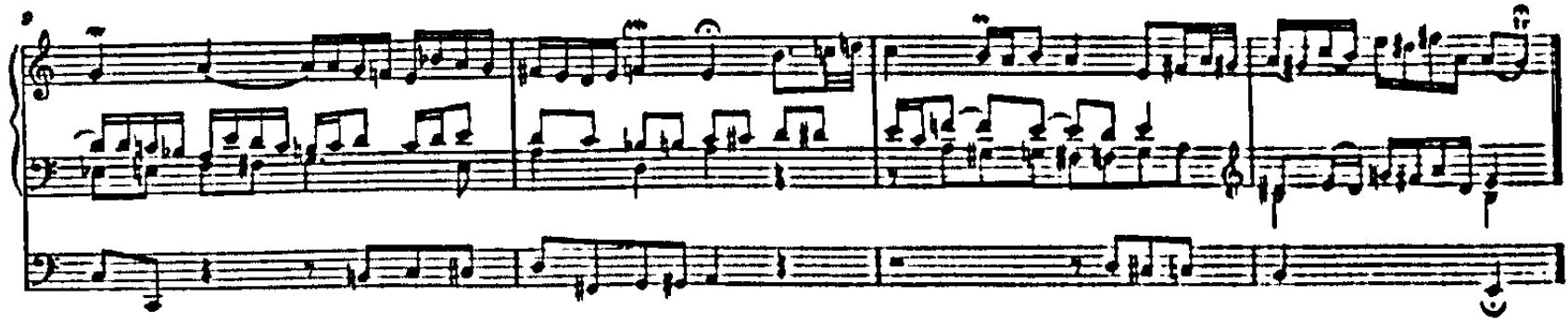
中文讲解
本条为第28例图注,标记BWV 614第9–12小节。该谱例支撑后文P0250关于终小节sighing figures在soprano与alto中以平行上行运动的论述,但图像未提供具体音。
补充说明
图像未内嵌,需查阅原谱以核对终小节的和声进行与终止式。
第15段(P0250)
原文复述
Finally, a perfect example of a dramatic textual representation is illustrated in the final bar of the piece. The series of expressive sighing figures (“suspirantis animi affectus”) rising in parallel motion in the soprano and the alto symbolize, apparently, the allegory of the concluding line of the fifth verse (‘mit dir in Himmel einzugehn’). Through the ascending motion created by the rising sequence of suspirationes, Bach not only obscures the original chorale melody, but also adds a triumphant symbolism to the sorrowful character of the prelude.
中文讲解
本段是本节正文的高潮与收束。它把焦点集中到全曲最后一小节:在soprano与alto两声部以平行上行方式连续出现的“叹息式”修辞格(作者援引拉丁术语suspirantis animi affectus)。作者把这一音乐形象与第五节末行“mit dir in Himmel einzugehn”(与你同入天国)相对应,论证其象征意义:上升运动一方面使原本的众赞歌旋律被冲淡(音乐上模糊原有轮廓),另一方面又在悲悼的整体氛围之上叠加“凯旋”之象征——“由哀恸而上升入天国”。这一“悲—升—荣”的辩证结构,是本节文本象征论证的总结:sighing figure不再仅是情感修辞,而是承载“死亡—复活—入天”神学叙事的具体作曲手法。作者用“a perfect example of a dramatic textual representation”这一表述,把该终小节提升为“戏剧化的文本象征”之典型案例。
补充说明
suspirantis animi affectus(拉丁文:叹息之灵魂的情态)作为巴洛克修辞格的术语出处见Bartel第393页(脚注131),其使用需与Walther词典中的图式定义体系相区别——它更偏affect范畴而非纯旋律型范畴。
第16段(P0251)
原文复述
Of the thirteen Passion chorale preludes Bach planned to include in his initial project, seven were completed, forming the second largest group after the ten Christmas chorales that appear in the Orgelbüchlein. Of the seven Passiontide chorales, it is worth noticing that the cantus firmus is treated canonically in over half of them, an aspect many scholars have justified as being determined by the influence of the text, which depicts the image of the sacrificial Lamb being brought to slaughter, or even Jesus carrying the Cross of Martyrdom (usually when the text includes verbs such as ’tragen’, which means ’to carry’). A good example where the text, the canonic treatment of the cantus firmus, and the musical-rhetorical figures employed are determined by the intended affect is provided by the prelude O Lamm Gottes, unschuldig (BWV 618).
中文讲解
本段从BWV 614的个案分析转入Orgelbüchlein整体规划中的一类:受难节期众赞歌。作者交代关键数据:Bach原计划13首,最终完成7首,是仅次于圣诞组曲(10首)的第二大组。继而提出一个统计性观察:七首中超过半数以canon方式处理cantus firmus。作者借用学界通行解释,把这种处理方式与文本图像绑定——“被牵往宰杀之羔羊”“耶稣背起殉道十字架”,并将“tragen”(背负)类动词作为触发canon的语义信号。最终以BWV 618《无辜的神羔》为例,示范“文本—卡农—修辞格—affect”四要素如何共同决定一首前奏曲的整体修辞策略。本段的功能是把BWV 614的分析纳入Orgelbüchlein受难组曲的体裁传统,提示其canon技法并非孤立现象,而是体裁语法的体现。
补充说明
本段提到“the second largest group after the ten Christmas chorales”,强调受难节组在Orgelbüchlein整体中的体量与象征地位,但未涉及圣诞组曲的具体作品清单,分析时不应越界补写圣诞前奏曲。
第17段(P0252)
原文复述
Footnote 131. Bartel, p. 393.
中文讲解
本条为正文P0250中suspirantis animi affectus这一拉丁术语出处的脚注,指向Bartel编辑本第393页。它表明sighing figures这一图式在Bartel的musica poetica文献中已有系统收录与阐释。
第18段(P0253)
原文复述
Footnote 129. The text of the fifth stanza is as follows: Christlich zu leben, seliglich/ christlich zu leben, seliglich/ zu sterben, und hernach fröhlich/ am jüngsten Tag wied’r aufzustehn/ mit dir in Himmel einzugehn/ mit dir in Himmel einzugehn; English translation: Grant us to lead a Christian life/ and when we leave this world of strife/ then raise us to that joyful day/ where Thou wilt wipe all tears away (Terry, The Four-Part Chorals of J. S. Bach, p. 60).
中文讲解
本脚注给出第五节诗的德文原文与Terry英译:“基督徒度生、蒙福/安然离世/在末日喜乐复活/与你同入天国”。其中第三行“zu sterben, und hernach fröhlich”是P0243讨论passus duriusculus“升—降”双向运动的文本依据,而末行“mit dir in Himmel einzugehn”则是P0250中sighing figures“上升入天”象征的文本依据。换言之,本脚注为前两段正文分别提供文本锚点,是将修辞格与歌词逐行绑定的关键文献支撑。
第19段(P0254)
原文复述
Footnote 130. James C. Moeser, ‘Symbolism in J. S. Bach’s Orgelbuechlein’, The American Organist, 48.2 (February 1965), 22–25 (p. 23). Although Moeser cites another version of the fifth stanza (since he quotes A. Schweitzer) the resulting poignant effect remains significant. Schweitzer supplies the following text: Hilf uns in jeder Erdennot/ hilf uns in jeder Erdennot/ bring uns ein selif über’n Tod/ dass wir mit Freuden auferstehn/ und mit dir in den Himmel gehen/ und mit dir in den Himmel gehen; English translation: Help us in all our need/ and after a happy death/ may we rise again in joy/ to dwell with Thee in heaven (Schweitzer, vol. 2, p. 68).
中文讲解
本脚注交代P0243所引“人对其存在流逝之永恒关切”这一概括的文献来源:Moeser发表于《美国管风琴家》1965年2月号第23页的论文,作者并指出Moeser所引用的第五节版本与Terry本不同,实转引自A. Schweitzer。脚注附Schweitzer所采用的德文版本与英译:“在一切尘世急难中帮助我们/赐我们越过死亡的福乐/使我喜乐复活/与你同住于天国”。尽管版本不同,作者强调其“尖锐动人的效果”仍然有效,因此本节对“passus duriusculus体现存在流逝”之论证的修辞有效性不依赖于具体歌词版本的唯一性。此处亦间接显示作者的论证策略:当不同权威文本在主旨上相合时,即使细节有出入亦可援用。
补充说明
Schweitzer版本与Terry版本的差异主要在第二、三行(前者强调“越过死亡之福”,后者强调“安然离世”),但“复活—入天”的核心意象一致;分析时不应混用两版德文,应在引文处标明采用哪一版。
第20段(P0255)
原文复述
Footnote 132. These are the following: O Lamm Gottes, unschuldig (BWV 618), Christe, du Lamm Gottes (BWV 619), Christus, der uns selig macht (BWV 620), Da Jesus an dem Kreuze stund (BWV 621), O Mensch, bewein dein Sünde gross (BWV 622), Wir danken dir, Herr Jesu Christ (BWV 623), and Hilf, Gott, dass mir’s gelinge (BWV 624).
中文讲解
本脚注列出Orgelbüchlein中七首受难节期前奏曲的完整清单与BWV编号:BWV 618至BWV 624(最后一首以Hilf, Gott, dass mir’s gelinge为编号),对应P0251所述“最终完成的七首”。其作用是为后文P0256关于BWV 618的分析以及整体体裁论断提供可索引的作品集合,使读者能够把个别案例放回到完整的受难组曲中进行检验。
补充说明
本清单明确显示BWV 619/620/621/622均为受难主题相关,但每首的具体歌词并不在本脚注展开,分析中如涉具体作品仍需回到各自的歌词文本。
第21段(P0256)
原文复述
The chorale melody is set canonically at the interval of a fifth between the tenor (played by the pedals) and the alto (starting from bar 2), while false canonic imitation at the octave is illustrated also from the beginning of the piece between the bass and the soprano, which is more easily perceivable to the ear of the listener than the actual canon.
中文讲解
本段以BWV 618《无辜的神羔》为例,示范“canon—文本—修辞格—affect”的整体方案。众赞歌旋律在tenor(脚键盘)与alto之间形成五度卡农,从第2小节起进入;同时在bass与soprano之间,从曲首就呈现“伪八度卡农模仿”(false canonic imitation at the octave),这种模仿在听觉上比真正的五度卡农更为外显可辨。作者由此揭示Bach的双重策略:以tenor–alto的真卡农保证结构严谨,以bass–soprano的高声部模仿保证听众易于把握。本段实际承担收束功能:通过BWV 618案例,把前文在BWV 614中讨论的canon技法与sighing figures/parallel motion等具体修辞做法,纳入一个体裁—作品层面的统一框架,提示“音乐修辞分析”与“卡农形式分析”在本研究中是相互支撑而非彼此排斥的两条路径。
补充说明
本段虽以BWV 618为例,但出现在BWV 614的分析小节内,作用是把BWV 614的修辞格个案提升到Orgelbüchlein受难组曲的形式–文本共谋结构中,作为后续讨论的过渡。
脚注 / 边栏 / 图表 / 附加信息(如有)
本节含有三处内嵌谱例(图注P0236/P0242/P0249,对应Examples 26、27、28),分别覆盖BWV 614的bars 1–2、3–5与9–12,承载本节对passus duriusculus、cantus firmus花唱、sighing figures与终小节上行运动的全部视觉论证。所有图像数据在task_input中被省略,仅保留图题与位置,分析时必须以原谱为准。其余附加材料为脚注120–132,承担文献出处(Walther词典、Bartel辑译、Stinson、Benitez、Williams、Moeser、Schweitzer、Terry、LöhleinUrtext版)、观点反驳(针对Peter Williams的musica poetica批判)、歌词原文与英译(第一节、第四节、第五节含两个版本)以及受难组曲作品清单(BWV 618–624)等多重功能,是本节论证不可或缺的支撑层。
💡 本节核心要点
- BWV 614的总体修辞策略是以passus duriusculus为主导图式,贯穿低声部模仿、高声部衍生以及中声部反向进行等多种形态,构成对“生命流逝—天国上升”这一主题的统一象征结构。
- 本节对众赞歌前两小节与第3–5小节的谱面观察,分别支持cantus firmus花唱与passus duriusculus在低声部stretto/invertible counterpoint中的进入,以及高声部passus duriusculus与cantus firmus的同源性推测。
- 作者将各种修辞格(mezzo circolo、tirata mezza、groppo、passaggio/variatio、suspirantis animi affectus)与特定歌词短语(“der Sünd ablan”、“zu sterben”、“mit dir in Himmel einzugehn”)逐项绑定,构成文本–修辞的精细映射。
- 终小节sighing figures在soprano与alto中以平行上行出现,既模糊原有旋律轮廓,又叠加凯旋象征,使“悲—升—荣”的辩证成为本节文本象征论证的总结性瞬间。
- 本节同时回应Peter Williams对musica poetica的批判,明确主张passus duriusculus等图式只在巴洛克音乐修辞语境中具有特殊affect意义,其历史延伸至贝多芬以后的做法是误用。
- BWV 614被进一步纳入Orgelbüchlein受难组曲(7首完成,第二大组)的体裁框架:canon技法与受难文本(羔羊/十字架/背负)的关联是体裁语法的体现,并以BWV 618为示范案例。
🔑 关键术语
- passus duriusculus:下降半音四度,巴洛克musica poetica的核心修辞格之一,承载哀恸、死亡、灵性痛苦等affect。在本节中既是低声部模仿进入的主导图式,又以衍生方式出现在高声部花唱与中声部反向进行中。
- cantus firmus:众赞歌定旋律,作为长音符或花唱声部支撑整首前奏曲的对位结构。本节强调BWV 614的cantus firmus自始即呈花唱coloratura,并被视为passus duriusculus的潜在来源。
- melismatic coloratura:花唱式跑动音型,指在一个长音节上扩展的装饰性旋律运动;在本曲中与passus duriusculus并行,承担将歌词情绪转化为具体音形的功能。
- anaphora / canonic stretto:首音重叠式卡农模仿,即一声部尚未结束起始句时另一声部已紧接进入;本节用其描述前两小节低声部之间passus duriusculus的紧密关系。
- invertible counterpoint:可转位对位,指两个声部可互换上下位置而不破坏和声结构;本节指出passus duriusculus在前四小节以可转位方式呈现,体现Bach对修辞格对位化的精细处理。
- mezzo circolo:小弧线型旋律图式,表现为音高在半音或全音距离上的小范围起伏;本节将其置于第1小节第二拍作为开篇修辞格之一。
- tirata mezza:半音阶或近半音阶快速跑动的修饰图式,常用于过渡;本节在第2小节第二拍识别出此格,对应“der Sünd ablan”歌词。
- groppo:缠绕型装饰图式,由相邻音反复跳动构成;本节在第2小节第四拍定位此格,与tirata mezza共同装饰“脱离罪孽”之语义。
- passaggio / variatio:Walther《音乐词典》定义下的装饰图式:通过小音符装饰旋律而仍保留骨干音的可辨识性;本节以第2小节末尾数拍为例说明。
- suspirantis animi affectus:拉丁术语,意为“叹息之灵魂的情态”,即sighing figures的affect范畴;本节以此刻画终小节上行平行的sighing figures,并将其与“入天国”文本绑定。
- musica poetica / Figurenlehre:巴洛克音乐修辞学及图式体系;本节在脚注120中明确批判Peter Williams将其泛化到贝多芬、瓦格纳的做法,主张其效度仅限巴洛克语境。
- false canonic imitation:非严格卡农的模仿,仅在轮廓上呼应而非逐音跟随;本节在BWV 618中以bass–soprano的八度关系为例,说明其比真正的tenor–alto五度卡农更易被听辨。
2.17 [描述性拆分] Sighing Motives in Bach’s Cantatas and the Fantasy and Fugue in C minor (BWV 537)
第1段(P0257)
原文复述

中文讲解
这是一段图注/图像占位符,对应 Example 29,标示的是巴赫众赞歌前奏曲 BWV 618《O Lamm Gottes, unschuldig》(无玷之神羔)的第 1–3 小节。原书的乐谱图像在当前文本中已被省略,仅保留位置与说明文字。结合紧随其后的 P0258 段落可知,本例用于展示该曲开头由连续下行的倚音构成的「叹息」动机(即所谓「悲伤动机」figure of grief)。由于无法直接看到谱例,需查阅原书以核对具体的音高、节奏与连奏记号。
第2段(P0258)
原文复述
The non-canonic parts of the chorale prelude are dominated by a sequence of successive descending appoggiaturas, the slurred ‘sighing’ semiquaver motive commonly known as the ‘figure of grief’, in which the slurs are from Bach’s own handwriting. The paired slurs intensify the slow-moving character of the piece creating “an atmosphere of poignant sadness”, $^{135}$ in which “the second of the two tied notes must always be lightly breathed, making the motive seem like a series of sighs from the depth of the soul.” $^{136}$ Chromaticism and dissonance as a means of strengthening the dramatic character of the Biblical text (which actually represents a paraphrase of the Gregorian Agnus Dei) $^{137}$ appear in the fourth phrase of the prelude, where the suspension on the middle c’ in the pedal combined with the passus duriusculus in the bass (bars 12-13) illustrate the word ‘verzagen’ (despair) in the text. $^{138}$
中文讲解
本段是本节分析的核心段落,集中讨论 BWV 618 中「非卡农段落」(即自由、对比性的间插段)的音乐修辞手法。
第一层论点是:这些非卡农部分由一连串下行的倚音(appoggiatura)所主导,形成十六分音符的「叹息」动机,连奏弧线在巴赫手稿中即已标出。这一动机在巴洛克修辞学中属于固定套式,称为「悲伤动机」或「叹息动机」(Seufzer / figure of grief)。作者特别强调连奏弧线出自巴赫本人笔下,意在说明该动机的「呻吟」性质并非后人附会,而是巴赫原意。
第二层论点关乎成对的连奏线如何塑造情绪:作者引 Karl Geiringer 的话指出,这种配对式连奏强化了缓慢行进的整体性格,营造出「一种令人痛彻的悲伤氛围」;又引 Albert Schweitzer 指出,两个连音中的第二个音必须「轻轻吸气」,从而使动机宛若「发自灵魂深处的连声叹息」。这两段引言——分别从宏观氛围与微观演奏两个层面——共同支撑「这是描绘悲痛的修辞图式」这一判断。
第三层论点把音乐与文本直接挂钩:半音化与不协和被用作强化经文戏剧性的手段。该众赞歌的歌词其实是对拉丁文《Agnus Dei》(除免祭羊颂)的德文改写(参脚注 137,Williams)。在第四乐句(第 12–13 小节)中,巴赫用两件音乐事件来「图解」「verzagen」(绝望)一词:一是延留音(suspension)落在踏板上中音 c’,二是低声部出现下行半音阶——这是典型的「passus duriusculus」(艰难步法/苦阶进行),在巴洛克修辞学中专门表示哀恸。
换句话说,本段通过三种修辞手法层层叠加:(1) 叹息动机——贯穿全曲的悲伤基调;(2) 引文定性——确定其「来自灵魂深处的叹息」之意;(3) 半音化加延留音——在最贴切的位置精确描绘「verzagen」。这就将一首原本可纯形式分析的前奏曲,转化为带具体情感的「文字图解」。
补充说明
关于术语的内部定位:「倚音」(appoggiatura)在巴洛克用法中通常「倚」在拍点之前并与其后解决音构成不协和,从而产生倾向性的重音;「延留音」(suspension)则是从前一和弦延续并下行解决到和弦音的装饰;二者与下行半音阶(passus duriusculus)一起,是巴洛克「哀恸修辞」的常见组合。本段把它们与歌词词义逐一对应,是典型的「情感修辞学」分析范式。
第3段(P0259)
原文复述
$^{133}$ Stinson, p. 128.
中文讲解
脚注 133,仅引用 Stinson 的著作第 128 页,作为支持上文某项陈述的出处(本节中它承担 P0257 之前一句的来源,指向 P0258 主段所引用的「figure of grief」概念与对 BWV 618 的相关讨论)。
第4段(P0260)
原文复述
$^{134}$ James C. Moeser, ‘Symbolism in J. S. Bach’s Orgelbuechlein’, The American Organist, 48.3 (March 1965), p. 18.
中文讲解
脚注 134,标明 P0258 中关于「O Lamm Gottes 中表现 verzagen」的论述部分参考自 Moeser 1965 年发表于《The American Organist》的文章。该文研究对象是《Orgelbüchlein》(小风琴曲集)中的象征手法,对本节所讨论的「文字—音乐象征」传统提供了较早的英文论述。
第5段(P0261)
原文复述
$^{135}$ Karl Geiringer, Johann Sebastian Bach: The Culmination of an Era (New York: Oxford University Press, 1966), p. 234.
中文讲解
脚注 135,标示 P0258 中「atmosphere of poignant sadness」(令人痛彻的悲伤氛围)一语引自 Geiringer 1966 年的巴赫传记第 234 页。该书是 20 世纪中后期权威的巴赫综合性评传,本处被作者用来支撑对全曲情绪基调的概括。
第6段(P0262)
原文复述
$^{136}$ Albert Schweitzer, J. S. Bach, vol. 2, p. 65.
中文讲解
脚注 136,标示 P0258 中关于「第二个连音必须轻轻吸气、整段动机宛如发自灵魂深处的叹息」的引言出自 Schweitzer《J. S. Bach》第二卷第 65 页。Schweitzer 是最早系统讨论巴赫管风琴作品象征意义的学者之一,他的论断常被后续研究作为基础引用。
第7段(P0263)
原文复述
$^{137}$ Williams, The Organ Music of J. S. Bach, p. 272. One reads the following text: O Lamm Gottes, unschuldig/ am Stamm des Kreuzes geschlachtet/ allzeit funden geduldig/ wiewohl du warest verachtet/ all Sünd hast du getragen/ sonst müssten wir verzagen/ Erbarm dich unser, O Jesu. English translation: O Lamb of God, innocently/ slain on the stem of the cross/ always found
中文讲解
脚注 137,标明 P0258 中「歌词其实是对拉丁文《Agnus Dei》的德文改写」一句出自 Peter Williams《The Organ Music of J. S. Bach》第 272 页。脚注接着以德文与英文给出 BWV 618 所配歌词全文(七行),并指明第 6 行「sonst müssten wir verzagen」(否则我们必将绝望)即文中所说的「verzagen」,是 P0258 中音乐修辞集中描绘的对象。
补充说明
脚注中所引的德文版《O Lamm Gottes, unschuldig》是 15 世纪 Nikolaus Decius 基于「Agnus Dei」所作的拉丁—德文对照圣歌,经马丁·路德时期的德语圣咏传统进入新教崇拜;其中「verzagen」一词所处的小节位置正对应本节所讨论的第 12–13 小节。
第8段(P0264)
原文复述

中文讲解
图注/图像占位符,对应 Example 30,标示 BWV 618 第 12–14 小节。这是 P0258 所讨论的关键位置——延留音落在中音 c’,低音呈现 passus duriusculus,用以图解歌词中的「verzagen」。由于谱例被省略,需查阅原书以核对具体声部进行、和声与延留音的解决。
第9段(P0265)
原文复述
The ‘sighing’ slurred motive is also used by Bach in other cases in order to express the same poignant affect, as, for instance, in the instrumental accompaniment to the Passiontide chorale O Mensch, bewein dein Sünde gross at the end of the first part of the St Matthew Passion. $^{139}$
中文讲解
本段承接 P0258 关于「悲伤动机」的讨论,把分析范围从器乐前奏曲扩展到受难曲中带歌词的合唱段落。作者指出,巴赫在多处使用同一「连奏的叹息动机」以表达相同的「辛酸情感」(poignant affect)。具体例证是《马太受难曲》第一部分结尾的「受难期」(Passiontide)众赞歌 O Mensch, bewein dein Sünde gross(《人啊,哀悼你深重的罪》)的器乐部分。
本段在论证链中的作用是:先用 BWV 618 建立「该动机=悲恸」的图式,再用一个带强烈戏剧性文本的合唱段落加以印证——即无论是否有乐器主导,相同的音型承载相同的情感。这是修辞图式「跨体裁一致性」的典型论证步骤。脚注 139 同时援引 Stinson 与 Keller 两处文献,提示学界对该动机在受难曲语境下的功能早有共识。
第10段(P0266)
原文复述
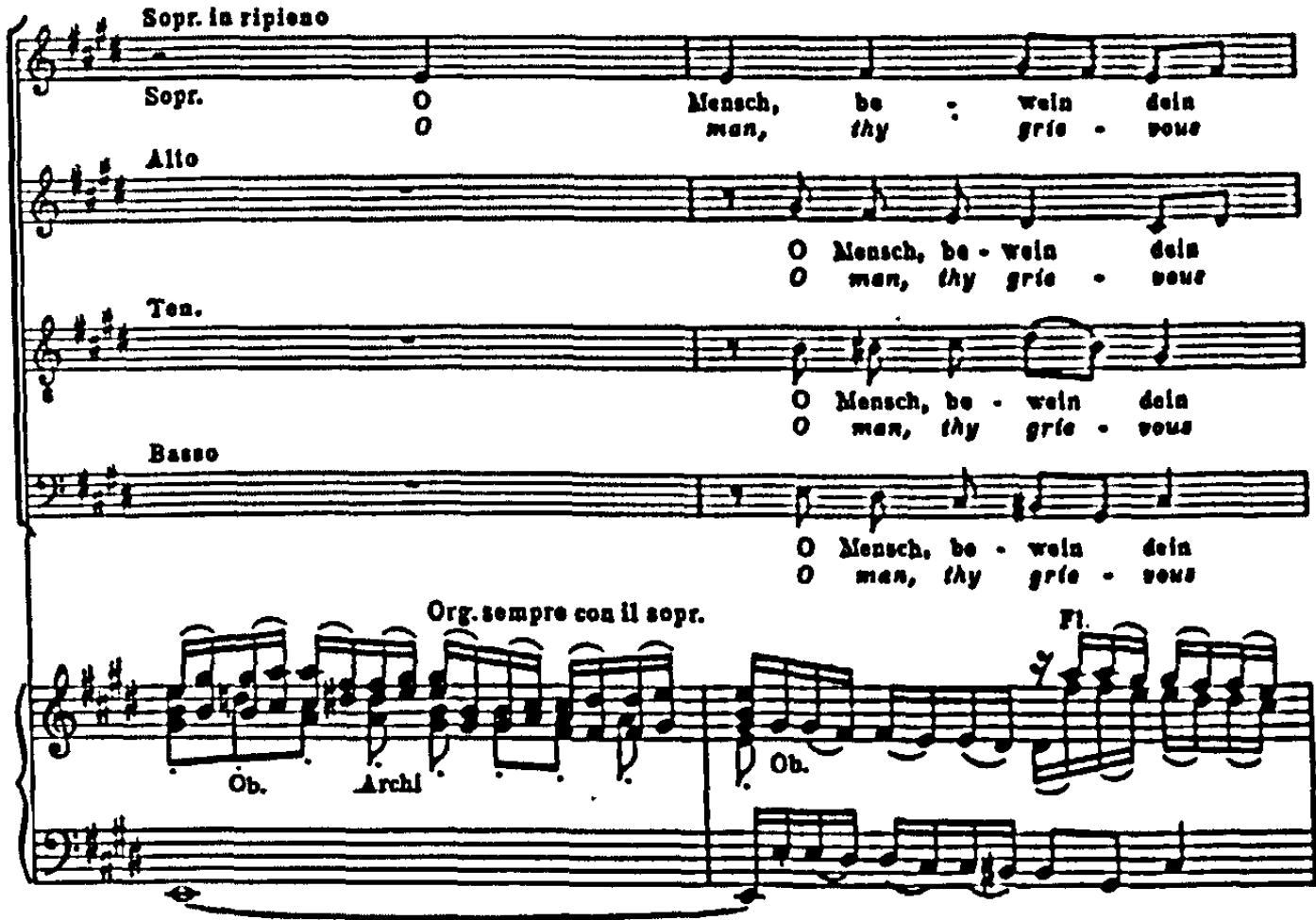
中文讲解
图注/图像占位符,对应 Example 31,标示《马太受难曲》第 29 首(《人啊,哀悼你深重的罪》)的女高音与合唱部分的第 17–18 小节。结合 P0265 可知,本例用于直观呈现受难曲中「叹息动机」出现的位置与声部配置。脚注 140 标示该谱例取自 Alfred Dürr 编订的 Bärenreiter 版《马太受难曲》声乐总谱第 115 页。
第11段(P0267)
原文复述
Although the aforementioned figure is most likely to be encountered in chorales and chorale preludes where the text governs significantly the affective content of the piece, examples from Bach’s organ repertoire illustrate the use of the ‘sighing’ motive, which, despite the absence of the text, still depicts the same poignant affect. As mentioned before, the Weimar period was a very productive time for Bach regarding his organ compositions, and one of the finest examples dating from that period is the Fantasy and Fugue in C minor (BWV 537). The Fantasy begins in a three-voice fugal style built on the fundamental pedal C, while its melancholy style is illustrated from the beginning through the exclamatio figure in the top voice, a figure Mattheson described as “[…] a veritable scream resulting from extreme dismay or astonishment […].” $^{141}$ The exclamatio is soon imitated by the inner voices (polyptoton, bars 1-4), while after its demonstration in the pedal (bars 7-8), the ‘sighing’ slurred appoggiaturas preceded by octave leaps appear first in the pedal, a motive that is treated imitatively by the voices in the following bars, leading to an anaphora (repetitio, bars 11-14).
中文讲解
本段是本节的第二个核心段落,把分析对象从带歌词的众赞歌体裁切换到纯器乐的管风琴作品,由此论证「叹息动机」即便在没有文本约束的情况下,仍然独立传递「辛酸」情感。
逻辑链条分为四步:
- 限定范围:作者承认「叹息动机」最常见于歌词主导情感的众赞歌与前奏曲。
- 突破限定:但巴赫的管风琴作品表明,无文本时动机仍传达相同情感——这是论证的关键转折。
- 选定案例:BWV 537《c 小调幻想曲与赋格》被选作威玛时期的代表,作品以 C 为持续低音,三声部赋格风格起头。
- 拆解开篇修辞:(a) 最高声部以 exclamatio(惊叹动机)开篇,作者引 Mattheson 形容它「简直是一声尖叫,出于极度的惊惧或惊异」,从而奠定忧郁基调;(b) 第 1–4 小节中惊叹动机被内声部模仿,作者以「polyptoton」(多声部异高模仿)称之——这是把修辞学术语搬入纯音乐分析;(c) 第 7–8 小节,踏板呈现同一动机;(d) 接着,带八度跳进进入的连奏下行倚音即「叹息动机」首先出现在踏板,随后被各声部进行模仿处理;(e) 第 11–14 小节形成 anaphora(repetitio,连续反复)段落。
作者有意把 exclamatio 与 sighing motive 配对呈现:前者代表「惊叫」式的瞬时爆发,后者代表「呻吟」式的延绵,二者结合揭示出本曲开篇修辞的复合性格——既惊恐又悲叹。这为下一段(P0274)讨论第 32 小节以后动机的变形与半音化做了铺垫。
补充说明
关于术语的内部定位:polyptoton 原是修辞学「同根异形词反复」之义,此处被借用来指「同一动机在多个声部以不同音高依次模仿」;anaphora 原指「句首同一词的反复」,repetitio 则是音乐修辞学中的「重复」,两者在巴洛克音乐修辞学中常被互换使用。本段用这些修辞术语把纯器乐段落「文本化」,从而支撑「无词也仍具表情」的论断。
第12段(P0268)
原文复述
forbearing/ however despised you were/ all sin have you borne/ otherwise we should have despaired/ Have mercy on us, Jesus.
中文讲解
这是脚注 137 所引《O Lamm Gottes, unschuldig》英文译文的剩余部分,对应德文歌词最后几行:allzeit funden geduldig(「always found forbearing」即始终忍耐)/ wiewohl du warest verachtet(「however despised you were」虽然你曾被藐视)/ all Sünd hast du getragen(「all sin have you borne」你已背负一切罪)/ sonst müssten wir verzagen(「otherwise we should have despaired」否则我们必将绝望)/ Erbarm dich unser, O Jesu(「Have mercy on us, Jesus」主耶稣,求你怜悯)。
第13段(P0269)
原文复述
$^{138}$ Stinson, p. 128.
中文讲解
脚注 138,援引 Stinson 第 128 页,为 P0258 中关于 BWV 618 第 12–13 小节「suspension on middle c’ in the pedal combined with the passus duriusculus in the bass」具体谱例位置的出处。
第14段(P0270)
原文复述
$^{139}$ ibid., pp. 128-29. Also Keller, p. 211.
中文讲解
脚注 139,标示 P0265 中关于《马太受难曲》第 29 首运用「叹息动机」的论述出自 Stinson 第 128–129 页,并补充参考 Keller 第 211 页。这是一种典型的「双重佐证」式引文——指出学界对此动机的认定并非孤证。
第15段(P0271)
原文复述
$^{140}$ J. S. Bach, Matthäus-Passion (BWV 244), Vocal Score Based on the Urtext of the New Bach Edition by Alfred Dürr (Kassel: Bärenreiter Verlag, 1974), p. 115.
中文讲解
脚注 140,标示 P0266 中 Example 31 的谱例取自 Alfred Dürr 依据新版巴赫全集(NBA)所编订的 Bärenreiter 版《马太受难曲》声乐总谱第 115 页。该版本是 20 世纪后期以来学界与演出界通用的权威净版谱。
第16段(P0272)
原文复述
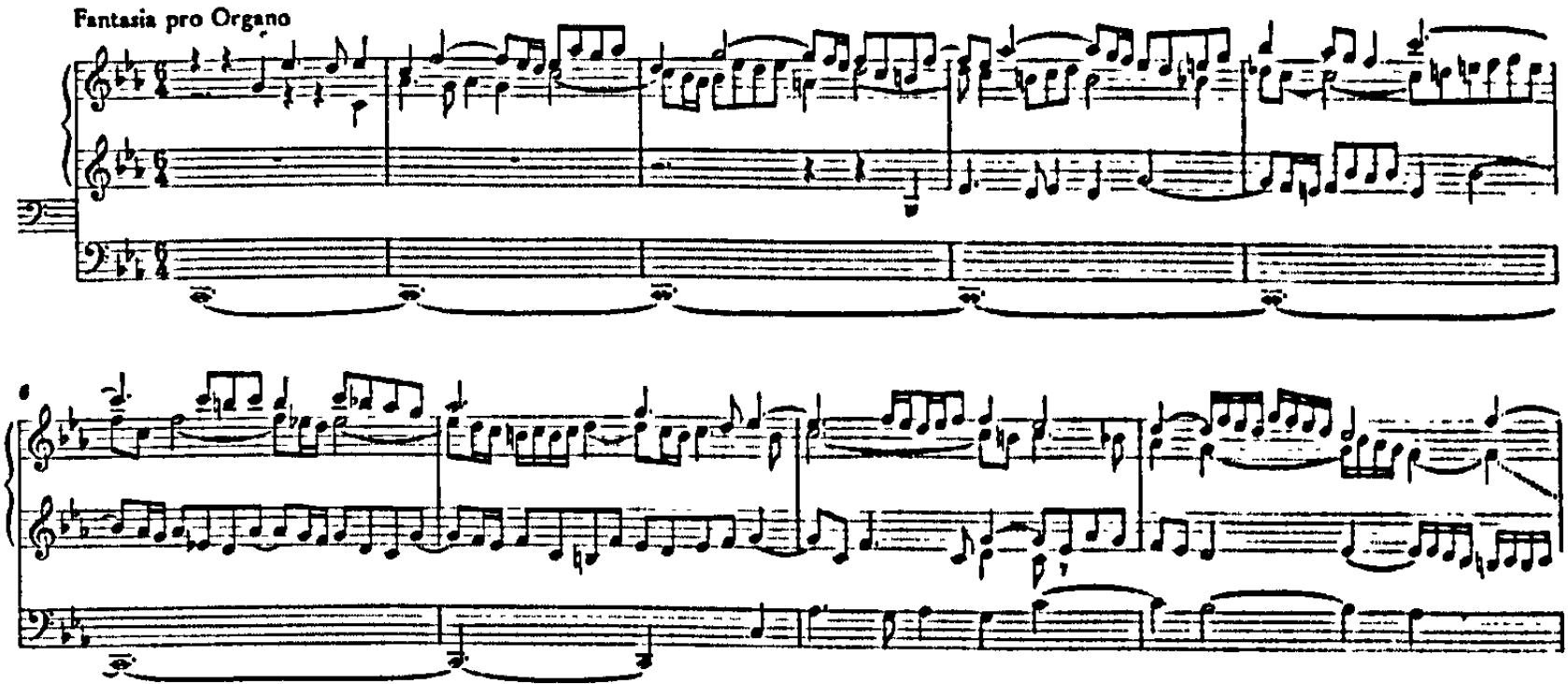
中文讲解
图注/图像占位符,对应 Example 32,标示 BWV 537《幻想曲与赋格》第 1–9 小节,正是 P0267 所讨论的最高声部 exclamatio 动机出现并被内声部模仿、踏板接应的位置。脚注 142 标注谱例来源为 NBA 第 5 卷第 1 分册(Kililan 编订,1972 年 Bärenreiter 版)。
第17段(P0273)
原文复述

中文讲解
图注/图像占位符,对应 Example 33,标示 BWV 537 第 10–14 小节,对应 P0267 末尾提到的「带八度跳进的叹息动机首先在踏板出现,继而被各声部模仿处理,并引向第 11–14 小节的 anaphora」的位置。
第18段(P0274)
原文复述
From bar 32 onwards (example 34), the slurred ‘sighing’ figure is demonstrated both in its original and in its inverted state, as well as in parallel motion between the voices, while bold chromaticism (bars 32-41) leading to expressive modulations, including the F minor one (bars 37-39), intensifies the dramatic character of the piece.
中文讲解
本段承接 P0267,把分析推进到 BWV 537 幻想曲中段(第 32 小节以后)。作者指出「叹息动机」在此出现三种变化形态:(1) 原形;(2) 倒影形(inverted state,即上下颠倒);(3) 平行进行(parallel motion,即各声部同步反向或同向进行)。这种「动机变形 + 半音化」的组合强化了戏剧性。
第 32–41 小节还伴随「大胆的半音化」(bold chromaticism),并引向一系列富有表情的转调,其中第 37–39 小节转至 f 小调特别重要——因为 F 小调与 C 小调相比呈现出更浓重的暗色调,与作品的忧郁基调高度契合。
本段在论证链中的作用是把「叹息动机」从单一形态拓展为「可塑修辞图式」——它不仅在原形上反复,还能通过倒影、平行、半音化加以变形,从而在纯器乐语境中持续维持并强化其悲剧表情。这种「修辞图式 + 转调色彩」的分析,正是 Baroque 修辞学与情感论(Affektenlehre)相结合的典型操作。
第19段(P0275)
原文复述
$^{141}$ Mattheson, Der vollkommene Capellmeister, Part II, Chapter 9, §67, p. 194; translation of the German text quoted here from Bartel, p. 269.
中文讲解
脚注 141,标示 P0267 中关于 exclamatio「a veritable scream resulting from extreme dismay or astonishment」的德文原文出自 Johann Mattheson《Der vollkommene Capellmeister》(《完美的乐队指挥》)第二部分第 9 章第 67 节第 194 页;其英文译文则引自 Bartel 第 269 页。Mattheson 是 18 世纪初德国音乐修辞学最重要的系统化者,他的「exclamatio」定义被后世学者(包括 Bartel)反复引用。
第20段(P0276)
原文复述
$^{142}$ Examples 32-34 are drawn from the fifth volume of the Neue Bach Ausgabe. See J. S. Bach, Orgelwerke, ed. by Dietrich Kilian, Urtext of the New Bach Edition, vol. 5.1: Preludes, Toccatas, Fantasias and Fugues (Kassel: Bärenreiter Verlag, 1972).
中文讲解
脚注 142,统一标示 Example 32、33、34 三例均取自新版巴赫全集(NBA,Neue Bach Ausgabe)第 5 卷第 1 分册,由 Dietrich Kilian 编订、Bärenreiter 出版社 1972 年出版,其中收录巴赫的前奏曲、托卡塔、幻想曲与赋格。该版本是学界研究 BWV 537 等作品的标准净版谱依据。
第21段(P0277)
原文复述
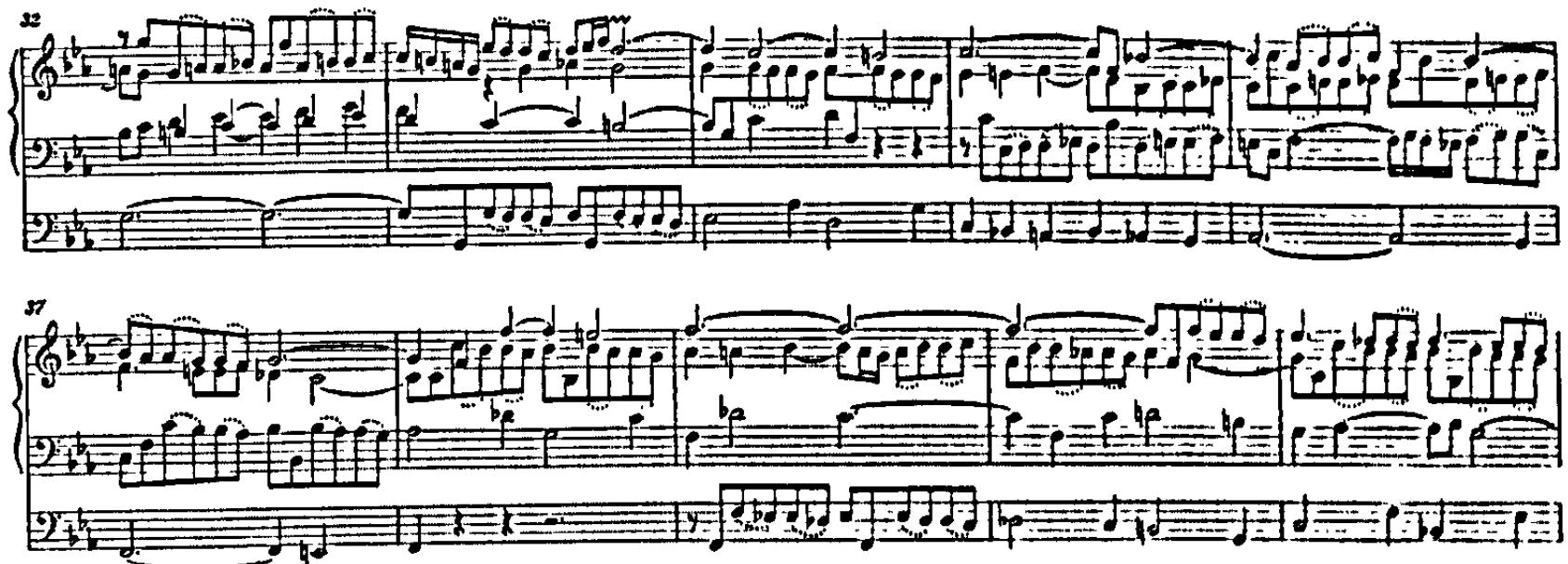
中文讲解
图注/图像占位符,对应 Example 34,标示 BWV 537 第 32–41 小节。结合 P0274 可知,本例用于直观展示「叹息动机」的原形与倒影形、平行进行,以及大胆的半音化和到 F 小调的转调(第 37–39 小节)。
第22段(P0278)
原文复述
The melancholy aura of the Fantasy and Fugue in C minor depicted through the dominance of the ‘sighing’ figure is also encountered in the harpsichord work Capriccio sopra la lontananza del suo fratro dilettissimo (Capriccio on the Departure of his Most Beloved Brother, BWV 992). $^{143}$ The piece dates from 1704 and was composed when Bach’s eldest brother, Johann Jacob, left Thuringia in order to join the Swedish army as oboist in the Guard of King Charles XII. $^{144}$ The ‘sighing’ figure preceded by descending chromatic motives appears at the end of the third section of the Capriccio marked ‘adagiosissimo’ and entitled ‘Ist ein allgemeines Lamento der Freunde’ (‘A general lament of the friends’), $^{145}$ while suggestions have been made with regard to the connection of the motive of grief with Bach’s sadness for his brother’s departure from Germany. $^{146}$
中文讲解
本段把分析延伸到拨弦键琴作品,将「悲伤动机」的运用从管风琴与受难曲进一步推广到世俗题材的独奏作品,并首次涉及作品的具体历史情境。
第一层论点:BWV 537 中「叹息动机」所营造的忧郁氛围,在拨弦键琴作品 BWV 992《Capriccio sopra la lontananza del suo fratro dilettissimo》(《随兄长最亲爱的离去随想曲》)中亦可见到。该作创作于 1704 年,时巴赫年方十九。
第二层是历史语境:作品缘起于巴赫的兄长 Johann Jacob 离开图林根,前往瑞典加入国王查理十二世卫队担任双簧管手。这一具体事件常被引为作品第三段「adagiosissimo」并标注为「Ist ein allgemeines Lamento der Freunde」(「朋友们共同的悲歌」)一节中「叹息动机」+下行半音化动机的创作缘由。
第三层是学术争鸣的提示:脚注 146 暗示学界有人主张「悲伤动机」与「巴赫对兄长离德而去的哀伤」直接相关;但 Christoph Wolff 对此持怀疑态度,详见脚注 146。这一处「提示但保留争议」的写法,说明作者意识到该作品的传记式象征解读并非定论。
本段对全节论证的意义在于:(1) 把「悲伤动机」扩展到带具体个人情感语境的世俗作品;(2) 引入传记背景与文献争议,呈现该话题的复杂维度——这使本节从纯形式分析转向兼顾「修辞图式 + 历史语境」的综合讨论。
第23段(P0279)
原文复述
$^{143}$ Keller, p. 106.
中文讲解
脚注 143,标示 P0278 中关于 BWV 992 的整体论述(特别是「Capriccio 同样以悲伤动机为主导」)援引 Keller 第 106 页。
第24段(P0280)
原文复述
$^{144}$ Christoph Wolff, ‘Bach: List of the Musicians’, in The New Grove Dictionary of Music and Musicians, ed. by S. Sadie and J. Tyrrell, 2 $^{nd}$ edn, 29 vols (London: Macmillan Publishers Ltd, 2001), ii, pp. 297-302 (p. 301).
中文讲解
脚注 144,标示 P0278 中关于 Johann Jacob 离开图林根前往瑞典加入查理十二世卫队的史实出自 Christoph Wolff 撰写的《New Grove Dictionary of Music and Musicians》第二版(2001)第 2 卷第 297–302 页(具体在第 301 页)。该条目是当代权威的巴赫家族成员行迹考据。
第25段(P0281)
原文复述
$^{145}$ Geiringer, pp. 261-62. See also Albert Protz, ‘Zu Johann Sebastian Bachs “Capriccio sopra la lontananza del suo fratello dilettissimo”’, Die Musikforschung, 10 (1957), 405-08.
中文讲解
脚注 145,标示 P0278 中关于《Capriccio》第三段末「adagiosissimo」与标题「朋友们共同的悲歌」的论述出自 Geiringer 第 261–62 页,并补充参看 Albert Protz 1957 年发表于《Die Musikforschung》第 10 期的专题文章。后者是较早对该作品进行专门研究的德语文献。
第26段(P0282)
原文复述
$^{146}$ This aspect is viewed with suspicion by Christoph Wolff; see Christoph Wolff, ‘The Identity of the “Fratro Dilettissimo” in the Capriccio B-Flat Major and Other Problems of Bach’s Early Harpsichord Works’, in The Harpsichord and its Repertoire: Proceedings of the International Harpsichord Symposium Utrecht 1990, ed. by Pieter Dirksen (Utrecht: Stichting voor Musiekhistorische Uitvoeringspratijk, 1992), pp. 145-56. Wolff also expresses his objections to the traditional viewpoint in his Johann Sebastian Bach: The Learned Musician, pp. 74-75.
中文讲解
脚注 146,标示 P0278 中关于「把悲伤动机与巴赫对其兄长离去之哀伤相联系」的传统解读受到 Christoph Wolff 的质疑。Wolff 在 1992 年乌得勒支国际羽管键琴研讨会的论文集中撰文讨论《降 B 大调随想曲》中「最亲爱的兄长」(fratro dilettissimo)的真实身份问题,并对巴赫早期羽管键琴作品中的传统解读提出反对意见;其《J. S. Bach: The Learned Musician》第 74–75 页亦表达了同样立场。该脚注提示:把 BWV 992 解释为「兄长离去之哀歌」虽广为流传,却并非毫无争议的定论。
脚注 / 边栏 / 图表 / 附加信息(如有)
本节包含 4 处谱例占位符(Examples 29–32、33、34,分别为 P0257、P0264、P0266、P0272、P0273、P0277)和 14 条脚注(P0259–P0263、P0269–P0271、P0275–P0276、P0279–P0282)。谱例承担视觉证据功能,全部围绕「悲伤动机」及其修辞变体在不同作品中的呈现:Example 29 展示 BWV 618 开头;Example 30 展示 BWV 618 第 12–14 小节「verzagen」一词对应的延留音与下行半音阶;Example 31 展示《马太受难曲》第 29 首中的叹息动机;Example 32–34 依次展示 BWV 537 第 1–9、10–14、32–41 小节。脚注方面:脚注 133、138 标明 BWV 618 的两处具体分析出自 Stinson;脚注 134 引 Moeser 关于 Orgelbüchlein 象征手法的文章;脚注 135、145 引 Geiringer 提供整体气氛描述与 BWV 992 第三段信息;脚注 136 引 Schweitzer 的演奏指示;脚注 137 引 Williams 并附 BWV 618 歌词全文(含德、英对照,跨 P0263、P0268 两段);脚注 139 引 Stinson 与 Keller 对受难曲中叹息动机的双重佐证;脚注 140 标明 Example 31 的谱例来源(Dürr 编订 Bärenreiter 版《马太受难曲》声乐总谱);脚注 141 标示 Mattheson 关于 exclamatio 的德文原文与 Bartel 的英译;脚注 142 统一标示 Example 32–34 出自 NBA 第 5 卷第 1 分册;脚注 143 引 Keller 对 BWV 992 的论述;脚注 144 引 Wolff 在《新格罗夫》中的「巴赫家族乐师名录」;脚注 146 则提示对「兄长身份」与「动机 = 哀伤兄长」传统解读的 Wolff 怀疑论,构成全节唯一一处显性的反方观点。
💡 本节核心要点
- 巴赫作品中的「叹息/悲伤动机」是一套明确的修辞图式:连续下行的连奏倚音,巴赫本人手稿中即标出连奏弧线,营造「发自灵魂深处的叹息」般的辛酸情感。
- 文本与音乐修辞的耦合在 BWV 618 中得到精确证明:第 12–13 小节用踏板中音 c’ 上的延留音加低声部 passus duriusculus(下行半音阶)专门图解歌词「verzagen」(绝望),将众赞歌文本转化为可听的对位画面。
- 同一动机可跨越带词体裁(众赞歌前奏曲、《马太受难曲》第 29 首)与纯器乐体裁(BWV 537 幻想曲),在没有歌词约束时仍稳定地传递相同的悲恸情感,证明其在巴赫笔下是一种独立的表情语汇。
- BWV 537 幻想曲开篇以 exclamatio(「惊叫」动机)与 sighing motive(「叹息」动机)双修辞并置,并在中段(第 32 小节起)将后者加以倒影、平行进行与大胆半音化处理,配合至 F 小调的转调(第 37–39 小节),构成一套「惊—叹—悲」递进的悲剧表情架构。
- BWV 992《最亲爱的兄长离去随想曲》第三段末「adagiosissimo·朋友们共同的悲歌」一节把「叹息动机 + 下行半音化」与具体生平事件挂钩,展示了修辞图式在世俗题材作品中的传记性运用。
- 学界对该动机的解释并非完全一致:Christoph Wolff 对把 BWV 992 中的「悲伤动机」直接等同于巴赫对兄长离德之哀的传统解读持保留态度,提示读者注意此类象征性解读的边界。
🔑 关键术语
- figure of grief / sighing motive:「悲伤动机」或「叹息动机」,指连续下行的连奏倚音构成的小型音型,是巴洛克修辞图式中固定套式之一,用以表达悲恸、哀伤。本节中巴赫手稿即标出连奏弧线,证明其「呻吟」性质属作者原意。
- appoggiatura:倚音,在主音前拍点出现的装饰音,与后随的解决音形成不协和并产生倾向性重音;本节中的「下行倚音」是构成「叹息动机」的具体技术形式。
- passus duriusculus:「艰难步法」/ 苦阶进行,指低声部的下行半音阶,巴洛克修辞学中专用于表现哀伤、悲痛;本节中它在 BWV 618 第 12–13 小节图解「verzagen」(绝望)。
- suspension:延留音/留音,从前一和弦延续并下行解决到和弦音的装饰;本节中延留音落在中音 c’,与 passus duriusculus 并置以强化悲恸修辞。
- exclamatio:「惊叹」动机,巴洛克修辞学中的固定图式之一,Mattheson 形容其为「出于极度惊惧或惊异的尖叫」;BWV 537 开篇即以此动机呈现,与叹息动机并置营造双重悲剧色彩。
- polyptoton:在本节被借用于音乐分析中,指同一动机在多个声部以不同音高依次模仿;原为修辞学「同根异形词反复」之义。
- anaphora / repetitio:「句首反复」/「重复」,巴洛克修辞学中的音型反复图式;本节中 BWV 537 第 11–14 小节被标为 repetitio 段落。
- Agnus Dei:《除免祭羊颂》,天主教弥撒固定部分之一;BWV 618 所配德文歌词是对其的改写,故 P0258 称该经文为「对拉丁文 Agnus Dei 的 paraphrase」。
- Capriccio sopra la lontananza del suo fratro dilettissimo (BWV 992):《最亲爱的兄长离去随想曲》,1704 年巴赫 19 岁时为兄长 Johann Jacob 离德赴瑞典而作的羽管键琴独奏作品,全曲六段,其中第三段末以「adagiosissimo」并标注「朋友们共同的悲歌」,包含「叹息动机 + 下行半音化」。
2.18 [描述性拆分] Bach’s Ach wie flüchtig, ach wie nichtig (BWV 644): Fleeting Scalar Figuration
第1段(P0283)
原文复述
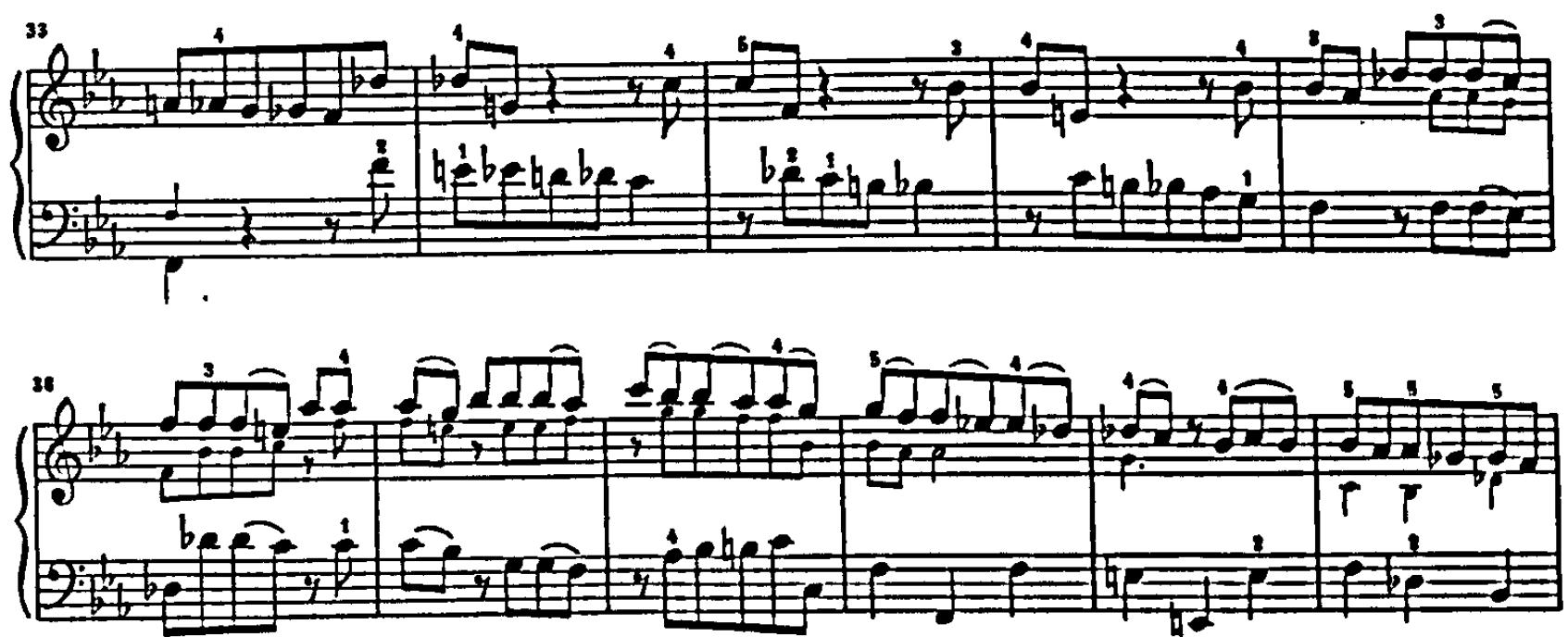
中文讲解
这是图35的图注占位符,位于第44页。原图已省略,仅保留标题与脚注引用:示例35,BWV 992《Capriccio sopra la lontananza del suo fratro dilettissimo》第33–43小节,附脚注147。鉴于正文图像数据不可见,需查阅原书以获取谱例细节;但其在本节的版面位置表明,它紧接上一段关于BWV 992的讨论,并作为本节开启BWV 644分析之前的过渡谱例存在。
补充说明
本段仅为图注,承载版面提示与脚注指针,不含独立论述。
第2段(P0284)
原文复述
The same melancholy affect but without the utilization of the figure of grief is depicted in the chorale prelude Ach wie flüchtig, ach wie nichtig (BWV 644), a piece where the chorale text “[…] compares the transitoriness of life to the cloud ’that soon arises and soon has passed away.’” $^{148}$ The text of Michael Franck (1609-1667) dates from 1652, in which the thirteen five-line verses present the sequence of flüchtig (transitory) and nichtig (vain) in the first two lines of each verse in alternating order. $^{149}$
中文讲解
本段引出本节核心作品BWV 644《Ach wie flüchtig, ach wie nichtig》。作者强调两个关键点:其一,这首前奏曲所传达的忧郁情感与前文作品相同,但并不依赖“悲伤音型”(figure of grief)这一修辞手段;其二,歌词本身把人生比作“云雾,转眼兴起,转眼散去”,由此奠定“短暂与虚空”的双重主题。作者进一步交代歌词作者Michael Franck(1609–1667)与年代1652,并指出全诗共十三节五行诗,每节前两行依次以flüchtig(短暂)与nichtig(虚空)交替呈现。这种关键词的对称结构为后文将“fuga”对应flüchtig、将“salti semplici + tmesis”对应nichtig的图像化分析提供了文本依据。
补充说明
本段为后两段的图像化诠释做铺垫:flüchtig/ nichtig的交替出现预示了两种不同音乐修辞的双轨对应关系。
第3段(P0285)
原文复述
In his attempt to describe “the frailty of temporal existence” $^{150}$ implied by the text, Bach applies rapid scalar ascending and descending passages that dominate the manual texture (anabasis/ catabasis). At the same time, the running motives in the inner voices picture the esoteric meaning of the word flüchtig (fleeting), depicted by the fuga, a figure that “[…] refers to a musical passage which is employed when the words indicate a flight, thereby illustrating their content in as like manner as possible.” $^{151}$ On the other hand, the quality of the word nichtig (empty) is depicted by a quasi-pizzicato bass, which consists of consecutive octave leaps (salti semplici) that are further reinforced by expressive rests (tmesis). The sense of fall described by leaps (salti semplici) and rests (tmesis) in the chorale prelude Durch Adams Fall is also confirmed in the prelude under discussion by the eighth verse, and by the closing lines of the last verse: ‘das muss fallen und vergehen: wer Gott fürcht’, bleibt ewig stehen’. $^{152}$
中文讲解
本段是本节的核心图像化分析段落,展示了“词—图”双重对应的具体设计。作者指出Bach为了表达“尘世存在的脆弱”(the frailty of temporal existence),在键盘声部使用快速的上行与下行音阶进行——即anabasis(上行)与catabasis(下行)两个修辞术语的组合,构成笼罩全曲的主导织体。在内声部,流动的动机则通过“fuga”这一修辞象征flüchtig(飞逝)之意;作者援引Walther词典的定义,指出fuga指的是“当歌词指涉飞逝之时,所用以尽可能贴切地体现其内容的音乐段落”。与此相对,nichtig(虚空)则由低音声部的“quasi-pizzicato bass”——即连续八度跳进(salti semplici)配以表情性休止(tmesis)——加以刻画。作者进而指出,salti semplici与tmesis在《Durch Adams Fall》中也曾表达“坠落”之意,本曲则由第八节末行以及最末节收尾句“das muss fallen und vergehen: wer Gott fürcht’, bleibt ewig stehen”(这一切必倾覆消亡,唯敬畏神者永远屹立)加以佐证。这就把音乐修辞、文本语义与神学意味三层贯通。
补充说明
作者在本段中并置了两套修辞:键盘主导的anabasis/catabasis体现“脆弱”,内声部的fuga体现“飞逝”,低音声部的salti semplici + tmesis体现“虚空/坠落”。读者需注意anabasis/catabasis是总体的织体氛围,而fuga与salti semplici则分别对应flüchtig与nichtig两个关键词,构成词—图的精细分工。
第4段(P0286)
原文复述
$^{147}$ Johann Sebastian Bach, Suiten, Sonaten, Capriccios und Variationen, herausgegeben von Georg von Dadelsen (München: G. Henle Verlag, 1975).
中文讲解
本段为脚注147,标明图35(BWV 992)谱例的版本来源:Johann Sebastian Bach的《组曲、奏鸣曲、随想曲与变奏曲》,由Georg von Dadelsen编辑,1975年由慕尼黑G. Henle出版社出版。该脚注仅为谱例版本提供出版信息,不直接支撑正文主张。
补充说明
脚注147的功能在于版本溯源,为读者核对谱例提供权威版本依据。
第5段(P0287)
原文复述
$^{148}$ Schweitzer, J. S. Bach, vol. 2, p. 57. See also James C. Moeser, ‘Symbolism in J. S. Bach’s Orgelbuechlein’, The American Organist, 48.7 (July 1965), 11-13 (p. 11).
中文讲解
本段为脚注148,交代正文中关于BWV 644歌词“将人生短暂比作云雾”这一比喻的两处文献来源:Schweitzer所著《J. S. Bach》第二卷第57页,以及James C. Moeser于1965年7月《The American Organist》第48卷第7期发表的《Symbolism in J. S. Bach’s Orgelbuechlein》第11页。该脚注起到支持正文文学性描述的作用。
补充说明
Schweitzer与Moeser均属Bach管风琴作品象征研究的早期文献,本脚注与下文关于象征修辞的论述形成连续支撑。
第6段(P0288)
原文复述
$^{149}$ The first and the eighth verse of the hymn are as follows: Ach wie flüchtig, ach wie nichtig/ ist der Menschen Leben/ wie ein Nebel bald entstehet/ und auch wieder bald vergehet/ so ist unser Leben, sehet! (verse 1); Ach wie nichtig, ach wie flüchtig/ sind der Menschen Sachen/ alles, alles was wir sehen/ das muss fallen und vergehen/ wer Gott fürcht’, wird ewig stehen (verse 8). English translation: Ah how fleeting, ah how paltry/ is the life of mankind/ as a mist soon rises/ and as soon disperses again/ see! so is our life (verse 1); Ah how paltry, ah how fleeting/ are the things of mankind/ all, all that we see/ must fall and decay/ he who fears God will survive for ever (verse 8); see Williams, The Organ Music of J. S. Bach, p. 315.
中文讲解
本段为脚注149,提供原诗第一、第八节的德文原文与英译。值得注意的关键结构:第一节前两行以“Ach wie flüchtig, ach wie nichtig”起首,第八节前两行则倒置为“Ach wie nichtig, ach wie flüchtig”。这正是P0284所称“flüchtig与nichtig以交替顺序出现在每节前两行”的实证。第二节末行“das muss fallen und vergehen/ wer Gott fürcht’, wird ewig stehen”正是P0285中引用的末节收尾句的原型。脚注同时指出英译参照Williams的The Organ Music of J. S. Bach第315页。
补充说明
此脚注通过提供完整原文,使读者能够直接验证作者关于“关键词交替”这一结构特征的论断,并为后文P0297中“nichtig”与“虚无”之对应提供文本锚点。
第7段(P0289)
原文复述
$^{150}$ Benitez, p. 10.
中文讲解
本段为脚注150,引用Benitez著作第10页,作为正文中“the frailty of temporal existence”这一概括性表述的来源。该脚注为正文中关于“尘世存在之脆弱”的神学—哲学性提炼提供出处。
补充说明
Benitez的著作被作者视为对文本总体神学含义的概括性参考,其作用在于将文本的宗教训诫浓缩为可对应于音乐修辞的主题词。
第8段(P0290)
原文复述
$^{151}$ Walther, Musicalisches Lexicon, p. 267, translated by Bartel, p. 289. For the same figure, as employed by Buxtehude in the chorale prelude Ach Herr, mich armen Sünder, see page 151 of this chapter. It is worth mentioning that similar scalar patterns appear in the chorale of the opening chorus of Bach’s Cantata no. 26 under the same title, while the same ‘fleeting’ figuration is also
中文讲解
本段为脚注151的前半段。脚注首先交代fuga修辞定义的出处:Walther《Musicalisches Lexicon》第267页,由Bartel翻译于第289页。其次,作者将fuga的使用与Buxtehude的圣咏前奏曲《Ach Herr, mich armen Sünder》相联系,提示读者可参阅本节(即本章)第151页。再次,作者指出Bach的康塔塔BWV 26(同题)的开场合唱中也出现类似的音阶式进行。脚注在此处中断,由P0295续接。
补充说明
脚注151跨越两段(P0290与P0295),这是由于原书排版时脚注过长被拆分。读者应将两段合并理解,方能完整把握fuga修辞在Bach作品群中的广泛存在。
第9段(P0291)
原文复述

中文讲解
本段为图36的图注占位符,位于第45页。原图省略,仅保留标题:示例36,BWV 644《Ach wie flüchtig, ach wie nichtig》第1–3小节。该谱例紧接在关于anabasis/catabasis与fuga的图像化讨论之后,用于直观展示作品开篇的快速音阶进行与内声部fuga动机的形态。需查阅原书方可获得细节。
补充说明
图36的版面位置表明它直接对应P0285中所讨论的“键盘主导的快速音阶”与“内声部fuga”这两种修辞。
第10段(P0292)
原文复述
Finally, the abundance of the expressive anabasis and catabasis figures culminates in bars 8-10, where the false relations (parrhesia) between the voices lead to the final bar, in which the rare instance of pedal absence from the concluding chord functions as a hypotyposis of the vanity (nichtig) described by the text. $^{153}$
中文讲解
本段是本节对BWV 644图像化分析的收束。作者指出anabasis与catabasis两种修辞在第8至10小节达到顶点,并出现一种特别处理:声部之间的“假关系”(false relations,修辞术语parrhesia)将音乐推向最终小节。在该最终小节中,作者标记出一个罕见现象——结束和弦中踏板声部的缺失(pedal absence)。作者认为,这一踏板缺席正是nichtig(虚空)的hypotyposis(形象化描绘)。如此一来,文本的“虚空”不仅由前文低音声部的salti semplici + tmesis所象征,更由终和弦的“空”所体现——音乐结构本身的留白成为对歌词概念的“实证”。
补充说明
本段引入三组新修辞:parrhesia(声部之间的假关系)、hypotyposis(对概念的形象化描绘)以及pedal absence(踏板缺席)。它们与前文的salti semplici、tmesis、fuga、anabasis/catabasis共同构成BWV 644的修辞清单。
第11段(P0293)
原文复述

中文讲解
本段为图37的图注占位符,位于第45页。原图省略,仅保留标题:示例37,BWV 644《Ach wie flüchtig, ach wie nichtig》第7–10小节。该谱例紧接在P0292关于第8–10小节修辞顶点的论述之后,用于直观展示parrhesia与踏板缺席的终止处理。需查阅原书方可获得细节。
补充说明
图37与P0292的论述构成图文呼应,是本节BWV 644图像化论证的关键证据谱例。
第12段(P0294)
原文复述
The triumphant message of Christ’s resurrection is vividly illustrated in the Easter chorale prelude Erstanden ist der heil’ge Christ (BWV 628), $^{154}$ while a similar figuration depicting joy for the coming of the New Year is repeated throughout the prelude In dir ist Freude (BWV 615). In the former case, Bach’s setting of the melody constitutes a stirring illustration of the first line of the text, with scalar ascending and descending four-note motives (groppo: bar 1, beats 2-3) preceded by constant quaver note patterns in the alto and the tenor known as figurae suspirans (upbeat, bars 2-4). $^{155}$ The depiction of the first word ’erstanden’ (risen) of the text and its consequent joyful meaning for Easter are strengthened by the salti semplici, in other words the perfect cadences in the pedal (V-I) throughout the prelude that have been interpreted as an ‘affirmation of faith’. $^{156}$
中文讲解
本段将论域从BWV 644(忧郁/虚空/短暂)拓展至情绪对比鲜明的两类前奏曲:复活节前奏曲《Erstanden ist der heil’ge Christ》(BWV 628)以及表达新年喜悦的《In dir ist Freude》(BWV 615)。本段聚焦BWV 628。作者指出Bach对旋律的设置构成对文本首行(宣告基督复活)的生动刻画:四音音阶式上下行动机(即groppo,出现在第1小节第2–3拍)由中音与次中音声部持续不断的八分音符图案(figurae suspirans,出现在第2–4小节的弱拍)所铺垫。进一步,作者将“erstanden”(已复活)这一首词的描绘与其复活节喜乐含义关联,并指出踏板声部中持续的V–I完满终止(salti semplici)被解读为“信仰的肯定”(affirmation of faith),从而强化了复活的神学—情感意涵。
补充说明
注意groppo(旋律装饰性回转)、figurae suspirans(叹息式音型)以及salti semplici作为正格终止被赋予信仰含义,三者共同把“复活”之喜转化为音乐修辞。
第13段(P0295)
原文复述
apparent in Georg Böhm’s Partita No. 4 ‘Ach wie flüchtig, ach wie nichtig’ (Williams, The Organ Music of J. S. Bach, pp. 315-16).
中文讲解
本段为脚注151的续接部分,承接P0290中断的句子。作者在此补充说明:同样的“飞逝”音型化处理亦见于Georg Böhm的《Partita No. 4 “Ach wie flüchtig, ach wie nichtig”》,文献依据为Williams《The Organ Music of J. S. Bach》第315–316页。这就把Bach前奏曲中“flüchtig”的修辞追溯至Böhm的同题作品,提示一种传承关系。
补充说明
P0290与P0295共同构成完整的脚注151;Böhm作为Bach的先辈,其同题作品中的相似音型被作者作为旁证,提示该修辞并非Bach独创。
第14段(P0296)
原文复述
$^{152}$ Terry, The Four-Part Chorals of J. S. Bach, p. 12.
中文讲解
本段为脚注152,交代正文中所引德文诗句“das muss fallen und vergehen: wer Gott fürcht’, bleibt ewig stehen”的文献来源:Terry所著《The Four-Part Chorals of J. S. Bach》第12页。该脚注为文本引用提供出处。
补充说明
脚注152的功能是版本/出处确认,使读者可以核对歌词原文及其神学—训诫内涵。
第15段(P0297)
原文复述
$^{153}$ Benitez, p. 11. Another instance of pedal absence in the final chord is illustrated in the chorale prelude Erstanden ist der heil’ge Christ (BWV 628), without, however, any textual implications. According to Stinson (p. 125) a similar hypotyposis of the sense of emptiness is depicted in the ‘Esurientes implevit bonis’ movement of Bach’s Magnificat, where an “empty” final note closes the movement as a depiction of the word inanes (empty).
中文讲解
本段为脚注153,交代P0292中“踏板缺席=hypotyposis of nichtig”论断的来源:Benitez第11页。随后作者进一步比较:一是BWV 628中也有终和弦踏板缺席的实例,然而并无文本方面的含义;二是据Stinson(第125页),类似的“空虚”之形象化描绘见于Bach《Magnificat》的“ Esurientes implevit bonis”乐章,其中以一个“空”的收束音符象征inanes(空虚)一词。作者由此提示:踏板缺席既可承担文本象征意义(BWV 644),也可仅为曲式现象(BWV 628),还可以是“空虚”的音乐—语义双关(Magnificat)。脚注的功能在于为正文中关于hypotyposis的论断提供文献支撑并通过对比澄清其独特性。
补充说明
脚注153体现了作者的方法论自觉:同一音乐现象(终和弦踏板缺席)需根据文本关联与否判定其是否承担象征功能。BWV 644中踏板缺席的修辞意义,正是在这种对比中得以凸显。
脚注 / 边栏 / 图表 / 附加信息(如有)
本节包含三幅谱例(图35—37)与六条脚注(147—153,其中151跨越P0290与P0295两段)。三幅谱例分别承担:BWV 992第33–43小节(图35,作为前文收束)、BWV 644第1–3小节(图36,佐证anabasis/catabasis与fuga)、BWV 644第7–10小节(图37,佐证parrhesia与踏板缺席的终和声)。六条脚注分为三类:版本溯源(147,152)、象征定义/文献来源(148,149,150,151)、横向对比(151续接,153),其中脚注153以BWV 628及Magnificat作为反例与平行例,限定了BWV 644中踏板缺席的修辞特殊性。
💡 本节核心要点
- 本节核心主张:BWV 644通过多组修辞的协同,把歌词中“flüchtig(短暂)”与“nichtig(虚空)”两个关键词分别对应于fuga(内声部流动动机)与salti semplici + tmesis(低音声部跳进与休止),并由anabasis/catabasis(快速音阶)构成笼罩全曲的氛围性修辞。
- 图像化分析的逻辑结构:文本(flüchtig/nichtig交替)—修辞(fuga/salti semplici+tmesis)—神学含义(一切倾覆,唯敬畏神者屹立)三层贯通,逐层印证。
- 本节收束的修辞顶点出现在第8–10小节:声部间的假关系(parrhesia)推向终止,最终小节踏板声部的缺席作为hypotyposis,将“nichtig(虚空)”在结构层面“实证”。
- 本节通过从BWV 644的忧郁/虚空主题拓展至BWV 628(复活)与BWV 615(新年喜悦),形成情绪—修辞对比,强化了不同修辞在不同情感—神学语境下的差异化功能。
- 方法论层面:作者以Böhm同题Partita作为先辈旁证,并以BWV 628及Magnificat作为反例与平行例,限定了“踏板缺席”承担象征意义的条件——必须具备明确的文本关联。
🔑 关键术语
- anabasis / catabasis:上行/下行音阶进行的修辞术语。在本节中,Bach以快速上下音阶笼罩BWV 644键盘声部,营造“尘世脆弱”的总体氛围性修辞。
- fuga:源自Walther《Musicalisches Lexicon》的修辞概念,指“当歌词指涉飞逝时所使用的音乐段落”。在BWV 644中,fuga对应flüchtig(飞逝),由内声部的快速流动动机加以体现。
- salti semplici:“单纯跳进”之修辞。BWV 644低音声部的连续八度跳进即属此类,用以象征nichtig(虚空);在BWV 628中则以踏板声部的V–I正格终止体现,被解释为“信仰的肯定”。
- tmesis:“切分”之修辞,通过表情性休止造成断裂感。BWV 644中与salti semplici结合,强化“坠落”与“虚空”的含义。
- parrhesia:“假关系”修辞,声部之间出现不协和的音程冲突。本节中BWV 644第8–10小节声部之间的假关系将音乐推向终止。
- hypotyposis:“形象化描绘”之修辞,以音乐手段直观象征文本概念。本节中BWV 644终和弦踏板声部的缺席即被视作nichtig(虚空)的hypotyposis。
- groppo:旋律装饰性回转的修辞术语。BWV 628第1小节第2–3拍的四音上下行动机即属此类,用以象征基督“已复活”。
- figurae suspirans:“叹息式音型”,以持续的弱拍律动表现叹息或期待。本节中BWV 628中音与次中音声部第2–4小节的八分音符图案即属此类。
2.19 [描述性拆分] Joyful Allegory in Bach’s Erstanden ist der heil’ge Christ (BWV 628) and In dir ist Freude (BWV 615)
第1段(P0298)
原文复述
154 Erstanden ist der heilige Christ/ Halleluja, Halleluja/ der aller Welt ein Tröster ist/ Halleluja, Halleluja; English translation: The holy Christ is risen/ Hallelujah, Hallelujah/ who is a comforter to all the world/ Hallelujah, Hallelujah (Williams, The Organ Music of J. S. Bach, p. 290).
中文讲解
这是一条编号154的脚注,附在正文中某处(结合下文,应是为 BWV 628 提供原始圣咏歌词及其英译)。它给出德文歌词四行:“Erstanden ist der heilige Christ / Halleluja, Halleluja / der aller Welt ein Tröster ist / Halleluja, Halleluja”,并附 Williams 在《The Organ Music of J. S. Bach》(p. 290)中的英译:“The holy Christ is risen / Hallelujah, Hallelujah / who is a comforter to all the world / Hallelujah, Hallelujah”。歌词内容是复活节题材:“圣洁的基督已复活,是普世的慰藉者”,并以叠句"Halleluja, Halleluja"反复欢呼。这一文本性质——复活、慰藉、反复欢呼——正是作者用来论证 BWV 628 与 BWV 615 表现"无拘无束的喜乐"的语义依据。脚注中保留德文原文与英文译文的并列形式,方便读者同时核对原文语气与译文含义。
补充说明
脚注出处 Williams, The Organ Music of J. S. Bach, p. 290 在本小节中反复出现(P0302 也是同一本书的同页),说明作者将 Williams 作为 BWV 628 文本与音乐释义的主要二手参考。
第2段(P0299)
原文复述

中文讲解
这是谱例 38 的图注占位符(原文为图片)。图注标明"Example 38. BWV 628: Erstanden ist der heil’ge Christ (bars 1-5)",即 BWV 628《Erstanden ist der heil’ge Christ》的第 1 至第 5 小节。括号内的"内嵌图像数据已省略;位置与图注保留"表明该图像本体因 OCR 或排版原因未提取出来,但图注和位置信息已保留。读者需要查阅原书对应谱例才能看到具体的音符织体,但作者在后文(P0300 起)以文字描述的方式对 BWV 615 进行了详细的修辞与对位分析,因此即使谱例不可见,也可以从描述中理解论点。
第3段(P0300)
原文复述
A similar figuration related to the depiction of unrestrained joy implied by the celebratory text is illustrated in the New Year chorale prelude In dir ist Freude (BWV 615). This constitutes the most flamboyant and extended work of the collection and resembles the seventeenth-century north German chorale fantasy in its treatment of the chorale melody. Fragmentation techniques distribute the cantus firmus to all voices throughout the prelude, usually in ornamented form, separated from each other by expansive virtuosic interludes. Scholars have stressed Georg Böhm’s influence on J. S. Bach’s style regarding the passing of the melody from one voice to the other, as well as the persistent repetition of the ostinato bass, a motive that functions as a countersubject to the cantus firmus.
中文讲解
本段是本小节的核心论点段落。中心主张是:BWV 615《In dir ist Freude》中也存在与 BWV 628 类似的表现"无拘无束的喜乐"的音型,而且它具有三层特点:(1)它是整部(Orgelbüchlein 风格)作品中"最华丽、最长大"的一首;(2)它在处理圣咏旋律的方式上类似 17 世纪北德圣咏幻想曲(chorale fantasy);(3)它运用了分解(fragmentation)技术,把定旋律(cantus firmus)以加花形式分散到所有声部中,并用宏大的炫技性间插段(interludes)分隔各次定旋律陈述。
随后,作者援引学术界的两点共识:其一是格奥尔格·伯姆(Georg Böhm)对巴赫风格的影响——尤其体现在旋律在声部之间的传递上;其二是顽固低音(ostinato bass)的反复出现,并将其定性为相对于定旋律的"对题"(countersubject)。
这一段在本小节论证中的作用是从 BWV 628(仅作为对照锚点)正式转入对 BWV 615 的全方位描绘,把后者定位为整个集合中喜乐表达的巅峰,并把它的手法来源追溯到北德传统(伯姆)与体裁传统(圣咏幻想曲),为后面具体分析其开篇主题、对位与修辞手法(如 figura suspirans、anaphora、anabasis、gradatio)奠定基础。
补充说明
本段中的"similar figuration"指向前文 P0298 那首 BWV 628 的喜乐表达方式,作者强调二者共享同一类"渲染无拘无束之喜乐"的音型;“collection"在原书上下文中指 Bach 的 Orgelbüchlein 一类编订性的圣咏前奏曲集。Georg Böhm(1661–1733)是巴赫早期任职魏玛时期之前影响过巴赫的北德管风琴家,其旋律在各声部间穿梭的手法被视作巴赫对位风格的来源之一。
第4段(P0301)
原文复述
155 Figura suspirans, as illustrated by Johann Gottfried Walther in his Musicalisches Lexicon (Table X); see Faksimile-Nachdruck, 1953.
中文讲解
这是编号 155 的脚注,引用约翰·戈特弗里德·瓦尔特(Johann Gottfried Walther)在《音乐词典》(Musicalisches Lexicon)表 X(Table X)中对"figura suspirans”(“叹息音型”)的图示,并注明使用的是 1953 年的影印重印本(Faksimile-Nachdruck, 1953)。它为后文 P0310 中出现的"figura suspirans"提供权威的辞书来源支撑——即这种"叹息式"音型本身是一种音乐修辞格,作者借由瓦尔特这一权威条目来确认其作为作曲与释义范畴的合法性。
补充说明
Walther 的 Musicalisches Lexicon(1728)是巴洛克晚期最重要的德语音乐百科辞典之一,Table X 提供了多种修辞格(Figuren)的视觉图示。Faksimile-Nachdruck 1953 表明作者使用的是 1953 年的影印本。
第5段(P0302)
原文复述
156 Williams, The Organ Music of J. S. Bach, p. 290.
中文讲解
脚注 156,简短引文出处:Williams, The Organ Music of J. S. Bach,第 290 页。它为正文 P0298 的歌词英译出处页码提供进一步印证。
补充说明
与 P0298 出处一致。
第6段(P0303)
原文复述
157 Stinson, p. 75.
中文讲解
脚注 157,引用 Stinson,第 75 页。它为正文 P0300 中关于 BWV 615 “类似 17 世纪北德圣咏幻想曲"这一比较判断提供出处支撑。
补充说明
Stinson 在巴赫管风琴作品研究中是常见二手文献,此处 75 页应对应 BWV 615 的体裁定位讨论。
第7段(P0304)
原文复述
158 ibid., p. 135.
中文讲解
脚注 158,同一著作(同前,即 Stinson),第 135 页。它为正文 P0300 关于"分解技术把定旋律以加花形式分散到所有声部,并以宏大炫技间插段隔开"这一陈述提供出处。
补充说明
ibid. 表示"同上”,承袭 P0303 的 Stinson。
第8段(P0305)
原文复述
159 Williams, p. 267.
中文讲解
脚注 159,引用 Williams,第 267 页。它为正文 P0300 中关于格奥尔格·伯姆对巴赫风格的影响——尤其是在旋律从一个声部传到另一个声部方面——这一学术共识提供出处。
补充说明
Williams 的 267 页通常对应讨论 Georg Böhm 影响与对位技术的章节。
第9段(P0306)
原文复述
160 Schweitzer, J. S. Bach, vol. 2, p. 62.
中文讲解
脚注 160,引用 Schweitzer, J. S. Bach,第二卷,第 62 页。它为正文 P0300 中关于"ostinato bass 的持续反复"这一陈述提供出处。
补充说明
Albert Schweitzer 的两卷本 J. S. Bach 是巴赫研究中具有里程碑意义的德文—英文文献,本节多次引用其第二卷。
第10段(P0307)
原文复述
161 Moeser claims that the ostinato bass is possibly derived from the first phrase of the chorale tune (example 39 on the following page); see James C. Moeser, ‘Symbolism in J. S. Bach’s Orgelbuechlein’, The American Organist, 48.2 (February 1965), 22-25 (p. 24).
中文讲解
脚注 161,引述 James C. Moeser 在《The American Organist》48 卷 2 期(1965 年 2 月)第 22–25 页(具体在第 24 页)的观点:Moeser 主张 BWV 615 的 ostinato bass(顽固低音)“可能”(possibly)派生自该圣咏旋律的第一乐句,并指引读者参见下一页的谱例 39。这一脚注为正文关于 ostinato bass 的论述提供了一个有条件性的来源考据——它并非直接抄自旋律本身,而是"可能"源自第一乐句,从而把 ostinato 既视作"对题"(countersubject),又潜在地与定旋律有亲缘关系。
补充说明
脚注中的"possibly"是重要的限定词,表示此推断并非定论。Moeser 的论文题目中"Symbolism in J. S. Bach’s Orgelbuechlein"表明本小节整体处在"圣咏前奏曲象征意义解读"的学术传统中。
第11段(P0308)
原文复述

中文讲解
这是第 47 页上的图像/谱例占位符,图注译作"第 47 页图像或乐谱示例"。括号内"内嵌图像数据已省略;位置与图注保留"表示该图本体未提取。它在版面位置上承接 P0307(指向"下一页的谱例 39"),并引入紧随其后的谱例占位符 P0309。在功能上,它提示读者此处原本应展示一处与下一谱例相关的视觉材料(如页眉装饰或栏外插图),需查看原书第 47 页确认具体内容。
第12段(P0309)
原文复述

中文讲解
谱例 39 的图注占位符:“Example 39. BWV 615: In dir ist Freude (bars 1-8)",即 BWV 615《In dir ist Freude》的第 1 至第 8 小节。括号内"内嵌图像数据已省略;位置与图注保留"表明图像本体未提取。本谱例正对应 P0307 脚注 161 中所指引的"下一页的谱例 39”——作者用它来支撑 Moeser 关于 ostinato bass 可能源自圣咏第一乐句的论点。同时,它也是 P0310 所描述开篇分析(旋律在 tenor 起头、被 soprano 与 alto 模仿、ostinato pedal 在前 5 小节内出现 3 次)的视觉依据。
补充说明
谱例编号 39 与 P0299 的 Example 38 编号连续,表明本小节按顺序提供了 BWV 628 第 1–5 小节与 BWV 615 第 1–8 小节的对照谱例。
第13段(P0310)
原文复述
The work commences with a fragment of the first line of the melody stated in the tenor, which is imitated by the soprano and the alto in the following two bars (polyptoton), while the ostinato pedal, “one of the most animated themes of rejoicing in the chorale preludes […]”, is heard three times within the first five bars (anaphora, repetitio). The anaphora is also illustrated in bars 7-8 where the pedal repeats the opening statement of the tenor (bars 1-2), while the joyful and exalted affect is reinforced by the manual figurae suspirans (bars 3 and 5), as well as by the anabasis figures (bars 6-7) spanning the interval of three octaves (bars 10-12).
中文讲解
本段是 BWV 615 开篇(第 1–12 小节)的逐层音乐修辞分析。
作者描绘的展开顺序是:(1)作品以 tenor 声部陈述的圣咏第一乐句片段起头;(2)在接下来两小节内,soprano 与 alto 相继模仿该片段,作者把这种"同一旋律片段在不同声部中重复出现"的现象标注为修辞格 polyptoton(字面原意为修辞学中"同一词形在不同格位上的反复",在音乐修辞中引申为"同一动机在多声部间的反复");(3)与此同时,pedal 声部的 ostinato 主题在前 5 小节内出现 3 次,被引号里的评价形容为"圣咏前奏曲中最具喜感的主题之一",作者把它反复出现于起首的做法标记为 anaphora(“起首反复”)和 repetitio(“重复”);(4)在第 7–8 小节,pedal 又重复了 tenor 第 1–2 小节的开头陈述,作者再次以 anaphora 概括之;(5)喜乐与高昂的情感同时由 manual 声部的 figura suspirans(“叹息音型”,出现在第 3、5 小节)和跨越三个八度音域的 anabasis(“上行音型”,出现于第 6–7 小节,并在第 10–12 小节完整跨出三八度)所强化。
作者为什么同时引用"叹息音型"与"上行音型"这两类本属"哀诉—喜乐"语义光谱两端的修辞格?关键在于:在巴洛克音乐修辞中,figura suspirans 与 anabasis 都能制造情绪上扬的张力——前者通过下行小二度再上跳的"叹息—振作"形态,后者通过大跨度上行——共同服务于"喜乐"的情感目标。作者把这两个修辞格与 pedal 的反复陈述叠加起来,意在论证:作品的喜乐感不是单一线索的产物,而是定旋律的分配、ostinato 的反复、叹息音型的节奏感与上行跨幅共同构建的多层修辞效果。这正是 P0300 中所谓"unrestrained joy"(无拘无束的喜乐)得以落实的音乐机制。
补充说明
polyptoton、anaphora、repetitio、figura suspirans、anabasis 都属于 17–18 世纪音乐修辞(musica poetica / Figurenlehre)的常见范畴。anabasis 字面意为"上行"(希区引申),音乐中常表现为跨越大音程的上行旋律,用以象征兴奋、提升或喜乐。
第14段(P0311)
原文复述

中文讲解
谱例 40 的图注占位符:“Example 40. BWV 615: In dir ist Freude (bars 9-12)",即 BWV 615《In dir ist Freude》的第 9 至第 12 小节。括号内"内嵌图像数据已省略;位置与图注保留"表明图像本体未提取。从 P0310 的文字描述可知,这一段谱例对应 anabasis 跨越三个八度的具体实现位置,是读者把"横跨三八度"的修辞论断对照到音符织体上的关键谱例。
第15段(P0312)
原文复述
Ornamented melodic patterns occur also in the treatment of the fourth line of the chorale melody, where the embellished version in the soprano (bars 44-45) is repeated in bars 46-47 (climax/ gradatio), a motive imitated by the alto in bars 45, 47, and 48 (polyptoton). Finally, a fragment of the ornamented melodic version is demonstrated in the pedal in bar 48 (anaphora), one of the few examples of pedal trills (with turn) notated by Bach himself in his organ works.
中文讲解
本段是 BWV 615 第 44–48 小节(对应圣咏第四行)的修辞分析。
作者的论点链条是:(1)圣咏第四行的旋律以加花形式出现在 soprano(第 44–45 小节);(2)同样的加花形态在第 46–47 小节重复出现,作者把它标记为 climax / gradatio——后者(gradatio)是音乐修辞中"通过逐步递进来强化"的格,前者(climax)在这里是同义并称;(3)同一动机又在第 45、47、48 小节被 alto 模仿,作者再次用 polyptoton 来概括"同一动机在多声部间反复出现”;(4)该加花旋律的一个片段在第 48 小节的 pedal 出现(anaphora),且尤为特殊的是,这里的 pedal 颤音(带 turn)由巴赫亲笔记写——在巴赫的管风琴作品中,巴赫本人亲笔记写 pedal 颤音(带 turn)的实例屈指可数。
这段分析把 BWV 615 的喜乐表达从开篇(第 1–12 小节)延伸到作品中部(第 44–48 小节),论证喜乐修辞并非局部现象,而是贯穿全曲。同时,“巴赫亲笔记写的 pedal 颤音"这一细节,作者意在强调此处的装饰并非他人添加或推测,而是作曲家亲手确认的乐谱事实,提升论点的可信度。
补充说明
gradatio 在音乐修辞中通常表现为动机反复且音区或音高逐步升高,由此形成渐强的"阶梯式高潮”。turn 是颤音后或乐句收尾处常见的回转型装饰。
第16段(P0313)
原文复述
162 Schweitzer, vol. 2, p. 66.
中文讲解
脚注 162,引用 Schweitzer, J. S. Bach,第二卷,第 66 页。它为正文 P0310 中带引号的评价(“one of the most animated themes of rejoicing in the chorale preludes […]",即 ostinato pedal 被誉为"圣咏前奏曲中最具喜感的主题之一”)提供出处。
补充说明
与 P0306(Schweitzer vol. 2, p. 62)相邻页码,说明 Schweitzer 对 BWV 615 的讨论集中在第二卷 60–70 页之间。
第17段(P0314)
原文复述
163 Stinson, pp. 135-36.
中文讲解
脚注 163,引用 Stinson,第 135–136 页。它为正文 P0312 末句关于"巴赫亲笔记写的 pedal 颤音(带 turn)属其管风琴作品中少数实例"这一陈述提供出处。
补充说明
Stinson 在第 135–136 页应对 pedal 装饰与颤音记谱法的专门讨论。
第18段(P0315)
原文复述
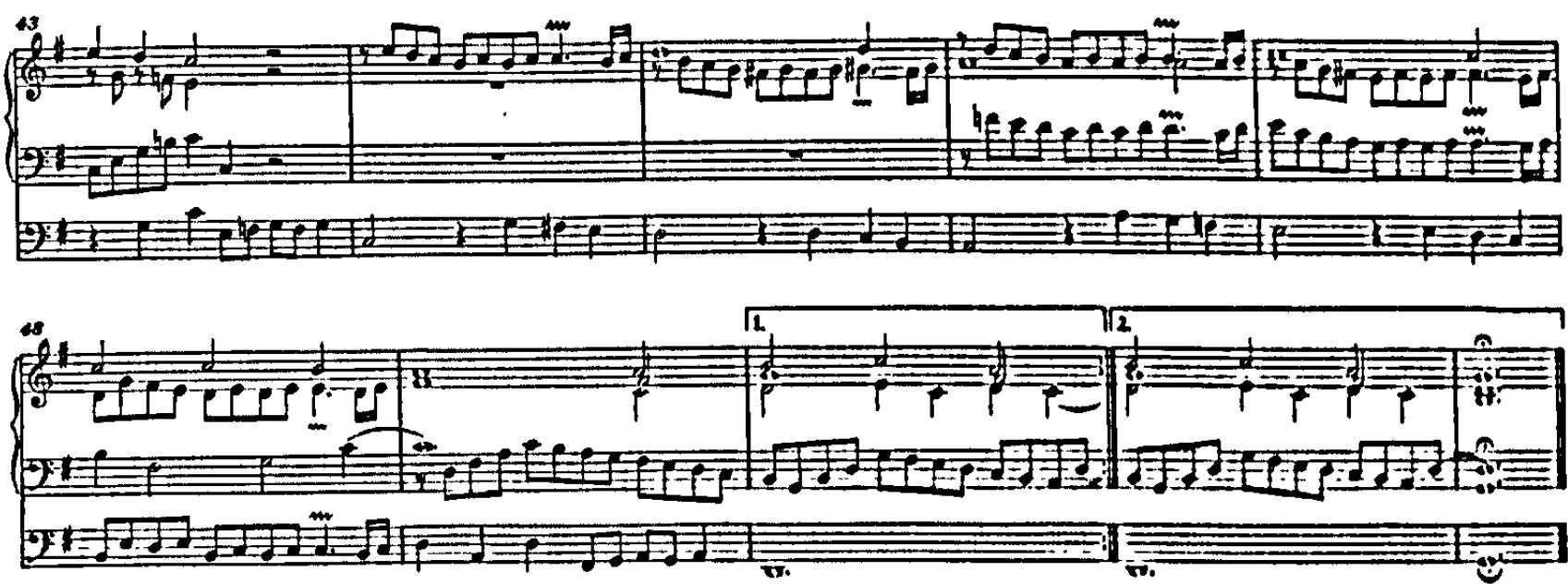
中文讲解
谱例 41 的图注占位符:“Example 41. BWV 615: In dir ist Freude (bars 43-52)",即 BWV 615《In dir ist Freude》的第 43 至第 52 小节。括号内"内嵌图像数据已省略;位置与图注保留"表明图像本体未提取。该谱例正好覆盖 P0312 所讨论的第 44–48 小节区域,是读者对照"第四行旋律加花、soprano–alto 模仿、pedal 颤音"等具体音符的依据;同时范围延伸到第 49–52 小节,让读者能在更宽的乐句窗口中观察这些修辞格之间的关系。
补充说明
本谱例编号 41 与 Example 38、39、40 连续,构成第 46–47 页一套完整的谱例群,分别展示 BWV 628 的开头与 BWV 615 的开头段、中段(anabasis)与第四行区域。
脚注 / 边栏 / 图表 / 附加信息(如有)
本小节(第 45–48 页)的非正文附加材料包括:
- 谱例编号 Example 38(P0299)、Example 39(P0309)、Example 40(P0311)、Example 41(P0315),分别对应 BWV 628 第 1–5 小节、BWV 615 第 1–8 小节、BWV 615 第 9–12 小节、BWV 615 第 43–52 小节。其中 Example 39 同时被脚注 161 用作 ostinato bass 来源考据的视觉依据,Example 40 与 Example 41 则为正文 P0310 与 P0312 的修辞分析提供谱面证据。
- 脚注 155(P0301)引用 Walther 1732/1953 影印本《Musicalisches Lexicon》表 X,作为"figura suspirans"的权威辞书依据。
- 脚注 154(P0298)以及 156–163(P0302–P0307、P0313–P0314)共同构成本小节的二手文献网络,主要二手文献包括 Williams(p. 267、p. 290)、Stinson(p. 75、p. 135、pp. 135–36)、Schweitzer 第二卷(p. 62、p. 66)以及 Moeser 在《The American Organist》1965 年的论文。
- 第 47 页的图像占位符 P0308 在功能上提示该页存在额外视觉元素(可能为栏外插图或页眉装饰),但需查看原书确认。
💡 本节核心要点
- BWV 615《In dir ist Freude》与 BWV 628《Erstanden ist der heil’ge Christ》共享同一类"无拘无束喜乐"的音型,BWV 615 是整部作品中"最华丽、最长大"的一首,喜乐表达达到极致。
- BWV 615 在体裁属性上接近 17 世纪北德圣咏幻想曲:定旋律以加花形式被分解到所有声部,并由宏大炫技间插段分隔;学者普遍承认 Georg Böhm 对巴赫此类声部间旋律传递技法的深远影响。
- 作品的喜乐修辞由多层音乐—修辞手段共同构建:tenor 起头—soprano/alto 模仿(polyptoton)、pedal 顽固低音反复(anaphora / repetitio)、manual 声部的 figura suspirans 与跨三八度的 anabasis 上行音型。
- BWV 615 中段的圣咏第四行处理延续并强化喜乐表达:soprano 加花陈述后由 gradatio/climax 重复、alto 在相邻小节模仿(polyptoton)、pedal 在第 48 小节再次以 anaphora 出现并带有巴赫本人亲笔记写的带 turn 颤音——这一亲笔颤音在巴赫管风琴作品中属少数实例。
- Ostinato bass 既被视作相对于定旋律的"对题”,又可能源自圣咏第一乐句(Moeser 的推断),它不是单纯的低音伴奏,而是与定旋律具有亲缘性的独立主题层。
🔑 关键术语
- figura suspirans:巴洛克音乐修辞中的"叹息音型",通常以下行小二度接上跳构成,类似叹息声。本节 P0310 用以描述 BWV 615 第 3、5 小节 manual 声部的音型,作者借它与 anabasis 并用,强化"喜乐与昂扬"的情感。
- polyptoton:在文学修辞中指同一词在不同格位上的重复;在音乐修辞中引申为"同一动机或片段在不同声部、不同音区中反复出现"。本节 P0300 与 P0310、P0312 都用此格描述 BWV 615 中 tenor/soprano/alto/pedal 间的旋律传递。
- anaphora:音乐修辞中"起首反复"之格,指同一动机/主题反复出现在乐句或小节的开头。本节 P0310 用来指 pedal ostinato 在前 5 小节内 3 次以同样方式起首,以及第 7–8 小节 pedal 重现第 1–2 小节的起头陈述;P0312 用以指 pedal 在第 48 小节再次以加花片段起头。
- repetitio:“重复"之格,与 anaphora 配合使用,强调 ostinato 在短时间内反复出现的事实(P0310)。
- anabasis:“上行音型"之格,源于希腊文,本节用以描述 BWV 615 第 6–7 小节的上行片段,并在第 10–12 小节跨出三个八度的音域,以大幅度上行象征喜乐与昂扬(P0310)。
- climax / gradatio:“递进/高潮"之格,指动机反复出现并逐步提升音高、音区或强度,形成阶梯式渐强。P0312 用以描述 soprano 加花旋律在第 44–45 小节陈述后于第 46–47 小节重复的实现方式。
- cantus firmus:“定旋律”,作为整首作品骨架的原始旋律线。本节特指《In dir ist Freude》的圣咏旋律,BWV 615 把该旋律以加花形式分解到所有声部。
- ostinato:“固执/反复音型”,本节特指 pedal 声部反复出现的低音主题。Schweitzer 将其形容为"圣咏前奏曲中最具喜感的主题之一”,Moeser 则推测它可能源自圣咏第一乐句。
- countersubject:“对题”,指在赋格或类似体裁中与主句(subject)相伴出现、承担辅助对比主题功能的声部或旋律线。本节 P0300 把 pedal ostinato 定性为相对于定旋律的"对题”,强调其独立主题身份。
- chorale fantasy / north German chorale fantasy:“圣咏幻想曲”,17 世纪北德管风琴家发展出的一种以定旋律为基础、织体复杂且篇幅宏大的体裁。BWV 615 因其在加花定旋律与炫技间插段之间的布局而被认为"类似"这一传统。
2.20 [描述性拆分] Concluding Summary: The Function of Rhetorical Figures in Chorale Settings
第1段(P0316)
原文复述
To summarize, the examples examined thus far support the view that the chorale settings of D. Buxtehude and J. S. Bach combine rhetorical figures with Baroque compositional techniques. In collections such as the Orgelbüchlein, the text, although not explicitly presented, is clearly represented through numerous expressive rhetorical figures, most of which can be traced in origin to vocal music, as illustrated by saltus and passus duriusculus. Although musical rhetoric is regarded with suspicion in certain musical circles, its historical basis cannot be disregarded. The large number of musical-rhetorical treatises discussed in the first chapter shows that rhetorical knowledge was familiar to Baroque composers, while catalogues of rhetorical devices offered compositional suggestions from which composers derived resources for their inventive craftsmanship. Demonstrating musical-rhetorical figures and rhetorical structure in Baroque music can provide a point of departure for understanding Baroque compositional procedure effectively. In particular, identifying musical-rhetorical figures and examining their use in chorale preludes by D. Buxtehude and J. S. Bach constitute a fundamental step toward better understanding and, consequently, better performing their organ music. The next stage of the present work will be to assimilate the rhetorical framework through samples of D. Buxtehude’s free organ works and J. S. Bach’s early compositions.
中文讲解
本段把前面的具体观察提升为一个总体判断:D. Buxtehude 与 J. S. Bach 的众赞歌配置并非把修辞格当作外加的装饰,而是将修辞表达与巴洛克作曲技法结合起来。Orgelbüchlein 中的文字虽然并未被直接呈现,却通过大量具有表现力的音乐修辞格得到清楚体现;saltus 和 passus duriusculus 在此承担例证作用,支持“这些手法大多源自声乐传统”的判断。
作者同时回应一种可能存在的质疑:音乐修辞在某些音乐圈子里受到怀疑。对此,本段没有依靠抽象辩护,而是转向历史证据——第一章已经讨论的大量音乐修辞论著表明,修辞知识对巴洛克作曲家而言并非陌生的附加知识;修辞手法目录还为作曲提供建议,并由此成为作曲家发展创造力的资源。
论证的最终落点不是辨认修辞名称本身,而是把这些辨认转化为理解与表演能力。音乐修辞格及修辞结构可以作为进入巴洛克作曲程序的有效起点;在 Buxtehude 和 Bach 的众赞歌前奏曲中识别这些手法及其应用,是更好理解并进而更好演奏其管风琴音乐的基础步骤。最后一句则交代本节与后文的关系:接下来要通过 Buxtehude 的自由管风琴作品和 Bach 的早期作品,进一步吸收并掌握这一修辞框架。
补充说明
本段中的 saltus 与 passus duriusculus 用来具体说明作者所讨论的表现性修辞格及其声乐来源;当前材料未进一步界定二者的构成,因此不作外部扩展。
💡 本节核心要点
- Buxtehude 与 Bach 的众赞歌配置体现了音乐修辞格与巴洛克作曲技法的融合。
- 即使文本并未直接呈现,Orgelbüchlein 等作品仍通过大量表现性修辞格清楚体现文本,其中许多手法可追溯到声乐传统。
- 众多音乐修辞论著和修辞手法目录表明修辞知识是巴洛克作曲家的常见资源,并为其创作提供具体建议。
- 辨认音乐修辞格及其在众赞歌前奏曲中的应用,是理解巴洛克作曲程序以及改进相关管风琴作品理解和表演的基础。
- 后文将进一步以 Buxtehude 的自由管风琴作品和 Bach 的早期作品为样本,吸收并掌握所述修辞框架。
🔑 关键术语
- musical-rhetorical figures:音乐修辞格;本节将其视为能够表现文本和表达意义的表现性作曲资源,也是理解巴洛克作曲程序的重要观察对象。
- rhetorical structure:修辞结构;与具体音乐修辞格共同构成分析 Baroque music 的框架,可作为理解其作曲程序的有效出发点。
- chorale prelude:众赞歌前奏曲;本段以 Buxtehude 和 Bach 的此类作品为例,说明识别修辞格及其应用能够改善对其管风琴音乐的理解与演奏。
- rhetorical framework:修辞框架;由修辞知识、具体修辞格及其作品中的结构应用组成,是本节总结并将在后文继续吸收的分析视角。
3.1 [描述性拆分] Introduction to the Rhetorical Dispositio in Buxtehude’s Free Preludes
第1段(P0317)
原文复述
4. RHETORICAL STRUCTURE IN ORGAN WORKS: A DISCUSSION OF THE RHETORICAL DISPOSITIO IN BUXTEHUDE’S FREE ORGAN PRELUDES AND ITS IMPACT ON THE COMPOSITIONS OF N. BRUHNS AND J. S. BACH
中文讲解
这是本书第四章的总标题,原文以英文标题的形式呈现。从标题可以读出三组关键信息:第一,研究对象是管风琴作品中的“修辞结构”(Rhetorical Structure),并以“修辞性 dispositio”作为分析框架;第二,分析材料以 Buxtehude 的“自由前奏曲”(free organ preludes)为核心样本;第三,研究目标进一步延伸到 Buxtehude 对 N. Bruhns(Nicolaus Bruhns)和 J. S. Bach(约翰·塞巴斯蒂安·巴赫)作曲所产生的“影响”(impact)。所谓 dispositio,是源自古典修辞学的术语,指对演说材料进行整体安排与布局的阶段;将它移植到器乐分析中,意味着作者把一首前奏曲视作一段需要被“组织”起来的“话语”。因此这一章标题本身已经预告:本章不仅描述风格特征,更关心作品整体的修辞布局逻辑,以及 Buxtehude 如何作为 Bruhns 与 Bach 之间的中介。
第2段(P0318)
原文复述
After the examination of musical-rhetorical figures in chorale preludes, the subject of the final stage of the present work is the application of the rhetorical dispositio in free organ music, starting with works by Dietrich Buxtehude. Buxtehude’s pedaliter praeludia can be analysed rhetorically as a polished Klangrede, where the rhetorical framework meets an exceptional musical illustration. Additionally, the inner logic and structure of different musical textures encountered in his free preludes reflect a unique fusion of two pre-existing textural forms;¹ these are the Italian canzona developed to a high level by Girolamo Frescobaldi, and the south German toccata genre, which culminated in the compositions of Johann Jacob Froberger.
中文讲解
本段在全文结构中起承上启下的作用。作者先回顾此前的工作——对众赞歌前奏曲(chorale preludes)中“音乐—修辞格”(musical-rhetorical figures)的考察——然后宣告进入“最终阶段”,即把分析从局部修辞格推进到整篇作品的修辞布局(dispositio),并把 Buxtehude 的作品作为切入点。
作者用三个判断来定位 Buxtehude 的踏板前奏曲(pedaliter praeludia,即需要使用脚键盘的前奏曲):第一,它们可以被当作一段“打磨过的 Klangrede”(polished Klangrede)来分析。Klangrede 直译为“声音的话语”,是德语音乐学传统中对“用音响说话”的表述,强调音乐本身承担了语言般的表达功能;第二,修辞框架与音乐实现之间在此达到高度契合——“框架”(framework)与“例证”(illustration)相遇,说明作者认为 Buxtehude 不是机械套用修辞模板,而是让结构与声音互为表里;第三,他前奏曲中的“织体逻辑与结构”来自两种既有传统的独特融合:意大利的 canzona(在 Frescobaldi 手中发展至高峰)与南德的 toccata(在 Froberger 手中达到顶点)。canzona 倾向模仿、对位与主题发展,toccata 倾向自由、即兴与炫技;二者融合意味着 Buxtehude 的前奏曲既有可被修辞布局的清晰骨架,又有能展示即兴性与炫技性的声部层。
此处脚注 1 指向 Lena Jacobson 关于 Buxtehude 自由管风琴作品中音乐修辞的研究,为整段判断提供文献依据。
补充说明
pedaliter 一词限定了讨论范围:只有使用脚键盘的前奏曲才被纳入;Klangrede 提示了作者的理论立场,即把音乐视为一种“声音语言”,而 dispositio 则为这种语言的整体编排提供框架。两种织体来源(canzona 与 toccata)的并置是本段最核心的论断。
第3段(P0319)
原文复述
From around 1500, the term ’toccata’ was employed to describe music with an element of manual dexterity. The toccata soon prevailed as the most common type of keyboard music in the repertoire of Venetian composers.² Stylistically, the Renaissance toccatas (praeambula or praeludia and later on ricercars) by Andrea and Giovanni Gabrieli, Annibale Padovano, Girolamo Diruta, and Claudio Merulo display a continuous texture that consists of solid block chords and occasionally imitative sections alternating with or set against free scalar passages.³ The most daring compositions are those of Claudio
中文讲解
本段为上一段提到的“南德 toccata 传统”补上历史背景与风格特征,并埋下向 Merulo 推进的伏笔。
第一句给出 toccata 一词的起源时间——“约自 1500 年起”——以及最初含义:“含有手指灵巧性因素的音乐”(music with an element of manual dexterity)。也就是说,toccata 最初并不是一个具有固定曲式结构的体裁,而更多是以演奏技术特征来命名。第二句指出 toccata 很快成为威尼斯作曲家键盘曲目中最常见的体裁,说明这一体裁在 16 世纪的威尼斯已确立主流地位。
第三句进一步描述文艺复兴 toccata(在当时也称 praeambula、praeludia,后来又有 ricercar 的称谓)的具体风格特征:织体是“连续的”(continuous),由“实心的块状和弦”(solid block chords)构成主干,中间或与之并置的是偶尔出现的模仿段落(imitative sections),以及自由的音阶式走句(free scalar passages)。这意味着 Renaissance toccata 并非纯粹的炫技,而是“块状—模仿—走句”三种材料的交替与对比。最后一句“The most daring compositions are those of Claudio”在此页中断,预示作者将把 Merulo 单独标举为最大胆的作者。
两处脚注(2 与 3)分别提供 toccata 体裁研究与术语词条的支持,并指向 Caldwell 与 Kirkendale 的相关讨论。
补充说明
praeambula / praeludia / ricercar 在文艺复兴时期常作为同义或近义的键盘曲目名称出现,作者在此把它们并置以说明 toccata 体裁名称尚未稳定的历史阶段;脚注 3 同时暗示 Kirkendale 关于“ricercar 即修辞性 exordium(开篇)”的论点,与本节 dispositio 主题相互呼应。
第4段(P0320)
原文复述
¹ Lena Jacobson, ‘Musical Rhetoric in Buxtehude’s Free Organ Works’, The Organ Yearbook, 13 (1982), 60-79.
中文讲解
这是正文中脚注 1 的完整内容,指向 Lena Jacobson 发表于 The Organ Yearbook 第 13 卷(1982 年)、页 60–79 的文章《Musical Rhetoric in Buxtehude’s Free Organ Works》。该脚注对正文的功能是来源支持:它为作者把 Buxtehude 的自由前奏曲视作可被修辞分析、并将 canzona 与 toccata 两种织体融合作为其内在逻辑的论断,提供直接学术依据。
第5段(P0321)
原文复述
² Murray C. Bradshaw, ‘Pre-Bach Organ Toccatas: Form, Style, and Registration’, The Diapason, 64 (1972), 26-28.
中文讲解
这是脚注 2 的完整内容,指向 Murray C. Bradshaw 发表于 The Diapason 第 64 卷(1972 年)、页 26–28 的文章《Pre-Bach Organ Toccatas: Form, Style, and Registration》。该脚注在正文中的功能是来源支持:作者关于 toccata 早在 16 世纪威尼斯作曲家键盘曲目中已占据主流的判断,主要依据 Bradshaw 对前巴赫时期管风琴 toccata 在曲式、风格与音栓运用方面的概述。
第6段(P0322)
原文复述
³ ibid., p. 26. See also John Caldwell, ‘Toccata’, in The New Grove Dictionary of Music and Musicians, ed. by S. Sadie and J. Tyrrell, 2nd edn, 29 vols (London: Macmillan Publishers Ltd, 2001), xxv, pp. 534-37. For the early improvisatory and later imitative nature of compositions entitled praeambula or ricercars, see Warren Kirkendale, ‘Ciceronians versus Aristotelians on the Ricercar as Exordium, from Bembo to Bach’, Journal of the American Musicological Society, 32.1 (1979), 1-44. For a more complete discussion of the whole issue with references to the rhetorical exordium, see pp. 116-18 of the present work (footnote 201).
中文讲解
这是脚注 3 的完整内容,由三个层次的引用构成。第一层“ibid., p. 26”是对前一注释 Bradshaw 同篇文章第 26 页的紧接引用,用以支持“块状和弦、偶尔模仿段落与自由音阶走句”这一风格描述。第二层以“See also”引入补充读物:John Caldwell 为《新格罗夫音乐与音乐家辞典》(第 2 版,29 卷本,伦敦:Macmillan Publishers Ltd, 2001)第 xxv 卷所撰写的 “Toccata” 词条,页 534–37,提供关于 toccata 体裁的百科全书式背景。第三层引入 Warren Kirkendale 发表于 JAMS 第 32 卷第 1 期(1979 年)、页 1–44 的文章《Ciceronians versus Aristotelians on the Ricercar as Exordium, from Bembo to Bach》,用以说明以 praeambula 或 ricercar 为名的作品“早期具即兴性、后来具模仿性”的性质转变。最后一句将读者引向本书自身的第 116–118 页(即脚注 201)以获得涉及修辞性 exordium 的更完整讨论。
该脚注的整体功能是旁证与延伸:它一方面为正文描述 toccata / praeludia 风格提供一手与二手文献支撑,另一方面把“praeambula / ricercar 兼具即兴与模仿特征”的论点与 Kirkendale 关于“ricercar 即修辞开篇(exordium)”的核心命题联系起来,从而把本节的体裁史讨论与全书的修辞学主题接合起来。
补充说明
exordium 是古典修辞学中演说开篇的术语;本段未给出定义,但其与 ricercar 的等同关系已在脚注中由 Kirkendale 提示,对理解本章 dispositio 主题有直接意义。
脚注 / 边栏 / 图表 / 附加信息(如有)
本节所涉附加材料均为脚注(P0320、P0321、P0322),分别承担来源支持与旁证延伸功能:脚注 1(Lena Jacobson, 1982)为 Buxtehude 自由前奏曲的修辞分析提供学术依据;脚注 2(Murray C. Bradshaw, 1972)支撑 toccata 在威尼斯作曲家键盘传统中的主流地位;脚注 3 呈三层结构,先以 ibid. 紧接 Bradshaw 第 26 页支持风格描述,再以 Caldwell 的《新格罗夫》“Toccata”词条提供百科式补充,最后引入 Kirkendale(1979)把 praeambula / ricercar 与修辞性 exordium 关联,并指向本书第 116–118 页(即脚注 201)的更完整讨论。本节无图表、无边栏,附加材料即此三则脚注。
💡 本节核心要点
- 本章的总目标是把分析从局部“音乐—修辞格”推进到整篇作品的修辞布局(dispositio),并以 Buxtehude 为起点,进而讨论其对 Bruhns 与 Bach 的影响。
- Buxtehude 的踏板前奏曲(pedaliter praeludia)被定位为“打磨过的 Klangrede”,即修辞框架与音乐实现高度契合的“声音话语”。
- 其自由前奏曲的内在逻辑来自两种既有织体的融合:意大利 canzona(经 Frescobaldi 发展)与南德 toccata(经 Froberger 达到顶点)。
- toccata 一词约自 1500 年起被用于指称具有手指灵巧性因素的音乐,并在威尼斯作曲家键盘曲目中迅速成为最常见的体裁。
- 文艺复兴 toccata(praeambula / praeludia / ricercar)由块状和弦、偶尔的模仿段落与自由音阶走句交替或并置构成,Merulo 被标举为最大胆的作者(文句在此页中断)。
- 脚注 3 把 toccata 与 ricercar 的体裁史与修辞性 exordium(开篇)这一核心命题联结,预告全书后续在第 116–118 页(脚注 201)对该议题的完整讨论。
🔑 关键术语
- dispositio:源自古典修辞学,指对演说材料进行整体安排与布局的阶段;在本节中被借用于器乐分析,意味着把一首前奏曲视作需要被整体组织起来的“话语”。
- Klangrede:德语术语,字面意为“声音的话语”;在本节中用来指 Buxtehude 踏板前奏曲中以音响承担语言般表达功能的特质,是作者把音乐视为“声音语言”的理论立场标志。
- pedaliter praeludia:需要使用脚键盘(pedaliter)的管风琴前奏曲;本节将这一类别作为修辞分析的具体对象,与不使用脚键盘的同类体裁相区分。
- canzona:意大利键盘/器乐体裁,以模仿、对位与主题发展见长;本节指出 Frescobaldi 将其发展至高峰,并视其为 Buxtehude 自由前奏曲织体来源之一。
- toccata:约自 1500 年起用于指称“含有手指灵巧性因素”的键盘音乐;本节指出其在威尼斯作曲家键盘曲目中迅速成为最常见的体裁,并经 Froberger 在南德传统中达到顶点,构成 Buxtehude 织体的另一来源。
- praeambula / praeludia / ricercar:文艺复兴时期与早期 toccata 并用或近义的键盘曲目名称;本节将三者并置,以说明 toccata 体裁命名尚未稳定的阶段,并由此引入脚注中关于 ricercar 兼具即兴性与模仿性的讨论。
- exordium:古典修辞学中演说“开篇”的术语;本节正文中未直接出现,但通过脚注 3 的 Kirkendale 文献与本书第 116–118 页(脚注 201)的指引,与 ricercar / toccata 的体裁属性以及全书的修辞布局主题相联结。
3.2 [描述性拆分] The Italian Toccata from Renaissance Antecedents to Frescobaldi’s Affective Style
第1段(P0323)
原文复述
These compositions by Merulo display a rhapsodic style and are made up of three or five parts, in which chordal and fugal sections alternate with virtuosic passagework. (See footnote 4.)
中文讲解
本句承接前文对梅鲁洛(Merulo)托卡塔的讨论,进一步刻画其结构特征:‘rhapsodic style’(狂想曲风格)强调自由、即兴的气质;段落数量为’三或五部分’,具有高度规整的内部划分;内部组织方式为’chordal and fugal sections’(和弦式与赋格式段落)与’virtuosic passagework’(炫技式走句)的交替。这一描述的功能在于把梅鲁洛定位为一种’前驱风格’的代表——既有对位与和声的技术展示,又有炫技段落为演奏者提供发挥空间。这是为后文将弗雷斯科巴尔迪(Frescobaldi)确立为’新时代开创者’所做的铺垫:正是针对这种’段落交替+炫技’的模式,弗氏才提出以’affetti’为核心的’新风格’。注意本句末尾的上标4指向阿佩尔(Apel)的《键盘音乐史》p. 457 作为文献来源。
第2段(P0324)
原文复述
The new era of the Italian toccata was unquestionably opened up by the compositions of Girolamo Frescobaldi (1583–1643). (See footnote 5.) His change of style, as shown in his collections Toccate e partite d’intavolature di cimbalo (Primo libro, Rome, 1615, and Secondo libro, 1627), marked a ’new manner’ and stressed the expression of the affetti (affections). (See footnote 6.) In addition to the great number of brief rhythmical figures that governed his compositional technique, this new affective performing expression favoured flexibility in tempo — a novelty that Frescobaldi himself pointed out in the prefatory notes to the first edition of his Toccate e partite (1615). (See footnote 7.)
中文讲解
本段是本小节的核心论点句,明确宣告了意大利托卡塔的新时代由弗雷斯科巴尔迪(1583–1643)开启。其论证链由四个紧密相关的环节构成:(1) 时间节点——1615年的《Primo libro》与1627年的《Secondo libro》两部《Toccate e partite d’intavolature di cimbalo》(羽管键琴曲集)是新风格的载体;(2) 风格定性——所谓’modern manner’或’new manner’,其核心转向是对’affetti’(情感/心绪)的表达,这继承了文艺复兴晚期至巴洛克早期音乐修辞学对情感表达的关注;(3) 技法层面——大量短小的节奏动机(brief rhythmical figures)构成作曲技术的基础;(4) 演奏层面——强调’tempo flexibility’(速度弹性),这是本节的关键新意,弗氏本人在1615年初版的序言中亲自指出。理解重点:‘affetti’不是抽象的’情感’,而是巴洛克时期受修辞学影响的、可被听众感知的具体’心绪状态’,这一概念决定了托卡塔的演奏与作曲都要服务于情绪的唤起。
补充说明
affetti 与 tempo flexibility 两个概念将在下一段(P0325)的技法描述以及脚注7的引文中得到进一步展开。
第3段(P0325)
原文复述
Frescobaldi’s new style, as established in his Secondo libro (1627), shows a powerful yet simple rhetoric, in which short sections are clearly set apart by contrasts of meter and texture. Furthermore, agitated passagi indicate intense rhythmic complexity, while virtuosic ornamentation demands not only the intellectual but also the technical capacity of the performer. (See footnote 8.) In addition, sustained strong dissonances (for example in Toccata di durezze e ligature), the bold use of chromaticism, and daring harmonic turns give rise to unexpected tonal changes; on the other hand, in contrast to earlier toccatas [the sentence is left incomplete at this point].
中文讲解
本段是对弗氏《Secondo libro》(1627)所确立之’新风格’的具体技法阐释,可从四个层次理解:第一,宏观修辞——‘powerful yet simple rhetoric’(有力却简洁的修辞),意味着段落虽短,却通过对比形成强烈效果;第二,结构手段——‘short sections’通过’metric and textural contrasts’(节拍与织体对比)来清晰划分,这与P0323中梅鲁洛那种长篇的’段落交替’形成对照;第三,炫技层面——‘agitated passagi’(激动的走句)展现复杂节奏,‘virtuosic ornamentation’(炫技装饰)同时考验演奏者的智识与技巧;第四,和声语言——‘suspended strong dissonances’(延留的强烈不协和音,如《Toccata di durezze e ligature》一曲所示)、大胆的半音化(chromaticism)与大胆的和声转折带来’意料之外的调性变化’。需要特别注意,本段文本在’in contrast to earlier toccatas’处被截断(属于原文排版的事实),其后内容未在本节范围内呈现;因此读者不应自行补全,而应意识到这正是作者将要展开的另一层比较论证。
补充说明
《Toccata di durezze e ligature》(‘艰涩与连音托卡塔’)是弗氏《Secondo libro》中以艰深和声与连音写法著称的一首作品,‘durezze’与’ligature’两个词在本节范围内仅以曲名形式出现。
第4段(P0326)
原文复述
Footnote 4: Willi Apel, The History of Keyboard Music to 1700, p. 457.
中文讲解
这是正文P0323中关于梅鲁洛托卡塔’狂想曲风格、三或五部分、和弦与赋格段落交替炫技走句’描述的文献出处。该脚注的功能是’来源’类脚注:它告诉读者关于梅鲁洛托卡塔结构特征的描述依据的是阿佩尔《1700年以前的键盘音乐史》第457页。阿佩尔(Willi Apel, 1893–1988)是20世纪重要的键盘音乐史学者,其著作是讨论巴洛克以前键盘音乐的经典参考文献。
第5段(P0327)
原文复述
Footnote 5: For a comprehensive discussion of Frescobaldi’s style together with a relevant bibliography, see Frederick Hammond and Alexander Silbiger, ‘Frescobaldi, Girolamo Alessandro’, in The New Grove Dictionary of Music and Musicians, ed. by S. Sadie and J. Tyrrell, 2nd edn, 29 vols (London: Macmillan Publishers Ltd, 2001), ix, pp. 238–52. For Frescobaldi’s compositional and teaching activities, see Alexander Silbiger, ‘The Roman Frescobaldi Tradition, c. 1640–1670’, Journal of the American Musicological Society, 33.1 (Spring 1980), 42–87.
中文讲解
这是正文P0324中宣告’弗雷斯科巴尔迪开创新时代’这一论断的两条文献支撑,属于’来源/扩展阅读’类脚注。第一条提供弗氏风格的总体讨论与相关书目:Hammond与Silbiger合撰的《新格罗夫音乐与音乐家辞典》(第二版,2001)第9卷pp. 238–52条目,是关于弗氏的标准参考工具书条目;第二条专门讨论弗氏在罗马的作曲与教学活动:Silbiger发表于《美国音乐学会会刊》1980年春季号(33卷1期,pp. 42–87)的论文,考察了约1640–1670年间弗氏在罗马形成的传统。两条文献合起来覆盖了弗氏生平—风格—影响三个层次。
第6段(P0328)
原文复述
Footnote 6: Frederick Hammond, Girolamo Frescobaldi: His Life and Music (Cambridge, MA: Harvard University Press, 1983), pp. 141–61.
中文讲解
这是正文P0324中关于弗氏在1615、1627两部曲集中体现’新风格’与’affetti表达’之论断的文献支撑,属于’来源’类脚注。Hammond 1983年的弗氏传记研究由哈佛大学出版社出版,pp. 141–61具体对应于该书中讨论《Toccate e partite》两卷及其风格转型的章节,是研究弗氏作品风格问题最常被引用的权威文献之一。
第7段(P0329)
原文复述
Footnote 7: “[…]. Since I well know how much the manner of playing that involves vocal affects and differentiation of sections [passi] is favored, I thought it right to prove my interest and sympathy therewith through this modest work, which I deliver to the printer together with the following remarks […]. 1. This manner of playing must not always follow the same meter; in this respect it is similar to the performance of modern madrigals, whose difficulty is eased by taking the beat [battuta] slowly at times and fast at others, even by pausing with the singing in accordance with the mood or the meaning of the words. 2. In the toccatas I have seen to it not only that they are rich in varied sections and moods [passi diversi et affetti] but also that one may play each section separately, so that the player can stop wherever he wishes […]”, cited in Apel, p. 456. For another English translation, see Frederick Hammond, Girolamo Frescobaldi: A Guide to Research (New York, 1988).
中文讲解
这是正文P0324中关于’tempo flexibility’(速度弹性)的关键文献依据,属于’引文/一手来源’类脚注,具有双重功能:一方面支持正文论断(速度弹性由弗氏本人提出),另一方面提供原始语境使读者能精确理解其含义。引文包含两层要点:(1) 演奏方式——‘涉及声乐情感与段落变化[passi]的演奏方式’受到推崇,这种方式’不必总是遵循同一节拍’,类似于’现代牧歌’的演唱,即通过快慢拍[battuta]交替甚至暂停以契合’词句的情绪或含义’;(2) 作品组织——托卡塔不仅’富含多样的段落与情绪[passi diversi et affetti]’,且各段落可独立演奏,‘演奏者可任意停顿’。这正是’affetti’原则在演奏实践中的具体化:音乐结构服从于情感表达的呼吸与节奏,而非机械的小节节拍。引文出处为Apel, p. 456,并附注Hammond 1988年的另一英译本供参照。
补充说明
引文中方括号内的 [passi]、[battuta]、[passi diversi et affetti] 系原译者为意大利文术语添加的英文对译,体现了’passi’一词同时具有’段落’与’步态/行进’的双重含义。
第8段(P0330)
原文复述
Footnote 8: Bradshaw, p. 26; see also Hammond, Girolamo Frescobaldi: His Life and Music, pp. 222–51.
中文讲解
这是正文P0325中关于《Secondo libro》(1627) 风格特征论述的文献支撑,属于’来源/补充参考’类脚注。Bradshaw第26页提供了关于弗氏’有力却简洁的修辞、短段落通过节拍与织体对比划分’等风格概述的出处;Hammond 1983年专著pp. 222–51则进一步对应于讨论弗氏晚期托卡塔中激动走句、炫技装饰、强烈不协和音、半音化及意外调性转换等具体技法的章节。两条文献共同为P0325的技法分析提供学术依据。
脚注 / 边栏 / 图表 / 附加信息(如有)
本小节包含五条脚注(编号4–8),全部为文献出处与一手引文类脚注,承担’来源’功能,无关旁注或术语脚注。其中脚注7尤为关键:它转引弗雷斯科巴尔迪1615年《Toccate e partite》序言中的两段原文,是本节’affetti’与’tempo flexibility’两大核心主张的直接一手证据;脚注5、6、8则分别提供总体风格、风格转型与具体技法的学术参考资源。本小节正文未涉及图表、谱例或边栏内容。
💡 本节核心要点
- 意大利托卡塔的’新时代’由弗雷斯科巴尔迪(1583–1643)以1615年《Primo libro》和1627年《Secondo libro》两部《Toccate e partite》开创,其核心转向是以’affetti’(情感/心绪)取代此前的炫技与结构交替逻辑。
- 梅鲁洛(Merulo)代表的是’前驱’风格:狂想曲气质、三或五部分、和弦式与赋格式段落与炫技走句的交替;这构成了与弗氏’新风格’对照的基线。
- 弗氏风格在技法层面体现为:有力而简洁的修辞;短段落通过节拍与织体对比清晰划分;激动走句展现节奏复杂性;炫技装饰同时考验演奏者的智识与技巧。
- 弗氏风格在和声语言层面体现为:延留的强烈不协和音(如《Toccata di durezze e ligature》)、大胆的半音化、大胆的和声转折导致意外的调性变化。
- 速度弹性(tempo flexibility)是弗氏演奏实践中的关键新意:演奏不必遵循同一节拍,可参照现代牧歌演唱那样依据情绪与词义调整快慢甚至停顿,这一原则由弗氏本人在1615年序言中明确提出。
- 托卡塔的内部组织服从于’passi diversi et affetti’(多样段落与情绪),各段落可独立演奏,演奏者可任意停顿——这标志着托卡塔从连续性炫技体裁向’情感修辞单元’的范式转变。
🔑 关键术语
- affetti:意大利文’情感/心绪’,本节中指巴洛克音乐修辞学意义上的、可被感知并唤起的具体情感状态。它是弗雷斯科巴尔迪’新风格’的核心目标,决定了作曲技法与演奏方式都要服务于情绪的表达,而非纯结构性的段落对比。
- passi(passi diversi et affetti):意大利文’段落/步态’,复数形式在本节中既指托卡塔内部各独立段落,也指这些段落所承载的不同情绪状态。‘passi diversi et affetti’(多样段落与情绪)是弗氏1615年序言原话,用以说明其托卡塔的结构与情感组织原则。
- toccata:意大利文’触技曲’,一种以键盘乐器(管风琴或羽管键琴)演奏的体裁,源自即兴式的自由走句。本节讨论的是意大利托卡塔从梅鲁洛到弗雷斯科巴尔迪的演变。
- primo libro / Secondo libro:意大利文’第一卷/第二卷’,本节中特指弗雷斯科巴尔迪分别于1615年和1627年出版的两部《Toccate e partite d’intavolatura di cimbalo》曲集。第二卷是本节风格论述的核心依据。
- chromaticism:半音化,指频繁使用半音进行或半音和声的手法。在本节中,弗氏对半音化的大胆使用被视为其和声语言’daring’(大胆)的标志之一,与强烈不协和音及意外调性转换共同构成新风格的特征。
- battuta:意大利文’拍/击’,在音乐语境中指小节或节拍。弗氏在1615年序言中以’battuta’的快慢交替类比牧歌演唱中的弹性速度,以此论证托卡塔演奏不必受固定节拍束缚。