目录
ch3 Rhetorical Figures in the Chorale Preludes of Buxtehude and Bach: Summary and Transition
- 3.5 [描述性拆分] BWV 628 and the Easter Chorale Prelude
- 页码:1-1
- 3.6 [描述性拆分] BWV 615: In dir ist Freude — Analysis of Musical-Rhetorical Figures
- 页码:2-2
- 3.7 [描述性拆分] Summary of Rhetorical Figures and Transition to Free Organ Works
- 页码:3-3
ch4 4. Rhetorical Structure in Organ Works: A Discussion of the Rhetorical Dispositio in Buxtehude’s Free Organ Preludes and Its Impact on the Compositions of N. Bruhns and J. S. Bach
- 4.1 [描述性拆分] Introduction to the Rhetorical Dispositio in Free Organ Works
- 页码:4-4
- 4.2 [描述性拆分] Origins of the Toccata: From Renaissance to Merulo
- 页码:5-5
- 4.3 [描述性拆分] Frescobaldi and the New Affective Style of the Toccata
- 页码:5-5
- 4.4 [描述性拆分] Rossi and Froberger: Towards a Multisectional Toccata Form
- 页码:6-6
- 4.5 [描述性拆分] Froberger’s Toccata Structure and Stylus Phantasticus Theory
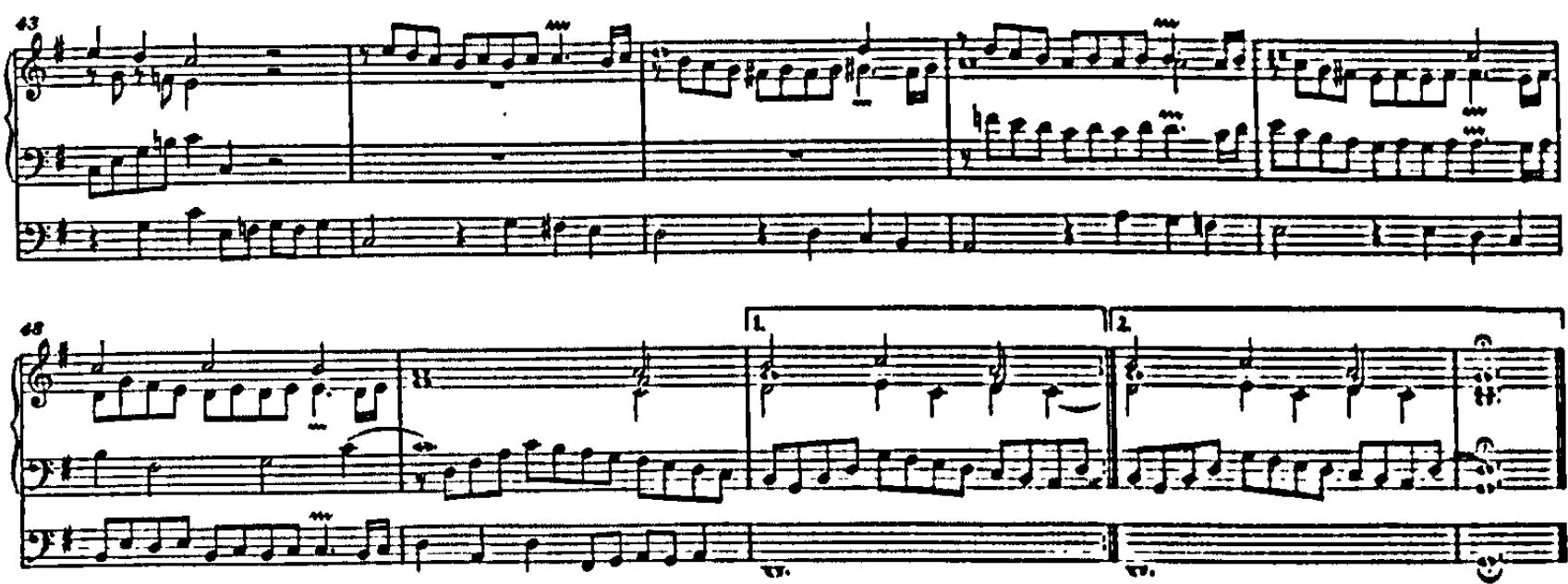
- 页码:7-8
- 4.6 [描述性拆分] Buxtehude’s Synthesis of Stylus Phantasticus Forms
- 页码:9-10
- 4.7 [描述性拆分] The Rhetorical Dispositio in Buxtehude’s Preludes: Exordium and Narratio
- 页码:11-13
- 4.8 [描述性拆分] The Peroratio and the Case Study of BuxWV 153
- 页码:14-16
- 4.9 [描述性拆分] The Narratio Fugue of BuxWV 153
- 页码:17-19
- 4.10 [描述性拆分] The Confirmatio and Peroratio of BuxWV 153
- 页码:20-21
- 4.11 [描述性拆分] Bach’s Early Exposure to North German Organ Music
- 页码:22-23
- 4.12 [描述性拆分] BWV 551: Exordium and Narratio
- 页码:24-26
- 4.13 [描述性拆分] BWV 551: Digressio and Confirmatio
- 页码:27-28
- 4.14 [描述性拆分] BWV 551: Amplificatio and Peroratio
- 页码:29-30
- 4.15 [描述性拆分] Summary Comparison of BuxWV 153 and BWV 551
- 页码:31-33
- 4.16 [描述性拆分] BWV 566: The Exordium
- 页码:34-35
- 4.17 [描述性拆分] BWV 566: The Narratio Fugue
- 页码:36-37
- 4.18 [描述性拆分] BWV 566: The Digressio and Confirmatio
- 页码:38-40
- 4.19 [描述性拆分] BWV 566: Summary and Rhetorical Evaluation
- 页码:41-42
- 4.20 [描述性拆分] Nicolaus Bruhns and His E minor Toccata
- 页码:42-44
- 4.21 [描述性拆分] Bruhns’s E minor Toccata: Exordium Analysis
- 页码:45-48
- 4.22 [描述性拆分] Bruhns’s E minor Toccata: Narratio and Internal Peroratio
- 页码:48-50
3.5 [描述性拆分] BWV 628 and the Easter Chorale Prelude
第1段(P0001)
原文复述
The setting of the melody provides a stirring illustration of the first line of the text, through scalar ascending and descending four-note motives (groppo: bar 1, beats 2-3) that are preceded by constant quaver note patterns in the alto and the tenor known as figurae suspirans (upbeat, bars 2-4). The depiction of the first word ’erstanden’ (risen) of the text, together with its consequent joyful meaning for Easter, is reinforced by the salti semplici — that is, the perfect cadences V-I in the pedal throughout the prelude — which have been interpreted as an ‘affirmation of faith’.
中文讲解
这一段是关于 BWV 628《Erstanden ist der heil’ge Christ》前五小节如何用音乐手段刻画歌词第一句的核心段落。中心主张有三点叠加:(1) 旋律本身(cantus firmus)以四音级进上下行的动机(groppo)来对应歌词的第一句;(2) 该动机之前的高音声部和次中音声部持续八分音符被识别为 figurae suspirans(“叹息"图式),这是巴洛克时期描绘叹息、渴望或哀恸的常规修辞符号;(3) 踏板声部反复出现的 V-I 完全终止(salti semplici)则被解读为对"复活"一词及其信仰内涵的"信仰肯定”。作者借此把音乐修辞术语与神学含义直接挂钩,强调复调技术不单是结构性的,更是文本性的——groppo 与 figurae suspirans 共同把"rejoicing"和"suffering/resurrection"两重语义编织到引子的开头。读者应注意:作者并未把所有动机都说成是"喜悦",而是区分了表e suspirans(叹息)与 salti semplici(信仰肯定)两种不同修辞,它们的功能是互补而非重复。
补充说明
术语对照:groppo 在巴洛克音乐修辞学中指回环式级进四音动机;figurae suspirans 指模仿叹息的下行附点或悬挂音型;salti semplici 字面意为"简单跳进",此处特指踏板上的完全终止进行。三者在第 1 小节至第 4 小节小节中并置,构成本段论证的音乐修辞基础。
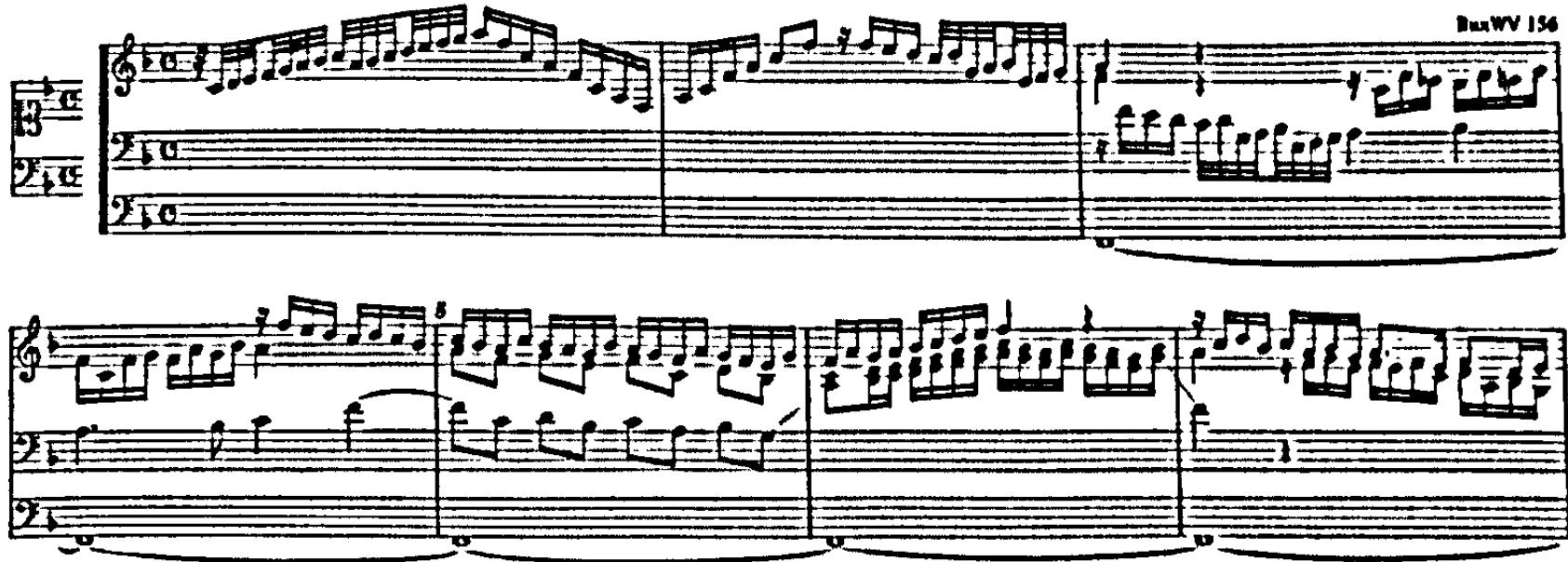
第2段(P0002)
原文复述
[Image placeholder: Example 38. BWV 628: Erstanden ist der heil’ge Christ (bars 1-5)]

中文讲解
这是 Example 38 的图注占位符,所标示的是 BWV 628《Erstanden ist der heil’ge Christ》的第 1 至 5 小节乐谱。它在本节论证中的功能是把 P0001 所描述的音乐修辞(groppo、figurae suspirans、salti semplici)以可视化的方式直接呈现给读者,使前一段的文字描述得以在谱例中定位。由于输入中仅有图注和位置信息,具体音符走向、谱号、对位细节需查看原图。
补充说明
无额外补充(图像内容需查看原图)。
第3段(P0003)
原文复述
A comparable figuration, connected with the depiction of the unrestrained joy suggested by the celebratory text, can be seen in the New Year chorale prelude In dir ist Freude (BWV 615). This piece is the most flamboyant and extended work of the collection and resembles the seventeenth-century north German chorale fantasy in its treatment of the chorale melody. Fragmentation techniques distribute the cantus firmus across all voices throughout the prelude, usually in ornamented form, the fragments being separated from one another by expansive virtuosic interludes. Scholars have emphasised Georg Böhm’s influence on J. S. Bach’s style with respect to the handing over of the melody from one voice to another, as well as the persistent repetition of the ostinato bass, a motive that functions as a countersubject to the cantus firmus.
中文讲解
这一段把论述从 BWV 628 推向同属《Orgelbüchlein》或相关曲集的 BWV 615《In dir ist Freude》,目的是说明类似的音乐修辞如何在不同节日圣咏前奏曲中服务于对"喜乐"的描绘。中心主张有四:(1) BWV 615 是该曲集中最华丽、篇幅最长的作品;(2) 它在处理圣咏旋律方面接近 17 世纪北德圣咏幻想曲(chorale fantasy)的传统;(3) 它使用"碎片化"(fragmentation)手法把圣咏旋律以装饰形态分配到所有声部,碎片之间由炫技性的间插段连接;(4) 学界强调 Georg Böhm 对 J. S. Bach 在"旋律在各声部之间传递"这一写法上的影响,并指出贯穿全曲的固定低音(ostinato bass)作为对位副题(countersubject)与圣咏旋律形成对位关系。论证的功能是:从 BWV 628 到 BWV 615,作者建立了一种"音乐修辞—节日神学—北德传统"的关联:奥斯坦纳托低音的持续重复对应着喜乐文本中"无拘束欢庆"的情感强度,而旋律的碎片化与声部间传递则承袭了北德圣咏幻想曲的传统,并经由 Böhm 的中介进入巴赫的语汇。读者应注意:这里的 ostinato bass 不是装饰,而是被提升为与圣咏旋律相对等地位的"对位副题",这一身份认定是理解该曲结构的关键。
补充说明
无额外补充(原文未提供更多关于 Böhm 的具体作品或年代信息)。
第4段(P0004)
原文复述
Footnote 155: Figura suspirans, as illustrated by Johann Gottfried Walther in his Musicalisches Lexicon (Table X); see Faksimile-Nachdruck, 1953.
中文讲解
这是正文 P0001 中 “figurae suspirans” 一词上标 155 所对应的脚注。脚注指出:figura suspirans 这一音乐修辞术语由 Johann Gottfried Walther 在其《Musicalisches Lexicon》(音乐辞典)中以图例(Table X)加以展示,并参见 1953 年的影印重印本(Faksimile-Nachdruck)。该脚注为正文中关于 BWV 628 高音与次中音声部"叹息"图式的论述提供词源与图示来源依据(definitions 词典/图示),属于"来源支撑"型脚注。
补充说明
无额外补充(仅复述脚注内容)。
第5段(P0005)
原文复述
Footnote 156: Williams, The Organ Music of J. S. Bach, p. 290.
中文讲解
这是正文 P0001 中"affirmation of faith"(信仰肯定)这一解读上方脚注 156 的内容。脚注指明出处为 Williams 所著《The Organ Music of J. S. Bach》第 290 页。该脚注为正文中把踏板完全终止解读为"信仰肯定"这一诠释性主张提供文献依据(来源支撑型脚注)。
补充说明
无额外补充(仅复述脚注内容)。
第6段(P0006)
原文复述
Footnote 157: Stinson, p. 75.
中文讲解
这是正文 P0003 中关于 BWV 615 是曲集中"the most flamboyant and extended work"这一断言上标 157 所对应的脚注,出处为 Stinson 第 75 页。该脚注为正文中对该曲篇幅与华丽程度的总体评价提供文献依据(来源支撑型脚注)。
补充说明
无额外补充(仅复述脚注内容)。
第7段(P0007)
原文复述
Footnote 158: ibid., p. 135.
中文讲解
这是正文 P0003 中关于 BWV 615 使用"fragmentation techniques"把圣咏旋律以装饰形式分配给所有声部这一论述上标 158 所对应的脚注,出处为 Stinson 同前书(ibid.)第 135 页。该脚注为正文中关于旋律碎片化手法的描述提供文献依据(来源支撑型脚注)。
补充说明
无额外补充(仅复述脚注内容)。
第8段(P0008)
原文复述
Footnote 159: Williams, p. 267.
中文讲解
这是正文 P0003 中关于"Georg Böhm’s influence on J. S. Bach’s style regarding the passing of the melody from one voice to the other"这一学者强调点上标 159 所对应的脚注,出处为 Williams 第 267 页。该脚注为正文中关于 Böhm 对巴赫影响的史学主张提供文献依据(来源支撑型脚注)。
补充说明
无额外补充(仅复述脚注内容)。
第9段(P0009)
原文复述
Footnote 160: Schweitzer, J. S. Bach, vol. 2, p. 62.
中文讲解
这是正文 P0003 中关于"the persistent repetition of the ostinato bass"上标 160 所对应的脚注,出处为 Schweitzer 所著《J. S. Bach》第二卷第 62 页。该脚注为正文中关于 BWV 615 持续反复的固定低音这一观察提供文献依据(来源支撑型脚注)。
补充说明
无额外补充(仅复述脚注内容)。
第10段(P0010)
原文复述
Footnote 161: Moeser claims that the ostinato bass is possibly derived from the first phrase of the chorale tune (example 39 on the following page); see James C. Moeser, ‘Symbolism in J. S. Bach’s Orgelbuechlein’, The American Organist, 48.2 (February 1965), 22-25 (p. 24).
中文讲解
这是正文 P0003 中关于 ostinato bass 作为"a motive that functions as a countersubject to the cantus firmus"上标 161 所对应的脚注。脚注内容指出:Moeser 主张 BWV 615 的固定低音可能源自圣咏旋律的第一乐句(见次页 Example 39);文献为 James C. Moeser,《Symbolism in J. S. Bach’s Orgelbuechlein》,载《The American Organist》第 48 卷第 2 期(1965 年 2 月),页 22-25(此处特指第 24 页)。该脚注为正文中关于固定低音身份的论断提供一个具体而略有猜测性的来源(来源/限定型脚注),并指引读者参考次页的 Example 39 以核实这一素材来源说。
补充说明
无额外补充(仅复述脚注内容)。
脚注 / 边栏 / 图表 / 附加信息(如有)
本节附加材料包括:Example 38(BWV 628 第 1-5 小节乐谱图例,正文中位于 P0002 占位符);Example 39(BWV 615 固定低音与圣咏首句关系图例,由脚注 161 指明位于次页);以及脚注 155-161 共 7 条。脚注 155 为术语图示来源(figura suspirans 在 Walther 辞典中的图例);脚注 156-160 均为关于音乐修辞或史学影响的文献来源支撑;脚注 161 为带有具体素材来源推断(且将推论指向 Example 39)的限定型脚注,并指明出自 1965 年《The American Organist》。这些附加材料的共同作用是把正文中关于音乐修辞、神学解读和巴赫风格史的论断锚定在具体的辞典图例、乐谱实例和文献页码上。
💡 本节核心要点
- BWV 628《Erstanden ist der heil’ge Christ》通过 groppo(四音级进动机)与 figurae suspirans(持续八分音符"叹息"图式)的并置,在引子小节中同时呈现"哀恸—复活—喜乐"的多重语义。
- 踏板上反复出现的 V-I 完全终止(salti semplici)被解读为对"erstanden"(复活)一词及其信仰内涵的"信仰肯定",把复调终止式与神学含义直接挂钩。
- BWV 615《In dir ist Freude》是曲集中最华丽、篇幅最长的作品,以碎片化(fragmentation)手法把装饰化的圣咏旋律分配到所有声部,片段之间由炫技间插段连接,接近 17 世纪北德圣咏幻想曲传统。
- 学界强调 Georg Böhm 对巴赫"声部间旋律传递"写法的影响,并指出 BWV 615 中贯穿全曲的固定低音(ostinato bass)并非装饰,而是与圣咏旋律形成对位关系的"对位副题"(countersubject)。
- Moeser 进一步主张 BWV 615 的固定低音可能源自圣咏旋律的第一乐句,这一素材来源说把 ostinato bass 的结构地位与文本源头连接起来,并由 Example 39 加以图示印证。
🔑 关键术语
- groppo:巴洛克音乐修辞术语,指回环式的四音级进上下行动机;本节中用于刻画 BWV 628 歌词第一句的旋律走向(第 1 小节第 2-3 拍)。
- figurae suspirans:“叹息"图式,指模仿叹息的下行附点或悬挂音型;本节中指 BWV 628 高音与次中音声部在第 2-4 小节弱拍处的持续八分音符音型,由 Walther 在《Musicalisches Lexicon》中以 Table X 加以图示。
- salti semplici:字面意为"简单跳进”,本节中特指 BWV 628 踏板声部反复出现的 V-I 完全终止进行;Williams 将其解读为对复活信仰的"affirmation of faith"(信仰肯定)。
- cantus firmus:“定旋律”,指作为对位基础的预成旋律;本节中指 BWV 615 中被碎片化、装饰化并分配到所有声部的圣咏旋律本身。
- fragmentation:“碎片化"手法,指把完整的圣咏旋律切成短小片段,分别置于不同声部、并以装饰形态呈现,片段之间由炫技性间插段连接;Stinson 在第 135 页将其作为 BWV 615 的结构特征加以描述。
- ostinato bass:“固定低音”,指贯穿全曲反复出现的低音动机;本节中 Schweitzer 强调其在 BWV 615 中的持续重复,Moeser 则主张其素材可能源自圣咏旋律首句,并由本节正文将其提升为与 cantus firmus 相对的"对位副题”(countersubject)。
- chorale fantasy:“圣咏幻想曲”,17 世纪北德地区的器乐体裁,以高度装饰化、片段化与炫技性处理圣咏旋律为特征;本节中用于标示 BWV 615 与该传统的风格亲缘关系。
3.6 [描述性拆分] BWV 615: In dir ist Freude — Analysis of Musical-Rhetorical Figures
第1段(P0011)
原文复述
[Image / musical-score placeholder on page 2; the embedded image data has been omitted, while the location and any associated caption are retained in the original.]

中文讲解
这是第 2 页起始处的一个图像或乐谱占位符,原文标注为“内嵌图像数据已省略;位置与图注保留”。由于具体图像内容缺失,本段无法读取任何音符、调号或音乐符号;其版面功能是位于本节上方,可能起装饰或承接上一页谱例的作用。要了解它究竟呈现了什么(如完整的 BWV 615 总览图、手稿影印件或附加说明框),需要查阅原书原图。
补充说明
本占位符的页面位置与 PageRange 标定的 start=2, end=2 一致,但因 OCR/抽取流程未保留内嵌数据,本节只能确认其“在第 2 页存在”这一版面事实。
第2段(P0012)
原文复述
[Example 39. BWV 615: In dir ist Freude (bars 1-8)]

中文讲解
这是谱例 39(Example 39)的图题,标识作品为巴赫 BWV 615《In dir ist Freude》(《在你里面有喜乐》),所引用的乐谱片段为第 1 至 8 小节。该图题告诉读者:下一段的分析文字(P0013)将依据这一前 8 小节的谱例来辨认音乐修辞手法,因此读者应当把这 8 小节视为文字论断的乐谱基础。
补充说明
本占位符提供的是图题信息而非乐谱数据;具体声部走向、踏板声部与手动声部的对位需要查看原图。
第3段(P0013)
原文复述
The work commences with a fragment of the first line of the melody stated in the tenor, which is imitated by the soprano and the alto in the following two bars (polyptoton), while the ostinato pedal, “one of the most animated themes of rejoicing in the chorale preludes […]”, ¹⁶² is heard three times within the first five bars (anaphora, repetitio). The anaphora is also illustrated in bars 7-8 where the pedal repeats the opening statement of the tenor (bars 1-2), while the joyful and exalted affect is reinforced by the manual figurae suspirans (bars 3 and 5), as well as by the anabasis figures (bars 6-7) spanning the interval of three octaves (bars 10-12).
中文讲解
本段是本节(关于 BWV 615《In dir ist Freude》音乐修辞手法的分析)的主干陈述,紧承谱例 39,依据前 8 小节归纳出巴赫使用的多组修辞手法及其情感效果。逐层来看:(1) 起句结构——圣咏旋律第一行的片段先由低音声部(tenor)陈述,随后两小节内由女高(soprano)与女低(alto)依次模仿;作者把这种“在不同声部间以不同音高反复同一旋律片段”的做法称作 polyptoton(词形多变,对应修辞学中同一词根的不同屈折形式)。(2) 踏板声部的固定反复——同一首圣咏诗节里的固定旋律动机在踏板(pedal)上反复出现,并在前 5 小节内被听到 3 次;作者引用 Schweitzer(第 162 号脚注)将其誉为“众赞前奏曲中最具欢腾感的固定旋律主题之一”,并将此处的反复本身标记为 anaphora(句首重复)和 repetitio(一般意义上的重复)。(3) 重复手法的进一步延伸——第 7–8 小节,踏板再次重复第 1–2 小节男高声部的开篇陈述,作者认为这同样体现 anaphora,也就是说,前后两次出现的反复属于同一种“句首/主体动机反复”模式。(4) 情感强化手段——作者用“欢欣而高亢的情感”(joyful and exalted affect)来概括此段音乐的整体气质,并将两条具体的器乐修辞手法与该情感挂钩:手动(manual)声部中第 3 与第 5 小节的 figura suspirans(叹息型动机,常见做法是级进下行的短句,用来制造叹息、渴望的语气)和第 6–7 小节以及跨越三个八度音程范围的第 10–12 小节里的 anabasis(上行型修辞,音高逐级或大幅攀升,常用来象征上升、升华)。综合而言,作者认为本段论证的核心是:巴赫在前 8 小节中通过模仿、固定旋律反复、上行与下行修辞动机的共同作用,把“为欢欣与高扬”这一情感(affect)塑造成可被听者感知的音乐事件。读者需要注意——anaphora 的提法既适用于踏板在第 1–5 小节的 3 次出现,也适用于第 7–8 小节踏板对开篇男高陈述的重复,两处属同一类修辞的不同实例。
补充说明
本段末尾对 anabasis 的小节定位同时给出 (bars 6-7) 和 (bars 10-12) 两个范围,前者指上行动机出现的局部小节,后者指其总音程跨度(三个八度)实际跨过的范围;该并列结构是原文写法,应原样保留两种解读。
第4段(P0014)
原文复述
[Example 40. BWV 615: In dir ist Freude (bars 9-12)]

中文讲解
这是谱例 40(Example 40)的图题,标识作品为 BWV 615《In dir ist Freude》,引用片段为第 9 至 12 小节。该图与本段正文(P0013)末尾提到的“anabasis figures… spanning the interval of three octaves (bars 10-12)”直接对应——也就是说,第 10–12 小节的乐谱就是作者用以证明“三个八度跨度上行”修辞的原始证据。读者应将谱例 40 视作 P0013 末句主张的乐谱支撑,而非独立的新论点。
第5段(P0015)
原文复述
Ornamented melodic patterns occur also in the treatment of the fourth line of the chorale melody, where the embellished version in the soprano (bars 44-45) is repeated in bars 46-47 (climax/gradatio), a motive imitated by the alto in bars 45, 47, and 48 (polyptoton). Finally, a fragment of the ornamented melodic version is demonstrated in the pedal in bar 48 (anaphora), one of the few examples of pedal trills (with turn) notated by Bach himself in his organ works. ¹⁶³
中文讲解
本段把分析的视线从开篇(第 1–12 小节附近)转到作品后段——“圣咏旋律的第四行”(第四句诗节的处理)。作者在此辨认出三组彼此呼应的修辞手法,并把它们组织成一条“装饰性旋律模式如何贯穿四个声部”的论证链。(1) 女高声部(soprano)在第 44–45 小节先呈示一条经过装饰(embellished)的旋律线,随后在第 46–47 小节原样重复;作者将这种“同一条装饰旋律在同一声部内被反复呈示,并自然推向更高点”称为 climax/gradatio(递升/渐进),意味着重复本身带出强度或音高的递进。(2) 同一装饰动机随后被女低声部(alto)在第 45、47、48 小节处以错位方式模仿;这正是 P0013 中已使用过的 polyptoton 概念——同一旋律在不同声部以不同进入点再现。(3) 第 48 小节,踏板声部(pedal)承载装饰旋律的一个片段,作者以 anaphora 来命名这种跨声部、跨段落的呼应。最后一句特别具有版本学/演奏实践意义:作者强调,这条踏板声部正是巴赫亲手记写的“踏板颤音(带回音)”之一的极少数实例,并引用 Stinson(第 163 号脚注,第 135–136 页)作为旁证。这句话的关键信息并非修辞学概念,而是“巴赫亲自写下踏板颤音并附带回音记号”在其管风琴作品中十分罕见,因此 BWV 615 的这一小节在编订与诠释巴赫踏板记谱法时具有特殊地位。整体看,本段与 P0013 形成首尾呼应:开篇(BWV 615 起句)依靠模仿与上行/叹息修辞营造欢腾;后段(第四诗节)依靠装饰旋律的跨声部反复与罕见踏板颤音再次巩固同一情感,但通过 gradatio 这种递增方式把情感进一步推升。
补充说明
本段两次出现 bar 48:踏板在 bar 48 出现装饰旋律片段(anaphora)与女低声部在 bar 48 对同动机的模仿(polyptoton)是同一小节内的两条并行事件,作者用句内分句将其区分,读者应把它们视作同时发声的不同声部事件,而非先后两件事。
第6段(P0016)
原文复述
¹⁶² Schweitzer, vol. 2, p. 66.
中文讲解
这是正文第 P0013 段句末那个上标 162 所对应的脚注,内容是文献出处:Schweitzer(施韦策)所著书第 2 卷第 66 页。它支持的是 P0013 中引号内的论断——“踏板的固定旋律是众赞前奏曲中最具欢腾感的主题之一”——因此它的功能是为该评价提供权威来源/旁证,属于“支持 + 限定”(指明评价出自 Schweitzer 而非作者本人原判)。本脚注本身不引入新论点。
第7段(P0017)
原文复述
¹⁶³ Stinson, pp. 135-36.
中文讲解
这是正文 P0015 段末上标 163 所对应的脚注,内容是文献出处:Stinson(斯蒂森森)著作第 135–136 页。它支持的是 P0015 中“第 48 小节踏板颤音(带回音)是巴赫在其管风琴作品中亲自记写的少数例证之一”这一主张,属于支持性旁证。它的作用是把一个具体的演奏法/记谱学论断(小节内罕见踏板颤音记谱)锚定到学术文献上,本脚注本身不引入新论点。
脚注 / 边栏 / 图表 / 附加信息(如有)
本节附有两处脚注(脚注 162:Schweitzer, vol. 2, p. 66;脚注 163:Stinson, pp. 135-36),前者支持关于踏板“欢腾”主题的评价,后者支持关于巴赫亲自记写踏板颤音(含回音)的罕见性论断;两脚注均起文献旁证作用。此外,本节含两幅谱例占位符(Example 39, bars 1-8;Example 40, bars 9-12)以及一页起始处一个未保留数据的图像/乐谱占位符,它们都是正文分析所依据的乐谱证据,需查阅原图才能获得具体音符信息。
💡 本节核心要点
- BWV 615《In dir ist Freude》的开篇(第 1–8 小节)以圣咏第一行片段为先导:男高先陈述,女高、女低随后两小节内模仿,作者称之为 polyptoton。
- 踏板声部的固定旋律在前 5 小节出现 3 次(anaphora / repetitio),作者援引 Schweitzer 的评价,称其为“众赞前奏曲中最具欢腾感的固定旋律主题之一”。
- 同一 anaphora 模式延伸到第 7–8 小节:踏板重复第 1–2 小节男高声部的开篇陈述。
- “欢欣而高亢的情感”由两条器乐修辞手法共同强化——手动声部的 figura suspirans(第 3、5 小节)与跨越三个八度范围的 anabasis 上行(第 6–7 小节起,至第 10–12 小节完成)。
- 作品后段对圣咏第四行的处理把视角转向“装饰性旋律模式”:女高第 44–45 小节呈示的装饰旋律在第 46–47 小节重复(climax/gradatio),随后在女低声部第 45、47、48 小节错位模仿(polyptoton)。
- 第 48 小节踏板承载同一装饰旋律片段(anaphora),且被作者标记为巴赫管风琴作品中罕见、由巴赫本人亲自记写的踏板颤音(带回音)实例之一(参见 Stinson)。
🔑 关键术语
- polyptoton:在本节中指“同一旋律片段在多个声部之间,以不同音高或不同进入点先后出现”,对应文字修辞学中同一词根的不同屈折形式反复出现。
- anaphora:在本节中指“同一动机在句首或段落起始位置反复出现”;本节同时用于描述踏板在前 5 小节内的 3 次出现以及第 7–8 小节对开篇男高陈述的重复。
- repetitio:在本节中作为 anaphora 的近义补充,指一般意义上的动机反复;与 anaphora 一起用来标注踏板短时间内的多次重复。
- ostinato pedal:在本节中指踏板(pedal)声部对一条固定旋律动机的持续反复;作者引用 Schweitzer 评价其为该作品欢腾情感的核心来源。
- figura suspirans:在本节中指手动声部出现的“叹息型”动机,通常表现为短促的级进下行或叹息式短句,用于强化“欢欣而高亢”情感中的渴望/叹息维度。
- anabasis:在本节中指上行型修辞动机,象征音乐上的“上升/升华”;本节用例跨越三个八度,从第 6–7 小节起,至第 10–12 小节完成。
- climax / gradatio:在本节中并称使用,指同一条装饰旋律在同一声部内的反复呈现并向更高点或更强处推进,用于描述第 44–45 小节装饰旋律到第 46–47 小节重复之间的关系。
- pedal trill (with turn):在本节中指踏板声部由作曲家亲自记写的颤音并附带回音(turn)记号;本节强调此写法在巴赫管风琴作品中极为罕见,第 48 小节是少数被作者点名的实例之一(脚注 163:Stinson, pp. 135-36)。
3.7 [描述性拆分] Summary of Rhetorical Figures and Transition to Free Organ Works
第1段(P0018)
原文复述
Image placeholder with the English caption “Example 41. BWV 615: In dir ist Freude (bars 43-52)”. A bracketed system-level annotation in Chinese indicates that the embedded image data has been omitted and only the caption and position are preserved.
中文讲解
本段并非正文段落,而是一个图注占位符。其原始图注为英文:‘Example 41. BWV 615: In dir ist Freude (bars 43-52)’,意为’例41. BWV 615《在你之中有喜乐》(第43–52小节)’。圆括号内带有方括号的文字是脚本层面的批注,说明此处原本嵌入了图像数据,但已被省略,仅保留图题与版面位置。
由于图像本身缺失,无法在此对其音符、织体、声部走向或谱号、调号等进行任何视觉层面的描述,所有谱面细节均须查阅原书或原谱方可确认。
在本小节作为’总结与过渡’的位置上,这幅图示紧邻总结段(P0019)出现,很可能是作者用以收束前文若干具体分析的最后一例修辞格/作曲技法的视觉证据,承接 P0019 中’词虽隐而意可达’(text, although hidden)以及’修辞格与巴洛克作曲技法相融合’(fusion of rhetorical figures with Baroque compositional techniques)的核心论点。
补充说明
图注中的作品编号 BWV 615 与曲名 In dir ist Freude 与本节 P0019 段落论及的’J. S. Bach 的圣咏前奏曲’在题材上属于同一类别;具体乐谱内容须查阅原图。
第2段(P0019)
原文复述
To summarize, the examples discussed so far support the notion that the chorale settings of D. Buxtehude and J. S. Bach demonstrate a fusion of rhetorical figures with Baroque compositional techniques. In collections such as the Orgelbüchlein, the text, although hidden, is clearly illustrated through a plethora of expressive rhetorical figures, the origin of most of which can be traced back to vocal music (e.g. saltus and passus duriusculus). Although the field of musical rhetoric is viewed with suspicion in certain musical circles, one cannot ignore historical grounds. The abundance of musical-rhetorical treatises already discussed in the first chapter testifies that rhetorical knowledge was commonplace for Baroque composers, and catalogues of rhetorical devices supplied compositional suggestions from which composers drew their inventive craftsmanship. The demonstration of musical-rhetorical figures and rhetorical structure in Baroque music can serve as points of departure for an effective comprehension of Baroque compositional procedure. In particular, the identification of musical-rhetorical figures and their application in chorale preludes such as those by D. Buxtehude and J. S. Bach constitute a fundamental step for a better understanding, and, as a result, a better performance of their organ music. The assimilation of the rhetorical framework, as illustrated by samples of the free organ works of D. Buxtehude and the early compositions of J. S. Bach, will be the next stage of the present work.
中文讲解
本段是本小节乃至前几节分析内容的总收束,同时承担’过渡’的功能:在回收论据之后,立即把读者引向下一阶段的论述对象。
中心主张:D. Buxtehude 与 J. S. Bach 的圣咏前奏曲体现了’修辞格’(rhetorical figures)与’巴洛克作曲技法’(Baroque compositional techniques)的融合。关键词是 fusion——作者并非把修辞格当作外加的装饰或事后解读,而是将其视为与作曲技法同体的结构性要素。
第二层论证:以《Orgelbüchlein》为代表,圣咏歌词虽然隐藏在器乐织体背后,但通过大量表情化的修辞格得以清晰呈现;这些修辞格大多源自声乐传统,作者举出两个具体例证——saltus 与 passus duriusculus。注意作者用 ‘although hidden’ 这一让步结构:即便听众听不到歌词,修辞格仍能传达文本意义。
第三层是防御性论证:作者承认’音乐修辞’这一研究领域在某些音乐圈子里受到怀疑,但立即指出不能忽视其历史根基——第一章中已经讨论过的大量音乐修辞学论著(musical-rhetorical treatises)证明,修辞知识在巴洛克作曲家那里是常识;修辞格目录(catalogues of rhetorical devices)为作曲家的’发明性技艺’(inventive craftsmanship)提供了素材。
第四层是价值定位:分析修辞格不仅是理解作曲过程的’出发点’(points of departure),还直接服务于演奏——‘better understanding, and, as a result, a better performance’,使该研究具有理论与实践的双重合法性。
末句的过渡:下一阶段将把同样的修辞框架应用于’无词可依’的体裁——D. Buxtehude 的自由管风琴作品(free organ works)与 J. S. Bach 的早期作品。这一过渡本身揭示了研究的内在逻辑:先在有圣咏歌词指引的体裁中验证修辞格的可识别性,再把方法迁移到没有文本依据的自由作品,难度与论证负担将明显加大。
补充说明
saltus 与 passus duriusculus 在本节内仅作为’源自声乐传统的修辞格’的两个并列例证被提及,本节未给出其完整定义或谱例佐证;其他补充需参看后续以’自由管风琴作品’为题的小节。
脚注 / 边栏 / 图表 / 附加信息(如有)
本小节含一处内嵌图像占位符(P0018),对应图注 ‘Example 41. BWV 615: In dir ist Freude (bars 43-52)’;由于图像数据已在抓取阶段被省略,谱面细节无法在此呈现,读者须查阅原书方能核对。无其他脚注、边栏或图表附录。
💡 本节核心要点
- 核心论点:Buxtehude 与 Bach 的圣咏前奏曲是’修辞格’与’巴洛克作曲技法’的融合(fusion),而非修辞格作为外在装饰的简单叠加;
- 以《Orgelbüchlein》为例证:歌词虽隐藏于器乐织体之中,却通过大量表情化修辞格被清晰呈现,且这些修辞格多源自声乐传统(如 saltus、passus duriusculus);
- 为’音乐修辞’研究做辩护:以第一章列举的大量修辞学论著为历史证据,说明修辞知识是巴洛克作曲家的常识,修辞格目录为其’发明性技艺’提供素材;
- 研究价值具双重维度:识别修辞格既是’理解巴洛克作曲过程’的出发点,又是’更好演奏’的前提——兼顾学理与实践;
- 过渡指向:下一阶段把同一修辞框架迁移至’无文本依据’的体裁——Buxtehude 的自由管风琴作品与 Bach 的早期作品,意味着分析难度上升。
🔑 关键术语
- rhetorical figures(修辞格):本节作为统称概念出现,涵盖 saltus、passus duriusculus 等具体手法;作者主张它们在 Buxtehude 与 Bach 的圣咏前奏曲中与巴洛克作曲技法相融合,而非外加装饰。
- Orgelbüchlein:本节中被点名为代表曲集,用以说明’歌词虽隐而通过修辞格清晰呈现’的现象。
- saltus:在本节中作为’源自声乐传统的修辞格’的例证之一,与 passus duriusculus 并列出现;本节未给出其详细定义。
- passus duriusculus:在本节中作为’源自声乐传统的修辞格’的例证之一,与 saltus 并列出现;本节未给出其详细定义。
- musical rhetoric(音乐修辞):本节中被作者承认’在某些音乐圈子里受到怀疑’的学科领域;作者以第一章所述的音乐修辞学论著与修辞格目录为历史证据为之辩护。
- free organ works(自由管风琴作品):本节末尾被宣告为研究将进入的下一阶段对象——与有圣咏歌词依据的圣咏前奏曲相对,没有文本指引,修辞格的识别将更依赖结构与音型本身。
4.1 [描述性拆分] Introduction to the Rhetorical Dispositio in Free Organ Works
第1段(P0020)
原文复述
4. RHETORICAL STRUCTURE IN ORGAN WORKS: A DISCUSSION OF THE RHETORICAL DISPOSITIO IN BUXTEHUDE’S FREE ORGAN PRELUDES AND ITS IMPACT ON THE COMPOSITIONS OF N. BRUHNS AND J. S. BACH
中文讲解
本段是第4章的标题,其功能是宣告本章的论题范围与研究对象。与前几章讨论圣咏前奏曲中的音乐修辞手法不同,本章进入全书论证的"最终阶段"——将修辞学中的dispositio(篇章布局)理论应用于自由体裁(free form)的管风琴作品,并以布克斯特胡德为起点,下溯至N. 布伦斯和J. S. 巴赫。标题中点明的三组关键概念为:1)rhetorical structure(修辞结构)——贯穿全章的总视角;2)rhetorical dispositio(修辞布局)——本章的核心分析工具;3)free organ preludes(自由体管风琴前奏曲)——本章的讨论对象。标题中"impact on the compositions of N. BRUHNS and J. S. BACH"也预先提示了影响的传布方向:布克斯特胡德 → 布伦斯 → 巴赫,构成一条17世纪北德管风琴音乐传承的线索。
第2段(P0021)
原文复述
After the examination of musical-rhetorical figures in chorale preludes, the subject of the final stage of the present work is the application of the rhetorical dispositio in free organ music, starting with works by Dietrich Buxtehude. Buxtehude’s pedaliter praeludia can be analysed rhetorically as a polished Klangrede, where the rhetorical framework meets an exceptional musical illustration. Additionally, the inner logic and structure of different musical textures encountered in his free preludes reflect a unique fusion of two pre-existing textural forms; these are the Italian canzona developed to a high level by Girolamo Frescobaldi, and the south German toccata genre, which culminated in the compositions of Johann Jacob Froberger.
中文讲解
本段具有承上启下的结构功能:先回溯前文(前几章已讨论过圣咏前奏曲中的音乐修辞手法),再宣告本章的焦点(自由体管风琴作品中的rhetorical dispositio),并以布克斯特胡德为起点。
关键概念解读: 1)“rhetorical dispositio”:古典修辞学中指演说稿的篇章布局,即将材料按一定顺序组织成有机整体的理论。本节将其用作分析布克斯特胡德自由体前奏曲宏观结构的工具。 2)“Klangrede”(德语"音响演说"):将器乐视为一种"用声音进行的演说",这是音乐修辞学(Musical Rhetoric)的核心隐喻。称布克斯特胡德的前奏曲为"polished Klangrede",意指其修辞框架与音乐表达高度契合、浑然一体。 3)“pedaliter praeludia”:指带脚键盘(pedal)的管风琴前奏曲,这是北德管风琴传统中体量最大、技巧最复杂的一类。
作者对布克斯特胡德音乐织体来源的判断是本段最重要的事实主张:他的自由体前奏曲是两种既有织体的"独特融合"——一方面是意大利的canzona(坎佐纳),经弗雷斯科巴尔迪发展到高度成熟;另一方面是南德地区的toccata(托卡塔)体裁,在弗罗贝格尔手中达到顶峰。这一判断为后文追溯Buxtehude → Bruhns → Bach的传承线提供了历史—体裁谱系的基础。
需要注意的是,上标"1"对应P0023的脚注(Lena Jacobson),提示本段中关于"两种织体融合"的论断有外部文献支持。
补充说明
本段为后文留下的接续点:1)“polished Klangrede"与"exceptional musical illustration"需要后续段落以具体作品论证;2)弗罗贝格尔—弗雷斯科巴尔迪—布克斯特胡德—布伦斯—巴赫的传承链条将在本章逐段展开。
第3段(P0022)
原文复述
From around 1500, the term ’toccata’ was employed to describe music with an element of manual dexterity. The toccata soon prevailed as the most common type of keyboard music in the repertoire of Venetian composers. Stylistically, the Renaissance toccatas (praeambula or praeludia and later on ricercars) by Andrea and Giovanni Gabrieli, Annibale Padovano, Girolamo Diruta, and Claudio Merulo display a continuous texture that consists of solid block chords and occasionally imitative sections alternating with or set against free scalar passages. The most daring compositions are those of Claudio
中文讲解
本段为后文讨论弗罗贝格尔与巴赫的托卡塔传统提供历史起点。需要把握三层信息:
第一层:术语史。“toccata"一词约自1500年起被用来指称"具有手指技巧要素”(manual dexterity)的键盘音乐,作者并未给出词源,但强调了它与炫技性的关联。
第二层:地域与体裁主导地位。toccata很快成为威尼斯作曲家键盘曲目中最常见的类型。这一观察把后文弗罗贝格尔所"达到顶峰"的南德toccata体裁,与更早的威尼斯传统关联起来——二者不是凭空产生,而是有清晰的地理—时间谱系。
第三层:风格特征。作者列举了四位代表作曲家(Andrea Gabrieli与Giovanni Gabrieli祖孙二人、Annibale Padovano、Girolamo Diruta、Claudio Merulo)及其作品(praeambula、praeludia、ricercars),并提炼出文艺复兴toccata的核心织体特征:“连续性织体”(continuous texture),由两种材料构成——(a)密集的块状和弦(solid block chords)与偶尔的模仿段落(imitative sections),(b)与此交替或对比的自由音阶走句(free scalar passages)。这意味着toccata从一开始就不是单一织体,而是异质材料的并置。
末句"The most daring compositions are those of Claudio"在原文处被截断,是典型的跨页/换段未完成句,应理解为对Claudio Merulo(大梅鲁洛)的大胆作品的引介即将展开。
本段对应脚注2(Bradshaw)与脚注3(Caldwell、Kirkendale及本书第116-18页的footnote 201),为前述toccata风格判断提供文献支持。“praeambula or praeludia and later on ricercars"的并列也提示了文艺复兴晚期"toccata → ricercar"命名的演变。
补充说明
无额外补充。原文在P0025脚注3中提供更详尽的参考文献线索(如Kirkendale关于"exordium"修辞起点的论述),但这些属于脚注而非正文主张。
第4段(P0023)
原文复述
1 Lena Jacobson, ‘Musical Rhetoric in Buxtehude’s Free Organ Works’, The Organ Yearbook, 13 (1982), 60-79.
中文讲解
这是正文P0021中上标"1"对应的脚注。内容为一条文献来源:Lena Jacobson撰写的文章《Musical Rhetoric in Buxtehude’s Free Organ Works》,发表于《The Organ Yearbook》第13卷(1982年),第60—79页。
该脚注的功能是文献支持(source),为P0021中关于布克斯特胡德自由体前奏曲中两种织体(意大利canzona与南德toccata)相融合的论断提供学术依据。读者若想进一步追溯该判断的原始论证,可查阅Jacobson 1982年的文章。
补充说明
无额外补充。脚注仅提供作者、篇名、期刊、卷次、年份与页码六项基本书目信息,未涉及额外论断。
第5段(P0024)
原文复述
2 Murray C. Bradshaw, ‘Pre-Bach Organ Toccatas: Form, Style, and Registration’, The Diapason, 64 (1972), 26-28.
中文讲解
这是正文P0022中上标"2"对应的脚注。内容为一条文献来源:Murray C. Bradshaw撰写的文章《Pre-Bach Organ Toccatas: Form, Style, and Registration》,发表于《The Diapason》第64卷(1972年),第26—28页。
该脚注的功能是为P0022中关于toccata体裁在威尼斯作曲家传统中占主导地位、及toccata风格特征(块状和弦、模仿段落与自由音阶走句的交替)的论述提供文献支持。Bradshaw文章的标题——“Pre-Bach Organ Toccatas: Form, Style, and Registration”——也提示了讨论巴赫之前toccata的三个维度:形式、风格与音栓配置,本书后续章节很可能沿用此框架。
第6段(P0025)
原文复述
3 ibid., p. 26. See also John Caldwell, ‘Toccata’, in The New Grove Dictionary of Music and Musicians, ed. by S. Sadie and J. Tyrrell, 2nd edn, 29 vols (London: Macmillan Publishers Ltd, 2001), xxv, pp. 534-37. For the early improvisatory and later imitative nature of compositions entitled praeambula or ricercars, see Warren Kirkendale, ‘Ciceronians versus Aristotelians on the Ricercar as Exordium, from Bembo to Bach’, Journal of the American Musicological Society, 32.1 (1979), 1-44. For a more complete discussion of the whole issue with references to the rhetorical exordium, see pp. 116-18 of the present work (footnote 201).
中文讲解
这是正文P0022中上标"3"对应的脚注,是本节最详尽的脚注,分三层提供延伸阅读与互参。
第一层:“ibid., p. 26”——指同前一条脚注(即P0024的Bradshaw文)第26页,提示P0022中关于toccata风格描述的具体页码出处。
第二层:John Caldwell撰写的’Toccata’词条,载于《The New Grove Dictionary of Music and Musicians》第2版(2001年,由S. Sadie与J. Tyrrell主编,全29卷),第25卷第534—537页。这是权威工具书的标准引用格式,为toccata体裁提供百科全书式的总览。
第三层:Warren Kirkendale撰写的《Ciceronians versus Aristotelians on the Ricercar as Exordium, from Bembo to Bach》,发表于《Journal of the American Musicological Society》第32卷第1期(1979年),第1—44页。该文处理文艺复兴时期praeambula与ricercars这一类作品的早期即兴性(improvisatory)与后来发展出的模仿性(imitative)特征,并将ricercar定位为修辞学意义上的"exordium”(开场、序论)。这与P0021—P0022中关于toccata/ricercar风格演变的论述直接相关。
第四层:“For a more complete discussion of the whole issue with references to the rhetorical exordium, see pp. 116-18 of the present work (footnote 201)."——指引读者回到本书第116—118页(注201)以获取关于该议题与修辞exordium关系的更完整讨论。这是一条"内互参”,提示本书对此议题的完整论证集中于后文第4章之后的某处。
整体来看,该脚注兼具来源(support)、限定(限定Bradshaw结论的具体页码)、延伸阅读(提供Caldwell工具书与Kirkendale学术专论)以及内部互参(指向本书后文)四种功能。
补充说明
无额外补充。脚注内所引四位作者/编者的学术背景与机构信息本节未提供,不在此处补充。
脚注 / 边栏 / 图表 / 附加信息(如有)
本节末尾包含三条脚注(P0023、P0024、P0025),分别支撑正文中关于布克斯特胡德自由体前奏曲织体融合、toccata在威尼斯传统中的主导地位以及toccata具体风格特征等论断。其中脚注3(P0025)最为详尽,同时包含权威工具书(Caldwell《新格罗夫》词条)、专题研究(Kirkendale论ricercar作为exordium)以及本书内互参(指向第116—118页/注201)三类信息,既为P0022的论述提供多层次文献支撑,也向读者预告了后文关于"修辞性exordium"的完整论证。
💡 本节核心要点
- 第4章是全书论证的"最终阶段”——将修辞学dispositio理念应用于自由体(非圣咏)管风琴作品,分析对象以布克斯特胡德为起点,延伸至N. 布伦斯与J. S. 巴赫。
- 布克斯特胡德的pedaliter praeludia被视为"打磨完善的Klangrede(音响演说)",即修辞框架与音乐表达高度契合的范本。
- 布克斯特胡德自由体前奏曲的织体被归结为两种既有形式的独特融合:意大利坎佐纳(以弗雷斯科巴尔迪为代表)与南德托卡塔(以弗罗贝格尔为顶峰)。
- toccata一词约自1500年起与"手指技巧"相关,并在威尼斯作曲家传统中迅速成为键盘音乐的主导体裁。
- 文艺复兴toccata(praeambula/praeludia及后来的ricercars)的核心风格特征是"连续性织体"——块状和弦与偶尔的模仿段落,与自由音阶走句交替或对比出现。
- 本节为后续详尽讨论预留了入口:第116—118页(注201)将围绕修辞性exordium(序论)展开更完整的论证。
🔑 关键术语
- rhetorical dispositio:古典修辞学中的"篇章布局"概念,指按一定逻辑顺序组织演说材料的方法。在本节中作为分析布克斯特胡德自由体前奏曲宏观结构的核心工具,与前几章讨论修辞格(figures)的微观层面相对应。
- Klangrede:德语,意为"音响演说",将器乐视为一种用声音进行的修辞性表达。本节用"polished Klangrede"形容布克斯特胡德的前奏曲,强调其修辞框架与音乐呈现的完美契合。
- pedaliter praeludia:带脚键盘(pedal)的管风琴前奏曲,是北德管风琴传统中体量最大、技巧最复杂的自由体裁之一,也是布克斯特胡德最具有代表性的作品类型。
- canzona (坎佐纳):源自器乐化的法国声乐 chanson 的键盘体裁,在意大利由弗雷斯科巴尔迪发展到高度成熟;其织体以模仿与对位为特征,是布克斯特胡德自由体前奏曲融合的两大源头之一。
- toccata (托卡塔):约自1500年起用于指涉"具有手指技巧要素"的键盘音乐,在威尼斯传统中成为主导体裁;后经弗罗贝格尔在南德地区达到顶峰,是布克斯特胡德自由体前奏曲另一大织体来源。
- praeambula / praeludia / ricercars:文艺复兴时期与toccata并列或演变的早期键盘体裁名称;praeambula与praeludia强调开场、即兴性,ricercar则逐渐发展出更明显的模仿性织体,三者在P0022中被并列为文艺复兴toccata的早期形态。
- exordium:修辞学术语,指演说的"开场/序论"部分;P0025脚注3引用Kirkendale将ricercar定位为修辞性exordium的研究,为后文第116—118页的完整讨论预留接口。
4.2 [描述性拆分] Origins of the Toccata: From Renaissance to Merulo
第1段(P0026)
原文复述
The compositions associated with Merulo display a rhapsodic style and are organized in three or five parts, within which chordal and fugal sections alternate with virtuosic passagework. (Footnote 4 is appended to this description.)
中文讲解
本段是上一句关于Merulo的接续,开头的’Merulo, which…‘是一个关系从句,其先行词(应为Merulo所作的toccatas)位于本节范围之外。因此本段独立提供的是Merulo作品的三个形式特征:(1) rhapsodic style——一种自由、即兴、整体连贯性较弱而局部对比强烈的风格,有别于严格的纯对位写作;(2) 全曲分为三或五个部分,说明Merulo已经采用了清晰的分段结构;(3) 段落内部以chordal(和弦式)、fugal(赋格式)与virtuosic passagework(炫技走句)三种织体相互交替,构成Merulo toccata的核心形态。这一形态正是P0028中Frescobaldi新作对比所针对的’早期toccata’范式。
补充说明
本段以’Merulo, which…‘开头,明显是从上一段延续下来的关系从句;其先行词不在本节边界内。脚注4位于本段末尾,指向Willi Apel的著作,提供Merulo风格描述的文献出处。
第2段(P0027)
原文复述
The new era of the Italian toccata was undoubtedly inaugurated by the compositions of Girolamo Frescobaldi (1583–1643). The shift in style that his collections Toccate e partite d’intavolature di cimbalo (Primo libro, Rome, 1615, and Secondo libro, 1627) display signified a ’new manner’ and put the expression of the affetti (affections) at the centre. Alongside the abundance of short rhythmical figures that governed his compositional technique, this newly affectively oriented performing style favoured flexibility of tempo—a novelty that Frescobaldi himself pointed to in the prefatory notes to the first edition of his Toccate e partite (1615).
中文讲解
本段将Frescobaldi确立为意大利toccata新纪元的开创者,并以两本印刷集(1615罗马的Primo libro和1627的Secondo libro)作为这一’new manner’的载体。其中三个概念需要解释:(1) ’new manner’指巴洛克早期意大利艺术和音乐中追求’modern style’的修辞,强调与过往惯例的区别;(2) affetti即’affections’,是文艺复兴晚期至巴洛克早期音乐修辞学中的核心概念——音乐应当唤起或表达特定情感(如悲伤、喜悦、敬畏等);(3) tempo flexibility指演奏中速度可以根据音乐语气作弹性伸缩,与严格按照固定拍号、均匀节拍演奏的早期实践相反。值得注意的是,作者强调这一创新是Frescobaldi本人在1615年初版前言中亲笔写明的,而非后人推论,因此具有直接的作者权威。两本集子合起来构成Frescobaldi对toccata体裁的完整奠基,其中1627年的Secondo libro将在P0028中作更细的风格剖析。
补充说明
本段同时也是第5–7号脚注的承载处,但这些脚注的具体内容不在本节范围内。1615年罗马版是Frescobaldi toccata体裁首次以印刷曲集形式出版的关键事件。
第3段(P0028)
原文复述
Frescobaldi’s new style, as codified in his Secondo libro (1627), displays a powerful yet simple rhetoric, in which short sections are clearly demarcated through metric and textural contrasts. Agitated passagi signal intense rhythmic complexity, while virtuosic ornamentation requires not only the intellectual but also the technical capacity of the performer. In addition, sustained strong dissonances (for example in the Toccata di durezze e ligature), the bold use of chromaticism, and daring harmonic turns produce unexpected tonal shifts; on the other hand, in contrast to earlier toccatas (and especially those of Merulo), strict imitative sections no longer alternate with free-running segments.
中文讲解
本段集中描述Secondo libro (1627)所体现的Frescobaldi成熟风格。需要逐一讲清的技术要点:(1) powerful yet simple rhetoric——音乐修辞学传统中的’有力而简洁’,指乐句直接、说服力强、不靠繁复对位而靠语气与对比取胜;(2) metric and textural contrasts——通过节拍规整度与织体的对比来分段,这是Merulo已经具备但Frescobaldi做得更精炼的方式;(3) passagi(复数,passaggio的单数)——快速的音阶式或琶音式走句段,用来表达激动的语气;(4) suspended strong dissonances(持续不协和音)——指4度、7度、9度等不协和音被刻意保留并作为表情手段,而非立刻解决;(5) Toccata di durezze e ligature——‘硬度与连音’之toccata,durezze指’坚硬’的不协和音程,ligature指延留音,正是Frescobaldi实验性半音化与不协和写作的代表作;(6) chromaticism与daring harmonic turns构成意料之外的调性游移。本段最关键的论述是与Merulo的形式对比:早期toccata是严格imitative段(赋格式)与自由running段的二元交替(正如P0026所述),而Frescobaldi的新风格将两者统一在连贯的修辞推进之中,不再以这种机械的’对位—自由’二分为结构骨架。这是从’对比拼接’向’修辞连贯’的形式转变,是本节论述的高潮。
补充说明
本段同时承载第8、9号脚注,但这些脚注的具体内容不在本节范围内。Toccata di durezze e ligature是Secondo libro中最具代表性的实验性作品,标题中的’ligature’指连音线下的不协和音,这是Frescobaldi半音化写作的核心手法之一。
第4段(P0029)
原文复述
Footnote 4: Willi Apel, The History of Keyboard Music to 1700, p. 457.
中文讲解
这是脚注4的全部内容,引用Willi Apel《键盘音乐史(至1700年)》第457页。Willi Apel是20世纪重要的音乐学者,专长中世纪和文艺复兴键盘音乐研究;该书是早期键盘音乐的标准参考文献。此脚注附于P0026末尾,为Merulo toccata’具有狂想曲风格、由三或五部分组成、和弦—赋格段与炫技段交替’的描述提供学术来源,属于来源类引文,用于支撑本节对Merulo形式特征的具体陈述。
补充说明
本节范围内的非正文内容仅此一条脚注。第4号脚注对P0026的主张起’来源/支撑’作用;第5–9号脚注在原文中出现,但其完整内容不在本节边界内。
脚注 / 边栏 / 图表 / 附加信息(如有)
本节范围内的非正文附加材料仅一条脚注(第4号),位于P0026末尾,引用Willi Apel, The History of Keyboard Music to 1700, p. 457,作为Merulo toccata形式特征描述的学术来源。其余第5–9号脚注虽然在P0027、P0028中以小号数字出现,但其具体内容不属于本节边界范围,因此本节只承担P0029所记录的脚注4。本节不含图表、乐谱或边栏。
💡 本节核心要点
- 意大利toccata体裁经历了从Merulo的’rhapsodic、三或五部分、和弦—赋格—炫技段交替’的结构,向Frescobaldi统一修辞性结构的转变。
- Frescobaldi(1583–1643)以两部曲集Toccate e partite d’intavolatura di cimbalo(Primo libro, Rome, 1615; Secondo libro, 1627)确立了’new manner’,开启了意大利toccata的新时代。
- 新风格的核心追求是affetti(情感)的表达,而实现这一表达的关键表演创新是tempo flexibility(速度弹性),且这一实践由Frescobaldi本人在1615年初版前言中亲笔说明,具有作者权威。
- Secondo libro (1627) 的具体风格特征包括:powerful yet simple rhetoric、metric and textural contrasts 清分段落、agitated passagi、virtuosic ornamentation 要求演奏者的技术与智性双重投入、suspended strong dissonances(如Toccata di durezze e ligature)、大胆的chromaticism与daring harmonic turns。
- 与Merulo等早期toccata最关键的形式对比:strict imitative sections不再与free-running segments机械交替,新风格采用了更连贯统一的修辞推进结构。
🔑 关键术语
- Toccata:16–17世纪意大利键盘体裁;本节描述其从Merulo的对比拼接式分段结构演变为Frescobaldi修辞性、统一连贯的写法。
- Affetti (affections):巴洛克早期音乐修辞学中的’情感’概念,指音乐应当唤起或表达的具体情感;Frescobaldi’new manner’的核心目标即affetti的表达。
- ‘New manner’ (maniera nuova):指Frescobaldi两部Toccate e partite所代表的、与早期实践明确划清界限的现代风格,是本节叙述的历史断代标签。
- Rhapsodic style:Merulo toccata的风格标签——自由、即兴、整体连贯性较弱、局部对比强烈,区别于严格对位写作;与之后Frescobaldi的修辞性’简单而有力’形成对照。
- Passagi (passaggio 的复数):快速的音阶式或琶音式走句,用于炫技或情绪激动的表达;Frescobaldi在P0028中以’agitated passagi’标志其节奏复杂度。
- Durezze e ligature:Frescobaldi一首著名toccata的标题(‘硬度与连音’),是体现持续不协和音与半音化实验的代表作;P0028以它为例说明suspended strong dissonances.
- Chromaticism:半音化写作,Frescobaldi用以制造意外调性游移的关键手段,构成其’new manner’的音响标志。
- Tempo flexibility:演奏中可随音乐语气作伸缩的速度处理;Frescobaldi在1615年前言中亲笔说明,是本节所述的重大表演实践创新。
4.3 [描述性拆分] Frescobaldi and the New Affective Style of the Toccata
第1段(P0030)
原文复述
5 For a comprehensive discussion of Frescobaldi’s style together with a relevant bibliography, see Frederick Hammond and Alexander Silbiger, ‘Frescobaldi, Girolamo Alessandro’, in The New Grove Dictionary of Music and Musicians, ed. by S. Sadie and J. Tyrrell, 2nd edn, 29 vols (London: Macmillan Publishers Ltd, 2001), ix, pp. 238-52. For Frescobaldi’s compositional and teaching activities, see Alexander Silbiger, ‘The Roman Frescobaldi Tradition, c. 1640-1670’, Journal of the American Musicological Society, 33.1 (Spring 1980), 42-87.
中文讲解
这是正文首次系统讨论Frescobaldi触支曲风格与情感演绎方式时所用的脚注5,提供两条延伸阅读线索:一是Hammond与Silbiger合写的《New Grove辞典》条目(2001年第2版第9卷,第238–252页),该条目本身就以Frescobaldi的风格综论和参考书目见长,构成权威概括;二是Silbiger于1980年发表于《美国音乐学学会杂志》春季号(第33卷第1期,第42–87页)的文章《罗马的Frescobaldi传统,约1640–1670》,专论其作曲与教学活动。前者为读者提供全景式的风格叙述与文献入口,后者则将Frescobaldi置入罗马的教学传承脉络中考察。本节讨论Frescobaldi何以能“代言”一种带情感色彩的触支曲演奏新风格,作者因此在脚注中同时铺设“风格综论”和“教学传统”两条引用路径,既便于读者核查演奏风格本身,也便于追溯此种风格如何在Frescobaldi之后的罗马延续。
补充说明
无额外补充。两条引文的作用在脚注中已经清晰:一条提供风格综合论述加文献入口,一条提供作曲与教学活动的专题研究。
第2段(P0031)
原文复述
Frederick Hammond, Girolamo Frescobaldi: His Life and Music (Cambridge, MA: Harvard University Press, 1983), pp. 141-61.
中文讲解
脚注6指向Hammond 1983年出版的《Girolamo Frescobaldi: His Life and Music》第141至161页。该章节针对Frescobaldi的托卡塔与键盘其他作品做了集中讨论,是学界长期援引的权威文献。当作者在正文中讨论Frescobaldi触支曲的段落构成与情感演绎原则时,需要读者知道这些主张并非来自某篇短论,而是建立在Hammord专书中较长段落的研究之上,因此以脚注形式给出具体页码以便回查。
第3段(P0032)
原文复述
“[…] Since I well know how much the manner of playing that involves vocal affects and differentiation of sections [passi] is favored, I thought it right to prove my interest and sympathy therewith through this modest work, which I deliver to the printer together with the following remarks […]. 1. This manner of playing must not always follow the same meter; in this respect it is similar to the performance of modern madrigals, whose difficulty is eased by taking the beat [battuta] slowly at times and fast at others, even by pausing with the singing in accordance with the mood or the meaning of the words. 2. In the toccatas I have seen to it not only that they are rich in varied sections and moods [passi diversi et affetti] but also that one may play each section separately, so that the player can stop wherever he wishes […]”, cited in Apel, p. 456. For another English translation, see Frederick Hammond, Girolamo Frescobaldi: A Guide to Research (New York, 1988).
中文讲解
脚注7是本节论证的关键证据,转录了Frescobaldi本人为某部作品所撰前言中的原话,由Apel《Historic Piano Music》一书第456页引出,并提示Hammond 1988年的《研究指南》提供了另一种英译版本。Frescobaldi在序言中先说明出版动机:他在乐曲与序文中表明自己认同并推崇“带有歌唱性情感与段落区分的演奏方式”(passi中的affetti);随后给出两条演奏要点——其一,不能始终保持同一拍子,这一准则参照现代牧歌的演唱,演奏者应随情绪或词义放慢或加快batutta(拍点),甚至在唱/奏中停顿;其二,他的托卡塔不仅在内部包含多样的段落与情感(passi diversi et affetti),而且每一段都可单独演奏,使演奏者能在任意地点停下。这段引文之所以重要,是因为它由作曲家本人确认了“情感化”、“段落化”、“可任意中断”的演奏原则,这是本节标题“新情感风格的托卡塔”的第一手依据——Frescobaldi自己即是这一风格规范的著作者与代言人,而非后世学者的后设分析。两条演奏建议涉及形式(不可死守拍号)与结构(可分可止)两个层面,正好对应本节随后用以剖析其托卡塔内部如何组织“passi”与“affetti”的论证。
补充说明
原文中括注的passi、battuta、passi diversi et affetti是Frescobaldi所用意大利术语的英文转写+译法;它们的角色与其在本节中的功能已在chinese_explanation中说明,此处不重复增加词源信息。
第4段(P0033)
原文复述
Bradshaw, p. 26; see also Hammond, Girolamo Frescobaldi: His Life and Music, pp. 222-51.
中文讲解
脚注8引用Bradshaw专著第26页作为直接依据,并以“see also”指向Hammond 1983年专著中第222至251页作延伸阅读。提示读者:本节关于Frescobaldi“新情感风格”的论断在Bradshaw的著述中已有相对集中的概括,而Frescobaldi生命最后阶段的作品(包括第二册托卡塔集等)则在Hammond专著的尾段(pp. 222–51)得到详尽分析。该脚注同时把“风格主张”与“晚期作品”两份研究拼接起来,使读者可在两种材料之间互相参照:Bradshaw提供风格定位,Hammond提供谱例与作品背景。
脚注 / 边栏 / 图表 / 附加信息(如有)
本节(4.3 [描述性拆分] Frescobaldi and the New Affective Style of the Toccata)在第5页所列出的全部四个条目均为脚注(P0030–P0033),分别对应脚注编号5、6、7、8。脚注5以两条文献(Hammond–Silbiger的New Grove条目、Silbiger的JAMS文章)同时提供“风格综论+延伸书目”与“罗马教学与创作传统”两条线索。脚注6(仅一条引文)指向Hammond《Life and Music》第141–161页,是关于Frescobaldi键盘作品(含托卡塔)分析与作品语境的标准讨论。脚注7是本节论证的核心依据,引自Apel一书第456页的Frescobaldi自撰前言,强调“歌唱性情感与段落区分”、“不可拘于固定拍子”、“段落可单独演奏、可随意中断”三条原则;并列提示Hammond《A Guide to Research》另有一种英译版本。脚注8给出Bradshaw专著第26页作为直接来源,并以Hammond《Life and Music》第222–251页作为补充阅读。上述脚注共同支撑正文中关于“新情感风格”与“描述性拆分”两个核心论题。
💡 本节核心要点
- 本节四项内容全部为支撑Frescobaldi“新情感风格托卡塔”论题的脚注证据。
- 脚注5建立Frescobaldi风格研究的整体文献地图:Hammond–Silbiger的New Grove条目提供综论与书目,Silbiger的JAMS文章聚焦罗马Frescobaldi传统中的作曲与教学。
- 脚注6指明Hammond《Life and Music》第141–161页是讨论Frescobaldi键盘作品、尤其是托卡塔内部结构的权威文本。
- 脚注7转录Frescobaldi自撰前言中的原话,使本节得以引用作曲家本人的三条原则:1)演奏不可拘于固定拍子,应随情绪/词义变化速度并可停顿;2)托卡塔内部包含varied passi与affetti;3)每一段可单独演奏,演奏者可在任意处停止。
- 脚注8以Bradshaw专著第26页作为风格定位的直接出处,并以Hammond《Life and Music》第222–251页对Frescobaldi晚期作品的分析作为补充阅读。
- 因此本节论证并非纯靠二手论断,而是用作曲家自述(脚注7)与后世权威研究(脚注5、6、8)的双重支撑来确立Frescobaldi作为新情感风格代言人的地位。
🔑 关键术语
- passi:意大利文,本节中指托卡塔内部可区分、可独立演出的“段落”单位,Frescobaldi自撰前言用passi diversi(多种段落)来描述其触支曲的内部构成;在本节中的作用是为“描述性拆分”提供作曲家本人使用的术语依据。
- affetti / vocal affects:“情感(复数)”,尤其指一种近似歌唱的、带词义与情绪色彩的演奏方式;Frescobaldi自述其乐曲以“vocal affects与passi”结合为方向,这正是本节标题中“新情感风格”(New Affective Style)的直接来源。
- battuta:意大利文,意为“拍/拍点”;Frescobaldi在同一条引文中用以说明演奏速度应按情绪或词义或慢或快、不能固定,本节借此指出新风格对固定拍号的突破。
- passi diversi et affetti:Frescobaldi序言用语,意为“多种段落与情感”;在本节中是对其托卡塔内部“段落化+情感化”这一双重结构特征的概括,强调单首乐曲内部即容纳多套段落与多种情感气质。
4.4 [描述性拆分] Rossi and Froberger: Towards a Multisectional Toccata Form
第1段(P0034)
原文复述
Frescobaldi’s compositional style was adopted by Michelangelo Rossi (1600-1670), who expanded on it through the extreme use of chromaticism and rhythmical irregularities. However, despite Frescobaldi’s influence, Rossi’s toccatas, first printed in 1640, deviate from those of his predecessor in the addition of extended imitative passages. In contrast to Merulo’s compositions that illustrate a three- or five-part form, Rossi’s toccatas demonstrate a four-part disposition in the order toccata-fugato-toccata-fugato. In these works, the second, usually shorter, fugue is treated less imitatively, and dissolves into free passagework at the end.
中文讲解
本段聚焦米开朗基罗·罗西(Michelangelo Rossi, 1600-1670)如何继承并改造弗雷斯科巴尔第的风格,构成小节从罗西→弗罗伯格传承链的第一环。三个层次需要辨清:其一,承袭层面——罗西延续了弗雷斯科巴尔第的写作手法,但通过“极端地使用半音化与节奏不规则”将其推向更激烈的表现;其二,偏离层面——尽管承袭,他1640年首次印行的托卡塔通过加入“扩展性的模仿段落”区别于前人;其三,结构层面——他将托卡塔定型为“toccata-fugato-toccata-fugato”四段式布局,这既不同于梅鲁洛(Merulo)惯用的三段或五段式,也意味着托卡塔体裁从此具备了更明确的“乐章拼接”逻辑。最后一句关于第二个赋格的描述尤其关键:它“通常更短”“模仿性较弱”“在结尾处融化入自由走句”,这一处理既是罗西自己的特点,也恰好为下文弗罗伯格的“段间过渡”手法埋下伏笔。
第2段(P0035)
原文复述
Influenced more by his contemporary Rossi than his teacher Frescobaldi, Johann Jacob Froberger (1616-1667) composed twenty-four free rhapsodic toccatas, most of which contain four or five sections, contrasting in texture, melody, and rhythm. Displaying a rational alternation between improvisational and fugal passages, Froberger’s multisectional toccatas illustrate a more tightly organized form where each individual part is clearly delineated.
中文讲解
本段将焦点从罗西转向弗罗伯格(J. J. Froberger, 1616-1667),是上段关于罗西论述的直接延伸。需要特别注意三点:第一,作者明确指出弗罗伯格受同时代的罗西影响“多于”其师弗雷斯科巴尔第,这暗示传承主轴在罗西处发生了一次重要转向,弗罗伯格的师承关系(师从弗雷斯科巴尔第)反而居于次要位置;第二,数量与规模——“二十四首”即兴式托卡塔,其中大部分包含四到五个段落,意味着多段化是弗罗伯格的常规做法而非偶然实验;第三,结构逻辑——“在即兴段落与赋格段落之间的理性交替”说明弗罗伯格的多段式并非松散拼贴,而是“各段轮廓清晰、组织更紧密”的形式,这与罗西将第二赋格融化入自由走句的做法形成对比,为下一段对典型结构的逐层描述提供了依据。
第3段(P0036)
原文复述
A typical Froberger toccata opens with a free improvisatory (stylus phantasticus) introduction. This section often includes ornamental gestures that are treated imitatively, and sustained chords intended to be elaborated freely in the Frescobaldian way. The brief rhapsodic opening is followed by a free-voiced fugato, which displays a quasi-contrapuntal and playful texture, but in a rhythmically sharp profile in contrast to the free opening segment. After the first fugue, a brief improvisatory interlude usually leads to a second fugal section, in which the initial subject appears in a rhythmically varied form, often in smaller note values. The improvisatory style occasionally reappears as another free transition to a third imitative part that illustrates rhythmical variations of the initial fugal motive. The toccata closes with a rhapsodic segment that functions as an elaboration of the concluding cadence, illustrating figurations already encountered in the introduction.
中文讲解
本段是对弗罗伯格多段式托卡塔的“典型结构”逐层分解,是本小节的论证核心。可以按顺序梳理出五到六个功能段及其逻辑:(1) 开场是“自由即兴式引子(stylus phantasticus)”,其中既包含被模仿处理的装饰性音型,也包含留给演奏者自由发挥的持续音——这是对弗雷斯科巴尔第即兴传统的承袭。(2) 紧接其后的是第一赋格段(fugato),其特征是“准对位、嬉游式”织体,但与开场的自由形成“节奏锐利”的对比;这正呼应了上段所述“即兴—赋格的理性交替”。(3) 第一赋格之后通常出现一段简短的即兴过渡,引出第二赋格段;其主题以“节奏变体、常用更小音符值”的形态再现,体现了主题材料的变形发展。(4) 即兴风格“偶尔”作为自由过渡再次出现,引出第三模仿段,对第一赋格动机做节奏变体处理。(5) 结尾的即兴段功能明确——是对终止式的展开,并“回顾引子中已出现过的音型”,从而形成首尾呼应、整体闭合。理解这段的关键在于:每个段落不仅是“拼接”,还通过主题变形和音型回溯建立统一性,因此上段“组织更紧密”的评价得到了具体说明。
补充说明
“stylus phantasticus”(幻想风格)是17世纪器乐即兴演奏的典型风格术语,作者用括号形式标明,提示其与开篇即兴引子的对应关系;理解本段需要把它当作贯穿首尾的“即兴—对位”二元张力的标识。
第4段(P0037)
原文复述
Apel, p. 457; see also Hammond and Silbiger, ‘Frescobaldi, Girolamo Alessandro’, p. 245. Apel, pp. 487-88.
中文讲解
这是正文P0034对应的两条脚注:脚注9引用Apel第457页及Hammond与Silbiger关于弗雷斯科巴尔第的撰述(第245页),属于一般性背景来源;脚注10引用Apel第487-88页,针对的是P0034中关于罗西四段式结构与第二赋格处理的具体论断。换言之,脚注9为本节整体的弗雷斯科巴尔第背景提供出处,脚注10则专门支持本节关于罗西托卡塔结构的详细描述。
第5段(P0038)
原文复述
ibid., p. 552.
中文讲解
脚注11以“同上”形式引用Apel著作第552页,对应正文P0035中关于弗罗伯格“受同时代罗西影响多于其师弗雷斯科巴尔第”的判断,是对弗罗伯格承袭关系这一论断的来源标注。
第6段(P0039)
原文复述
Howard Schott, ‘Froberger, Johann Jacob’, in The New Grove Dictionary of Music and Musicians, ed. by S. Sadie and J. Tyrrell, 2nd edn, 29 vols (London: Macmillan Publishers Ltd, 2001), ix, pp. 282-86.
中文讲解
脚注12引用Howard Schott所撰《弗罗伯格》词条,出自《新格罗夫音乐与音乐家辞典》第二版(Sadie与Tyrrell主编,29卷本,伦敦Macmillan出版社2001年版)第9卷第282-86页。这是关于弗罗伯格生平与作品的权威综合性来源,对应正文P0035中关于弗罗伯格生平年代(1616-1667)及其托卡塔整体特征的陈述,承担权威人物/工具书出处功能。
第7段(P0040)
原文复述
Bradshaw, p. 27; also James W. Kosnik, ‘Froberger’s Toccatas’, The American Organist, 16 (July 1982), 38-41.
中文讲解
脚注13并列引用两处来源:Bradshaw著作第27页,以及James W. Kosnik《弗罗伯格的托卡塔》一文,载于《美国管风琴家》杂志第16期(1982年7月)第38-41页。对应正文P0035中关于弗罗伯格多段式托卡塔“组织更紧密、各段轮廓清晰”的评价;前者提供综合性研究出处,后者来自专门的管风琴刊物,对托卡塔体裁讨论更具针对性。
第8段(P0041)
原文复述
John Butt, ‘Germany and The Netherlands’, pp. 187-88.
中文讲解
脚注14引用John Butt《德国与荷兰》一文第187-88页。对应正文P0036中关于开篇即兴引子“包含以模仿方式处理的装饰音型及可按弗雷斯科巴尔第方式自由展开的持续音”的具体描述;该来源为“按弗雷斯科巴尔第方式自由展开”这一限定提供支持。
第9段(P0042)
原文复述
Schott, ‘Froberger, Johann Jacob’, p. 284.
中文讲解
脚注15再次引用Schott《弗罗伯格》词条第284页,对应正文P0036中关于第一赋格段具有“准对位、嬉游式织体但节奏锐利”的特征描述,属针对单段特征的具体出处。
脚注 / 边栏 / 图表 / 附加信息(如有)
本节末集中收录了脚注9至15共七条脚注(P0037–P0042),其中:脚注9、10(P0037)出自Apel及Hammond/Silbiger,分别承担弗雷斯科巴尔第背景与罗西结构描述的来源;脚注11(P0038)以“同上”指回Apel;脚注12(P0039)引述《新格罗夫辞典》中Schott所撰的弗罗伯格词条,为人物权威来源;脚注13(P0040)并列引述Bradshaw与Kosnik文章,支持弗罗伯格多段式“组织更紧密”的评价;脚注14、15(P0041–P0042)分别引述Butt与Schott,对引子的自由展开和第一赋格的织体特征提供具体出处。这些脚注表明本小节对罗西与弗罗伯格的论述主要依托三类文献:Apel的综合性音乐百科著作、《新格罗夫辞典》权威人物条目,以及专题性期刊文章。
💡 本节核心要点
- 本小节以罗西为枢纽,连接了弗雷斯科巴尔第→罗西→弗罗伯格的传承链,并明确指出弗罗伯格受罗西影响多于其师弗雷斯科巴尔第。
- 罗西把托卡塔定型为四段式(toccata-fugato-toccata-fugato),第二赋格较短、模仿性较弱并在结尾处融化入自由走句,区别于梅鲁洛的三段或五段式。
- 弗罗伯格的二十四首即兴式托卡塔通常包含四至五个段落,体现“即兴—赋格”的理性交替,整体结构比罗西更为紧凑、各段轮廓更为清晰。
- 弗罗伯格的典型托卡塔按以下顺序组织:自由即兴引子 → 节奏锐利的准对位赋格 → 即兴过渡 → 节奏变形的主题再现赋格 →(可选)第三模仿段 → 回溯引子音型的即兴尾声,形成首尾呼应。
- 全节论证的核心在于揭示“多段式托卡塔”从罗西到弗罗伯格的成熟过程:罗西奠定了四段框架,弗罗伯格通过主题变形与音型回溯进一步强化了多段体内部的统一性与闭合性。
🔑 关键术语
- stylus phantasticus:17世纪键盘器乐中典型的即兴幻想风格术语;在本节中用于标识弗罗伯格托卡塔开篇引子及若干过渡段的即兴性特征,是与赋格式对位段落形成对照的另一极。
- fugato:非完整的赋格段落,常嵌入其他体裁内部;本节中作为托卡塔多段式中的对位性段落出现,与即兴段落交替组织,是构成弗罗伯格“理性交替”形式的关键元素。
- chromaticism:半音化,指频繁使用半音进行;在本节中被描述为罗西扩展弗雷斯科巴尔第风格的具体手段之一,与“节奏不规则”并列为罗西风格的两个特征。
- rhapsodic:即兴式、自由展开的段落风格;本节用以描述弗罗伯格托卡塔中非对位性的段落的整体气质,与赋格段形成节奏与织体上的对比。
- Merulo:克劳迪奥·梅鲁洛(Claudio Merulo),早于罗西的托卡塔作曲家;本节以其三段或五段式托卡塔作为对比参照,用以凸显罗西四段式的结构创新。
4.5 [描述性拆分] Froberger’s Toccata Structure and Stylus Phantasticus Theory
第1段(P0043)
原文复述
Although it is Rossi’s influence that is mostly apparent in Froberger’s keyboard works, the latter’s ‘Elevation toccatas’ (alla levazione), intended for liturgical use, recall the Frescobaldian style. In these early works, and in contrast to the majority of his toccatas already discussed, Froberger eschews strict imitative portions; on the contrary, free sections, determined by daring shifts of harmony, illustrate affective melodic writing through bold dissonant clashes and expressive rhythmical gestures.
中文讲解
本段首先承认前文已确立的判断:在Froberger的键盘作品中,主要可见的影响来自Michele Rossi;但随即指出存在一个例外——专为礼仪用途而作的"升阶托卡塔"(alla levazione,字面意为"举扬礼托卡塔",指在天主教弥撒中神父举扬圣体时所演奏的托卡塔),其风格反而回溯到Frescobaldi。段落的真正重心在转折之后:这些早期作品与前文已讨论过的多数托卡塔形成对照,Froberger主动放弃了严格的模仿段落,转而采用由大胆和声转换所决定的自由段落,借由尖锐的不协和碰撞和富有表现力的节奏姿态来呈现带"情感"(affective)的旋律写作。读者需注意:这里的"情感"不是后世浪漫主义的情感概念,而是17世纪修辞—音乐传统(doctrine of the affections)下的"激情表达",强调不协和音与节奏姿态直接对应情绪的修辞。
补充说明
“alla levazione"为意大利文礼仪术语,指弥撒中神父举扬圣体(elevatio hostiae)的时刻,Froberger为这一时刻所写的托卡塔因此被研究者归入礼仪音乐范畴。文中所谓"前文已讨论的多数托卡塔"应理解为第4.5节之前段落分析过的、Rossi影响下的托卡塔,以与之形成对照。
第2段(P0044)
原文复述
The textural analysis of Froberger’s toccatas presented above has always been considered an appropriate approach to compositions belonging to the stylus phantasticus. Athanasius Kircher (1650) first described this genre as
中文讲解
本段是一句承前启后的过渡:在指出前文所做的"织体分析”(textural analysis,即从声部配置与结构层次切入的方式)历来被视为研究stylus phantasticus(幻想曲风格)作品的一种恰当途径之后,将Kircher于1650年的定义作为该风格的第一份权威描述引入。“首先”(first)一词提示后文将出现另一位稍晚的理论家(Mattheson,1739)对该风格的重新定义,二者形成历时对照。
补充说明
“textural analysis"指从织体(单音、复调、和弦式段落等)维度切入分析作品的方法,与之相对的是主题—动机分析或和声功能分析。Kircher(1602–1680)为德国耶稣会博学者,《Musurgia universalis》(1650)是17世纪中叶最重要的音乐百科全书之一。
第3段(P0045)
原文复述
“[…] a method of composition free and unrestrained in manner, and without any restriction, either of words or of a harmonic subject […] foreswearing the ordinary logic of harmony in order to teach the ingenious joining of harmonic sections and fugues.”
中文讲解
本段是Kircher对stylus phantasticus的定义(英文转译),由前段末句引出。定义包含三层信息:(1)作曲方式"自由无拘”(liberrima & solutissima methodus),既不受歌词约束也不受某一固定和声主题约束;(2)刻意背离"和声的常规逻辑",即不服从常规调性—和声进行规则;(3)这种背离的目的在于"教示"巧妙的段落衔接与赋格段落的安排。需注意Kircher虽强调自由,却未否定赋格——赋格仍属此风格可容纳的要素,只是必须服从"自由"这一更高原则,并以"巧妙的衔接"为旨归。这一定义因此既为自由辩护,又为自由设定了形式上的边界。
补充说明
此段为引文转译(P0044末尾"first described this genre as"之后接引号引文)。原文拉丁文及更完整出处见脚注20(P0051)。
第4段(P0046)
原文复述
Almost a century later, Johann Mattheson, in his Der vollkommene Capellmeister (1739), considered stylus phantasticus a genre belonging to the genus theatralis, and referred to “[…] the so-called Fantasie, Capriccie,
中文讲解
本段开启对第二位理论家Johann Mattheson的引介。“近一个世纪之后”(almost a century later)将时间从Kircher的1650年推至Mattheson的1739年,时间跨度恰好说明此风格概念在不同历史时期的流变。Mattheson在其著作《完美的宫廷乐长》(Der vollkommene Capellmeister)中将stylus phantasticus归入genus theatralis(剧场类)——这是Mattheson自创的音乐风格分类体系中的一个部类,强调其剧场性、想象性与表现性,而Kircher的定义则更多从作曲技术层面切入。本段引文未结束,其后续部分因脚注P0047–P0051插入而中断,引文续接至P0052。
补充说明
“genus theatralis"为Mattheson在其风格分类法中所设的三大"类”(genus)之一,与ecclesiasticus(教会类)和melancolicus(忧郁类)等并列,强调作品的剧场性—表演性—感官性维度。引文因页面排版与脚注插入而中断于"Capriccie,“处,下一句"Toccate, Ricercare, etc.“接在P0052段首。
第5段(P0047)
原文复述
17 Schott, ‘Froberger, Johann Jacob’, p. 284.
中文讲解
本段为脚注17,指向Howard Schott在《新格罗夫辞典》中所撰Froberger词条第284页。该脚注为正文某处主张提供出处。
补充说明
Schott为当代羽管键琴演奏家与学者,此处指其在《新格罗夫音乐与音乐家辞典》(The New Grove Dictionary of Music and Musicians)中所撰的Froberger条目。
第6段(P0048)
原文复述
16 George J. Buelow, ‘Johann Jacob Froberger’, in The New Grove North European Baroque Masters, ed. by S. Sadie, The Composer Biography Series (London: Macmillan, 1985), pp. 153-69 (p. 159).
中文讲解
本段为脚注16,指向George J. Buelow在《新格罗夫北欧巴洛克大师卷》中所撰Froberger专论第159页。该脚注为正文某处主张提供出处。
补充说明
Buelow为美国巴洛克音乐学者,此条目为其对Froberger生平与作品的概述性研究,专页见第159页。
第7段(P0049)
原文复述
18 Buelow, ‘Johann Jacob Froberger’, p. 162.
中文讲解
本段为脚注18,引用Buelow文第162页。该脚注支撑正文P0043关于"升阶托卡塔令人联想到Frescobaldi风格"这一具体主张。
补充说明
与脚注16同源,此处指明具体页码162。
第8段(P0050)
原文复述
19 Apel, p. 554.
中文讲解
本段为脚注19,仅简短标注"Apel, p. 554”。该脚注支撑正文P0043中关于"大胆不协和碰撞与富有表现力的节奏姿态"一类描述性主张。
补充说明
指Willi Apel的相关研究著作第554页(具体指何种著作需参照原书参考文献页,此处仅依脚注所示)。
第9段(P0051)
原文复述
20 According to Athanasius Kircher, “Phantasticus stylus aptus instrumentis, est liberrima, & solutissima componenti methodus, nullis, nec verbis, nec subiecto harmonico adstrictus ad ostentandum ingenium, & abditam harmoniae rationem, ingeniosumque harmonicarum clausularum, fugarumque contextum docendum institutus, dividiturque in eas, quas Phantasias, Ricercatas, Toccatas, Sonatas, vulgo vocant […]”, in Athanasius Kircher, Musurgia universalis sive ars magna consoni et dissoni (Rome: F. Corbelletti, 1650; repr. Hildesheim: Georg Olms, 1970), vol. 1, p. 585, cited in Gustav Leonhardt, ‘Johann Jakob Froberger and his Music’, L’Organo, 6 (1968), 15-40 (p. 21). Translation quoted here from Friedhelm Krummacher, ‘Bach’s Free Organ Works and the Stylus Phantasticus’, in J. S. Bach as Organist: His Instruments, Music, and Performance Practices, ed. by G. B. Stauffer and E. May (Bloomington: Indiana University Press, 1986), pp. 157-71 (p. 162).
中文讲解
本段为脚注20,是P0045那段英文引文的完整来源标注。它首先给出Kircher的拉丁文原文(Musurgia universalis第1卷第585页),随后交代两条引用链:一条经由羽管键琴家Gustav Leonhardt于1968年发表于L’Organo的Froberger研究(第21页),另一条经由Friedhelm Krummacher于1986年论巴赫自由管风琴作品与stylus phantasticus的论文(第162页),后者的英译被正文所采用。读者需注意:拉丁文原文明确点出该风格"宜于乐器”(aptus instrumentis)、“不受歌词与和声主题约束”(nullis… nec verbis, nec subiecto harmonico adstrictus)、“用以展示巧思与揭示隐藏的和声之理”(ad ostentandum ingenium, & abditam harmoniae rationem),并将fantasia、ricercata、toccata、sonata都列为该风格之下被俗称的体裁。这条脚注因此为正文中Kircher的定义提供了完整的一手文献出处。
补充说明
此处英译与前段P0045的引文对应,可视为P0045的来源脚注。拉丁文术语"subiecto harmonico"直译为"和声主题”,与英文版"harmonic subject"一致。
第10段(P0052)
原文复述
Toccate, Ricercare, etc. […] as instrumental works relying on the imagination of the composer (a mente or non a penna). In defining stylus phantasticus, Mattheson deviated significantly from Kircher who, citing among other examples a fantasia by Froberger, pointed to strict contrapuntal techniques that depended on “the display of artifice” (ad ostentandum ingenium) of the composer. Mattheson was undoubtedly referring to the north German organ toccata, which by his time had become the compositional paradigm of the stylus phantasticus. This genre displayed a multisectional form with alternations of monophonic and polyphonic sections, where the performer was expected to demonstrate his improvisatory skills. According to Mattheson, this was “[…] the freest and least restricted style […]”, yet one was bound “[…] by neither words nor melody, but only by harmony […].” Strict metre and contrapuntal writing were by no means excluded, but served as a background set against the exposition of the fantastic elements. Due to the improvisatory nature of this style, principal motives and sections would inevitably occur, but they should not be treated at length, e.g. by sequence or imitation; on the other hand, “[…] those composers who work out formal fugues in their fantasias or toccatas do not maintain the integrity of this style, for nothing is so very contrary to it as order and constraint.”
中文讲解
本段是节末理论论述的核心段落,分四层推进。第一层补完P0046被脚注中断的引文,并交代Mattheson对stylus phantasticus的基本判断——依赖作曲家想象力(“a mente"即凭记忆/凭内心构思,或"non a penna"即非笔头事先写下)的纯器乐作品。第二层揭示Kircher与Mattheson定义之间的关键分歧:Kircher援引Froberger的fantasia作为例子,强调严格的复调技术服务于"展示巧思”(ad ostentandum ingenium);Mattheson则显著偏离这一立场。第三层解释Mattheson所指的实为北德管风琴托卡塔——到18世纪前30年已成为stylus phantasticus的作曲范式,其特征为多段落形式,单音与复调段落交替,演奏者须展示即兴能力。第四层引述Mattheson的核心论点:这是"最自由、最不受约束的风格",仅受和声约束;严格的节拍与复调并非被排除,而退居为衬托"幻想性元素"的背景;主题动机与段落必然出现,但不能被发展展开(如序列或模仿),因为"在幻想曲或托卡塔中写出完整赋格的作曲家并未保持此风格的纯正性,秩序与约束恰恰与之背道而驰"。读者尤需把握Kircher与Mattheson的根本差异:前者以"自由展示复调巧妙"为核心,后者以"自由即兴、避免秩序"为核心;这正是本节后半段为评估Froberger所作分析框架的关键。
补充说明
“a mente"与"non a penna"为拉丁文与意大利文对照,意为"凭头脑(构思)“与"非凭笔(写就)",强调即兴性。“ad ostentandum ingenium"为拉丁文"用以展示巧思”,与Kircher拉丁原文呼应。“monophonic and polyphonic sections"即单音段落与复调段落的交替,是北德托卡塔(如Buxtehude及Bach早期作品)的典型结构特征。引文末句"nothing is so very contrary to it as order and constraint"是Mattheson界定stylus phantasticus最常被引用的一句。
第11段(P0053)
原文复述
21 Johann Mattheson’s Der vollkommene Capellmeister, trans. by Ernest Harriss, Part I, Chapter 10, §88, p. 216.
中文讲解
本段为脚注21,标注Mattheson《Der vollkommene Capellmeister》第I部分第10章第88节第216页的英译出处,由Ernest Harriss译出。该脚注支撑P0046中关于Mattheson将stylus phantasticus归入genus theatralis的引述。
补充说明
脚注编号21在正文中对应引文"the so-called Fantasie, Capriccie, Toccate, Ricercare, etc.“的来源。
第12段(P0054)
原文复述
22 Krummacher, ‘Bach’s Free Organ Works and the Stylus Phantasticus’, p. 163.
中文讲解
本段为脚注22,标注Krummacher论文第163页。该脚注支撑P0052中关于"a mente or non a penna"的引述与解读。
补充说明
Krummacher为德国音乐学者,此论文对stylus phantasticus概念史有专章讨论。
第13段(P0055)
原文复述
23 “Harpsichords, organs, regals and all multiplucked musical instruments […] require compositions, which indeed must be such, that with them the organist not only shows his own genius, but also with them as preambles as it were he prepares and excites the spirits of the listeners for the entertainment of the symphonic harmony that will follow. Many call harmonic compositions of this type praeludia, Italian toccatas, sonatas, ricercatas, of which manner we present one, which J. Jacob Froberger, imperial organist and formerly pupil of the most celebrated organist Hieronymus Frescobaldi made on ut, re, mi, fa, sol, la, prepared with such workmanship that whether you observe the most perfect method of composition and of fugues, the order of things following themselves cleverly, or the remarkable change of the time, it seems that nothing at all can be missing; and therefore we consider it to be set out before all organists as a most perfect example of composition of this kind, which they might imitate”, in Athanasius Kircher, Musurgia universalis, vol. 1, p. 465, cited and translated by Kerala J. Snyder, Dieterich Buxtehude: Organist in Lübeck, pp. 252-53.
中文讲解
本段为脚注23,是Kircher《Musurgia universalis》第1卷第465页中的一段长引文(英译),由Kerala J. Snyder在Buxtehude传记中引录并译出。引文内容有三层信息:(1)羽管键琴、管风琴、regals等所有"多拨弦类乐器"需要此类作品,其功能相当于引子(praeludium),既显示演奏者天才,也预先唤起听众的精神,为随后的交响和谐做好准备;(2)此类和声作品在意大利语中被称为praeludia、toccata、sonata、ricercata;(3)Kircher在此列举并高度赞扬Froberger的一首以"ut, re, mi, fa, sol, la”(六声音阶)为素材的作品,称赞其作曲法与赋格之完美、段落衔接之巧妙、节拍变化之精妙,可作为所有管风琴家效法的典范。这段引文的关键意义在于:它直接说明Kircher本人将Froberger视作此风格之典范,因此P0052中关于Kircher"援引Froberger的fantasia作为例子"的判断有了具体的文献依托。
补充说明
“ut, re, mi, fa, sol, la"为中世纪以来使用的六声音阶唱名(即do, re, mi, fa, sol, la的旧式拼写),Kircher以此暗示该作品以六声音列为写作素材。“regals"为一种便携式簧片键盘乐器,常用于16–17世纪的礼仪场合。“multiplucked musical instruments"大致指多弦拨奏类键盘乐器。
第14段(P0056)
原文复述
24 Kircher, Musurgia universalis, vol. 1, p. 585, cited in Leonhardt, ‘Johann Jakob Froberger and his Music’, p. 21, translated by Krummacher, ‘Bach’s Free Organ Works and the Stylus Phantasticus’, p. 162 (see above, footnote no. 20).
中文讲解
本段为脚注24,标注"ad ostentandum ingenium"这一拉丁短语来自Kircher原书第1卷第585页,经由Leonhardt(第21页)转引并由Krummacher(第162页)译出,同时参见前述脚注20。该脚注支撑P0052中"Kircher… pointed to strict contrapuntal techniques that depended on ’the display of artifice’ (ad ostentandum ingenium)“这一论断。
补充说明
此脚注实为脚注20的呼应与交叉参照,再次确认拉丁术语"ad ostentandum ingenium"的来源。
第15段(P0057)
原文复述
25 Johann Mattheson’s Der vollkommene Capellmeister, trans. by Ernest Harriss, Part I, Chapter 10, §93, p. 217.
中文讲解
本段为脚注25,标注Mattheson著作第I部分第10章第93节第217页。该脚注支撑P0052中关于"the freest and least restricted style"以及"by neither words nor melody, but only by harmony"的引文。
补充说明
此脚注与脚注21同源,但指向Mattheson著作稍后的一节(第93节),表明Mattheson对stylus phantasticus的论述跨越多个章节。
第16段(P0058)
原文复述
26 Krummacher, ‘Bach’s Free Organ Works and the Stylus Phantasticus’, p. 163.
中文讲解
本段为脚注26,标注Krummacher论文第163页。该脚注支撑P0052中关于"Strict metre and contrapuntal writing were by no means excluded, but served as a background set against the exposition of the fantastic elements"这一概括性论断。
补充说明
该脚注表明此概括并非Mattheson原文直接引文,而是出自Krummacher对Mattheson观点的解读。
第17段(P0059)
原文复述
27 Johann Mattheson’s Der vollkommene Capellmeister, trans. by Ernest Harriss, Part I, Chapter 10, §94, p. 217.
中文讲解
本段为脚注27,标注Mattheson著作第I部分第10章第94节第217页。该脚注支撑P0052中关于"those composers who work out formal fugues in their fantasias or toccatas do not maintain the integrity of this style, for nothing is so very contrary to it as order and constraint"这一关键引文。
补充说明
第94节紧接第93节之后(与脚注25引文出自相邻段落),是Mattheson对stylus phantasticus最严格的限定——禁止完整赋格展开,被视为对该风格纯正性的违背。
脚注 / 边栏 / 图表 / 附加信息(如有)
本节包含正文段落P0043–P0046与P0052,以及密集的脚注段落P0047–P0051与P0053–P0059。脚注的功能可分为三类:(1)作家性文献支撑——脚注16、17为Froberger生平与作品的工具书级资料(Buelow 1985、Schott);(2)作曲技术性描述的来源——脚注18、19指向Buelow(p. 162)与Apel(p. 554),支撑"大胆不协和"与"Frescobaldi风格"等具体主张;(3)理论引文的来源链——脚注20–27构成两组平行链:Kircher《Musurgia universalis》(1650)经由Leonhardt(1968)与Krummacher(1986)转引并英译,脚注23特别给出Kircher论Froberger的整段原文;Mattheson《Der vollkommene Capellmeister》(1739)经由Harriss英译,分散于脚注21、25、27。脚注25–27集中体现Mattheson对stylus phantasticus的多层定义(“最自由的风格”、“严格节拍与复调仅作背景”、“完整赋格违背此风格”)。
💡 本节核心要点
- Froberger作品中存在两类托卡塔:受Rossi影响的多数作品(前文已分析),以及专为礼仪中举扬圣体所写的’升阶托卡塔’,后者回归Frescobaldi风格,主动放弃严格模仿,转而以大胆和声转换、不协和碰撞与节奏姿态实现情感表达。
- stylus phantasticus这一风格概念在Kircher(1650)与Mattheson(1739)之间发生了显著的概念漂移:Kircher将其定义为’自由无拘、和声上不循常规’的作曲方法,目的仍在于’展示巧思’并服务于巧妙的段落与赋格衔接;Mattheson则将其完全转向即兴性、非笔头事先写就(a mente / non a penna)的纯器乐表达。
- Kircher在《Musurgia universalis》中以Froberger的fantasia为该风格的典范,明确称赞其作曲法与赋格之完美——这说明Kircher定义中’自由’与’严格复调’并不矛盾,自由服务于巧妙的复调安排。
- Mattheson将stylus phantasticus归入genus theatralis,其所指实质上是到18世纪前30年已成范式的北德管风琴托卡塔——多段落结构、单音与复调段落交替、演奏者展示即兴能力。
- Mattheson对stylus phantasticus的核心限定在于:严格节拍与复调不排除,但仅作为衬托’幻想性元素’的背景;主题动机与段落必然出现却不得被展开(如序列或模仿),‘在幻想曲或托卡塔中写出完整赋格的作曲家并未保持此风格的纯正性’。
- 本节为评估Froberger的托卡塔提供了两套并存的分析框架:Kircher框架强调织体变化与复段巧妙衔接中的’展示巧思’,Mattheson框架强调多段落交替与即兴性中对秩序与约束的回避——二者并不等同,且构成Froberger作品风格归属问题上的根本张力。
🔑 关键术语
- stylus phantasticus:本节核心术语,意为’幻想曲风格’。Kircher(1650)将其定义为不受歌词与和声主题约束、专为展示作曲巧思与和声段巧妙衔接的器乐作曲方法,涵盖fantasia、ricercata、toccata、sonata等体裁;Mattheson(1739)则将其视为genus theatralis下的即兴型器乐风格,强调多段落交替、避免完整赋格展开。
- alla levazione:意大利文礼仪术语,意指天主教弥撒中神父举扬圣体(elevatio hostiae)的时刻。Froberger为此场合所写的托卡塔被称为’升阶托卡塔’(Elevation toccatas),本节指出这些作品在风格上回归Frescobaldi。
- genus theatralis:Mattheson在其音乐风格分类法中所用的一个’类’,强调剧场性、感官性与表现性。本节引述Mattheson将stylus phantasticus归入此’类’之下。
- a mente / non a penna:拉丁文与意大利文对照的习语,分别意为’凭头脑(构思)‘与’非凭笔(写就)’。本节中用于刻画Mattheson所理解的stylus phantasticus的核心特征——依赖作曲家的想象力而非笔头事先写下、即兴性是其本质。
- ad ostentandum ingenium:拉丁文短语,意为’用以展示巧思’。Kircher在定义stylus phantasticus时使用此短语,强调此风格虽自由却以展示作曲家的艺术技巧(ingenium)为旨归,与Mattheson的定义形成对比。
- multisectional form:多段落形式,本节特指北德管风琴托卡塔的结构特征——单音段落与复调段落交替出现,演奏者在不同段落间展示即兴能力与织体变化。
- textural analysis:织体分析,指从声部配置与结构层次(如单音、和弦式、复调式段落)维度切入分析作品的方法,本节开篇即称该方法’历来被视为’研究stylus phantasticus作品的恰当途径。
4.6 [描述性拆分] Buxtehude’s Synthesis of Stylus Phantasticus Forms
第1段(P0060)
原文复述
After his discussion of the stylus phantasticus, Mattheson quotes the opening three bars of Dietrich Buxtehude’s Phrygian prelude (BuxWV 152), attributing the work erroneously to Froberger and labelling it a toccata.¹ The stylus phantasticus exerted by no means a slight influence on Buxtehude’s free organ works, and viewing his output through this lens carries a certain historical value. Buxtehude’s toccatas (or praeludia) mark an unmistakable culmination of the north German organ toccata, modelled on the elegant figural style displayed in the toccatas of Froberger.² Yet the general characteristics of the fantastic style outlined above do not adequately account for the actual disposition of Buxtehude’s free preludes, whose structure is governed by a deliberate balance between motivic and affective sections. Within these pieces the underlying conception of the music is, accordingly, not whimsical and imaginative in appearance, but tightly organised with respect to texture, motive, and harmony.
中文讲解
本段是4.6小节的入口,承担两个功能:一是交代马泰松在讨论stylus phantasticus时所引用的实际材料,二是指出stylus phantasticus这一视角的局限,从而为下文转入修辞学分析打开通道。
首先,作者揭示一个具体的小史实:马泰松在《Der vollkommene Capellmeister》中引用了布克斯特胡德《弗里几亚前奏曲》(BuxWV 152)的前三小节,却把它误认为弗罗伯格的托卡塔。这处误认虽小,却意味深长:马泰松用以支撑其stylus phantasticus描述的文本依据,事实上取自布克斯特胡德而非弗罗伯格,这就预先埋下了P0067所展开的’描述范围不明’的问题。
其次,作者承认stylus phantasticus对布克斯特胡德自由管风琴作品有不可忽视的影响:布氏的托卡塔(或praeludia)代表了北德管风琴托卡塔的高峰,其优雅的音型风格源自弗罗伯格的托卡塔。这一承认保留了’风格—影响’传统视角的历史价值。
然而,段末以’然而(However)‘转折,作者明确限定前述视角的效力:fantastic style的一般特征不足以解释布克斯特胡德自由前奏曲的实际结构。其结构由’motivic段(动机段)‘与’affective段(情感段)‘的精心平衡所决定;音乐构思在织体、动机、和声上紧密组织,并不显得’whimsical and imaginative(任性而富于想象)’。这一限定非常关键——作者并非否定fantastic要素的存在(这正是P0061要补充的),而是指出仅有风格范畴不足以解释作品的内部逻辑,由此为下文修辞学分析的引入提供合法性。
补充说明
BuxWV是布克斯特胡德作品编号体系,本节及全文作为作品识别的标准编号使用(BuxWV 152指《弗里几亚前奏曲》)。‘stylus phantasticus’指17世纪巴洛克音乐理论中以自由、即兴、富于幻想为特征的键盘音乐风格范畴,前文已作系统讨论,本段沿用其用法而不重新定义;‘disposition’此处不是作曲技法术语,而是指音乐材料的’安排/布局’。
第2段(P0061)
原文复述
On the other hand, the elements of fantasy and improvisation implied by the stylus phantasticus are indeed apparent throughout the free sections of Buxtehude’s preludes. The Toccata in F major (BuxWV 156), for instance, opens with one of the most striking improvisatory introductions encountered in the preludes, in which metrical freedom—’now swift, now hesitating […], now for a while behind the beat’³—is of the utmost importance.
中文讲解
本段针对P0060末尾的’然而’做了一次方向性的补充,避免读者把作者误读为’完全否定fantastic要素’。
作者用’另一方面(On the other hand)‘转折,明确指出:stylus phantasticus所暗示的’幻想与即兴’要素,在布克斯特胡德前奏曲的所有自由段中确实清晰可辨。这一补充与P0060的限定构成相互配合:fantastic要素并不因为结构紧密而消失,二者在同一作品中并存。
为使上述判断具体化,作者以《F大调托卡塔》(BuxWV 156)为例,说明这首作品的开头是整组前奏曲中最具代表性的’即兴式引子’之一,其核心特征是节拍自由——‘时而迅疾,时而迟疑……时而滞后于拍点(now swift, now hesitating […], now for a while behind the beat)’。这一引文出自马泰松本人对stylus phantasticus的描述(详见脚注30),由Snyder英译,是本节中少有的、以原始理论家语汇描述布克斯特胡德具体作品的实例。
综合P0060与P0061,布克斯特胡德作品的内部图景已初步成形:结构紧密组织(P0060)与自由段充满fantastic要素(P0061)并存,正是这种并存构成了本节标题’synthesis(综合)‘问题的具体内容。
第3段(P0062)
原文复述
[Musical example caption: Example 42. BuxWV 156: Toccata in F major (bars 1–7).⁴ The embedded image data has been omitted in the source; the caption and its position in the page are retained here.]
中文讲解
此处为乐谱占位符,位于第9页,承接上一段对BuxWV 156引子的文字描述,以谱例形式呈现该引子的前7小节。占位符在论证链中的作用是为P0061关于’节拍自由/即兴性质’的判断提供可查阅的乐谱证据,使读者能够从纸面文字进一步核验P0061所引马泰松式描述与音乐实际形态之间的对应关系。具体音符、和声进行、谱号、调号、装饰音细节均需查阅原书图42,本占位符不承载可见的音乐信息。
第4段(P0063)
原文复述
Footnote 28: Kerala J. Snyder, Dieterich Buxtehude: Organist in Lübeck, p. 248.
中文讲解
这是正文P0060中关于’马泰松将BuxWV 152误认为弗罗伯格托卡塔’这一具体史实陈述的来源脚注,指向Snyder专著第248页。其功能是为该具体史实判断提供学术支持,而非引申新论点。
第5段(P0064)
原文复述
Footnote 29: Kenneth G. Powell, ‘An Analysis of the North German Organ Toccatas’, The Diapason, 62.5 (April 1971), 27–29.
中文讲解
这是P0060中’布克斯特胡德托卡塔代表北德管风琴托卡塔的高峰(culmination)‘这一论断的来源脚注,指向Powell 1971年发表于《The Diapason》的分析文章,页码27–29。其作用是为’风格影响—传承’判断提供学术支持。
第6段(P0065)
原文复述
Footnote 30: Johann Mattheson, Der vollkommene Capellmeister, Part I, Chapter 10, §93, p. 88, in the English translation by Kerala J. Snyder, Dieterich Buxtehude: Organist in Lübeck, p. 250.
中文讲解
这是P0061中关于节拍自由的引文(’now swift, now hesitating […], now for a while behind the beat’)的出处脚注。原文出自马泰松《Der vollkommene Capellmeister》第一部分第10章§93(p. 88),由Snyder在其专著p. 250英译。
值得注意的是,这条脚注的特殊史料价值在于:P0061那段描述’节拍自由’的引文本身就出自马泰松本人对stylus phantasticus的讨论。这一双重身份——马泰松既是stylus phantasticus的理论家,又是布克斯特胡德风格的描述者——构成了P0067中’马泰松描述是否可靠’论证的内在依据。
第7段(P0066)
原文复述
Footnote 31: Dietrich Buxtehude, Sämtliche Orgelwerke, ed. by Klaus Beckmann, rev. edn, vol. 2, Free Organ Works: BuxWV 155–176, 225 (Toccatas, Praeambulum, Ciaconas, Passacaglia, Manualiter Compositions) (Wiesbaden: Breitkopf & Härtel, 1997).
中文讲解
这是图42(BuxWV 156前7小节乐谱)的版本来源脚注,指向Beckmann编订的布克斯特胡德管风琴作品全集修订版第二卷。其作用是标明谱例所依据的具体版本,便于读者查阅完整乐谱与核对编辑细节。
第8段(P0067)
原文复述
Nevertheless, Mattheson’s description of the stylus phantasticus appears to be rather problematic. As Kerala Snyder observes, Mattheson supplied only the opening three bars of Buxtehude’s Phrygian prelude (BuxWV 152), and it remains unclear whether the theorist intended to describe merely the free opening section or the various different portions encountered throughout the entire work.⁵ In other words, living in a generation situated between Kircher and Mattheson, Buxtehude put forward his own concept of the stylus phantasticus, consisting in a unique synthesis of the controversial ideas upheld by these two encyclopaedists. The performer’s improvisatory skill is manifested in the free rhapsodic sections of the preludes, while properly worked-out fugues, with entries of the fugal subject in all voices, illustrate the composer’s contrapuntal dexterity and display ’the ingenious joining of harmonic sections and fugues.‘⁶ By the time Buxtehude composed his free preludes, the concept of the stylus phantasticus had probably changed. It may be presumed that, in all likelihood, Mattheson was referring to Buxtehude when he spoke of composers who introduced ‘formal fugues’ into their toccatas or fantasias and, in so doing, failed to preserve ’the integrity of the style.‘⁷
中文讲解
本段是本小节论证的转折核心:从对stylus phantasticus视角有限性的批评,过渡到对布克斯特胡德自身立场的正面建构,承担’破—立’双重任务。
第一层为’破’。作者明确判定马泰松的描述’问题性(problematic)’,并借助Snyder的观察具体说明问题所在:马泰松仅引用BuxWV 152的前三小节,因此其描述究竟指向整首作品的全局结构,还是仅指向开头那段自由的幻想式引子,并不清楚。这一’范围模糊’使马泰松的概括难以直接套用到布氏整首前奏曲上,也为前文P0060/P0061之间’结构紧密’与’即兴要素’的并存现象留下解释空间。
第二层为’立’——本段的正面主张。作者明确:布克斯特胡德生活于基歇尔(Kircher)与马泰松两代百科全书式理论家之间,他提出了’自己的’stylus phantasticus概念,这一概念正是这两人’争议性观点的综合(synthesis)’。综合的具体内容分两支:①演奏者的即兴能力通过自由狂想段展现;②作曲家的对位技巧通过在所有声部依次进入的完整赋格展现;两者结合显示出’和声段与赋格的精巧衔接(the ingenious joining of harmonic sections and fugues)’。该引文出自基歇尔《Musurgia universalis》(详见脚注33),是作者用以定义综合质量的关键文本——它把布氏前奏曲内部’狂想段+赋格段’的并存,与基歇尔所论’和声段+赋格’的’精巧衔接’直接对应。
第三层为’史实推测’。作者指出:到布克斯特胡德创作的时期,stylus phantasticus的概念本身已经发生变化。由此推测:马泰松批评某些作曲家在托卡塔或幻想曲中引入’正式赋格(formal fugues)’、从而未能’保持风格的完整性(the integrity of the style)‘时,所指对象’很可能’正是布克斯特胡德。这一推测将布氏置于stylus phantasticus概念演变的中介位置:他既是该传统的承继者,也是该传统内部规范(‘风格完整性’)的潜在违反者。
补充说明
’encyclopaedists’在此并非泛指百科全书编者,而是特指基歇尔(耶稣会学者,著《Musurgia universalis》)与马泰松(著《Der vollkommene Capellmeister》)两位17–18世纪之交的代表型音乐—知识综合论著者;两人对stylus phantasticus均有专门讨论但立场不同,故作者用’controversial ideas’加以限定。
第9段(P0068)
原文复述
Buxtehude’s free organ works undoubtedly present a synthesis of pre-existing musical forms, and exhibit aspects of traditional counterpoint⁸ set against the imaginative and rhapsodic elements of the stylus phantasticus. While a simple textural analysis would merely disclose an alternation of fugal and rhapsodic sections, a rhetorical analysis embodies a different approach that justifies the rationale behind the succession of seemingly disjointed parts, treating them as a design carefully worked out by the composer. The inner logic and structure of Buxtehude’s organ works are reminiscent of the procedure encountered in the rhetorical dispositio, in which the orator structured his speech in a logical arrangement of affective and objective materials.
中文讲解
本段是本小节的论证高点之一:把布克斯特胡德的结构问题与古典修辞学直接对接,从而引入新的分析视角。
首先,作者重申P0067已确立的判断:布克斯特胡德的自由管风琴作品’无疑(undoubtedly)‘是既有音乐形式的综合,对位传统(traditional counterpoint)与stylus phantasticus的想象性、狂想性要素在其中并存。
其次,作者提出两种分析路径的关键区分: • 文本/织体分析(textural analysis):仅揭示赋格段与狂想段的’交替(alternation)’,看上去是’看似零散拼接(seemingly disjointed)‘的并置; • 修辞分析(rhetorical analysis):采用另一种方法,把这种段落交替解释为作曲家’精心设计(carefully worked out)‘的整体布局,并为之提供理由(justifies the rationale)。
最后,作者明确点出类比对象:布克斯特胡德作品的内在逻辑与结构,与修辞学中的dispositio(篇章布局)所采用的程序’相类(reminiscent of)’——即演说者将情感性材料(affective materials)与客观性材料(objective materials)按逻辑加以安排。
本段的功能可概括为:用’修辞分析’取代’纯文本分析’,把布氏看似零散的结构理解为经过设计的整体布局,从而把讨论从音乐风格史引向音乐—修辞学的跨学科类比,并为P0069展开昆体良dispositio理论作铺垫。
第10段(P0069)
原文复述
According to Quintilian, a successful speech consists of one or more central sections in which the orator develops his case with arguments and proofs (the narratio and/or the confirmatio), preceded and concluded by affective passages (the exordium and the peroratio). Although particular circumstances of a speech may call for a particular kind of dispositio, the minimal requirements for an effective discourse embrace an exordium (introduction), a confirmatio (development of the case), and a peroratio (conclusion). A more elaborate dispositio, however, would begin and conclude with an exordium and a peroratio, while the central part of the speech encompasses a narratio and a confirmatio, occasionally with the addition of internal perorationes or digressiones between the narratio and the confirmatio. Furthermore, clear-cut changes in the style of language tend to distinguish one section from another. In the exordium and the peroratio the orator employs highly affective rhetorical figures and exceptional eloquence aimed at moving the emotions of the audience; in the narratio and the confirmatio, by contrast, the speaker presents logically structured proofs and arguments intended to persuade the intellect.
中文讲解
本段是P0068所引入’修辞学类比’的具体理论铺垫,详细展开昆体良(Quintilian)修辞学中dispositio的内部结构,为下一节将这一框架套用到布克斯特胡德前奏曲上做好准备。
作者分三层展开昆体良的布局理论:
第一层为基本格局。一篇成功的演说由中间一段或多段构成,其中演说者以论据与证明(narratio叙述与/或confirmatio论证)展开案情;这段被前后的情感性段落(exordium开篇与peroratio结尾)所包围。
第二层为’最小要求’与’扩展格局’的区分。特定情境可要求特定的dispositio;但一篇有效演说的最小要求是exordium(开篇)、confirmatio(案情发展)、peroratio(结尾)。扩展的dispositio则以exordium与peroratio起讫,中间包含narratio与confirmatio,并偶尔在narratio与confirmatio之间加入内部的peroratio或digressio(离题段)。‘最小三段’与’扩展五/六段’的区分,使作者可以根据具体作品灵活选择分析层级。
第三层为风格差异。在exordium与peroratio中,演说者使用高度情感性的修辞手法与卓越的口才,目的是’打动听众的情感(move the emotions of the audience)’;在narratio与confirmatio中,演说者则提供逻辑结构化的论据与论证,目的是’说服听众的理智(persuade the intellect)’。这种’情感—理智’的功能划分,恰好对应布克斯特胡德前奏曲中’狂想/即兴段’与’赋格段’之间的对比——也即布氏作品’综合’在功能层面的修辞学根据。
本段为本节及下一节提供完整的修辞学词典(exordium、narratio、confirmatio、peroratio、digressio),使后续将音乐段落对位到修辞功能成为可能。
补充说明
昆体良(Marcus Fabius Quintilianus,约公元35–100年)是公元1世纪罗马修辞学家,其《Institutio oratoria》(演说术原理)是拉丁修辞学的集大成之作;本段关于dispositio的术语体系基本沿用其拉丁原文及英译。‘dispositio’为拉丁语’安排/布局’之意,在修辞学五项任务(inventio/dispositio/elocutio/memoria/pronuntiatio)中居第二。
第11段(P0070)
原文复述
Footnote 32: Kerala J. Snyder, Dieterich Buxtehude: Organist in Lübeck, p. 253.
中文讲解
这是P0067中关于’马泰松描述究竟指开头段还是整部作品不明’这一判断的来源脚注,指向Snyder专著第253页,为前文的判断提供学术支持。
第12段(P0071)
原文复述
Footnote 33: ‘[…] abditam harmoniae rationem, ingeniosumque harmonicarum clausularum, fugarumque contextum docendum institutus […]’, in Athanasius Kircher, Musurgia universalis, vol. 1, p. 585; see above, p. 177 (footnote no. 20).
中文讲解
这是P0067中引文’the ingenious joining of harmonic sections and fugues’的原文脚注:拉丁文引自基歇尔《Musurgia universalis》第1卷第585页,并指引读者参阅本书前文p. 177的脚注20。拉丁短语大致意为’隐藏的和声原理,以及和声段落与赋格的精巧连接’,与正文英译在意旨上对应。其功能有二:①标明引文的具体版本出处;②指引已往脚注,避免重复引用同一文献。
第13段(P0072)
原文复述
Footnote 34: See page 178 above (footnote no. 27).
中文讲解
这是P0067中’马泰松批评作曲家引入正式赋格而未能保持风格完整性’这一引文段落的指引脚注,指向本书前文p. 178的脚注27。该脚注仅作内部指引,避免重复抄录已往引文。
第14段(P0073)
原文复述
Footnote 35: Kerala J. Snyder, ‘Dietrich Buxtehude’s Studies in Learned Counterpoint’, Journal of the American Musicological Society, 23 (1980), 544–64.
中文讲解
这是P0068中’布克斯特胡德作品呈现传统对位方面’这一表述的来源脚注,指向Snyder 1980年发表于《美国音乐学学会杂志》(JAMS)的专文,页码544–64。其作用是为’传统对位(traditional counterpoint)‘这一表述提供学术支持。
脚注 / 边栏 / 图表 / 附加信息(如有)
本小节包含的附加材料及其作用如下:①图42(BuxWV 156《F大调托卡塔》第1–7小节乐谱,占位符P0062),位于第9页,为P0061关于即兴引子的判断提供可查阅的乐谱依据。②脚注28–31(P0063–P0066)位于第9页正文,分别为P0060的史实判断(P0060中’误认’/‘culmination’两条主张)和P0061的引文版本提供文献与版本来源;其中脚注30承载关键史料价值——它揭示了P0061那段描述’节拍自由’的引文本身就出自马泰松本人对stylus phantasticus的讨论,由此构成P0067’马泰松描述问题性’论证的内在依据。③脚注32–35(P0070–P0073)位于第10页正文,分别为P0067的’描述范围不明’判断提供来源(脚注32)、为P0067中’the ingenious joining of harmonic sections and fugues’引文提供拉丁原文与版本来源(脚注33)、为P0067末段关于马泰松批评的引文提供内部指引(脚注34)、为P0068’传统对位’判断提供学术支持(脚注35)。
💡 本节核心要点
- 马泰松在《Der vollkommene Capellmeister》中引用布克斯特胡德《弗里几亚前奏曲》(BuxWV 152)前三小节时,将其误归为弗罗伯格的托卡塔——这一误认成为本节切入stylus phantasticus与布克斯特胡德关系的具体起点。
- 仅有stylus phantasticus的一般特征不足以解释布克斯特胡德自由前奏曲的实际结构:其结构由’motivic段(动机段)‘与’affective段(情感段)‘的精心平衡所决定,在织体、动机与和声上紧密组织,与任性的即兴幻想并存。
- 布克斯特胡德生活于基歇尔与马泰松两代百科全书式理论家之间,其stylus phantasticus概念是这两人’争议性观点的综合(synthesis)’:即兴能力见于自由狂想段,对位技巧见于完整赋格段,二者构成’和声段与赋格的精巧衔接’(基歇尔语)。
- 到布克斯特胡德创作的时期,stylus phantasticus概念本身已经变化;作者推测马泰松批评作曲家在托卡塔中引入’正式赋格’、破坏’风格完整性’时,所指对象’很可能’正是布克斯特胡德本人。
- 对作品存在两条分析路径:‘文本/织体分析(textural analysis)‘仅揭示赋格段与狂想段的交替并置;‘修辞分析(rhetorical analysis)‘则把这种交替解释为作曲家精心设计的整体布局——其内在逻辑与古典修辞学中的dispositio(篇章布局)‘相类’。
- 昆体良的dispositio理论为本节提供完整的修辞学词典(exordium/narratio/confirmatio/peroratio,附digressio),其’情感—理智’功能划分(首尾动之以情、中段晓之以理)将作为下一节把布克斯特胡德前奏曲段落对位到修辞功能的基础。
🔑 关键术语
- stylus phantasticus:17世纪巴洛克键盘音乐理论中的’幻想风格’范畴,特征为自由、即兴、富于幻想;本节中既是分析布克斯特胡德作品的视角,也是被批评其局限性的对象。
- BuxWV:布克斯特胡德作品编号体系,本节作为作品识别标准编号(如BuxWV 152《弗里几亚前奏曲》、BuxWV 156《F大调托卡塔》)。
- toccata / praeludium:托卡塔与前奏曲;本节将二者并称为布克斯特胡德的自由管风琴作品。
- Kircher / Mattheson:阿塔纳修斯·基歇尔(《Musurgia universalis》作者)与约翰·马泰松(《Der vollkommene Capellmeister》作者);本节视两人为stylus phantasticus的两代代表型理论家,其立场构成布克斯特胡德’综合’的两端。
- synthesis(综合):本节用以描述布克斯特胡德stylus phantasticus立场的核心概念,特指把基歇尔与马泰松的争议性观点整合为自身的概念,其具体表现为’狂想段+赋格段’的并存。
- rhetorical analysis / textural analysis:修辞分析(基于修辞学结构解释音乐段落的功能)与文本/织体分析(仅描述段落交替的表层结构);本节主张用前者取代后者来解释布克斯特胡德作品的内在设计。
- dispositio:古典修辞学中’布局/篇章安排’环节;本节把它作为类比对象,解释布克斯特胡德前奏曲各段落的逻辑组织。
- exordium / narratio / confirmatio / peroratio / digressio:昆体良修辞学布局的组成部分,分别为开篇、叙述、论证、结尾与离题段;本节以此为下一节把布克斯特胡德音乐段落对位到修辞功能储备术语。
4.7 [描述性拆分] The Rhetorical Dispositio in Buxtehude’s Preludes: Exordium and Narratio
第1段(P0074)
原文复述
Buxtehude’s free organ preludes demonstrate a musical dispositio that meets the basic criteria encountered in the aforementioned rhetorical structure, where the influence of established musical forms encountered in toccatas by Frescobaldi and Froberger is reinforced by a powerful rhetoric. Each work demonstrates a complex yet tightly woven musical design determined by daring harmonies and shifting modulations, while powerful figures contribute to the arousal of a passionate and dramatic effect. A typical Buxtehude prelude always begins with a striking exordium, the introduction to the Klangrede exciting the listener for what is to follow. In accordance with the rhetorical exordium, the musical exordium is a section where highly affective musical-rhetorical figures, sometimes combined with points of imitation, give rise to elements of fantasy and improvisation. Although the texture of the exordium might vary from one piece to another, dramatic scalar figurations (anabasis, catabasis), virtuosic pedal solos, expressive figures of silence (aposiopesis, abruptio), and chromatic semitones introduced into the composition for the arousal of passionate affections (pathopoeia), appear in an orderly fashion in order to produce a convincing style of oratory.
中文讲解
本段是本节的总论,宣告布克斯特胡德的自由管风琴前奏曲呈现出一种"音乐的dispositio”(篇章布局),其既符合上文已经讨论过的修辞学结构基本准则,又叠加了来自弗雷斯科巴尔迪与弗罗贝格尔托卡塔曲式传统的影响,使得音乐修辞具有更强的说服力。
所谓dispositio,原指古典修辞学中演说辞的篇章安排五段式(exordium, narratio, confirmatio, refutatio, peroratio),作者将其移植到音乐分析中。作者强调两点:第一,每一首前奏曲都是"复杂而严密交织"的音乐设计,靠大胆的和声与频繁的转调来驱动;第二,作品中大量"强有力的修辞格(Figuren)“承担起激发听众激情(passionate)与戏剧性效果的功能。
接着聚焦于第一段——exordium(开场/绪论)。作者用"音乐开篇(Klangrede)“这一术语点明整首前奏曲即被视为一场"音响演说”,而exordium就是这场演说的开场。它对应于古典修辞学中的开场功能:唤起听众注意,使其对后续内容产生期待。其音乐实现包括"高度感性的音乐修辞格”,并时常与模仿对位(points of imitation)相结合,从而产生幻想性与即兴性的元素。
值得注意的是,作者列举的具体修辞手法及其对应的拉丁名称:
- anabasis(上行音阶)与 catabasis(下行音阶):戏剧性的音阶式片段;
- 炫技性的脚键盘独奏(virtuosic pedal solos);
- “沉默的修辞格"aposiopesis(突然中断)与 abruptio(突兀截断);
- pathopoeia:通过半音化(chromatic semitones)的引入来激起听众的激情。
这些手法虽然在作品之间质地有所变化,但都以"有序的方式"出现,以形成一种"具有说服力的演说风格”。作者在此实际上把exordium描绘成一个以情感激发为主、辅以少量对位模仿的功能区段,其后才是更为客观、对位的narratio段。
本段是后续各段(narratio、confirmatio、amplificatio、peroratio)的纲领性铺垫,建立了"音乐即演说"这一隐喻的本体基础。
补充说明
作者将Klangrede(字面意为"音响演说”)作为分析布克斯特胡德前奏曲的核心隐喻贯穿本节,应在阅读后续段时继续保留这一视角。脚注36、37、38将分别在P0075、P0078、P0079中给出文献溯源。
第2段(P0075)
原文复述
To this author’s knowledge, the most comprehensive work regarding the application of the rhetorical dispositio in the organ preludes was undertaken by Sharon Lee Gorman in her unpublished doctoral dissertation entitled ‘Rhetoric and Affect in the Organ Praeludia of Dieterich Buxtehude (1637-1707)’ (Stanford University, 1990). Gorman successfully analysed all of Buxtehude’s praeludia based on the alternation of affective and objective sections, rejecting Jacobson’s analyses that adopted the six-part musical-rhetorical dispositio as demonstrated by Mattheson in an aria by Marcello (see ‘Musical Rhetoric in Buxtehude’s Free Organ Works’, The Organ Yearbook, 13 (1982), 60-79). An approach similar to Jacobson’s is encountered in John Butt’s discussion of Buxtehude’s Prelude in F# minor (BuxWV 146), although Butt views with suspicion the application of such an approach to Baroque organ music (Butt, ‘Germany and The Netherlands’, pp. 198-99). The summary in the present chapter of the overall form of Buxtehude’s preludes, and the analysis of the Prelude in A minor (BuxWV 153), are adapted from Gorman’s discussion, with a view to projecting a similar approach in Bach’s early organ works. Particularly, Bach’s Prelude in A minor (BWV 551) constitutes an exceptional case whose structure suggests Buxtehude’s influence on the young J. S. Bach.
中文讲解
这是正文P0074的脚注36,是本节最重要的文献学交代。作者开门见山地交代:将修辞dispositio系统地应用于布克斯特胡德管风琴前奏曲研究的最全面工作,是Sharon Lee Gorman于1990年在斯坦福大学完成的未出版博士论文《Rhetoric and Affect in the Organ Praeludia of Dieterich Buxtehude (1637-1707)》。
Gorman的核心方法论是:根据"感性段"与"客观段"的交替来逐一分析布克斯特胡德全部的前奏曲。这一立场是对Jacobson既有研究的反驳——Jacobson曾采用马泰森(Mattheson)所演示的、由Marcello的一首咏叹调中归纳出的六段式音乐修辞dispositio(见Jacobson 1982年发表于《The Organ Yearbook》第13卷的文章)。
此外,John Butt在讨论布克斯特胡德《升f小调前奏曲》(BuxWV 146)时也采取了类似Jacobson的方法,但他本人对将这一方法套用于巴洛克管风琴音乐持怀疑态度。
最后,作者交代本章的研究来源:本章对布克斯特胡德前奏曲整体形式的概述以及对《a小调前奏曲》(BuxWV 153)的具体分析,均改编自Gorman的讨论,目的是要把这一分析方法投射到J. S. 巴赫早期的管风琴作品研究中。尤为关键的是巴赫的《a小调前奏曲》(BWV 551)被视作一个特殊案例,其结构暗示着布克斯特胡德对青年J. S. 巴赫的影响。
这一脚注实际上承担了三个功能:一是交代分析方法的学术谱系(Gorman / Jacobson / Butt / Mattheson / Marcello);二是表明本节对Gorman框架的继承;三是预告作者将Gorman的方法论迁移至巴赫研究的意图。读者应将本节视为Gorman方法论在巴赫语境下的延伸与验证。
第3段(P0076)
原文复述
When a prelude by Buxtehude contains more than one fugal section (which is often the case), the first one following the exordium represents the narratio, the first objective portion of the Klangrede aiming to appeal to the intellect. References during the seventeenth century described imitative counterpoint as an intricate and stimulating musical form related to debate and proof; as a result, fugal texture was considered the most complete representation of argumentation and refutation necessary for proving a case. The narratio fugue in Buxtehude’s preludes demonstrates a straightforward contrapuntal form with entries of the fugal subject and answers in all voices, without, however, the abundance of expressive Figuren encountered in the exordium. In contrast, the end of the narratio is usually marked by an abrupt cessation of the contrapuntal texture and the introduction of a short affective motivic passage that functions as an internal peroratio. In other cases, the narratio is followed by a short digressive section (digressio) that leads to a full cadence, serving as a natural transition to the confirmatio.
中文讲解
本段将焦点从exordium(感性激发段)转向第二段——narratio(叙事段),并指出它"常常"出现在一首包含多段赋格的前奏曲中,紧随exordium之后。narratio在功能上与exordium形成对照:exordium诉诸情感(passionate affections),narratio则诉诸理智(intellect)。
作者援引17世纪的文献传统,说明模仿对位(imitative counterpoint)之所以被视为"与辩论和论证相关的复杂而激动人心的音乐形式”,因而赋格式织体被视为"证明案件所必需的论证与反驳的最完整表现”。这就把"赋格"与古典修辞学中"陈述事实并提供初步论证"的narratio段对等了起来。
具体到布克斯特胡德的实践,narratio赋格呈现为一种"直白的对位形式”:主题与答题在各声部依次进入,但与exordium相比,它缺少大量富于表情的修辞格(Figuren)。换言之,narratio的织体更"干净”、更"客观”,从而在音响层面完成从情感激发向理性论证的转换。
结尾的过渡方式是理解narratio段的关键。作者给出两种情形:
- 终止方式一:对位织体突然中止(abrupt cessation),引入一段短小的、感性的动机化片段(affective motivic passage),其功能相当于"内部的小结段(internal peroratio)";
- 终止方式二:narratio之后接一段短暂的"离题段(digressio)",引向完全终止(full cadence),作为向confirmatio过渡的自然桥梁。
这两种过渡方式的区别值得留意:前者是情感性的"小型收束",后者是结构性的"离题转调",但都服务于同一目的——把听众从narratio的客观陈述平稳地带入下一段confirmatio的论证。
第4段(P0077)
原文复述
According to Quintilian, the section that succeeded the narratio was the confirmatio, in which the orator was expected to provide proofs that supported the arguments already put forward. In Buxtehude’s preludes, the confirmatio is represented, like the narratio, by contrapuntal writing, in which the subject of the fugue is derived from the subject presented in the narratio. Buxtehude’s Prelude in E minor (BuxWV 142) constitutes a unique case of three fugues, where the first confirmatio, particularly, is thematically related to the narratio.
中文讲解
本段引入第三段——confirmatio(证实段)。作者援引昆体良(Quintilian)的修辞学传统:confirmatio位于narratio之后,其功能是演说者对已提出的论点提供证明。
在布克斯特胡德的前奏曲中,confirmatio同样以对位写作呈现,但其与narratio的关键区别在于:confirmatio赋格的主题(subject)“派生自"narratio段已陈述的主题。也就是说,confirmatio不是另起炉灶,而是在narratio所建立的主题材料之上展开进一步论证。这一"主题承袭"关系构成音乐层面"对既有论点提供进一步证明"的形式对应。
作为典型例证,作者指出《e小调前奏曲》(BuxWV 142)是一个"三重赋格"的特殊案例——其第一段confirmatio尤其与narratio保持主题上的关联。值得注意的是,本节示例43a、43b、43c(即P0082、P0083、P0084三段图题说明)将分别展示该作品的narratio赋格、第一confirmatio赋格,以及第二confirmatio(gigue风格)赋格。
本段较为简短,但承担了承上启下的关键功能:从"exordium + narratio"的二段结构推进到"加入confirmatio"的三段(或多段)结构,并为后续讨论"confirmatio后接amplificatio"以及"无narratio的长confirmatio"等变体形态(P0085)奠定基础。
补充说明
本节图例43a/43b/43c(P0082–P0084)正对应本段所述的BuxWV 142的narratio与两段confirmatio赋格,请结合图例阅读。
第5段(P0078)
原文复述
For the features of the rhetorical exordium according to Quintilian and Cicero, see Chapter 2 of the present work, particularly pages 91-93.
中文讲解
这是正文P0074的脚注37,简短地指引读者回到本书第二章(特别是第91–93页)查阅昆体良与西塞罗所论"修辞性exordium"的特征。
作为本节理解而言,需要把握两点:一是"音乐exordium"不是作者凭空发明的概念,而是有昆体良与西塞罗等古典权威的修辞学源头;二是具体exordium的修辞特征(唤起注意、引发兴趣、预示主题等)在第二章中已有交代,本节将之直接移植到音乐分析。
换言之,本节关于exordium的所有讨论,都假设读者已具备第二章所提供的修辞学背景知识;如果读者尚未阅读第二章,可以暂时把"音乐exordium"理解为"开场白性质的、以激起情感为主要功能的段落”。
第6段(P0079)
原文复述
Gorman, pp. 218-19.
中文讲解
这是正文P0074所列anabasis、catabasis、aposiopesis、abruptio、pathopoeia等修辞格的具体出处的简要脚注(脚注38),指向Gorman 1990年博士论文第218–219页。
读者若希望追溯这些修辞格在布克斯特胡德具体作品中的实例(例如哪一首前奏曲在哪个小节使用了anabasis或pathopoeia),需要查阅Gorman原文。本书在此处并未展开个例说明,意味着作者假设读者可以以脚注为线索做进一步溯源。
第7段(P0080)
原文复述
For a discussion of fugue as a rhetorical discourse, with references to Burmeister, Kircher, Berardi, Mace, and Mattheson, see Chapter 2 of this study (pp. 114-16).
中文讲解
这是正文P0076关于"17世纪文献将模仿对位视为与辩论和论证相关的复杂音乐形式"这一论断的脚注(脚注39)。
它引导读者回到本书第二章第114–116页,那里有更系统的讨论:将赋格视为修辞性话语(fugue as a rhetorical discourse),并附有Burmeister、Kircher、Berardi、Mace与Mattheson等多位17世纪音乐修辞学理论家的参考文献。
这意味着:作者在本节P0076中只是"点明"赋格作为辩论性音乐形式的修辞学传统,并未重新论证;详细的理论谱系已在第二章交代。本节读者只需把握"赋格 = 论辩与证明"这一对应关系即可,无需追溯其全部理论来源。
第8段(P0081)
原文复述
Gorman (pp. 220-21) also demonstrates two rare instances where the narratio is completed within the limits of the exordium (Toccata in F major - BuxWV 156 - and Prelude in G major - BuxWV 157). In BuxWV 156, Gorman considers the imitative gigue texture that appears in the exordium not digressive in nature, but rather a narratio embedded within the exordium, since the same material is heard later on. Although this is a rare phenomenon in verbal and musical rhetoric, the present discussion will focus on the basic characteristics of Buxtehude’s musical-rhetorical dispositio, while rare instances such as the above will be briefly explained.
中文讲解
这是正文P0076所述"narratio通常位于exordium之后"这一基本模式的脚注(脚注40),专门交代两类例外情况。
Gorman在第220–221页指出,少数作品中narratio在exordium的内部就已经完成,提供了两个实例:
- 《F大调托卡塔》(BuxWV 156);
- 《G大调前奏曲》(BuxWV 157)。
对BuxWV 156,Gorman做了一个重要的辨析:exordium中出现的"模仿性吉格织体"并不是"离题段(digressio)",而是"嵌入exordium之中的narratio",因为同一材料在作品后段再次出现。这一判断的关键证据是"主题材料的循环再现"——若主题仅出现一次则可能确为digressio,若再现则应被视为narratio的功能性提前呈现。
作者明确说明:尽管这种"narratio嵌入exordium"在口头修辞与音乐修辞中均属罕见现象,本节仍以布克斯特胡德音乐修辞dispositio的"基本特征"为讨论重点,对上述罕见实例仅作简要说明。
这一脚注的功能有三层:一是为正文的一般规律提供例外说明;二是为后续P0085的amplificatio讨论做铺垫(因为BuxWV 156等作品的结构变异涉及对amplificatio的重新定位);三是显式限定本节的范围——只处理基本模式,不深陷变体。
第9段(P0082)
原文复述
[Example 43a. BuxWV 142: Prelude in E minor: narratio fugue]

中文讲解
这是图例43a的占位说明,注明该谱例对应BuxWV 142《e小调前奏曲》中的"narratio赋格"段。结合P0077的论述,这一谱例是该作品第一段赋格——即承担narratio功能的"客观陈述段"的谱面呈现。读者需查看原图以获得具体的声部进入顺序、调性布局与主题形态等细节。由于本任务输入中并未提供可读的乐谱数据,仅能据图例标题推断其与正文中"narratio呈现为直白对位形式"的描述互为印证。
补充说明
谱例数据未在输入中提供,需查阅原书原图。
第10段(P0083)
原文复述
[Example 43b. BuxWV 142: Prelude in E minor: confirmatio fugue]

中文讲解
这是图例43b的占位说明,注明该谱例对应BuxWV 142《e小调前奏曲》中的"confirmatio赋格"段。结合P0077,作者指出此处的confirmatio主题与narratio主题"主题相关(thematically related)",因此读者在查阅此谱例时尤其应注意与图例43a(P0082)之间的主题派生与变形关系。具体的主题衍生方式、和声处理与声部进入顺序均需查看原图确认。
补充说明
谱例数据未在输入中提供,需查阅原书原图以确认confirmatio主题对narratio主题的派生方式。
第11段(P0084)
原文复述
[Example 43c. BuxWV 142: Prelude in E minor: confirmatio (gigue) fugue]

中文讲解
这是图例43c的占位说明,注明该谱例对应BuxWV 142《e小调前奏曲》中第二段confirmatio——一首gigue(吉格舞曲)风格的赋格。结合P0077与P0081,本作品是布克斯特胡德前奏曲中"三重赋格"的特殊案例:第一段为narratio,第二段为标准confirmatio,第三段则为gigue风格的confirmatio。这一图例的特别之处在于它把修辞学的"证实"功能与巴洛克舞曲体裁(gigue)相融合,提示读者"修辞段落"并不必然排斥具体的舞曲风格标记。读者查阅原图时应留意其节奏特征(如吉格常见的附点或三连音节奏型)以及主题材料与前两段赋格的承继关系。
补充说明
谱例数据未在输入中提供,需查阅原书原图。
第12段(P0085)
原文复述
In some instances, the relationship between the fugal subjects is less obvious, but even then, motivic material and similarities in melodic shape tend to relate the narratio to the confirmatio. In terms of texture, the confirmatio presents strict contrapuntal material, its length varying from one prelude to another. Moreover, confirmatio fugues are almost always followed by an amplificatio section that usually elaborates on the fugal subject through stretto-like repetitions of preceding motives. In other cases, where the narratio is dispensed with, Buxtehude presents a long confirmatio fugue (e.g. Prelude in D major, BuxWV 139) followed by an amplificatio that demonstrates strong sequential and rhythmical textures (e.g. BuxWV 139), which always give way to the final peroratio.
中文讲解
本段在narratio与confirmatio的二元关系之上做三点推进:
第一点是主题关系的"或明或暗"。即便主题之间不存在一目了然的派生关系,作者指出"动机材料以及旋律轮廓的相似性(similarities in melodic shape)“仍倾向于把narratio与confirmatio联系起来。这一陈述实际上放宽了P0077所提出的"主题派生"严格定义,使得即便在主题关系较为隐蔽的实例中,分析者仍可通过动机与轮廓的呼应来论证两段之间的修辞连续性。
第二点是confirmatio的织体特征。它呈现"严格的对位材料(strict contrapuntal material)",长度因作品而异(its length varying from one prelude to another)。这里的"严格"与exordium的"富于修辞格"形成对照,进一步强化confirmatio作为"客观论证段"的功能定位。
第三点是amplificatio(铺陈段)的引入。作者明确指出:confirmatio赋格"几乎总是(almost always)“后接一段amplificatio,其作用是"通过类似stretto的动机重复来展开赋格主题”。Stretto(紧接模仿)作为一种压缩主题进入间隔的手法,其修辞学意义在于"对已确立的论证进行反复强调与扩展”。
最后作者补充了一种省略narratio的变体情形:当布克斯特胡德直接呈现一段"长的confirmatio赋格"时(以《D大调前奏曲》BuxWV 139为例),其后所接的amplificatio呈现出"强烈的模进与节奏化织体(strong sequential and rhythmical textures)"(仍以BuxWV 139为例),最终"总是"让位于结尾的peroratio(结语段)。
本段由此完成了从exordium → narratio → confirmatio → amplificatio → peroratio的完整段落链的搭建(虽然peroratio的具体内涵将在后续节次中讨论),并通过BuxWV 139这一省略narratio的特例说明:即使段落顺序有所省略,修辞段落之间的功能接续关系仍然保持稳定。
第13段(P0086)
原文复述
As already mentioned, the technique of fugal thematic relationship was common in seventeenth-century composers’ works prior to Buxtehude, although the latter developed it more skilfully than his predecessors. Gorman has additionally proved that in Buxtehude’s preludes, particular motivic and textural (melodic) techniques are common, not only for fugues in the same work, but also for fugues of different preludes in the same key. Although evidence supporting this notion is not totally convincing, one could suggest that it was in the confirmatio fugues that Buxtehude attempted to project the overall affect of the Klangrede as determined by the particular key (see Gorman, pp. 224-25).
中文讲解
这是正文P0077关于"confirmatio主题派生自narratio主题"这一论断的脚注(脚注41),承担两个功能。
功能一是交代赋格主题关联技巧的历史先在性。作者指出:赋格主题之间的关联技巧并非布克斯特胡德的发明,而是17世纪在他之前的作曲家作品中即已常见的技法——但布克斯特胡德比其前辈"发展得更为精湛"。换言之,布克斯特胡德对该技巧的贡献不在发明,而在"更高水平的成熟运用"。
功能二是介绍Gorman对confirmatio功能的一项补充性论断。Gorman进一步证明:在布克斯特胡德的前奏曲中,特定的动机与织体(旋律)技巧不仅在同一作品的不同赋格之间共通,而且"在同一调性(in the same key)的不同前奏曲的赋格之间"也存在共通性。
然而作者对此持审慎保留态度,明确指出:支持这一观点的证据"并不完全令人信服(not totally convincing)",但仍可推测(one could suggest)——布克斯特胡德正是"在confirmatio赋格中"试图投射由特定调性所决定的Klangrede的整体情感特征(overall affect)。也就是说,调性本身携带的affect(情感特质)由confirmatio赋格集中呈现。读者应将本论断视为一种"有保留的推测",而非确证。
第14段(P0087)
原文复述
Such as Preludes in D major (BuxWV 139), in E major (BuxWV 141), in F major (BuxWV 144), and in A major (BuxWV 151).
中文讲解
这是正文P0085关于"省略narratio、长confirmatio赋格 + amplificatio"这一变体形式的脚注(脚注42),列举了具体作品实例:《D大调前奏曲》(BuxWV 139)、《E大调前奏曲》(BuxWV 141)、《F大调前奏曲》(BuxWV 144)和《A大调前奏曲》(BuxWV 151)。
需要特别注意的是:此处的"F大调前奏曲"是BuxWV 144,而非P0075脚注中提到的BuxWV 146(升f小调)。读者在交叉引用两处前奏曲编号时务必区分清楚。
此脚注的列举表明:“省略narratio"的变体并非孤例(除BuxWV 139外还有BuxWV 141、BuxWV 144、BuxWV 151),因而可被视为布克斯特胡德修辞dispositio实践中的一种稳定的替代选择,而非偶发的偏离。
💡 本节核心要点
🔑 关键术语
- dispositio:古典修辞学中演说辞的篇章布局结构(exordium, narratio, confirmatio, refutatio/probatio, peroratio),在本节中被作者借用为分析布克斯特胡德前奏曲宏观结构的核心理论框架。
- Klangrede:字面意为"音响演说”,作者用以指称布克斯特胡德前奏曲作为整体所构成的"音乐即演说"的本体隐喻,将整首前奏曲视为一次完整的修辞行为。
- exordium:修辞学五段式的开场段。本节中对应布克斯特胡德前奏曲开篇以激发情感为主的段落,借助anabasis、catabasis、aposiopesis、abruptio、pathopoeia等修辞格塑造幻想性与即兴性。
- narratio:修辞学五段式的叙事段。本节中对应紧接exordium之后的第一段赋格,呈"直白对位形式",诉诸理智而非情感,主题与答题在各声部依次进入。
- confirmatio:修辞学五段式的证实段。本节中对应以派生自narratio主题的对位写作所构成的赋格,承担"对既有论点提供证明"的功能。
- amplificatio:修辞学中的铺陈段。本节中对应confirmatio赋格之后"几乎总是"出现的一段,通过stretto式动机重复来展开赋格主题,强化论证的修辞效果。
- Figuren (figures):17世纪音乐修辞学中的"修辞格",包括anabasis(上行)、catabasis(下行)、aposiopesis(突然中断)、abruptio(突兀截断)、pathopoeia(半音化激起情感)等具体手法,在exordium中扮演激发情感的关键角色。
- digressio:本节中作为narratio向confirmatio过渡的一种结构方式,指narratio之后引向完全终止(full cadence)的短暂离题段,充当自然过渡桥梁。
- stretto:赋格中的"紧接模仿"技法,主题进入的时间间隔被压缩。本节中作为amplificatio段展开confirmatio赋格主题的核心手法,承担"对论证的反复强调"功能。
4.8 [描述性拆分] The Peroratio and the Case Study of BuxWV 153
第1段(P0088)
原文复述
The concluding section of the rhetorical discourse was the peroratio, in which the orator aimed at amplifying and summarizing the arguments presented in his speech, in order to win credence and excite the emotions of the audience. Exceptionally ornate language and affective rhetorical figures were considered properties indispensable to a successful peroratio. In accordance with the rhetorical doctrine, Buxtehude’s preludes demonstrate a highly affective peroratio, its passionate quality being determined by an abundance of expressive musical-rhetorical figures. Just as in the rhetorical peroratio the speaker concluded by amplifying his arguments, the most frequently encountered type of musical peroratio is the one emerging from the preceding confirmatio. This involves a subtle intensification of textures presented in the confirmatio, usually including flourishing rhythmical motives strengthened by sequential repetitions.
中文讲解
本段是对修辞学五部分(exordium、narratio、propositio、confirmatio、peroratio)中最后一部分 peroratio(结论/收束)的定义与功能说明。需要抓住三个层次:
-
修辞学原义:peroratio 是演讲的收束段,演讲者在此放大(amplifying)并总结前文论点,目的是赢得听众的信任(credence)并激发其情感(excite the emotions)。成功的 peroratio 须具备高度修辞化的语言与情感修辞格(affective rhetorical figures)。
-
映射到音乐:作者按修辞—音乐类比框架,宣称布克斯特胡德的前奏曲呈现出“高度情感化的 peroratio”,其激情特征来自大量富有表现力的音乐—修辞格(musical-rhetorical figures)。这是将古典修辞学的术语整套挪用到巴洛克器乐分析中的关键一笔。
-
常见类型:最常见的音乐 peroratio 是从前一段 confirmatio(论证/巩固)顺势延伸而来的形式,其做法是“微妙地强化” confirmatio 中已有的织体,表现为具有华丽节奏动机的句法,并以序列重复(sequential repetitions)加以巩固。
本段的功能是为后续“最具戏剧性的 peroratio”以及 BuxWV 153 案例作铺垫:先描述常规的、顺势强化的 peroratio,再过渡到突兀打断的极端类型。
第2段(P0089)
原文复述
The most dramatic type of peroratio, however, demonstrates an abrupt interruption of the confirmatio, where passionate figuration, occasionally derived from the introductory exordium, dominates the whole section serving as an ultimate attempt at exciting the passions of the listeners. Although internal perorationes could be introduced throughout the speech (e.g. the narratio fugue usually concludes with an internal peroratio), Quintilian suggested that the final one be the most dramatic. In that case, “[�] the orator should display the full strength of his case before the eyes of the judge, and, […] dwell on those points by which he himself would be most moved were he trying the case.” $^{43}$
中文讲解
本段与 P0088 形成对照——介绍“最具戏剧性的 peroratio”。要点有三:
-
形态定义:这种 peroratio 不是顺势延伸,而是对 confirmatio 进行“突兀的打断”(abrupt interruption)。它由充满激情的音型主导,有时直接取自开头的 exordium 的素材(即首尾呼应),目的是以最强烈的方式激起听众的情感。
-
内部与最终的 peroratio:作者承认 peroratio 可以出现在演讲的各部分(例如 narratio 段落的赋格常以“内部的 peroratio”作结),但引用昆体良(Quintilian)的修辞学理论,主张整篇演讲的最终收束应是“最具戏剧性的”。这一引文出处在脚注 43 中给出。
-
引文含义:昆体良要求演说家“在法官眼前完整展示其论点的全部力量”,并“停留在他自己作为案件审理人时最被打动的那些点上”。作者把这一情感诉求当作 BuxWV 153 末尾 exordium 第 13-14 小节高潮段的理论依据:第 14 拍第四拍的 dramatic hyperbole(夸张修辞格)正体现了“最终展示全部力量”的要求。
补充说明
作者引用的昆体良文本出处见脚注 43,本段本身未直接给出页码。
第3段(P0090)
原文复述
The type of dispositio consisting of an exordium, narratio, confirmatio, and peroratio is illustrated in Buxtehude’s Prelude in A minor (BuxWV 153), one of the three surviving preludes in this key, which demonstrates a flexible and straightforward structure. $^{44}$ The work begins with an exordium of twenty-one bars presented in the same way an orator would start his speech. The first two beats of bar 1 demonstrate a semiquaver motive that is immediately repeated in bars 1-2 (anaphoral repetitio) and makes clear the composer’s intentions: to attract the attention of the listener. The ascending motion demonstrated through the opening motive culminates in e" in the soprano, while successive broken chords lead to the cadence in bar 4 that establishes the tonality (A minor).
中文讲解
本段是案例分析的过渡段,正式引入 BuxWV 153(a 小调前奏曲)作为修辞学四段式 dispositi(exordium–narratio–confirmatio–peroratio)的完整示例。需注意以下要点:
-
选曲理由:作者在脚注 44 中澄清,三首存世的 A 小调/相关调性前奏曲中,BuxWV 152 被视为弗里几亚调式(Phrygian),而 BuxWV 153 与 BuxWV 158 才真正属于 A 小调。因此 BuxWV 153 在三首之中是结构“灵活且直白”(flexible and straightforward)的典型代表。
-
整体布局:全曲的 exordium 长达 21 小节,本身就显示出 Buxtehude 仿效演说家起讲方式的宏大意图——开头需要足够篇幅才能“抓住听众注意力”。
-
exordium 开篇手法:第 1 小节前两拍呈现一个十六分音符动机,并在第 1-2 小节立即重复,作者称之为 anaphoral repetitio(首语重复式重复)。作者明确指出此手法的修辞意图:吸引听众(attract the attention of the listener)。开头的上行音势最终在高音声部到达 e",并通过连续分解和弦引向第 4 小节的终止,明确 A 小调调性。
-
这就把“开头 exordium 吸引听众”的一般修辞原则,落实到具体的音高、动机、和声终止上,为后续小节逐项分析提供坐标。
补充说明
脚注 44 在此段同时出现,专门说明 A 小调前奏曲的归属问题,本身的分析理由在于 BuxWV 152 是 Phrygian 而非真正的 A 小调。
第4段(P0091)
原文复述
$^{43}$ Quintilian, Institutio oratoria, Book VI. i. 11, pp. 388-89.
中文讲解
这是脚注 43 的内容本身:昆体良《演说术原理》(Institutio oratoria)第六卷第一章第 11 节,第 388-89 页。该脚注对应正文 P0089 中所引昆体良关于“在法官眼前完整展示论点全部力量”的那段话。它属于“出处类脚注”,为作者对昆体良修辞理论的引用提供原始文献位置,不引入新的论证主张。
补充说明
脚注本身的层级是文献出处,因此本条只是说明其性质与功能。
第5段(P0092)
原文复述
$^{44}$ BuxWV 152 is considered Phrygian, while BuxWV 153 and BuxWV 158 are written in A minor.
中文讲解
这是脚注 44 的内容本身:BuxWV 152 被视为弗里几亚调式,而 BuxWV 153 与 BuxWV 158 才写于 A 小调。该脚注对应正文 P0090 关于 BuxWV 153 是三首存世 A 小调前奏曲之一的说法,作用是限定“真正的 A 小调”这一范畴,避免把弗里几亚调式的 BuxWV 152 一并计入。它属于“限定/澄清类脚注”,并非新的论证,而是对调式判断的精确化。
第6段(P0093)
原文复述
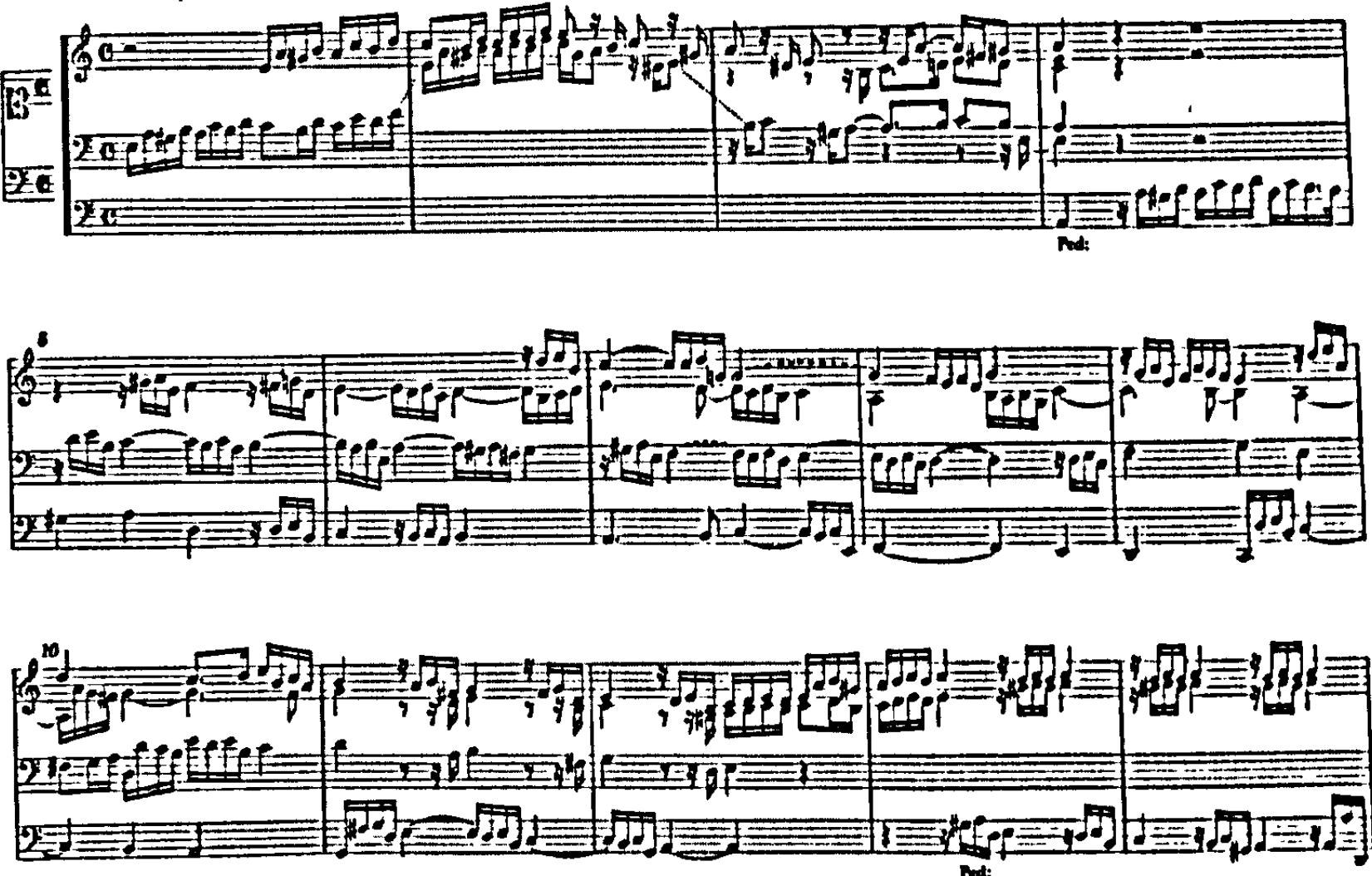
中文讲解
这是 Example 44 的图注:布克斯特胡德《A 小调前奏曲》BuxWV 153 的 exordium(第 1-14 小节)。原图所含的乐谱细节在 OCR 中已被省略,但位置和图注完整保留。读者需查看原图(见脚注 45 指向的 Beckmann 版第 1 卷),方可与正文中关于第 1-4 小节动机、第 4 小节独奏 pedal 段以及第 5-12 小节三音动机等具体描述对照。
补充说明
图注中标注的脚注 45 见 P0095,其指向 Beckmann 编辑版;本段对乐谱的细部描述需以原图为依据。
第7段(P0094)
原文复述
The motive of bar 1 is heard again in bar 4 after the cadence, this time as a solo pedal passage, intensified by a semiquaver rest (tmesis) that removes the initial ascending fourth figuration (from e to a). After the pedal section, bars 5-12 demonstrate an ample use of a three-note motive (beginning with a tmesis) derived possibly from the preceding broken-chord figuration encountered in bars 2-3, stressed through $ellipses^{46}$ and syncopes figures. Additionally, sequential repetitions of the same motive at different pitches in all voices and pedal illustrate the polyptoton figure, occasionally intensified by excessive leaps in the pedal (ninth and major seventh in bars 9 and 11 respectively). Finally, the arrival at A minor in bar 12 is followed by an emphatic reiteration of a sequence of motives (anaphora), reminiscent of figurations encountered in
中文讲解
本段是 P0090 引入的 exordium 案例分析的延续,逐层拆解 exordium 内不同音乐—修辞格的运作方式。要点:
-
第 4 小节(cadence 之后):第 1 小节的动机被单独交给 pedal 声部,作者标记为 tmesis(断句)——即用一个十六分休止符切去开头上行四度的音型(从 e 到 a),使动机以“残缺但更尖锐”的方式出现。这是对前一动机的“变形重现”,借修辞“断句”强化情感。
-
第 5-12 小节:出现一个三音动机,开头仍是 tmesis。作者暗示其源自第 2-3 小节的分解和弦音型。该动机被反复使用,并以 ellipses(省略,见脚注 46)与 syncopes(切分)两种格加以强调。
-
复调织体:所有声部与 pedal 在不同音高上做该动机的序列重复,作者称之为 polyptoton(异语重复——同一动机的多形态变体),并特别指出 pedal 中偶尔出现大幅跳进(如第 9 小节九度、第 11 小节大七度),进一步加剧紧张度。
-
第 12 小节回到 A 小调后,作者以 anaphora(首语重复)强调动机序列的反复,并预告这些音型让人联想到下一段(P0097)才会出现的弗雷斯科巴尔第托卡塔。这一铺垫说明 Buxtehude 在 exordium 内已埋下与弗雷斯科巴尔第之间的素材关联。
补充说明
段落末尾以“reminiscent of figurations encountered in”戛然而止,承接 P0097 关于 Frescobaldi 的对照。脚注 46 给出 ellipsis 的定义出处(P0096)。
第8段(P0095)
原文复述
$^{45}$ Unless otherwise noted, the examples and bar numbers given are drawn from Beckmann’s edition of Buxtehude’s free organ works; see Dietrich Buxtehude, Sämtliche Orgelwerke, ed. by Klaus Beckmann, rev. edn, vol. 1, Free Organ Works: BuxWV 136-153 (18 Praeludia pedaliter) (Wiesbaden: Breitkopf & Härtel, 1997).
中文讲解
这是脚注 45 的内容本身:除非另有说明,正文中所有谱例与小节号均出自 Klaus Beckmann 编辑的布克斯特胡德《管风琴作品全集》修订版第 1 卷《自由管风琴作品:BuxWV 136-153》(包含 18 首 pedaliter 前奏曲),1997 年由 Wiesbaden 的 Breitkopf & Härtel 出版。该脚注属于“版本/谱例来源类脚注”,为作者对 BuxWV 153 第 1-14 小节的具体小节号提供权威版本依据。
第9段(P0096)
原文复述
$^{46}$ According to Bernhard, “ellipsis means omission, and is the suppression of a consonance. It occurs in two ways: first, when a rest replaces the consonance and is followed by a dissonance […] [or] when a fourth is not resolved through a third at a cadence, rather standing still […]”, in his Ausführlicher Bericht, Chapter 18, §§1-3, as it appears in Hilse, pp. 112-13.
中文讲解
这是脚注 46 的内容本身:引自 Bernhard《Ausführlicher Bericht》第 18 章第 1-3 节(经由 Hilse 整理的第 112-13 页)对 ellipsis(省略)的定义。其核心为:ellipsis 指“省略”,即“协和音被压制”,它以两种方式出现——其一,用休止符取代协和音并紧接一个不协和音;其二,在终止处一个四度音不通过三度音解决,而是“停顿不动”。
该脚注对应正文 P0094 中以 ellipses 标记的三音动机。作者引用 Bernhard 的原始措辞,是为了说明把“休止—不协和”作为 ellipsis 修辞格的依据,从而使 16 世纪德国音乐修辞学传统(Bernhard)与 Buxtehude 的实践之间建立直接理论联系。
补充说明
脚注提供了 ellipsis 的两种具体形态,使 P0094 关于“休止—不协和音相接”的描述具有可追溯的原始定义。
第10段(P0097)
原文复述
Frescobaldi’s toccatas (see example 45). Starting from bar 12, the soprano and alto illustrate a climax that culminates on the second beat of bar 13. From that point, the same voices move in semiquaver figurations modelled on repeated parallel thirds (anaphora), strengthened each time by a timesis and accompanied by a pedal statement at different pitches (polyptoton). A comparison of the two following examples illustrates Frescobaldi’s influence on Buxtehude’s prelude. The ‘dialogue’ between the two manuals, as demonstrated in Frescobaldi’s Toccata, is transformed into an intense conflict between manuals and pedal (BuxWV 153), where the final pedal ‘answer’ to the alto and the soprano culminates in a dramatic hyperbole (fourth beat of bar 14).
中文讲解
本段承 P0094 末尾“reminiscent of figurations encountered in”一句,直接点出可比对象——弗雷科萨巴尔第的托卡塔谱例 45,并详细描述 BuxWV 153 第 12-14 小节的结构与修辞功能。要点:
-
exordium 内的高潮:第 12 小节起,soprano 与 alto 形成一条渐强的弧线,至第 13 小节第二拍到达高点。
-
第 13 小节起的修辞叠加:相同两声部以平行三度为基础反复十六分音符音型,作者标为 anaphora(首语重复);每次重复都被一个 tmesis(断句)加强,并由 pedal 在不同音高上以同一动机呼应,作者标为 polyptoton(异语重复)。也就是说,短短两小节内 anaphora、tmesis、polyptoton 三种格被密集叠加。
-
影响关系:作者将弗雷科萨巴尔第托卡塔中两套手键盘(manuals)之间的“对话”对照为 Buxtehude 中手键盘与 pedal 之间的“冲突”。第 14 拍第四拍 pedal 对 alto 与 soprano 的“应答”被作者认定为 dramatic hyperbole(夸张)——这正是 P0089 昆体良所言“在法官眼前完整展示论点全部力量”的具体体现,也是 exordium 内最具戏剧性的瞬间。
补充说明
本段把 P0089 所引昆体良的戏剧性收束主张,落实到 BuxWV 153 第 13-14 小节的精确拍位上,使理论与乐谱细节严密对应。
第11段(P0098)
原文复述
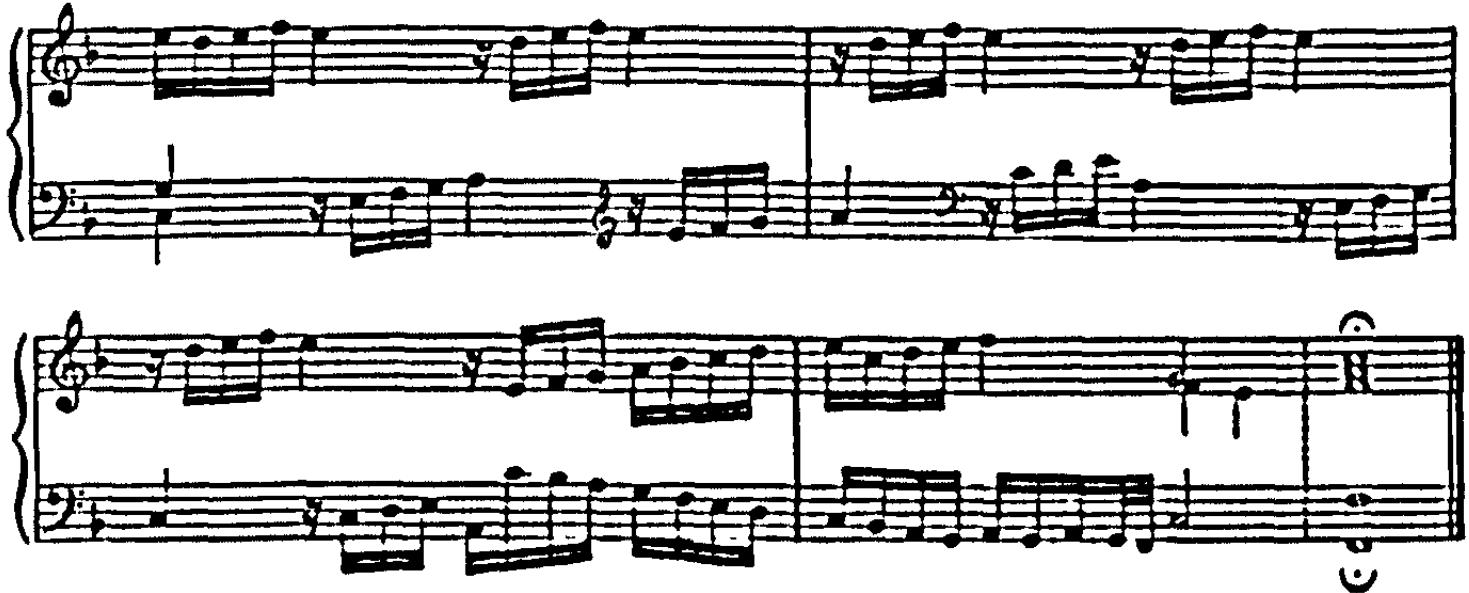
中文讲解
这是 Example 45 的图注:弗雷科萨巴尔第 F 大调托卡塔,第 85-89 小节。其功能是与 Example 46(BuxWV 153 第 13-14 小节细节)作并置,让读者直接比较弗雷科萨巴尔第“手键盘对话”与布克斯特胡德“手键盘—pedal 冲突”两种处理方式的差异。脚注 47 给出原始手稿与编辑本来源(见 P0101)。
补充说明
乐谱细节已省略,需查看原图以比较两谱例的具体声部走向。
第12段(P0099)
原文复述
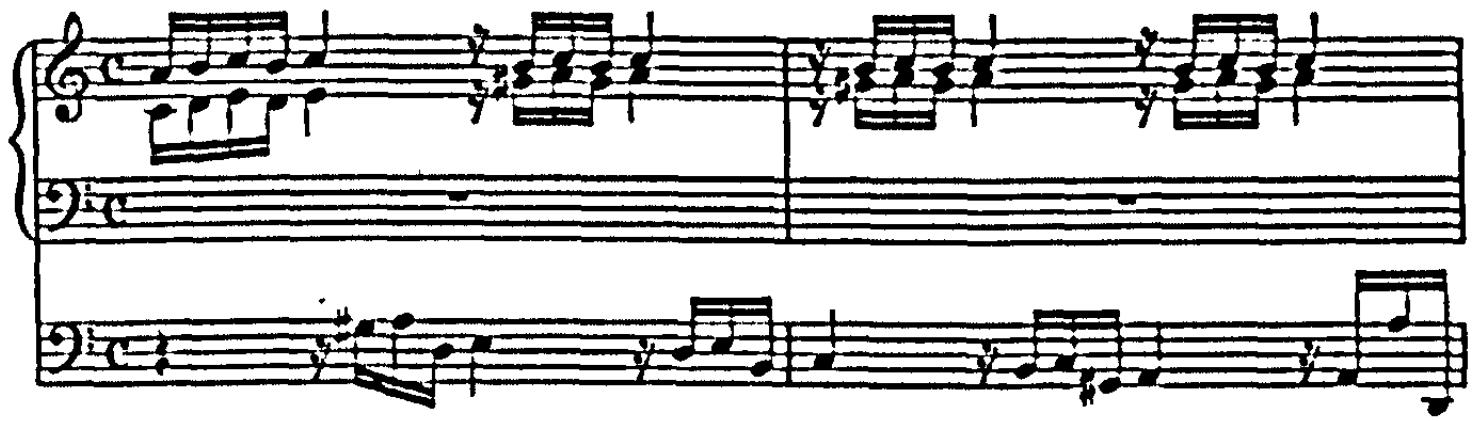
中文讲解
这是 Example 46 的图注:BuxWV 153 第 13-14 小节的细节谱例。其作用是放大 P0097 所分析的“drama”与“hyperbole”所在位置,使第 14 拍第四拍 pedal 应答以及高音与中音声部的平行三度音型具象化。它与 Example 45 并列,形成“影响来源 vs 受影响作品”的对照阅读。
补充说明
乐谱细节已省略,需查看原图以确认音程关系与具体节奏。
第13段(P0100)
原文复述
The dramatic tension created in bars 13-14 resolves into the dominant pedal E (bar 15), which supports an inversion of the semiquaver figuration of bar 1 in the soprano and middle voice (bars 15-16), accompanied by the anadiplosis figure (see example 47). Motives appear in cross-relation between the voices in bar 17, where the tenor figure (e-f#-g#-a) is repeated by the soprano an octave higher (e’-f#’-g#’-a’), while the semiquavers sung by the alto (g#-a-b-c’) are imitated by the tenor. Bars 18-19 display motives modelled after the preceding ones without any strong points of imitation, while the exordium concludes with an expressive rest (abruptio) and broken chords that resolve into a perfect cadence on A (bars 20-21).
中文讲解
本段收束 exordium 的分析(第 15-21 小节),并通过一连串修辞格标记完成 P0090 “在 21 小节内完整呈现 exordium”的论证。要点:
-
张力解决与材料回溯:第 13-14 小节累积的戏剧张力在第 15 小节落到属音 pedal E 上解决;该 pedal 同时支撑第 1 小节十六分音符音型的“倒影”——soprano 与 middle voice 上做出反向音型——并伴随 anadiplosis(递进/承前启后)修辞格(见 Example 47)。这种“开篇材料的倒影再现”是 exordium 内部对自身结构的呼应。
-
第 17 小节的交叉关系:tenor 的动机 e-f#-g#-a 被 soprano 在高八度上(e’-f#’-g#’-a’)重复;同时 alto 的十六分音符 g#-a-b-c’ 被 tenor 模仿。这是声部间的模仿/卡农式处理,文中以精确音高写出以避免歧义。
-
第 18-19 小节:动机在前两小节基础上继续展开,但不再有强模仿点,意味着 exordium 走向收束。
-
exordium 终止:第 20-21 小节以一个 expressive rest(作者标为 abruptio,即“突然中断”)和分解和弦,引向 A 大三和弦的完全终止,标志 exordium 21 小节的结束。这是一个“留白—解决”的修辞格组合:用 abruptio 制造停顿感,再以标准 cadence 完成“放下开场、转入下段”的功能。
补充说明
本段提及的 anadiplosis 图例(Example 47)未在节内文本中给出,其位置应在原书后续页面;本节内 OCR 仅保留正文与图注。
第14段(P0101)
原文复述
$^{47}$ Frescobaldi, Girolamo, Keyboard Compositions Preserved in Manuscripts, ed. by W. R. Shindle, Corpus of Early Keyboard Music Series, no. 30, 3 vols (Rome: American Institute of Musicology, 1968), i: Toccatas; Toccata 2a (f. 56) from the collection ‘Suonate d’intavolatura del Sig. Girolamo Frescobaldi’, Rome: Biblioteca Vaticana (Chigi Q IV 25).
中文讲解
这是脚注 47 的内容本身:弗雷科萨巴尔第《手稿中保存的键盘作品集》(W. R. Shindle 编辑),《早期键盘音乐文献丛书》第 30 号,共 3 卷(罗马:美国音乐学学会,1968 年),第 1 卷《托卡塔集》;其中第 2a 首托卡塔(f. 56)出自《Girolamo Frescobaldi 先生的键盘奏鸣曲集》(Suonate d’intavolatura),藏于罗马梵蒂冈图书馆(Chigi Q IV 25)。
该脚注为 Example 45(弗雷科萨巴尔第 F 大调托卡塔第 85-89 小节)提供原始手稿与编辑版本的双重出处,使作者关于“Buxtehude 受弗雷科萨巴尔第影响”的论断具有可追溯的版本基础。它属于“谱例来源类脚注”。
补充说明
脚注同时给出印刷编辑本(Shindle)与原始手稿收藏地(梵蒂冈图书馆 Chigi 编号),可作为核对 Example 45 全部 5 小节的完整线索。
脚注 / 边栏 / 图表 / 附加信息(如有)
本节包含 3 个谱例(Example 44 BuxWV 153 第 1-14 小节 exordium 整体;Example 45 弗雷科萨巴尔第 F 大调托卡塔第 85-89 小节;Example 46 BuxWV 153 第 13-14 小节细节)和若干脚注。脚注功能分类如下:脚注 43(Quintilian, Institutio oratoria, Book VI. i. 11, pp. 388-89)为正文中昆体良引文的原始出处;脚注 44 为 BuxWV 152/153/158 三首前奏曲调式归属的限定;脚注 45 说明全节谱例均采自 Beckmann 1997 修订版第 1 卷;脚注 46 给出 Bernhard《Ausführlicher Bericht》第 18 章第 1-3 节对 ellipsis 的原始定义,作为 P0094 中音乐—修辞格命名的依据;脚注 47 为 Example 45 提供 Shindle 编辑本与梵蒂冈手稿(Chigi Q IV 25)的双重出处。Example 47(anadiplosis 谱例)虽在本节正文中被提及,但本节 OCR 未保留其图注,位置应在原书后续页。三个谱例相互并置:Example 44 提供 BuxWV 153 exordium 全景,Example 46 放大其戏剧性瞬间,与 Example 45(弗雷科萨巴尔第对照)共同支撑 P0097 关于影响关系的论断。
💡 本节核心要点
- peroratio 的常规类型是从 confirmatio 顺势延伸并以序列重复强化其织体;最戏剧性的类型则表现为对 confirmatio 的突兀打断,情感音型占主导,并以 exordium 素材回应,昆体良主张全篇最终收束应最具戏剧性。
- BuxWV 153 被作者选为 exordium–narratio–confirmatio–peroratio 四段式 dispositi 的范例,原因在于其结构灵活且直白,并且 A 小调调性归属明确(脚注 44 排除了 Phrygian 的 BuxWV 152)。
- exordium 长达 21 小节,开篇以 anaphoral repetitio 抓住听众注意,4 小节终止确立调性,结构本身即模仿演说家起讲。
- 第 5-12 小节以三音动机为核心,叠加 tmesis、ellipses、syncopes、polyptoton 等多重修辞格,并以 pedal 中九度与大七度跳进加强紧张度。
- 第 12-14 小节是 exordium 的戏剧高潮:soprano/alto 在平行三度音型上累积 anaphora,并以 tmesis 与 polyptoton 强化,第 14 拍第四拍 pedal 应答被标记为 dramatic hyperbole。
- 第 15-21 小节完成 exordium 的收束:通过属音 pedal E、bar 1 音型倒影、anadiplosis、cross-relation、模仿,并以 abruptio 与分解和弦引向 A 大三和弦的完全终止。
- 作者在第 12-14 小节层面将弗雷科萨巴尔第的“手键盘对话”转译为 Buxtehude 的“手键盘—pedal 冲突”,据此论证意大利托卡塔传统对 BuxWV 153 的具体影响。
🔑 关键术语
- peroratio:古典修辞学五/六段式的最后部分(结论/收束),功能是放大并总结前文论点,赢得听众信任与情感。本节中作者将其作为分析布克斯特胡德前奏曲结构与情感修辞格的功能性标签。
- confirmatio:修辞学正文中对论点加以证明/巩固的段落。在本节中,它被映射为音乐段落,并作为最常见 peroratio 的“顺势强化”来源。
- exordium:修辞学的开场段。在 BuxWV 153 中对应全曲开头的 21 小节,开篇承担吸引听众注意的功能,并以多种音乐—修辞格组织材料。
- anaphora / anaphoral repetitio:首语重复。本节中指开篇动机的立即重复(第 1-2 小节)以及第 13 小节起以平行三度为基础反复的十六分音符音型。
- tmesis:断句修辞格。本节中表现为在动机开头插入十六分休止符,使其起始上行音型被切掉,从而强化动机进入的尖锐感(第 4 小节 pedal 段、第 13 小节高音反复处)。
- ellipsis:省略修辞格。Bernhard 定义为协和音被压制:以休止取代协和音并紧接不协和音,或在终止处四度不通过三度解决。本节用于解释第 5-12 小节三音动机的强调方式(脚注 46)。
- polyptoton:异语重复。本节中指同一动机在不同音高上由所有声部与 pedal 进行序列重复,强调动机形态的变化而非字面重复。
- abruptio:突然中断。本节中指 exordium 第 20-21 小节中以 expressive rest 造成的修辞停顿,后接分解和弦引向 A 大三和弦的完全终止。
- anadiplosis:递进/承前启后修辞格。本节用于标记 exordium 第 15-16 小节中以 bar 1 十六分音符音型的倒影作为新材料起点的手法。
- hyperbole:夸张修辞格。本节中特指第 14 小节第四拍 pedal 对 alto 与 soprano 的最终应答,被视为整个 exordium 戏剧高潮的瞬间。
- cross-relation:声部间的交叉关系。本节指第 17 小节 tenor 的 e-f#-g#-a 动机被 soprano 高八度重复,同时 alto 的 g#-a-b-c’ 被 tenor 模仿的声部交织。
- BuxWV 153:布克斯特胡德《A 小调前奏曲》,本节作为 exordium–narratio–confirmatio–peroratio 四段式 dispositi 的具体案例展开分析,其 exordium 长达 21 小节。
4.9 [描述性拆分] The Narratio Fugue of BuxWV 153
第1段(P0102)
原文复述
Example 47. BuxWV 153: exordium and narratio (bars 15-26). [Embedded musical example; image data omitted, caption position and wording preserved.]
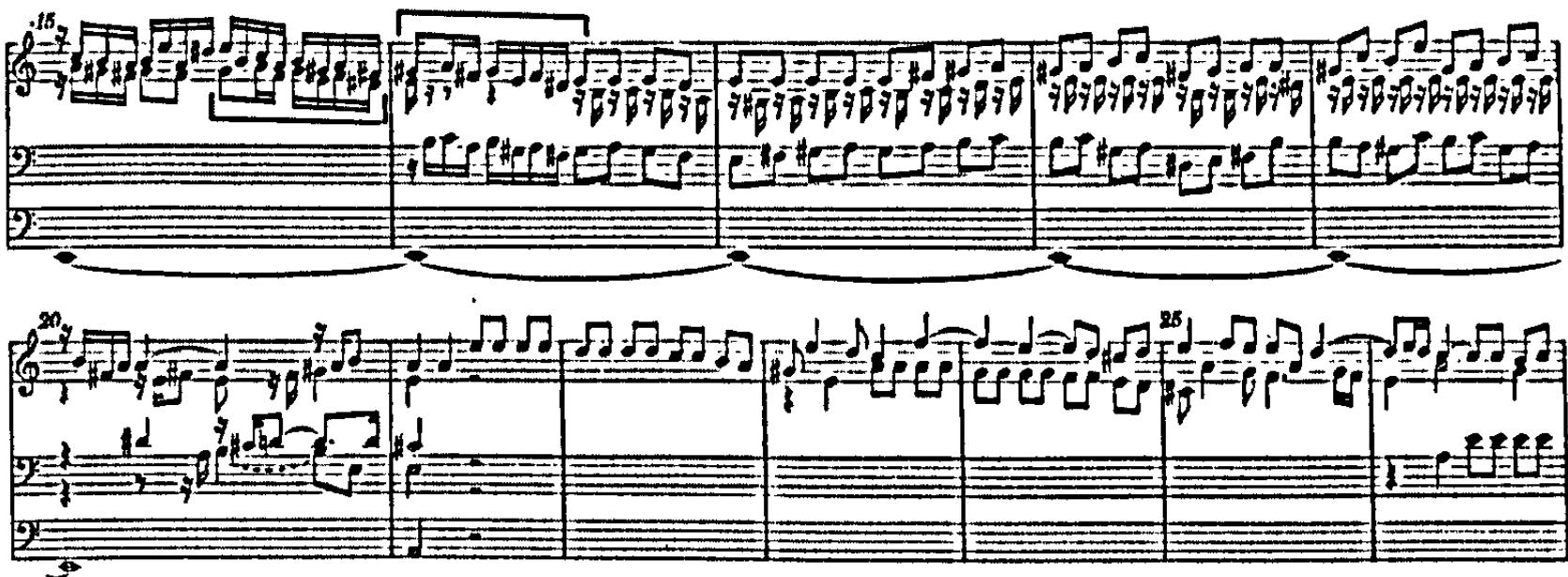
中文讲解
本段为谱例47的图注,标注为「Example 47. BuxWV 153: exordium and narratio (bars 15-26)」,对应BuxWV 153第15至26小节,所展示的范围正好覆盖引子(exordium)末尾与叙述部(narratio)开端交叠之处。它承接前一节对引子的分析,开启本节对叙述部主题与答题的论述。由于内嵌乐谱数据已省略,须查阅原书谱例以核对音符、谱号、声部配置及小节划分。
第2段(P0103)
原文复述
The ending of the exordium overlaps by one beat the entrance of the narratio, which is the first fugue of the work. The narratio subject begins with a leap of a perfect fifth (a’ to e") followed by repeated notes descending from e" to g#" (minor sixth) reminiscent of the Italian canzonas. The tonal answer to the subject is heard in the alto opening with a perfect fourth, the same interval that determined the opening motive of the exordium.
中文讲解
本段提出三点观察。第一,引子(exordium)的结尾与叙述部(narratio)的进入重叠一拍——引子在最后让出一拍空隙,构成两段修辞阶段之间的「交接」,这种错位重叠是巴赫器乐赋格中常见的小节衔接手法。第二,叙述部主题以纯五度跳进(a’到e")开始,随即是e"下行至g#“的重复音,构成小六度的下行轮廓;这一开头让人联想到意大利坎佐纳(canzona)——一种以主题清晰、节奏鲜明为特点的器乐体裁,说明本赋格带有北德/意大利器乐传统的双重基因。第三,主题由中音部(alto)以「调性答题」(tonal answer)回应,开头是纯四度音程;纯四度恰好也是引子主题起头的核心音程,作者以此说明:叙述部主题虽已换形,但通过相同的起头音程与引子形成隐性呼应,巩固了作品的统一性。
论证功能:本段先点明叙述部作为「作品首支赋格」的体裁地位,再从主题音程和起头方式两个角度建立它与引子之间的关联,为后文把叙述部定性为「诉诸理智」的严格模仿段做铺垫。
补充说明
音高记号:a’为小字一组a(中音C上方),e"与g#“为小字二组。「tonal answer」(调性答题)指为保持调性而将主题中的纯五度调整为纯四度的标准赋格答题形式。
第3段(P0104)
原文复述
Example 48. BuxWV 153: narratio (bars 27-39). [Embedded musical example; image data omitted, caption position and wording preserved.]
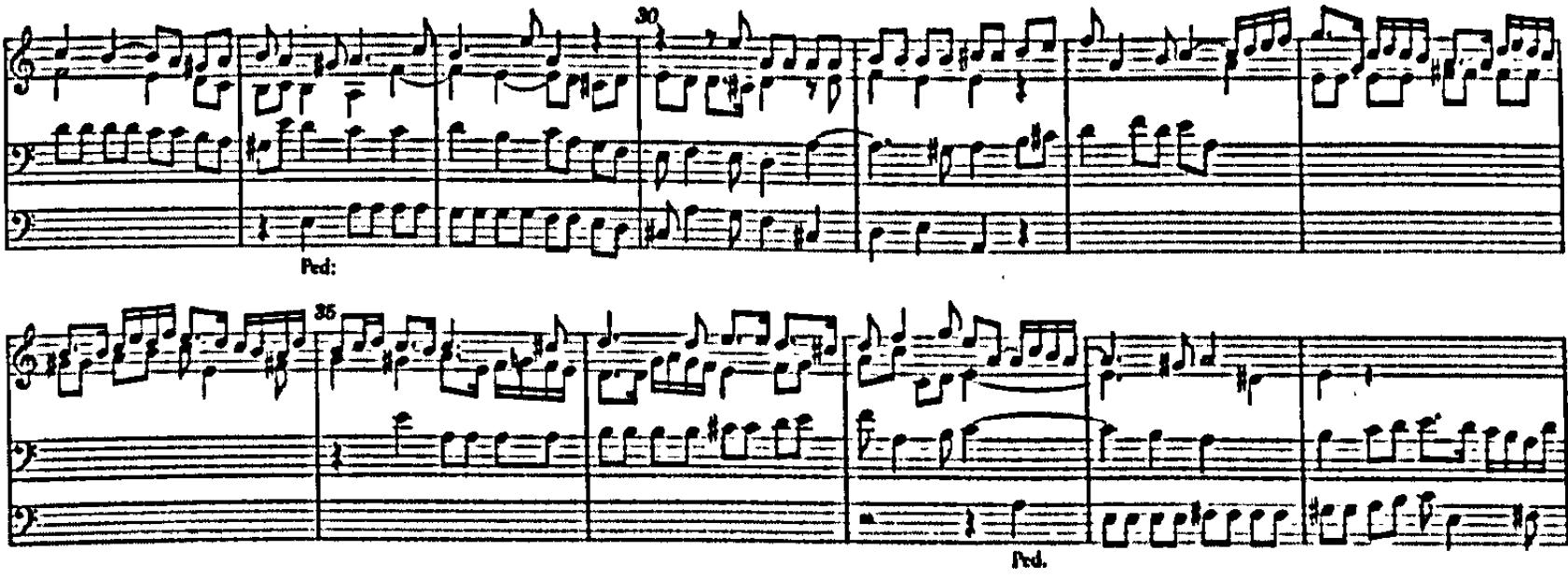
中文讲解
本段为谱例48图注,对应BuxWV 153叙述部的第27至39小节。此区间恰为P0105所述「主题在四个声部依次进入」的第一呈示段,并覆盖了第30小节脚键盘(pedal)与次中音部(tenor)声部交叉之处,以及主题随后在第30-42小节以倒影形式(hypallage)出现的段落。谱例的作用是把正文叙述的修辞术语(hyperbatus、hypallage)落到具体音符上,便于读者核对。
第4段(P0105)
原文复述
The narratio presents a straightforward exposition of the subject with entries in all four voices, while the voice crossing between the pedal that carries the subject and the tenor in bar 30, illustrating the figure hyperbatus (supergradiens), is noteworthy. Finally, after the entrance of the theme in the pedal, the subject is heard in an inverted form (hypallage) in the following twelve bars (30-42), while a real answer is also subject to inversion (40-41) before the close of the second exposition and the return of the theme to its original state (42-53). The subject enters again in the alto from bar 42 onwards with tonal answers successively in tenor (44-46) and soprano (46-48), while further entries in bass (49-51) and soprano (51-53) lead to another entrance of the inverted subject in the pedal (starting from bar 53).
中文讲解
本段按时间顺序梳理叙述部从第27到第53小节的结构,包含四个层次。
第一层,叙述部是一次「直白的呈示」——主题在四个声部依次出现,每个声部都听见完整的赋格主题,这是它被作者定性为「诉诸理智」的依据。
第二层,在第30小节出现一处值得注意的声部交叉:脚键盘(pedal)唱主题时与次中音部(tenor)互换音区,作者把这种修辞称作 hyperbatus(希腊语意为「跨越」),并附以等价术语 supergradiens——两者皆指声部纵向位置的临时错置。
第三层,脚键盘主题进入之后,主题在随后的12小节(第30-42小节)以倒影形式出现,作者称为 hypallage(错位/移置),是赋格写作中典型的对题变体手法。第40-41小节连「real answer」(守调答题)也被倒影化,呈示段由此收束。
第四层,第42小节起主题回到原始形态,由中音部再次进入,并在次中音部(44-46)、高声部(46-48)连续以调性答题跟进;再由低音声部(49-51)和高声部(51-53)补充两次进入,最后在第53小节引出脚键盘上又一次倒影主题。
理解要点:这一段把叙述部呈现为「严格模仿+有控变体」的组合——主题按规范在各声部铺开,又借 hyperbatus、hypallage 等修辞手段注入变化。这种「严整中带变奏」的特点,正是后文P0107把它与引子「图形繁复」相对照的关键。
补充说明
术语速查:real answer(守调答题)指完全照搬主题音程的答题,与上文已出现的 tonal answer(调性答题)相对;hyperbatus、hypallage 在本书的「音乐—修辞」术语体系中分别承担「声部跨越」与「主题倒影/移置」两个范畴。
第5段(P0106)
原文复述
Example 49. BuxWV 153: narratio (bars 40-53). [Embedded musical example; image data omitted, caption position and wording preserved.]
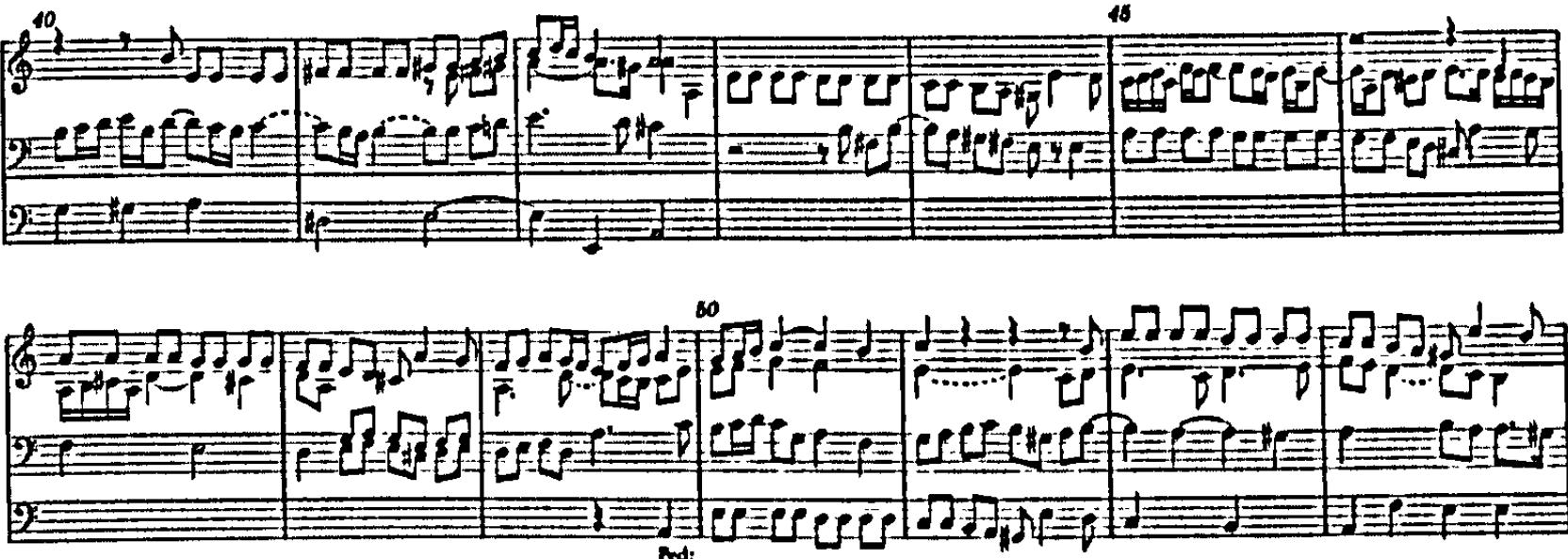
中文讲解
本段为谱例49图注,对应叙述部第40至53小节。该区间内发生两件关键事件:第40-41小节「real answer」的倒影化、第42小节起主题回到原始形态并由各声部依次跟进,第53小节又重新进入倒影主题。该谱例与P0105的论述直接对应,提供视觉参照。
第6段(P0107)
原文复述
In contrast to the exordium that demonstrated a wealth of Figuren, the narratio illustrates a strict form of imitative counterpoint, in which facts (i.e. the fugal subject in all voices) are carefully structured in order to persuade the intellect. However, despite the objective character of the narratio, Quintilian suggested that in some instances the orator varied his figures in order to maintain the attention of the audience. On these grounds, the inversion of the fugal subject (hypallage), which is heard again in the pedal from bar 53 onwards, demonstrates the composer’s attempt to introduce some variety into the texture. Moreover, the antitheton (contrapositum) figure constitutes an affection-arousing device (bars 57-58) where the inverted subject in the tenor, accompanied by the ascending movement of the upper voices in parallel fourths (faux bourdon), strongly contradicts the descending movement of the pedal (catabasis). The dramatic tension of bars 57-58, followed by the last inverted entrance of the subject in the soprano (bars 58-60), is released after the theme is heard in the original form in the alto (bars 60-62).
中文讲解
本段是本小节论证的关键转折点,分三层推进。
第一层,作者建立「对照」:引子(exordium)展示大量 Figuren(修辞装饰图形),目的是吸引情感;叙述部(narratio)则以严格的模仿对位组织「事实」——即主题在每个声部中的清楚呈现——以「诉诸理智」。两者构成情感/理智的修辞分工。
第二层,作者援引昆体良(Quintilian)的教导:即便在陈述事实时,演说家也会变换修辞图形以维持听众注意。巴赫在第53小节之后再次以倒影(hypallage)让主题进入脚键盘,正是这种「为理智而陈事,但借变奏保注意」的写作策略。
第三层,论述 antitheton(对照/contrapositum)这一激发情感的图形:第57-58小节中,倒影主题出现在次中音部,上方声部以平行四度(faux bourdon,假勃艮低音)上行,与脚键盘的下行运动(catabasis,下行)形成尖锐对比。作者把这种方向/织体上的对立解释为一种「情感激发装置」(affection-arousing device),由此把「诉诸理智」的叙述部暂时推回「诉诸情感」的一侧。
收束部分:第57-58小节建立的戏剧性张力,在第58-60小节最后一次倒影主题进入高声部之后,通过第60-62小节主题以原始形态回归中音部而得到「释放」——这是把音乐修辞类比为情感节律的典型处理。
本段的小节作用:把「严格模仿=理智」与「修辞变奏=情感」之间的张力具体化,为P0109叙述部结尾那种「被暴力打断」的修辞铺垫,使内部的 antitheton 不只是装饰,而成为「为何叙述部需要在结尾以中断收束」的伏笔。
补充说明
昆体良(Quintilian)的引用属于本书论证的常见方法:援引古典修辞学权威来为作曲家在某一处使用某图形「立法」;本段中昆体良的功能是为「叙述部仍可有变奏」这一观察提供修辞学依据,并非补写新的历史信息。
第7段(P0108)
原文复述
Example 50. BuxWV 153: narratio, internal peroratio, and confirmatio (bars 54-68). [Embedded musical example; image data omitted, caption position and wording preserved.]
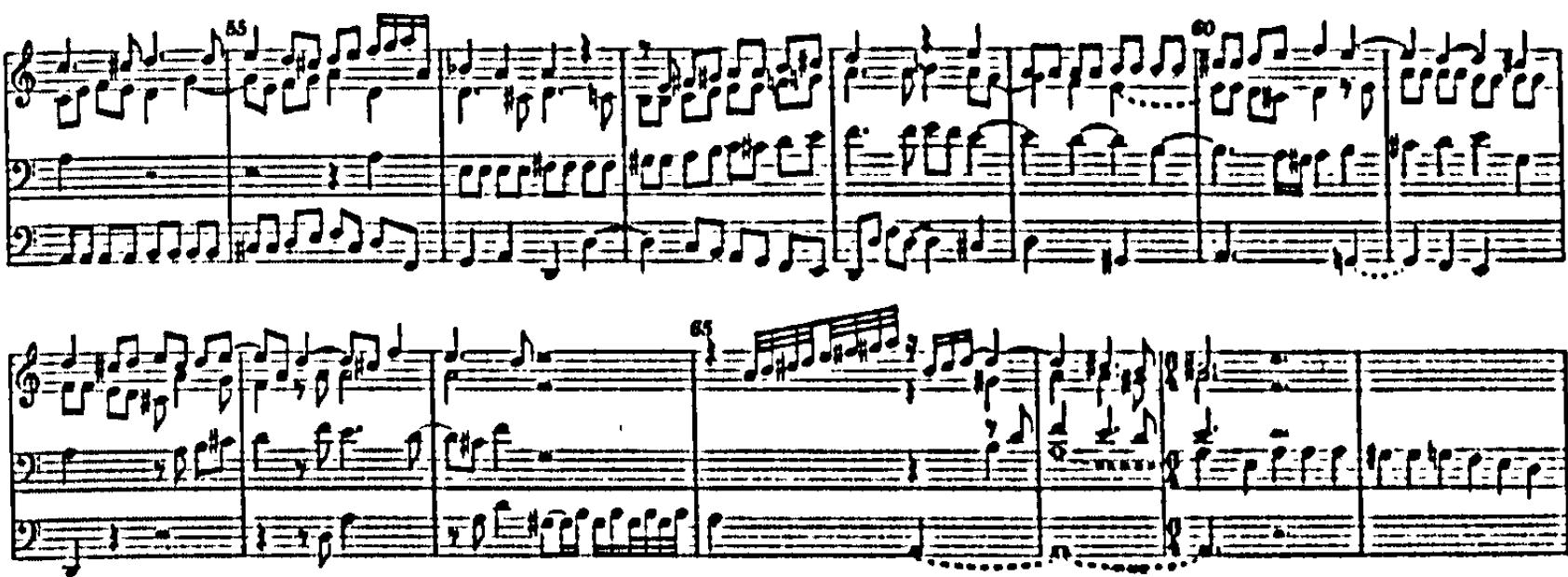
中文讲解
本段为谱例50图注,对应BuxWV 153第54至68小节。该谱例横跨三个阶段——叙述部后半(含倒影主题与 antitheton)、叙述部结尾的「内部 peroratio」(即 P0109 所述那段被 abruptio rest 打断的自由段落)、以及 confirmatio(证明段)开头的进入。图注把这三段并置,恰好把「叙述部→内部结论→新阶段开始」的过渡放在同一页乐谱中,便于读者直观比对三者在体裁、织体、节拍上的差异。
第8段(P0109)
原文复述
The narratio is violently interrupted by an unexpected cessation of the contrapuntal texture (abruptio rest) marked by a weak cadence on D on the second beat of bar 64. The free section that follows for the next two and a half bars constitutes an internal peroratio to the narratio. This is strengthened by a saltus duriusculus (d’-g#) and an ornamental alternation of semiquavers and demisemiquavers (g#-b) in the pedal (bar 64) that can be freely interpreted in terms of performance as a trillo longo. The aposiopesis rest (first beat of bar 65) is followed by a demisemiquaver anabasis that reaches an octave, while the abruptio (third beat of the same bar) gives way to a cadence prolonged by an extension (extensio) in the soprano that leads to the end of the section.
中文讲解
本段细致刻画叙述部在第64小节起的「被中断」过程,并依次标注出五处修辞图形。
第一处:第64小节第二拍落在D音的弱终止上,赋格式的对位织体骤然中止,作者称之为 abruptio rest(突然停顿)。作者用「violently interrupted」(被暴力打断)形容其力度——暗示叙述部并未按常规平稳收尾。
第二处:紧随其后的两小节半自由段落被定性为叙述部的「内部 peroratio」(内嵌结论)。这是一种自指性的修辞安排:结论并未放在段末,而是嵌在段中、靠一次突然的停顿被「挤压」出来。
第三处:该 peroratio 由两件音乐事件加固——脚键盘在第64小节同时出现 saltus duriusculus(d’到g#的「生硬跳进」,这是一个三全音/减五度的剧烈不协和跳)和十六分音符与三十二分音符交替的加花(g#-b),后者在演奏上可自由理解为 trillo longo(长颤音)。这两件事把脚键盘的乐句从陈述性转为感叹性,与 P0107 的 antitheton 一脉相承。
第四处:第65小节第一拍出现 aposiopesis rest(话语中断式停顿),即「话说到一半突然沉默」的修辞效果;之后是三十二分音符的 anabasis(上行音阶),攀达一个八度的高度。
第五处:第65小节第三拍的 abruptio(突然切断)让位给一个终止式,并由高声部中的 extensio(延长/延伸)把它拉长,引导出本段(叙述部)的终止。
本段的小节作用:把叙述部结尾处理成一段「以停顿、跳进与延长构成的、压缩在两小节半内的内部结论」,从而把原本属于段尾的功能提前到段内——这同时也是为 P0111 叙述部 A 大调和弦与 confirmatio 开头之间的重叠埋下修辞理由。
补充说明
音高与音程:d’到g#向上为增四度、向下为减五度,正是中世纪以来被称为「mi contra fa」的三全音,被本书作者归入 saltus duriusculus(生硬跳进)的范畴;术语 anabasis、catabasis 在本书中分别指方向性「上行/下行」运动的修辞范畴。
第9段(P0110)
原文复述
Example 51. BuxWV 153: confirmatio (bars 69-86). [Embedded musical example; image data omitted, caption position and wording preserved.]
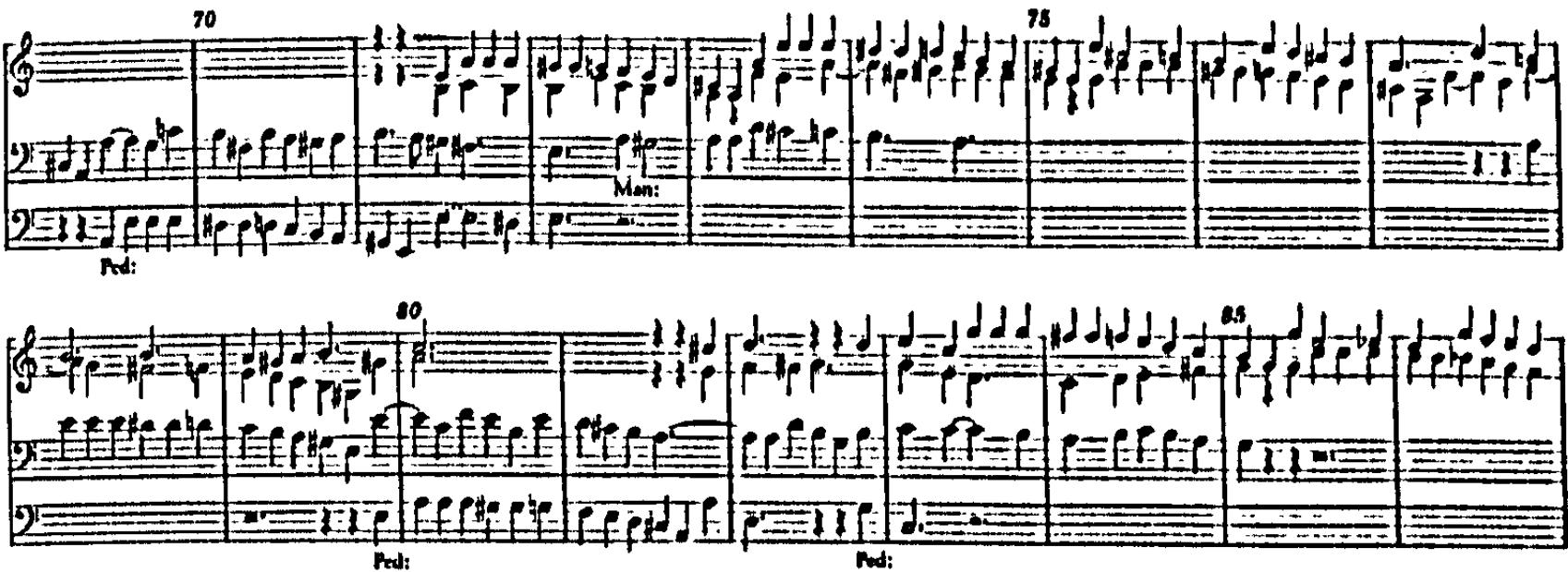
中文讲解
本段为谱例51图注,对应BuxWV 153 confirmatio(证明段)的第69至86小节。该谱例与叙述部主体(谱例48、49)形成对照,主要目的是让读者看清 P0111 所述「confirmatio 主题模仿叙述部主题、并在原下行小六度中插入一个半音动机」这一改写关系。
第10段(P0111)
原文复述
The final A major chord of the narratio overlaps the entrance of the confirmatio, represented by a fugue written in 6/4 metre, ^{48} where the subject is fashioned after the narratio with the addition of a chromatic motive within the descending minor sixth. The two following examples illustrate the thematic relationship between the narratio and the confirmatio:
中文讲解
本段交代叙述部向 confirmatio(证明段)的过渡与后者的特征。
第一句:叙述部终止于 A 大调和弦,而 confirmatio 在其上叠入开始,构成又一次「重叠交接」——这一手法与本小节开头引子→叙述部的处理形成呼应,提示我们这是一部按修辞阶段层层衔接、各段之间避免完全「真空」的作品。
第二句:confirmatio 是一支 6/4 拍的赋格;其主题以叙述部主题为蓝本,但在原下行小六度轮廓中插入了一个半音动机(chromatic motive),由此获得一种新的半音化表情。注脚48将这一6/4拍的拍号转换置于巴赫三首 A 小调/弗里几亚前奏曲(BuxWV 152、153、158)的对比中。
第三句:作者预告紧随其后的两个谱例将「说明叙述部与 confirmatio 之间的主题关系」,把本段定性为一个桥接式说明,引导读者进入图像比对环节。
补充说明
记号^{48}指向本段之后的脚注48,作者在该脚注中把6/4拍转换放到巴赫其他前奏曲的对照语境中,本身即一项跨作品佐证。
第11段(P0112)
原文复述
^{48} As Gorman notes (p. 185), of the three A minor/ Phrygian preludes (BuxWV 152, 153, and 158), BuxWV 152 and 158 feature the same shift to 3/2 and 6/4 metre in the confirmatio fugue respectively.
中文讲解
本段为正文 P0111 中上标48对应的脚注。作者转引 Gorman 在其著作第185页的观察:在巴赫三首 A 小调/弗里几亚前奏曲(BuxWV 152、153、158)中,BuxWV 152 与 158 的 confirmatio 赋格分别在拍号上做出向3/2与6/4的转换。换言之,BuxWV 153 叙述部→confirmatio 之间出现的6/4拍并非孤立现象,而是与另外两首同调性前奏曲共享的拍号转换策略。该脚注的功能是为正文提出的「confirmatio 拍号转换」提供作品间旁证,而不引入新的历史、人物或机构信息。
补充说明
脚注性质为「来源/旁证」,支持正文 P0111 关于拍号转换的断言;弗里几亚(Phrygian)调式与 A 小调在巴洛克音乐实践中常被视作同一声响色彩,作者在此并列使用。
脚注 / 边栏 / 图表 / 附加信息(如有)
本小节包含五个谱例图注(P0102、P0104、P0106、P0108、P0110),由于原书内嵌乐谱图像数据被省略,文中关于各声部进入顺序、主题倒影、平行四度(faux bourdon)、saltus duriusculus 与自由段 trillo longo 等描述的具体音符定位需以原书谱例核对。另含一条脚注(P0112,注48),为正文 P0111 关于 confirmatio 6/4 拍转换的论断提供作品间旁证。
💡 本节核心要点
- 叙述部(narratio)是 BuxWV 153 的首支赋格,其进入与引子(exordium)的终止重叠一拍,构成段际交叠。
- 叙述部主题以纯五度跳进(a’-e”)和小六度下行(e”-g#")起头,近似意大利坎佐纳;其调性答题以纯四度起头,与引子起头音程隐性呼应。
- 叙述部呈示段在四个声部依次进入主题,并在第30小节通过声部交叉(hyperbatus/supergradiens)和主题倒影(hypallage,第30-42小节)注入修辞变体。
- 叙述部被定性为「诉诸理智」的严格模仿对位,但作者援引昆体良指出变奏仍属正当:第57-58小节的 antitheton(contrapositum)以倒影主题 + faux bourdon 上行 + 脚键盘下行(catabasis)形成情感激发性的对照,张力在第60-62小节主题以原始形态回归时释放。
- 叙述部在第64小节第二拍以弱终止 + abruptio rest 被「暴力打断」,随后两小节半被压缩成「内部 peroratio」,内含 saltus duriusculus、trillo longo、aposiopesis rest、anabasis、abruptio 与 extensio 等修辞图形。
- 叙述部终止的 A 大调和弦与 confirmatio 进入重叠;confirmatio 是6/4拍的赋格,其主题沿用叙述部主题的小六度下行轮廓并嵌入半音动机——这种6/4拍转换在 BuxWV 152(3/2)与 158(6/4)的 confirmatio 中亦可观察到(Gorman, p. 185)。
🔑 关键术语
- narratio(叙述部):古典修辞学中陈事(statement of facts)的阶段;在本节中指 BuxWV 153 的首支赋格,以严格模仿对位呈现主题,被作者定性为「诉诸理智」。
- exordium(引子):古典修辞学的开场阶段;本节之前讨论过的部分,作者将其描述为展示大量 Figuren、旨在激发情感的段落。
- confirmatio(证明段):古典修辞学中举证立论的阶段;在本节中指 BuxWV 153 的第二支赋格,以6/4拍、含半音动机的主题出现,与叙述部在末小节重叠交接。
- internal peroratio(内部结论):古典修辞学 peroratio 的功能被压缩在叙述部内部而非段尾执行;在本节中具体落在第64-66小节那一段被 abruptio 打断的自由段落。
- tonal answer / real answer(调性答题/守调答题):赋格答题的两类基本形式:前者为迁就调性将主题中的纯五度调整为纯四度(叙述部中使用),后者原样保留主题音程(第40-41小节被倒影化即用此形式)。
- hyperbatus / supergradiens(声部跨越):音乐修辞学术语,指两声部临时跨越其常规音区;在叙述部第30小节以脚键盘与次中音部交叉为例。
- hypallage(倒影/移置):音乐修辞学术语,指主题作倒影变形;在叙述部第30-42小节及第53小节脚键盘再次出现。
- antitheton / contrapositum(对照/对位):音乐修辞学术语,指两段材料在方向、织体或音区上呈对立;在叙述部第57-58小节以倒影主题 + faux bourdon 上行 + 脚键盘下行(catabasis)为例。
- faux bourdon(假勃艮低音):指上方声部以平行四度(或四六度)进行的手法;在第57-58小节与下方脚键盘的下行构成对照。
- catabasis / anabasis(下行/上行):音乐修辞学术语,指方向性的下行(第57-58小节脚键盘)/上行(第65小节高声部 demisemiquaver 上行至八度)。
- abruptio rest / abruptio(突然停顿):音乐修辞学术语,前者指赋格式对位骤然中止的织体停顿(第64小节第二拍),后者指某一线条或段落被突然切断(第65小节第三拍)。
- aposiopesis rest(话语中断停顿):修辞学中「说到一半突然沉默」对应的音乐停顿;位于第65小节第一拍。
- saltus duriusculus(生硬跳进):音乐修辞学术语,指跨越三全音等强烈不协和音程的跳进;本节中以第64小节脚键盘 d’ 到 g# 为例。
- trillo longo(长颤音):自由演奏中的长颤音;本节作者认为第64小节 g#-b 的十六分/三十二分音符交替可按此方式演绎。
- extensio(延长/延伸):音乐修辞学术语,指在终止处通过加花、留音等手段把终止音拉长;本节中位于第65小节高声部。
- Italian canzona(意大利坎佐纳):16-17世纪意大利器乐体裁,以主题鲜明、节奏清晰著称;本节中被作者用来解释叙述部主题起头(小六度下行轮廓)的风格来源。
4.10 [描述性拆分] The Confirmatio and Peroratio of BuxWV 153
第1段(P0113)
原文复述
Example 52b. BuxWV 153: confirmatio answer (bars 73-75). [Image data embedded in original; position and caption preserved.]
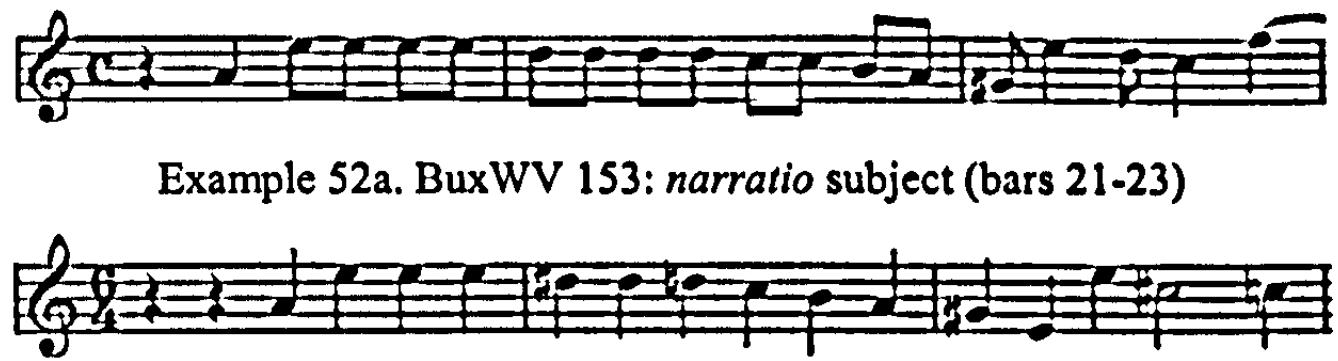
中文讲解
本条为图注,指向 Example 52b,标注该谱例展示 BuxWV 153 第 73–75 小节的 confirmatio answer(论证段的应句)。由于图像数据已被省略,需查阅原谱以核对具体音符与对位,但根据后文可知,此处对应的是 confirmatio 开篇处保持 exordium 与 narratio 应句中那个上行四度动机 e–a 的乐句。
补充说明
图注仅起版面定位作用;图例序号 52b 说明此前尚有 Example 52a,提示该谱例是一组对照示图中的一幅。
第2段(P0114)
原文复述
The confirmatio maintains the initial ascending fourth (e-a) that appeared in the exordium and formed the answer to the narratio, and demonstrates a straightforward development of the subject with alternate entrances on the mediant (bars 83-85) and the subtonic (bars 85-87). The confirmatio concludes with a perfect cadence on C major, which signifies the beginning of the amplificatio (bars 94-104), a section that functions as an internal peroratio to the confirmatio. Emphatic repetitions of the ascending fourth motive of the subject justify the viewing of this portion of the Klangrede as an amplification of already developed arguments, while the amplificatio concludes with a final entrance of the subject in the alto (bars 102-104).
中文讲解
本段论述 confirmatio(论证段)的结构特征。其中心主张有三:第一,confirmatio 沿用了 exordium 中出现、并曾作为 narratio 应句的上行四度 e–a 动机,使材料前后一贯;第二,主题在中音(83–85 小节)和下音(85–87 小节)上以交替方式依次进入,构成清晰的展开;第三,confirmatio 以 C 大调的完全终止收束,随即进入 amplificatio(94–104 小节)。作者特别强调 amplificatio 在功能上相当于 confirmatio 的“内部 peroratio”,其依据是该段对上行四度动机的强调性重复,正是对既有论点的“扩说”;该段最终在 102–104 小节以主题在 alto 声部的最后一次进入作结。在整篇 Klangrede(“声音演说”)的修辞框架下,本段展示了 confirmatio 如何系统陈述主题、amplificatio 如何加固既有论旨,从而把修辞学的“论证—扩说”层次落实到谱面。
补充说明
段中“mediant”与“subtonic”分别指三度与七度音级;“subtonic”在大调中是导音下方大七度,此处提示 confirmatio 的展开并未停留在原调中心,而是按级数铺开;perfect cadence on C major 的出现意味着虽然前文音乐以 d 小调为中心,但 confirmatio 在 C 大调上完结,这是一种转调性的“收束”。
第3段(P0115)
原文复述
Example 53. BuxWV 153: confirmatio and amplificatio (bars 87-104). [Image data embedded in original; position and caption preserved.]
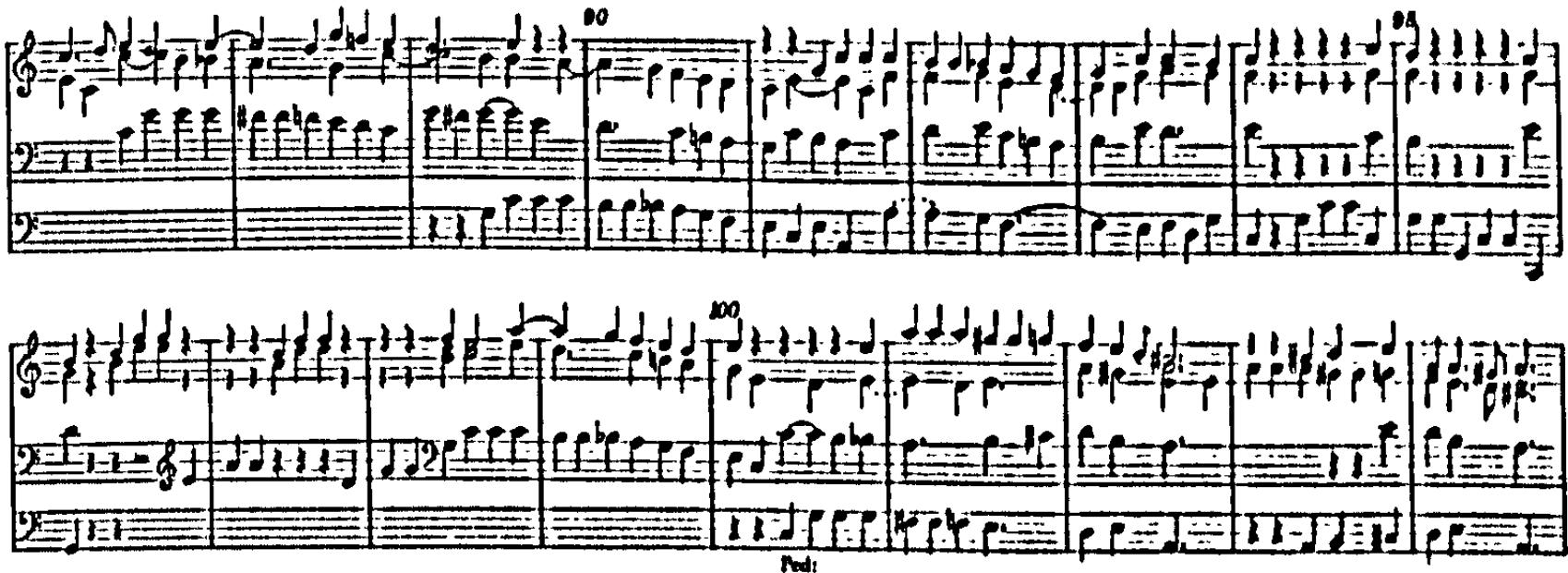
中文讲解
本条为图注,指向 Example 53,标注谱例覆盖第 87–104 小节,恰好与前段所述 confirmatio 的尾声及 amplificatio 全段吻合。该谱例是把文字分析落实到乐谱的关键视觉证据:读者可由此核对主题在 mediant 与 subtonic 上的进入、perfect cadence on C 的到来,以及 102–104 小节主题在 alto 中的最后一次呈现。
补充说明
谱例 87–104 小节跨越 confirmatio 末段与 amplificatio 全段,是观察“论证—扩说”修辞结构的最佳片段。
第4段(P0116)
原文复述
The prelude ends with the peroratio, the affective section that aims, like the exordium, to attract the attention of the listener. The carefully ordered confirmatio contradicts the improvisatory character of the peroratio, which features a plethora of broken manual arpeggios, scalar passages, and daring pedal motives. The peroratio emphasizes the subdominant D with scales and right-hand chords (bars 108-109) that lead to bar 110, where the alternation between manual notes and chords culminates in a dramatic aposiopesis.
中文讲解
本段开启对前奏曲终段 peroratio(结尾段)的论述。其中心论点是把 peroratio 与 exordium 并列——二者皆以“吸引听众注意力”为功能——同时与 confirmatio 形成对比:confirmatio 严谨有序,peroratio 则具有即兴化(improvisatory)特征,表现为大量分解琶音、级进段落和大胆的脚键盘动机。段末点出具体事例:108–109 小节以级进和右手和弦突出下属音 D,并由此推向 110 小节——手动声部单音与和弦的交替在此发展为戏剧性的 aposiopesis(突然中断式修辞格)。本段论证的关键在于揭示 Buxtehude 在曲式修辞上的功能对照:开篇与结尾用“情感张力”框住中段的“逻辑论证”。
补充说明
aposiopesis(修辞中的“突止”)原指言说到一半突然沉默;在此被作者用来描述手动声部在 110 小节造成的突然停顿式效果,是音乐修辞学的核心术语之一。
第5段(P0117)
原文复述
Example 54. BuxWV 153: peroratio (bars 105-113). [Image data embedded in original; position and caption preserved.]
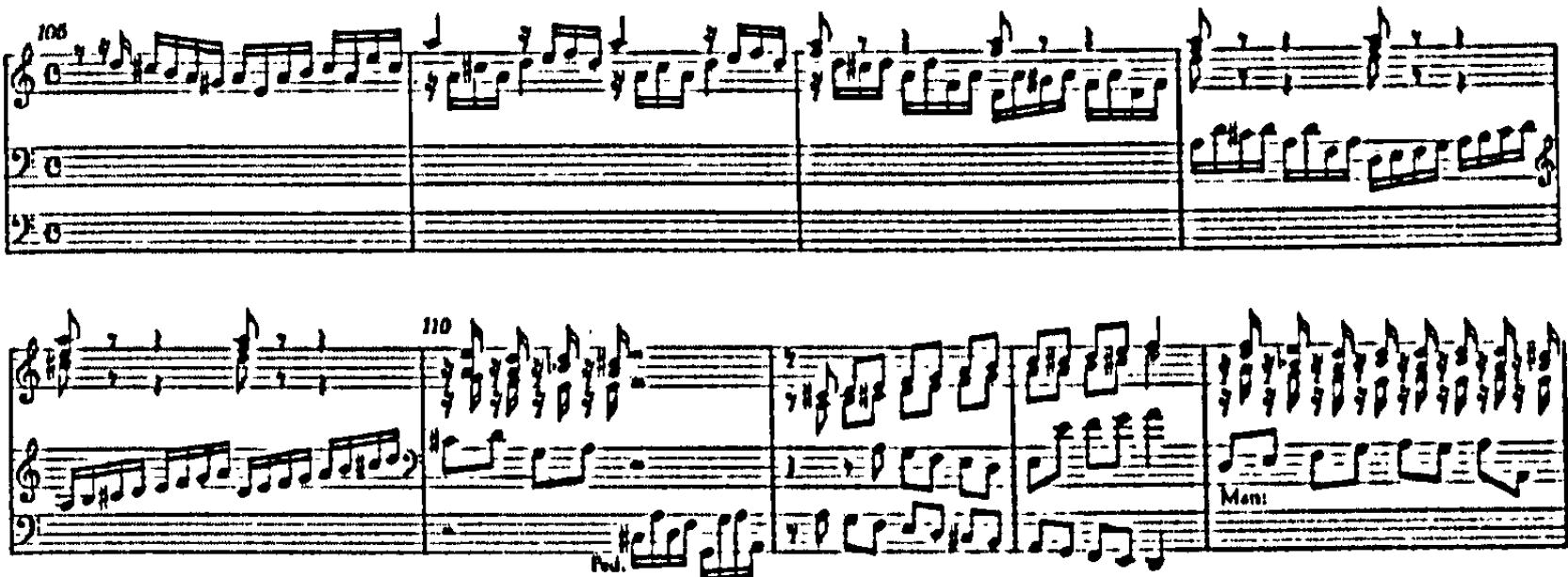
中文讲解
本条为图注,指向 Example 54,标注谱例覆盖 peroratio 的第 105–113 小节。该范围恰好对应前段所述 108–109 小节下属音 D 的强调、110 小节戏剧性的 aposiopesis,以及手动声部单音与和弦的交替,可与文字叙述互证。
补充说明
图注虽未给出谱面细节,但其小节范围界定了 aposiopesis 修辞格的精确位置,对理解后文“ando antitheton in bars 111-112”的空间坐标至关重要。
第6段(P0118)
原文复述
Some of the affective figures presented in the peroratio are reminiscent of those encountered in the introductory exordium, as, for instance, the pedal leaps on the third and fourth beats of bar 110, which reinforce the dramatic aposiopesis that dominates the manuals. Changes of texture and expressive figurations intensify the dramatic tension of the peroratio; for instance, the antitheton (contrapositum) in bars 111-112, although reminiscent of the antitheton heard in the narratio, receives now a different affective quality as a result of the composer’s effort to excite the listener’s attention.
中文讲解
本段继续展开 peroratio 的具体修辞特征,包含两条平行线索。第一条线索是“回忆”结构:peroratio 中的某些情感型动机与开篇 exordium 相互呼应,例如 110 小节第三、四拍上的脚键盘跳跃,强化了手动声部主导的戏剧性 aposiopesis,形成首尾呼应。第二条线索是“变形”结构:111–112 小节的 antitheton(亦称 contrapositum,对置修辞格)虽与 narratio 中出现的同名格相似,但因处于 peroratio 语境中而获得新的情感色彩——作者将其解读为作曲家刻意激起听众注意力的手段。本段在全节论证中的作用,是用具体谱面事例证明 peroratio 的双重身份:既以相似动机呼应 exordium,又以情感强度区别于 confirmatio,从而完成修辞学的“收束—煽情”任务。
补充说明
antitheton / contrapositum 在修辞学中指“对置”或“反命题”,在音乐修辞中常对应主题的对比式或反方向陈述;此处作者强调“同一修辞格、不同情感色彩”,暗示位置(语境)本身即塑造意义。
第7段(P0119)
原文复述
Example 55. BuxWV 153: peroratio (bars 114-124). [Image data embedded in original; position and caption preserved.]
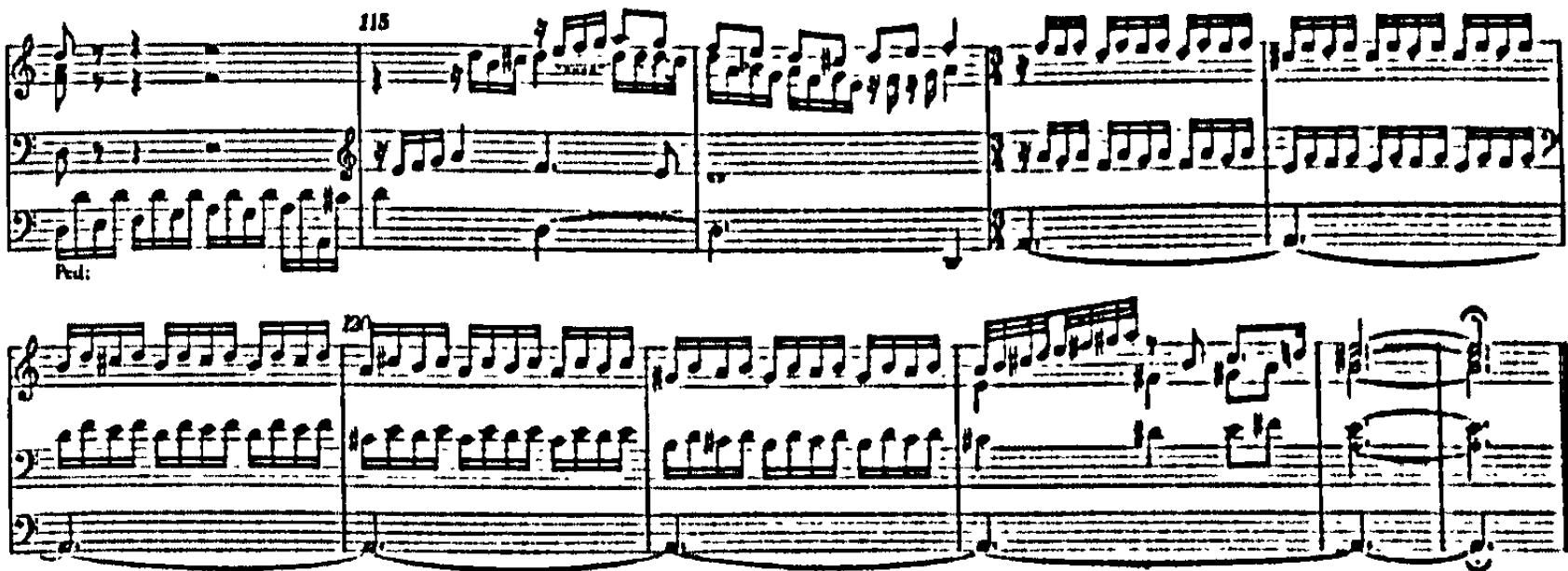
中文讲解
本条为图注,指向 Example 55,标注谱例覆盖 peroratio 的第 114–124 小节,是乐曲最末部分的视觉证据。该范围对应后文所述 3/4 拍转换(117 小节)、持续低音上的平行六度(117–121 小节)、快速 demisemiquaver 级进上行的 anabasis(122 小节)以及最终在 A 上的停顿,是收束段最具表现力的核心区段。
补充说明
图注为后段(peroratio 终结段落)的音乐修辞分析提供小节坐标,便于将 hyperbole、anabasis 等术语与具体谱面位置对应。
第8段(P0120)
原文复述
An alternation of single notes and chords in the manuals (bar 113) is followed by the pedal in bar 114, where the left-foot pedal repeats the notes assigned to the left-hand manual in the previous bar. The pedal passage concludes with a hyperbole figure that resolves in the subdominant D, where, after the intervention of semiquaver motives and broken chords, the texture shifts to 3/4 metre in bar 117. Finally, the tonic pedal is accompanied by the upper voices moving in parallel sixths (bars 117-121), leading, through a rapid scalar demisemiquaver anabasis (bar 122), to the final pause on A.
中文讲解
本段以具体小节为单位,勾勒 peroratio 的收束过程。其论证链条为:113 小节手动声部单音与和弦交替—114 小节脚键盘重复前小节左手材料(实现手动与脚键盘的音响统一)—脚键盘段以 hyperbole(夸张修辞格)结束并解决于下属 D—经过十六分音符动机与分解和弦的过渡后,117 小节拍号转为 3/4(重要的织体变化)—最后是 117–121 小节持续低音之上方声部作平行六度进行,并以 122 小节的 demisemiquaver 快速级进 anabasis(上行修辞格)推向 A 上的最终停顿。本段在全节中的作用是给出 peroratio 的“地形图”:从细节的动机接续(hyperbole)、到织体变化(3/4 拍号)、再到结尾的高潮性上升(anabasis),每一处都用一个音乐修辞术语命名,使听众理解作曲家如何一步步把听众推向终点。术语方面,hyperbole 形容脚键盘乐句的“夸张”表达,anabasis 则提示 122 小节的快速上行级进具有“攀登”式的修辞含义。
补充说明
anabasis 原为军事/修辞术语,指“上行进攻”;在音乐修辞学中常用于快速上行的音阶或分解和弦段落。final pause on A 在 d 小调语境中可被理解为属音上的停顿,是收束前的准备性解决点。
脚注 / 边栏 / 图表 / 附加信息(如有)
本节包含四幅图例(Example 52b、53、54、55),分别对应第 73–75、87–104、105–113、114–124 小节,起到把文字修辞分析落实到具体谱面位置的作用,是论证链条不可或缺的视觉证据,但原书图像数据未在文本中嵌入,需查阅原谱核对。
💡 本节核心要点
- confirmatio 维持了 exordium 与 narratio 应句中的上行四度 e–a 动机,主题依次在中音与下音上进入,形成清晰的展开;
- amplificatio(94–104 小节)被界定为 confirmatio 的“内部 peroratio”,以主题在 alto 中的最终进入作结;
- peroratio 与 confirmatio 形成功能对比:前者即兴化、强调情感张力,后者严谨有序、强调逻辑展开;
- peroratio 的戏剧性高点位于 110 小节,以 aposiopesis(突止)和脚键盘跳跃构成;
- 111–112 小节的 antitheton 虽与 narratio 中的同名格相似,却因处于 peroratio 而获得不同的情感色彩,体现“修辞格的位置决定其情感意义”;
- 全曲以 117 小节的 3/4 拍号转换、持续低音上的平行六度以及 122 小节的 demisemiquaver anabasis 推向 A 上的最终停顿。
🔑 关键术语
- confirmatio:修辞学中的“论证”环节,对应本曲中系统陈述并展开主题动机(上行四度 e–a)的段落。
- peroratio:修辞学中的“结尾”环节,对应本曲终段,功能与 exordium 相似,皆以吸引听众情感注意力为目的。
- amplificatio:修辞学中的“扩说”手法,通过对既有论点的强调性重复来强化论证;本曲中 94–104 小节被作者界定为 confirmatio 的内部 peroratio。
- exordium:修辞学中的“开端”环节,本曲中以引入上行四度动机并定调性的段落为代表。
- narratio:修辞学中的“叙述”环节,本曲中负责以应句形式首次呈现主题动机。
- antitheton (contrapositum):修辞学中的“对置”手法,本曲出现在 111–112 小节,呼应 narratio 中的同名格但获得新情感色彩。
- aposiopesis:修辞学中的“突止”手法,本曲 110 小节手动声部的单音与和弦交替构成戏剧性停顿。
- hyperbole:修辞学中的“夸张”手法,本曲指脚键盘段尾的夸张式乐句并解决于下属音 D。
- anabasis:修辞学中的“上行”手法,本曲指 122 小节 demisemiquaver 的快速级进上行段,推向最终停顿。
- Klangrede:作者用以指称整首前奏曲的概念——“以音响进行的演说”,即把修辞学结构映射到器乐作品上。
- mediant:三度音级;本曲 confirmatio 中主题于此进入(83–85 小节)。
- subtonic:七度音级(此处为大七度,对应 d 小调中的 C);本曲 confirmatio 中主题于此进入(85–87 小节)。
4.11 [描述性拆分] Bach’s Early Exposure to North German Organ Music
第1段(P0121)
原文复述
The multisectional toccata form, as developed by north German organ masters including D. Buxtehude, G. Böhm, and N. Bruhns, stimulated the early organ works of J. S. Bach. Philipp Spitta first presented the image of Dietrich Buxtehude as a father figure whose large-scale pedaliter praeludia survived in north German tablature sources and circulated in the inner Bach circle. The multistructural organ compositions of D. Buxtehude, who in Bach’s time held one of the most prestigious organ posts at St Marienkirche in Lübeck, attracted the attention of the young Bach who, in 1706/07, undertook a long journey from Arnstadt to Lübeck “[…] in order to comprehend one thing and another about his art.” However, even before Bach’s visit to Lübeck, middle, south, and north German organ works were familiar to the young composer. The so-called Andreas-Bach book and the Möller Handschrift, compiled after 1700 by Johann Sebastian’s elder brother and principal keyboard teacher Johann Christoph of Ohrdruf, signify the variety of stylistically different musical materials from the ‘international’ spectrum to which the young virtuoso was exposed. North German works, and particularly Buxtehude’s novel approach to the multisectional stylus phantasticus toccata, were undoubtedly familiar to Bach, who at an early compositional stage was eager to emulate the example of his predecessor. One of Bach’s earliest works dating probably from c.1703/04 (before his visit to Lübeck) and the only organ composition modelled so directly after the dispositio demonstrated in BuxWV 153 is the Prelude in A minor (BWV 551).
中文讲解
本段是4.11小节的开篇,确立核心论点:北德管风琴大师对巴赫早期作品有直接影响。论证分三层展开。第一层:Spitta首次将布克斯特胡德塑造为"父亲形象",其pedaliter praeludia通过北德塔布拉斯抄本在巴赫圈内流传。第二层:布克斯特胡德当时在吕贝克圣马利亚教堂担任最重要的管风琴职位之一,1706/07年青年巴赫长途跋涉从阿恩施塔特前往吕贝克,“以便了解他艺术中的一事一事”——此言是巴赫为回应阿恩施塔特教会质询其1705年降临节至1706年2月长期缺席所作的辩护。第三层:即使在吕贝克之旅前,巴赫已通过其兄兼主要键盘教师约翰·克里斯托夫·冯·奥尔德鲁夫在1700年后编纂的"Andreas-Bach book"和"Möller Handschrift"接触到中、南、北德各派风格。作者点明巴赫早期就熟悉北德作品,特别是布克斯特胡德多段式stylus phantasticus托卡塔的新颖处理,并急切模仿。最后引出BWV 551(A小调前奏曲)作为最早、最直接模仿BuxWV 153的dispositio的作品,约1703/04年,早于吕贝克之行。这一时间线为后续段落的具体音乐分析提供关键语境。
补充说明
“stylus phantasticus"指17世纪北德盛行的自由幻想风格,以即兴性和多段式结构为特征;“dispositio"为古典修辞学术语,此处指作品整体结构布局;“pedaliter"指使用踏 pedal(脚键盘)的作品,与"manualiter”(仅手键盘)相对;“BuxWV 153"为布克斯特胡德作品编号体系中的A小调前奏曲,是BWV 551的直接模仿对象。
第2段(P0122)
原文复述
Footnote 49: George B. Stauffer, The Organ Preludes of Johann Sebastian Bach, Studies in Musicology, 27 (Ann Arbor: UMI Research Press, 1980), p. 39.
中文讲解
此为P0121正文开篇主张"北德管风琴大师的多段式托卡塔形式激发了巴赫早期管风琴作品"的文献来源注,引自Stauffer关于巴赫管风琴前奏曲的专题研究第39页。该书是巴赫管风琴前奏曲研究领域的标准参考文献。
第3段(P0123)
原文复述
Footnote 50: Philipp Spitta, Johann Sebastian Bach: His Work and Influence on the Music of Germany, 1685-1750, vol. 1, pp. 256-310.
中文讲解
此注对应正文中"Philipp Spitta首次提出布克斯特胡德作为父亲形象"的具体出处,指向Spitta经典巴赫传记第一卷第256-310页关于早期影响的章节。Spitta是19世纪确立巴赫学术研究的奠基性学者,其传记至今仍被引用。
第4段(P0124)
原文复述
Footnote 51: Christoph Wolff, ‘Buxtehude, Bach, and Seventeenth-Century Music in Retrospect’, p. 44. This was Bach’s reply to the Arnstadt consistory in order to defend himself, when interrogated about the reasons for his prolonged absence from Arnstadt (from Advent 1705 to February 1706). See also Spitta, Johann Sebastian Bach, vol. 1, pp. 315-16; also Christoph Wolff, Johann Sebastian Bach: The Learned Musician, pp. 92-101.
中文讲解
此注解释巴赫"为了解他艺术中的一事一事"这句话的原始语境——这是巴赫为辩护其1705年降临节至1706年2月长期离开阿恩施塔特而向教会当局作出的回答。除Wolff文章外,还交叉参引Spitta传记和Wolff《The Learned Musician》。该脚注为后续段落提供关键历史背景,证明巴赫前往吕贝克是有意识的学习行为而非随意旅行,同时也揭示了教会对巴赫这一行为的质疑。
第5段(P0125)
原文复述
Footnote 52: The New Bach Reader: A Life of Johann Sebastian Bach in Letters and Documents, ed. by Hans T. David and Arthur Mendel, rev. and enl. by Christoph Wolff (New York: Norton, 1998), p. 11. For chronological evidence regarding Bach’s early organ compositions, see Friedrich Blume and Wilburn W. Newcomb, ‘J. S. Bach’s Youth’, The Musical Quarterly, 54 (January 1968), 1-30. The Andreas-Bach book and the Möller manuscript are discussed in detail in the Keyboard Music from the Andreas-Bach Book and the Möller Manuscript, ed. by Robert Hill, Harvard Publications in Music, 16 (Cambridge, MA: Harvard University Press, 1991). The research presented in volume 16 of the Harvard Publications is an amplified version of R. Hill’s Ph.D dissertation; see Robert Hill, ‘The Möller Manuscript and the Andreas Bach Book: Two Keyboard Manuscripts from the Circle of the Young Johann Sebastian Bach’ (Ph.D. dissertation), Harvard University, 1987 (UMI Microfilm No. 87-00787).
中文讲解
此为关于"Andreas-Bach book"和"Möller Handschrift"的多层文献指引。首先引《New Bach Reader》第11页作为正文核心信息的来源;然后引Blume与Newcomb在《音乐季刊》的文章作为巴赫早期作品编年的证据;最后指出Robert Hill主编的Harvard Publications第16卷详细讨论了这两份手稿,并提示该卷是Hill博士论文的扩展版(哈佛大学1987年,UMI缩微胶卷号87-00787)。这一脚注为"青年巴赫在吕贝克之旅前已接触多种风格材料"的主张提供了谱例学和编年学两方面的支撑。
第6段(P0126)
原文复述
According to Spitta, this particular piece, if indeed a work by Bach, “[…] has the appearance of having been merely a reminiscence and not a new formation resulting from the assimilation of foreign elements; as if it had been written before Buxtehude’s manner had become quite comprehensible, and as it were living to the composer.” BWV 551 undoubtedly dates from before Bach’s E major Toccata (BWV 566), another clear example of Buxtehude’s stamp on Bach’s style, although certain motivic and structural differences tend to distinguish one piece from the other. Bach’s Prelude in A minor demonstrates the structure encountered in Buxtehude’s pedaliter praeludia: introduction (exordium), first fugue (narratio), second fugue (confirmatio: double fugue), and free concluding section (peroratio). Although BWV 551 illustrates a more complicated dispositio with the addition of an affective section (digressio) between the two fugal textures, the work shows a rationally arranged multisectional plan where different textures are tightly woven within a large-scale formal design.
中文讲解
本段从Spitta的怀疑切入:即使BWV 551确为巴赫所作,它"看起来只是回忆,而非吸收外来元素后的新构造”,仿佛写于巴赫尚未真正理解布克斯特胡德风格之时。这一判断为后文的修辞学分析埋下伏笔——作者将证明这种表面模仿实际上包含更精密的修辞处理。本段还确认BWV 551早于E大调托卡塔BWV 566(后者也是巴赫受布克斯特胡德影响的明显例证),但两首作品在某些动机与结构上有所区别。重要的是,作者给出BWV 551的具体修辞结构布局:引子(exordium)—第一赋格(narratio)—第二赋格(confirmatio,双赋格)—自由结束段(peroratio)。与布克斯特胡德的pedaliter praeludia相比,BWV 551在两段赋格之间加入情感性段落(digressio),使dispositio更复杂,但整体仍是理性安排的多段式计划,不同织体在大规模形式设计中紧密交织。这一段为后续段落对该曲的具体音乐分析奠定形式框架。
补充说明
“BWV 551"和"BWV 566"是巴赫作品编号( Bach-Werke-Verzeichnis)中的编号,分别对应A小调前奏曲和E大调托卡塔。Spitta的怀疑态度反映了19世纪学者对巴赫早期作品归属的审慎标准。
第7段(P0127)
原文复述
Just like Buxtehude’s Prelude in A minor, BWV 551 commences with a free introduction (exordium) where Bach makes clear his intentions: to grasp the listener’s attention. Manual tail-chasing passages reminiscent of Buxtehude’s Prelude in G minor (BuxWV 149, see example 57) dominate the first seven bars of the exordium. Additionally, points of imitation between the manuals (bar 8) followed by a striking descending saltus duriusculus (f-g#) in the lower voice culminate in a virtuosic pedal passage (bar 9, figure accentus/superjectio).
中文讲解
本段开始对BWV 551的具体音乐分析,从引子(exordium)入手。作者指出巴赫引子的修辞意图明确——“抓住听众注意力”,这与布克斯特胡德A小调前奏曲的处理一致。前7小节的手键盘"追逐式"经过句让人联想到布克斯特胡德G小调前奏曲(BuxWV 149,见谱例57);第8小节出现手键盘之间的模仿对位;随后低音出现下行"不和谐跳进”(saltus duriusculus,f-g#),并在第9小节引向炫技性踏 pedal段落(修辞格accentus/superjectio)。作者使用了系统的音乐修辞学术语,并通过引用BuxWV 149建立直接的音乐风格关联,证明巴赫在模仿中已经形成了独立的处理方式。每个术语都对应具体的修辞功能:saltus duriusculus制造紧张感,accentus/superjectio突出重音,两者的连续使用构成引人注目的开场效果。
补充说明
“saltus duriusculus"是音乐修辞学(musical rhetoric)中的术语,源自古典修辞学,指音乐中令人不适或尖锐的跳进,此处为下行f-g#;“accentus"和"superjectio"均为音乐修辞格,分别表示强调和重音叠加;“example 57"指向书中包含BuxWV 149谱例的图示编号。
第8段(P0128)
原文复述
Footnote 53: Karl Keller, ‘Norddeutsche Musikkultur als Traditionsraum des jungen Bach’, Bach-Jahrbuch, 75 (1989), 7-19. See also Friedhelm Krummacher, ‘Bach und die norddeutsche Orgeltoccata: Fragen und Überlegungen’, Bach-Jahrbuch, 71 (1985), 119-34.
中文讲解
此注对应P0121正文中"北德作品,尤其是布克斯特胡德多段式stylus phantasticus托卡塔的新颖处理,青年巴赫无疑熟悉"这一主张。引自Keller 1989年《巴赫年鉴》文章关于"北德音乐文化作为青年巴赫的传统空间”,并参引Krummacher 1985年关于巴赫与北德管风琴托卡塔关系的文章。这两篇德语学界的经典研究为"巴赫熟悉北德风格"这一前提提供学术基础,同时也提示本研究在德语巴赫学界的语境。
第9段(P0129)
原文复述
“[…]
中文讲解
此条原文仅含”[…]“标记,表明原文此处存在OCR不清或脚注延续占位符。根据其位置紧跟P0127之后,应为P0127中提到的具体音乐要素(如谱例57或相关引文)的脚注延续,但具体内容因原文OCR不清而无法复述。在文本处理中应标记为"需查看原文"以避免误读。
补充说明
此占位符可能为脚注内容的OCR残缺或延续标记,需查阅原始版本才能确认其指向内容;从上下文看,最可能对应P0127中引用的BuxWV 149谱例或其他音乐要素的说明。
第10段(P0130)
原文复述
Footnote 54: Stauffer, pp. 100-01. According to McLean (1993), this work “[…] surely dates from Bach’s return from Lübeck, and not before 1706.” See Hugh J. McLean, ‘BWV 551, A Bachian Orphan’, in Bach (The Journal of the Riemenschneider Bach Institute), 24 (1993), 35-42 (p. 37).
中文讲解
此注对应P0121中BWV 551"约1703/04年,早于巴赫访问吕贝克"的编年判断。Stauffer在书中第100-101页支持这一较早年代;但McLean 1993年《BWV 551:一个巴赫孤儿》(Bachian Orphan)文章第37页提出相反观点,认为该作"确定写于巴赫从吕贝克返回之后,而非1706年前”。两种意见的分歧体现了学界对BWV 551编年的持续争论。McLean文章标题"orphan”(孤儿)一词暗示了对该作品归属的怀疑——因来源模糊而难以确定其"父(作者)"。这一编年争议直接关系到本节关于巴赫是否在吕贝克之旅前就熟悉布克斯特胡德风格的核心论点。
补充说明
“Bachian Orphan"这一比喻源自莎士比亚《哈姆雷特》中"ophan"或类似用法,在此特指来源不明、归属存疑的孤儿式作品;McLean文章发表于Riemenschneider Bach Institute的Bach期刊,是巴赫研究的重要英文期刊之一。
第11段(P0131)
原文复述
Footnote 55: Spitta, Johann Sebastian Bach, vol. 1, p. 319.
中文讲解
此注对应P0126中Spitta关于BWV 551"仅是回忆而非新构造"的长引文,引自Spitta传记第一卷第319页,为该判断提供原始出处。Spitta的这一长引文是本节对BWV 551展开细致修辞学分析的起点——作者需要回应Spitta的怀疑,证明该曲并非单纯的回忆,而是经过理性构造的修辞作品。
第12段(P0132)
原文复述
Footnote 56: Although scholars tend to consider BWV 566 the most conspicuous example of Bach’s elaboration on the north German organ toccata, the rhetorical analysis presented here aims to prove that BWV 551 is more closely related to the Buxtehudian stylus phantasticus free prelude than the structurally different Toccata in E major. The main points of difference between the two pieces will be discussed in the following pages.
中文讲解
此注是作者最重要的研究立场声明。虽然学界通常认为BWV 566(E大调托卡塔)是巴赫对北德管风琴托卡塔最显著的发挥,但本书的修辞学分析旨在证明:BWV 551与布克斯特胡德stylus phantasticus自由前奏曲的关系比与结构不同的E大调托卡塔更密切。这一声明揭示了作者论文的核心创新点——把学术注意力从BWV 566转向BWV 551,并预告后文将详细讨论两首作品的差异要点。作者通过否定学界共识来确立自身研究的独特价值,这种修辞策略在学术写作中较为大胆,但与本节"BWV 551呈现比Buxtehude更复杂的dispositio"的论点形成呼应。
补充说明
此脚注实质上承担了论文的"研究问题陈述"功能,是阅读后续段落时理解作者论证方向的关键指引。
脚注 / 边栏 / 图表 / 附加信息(如有)
本小节包含多条脚注(49-56)和一处OCR占位符。脚注49-52为正文中关于北德管风琴大师、巴赫与布克斯特胡德关系、Andreas-Bach book与Möller Handschrift的文献来源;脚注53为北德传统对青年巴赫影响的学术研究指引;脚注54呈现BWV 551编年争议(Stauffer与McLean对立观点,McLean以"Bachian Orphan"为题暗示归属问题);脚注55为Spitta对BWV 551评价的原始出处;脚note 56是作者研究立场的关键声明,预示后文将论证BWV 551比学界通常推崇的BWV 566更接近布克斯特胡德的stylus phantasticus自由前奏曲。文中提到的"example 57"为图示引用,指向BuxWV 149的谱例(位于书中第23页附近)。P0129处的”[…]“为OCR不清或脚注延续占位符,需查阅原书确认其具体内容。
💡 本节核心要点
- 北德管风琴大师(Buxtehude、Böhm、Bruhns)的多段式托卡塔形式激发了巴赫早期管风琴作品的创作,本节以此作为基本前提;
- 布克斯特胡德通过北德塔布拉斯抄本在巴赫圈流传,Spitta首次塑造其"父亲形象”,其当时在吕贝克圣马利亚教堂担任最负盛名的管风琴职位之一;
- 巴赫1706/07年长途跋涉至吕贝克是带有明确学习目的的行为(“为了解他艺术中的一事一事”),但即使在此之前,他已通过兄长编纂的Andreas-Bach book和Möller Handschrift接触到中、南、北德的国际风格;
- BWV 551(A小调前奏曲,约1703/04)是巴赫最早、最直接模仿BuxWV 153布局的作品,但学界对其编年存在Stauffer(约1703/04)与McLean(1706年后)两派对立意见;
- BWV 551呈现布克斯特胡德pedaliter praeludia的修辞结构:exordium—narratio—confirmatio—peroratio,并在两段赋格之间加入digressio使其dispositio更为复杂;
- 作者提出核心论点(脚注56):BWV 551与布克斯特胡德stylus phantasticus自由前奏曲的关系比学界通常推崇的BWV 566更密切,以此将BWV 551从边缘作品提升为理解巴赫与北德传统关系的核心例证。
🔑 关键术语
- stylus phantasticus:17世纪北德盛行的自由幻想风格,以即兴性、多段式结构和炫技性为特征,是Buxtehude和早期Bach托卡塔与前奏曲的美学基础。
- pedaliter praeludia:使用踏 pedal(脚键盘)的前奏曲类型,区别于仅用手键盘的manualiter作品;pedaliter作品以大规模形式和踏 pedal炫技为标志,是北德管风琴传统的核心体裁。
- dispositio:源自古典修辞学的术语,此处指作品整体结构布局,即各部分如何按修辞逻辑安排,是本节分析BWV 551的关键框架概念。
- exordium / narratio / confirmatio / digressio / peroratio:古典修辞学五段式结构术语,分别对应引子、叙述、确认、离题(情感性插入段)、结尾;本节用此系统描述BWV 551的段落功能。
- saltus duriusculus:音乐修辞学术语,源自古典修辞学,指音乐中令人不适或尖锐的跳进;本节中特指P0127所述的下行f-g#,用于制造紧张感。
- accentus / superjectio:音乐修辞格,分别表示强调(accentus)和重音叠加(superjectio);本节用此描述BWV 551引子末段(第9小节)踏 pedal炫技段落的修辞功能。
4.12 [描述性拆分] BWV 551: Exordium and Narratio
第1段(P0133)
原文复述
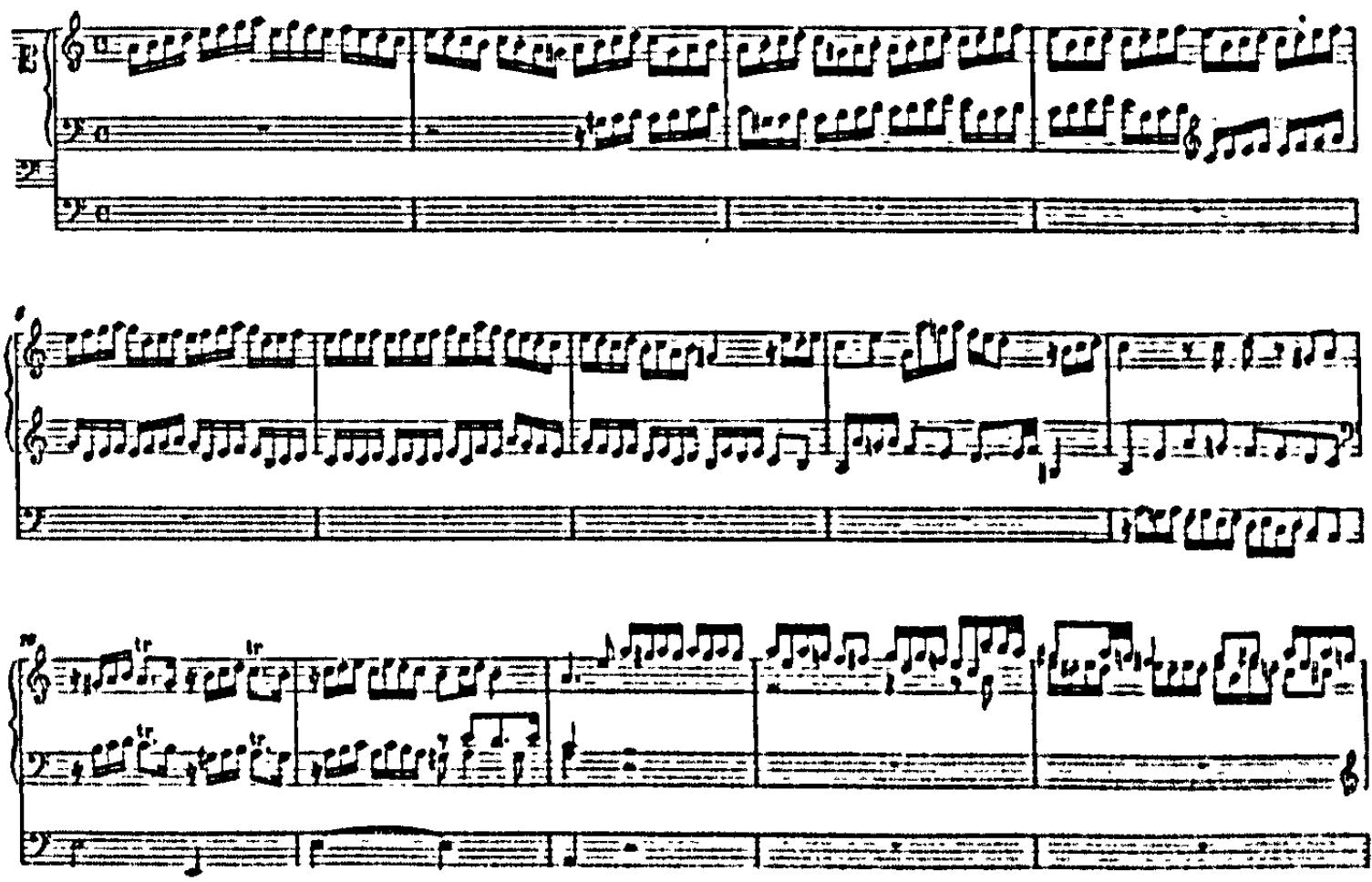
中文讲解
这是Example 56的图注,标明了乐谱示例对应的是巴赫BWV 551《A小调前奏曲》的exordium(开端部)与narratio(叙事部)部分,覆盖第1—14小节,并附带尾注57。图像数据本身在原文中已缺省,需查阅原书或谱例以确认具体音型。从脚注57的归属判断,本节对BWV 551的谱面引用以《新巴赫全集》(Neue Bach Ausgabe)为底本。
补充说明
图注所标的小节范围(bars 1–14)正好对应本节论述的exordium与narratio两段,可与P0135、P0138的论述相互对照。
第2段(P0134)
原文复述

中文讲解
这是Example 57的图注,对应布克斯特胡德BuxWV 149《G小调前奏曲》的exordium部分第4—6小节。该谱例用于在P0135中将BWV 551的踏板accentus与布克斯特胡德作品的同类手法进行对比参照。图像数据缺省,需查阅原书谱例。
补充说明
图注中提及的BuxWV 149在P0135中作为比较对象出现,说明BWV 551踏板上的accentus写法并非孤例,而是与北德传统存在渊源。
第3段(P0135)
原文复述
The accentus in the pedal, also encountered in Bach’s chorale prelude Christ lag in Todesbanden from the Orgelbüchlein (in the pedal) and in Buxtchude’s Durch Adams Fall (in the cantus firmus), ends in a dominant pedal e in bars 10-11. From that point, the upper voices demonstrate a series of motives stressed through figurae suspirans rests, each time heard at higher pitches (polyptoton) and in a parallel motion, leading finally to the tonic A (bar 12).
中文讲解
本段讲述BWV 551 exordium后半段的音乐走向。踏板上的accentus写法并非BWV 551独有——同样的手法也见于巴赫《众赞诗前奏曲集》中《Christ lag in Todesbanden》(在踏板上)以及布克斯特胡德的《Durch Adams Fall》(在cantus firmus中)。这种accentus在第10—11小节以持续的属音E作为踏板音结束。从该点开始,上方声部出现一系列动机,每一动机都用figura suspirans(叹息式休止)加以强调,并以平行运动的方式逐次在更高的音高上重复出现——这种手法术语称作polyptoton(重复修辞)。这一系列上行的动机最终在第12小节导向主音A,标志exordium结束并进入narratio。本段的功能是:先把exordium内部最具特征的处理(踏板accentus + 上方声部的polyptoton上行)讲清楚,并通过对照巴赫和布克斯特胡德的同类手法,说明这种写法属于北德管风琴前奏曲的传统。需注意,polyptoton本是一个古典修辞学术语(同一词根的重复),作者在此用来描述音乐上同一动机在不同音高上的反复,属于音乐—修辞类比的方法。
补充说明
figura suspirans与polyptoton两个术语都来自作者所使用的音乐—修辞分析体系;polyptoton的具体作用是描述同一动机在不同音高上的多次陈述。
第4段(P0136)
原文复述

中文讲解
这是Example 58的图注,对应BWV 625《Christ lag in Todesbanden》的踏板superjectio(上方声部齐奏式进入)写法,涵盖第1—2小节。该谱例作为P0135中所提踏板accentus的比较对象之一被引用。图像数据缺省,需查阅原书。
补充说明
图注所用的术语superjectio(上方声部齐奏进入)与P0135中讨论的踏板accentus属于同一类音乐—修辞概念,但强调的是上方声部在踏板音之上的齐奏进入。
第5段(P0137)
原文复述
$^{57}$ BWV 551 and BWV 566 are drawn from the Neue Bach Ausgabe of Bach’s complete organ works; see Johann Sebastian Bach, Orgelwerke, ed. by Dietrich Kilian, Urtext of the New Bach Edition, vol. 6: Preludes, Toccatas, Fantasias and Fugues II (Kassel: Bärenreiter Verlag, 1964).
中文讲解
这是尾注57的内容,说明本节涉及BWV 551和BWV 566的谱例均取自巴赫管风琴作品《新巴赫全集》(Neue Bach Ausgabe)的Urtext(净版)版本:Johann Sebastian Bach, Orgelwerke, ed. by Dietrich Kilian, Urtext of the New Bach Edition, vol. 6: Preludes, Toccatas, Fantasias and Fugues II(Kassel: Bärenreiter Verlag, 1964)。该脚注为Example 56提供版本依据,属于来源类脚注,用以确保谱例引用的权威性与可查证性。
第6段(P0138)
原文复述
The end of the exordium is marked abruptly by a perfect cadence that marks the entrance of the narratio fugue, the first note of the subject overlapping the second beat of bar 12 (the same procedure encountered in BuxWV 153). The narratio illustrates a conservative type of imitative counterpoint (seventeen bars long), with its long fugal subject pointing to the north German tradition of repeated and chromatic elements. The subject contains three motives, two of which reappear in the second fugal section of this piece. The first motive is the (three times) repeated semiquaver figure (a”-g#”) that appears only in the narratio. The second is the semiquaver four-note pattern consisting of perfect fourth and major second intervals (a”-c"-a"-g" natural and g"-d"-g"-f" natural), while the third is the rising chromatic quaver figure (f"-f#").
中文讲解
本段转入narratio(叙事部)的论述。首先,exordium的结束被一个全终止(perfect cadence)突然切分,narratio赋格的进入发生在第12小节第二拍上——主题的首音与该拍重叠(这一处理与BuxWV 153相同)。接着,作者刻画narratio赋格的整体属性:长达17小节,属于"保守型"的模仿对位,其较长的赋格主题体现出北德传统中重复与半音化元素的特征。主题由三个动机组成,其中后两个动机在作品的第二赋格段中再现。第一个动机是三度音程(a"–g#")的十六分音符三连重复,仅出现在narratio中;第二个动机是含纯四度与大二度音程的十六分音符四音音型,给出了两套音高实例(a"-c"-a"-g" natural 以及 g"-d"-g"-f" natural);第三个动机是上行的半音八分音符(f"–f#")。理解要点:作者对"保守"一词的使用不是贬义,而是指其写法承接北德传统;对三动机的列举直接为后文讨论narratio内部对位与主题再现提供了索引。
补充说明
三个动机中只有第二个动机给出了两套不同的音高起点的实例,说明该动机在主题陈述时已被以变化形式重复使用;这是为后文讨论主题在第二赋格中的再现做铺垫。
第7段(P0139)
原文复述

中文讲解
这是Example 59的图注,对应BWV 551 narratio主题第12—13小节的细节。该谱例与P0138中对主题三动机的描述直接对应,供读者通过乐谱核对三动机的具体音型与节奏。图像数据缺省,需查阅原书。
补充说明
图注标明仅显示bars 12–13的"detail"(细节),而非完整主题陈述,提示该谱例聚焦于三动机最关键的起始音型。
第8段(P0140)
原文复述
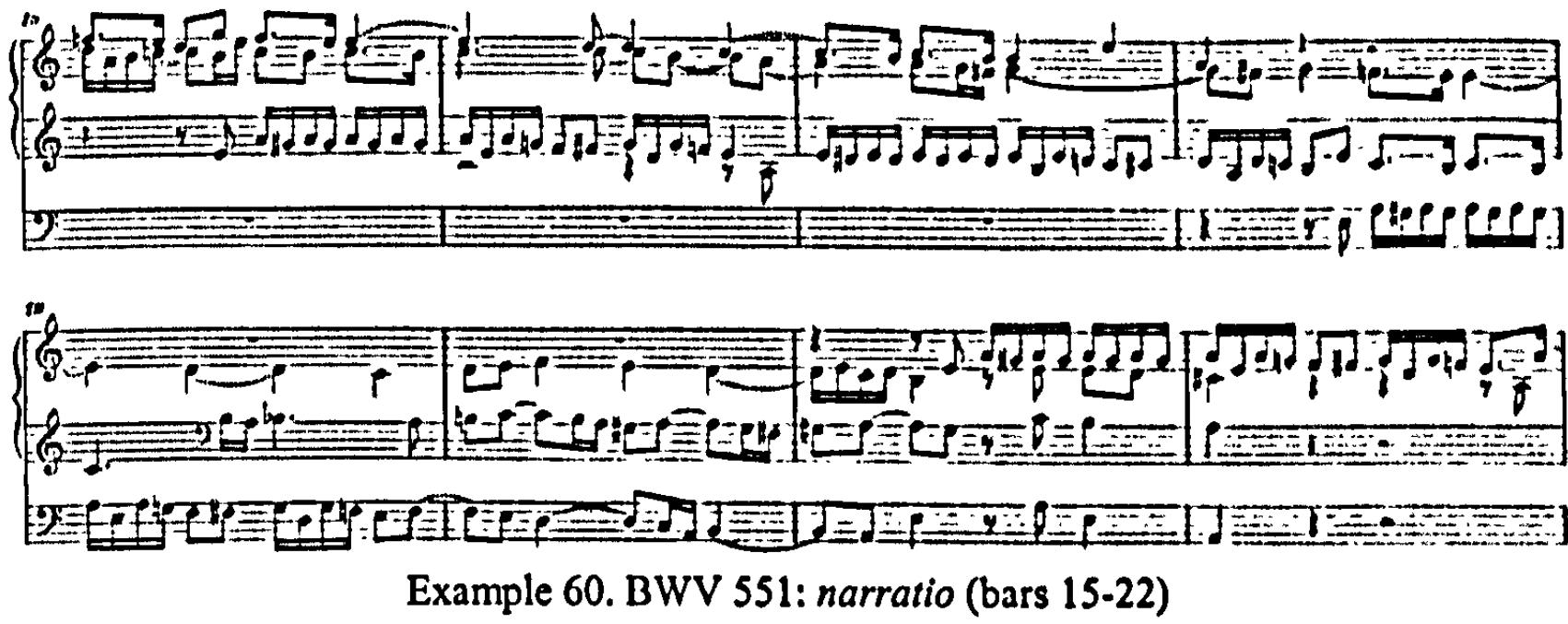
中文讲解
这是第25页上一个未能识别具体编号与标题的图像占位符,仅能确认它出现在该页的版面位置上。图像数据缺省,需查阅原书以确认其归属。由于本段没有正文叙事,分析仅停留在版面信息层面。
第9段(P0141)
原文复述
Although there is no clear countersubject present in the narratio, Bach sets the chromatic quaver motive and the four-note semiquaver segment against the tonal answer to the subject in bars 13-14. There are two expositions with five and four entries of the subject respectively. The first one ends in bar 21, while in the counter-exposition (starting from bar 21) Bach again sets the semiquaver motive and the chromatic quaver segment against the answer in the alto voice (bars 23-24). The subject is heard once more in the tenor, while the pedal answers shifting the contrapuntal texture to C major (bars 27-28), where the narratio concludes.
中文讲解
本段继续narratio的内部对位分析。首先,作者强调narratio中并无明确的对题(countersubject),但巴赫在第13—14小节把半音八分音符动机和四音十六分音符片段与主题的调性答句(tonal answer)叠置。narratio包含两段呈示段(exposition):第一段含五次主题进入,结束于第21小节;第二段为counter-exposition(对答呈示段),从第21小节开始,含四次主题进入;在第23—24小节中,巴赫再次把十六分音符动机与半音八分音符片段置于中音声部,与答句对置。主题在次中音(tenor)声部再次出现,而踏板则以答句回应,将对位织体转入C大调(第27—28小节),narratio至此结束。理解要点:作者通过"无明确对题但动机反复与答句对置"来概括巴赫处理narratio内部对位的手法;narratio以转调到C大调作结,为下一段(P0142描述的C大调perforatio段落)做准备。
补充说明
counter-exposition与exposition的区分提示第二段并非简单的主题再次陈述,而是结构上的应答式呈示;narratio结束于C大调,与P0142中C大调持续音和弦形成直接呼应。
第10段(P0142)
原文复述
The cadence on C major that signifies the end of the narratio gives way to a short affective section (bars 29-31) functioning (as is the fashion with Buxtehude’s preludes) as an internal peroratio following the narratio. However, the internal peroratio does not employ any of the quaver and semiquaver elements presented already; rather, it introduces improvisatory rhythmical patterns that contradict the preceding fugal section and establish the C major key (repeated C major chords in bars 29-31). Starting with a figura suspirans, bar 29 introduces a basic motive that is heard in the two following statements at higher pitches (polyptoton). Furthermore, a melodic embellishment in bar 31, intensified by a figura suspirans, demonstrates a tirata mezza (beats 2-3: ascending b’-e") and a tirata defectiva (beats 3-4: descending interval e"-f#") figures; these are followed by a demisemiquaver ascending ornament that brings the free section to a deceptive conclusion.
中文讲解
本段描述紧接narratio之后的内peroratio(内部总结段),位于第29—31小节。其位置与布克斯特胡德前奏曲中narratio后的内peroratio传统一致;但本段中巴赫并未使用此前已出现的八分音符或十六分音符素材,而是引入即兴化的节奏型——这与narratio的赋格织体形成对比,并通过第29—31小节持续的C大调和弦来巩固C大调调性。第29小节以figura suspirans引入一个基本动机,其后两次以更高音高重复出现(polyptoton)。第31小节中一段旋律装饰,由figura suspirans加强,呈现两种修饰:tirata mezza(第2—3拍:b’–e"的上行)和tirata defectiva(第3—4拍:e"–f#“的下行);其后紧接一个上行的三十二分音符装饰,使该自由段以"伪终止”(deceptive conclusion)作结。本段的作用有三层:一是说明narratio结束后如何过渡到下一段;二是强调该段通过引入新材料(C大调和弦 + 即兴节奏)形成与赋格段的对立;三是为下文的noema(digressio)段落(P0144)做节奏与和声上的铺垫。术语方面,tirata mezza与tirata defectiva是巴赫时代器乐装饰的常见分类,前者为"完整音阶式跑动",后者为"中断式下行音阶";deceptive conclusion(伪终止/伪解决)指终止式未能落到预期调性,而是转到其他和弦上。
补充说明
内peroratio结束于"伪终止",这一细节与P0144中所说自由段被"突然切断"并进入noema的衔接方式相互呼应:deceptive conclusion为noema的进入提供修辞上的突然性。
第11段(P0143)
原文复述
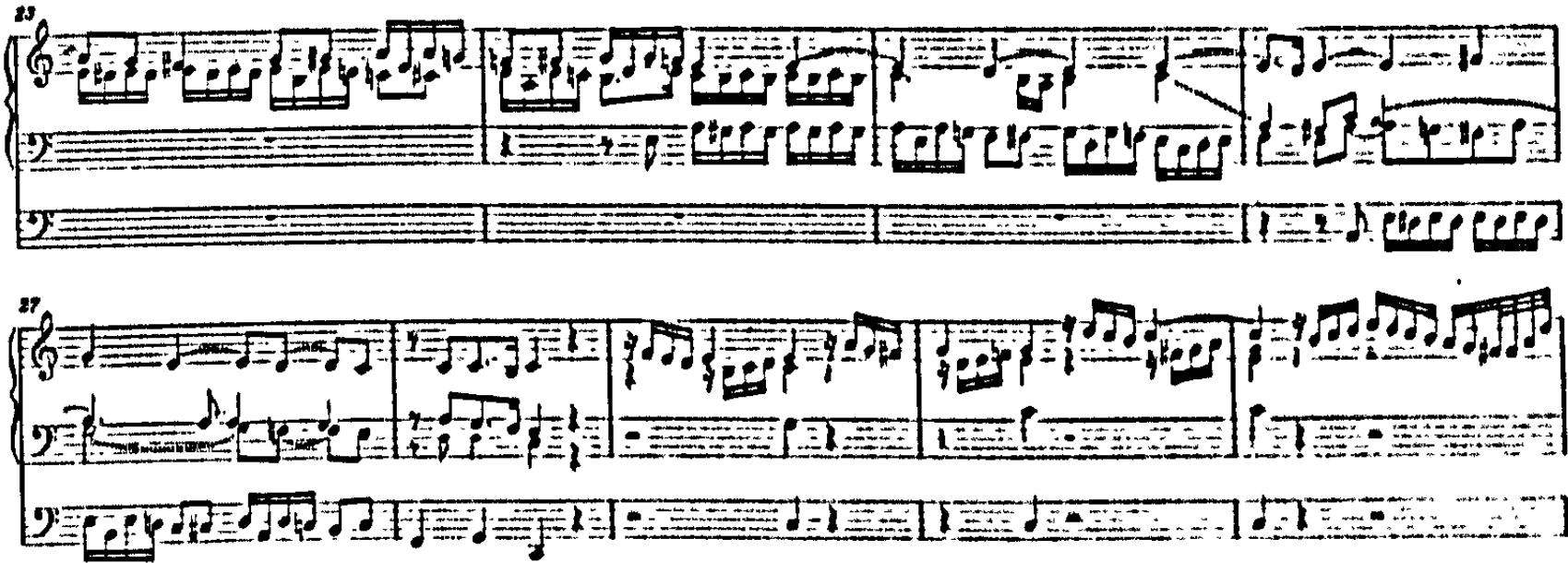
中文讲解
这是Example 61的图注,对应BWV 551第23—31小节,涵盖narratio的后段(含counter-exposition)与内peroratio。该谱例的覆盖范围跨越P0141和P0142两段论述,使读者能直观对照巴赫在同一谱面中所做的两种处理:赋格对位段与即兴化自由段。图像数据缺省,需查阅原书。
补充说明
该图注的小节范围(23–31)同时包含counter-exposition和内peroratio,说明作者刻意让两者在谱面上并列呈现,以体现其对比。
第12段(P0144)
原文复述
The third section of the prelude displays a free chordal interlude that demonstrates a digressive content compared to the parts preceding and following it. The free texture is cut off abruptly and a homophonic segment, named in rhetorical terms noema, appears as an intermediate step that bridges the two fugues within the Klangrede. In BWV 551, the noema signifies a digressio, a rhetorical deviation Quintilian suggested the orator employed occasionally in his discourse in order to link the narratio (statement of facts) to the confirmatio (proofs). $^{58}$ Joachim Burmeister first described noema as a homophonic passage in the middle of a composition that was in sharp contrast to the surrounding contrapuntal texture. $^{59}$ Bold chromaticism and suspensions apparent in the noema under discussion (bars 32-39) are reminiscent of figurations encountered in toccatas by Frescobaldi, which in most cases call for the elaboration of the passage with ornamental figures. North German organ works, such as those by Bruhns and Buxtehude, usually incorporate similar homophonic sections; Buxtehude’s Prelude in D major (BuxWV 139), for instance, demonstrates a noema immediately after the confirmatio, yet its function in that particular work is different to the one encountered in BWV 551. $^{60}$
中文讲解
本段论述前奏曲的第三段——一段自由式的和弦性间插,其内容具有digressive(离题/插叙性)特征,与前后段形成对比。自由织体被突然切断,随即出现一个同音齐奏的片段,修辞术语称为noema,它在Klangrede(音辞演说)内部充当连接两段赋格的中间步骤。在BWV 551中,noema代表digressio(离题/插入),即昆体良(Quintilian)所建议演说家在narratio(事实陈述)与confirmatio(论证)之间偶尔使用的修辞离题。Joachim Burmeister最先将noema描述为乐曲中部与周围对位织体形成鲜明对比的同音齐奏段落。该noema(第32—39小节)中明显的半音化与挂留音,让人联想到弗雷斯科巴尔迪(Frescobaldi)托卡塔中遇到的装饰型——后者通常要求用装饰音对该段加以润色。北德管风琴作品(如布鲁恩斯Bruhns与布克斯特胡德Buxtehude的作品)通常也包含类似的同音齐奏段;例如布克斯特胡德《D大调前奏曲》(BuxWV 139)在confirmatio之后也出现一段noema,但其在该作品中的功能与BWV 551中的功能不同。本段的功能是:通过引入修辞学概念(digressio / noema)将BWV 551的中间齐奏段定位为连接narratio与confirmatio的修辞环节;通过对比布克斯特胡德BuxWV 139,强调noema在不同作品中的功能差异——此处的noema起到离题/衔接作用,而非位于confirmatio之后。修辞学参照系(昆体良 + 伯迈斯特)是本段乃至全节的关键分析框架。
补充说明
本段末尾处标有尾注60的钩标,但提供的输入中并未给出尾注60的具体内容;尾注58(P0145)的指向可在第2章95—96页找到,但本段文字未对应到具体的尾注内容。Klangrede(音辞演说)一词属作者核心理论术语,将整首前奏曲视为一篇完整的修辞演说。
第13段(P0145)
原文复述
$^{58}$ For the rhetorical definition of the digressio according to Quintilian, see Chapter 2 of the present work, p. 95-96.
中文讲解
这是尾注58的内容,提示关于昆体良(Quintilian)对digressio的修辞定义,可参见本著作第2章第95—96页。该脚注属于来源类脚注,对应P0144中所引昆体良关于digressio(离题/插入)的论述,为该修辞术语提供章节内的定义来源。
补充说明
尾注58的位置与P0144正文完全对应;尾注59(P0144中提及伯迈斯特对noema的定义)和尾注60(BuxWV 139功能的对比)在提供的输入中未给出脚注主体,因此不予补写。
脚注 / 边栏 / 图表 / 附加信息(如有)
本节包含的辅助材料主要有三类:(1)谱例图注:Example 56(BWV 551 exordium与narratio,bars 1–14)、Example 57(BuxWV 149 exordium,bars 4–6)、Example 58(BWV 625 superjectio pedal,bars 1–2)、Example 59(BWV 551 narratio主题,bars 12–13细节)、Example 61(BWV 551 narratio与内peroratio,bars 23–31)以及一个未识别编号的第25页图像占位符。这些谱例分别服务于exordium的踏板accentus、narratio主题三动机、counter-exposition与内peroratio对比等论述节点;除P0140外均与正文叙事明确对应。(2)尾注57:交代BWV 551与BWV 566的谱面底本为《新巴赫全集》第6卷Urtext版(Bärenreiter, 1964),属版本来源类脚注。(3)尾注58:指引digressio的修辞定义见本著第2章95—96页,属交叉引用类脚注。文中另两处提及但未在提供的输入中出现的尾注(59、60),其内容超出本节输入范围,故不补写。
💡 本节核心要点
- BWV 551的exordium以踏板accentus写法(与北德传统中的巴赫、布克斯特胡德同类手法一脉相承)开始,并在第10—11小节以持续的属音E踏板结束;其后上方声部以figura suspirans强调的动机通过polyptoton在更高音高上重复,最终在第12小节达到主音A。
- exordium被一个全终止突然切断后,narratio赋格以主题首音与第12小节第二拍重叠的方式进入;其长达17小节的赋格主题含三个动机(重复三度十六分音符、含纯四度与大二度的四音十六分音符片段、上行半音八分音符),后两动机在第二赋格段中再现。
- narratio内无明确对题,但巴赫反复将半音八分音符与四音十六分音符片段与答句对置;该赋格含两段呈示段(第一段5次进入,第二段counter-exposition 4次进入),最终在第27—28小节转入C大调结束。
- narratio之后的内peroratio(第29—31小节)放弃既有八分与十六分音符素材,引入即兴化节奏与持续的C大调和弦,并以tirata mezza、tirata defectiva以及三十二分音符上行装饰构成的"伪终止"作结。
- 第三段为自由式的和弦性间插,被突然切断后进入一段同音齐奏的noema(第32—39小节),在Klangrede中充作连接两段赋格的digressio,对应昆体良修辞体系中narratio与confirmatio之间的"离题"环节,并借鉴伯迈斯特对noema的同音齐奏定义。
- 通过与BuxWV 139中noema的功能对比,作者强调noema在不同北德前奏曲中所承担的结构功能各异:BWV 551的noema起衔接/离题作用,而BuxWV 139的noema位于confirmatio之后。
🔑 关键术语
- accentus:在本节中指踏板上的持续音式陈述手法,巴赫在BWV 551的exordium中以踏板持续属音E呈现;该写法与北德传统中的巴赫《Christ lag in Todesbanden》及布克斯特胡德《Durch Adams Fall》存在渊源。
- figura suspirans:“叹息式装饰”,指用休止或长音符形成的叹息式强调;在本节中用于强调上行动机(polyptoton)以及第31小节的旋律装饰,是本节分析反复使用的小型装饰单位。
- polyptoton:古典修辞学概念,原指同一词根的重复;在本节被类比用于描述音乐上同一动机在不同更高音高上的多次重复,是BWV 551 exordium上方声部与内peroratio(第29小节动机)的核心组织手段。
- exordium / narratio / peroratio:古典修辞学中演说的开头、叙事与总结三部分;在本节被类比为BWV 551前奏曲的三大结构段落——内peroratio(第29—31小节)夹在narratio与下一段之间,起到内部总结与调性巩固的双重作用。
- noema / digressio:伯迈斯特提出的音乐—修辞术语,指乐曲中部与周围对位织体形成鲜明对比的同音齐奏片段;在BWV 551中对应昆体良修辞体系中的digressio(离题),用于连接narratio与confirmatio。BuxWV 139中虽同样出现noema,但其结构位置与功能不同于BWV 551。
- tirata mezza / tirata defectiva:巴赫时代的器乐装饰类别,前者为完整的音阶式跑动,后者为"中断式"下行音阶;本节中分别对应第31小节第2–3拍的上行b’–e"和第3–4拍的下行e"–f#",出现在内peroratio的旋律装饰中。
- Klangrede:作者核心理论术语,将整首管风琴前奏曲视为一篇完整的"音辞演说";本节中的exordium、narratio、noema、confirmatio等术语均在该框架下被定义。
4.13 [描述性拆分] BWV 551: Digressio and Confirmatio
第1段(P0146)
原文复述
Image placeholder with the caption: “Example 62. BWV 551: digressio and confirmatio (bars 32-46)”.
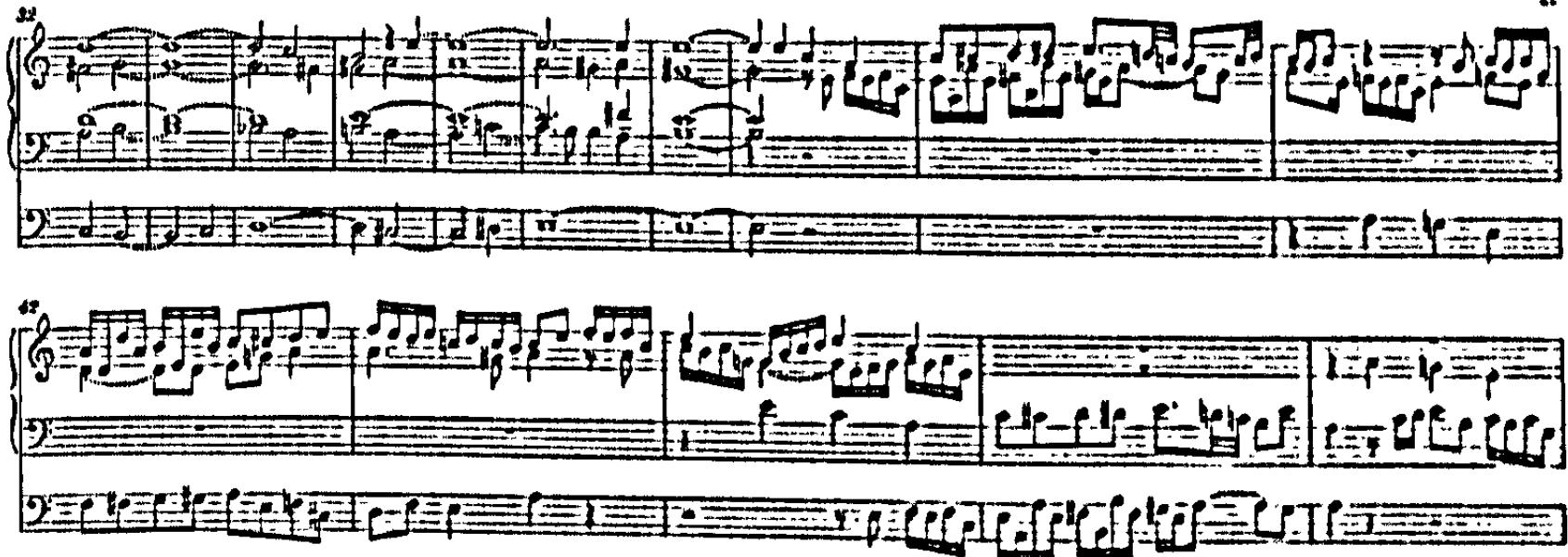
中文讲解
本条是图注占位符,对应谱例 62,覆盖 BWV 551 第 32–46 小节,正好处在本书小节标题所指出的从 digressio(离题段)向 confirmatio(证实段)过渡的区段。由于嵌入的图像数据已省略,读者需要返回原书查看谱例以核对文本讨论的具体声部进入与对位细节。
补充说明
图题中的"digressio and confirmatio"对应本节的小节标题,因此该谱例既呈现离题段的收束,也呈现证实段(二重赋格)的开始,与正文 P0147 对小节位置与主题进入的描述互为参照。
第2段(P0147)
原文复述
The digressio closes on the dominant E and gives way to the confirmatio section, which is represented in BWV 551 by a double fugue (metalepsis or transumptio). In Bach’s A minor prelude there is no clear relationship between the narratio and the confirmatio fugal subjects (something usually encountered in Buxtehude’s works); there are, however, certain common thematic elements that link the two fugal sections. Bach presents the two themes simultaneously in the first two bars of the confirmatio, making use of motives that appeared in the narratio (bars 39-40). The first subject (subject A) enters in the soprano and consists of three descending crotchets that outline the A minor triad (e"-c"-a’) followed by an ascending passus duriusculus reminiscent of the narratio quaver motive f"-f#"; the second subject (subject B) is composed of semiquaver figurations, of which the first one (f’-c’-f’-c’)
中文讲解
本段是本节论证的核心。它先交代结构位置:digressio 结束在属音 E 上,随即进入 confirmatio;在 BWV 551 中 confirmatio 被实现为一首二重赋格,作者用修辞学术语 metalepsis 或 transumptio 来称呼这种"主题转借"手法。然后,作者做了一个对比:Bach 此处不像 Buxtehude 那样把 narratio 主题与 confirmatio 主题建立明确关系(通常情况),而是通过共享的"主题元素"(thematic elements)把两段联系起来——这一点限定了 Bach 与 Buxtehude 的差异,只在元素层面而非完整主题层面相通。接着,作者指明二重赋格的起点:confirmatio 的头两小节(第 39–40 小节)同时呈现两个主题,二者都取材于 narratio 出现过的主题动机。最后分别描述两个主题:subject A 在女高音声部进入,由三个下行四分音符勾出 a 小调三和弦(e"-c"-a’),后接一段上行的 passus duriusculus(困难下行音阶,此处反向),让人联想到 narratio 中 f"-f#" 的八分音符动机;subject B 则由十六分音符音型构成,其首个音型为 f’-c’-f’-c’(本句在原书中于此处中断并由下段承接)。读者理解时需注意:作者并非说两段主题完全相同,而是强调"共有元素"与"动机层面的回响"。
补充说明
本段中出现的术语关系可在本节内互证:passus duriusculus 是文艺复兴与巴洛克修辞—音乐学中的固定音型(通常为下行的二度级进以表达苦难),本段的"ascending passus duriusculus"实际上是把该音型倒置上行;narratio 中的 f"-f#" 八分音符动机指的是导音解决前的半音邻音运动,是后段 subject A 上行音阶的来源。subject B 的 f’-c’-f’-c’ 在下段 P0151 继续说明它与 narratio 中 a"-e"-a"-g" 动机的对应关系。
第3段(P0148)
原文复述
$^{59}$ Bartel, p. 340.
中文讲解
脚注 59,仅标注 Bartel 一书的第 340 页,属于对前文论证(Bach 的 confirmatio 主题与 narratio 没有明确关系,这与 Buxtehude 通常的做法不同)的文献来源支持。
第4段(P0149)
原文复述
$^{60}$ Since BuxWV 139 is one of the rare cases where Buxtehude presents one long confirmatio fugue, the noema in that case is considered a free affective section that concludes the confirmatio.
中文讲解
脚注 60 解释了为什么把 BuxWV 139 中的 noema 视为 confirmatio 之内的"自由情感段落"而不是独立结构单位:原因是 Buxtehude 在该曲中把整个 confirmatio 写成了一个长大的赋格,noema 因此成为嵌于其中、起收束作用的情绪段。这条脚注为正文将 Bach 与 Buxtehude 对比时所用的"通常做法"提供了反例与限定。
第5段(P0150)
原文复述
$^{61}$ For a discussion of the rhetorical metalepsis, see Chapter 2 of the present work, page 129.
中文讲解
脚注 61 把"metalepsis(主题转借)“这一修辞学概念指向本书第二章第 129 页的讨论,提示正文用 metalepsis 或 transumptio 来解释 BWV 551 的二重赋格并非随意选词,而是引用了全书既定的术语体系。
第6段(P0151)
原文复述
has similar elements to the motive presented in the narratio (a”-e"-a"-g"). In other words, Bach maintains the basic thematic material from the first fugue, which he applies to two separate subjects in the confirmatio.
中文讲解
本段接续 P0147 中断的句子,补全 subject B 的描述:subject B 的十六分音符音型中第一个(f’-c’-f’-c’)与 narratio 中 a"-e"-a"-g" 的动机具有相似的元素。然后作者给出总结性论断:Bach 保留了第一首赋格(narratio)的基本主题材料,但把它分别用在 confirmatio 的两个独立主题上。换言之,两个 confirmatio 主题并不是凭空新作,而是从 narratio 的素材中"分叉"而成;这正是 Bach 与 Buxtehude"主题无明显关系"那种典型做法之间的差异所在——本段实际上是 P0147 的关键结论。
第7段(P0152)
原文复述
Image placeholder with the caption: “Example 63a. BWV 551: confirmatio, bars 39-40 (subject A)”.

中文讲解
本条为谱例 63a 的图注占位符,专门展示 confirmatio 第 39–40 小节中的 subject A。由于图像数据已省略,读者需参照原书核对 P0147 所述"三个下行四分音符勾出 a 小调三和弦 e"-c"-a’,后接上行 passus duriusculus"的具体写法。
第8段(P0153)
原文复述
Image placeholder with the caption: “Example 63b. BWV 551: confirmatio, bars 39-40 (subject B)”.

中文讲解
本条为谱例 63b 的图注占位符,专门展示 confirmatio 第 39–40 小节中的 subject B。需要返回原书核对 P0147–P0151 所述十六分音符音型 f’-c’-f’-c’ 及其与 narratio 动机 a"-e"-a"-g" 的对应关系。
第9段(P0154)
原文复述
Although the texture of this fugue is essentially for four voices, more than three are rarely heard at once (with the exception of bars 44, 48, 49, 51, 57, 60, and 62-63). After the introduction of the two subjects in the soprano and alto (bars 39-40) the first exposition ends in bar 47 after the two themes have entered in each voice. Short episodes follow subjects A and B in bars 47-48, 52, 54, 56, and 58-59, where the semiquaver four-note figure appears in its narratio shape, occasionally repeated at a different pitch. Bach presents a complex blend of motives from the first fugue, but elaborates on them contrapuntally by setting them against the two confirmatio subjects, maintaining a strong link between the narratio and the confirmatio. The thematic cross-reference of bar 47 is more intense in bars 53-54, where the two themes (in the alto and the tenor) lead into an alternating succession of the narratio motives at different pitchs, while the abrupt breaking off of voices in bars 45 and 51 perhaps shows Bach’s inexperience in this early work.
中文讲解
本段从体裁写作(fugal writing)的角度补足 confirmatio 的技术分析,分三层。 第一层(织体):这首赋格名义上是四声部,但通常一次只听到不超过三个声部,例外只在第 44、48、49、51、57、60 和 62–63 小节——这说明 Bach 在织体安排上有意保持稀疏,以突出主题线条。 第二层(结构与插段):两个主题先在女高音和女低音(第 39–40 小节)引入,第一次呈示段在第 47 小节结束,标志是四个声部都依次进入过两个主题。此后在第 47–48、52、54、56、58–59 小节穿插短插段,插段中使用 narratio 形态的十六分音符四音音型,音高偶尔移位——这正是 P0147–P0151 强调的"共有元素"在插段中的具体落实。Bach 把第一首赋格的动机与 confirmatio 的两个主题对位地编织在一起,从而维持 narratio 与 confirmatio 之间的紧密联系。 第三层(高潮与评价):第 47 小节已经出现主题交叉引用,但第 53–54 小节更密集,两个主题分别在中音和次中音声部交替出现,并引出在不同音高上接连出现的 narratio 动机。最后,作者对小节 45 和 51 中声部突然断裂给出一个推测性评价:“或许显示出 Bach 在这部早期作品中的不成熟”——这是作者对早期 Bach 写作技巧的限定性判断,不是否定全曲,而是说明这些技术毛刺属于特定写作阶段的特征。
补充说明
作者对小节 45 和 51 声部突然断裂的评价使用了"perhaps"和"inexperience"等限定语,表明这是推测而非定论;读者在理解时应将其视为作者对该曲早期风格的一种可能性解释,而非对 Bach 整体写作能力的判断。
第10段(P0155)
原文复述
Image placeholder with the caption: “Example 64. BWV 551: confirmatio (bars 47-54)”.
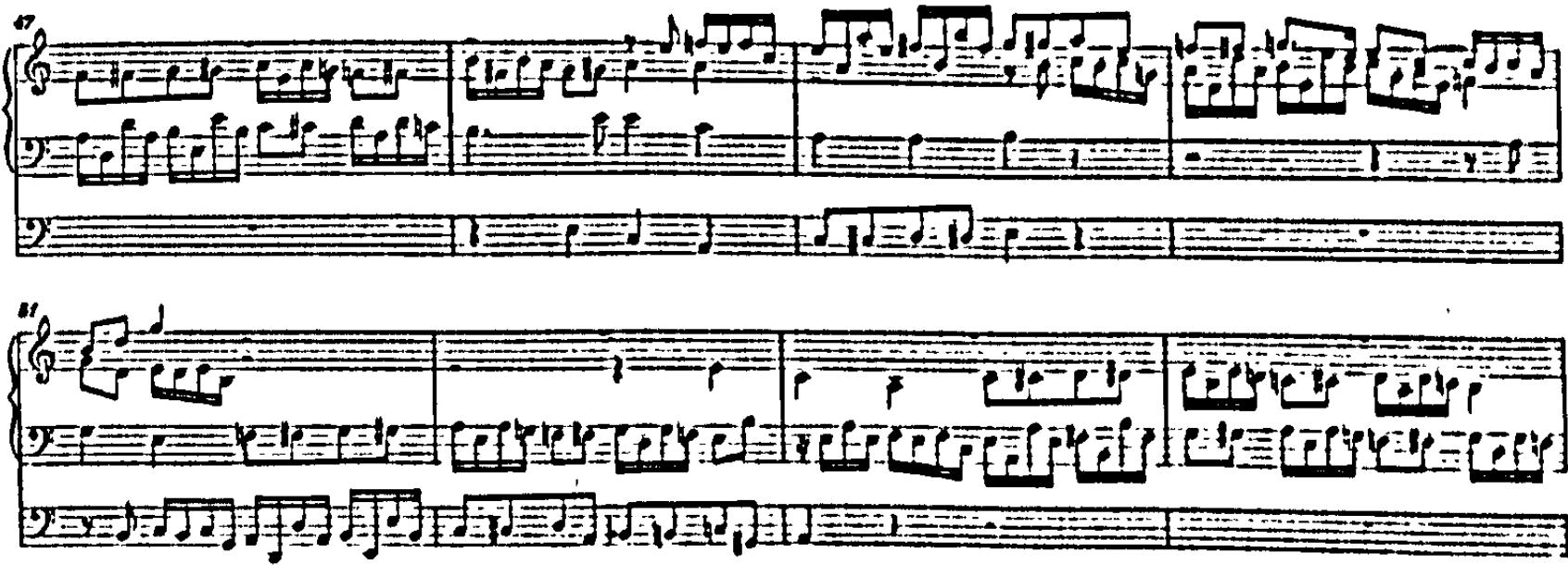
中文讲解
本条为谱例 64 的图注占位符,覆盖 confirmatio 第 47–54 小节。这正是 P0154 所论述的核心区间:第 47 小节第一次呈示段结束、第 47–48 小节出现短插段、第 53–54 小节主题交叉引用更密集、两个主题分别在中音与次中音声部交替出现之处。读者需参照原书核对谱例,才能直观体会 P0154 关于织体稀疏、动机交替和主题交叉的论述。
脚注 / 边栏 / 图表 / 附加信息(如有)
本节含三条脚注(59、60、61)和四个谱例占位符(Example 62 覆盖第 32–46 小节,Example 63a 与 63b 分别展示 confirmatio 第 39–40 小节的两个主题,Example 64 覆盖第 47–54 小节)。脚注 59(Bartel, p. 340)为正文关于 Bach 与 Buxtehude 在主题关系上差异的对比提供文献支持;脚注 60 解释 BuxWV 139 这一反例如何影响对 noema 功能的界定;脚注 61 把 metalepsis 概念引向本书第二章第 129 页。四个谱例分别承担"离题到证实的过渡"、“二重赋格的两个主题分别呈现"以及"第一次呈示段结束后的高密度交叉引用区段"三种图示功能。
💡 本节核心要点
- digressio 在属音 E 上结束,随即过渡到由二重赋格(metalepsis / transumptio)构成的 confirmatio。
- 与 Buxtehude 通常的做法不同,BWV 551 的 confirmatio 主题与 narratio 主题之间没有明确关系,但仍通过共同的元素和动机层面建立联系。
- confirmatio 在第 39–40 小节同时呈现两个主题:subject A(女高音,三个下行四分音符勾出 a 小调三和弦 e”-c"-a’,后接上行 passus duriusculus)取材于 narratio 的 f"-f#" 八分音符动机;subject B(女低音,十六分音符音型 f’-c’-f’-c’)与 narratio 的 a"-e"-a"-g" 动机相似。
- Bach 把第一首赋格的基本主题材料分别应用到 confirmatio 的两个独立主题上,使二者都成为 narratio 素材的"分叉"而非独立新作。
- confirmatio 形式上是四声部赋格,但通常不超过三声部同时发声,例外集中在第 44、48、49、51、57、60 与 62–63 小节;插段中的十六分音符四音音型在 narratio 形态上反复出现。
- 第 53–54 小节是主题交叉引用最密集的段落,主题在女低音与男低音声部交替出现;第 45、51 小节声部的突然断裂,被作者推测为 Bach 早期作品中的不成熟迹象。
🔑 关键术语
- digressio:本节小节标题中的修辞学结构术语,指"离题段";本节讨论其在属音 E 上结束并交接到 confirmatio。
- confirmatio:修辞—音乐结构术语,指"证实段";在 BWV 551 中由一首二重赋格承担,本节是其内部主题设计、织体与主题交叉引用分析的对象。
- narratio:修辞—音乐结构术语,指"叙述段",对应 BWV 551 中的第一首赋格;本节多次把它当作 confirmatio 主题材料的来源。
- metalepsis / transumptio:修辞学术语,指"主题转借";本书用来解释 confirmatio 中两个主题对 narratio 主题材料的借用(脚注 61 将其讨论指向第二章第 129 页)。
- passus duriusculus:巴洛克修辞—音乐中的固定音型,传统为半音下行的"困难音阶";本节 P0147 中以"ascending passus duriusculus"出现,即该音型的倒置上行,用于 subject A 的尾段。
- subject A / subject B:confirmatio 中的两个赋格主题,分别在女高音与女低音进入;A 由三音下行四分音符勾勒 a 小调三和弦后接上行音型,B 由十六分音符音型构成,二者均取材于 narratio 的动机。
- BuxWV 139:脚注 60 中提到的 Buxtehude 作品,被作者当作"单一长大 confirmatio 赋格"的稀有例子,并据此重新界定其中 noema 的功能(出现在本节作为对比与限定)。
4.14 [描述性拆分] BWV 551: Amplificatio and Peroratio
第1段(P0156)
原文复述
The last pair of entries occurs in bars 60-61, where the soprano introduces subject A while the alto carries an incomplete version of subject B. Bars 61-62 demonstrate a short episode consisting of semiquaver and quaver material derived from the two subjects, accompanied by similar figurations in the pedal that lead to the end of the confirmatio and the beginning of the amplificatio (bars 62-63).
中文讲解
本段叙述BWV 551 confirmatio的最后一次主题进入,并交代如何过渡到amplificatio。
- 第60-61小节是confirmatio阶段最后一组主题进入:soprano(高声部)呈示主题A,alto(次中声部)则同时承载主题B的一个不完整版本(incomplete version of subject B);两主题并未齐头并行陈述,而是以一种"一完整一残缺"的对比方式收束该阶段。
- 第61-62小节是一段短小的插段(episode),其音材料为十六分音符(semiquaver)和八分音符(quaver),均从主题A、主题B派生而来;脚键盘(pedal)以类似的音形(figurations)伴随之。
- 这一短插段充当功能性的过渡桥梁,把confirmatio带向bars 62-63——amplificatio正式开始的位置。
作者此处的安排并非随意:让一个主题以"不完整"形态出现于修辞阶段之交,意味着主题材料在amplificatio里将被重新整合,而非简单重复,这与下文P0158所述两个主题"are combined in one subject"的合并做法形成因果链条。
第2段(P0157)
原文复述
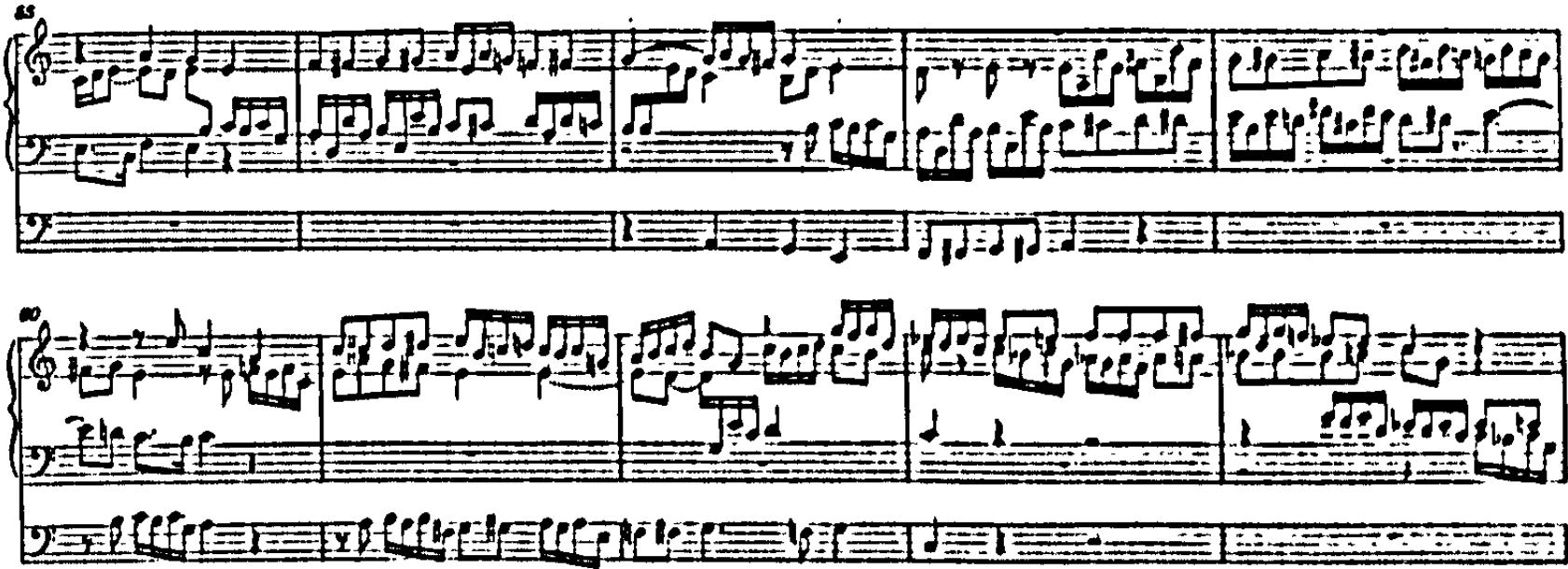
中文讲解
本条为图注占位符:Example 65,谱例展示BWV 551 confirmatio与amplificatio交界处,即第55-64小节。该图是P0156、P0158所述主题进入、插段和调性转向(c小调)的视觉证据。由于图像数据未嵌入本节文本,具体声部进行、和弦配置以及终止式细节需查阅原书图例方能确认。
第3段(P0158)
原文复述
The modulation and cadence on C minor in bars 62-63 (an unusual shift for a piece in A minor) signifies the beginning of the amplificatio, in which Bach applies alternating emphatic stretto repetitions of the basic thematic material in four voices. The section stands out clearly as an amplificatio, since the four-note semiquaver fragment (subject B) and the chromatic quaver motive (subject A) are combined in one subject. There are two sets of four entries of the new subject on the manuals, and a third one concluding with the pedal. The first one occurs in bars 62-65, while in the second (bars 65-68) the soprano demonstrates an elaborate repetition of the semiquaver figure before shifting to the ascending passus duriusculus that cadences on G minor (bars 67-68). The third set of entries occurs in bars 69-73 closing with the pedal entrance in bar 72 that marks the end of the amplificatio.
中文讲解
本段是本小节界定amplificatio的核心段落,可从三个层面理解:
- 调性标志——bars 62-63转向c小调并在该调上作收束(cadence on C minor)。对一首主调为a小调的乐曲而言,这次转调被作者明确标注为"unusual shift"(不寻常的移调),意在提示读者:amplificatio的"开篇"并不依赖主题材料本身的简单重复,而以调性领域的暂时偏离制造张力。该次终止同时承担功能,即从confirmatio的调性框架中"断"出,进入新的修辞阶段。
- 修辞手法——“alternating emphatic stretto repetitions of the basic thematic material in four voices”:Bach以四声部的交替着重式紧接模仿处理基本主题材料;所谓"交替"(alternating)指各声部依次登场而非同时陈述,“着重式”(emphatic)则指每次进入被强调为新的修辞重音,“紧接模仿”(stretto)即声部间以极小距离先后进入同一主题。
- 主题合并——这是amplificatio之所以"作为amplificatio而立得住"(stands out clearly as an amplificatio)的关键证据:主题B的四音十六分音符片段(four-note semiquaver fragment)与主题A的半音化八分音符动机(chromatic quaver motive)被合并进同一个新主题(“are combined in one subject”)。换言之,confirmatio阶段A、B各自独立呈示的格局,在amplificatio中被一个综合主题取代——主题被"放大"的最直接方式就是把先前分立的素材合而为一。
- 三组进入的声部布局——新主题共三次进入:前两组位于键盘(manuals),每组四次主题进入;第三次含脚键盘(pedal),并以bar 72的pedal entrance结束amplificatio。
- 三组的时间与小终止:
- 第一组:bars 62-65;
- 第二组:bars 65-68,其中soprano先对十六分音符音形作精细的重复(elaborate repetition of the semiquaver figure),随后转为上行的passus duriusculus,在bars 67-68以g小调终止;
- 第三组:bars 69-73,bars 72处pedal进入作为amplificatio的收束标志。
作者强调"unusual shift to C minor"和"combined in one subject"两条线索,意在让读者从调性与主题两个层面同时识别amplificatio,而不是把它读成confirmatio的简单延长。
补充说明
passus duriusculus为传统音乐修辞术语,本节语境中指Bars 65-68处含半音化进行的音阶式上行片段(原文为"ascending passus duriusculus"),其功能是把第二组主题进入导向bars 67-68的g小调终止。其余术语与人物均按本段原文信息给出。
第4段(P0159)
原文复述
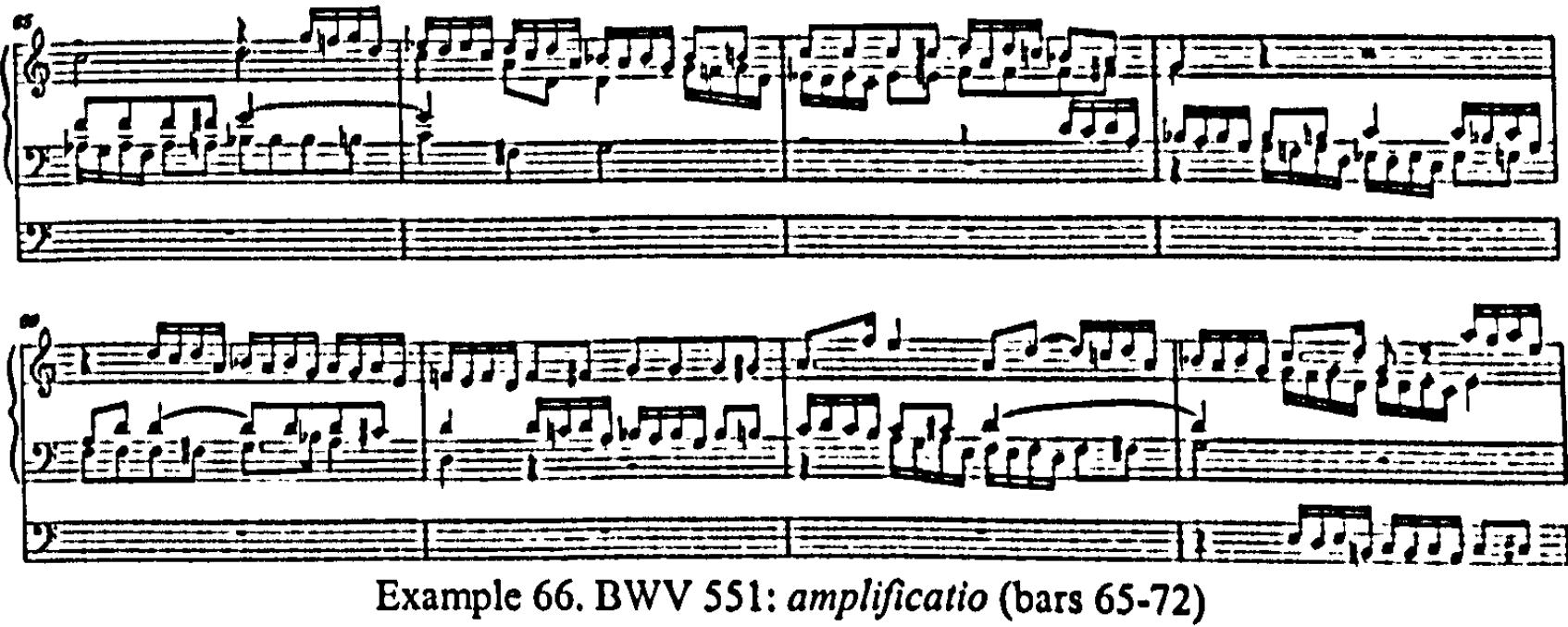
中文讲解
本条为第29页的图像/乐谱占位符,原书此处的图示用途需对照原图方能确认(可能是放大片段或与Example 65配合的对照谱例)。具体内容需查看原书图例。
第5段(P0160)
原文复述
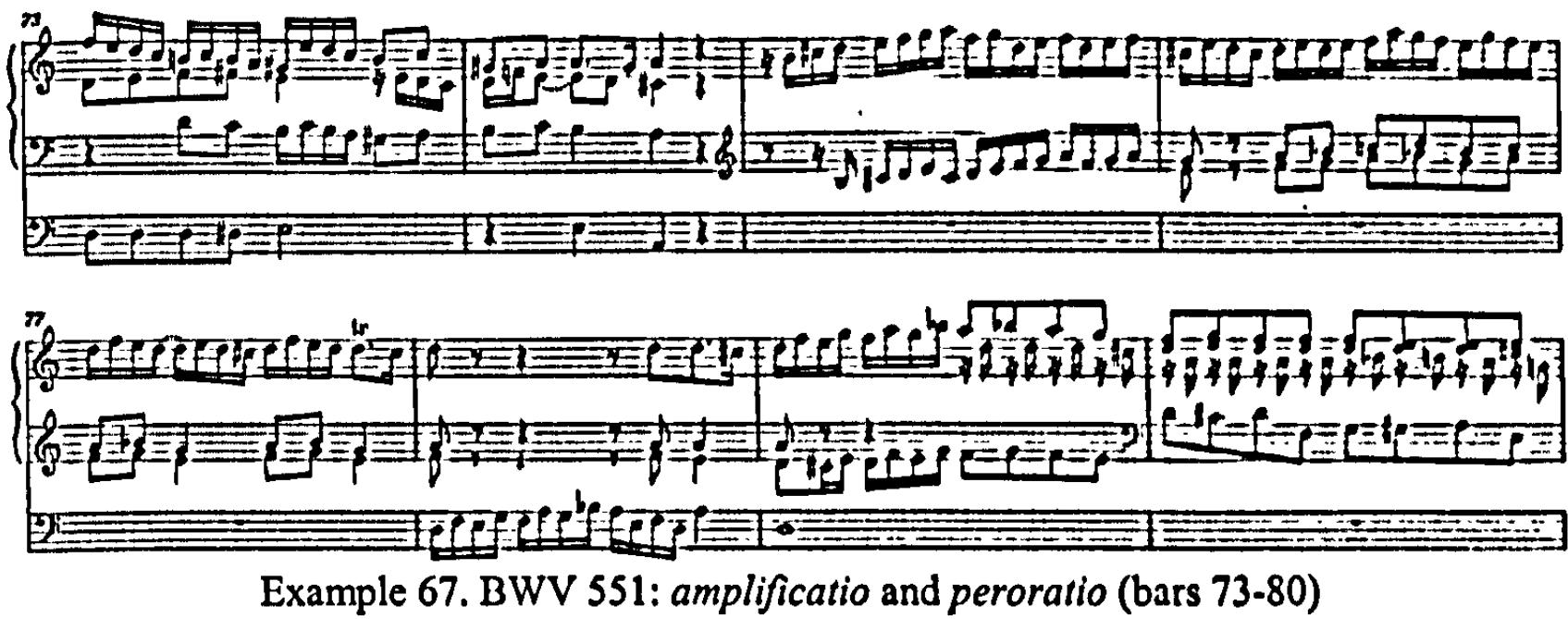
中文讲解
本条为第30页的图像/乐谱占位符,原书此处的图示用途需对照原图方能确认(可能与peroratio或Example 68相关)。具体内容需查看原书图例。
第6段(P0161)
原文复述
The amplificatio concludes with a perfect cadence in bar 74 signifying the beginning of the peroratio, the final affective section of the Klangrede, which, just as in BuxWV 153, emphasizes the subdominant D as a plagal cadence. Affective gestures, such as rapid scalar passages (bars 75-77) in the manuals, recall those encountered in the exordium, strengthened by repeated chords (bar 77, anaphora) that end in a cadence on the subdominant (bar 78). The manual texture suddenly breaks off (bar 78, abruptio/aposiopesis) with the pedal introducing intervals of ascending thirds leading to another stronger cadence on D minor. In bar 79 the soprano imitates the first two beats of the pedal motive of the previous bar (anaphora), while broken chords in the manuals (recalling Buxtehude’s A minor peroratio) and virtuosic pedal figuration (bar 82) prepare the way for the final plagal cadence in the last seven bars of the peroratio.
中文讲解
本段承担amplificatio收束与peroratio开启两重功能,并密集铺陈修辞姿态:
- 结构标志——amplificatio以bars 74的完全终止(perfect cadence)作结,并由此开启peroratio;peroratio是Klangrede(“音响演说”)最后一个以affect(情感)为导向的段落。
- 调性/终止策略——作者援引BuxWV 153作为横向类比:两者都以下属音D为情感中心,并以plagal cadence(变格终止,IV–I)作为基本修辞手段。下属调与变格终止在巴洛克情感修辞中常承载"哀诉—安慰"的语义,这一选择为全曲末段的情感定性。
- 情感姿态与首尾呼应——bars 75-77键盘上的快速音阶化片段(rapid scalar passages)作为"affective gestures",让读者回想起exordium(开头段)中已经出现过的类似姿态,由此形成"首尾回响"的结构效果,呼应peroratio"总结—回收—升华"的角色。
- 修辞术语层叠——作者在本段连用若干传统修辞术语标注纯音乐事件:
- bar 77的重复和弦标注为anaphora(首语重复),并导向bars 78在下属调上的终止;
- bar 78键盘声部突然断裂,被同时标注为abruptio(突然中止)和aposiopesis(语意未尽),并由脚键盘接续以"上行的三度音程"(intervals of ascending thirds)引向更强的d小调终止;
- bar 79的soprano模仿前小节pedal动机的头两拍,再次标注为anaphora;
- 同时键盘上以broken chords(分解和弦)铺陈,作者提醒读者这里让人联想到Buxtehude的a小调peroratio;
- bar 82的virtuosic pedal figuration(脚键盘炫技音形)作为最后七小节plagal cadence的预备。
作者的论证策略是把纯音乐参数——终止式选择、调性中心、声部中断、和弦分解——逐一对应到文本修辞学范畴(anaphora、abruptio/aposiopesis等),从而使Klangrede作为"音响修辞"的命题具体化:每一次修辞姿态都同时是音乐事件,每一次音乐事件都同时承担一种情感修辞功能。
补充说明
原文中"just as in BuxWV 153"和"recalling Buxtehude’s A minor peroratio"是本节内部的横向类比,意在展示同一修辞结构在不同作品中的再现,并非外部补充。
第7段(P0162)
原文复述
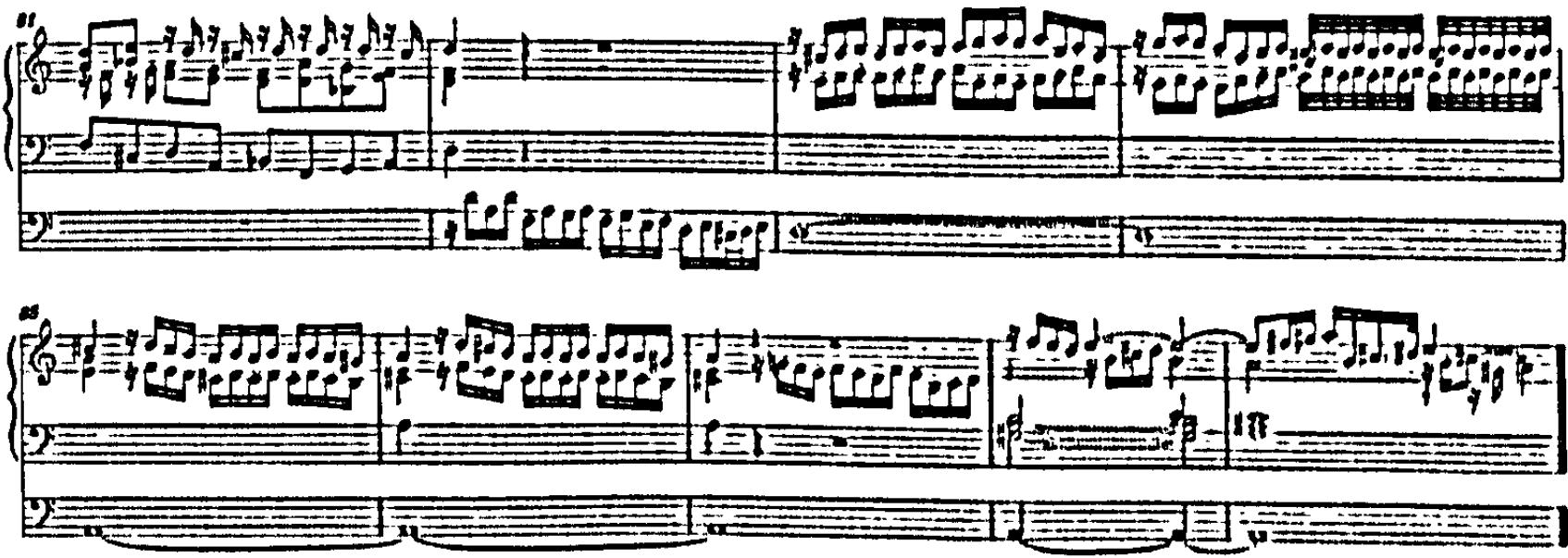
中文讲解
本条为图注占位符:Example 68,谱例展示BWV 551 peroratio部分,即第81-89小节。该图与P0161末段、P0163所述内容对应,覆盖脚键盘炫技音形、平行六度anaphora、figurae suspirans以及最终终止等段落。由于图像未嵌入本节文本,具体声部进行与终止细节需查阅原书图例方能确认。
第8段(P0163)
原文复述
The arrival at the subdominant D in the pedal is reinforced by affective abruptio rests in bars 83-84, creating a dramatic intensity before the parallel improvisatory semiquaver and demisemiquaver gestures. The parallel sixths between the upper voices in bar 85 are repeated in bar 86 (anaphora), while expressive figurae suspirans (bar 88) followed by brief improvisatory manual passages signify the conclusion of the peroratio on an A major chord.
中文讲解
本段聚焦peroratio末段的三个层次,理解要点如下:
- 下属音D的"戏剧化"到达——脚键盘(pedal)到达下属音D这一关键调性节点时,被bars 83-84的"affective abruptio rests"(带有情感色彩的突然休止)所强化;作者认为这制造出"dramatic intensity"(戏剧性张力)。其修辞意义是:通过突然的静默(abruptio)让一个本来只是调性回归的事件获得情感分量,与古典修辞中"欲言又止"以加重语势的手法相通。
- 即兴性走句——在这一戏剧张力之后,是平行的即兴式十六分音符(semiquaver)与三十二分音符(demisemiquaver)走句。“improvisatory"一词暗示这些走句在功能上接近教会即兴演奏的自由炫技段,作为承接前文abruptio"重音"的放松与延伸。
- 上声部平行六度与anaphora——bars 85上声部之间的平行六度(parallel sixths)在bar 86被重复,作者明确标注为anaphora。这种"和声色彩—动机节奏"双重维度的简单重复,是巴洛克末段常见的修辞强调手段。
- 收束——bar 88出现figurae suspirans(“叹息式音形”,即附点或切分所造成的"叹息"动机),紧接以简短的键盘即兴段落(brief improvisatory manual passages);最终peroratio结束于A大调主和弦。
值得注意的是:全曲主调为a小调(见P0158所述主调背景),末段却收于A大调,这一现象在巴洛克实践中通常对应皮卡迪三度(Picardy third)——以大三度的主和弦终止,把整首小调作品的哀诉情感"升华"至大调的光明收束,与文本修辞中peroratio"总结—升华"的角色相符:把先前段落累积的情感通过终止式的调性色彩变化收编为整体意义。
脚注 / 边栏 / 图表 / 附加信息(如有)
本小节内含两处带编号图例与两处未编号图像占位符:第29页有Example 65(图注:BWV 551: confirmatio and amplificatio, bars 55-64)以及一处未编号图示;第30页有另一处未编号图示以及Example 68(图注:BWV 551: peroratio, bars 81-89)。四者的内嵌图像数据均已省略,其谱面细节与声部配置需查阅原书图例方能确认;它们分别对应正文P0156/P0158交界处主题进入与c小调终止、以及P0161/P0163所述peroratio末段的脚键盘炫技、平行六度anaphora与figurae suspirans。
💡 本节核心要点
- Bars 60-61完成confirmatio最后一次主题进入:soprano呈示主题A,alto呈示不完整的主题B;bars 61-62为短小插段,由semiquaver和quaver材料构成,并于bars 62-63开启amplificatio。
- amplificatio的两大识别标志:在调性上bars 62-63出现对a小调主调而言"不寻常"的c小调终止;在主题处理上,主题B的四音十六分音符片段与主题A的半音化八分音符动机被合并进同一个新主题,并以四声部交替着重式紧接模仿(stretto)展开;新主题在bars 62-73之间完成三组进入,前两组在键盘,第三次含脚键盘并以bar 72收束。
- Bars 74的完全终止标志amplificatio结束并开启peroratio;作者援引BuxWV 153作为类比,说明此段以下属音D为情感中心并以plagal cadence为基本终止策略。
- peroratio中密集铺陈传统修辞姿态:anaphora(重复和弦/动机重复)、abruptio/aposiopesis(键盘声部突然断裂)、figurae suspirans(叹息式音形)、以及让人联想到Buxtehude a小调peroratio的broken chords。
- Bars 83-84的affective abruptio rests戏剧化地强调下属D的到达;其后接以即兴性semiquaver/demisemiquaver走句,bars 85-86上声部平行六度的anaphora,bar 88的figurae suspirans共同收束于A大调主和弦——以皮卡迪三度的方式把全曲自小调陈述升华至大调收束。
🔑 关键术语
- amplificatio(放大/扩充):古典修辞术中对主张进行扩充、放大与反复论证的段落;在本节中指巴赫对基本主题材料进行合并、紧接模仿与扩张的修辞阶段,对应bars 62-73。
- peroratio(结尾段/总结段):古典修辞末段,承担总结、升华与情感收束的功能;在Klangrede中对应全曲最后一个以affect为旨趣的段落,自bar 74开始。
- confirmatio(确认段):继exordium之后的论证主体段;在本节中指amplificatio之前、bars 60-61主题进入所完成的部分。
- Klangrede(音响演说):作者用以指称整首作品作为修辞整体的概念;本节中peroratio被界定为该"演说"最终的affective段落。
- subject A / subject B(主题A / 主题B):主题A=chromatic quaver motive(半音化八分音符动机);主题B=four-note semiquaver fragment(四音十六分音符片段);在amplificatio中两者被合并为同一个新主题。
- stretto(紧接模仿):声部间以极近距离先后进入同一主题的对位手法;本节描述amplificatio为"alternating emphatic stretto repetitions”。
- passus duriusculus:传统音乐修辞术语,指音阶式(尤其含半音或小二度)的动机片段;bars 65-68处为"ascending passus duriusculus",导向g小调终止。
- plagal cadence(变格终止):IV–I类的终止式;本节中作为peroratio的基本修辞手段,与下属音D共同承载"哀诉—安慰"的情感语义。
- anaphora(首语重复):同一动机或和弦在相邻结构位置的反复;本节中标于bar 77重复和弦、bar 79 soprano模仿pedal动机以及bars 85-86上声部平行六度。
- abruptio / aposiopesis(突然中止 / 语意未尽):声部突然中断的修辞姿态;本节中标于bar 78键盘声部的断裂,并通过bars 83-84的affective abruptio rests强化下属D到达时的戏剧性张力。
- figurae suspirans(叹息式音形):附点或切分节奏造成的"叹息"动机;本节中出现于bar 88,作为peroratio末段的情感收束标志。
- Picardy third(皮卡迪三度):小调作品结尾以大三度主和弦终止的修辞/和声手法;本节中peroraio收于A大调主和弦,对应这一以"由暗转明"完成升华的实践。
4.15 [描述性拆分] Summary Comparison of BuxWV 153 and BWV 551
第1段(P0164)
原文复述
To summarize, both BuxWV 153 and BWV 551 are modelled on the structure of the rhetorical dispositio. The Klangrede is framed by the affective exordium and peroratio that aim to excite the listener’s attention, while the objective narratio and confirmatio are illustrated with two fugues that bear strong thematic and textural relationships. Although in Buxtehude’s preludes the subject of the confirmatio is clearly derived from the material presented in the narratio, in Bach’s A minor prelude the connection between the objective portions of the Klangrede is based on motivic relationships. In the narratio the basic motives are presented and developed in a ‘conservative’ counterpoint, while in the confirmatio Bach elaborates on them in a more complex way. This is accomplished through a double fugue (metalepsis), whose subjects are modelled on the properties of the narratio, as well as through thematic cross-references that tend to link closely the narratio to the confirmatio. The connection between the two sections is further facilitated through the intervention of the digressio, a short affective chordal segment (noema) Bach inserts immediately after the end of the narratio and before the beginning of the confirmatio. This falls in line with J. Burmeister’s definition of the noema as a homophonic section within a contrapuntal texture that stimulates the listener’s attention due to its contrasting nature. The rhetorical structure of the two preludes is illustrated in the following tables:
中文讲解
本段是本节的总收束段落,把前面对BuxWV 153逐段拆解的结果与BWV 551的分析合并为一条统一的论证。其论证骨架是修辞学dispositio的六个部位:开篇exordium与收尾peroratio承担"唤起听众注意"的情感性任务;中段的narratio(第一赋格)与confirmatio(第二赋格)承担客观论证任务,两段之间存在强烈的"主题/织体关系"。作者随后点出本节最关键的对比:Buxtehude两段之间的连接是主题派生(subject直接来自narratio材料),而Bach的A小调前奏曲则是动机关系(motivic relationships)——即Bach不靠主题直接复用,而是靠动机变形与材料内部关联完成两段衔接。在手法上,Bach通过三条路径达成这种深化:(1)confirmatio使用双重赋格(作者标注的修辞格为metalepsis,即"主题在不同声部/层次间交叠转换"),其主题依narratio的性质塑造;(2)主题交叉引用(thematic cross-references)把narratio与confirmatio紧密勾连;(3)digressio——一段短暂的情感性和弦段落,文中以Burmeister术语noema标记——插入narratio结束与confirmatio开始之间,起到对比性激活听众注意力的桥梁作用。最后一句指出"以下表格将说明两首前奏曲的修辞结构",但表格本身不在本小节的段落范围中。
补充说明
本段作为整个section 4.15的小结段(开头"To summarize"),把BuxWV 153与BWV 551的修辞结构并置比较;但表格实体的内容未在本小节source_paragraphs中出现,属于节末图表材料,已在additional_information中标注。
第2段(P0165)
原文复述
The structure encountered in BWV 551 makes plausible the assumption that Bach composed this work in his early youth (1703/04), before his trip to Lübeck in 1705/06. The Prelude in A minor, one of Bach’s earliest free organ works, demonstrates a disposition not encountered elsewhere in his organ music, and can be successfully analysed as a Klangrede. The structural elements of the north German organ toccata are prominent in BWV 551, and one can speculate that this work might have been among those Bach carried with him to show to Buxtehude; these were probably “[…] compositions that ventured to measure up to their model.” ⁶²
中文讲解
本段把形式分析与生平时间线对接:根据前述可被解析为Klangrede这一事实,作者推断BWV 551可能写于1703/04,即Bach赴吕贝克(1705/06年拜访Buxtehude)之前的"早年"时期。文中给出两个推论支点:其一,BWV 551被定位为"Bach最早的自由管风琴作品之一",它在Bach其余管风琴曲目中呈现出"一种罕见的dispositio",意味着Bach后来不再使用这一结构布局;其二,“北德管风琴托卡塔的结构元素"在该曲中显著,于是作者提出一个可推测的假说——该曲很可能是Bach带去给Buxtehude过目的那批作品之一。引号中"compositions that ventured to measure up to their model"意即"敢与范本一较高下的作品”,脚注62指向Wolff传记第97页作为出处。本段的论证方法是从形式风格倒推编年与传承关系。
第3段(P0166)
原文复述
If the Prelude in A minor demonstrates Bach’s efforts to imitate the style of his predecessor before he became fully acquainted with it, the Toccata in E major (BWV 566) ⁶³ displays a more mature version of the Buxtehudian manner as comprehended by the young Bach. This work, which dates from around 1706/07, confirms the overall multisectional design discussed already in BuxWV 153 and BWV 551; however, structural elements reflect an advanced compositional style in an era when the toccata-form was fading away. Although in the E major Toccata the dispositio displays an exordium, narratio (first fugue), digressio (free interlude), confirmatio (second fugue), and peroratio, the texture is more meticulously worked out and clear-cut cadences distinctly separate the contrasting sections. The contrapuntal writing, as demonstrated in the narratio and the confirmatio, is well developed, thematic expositions and episodic materials are carefully balanced, while the proportions of the fugues exceed by far those encountered in BuxWV 153 and BWV 551. Although in BWV 566 Bach chose to display a different style of toccata that surpassed technically the ones by Buxtehude, certain elements of the north German style are still prominent (thematic variation), while striking rhetorical figures testify to the function of the work as an affective Klangrede.
中文讲解
本段把BWV 551与BWV 566摆成"早—晚"、“未熟—成熟"的一对。BWV 566约写于1706/07,即Bach从吕贝克归来之后不久。其相同之处:保留了与BuxWV 153、BWV 551一致的多段式dispositio布局(exordium—narratio即第一赋格—digressio即自由间奏—confirmatio即第二赋格—peroratio)。其相异之处:织体更"精雕细琢”(meticulously worked out)、各段之间有"清晰的收束式终止"(clear-cut cadences)将其区分开来;两段赋格的对位写作"发展完善",主题呈示与插段材料"彼此平衡",且赋格的篇幅远超过BuxWV 153与BWV 551中的对应段落。值得注意的是作者的两层判断:BWV 566在技术上"超越了Buxtehude",但北德传统的若干元素(如主题变奏thematic variation)依然显著;与此同时"引人注目的修辞格"则证明该曲仍具"情感性的Klangrede功能"。文中也提示托卡塔这一体裁在Bach时代"正在消逝"。
补充说明
本节小标题虽为"BuxWV 153与BWV 551的比较",但P0166起论题扩展到BWV 566,本节实际构成一个"三首前奏曲/托卡塔的递进比较",表格可能即对应这三首作品。
第4段(P0167)
原文复述
We shall assume in the following discussion that the toccata was originally written in E major. The work commences with a long exordium (thirty-three bars) whose structure displays an excellent interpretation of the stylus phantasticus, as defined by Mattheson: “sometimes fast, sometimes slow; sometimes with one, sometimes with many voice parts; also sometimes a little behind the beat; without meter.” ⁶⁴ The first part of the exordium (bars 1-4) is a flourishing monophonic gesture built on the E major tonic triad that captures the listener’s attention through improvisatory figurations characterised by asymmetry in accentuation. This is followed by an imposing polyphonic section (bars 5-8) dominated by expressive suspensions, a stylistic feature of organo pleno sound that establishes the tonality through the double tonic pedal. This chordal passage with its rich harmonics leads to bar 8, where Bach introduces a solo pedal part ranging widely over the pedalboard from E to c#’ and back again (bars 8-12), calling for a rhythmical flexibility in performance “a little behind the beat; without meter.” ⁶⁵
中文讲解
本段开始对BWV 566的exordium作小节逐拍分析。开篇先确立一个工作前提——按E大调原版讨论(理由在脚注63,即下段P0169),并明确exordium长度为33小节,整体是Mattheson所定义stylus phantasticus(幻想曲风格)的典范诠释:节奏快慢交替、声部数量变化、节拍可伸缩(“a little behind the beat; without meter”,脚注64)。作者随后把33小节内部切成三段叙述:(1)bars 1-4,单声部的E大调主三和弦即兴式花奏,靠非对称重音抓住听众注意——扮演修辞exordium的"唤起"功能;(2)bars 5-8,一段以"表达性"延留音为主的复调织体段,这是organo pleno(全奏)音响的典型特征,调性由双主持续音(double tonic pedal)确立;(3)bars 8-12,独奏脚键盘段落,音域从E大幅上行至c#‘再下行,脚注65再次援引Mattheson同一句话,说明这段独奏在演奏中需要"节拍稍稍落后、脱离小节规整"。全文的关键论证是:表面上"自由"的幻想曲风格本身就是修辞exordium"调动听众情感"这一功能的具体化身。
第5段(P0168)
原文复述
⁶² Christoph Wolff, Johann Sebastian Bach: The Learned Musician, p. 97.
中文讲解
本段是脚注62,对应P0165中引号内的引语"compositions that ventured to measure up to their model"及其所支持的史实假设(Bach可能带作品给Buxtehude过目)。本脚注给出出处:Christoph Wolff的《Johann Sebastian Bach: The Learned Musician》第97页。它承担的是史源功能,而非对正文主张作进一步限定或反驳。
第6段(P0169)
原文复述
⁶³ This work has been also handed down in C major. The original version was probably in E major and was later transposed down a third in order to facilitate the awkward pedal solo (bars 8-11) and to avoid the remote keys (C# minor, G# minor, and F# minor) to which the E major version modulates in bars 13-22. For an extended discussion of the possible original version of the piece, copyists, and manuscripts, see Keller, The Organ Works of Bach, p. 74; also Stauffer, pp. 40-41, and Williams, The Organ Music of J. S. Bach, pp. 159-60.
中文讲解
本段是脚注63,处理BWV 566的版本学问题。它比一般脚注篇幅更长,承担对正文P0167开始处"假设该曲原为E大调"的完整史源说明。脚注先交代抄本状况:该曲也有C大调传本,原版很可能是E大调,后来向下移调小三度;移调动机有两点技术原因——其一是bars 8-11原E大调版本中的脚键盘独奏"很别扭",其二是E大调版本在bars 13-22所涉及的远关系调(C#小调、G#小调、F#小调)在十八世纪早期的不平均律键盘上会"刺耳",故移调解决。脚注最后把读者引向更详细的版本讨论:Keller《The Organ Works of Bach》第74页、Stauffer第40-41页、Williams《The Organ Music of J. S. Bach》第159-60页。脚注性质:来源 + 限定 + 旁证的复合功能。
第7段(P0170)
原文复述
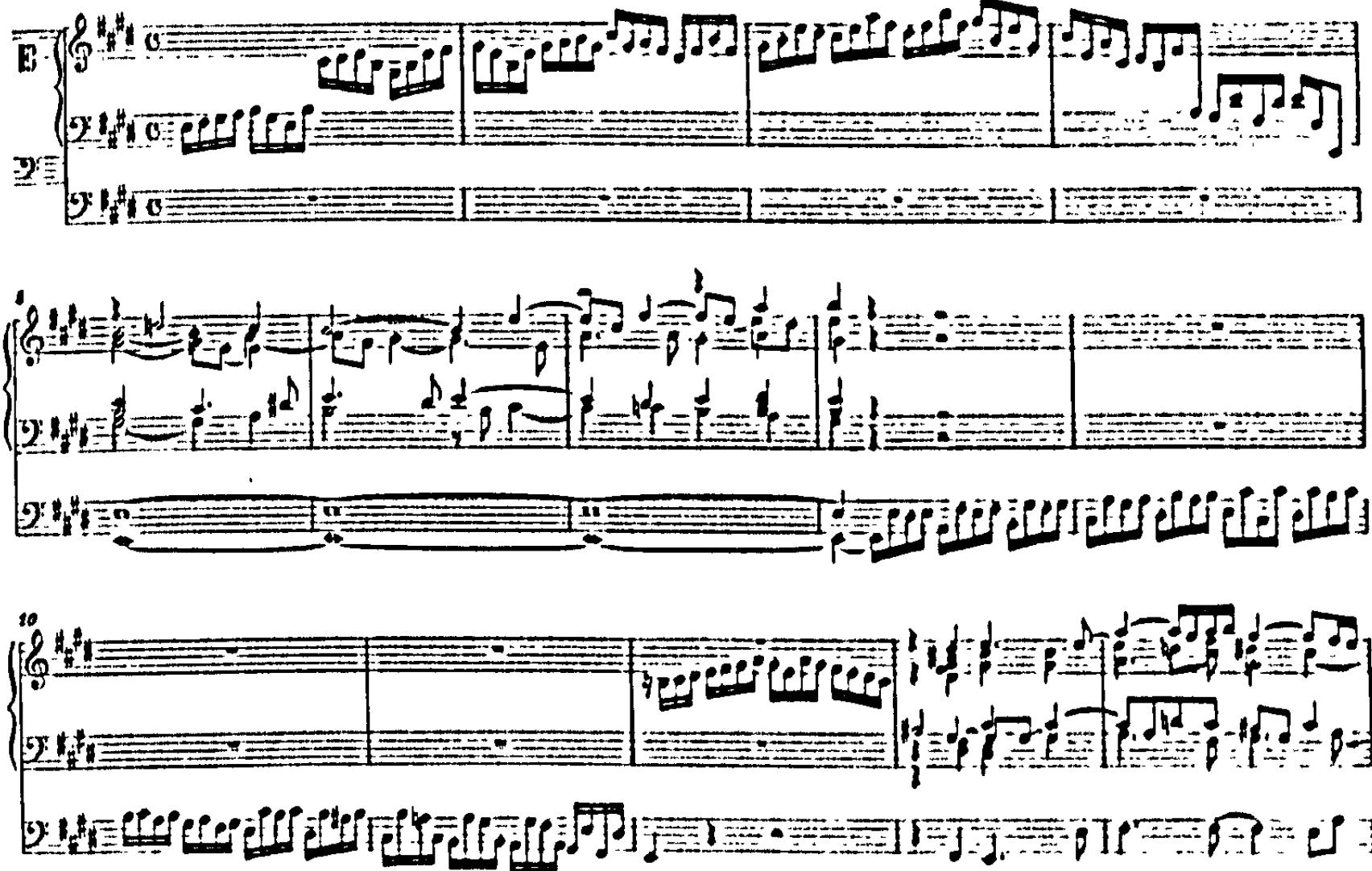
中文讲解
本段是图像占位符(图注为"Example 69. BWV 566: Toccata in E major: exordium (bars 1-14)"),位置在P0167描述bars 1-12与P0171描述bars 13-22之间,承担乐谱示例功能——应当展示Bach此托卡塔exordium前14小节(即从单声部花奏进入脚键盘独奏、再到转入远关系调之前的关键段落)。根据上下文可确认这是配图,但仍需查看原版谱例才能核实细节。
补充说明
本图例在source_paragraphs中以"图像数据已省略"形式给出,本节文本分析依赖于P0167、P0171中bars的逐拍描述。
第8段(P0171)
原文复述
In bars 13-22 the harmonic texture modulates to more remote tonalities, which would create harsh effects on an unequal-temperament organ of the early eighteenth century. After an unexpected turn in bar 13, the harmony shifts to the relative C# minor in bars 13-15 and then to its dominant G# minor (bar 16), a key Bach further explores through the secondary dominant of the dominant of G# minor (D# minor) on the first beat of bar 17 and the second beat of bar 18. Such daring modulations with rich effects illustrate the pathopoeia, a figure occurring when chromatic motives and semitones that do not belong to the original modus of the composition are inserted in such a fashion that no one remains unmoved by the aroused affection. ⁶⁶ After G# minor the texture returns to the relative C# minor (bars 19-20), and finally after a short modulation to F# minor in bars 21-22 the exordium shifts to the original E major (c#’-f#’-a’: supertonic of E major, fourth beat of bar 22).
中文讲解
本段接续P0167的exordium分析,专门处理bars 13-22的远关系转调段落。开篇先解释P0169脚注63为何把"移调到C大调"视作实践上更可行——这些远关系调(C#小调、G#小调、F#小调)在十八世纪早期的不平均律管风琴上会"刺耳"。随后按小节勾勒和声路径:bar 13出现"意外转折"(unexpected turn),bars 13-15进入其关系小调C#小调;bar 16转入C#小调属方向的G#小调;bars 17-18作者列出更细致的双重属方向——G#小调属调的二级属(即D#小调)出现在bar 17第1拍与bar 18第2拍——这是连续转调的极端例子。作者援引修辞学术语pathopoeia(激调动情格)作为这一段大胆半音化的归类:chromatic motives与不属于"原modus"的半音材料被插入,“没有人能不为所动”(脚注66引用了此格定义,但该脚注文本不在本小节的source_paragraphs之内)。bars 19-20回到C#小调,bars 21-22短暂经过F#小调,最后在bar 22第4拍通过E大调的上主和弦(c#’-f#’-a’)回归主调,结束exordium。论证要点:远关系半音化既是修辞格pathopoeia,也是exordium"以情感冲击吸引听众"这一功能的延续。
补充说明
本段正文引用了脚注66(pathopoeia定义出处),但该脚注文本未列入本小节source_paragraphs,故未单列条目,仅在本说明中标注。
第9段(P0172)
原文复述
⁶⁴ Johann Mattheson’s Der vollkommene Capellmeister, trans. by Ernest Harriss, Part I, Chapter 10, §93, p. 217.
中文讲解
本段是脚注64,对应P0167中Mattheson定义stylus phantasticus的那段引文。出处信息齐全:原作者Johann Mattheson、原著《Der vollkommene Capellmeister》、英译者为Ernest Harriss、定位在Part I第10章§93、页码217。它承担"权威定义"的来源功能,是把Bach的exordium风格定位在Mattheson修辞—音乐理论框架内的关键引用。
第10段(P0173)
原文复述
⁶⁵ ibid., p. 217.
中文讲解
本段是脚注65,“ibid., p. 217"意为与前一脚注相同出处、同页。它对应P0167末尾再次援引Mattheson同一句话(“a little behind the beat; without meter”)以支撑对脚键盘独奏段落(bars 8-12)需要节奏伸缩的演奏解释。本脚注功能与脚注64一致——来源功能——但服务于不同的论证点(演奏实践的灵活性,而非全段风格的定义)。
脚注 / 边栏 / 图表 / 附加信息(如有)
本节附加材料汇总:(1)脚注62(Wolff, p. 97)支撑Bach携带作品拜访Buxtehude的史源;(2)脚注63是一段较长的版本学说明(E大调 vs. C大调),承担来源+限定+指向Keller、Stauffer、Williams进一步讨论的旁证;(3)脚注64是Mattheson《Der vollkommene Capellmeister》stylus phantasticus定义的完整出处定位;(4)脚注65为ibid.引用,支撑节奏伸缩;(5)脚注66(P0171所引)提供了pathopoeia的修辞学定义,其文本未列入本小节source_paragraphs;(6)示例69配图位置已给出图注但图本身为占位符;(7)P0164末尾预告的"修辞结构表格"实体内容不在本小节source_paragraphs之中。
💡 本节核心要点
- P0164为全节总收段:把BuxWV 153与BWV 551并置于修辞学dispositio框架下,明确二者都用"情感性开篇+收尾"包夹"客观叙事+论证"的赋格对位布局,并区分Buxtehude的"主题派生"与Bach BWV 551的"动机连接”,指出Bach通过金属性双重赋格(metalepsis)、主题交叉引用与作为noema的digressio来加强两段衔接。
- P0165—P0166构成编年与风格递进的论证:BWV 551(约1703/04,Bach访吕贝克之前)作为试笔的北德托卡塔式Klangrede;BWV 566(约1706/07,吕贝克之后)作为更成熟、织体更精严但仍保留北德传统的"超越Buxtehude"之作。
- P0167起进入BWV 566 exordium逐拍分析:33小节exordium按Mattheson的stylus phantasticus展开(bars 1-4单声部花奏;bars 5-8全奏和弦段含延留音与双主持续音;bars 8-12脚键盘独奏),三次援引Mattheson"a little behind the beat; without meter"。
- P0171承接exordium后段bars 13-22的远关系转调:从E大调经C#—G#—D#—C#—F#小调再回归E大调,作者将其归类为修辞格pathopoeia——以不属于原modus的chromatic motives与半音激发情感。
- 全节通过正文—脚注—表格—图例四类材料相互支撑:脚注62给出史源、脚注63给出版本学前提(E大调原版)、脚注64—65给出风格/演奏权威定义、脚注66(外置)给出修辞格定义;图例69与"下表"承诺则提示读者本节是图文混排的小结性章节。
🔑 关键术语
- Klangrede:本节核心概念:把器乐曲解读为"以音响进行的演说",对应修辞学dispositio结构,BuxWV 153与BWV 551均被视作此类作品。
- dispositio:修辞学中演说稿的整体布局,本节把它移植到器乐曲分析,分为exordium—narratio—digressio—confirmatio—peroratio等功能部位。
- exordium / peroratio:dispositio中的情感性开篇与收尾,承担"唤起听众注意力"的功能;在本节两首前奏曲中对应托卡塔式即兴段落与辉煌的终止段落。
- narratio / confirmatio:dispositio中两段客观陈述;本节中分别由第一赋格与第二赋格承担,被作者视作Klangrede的"核心论证部位"。
- digressio / noema:narratio与confirmatio之间插入的小段;本节将BWV 551这一段定位为chordal noema,依据Burmeister的定义——“在复调织体中短暂出现的同声音型,因其对比性而激活听众注意”。
- metalepsis:修辞格术语,本节标注于Bach BWV 551 confirmatio的双重赋格;指一个主题陈述完成前转入另一声部/层次,造成主题在不同声音间"跨越交叠"的效果。
- stylus phantasticus:北德管风琴的幻想曲风格术语,本节以Mattheson定义(“sometimes fast, sometimes slow…without meter”)为权威依据,用来定位BWV 566 exordium的体裁属性与表演属性。
- pathopoeia:本节用于归类BWV 566 bars 13-22远关系半音化的修辞格,依据Burmeister定义——将不属于原modus的chromatic motives与半音以"无人不为所动"的方式插入。
- double tonic pedal:本节用于描述BWV 566 exordium bars 5-8的organo pleno织体特征:通过双主持续音在长音上建立调性并允许延留音自由运行。
4.16 [描述性拆分] BWV 566: The Exordium
第1段(P0174)
原文复述
Figure caption: Example 70. BWV 566: pathopoeia (bars 15-24). Image data omitted; caption and position retained.
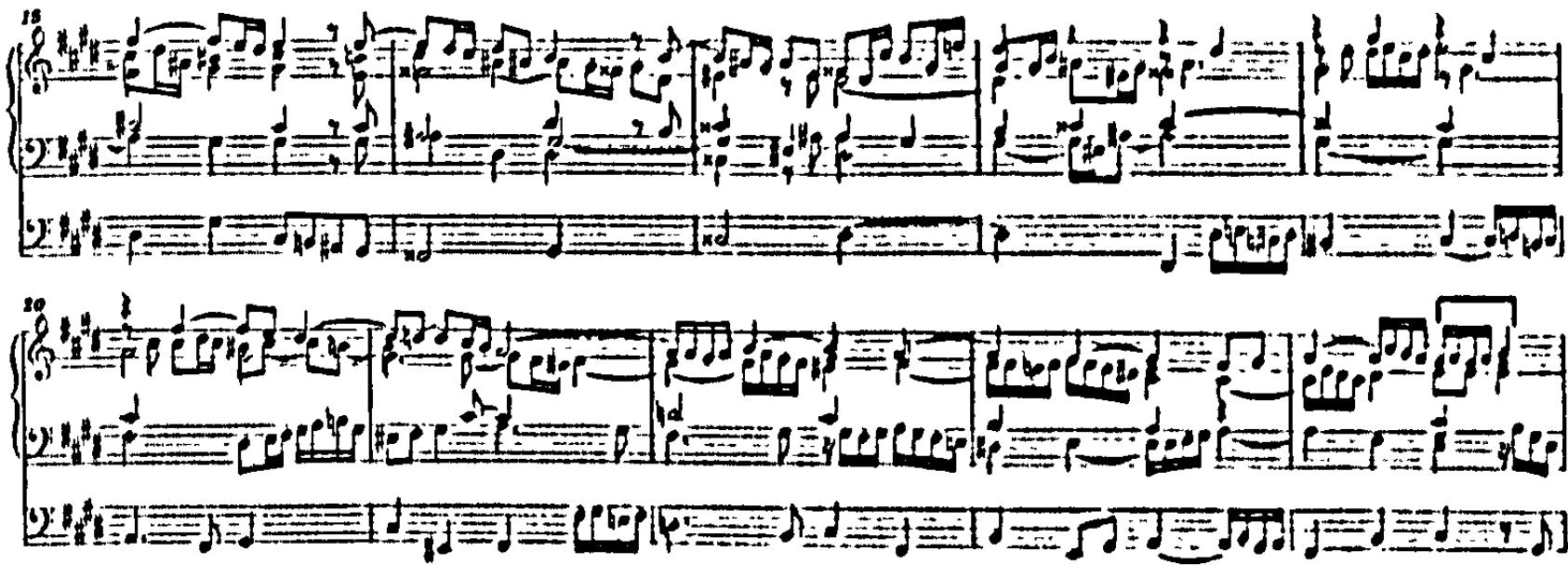
中文讲解
本段为乐谱图示的占位符。题图说明文字指出 Example 70 取自 BWV 566 第 15–24 小节,用以展示这段音乐中的修辞格 pathopoeia(悲情格)。由于内嵌图像数据已被省略,读者须查阅原谱或外部资料才能看到该谱例的具体音符与对位;本节正文中所讨论的悲情格分析须以原始乐谱为准。
第2段(P0175)
原文复述
The affection-oriented character of the exordium is also confirmed in the following ten bars starting from bar 24, where Bach inserts a sequence illustrating the auxesis (incrementum) figure. The passage appearing on the two final beats of bar 24 is heard three times (bars 25-26) with each successive statement at a higher level creating the sense of an increasing intensity. This resolves into the tonic (bar 27), where the texture gives way to more affective figures that contradict the rising sequence created in the previous bars. The semiquaver motive on the first two beats of bar 28 gives rise to the polyptoton through three emphatic statements of the initial figure at different pitches. The sense of descending motion created by the manuals is intensified by the pedal, where the repetition of the pedal motive (bars 28-29) at lower pitches ends in bar 29, where the new motive begins. The last statement of the manual passage (beats 3-4 of bar 29) becomes the beginning of another expressive figuration, the paronomasia; the motive b’-c#"-d#"-e" (bar 29) is heard three consecutive times resolving each time into different scale degrees (tonic-submediant-tonic-supertonic seventh), strengthened by the descending pedal line c#-B-A in bars 30-31. The last statement of the manual motive (bar 31), stressed by an extensio in the soprano and followed by suspensions in the chords in the penultimate bar, leads to the conclusion of the exordium.
中文讲解
本段是本节论证的核心:作者证明 BWV 566 引子段(exordium)的感情修辞特征在第 24 小节之后的十小节中仍在延续,并通过若干相互衔接的修辞格得以加强。第 24 小节后两拍出现一个动机,作者将其在第 25–26 小节里连续陈述三次,每次都比上一次音高更高,由此构成 auxesis(incrementum,增益格),制造强度递增的感觉;该上行序列随后在第 27 小节的主音上得到解决,并让位于一组新的、带有感情色彩却与上行序列形成对照的织体。第 28 小节前两拍的十六分音符动机被以三种不同音高强力地重申,产生 polyptoton(同源反复);声部层的下行动机被脚键盘的反复加强,脚键盘动机(第 28–29 小节)以更低音高重复,第 29 小节起引入新动机。第 29 小节第 3–4 拍的手键盘陈述又成为另一修辞格 paronomasia 的起点:动机 b’-升c"-升d"-e" 在第 29 小节连续出现三次,每次解决到不同的音级(主音—下中音—主音—上主七音),并在第 30–31 小节由下行脚键盘声部 升c-B-A 加以巩固。第 31 小节最后一次出现手键盘动机时,高声部通过 extensio(延音)加以强调,倒数第二小节的和弦出现倚音(suspensions),随即结束引子段。
理解要点:本段不是逐小节描述,而是把每一组织体对应到一种 Baroque 修辞格,并以“增势—转折—下压—三连解决—延音/倚音收束”的逻辑展示引子段的感情修辞如何层层堆叠、修辞密度如何逐步上升;其作用是论证引子段并非单纯引子,而是密集地承载多种修辞手法的情感布局,为下文论述其与 narratio 之间的素材关联做铺垫。
第3段(P0176)
原文复述
Footnote 66: Bartel, pp. 359-62.
中文讲解
这是正文段落 P0175 中所讨论的修辞格(auxesis、polyptoton、paronomasia 等)认定与释义的来源标注,指向 Bartel 一书第 359–362 页。该脚注的功能是为修辞图谱的识别提供权威文献依据,属于“来源支持类”脚注;脚注本身不引入新主张,仅限定正文中那些图式认定是参照 Bartel 的分类体系作出的。
第4段(P0177)
原文复述
Figure caption: Example 71. BWV 566: exordium (bars 25-33). Image data omitted; caption and position retained.
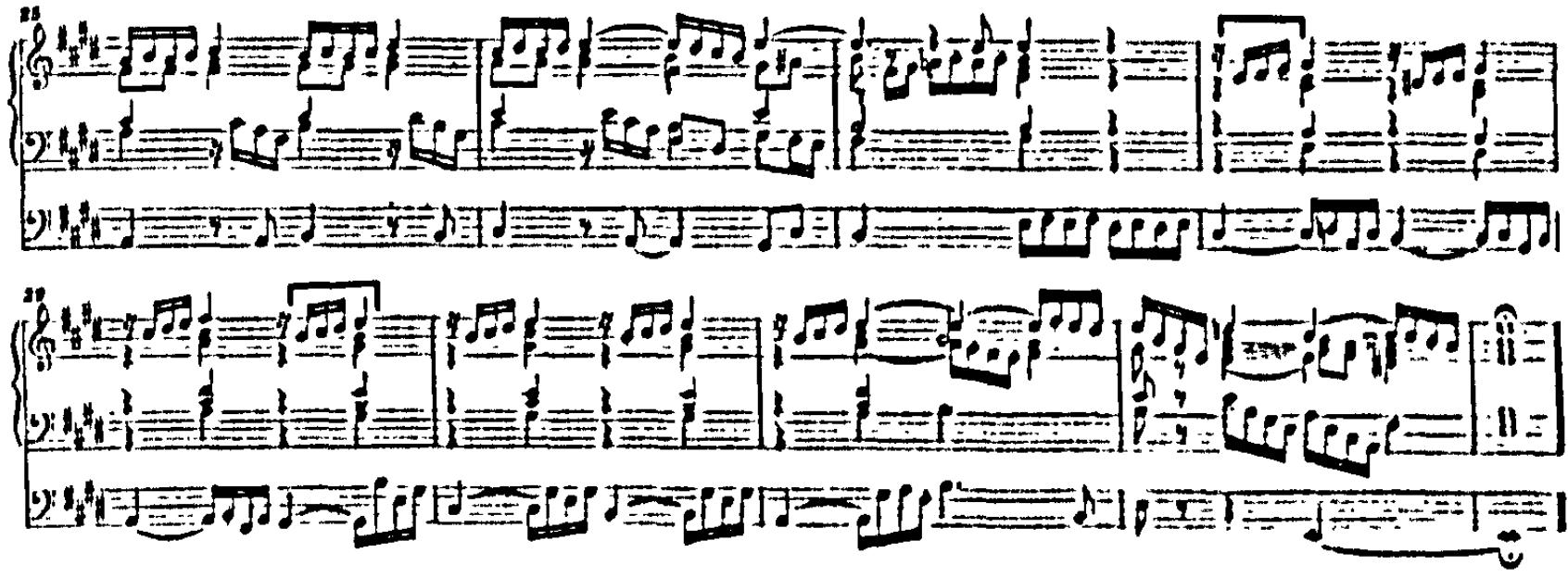
中文讲解
本段是第二个乐谱图示的占位符。题图说明指出 Example 71 取自 BWV 566 引子段的第 25–33 小节,正是 P0175 文字所描述的增势格、同源反复、同音异义格、延音与倚音收束的具体所在。由于图像数据已省略,读者须查阅原谱才能把第 25–33 小节中的修辞格与正文的分析一一对应。
第5段(P0178)
原文复述
In contrast to the exordia encountered so far, the E major one is a complete, autonomous section that could easily qualify as an independent prelude. The final chord signifies the end of a long introduction, which, in contrast to BuxWV 153 and BWV 551, does not overlap the beginning of the narratio. The first fugue following the exordium is a contrapuntal composition of eighty-nine bars - an unusual length if compared to Buxtehude’s narrationes - without an internal peroratio following it. The long subject of the narratio (five bars) is a typical north German canzona-like theme reminiscent of Buxtehude’s narrationes (BuxWV 148), formed on elements presented earlier in the exordium. The first fragment of the narratio is possibly modelled on the improvisatory gesture of the second beat of the exordium (see example 72), while the semiquaver motives of the subject recall the pedal motive that appeared in the exordium in bar 27 (see the following examples).
中文讲解
本段把视角从引子段内部的修辞格切换到它在整首前奏曲中的结构位置,提出三点主张。第一,与此前讨论的引子段不同,这首 E 大调引子段自身完整、自成段落,几乎可以作为一首独立的前奏曲。第二,与 BuxWV 153 和 BWV 551 不同,该引子段的结束和弦清楚地结束了引言部分,并不与紧随其后的 narratio(叙述段)首部重叠——即两段之间有明确的分界而非材料过渡。第三,紧接其后的第一首赋格即 narratio,长达八十九小节,与布克斯特胡德的同类段相比属于异常规模,且其内部不附有 peroratio(结束/概括段)。叙述段主题长达五小节,是典型的北德意志 canzona 式主题,让人联想到布克斯特胡德的叙述段(如 BuxWV 148),并且其材料源自引子段已呈示的内容:主题的第一个片段可能模仿了引子段第二拍的即兴式音型(参见 Example 72),主题中的十六分音符动机则呼应了引子段第 27 小节中曾出现的脚键盘动机。
综合理解:本段既强调该引子段的“自足性”,又把引子段与叙述段建立为“材料—回响”的关系:八十九小节的主体赋格并非凭空而生,而是建立在引子段已经确立的动机与姿态之上;作者借此提示,本节对引子段的修辞分析并非孤立的局部考察,而是为后续解读叙述段的素材来源与体裁性质(如北德意志 canzona)做准备。
第6段(P0179)
原文复述
Footnote 67: Due to the dimensions of the fugue, the musical examples presented here will illustrate only some of the most affective parts of the narratio, while in other cases the reader might need to consult the full score.
中文讲解
这是对 P0178 所提到的八十九小节赋格规模之大、难以逐一谱示所作的方法论说明:作者只挑选最具感情表现力的片段作为乐谱示例,其余部分指引读者自行查阅完整总谱。该脚注限定了下一节(即叙述段的逐节讨论)所能提供的谱例覆盖范围,提醒读者所看到的图示并非穷尽性的逐小节展示,而是择要举例。
脚注 / 边栏 / 图表 / 附加信息(如有)
本节包含两处脚注与两处图示占位符。脚注 66(来自 Bartel 第 359–362 页)位于 P0175 末尾,为本段对 auxesis、polyptoton、paronomasia 等修辞格的识别提供文献来源;脚注 67 紧接 P0178,说明由于叙述段篇幅过长,下文乐谱示例将只覆盖最具感情表现力的片段,其余请读者查阅完整总谱。图示占位符分别为 Example 70(BWV 566 第 15–24 小节,悲情格 pathopoeia)与 Example 71(BWV 566 引子段第 25–33 小节,含 auxesis、polyptoton、paronomasia 等格的密集段落),二者皆因内嵌图像数据被省略而需以原谱核对。
💡 本节核心要点
- BWV 566 的 E 大调引子段不仅以悲情格(pathopoeia)开场,更在第 24 小节之后连续密集运用多种 Baroque 修辞格——auxesis(增势)、polyptoton(同源反复)、paronomasia(同音异义)、extensio(延音)与 suspensions(倚音收束)——从而证明该引子段具有强烈的感情修辞特征。
- 引子段内部从“上行增势”到“下行对照—三连解决—延音/倚音收束”的修辞布局,呈现出明确的感情强度曲线,为整首前奏曲定下情感基调。
- 该引子段在结构上自成一体,可被视为一首独立的前奏曲;与 BuxWV 153、BWV 551 不同,它以明确结束和弦收束,并不与叙述段重叠。
- 其后的叙述段为八十九小节的赋格,规模超出布克斯特胡德的同类段,且不含内部的 peroratio;其五小节主题属北德意志 canzona 式,回响布克斯特胡德 BuxWV 148。
- 叙述段主题的两个关键来源均能回溯至引子段:开篇片段可能模仿引子段第二拍的即兴音型,十六分音符动机呼应引子段第 27 小节的脚键盘动机,从而确立“引子—叙述”的素材连续性。
- 由于叙述段体量过大,后续分析只能选取最具感情表现力的片段作示例,读者须参考完整总谱以补充其余细节。
🔑 关键术语
- exordium:Baroque 前奏曲的引言/开端段落。在本节中指 BWV 566 开头的 E 大调段落,作者强调其自足、完整,可独立成篇。
- narratio:紧随引子段之后的叙述性赋格段落。在本节中指 BWV 566 中长达 89 小节的第一首赋格。
- peroratio:修辞学意义上的收束/概括部分;在 Baroque 前奏曲中可作为赋格内部的总结性段落。本节指出 BWV 566 的叙述段后并无此类内部收束。
- pathopoeia:悲情格,一种 Baroque 修辞格,借助音乐表现悲怆、痛苦或激越之情;Example 70 标识其出现于 BWV 566 第 15–24 小节。
- auxesis (incrementum):增益格/递增格,把同一动机在更高音级上重复以制造逐步增强的效果;本节中体现为第 24 小节后两拍动机三次逐级升高。
- polyptoton:同源反复格,把同一动机以不同音高或不同强调方式反复陈述;本节中体现为第 28 小节十六分音符动机三次以不同音高呈现。
- paronomasia:同音异义格,把同一动机反复出现并解决到不同音级;本节中体现为 b’-升c"-升d"-e" 动机先后解决到主音—下中音—主音—上主七音。
- extensio:延音/延长格,对某音加以延长以增强表现力;本节中体现为第 31 小节高声部对手键盘动机末音的延音。
- suspensions:倚音,前一和弦音延留到下一和弦并形成不协和;本节中出现在引子段倒数第二小节的和弦中,与 extensio 一同收束引子段。
- canzona:源自声乐 chanson 风格的器乐体裁,特征为活泼、节奏鲜明;本节中用以描述 BWV 566 叙述段主题所具有的“北德意志 canzona 式”特征,并将其与布克斯特胡德 BuxWV 148 相联系。
4.17 [描述性拆分] BWV 566: The Narratio Fugue
第1段(P0180)
原文复述
Image caption identifying Example 72 as a detail of the exordium of BWV 566, covering bars 1-2. (Embedded image data omitted; caption and position retained.)
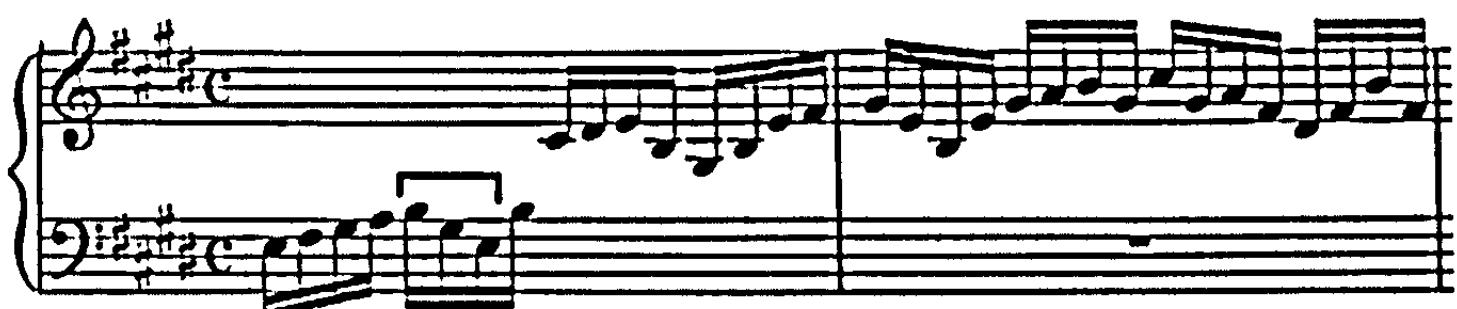
中文讲解
这是"例72:BWV 566 序奏(exordium),第1-2小节(细节)“的图像占位符,位于本节讨论"主题衍生技术”(thematic derivation)的段落之前。读者需结合P0182对该序奏中踏瓣动机的描述来理解此图——它是后文作者推断"序奏动机为踏瓣groppo变形提供解决方案"的视觉参照。由于图像数据被省略,具体音高、节奏与声部分配等细节需查看原图。
第2段(P0181)
原文复述
Image caption identifying Example 74 as a detail of the narratio subject of BWV 566, covering bars 34-36. (Embedded image data omitted; caption and position retained.)
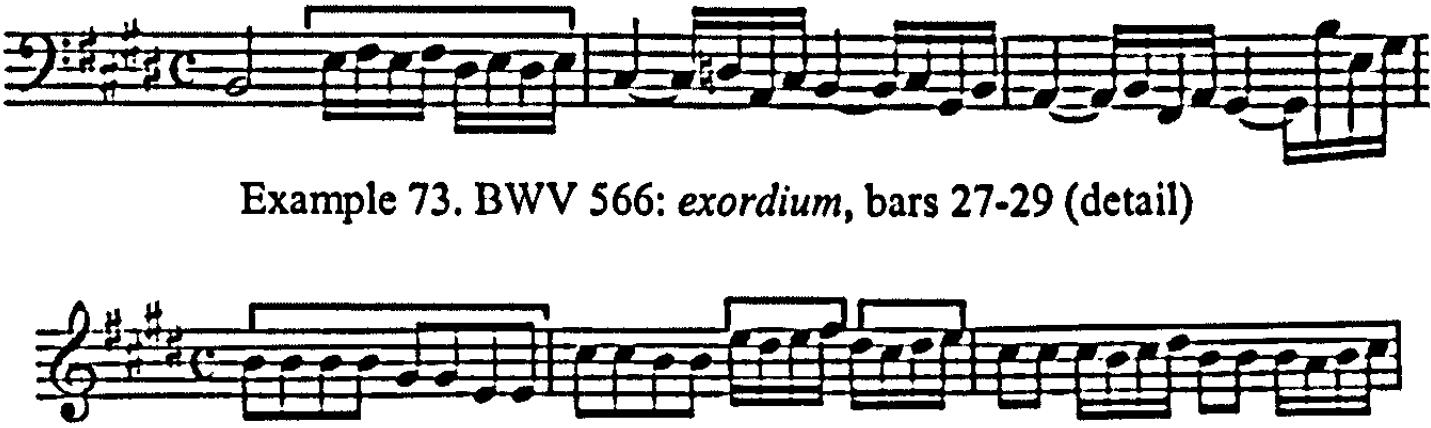
中文讲解
这是"例74:BWV 566 narratio主题,第34-36小节(细节)“的图像占位符,紧随例72出现。它是P0182所述narratio主题开头的乐谱证据:前两小节呈四分音符起头,紧接的十六分音符构成首尾同音的groppo音型。该图所示形态正是后文作者主张需在踏瓣上加以变形的原型。图像细节需查看原图。
第3段(P0182)
原文复述
A comparable technique of thematic derivation is also found in Buxtehude’s Prelude in A minor, where the opening interval of the ascending fourth (c-a) in the manuals prefigured the thematic material used both for the narratio and for the confirmatio. In the narratio presently under discussion (E major), the semiquavers following the initial quavers of the subject illustrate successive groppo figures in which the first and third notes are identical. Because such a figure would be awkward to execute in the pedal under a performance practice that favored the alternate-toes pedal technique, the narratio theme has to be altered. As a result, the semiquavers of the subject take on a different shape—namely, the one previously encountered in the exordium. It is highly probable that the initial pedal motive of the exordium supplied an effective solution for adapting the groppo figure to the pedal. The example that follows, to be compared with example 73, illustrates this point.
中文讲解
这一段是本节论证链的核心节点,承担"类比—结构分析—实践约束—变形方案"四重任务:
-
类比先行:作者以布克斯特胡德(Buxtehude)A小调前奏曲作为平行例证——其双手声部开头上四度跳进(c-a)提前暗示了narratio与confirmatio所用的主题材料。此举把巴赫的同种做法放入可比较的前辈传统,从而削弱"为踏瓣演奏便利而变形"这一纯实用性解释的孤立性。
-
当前narratio内部结构:在E大调narratio中,主题以四分音符起头,紧接的十六分音符构成连续的groppo音型——即第一音与第三音相同的快速装饰音。
-
实践约束触发的变形:当时通行的踏瓣奏法倾向"双脚脚趾交替”(alternate-toes technique),groppo的快速重复在这种奏法下并不顺手,因此主题必须被改写。
-
解决方案指向exordium:作者推断,序奏开头那个踏瓣动机为踏瓣上的groppo改造提供了现成的音型;下一幅图(即例75)即以具体音符呈现此变形,并应与例73(exordium的踏瓣动机)对照。
读者需注意三点:(a)“groppo"在文本中被严格定义为"第一音与第三音相同"的小装饰音型,这是判断"为何要变形"的唯一技术依据;(b)“very likely"为谨慎措辞,作者并未声称踏瓣动机复用是确证,而是合乎情理的推断;(c)本段既向上承接前文Buxtehude类比,又向下开启例75,是本小节承上启下的枢纽。
补充说明
“exordium"“narratio"“confirmatio"沿用前几节建立的"修辞学结构—音乐结构"对应框架;“alternate-toes pedal technique"指当时管风琴踏瓣以两脚脚趾交替按键的通行弹奏法,文本明确将其作为变形的实践动机。
第4段(P0183)
原文复述
Image caption identifying Example 75 as a detail of the narratio pedal part of BWV 566, covering bars 49-52. (Embedded image data omitted; caption and position retained.)

中文讲解
“例75:BWV 566 narratio 踏瓣声部,第49-52小节(细节)“的图像占位符,紧接P0182末句"The following example illustrates this point”。它以乐谱形式呈现前段所推断的"踏瓣groppo变形方案”,并应在视觉上与P0182提到的例73(exordium踏瓣动机)对照,以观察二者在节奏型与音程上的同构关系。由于图像省略,具体音符与节奏细节需查看原图。
第5段(P0184)
原文复述
Compared with the narratio of the A minor prelude (BWV 551), the narratio in E major exhibits a carefully worked-out contrapuntal texture: entries of the subject in four voices are each followed by the countersubject. The exposition concludes at bar 52, after which short episodic interludes—bars 52-53 and bars 58-59, both built on material drawn from the subject and incorporating points of imitation—lead to further entries; in these later entries two voices carry the subject and the countersubject respectively, namely the soprano and the pedal (bars 53-
中文讲解
本段开启对BWV 566(E大调)与BWV 551(A小调)两部前奏曲narratio的对比,得出三点结构性判断:
-
复调织体的精心化:E大调narratio的主题以四声部依次进入,每次进入后都跟以对题(countersubject),织体比A小调那首更为系统地编织出来。
-
呈示段(exposition)的节点:呈示在第52小节结束;其后是两段短小的插段间奏——第52-53与58-59小节——它们都基于主题材料并使用模仿对位(points of imitation)。
-
主题陈述的层级递降:插段之后,主题与对题改由两对声部分别承担——高音与踏瓣(第53小节起)以及次中音与中音(第60小节起)。这构成了一个"由四声部陈述→两声部陈述"的递降布局。
读者需注意:(a)本段句末被括号截断,跨页至P0185继续;(b)“worked out"一词暗示作者认为E大调narratio在结构组织上更具逻辑性,而非情感层面更佳;(c)“points of imitation"是判断两段间奏属于"基于主题材料的模仿"而非独立材料的关键词。
补充说明
“points of imitation"指短小主题动机在不同声部依次进入形成模仿的写法;“countersubject"指与fugue subject同时陈述的固定次要主题。
第6段(P0185)
原文复述
- and the tenor and the alto (bars 60-64), carry the subject and the countersubject respectively. Although the E major narratio surpasses the A minor one in terms of harmony, entries of the subject are restricted to E and B (the subject is heard in B major in bars 89-93), with the exception of bars 107-111, where the theme appears in the relative C# minor. In such an extended narratio it was inevitable that Bach would introduce an element of contrast in order to maintain the listener’s attention. The alteration of the pedal subject (example 75) falls in line with Quintilian’s doctrine, according to which the orator is free to employ variety in his arguments in order to relieve the tedium of his speech.
中文讲解
本段承接P0184被截断的括号,完成声部分配的说明;随后作出本节两个关键的评价性论断:
-
声部分配补完:第53-57小节由高音与踏瓣承担主题与对题;第60-64小节由次中音与中音承担主题与对题。这印证了P0184所说的"四声部→两声部"的层级递降。
-
和声丰富度与调性布局的张力:E大调narratio在和声上胜过A小调那首,但主题进入的调性被严格限定——主要只出现在E(主调)和B(属调,B大调主题于第89-93小节出现),唯一的例外是第107-111小节主题出现在关系小调升c小调。这一"和声胜出但调性集中"的矛盾设置了"为何必须引入对比"的内在张力。
-
把"实践变形"重新诠释为"修辞性变化(variety)":作者将P0182所述踏瓣主题变形(例75)纳入昆体良(Quintilian)的修辞原则——演说者有权在论证中运用变化以缓解听众的厌倦。由此,“为踏瓣演奏便利而做的变形"被升格为"修辞意义上的变化”,使实践约束与修辞意图合二为一。
读者应注意:(a)“with the exception of bars 107-111"是关键的限定条件,它预先为P0187讨论auxesis做铺垫——升c小调主题进入正是借由auxesis引入的;(b)“it was inevitable"语气稍强,提示作者把"对比的引入"看作长narratio结构上的必然;(c)此段完成P0182-P0185的小论证闭环:实践约束→主题变形→变形被诠释为修辞性变化。
补充说明
“Quintilian’s doctrine"在原文中具体所指为"the orator was free to employ variety in his arguments in order to relieve tedium of his speech”——这是文本明确援引的修辞学原则;本节所有昆体良相关论述均以此表述为限。
第7段(P0186)
原文复述
Image caption identifying Example 76 as showing the narratio of BWV 566, specifically the auxesis figure at bars 69-71. (Embedded image data omitted; caption and position retained.)

中文讲解
“例76:BWV 566 narratio 中的 auxesis 音型(第69-71小节)“的图像占位符。它是P0187讨论的"两次auxesis"中第一次出现的乐谱证据,位于主调主题进入前。文本说明该auxesis的特征是中音与高音"立即而紧密地"相继陈述两个十六分音符动机,呈上行级进。由于图像省略,具体音高、节奏与声部进行需查看原图。
第8段(P0187)
原文复述
Despite the objective character of the narratio, Quintilian also suggested that the orator should occasionally introduce affective gestures into his discourse. Two separate episodes illustrate an expressive figuration that Bach applies a couple of bars before the entrance of the subject on the tonic and on the relative C# minor respectively. The auxesis (incrementum) is demonstrated twice: the first time in bars 69-71, where there is an immediate and intense repetition of two semiquaver motives presented by the alto and the soprano in an ascending progression (see also the auxesis in the exordium, bars 24-26). The second time (bars 106-107), the auxesis takes on a more expressive character. The inherent dramatic tension of the figure is demonstrated by the same voices moving, this time simultaneously, in ascending parallel sixths, accompanied by a similar pedal movement that finally leads to C# minor, where the subject enters.
中文讲解
此段把本节论证从P0185的"为避免单调而做的变化"推进到"情感姿态的引入”:
-
理论前提:尽管narratio按修辞学定义应是"客观陈述”,昆体良仍允许演说家"偶尔"在叙述中加入情感姿态(affective gestures)。作者援引此原则,为巴赫在narratio中加入表现性音乐段落提供合法性。
-
两次auxesis的对应位置:第一次在第69-71小节(主调主题进入前);第二次在第106-107小节(升c小调主题进入前)。这恰好与P0185所述"主题只进入主调、属调与升c小调"形成结构对应——每次出现新的调性进入前都有一个auxesis作为情感铺垫。
-
两次auxesis的对比(这是本段最核心的细节):
- 第一次:中音与高音"立即而紧密"地相继陈述两个十六分音符动机,呈上行级进(参看exordium第24-26小节已出现的auxesis作为先例)。
- 第二次:同样的两个声部"同时"以平行六度上行,并伴有类似的踏瓣运动,最终导向升c小调主题进入。
-
表现性递增的实质:从"声部依次进入"到"声部同步进入”,从"纯级进"到"平行六度”——第二次auxesis更为强烈、更具戏剧张力,作者用"inherent dramatic tension"加以概括。
读者应注意:(a)“see also the auxesis in the exordium, bars 24-26"暗示auxesis并非narratio独有,它贯穿整首前奏曲;(b)“accompanied by a similar pedal movement"显示巴赫把auxesis扩展到踏瓣,使"和声—调性过渡”(进入升c小调)与"修辞—情感姿态"合一,这是本段最重要的论证点;(c)本段与P0185的"变化"原则形成补充:narratio既需要"避免单调”,也需要"情感投入”。
补充说明
“auxesis (incrementum)“在原文中以括号互训形式出现,意为"递增”;作者将其作为表现性figure应用于两段十六分音符上行音型。
第9段(P0188)
原文复述
Image caption identifying Example 77 as showing the narratio of BWV 566, specifically the auxesis figure at bars 106-108. (Embedded image data omitted; caption and position retained.)
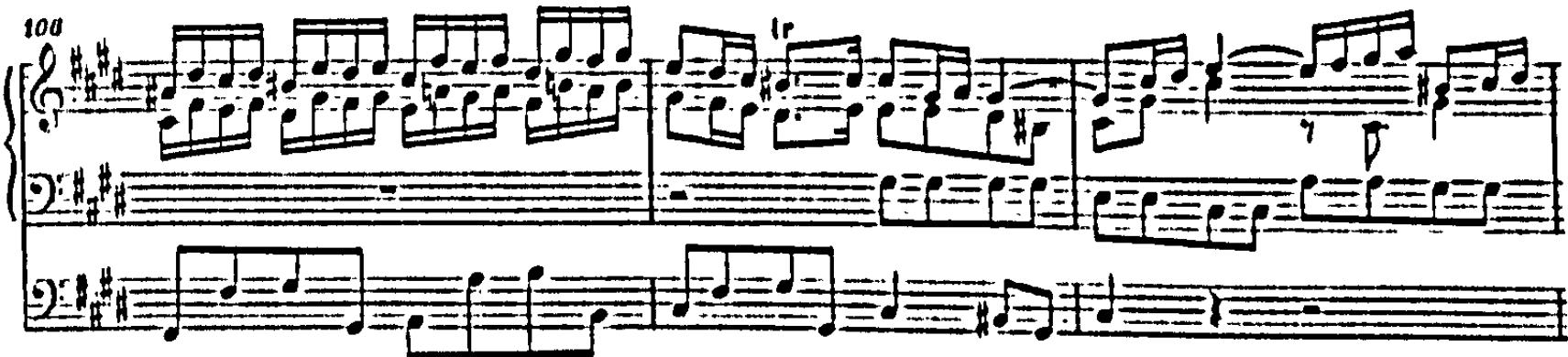
中文讲解
“例77:BWV 566 narratio 中的 auxesis 音型(第106-108小节)“的图像占位符。它是P0187所述第二次auxesis的乐谱证据,发生在升c小调主题进入前。读者应将其与例76(第一次auxesis)并置:第一次是声部依次进入的"级进重复”,第二次是声部同步的"平行六度上行”,以观察作者所论的"从立即重复到戏剧张力"的表现性递增。具体音高、节奏与声部进行需查看原图。
脚注 / 边栏 / 图表 / 附加信息(如有)
本节正文段落(P0182、P0184–P0185、P0187)中引用的谱例包括例72–77。其中例72(exordium第1-2小节)、例74(narratio主题第34-36小节)、例75(narratio踏瓣第49-52小节)、例76(narratio auxesis第69-71小节)、例77(narratio auxesis第106-108小节)在输入中均为图像占位符(图像数据省略,图注与位置保留);例73仅在P0182文字中被提及作为对照例,未在输入中给出独立图注。节内无脚注。
💡 本节核心要点
- 巴赫BWV 566的narratio延续了一种前辈传统:通过exordium材料预先暗示后续段落主题;该传统可在布克斯特胡德A小调前奏曲中看到对应(升四度c-a同时预演narratio与confirmatio材料)。
- narratio主题中的groppo音型(首尾同音的快速装饰)在踏瓣上不便于alternate-toes技法演奏,因此主题被改写;改写的音型来自exordium的踏瓣动机(例75)。
- 与BWV 551的A小调narratio相比,E大调narratio在复调织体(主题四声部进入且每次跟以对题)与和声上更为丰富,但主题进入的调性被严格限定为主调E、属调B与关系小调升c小调(第107-111小节)。
- 作者援引昆体良的"variety in arguments to relieve tedium"原则,把上述踏瓣变形升格为修辞意义上的变化(varietas),从而把实践约束与修辞意图合二为一。
- 尽管narratio按定义属"客观陈述”,昆体良允许演说家偶尔加入情感姿态;巴赫由此在主调主题进入前(第69-71小节)与升c小调主题进入前(第106-107小节)分别加入一次auxesis(incrementum)。
- 两次auxesis构成表现性递增:第一次为声部依次级进重复,第二次为声部同步以平行六度上行并配合踏瓣运动进入升c小调,体现"inherent dramatic tension”。
🔑 关键术语
- narratio:本节沿用的"修辞学—音乐"对应框架中的"陈述"段落;在BWV 566中指主题呈示与展开的部分(与BWV 551的narratio形成对比对象)。
- exordium:本节沿用的修辞学对应段落,指BWV 566的序奏部分(参例72,第1-2小节);其踏瓣动机在narratio中被改写后的主题所复用。
- confirmatio:本节援引的修辞学段落,在布克斯特胡德A小调前奏曲中其主题材料由开头的上四度(c-a)预先暗示。
- groppo:文本定义为"第一音与第三音相同"的小装饰音型;本节指narratio主题四分音符之后的十六分音符所构成的连续groppo音型,因踏瓣演奏不便利而被改写。
- alternate-toes pedal technique:文本明确点出的踏瓣演奏惯例:双脚脚趾交替按键;本节被作为groppo在踏瓣上不便演奏的实践依据。
- countersubject:与narratio/fugue主题同时陈述的固定次要主题;E大调narratio中四声部主题进入后均跟以对题。
- points of imitation:基于短小主题动机的声部模仿片段;本节出现于narratio呈示结束后的两段插段间奏(第52-53与58-59小节)。
- auxesis / incrementum:文本以括号互训形式给出的修辞格,意为"递增”;本节指两次十六分音符上行音型,分别出现在第69-71小节与第106-107小节。
- Quintilian’s doctrine of variety:原文表述为"the orator was free to employ variety in his arguments in order to relieve tedium of his speech”;本节被援引以解释踏瓣主题变形(例75)的修辞合法性。
- Quintilian on affective gestures:原文表述为"the orator should occasionally introduce affective gestures into his discourse”;本节被援引以解释narratio中两次auxesis的表现性。
4.18 [描述性拆分] BWV 566: The Digressio and Confirmatio
第1段(P0189)
原文复述
The narratio concludes without the intervention of an affective section (internal peroratio), but is followed immediately by a quasi-improvisatory passage, the digressio (bars 123-133). Although short, the digressio creates a strong contrast to the tightly organised narratio and illustrates a plethora of affective gestures, all justifying the function of this portion of the Klangrede as a stylus phantasticus passage. Additionally, although its character is totally different from that of the digressio of BWV 551, the section functions as a transitory part between the two fugues, preparing the way for the confirmatio that follows. The style of the digressio hints at the north German organo pleno toccata tradition (as does the exordium), through imposing figurations such as ascending and descending passages (anabasis, catabasis) that start off the beat. Dramatic salti semplici (octave leaps) in the pedal intensify the improvisatory character of the section, as well as the awkward pedal figurations in bars 131-132, interpreted as an extended version of a trillo longo that ends in the dominant.
中文讲解
本段是整个 Klangrede 架构从 narratio 进入 confirmatio 之间的桥梁段落,其核心信息可拆为三层。
第一层是结构定位:narratio 结束后没有插入“带感情色彩的小结”(即 internal peroratio),紧接着就是第 123–133 小节的 digressio。这种“无内部小结、直接过渡”的安排,使 digressio 同时承担两种功能——一是本身作为一段 quasi-improvisatory(近似即兴)的炫技段落,二是衔接前后两首赋格。
第二层是修辞功能。作者之所以把这一短短十小节定位为 stylus phantasticus(幻想曲风格),是因为它呈现出“大量情感姿态”(a plethora of affective gestures),与前面 narratio 那种紧密组织的对位形成强烈对比。换言之,作者用风格反差来定义段落身份。
第三层是音乐语汇来源。作者指出,digressio 让人联想到北德 organo pleno(全部音栓)托卡塔传统,与开头的 exordium 一脉相承。具体语汇包括:anabasis(上行)、catabasis(下行)等“抢拍起始”的宏大音型;pedal 中 dramatic salti semplici(戏剧性的八度跳进)强化即兴感;第 131–132 小节笨拙的 pedal 音型被解释为“扩展版的 trillo longo(长颤音)”,最终落在属音上,为下一段 confirmatio 做属准备。
注意:作者特别说明 BWV 566 的 digressio 与 BWV 551 的 digressio“性格完全不同”,这表明同名结构在不同作品中的具体实现可以差异极大,结构名只是功能框架,而非风格标签。
补充说明
段落末尾提到第 131–132 小节以属音收束,这是为 P0191 中所述 confirmatio 起于 B 大调主和弦做的属准备。digressio 与 confirmatio 之间的“属—主”衔接关系,本节内部即可定位。
第2段(P0190)
原文复述
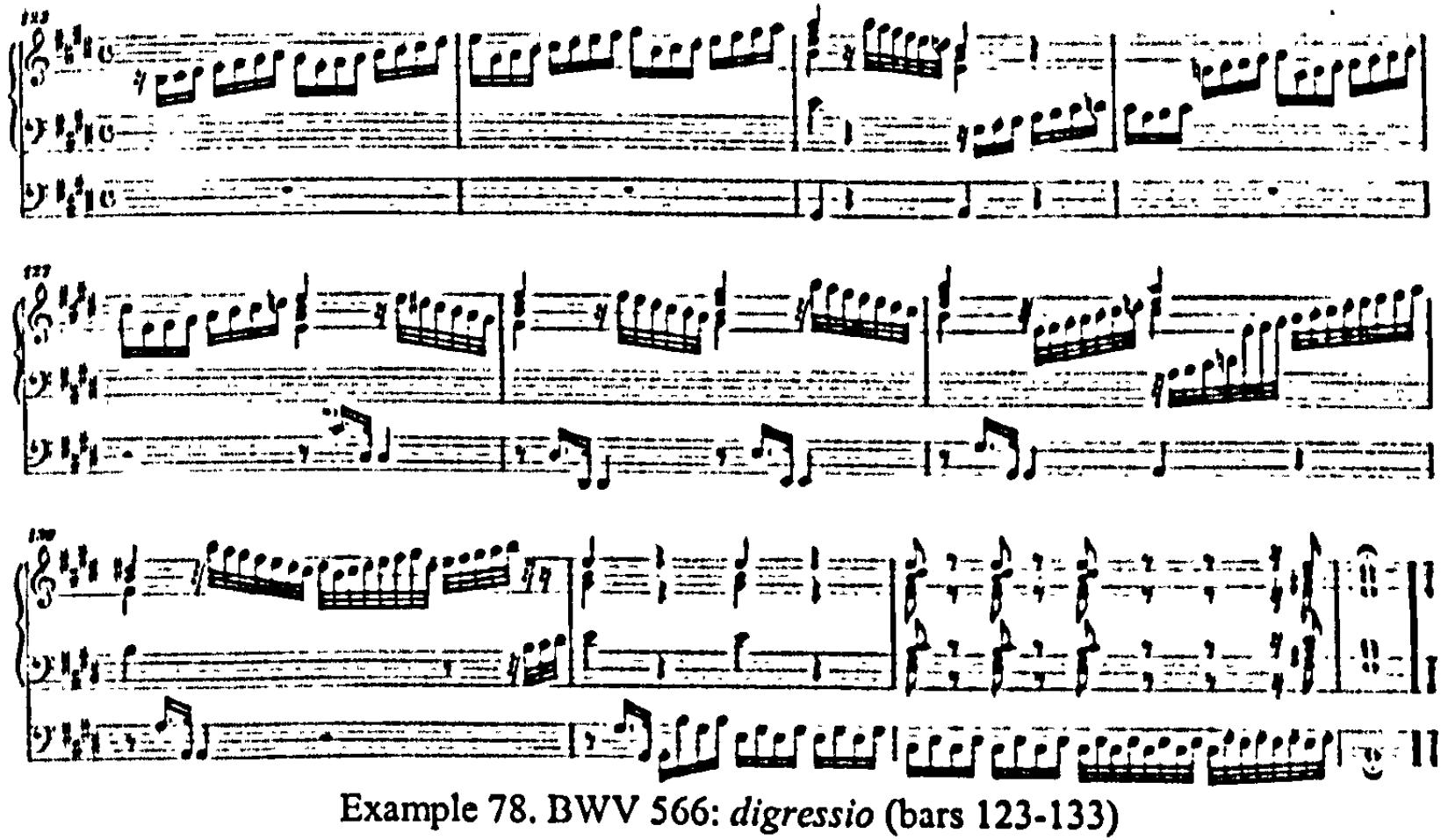
中文讲解
此处为第 38 页的图像或乐谱占位符,原文未提供图注或额外说明文字。结合上下文,该图很可能与 P0189 所描述的 digressio(第 123–133 小节)相对应,用以呈现 pedal 中的八度跳进、上行下行音型以及 trillo longo 段落。建议参阅原图核对音型细节。
补充说明
本占位符无附加文字说明;图中具体细节需查原版。
第3段(P0191)
原文复述
The dominant B major chord that closes the digressio is carried forward on the first beat of the confirmatio, the penultimate section of the Toccata. The subject of the second fugue, written in 3/4 metre, is linked to that of the narratio (only the beginning of the narratio fugue is transformed), but with rhythmical alterations. In contrast to the narratio, in which fugal texture was meticulously developed and episodes and thematic entries were carefully balanced, the confirmatio illustrates a flowing fugue of loose contrapuntal writing. The exposition features four equally spaced entries on E and B that occupy bars 134-149, while a further entry in the tenor in bars 151-154 cadences briefly in C# minor (bars 153-154).
中文讲解
本段开启 confirmatio 的论述,传递三组关键信息。
其一,和声衔接。digressio 收束于 B 大调属和弦,而 confirmatio 第一拍即承接这一属和弦,因此开篇就是 B 大调的主和弦。这一“属—主跨段延续”解释了 confirmatio 一开始为何直接是 E(主)和 B(属)上的答题,而非传统意义上的主调起始。
其二,主题关系与体裁差异。confirmatio 主题为 3/4 拍,与 narratio 主题只在“开头”处相关,但做了节奏变形(rhythmical alterations)。这是作者反复强调的“paronomasia(近形变体)”思路——用同一素材的变体来“确认”前文论点。相较于 narratio 那种“fugal texture 被精心发展、插段与主题进入被仔细平衡”的写法,confirmatio 则是“流动的对位、较为松散的写法”(flowing fugue of loose contrapuntal writing)。作者用这组对比来标记两段赋格在 Klangrede 中的不同修辞位置:narratio 是铺陈,confirmatio 是展开—变化—说服。
其三,呈示段结构。呈示段(第 134–149 小节)有四次等距出现,分别在 E 和 B 上;之后第 151–154 小节在 tenor 上多一次进入,短暂在升 c 小调上终止(第 153–154 小节)。这一 C# 小调的终止已经预示了后文(P0197)将在 C# 小调上再次出现,是 confirmatio 内部“半音领域扩展”的关键伏笔。
补充说明
本段所谓“penultimate section”是 Toccata 的倒数第二部分,与 P0199 末尾 peroratio 的出现直接呼应。3/4 拍与 narratio 主题只在开头相关,这一点是后续讨论 paronomasia 的前提。
第4段(P0192)
原文复述

中文讲解
此处为 Example 79 的占位符,标示 BWV 566 confirmatio 第 134–144 小节的乐谱位置。结合 P0191 内容,该谱例应呈现呈示段前两次主题进入(分别在 E 与 B 上)以及 3/4 拍下的节奏变形主题,并可能含升 c 小调的短暂离调。谱例具体细节需查原图。
补充说明
占位符位置与 P0191 所述呈示段前两次进入相对应。
第5段(P0193)
原文复述
Two middle entries on the dominant B major in bars 157-160 and 165-168 are separated by a short episode (160-164) that grows out of the material of the countersubject. Of these two dominant entries it is worth noticing that the one in bars 165-168 cadences in the relative G# minor, a procedure encountered earlier in the subject entry in the tenor (151-154). The last ‘original’ entrance of the subject on the tonic is heard in the pedal (172-175), accompanied by a series of imitative semiquaver motives that lead to another toccata-like episode until the next subject entry.
中文讲解
本段处理 confirmatio 中段(第 157–175 小节附近),要点有三。
第一,中段两次属音进入。作者把第 157–160 与 165–168 小节视为“在属音 B 上的两次中段进入”,中间由第 160–164 小节的小插段分隔,插段材料源自对题(countersubject)。这意味着 confirmatio 的结构并非线性铺陈,而是“主题进入—插段—主题进入”交替,这一点在 P0195 中被概括为“virtuosic episodes 与 strettos 的交替”。
第二,关系小调的离调。第 165–168 小节虽然在属音 B 大调上出现主题,却在关系小调升 g 小调上终止;作者提示这一做法此前已经在 tenor 第 151–154 小节出现过一次。两次相同的“属上进入—关系小调终止”说明这是 confirmatio 的有意布局,用半音/远关系离调来制造说服性张力。
第三,主音主题的最终“原始”再现。第 172–175 小节是主题在 pedal 上以主调(E)出现,作者称之为“最后的原始进入”(the last ‘original’ entrance of the subject on the tonic)。它伴随一系列模仿的十六分音符动机,引出下一段 toccata 风格的插段。所谓“原始”进入,意味着此后出现的都是变形版,这与 P0197、P0199 中“altered entry”与“paraphrased versions”形成对照。
补充说明
“对题材料用于插段”是巴赫常见做法;本段在文本内部即可定位(160–164 小节基于 countersubject)。
第6段(P0194)
原文复述
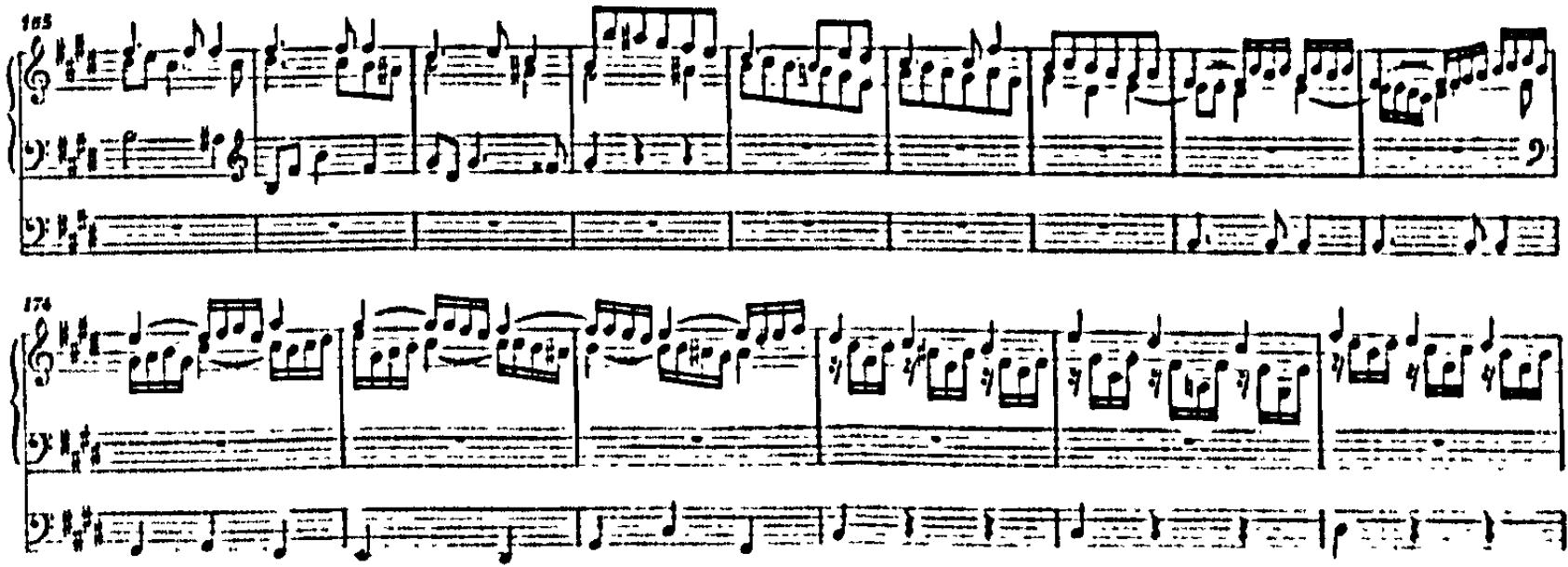
中文讲解
此处为 Example 80 的占位符,标示 BWV 566 confirmatio 第 165–179 小节的乐谱位置。该谱例应呈现 P0193 所讨论的三项内容:在 B 大调上的进入并结束于升 g 小调(165–168)、基于对题材料的插段,以及 pedal 上的“原始”主题再现(172–175),并可能延入随后的 toccata 风格插段。谱例具体细节需查原图。
补充说明
占位符对应 P0193 描述的范围。
第7段(P0195)
原文复述
Although the confirmatio of BWV 566 differs strongly from the one encountered in Bach’s A minor prelude, certain features can be mentioned about its structure, which justifies it as a confirmation of the already presented elements, yet in a different version. The section displays an alternation of virtuosic episodes and strettos, in which the theme is subject to variation, as already shown in bars 165-168 where the subject, although heard on the dominant, ended in the relative G# minor. A similar case is also encountered in bars 182-186 in which the soprano and tenor carry a rhythmically modified version of the subject (paronomasia), just as Quintilian advised the orator to vary his arguments in order to convince his audience of the facts put forward.
中文讲解
本段是 confirmatio 的总论段落,承担两项论证。
第一,结构定性。作者明确说 BWV 566 的 confirmatio 与 Bach A 小调前奏曲中的同名段落“差异显著”,但仍可称为“确认(confirmation)”,因为它用另一种版本“确认”了此前已呈现的要素。这一定性呼应 Klangrede 的整体思路:修辞学中的 confirmatio 阶段不是简单重复,而是“用变化版本来巩固论点”。
第二,具体机制。结构呈现为 virtuosic episodes(炫技插段)与 strettos(紧接模仿)的交替;主题在其中不断变化。作者举出两个例子:其一是已在 P0193 提到的第 165–168 小节(属音进入却结束于升 g 小调);其二是第 182–186 小节,soprano 与 tenor 携主题的节奏变形版。
第三,修辞学类比。作者用“paronomasia”(近形变体)来命名这种“主题的节奏变体”,并援引 Quintilian(昆体良)的修辞学建议——演说家应变换论证方式以说服听众。这一类比揭示出本段真正的分析视角:confirmatio 之所以有效,是因为它像修辞中的“变换论证”一样,让听众在多种变体中“再认”原始论点。
补充说明
Quintilian 的引用在本节是论证类比,作者借此把音乐结构与古典修辞学的论辩策略直接挂钩,提示读者:confirmatio 内部的“变奏”与修辞学中“变换论据”是同构的。
第8段(P0196)
原文复述
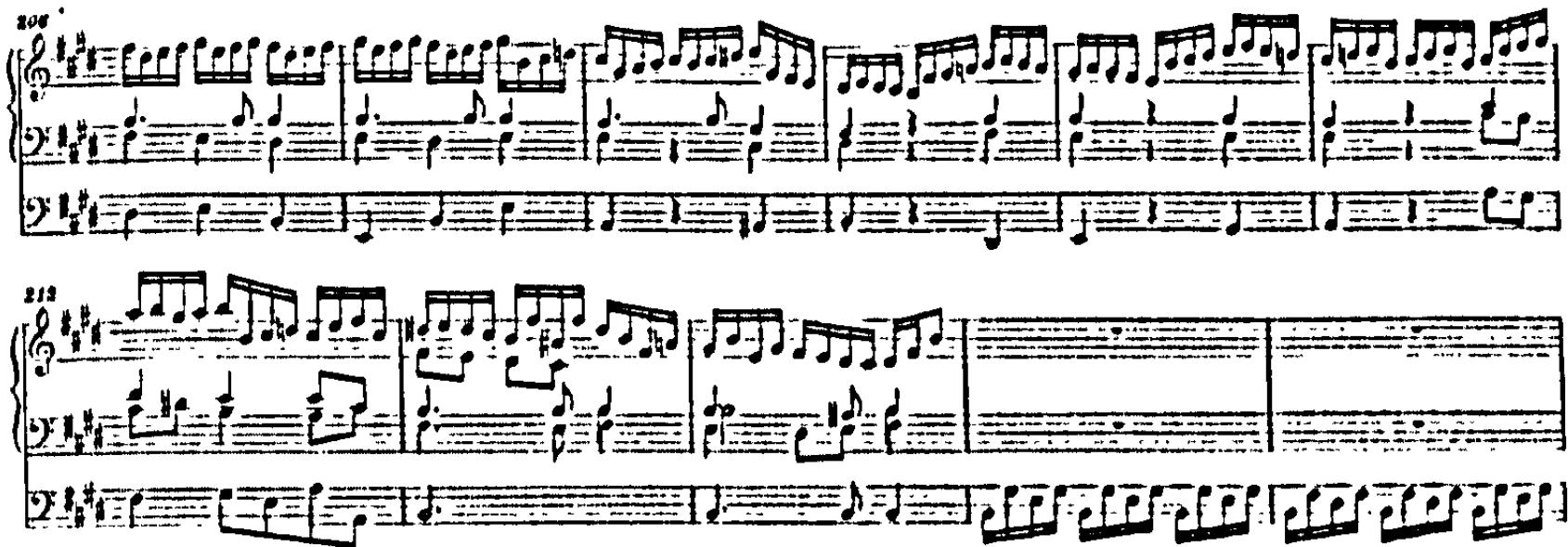
中文讲解
此处为 Example 81 的占位符,标示 BWV 566 confirmatio 与 peroratio 交界处的第 206–216 小节。该位置跨越段落结构分界,结合 P0197、P0199 内容,谱例应呈现“最后一次变化的主题进入”(206–209 小节)以及上声部持续十六分音符引入 peroratio 的过渡。谱例具体细节需查原图。
补充说明
占位符横跨 confirmatio 末段与 peroratio 起始,是节内结构转折处的关键谱例。
第9段(P0197)
原文复述
The alteration of the subject (bars 182-185) shifts the harmonic texture to C# minor (closing in bar 188 with a perfect cadence), while the following seventeen bars demonstrate a long improvisatory episode until the last entrance of the theme in bars 206-209. The first part of the episode (bars 188-197) is partially based on quaver materials grown out of the countersubject; these gradually give way to sequential semiquaver motives (bars 198-200) that intensify the harmonic rhythm, culminating finally in rapid scalar demisemiquavers. The dramatic tension created through the episode leads to the last, altered entry of the subject, accompanied by a series of semiquavers in the top voice that carry on until the end of the confirmatio (bar 214).
中文讲解
本段处理 confirmatio 末段(第 182–214 小节),逻辑清晰。
第一,第 182–185 小节的变形主题把和声引向升 c 小调,并在第 188 小节以完全终止结束。这是 P0191、P0193 中“半音/远关系离调”的最终落点,也是 confirmatio 在调性上的一次重要转折。
第二,紧接着有 17 小节(第 188–205 小节左右)的长篇即兴插段,作者把它分成两个递进层:第 188–197 小节主要使用源自对题(countersubject)的八分音符材料;第 198–200 小节过渡到“模进式”十六分音符动机,加快和声节奏;最后以快速的“三十二分音符级进”(scalar demisemiquavers)收束,形成递进的紧张度曲线。
第三,紧张度曲线在第 206–209 小节收束为“最后一次变化的主题进入”,它是被改编的版本;上声部伴随一组十六分音符一路延续到 confirmatio 结束(第 214 小节)。这与 P0193 中所说的“最后一次原始进入”形成对照——confirmatio 内部是“先原始再现、再变化再现”的层级结构。
把握这一段的关键在于:作者把“长插段”视为“论证铺垫”,把变化主题的最终进入视为“说服点”——戏剧张力来自插段,论证完成于变形主题的再现。
补充说明
“八分音符→十六分音符→三十二分音符级进”的音值递减,是本段紧张度曲线在节奏层面的具体实现;这一节奏分层在本节内部即可定位。
第10段(P0198)
原文复述
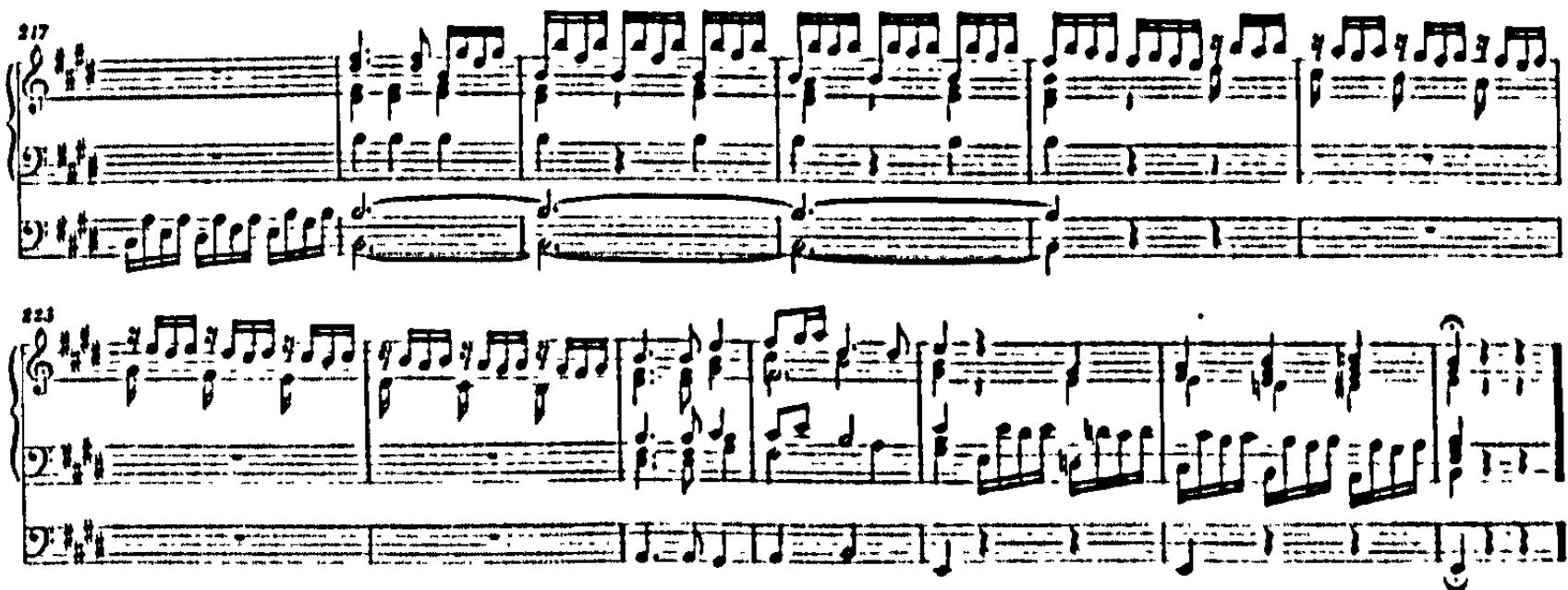
中文讲解
此处为 Example 82 的占位符,标示 BWV 566 peroratio 第 217–229 小节的乐谱位置。结合 P0199 内容,谱例应呈现 pedal 上的简化材料、双重属持续音(第 218–221 小节),以及随后的和弦式织体与炫技十六分音符琶音,并包含第 218 与 225 小节主题首段的“paraphrased versions”。谱例具体细节需查原图。
补充说明
占位符对应 P0199 所描述的 peroratio 全部要点。
第11段(P0199)
原文复述
After bar 214, where only the caput of the subject is heard for the last time in the pedal, the confirmatio leads to the peroratio, which emerges smoothly from the preceding section, displaying a continuation of the semiquavers that dominated the last nine bars (206-215). The pedal section hints at the exordium pedal passage, yet in a simplified version, culminating in the double dominant pedal (bars 218-221); from that point onwards, the peroratio suddenly turns into a chordal texture accompanied by improvisatory and imposing semiquaver arpeggios. Bars 218 and 225 demonstrate paraphrased versions of the first fragment of the subject, while the toccata closes with a flourish of bold harmonies and a descending left-hand figuration that lead to the tonic.
中文讲解
本段是 confirmatio 与 peroratio 之间的过渡,以及 peroratio 本身的总体描述,包含五个要点。
第一,第 214 小节后,主题只有 caput(主题首段)在 pedal 上最后出现一次,confirmatio 至此收束。这是 P0193“最后原始进入”、P0197“最后一次变化进入”之后的“尾声式”再现:只留主题首段,不再完整呈现,是 peroratio 启动前的最后回声。
第二,peroratio 是“平滑涌现”(emerges smoothly)的,它直接延续了 confirmatio 末九小节(第 206–215 小节)占主导的十六分音符——这种织体延续是节与节之间无缝衔接的标志。
第三,peroratio 开头 pedal 部分“让人联想到 exordium 的 pedal 段落,但是简化版”,并最终落在 double dominant pedal(第 218–221 小节)。这里的“简化”是指材料更紧凑、织体更克制;双重属持续音是巴赫常用的“悬置式”准备手法,把调性张力推到顶点再解决。
第四,从 double dominant pedal 之后,peroratio 突然转向和弦式织体(chordal texture),并配以即兴的、强而有力的十六分音符琶音(imposing semiquaver arpeggios)。这种“和弦+琶音”是北德托卡塔收束段的典型笔法。
第五,主题的最终回响与终止。第 218 与 225 小节呈现主题首段的 paraphrased versions(释义式变体);结尾以 bold harmonies(强烈和声)与左手下行音型(descending left-hand figuration)收束于主音。
整体看,peroratio 在本节论证中的作用是:先用 caput 与十六分音符延续做“平滑过渡”,再用 double dominant pedal 做“悬置—解决”式高潮,最后用和弦+琶音与下行左手做“压倒性收束”。这与修辞学中 peroratio(结语)的功能——回顾、强化、收束——完全对应。
补充说明
caput、paraphrased versions、double dominant pedal 这三个术语共同指向 peroratio 中“主题最后一次以最简形式出现并被悬置解决”的写法。
脚注 / 边栏 / 图表 / 附加信息(如有)
本节(4.18)共含 5 个图像/乐谱占位符(编号未在原文中给出,仅按顺序记为第 38 页示例、Example 79、Example 80、Example 81、Example 82),分别对应 digressio、confirmatio 呈示段、confirmatio 中段(第 165–179 小节)、confirmatio 与 peroratio 交界、peroratio。这些谱例是分析结论的实证基础,但具体谱面细节需查阅原图。无脚注、无边栏。
💡 本节核心要点
- 本节把 BWV 566 后半段划为 digressio(123–133 小节)与 confirmatio 两部分,二者在 Klangrede 中分别承担“过渡—炫技”与“变化—确认”的功能。
- digressio 与 confirmatio 的衔接方式是“属—主跨段延续”:digressio 结束于 B 大调属和弦,confirmatio 第一拍即承接该属和弦并转入 B 大调主和弦。
- confirmatio 主题与 narratio 主题只在“开头”相关,并以节奏变形出现,构成 paronomasia(近形变体);作者以昆体良“变换论证以说服听众”的修辞学原理解释这一做法。
- confirmatio 内部结构是“炫技插段(virtuosic episodes)与紧接段(strettos)的交替”,并在 B 大调进入却结束于升 g 小调、以及主调再现后又转向升 c 小调等远关系离调中体现张力曲线。
- confirmatio 的再现呈层级:先是 pedal 上的“原始再现”(172–175 小节),继而是变化再现(206–209 小节),最后仅留主题首段 caput 于 pedal(214 小节后),为主题进入 peroratio 做准备。
- peroratio 通过简化版的 exordium pedal 材料、双重属持续音(218–221)、和弦+十六分音符琶音的突然转向,以及左手下行收束于主音,构成“平滑过渡—悬置高潮—压倒性收束”的结语结构。
🔑 关键术语
- digressio:在本节中指 BWV 566 第 123–133 小节的 quasi-improvisatory 过渡段落,作用是衔接 narratio 与 confirmatio,风格上属于 stylus phantasticus,与北德 organo pleno 托卡塔传统相呼应。
- confirmatio:Klangrede 修辞结构中的“确认”阶段;在 BWV 566 中表现为第二首赋格(3/4 拍),主题为 narratio 主题的节奏变形,通过 paronomasia 和远关系离调实现对前文论点的巩固。
- stylus phantasticus:本节用来定性 digressio 的风格类别:幻想曲风格,强调情感姿态丰富、即兴性强,与“紧密组织”的 narratio 形成对比。
- organo pleno (toccata tradition):北德全部音栓托卡塔传统,本节中用以解释 digressio 的写作语汇来源(anabasis、catabasis、salti semplici 等)。
- anabasis / catabasis:本节中分别指“抢拍起始的上行”与“抢拍起始的下行”宏大音型,被视为 digressio 的标志性织体语汇。
- salti semplici:本节中指 pedal 上的“八度跳进”,作者称其为 dramatic,用以强化 digressio 的即兴感。
- trillo longo:本节中把第 131–132 小节笨拙的 pedal 音型解释为“扩展版的长颤音”,最终落在属音上,为 confirmatio 做属准备。
- paronomasia:本节中用以命名主题的“近形变体”,作者援引 Quintilian 的修辞学建议——演说家变换论证以说服听众——作为其修辞功能的类比。
- stretto:本节中指主题在不同声部紧密叠入的写法,与 virtuosic episodes 交替出现,构成 confirmatio 的内部结构。
- caput:本节中指主题首段,第 214 小节后 pedal 上最后一次出现的仅为 caput,作为 confirmatio 向 peroratio 过渡的尾声式回声。
- double dominant pedal:本节中指 peroratio 第 218–221 小节的双重属持续音,作者视其为把属张力推到极致后再解决的“悬置式”准备手法。
- Quintilian:本节中作为修辞学权威被援引,用以论证 confirmatio 中“主题变体”与“变换论证以说服听众”之间的同构关系。
4.19 [描述性拆分] BWV 566: Summary and Rhetorical Evaluation
第1段(P0200)
原文复述
To summarize, as shown so far, the Toccata in E major retains the basic features of the north German formal model, yet displays a degree of textural control and a carefully shaped structure found neither in Buxtehude’s preludes nor in BWV 551. Whereas Bach’s Prelude in A minor, BWV 551, demonstrated an exact mimesis of the Buxtehudian style, BWV 566 greatly exceeds the scale of the traditional toccata in both harmonic activity and contrapuntal development. In the E-major Toccata, every section has been given a meticulously rounded form in terms of both size and independence, so it is unsurprising that a manuscript copy by Kittel contains only the introduction and the first fugue as a Prelude & Fugue pair. ⁶⁸
中文讲解
这一段给出“延续基本传统,但明显超越既有实例”的总体评价。BWV 566并非脱离北德意志形式模型,而是在保留其基本特征的同时,以更强的织体控制、更精心的结构安排以及更大的和声与对位规模推进了这一模型。BWV 551的作用是比较基准:它被说成对Buxtehude风格的精确模仿,而BWV 566的突出之处恰好不只是“像”,而是在和声活动与对位发展两方面都超过传统托卡塔。各部分在篇幅和独立性上都得到“圆满成形”的塑造,因此Kittel的手抄本只收入引子和第一赋格并将其作为前奏曲与赋格的一对,便不足为奇;不过,这一材料只能支持开篇部分具有清晰的成对形态,不能据此断定全曲原本只由这两部分组成。
补充说明
BWV 551在本段中仅充当风格与规模比较的参照,不表示它与BWV 566具有完全相同的形式结构。
第2段(P0201)
原文复述
Despite these structural differences, the overall design of BWV 566 is modelled on the rhetorical dispositio. The work begins with a long but affective exordium, in which expressive figures—pathopoeia and auxesis—seek to excite the passions of the listeners. The statement of the case, the narratio, is represented by an unusually long fugue in which contrapuntal writing alternates with carefully worked-out affective figures; these intensify the harmonic progression and “[…] relax the strain of attention.” ⁶⁹ Although the fugue concludes without an internal peroratio, Bach again appears as an advocate of the Buxtehudian style by placing a digressive section as a link between the narratio and the confirmatio. Scalar figures and improvisatory pedal passages dominate the digressio, which, like the other parts of the toccata, is constructed as a separate section intended to direct the listeners’ attention “[…] to some pleasant and attractive topic with a view to securing the utmost amount of favour […].” ⁷⁰ The dramatic tension created within the digressio leads to the confirmatio, a long section whose structure does not resemble Buxtehudian examples. The confirmatio displays a thematically modified version of the narratio, but in a less contrapuntal and more toccata-style manner, in which counterpoint and free episodic material blend with unusual complexity. This produces entries of the subject without regular answers, together with stretto-like and occasionally altered thematic repetitions that strengthen the initial arguments either directly or subtly, while improvisatory passages point more toward a free fugal style than toward strict imitative counterpoint. Whereas Buxtehude would employ a formal fugue followed by an amplificatio with emphatic stretto repetitions, Bach’s confirmatio combines elements of fantasy and counterpoint in a unique rhetoric and presents one of the last examples of the seventeenth-century toccata type.
中文讲解
本段把上一段所说的结构差异进一步解释为一种修辞组织:作品虽然超出传统托卡塔的规模和常规形式,整体设计仍遵循修辞性的dispositio。开头的exordium篇幅较长,pathopoeia与auxesis通过表情性材料激发听众情感;随后的narratio由异常长大的赋格承担,其中对位写作与表情性材料交替,既推进和声,也暂时缓解持续注意所产生的紧张。第一赋格内部没有形成自己的peroratio,因此digressio被置于narratio与confirmatio之间,承担连接、调节并重新吸引注意的作用。音阶材料与即兴式持续音使这一部分不只是过渡,而成为一个具有独立形式身份的段落;它制造的张力随后导向confirmatio。confirmatio在主题上改造narratio,却减少严格对位而增加托卡塔式自由材料,于是主题进入不再总有规则答题 stretto式或变形的复现则以直接或隐蔽的方式强化开初的主张。这里的复杂性不能误解为对位已经消失:作品仍保留主题进入、主题复现和赋格因素,只是它们与即兴式及自由插段材料混合在一起。与Buxtehude“正式赋格加带强调性stretto重复的amplificatio”的做法相比,Bach把幻想性与对位性结合成独特的修辞,因而被作者视为十七世纪托卡塔类型接近尾声时的代表之一。
补充说明
peroratio的缺失发生于第一赋格内部;digressio随后承担了段落之间的连接作用,因此不能把“赋格内部没有peroratio”直接理解为作品没有结尾性安排。
第3段(P0202)
原文复述
68 Stauffer, p. 41.
中文讲解
这是正文末尾脚注号68的简略出处信息。它把Kittel手抄本只含引子和第一赋格的陈述追溯到Stauffer第41页,作用是为相关手抄本信息提供来源。
补充说明
当前输入只提供作者名Stauffer和页码41,没有提供文献全名、标题或该页的具体文字,不能据此补写更多书目与论证信息。
第4段(P0203)
原文复述
69 Quintilian, Institutio oratoria, Book IV. ii. 118, pp. 114-15.
中文讲解
这是正文引语“relax the strain of attention”所对应的出处说明,把这一表达追溯至Quintilian的《Institutio oratoria》第四卷第二章第118节,第114至115页。该脚注为把赋格中的注意力调节解释为narratio的一种修辞作用提供文本依据。
补充说明
该条只提供引语的文献位置;在当前输入中,它不包含Quintilian相关段落的完整论述。
第5段(P0204)
原文复述
Taking the rules of rhetoric into account, and because Quintilian would have focused more on the proofs and arguments presented in the confirmatio, the precise rhetorical function of the second fugue in E major is rather problematic. In this section, the amount of free material seems to be out of proportion to the fugal, an unusual symmetry for a confirmatio, which tends to demonstrate a strong piece of counterpoint. In this respect, the proofs of the case seem to be of little importance, and the appearance of affective material within the confirmatio may appear as part of a scenario intended to support weak arguments through the impassioned appeals of the free passages. As a result, despite the insubstantial evidence provided, the listeners would be moved by the orator’s eloquence, whose “[…] appeal to the emotions will do more, for it will make them wish [the] case to be better. And what they wish, they will also believe.” ⁷¹ In other words, the content of the speech might be inconsequential, but the proofs put forward and the affective surrounding materials are demonstrated in such a fashion that, if persuasion is the intent of the orator, Bach’s Toccata in E major stands out as an affective Klangrede.
中文讲解
这一段把前文对confirmatio的分析推进到一个难点:如果按照Quintilian所强调的修辞规则,confirmatio本应把重点放在证明和论证上,通常也应当展示有力的对位;但E大调第二赋格中,自由材料似乎多于赋格性材料,因而很难把它清楚而确定地归入confirmatio。作者并未因此断言第二赋格完全失去论证功能,而是提出另一种修辞解释:较弱的论据可能由自由段落的情感诉求加以支撑,使听众即使面对不充分的内容证据,也会被表达本身的情感力量所说服。这里需要避免把“情感材料”误解为作品已经放弃逻辑或对位;论证材料仍然存在,只是其说服效果受到表情性、音响性材料的包围和强化。末句据此把全曲评价为一种affective Klangrede,即一种把内容、论据与情感材料共同组织起来、以影响听众为目标的音乐化“言说”。
补充说明
原文用“an unusual symmetry”描述自由材料与赋格性材料之间不合confirmatio常规的比例关系;这一措辞应联系其前后所说的“out of proportion”理解,而不能当作一个已经获得单独界定的修辞术语。脚注号71虽出现在引文之后,但当前输入没有提供其脚注正文。
脚注 / 边栏 / 图表 / 附加信息(如有)
正文涉及四个脚注号。脚注68对应“Stauffer, p. 41.”,为Kittel手抄本只含引子和第一赋格这一信息提供出处;脚注69对应Quintilian《Institutio oratoria》第四卷第二章第118节、第114至115页,为“relax the strain of attention”这一引语提供出处。P0201在digressio引文之后标有脚注号70,P0204在修辞性引语之后标有脚注号71,但当前输入没有提供这两条脚注的正文,因而只能确认其标记存在,不能补写其来源或页码。本节没有图表、边栏或其他附加材料。
💡 本节核心要点
- BWV 566保留北德意志形式模型的基本特征,却凭借更强的织体控制、经过精心塑造的结构、扩大的和声活动与对位发展,超越Buxtehude的前奏曲及作为精确模仿基准的BWV 551。
- 全曲各部分在篇幅和独立性上都得到精细塑造;Kittel手抄本只保存引子和第一赋格,说明开篇两部分具有清晰的Prelude & Fugue成对形态,但不能据此缩减全曲的完整结构。
- 作品依照修辞性dispositio展开:情感性exordium之后是承担narratio的长赋格,独立成段的digressio连接narratio与confirmatio,并以自身形成的张力为后者作准备。
- confirmatio主题性地改造narratio,但把较严格的对位与托卡塔式自由材料复杂地混合起来;不规则答题、stretto式及变形的主题复现与即兴式段落,使幻想性和对位性形成独特结合。
- 第二赋格的修辞功能难以精确确定:其自由材料对confirmatio所要求的有力对位和论证而言比例异常,但这种不平衡又使情感材料能够弥补论据的不足,因此全曲最终被评价为具有说服力的affective Klangrede。
🔑 关键术语
- north German formal model:BWV 566所保留的基本形式传统,是本段判断“延续与创新”时所用的保守基准;Buxtehude的前奏曲和精确模仿该风格的BWV 551构成主要比较对象。
- rhetorical dispositio:本节用来解释BWV 566整体布局的修辞性组织原则;作品依次以exordium、narratio、digressio和confirmatio承担不同的引入、陈述、连接与强化功能。
- exordium, pathopoeia, and auxesis:exordium是作品开篇;pathopoeia与auxesis是其中旨在激发听众情感、使其进入相应情绪状态的表情性手段。
- narratio:修辞过程中的陈述部分,在BWV 566中由异常长大的赋格体现;其中对位与表情性材料交替,并参与和声推进和注意力调节。
- digressio:位于narratio与confirmatio之间的独立连接段落,以音阶材料、即兴式持续音和张力形成,承担重新吸引注意并导向confirmatio的作用。
- confirmatio:本应突出证明、论证和有力对位的部分;在BWV 566中,它以主题性改造narratio、混合对位与自由材料的方式呈现,因而其修辞功能产生疑问。
- amplificatio and stretto:amplificatio是作者所述Buxtehude模式中置于正式赋格之后、并采用强调性stretto重复的部分;BWV 566则没有照搬这一明确分工,而是把相关因素吸收进confirmatio的复杂混合。
- affective Klangrede:本节对BWV 566修辞效果的总结性评价:在内容与论证证据可能有限的情况下,论据、情感材料及音响呈现仍共同作用于听众,使其被表达所说服。
4.20 [描述性拆分] Nicolaus Bruhns and His E minor Toccata
第1段(P0205)
原文复述
Although BWV 566 demonstrates a structurally different version of the north German organ toccata, Buxtehude’s compositional style and methods are also encountered in the organ works of his pupil, Nicolaus Bruhns. Bruhns (1665-1697) in his short life composed four praeludia (more correctly labelled ’toccatas’) modelled after his teacher’s techniques, all excellent samples of the stylus phantasticus. His toccatas equal those by Buxtehude in style and structure by displaying tossed-together sections of contrasting rhythms, series of virtuosic improvisatory fragments, and passages in fugal style. Bruhns’s organ works show a synthesis of different musical-cultural agents. Features such as the echo techniques encountered in his extensive chorale fantasia Nun komm, der heiden Heiland stem from the echo fantasias of Sweelinck, in whose works the dramatic Italian vocal style was combined with the English virginal music tradition. Furthermore, extended sections intended for solo and double pedal recall Vincent Lübeck’s technical brilliance, while imitatio violistica passages hint at Bruhns’s dexterity as a violin player.
中文讲解
本段在BWV 566这条特殊路线之外,开辟了对北德托卡塔传统的第二条传承线索,把焦点从巴赫切换到布克斯特胡德的学生尼古拉斯·布鲁恩斯(1665—1697)。作者首先给出布鲁恩斯的生平定位:寿命短暂,却留下四首前奏曲(praeludia),作者特意说明严格意义上应称为"toccatas”,并指出它们都是stylus phantasticus的典范之作。这一限定很重要,因为它把布鲁恩斯直接接续到布克斯特胡德的自由前奏曲传统中。接着用三组特征勾勒其风格:对比节奏的松散拼接、炫技即兴片段、赋格段落,与布克斯特胡德并驾齐驱。
本段最具方法论意义的是下半部分,作者将布鲁恩斯的作品呈现为多种"音乐—文化要素"的综合体:Sweelinck回声幻想曲传统(经由意大利声乐风格与英国virginal音乐的融合)、Lübeck的双踏板炫技传统、以及来自小提琴演奏的violistic模仿段落。这种"合成"视角说明,作者不再把布鲁恩斯视为单纯的布克斯特胡德追随者,而是将其作品作为北方键盘音乐、意大利独奏艺术、英国键盘传统与德意志器乐文化交汇的节点。最后脚注72标注Bruhns小提琴家的身份渊源,为后续E小调托卡塔中violin影响提供出处。
补充说明
本段提到的"echo techniques in Nun komm, der heiden Heiland"和"Vincent Lübeck"等具体作品/人物在后续段落并未继续展开;它们在本节中的功能是为布鲁恩斯的综合性提供具体例证,并不需要在本节内部进一步解释。
第2段(P0206)
原文复述
70 Quintilian, Institutio oratoria, Book IV. iii. 1-2, pp. 122-23.
中文讲解
这是上一节中提到的昆体良《演说术原理》(Institutio oratoria)第四卷第三章第1—2节的脚注出处,引用页码为122—23。结合上下文,该脚注应当是支撑前文关于修辞性"开端”(exordium)功能论述的文献来源之一。
补充说明
脚注70与脚注71都引自昆体良《演说术原理》,二者在原文中分别对应不同的论点位置;脚注70出自第四卷,脚注71出自第六卷,两者均与修辞学结构相关。
第3段(P0207)
原文复述
71 ibid., Book VI. ii. 5, pp. 418-19.
中文讲解
这是同一昆体良《演说术原理》第六卷第二章第5节的脚注出处,页码418—19。“ibid.“表明此处仍引自上一脚注同一著作。该脚注对应文中关于修辞学家如何在exordium中预叙事实与论据的具体论述。
第4段(P0208)
原文复述
Of his four toccatas composed for the organ, the long E minor one displays an advanced form of the loose multisectional style encountered in Buxtehude’s free praeludia. In this work, dynamic nuances in preludial and fugal textures are strengthened by the influence of unaccompanied violin playing, while unexpected changes of style and tempo in different sections surprise the listener and create a dramatic effect.
中文讲解
本段在四首托卡塔中单独挑出E小调托卡塔作为分析对象,定位其属于布克斯特胡德"自由前奏曲"那种松散多段体风格的高级形态。“advanced form"意味着它不是简单模仿,而是在结构逻辑上有所推进。
两个具体特征被特别强调:一是力度色彩(dynamic nuances)的丰富化,被归因于"无伴奏小提琴演奏"的影响,这呼应P0205中关于布鲁恩斯小提琴家身份的伏笔;二是段落间风格与速度的突然变换,用来产生戏剧化效果并令听者感到意外。这两个特征共同把布鲁恩斯定位为:既保持布克斯特胡德式松散拼接,又有更强的炫技性与戏剧性张力。
本段在论证结构上是分析焦点的引入——前面P0205建立了布鲁恩斯与布克斯特胡德的师承关系,本段则将E小调托卡塔从四首中选出,预告后面将逐段进行修辞学分析。
第5段(P0209)
原文复述
In terms of contrapuntal elaboration, Bruhns follows Buxtehude’s fugal technique in regard to repeated-note canzona-like subjects (G major prelude) and countersubjects (E minor prelude). Moreover, where there are two fugues within the same work, thematic variation is usually combined with metrical transformation, as for instance, the appearance of a 12/8 confirmatio gigue fugue in the Toccata in E minor that recalls similar sections encountered earlier.
中文讲解
本段从对位技法层面进一步落实布鲁恩斯对布克斯特胡德的继承。具体落点有两类:一是canzona-like的重复音主题(在G大调前奏曲中出现),二是对题(countersubject,在E小调前奏曲中出现)。这里要小心的是:“E minor prelude"指的是布鲁恩斯的另一首E小调前奏曲,而非本节集中分析的E小调托卡塔,作者借此展示布鲁恩斯处理重复音主题和对题是贯穿多部作品的统一手法。
第二点更重要:当同一作品内部出现两首赋格时,作者观察到布鲁恩斯通常把"主题变奏"与"节拍变换"结合起来。最直接的例证就是E小调托卡塔中12/8的confirmatio gigue fugue(吉格赋格段),它"回忆”(recalls)之前已经出现过的类似段落。这里的"回忆"是修辞学术语式的说法——后段的吉格与前段(P0210和P0214将分析的exordium中的12/8段)形成呼应,从而把整首作品的不同段落关联起来。
本段的功能是为后续段落提供对位—修辞双重读法的根据:节拍变换不仅是形式特征,也是主题重认的方式。
补充说明
“confirmatio"是修辞学五段论中的第三部分(陈述论点),作者将其移植到音乐结构命名中,用来指称托卡塔内承担"确立/确证"功能的段落;这是本节跨域比喻的关键术语。
第6段(P0210)
原文复述
Under these terms, one could consider the eloquent structural changes an illustration of the rhetorical dispositio, since the alternation of dissimilar sections denotes the composer’s intentions to model his Klangrede after the rhetorical counterpart. The work commences with an improvisatory exordium, which from the first bar aims to pique the listener’s attention. Dramatic semiquaver gestures with chromatic inflections and ‘ingenious turns’ point to virtuosic violin bowing in the first five bars ending in a triple trill over a tonic pedal E. The time signature changes to 18/16 in bar 6, where the texture displays agitated semiquavers with motivic repetitions strengthened by chains of chromatic figurations in the soprano (bars 9-10) over the same tonic pedal.
中文讲解
本段是分析的核心命题句:布鲁恩斯作品中"雄辩的"结构变化本身就是修辞学dispositio(布局/谋篇)的音乐化身。这一论断的关键术语是Klangrede(“音响演说”),它把整首作品当作一篇口头演说来看待,而作曲家是有意以音乐去"模拟"修辞学的篇章布局。
随后进入谱例分析。开篇的exordium(修辞学"开端”)自第一小节起就以即兴姿态吸引听众注意。前五小节使用带半音化与"ingenious turns”(巧妙回转,引用自Mattheson,参见脚注73)的十六分音符炫技手势,作者将其解释为对小提琴运弓(virtuosic violin bowing)的模仿,并以一个持续在主音E上的三重颤音收束。
第六小节转入18/16拍号,织体变为激动的十六分音符加动机重复,第9—10小节在高音声部用一连串半音化音型强化,仍保持在主音持续音上。这一段的整体设计是用主音持续音+不断加厚的半音化来制造紧张感,为后面转向下属调(A小调)做准备。
本段在论证中承担过渡功能:先抛出整体修辞读法的命题(Klangrede = 修辞dispositio),然后立即用谱面细节去支撑"开端即兴化"这一具体判断。
第7段(P0211)
原文复述
72 Hugh J. McLean, ‘Bruhns, Nicolaus’, in The New Grove Dictionary of Music and Musicians, ed. by S. Sadie and J. Tyrrell, 2nd edn, 29 vols (London: Macmillan Publishers Ltd, 2001), iv, pp. 492-93. See also G. B. Sharp, ‘Nicolaus Bruhns’, in The Musical Times, 107 (August 1966), 677-80.
中文讲解
这是P0205中关于布鲁恩斯生平和风格论述的参考文献脚注。第一条是Hugh J. McLean为《新格罗夫音乐与音乐家辞典》(2001年第2版)第4卷所写的"Bruhns, Nicolaus"条目,第492—93页;第二条是G. B. Sharp 1966年8月发表于《音乐时报》第107期的同名文章,第677—80页。两者合起来为前文关于布鲁恩斯师承、violistic风格与综合性的说法提供外部文献支持。
第8段(P0212)
原文复述
[Example 83. N. Bruhns: Prelude in E minor: exordium (bars 1-8) 74 — image placeholder: embedded image data omitted; caption and position retained]
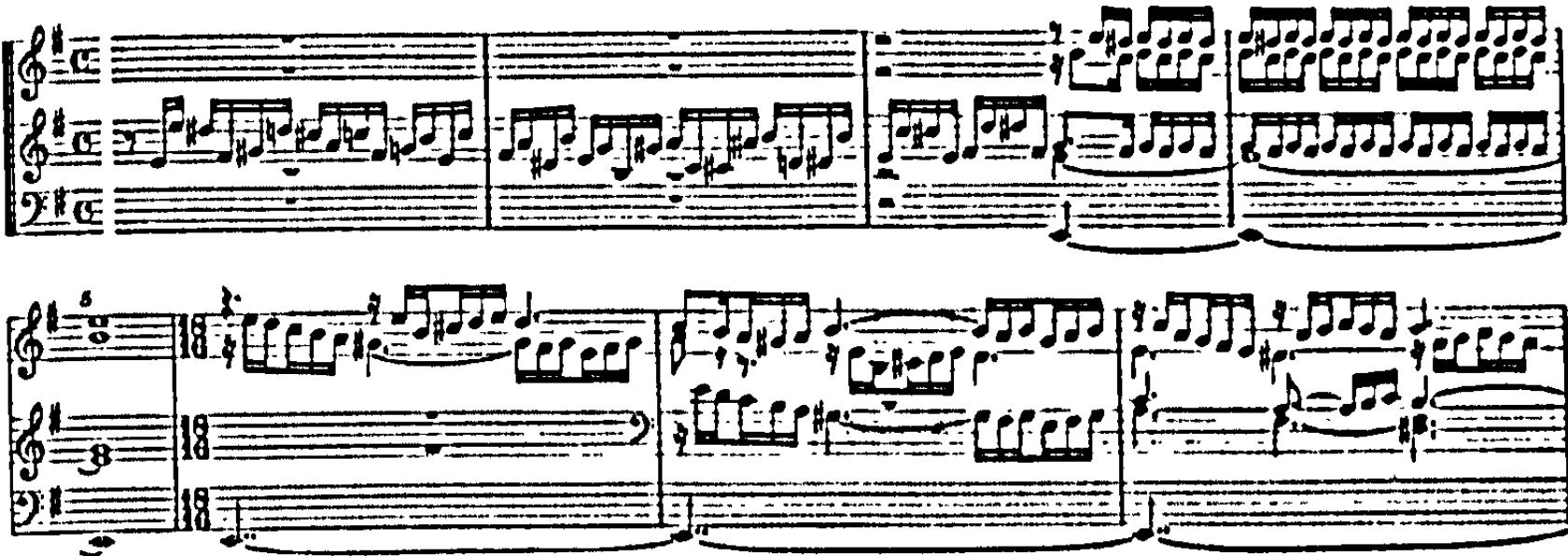
中文讲解
这是配图占位符,对应Example 83,内容为布鲁恩斯E小调前奏曲(exordium,第1—8小节)的乐谱。位置在P0210末尾关于exordium前五小节与第6—10小节分析之后、P0213对第11小节之后分析之前,用以辅助读者直观对照作者关于18/16拍号、半音化十六分音符与主音持续音的论述。原图需查看实际出版物。
第9段(P0213)
原文复述
The texture suddenly changes in bar 11, where the time signature returns to the original 4/4 metre and a short series of chords intensified by an expressive abruptio shift the harmony to the subdominant A minor. Ascending parallel scales (anabasis) on the fourth beat of bar 12 lead to a gigue-style section in 12/8 metre determined by quavers moving in parallel sixths and tenths (bars 13-15). The texture shifts back to 4/4 in bar 16, where broken chords and affective tirata figures in the soprano (bars 16-17) are built over the subdominant pedal. The exordium concludes with a general aposiopesis in bar 18 strengthened by a pedal A#, leading to a perfect cadence on E in bar 20.
中文讲解
本段延续P0210对exordium的逐小节分析,从第11小节开始。第11小节是关键的转折点:拍号回到4/4,一串短促的和弦配上"abruptio”(修辞学术语,指突然的语句中断/急止)把和声强行转到下属A小调。第12小节第四拍使用"anabasis”(修辞学术语,指递升/层层推进)式的上行平行音阶,承接第11小节的紧张感。
随后进入12/8的gigue段(第13—15小节),由六度和十度平行进行的八分音符构成舞蹈性织体——这是P0209已经预告的"12/8 confirmatio gigue"的"先前出现"版本。第16小节又转回4/4,在下属持续音上建立分解和弦与tirata(修辞学术语,指"拉弓/拉长"式的级进音型)旋律。第18小节以"aposiopesis”(修辞学术语,指突然沉默/语塞)式的全休止作结,配合A#持续音的张力,最后在第20小节以E上的完全终止收束整段exordium。
值得注意的是,本段密集出现三个修辞学术语:abruptio、anabasis、aposiopesis。作者刻意让音乐事件(和弦断句、上行音阶、突然休止)与演说术的具体术语一一对应,强化P0210提出的Klangrede论点。
补充说明
abruptio、anabasis、aposiopesis都是经典修辞学术语;本节中作者将它们直接移植为音乐段落的功能标签,用以表明布鲁恩斯的段落安排"模拟"修辞结构,而非简单比喻。
第10段(P0214)
原文复述
Since the different textures within the exordium are too short to be considered separate units - one could easily speak about digressions -, they actually function as intensifications of the opening material in a more affective vocabulary within a plagal cadence (I-IV-I). The harmony of bar 11 demonstrates a short affective chromatic figure in the soprano, but what is most striking is the melodic tritone stated by the pedal (bar 11, d-G#) and the soprano (bars 11-12, d”-g#”). The improvisatory anabasis scales in bar 12 lead to quaver motives of different metrical value (12/8) but of a more dance-like nature compared to the semiquaver ones that appeared earlier (bars 6-10). Consequently, the different divisions function as a dramatically styled exordium, beginning with a straightforward presentation of an introduction and proceeding to a more affective rhetoric derived from it. Additionally, according to Quintilian, some orators were also in the habit of introducing some facts and proofs within the exordium, providing the audience with a foretaste of the argumentation that would follow. In the E minor Toccata, this applies particularly to the gigue figurations (bars 13-15) as well as to the broken chords (bars 16-17) ornamented with tirata figures that anticipate elements that will appear later in a more ‘objective’ counterpoint.
中文讲解
本段是对P0210和P0213谱面分析的总结与理论收束。作者先回应一个潜在反驳:这些段落都太短,若按独立单位处理会被视为"digressions"(离题)。作者反过来主张:它们实际上是在I-IV-I的下属终止框架内,对开篇材料的"情感强化"——也就是说,表面看似松散的拼接,整体上仍受控于一个固定和声进程。
接着回到第11小节的具体细节:高音声部的半音化短句固然重要,但"最引人注目"的是持续音与高音声部共同陈述的三全音旋律(d-G#和d"-g#)。三全音在E小调语境中是主音与增四度的张力关系,作者用"melodic tritone"凸显其作为戏剧化音响事件的地位。
第12小节的anabasis上行音阶则被解释为通向12/8吉格段的桥梁,并对比指出:第13—15小节的八分音符虽与第6—10小节的十六分音符同属动机变体,但前者更具"舞蹈性",意味着作者对材料变体的判定同时涉及节奏密度与体裁性格。
段落后半段引出昆体良(参P0207脚注71):演说家有时会在exordium中预叙事实与论据,为听众预先呈现后续论证的样貌。作者将这一原则对应到E小调托卡塔中第13—15小节的吉格音型与第16—17小节装饰tirata的分解和弦——它们"预示"了后文将以更"客观"对位形式出现的相同元素。
本段是本节前半部分论证的最高点:把谱面分析、修辞学原理(exordium的预叙功能)、修辞—音乐术语(Klangrede)三者一次性整合,并提出"戏剧化开端=材料的情感化展开+对后续材料的事前预告"这一双重功能论。
补充说明
本段中"objective counterpoint"指相对于exordium中的即兴炫技而言,更为严格、规范化、可分析的赋格或对位段落;这一对照为本节后面分析confirmatio gigue fugue等段落埋下伏笔。
第11段(P0215)
原文复述
73 Johann Mattheson’s Der vollkommene Capellmeister, trans. by Ernest Harriss, Part I, Chapter 10, §93, p. 217.
中文讲解
这是P0210中"ingenious turns"一词引文的来源脚注。马泰松《完美的乐队指挥》(Der vollkommene Capellmeister),由Ernest Harriss翻译,第一部分第10章第93节,第217页。该书是18世纪初德意志音乐修辞学的重要文献,作者引用它来为"巧妙回转"这一音乐—修辞术语提供权威支撑。
第12段(P0216)
原文复述
74 Nicolaus Bruhns (1665-1697), Sämtliche Orgelwerke, herausgegeben von Klaus Beckmann (Wiesbaden: Breitkopf & Härtel, 1972).
中文讲解
这是配图Example 83所用乐谱版本的来源脚注:布鲁恩斯(1665—1697)《管风琴作品全集》(Sämtliche Orgelwerke),由Klaus Beckmann编辑,1972年由Wiesbaden的Breitkopf & Härtel出版。该版本为作者分析小节号与和声进行的依据。
脚注 / 边栏 / 图表 / 附加信息(如有)
本节包含三组非正文附加材料:(1)脚注70、71出自昆体良《演说术原理》(Institutio oratoria),分别为第四卷与第六卷,是作者将exordium预叙功能与dispositio布局学说应用于布鲁恩斯E小调托卡塔的修辞学来源;(2)脚注72列出Hugh J. McLean的《新格罗夫》条目与G. B. Sharp 1966年《音乐时报》文章,为布鲁恩斯的生平、师承、violistic风格提供外部文献支持;(3)脚注73—74给出"ingenious turns"一词的马泰松出处与所引谱例的Beckmann编辑版(Breitkopf & Härtel, 1972),分别支撑前文修辞学翻译与具体小节定位。此外,Example 83为布鲁恩斯E小调前奏曲exordium(第1—8小节)的乐谱图示,占位符表明原图省略,应参考Beckmann版本核对。
💡 本节核心要点
- 布鲁恩斯E小调托卡塔被定位为布克斯特胡德式松散多段体的"高级形态",同时融入了小提琴无伴奏演奏带来的力度细腻度与戏剧性。
- 作者用Klangrede(音响演说)这一概念把整首作品读作修辞学dispositio(谋篇布局)的音乐化身,段落之间的非相似性交替被视为有意模拟修辞结构。
- exordium(前20小节)内部又细分为多个修辞功能单位:abruptio(急止)转入A小调、anabasis(递升)上行音阶、12/8吉格段的舞蹈性tirata级进、aposiopesis(突然沉默)收束,并由I-IV-I下属终止框定整体和声进程。
- 第11小节d-G#与d"-g#三全音被作者视为exordium中"最引人注目"的旋律事件,是戏剧张力的核心节点。
- exordium中的12/8吉格段与第16—17小节装饰tirata的分解和弦,承担了昆体良所论"在开端预叙事实与论据"的功能,预示后续以更"客观"对位形式出现的同类材料。
- 布鲁恩斯的风格被定性为多源合成体:Sweelinck回声幻想曲传统、Lübeck双踏板炫技传统、小提琴violistic模仿传统与北德管风琴传统交汇。
🔑 关键术语
- stylus phantasticus:17世纪德意志器乐中一种以自由即兴、炫技、对比与情绪多变著称的风格。本节中用来定位布鲁恩斯四首托卡塔在北德管风琴传统中的体裁归属。
- Klangrede:作者用以指称"以音响进行的演说",把整首管风琴作品视作一篇口头演说的等价物;它是本节把音乐结构翻译为修辞学术语的核心中介概念。
- exordium:修辞学中演说的"开端"部分。在本节中特指E小调托卡塔第1—20小节,作者将其分析为既有吸引听众注意、又有预叙后续论证的双重功能单位。
- dispositio:修辞学五步骤中的"谋篇/布局"环节。本节中用来论证布鲁恩斯"段落间的非相似交替"是有意模仿修辞学篇章布局。
- confirmatio:修辞学五段论中的"确立/确证"步骤;在本节中以"confirmatio gigue fugue"的形式出现,指E小调托卡塔中12/8的吉格赋格段,提示该段落的功能相当于演说中"陈述并确证论点"的位置。
- abruptio:修辞学术语,指语句的突然中断。本节中对应第11小节短促和弦把和声强行转入下属A小调的处理。
- anabasis:修辞学术语,指层层递升;本节对应第12小节第四拍的上行平行音阶,用以承接紧张感并过渡到12/8吉格段。
- tirata:修辞学/音乐修辞学术语,指"拉弓/拉长"式的级进音型;本节中对应第16—17小节高音声部的分解和弦旋律线。
- aposiopesis:修辞学术语,指突然沉默/语塞;本节中对应第18小节的全休止,配合A#持续音的张力,形成对exordium的戏剧性收束。
- imitatio violistica:指对小提琴演奏法的键盘模仿。本节中用来解释布鲁恩斯管风琴作品中出现的炫技运弓式段落,并将其与作曲家本人的小提琴家身份联系起来。
- echo techniques / echo fantasias:指Sweelinck及其影响下发展出的"回声幻想曲"技法,以呼应式音色对比为特征;本节中作为布鲁恩斯合成性来源之一被提及,但本节未进一步展开。
4.21 [描述性拆分] Bruhns’s E minor Toccata: Exordium Analysis
第1段(P0217)
原文复述
Figure caption: Example 84. N. Bruhns: exordium (bars 9-16).
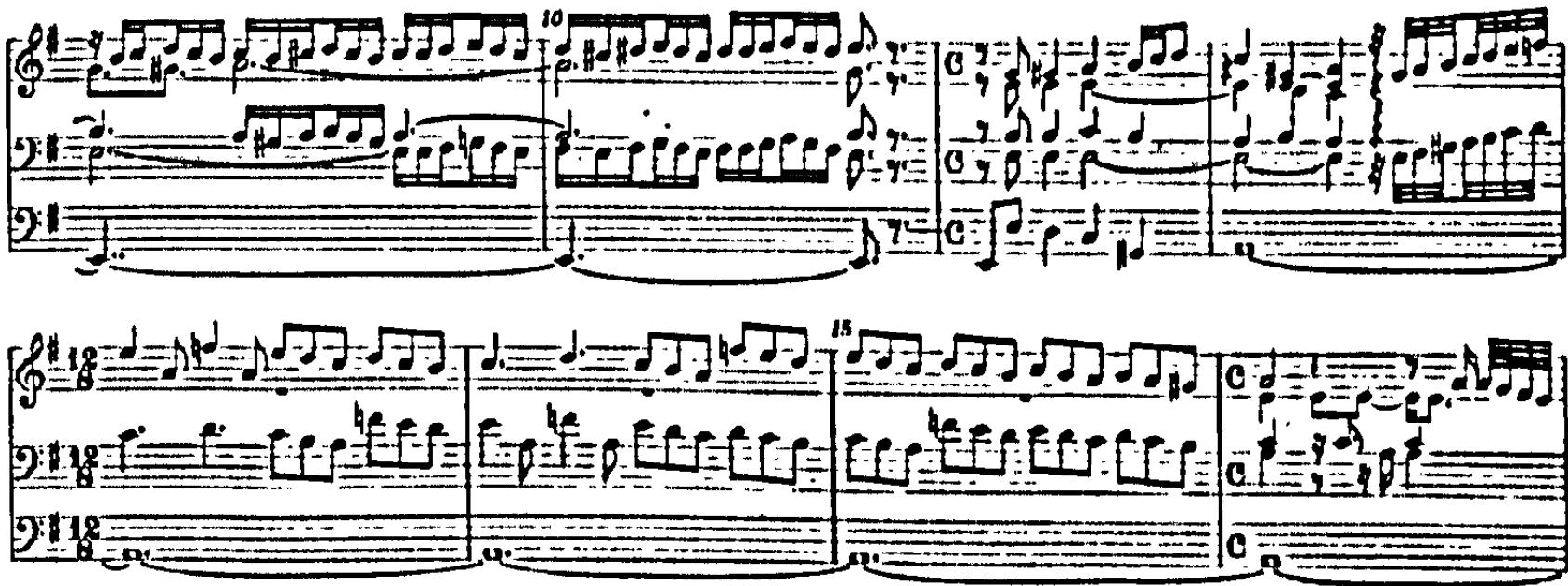
中文讲解
这是第45页上关于布鲁恩斯(Bruhns)E小调托卡塔前奏段(exordium)第9-16小节的谱例图注。原图内嵌数据已省略。该谱例用于第45页正文段落(P0218)所展开的主题——前奏段中通过装饰性快速音型(tirata)下行的分解和弦为后文的narratio对题提供四度音程材料。讲解时应联系同页稍后出现的 Example 88(前奏段 bars 16-17 tirata 细节)共同阅读。
补充说明
该谱例属于图像占位符,其内容需查看原书第45页的乐谱才能确认。仅有的可核实信息是图注标题和所标注的小节范围(9–16)。
第2段(P0218)
原文复述
The first rational part after the affective exordium is the narratio, a long stile recitativo fugue illustrating in the first four bars (21-24) a sequence of descending chromatic intervals (passus duriusculus) closely related to the chromatic inflection of the first bars of the exordium (see examples 85-86). The tonal answer to the subject (bar 27) is accompanied by a countersubject comprised of canzona-like repeated notes reminiscent of Buxtehude’s techniques. The countersubject contributes to the sad affect of the subject by introducing two tritones (c"-f#" and a’-d#" in bars 27-30) together with two perfect fourths (f"-b’, e’-a’) and a perfect fifth (b’-e’) probably derived from those encountered in the broken chords that were decorated with tirata figures in bars 16-17 of the exordium (see examples 87-88).
中文讲解
本段核心主张:紧接情感性前奏段之后的第一个“理性”部分称为 narratio,它以一段长篇的 stile recitativo 风格赋格写成,承担着陈述案件的功能。
两点关键论证:
- 主题材料的前后呼应。前奏段的开头以半音化下行的方式呈现情感色彩;narratio 在 21-24 小节以 passus duriusculus(一种连续半音下行)回应同一调式特征,使两个部分在调式布局上互相印证(参看 Example 85 和 86)。
- 对题与前奏段的衍生关系。27 小节出现主题的调性答句时,对题(countersubject)以反复音构成康佐那式的形态,承袭自布克斯特胡德的技法。该对题引入两组增四度(c"-f#" 和 a’-d#",bars 27-30)、两个纯四度(f"-b’、e’-a’)和一个纯五度(b’-e’)。这些音程被作者解释为起源于前奏段 16-17 小节中由 tirata 音型装饰的分解和弦(参见 Example 87-88)。
因此本段既交代了 narratio 的体裁定位,又试图用具体的音程前后呼应来证明:前奏段已经为后文的对题埋下伏笔。读者应特别留意“probably”一词——作者承认这一衍生关系是基于音程比对得出的推定,并非明确的引用。
补充说明
“passus duriusculus”是巴洛克音乐修辞学中的术语,指连续下行半音,用来表达哀痛或沉重的情绪。术语对照可参见本节 P0223、P0225 中出现的同名词条。
第3段(P0219)
原文复述
Figure caption: Example 85. N. Bruhns: narratio answer, bars 56-60 (detail).

中文讲解
图注:Example 85. N. Bruhns:narratio 答句,bars 56-60(局部)。该谱例对应 P0218 提到的对题在 narratio 中段的延续状态;放在 56-60 小节说明作者想展示同一组增四度与纯四度材料在后续叙述中如何持续呈现。需查看原图核对具体音。
补充说明
原图内嵌数据已省略,仅可确认小节范围与归属位置(narratio 答句)。
第4段(P0220)
原文复述
Figure caption: Example 86. N. Bruhns: exordium, bars 1-2 (detail).

中文讲解
图注:Example 86. N. Bruhns:exordium,第 1-2 小节(局部)。该谱例用以对照前奏段开篇的“chromatic inflection”(半音化语调),与 narratio 第 21-24 小节的 passus duriusculus 形成首尾呼应的调式联系(P0218 已点明)。需查看原图核对音。
补充说明
原图内嵌数据已省略。仅能与 Example 85 配对作为前后段材料关联的视觉佐证。
第5段(P0221)
原文复述
Figure caption: Example 87. N. Bruhns: narratio answer and countersubject (bars 27-30).

中文讲解
图注:Example 87. N. Bruhns:narratio 答句与对题,bars 27-30。本谱例直接实现 P0218 所述的两组增四度(c"-f#"、a’-d#")及若干纯四度音程;读者应将其与 Example 88 配对看——前者是赋格答题处的和声并置,后者是前奏段 tirata 音型,二者被作者判定为同一音程来源。需查看原图核对音。
补充说明
原图内嵌数据已省略。三个对题音程(c"-f#"、a’-d#"、f"-b’、e’-a’、b’-e’)的实际声部位置需依赖原谱确认。
第6段(P0222)
原文复述
Figure caption: Example 88. N. Bruhns: exordium: tirata figures, bars 16-17 (detail).

中文讲解
图注:Example 88. N. Bruhns:exordium 中 tirata 音型,第 16-17 小节(局部)。本谱例是 P0218 中关于“two tritones … probably derived from those encountered in the broken chords that were decorated with tirata figures in bars 16-17 of the exordium”这一推断的视觉证据:把这里的分解和弦音程与 Example 87 中对题的增四度对照,可看出作者所认为的衍生关系。需查看原图核对音。
补充说明
原图内嵌数据已省略。该图是 narratio 与 exordium 之间音程同源论证的关键证据点。
第7段(P0223)
原文复述
In a sense, the exordium presented the basic melodic materials necessary for the development of the case. In details of its contrapuntal construction, the narratio fugue employs the same technical features, as is usually the fashion with other narrationes, with balanced entries of the subject and the answer on E and B. Additionally, the section demonstrates a straightforward texture, in which the application of affective figures is carefully worked out by the composer. Just as in the rhetorical narratio Quintilian suggested that figures be used cautiously with a view to appealing to the emotions of the listeners, the fugue under discussion demonstrates expressive melodic tiratae and trills. Although the demisemiquaver turns of the trills are written down, the application of additional ornaments is a matter of choice of the performer.
中文讲解
本段从整体上总结前奏段与 narratio 之间的关系,并交代体裁规范。
中心主张有两个层面:
- 材料的前置:本段开篇指出,前奏段(exordium)已经展示了案例发展所需的基本旋律材料,因此 narratio 在对位细节上复用同一套技术特征属于常态(“as is usually the fashion with other narrationes”)。主题与答句在 E 与 B 之间均衡进入,展示了规整的赋格织体。
- 情感修辞与昆体良的关联:作者借古罗马修辞学家昆体良(Quintilian)的论点——“修辞叙事(narratio)应谨慎使用辞格以打动听者情绪”——为布鲁恩斯的 tiratae 与 trill 提供合法性。这意味着作曲者在该段中谨慎地“worked out”情感音型;而颤音(trill)的三十二分音符回转虽已写出,额外装饰仍留给演奏者裁夺。
作者态度:作者强调布鲁恩斯的情感投入是克制的,而不是泛滥的;这是该书论证布鲁恩斯与布克斯特胡德风格差异时常用的保守立场。
补充说明
Quintilian 与 narratio 体裁规范的对应关系,是本书将巴洛克赋格与小节层面对应到古典修辞五要素的理论支柱之一,本节内部从此处开始明确使用。
第8段(P0224)
原文复述
Figure caption: Example 89. N. Bruhns: narratio (bars 51-62).
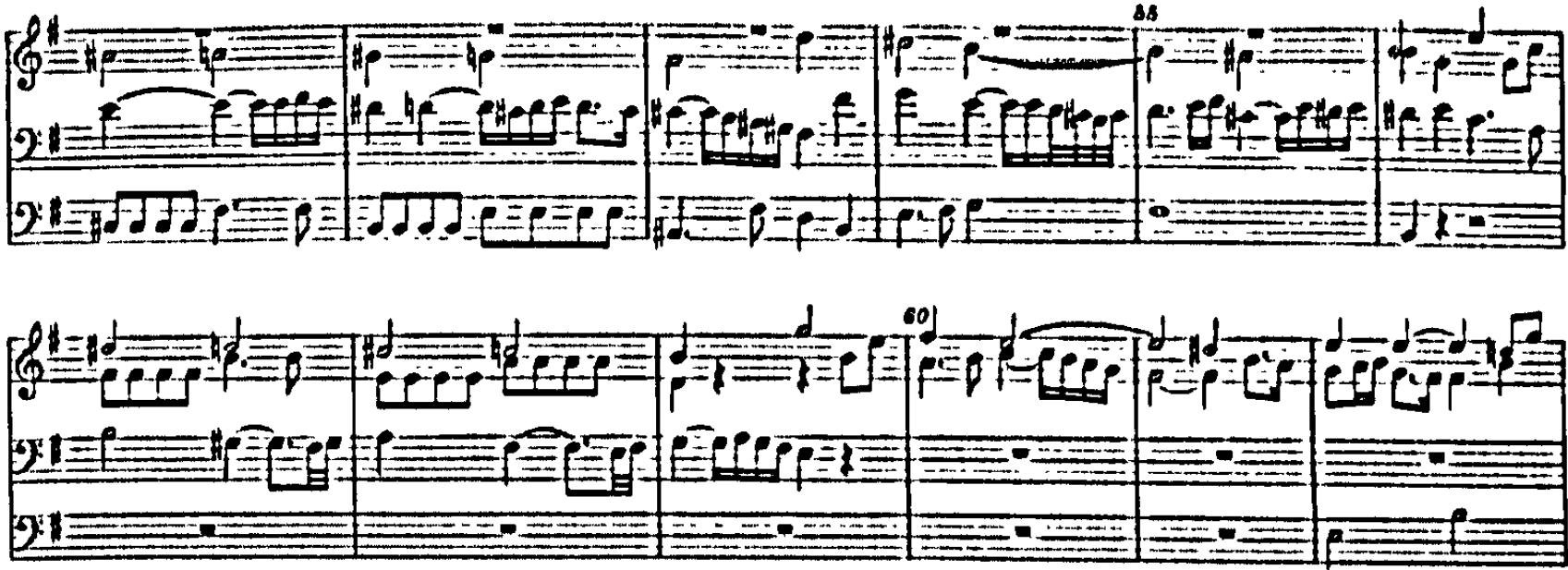
中文讲解
图注:Example 89. N. Bruhns:narratio,第 51-62 小节。本谱例覆盖 narratio 临近结尾处,配合 P0225 的论述展示主体最后一次主题进入(自 bar 68 起由低音 tenor 进入)之前的材料状态,并过渡到 bars 74-75 的情感化段落。需查看原图核对音乐。
补充说明
原图内嵌数据已省略。该图跨越第 51–62 小节,覆盖叙事的中间到结尾区域。
第9段(P0225)
原文复述
The last entrance of the subject is heard in the tenor starting in bar 68 with the pedal part carrying the countersubject. The ‘rational’ contrapuntal texture dissolves into an affective section in bars 74-75, where strong chords interrupted by expressive aposiopesis rests are accompanied by saltus duriusculus motives in the pedal modelled after the countersubject. The narratio concludes in bar 80 with a perfect cadence on the dominant B major, decorated with a free ornamental flourish in the left-hand manual that ends in a lower mordent on b.
中文讲解
本段描述 narratio 进入结尾时的两条结构性转换:
- 理性织体的解体:主体最后一次进入在第 68 小节由 tenor 引出,脚踏承担对题,这是赋格式的常规收束方式;但到了 74-75 小节,“理性”对位织体开始溶解,进入情感化段落——强力和弦被 aposiopesis(情感性休止)所打断,踏板上以 saltus duriusculus(剧烈跳进)动机推动,动机材料源自对题。
- 叙事终止:narratio 在第 80 小节以终止式结束在属调 B 大调上,作者特意把这一收束描写为被左手 manual 的自由装饰引带所“装点”,最终音是 b 上的下波音(lower mordent)。
关键写作意图:作者用“dissolves into”强调从理性对位到情感陈述的渐变过渡,提示读者接下来的内部 peroratio 会进一步放大这种情感逻辑。
补充说明
aposiopesis 与 saltus duriusculus 是与 passus duriusculus 同源但效果不同的修辞格:前者是情感性停顿,后者是力度化的跳进(通常指大三度或更大音程的骤然进行)。
第10段(P0226)
原文复述
Figure caption: Example 90. N. Bruhns: narratio and internal peroratio (bars 76-85).
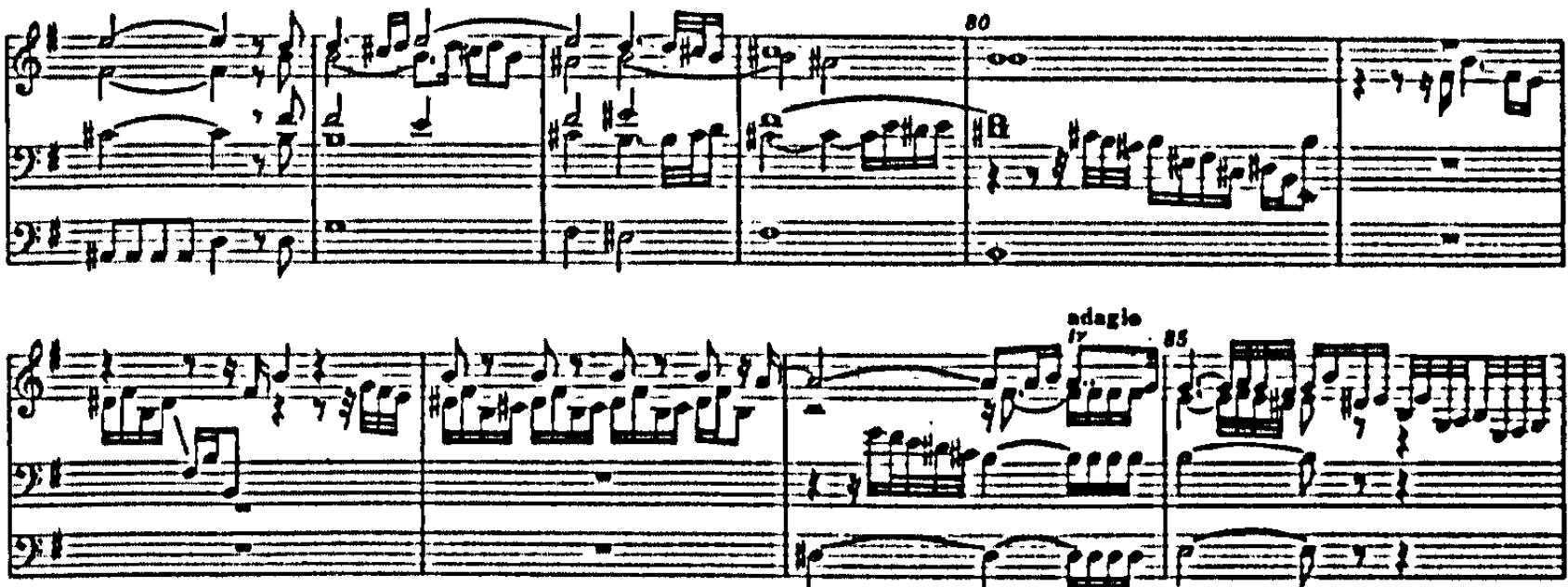
中文讲解
图注:Example 90. N. Bruhns:narratio 与内部 peroratio,第 76-85 小节。本谱例恰好跨越 P0225 所指 narratio 终止(bar 80)与 P0227 所述内部 peroratio 起点(f#’-b’ 四度引子),用以直观展示两段在织体和情感状态上的衔接关系。需查看原图核对音乐。
补充说明
原图内嵌数据已省略。76–85 小节跨越体裁过渡,故作为单图呈现。
第11段(P0227)
原文复述
The narratio concludes in bar 80 followed by a free recitative-like section that would usually function as an internal peroratio to the fugue, as is the case with most of Buxtehude’s narrationes. However, the passage seems to elaborate on elements that were demonstrated during the statement of the case with points of imitation enhanced by flourishes and affective rests. The section commences with an interval of a perfect fourth (f#’-b’) followed by a rapid arpeggio that leads to another entrance of the same interval (anaphora, repetitio). After an expressive aposiopesis, the interval f#’-b’ gives way to more elaborate arpeggios that shift the texture through a tirata and a trill (marked adagio) to an E minor chord (bar 85). This chord, ornamented with parallel groppo figures, is followed by two groups of demisemiquavers that are cut off abruptly in bar 86 by a pedal c#. The abruptio rest signifies the beginning of the second half of the affective passage, where the same perfect fourth interval is repeated this time a tone lower (e’-a’). Bars 86-89 present a varied repetition of the first half of the section at a different pitch (polyptoton) decorated occasionally with upper and lower mordents (paronomasia), as well as with a trillo longo marked adagio leading to a cadence on D (bar 90).
中文讲解
本段是本节论证密度最高的段落,描述内部 peroratio 的完整结构。
第一层承上启下:narratio 在 80 小节结束后进入一个“free recitative-like section”,按布克斯特胡德的惯例本应作为“internal peroratio”。但作者指出,本段并未止步于修辞小结,而是把案件陈述中的元素进一步展开,加入模仿段、装饰音与情感性休止。
第二层描述本段自身的音乐进程:
- 起始动机:纯四度 f#’-b’ 引出快速琶音,随即重复同一音程(修辞术语 anaphora / repetitio)。
- 第一次情感停顿:aposiopesis 之后,f#’-b’ 引入更复杂的琶音和 tirata,并配合标有 adagio 的 trill,落于第 85 小节的 E 小调和弦。
- 中央装饰:E 小调和弦加上平行 groppo 音型,随后两串三十二分音符被第 86 小节的持续音 c# 突然切断——这一 abruptio 修辞断点标记了情感性段落的“下半场”开始。
- 下半场的整体移位:相同的纯四度音程整体下移二度至 e’-a’。第 86-89 小节呈现第一次陈述在另一音高上的变奏重复(polyptoton),配合上下波音(paronomasia)以及标 adagio 的 trillo longo,最终终止于 D 调(第 90 小节)。
作者的判断:这种结构虽形式上属于内部 peroratio,但其“展开”意味更接近 amplificatio 修辞功能,这将在 P0230 中显式提出。
补充说明
本段首次密集引入多种音乐-修辞术语的并置:anaphora/repetitio、aposiopesis、abruptio、polyptoton、paronomasia、trillo longo、groppo。其中 abruptio rest 与 aposiopesis rest 类似但语义不同:前者强调“突然中断”,后者强调“情感性沉默”。这种区分在解释后文内部 peroratio 的形态时非常关键。
第12段(P0228)
原文复述
Figure caption placeholder for page 48 image or musical example (embedded image data omitted; caption retained).

中文讲解
这是第48页图像或乐谱占位符,仅保留图注位置信息,原图内嵌数据已省略。该图应与上下文配合,提供对 P0227 中所述第四度音程与琶音过程的可视化支持。具体内容(如谱例编号、对应小节)需查看原图。
补充说明
无其他可补充信息。该图注没有像其它项那样给出具体小节范围,属于页面级的版式占位。
第13段(P0229)
原文复述
Figure caption: Example 91. N. Bruhns: internal peroratio and digressio (bars 86-94).

中文讲解
图注:Example 91. N. Bruhns:内部 peroratio 与 digressio,第 86-94 小节。这里首次将本节后面的段落称为 digressio(离题段),对应 P0227 提到的“变奏重复”加上 cadential 收束的片段(86-90 小节)。该图是叙事展开后转入 digressio 的视觉证据。需查看原图核对音乐。
补充说明
原图内嵌数据已省略。digressio 一词在小节摘要和图像之间建立了直接对应。
第14段(P0230)
原文复述
While this section could be easily considered an internal peroratio to the fugue, there are certain elements that point more to an amplificatio function, yet in an affective fashion. The two intervals that form the basis for the development of the section constitute an elaboration of the motives of the fugal countersubject, which demonstrated a series of repeated notes based on the same intervallic proportions (f#’-b’ and e’-a’). It is also the same with the affective tirata figures encountered within bars 81-90 that are an exact imitation of the same figures in the narratio. In other words, the internal peroratio receives an amplificatio inflection not reminiscent of Buxtehude’s works, where usually stretto-like repetitions derived from the countersubject followed the confirmatio section.
中文讲解
本段是本节论点的转折与总结。
中心主张:本段具备内部 peroratio 的形式外壳,但其展开逻辑更接近 amplificatio(修辞性放大),且这种放大以“情感化”的方式呈现。
作者的论证分为两步:
- 材料同源:第四度音程(f#’-b’ 和 e’-a’)作为本段发展的基础,是对赋格对题中反复音形态的“elaboration”(展开);而 81-90 小节出现的 tirata 音型则是 narratio 中同种音型的“exact imitation”。换言之,本段没有引入新材料,只是对旧材料做情感性放大。
- 与布克斯特胡德对比:作者明确指出,这种“amplificatio”色彩不见于布克斯特胡德的同类作品——布克斯特胡德在 confirmatio 段之后通常使用 stretto 风格的材料重复,而非情感化展开。这是作者用以区分两位作曲家风格的关键判断。
作者态度:使用“not reminiscent of”来突出布鲁恩斯的独特性,同时也暗示这种差异并非技术缺陷,而是体裁功能的合法转移。
补充说明
stretto 是赋格中主题与答句紧接出现的技法,与此处“情感化展开”形成风格对照。amplificatio 在古典修辞中指通过重复、扩展、对比等手段加强论证,本身不限于功能分类,因此作者用“amplificatio inflection”说明本段是“在形式上仍属 peroratio,但功能上偏向扩说”。
第15段(P0231)
原文复述
Figure caption: Example 92a. N. Bruhns: narratio: tirata figures (bars 63-64).
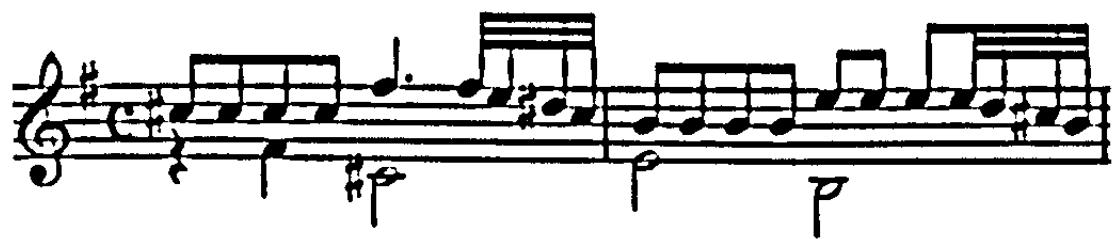
中文讲解
图注:Example 92a. N. Bruhns:narratio 中 tirata 音型,第 63-64 小节。该谱例与 P0230 的论点对应:作为“narratio 中 tirata 音型”的参照对象,将与 Example 92b 配对以视觉化呈现两段中 tirata 的“exact imitation”关系。需查看原图核对音乐。
补充说明
原图内嵌数据已省略。92a 与 92b 联合使用,构成同源论证的视觉对照。
第16段(P0232)
原文复述
Figure caption: Example 92b. N. Bruhns: internal peroratio: tirata figures (bars 84 and 89).

中文讲解
图注:Example 92b. N. Bruhns:内部 peroratio 中 tirata 音型,第 84 和 89 小节。该谱例对应 P0230 所称“affective tirata figures encountered within bars 81-90 that are an exact imitation of the same figures in the narratio”的后半段证据——作者从 84 与 89 小节同时取材,强调这一模仿既出现在情感段落的开头也出现在下半场,从而突出其贯穿性。需查看原图核对音乐。
补充说明
原图内嵌数据已省略。92b 横跨第 84 和 89 小节,体现对前后两半段的“精确模仿”这一论断。
脚注 / 边栏 / 图表 / 附加信息(如有)
本节附加材料由 11 个图像/谱例占位符构成(Examples 84, 85, 86, 87, 88, 89, 90, 91, 92a, 92b,以及第48页一处未编号的版面占位符)。它们在论证中承担的功能如下:
- Examples 84 与 88:呈现 exordium 中 tirata 音型与分解和弦,作为 narratio 对题材料来源的视觉证据;
- Examples 85 与 86:呈现 narratio 与 exordium 开篇的半音化语调,作为两段调式呼应的视觉证据;
- Example 87:呈现对题中的两组增四度(c"-f#"、a’-d#")以及若干纯四度,是 narratio 中和声色彩的关键证据;
- Example 89:覆盖 narratio 中段到接近结尾;
- Example 90:跨越 narratio 终止与内部 peroratio 起点,作为体裁过渡的视觉证据;
- 第48页未编号占位符:位置意义不可考,应视为页面级图位;
- Example 91:标注内部 peroratio 与 digressio 的接合;
- Examples 92a 与 92b:联合呈现 tirata 音型在 narratio 与内部 peroratio 中的“exact imitation”关系,是 P0230 的核心论据。 本节无文本脚注。
💡 本节核心要点
- 前奏段(exordium)已经展示了后续案例发展所需的基本旋律材料,narratio 在主题与对题两个层面复用同一套调式与音程资源。
- narratio 的对题引入两组增四度(c"-f#"、a’-d#")以及纯四度、纯五度,作者推断这些音程源自前奏段 16-17 小节被 tirata 音型装饰的分解和弦。
- 叙事段在结构上遵循昆体良的修辞规范:以谨慎使用的情感辞格(tirata、trill)打动听者,颤音的回转虽已记谱,额外装饰仍由演奏者裁夺。
- 主体最后一次进入在第 68 小节由 tenor 引出,踏板承担对题;74-75 小节“理性”对位织体溶解为以 aposiopesis 与 saltus duriusculus 推动的情感段,narratio 终止于 B 大调(第 80 小节)。
- 内部 peroratio 以纯四度 f#’-b’ 起誓,经过琶音、aposiopesis、adagio 颤音落至 E 小调(第 85 小节),以 abruptio(持续音 c#)切分上下两半,下半场整体下移二度至 e’-a’,以 adagio trillo longo 终止于 D(第 90 小节)。
- 作者最终判断该段虽形式上为内部 peroratio,实质上以 amplificatio 方式情感化地展开对题与 tirata 材料;这种“amplificatio inflection”不见于布克斯特胡德的对应写作,是布鲁恩斯风格的关键标记。
🔑 关键术语
- passus duriusculus:连续下行半音的修辞音型。在本节中它把 exordium 开篇的 chromatic inflection 与 narratio 第 21-24 小节联系起来,是前后段调式呼应的关键标志。
- countersubject:赋格对题。本节中它由反复音构成(canzona-like),并引入增四度与四度音程,被作者推断源自 exordium 第 16-17 小节的 tirata 分解和弦。
- tirata:快速的音阶式或分解和弦式走句。本节中 tirata 同时出现在 exordium bars 16-17、narratio 第 63-64 小节以及内部 peroratio 的第 84、89 小节,承担“afficto”与“扩说”双重功能。
- aposiopesis / abruptio:两类情感性中断修辞。前者强调“情感性沉默”,后者强调“突然切断”。在本节分别出现在 74-75 小节(aposiopesis)与第 86 小节(abruptio,被持续音 c# 切分上下半场)。
- amplificatio:古典修辞中的“扩说”功能。本节以之描述内部 peroratio 在形式外壳下所做的情感性材料放大,并对比布克斯特胡德较常见的 stretto 重复,构成风格区分。
- polyptoton / paronomasia / anaphora:古典修辞术语。作者在描述内部 peroratio 时用 polyptoton 指音高移位的变奏重复,用 paronomasia 指装饰音(上下波音)造成的近似,用 anaphora/repetitio 指纯四度音程的重复进入。
4.22 [描述性拆分] Bruhns’s E minor Toccata: Narratio and Internal Peroratio
第1段(P0233)
原文复述
The texture suddenly changes in bar 90 where the time signature (12/8) signifies the beginning of another free, but rhythmical, passage in gigue style. Compared to the preceding section, this fragment denotes a digressio consisting only of five bars, where harmony shifts to steady dance-like chords founded on successive leaps of fourths and fifths in the pedal. The section is divided into two parts where the second (bars 92-94) constitutes an imitation of the first (bars 90-92), but with additions and alterations for the sake of emphasis (paronomasia). As in the exordium of the toccata, the digressio presented here hints at proofs and arguments the composer will elaborate on later. The metrical change to 12/8, although the same as in bars 13-15, receives an intense rhythmical shape that will be encountered in the same fashion in the confirmatio (bars 132-153).
中文讲解
本段的主张是:第90小节开始的五小节片段在修辞学上扮演"digressio"(离题段)的角色,它以节奏性而非戏剧性的方式预示了后文才正式展开的论点。理解要点包括:(1) 调号从原本的拍号切换至12/8,立刻把织体转入吉格舞曲风格,意味着"自由但有节奏"——这是离题段的典型质地,既不像开篇那样散漫,也不像confirmation那样承担论证;(2) 和声上以四五度跳进的固定低音为基础,呈现稳定的舞曲性和声,与前段的剧烈戏剧性形成反差;(3) 92-94小节对90-92小节的"模仿+变形"对应古典修辞中的paronomasia(谐音/变奏式重复),作者明确点出这是为强调而非装饰;(4) 作者特别指出此处与全曲开篇exordium在功能上相似——即"暗示尚未展开的论点",因此digressio在此承担了一种预告功能;(5) 12/8拍号虽已在bars 13-15出现过,但此处节奏轮廓"更强烈",与confirmation(132-153小节)形成前-后的呼应关系。换言之,作者把这一短小的digressio定位为全曲结构中的"种子段"——既短小又承上启下。
第2段(P0234)
原文复述
The digressio ends with a cadence on G major, and while one would expect the confirmatio to start supporting the arguments put forward, Bruhns inserts, instead, thirty-seven bars of sections contrasting in style. Although longer, this passage recalls the material encountered in the introduction to the piece, where different textures, some of them with bold chromatic figurations, created a dramatic effect. The rhetorical definition of this section seems rather problematic; however, it can be considered a digressio functioning as a secondary exordium before the proof of the case. Quintilian favoured the application of such exordia in the course of a speech “[…] with a view to exciting or mollifying the judge or disposing him to lend a favouring ear to [the] proofs.” Moreover, he suggested that this be done “[…] with all the greater freedom and vehemence at this stage of the proceedings since the case is already known to the judge.” He furthermore maintained that the speaker employed “[…] such utterances as emollients to soften the harder elements of [the] statement, in order that the ears of the jury may be more ready to take in what [the orator has] to say in the sequel […]”
中文讲解
本段的核心任务是为接下来37小节(bars 95-130左右)确定一种修辞学身份。推理链如下:(1) 在digressio以G大调收束后,按照一般修辞顺序本应直接进入confirmation来论证论点,但Bruhns却没有立即论证,而是插入一段风格对比鲜明、长达37小节的材料;(2) 作者先承认这段的"修辞学定性看起来相当棘手"——因为它既长又对比强烈,难以归入既有类别;(3) 但作者援引昆体良(Quintilian)的权威,提出一种解决:把这段视为"次级exordium"(secondary exordium),即digressio之外、proof之前的次级引言,其作用不是论证,而是为论证铺平情感和心理基础;(4) 三段昆体良引文层层递进:第一段说明动机(激发或安抚法官,使其倾向听取论证),第二段说明此处话语可以"更自由、更激烈"(因为案件对法官已知),第三段说明这种话语如同"软化剂",把听众的耳朵准备好接收接下来的论证。作者援引昆体良是为自己的音乐分析提供外部权威依据,让读者相信这37小节绝不是随意炫技,而是有修辞目的的引言性铺垫。容易误解之处是:不要把这段理解为普通的"间奏",它承担的是说服的心理准备功能。
补充说明
三项引文均出自同一卷(Institutio oratoria第四卷),内容相互呼应,引文编号(脚注75、76、77)见随后条目P0236–P0238。
第3段(P0235)
原文复述
Returning to passage under discussion, the long section that appears just before the proofs of the arguments can be considered a secondary exordium, in other words, “[…] a very useful preparation for the examination of the main question […]”. The secondary exordium consists of a long passage that demonstrates a gradual rise in affect starting from a virtuosic arpeggio section that leads to two chordal passages with chromatic figurations. Bars 95-111 display an imitatio violistica section of rapid demisemiquaver arpeggios, which give way to an affective homophonic chordal segment (bars 112-119)
中文讲解
本段完成两件事:第一,用第四段昆体良引文(脚注78,P0239)把次级exordium的定义"一种非常有助于主要问题考察的预备"作为结束性的术语定锚;第二,开始描述这37小节次级exordium内部的情感上升曲线(gradual rise in affect)。描述的结构逻辑是先点出整体走势(从炫技琶音段到两段带半音化装饰的和声段),再具体划分前两个阶段:(1) bars 95-111标定为imitatio violistica——即模仿小提琴/中提琴风格,用三十二分音符琶音,体现炫技;(2) bars 112-119转入带有情感张力的同音型(homophonic)和声段。作者用"give way to"(让位于)暗示一种情感的不断攀升:技术性 → 情感性,为下一段(P0240)的presto炫技做铺垫。注意作者把这一长段定位为"gradual rise",意味着接下来逐段都会有情绪升级。
第4段(P0236)
原文复述
$^{75}$ Quintilian, Institutio oratoria, Book IV. iii. 9, pp. 126-27.
中文讲解
脚注75为P0234第一处昆体良引文提供完整出处:《修辞学原理》(Institutio oratoria)第四卷第三章第9节,第126-127页。该引文对应P0234中关于"次级exordium以激发或软化法官为目的"的论点,作用是为作者的音乐分析提供古典修辞学的权威来源,本质上属于"支撑性"脚注。
第5段(P0237)
原文复述
$^{76}$ ibid., Book IV. iii. 9, pp. 126-27.
中文讲解
脚注76为P0234第二处昆体良引文注明出处,仍出自《修辞学原理》第四卷第3章第9节,第126-127页(ibid=同前)。该引文对应昆体良"因案件对法官已明,可在此阶段更自由、更激烈地发言"的建议,作用是把音乐段落的强烈对比与昆体良话语中的"更自由"直接挂钩,支撑作者把这段定性为次级exordium而非简单间奏。
第6段(P0238)
原文复述
$^{77}$ ibid., Book IV. iii. 10, pp. 126-27.
中文讲解
脚注77为P0234第三处昆体良引文注明出处,转自《修辞学原理》第四卷第3章第10节,仍在第126-127页的同一开本。引文内容是"软化剂"比喻,与前两段引文共同构成昆体良关于次级exordium的三段论:动机(激发/软化)→ 自由(更激烈)→ 手段(emollients软化剂)。作用是为次级exordium的功能(即"为论证清耳")提供第三层修辞学依据。
第7段(P0239)
原文复述
$^{78}$ ibid., Book IV. iii. 9, pp. 126-27.
中文讲解
脚注78为P0235中那一句定义性的昆体良引文(“一种对主要问题考察极为有用的预备”)注明出处,回归第四卷第3章第9节(第126-127页)。这一定义句用以把"次级exordium"正式注册到昆体良的术语体系中,作为本节分析37小节音乐段的术语锚点。作用是定义/定锚,支持作者此前给出的修辞定性。
第8段(P0240)
原文复述
determined by bold $tmesis$ rests and chromatic semitones. This passage culminates in a section marked $presto$ in bars 120-126, mostly intended for the display of the performer’s virtuosity, a dominating principle of the $stylus$ $phantasticus$. As Mattheson later described (1739), “[…] unusual passages, obscure ornaments […] and embellishments” with “[…] a view to pleasing, to dazzling and to astonishing” are demonstrated here through dramatic repetitions of double parallel trills in the manuals accompanied by three emphatic statements of a pedal motive ($anaphora$).
中文讲解
本段接续P0235对bars 112-119的描述,并把情感上升曲线推至顶点。重点包括:(1) 同音型和声段的特征是"大胆的tmesis休止"与"半音化的半音"——tmesis在此是节奏性的切分停顿,造成戏剧性断裂;半音进行则增强和声紧张度;(2) bars 120-126进入"presto"标记段,几乎纯粹用于炫技,作者认为这种炫技是stylus phantasticus(自由幻想风格)的"主导原则";(3) 作者引马泰松(Mattheson, 1739)的权威观点,说明炫技/突兀的装饰其目的不是论说,而是"愉悦、炫目、惊人"——这与昆体良所说"次级exordium可以更自由、更激烈"形成结构性呼应;(4) 在音乐实现上,作者以"双平行颤音在手动声部的戏剧性重复+脚键盘动机的三次强调"为例,把这种修辞效果具象化,并将后者命名为anaphora(首语重复)。换言之:技术与情感并行达到高潮,预示着confirmation即将登场。
第9段(P0241)
原文复述

中文讲解
图片占位符。标题为"Example 93. N. Bruhns: imitatio violistica (bars 95-97)",对应P0235中描述的bars 95-111的imitatio violistica段起首三小节。该图原本应在谱例中以具体的音符记号展示所谓"模仿小提琴/中提琴风格的三十二分音符琶音"。本节以文字描述已抓住其性质(小提琴化快速琶音),但读者如需对照音符细节,需查看原图。从上下文可确认:它属于次级exordium开端的炫技性琶音段,位于本节情感上升曲线的起始位置。
第10段(P0242)
原文复述

中文讲解
图片占位符。标题为"Example 94. N. Bruhns: homophonic passage (bars 117-125)",对应P0235和P0240所述的同音型和声段(bars 112-119)和紧随其后的presto段(bars 120-126)。从上下文确认:图示跨度涵盖本节情感上升曲线的最关键转折——从"带有tmesis与半音化张力的同音型"过渡到"presto炫技段落",恰好横跨P0240所谈的"以双平行颤音+脚键盘动机三次强调"所代表的炫技顶点。需查看原图以获取具体音符细节。
第11段(P0243)
原文复述

中文讲解
图片占位符。标题为"Example 95. N. Bruhns: chordal section (bars 126-129)",对应P0244所述bars 126起的"aposiopesis"(突然中断)所引入的adagio段。该图示位于P0244文本中段,原应展示以tmesis休止分隔的和声与脚键盘半音低音的紧张对峙。需查看原图以确认具体织体形态,但本节作者已用文字清楚交代:这里在模仿羽管键琴化织体、和声紧张度不断增加,目的是为最终cadence的高潮蓄势。
第12段(P0244)
原文复述
The improvisatory passage leads in bar 126, where a general aposiopesis introduces more free affective - and rare for organ music - material marked adagio, reminiscent of figurations intended for harpsichord music. Chords separated by tmesis rests create a dramatically increasing harmonic tension through a continuous and occasionally confusing alteration of chromatic pedal lines and manual chords. The passage ends in bar 130, where expressive suspensions and an abruptio rest lead to the final cadence that marks the introduction of the final rational part of the Klangrede, the confirmatio.
中文讲解
本段是次级exordium的收束段,需要把握三件事:(1) 表面看似"即兴段",但修辞结构严谨——它在bar 126用一个general aposiopesis(普遍性的突然沉默)开启adagio,强调这种"对管风琴而言罕见的"自由素材,刻意借鉴了羽管键琴的装饰性织体,表明作者在此用"罕见的音色隐喻"制造戏剧性反差;(2) 和声策略:和声被tmesis休止"撕裂",脚键盘半音化低音线与手动和声交替,制造"持续且偶有令人困惑的"紧张度,把情绪再向上推一层;(3) bar 130是结构性的终曲:先用"富有表情的延留"(express suspensions)积聚期待,再用abruptio rest(突然断裂)使能量截断,最后让终结式(final cadence)登场,开启全曲的confirmation(即Klangrede的最后理性论证部分)。修辞学生这相当于:先用aposiopesi+adagio进行最后一次安抚准备,再以突然断裂宣告论证开始。本段揭示了本节内部peroratio与confirmation之间的过渡结构。
补充说明
“Klangrede"是德语"音响演说"之意,在本节指把整首乐曲视为修辞演说的分析视角;confirmation在此以"全曲最终理性论证部分"的身份出现,是后续段落才展开的对象。
第13段(P0245)
原文复述
$^{79}$ Johann Mattheson’s Der vollkommene Capellmeister, trans. by Ernest Harriss, Part I, Chapter 10, §93, p. 217.
中文讲解
脚注79为P0240中第一处马泰松引文(“unusual passages, obscure ornaments and embellishments”)注明出处:马泰松《完美的乐长》(Der vollkommene Capellmeister),Harriss英译本,第一部第十章第93节,第217页。该引文是作者把bars 120-126的presto炫技与stylus phantasticus"非普通、不透明、装饰化"的修辞目的挂钩的权威来源,作用为"理论支持”。
第14段(P0246)
原文复述
$^{80}$ ibid., p. 217.
中文讲解
脚注80为P0240中第二处马泰松引文(“with a view to pleasing, to dazzling and to astonishing”)注明出处:与脚注79同书同章同页(同前)。该引文把presto段落的修辞目的点明为"愉悦、炫目、惊人",而非论证,从而支撑作者把这一段定位为次级exordium内的情感巅峰,而非论说性材料。
脚注 / 边栏 / 图表 / 附加信息(如有)
本节附有三幅谱例图示(Example 93–95,分别覆盖bars 95-97、117-125、126-129),用于呈现次级exordium内部的imitatio violistica、同音型—presto过渡段、以及aposiopesis—adagio段的织体细节,因图示数据未内嵌,原图需另行查阅。脚注共六条:四组(75–78)来自昆体良《修辞学原理》第四卷第3章第9-10节,作为"次级exordium"概念与三类功能(动机、自由度、软化剂比喻)的权威依据;两组(79–80)来自马泰松《完美的乐长》第一部第十章第93节,作为stylus phantasticus段炫技目的的理论根据。脚注整体作用是外部权威支撑,使本节对bars 90-130的音乐分析在修辞学定性上具备跨学科合法性。
💡 本节核心要点
- bars 90-94是5小节的digressio,其功能是"暗示未来将展开的论点",并以12/8吉格风格与四/五度跳进和声构成全曲confirmation的种子段。
- bars 95-130的37小节长段在修辞学上被作者定性为"次级exordium"——其作用是心理与情感的预备,而非论证本体,作者援引昆体良为这一定性提供权威依据。
- 次级exordium内部为单调递增的情感曲线:imitatio violistica三十二分琶音(95-111)→ 半音化同音型和声(112-119)→ presto炫技(120-126)→ aposiopesis-adagio的羽管键琴化织体(126-130),每一步都让情绪压力升级。
- P0240的presto段以双平行颤音+脚键盘动机三次强调(anaphora)实现炫技顶点,与马泰松所述stylus phantasticus"愉悦、炫目、惊人"的修辞目的吻合。
- bar 130以express suspensions与abruptio rest标志次级exordium结束,开启全曲confirmation,即Klangrede中最后的理性论证部分。
- 脚注75-78与79-80分别承担昆体良的次级exordium理论与马泰松的stylus phantasticus理论两个外部权威支撑,使本节的分析框架在修辞学—音乐学之间形成学科互补。
🔑 关键术语
- digressio:古典修辞学中的"离题段",指在主论之外插入的对比性段落;本节指bars 90-94的5小节吉格片段,作用是"预示未来论点"。
- exordium / secondary exordium:古典修辞学中的"开篇/次级开篇";本节作者把bars 95-130的37小节长段定为昆体良意义上的secondary exordium——为论证铺平情感与心理基础,而非论证本体。
- paronomasia:修辞学术语,指"模仿中带添加与变化以加强强调";本节指bars 92-94模仿bars 90-92,但有所添改以增强效果。
- imitatio violistica:“模仿小提琴/中提琴风格”;本节指bars 95-111以三十二分音符琶音呈现的炫技段。
- tmesis:修辞学/音乐修辞中的"插入性停顿";本节指bars 112-119及bars 126-129用以切分和声、制造戏剧性断裂的休止。
- aposiopesis:修辞学中的"突然中断/突然沉默";本节特指bar 126的general aposiopesis,是adagio段开启的结构性信号。
- anaphora:“首语重复”;本节指bars 120-126中presto段由三度强调的脚键盘动机所构成的修辞重复手法。
- abruptio:“突然断裂”;本节指bar 130使持续张力被截断并让终结式登场以开启confirmation。
- stylus phantasticus:巴洛克北德乐派"自由幻想风格",以炫技、非普通装饰、即兴为特征;本节用以解释bars 120-126 presto的功能。
- Klangrede:德语"音响演说",指把整首乐曲视为修辞演说的分析视角;本节是该视角下对bars 90-130修辞功能的定位背景。
- confirmatio:修辞学"论证/确认段";本节指全曲Klangrede的最后理性论证部分,于bar 130之后开始(具体覆盖bars 132-153)。