目录
C1 Alessandro Fabri’s Workshop, Instruments and Legacy
- C1.S1 [描述性拆分] The Monteoliveto Organ and Its Sound-Producing Design
- 页码:1-2
- C1.S2 [描述性拆分] Fabri’s Status, Reputation and Career Span
- 页码:3-3
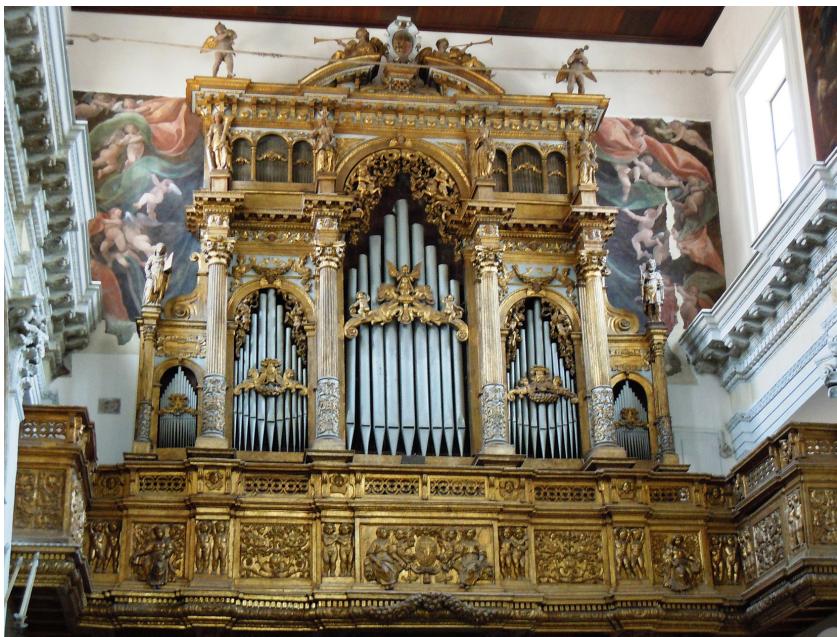
- C1.S3 [描述性拆分] Structure, Training and Social Functions of the Workshop
- 页码:4-4
- C1.S4 [描述性拆分] Fabri’s Disciples and the Workshop Community
- 页码:5-5
- C1.S5 [描述性拆分] Legacy Beyond 1656 and Conclusion on Fabri’s Significance
- 页码:6-6
- C1.S6 [描述性拆分] Appendix A: Fabri’s Workshop
- 页码:7-10
- C1.S7 [描述性拆分] Appendix B: Documents – Editorial Conventions and Neapolitan Measures
- 页码:10-11
- C1.S8 [描述性拆分] 1607 Notarial Contract for the Monteoliveto Organ
- 页码:16-16
C2 Bibliography (Alessandro Fabri Study)
- C2.S1 Bibliography
- 页码:23-25
C3 Italian Instruments in England, and Their Adaption for Use
- C3.S1 Italian Instruments in England, and Their Adaption for Use
- 页码:26-26
- C3.S2 [描述性拆分] Venetian Harpsichords in the Inventories of Henry VIII
- 页码:27-28
- C3.S3 [描述性拆分] Queen Elizabeth’s Virginal: Initial State and Short-Octave Unfamiliarity in England
- 页码:29-29
- C3.S4 [描述性拆分] Queen Elizabeth’s Virginal: Keyboard Alterations and Pitch Changes
- 页码:30-30
- C3.S5 [描述性拆分] English Pitch Standards and Compass Conventions
- 页码:31-31
- C3.S6 [描述性拆分] Likely Changes to Other Venetian Instruments in England
- 页码:32-32
- C3.S7 [描述性拆分] Naples and Antwerp Compared with English Instruments
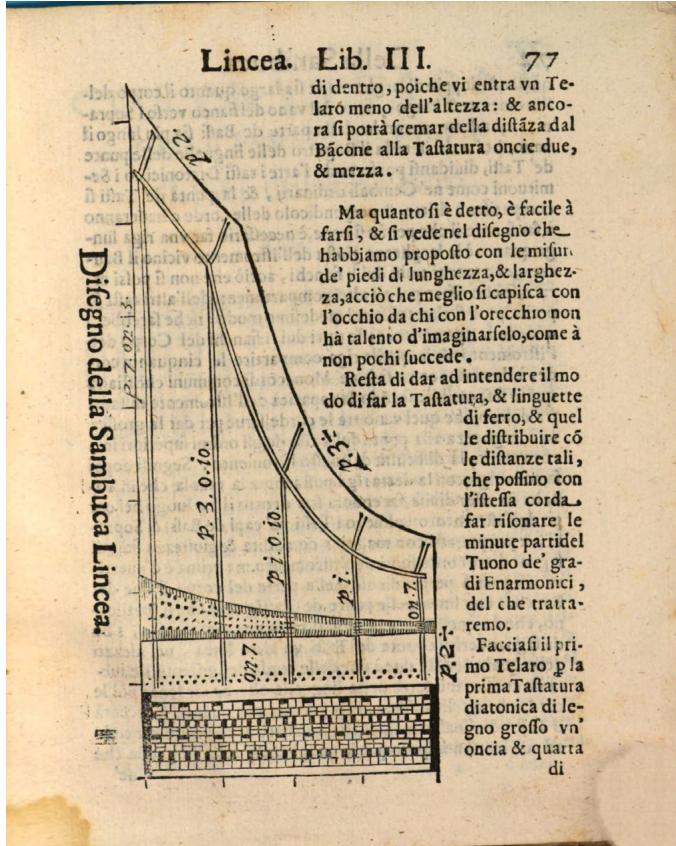
- 页码:33-33
- C3.S8 [描述性拆分] Hypothetical Compass Changes to Two Neapolitan Instruments
- 页码:34-34
- C3.S9 [描述性拆分] The Unsigned RCM175 Harpsichord: Original Compass and Alterations
- 页码:35-35
- C3.S10 [描述性拆分] RCM175’s Restringing and Overall Conclusions
- 页码:36-36
C4 Bibliography (Italian Instruments in England Study)
- C4.S1 Bibliography
- 页码:37-37
C5 Stringed Keyboard Instruments at the Courts of the Austrian Habsburgs in the Sixteenth Century – the ‘Italian Perspective’
- C5.S1 Introduction
- 页码:38-38
- C5.S2 A Multitude of Courts
- 页码:39-41
- C5.S3 [描述性拆分] Italian Instruments at the Austrian Courts: Overview and the Spinettino
- 页码:42-43
- C5.S4 [描述性拆分] Interpreting Inventory Terminology: ‘Einfach’, ‘Doppelt’ and ‘Piano e Forte’
- 页码:44-44
- C5.S5 [描述性拆分] Dating Three Specific Instruments: Clavicymbalum Vniversale, Ondei Spinet and Bontempo Instrument
- 页码:45-47
- C5.S6 [描述性拆分] Limits of Surviving Inventories and Likely Underestimation
- 页码:47-48
- C5.S7 [描述性拆分] Motives for Acquiring Italian Instruments and Dynastic Context
- 页码:49-50
C1.S1 [描述性拆分] The Monteoliveto Organ and Its Sound-Producing Design
第1段(P0001)
原文复述
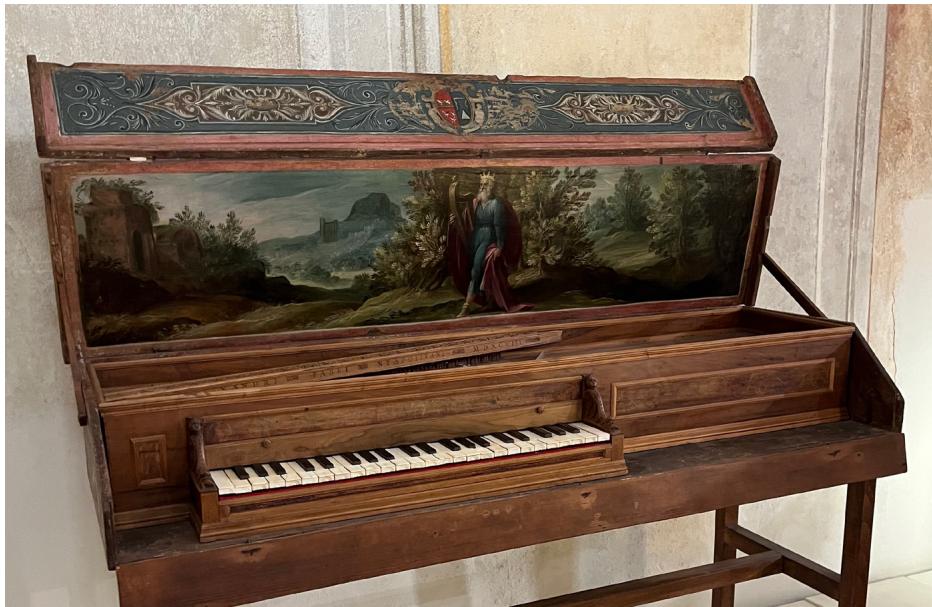
Fig. 1: Alessandro Fabri, Rectangular Spinet (Naples, 1598), Tagliavini Collection, Bologna (Photo: Catalina Vicens, @Museo di San Colombano – Collezione Tagliavini, Genus Bononiae). [Embedded image data omitted; caption and position retained]
中文讲解
这是图1的图注,介绍一件由Alessandro Fabri制作的方形(矩形)斯皮耐琴(spinet),制于1598年那不勒斯,现藏于博洛尼亚的Tagliavini乐器收藏馆,藏址位于San Colombano博物馆,照片由Catalina Vicens拍摄。该图注的功能在于为读者建立一个视觉参照,把作者关注的Fabri这位那不勒斯乐器制造者,与一件有明确年代和收藏地的实物联系起来。需要查看原图以了解琴体外观、装饰细节和键盘布局。
补充说明
图注中提到的斯皮耐琴(spinet)与本节主题(Fabri制作的Monteoliveto管风琴)属于同一作者的不同乐器种类,作者借此图将Fabri的键盘乐器制造背景呈现在读者面前。
第2段(P0002)
原文复述
Information referring to the 16th-century Neapolitan spinet can be found in the catalogue of musical instruments in the Tagliavini Collection in San Colombano. Concerning the important and imposing organ of Monteoliveto in Naples, built by Alessandro Fabri and situated in the church behind what used to be Piazza Carità, it must be said that very little was previously known, and the scant information available referred mainly to a reworking carried out in 1697 by the organ builder Cesare Catarinozzi.21 Thanks, however, to old payments and notarial documents from 1607, not only can we now confirm that the organ in Sant’Anna dei Lombardi was built by Alessandro Fabri, but we also know the names of other craftsmen who took part in the construction of the instrument. The complex design of the case, one of the richest and most beautiful Italian organ facades, was the work of Mario Cartaro and his son Bartolomeo.22 The carvings were made by Giovan Domenico Saccataro while the gilders were Giacomo de Martino, Bartolomeo Magliocca and Giovan Tommaso Smiraglia.23
中文讲解
本段是本节的核心论点铺垫,开篇先把Fabri的另一件键盘乐器(那不勒斯方形斯皮耐琴)与Tagliavini收藏的乐器目录相连,让读者看到作者的研究对象是一个跨乐器种类的乐器制造世家。随后转入本节真正的主角——那不勒斯Monteoliveto教堂(亦即Sant’Anna dei Lombardi)里由Alessandro Fabri制作的管风琴。作者明确两点学术处境:第一,以往学界关于此琴的认知极少,少数文献只提到1697年由Cesare Catarinozzi所做的改造;第二,借助新发现的1607年支付凭证与公证档案,作者不仅能确认制作者为Fabri,还能列出参与施工的其他匠人。值得注意的是,本段只涉及琴壳外观与装饰:外壳(case)由雕版师Mario Cartaro父子设计(被作者评为意大利最丰富、最美的管风琴立面之一),雕刻由Giovan Domenico Saccataro完成,鎏金则由Giacomo de Martino、Bartolomeo Magliocca和Giovan Tommaso Smiraglia三位工匠承担。这就把一件管风琴的建造分解为“发声部分”(由Fabri负责,下一段详述)和“外观与装饰部分”(由不同工匠合作)两条线索,结构上为下一段留出空间。
补充说明
Sant’Anna dei Lombardi即Monteoliveto教堂的本名,两者在本节中互换使用;Piazza Carità是那不勒斯历史上曾存在的广场,后来其原址有所变化,故作者说"what used to be Piazza Carità"。
第3段(P0003)
原文复述
21 Furio Luccichenti, ‘I Caterinozzi, famiglia di organari’, in: Recercare 9 (1997), 243–60, at 254.
中文讲解
脚注21给出P0002中提及的1697年改造者Cesare Catarinozzi相关信息的来源:Furio Luccichenti撰写的论文《Caterinozzi家族,管风琴制造世家》,发表于《Recercare》第9卷(1997年),第243–260页,具体见第254页。该脚注的学术作用是支持并限定正文主张——以往学界关于Monteoliveto琴的有限认知,主要来自对Catarinozzi家族活动的二手研究。
补充说明
《Recercare》是意大利音乐学界专注于早期音乐与乐器研究的学术期刊;此脚注表明作者的研究推进建立在对既有Catarinozzi家族文献的批判性利用之上。
第4段(P0004)
原文复述
22 Michela Tarallo, ‘Santa Maria di Monteoliveto a Napoli, dalla fondazione (1411) alla soppressione monastica: topografia e allestimenti liturgici’, tesi di dottorato in Scienze archeologiche e storico-artistiche, Università degli Studi di Napoli Federico II, 2013/14, 172.
中文讲解
脚注22提供P0002中关于"意大利最丰富、最美的管风琴立面之一"以及Cartaro父子参与设计立面这一信息的来源:Michela Tarallo在那不勒斯Federico II大学完成的博士论文《那不勒斯Santa Maria di Monteoliveto,从1411年建院到修道院解散:地形学与礼拜布置》,2013/14学年完成,具体见第172页。该脚注的作用是为立面设计的归属提供一手研究依据。
补充说明
脚注以博士论文为来源,提示本节中关于建筑外观与匠人归属的论述依靠了意大利本地学者完成的考古与艺术史综合研究。
第5段(P0005)
原文复述
23 Ibid., 172–7, 414–17.
中文讲解
脚注23继续使用与脚注22同一来源(Ibid.即"同上",指Michela Tarallo的博士论文),参考第172–177页与第414–417页。其功能是为P0002中关于雕刻师Saccataro与三位鎏金工匠的归属提供进一步页码支持。
补充说明
“Ibid.“是学术脚注中表示"与上一条脚注来源相同"的标准缩写;该条脚注通过页码范围扩展了对同一论文不同章节的引用。
第6段(P0006)
原文复述
Fabri, taking as his point of reference the organ situated at that time in the Chiesa dei Girolomini in Naples, was entirely responsible for the sound producing part of the instrument.24 The 61 facade-pipes made of tin, partly obtained from the pipes of an earlier organ, are still today divided into five compartments and arranged in a pyramid shape in each section (15-11-9-11-15), as indicated in the descriptions of 1607, which also mention the dummy pipes still present in the upper part of the facade. The facade-pipes all corresponded to the Principal, and it is very likely that the instrument’s manual, with ivory and ebony keys and an extended octave, would have consisted of 61 keys with a full five octave range (C-c4).25 There is no mention of a pedalboard. We also know that Fabri’s organ had nine stops activated by a draw-stop action (’tirante à balestra’) with a walnut spring chest. Finally, the windchest consisted of four bellows. As payment for the entire sounding part, 400 ducats were agreed upon, using ‘only the pipes of the old organ’. Fabri committed to building the instrument in six months. Today, the original tonal design is unfortunately completely compromised by the numerous renovations and restorations undergone over time, and we can now only admire the aesthetic magnificence that has survived from Fabri’s day.
中文讲解
本段是本节的论述重心,集中交代Fabri负责的"发声部分”(sound producing part)。作者明确指出:Fabri以当时位于那不勒斯Chiesa dei Girolomini中的管风琴为参照,独立承担了整件乐器的声学设计。其要点可分五层理解。第一,立面管数量与排列:61根锡质立面管分为五个音室(compartments),每组呈金字塔状排列,数字为15-11-9-11-15;这一布局直接来自1607年的文献描述,文献还同时记载了立面上部存在的装饰性"假管”(dummy pipes),即不实际发声的管。第二,音色归属:所有立面管对应Principal(主音栓),意味着立面外观反映的是该音栓的视觉地位。第三,键盘规格:手键盘配有象牙与乌木键,按扩展八度设计,推测为61键、五个完整八度(自C到c4)的音域;同时文献未提到脚键盘,因此这是一台典型的意大利单键盘管风琴。第四,机械与供气:九个音栓由"tirante à balestra"(一种弹簧拉杆式拉栓,意大利语意为"弩形拉手")操作,弹簧箱(spring chest)以胡桃木制成;风箱(windchest)由四个皮囊(bellows)供气。第五,建造条件与现状:约定报酬为400达克特,条件是只许使用"旧琴的管",建造周期六个月;然而由于历代改造与修复,原琴的音色设计已完全丧失,今日可见者仅余Fabri当年留下的外观之美。这段叙述有两个论证意义:一是把"声音"与"外观"清晰分离,分别归属不同的工匠系统;二是交代原始音色已不可复原,由此为后文讨论历史修复层与考古性研究留下伏笔。
补充说明
“tirante à balestra"是意大利管风琴术语,字面意为"弩形拉手”,指一种通过弹簧复位的手动拉栓机构;“dummy pipes"指仅作装饰、不发声的管;“spring chest"指利用弹簧保持管口常闭、需要时才由拉栓打开的风箱结构。
第7段(P0007)
原文复述
Fig. 2: Church of Monteoliveto, Organ, prospect of the facade, 1607, Naples (Photo: F. Nocerino). [Embedded image data omitted; caption and position retained]
中文讲解
这是图2的图注,展示Monteoliveto教堂(位于那不勒斯)管风琴立面的正面图景,年代标注为1607年,照片由F. Nocerino拍摄。该图与P0006中关于"五个音室金字塔形排列(15-11-9-11-15)“以及"上部假管"的文字描述相对应,作用是让读者直观看到文字所描述的立面布局。需要查看原图以核对立面管的实际排列与音室分隔。
补充说明
图2的标注年代"1607"与P0002所提的1607年支付凭证与公证档案同年,进一步将文献档案与现存实物在视觉上对应起来。
第8段(P0008)
原文复述
24 App. B, docs. 26, 27, 28. Cf. Tarallo, ‘Santa Maria di Monteoliveto a Napoli’, 413–14.
中文讲解
脚注24为P0006开头关于"Fabri以Chiesa dei Girolomini管风琴为参照并全权负责发声部分"的论断提供文献依据:附录B中编号26、27、28的三份档案,并参看Michela Tarallo前述博士论文第413–414页。这条脚注的作用是把正文的关键声学设计归属判断,锚定到具体的档案文献与二手研究之上。
补充说明
“App. B"指本书或本论文后所附的附录B;“Cf.“是拉丁文"confer"的缩写,意为"参看”,表示该文献可作为旁证而非直接引用。
第9段(P0009)
原文复述
25 This range of 61 keys is documented, and still present today on the 17th-century De Franco organ of 1650 in the Chiesa del Gesù Nuovo in Naples, cf. Stefano Romano, L’organo restaurato nella chiesa del Gesù Nuovo (Naples, 1986).
中文讲解
脚注25支持P0006中关于"61键、五个完整八度(C-c4)音域"的推测:作者指出这一音域在1650年由De Franco制作、位于那不勒斯Chiesa del Gesù Nuovo的17世纪管风琴上仍有实物保留,参看Stefano Romano 1986年出版的著作《耶稣新堂修复后的管风琴》。其作用是以同时期另一件那不勒斯管风琴作为旁证,而非把Fabri之琴的键盘规格当作孤证。
补充说明
该脚注暗示了作者研究的方法论:通过把目标乐器与同时期、同城市的其他乐器相参照,从而合理化对原始规格的推测。
脚注 / 边栏 / 图表 / 附加信息(如有)
本节包含两张图像占位符(P0001、P0007)和五条脚注(P0003–P0005、P0008–P0009)。图1以那不勒斯Tagliavini收藏的方形斯皮耐琴呈现Fabri的键盘乐器背景;图2以1607年Monteoliveto管风琴立面的正面图,对应正文所述"五音室金字塔形排列"与"上部假管”。脚注21交代前人研究的薄弱处(Catarinozzi家族文献);脚注22–23由Tarallo博士论文支持立面设计与匠人归属;脚注24将Fabri负责发声部分这一论断锚定于附录B的档案与Tarallo论文413–414页;脚注25以1650年De Franco管风琴作为61键五八度音域的旁证。
💡 本节核心要点
- Monteoliveto管风琴的建造由两类工匠系统分工完成:Fabri全权负责发声部分,Cartaro父子、Saccataro及鎏金匠团队负责外壳与立面装饰。
- 本节的历史叙事动线是:从此前认知的贫乏(仅知1697年Catarinozzi的改造)出发,借助1607年的支付凭证与公证档案,确认制作者为Fabri并列出所有参与者。
- 发声部分的具体规格:61根锡质立面管,五音室金字塔形排列(15-11-9-11-15),全部对应Principal音栓;手键盘61键、五个完整八度(C-c4),象牙与乌木键,扩展八度,无脚键盘。
- 机械与供气:九音栓由"tirante à balestra”(弩形拉栓)操作,配胡桃木弹簧箱;风箱由四个皮囊供气;报酬400达克特,限用旧管,工期六个月。
- 原琴音色设计已因后世多次改造与修复而完全丧失,今日仅余外观之美;这一现状构成本节乃至全文后续讨论的出发点。
- 作者的研究方法显示出明显的实证取向:通过一手档案(附录B)与同时期同城市实物(De Franco 1650年琴)来支持和限定对原琴规格的推测。
🔑 关键术语
- Spinet(斯皮耐琴):一种键盘乐器,形制较小,通常为矩形或翼形,靠拨弦发声;本节中指Alessandro Fabri于1598年制作的那不勒斯方形斯皮耐琴,藏于博洛尼亚Tagliavini收藏。
- Monteoliveto(亦称Sant’Anna dei Lombardi):位于那不勒斯的教堂与修道院名,本节所述管风琴即置于其内;其建筑位置在历史上曾与Piazza Carità相对。
- Facade-pipes(立面管):管风琴正面外露可见的金属管;本琴立面管为锡质,共61根,五音室金字塔形排列(15-11-9-11-15),全部对应Principal音栓。
- Dummy pipes(假管):立面上不实际发声、仅作装饰之用的管;1607年文献已记载本琴立面上部仍可见假管。
- Principal(主音栓):管风琴的基本音栓,产生基础音色;本琴所有立面管皆对应Principal,意味着立面所展示的是该基础音栓的视觉存在。
- Tirante à balestra(弩形拉栓):意大利语管风琴术语,字面意为"弩形拉手”,指一种弹簧复位的拉栓机构;本琴九音栓由其操控。
- Spring chest(弹簧风箱/弹簧箱):靠弹簧保持管口常闭、需拉栓开启的风箱结构;本琴弹簧箱以胡桃木制成。
- Windchest / bellows(风箱与皮囊):储存并向管路供给气流的装置;本琴由四个皮囊(bellows)向风箱(windchest)供气。
- Ducat(达克特):当时通行于意大利的金币单位;本琴发声部分的约定报酬为400达克特。
C1.S2 [描述性拆分] Fabri’s Status, Reputation and Career Span
第1段(P0010)
原文复述
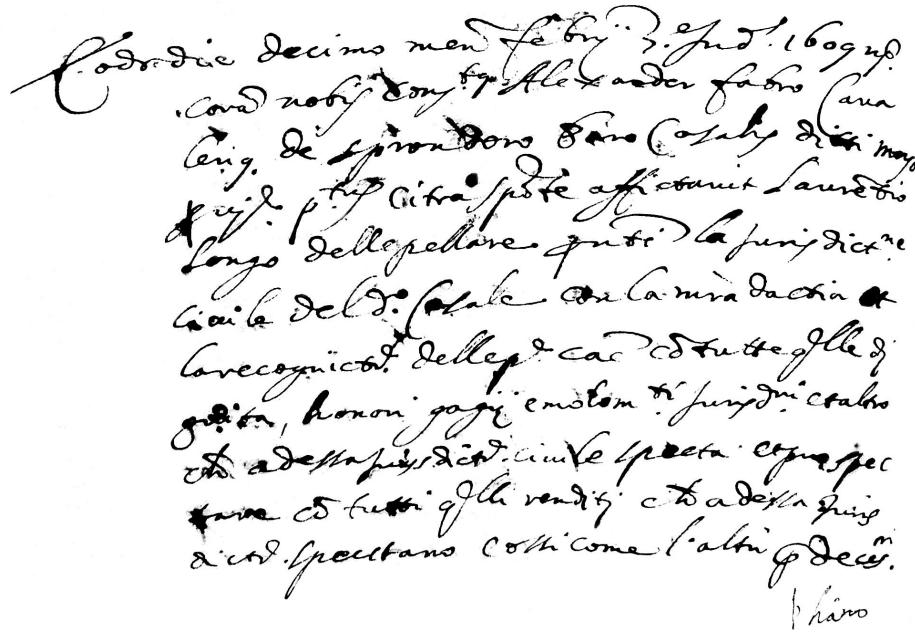
Alessandro Fabri is first described as a nobleman in 1589, and various documents refer to him as a cavaliere (knight). The document concerning the organ in the Church of Sant’Anna dei Lombardi confirms that Fabri in fact held this honour, specifying that he was a Cavaliere dello Speron d’Oro (Knight of the Golden Spur) — a pontifical knightly order whose members included famous musicians such as Orlando di Lasso, Pomponio Nenna, Alessandro Scarlatti, Wolfgang Amadé Mozart and Niccolò Paganini. An unpublished document dated 1609 further confirms that Alessandro Fabri was also baron of Moyo (today Moio della Civitella, in the province of Salerno), a small settlement in the historical province of Principato Citra (see Fig. 3).
中文讲解
本段把法布里(Alessandro Fabri)的社会身份分三层逐步落实。第一层是一般性的时间锚点:早在1589年的文献中他已被称为贵族,并以 cavaliere(骑士)一词出现。第二层是一个更具体的、可核实的头衔——金马刺骑士(Cavaliere dello Speron d’Oro)。这是一种由教廷授予的骑士勋位,作者随后列举了同属这一勋位的著名音乐家(拉索、南纳、斯卡拉蒂、莫扎特、帕格尼尼)。这一名单横跨文艺复兴晚期至19世纪,目的不是谈他们的生平,而是用“同一位音乐家也曾获此勋位”这一事实,反衬法布里所获荣誉的真实分量与历史份量,从而把他安置在欧洲音乐精英的荣誉序列之中。第三层是一个完全不同的身份维度:地方封建领主的男爵头衔。1609年的未刊文献确认他是 Moyo(今天的 Moio della Civitella,位于萨莱诺省)男爵,该地属于历史上的 Principato Citra(南意大利一古老行政区)。骑士勋位强调教廷与音乐圈对其技艺的承认,男爵头衔则揭示其在地方贵族网络中的实际地位,二者合起来勾勒出一个兼具宗教/文化声望与世俗土地身份的工匠形象。本段还提示读者注意图3,该图正是展示这则1609年原始文献的存档凭证。
补充说明
本段末尾提及“see Fig. 3”,对应下一段 P0011 中的图注——即展示1609年2月10日那不勒斯国家档案馆相关文献的图像;二者为正文与档案图像之间的直接呼应关系。
第2段(P0011)
原文复述
Image with caption: Fig. 3 — ASN, Notai del Cinquecento, scheda 437 (notaio Lutio Capezzuto), protocollo 24, 10 febbraio 1609, fol. 102v–104r.
中文讲解
本段为图3的占位条目。该图引自那不勒斯国家档案馆(Archivio di Stato di Napoli, ASN)的“十六世纪公证人档案”系列(Notai del Cinquecento),具体为 scheda 437 号卷宗,由公证人 Lutio Capezzuto 编号 24 的 protocollo 所构成,日期为1609年2月10日,所涉页面为 fol. 102v 至 104r。这份图像所呈现的,正是上一段(P0010)末尾提到的那则1609年“未刊文献”——它被用来证明法布里的 Moyo 男爵头衔,因此在本节论证链中承担“档案证据可视化”的功能,让读者得以将正文叙述与具体一手文献对接。具体字迹、印章、文字内容需查看原图。
补充说明
需查看原图以核实文献的具体外观、内容与格式。
第3段(P0012)
原文复述
The last records of Alessandro Fabri’s life date from 1632. Although the precise date of his death is not yet known, beginning with the earliest document from 1579, his activity as an instrument maker is documented over a span of no fewer than 53 years.
中文讲解
本段为法布里的职业生涯划定时间区间,并坦承史料的边界。起点是1579年最早一份提到他作为乐器制造者活动的文献,终点是1632年最后一份关于他生平的记录;据此作者给出“不短于53年”的职业跨度。需要注意三点:第一,“不短于”而非“恰好”——这是保守表述,因为两端之间可能还有未被发现的文献。第二,死亡日期仍未确定,1632年只是“最后记录”,不是“去世年份”,作者刻意把这种不确定性写明,提示读者不要把最后记录误读为去世时间。第三,53年的跨度本身就是一个具有论证意义的事实:它意味着法布里在17世纪上半叶的那不勒斯乐器制造业中长期占据重要位置,这一时间长度也使后文(P0013)关于工坊组织、师徒关系等的讨论具有更厚重的历史基础。
第4段(P0013)
原文复述
The documents examined consist principally of records relating to payments for acquisitions, sales, and maintenance, but also include testimonies from matrimonial proceedings and various parish certificates. From these, valuable information emerges regarding the typical organisation of a craftsman’s workshop and the working relationships between owner and employees. Fabri’s reputation as a skilled craftsman — already well known thanks to his construction of instruments of exquisite workmanship — is further enhanced by the fundamental role he played in training numerous artisans who enlivened the Neapolitan musical scene of his time.
中文讲解
本段说明作者所依据的史料类型,以及这些史料如何撑起关于法布里的具体论断。史料可分为两类:一类是经济类文献,包括购买、销售、维修的支付记录;另一类是社会与宗教类文献,包括婚姻诉讼中的证词以及各类堂区证书。值得注意的是,这份清单本身就是一项方法论交代——作者并非仅靠乐器实物或音乐史文献,而是综合经济交易、人际纠纷、宗教档案来复原一个17世纪工匠的立体形象。作者随后从这些文献中提炼出两层信息:第一层是工坊层面的,包括工匠工坊的典型组织形态以及雇主与雇员之间的合作关系;第二层是声誉层面的,法布里不仅以“精工制作的乐器”而闻名,更因培养出大量活跃于同时代那不勒斯音乐生活的工匠而获得加分。后一层尤其重要:它把法布里从“个人技艺高超”的范畴推进到“行业传承枢纽”的范畴,使他不再只是一个孤立的工匠,而是一位塑造那不勒斯乐器制造业生态的关键人物。
第5段(P0014)
原文复述
Footnote 26: App. B, doc. 59.
中文讲解
本段为脚注26,仅指引读者参阅附录B中的第59号文献。该脚注对应正文 P0010 中关于 Moyo 男爵头衔及1609年文献的陈述,属于对正文主张的来源指引。
第6段(P0015)
原文复述
Footnote 27: App. B, doc. 54.
中文讲解
本段为脚注27,仅指引读者参阅附录B中的第54号文献。该脚注对应正文 P0012 中关于1632年最后记录及法布里晚年时间的陈述,属于对正文主张的来源指引。
脚注 / 边栏 / 图表 / 附加信息(如有)
本小节包含一项图像材料(图3),引自那不勒斯国家档案馆(ASN)所藏十六世纪公证人档案 Notai del Cinquecento,编号 scheda 437,公证人 Lutio Capezzuto,protocollo 24,日期1609年2月10日,folio 102v–104r,用于支撑 P0010 关于法布里 Moyo 男爵头衔的论断;该项图像需查看原图以确认文献细节。另有两条脚注(26、27),分别指引读者参阅附录B中的第59号文献(关于 Moyo 男爵)与第54号文献(关于1632年最后记录),均属于来源指引而非独立论据。
💡 本节核心要点
- 法布里的贵族身份有明确时间锚点:早在1589年的文献中已被称为贵族与骑士。
- 其具体勋位是教廷授予的金马刺骑士(Cavaliere dello Speron d’Oro),作者通过列举拉索、斯卡拉蒂、莫扎特、帕格尼尼等著名音乐家,凸显该勋位的分量与法布里在音乐荣誉序列中的位置。
- 1609年的未刊文献进一步证实其地方封建身份——莫约(Moyo)男爵,属历史上的 Principato Citra 行政区,揭示其兼具宗教/文化声望与世俗土地身份的双重地位。
- 法布里的乐器制造生涯自1579年最早文献起、至1632年最后文献止,活动跨度不少于53年;精确去世日期尚未确定,作者刻意保留这一不确定性。
- 作者所用史料兼具经济类(购销与维修支付记录)与社会宗教类(婚姻诉讼证词、堂区证书)两大类,从而能够从多个维度还原工坊组织与劳资关系。
- 法布里的声誉由两个层面构成:一是制作工艺精工的乐器,二是培养了大量活跃于那不勒斯音乐界的工匠——后者将他定位为行业传承的枢纽人物。
🔑 关键术语
- Cavaliere dello Speron d’Oro(金马刺骑士):本节中指法布里所获的教廷骑士勋位,作者以此与拉索、莫扎特等著名音乐家并列,强调该头衔在音乐界所代表的精英地位。
- Baron of Moyo(莫约男爵):本节中指法布里于1609年文献中确认的地方封建头衔,所在地为今天萨莱诺省的 Moio della Civitella,属历史上 Principato Citra 行政区,揭示其世俗贵族身份。
- Principato Citra:本节中作为 Moyo 男爵领地的历史行政归属出现,是南意大利一古老省份名称;作者以此将法布里的土地身份锚定于具体的地理与历史行政框架中。
- Notai del Cinquecento(十六世纪公证人档案):本节中图3所引的档案系列名称,特指那不勒斯国家档案馆(ASN)中保存的16世纪公证人文献,本节中具体为 scheda 437、Lutio Capezzuto 公证人、protocollo 24。
- cavaliere(骑士):本节中作为法布里身份的一般性称呼出现,与具体的金马刺骑士勋位相区分;它是1589年最早文献中对法布里的称谓。
C1.S3 [描述性拆分] Structure, Training and Social Functions of the Workshop
第1段(P0016)
原文复述
Generally speaking, at the top of the hierarchy of a workshop — which was often the residence of the head craftsman — stood the mastro (maestro, teacher), a master who possessed the so-called ‘secrets of the trade’ (the techniques of production), who directed the work and who represented the heart of the activity. Alongside him were various collaborators, sometimes linked by kinship (brothers, sons, nephews), who were divided into workers and apprentices. The contract that regulated the relationship between the collaborators and the master — most often drawn up by a notary — was, in the case of the workers, the locatio operarum or locatio servitiorum, i.e., more or less specialised labourers who received remuneration and who usually attained this status after a period of apprenticeship. For the apprentices, who were usually youngsters or even children as young as six or seven, the locatio personae — an actual contract of apprenticeship — was used. In exchange for the workers’ commitment, the master took responsibility for their training, not only passing on to them the knowledge and techniques of the trade, but also providing them with food, lodging and clothing. This system was based on learning by imitation and correction: the apprentices observed the master’s work and imitated him, being corrected and directed when necessary; at the same time, they performed simple tasks commensurate with their abilities, thus contributing to the workshop’s production. This apprenticeship unquestionably represented a path of growth and emancipation for the youths who, through hard work and dedication, could acquire a valuable profession that would allow them to enter the job market as independent craftsmen. And alongside the aspect of training, one should not overlook the social value of apprenticeships, considering that the young workers were welcomed into the master’s family, learning not only a trade, but also the principles of morality and respect that regulated daily life.
中文讲解
本段是本小节的纲领段,同时承担了section标题所承诺的三项任务:结构、培训、社会功能,需要逐层讲清。
第一,关于"结构”。作者把工坊描绘成一种等级体——mastro(maestro,师傅)位居顶端,掌握所谓"行会秘密”(即生产技术),他不仅是工坊活动的主持者,也是工坊活动本身的"核心"。这是技术知识的垄断:行会秘密之所以重要,正在于它不是公开知识,而是师傅所独有的资本。作者特意点出工坊常是师傅的住所,这一双重属性(生产单位+家庭)解释了后文为何工坊具有社会功能。师傅之下的合作者常由亲属关系(兄弟、儿子、侄子)维系,并被划分为两类:工人与学徒。
第二,关于"培训"。作者通过合同类型把这两类人区分清楚:工人适用locatio operarum或locatio servitiorum,是获得报酬的、程度不同的专职工人;学徒适用locatio personae,是一种真正的人身委托合同,学徒常是少年甚至六七岁的儿童。两种合同的形式差异不是细节,而是实质:工人出卖劳动、获得工资;学徒把"整个人"交给师傅,换取培训加食宿衣物——这正解释了为何师傅有"喂养"义务。培训方法是观察—模仿—纠错,学徒既是被教育者,也是工坊生产的贡献者(执行与其能力相称的简单任务)。作者随后明确评价:学徒制是年轻人成长与解放的途径,经过努力他们可以成为独立工匠进入市场。“unquestionably"一词揭示了作者的态度——这是肯定的、上升性的叙述。
第三,关于"社会功能”。在学徒"进入师傅家庭"这一点上,培训与社交合二为一:他们学习的不仅是手艺,也是支配日常生活的道德与尊重的原则。作者用"不应忽视"(one should not overlook)来强调这层价值,提示读者:若只看技术传授层面,就漏掉了工坊作为社会化机制的一面。
容易误读之处:locatio personae里"personae"指"人身"全数委托,与工人合同只委托劳动不同,因此学徒不能领工资、必须被供养。这个法律形式差异正支撑了师傅对学徒的家长式权威。
补充说明
段内两处照应值得点明:(1)开篇提到的"行会秘密"正是后文"观察—模仿—纠错"所传授的对象,两者前后衔接;(2)开篇提到合作者之间存在兄弟、儿子、侄子等亲属纽带,与结尾"进入师傅家庭"呼应,表明工坊把血缘家庭与生产家庭混同,这种结构正是学徒能受到道德教育的物质基础。
第2段(P0017)
原文复述
Lastly, it must be remembered that the contracts of locatio personae often involved young adults coming from towns outside the city walls. This occurred because such a contract was the easiest way for a young craftsman to enter a workshop, enabling him to get to know the demands of a new market and the preferences of a different clientele. The contract of locatio personae was also profitable for the master of the workshop, who thus obtained qualified collaboration at a very low cost.
中文讲解
本段把上一段确立的"学徒合同"(locatio personae)从一个内部培训机制,扩展为一个跨地域的招募机制,需要讲清三点。
第一,“城墙外的城镇"这一细节揭示出工坊并非只吸纳本城少年。locatio personae之所以被城外年轻人使用,是因为它是他们进入一家工坊最便捷的途径。这说明中世纪晚期工坊的人才来源具有城市间流动性,年轻匠人把进入某一工坊当作认识新市场、了解不同客户偏好的入口——也就是说,学徒合同不只是学技术的窗口,也是学市场的窗口。
第二,论证是对称的:作者立刻点明这种合同对师傅也合算,师傅借此以"极低成本"获得"合格的协作”。这一句具有重要的限定作用。它与上一段对学徒制"成长与解放"的肯定叙述形成微妙对照:制度对学徒一方是上升通道,对师傅一方则是低成本劳动的来源。作者没有评价这种不对称,但读者不应忽视它。
第三,本段是过渡性段落:它把上一段关于工坊内部结构的描述收尾,把目光投向外部招募来源;下一段P0018随即转入"工坊内部的其他合作者"——即除学徒—工人之外的工艺与艺术协作者。本段实际上闭合了工坊的"学徒/工人轴",为下一段开启"工坊的协作网络"作准备。
容易误读之处:“young adults"与上一段的"children as young as six or seven"看似冲突,但作者强调的是locatio personae这种合同形式同时容纳年幼学徒和已有一定训练的成年新手,二者属于同一法律形式的两个年龄段。
补充说明
段内"合格的协作"提示这些来自城外的人并非完全生手——他们已具备一定手艺基础,正是这一点使师傅能以低成本获得合格帮手,同时也呼应了上一段所提工人通常需先经过一段学徒期才能获得此身份。
第3段(P0018)
原文复述
In the instrument-maker’s workshop, other figures also contributed to production in the advanced stages. Organ and harpsichord makers, in particular, made use of the valuable collaboration of other artisans and artists. Above all, these included the gilder, carver, painter and sculptor, but also the carpenter and tinsmith, each of whom contributed with his personal expertise to the production of the finished instrument. These craftsmen did not limit themselves to simple manual tasks, but instead elevated the construction of the organ to a true work of art. By means of complex and exquisite workmanship, and thanks to a careful synergy within the workshop, these artisans created an instrument that was not only a masterpiece of sound, but also a marvel for the eyes.
中文讲解
本段从工坊的一般结构转入乐器制造(特别是管风琴、羽管键琴)工坊的特殊形态,需要讲清四点。
第一,开篇"in the advanced stages"是关键限定:这些协作者不是参与工坊的日常粗活,而是介入成品的精加工与装饰阶段。这与P0016里学徒做"简单任务"形成对照——精细装饰工作是高阶任务,由专门匠人承担。
第二,所列工种——鎏金匠、雕刻匠、画师、雕塑家,再加木匠、白铁匠——揭示出乐器制造不是单一行业,而是多行业的集合。作者把"artisans and artists"并列使用,暗示这条界线在此处是模糊的:鎏金与雕绘属于美术,木作与金属件则属于工艺,但都被纳入了"乐器制造"这一共同产品之中。
第三,论证的修辞落点是"true work of art"和"masterpiece of sound … marvel for the eyes”。作者在此抬高了工坊产品的性质:管风琴不只是听觉杰作,也是视觉奇迹。这是本小节的总结性高潮——它把工坊的结构、培训、社会功能这三层铺垫,归结到最终产品上:正是工坊能够协调这种跨行业协作,才使乐器同时成为声学与造型艺术的作品。“careful synergy within the workshop"与P0016里工坊作为"活动核心"的描述前后呼应:mastro之所以是"核心”,正在于他能统筹这种多元协作。
第四,本段也间接说明了为何前面要详谈工坊结构:没有等级化的师徒关系、没有长期学徒制,就无法稳定地培养出能够参与这种精工协作的合格人手。换言之,结构与培训并非中性的组织安排,而是制造这种"既是声学杰作也是视觉奇迹"之物的必要条件。
容易误读之处:本段易被读成只是罗列工种,但它的真正功能是论证工坊这种社会组织对高端艺术品生产的不可或缺。
补充说明
段内"advanced stages"与P0016里学徒执行的"simple tasks commensurate with their abilities"形成等级对照:简单任务由学徒承担,复杂装饰与造型由专门匠人承担,工坊内部实际存在劳动的层级分配。“artisans and artists"的并称也提示,在乐器制造工坊里"工"与"艺"的界线并不严格,这呼应了全段把管风琴同时定性为"work of art"与"marvel for the eyes”。
脚注 / 边栏 / 图表 / 附加信息(如有)
本小节没有脚注、图表、边栏或图像说明,三段皆为正文叙述。无额外附加材料可汇总。
💡 本节核心要点
- 工坊以mastro(师傅)为顶层,他掌握所谓"行会秘密"(生产技术),既是工坊活动的主持者,也是其核心,工坊通常即师傅的住所,因而具有生产单位与家庭双重身份。
- 两类合作者通过两种合同区分:工人适用locatio operarum或locatio servitiorum(有偿雇佣),学徒适用locatio personae(人身委托,通常为少年甚至六至七岁的儿童),师傅以培训加食宿衣物换取学徒的承诺。
- 技术传授遵循观察—模仿—纠错的方法,学徒同时执行与其能力相称的简单任务,是受教育者也是生产者;学徒制被作者明确评价为年轻人成长、独立与进入市场的上升通道。
- 学徒合同还承担社会教化功能:学徒进入师傅家庭,不仅习艺,也学习支配日常生活的道德与尊重原则——这是工坊的"社会功能"所在。
- locatio personae同样被城外城镇的年轻人作为进入城市工坊、了解新市场与新客户的便捷途径;对师傅而言,该合同同时意味着以极低成本获得合格的协作。
- 乐器(管风琴、羽管键琴)制造工坊在上述学徒—工人体系之外,还引入鎏金匠、雕刻匠、画师、雕塑家、木匠、白铁匠等多行业协作者参与后期精加工,使乐器同时成为声学杰作与视觉奇迹——这种"工坊内部协同"正是前述结构与培训得以成立的最终目的。
🔑 关键术语
- mastro (maestro, teacher):工坊等级中的顶层人物,掌握所谓"行会秘密"(生产技术),主持并代表工坊活动,常以自家住宅为工坊所在地。
- secrets of the trade:依本节所指即"生产技术",由师傅独家掌握,并通过观察—模仿—纠错的学徒制传授给合作者。
- locatio operarum / locatio servitiorum:适用于工人的合同类型,把劳动作为受酬服务出让,对应"程度不同的专职工人",工人通常先经学徒期再获此身份。
- locatio personae:适用于学徒的合同类型,把学徒的人身整体委托给师傅;学徒常为少年甚至六至七岁的儿童,作为交换师傅须提供培训与食宿衣物;该合同也被城外年轻人用作进入城市工坊的便捷途径。
- apprenticeship:本节所描述的学徒身份:观察—模仿—被师傅纠正、执行与其能力相称的简单任务、最终可凭所学技艺成为独立工匠;同时也是被师傅家庭接纳、学习道德与尊重原则的社会化过程。
- workshop:本节语境下的工坊同时是生产单位、师傅的住所与家庭式组织,既生产商品,也承担技术传授与社会教化功能;乐器工坊尤其把多行业协作者纳入其中。
C1.S4 [描述性拆分] Fabri’s Disciples and the Workshop Community
第1段(P0019)
原文复述
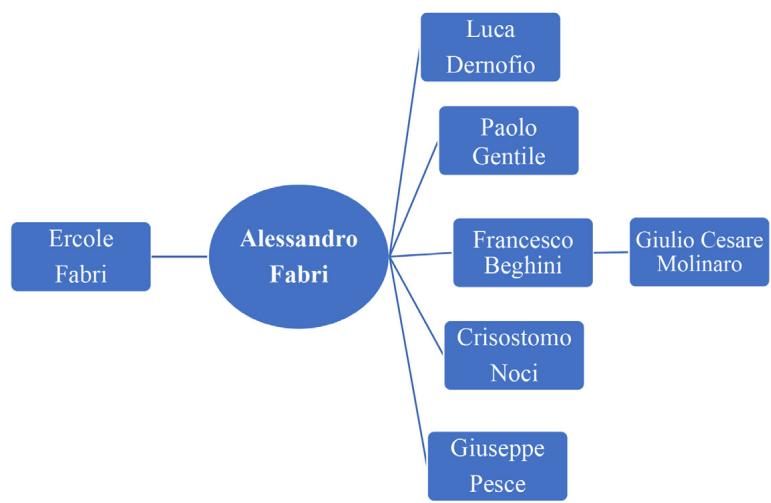
We possess information concerning two of Alessandro Fabri’s disciples. The first, Luca Dernofio, came to Naples from his native city of Bologna to learn the art of making instruments. Paolo Gentile, born in 1577 and originally from Caserta, worked first in Fabri’s workshop before going to Filippo Zuccaloni in Rome, and finally returning to Fabri in Naples. In addition to these two men, the pupils of the ’noble’ Fabri also included renowned craftsmen with whom we are already familiar, such as Francesco Beghini, Crisostomo Noci and Giuseppe Pesce. The testimonies found in the documents of the time offer precious details regarding the master-pupil relationship that bound Fabri to his disciples. Francesco Beghini, from Lucca, declared that he learnt the art from Fabri during an apprenticeship that began when he was around fourteen years old. Similarly, Crisostomo Noci, an organist and craftsman of Roman origin, attested to having been a pupil of the Neapolitan master. Giuseppe Pesce, a harpsichord and organ builder from Catania, also recognised Fabri as his mentor, from whom he learnt the art from about the age of six. It was in his master’s workshop that he met Francesco Beghini during the period in which he completed his apprenticeship. The climate of collaboration and mutual support in the activities of the cavaliere’s workshop is particularly interesting, especially in light of the new family relations that resulted from the marriage between Francesco Beghini and Vittoria Frezzarola. Vittoria, originally from Lauro, was Fabri’s niece and the cousin of Crisostomo Noci’s wife. These relationships not only strengthened the ties within the workshop between master and pupils, but also certainly contributed to creating an environment of mutual support and cooperation that led to the success and growth of the business.
中文讲解
本段是本节的核心段落,集中交代法布里(Alessandro Fabri)门下的弟子群体及其工坊内部的社会网络。作者首先给出两条有较为明确记载的学徒线索:卢卡·德尔诺菲奥(Luca Dernofio)从博洛尼亚赴那不勒斯学艺,呈现的是跨城市学艺的典型模式;保罗·真蒂莱(Paolo Gentile,1577年生)原籍卡塞塔,先随法布里、再赴罗马随朱卡洛尼(Filippo Zuccaloni)、最终又回到法布里工坊,呈现的是一段在多位名师间往返流动的学艺经历。
随后,作者将读者视线拉回到本节真正讨论的三位核心门徒:来自卢卡的弗朗切斯科·贝吉尼(Francesco Beghini)、罗马出身的管风琴师兼工匠克里索斯托莫·诺奇(Crisostomo Noci)、以及来自卡塔尼亚的羽管键琴与管风琴制造师朱塞佩·佩谢(Giuseppe Pesce)。三人的学徒起始年龄差异显著——贝吉尼约14岁、佩谢约6岁——说明法布里的工坊接纳不同年龄段的学徒。作者借此说明:法布里作为那不勒斯地区一位受到尊崇的工匠大师(原文称为’noble Fabri’与’cavaliere’),其工坊同时具有学徒培训中心与同业协作网络的性质。
值得注意的是,作者从纯职业的师徒关系进一步推进到家族关系:贝吉尼迎娶法布里的外甥女维多利亚·弗雷扎罗拉(Vittoria Frezzarola),而维多利亚又是诺奇妻子的表亲。于是,师徒纽带与姻亲纽带在工坊内交织。作者强调,这种交织不仅巩固了工坊内部的凝聚力,还营造出一种相互支持的合作氛围,并最终促成了业务的成功与扩张。这是作者在论证上的一个关键推进:他从单纯的’谁是谁的弟子’这一谱系式叙述,转向工坊作为兼具职业与亲属关系的社会共同体的论述。
补充说明
本段中提到的几位人物(Dernofio、Gentile、Beghini、Noci、Pesce、Frezzarola)以及地名(Bologna、Caserta、Rome、Lucca、Catania、Lauro、Naples)均直接出自原文,作者仅在原文中提及的事实范围内加以梳理;佩谢在工坊中结识贝吉尼的细节、贝吉尼14岁入学徒、佩谢6岁入学徒等数字均为原文明确给出。
第2段(P0020)
原文复述
Also mentioned in the documents are Giovan Domenico Rizzo and Geronimo d’Amato, certainly collaborators of Fabri, though an actual apprenticeship, while probable, is unconfirmed.
中文讲解
本段是对上一段核心论述的补充与限定。作者补充了另外两位在文献中出现、与法布里工坊有关的人物:乔凡·多梅尼科·里佐(Giovan Domenico Rizzo)与杰罗尼莫·达马托(Geronimo d’Amato)。作者谨慎地指出,两人’certainly collaborators’——即合作关系确定——但是否曾正式拜师学徒,‘while probable, is unconfirmed’——虽属合理推测却缺乏直接证据。这一表述体现了作者在文献证据层级上的严谨:合作(collaboration)属于较为宽泛的职业往来,有文件可证;而师徒关系(apprenticeship)则是更具体的法律性/制度性身份,需要更明确的档案支撑。在没有此类证据之前,作者宁可将其排除在正式弟子名单之外。
本段与上一段共同构成了’法布里弟子’的完整图景:核心弟子有确切师徒文献依据,边缘合作者仅有合作依据。这种区分有助于读者理解作者如何根据档案证据强度来界定工坊成员的归属。
补充说明
作者对里佐和达马托使用’collaborators’而非’pupils/disciples’,这一措辞差异本身就是本段的关键信息;其分类依据见后续脚注33和34所指示的文献。
第3段(P0021)
原文复述
Footnote 28: Cf. Ioannou, ‘Documenti inediti’ (see n. 5), 140–1.
中文讲解
脚注28指向 Ioannou 所撰《Documenti inediti》一文(第140–141页),该文在本节前文(第5号注释)已被引用过。此处’Cf.‘表示请读者参照该文献,与n.5构成互参关系。该脚注为正文关于卢卡·德尔诺菲奥从博洛尼亚赴那不勒斯学艺一节提供文献来源支持。
第4段(P0022)
原文复述
Footnote 29: Francesco Nocerino, ‘Indocta manus noli me tangere. Cembalari a Napoli nel secolo della meraviglia’, in: Informazione Organistica e Organologica 33 (2021), no. 48, serie iii, 93–139, at 114–15.
中文讲解
脚注29为关于保罗·真蒂莱的师承经历提供来源:Francesco Nocerino,《Indocta manus noli me tangere. Cembalari a Napoli nel secolo della meraviglia》,载于《Informazione Organistica e Organologica》第33卷(2021年)第48期第三系列,第93–139页,具体见第114–115页。该文标题中的’Indocta manus noli me tangere’(拉丁语,意为’无知的双手请勿触碰我’)暗示对制琴/制键琴工匠职业尊严的论述,副标题’Cembalari a Napoli nel secolo della meraviglia’(那不勒斯羽管键琴制造者在’惊奇世纪’)界定了文章的主题范围——即那不勒斯地区羽管键琴制造业。该脚注为真蒂莱先后追随法布里、朱卡洛尼、再回到法布里的学艺经历提供出处。
第5段(P0023)
原文复述
Footnote 30: See App. A.
中文讲解
脚注30指示读者参阅附录A,对应正文所述’with whom we are already familiar’(即我们已熟悉的几位名家贝吉尼、诺奇、佩谢)。作者以此将读者引向附录中关于这几位工匠的更详尽记录,说明这三人已在文前的附录A中有专门讨论。
第6段(P0024)
原文复述
Footnote 31: ASN, Processetti matrimoniali, 1608, letter F, n. 280. I thank the scholar and friend, Domenico Antonio D’Alessandro, for pointing me to this document as well as the subsequent one found by him.
中文讲解
脚注31给出弗朗切斯科·贝吉尼自述学徒经历(始于约14岁)的档案来源:ASN(即Archivio di Stato di Napoli,那不勒斯国家档案馆),《Processetti matrimoniali》(婚姻程序文件)1608年,F字头第280号。这是一份典型的早期近代意大利婚姻前置调查文件,其中常包含证人证词,工匠常需申报自己的职业与师承。作者在此还致谢学者好友 Domenico Antonio D’Alessandro,感谢他指出了这份以及随后另一份档案。
此脚注具有双重功能:其一,为贝吉尼的师承陈述提供原始档案依据;其二,体现了学术研究中同行互惠协作的传统——作者所依据的某些关键档案来自学界同仁的指引。该档案类型(婚姻调查)本身也提示读者:早期近代工匠的师承信息往往并非出自行会册或学徒契约,而是散见于这类世俗生活档案之中。
第7段(P0025)
原文复述
Footnote 32: Nocerino, ‘Indocta manus noli me tangere’ (see n. 29), 105–6.
中文讲解
脚注32引用 Nocerino《Indocta manus noli me tangere》(见上文n.29)第105–106页,为正文关于工坊内合作氛围、师徒纽带与姻亲纽带相互交织、并促成业务成功的论述提供文献支持。这一来源与上一脚注出自同一篇文章,作者在此用以支撑其社会网络层面的解读。
第8段(P0026)
原文复述
Footnote 33: App. B, doc. 31.
中文讲解
脚注33指示读者参阅附录B第31号文献,为正文关于乔凡·多梅尼科·里佐(Giovan Domenico Rizzo)与法布里关系之’合作者’身份的判断提供原始文件依据。由于里佐的师徒身份未被确认,作者通过附录文献间接加以说明。
第9段(P0027)
原文复述
Footnote 34: App. B, docs. 19, 40. Geronimo D’Amato, active between 1599 and 1624, was the organ builder of the church of the Concezione degli Spagnoli, the Annunziata and the Naples Cathedral
中文讲解
脚注34指示读者参阅附录B第19号与第40号文献,并对杰罗尼莫·达马托(Geronimo D’Amato)作出生平简述:其活跃期为1599年至1624年间,曾担任西班牙人受孕教堂(Concezione degli Spagnoli)、天使报喜堂(Annunziata)以及那不勒斯主教座堂(Naples Cathedral)的管风琴制造师。
此脚注的功能有二:其一,为达马托与法布里的合作关系提供两件档案来源(docs. 19与40);其二,通过介绍达马托承担的重大宗教建筑工程(特别是那不勒斯主教座堂),暗示其在行业内的重要地位——能与这样一位承接大型教堂工程的工匠合作,本身也反衬出法布里工坊的业内层级。
补充说明
达马托承接的三座教堂(Concezione degli Spagnoli、Annunziata、Naples Cathedral)及其活跃年份(1599–1624)均为脚注原文所提供,未做外部补充。
💡 本节核心要点
🔑 关键术语
C1.S5 [描述性拆分] Legacy Beyond 1656 and Conclusion on Fabri’s Significance
第1段(P0028)
原文复述
Finally, an examination of the documents allows us to confirm that Alessandro Fabri’s legacy lived on through the work of Beghini’s pupil, Giulio Cesare Molinaro. Beghini himself, in fact, acknowledged that he had passed on the teachings of Fabri, emphasising the fundamental role that his master played in the training of Molinaro, who served as court harpsichord maker until 1656.
中文讲解
本段把 Fabri 的影响追溯到他身后的一代传承人:Fabri → Beghini → Giulio Cesare Molinaro。作者依据文献(Beghini 自己的陈述)来确证这条师承链,因此用“allows us to confirm”这种较为谨慎的措辞,而不是直接断言。关键信息有三层:其一,Beghini 是 Fabri 的学生(“his master”即指 Fabri);其二,Beghini 主动承认自己把 Fabri 的教诲转授给了 Molinaro;其三,Molinaro 的职位是“宫廷羽管键琴制造师”(court harpsichord maker),任职直至 1656 年。需要特别注意的是 1656 这个时间节点——它既是 Molinaro 任期的终点,正是下一段那场大瘟疫发生的同一年。Beghini 本人的“自我承认”是这段论证中唯一被引用的直接证据,作者借此把一个原本可能仅是推测的传承关系,转化为有文献支撑的历史事实。
补充说明
本段末尾“until 1656”与下一段 P0029 的瘟疫年份重合,作者正是借此把 Molinaro 的卸任与 Fabri 一代制琴师的整体退场联系起来。
第2段(P0029)
原文复述
In that same year, a terrible epidemic of the plague swept through Naples, decimating around two thirds of the entire population. This event constituted a veritable sea change separating many Neapolitan activities into a time ‘before’ and ‘after’. Even in the sphere of musical instrument making, the year 1656 marked the end of a generation, represented by Alessandro Fabri and his pupils, and the advent of a new generation, comprised of the Neapolitan Onofrio Guarracino (who survived the plague) as well as various other makers not native to Naples such as Andrea Basso, Gian Gualberto Ferreri, Giovanni Natale Boccalari and Antonio Sabatino. The latter, active in Naples, built new instruments in the second half of the 17th century.
中文讲解
本段把 1656 年的那不勒斯大瘟疫作为整篇文章的“分水岭”。作者用一系列带有强度标记的词来强化这场灾难的分量:“terrible epidemic”(可怕的瘟疫)、“decimated around two thirds of the entire population”(消灭了约三分之二的全部人口)、“veritable sea change”(真正的巨变)、“‘before’ and ‘after’”(“前”与“后”的分野)。其论证策略是:先用宏观人口灾难确立 1656 年的断代意义,再把这种断代意义具体落到乐器制造行业。在制琴领域,1656 年同时意味着两件事——一代人(Fabri 及其门徒)的终结,与新的一代人的登场。新一代由两类人构成:那不勒斯本地且在瘟疫中幸存的 Onofrio Guarracino,以及几位“非那不勒斯本地”的外来制琴师 Andrea Basso、Gian Gualberto Ferreri、Giovanni Natale Boccalari、Antonio Sabatino。其中 Sabatino 被特别说明“在第二半 17 世纪于那不勒斯活跃”,暗示瘟疫之后那不勒斯的制琴业出现了外来工匠的迁入与本地传统的部分延续并存。整段的功能,是把 Fabri 的“落幕”从单纯的人物史事件,转化为一个具有行业断代意义的结构性转折。
补充说明
作者用 “not native to Naples” 这一限定语,明确把新世代的组成划分为“本土幸存者”与“外来迁入者”两类,这两类的并列构成了后 Fabri 时代那不勒斯制琴业的双重来源。
第3段(P0030)
原文复述
To conclude this brief overview of information regarding keyboard instruments built and the biographical data of the builders, it is evident that Alessandro Fabri was not only a protagonist and point of reference, but also a true leader in the art of harpsichord and organ building between the 16th and 17th centuries in Naples.
中文讲解
作为全文(或全节)的结论句,本段把前面所引的乐器实物与制琴师生平资料“浓缩”为对 Fabri 的总体评价。值得注意的是作者措辞的递进:他先用“protagonist and point of reference”(主角与参照点)这种描述性表述,再升级为“a true leader”(一位真正的领袖)。前者意味着“出现过、被讨论过”,后者则意味着“带动过、主导过”这一行业。限定条件也很关键:评价被严格限制在“harpsichord and organ building”(羽管键琴与管风琴制造)这一具体门类,以及“between the 16th and 17th centuries in Naples”(16 至 17 世纪的那不勒斯)这一时空范围。这一定位使结论既不显得空泛,也避免了过度泛化为“那不勒斯音乐界的领袖”。
第4段(P0031)
原文复述
(cf. Prota-Giurleo, ‘Organari napoletani’ [see n. 8], 112, and Roberto di Stefano, La Cattedrale di Napoli [Naples, 1974], 35). His instruments are documented at the Cathedral of Nola, the Chiesa Maggiore of Morrone in Molise and the Chiesa di San Domenico in Nicastro, now Lamezia Terme (Catanzaro). Cf. Franco Strazzullo, ‘Inediti per la storia della musica a Napoli’, in: Il Fuidoro. Cronache napolitane 2 (1955), no. 3–4, 106–8, at 108, and Vincenzo Rizzo, ‘Documenti’, in: Stefano Romano, L’arte organaria a Napoli, vol. 2 (Naples, 1990), 185–96, at 195. For the organ in Nicastro see also the file in Giorgio Ceraudo (ed.), Capolavori di arte organaria restaurati in Calabria (Soveria Mannelli, 1995), 15–17.
中文讲解
这是一段脚注性质的文献说明(注意它以括号内的“cf.”开始,结构上属于注释而非正文段落)。其功能是为正文主张提供来源。它首先给出两份综合性文献作为参证:Prota-Giurleo 的《Organari napoletani》第 112 页(与脚注 8 同一出处)和 Roberto di Stefano 的《La Cattedrale di Napoli》(那不勒斯,1974)第 35 页。主体信息是 Fabri 乐器的地理分布:诺拉主教座堂(Cathedral of Nola)、莫利塞地区 Morrone 的 Chiesa Maggiore、以及卡拉布里亚地区 Nicastro(今 Lamezia Terme,隶属 Catanzaro)的 San Domenico 教堂。这一罗列把 Fabri 的活动空间从那不勒斯扩展到整个南意大利,包括莫利塞和卡拉布里亚两区。之后又以两份那不勒斯本地的音乐史与制琴史文献(Strazzullo 1955 年文章、Rizzo 1990 年文献)来支撑这些乐器存在的记录;并对 Nicastro 那台管风琴另引 Giorgio Ceraudo 编的卡拉布里亚管风琴修复图录。整段的功能是为正文关于 Fabri 影响力与地理覆盖范围的主张提供可追溯的文献依据。
补充说明
脚注把“尼卡斯特罗”标注为“Lamezia Terme(Catanzaro)”,说明该地名在作者写作时已更改,这是引用方志文献时常见的现地名注释做法。
脚注 / 边栏 / 图表 / 附加信息(如有)
本节唯一的非正文材料是 P0031,其性质为脚注式文献说明,集中交代 Fabri 现存/有记录的乐器的三个南意大利地点(诺拉、莫利塞的 Morrone、卡拉布里亚的 Nicastro/今 Lamezia Terme),并附四组参考文献(Prota-Giurleo、di Stefano、Strazzullo、Rizzo,另引 Ceraudo 编辑的卡拉布里亚管风琴图录)。该脚注既是对正文地理覆盖主张的来源支撑,也间接揭示了 Fabri 的影响不止于那不勒斯城。
💡 本节核心要点
- Fabri 的制琴技艺通过师承链 Fabri → Beghini → Giulio Cesare Molinaro 延续至 1656 年,后者作为宫廷羽管键琴制造师是其影响在制度层面的最终体现。
- 1656 年的那不勒斯大瘟疫(约三分之二人口死亡)被作者明确界定为整个那不勒斯活动的分水岭,制琴行业亦不例外。
- 1656 年同时是“一代人的终结”(Fabri 及其门徒)与“新一代的开端”(本土幸存者 Guarracino 与数位外来制琴师 Basso、Ferro/Boccalari、Sabatino 等)的双重节点。
- 新世代制琴师的构成呈现“本土幸存 + 外来迁入”的双重来源,反映出瘟疫后那不勒斯制琴业生态的重组。
- 作者在结论中对 Fabri 的定位从“主角/参照点”提升为“真正的领袖”,把评价限定在羽管键琴与管风琴制造以及 16–17 世纪那不勒斯这一明确时空范围内。
- 脚注把 Fabri 乐器的地理覆盖从那不勒斯扩展到莫利塞与卡拉布里亚,使“领袖”这一评价获得了超越城邦的实证支撑。
🔑 关键术语
- legacy:在本节中指 Fabri 的制琴技艺与师承影响如何在后辈身上延续,作者通过 Beghini 与 Molinaro 这条传承链来落实这一概念。
- sea change:作者用此语形容 1656 年瘟疫造成的根本性断裂,将那不勒斯诸多活动划分为“前”与“后”两个时期,用以支撑制琴业世代更替的论述。
- court harpsichord maker:指服务于宫廷的羽管键琴制造师;本节中 Molinaro 担任此职直至 1656 年,是他承载 Fabri 传承的制度性身份。
- protagonist and point of reference / true leader:作者对 Fabri 的两组评价措辞,前者是描述性的(出现过、被参照),后者是论断性的(带动行业),构成递进式的总结。
- not native to Naples:作者用来标识 1656 年之后新一代制琴师的来源特征之一,与本土幸存者 Guarracino 形成对照,反映瘟疫后那不勒斯制琴业的外来迁入现象。
C1.S6 [描述性拆分] Appendix A: Fabri’s Workshop
第1段(P0032)
原文复述
Appendix A: Fabri’s Workshop
中文讲解
本行是附录的标题,开启了按字母顺序排列的工匠小传名录(Appendix A)。这一附录以法布里(Alessandro Fabri)的工作坊为核心,逐条介绍与其有关的学徒、合作者及后继者,结构上构成正文叙事的支撑性资料。它意味着正文先行的论述——例如把法布里定位为那不勒斯宫廷羽管键琴与管风琴制造的中心人物——将在此附录中以人物卡片形式获得细化的证据与谱系。
第2段(P0033)
原文复述
中文讲解
这是一幅图注占位符,原图为法布里工作坊相关人员的合影(Fig. 4),由 Francesco Nocerino 拍摄。图注的功能在于:以视觉方式把附录中分散叙述的人物集中呈现出来,使读者能够直观地把本节中的姓名 Beghini、Noci、Pesce 与实际工作场景联系起来。由于图像数据本身被省略,读者须查阅原图才能确认具体人物与构图。
补充说明
图注中提及的 Francesco Nocerino 是脚注 38 中同名研究文献的作者,由此可确认附录配图与正文研究团队的来源一致。
第3段(P0034)
原文复述
Beghini, Francesco
中文讲解
这是附录中按字母顺序排列的第一条工匠小传的次级标题,标示接下来关于 Francesco Beghini 的传记段落。其作用是把前文关于 Sambuca Lincea 与那不勒斯宫廷制琴业的论断收束到一位具体工匠身上,并由此引出其师承法布里、又传授 Molinaro 的关键中介位置。
第4段(P0035)
原文复述
Born in 1568 in Lucca, Beghini moved to Naples in around 1580. He was an apprentice in the workshop of the court harpsichord and organ builder, Alessandro Fabri. Hitherto best known as the builder of the Sambuca Lincea described by the member of the Accademia dei Lincei, Fabio Colonna,35 Francesco Beghini was an esteemed craftsman and the master of Giulio Cesare Molinaro, the court harpsichord maker until 1656. His activity is documented until at least 1621.36
中文讲解
本段交代 Francesco Beghini 的生年(1568,卢卡出身)、迁居那不勒斯的时间(约 1580)、与法布里(Alessandro Fabri)的师徒关系、他此前最被认可的身份(Sambuca Lincea 的制作者,由猞猁之眼学院成员 Fabio Colonna 描述)、他作为 Molinaro 之师的身份(Molinaro 一直担任宫廷羽管键琴师至 1656 年),以及其活动至少可考至 1621 年。该段在附录中的作用是:把 Sambuca Lincea 这一在正文中已出现的关键乐器落实到一个可考的人物,并同时确认其作为宫廷匠师之师的中介地位,使法布里—Beghini—Molinaro 三代传承链条清晰可辨。“Hitherto best known” 一语限定了既往认知的边界,提示作者在新研究中有更新材料(如脚注 36 所引文献)。
补充说明
段中提及的 Molinaro 任宫廷羽管键琴师至 1656 年这一信息,与本附录稍后 P0046 中关于 Molinaro 在 1656 年因瘟疫去世的叙述前后呼应,构成对师徒二人在宫廷制琴岗位上时间线的相互佐证。
第5段(P0036)
原文复述
35 Fabio Colonna, La sambuca lincea, overo dell’istromento musico perfetto lib. III (Naples: Vitali, 1618), p. 76, https://mdz-nbn-resolving.de/details:bsb10162265 (accessed 18 July 2024). 36 App. B, doc. 45.
中文讲解
这两条脚注为正文段 P0035 提供文献支持:脚注 35 指向 Fabio Colonna 1618 年出版的《La sambuca lincea》第三卷第 76 页,是关于 Sambuca Lincea 这一乐器及其与猞猁之眼学院关系的一手出版资料;脚注 36 简注为“App. B, doc. 45”,指引读者参阅本书附录 B 第 45 号文献,以核实 Beghini 活动至少延续到 1621 年的说法。两者共同承担来源标注与延伸阅读的功能,使 Beghini 的两条身份标签(Sambuca Lincea 制作者、活动延续至 1621)都有可追溯的文献依据。
补充说明
脚注 36 所指的 App. B 为本书另一附录(文献附录),doc. 45 提示该附录采用编号文献体制,本附录 A(人物附录)与附录 B(文献附录)通过同一条目编号相互检索。
第6段(P0037)
原文复述
中文讲解
这是 Sambuca Lincea 的结构示意图(Fig. 5)占位符,原图出自 Colonna 1618 年著作第 77 页。该图作为 P0035 中"Sambuca Lincea 制作者"身份标签的实物证据出现于附录中,作用是把对 Beghini 的文字叙述与一张可视化技术文献关联起来,使读者把这位工匠与该乐器的具体结构对位理解。须查阅原图以确认其内部琴弦、键盘与共鸣箱构造细节。
补充说明
脚注 35 与本图注都来自同一文献(同书第 76 与第 77 页),但访问日期不同(18 July 2024 与 17 July 2024),提示作者在不同时间分别核查过正文引文与图版引文。
第7段(P0038)
原文复述
Dernofio, Luca
中文讲解
这是附录按字母顺序的下一条工匠小传次级标题,标示关于 Luca Dernofio 的传记段落。其在附录整体中的作用是:补足法布里工作坊最早期的学徒谱系,与 P0035 中 Beghini(也是法布里学徒)形成前后接续的师承网络。
第8段(P0039)
原文复述
Very little information exists concerning the biography of this first apprentice of Alessandro Fabri. Luca Dernofio, born in 1561, of Bolognese origin, arrived in Naples at the age of 18 and from 1579 was tied to Alessandro Fabri, ‘organistro e cimbararo’, through a contract of locatio personae for six years for the purpose of learning the ‘artem predictam organistrj et cimbali’.3
中文讲解
本段介绍法布里首位学徒 Luca Dernofio 的极简传记:1561 年生于博洛尼亚,18 岁到达那不勒斯,自 1579 年起通过一份为期六年的 locatio personae(人身租赁)合同,与被称作"organistro e cimbararo"(管风琴师与羽管键琴师)的法布里绑定,目的是学习"artem predictam organistrj et cimbali"(前述管风琴与羽管键琴之艺)。段首"Very little information exists"为限定语,提示作者对这位学徒掌握的资料有限,因此条目简短。其作用是为法布里工作坊的师承链补上最早的源头人物,并第一次在附录中引入"locatio personae"这一关键法律术语,为后文 P0043 关于同一概念再次出现埋下伏笔。“organistro e cimbararo"是当时那不勒斯对法布里职业身份的双重称呼:cimbararo 即 cembalaro,指羽管键琴制造者。
补充说明
段尾悬挂的脚注编号"3"为上标引用标记,正文形式上未给出本段的脚注正文;本附录随后 P0041 的脚注 37 才解释 Dernofio 文献来源,说明该处上标应在版面原文中指向脚注 37。
第9段(P0040)
原文复述
At present, no instruments have come down to us by either Luca Dernofio or Paolo Gentile, nor do we know whether Dernofio ever started his own business.
中文讲解
本段对前一段 Dernofio 的叙述作出考古层面的限定:截至目前,没有 Dernofio 或 Paolo Gentile 所制乐器传世,也不清楚 Dernofio 是否曾自立门户。句中将 Dernofio 与尚未出场的 Gentile 并列,提前预告 P0044 关于 Gentile 同样无乐器传世的事实。其作用在于提醒读者:附录中的人物史料并非都有实物佐证,许多师承关系只能通过合同、税务或公证档案来重建。
补充说明
本句是本附录中首次出现"no instruments have come down to us"这一限定表达,它将在 P0044 关于 Gentile 的段落中以更接近的措辞再次出现,构成贯穿附录的史料不确定性叙述模式。
第10段(P0041)
原文复述
37 Ioannou, ‘Documenti inediti’ (see n. 5), 140; ASN, Notaio Cesare Rosanova, 319/1, 2 March 1579, fols. 66r–67r.
中文讲解
脚注 37 为 Dernofio 段落(P0039)所引文献的两条来源:第一条指向 Ioannou 的《Documenti inediti》第 140 页(与全书脚注 5 为同一文献的交叉指引),第二条为档案原件——那不勒斯国家档案馆(ASN)公证人 Cesare Rosanova 的第 319/1 号卷宗,1579 年 3 月 2 日,第 66r–67r 叶。该脚注的功能是把 Dernofio 条目的所有文字细节(生年、来源地、合同性质、期限、目的)落实在两份可核查的史料上:一份是已发表的二手研究,另一份是当时签署的合同原件。
补充说明
ASN 即 Archivio di Stato di Napoli(那不勒斯国家档案馆),公证卷宗按公证人姓名与编号组织;本卷宗与 1579 年这一时间节点直接对应 Dernofio 进入法布里工作坊的合同签订年份。
第11段(P0042)
原文复述
Gentile, Paolo
中文讲解
这是按字母顺序的下一条工匠小传次级标题,标示接下来关于 Paolo Gentile 的传记段落。其在附录整体中的作用是:呈现一位学徒跨越两个工坊(法布里在罗马的合作者 Zuccaloni)的复杂经历,从而补充那不勒斯—罗马两地制琴业的网络联系。
第12段(P0043)
原文复述
Paolo Gentile, born in 1577, son of the late Marino Gentile of Caserta, began his apprenticeship at the age of 14 as a keyboard instrument maker in the Neapolitan workshop of Alessandro Fabri, remaining there for about eight years.38 In 1597, we find him in Rome in the service of the harpsichord maker Filippo Zuccaloni, who hired him ‘ad usum artis conficiendi ut dicitur li gravicimboli’. Zuccaloni undertook to keep him in his workshop for four years (1597–1600), in order to teach him the trade and, in the last year, to pay him 1.20 scudi per month.39 In reality, the arrangement was an example of a locatio personae, simply providing the master of the workshop with cheap skilled labour and the ‘apprentice’ a rapid access to the job market. In December 1600, Paolo Gentile returned to Naples as Fabri’s collaborator, probably with a contract of locatio servitiorum.
中文讲解
本段是附录中信息量最大的工匠传记之一。Paolo Gentile,1577 年生,Caserta 已故 Marino Gentile 之子,14 岁起在那不勒斯法布里工作坊学做键盘乐器,约八年。1597 年起在罗马羽管键琴制造者 Filippo Zuccaloni 处服务,被雇佣"ad usum artis conficiendi ut dicitur li gravicimboli”(用于制作所谓"gravicimboli"的技艺);Zuccaloni 承诺留其在工坊四年(1597–1600)以传授手艺,并在最后一年每月支付 1.20 scudi。作者随即指出:这种安排在实质上就是 locatio personae(人身租赁),只是为工坊主提供廉价熟练劳动力、同时让"学徒"迅速进入就业市场。1600 年 12 月 Gentile 返回那不勒斯担任法布里的合作者,所签合同很可能为 locatio servitiorum(劳务租赁)。本段的关键意义在于:通过 Gentile 的经历把"学徒"这一标签解构为法律意义上的劳动关系,并把那不勒斯与罗马两地工坊的人才流动具体化。其与 P0039 的 Dernofio 条目形成呼应:两人都签订了 locatio personae,但 Gentile 的合同条款(包含月薪)提供了更精细的史料细节。
补充说明
“gravicimboli"为意大利语对羽管键琴家族的统称(复数形式),可对应 harpsichord;“scudi"为当时意大利诸邦通用的货币单位 scudo(斯库多),1.20 scudi 即 1 scudo 20 bajocchi,反映 Zuccaloni 在学徒最后一年才开始付酬这一合同惯例。locatio servitiorum(劳务租赁)相对于 locatio personae(人身租赁),在法律上前者侧重劳务成果,后者侧重人身支配,两种合同形式差异正是本段区别"学徒"与"合作者"身份的依据。
第13段(P0044)
原文复述
To the best of our current knowledge, no instruments built directly by Paolo Gentile have surfaced, nor is it known whether this craftsman ever had his own workshop.
中文讲解
本段对 Gentile 的叙述作出考古层面与作坊层面双重的限定:就目前所知,没有任何可确认由 Paolo Gentile 直接制造的乐器存世;也不清楚他是否曾拥有自己的工坊。其在附录中的作用是:与 P0040 关于 Dernofio 的限定句形成措辞几乎平行的结构,使读者意识到附录中相当一部分工匠只留下合同与人事档案而无作品传世,从而凸显法布里工作坊网络在文献层面的"史实边界”。
补充说明
本句与 P0040 句法结构几乎完全相同(“To the best of our current knowledge, no instruments … have surfaced"对应"At present, no instruments have come down to us by …"),是附录作者在表达"无实物传世"这一限定时所采用的标准化句型。
第14段(P0045)
原文复述
Molinaro, Giulio Cesare
中文讲解
这是按字母顺序的下一条工匠小传次级标题,标示接下来关于 Giulio Cesare Molinaro 的传记段落。其在附录整体中的作用是:把法布里—Beghini 师承链延伸到第二代宫廷羽管键琴师,使读者看到这一谱系在 17 世纪中叶那不勒斯宫廷制琴岗位上的终点。
第15段(P0046)
原文复述
Born in 1594 in Vallo de Novi, present-day Vallo della Lucania (in the province of Salerno), Molinaro arrived in Naples in 1609, where he began to learn the art of harpsichord building in the workshop of Francesco Beghini. From June 1639, we find him as court harpsichord maker. He was in the service of the Cappella Palatina until 1656, the year of his death due to the terrible epidemic of the plague.40
中文讲解
本段交代 Giulio Cesare Molinaro 的生卒与职业生涯:1594 年生于 Vallo de Novi(即今 Salerno 省 Vallo della Lucania),1609 年到达那不勒斯,在 Francesco Beghini 工作坊学习羽管键琴制造;自 1639 年 6 月起任宫廷羽管键琴师;至 1656 年服务于 Cappella Palatina(宫廷礼拜堂)并在同年那场严重瘟疫中去世。该段在附录中的作用是:完成法布里—Beghini—Molinaro 三代宫廷制琴师谱系的最末端,并把 1656 年同时作为 Molinaro 的卒年和其在宫廷服务的截止年标注清楚,与 P0035 中"宫廷羽管键琴师直到 1656 年"这一信息互为印证。“terrible epidemic of the plague"一句把工匠的死亡原因归因于 1656 年那不勒斯大瘟疫这一历史事件,从而给附录中人物链条画上一个由外部历史事件决定的终点。
补充说明
Cappella Palatina 是那不勒斯王宫内的宫廷礼拜堂音乐机构,宫廷羽管键琴师为其下属乐职;本段未注明 Molinaro 是否自 1639 年起就在 Cappella Palatina 服务,但"in the service of the Cappella Palatina until 1656"把其宫廷服务的具体挂靠机构明示出来。
第16段(P0047)
原文复述
Noci, Crisostomo (Romano)
中文讲解
这是按字母顺序的下一条工匠小传次级标题,标示接下来关于 Crisostomo Noci(亦称"Romano”)的传记段落。其在附录中的作用是:呈现一位同时与罗马和那不勒斯两个工坊网络有关的工匠,从而补充跨城市制琴业交流的具体例证。
第17段(P0048)
原文复述
Born in 1575, the organ and harpsichord maker Crisostomo Noci (also called ‘Romano for his Roman origins) was active in his native city until November 1596.41 A few years later in 1603, we find him in Naples,42 frequenting the workshop of Alessandro Fabri (of whom he claimed to be a pupil). He still had ties to Rome in 1604 where, as Fabri’s collaborator, he delivered an organ to be inserted into an ebony desk.43 Noci’s activity is attested in Naples until July 162144 (the date on which he received payment for a ‘large four-register harpsichord’ and a very rare ‘spinet together with the zimbalo’. This document would seem to confirm the production in Naples of a type of instrument known particularly in the area of Flanders.45
中文讲解
本段介绍 Crisostomo Noci(因罗马出身又被称作"Romano”)的双城职业生涯:1575 年生;至 1596 年 11 月仍在其出生城市(按脚注 41 暗示为罗马)活动;1603 年出现在那不勒斯,频繁出入法布里工作坊并自称是其门徒;1604 年仍与罗马有关联,作为法布里的合作者运送一架管风琴,嵌入一张乌木书桌中;其在 1621 年 7 月仍在活动,该日期是收到一台"大型四排键羽管键琴"和一台极稀有的"spinet 连同 zimbalo"货款的日期。该段的关键意义是:通过一台极稀有的 spinet-与-zimbalo 组合乐器,确认那不勒斯存在一种原本主要在弗兰德地区为人所知的乐器类型的生产。其在附录中的作用是:以具体合同文件支持"那不勒斯生产弗兰德类型乐器"这一判断,从而为正文关于跨地区乐器技术传播的论点提供附录层面的证据。“of whom he claimed to be a pupil"一句用"claimed"暗示作者对此自述持保留态度。
补充说明
“spinet together with the zimbalo"为同一份合同中两种不同乐器的并称:spinet 指小型翼形拨弦键盘乐器,zimbalo 即 cembalo(羽管键琴)的方言变体,故此处可理解为"小型翼琴与羽管键琴"的并列订单。“large four-register harpsichord"中四排键(four-register)的羽管键琴通常意味着两层键盘与多重弦列的配置,是 17 世纪初较为大型的羽管键琴规格。
第18段(P0049)
原文复述
38 Francesco Nocerino, ‘L’attività cembalaria e organaria di Alessandro Fabri’, in: Quaderni dell’Archivio Storico / Istituto Banco di Napoli Fondazione, 2005/2006, 179–93, at 184.
中文讲解
脚注 38 指向 Francesco Nocerino 发表于《Quaderni dell’Archivio Storico / Istituto Banco di Napoli Fondazione》2005/2006 年卷第 179–193 页(具体在第 184 页)的论文《L’attività cembalaria e organaria di Alessandro Fabri》。该脚注对应正文 P0043 关于 Gentile 在法布里那不勒斯工作坊学徒约八年的叙述,承担文献来源的功能。该作者也是 Fig. 4 的图片提供者(P0033),其研究方向为法布里的羽管键琴与管风琴制造活动。
补充说明
脚注 38 是本附录第一个完整的文献脚注,其格式采用作者—篇名—刊物—卷期—页码的标准学术引用样式,与随后脚注 39、40、41 的格式一致。
第19段(P0050)
原文复述
39 Patrizio Barbieri, ‘Harpsichord-Makers in Late Renaissance and Early Baroque Rome’, in: Informazione organistica 29, no. 2 (Dec. 2017), 187–215, at 200 and 208–9.
中文讲解
脚注 39 指向 Patrizio Barbieri 发表于《Informazione organistica》第 29 卷第 2 期(2017 年 12 月)第 187–215 页(具体在第 200 与 208–209 页)的论文《Harpsichord-Makers in Late Renaissance and Early Baroque Rome》。该脚注对应正文 P0043 中 Gentile 在罗马 Zuccaloni 处工作的相关细节,承担来源功能。该文献也是本附录中关于罗马羽管键琴制造业的关键二手研究。
补充说明
脚注 39 同时被本附录后面 P0052(脚注 41)再次以"see n. 39"方式指引,说明 Barbieri 此文是本附录多次引用的基础性参考文献。
第20段(P0051)
原文复述
40 Salvatore di Giacomo, ‘La casa della Musica’, in: Napoli Nobilissima, nuova serie, vol. 2 (Jan./ Feb. 1921), 132–6, at 136; cf. Prota-Giurleo, ‘Organari napoletani’ (see n. 8), 123; Dinko Fabris, ‘Strumenti di corde, musici e congregazioni a Napoli alla metà del Seicento’, in: Note d’Archivio per la Storia Musicale, nuova serie 1 (1983), 63–110, at 80, 85, tab. I and II)
中文讲解
脚注 40 为 Molinaro 段落(P0046)提供三条文献支撑:第一条是 Salvatore di Giacomo《La casa della Musica》,载《Napoli Nobilissima》新辑第 2 卷(1921 年 1/2 月号)第 132–136 页(具体在第 136 页);第二条以"cf."(比较)方式指向 Prota-Giurleo《Organari napoletani》(与全书脚注 8 同文献)第 123 页;第三条为 Dinko Fabris《Strumenti di corde, musici e congregazioni a Napoli alla metà del Seicento》,载《Note d’Archivio per la Storia Musicale》新辑第 1 期(1983 年)第 63–110 页(具体在第 80、85 页及表 I、表 II)。其作用是把 Molinaro 在 1656 年瘟疫中去世、Cappella Palatina 服务等说法分别落实在三类史料上:地方文化期刊、地方音乐器物史专著以及以档案为基础的研究论文。
补充说明
脚注中"cf.“表示"比较、参见”,与无前缀的直引式脚注不同;本脚注同时给出三条来源,且第三条注明了图表编号(tab. I and II),提示读者查阅原文献附录表格。
第21段(P0052)
原文复述
41 Barbieri, ‘Harpsichord-Makers’ (see n. 39), 208.
中文讲解
脚注 41 是脚注 39(Barbieri《Harpsichord-Makers in Late Renaissance and Early Baroque Rome》)的二次引用,具体定位到该文第 208 页,对应正文 P0048 中 Noci 在 1596 年 11 月之前仍于其出生城市活动的说法。其作用是:把 Noci 在罗马的活动归入 Barbieri 关于罗马羽管键琴制造业的同一研究框架。
第22段(P0053)
原文复述
Pesce, Giuseppe
中文讲解
这是按字母顺序的下一条工匠小传次级标题,标示接下来关于 Giuseppe Pesce 的传记段落。其在附录整体中的作用是:呈现一位在西西里 Catania 出身、那不勒斯成名的匠师,并通过"在法布里工坊中与 Beghini 和 Noci 相识"一句,把附录中前几位工匠在同一空间内的并存关系具体化。
第23段(P0054)
原文复述
Giuseppe Pesce, originally from Catania, was born around 1585. He was a pupil and collaborator in Naples of Alessandro Fabri in whose service we find him already in 1595.46 In the cavaliere’s workshop, he met Francesco Beghini and Crisostomo Noci. His kinship with Orazio Pesce has not been proven.47 He had his own workshop in the piazza of Monteoliveto and his activity in Naples as organ and harpsichord maker is documented until at least 1636.
中文讲解
本段介绍 Giuseppe Pesce 的生平和职业活动:Catania 出身,约生于 1585 年;1595 年起即以学徒与合作者身份在那不勒斯法布里处服务;在这位 cavaliere(骑士)的工作坊中,他结识了 Francesco Beghini 和 Crisostomo Noci;他与 Orazio Pesce 的亲缘关系尚未得到证实;他在 Monteoliveto 广场拥有自己的工坊,作为管风琴与羽管键琴制造师在那不勒斯的活动至少可考至 1636 年。该段在附录中的作用有三:第一,确认法布里(文中以"cavaliere"称之)为附录中其他工匠的共同汇聚点;第二,把工匠网络由"师徒垂直关系"扩展到"同门横向关系”(Pesce 与 Beghini、Noci 的相识);第三,以 Monteoliveto 广场这一具体地标和 1636 年这一截止日期,把工匠职业活动的空间与时间边界落实在地图与文献上。“His kinship with Orazio Pesce has not been proven"一句以否定句明确了一项悬而未决的史料问题,提示作者对同姓不同证的关系保持谨慎。
补充说明
段中"cavaliere”(骑士)一词揭示法布里的贵族头衔,这与 P0035 中称法布里为"宫廷羽管键琴与管风琴制造者"以及 P0039 中"organistro e cimbararo"的称呼形成职业—头衔多重并置;Monteoliveto 是那不勒斯老城区西部一带的广场地名,因同名教堂与修道院而知名,是 17 世纪那不勒斯音乐生活的重要场所之一。
脚注 / 边栏 / 图表 / 附加信息(如有)
本附录集中呈现两位图像:Fig. 4(P0033)为法布里工作坊相关人员的合影(摄影:Francesco Nocerino),作为附录人物群像的视觉总览;Fig. 5(P0037)为 Sambuca Lincea 的结构示意图,来源于 Colonna 1618 年著作第 77 页,作用是把 Beghini 条目与该乐器的具体构造可视化关联。所有脚注(35–41)均承担来源标注与延伸阅读功能:脚注 35/36(P0036)支持 Beghini 条目,脚注 37(P0041)支持 Dernofio 条目,脚注 38–39(P0049–P0050)支持 Gentile 条目,脚注 40(P0051)支持 Molinaro 条目,脚注 41(P0052)支持 Noci 条目;P0054 关于 Pesce 的段落悬挂上标 46、47,但其对应脚注 46、47 的正文未出现在本节输入范围内。
💡 本节核心要点
- 本附录以 Alessandro Fabri 那不勒斯宫廷工作坊为核心,按字母顺序提供六位工匠的传记卡片,构成正文叙事的支撑性资料。
- 法布里—Beghini—Molinaro 三代垂直师承链清晰可辨:从法布里(1561 年起收纳 Dernofio),到 1580 年前后接纳 Beghini,再到 Beghini 在 1609 年起传授 Molinaro,最终 Molinaro 任宫廷羽管键琴师至 1656 年死于瘟疫。
- “学徒"身份在本附录中被解构为法律意义上的 locatio personae(人身租赁),其本质是为工坊主提供廉价熟练劳动力,与 locatio servitiorum(劳务租赁)在法律上构成对照。
- 工匠网络具有显著的双城特征:Gentile 在那不勒斯(法布里)与罗马(Zuccaloni)两地工作;Noci 则自称罗马出身、在罗马和那不勒斯同时承担法布里的合作任务,使两地工坊网络互联。
- 附录多处明确"无乐器传世"或"亲缘关系未证"等限定,反映出相当一部分工匠只能通过合同、公证与税务档案重建其存在,实物证据链相对薄弱。
- Noci 条目中 1621 年 7 月关于"spinet 连同 zimbalo"的付款记录,被作者视为确认那不勒斯生产弗兰德类型乐器的关键史料,构成正文关于跨地区乐器技术传播论点的附录级证据。
🔑 关键术语
- locatio personae:一种人身租赁式合同,指学徒/受雇者将自身劳务置于工坊主人支配之下;在本附录中 Dernofio(1579)和 Gentile(1597–1600 在罗马)的合同被作者明确归为此类,其本质是为工坊主提供廉价熟练劳动力,而非真正意义上的技艺传授安排。
- locatio servitiorum:劳务租赁合同,与 locatio personae 相对,更侧重劳务成果的交付而非人身支配;本附录推测 Gentile 1600 年 12 月返回那不勒斯担任法布里合作者时所签即为这种形式,从而将其身份由"学徒"升格为"合作者”。
- Sambuca Lincea:一种由猞猁之眼学院成员 Fabio Colonna 在其 1618 年出版的《La sambuca lincea》中描述的改良型拨弦键盘乐器;本附录中 Francesco Beghini 因制作此乐器而被视为重要匠师,Fig. 5 即为该书第 77 页所附结构示意图。
- Cappella Palatina:那不勒斯王宫内的宫廷礼拜堂音乐机构,掌管宫廷礼仪与日常礼拜音乐;Molinaro 自 1639 年起作为宫廷羽管键琴师为其服务,直至 1656 年。
- cavaliere:意大利语"骑士”,在本附录 P0054 中作为 Alessandro Fabri 的头衔出现,表明法布里具有贵族身份,这也是他能被宫廷雇佣并被同时代学徒冠以"宫廷制造者"称号的制度背景。
- spinet 与 zimbalo:分别为小型翼形拨弦键盘乐器(spinet,即斯皮奈琴)和羽管键琴(zimbalo 为 cembalo 的方言/古形式变体);P0048 中 1621 年那不勒斯付款记录将两者并称,表明同一工坊可同时生产两种不同形制的键盘乐器。
C1.S7 [描述性拆分] Appendix B: Documents – Editorial Conventions and Neapolitan Measures
第1段(P0055)
原文复述
Appendix B: Documents
中文讲解
本句是附录 B 的总标题,文本为 ‘Appendix B: Documents’(附录 B:文献)。它标识出此后的内容均属于本书附录 B 这一部分,用以收录经过转录与编辑的历史档案文本。标题本身没有陈述性内容,但承担分节功能:它使读者能够辨别此处起进入的是以原始文献为主、而非以作者论述为主的材料区。
第2段(P0056)
原文复述
In the transcription of the documents, certain editorial decisions have been made to improve legibility. Some abbreviated words have been written out (e.g.: d=don; xbre=dicembre); the alternation of upper/lower case, accentuation and punctuation have been brought into line with current usage; the letters j and y have been replaced by i and ii; ducats are indicated by the letter ’d.’ followed by the amount in numbers (e.g.: ducati venti = d.20).
中文讲解
本段集中交代附录 B 转录文献时所遵循的排印惯例(editorial conventions),目的是让现代读者更易读懂旧文本。它包含四条具体规则:其一,处理缩写词——例如将 d 还原为 don、将 xbre 还原为 dicembre,并保留 ’d=don’ 与 ‘xbre=dicembre’ 的对照写法以示原本是被书写者压缩过的形式;其二,把大小写、声调、标点的混乱用法统一为现代规范;其三,将正字法中常见的字母 j、y 系统替换为 i、ii;其四,杜卡特(ducats)一律改写为字母 d 后接阿拉伯数字的形式,例如 ducati venti 写作 d.20。在小节论证中,这一段相当于附录的’凡例’,让读者预先了解其后所有文献都将按这套规则呈现,理解之后再阅读文献时便不需逐篇重复说明类似的编辑改动。
补充说明
‘don’ 是意大利语中用于人名前的尊称(相当于英语 Mr. / Sir);‘dicembre’ 即十二月,‘xbre’ 是中世纪至近代抄本常见的缩写形式,把字母串压缩并以变体字母书写,本段将其复原为完整形式,并保留缩写形态作为示例。
第3段(P0057)
原文复述
The documents contain numerous grammatical and lexical errors, often originating from the common use of the Neapolitan dialect or from jargon used by local craftsmen. In these cases, editorial interventions, additions, corrections and cuts have been indicated in square brackets. Unless otherwise indicated, the location of archives, churches and monasteries is the city of Naples.
中文讲解
本段补足凡例的另一面:解释文献中为何会出现语法和词汇错误,以及编辑者如何处理这些错误。错误有两个来源——其一是那不勒斯方言(Neapolitan dialect)频频侵入书面语,其二是当地手工艺人使用的行业行话(jargon used by local craftsmen)。编辑者把所有的添加、修正与删节一律用方括号标出,使读者能一眼区分原件原貌与编辑修改,从而既保留档案的真实性,又改善可读性。最后一句约定地理坐标:除非另行注明,所有档案馆、教堂和修道院均假定位于那不勒斯市内。这条默认设定避免了文献中每次重复书写城市名,并保证一切空间坐标有一个统一的’原点’。
第4段(P0058)
原文复述
47 Nocerino, ‘Indocta manus noli me tangere’ (see n. 29), at 127.
中文讲解
本段是脚注 47 的全文,依原样转录其著录格式。该条指向 Nocerino 撰写的文章,标题为拉丁文 ‘Indocta manus noli me tangere’,其完整著录参见脚注 29,本条仅以 ‘see n. 29’ 提示回溯查阅,并标注具体页码 127。它在论证中起旁证作用:把正文中某项主张回引到 Nocerino 的研究第 127 页。
第5段(P0059)
原文复述
42 Giuseppe Ceci, ‘Maestri organari nell’Italia meridionale’, in: Samnium. Rivista storica trimestrale 5 (1932), no. 2, 112–29, at 122; Prota-Giurleo, ‘Organari napoletani’ (see n. 8), 123–4; Nocerino, ‘Arte cembalaria a Napoli’ (see n. 17), 99.
中文讲解
本段是脚注 42 的全文,是一条聚合多条文献的复合脚注,依次列出三项:其一,Giuseppe Ceci 的《意大利南方的管风琴制造师》(Maestri organari nell’Italia meridionale),发表于《Samnium》第 5 卷(1932 年)第 2 期,页 112–29,特别引用第 122 页;其二,Prota-Giurleo 的《那不勒斯的管风琴制造师》(Organari napoletani),完整著录见脚注 8,取第 123–4 页;其三,Nocerino 的《那不勒斯的键盘琴制造艺术》(Arte cembalaria a Napoli),完整著录见脚注 17,取第 99 页。三个来源都涉及那不勒斯及南方意大利的乐器制造行业,因此该脚注兼负多源印证(multi-source corroboration)的功能:作者要把关于南方意大利管风琴/键盘琴制造活动的论断建立在多代学者的研究之上,而非依赖孤证。
第6段(P0060)
原文复述
43 Barbieri, ‘Harpsichord-Makers’ (see n. 39), 72.
中文讲解
本段是脚注 43 的全文。它把正文中某处主张指向 Barbieri 的文章《Harpsichord-Makers》(拨弦键琴制造师),完整著录见脚注 39,并定位到该文献第 72 页。该脚注属交叉引用形式,靠 ‘see n. 39’ 把读者引回详细书目条目。它在论证上的作用是为论及拨弦键琴制造活动的某项具体说法提供二手学术依据。
第7段(P0061)
原文复述
44 App. B, doc. 46.
中文讲解
本段是脚注 44 的全文,为一条内部交叉引用,指向附录 B 内第 46 号文献,简写为 App. B, doc. 46。这种内部指引用于把正文中的某项论断(人名、日期、款项等)回放到一份具体档案文本上,使读者能直接翻到第 46 号文档进行比对。
第8段(P0062)
原文复述
45 Francesco Nocerino, ‘Evidence for Italian Mother-and-Child Virginals: an Important Document Signed by Onofrio Guarracino’, in: GSJ 53 (2000), 317–21.
中文讲解
本段是脚注 45 的全文,完整著录一条参考文献:作者 Francesco Nocerino,篇名为《Evidence for Italian Mother-and-Child Virginals: an Important Document Signed by Onofrio Guarracino》,发表于刊名缩写 GSJ 第 53 卷(2000 年),页 317–21。本条属于参考文献层级的完整著录(无 ‘see n.’ 回指),因此既提供篇名、又标出卷期与页码。它的作用是为正文关于意大利母子式维金纳琴(一种将母琴与子琴耦合在一起的复合维金纳琴)的论断提供原始文献支撑。
补充说明
GSJ 是期刊名称的字母缩写,文本中未给出全称,索引信息全部集中于本条著录本身;脚注编号并未引用本脚注的前置或后置说明。
第9段(P0063)
原文复述
46 App. B, doc. 15.
中文讲解
本段是脚注 46 的全文,同样为内部交叉引用,指向附录 B 第 15 号文献。功能与脚注 44 类似:把正文中的某项主张或数据锚定到附录内第 15 号文档,使读者可以直接核对。
第10段(P0064)
原文复述
Finally, it is worth mentioning that in Naples in the period between the 16th and 18th centuries:
中文讲解
本段是计量单位介绍的总起句。它用 ‘Finally’ 和 ‘it is worth mentioning’ 两个提示语告诉读者,本节即将进入一组补充性质的常识说明。该句刻意只写一句并以冒号结束,时段限定于'16 至 18 世纪之间’,与附录 B 中档案文献的时间范围一致,因此后文给出的换算体系专门用于解读本附录文献,而非泛论那不勒斯通史。
第11段(P0065)
原文复述
for monetary values, one ducato was divided into 5 tarì, one tarì into 2 carlini, one carlino into 10 grana;
中文讲解
本段给出 16–18 世纪那不勒斯的货币层级关系,自顶至底共四级:1 ducato(杜卡特)= 5 tarì(塔里);1 tarì = 2 carlini(卡利诺);1 carlino = 10 grana(格拉诺)。由此推得 1 ducato = 5 × 2 × 10 = 100 grana,这是那不勒斯当地的主要记账单位链。其功能是:让读者在读到文献中诸如’多少 grana’、‘若干 carlini’、‘多少 ducati’之类的金额时,能借助这一层级立即算出等价的 grana 数,以便统一比较附录文献中的多项款项。
第12段(P0066)
原文复述
– for measurements of length, one canna was equivalent to 8 palmi (m. 2.109) and one palmo (cm 26.36) was divided into 12 once (1 oncia = cm 2.19);
中文讲解
本段交代长度单位的换算关系,分两级。其一,1 canna(坎纳)= 8 palmi(帕尔莫),约合 2.109 米;其二,1 palmo(帕尔莫)≈ 26.36 厘米,再细分为 12 once(oncia 的复数形式;单数写为 oncia),每 1 oncia ≈ 2.19 厘米。两级相乘:1 canna ≈ 8 × 26.36 厘米 ≈ 210.9 厘米,与直接给出的 2.109 米基本一致。作者在括号内同时给出公制等值,便于现代读者即时换算。在小节论证中,本段提供了附录文献中所有长度数据的换算标尺。
补充说明
原文括号中的 once 是 oncia 的复数形式;‘1 oncia = cm 2.19’ 是对 oncia 单数做精确化说明,呼应前文的复数写法 once,避免读者把单复数误认为两个不同单位。
第13段(P0067)
原文复述
– for measurements of weight, one cantaro was equivalent to 100 rotoli (kg 89.09), one rotolo was divided into 1000 trappesi, and one libbra into 360 trappesi.
中文讲解
本段交代重量单位的换算关系,分为两个并行层级:其一,1 cantaro(坎塔罗)= 100 rotoli(罗托罗),约合 89.09 公斤;1 rotolo 再细分为 1000 trappesi(特拉佩索)。其二,1 libbra(利布拉,即那不勒斯磅)= 360 trappesi。两个层级都以 trappeso 作为最小共同单位,因此可在 trappesi 这一尺度上把 cantaro 系统与 libbra 系统相互比较:100 rotoli × 1000 trappesi/rotolo = 100000 trappesi,相当于约 277.78 libbre。公制重量只直接给出 1 cantaro ≈ 89.09 kg 一个基准点,由此推得 1 rotolo ≈ 0.8909 kg、1 trappeso ≈ 0.89 g、1 libbra ≈ 0.3206 kg。作者给出这一对照表的功能,是让读者在读到文献中关于重量的记录时,能立刻换算为现代公制,以便于评估规模和进行不同文献间的比较。
脚注 / 边栏 / 图表 / 附加信息(如有)
本小节正文中混编入多条脚注(编号 42、43、44、45、46、47),其中 42、43、45、47 属学术文献引用:脚注 42 是聚合多源的复合引用(Ceci、Prota-Giurleo、Nocerino 三家关于南方意大利管风琴与拨弦键琴制造师的著作);脚注 45 完整著录 Nocerino 关于意大利母子式维金纳琴的论文;脚注 44 与脚注 46 则为内部交叉引用,分别指向 App. B, doc. 46 与 App. B, doc. 15。小节末尾以破折号引出的三条对照(货币 / 长度 / 重量),本质上是供阅读附录文献时使用的局部计量换算表,时段限定为 16–18 世纪那不勒斯。
💡 本节核心要点
- 附录 B 的’凡例’共两段:先讲排印规则(缩写、大小写与标点统一、j/y 改写、货币符号化),再讲方括号用于标示编辑干预,并约定那不勒斯为默认地理坐标。
- 编辑干预的动因有二:那不勒斯方言对书面语的污染和当地手艺行业行话;用方括号呈现兼顾了改动透明度与文本可读性。
- 混在正文中的脚注 42、43、45、47 起学术支撑作用,分别以 Nocerino、Ceci、Prota-Giurleo、Barbieri 的著作为那不勒斯管风琴、拨弦键琴与母子式维金纳琴的研究提供旁证,脚注 42 是聚合多源印证。
- 脚注 44 与脚注 46 是附录内部交叉引用 (App. B, doc. 46 / doc. 15),把正文论断锚定到具体文献条目。
- 16–18 世纪那不勒斯的货币链为 1 ducato = 5 tarì = 10 carlini = 100 grana,最常用的记账单位是 grano。
- 长度以 canna/palmo/oncia 为序:1 canna (≈2.109 m) = 8 palmi (≈26.36 cm) = 96 once (每 oncia ≈2.19 cm);重量则以 trappeso 为最小公分母,分出 cantaro/rotolo (1 cantaro ≈ 89.09 kg = 100 rotoli = 100000 trappesi) 与 libbra (1 libbra = 360 trappesi ≈ 0.32 kg) 两条并行系统。
🔑 关键术语
- ducato(杜卡特):16–18 世纪那不勒斯流通的金币单位,1 ducato = 5 tarì = 10 carlini = 100 grana,是附录文献中货币记录的顶层单位。
- tarì / carlino / grano:那不勒斯货币的下分单位;1 tarì = 2 carlini,1 carlino = 10 grana,文献中的金额数据通常以 grano 作为最常用的记账粒度(1 ducato = 100 grana)。
- canna(坎纳):那不勒斯民用长度单位,约合 2.109 米,用于丈量较大尺寸的对象,并进一步细分为 palmo。
- palmo / oncia:canna 之下的长度单位:1 palmo ≈ 26.36 厘米,可再细分为 12 once(oncia 单数),每 1 oncia ≈ 2.19 厘米,是手工艺尺规的基本单位。
- cantaro / rotolo / trappeso:那不勒斯大宗贸易的重量系列:1 cantaro ≈ 89.09 kg = 100 rotoli = 100000 trappesi,trappeso 是更小的细分单位,附注中只直接给出 cantaro 的公制等值。
- libbra(利布拉):那不勒斯的’磅’,与 cantaro 系列并行的另一重量系统,1 libbra = 360 trappesi,依据附注中 trappeso 的公制推算约合 0.3206 kg。
- Neapolitan dialect(那不勒斯方言):16–18 世纪的那不勒斯档案中频繁渗入书面意大利语的口语形式,是附录文献中’语法错误’的主要来源之一,需编辑者在方括号内加以修正。
- editorial conventions(编辑惯例):P0056–P0057 共同确立的两类规则:一是排印规范(缩写、大小写、字母改写、货币符号化),二是介入标记(用方括号标示对原文的增、删、改正),目的是既保留档案原貌又提升可读性。
C1.S8 [描述性拆分] 1607 Notarial Contract for the Monteoliveto Organ
第1段(P0068)
原文复述
Avvertendo che, qualora vi siano da fare altri due ordini di canne di stagno morte, tre per parte, secondo il disegno eseguito da Mario Cartaro — disegno nel quale, come si vede, dei cinque ordini si dovranno predisporre in mezzo nove canne grosse, undici da una parte e quindici dall’altra, che in tutto saranno sessantuno, tutte nuove di stagno, sì che tutte le sessantuno risuonino e si dirà il «principale», come si dice — e tante altre canne per il compimento di tutto l’organo quante ne occorreranno per fare un organo finito come di sopra; al quale il predetto monastero sarà tenuto di dare esclusivamente tutte le canne dell’organo vecchio di detto monastero, e non altro, canne che il cavaliere Alessandro dovrà aggiustare e accomodare in modo tale che, senza una minima dissonanza, suonino così bene le vecchie come le nuove, di egual concerto e di tal forma e misura che tutte vadano, vecchie e nuove, proporzionate al suddetto disegno che gli è stato mostrato, esibito e sottoscritto di sua mano e di mano del detto molto reverendo padre abate. E dopo l’enumerazione di tutte queste condizioni, si obbliga e promette di eseguire l’opera tanto meglio e di maggiore eccellenza di quanto ha fatto tutte le altre cose sue; e non facendolo, il monastero possa farla eseguire da altri a spese, danni e interesse di detto cavaliere Alessandro. Promette inoltre di darla fornita di tutto punto entro sei mesi dalla data odierna, e di eseguirla nel modo con tutte le condizioni suddette quando avrà portata a termine [131v] e collocata di tutto punto l’intera opera. Il monastero sia tenuto, come il suddetto molto reverendo padre promette, di dargli e pagargli per la detta opera ducati quattrocento, restando che ogni spesa sia fatta da Alessandro come sopra; e volendo questi stare nel monastero mentre si fa detta opera, il detto monastero sia obbligato a dargli da magnare [sic] e stanza per la sua persona con tutto. E acciocché il detto cavaliere Alessandro possa dare fernita [= finita] la detta opera per il termine predetto, sia tenuto il monastero a dargli il casamento fatto per tutto il mese di agosto in pace ut supra. Et preinde partes ipse, dictis nominibus, obligaverunt se ipsas, monasterium ac dicti monasterii et dicti equitis Alexandri heredes successores et bona, ordine una pars alteri et aliae alii, sub pena et ad pena duplis medietate, cum potestate capiendi, consuetudinibus gratiis et rebus, et iuraverunt ut supra: dictum admodum reverendum abbatem in pectore more religiosorum et dictum equitem Alexandrum iste in pectore supra verum modum equitum, et voluerunt.
中文讲解
本段是1607年3月20日合同正文的核心条款,规范Alessandro Fabri为Monteoliveto修会(Santa Anna dei Lombardi教堂)制作管风琴的技术规格与商业义务。
1. 技术范围(“avertendo"条款):除合同前文所议主体工程之外,本条进一步要求加做"两组锡质闭管音栓”(canne di stagno morte)——即以锡为材、口端封闭、发出闭管音色的音管——按制图师Mario Cartaro所绘的设计图,每侧三根。Cartaro的设计图绘有五阶(cinque ordini),中央安设九根"grosse”(粗大)的音管,一侧十一根、另一侧十五根,合计六十一个新锡管,使整组"六十一声”(tutte le sessant’una)共同发声,构成所谓的"principale"(主音列,即管风琴中最主要的基础栓),并补足完成全琴所需的其余管数。该条款显示:本合同本质上是一次"加建"性质的改造工程——在旧琴骨架上添加主音列及相关管组,而非整琴新作。
2. 新旧音管的整合:修道院仅须交付其旧琴的全部旧管(“non altro”),不得另行加添;Alessandro负责调整与修缮,使旧管与新管"senza una minima dissonanza"(毫无最微的不协和音)地共同发声,达到"equal conserto"(音律一致)的状态,且无论新旧皆按上述Cartaro设计图所标"形制与尺寸"成比例(proportionate al disegno sudecto)。该设计图已经Alessandro与方丈双方亲手签名。
3. 质量保证与违约救济:“tanto meglio et di magiore eccellentia quanto ha facto tutte le altre cose sue”——做得比他以往任何作品都更好、更卓越——这是一种以制作者本人既往作品为基准的质量对标条款;若不履行,修道院有权另请他人完成,费用、损失与利息由Alessandro承担。
4. 时间与报酬:交付期六个月;酬金四百杜卡特(ducati quattrocento),所有材料与杂费由Alessandro自理;如Alessandro希望驻院施工,院方供给食宿(原文"magnare"讹作"mangiare",以[sic]标识);为保证进度,院方须在八月以前将"casamento"(施工棚/装配场所)竣工交付,“in pace ut supra”(如上文所述不得干扰)。
5. 末尾的拉丁公证保证套语:“preinde partes…obligaverunt… sub pena duplis medietate…” 是那不契早期近代公证文书通行的"双倍罚金连带保证"套式——双方、其继承人、后继者与动产不动产悉数承担连带责任;违者按罚金加倍、各半承担(duplis medietate)处罚,债权人有权据惯例、特许与收益(consuetudinibus gratiis et rebus)扣押抵偿。末段宣誓(iuraverunt)特别区分立约双方身份:方丈"in pectore more religiosorum"(按修会习俗手按胸口宣誓),骑士Alessandro"in pectore supra verum modum equitum"(按骑士真实习俗手按胸口宣誓)。在同一合同中按立约人身份分别采用"修会方式"与"骑士方式"宣誓,反映了立约主体的不同法律身份(修士对修会、世俗骑士对世俗权)。
原文本段末尾出现脚注编号48,但脚注正文未随本节给出。
补充说明
原文中的版式与编辑符号需原样理解:[131v] 表示抄本第131页背面(folio marker);[sic] 表示"magnare"原样保留(应为"mangiare");[= finita] 表示"fernita"为笔误,等于"finita"(终结/完成)。文中"tre per banda"应理解为"每侧三根",指Cartaro设计图中加建两组音栓的左右配置;五阶设计图中的"9+11+15=35"与合同所称"六十一个"新管的总数差异,原文未作进一步解释,本节按原文保留。脚注48的正文未在本节提供。
第2段(P0069)
原文复述
Presentibus iudice Io: Baptista Bracale notario ad contractus
中文讲解
证人名单第一行,以拉丁文列出。“Presentibus” = “在场者”;“iudice” = “审判官”;“Io: Baptista” = Giovanni Battista 的拉丁文缩写(Ioannes Baptista);“notario ad contractus” = “契约公证人”。Bracale 同时具备审判官(iudice)与契约公证人(notario ad contractus)的身份,是本合同的主办公证见证人;其名列首位,正合此类官方身份在公证文书中优先开列的格式惯例。
第3段(P0070)
原文复述
Angelo Salviano de Calitro
中文讲解
证人名单第二行,以意大利语-拉丁式姓名格式列出。“de Calitro” = “来自卡拉布里亚的Calitro镇”。Angelo Salviano 是合同签署的在场见证人。该条仅提供姓名与籍贯,未注明职业或社会身份,与名单中其他注明职业或特定身份的见证人形成对比。
第4段(P0071)
原文复述
Mario Cartaro de Neapoli
中文讲解
证人名单第三行。“Mario Cartaro de Neapoli” = “那不勒斯的Mario Cartaro”。此人即合同正文反复提到的设计图作者 Mario Cartaro——那不勒斯著名的建筑师、雕版师与制图家——以见证人身份出席本合同,意味着他对其设计图的真实性与最终实施承担专业责任。
补充说明
无额外补充(关于 Cartaro 的传记细节未在本节出现)。
第5段(P0072)
原文复述
Petro Bigonio de Neapoli
中文讲解
证人名单第四行。“Petro Bigonio de Neapoli” = “那不勒斯的Pietro Bigonio”。此人是合同签署的在场见证人。在本段证人原文中仅以"姓名+籍贯"的形式出现,未注明职业。P0075 的英文说明则补充其身份为"plasterer"(抹灰匠)。
第6段(P0073)
原文复述
Et Io: Domenico Saccataro de Neapoli, squatrator de lignami
中文讲解
证人名单第五行(最后一名)。“Et”(并且)表明为名单末位;“Io: Domenico” = Giovanni Domenico 的拉丁文缩写;“de Neapoli” = “那不勒斯的”;“squatrator de lignami” = “木材雕刻师/木工雕匠”。本证人为名单中唯一同时注明职业者,提示管风琴工程除制管之外尚需配套木雕装饰工种。
第7段(P0074)
原文复述
(ASN, Notai del Cinquecento, scheda 276 (notaio Marco de Mauro), protocollo 58, 20 marzo 1607, fols. 130r–132v).
中文讲解
档案引文,注明本合同的来源与定位:ASN(Archivio di Stato di Napoli,那不勒斯国家档案馆),“Notai del Cinquecento”(16世纪公证人)类目,“scheda 276”(条目编号276),原始公证人为 Marco de Mauro,“protocollo 58”(卷宗/协议簿58),订约日期为 1607 年 3 月 20 日,文件位于第 130 页正面至第 132 页背面(fols. 130r–132v)。此条引文使读者可据原始档案回溯合同原本。
第8段(P0075)
原文复述
[Complete document of the contract stipulated between Alessandro Fabri and the monks of Monte Oliveto for the organ in the church of S. Anna dei Lombardi. Among the witnesses: Mario Cartaro, who made the design, together with his son Bartolomeo; Pietro Bigonio, plasterer; and, finally, Giovanni Domenico Saccataro, maker of the wooden carvings].
中文讲解
英文编辑说明:完整记录了 Alessandro Fabri 与 Monte Oliveto 修会就 Santa Anna dei Lombardi 教堂管风琴订立的合同。见证人部分:设计图作者 Mario Cartaro 偕其子 Bartolomeo 一同出席;Pietro Bigonio 注明为 plasterer(抹灰匠);Giovanni Domenico Saccataro 注明为"maker of the wooden carvings"(木雕作者,对应原文证人行的"squatrator de lignami")。
此英文说明与 P0069–P0073 的拉丁/意大利证人原文之间存在两点信息差:(1)Bartolomeo(Cartaro之子)作为附带见证人,未出现在 P0069–P0073 的姓名清单中;(2)Bigonio 的职业"plasterer"在 P0072 的证人行中未标明。这些补充信息由本段提供,对理解合同的实施工种(绘图—抹灰—木雕—管风琴制作)配套关系有提示作用。
补充说明
本段为编辑者所加英文方括号说明,与上述见证人原名单形成内容上的补充关系。
第9段(P0076)
原文复述
Notarial formulas of ritual in Latin.
中文讲解
英文图说:P0068 末尾出现的拉丁文段落(如"obligaverunt…sub pena duplis medietate…iuraverunt…in pectore…")为公证人书写的"仪式性套语"(formulas of ritual)。换言之,那些用语并非双方逐字议定的实质条款,而是当时那不契公证文书的固定法律格式,用以赋予合同以法律约束力。
此条提示读者:P0068 中意大利文实质条款与拉丁文法律套语属于两个层次——前者承载双方议定的工程与商务内容,后者承载法律形式的约束效力。区分这两层有助于正确解读合同的实质条款与形式条款。
💡 本节核心要点
🔑 关键术语
C2.S1 Bibliography
第1段(P0077)
原文复述
Bibliography
中文讲解
本节标题为“参考文献”(Bibliography),用以开启正文之后的引用文献清单。该标题本身不包含论证信息,仅作为版面与文献分区的标识,下文将按作者姓氏顺序列出全部征引或参考的著作、论文与档案资料。
第2段(P0078)
原文复述
Patrizio Barbieri, ‘Cembalaro, organaro chitarraro e fabbricatore di corde armoniche nella Polyanthea di Pinaroli (1718–32)’, in: Recercare 1 (1989), 123–209
中文讲解
Patrizio Barbieri 的文章《Cembalaro, organaro chitarraro e fabbricatore di corde armoniche nella Polyanthea di Pinaroli (1718–32)》,意为“《皮纳罗利技艺汇编》(1718–32)中的羽管键琴师、管风琴师、吉他匠与和谐弦线制造者”,刊于《Recercare》第1卷(1989年),第123–209页。该条目是一篇关于18世纪初意大利乐器制造者分类的史料研究。
补充说明
Recercare 为意大利音乐学界重要期刊;Polyanthea di Pinaroli 系18世纪初编纂的工艺百科类文献,相关信息可直接由本条目推知。
第3段(P0079)
原文复述
Patrizio Barbieri, ‘Harpsichord-Makers in Late Renaissance and Early Baroque Rome, in: Informazione organistica 29, no. 2 (Dec. 2017), 187–215
中文讲解
Patrizio Barbieri 的文章《Harpsichord-Makers in Late Renaissance and Early Baroque Rome》(文艺复兴晚期与巴洛克早期罗马的羽管键琴制造者),发表于《Informazione organistica》第29卷第2期(2017年12月),第187–215页。该条目聚焦罗马一地的羽管键琴制作史。
补充说明
标题末尾的逗号疑为印刷或转录瑕疵,依据上下引文习惯可理解为句末标点缺失或后接期刊信息的连接。
第4段(P0080)
原文复述
Patrizio Barbieri, ‘La sambuca lincea di Fabio Colonna e il tricembalo di Scipione Stella. Con notizie sugli strumenti armonici del Domenichino’, in: La musica a Napoli durante il Seicento. Atti del convegno internazionale di Studi. Napoli, 11-14 aprile 1985, ed. Domenico Antonio D’Alessandro and Agostino Ziino (Rome, 1987), 167–216
中文讲解
Patrizio Barbieri 的文章《La sambuca lincea di Fabio Colonna e il tricembalo di Scipione Stella. Con notizie sugli strumenti armonici del Domenichino》(法比奥·科隆纳的林克斯号与西皮奥内·斯特拉的三重羽管键琴,附多梅尼基诺的乐器史料),收录于《La musica a Napoli durante il Seicento》(17世纪那不勒斯音乐国际研讨会论文集,那不勒斯,1985年4月11–14日),由 Domenico Antonio D’Alessandro 与 Agostino Ziino 主编(罗马,1987),第167–216页。该条目是关于17世纪那不勒斯特殊键盘乐器与图像史料的研究。
补充说明
“sambuca lincea”为一种由法比奥·科隆纳基于古代 sambuca 形制设计的特殊弦鸣乐器,“tricembalo”则为斯特拉设计的多重羽管键琴,二者均为17世纪那不勒斯键盘/弦乐器史中的关键概念,可由条目标题直接确认。
第5段(P0081)
原文复述
Donald Boalch, Makers of the Harpsichord and Clavichord 1440–1840, 3rd ed., ed. by Charles Mould (Oxford, 1995)
中文讲解
Donald Boalch 著、Charles Mould 编辑的《Makers of the Harpsichord and Clavichord 1440–1840》(1440–1840年羽管键琴与古钢琴制造者)第三版(牛津,1995年)。该条目为键盘乐器制造者传记辞典的标准工具书。
补充说明
该书系由初版扩充至第三版的经典参考工具书,第三版由 Charles Mould 续编修订。
第6段(P0082)
原文复述
Giuseppe Ceci, ‘Maestri organari a Napoli dal XV al XVIII secolo’, in: Scritti storici per le nozze Cortese De Cicco (Naples, 1931), 1–11
中文讲解
Giuseppe Ceci 的文章《Maestri organari a Napoli dal XV al XVIII secolo》(15至18世纪那不勒斯的管风琴制造大师),收录于《Scritti storici per le nozze Cortese De Cicco》(Cortese De Cicco 婚礼纪念史论集,那不勒斯,1931年),第1–11页。该条目为那不勒斯管风琴制造师家族史的早期奠基性研究。
第7段(P0083)
原文复述
Giuseppe Ceci, ‘Maestri organari nell’Italia meridionale’, in: Samnium. Rivista storica trimestrale 5 (1932), no. 2, 112–29
中文讲解
Giuseppe Ceci 的文章《Maestri organari nell’Italia meridionale》(南意大利的管风琴制造大师),刊于《Samnium. Rivista storica trimestrale》第5卷(1932年)第2期,第112–129页。该条目将视野扩展至整个南意大利地区的管风琴师群体。
补充说明
Samnium 为刊名,意指古 Samnium(今南意大利地区)历史文化季刊,期刊名称本身已暗示其地域关注。
第8段(P0084)
原文复述
Carlo Celano, Notitie del bello, dell’antico e del curioso della città di Napoli per i signori forastieri date dal canonico Carlo Celano napoletano, divise in dieci giornate. Giornata terza. (Naples: Giacomo Raillard, 1692); modern edition: Notitie del bello, dell’antico e del curioso della città di Napoli […] Giornata Terza, ed. Paola Coniglio and Riccardo Prencipe (Naples, 2010), <https://www.memofonte.it/ricerche/ napoli/ - carlo-celano> (accessed on 10 Oct. 2025)
中文讲解
Carlo Celano 著《Notitie del bello, dell’antico e del curioso della città di Napoli per i signori forastieri date dal canonico Carlo Celano napoletano, divise in dieci giornate. Giornata terza.》(那不勒斯神父 Carlo Celano 写给外来游客的、关于那不勒斯城美景、古迹与奇观的笔记,分十日,第三日,那不勒斯:Giacomo Raillard,1692);现代版本由 Paola Coniglio 与 Riccardo Prencipe 编辑(那不勒斯,2010),网址 <https://www.memofonte.it/ricerche/ napoli/ - carlo-celano>(访问于2025年10月10日)。该条目是17世纪末那不勒斯城市文化与艺术史的重要原始资料。
补充说明
原书以“ giornata”(日)为结构单位,第三日即“Giornata terza”聚焦特定城区与建筑群,可由书名结构直接推知。
第9段(P0085)
原文复述
Giorgio Ceraudo (ed.), Capolavori di arte organaria restaurati in Calabria (Soveria Mannelli, 1995)
中文讲解
Giorgio Ceraudo 主编的《Capolavori di arte organaria restaurati in Calabria》(卡拉布里亚地区修复的管风琴艺术杰作,Soveria Mannelli,1995年)。该条目汇集卡拉布里亚地区经过修复的管风琴乐器史料与图录。
第10段(P0086)
原文复述
Fabio Colonna, La sambuca lincea, overo dell’istromento musico perfetto lib. III (Naples: Vitali, 1618), https://mdz-nbn-resolving.de/details:bsb10162265
中文讲解
Fabio Colonna 著《La sambuca lincea, overo dell’istromento musico perfetto lib. III》(林克斯号,即论完美的乐器,第三卷,那不勒斯:Vitali,1618年),电子资源链接 https://mdz-nbn-resolving.de/details:bsb10162265。该条目是17世纪初关于特殊弦乐器 sambuca lincea 的原始文献,作者本人即为乐器设计者。
补充说明
“sambuca lincea”中的“lincea”与 Accademia dei Lincei(山猫学院,近代最早的科学院之一)相关,但此条目仅显示书名与出版信息,故不在此处展开其词源。
第11段(P0087)
原文复述
Domenico Antonio D’Alessandro, ‘Appendice documentaria in cd-rom’, in: Storia della musica e dello spettacolo a Napoli. Il Seicento’, ed. Francesco Cotticelli and Paologiovanni Maione, 2 vols. (Naples, 2019)
中文讲解
Domenico Antonio D’Alessandro 的文章《Appendice documentaria in cd-rom》(CD-ROM 中的文献附录),收录于《Storia della musica e dello spettacolo a Napoli. Il Seicento》(那不勒斯音乐与表演史·17世纪卷),由 Francesco Cotticelli 与 Paologiovanni Maione 主编,2卷本(那不勒斯,2019年)。该条目以 CD-ROM 形式提供17世纪那不勒斯音乐的原始档案。
补充说明
文章以 CD-ROM 形式随书附赠,故引用时不附页码区间,仅以收录位置呈现。
第12段(P0088)
原文复述
Domenico Antonio D’Alessandro, ‘Giovanni de Macque e i musici della Real Cappella napoletana. Nuovi documenti, precisazioni biografiche e una fonte musicale ritrovata’, in: La musica del Principe. Studi e prospettive per Carlo Gesualdo, ed. Luisa Curinga (Lucca, 2008), 21–156
中文讲解
Domenico Antonio D’Alessandro 的文章《Giovanni de Macque e i musici della Real Cappella napoletana. Nuovi documenti, precisazioni biografiche e una fonte musicale ritrovata》(乔瓦尼·德·马克与那不勒斯王家礼拜堂乐师:新文献、传记订正与一份失而复得的乐谱),收录于《La musica del Principe. Studi e prospettive per Carlo Gesualdo》(亲王之音乐:卡拉尔·杰苏阿尔多研究与展望),由 Luisa Curinga 主编(卢卡,2008年),第21–156页。该条目聚焦16–17世纪之交那不勒斯王家礼拜堂的乐师群体。
补充说明
文章篇幅较长(136页),暗示其兼具文献汇编与考据性质。
第13段(P0089)
原文复述
Stefano De Mieri, Splendori di un’isola: opere d’arte nelle chiese di Procida dal XIV al XIX secolo (Naples, 2016)
中文讲解
Stefano De Mieri 著《Splendori di un’isola: opere d’arte nelle chiese di Procida dal XIV al XIX secolo》(一座岛屿的辉煌:普罗奇达岛教堂中14至19世纪的艺术作品,那不勒斯,2016年)。该条目是关于那不勒斯湾普罗奇达岛教堂艺术遗产的考古与历史考察。
补充说明
“Procida”指那不勒斯湾的普罗奇达岛,其名与“isola”(岛)相对应,可由书名直接确认。
第14段(P0090)
原文复述
Stefano De Mieri and Letizia Gaeta, Intagliatori incisori scultori sodalizi e società nella Napoli dei viceré. Ritorno all’Annunziata (Naples, 2015)
中文讲解
Stefano De Mieri 与 Letizia Gaeta 合著《Intagliatori incisori scultori sodalizi e società nella Napoli dei viceré. Ritorno all’Annunziata》(总督时期那不勒斯的雕版匠、雕刻家、雕塑家、行会与社团:重返圣母领报堂,那不勒斯,2015年)。该条目研究17世纪那不勒斯雕塑与雕版行业的行会组织。
补充说明
书名副标题“Ritorno all’Annunziata”指研究的重点案例为圣母领报堂(Chiesa della Nunziata)相关雕刻遗产。
第15段(P0091)
原文复述
Salvatore di Giacomo, ‘La casa della Musica’, in: Napoli Nobilissima, nuova serie, vol. 2 (Jan./Feb. 1921), 132–6
中文讲解
Salvatore di Giacomo 的文章《La casa della Musica》(音乐之家),刊于《Napoli Nobilissima》新辑第2卷(1921年1–2月),第132–136页。该条目为那不勒斯著名作家 di Giacomo 关于城市音乐文化空间的小品式研究。
第16段(P0092)
原文复述
Roberto di Stefano, La Cattedrale di Napoli (Naples, 1974)
中文讲解
Roberto di Stefano 著《La Cattedrale di Napoli》(那不勒斯主教座堂,那不勒斯,1974年)。该条目为那不勒斯主教座堂(Duomo)的艺术与历史研究专著。
第17段(P0093)
原文复述
Enrica Donisi, ‘“La deve essere stata una bella, et non mai più udita musica”. Gli organisti, i nobili e le accademie culturali a Napoli dalla metà del Cinquecento alla metà del Seicento’, in: Napoli e l’Europa: gli strumenti, i costruttori e la musica per organo dal XV al XX secolo, ed. Luigi Sisto and Emanuele Cardi (Battipaglia [SA], 2005), 177–91
中文讲解
Enrica Donisi 的文章《“La deve essere stata una bella, et non mai più udita musica”. Gli organisti, i nobili e le accademie culturali a Napoli dalla metà del Cinquecento alla metà del Seicento》(“必曾是一段美妙且闻所未闻的音乐”:16世纪中叶至17世纪中叶那不勒斯的管风琴师、贵族与文化学院),收录于《Napoli e l’Europa: gli strumenti, i costruttori e la musica per organo dal XV al XX secolo》(那不勒斯与欧洲:15至20世纪管风琴乐器、制造者与音乐),由 Luigi Sisto 与 Emanuele Cardi 主编(Battipaglia [SA],2005年),第177–191页。该条目是关于16–17世纪那不勒斯管风琴师社会角色的研究。
第18段(P0094)
原文复述
Dinko Fabris, ‘Strumenti di corde, musici e congregazioni a Napoli alla metà del Seicento’, in: Note d’Archivio per la Storia Musicale, nuova serie 1 (1983), 63–110
中文讲解
Dinko Fabris 的文章《Strumenti di corde, musici e congregazioni a Napoli alla metà del Seicento》(17世纪中叶那不勒斯的弦乐器、乐师与行会),刊于《Note d’Archivio per la Storia Musicale》新辑第1卷(1983年),第63–110页。该条目结合档案与行会史料研究那不勒斯弦乐演奏家群体。
第19段(P0095)
原文复述
Nunzio Faraglia, ‘Bilanzo per arbitrio del real patrimonio de questo regno del Anno V. e Indictionis 1591 et 1592’, in: Archivio storico per le provincie napoletane 1 (1876), fasc. iii, 409
中文讲解
Nunzio Faraglia 的文章《Bilanzo per arbitrio del real patrimonio de questo regno del Anno V. e Indictionis 1591 et 1592》(本王国皇家财产第五年与1591、1592年按察收支结算表),刊于《Archivio storico per le provincie napoletane》第1卷(1876年)第3分册,第409页。该条目是关于16世纪末那不勒斯王国财政与乐器购置的原始档案研究。
第20段(P0096)
原文复述
Panayotis K. Ioannou, ‘Documenti inediti sulle arti a Napoli tra Cinque e Seicento (seconda parte)’, in: Ricerche sul ‘600 napoletano. Saggi e documenti 2002 (Naples, 2003), 135–46
中文讲解
Panayotis K. Ioannou 的文章《Documenti inediti sulle arti a Napoli tra Cinque e Seicento (seconda parte)》(16至17世纪那不勒斯艺术未刊文献,第二部分),收录于《Ricerche sul ‘600 napoletano. Saggi e documenti 2002》(那不勒斯17世纪研究:论文与文献2002,那不勒斯,2003年),第135–146页。该条目为研究16–17世纪那不勒斯艺术活动的档案文献辑录。
补充说明
“seconda parte”表明该文是同一作者同一主题系列研究中的第二部分。
第21段(P0097)
原文复述
Panayotis K. Ioannou, ‘Documenti inediti sulle arti a Napoli tra Cinque e Seicento (terza parte)’, in: Ricerche sul ‘600 napoletano. Saggi e documenti 2009 (Naples, 2010), 79–86
中文讲解
Panayotis K. Ioannou 的文章《Documenti inediti sulle arti a Napoli tra Cinque e Seicento (terza parte)》(16至17世纪那不勒斯艺术未刊文献,第三部分),收录于《Ricerche sul ‘600 napoletano. Saggi e documenti 2009》(那不勒斯17世纪研究:论文与文献2009,那不勒斯,2010年),第79–86页。该条目与上一条属于同一档案辑录系列的第三部分。
第22段(P0098)
原文复述
John Koster, ‘The Early Neapolitan School of Harpsichord Making’, in: Domenico Scarlatti en España (Domenico Scarlatti in Spain), ed. Luisa Morales (Almería, 2009), 47–80
中文讲解
John Koster 的文章《The Early Neapolitan School of Harpsichord Making》(早期那不勒斯羽管键琴制作学派),收录于《Domenico Scarlatti en España (Domenico Scarlatti in Spain)》(西班牙的 Domenico Scarlatti),由 Luisa Morales 主编(阿尔梅里亚,2009年),第47–80页。该条目以西班牙学派的视角反观早期那不勒斯羽管键琴制作的工艺传统。
补充说明
文章虽收录于讨论斯卡拉蒂在西班牙的会议论文集,但其主题为那不勒斯学派,体现了斯卡拉蒂迁徙前后那不勒斯制琴传统的延续性。
第23段(P0099)
原文复述
Keith A. Larson, ‘Condizione sociale dei musicisti e dei loro committenti nella Napoli del Cinque e Seicento’, in: Musica e cultura a Napoli dal XV al XIX secolo, ed. Lorenzo Bianconi and Renato Bossa (Florence, 1983), 61–77
中文讲解
Keith A. Larson 的文章《Condizione sociale dei musicisti e dei loro committenti nella Napoli del Cinque e Seicento》(16至17世纪那不勒斯音乐家及其赞助人的社会地位),收录于《Musica e cultura a Napoli dal XV al XIX secolo》(15至19世纪那不勒斯的音乐与文化),由 Lorenzo Bianconi 与 Renato Bossa 主编(佛罗伦萨,1983年),第61–77页。该条目从社会史角度考察那不勒斯乐师的职业身份与赞助网络。
第24段(P0100)
原文复述
Pierluigi Leone de Castris, Pittura del Cinquecento a Napoli (Naples, 1991)
中文讲解
Pierluigi Leone de Castris 著《Pittura del Cinquecento a Napoli》(那不勒斯16世纪绘画,那不勒斯,1991年)。该条目是关于16世纪那不勒斯绘画史的标准研究专著。
第25段(P0101)
原文复述
Furio Luccichenti, ‘I Caterinozzi, famiglia di organari’, in: Recercare 9 (1997), 243–60
中文讲解
Furio Luccichenti 的文章《I Caterinozzi, famiglia di organari》(卡泰里诺齐家族,管风琴匠世家),刊于《Recercare》第9卷(1997年),第243–260页。该条目以家族史视角研究一个具体的管风琴制造世家。
第26段(P0102)
原文复述
John Henry van der Meer and Luigi Ferdinando Tagliavini (eds.), Collezione Tagliavini. Catalogo degli strumenti musicali, 2 vols. (Bologna, 2007/08), https://digital.fondazionecarisbo.it/artwork/collezione-tagliavini-catalogo-degli-strumenti-musicali-3
中文讲解
John Henry van der Meer 与 Luigi Ferdinando Tagliavini 主编的《Collezione Tagliavini. Catalogo degli strumenti musicali》(塔利亚维尼收藏:乐器目录),2卷本(博洛尼亚,2007/08年),电子版链接 https://digital.fondazionecarisbo.it/artwork/collezione-tagliavini-catalogo-degli-strumenti-musicali-3。该条目是塔利亚维尼私人乐器收藏的官方图录。
第27段(P0103)
原文复述
Eduardo Nappi, ‘Catalogo delle pubblicazioni edite dal 1883 al 1990, riguardanti le opere di architetti, pittori, scultori marmorari ed intagliatori per i secoli XVI e XVII, pagate tramite gli antichi banchi pubblici napoletani’, in: Ricerche sul ‘600 napoletano. Saggi e documenti per la storio dell’arte (Milan, 1992)
中文讲解
Eduardo Nappi 的文章《Catalogo delle pubblicazioni edite dal 1883 al 1990, riguardanti le opere di architetti, pittori, scultori marmorari ed intagliatori per i secoli XVI e XVII, pagate tramite gli antichi banchi pubblici napoletani》(1883至1990年间出版文献目录,论16、17世纪经那不勒斯古代公共银行支付之建筑师、画家、大理石雕刻师与雕版匠作品),收录于《Ricerche sul ‘600 napoletano. Saggi e documenti per la storio dell’arte》(那不勒斯17世纪研究:艺术史论文与文献,米兰,1992年)。该条目以银行支付档案为核心研究16–17世纪那不勒斯的艺术生产。
补充说明
该条目涉及“antichi banchi pubblici napoletani”(古代公共银行)支付记录,是一种特殊的财政—艺术史交叉档案。
第28段(P0104)
原文复述
Francesco Nocerino, ‘Arte cembalaria a Napoli. Documenti e notizie su costruttori e strumenti napoletani’, in: Ricerche sul ‘600 napoletano. Saggi e documenti 1996– 1997 (Naples, 1998), 85–109
中文讲解
Francesco Nocerino 的文章《Arte cembalaria a Napoli. Documenti e notizie su costruttori e strumenti napoletani》(那不勒斯的羽管键琴艺术:制造者与那不勒斯乐器的文献与消息),收录于《Ricerche sul ‘600 napoletano. Saggi e documenti 1996–1997》(那不勒斯17世纪研究:论文与文献1996–1997,那不勒斯,1998年),第85–109页。该条目是关于那不勒斯羽管键琴制造传统的史料辑录。
第29段(P0105)
原文复述
Francesco Nocerino, ‘L’attività cembalaria e organaria di Alessandro Fabri’, in: Quaderni dell’Archivio Storico / Istituto Banco di Napoli Fondazione, 2005/2006, 179–93
中文讲解
Francesco Nocerino 的文章《L’attività cembalaria e organaria di Alessandro Fabri》(亚历山德罗·法布里的羽管键琴与管风琴活动),刊于《Quaderni dell’Archivio Storico / Istituto Banco di Napoli Fondazione》2005/2006年卷,第179–193页。该条目聚焦单一制造者 Alessandro Fabri 的乐器制作生涯。
第30段(P0106)
原文复述
Francesco Nocerino, ‘Cembalari a Napoli nel Cinquecento. Nuove fonti e inediti documenti’, in: Recercare 15 (2003), 173–88
中文讲解
Francesco Nocerino 的文章《Cembalari a Napoli nel Cinquecento. Nuove fonti e inediti documenti》(16世纪那不勒斯的羽管键琴匠:新史料与未刊文献),刊于《Recercare》第15卷(2003年),第173–188页。该条目为16世纪那不勒斯羽管键琴匠群体提供新的原始文献。
第31段(P0107)
原文复述
Francesco Nocerino, ‘Evidence for Italian Mother-and-Child Virginals: an Important Document Signed by Onofrio Guarracino’, in: GSJ 53 (2000), 317–21
中文讲解
Francesco Nocerino 的文章《Evidence for Italian Mother-and-Child Virginals: an Important Document Signed by Onofrio Guarracino》(意大利“母子”维吉纳琴的证据:一份由奥诺弗里奥·瓜拉奇诺签署的重要文献),刊于《GSJ》(Galpin Society Journal)第53卷(2000年),第317–321页。该条目通过一份署名文件确认意大利“母子”维吉纳琴的实物存在。
补充说明
“Mother-and-Child Virginals”(母子维吉纳琴)为一种双层键盘的维吉纳琴形制,外层键盘覆盖于内层之上,可由条目标题直接推知。
第32段(P0108)
原文复述
Francesco Nocerino, ‘Indocta manus noli me tangere. Cembalari a Napoli nel secolo della meraviglia’, in: Informazione Organistica e Organologica 33 (2021), no. 48, serie iii, 93–139
中文讲解
Francesco Nocerino 的文章《Indocta manus noli me tangere. Cembalari a Napoli nel secolo della meraviglia》(“无知之手勿触我”:惊奇世纪中的那不勒斯羽管键琴匠),刊于《Informazione Organistica e Organologica》第33卷(2021年)第48期第三辑,第93–139页。该条目以拉丁文格言为题,研究17世纪那不勒斯羽管键琴匠的技艺身份与作坊传统。
补充说明
“Indocta manus noli me tangere”借用拉丁文箴言“无知之手勿触我”,常出现于古代器物铭刻,与乐器制造者拒绝外行者干预的态度相关。
第33段(P0109)
原文复述
Francesco Nocerino, ‘Gli strumenti musicali a Napoli’, in: Storia della musica e dello spettacolo a Napoli. Il Seicento, ed. Francesco Cotticelli and Paologiovanni Maione, 2 vols. (Naples, 2019), ii, 1767–814
中文讲解
Francesco Nocerino 的文章《Gli strumenti musicali a Napoli》(那不勒斯的乐器),收录于《Storia della musica e dello spettacolo a Napoli. Il Seicento》(那不勒斯音乐与表演史·17世纪卷),由 Francesco Cotticelli 与 Paologiovanni Maione 主编,2卷本(那不勒斯,2019年),第2卷第1767–1814页。该条目是17世纪那不勒斯乐器史的综合性长文。
补充说明
该条目以47页篇幅集中讨论乐器专题,可视为整部论文集中关于乐器部分的纲领性章节。
第34段(P0110)
原文复述
Vincenzo Pica, L’organo di Sant’Anna dei Lombardi a Napoli un atto d’amore: il ripristino dell’anno 2012 (Naples, 2012)
中文讲解
Vincenzo Pica 著《L’organo di Sant’Anna dei Lombardi a Napoli un atto d’amore: il ripristino dell’anno 2012》(那不勒斯圣安娜·德·隆巴尔迪教堂管风琴:一次爱的行动——2012年修复记录,那不勒斯,2012年)。该条目记录了2012年那不勒斯圣安娜·德·隆巴尔迪教堂管风琴的修复工程。
第35段(P0111)
原文复述
Giuseppe Porzio, Carlo Sellitto 1580–1614 (Napoli, 2019)
中文讲解
Giuseppe Porzio 著《Carlo Sellitto 1580–1614》(卡洛·塞利托,那不勒斯,2019年)。该条目是关于那不勒斯画家 Carlo Sellitto 生平与作品的专著。
第36段(P0112)
原文复述
Ulisse Prota-Giurleo, ‘Giovanni Maria Trabaci e gli organisti della Real Cappella di Palazzo di Napoli’, in: L’Organo 1 (1960), no. 2, 185–95
中文讲解
Ulisse Prota-Giurleo 的文章《Giovanni Maria Trabaci e gli organisti della Real Cappella di Palazzo di Napoli》(乔瓦尼·马里亚·特拉巴基与那不勒斯宫廷王家礼拜堂管风琴师),刊于《L’Organo》第1卷(1960年)第2期,第185–195页。该条目考察17世纪初那不勒斯宫廷礼拜堂的管风琴师群体及其代表人物 Trabaci。
第37段(P0113)
原文复述
Ulisse Prota-Giurleo, ‘Organari napoletani del XVII e XVIII secolo’, in: L’Organo 2 (1961), no. 2, 109–28
中文讲解
Ulisse Prota-Giurleo 的文章《Organari napoletani del XVII e XVIII secolo》(17与18世纪那不勒斯管风琴制造师),刊于《L’Organo》第2卷(1961年)第2期,第109–128页。该条目是该作者对那不勒斯管风琴制造师群体的延续性研究。
第38段(P0114)
原文复述
Vincenzo Rizzo, ‘Documenti’, in: Stefano Romano, L’arte organaria a Napoli, vol. 2 (Naples, 1990), 185–96
中文讲解
Vincenzo Rizzo 的文章《Documenti》(文献),收录于 Stefano Romano 著《L’arte organaria a Napoli》第2卷(那不勒斯,1990年),第185–196页。该条目作为该书第2卷所附的原始文献汇编。
第39段(P0115)
原文复述
Vincenzo Rizzo, ‘Documenti su organari napoletani’, in: Le arti figurative a Napoli nel Settecento. Documenti e ricerche, ed. Nicola Spinola (Naples, 1979), 249–50
中文讲解
Vincenzo Rizzo 的文章《Documenti su organari napoletani》(那不勒斯管风琴制造师文献),收录于《Le arti figurative a Napoli nel Settecento. Documenti e ricerche》(18世纪那不勒斯造型艺术:文献与研究),由 Nicola Spinola 主编(那不勒斯,1979年),第249–250页。该条目专以短篇形式辑录管风琴制造师的档案。
第40段(P0116)
原文复述
Stefano Romano, L’arte organaria a Napoli, vol. 1 (Naples 1979)
中文讲解
Stefano Romano 著《L’arte organaria a Napoli》第1卷(那不勒斯,1979年)。该条目是该书多卷本研究那不勒斯管风琴艺术传统的第1卷。
第41段(P0117)
原文复述
Stefano Romano, L’arte organaria a Napoli, vol. 2 (Naples, 1990)
中文讲解
Stefano Romano 著《L’arte organaria a Napoli》第2卷(那不勒斯,1990年)。该条目为该书多卷本研究中的第2卷。
第42段(P0118)
原文复述
Stefano Romano, L’organo restaurato nella chiesa del Gesù Nuovo (Naples, 1986)
中文讲解
Stefano Romano 著《L’organo restaurato nella chiesa del Gesù Nuovo》(耶稣新堂修复后的管风琴,那不勒斯,1986年)。该条目记录那不勒斯耶稣新堂管风琴的修复工程。
补充说明
“Gesù Nuovo”(耶稣新堂)为那不勒斯著名耶稣会教堂,可由书名直接确认。
第43段(P0119)
原文复述
Franco Strazzullo, ‘Inediti per la storia della musica a Napoli’, in: Il Fuidoro. Cronache napolitane 2 (1955), no. 3–4, 106–8
中文讲解
Franco Strazzullo 的文章《Inediti per la storia della musica a Napoli》(那不勒斯音乐史未刊文献),刊于《Il Fuidoro. Cronache napolitane》第2卷(1955年)第3–4期,第106–108页。该条目汇集了若干关于那不勒斯音乐史的未刊原始文献。
补充说明
“Il Fuidoro”为18世纪那不勒斯地方小报的名称,后被20世纪史学刊物借用为刊名,可由刊名直接确认。
第44段(P0120)
原文复述
Luigi Ferdinando Tagliavini and John Henry van der Meer (ed.), Clavicembali e spinette dal XVI al XIX secolo (Bologna, 21987)
中文讲解
Luigi Ferdinando Tagliavini 与 John Henry van der Meer 主编的《Clavicembali e spinette dal XVI al XIX secolo》(16至19世纪的羽管键琴与小键琴,博洛尼亚,²1987)。该条目是收录键盘乐器的图录,²1987 表示该书的第二版(Nachdruck)出版于1987年。
第45段(P0121)
原文复述
Michela Tarallo, ‘Santa Maria di Monteoliveto a Napoli, dalla fondazione (1411) alla soppressione monastica: topografia e allestimenti liturgici’, tesi di dottorato in Scienze archeologiche e storico-artistiche, Università degli Studi di Napol Federico II, 2013/14
中文讲解
Michela Tarallo 的博士论文《Santa Maria di Monteoliveto a Napoli, dalla fondazione (1411) alla soppressione monastica: topografia e allestimenti liturgici》(那不勒斯蒙特奥利韦托圣母堂,自1411年建院至修道院解散:地形与礼仪布置),那不勒斯 Federico II 大学“考古学与历史艺术学”博士项目,2013/14学年。该条目以那不勒斯一座重要教堂为研究对象,考察其建院以来的建筑与礼仪陈设演变。
补充说明
“Federico II”即那不勒斯 Federico II 大学,前身为1224年腓特烈二世所建学府,可由校名直接确认。
脚注 / 边栏 / 图表 / 附加信息(如有)
本节为整篇研究文论的参考文献目录(Bibliography),所列45条文献(P0077–P0121)按作者姓氏顺序排列,覆盖羽管键琴制造(Boalch、Koster、Nocerino 等)、管风琴制造(Ceci、Prota-Giurleo、Romano、Luccichenti 等)、那不勒斯城市与教堂艺术史(Celano、Leone de Castris、di Stefano、Tarallo 等)、王室与行会档案(D’Alessandro、Fabris、Nappi、Faraglia、Ioannou 等)、乐器收藏与图录(Tagliavini、van der Meer 等)以及城市与音乐文化(di Giacomo、Donisi 等)。各条目间的关系在于:当代学者 Nocerino 与 Barbieri 的多篇专题研究构成16–17世纪那不勒斯键盘乐器史的核心文献基础,Romano、Prota-Giurleo、Ceci 的著述构成管风琴制造史的奠基性参考,而 D’Alessandro、Fabris、Ioannou、Faraglia、Nappi 等提供的档案辑录则支撑文献层面的具体佐证。
💡 本节核心要点
- 本节为参考文献清单,按作者姓氏顺序罗列那不勒斯乐器制造与音乐文化研究的核心文献。
- 文献结构可大致分为四类:键盘乐器制造史(羽管键琴与维吉纳琴)、管风琴制造史、那不勒斯城市—教堂艺术史、以及档案与财政文献辑录。
- 当代那不勒斯学派研究者 Francesco Nocerino 与 Patrizio Barbieri 提供了最多专题文献,构成本研究直接对话的学术前沿。
- 早期奠基性研究由 Prota-Giurleo、Romano、Ceci、Boalch 等完成,提供乐器制造家族的通史框架。
- 档案类文献(D’Alessandro、Fabris、Faraglia、Ioannou、Nappi 等)提供16–17世纪乐器购买、支付与作坊登记的原始凭证。
- 教堂与城市艺术史著作(Celano、di Stefano、Leone de Castris、Tarallo 等)为乐器在建筑与礼仪空间中的位置提供背景。
🔑 关键术语
- sambuca lincea:由法比奥·科隆纳设计的特殊弦鸣乐器名,意为“林克斯号”,参见本节条目 P0080 与 P0086。
- tricembalo:由西皮one·斯特拉设计的多重羽管键琴(tri-cembalo),参见本节条目 P0080。
- Mother-and-Child Virginals:“母子”维吉纳琴,一种双层键盘结构的意大利维吉纳琴形制,参见本节条目 P0107。
- Recercare:意大利重要的音乐学与乐器学专业期刊,多篇那不勒斯键盘乐器研究刊载于此。
- L’Organo:意大利管风琴研究的专业期刊,刊载那不勒斯管风琴制造与演奏传统的多篇基础研究。
- Real Cappella napoletana:那不勒斯王家礼拜堂,16–17世纪那不勒斯宫廷音乐生活的核心机构,相关乐师档案见 D’Alessandro 等条目。
- antichi banchi pubblici napoletani:那不勒斯古代公共银行,其支付记录为16–17世纪艺术生产(包括乐器购买)研究提供财政档案,参见 Nappi 条目 P0103。
- Giornata:Carlo Celano《Notitie del bello》一书以“日”(giornata)为结构单位,每“日”讨论那不勒斯特定城区,参见条目 P0084。
C3.S1 Italian Instruments in England, and Their Adaption for Use
第1段(P0122)
原文复述
Italian Instruments in England, and Their Adaption for Use
中文讲解
这是本节的标题。它点明本节讨论的核心议题:意大利(以及更广义的欧洲大陆)制作的键盘乐器传入英国后,如何为适应当地演奏而被改造。标题中的 ‘Adaption’ 是该词的较旧拼写形式(现代通行为 ‘Adaptation’),但在这里用作章节名,仍清晰传达’调整、改造以适用’之意。
第2段(P0123)
原文复述
Darryl Martin
中文讲解
此行是本节作者署名,表明本节由 Darryl Martin 执笔。
第3段(P0124)
原文复述
It is probable that most keyboard instruments used in England during the 16th and 17th centuries were made in England itself. Even from as early as the opening decades of the 16th century, the roster of makers suggests that domestic demand could have been met. Nevertheless, foreign-made instruments were unquestionably imported into England as well, although it is not possible to determine how widespread this was. The inventories of King Henry VIII contain a reasonable number of instruments that are probably of foreign origin, yet such a list is certainly not representative of the country as a whole—since many of the instruments were undoubtedly gifts rather than purchases.
中文讲解
中文翻译:英国在16至17世纪使用的键盘乐器很可能多数是在英国本土制造的。即便追溯到16世纪最初几十年,制作者的名录也表明本土需求可以得到满足。然而,外国制作的乐器毫无疑问也被进口到英国,只是其普遍程度无法确定。亨利八世国王的清单中列有相当数量可能为外国制造的乐器,但这份清单肯定不能代表整个国家——因为其中许多乐器无疑都是馈赠品而非购买品。
本段的论证策略是’先建后破’:先用 ‘It is likely’ 与 ‘could have been met’ 等谨慎措辞肯定英国本土制造的键盘乐器在16—17世纪占多数;再以 ‘is no doubt’ 反转语气,承认确有一定数量的外来乐器进入英国;但紧接着以 ‘it is not possible to determine how common this was’ 划定认知边界——作者坦言无法量化进口比例。这种主动承认认知局限的写法是学术论证中常见的诚实姿态。
接着,作者援引亨利八世的乐器清单,看似坐实外来乐器的存在,却立即通过 ‘surely not representative’ 否定其代表性,并借助 ‘undoubtedly gifts’ 这一强语气指出:王室清单中的许多进口乐器其实多为外交馈赠而非市场采购,因此不能反映全国一般情形。这一’破’的步骤为下一段把话题引向’改造’问题埋下伏笔:既然王室清单因含大量馈赠品而不能代表全国,那么清单所反映的就不仅是’进口’,更是’被使用’的方式问题。
补充说明
脚注1和脚注2分别支撑本段的两处关键断言:脚注1为’制作者名录足以满足需求’提供文献来源,脚注2为’清单中多为馈赠品’提供方法论依据,详见对应脚注的讲解。
第4段(P0125)
原文复述
In many ways, the question about the number of continental-made instruments in England is only part of that story. Showing that Venetian-made harpsichords were in England (for example), based on several references in the inventories of Henry VIII in which cypress is mentioned as a case wood, gives half the story. The other half is that, for various reasons, it is likely that a number—possibly the majority—of foreign instruments were modified to make them more useful for the playing of English music. Two examples of imported instruments—one from Venice (Queen Elizabeth’s Virginal), and the other from Antwerp (the Windebank harpsichord)—show active contemporary consideration of the issues resulting from bringing foreign instruments into England, albeit that the found solutions were rather different.
中文讲解
中文翻译:在许多方面,关于英国境内大陆制造乐器数量的提问只是这个故事的一部分。例如,依据亨利八世清单中多次提及柏木(cypress)作为琴箱用材,可以证明威尼斯制造的大键琴曾在英国出现,但这只说出了故事的一半。另一半是:基于种种原因,很可能有一部分——可能占多数——外国乐器被加以改造,以便更适用于英国音乐的演奏。两件进口乐器的例子——一件来自威尼斯(伊丽莎白女王的维金纳琴),另一件来自安特卫普(温德班克大键琴)——表明当时人曾积极思考将外国乐器引入英国所产生的问题,尽管他们所找到的解决方案相当不同。
本段是整节真正的论证枢纽,完成了从’问多少’到’问怎么改’的问题转移。‘In many ways… is only part of that story’ 一句直接宣告:单纯追问’有多少进口乐器’只是表象,深层问题是’进口乐器如何被改造以适应英国音乐’。这种问题重心的转移,是本节区别于一般乐器史叙述的关键。
‘cypress is mentioned as a case wood’ 是判断产地的关键物证:当清单中出现某地常见木材,可推断该琴来自该地——这是历史器物研究中常用的反向推断法。‘possibly the majority’ 是极其慎重的措辞,读者应理解为:作者并不主张’多数进口琴被改造’,而是说’有相当数量、可能达到多数’被改造,这一表述体现了学术论证应有的克制。
最后一句预告下文将逐一分析的两个案例:伊丽莎白女王的维金纳琴(威尼斯)和温德班克大键琴(安特卫普)。‘albeit that the found solutions were rather different’ 的转折提示:两个案例的改造方向并不一致,这种’方向不同’本身就是一个值得深究的现象。
第5段(P0126)
原文复述
Raymond Russell, The Harpsichord and Clavichord (London, 1959), and subsequent reprints gives a list on p. 65 (n. 1) of about 20 makers working in England during the 16th century. The third edition of Donald Boalch, Makers of the Harpsichord and Clavichord 1440–1840, ed. by Charles Mould (Oxford, 1995), 693–5, lists 22 makers in England with dates starting before 1600.
中文讲解
中文翻译:Raymond Russell《The Harpsichord and Clavichord》(伦敦,1959年)及其后续再版在第65页注释1中列出了约20位16世纪在英国工作的制作者。Charles Mould 编辑的 Donald Boalch《Makers of the Harpsichord and Clavichord 1440–1840》第三版(牛津,1995年)第693—695页列出22位1600年以前已活动的英国制作者。
此脚注为正文 ‘The list of makers… suggests that the demand could have been met’ 提供文献支持,属于’来源’类脚注。它引用两部经典乐器史参考书——Russell 的综合性著作与 Boalch 的制作者辞典。两套数据相互印证’英国本土有足够制作者满足需求’这一观点,也间接说明进口琴并非因国产不足而存在。两书所列数字的差异(20 vs. 22)反映的是研究阶段不同导致的口径差异,并非矛盾。
补充说明
此脚注在文献功能上是’支撑’而非’限定’:它提供的数字并不约束作者的论点,而只是佐证’本土制作能力已经存在’这一背景事实。
第6段(P0127)
原文复述
Any purchases would be included in the Privy Purse accounts. These are essentially day books in which all payments are recorded. These records are meticulously kept, given their importance (at the time) to Royal household expenditure. Non-inclusion in the Privy Purse accounts would mean that no money exchanged hands, and the items were therefore gifts. The various records relating to Tudor and Stuart musical activities have been compiled and published by Andrew Ashbee as Records of English Court Music in 9 volumes (Aldershot, 1986–1996).
中文讲解
中文翻译:凡属购买的物品都会记录在 Privy Purse accounts(王室私库账簿)中。这些账簿本质上记录所有支出的日用账册。由于对当时王室家政开支的重要性,这些记录保存得极为详尽。凡未列入 Privy Purse accounts 的物品,意味着没有金钱往来,因此即为馈赠品。有关都铎与斯图亚特时期音乐活动的各类记录已由 Andrew Ashbee 汇编并出版为《Records of English Court Music》,共9卷(奥尔德肖特,1986—1996年)。
此脚注为正文 ‘many of the instruments were undoubtedly gifts rather than purchases’ 提供方法论依据,属于’限定与论证支撑’类脚注。其推理链条分三步:(1) 王室财务通过 Privy Purse accounts 逐日记账;(2) 这些账簿对付款记录极其详尽,因为对王室财务审计至关重要;(3) 因此若一件物品未出现在账簿中,意味着没有金钱往来,必然为馈赠。这种’缺席即馈赠’的逻辑是历史器物研究中常用的反向论证,作者必须明确交代其依据,才能使结论站得住脚。
脚注末尾提及 Andrew Ashbee 编辑的《Records of English Court Music》9卷本(1986—1996),交代了作者所依据的更广义的都铎—斯图亚特时期音乐史料来源。
补充说明
此脚注实际上承担双重功能:前半部分解决’为何能推断清单中的乐器为馈赠品’这一方法论问题;后半部分交代作者本人研究所依赖的更广泛史料汇编。
第7段(P0128)
原文复述
It should be noted that there were actually two inventories of the musical instruments belonging to the Court of Henry VIII. The first of these is dated 1542 (PRO: E315/160), and the better known one (from after the death of Henry VIII, and using the earlier one as a basis) was completed in 1547 (GB-Lbl, Harley MS 1419). Both inventories have been published in Ashbee, Records of English Court Music, vol. 7 (1993), and the relevant keyboard entries have been included in the present author’s thesis ‘The English Virginal’, PhD diss., University of Edinburgh, 2003, 2 vols., as App. 1.
中文讲解
中文翻译:应当指出,事实上存在两份属于亨利八世宫廷的乐器清单。第一份编订于1542年(档案号:PRO: E315/160),更为人熟知的那份(在亨利八世去世之后完成,并以前一份为基础)完成于1547年(GB-Lbl, Harley MS 1419)。两份清单均已发表于 Ashbee《Records of English Court Music》第7卷(1993年),相关键盘条目则收入作者本人的博士论文《The English Virginal》(爱丁堡大学博士论文,2003年,2卷本)作为附录1。
此脚注为下文将反复援引的 ‘inventories of Henry VIII’ 提供史料版本说明,属于’来源’类脚注。事实上存在两份独立的清单:第一份编于1542年,第二份完成于1547年亨利八世去世之后,并以第一份为底本;后者因更全面而流传更广。理解这一点对于评估作者下文所引’亨利八世清单’究竟指哪一份至关重要。
脚注同时交代两份清单均由 Ashbee 发表于《Records of English Court Music》第7卷(1993年),而键盘相关条目已收入作者本人的博士论文《The English Virginal》(爱丁堡大学,2003年,2卷本)作为附录1。这一说明表明作者曾直接核对过原始档案数据,论证具有第一手研究性质。
补充说明
此脚注中 ‘PRO’ 与 ‘GB-Lbl’ 是英国档案馆代号体系的一部分,与后接的数字共同构成档案检索号。‘Harley MS 1419’ 表明该清单是英国不列颠图书馆(British Library)所藏 Harley 文库中的一件手稿。
脚注 / 边栏 / 图表 / 附加信息(如有)
本节正文中包含三则脚注(编号1、2、3),分别承担不同的文献功能:脚注1为正文’英国本土制作者名录足以满足需求’提供来源支撑,引用 Raymond Russell 与 Donald Boalch 两部乐器史参考书;脚注2为’清单中乐器多为馈赠品’这一推断提供方法论依据,交代 Privy Purse accounts 的性质与 Andrew Ashbee 史料汇编的出版信息;脚注3为正文反复使用的’亨利八世清单’提供版本说明,指出实际存在两份(1542年和1547年)独立清单,并交代其当代出版与作者本人博士论文中的转录情况。本节无插图、表格或谱例。
💡 本节核心要点
- 16—17世纪英国使用的键盘乐器很可能多数为本土制造,但确有一定数量的进口乐器进入英国,其具体普遍程度无法量化。
- 亨利八世国王的乐器清单虽然包含相当数量的可能外来乐器,但不能代表全国一般情形,因为其中许多是外交馈赠而非市场采购。
- 因此,作者将本节的论证重心从’问有多少进口乐器’转向’问进口乐器如何被改造以适应英国音乐’,这一’问题转移’是本节区别于一般乐器史叙述的关键。
- 作者以’清单中提及柏木(cypress)作为琴箱用材’作为判断威尼斯产地的反向物证,体现了历史器物研究的常用推断方法。
- ‘possibly the majority’ 一类的措辞表明作者承认’有相当数量、可能达到多数’的进口乐器被改造,但并不主张多数论,体现了学术论证应有的克制。
- 本节以下文将分析的两个案例(伊丽莎白女王的威尼斯维金纳琴与温德班克的安特卫普大键琴)作为预告,并提示两个案例的改造方向不同。
🔑 关键术语
- cypress:在本节中指柏木,作为琴箱(case wood)用材。亨利八世清单中多次出现柏木,是作者推断某些乐器为威尼斯产地的反向物证——即根据某地常见木材来判断乐器来源。
- Privy Purse accounts:在本节中指王室私库账簿,性质为记录王室全部支出的日用账册。作者利用其’详尽而无遗漏’的记账特性,反向推断:若某件物品未出现在账簿中,即意味着未发生金钱往来,从而认定为馈赠品。这一’缺席即馈赠’的逻辑是本节论证亨利八世清单中含大量非购买乐器的关键方法。
- virginal:在本节中指维金纳琴,一种键盘乐器。本节预告的第一个案例即’伊丽莎白女王的维金纳琴’,来自威尼斯,将在后续段落中作为’进口乐器被改造’的具体例证之一加以分析。
- harpsichord:在本节中指大键琴(拨弦键盘乐器)。本节既以之作为’威尼斯琴存在于英国’的论证对象(基于柏木琴箱),又将’温德班克大键琴’作为第二个案例预告,该琴来自安特卫普,将在下文作为’进口乐器被改造’的另一具体例证。
- inventories:在本节中指王室乐器清单,主要指亨利八世宫廷的乐器清单。作者一方面承认其在’证明外国乐器存在’方面的价值,另一方面强调其’因含大量馈赠品而不能代表全国’的局限。脚注3进一步澄清实际存在两份独立清单(1542年和1547年)。
C3.S2 [描述性拆分] Venetian Harpsichords in the Inventories of Henry VIII
第1段(P0129)
原文复述
The better known of the inventory entries which mentions cypress concerns two separate instruments, almost certainly harpsichords:
中文讲解
本句是本小节正文的第一句,预告作者接下来要引用一条提到’cypress(柏木)‘材料的亨利八世乐器清单条目,并说明该条目涉及两件独立的乐器,作者几乎可以确定它们是羽管键琴(harpsichord)。句末的冒号表明后文将直接抄录清单原文。这里的’cypress’是判断乐器产地的重要线索:意大利制琴传统中常用柏木做琴壳与音板,与英国本土用橡木、胡桃木等制作的乐器形成对照。
第2段(P0130)
原文复述
Item. Twoo faire paire of newe longe Virginalles made harpe fasshion of Cipres with keies of luorie havinge the Kinges armes crowned and supported by his graces beastes with a gartier guilte standinge ouer the said keies with twoo caeses to them couered with blacke leather the inner partes of the liddes to the saide caeses beinge of walnuttre with sondrie antickes of white woode wroughte in the same.
中文讲解
这是一段1547年王室乐器清单的原文抄录,可译为:‘项目:两架精美的全新长形维金纳琴,竖琴式样,柏木制成,象牙琴键,键上方饰有镀金嘉德勋章,国王纹章加冕并由其御兽承托;附两具琴盒,外覆黑皮,盒盖内面为胡桃木,其上刻有白色木材制成的人像等古典装饰。‘这是作者用以证明亨利八世宫廷中确有意大利产柏木维金纳琴的关键文献证据。注意其中’made harpe fasshion(竖琴式样)‘与’newe(全新)‘两个细节都将在作者的讨论中被引用与重新解读。
补充说明
此段为清单原文,故source_restatement保留其拼写形式(Twoo/faire/newe/Cipres/luorie/caeses 等),不做现代英语化处理。原文中的’paire of Virginalles’指一对(一套两件)维金纳琴,与单数’doble Virgenalles’(P0132)形成对照。
第3段(P0131)
原文复述
This entry only appears in the 1547 inventory, and the passage says that the instruments are ’newe’. By way of contrast, the other entry appears in both the 1542 and 1547 inventories:
中文讲解
本句交代两条清单条目在文献流传上的关键差异:第一条(P0130抄录的’两架精美新维金纳琴’)仅出现在1547年清单中,且原文称其为’newe’(全新);而另一条则同时见于1542年和1547年两份清单。作者用’By way of contrast(作为对照)‘引出第二条,其目的是把’全新——可能刚购入’与’长期保有’两种情形区分开来,从而为后文判断乐器的来源、在宫廷中的使用时长等留下伏笔。
第4段(P0132)
原文复述
Item oone peir of doble Virgenalles of Cipers in a case of Wainscott.
中文讲解
这是第二条清单原文,可译为:‘项目:一架双层维金纳琴,柏木制,置于橡木(wainscot)琴盒中。‘与第一条相比,这条记录简短得多:没有提及象牙键、纹章、嘉德勋章,也没有黑皮琴盒与胡桃木盒盖内饰——只交代了乐器本体(柏木、双层)和外盒(橡木)。正因为如此简短,后文(P0133)才会说描述’vague’(含糊),难以判断更多细节。‘doble Virgenalles’指双键盘维金纳琴。
补充说明
原文用’peir’(pair 的古拼写),与前文的’paire’同义;‘Cipers’即’Cypress’的变体拼写。
第5段(P0133)
原文复述
Neither the decoration above the keys in the first entry, nor any outer case, has any relevance here, since it is almost certain this type of work could have been – and at least in the second example having a wainscot outer case – almost certainly was done in England. This second instrument has such a vague description that little (apart from its country of origin) can be determined. It could be either a harpsichord or polygonal virginal, and there is precedent from reliably-identified instruments to suggest the location could be any of a number of Italian cities – Venice, Rome, Verona, Brescia, Mantua, and Milan might all be possible.
中文讲解
本段是作者对前两条清单的解释与限定,分三层。第一层:键上方的装饰(纹章、嘉德勋章)和外琴盒(无论黑皮橡木盒还是橡木盒)都不能用来证明乐器的意大利来源,因为这类装饰与外盒工艺几乎肯定能在英国完成,至少第二条的橡木外盒’几乎肯定就是英国做的’。第二层:第二条清单本身描述太含糊,除了’产自某地’以外几乎无法判断任何具体信息。第三层:即使是产地,可供选择的意大利城市也有威尼斯、罗马、维罗纳、布雷西亚、曼托瓦、米兰等多个。作者的论证策略是:先剥离英国工匠可以独立完成的装饰与外盒,再承认剩余信息有限,最后才限定可能产地——这是一种逐步收紧证据范围的写法。
第6段(P0134)
原文复述
4 It could be argued that the description ‘[…] made harp fashion […]’ suggests a clavicytherium (upright harpsichord), but it is much more likely to refer to the curved bentside shape as found in a harpsichord.
中文讲解
这是脚注4,针对第一条清单中’made harp fashion(竖琴式样)‘这一表述。脚注承认:若严格按字面,有人可能据此推测这是立式羽管键琴(clavicytherium);但作者认为更合理的解释是,‘竖琴式样’指羽管键琴侧板那种弧形斜面(bentside)的轮廓——这正是意大利羽管键琴的典型外形。本脚注的作用是预先排除一个潜在的字面误读,为正文把乐器断定为意大利产羽管键琴扫清术语障碍。
补充说明
clavicytherium = 立式羽管键琴(直立琴体);bentside = 羽管键琴右侧的弧形斜面,是其外形区别于方形维金纳琴的关键特征。
第7段(P0135)
原文复述
5 See n. 4 for full details of where the inventories have been published in modern times. The original is in GB-Lbl, Harley MS 1419. The above wording comes from Ashbee, Records of English Court Music, vol. 7 (1993) (see n. 3), as copied in Martin, ‘The English Virginal’ (see n. 3), i, 288, and can also be seen in 158.
中文讲解
这是脚注5,给出第一条清单(P0130)的文献来源信息。脚注告知读者:原始文献现藏于大英图书馆(GB-Lbl),编号 Harley MS 1419;本节所引用的措辞则转引自 Ashbee 编辑的《英格兰宫廷音乐档案》第7卷(1993),又被 Martin 在《英国维金纳琴》一书中第288页照录,且在同书第158页也可见到。这一脚注的功能是文献溯源(source attribution),让读者可以核对原文并比较不同版本的转录。
补充说明
GB-Lbl 是大英图书馆(British Library)的 RISM 收藏代码;Harley MS 1419 是 Harley 手稿集编号。
第8段(P0136)
原文复述
6 The original 1542 inventory is in the Public Records Office (PRO E 315/160) and the 1547 inventory is in the British Library (Harley MS 1419). The above wording comes from Ashbee, Records of English Court Music, vol. 7 (1993) (see n. 3), as copied in Martin, ‘The English Virginal’ (see n. 3), i, 288, and can also be seen in Russell, The Harpsichord and Clavichord (see n. 1), 157.
中文讲解
这是脚注6,给出第二条清单(P0132)的文献来源。脚注说明:1542年清单原件藏于公共档案馆(PRO E 315/160),1547年清单则在不列颠图书馆(Harley MS 1419);所引措辞同样转引自 Ashbee 1993年第7卷,并在 Martin 第288页与 Russell《羽管键琴与古钢琴》第157页中可见。这一脚注与脚注5平行,都属于来源说明(source),帮助读者核对引文;同时也透露1542与1547两份清单原件分别保存在不同档案机构这一史实。
补充说明
PRO 即 Public Record Office(公共档案馆),现为英国国家档案馆(The National Archives)的一部分;E 315/160 是其当时的文件编号。
第9段(P0137)
原文复述
7 Although wainscot normally refers to panelling in a room, in this particular context the term wainscot refers to oak generally (in other words, that the outer case was made of solid oak)
中文讲解
这是脚注7,专门解释第二条清单中’Wainscott’一词。脚注指出:‘wainscot’在通常用法中指室内壁板(护墙板),但在本清单的语境里,它泛指橡木——也就是说,这架乐器的外琴盒是用实心橡木制成的。这一脚注对应正文中’至少在第二例带橡木外盒的情况……几乎肯定是在英国做的’这一判断:如果外盒橡木工艺属于英国本地木工,那就不能作为意大利来源的证据。脚注的功能是为关键词提供语境义(contextual definition)。
第10段(P0138)
原文复述
On the other hand, there were fewer places where harpsichords (rather than virginals) are made in the 1540s. Realistically the most likely place of manufacture for the two instruments is Venice. Rome might also be a possibility, though less likely given the break between Henry VIII and the Pope as part of his efforts to divorce Katherine of Aragon, and the evidence of other surviving instruments of that period, almost all of which were made in Venice or Naples. As shall be discussed, the instruments of Naples are notably different from Venetian instruments – primarily in their use of maple rather than cypress for their cases – and can therefore be discounted here.
中文讲解
本段是本小节论证的高潮,作者将前文逐步收紧的产地判断推向具体结论。逻辑分四步:(1) 1540年代能够制造羽管键琴(而非维金纳琴)的地方并不多;(2) 因此现实中最可能的产地是威尼斯;(3) 罗马虽有可能,但鉴于亨利八世为与凯瑟琳·阿拉贡离婚而与教皇决裂,宗教/外交关系紧张使罗马来源可能性降低;(4) 同时期存世乐器几乎都产自威尼斯或那不勒斯,而那不勒斯琴的琴壳用枫木而非柏木,与清单中’cypress’的描述不符,可以排除。作者把宗教外交史、乐器制造地理学、材料学三类证据综合起来,把两条清单乐器的产地收窄到’威尼斯’这一具体城市。这是本段在本节中的核心功能。
第11段(P0139)
原文复述
As the only Italian-made instrument which can be shown to be in England during the period of the virginalists, the alterations and changes to Queen Elizabeth’s Virginal are of particular interest. Made by Giovanni Baffo of Venice, and almost certainly a diplomatic gift, it is clear that the instrument was in regular use from the time of its arrival in England until the 1680s or 1690s at the least. The instrument also provides positive proof that such instruments in royal households were actually used rather than being for display purposes (or even immediately moved to storage upon arrival), and it can be concluded that it was expected for instruments to be in a usable condition – in this sense meaning that the instrument could be played upon by anyone at court without difficulties such as needing to negotiate a short-octave arrangement. The alteration of instruments to allow their practical use was more important than preserving them as received, and it was probably standard practice for the ‘Keeper, tuner and maker of instruments to the King’ (who was Edmund Schetts at the time when Queen Elizabeth’s Virginal arrived in England) to make any required alterations as soon as possible after an instrument’s arrival, and probably before going on public display. The changes that the instrument has undergone were only minimally intrusive, and are easy to follow.
中文讲解
本段把论证从’清单中的乐器来自哪里’转到’这些乐器在英国宫廷中如何被使用’。关键点有四:(1) 伊丽莎白女王的维金纳琴由威尼斯 Giovanni Baffo 制作、几乎可以肯定是外交礼物,是 virginalists(维金纳琴作曲家)时期唯一可以确定曾身在英国境内且来源明确的意大利乐器;(2) 它从抵英起一直用到1680或1690年代,证明此类乐器在王室中并非仅作摆设,而是真正被演奏;(3) 因此可以合理推断宫廷期待乐器保持可演奏状态——例如不能保留让演奏者难以应付的 short-octave(短八度)键位安排,必要时必须改键;(4) 让乐器’能用’比’保持原貌’更重要,所以当时的’King’s Keeper, tuner and maker of instruments’(国王乐器保管、调律与制造官,在伊丽莎白琴抵英时由 Edmund Schetts 担任)很可能在乐器抵达后、展出前就完成必要的改动,而改动幅度本身是’轻微且易于追溯’的。本段是本小节从物质证据(清单)过渡到使用史与机构史的桥梁。
补充说明
short-octave(短八度)是一种缩减低音区八度的琴键布局,常见于16–17世纪欧洲键盘乐器;演奏者若按现代习惯触键,会得到比预期低或高若干度的音,因此对不熟悉的人来说’需要协商’(negotiate)。
第12段(P0140)
原文复述
8 There is no detailed book dedicated to Italian early stringed keyboard instruments which discusses the characteristics of the various instrument making centers. It was only the publication of Denzil Wraight’s PhD dissertation ‘The Stringing of Italian Keyboard Instruments, c. 1500 – c. 1650’, 2 vols., Queen’s University of Belfast, 1997, that provided the accurate identification of many falsely-signed or attributed examples that allow a proper study of the different styles of construction. There have been many articles on individual Italian-made instruments and makers in journals such as The Galpin Society Journal. Perhaps the best book providing an overview is Edward Kottick, A History of the Harpsichord (Bloomington, 2016) From examinations of instruments with firm attributions it can be seen that most instruments (certainly before 1700) were made of cypress, the exception being earlier Neapolitan instruments which tended to have maple cases. Based on both the number of makers from the various centers listed in Boalch, Makers of the Harpsichord and Clavichord (see n. 1), and surviving examples Venice had more identified makers in the 16th century than the rest of Italy combined. These instruments are almost invariably of cypress (for both the case and the soundboard).
中文讲解
这是脚注8,为正文P0138中’威尼斯最可能’的判断提供文献与材料学支撑。脚注分四层:(1) 学术空白——至今没有一本专门讨论意大利早期键盘乐器各制造中心特征的专著;(2) 转折事件——直到 Denzil Wraight 1997年博士论文《意大利键盘乐器的张弦,c.1500–c.1650》出版,才正确辨识了大量错签或误归的乐器,使各中心风格研究成为可能;(3) 通论参考——Edward Kottick《羽管键琴史》(2016)是被脚注称为’也许最好的概览’;散篇研究则多见于《加尔平学会期刊》等刊物;(4) 材料学证据——从那些归属可靠的存世乐器看,1700年以前的意大利琴几乎都用柏木,唯一例外是较早的那不勒斯琴,它们倾向用枫木做琴壳;又据 Boalch《羽管键琴与古钢琴制造者名录》,16世纪威尼斯被确认的制造者比意大利其余地区加起来还多,其乐器几乎一律用柏木(琴壳与音板皆然)。本脚注的功能是方法论与文献学支撑(methodological/source support),它解释了作者凭什么说’威尼斯最可能’。
第13段(P0141)
原文复述
The identification of Baffo as the maker was first made and published by Nanke Schellmann ‘Queen Elizabeth’s virginal scribbles, scratches and sgraffito’, in: Conservation Journal (Autumn 2002, Issue 42), https://www.vam.ac.uk/__data/assets/pdf_file/0003/177375/19995_file.pdf?srsltid=AfmBOoom4TiouNjz6flZ2dcmYgL1og68QoJBS78cNf3xAWTJIki4HZRO (accessed on 29 August 2024). The changes to the instrument in its period of historical use are described in Howard Schott, Catalogue of Musical Instruments [at the Victoria and Albert Museum]. Vol. I: Keyboard Instruments (London 21985), 30.
中文讲解
这是脚注9,给出P0139中两个具体说法的出处:(1) 把 Giovanni Baffo 认定为伊丽莎白女王维金纳琴制作者这一结论,最早由 Nanke Schellmann 在《保护期刊》2002年秋季第42期文章《伊丽莎白女王维金纳琴上的涂鸦、刮痕与刻画》(Queen Elizabeth’s virginal scribbles, scratches and sgraffito)中提出,附在线访问链接与2024年8月29日访问日期;(2) 关于该乐器在使用历史阶段所经历的改动,则见 Howard Schott《维多利亚与阿尔伯特博物馆乐器目录·第一卷:键盘乐器》(1985年第2版)第30页。本脚注的功能是史实出处与改动史出处(source attribution),把正文中两条具体断言各自钉到一份可核查文献上。
脚注 / 边栏 / 图表 / 附加信息(如有)
本小节包含四个脚注(编号4–7,8、9),均承担文献溯源或方法论支撑功能,没有图表、乐谱或边栏文字。脚注4澄清’made harp fashion’的术语歧义;脚注5、6分别给出两条清单原文的文献来源与藏所;脚注7解释’Wainscott’在清单语境中的特殊含义;脚注8为威尼斯产地判断提供材料学与文献学证据;脚注9为Baffo的鉴定与乐器改动史提供原始出版文献。
💡 本节核心要点
- 清单中提到的’cypress(柏木)‘是判断乐器意大利来源的核心材料线索,而键上方的装饰与外琴盒则可能由英国工匠完成,不能作为产地证据。
- 第二条清单描述过于含糊,仅能确定产地来自意大利,可能的制造城市包括威尼斯、罗马、维罗纳、布雷西亚、曼托瓦、米兰等多个。
- 综合1540年代羽管键琴制造地理、亨利八世与教皇的政治决裂、同时期存世乐器的分布以及柏木与枫木的材料差异,最可能的产地收窄为威尼斯。
- 伊丽莎白女王的维金纳琴(威尼斯 Giovanni Baffo 制作、几乎可以肯定是外交礼物)是virginalists时期唯一可证身在英国的意大利乐器,证明此类乐器在王室中真正被演奏而非摆设。
- 宫廷乐器必须保持可演奏状态(包括剔除 short-octave 等不便布局),因此’Keeper, tuner and maker of instruments to the King’(在伊丽莎白琴抵英时由 Edmund Schetts 担任)很可能在乐器抵达后即行必要改动,改动幅度轻微且可追溯。
🔑 关键术语
- cypress:柏木。意大利羽管键琴传统中用于制作琴壳与音板的木材,是判断乐器意大利(尤其是威尼斯)来源的关键材料学线索,区别于英国本地常用的橡木、胡桃木,以及那不勒斯琴所偏好的枫木。
- bentside:羽管键琴右侧的弧形斜面。‘made harp fashion’在本节中被解释为指这种外形轮廓,而非立式羽管键琴(clavicytherium)。
- clavicytherium:立式羽管键琴,琴体直立、琴弦纵向布置。本节脚注4排除了’made harp fashion’指代此物的可能。
- short-octave:短八度键位布局,常见于16–17世纪欧洲键盘乐器,通过缩减低音区八度以节省材料。宫廷若要求乐器便于任何人演奏,则需对这类布局进行改动。
- wainscot:在本节清单语境中特指橡木(用作外琴盒材料),区别于通常含义’室内护墙板’;脚注7对其作了专门说明。
- Keeper, tuner and maker of instruments to the King:国王乐器保管、调律与制造官,王室中负责乐器维护与改动的专门职位;在伊丽莎白琴抵英时由 Edmund Schetts 担任。
C3.S3 [描述性拆分] Queen Elizabeth’s Virginal: Initial State and Short-Octave Unfamiliarity in England
第1段(P0142)
原文复述
The virginal arrived in England sometime between when it was made in 1594, and the death of Elizabeth in 1603. It was probably made specifically as a gift for her, so arriving in England in 1594 or 1595 is most likely. The decoration on the front of the virginal appears to have been carried out in Venice, and for many years the instrument was attributed to Floriani, based on the similarity of decoration between signed Floriani instruments and Queen Elizabeth’s Virginal. Its initial state had the typical Venetian compass, C/E–f3, with an f2 string length of 268 mm (365 mm c2 string length). These string lengths, using iron treble strings, are such that the instrument would be tuned to the lowest of the standard pitch levels in Venice, the tuono chorista (c. A 410 Hz). Although the pitch level is essentially fine for English music (although we can have no idea what the initial desired use of the instrument might have been), the compass with the short octave was musically limiting in England.
中文讲解
本段围绕伊丽莎白女王维金纳琴的“初始状态”展开,是本小节论证的起点。作者先锁定它进入英国的时间窗口:制作于1594年,而伊丽莎白卒于1603年,因此推断它很可能作为专门献给女王的礼物,于1594或1595年抵达英国。
接下来讨论归属问题:琴身的正面装饰被认为在威尼斯完成,长期以来基于装饰风格的相似性,它被归到Floriani名下(脚注11提供了同类参照器物)。需要注意的是,这里使用的是“attributed to Floriani”这种保守说法,说明归属是基于外观相似性的推断,而非确定的工匠签名。
技术参数方面,作者给出三项关键数据:(1) 音域为典型的威尼斯式 C/E–f3,即低音端采用短八度(short octave),把 C 键实际发出的音替换为 E;(2) f2 弦长268 mm,c2 弦长365 mm;(3) 在使用铁制高音弦的情况下,这样的弦长对应威尼斯标准音高里最低的一档——tuono chorista,约 A=410 Hz。作者指出这一音高对英国音乐来说“基本可行”,但随即加上括号里的限定:我们无从知道它在当时的预期用途是什么。
段末的结论是真正的论证核心:尽管音高没问题,带有短八度的音域在英国是“musically limiting”(音乐上受限的)。这句话把焦点从音高转到音域结构问题——它引出下一段要解释的“为什么短八度在英国不为人熟悉”,二者是因果关系。
本段在本节中的作用:建立两个事实基础——(a) 琴的威尼斯来源与典型威尼斯音域结构;(b) 这一音域结构在英国文化语境中具有功能性缺陷。从而把后面关于“短八度在英国不熟悉”的讨论与具体的物理器物联系起来。
补充说明
短八度(short octave)是文艺复兴与巴洛克早期键盘乐器中一种低音区的键位排列方式:外观上仍是C–B–A–G等完整键盘,但按键与实际音高并非一一对应,C键实际发音为E,常见目的是节省低音弦长度、降低成本与体积。这一概念在下一段会通过Windebank事件进一步展开。
第2段(P0143)
原文复述
The lack of familiarity with a short octave in England is perhaps best illustrated by considering the correspondence around the desired purchase by Francis Windebank of a Ruckers harpsichord in 1637. The entire correspondence and an excellent interpretation of the events surrounding it can be found in an article by Paula Woods, published in the Galpin Society Journal. In short, Windebank desired to get an Antwerp-made harpsichord, having heard they were excellent instruments, and arranged for Balthasar Gerbier to procure it on his behalf. When the instrument arrived it was found to have a short octave, and, as such, was not suitable for its intended purpose (since the family were only familiar with a chromatic bass). Clearly, at least in the amateur domestic circles inhabited by Windebank and his family, a short octave was so unfamiliar that there had been no consideration that the purchased instrument might be arranged in that way rather than having a chromatic bass.
中文讲解
本段是上一段末尾“musically limiting in England”的实证展开。作者用一个独立的历史案例(Windebank事件)来证明:短八度在英国不仅“音乐上受限”,更是消费者层面根本不熟悉的东西。
案例概要:1637年,Francis Windebank 想要购买一台安特卫普制造的鲁克斯(Ruckers)大键琴,已听说这类琴品质优异,便委托 Balthasar Gerbier 代为购置。然而琴到货后发现配置的是短八度音域,由于该家庭只熟悉半音低音(chromatic bass),这台琴被认为不适合其原本打算的用途。作者强调:买家事前完全没考虑过所购琴可能采用短八度而非半音低音——也就是说,“短八度”压根不在他们的认知范畴内。
值得讲解的几个论证点:
第一,作者对这一例证做了范围限定——“at least in the amateur domestic circles inhabited by Windebank and his family”,因此结论不能无限推广到所有英国音乐圈(专业演奏家、宫廷乐师可能熟悉短八度),作者本人的论断是保守的。
第二,这一案例的年代是1637年,而上一段讨论的伊丽莎白维金纳琴抵达英国约在1594–1595年。两者之间隔了四十多年,作者通过这个案例说明:在17世纪上半叶的英国,至少在某些圈层里短八度的陌生程度,足以令买家用错琴。这暗示伊丽莎白那台琴自始就在英国处于一种“音域结构不为使用者所理解”的状态。
第三,作者把这件事放在 P0142 之后,逻辑上构成一个递进:先陈述维金纳琴的物理参数(短八度音域),再用 Windebank 事件说明这种参数在英国文化中的接受度。两个段落合起来支持一个隐含的论断——维金纳琴“很可能”后来被人改造过,以去除短八度。这个推论将在后续段落中浮现。
补充说明
“chromatic bass”(半音低音)指每个音都有独立键、不存在“共享键位”如短八度或断裂八度的排列方式,是英国键盘乐器传统的常态。作者没有明说但隐含的对比是:佛兰德/威尼斯系统惯用短八度以省低音弦长度,而英国系统则保留完整的半音排列。
第3段(P0144)
原文复述
10 The phrase ‘public display’ is probably a misnomer here. In practice it would be putting the instrument in a particular room where it might be played. It must be assumed that not all instruments (even those in playable condition) were publicly accessible.
中文讲解
这是第10号脚注,对前文出现的“public display(公开展示)”一词作限定性澄清。
作者指出该短语在此处很可能用词不当:实际的做法只是把乐器放置在某间房里,供人演奏。换言之,作者并不认为存在现代意义上的“展览”或“博物馆式陈列”。
随后作者又加了一层限定:即使是状况良好、可演奏的乐器,也不能假设它们全部都对公众开放。这一限定既适用于伊丽莎白维金纳琴所在的收藏语境,也防止读者把“公开展示”误读为现代博物馆式的开放陈列。
就功能而言,这是一则“限定型”脚注:它不引入新材料,而是收紧前面用词的语义边界,避免读者过度解读。
第4段(P0145)
原文复述
11 See, for example, the virginal by Floriani now at the Grassi Museum, Leipzig, Inv. no. 33.
中文讲解
这是第11号脚注,对正文“attributed to Floriani, based on the similarity of decoration”提供实物参照:现藏于莱比锡 Grassi 博物馆的一台 Floriani 维金纳琴,馆藏编号33。
它属于“来源/参照型”脚注,不引入新的主张,而是把抽象的“装饰相似性”落到实处——读者若想检验归属判断,可以去对照这台有Floriani本人署名的琴。脚注用“for example”,表明这只是一种参照,并不能单独证明归属。
第5段(P0146)
原文复述
12 Paula Woods, ‘The Gerbier-Windebank Letters: Two Ruckers Harpsichords in England’, in GSJ 54 (2001), 76–89.
中文讲解
这是第12号脚注,完整给出 P0143 中提到的 Paula Woods 文章的出版信息:篇名《The Gerbier-Windebank Letters: Two Ruckers Harpsichords in England》,刊于 Galpin Society Journal 第54卷(2001年),页76–89。
属于“来源型”脚注,让有兴趣深入了解 Windebank 购置事件完整书信与 Woods 详细解读的读者得以按图索骥。正文中作者已经概括了要点并给出“excellent interpretation”的评价,脚注则把权威文本的位置固定下来。
脚注 / 边栏 / 图表 / 附加信息(如有)
本小节包含三条脚注:脚注10(编号P0144)对“public display”一词作语义限定,澄清此处实指将琴放在特定房间供演奏,并非现代意义的公开展览,并提醒并非所有可演奏琴都对公众开放;脚注11(编号P0145)以莱比锡 Grassi 博物馆藏 Floriani 维金纳琴(Inv. no. 33)为参照物,支持正文依据装饰相似性的归属判断;脚注12(编号P0146)给出 Paula Woods 在 Galpin Society Journal 54(2001)76–89 上的文章完整出版信息,作为 Windebank 购置事件的权威来源。三条脚注均不引入新主张,分别承担限定、参照与来源的功能。
💡 本节核心要点
- 伊丽莎白维金纳琴很可能于1594或1595年作为献给女王的礼物抵达英国,装饰在威尼斯完成,长期以来基于装饰相似性被归到 Floriani 名下(脚注11)。
- 该琴的初始状态采用典型的威尼斯式音域 C/E–f3,即低音端为短八度,配以 f2=268 mm、c2=365 mm 的弦长,使用铁高音弦时对应威尼斯最低标准音高 tuono chorista(约 A=410 Hz)。
- 作者指出,这一音高对英国音乐基本可行,但带有短八度的音域在英国是“音乐上受限”的——问题不在音高,而在音域结构本身。
- 通过 Windebank 1637 年购置 Ruckers 大键琴的案例(脚注12),作者证明至少在英国业余家庭圈层中,短八度是一种根本不熟悉的音域排列,以至于买家用错了琴。
- P0142 与 P0143 之间存在递进关系:先给出琴的物理参数(短八度音域),再用消费者案例说明这种参数在英国文化中难以被识别和接受,二者共同为后续推断该琴后来被改造以去除短八度提供逻辑基础。
- 作者对论断的范围做了明确限定:Windebank 的案例只在“amateur domestic circles”成立,不能被泛化为整个英国音乐界对短八度的熟悉程度。
🔑 关键术语
- short octave(短八度):低音区一种键位排列方式,外观看似完整的 C–B–A–G 等键,但 C 键实际发音为 E,目的是节省低音弦长度、降低成本与体积。本节是论证核心:维金纳琴采用此音域,导致在英国“音乐上受限”。
- tuono chorista:威尼斯标准音高中最低的一档,约 A=410 Hz。维金纳琴在使用铁高音弦与给定弦长条件下,对应的即此音高。该音高对英国音乐“基本可行”,但与音域限制问题无关。
- chromatic bass(半音低音):每个音都有独立键、无短八度或断裂八度等共享键位安排的常规键盘低音排列方式,是英国键盘传统的常态。与 Windebank 案中“家庭只熟悉 chromatic bass”直接相关,是作者用来对比“陌生度”的基准。
- Floriani:威尼斯地区与维金纳琴装饰相关的工匠姓氏。伊丽莎白维金纳琴长期被基于装饰相似性归到他名下,脚注11以莱比锡 Grassi 博物馆藏署名 Floriani 琴为参照。
- Ruckers harpsichord(鲁克斯大键琴):安特卫普地区著名的佛兰德大键琴家族制作的产品。Windebank 案中所购即此类琴,是短八度在佛兰德/威尼斯系统常见的代表器物。
- C/E–f3:本琴的音域标记,意为低音端以短八度方式排列(C 键发 E 音),高音止于 f3。它是判断该琴属“典型威尼斯”音域结构的关键符号。
C3.S4 [描述性拆分] Queen Elizabeth’s Virginal: Keyboard Alterations and Pitch Changes
第1段(P0147)
原文复述
By remaking the keyboard of Queen Elizabeth’s Virginal (possibly utilising the original touchplates) while retaining the keyframe to a second state with a C-c³, d³ compass it gave a fully chromatic compass from C, while the highest string was plucked by a d³ key rather than the original f³. In effect this acts to shorten the scale, since the strings played by each note are all shorter than originally. The top note was three semitones shorter and (with the exception of some short octave notes in the bass) the other strings are a major third shorter. To explain that clearly – the top note was changed from f³ to d³, which meant that the overall pitch of the instrument was raised from c. A 410 Hz to c. A 473 Hz. This A 473 Hz pitch is English quire pitch, and the majority of surviving English plucked-keyboard instruments made before 1685 were at that pitch, so it is most likely that was the intended pitch of the virginal with its new keyboard. The tuning of the top string remained the same, and the great majority of the other strings were tuned down a semitone.
中文讲解
本段描述了Queen Elizabeth’s Virginal(伊丽莎白女王维金纳琴)经历的第一次键盘改造。作者指出,改键时可能沿用了原有的触感金属片(touchplates),但将键盘范围改成了C–c³, d³的形式,从而获得了一个从C开始的完全半音化的音域;最高音键从原来的f³改为d³。由于新键盘对应的琴弦全部比原配琴弦短,整架琴的"scale"(即每根弦的实际长度尺度)被缩短:最高的弦短了三个半音,其余的弦(除了低音区若干短八度键)普遍短了一个大三度。作者接着把这个事实转化为可听的音高效果:最高音键从f³改为d³,配合原有琴弦的重新调音,整架琴的总体音高从约A=410 Hz上升到了约A=473 Hz。作者指出这个A=473 Hz正是当时英国通行的"quire pitch"(合唱本音高,亦即英国羽管键琴/拨弦键琴家族的传统基准音高),而且1685年之前英国现存的拨弦键琴多数都采用这一音高,因此推断新键盘的目标音高很可能正是英国quire pitch。最后作者说明:最高的弦保持原有张力不变,只是调音略有调整,绝大多数其余弦都被向下调低了约一个半音。
补充说明
本段中"shorten the scale"中的scale指乐器学意义上的弦长比例(string-length scale),并非音乐中的音阶;“touchplates"为键盘机械中真正触发琴弦的上层金属拨片,与"keyframe”(承载键柄的木质框架)是两个独立部件,因此可以单独更换。“Quire pitch"是17世纪英国乐谱用纸的规格名(24或25张一沓),后被借用来指代与该尺寸纸张尺寸相关的标准音高,是一种常见的英国键盘乐器基准音。
第2段(P0148)
原文复述
It would also have been possible for the person who altered the virginal to use a C, D-c³ compass at the same quire pitch, but then the C# would be missing in the bass, at a time when it would commonly be tuned to AA, as standard with English-made virginals. In any case, only four strings would need to be replaced from the original. The other strings would not be changed at all, and the use of iron strings in the treble of English keyboard instruments was standard until c. 1685.
中文讲解
本段是对前一段改造方案的补充讨论。作者指出,改造者本来还有另一种可行方案——保留相同的英国quire pitch音高,但采用C, D-c³的音域。这种方案的代价是低音区会缺少C#键:在那个时期,英国制造的维金纳琴通常会把C#键调成AA(这是短八度键布局中的常见做法),如果用此方案,C#键就会被取消。作者因此推断,改造者没有选择这条路,否则会牺牲一个当时实际需要用到的音。接着作者估算,若采用前段所述方案,从原来的琴弦配置出发只需要更换四根弦,其余琴弦可以原封不动地保留下来。最后说明了一个背景事实:直到约1685年为止,英国键盘乐器在高音区使用铁弦(iron strings)是标准做法。
补充说明
C, D-c³这种键盘形式属于"split sharp"或部分短八度布局;本段中的"four strings"对应脚注14所列的三个短八度键(C/E、D/F#、E/G#)和原来的F这四根弦。低音C#键被调成AA是英国短八度的标志性特征之一,与下文P0153脚注13所讨论的英国短八度传统相呼应。
第3段(P0149)
原文复述
In around 1685–90 the virginal was altered again, changing the C-c³, d³ keyboard to GG/BB-c³, which resulted in the string lengths being even shorter. By this period it was common in Italy to make the change from C/E-f³ to GG/BB–c³, coupled with restringing the instrument with brass wire. The overall effect on Queen Elizabeth’s Virginal was to drop the pitch to c. A 425 Hz, which was increasingly common at that time, eventually becoming standard in 18th-century England. The GG/BB-c³ compass was the usual compass in the earliest English bentside spinets, most often using brass treble stringing, from c. 1685.
中文讲解
本段描述该琴的第二次键盘改造,时间约在1685–1690年。改造者将键盘从C-c³, d³改为GG/BB-c³的形式(GG/BB指低音采用短八度布局,BB键实际调成GG)。作者指出这次改造使得每根琴弦的长度比前一次改造后还要更短。作者同时提到同一时期意大利常见的做法是把键盘从C/E-f³换成GG/BB-c³,并配合换成黄铜弦。作者陈述了对Queen Elizabeth’s Virginal的实际总体效果:整架琴的音高被降到了约A=425 Hz;这种音高在当时越来越普遍,并在18世纪的英国最终成为标准。最后说明:从约1685年起,英国最早的弯边斯皮耐琴(bentside spinets)通常就采用GG/BB-c³的音域,高音区也常常配用黄铜弦。需要说明的是,原文只陈述"弦长更短但音高降到A=425 Hz"这一现象,并未解释其中的机制,本节不复述/推测此机理。
补充说明
本段所述的GG/BB短八度键盘布局,其具体含义见脚注13(P0153)的补充说明。A=425 Hz即后来通行的所谓"concert pitch"或"modern pitch"的早期形态,在英国键盘乐器史上成为18世纪基准。本段中提到的意大利做法(C/E-f³到GG/BB-c³并配黄铜弦)说明英、意两国在同一时期出现了相似的键盘结构与配弦趋势,但伊丽莎白女王维金纳琴的具体操作者并未直接把弦换成黄铜弦——这一推论需要后续文本确认。
第4段(P0150)
原文复述
C#
中文讲解
本条为版面中的简短标注,疑似图表或键盘布局示意图的标签,指示低音区中C#键的位置(在该琴的短八度布局里,C#键通常被调成AA)。其具体所指需查看原书对应插图。
第5段(P0151)
原文复述
GG/BB
中文讲解
本条为版面中的简短标注,疑似图表或键盘布局示意图的标签,指示该琴低音区采用GG/BB短八度布局(即键盘上标GG的键实际发音为GG,标BB的键也实际调成GG)。其具体所指需查看原书对应插图。
补充说明
关于GG/BB短八度的具体说明参见脚注13(P0153)。
第6段(P0152)
原文复述
(C/E, D/F#, E/G#)
中文讲解
本条为版面中的简短标注,疑似图表中关于短八度键具体发音的列表说明,即键盘上标注为C的键实际发音为E,标注为D的键实际发音为F#,标注为E的键实际发音为G#。这是早期英国键盘乐器短八度(“short octave”)布局的典型做法。其具体所指需查看原书对应插图。
补充说明
该短八度键的具体说明及与GG/BB短八度的关系参见脚注13、14(P0153、P0154)。
第7段(P0153)
原文复述
13 It should be pointed out that in the second half of the 17th century England increasingly used what is commonly thought of as a GG/BB short octave. However, this should be thought of as simply adding a B♭ key (tuned to G♭/GG) rather than as suddenly moving from a chromatic to a short-octave bass. From the late 16th century English instruments would be tuned with the [C#] key tuned to A♭/AA (as later found in the short octave), and the E♭ key was tuned as that note in England throughout, rather than as a B♭ as found in continental short-octave instruments.
中文讲解
本条为脚注13,对正文中的GG/BB短八度概念作术语澄清。作者指出,17世纪后半期英国越来越普遍使用通常被称为"GG/BB短八度"的键盘布局,但严格来讲这不应该被理解为"突然从半音化低音切换到短八度低音”,而更准确地应该被理解为仅仅是在原有低音布局之上额外增加一个B♭键(这个B♭键实际被调成G♭/GG)。接着作者回顾了英国键盘的连续传统:从16世纪末起,英国乐器就会把C#键调成A♭/AA(即后世短八度中的做法),而E♭键则始终按其键名本身(即E♭)调音,与大陆(欧洲大陆)短八度琴上将E♭键实际调成B♭的做法形成对照。这条脚注对正文P0149中的"GG/BB-c³"用语起到术语校正作用,避免读者将GG/BB短八度视为一种全新的、与过去断裂的键盘体系。
补充说明
本脚注解释了GG/BB短八度的英国版本与大陆版本的差别:英国做法是在传统低音之上加一个B♭键并把该键调成GG,大陆做法则是把本来标E♭的键直接调成B♭。这是阅读本节正文(涉及C-c³, d³与GG/BB-c³两种键盘形式)时需要理解的术语背景。
第8段(P0154)
原文复述
14 These are the three notes of the original short octave (C/E, D/F#, E/G#), and the original F. 15 The first appearance of a GG/BB short octave in England is a virginal by Thomas White, probably built in 1644 (the third figure has been altered, but can be ascribed that date based on the decorator). After 1650 more surviving instruments have a GG/BB short octave rather than a chromatic bass from C.
中文讲解
本条包含两条脚注(编号14和15)。脚注14对正文P0148中"只需要更换四根弦"作出说明:这四根弦分别是原始短八度里的三个键位C/E、D/F#、E/G#以及原来的F。其余琴弦(包括所有高音区琴弦)均可保留。脚注15则交代GG/BB短八度在英国出现的时间起点:最早的实例是Thomas White制作的维金纳琴,年代约为1644年;并补充说明,虽然此琴的第三个数字(铭文或编号)已被改动,但根据装饰风格仍可断代为1644年前后。作者进一步指出,1650年之后,存世英国键盘乐器中采用GG/BB短八度的比采用从C开始的半音化低音的更多,表明这种布局在17世纪中后期已成为英国键盘乐器低音配置的主流。
补充说明
两条脚注为正文P0148与P0149的论断提供了量化(脚注14给出更换弦的根数)和断代(脚注15给出GG/BB短八度最早实物证据)两方面的支持。Thomas White是17世纪英国键盘乐器匠人,脚注中提到其作品是英国已知最早采用GG/BB短八度的实例。
脚注 / 边栏 / 图表 / 附加信息(如有)
本节包含三条脚注(编号13、14、15)以及若干疑似键盘布局示意图的简短标签(C#、GG/BB、(C/E, D/F#, E/G#))。脚注13澄清GG/BB短八度的术语性质,并对比英国与大陆短八度传统;脚注14量化了第一次改造需要更换的琴弦数量;脚注15提供GG/BB短八度在英国出现的最早实物证据(Thomas White, c. 1644)。三段简短标签则很可能是对应插图中指示低音区具体键位发音的图注,需对照原书插图阅读。
💡 本节核心要点
- 伊丽莎白女王维金纳琴经历过两次键盘改造,分别将其音域从原来的C/E-f³改为C-c³, d³,再改为GG/BB-c³。
- 第一次改造把最高键从f³改成d³,使整琴琴弦普遍缩短(最高弦短三半音,其他弦短一个大三度),整体音高从约A=410 Hz提升到约A=473 Hz,即英国quire pitch。
- 第二次改造(约1685–1690)使琴弦进一步缩短,但整琴音高反而降到约A=425 Hz——这一现象是文中陈述的事实,原文未解释机理。
- 改造者本可选择保持原pitch而采用C, D-c³音域,但那样会牺牲通常被调成AA的低音C#键,因此最终方案没有走这条路。
- GG/BB短八度应被理解为在原有低音之上增加一个B♭键(实际调成GG),而非与过去断裂的全新键盘体系;英国E♭键始终按E♭调音,与大陆短八度将E♭键调成B♭的做法不同。
- 英国GG/BB短八度最早的实物证据是Thomas White约1644年制作的维金纳琴;1650年之后此布局成为英国键盘乐器的主流低音配置。
🔑 关键术语
- touchplate:键盘机械中直接接触并拨动琴弦的金属片(通常为黄铜或铁制),与承载键柄的"keyframe"(木质键架)是两个独立部件,因此改造时可以保留原有touchplate而只更换keyframe。
- keyframe:承载键柄的木质框架,与touchplate共同构成键盘机械;本节所述两次改造都涉及keyframe的更换。
- quire pitch:17世纪英国键盘乐器的一种基准音高,约A=473 Hz;与当时英国乐谱用纸的规格(“quire”)相关,是1685年以前英国拨弦键盘乐器最常见的音高。
- short octave:“短八度”,一种在低音区省略若干不常用音、把键盘上某个键的标名与实际发音分离开来的实用键盘布局;本节涉及的C/E短八度(C标E、D标F#、E标G#)和GG/BB短八度都是其典型形式。
- GG/BB short octave:英国版本的一种短八度布局,特征是低音区额外加入一个B♭键,但该键实际调成GG;不应理解为从半音化低音突然转入短八度,而应理解为在已有低音基础上加键。
- bentside spinet:“弯边斯皮耐琴”,英国17世纪末兴起的键盘乐器形制,琴体一侧呈弯曲轮廓;本节指出其最早型号通常采用GG/BB-c³音域并配黄铜高音弦。
- iron strings / brass wire:“铁弦/黄铜弦”;英国键盘乐器在约1685年前高音区普遍使用铁弦,此后逐渐改用黄铜弦,意大利琴则更早完成这一转换。
C3.S5 [描述性拆分] English Pitch Standards and Compass Conventions
第1段(P0155)
原文复述
The alterations to Queen Elizabeth’s Virginal are thoroughly documented, and each modification produced an instrument that was entirely appropriate for England at that moment in terms of compass, stringing material, and pitch. The physical intervention required never extended beyond fitting a new keyboard or new keylevers, meaning the bridge remained untouched throughout. The first adjustment called for replacement of only four strings in the bass, while the second change involved restringing the entire instrument.
中文讲解
本段为关于伊丽莎白女王维金琴(virginal)改造讨论的收束,强调三件事。第一,琴的每次改动在文献中都有完整记录,且每次改动后都成为符合当时英国音域、琴弦材质与音高标准的"完美乐器"——这意味着改动不是权宜之计,而是与时代演奏实践相匹配的整体调适。第二,改动物理成本极低:仅需更换键盘或键杆(keylevers),桥(bridge)位置始终不动,暗示原有的音板、琴弦张力、箱体结构在改动中保留下来。第三,改动的力度逐次递增——第一次只换四根低音弦,第二次则全琴重新上弦。这反映出在不同历史时期,随着音高标准(pitch standard)整体抬升,琴弦张力需要相应调整,渐进式改动与一次性整修各有其合理场景。本段与前文讨论的音高变化直接对应:第一次改动若仅涉及少量低音弦,可能对应音域下移或局部琴弦换料;第二次全琴重上弦,则更可能对应音域扩张或整套张力的全面调整。
补充说明
本段中的 “keylevers” 指键杆(键盘中传导手指动作到琴弦/簧片的机械部件),与"keyboard"(整副键盘)在术语上略有区分——换键杆是局部维修,而换键盘是较大规模的替换。原文并列使用两者,表明改动幅度介于局部与整体之间。
第2段(P0156)
原文复述
Although it is evident—and abundantly supported by evidence—that English-made organs were routinely constructed with a C–a² chromatic compass, a more restricted F–a² compass, which sufficed to encompass a choir’s vocal range, was also employed. It would be mistaken to claim that all keyboard instruments of the period in England required, or were customarily built with, a C–a² compass. The same diversity is observed among Venetian makers, who produced a range of compasses. Domenicus, for instance, has a surviving instrument with an F, G, A–g², a² compass dating to the 1560s, despite having previously built an instrument with the larger C/E–f³ compass as early as 1533.
中文讲解
本段核心论点是反对"一种音域通行天下"的简化叙事。原文承认 C–a² 半音音域(chromatic compass)在英国管风琴中较为普遍,但同时指出 F–a² 这种更窄的音域也常被使用——因为它足以覆盖合唱的声乐音域。作者明确警告:将 C–a² 音域视为 16 世纪英国键盘乐器的统一标准是错误的(“it would be foolish to suggest”),并以威尼斯(Domenicus)为例进行反证。Domenicus 在 1560 年代留存的一架琴上使用了 F,G,A–g²,a² 的非标准音域,而他在更早的 1533 年就造过 C/E–f³ 大音域的琴——这意味着同一作坊在不同时期使用极不相同的音域选择。该例的修辞功能在于把讨论从"英国特例"拉回到"欧洲整体的多样性":英国的情况并非孤例,威尼斯亦然,从而削弱任何关于"标准音域"的断言。本段承接前文关于琴弦与音高的讨论,开始把视角从单一乐器扩展到行业层面的多样性。
补充说明
compass(音域)指键盘乐器从最低音到最高音的覆盖范围。“Chromatic compass” 强调包含全部半音。原文 F,G,A–g²,a² 这种写法表示最低几个键是 F、G、A(而非连续半音),这在当时是允许的——只要能演奏所需曲目即可,无须遵循严格的半音序列。
第3段(P0157)
原文复述
It is worth pausing for a brief survey of pitch standards in sixteenth-century England. Two principal levels existed. The first, consort pitch, applied to secular instruments and sat at roughly A = 403 Hz, about one-and-a-half semitones below modern pitch. The second, quire pitch, applied to vocal music, particularly church music, and stood at roughly A = 473 Hz, roughly one-and-a-half semitones above modern pitch. A third category, organ pitch, was not an independent standard but a transposition of quire pitch. The compass required for quire pitch extended from F to a², but from at least the early sixteenth century larger organs were constructed with a C to a² compass in transposing configuration, so that the keyboard’s C produced quire-pitch F, and the organ’s range C to e² covered the entire vocal range. By the later sixteenth century, keyboard instruments were routinely built with compasses descending to C as standard, since composers such as John Redford and Thomas Tallis commonly wrote instrumental keyboard works that descended to such low pitches. One would never expect to find an organ-pitch instrument descending only to F. It was only in the middle years of the seventeenth century that intermediate pitch levels—A = 425 Hz and A = 450 Hz—came into use, no doubt originally to permit transposition of pieces between the two sixteenth-century standards.
中文讲解
本段是小节的核心,集中给出 16 世纪英国音高标准的整体图景,需逐层拆解。
第一层:基本音高两档。合奏音高(consort pitch)约为 A=403 Hz,用于世俗乐器,比现代音高低约 1.5 个半音;唱诗班音高(quire pitch)约为 A=473 Hz,用于声乐尤其是教堂音乐,比现代音高高约 1.5 个半音。两档音高之间相差约 3 个半音(约一个纯四度),意味着同一首曲子从合奏移用到唱诗班时需作整体移调。
第二层:管风琴音高(organ pitch)不是独立标准,而是 quire pitch 的移调形式——键盘上的 C 实际发出 quire pitch 的 F。这带来的工程好处在本节脚注 19 中给出:最长音管只需 5 英尺而非 8 英尺。
第三层:音域与移调的结合。原本 quire pitch 只需 F–a² 音域即可覆盖声乐范围,但 16 世纪初起大型管风琴已普遍使用 C–a² 音域,通过移调使键盘 C 发出 quire F,因而 C–e² 的实际音高覆盖整个声乐音域。
第四层:作曲实践推动音域扩展。到 16 世纪中后期,下降至 C 已成为键盘乐器的标准音域下限,因为 John Redford 与 Thomas Tallis 等作曲家经常写作低至 C 的键盘作品——这是文献支持的关键论据。
第五层:管风琴音高不存在"仅到 F"的音域下限,因为 C–a² 的标准音域已成为规范。
第六层:中间音高(A=425、A=450 Hz)直到 17 世纪中叶才出现,最初目的是便于在两档 16 世纪音高之间做移调。这暗示行业经历了一个漫长的双轨时期,直到中间值出现才方便了跨音高曲目共享。
补充说明
“Consort pitch” 与 “quire pitch” 的拼写在英语史上并不统一,quire/choir 互通;本节统一使用 quire pitch。John Redford(约 1485–1547)与 Thomas Tallis(约 1505–1585)均为英国都铎时期重要作曲家,Redford 以键盘作品著称,Tallis 则跨声乐与键盘两个领域——作者举此二人说明 16 世纪英国确有大量键盘作品要求低音下探至 C,从而印证 C–a² 音域的必要性。
第4段(P0158)
原文复述
Footnote 16: See Schott, Catalogue of Musical Instruments (see note 9), p. 30.
中文讲解
本条脚注对应正文 P0155 中关于伊丽莎白女王维金琴改动记录详尽的断言,提供文献出处:Schott 所编《Musical Instruments Catalogue》第 30 页。该脚注起到来源支持(source support)作用,证明改动记录的可靠性,无需展开论证。
补充说明
原文中 “see n. 9” 表示此处是二次引用(cross-reference),真正的 Schott 资料出处由注 9 给出;本页仅指引读者到该书第 30 页查阅具体内容。
第5段(P0159)
原文复述
Footnote 17: A full discussion of both English organ pitch levels and compass—drawing on surviving instruments as well as historical documents—can be found in Dominic Gwynn, ‘Organ Pitch in Seventeenth Century England’, Journal of the British Institute of Organ Studies 9 (1985): 65–78, and in Stephen Bicknell, The History of the English Organ (Cambridge, 1999).
中文讲解
本条脚注对应正文 P0156 中关于英国管风琴音高与音域(C–a² 与 F–a² 并存)的论述,给出两类来源:其一为 Dominic Gwynn 的专题论文,发表于《英国管风琴研究学会期刊》(Journal of the British Institute of Organ Studies)第 9 卷(1985 年),页 65–78;其二为 Stephen Bicknell 的通史著作《英国管风琴史》(Cambridge, 1999)。两条文献均为深度参考(extended reference),提供基于实物与文献的双重证据,可供读者追溯更系统的论证。
补充说明
两条文献分别属于学术期刊论文与学术专著,可为读者提供从专题研究到整体史两种不同深度与视角的入口。
第6段(P0160)
原文复述
Footnote 18: Grassi Museum, Leipzig, Inventory No. 67. The instrument has been authenticated—both as to the correct maker and as to the compass—by Wraight, ‘The Stringing of Italian Keyboard Instruments’ (see note 8), vol. ii, p. 142, with his catalogue number W96.
中文讲解
本条脚注对应正文 P0156 中提及的 Domenicus 1560 年代留存乐器,提供实物出处与鉴定信息:该琴藏于莱比锡 Grassi 博物馆,馆藏编号 67,并由 Wraight 在《意大利键盘乐器上弦法》第 ii 卷第 142 页中同时确认了制琴者身份与音域规格,Wraight 自编目录号为 W96。该脚注起到来源支持与鉴定背书(authentication)双重作用:用博物馆实物编号证明琴之存在,用学者鉴定证明断代与音域可信。
补充说明
Grassi Museum 全称 Museum für Musikinstrumente der Universität Leipzig,是德国重要的乐器博物馆;Wraight(Denzil Wraight)是意大利键盘乐器研究的权威学者,其目录号 W96 是该琴在其私人编目体系中的稳定标识。
第7段(P0161)
原文复述
Footnote 19: The various pitch standards in sixteenth-century England are covered comprehensively in Bruce Haynes, A History of Performing Pitch: The Story of ‘A’ (Lanham, MD / Oxford, 2002), pp. 86–96. Organ pitch is a fourth away from quire pitch: when the organist plays the C key, the sounding pitch is quire-pitch F. In this way the longest pipe length required is only 5 feet rather than 8 feet, if the instrument were built for quire pitch directly.
中文讲解
本条脚注对应正文 P0157 关于 organ pitch 与 quire pitch 关系的论述,既给出文献来源(Bruce Haynes《演奏音高史:A 的故事》第 86–96 页),又补充了关键的技术细节:organ pitch 与 quire pitch 之间相差一个纯四度,因此键盘上的 C 键发声为 quire pitch 的 F。其工程意义明确:管风琴最长音管只需 5 英尺而非直接按 quire pitch 制造所需的 8 英尺,大大缩短了音管长度,降低了制造成本与空间需求。该脚注同时承担文献来源(source)与技术补注(technical clarification)两种功能。
补充说明
A=403 Hz 与 A=473 Hz 之间约为一个纯四度的频率比;将 quire pitch 整体下移纯四度即得 organ pitch。5 英尺与 8 英尺的对比体现了移调设计的物理收益——按 quire pitch 直接制琴,最长音管需约 8 英尺(这是 8’ 音管的来源之一),而通过移调到 organ pitch,最长音管仅需约 5 英尺。
脚注 / 边栏 / 图表 / 附加信息(如有)
本节包含 4 条脚注(编号 16–19):
- 脚注 16(Schott, Catalogue of Musical Instruments, p. 30):为正文关于伊丽莎白女王维金琴改动记录详尽的断言提供来源支持。
- 脚注 17(Dominic Gwynn, JBIOS 9 (1985), 65–78; Stephen Bicknell, The History of the English Organ, Cambridge, 1999):为正文关于英国管风琴音高与音域的论述提供深度参考,涵盖实物与文献双重证据。
- 脚注 18(Grassi Museum, Leipzig, Inv. No. 67; Wraight, W96):为正文提到的 Domenicus 1560 年代乐器提供实物编号与学者鉴定,起到存在与权威双重背书作用。
- 脚注 19(Bruce Haynes, A History of Performing Pitch, pp. 86–96):为正文关于 16 世纪英国各档音高的论述提供文献来源,并补充 organ pitch 与 quire pitch 之间纯四度移调关系的技术细节(含 5 英尺与 8 英尺音管的对比)。
本节无插图、图表或边栏。
💡 本节核心要点
- Queen Elizabeth’s Virginal 在历史上经过多次改动,每次改动都使琴与当时的英国音高、琴弦材质与音域标准完全匹配,且改动仅限于更换键盘或键杆,无需移动桥位,物理成本极低。
- 16 世纪英国管风琴虽常采用 C–a² 半音音域,但 F–a² 较窄音域亦并行使用;不应将 C–a² 视为英国键盘乐器的统一标准。威尼斯 Domenicus 在 1533 年使用 C/E–f³ 大音域、在 1560 年代却造出 F,G,A–g²,a² 非标准音域——证明同一作坊在不同时期音域选择差异巨大。
- 16 世纪英国存在两档基本音高:合奏音高(consort pitch, 约 A=403 Hz,比现代低约 1.5 个半音)用于世俗乐器,唱诗班音高(quire pitch, 约 A=473 Hz,比现代高约 1.5 个半音)用于声乐尤其教堂音乐;两档相差约一个纯四度。
- 管风琴音高(organ pitch)并非独立标准,而是 quire pitch 下移纯四度的移调形式:键盘 C 实际发出 quire pitch F,这一设计使最长音管只需 5 英尺而非 8 英尺。
- 至 16 世纪后期,下降至 C 已成为英国键盘乐器音域的标准下限,因 John Redford、Thomas Tallis 等作曲家写作的低音已下探至 C;但 organ pitch 乐器永不会仅以 F 为下限。
- 中间音高 A=425 Hz 与 A=450 Hz 直到 17 世纪中叶才开始使用,最初目的是便于在 16 世纪两档音高之间做移调——这是英国音高体系由双轨走向多元的关键过渡。
🔑 关键术语
- consort pitch:合奏音高,16 世纪英国用于世俗乐器合奏的音高标准,约为 A=403 Hz,比现代音高低约 1.5 个半音,是当时两档基本音高中的低端。
- quire pitch:唱诗班音高,16 世纪英国用于声乐尤其教堂音乐的音高标准,约为 A=473 Hz,比现代音高高约 1.5 个半音,是当时两档基本音高中的高端;与 consort pitch 相差约一个纯四度。
- organ pitch:管风琴音高,并非独立音高标准,而是 quire pitch 下移纯四度的移调形式;键盘上按 C 实际发出 quire pitch 的 F,最长音管仅需 5 英尺而非 8 英尺,工程上明显节省空间。
- compass (音域):键盘乐器从最低音到最高音的覆盖范围,本节出现的主要规格包括 C–a²、F–a²、F,G,A–g²,a² 与 C/E–f³,反映了 16 世纪欧洲键盘乐器音域的多样性。
- chromatic compass (半音音域):指覆盖连续半音序列的键盘音域;本节提及 C–a² 为英国管风琴常见的半音音域,与 F–a² 等较窄音域并存使用。
- transposition (移调):在本节中既指 organ pitch 对 quire pitch 的纯四度下移关系,也指 17 世纪中叶出现的中间音高(A=425、A=450 Hz)作为两档旧音高之间过渡手段的功能。
C3.S6 [描述性拆分] Likely Changes to Other Venetian Instruments in England
第1段(P0162)
原文复述
It is possible that the cypress instruments in the inventory of Henry VIII would have had essentially identical alterations. Even if we can be reasonably certain that Venice was the likely place of manufacture of the instruments, there were several different designs. One common type – perhaps the best known – had a 1 × 8′ 1 × 4′ registration and similar string lengths to Queen Elizabeth’s Virginal. Examples of this model include instruments by Alessandro Trasuntino (1530, 1531, and 1538), Vito Trasuntino (1572 and 1573), and the 1585 Bonafinis harpsichord in Brussels.20 Other instruments are found with an f² string length of 235 mm, implying they were tuned a tone higher. Often these instruments had only a single 8′ register (Domenicus Pisaurensis 1533 and c. 1570), although the common 1 × 8′ 1 × 4′ registration is also found (Vito Transuntino 1560 [as printed], Fransiscus Patavinus 1561 and 1564, and Domenicus Pisaurensis 1563–70), or even a 2 × 8′ registration (Domenicus Pisaurensis 1570, as well as instruments by Alessandro Trasuntino c. 1545 and Domenicus Pisaurensis 1554. These latter two instruments could even be designed to play a semitone higher).
中文讲解
本段从小节主题出发,先给出推测性前提:亨利八世藏品中的柏木(cypress)乐器极可能与伊丽莎白一世 Virginal 经历过大致相同的改造。接着限定这一推测的可信度——尽管威尼斯几乎可以确定是这些乐器的制造地,但"威尼斯羽管键琴"并不是一种单一规格,而是存在多种不同设计。这是一个关键的限定,避免读者把"威尼斯琴"当作统一类别。
作者随后按排挡(registration)和弦长对已知乐器进行分类。最常见的一种(以 Trasuntino 家族和 1585 年布鲁塞尔的 Bonafinis 琴为代表)拥有 1×8′ 1×4′ 排挡,其弦长与伊丽莎白一世 Virginal 相似。这是"原型状态"最直接的对应物。第二类是 f² 弦长约 235 mm 的琴,这意味着它们的音高被调高了一个全音;它们通常只配 8′ 一挡,但也出现 1×8′ 1×4′ 甚至 2×8′ 的配置;其中 1545 年 Alessandro Trasuntino 与 1554 年 Domenicus Pisaurensis 两琴甚至可以再升高半音。
作者的例子设计有论证作用:通过列出多件不同年份、不同作坊的同类乐器,呈现"范围"的广度;通过"可以升高半音"等细节,则为后文讨论"在英国再被改造"留出可调空间。这一段为后续迁移到英国后的"第二阶段"改造提供了必需的来源多样性。
补充说明
“registration(排挡)“指羽管键琴所配的不同八度音高的琴弦组:8′ 表示标准音高(与管风琴 8′ 音管同度),4′ 表示高八度。“f² 弦长"是指按 f² 键时实际振动的有效弦长,可用来反推音高与张力。
第2段(P0163)
原文复述
Although there is no evidence of the instrument ever being in England, the 1531 Alessandro Trasuntino harpsichord (or an instrument like it) could have had the same changes as Queen Elizabeth’s Virginal. Most (if not almost all) 16th-century Venetian harpsichords appear to have gone from the original state to one similar to that as finally used in Queen Elizabeth’s Virginal, that is from a C/E-f³ compass and iron stringing to a GG/BB-c³ compass with brass strings. In many instances there is also a change of nut position to take pitch into account, and in almost all cases the 1 × 8′ 1 × 4′ registration is changed to 2 × 8′. If they were in England the second phase of Queen Elizabeth’s Virginal – that of a C-c³, d³ compass, would allow the instrument to play at quire pitch with iron strings. Another theoretical possibility would be to have a keyboard with a GG, AA-a² compass, playing at organ pitch. Using the string lengths of the 1531 Trasuntino harpsichord at the Royal College of Music as an example, altering the compass to GG, AA-a² would give a c² string length of 229 mm, or 9″, which is the theoretical string length required for English organ pitch.
中文讲解
本段是小节论证的中心:以 1531 年 Alessandro Trasuntino 琴(或同类琴)为切入点,提出"如果在英国,它极可能与伊丽莎白一世 Virginal 经历相同的改造”。首先,作者建立了一个跨案例的通则——大多数(若非几乎全部)16 世纪威尼斯羽管键琴似乎都经历了某种共同的演变:从 C/E–f³ 音域配铁弦,演变为 GG/BB–c³ 音域配黄铜弦;同时常伴随琴枕位置(nut position)上移以容纳音高变化,排挡也从 1×8′ 1×4′ 变为 2×8′。这是把"伊丽莎白 Virginal"作为个案,升格为整类威尼斯琴的典型路径。
接下来,作者提出两个在英国改造的可能方案:方案一是启用伊丽莎白 Virginal 的"第二阶段”——C–c³、d³ 音域,这样琴能在英国唱诗班音高(quire pitch)下使用铁弦演奏;方案二则设想一个更激进但理论上可行的版本——GG,AA–a² 音域用于管风琴音高(organ pitch)。
“为何可行"是由一项具体的数字计算支持的:作者用现藏于皇家音乐学院(Royal College of Music)的 1531 年 Trasuntino 琴的弦长数据,推算出若把音域改为 GG,AA–a²,其 c² 弦长将变为 229 mm(≈9 英寸),而这恰好与英国管风琴音高所需的理论弦长一致。这是整节论证中唯一的定量证据,它把"猜测"锚定在可测量的事实上。
补充说明
“C/E–f³"与"GG/BB–c³"表示不严格的音域(最左两个键 C 与 E、GG 与 BB 可供使用),而末端记号给出最高音。“琴枕位置(nut position)“指每根弦靠近键盘一端的固定点,弦的有效振动长度由琴枕决定;抬高琴枕可改变有效弦长,从而调节音高或张力。“quire pitch"与"organ pitch"均为英国当时的音高标准,二者相差约一个半音。
第3段(P0164)
原文复述
At first sight this might appear an extraordinary change to make, but that is viewed through the perspective of modern eyes. However if a player is an organist – especially in the 16th century – he would probably be more familiar with instruments with a C-a² compass at organ pitch. With either proposed compass there are extra notes on the keyboard (and these could always have a cover made so they do not distract the player if needed), and it is entirely possible that organists were more comfortable with instruments that play at organ pitch.
中文讲解
本段针对上一段提出的"激进改造"做防御性论证。作者承认,把一架威尼斯琴改造成 GG,AA–a² 音域看上去是惊人的举动,但立刻把这种"惊讶"归因于现代视角(“through the perspective of modern eyes”)。这是历史乐器研究里常见的修辞——提醒读者不要拿今天的标准度量过去的实践。
作者随后用演奏者的身份来重置标准:16 世纪的管风琴家通常熟悉的就是 C–a² 音域、管风琴音高的键盘。因此,对当时的这一群体而言,把琴塞进他们习惯的音域内并不奇怪,反而是"陌生但不荒唐”。
最后一段处理技术细节:在所提出的两种音域方案下,键盘的两端都比当时常用的音域多出几个音。这些多余的琴键在演奏中可能分散注意力,因此"总可以做一个盖板把它们遮住”——这是琴史中真实存在过的做法。这一句话把理论可行性延伸到物理实现层面,亦暗示了为什么改造后的乐器仍可演奏。
补充说明
“keyboard cover”(键盘盖板)是一种实物配件,常用来遮蔽琴键的两端,使键盘外观长度与演奏者熟悉的音域一致,兼具美观与心理安抚功能。
第4段(P0165)
原文复述
20 This instrument, now part of a claviorgan was previously thought of (and listed) as Bertolotti, and appears as such in Russell, The Harpsichord and Clavichord (see n. 1), Plate 8.
中文讲解
本段是脚注 20,对应正文 P0162 中所提的"1585 年布鲁塞尔 Bonafinis 羽管键琴”。它校订了学界归属:现存的此琴已被纳入一架 claviorgan(羽管键琴与小型管风琴的组合琴)中,过去却被归为 Bertolotti 之作,并在 Russell《The Harpsichord and Clavichord》第 1 注中所引的图版 8(Plate 8)以 Bertolotti 之名出现。
此脚注的作用是归属修正,而非对正文主张的支持或限定;它属于来源标注性质,目的在于告知读者:P0162 中那件琴的现行署名已不同于 Russell 旧书里所列的署名。
补充说明
“claviorgan"是文艺复兴时期一种将羽管键琴(或击弦键琴)与一组小管风琴合并的复合键盘乐器,让一位演奏者可以同时使用两种发声机制。
脚注 / 边栏 / 图表 / 附加信息(如有)
本小节唯一的附加材料是脚注 20(P0165),它对 P0162 中提到的 1585 年布鲁塞尔 Bonafinis 羽管键琴做归属修正——该琴现属于一架 claviorgan,过去曾被归属于 Bertolotti 家族,并在 Russell《The Harpsichord and Clavichord》图版 8 中以旧署名出现。该脚注承担来源订正功能,并非对正文主张的论据。
💡 本节核心要点
- 威尼斯羽管键琴并非单一规格,而存在多种设计;其中以 1×8′ 1×4′ 排挡、弦长近似伊丽莎白一世 Virginal 的一型最为常见。
- 几乎所有 16 世纪威尼斯羽管键琴都经历过同一条改造路径:音域从 C/E–f³、铁弦,演变为 GG/BB–c³、黄铜弦,并通常把排挡从 1×8′ 1×4′ 简化为 2×8′。
- 若此类琴来到英国,可能会进入伊丽莎白一世 Virginal 的"第二阶段”(C–c³、d³ 音域,铁弦,唱诗班音高);另一理论方案是把音域改为 GG,AA–a²,以适配英国管风琴音高。
- 用 1531 年 Trasuntino 琴(皇家音乐学院藏)的弦长推算,改成 GG,AA–a² 音域后 c² 弦长约为 229 mm(9 英寸),正好等于英国管风琴音高下的理论弦长——这是本小节唯一可量化的支撑。
- 看似激进的改造是因为我们以现代眼光去衡量;16 世纪的管风琴家本就熟悉 C–a² 音域的管风琴音高琴,因此这样的改造在演奏者群体中并不显得离谱。
- 若改造后的键盘两端出现多余音,可加装键盘盖板将其遮蔽,使演奏者能在熟悉的外观与触感下演奏,这一实践在历史上是存在的。
🔑 关键术语
- registration(排挡):羽管键琴上配置的若干组不同八度音高的琴弦,常以 8′(标准音高)和 4′(高八度)等标识;本节核心论及 1×8′ 1×4′ → 2×8′ 的常见简化方向。
- compass(音域):乐器的可演奏音高范围;本节把它写作"C/E–f³"“GG/BB–c³"等不严谨的形式,含义是"最左两键可用,最高音至 f³ / c³”。
- f² string length(f² 弦长):演奏 f² 时琴弦实际振动的有效长度,是反推音高与张力的关键实测参数;235 mm 被作者用以推断该琴比常规音高高出一个全音。
- nut position(琴枕位置):每根弦靠近键盘一端的固定点,决定有效振动弦长;许多威尼斯琴在改造时会上移琴枕以适应音高与张力的变化。
- quire pitch / organ pitch(唱诗班音高 / 管风琴音高):英国的两种历史音高标准,两者在频率上接近但并不一致;本节让所讨论的琴分别适配这两种音高。
- claviorgan(键琴风琴组合琴):将羽管键琴或击弦键琴与一组小管风琴合并的复合键盘乐器;脚注 20 中提到的 1585 年布鲁塞尔琴现被并入此类乐器中。
C3.S7 [描述性拆分] Naples and Antwerp Compared with English Instruments
第1段(P0166)
原文复述
Keyboard instruments appearing in the inventories may have been built in the southern part of Italy (Naples and Sicily), or in the southern Netherlands (Antwerp), even though their foreign origin is not immediately obvious. Trying to attribute them firmly to one or the other of these areas depends on the description of the wood and decoration. Various references such as ‘[…] woode vernisshed yellowe […]’ or ‘[…] vernisshed yellowe and painted all ouer with redde rabeske woorke […]’ (note 21) can be shown to match instruments and/or paintings from the continent. The yellow varnished wood is almost certainly maple, which was the most commonly used case material in each of those centres. Although Antwerp and southern Italy are separated by a large distance, both places were Spanish dominions from the start of the 16th century, and the various similarities observed when examining instruments from both places strongly indicate that the makers knew, and were influenced by, the traditions of each other.
中文讲解
本段是整节的引子,提出归属判定的难题:清单中有些键盘乐器可能来自意大利南部(那不勒斯与西西里)或尼德兰南部(安特卫普),但其外来身份在清单上并不明显。作者分三层推进论证:第一,因果层面的承认——外观特征不那么明显地"外来”;第二,方法层面的限制——只能依靠清单中对木材与装饰的文字描述,并列举两段中古英语引文(‘woode vernisshed yellowe’、‘redde rabeske woorke’)作为典型证据;第三,识别层面的结论——这些描述可与大陆留存乐器及画作中的乐器相互对照。关键的解读动作是将"yellowe”(黄色)漆木等同于枫木(maple);由于那不勒斯与安特卫普两地都把枫木作为最常用的琴壳材料,单凭这一特征无法在两地之间作出取舍。末句的历史说明(两地自16世纪初起同为西班牙领地)是作者用来解释两地风格相似性的政治背景:共同的宗主国关系使制琴师之间有交流渠道,从而造成可观察到的互相影响。本段为后文的对比技术分析作铺垫,既说明了归属判定的局限,也给出了相似性的成因。
第2段(P0167)
原文复述
Restricting the comparison to the first 60 or so years of the 16th century, the two traditions (Naples and Antwerp) share the essentially universal use of maple for the case, as well as the very frequent use of dovetail joints, even on comparatively thin pieces. There are also differences. Surviving instruments, and the comparatively large number of instruments shown in paintings, indicate that Antwerp appears to have produced mostly virginals and octave clavichords during this period, whereas Naples appears to have produced mostly harpsichords, although both high-pitched virginals and clavichords were also made in each centre. Unlike the Antwerp instruments, the high-pitched Neapolitan instruments do not appear to be at octave pitch but rather at a fourth or fifth above the basic pitch standards. The maple was sometimes heavily flamed, and the exteriors were often painted with arabesque (‘rabeske’) motifs. While the clavichords often had lids, the virginals were thin-cased with a separate outer case, as is typical in Italian instruments; it is not until the latter part of the century that thicker-cased instruments of poplar were made. In southern Italy, on the other hand, the maple cases were left undecorated, although all instruments seem to require an outer case. Unlike Antwerp, there are no surviving virginals at normal pitch, although one octave virginal exists. The well-known clavichords are at high—but not octave—pitch with a raised soundboard to the right of the keys (whereas the Antwerp instruments have the keys above the soundboard and a high bridge). The most common surviving instruments are harpsichords, though there appears to have been no typical model.
中文讲解
这是本节的对比核心。作者先划定时间范围(约16世纪前60年),然后找出两地的共同点:琴壳普遍用枫木,且即便在较薄的部件上也常用鸠尾榫(dovetail joints)。差异则按乐器类型与构造逐项展开。在生产侧重上:安特卫普主要制作维金纳琴与八度音高的击弦古钢琴,那不勒斯则以拨弦键琴(harpsichord)为主——但两地也都生产高音域维金纳与击弦古钢琴。在音高标准上:那不勒斯的高音乐器并非像安特卫普那样处于八度音高,而是高于基本标准四度或五度,这一点对下文"改制为英式乐器"的讨论至关重要。在装饰上:安特卫普枫木常见深火焰纹并施以阿拉伯式(‘rabeske’)彩绘;那不勒斯枫木则不加装饰,但所有乐器都仍需配置外箱(outer case)。本段还嵌入了一个只有到世纪末才显现的形态转变:厚壳杨木(poplar)乐器要到后半期才在安特卫普出现。一个特别具有诊断意义的对比是击弦古钢琴的内部布局:那不勒斯式的音板抬高并位于琴键右侧,而安特卫普式则是琴键位于音板之上并配以高音桥(high bridge)。读者应注意"outer case”(外箱)这一反复出现的概念——那不勒斯乐器在结构上需要它,安特卫普维金纳也共享此特征。末句作者承认那不勒斯拨弦键琴没有单一"典型形制",使任何概括都变得复杂。
第3段(P0168)
原文复述
The majority of the surviving Neapolitan harpsichords have a C/E–c³ compass, and the c² string lengths range from 277 mm to c. 300 mm, a range that spans a little more than a semitone. The instruments have less flexibility when being converted to a compass and pitch suitable for use in England, given that they have only 45 notes rather than 50. One option is to retune the short octave chromatically so as to include the F–a² range. The longer-scaled instruments will work well if restrung with iron treble stringing, and could also be tuned to consort pitch (A = 403 Hz) with brass wire, particularly if the scale is no longer than 295 mm at c². The drawback of this approach is that the F–a² compass works fine for intabulations of vocal music at the correct pitch, but not all keyboard music fits within that compass—hence the original need for organ pitch with keyboards extending down to C. The other approach—more invasive—would be to alter the compass to C–g², a². The string lengths are shortened as a consequence of this approach.
中文讲解
本段从描述转向实际改制:如何把那不勒斯拨弦键琴改造成可在英国语境下使用?作者先列出制约条件——音域为 C/E–c³,c² 弦长在 277 mm 至约 300 mm 之间,仅 45 个键(而非英国的 50 键)。音域问题尤为关键:底部采用"短八度"(short octave,写为 C/E 而非 C/C),意味着某些低音键的实际发音与记谱不同。音高是平行问题:英式标准是 consort pitch(A = 403 Hz)。作者给出两种策略。策略一:最小干预——将短八度按半音重新调律以覆盖 F–a² 音域,并更换铁质高音琴弦;若 c² 处弦长不超过 295 mm,亦可用黄铜丝调到 consort pitch。该方案对按正确音高记谱的声乐 intabulation 适用,但并非所有键盘音乐都落入 F–a² 音域内——这恰恰解释了为何英国原本就需要键盘下延到 C 的 organ pitch 乐器。策略二:更具侵入性的结构改动——把音域改为 C–g², a²,重新规划后弦长会缩短。全段本质上是一次"真实性 vs. 可用性"的成本—收益分析,立场是试图把那不勒斯拨弦键琴挪用于英国曲目的人。
第4段(P0169)
原文复述
21 Martin, ‘The English Virginal’ (see n. 3), i, 285–8.
中文讲解
这是 P0166 中关于’woode vernisshed yellowe’与’redde rabeske woorke’等清单描述所附的脚注,指向 Martin 的《The English Virginal》一文,第一卷第 285–288 页,并指引读者回看第 3 号注释以获取完整文献信息。其功能是文献支撑——为"这些描述可与大陆乐器及画作匹配"这一主张提供出处。由于该脚注指向此前已出现的第 3 号注释(应包含完整书目),它本质上是一条短促的交叉引用,而非独立完整的引文。
脚注 / 边栏 / 图表 / 附加信息(如有)
本节包含一条脚注(即 P0169),附于 P0166 中两段中古英语清单引文(‘woode vernisshed yellowe’与’redde rabeske woorke’)之后。脚注指向 Martin《The English Virginal》第一卷第 285–288 页,并提示读者回看第 3 号注释以获得完整书目信息。该脚注为"这些描述可与大陆乐器及画作匹配"的判断提供文献依据,本身不增加新的实质性论据。
💡 本节核心要点
- 清单中部分键盘乐器的归属判别只能依赖对木材与装饰的文字描述;‘yellowe’漆木被识别为枫木(maple),但由于那不勒斯与安特卫普均以枫木为琴壳主材,此特征无法区分两地。
- 两地风格的相似性由共同的政治背景解释:那不勒斯与安特卫普自 16 世纪初起均为西班牙领地,使制琴师之间存在交流与互相影响。
- 在 16 世纪前约 60 年内,两地的共同点是枫木琴壳与鸠尾榫(包括薄件);差异在于:安特卫普主产维金纳与八度音高击弦古钢琴,那不勒斯主产拨弦键琴,且那不勒斯高音乐器位于基本标准之上四度或五度(而非八度)。
- 结构性区别:那不勒斯击弦古钢琴采用"音板抬高、位于琴键右侧"的布局(与安特卫普的"琴键在音板之上、配高音桥"形成对照);安特卫普维金纳琴壳薄、配外箱、枫木常施阿拉伯式彩绘;那不勒斯枫木不加装饰但仍需外箱;那不勒斯拨弦键琴没有单一典型形制。
- 把现存那不勒斯拨弦键琴改制为英式用途受制于其 45 键音域与 C/E 短八度布局;两种策略——将短八度按半音重调以覆盖 F–a²(成本低但曲目受限),或将音域改为 C–g², a²(侵入性更大并导致弦长缩短)。
🔑 关键术语
- short octave:底部音键的记谱与实际发音不同的键盘布局,例如本节中那不勒斯拨弦键琴的 C/E 写法;这是改制时必须面对的核心限制,因为它使部分低音不可用于某些英国曲目。
- compass:键盘乐器的音域范围。本节中那不勒斯拨弦键琴的 C/E–c³ 音域短于英国 50 键标准,是改制的关键制约。
- octave pitch / high pitch:相对基本标准的音高设定;安特卫普击弦古钢琴位于八度音高,而那不勒斯的高音乐器位于基本标准之上四度或五度。
- consort pitch:英国合奏音高标准 A = 403 Hz;那不勒斯较长弦长的乐器若 c² 弦长不超过 295 mm,可用黄铜丝调到该音高。
- arabesque / ‘rabeske’:源自阿拉伯风格的卷草彩绘图案,本节中作为安特卫普琴壳外表的常见装饰;与那不勒斯枫木不施装饰形成对比。
- dovetail joints:一种互锁式榫卯接合方式,强度高;两地制琴传统即便在较薄的部件上也常用此工艺。
- outer case:包裹琴体的外壳;那不勒斯所有乐器结构上都需要外箱,安特卫普维金纳也配独立外箱,是两地共享的形态特征。
- raised soundboard to the right of the keys:那不勒斯击弦古钢琴的内部布局——音板抬高并位于琴键右侧;与安特卫普"琴键在音板之上、配高音桥"的布局形成诊断性区别。
C3.S8 [描述性拆分] Hypothetical Compass Changes to Two Neapolitan Instruments
第1段(P0170)
原文复述
Two Neapolitan instruments housed at the National Music Museum demonstrate how this might be done, even though both are essentially in original condition. In both cases a speculative C–g², a² compass has been assumed, meaning the only structural change the instruments require is a new keyboard. The harpsichord (with a 280 mm string length for c²) appears to have been originally designed for brass stringing at about one semitone below modern pitch. With a new compass and iron stringing in the treble the c² string is 223 mm, almost identical to the theoretical string length for a c² string length at English organ pitch.²³ The octave virginal, almost certainly from the same workshop as the harpsichord, was probably originally intended to also be strung with brass treble stringing. Whether as an accident as a result of the almost straight bridge and nut sections, or made deliberately for a pitch a semitone lower than the common Neapolitan pitch standard, the instrument probably plays at a pitch of approximately A 370 Hz. The highest stressed (closest to breaking point) string is c², which is 161½ mm long (equivalent to 323 mm for an 8′ pitch) and would become the g♯¹ with the C–g², a² compass.²⁴ This is the equivalent of 128 mm for c², which would allow the instrument to play at a semitone lower than quire pitch with the same brass strings as on the original (excluding several in the bass where there is the short octave which would need to be restrung).²⁵ This pitch standard was known in England from at least c. 1600 onwards.
中文讲解
本段是整个小节的核心主张段落。作者提出一种"假想性修复方案":对于馆藏于美国国家音乐博物馆(National Music Museum)的两件那不勒斯(Neapolitan)原始状态乐器,只需更换键盘、采用 C–g²,a² 音域,就可以让它们具备可演奏性,而无需大改结构。
具体到两件乐器:
- 大键琴(harpsichord):原始 c² 弦长 280 mm,暗示设计时按比现代低约半音的音高、用黄铜(brass)弦配置;若换用新音域并在高音区改用铁弦(iron stringing),c² 弦长变为 223 mm,与英国管风琴音高(English organ pitch)下 c² 的理论弦长几乎一致(脚注 23 给出的理论值为 228½ mm,差异不到半音)。
- 八度维吉纳琴(octave virginal):几乎可以确定与大键琴出自同一工坊,原本大概也用黄铜高音弦。其桥与琴马部分接近直线,可能并非刻意设计,而是导致音高比那不勒斯常规标准低约半音,实际演奏音高约 A=370 Hz。
关键的应力分析(最高张力弦是 c²,原长 161½ mm,等效 8′ 弦长 323 mm):若改为 C–g²,a² 音域,则此弦将变为 g♯¹,等效 c² 长度仅 128 mm。这意味着在保留原始黄铜弦(低音短八度除外)的条件下,琴可以按比英国 quire pitch 低半音的音高演奏——这一音高标准在英国至少自约 1600 年起就被使用。
本段承接前文关于音域变化的整体讨论,给出具体那不勒斯案例;它不是修复历史事实,而是用现有乐器的物理参数去"推演"如果换音域、最少改动下可能呈现的合理状态。这是一种 reverse engineering(逆向工程)的论证思路。脚注 23、24、25 分别支撑上述理论值、最高应力弦说明以及计算方法的进一步说明。
补充说明
术语说明:‘quire pitch’ 指英国教堂唱诗班(quire/choir)所用的音高标准,常约 A≈440 Hz 或稍低;‘short octave’(短八度)是一种历史键盘布局,将最低八度内某些音省略或重命名;‘8′ pitch’ 是双键盘羽管键琴上以 8 英尺弦长发声的标准音高。‘speculative’(推测性的)一词标明作者并非声称这是乐器原本状态,而是假设性重构。
第2段(P0171)
原文复述
C#.
中文讲解
这是一个极短的占位片段,疑为脚注或正文中的注记符号 ‘C#’(升 C),可能在原版式中作为角标、注脚标记或被截断的音名出现。独立来看不构成完整句子。
补充说明
因片段过短,无法从上下文判断其在原版式中的具体功能(可能是脚注指示符、音名标注或 OCR 残留标记),故不作进一步推断。
第3段(P0172)
原文复述
C,D-a2
中文讲解
此片段 ‘C,D-a2’ 是一个音域(compass)记号,写作 C, D–a²,含义是最低音从 C 与 D 开始,向上覆盖至 a²。疑为页边或行间插入的音域示意,与 P0170 文中讨论的 C–g²,a² 音域方案相对照或补充。
补充说明
与 P0174(脚注 22 残片)相呼应,提示作者还考虑了另一种可选音域方案 C,D–a²。
第4段(P0173)
原文复述
g#2
中文讲解
片段 ‘g#2’ 即 g♯²(升 g 小二度),是单独出现的音名标注。在本节语境中可能用于标示某种音域上限或特定音的应力点位置。
第5段(P0174)
原文复述
22 It would also be possible to use a compass if the [blank] was felt more important musically to retain than the low [blank].
中文讲解
此为脚注 22 的残片,被切断了完整内容。从可读部分看,作者在补充说明:‘如果……在音乐上比低音……更值得保留,那么也可以采用另一种音域’。结合 P0172 中出现的 C,D–a² 音域,可以推断作者本想表达:若高音某音比低音更重要地需要保留,则可选用 C,D–a² 替代 C–g²,a²。原文因 OCR 或排版原因出现明显缺字,未补全。
补充说明
原文中两个方括号位置(‘if the ___ was felt more important musically to retain than the low ___’)的缺词在当前输入中不可定位,故保持原文残片状态,不补写。
第6段(P0175)
原文复述
9".
中文讲解
此片段为 ‘9"’,即 9 英寸(约 229 mm),可能是某根弦的长度标注或英尺/英寸单位的换算记号,独立看无完整语义。
第7段(P0176)
原文复述
23 As shown earlier, the string should theoretically be [blank] which is 228½ mm. The actual difference amounts to less than half a semitone.
中文讲解
这是脚注 23,对应正文 P0170 中的脚注 23 上标。脚注指出:‘如前所示,理论上该弦应为……,即 228½ mm。实际差异不到半音。’ 这印证了 P0170 中大键琴改用铁弦后的 c² 弦长 223 mm 与英国管风琴音高下 c² 理论弦长 228½ mm 极为接近,相差不足半音。缺字处应为某音名(与 P0177 的 ‘c²’ 片段对应)。
补充说明
脚注中的 ‘should theoretically be’ 后接某音名及其长度,承接 P0170 中讨论 c² 弦长的部分。
第8段(P0177)
原文复述
c2
中文讲解
片段 ‘c2’ 即 c²(小字二组 C),为单一音名标注,应是 P0176 脚注 23 中断句处所缺的音名。
补充说明
与 P0176 合并阅读,可还原脚注 23 大意为:理论上 c² 弦长应为 228½ mm。
第9段(P0178)
原文复述
c3),
中文讲解
片段 ‘c³),’ 即 c³(小字三组 C)后接闭括号,可能是某一句计算式或脚注中的尾标,独立不成句。
第10段(P0179)
原文复述
24 Because this is the highest stressed string there is no point in giving the string lengths for the ‘c’ or ‘f’ strings with the altered compass.
中文讲解
脚注 24 解释为何作者只给出最高应力弦(c²)的长度数据:因为 c² 是受力最大、最接近断裂点的弦,其余音(如 ‘c’ 和 ‘f’ 弦)在改换音域后已无应力风险,故无需列其弦长。这是对 P0170 中’最高应力弦’论断的方法论说明。
补充说明
此处 ‘highest stressed string’ 指承受最大张力的弦,是判断乐器是否可在某音高下安全演奏的关键参数;只列最危险弦的长度即可代表整体可行性。
第11段(P0180)
原文复述
25 The calculations involved here should be explained for clarity. It is not clear if English instruments had a standard string length to frequency relationship for brass treble strings as they did for iron. However, if it is assumed that they used the same safety margin as in instruments from other schools with a known string length and pitch (in this case Hamburg which had a 285 mm string tuned to at a pitch of 408 Hz (142.5 mm for it can be
中文讲解
脚注 25 旨在厘清 P0170 中计算所依据的假设。其关键点是:
- 不清楚英国乐器是否对黄铜高音弦建立了类似铁弦那样的’弦长–频率’标准关系;
- 因此作者假设英国制琴师采用了与其他已知流派的乐器相同的’安全裕度’(safety margin);
- 所举参照案例为汉堡(Hamburg):其 285 mm 弦在某音高下被调至 408 Hz(此处等价 142.5 mm 的……)。
脚注文本在当前输入中被截断(‘142.5 mm for it can be’ 后中断),完整论证需查阅原文。整体上,这是为前文那不勒斯维吉纳琴’可降至比 quire pitch 低半音演奏’的结论提供类比推理与安全裕度假设的依据。
补充说明
‘safety margin’(安全裕度)指制弦时为防止断裂而保留的张力余量;不同流派的制琴师在选材与张力上有差异,故此处需用已知案例(汉堡)做类推。脚注在当前输入中未完结,其完整推理不可定位,不补写。
脚注 / 边栏 / 图表 / 附加信息(如有)
本小节正文仅 P0170 一段,集中在第 34 页;其余 P0171–P0180 均为版式碎片、脚注残片或注记符号(脚注 22、23、24、25 全部在本页集中出现)。脚注 23 用以说明大键琴 c² 弦长 223 mm 与理论值 228½ mm 相差不到半音;脚注 24 说明仅给出最高应力弦长度数据的方法论理由;脚注 25 引入汉堡弦长/音高(285 mm 弦调至 408 Hz,约 142.5 mm 弦长)作为黄铜高音弦安全裕度的类比参照。本小节无图、无表、无独立边栏。
💡 本节核心要点
- 作者提出对两件那不勒斯乐器仅更换键盘、改用 C–g²,a² 音域即可基本恢复可演奏性的’假想性重构’方案,而非主张历史事实。
- 大键琴改音域后,c² 弦长由 280 mm 缩为 223 mm,与英国管风琴音高下 c² 的理论弦长 228½ mm 相差不到半音。
- 八度维吉纳琴因桥与琴马接近直线,实际音高约为 A=370 Hz,比那不勒斯常规标准低半音。
- 若将八度维吉纳琴的最高应力弦 c² 改置于 g♯¹,等效 c² 弦长仅 128 mm,可在保留原黄铜弦的条件下按比英国 quire pitch 低半音演奏——该音高标准自约 1600 年起在英国通行。
- 脚注 22 提示作者还考虑过替代音域 C,D–a²;脚注 23–25 分别从理论值、方法论最高应力弦原则、以及汉堡弦长–音高类比三方面为计算提供支撑。
🔑 关键术语
- compass:键盘乐器的音域范围;本节核心方案即假想性采用 C–g²,a² 音域。
- string length (弦长):羽管键琴上发声弦的实际振动长度,与音高成反比;本节用 280 mm、223 mm、228½ mm、161½ mm、128 mm、285 mm、142.5 mm 等具体数值反复论证音高与可行性的关系。
- brass stringing / iron stringing:黄铜弦与铁弦;本节假设原始乐器用黄铜高音弦、改音域后高音区换用铁弦以匹配英国管风琴音高。
- English organ pitch:英国管风琴所用音高标准,约比现代标准低半音;本节用其作为铁弦 c² 弦长理论值 228½ mm 的基准。
- quire pitch:英国教堂唱诗班所用音高标准;本节论证维吉纳琴改音域后可在此基础上再低半音演奏。
- short octave:短八度键盘布局;低音区某些音被省略或重命名,需重新穿弦,本节假设将其排除在’保留原弦’范围之外。
- highest stressed string / safety margin:受力最大、最接近断裂点的弦,及为防断而预留的张力余量;脚注 24 与脚注 25 围绕此概念分别给出方法论说明与跨流派类比(汉堡 285 mm/408 Hz)。
C3.S9 [描述性拆分] The Unsigned RCM175 Harpsichord: Original Compass and Alterations
第1段(P0181)
原文复述
One instrument from this tradition that is perhaps worthy of a little more consideration is an unsigned instrument in the Royal College of Music, London, commonly known as RCM175. This instrument is Neapolitan in style, having all of the characteristics of the earlier instruments as just discussed here, but was probably made in the period between 1580 and 1610. There has been much published discussion about the instrument’s original state in which even the original number of keys is not clear. It was generally accepted to have been built with 48 keys, until research by Grant O’Brien argued that it was 50 keys. His arguments led towards a virtual reconstruction which had a C/E–c³ compass, but with five split accidentals for D/F#, E/G#, d#1/eb1, g#1/ab1, and d#2/eb2 (but not the expected enharmonically-split keys in the tenor region). A more recent study of this instrument by Denzil Wraight, at the instigation of the present author in which he addresses all previous research (including his own) assisted by high quality photographs taken specifically for this purpose shows that the present 50-note registers have been cut from the original single register, confirming the 50 note compass. Previous research by Wraight has shown the existence of marks on the soundboard which indicate the bridge has been moved from an earlier position along its full length (rather than just in the treble as had previously been argued). These marks on the baseboard show that the enharmonic compass was not correct as each mark was separated by 12 notes (except in the bass), and according to the marks the original compass was C/E–f³, the most common compass in the 16th century. Based on the original bridge pin marks as found on the soundboard and the original nut position (as marked on the baseboard) the original string lengths can be determined. The original string length for f³ is 134 mm, for c³ is 175 mm, and for f² is 250 mm. These give equivalent lengths for c² of 357, 350, and 333 mm respectively.
中文讲解
本段以 RCM175(伦敦皇家音乐学院 175 号乐器)作为意大利(那不勒斯)传统中需要单独讨论的案例,将其定位在 1580–1610 年间制造,并围绕一个核心问题展开论证:该琴最初的键数与音域到底为何。讨论分为三层。第一层是文献史:传统上认为 48 键,O’Brien 的研究将其修正为 50 键并提出一个带有五组分裂升号(D/F#、E/G#、d#1/eb1、g#1/ab1、d#2/eb2)的虚拟复原方案,但刻意不包含常规的中音区增程分裂;第二层是 Wraight 在作者促成下以新拍高清照片进行的新研究,指出今天的 50 音位音栓其实是从原来单一音栓上切割出来的,由此物理性地确认了 50 键音域;第三层是更早的 Wraight 研究——音板上桥(bridge)的销钉印显示琴桥曾从全长方向整体移动过,不只限于高音区,而这些印迹间距为 12 个音(在低音区除外),与真正含增程分裂的琴键排列不符,从而证明原始音域是 C/E–f³,这正是 16 世纪最常见的音域。最后,根据桥钉印和琴枕(nut)位置反推原始弦长:f³=134 mm,c³=175 mm,f²=250 mm,由此得出 c² 的等效长度分别为 357、350、333 mm。三个略有差异的 c² 估算反映测量误差与样本平均值,可用于后续推断原琴的音高与张力。换言之,本段的论证线索是“文献争论 → 物理证据(音栓切割痕迹) → 更早的桥钉证据 → 原始音域结论 → 弦长数值”,其中心任务是把一件创作倾向(都灵/那不勒斯)乐器的“原始形制”从一代代修复与改装的痕迹中分离出来。
补充说明
“C/E”记号表示 C 与 E 共享同一个最低音键(C 通过低音区分裂兼弹),这与下段将出现的“C,D”记号(最低两个音皆为天然音键)形成对照;两端例外的增程分裂之所以“位于但不包含中音区”,是因为该琴设计中音区采用单一半音链。Bass 例外指的是当总音数有限时,最低处一个键可能兼弹多于两个音名。原始琴枕位置在底板(baseboard)上留有印记,与音板(soundboard)上的桥钉印配合,才可对弦长做三角几何复原。
第2段(P0182)
原文复述
Although there is no evidence to support the suggestion that the instrument was in England during the historical period (and, in fact, the mouldings on the replacement nut suggests the work was done in Florence in the period c. 1730), the present state of the instrument, having a C,D–c³ (50 note) compass, with 2 × 8′ registers, would be ideal for a harpsichord in England in the late-16th or the 17th centuries.
中文讲解
本段的核心主张是一个比较意义而非历史性的结论:RCM175 即便在历史上从未到过英国(替换琴枕的装饰线条反而显示约 1730 年在佛罗伦萨进行的修复),它当前 C,D–c³ 的 50 键音域加双 8′ 音栓的配置,恰好正符合 16 世纪末至 17 世纪英国大键琴所需要的规格。它的作用是为下一段搭建桥梁:作者即将说明这一音域正好与英国本土留存乐器的音域相吻合,从而把意大利器物的形制学放入英伦用琴的语境中加以比较。读者应注意,作者无意论证 RCM175 曾在英国使用,而只是论证“配置相似”。
补充说明
“C,D–c³”写法(用逗号而非斜杠)暗示此处 C 与 D 都是独立天然音键,而非像第一段 C/E 那种由同一键分弹两个音名的安排;这一定位对英国大键琴很常见。2×8′ 指两排八度音栓均为八英尺(基音发音),这是英国双键盘琴一种普遍规格。
第3段(P0183)
原文复述
The C,D–c³ compass is essentially the same as found in surviving English-made instruments from the period c. 1570 to around 1650. The English instruments included the C#, which would almost invariably be tuned to A♭, though the organ part of the Theewes claviorgan never had pipes for that note, no doubt due to the extra length those low-tuned pipes would require. Whereas the long original treble string lengths would not allow the instrument to play at even the lowest Neapolitan pitch levels with brass wire, this pitch level might be attainable with iron treble stringing (despite there being no other evidence of iron treble stringing in Naples or the surrounding area).
中文讲解
本段把 RCM175 的当前音域与英国本土留存器(1570–约 1650 年)做了正式类比:C,D–c³ 几乎一致。英国大键琴一般都包含 C♯ 键,并几乎一致调成 A♭ 的音高;作者以 Theewes 克拉维尔管风琴(claviorgan)作为反例——其管风琴部分没有 C♯/A♯ 这一根管,可能是因为极低调律下管身过长放不下。这一例外凸显了英式键盘传统的典型特征。接下来是关键的技术张力:根据第一段算出的高音弦长(小至约 130 mm),如果用铜丝按典型的那不勒斯坦率张弦,得到的音高甚至达不到那不勒斯记录中最低的音高;只有采用铁质高音弦(iron treble stringing)这一假设性方案,才可能取得较低音高。但作者立刻指出“那不勒斯及周边地区目前没有其他铁高音弦的证据”,也就是说,这是一种尚未被文献支持的猜测。换言之,本段既把 RCM175 形制与英国传统对接,又以音高与弦材的证据暴露该琴原配关系中的未解之处。
补充说明
克拉维尔管风琴(claviorgan)是大键琴与小管风琴合一的乐器;Theewes 即著名的 late-16th 世纪英国复合键盘。C♯ 键常年调成 A♯ 的做法被称为“short octave”类的英式典型调律,但它实际上属于“split-key”方案——一个键兼弹 C♯ 与 A♯ 两个音名。铁丝与铜丝相比密度相近但更细,相同弦长可得到更高音高,故长弦配铁丝是 17 世纪降低音高的一种常见折中方案。
第4段(P0184)
原文复述
calculated that a string 128 mm long will reach a pitch 185 cents higher, which converts to a pitch of A 454 Hz.
中文讲解
这是承接上一段高音弦长讨论的一句定量补充:根据反推的 128 mm 弦长,再结合音板、弦材等参数,计算得出该位置比参考音高 185 cent;185 cent 大致是一个增强小六度下的差值,约等于 A 454 Hz。这就把“原琴高音弦长极短”这一考古性结论对应到了一个具体音高,使前文“无法达到低那不勒斯坦率”的判断获得数量级的支撑。读者可注意,454 Hz 比常见 A=440 Hz 还高,因此这种弦长在低张力下并不够长。这是把形制学(弦长)与音律学(频率、cent)连接起来的关键桥梁。
补充说明
cent 是对数音程单位,每倍频程为 1200 cent;185 cent 大约为常用音程一个介于“小三度与大三度”之间的差值。Hz 与 cent 是两种测度——前者是绝对频率,后者是相对音高——本书在此把它们相互换算,使弦长直接对应到演奏音高。
第5段(P0185)
原文复述
26 See Grant O’Brien, ‘The Single-Manual Italian Harpsichord in the Royal College of Music, London, Cat. No. 175: An Organological Analysis’, in: GSJ 62 (2009), 55–99.
中文讲解
脚注 26 为上一段 O’Brien 的五分裂虚拟复原(C/E–c³,五个增程分裂)提供文献出处:收录于《Galpin Society Journal》第 62 卷(2009 年)第 55–99 页,题为对该琴的器物学分析。该脚注的作用是支持而非限定正文主张,仅为来源出处。
补充说明
GSJ 为《Galpin Society Journal》的缩写,是欧美乐器学界的核心期刊之一;O’Brien 的这篇文章也是关于 RCM175 最重要的一篇单乐器研究。
第6段(P0186)
原文复述
27 It should be pointed out that although O’Brien argued for a 50 note compass he did not believe the present register was original, without stating his reasoning.
中文讲解
脚注 27 是一个关键限定:O’Brien 虽然主张 50 键音域,却并不认为当前的音栓(register)是原始构件,且没有给出依据。这一限定的功能是揭示文献史中的内部矛盾——他既支持 50 键计数,又怀疑今天的音栓不是原件,这两件事在他自己的论证里没有解释清楚。正因为存在这一缺口,才促使作者本人再次联合 Wraight 用新照片进行本研究。该脚注属于对正文主张的“限定与推动”,而非简单旁证。
补充说明
“register”在大键琴语境中指一排独立琴弦的阵列(不是八度音栓本身,“8′ register”是音栓规格的描述);O’Brien 怀疑当时的实物并非原件,但其 50 键推断以音域而非具体音栓排列为根据。
第7段(P0187)
原文复述
28 Wraight, ‘The Stringing of Italian Keyboard Instruments’ (see n. 8), ii, 337.
中文讲解
脚注 28 给出第一段所引用的 Wraight 关于音板上桥钉印、耳板印记研究的出处,即本书绪论之后已引过的同一篇 Wraight 文章(《The Stringing of Italian Keyboard Instruments》),第 ii 部分,第 337 页。它起到为本段中“桥沿全长曾移动过”这一关键证据提供文献来源的作用,属于支持性脚注。
脚注 / 边栏 / 图表 / 附加信息(如有)
本小节共包含 7 条正文/脚注段落;P0181–P0184 为正文论证,P0185–P0187 为编号 26–28 的脚注。其中脚注 26 给出 O’Brien 50 键虚拟复原的文献出处;脚注 27 标记出 O’Brien 论证内部的张力(赞同 50 键却否定当存音栓为原件,未说明理由),从而为本研究的动机奠基;脚注 28 提供音板上桥钉印证据的出处。无图表、谱例或边栏素材。
💡 本节核心要点
- RCM175 是一架那不勒斯风格的无签名大键琴,文献争论的焦点是其原配键数(48 vs 50)与是否有增程分裂。
- Wraight 新研究以高清照片确认现在的 50 音位音栓是从原始单一音栓上切割出来的,从而物理性地坐实 50 键音域。
- 音板上的桥钉印沿琴桥全长分布且间距 12 音(低音区除外),证明原琴并无真正的增程分裂;结合底板上琴枕痕迹,可推得原始音域为 C/E–f³,即 16 世纪最常见音域。
- 据此可反推原始高音弦长(f³=134 mm,c³=175 mm,f²=250 mm;c² 等效长度介于 333–357 mm)。
- RCM175 当前 C,D–c³(50 键)+ 2×8′ 的配置,正契合 16 世纪末至 17 世纪英国大键琴的理想规格,虽无任何历史证据表明该琴曾到过英国。
- 高音弦长过短,使该琴即使用铜丝按最低的那不勒斯坦率张弦也达不到所需音高;唯一可能的解决方案是假设高音使用铁丝——但在那不勒斯周边目前并无铁高音弦的其他证据。
🔑 关键术语
- RCM175:伦敦皇家音乐学院藏品目录中的 175 号大键琴,意大利(那不勒斯)风格,约 1580–1610 年制,无署名;本节以它作为形制学论证的核心案例。
- Compass(音域):键盘乐器从最低音到最高音的覆盖范围;本节用类似 C/E–c³ 的记号写出最低音键与最高音,C/E 表示最低键可同时分弹 C 与 E 两个音名,c³ 为中央 C 之上三个八度的同名音。
- Enharmonic split / split accidental(增程分裂键 / 分裂升号):在同一根琴键上兼弹两个相差半音但音名不同的音(例如 D/F♯、C♯/A♯);常见于意大利短八度设计以及英国大键琴,本节以此判断原始音域是否存在分裂。
- Bridge pin marks / nut position(桥钉印 / 琴枕位置):音板上由琴桥固定销钉长期作用留下的圆形印记,以及底板上由原始琴枕压出的痕迹。这两类物理印记可使研究者反推出原始琴桥与琴枕的位置,从而复原原始弦长与音域。
- Claviorgan(克拉维尔管风琴):大键琴与小型管风琴合一的复合键盘乐器;本节以 Theewes 所制者作为英式键盘传统中省略 C♯/A♯ 低音管的特例。
- Cents / Hz(音分 / 赫兹):音分(cent)为对数音程单位(1200 cent = 1 倍频程);赫兹(Hz)为绝对频率单位。本节把 128 mm 高音弦长换算为 185 cent / A 454 Hz 的具体音高,用以支撑关于音律与弦材的讨论。
C3.S10 [描述性拆分] RCM175’s Restringing and Overall Conclusions
第1段(P0188)
原文复述
The alterations made to the instrument, in which the compass was changed so that d³ became the highest note and both the bridge and nut were repositioned to shorten the string lengths, have now produced string lengths of 111 mm for d³, 129 mm for c³, 195 mm for f² and 255 mm for c², which yield the equivalent c² string lengths of 248½, 258, 260 and 255 mm respectively. Taking the longest of these equivalent lengths (260 mm) as the basis, the harpsichord could comfortably play at a pitch around A 440 Hz – A 450 Hz with brass treble strings.²⁹ As previously mentioned, a pitch standard of A 448 Hz was known in England from c. 1600, and there are surviving seventeenth-century plucked keyboard instruments built for that pitch standard.³⁰ It should be noted, however, that brass treble stringing was not used in England until c. 1670–1680, albeit English makers would have been familiar with it both from some Italian instruments, and the wire would have been available, since it was used on citterns, bandoras and orpharions.
中文讲解
本段的核心主张是:通过把音域顶端改为 d³,并同时挪动琴桥和上弦枕来缩短弦长,RCM175 经改造后获得了 111 mm (d³)、129 mm (c³)、195 mm (f²) 和 255 mm (c²) 四根弦的实际长度;这些长度折算为统一的 c² 等效弦长后分别为 248½、258、260、255 mm,其中以最长的 260 mm 为基准,可使大键琴在黄铜高音弦的配合下达到 A 440–450 Hz 的音高。作者强调此前已提到 A 448 Hz 在英格兰约 1600 年起就存在作为音高标准,并且有十七世纪的拨弦键盘乐器存世即是按此标准制作的;同时又补出限定条件:黄铜高音弦在英格兰直到约 1670–1680 年才真正被采用,但英国工匠通过意大利乐器早已见过这种弦材,并且这种金属丝本来就被用于西特恩琴、班多拉琴和奥法里昂琴,材料来源并不构成障碍。
本段在论证链中的作用是把 RCM175 的改造结果落到具体的数字上,从而为“该琴可用于英国 A 440–450 Hz 语境”提供可核对的技术依据。这里使用的“等效 c² 弦长”是把不同音高上的弦长换算到 c² 上来比较张力和断弦风险的常用手段;之所以要写“折算值不同”(248½、258、260、255),是因为虽然实际弦长差异不大,但各弦的等效值反映张力差异。作者特意取最大值 260 mm 而不是平均或最小值,是为了给出“最坏情况”下的安全音高估计。限定句“brass treble stringing was not used in England until c. 1670–1680”是关键的反例条件,说明“材料可用”不等于“英国传统里就用这种材料”,体现了作者对历史使用习惯与技术可能性之间的区分。
补充说明
段落中的两个上标数字 29 与 30 分别指向本节末尾的两条脚注(P0191 和 P0192),其中脚注 29 为 RCM175 的弦长与音高估计提供实践经验支撑,脚注 30 则为“A 448 Hz 在英格兰约 1600 年起已存在”的说法提供实物例证。cittern、bandora 和 orpharion 都是使用金属弦的拨弦鲁特琴族乐器,作者援引它们是为了说明黄铜/钢丝在英国乐器制造业中并非陌生材料。
第2段(P0189)
原文复述
As shown, some Italian instruments are – as to be expected – easier to convert to a usable English compass and pitch than others. Further, the requirements in mid sixteenth-century England were rather different than those of one hundred or so years later. That said, all of the alterations – whether those that actually happened to instruments, or changes in the abstract that could happen – are comparatively simple, with the exception of the real changes that took place to RCM175. In fact, many Italian instruments had greater changes made to them in order to keep the instruments up-to-date in Italy. These types of changes could obviously be carried out in England as well, but have generally not been discussed here, since once larger changes are being considered the options become larger and more speculative. But of the less complicated changes, it can be shown that Queen Elizabeth’s Virginal – the only Italian instrument that can positively be shown to have been in England in the period up to 1650 – was altered twice in its history to keep it usable for English musicians of the respective periods, and that other sixteenth-century Italian instruments could also – usually by simply making a new keyboard and some minor restringing – be converted to English requirements of the sixteenth and seventeenth centuries.
中文讲解
本段是整节乃至全文的总结性段落,作用是把分散在各处的个案观察归拢成一个总体判断。作者承认:并不是所有意大利乐器都能同样容易地改造成合用的英国音域与音高(“as to be expected”是顺承前文多组比较后的自然预期),并且 16 世纪中叶英国的乐器需求与一百多年后并不相同——这就把“改造可行性”放到一个随时代变化的框架里,而不是一刀切地谈“能不能改”。
紧接着是本段最重要的修正性论断:除了 RCM175 的真实改造之外,本文中所讨论的所有改造——无论是在实物上发生过的,还是理论上能够发生的——都相对简单;事实上,为了在意大利本国保持“与时俱进”,许多意大利乐器所做的改动幅度比这里讨论的还大。这类改动显然也能在英国完成,但作者选择不展开讨论,因为一旦考虑更大尺度的改造,可能的方案会迅速膨胀并变得更具推测性。这是一个关于研究范围设定的明确声明。
段末落到两个核心证据:伊丽莎白女王 virginal 是“至 1650 年为止唯一能确证曾在英国的意大利乐器”,它在历史上被改动了两次以适应不同时期的英国音乐家;其他 16 世纪意大利乐器——通常只需重做键盘并稍作换弦——也能被改造以满足 16、17 世纪英国的需求。作者之所以把伊丽莎白女王 virginal 单挑出来,是因为在严格的史料标准下,它是唯一经得起验证的“意大利乐器在英国”的样本,其两次改造本身就证明了“简单改造可行”这一论点。
补充说明
“Queen Elizabeth’s Virginal”在本节中作为唯一的强证据出现,与前文 RCM175 的“需要挪动琴桥和上弦枕、改变音域”这种较复杂的改造形成对照;两者的并置意味着:哪怕是简单到“换键盘+重新上弦”的方案,也已经有实物层面的先例。
第3段(P0190)
原文复述
c2
中文讲解
本条在原文中仅出现独立的“c2”一行,应当视为前文表格或图示说明中的孤立片段(如某条数据行末的音高标签 c²),并非一个完整段落;在版面上承接 P0189 关于等效 c² 弦长的讨论以及 RCM175 的换算结果。
补充说明
无额外补充;此处可能为表格或图注中的残留标签,需结合原书版面查看。
第4段(P0191)
原文复述
29 The present author has strung a number of clavichords with a 260 mm string length to A 460 Hz without any noticeable problem of excessive string breaking.
中文讲解
这是正文 P0188 中“the harpsichord could comfortably play at a pitch around A 440 Hz – A 450 Hz with brass treble strings.²⁹”一句的上标 29 所对应的脚注。脚注以作者本人的实践经验为支撑:他在多架古钢琴(clavichord)上以 260 mm 的弦长把音高张到 A 460 Hz,都没有出现明显的过度断弦问题。其作用是为正文中“260 mm 的等效 c² 弦长足以支撑约 A 440–450 Hz”这条推论提供直接的实践证据,并把可接受音高的上限悄悄向上推至 A 460 Hz,为正文估计留出余量;同时脚注使用 clavichord 而不是 harpsichord 给出经验数据,是因为作者本人有较多 clavichord 实操经验,而金属弦断弦行为在同弦长下可作为大键琴情况的合理旁证(这一点脚注未明说,读者需结合正文判断)。
补充说明
脚注中把弦长固定在 260 mm、与 P0188 的最长等效值直接对应,故该脚注是针对“最坏弦长情况”而不是平均弦长情况给出的安全余量。
第5段(P0192)
原文复述
30 Three surviving English virginals were built for this pitch level, the earliest being the 1661 James White instrument (formerly in Bunratty Castle, Ireland).
中文讲解
这是 P0188 中“a pitch standard of A 448 Hz was known in England from c. 1600, and there are surviving seventeenth-century plucked keyboard instruments built for that pitch standard.³⁰”一句的上标 30 所对应的脚注。脚注为正文“存在十七世纪按 A 448 Hz 制造的英国拨弦键盘乐器”这一断言提供具体实物支持:共有三架存世的英国 virginal 是按这个音高标准制造的,其中最早的是 James White 于 1661 年所造的一架(曾在爱尔兰 Bunratty 城堡)。其论证功能是把“约 1600 年起在英国存在”的抽象说法落实为可数、可指认的乐器实物,使读者能够独立核对。
补充说明
脚注把“最古老实物”锁定在 1661 年,恰好落在 P0188 提到的“brass treble stringing was not used in England until c. 1670–1680”的前夕,从而间接说明这架 1661 年 James White virginal 采用的仍是传统铁制高音弦,与正文关于黄铜高音弦尚未在英国普及的限定是一致的。
脚注 / 边栏 / 图表 / 附加信息(如有)
本小节包含两条脚注(编号 29 与 30)以及一行疑似表格或图注残留的 “c2” 标签。脚注 29 以作者本人给多架古钢琴上弦至 A 460 Hz 的实际经验,为正文关于 RCM175 在 260 mm 等效 c² 弦长下可承受约 A 440–450 Hz 音高的估计提供实践余量;脚注 30 以三架存世的英国 virginal(最早为 1661 年 James White 所制、原属爱尔兰 Bunratty 城堡)为“A 448 Hz 自约 1600 年起在英国存在”的论断提供实物证据。两条脚注共同支撑 P0188 中关于音高与弦长的核心推论。
💡 本节核心要点
- RCM175 经改造后以 d³ 为最高音,并通过挪动琴桥与上弦枕使各弦实际长度为 111、129、195、255 mm,折算为等效 c² 弦长分别为 248½、258、260、255 mm。
- 取其中最长的 260 mm 为基准,RCM175 在配以黄铜高音弦时,可舒适地应对约 A 440–450 Hz 的音高;作者本人的古钢琴上弦经验进一步把安全上限推到 A 460 Hz 而无明显断弦。
- A 448 Hz 自约 1600 年起在英国已是既有的音高标准,并有十七世纪实物存世(三架英国 virginal,最早为 1661 年 James White 所制);但黄铜高音弦在英国直到约 1670–1680 年才真正被采用。
- 本节得出的总体判断是:在本文讨论过的所有改造方案中,除 RCM175 的实际改动外,其余均相对简单;事实上意大利本土为“与时俱进”所做的改动幅度往往更大。
- 伊丽莎白女王 virginal 是至 1650 年为止唯一能确证曾在英国的意大利乐器,其历史上被改动两次以适应不同年代的英国音乐家,为“简单改造可行”提供直接证据。
- 其他 16 世纪意大利乐器通常只需重做键盘并稍作换弦即可满足 16、17 世纪英国的需求;更大尺度的改造虽在原理上可行,但本文不予展开以避免推测性扩大。
🔑 关键术语
- RCM175:英国皇家音乐学院(Royal College of Music)藏品编号为 175 的键盘乐器,本节围绕其真实发生的改造(改变音域顶端至 d³、挪动琴桥与上弦枕)展开分析。
- compass:键盘乐器的音域范围,即从最低音到最高音所覆盖的音区;本节中 RCM175 的音域顶端被改为 d³。
- equivalent c² string length:把任一音上的实际弦长换算为统一的 c² 基准弦长后得到的等效值,用于在不同音高之间评估张力与断弦风险;本节给出 248½、258、260、255 mm 四个值。
- brass treble stringing:键盘乐器高音区使用黄铜丝代替传统铁丝的做法;在英国约 1670–1680 年之前并未普及,但金属丝作为材料本身通过西特恩、班多拉、奥法里昂等鲁特琴族乐器早已在英国可得。
- Queen Elizabeth’s Virginal:被作者明确认定为至 1650 年为止唯一能确证曾在英国境内的意大利 virginal 乐器,在历史上经历过两次改造以分别适应不同时期的英国音乐家。
- cittern / bandora / orpharion:三类使用金属弦的拨弦鲁特琴族乐器,作者援引它们是为了说明黄铜/钢丝材料在英国乐器制造语境中并非陌生物资。
C4.S1 Bibliography
第1段(P0193)
原文复述
Bibliography
中文讲解
本段是“## Bibliography”(参考文献/书目)的小节标题,标识本节的功能是列出正文研究所依据的文献清单。它标志着前文章节的结束,并开启全篇末尾的书目部分,列出所引用的全部书籍、期刊论文、博士论文与博物馆目录。
第2段(P0194)
原文复述
Andrew Ashbee (ed.), Records of English Court Music in 9 volumes (Aldershot, 1986– 1996).
中文讲解
Andrew Ashbee 主编《Records of English Court Music》(英格兰宫廷音乐档案),共 9 卷,1986–1996 年于奥尔德肖特(Aldershot)陆续出版。这是一部汇集英国宫廷音乐相关原始档案的大型多卷本资料集,是研究中世纪至近代英国宫廷音乐活动、乐器使用与音乐生活的重要文献来源,常被研究者用以核对人名、日期、乐器与曲目等基础事实。
补充说明
九卷本的篇幅与出版跨度(1986–1996)表明这是历经多年整理的标志性档案辑录;卷次编号意味着其内容按一定类别或时代划分,作者在引用时通常会指明卷次以便核对。
第3段(P0195)
原文复述
Stephen Bicknell, The History of the English Organ (Cambridge, 1999).
中文讲解
Stephen Bicknell《The History of the English Organ》(英国管风琴史),剑桥大学出版社 1999 年出版。这是一部系统讨论英国管风琴发展史的专著,覆盖管风琴制造、形制演变、演奏实践及其在英国音乐文化中的地位。对于探讨英国管风琴音高规格、断代与制造家等议题具有直接参考价值。
补充说明
由剑桥大学出版社出版的学术专著通常代表该领域的权威综合性研究;作者 Stephen Bicknell 既是学者也是管风琴家,其论述兼具历史与演奏视角。
第4段(P0196)
原文复述
Donald Boalch, Makers of the Harpsichord and Clavichord 1440–1840, ed. by Charles Mould (Oxford, 1995).
中文讲解
Donald Boalch《Makers of the Harpsichord and Clavichord 1440–1840》(羽管键琴与击弦古钢琴制造者,1440–1840),由 Charles Mould 在 Boalch 原稿基础上编辑整理,牛津 1995 年出版。这是一部工具性的参考资料书,收录 1440 至 1840 年间羽管键琴与击弦古钢琴制造者的姓名、活跃年代、地点与代表性作品,是研究古键盘乐器制造家谱归属与乐器断代时最常被查阅的基础参考。
补充说明
Mould 编辑版表明这是 Boalch 原稿在其身后由他人续成出版的版本;时间跨度近 400 年,涵盖意大利、英国、弗兰德斯、德意志、低地国家等多个传统。
第5段(P0197)
原文复述
Dominic Gwynn, ‘Organ Pitch in Seventeenth Century England’, in: Journal of the British Institute of Organ Studies 9 (1985), 65–78.
中文讲解
Dominic Gwynn《Organ Pitch in Seventeenth Century England》(十七世纪英格兰的管风琴音高),载《Journal of the British Institute of Organ Studies》(英国管风琴研究学会学刊)第 9 卷,1985 年,第 65–78 页。该文专门考察 17 世纪英国管风琴使用的音高规格,是讨论英国管风琴音高问题的核心专题论文之一,常被讨论英国音高史的研究所引用。
补充说明
BIOS(British Institute of Organ Studies)是英国研究管风琴的专业学术团体;篇长约 14 页,属于较为精简的专题研究规模,适宜快速定位其论点。
第6段(P0198)
原文复述
Bruce Haynes, A History of Performing Pitch: The Story of ‘A’ (Lanham, MD/Oxford, 2002).
中文讲解
Bruce Haynes《A History of Performing Pitch: The Story of ‘A’》(演出音高史:“A”的故事),2002 年于美国马里兰州拉纳姆(Lanham, MD)与英国牛津(Oxford)两地出版。本书叙述西方音乐中作为音高基准的音 A(即标准音)随历史演变的全过程,是讨论演出音高历史最常被引用的英文专著。副标题把抽象议题具体化为“一个音 A 的故事”,以连贯叙事呈现。
补充说明
两地出版地表明该书由英美合作出版(如 Scarecrow Press 等学术出版社常见模式);内容跨越文艺复兴至现代,涵盖不同地区、不同乐器家族、不同室内/室外语境下的音高变迁。
第7段(P0199)
原文复述
Edward Kottick, A History of the Harpsichord (Bloomington, 2016).
中文讲解
Edward Kottick《A History of the Harpsichord》(羽管键琴史),2016 年于布卢明顿(Bloomington)出版。这是一部关于羽管键琴的历史、构造、演奏传统与文化背景的综合性著作,是当代英语学界讨论羽管键琴通史时的重要参考之一。
补充说明
由 Indiana University Press(位于 Bloomington)出版的学术专著,代表了较为近期的综合性视角,可与 Haynes 等人的专题研究互为补充。
第8段(P0200)
原文复述
Darryl Martin, ‘The English Virginal’, 2 vols., PhD diss., University of Edinburgh, 2003.
中文讲解
Darryl Martin《The English Virginal》(英国维金纳琴),共 2 卷,为 2003 年提交于爱丁堡大学(University of Edinburgh)的博士论文(PhD dissertation)。该论文系统研究英国维金纳琴这一特定乐器类型,是专以英国维金纳琴为题、近年规模较大的专题学位论文。
补充说明
分 2 卷的规模说明这是一项涉及大量第一手调查与文献梳理的较大研究;爱丁堡大学在音乐学与文化史研究领域具有传统。该论文对维金纳琴的形制、曲目、使用者与社会语境多有探讨。
第9段(P0201)
原文复述
Grant O’Brien, ‘The Single-Manual Italian Harpsichord in the Royal College of Music, London, Cat. No. 175: An Organological Analysis’, in: GSJ 62 (2009), 55–99.
中文讲解
Grant O’Brien《The Single-Manual Italian Harpsichord in the Royal College of Music, London, Cat. No. 175: An Organological Analysis》(伦敦皇家音乐学院单键盘意大利羽管键琴 Cat. No. 175:乐器学分析),载《GSJ》(Galpin Society Journal,加尔平学会学刊)第 62 卷,2009 年,第 55–99 页。该文对皇家音乐学院馆藏的一件单键盘意大利羽管键琴进行乐器学层面的剖析,篇幅近 50 页,是一件典型的乐器个案深度研究。
补充说明
GSJ = Galpin Society Journal,欧洲乐器研究的核心学术期刊之一;Cat. No. 175 是该乐器在皇家音乐学院藏品中的编号;organological analysis 指对乐器物理构造、所用材料、装配方式、比例、装饰等的系统考察,与单纯美术史或音乐史研究形成互补。
第10段(P0202)
原文复述
Raymond Russell, The Harpsichord and Clavichord (London, 1959).
中文讲解
Raymond Russell《The Harpsichord and Clavichord》(羽管键琴与击弦古钢琴),1959 年于伦敦出版。这是一部关于羽管键琴与击弦古钢琴两类的经典英文通论著作,长期以来被作为该领域的入门与基础参考书。虽年代较早,但其历史论述与图示仍常被引用。
补充说明
1959 年出版使本书成为较早期但影响深远的英文古键盘乐器研究著作;出版时间早于学界对早期乐器音色与音高问题的高度敏感期,但其基本信息仍具有参考价值。
第11段(P0203)
原文复述
Nanke Schellmann, ‘Queen Elizabeth’s virginal scribbles, scratches and sgraffito’, in: Conservation Journal (Autumn 2002, Issue 42), <https://www.vam.ac.uk/__ data/assets/pdf_file/0003/177375/19995_file.pdf?srsltid=AfmBOoom4TiouNjz6flZ2dcmYgL1og68QoJBS78cNf3xAWTJIki4HZRO>.
中文讲解
Nanke Schellmann《Queen Elizabeth’s virginal scribbles, scratches and sgraffito》(伊丽莎白女王维金纳琴上的涂鸦、划痕与刮花),载《Conservation Journal》(保护学刊)2002 年秋季第 42 期,并附 V&A 博物馆(Victoria and Albert Museum)的 PDF 网络链接。该文从博物馆保护与修复视角讨论一件与伊丽莎白一世(都铎王朝的伊丽莎白女王)有关的维金纳琴上的刻划痕迹与表面装饰。
补充说明
Conservation Journal 为 V&A 博物馆出版的藏品保护学术期刊;sgraffito 在乐器装饰语境中指先施色层再刮除以露出底层色彩的工艺;URL 中含有的“__”“_”为底层转义符,是输入原文的一部分,原样保留以便对应链接。
第12段(P0204)
原文复述
Howard Schott, Catalogue of Musical Instruments [at the Victoria and Albert Museum]. Vol. I: Keyboard Instruments (London ²1985).
中文讲解
Howard Schott《Catalogue of Musical Instruments [at the Victoria and Albert Museum]. Vol. I: Keyboard Instruments》(维多利亚与阿尔伯特博物馆乐器目录第 I 卷:键盘乐器),伦敦出版,为第二版(²1985)。该书系统著录 V&A 博物馆所藏的键盘乐器,是研究英国博物馆所藏古键盘乐器最重要的官方目录之一,常被用作乐器藏品核对的标准依据。
补充说明
V&A 博物馆是英国乃至全球重要的乐器与装饰艺术收藏机构;置于出版年之前的“²”为德式文献学记法,表示该书为第二版(second edition),意味着内容较前一版有所修订;方括号标注说明这里补充明确了原书的收藏机构归属。
第13段(P0205)
原文复述
Paula Woods, ‘The Gerbier-Windebank Letters: Two Ruckers Harpsichords in England’, in GSJ 54 (2001), 76–89.
中文讲解
Paula Woods《The Gerbier-Windebank Letters: Two Ruckers Harpsichords in England》(Gerbier-Windebank 信函:英国的两架 Ruckers 羽管键琴),载《GSJ》(加尔平学会学刊)第 54 卷,2001 年,第 76–89 页。该文通过 Gerbier-Windebank 信函这一历史档案,讨论两架弗兰德斯 Ruckers(鲁克斯)家族制作的羽管键琴输入英国的具体经过与社会背景,是研究弗兰德斯乐器在英国流传与接受的重要史料类专题研究。
补充说明
Ruckers 是 16–17 世纪弗兰德斯安特卫普最负盛名的羽管键琴制作家族;Gerbier-Windebank 信函涉及 17 世纪英国外交官与音乐爱好者之间的乐器交易与馈赠,是乐器史研究中的关键档案来源之一。
第14段(P0206)
原文复述
Denzil Wraight, ‘The Stringing of Italian Keyboard Instruments, c. 1500 – c. 1650, 2 vols., Ph.D. diss., Queen’s University of Belfast, 1997.
中文讲解
Denzil Wraight《The Stringing of Italian Keyboard Instruments, c. 1500–c. 1650》(意大利键盘乐器的张弦,约 1500–约 1650),共 2 卷,1997 年于贝尔法斯特女王大学(Queen’s University of Belfast)提交的博士论文。该论文以意大利早期键盘乐器为对象,研究其张弦方式——即琴弦材料选择、规格、长度与张力的安排——以及它们与音高之间的对应关系,是研究 16–17 世纪意大利乐器音高与构造议题的重要专题参考文献。
补充说明
c.(circa,约)表示约略年代;张弦(stringing)研究直接关系到音高设定、琴弦金属材料的可获得性与区域性差异;分 2 卷完成表明这是工作量较大的专题研究,也意味着其内部可能按乐器类型或专题分卷。
脚注 / 边栏 / 图表 / 附加信息(如有)
本节为参考文献(Bibliography),位于第 37 页,由标题条目(P0193)及 13 条文献条目(P0194–P0206)组成。条目类型涵盖通史专著(Haynes、Kottick、Russell)、多卷史料(Ashbee)、工具参考书(Boalch)、博物馆目录(Schott)、期刊专题论文(Gwynn、O’Brien、Schellmann、Woods)、博士论文(Martin、Wraight)。议题集中于英格兰与意大利的键盘乐器——尤其是羽管键琴、维金纳琴、击弦古钢琴与管风琴——的历史、形制、音高与张弦。该页未出现脚注、图表、边栏或乐谱等其他版面材料。
💡 本节核心要点
- 本节为参考文献(Bibliography)清单,列出正文中所引用的全部学术资料。
- 文献聚焦于古键盘乐器——羽管键琴、维金纳琴、击弦古钢琴与管风琴——的历史、形制与音高议题。
- 在地域覆盖上既包含英格兰传统(Bicknell、Gwynn、Martin、Schellmann、Russell),也包含意大利传统(O’Brien、Wraight、Kottick),并将弗兰德斯鲁克斯(Ruckers)家族作品通过英国渠道加以讨论(Woods)。
- 资料类型多样:通史专著、多卷史料、工具参考书、博物馆目录与期刊专题论文兼有,同时包含两篇博士论文(Martin、Wraight)。
- 多项条目直接关涉“音高”(pitch)与“张弦”(stringing)议题(Gwynn、Haynes、Wraight、O’Brien),与正文核心论点紧密呼应。
- 兼具宏观通史与个案乐器学分析:宏观层面依靠 Haynes、Kottick、Russell 等;个案层面则涉及具体藏品的乐器学剖析(O’Brien 对 RCM Cat. No. 175;Schott 对 V&A 藏品;Schellmann 对伊丽莎白女王维金纳琴上的刻划)。
🔑 关键术语
- virginal(维金纳琴):一种长方形、共鸣弦平行于琴键方向的古键盘乐器,在都铎与斯图亚特时期英国被广泛使用;本节中 Martin 的博士论文即以其为研究对象。
- harpsichord(羽管键琴):通过羽片或皮制拨子拨动琴弦发声的键盘乐器;本节多个条目(Boalch、Kottick、Russell、O’Brien、Woods)均与其历史、构造或个案研究相关。
- clavichord(击弦古钢琴):通过金属切线(tangent)压弦发声的键盘乐器,能产生微弱但富有表现力的音色;与羽管键琴并列见于 Boalch、Russell 的研究中。
- organ(管风琴):以管列与风箱发声的键盘乐器;本节中 Bicknell 与 Gwynn 的条目专门讨论英格兰管风琴史及 17 世纪英国管风琴音高问题。
- pitch(音高):实际演奏或乐器制作中所采用的具体频率标准;本节中 Gwynn、Haynes 等文献直接以之为研究对象,与正文中关于音高史的讨论密切相关。
- stringing(张弦):关于琴弦材料、直径、长度、张力及其组合安排的研究;Wraight 的博士论文即以此为题,关联音高与构造两方面的基本问题。
- organological analysis(乐器学分析):对乐器的物理构造、所用材料、比例、装饰等进行系统考察的研究方法;O’Brien 对 RCM Cat. No. 175 的文章即此类研究的范例。
- sgraffito(刮花装饰):在表面施色后再刮划以露出底层对比色的装饰工艺;Schellmann 在文中讨论伊丽莎白女王维金纳琴表面刻划与装饰时即涉及此概念。
- Ruckers(鲁克斯家族):16–17 世纪弗兰德斯安特卫普最著名的羽管键琴制作家族;本节 Woods 一文专门讨论两架 Ruckers 羽管键琴经由 Gerbier-Windebank 信函进入英国的过程。
- GSJ(Galpin Society Journal):加尔平学会出版的学术期刊,本节中 O’Brien(2009)与 Woods(2001)的文章均刊于此。
- JBIOS(Journal of the British Institute of Organ Studies):英国管风琴研究学会的会刊,本节 Gwynn(1985)的文章刊于其第 9 卷。
- V&A(Victoria and Albert Museum):伦敦维多利亚与阿尔伯特博物馆,是英国乃至全球重要的乐器与装饰艺术收藏机构;本节 Schott 的目录与 Schellmann 的文章均与该馆藏品直接相关。
C5.S1 Introduction
第1段(P0207)
原文复述
Stringed Keyboard Instruments at the Courts of the Austrian Habsburgs in the Sixteenth Century – the ‘Italian Perspective’
中文讲解
这是全文的主标题,界定了三项内容:研究对象(“Stringed Keyboard Instruments”,即以弦发音、由键盘操作的乐器,涵盖拨弦键琴与击弦古钢琴等)、地理与机构范围(“奥地利哈布斯堡宫廷”)、时段(“十六世纪”)。破折号之后的"the ‘Italian Perspective’“是对标题的限定与补充,暗示文章不是孤立地描述哈布斯堡宫廷的键盘文化,而是要以意大利的影响和跨地联系作为分析视角,重新审视奥地利宫廷内部的键盘传统。引号在标题中既标示这是作者的特定提法,也提示读者它将在后文作为方法论关键词被反复界定。
第2段(P0208)
原文复述
Markus Grassl
中文讲解
此为作者署名 Markus Grassl,属于出版元信息,而非正文论证。它标识本篇文章由 Markus Grassl 撰写,但本段自身不承载任何研究主张。
第3段(P0209)
原文复述
Introduction
中文讲解
此为第二级小节标题 “Introduction(引言)",标示正文从此处开始。在结构上,它预示作者即将依次交代研究背景、文献回顾、研究缺口以及本文的研究问题与方法路径。
第4段(P0210)
原文复述
For several decades, musicological research has collected a wealth of individual, often quite detailed information about keyboard instruments and keyboard players at the courts of the Austrian Habsburgs in the early modern period. Besides studies on specific musicians, particularly those who are also known as composers,¹ it has been primarily the extensive investigation into the institutional history of the Habsburg chapels that has revealed numerous biographical data about keyboard players active within this context.² Likewise, organological studies have led to a considerable knowledge of early keyboard instruments in the realm of Habsburg Austria. While the initial focus of this research was on instruments with a certain degree of renown, such as the organ in St. Vitus Cathedral in Prague, the Ebert-organ in Innsbruck or Charles Luython’s Clavicymbalum Vniversale,³ recent research has yielded a much more comprehensive picture.⁴ Despite these advances, one shortcoming, however, remains to be noted: A significant proportion of the information is scattered across a vast corpus of scholarly literature, where it is often presented in isolation – in other words: The relationship between the data has only been marginally explored, let alone placed in the broader context of the different areas of cultural or musical history.⁵ In contrast, an examination of the keyboard culture at the Habsburg courts from an ‘Italian perspective’ may offer a more coherent historiographical approach. The present article will examine aspects of the Italian influence and cross-relations with Italy as a point of departure for investigating the question of whether general developments of the keyboard culture at the Austrian courts can be identified and contextualised in terms of political, cultural and music history.
中文讲解
本段是全文导言的核心,承担三项任务:交代既有研究、指出研究缺口、提出本文的切入点与研究目标。
第一,作者回顾了数十年间音乐学界对奥地利哈布斯堡宫廷键盘乐器与键盘演奏者的资料积累,并将已有研究归纳为三条主要路径:(1)对具体音乐家、尤其是同时以作曲家身份闻名者的个案研究;(2)对哈布斯堡宫廷礼拜堂(chapels)建制史的系统调查,由此带出大量宫廷键盘演奏者的传记数据;(3)乐器学(organology)研究,扩展了对哈布斯堡领地内早期键盘乐器的实物认知。作者还进一步区分了乐器学内部的代际转向——早期偏向布拉格圣维特大教堂管风琴、茵斯布鲁克 Ebert 管风琴、Charles Luython 的 Clavicymbalum Vniversale 等已享有盛名的器物,而近期研究则描绘出"a much more comprehensive picture”(一幅远为全面的图景)。
第二,作者点出研究现状的核心短板:尽管资料丰富,但绝大多数分散在庞大的学术文献之中,且往往以孤立方式呈现。也就是说,已知各项数据之间的关系仅被边缘性地探索过(“only been marginally explored”),更不要说被嵌入文化史或音乐史的更宏观脉络之中——这里的 “let alone” 是递进结构,本身就在放大问题的严重性:不仅是"未被充分讨论”,而是"几乎还没被纳入更大语境"。
第三,作者据此提出本文的应对方案:以"意大利视角"(Italian perspective)审视哈布斯堡宫廷的键盘文化,作为一种更具"内在一致性的史学路径"(a more coherent historiographical approach)。具体而言,文章将以"意大利的影响及与意大利的跨地联系"为出发点,追问两件事:其一,能否识别出奥地利宫廷键盘文化的若干总体性发展轨迹(general developments);其二,能否将这些发展轨迹置于政治史、文化史与音乐史的交叉语境中加以定位(contextualised)。因此,本段不仅是综述,更是一个完整的"问题—方案"陈述:先揭示"碎片化"的现状,再以"意大利视角"作为整合的钥匙,最后把分析目标锁定在"总体发展"与"多重语境定位"两个层次,为全文奠定论证骨架。
补充说明
本段提及的具体名物(布拉格圣维特主教座堂管风琴、茵斯布鲁克 Ebert 管风琴、Clavicymbalum Vniversale、Luython、Padovano、Buus)与本节脚注 1、2 给出的文献线索相互对应,这表明作者并非笼统回顾,而是以可核查的个案与权威研究作为综述的支撑。
第5段(P0211)
原文复述
Cf. for example the studies on Jacobus Buus, Annibale Padovano or Charles Luython: Walter Breitner, Jacob Buus als Motettenkomponist, Wiener Veröffentlichungen zur Musik wissenschaft 6 (Tutzing, 1977); Luigi Collarile,‘“Un gran valent’huomo, & famoso sonatore di Organo”. Annibale Padovano tra Venezia e Graz’, in: L’Organo 51 (2019), 13–113; Carmelo P. Comberiati, ‘Carl Luython at the Court of Emperor Rudolf II: Biography and His Polyphonic Settings of the Mass’, in: Music from the Middle Ages through the Twentieth Century: Essays in Honor of Gwynn McPeek, ed. Carmelo P. Comberiati and Matthew Steel (New York, 1988) 130–48, and the contributions in: Carl Luython 1620/2020, ed. Association for Central European Cultural Studies, Clavibus unitis 10 (2021), online: <https://www.acecs.cz/index. php?f_idx=4&f_cu=cu_2021_10> (accessed on 30 July 2024).
中文讲解
这是正文 P0210 中脚注标记 ¹ 对应的脚注内容,属于支持性文献。它通过三位典型音乐家——Jacobus Buus、Annibale Padovano、Charles Luython——的具体研究著作,为正文中 “studies on specific musicians, particularly those who are also known as composers” 一句提供例证。注意这三人均与意大利—哈布斯堡宫廷的跨地网络直接相关:Buus 与 Padovano 是威尼斯乐派的代表,Luython 则服务于皇帝 Rudolf II,正是后文"意大利视角"将要回应的核心人物群。脚注中收录了 Breitner 1977 年关于 Buus 经文歌创作的专著、Collarile 2019 年关于 Padovano “在威尼斯与格拉茨之间"的长文、Comberiati 1988 年关于 Luython 在 Rudolf II 宫廷的传记与弥撒研究,以及 2021 年纪念 Luython 逝世四百周年文集 Clavibus unitis 10 的在线链接。这些引文使作者对前人研究的回顾具备可核验性,避免了泛泛而谈的弊端。
第6段(P0212)
原文复述
In the first place it is necessary to mention the extended monographs by Walter Senn, Musik und Theater am Hof zu Innsbruck. Geschichte der Hofkapelle vom 15. Jahrhundert bis zu deren Auflösung im Jahre 1748 (Innsbruck, 1954), Othmar Wessely, Arnold von Bruck. Leben und Umwelt. Mit Beiträgen zur Musikgeschichte des Hofes Ferdinands I. von 1527 bis 1545 Habilitationsschrift University of Vienna, 1958, online: <http://www.dtoe.at/Publikationen/ Onlinepub.php> (accessed on 30 July 2024), Hellmut Federhofer, Musikpflege und Musiker am Grazer Habsburgerhof der Erzherzöge Karl und Ferdinand von Innerösterreich (1564– 1619) (Mainz, 1967), and Walter Pass, Musik und Musiker am Hof Maximilians II., Wiener
中文讲解
这是 P0210 中脚注标记 ² 对应的脚注内容,用以支撑正文中"对哈布斯堡宫廷礼拜堂建制史的系统调查揭示出大量键盘演奏者传记资料"这一论断。所列四部专著分别对应不同的哈布斯堡宫廷与时段:Senn 论茵斯布鲁克宫廷礼拜堂(自 15 世纪至 1748 年解散);Wessely 关于 Ferdinand I 宫廷(1527–1545)的音乐史及 Arnold von Bruck 的研究,原为维也纳大学 1958 年的资格论文;Federhofer 论大公 Karl 与 Ferdinand 治下的格拉茨"内奥地利"宫廷(1564–1619);Pass 论 Maximilian II 宫廷(著作标题于此处被截断于 “Wiener” 一词,后续书名信息应在原文延续)。这四部著作覆盖茵斯布鲁克、维也纳、格拉茨三大哈布斯堡宫廷音乐中心,是研究奥地利宫廷键盘文化不可绕开的奠基文献。需要指出,本脚注在所提供的文本中于 “Wiener” 一词处中断(即页 38 截断),后续部分应在本页之后的版面上继续存在。
脚注 / 边栏 / 图表 / 附加信息(如有)
本小节包含两条脚注(脚注 1 与脚注 2),均承担支持性来源的功能。脚注 1 为正文所提"studies on specific musicians, particularly those who are also known as composers"提供具体作者与作品对应——Breitner 论 Buus、Collarile 论 Padovano、Comberiati 论 Luython,以及 2021 年 Luython 纪念文集——属于为概述提供例证的注脚。脚注 2 则为正文所提"the extensive investigation into the institutional history of the Habsburg chapels"提供奠基性专著列表(Senn、Wessely、Federhofer、Pass),同样属于来源支撑性注脚。两条脚注共同把"信息分散于大量文献"这一总体判断落到具体可查的文献坐标上,使综述具备可核查性。本小节范围内未出现图像、表格或边栏。
💡 本节核心要点
- 数十年间音乐学界已为奥地利哈布斯堡宫廷的键盘乐器与键盘演奏者积累了相当丰富但分散的资料。
- 已有资料主要来自三条研究路径:作曲家兼演奏家的个案研究、宫廷礼拜堂建制史研究、乐器学研究。
- 现有研究的核心短板在于"碎片化”:数据之间的相互关系以及它们在文化史—音乐史大脉络中的位置几乎尚未被探究。
- 作者提出以"意大利视角"作为更具内在一致性的史学路径,以回应上述碎片化问题。
- 本文的具体切入点为"意大利的影响与跨地联系",并以此追问能否识别出奥地利宫廷键盘文化的总体发展轨迹。
- 最终目标是将这些发展轨迹置于政治史、文化史与音乐史的多重语境中加以定位。
🔑 关键术语
- Stringed Keyboard Instruments:弦乐键盘乐器,泛指以弦为发音体、以键盘为操作机制的乐器,包括拨弦键琴(harpsichord 类)、击弦古钢琴(clavichord)等;本文以此术语界定研究对象。
- Austrian Habsburgs:奥地利哈布斯堡王朝,本文中指十六世纪以维也纳、茵斯布鲁克、格拉茨等宫廷为中心的哈布斯堡支系。
- Italian Perspective:“意大利视角”,指以意大利对哈布斯堡宫廷的影响及两地之间的跨地联系作为切入点,整合既有的零散研究。
- Organology:乐器学,研究乐器形制、构造、制作与流布的学科;在本文中是支撑键盘乐器认知的三大研究路径之一。
- Habsburg Chapels:哈布斯堡宫廷礼拜堂,作为宫廷音乐机构的建制单位;其建制史研究为键盘演奏者传记提供了主要资料来源。
- Clavicymbalum Vniversale:由 Charles Luython 制作或与之相关的一部键琴名称(“universale” 为拉丁文"普遍的、综合的"之意),在早期乐器学研究中被作为重点个案。
- Historiographical Approach:史学路径,本文用以指代一种能贯穿各类史料、形成统一叙事的研究方法;作者以此说明"意大利视角"具有方法论上的统合作用。
C5.S2 A Multitude of Courts
第1段(P0213)
原文复述
A Multitude of Courts
中文讲解
此为第二小节的小节标题’A Multitude of Courts’(众多宫廷)。标题以复数形式宣告本节核心论题:16世纪的哈布斯堡王朝并非只有一个宫廷中心,而是同时并存多个独立的宫廷(main courts)和卫星宫廷(satellite courts),键盘文化的研究对象因此分散于多个地理与政治中心。‘multitude’既点明数量上的分散,也暗示作者将逐一列举并对比各宫廷的差异,由此引出下文对维也纳/布拉格、格拉茨、因斯布鲁克等宫廷的分别讨论。
第2段(P0214)
原文复述
The history of the Habsburg courts in the 16th century is inextricably linked to the eventful history of the dynasty itself. A first major turning point occurred with the death of Emperor Maximilian I in 1519. His heirs, Maximilian’s grandsons Charles V and Ferdinand I, agreed a division of power (that eventually led to the separation of the Spanish and Austrian line of the Habsburgs): Charles, who had succeeded his grandfather as emperor, acquired control over Spain and Burgundy, his younger brother Ferdinand, meanwhile, assumed the regency in the Austrian ‘hereditary lands’, i.e. the central European territories of the Habsburgs. In addition, Ferdinand was proclaimed king of Bohemia and Hungary, following the acquisition of these territories by the Habsburgs in 1526/27. Concomitantly, Ferdinand established a courtly household, which also comprised a chapel. Although Ferdinand and, as a consequence, his court were initially quite itinerant, Vienna increasingly developed into the principal residence from about 1530 onwards. Following the death of Ferdinand in 1564, who had also become emperor in 1558 after Charles’ abdication, the realm was divided between his three sons. Hence, in addition to the Vienna-based and since 1583 Prague-based court of the head of the Austrian Habsburgs, who reigned in Lower and Upper Austria and was the incumbent of the imperial as well as the Bohemian and Hungarian throne, two further permanent and full-fledged courtly households were established. One was located in Graz, the capital of Inner Austria, a complex of territories including Styria, Carinthia, Carniola and neighbouring regions in today’s Italy and Slovenia. The other one was situated in Innsbruck, the capital of the Tyrolian lands and the ‘Vorlande’ (i.e. the Habsburg possessions, which were mainly located in what is now south-western Germany). Tab. 1 provides a list of the rulers who presided over these dominions. Recent research has increasingly demonstrated that the wives of the Habsburg rulers often exercised a pivotal influence in the realm of artistic patronage, particularly with regard to the importation of cultural artefacts and traditions from their respective
中文讲解
本段是本节的核心段落,勾勒出16世纪哈布斯堡宫廷分布的政治—地理框架,为后续讨论各宫廷的键盘音乐奠定坐标系。
一、核心论点:作者开篇把宫廷历史与王朝本身的’密不可分’(inextricably linked)关联起来,把’宫廷多元化’的根本原因归结为王朝分裂。
二、三个关键时间节点与分裂逻辑:
-
1519年马克西米利安一世(Emperor Maximilian I)去世 → 其孙辈(grandsons)查理五世(Charles V)与费迪南一世(Ferdinand I)分割权力。该分权最终导致西班牙支(Spanish line)与奥地利支(Austrian line)的分离——查理继任皇帝,掌控西班牙与勃艮第;费迪南以奥地利’世袭领地’(hereditary lands,即哈布斯堡中欧本土领土)为摄政。
-
1526/27年波希米亚与匈牙利由哈布斯堡获得 → 费迪南被宣布为这两国国王。同期他建立了宫廷家庭(courtly household),其中包含一个礼拜堂(chapel)。在约1530年以前,该宫廷仍处于巡回性质(itinerant);此后维也纳日益成为主要驻地(principal residence)。
-
1564年费迪南一世去世(他本人在1558年查理退位后即皇帝位) → 领域被其三个儿子瓜分(实际由其中一支主导奥地利支),从而形成三个并立的常设宫廷。
三、三宫廷并立:
-
维也纳/布拉格——奥地利支首领的宫廷,治上下奥地利(Lower/Upper Austria),兼帝国、波希米亚、匈牙利王位于一身。维也纳长期为主要驻地,1583年起布拉格也加入成为驻地之一。
-
格拉茨(Graz)——内奥地利(Inner Austria)首府,辖区包括施泰尔马克(Styria)、卡林西亚(Carinthia)、卡尼奥拉(Carniola)及今意大利、斯洛文尼亚相邻地区。
-
因斯布鲁克(Innsbruck)——提洛尔之地及’福拉尔贝格’(Vorlande,指位于今德国西南部的哈布斯堡外属领地)首府。
四、写作预告:Tab. 1将列出统治这些领地的君主名单(指向后文的一个表格,本小节内未展示)。
五、新研究动向(段末未完句):‘近期研究日益表明,哈布斯堡统治者的妻子们常在艺术赞助——尤其在从各自的[出生地/家族]输入文化器物与传统方面——发挥关键影响’——此处文本于’from their respective’处中断,句意未完,应是该段延续到下一页的后续内容。
学术作用:本段是本节的主线框架,确立’三主宫廷并立 + 卫星宫廷另算’的结构,为后续分别讨论维也纳、布拉格、格拉茨、因斯布鲁克的礼拜堂与键盘音乐打下历史坐标。
补充说明
- ‘hereditary lands’(世袭领地)特指哈布斯堡家族世代相传的中欧核心领土,与1526/27年后获得的波希米亚、匈牙利等新领土相对。
- 段末’Recent research … respective’一句在所提供文本中未结束,是原文跨页截断所致;后续应续接关于各王后从娘家带入文化传统(如意大利、西班牙、波兰等方向)的论述。
- Tab. 1(表1)为本段提及但未在所提供段落中展示的表格,承担’按宫廷列出统治者名单’的功能。
第3段(P0215)
原文复述
Veröffentlichungen zur Musikwissenschaft 20 (Tutzing, 1980). For the numerous more specialised articles see the references in the appendix to this paper.
中文讲解
此为脚注2的延续片段(原文格式表明它紧接脚注2前半段,是同一注释的延伸)。前一段信息指明该书的出处:《音乐学出版》(Veröffentlichungen zur Musikwissenschaft)丛书第20号,于1980年由图青(Tutzing,位于德国巴伐利亚的音乐学专业出版社所在地)出版。后一句’至于数量众多的专题文章,可参见本论文附录’指向本研究正文后的参考文献附录,以示读者参考。
此脚注承担来源/旁证功能,为正文中某项主张(在原文此处应为关于维也纳宫廷音乐礼拜堂或类似主题)提供一手书目指引。
第4段(P0216)
原文复述
3 Cf. Albert Smijers, ‘Die kaiserliche Hof-Musikkapelle in Wien von 1543–1619 (II. Teil)’, in: StMw 7 (1920), 102–42, at 107–18; (III. Teil), in: StMw 8 (1921), 176–206, at 204–6; Rudolf Quoika ‘Die Prager Kaiserorgel’, in: Kirchenmusikalisches Jahrbuch 36 (1952), 35–46; Pass, Musik und Musiker (see n. 2), 305–11; Senn, Musik und Theater (see n. 2), 59–61; Egon Krauss, Die Ebert-Orgel in der Hofkirche zu Innsbruck (1558), ed. from the estate by Markus Spielmann (Innsbruck, 1989); Adolf Koczirz, ‘Zur Geschichte des Luython’schen Klavizimbels’, in: SIMG 9 (1907/08), 565–70.
中文讲解
此为脚注3,提供支撑正文中关于各宫廷礼拜堂的核心参考文献,承担来源/支撑功能:
-
Albert Smijers关于维也纳宫廷音乐礼拜堂1543–1619年的系列研究,第二、第三部分分别刊于《音乐学论丛》(Studien zur Musikwissenschaft, StMw)第7卷(1920)第102–142页及第8卷(1921)第176–206页——这是维也纳宫廷礼拜堂史料的经典二手综述。
-
Rudolf Quoika〈布拉格皇帝管风琴〉(‘Die Prager Kaiserorgel’),刊于《教会音乐年鉴》(Kirchenmusikalisches Jahrbuch)第36卷(1952)第35–46页——关于布拉格宫廷管风琴的专题文献。
-
Pass《音乐与乐师》(参见脚注2)第305–311页,及Senn《音乐与戏剧》(参见脚注2)第59–61页——这两段页码对应维也纳/布拉格/因斯布鲁克三地礼拜堂的相关段落,作者以’Cf.’(参见)引为旁证。
-
Egon Krauss关于1558年因斯布鲁克宫廷教堂Ebert管风琴(Die Ebert-Orgel in der Hofkirche zu Innsbruck, 1558)的专著,由Markus Spielmann从Krauss遗稿整理出版(因斯布鲁克,1989)——关于因斯布鲁克教堂乐器的核心专著。
-
Adolf Koczirz〈关于Luython古钢琴的历史〉(‘Zur Geschichte des Luython’schen Klavizimbels’),刊于《音乐学文献季刊》(SIMG, Sammelbände der Internationalen Musikgesellschaft)第9卷(1907/08)第565–570页——是键盘文献中关于Luython古钢琴的关键短文。
学术作用:该脚注显示作者为正文所述礼拜堂、管风琴、古钢琴各事项准备了维也纳—布拉格—因斯布鲁克三地并重的文献基础。
第5段(P0217)
原文复述
4 This line of inquiry has been epitomised in the substantial volume Das österreichische Cembalo. 600 Jahre Cembalobau in Österreich, ed. Alfons Huber (Tutzing, 2001)
中文讲解
此为脚注4,篇幅简短。指明’这一研究方向’——即奥地利键盘乐器(特别是大键琴Cembalo/击弦古钢琴)的研究——已在Alfons Huber主编的《奥地利大键琴:奥地利大键琴制造600年》(Das österreichische Cembalo. 600 Jahre Cembalobau in Österreich, 图青,2001)一书中以厚重篇幅集大成。
承担文献指引/旁证功能:为正文后续可能涉及的’奥地利大键琴’主题预先提示权威综述。
第6段(P0218)
原文复述
5 A first attempt in this direction has been undertaken in: Markus Grassl, ‘Instrumentalisten und Instrumentalmusik am kaiserlichen Hof von 1527 bis 1612. Fakten – Hypothesen – Fragen’, in: Die Wiener Hofmusikkapelle III. Gibt es einen Stil der Hofmusikkapelle?, ed Hartmut Krones, Theophil Antonicek and Elisabeth Theresia Fritz-Hilscher (Vienna/Cologne/Weimar, 2011), 109–48. However, this study focuses only on the Imperial court and on instrumental music in general, therefore it does not provide a detailed investigation into keyboard music.
中文讲解
脚注5报告了一项关键性的先行研究:Markus Grassl〈1527–1612年帝国宫廷的乐师与器乐:事实—假说—问题〉,收入Hartmut Krones、Theophil Antonicek与Elisabeth Theresia Fritz-Hilscher合编的《维也纳宫廷音乐礼拜堂III:是否存在一种礼拜堂风格?》(Die Wiener Hofmusikkapelle III. Gibt es einen Stil der Hofmusikkapelle?, 维也纳/科隆/魏玛,2011)第109–148页。
作者评价其地位为’这是朝此方向所作的首次尝试’(A first attempt)。但随即作出关键限定:此研究仅聚焦于帝国宫廷(Imperial court),且仅讨论一般器乐,并未对键盘音乐(keyboard music)作详细考察。
学术功能:作者以此脚注完成’限定’——说明本论题(哈布斯堡宫廷键盘音乐)的现有研究在覆盖面上仍存在缺口,由此为本研究的必要性铺垫。
第7段(P0219)
原文复述
6 For a thorough up-to-date survey of the Austrian courts in early modern times, their political background, organisation and structure see Michael Hochedlinger, Petr Mat’a and Thomas Winkelbauer (eds.), Verwaltungsgeschichte der Habsburgermonarchie in der Frühen Neuzeit. Band 1: Hof und Dynastie, Kaiser und Reich, Zentralverwaltungen, Kriegswesen und landesfürstliches Finanzwesen, 2 vols. (Vienna, 2019). An excellent survey of the music at the Imperial court in the 16th century, based on the current state of research, is provided by Jonas Pfohl, ‘The Court Chapels of the Austrian Line (I): From Emperor Ferdinand I to Emperor Matthias’, in: A Companion to Music at the Habsburg Courts in the Sixteenth and Seventeenth Centuries, ed. Andrew H. Weaver (Leiden/Boston, 2021), 131–75. For an overview of the music at the courts of Inner Austria and Tyrol see the respective contributions in the same volume (Lawrence Bennett, Steven Saunders and Andrew H. Weaver, ‘The Court Chapels of the Austrian Line (II): From Archduke Charles II to Emperor Leopold I’, 179–219; Pecknold, ‘The Court Chapels of the Tyrolean Line: From Archduke Ferdinand II to Archduke Ferdinand Charles’, 220–52), Hellmut Federhofer, ‘Musik am Grazer Habsburgerhof der Erzherzöge Karl II. und Ferdinand (1564–1619)’, in: ÖMZ 15 (1970), 585–95, Walter Pass, ‘Zur städtischen, kirchlichen und höfischen Musikkultur in Tirol in der nachmaximilianeischen Zeit’, in: Musikgeschichte Tirols. Vol. 1: Von den Anfängen bis zur Frühen Neuzeit, ed. Kurt Drexel and Monika Fink (Innsbruck, 2001), 653–67, and Peter Tschmuck, ‘Sozioökonomische und kulturelle Rahmenbedingungen der höfischen Musikpflege in Innsbruck im späten 16. und im frühen 17. Jahrhundert’, in: Musikgeschichte Tirols. Vol. 2: Von der Frühen Neuzeit bis zum Ende des 19. Jahrhunderts, ed. Kurt Drexel and Monika Fink (Innsbruck, 2004), 9–38
中文讲解
脚注6是本节最长脚注,为正文段落提到的三宫廷分别提供权威研究指南,承担来源/支撑功能:
一、综合政治—行政层面:Michael Hochedlinger、Petr Mat’a与Thomas Winkelbauer主编《哈布斯堡君主国近代早期行政史·卷一:宫廷与王朝、皇帝与帝国、中央行政、军务及领地财政》,凡两卷(维也纳,2019)——关于奥地利宫廷政治背景、组织结构的现代权威综述。
二、帝国宫廷音乐(维也纳/布拉格):Jonas Pfohl〈奥地利支宫廷礼拜堂(I):从费迪南一世皇帝到马蒂亚斯皇帝〉,收入Andrew H. Weaver编《16、17世纪哈布斯堡宫廷音乐指南》(A Companion to Music at the Habsburg Courts in the Sixteenth and Seventeenth Centuries, 莱顿/波士顿,2021)第131–175页——按当下研究状态给出该领域的优秀综述。
三、内奥地利宫廷音乐(格拉茨):Lawrence Bennett、Steven Saunders与Andrew H. Weaver合著〈奥地利支宫廷礼拜堂(II):从查理二世大公到利奥波德一世皇帝〉(第179–219页),及Pecknold〈提洛尔支宫廷礼拜堂:从斐迪南二世大公到斐迪南·查理大公〉(第220–252页);另参Hellmut Federhofer〈格拉茨哈布斯堡宫廷(1564–1619)音乐〉刊于《奥地利音乐杂志》(ÖMZ)第15卷(1970)第585–595页。
四、提洛尔宫廷音乐(因斯布鲁克):Walter Pass〈后马克西米利安时代提洛尔的市民、教会与宫廷音乐文化〉,收入Kurt Drexel与Monika Fink编《提洛尔音乐史》卷一(自起源至近代早期,因斯布鲁克,2001)第653–667页;以及Peter Tschmuck〈16世纪末至17世纪初因斯布鲁克宫廷音乐的社会经济与文化框架〉,收入同书卷二(因斯布鲁克,2004)第9–38页。
学术作用:此脚注清楚显示作者区分’帝国宫廷(维也纳/布拉格)‘‘内奥地利宫廷(格拉茨)‘‘提洛尔宫廷(因斯布鲁克)‘三个研究层次,并预先指引读者按宫廷分支查阅权威文献。
第8段(P0220)
原文复述
The number of Habsburg courts was further increased by the custom of providing the consorts and, from a certain age, the children of the ruler with their own courtly households. The composition and size of these Nebenhofstaaten (‘satellite courts’) varied considerably, depending on the age of the prince or princess, his or her official status and the occasion in question. Nevertheless it is typical for such courts to include, if at all, merely the nucleus of a chapel comprising a few clerics and no singers or organists. In examining the keyboard culture under the Austrian Habsburgs, it is evident that the primary focus has to be on the courts of the reigning members of the dynasty.
中文讲解
本段在’三主宫廷并立’基础上进一步引入第二层宫廷结构——Nebenhofstaaten(卫星宫廷/副宫廷),由此解释为何哈布斯堡’宫廷数量众多’。
一、习俗:根据哈布斯堡惯例,在位统治者的配偶(consorts)以及达到一定年龄的皇子/公主均会另设独立的宫廷家庭(courtly households),从而使实际存在的宫廷数进一步增加。
二、规模与组成:‘Nebenhofstaaten’(卫星宫廷)的组成与规模差异很大,取决于王子/公主的年龄、官方身份以及所涉场合。
三、关键限定——此项为本节方法论核心:即便配备礼拜堂,卫星宫廷的礼拜堂通常’if at all’(若有的话)仅仅是一个核心——‘仅由几名神职人员(clerics)组成,无歌手或管风琴师’。换言之,卫星宫廷一般不具备键盘乐器的建制性支撑。
四、本节的研究范围结论:既然卫星宫廷通常无键盘演奏者,那么’研究奥地利哈布斯堡的键盘文化时,重点(primary focus)必须放在在位成员(reigning members)的宫廷上’,即维也纳/布拉格、格拉茨、因斯布鲁克三主宫廷。
学术作用:本段以方法论限定的方式为整个后续键盘研究确立了范围,避免了对无键盘传统的卫星宫廷投入过多篇幅。
第9段(P0221)
原文复述
7 For example, when the children of Ferdinand I were given their own household in the late 1530’s, these included only a core chapel consisting of two clerics without any musicians (Pass, Musik und Musiker [see n. 2], 340–1). In contrast, when the 17-year-old Maximilian [II] joined his uncle Charles V in 1544 on a campaign against France, he was accompanied by an entourage of more than 50 people including two trumpeters and, once again, a small chapel of three clerics, but again no musicians (ibid., 341–2; the source, a roster from May 1544 is available on: https://www.archivinformationssystem.at/detail.aspx?ID=4016028 [accessed on 21 July 2014]).
中文讲解
脚注7为正文’卫星宫廷组成与规模差异很大’一句提供两个对比性例证,承担支撑/示例功能:
一、简约例:1530年代末期费迪南一世的孩子们分得独立宫廷家庭时,其礼拜堂仅由两名神职人员组成,不含任何乐人(参Pass《音乐与乐师》脚注2第340–341页)。
二、盛大例:与之形成对照的,是1544年17岁的马克西米利安(后来即位的马克西米利安二世)在随其叔父查理五世出征法国时,随从多达50余人,其中含两名小号手及一个由三名神职人员组成的小礼拜堂,但同样没有任何专职业乐人(同上第341–342页)。
三、作者意图:即便是50余人的大型随从,仍不设键盘乐师,可见’卫星宫廷即使有礼拜堂也通常不含乐人’是普遍现象。
四、原始档案:脚注附有1544年5月随从名册的奥地利档案系统(archivinformationssystem.at)在线链接(脚注给出的是档案编号ID=4016028),为读者提供一手史料索引。
第10段(P0222)
原文复述
8 There are only few exceptions. In 1547, and from 1551 onwards, Peter Strapp and Guilelmus Formellis respectively, are documented as organists of Archduke Maximilian [II] (for bibliographical references see the entries on Strapp and Formellis in App., tab. 1.1.). When he came to power in 1564, Maximilian II retained Formellis, who thus became the organist of the Imperial chapel. In addition to Strapp, only two other keyboard players are known to have served an Archduke without subsequently becoming the employee of a reigning prince. Firstly, an otherwise unknown organist named ‘Johannes N.’, is documented as a member of the retinue of Archduke Matthias, the younger brother and, from 1612
中文讲解
脚注8承接正文’卫星宫廷通常无歌手或管风琴师’的论断,以例外情况加以限定。
一、Peter Strapp与Guilelmus Formellis案例:1547年起Peter Strapp、自1551年起Guilelmus Formellis,分别被记录为大公马克西米利安(后即位的马克西米利安二世)的管风琴师。参考文献见附录表1.1中关于Strapp与Formellis的条目。1564年马克西米利安二世即位后,他留用Formellis,后者随即转为帝国礼拜堂管风琴师。
二、其余例外:除Strapp外,仅有两位键盘演奏者曾在大公身边服务而未随后转入在位君主宫廷。其一为身份不详的管风琴师’Johannes N.’,被记录为大公马蒂亚斯(Archduke Matthias,马克西米利安二世之弟,并自1612年起……)随从的一员。
三、文本截断:所提供文本在’from 1612’处中断,未完句,应在原文下一页继续。
学术作用:本脚注以例外情况修正前段对卫星宫廷的概括论断,预留特殊案例空间;同时通过指出Formellis后来成为帝国礼拜堂管风琴师,演示了’卫星宫廷管风琴师 → 主宫廷管风琴师’的典型流转路径,正是作者将其定为研究焦点的原因之一。
补充说明
脚注末尾于’from 1612’处截断,应为原文跨页所致;此处之后在所提供文本中未给出,但作者意图应为说明马蒂亚斯大公自1612年起成为神圣罗马帝国皇帝(Matthias, Holy Roman Emperor, r. 1612–1619)。具体细节以原文为准,本说明仅为上下文背景提示。
脚注 / 边栏 / 图表 / 附加信息(如有)
本小节附加材料主要有两类。
一、脚注:本小节所有附加引证均以脚注形式呈现(编号2–8),依次对应正文提到的以下议题——维也纳/布拉格礼拜堂与宫廷音乐研究的关键文献(脚注2、3)、奥地利大键琴的综述(脚注4)、本论题已有先行研究及其覆盖范围的缺口(脚注5)、三宫廷研究的现代权威综述(脚注6)、卫星宫廷组成的两组对比例证(脚注7)、以及卫星宫廷管风琴师的少数例外(脚注8)。其中脚注6(P0219)篇幅最长,按帝国宫廷(维也纳/布拉格)、内奥地利宫廷(格拉茨)和提洛尔宫廷(因斯布鲁克)三层提供权威文献;脚注7(P0221)附有1544年5月随从名册的奥地利档案系统在线链接(archivinformationsystem.at,编号4016028),为一手史料。
二、表格预告:Tab. 1在P0214中被预告将列出各宫廷统治者名单,但所提供段落内未呈现该表(属于本节外部材料,仅以此提示)。
三、段末未完句:P0214最后一句’Recent research … from their respective’于原文页面结尾处被截断,应为下一页延续内容;P0222(脚注8)最后一句’the younger brother and, from 1612’亦于所提供文本中截断,未完。
💡 本节核心要点
- 哈布斯堡16世纪宫廷的数量与结构由王朝分裂直接决定:1519年马克西米利安一世去世后,孙辈查理五世与费迪南一世分割权力,形成西班牙支与奥地利支的分离;1526/27年波希米亚与匈牙利归入奥地利支;1564年费迪南去世后领域一分为三,对应形成维也纳/布拉格(奥地利支)、格拉茨(内奥地利)、因斯布鲁克(提洛尔)三个并立的永久宫廷。
- 维也纳自约1530年起成为主要驻地,1583年后布拉格亦加入作为奥地利支宫廷驻地;此前的早期宫廷具有巡回性(itinerant)。
- 除三主宫廷外,哈布斯堡家族还有为在位者配偶及达到一定年龄的皇子/公主另设宫廷家庭(Nebenhofstaaten,即’卫星宫廷’)的习俗,使实际存在的宫廷数进一步增加。
- 卫星宫廷的礼拜堂通常仅由数名神职人员组成(if at all),常常不含歌手或管风琴师;故研究奥地利哈布斯堡的键盘文化时,重点应放在在位成员的本宫廷上——这是作者在本节确立的方法论核心。
- 卫星宫廷’无键盘演奏者’的命题存在少数例外:Peter Strapp(1547年起)与Guilelmus Formellis(1551年起)先后任大公马克西米利安的管风琴师,Formellis后随马克西米利安二世于1564年即位而转任帝国礼拜堂管风琴师;此外另有’Johannes N.‘等零星案例,本脚注所提供文本未完。
- 近期研究日益揭示出哈布斯堡王后们在艺术赞助——尤其是文化器物与传统的输入——上发挥枢纽作用(此点于P0214末句点出,但所提供文本未完)。
🔑 关键术语
- hereditary lands (世袭领地):指哈布斯堡家族世代相传的中欧核心领土,与1526/27年后新获的波希米亚、匈牙利相对。本节中作为费迪南一世所辖’奥地利世袭领地’的统称。
- Inner Austria (内奥地利):16世纪后期哈布斯堡领地三分天下中的一支,行政中心在格拉茨,辖区包括施泰尔马克、卡林西亚、卡尼奥拉及今意大利、斯洛文尼亚相邻地区;本节对应第二个永久宫廷所在。
- Vorlande (福拉尔贝格):指哈布斯堡在今德国西南部的前线属地,与提洛尔之地并行,行政中心在因斯布鲁克;本节对应第三个永久宫廷所在。
- Nebenhofstaaten (卫星宫廷 / 副宫廷):为在位者配偶(consorts)及达到一定年龄的皇子/公主所设立的次级宫廷家庭;规模与组成依年龄、地位与场合而定。本节指出此类宫廷通常仅含数名神职人员的核心礼拜堂,常无歌手或管风琴师,因此研究键盘文化的重点应放在在位者的主宫廷上。
- chapel (宫廷礼拜堂):哈布斯堡宫廷中负责宗教礼拜与宗教音乐的建制,由神职人员与可能配置的乐师组成。本节区分主宫廷礼拜堂(有较完整乐师编制)与卫星宫廷的’核心礼拜堂’(通常仅含神职人员,无键盘演奏者)。
- Archduke (大公):哈布斯堡家族特有的最高等级公爵头衔;本节用以指尚未即皇帝位的哈布斯堡男性家族成员,如’大公马克西米利安’(即后来的马克西米利安二世)、‘大公马蒂亚斯’(Matthias)等。
C5.S3 [描述性拆分] Italian Instruments at the Austrian Courts: Overview and the Spinettino
第1段(P0223)
原文复述
Italian Instruments at the Austrian Courts
中文讲解
这是本节的小节标题,标明了论述主题:从意大利制作、流入奥地利宫廷的弦乐键盘乐器。该标题明确了讨论的乐器来源(意大利)、地理范围(奥地利宫廷,即哈布斯堡家族各宫廷)以及研究路径(先做整体概览,再聚焦于一件具体乐器——spinettino)。这是一个描述性的小节拆分,意味着本节将以介绍和综述为主线,并以spinettino作为唯一存世的实例进行个案展开。
第2段(P0224)
原文复述
Current research indicates that there were eleven stringed keyboard instruments of probable or proven Italian origin that were in possession or use at the Habsburg courts during the 16th century. At present, only one of these instruments is known to exist, a spinettino, i.e. an octave spinet. This was formerly part of the collection of instruments and works of art assembled by Ferdinand II of Tyrol at his castle in Ambras, near Innsbruck. It is currently kept in the Kunsthistorisches Museum, Vienna (Fig. 1).9
中文讲解
本段提出本节的核心事实框架:(1) 在16世纪哈布斯堡宫廷中存在过约11件来源可追溯到意大利的弦乐键盘乐器;(2) 现存仅一件,即spinettino(八度小键琴);(3) 该琴的来源可考——曾属于蒂罗尔的斐迪南二世(Ferdinand II of Tyrol)于安布拉斯城堡(Ambras)所收集的乐器与艺术品收藏;(4) 目前藏于维也纳艺术史博物馆(Kunsthistorisches Museum, KHM),并配有图1。
“spinettino, i.e. an octave spinet”这一等式说明spinettino是一种体积小于常规spinet的型号——其音域比常规键盘乐器低一个八度(按P0227给出的音域C/E–c3来看,其音域上限的c3实际接近常规大键琴的c2,因此音域向下平移一个八度)。
该段奠定了本节的论证结构:先以这一件幸存乐器作为案例切入(“概况+个案”),再在P0228过渡到其余10件乐器的非物质证据(书面文献)。脚注9标记表明对本段多处信息的详细出处将在脚注中给出。
补充说明
本段中的“图1”标记在原文中通过P0225的图注得到落实;脚注9的内容在P0226和P0227中以分离段的形式延续。
第3段(P0225)
原文复述
Fig. 1: Spinettino (Italy, second half of the 16th century), Kunsthistorisches Museum, Vienna [KHM], Inv. no. SAM 121, http://www.khm.at/de/object/84815/ (accessed on 27 August 2024). [Embedded image data omitted; position and caption retained]
中文讲解
这是图1的图注,提供了该图所展示乐器的完整来源信息:制作地为意大利,时间为16世纪后半叶,现藏地为维也纳艺术史博物馆(缩写KHM),藏品编号SAM 121,并给出博物馆官方网址及访问日期。该图作为本节乃至后续小节最重要的实物参照,将与正文P0224所提及的spinettino直接对应。读者在阅读本节任何关于该spinettino的描述时,均应回到此处确认实物状态。
补充说明
原文中标注的“[内嵌图像数据已省略;位置与图注保留]”提示本段位置处的图像在电子文本中被略去,但博物馆网站及藏品编号足以让读者查阅原图。
第4段(P0226)
原文复述
successor of Emperor Rudolf II, during the Imperial Diet of 1594; see Peter Fleischmann, Kurtze vnd aigentliche Beschreibung des zu Regenspurg in disem 94. Jar gehaltenen Reichstag (Regensburg: Andreas Burger, 1594) (VD 16 F 1626), fol. Jj iir, online: https://onb.digital/result/10A71E8B (accessed on 24 July 2024); see also Gerhard Pietzsch, ‘Zur Musikkapelle Kaiser Rudolfs II.’, in: ZfMw 16 (1934), 171–6, at 172. Secondly, Hans Giersner is listed as ‘camer organist’ in a roster from before 1608, which records the household of Matthias during a journey to Innsbruck. Giersner also served at St. Stephen’s Cathedral in Vienna until his death in 1626. The roster (in HHStA OMeA SR 184-74) was discovered by Bernhard Rainer, ‘Tam Vocibus quam Instrumentis – Instrumentalisten und vokal-instrumentales Musizieren am Hof von Kaiser Matthias’, in: AMl 94 (2022), 20–47, at 22.
中文讲解
本段是P0224末尾所标脚注9的延续段落之一,属于脚注正文而非正文段落。其作用是为P0224中提及的“曾在哈布斯堡宫廷使用”这一说法提供具体的书面来源和演奏者档案证据。
所引内容包含两条并列线索:(1) 1594年在雷根斯堡召开的帝国议会(Imperial Diet / Reichstag)期间,提到一位“鲁道夫二世皇帝继承者”(successor of Emperor Rudolf II)身边的某项活动,原始出处为Fleischmann 1594年的小册子,附Pietzsch 1934年文章佐证;(2) 在1608年前的一份随员花名册中,Hans Giersner被列为马蒂亚斯(Matthias)宫廷中前往因斯布鲁克途中的“camer organist”(宫廷管风琴师/室内管风琴师),他同时供职于维也纳圣斯蒂芬大教堂直至1626年去世。这份花名册原藏于HHStA OMeA SR 184-74,由Bernhard Rainer在2022年的《AMl》文章中公布。
脚注9的设置目的在于为正文中“存在并被使用”的说法提供演奏者及宫廷档案层面的旁证,从而区分“存在收藏”与“在音乐实践中实际被使用”这两层含义。
补充说明
“camer organist”按字面应为“chamber organist”(室内/宫廷管风琴师),与“大教堂管风琴师”相对;脚注9的起首“successor of Emperor Rudolf II”显然承接着前一段(超出本任务输入范围)的句子,提示本段是脚注的延续而非开端。
第5段(P0227)
原文复述
For more information on this instrument with a compass of C/E–c3, a case of cypress and an inner/outer construction, see Julius Schlosser, Die Sammlung alter Musikinstrumente. Beschreibendes Verzeichnis (Vienna, 1920), 74; Victor Luithlen, Kunsthistorisches Museum, Wien. Katalog der Sammlung alter Musikinstrumente. I. Teil. Saitenklaviere (Vienna, 1966), 19; Rudolf Hopfner, Kunsthistorisches Museum Wien. Masterpieces of the Collection of Historic Musical Instruments, A Brief Guide to the Kunsthistorisches Museum Wien 1 (Vienna, 2019), 44–5, and the entry BMO-2112 in: Boalch-Mould Online: A Research Database of Harpsichords and Clavichords and Their Makers, 1440–1925, ed. John Watson, https://www.boalch.org/References/StaticView/HomePage (accessed on 24 August 2024).
中文讲解
本段是脚注9的延续段落之二,主体是一组参考文献目录,但在目录之前先给出spinettino的具体物理参数:音域(compass)为C/E–c3,外壳材料为柏木(cypress),并采用“inner/outer construction”(内外双层结构)。这些参数在此前P0224–P0226中并未出现,因此本段实际上承担着补充该乐器技术细节的功能。
随后列出的参考文献包括:Schlosser 1920年的维也纳乐器收藏目录、Luithlen 1966年的KHM弦乐键盘乐器目录第一卷、Hopfner 2019年KHM历史乐器收藏简明指南,以及Boalch-Mould Online数据库中编号BMO-2112的词条(由John Watson编辑)。这些文献构成本节中所有关于spinettino形制与归属的事实基础。
“compass of C/E–c3”按古代记谱法理解:起音为大字组的C或E(即两个可能的最低音),上限为小字三组的c(即现代记谱的c′′′),这对16世纪意大利八度小键琴是合理的音域范围。
补充说明
“inner/outer construction”在钢琴/古键盘文献中通常指外壳外层为装饰性硬木、内层为结构性的双层结构;C/E–c3的写法提示该琴可选装移调音栓以在C与E两种起始音之间切换。
第6段(P0228)
原文复述
In all other cases the evidence is derived from contemporary written sources, such as inventories, letters, account books, etc., which explicitly mention a ‘clavichord’, a ‘spinet’, a harpsichord, or more generically, an ‘instrument’ – a term, which in the German context of the time refers to a stringed keyboard instrument of any kind.10 Tab. 2 provides a concise overview of these sources, summarising their content.
中文讲解
本段承接P0224给出的“11件中仅存1件”这一事实,转而说明其余10件的存证方式:全部依靠当时的书面文献——清单(inventories)、书信(letters)、账簿(account books)等——而非实物。这些文献中可能明确点名“clavichord”“spinet”“harpsichord”等具体类型,也可能仅笼统称作“instrument”。作者随即对“instrument”一词作出关键限定:在当时德语语境中,“instrument”专指任何类型的弦乐键盘乐器,这是后文解读文献用词的前提。
作者提示“Tab. 2”为这些文献来源提供了一份简明概览,意味着下文将以表格形式集中呈现与10件乐器相关的书面证据。脚注10标记则指向P0229,对“instrument”在德语中的具体含义给出文献佐证。
本段的论证功能在于为“非存世乐器的考据路径”确立方法论:所有结论必须建立于当代书面用语的精确理解之上,因此必须澄清“instrument”一词的范围。
补充说明
此处“harpsichord”按现代英语指代所有拨弦键盘乐器;但在P0229中可见,“Cembalo”“Spinetta”“Virginall”“Clavicymbal”等当时术语彼此混用,理解这一点对解读原始文献至关重要。
第7段(P0229)
原文复述
10 Alfons Huber, ‘Cembalo’, in: oeml (2002), https://dx.doi.org/10.1553/0x0001cac4 (accessed on 24 August 2024). Significantly, inventories drawn up at the Innsbruck court in 1619 and 1665 list all stringed keyboard instruments, including clavichords, under the heading ‘instrumenta’; Franz Waldner, ‘Zwei Inventarien aus dem XVI. und XVII. Jahrhundert über hinterlassene Musikinstrumente und Musikalien am Innsbrucker Hof’, in: StMw 4 (1916), 128–47, at 131–2; Senn, Musik und Theater (see n. 2), 340–1. Michael Praetorius also states, that in Germany ‘Spinetta’, ‘Virginall’ and ‘Clavicymbal’ ‘generically as well as individually are called instrument’ (‘Instrument in Specie, vel peculiariter sic dictum’; translation of this and all other quotations from the original sources by the author). Syntagmatis musici tomus secundus. De organographia (Wolfenbüttel: Elias Holwein, 1619) (VD17 12:703304G), 62 https://mdz-nbn-resolving.de/details:bsb10527678 (accessed on 28 July 2024).
中文讲解
本段是脚注10的完整内容,为P0228中所说“‘instrument’在德语中指代任何弦乐键盘乐器”的主张提供三组并列佐证。
第一组:Huber在《oeml》中的“Cembalo”词条(2002年在线版)。
第二组:Waldner 1916年文章公布的两份因斯布鲁克宫廷清单——一份为1619年,一份为1665年——其中所有弦乐键盘乐器(包括clavichord在内)均归入“instrumenta”条目之下;并参引Senn《Musik und Theater》第340–1页。这两份清单直接证明宫廷行政文书曾用“instrumenta”作为弦乐键盘乐器的总称。
第三组:Michael Praetorius在1619年《Syntagmatis musici tomus secundus: De organographia》第62页中明确指出:在德意志地区,“Spinetta”“Virginall”和“Clavicymbal”“统称和个别都被称作instrument”(拉丁原文为“Instrument in Specie, vel peculiariter sic dictum”)。
脚注10在此承担三项功能:为P0228的术语定义提供权威辞典(Huber)、同时代宫廷文书(Waldner / Senn)以及最权威的德意志乐器理论著作(Praetorius)三层证据。脚注最后一句还说明,所有原始引文均由本文作者翻译,这是其文献学透明度的体现。
补充说明
Praetorius为17世纪初最重要的德国乐器学家与作曲家,其《Syntagmatis music》三卷是当时最系统的乐器图录;VD17 12:703304G是德国国家图书馆的17世纪印本标准编号,可作为引用稳定性依据。
脚注 / 边栏 / 图表 / 附加信息(如有)
本节中除正文段落外,还包含三类附加材料:(1) 图1的图注(P0225),提供了spinettino在KHM的完整来源信息(SAM 121);(2) 脚注9,分散在P0226和P0227中,由两条线索构成——1594年雷根斯堡帝国议会文献以及1608年前马蒂亚斯宫廷花名册(HHStA OMeA SR 184-74,由Bernhard Rainer于2022年公布),并附带Schlosser、Luithlen、Hopfner、Boalch-Mould Online(BMO-2112)等参考文献,作用是为正文中spinettino的形制、归属与演奏者使用情况提供档案与文献基础;(3) 脚注10(即P0229),由Huber《oeml》词条、Waldner / Senn公布的1619与1665年因斯布鲁克宫廷清单、Praetorius 1619年《Syntagmatis musici tomus secundus》第62页三组证据构成,用以论证“‘instrument’在德语中泛指任何弦乐键盘乐器”这一术语前提。三处附加材料均为对正文的支撑(来源与限定),并不引入新主张。
💡 本节核心要点
- 本节确立的核心事实是:16世纪哈布斯堡宫廷中存在约11件来源可追溯到意大利的弦乐键盘乐器,但目前存世仅1件——一件spinettino(即八度小键琴)。
- 该spinettino可考的历史归属链为:原属蒂罗尔的斐迪南二世于安布拉斯城堡所藏 → 现藏于维也纳艺术史博物馆(KHM,藏品号SAM 121),并配有图1的实物图版。
- 该琴的具体形制由脚注9给出:音域C/E–c3,外壳材料为柏木(cypress),采用内外双层结构(inner/outer construction);这些参数来源于Schlosser、Luithlen、Hopfner的KHM藏品目录及Boalch-Mould Online的BMO-2112词条。
- 对于其余10件已佚乐器,作者明确其证据全部来自当时书面文献——清单、书信、账簿等,这些文献要么点名具体类型(clavichord、spinet、harpsichord),要么仅笼统称作“instrument”。
- 作者强调16–17世纪德语语境中的“instrument”一词特指任何弦乐键盘乐器,并以Huber《oeml》词条、因斯布鲁克宫廷1619/1665年清单(Waldner、Senn)以及Praetorius 1619年《Syntagmatis musici》中的明确陈述作为三层佐证;这一术语前提是后文解读所有书面证据的方法论前提。
- Tab. 2被提示将集中呈现上述书面来源的概览,构成本节‘概况+个案’结构之后向表格化考据过渡的接口。
🔑 关键术语
- spinettino / octave spinet:spinettino为意大利语小写后缀形式,指比常规spinet小一号的弦乐键盘乐器,文中等价为“octave spinet”,即音域向下偏移一个八度的小键琴;本节中指代唯一存世的16世纪后半叶意大利制弦乐键盘乐器(KHM SAM 121)。
- Habsburg courts(哈布斯堡宫廷):指16世纪哈布斯堡家族在欧洲的多处宫廷(包括维也纳、因斯布鲁克、雷根斯堡等地的王室驻地),是本节考证意大利弦乐键盘乐器使用范围的总称;并非单一宫廷。
- ‘instrument’ 作为弦乐键盘总称:在16–17世纪德语书面文献中,“instrument”(拉丁语对应“instrumentum”“instrumenta”)专指任何弦乐键盘乐器;这一术语前提是本节解读所有清单、账簿、书信用词的方法论基础,由Huber、Waldner/Senn与Praetorius三层证据支撑。
- Ferdinand II of Tyrol(蒂罗尔的斐迪南二世):文中指在安布拉斯城堡(Ambras, near Innsbruck)收集乐器与艺术品的哈布斯堡收藏者,正是他使spinettino可被追溯到具体的宫廷收藏脉络;该琴目前转入维也纳艺术史博物馆(KHM)。
- Imperial Diet / Reichstag(帝国议会):神圣罗马帝国时期在固定地点召开的帝国等级会议;本节中1594年雷根斯堡帝国议会(P0226)是脚注9中提及的一处书面证据来源,用以佐证当时宫廷音乐活动的存在。
C5.S4 [描述性拆分] Interpreting Inventory Terminology: ‘Einfach’, ‘Doppelt’ and ‘Piano e Forte’
第1段(P0230)
原文复述
Table 2: Stringed keyboard instruments from Italy at the courts of the Austrian Habsburgs mentioned in written sources.
中文讲解
这是 Tab. 2 的标题。本小节的全部论证都以这张表格为支点:它把散布在奥地利哈布斯堡宫廷档案中的意大利产拨弦键盘乐器按文献来源汇集成表,而本节正是要解读这些档案在描述乐器时使用的若干含糊术语。因此本节的功能不是叙事性推进,而是围绕该表展开解释性的辨析。
第2段(P0231)
原文复述
As Tab. 2 shows, the sources — and the inventories in particular — occasionally add further hints about the specific features of individual instruments. A relatively common one is to call the instrument either ’einfach’ (‘single’) or ‘doppelt’ (‘double’). Walter Senn took this to refer to the number of manuals (note 11), while other scholars have proposed that ’einfach’ or ‘doppelt’ instead indicates the number of choirs, i.e. registers (note 12). The most plausible reading, however, is that ‘doppelt’ designates an instrument that combines a harpsichord and an organ — in other words a claviorganum. This is supported not only by the ‘venedigisch doppelt Clavizimbel’ recorded in Innsbruck (no. 6), an instrument demonstrably first built as a harpsichord and later fitted with pipes, but also by a 1598 invoice that an organ builder presented to the Upper Austrian monastery of Kremsmünster and which mentions a ’toppeltes Instrument’ understood as a keyboard with both strings and pipes (note 13). Other pieces of information occasionally encountered in inventories or account books concern the size of the instruments: they are characterised as ’lang’ (’long’) or ‘groß’ (’large’), or, conversely, as ‘klein’ (‘small’), or by a diminutive such as ‘Spinetl’ (small spinet). It seems likely that the former terms refer to a wing-shaped harpsichord or to an instrument at eight-foot pitch, while ‘spinetl’ most probably denotes an ottavino. In some cases, however, the meaning of such additional characterisations is open to question. As Wraight already noted, it is unclear what a 16th- or early 17th-century court-inventory writer might have had in mind when speaking of ’thiorbato’ (no. 10, note 14). Equally difficult to interpret, but particularly noteworthy, is the description of an instrument documented at the court of Inner Austria (no. 8). The full entry reads: ’ein ander lang instrument mit mössing und stählen saiten, darauf man laut und still schlagen kann; irer furstlich durchlaucht etc. vom herzogen zw Ferära überschickt worden’ (‘another long instrument with brass and iron strings, on which one can play loudly and softly; had been sent to his Excellency [Charles of Inner Austria] by the Duke of Ferrara [Alfonso II d’Este]’). Significantly, keyboard instruments labelled as istromenti pian e forte are attested repeatedly in late 16th-century sources from the court in Ferrara itself (note 16) — the very place from which the instrument in Graz had come. Some of these Ferrarese instruments are further characterised by the remark ‘a due registri’ or ‘col l’orghano disotto’ (‘with the organ below’), i.e. they had two registers or were claviorgans respectively. At first glance this could be taken to explain why such instruments were perceived as capable of sounding both loudly and softly. However, since other keyboard instruments are simply called ‘istromento a due registri’ or ‘istromento con l’orghano disotto’ without any further remark, one wonders whether the phrase ‘piano e forte’ signalled a special type of instrument — perhaps, as Pollens suggests, an instrument with some kind of hammer action (note 1).
中文讲解
本段是小节的核心,承担多重论证功能:
-
术语问题的提出:德语宫廷档案常用 ’einfach’(单一)与 ‘doppelt’(双重)来修饰拨弦键盘乐器,但这两个词究竟指什么——键盘数(manuals)、琴弦组数(choirs/registers),还是乐器结构类型——历来有分歧。Senn 主张指键盘数,其他学者主张指 register 数。作者在两种之外提出第三种、也是他本人认为最合理的解释:‘doppelt’ 特指拨弦键琴与管风琴的复合体,即 claviorganum。
-
为什么偏好 claviorganum 解读:作者提供两条互相独立的证据。其一是因斯布鲁克编号 6 的 ‘venedigisch doppelt Clavizimbel’,这件威尼斯式双重羽管键琴在文献上是先以 harpsichord 制成、后加装琴管的典型 claviorganum;其二是 1598 年克莱姆斯蒙斯特修道院的管风琴匠发票,其中明确提到 ’toppeltes Instrument’ 同时含有弦与管。这两条材料指向的不是层数或键盘数,而是「弦+管」这一物质构成。
-
大小类术语:’lang’(长)、‘groß’(大)很可能指翼形(大体型)harpsichord 或八英尺音高的乐器;‘klein’、‘Spinetl’(小斯皮奈琴)等带指小后缀的称呼则多半指 ottavino。作者承认此类解读并非定论。
-
无法确解的术语:’thiorbato’ 一词即便 Wraight 也未能断定其意,提示读者宫廷编目人对乐器的描述常带有个人化、地方化的理解空间。
-
从格拉茨到费拉拉的关键桥梁——编号 8 的乐器:这是本段最关键的例证。该条目记述一把「另一件带黄铜与钢弦的长形乐器,可大声与小声弹奏」,由费拉拉公爵阿方索二世赠送给内奥地利大公查理。这条材料同时出现 ’lang’(长)和「laut und still schlagen」(可强弱弹奏)两个线索,因而成为讨论 ‘piano e forte’ 概念的入口。
-
‘piano e forte’ 的真正问题:费拉拉宫廷文献中反复出现 istromenti pian e forte 一语,且部分被进一步注明 ‘a due registri’ 或 ‘col l’orghano disotto’(两排音栓或带下方管风琴)。乍看之下,这似乎可以解释「强弱皆能」——两排琴弦或加装琴管自然能产生音量差别。但作者敏锐地指出:另一些同样有两排或带管的键盘只称 ‘istromento a due registri’ / ‘istromento con l’orghano disotto’,并不特别标明 ‘piano e forte’。这意味着 ‘piano e forte’ 不只是「带管/双排的键盘」那么简单,而可能标示一种特殊类型——Pollens 推测它或许带有某种击弦(hammer)机构。这条推理链把读者引向了 16 世纪末意大利北部可能已经出现早期击弦键盘的假说,是本节最重要的论旨铺垫。
补充说明
本段涉及本小节内反复出现的核心区分:choir / register 指一排同音高或不同音高的琴弦组(如八英尺 8′ 与四英尺 4′),并非现代意义的「音栓」;但 ‘a due registri’ 与 ‘col l’orghano disotto’ 是费拉拉文献中的固定说法,作者在本段正是通过对这两种描述与 ‘piano e forte’ 的非共现关系来论证后者具有独立含义。
第3段(P0232)
原文复述
11 Senn, Musik und Theater (see n. 2), 164.
中文讲解
这是脚注 11,仅指明正文所引 Walter Senn「’einfach’/‘doppelt’ 指键盘数」这一观点的文献出处:Senn 的《Musik und Theater》(即本小节前述脚注 2 同一著作)第 164 页。它对正文中 Senn 立场起来源注的作用。
第4段(P0233)
原文复述
12 Gerhard Stradner, ‘Saitenklaviere in österreichischen Inventaren’, in: Das österreichische Cembalo. 600 Jahre Cembalobau in Österreich, ed. Alfons Huber (Tutzing, 2001), 331. Denzil Wraight also suspects that ‘cembalo doppio’, a term which surfaces sometimes in Italian sources of the 16th century, means an instrument with two eight-foot registers. See Denzil Wraight, ‘The Stringing of Italian Keyboard Instruments, c. 1500 – c. 1650’, 2 vols., PhD diss., Queen’s University of Belfast, 1997, i, 158.
中文讲解
脚注 12 同时引述两条替代性解读,以与正文 Senn 的观点形成对照:(1) Gerhard Stradner 在奥地利键盘遗产卷册中提出 ’einfach’/‘doppelt’ 可能指 choir/register 数量(见 Alfons Huber 编《Das österreichische Cembalo》图青版 2001 年第 331 页);(2) Denzil Wraight 在其贝尔法斯特女王大学博士论文中更进一步,怀疑意大利文献中的 ‘cembalo doppio’ 指的是两排同八英尺音高的琴弦(即两套八英尺 register)。两条引文共同构成正文「register 解读」立场的文献支撑,作者随后才亮出自己「claviorganum 解读」作为最合理方案。
补充说明
本脚注提示:‘cembalo doppio’ 与德语 ‘doppelt’ 在术语上虽然词形相近,但意大利语学界(Wraight)惯于将其解释为「双八英尺 register」,德语学界(Stradner)则倾向更宽泛的「register 数」解释,两者均与作者主张的「弦+管 claviorganum」解读不同。
第5段(P0234)
原文复述
13 ‘Verzaichnis Was […] ich Friedrich Wegner […] an ainem toppleten Instrument, darbei ein Regal vnnd octava Pfeifenwerkh ist, renoviert vnnd gebessert habe. […] Erstlich […] toppeltes Instrument von neuem besaitt […] item das Pfeifwerck vnnd gantz Instrument umb ein Terz nieder gestim, die Ladt von neuem ventilirt […].’ (‘account of what I, Friedrich Wegner, have renovated and improved in a “double instrument” which includes a regal and an octava stop. Firstly [I have] put new strings on, tuned the pipes and the whole instrument down a third, equipped the windchest with new valves’). Altman Kellner, Musikgeschichte des Stiftes Kremsmünster (Kassel/Basel 1956), 143–4.
中文讲解
脚注 13 提供作者「‘doppelt’ = 弦+管 claviorganum」解读的关键实证文献——1598 年克莱姆斯蒙斯特修道院的管风琴匠 Friedrich Wegner 提交的一份维修账单。账单用巴洛克早期德语记述他对一件 ’toppleten Instrument’(双重乐器)所做的工作,并明确指出该乐器包含 ‘ain Regal vnnd octava Pfeifenwerkh’(一台 regal 簧管音栓与一台 octava 笛管音栓);随后他记录自己重新上弦、把弦与管的整体音高调低三度、并为风箱(Ladt)换配新阀。Kellner 在《克雷姆斯明斯特修道院音乐史》中将其完整刊布。
这一文献之所以重要,在于它是一手匠人账目,而非二手宫廷编目:’toppeltes Instrument’ 在匠人语境里被直接解释为「同时含有弦与管」,由此把 ‘doppelt’ 一词从抽象分类拉回到具体的物质结构,支持了正文将其等同于 claviorganum 的判断。同时,账目中的 regal 与 octava 音栓也提示这类「双重乐器」内部的具体管风琴部分规模不大,符合一种可与 harpsichord 共置一体的复合形态。
补充说明
脚注中两个术语须与正文区分:‘Regal’ 指簧管音栓(靠金属簧片振动发声,体积小,常用于便携管风琴);‘octava’ 即八英尺基础音高的笛管音栓;‘Ladt’ 是德语风箱/风仓(Windlade)。这三项共同构成 ’toppeltes Instrument’ 中「管」的部分。
💡 本节核心要点
🔑 关键术语
- einfach / doppelt:德语宫廷档案中修饰拨弦键盘乐器的形容词,分别意为「单一/双重」。本节讨论其究竟指键盘数、register 数,还是复合结构(claviorganum)。
- claviorganum:由 harpsichord(弦)与小型 organ(管)合于一体的复合键盘乐器;本节作者主张 ‘doppelt’ 实际上指的就是此类构造。
- register / choir:键盘乐器中一排同音高(或不同音高)琴弦的集合,本节用来讨论 ‘doppelt’ 是否指两排琴弦;‘a due registri’ 即「带两排 register」。
- ottavino / Spinetl:指小后缀所标的小型高音 spinet;本节将其与 ‘klein’ 一同归为可能指 ottavino 的词汇。
- thiorbato:16–17 世纪意大利文献中偶尔出现的修饰语,字面与西奥博琴相关,但作者援引 Wraight 指出,其具体所指在宫廷编目中并不确定(编号 10)。
- istromenti pian e forte:16 世纪末费拉拉宫廷文献中重复出现的乐器称谓,字面「可弱可强的乐器」;本节指出它并非 ‘a due registri’ 或 claviorganum 的同义词,可能标示一种含击弦机构的特殊类型(Pollens 假说)。
- Regal / octava (Pfeifenwerkh):P0234 中 1598 Kremsmünster 账单提到的两种管风琴音栓:regal 为簧管音栓,octava 为八英尺基础音高的笛管音栓;两者与 harpsichord 弦部分合构 ’toppeltes Instrument’。
- eight-foot pitch (Achtfuß):管风琴/键盘的基本音高标准;本节用以推测 ’lang’/‘groß’ 修饰的可能含义之一是该标准音高下的大型翼形琴。
C5.S5 [描述性拆分] Dating Three Specific Instruments: Clavicymbalum Vniversale, Ondei Spinet and Bontempo Instrument
第1段(P0235)
原文复述
Three instruments require further comment on their provenance and dating. First, the prominent Clavicymbalum Vniversale, one of today’s organological ‘favourites’ from the Renaissance Habsburg orbit (no. 7 in Tab. 2). As is well known, this chromatic harpsichord, famously described by Michael Praetorius, was for some years in the possession of Charles Luython, who served at the court of Rudolf II from 1576. Despite Praetorius’ claim of Vienna and the period around 1590 as the place and date of its origin, recent scholarship agrees that the instrument dates from the time of Ferdinand I and most probably came from Italy, where the development of such chromatic or enharmonic keyboard instruments had originated. Moreover, as already suggested by Adolf Koczirz and recently corroborated by Christopher Stembridge, Jacobus Buus, who was court organist to Ferdinand I from 1550/51 to 1564 following his tenure at San Marco in Venice, may have been involved in the purchase or even in the construction of the Clavicymbalum Vniversale.
中文讲解
本段聚焦三件需要单独讨论来源与断代的有弦键盘乐器中的第一件——著名的 Clavicymbalum Vniversale(“通用羽管键琴”)。它在现代乐器学中是哈布斯堡文艺复兴宫廷的明星展品(表 2 第 7 号),曾由 Michael Praetorius 详细描述,并在 Charles Luython(1576 年起任职于 Rudolf II 宫廷)手中持有多年。
本段的核心论断是对 Praetorius 旧说的修正:Praetorius 主张该琴出自维也纳、约 1590 年前后,而"近期学术"则把它的年代上推到 Ferdinand I 时期,并指出其产地大概率在意大利,因为意大利正是这类半音化/增音化键盘乐器的发源地。作者进一步援引 Koczirz 与 Stembridge 的意见,把宫廷管风琴师 Jacobus Buus(1550/51–1564 服务于 Ferdinand I 之前曾任职威尼斯圣马可)提名为该琴的潜在购置者甚至参与建造者。
本段的作用是为后续两件乐器的个案分析设定框架:通过把 Praetorius 的单一权威记述与近年文献对照,揭示断代与产地判断如何从"宫廷传说"走向以制造家、声学构造和宫廷人事网络为依据的论证。
补充说明
“no. 7 in Tab. 2"对应本节所属论文的表 2,是"哈布斯堡宫廷意大利有弦键盘乐器一览"中编号第 7 号的条目;Praetorius 的描述与本段关于 Praetorius 之说被修订的判断,将在 P0240(注释 18)和 P0242(注释 19,含 Kirnbauer 2021、Stembridge 1993、Pollens、Collarile)中得到文献支撑。
第2段(P0236)
原文复述
14 Ibid., ii, 309.
中文讲解
注释 14:出处与上一条注释相同(即 “同上”),卷次为第 ii 卷,第 309 页。该注释起的是简短文献索引作用,用以核对正文中的某项细节(与上文 Ondei spinet 的认定相关)。
第3段(P0237)
原文复述
15 Cit. Federhofer, Musikpflege und Musiker (see n. 2), 283.
中文讲解
注释 15:以 “Cit."(“引自”)开头,表明本注释是经由 Federhofer《Musikpflege und Musiker》(参见本论文注释 2)转引某项原始资料,第 283 页。这是文献链中典型的"二手引用"标记。
第4段(P0238)
原文复述
16 These sources, the correspondence of the organist Hippolito Cricca and an inventory drawn up after the death of Alfonso II d’Este in 1598, were discovered by Stewart Pollens, A History of Stringed Keyboard Instruments (Cambridge, 2022), 172–6.
中文讲解
注释 16 说明:上文涉及的两类史料——管风琴师 Hippolito Cricca 的书信,以及 1598 年 Alfonso II d’Este 去世后编制的财产清册——是由 Stewart Pollens 在其著作《A History of Stringed Keyboard Instruments》(剑桥大学出版社,2022 年)第 172–176 页中首次揭示的。该注释表明本节对 Cricca 信件与费拉拉公国文献的利用,是建立在 Pollens 2022 这一近期基础研究之上的。
第5段(P0239)
原文复述
17 Ibid., 176.
中文讲解
注释 17:与上一注释同一文献(同上),第 176 页。属于对 Pollens 2022 中特定页的进一步指定。
第6段(P0240)
原文复述
18 Syntagmatis musici tomus secundus (see n. 10), 63–6.
中文讲解
注释 18 指向 Michael Praetorius《Syntagmatis musici tomus secundus》(“音乐集成第二卷”,参见本论文注释 10)第 63–66 页。这是 P0235 中提到的"Praetorius 对 Clavicymbalum Vniversale 的著名描述"的原始文献出处;正文正是以 Praetorius 的记载为对照基点来展开新近的断代修正。
第7段(P0241)
原文复述
More difficult to date is the ’einfaches Spinetl Thiorbato’ (no. 10). It is registered in an inventory drawn up in Innsbruck in 1665 (after the extinction of the Tyrolean branch of the Habsburgs and the subsequent dissolution of the Innsbruck court). The entry also reports that the spinet ‘was made in Venice by Ondeo’ (‘so in Venedig von dem Ondeo gemacht worden’). Senn and Stradner believed that this instrument was the same as the one referred to in a later inventory of 1741, drawn up in connection with the re-establishment of a court household in Innsbruck, as ‘ain anderes großes Instrument mit einem Clavier, welche […] mit denen Worthen Hieronymus Undeus, Donati filius, Anno 1632 bemerkt ist’ (‘another large instrument with one manual which is labeled with the words Hieronymus Undeus, son of Donato, in the year 1632’). However, as Denzil Wraight rightly points out, these two instruments cannot be identified as the same, ‘since a “spinetl” [small spinet] can hardly have been a “großes Instrument”’. Hence, it is equally possible that the instrument in the 1665 inventory, with its attribution only to ‘Ondeo’, was built by Girolamo’s (Hieronymus’) father, Donato Ondei, and thus dates from the period, when Donato, who died in 1623, was active, i.e. around 1600.
中文讲解
本段处理第二件乐器——’einfaches Spinetl Thiorbato’(“带 theorba 弦的简易小斯皮耐琴”,表 2 第 10 号)。它出现在 1665 年因诺布鲁克(Tyrolean 系哈布斯堡绝嗣、宫廷解散)之后编制的清册中,清册记明此琴"在威尼斯由 Ondeo 制作”。
本段论证的关键是排除 Senn 与 Stradner 的合并假设:他们曾把 1665 年清册中的小琴与 1741 年因诺布鲁克宫廷重建时清册中所记的"标注 Hieronymus Undeus, Donati filius, 1632 的大型单排键盘乐器"视为同一器物。Denzil Wraight 的反驳击中要害——“spinetl”(小斯皮耐)几乎不可能同时是"großes Instrument”(大型乐器),两者形制不符。本段由此推出替代结论:1665 年清册中只署名 “Ondeo” 的那件乐器,更可能是 Hieronymus(Girolamo)之父 Donato Ondei 所造;Donato 卒于 1623 年,因此其制作年代大致落在 1600 年前后。
本段体现了"乐器大小尺寸即断代证据"的逻辑:用形制词汇的语义差异,否决文献合并假设,从而把工匠归属从 Hieronymus 修正为 Donato,相应把年代推早约三十年。
补充说明
“Tyrolean branch of the Habsburgs"指哈布斯堡家族的蒂罗尔支系(以因诺布鲁克为首府),与维也纳的皇室主线(“西班牙支"和"奥地利支”)相对;其绝嗣一般追溯到 1665 年 Archduke Siegmund Franz 去世,引发宫廷解散与清册编纂。文中 “Spinetl” 是德语带后缀 -l 的"小型"昵称,与 “großes Instrument” 的形制差距正是 Wraight 反驳的依据。
第8段(P0242)
原文复述
19 Martin Kirnbauer, ‘Carl Luython and the “Clavicymbalum Vniversale seu perfectum”: Finding Its Historical and Musical Context’, in: Clavibus unitis 10/3 (2021), 99–112, https://www.acecs.cz/index.php?f_idx=4&f_cu=cu_2021_10 (accessed on 24 August 2024); Christopher Stembridge, ‘The Cimbalo cromatico and Other Italian Keyboard Instruments with Nineteen or More Divisions to the Octave (Surviving Specimens and Documentary Evidence)’, in: PPR 6 (1993), 33–59, https://scholarship.claremont.edu/ppr/vol6/iss1/ (accessed on 10 Oct. 2025). Cf. also Pollens, A History of Stringed Keyboard Instruments (see n. 16), 198–203, and Collarile, ‘“Un gran valent’huomo”’ (see n. 1), 68–9, on Venice as a center for this type of keyboard instruments.
中文讲解
注释 19 列出支撑 P0235 关于 Clavicymbalum Vniversale 断代与意大利产地修正的两条核心文献,以及两条补充文献:
- Kirnbauer 2021,《Clavibus unitis》10/3 期,第 99–112 页:把 Luython 与此琴置于历史与音乐语境中重新审视,是当前修正 Praetorius 之说的关键近期论文;
- Stembridge 1993,《Performance Practice Review》6 期,第 33–59 页:对意大利半音/增音键盘乐器(每八度含 19 个或更多微分音)的存世器物与文献证据进行系统调查;
- 此外参见 Pollens 2022,第 198–203 页,以及 Collarile 文(参见注释 1)第 68–69 页,进一步确认威尼斯作为此类键盘乐器制造中心的地位。
访问日期分别标为 2024 年 8 月 24 日和 2025 年 10 月 10 日,表明作者核对的是电子版/在线版本。
第9段(P0243)
原文复述
20 Koczirz, ‘Zur Geschichte des Luython’schen Klavizimbels’ (see n. 3), 569; Stembridge, ‘The Cimbalo cromatico’ (see n. 19), 41.
中文讲解
注释 20 给出两条支持 Jacobus Buus 可能参与该琴购置或建造的具体文献页码:Koczirz《Zur Geschichte des Luython’schen Klavizimbels》(参见注释 3)第 569 页,以及 Stembridge《The Cimbalo cromatico》(参见注释 19)第 41 页。前者作为较早提出 Buus 可能涉入此琴的学者 Koczirz 的原始论述,后者为新近 Stembridge 对该说法的"再次确认”(corroborate)。
第10段(P0244)
原文复述
21 ‘Inventarium über die von Erzherzog Siegmund Franz hinterlassenen Musikalien anno 1665’. The document was first edited by Waldner, ‘Zwei Inventarien’ (see n. 10), 130–47, and subsequently analysed and compared to other Innsbruck inventories by Senn, Musik und Theater (see n. 2), 334–46.
中文讲解
注释 21 说明 1665 年清册的全称为"关于大公 Siegmund Franz 身后遗留音乐器物的清册,1665 年",并交代其文献史:最早由 Waldner 在《Zwei Inventarien》(参见注释 10)第 130–147 页整理出版,随后由 Senn 在《Musik und Theater》(参见注释 2)第 334–346 页中与其他因诺布鲁克清册加以对比分析。该清册即是 P0241 中讨论 Ondei 小琴的原始档案来源。
第11段(P0245)
原文复述
22 Ibid., 340; Stradner, ‘Saitenklaviere’ (see n. 12), 334.
中文讲解
注释 22 指向 1741 年因诺布鲁克宫廷重建清册中"Hieronymus Undeus, Donati filius, 1632"条款的两条出处:Senn《Musik und Theater》(参见注释 2)第 340 页,以及 Stradner《Saitenklaviere》(参见注释 12)第 334 页。这是 P0241 中提到的 Senn 与 Stradner 把 1665 与 1741 两条清册条目合并主张的依据所在。
第12段(P0246)
原文复述
23 Wraight, ‘The Stringing of Italian Keyboard Instruments’ (see n. 12), ii, 309.
中文讲解
注释 23 标明 Denzil Wraight 在《The Stringing of Italian Keyboard Instruments》(参见注释 12)第 ii 卷第 309 页中提出 P0241 中所述反驳论点——“spinetl"与"großes Instrument"不能等同。其重要性在于,这一来自乐器形制定量研究的判断,使整个 Senn/Stradner 的合并假设失效。
第13段(P0247)
原文复述
24 On Donato Ondeo see Boalch-Mould Online, https://www.boalch.org/instruments/makerprofile/699 (accessed on 24 August 2024), his extant instruments are described in: Donald H. Boalch, Makers of the Harpsichord and Clavichord 1440–1840, 3rd ed. by Charles Mould (Oxford, 1995), 667–8; Wraight, ‘The Stringing of Italian Keyboard Instruments’ (see
中文讲解
注释 24 是关于 Donato Ondei 的资料指引,但因排版分页,句子在此处被截断,本段只覆盖到它能完整呈现的部分:作者介绍读者查阅 Boalch-Mould Online 上 Donato Ondeo 的制琴师词条(最后访问 2024 年 8 月 24 日),其存世乐器见 Boalch 与 Mould 合编《Makers of the Harpsichord and Clavichord 1440–1840》第三版(牛津,1995)第 667–668 页,以及 Wraight 关于意大利键盘乐器琴弦配置的研究(参见注释 12)。该注释意在说明:若把 1665 年清册中的 “Ondeo” 认定为 Donato Ondei,则存在具体的乐器学参考资料可供检索其作品。
由于注释在 Wraight 条目处被截断,“see n. 12"之后的内容(包括 P0248 中讨论 Bontempo 琴的出处)将出现在 P0248 末尾,并由 P0250 进一步接续。
第14段(P0248)
原文复述
One instrument can only be tentatively included among the Italian keyboard instruments in the Austrian courts. A 1619 inventory of the estate of Karl von Burgau (1560–1618), a son of Ferdinand II of Tyrol from his morganatic marriage to Philippine Welser, mentions ‘ain alts groß ainfachs Instrument, von Anthoni Bondemppo herrierendt’ (‘an old, large, single instrument, stemming from Antonio Bontempo’). Born in Brescia, Giovanni Antonio Bontempo is known to have been appointed to the Innsbruck court sometime before 1566. Apparently an extremely versatile musician, he served in Innsbruck as cornetto player, trumpeter and lutenist, replaced the court organist for a time around 1590, and was also active as an instrument maker. Bontempo retired after the death of Ferdinand II in 1596 and finally died in 1607. In the absence of more detailed information, no exact date can be determined for the keyboard instrument recorded in 1619, although the remark ‘old’ points towards a relatively early date, presumably still in the 16th century. It is therefore impossible to establish whether the instrument was built before Bontempo came to Tyrol, or to what extent it exhibited Italian features, if it had already been made in Innsbruck.
中文讲解
本段讨论第三件乐器——1619 年 Karl von Burgau(1560–1618)遗产清册中所见的 Bontempo 琴,因此段明确把它的归属性判定为"只能暂时性地归入”(tentatively)奥地利宫廷意大利键盘乐器名单。Karl von Burgau 是 Tyrol 的 Ferdinand II 与其贵贱婚(morganatic marriage)对象 Philippine Welser 所生之子;清册原文作"ain alts groß ainfachs Instrument, von Anthoni Bondemppo herrierendt”,意为"一件来自 Antonio Bontempo 的、古老的、单一排键的大型乐器"。
本段进而介绍 Bontempo 履历:生于 Brescia,1566 年前已任职于因诺布鲁克宫廷;身份多面,既是 cornetto(小号)、trumpet(小号的另一称呼)与 lute 演奏家,约 1590 年前后曾代理宫廷管风琴师,且本人亦从事乐器制造。他在 Ferdinand II 1596 年去世后退休,1607 年辞世。
基于清册"古老"一词,作者推断此琴年代可能仍在 16 世纪内,但缺乏更详细资料,无法确切判定它究竟是 Bontempo 抵 Tyrol 之前在意大利所造,还是抵 Tyrol 之后在因诺布鲁克完成,也不清楚它是否保留了意大利风格特征。该判断的克制——“只能暂时归入”——呼应 P0249–P0250 中关于整体证据不完整的讨论。
补充说明
“morganatic marriage"指贵族男子与身份较低女性所结之婚姻,子女可获封但通常不能继承全部贵族头衔或领土;Philippine Welser 是奥格斯堡富商之女,因贵贱婚身份,其子 Karl von Burgau 在哈布斯堡正式继承序列之外,这解释了为什么这批乐器资料出现在私人遗产清册而非皇室宫廷簿册之中。“cornetto"与"trumpet"在原文中并列,说明作者将"管乐吹奏者"作了细分,但同一名 Bontempo 兼跨多个声部与器种。
第15段(P0249)
原文复述
It can be assumed that the eleven instruments for which there is evidence constitute only a part of all stringed keyboard instruments of Italian provenance present at the Austrian Habsburg courts. It is impossible, however, to determine the exact number of all keyboard instruments and, therefore the percentage that the eleven instruments constitute. One of the main problems is that the extant inventories in one way or another only provide incomplete information. From the imperial court, only early 17th-century inventories have survived, and these are limited to the objects stored in Rudolf II’s ‘Kunstkammer’ (cabinet of curiosities). A 1577 inventory of the
中文讲解
本段是从个案分析回退到整体论证的关键过渡句:作者坦承,现有证据覆盖的十一件乐器大概只是奥地利哈布斯堡宫廷中意大利来源有弦键盘乐器的一小部分;具体总数无法估定,因此"十一件"占实际总量的比例亦不可知。
作者把这种证据不完整的根源归结为两点:其一是清册本身零散且不完整;其二是从帝国宫廷(“imperial court”)仅存下 17 世纪初的几份清册,而且所记范围又仅限于 Rudolf II 的 Kunstkammer(珍宝/奇物收藏室),不包括日常使用的宫廷乐器库存。最后一句"A 1577 inventory of the"被页末截断,将由后续段落(跨节或脚注)继续。
本段承担两重作用:一是警示读者不要把十一件当作全部;二是为下文具体指明哪些类型来源被遗漏、哪些被利用做好准备。
补充说明
“Kunstkammer"在哈布斯堡宫廷语境中既是珍奇陈列室,也是乐器等贵重物品的存放场所;Rudolf II(1552–1612)以其对艺术与奇物的执着收藏著称,因此从其 Kunstkammer 留下的清册天然带有"珍品化"倾向,反而遗漏了大量日常使用的宫廷乐器。
第16段(P0250)
原文复述
n. 12), 305–9. On Girolamo (Hieronymus) Ondei cf. Stefano Toffolo, Antichi strumenti veneziani. 1500–1800: Quattri secoli di liuteria e cembalaria (Venice, 1987), 166–7. The 1665 inventory mentions two further instruments of Italian provenance: ’ein dopplets Instrument mit 2 Clavirn’ by ‘Caesar de Pollastris von Ferrara’ and ’ein anders Instrument mit 3 Registern […], so der Doppo von Florenz gemacht’. Waldner, ‘Zwei Inventarien’ (see n. 10), 131–2. Apart from that, nothing known about these builders (cf. the entries in Boalch-Mould Online [see n. 9], which only restate the informations provided by Waldner). It is therefore impossible to date these instruments exactly. However, their features – two manuals and three registers respectively – point towards the 17th century.
中文讲解
本段是 P0247 被截断的注释 24 的续文,分两层信息:
第一层完成对 Ondei 家族的文献指引——继续指向 Wraight 关于意大利键盘乐器琴弦配置的研究(参见注释 12)第 305–309 页,并补入 Stefano Toffolo《Antichi strumenti veneziani. 1500–1800: Quattri secoli di liuteria e cembalaria》(威尼斯,1987)第 166–167 页中关于 Girolamo(Hieronymus)Ondei 的资料。这两份与 P0247 中提到的 Boalch-Mould 共同构成 P0241 论断的文献链。
第二层补充 P0241 未提到的两件同出于 1665 年清册的意大利乐器:“ein dopplets Instrument mit 2 Clavirn”(由 Ferrara 的 Caesar de Pollastris 制作的双层键盘乐器)和 “ein anders Instrument mit 3 Registern […], so der Doppo von Florenz gemacht”(由佛罗伦萨的 Doppo 制作的带 3 排音栓的乐器)。这两件出处均见 Waldner《Zwei Inventarien》第 131–132 页。作者进一步指出,关于这两位制琴师除了 Waldner 转述之外没有别的资料(Boalch-Mould Online 也只复述 Waldner 的信息),因此无法精确断代,但双层键盘和三排音栓这两种特征指向 17 世纪。
本段由此为读者勾勒出"1665 年清册内部意大利乐器的全貌”:除了 Ondei 小琴外,至少还有两件可考的、可能属 17 世纪的意大利键盘乐器。
补充说明
“Doppelts Instrument mit 2 Clavirn"指带两个手键盘(manual)的双层结构乐器,与"单层”(einfach)形成对比;“3 Register"指三排音栓或三组琴弦的拉栓设置。这两条特征均属于 17 世纪意大利/德意志混合制琴传统的典型语言。
第17段(P0251)
原文复述
25 Senn, Musik und Theater (see n. 2), 141; Stradner, ‘Saitenklaviere’ (see n. 12), 330.
中文讲解
注释 25 给出 P0248 中所引 1619 年 Karl von Burgau 遗产清册以及 Bontempo 在因诺布鲁克任职起始时间这两项信息的出处:Senn《Musik und Theater》第 141 页与 Stradner《Saitenklaviere》第 330 页。两条出处共享同一史料,但作者把它们并列引用以表明这一细节已被两家独立研究确认。
第18段(P0252)
原文复述
26 For the literature on Bontempo see the entry in App., tab. 3.1. Most scholars concur that 1556 was the year in which Bontempo’s tenure in Innsbruck began. This, however, is based on a remark in a petition by Bontempo in 1596, in which he requests a generous pension in light of his 40 years of arduous service (see Senn, Musik und Theater [see n. 2], 141). Obviously, statements of this kind should be approached with caution.
中文讲解
注释 26 处理 P0248 中 Bontempo 任职年份(“sometime before 1566”)的来源与可信度:关于 Bontempo 的更完整文献指引参见附录(App.)表 3.1;多数学者同意其因诺布鲁克任期始于 1556 年。该日期的根据是 Bontempo 本人 1596 年所写的一份请愿书,其中他以"四十年辛劳"为由请求优厚年金;出处见 Senn 第 141 页。
但作者随即提示方法论上的保留:当事人自述服务年限以谋取恩恤,本身属于修辞性陈述(“statements of this kind”),不应当作严格的史料校核依据。此一谨慎态度与 P0249 中"证据不完整"的整体判断一致,构成本节对一切数字与年代保持克制态度的最后一个例证。
补充说明
“petition…40 years of arduous service"这一类"自陈资历以邀恩恤"的史料在中世纪晚期与近代早期相当普遍,常被修史者当作研究服务年限的便利证据,但也容易因记忆偏差或夸饰而失真——本节对它的提醒体现了作者对档案类史料可信度的层级意识。
脚注 / 边栏 / 图表 / 附加信息(如有)
本节附加材料全部以脚注形式呈现,无独立图、表或边栏。脚注承担三类功能:
- 文献支撑与版本核实:注释 14、15、17、18 给出 Praetorius、Pollens、Stembridge、Kirnbauer 等关键文献的具体页码;注释 19、20 集中支持 Clavicymbalum Vniversale 的断代修正与 Jacobus Buus 涉入说;注释 21、22、23 支撑 Ondei 小琴的清册考辨;注释 25、26 支撑 Bontempo 琴的因诺布鲁克人事背景。
- 文献史说明:注释 16 与 21 分别交代 Pollens 2022 揭示的新史料,以及 1665 年因诺布鲁克清册的整理史(Waldner 初刊、Senn 再分析);注释 24(含 P0247 + P0250)则汇集关于 Ondei 家族的器物学与琴弦配置研究。
- 史料可信度提示:注释 26 明确指出 Bontempo 1596 年请愿书中的"四十年"自陈应谨慎采信,是本节方法论立场的体现。
无独立图、表或边栏,但正文指向的"Tab. 2”(含第 7 号 Clavicymbalum Vniversale、第 10 号 Ondei 小琴)和注释 26 提及的"App., tab. 3.1”(Bontempo 文献综述)属于论文其他部分,本节只作交叉引用。
💡 本节核心要点
- 本节通过对三件乐器(Clavicymbalum Vniversale、Ondei 小琴、Bontempo 琴)的个案考辨,演示如何用宫廷人事网络、清册词汇形制差异和乐器学定量研究,逐件修正 Praetorius 及早期学者的断代与归属判断。
- 对 Clavicymbalum Vniversale 的判断从 Praetorius 旧说的"维也纳约 1590"修正为"Ferdinand I 时期、可能源于意大利”,并把 Jacobus Buus 提名为潜在购置者或参与者,从而把哈布斯堡宫廷的半音/增音键盘传统上溯至威尼斯源头。
- 对 Ondei 小琴的考辨以 Wraight 的形制反驳(“spinetl"不可与"großes Instrument"等同)为转折,排除 1665 与 1741 清册合并的可能,并把 1665 器物的归属从 Hieronymus 修正为更可能属于其父 Donato Ondei,相应把年代推至约 1600 年。
- 对 Bontempo 琴的判断保持谨慎的"暂时归入"态度:基于 1619 年 Karl von Burgau 遗产清册中"古老"的限定语,只能把年代推定在 16 世纪内,无法判定造地是否在意大利或因诺布鲁克。
- 本节在个案之后给出整体性保留意见:现存的十一件证据乐器几乎肯定只是哈布斯堡宫廷意大利有弦键盘乐器的部分子集;帝国宫廷的清册本身只覆盖 Rudolf II 时期 Kunstkammer,比例与总数均不可知;对诸如 Bontempo 请愿书中"四十年"一类的修辞性自述应当慎重采信。
🔑 关键术语
- Clavicymbalum Vniversale:本节第一件个案乐器,一种含微分音的半音/增音羽管键琴,由 Praetorius 在《Syntagmatis musici》中加以描述;本节论证将其年代由维也纳约 1590 修正为 Ferdinand I 时期并可能源自意大利,是讨论哈布斯堡宫廷意大利键盘乐器传承的关键器物。
- ’einfaches Spinetl Thiorbato’:本节第二件个案乐器的原名,指一件带 theorba 长低音弦的简易小型斯皮耐琴,登记于 1665 年因诺布鲁克清册,归属于威尼斯制琴师 “Ondeo”;本节借助其"小"的形制特征否决它与 1741 年大型乐器的合并假设。
- morganatic marriage(贵贱婚):贵族男性与身份较低女性所结之婚姻,子嗣通常不能继承全部贵族头衔或领土;本节用此概念解释 Karl von Burgau 作为 Ferdinand II of Tyrol 之私生/贵贱婚子的身份,并由此解释相关乐器资料出现于私人遗产清册而非皇室宫廷簿册的原因。
- Kunstkammer:哈布斯堡宫廷语境中的珍奇/奇物收藏室,Rudolf II 因其对艺术与奇物的执着收藏而著名;本节指出幸存的帝国宫廷清册仅覆盖 Kunstkammer 内藏,因此对宫廷日常使用的意大利键盘乐器的覆盖率天然偏低。
- Thierbato / Thiorbato(带 theorba 弦的键盘琴):在斯皮耐琴或羽管键琴上加挂的低音延伸弦组,其原理类似 theorba 多弦长颈琉特;本节中 ’einfaches Spinetl Thiorbato’ 之 “Thiorbato” 即指此种加挂低音弦的形制特征,也是 1665 与 1741 两条清册形制词汇差异的关键所在。
C5.S6 [描述性拆分] Limits of Surviving Inventories and Likely Underestimation
第1段(P0253)
原文复述
27 The entries in these documents from 1619, 1621, and 1648 that refer to musical instruments have been published by Klaus Wolfgang Niemöller, ‘Musikinstrumente in der Prager Kunstkammer Kaiser Rudolfs II. um 1600’, in: Festschrift Heinz Becker zum 60. Geburtstag ed. Jürgen Schläder (Laaber, 1982), 332–41, at 337–9.
中文讲解
本条是正文引用的脚注27,提供一个具体的文献出处:1619、1621、1648年三份文献中涉及乐器的条目,已由Klaus Wolfgang Niemöller在其为祝贺Heinz Becker六十寿辰所编的纪念文集(Laaber, 1982年出版)中发表,具体在332–41页,特别是337–9页。它在前文(应指讨论布拉格鲁道夫二世Kunstkammer乐器的段落)中的作用是:告诉读者如果需要查阅原始文献记载,应该去哪里找Niemöller的整理结果。脚注信息本身不参与论证推进,只承担来源追溯功能。
补充说明
脚注编号27在原书正文中对应的是此前提到的布拉格宫廷Rudolf II Kunstkammer中乐器的相关文献,本节正文在转向Graz和Innsbruck宫廷清单时,将此处的旧出处作为既有注释保留下来。
第2段(P0254)
原文复述
Graz court lists only the instruments used by the string and wind players, hence not a single keyboard instrument.28 A second catalogue drawn up after the death of Charles of Inner Austria in 1590 mentions only four keyboard instruments29 (one of which is the instrument sent by Alfonso d’Este), which clearly casts doubt on the completeness of the record. In fact, the existence of further keyboard instruments at the court of Inner Austria during the 16th and early 17th centuries is confirmed by another inventory, registering the rich ‘Kunst- und Schatzkammer’ assembled by Charles of Inner Austria and his wife Maria of Bavaria. Six ‘instruments’ are mentioned in this source,30 four of which, according to the description given in the document, appear to have been organs or claviorgans. The Innsbruck inventory, drawn up after the death of Ferdinand II of Tyrol in 1596 and documenting Ferdinand’s vast and precious collection,31 lists sixteen stringed keyboard instruments (as well as several organs of various types). It therefore appears to be comprehensive, but lacks any indication of the provenance of these objects.
中文讲解
本段是小节的核心段落,集中说明现存的Graz和Innsbruck宫廷清单为何不足以反映键盘乐器的真实存量,需要在认识其价值时同时承认其局限。
-
第一个观察:Graz宫廷清单只记录弦乐与管乐演奏家所用的乐器,因此连一件键盘乐器都没有。这一陈述已经暗示清单本身有结构性遗漏。
-
第二个观察:1590年Inner Austria的Charles去世后编订的第二份目录仅记录四件键盘乐器,其中一件是Alfonso d’Este赠送的。作者明确指出,如此少的件数明显让人怀疑这份记录是否完整。
-
第三个观察:另一份登记Charles及其夫人Maria of Bavaria所收集的’Kunst- und Schatzkammer’(艺术与珍宝库)的清单确认了16世纪至17世纪初Inner Austria宫廷确实存在更多键盘乐器——该来源提到六件’instruments’,其中四件根据描述很可能是管风琴或claviorgan(古键琴与管风琴的混合乐器)。这一材料起到关键的反证作用:它证明前一份目录的稀少并非事实真相,只是记录不全。
-
第四个观察:1596年Ferdinand II of Tyrol去世后编订的Innsbruck清单记录了16件有弦键盘乐器以及若干种管风琴,看起来相当全面,但仍缺乏这些物件来源的说明。
综合而言,本段的论证逻辑是:每份清单都不能孤立采信——Graz的宫廷清单因机构分工遗漏键盘,1590年Charles清单数字明显偏低,Kunst- und Schatzkammer清单反证了前者的不足,Innsbruck清单虽内容详尽但缺乏来源。作者借此建立本节的核心命题:现存清单既不可全信也不可全弃,键盘乐器的真实数量与来历可能在记录中被系统性低估。
补充说明
本段通过脚注28–31指向P0255的详细解释。需要特别指出的是,‘claviorgan’是文艺复兴时期一种结合键盘与管风琴音管的混合乐器;‘Kunst- und Schatzkammer’是哈布斯堡诸宫廷中收藏艺术品与奇珍的房间,区别于实际演出所用的音乐器具库。
第3段(P0255)
原文复述
28 Edited in: Federhofer, Musikpflege und Musiker (see n. 2), 281–2. The interpretation of this inventory requires the organisational structure of the court music to be taken into account The document covers only the instruments for which the ‘obrister musicus’, at that time Simone Gatto, was responsible. The ‘obrister musicus’ oversaw the wind and string players who – according to a traditional scheme which applied to all Habsburg courts – reported to the ‘Hofmarstallamt’ (‘court stable office’) under the direction of the ‘Oberststallmeister (hence, the 1577 inventory bears the signature of this official). In contrast, the chapel, which also included the organists, was a separate organisation subordinated to the ‘Obersthofmeister’. It aligns with this basic institutional arrangement of the court music that the 1577 inventory lists only instruments such as trombones, trumpets, flutes, various other wind and some ‘geigen’ and viols. Consequently, this source does not allow any conclusions about the number or the significance of keyboard instruments at the Graz court, let alone Collarile’s claim that ‘[a]lla corte di Graz, la musica per strumento da tasto non sembra riscuotesse particolare interesse’; Collarile,’“Un gran valent’huomo”’ (see n. 1), 75. 29 HHStA Hausarchiv, Hofakten des Ministeriums des Inneren 5-1 (first copy), UR Familienurkunden 1446 (second copy). Large parts of the inventory which catalogues the whole estate of Charles of Inner Austria were edited by Heinrich Zimerman (ed.), ‘Urkunden, Acten und Regesten aus dem Archiv des k. k. Ministeriums des Inneren (Fortsetzung)’, in: Jahrbuch der kunsthistorischen Sammlungen des Allerhöchsten Kaiserhauses 7 (1888), xvii–lxxxiv. Extracts of the passages recording musical instruments were published by Federhofer, Musikpflege und Musiker (see n. 2), 283–9, and cited by Stradner, ‘Saitenklaviere’ (see n. 12), 339. Julius Schlosser, Die Sammlung alter Musikinstrumente. Beschreibendes Verzeichnis (Vienna, 1920), 19–20, conflates the inventories of 1577 und 1590 and omits a passage mentioning three of the four keyboard instruments (which leads to incorrect information about the number of the instruments in the most recent discussion of these sources by Collarile,’“Un gran valent’huomo”’ [see n. 1], 75). 30 HHStA Familienurkunden 1737. Ed. in Joseph Wastler, ‘Zur Geschichte der Schatz-, Kunst und Rüstkammer in der k.k. Burg zu Grätz’, pt. 4, in: Mittheilungen der k.k. Central-Commission zur Erforschung und Erhaltung der Kunst und historischen Denkmale, N.F. 6 (1880), xcvi–xcvii. Although the document covers items from the 16th century, it is usually overlooked in the literature on the music at the Habsburg courts of the Renaissance, presumably because it dates from 1668. On the history of Charles’ and Maria’s collection, which remained in Graz after the death of Maria in 1608 and even after the dissolution of the Inner Austrian court in 1619, and which was inventoried as late as 1668, see Susanne König-Lein ‘Die Grazer Kunstkammer unter Maria von Bayern, Erzherzogin von Innerösterreich (1551–1608) – ein Überblick’, in: Frühneuzeit-Info 25 (2014), 67–82.
中文讲解
本条合并了三个脚注(28、29、30),为正文中的Graz宫廷清单、Charles死后1590年目录、以及Kunst- und Schatzkammer清单提供详细的文献学背景,并承担关键的反驳功能。
关于脚注28:它指出1577年Graz宫廷清单(由Federhofer编辑)只能反映’最高乐长’(obrister musicus,时任为Simone Gatto)所管辖的乐器。最高乐长监管的是管乐和弦乐演奏者,依据适用于所有哈布斯堡宫廷的传统编制,他们向Hofmarstallamt(宫廷马厩衙门)汇报,由Oberststallmeister(马厩总管)主管——这也解释了为何1577年清单上有这位官员的签名。相比之下,chapel(小教堂,包括管风琴师在内)属于另一独立组织,隶属于Obersthofmeister(宫廷总管)。因此,1577年清单只列长号、小号、长笛、其他管乐器以及一些geigen(小提琴类)和viols(维奥尔琴类)就完全符合这一编制安排。据此,作者明确表示:这份材料无法用来推断Graz宫廷键盘乐器的数量或地位,更不能支持Collarile在《‘Un gran valent’huomo’》第75页中所主张的’在Graz宫廷,键盘音乐似乎并未引起特殊兴趣’这一论断。这是对Collarile的具体反驳。
关于脚注29:它给出了1590年Charles死后财产总清点的两个抄本(HHStA Hausarchiv的Hofakten des Ministeriums des Inneren 5-1为第一抄本,UR Familienurkunden 1446为第二抄本)。Zimerman于1888年在《Jahrbuch der kunsthistorischen Sammlungen des Allerhöchsten Kaiserhauses》编辑了其中大部分内容;涉及乐器的段落摘录由Federhofer发表并被Stradner引用。作者同时指出Schlosser 1920年的著作将1577年和1590年两份清单混为一谈,并漏掉了提及三件键盘乐器中的一段,这导致Collarile在最近的讨论中产生了关于乐器数量的错误信息。
关于脚注30:它指明Kunst- und Schatzkammer清单的档案出处为HHStA Familienurkunden 1737,已由Wastler在1880年的《Mittheilungen》编辑发表。作者解释:虽然这份文献涉及16世纪物品,却通常在文艺复兴哈布斯堡宫廷音乐研究中被忽视,可能是因为其编订于1668年。关于Charles与Maria所建立的收藏——该收藏在Maria 1608年去世后甚至在1619年Inner奥地利宫廷解散后仍留在Graz,直到1668年才被编入清册——可参见König-Lein 2014年的文章。
综上,本条的功能不只是文献溯源,更是论证支柱:脚注28以宫廷编制结构解释为何1577年清单天然不含键盘,从而排除Collarile的核心论据;脚注29揭示前人研究的混淆与遗漏,间接说明现有数字偏低的部分原因;脚注30则解释为何关键的反证材料长期被忽视。
补充说明
obrister musicus、Hofmarstallamt、Oberststallmeister、Obersthofmeister均为哈布斯堡宫廷特有的机构与职衔,正是这种行政分工决定了清单的覆盖范围,因此脚注28实际上将文本层面的’清单不全’回溯到制度层面的’管辖不同’。geigen与viols两个词均为德语/意大利语乐器名原文保留,前者泛指弓弦乐器,后者专指维奥尔琴族。
💡 本节核心要点
🔑 关键术语
- obrister musicus:哈布斯堡宫廷中负责统管管乐与弦乐演奏家的’最高乐长’职位;本节中用以解释1577年Graz清点的管辖边界,因此该清单不含教堂体系下的键盘乐器。
- Hofmarstallamt / Oberststallmeister:宫廷马厩衙门及其主管’Oberststallmeister’;按哈布斯堡传统编制,最高乐长所辖乐师隶属于此衙门,这就是1577年清点由马厩总管签名的原因。
- Obersthofmeister:宫廷总管,统辖包括管风琴师在内的小教堂(chapel);由于与最高乐长分属不同体系,键盘乐器归其管辖,从而解释了为何另一份清单才能记录到键盘乐器。
- Kunst- und Schatzkammer:Inner奥地利宫廷中由Charles与其夫人Maria of Bavaria建立的’艺术与珍宝库’;其清点显示Graz宫廷确有更多键盘乐器,起到反证Graz宫廷清单的作用。
- claviorgan:16–17世纪流行的将键盘与小型管风琴音管结合的混合乐器;本节指出Kunst- und Schatzkammer清点中四件’instruments’据描述很可能属于此类或管风琴。
- geigen / viols:德语与英语/意大利语中弓弦乐器的统称;本节用以说明1577年清点按最高乐长所辖范围记录弓弦乐器,但不包含键盘。
C5.S7 [描述性拆分] Motives for Acquiring Italian Instruments and Dynastic Context
第1段(P0256)
原文复述
Acquiring Instruments
中文讲解
This is a level-2 section heading that opens the subsection on the acquisition of instruments, specifically Italian instruments, by the Austrian courts. It functions as a structural marker rather than a prose paragraph; the substantive claims begin in the following paragraph. The heading signals that the discussion now turns from contextual background to one of three general observations the author has flagged from the data.
第2段(P0257)
原文复述
Despite these limitations, the data, when placed in a broader context, allow for some general observations. Three points in particular stand out, the first of which concerns the motives for acquiring Italian instruments and the manner in which this was achieved.
中文讲解
本段是承上启下的过渡句,承认前文所述资料局限(likely指P0256之前段落提到的清单残缺、年代不一等),但强调如果把这些数据放入更广阔的历史背景中,依然可以提炼出若干总体观察。作者随后预告三点观察中的第一点——即获取意大利乐器的动机与方式。本节正是这一预告的具体展开。它为后文定下基调:作者不会给出精确统计或穷尽性结论,而是提供基于资料并结合语境的概括性观察。
补充说明
“these limitations”所指的具体内容未在本段内复述,但承接前文的资料问题;“general observations”提示下文将采取归纳而非个案罗列的写法。
第3段(P0258)
原文复述
Conspicuously, almost all evidence for Italian keyboard instruments at the Austrian courts dates from the second half of the 16th century. The only exception is a letter from Bianca Maria Sforza, the second wife of Maximilian I, written on 26 January 1506 in Innsbruck, Bianca Maria’s place of residence at that time.32 In this letter, addressed to her aunt Isabella d’Este, Bianca Maria asked for a ‘clavicordio’, because there was none ‘in queste bande’. It is an open question as to whether this actually means that there was no clavichord at all available at the court in Innsbruck.33 It seems equally possible and even more plausible, that Bianca Maria simply did not have such an instrument at her permanent personal disposal or at the disposal of her private household. At the same time, however, Bianca Maria’s request is typical of her endeavours to maintain as close a relationship as possible with her homeland. For example, she preferred to surround herself with ladies-in-waiting and servants from Italy, engaged an Italian solo singer, and cultivated Italian dancing.34
中文讲解
本段的核心主张是:奥地利宫廷中几乎所有关于意大利键盘乐器的证据都集中在16世纪后半叶,唯一例外是1506年Bianca Maria Sforza写给姨母Isabella d’Este的信件。她在信中向米兰宫廷索要一架“clavicordio”(击弦古钢琴),理由是“in queste bande”(此地)没有。
作者的论证非常谨慎:(1)首先承认1506年这条孤例的存在;(2)但随即限定,“in queste bande”是否真的意味着宫廷中完全没有clavichord,仍是悬而未决的问题;(3)作者进一步提出更合理的解释——Bianca Maria要求的是她本人或她的私人居所中常备的乐器,而非宫廷共有;(4)同时指出,这一请求符合她一贯的亲意大利倾向:她偏好意大利侍女和仆从、聘请意大利独唱家、并推崇意大利舞蹈。
例子的作用是双重的:它既证明16世纪初已有零星个例将意大利键盘乐器引入因斯布鲁克宫廷,也揭示这类引入具有个人、家庭和文化情感层面的动机,而不仅是机构性的文化政策。这种“私人渠道”动机与下文将讨论的“普遍趋势”——哈布斯堡宫廷与北意大利城邦关系深化所驱动的乐器获取——形成对比。
补充说明
“clavicordio”是意大利语对clavichord(击弦古钢琴)的称呼,原文以斜体或引号形式保留原文写法;请求者Bianca Maria Sforza是Maximilian I的第二任妻子,她在1506年住在因斯布鲁克;请求对象Isabella d’Este是Mantua的著名女性文艺赞助人。
第4段(P0259)
原文复述
31 ‘Inventari Weylund der Fr. Drt. Erzherzog Ferdinannden Zu Ossterreich etc. […] Varnussen Unnd mobilien’, KHM Vienna, ms. KK 6652. A critical online-edition including a facsimile, ed. by Veronika Sandbichler and Thomas Kuster (Vienna, 2023), is now available on: https://repository.khm.at/viewer/Nachlassinventar/Ferdinand/1596/. A fair copy of this manuscript, made immediately after the completion of the inventory, is now kept in the Austrian National ÖNB, Cod. 8228, http://data.onb.ac.at/rec/AC13953785. A reliable summary of the entries referring to musical instruments is provided by Senn, Musik und Theater (see n. 2), 166–71, while the studies by Waldner, ‘Zwei Inventarien’ (see n. 10), 129–30, and Stradner, ‘Saitenklaviere’ (see n. 12), 330–4, quote these sources only selectively.
中文讲解
这是脚注31,提供正文中提到的某项关键资料来源的版本信息——这是一份关于Erbherzog Ferdinand(蒂罗尔的斐迪南大公)遗产中“家什与动产”的清单(Inventar),现藏于维也纳艺术史博物馆(KHM)。脚注列出了三件事:(1)由Sandbichler与Kuster编辑、2023年发布的在线评注版(含数字版);(2)誊抄本(fair copy)的现存位置——奥地利国家图书馆Cod. 8228;(3)对其中乐器条目的研究文献——Senn的《Musik und Theater》给出可靠摘要,而Waldner和Stradner的相关研究则“仅作选择性引用”,因此不全面。
对正文的作用:本脚注是支持性来源(source footnote),并附加批判性评价——它提醒读者在引用Waldner和Stradner的转引时要谨慎,最好回溯到原始清单本身。这是支撑作者能够整理出本节观察的核心档案来源。
补充说明
脚注中提到的“Fr. Drt. Erzherzog Ferdinannden”是德语缩写与全称的混写,对应“fürstlicher Durchlaucht Erzherzog Ferdinand”;Ferdinand指蒂罗尔的Ferdinand II(1529–1595)。
第5段(P0260)
原文复述
32 The original letter is kept in Mantua, AS AGonz E/II/2, busta 429, no. 6, and reported in: RI XIV, 5,2, N. 25891, Sabine Weiss, Die vergessene Kaiserin. Bianca Maria Sforza, Kaiser Maximilians zweite Gemahlin (Innsbruck, 2010), 153–4, Nicole Schwindt, Maximilians Lieder Weltliche Musik in deutschen Landen um 1500 (Kassel/Stuttgart, 2018), 75.
中文讲解
这是脚注32,交代1506年Bianca Maria致Isabella d’Este信件的文献位置与转引情况:原件藏于Mantua的Archivio di Stato,编号AS AGonz E/II/2,busta 429,no. 6;该信也被收入Regesta Imperii XIV, 5,2,编号N. 25891,以及Weiss的传记(2010)和Schwindt关于Maximilian时期世俗音乐的研究(2018)中。
对正文的作用:为正文中的史料提供出处与版本支持,属于支撑性来源。其重要性在于强调这封信件已被多部权威研究引用,作者的转引并非孤证。
补充说明
AS AGonz代表Archivio di Stato, Archivio Gonzaga,即曼图亚国家档案馆中的贡扎加家族档案;RI XIV, 5,2是《德意志国王/皇帝文献总目》(Regesta Imperii)第14卷第5分册第2部分。
第6段(P0261)
原文复述
33 There is evidence that a clavichord was purchased by the Innsbruck court in 1484 for use by Catherine of Saxony, the second wife of Archduke Sigismund of Tyrol; see Senn, Musik und Theater (see n. 2), 8. Although there is no documentation about the later whereabouts of this instrument, it cannot be ruled out that it was still present in Innsbruck during the time of Bianca Maria.
中文讲解
这是脚注33,为正文中的“开放问题”(即Bianca Maria信中所谓“in queste bande”无clavichord是否真指宫廷中没有任何击弦古钢琴)提供限定与旁证。脚注指出:早在1484年,因斯布鲁克宫廷曾为Sigismund大公的第二任夫人Catherine of Saxony购买一架clavichord;虽然没有关于此琴后来去向的文献,但不能排除它在Bianca Maria时代仍然存在于因斯布鲁克。
对正文的作用:这是限定性脚注(limiting footnote)——它表明作者之所以对“此地无clavichord”这一表述持保留态度,是因为存在另一种可能:Bianca Maria只是需要一架供个人使用的琴,而不是她所到之处根本没有击弦古钢琴。这种谨慎的态度展示了作者对单一史料的批判性处理方式。
补充说明
Catherine of Saxony是Tirol大公Sigismund的第二任妻子;1484年的购买记录由Senn在《Musik und Theater》第8页提供。
第7段(P0262)
原文复述
Thus, while Bianca Maria Sforza’s request for a clavichord appears to have resulted from a specific personal, local and cultural situation, the far greater number of Italian instruments acquired by the Austrian courts during the second half of the century reflects a general trend: the intensification of the relationship between the Habsburgs and the nothern Italian city-states and their culture. This development began around the middle of the century and took place on several levels. First, in the realm of political and dynastic relations. Between 1649 and the beginning of the 17th century, no less than five Habsburg Archduchesses and one Archduke, Ferdinand II of Tyrol, got married to members of the d’Este, the Medici and, above all, the Gonzaga families.35 In parallel with the strengthening of the dynastic ties, the inclination of the Austrian courts toward Italian culture in general, and Italian music in particular grew steadily. As has been repeatedly discussed in the literature, especially on the courts of Tyrol and Inner Austria, the result was a significant increase in the employment of musicians born or trained in Italy and in the reception of Italian repertoire.36 This trend towards an ‘Italianisation’ of court music also affected, albeit only partially, the acquisition of instruments. On the one hand, it can be assumed that the numerous Italian string and wind players who were recruited by the Austrian courts from the mid 16th century onwards used instruments which they had brought with them from their native regions in the first place.37 Furthermore, there is also evidence that the Habsburg courts increasingly drew on imports from Cremona, Brescia, Padua, Venice
中文讲解
本段是本小节的核心论证段落,建立了“个人/地方动机”与“普遍历史趋势”之间的对照,并解释后者的政治文化根源。
首先,作者用Thus作总结:Bianca Maria的请求是个案,反映的是她个人、当地与文化上的处境;而16世纪后半叶奥地利宫廷大量获取意大利乐器则反映了一种普遍趋势——哈布斯堡家族与北意大利城邦及其文化关系的深化。
其次,作者分三层说明这一趋势:(1)政治与王朝层面——自1549年至17世纪初,至少有五位哈布斯堡大公女与一位大公(Ferdinand II of Tyrol)嫁入d’Este、Medici,尤其重要的是Gonzaga家族;(2)宫廷文化层面——对意大利文化特别是意大利音乐的兴趣稳步增长,蒂罗尔与内奥地利宫廷尤其明显,结果是大量雇佣在意大利出生或受训的音乐家,并接受意大利曲目;(3)乐器层面——“意大利化”虽只部分影响到乐器获取,但同样显著。一方面,作者推测从16世纪中期起被招募的众多意大利弦乐与管乐演奏家,很可能一开始就使用他们从家乡带来的乐器;另一方面,有证据表明宫廷日益依赖来自Cremona、Brescia、Padua、Venice(文末此处被截断)等意大利城市的进口乐器。
值得注意的是,作者用“albeit only partially”限定:乐器层面的意大利化并不像音乐家与曲目层面那样彻底,这是一个重要的细节修正。
(原文中的“nothern”显然是“northern”的拼写错误;按规则复述原文时应保留该形式。)
补充说明
本段在文末被截断(“Venice”后中断),将在后续段落或后续节中继续;这一小节的核心论证至此已经完整建立——意大利乐器的获取嵌入在王朝联姻与文化意大利化的宏大趋势之中。
第8段(P0263)
原文复述
34 Daniela Unterholzner, ‘Bianca Maria Sforza (1472–1510). Herrschaftliche Handlungsspielräume einer Königin vor dem Hintergrund von Hof, Familie und Dynastie’, PhD diss., University of Innsbruck, 2015, esp. 79–89, 96–8; Weiss, Die vergessene Kaiserin (see n. 32) 136–49; Schwindt, Maximilians Lieder (see n. 32), 73–6.
中文讲解
这是脚注34,为正文关于Bianca Maria“保持与故国紧密联系”的努力(意大利侍女与仆从、独唱家、舞蹈)提供学术文献支持:三处分别为Unterholzner 2015年的因斯布鲁克大学博士论文(详述Bianca Maria在宫廷、家族与王朝背景下的行动空间,特别是第79–89、96–8页)、Weiss的传记第136–49页、以及Schwindt 2018年研究第73–6页。
对正文的作用:支撑性来源(source footnote),证实作者对Bianca Maria亲意大利倾向的描述并非孤证,而是建立在三项既有研究之上。
补充说明
Unterholzner的博士论文标题德语意为“在宫廷、家族与王朝背景下作为王后的能动性空间”;Bianca Maria Sforza生卒年1472–1510。
第9段(P0264)
原文复述
35 Besides Ferdinand of Tyrol, whose (second) wife was Anna Caterina Gonzaga, two daughters of Emperor Ferdinand I were married to Gonzagas, Catherine to Francesco III in 1549 and Eleonora to Guiglielmo Gonzaga in 1561. A third daughter of Ferdinand I, Barbara, married Alfonso II d’Este in 1565, and a fourth, Johanna, married Francesco I de’ Medici in the same year. Finally, Maria Magdalena, a daughter of Charles of Inner Austria, became the wife of Cosimo II de’ Medici in 1608.
中文讲解
这是脚注35,列出脚注35中所指“五位大公女与一位大公”的具体联姻对象:(1)Ferdinand of Tyrol的第二任妻子为Anna Caterina Gonzaga;(2)皇帝Ferdinand I的两个女儿——Catherine于1549年嫁给Francesco III Gonzaga,Eleonora于1561年嫁给Guiglielmo Gonzaga;(3)Ferdinand I另两个女儿——Barbara于1565年嫁给Alfonso II d’Este,Johanna同年嫁给Francesco I de’ Medici;(4)Charles of Inner Austria之女Maria Magdalena于1608年嫁给Cosimo II de’ Medici。
对正文的作用:限定与详化性脚注,将正文中提到的“五位大公女与一位大公”具体落实到姓名、年份和家族。这构成了“王朝联姻强化”这一论点的实证骨架,特别是与Gonzaga家族的多次联姻被作者在正文里用“above all”加以突出。
补充说明
“Guiglielmo”是意大利语拼写,对应意大利语的Guglielmo,即英语的William;这是Gonzaga第五任公爵;Francesco III Gonzaga娶Catherine时为第四代公爵。
第10段(P0265)
原文复述
36 This development was already described in 1934 in a fairly thorough overview by Alfred Einstein: ‘Italienische Musik und italienische Musiker am Kaiserhof und an den erzherzoglichen Höfen in Innsbruck und Graz’, in: StMw 21 (1934), 3–52. Since then it has been the subject of extensive research. See the monographs by Federhofer and Senn (see n. 2), the chapters by Bennett e.a., Pecknold, Federhofer, and Peter Tschmuck (see n. 6) and the literature mentioned below.
中文讲解
这是脚注36,交代“哈布斯堡宫廷日益倾向意大利文化与音乐”这一发展已经被既有学术史充分讨论:早在1934年,Alfred Einstein就发表了一篇相当详尽的概览文章(《意大利音乐与意大利音乐家于皇帝宫廷及因斯布鲁克与格拉茨大公宫廷》),载于《StMw》第21卷第3–52页;此后又有Federhofer与Senn的专著、Bennett等及Pecknold、Federhofer、Peter Tschmuck的章节等大量研究。
对正文的作用:背景性、限定性的脚注。作者用“as has been repeatedly discussed in the literature”提示这一现象已是学术常识,并以此声明自己不打算重新论证“意大利化”本身的合理性,而是将其作为既定框架,用来聚焦于“乐器获取”这一尚未被同等关注的方面。这是常见的学术“借力”策略。
补充说明
StMw是德语期刊Studien zur Musikwissenschaft(《音乐学研究》)的缩写;Federhofer与Senn的专著即脚注2所提及的两本研究著作;Bennett、Pecknold等学者的章节见脚注6。
第11段(P0266)
原文复述
37 Gerhard Stradner, ‘Die Klangwelt der Musikinstrumente in Prag um 1600’, in: Prag um 1600. Kunst und Kultur am Hofe Kaiser Rudolfs II. Ausstellung Kunsthistorisches Museum Wien, ed. Kunsthistorisches Museum Wien, 2 vols. (Freren, 1988), ii, 28–31, at 28.
中文讲解
这是脚注37,为正文“来自意大利的弦乐与管乐演奏家可能一开始就使用从家乡带来的乐器”这一推测提供文献依据:Stradner 1988年关于“1600年前后布拉格的乐器世界”的研究,载于维也纳艺术史博物馆同名展览图录第2卷第28–31页(具体引用第28页)。
对正文的作用:支撑性来源——为作者的“推测”(it can be assumed)提供具体的二手文献支撑,使一个原本只是合理猜测的判断有了学术上的依据。它将本研究的奥地利宫廷与布拉格Rudolf II宫廷的相关讨论相联系。
补充说明
Rudolf II(1552–1612)是哈布斯堡皇帝,1600年前后将宫廷重心放在布拉格;Stradner是本研究正文中反复出现的乐器研究专家。
💡 本节核心要点
🔑 关键术语
- clavichord / clavicordio:击弦古钢琴。本节中以意大利语原形“clavicordio”出现在Bianca Maria 1506年信件中。Bianca Maria以此乐器向Isabella d’Este请求,是16世纪初唯一已知的意大利键盘乐器传入奥地利宫廷的个案。
- Italianisation:“意大利化”,本节指哈布斯堡奥地利宫廷在音乐领域全方位转向意大利文化的过程,体现在宫廷音乐家雇佣、曲目选择以及乐器获取上;作者特别指出乐器层面的意大利化“仅部分发生”。
- Gonzaga / d’Este / Medici:北意大利三大城邦家族(Mantua的贡扎加、Modena与Ferrara的埃斯特、Florence的美第奇)。1549–1608年间,五位大公女与一位大公先后与这些家族联姻,是哈布斯堡意大利化的王朝基础。
- Bianca Maria Sforza:Maximilian I的第二任妻子,1506年自因斯布鲁克写信请求意大利击弦古钢琴,被作者作为16世纪前半叶唯一的例外案例。
- Archduke / Archduchess:哈布斯堡“大公/大公女”,本节指Erbherzog Ferdinand、Ferdinand I之女、Catherine of Saxony等人物所属的爵位;其家族联姻构成了“王朝层面的意大利化”。