目录
C1 Negotiating Self-Presentation
- S1 [描述性拆分] Comparative context for Sofonisba’s noble status among female artists
- 页码:1-1
- S2 [描述性拆分] Musical ladies of Ferrara and Sofonisba’s use of decorous music
- 页码:1-1
- S3 Negotiating Self-Presentation
- 页码:2-2
- S4 [描述性拆分] Sofonisba’s upbringing, family context, and artistic training
- 页码:3-3
- S5 [描述性拆分] Early self-portraits and father-daughter self-promotion campaign
- 页码:4-5
- S6 Picturing the Girl
- 页码:6-6
- S7 Tab. 1: Self-portraits by Sofonisba Anguissola
- 页码:7-9
- S8 Transgressive Skill
- 页码:9-10
- S9 [描述性拆分] Musical self-portraits as bridge between courtly music and painting
- 页码:11-13
- S10 [描述性拆分] Detailed comparison of Naples and Althorp Park keyboard instruments
- 页码:14-15
- S11 [描述性拆分] Keyboard technique, hand position, and fingering in the musical self-portraits
- 页码:16-17
- S12 Conclusion
- 页码:18-19
- S13 Bibliography
- 页码:19-21
C2 Appearance and Prestige: Phenomena of Keyboard Instrument Decoration in the Sixteenth Century
- S14 Appearance and Prestige: Phenomena of Keyboard Instrument Decoration in the Sixteenth Century
- 页码:22-22
- S15 Pictorial Sources
- 页码:23-30
- S16 Writen Sources
- 页码:30-33
- S17 Preserved Instruments and Instrument Lids as Sources with Limited Informative Value
- 页码:33-39
- S18 Representation and Projection
- 页码:39-49
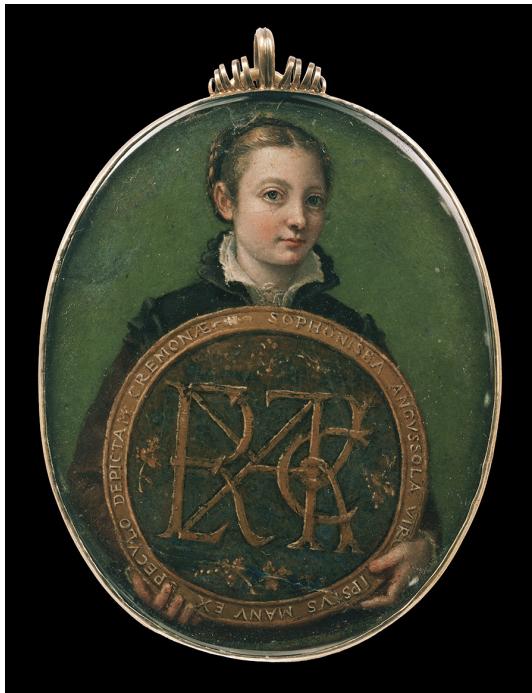
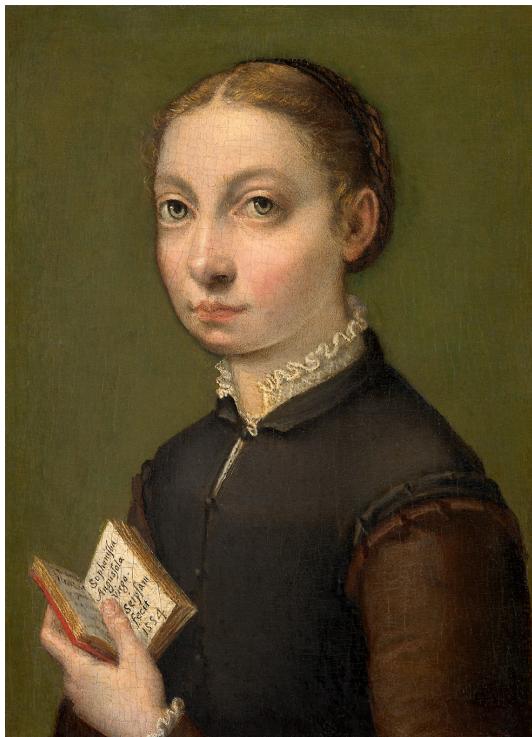
- S19 Epochal Spillover
- 页码:49-50
S1 [描述性拆分] Comparative context for Sofonisba’s noble status among female artists
第1段(P0001)
原文复述
The function established in the preceding sentence operated differently in Sofonisba’s daily life because she was an aristocratic woman seeking membership as a peer in an elite court. These other female artists did not come from the same elevated social status as Sofonisba, even if they also aspired to income and stability from courtly connections. For example, Catharina van Hemessen was married to a professional organist, and while both she and her husband served Maria of Austria and traveled to Spain with her, they were clearly employees rather than peers (note 9). Lavinia Fontana lived and produced work in the urban contexts of Bologna and then Rome after 1603. While she married a minor aristocrat who was also an art student of her father, her marriage contract makes it very clear that she was expected to continue her trade as a source of income, keeping her squarely in the professional artisan category (note 10). For both of these artistic middle-class women, music was proof of refinement, part of what made them worthy of employment at court, or in the case of Fontana, aristocratic marriage. Artemisia Gentileschi was also the daughter of a professional painter and depicted herself as a musician at times, but her public persona was significantly different from the other female artists discussed here as a result of a very public rape trial she endured in Rome as a teenager (note 11).
中文讲解
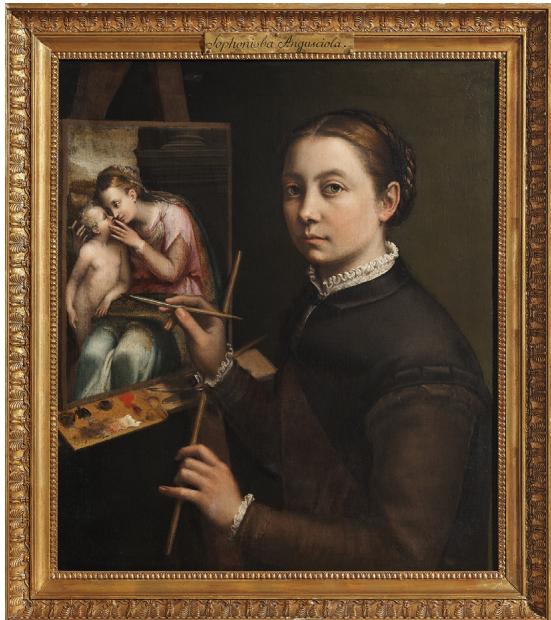
本段的核心功能是为后文讨论索福尼斯巴(Sofonisba)的贵族身份确立一个对照框架。开头那句 ‘functioned differently’ 承接前一段已经论述过的内容(依据后文出现的 ‘music was proof of refinement’,可推断所讨论的应是音乐/音乐性自我呈现的修辞功能),明确点出索福尼斯巴的身份定位与同期其他女艺术家存在根本差异:她是贵族出身,试图以 “peer(同侪/平等身份)” 而非雇员身份进入精英宫廷;其他女艺术家无论多么成功,本质上仍是依靠技艺换取宫廷庇护或贵族婚姻的职业艺人。
随后作者用三个具体案例来搭建这个对照体系:1)凯瑟琳娜·范·赫梅森(Catharina van Hemessen)虽随玛丽亚·奥地利女大公赴西班牙,但与丈夫都是受雇人员;2)拉维尼娅·丰塔纳(Lavinia Fontana)虽嫁给一名贵族画家,但婚前协议明文要求她继续以画艺作为收入来源,说明贵族婚姻并未改变其职业身份;3)阿特米西亚·真蒂莱斯基(Artemisia Gentileschi)虽同为职业画家的女儿,也画过音乐题材,却因少年时期的公开强奸审判而拥有完全不同的公共形象。
三个例子的逻辑分工值得注意:前两者共享一个共同点——‘music was proof of refinement’(音乐是教养的证明),是她们获得宫廷雇佣或贵族通婚的文化资本;而阿特米西亚的例子则被分离开来,因为她代表一个完全不同的变量(公共性别暴力事件造成的形象重塑),不能与音乐/教养框架混同。这种’前两者为一组、阿特米西亚单独成例’的安排,暗示作者将在后文具体论证:索福尼斯巴既不依赖音乐作为教养的’入场券’,也与阿特米西亚式的创伤性公共形象无关——她的贵族身份本身就决定了她的 ‘peer’ 地位。
容易误解之处:本段看似只是在列举其他女艺术家的生平事实,其实是在做’排除法’——把所有’非贵族出身、靠技艺立足的女艺术家’逐一定位,从而使索福尼斯巴的阶级独特性显得独一无二。读者尤其要注意 ‘peer’ 一词在宫廷语境中的特定含义:它指等级制宫廷中拥有平等贵族席位的人,而非泛指的’同伴’,这种地位只有贵族血统或特许才能获得。
补充说明
本段开头 ‘functioned differently’ 属于跨段承接的延续句,其主语(很可能是 ‘music’ 或 ‘musical self-fashioning’)由上一段末尾提供,但本节输入范围并未包含该主语,因此复述中以 ‘The function established in the preceding sentence’ 标注其为前文指代。三条脚注(9、10、11)的具体内容与文献出处未在当前输入范围内给出,仅能确认它们分别对应赫梅森的雇佣关系、丰塔纳的婚前协议、以及真蒂莱斯基罗马强奸审判的史实细节。
脚注 / 边栏 / 图表 / 附加信息(如有)
本段共引用三处脚注(编号9、10、11),分别对应Catharina van Hemessen随Maria of Austria赴西班牙的雇佣性质、Lavinia Fontana婚前协议对其职业身份的限定、以及Artemisia Gentileschi在罗马遭受强奸审判的史料出处。输入未提供脚注正文,故无法复述其完整引文与页码。段落起首 ‘functioned differently’ 为跨段承接句,其主语及完整语义应回溯至上一段,本节输入已排除该上下文。
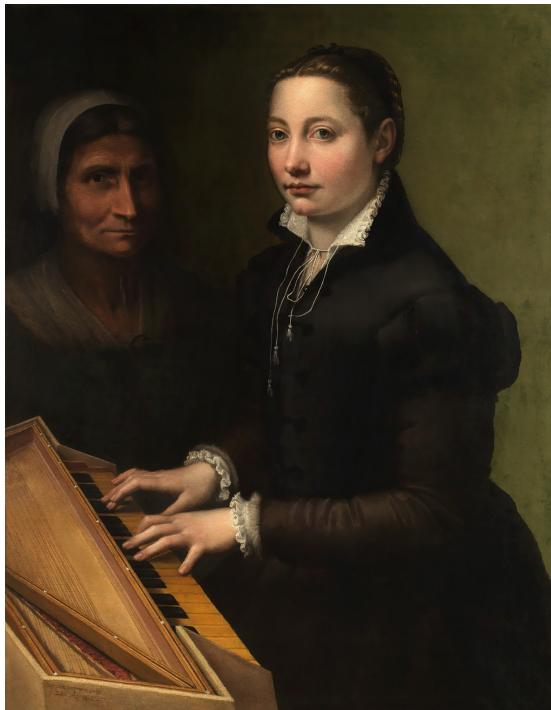
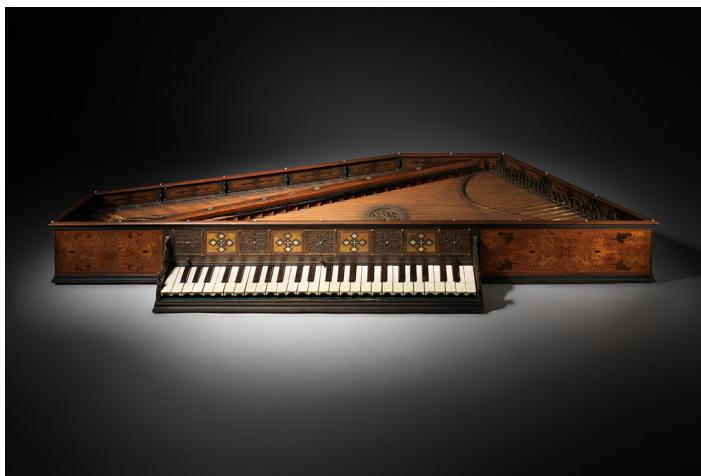
💡 本节核心要点
- 索福尼斯巴的贵族出身是她与同期其他女艺术家的根本性差异:她寻求的是宫廷中的 ‘peer’ 席位,而非受雇者或职业艺人的位置
- 作者用三个对照案例(赫梅森、丰塔纳、真蒂莱斯基)逐一为非贵族出身的女艺术家定位,从而反衬出索福尼斯巴阶级位置的独特性
- 对赫梅森与丰塔纳而言,音乐是’教养的证明’,是换取宫廷雇佣或贵族通婚的文化资本,丝毫未改变她们身处职业艺人范畴的阶级归属
- 真蒂莱斯基虽同具音乐自画像元素,却因罗马公开强奸审判塑造了完全不同的公共形象,故被作者从’音乐与教养’框架中单独抽出,以提示读者:影响一位女艺术家身份定位的不仅有技艺与出身,也可能包括公共性的性别暴力事件
- 整段采用’相似外观但阶级本质迥异’的并置手法,为后文论证索福尼斯巴的特殊贵族身份搭建起清晰的比较坐标
🔑 关键术语
- peer:在本节语境中,‘peer’ 指等级制宫廷中拥有平等贵族身份的人,并非泛指’同伴’。索福尼斯巴所追求的 ‘membership as a peer’ 即以贵族身份而非雇员身份取得精英宫廷的平等席位,这种地位只有贵族血统或特许才能获得,这是本节用以区分索福尼斯巴与其他女艺术家的关键概念。
- professional artisan / 职业艺人:指以手艺为生、纳入行会或雇佣关系的中产阶级从业者。作者用此范畴统摄丰塔纳(婚前协议要求她继续’谋生性’作画)并暗示赫梅森,意在与索福尼斯巴的贵族身份形成对照——前者按技艺与市场需求获取报酬,后者按血统获得平等席位。
- music as proof of refinement:音乐作为’教养’的视觉文化资本。在本节中,该短语将赫梅森与丰塔纳绑定为一组(音乐是敲开宫廷或贵族婚姻的工具),并与索福尼斯巴相对——后者音乐在她日常贵族生活中扮演了别的功能,而非作为身份入场券。
- public persona:公共形象/自我呈现。作者用此术语将真蒂莱斯基单独分离:尽管她具备与其他女艺术家相似的家庭出身与音乐自画像元素,但其公共形象因少年时期的强暴审判而被彻底改写,因此不能被并入前述’音乐+教养’的解释框架。
S2 [描述性拆分] Musical ladies of Ferrara and Sofonisba’s use of decorous music
第1段(P0002)
原文复述
Although they were active a little later in the century, the musical ladies of the Este court are better equivalents to Sofonisba than the daughters of professional visual artists. Although they have long been seen as the first professional ensemble of female musicians, in part because they were believed to be from non-noble families, the research of Elio Durante, Anna Martellotti and Laurie Stras has shown that all three of the women recruited for the inner-circle of Margherita Gonzaga were born into noble status. Like Sofonisba’s position as a lady-in-waiting at the Spanish court, the primary duty of Laura Peverara, Livia d’Arco, and Anna Guarini, was to elevate the musical practice within the young duchess’s household. Their noble status should not be considered to diminish their musical skills and accomplishments, but it did cause challenges for when and where they could decorously display these skills. In fact, as a noble woman, musicality was a more socially acceptable activity for Sofonisba than the menial and potentially messy tasks associated with painting and drawing. I would like to propose that Sofonisba deftly used decorous music, both the visual trope and the actual practice, as a tool to help her transgress her contradictory identities as a noble woman and a highly skilled painter. This transgressive use of musical knowledge to justify her performance of painterly excellence was integral and necessary to the deft management of her social/professional persona.
中文讲解
本段是本小节的核心论点段,承担三重论证任务:第一,重新定位比较对象;第二,澄清贵族身份与音乐能力之间的关系;第三,提出作者自己的解释框架。
在比较对象上,作者认为比起前面提到的职业画家之女,活跃于费拉拉(Ferrara)埃斯特(Este)宫廷的"音乐贵妇"才是索福尼斯巴更合适的对照对象。她们属于同一时代略晚的圈子,身份结构更接近索福尼斯巴本人。
在贵族身份问题上,作者修正了一个长期流行的误解:学界曾把 Laura Peverara、Livia d’Arco、Anna Guarini 这三位服务于 Margherita Gonzaga 内廷的女性视为最早的"职业女性音乐家合奏团",部分原因是人们相信她们出身非贵族。Durante、Martellotti 和 Stras 的新研究则表明,三人实际上都出生于贵族家庭。
接下来,作者把这一发现与索福尼斯巴联系起来:她们与索福尼斯巴一样,都是以贵族侍女(lady-in-waiting)的身份服务于宫廷,首要职责是提升年轻公爵夫人府邸内的音乐实践——而不是以"职业音乐家"自居。
关键转折在于:贵族身份并不会削弱她们的音乐技艺与成就,但确实带来限制——即在什么时间、什么场合可以"得体地"(decorously)展示这些技艺。换言之,贵族身份既是资源也是约束。
由此作者进入本段的核心命题:对索福尼斯巴这样的贵族女性而言,演奏音乐比从事绘画更易被社会接受,因为绘画涉及被认为"低贱"且"脏乱"的动手劳作。基于此,作者提出自己的论点——索福尼斯巴巧妙地把"得体的音乐"(decorous music)当作一种工具,既作为视觉母题(visual trope),也作为实际表演(actual practice),借以跨越她作为贵族女性与作为杰出画家之间相互矛盾的双重身份。这种"越界"性的使用对于她妥善管理自己的社会/职业形象(social/professional persona)而言,是不可或缺的手段。
换言之,索福尼斯巴并未因贵族身份而放弃绘画,而是利用贵族女性可以正当从事的音乐活动,为自己的画家身份提供一套社会可接受的包装逻辑。
补充说明
本段出现的脚注标记 12 指向本节范围之外的文献,本段不予展开。“decorously"一词在本段反复出现,强调贵族身份对公开场合、公开行为的礼仪性约束,是理解全段论证的关键修饰语。“visual trope"指绘画中以音乐为题材的视觉惯例(如女子持琴图),“actual practice"指真正意义上的音乐演奏实践——作者将两者并置,暗示索福尼斯巴同时利用了图像与现实两层手段。
第2段(P0003)
原文复述
9 Céline Talon, ‘Catharina Van Hemessen’s Self-Portrait. The Woman Who Took Saint Luke’s Palette’, in: Women Artists and Patrons in the Netherlands, 1500–1700, ed. Elizabeth Sutton (Amsterdam, 2019), 27–53.
中文讲解
本条是正文中的脚注 9,属于文献引注。它引用 Céline Talon 撰写的文章《Catharina Van Hemessen 的自画像——拿起圣路加调色板的女人》,收录于 Elizabeth Sutton 主编的《尼德兰的女性艺术家与赞助人,1500–1700》(阿姆斯特丹,2019年),页码为 27–53。
从编号顺序与脚注 10、11 的主题判断,这条脚注用于支撑前文(位于本节之前)关于女性画家、特别是自画像传统的讨论。圣路加(Saint Luke)传统上是画家行会的守护圣人,“拿起圣路加的调色板"暗指女性声称并行使画家身份的行为,因此该文献很可能与女性画家如何建构职业身份相关。
由于本脚注提供的是前文论点的来源依据而非本节新论点,故其在本节内部仅起背景支撑作用。
补充说明
脚注 9 的页码范围 27–53 长达 26 页,说明这是一篇较长的研究性章节,而非短论。
第3段(P0004)
原文复述
10 See the first chapter of Caroline Murphy, Lavinia Fontana: A Painter and her Patrons in Sixteenth-Century Bologna (New Haven, 2003), 13–48.
中文讲解
本条是正文中的脚注 10,亦为文献引注。它指引读者参阅 Caroline Murphy 的专著《Lavinia Fontana:十六世纪博洛尼亚的一位画家及其赞助人》(纽黑文,2003年)第一章,页码 13–48。
Lavinia Fontana 是十六世纪博洛尼亚的重要女画家,作者在脚注处将她与索福尼斯巴的处境进行类比。Murphy 的第一章通常会处理画家所处城市的社会环境、性别规范与赞助网络,因此是理解十六世纪意大利职业女画家身份建构的关键二手文献。
脚注 9 与 10 共同构成了本节乃至前文关于"职业画家之女"比较框架的文献基础。
第4段(P0005)
原文复述
11 After the accused rapist was found guilty, Artemisia married a Florentine painter and moved away from her family. Letters reveal that at least in the early part of her career her husband was actively engaged in her long-term sexual relationship with the family’s noble patron who was also the father of some of her children. While a recent and controversial exhibition in Genoa in 2023 – Artemisia Gentileschi: Courage and Passion – seems to have gone too far, sensationalizing the impact of sexual violence on her creative process, for better or worse it must be acknowledged that the public nature of her rape would have had a long-term impact on her life and opportunities. For a thoughtful discussion of these topics, see the two articles by Elizabeth Cohen, ‘The Trials of Artemisia Gentileschi: A Rape as History’, in: The Sixteenth Century Journal 31 (2000), 47–75, and ‘More Trials for Artemisia Gentileschi: Her Life, Love and Letters in 1620’, in: Patronage, Gender and the Arts in Early Modern Italy Essays in Honor of Carolyn Valone, ed. Katherine McIvers and Cynthia Stolhans (New York, 2015), 249–91.
中文讲解
本条是正文中的脚注 11,是一段较为详尽的学术性脚注,主要为前文关于女画家所遭遇的性别暴力的论述提供史实与文献支持。
脚注首先交代 Artemisia Gentileschi(阿尔泰米西娅·真蒂莱斯基)的若干生平节点:被指控的强奸者被定罪后,她嫁给了一位佛罗伦萨画家并离开原生家庭;书信显示,在她职业生涯的早期阶段,其丈夫曾主动促成她与家族贵族赞助人之间的长期性关系,而该赞助人也是她若干孩子的父亲。
接着,作者对 2023 年在热那亚举办的展览"Artemisia Gentileschi: Courage and Passion”(阿尔泰米西娅·真蒂莱斯基:勇气与激情)做出评价:作者认为该展览走得太远,把性暴力对她创作过程的影响作了耸人听闻化的处理,但无论好坏,必须承认她遭强奸一事具有公开性,对其人生与机会造成了长期影响。
最后,作者推荐两篇 Elizabeth Cohen 的文章作为深入讨论的入口:第一篇《阿尔泰米西娅·真蒂莱斯基的审判:作为历史的强奸》发表于《十六世纪杂志》2000 年第 31 卷,第 47–75 页;第二篇《阿尔泰米西娅·真蒂莱斯基的更多审判:1620 年她的生活、爱情与书信》收录于 McIvers 与 Stolhans 主编的论文集(纽约,2015 年),第 249–291 页。
整条脚注兼具史料陈述与学术争论的立场表态,作用是为前文关于女画家身份脆弱性的论述提供具体案例与权威讨论。
补充说明
脚注 11 中提到的两篇文章构成对 Artemisia 生平与强奸案学术讨论的两份主要参考:第一篇侧重司法审判层面,第二篇聚焦 1620 年这一特定时段,揭示其私人书信所透露的复杂关系。
脚注 / 边栏 / 图表 / 附加信息(如有)
本节附加材料以脚注为主:脚注 9 引用 Céline Talon 关于 Catharina Van Hemessen 自画像的章节,主题涉及女性画家援引圣路加传统以确立职业身份;脚注 10 指引读者参阅 Caroline Murphy 关于 Lavinia Fontana 的专著第一章,论述十六世纪博洛尼亚的女画家与赞助人网络;脚注 11 为一条较长的考据型脚注,叙述 Artemisia Gentileschi 遭强奸后的婚姻、性与赞助关系,并对其 2023 年热那亚展览提出批评,同时推荐 Elizabeth Cohen 的两篇研究文章。三条脚注均为前文论述提供文献与史实支撑,本身不引入新论点。
💡 本节核心要点
- 作者主张,比起职业画家之女,费拉拉埃斯特宫廷的"音乐贵妇"才是索福尼斯巴更合适的身份对照——她们皆为贵族出身的宫廷侍女,职责是在贵族府邸中提升音乐实践。
- 针对学界长期将 Laura Peverara、Livia d’Arco、Anna Guarini 视为非贵族出身的’最早职业女性音乐家合奏团’的看法,作者援引 Durante、Martellotti、Stras 的新研究予以修正:三人实际上均出生于贵族家庭。
- 贵族身份并未削弱这批女性或索福尼斯巴的音乐才能,反而带来限制——她们必须选择得体(decorous)的时间与场合展示技艺。
- 对索福尼斯巴而言,作为贵族女性,从事音乐比从事绘画更具社会可接受性,因为绘画与被视为’低贱且脏乱’的劳作相关联。
- 作者提出核心论点:索福尼斯巴把’得体的音乐’——同时作为视觉母题与实际表演——用作跨越贵族女性与杰出画家之间矛盾身份的工具。
- 这种以音乐为掩护的越界性使用,对她妥善管理自己的社会/职业形象(social/professional persona)是不可或缺的手段,由此她得以正当化其画家身份的卓越表现。
🔑 关键术语
- decorous music:“得体的音乐”。在本节中既指贵族女性在合乎礼仪的场合方可进行的音乐实践,也指绘画中以音乐为题材的视觉惯例(visual trope)。作者认为索福尼斯巴同时调动这两层含义,作为她跨越贵族身份与画家身份之间矛盾的工具。
- Este court:“埃斯特宫廷”,指意大利费拉拉由埃斯特家族统治的宫廷。本节将其内廷中服务于 Margherita Gonzaga 的三位女性音乐家作为索福尼斯巴的身份类比对象。
- lady-in-waiting:“宫廷侍女”。本节将 Laura Peverara、Livia d’Arco、Anna Guarini 以及索福尼斯巴本人皆置于这一身份类别下,强调她们服务于贵族女主人的宫廷角色,而非以独立职业音乐家或画家的身份活动。
- social/professional persona:“社会/职业形象”。作者用以概括索福尼斯巴必须同时维持的双重身份——作为贵族女性的社会形象与作为杰出画家的职业形象,并强调二者之间存在张力,需要借助音乐这一中介来协调。
S3 Negotiating Self-Presentation
第1段(P0006)
原文复述
Negotiating Self-Presentation
中文讲解
本条为小节标题 “Negotiating Self-Presentation”(协商自我呈现),用第二级 Markdown 标题(##)标识,开启本章的核心议题:索福尼斯巴·安圭索拉如何在公众与私人领域中协商、构建并调整自身的形象与身份。作者在小节起首并未直接进入论证,而是先铺设已被文献确证的传记事实,作为后续解读其"复杂人格"的基础。
补充说明
本节为分析性论述的前奏,承担由事实层面向解释层面过渡的功能。
第2段(P0007)
原文复述
To grasp Sofonisba’s complex persona, it is helpful to recap what is securely known about her biography. Around 1535 to 1540, Sofonisba was born in Cremona, to Bianca Ponzoni—the socially higher-ranking parent—and the older Amilcare Anguissola, a well-educated minor aristocrat who, though acknowledged, had been born out of wedlock, and who traded in manuscripts, books, and paper yet struggled financially. The couple had six daughters and one son, and they provided all the children with extensive educational opportunities, regardless of gender. In 1546, Sofonisba and her younger sister Elena began their formal artistic training under Bernardino Campi, and later under Bernardino Gatti. Campi, a professional painter from a local family of goldsmiths, appears to have welcomed the sisters into his home in a modified form of apprenticeship. A letter Sofonisba wrote fifteen years later shows that, beyond her respect for him as a teacher, she had developed warm relationships with Campi’s wife, sister, and mother—women who probably served as chaperones during the girls’ lessons and who may have overseen their care if the sisters did live with the family for an extended period.
中文讲解
本段是 “Negotiating Self-Presentation” 小节的总起,承担"先确证、再解释"的功能:作者在解读索福尼斯巴如何协商自我形象之前,先夯实已被文献确证的传记事实。
论证结构与要点如下:
- 家庭背景与社会等级的张力:母亲 Bianca Ponzoni 社会等级较高,父亲 Amilcare 虽受过良好教育,却属"被承认但非婚生"的小贵族,经营手稿、书籍、纸张却经济拮据。这一出身对理解索福尼斯巴日后需以才艺与宫廷服务换取社会地位的轨迹至关重要——她并非出自财力雄厚的望族。
- 家庭教育的非常规性:父母为七名子女(六女一子)提供"不分性别"的广泛教育,这在 16 世纪意大利非贵族家庭中并不寻常,构成了索福尼斯巴得以学艺的制度与家庭前提。“regardless of gender” 一语是本节价值取向的关键限定。
- 学艺经历的"改良式"性质:1546 年起师从当地画家 Bernardino Campi,后又师从 Bernardino Gatti。作者用 “a modified sort of apprenticeship”(改良式学徒制)形容这种安排——既非典型作坊学徒,亦非单纯拜师学艺;并交代 Campi 出身于当地的金匠家族。脚注 15 进一步限定:所谓"安置在师家"未必等同真正入住,可能只是定期到师家上课。
- 师门女性网络的监护功能:十五年后索福尼斯巴的书信显示她与 Campi 家中女性(妻子、姐妹、母亲)关系亲密。作者推测这些女性承担 chaperone(礼仪监护人)角色,并"if they did live with the family for an extended time”——以条件句形式限定——可能负责照管女孩们的生活。这反映了 16 世纪对未婚女性外出活动的社会规范,也展示了师门女性网络在艺术家训练中的关键作用。
- 措辞审慎:作者多次使用 “probably”、“may”、“seems to have”、“if” 等限定词,明确区分史实与推断,体现严谨的史学态度。
作者通过本段铺设的传记地基,将被用于本节后文对索福尼斯巴"复杂人格"的进一步解读。
补充说明
本段引用的脚注编号 13、14、15、16 分别对应正文 “born in Cremona…financially”、“formal artistic training”、“welcomed the sisters into his home”、“developed fond relationships with Campi’s wife, sister, and mother” 等四处的史料来源,正文 P0008–P0011 即为这些脚注的展开内容。
第3段(P0008)
原文复述
See Chapter 6 of Laurie Stras, Women and Music in Sixteenth-Century Ferrara (Cambridge, 2018).
中文讲解
这是脚注 12 的全文。引用 Laurie Stras 2018 年出版的《Women and Music in Sixteenth-Century Ferrara》(剑桥大学出版社)第 6 章。该脚注的正文锚点不在本节段 P0006–P0007 内(因为本节段落中所引用的脚注编号为 13–16),故其位置应在前文某段。脚注的存在表明作者倾向于将索福尼斯巴的成长环境与 16 世纪意大利其他文化中心(此处为费拉拉)女性的音乐与艺术训练做比较,以勾勒更广阔的女性艺能培养图景。
补充说明
脚注 12 在本节内的附着位置不可见,可能与女性艺术训练或师门网络的主题相关。
第4段(P0009)
原文复述
Ribera, Le Glorie immortali (see n. 1), page 313.
中文讲解
这是脚注 13 的全文。引用 Ribera 的《Le Glorie immortali》(参见注释 1)第 313 页。该脚注为正文陈述的以下事实提供来源:索福尼斯巴约 1535 至 1540 年间生于克雷莫纳、母亲为社会等级较高的 Bianca Ponzoni、父亲为受过教育但非婚生的小贵族 Amilcare Anguissola,以及其经营手稿、书籍与纸张但经济拮据的家庭境况。
补充说明
完整书目信息参见脚注 1(在本节之外);此条脚注只标注引文页码。
第5段(P0010)
原文复述
Alessandro Lamo, Discorso […] intorno alla scoltvra, et pittvra […] fatte dall’Eccell. […] M. Bernardino Campo (Cremona: Christoforo Draconi, 1584), pages 37–44, <http://data.onb.ac.at/ rep/10B0B519> (accessed on 26 August 2024).
中文讲解
这是脚注 14 的全文。引用 Alessandro Lamo 于 1584 年在克雷莫纳由 Christoforo Draconi 出版的论述 Bernardino Campi 雕塑与绘画技艺的著作(书名中保留 16 世纪意大利语古拼写 “scoltvra”、“pittvra”),第 37–44 页,并附奥地利国家图书馆数字资源链接(访问日期:2024 年 8 月 26 日)。该脚注为正文所述事实提供来源:索福尼斯巴与妹妹 Elena 自 1546 年起随 Bernardino Campi 学艺、之后再随 Bernardino Gatti 学习。
补充说明
标题中省略号 […] 标记原文标题其余字句;“scoltvra”、“pittvra” 为 16 世纪意大利语拼写形式。
第6段(P0011)
原文复述
In his tract on Bernardino Campi, biographer Alessandro Lamo states that Amilcare Anguissola ’l’alluogò ambedue in casa di Barnardino’. Cremona was not a large city, so it seems possible that this just means that they would have come regularly into the Campi home for lessons. Discorso, pages 37–8. Less is known about Gatti because he was not the subject of Lamo’s tract.
中文讲解
这是脚注 15 的全文,对正文"a modified sort of apprenticeship"和"seems to have welcomed the sisters into his home"两处关键措辞进行史料考辨。内容要点:
- 引述传记作者 Lamo 的原始意大利语记载——“l’alluogò ambedue in casa di Barnardino”,意为"将姐妹二人安置于 Bernardino 的家中”。
- 作者对这一措辞作出限定:因克雷莫纳城不大,所谓"安置于家中"很可能只是指姐妹定期到 Campi 家上课,未必真的入住。
- 关于第二位教师 Bernardino Gatti,史料相对匮乏,因为 Lamo 的论著并非以 Gatti 为对象。
此脚注体现了作者对史料原文措辞的审慎态度——既不过度诠释"安置"一词,也不否定女孩们确实受到师门家庭般照料的史实,而是以"seems possible"标明这一推断的不确定性。
补充说明
意大利语引文 “l’alluogò ambedue in casa di Barnardino” 为 Lamo 古意大利语原文;“alluogò” 为古动词形式,意为"安置、安排住处”。
脚注 / 边栏 / 图表 / 附加信息(如有)
本节包含脚注 12 至 15。脚注 12(Stras 2018 年第 6 章)的正文锚点位于本节之前的段落中,本节不可见;脚注 13(Ribera, Le Glorie immortali, 313 页)为索福尼斯巴出生时间、地点、父母姓名与社会背景提供来源;脚注 14(Lamo 1584 年《Discorso》, 37–44 页)证实 1546 年起随 Campi、后随 Gatti 学艺的事实,并附奥地利国家图书馆数字资源链接;脚注 15 进一步引述 Lamo 原始意大利语措辞"l’alluogò ambedue in casa di Barnardino",对"安置于师家"与"上门学艺"两种解释作出审慎限定,并说明关于 Gatti 的史料相对匮乏。这些脚注共同支撑作者对索福尼斯巴早年成长与教育环境的细致梳理。
💡 本节核心要点
- 本节为"自我呈现"分析的前奏,先夯实已被确证的传记事实,再进入对索福尼斯巴"复杂人格"的解读。
- 索福尼斯巴出身克雷莫纳中等贵族家庭:母亲社会地位较高,父亲 Amilcare 具学识但属非婚生且经济拮据。
- Anguissola 家族为七名子女(六女一子)提供不分性别的广泛教育,这是 16 世纪意大利非贵族家庭中相当非常规的取向,构成她日后学艺的家庭制度前提。
- 索福尼斯巴自 1546 年起以"改良式学徒制"师从当地职业画家 Campi,后又师从 Gatti;脚注 15 限定"安置于师家"未必等同真正入住。
- Campi 家中的女性(妻子、姐妹、母亲)作为 chaperone 承担礼仪监护,并在女孩留宿期间可能照管其生活,反映 16 世纪意大利的性别规范与师门女性网络的重要作用。
- 作者多次使用"probably"、“may”、“seems to have”、“if"等限定词,明确区分史实与推断,体现严谨的史学方法。
🔑 关键术语
- self-presentation:在本节中指索福尼斯巴如何在公众与私人领域协商并构建自身形象,作者在铺陈其传记事实后,将围绕这一议题展开分析。
- persona:此处指索福尼斯巴的"复杂人格/公众形象”。作者开篇即指出,要理解这种形象需先掌握其生平基础。
- modified sort of apprenticeship:指索福尼斯巴姐妹进入 Campi 家中接受训练的非典型学徒形式,介于正式学徒与上门学艺之间;脚注 15 对"安置于师家"作出进一步限定。
- chaperone:指在年轻女孩学艺期间陪伴、监督其礼仪与行为举止的女性,本段中具体指 Campi 家中的妻子、姐妹与母亲,反映 16 世纪意大利对未婚女性外出活动的社会规范。
S4 [描述性拆分] Sofonisba’s upbringing, family context, and artistic training
第1段(P0012)
原文复述
The author proposes that Amilcare Anguissola, who was in financially constrained circumstances, educated his many daughters principally in order to prepare them for life at court, the underlying hope being that an elevated level of courtly accomplishment would allow them to secure a superior marital position while requiring a smaller dowry. According to the author, the cultivation of specialized abilities and knowledge in girls was typically shaped by their social class and by their marriage prospects. The author then turns to Stefano Guazzo’s La civil conversatione, published in 1574, and announces that the two interlocutors of Book 3 of that work go on to propose the following.
中文讲解
本段开篇交代Amilcare Anguissola让众多女儿接受教育的现实动机:他本人经济并不宽裕,因此教育的真正目的并非培养职业艺术家,而是让女儿凭借过硬的宫廷技艺嫁入更高的门第,同时减少家中所需支付的嫁妆。‘hard-up’、‘reduced dowry’这类限定揭示出一种’以技能折抵嫁妆’的家庭经济逻辑。作者随即强调,女子技艺培养的内容由其所属阶层与婚姻前景决定,这是当时贵族女教的一般规律。然后作者引入Guazzo 1574年出版的La civil conversatione第三卷中两位对话者的论述,作为这套通行做法的话语根据——下一段(P0013)将直接引用其原文。本段的功能是为Sofonisba的个案确立一个可对照的’标准宫廷女教大纲’。
补充说明
段落以propose that结尾但内容未给出,下段P0013即为被提出的内容;这两段构成完整的引文铺垫与引文本体结构。
第2段(P0013)
原文复述
The paragraph consists of a quotation taken from Book 3 of La civil conversatione. The first interlocutor, labelled “Annibale,” declares: “If the father means to marry his daughter to a courtier, he must send her to a court in the service of some great Lady, and she must know how to read, to write, to discourse, to sing, to play on instruments, to dance, and to be able to perform all that which a lady of the court must be able to do […].” Guazzo himself then responds: “I have seen poor young women in the Queen’s court by this means married to great Gentlemen, without one penny of a dowry given by their Father.”
中文讲解
本段是Guazzo第三卷中的对话体引文,由Annibale先发话,再由Guazzo本人以第一人称补一笔亲身见证。Annibale的清单——读、写、应对谈话、歌唱、乐器、舞蹈、宫廷礼节——用一连串’to’不定式串联,构成一份’宫廷女子必修技艺清单’。Guazzo随即给出实例:在王后宫廷中,他亲见出身贫寒的年轻女子经由此路径被许配给’great Gentlemen’,嫁妆分文未出。‘without one penny’是修辞性夸张,强调’零嫁妆嫁入门第显赫之家’的可能性。值得注意的是,Annibale所列六项并不包含绘画,这正是下一段将Sofonisba的培养内容与之对照时所要凸显的差异。
补充说明
great Lady并非泛指贵妇,而是特指宫廷中的女主君——女儿是以’女侍’(donna di palazzo)身份被送入宫廷服侍的。脚注18将提供该段意大利原文及Brescia 1574年版的版本信息。
第3段(P0014)
原文复述
The author observes that of the three accomplishments that Ribera records in his entry on Sofonisba—music, literature, and painting—only painting is not singled out by Guazzo as a requirement for a girl’s courtly education. While Sofonisba was occupied with her courtly training and artistic practice, her father devoted his energies to circulating her drawings and paintings, accompanied by letters in which he modestly proclaimed her excellence, to artists including Michelangelo and to nobles such as Ercole II d’Este—individuals who might help him secure a court placement for his daughter. The author invokes Michael Cole, who has pointed out that Sofonisba also alluded to or named her father in many of her early self-portraits, thereby articulating ‘a reciprocal relationship between father and daughter, in which she performed, and he showed, or showed off, her performance.’ In this period she produced numerous self-portraits, group portraits of her family in various activities, and portraits of their Italian social peers, adults and children alike. The author notes that the bulk of her known extant work dates from this phase of her life, when she was most strongly motivated to sign her works as evidence of her abilities.
中文讲解
本段同时回答两个问题:第一,Sofonisba的培养内容如何与Guazzo所列的标准宫廷女教清单对接;第二,这种对接背后的运作机制是什么。作者的对比观察很关键——Ribera列出的三项才能(音乐、文学、绘画)中,前两项契合宫廷女教的常规清单,唯独绘画不在其中;这意味着Amilcare在走一条’内嵌于常规、但有所溢出’的路径,把一项非传统的技艺塞进了传统通道。接着作者刻画Amilcare的’经纪’操作:他把女儿的画作与自己的谦辞书信寄送给米开朗基罗这样的艺术权威,以及Ercole II d’Este这样的贵族庇护人,目的皆在为女儿争取宫廷职位。引Michael Cole的自画像论点:Sofonisba在多幅早期自画像中提及或标明父亲,构成一种’她展示、他展示她的展示’的互惠关系。最后,作者指出她现存作品的大多数正是出自这一时期,而那也是她最积极签署姓名的阶段——署名本身就是能力的市场凭证。本段把小节论题从’教育内容’(P0012–P0013)推进到’教育产出与社会资本’,为下文进入宫廷生涯的讨论做了铺垫。
补充说明
Ercole II d’Este是费拉拉公爵,十六世纪中后期重要的艺术赞助人,与Sofonisba进入西班牙宫廷之前的命运直接相关。’the bulk of her known extant work’暗示其余作品或散佚或未署名归属——这反过来强化了她在本时期积极署名的论断意义。
第4段(P0015)
原文复述
Footnote 16. The note quotes the closing salutation of Sofonisba’s letter of 21 October 1561 to Campi in the original Italian: “e con questo fine me li raccomando, e li bacio la mano, cosi alla sua carissima ed onoratissima consorte da me molto amata, ed alla sua madre Sig. Barbara, e sua sorella Sig. Francisca, ed a suo padre Sig. Pietro.” The note indicates the source: Kusche, “Sofonisba Anguissola en España” (see n. 8), p. 402.
中文讲解
这是脚注16,为正文P0014中描述的’父女对外联络网络’提供一件具体实证:1561年10月21日Sofonisba写给Campi的信件末尾逐一问候其妻、其母Barbara、其姊妹Francisca及其父Pietro。信中用意大利语旧式敬辞——‘carissima ed onoratissima consorte’、‘bacio la mano’——显示出写信人对收信家庭的深度熟稳与归属感。值得注意的是,发信人Sofonisba本人而非Amilcare在操作笔头,这印证了Cole所说的’互惠关系’中女儿一侧的主动展示。脚注指引读者参Kusche《Sofonisba Anguissola en España》第402页。
补充说明
此脚注与P0014内容互证——Campi是Sofonisba早年的老师之一;信中以家人称呼方式问候,反映出Sofonisba家族与Campi家族之间的私人纽带,进而反映Amilcare经纪策略所依赖的社会网络。
第5段(P0016)
原文复述
Footnote 17. The note adds that, as an alternative, a girl’s education might also indicate that her father was preparing her for life as a nun, in which case the convent dowry could be reduced for girls who possessed skills in music, illumination, or painting, and writing.
中文讲解
这是脚注17,对P0012’教育即备嫁’的解释做了一个关键的二分补充:在意大利贵族语境下,女子接受高水准的技艺教育还可能指向另一种去向——入修道院。具有音乐、抄本插图(illumination)、绘画或写作等专长的修女,其入修道院所需缴纳的’convent dowry’可以被削减。于是’以技能折抵嫁妆’的逻辑扩展为两条并行轨道:嫁入宫廷或入修道院;两条轨道均需要可被认证的技艺。联系到P0014,Sofonisba的绘画才能按这条逻辑同样值钱,只不过她最终被Amilcare推上的,是宫廷而非修道院那条。
补充说明
‘illumination’在此特指手抄本彩饰插图绘制(manuscript illumination),是修女在修道院抄书实践中一项被实际用得上的技艺,因此具备市场化的估价。
第6段(P0017)
原文复述
Footnote 18. The note presents the original Italian passage from Stefano Guazzo, La civil conversatione (Brescia: Tomaso Bozzola, 1574), fols. 159v–160r: “se’l padre haurà destinate i[n] corte alla servitù d’alcuna Prencipessa, bisogna, che cominci ad ammaestrarle in quelle cose, che sono atte ad acquistar la gratia della patrona, & à procurare, che leggano, scrivano, di scorrano, cantino, sonino, & ballino, & facciano acconciamente tutto ciò, che adorna le donne di palazzo […]. Hò vedute presso la Reina alcune povere damigelle […] che sono divenute mogli de principali Cavalieri della Francia, senza che i padri habbiano loro dato un danaio in dote.” The note then gives the full bibliographic reference and links to the Google Books digitization of the 1574 Bozzola edition, accessed 2 September 2024.
中文讲解
这是脚注18,直接呈现P0013那段英文意译所对应的意大利原文及其版本根据:1574年Brescia的Tomaso Bozzola版La civil conversatione,引用位置为fol. 159v–160r。原文用’[…]‘标注省略;附Google Books数字版链接与2024年9月2日访问日期。该脚注为读者核验英文转述提供原始凭据,并把Guazzo的文本固定到具体版本、具体页码上,便于查考其对当时贵族女教论述的实际影响。
补充说明
‘danaiò’与’Hò’均为十六世纪意大利语古拼写法;‘damigelle’对应宫廷女侍;‘Prencipessa’对应现代拼写Principessa。
脚注 / 边栏 / 图表 / 附加信息(如有)
本节附有三则脚注(16、17、18),分别承担不同功能:脚注16以Sofonisba本人信件原话(意大利语)实证P0014所述的对外联络网络;脚注17扩展P0012关于’教育目的’的解释,加入修道院去向这一条平行路径;脚注18回溯P0013所引Guazzo文本的意大利原文、版本(1574 Bozzola本)、具体页码(fol. 159v–160r)以及数字化访问途径,为本节核心引文提供完整版本凭据。本节无插图、表格或边栏内容。
💡 本节核心要点
- Amilcare让女儿接受教育的根本动机是经济—婚配层面的:凭借过硬的宫廷技艺换取更高的门第与更少的嫁妆支出。
- Guazzo 1574年La civil conversatione第三卷提供了当时通行的’宫廷女子必修技艺清单’(读写、应对、歌唱、乐器、舞蹈、宫廷礼节),作为本节论述的对照尺度。
- Sofonisba所受三项技艺中,音乐与文学契合宫廷女教的常规清单,唯绘画不在其中——这是Amilcare在常规轨道上做出溢出的关键差异。
- Amilcare的运作方式是把女儿的画作连同自己的谦辞书信寄送给米开朗基罗、Ercole II d’Este一类艺术与政治权威,其目标是谋取宫廷职位。
- Michael Cole提出的’互惠展示’机制:Sofonisba在自画像中点名父亲,父亲则在对外通信中转述女儿的展示,署名成为能力的市场凭证;现存作品大多产于这一积极署名时期。
- 脚注17揭示出一条平行路径:技艺教育同样可以为修道院去向服务,并折抵修道院嫁妆——这使Sofonisba的宫廷路径显得更具选择性。
🔑 关键术语
- La civil conversatione:Stefano Guazzo 1574年出版的对话体著作,本节中作为当时公认的’宫廷女子教育规范’的文本根据被援引。
- dowry / convent dowry:嫁妆或入修道院所需缴纳的费用;本节论点的核心逻辑——‘以可认证的技艺折抵嫁妆’——正是围绕这一概念展开的。
- courtly education:面向贵族女子的、以服务于宫廷生活为目的的技艺培养内容;本节以Guazzo文本所列清单为标准尺度,并将Sofonisba的绘画作为这一框架内的一个’溢出项’加以讨论。
- Ercole II d’Este:十六世纪中后期费拉拉公爵,本节中作为Amilcare把女儿作品寄送求情的对象之一出现,指代可为人提供宫廷庇护的上层贵族。
- illumination:手抄本彩饰插图绘制;脚注17指出此技艺同样可在修道院路径中折抵convent dowry。
- reciprocal relationship (per Michael Cole):Cole用以描述Sofonisba与父亲之间互惠展示的术语:在自画像中女儿呈现自己,在通信中父亲呈现女儿的呈现;本节以此来解释Sofonisba署名现象的社会机制。
S5 [描述性拆分] Early self-portraits and father-daughter self-promotion campaign
第1段(P0018)
原文复述
By 1559 their labor had paid off and Sofonisba left Italy to accept a generous position as a lady-in-waiting to the new Spanish queen, Isabel de Valois (1545–1568), the third wife of King Philip II (1527–1598). After Isabel’s early death in 1568, Sofonisba continued to serve in the court until 1574 as an attendant and teacher to Isabel’s young daughters.20 Although officially she was a noble courtier during her many years in Spain, she tutored royal family members in the visual arts, especially Isabel, and created portraits. Soon after Isabel’s wedding and Sofonisba’s arrival, Girolamo Neri reported to the Duke of Mantua that ‘[t]his queen [Isabel] shows herself to have intelligence and very good talent. She has begun to paint, and one says Sofonisba Cremonese, who is the one who teaches her, is her great favorite.‘21 Rather than direct payment for her artistic activities, which was often quantified in contracts for male artists at the time, Sofonisba’s family received a yearly stipend, and she was listed with the other ladies of the Queen where she was provided with the same resources – 100 ducats a year as well as a personal servant and a groom for her horse.22 When Sofonisba had time outside her direct daily activities as a member of Isabel’s entourage, she also made portraits of her patrons and other members of the court, which she sometimes sent to illustrious figures, including the Pope.23 There are financial records that indicate that Sofonisba’s portraits, sometimes specifically the faces, were copied by the official court painters, but unlike these male painters Sofonisba herself did not receive payment for these.24 Some early biographers indicated that she received precious gifts, including jewelry, in recognition for her extraordinary skills. Usually she did not sign the paintings she created at the Spanish court and seems to have conformed somewhat to Spanish painterly style and tastes, so art historians struggle to identify the paintings she created during this period and they certainly seem to be fewer in number than during her previous period in Italy.
中文讲解
本段讲述索福尼斯巴·安圭索拉(Sofonisba Anguissola)从意大利赴西班牙宫廷的关键转折。先给出时间节点:1559年,她终于获得等待多年的丰厚职位——出任西班牙新王后伊莎贝尔·德·瓦卢瓦(Isabel de Valois,1545—1568)的宫廷女官。伊莎贝尔是国王菲利普二世(Philip II, 1527—1598)的第三任妻子;1568年伊莎贝尔早逝后,索福尼斯巴仍留任至1574年,作为年轻公主们的侍从与教师。
作者想突出的是她的"双重身份":官方头衔是"贵族女官",但实际工作包含教王室成员作画、创作肖像。这里援引1560年曼图亚使节杰罗拉莫·内里(Girolamo Neri)致公爵的信,直接证据表明伊莎贝尔已开始绘画,且视索福尼斯巴为"心腹之师"——这既显示王后的艺术兴趣,也显示索福尼斯巴的近臣地位。
段中最关键的对比是"支付方式"。当时男性艺术家通常按合同直接计件获酬,而索福尼斯巴所属的家庭获得的是"年薪(100达克特)“加上仆人、马夫等实物配给,并被列入王后女官的名册。换言之,她不是以"职业画家"身份,而是以"宫廷侍从"身份被供养。这一支付结构的差异,是理解她处境的核心。
接着指出她在正式侍从工作之余,为赞助人和廷臣绘制肖像,有时甚至寄给教皇等显赫人物。但财务档案显示:官方宫廷男画家在复制她的肖像(尤其是脸部)时获得报酬,她本人却分文未取——可见她的画作被视为宫廷共享的资产,而非个人商品。早期传记说她收到过珠宝等贵重礼物作为对其技艺的褒奖。
本段结尾是一个重要的史学困境:她在西班牙宫廷期间通常不在画作上署名,且风格上有所迁就迎合西班牙趣味,因此该时期画作难以辨识,数量也明显少于意大利时期。
整段论证逻辑:父亲-女儿自我推广计划成功→进入西班牙宫廷→但身份被框定为"女官"而非"职业画家”→报酬制度不同→画作辨识困难。下一段则继续讲述她离开西班牙后的命运。
补充说明
“100 ducats a year"中的ducat是当时欧洲通用的金币单位;“stipend"指固定年薪,不同于按件计酬的合同报酬。两者区别是本段论证的关键。“the Pope"指罗马教皇,作者借此说明其作品流通至欧洲最高赞助层。
第2段(P0019)
原文复述
19 Michael W. Cole, Sofonisba’s Lesson: A Renaissance Artist and Her Work (Princeton, 2019), 32.
中文讲解
脚注19:出自迈克尔·W·科尔(Michael W. Cole)所著《索福尼斯巴的课业:一位文艺复兴艺术家及其作品),普林斯顿大学出版社2019年版,第32页。本脚注为正文中关于索福尼斯巴作为贵族女官身份、兼教王室成员艺术等内容提供学术来源支持。
第3段(P0020)
原文复述
20 Maria Kusche, ‘Sofonisba Anguissola: Her Life and Works’, in: Sofonisba Anguissola: A Renaissance Woman, ed. Sylvia Ferino-Pagden and Maria Kusche (Washington D.C., 1995), 26–103, at 72.
中文讲解
脚注20:出自玛丽亚·库舍(Maria Kusche)撰写的《索福尼斯巴·安圭索拉:其生平和作品》,收入西尔维娅·费里诺-帕格登与库舍合编的《索福尼斯巴·安圭索拉:文艺复兴女性》一书(华盛顿特区,1995年),第26—103页,具体见第72页。文献支持了正文关于1568年伊莎贝尔早逝后,索福尼斯巴继续在宫廷服务至1574年担任公主侍从与教师的史实。
第4段(P0021)
原文复述
21 ‘Essa regina si mostra d’aver ingegno e di bonissima intragna, ella ha cominciato a dipingere et dice la Sofonisba Cremonense che é quella le insegna et é molto favorita sua.’ Letter from 18 February 1560, reproduced in Maria Kusche, ‘Sofonisba Anguissola en España’ (see n. 8), 397.
中文讲解
脚注21:此处原样保留意大利文引文:‘Essa regina si mostra d’aver ingegno e di bonissima intragna, ella ha cominciato a dipingere et dice la Sofonisba Cremonese che é quella le insegna et é molto favorita sua.’(大意:这位王后表现出才智与极佳的天分,她开始绘画,据说索福尼斯巴·克雷莫内塞即教授她的人,甚得王后宠爱。)出自1560年2月18日的一封信,转录自库舍《索福尼斯巴·安圭索拉在西班牙》一文(见注释8),第397页。引文以原文形式保存,说明该信是研究伊莎贝尔王后艺术兴趣与索福尼斯巴地位的一手档案。
第5段(P0022)
原文复述
22 While musicians often held ambiguous positions in a court and were rewarded through gifts or material support, artists usually did not have the same sort of social access and were more likely to be paid directly for their products. For a comparison of their different status, see Evelyn Welch, ‘Painting as Performance in the Italian Renaissance Court’, in: Artists and Court: Image-making and Identity, 1300–1550, ed. Stephen J. Campbell (Boston 2004), 19–32.
中文讲解
脚注22:对正文关于索福尼斯巴报酬结构的解释提供横向比较——音乐家虽也常处身份模糊状态,但多获赠礼或物质支持;而艺术家通常缺乏同等社会接触,更倾向于按产品直接收费。详见伊夫林·韦尔奇(Evelyn Welch)《意大利文艺复兴宫廷中的绘画作为表演》一文,收入斯蒂芬·J·坎贝尔(Stephen J. Campbell)编《艺术家与宫廷:形象塑造与身份认同,1300—1550年》(波士顿,2004年),第19—32页。该脚注帮助读者理解:索福尼斯巴获年薪而非按件付费的安排,反映的是"贵族女官"身份,而非"职业艺术家"身份。
第6段(P0023)
原文复述
23 Her letter makes it clear that they were in direct communication about the painting. Filipp Baldinucci, Notizie de’ professori del disegno da Cimabue in qua, vol. 2 (Florence, 1846), 628–9.
中文讲解
脚注23:出自菲利波·巴尔迪努奇(Filipp Baldinucci)《自契马布埃以来的绘画教授纪事》第2卷(佛罗伦萨,1846年),第628—629页。文献指出,索福尼斯巴的信件表明她与受画者就画作有直接沟通——这是支持正文所说她将画作寄给教皇等显赫人物的直接证据。
第7段(P0024)
原文复述
Even though Isabel left a large dowry and yearly allowance for Sofonisba in her will, the king struggled to find a socially appropriate match, given that Sofonisba wanted to return to Italy to be closer to her family, where the King had less direct influence. Eventually she had to compromise and moved to Sicily to marry Don Fabrizio de Moncada, the second son of an important Sicilian noble of Italian-Spanish lineage. However, the Moncada family was not fully supportive, probably because of her less prestigious lineage, so her social and financial positions were insecure. When Don Fabrizio died within five years, she took the opportunity to sail back to the Italian peninsula with her brother. She made the savvy choice to marry the Genoese captain of the ship she was on, Orazio Lomellini.25 Although they might seem poorly matched because he was significantly younger than Sofonisba and of a lower social rank than her first husband, with his shipping business and mobility, Orazio was able to travel regularly to Palermo to maintain the yearly allowance promised to Sofonisba by the Spanish king, which was drawn from the taxes of that city. This financial dependence on Palermo may also explain why, even though the couple resided in northern Italy where their social and cultural connections primarily were from their marriage in 1579, they returned in 1615 to Sicily for their retirement.26 Despite the fact that some of her early biographers claim that she continued to produce paintings during her married years, there are only two works that can be firmly identified from this lengthy period.27 It seems likely that Sofonisba spent her later years as a royally-connected great lady, who was renowned for her artistic knowledge and skill. She did not pursue an active career as a painter because that would have been inappropriate to her status as a former lady-in-waiting to a Spanish queen. She could not afford to compromise the annual income that her elevated social status provided for her and her family.28
中文讲解
本段讲述索福尼斯巴离开西班牙宫廷后的命运,围绕"社会身份"与"经济来源"两条线索展开,延续并深化上一段关于她报酬结构的主题。
第一层逻辑——王后遗嘱与婚姻难题:伊莎贝尔王后在遗嘱中留给索福尼斯巴丰厚嫁妆与年金,但国王为她的婚事难以找到"社会门第合适"的对象,因为索福尼斯巴想回意大利与家人团聚,而意大利不在国王的直接控制范围内。这一细节揭示:她虽是贵族女官,但家世尚不够显赫,在西班牙婚配市场仍有局限。最终她妥协,与西西里贵族(意-西血统)的次子唐·法布里齐奥·德·蒙卡达(Don Fabrizio de Moncada)结婚,迁居西西里。但蒙卡达家族并不完全接纳她,可能因她出身不够显赫——这使她的社会与财务地位都不稳固。
第二层逻辑——第二次婚姻的经济理性:法布里齐奥不到五年去世,索福尼斯巴借机与兄长乘船返回意大利半岛,并嫁给船上的热那亚船长奥拉齐奥·洛梅利尼(Orazio Lomellini)。表面看这次婚配"不般配”(他比她年轻许多、社会等级低于前夫),但作者用"savvy"一词点明:他的航运业与流动性,使他能够定期往返巴勒莫(Palermo),维持西班牙国王承诺给索福尼斯巴的年金——该年金正是从巴勒莫的税收中拨付的。换言之,这是一桩为保住王室年金而作的"理性选择”。这种依赖也解释了她为何婚后定居北意大利(其社会与文化关系主要源自1579年的再婚),却于1615年回西西里度过晚年。
第三层逻辑——画作稀少与身份困境的收束:虽然早期传记声称她婚后仍创作,但该漫长时段内能确证的作品仅两件。作者据此推断:她晚年实际身份是"与王室有关系的贵妇”,以艺术造诣闻名,但不再积极从事绘画职业,因为继续以画家身份活动会损害她作为前西班牙王后女官的社会身份;而那笔与该身份挂钩的年金对家庭经济至关重要——她不能冒险失去它。
全段论证从"被动接受报酬方式"走向"主动保护身份地位",首尾呼应:索福尼斯巴的"画家"身份始终让位于她通过家族推广获得的"贵族身份",而贵族身份才是其经济保障的根基。
补充说明
“dowry"指伊莎贝尔遗赠给索福尼斯巴的一笔款项,作为她未来婚嫁的资金;“yearly allowance"是从巴勒莫税收中拨付的年金。两者性质不同:dowry是一次性,allowance是终身。本段末尾"inappropriate to her status"这一表述对应注释28将引出的卡斯蒂利奥内(Castiglione)等关于贵族不应从事专业性职业的礼仪规训。
第8段(P0025)
原文复述
24 Archivo de Simancas, C.M. la época, leg. 1109, cit. in Kusche, ‘Sofonisba Anguissola en España’ (see n. 8), 410.
中文讲解
脚注24:出自西曼卡斯档案馆(Archivo de Simancas)档案,C.M. la época,卷宗1109号,转引自库舍《索福尼斯巴·安圭索拉在西班牙》一文(见注释8),第410页。该档案支持正文所述:官方宫廷画家复制索福尼斯巴肖像(尤其脸部)获得报酬,而她本人并未获酬的财务记录。
第9段(P0026)
原文复述
25 While this is usually presented as a spur of the moment choice by Sofonisba, it seems likely that she already knew and trusted Orazio as a conduit to communicate with her family in Italy. The compromised propriety and hence forced marriage might have been a calculated decision on her part, one that allowed her to avoid the complex negotiations with the Spanish court that would have had to happen otherwise
中文讲解
脚注25:对正文中索福尼斯巴与奥拉齐奥的"船上婚礼"提出修正解释——通常叙事把这描述为一时冲动之举,但作者推测她早已认识并信任奥拉齐奥,视其为与意大利家人通信的渠道;因船上环境对礼俗有所损害而"被迫"成婚,可能实为她经过算计的决定,使她得以绕开本应与西班牙宫廷进行的复杂谈判。该脚注强化了正文用"savvy"形容这次婚姻的判断。
注:脚注原文在此处中断,未给出完整结尾与具体文献出处。
第10段(P0027)
原文复述
26 Kusche, ‘Sofonisba Anguissola en España’ (see n. 8), 96.
中文讲解
脚注26:出自库舍《索福尼斯巴·安圭索拉在西班牙》一文(见注释8),第96页。文献支持正文所述:1579年再婚后定居北意大利、1615年回西西里退休的时间线与年金依赖。
第11段(P0028)
原文复述
27 Cole, Sofonisba’s Lesson (see n. 19), 139.
中文讲解
脚注27:出自科尔《索福尼斯巴的课业》一书(见注释19),第139页。文献支持正文所述:尽管早期传记声称她婚后继续创作,但该漫长时段内能确证的作品仅两件。
第12段(P0029)
原文复述
28 The taint of professionalism was warned against by Castiglione and others, and can be seen in the behavior of skilled noble musicians, including the famous tension between Lord
中文讲解
脚注28(原文在此处中断):指出卡斯蒂利奥内(Castiglione)等曾告诫避免染上"职业化"的污名,并以技艺精湛的贵族音乐家之行为为参照——包括某位勋爵(Lord)之间的著名紧张关系。该脚注原应进一步展开"贵族不应被视为专业人员"这一礼仪规训,以支持正文末尾关于索福尼斯巴因维护贵族身份而放弃画家职业的判断;但因原文在此句中断,完整论点未呈现。
脚注 / 边栏 / 图表 / 附加信息(如有)
本节(P0018—P0029)附加材料共有8条脚注(注释19—26,以及延伸中的注释28)。注释19—23服务于P0018正文,分别为科尔与库舍的专著、引文出处、宫廷音乐家与艺术家身份比较的旁证(Baldinucci)。注释24—28服务于P0024正文,涉及西曼卡斯档案馆财务记录、对第二次婚姻的修正性解释、库舍与科尔专著的具体页码,以及卡斯蒂利奥内关于贵族避免"职业化"的礼仪规训。这些脚注共同支撑了作者的核心主张:索福尼斯巴始终处于"贵族女官"与"艺术家"的双重身份张力中,其经济来源与绘画活动均受制于贵族身份的维护。注释28原文在P0029处中断,未完结。
💡 本节核心要点
- 1559年索福尼斯巴赴西班牙,出任新王后伊莎贝尔·德·瓦卢瓦的宫廷女官,其职位是父女自我推广多年经营的结果,而非按合同受聘的职业艺术家职位。
- 她的报酬以年薪(100达克特)加实物(仆人、马夫)的形式发放,被列入女官名册,这一支付方式直接反映其"贵族侍从"身份而非"职业画家"身份。
- 她的肖像被官方宫廷男画家复制并获酬,她本人却分文未取,且常不署名、风格迎合西班牙趣味,导致该时期画作数量稀少且难以辨识。
- 伊莎贝尔早逝后,索福尼斯巴因家世不够显赫而难以找到门第匹配的婚姻,最终与西西里贵族次子唐·法布里齐奥结婚,社会与经济地位仍不稳固。
- 第二次嫁给热那亚船长奥拉齐奥·洛梅利尼看似不般配,实为算计之举——其航运业使其能定期往返巴勒莫,维持由该城税收拨付的西班牙国王年金。
- 晚年她以"与王室有关系的贵妇"身份度日,不再积极从事绘画,因画家身份会损害她作为前西班牙王后女官的社会身份,从而危及家庭赖以为生的年金。
🔑 关键术语
- lady-in-waiting:宫廷女官,在王后或公主身边服侍的贵族女性。本节中,这是索福尼斯巴在西班牙的官方头衔,意味着她以"侍从"而非"职业画家"身份被宫廷录用与支付报酬。
- stipend (年薪):固定年度津贴。索福尼斯巴获得的100达克特年薪属于此类,与男性艺术家按合同计件收费的报酬方式形成对比,体现其贵族身份定位。
- ducat (达克特):当时欧洲通用的金币单位,本节特指每年支付给索福尼斯巴的100达克特年金,是她作为女官的核心物质待遇之一。
- dowry (嫁妆):伊莎贝尔王后在遗嘱中留给索福尼斯巴的款项,本节中作为她未来婚嫁的资金,与"年金"性质不同(一次性vs终身)。
- yearly allowance (年金):由西班牙国王承诺、从巴勒莫税收中拨付给索福尼斯巴的年度款项。这是她经济独立的来源,也是她晚年不得不维护贵族身份的经济动因。
- lineage (血统/家世):本节特指家族的社会出身与门第等级。索福尼斯巴的"less prestigious lineage"是她在西班牙婚配市场受限、且不被蒙卡达家族完全接纳的原因。
- Castiglione (卡斯蒂利奥内):本节注释28提及的人物,其关于贵族应避免"职业化"污名的礼仪规训被作者用来解释索福尼斯巴晚年为何放弃画家身份。
S6 Picturing the Girl
第1段(P0030)
原文复述
Picturing the Girl
中文讲解
这是本节的小节标题,英文直译为"描绘少女”。该标题点明本节的核心论题:聚焦 Sofonisba Anguissola(索弗尼斯巴·安圭索拉)在其少女/青年阶段如何通过自画像塑造自我形象,并由此考察她在未婚状态下得以长期从事绘画活动的独特背景。
补充说明
标题中的 “Girl” 与正文中讨论的 adolescent(少女期)以及自画像上的 virgo/filia/puella 身份自陈相呼应,预示了"少女身份"作为分析框架的中心地位。
第2段(P0031)
原文复述
Uniquely, when we look at the overall output of Sofonisba Anguissola, we are primarily considering the activities of an adolescent. In the life of a 16th-century female aristocrat, adolescence was a more public period than adult life as a wife and possibly a mother. In the introduction to their edited collection The Youth of Early Modern Women, Elizabeth S. Cohen and Margaret Reeves describe this period as a ‘fluid time’ that ‘brought some danger; it was easy for girls to go astray or to become prey to exploitative adults. Yet young women’s physical, economic and social transformations could also accompany the acquisition of fuller self-knowledge and a greater measure of agency and decision making.’ Cohen and Reeves have also pointed out that until a woman married and became sexually active, she was still in many ways considered a youth or adolescent, no matter her age. Although we do not know her exact age, in her self-portraits Sofonisba proclaims her identity as a ‘virgo’, ‘filia’, and ‘puella’ in the inscriptions. She seems to have extended this creative, adolescent period significantly, probably into her thirties, by remaining unmarried while serving the youthful bride of the Spanish court. When she was considered a young woman, Sofonisba could study and practice music, painting and other creative pursuits, but because of her status as an aristocrat she had limited mobility to use those skills for any kind of direct financial gain. She also had to be extremely careful about how she advertised her abilities, especially the manual skills associated with painting.
中文讲解
本段是本节的核心立论段,依次提出了三个层次的主张。第一层:Sofonisba 作品的独特之处在于其主要由一位少女所创作,这与多数女画家不同,因为后者多在婚后继续作画(见脚注29)。第二层:通过引用 Cohen 与 Reeves 编著《早期现代女性的青年时期》导言中的观点,作者界定了16世纪贵族女性"少女期"的社会含义——这是一个"流动的时期”,既包含被剥削、误入歧途的风险,也伴随着身心与社会身份的转变以及自我认知与行动力的获得;并且,作者进一步指出,只要女性未婚、未进入性活动状态,无论实际年龄多大,社会仍可能把她视为"少女"。第三层:基于此理论框架,作者将 Sofonisba 的具体经历嵌入其中——其自画像中以拉丁文题铭 virgo(处女)、filia(女儿)、puella(少女)宣示身份;她之所以能把"创造性的少女阶段"延长到三十多岁,是因为她作为西班牙王宫中年轻王后的随侍女官而保持未婚;贵族身份既赋予她研习音乐与绘画的许可,又限制她将这些技能直接货币化,且要求她在展示能力时尤为审慎——尤其是涉及绘画所必需的"手工技能"(这一表述暗示了手部劳作与贵族身份之间的张力)。
补充说明
文中 virgo / filia / puella 三个拉丁词在原文中以斜体出现,作者特意保留并解释这些题铭,是为了让读者注意 Sofonisba 本人在画面上主动选择并宣告的少女身份,而非由后人追认。“manual skills associated with painting” 直译为"与绘画相关的手工技能",在本节语境中隐含对贵族女性是否应从事带有劳动色彩的手工艺术的争议——这一点与下段即将展开的"自画像数量统计"形成逻辑衔接:正因为她必须在身份许可的边界内展示能力,才留下大量自画像这种以自身为题材、规避商业劳动形象的创作类型。
第3段(P0032)
原文复述
During her first period of activity, from about 1550 to 1559 in Italy, she created an extensive series of self-portraits, with 24 extant and possibly as many as 40 paintings of various sizes, shapes, media, and themes (Tab. 1).
中文讲解
本段给出 Sofonisba 第一创作期(约1550–1559,意大利)的量化事实:现存24幅自画像,可能多达40幅,尺寸、形状、媒材与主题各异,并附图表1(Tab. 1)。这一陈述承接前段的理论框架——若少女身份既带来风险又带来能动性,那么 Sofonisba 在该时期以"自我"为唯一或主要题材大量作画,正体现了她在贵族身份限制下选择的一种既可展示才华、又避免直接参与市场劳动的创作策略。多种尺寸、媒材与主题的并存也说明这些自画像并非偶然的习作,而是被有意识地当作一套"少女艺术家身份"的可视档案来经营。
补充说明
Tab. 1(图表1)在原文中以标签形式提及,实际分类内容需查看原书图表;本段仅在文字层面提供数字与时段信息。“first period of activity” 一词暗示作者将 Sofonisba 的创作生涯分期,1559年之后(她进入西班牙宫廷)属于后续阶段,这一分期线索有助于理解后续小节。
第4段(P0033)
原文复述
Giulio Cesare Brancaccio and Duke Alfonso II d’Este that ultimately led Brancaccio to leave Ferrara. See Richard Wistreich, Warrior, Courtier, Singer: Giulio Cesare Brancaccio and the Performance of Identity in the Late Renaissance (Aldershot, 2007), 239–51
中文讲解
本条内容是关于 Giulio Cesare Brancaccio(朱利奥·切萨雷·布兰卡乔)与费拉拉公爵 Alfonso II d’Este(阿方索二世·德·埃斯特)之间关系的一段尾句——该关系最终导致 Brancaccio 离开费拉拉——并附文献出处 Richard Wistreich, Warrior, Courtier, Singer: Giulio Cesare Brancaccio and the Performance of Identity in the Late Renaissance(Aldershot, 2007),第239–51页。从结构上看,本条文本在给定的 source_paragraphs 中以独立段落形式出现,但其开头承接前文被截断的小写字母(如 “Giulio Cesare…” 起首没有完整主句),属于一条脚注的尾部残片,与本节 Sofonisba 的少女自画像主题没有直接论述关联,疑为排版或 OCR 中错置的注脚片段。
补充说明
由于本条没有编号脚注标记,也未指向本节正文中的具体主张,按指令不应据其补造本节之外的史实;其实际归属需核对原书版式(很可能是前页某条编号脚注的延续)。
第5段(P0034)
原文复述
29 This is very different from Fontana and Gentileschi, who continued to paint after marriage and throughout their lives.
中文讲解
本条是脚注29,对应正文 “Uniquely, when we look at the overall output of Sofonisba Anguissola, we are primarily considering the activities of an adolescent” 中的 “Uniquely”(独特地)一词。脚注的作用是限定与比较:与 Lavinia Fontana(拉维尼亚·丰塔纳)和 Artemisia Gentileschi(阿尔泰米西娅·真蒂莱斯基)相比,Sofonisba 的创作主要集中在婚前/少女阶段,而后两位女画家则在婚后乃至整个一生持续作画。这就支撑了正文 “Uniquely” 一词——Sofonisba 的"作品主要由少女所创作"在女性艺术家中并不常见。
补充说明
脚注29提供的对照案例(Fontana、 Gentileschi)只用于凸显 Sofonisba 的独特性,作者并未在此进一步展开二人各自的创作轨迹。
第6段(P0035)
原文复述
30 ‘Introduction’, in: The Youth of Early Modern Women (Amsterdam, 2019), 12.
中文讲解
本条是脚注30,为正文所引 Cohen 与 Reeves 关于"少女期是流动时期、既危险又获得能动性"的描述提供出处:出自 Elizabeth S. Cohen 与 Margaret Reeves 主编 The Youth of Early Modern Women(Amsterdam, 2019)一书的"Introduction"(导言),第12页。该脚注标明作者理论框架的来源是当代学术编辑文集,而非一手史料。
补充说明
出版地 Amsterdam、年份2019、页码12均为该书此次引用的具体版本与页位信息;脚注不展开观点,只负责出处核对。
第7段(P0036)
原文复述
31 For the Italian context specifically see ibid., 15.
中文讲解
本条是脚注31,对应正文 Cohen 与 Reeves 关于"在结婚并开始性活动之前,女性在许多方面仍被视为 youth 或 adolescent,无论其年龄大小"的观点。脚注指引读者在同一书(ibid.,即上条脚注所引 The Youth of Early Modern Women)的第15页查找针对"意大利语境"的专门讨论。这一限定非常重要——它将通用论述与 Sofonisba 这一意大利—西班牙语境下的案例联系起来,表明该观点对 Sofonisba 的处境具有直接适用性。
补充说明
“ibid.” 表示"同一出处",即与上一条脚注30同一本书;15页的内容是该书导言中专门处理意大利语境的部分。
第8段(P0037)
原文复述
32 Her exact date of birth is not known and age estimates range widely. She probably wasn’t in her 40s at the time of her marriage because the annual income documents indicate that it was believed she might have children.
中文讲解
本条是脚注32,对应正文 “She seems to have extended this creative, adolescent period significantly, probably into her thirties”。脚注为这一推论提供两点限定证据:第一,Sofonisba 的确切生年不详,年龄估计跨度很大,故作者只能使用"probably into her thirties"这种谨慎措辞;第二,她结婚时大概不在40多岁,因为当时的年度收入文书显示人们预期她仍可能生育,从而反过来支持她结婚时处于生育年龄——因此她把少女期延长到三十多岁是合理的。脚注实际功能是把正文中"into her thirties"的推测转化为有据可循的推断。
补充说明
“annual income documents” 提示存在一类以年金/收入记录为基础的史料,可用于间接推断年龄与婚姻状态,这是研究早期现代贵族女性时常用的一手档案类型。
脚注 / 边栏 / 图表 / 附加信息(如有)
本节范围内脚注共四条(编号29–32),分别承担比较(与 Fontana、 Gentileschi)、出处标注(同书导言第12页与第15页)和对正文推测的证据限定(生年不详、收入文书提示生育预期)功能。另有一条未编号的脚注残片(P0033)涉及 Brancaccio 与费拉拉公爵,与本节主题无直接论述关联,疑为排版错置,需核对原书版式。Tab. 1(图表1)以标签形式被提及,提供现存24幅、可能多达40幅自画像的分类信息,具体内容需查阅原书图表。
💡 本节核心要点
- Sofonisba 的艺术作品在数量与题材上之所以特别,是因为它们主要由一位未婚贵族少女创作,这与婚后持续作画的 Fontana、 Gentileschi 形成对照。
- 作者借助 Cohen 与 Reeves 的"少女期"理论框架,把少女期界定为既有剥削风险、又伴随身心转变与能动性获得的流动时期,并将"未婚/未进入性活动"视为社会意义上"少女"的实际判断标准。
- Sofonisba 通过自画像题铭中的 virgo / filia / puella 主动宣示其少女身份,并以拉丁文题铭的形式固定下来,使其自我呈现与当时的性别规范保持一致。
- Sofonisba 能够把少女创作期延长到三十多岁,关键在于她以未婚身份担任西班牙王宫年轻王后的随侍女官,这一制度安排使她在礼制许可范围内继续研习艺术。
- 贵族身份一方面使她得以接触绘画等高雅技艺,另一方面又限制她将之货币化,并要求她在展示时格外审慎,特别是绘画所附带的手工劳作属性。
- 其第一创作期(约1550–1559,意大利)留下现存24幅、可能多达40幅的庞大自画像群,题材、媒材与尺寸多样,构成一套有意识的"少女艺术家"身份档案。
🔑 关键术语
- adolescence / youth (少女期):本节关键分析概念,指16世纪贵族女性在结婚并进入性活动之前的阶段;按 Cohen 与 Reeves 的观点,这一阶段被视为流动时期,兼具被剥削的风险与获得自我认知、行动力的机会,是社会意义上的身份范畴而非单纯的生理年龄。
- virgo / filia / puella:Sofonisba 在自画像中以拉丁文题铭宣示的三个身份词,依次意为"处女"“女儿"“少女”;在本节中作为她主动经营少女艺术家形象的第一手证据被引用。
- first period of activity (第一创作期):指 Sofonisba 在意大利约1550–1559年的创作阶段,以大量自画像为标志;该分期概念暗示作者将其生涯划分为入西班牙宫廷前后两个阶段,本节聚焦其早期意大利阶段。
- annual income documents (年度收入文书):脚注32所引的一手档案类型,记录贵族成员的年金与收入状况;作者借此间接推断 Sofonisba 结婚时被认为仍可能生育,从而反推其结婚时不在40多岁,由此支撑"她把少女创作期延长至三十多岁"的推测。
- manual skills associated with painting (与绘画相关的手工技能):作者用以指称绘画所涉及的手部劳作维度;在16世纪贵族语境中,手工劳动与贵族身份存在张力,故 Sofonisba 在展示此类能力时需格外审慎,这也部分解释了为何她选择以自画像而非市场化委托作品为主要创作形式。
S7 Tab. 1: Self-portraits by Sofonisba Anguissola
第1段(P0038)
原文复述
Tab. 1: Self-portraits by Sofonisba Anguissola
中文讲解
本段为小节标题,表明Tab. 1(表1/图版1)即将以群组方式呈现索福尼斯巴·安圭索拉(Sofonisba Anguissola)的自画像群,作为前文肖像研究之后的专题集中讨论。标题既标定了图像资料的归属,也提示下文将从群组整体切入,而非单件分析。
补充说明
该标题在版面上是H2级标题,提示读者后续将围绕自画像群展开系统性论述。
第2段(P0039)
原文复述
Analyzing the 24 extant works as a group reveals how she used a few interrelated conceptual themes, including music, to navigate and make the most of her opportunities. Most depict her in somber attire, four include her father’s name, three feature an easel and mahlstick as her painterly tools, two show her looking scholarly with a book, and finally, three include a musical element. In the decades before and contemporary to Sofonisba, noble women were regularly painted with books of various kinds and sometimes those books feature music notations.33 Two of the earliest and most securely attributable self-portraits emphasize Sofonisba’s propriety and nobility with text. The one in Boston (Fig. 2) is a small oval of 8.3 by 6.4 centimeters, while the version in Vienna (Fig. 3) is about 20 by 14. The small size made them portable and easy to send as gifts. In a letter to Amilcare from July 1559, Annibale Caro wrote that ’there is nothing I desire more than an image of the artist herself, so that in a single work I can exhibit two marvels, one the art, the other the artist.‘34 As discussed previously, there is evidence that many of these self-portraits were created to be sent by her father to well-connected aristocrats, including the Este, Medici, and those linked with the Spanish Habsburgs who ruled Cremona in the mid-sixteenth century. In addition to the convenience of using herself as subject, these works essentially constituted a self-promotion campaign and show the careful curation of a public persona, as noted by Michael Cole, in a joint effort between Sofonisba and her father.
中文讲解
本段是Table 1的开篇论述,核心主张是:把索福尼斯巴现存24幅作品作为一个整体来观察,可以发现她围绕若干相互关联的“概念母题”——包括音乐——来把握和利用自己的机会。作者逐一量化这些母题:大多数作品画她身着素色衣饰(somber attire),4幅带有其父之名,3幅以画架与支腕杖(mahlstick)作为画师身份的道具,2幅以书呈现学者气质,3幅含音乐元素。接着指出,在索福尼斯巴之前及同时代,贵族女性常被画成手持各类书册的形象,其中一些书册上带有乐谱——这一惯习为她在自画像中加入书与音乐元素提供了语境。然后聚焦于两件最早且归属最确定的自画像:波士顿藏椭圆形小幅(约8.3×6.4厘米),维也纳藏约20×14厘米。其便携的小尺寸适合作为礼物寄送。为支撑这一“赠礼”功能,作者援引1559年7月Annibale Caro致Amilcare信中希望获得“艺术家本人之像”的请求(“一作之中展双绝:其一为艺,其二为艺人”)。再次呼应前文证据:其父将这些自画像寄送给与埃斯特(Este)、美第奇(Medici)以及统治克雷莫纳的西班牙哈布斯堡宫廷相关联的贵族。最后,借助Michael Cole的研究点明:除“自己作模特”这一便利性,这些作品实质上构成了一场自我推介(self-promotion)活动,展示了由索福尼斯巴与其父共同策划的公共形象营造。
作者为何开篇即做量化统计?目的是让读者看到“个别母题”背后存在系统性、策略性的自我形象建构逻辑,避免将自画像视为随意的习作。Annibale Caro的信则提供了第三方对“自画像作为社交礼赠”的渴求,印证了寄送行为的合理性。埃斯特—美第奇—西班牙哈布斯堡三层收件人网络揭示了寄送的政治与商业目的:父亲的赞助人经营与女儿的才艺推介同步推进。
补充说明
mahlstick(支腕杖)是画家手持用以稳定运笔的细长木杆,在自画像中常作为职业身份的视觉符号;Caro信中“双绝”(two marvels)将“技艺”和“艺术家本人”并置,恰好对应后文“自画像展演双重价值”的论点;Michael Cole的引用是本段将“自画像=自我推介”的命题归因到学术权威的关键。
第3段(P0040)
原文复述
33 For example, in her portrait by Pontormo, Maria Salviati is shown holding a little prayer book and Lucrezia Panciatichi was depicted with a similar book by Bronzino around the same time (both are now in the Uffizi: Inv. no. 1890, 3565, https://catalogo.uffizi.it/it/29/ricerca/detailiccd/1185096/, Inv. no. 1890, 736, https://catalogo.uffizi.it/it/29/ricerca/detailiccd/1185046/). A few examples of noble women with music books include Francesco Ubertini’s portrait of a woman from the 1540s that is at the Getty, https://www.getty.edu/art/collection/object/103RE1, and Giovanni Antonio Fasolo’s depiction of female children of the Valmarana family from about 1553, https://www.museicivicivicenza.it/it/mcp/opera.php/10022 (all accessed on 26 August 2024).
中文讲解
这是脚注33,内容为支持正文论断的图像例证。正文主张“索福尼斯巴之前及同时代的贵族女性常被画成手持书籍,且部分书籍带有乐谱”。脚注以两组作品予以佐证:第一组是Pontormo所绘Maria Salviati(手持祷告书)与同期Bronzino所绘Lucrezia Panciatichi(手执类似书籍),两者均藏于乌菲齐美术馆,作者附乌菲齐藏品系统的两条永久链接(Inv. no. 1890, 3565与Inv. no. 1890, 736)。第二组聚焦于“带乐谱的书”:1540年代Francesco Ubertini绘某女性的肖像(盖蒂博物馆藏)以及约1553年Giovanni Antonio Fasolo所绘Valmarana家族女童像(Vicenza市民博物馆/网站),均附可访问的藏品链接。所有链接的最后访问日期为2024年8月26日。
就功能而言,此脚注一方面为正文“贵族女性—书籍—乐谱”复合形象的传统提供具体作品坐标,使读者可凭链接验证;另一方面将索福尼斯巴的自画像置于同时代贵族女性肖像的视觉惯例之中,暗示她并非发明这种视觉语汇,而是策略性地挪用并改造之。
补充说明
脚注本身不引入新论断,仅作“文献支撑”与“视觉惯例参照”;Maria Salviati为Medici家族成员、Lucrezia Panciatichi为Bronzino赞助人,均属佛罗伦萨精英女性圈,其形象策略与索福尼斯巴父女所面对的宫廷语境具有可比性。
第4段(P0041)
原文复述
34 In Baldinucci, Notizie (see n. 23), 625.
中文讲解
这是脚注34,标注Annibale Caro 1559年7月致Amilcare信中所引文字的文献出处。它指向Baldinucci的《Notizie》(参见前文注释23)第625页。功能上是“来源型脚注”,仅向读者提供雅各布·伊波利托·巴尔迪努奇(Baldinucci)原著的具体页码,便于溯源查证,并对正文引文进行学术定位。
补充说明
脚注以参见前注(see n. 23)方式回指,避免重复注脚臃肿,属于规范的来源压缩写法。
第5段(P0042)
原文复述
中文讲解
本段为图2的图注及内嵌图像占位符。原图信息为:索福尼斯巴·安圭索拉,《自画像》,约1556年,媒介为“oil (?) on parchment”(油彩(?)于羊皮纸上),尺寸8.3×6.4厘米,藏于波士顿美术博物馆(MFA),藏品编号Inv. no. 60.155,附MFA官方链接,最近访问日期2024年8月24日。需查看原图以确认椭圆形格式、其父姓氏铭文的具体位置与字体、以及刻有“virgo ipsius manu ex speculo depicta Cremonae”之铭文圆框的视觉布局。
功能上,该图与正文两件“最早且归属最确定”之自画像中的波士顿本相对应,是论证“小尺寸—便携—可寄送”这一关键论点的视觉证据。
补充说明
椭圆形制与羊皮纸媒介在16世纪意大利是典型的微型肖像(miniature portrait)规格,便于远距离馈赠;圆框外缘的父名纹章(cypher)与铭文需查图核验。
第6段(P0043)
原文复述
中文讲解
本段为图3的图注及内嵌图像占位符。原图信息为:索福尼斯巴·安圭索拉,《自画像》,1554年,尺寸19.5×14.5厘米,藏于维也纳艺术史博物馆(Kunsthistorisches Museum Wien)油画馆(Gemäldegalerie),藏品编号Inv. no. 285,附KHM官方链接,最近访问日期2024年8月24日。需查看原图以确认“1554年”这一画面铭文所在书页的书写布局与画中女子具体姿态、视线方向。
功能上,与图2形成对照:尺寸明显更大(约20×14厘米对约8.3×6.4厘米),但仍属可寄送的小幅,说明索福尼斯巴在自画像媒介与规格上皆有策略性选择。书中铭文“Sophonisba Angussola Virgo seipsam fecit 1554”需查图核验。
补充说明
该图较波士顿本(c. 1556)更早,是作者推论其创作序列与发展阶段的重要时间锚点;维也纳本与波士顿本之间的尺寸与媒介差异,亦支持正文关于“自画像作为可流通礼物”之论断。
第7段(P0044)
原文复述
She must have been deeply aware that these images, as much as they demonstrated her painterly skill, also put her person on display, especially as they could circulate – and paintings of women did circulate. For instance, in 1498 Isabella d’Este wrote directly to Cecilia Gallerani, mistress of Ludovico Sforza, Isabella’s brother-in-law, asking for the loan of Cecilia’s portrait by Leonardo da Vinci from years before.35 Although she lived half a century before Sofonisba, Cecilia was born into a similar social rank and at a similarly young age she began, as Lodovico’s adolescent mistress and the noble mother of his son, to negotiate for the benefit and advancement of her orphaned siblings.36 Through their adolescent daughters, the Anguissola family had different means to attain a similar goal of financial stability and improved status. In the inscriptions on these paintings, Sofonisba asserts her own authorship along with her nobility and propriety. Around the edge of a medallion featuring a cypher of her father’s name, an inscription proclaims that this image was ‘painted from a mirror with her own hand by the virgin Sofonisba Anguissola at Cremona’ (‘Sophonisba Angussola virgo ipsius manu ex speculo depicta Cremonae’, Fig. 2). In the panel in Vienna, the text in the book reads ‘The virgin Sophonisba Anguissola made this herself in 1554 (‘Sophonisba Angussola Virgo seipsam fecit 1554’, Fig. 3). More than just a clever place for her to write a signature, the presence of the book itself emphasizes her elite status as literate, the second quality noted by Ribera in his compendium of great women.
中文讲解
本段深化了“自我展示—形象流通”的论旨,核心主张有三。
第一,索福尼斯巴对这些自画像的社会后果必然有清醒认知:作品在展示其画艺的同时,也将其“本人”公开展演,且女性肖像在16世纪宫廷间确有流通实况(paintings of women did circulate)。作者以1498年Isabella d’Este直接致信Cecilia Gallerani、请求借阅其早年被达·芬奇所绘肖像为例,证明此流通为跨代际、跨家族之事实。Isabella是Ludovico Sforza的嫂子,Cecilia是Ludovico的旧日情妇——这一关系网络揭示当时女性肖像如何被嵌入权力与人情的交换之中。
第二,作者借此切入横向类比:尽管Cecilia比索福尼斯巴早约半个世纪,但二人在出身(similar social rank)、少女时代的处境(adolescent mistress / unmarried daughter)以及为家族成员谋求经济与地位的初级目标(financial stability and improved status)上具有高度相似性。安圭索拉家族通过“妙龄女儿”这一不同的媒介(different means),达成与Cecilia相似的家族利益目标。换言之,安圭索拉父女以画为媒,把“待嫁之女”转化为可流通的文化资本。
第三,作者聚焦两幅自画像中的拉丁铭文本身:波士顿本边缘环绕父名纹章的圆形牌饰上,铭文宣布此像为“童贞女索福尼斯巴·安圭索拉于克雷莫纳以己手对镜所绘”(Sophonisba Angussola virgo ipsius manu ex speculo depicta Cremonae);维也纳本画中书页上的文字则写明“童贞女索福尼斯巴·安圭索拉于1554年亲手自作”(Sophonisba Angussola Virgo seipsam fecit 1554)。两段铭文共同传达三层信息:作者身份(亲手自作)、贵族身份(童贞、出身)、合宜品行(propriety)。最后,作者强调:书的存在本身已不仅仅是容纳签名的巧妙空间,它同时标示出索福尼斯巴作为识字精英(literate)的地位——这正是Ribera在《杰出女性汇编》中所列的第二项品质。
本段之论证意义在于:将“自画像”从“艺术作品”进一步推升为“身体—身份—家声”三重展演的复合媒介,并以达·芬奇/Cecilia先例验证此媒介的流通效能,以Ribera的项目序列为书/识字的精英属性提供外部权威。如此,索福尼斯巴对自画像母题的选择便不再是任意组合,而是有清晰社会目标的形象策略。
补充说明
作者将Cecilia Gallerani与Sofonisba类比的关键在于“少女处境的可比性”:两人都在少女时期被纳入权力与赞助关系网络,并因此承担起为家族成员谋利益的角色;不同仅在于Cecilia凭“情妇—母亲”身份介入,而Sofonisba凭“画师—童贞女”身份介入。Isabella d’Este索画事件是文艺复兴时期女性肖像流通的经典案例,常被引为早期“女性名望的物质载体”之例证。
脚注 / 边栏 / 图表 / 附加信息(如有)
本节集中处理索福尼斯巴的自画像群,并附有两条脚注(33、34)与两条图注(Fig. 2、Fig. 3)。脚注33为正文“贵族女性常被画成持书且书含乐谱”提供四组对照作品(Pontormo之Maria Salviati、Bronzino之Lucrezia Panciatichi、Ubertini之盖蒂藏女像、Fasolo之Valmarana女童像),并附乌菲齐、盖蒂、维琴察市民博物馆永久链接及2024年8月26日访问日期,属于“例证—溯源型”脚注。脚注34仅一页码(Baldinucci, Notizie, 625),为Caro信件引文提供精准文献定位,参见前注23以避免重复。图2(波士顿MFA,60.155)与图3(维也纳KHM,285)为本节核心视觉证据,二者的椭圆形制、尺寸、媒介与铭文布局皆需结合原图核验。所有外部链接的最后访问日期为2024年8月24日(MFA、KHM)或8月26日(其余)。
💡 本节核心要点
- 把索福尼斯巴现存24幅作品作为整体观察,可识别出若干相互关联的“概念母题”:素色衣饰、父名、画架与支腕杖、书、音乐;其中音乐、音乐书与贵族女性持书传统共同构成其形象策略的语境。
- 两件最早且归属最确定的自画像(波士顿本、维也纳本)以小尺寸便于寄送,构成其父用于向埃斯特、美第奇及驻克雷莫纳之西班牙哈布斯堡相关贵族递送的人情礼。
- Annibale Caro 1559年信中“双绝”之语第三方印证了“自画像作为社交礼赠”在16世纪中叶具切实需求;Cecilia Gallerani—Isabella d’Este的借画事件则先于索福尼斯巴约半世纪,证明女性肖像在贵族网络中的流通早已成势。
- 自画像同时展演“画艺”与“本人”,是索福尼斯巴与父亲共同策划的自我推介(self-promotion)活动之一环,构成“家庭—宫廷—赞助”三角中的主动形象经营。
- 两幅自画像的拉丁铭文(波士顿本圆形牌饰铭、维也纳本书页铭)将“作者身份—贵族身份—合宜品行”三重断言熔于一炉;书的存在本身即标识其作为识字精英(literate)的地位,对应Ribera杰出女性品质中的第二项。
🔑 关键术语
- mahlstick(支腕杖):画家手持、用以稳定运笔的细长木杆,在自画像中作为画家职业身份的视觉符号,本节3幅作品以此为索福尼斯巴画师身份的道具。
- cypher(纹章/字母组合):将姓名首字母等组合成装饰性图案的做法。波士顿本自画像圆框外缘环绕含有其父姓首字母的纹章,用以昭示家族身份与贵族出身。
- ex speculo depicta(对镜自绘):拉丁铭文用语,意指“以镜子为参照绘制”。波士顿本铭文中以此短语同时标明作者身份(亲手)与媒介(自画像),是索福尼斯巴自我推介策略的核心措辞。
- virgo(童贞女):拉丁语“未婚/贞洁少女”。两幅自画像铭文均冠以virgo一词,将其形象框定为符合贵族合宜品行(propriety)的待嫁之女,区别于一般职业画家。
- self-promotion(自我推介):本节借用Michael Cole的概念,指索福尼斯巴与父亲合作的、有策略地通过自画像营造公共形象的活动;强调其主动性而非纯粹的艺术习作。
S8 Transgressive Skill
第1段(P0045)
原文复述
Transgressive Skill
中文讲解
这是本节的小节标题,原文为英文 “Transgressive Skill”(越界的技艺)。在小节层级结构中,它标明了论述主题的转向:从上一节的宫廷身份展示转向本节要讨论的 Sofonisba 通过自画像展现技术能力的内容。“Transgressive” 在这里含有"逾越常规边界"之意,因为女性画师在十六世纪是少数,展示专业技艺本身被作者视为一种对性别规范的突破。
第2段(P0046)
原文复述
In contrast, two other categories of self-portrait are connected by the fact that they advertise Sofonisba’s technical proficiency and aesthetic wit by showing her in the act of creation – musical and artistic. Other authors have noted that Catharina Van Hemessen had previously used similar configurations in two of her paintings believed to be self-portraits by some scholars.37 However, for the paintings at the easel, both female artists drew on a tradition of male painters depicting themselves as St. Luke, as well as the trope of Pliny’s Marcia, often shown in the act of creating her own self-portrait.38 Luke was often considered the patron saint of artists because it was believed that he had created a famous icon of the Virgin and Child from life. Beginning in the 15th century many altar paintings created for artists’ guilds featured a self-portrait of the painter as the face of St. Luke. For instance, in the earliest extant example of the genre by Rogier van der Weyden, St. Luke is presented with the features of Rogier himself who is making a quick silver point sketch of Mary and Jesus.39 Like the painters of the St. Luke guild paintings, Sofonisba’s various iterations of the theme show her in the act of creating an image of the Virgin and Child. Her comfort and confidence highlight her technical skill and proficiency with the tools of the trade: mahlstick, paints on palette, and brush at work (one example of this is shown in Fig. 4). In an era when female painters were rare, this painting about painting reinforces her exceptional status and manual dexterity, acting as another affirmation that such self-portraits were by ‘her own (skilled) hand’. For a noble girl aspiring to a courtly position, this is a bold statement and another indication that she was seeking recognition for her exceptional skill.
中文讲解
本段是本节的核心论述,紧承上一节展开反题:Sofonisba 的另外两类自画像都以"展示创作进行时"为共同特征——一类是音乐场景,一类是绘画场景——借此公开展示她的技术熟练与艺术机智。
作者先提到其他学者指出 Catharina Van Hemessen 此前已在两幅被部分学者视为自画像的作品中使用过类似构图(脚注 37)。但本段的重点转向:无论是 Sofonisba 还是 Van Hemessen 的"画架前自画像”,都援用了两条男性画家的传统——一是行会祭坛画中把自己画成圣路加(St. Luke)的传统,二是 Pliny 所记述的 Marcia 在画自画像的传统(脚注 38)。圣路加被视为画家主保圣人,因为传说他曾对照真人绘制了著名的圣母圣子圣像。从十五世纪起,许多行会委托的祭坛画都将画家的面容置于圣路加的形象之中。最早的现存案例是 Rogier van der Weyden 的作品,画中圣路加拥有 Rogier 自己的面容,正用银针笔快速勾绘圣母与耶稣(脚注 39)。
Sofonisba 的多个版本沿用此主题,同样让她在画圣母圣子。作者强调她在画面中"从容自信"的姿态以及熟练使用画杖(mahlstick)、调色板上的颜料和正在工作的画笔等工具,展示出对画业工具的掌控。在女性画师极为罕见的时代,这种"画中画"强化了她的特殊地位与手的灵巧,再次确认这些自画像确为"她自己的(技艺精湛的)手"所作。对于一个渴望进入宫廷职位的贵族少女而言,这本身就是大胆的宣示,并进一步表明她所追求的是对其卓越技艺的认可。
例证的作用:作者引用 Rogier 的圣路加祭坛画并非为了比对构图,而是为了确立 Sofonisba 所继承的是一条有制度依托(行会)、有圣徒背书(圣路加)、有古典传统(Pliny 的 Marcia)的合法化叙事。她的画架前自画像因此不是凭空的自夸,而是嵌入既有合法谱系的自我定位。
补充说明
术语 mahlstick(画杖)在原文中以斜体呈现,指画家用以稳定持笔之手的长杆工具,本段将其作为 Sofonisba 掌握专业工具的视觉证据。Pliny 的 Marcia 出自老普林尼《自然史》中对古代女画家的记载,本段只称其为"trope"(常见主题),未给出 Pliny 文本细节。
第3段(P0047)
原文复述
35 Ludovico was married to Isabella’s sister, Beatrice d’Este, and Cecilia was his mistress before and during their marriage.
中文讲解
这是正文第 35 号脚注,提供 Ludovico(Cecilia Gallerani 据前文应为 Ludovico Sforza,即米兰公爵)与 Isabella 之妹 Beatrice d’Este 的婚姻关系,并补充说明 Cecilia 在婚前与婚后均为 Ludovico 的情妇。该脚注为前文提到的肖像与人物关系提供限定性史实支撑——Cecilia 的身份并非正妻,而是公开的情妇关系,这对理解肖像的政治意涵构成重要背景。
补充说明
脚注中的 Isabella 指 Isabella d’Este,与 Beatrice d’Este 为姐妹;Ludovico 指 Ludovico Sforza(Il Moro)。这些身份判定依据来自本节上下文中对人物关系的指代,本脚注本身提供的是她们与 Ludovico 的具体婚姻/情感关系事实。
第4段(P0048)
原文复述
36 Timothy McCall, ‘The Girl as Mistress in Renaissance Italy: Gender and Power in Leonardo da Vinci’s Portrait of Cecilia Gallerani’, in: Gender & History (early view, 2023), https://doi.org/10.1111/1468-0424.12696 (accessed on 27 August 2024).
中文讲解
这是正文第 36 号脚注,引用 Timothy McCall 2023 年发表于《Gender & History》的文章,主题是达·芬奇所绘 Cecilia Gallerani 肖像中的性别与权力议题。该脚注为正文所提到的 Cecilia 形象与权力议题提供最新学术来源支持。注中标注的 “early view” 表示该文章为在线先发表版本,并附有 DOI 与访问日期 2024 年 8 月 27 日。
第5段(P0049)
原文复述
37 Catherine King, ‘Looking a Sight: Sixteenth-Century Portraits of Woman Artists’, in: Zeitschrift für Kunstgeschichte 58 (1995), 381–406, and Talon, ‘Catharina Van Hemessen’s Self-Portrait’ (see n. 9). Also of interest in regards to van Hemessen is Laura Ventura Nieto’s contribution to The Museum of Renaissance Music, ed. Vincenzo Borghetti and Tim Shephard (Turnhout, 2022), 234–7.
中文讲解
这是正文第 37 号脚注,列出了两条关于 Catharina Van Hemessen 与女性画家自画像的学术来源:其一是 Catherine King 1995 年发表于《Zeitschrift für Kunstgeschichte》的文章"Looking a Sight",研究十六世纪女性艺术家肖像;其二是 Talon 关于 Van Hemessen 自画像的文章(即正文第 9 号脚注同一作者)。此外,脚注还补充提及 Laura Ventura Nieto 在 Borghetti 与 Shephard 主编的《The Museum of Renaissance Music》(2022 年于 Turnhout 出版)中所撰关于 Van Hemessen 的章节(第 234–7 页),从音乐维度为 Van Hemessen 研究提供旁证。该脚注为正文将 Sofonisba 与 Van Hemessen 并置讨论提供了前人研究的基础。
第6段(P0050)
原文复述
中文讲解
这是图 4 的图注,对应原书第 10 页的图像位置(具体图像数据在输入中被省略,需查看原图)。图注信息完整复述如下:作品为 Sofonisba Anguissola 的《Self-Portrait at the Easel》(《画架前的自画像》),创作年代约为 1556 年,媒材为布面油画,尺寸 65.5 × 59 厘米,现藏于波兰 Łańcucie 的 Muzeum-Zamek(城堡博物馆)。
该图在正文中的作用:作为 P0046 所讨论的"画架前自画像"主题的实物例证之一,呼应作者关于 Sofonisba 持画杖、调色板与画笔展示技艺的描述,使读者可以将抽象论述与具体作品对应。
补充说明
图注中的 “Muzeum-Zamek” 为波兰语,意为"城堡博物馆",是 Łańcucie 城堡建筑群所属博物馆的常用名称。c. 1556 中的 c. 为拉丁文 circa 的缩写,意为"约"。这些信息均直接来源于本图注文字。
第7段(P0051)
原文复述
38 For a nuanced discussion of these overlapping traditions, see ibid., 29–36.
中文讲解
这是正文第 38 号脚注,使用 “ibid."(同前出处)指示读者参阅 Talon 文章(同第 9 号脚注所引作者)的第 29–36 页,以获得关于圣路加传统与 Pliny 的 Marcia 传统这两条"重叠传统"的细致讨论。该脚注的作用是为正文 P0046 同时援用圣路加与 Marcia 两条谱系提供更详尽的学术说明指引。
补充说明
ibid. 为拉丁文 ibidem 的缩写,意为"同前出处”,指代前一个脚注所引文献,本处即 Talon 关于 Van Hemessen 自画像的研究。
第8段(P0052)
原文复述
39 James H. Marrow, ‘Artistic Identity in Early Netherlandish Painting: The Place of Rogier van der Weyden’s St. Luke Drawing the Virgin and Child’, in: Rogier van der Weyden: St. Luke Drawing the Virgin. Selected Essays in Context, ed. The Museum of Fine Arts, Boston (Turnhout, 1997) 53–60, at 53–4. By the mid-16th-century this was a well established tradition across Europe, as evidenced by Giorgio Vasari’s use of a self-portrait for the face of St. Luke in Florence in the Chapel of San Luca at Santissima Annunziata in Florence, painted in the 1560s.
中文讲解
这是正文第 39 号脚注,主体引用 James H. Marrow 1997 年发表于波士顿美术馆出版的《Rogier van der Weyden: St. Luke Drawing the Virgin》文集中题为"Artistic Identity in Early Netherlandish Painting"的文章(第 53–60 页,正文所引具体页码为第 53–4 页),讨论 Rogier van der Weyden 的圣路加绘制圣母像作品在尼德兰早期绘画中作为"艺术身份"建构的意义。
脚注后半句补充:至十六世纪中期,这一以自画像取代圣路加面容的传统已在欧洲广泛确立,证据之一是 Giorgio Vasari 于 1560 年代在佛罗伦萨 Santissima Annunziata 教堂的圣路加小堂(Chapel of San Luca)所绘壁画,其中以自己的面容作为圣路加的形象。
该脚注为 P0046 关于圣路加传统跨地域传播的论断提供了具体历史证据:从十五世纪 Rogier 的开创性作品,到十六世纪中后期 Vasari 在佛罗伦萨的延续,证明 Sofonisba 的画架前自画像所处的传统并非孤例,而是有跨世纪、跨地域的合法化谱系。
补充说明
脚注中 Santissima Annunziata 为佛罗伦萨圣母领报大殿的意大利语名称;Chapel of San Luca 即其中的画家行会小堂。Vasari 的该作品由佛罗伦萨画家行会(Compagnia di San Luca)委托,这些信息可从脚注文字中直接读取。
脚注 / 边栏 / 图表 / 附加信息(如有)
本节附带的非正文材料包括:
- 脚注 35(P0047):关于 Ludovico Sforza、Isabella d’Este、Beatrice d’Este 与 Cecilia Gallerani 之间婚姻与情妇关系的史实限定,支撑前文对 Cecilia 身份与肖像政治性的讨论。
- 脚注 36(P0048):Timothy McCall 2023 年关于达·芬奇《Cecilia Gallerani 肖像》中性别与权力的最新学术来源。
- 脚注 37(P0049):Catherine King(1995)与 Talon 关于 Van Hemessen 自画像的研究,以及 Laura Ventura Nieto 在《The Museum of Renaissance Music》(2022)中的相关章节,从自画像与音乐两个维度补充 Van Hemessen 研究。
- 图 4(P0050):Sofonisba《Self-Portrait at the Easel》(c. 1556),布面油画,65.5 × 59 cm,藏于波兰 Łańcucie 城堡博物馆,作为正文"画架前自画像"主题的视觉例证。
- 脚注 38(P0051):指引读者参阅 Talon 一文第 29–36 页对圣路加传统与 Pliny Marcia 传统之重叠的细致讨论。
- 脚注 39(P0052):James H. Marrow 关于 Rogier van der Weyden《圣路加绘制圣母像》在尼德兰早期绘画中作为"艺术身份"之建构的研究,并以 Vasari 1560 年代佛罗伦萨 Santissima Annunziata 圣路加小堂壁画为十六世纪中期该传统已遍及欧洲的证据。
💡 本节核心要点
- 本节的核心主张是:Sofonisba 的"画架前自画像"通过将她塑造为正在创作圣母圣子形象的画家,公开展示其技术熟练度与艺术机智,构成对当时女性画师罕见之性别规范的越界(transgressive)。
- 此类自画像并非凭空创新,而是双重嫁接男性画家的既有合法化谱系:行会祭坛画中将画家面容置于圣路加形象的传统(其最早现存例为 Rogier van der Weyden 的作品),以及 Pliny《自然史》中 Marcia 自画像的传统。
- 画中细节——画杖、调色板、画笔、Sofonisba 从容自信的姿态——被解读为对"她自己的(技艺精湛的)手"所作这一论断的视觉再确认,将自画像从单纯肖似转向技艺宣示。
- 对一位出身贵族、志在宫廷职位的少女而言,公开展示专业技艺是一种大胆的自我定位,表明她所追求的不仅是贵族女性的身份,更是画家的专业认可。
- Vasari 1560 年代在佛罗伦萨 Santissima Annunziata 圣路加小堂以自画像取代圣路加面孔的壁画,证明至 Sofonisba 创作时这一传统已跨世纪、跨地域确立,为她对传统的援用提供了稳固的历史背景。
🔑 关键术语
- Transgressive Skill:本节标题,英文。“Transgressive” 指逾越社会与性别规范的边界,“Skill” 指绘画技艺。作者借此强调 Sofonisba 通过自画像展示技艺本身即是一种对十六世纪女性画师身份限制的突破。
- St. Luke:圣路加,基督教传统中传说为对照真人绘制圣母圣子圣像的圣徒,因此被视为画家的主保圣人。十五世纪起,行会祭坛画常以画家本人的面容代替圣路加的形象,形成"画家即圣路加"的视觉传统。
- Pliny’s Marcia:出自老普林尼《自然史》所记载的古代女画家,常被作为"画家绘制自身形象"的古典原型。本段中与圣路加传统并置,构成 Sofonisba 自画像可援用的第二条合法谱系。
- mahlstick:画杖,画家用以稳定持笔之手的长杆工具。文中作为 Sofonisba 掌握专业绘画工具的视觉证据之一,与调色板和画笔并列出现。
- Catharina Van Hemessen:十六世纪弗兰德斯女画家,被部分学者认为曾创作自画像。本节正文与脚注将其作为 Sofonisba 之前已使用类似"展示创作进行时"构图的前驱。
S9 [描述性拆分] Musical self-portraits as bridge between courtly music and painting
第1段(P0053)
原文复述
Considering this need to stand out but not break with rules of propriety, I argue that Sofonisba’s musical self-portraits serve as an important bridge between clearly acceptable courtly activities, like music, and the less mainstream manual skills needed for painting. In his treatise on the education of women, although he is in the act of warning guardians about the moral dangers of musical performance, Giovanni Michele Bruto confirms that ‘in the opinion of most people […] it is a great grace and ornament for a girl of good family, if becoming a great mistress of singing and playing several instruments she shows herself among others to be excellent and famous.’ Sofonisba’s visual performance of her own musical excellence in her paintings works to offset her potentially socially-questionable identity as a painter. The technical skills she exhibits as a painter through the act of creating them, allowing her to skirt along a boundary and eventually opening the door to other noble female artists, like Irene di Spilimbergo. In addition, Sofonisba’s musical paintings pay particular attention to the technical aspects of musical performance and even to instrument maintenance, foregrounding the similarity of musical and artistic manual dexterity.
中文讲解
本段是这一小节的核心主张句,承前启后地给出整节论证的总论点:索福尼斯巴的"音乐自画像"作为一种"桥梁",使其得以在遵守贵族女性礼仪规范的前提下,悄悄涉足当时被视为不够端庄的绘画技艺。
作者分三层展开这一论点:(1) 援引乔瓦尼·米歇莱·布鲁托的《女子教育论》,即便布鲁托的目的是警告监护人注意女性公开演奏音乐的道德风险,他也不得不承认在大多数人的观念里,精通歌唱与多种乐器演奏是一位贵族少女的重大风雅与荣耀。这一引文的巧妙之处在于:用一位本身就对女性音乐表演持保留态度的权威之口,来反衬音乐在贵族社会中被普遍接受为"合礼"的标识。(2) 索福尼斯巴把这种被社会认可的音乐卓越"视觉化"地呈现在画中,从而将自身潜在的、带有社会争议的画家身份"中和"——她凭借音乐自画像所展示的,是世人皆认同的闺阁修养,而画家的技艺只是产生该图像的手段。这正是她得以"沿边界行走"(skirt along a boundary)的策略。(3) 由此她不仅为自己开拓了空间,还为后来如伊雷娜·迪·斯皮利姆贝尔戈等贵族女艺术家开启了门户;此外,她的音乐题材绘画对演奏技法与乐器维护细节的关注,也凸显了"音乐的灵巧"与"绘画的手工灵巧"在技术层面上的同构性。
理解本段的关键在于:作者不是在描述一幅画,而在阐述一种"形象策略"——音乐自画像本质上是一种社会身份的政治工具,把绘画的"身体劳动"伪装为贵族女性本应具备的音乐教养的延伸,从而化解贵族女子执笔作画所面临的体面风险。脚注 40 提供了布鲁托原文出处,脚注 41 为后文涉及伊雷娜的援引预先铺垫。
补充说明
“man skirt along a boundary” 此处隐含"擦边"之意,强调索福尼斯巴既不彻底越界、也不彻底服从,而是巧妙地利用合礼的题材作掩护,从而渗透出画家身份。
第2段(P0054)
原文复述
According to Michael W. Cole’s catalogue, where he organizes the works attributed to Sofonisba according to evidence and scholarly accord on their authenticity, there are two paintings that feature her as a musician that are accepted by most scholars as genuine, one at the Museo di Capodimonte in Naples (Fig. 1) and the other in England at Althorp Park (Fig. 5). Cole concludes that a third in the collection of Goodwood House in Chichester is an 18th-century copy of the one at Althorp Park in the Earl Spencer Collection. The painting in Althorp Park is a bit bigger than the Naples image and includes a shadowy second woman in the background (Fig. 5). In each painting Sofonisba depicts herself at an instrument. I believe the instrument she intends to represent in each is an arpicordo, a pentagonal spinet or virginal, of the kind that was built in Northern Italy starting in the early 16th century. It is similar to the Venetian example in the Met collection commissioned for Eleanora della Rovere, Duchess of Urbino and daughter of Isabella d’Este (Fig. 6). To my eye, the slightly acute angles of the corners in both paintings seem consistent with the geometry of this type of instrument. Additionally, all three instruments seem to have the same organization of decorative ivory buttons along the case edge, with a similar spacing relative to the keyboard – the 3rd button from the right coming just to the decorative board at the right edge of the keyboard.
中文讲解
本段由抽象论点转入实物证据:作者援引 Michael W. Cole 的作品目录,确认与本节讨论直接相关的画作只有两幅被学界普遍承认为真迹——那不勒斯卡波迪蒙特博物馆藏(图1)和英格兰北安普敦郡 Althorp Park 斯宾塞伯爵家族藏(图5)。第三幅藏于奇切斯特古德伍德庄园的同类作品被 Cole 判定为 18 世纪对 Althorp Park 版本的摹本,因此在本节中可以略去不提。
作者随后开始细致地辨认画中的乐器:她认为索福尼斯巴在两幅画中所描绘的都是同一类乐器——arpicordo(五角形斯皮耐琴或维金纳琴),这是 16 世纪初开始在意大利北部流行的键盘乐器形制。作者把它与大都会博物馆中一件威尼斯样式的 arpicordo 进行比较,那一件是为 Eleanora della Rovere(即伊莎贝拉·德·埃斯特之女、乌尔比诺公爵夫人)所订制。论证的"实证支点"落在两处肉眼可辨的几何特征:一是箱体转角的"略锐的角度",二是琴箱边缘一排装饰性象牙圆钮的相同排布,特别是从右数第 3 颗圆钮恰好抵达键盘右侧装饰板的位置。
这一段的功能是为后续详谈两幅画之间的差异奠定共同基线:必须先确立它们画的是同一类乐器,才能在下一段比较为何两幅画在细节上呈现不同的完成度与精确度。脚注 42 提示 Annett Richter 在 2022 年新奥尔良的美国音乐学会年会上亦提出过类似观察,作者借此表示自己的器型辨认并非孤立意见。
补充说明
“arpicordo” 是意大利语,指 16 世纪意大利常见的多边形(多为五边形或六边形)小型羽管键琴,琴体比一般翼琴更小巧轻便;它和英语中 virginal/harpsichord 的对应并非完全等同,作者特意保留意大利语以强调意大利北部的器物传统。
第3段(P0055)
原文复述
40 ‘Pare alla maggior parte, che molto porti di ornamento & di gratia à cara & gentil fanciulla, se ella fra le molte, divenuta dotta maestra del cantare, ò del sonar à vari stromenti si renda famosa & illustre.’ La institutione di una fanciulla nata nobilmente (Antwerp: Jehan Bellère / Christophe Plantin, 1555), fol. 34v–36r, <https://books.google.at/books?id=hv9cAAAAcAA-J&hl=de&pg=PP3 - v=onepage&q&f=false> (accessed on 24 August 2024).
中文讲解
本段是正文 P0053 中所引布鲁托原文的脚注条目(第 40 号脚注),属于典型的来源型脚注。它完整保留意大利语原文以便学者核查,并给出准确的书目信息:布鲁托,《贵族出身少女的教育》(La institutione di una fanciulla nata nobilmente),1555 年由安特卫普的 Jehan Bellère / Christophe Plantin 出版,相关引文位于 fol. 34v–36r,并附上 Google Books 的访问链接与查阅日期(2024 年 8 月 24 日)。
其对正文的支撑作用在于:它不仅提供了引文出处,还通过出版地(安特卫普)与出版商(Plantin 出版社网络)暗示布鲁托此书在 16 世纪欧洲贵族教育圈中流传甚广,从而加强了"音乐演奏被普遍视为贵族少女荣耀"这一社会共识的可信度。
补充说明
此处给出的不是书目缩写,而是完整书名与册次起讫页码(fol. 34v–36r),便于读者直接翻查该段论证。
第4段(P0056)
原文复述
41 For Sofonisba’s influence, see ch. 6 of Cole, Sofonisba’s Lesson (see n. 19). For both Sofonisba and Irene as young noble women, musical and artistic prowess served as complementary courtly characteristics, although for Irene her persona was mostly broadcast posthumously.
中文讲解
本段是 P0053 中关于"为其他贵族女艺术家打开门户"一句的脚注(第 41 号脚注)。它为正文中提及伊雷娜·迪·斯皮利姆贝尔戈(Irene di Spilimbergo)这一名字提供文献支撑,并补充两个细节:(1) 详细的学术出处是 Cole 著作《索福尼斯巴的教益》第 6 章(同时被指向本书较早的脚注 19,形成引文网络的内部链接);(2) 索福尼斯巴与伊雷娜二者之间存在一个重要差异——对伊雷娜而言,她的"音乐+绘画"双修形象主要是身后被建构出来的,而非生前自觉地经营。
这一限定非常关键:它暗示索福尼斯巴的"主动策略"(生前即以音乐自画像为自己正名)相对于伊雷娜那种"被动建构"反而更具开创性,正是这一点让她成为后来者的"门户"。脚注同时承担"提供来源"与"为正文主张划定边界"两种功能。
补充说明
“broadcast posthumously” 指伊雷娜死后,其形象通过传记、纪念性绘画与诗作流传下来,而非在世时即像索福尼斯巴那样以自画像的方式自我呈现。
第5段(P0057)
原文复述
中文讲解
本条为第 12 页上的一处图像或乐谱占位符,原图数据已省略。根据 P0054 的叙述,此处对应正文提到的两幅索福尼斯巴自画像之一或与器型比较相关的插图,应为图 1(卡波迪蒙特藏)或相关对照图。本段在论证链中的功能是使读者能够直观比对画家笔下的 arpicordo 与真实样本,从而印证 P0054 中关于几何转角与象牙圆钮位置的推断。
补充说明
由于内嵌图像数据已省略,无法对画面内容作进一步陈述;请回到原书第 12 页查阅相应图版。
第6段(P0058)
原文复述
中文讲解
本条为第 12 页上的第二处图像占位符,与上一条并列出现,应为图 6 即大都会博物馆所藏 Eleanora della Rovere 订制的威尼斯式 arpicordo 实物照。其在论证中的作用是与索福尼斯巴笔下的琴进行"实物 vs. 画作"的并置,使读者能够判断 P0054 中关于转角与圆钮的细节比对是否站得住脚。
补充说明
图像数据省略,需回到原书第 12 页查看。
第7段(P0059)
原文复述
42 Annett Richter also pointed out some of similarities between the Met instrument and those painted by Sofonisba in her paper given at the 2022 AMS annual meeting in New Orleans, which she graciously shared with me after the conference.
中文讲解
本条对应 P0054 中关于 arpicordo 器型辨认同第 42 号脚注,提供一个"先行的独立学术观察"作为佐证。作者说明德国音乐学者 Annett Richter 在 2022 年美国音乐学会(AMS)新奥尔罕年会上宣读的论文中,已经指出大都会博物馆的琴与索福尼斯巴画中所绘之琴具有若干相似特征;Richter 在会后与作者分享了该论文。
该脚注的作用是"对冲单源风险"——当作者主张自己看到的几何与圆钮相似点并非主观臆断时,可援引另一学者在同一方向上的独立观察,从而巩固论证的稳健度。它属于"旁证类脚注"。
第8段(P0060)
原文复述
From this point the instruments depicted diverge and the organological information becomes less clear, especially in the Althorp Park portrait. Either Sofonisba had access to two different but similar instruments or she depicted the same instrument but with significantly less attention to detail, or even with a level of unfinish in the painting in England. For example, the instrument shown at Althorp Park is depicted in an unadorned protective outer case, possibly one with its own legs like the one by Alessandro Trasuntino in the Tagliavini Collection (Bologna). We can also see that the instrument in the Naples image sits directly on a table covered with a luxurious green cloth, without a protective case. On the instrument depicted in Althorp Park, the decorative board at the right side of the keyboard, while similar in general shape to the Naples instrument, seems to lack the ornamental black line and is in general less clearly defined. The most egregious error or omission, however, is the lack of tuning pegs in the soundboard, an aspect that is executed beautifully, with extreme detail in the Naples painting. This is my main rationale for believing that the Althorp Park painting remains in an unfinished state, rather than representing a lack of knowledge on the part of the artist. A painter who spent the kind of attention to rendering the metallic but matte finish of the tuning pegs and expressing the energetic tension of the glistening strings wound around them could not have simply failed to notice the pegs for another painted instrument.
中文讲解
本段推进了 P0054 已经开辟的"两画对照"路径,转而讨论两幅画在器物细节上的"分歧"。其论证结构是层层递进的排除法:
(1) 提出三种可能解释(她参考两架不同的琴;同一架琴但描绘得粗糙;或是该画尚未完成),并暗含作者倾向最后一种。(2) 例证 A:Althorp 画中琴被画在一个无装饰的外保护琴箱里,可能类似博洛尼亚 Tagliavini 收藏中由 Alessandro Trasuntino 所制、外设带腿琴箱的样式;而那不勒斯画中琴则直接摆在一张覆以绿色华贵桌布的桌上,没有任何外壳——这一差异并非画家知识问题,而是描绘情境的不同。(3) 例证 B:Althorp 琴键盘右侧装饰板虽形态相仿,却缺失那不勒斯版本上的装饰性黑线,整体清晰度也较弱。(4) 例证 C(决定性):调音轴(tuning pegs)的有无——那不勒斯版本对琴桥上金属哑光质感的调音轴以及缠弦张力的描绘极其精彩,而 Althorp 版本完全缺失调音轴。
正是基于上述累积差异,作者得出核心论断:Althorp 这幅画很可能处于未完成状态,而非画家无知。他反向论证道:一个能在那不勒斯版本中如此精细地刻画调音轴金属质感与琴弦张力的画家,不可能"忘记"在另一幅同主题作品中画出这些特征。这一句实际是在为"未完成"假说作证伪式辩护——排除"她不懂"这一替代假设。脚注 43 进一步以索福尼斯巴的《棋手》也存在多处未完成的细节,作为同类先例呼应这一解释。
补充说明
“soundboard”(音板)位于琴箱内部,弦横跨其上、由调音轴固定于另一端;缺失调音轴的描述等于在画中只见弦而不见其与音板固定处的金属构件。
第9段(P0061)
原文复述
At the same time, the Althorp Park instrument demonstrates minute attention to the jackrail, which is in the foreground of the painting, near the now indistinct signature on the outer case. Under the jackrail which is decorated with ivory buttons like the case, a band of red felt protrudes, winding around the strings just on the inside of the bridge, in an arrangement that would dampen the sound. In her recent article on musical instruments included in domestic inventories from late 16th-century Venice, Bláithín Hurley discusses records that mention the presence of both a keyboard instrument in the portego or public space of a home along with an ‘arpicordo sordin’ or ‘muted harpsichord’ in the more private spaces, near where the young children were educated and cared for. Such a muted effect would be quite useful as a practice or teaching instrument, especially since when Sofonisba lived in her father’s home, many of her siblings would have been young enough to require an afternoon nap. In addition, the presence of the second older woman, identified as the family governess in the painting of Sofonisba’s sisters playing chess, places this painting in the private domestic spaces of the family home.
中文讲解
本段对上一段"Althorp 未完成"的判断作出重要的限定与补充:如果画作未完成,那么为什么琴键前缘(jackrail)附近的细节依然栩栩如生?作者的解释是:那些细节并未"未完成",恰恰相反,画家在此处所投注的精细观察是另一桩有意义的现象本身。
关键观察是 jackrail 下方有一圈红色羊毛毡缠绕琴弦、绕到琴桥内侧——这是一种"使声音变闷"的装置(damping)。作者随即援引 Bláithín Hurley 对 16 世纪末威尼斯家居器物清单的研究:威尼斯的家庭同时在 portego(公开会客厅堂)和较为私密、靠近儿童照料与教育空间的位置,分别摆放一架常规键盘琴和一把"arpicordo sordin"(闷音羽管键琴)。
作者因此把"带毡的琴"与"画中可识别的家庭女教师"两个证据合并,得出结论:Althorp 这幅画描绘的并非演奏级会客场景,而是私人/教学空间中的练习场景。他进一步加上一段人文提示:索福尼斯巴住在父亲家中时,其弟妹尚幼需要午后小睡,所以一把可减弱音量的练习琴实为家庭之需。这就把画中的器物细节从"装饰性描绘"重新定位为"具有可考功能与情境的家用物品"。这段论证在整节中的功能是为"未完成说"补上正向证据,使读者不是停留在画家无能的判断上,而是认同一种"画面内部仍然有完成的部分"的精细解读。
补充说明
“portego” 是威尼斯宅邸中通向运河的主要厅堂,承担公共接待功能;“arpicordo sordin” 即"带闷音装置的 harpsichord",常用于需要降低音量的家庭内部空间。
第10段(P0062)
原文复述
43 Many details of her Chess Players (Muzeum Narodowe, Poznań) also remain unfinished, so this is not without precedent to consider she might not have completed all the details of her painting.
中文讲解
本条是 P0060 “未完成状态"判断的脚注(第 43 号脚注)。它援引一个独立旁证:索福尼斯巴现藏于波兹南国家博物馆的《棋手》(Chess Players)中亦有多处细节未完成,因此认为她"未画完一幅作品"并非孤例,而是在创作实践中可以成立的前例。
此脚注的功能是回应潜在质疑——“一幅画看起来粗糙,会不会因为画家本身不擅长?"——并以同一位画家的另一幅画作作为对照物,削弱这种反对意见,从而强化作者对"未完成状态"的归因。
第11段(P0063)
原文复述
44 Bláithín Hurley, ‘Musical Instruments in the Venetian Home: Contextualizing Marietta Robusti’s Self-Portrait’, in: EM 51 (2023), 109–15.
中文讲解
本条为 P0061 中引用 Bláithín Hurley 文章出处的脚注(第 44 号脚注)。它提供了完整的期刊信息:Hurley 撰《家中的乐器:玛丽埃塔·罗布斯蒂自画像的语境考察》一文,收于 EM(《Early Music》)第 51 卷(2023 年),第 109–115 页。
该脚注的支撑作用在于:它告诉读者 Hurley 的研究本身也是关于一幅"贵族女性音乐/绘画自画像”(玛丽埃塔·罗布斯蒂),从而与作者对索福尼斯巴的研究形成"姐妹案例”。这加强了作者借"arpicordo sordin"一词来定位 Althorp 自画像所在空间的可靠性——它并非孤立的器物猜测,而是有专文支撑的家居音乐文化研究。
补充说明
EM 是《Early Music》期刊的缩写,是研究西方早期音乐的权威学术期刊。
脚注 / 边栏 / 图表 / 附加信息(如有)
本小节共含四处脚注(编号 40、41、42、43 与 44,分布于正文段落 P0053、P0054、P0059–P0061、P0060、P0061)和三处图像占位符(图 1、图 5、图 6 与第 12 页另外一处对照图)。 脚注的类型分布如下:(a) 来源型(40、44)——给出原始文献版本与页码;(b) 引导型(41)——为正文人物/机构提供深入阅读指引;(c) 旁证型(42)——援引他人独立研究以加固作者观察;(d) 前例型(43)——援引画家其他未完成作品作为归因支撑;(e) 限定型(41 末段、43)——划定主张的边界。图像占位符 P0057 与 P0058 对应文中关于乐器实物与画作比对的图版,因数据省略需返回原书查阅。
💡 本节核心要点
- 本节核心论点:索福尼斯巴的"音乐自画像"是一种身份政治工具,把绘画的手工劳动伪装为贵族女性本就合规的音乐修养,从而化解"贵族女子执笔作画"的体面风险。
- 经学界认可的真迹只有两幅:那不勒斯卡波迪蒙特藏与英格兰 Althorp Park 斯宾塞藏;古德伍德藏之第三幅被判定为 18 世纪摹本,可暂置不论。
- 两幅画所绘均为同一类意大利北部 16 世纪初的 arpicordo;通过转角几何与琴箱象牙圆钮排布,可与威尼斯大都会博物馆那架为 Eleanora della Rovere 订制的实物对照印证。
- 两幅画的器物描绘在细节上出现明显分歧:Althorp 琴置于保护琴箱中、装饰板与调音轴缺笔,唯有 jackrail 与红毡闷音装置精致——作者综合判断此画处于未完成状态,而非画家无知。
- 红毡闷音装置与"arpicordo sordin"研究相互印证,叠加画中家庭女教师的形象,表明 Althorp 版本所绘并非公共演奏场景,而是家庭内部的私人教学/练习空间。
🔑 关键术语
- arpicordo:意大利语术语,指 16 世纪意大利北部常见的多边形(多为五或六角形)小型羽管键琴;本节中作者主张索福尼斯巴两幅自画像中所绘均为此类乐器,并以之作为意大利北部器物传统的图像证据。
- jackrail:键盘琴中位于键盘前缘、承载拨弦杰克(jack)的一根横木;本节中作者指出 Althorp 版本对其描绘精细,是判断画作"部分完成"的关键正面证据。
- arpicordo sordin:“带闷音装置的 harpsichord”,引自 Hurley(2023);指通过毡带等降低音量的羽管键琴,常被置于家庭较为私密的育儿/教育空间。在本节中此词是把画中红毡从"装饰细节"重新解释为"教学器具"的关键。
- portego:威尼斯宅邸中面向运河、承担正式接待功能的中央厅堂;本节援引 Hurley 指出,威尼斯家庭通常在此摆放一架常规键盘琴,另在靠近儿童照护的私密空间放置 arpicordo sordin,借以勾勒索福尼斯巴家庭内部的器物布局。
- tuning peg / 调音轴:固定琴弦一端、嵌于音板一侧的金属构件。本节把那不勒斯版本对其金属质感与琴弦张力的精致刻画,与 Althorp 版本的缺失进行对比,作为后者"未完成"的核心证据。
- musical self-portrait:“音乐自画像”,本节反复出现的核心对象,特指索福尼斯巴将自己画成演奏 arpicordo 的人物形象;作者把它作为贵族女性以合礼的"音乐修养"包装画家身份的形象策略。
S10 [描述性拆分] Detailed comparison of Naples and Althorp Park keyboard instruments
第1段(P0064)
原文复述
In contrast, the Naples painting includes highly accurate renderings of the technical aspects of the Anguissola’s more public-facing instrument, from the tuning pegs and the coils of brass wire to the soft texture of the red felt that cushions the stopping of the keys and the rosettes on their fronts. Like her clothing, this is a refined but not an ostentatious instrument, in good working order and ready for performance in the spaces where her family gathered and entertained their peers, some of whom might also desire the gift of a portrait. Other 16th-century Italian women of a similar class were depicted in portraits that emphasized their claims of musical skill as central to their identity. For example, a representation of a young woman in a painting by Bernardino Licinio now in Munich, emphasizes both her status as recently betrothed with the ring on her right forefinger, and her declaration of music literacy with the open partbook in her left hand.45 Although its notation is no longer clearly legible, the oblong format and ink traces are strongly suggestive of contemporary music sources, both printed and manuscript. Music and love were closely linked, as claims both for the utility of music in improving sanctioned marital intimacy – as demonstrated by a significant number of paintings that show young noble couples making music – and conversely as expression of anxieties over the potential of music to induce improper behavior – demonstrated in another canvas also by Licinio where a young woman at a clavichord is being tempted into an illicit relationship by an older man.46 In addition to keyboard instruments, noble Italian women could be depicted with a lute or even a lira da braccio, the instrument associated with both Apollo and Orpheus and the quasi-improvisatory recitation of poetry.47 Sofonisba’s musical self-portaits affirm her position as a knowledgeable and desirable young musician, ready to contribute to the cultural and social life of a court.
中文讲解
本段承接前文对Althorp Park画的讨论,转而聚焦那不勒斯画中乐器描绘的技术准确性。作者指出,索弗尼斯瓦在那不勒斯画中的琴被刻画得极为精确——从调音弦轴、铜丝卷、红色毛毡的柔软质感,到琴键正面的玫瑰花饰,细节完备。这件乐器与画中人物的服饰一样,是"精致而非炫耀"的实用之物,处于良好可演奏的状态,随时可用于家族接待宾客的场合,并可能促成肖像的委托。
随后作者将视野扩展到16世纪意大利同阶层女性的肖像传统:音乐技能作为身份的核心要素被反复强调。以慕尼黑所藏贝尔纳迪诺·利奇尼奥(Bernardino Licinio)所绘年轻女子为例——她右手食指上的戒指标示订婚身份,左手翻开着的声部本(partbook)则宣示其音乐素养。虽乐谱音符已模糊不可辨认,但其长方形形制与墨迹仍强烈暗示这是一份与当时印刷或手抄乐谱相符的文献。
作者进一步阐述"音乐与爱情"的双重意涵:一方面,音乐被视作促进合法婚姻亲密关系的工具(多幅描绘贵族年轻夫妇合奏音乐的画作为证);另一方面,音乐也引起对诱发不当行为的焦虑(利奇尼奥另一幅描绘年轻女子在击弦古钢琴前被年长男子引诱的画作为证)。除了键盘乐器,贵族意大利女性也可能与鲁特琴或臂上里拉琴(lira da braccio)一同入画,后者与阿波罗、奥尔甫斯及诗歌即兴吟诵相关联。
最后,作者总结:索弗尼斯瓦的音乐自画像确认了她作为一位有教养且令人倾慕的年轻音乐家形象,准备为宫廷的文化与社会生活作出贡献。整段的功能是把那不勒斯画的乐器细节置入16世纪意大利女性音乐肖像的更广泛传统中,并以"音乐-爱情"的张力进一步阐发这类肖像的社交功能。
补充说明
术语lira da braccio是文艺复兴时期一种以手持方式贴于臂上演奏的弓弦乐器,常用于歌唱与诗歌吟诵的即兴伴奏。partbook指多声部音乐中单个声部的分册印刷或抄本,与现代总谱形式相对。
第2段(P0065)
原文复述
One of the most persistent doubts raised about Sofonisba’s musical ability by art historians is the placement of her hands in relation to the keys. It is unclear exactly what they question, but I suspect it is because her hand does not conform to the modern gesture we associate with piano playing, a position required for the heavily weighted keys and hammer actions of steel-framed pianos since the 19th century.48 Granted that there are certainly some issues with proportion (for example, her hand seem a little big in relation to her body and head) and the painting is also damaged in the lower left corner, her playing technique is within 16th-century expectations and aligns with both written and visual contemporary examples of keyboard technique. Maria Luisa Baldassari has isolated three distinct traditions of keyboard technique in comparing 16th and 17th-century text sources with a database of images of keyboard players that she has compiled. She and Augusta Campagne have generously tested these through their own performance research and bodily practice.49 Baldassari identifies the technique in the Althorp Park painting as aligning with what she calls the ‘Diruta’ position, ‘where he [Diruta] suggests keeping the hand at the same height as the wrist.‘50 The much lighter touch of such a small instrument does not require weight to be dropped into the keys from above, negating many questions about the accuracy Sofonisba’s depiction of her own keyboarding technique.
中文讲解
本段处理艺术史家对索弗尼斯瓦演奏能力的持续质疑:其手与琴键的相对位置。作者推测,这一质疑可能源于现代观众习惯以19世纪以来钢架钢琴所需的"自上而下"手型来衡量一切键盘画面,因而对画中手的姿态产生怀疑。
作者承认画中确有比例问题(手相对身体与头部偏大),且那不勒斯画左下角有损伤,但仍坚持:她的演奏技巧符合16世纪的规范,与当时书面与视觉文献中的范例一致。
关键援引是Maria Luisa Baldassari的研究:她通过比对16、17世纪文本与自建键盘演奏者图像数据库,归纳出三种独立的键盘演奏传统。Baldassari与Augusta Campagne通过自身的演奏研究与身体实践加以检验。作者将Althorp Park画中的技法识别为所谓"Diruta"位置——据Diruta所建议的"手与手腕保持同一高度"。由于这种小型乐器触感极轻,不需要从上方把重量压入琴键,因此许多对索弗尼斯瓦键盘描绘准确性的质疑也随之被消解。
本段的功能是为后续段落铺垫:将手部位置问题纳入历史乐器演奏传统(而非以现代钢琴标准),并以Baldassari的实证研究为依据,论证画中技法在历史语境中是完全合理的。
补充说明
Diruta指Girolamo Diruta,文艺复兴晚期意大利管风琴与键盘音乐理论家,其著作《Il Transilvano》(1593/1609)中系统讨论了键盘演奏手型与指法。Baldassari是当代重要的早期音乐演奏研究者,她与Campagne的Video研究为本段核心证据来源。
第3段(P0066)
原文复述
45 Bernardino Licinio, Portrait of a Woman (c. 1520), Bayerische Staatsgemäldesammlungen – Alte Pinakothek München, https://www.sammlung.pinakothek.de/en/artwork/Qr4DgNbGpE (accessed on 26 August 2024).
中文讲解
脚注45为正文P0064中提到的贝尔纳迪诺·利奇尼奥《女子肖像》提供文献出处。作品创作年代约为1520年,现藏于慕尼黑巴伐利亚国家绘画收藏馆(旧绘画陈列馆)。这是支撑正文将音乐素养与订婚身份共同视为贵族女性身份标识这一论点的一件可比作品。
第4段(P0067)
原文复述
46 The frescos created in 1551 by Antonio Fasolo for the Villa Campiglia Negri de Salvi includes an example of music as an activity for noble couples, where two couples make music together, https://www.sammlung.pinakothek.de/en/artwork/Qr4DgNbGpE (accessed on 26 August 2024). The Licinio is now at Windsor Castle, https://www.rct.uk/collection/search-/3/collection/400008/a-concert (accessed on 26 August 2024). For a few recent discussions of music and the erotic see the seven articles co-edited by Samantha Chang and Tim Shephard titled ‘Music, Gender and the Erotic in Italian Visual Culture of the 16th Century’ included in Volume 51, Issue 1 of Early Music (2023) and Flora Dennis contribution to the volume Erotic Cultures of Renaissance Italy.
中文讲解
脚注46分三部分支撑P0064中关于"音乐与爱情"双重性的论点。第一部分是Antonio Fasolo 1551年为Villa Campiglia Negri de Salvi所创作的湿壁画,描绘两对贵族夫妇共同奏乐,是音乐作为贵族社交活动并促进夫妻亲密关系的视觉证据(图片来自维基共享资源)。第二部分说明利奇尼奥那幅描绘年轻女子在击弦古钢琴前被引诱的画作现藏于温莎城堡(皇家收藏信托)。第三部分列举近期关于"音乐与情欲"的学术讨论:由Samantha Chang与Tim Shephard共同主编、刊于《Early Music》第51卷第1期(2023)的七篇文章,以及Flora Dennis为《Erotic Cultures of Renaissance Italy》所撰章节。
该脚注的功能是为"音乐既促进合法亲密又引发不当行为焦虑"这一论点提供图证与近期学术参考。
第5段(P0068)
原文复述
47 For lute, see Ubertini’s portrait of a lady at the Getty, https://www.getty.edu/art/collection/object/103RDZ (accessed on 20 Sept. 2024), and an unsigned painting of a lady in the Spada Gallery in Rome, includes a woman with a lira da braccio (Room 2, Inv. No. 57)
中文讲解
脚注47为P0064中关于"贵族女性也可与鲁特琴或臂上里拉琴一同入画"的论述提供可比图像例证:其一为Ubertini所绘《Lady肖像》,藏于盖蒂博物馆;其二为罗马斯巴达画廊(Spada Gallery)一幅未署名画作,描绘持臂上里拉琴的女子(第2展厅,藏品编号57)。该脚注以视觉例证支撑贵族女性乐器类型的多元化。
第6段(P0069)
原文复述
Additionally, 16th-century keyboard manuals describe the fingering of quick passages, or diminutions, using only middle fingers, in the motion Sofonisba’s right hand seems to be accomplishing as she looks out at us from both canvases.51 Although Sofonisba’s left hand is mostly outside the canvas in Naples and it was damaged when the painting was stretched for a time in a smaller frame, it seems to be a little flatter and more extended, perhaps playing a chord.52 The position is remarkably similar to Baldassari’s Video 5a, showing Augusta Campagne using the ‘Santa Maria’ position to play a simple aria published by Facoli.53 The fact that Sofonisba’s hands seem a little big for her body, which possibly can be understood as a flaw in her technique as a painter, might also indicate that her focus was on emphasizing them and their performance, an act made difficult when in reality she was using them to paint that performance. The Althorp Park canvas shows a similar hand placement although the three-quarters length view and different angle allows a more natural placement of her left hand and alignment in the composition. In fact, in this painting we can see that she is playing or about to play a consonant major triad on A la mi – clearly an A with the pinky of her left hand, possibly an E with the index finger of the same hand and a c-sharp with the middle finger of her right hand. Could she possibly be including a musical signature – A for Anguissola?
中文讲解
本段进一步将那不勒斯与Althorp Park画中的手部动作置于16世纪键盘演奏理论的具体技法中加以检验。核心论点有三:
第一,16世纪键盘手册描述快速乐句(即"diminutions"装饰与简化技法)的指法仅使用中指,而索弗尼斯瓦在两幅画中右手的姿态正与这一指法动作相合。在那不勒斯画中,左手大部分在画面之外且因画作曾被拉伸至较小画框而受损,看起来稍平且较伸展,可能正在演奏一个和弦。其姿态与Baldassari Video 5a中Campagne运用"Santa Maria"位置演奏Facoli所出版的一首简单咏叹调极为相似。
第二,索弗尼斯瓦的手显得相对身体偏大,这既可能被读作画家技法上的瑕疵,也可被解读为画家刻意强调手与演奏本身——这一行为本身因她正用双手来描绘演奏而变得格外困难。
第三,Althorp Park画作展示了类似的手部配置,且因三分之二身长构图与不同角度,左手的安放更为自然,与构图配合更协调。在此画中,她实际上正在演奏或将演奏一个协和的大三和弦于"A la mi"——明确地以左手小指按A,可能以同一手食指按E,并以右手中指按升c。这是否构成一个音乐签名——A代表Anguissola?
本段是小节论证的高潮:作者把画中技法、手型与具体的乐音内容(A大三和弦)联系起来,并以"A代表Anguissola"的设想将肖像、自传性与音乐性融为一体。
需要注意的是,“A la mi"是文艺复兴时期六音音阶唱名法(solmization)中的指代:在硬六声音阶(hexachordum naturale)中,A唱作"la mi re”,因此"A la mi"特指音高A。
补充说明
“diminutions"指文艺复兴时期对原本较为朴素的旋律进行快速装饰化演奏的技法,是16世纪键盘与声乐即兴装饰的重要组成部分。“Santa Maria"位置是Baldassari归纳的三种键盘演奏传统之一(与"Diruta"等并列)。Facoli指16世纪意大利作曲家Marco Facoli,其作品中收录有供键盘演奏的咏叹调。
第7段(P0070)
原文复述
48 Cole states that ’the player’s proper right hand, with index finger lifted high and thumb pointing to the front of the key, hardly assumes the pose it would use to play.’ Sofonisba’s Lesson (see n. 19), 83.
中文讲解
脚注48引用Cole对索弗尼斯瓦右手姿态的具体批评:“演奏者右手食指高高抬起,拇指指向琴键前端,几乎未呈现演奏所应有的姿态。“出处见Cole论索弗尼斯瓦《Lesson》一文,第83页。该脚注记录了前文P0065中所质疑者的代表性意见,为作者随后以历史演奏传统反驳这一现代眼光提供原始靶点。
第8段(P0071)
原文复述
49 Maria Luisa Baldassari, ‘Le mani di Cecilia’ (see n. 8). I highly recommend careful study of the videos they have created and linked, for a practical demonstration and an enjoyable musical experience as well.
中文讲解
脚注49为P0065中关于Maria Luisa Baldassari研究的关键来源指示:‘Le mani di Cecilia’(详见注8)。作者特别推荐读者仔细观看Baldassari与Campagne所制作并链接的视频,称这些视频既能提供演奏实践的示范,也是愉快的音乐体验。该脚注表明作者所引并非静态文献,而是包含演奏者身体实践的影像证据。
第9段(P0072)
原文复述
50 Ibid., 145.
中文讲解
脚注50同指’Le mani di Cecilia’一文第145页,为P0065中关于"Diruta"位置——手与手腕保持同一高度——的具体出处页。
第10段(P0073)
原文复述
51 Cf. Baldassari’s article for a more nuanced discussion of 16th-century fingering technique in theory and practice.
中文讲解
脚注51提示读者参看Baldassari文章以获得关于16世纪指法理论与实践更为细致的讨论,对应P0069中关于装饰技法仅用中指演奏快速乐句这一简短陈述。该脚注承认此处只是概括性表述,详细论证需查阅原文。
第11段(P0074)
原文复述
52 It is unclear when this occurred, but the damage extends in straight lines all the the way up the canvas on the left side and along the bottom edge. This is difficult to see unless you view it in person.
中文讲解
脚注52补充说明那不勒斯画作的物理保存状况:其受损发生时间不详,但损伤沿左侧边缘与底边以直线形式向上延伸,肉眼难以察觉,除非亲临观看实物。这一信息为P0069中关于"左手大部分在画面外且被拉伸损伤"提供了物理证据的细节。
第12段(P0075)
原文复述
53 Baldassari, ‘Le mani di Cecilia’ (see n. 8), 160.
中文讲解
脚注53同指Baldassari’Le mani di Cecilia’第160页,对应P0069中关于"Santa Maria"位置演奏Facoli咏叹调的Video 5a出处页。
脚注 / 边栏 / 图表 / 附加信息(如有)
本小节脚注系统(P0066–P0075)围绕四组主题:(1) 利奇尼奥肖像(慕尼黑、温莎)作为贵族女性音乐身份的视觉对照;(2) Fasolo湿壁画(Villa Campiglia)作为贵族夫妇合奏音乐的图证;(3) Ubertini与斯巴达画廊未署名画作为鲁特琴与臂上里拉琴入画的例证;(4) Baldassari’Le mani di Cecilia’一文(第145、160页)作为键盘演奏传统分类的核心理论依据,并配以Video 5a影像示范。脚注48记录Cole对手位的传统质疑,为作者反驳提供具体靶点。脚注52则记录那不勒斯画作的物理受损情况,影响左手姿态的视觉判断。
💡 本节核心要点
- 那不勒斯画中Anguissola的琴被以高度技术准确性描绘——调音弦轴、铜丝卷、红色毛毡、玫瑰花饰——属精致可演奏的家用乐器,符合16世纪意大利贵族女性展示音乐素养的肖像传统。
- 音乐在16世纪意大利文化中具有双重张力:既可作为促进合法婚姻亲密的工具,又被视为诱发不当行为的潜在媒介,Licinio等画家的作品同时呈现这两种意涵。
- 艺术史家对手位的质疑源于以19世纪钢架钢琴标准衡量一切键盘画面,而Maria Luisa Baldassari通过文本与图像数据库的研究将16世纪键盘演奏传统区分为三类,其中Althorp Park画中的手型属于"Diruta"位置(手与手腕同高)。
- 那不勒斯画中的右手动作与16世纪键盘手册中装饰技法仅用中指快速演奏的指法相符,左手位置与"Santa Maria"位置演奏Facoli咏叹调的视频示范相似,作者据此论证画中技法在历史语境中完全合理。
- Althorp Park画中可辨认出A大三和弦(A-E-升c)的指法:A以左手小指按、E以同手食指按、升c以右手中指按,作者提出这或可构成一个音乐签名——A代表Anguissola,将肖像、自传与音乐性融为一体。
🔑 关键术语
- tuning pegs / coils of brass wire / rosettes:分别指弦乐器上的调音弦轴、绕制琴弦所用的黄铜丝圈以及琴键正面装饰的玫瑰花形镂雕孔,是那不勒斯画中被精细描绘的乐器部件,证明Anguissola对乐器构造的熟悉与画家描绘的准确性。
- partbook:多声部音乐中各声部分册印刷或抄写的乐谱本(区别于现代总谱),是16世纪意大利音乐实践的常见载体,Licinio画中女子左手所持即此物,用以宣示音乐素养。
- diminutions:文艺复兴时期对原始旋律进行快速装饰化演奏的技法,16世纪键盘手册指出其指法仅用中指,作者据此论证索弗尼斯瓦画中右手动作与这一历史惯例吻合。
- Diruta position / Santa Maria position:Maria Luisa Baldassari从16、17世纪文本与图像中归纳出的两种键盘演奏传统:前者以Girolamo Diruta命名,要求手与手腕保持同一高度;后者名为"Santa Maria”,在Campagne的演奏研究中以Video 5a示范。两类手型均不要求自上而下压入琴键,因而与现代钢琴演奏手型不同。
- lira da braccio:文艺复兴时期一种弓弦乐器,以手持方式贴于臂上演奏,常用于诗歌即兴吟诵与歌唱伴奏,与阿波罗、奥尔甫斯等古典音乐神祇形象相关,是贵族女性肖像中除键盘与鲁特琴外的另一种乐器选择。
- A la mi:六音音阶唱名法(solmization)中A音的称呼:在硬六声音阶中A对应"la mi re”,因此"A la mi"特指音高A。作者借此指出Althorp Park画中Anguissola所按的A大三和弦(A-E-升c),并以"A代表Anguissola"的设想提出音乐签名的可能。
S11 [描述性拆分] Keyboard technique, hand position, and fingering in the musical self-portraits
第1段(P0076)
原文复述
Like every sixteenth-century harpsichord (arpicordo) that the author has examined, neither painting shows any trace of a music desk, and Sofonisba appears to be improvising or playing from memory. Is it possible that she is performing her own intabulation of a popular song or variations on a dance theme? According to Baldassari, in the Naples self-portrait ’the right-hand fingers of Anguissola are not relaxed, but raised and bent as if they were about to “hit” the keys, exactly as Diruta describes the manner in which the sonatori da balli play on quilled instruments.’ For such repertoire her represented hand placement — a chord in the left hand paired with more active diminutions executed by the middle fingers of the right — appears both fitting and accurate, and it reinforces the notion that she was laying claim to being able both to perform and possibly to compose her own arrangements for the delight of her companions in the portego of her family home, a competence that could contribute to the daily practice of dancing at a court. In book 3 of his conduct manual for courtiers, Castiglione cautions that women should shun ’those loud and oft-repeated diminutions that show more art than sweetness’. Although he is clearly imposing limits on female musicality, in doing so he also confirms that women were expected to ornament their performances and that at times — perhaps even often — they transgressed the bounds of propriety out of enthusiasm for entertaining others and from delight in their own abilities.
中文讲解
本段承接前文关于索福尼斯巴演奏场景的讨论,进入更细致的演奏技法层面。其中心主张有三层:第一,画中那不勒斯与另两幅自画像里的早期键盘琴(arpicordo)均未见谱架,因而她是在即兴演奏或背谱;第二,Baldassari 所引述的 Anguissola 右手姿势——手指抬起弯曲、像要“敲击”琴键——与 Diruta 笔下为舞蹈伴奏的演奏者(sonatori da balli)在羽管键琴上的手法一致,左手按和弦、右手中指承担更活跃的加花(diminutions),这种配置既合适又准确;第三,作者由此推断索福尼斯巴借此自画像宣示的不只是会演奏,还可能包括自己编配件奏、能为家族门厅中同伴助兴的创作能力,从而服务于宫廷日常舞蹈的礼仪与娱乐需求。
引入 Castiglione《廷臣论》中关于女性不应演奏“响亮而重复的加花”的告诫,表面上是限定女性音乐表现的边界,实质上反而印证了两点预设:一是女性被期待在演奏中加入装饰;二是女性在热情或自娱时常常逾矩。这种“通过否定性表述暴露的肯定性事实”,正是本段的方法论亮点——作者的论证不仅依赖画面视觉证据,也借由礼仪文献的“反证”来加固对索福尼斯巴技术水准的判断。
本段在整节中的作用是建立“演奏技法—作品类型—宫廷场景”三者的对应关系,为后续引入调音锤、拉丁铭文以及宫廷舞蹈记载铺设基础。容易误解之处在于:所谓“sonatori da balli”并非贬义的业余群体,Diruta 的描述带有技术观察意味;diminution 在十六世纪既可指装饰变奏手法,也可指整体编排层面的变奏集,索福尼斯巴声称掌握的正是后者那种更高一层的改编能力。
补充说明
术语 sonatori da balli 与 diminution 在本段中紧密关联,前者特指为舞蹈伴奏或演奏舞曲变奏的键盘演奏者,后者指对既有旋律进行节奏加密、装饰加花的处理手法;portego 指意大利贵族宅邸中贯穿房屋中央的礼仪性长廊,常用于接待与社交,故而被作者设定为索福尼斯巴展示琴艺的合理空间。这些联系均来自本段原文自身的上下文,未引入外部材料。
第2段(P0077)
原文复述
Another feature of the Naples self-portrait whose novelty has not been fully recognized is Sofonisba’s bold depiction of a tuning hammer. Resting on the table just beyond the keyboard, it is set off by the reflective metal of its surfaces against the soft green cloth. Tuning hammers are extraordinarily rare in representations of early keyboard instruments, which is ironic given that wooden instruments with so many strings and tuned in period temperaments would have needed regular — even daily — tuning and adjustment depending on the repertoire. In studying music of the sixteenth through eighteenth centuries, historians have frequently relied on payment records for routine tuning service visits by professional musicians as evidence for the presence of female keyboard players in homes or schools. For instance, organologist Michael Cole has documented the importance of women in the transition from harpsichords to early pianos through the records of an English keyboard technician. Likewise, Kristine Forney has determined which pupils at a girls’ school in sixteenth-century Antwerp were studying keyboard seriously by tracing their parents’ payments both for lessons and for instrument maintenance by professionals. Although the exact procedure varies with the complexity of the instrument, tuning is generally regarded as an activity reserved for trained musicians possessing experiential knowledge and specific theoretical proficiency. While it is plausible that many women tuned their own instruments once they had the necessary training, such activity would have remained invisible and private, much like their performances themselves. As with the mahlstick and brushes in her painterly self-portraits, by rendering this tool of the musical trade so precisely Sofonisba is making analogous claims about her advanced musical knowledge and technical skill.
中文讲解
本段将讨论从“演奏技法”切换到“调音”这一容易被忽视的图像细节,论点是:那不勒斯自画像中赫然可见的调音锤是一处极具创新性的视觉宣示。其论证逻辑分为四层:第一,描述图像——调音锤被特意安置在键盘之外的桌面上,反射的金属与柔软绿布形成对比,这是画家有意识的构图选择;第二,统计性观察——在十五至十六世纪描绘早期键盘乐器的人物图像中,调音锤极其罕见,作者自己只在另一幅“音乐”拟人像中见过,而拨弦鲁特琴或维奥尔琴的调弦动作则常见得多;第三,技术必要性——木质乐器张满众多琴弦又采用历史律制,必须按曲目需要频繁甚至每日调音,因此调音锤出现在画中绝非闲笔;第四,史料旁证——Cole 与 Forney 借助调音付费记录证明女性与键盘演奏之间的关系,暗示“调音”在当时是被专业训练、理论与经验共同支撑的门槛性活动,恰好印证了索福尼斯巴借此图像主张自己在音乐方面不仅是演奏者,更是内行。
最末一句将调音锤与画家自画像中的“支腕杖与画笔”做类比,是全段的关键修辞与论旨收束:绘画工具是“专业画家”身份的视觉签名,调音锤同样承担“专业乐人”身份的视觉签名,作者因此断言两套自画像发出的是同一种“精通技艺”的自我声明。
本段在小节中起到承上启下的作用:承前文对演奏手法的细读,进一步将“技法”扩展到乐器维护层面;为下一段(P0082)从图像跳到拉丁铭文、宫廷档案的“文献佐证”做铺垫。读者需注意不要把“调音锤罕见”误读为“索福尼斯巴在炫耀稀有物件”,作者强调的是“调音作为专业门槛”这一功能性意涵,而非器物的奢华或新奇。
补充说明
mahlstick(支腕杖)是绘画时稳定手腕的细长工具,与调音锤的类比说明两类工具都既是实用品,也是行内身份的标识;period temperaments 指文艺复兴时期盛行的各种非等程律制(如中全音律、沃尔夫律等),这些律制下纯律效果与和声紧张度差异显著,因而对调音要求极高——该解释直接来自本段关于“木质乐器、众多琴弦、需频繁调音”的描述,未引入外部史实。
第3段(P0078)
原文复述
Footnote 54: It is possible that a music desk might have fallen outside the visible field of the Naples painting if it were small, but in any case no written music is featured.
中文讲解
脚注 54 对正文“既然没有谱架可见,是否她在即兴或背谱演奏”的判断加以限定:作者承认那不勒斯画作如果谱架较小,可能位于画框之外,因此“没有谱架”是受限于画面裁切,并不绝对;但只要画面中根本没有出现任何乐谱这一事实成立,她即兴或背谱演奏的结论仍然站得住。该脚注的作用是为视觉论证划定不确定性边界,防止读者把“没有显示”直接等同于“当时没有”。
补充说明
该脚注仅是限定正文断言的可信区间,无新概念或外部文献。
第4段(P0079)
原文复述
Footnote 55: Ibid., 148.
中文讲解
脚注 55 是对正文引用 Baldassari 关于索福尼斯巴右手姿势描述的来源标注,注明引文出自同前一部著作(Ibid. 指代前一条脚注对应的同一文献)第 148 页。功能上属于来源页码的指引,本身不展开论证。
补充说明
无额外补充;为简洁的二次引用标注。
第5段(P0080)
原文复述
Footnote 56: ’nor in singing or playing those strong and repeated diminutions that show more art than sweetness.’ Baldassarre Castiglione, The Courtier of Count Baldessar Castilio […] Done into English by Thomas Hobby, Book 3 (London, 1588), 347, with a link to the Internet Archive copy and an access date of 20 September 2024.
中文讲解
脚注 56 给出了正文所引 Castiglione 原文的意大利语出处与英文译本全名,并附 Thomas Hobby 英译本(伦敦 1588 年版)第三卷第 347 页的网络档案链接及访问日期。其功能是双重佐证:一方面补出意大利文原文 “ne meno nel cantar, o sonar quelle diminution forti, e replicate, che mostrano piu arte, che dolcezza”,以示作者转译的准确性;另一方面提供版本信息与可访问的数字副本,便于读者核查。该脚注对正文主张属于文献来源与版本依据,而非限定或反驳。
补充说明
Thomas Hobby 是十六世纪后半叶将 Castiglione《廷臣论》译为英文的译者之一;该版本具体是 1588 年伦敦出版的英译本。这些信息仅源自脚注本身的完整书目描述,未补充外部史实。
第6段(P0081)
原文复述
Footnote 57: Cole likewise noted the tuning hammer but interpreted it differently. See ‘Harmonic Force in Cinquecento Painting’, in: Animationen/Transgressionen. Das Kunstwerk als Lebewesen, ed. Ulrich Pfisterer and Anja Zimmermann (Berlin, 2005), 73–94.
中文讲解
脚注 57 提示学界对同一图像细节存在另一种解读:Michael Cole 也注意到了那不勒斯自画像中的调音锤,但给出了不同于本节作者的解释,并给出其文章出处——《Animationen/Transgressionen. Das Kunstwerk als Lebewesen》(柏林 2005 年)一书中收录的《Harmonic Force in Cinquecento Painting》一文,第 73–94 页。该脚注体现作者对学术争议的诚实交代:她并非不知道 Cole 的解读,而是在此有意提出一种“专业乐人身份宣示”的新解读,与 Cole 加以区别。这属于学术对话性的旁证,而非限定或反驳正文。
补充说明
无额外补充;脚注内容已完整呈现 Cole 文章的书目信息。
第7段(P0082)
原文复述
Music appears to have been more than a mere pastime or social obligation for the young Sofonisba. Besides her depictions as a performer in Naples and at Althorp Park, another early self-portrait that contains no musical imagery bears a Latin inscription that translates as: ‘With my songs and my colors, I, the maiden Sophonisba, equaled the Muses and Apelles.’ She thereby positions herself as a rival both to the female masters of the performing arts — including song and dance — and to the male master of painting. All of these abilities would have been indispensable to securing and maintaining her role as a lady-in-waiting at the Spanish court. Isabel’s court was renowned for its liveliness: the queen and her ladies jointly performed comedies, made music, and danced. Although direct documentation of Sofonisba’s particular activities at court is scant, one account conveys both her standing in that milieu and the significance of musical knowledge to her position. Girolamo Neri, mentioned earlier, also wrote to the Duke of Mantua about the entertainments following the wedding of Philip II and Isabel on 29 January 1560. He reports that ‘His Majesty having said that all should dance, alla gagliarda, nobody wanted to begin, but Il Signor Ferrante Gonzaga was the first to start, and he went to take that Cremonese woman who paints and who has come to stay with the Queen, and they led the way for many others who danced after them.’ Ferrante Gonzaga could be confident that Sofonisba, as a fellow north Italian of the noble class, would know the version of the galliard he knew; he might even have danced with her previously. It was repertoire she performed and certainly had learned to dance in hopes that her father’s distribution of her self-portraits would succeed and that she would be received at a prominent court. It seems highly unlikely that she would have risked disappointing the king or queen with her musical skills, having made such confident claims in her three musical self-portraits. Her long tenure in Spain, including service as tutor to the noble children, shows that beyond painting, she left nothing to be desired in her courtly accomplishments of literacy and music.
中文讲解
本段是整节的高潮性段落,将“键盘演奏技法”的图像分析与“宫廷实际表演能力”的文献证据对接起来。其论证线索分为四步:第一步,由拉丁铭文“凭借歌咏与色彩,我少女索福尼斯巴比肩缪斯与阿佩莱斯”切入,表明音乐与绘画在她自我定位中并列;第二步,提示这种双重才能是她在西班牙宫廷担任侍从女官的必备资本,而伊莎贝尔宫廷以喜剧、音乐、舞蹈共娱的活跃氛围著称;第三步,引入 1560 年 1 月 29 日菲利普二世与伊莎贝尔婚礼后 Girolamo Neri 写给曼图亚公爵的信——其中记载费兰特·贡萨加率先邀请索福尼斯巴共舞加利亚舞曲(alla gagliarda),以证明她不仅在画中自夸音乐舞蹈之能,在实际宫廷场合中也被默认为可与之共舞的对象;第四步,由此推出她长期留居西班牙、并充任贵族少年导师的史实,正是她在礼仪、读写与音乐方面均“不令人失望”的有力证据。
该段之所以是论证的关键节点,在于它把“画中自陈”与“宫廷实录”两张证据拼合起来。前两幅自画像与调音锤属于“自我宣称”(claim),而 Neri 信件则是“他人确认”(external confirmation),二者方向一致才能使“专业音乐人”这一身份认定获得稳固支撑。
读者易误解之处:一是“alla gagliarda”并非泛指舞蹈,而是指一种特定的快三拍加利亚舞曲体裁,它有较强的程式化套路;二是 Ferrante Gonzaga 的贵族身份与北方意大利出身使他与索福尼斯巴共享同一种加利亚舞曲的版本预设,这层文化亲缘性是信件能被解读为“音乐能力确认”的前提。作者并未把 Neri 信件夸大为直接描述索福尼斯巴的琴艺,而是谨慎地用作“音乐知识对其宫廷地位举足轻重”的氛围证据。
补充说明
alla gagliarda 即加利亚舞曲,是文艺复兴时期流行的成对舞曲中的第一种,常以活泼的三拍子与跳跃步伐著称;“Muses and Apelles”中的 Apelles 是古希腊传说中的画家,常被引为绘画艺术的典范。该对照与解释完全依据本段文字自身的上下文——铭文译文中并列“歌咏”与“色彩”、“缪斯”与“阿佩莱斯”,信件中点名“alla gagliarda”——未引入外部词源或人物史实。
第8段(P0083)
原文复述
Footnote 58: In my survey of depictions of musicians from the fifteenth and sixteenth centuries, I have only encountered one other image of a tuning hammer. It is markedly different because it represents the liberal art of Music as a woman. Tuning is more often portrayed as the act of turning the pegs of a lute or viol. For a survey of tuning imagery, see François Quiviger, ‘The Tuning Figure in Early Modern Art 1350–1700’, in: Music and Visual Culture in Renaissance Italy, ed. Chriscinda Henry and Tim Shephard (New York/London, 2023), 132–56.
中文讲解
脚注 58 对正文“调音锤在图像中极为罕见”给出作者自身的视觉统计依据:她在所调查过的十五至十六世纪乐人图像中,仅在另一幅作品中见过调音锤,且该作品描绘的是“音乐”作为自由艺术的拟人形象——与索福尼斯巴的自画像性质截然不同。相比之下,更常见的“调音”视觉象征是鲁特琴或维奥尔琴上的转动弦轴动作。作者在此引用 François Quiviger 2023 年的论文作为调音图像的综述依据。该脚注对正文起量化式的支撑作用,证明“调音锤罕见”并非个别印象,而是基于作者系统的图像观察。
补充说明
无额外补充;脚注内容本身已经将作者自调查的范围与 Quiviger 的综述文章完整给出。
第9段(P0084)
原文复述
Footnote 59: Michael Cole, ‘Transition from Harpsichord to Pianoforte – the Important Role of Women’, in: Geschichte und Bauweise des Tafelklaviers. 23. Musikinstrumentenbau Symposium, Michaelstein, 11. bis 13. Oktober 2002, ed. Boje E. Hans Schmuhl, Michaelsteiner Konferenzberichte 68 (Augsburg, 2006), 43–60.
中文讲解
脚注 59 给出了正文中 Cole 关于英国调音师记录如何揭示女性在大键琴向早期钢琴过渡中作用的文献出处:《Geschichte und Bauweise des Tafelklaviers. 23. Musikinstrumentenbau Symposium, Michaelstein》一书中收录的 Cole 文章,第 43–60 页,2006 年奥格斯堡出版。该脚注对正文主张属于典型史料来源:作者借助调音付费记录间接证明家庭或学校中存在女性键盘演奏者,而索福尼斯巴自画像中的调音锤则为这一类“隐形活动”提供了罕见的可视化证据。
补充说明
无额外补充;脚注本身已经给出完整的书目信息。
第10段(P0085)
原文复述
Footnote 60: Kristine Forney, ‘Nymphes gayes en abry du Laurier: Music Instruction for the Bourgeois Woman’, in: MD 49 (1995), 151–87.
中文讲解
脚注 60 标注了正文中 Forney 关于十六世纪安特卫普一所女校键盘学习者身份研究的文献出处:《Music Disciplines》MD 第 49 卷(1995 年)第 151–187 页,题为《Nymphes gayes en abry du Laurier: Music Instruction for the Bourgeois Woman》。该研究通过追踪家长为子女既支付课费又支付乐器维护费的双重账单,甄别出真正认真学琴的女生,为作者“调音付费记录—女性键盘演奏者”这一推理路径提供了直接先例。脚注作用为来源而非限定。
补充说明
无额外补充;脚注内容已完整给出期刊名、年代与页码。
第11段(P0086)
原文复述
Footnote 61: Although tuning is rarely discussed in sixteenth-century written treatises, Pietro Aron touches on it briefly in the final chapter of his Toscanello de la musica (3rd edition: Venice, Marchio Sessa, 1539), 64, with a link to a digital copy and an access date of 24 September 2024.
中文讲解
脚注 61 对正文“调音一般由受过训练的音乐家承担”这一常识性判断给出理论史层面的限定与来源:十六世纪成文论著中很少专门讨论调音,但 Pietro Aron 在其《Toscanello de la musica》(1523/1529 首版后多次再版,此处引 1539 年威尼斯 Marchio Sessa 第三版)第 64 页末章中简略涉及调音问题,并附数字化副本链接及 2024 年 9 月 24 日访问日期。其作用是承认调音在书面传统中地位边缘,从而解释为何研究者必须依赖账单与图像等替代证据——这正是本节论证索福尼斯巴自画像中调音锤稀缺性的方法论背景。
补充说明
无额外补充;脚注已提供完整书目与数字资源链接信息。
第12段(P0087)
原文复述
Footnote 62: ‘Musas Appellem aequavi Sophonisba puelle Coloribus Fungens carminibusque meis.’ The current location of this painting is unknown, but it formerly belonged to the Federico Zeri collection and is entry No. 100 in Michael Cole’s catalogue.
中文讲解
脚注 62 给出正文中拉丁铭文原文 “Musas Appellem aequavi Sophonisba puelle / Coloribus Fungens carminibusque meis” 的完整转写,并交代该自画像的下落:原作已佚,位置不明,曾为 Federico Zeri 收藏,且是 Michael Cole 编目中的第 100 号。该脚注对正文主张既是来源(铭文原文),又是限定(作品下落不明,论据的物理完整性受限)。读者需注意,由于原作下落不明,作者所依赖的只是铭文的转写与流传记录,而非亲眼核验。
补充说明
无额外补充;脚注已包含完整铭文转写与作品流传信息。
脚注 / 边栏 / 图表 / 附加信息(如有)
本节共有七条脚注(54–62)与一幅被引用但下落不明的早期自画像(其拉丁铭文见脚注 62)。脚注 54、56、57 兼具限定与来源双重功能:54 限定视觉证据的可信边界,56 同时给出意大利原文与英译本网络档案,57 注明学界对调音锤的不同解读。脚注 58、59、60、61 集中支撑“调音—女性—键盘”这一证据链:58 提供作者自身的图像统计与 Quiviger 的综述文献,59、60 提供 Cole 与 Forney 借助付费记录识别女性键盘演奏者的代表性研究,61 解释为何书面乐论极少讨论调音,从而凸显账单与图像作为替代证据的价值。脚注 62 则承担铭文原文与作品流传的双重交代。
💡 本节核心要点
- 索福尼斯巴三幅音乐自画像中均无谱架与乐谱,演奏姿势符合 Diruta 笔下为舞蹈伴奏的羽管键琴演奏家特征,左手按和弦、右手加花,构成“即兴或背谱演奏”的视觉证据。
- 调音锤在那不勒斯自画像中以反射金属与绿布形成视觉强调,是作者图像统计中极为罕见的细节,作者由此主张索福尼斯巴在宣示自己不仅是演奏者,更是熟悉调音这一专业门槛的内行。
- Castiglione《廷臣论》第三卷对女性加花的负面告诫,从反面证实了女性被期待装饰演奏且常逾矩这一社会事实,作者借此加固对索福尼斯巴“技艺熟练”的推断。
- 拉丁铭文把索福尼斯巴的歌咏与色彩并置、比肩缪斯与阿佩莱斯,使音乐与绘画在她的自我定位中具有同等的专业身份宣示功能。
- Girolamo Neri 1560 年 1 月 29 日的信件记载费兰特·贡萨加率先邀请索福尼斯巴共舞加利亚舞曲,作为外部他人确认她具备宫廷所需音乐舞蹈能力的关键文献证据。
- 图像层面的“自我宣称”与文献层面的“他人确认”相互支撑,结合她在西班牙宫廷的长期任职与担任贵族少年导师的史实,证明她在礼仪、读写与音乐方面均达到廷臣女子的高标准。
🔑 关键术语
- arpicordo:意大利语指十六世纪羽管键琴(harpsichord),本节中用以指代索福尼斯巴自画像中描绘的早期键盘乐器类型,是判断演奏技法与调音必要性的物质前提。
- diminution / 加花:本节中既指对既有旋律的装饰加花手法,也指整体改编、变奏曲集层面的创作活动;左手按和弦、右手中指执行更活跃的加花,是 sonatori da balli 的典型手法。
- sonatori da balli:为舞蹈伴奏或演奏舞曲变奏的羽管键琴演奏者,Diruta 曾专门描述其敲击式指法,本节以这一类别定位索福尼斯巴自画像中的演奏风格。
- portego:意大利贵族宅邸中央的礼仪性长廊,常用于接待宾客与社交;作者假设索福尼斯巴在此处为家人同伴演奏并创作变奏,赋予画中场景以合理的社会空间。
- tuning hammer / 调音锤:用于羽管键琴或早期钢琴调音的专用工具,在十五至十六世纪乐人图像中极为罕见;本节将其解读为索福尼斯巴宣示专业音乐知识的视觉签名。
- alla gagliarda:加利亚舞曲,一种文艺复兴时期成对舞曲中的第一种,体裁具有程式化套路;1560 年婚礼信中以该词指明所跳舞曲类型,证明 Ferrante Gonzaga 与索福尼斯巴共享同一种贵族舞蹈文化。
- period temperaments:文艺复兴及巴洛克时期盛行的非等程律制,如中全音律、沃尔夫律等;本节据此解释为何木质、众多琴弦的早期键盘乐器需要按曲目频繁甚至每日调音。
- mahlstick / 支腕杖:绘画时稳定手腕的细长工具,本节用以与调音锤类比,说明两者在各自领域都兼具实用品与行内身份标识的双重功能。
S12 Conclusion
第1段(P0088)
原文复述
Section heading: “Conclusion.” This heading opens the closing section that synthesizes the preceding argument about Sofonisba Anguissola’s musical self-representation.
中文讲解
这是全文的收束章节标题,标志作者从个案分析与图像细读转入综合结论。它开启的论题是:在音乐这一为贵族女性所容许的领域里,索福尼斯巴如何通过自画像中的乐器与演奏场景塑造自我形象,并以这种形象在西班牙宫廷中得到检验。
补充说明
作为小节标题,它本身不承载论证,只标示论题从分析转入总结。
第2段(P0089)
原文复述
Music functioned as a socially acceptable field of excellence for a noble-born girl, and through that acceptability it served as an important foil and justification for her transgressive command of the visual arts. Music and literacy together formed integral elements of Sofonisba’s social persona, and the visual evidence supplied by her self-portraits confirms the musical skills that Ribera ascribes to her in his book. Judging from the evidence in her paintings, it seems likely that during her youthful formation in her father’s household, Sofonisba had access to at least two distinct keyboard instruments—a muted practice instrument and a performance instrument—and that she depicted each one differently in her self-portraits at the keyboard. By prominently placing and carefully rendering the physical and sonic properties of these instruments—from the muted strings of the Althorp Park painting to the gleaming tuning hammer and meticulously coiled strings of the Naples version—she made strong claims about her own musical and technical excellence. Finally, those visual claims of musical knowledge and performance ability would certainly have been tested and verified in the course of her assimilation into the Spanish court, where dancing and music, alongside painting, formed part of the daily activities expected of a lady in the Queen’s retinue.
中文讲解
本段是结论部分的核心论证,承担两个功能:第一,把音乐放回16世纪贵族女性的行为框架中加以解释——它是社会所允许的女性卓越领域,因而充当了她在视觉艺术上"越界"的合理化外衣;第二,将前文分析过的视觉证据收拢成一个统一的论点:她的音乐自画像并非装饰,而是一种自我声言(self-claim)。关键概念包括:“foil and justification”——音乐作为衬托与辩护,使她更具颠覆性的绘画才能被社会容忍;“muted practice instrument 与 performance instrument”——练习琴与演出琴的区分,表明她在家中受过系统训练,而非仅作点缀;“physical and sonic properties”——自画像同时呈现乐器的物理形态与发声属性,这是技术熟练度的视觉签名;“tested and verified as part of her assimilation”——在西班牙宫廷,音乐与舞蹈是王后侍从日常职责的一部分,因此她的音乐声言不是空话,而须经宫廷日常检验。需要小心理解的是:作者在此并未宣称索福尼斯巴是职业音乐家,而是强调她把音乐作为贵族女性合法技能之一加以策略性运用,从而为更具雄心的绘画事业赢得空间。
补充说明
Althorp Park 与 Naples 两幅作品在前文相关小节中已有图像分析,本段将其并置作为结论性例证;“Ribera"指对索福尼斯巴作传的作者,他在其著作中描述了她的音乐才能,本段用自画像的视觉证据与之相互印证。
第3段(P0090)
原文复述
Footnote 63: Accounts show that Sofonisba participated with the other ladies in these entertainments. Citation: Kusche, ‘Sofonisba Anguissola en España’ (see note 8), p. 408.
中文讲解
这是脚注63,对正文末句"her visual claims…would certainly have been tested and verified as part of her assimilation into the Spanish court"提供文献支持,属于来源注。其作用是把宫廷娱乐中女性的参与落实到具体史料:库施(Kusche)的文章记载,索福尼斯巴与其他宫廷女性一同参加这类娱乐活动,从而把作者的推断锚定在已有的历史叙述中。
补充说明
该脚注的功能是来源支持,而非引入新材料;脚注编号8所指的Kusche文章是本文反复引用的核心二手文献。
第4段(P0091)
原文复述
Footnote 64: ‘La sera del sposalizio havendo detto S.Mta. che si bailase alla gagliarda sie essendovi alcuno che desse principio, il Sr. Ferrante Gonzaga fu il primo ch’incominció, il quale ando a prendere quella Cremonese, che dippinge, ch’è venuta a star con la Regina, et fece la vía a molti altri que ballarono depoi.’ Quoted in Kusche, ‘Sofonisba Anguissola en España’ (see note 8), p. 397.
中文讲解
这是脚注64,是一段16世纪意大利语原始文献的引用,作为上一脚注的实证支撑。该引文大意为:婚礼之夜,国王陛下说应当跳加利亚舞(gagliarda)但无人率先起舞,Ferrante Gonzaga 侯爵第一个下场,他去邀请了"那位来陪王后同住的、画画的克雷莫纳女子”,随后许多人也跟着跳了起来。这段史料与脚注63配合,证实索福尼斯巴确实被纳入西班牙宫廷的舞蹈娱乐;尤其值得注意的是,记载者特意用"那位克雷莫纳来的、会画画的女子"来指称她,说明她在宫廷中正是以画家身份被识别,这从侧面印证了作者关于音乐/绘画如何共同构成她在宫廷中身份的论点。
补充说明
gagliarda(加利亚舞)是16世纪流行于意大利宫廷的快步双人舞;S.Mta. 为 Sua Maestà(陛下)的缩写;此处原文为16世纪意大利语拼写,未按现代正字法规范化,应保持原貌。
第5段(P0092)
原文复述
In both her musical self-portraits and her courtly activities, Sofonisba transgressed but did not break the social boundaries set by her gender, class, and maiden status, even taking into account her more advanced age at the time of her marriage. In her self-portrait at the keyboard, she displays a remarkable prioritization of the technical aspects of playing and of the construction of the instrument over questions of proportion and visual composition. Her unusual attention to the humble tuning hammer constitutes a particularly singular claim of musical skill, one that has not generally been associated with noble women in the sixteenth century, despite those women’s documented concern with the instruments in their households.[65] I recommend that we take Sofonisba’s claims of musical skill more seriously, since her enduring reputation and her surviving paintings bear witness to her successful performance of the distinctive qualities of her body, voice, and mind through both artistic and musical excellence.
中文讲解
本段是全文的总结性主张,承担双重功能:一是把个案升华到方法论层面的建议,二是给出可记忆的核心论断。“transgressed but did not break social boundaries"是本文最具概括力的提法:索福尼斯巴的音乐与绘画行为对性别、阶层、未婚身份构成某种程度的逾越,但她始终把这种逾越控制在贵族女性可被接纳的范围内——这一点既适用于她在西班牙宫廷的实际活动,也适用于她通过自画像所做的视觉自我塑造。接着,作者提出一个具有创新意义的观察:自画像中对演奏技术与乐器构造(尤其是调律细节)的强调,压倒了传统意义上的比例与构图考量,这在前文已有图像分析支撑。调律扳手(tuning hammer)作为"尤其独特的"音乐声言,被作者明确指出迄今尚未与16世纪贵族女性的研究相联系,因此作者在结论中提出方法论倡议——“listen more seriously"既呼应音乐主题的字面意义(听),也要求学界在视觉文化研究中"倾听"画面中那些被忽略的声音性元素。最后,“body, voice, and mind"三联把艺术与音乐统一为同一自我表演的两个面向,回应了开头对音乐与绘画并行关系的设定。
补充说明
句末方括号[65]为原文留下的脚注标记,但当前task_input未提供该脚注内容;按规则不补写,只如实保留其存在。“body, voice, and mind"作为修辞性收束,与全文对音乐(听觉/身体)与绘画(视觉/心智)的并置相呼应。
脚注 / 边栏 / 图表 / 附加信息(如有)
本节包含两则脚注(编号63与64),均支持正文末段关于索菲斯尼巴在西班牙宫廷参与舞蹈娱乐的论断;其中脚注64提供了16世纪意大利语的一手史料,明确记录了 Ferrante Gonzaga 在婚礼之夜的加利亚舞中邀请"那位来陪王后同住的、画画的克雷莫纳女子"共舞,与脚注63相辅相成。此外,正文P0092末尾标有未给出内容的脚注65标记,因未包含在task_input中,按规则不补写其内容。
💡 本节核心要点
- 音乐作为贵族女性被社会认可的卓越领域,为索福尼斯巴更具颠覆性的绘画才能提供了合理化外衣,而非简单的附属技能。
- 她的自画像通过区分练习琴与演出琴、强调乐器的物理与发声属性,对自身音乐与技术熟练度做出了明确的视觉声言。
- 这些音乐声言在西班牙宫廷得到了实际检验:王后侍从的日常活动即包含舞蹈与音乐,画家的描绘并非悬置的自我美化。
- 索福尼斯巴在音乐与绘画上均处于"逾越但未打破"贵族女性社会规范的临界状态,作者以此调和既有研究中关于性别与艺术的张力。
- 自画像中对演奏技术与乐器构造(尤其是调律扳手)的优先刻画,是16世纪贵族女性研究中尚未被充分识别的声言方式,作者借此提出新的研究方向。
- 结论呼吁"更认真地倾听"索菲斯尼巴的音乐声言,把图像中的物质细节视作可被"听见"的自我表演,从而打通视觉艺术与音乐史之间的方法论隔阂。
🔑 关键术语
- foil and justification(衬托与辩护):在本节中指音乐作为贵族女性可被接受的卓越领域,充当她更具越界性的绘画才能的合理化背景与正当性来源。
- transgressive but not breaking social boundaries(逾越但不打破社会边界):作者对索菲斯尼巴行为模式的概括:她虽在性别、阶层、未婚身份所设的规范之外活动,但始终未真正突破贵族女性所能被接纳的范围。
- tuning hammer(调律扳手/调音锤):用于拨动弦轴以调节弦乐器音高的工具;在那不勒斯藏自画像中被醒目地绘出,被作者视为索菲斯尼巴对自身音乐技术掌握程度的一项独特视觉声言。
- muted practice instrument 与 performance instrument(静音练习琴与演出琴):作者据自画像证据推断索菲斯尼巴在家中接触过的两类键盘乐器:练习琴为降低音量以避免打扰他人而做了静音处理,演出琴则保留完整共鸣;二者并置显示其训练的真实性与系统性。
- gagliarda(加利亚舞):16世纪流行于意大利宫廷的快步双人舞;脚注64中它在婚礼之夜作为宫廷娱乐被演出,并直接成为索菲斯尼巴参与宫廷音乐/舞蹈活动的史料证据。
- self-portrait at the keyboard(键盘乐器自画像):索菲斯尼巴以本人形象出现在键盘乐器旁的多幅自画像(其中以Althorp Park与那不勒斯藏本为代表),是本节全部视觉论证的核心材料。
S13 Bibliography
第1段(P0093)
原文复述
Bibliography
中文讲解
这是正文章节结束后的参考文献目录标题,正式列出文中引用过的所有一手与二手文献。该小节的功能不是论证,而是为前文所有观点、引文和例证提供可回溯的出处依据。本节从 P0094 至 P0127 共三十四条书目,按作者姓氏字母顺序排列,混合了一手文献(早期出版的意大利文、法文和英文印刷本)和二手研究(二十世纪以来尤其是近三十年出版的论文集、期刊文章与专著)。
补充说明
本段为版面层级标题,本身不包含可论证信息。标题层级标记 ## 表示该章节进入参考文献部分,与正文论述在功能上分离。
第2段(P0094)
原文复述
Pietro Aron, Toscanello de la musica (3rd edition: Vineggia: Marchio Sessa, 1539), https://mdz-nbn-resolving.de/details:bsb10148090
中文讲解
Pietro Aron 是十六世纪初意大利重要的音乐理论家,《Toscanello de la musica》(《小托斯卡纳音乐论》)是其代表性著作,被多次再版。此处引用的是 1539 年由威尼斯 Marchio Sessa 出版的第三版。链接指向巴伐利亚州立图书馆(Bayerische Staatsbibliothek)的数字化本。该书是研究文艺复兴音乐理论、调式与记谱法的基础文献,可能为正文涉及十六世纪音乐教育、理论规范的论述提供理论背景。
第3段(P0095)
原文复述
Linda Phyllis Austern, ‘Portrait of the Artist as (Female) Musician’, in: Musical Voices of Early Modern Women, ed. Thomasin LaMay (Ashgate, 2007), 15–59
中文讲解
Linda Phyllis Austern 是研究近代早期女性与音乐的重要学者。该文收录于 Thomasin LaMay 主编的《早期现代女性的音乐之声》(Ashgate 出版社 2007 年出版)一书中,页码 15–59。标题《作为(女性)音乐家的艺术家肖像》直接呼应正文中女性音乐家自画像主题,是支持作者将"女性自画像 + 音乐"作为分析框架的关键二手文献。
补充说明
Ashgate 出版社 2007 年版属于早期现代女性与音乐研究领域的核心论文集之一。
第4段(P0096)
原文复述
Maria Luisa Baldassari, ‘Le mani di Cecilia: Hand Position and Fingering on Keyboards in Italian Iconographical Sources of the Renaissance’, in: ‘Universum rei harmonicae concentum absolvunt’: The Harpsichord in the Sixteenth Century, ed. Augusta Campagne and Markus Grassl (Vienna, 2024), 136–66, https://www.mdw.ac.at/mdwpress/mdwp003-le-mani-di-cecilia/
中文讲解
Maria Luisa Baldassari 的论文标题为《圣切奇利亚之手:文艺复兴意大利图像学资料中的键盘手型与指法》。‘Le mani di Cecilia’ 借用圣切奇利亚(音乐主保圣人)典故来指代键盘演奏的手部姿态。论文收录于 Augusta Campagne 与 Markus Grassl 主编的《十六世纪大键琴》(维也纳 2024 年出版)一书中,页码 136–66,并附有维也纳音乐与表演艺术大学出版社(mdwPress)的开放获取链接。该文为正文讨论意大利文艺复兴图像中女性键盘演奏手部姿态的视觉证据提供图像学依据。
第5段(P0097)
原文复述
Filipp Baldinucci, Notizie de’ professori del disegno da Cimabue in qua, vol. 2 (Florence, 1846)
中文讲解
Filippo Baldinucci 是十七世纪佛罗伦萨的艺术史家与传记作者,《Notizie de’ professori del disegno da Cimabue in qua》(《自契马布埃以来的素描艺术家记事》)是其最重要著作,系统记录了从乔托时代至作者所处时期的意大利艺术家生平。此处引用的是 1846 年佛罗伦萨出版的第二卷(vol. 2)。该书是关于意大利艺术家职业史、师承关系与赞助网络的一手文献来源,可能为正文提到的某位女性画家或音乐家背景提供传记材料。
补充说明
Baldinucci 原书首次出版于 1681–1728 年间,作者是意大利巴洛克时期最重要的艺术史家之一(此信息可见于本节书目条目本身)。
第6段(P0098)
原文复述
Giovanni Michele Bruto, La institutione di una fanciulla nata nobilmente (Antwerp: Jehan Bellère / Christophe Plantin, 1555), <https://books.google.at/books?id=hv9cAAAAcAAJ&hl=de&pg=PP3 - v=onepage&q&f=false>
中文讲解
Giovanni Michele Bruto 的《La institutione di una fanciulla nata nobilmente》(《出身高贵的少女之教养》)是 1555 年由安特卫普 Jehan Bellère 与 Christophe Plantin 合作出版的贵族女子教育手册。Plantin 是当时欧洲最重要的印刷出版商之一,与 Bellère 合营。书中阐述了贵族少女应接受的教育内容,常包括音乐、绘画、舞蹈等才艺。该书为正文关于十六世纪意大利/欧洲女性才艺教育规范的论述提供一手文献依据。链接指向 Google Books 数字化本。
第7段(P0099)
原文复述
65 For example, Isabella d’Este wrote many letters about instruments, but did not discuss tuning. William F. Prizer, ‘Isabella d’Este and Lorenzo da Pavia, Master Instrument-Maker’, in: EMH 2 (1981), 87–127.
中文讲解
这是一个编号为 65 的脚注,被嵌入参考文献区域。它先给出正文的限定说明——以伊莎贝拉·德·埃斯特(Isabella d’Este)为例:她虽在书信中频繁讨论乐器,却未涉及调律;随后给出引文来源 William F. Prizer 在《Early Music History》第 2 卷(1981 年)发表的论文《伊莎贝拉·德·埃斯特与乐器制造大师洛伦佐·达·帕维亚》,页码 87–127。该脚注的功能是:限定正文关于"女性委托人关注调律"这一较宽泛说法,提示读者即使像伊莎贝拉这样积极赞助乐器的女性也未必涉入调律细节,从而支持正文对女性—调律关系更细致、更有例外的描述。
补充说明
EMH 为《Early Music History》期刊缩写;该脚注虽被列入"Bibliography"段落区域,但其性质属于内文注释而非纯粹的书目,因此兼具限定主张与提供出处两种功能。
第8段(P0100)
原文复述
Judith Bryce, ‘Performing for Strangers: Women, Dance, and Music in Quattrocento Florence’, in: Renaissance Quarterly 54 (2001), 1074–1107
中文讲解
Judith Bryce 的论文《为陌生人表演:十五世纪佛罗伦萨的女性、舞蹈与音乐》发表于权威学术期刊《Renaissance Quarterly》第 54 卷(2001 年),页码 1074–1107。‘Quattrocento’ 指意大利语中的"四百”,即十五世纪。该文聚焦于佛罗伦萨十五世纪女性在公共场合表演舞蹈与音乐的社会情境,是正文讨论女性音乐活动公开性与社会接受度的重要二手文献。
第9段(P0101)
原文复述
Baldassarre Castiglione, The Courtier of Count Baldessar Castilio […] Done into English by Thomas Hobby (London, 1588), https://archive.org/details/gri_33125009488665/page/n349/mode/2up?view=theater
中文讲解
Baldassarre Castiglione 的《廷臣》(Il Cortegiano)是意大利文艺复兴最重要的礼仪与教养论著之一。此处引用的是 1588 年由 Thomas Hobby 翻译成英文的版本,伦敦出版,链接指向 Internet Archive 的数字化本。该书塑造了文艺复兴贵族男女的典范形象,其中对女性音乐才能、绘画才能和谈吐修养的描述常被正文用作观念史依据。Hobby 是英国伊丽莎白时代的重要译者。
补充说明
此英文版的页面 n349 表明原文页面较长,链接可能定位于书内某一特定段落;该页面常涉及女性教养与才艺的章节。
第10段(P0102)
原文复述
Samantha Chang, ‘Musical Self-Portraits by Garofalo, Anguissola, and Fontana’, in: Music and Visual Culture in Renaissance Italy, ed. Chriscinda Henry and Tim Shephard (New York/London, 2023), 71–90
中文讲解
Samantha Chang 的论文《加罗法洛、安圭索拉与丰塔纳的音乐自画像》收录于 Chriscinda Henry 与 Tim Shephard 主编的《意大利文艺复兴音乐与视觉文化》(纽约/伦敦 2023 年出版),页码 71–90。该文直接研究女性画家笔下的音乐主题自画像(涉及 Sofonisba Anguissola 与 Lavinia Fontana 这两位正文反复出现的画家),是支持正文将音乐元素视为女性艺术身份建构工具的核心二手文献。
第11段(P0103)
原文复述
Elizabeth Cohen, ‘The Trials of Artemisia Gentileschi: A Rape as History’, in: The Sixteenth Century Journal 31 (2000), 47–75
中文讲解
Elizabeth Cohen 的论文《阿尔泰米西娅·真蒂莱斯基的审判:作为历史的强奸》发表于《The Sixteenth Century Journal》第 31 卷(2000 年),页码 47–75。该文研究意大利巴洛克女画家 Artemisia Gentileschi 1611 年被同事 Agostino Tassi 强奸一案的法庭审判记录,是关于女性艺术家社会处境的重要史学论文,可能为正文涉及女性艺术家公共形象与性别权力结构的讨论提供背景。
第12段(P0104)
原文复述
Elizabeth Cohen, ‘More Trials for Artemisia Gentileschi: Her Life, Love and Letters in 1620’, in: Patronage, Gender and the Arts in Early Modern Italy: Essays in Honor of Carolyn Valone, ed. Katherine McIver and Cynthia Stolhans (New York, 2015), 249–91
中文讲解
Elizabeth Cohen 的第二篇关于 Gentileschi 的论文《阿尔泰米西娅·真蒂莱斯基的更多审判:她 1620 年的生活、爱情与书信》收录于纪念 Carolyn Valone 的论文集《早期现代意大利的赞助、性别与艺术》(纽约 2015 年),页码 249–91。该文聚焦于 Gentileschi 1620 年间的生活与通信,补充前一篇文章覆盖的审判事件之后的女性艺术家生存状态。
第13段(P0105)
原文复述
Elizabeth S. Cohen and Margaret Reeves (eds.), The Youth of Early Modern Women (Amsterdam, 2019)
中文讲解
Elizabeth S. Cohen 与 Margaret Reeves 主编的《早期现代女性的青年时代》于 2019 年在阿姆斯特丹出版。该论文集聚焦于近代早期女性从童年到成年的过渡阶段,包括其教育、职业培训、社交与性成熟等议题,可能为正文讨论女性音乐学习的关键期提供跨学科背景。
第14段(P0106)
原文复述
Michael Cole, ‘Harmonic Force in Cinquecento Painting’, in: Animationen/Transgressionen. Das Kunstwerk als Lebewesen, ed. Ulrich Pfisterer and Anja Zimmermann (Berlin, 2005), 73–94
中文讲解
Michael Cole 的论文《十六世纪绘画中的和谐之力》收录于 Ulrich Pfisterer 与 Anja Zimmermann 主编的论文集《动画/越界:作为生命的艺术品》(柏林 2005 年),页码 73–94。‘Cinquecento’ 是意大利语"五百”,即十六世纪。该文研究十六世纪绘画中"和谐”(harmonia)作为视觉与音乐概念交织的图像学主题,与正文所讨论的"调律图像”(tuning figure)共享理论语境——即音乐理论概念如何被视觉化。
第15段(P0107)
原文复述
Michael Cole, ‘Transition from Harpsichord to Pianoforte – the Important Role of Women’, in: Geschichte und Bauweise des Tafelklaviers. 23. Musikinstrumentenbau-Symposium, Michaelstein, 11. bis 13. Oktober 2002, ed. Boje E. Hans Schmuhl, Michaelsteiner Konferenzberichte 68 (Augsburg, 2006), 43–60
中文讲解
Michael Cole 的德文论文《从大键琴到钢琴的过渡——女性的重要角色》收录于 2002 年 10 月 11–13 日在德国 Michaelstein 举办的第 23 届乐器制造研讨会论文集,编辑 Boje E. Hans Schmuhl,《Michaelsteiner Konferenzberichte》第 68 卷(奥格斯堡 2006 年),页码 43–60。该文从乐器史视角论证女性演奏者在十八世纪从大键琴过渡到现代钢琴中所起的推动作用,为正文关于女性—键盘乐器—历史变迁的论述提供长时段背景。
第16段(P0108)
原文复述
Michael W. Cole, Sofonisba’s Lesson: A Renaissance Artist and Her Work (Princeton, 2019)
中文讲解
Michael W. Cole 的专著《索福尼斯巴的课程:一位文艺复兴艺术家及其作品》由普林斯顿大学出版社 2019 年出版。该书专研究 Sofonisba Anguissola——文艺复兴最重要的女画家之一,曾任西班牙国王腓力二世的宫廷画师。‘Lesson’ 一词指 Anguissola 著名的画作《绘画课》(也称《艺术课》),画中描绘其父亲与妹妹在画家姐姐指导下学习绘画的场景。该书为正文讨论 Anguissola 自画像中音乐元素提供核心研究。
第17段(P0109)
原文复述
Flora Dennis, ‘Unlocking the Gates of Chastity: Music and the Erotic in the Domestic Sphere in Fifteenth and Sixteenth Century Italy’, in: Erotic Cultures of Renaissance Italy. Visual Culture in Early Modernity, ed. Sara F. Matthews-Grieco (Burlington, 2010), 223–45
中文讲解
Flora Dennis 的论文《打开贞洁之门:十五至十六世纪意大利家庭领域中的音乐与情欲》收录于 Sara F. Matthews-Grieco 主编的《意大利文艺复兴的情欲文化》(伯灵顿 2010 年),页码 223–45。该文研究家庭/闺房(domestic sphere)这一女性主要活动空间里音乐与情欲张力之间的关系,是正文关于女性音乐表演的私密性、情欲性与贞洁规范冲突论述的关键二手文献。
第18段(P0110)
原文复述
Kristine Forney, ‘Nymphes gayes en abry du Laurier: Music Instruction for the Bourgeois Woman’, in: MD 49 (1995), 151–87
中文讲解
Kristine Forney 的论文《在月桂荫下欢愉的仙女:布尔乔亚女性的音乐教育》发表于《Musica Disciplina》(简称 MD)第 49 卷(1995 年),页码 151–87。标题借用法国诗人 Clément Marot 的著名诗句,指中世纪至近代早期将女性音乐家比作月桂树下的宁芙(Nymphs)。该文研究欧洲(尤其低地国家与法国)布尔乔亚中产阶级女性的音乐训练,与正文讨论的贵族女性音乐教育形成阶层对照。
第19段(P0111)
原文复述
Stefano Guazzo, La civil conversatione (Brescia: Tomaso Bozzola, 1574), <https://books.google.it/books?id=xXsPAAAAQAAJ&hl=de&pg=PA7-IA1 - v=onepage&q&f=false>
中文讲解
Stefano Guazzo 的《La civil conversatione》(《文明的交往》或《论文明社交》)是 1574 年由 Tomaso Bozzola 在布雷西亚出版的社交礼仪论著。该书以对话形式讨论贵族与市民阶层的得体交谈、款待和娱乐方式,包括对音乐、舞蹈、绘画等才艺在社交场合作用的论述。该书与 Castiglione《廷臣》同属十六世纪意大利教养类经典,是正文关于女性才艺如何服务于社交身份建构的一手文献来源。链接指向 Google Books 意大利语数字化本。
第20段(P0112)
原文复述
Bláithín Hurley, ‘Musical Instruments in the Venetian Home: Contextualizing Marietta Robusti’s Self-Portrait’, in: EM 51 (2023), 109–15
中文讲解
Bláithín Hurley 的论文《威尼斯家庭中的乐器:将玛丽埃塔·罗布斯蒂的自画像置于语境中》发表于《Early Music》(简称 EM)第 51 卷(2023 年),页码 109–15。Marietta Robusti(约 1560–1590)是威尼斯画家 Jacopo Tintoretto 之女,以音乐自画像知名。该文将她的乐器自画像置于威尼斯家居音乐活动的语境中,为正文讨论威尼斯女性音乐视觉文化提供直接论据。
第21段(P0113)
原文复述
Catherine King, ‘Looking a Sight: Sixteenth-Century Portraits of Woman Artists’, in: Zeitschrift für Kunstgeschichte 58 (1995), 381–406
中文讲解
Catherine King 的论文《值得一看:十六世纪女性艺术家的肖像》发表于德国权威艺术史期刊《Zeitschrift für Kunstgeschichte》第 58 卷(1995 年),页码 381–406。该文系统研究十六世纪描绘女性艺术家本人的肖像画,包括 Sofonisba Anguissola、Artemisia Gentileschi、Lavinia Fontana、Caterina Vasari 等人的自画像与他人绘肖像,为正文讨论女性艺术家如何自我呈现提供类型学基础。
第22段(P0114)
原文复述
Maria Kusche, ‘Sofonisba Anguissola en España: Retratista en la Corte de Felipe II Junto a Alonso Sánchez Coello y Jorge de la Rua’, in: Archivo Español de Arte 62 (1989), 391–420
中文讲解
Maria Kusche 的西班牙语论文《索福尼斯巴·安圭索拉在西班牙:与阿尔索·桑切斯·科埃略、豪尔赫·德拉鲁亚并立的腓力二世宫廷肖像画家》发表于《Archivo Español de Arte》第 62 卷(1989 年),页码 391–420。该文研究 Anguissola 在西班牙宫廷的肖像画活动,并将其与两位男性宫廷画家 Alonso Sánchez Coello、Jorge de la Rua 进行比较,是 Anguissola 研究的基础西语文献。
第23段(P0115)
原文复述
Maria Kusche, ‘Sofonisba Anguissola: Her Life and Works’, in: Sofonisba Anguissola: A Renaissance Woman, ed. Sylvia Ferino-Pagden and Maria Kusche (Washington D.C., 1995), 26–103
中文讲解
Maria Kusche 的论文《索福尼斯巴·安圭索拉的生平与作品》收录于 Sylvia Ferino-Pagden 与 Maria Kusche 共同主编的展览图录《索福尼斯巴·安圭索拉:一位文艺复兴女性》(华盛顿特区 1995 年),页码 26–103。该文是 Anguissola 生平与作品研究的核心英文综述,常作为后续研究的参考基础。Washington D.C. 通常对应国家美术馆(National Gallery of Art)举办的展览。
第24段(P0116)
原文复述
Alessandro Lamo, Discorso […] intorno alla scoltvra, et pittvra […] fatte dall’Eccell. […] M. Bernardino Campo (Cremona: Christoforo Draconi, 1584), 37–44, http://data.onb.ac.at/rep/10B0B519
中文讲解
Alessandro Lamo 的《Discorso […] intorno alla scoltvra, et pittvra》(《论贝尔纳迪诺·坎波先生的雕塑与绘画演说》)是 1584 年由 Christoforo Draconi 在克雷莫纳出版的艺术家评论著作,节选页码 37–44。该书讨论克雷莫纳雕塑家与画家 Bernardino Campo 的艺术,旁及同时代艺术家。链接指向奥地利国家图书馆(Österreichische Nationalbibliothek,简称 ONB)的数字化本,是研究伦巴第地区艺术圈的一手文献。
第25段(P0117)
原文复述
James H. Marrow, ‘Artistic Identity in Early Netherlandish Painting: The Place of Rogier van der Weyden’s St. Luke Drawing the Virgin and Child’, in: Rogier van der Weyden: St. Luke Drawing the Virgin. Selected Essays in Context, ed. The Museum of Fine Arts, Boston (Turnhout, 1997), 53–60
中文讲解
James H. Marrow 的论文《早期尼德兰绘画中的艺术家身份:罗希尔·凡·德尔·维登〈圣路加绘制圣母〉的位置》收录于波士顿美术博物馆编辑的《罗希尔·凡·德尔·维登:圣路加绘制圣母——语境中的论文选》(Turnhout 1997 年),页码 53–60。该文研究十五世纪尼德兰画家关于"画家身份"的自我意识主题——以圣路加(画家主保圣人)为媒介的传统图像。‘St. Luke Drawing the Virgin’ 主题在十六世纪被女画家 Catharina van Hemessen 等人借用为自画像形式,与正文女性艺术家的"圣路加传统"论述相关。
第26段(P0118)
原文复述
Timothy McCall, ‘The Girl as Mistress in Renaissance Italy: Gender and Power in Leonardo da Vinci’s Portrait of Cecilia Gallerani’, in: Gender & History (early view, 2023), https://doi.org/10.1111/1468-0424.12696
中文讲解
Timothy McCall 的论文《作为女主人的少女:达·芬奇〈切奇莉娅·加勒拉妮肖像〉中的性别与权力》以"early view”(在线先发)形式发表于期刊《Gender & History》(2023 年),并附 DOI 链接。论文通过列奥纳多·达·芬奇 1480 年代后期为米兰公爵 Ludovico Sforza 的情妇 Cecilia Gallerani 所绘肖像(“Lady with an Ermine”),分析年轻女性在文艺复兴宫廷中的性别与权力关系。该文献为正文讨论女性肖像中音乐元素所承载的权力意涵提供方法论参照。
第27段(P0119)
原文复述
Caroline Murphy, Lavinia Fontana: A Painter and her Patrons in Sixteenth-Century Bologna (New Haven, 2003)
中文讲解
Caroline Murphy 的专著《拉维妮娅·丰塔纳:十六世纪博洛尼亚的一位画家及其赞助人》由耶鲁大学出版社(New Haven, 2003)出版。Lavinia Fontana(1552–1614)是博洛尼亚最重要的女画家,专业于肖像与宗教题材,是首批以画家为职业获得公众声誉的女性之一。该书系统研究其赞助网络,可能涉及音乐主题委托作品,是正文关于 Fontana 讨论的核心英文专著。
第28段(P0120)
原文复述
Jennifer Nevile, ‘Dance’, in: Early Modern Court Culture, ed. Erin Griffey (London, 2021), 478–93
中文讲解
Jennifer Nevile 的章节《舞蹈》收录于 Erin Griffey 主编的《早期现代宫廷文化》(伦敦 2021 年),页码 478–93。该章节以舞蹈为切入点研究近代早期欧洲宫廷文化中的身体表演与音乐关系。Nevile 是舞蹈史与文艺复兴宫廷礼仪研究的专家,该章节为正文涉及宫廷音乐—舞蹈—女性身体表演的论述提供背景。
第29段(P0121)
原文复述
François Quiviger, ‘The Tuning Figure in Early Modern Art 1350–1700’, in: Music and Visual Culture in Renaissance Italy, ed. Chriscinda Henry and Tim Shephard (New York/London, 2023), 132–56
中文讲解
François Quiviger 的论文《近代早期艺术中的调律图像 1350–1700》收录于 Chriscinda Henry 与 Tim Shephard 主编的《意大利文艺复兴音乐与视觉文化》(纽约/伦敦 2023 年),页码 132–56。该文系统考察 1350–1700 年间视觉艺术中"调律”(tuning)作为主题的图像学呈现,是正文核心研究对象"调律图像"(tuning figure)的最重要二手文献来源。书名中 Renaissance Italy 看似与年代跨度不完全一致,但本文确实是收录在以意大利文艺复兴为题的论文集中讨论更广义的近代早期艺术。
第30段(P0122)
原文复述
Pietro Paolo di Ribera, Le Glorie immortali de’ trionfi, et heroiche imprese d’ottocento quarantacinque donne illustri antiche e modern, dotate di conditione, e scienze segnalate (Venice: Evangelista Deuchino, 1609), http://data.onb.ac.at/rep/105EF692
中文讲解
Pietro Paolo di Ribera 的《Le Glorie immortali de’ trionfi, et heroiche imprese d’ottocento quarantacinque donne illustri》(《八百四十五位古今杰出女性的永恒荣耀、凯旋与英雄事迹》)是 1609 年由威尼斯 Evangelista Deuchino 出版的女性名人传汇编。书名中的 “ottocento quarantacinque” 即 845 位女性。该书是十六至十七世纪初欧洲女性名人传记的代表作之一,可能为正文提供某位女性音乐家或艺术家的传记资料。链接指向奥地利国家图书馆数字化本。
第31段(P0123)
原文复述
Laurie Stras, Women and Music in Sixteenth-Century Ferrara (Cambridge, 2018)
中文讲解
Laurie Stras 的专著《十六世纪费拉拉的女性与音乐》由剑桥大学出版社 2018 年出版。该书以意大利埃斯特家族(Este family)宫廷所在的费拉拉为中心,系统研究十六世纪女性音乐家的创作、表演、教育与社会角色,是正文所讨论主题的英文领域核心专著之一,与 Isabella d’Este(埃斯特家族重要女性)的论题直接相关。
第32段(P0124)
原文复述
Céline Talon, ‘Catharina Van Hemessen’s Self-Portrait. The Woman Who Took Saint Luke’s Palette’, in: Women Artists and Patrons in the Netherlands, 1500–1700, ed. Elizabeth Sutton (Amsterdam, 2019), 27–53
中文讲解
Céline Talon 的论文《卡特琳娜·凡·赫迈森的〈自画像〉——拿起圣路加调色板的女性》收录于 Elizabeth Sutton 主编的《尼德兰的女性艺术家与赞助人 1500–1700》(阿姆斯特丹 2019 年),页码 27–53。Catharina van Hemessen(约 1527–约 1580)是已知最早留下签名的尼德兰女画家,她 1548 年的自画像是现存最早的女性艺术家自画像之一,画中她手持调色板、笔刷并望向观者。该文研究该作品及其在"圣路加传统"(画家主保圣人传统)中的位置,与正文关于女画家通过乐器/调色板等"工具"建构专业身份的论述直接相关。
第33段(P0125)
原文复述
Laura Ventura Nieto, ‘Girl Playing the Virginals’, in: The Museum of Renaissance Music, ed. Vincenzo Borghetti and Tim Shephard (Turnhout, 2022), 234–7
中文讲解
Laura Ventura Nieto 的短文《弹维金纳琴的少女》收录于 Vincenzo Borghetti 与 Tim Shephard 主编的《文艺复兴音乐博物馆》(Turnhout 2022 年),页码 234–7。该章节很可能围绕某幅以少女弹奏维金纳琴(virginals,一种小型翼琴)为题的画作或乐器文物进行图像/物质文化分析。‘virginals’ 一词与"virgin"(贞洁)相关联,本身就承载着性别—器物—道德的象征关系。该文献对正文涉及维金纳琴自画像的讨论提供图录性参照。
第34段(P0126)
原文复述
Evelyn Welch, ‘Painting as Performance in the Italian Renaissance Court’, in: Artists and Court: Image-making and Identity, 1300–1550, ed. Stephen J. Campbell (Boston, 2004), 19–32
中文讲解
Evelyn Welch 的论文《意大利文艺复兴宫廷中的绘画作为表演》收录于 Stephen J. Campbell 主编的《艺术家与宫廷:形象塑造与身份,1300–1550》(波士顿 2004 年),页码 19–32。Welch 是研究文艺复兴宫廷物质文化与性别的重要学者,论文将绘画行为本身视作一种宫廷表演行为,与正文中"音乐演奏 + 绘画创作"作为身份展演的论述框架相通。
第35段(P0127)
原文复述
Richard Wistreich, Warrior, Courtier, Singer: Giulio Cesare Brancaccio and the Performance of Identity in the Late Renaissance (Aldershot, 2007)
中文讲解
Richard Wistreich 的专著《战士、侍臣、歌手:朱利奥·切萨雷·布兰卡乔与晚文艺复兴的身份表演》(Aldershot 2007)以那不勒斯贵族 Giulio Cesare Brancaccio 为个案,研究十六世纪末至十七世纪初意大利贵族如何在多种身份(战士、廷臣、专业歌手)之间协商自我呈现。Wistreich 是研究早期现代歌唱与男性气质/表演的专家。该书虽以男性为主角,但其"身份表演"(performance of identity)框架对正文关于女性通过音乐/绘画表演建构身份的方法论有重要启示意义。
脚注 / 边栏 / 图表 / 附加信息(如有)
本节为参考文献目录,全部内容均为书目信息。唯一带编号的脚注是 P0099(注释编号 65),以 Isabella d’Este 为例对正文主张作出限定(她虽讨论乐器但不谈调律),出处指向 Prizer 1981 年 EMH 论文。该脚注虽然出现在 Bibliography 段落区域内,但其性质是内文注释而非独立书目条目,兼具限定主张与提供出处两种功能。其余段落(P0094–P0127 中除 P0099 外的所有条目)均为按作者姓氏字母顺序排列的引用文献,不含脚注或图注。书目中收录的一手文献以意大利文为主(包括 Castiglione、Guazzo、Aron、Baldinucci、Lamo、Ribera、Bruto 等人的原著),并辅以 16 世纪英文译本(Thomas Hobby 译 Castiglione)。二手文献以英语学界为主,覆盖女性艺术史(Anguissola、Fontana、Gentileschi、Van Hemessen)、音乐史(Aron、Forney、Stras)、视觉—音乐文化(Quiviger、Chang、Cole、Dennis、Hurley、Ventura Nieto)以及性别与赞助史(Cohen、Kusche、McCall、Murphy、King、Talon、Welch)等多个领域。书目中至少三篇论文(Chang、Quiviger)共同收录于同一论文集《Music and Visual Culture in Renaissance Italy》(Henry & Shephard 主编,2023),反映该主题在英语学界的集中研究态势。
💡 本节核心要点
- 本节为参考文献目录,全文 35 段中 33 段为按字母排序的书目条目,1 段为小节标题,1 段(P0099)为编号脚注。
- 书目以意大利文艺复兴女性艺术家/音乐家研究为重心,覆盖 Sofonisba Anguissola、Artemisia Gentileschi、Lavinia Fontana、Catharina van Hemessen、Marietta Robusti、Caterina Vasari 等核心人物。
- 书目一手文献涵盖 16–17 世纪的教养手册(Castiglione《廷臣》、Guazzo《文明的交往》、Bruto《贵族少女之教养》)、音乐理论(Aron《Toscanello》)、艺术家传记(Baldinucci、Ribera)与艺术评论(Lamo)等多种文类。
- 二手文献显示正文学术框架建立在"音乐—视觉文化"交汇点上:Quiviger 关于"调律图像"的研究是核心,Chang、Cole 等关于"和谐之力"的研究提供理论支援,Hurley、Ventura Nieto 等提供图像学个案分析。
- 脚注 65 借助 Isabella d’Este 案例对正文作精细限定,提示即使最积极赞助乐器的女性也可能未介入调律细节,提示正文主张存在阶层、性别、个体差异。
- 书目方法论上呈现跨学科特征:艺术史(Cohen、Kusche、Murphy、King、Talon)、音乐史(Forney、Stras、Hurley、Quiviger)、性别史(McCall、Dennis、Welch、Wistreich)三方协作支撑正文论证。
🔑 关键术语
- Bibliography(参考文献):学术著作末尾按字母顺序列出全部引文的清单,本节即此功能,为正文所有引述提供可回溯出处。
- Tuning Figure(调律图像):本节收录 François Quiviger 等学者研究的"调律图像"指视觉艺术中描绘调律、谐音关系的图像,与正文中女性音乐自画像的视觉分析直接相关。
- Virginals(维金纳琴):一种长方形小型翼琴,文艺复兴时期常作为家庭音乐教育的入门乐器,因其名称暗含"virgin"(贞洁)而被赋予性别象征意义。
- Cinquecento(五百):意大利语中表示十六世纪,常用于艺术史分期,本节 P0106(Michael Cole 论文标题)中即指十六世纪绘画。
- Quattrocento(四百):意大利语中表示十五世纪,本节 P0100(Bryce 论文标题)即指十五世纪佛罗伦萨女性音乐与舞蹈研究。
- EMH / EM / MD(学术期刊缩写):本节中 EMH 指《Early Music History》、EM 指《Early Music》、MD 指《Musica Disciplina》,均为国际权威音乐学期刊。
S14 Appearance and Prestige: Phenomena of Keyboard Instrument Decoration in the Sixteenth Century
第1段(P0128)
原文复述
Appearance and Prestige: Phenomena of Keyboard Instrument Decoration in the Sixteenth Century
中文讲解
本条目是本章的标题,原文以 Markdown 一级标题格式给出,标题为「Appearance and Prestige: Phenomena of Keyboard Instrument Decoration in the Sixteenth Century」(外观与声望:十六世纪键盘乐器装饰的现象)。标题将「外观」与「声望」并置,表明本章的核心问题是研究十六世纪键盘乐器装饰现象,并试图探讨这两者之间的张力与联系。标题后的井号(#)属于版面标识,不属于标题正文内容本身。
补充说明
作为小节首项,标题不承担论证功能,仅宣告本章的论题范围——时间限定在十六世纪,研究对象限定为键盘乐器,研究焦点限定在其装饰现象及其与「声望」的关系上。
第2段(P0129)
原文复述
Heidelinde Pollerus
中文讲解
本条目原文为作者署名「Heidelinde Pollerus」,紧跟在章节标题之后。在学术出版版面中,作者署名出现在标题之下用以标示本章节的撰稿人身份。署名本身不构成论证内容,仅承担归属与责任标识的功能。
第3段(P0130)
原文复述
Appearance and prestige – two perennially interrelated terms. Where historical keyboard instruments are concerned, ‘appearance’ naturally refers to an object’s purely visual outward effect. However, such appearance is closely related to the meaning and reputation of the object as well as its purpose. This functions on two levels. One is that of the esteem in which the instrument and music are held, which is expressed via suitable artistic means. The other is that of the object’s socio-cultural function as a status symbol and surface for self-representation that serves to bolster its owner’s or commissioner’s reputation. Exploration of the blurred boundaries and connections between appearance and prestige shall constitute the central thread of the investigation here.1
中文讲解
本段是章节的导言,确立了全文的核心概念框架。
第一句「Appearance and prestige – two perennially interrelated terms」以破折号引出「外观」与「声望」这一对概念,并断言二者是「长期相互关联」的。这并非偶然性的联系,而是作者预设的研究起点:理解十六世纪键盘乐器装饰,必须同时把握这两个维度。
第二句将「appearance」限定在历史键盘乐器的语境中:它「自然而然地」指涉物体纯粹视觉上的外在效果。「naturally」一词表明作者认为这种字面义无需特别论证,但在第三句立即被「however」反转,指出外观实际上「紧密联系着」器物的意义、声誉与用途。这里关键的是「然而」所标志的转折:作者要打破读者可能持有的「外观仅是视觉」的简单理解,把它重新定位为一种与意义生产挂钩的现象。
接下来,作者用「This functions on two levels」将外观的意义划分为两个层面。第一层面关乎「乐器与音乐所受到的尊崇」,而这种尊崇通过「suitable artistic means」(合宜的艺术手段)得到表达。这一层强调的是装饰作为艺术表达的内在逻辑——它服务于器物与音乐自身的体面。第二层面则指向「器物的社会—文化功能」,即将乐器视为「status symbol」(身份象征)与「surface for self-representation」(自我呈现的载体),其功能是「bolster」(巩固)其拥有者或委托者的声誉。这一层强调装饰作为社会交往工具的外在逻辑。
末句宣告:探索外观与声望之间「blurred boundaries and connections」(模糊的边界与联系),将构成本研究贯穿始终的线索。「blurred」一词耐人寻味——它并非否认二者的区别,而是认为二者的区分并不清晰,研究任务正是去描绘这种模糊地带。最后的脚注标号「1」提示下文将提供相关研究文献的说明。
综上,本段在章节整体论证中的作用是「立论」:它没有给出任何具体史实或案例,而是先搭建分析框架——把键盘乐器装饰从纯视觉问题提升为涉及艺术评价与社会声望的双层意义结构,并以此作为后续讨论的方向。
补充说明
本段中「suitable artistic means」的含义需结合后续章节内容理解:作者把「合宜的艺术手段」与「身份象征 / 自我呈现」并置,意在表明装饰既是美学表达也是社会语汇,这是后文具体讨论颜料、纹样、铭文、赞助人徽记等现象时的概念基础。脚注标号 1 对应下一条目的注释文献综述。
第4段(P0131)
原文复述
1 The secondary literature on instrument making is extensive, but decoration is often only addressed as an aside. Indispensable for its record of surviving instruments, with each entry containing a brief reference to decoration, is Donald H. Boalch, Makers of the Harpsichord and Clavichord 1440–1840, 3rd ed., ed. by Charles Mould (Oxford, 1995). Alongside numerous studies on individual objects and various fantastic collection catalogues, the following works are among the fundamental literature here: Christoph Rueger, Musikinstrument und Dekor. Kostbarkeiten europäischer Kulturgeschichte (Leipzig, 1982); Grant O’Brien, Ruckers: A Harpsichord and Virginal Building Tradition (Cambridge, 1990); Thomas Aurelius Belz, Das Instrument der Dame. Bemalte Kielklaviere aus drei Jahrhunderten (Bamberg, 1998); Sheridan Germann, Harpsichord Decoration: A Conspectus, The Historical Harpsichord 4 (Hillsdale, 2002); Franca Falletti, Renato Meucci and Gabriele Rossi-Rognoni (eds.), Marvels of Sound and Beauty: Italian Baroque Musical Instruments (Florence, 2007). Recent studies such as the following offer a multidimensional approach to organology, which views musical instruments not only as sound-producing objects, but also as artifacts with specific social and cultural significance and functions: Flora Dennis, ‘Musical Sound and Material Culture’, in: The Routledge Handbook of Material Culture in Early Modern Europe, ed. Catherine Richardson, Tara Hamling and David Gaimster (London/New York, 2017), 371–82; Emanuela Vai, ‘Fantastic Finials. The Materiality, Decoration and Display of Renaissance Musical Instruments’, in: Music and Visual Culture in Renaissance Italy, ed. Chriscinda Henry and
中文讲解
本段是正文 P0130 末尾脚注标号「1」所对应的注释全文,属于脚注而非正文段落。
脚注首先承认乐器制造领域的二手文献数量庞大,但随即指出「装饰」这一议题往往只在附带讨论中才被触及(often only addressed as an aside)。这一定位说明作者将「装饰」作为独立主题提出,本身就是在填补现有研究中的一个空缺。
接下来,脚注列举了对本议题不可或缺的文献。第一本是 Donald H. Boalch 由 Charles Mould 编辑的《Makers of the Harpsichord and Clavichord 1440–1840》第三版(牛津,1995),作者强调其不可替代性在于它对现存乐器的记录,以及每一条目中都附有简短的装饰说明——也就是说,此书提供了后续分析所需的基础性实证素材库。
随后,脚注以「Alongside…fundamental literature here」引出一批基础性著作:Christoph Rueger 的《Musikinstrument und Dekor》(莱比锡,1982)、Grant O’Brien 的《Ruckers》(剑桥,1990)、Thomas Aurelius Belz 的《Das Instrument der Dame》(班贝格,1998)、Sheridan Germann 的《Harpsichord Decoration: A Conspectus》(Hillsdale,2002)、以及 Falletti、Meucci、Rossi-Rognoni 编辑的《Marvels of Sound and Beauty》(佛罗伦萨,2007)。这些著作构成作者讨论键盘乐器装饰时主要的二手依据,覆盖了欧洲整体、弗兰德 Ruckers 家族、女性拥有者彩绘击弦古钢琴、装饰综览、以及意大利巴洛克乐器等不同面向。
脚注最后转向「recent studies」——近期提供多维度方法的研究。这些研究倡导一种「multidimensional approach to organology」(乐器学的多维度方法),将乐器不再仅视作发声体(sound-producing objects),而是具有特定社会文化意义与功能的造物(artifacts with specific social and cultural significance and functions)。脚注举出两例:Flora Dennis 的《Musical Sound and Material Culture》(收入 2017 年 Routledge 物质文化手册,371–82 页)与 Emanuela Vai 的《Fantastic Finials》(收入 Music and Visual Culture in Renaissance Italy 一书)。
需注意:脚注在 Vai 条目处未完成,文本以「ed. Chriscinda Henry and」结尾,说明注释在排版或截取时被截断,作者名字及页码未出现。本条目严格按原文保留这一不完整状态。
脚注整体的功能是为正文首段所提出的研究框架提供文献支持:基础性著作支撑「外观」层面的实证分析,近期多维度研究则与正文「声望 / 社会—文化功能」层面的立论直接呼应。
补充说明
脚注中各条目的具体年代、出版地与出版社信息均严格按原文保留,不作考据性补充。该脚注为本节唯一的注释,起到文献铺垫与方法学定位的双重作用。
脚注 / 边栏 / 图表 / 附加信息(如有)
本节篇幅仅一页,主体内容为引言段 P0130 与其脚注 P0131。P0128 为章节标题,P0129 为作者署名,二者不构成论证内容。脚注 P0131 末尾因截断而未完整呈现 Emanuela Vai 条目的编者与页码信息,原文以「ed. Chriscinda Henry and」结束,按原样保留。
💡 本节核心要点
- 作者将「外观」与「声望」并置为一对长期相互关联的概念,作为本章分析键盘乐器装饰的核心框架。
- 「外观」在历史键盘乐器语境中并非纯粹的视觉问题,而是与器物的意义、声誉、用途紧密联系的现象。
- 装饰的意义被划分为两个层面:其一为乐器与音乐所获尊崇通过合宜的艺术手段得到表达;其二为乐器作为身份象征与自我呈现载体,服务于拥有者或委托者的声誉。
- 本章的研究主线是考察「外观」与「声望」之间模糊的边界与联系,而非把二者截然分开。
- 现有乐器制造文献虽数量庞大,但装饰议题往往仅作为附带话题被触及,作者以此凸显本研究的填补价值。
- 脚注区分了两类文献:Boalch 等以现存乐器记录为基础的实证性工具书,以及 Rueger、O’Brien、Belz、Germann、Falletti 等聚焦装饰或地区传统的专题研究;近期 Dennis、Vai 等研究则代表将乐器视为具有社会文化意义的造物的多维度方法。
🔑 关键术语
- appearance:在本节中指历史键盘乐器的视觉外在效果;作者强调它并非孤立的视觉问题,而与器物的意义、声誉和用途紧密相关。
- prestige:在本节中指乐器及其所有者/委托者所享有的声誉与社会地位,与「appearance」构成相互关联的一对概念。
- status symbol:在本节中指乐器作为身份象征所承担的社会功能,是装饰意义两个层面之一,与「artistic esteem」相对。
- self-representation:在本节中指乐器作为其拥有者或委托者进行自我呈现的载体,借由装饰巩固其声誉。
- organology:在本节脚注中指「乐器学」;近期研究倡导对其采取多维度方法,将乐器视为同时具有发声功能与社会文化意义的造物。
- commissioner:在本节中与「owner」并置出现,指乐器的委托制造者,提示装饰议题不仅关乎使用者,也关乎出资定制的赞助者。
S15 Pictorial Sources
第1段(P0132)
原文复述
Pictorial Sources
中文讲解
本节标题为“Pictorial Sources”(图像资料/绘画中的来源),它开启了本文对16世纪键盘乐器装饰研究方法中一个重要分支的讨论:画家与版画家的图像作品能否、以及在多大程度上可作为装饰史料使用。该标题本身就是一个论题宣告,暗示作者将系统评估以绘画为主的视觉材料之可靠性与局限。
第2段(P0133)
原文复述
Generally speaking, sources illustrating the decoration on 16th-century keyboard instruments are scarce. Only during the 17th century did the depictions of instruments in paintings see a sharp increase in quantity and quality, as can be seen in works by Jan Brueghel the Elder and Peter Paul Rubens, Jan Molenaer, Gonzales Coques, Jan Steen, Jan Vermeer, Gabriël Metsu and others. Only relatively few 16th-century panel paintings or engravings can be used as pictorial sources. Instruments are often shown just partially or so unclearly that no conclusions concerning their decoration can be drawn, as is the case in works such as Saint Cecilia by Michiel Coxcie, 1569, at the Prado in Madrid, Allegory of Music or Hearing: Apollo and the Muses on Mount Parnassus by Paolo Fiammingo, 1580–96 (auctioned at Sotheby’s on 9 Dec. 2021), or The Concert by Leandro Bassano, c. 1590, at the Uffizi Gallery in Florence. Among the relevant 16th-century panel paintings is Lady Playing a Clavichord by the Master of the Female Half-Lengths. The picture, probably painted in Antwerp around 1530 and now in the National Museum in Poznan, shows a small instrument, which, like many others of its time, has little decoration. The black painted tendril ornamentation with grotesque heads and clover leaves is only found on the sides of the case (Fig. 1). The instrument is depicted in a simple but elegant atmosphere that suggests affluence. The richly decorated goblet protrudes slightly over the edge of the table, symbolizing a sense of impending danger. An underlay of green velvet in connection with musical instruments seems to have been in line with the taste of the 16th century and even later, as numerous panel paintings prove. When compared with the painting Young Woman Playing a Clavichord (c. 1530) from the workshop of Jan van Hemessen, the attributes such as the red dress, hairband, necklace, lidded cup, and green velvet prove to be almost identical. However, in the depiction of the instrument, van Hemessen placed more emphasis on the correct reproduction of the mechanics and the hand position. Apart from a green strip, the decoration of the instrument is only vaguely suggested. This comparison shows that paintings are only of limited use as a source for decoration, as they are always subordinate to the message of the image and/or the painter.
中文讲解
本段是整节的总论与导引。核心主张可拆为三层:
- 史料稀缺:能用于揭示16世纪键盘乐器装饰的图像材料总体稀少;直到17世纪,相关画作的数量与质量才显著上升(Brueghel、Rubens、Molenaer、Coques、Steen、Vermeer、Metsu等被列为代表)。
- 16世纪作品多不敷用:Coxcie(1569,马德里普拉多)的《圣塞西莉亚》、Paolo Fiammingo的《音乐/听觉寓意:帕纳索斯山上的阿波罗与缪斯》(1580–96,2021年苏富比拍出)、Leandro Bassano约1590年藏于乌菲齐的《音乐会》等,都因乐器只露局部或刻画模糊,无法据之论断装饰。
- 少数可用之例:《半身女像大师》的《弹击弦古钢琴的女子》(约1530,安特卫普画派,现藏波兹南国家博物馆)是难得的可用之例。该琴仅在箱体侧面绘有黑色卷草纹配怪面与苜蓿叶(其余部位几无装饰),但画中以绿色丝绒衬垫、富丽的金杯稍稍探出桌沿,暗示优雅与潜在的不祥。作者借此例引入一个跨画比较:Jan van Hemessen工坊约1530年的《弹击弦古钢琴的年轻女子》(注9引其藏于伍斯特美术馆),两幅画中女子的红裙、发带、项链、带盖杯、绿色丝绒几乎一致,但在乐器描绘上,van Hemessen更重机械结构与手部姿态,装饰则几乎被忽略。 关键推论:图像作为装饰史料“仅具有限价值”,因为绘画始终从属于画面整体的寓意或画家的主观取舍,而非如实记录器物。这一总论为后文逐图分析定下了基调——既承认图像能提供线索,又始终提防“装饰”并非画家的首要关切。
补充说明
“Master of the Female Half-Lengths”(半身女像大师)是16世纪上半叶活跃于安特卫普/布鲁日一带的匿名画家群体名称,以女性半身像画作闻名;此处用以指代《弹击弦古钢琴的女子》一画的归属。
本段中提及的绿色丝绒衬垫这一母题,作者在脚注8中给出两个佐证:Sofonisba Anguissola约1556年的《自画像于斯皮奈琴前》(那不勒斯卡波迪蒙特博物馆),以及16世纪罗马名妓Imperia Cognati的studiolo(私人书房)描述,提到覆以绿丝绒的桌面上摆放着乐器与乐谱。
第3段(P0134)
原文复述
Tim Shephard (New York, 2023), 295–322. An extensive bibliography can be found in the printed version of my dissertation: Heidelinde Pollerus, Tasteninstrumente als kunsthistorische Objekte. Cembalo, Clavichord, Spinett, Virginal (Graz/Vienna, 2018).
中文讲解
这是脚注1(n.1)的延展说明,提供两项参考文献线索:一是Tim Shephard 2023年于纽约出版的著作(页码295–322),二是作者本人博士论文印刷版(Heidelinde Pollerus, Graz/Vienna, 2018),该书附有详尽书目。对正文而言,它充当总章文献支撑,引导读者查询更系统的二手资料。
补充说明
Heidelinde Pollerus即本章作者本人,其博士论文书德文副题为“Tasteninstrumente als kunsthistorische Objekte”(作为艺术史对象的键盘乐器),并以cembalo(大键琴)、clavichord(击弦古钢琴)、spinett(斯皮奈琴)、virginal(维吉纳琴)四种分类作书名。
第4段(P0135)
原文复述
2 The Sense of Hearing, 1617/18, Prado, Madrid.
中文讲解
脚注2:交代Jan Brueghel the Elder与Peter Paul Rubens合作之《听觉》画作,1617/18年,马德里普拉多博物馆藏。它为正文列举的17世纪乐器画代表作提供作品名、年代与馆藏。
第5段(P0136)
原文复述
3 Woman at the Virginal, c. 1637, Rijksmuseum, Amsterdam.
中文讲解
脚注3:Jan Molenaer《维吉纳琴前的女子》约1637年,阿姆斯特丹国立博物馆藏。功能同脚注2,确认该画家有代表性的乐器画。
第6段(P0137)
原文复述
4 The Young Scholar and his Wife, 1640, Gemäldegalerie Alte Meister, Kassel.
中文讲解
脚注4:Gonzales Coques《年轻学者与妻子》,1640年,卡塞尔古典大师画廊藏。继续支撑“17世纪乐器画数量增加”的论断。
第7段(P0138)
原文复述
5 Young Woman Playing the Harpsichord, 1659, National Gallery, London.
中文讲解
脚注5:Jan Steen《弹大键琴的年轻女子》,1659年,伦敦国家美术馆藏。
第8段(P0139)
原文复述
6 The Concert, 1665/66, Isabella Stewart Gardner Museum, Boston (until 1990); whereabouts currently unknown.
中文讲解
脚注6:Jan Vermeer《音乐会》,1665/66年,原由波士顿Isabella Stewart Gardner博物馆收藏至1990年,现下落不明。1990年正逢该馆遭大规模盗窃,多幅名作至今未追回。
补充说明
1990年3月18日Isabella Stewart Gardner博物馆遭窃,多幅杰作被盗,此画自此失踪。脚注中“until 1990”正提示这一节点,引出“whereabouts currently unknown”。
第9段(P0140)
原文复述
7 A Man and a Woman at the Virginal, c. 1665, National Gallery, London.
中文讲解
脚注7:Gabriël Metsu《维吉纳琴前的一男一女》约1665年,伦敦国家美术馆藏。再次印证17世纪荷兰乐器画的繁荣。
第10段(P0141)
原文复述
8 For example, Sofonisba Anguissola, Self-Portrait at the Spinet (c. 1556, Museo di Capodimonte, Naples). A contemporary description of the studiolo of the Roman courtesan Imperia Cognati also mentions the table covered in green velvet, on which musical instruments and sheet music lie. Cf. Vai, ‘Fantastic Finials’ (see n. 1), 312; Pollerus Tasteninstrumente (see n. 1), 375.
中文讲解
脚注8:为正文“16世纪及之后绿丝绒衬垫”这一母题提供两重证据:一是Sofonisba Anguissola约1556年的《自画像于斯皮奈琴前》(那不勒斯卡波迪蒙特博物馆);二是罗马名妓Imperia Cognati的studiolo(私人书房)的当代记述,提到覆绿丝绒的桌面上摆放乐器与乐谱。两者互证——绘画形象与文字记载均显示绿丝绒与乐器结合是彼时的常见审美。
补充说明
studiolo指意大利文艺复兴时期贵族/富裕市民宅邸中专用于阅读、收藏、冥想的小型私人密室,常饰以精美壁画与嵌花;Imperia为当时罗马名妓,其studio记述由同时代人留下,为难得的物质文化旁证。
第11段(P0142)
原文复述
9 Worcester Art Museum, inv. no. 1920.88. https://commons.wikimedia.org/wiki/File:Jan\_van\_Hemessen\_-\_Young\_Woman\_Playing\_a\_Clavichord.jpg (accessed on 4 August 2025).

中文讲解
脚注9:交代Jan van Hemessen工坊《弹击弦古钢琴的年轻女子》之馆藏信息——伍斯特美术馆,馆藏号1920.88,并附维基共享资源的图像访问链接(2025年8月4日访问)。功能为图像来源说明。
第12段(P0143)
原文复述
[Fig. 1: Master of the Female Half-Lengths, Lady Playing a Clavichord, 1530, oil/wood, 44 x 31 cm, National Museum in Poznan, FR 442 / Mo 115; https://commons.wikimedia.org/wiki/File:Master\_of\_Fem\ale\_Half\_Lengths\_Lady.jpg (accessed on 4 August 2025).]

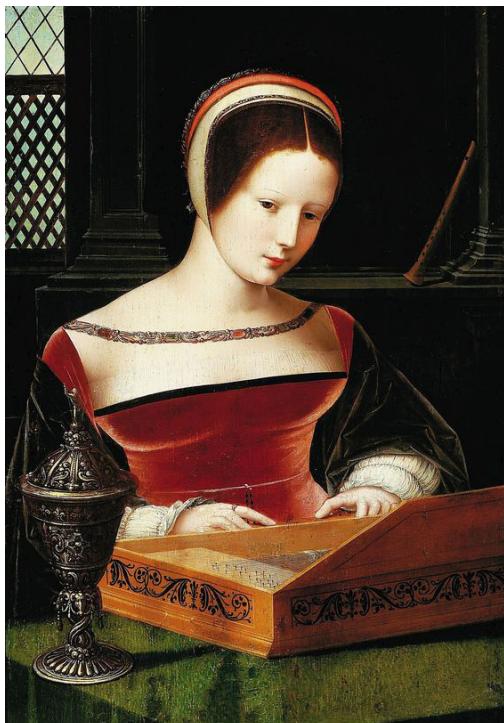
中文讲解
图1图注:半身女像大师《弹击弦古钢琴的女子》,1530年,木板油画,44×31厘米,波兹南国家博物馆藏,馆藏号FR 442 / Mo 115;附维基共享资源链接(2025年8月4日访问)。该图位于第24页,原文内嵌图像数据已省略,需查看原图以观察侧面黑色卷草纹与怪面装饰,以及绿丝绒衬垫等细节。
补充说明
图注中的FR 442 / Mo 115为该馆双重编号体系。
第13段(P0144)
原文复述
Nevertheless, certain trends can be discerned in some paintings, such as Girl at the Virginal by Catharina van Hemessen from 1548, now at the Wallraf-Richartz-Museum in Cologne (Fig. 2). The daughter of the aforementioned Jan van Hemessen is depicted here as a musician without any further attributes. Only her face and hands emerge from the dark background, together with the light wood of the soundboard. This features a small rose and a barely discernible triangular motif. On the inside of the framed side panel is a Latin motto of religious content. It is particularly interesting that the dolphin pattern typical of Ruckers instruments is inscribed on the wooden case in the manner of a frieze and not – as would become typical later on – printed on paper.
中文讲解
本段转向“一幅画内可识别出的装饰趋势”。Catharina van Hemessen是前文提及的Jan van Hemessen之女,其1548年的《维吉纳琴前的女孩》(藏于科隆Wallraf-Richartz博物馆)将人物简化到只剩面部与手,连同浅色音板一同从暗背景中浮现。 乐器装饰细节:(1)音板中央有一小花冠(rose)与勉强可辨的三角形纹样;(2)内框侧板写有宗教内容的拉丁文格言;(3)箱体外缘以带状(frieze)形式刻划海豚纹,而非后来Ruckers琴典型的纸面印刷海豚纹。 关键意义:这是正文首次明确提到Ruckers海豚纹(dolphin pattern)这一后来成为安特卫普琴标志的装饰母题;并指出16世纪中叶此纹尚为“手刻于木”,到后来才转为“纸面印刷”,勾勒出工艺演变。作者借此案例从“装饰趋势可辨”切入,既肯定图像史料的潜力,也借此引出贯穿后文的Ruckers参照线。
补充说明
Rose(花冠)是键盘乐器音板上常见的装饰音孔,常以镂雕木质花瓣图案围绕一圆孔而成,形似玫瑰。
Ruckers家族为安特卫普16–17世纪最重要的键盘乐器制造家族;其琴常用“海豚纹”(dolphin pattern)纸面印刷装饰,贴于音板内侧或边框,此装饰也成为Ruckers品牌的视觉标志。
第14段(P0145)
原文复述
10 For details on the development of the Ruckers paper prints, see Grant O’Brien, Ruckers (see n. 1).
中文讲解
脚注10:指向Grant O’Brien关于Ruckers专著以了解纸面印刷海豚纹发展的细节,文献线索见n.1。它限定上文“later on”的纸印海豚纹这一论断之出处。
第15段(P0146)
原文复述
[Fig. 2: Catharina van Hemessen, Girl at the Virginal, 1548, oil/wood, 30.5 x 24.3 cm, Wallraf-Richartz-Museum, Cologne, WRM 0654; https://commons.wikimedia.org/wiki/Category:Young\_woman\_playing\_a\_virginal\_by\_Catharina\_van\_Hemessen?uselang=de (accessed on 4 March 2025).]
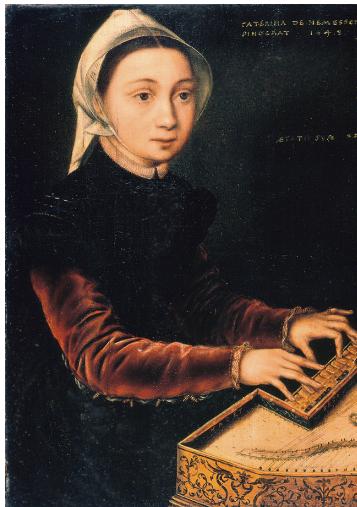
中文讲解
图2图注:Catharina van Hemessen《维吉纳琴前的女孩》,1548年,木板油画,30.5×24.3厘米,科隆Wallraf-Richartz博物馆藏,馆藏号WRM 0654;附维基共享资源链接(2025年3月4日访问)。图像数据已省略,需查看原图以观察音板上的小花冠、侧板拉丁文格言与带状海豚纹。
第16段(P0147)
原文复述
[More elaborate is the decoration of the virginal in the family portrait at the Stadsmuseum Lier by Frans Floris, 1561, which likely shows the Berchem family (Fig. 3). The presumptive man of the house plays the lute, his wife the virginal. The virginal’s case bears symbols of love, in particular a pair of doves. The soundboard, featuring a rose and painted with scattered flowers, is a representative example of the Flemish decorative practice that arose during the mid-16th century. Fig. 3: Frans Floris, Portrait of the Family van Berchem, 1561, oil/wood, 130 x 227 cm, Stadsmuseum Lier, 0052; https://commons.wikimedia.org/wiki/File:Frans\_Floris\_002.jpg (accessed on 4 March 2025).]

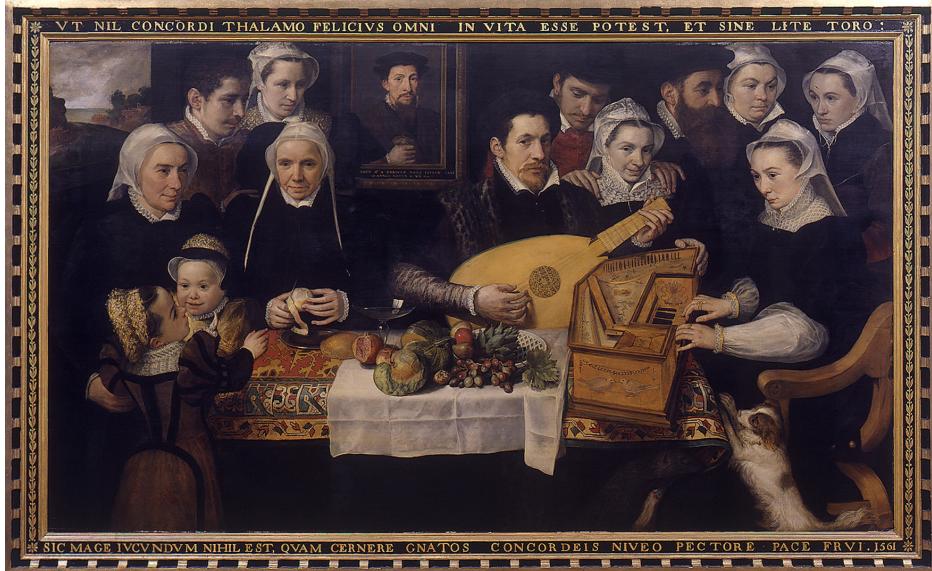
中文讲解
本段并置讨论文字与图3图注:Frans Floris 1561年的家族肖像画(藏于Lier市立博物馆)很可能表现Berchem家族;男主人弹琉特、女主人在维吉纳琴前。 装饰重点:维吉纳琴箱体绘有爱情象征,特别是一对鸽子;音板上既有花冠,又散布手绘小花。作者将其定位为“16世纪中叶佛兰德斯装饰实践”的代表案例。
意义:从本节脉络看,此例比Coxcie、Fiammingo、Bassano等“模糊/局部”画作更可信地提供了装饰信息——一对鸽子、散绘花朵、花冠这些元素被作者明确归入16世纪可见的装饰语言之中。
补充说明
鸽子作为爱情象征源于古典神话(如维纳斯战车由鸽子牵引)以及基督教图像学,在文艺复兴肖像中常用于暗示婚姻或家庭和睦。
第17段(P0148)
原文复述
The well-known painting Apollo and the Muses, c. 1570, by Marten de Vos (Fig. 4) shows a virginal decorated on the inside of its lid with a battle painting that features a multitude of figures. One of the Muses plays on this instrument in the company of her fellow Muses and Apollo. The contrast between the battle scene and this concert of the Muses is further heightened by the motto ‘Musae loco belli’ (‘Muses in place of war’), which is written on the instrument’s case. Later on, this painting even came to serve as a model for the lid painting on a Ruckers instrument of 1619.
中文讲解
本段以Marten de Vos约1570年的《阿波罗与缪斯》(藏于比利时皇家美术馆,图4)为例,揭示一种更高规格的装饰——“盖内画”。 核心内容:维吉纳琴盖内侧绘有场面宏大的战争图景;其中一位缪斯弹奏此琴,与同伴及阿波罗为伴。琴箱上写有拉丁文格言“Musae loco belli”(以缪斯代替战争),把“战争场景”与“缪斯音乐会”形成强烈对比,进一步以文字强化寓意。 更深一层:该画后被用作1619年一台Ruckers琴盖画的范本,使绘画—乐器装饰之间形成直接传承关系。 意义:作者借此例首次给出“lid painting(盖内画)”这一重要装饰类型,并提供从绘画到实物乐器的明确回流证据。
补充说明
Marten de Vos(1532–1603)为安特卫普画家,早年在意大利受风格主义影响,回低地国后成为当地重要历史/寓意画家之一。
“Musae loco belli”拉丁格言的逻辑:以音乐/缪斯取代战争,呼应文艺复兴晚期常见的“和平—和谐”人文理想。
第18段(P0149)
原文复述
[Fig. 4: Marten de Vos, Apollo and the Muses, c.1570 (?), oil/wood, 44.5 x 63.5 cm, Royal Museums of Fine Arts of Belgium, 3882; https://de.wikipedia.org/wiki/Datei:Apollo\_and\_the\_Muses\_by\_Marten\_de\_Vos\_(1570).jpg (accessed on 4 March 2025).]

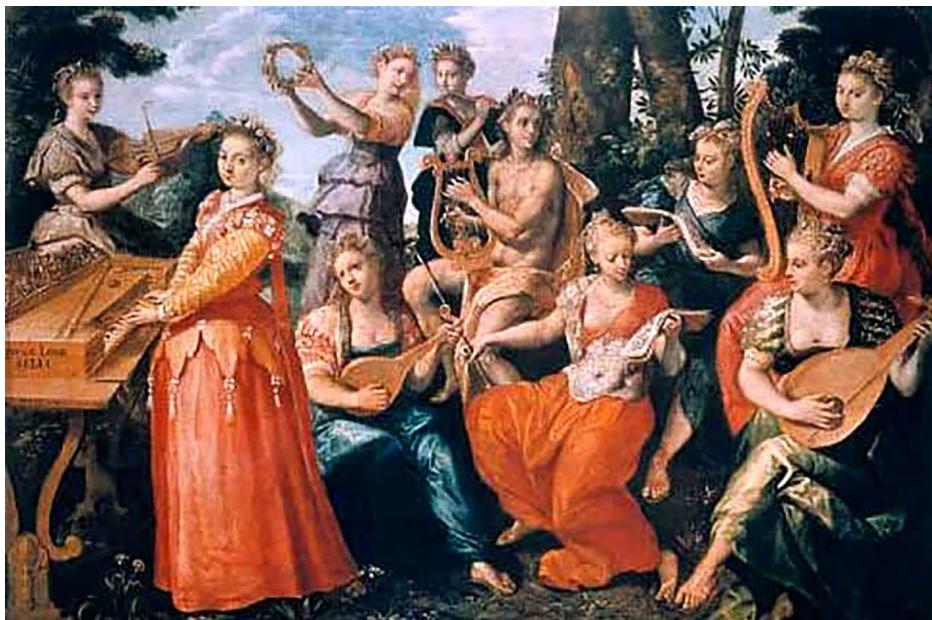
中文讲解
图4图注:Marten de Vos《阿波罗与缪斯》约1570年(带问号表示年代不确定),木板油画,44.5×63.5厘米,比利时皇家美术馆藏,馆藏号3882;附德文维基百科链接(2025年3月4日访问)。图像数据已省略,需查看原图以观察盖内战争画与箱体拉丁格言的位置与构图。
第19段(P0150)
原文复述
There were multiple painters, both female and male, who showed themselves playing keyboard instruments in their self-portraits. Among these paintings, the one created by Lavinia Fontana in 1577 (Fig. 5) stands out. Her instrument exhibits the typical Italian decorative concept of this era with a rose, wood of a natural appearance with thin black lines that were probably inlays, and ivory buttons on the jackrail and the edges of the case. Here Lavinia presents herself as a self-assured figure. The instrument, the servant, and the other details are accessories that underscore her elegant presence. Although her hands are on the keyboard, their carefully constructed line of sight points to the easel in front of the window in the background. Through the skillful execution of the composition and all the details, she also presents herself as a painter.
中文讲解
本段以Lavinia Fontana 1577年的《与仆人同在击弦古钢琴前的自画像》(罗马Accademia Nazionale di San Luca藏,图5)切入“画家自画像中的乐器装饰”。 乐器装饰:呈现典型意大利风格——音板上有花冠;箱体木材呈自然木色,其上细黑线可能为嵌条(inlays);琴键轨(jackrail)与箱体边缘有象牙制按钮(ivory buttons)。 图像寓意:Lavinia的姿态自我肯定,乐器、仆人与其他细节共同烘托其优雅;她的手虽置键盘之上,目光却刻意投向窗前的画架——通过构图细节之巧妙,作者强调她“以画家身份自我呈现”。 意义:作者借此把“装饰”与“画家自我呈现”两线并置:乐器既作身份道具,亦是可信的意大利装饰语汇例证。这与前文佛兰德斯/北方画作形成地域对照。
补充说明
Lavinia Fontana(1552–1614)为博洛尼亚画家,是文艺复兴时期少数以职业画家身份留下大量作品并享有声誉的女性之一;其自画像常融合多重身份(音乐家、画家、贵妇)的展示。
“jackrail”(琴键轨/拨子轨)是羽管键琴击弦机外侧的细木条,拨子(jacks)从其下方升起;用象牙饰于其上,是常见高规格装饰手法。
第20段(P0151)
原文复述
11 Reginald Howard Wilenski, Flemish Painters 1430–1830, 2 vols. (London, 1960), i, 143.
中文讲解
脚注11:R. H. Wilenski《佛兰德斯画家1430–1830》两卷本(伦敦,1960),第1卷143页。为正文关于Marten de Vos该画提供二手研究出处。
第21段(P0152)
原文复述
12 Now at the Musical Instrument Museum in Brussels, inv. no. 2935. Cf. Pollerus, Tasteninstrumente, (see n. 1), 201.
中文讲解
脚注12:上文提到的“以Marten de Vos《阿波罗与缪斯》为蓝本的1619年Ruckers琴”现藏于布鲁塞尔乐器博物馆,馆藏号2935;并指引作者本人著作Pollerus, Tasteninstrumente第201页进一步参考。功能:确证绘画回流至实物乐器的传承实例。
补充说明
布鲁塞尔乐器博物馆(MIM, Musical Instruments Museum)以收藏欧洲键盘乐器著称,其Ruckers藏品尤为丰富。
第22段(P0153)
原文复述
[Fig. 5: Lavinia Fontana, Self-Portrait at the Clavichord with a Servant, 1577, oil/canvas, 27 x 23.8 cm, Accademia Nazionale di San Luca, Rome, 743; https://commons.wikimedia.org/wiki/File:Lavinia\_Fontana\_-\_Self-Portrait\_at\_the\_Spinet\_-\_WGA07985.jpg (accessed on 4 March 2025).]

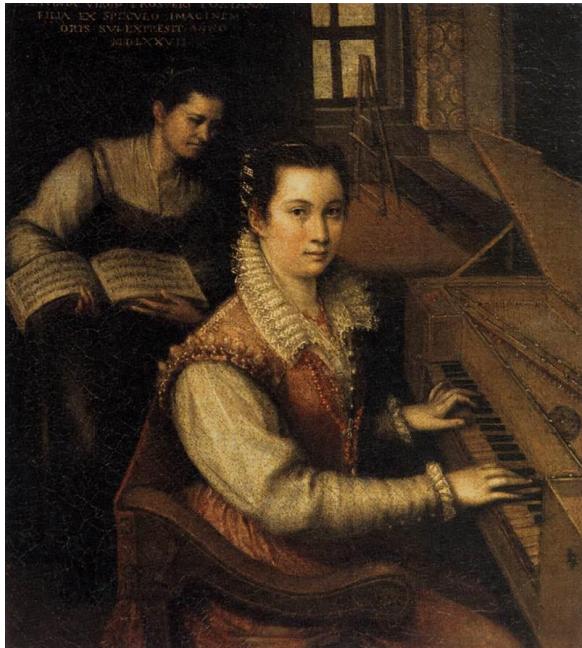
中文讲解
图5图注:Lavinia Fontana《与仆人同在击弦古钢琴前的自画像》,1577年,布面油画,27×23.8厘米,罗马Accademia Nazionale di San Luca藏,馆藏号743;附维基共享资源链接(2025年3月4日访问)。图像数据已省略,需查看原图以观察花冠、嵌条、象牙按钮等意大利装饰元素。
补充说明
维基文件名含“at the Spinet”实为该图常见的英文别名,正文中作者称其为clavichord;本文遵循正文物种称谓。
第23段(P0154)
原文复述
These paintings allow only limited conclusions to be drawn concerning the quantity and appearance of the instruments that actually existed in the 16th century, but they do at least show some types of decoration that were already in use by then. The range extends from simple undecorated instruments to elaborate designs with roses on (un)painted soundboards, inlays and applications, the well-known dolphin pattern, phytomorphic ornaments, mottos (i.e. aphorisms), and even lid paintings.
中文讲解
本段是前半段的“中场小结”:
- 限定结论:绘画虽能展示出16世纪装饰的某些类型,但不能可靠地推断当时乐器的数量与外观的总体情况。
- 装饰语汇清单:作者依此前的实例,列出一条从简到繁的装饰谱系——从“无装饰”到“精致设计”,具体包含:花冠(出现在已绘或未绘的音板上)、嵌条与贴饰(inlays and applications)、著名的海豚纹、植物形纹饰(phytomorphic ornaments)、格言/警句(mottos即aphorisms),乃至盖内画。 意义:这是本节为后续章节(甚至全章)所做的装饰分类铺垫,把图像所见转化为可作装饰史研究之分类标签;同时再次以“limited conclusions”提醒使用图像时需保持警惕。
补充说明
Phytomorphic指植物形态的纹样(藤蔓、花叶等),与正文P0133中的tendril(卷草)一致。
第24段(P0155)
原文复述
Alongside panel paintings, there also exist further visual sources that can provide clues as to decorative practice during the 16th century such as ecclesiastical and aristocratic furnishings as well as design and architectural drawings. For example, in Federico Zucchero’s drawing Man at the Claveçin (Fig. 6), the instrument is depicted as completely undecorated. According to a note written in the painter’s own hand, the man at the instrument is the Florentine author and musician Antonio Francesco Doni (1513–74).
中文讲解
本段将视野从架上绘画(panel paintings)扩展至其他视觉材料——教会与贵族陈设、设计与建筑图样——并以Federico Zucchero的素描《claveçin前的男子》(图6)为例。 关键信息:画中乐器“完全无装饰”;且画家亲笔注明画中弹琴者为佛罗伦萨作家兼音乐家Antonio Francesco Doni(1513–74)。 意义:一方面证明“无装饰”也是16世纪真实存在的装饰可能性;另一方面通过人物身份(Doni是当时活跃的文人音乐家)确认图像的现实参照;并提示除成品画作外,素描、设计图也是不可忽略的来源类别。
补充说明
Federico Zucchero(c.1540/41–1609),意大利风格主义画家,其兄长Taddeo Zucchero同为画家;二人活跃于罗马、佛罗伦萨、英国等地。
Claveçin为法语/古法语对羽管键琴的称呼;此处用作品名,意指画中乐器属于羽管键琴家族。
第25段(P0156)
原文复述
13 A reversed exemplar of this drawing is held by the Royal Collection Trust, RCIN 990220.
中文讲解
脚注13:英国皇家收藏基金会(Royal Collection Trust)另藏一幅该素描的反转镜像版本,编号RCIN 990220。功能:为该素描提供另一版本/复制品的线索,提示研究时需注意正反像差异。
第26段(P0157)
原文复述
[Fig. 6: Federico Zucchero, Man at the Claveçin, 1564, pencil, 15.4 x 22 cm, Louvre, Paris, 4576; <http://arts-graphiques.louvre.fr/detail/oeuvres/5/101833-Un-homme-debout-ecoutant-un musicien-jouant-du-clavecin-max> (accessed on 27 February 2025)]
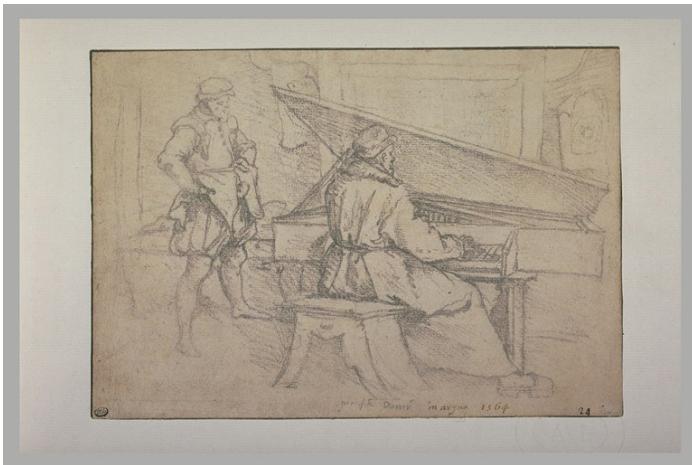
中文讲解
图6图注:Federico Zucchero《claveçin前的男子》,1564年,铅笔素描,15.4×22厘米,巴黎卢浮宫藏,馆藏号4576;附卢浮宫版画部在线链接(2025年2月27日访问)。图像数据已省略,需查看原图以确认琴体无装饰之描述与Doni之形象。
第27段(P0158)
原文复述
Keyboard instruments, being somewhat ‘awkward’ in shape, appear less often than other instruments in music-themed architectural ornaments; however, wood inlays, wall friezes, wall decorations, and the like occasionally do show rather simply decorated examples. One might point here to an intarsia in the Stanza della Segnatura in the Vatican, 1510, or a frieze at the Casa Giorgione in Castelfranco from 1504 (Fig. 7).
中文讲解
本段把视野再推一步至建筑装饰。核心观点:由于键盘乐器“形状有些笨拙”,它们在音乐主题的建筑装饰中出现频率低于其他乐器。但仍可偶见于木镶嵌(intarsia)、墙裙(frieze)、墙面装饰等。 作者给出两例:1510年梵蒂冈Stanza della Segnatura(签字厅)的木镶嵌,以及1504年Castelfranco的Casa Giorgione(乔尔乔涅故居)的墙裙(图7)。 意义:进一步丰富来源类别——尤其当架上绘画稀缺时,建筑陈设可补充早期装饰语汇;不过作者仍强调“simply decorated examples”,意味着建筑中的乐器装饰偏简朴,可作为下限参考。
补充说明
Stanza della Segnatura(签字厅)为梵蒂冈教皇宫殿内拉斐尔创作《雅典学院》等壁画之厅室,本身是文艺复兴艺术史经典现场;其镶嵌中含乐器图案常被视为“乐器图像学”的重要证据。
Casa Giorgione位于威尼斯以北的Castelfranco Veneto小镇,传为画家乔尔乔涅(Giorgione)出生地;其外墙饰带因包含乐器图案而闻名。
第28段(P0159)
原文复述
[Fig. 7: Wall frieze at the Casa Giorgione, 1504, Castelfranco Veneto (Photo: H. Pollerus).]
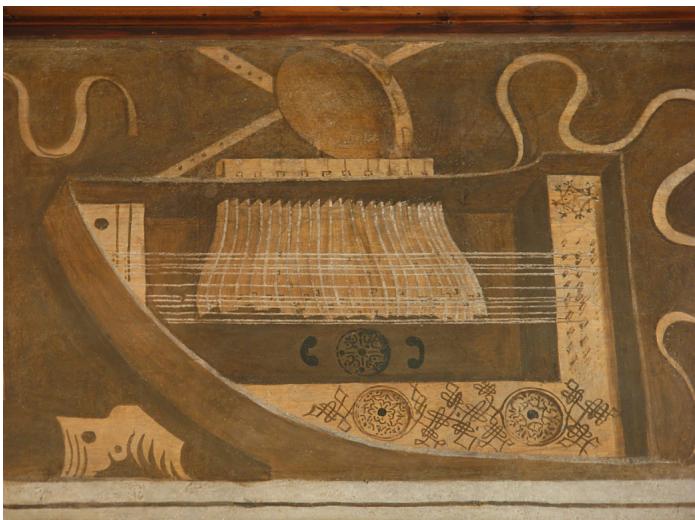
中文讲解
图7图注:Casa Giorgione墙裙,1504年,Castelfranco Veneto,摄影H. Pollerus。图像数据已省略,需查看原图以观察其中的乐器形象与简约装饰。
第29段(P0160)
原文复述
The few illustrations in historical musical treatises, such as Sebastian Virdung’s Musica getutscht und außgezogen, 1511, are designed to capture the function of the instruments and hence feature hardly any decoration (Fig. 8).
中文讲解
本段引入另一图像类别——“音乐理论著作中的插图”。以Sebastian Virdung 1511年的《Musica getutscht und außgezogen》(德语“音乐入门并展开”)为例。 关键观察:这些插图的目的在于说明乐器的功能与结构,因此几乎不描绘装饰。 意义:为“装饰史料稀薄”这一总论再加一证:理论著作的图像志趣在“功能性”,与作者要追问的“装饰”问题不重合,因此对装饰史价值有限。
补充说明
Sebastian Virdung(c.1465–c.1511/12)为德国神父与音乐理论家,其1511年著作是现存最早以图解形式系统介绍欧洲乐器的出版物之一,对键盘乐器(clavichord、clavicembalo等)插图尤为珍贵。
第30段(P0161)
原文复述
[Fig. 8: Sebastian Virdung, Musica getutscht und ausgezogen, [Basel] [Michael Furter] [1511] (vdm: 3); http://resolver.staatsbibliothek-berlin.de/SBB0001444100000000 (accessed on 27 February 2025).]
中文讲解
图8图注:Virdung《Musica getutscht und ausgezogen》,巴塞尔,Michael Furter印行,1511年(vdm:3即VD16/Musikalisches-Drucke之编号3);附柏林国家图书馆在线解析链接(2025年2月27日访问)。图像数据已省略,需查看原图以对照正文“功能图解近无装饰”之判断。
第31段(P0162)
原文复述
One of the few surviving 16th-century design drawings for an instrument decoration is a drawing created by an anonymous artist between 1560 and 1570 (Fig. 9). It presents an elaborate concept for a lid decoration, with figures making music and dancing in a distinguished interior. It is not known whether this concept was ever realised, but its strong relationship with music does point to one of the main substantive themes of instrument decoration.
中文讲解
本段举出16世纪少数存世的“装饰设计图”之一——由匿名艺术家创作于约1560–1570年(图9,苏格兰国家画廊藏)。 内容:该图呈现一份详尽的“琴盖装饰方案”:人物在高雅室内场景中作乐、舞蹈。 关键限定:作者坦言不知此方案是否最终被制成实物;但其与音乐主题的紧密关联,恰恰印证乐器装饰的一条主要主题线——“音乐/舞蹈/高雅场景”作为乐器装饰的常见题材。 意义:把“设计图”纳入来源谱系,扩展了图像史料的范围;同时再次提醒读者要区分“设计意图”与“成品实物”。
第32段(P0163)
原文复述
[Fig. 9: Anon., People Dancing and Making Music, c.1560–70, pen, brown ink and wash/paper, 17.2 x 29.5 cm, National Galleries of Scotland, D665; https://www.nationalgalleries.org/artand-artists/14199/study-lid-harpsichord-people-dancing-and-musicc (accessed on 4 March 2025).]
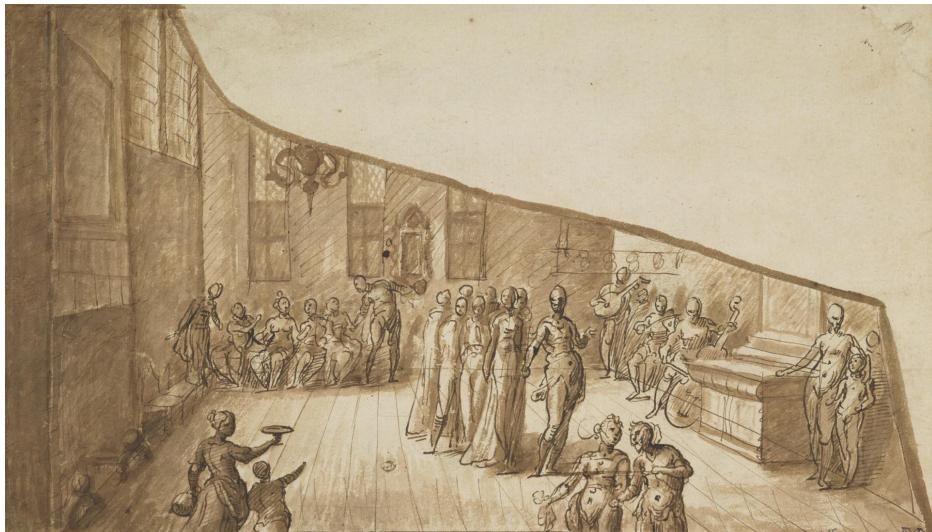
中文讲解
图9图注:匿名艺术家《作乐与舞蹈的人们》约1560–70年,钢笔、棕色墨与淡彩于纸,17.2×29.5厘米,苏格兰国家画廊藏,馆藏号D665;附苏格兰国家画廊官方链接(2025年3月4日访问)。图像数据已省略,需查看原图以观察盖内人物布局、舞蹈/演奏场景与室内细节。
第33段(P0164)
原文复述
Even if pictorial sources do provide central clues as to decorative practice, it must be borne in mind when assessing them that they likely show only a tiny share of the instruments that existed in the 16th century and that, in general, questions concerning how accurately these images corresponded to reality do remain worthy of discussion.
中文讲解
本段作为本节收束,重申对图像史料的方法论判断:
- 图像确实能为16世纪装饰实践提供核心线索;
- 但评估时必须意识到:它们可能只展示了当时存在乐器中极小的一部分;
- 这些图像在多大程度上如实对应现实,仍是值得讨论的问题。 意义:作者把前述全部例证(以及“限制”论断)凝练为一条总的方法论警戒,为下文进入实物/文献等其他史料范畴做好过渡。
脚注 / 边栏 / 图表 / 附加信息(如有)
本节除正文外包含九幅图(Fig. 1–9)以及十二条编号脚注(n. 2–13,加n. 1与n. 10)。九幅图分别为:Fig. 1 半身女像大师《弹击弦古钢琴的女子》(波兹南);Fig. 2 Catharina van Hemessen《维吉纳琴前的女孩》(科隆);Fig. 3 Frans Floris《Berchem家族肖像》(Lier);Fig. 4 Marten de Vos《阿波罗与缪斯》(布鲁塞尔);Fig. 5 Lavinia Fontana自画像(罗马);Fig. 6 Federico Zucchero《claveçin前的男子》(卢浮宫);Fig. 7 Casa Giorgione墙裙(Castelfranco);Fig. 8 Virdung 1511年著作(柏林国家图书馆);Fig. 9 匿名《作乐与舞蹈的人们》(苏格兰国家画廊)。脚注主要功能是给出画作的馆藏、年代、尺寸与访问链接,以及补充参考文献(如Wilenski、O’Brien、Pollerus本著、Shephard)。
💡 本节核心要点
- 图像作为16世纪键盘乐器装饰史料总体稀缺,质量与数量到17世纪才有显著提升,因此作者对“绘画来源”的可用性持谨慎态度。
- 即使在同一题材下,不同画家对乐器的描绘重心差异极大:van Hemessen强调机械与手部,Master of the Female Half-Lengths强调侧面纹饰,Floris强调象征与花饰,Fontana强调意大利式优雅——表明乐器在画中往往从属于画家的整体意图,而非如实记录装饰。
- 尽管如此,少数可信案例(Hemessen的带状海豚纹、Floris的鸽子与散花、de Vos的盖内战争画与拉丁格言、Fontana的花冠/嵌条/象牙按钮、匿名设计图的舞蹈音乐场景)勾勒出16世纪键盘乐器装饰谱系:无装饰、花冠、嵌条/贴饰、海豚纹、植物纹、格言、盖内画。
- 装饰主题存在明确的文化母题——音乐/舞蹈/高雅场景盖内画、象征爱情的鸽子、宗教或寓意拉丁格言、奢华配饰(绿色丝绒衬垫、华丽杯盏)——这些母题既反映装饰实践,也折射时代审美与寓意表达。
- 16世纪Ruckers海豚纹以“木上刻绘”形式出现,尚未转为后来的纸面印刷,可借Hemessen 1548年画作被确证,为装饰工艺演变留下节点。
- 作者的方法论立场:图像是“提供线索”而非“定量证据”,评估时须保留对“图像—现实”对应度的怀疑;这是本节对后续章节如何使用图像史料所设的总括性警示。
🔑 关键术语
- Rose (花冠):键盘乐器音板上常见的装饰音孔,常以镂雕木质花瓣围绕中心圆孔构成,形似玫瑰。本节中见于Hemessen 1548、Floris 1561、Fontana 1577等画作,是16世纪最稳定的装饰母题之一。
- Dolphin pattern (海豚纹):Ruckers家族键盘乐器标志性的带状装饰,描绘海豚与海怪互相缠绕。16世纪中叶以手刻方式施于木面,后来转为纸面印刷贴附于音板;本节借Hemessen画作提示这一工艺节点。
- Lid painting (盖内画):键盘乐器上盖内侧所绘的装饰画。本节以Marten de Vos《阿波罗与缪斯》为典型,其后甚至被1619年Ruckers琴盖直接借用为蓝本;表明绘画与乐器装饰之间存在双向回流。
- Inlay (嵌条/镶嵌):将不同颜色或材质的木条/骨/象牙等嵌入器体表面形成图案的工艺。Lavinia Fontana 1577画中所见“thin black lines”被认为是嵌条,为意大利装饰风格的代表手法之一。
- Jackrail (琴键轨/拨子轨):羽管键琴击弦机外侧的细木条,拨子(jacks)从中升起。Lavinia Fontana画中此处与箱体边缘饰以象牙按钮,属高规格装饰;本节借此确认意大利16世纪装饰习惯。
- Motto (格言):在乐器箱体内侧书写的拉丁文或其他短句,常带宗教/寓意内容。Hemessen画中侧板所刻拉丁格言、de Vos画中“Musae loco belli”均属此类,反映装饰与文本结合的传统。
- Intarsia (木镶嵌):以不同色木拼嵌图案的工艺,多用于建筑、家具与乐器装饰。本节以梵蒂冈签字厅1510年镶嵌为例,提示建筑装饰中亦保留16世纪乐器形象与简约装饰语汇。
- Studiolo (私人书房):意大利文艺复兴时期贵族/富裕市民宅邸中用于阅读、收藏、冥想的小型密室。本节借Imperia Cognati studiolo的当代记述(绿丝绒覆桌、上置乐器与乐谱),与Anguissola自画像互证绿丝绒与乐器之搭配。
S16 Writen Sources
第1段(P0165)
原文复述
Writen Sources
中文讲解
本句为小节标题“Writen Sources”(原文拼写如此,正确拼写应为“Written Sources”)。它界定了接下来四页内容的主题:用于讨论16世纪乐器装饰问题的文字材料。需要注意的是,这个标题与前一节“Pictorial Sources”形成对应——前节依靠图像证据,本节则转向文献证据;标题本身就预告了作者将面对与图像同样稀缺、零散的史料处境。
第2段(P0166)
原文复述
Much like pictorial sources, written sources on decoration from the 16th century are scarce and scattered. Archival records, especially contemporaneous inventories, occasionally provide small bits of information regarding certain prominent instruments’ visual qualities. For example, the following note can be found in a 1566 inventory of Fugger instruments:
中文讲解
本段是本节的总纲句。它先回扣前一节“Pictorial Sources”的判断——图像证据稀缺而零散——然后指出文字文献同样具有这种稀缺性。接着把“文字文献”这一大范围缩小到最有用的一类:与乐器同时代的档案记录,尤其是清册(inventories),它们偶尔能透露某件著名乐器外观的若干细节。最后以Fugger家族1566年的清册为例作为引子,将原文德语材料直接抛给读者。这一段为本节定下了两个基调:第一,史料是零散、需要逐条拼接的;第二,最有价值的材料是清册而非音乐理论著作。
第3段(P0167)
原文复述
Mer ain schönß langes Instrument, von schönem schwarz Ebano/mit erhepten helffenbeinen Prustbildtlen. Inwendig unnd/künstlich gemaltem Fueter, auch 3 Registern helffenbein/Clavier und vergulten Negelen. Ainer gewaltigen Resonantz./Ist zu Venedig gemacht p. Franc. Ungaro.14
中文讲解
这是1566年Fugger家族乐器清册中的一条原文,以早期近代德语书写,逐词复述如下:“还有一件漂亮的细长乐器,材质为美丽的黑色乌木,带有凸起的象牙胸像。内有精巧彩绘装饰、另配有3排音栓、象牙键盘和镀金钉。共鸣极为雄浑。威尼斯制作,制作者Franc. Ungaro。”这段原始材料是本节第一个具体证据,揭示了16世纪清册所能提供的装饰信息类型:材质(乌木、象牙)、装饰工艺(凸雕胸像、内壁彩绘)、机械构件(镀金钉)、音响效果(共鸣雄浑)、以及制作者与产地(威尼斯,Ungaro)。作者借此向读者示范:即便只是一份清单里的一行字,也能同时传递外观、材料和工艺的多重信息。
补充说明
该条末尾的数字“14”指向脚注14,是作者标注的史料出处,提示读者此处并非作者杜撰而是引自Fugger家族清册。
第4段(P0168)
原文复述
(‘Further, a beautiful long instrument, made of beautiful black ebony, with raised ivory portraits. Elaborately painted interior decoration, a further three stops, an ivory keyboard, and gilded nails. Tremendous resonance. Made in Venice by Franc. Ungaro.’)15
中文讲解
本段是作者对前一段德语清册条目的英文翻译,并在末尾标号“15”。它对应脚注15,提示读者作者自己作了翻译,并指出Douglas Alton Smith在1980年GSJ文章中曾给出过另一种译法供参照。这一处理方式说明了作者的史料态度:他不只引用德语原文,还主动承担翻译责任并公开另一备选译文,把翻译的不确定性明示给读者。这也提醒学术读者:早期近代德语的解读可能有微差,材料需要互相印证。
第5段(P0169)
原文复述
Those who compiled inventories usually considered the structural qualities of the instruments more important than their appearance. It is thus that, although the 1590 inventory of the Graz court treasury indicates that four keyboard instruments were present, we learn very little about their external appearance:
中文讲解
本段是方法论的关键过渡句。作者先给出一个概括性判断:清册编纂者通常更看重乐器的结构性属性(如音栓、弦、音域)而非外观,这是一条史料批评层面的重要限定。接着以1590年格拉茨宫廷宝库的清册作为反例——该清册虽然列出了四件键盘乐器,却几乎没有提供它们的外观信息。这句话的功能是为接下来那段长长的德语引文做铺垫:尽管这条引文被普遍引用,作者必须提醒读者不要高估其外观描述的密度。它实际上也是为了后文引入Lomazzo的装饰理论做铺垫——既然清册描述外观不够,理论著作就成为另一条关键路径。
第6段(P0170)
原文复述
Erstlichen ein instrument mit mössingen saiten, etlichen registern […]; ist mit helfenpain eingelegt und mit silberen vergulten auch alebasterbildern gezieret. / Mer ein instrument mit mössingen saiten und verborgnen pfeifen […]. / Mer ein ander lang instrument mit mössing und stählen saiten, darauf man lauth und still schlagen khan; irer furstlich durchlaucht etc. vom herzogen zu Ferära überschickht worden […]. / Ain clavicimole mit dreÿ Registern; soll zu hof in der jungen fürstin Erzherzogin Maria zimmer sein.16
中文讲解
这是1590年格拉茨宫廷宝库清册的德语原文,逐项复述如下:第一件乐器有黄铜弦与若干音栓;镶嵌象牙,并以镀金银件和雪花石膏雕像装饰。第二件为带黄铜弦与暗管的乐器。第三件为细长乐器,有黄铜弦和钢弦,可以大声或轻声演奏;由费拉拉公爵赠送。第四件为带三排音栓的clavicimole,据说置于宫廷中年轻的Archduchess Maria公主的房间里。末尾标号“16”指脚注16,提示该引文的史料出处。这段引文的作用是让读者亲眼看到:当清册关心外观时,能写出“镶嵌象牙、镀金银件、雪花石膏像”这样的细节;但同时也能看到,结构性信息(弦的材质、暗管、能强弱演奏、音栓数)往往占据更大篇幅——这正印证了前一句“清册编纂者更重视结构而非外观”的判断。其中“clavicimole”很可能指cimbalo(羽管键琴类的统称)。
第7段(P0171)
原文复述
14 Richard Schaal, ‘Die Musikinstrumenten-Sammlung von Raimund Fugger d. J.’, in: AfMw 21 (1964), 212–16.
中文讲解
这是脚注14,逐字复述其文献信息:Richard Schaal,《小Raimund Fugger的乐器收藏》,载于《音乐学研究档案》(AfMw)第21卷,1964年,第212–216页。该脚注为P0167所引1566年Fugger清册条目提供学术来源;它的功能是支持性脚注,告诉读者这条史料最初由Schaal在1964年的研究中整理出版。
第8段(P0172)
原文复述
15 Author’s translation. A different translation can be found in Douglas Alton Smith, ‘The Musical Instrument Inventory of Raymund Fugger’, in: GSJ 33 (1980), 36–44, at 40.
中文讲解
脚注15,逐字复述:作者自译。另可见Douglas Alton Smith《Raymund Fugger的乐器清册》一文中的另一种译文,载于《英国琉特学会学报》(GSJ)第33卷,1980年,第36–44页,见第40页。此脚注一方面声明翻译由本书作者完成,另一方面为读者提供第二种译法的出处以便比对;它是限定/旁证性脚注,作用是让读者知道译文存在差异而非定本。
第9段(P0173)
原文复述
16 Heinrich Zimerman (ed.), ‘Urkunden, Acten und Regesten aus dem Archiv des k. k. Ministeriums des Inneren (Fortsetzung)’, in: Jahrbuch der kunsthistorischen Sammlungen des
中文讲解
脚注16的起始部分,逐字复述:Heinrich Zimerman编,《出自皇室内部事务部档案的文书、案卷与节录(续)》,载于《皇室最高家族艺术收藏年鉴》。该脚注内容在P0177由同一脚注的续行接续给出。它是来源性脚注,为P0170、P0174所引格拉茨宫廷清册提供出版来源;Zimerman是19世纪奥地利档案学家,其编本至今仍是引用哈布斯堡宫廷乐器档案的常见二手来源。
第10段(P0174)
原文复述
(‘First, an instrument with brass strings, several stops […]. It is inlaid with ivory and decorated with silver, gilded, and alabaster pictures. Second, an instrument with brass strings and hidden pipes […]. Further, another long instrument with brass and steel strings on which one can play loudly and softly; sent to Her Serene Highness etc. by the Duke of Ferrara […]. A clavicimole with three stops; it is said to be at the court in the chamber of the young Princess Archduchess Maria.’)
中文讲解
本段是作者对前一段格拉茨宫廷清册德语原文的英文翻译。它再次示范了清册文献的混合特征:装饰描述(象牙镶嵌、镀金银件、雪花石膏雕像)与结构性描述(黄铜弦、暗管、能强弱演奏、三排音栓)并列出现,同时夹杂行政信息(费拉拉公爵赠送、置于Archduchess Maria的房中)。这段翻译让不熟悉德语的读者也能体会:清册在“结构”和“装饰”上的偏重并不均匀——通常装饰只在器物本身特别华丽时才被强调。
第11段(P0175)
原文复述
Of similar character are the brief descriptions in other inventories such as that of the musical instruments at the Royal Palace of Madrid, which lists eleven keyboard instruments with their estimated values and brief notes on their provenance and condition. Mention is made, for example, of a ‘clavicordio of white wood, two yards of length; square: covered with black leather, and in the lid a landscape painting. – Broken’ and a ’large clavicordio and claviórganos all together with much variation of music, which is played with hands and feet. It was presented to his Majesty by Senor Don Juan of Austria.‘17
中文讲解
本段把视线从德语区宫廷扩展到西班牙王室:1602年马德里王宫的乐器清册列举了十一件键盘乐器,每条记录包含估价、出处和状况说明。作者挑出两条作为例子:第一件是白木方形clavicordio,长两码,外覆黑革,盖内绘有风景画,注明“已破损”;第二件是clavicordio与claviórganos的组合,可用双手双脚演奏,曾由Don Juan of Austria献给国王。这两例的功能是向读者展示清册类型的多样性——它不仅记录装饰(黑革蒙皮、盖内风景画),还记录王室馈赠关系和器物状态(破损、可演奏),这些维度在研究乐器装饰史时都值得注意。
第12段(P0176)
原文复述
At any rate, inventories do indicate the presence of individual decorative elements. An analysis and comparison of the various inventories would be an eminently rewarding research project, seeing as such sources tell one more than most music-theoretical treatises of the time – which, in fact, hardly mention decoration at all. Perhaps Johann Mattheson’s later opinion already had currency in the 16th century: ‘Die schönste Orgel, ohne Organisten, dient nur zum hinderlichen Zierrath (‘The most beautiful organ, without an organist, serves only as a cumbersome decoration’).18 From the perspective of the visual arts, however, the prevailing values were quite naturally different. In his Trattato dell’arte della pittura, scultura et architettura, published in 1584, the painter and art theorist Giovanni Paolo Lomazzo made no move to question whether musical instruments should be decorated. He did, however, insist that instruments not be used as image carriers per se, with the image instead having to serve the musical instrument. Such images, he wrote, should make for ‘accrescimento di dolcezza alla vista, convenienti alla musica’, i.e., enhanced sweetness to the eye such as suits the music.19 As far as pictorial themes were concerned, he only allowed for those with a direct connection to music – ’non contengano altro che soggetto di musica’ (‘contain nothing but the subject of music’).20 Noting that it was common practice to depict a wide variety of subjects such as the conversion of Saul, miracles, or battles without any musical references or relevance, Lomazzo asserted that this was to be rejected. Since his recommendations were primarily directed at church organs, he naturally suggested – probably in accordance with the decrees of the Tridentine Council21 – themes from the Bible and other Christian writings such as Saint Cecilia, David singing the Psalms, choirs of angels, and the like. And if a non-musical subject was chosen, he wrote, music should at least be included in the staffage – an example being angels playing music at the birth of Christ.
中文讲解
本段是本节理论部分的核心,承担了多个层次的工作。第一,先肯定清册的价值:它至少能指认某些装饰元素的存在;并提出一个研究设想——系统比较各类清册将极具价值,因为清册提供的信息比16世纪几乎不谈装饰的音乐理论著作更多。第二,引入音乐家Mattheson(虽属1739年,但其倾向可能早在16世纪就存在)的名言“最美丽的管风琴若没有管风琴师,只不过是碍事的装饰物”,用以代表一种轻视乐器外观、只重其发声功能的音乐家视角。第三,提出关键转折:从视觉艺术的角度看,价值判断截然不同。作者把目光投向1584年出版的Lomazzo《绘画、雕塑与建筑论艺》,系统摘录其装饰原则:(a) 乐器当然应该装饰;(b) 但乐器不应沦为图像的载体,图像必须服务于乐器;(c) 装饰应为视觉带来“accrescimento di dolcezza alla vista, convenienti alla musica”,即与音乐相称的、对眼睛的甜美增益;(d) 图像题材必须与音乐直接相关——“non contengano altro che soggetto di musica”,即“不得包含音乐以外的主题”;(e) 对于教堂管风琴,应依特伦特大公会议的精神取《圣经》和基督教经典主题,如圣则济利亚、大卫奏诗篇、天使合唱团等;(f) 即便选择非音乐题材,也必须在陪衬中加入音乐元素,例如基督诞生时演奏音乐的天使。这段话的功能是确立16世纪装饰理论的一条核心规则——“图像必须服务于音乐而非反过来”,并把Lomazzo树立为本节最重要的理论发言人。
补充说明
Mattheson的引文虽发表于1739年,但作者用“或许已经流传于16世纪”这一措辞处理时代错位,提示读者要注意:直接套用后世观念去解释16世纪乐器需要谨慎。
第13段(P0177)
原文复述
Allerhöchsten Kaiserhauses 7 (1888), xvii–lxxxiv, at xxi, xxxi.
中文讲解
脚注16的续行,逐字复述:《皇室最高家族艺术收藏年鉴》第7卷,1888年,第xvii–lxxxiv页,见第xxi、xxxi页。此行接续P0173的脚注开头,完成对Zimerman所编格拉茨宫廷档案出版信息的完整引述。它为P0170、P0174所引1590年清册条目提供精确页码。
第14段(P0178)
原文复述
17 Martin McLeish, ‘An Inventory of Musical Instruments at the Royal Palace, Madrid, in 1602’, in: GSJ 21 (1968), 108–28, at 121.
中文讲解
脚注17,逐字复述:Martin McLeish,《1602年马德里王宫乐器清册》,载于《英国琉特学会学报》(GSJ)第21卷,1968年,第108–128页,见第121页。它是来源性脚注,为P0175所引马德里王宫1602年清册条目提供学术来源。
第15段(P0179)
原文复述
18 Johann Mattheson, Der vollkommene Capellmeister (Hamburg: Christian Herold, 1739), Preface, 20.
中文讲解
脚注18,逐字复述:Johann Mattheson,《完美的乐长》(Hamburg:Christian Herold,1739),前言部分,第20页。它是来源性脚注,为P0176所引Mattheson那句“最美丽的管风琴若没有管风琴师,只不过是碍事的装饰物”提供出版信息;它表明该言论出自1739年的德文著作前言中。
第16段(P0180)
原文复述
19 Giovanni Paolo Lomazzo, Trattato dell’arte della pittura, scultura et archittetura (Milan: Paolo Gottardo Pontio, 1584), 346; https://mdz-nbn-resolving.de/details:bsb00104031 (accessed 4 March 2025).
中文讲解
脚注19,逐字复述:Giovanni Paolo Lomazzo,《绘画、雕塑与建筑论艺》(Milan:Paolo Gottardo Pontio,1584),第346页;附数字化访问链接及2025年3月4日的访问日期。它是来源性脚注,为P0176所引Lomazzo关于装饰应给眼睛带来“accrescimento di dolcezza alla vista, convenienti alla musica”的原文提供出版信息及数字化访问途径。
第17段(P0181)
原文复述
20 Ibid.
中文讲解
脚注20,逐字复述:同上(Ibid.)。它是来源性脚注,承袭脚注19的出版信息,为P0176所引Lomazzo“non contengano altro che soggetto di musica”一句提供同一来源(Trattato第346页或紧随其后的段落)的引证。
第18段(P0182)
原文复述
According to Lomazzo, these rules also applied to instruments outside of churches, by which he probably meant mainly stringed keyboard instruments. For these, however, also he found other music-related themes to be suitable, especially those from Greco-Roman mythology such as Orpheus, Apollo and the Muses, Amphion, Arion, etc. Inspirations from poetry and history as well as original inventions of the artist were also appropriate. Lomazzo’s own suggestion for an ‘original invention’ adheres to the stipulation of musical relevance and depicts twenty-eight ‘uomini eccellenti including various Flemish and Italian singers, musicians, composers, and visual artists including Adriano Willaert and Leonardo da Vinci.22 These portraits were meant to represent the ’nove cori della musica à tre à tre, co’suoi instromenti’, being something like a secular version of the nine choirs of angels.23 Whether this densely packed crowd of artists shown together with an organ, lutes, lyres, viols, harps, citterns, cornetts, and trombones ever actually came to populate an instrument lid is not known.
中文讲解
本段接续P0176对Lomazzo的讨论,焦点从教堂管风琴转向非教堂乐器。作者指出:Lomazzo的图像规则同样适用于教堂之外的乐器,所谓“教堂之外”很可能主要指有弦键盘乐器。对于这些乐器,Lomazzo允许另一些与音乐相关的主题,尤其推崇希腊罗马神话——俄耳甫斯、阿波罗与缪斯、安菲翁、阿利翁等;诗歌与历史题材以及艺术家自己的“原创发明”也被认可。接着作者展示Lomazzo自己提出的一项“原创发明”方案:描绘二十八位“uomini eccellenti”(卓越之士),包括弗拉芒与意大利的歌手、演奏家、作曲家、视觉艺术家,其中包括Adriano Willaert与Leonardo da Vinci;这些肖像代表“nove cori della musica à tre à tre, co’suoi instromenti”,即一种世俗化版本的“九层天使合唱团”,每三人一组,各持乐器。最后作者承认:这一密集成群的艺术家方案是否曾真正出现在某件乐器的琴盖上,至今无从考证。这段话的功能有三重:(a) 进一步落实Lomazzo规则的适用范围;(b) 让读者体会“世俗音乐主题”在16世纪装饰理论中的合法性;(c) 通过未实现的方案提示“理论”和“实物装饰”之间的距离,从而为下一段Lomazzo非孤例的判断做铺垫。
补充说明
“nove cori”是天主教神学和艺术中关于天使分为九层的传统概念;Lomazzo把它世俗化为音乐界“卓越之士”的九组,正是其理论创造性的体现。
第19段(P0183)
原文复述
Although Lomazzo was the only author to explicitely refer to the ornamentation of musical instruments, his recommendations for pictorial themes were by no means his own idiosyncratic ideas but much rather a theoretical distillation of contemporary practice that was also precisely in keeping with general art theory as it pertained to autonomous pictorial works during the Counter-Reformation – with similar recommendations having, for example, been formulated in a 1564 treatise by Giovanni Andrea Gilio da Fabriano, who likewise allowed for ‘poetic’, ‘historical’, and ‘mixed themes in addition to religious content.24
中文讲解
本段是本节最重要的方法论收束句。它包含三层递进的论断:第一,Lomazzo是唯一明确论述乐器装饰的作者——也就是说,他是个特例而非普遍声音。第二,Lomazzo的图像主题建议并非个人奇想,而是当时装饰实践的理论提炼。第三,这种提炼同时与反宗教改革时期一般艺术理论高度契合,作者以1564年Gilio da Fabriano的论著作为旁证——Gilio也允许在宗教内容之外加入“诗意”、“历史”与“混合”主题。这段话的功能是双重的:既抬高Lomazzo的证据价值(他的观点有同行背书),又限制Lomazzo的代表性(他不是孤立的个人天才,而是更广泛艺术思潮的反映)。作者借此为读者构造出一个判断:研究乐器装饰必须把乐器置于16世纪意大利艺术理论的大语境中理解。
补充说明
Gilio da Fabriano是反宗教改革时期的教士兼艺术理论家,作者通过脚注24提示其身份。
第20段(P0184)
原文复述
21 The Council of Trent (1545–63) and Counter-Reformation policies fundamentally did not allow pagan, classical, or profane elements in religious painting. The depiction of mythological themes was tolerated as ‘poetic’ painting on a case-by-case basis. Anthony Blunt Kunsttheorie in Italien 1450–1600 (Munich, 1984), 79.
中文讲解
脚注21,逐字复述:特伦特大公会议(1545–1563年)及反宗教改革政策原则上不允许宗教绘画中出现异教、古典或世俗元素;神话题材的描绘作为“诗意”绘画仅在个案基础上被容忍。Anthony Blunt,《1450–1600年的意大利艺术理论》(Munich,1984),第79页。它是限定/旁证性脚注,作用是说明P0176中Lomazzo为何“很可能依照特伦特大公会议的法令”选择《圣经》与基督教经典主题;它也为Lomazzo允许希腊罗马神话出现于非宗教乐器上这一点提供政策背景——神话题材在世俗器物上是被允许的,但需以“诗意绘画”的名义个案处理。
第21段(P0185)
原文复述
22 For an identification of all the individuals, see Pollerus, Tasteninstrumente (see n. 1), 204–5.
中文讲解
脚注22,逐字复述:关于所有人物的辨认,参见Pollerus,《键盘乐器》(参见脚注1),第204–205页。它是旁证性脚注,为P0182所提二十八位“uomini eccellenti”的具体身份名单提供进一步辨识的文献指引,指向该书第204–205页的考证内容。
第22段(P0186)
原文复述
23 Lomazzo, Trattato (see n. 19), 347. Lomazzo himself painted a fresco depicting the Nine Choirs of Angels in the Church of San Marco in Milan in 1570. On Lomazzo, see also: Marilena Cassimatis, Zur Kunsttheorie des Malers Giovanni-Paolo Lomazzo (1538–1600) (Frankfurt a.M., 1985).
中文讲解
脚注23,逐字复述:Lomazzo,《论艺》(参见脚注19),第347页。Lomazzo本人曾于1570年在米兰San Marco教堂绘制描绘“九层天使合唱团”的壁画。关于Lomazzo,另见Marilena Cassimatis,《画家Giovanni-Paolo Lomazzo(1538–1600)的艺术理论》(Frankfurt a.M.,1985)。它是来源与旁证并存的脚注:前半为P0182所引“nove cori della musica”提供出版页码;后半则补充说明Lomazzo对“九层天使合唱团”这一题材并非只停留在纸面,他在1570年还亲自绘过相关壁画,并以Cassimatis的研究作为延伸阅读。
第23段(P0187)
原文复述
24 Giovanni Andrea Gilio da Fabriano, Due dialogi (Camerino: Antonio Gioioso, 1564), quoted in Blunt, Kunsttheorie (see n. 21), 79. Gilio was a priest and art theorist of the Counter-Reformation.
中文讲解
脚注24,逐字复述:Giovanni Andrea Gilio da Fabriano,《两篇对话》(Camerino:Antonio Gioioso,1564),引自Blunt,《艺术理论》(参见脚注21),第79页。Gilio是反宗教改革时期的一位神父兼艺术理论家。它是来源性脚注,为P0183中Gilio允许“诗意”、“历史”与“混合”主题的观点提供文献出处,并交代其神父身份以强化其反宗教改革的立场。
第24段(P0188)
原文复述
Lomazzo’s principles also correspond with the tradition of the so-called decorum. Artists and theorists discussed and used the term decorum not just during the 1500s but indeed from around 1400 to 1800 to denote what was seemly, appropriate, and proper in art. Its meaning depended on the context and period. In the art of the 16th century, part of what it entailed was that the artist always takes into account the location and purpose for which an artwork was being created – whether it was for a church or a palace, for state or private premises. Lomazzo’s recommendations of suitable pictorial themes for musical instruments within and outside of sacred spaces arose from precisely that complex of ideas which constituted the decorum of his day.25
中文讲解
本段是小节的收束句,把Lomazzo的装饰建议提升到一个更大的艺术史范畴——“decorum”(得体/合宜)传统之中。作者论证:decorum并非16世纪独有术语,艺术家和理论家从约1400年到1800年间都在使用它,用来指艺术中何为“得体、适当、合宜”,其含义随时代与语境而变。16世纪的decorum部分要求艺术家始终考虑作品的地点与用途——是教堂还是宫殿,是公共还是私人空间。Lomazzo为教堂内外乐器推荐不同图像主题的做法,正源于这一整套decorum观念。这段话的功能有三层:(a) 把Lomazzo的特例性建议回收到一个跨越数百年的艺术理论框架中;(b) 解释为何“教堂用圣则济利亚、世俗乐器用俄耳甫斯”这种看似分裂的规则其实是同一条原则的延伸;(c) 为本节画上句号,提示读者:研究乐器装饰不能只盯乐器本身,而要把它放回到装饰艺术所处的空间与功能语境中。
💡 本节核心要点
🔑 关键术语
- Inventories(清册/目录):本节所论最核心的史料类型,指16世纪宫廷、宝库或贵族家族对其所有乐器进行的逐件登录,通常包含结构信息(弦材、音栓、音域),偶尔点缀外观描述(材质、镶嵌、雕刻、漆画)和行政信息(出处、估价、保存状态)。作者既利用其稀缺装饰细节,又指出其结构性偏向对装饰研究的限制。
- Lomazzo(Giovanni Paolo Lomazzo):16世纪意大利画家兼艺术理论家,1584年发表《绘画、雕塑与建筑论艺》(Trattato dell’arte della pittura, scultura et architettura)。本节把他视为唯一明确论及乐器装饰的理论作者,其关于“图像必须服务于音乐”“教堂题材取《圣经》”“世俗乐器可用神话与诗人主题”的规则构成本节装饰理论的支柱。
- Tridentine Council(特伦特大公会议,1545–1563):天主教反宗教改革的核心会议,原则上禁止宗教绘画中出现异教、古典或世俗元素;Lomazzo在教堂管风琴上建议《圣经》和基督教经典主题,正是依循其精神。脚注21进一步说明神话题材只作为“诗意绘画”在个案基础上被容忍。
- decorum(得体/合宜):约1400至1800年间艺术家与理论家反复使用的概念,指艺术中何为得体、适当、合宜。16世纪的decorum部分要求艺术家始终考虑作品所处空间与功能——教堂、宫殿、公共或私人场所——因此同一件乐器在教堂内外的合适图像主题不同,作者据此把Lomazzo的乐器装饰建议嵌入到这一更大的艺术理论范畴。
- nove cori della musica(音乐九层合唱团):Lomazzo在《论艺》中提出的概念,把28位“卓越之士”分成九组、每组三人、各持乐器,借此把教会传统中按天使等级划分的“九层合唱团”世俗化为音乐界的卓越人物群体;它是Lomazzo把神学图像范式转化为世俗音乐主题的典型例证。
S17 Preserved Instruments and Instrument Lids as Sources with Limited Informative Value
第1段(P0189)
原文复述
Preserved Instruments and Instrument Lids as Sources with Limited Informative Value
中文讲解
本节标题为「作为信息价值有限的来源:传世乐器与琴盖」。它开门见山地宣示本节将论证的核心立场:尽管现存乐器及其琴盖(lid)看起来是最直接、最重要的实物史料,但它们在推断16世纪装饰概念方面所能提供的信息其实是有限的,原因是它们的流传史充满了结构改造、修复、伪造和被改作他用等干扰因素。这一标题本身预设了下文将要展开的方法论警觉。
补充说明
作为小节标题,它的功能是宣告论域与立场;正文段落P0190紧接其后给出第一条具体理由。
第2段(P0190)
原文复述
The most important source concerning the decorative concepts of the 16th century is, of course, that of the preserved instruments themselves. However, it should be emphasised at the outset that even for instruments whose provenance is beyond doubt, the development of their decoration down through the years cannot always be traced. Even the original decorations on an instrument were the result of collaboration between various craftsmen and artists. Naturally, the carved frame and roses required different craftsmen than those responsible for the lid paintings. This resulted in a certain stylistic diversity from the outset, the origins of which are generally difficult to identify. An instrument’s original decoration created in this way may have been altered or replaced altogether in subsequent periods due either to structural alterations during ravalements or restorations or to changes in taste. And let us also not disregard the matter of forgeries, in which context Franciolini’s name looms large.26
中文讲解
本段是本节论证的纲领性段落,提出三层限制说明为什么传世乐器的装饰史料价值其实有限。
- 第一层限制是「年代顺序无法复原」:即使一件乐器的来源(provenance)完全可信,其装饰在漫长岁月中的演变也无法被完整追溯——这意味着乐器表面所呈现的未必是它最初的样子。
- 第二层限制是「原始装饰本身就是合力的产物」:雕花框架与音孔花饰(roses)由木工/雕刻工匠完成,而琴盖画则由画家执笔;不同的手与不同的风格从一开始就共存,造成一种内在的「风格多元」(stylistic diversity),其各自源头往往无从辨认。
- 第三层限制是「后世叠加的干扰」:原作装饰可能因 ravalements(重建性大修)、修复或趣味变化而被改动甚至替换;此外还有伪造问题,文中特别点名佛罗伦萨古董商 Franciolini(详见脚注26)。
三个层次共同表明:乐器实物虽是研究16世纪装饰概念最直接的来源,但单凭它们很难得出可靠的结论,作者因此预先为读者设定了方法论上的怀疑态度。
补充说明
「ravalement」是法文/法语乐器学术语,指对古乐器进行的整体性重建大修,往往更换音域、音域配置乃至外观装饰;这一做法在19世纪尤其流行,使大量古乐器失去原始外观。「Franciolini」之名参见本节脚注26(P0193)。
第3段(P0191)
原文复述
As an example of the chequered history of some instruments, consider one that was originally made as a virginal (1585 or 1587), was converted into a tangent piano in 1717, and possibly passed through Franciolini’s hands during the late 19th century. Franciolini may well have added the name of the supposed instrument maker, ‘Franciscus Bonafinis’, himself (Fig. 10).27 An analysis of 16th-century decorations on the basis of such relics would hardly be meaningful without painstaking, detailed investigation.
中文讲解
本段以一个具体器物为例把P0190的三层限制具体化。该琴原本是1585或1587年制作的virginal(小型翼琴),1717年被改造为tangent piano(击弦古钢琴),19世纪末又可能经Franciolini之手,并且可能正是Franciolini本人把「Franciscus Bonafinis」这一虚构制作者名款加上去的——如此一来,这件器物同时叠加了「结构改造」「时代改装」与「作伪」三重干扰。
作者借此例说明:如果不进行细致入微的个案调查(painstaking, detailed investigation),就以这类器物为基础去分析16世纪的装饰概念,几乎毫无意义。virginal改造为tangent piano意味着外壳可能保留16世纪原始装饰,而内部机械则已被替换,器物混合了不同年代的信息;而虚假的名款更是直接干扰归属判断。
补充说明
「virginal」与「tangent piano」都是键盘古乐器种类,前者以羽管拨弦,后者以金属块(tangent)击弦;1717年改造时往往保留外壳但更换机械,由此造成器物的「混合年代」特征。
第4段(P0192)
原文复述
25 Thijs Weststeijn, ‘Decorum’, in: Grundbegriffe der Kunstwissenschaft, ed. Stefan Jordan and Jürgen Müller (Ditzingen, 2018), 88–91.
中文讲解
这是脚注25,引用 Thijs Weststeijn 在《艺术学基本概念》词条「Decorum(得体/合宜)」中的88–91页。该脚注与正文P0190中提到的「合作装饰」与「风格来源难以辨识」相关:所谓装饰之「得体」(decorum),正是由不同工匠与艺术家协同实现,需要考据其各自角色。
补充说明
「Decorum」作为古典—文艺复兴艺术学的重要范畴,指作品内容、形式、人物身份与情境之间的合宜性。本节引用它,意在说明16世纪乐器装饰同样受这一观念约束。
第5段(P0193)
原文复述
26 Leopoldo Franciolini (1844–1920) was an Italian antiques dealer specialising in old keyboard instruments who ran a workshop and pursued a large-scale trade in fake instruments in Florence. He ‘modified’ hundreds of instruments, mainly with assembled decorative elements, in order to fraudulently obtain higher prices. Such instruments are now exhibited in museum collections with corresponding explanations. On Franciolini, see e.g. Edward M. Ripin, The Instrument Catalogs of Leopoldo Franciolini, Music indexes and bibliographies 9 (Hackensack, N.J., 1974); Edward L. Kottick, A History of the Harpsichord (Bloomington, 2003), 403–5; Gunther Joppig, ‘Ein “echter” Franciolini’, in: Antiquitäten-Zeitung 21 (1999), 814–15.
中文讲解
这是脚注26,专门解释P0190与P0191中提到的Franciolini。Leopoldo Franciolini(1844–1920)是意大利古董商,专营古键盘乐器,在佛罗伦萨开设作坊并大规模制售假乐器。他「改造」了数百件乐器,主要手法是把各处拼凑来的装饰部件组装上去,以诈取高价。这些器物如今仍以附说明的形式陈列在多家博物馆中。脚注同时列出三项主要参考研究:Ripin的Franciolini乐器目录专著、Kottick《拨弦键琴史》中的相关章节、以及Joppig讨论「一件真Franciolini」的文章。
本脚注对正文中「伪造」一项提供背景支撑,说明在讨论16世纪乐器装饰时必须把大量经他手改造的器物从证据中剔除或加注。
补充说明
「assembled decorative elements」是Franciolini惯用手法:把不同来源的雕刻、镶嵌、画作拼合到一件乐器上,使外观显得比原件更「丰富」,从而抬高售价。
第6段(P0194)
原文复述
Fig. 10: Franciscus Bonafinis (?), Virginal, converted into a tangent piano, Metropolitan Museum of Art, New York, 89.4.2765; http://metmuseum.org/art/collection/search/505225 (accessed on 27 February 2025).
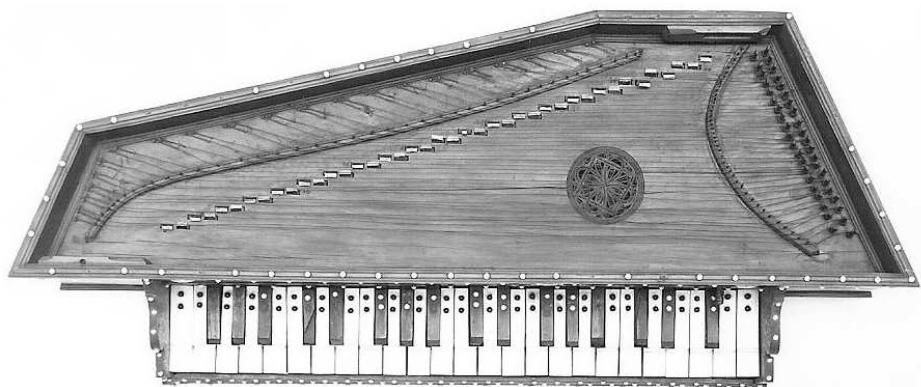
中文讲解
图10图注:归属存疑的「Franciscus Bonafinis」(?表示归属不确定),大都会艺术博物馆藏,原为virginal,后被改造为tangent piano,馆藏编号89.4.2765,并附博物馆网址及访问日期。
此图与正文P0191的案例一一对应,向读者直观展示这件「经历了多重身世」的器物。
补充说明
图注中的问号(?)体现学术诚信:在归属与年代存在疑问时保留不确定标记。
第7段(P0195)
原文复述
Just like countless pictorial and written sources, instruments from the 16th century have also been lost to wars, Reformation-era iconoclasm, uprisings, and neglect. Attractive decoration may, however, have saved certain instruments from total loss. Some lids thus survived their instruments, as demonstrated by a number of instrument-less lids now on display in art galleries. One cannot assume that the artistic quality of their decoration allows conclusions to be drawn about the majority of the instruments that originally existed. They were also often reworked in such a way that their original purpose was no longer recognizable. Sometimes this was done by simply cutting them down, as in the case of a lid, probably painted by Girolamo Romanino around 1540, which is now stored – trimmed – like a panel painting at London’s National Gallery under the title Pegasus and the Muses (Fig. 11). It shows the winged horse Pegasus stamping its hoof on Mount Helicon and giving rise to the spring known as the Hippocrene (Horse’s Fountain), a source of artistic inspiration. In the foreground, the muses – accompanied by three gentlemen – play instruments and sing. On the right in the background, the Pieridae are transforming into magpies, as in Ovid’s Metamorphoses, IV 662–78. The clothing and the architecture in the background place this painting in Lombardy during the 1540s and resemble Romanino’s murals in the Palazzo Salvadego in Brescia from 1543. On the back of the panel, remnants of a coat of arms are still visible, as was common on the front lids of harpsichords or virginals. Traces of hinges etc. are missing, as the panel has been trimmed at the top and sides.28
中文讲解
本段从「遗存稀少的物理原因」展开第二类史料问题——琴盖作为乐器遗存有时反而比乐器本身存留下来。
- 作者首先列举16世纪乐器大量消失的原因:战争、宗教改革时期的破坏圣像运动(iconoclasm)、起义、疏于维护——与图籍、文献的散佚原因相同。
- 接着指出一个看似矛盾的现象:精美的装饰反而可能「救」下某些器物或部件。结果之一是大量「无琴之盖」现以艺术画的身份陈列于美术馆;其中有些甚至被裁剪、改制成矩形板画。
- 作者对这种遗存的方法论价值提出明确警告:仅凭现存的、被孤立保存的琴盖之艺术水准,无法推断当年绝大多数乐器的装饰样貌;其原本用途也常常已被抹除。
- 随即以Girolamo Romanino约1540年所作的琴盖《Pegasus and the Muses》(飞马与缪斯)为例:画中描绘飞马Pegasus在赫利孔山(Mount Helicon)踏出灵感之泉Hippocrene;前景有缪斯与三位先生演奏歌唱;右侧背景中Pieridae变形为喜鹊,典出奥维德《变形记》IV 662–78。服饰与背景建筑指向1540年代伦巴第地区,与Romanino 1543年在Brescia的Palazzo Salvadego壁画风格一致。
- 琴盖背面仍可见一处残留的纹章——这是大键琴或virginal前盖的常见特征;但因板面顶部与两侧被裁去,铰链痕迹已不复存。
此段是本节的核心案例段之一,说明琴盖(lid)作为史料的特殊形态:物理上独立、艺术上完整、原始功能却被改写。
补充说明
「Iconoclasm」特指16世纪宗教改革时期新教阵营对宗教图像的系统性破坏;「Pieridae」出自《变形记》IV,Pierides姐妹因与缪斯比赛歌咏失败而变为喜鹊。
第8段(P0196)
原文复述
27 Boalch, Makers (see n. 1), 20, 250.
中文讲解
脚注27,引用Boalch《Makers》第20、250页,对应P0191中关于virginal→tangent piano改造及「Franciscus Bonafinis」之名款归属的讨论。
补充说明
Boalch的《Makers of the Harpsichord and Clavichord 1440–1840》是键盘乐器制造者研究的标准参考工具书。
第9段(P0197)
原文复述
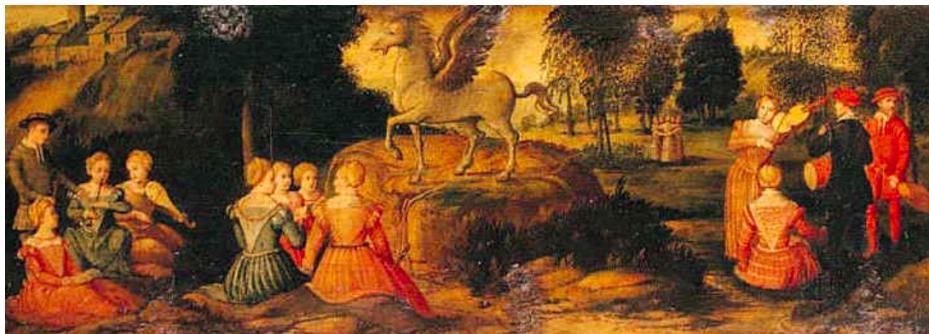
中文讲解
此处为第35页的图像或乐谱占位符,原图数据未嵌入;位置与图注保留以便读者查阅原书第35页对应图版。具体图版信息需参照原书。
补充说明
占位符段落;其作用是在文流中标记图像位置。
第10段(P0198)
原文复述
Fig. 11: Girolamo Romanino, Pegasus and the Muses, 1540, oil/wood, 38 x 115.4 cm, National Gallery, London, NG3093; https://www.nationalgallery.org.uk/paintings/possibly-by-girolamo-romanino-pegasus-and-the-muses (accessed on 4 March 2025).
中文讲解
图11图注:归属可能为Girolamo Romanino的《Pegasus and the Muses》,1540年,木板油画,38 × 115.4厘米,伦敦国家美术馆藏,编号NG3093,并附博物馆网址与访问日期。
此图与P0195详述的案例对应:宽幅比例(38×115.4厘米)正符合virginal或大键琴前盖的尺度。
补充说明
图注中同样用「possibly by」表明归属存疑;横向比例与高度之比超过3:1,符合琴盖典型的横向长方形。
第11段(P0199)
原文复述
The lid painting Silenus Gathering Grapes from the hand of Annibale (and presumably Agostino)29 Carracci (Figs. 12–14) likewise survived its instrument and was already viewed as a work of art in 1664, as evidenced by its entry in a historical catalogue of works worth seeing in Rome:
中文讲解
本段引出本节第二个核心案例:Annibale Carracci(可能还有其兄Agostino共同参与)所作的琴盖画《Silenus Gathering Grapes》(西勒诺斯采葡萄)。与P0195中Romanino琴盖的命运相似,这件琴盖亦从原琴脱离开来,且早在1664年就已作为独立艺术作品被罗马的收藏目录所收录——这一点由下一段(P0200)即将引用的Bellori文献加以证实。
作者用「likewise」把此案例与Romanino案例相联结,表明这是同一类现象(lid脱离原琴、艺术化改用)的进一步例证;同时通过「presumably Agostino」的限定,谨慎提示归属仍存在学术讨论空间。
补充说明
「Silenus」(西勒诺斯)是希腊神话中的森林之神与酒神随从,常被描绘为醉态老者;「Carracci」家族是16世纪末—17世纪初博洛尼亚画派的核心,Annibale、Agostino、Ludovico 三人合作创作是当时常见的合作模式。
第12段(P0200)
原文复述
Signori Lancellotti. Palazzo alli Coronari. Cortile fregiato di statue, e bassirilievi antichi; nel portico di sopra la statua di Diana Efesia, con pitture nelle camere, fra le quali un Cambalo [sic] dipinto a guazzo con Sileno portato a braccia da due fauni di mani di Annibale Carracci.30
中文讲解
本段是P0199中所说「1664年罗马必观作品目录」中的意大利语原文条目,记载Lancellotti家族在Coronari街的宫殿(Cortile)中陈列的雕塑、浮雕与绘画,其中特别提到一件大键琴(Cambalo,原文拼写带[sic],提示为罕见或不确定拼写)湿壁画(guazzo,即gouache蛋彩/胶彩),绘西勒诺斯由两位faun(农牧之神/森林精灵)抬着,署名Annibale Carracci所绘。
此条目本身即提供了三重信息:①当时此琴盖已作为绘画被独立陈列;②画面主题(Sileno被两faun抬)与现存National Gallery藏品一致;③最早文献追溯到1664年Bellori的《Nota delli musei…》。
补充说明
[sic]为编辑标记,表示此处拼写(Cambalo替代意大利文常见的Cembalo「cembalo」或「clavicembalo」大键琴)系原文所有、编辑保留。
第13段(P0201)
原文复述
28 A description of this painting can be found at https://www.nationalgallery.org.uk/paintings/possibly-by-girolamo-romanino-pegasus-and-the-muses (accessed on 15 Sept. 2024). 29 In the older literature, both parts as well as all prior studies are attributed to Annibale Carracci. In recent years, co-authorship by his brother Agostino (and perhaps even by his cousin Ludovico) is assumed, though the amount of material concerned here is a topic of discussion. Daniele Benati et al. (eds.), The Drawings of Annibale Carracci [Catalogue of an exhibition held at the National Gallery of Art, Washington, 26 Sept. 1999 – 9 January 2000] (Washington, 1999); Ann Sutherland Harris, ‘Review: The Drawings of Annibale Carracci’, in: Master Drawings 43 (2005), 512–26; Clovis Withfield, ‘Agostino risarcito parte II. Nuovi spunti sul vero ruolo del maggiore dei fratelli Carracci’, in: About Art Online (2018), https://www.aboutartonline.com/agostino-risarcito-parte-2-nuovi-spunti-sul-vero-ruolo-delmaggiore-dei-fratelli-carracci-with-english-text/ (accessed on 15 Sept. 2024).
中文讲解
本条合并了脚注28与脚注29。脚注28提供P0195中Romanino琴盖画的伦敦国家美术馆描述网址;脚注29专门处理Carracci归属问题:旧文献把两幅现存部分与全部前期研究都归于Annibale Carracci一人,而近年研究则倾向于认为有他兄长Agostino甚至堂兄Ludovico参与,但具体合作范围仍有讨论。脚注列出Benati等编《Carracci素描集》展览目录、Harris的书评及Withfield关于Agostino角色的文章作为参考。
这一脚注对正文中「presumably Agostino」的限定提供了文献支撑,同时也提示「归属」本身即是一类干扰变量。
补充说明
脚注29也间接说明:在讨论Carracci琴盖时,作者必须谨慎处理归属的归属问题(attribution),否则会把不同艺术家之手混为一谈。
第14段(P0202)
原文复述
30 Giovanni Pietro Bellori, Nota delli musei, librerie, gallerie et ornamenti di statue e pitture ne’ palazzo, nelle case e ne’ giardini di Roma (Rome: Deversin and Cesaretti, 1664), 29; https://mdz-nbn-resolving.de/details:bsb11098347 (accessed on 4 March 2025).
中文讲解
脚注30,引用P0200意大利文条目的来源:Giovanni Pietro Bellori《罗马宫殿、宅邸与花园中博物馆、图书馆、画廊及雕像绘画装饰目录》(罗马,1664年)第29页,并附慕尼黑数字化中心(MDZ)的数字化版本链接及访问日期。
补充说明
Bellori的《Nota delli musei》是17世纪罗马艺术品收藏与陈列状况的重要第一手文献。
第15段(P0203)
原文复述
(‘Mr. and Mrs. Lancellotti. Coronari Palace. Courtyard adorned with statues and ancient bas-reliefs; atop the portico a statue of Diana Ephesia; paintings in the rooms, including a harpsichord with Silenus carried by two fauns painted in gouache by Annibale Carracci.’)
中文讲解
本段是P0200意大利原文的英译。译者为读者转述:Lancellotti夫妇在Coronari宫殿,庭院饰以雕像与古代浮雕,柱廊上立有Ephesian Diana雕像;室内绘画中包括一件大键琴,由Annibale Carracci以蛋彩绘出两faun抬西勒诺斯的场景。
此译为不谙意大利文的读者提供了原文的可读转写,并明确「Cambalo」= harpsichord、「guazzo」= gouache。
补充说明
此英译紧跟意大利原文之后,是典型的「原文—译注」学术排版模式。
第16段(P0204)
原文复述
The lid was even subsequently reworked into a panel painting: an old photograph shows how it had been cut up and mounted to form a rectangle. This modification was reversed in the 20th century, but a narrow intermediate piece between the two young satyrs is now missing as can be seen from the format and a drawing by Carracci (Figs. 14 and 43). Due to these changes, the value of this source is naturally diminished. Like the painting attributed to Lavinia Fontana, Apollo and the Muses (1589–1600, unknown private collection), or the painting by Sebastiano Ricci Venus Surrounded by Nymphes (1716–20, Louvre, M.I.866), several other harpsichord lids that have been ‘completed’ into rectangles are likely to be uncovered.
中文讲解
本段说明Carracci琴盖更进一步的遭遇:它不仅从原琴剥离、独立成画,更曾被人切割并重新装裱为矩形板画;20世纪虽复原原状,但两年轻satyr之间的一段窄条已经遗失(可由现存形制与Carracci素描对照看出)。由于这些改造,作为装饰史料的该琴盖价值自然被削弱。
作者进一步举类似案例:归属Lavinia Fontana的《Apollo and the Muses》(1589–1600,私人藏)与Sebastiano Ricci的《Venus Surrounded by Nymphs》(1716–20,卢浮宫M.I.866),都属此类被「补足」为矩形的琴盖;作者据此推断还有更多此类琴盖等待被发现。
本段的方法论意义在于:被改作板画不仅改变了形制,也抹除了背面铰链、纹章等关键证据,从而使推断原始乐器的装饰概念变得困难。
补充说明
「completed into rectangles」即「补成矩形」——把横向琴盖拼上补条,使外观符合矩形板画的常规审美,从而抬高市场价值。
第17段(P0205)
原文复述
Fig. 12: Annibale (and Agostino?) Carracci, Silenus Gathering Grapes, part 1, 1597–1600, oil/wood, 54.5 x 88.5 cm, National Gallery London, NG93.1; https://www.nationalgallery.org.uk/paintings/annibale-carracci-silenus-gathering-grapes-painting-group-info (accessed on 4 March 2025).
中文讲解
图12图注:归属可能为Annibale与Agostino Carracci合作的《Silenus Gathering Grapes》第一部分,1597–1600年,木板油画,54.5 × 88.5厘米,伦敦国家美术馆藏,编号NG93.1,附网址与访问日期。
此图为该琴盖被「补成矩形」又被部分还原后的左半部分(part 1),与图13、图14共同展示同一琴盖的不同状态。
补充说明
「part 1/part 2」编号表明该琴盖现以两个独立部分入藏;合并后的总宽应为二部分之和。
第18段(P0206)
原文复述
Fig. 13: Annibale (and Agostino?) Carracci, Silenus Gathering Grapes, part 2, 1597–1600, oil/wood, 54.5 x 88.5 cm, National Gallery London, NG93.2; https://www.nationalgallery.org.uk/paintings/annibale-carracci-young-satyr-gathering-grapes (accessed on 4 March 2025).
中文讲解
图13图注:归属可能为Annibale与Agostino Carracci的《Silenus Gathering Grapes》第二部分,1597–1600年,木板油画,54.5 × 88.5厘米,伦敦国家美术馆藏,编号NG93.2,附网址与访问日期。
补充说明
part 1与part 2尺寸相同,合并后方接近琴盖原本的横向长方形;图14将展示二者曾被改作矩形的旧照。
第19段(P0207)
原文复述
Fig. 14: Annibale (and Agostino?) Carracci, Silenus Gathering Grapes, 1597–1600, photograph of its reworked state; http://catalogo.fondazionezeri.unibo.it/scheda/fotografia/106921/National%20Gallery%252C%20London%25C2%25A0%25E2%2580%2594%25C2%25A0Carracci%20Annibale%20-%20sec.%20XVI%20XVII%20-%20Sileno%20coglie%20grappoli%20d%2527uva (accessed on 4 March 2025).
中文讲解
图14图注:归属可能为Annibale与Agostino Carracci的《Silenus Gathering Grapes》,1597–1600年,此为该琴盖被「补成矩形」状态下的老照片,附博洛尼亚Zeri基金会照片档案链接与访问日期。
此图与正文P0204的描述直接对应,向读者直观呈现琴盖在被改造前曾以矩形板画形式被装裱与拍摄的历史状态。
补充说明
Fondazione Zeri是博洛尼亚大学所属的意大利绘画史照片档案馆,专门系统收藏艺术史图像资料。
第20段(P0208)
原文复述
Rectangular lids did not necessarily have to be trimmed to be considered panel paintings, but their original purpose was concealed by other measures. Consider, for instance, the work Venetian Dancers with Commedia dell Arte Troupe (Fig. 15), found as a painting at the Suermondt-Ludwig-Museum in Aachen. The painting depicts the ‘Parentado’, a dance festival that traditionally took place in Venice in the late 16th century a few days before a wedding. The scene, featuring gondolas and a Commedia dell’Arte troupe, evokes a Venetian atmosphere, but is based on a copperplate engraving by Hendrik Goltzius from 1584, once again highlighting supraregional artistic exchange. A comprehensive restoration project was what first revealed this panel’s original function as a harpsichord’s lid flap. A filled-in hole for the cord, the overpainted ornaments found on the back (much like in the Ruckers harpsichord of 1612, now in Paris at the Musée de la Musique), the poplar panel, traces of the originally glued-on frame and hinges, and last but not least its dimensions are clear indicators. This lid survived due to the high quality of its painting, which was originally thought to be the work of Hieronymus Franken I but is now attributed to his nephew, Hieronymus Franken II.31
中文讲解
本段引出第三种琴盖的流传形态:原本即为矩形比例的琴盖不必再被裁剪,只需通过其他方式遮掩原用途即可被当作板画。
案例为亚琛Suermondt-Ludwig-Museum所藏《Venetian Dancers with Commedia dell Arte Troupe》(威尼斯舞者与即兴喜剧剧团)。画面描绘「Parentado」——威尼斯婚礼前几天举行的舞节——气氛充满贡多拉与即兴喜剧人物。然而画面构图实基于Hendrik Goltzius 1584年的铜版画,再次印证跨地域艺术交流。一次综合性修复才揭示此板的原始用途:它是harpsichord(大键琴)的「lid flap」(琴盖内侧活动板)。判断依据包括:①被填补的绳孔;②背面被覆绘的装饰纹(与现藏巴黎音乐博物馆的1612年Ruckers大键琴背面类似);③杨木材质;④原本粘合的框架与铰链痕迹;⑤尺寸。
此琴盖因画艺精湛而获保存;归属曾被归于Hieronymus Franken I(老Franken),现改归其侄Hieronymus Franken II(见脚注31)。
本段进一步表明:①即便是未裁剪的矩形琴盖,也可能靠覆绘、糊裱等手段抹除原始功能;②要识别这种琴盖,必须依赖细致的物质性证据(绳孔、覆绘、铰链痕迹等);③修复项目往往才是揭示真相的关键环节。
补充说明
「Parentado」为威尼斯方言婚礼庆典名称;「Commedia dell’Arte」(即兴喜剧)为16世纪兴起的意大利剧种;Goltzius 1584年的雕版被多处引用,体现尼德兰与威尼斯之间的图像传播。
第21段(P0209)
原文复述
31 For a very extensive discussion of its renovation and reattribution, see: Thomas Fusenig and Ulrike Villwock, ‘Hieronymus Franckens “Venezianischer Ball” in Aachen. Eine neue Datierung und ihre Folgen’, in: Wallraf-Richartz-Jahrbuch 61 (2000), 145–76. Cf. also Thomas
中文讲解
脚注31的第一部分,提示读者参考Fusenig与Villwock关于此画的修复与归属变更的长文(Wallraf-Richartz-Jahrbuch 第61卷,2000年,第145–176页)。同时引出下一条「Thomas」开头的合作文献。
此脚注为正文P0208中归属由Hieronymus Franken I改为Hieronymus Franken II的判断提供文献依据。
补充说明
Wallraf-Richartz-Jahrbuch是科隆Wallraf-Richartz博物馆的年刊,长期刊发低地国家与德语区绘画史研究。
第22段(P0210)
原文复述
Fig. 15: Hieronymus Francken II (?), Venetian Dancers with Commedia dell Arte Troupe, c. 1600, oil/wood, 41.2 x 64.7 cm, Suermondt-Ludwig-Museum Aachen, GK 159; https://commons.wikimedia.org/wiki/File:Hieronymus_Francken_I_-_Carnival_in_Venice.jpg#file (accessed on 4 March 2025).

中文讲解
图15图注:归属存疑的Hieronymus Francken II(?)所作《Venetian Dancers with Commedia dell Arte Troupe》,约1600年,木板油画,41.2 × 64.7厘米,亚琛Suermondt-Ludwig-Museum藏,编号GK 159,附维基共享资源链接与访问日期。
此图对应P0208案例。
补充说明
画幅尺寸(41.2 × 64.7厘米)符合小型virginal或大键琴内盖(lid flap)的常见规格。
第23段(P0211)
原文复述
The painting The Contest between Apollo and Pan by Bartholomäus Spranger (Fig. 16) is a further example. The museum catalogue and some recent literature32 describe it as a panel painting, although the description in the museum and an exhibition catalogue33 indicate its initial purpose as an instrument lid. The theme almost exceeds the given format, which is determined by its original use, due to its mannerist, figurative, and dynamic representation. Also the support (wood), the subject, and the traces of nail holes – presumably from the hinge – clearly indicate the painting’s instrumental origin.34 However, like other similar objects,35 this high-quality lid is a source of limited informative value, as too many aspects remain unclear – the client, builder, decorative concept of the entire instrument, etc.
中文讲解
本段引出本节第四个案例:Bartholomäus Spranger所作《The Contest between Apollo and Pan》(阿波罗与潘的比赛)。
作者指出现存研究与展示的矛盾:博物馆图录与部分近期文献把此画当作普通板画(panel painting)看待,但博物馆内部说明与展览图录却指出其原本用途是乐器琴盖。其题材——阿波罗与潘的缪斯比赛——由于风格主义式的姿态与动态表现,几乎溢出画幅;这一不合常规的构图反而印证它原本受琴盖横向长形制约。木板材质、神话主题以及铰链留下的钉孔痕迹也都明显指向乐器起源(参脚注34)。
然而作者明确指出:正如其他类似器物(参脚注35),这件高品质琴盖作为史料的价值是有限的,因为订制者、制琴师、整件乐器的装饰概念等关键信息皆已不可考。这一句是本节结论性论断的最直接体现。
补充说明
「Contest between Apollo and Pan」典出希腊神话中阿波罗与潘的吹奏比赛,由山上之神Midas判Pan胜而遭纠正;Spranger以风格主义笔法描绘这一戏剧性场面。
第24段(P0212)
原文复述
Fusenig and Christine Vogt (eds.), Suermondt-Ludwig-Museum Aachen. Bestandskatalog der Gemäldegalerie Niederlande von 1550 bis 1800 (Aachen/Munich, 2006), 124–6.
中文讲解
脚注31的第二部分,承接P0209中的「Cf. also Thomas」一语,列出Thomas Fusenig与Christine Vogt所编亚琛Suermondt-Ludwig-Museum荷兰区绘画藏品目录(1550–1800年卷)第124–126页。此目录同样讨论了《Venezianischer Ball》的修复与归属变更。
补充说明
「Bestandskatalog」(德文「藏品目录」)是德语区博物馆为馆藏画作编目的标准体例,本书为亚琛馆藏荷兰画作的官方总目。
第25段(P0213)
原文复述
32 Jana Stolzenberger, ‘Höfisches Sammeln und internationale Tendenzen der Kunst um 1600’, in: Renaissance – Barock – Aufklärung. Kunst und Kultur vom 16. bis zum 18. Jahrhundert, ed. Daniel Hess and Dagmar Hirschfelder, Die Schausammlungen des Germanischen Nationalmuseums 3 (Nuremberg, 2010), 271–84, at 272–3.
中文讲解
脚注32,引用Jana Stolzenberger《1600年前后宫廷收藏与国际艺术潮流》一文,载于Hess与Hirschfelder所编Germanisches Nationalmuseum常设展第三卷《Renaissance – Barock – Aufklärung》(纽伦堡,2010),第271–284页(特指272–273页)。
此脚注对应P0211中「museum catalogue and some recent literature」一语——Stolzenberger文章即属「近期文献」中将此Spranger画视为板画者。
补充说明
Germanisches Nationalmuseum位于纽伦堡,是德语区文化史综合性博物馆;其Schausammlungen系列以艺术与文化史断代方式陈列。
第26段(P0214)
原文复述
33 Sally Metzler, Bartholomeus Spranger. Splendor and Eroticism in Imperial Prague. The Complete Works [Catalogue of an exhibition at The Metropolitan Museum of Art, New York, 4 Nov. 2014 – 1 Feb. 2015] (New York, 2014), 94–5.
中文讲解
脚注33,引用Sally Metzler关于Spranger的专著《帝国布拉格的辉煌与情色》——同时也是2014–2015年纽约大都会艺术博物馆展览图录(2014年11月4日至2015年2月1日),第94–95页。
此脚注对应P0211中「exhibition catalogue indicates its initial purpose as an instrument lid」一语——Metzler的展览图录确认了此画的琴盖起源。
补充说明
Sally Metzler为大都会博物馆2014–2015年Spranger展览的策展人,其完整作品目录是风格主义宫廷绘画研究的重要工具。
第27段(P0215)
原文复述
Fig. 16: Bartholomäus Spranger, Contest between Apollo and Pan, c. 1587, oil/wood, 39.8 x 132.5 cm, Bayerische Staatsgemäldesammlungen (on permanent loan to the Germanisches Nationalmuseum Nuremberg, Gm 1100); https://www.sammlung.pinakothek.de/en/artwork/jpxeyknxJ7 (accessed on 4 March 2025).
中文讲解
图16图注:Bartholomäus Spranger《Contest between Apollo and Pan》,约1587年,木板油画,39.8 × 132.5厘米,藏于巴伐利亚国家绘画收藏(长期借展于纽伦堡Germanisches Nationalmuseum,编号Gm 1100),附巴伐利亚国家绘画馆在线藏品链接与访问日期。
横向比例(约1:3.3)极端符合大键琴或virginal前盖的尺度,与P0211中所论琴盖属性一致。
补充说明
Bayerische Staatsgemäldesammlungen总部在慕尼黑,旗下多家美术馆(包括Alte Pinakothek等)共享同一在线数据库sammlung.pinakothek.de。
💡 本节核心要点
🔑 关键术语
- ravalement:法文/法语乐器学术语,指对古乐器进行的整体性重建大修,通常涉及音域、机械乃至外观装饰的更换;19世纪尤其盛行,使大量古乐器失去原始外观,正是P0190所论『结构性改动』的代表。
- iconoclasm:指宗教改革时期新教阵营对宗教图像的系统性破坏;作者以此解释为何16世纪乐器与图像文献同样大量散佚(见P0195)。
- lid / lid flap:键琴的『琴盖』,可分为外盖(front lid)与内盖(lid flap);其横长形制与木板材质是判断一幅『板画』原本是否为乐器构件的关键形制特征。
- Decorum:古典—文艺复兴艺术学范畴,指作品内容、形式与情境之间的『合宜性』;本节引用Weststeijn关于Decorum的研究(脚注25)说明16世纪乐器装饰亦受此观念约束,参与者众多使得『风格来源难辨』。
- Franciolini:意大利古董商Leopoldo Franciolini(1844–1920),在佛罗伦萨以组装装饰部件、改刻名款的方式大规模制售假键盘乐器;本节案例(P0191、图10)是其作伪影响持续至今的典型证据。
- Silenus / satyr / faun:希腊—罗马神话中的森林/酒神随从形象,常出现在琴盖画的神话题材中;Carracci《Silenus Gathering Grapes》、Spranger《Apollo and Pan》皆属此类作品,本节借此说明琴盖画常见题材与作者归属问题的双重干扰。
S18 Representation and Projection
第1段(P0216)
原文复述
Representation and Projection
中文讲解
这是本节的标题「再现与投射」(Representation and Projection),即原文中的德文概念 Repräsentation 与英文 projection 的并置。标题点出本节的核心议题:装饰不只是审美的「美化」,而是一种向外显示、向外投射主人身份、品味、学识与价值观念的行为。作者将在本节区分两个相互关联但又不同的层次——「再现」(制造外在可见的形象以匹配身份)与「投射」(借由图像、铭文与象征,把主人的内在诉求投射到乐器上)。
第2段(P0217)
原文复述
Why were instruments decorated? As an ‘upmarket piece of furniture’, a keyboard instrument was particularly well suited as a display object and projection surface. The especially pronounced desire for ornamentation and the need for representation documented in the 16th century were certainly motives for decoration. (Here, I use representation [Repräsentation] in the specific sense of generating an external effect that befits and projects an elevated socio-economic status.) An ornate instrument most assuredly did not serve only music-making but was also part of the ’lifestyle of some members of the upper class – and, as such, became a prestigious collector’s item. It was accordingly that, in 1554, Sabba da Castiglione’s instructional text for his nephew expressly recommended that he decorate his home with musical instruments ‘come organi, claocimbali [sic], monocordi, salteri, arpe, dolcimeli’ (‘such as organs, harpsichords, clavichords, salterios, harps, dolcimeli’) as well as plucked, stringed, and wind instruments, ‘perche questi tali instrumenti dilettano molto alle orecchie, et ricreano molto gli animi […] ancora piacciono assai all’occhio, quando sono diligentemente et per mano di eccellenti et ingegniosi maestri lavorati’ (‘for these instrument greatly delight the ears and restore the soul […] as well as greatly please the eye if they have been diligently crafted by the hands of excellent and ingenious masters’). This text goes on to mention the instrument makers Bastiano da Verona as well as Lorenzo da Pavia Gusnaschi, a friend of Leonardo da Vinci and highly respected at that time, who built a large harpsichord for Pope Leo X in 1514.
中文讲解
本段开门见山提出本节的问题:为什么乐器要被装饰?作者先把键盘乐器定义为「高档家具」式的物品,因此天然具备「陈列物」和「投射面」的属性。然后作者特意界定「representation / Repräsentation」一词的具体用法:制造一种与主人较高社会经济地位相称、并向外投射该地位的外在效果。换言之,本节中的「再现」并不是泛指「表征」或「代表性」,而是一种带有社会表演性的视觉策略。作者随即说明:一件装饰华丽的乐器不仅用于演奏,更是上层阶级生活方式的一部分,是有身份的收藏品。这一论断由1554年 Sabba da Castiglione 给侄子的家训所支撑。Castiglione 建议用「organi, claocimbali [原文如此], monocordi, salteri, arpe, dolcimeli」以及各种拨弦、弦乐与管乐器装点家居,理由是这些乐器「dilettano molto alle orecchie」(悦耳)、「ricreano molto gli animi」(养心),并且「piacciono assai all’occhio, quando sono diligentemente et per mano di eccellenti et ingegniosi maestri lavorati」(由杰出工匠精心制作后亦大可悦目)。这段引文的关键在于:Castiglione 把乐器的悦耳与悦目并置,而且把「悦目」建立在工匠品质之上——这正是本节论证「装饰不只是美化,而是身份投射」的一条早期文献证据。Castiglione 还提及两位制琴师:Bastiano da Verona,以及 Leonardo da Vinci 的友人、当时极具声望的 Lorenzo da Pavia Gusnaschi,后者于1514年为教皇利奥十世造了一架大型羽管键琴。这两个名字本身被引出是为了证实16世纪制琴师的社会地位——他们与王侯、艺术圈交友,证明高端乐器制作是一项受人敬重的工艺。
补充说明
本段中意大利原文与英文对照的引文来自 Sabba da Castiglione 的《Ricordi》(威尼斯,1554)。这是本节论证「乐器装饰具有身份投射功能」的关键文献证据,置于本节首段,起锚定全文论点的作用。
第3段(P0218)
原文复述
See the informations on the Website of Germanisches Nationalmuseum, http://objektkatalog.gnm.de/objekt/Gm1100 (accessed on 15 Sept. 2024).
中文讲解
这是脚注34。内容仅指引读者前往德国国家博物馆(Germanisches Nationalmuseum)的网络数据库查看条目 Gm1100 的相关信息;它以"See … on the Website of Germanisches Nationalmuseum"的形式给出网址与最近访问日期(2024年9月15日)。它不解释对象内容,只给出在线资源的访问路径。
补充说明
此条注释对应正文上一节(Section 1)某处对德国国家博物馆某件器物的提及,作为该器物具体信息的可访问来源。在本节范围内,它属于外部资料的链接指示,不承载新的论证内容。
第4段(P0219)
原文复述
Another possible ‘candidate’ for rediscovery as an instrument lid is the painting on wood Apollo and the Muses, atrributed to Benvenuto di Giovanni di Meo del Guasta (1436–1518), Detroit Institute of Arts, 31,8 x 106,7 cm, inv. no. 40.128
中文讲解
这是脚注35。它提出又一「候选」作品:底特律艺术馆(Detroit Institute of Arts)所藏、传为 Benvenuto di Giovanni di Meo del Guasta(1436–1518)所作的木板画《阿波罗与缪斯》(Apollo and the Muses),尺寸31.8×106.7 cm,藏品编号40.128。注释的措辞"another possible ‘candidate’ for rediscovery as an instrument lid"意味着作者主张这件木板画有可能原是某件乐器的琴盖画——它不是装饰完备的乐器之盖,而是被重新识别(“rediscovery”)为器盖的画作。
补充说明
此条与上一条(脚注34)共同构成作者讨论「琴盖画归属识别」的资料链;在本节之内它仅作为背景注释出现,并未直接服务于「再现与投射」的论点。
第5段(P0220)
原文复述
It can be assumed that unadorned and plainly painted instruments outnumbered the decorated ones. But a client could, depending on his financial resources, commission decorations that would draw attention to his wealth or deep humanistic knowledge, his modern spirit, or his lifestyle, thus enhancing his image – his prestige. Decorating instruments was therefore consistent with the contemporary aristocratic and wealthy bourgeois practice of collecting rare objects and curiosities and displaying them in lavishly decorated display furniture (Kabinettschränke) or in ‘cabinets of curiosities’ (Kunstkammern or Wunderkammern).
中文讲解
本段对前段所引文献作补充限定。作者承认,朴素无饰或仅简单着色的乐器在数量上可能远多于华丽装饰者;也就是说,装饰乐器是少数有财力客户的选择,而非普遍现象。然而,一旦客户具备经济能力,他就可以委托装饰,借此「彰显财富」「彰显深厚人文修养」「彰显现代精神」「彰显生活方式」,最终提升自己的形象——即威望。这一逻辑使乐器装饰与当时贵族与富裕市民阶层的另一项并行实践相契合:收藏稀有物品与奇珍异宝,并将它们陈列于装饰华丽的陈列柜(Kabinettschränke)或「珍奇柜 / 惊奇柜」(Kunstkammern 或 Wunderkammern)。作者借此把乐器装饰嵌入更宏观的「收藏—陈列」文化之中——乐器不再孤立存在,而是与 Kunstkammer 整体收藏文化同属一种身份建构机制。
补充说明
Kabinettschränke、Kunstkammern 与 Wunderkammern 是16世纪欧洲贵族与富裕市民阶层普遍存在的陈列—收藏空间,本段借此将乐器装饰置于这一更广的文化实践之中理解。
第6段(P0221)
原文复述
As Erik Forssman has observed, that era’s art of decoration was not an end in itself and cannot be understood in purely material terms; it much rather expressed the attitude of the client and the artisan as well as the dignity of the object. Musical instruments were hence decorated not merely for the purpose of material appreciation and ‘prettification’ but also in order to lend them dignity and ’elevate’ them through exquisite features. This is how it had always been: the Bible describes how King Solomon sent for precious ‘Almug wood’ from the legendary land of Ophir for the purpose of making musical instruments. Ovid, in turn, tells us in his Metamorphoses that the lyre of Apollo was ‘richly inlaid with jewels and Indian ivory’. One could easily cite more such quotations. Many, like the one from Sabba da Castiglione above, emphasize the connection between the quality of the instrument and the pleasure it gives to the ears as well as to the eyes and the soul. Marin Mersenne’s assertion that ’the eyes should participate in the pleasure of the ears’ is likewise well known.
中文讲解
本段为「装饰不只是美化,而是赋予对象尊严并表达客户与工匠态度」这一主张,铺设了一条纵贯古今的论据链。其论证分四步推进:第一,引 Erik Forssman 的观察——那个时代的装饰艺术并非目的本身,不能以纯物质立场理解,而是表达了客户与工匠的态度以及对象本身的尊严。第二,由此得出对乐器的直接含义:乐器之被装饰,是为了赋予其尊严(dignity),通过精致特征「提升」(elevate)其地位。第三,作者转入历史纵深:用《圣经》中所罗门王从传说中的Ophir之地运来贵重「Almug木」制作乐器的故事,以及奥维德《变形记》中所述阿波罗的里拉琴「richly inlaid with jewels and Indian ivory」,证明「用贵重材料装饰乐器」是跨越古今的传统——这条传统并非16世纪独有。第四,作者进一步指出此类文献一再强调「乐器的品质」与「给耳朵、眼睛、灵魂带来的愉悦」之间的联系,并引 Marin Mersenne「眼睛应参与耳朵之乐」(the eyes should participate in the pleasure of the ears)作结。这条纵贯古代—近代的论据链,为本节核心命题——装饰服务于身份投射与对象尊严——提供了纵深。
补充说明
本段把 Forssman、所罗门、奥维德、Mersenne 一线串起,旨在让读者理解「用贵重材料装饰乐器」并非16世纪突然出现的时尚,而是横跨《圣经》—古典—近代的悠久传统。
第7段(P0222)
原文复述
Sabba da Castiglione, Ricordi (Venice: Paolo Gherardi, 1554), Ricordo cix, fol. 51r; <https:// books.google.it/books?id=lZBZyV9nZfMC&hl=de&pg=PA1 - v=onepage&q&f=false> (accessed on 4 March 2025).
中文讲解
这是脚注36,提供 Sabba da Castiglione《Ricordi》(威尼斯:Paolo Gherardi,1554)的版本信息——具体为「Ricordo cix」(第109条箴言),第51r页,并附 Google Books 上的数字化版本链接(最近访问日期为2025年3月4日)。该注释的学术功能是为正文所引 Castiglione 文字提供原始出处与版本依据,使读者得以直接核对原文。
补充说明
此条属标准原始文献引用,提供版本与可访问的数字化资源;在本节中支持正文对「Castiglione 推荐以乐器装饰家居」这一证据的使用。
第8段(P0223)
原文复述
A Sebastiano da Verona worked for Cardinal Ippolito I d’Este as a ‘M.o de instromenti’ from 1508 to 1511. Lewis Lockwood, ‘Adrian Willaert and Cardinal Ippolito I d’Este: New Light on Willaert’s Early Career in Italy, 1515–21’, in: EMH 5 (1985), 85–112, at 112.
中文讲解
这是脚注37。它给出一则历史事实:Sebastiano da Verona 曾于1508至1511年间以「M.o de instromenti」(即大师/乐器制作者)身份为枢机主教 Ippolito I d’Este 服务。该事实出自 Lewis Lockwood 在《Early Music History》第5卷(1985年)第85–112页(具体在第112页)的论文「Adrian Willaert and Cardinal Ippolito I d’Este: New Light on Willaert’s Early Career in Italy, 1515–21」。该注释为正文提及的「Bastiano da Verona」(即 Sebastiano da Verona 的异写)提供身份与雇佣背景的史料依据。
补充说明
此条注释以「制琴师服务于高级教会赞助人」的具体史实,强化正文论及「制琴师社会地位与王侯、艺术圈相当」之点。
第9段(P0224)
原文复述
Boalch, Makers (see n. 1), 76; William F. Prizer, ‘Isabella d’Este and Lorenzo da Pavia, “Master Instrument-Maker”’, in: EMH 2 (1982), 87–118 and 120–7, esp. at 89.
中文讲解
这是脚注38,为正文中关于 Lorenzo da Pavia Gusnaschi 及其1514年为教皇利奥十世造大型羽管键琴的陈述提供两条参考文献:一是 Boalch《Makers》(见正文脚注1)第76页;二是 William F. Prizer 的文章「Isabella d’Este and Lorenzo da Pavia, “Master Instrument-Maker”」,载《Early Music History》第2卷(1982年)第87–118及120–7页,尤其是第89页。该注释作为来源支撑 Lorenzo da Pavia 的身份与造琴事件。
补充说明
此条注释通过两部学术著作的引用,进一步把「Lorenzo da Pavia 制作教皇用琴」与 Isabella d’Este(伊莎贝拉·德·埃斯特)等显赫赞助人相联系,间接支持正文所强调的「制琴师与上层社会深度交织」之论。
第10段(P0225)
原文复述
Erik Forssman, Column and Ornament (Cologne, 1956), 13.
中文讲解
这是脚注39,引用 Erik Forssman 的著作《Column and Ornament》(科隆,1956年)第13页。该注释为正文所引 Forssman 关于「装饰艺术并非目的本身,而是表达态度与对象尊严」的观点给出文献出处。
补充说明
此条注释是正文 P0221 中 Forssman 观察的来源标记;其作用是支撑「装饰具有超越物质层面的表达功能」这一理论性主张。
第11段(P0226)
原文复述
Possibly plumwood, see: Johann Heinrich Zedler, Universal-Lexicon, Supplement 1 (Leipzig/Halle: J.H. Zedler, 1751), entry ‘Almuggim-Holz’, col. 1133, <https://www.zedler-lexikon.de/ index.html?c=blaettern&seitenzahl=578&bandnummer=s1&view=100&l=de> (accessed on 4 March 2025).
中文讲解
这是脚注40。它对正文提到的「Almug wood」(《圣经》中所罗门用于制作乐器的木材)作词源上的限定:Zedler 百科辞典 Supplement 1(莱比锡/哈雷,1751年)「Almuggim-Holz」条目第1133列指出该木材「possibly plumwood」(可能是李木/梅木)。注释附 Zedler 网上版的访问链接。
补充说明
此条注释属限定性说明(qualification),并不改变正文论证方向,仅为「Almug 木」一词附加词源性的可能性注脚。
第12段(P0227)
原文复述
1 Kings, 10:11.
中文讲解
这是脚注41,给出《圣经·列王记上》第10章第11节的出处,作为正文所提「所罗门从 Ophir 取来贵重 Almug 木制作乐器」一事的圣经文献来源。
补充说明
此条为简短经文出处标记;其作用是支持正文中「古代文献早有以珍贵材料装饰乐器之传统」的历史纵深论证。
第13段(P0228)
原文复述
Ovid (Publius Ovidius Naso), Metamorphosen, ed. Erich Rösch (Munich, 1952), XI 168, 405. Ovid, Metamophoses, trans. David Raeburn (London, 2004), XI 167.
中文讲解
这是脚注42,标注奥维德《变形记》(Metamorphoses)第11卷第168、405行的原文出处,使用 Erich Rösch 编辑本(慕尼黑,1952);并附英文翻译 David Raeburn 译本(伦敦,2004)第11卷第167行。
补充说明
此条注释同时给出原文与英译本的版本信息,使读者可双向核查正文所述「阿波罗的里拉琴以宝石、印度象牙镶嵌」一语。
第14段(P0229)
原文复述
The Italian instruments that survive from this period fulfil this requirement mainly via the quality and beauty of their materials as well as the quantity, refinement, and originality of their ornamental decoration. An example of this is the octave virginal commissioned by Eleonora della Rovere, Duchess of Urbino, and built in Venice in 1540, which is now in the Metropolitan Museum of Art, New York (Fig. 17). The front panel of the instrument advises: ‘Riccho son d’oro et riccho son di suono non mi sonar si tu non ha del buono’ (‘I’m rich in gold and rich in tone; if you lack virtue, leave me alone’). Taken together, the opulence of the decoration and the inscription’s demand for inner moral integrity satisfy the aims of representation and projection, appearance and prestige.
中文讲解
本段以一件具体意大利乐器——1540年于威尼斯制作的八度维金纳琴(octave virginal)——作为案例,落脚到本节核心命题。该琴由 Urbino 公爵夫人 Eleonora della Rovere 委托制作,现藏于纽约大都会艺术博物馆(参见图17)。其面板铭文用意大利文写道:「Riccho son d’oro et riccho son di suono / non mi sonar si tu non ha del buono」(「我金亦富、音亦富;你若无德,莫奏我」)。这段铭文同时作出两类声明:一是物质性(gold,金)与社会性的张扬,二是道德性(buono,德)的要求。作者由此把外饰的奢华与铭文对内在德性之要求并置,论证这两者共同服务于「再现与投射、外观与威望」之目的。换言之,这架维金纳琴不只是展示财富,更是投射「富贵而有德」的复合形象——「金」对应再现,「德」对应投射。
补充说明
铭文「Riccho son d’oro et riccho son di suono …」把「金」与「音」、「物质」与「德性」并列,是本节论证「物质奢华 + 道德诉求」共同构成身份投射的关键例证。
第15段(P0230)
原文复述
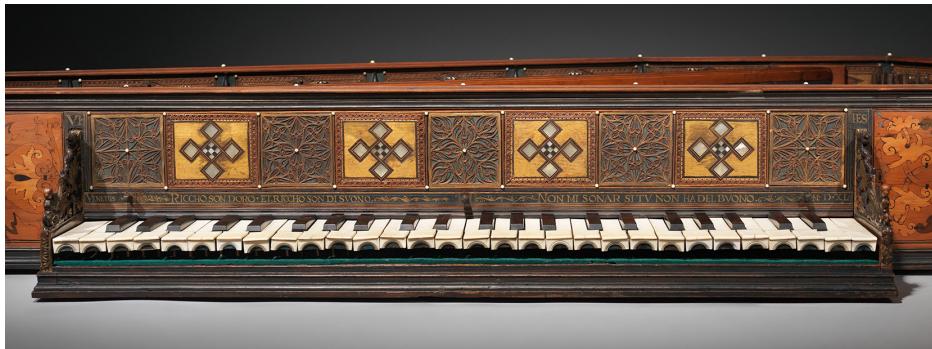
中文讲解
这是图17的图注。注明该图为匿名作者所作、1540年于威尼斯制作的八度维金纳琴(Octavo Virginal),现藏于纽约大都会艺术博物馆(藏品编号53.6a,b);并附博物馆在线藏品页链接(最近访问日期为2025年3月4日)。图注同时以占位符注明「内嵌图像数据已省略;位置与图注保留」,提示读者需查看原图以获取视觉细节。
补充说明
此条为图版说明,无补充论证内容;图像具体装饰细节需参照原图。
第16段(P0231)
原文复述
German instruments such as the South German Virginal (Augsburg?), 1595–1605, now at the Berlin Musical Instrument Museum (Fig. 18), likewise demonstrate this relationship between artisanship, material, and message. The ornamentation itself, with its exceptionally opulent inlays, becomes the subject of the image here: appearing at first glance like parts of a machine, the scrollwork portrays an ancient-seeming and positively surreal-looking city of ruins with pillars, sarcophagi, and other mysterious objects with tufts of stiff grass growing in between. This type of ornamentation was a mannerist development of scrollwork and can be traced back to engraving templates for Lorenz Stöer’s somewhat earlier publication Geometrie et Perspectiva (Augsburg, 1567) (Fig. 19), hence documenting the relationship between furniture and instrument decoration. At the centre of the lid, an outsized chalice points to a possibly sacred intended use of this instrument, which was once part of a claviorganum. While this particular instrument links a sacred dimension with a humanist reception of antiquity that employs the most modern ornaments, other quite similarly decorated instruments attest more to the need for worldly representation – being built directly into the woodwork of precious cabinets of curiosities and thus quite overtly becoming staged settings.
中文讲解
本段以一件德国乐器——南德维金纳琴(可能产于奥格斯堡),制作年代约1595–1605,现藏于柏林乐器博物馆(图18)——为案例,论证「工艺、材料与讯息」之间的关系。该琴以「异常华丽的镶嵌」使装饰本身成为画面主题:涡卷饰(scrollwork)乍看像机器零件,实则描绘了一座古老而近乎超现实的「废墟之城」——柱、石棺、其他神秘物件,其间生出丛丛硬草。作者指出,这种涡卷饰是样式主义(mannerist)涡卷饰的发展,并可追溯到 Lorenz Stöer 略早的出版物《Geometrie et Perspectiva》(奥格斯堡,1567年)(图19)所载的雕版模板。由此作者揭示了家具装饰与乐器装饰之间的图像来源关联:同一套雕版模板既用于家具,也用于乐器。琴盖中央一只特大圣杯(chalice)暗示此琴可能曾作圣事之用;该琴原本是一架 claviorganum(键盘管风琴复合乐器)的一部分。作者由此把它解读为「以最现代的装饰形式,融合神圣维度与人文主义对古代的接受」之例。紧接着,作者将本例与另一类装饰华丽但强调「世俗再现」的乐器对比:后者直接被嵌入珍奇柜的木作之中,从而更直白地成为「被舞台化的场景」(staged settings)。这一对比使本节命题变得清晰:同一时期的乐器装饰既可承载神圣/人文主义讯息,也可纯粹作世俗身份展示。
补充说明
「claviorganum」即键盘与管风琴结合的复合键盘乐器,本段借此说明该维金纳琴并非独立乐器,而是更大复合器的一部分;这影响对其「圣杯」中心装饰的解读——它可能服务于宗教场合。
第17段(P0232)
原文复述
Marin Mersenne, Harmonie universelle, 2 vols. (Paris: Sebastien Cramoisy and Pierre Ballard, 1636–37), ii, Livre cinquiesme des instrumens à vent, 241, discusses flutes, his statement, however, also applies to other kinds of instruments: ‘[…] mais on choisit ordinairement du bois d’une belle couleur, & qui reçoit un beau poly, afin que la beauté accompagne la bonté de l’instrument, & que les yeux soient en quelque façon participans du plaisir de l’oreille’ (‘but usually wood of a beautiful colour is chosen, which can be polished well, so that the beauty accompanies the instrument’s quality & the eyes are in some way involved in the pleasure of the ear’); https://gallica.bnf.fr/ark:/12148/bpt6k15111009 (accessed on 4 March 2025).
中文讲解
这是脚注43,引用 Marin Mersenne《Harmonie universelle》(巴黎:Sebastien Cramoisy 和 Pierre Ballard,1636–37年)第2卷《Livre cinquiesme des instrumens à vent》(论管乐器之第五卷)第241页。该段本论长笛,但作者声明其论断同样适用于其他乐器;引文原文为法文:「mais on choisit ordinairement du bois d’une belle couleur, & qui reçoit un beau poly, afin que la beauté accompagne la bonté de l’instrument, & que les yeux soient en quelque façon participans du plaisir de l’oreille」(通常选用色泽美丽且易抛光的木材,使美与器之善相伴随,使眼睛在某种程度上参与耳朵之乐)。附法国国家图书馆 Gallica 数字化版本链接(最近访问日期为2025年3月4日)。
补充说明
此条注释为正文 P0221 所引 Mersenne「眼睛应参与耳朵之乐」一句提供原典版本与法语原文核对,使读者得以直接核查该名言的语境——它实际出现在讨论长笛的段落中。
第18段(P0233)
原文复述
Translation from https://www.metmuseum.org/art/collection/search/503043 (accessed on 1 February 2022).
中文讲解
这是脚注44,注明正文 P0229 中铭文「Riccho son d’oro et riccho son di suono non mi sonar si tu non ha del buono」的英译「I’m rich in gold and rich in tone; if you lack virtue, leave me alone」取自大都会艺术博物馆的在线藏品页面,最近访问日期为2022年2月1日。
补充说明
此条注释说明铭文英译并非作者自译,而是引用博物馆官方译文,以便读者理解与回溯。
第19段(P0234)
原文复述
Cf. John Henry van der Meer et al., Kielklaviere, Cembali, Spinette, Virginale. Bestandskatalog des Staatlichen Instituts für Musikforschung, Preußischer Kulturbesitz (Berlin, 1991), 195–9.
中文讲解
这是脚注45,引用 John Henry van der Meer 等人编《Kielklaviere, Cembali, Spinette, Virginale. Bestandskatalog des Staatlichen Instituts für Musikforschung, Preußischer Kulturbesitz》(柏林,1991年)第195–199页。该注释为正文中关于「南德维金纳琴,1595–1605年,现藏柏林乐器博物馆」之器物的目录与研究参考。
补充说明
此条注释作为器物的目录参考,提供给研究者查阅该琴的基础文献依据。
第20段(P0235)
原文复述
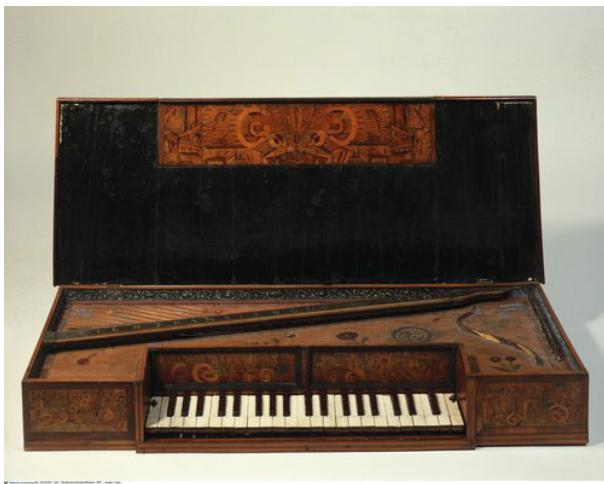
中文讲解
这是图18的图注。注明该图为匿名作者所作、约1595–1605年(可能产于奥格斯堡)的维金纳琴,现藏于柏林国家音乐研究所国家博物馆/乐器博物馆(藏品编号2217),并附德国国家博物馆数字化平台资源链接(最近访问日期为2025年3月4日)。图注以占位符注明「内嵌图像数据已省略;位置与图注保留」。
补充说明
此条为图版说明,无补充论证内容;图像具体视觉细节需参照原图。
第21段(P0236)
原文复述
On the characteristics of this style, cf. Forssman, Column and Ornament (see n. 39), 116–17. On the change in meaning of ornamentation in the Renaissance in general cf. Clare Lapraik Guest, The Understanding of Ornament in the Italian Renaissance (Leiden, 2016).
中文讲解
这是脚注46,提供两条参考文献:第一条是 Forssman《Column and Ornament》(见脚注39)第116–117页,关于该样式(涡卷饰样式主义)的特征;第二条是 Clare Lapraik Guest《The Understanding of Ornament in the Italian Renaissance》(莱顿,2016年),关于文艺复兴时期装饰意义变化的总体讨论。
补充说明
此条注释为正文 P0231 中所述「涡卷饰是样式主义的发展」与「装饰在文艺复兴时期的意涵转变」提供学术文献支撑。
第22段(P0237)
原文复述
See also the Cabinet Organ, Ausgburg, c. 1600, Victoria and Albert Museum, 216:1,2-1879, or the Cabinet with Room Organ, Tirol, 1590–1600, Landesmuseum Württemberg, G29,143, or the Virginal in a Cabinet, Tirol or Augsburg, 1580/90, Bayerisches Nationalmuseum Munich R 1069, and also the southern German cabinet from the second half of the 16th century held at the Graz Museum, inv. no. 9148-1.
中文讲解
这是脚注47,举出四件「直接嵌入珍奇柜木作」的乐器作为补充实例:(1)奥格斯堡约1600年的 Cabinet Organ(伦敦 V&A 博物馆,藏品编号216:1,2-1879);(2)蒂罗尔1590–1600年的带房间风琴的柜(符腾堡州博物馆,编号G29,143);(3)蒂罗尔或奥格斯堡1580/90年的 Cabinet 内置维金纳琴(慕尼黑巴伐利亚国家博物馆,编号R 1069);(4)16世纪后半叶的南德柜(格拉茨博物馆,编号9148-1)。
补充说明
此条注释作为「乐器被嵌入珍奇柜而成为舞台化场景」的进一步例证集,与正文 P0231 末尾的「worldly representation」论述直接呼应。
第23段(P0238)
原文复述
中文讲解
这是图19的图注。注明该图为 Lorenz Stöer 所著《Geometria et Perspectiva》(奥格斯堡:Hans Rogel 老,1567年;VD16编号S 9209)第[7r]页之雕版;并附巴伐利亚州立图书馆数字化平台(Münchener Digitalisierungszentrum)的解析链接(最近访问日期为2025年3月4日)。图注以占位符注明「内嵌图像数据已省略;位置与图注保留」。
补充说明
此条为图版说明;正文 P0231 用此图证明南德维金纳琴上的涡卷饰可追溯到 Stöer 这套雕版模板,从而说明家具装饰与乐器装饰共享同一图像资源库。
第24段(P0239)
原文复述
Even instruments obviously designed as showpieces harbour deeper messages. The so-called Glass Virginal of c. 1600, probably produced in the court workshop of either Ambras or Nuremberg and now at London’s Victoria and Albert Museum, is such an instrument, being immediately recognisable as a representational object on account of its decoration with coloured glass, enamel, brass, and so on (Fig. 20). Eighteen small panels of coloured glass depict scenes from Ovid’s Metamorphoses in high relief, uniting the decoration beneath the idea of transformation and thus broadcasting the client’s humanist education. The visual opulence of the elaborate, high-quality craftsmanship here is, moreover, an expression of the Age of Wonder (Zeitalter des Staunens), in which the medieval understanding of materials’ appropriateness was overturned. Thomas Aquinas (1225–74) held that every artist should strive to have an artwork be constituted in a manner appropriate to its purpose – for example, to make a saw out of iron and not out of glass, ’though this be a more beautiful material, because this very beauty would be an obstacle to the end he has in view.’ A soundboard covered with glass and brass spirals was unlikely to have fulfilled this requirement. It was much rather designed to evoke the marvelling appreciation of artful imitation that Walther Hermann Ryff formulated in 1547 as follows:
中文讲解
本段以「玻璃维金纳琴」(Glass Virginal,约1600年,可能产于 Ambras 或纽伦堡宫廷作坊,现藏伦敦 V&A 博物馆,图20)为案例,推进本节的核心命题:即便是明显作为「展示品」设计的乐器,也承载更深的讯息。该琴以彩色玻璃、珐琅、黄铜等装饰,因而外观上立即可识别为「再现之物」;然而其18块小型高浮雕彩色玻璃板描绘的是奥维德《变形记》场景——这就把装饰统一在「变形」(transformation)的概念之下,从而向观者「广播」客户的人文主义教养。作者随即把这种视觉上的奢华与「惊奇时代」(Age of Wonder / Zeitalter des Staunens)的精神联系起来:在这一时代,中世纪关于「材料的合宜性」的理解被颠覆。作者引托马斯·阿奎那(1225–74):艺术家应使艺术品按合宜于其目的的方式构成——例如锯应以铁而非玻璃制成,即便玻璃更美,因为「美本身会妨碍目的」。换言之,「材料应服务于功能」是中世纪美学的内在逻辑;一面覆以玻璃与黄铜螺旋的音板(soundboard)显然违反此逻辑。作者由此把玻璃维金纳琴置于这场美学转向之中:它不是为了音响功能,而是为了激起观赏者对「巧妙仿造」(artful imitation)的惊叹感——这种惊叹感正是 Walther Hermann Ryff 于1547年所明确表述的观念,引文见下一段。
补充说明
本段是本节论证的关键转折点:从「装饰作为身份投射」推进到「装饰作为惊奇感的激发」,并借阿奎那与 Ryff 的对比揭示这一美学范式的转变。
第25段(P0240)
原文复述
Extensive description of the object with in part contradictory statements: https://collections.vam.ac.uk/item/O58892/the-glass-virginal-virginal-unknown/ (accessed on 4 March 2025).
中文讲解
这是脚注48,指向 V&A 博物馆在线藏品页对该「玻璃维金纳琴」(藏品编号O58892)的详细描述,并指出该描述内部「in part contradictory statements」(部分陈述彼此矛盾)。
补充说明
此条注释对器物描述的内部矛盾作出提示,使读者了解该琴的研究文献中存在不一致之处;它服务于正文「该琴可能产于 Ambras 或纽伦堡宫廷作坊」之谨慎措辞。
第26段(P0241)
原文复述
Helffanbein und alle Edle gestein/ werden sie nit durch die höhe der farben und künstlich Malen/ höher und werder geachtet gehalten und gezieret? Wird nit auch das Goldt so künstlich gemalet/ vil höher dan das rohe Goldt geachtet?
中文讲解
这是正文所引 Walther Hermann Ryff(Walther Hermann Ryff / Gualtherus Rivius)1547年著作中的一段德文引文,原文以早期近代德语形式给出:「象牙与一切宝石——若由技艺精湛之画家以高明色彩巧妙描绘之,难道不是被看得更高、更贵、并被视为更装饰?金若被巧妙地绘出,难道不是比天然之金被看得更高?」这段德文引文是为前段(P0239)末尾所述「Ryff 1547年所论巧妙仿造之惊奇感」提供原文证据;本段与下一段(其英译)共同构成一个完整引文单位。
补充说明
此段德文引文须保留原文形式,不可译为英文或中文;其英译见下一段(P0242)。
第27段(P0242)
原文复述
(‘Ivory and all gemstones – are they not held in higher and greater esteem when rendered in quality paints by a skilful artist? Is gold not also, if skilfully painted, thought of more highly than natural gold?’).
中文讲解
这是上一段(P0241)德文引文的英译。译为:「象牙与一切宝石——若由技艺精湛之画家以高明色彩巧妙描绘之,难道不是被看得更高、更贵、并被视为更装饰?金若被巧妙地绘出,难道不是比天然之金被看得更高?」该英译为括号内的英文对译,与前段德文原文对应。
补充说明
此条与前段共同构成 Ryff 引文的「原文 + 英译」对子,为正文中「巧妙仿造之惊奇感」的论断提供精确文献依据。
第28段(P0243)
原文复述
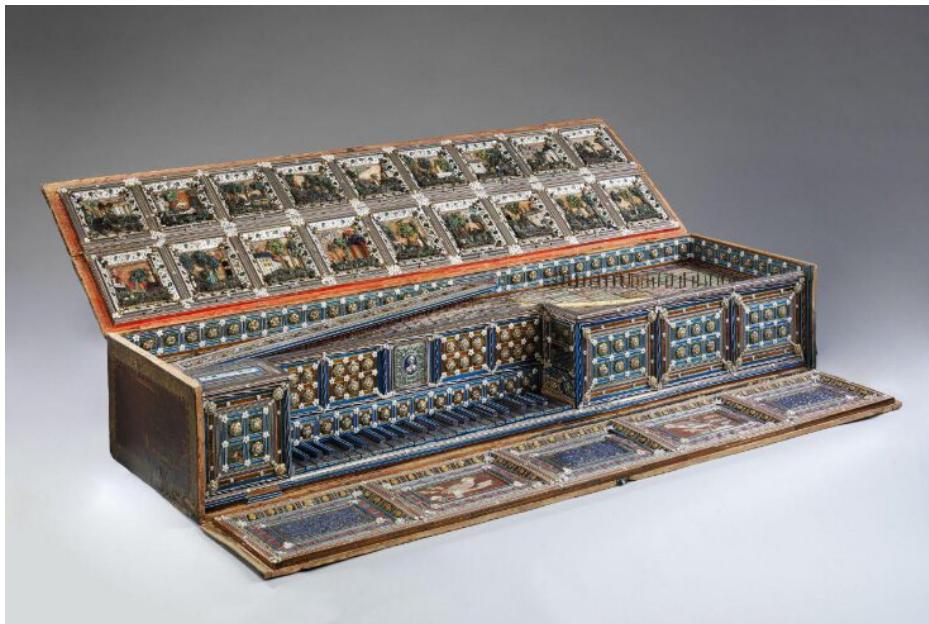
中文讲解
这是图20的图注。注明该图为匿名作者所作、约1600年的「玻璃维金纳琴」(The Glass Virginal),现藏于伦敦 V&A 博物馆(藏品编号402-1872),并附博物馆在线藏品页链接(最近访问日期为2025年3月4日)。图注以占位符注明「内嵌图像数据已省略;位置与图注保留」。
补充说明
此条为图版说明,无补充论证内容;图像具体细节需参照原图。
第29段(P0244)
原文复述
Thomas Aquinas, Summa theologica 1, 91, 3, quoted in Rosario Assunto, Die Theorie des Schönen im Mittelalter (Cologne, 1982), 231.
中文讲解
这是脚注49,标注正文 P0239 所引托马斯·阿奎那之言的具体出处:《神学大全》(Summa theologica)第一部分第91题第3条;该引文转引自 Rosario Assunto《Die Theorie des Schönen im Mittelalter》(《中世纪之美论》),科隆,1982年,第231页。
补充说明
此条注释标注阿奎那段落的精确出处(二级文献转引),为正文「中世纪材料合宜性原则」之论提供文献根据。
第30段(P0245)
原文复述
Walther Hermann Ryff (Gualtherus Rivius), Der furnembsten, notwendigsten, der gantzen Architectur angehörigen Mathematischen und Mechanischen künst eygentlicher Bericht (Nuremberg: Johann Petreius, 1547) (VD16 R 4001), das dritt buch der newen Perspectiva, fol. iv, http://data.onb.ac.at/rep/108DD702 (accessed on 4 March 2025).
中文讲解
这是脚注50,标注 Walther Hermann Ryff(拉丁化名 Gualtherus Rivius)1547年著作的全名:《Der furnembsten, notwendigsten, der gantzen Architectur angehörigen Mathematischen und Mechanischen künst eygentlicher Bericht》(纽伦堡:Johann Petreius,1547年;VD16编号R 4001),具体位于「das dritt buch der newen Perspectiva」(新透视法第三卷)第iv页;并附奥地利国家图书馆数字化资源链接(最近访问日期为2025年3月4日)。
补充说明
此条注释为正文 P0241–P0242 中 Ryff 关于「巧妙仿造之惊奇感」的德文引文提供完整书目信息。
第31段(P0246)
原文复述
Many lid paintings also combine the two functions of representation and projection. For example, Ioannes Ruckers’ double virginal, c. 1600, now at the Museo Civico di Milano (Fig. 21), portrays an idealised scene in which leisure time is spent hunting and boating in contemplative tranquillity. The ‘rich and beautiful’ present themselves here in a generously proportioned landscape featuring a palace, elements of a formal garden, and ’natural nature’ with a deer hunt on the opposite side of the little river. Typical markers of well-being such as the large four-legged wine cooler and the elegant sighthounds are complemented by a virginal richly decorated with an Orpheus scene. The instrument occupies a dominant position in a rose-covered pavilion and is being played by one of the ladies of the pictured group. This painting projects several things at the same time: a high standard of education with the reference to ancient mythology, a high longing for ‘Arcadia’, a love of music, and self-staging as modern, elegant people of their era. In this undoubtedly imagined veduta, a perfect moment from that day’s ideal world is projected onto the lid of a virginal – which, in turn, conveys that perfect moment to the listener-viewer.
中文讲解
本段转入琴盖画(lid painting)这一题材,明确提出:「再现与投射」这两层功能常常在琴盖画中合而为一。作者以 Ioannes Ruckers 约1600年的双层维金纳琴(double virginal,现藏米兰市立博物馆,图21)为案例。该琴盖画描绘一个理想化场景:休闲时间用于狩猎与泛舟,氛围沉思而宁谧。「富而美」的人物置身于比例宏阔的风景之中——宫殿、规整式花园要素、以及在小河对岸「自然之自然」(natural nature)中的猎鹿场景。画中典型「福祉标记」包括:四足大型酒柜(four-legged wine cooler)、优雅的视觉猎犬(sighthounds),与一架以「俄耳甫斯场景」装饰的维金纳琴相衬托。该琴在画面中占据主导位置——位于一座玫瑰覆盖的亭阁中,由画面群像中的一位女士演奏。这幅画同时投射若干讯息:经由对古代神话的指涉投射「高水准教养」;投射对「阿卡迪亚」(Arcadia)的向往;投射对音乐的热爱;以及把画中人自我塑造为「当代时尚、优雅之人」。在这样一幅无疑「想象出来的 veduta(详尽风景画)」中,源自当日理想世界的一个完美瞬间被投射到一架维金纳琴的琴盖之上——而琴盖又把这一完美瞬间传达给「聆听—观看者」(listener-viewer)。
补充说明
本段是本节中把「再现」与「投射」明确并置的关键段落;其案例显示二者并非截然二分,而是同时在视觉文化中实现。
第32段(P0247)
原文复述
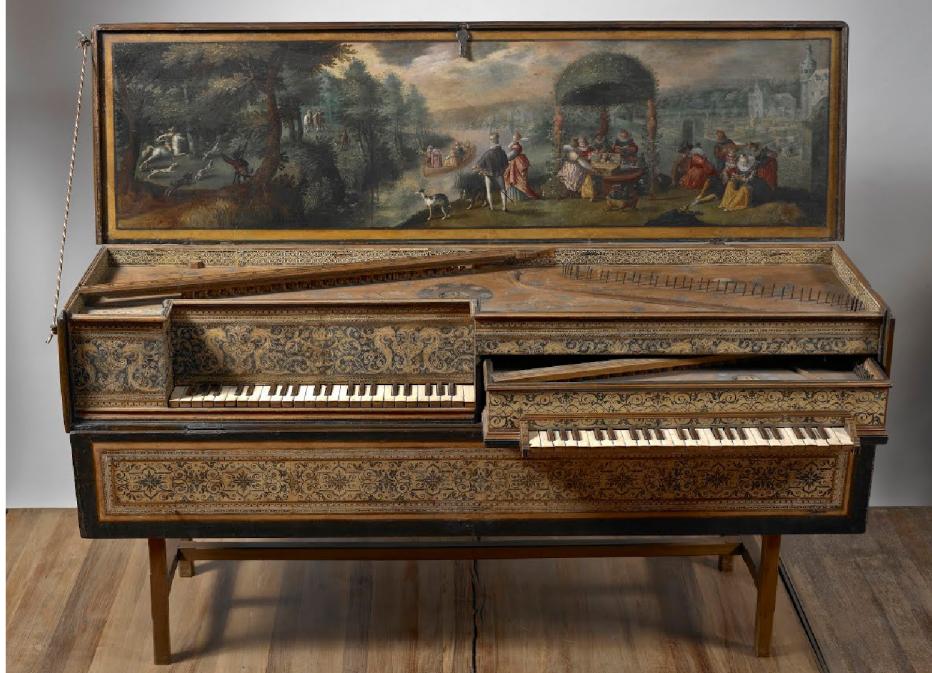
中文讲解
这是图21的图注。注明该图为 Ioannes Ruckers 约1600年所作双层维金纳琴(Double Virginal),现藏于米兰市立乐器博物馆(Comune di Milano – Museo degli Strumenti Musicali,藏品编号595),并附 Google Arts & Culture 资源链接(最近访问日期为2025年3月4日)。图注以占位符注明「内嵌图像数据已省略;位置与图注保留」。
补充说明
此条为图版说明,无补充论证内容;图像具体细节需参照原图。
第33段(P0248)
原文复述
For details on the depicted content, cf. Thomas Aurelius Belz, ‘Gartendarstellungen auf flämischen Kielinstrumenten’, in: Gärten und Höfe der Rubenszeit, ed. Ursula Härting (Munich, 2000), 135–42.
中文讲解
这是脚注51,标注关于该琴盖画描绘内容细节的参考文献:Thomas Aurelius Belz「Gartendarstellungen auf flämischen Kielinstrumenten」(《弗兰德斯击弦乐器上的园林图像》),载于 Ursula Härting 编《Gärten und Höfe der Rubenszeit》(《鲁本斯时代的园林与庭院》),慕尼黑,2000年,第135–142页。
补充说明
此条注释为正文 P0246 中 Ruckers 双层维金纳琴盖画的具体描绘提供更深入的研究文献指引。
第34段(P0249)
原文复述
The dual levels of representation and projection on which these paintings operate are particularly clear in Hans Ruckers the Elder’s double virginal of 1581, now at the Metropolitan Museum of Art in New York (Fig. 22). The lid painting projects all the topoi of an ideal world. A combination of garden pavilions, an arbour of blooming roses, a Renaissance palace, and a bridge over a little river establishes the congenial setting. Thirty-six people pursue their pleasures, mainly in pairs: music-making, dancing, sport, boating, walking, and outdoor dining. Three uniformed fanfare-players indicate the company’s high rank, as do the walled menagerie in the background, the Spanish fashion (with ruff, headdress, and rapier), and the depicted people’s conspicuously graceful gestures. Legend has it that this instrument was sent to the New World as a gift from the Spanish King Philip II and his fourth wife, Anne of Austria. However, this version of events has occasionally been doubted by researchers. The gilded medallions with portraits of the royal couple on the nameboard are based on designs by Gianpaolo Poggini (1518–82), whom Philip II had commissioned to redesign the coinage of Flanders in 1557. Their relatively rough casting makes the story of a royal gift to a princess appear dubious. Whatever the case may have been, these portraits are either vehicles of self-representation or acts of homage to the royal couple on the part of their commissioner or simply an attribute of an elite society of the sort pictured on the lid. In addition, the medallions highlight the idealization of couple relationships as depicted in the painting and correspond to the construction of these paired instruments, which ’not only represent the mother-child dualism but also the marital harmony of a man and a woman, with the octave coupling as a parallel to the difference between female and male voices.’
中文讲解
本段以 Hans Ruckers the Elder 1581年的双层维金纳琴(现藏纽约大都会艺术博物馆,图22)为案例,集中说明琴盖画中「再现」与「投射」两个层次是如何同时操作的。琴盖画投射理想世界的全部 topoi(惯例主题):花园亭阁、玫瑰盛开的凉棚、文艺复兴宫殿、小河上的桥,构成「相得益彰」(congenial)的场景。三十六个人成双成对地从事各种消遣——奏乐、舞蹈、运动、泛舟、漫步与户外用餐。三名制服齐整的铜管乐手(fanfare-players)标示出群体的高位阶;背景中围墙内的动物园(walled menagerie)、西班牙式时装(带拉夫领 ruff、头饰 headdress 与佩剑 rapier)以及画面人物格外优雅的姿态都同样标示高位阶。该琴相传是西班牙国王菲利普二世与其第四任妻子、奥地利的安妮赠送给新世界的礼物。然而这一说法曾被研究者质疑。琴名板上以 Gianpaolo Poggini(1518–82)设计的图案为底本的皇室夫妇镀金圆形浮雕肖像——菲利普二世曾于1557年委托 Poggini 重新设计弗兰德斯铸币——其相对粗糙的铸造使「皇家赠送」之说显得可疑。无论该琴是否确为皇家礼物,这些肖像或可视为委托人之自我再现(self-representation)、对皇室致敬之举(homage),或仅为画面所绘精英社会之属性(attribute)。除此之外,这些圆形浮雕凸显了画面中所描绘的「伴侣关系理想化」,并对应于此类成对(paired)乐器的构造——它们「不仅再现母子二元关系,也再现男女之婚姻和谐,其中八度耦合对应女声与男声之差异」。这一构想的核心在于:双层维金纳琴的物质结构(两件琴以八度耦合)与画面中夫妇形象之间形成结构性的同构,把器物身份、视觉文化、性别秩序一并投射到听者—观者面前。
补充说明
本段是本节「再现与投射」双层命题的典范案例;其证据结构兼具器物、铭文、画面三层。
第35段(P0250)
原文复述
Pollerus, Tasteninstrumente (see n. 1), esp. 210–22.
中文讲解
这是脚注52,标注 Pollerus《Tasteninstrumente》(见正文脚注1)第210–222页(尤其该范围)。
补充说明
此条注释作为正文 P0249 中所述 Hans Ruckers the Elder 1581年双层维金纳琴琴盖画「投射理想世界全部 topoi」的更深入研究文献指引。
第36段(P0251)
原文复述
Stewart Pollens, ‘Flemish Harpsichords and Virginals in the Metropolitan Museum of Art: An Analysis of Early Alterations and Restorations’, in: Metropolitan Museums Journal 32 (1997) 85–110, at 87.
中文讲解
这是脚注53,标注 Stewart Pollens「Flemish Harpsichords and Virginals in the Metropolitan Museum of Art: An Analysis of Early Alterations and Restorations」,载于《Metropolitan Museums Journal》第32卷(1997年)第85–110页(具体第87页)。
补充说明
此条注释为正文 P0249 中所述「该琴据传由菲利普二世与安妮皇后赠送给新世界」之说提供 Pollens 文献来源(属版本/故事流传之出处)。
第37段(P0252)
原文复述
Laurence Libin, ‘Remarks on the 1581 Hans Ruckers Virginal at the Metropolitan Museum of Art’, in: Hans Ruckers (+1598): Founder of a Harpsichord Workshop of Universal Importance in Antwerp, ed. Jeannine Lambrechts-Douillez (Peer, 1998), 77–84.
中文讲解
这是脚注54,标注 Laurence Libin「Remarks on the 1581 Hans Ruckers Virginal at the Metropolitan Museum of Art」,载于 Jeannine Lambrechts-Douillez 编《Hans Ruckers (+1598): Founder of a Harpsichord Workshop of Universal Importance in Antwerp》(Peer,1998年)第77–84页。
补充说明
此条注释为正文 P0249 中所述「研究者对皇家赠送说之质疑」提供 Libin 文献依据(属对立观点/质疑出处)。
第38段(P0253)
原文复述
Moritz Kelber, ‘Double Virginals’, in: The Museum of Renaissance Music: A History in 100 Exhibits, ed. Vincenzo Borghetti and Tim Shephard (Turnhout, 2023), 222–5, at 225.
中文讲解
这是脚注55,标注 Moritz Kelber「Double Virginals」,载于 Vincenzo Borghetti 与 Tim Shephard 编《The Museum of Renaissance Music: A History in 100 Exhibits》(Turnhout,2023年)第222–225页(具体第225页)。
补充说明
此条注释为正文 P0249 末尾「双层琴的母子二元、夫妻和谐与八度耦合对应男/女声差异」之论提供 Kelber 的文献依据(属结构—社会同构论点的来源)。
第39段(P0254)
原文复述
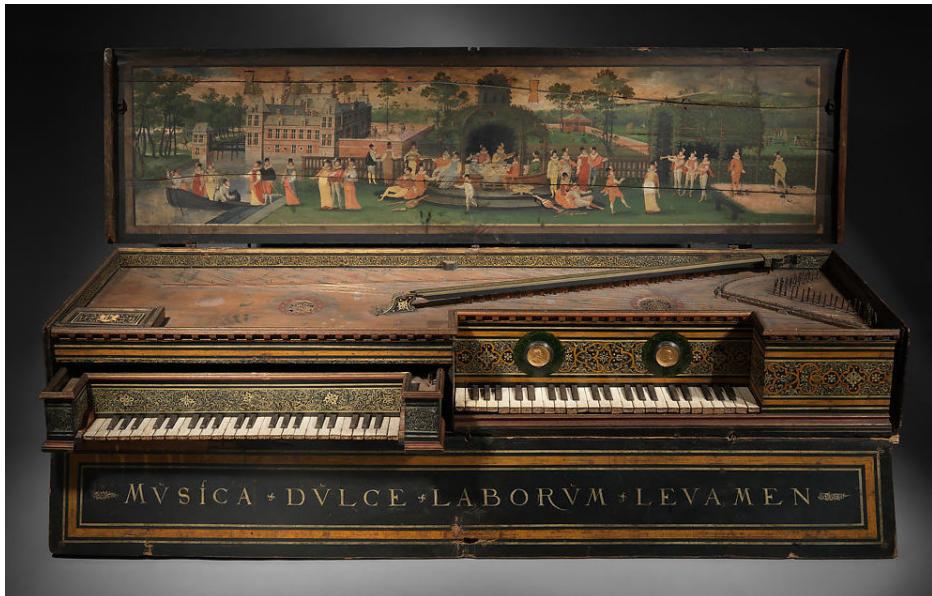
中文讲解
这是图22的图注。注明该图为 Hans Ruckers the Elder 1581年所作双层维金纳琴,现藏于纽约大都会艺术博物馆(藏品编号29.90),并附博物馆在线藏品页链接(最近访问日期为2025年3月4日)。图注以占位符注明「内嵌图像数据已省略;位置与图注保留」。
补充说明
此条为图版说明,无补充论证内容;图像具体细节需参照原图。
第40段(P0255)
原文复述
The decoration on Marten van der Biest’s double virginal (Fig. 23) is frequently compared with that of the abovementioned Ruckers instrument. It was probably commissioned by Alessandro Farnese, governor of the Spanish Netherlands. His portrait and those of six other aristocrats including his uncle, Philip II of Spain, are to be found on tokens mounted on the front board and surrounded by elaborate ornamentation. The absence of a portrait of Farnese’s wife Maria of Portugal (who had already died in 1578) in combination with both the motto ‘Espoir confoirte’ (‘Hope sustains’) on the inside of the lid flap and the painting on the lid, which can be interpreted as a ‘garden of love’ painting, indicates the decoration’s function – which goes far beyond mere representation. The painting on the lid suggests a seemingly free and life-affirming Flemish society, but the biblical theme on the lid flap – The Obsessed Saul Pursues David – stems from a religious and spiritual sphere which, of course, still played a determining role in people’s lives during the 16th century.
中文讲解
本段以 Marten van der Biest 的双层维金纳琴(图23)为案例,进一步推进本节命题。该琴装饰常被拿来与前述 Ruckers 琴比较。作者推定它可能由西班牙尼德兰总督 Alessandro Farnese 委托制作;其肖像与六位其他贵族(包括其叔父西班牙菲利普二世)的肖像被铸成圆形纪念章(tokens),安装于前板之上,环以繁复装饰。值得注意的「不在场」:Farnese 之妻、葡萄牙的玛丽亚(已于1578年去世)的肖像缺席。配合琴盖内侧翻板上的铭言「Espoir confoirte」(「希望支撑」)以及琴盖上可被解读为「爱之园」(garden of love)的画作,这种缺席暗示此琴装饰的功能远不止于单纯的「再现」。琴盖画呈现一个看似自由、肯定生命的弗兰德斯社会,但琴盖翻板上的圣经主题——「被邪灵所扰的扫罗追逼大卫」(The Obsessed Saul Pursues David)——则源自宗教与精神领域;而这一领域在16世纪无疑仍是人们生活中的决定性维度。本段揭示的关键结构是:世俗画作(爱之园、社会自由)与圣经主题(扫罗追大卫、希望支撑)共存于同一琴的内外两面;这种「世俗再现 + 宗教投射」的复合形态,使乐器装饰的「再现与投射」功能远超过单纯的财富或地位展示,而进入道德—精神层面。
补充说明
本段把本节论证推向「再现与投射的第三维度」——道德/宗教层面;器物上的画作与翻板铭文—圣经主题构成内外对话。
第41段(P0256)
原文复述
Cf. for example Florence Gétreau, ‘Vin et musique dans les jardins de plaisir: un thème pour les couvercles de virginales et clavecins anversois et allemands (1570–1650)’, in: Musique – images – instruments 19 (2023), 14–16.
中文讲解
这是脚注56,标注 Florence Gétreau「Vin et musique dans les jardins de plaisir: un thème pour les couvercles de virginales et clavecins anversois et allemands (1570–1650)」(《愉悦之园中的酒与音乐:1570–1650年安特卫普与德意志维金纳琴与羽管键琴琴盖主题》),载于《Musique – images – instruments》第19期(2023年)第14–16页。
补充说明
此条注释为正文 P0255 所述「该琴装饰常被拿来与 Ruckers 比较」与「爱之园」题材的更深入研究提供文献指引。
第42段(P0257)
原文复述
1 Sam 18:8–16.
中文讲解
这是脚注57,标注正文所引圣经故事「被邪灵所扰的扫罗追逼大卫」的经文出处:《撒母耳记上》第18章第8–16节。
补充说明
此条注释为正文 P0255 中所述琴盖翻板上的圣经主题给出精确经文出处。
第43段(P0258)
原文复述
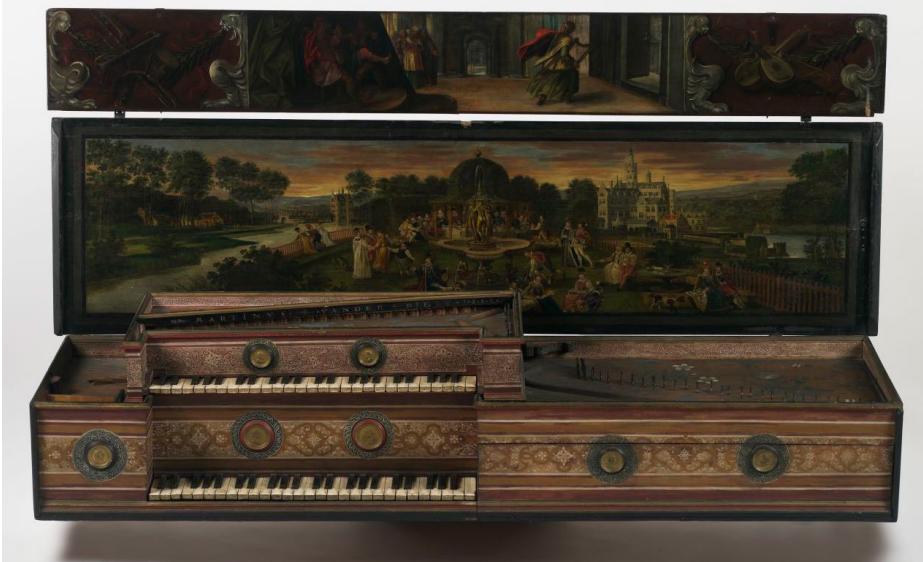
中文讲解
这是图23的图注。注明该图为 Marten van der Biest 1580年所作双层维金纳琴,现藏于纽伦堡的德国国家博物馆(Germanisches Nationalmuseum);并附博物馆在线藏品目录链接(最近访问日期为2025年3月4日)。图注以占位符注明「内嵌图像数据已省略;位置与图注保留」。
补充说明
此条为图版说明,无补充论证内容;图像具体细节需参照原图。
第44段(P0259)
原文复述
Another facet of Flemish life, the image of the common people indulging in wine, games, and dance, can be found on the virginal by Johannes Grouwels, c. 1580, at the Musical Instruments Museum in Brussels (Fig. 24). This depiction likewise imagines an idealised segment of reality, which cannot have been nearly so light-hearted amidst the upheavals of the Eighty Years’ War and the attendant religious and political struggles. The scene, painted in grisaille and rich in detail, clearly depicts the exuberant hustle and bustle on St. George’s Day – which, in Flanders and elsewhere, marked the transition from winter to spring and was traditionally celebrated with large fairs. In the background, against a backdrop of typical Flemish buildings, a St. George’s ritual can be seen with a performer in the role of the saint fighting against a wooden dragon. The dragon is meant as a symbol of winter and evil. Grouped around a tree in the foreground is a moral admonition concerning various vices that are explored in numerous topoi: drunkenness, gluttony, quarrelsomeness, lust, gambling. Pieter Balten, David Tenier the Younger, and especially Pieter Brueghel the Elder, Pieter Brueghel the Younger, and Jan Brueghel the Elder are known for their bawdy scenes set at St George’s Fair. Both the commissioner and the painter of this virginal from 1580 showed that they were familiar with the artistic standards of their time. Detailed depictions of village and patronage festivities were part of the popular genre of peasant and village life in the 16th and 17th centuries and probably hung primarily in the homes of wealthy people. It is in such a context that one must also view this virginal, whose lid painting not only reflects Flemish cultural idiosyncrasies but also unites traditional content with modern expressivity – for behind this projection of exuberant joie de vivre, a moralizing pointed finger lies hidden.
中文讲解
本段以 Johannes Grouwels 约1580年的维金纳琴(现藏布鲁塞尔乐器博物馆,图24)为案例,揭示弗兰德斯生活的另一面——普通人沉浸于饮酒、游戏与舞蹈的形象。该琴盖画同样呈现一个理想化的现实片段;然而在八十年战争(Eighty Years’ War)及其附带的宗教与政治动荡中,这种轻松活泼的画面「不可能真的那么轻松」。该场景以灰调画法(grisaille)绘制,细节丰富,清楚地描绘了圣乔治日(St. George’s Day)的喧闹繁忙——这一天在弗兰德斯等地标志着由冬入春的过渡,并以大型集市传统庆祝。背景中,在典型弗兰德斯建筑衬托下,可见一位表演者扮演圣乔治,与木制龙搏斗;龙被作为冬与恶的象征。前景中人物环绕一棵树,则是一组关于各种恶习(醉酒、贪食、好斗、纵欲、赌博)的道德训诫,这些恶习被以众多 topoi 表现。Pieter Balten、小 David Teniers,以及尤其老 Pieter Brueghel、小 Pieter Brueghel、老 Jan Brueghel 都以描绘圣乔治集市的粗俗场景著称。1580年这架维金纳琴的委托人与画家均显示出他们熟悉当时艺术标准。村庄与主保节日(patronal festivities)的精细描绘是16至17世纪描绘农民与乡村生活的流行题材的一部分,这类画作很可能主要悬挂于富裕人家之中。本琴亦须置于这一语境中理解:其琴盖画不仅反映弗兰德斯文化特性,亦把传统内容与现代表现性相统一——因为在这种对奔放生活乐趣(joie de vivre)的「投射」背后,隐藏着一根道德训诫的手指。作者由此完成全节命题:即便是看似世俗欢愉的画面,也是「再现(弗兰德斯文化特性)+ 投射(道德训诫)」的双层结构。
补充说明
本段把「再现与投射」命题延伸至最贴近日常生活的场景——圣乔治集市,并以「表面欢愉、内里训诫」的对照完成本节论证。
第45段(P0260)
原文复述
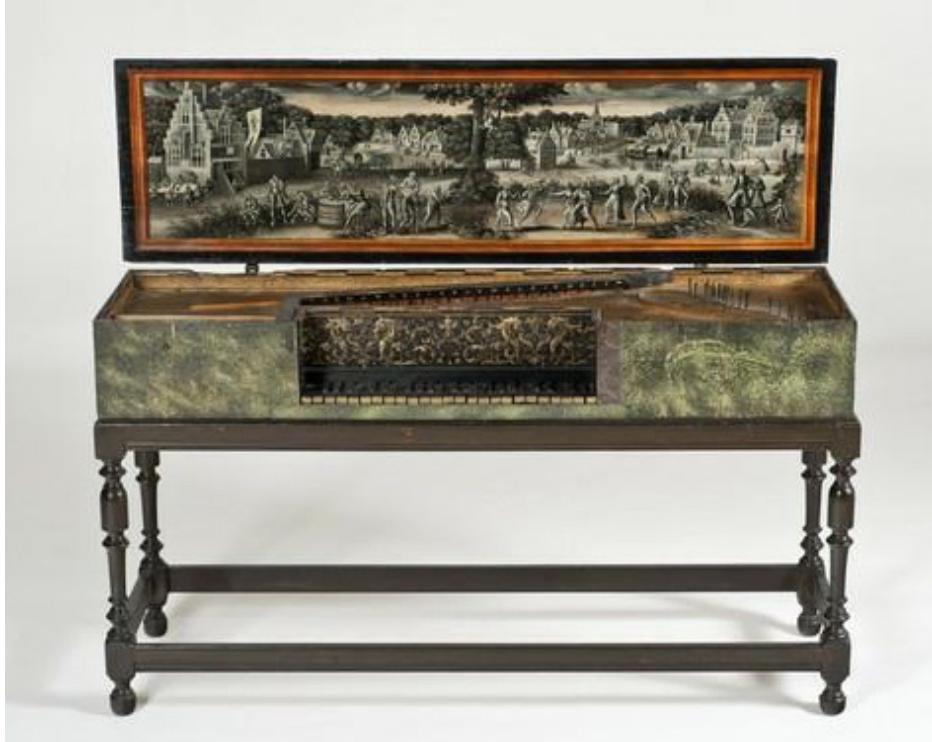
中文讲解
这是图24的图注。注明该图为 Johannes Grouwels 约1580年所作维金纳琴,现藏于布鲁塞尔乐器博物馆(Musical Instrument Museum,藏品编号2929),并附 Carmentis 博物馆在线平台资源链接(最近访问日期为2025年3月4日)。图注以占位符注明「内嵌图像数据已省略;位置与图注保留」。
补充说明
此条为图版说明,无补充论证内容;图像具体细节需参照原图。
脚注 / 边栏 / 图表 / 附加信息(如有)
本节共包含13条注释(脚注34–56,编号存在但去掉了33以下连续性);按功能分类:原始文献/书目引用类(脚注36、38、40、42、43、45、48、49、50)占多数,附网络资源访问链接以便核对;网络资料/在线资源指示类(脚注34、35、48);二级文献引用与延伸阅读类(脚注39、46、51、52、53、54、55、56);经文出处类(脚注41、57)。本节还包含8幅图(图17–24),按出现顺序为:意大利维金纳琴(图17)、南德维金纳琴(图18)、Stöer 透视法雕版(图19)、玻璃维金纳琴(图20)、Ioannes Ruckers 双层维金纳琴(图21)、Hans Ruckers the Elder 双层维金纳琴(图22)、Marten van der Biest 双层维金纳琴(图23)、Johannes Grouwels 维金纳琴(图24)。脚注与图共同支撑本节以「器物 + 画作 + 铭文 + 历史文献」四维材料为依托的论证结构。
💡 本节核心要点
- 本节界定「representation(Repräsentation)」一词的具体含义为「生成一种与主人较高社会经济地位相称、并向外投射该地位的外在效果」,把装饰研究从纯物质层面提升到身份建构与社会表演层面。
- 16世纪装饰乐器的客户动机并非泛审美,而是把乐器作为「高档家具式陈列物」嵌入 Kunstkammer/Wunderkammer 的整体收藏文化之中,服务于威望建构。
- 作者用一条纵贯古今的论据链——从《圣经》所罗门的 Almug 木、奥维德《变形记》中阿波罗的宝石象牙里拉琴、Mersenne「眼睛应参与耳朵之乐」,到 Ryff 的「巧妙仿造之惊奇感」——证明「以贵重材料装饰乐器并使其同时悦耳与悦目」是悠久的跨时代传统。
- 「惊奇时代」(Zeitalter des Staunens)颠覆了阿奎那「材料应合宜于其目的」的中世纪原则,使玻璃音板等「功能上不合理」的乐器成为激发惊叹感的视觉—人文主义投射媒介。
- 琴盖画集中体现「再现」与「投射」的双层结构:再现呈现财富、地位与文化(豪宅、玫瑰凉棚、制服铜管乐手、西班牙时装、围墙动物园),投射传达人文教养、神圣或道德讯息(古代神话、奥维德变形、阿卡迪亚、圣经扫罗—大卫、圣乔治屠龙、反恶习训诫)。
- 许多案例(Eleonora della Rovere 八度维金纳琴、Ioannes Ruckers、Hans Ruckers the Elder、Marten van der Biest、Johannes Grouwels)显示器物的物质结构(如成对琴、八度耦合)与画面/铭文中的社会—性别—道德秩序形成结构同构,使乐器装饰成为身份、教养与价值观念的综合投射体。
🔑 关键术语
- Representation / Repräsentation(再现):在本节中专门指「生成一种与主人较高社会经济地位相称、并向外投射该地位的外在效果」;它不是泛指「表征」,而是一种带社会表演性的视觉策略,用以建构主人形象与威望。
- Projection(投射):指借由图像、铭文、装饰等把主人的内在诉求——教养、宗教情感、道德立场、时代精神——向外投射到乐器上;与「再现」相比更强调内在维度的外在化。
- Kabinettschränke / Kunstkammern / Wunderkammern(陈列柜 / 珍奇柜 / 惊奇柜):16世纪欧洲贵族与富裕市民用以收藏、陈列稀有物品与奇珍异宝的家具或房间;本节借此将乐器装饰嵌入更宏观的收藏—陈列文化之中。
- Veduta(详尽风景画):源自意大利语,指对城市或景观作详细、理想化描绘的画作;本节用此词形容 Ruckers 琴盖上「无疑想象出来」的理想景观画面。
- Topos / topoi(惯例主题):指文化中反复出现的常规主题或意象;本节用以说明琴盖画所投射的内容——花园亭阁、玫瑰凉棚、宫廷、伴侣成双——属于理想世界的一组惯例性表达。
- Claviorganum(键盘管风琴复合乐器):键盘乐器与管风琴结合的复合乐器;本节借此说明南德维金纳琴并非独立乐器,而可能服务于宗教场合,故其琴盖上的圣杯装饰有神圣指涉。
- Mannerist scrollwork(样式主义涡卷饰):16世纪后期出现的一种装饰风格,以繁复、扭曲、带有古代废墟意象的涡卷纹样为特征;本节将其与 Lorenz Stöer《Geometrie et Perspectiva》(1567)雕版模板相联系。
- Grisaille(灰调画法):以单色(多为灰色)层次描绘对象的绘画技法;本节用以描写 Grouwels 维金纳琴琴盖画的视觉特征。
- St. George’s Day(圣乔治日):弗兰德斯等地用以标志冬入春过渡的传统节日,伴有大型集市;本节琴盖画以此节日上的屠龙仪式与各类恶习并存,作为「表面欢愉—内里训诫」的对照。
- Age of Wonder / Zeitalter des Staunens(惊奇时代):本节所论16–17世纪美学范式的转变期,其特征是中世纪「材料合宜性」原则被颠覆,巧妙仿造与奇异材料组合成为激发惊叹感的手段;本节以玻璃维金纳琴为该时期的代表器物。
- Repräsentation(再现)的意大利语语境:本节引用 Sabba da Castiglione 1554年《Ricordi》中意大利文箴言作为佐证;其「悦耳 + 悦目 + 养心」三层论述与本节对「再现与投射」的定义相呼应。
- 双层维金纳琴(double virginal)的结构同构:由两件维金纳琴以八度耦合而成的复合键盘乐器;本节借此与画面中的夫妇、母子、伴侣等社会—性别形象作结构同构,把物质器物与文化秩序相联系。
S19 Epochal Spillover
第1段(P0261)
原文复述
Epochal Spillover
中文讲解
本段为本小节的标题,居于版面顶部,英文作 “Epochal Spillover”,与正文中从文学/史学借用的德语术语 Epochenverschleppung(可直译为“时代的拖曳/延滞”)相对应。该标题提示本节的核心论题:不同艺术时代的元素如何在后续时代中以“时代错位”的方式残留并被重新组合,尤其体现在16世纪乐器装饰中古代与现代母题的混合。
第2段(P0262)
原文复述
In my research, I have noticed again and again how certain patterns and motifs frequently form new ‘recompositions’ over the centuries. For this phenomenon, I would like to borrow a term from literature or historiography originally coined by Gregor von Rezzori: Epochenverschleppung. By this, he meant the ‘anachronistic spillover of elements of reality specific to one epoch into a following one’. Such elements do not all share the same inertia, with some persisting beyond their time and conveying a certain mood or ambience despite being functionally obsolete. For example, ancient gods and figures from Greco-Roman mythology continue to feature in works of art and entertainment of all kinds today. And in the context of the 16th century, this admixture of ancient and modern ingredients is among the striking phenomena in the realm of decoration. In instrument decoration, as well, the rapid adoption of new artistic innovations – above all scrollwork and strapwork, jewelled ornamentation, and the decorative cartouche – alongside references to the old repertory of forms is likewise remarkable. Moreover, there is evidence that instrument makers adopted even peripheral stylistic developments.
中文讲解
本段是本节的理论铺垫。作者首先从个人研究经验出发,指出某些纹样与母题会在数世纪中不断形成新的"重组"。为命名这一现象,他借用了由 Gregor von Rezzori 首创、原属文学/史学领域的术语 Epochenverschleppung,其定义为"一个时代所特有的现实元素时代错位地溢出至后一时代"。这里需要解释的关键点有三:其一,这种"溢出"并非全然匀质,不同元素的"惯性"不同——有些虽已功能上失效,却仍能传递某种情调或氛围(mood or ambience);其二,作者以希腊罗马神话中的诸神与形象在今日各类艺术与娱乐中持续出现作为通用例证,说明古代母题的当代活力;其三,作者将论域收窄到16世纪装饰艺术这一具体语境,指出古代元素与现代创新的混合(admixture of ancient and modern ingredients)是该领域的显著现象。在乐器装饰中,新艺术革新(特别是卷形纹/卷草纹 scrollwork、带形纹/束带纹 strapwork、宝石式装饰 jewelled ornamentation 以及装饰性涡卷框 cartouche)被迅速采纳,与旧的造型语汇并存;甚至一些边缘性的风格发展也被乐器制作者吸收。作者在此为下一段的具体案例(Lodewijk Theewes 的 claviorgan)作了概念上的准备。
补充说明
术语 scrollwork(卷形纹)、strapwork(带形纹)、jewelled ornamentation(宝石式装饰)与 cartouche(涡卷框/装饰性匾牌)在16世纪装饰艺术中往往作为一组并提的新造型手段,与源自古代的装饰语汇形成对照,这些概念在下一段的具体案例中将逐一落实。
第3段(P0263)
原文复述
Gregor von Rezzori, Mir auf der Spur (Munich, 1999), 13.
中文讲解
本段是脚注58的完整内容,标注了 Epochenverschleppung 一词的原始出处:Gregor von Rezzori 的著作 Mir auf der Spur(《追踪自我》),1999年于慕尼黑出版,第13页。该脚注为正文借用的术语提供文献依据,属于来源类(source)脚注,不修改或限定正文主张,仅用以追溯定义来源。
第4段(P0264)
原文复述
The claviorgan of the Antwerpian instrument maker Lodewjk Theewes, who worked in England beginning in 1579 (Figs. 25-6), is a typical example of such mixing of components from different artistic epochs. The oak case is painted in various colours, with its surface vertically divided by pilasters featuring gilded Ionic capitals – i.e., elements from the repertory of ancient forms. The marbled surfaces, however, are structured quite sculpturally with the newest strapwork and jewelled ornamentation. This new type of illusionistic strapwork with diamond rustication had been developed barely 20 years earlier by Cornelis Floris, disseminated by the Dutch painter Hans Vredeman de Vries, and one occasionally finds it transformed into compartmentalised patterns suggestive of cut jewels. On the inside of the instrument’s lid there is likewise a contemporary strapwork cartouche – which, however, contains a scene from the ancient Orpheus myth. Next to it are grotesque motifs and garlands of fruit, which had been incorporated into Renaissance art especially since the rediscovery of the ancient Domus Aurea in Rome at the end of the 15th century. The depictions of monkeys, on the other hand, are borrowed from playing cards designed by the contemporary Nuremberg artist Virgil Solis around 1550 (Fig. 27). It was thus that an individual design was synthesised from elements of different artistic periods, thereby taking into account both the humanistic educational canon and the modern need for representation.
中文讲解
本段以具体器物——安特卫普乐器制作者 Lodewijk Theewes(1579年起在英国工作)制作的 claviorgan(击弦风琴/古钢琴与管风琴的复合乐器)——作为"时代错位溢出"的典型案例(参图25-6)。作者将该器物表面逐层拆解,以展示不同时代元素的并存:
- 橡木琴身涂以多色油漆,垂直方向以带鎏金爱奥尼亚式柱头(Ionic capitals)的壁柱(pilasters)划分——这是源自古代造型语汇的元素;
- 而大理石化(marbled)的表面则以最时新的带形纹与宝石式装饰作雕塑化处理——这是当代的新艺术语汇;
- 这种具有"菱形粗琢"(diamond rustication)的错觉性带形纹大约20年前由 Cornelis Floris 创造,并由荷兰画家 Hans Vredeman de Vries 推广传播,偶尔还会被转化为让人联想到切割宝石的分格化图案;
- 琴盖内侧同样有一个当代风格的带形纹涡卷框(strapwork cartouche),但其内却描绘着古老的俄耳甫斯神话(Orpheus myth)场景——形式是当代的,内容是古代的;
- 涡卷框旁还有怪诞纹饰(grotesque motifs)与水果花环(garlands of fruit),这类母题自15世纪末罗马古代"金宫"(Domus Aurea)被重新发现后便被吸纳进文艺复兴艺术;
- 猴子图像则借自同时代(约1550年)纽伦堡艺术家 Virgil Solis 设计的扑克牌牌面(参图27)。
作者在段末给出综合判断:该器物的设计是"由不同时代艺术元素合成的"个体化方案,同时回应了两方面的需求——人文主义教育传统(humanistic educational canon,对应古代神话与经典语汇)与现代的展示/身份诉求(the modern need for representation,对应最新的装饰风格)。这个案例的作用在于:以一件实物落实上一段抽象的 Epochenverschleppung 概念,并显示"不同来源的元素如何在同一器物上被并置且彼此并不矛盾"。值得注意的细节是,作者明确指出各项母题的时间层次(古代—当代20年前—15世纪末—约1550年),这本身就是对"时代惯性差异"这一理论的实证支撑。
补充说明
本段中提到的几个具体参考点(如 Cornelis Floris 与 Hans Vredeman de Vries 对带形纹的传播、Domus Aurea 重启"怪诞纹"、Virgil Solis 的扑克牌设计)均直接出现在原文中,属于案例本身的内部事实,作者把它们编织为时间链以佐证概念,无需补充外部信息。
脚注 / 边栏 / 图表 / 附加信息(如有)
本小节含一条脚注(P0263),用于标注 Epochenverschleppung 一词的文献出处(Gregor von Rezzori, Mir auf der Spur, Munich, 1999, p. 13)。文中提及多幅图像:图25-6 对应 Lodewijk Theewes claviorgan 的整体与局部视图,图27 对应 Virgil Solis 约1550年的扑克牌设计,二者均用于以视觉佐证正文所述元素来源与混合方式。
💡 本节核心要点
- 本节核心概念为 Epochenverschleppung(时代的拖曳/溢出),指一个时代特有的现实元素时代错位地延续至后一时代。
- 不同元素具有不同的"惯性":部分元素虽已功能失效,却仍能传递情调与氛围;这一现象是后续案例分析的理论前提。
- 在16世纪装饰艺术与乐器装饰中,新艺术语汇(卷形纹、带形纹、宝石式装饰、装饰性涡卷框)被迅速采纳,与古代造型语汇并存甚至被混合使用。
- Lodewijk Theewes 的 claviorgan 被作为典型案例:其装饰表面并置了爱奥尼亚柱头(古代)、Cornelis Floris/Vredeman de Vries 式带形纹与菱形粗琢(约1560年代)、Domus Aurea 之后的怪诞纹与水果花环(文艺复兴以来)、Virgil Solis 扑克牌中的猴子(约1550年)等不同时代元素。
- 该案例显示,时代错位的混合并非混乱,而是同时回应了人文主义教育传统与现代展示/身份诉求两重需要。
- 作者借此案例验证了上一段抽象的概念,并以一件具体乐器落实"古代-当代元素被综合为个体化设计"的论点。
🔑 关键术语
- Epochenverschleppung:Gregor von Rezzori 提出的术语,意为"时代的拖曳/溢出",指一个时代特有的现实元素时代错位地延续到后一时代。本节借用此词描述纹样与母题跨世纪重组的现象。
- strapwork:带形纹/束带纹,16世纪装饰艺术中的创新语汇之一,模仿皮条或带子交织卷曲的效果,本节中与卷形纹、宝石式装饰并列为"新艺术革新"。
- diamond rustication:菱形粗琢/菱面凿石饰面,是一种使墙面或表面呈现棱面分割、状似切割宝石的装饰处理,文中作为 Cornelis Floris 革新成果的标志。
- cartouche:装饰性涡卷框/匾饰,一种带有卷边或卷草边框的装饰画框或铭牌样式,本节中作为器物装饰的当代新元素出现。
- Domus Aurea:古罗马尼禄"金宫",在原文语境中作为15世纪末被重新发现从而推动"怪诞纹"(grotesque motifs)进入文艺复兴艺术的关键遗址被提及。
- claviorgan:击弦古钢琴与小型管风琴结合的复合键盘乐器,本节案例研究的对象,由 Lodewijk Theewes 制作。