目录
ch_5 Chapter 5: Accentuation and Emphasis in Mozart’s Sonatas for Violin and Keyboard
- 5.1 [描述性拆分] Accents in Variation 5 of K481 and the opening of K526
- 页码:1-1
- 5.2 [描述性拆分] Accents in the opening theme of K526, movement 1
- 页码:2-3
- 5.3 [描述性拆分] Harmonic rhythm and accentuation in K526, movement 1
- 页码:4-4
- 5.4 [描述性拆分] From grammar to Affekt: two phases of musical accentuation
- 页码:4-5
- 5.5 Accents as a rhetorical device: the variation of tone
- 页码:6-7
- 5.6 [描述性拆分] Poetic feet and the interpretation of musical accentuation
- 页码:7-8
- 5.7 [描述性拆分] Trochaic and iambic feet in the K377 Tempo di Menuetto
- 页码:9-10
- 5.8 [描述性拆分] Tender trochees and percussive iambs in the K377 trio
- 页码:11-12
- 5.9 [描述性拆分] Summary of the K377 minuet and transition to K547
- 页码:13-13
- 5.10 [描述性拆分] Dactyls, trochees, and the molossus in K547, movement 2
- 页码:14-15
- 5.11 [描述性拆分] Paeons, antispastus, and rhythmic variety in K547, movement 2
- 页码:16-18
- 5.12 [描述性拆分] Emphasis: hierarchy and the projection of phrase structure
- 页码:18-19
- 5.13 [描述性拆分] The Accent-Emphasis distinction in modern and eighteenth-century sources
- 页码:20-21
- 5.14 [描述性拆分] Quantz and Spohr on small-scale accentuation and large-scale emphasis
- 页码:22-23
- 5.15 [描述性拆分] Koch’s theory of musical discourse: incises, phrases, and periods
- 页码:23-25
- 5.16 [描述性拆分] Emphasis in the Andante of K380: phrase- and period-level structures
- 页码:26-27
- 5.17 [描述性拆分] Emphasis and extended phrases in the Adagio of K481
- 页码:27-30
- 5.18 [描述性拆分] Emphasis and elongated phrases in the Andante of K526
- 页码:30-32
- 5.19 [描述性拆分] Long emphases, sudden emphases, and sforzandi in slow movements
- 页码:32-33
- 5.20 [描述性拆分] Expansive emphases and fp markings in slow movements
- 页码:34-35
- 5.21 [描述性拆分] Emphasis as interruption: sudden emphases in K526, movement 2
- 页码:36-38
- 5.22 [描述性拆分] Sforzandi, context, and the varied delivery of emphasis
- 页码:38-40
- 5.23 [描述性拆分] Introduction to the K296 analysis: applying accent and emphasis to a fast movement
- 页码:41-42
- 5.24 [描述性拆分] Accent and emphasis in the opening phrase of K296, movement 1
- 页码:43-43
- 5.25 [描述性拆分] Accent and emphasis in the repeated and contrast theme of K296
- 页码:44-44
- 5.26 [描述性拆分] Spondees, proceleusmaticus, and pyrrhic feet in the K296 incises
- 页码:45-45
- 5.27 [描述性拆分] Altered repetitions, iambs, and anapests in K296
- 页码:46-46
- 5.28 [描述性拆分] Paeons, appoggiaturas, and dactyls in the K296 phrase continuations
- 页码:47-48
- 5.29 [描述性拆分] Accent, emphasis, and dactyls in the final K296 exposition phrases
- 页码:49-50
5.1 [描述性拆分] Accents in Variation 5 of K481 and the opening of K526
第1段(P0001)
原文复述
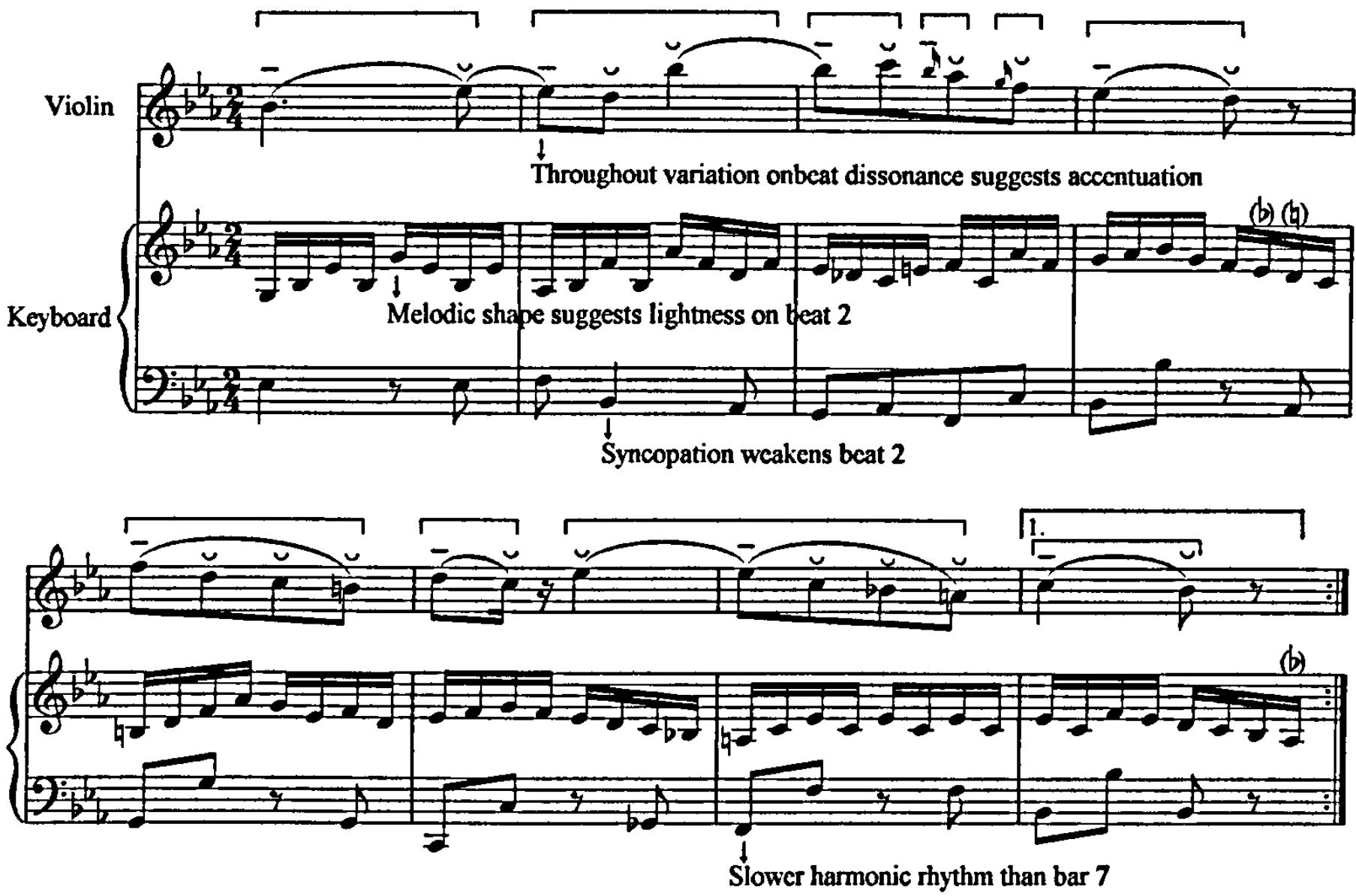
[Figure caption: Example 5.39: K481, movement 3, variation 1 (bars 21–28).] In Variation 5, Mozart’s beaming raises questions for accentuation (see example 5.40). Bar 137 (which shares the same material as bars 5 and 17 of the theme) remains firmly divided into two ‘words’ in the violin part, and yet the beaming and slurring (this slur only appears in the autograph version [Eisen, 2006: 41]) of four quavers together in the bass line could imply that there is an accent only at the start of the bar. The cadence in bars 138 to 140 is similar to that in bars 6 to 8 (discussed above, see example 5.38) and bars 18 to 20; as we have seen, in the original theme this bar could either be interpreted as part of one long phrase (with an accent at the start of bar 6), or with two accents in bar 7. At bar 139, the need for two accents is made explicit, with bass notes beamed in pairs. Furthermore, these pairs are both descending figures, and the high notes on each main beat of the bar emphasise the duple pulse. ([Embedded image data omitted; position and caption retained.])
中文讲解
本段的中心主张是:在K481第三乐章变奏5中,谱面上连音线(slurring)与符尾分组(beaming)的不同处理,使得小节内重音位置出现两种互相矛盾的可读方式,作者因此借助主题材料相同的小节来进行论证。
具体而言,第137小节沿用了主题中第5、17小节的材料。小提琴声部仍清楚划分为两个“词”(即两个乐汇),可理解为两个重音;但低音声部却把四个八分音符连在一起并以连音线贯穿,若依从这一连断法,听者便只会把重音放在小节起点。作者引用Eisen 2006年第41页的手稿版本,指出这一连音线只出现在手稿中,说明这是作曲家层面的重音标记,需要被纳入释读。
接下来作者把第138–140小节的终止式与前面已经讨论过的第6–8、18–20小节并置。在主题里,这几个小节本来就存在两种合法解读:可以视作一个跨越第6小节的长乐句(重音只在第6小节起点),也可以视作在第7小节处重音分裂为二。本段通过“as we have seen”回指前文,既承认这种歧义在主题中已经存在,又表明变奏5并未消除它。
关键的转折点在第139小节:作者认为此处作曲家以“低音成对连音(bass notes beamed in pairs)”的方式,把两个重音的需求显性地表达出来。再加之这两组成对音符都是下行音形,且每拍最高音落在正拍上,从而强化了二拍子的脉动(duple pulse)。换言之,第139小节提供了一种“内部证据”,佐证主题与变奏中“barlike phrasing”(在小节内拆分重音)的解读是可成立的,而不是把整个乐句压成单一重音。
本段在第5.1小节论证链中的作用是:通过一个变奏版本(第137–140小节)回到主题的同一组音形(第5–8、17–20小节),用变奏中显性的低音成对连音与重音落点,反推主题中含糊的重音布局,从而让原本在主题里悬而未决的问题,在变奏5的语境中获得倾向性解答。
容易误读之处:不要把本段当成在宣告“主题应读成两个重音”。作者只是说变奏5的写法让“二重重音”的解读变得可能且自然,并未否定另一种单重音长乐句读法。
补充说明
第137小节与主题第5、17小节的材料对应关系,是本段论证“主题—变奏互证”的支点:变奏5在保留小提琴“分两词”划分的同时,又用低音连断法改变了重音外观,从而让同一材料出现新的重音解释。第138–140小节的终止式与第6–8、18–20小节终止式属于同一模板,作者用三处并置来支撑“在变奏中重音分裂被显性化”的判断。图像占位符对应例5.39(K481第三乐章变奏1,第21–28小节),本段正文讨论的则是变奏5(第137小节起),二者不要混淆。
第2段(P0002)
原文复述
Footnote 58: The first edition violin part has no slur in bar 27.
中文讲解
这是正文第137小节讨论末尾的脚注(编号58),内容极简短,只陈述一个事实:在初版(first edition)小提琴声部中,第27小节并没有连音线。
它的论证作用是与正文形成对照:正文说低音声部把四个八分音符连在一起并带连音线(且注明该连音线仅见于手稿Eisen 2006: 41)。脚注进一步提示,初版小提琴声部的第27小节同样没有这条连音线——也就是说,这条标记重音归属的连音线在传统印刷谱中并不稳定,它只在手稿里出现,是作曲家的原始意图,而非刊印传统的一部分。这对判断这一重音解读的权威来源具有支持作用。
补充说明
脚注编号58与正文第137小节(即变奏5)讨论末尾相对应,所涉“第27小节”应理解为与正文小节计数所属同一谱例语境中的小节(即K481第三乐章变奏1第27小节,见例5.39)。脚注本身不引入新的音乐判断,仅提供刊本对照信息。
脚注 / 边栏 / 图表 / 附加信息(如有)
本小节附有图像占位符(例5.39:K481第三乐章变奏1,第21–28小节)以及脚注58。例5.39为变奏1的谱例,与本段正文讨论的变奏5(第137小节起)形成“同一材料在不同变奏中重音写法差异”的对照;脚注58则提供初版与手稿在连音线标记上的差异,作为对正文“该连音线只见于手稿”这一陈述的刊本佐证。
💡 本节核心要点
- 变奏5第137小节沿用主题第5、17小节材料,但小提琴分两词与低音连四音的连断法之间存在矛盾,构成重音归属上的张力。
- 低音声部四个八分音符的连音线只出现在手稿(Eisen 2006: 41)中,提示这是作曲家层面的重音意图,而非刊印惯例。
- 第138–140小节的终止式与主题第6–8、18–20小节终止式属同一模板,原主题在该位置本就存在“单一长句重音”与“小节内重音分裂”两种解读。
- 第139小节通过“低音成对连音 + 下行音形 + 正拍最高音”三要素,使两个重音的需求被显性化,从而支撑主题中“二重重音”读法的合法性。
- 脚注58指出初版小提琴第27小节没有连音线,进一步说明该重音标记依赖手稿来源,是本段释读的关键文本依据。
- 本段的整体功能是以变奏5中的显性写法,反推并部分解决主题中悬而未决的重音布局问题。
🔑 关键术语
- beaming:符尾分组,指把若干短音符的符尾用横杠连成一组以提示节拍与重音归属。本节中“bass notes beamed in pairs”指低音两两连尾,强调小节内的双重拍重音。
- slurring:连音线,表示该线内音符连贯演奏,本节中用作判断重音是否被“合并”或“跨越”小节起点的关键标记。
- autograph version:作曲家手稿版本,本节据Eisen 2006: 41,强调该连音线仅存于手稿。
- first edition:初版,指最早正式刊印的版本;脚注58据此说明第27小节无此连音线。
- duple pulse:二拍子脉动,本节指第139小节每拍最高音落正拍,使两个重音与二拍子结构相吻合。
- cadence:终止式,本节将第138–140小节与主题第6–8、18–20小节终止式并置,作为同类材料处理。
- ‘words’ (in violin part):作者用引号表示借喻,指小提琴声部在乐句层面被自然划分成的两个乐汇或重音单元。
5.2 [描述性拆分] Accents in the opening theme of K526, movement 1
第1段(P0003)
原文复述
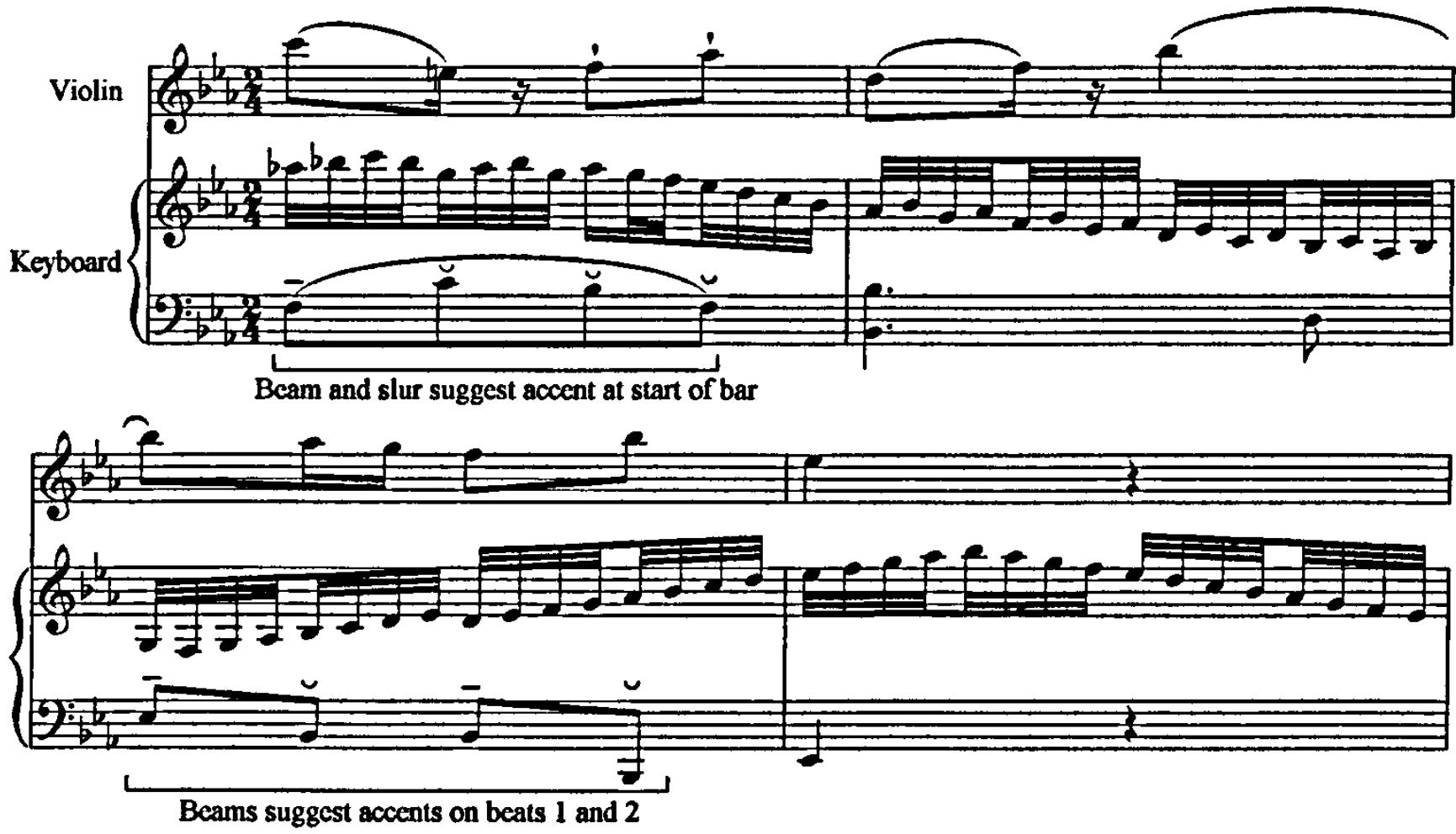
Like the theme of K481, the first movement of K526 is devoid of any notated accents – indeed, it is unlikely that the strokes in this opening theme designate accents, but rather lifted upbeats, and light final notes (see example 5.41). The succession of uniform note values (the theme consisting mainly of quavers) are instilled with rhythmic variety by the accentuation suggested through slurring patterns. While K481 demonstrates accents which coincide with expected metrical hierarchies, the accents implied by slurs in this movement are reminiscent of the syncopated accents marked by Mozart in K454 movements 1 and 3 (see examples 5.26 and 5.27). The initial melodic motive is straightforward in itself: an upbeat quaver precedes four slurred quavers, which are accompanied by a V $^{7}$ – I progression in the bass line. The slur and dissonance combine to suggest an accent on the first beat of the bar, and a diminuendo to the middle of the bar. Instead of continuing with this regular motive, repetitions of which would have given rise to accents on the downbeat of each bar, the metre is immediately interrupted by a series of paired slurs, creating a hemiola effect. In bars 3 and 4, regular accentuation is restored:
中文讲解
本段讨论 K526 第一乐章开篇主题的节奏重音处理,核心主张是:该主题没有任何谱面标记的重音记号,作者也不认为其中那些轻笔触代表重音,而是所谓的"抬起式弱拍"与轻巧的收尾音。作者将这条原则与 K481 的主题进行了对比,同时引入了 K454 第一、第三乐章中莫扎特明确标记的切分重音作为参照,目的是通过"无记号但可感知"与"有明确记号"这两类重音体系,把 K526 的开篇主题放置到一个可比较的谱例网络中。
在基本材料层面,作者指出主题主要由均等的八分音符构成,节奏变化来自连弓/连句(slur)所暗示的重音,而不是来自力度符号。具体到动机结构:上行弱拍八分音符之后是四个被连成一句的八分音符,低声部走 V7–I 和声进行;连弓加上和弦不协和音,使听者感受到一个落在小节第一拍的重音,并在小节中段形成渐弱。
本段最具论证价值的是它对"反例"的处理。作者假设,如果反复使用这一动机而不加变化,原本会在每小节正拍上形成一组规则的重音;但莫扎特立刻用"成对连弓"打断了这种规律,造成三对二(hemiola)的错觉,把重音从每小节一拍改成跨小节的错位节奏,直到第 3–4 小节才恢复正常的重音布局。换句话说,作者用这一处理证明:K526 的开篇并非简单的均分节奏主题,而是通过连弓与配器组合产生切分式重音,这与 K454 的处理方式在听觉效果上相互呼应。
理解时需注意:作者区分了"谱面未标"与"无重音"——未标不等于没有重音;只是重音的来源(连弓、和声、节奏错位)与符号无关。
补充说明
本段内部的关键对照关系:K481(重音与小节强拍一致,对应常规节拍层级)↔ K454 第 1、3 乐章(标记为切分重音)↔ K526 第 1 乐章(无标记、由连弓暗示的切分式重音)。三者的共同点是都在讨论"重音位置",差别在于重音的来源:符号 vs. 连弓 vs. 和声节奏。V7–I 与 hemiola 这两个术语在本节中互为印证——V7–I 在第一拍制造协和性突现,hemiola 在 1–2 小节制造重音位移,二者共同破坏了"每小节正拍重音"的常规预期。
第2段(P0004)
原文复述
[Figure / musical example placeholder: image data omitted; position and caption retained as ‘第3页图像或乐谱示例’]
中文讲解
这一条在原文里不是一段连续文字,而是一个图像或乐谱示例的占位符(caption 为中文"第3页图像或乐谱示例")。按照原文结构,它紧接 P0003 末尾"In bars 3 and 4, regular accentuation is restored",因此它在版面上承担的功能是:用具体乐谱为上一段所述"第 3、4 小节恢复正常重音布局"提供直观证据。由于内嵌图像数据已被省略,具体的谱例编号、拍号、调号与小节走向无法在本任务输入内核实,需查看原书第 3 页图例。
补充说明
结合 P0003 与下一段 P0005 中反复出现 example 5.41、5.42、5.26、5.27 等编号,可推断此处属于第 5 章谱例体系的一部分;但具体谱例号本段未给出,仅以"位置与图注保留"作为版面标记。
第3段(P0005)
原文复述
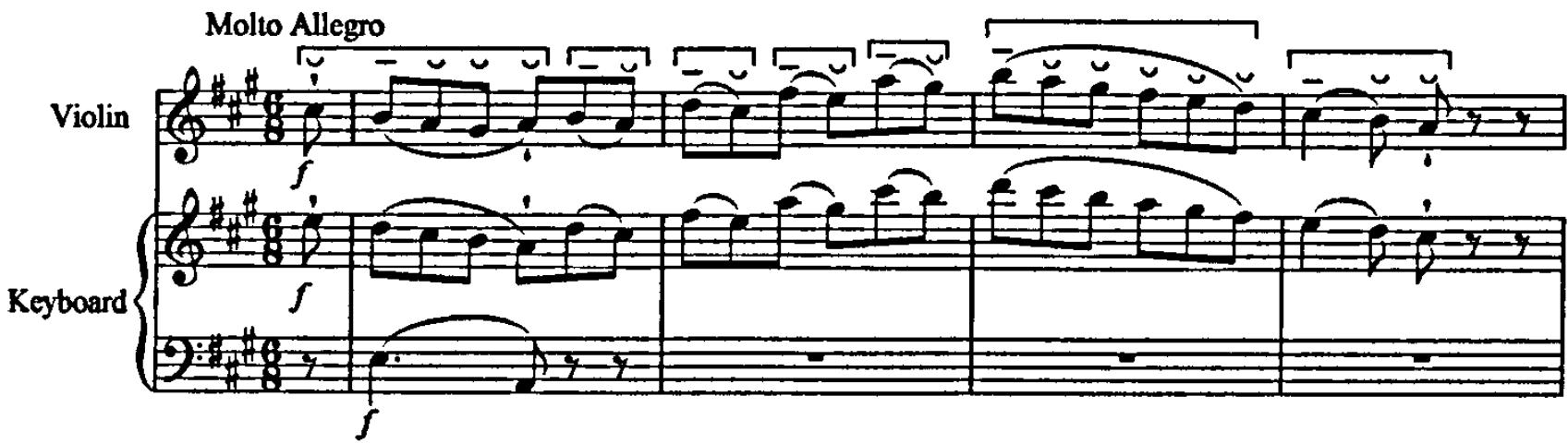
In some instances during this movement, a consideration of slurring alone can give a misguided impression of accentuation. In bar 206 the violin slurring might suggest accents at the start of each bar (see example 5.42). However, the keyboard’s harmonic rhythm, changing every half bar, suggests two accents per bar in bars 206 to 208; this raises the question, should the violin bring out an accent in the middle of each slur, or create another layer of accentuation above the keyboard line? Leopold writes that slurred passagework should be played in such a way that the each beat is ‘marked by a strong emphasis of the bow’ (L. Mozart, 1756: 117). Furthermore, from the middle of 206 to 208, the first quaver of each dotted crotchet can be played on the D string, with the other two quavers of each group on the G string. The contrast in timbre between the two strings creates a subtle accent at the start of each group of three quavers. Interestingly, in bar 209, where the harmony is static for the whole bar, Mozart inverts the violin’s accompaniment figure, perhaps suggesting a smoother delivery during this bar with an accent at the start of the bar only. This inversion of the violin accompaniment is also maintained for the B $^{7}$ harmony throughout bar 210; the rising chromatic left-hand part creates a minor-major progression, and calls for a continuation of legato articulation. In the autograph version of this sonata, two groups of three slurred quavers create two accents in the violin part at bar 211 (Eisen, 2006: 111), thus clarifying the return of the doubled harmonic rhythm:
中文讲解
本段把讨论推进到一个更细致的层次:在 K526 第一乐章的某些位置,单看连弓会得出错误的重音判断。作者以第 206 小节为切入点——小提琴的连弓看起来像在每小节开头建立重音(参 example 5.42),但钢琴声部的和声节奏是每半小节变换一次,从而暗示每小节两个重音。这就引出本节最关键的方法论问题:演奏者究竟应该在小提琴连弓的内部再加一个重音,还是应该让小提琴在钢琴已经建立的两层重音之上再造一层?
为了给这个问题提供历史与演奏上的依据,作者援引了 Leopold Mozart 在 1756 年著作中的一句话——连弓经过句中每一拍都应用"弓的强力强调"来标记;这等于把 Leopold 的论述从"总体原则"下放到"在小节内部是否再加重音"这一具体争议上。接下来作者给出一条音色层面的实操建议:206–208 小节中段,附点四分音符的第一个八分音可用 D 弦演奏、随后两个八分音换到 G 弦;两根弦音色差异本身就构成一种细微的重音,落点在每组三音之首。
本段后段处理的是第 209–210 小节。这里和声在小节内保持静止,莫扎特把小提琴伴奏音型反转,提示演奏得更连贯、只在每小节开头给一个重音;B7 和声贯穿第 210 小节,左手半音上行构成小调—大调的进行,需要延续 legato 奏法。最后,作者引用 Eisen 2006 第 111 页指出版本事实:手稿版中第 211 小节由两组"三个连弓八分音"构成,从而在小提琴声部明确出现两个重音,与钢琴已恢复的"每半小节一次和声变换"形成呼应。
理解时需注意三个层次:其一,连弓不等于"一弓一次重音";其二,钢琴和声节奏和小提琴弓法各自独立地暗示重音,可能一致也可能冲突;其三,演奏层面(弓速、换弦、legato)可以被作者用作判断"莫扎特意图重音位置"的间接证据。
补充说明
本段内部存在两条并行的证据链,需要区分:(1) Leopold Mozart 的演奏论——属于 18 世纪演奏实践的外部权威;(2) Eisen 2006 引用的手稿版本——属于 Mozart 本人手稿的版本证据。两者在本节中功能不同:前者用来支持"在连弓中也可以做出每拍重音"这一演奏判断,后者用来支持"第 211 小节起小提琴声部确实存在两个重音"这一文本判断,作者用后者来"澄清"前文钢琴声部重音节奏的回归。
脚注 / 边栏 / 图表 / 附加信息(如有)
本小节的非正文材料:P0003 末尾的图注提示 example 5.41 出现在第 2 页区域,P0004 是第 3 页的图像/乐谱占位符(caption 为"第3页图像或乐谱示例"),P0005 引用了 example 5.42(围绕第 206 小节)以及 Eisen 2006: 111 这条手稿版本的版本学脚注。两条脚注(L. Mozart, 1756: 117 与 Eisen, 2006: 111)分别承担"演奏实践依据"和"手稿版本依据"两种不同功能,作者用它们共同支撑关于连弓重音的判断。
💡 本节核心要点
- K526 第一乐章的开篇主题没有任何谱面重音记号;那些笔触被理解为"抬起式弱拍"与轻收尾,而非重音。
- 主题的节奏变化由连弓(slur)所暗示的重音驱动,与 K481(重音落在节拍强位)和 K454(明确标记的切分重音)形成三向对照。
- 开篇动机是"弱拍八分音 + 四个连弓八分音 + V7–I",本应在每小节正拍形成规则重音,但莫扎特立刻用成对连弓制造 hemiola,把重音错位,直到第 3–4 小节才恢复正常。
- 在乐章中部(如第 206 小节附近),单看小提琴连弓会得到错误的重音判断,必须结合钢琴每半小节变换一次的和声节奏来校正。
- 演奏层面的证据包括 Leopold Mozart 关于"连弓中每拍应被弓强调"的论述,以及 D 弦 / G 弦换弦所形成的音色重音。
- 第 209–210 小节通过伴奏音型反转与半音上行提示更连贯的奏法;手稿版第 211 小节的小提琴声部以两组三连弓八分音构成两个重音,与钢琴和声节奏的回归相互确认。
🔑 关键术语
- notated accents:谱面上明确写出的重音记号;本节用它与"由连弓暗示的重音"对立,作为论证起点。
- lifted upbeats:被解释为"抬起的弱拍"的轻笔触;作者认为开篇主题中的笔触属于这一类,而非重音。
- slur / slurring patterns:连弓或连句线;本节核心变量,用来暗示重音位置并制造切分效果。
- V7–I progression:属七和弦解决到主和弦;在开篇动机中与连弓、不协和音一起,使听者感受到落在小节第一拍的重音。
- hemiola:三对二节奏错位;本节用它解释为何开篇主题的规则正拍重音被立刻打断。
- harmonic rhythm:和声变换的频率;本节用"每半小节变换一次"作为判断小提琴应跟随两层重音的依据。
- D string / G string:小提琴的两根空弦;本节用作音色对比来制造每组三音之首的细微重音。
- legato articulation:连贯奏法;本节在第 209–210 小节因和声静止、半音上行而要求保持。
- minor-major progression:从小调到同名大调的进行;本节出现在第 210 小节 B7 之上的半音上行的语境中。
- autograph version:作者手稿版;本节用 Eisen 2006 引用的第 211 小节谱面来确认两层重音结构的回归。
5.3 [描述性拆分] Harmonic rhythm and accentuation in K526, movement 1
第1段(P0006)
原文复述
![Page 4 image or score example (embedded image data omitted; position and caption preserved)]
中文讲解
这是位于第 4 页的内嵌图像/乐谱占位符。由于本任务输入中已将图像数据省略,仅保留其在版面中的位置标记和图注信息,因此实际的音符、和弦、力度标记等视觉内容无法在本节中被引用或转述。在原书中,此处对应的应是与 K526 第一乐章和声节奏与重音讨论直接相关的某一谱例或示意图,读者需查阅原版以获得完整信息。该占位符紧邻正文段落 P0007,承担为论证提供视觉证据的作用。
第2段(P0007)
原文复述
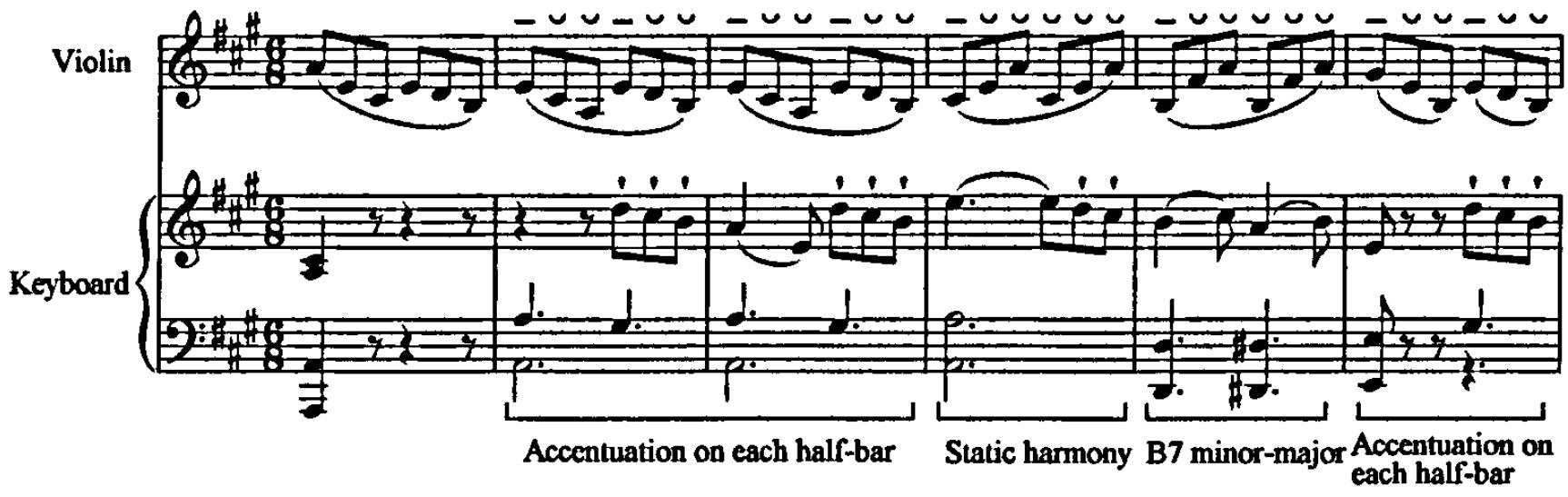
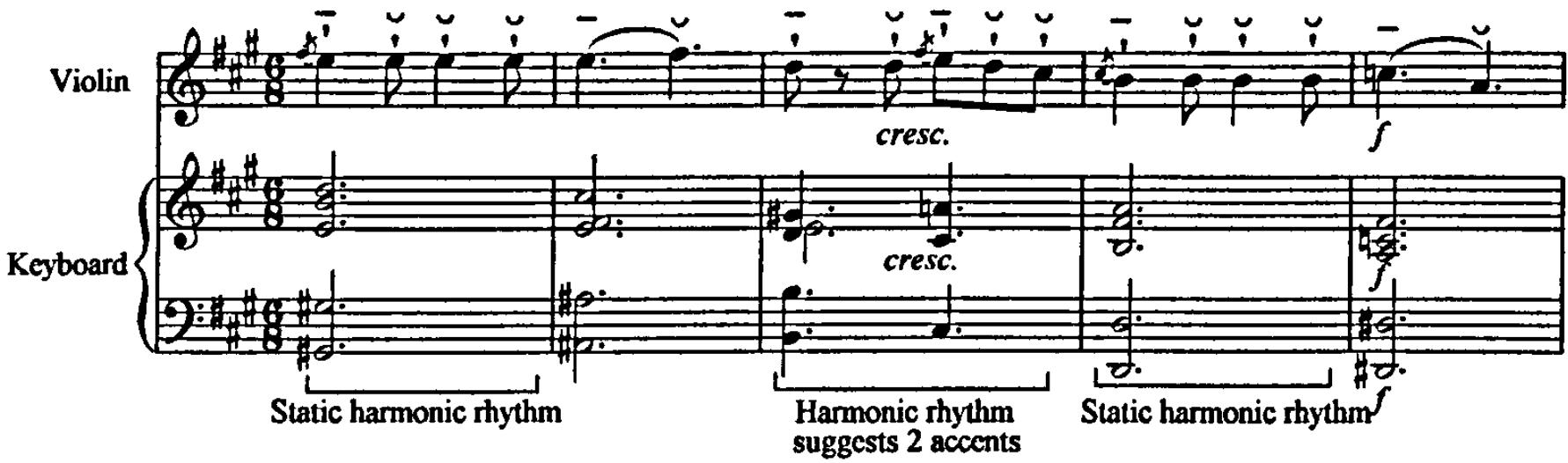
Harmonic rhythm similarly serves as an indicator of accentuation at other points during this movement. For example, violinists might be tempted to give metrical accents at the start and middle of bars 180 and 183 (see example 5.43), but the static harmonic rhythm implies that there should just be one accent at the start of the bar:
中文讲解
这一段是本节的核心论点段落,作者把"和声节奏作为重音指示器"这一原则落实到一个具体的演奏情境中。要点如下:
- 承接前文:开头 “similarly” 一词提示本段延续前一段已确立的论断——和声节奏可以指示重音位置,并将这一原则推广到乐章中其他位置(other points during this movement)。
- 演奏者的本能倾向:在小节的首拍与中拍(双拍子结构中的强拍与次强拍)上,小提琴手常会出于节拍惯性用弓压、揉弦或起弓速度来施加 metrical accents(节拍重音)。第 180 与 183 小节就是容易出现这种本能加重的位置。
- 静态和声节奏的反驳:作者指出,这两小节的 harmonic rhythm 是 static(静止的)——和声不发生变化,因此音乐内部并没有在节拍中点再制造一次强调的内在动力。
- 结论:静态和声节奏意味着整小节只应有一个重音(at the start of the bar),不应在中点再叠加重音。这就把"节拍位置上的强拍"与"音乐表达上的重音"区分开来:前者由拍号决定,后者由和声变化决定。
- 段落功能:本段以 “see example 5.43” 收束,引导读者进入紧随其后的谱例(P0008)以视觉方式验证该判断;同时为演奏者(尤其是弦乐演奏者)提供了一个具体的自我检查点。
第3段(P0008)
原文复述
中文讲解
这是图注占位符,对应 K526 第一乐章第 180-184 小节的乐谱(Example 5.43)。该谱例紧承 P0007 的文字论述,用以在视觉上证实作者关于"静态和声节奏只支持一个小节起始重音"的判断。读者需查看原图以获得实际的小节线、和弦、和声变化点、弓法记号以及小提琴声部的具体音符信息。从正文可确认的信息是:第 180 与 183 小节都呈现和声静止的状态,因此小节中点不应出现节拍重音,而第 181、182、184 小节则可能涉及和声变化或延续,承担本例的对比或过渡功能。
脚注 / 边栏 / 图表 / 附加信息(如有)
本节包含两个内嵌视觉材料:P0006(第 4 页图像/乐谱占位符)与 P0008(Example 5.43:K526 第一乐章第 180-184 小节)。两者均因图像数据被省略,需查阅原版以获取完整谱例信息。本节无独立脚注条目。
💡 本节核心要点
- 和声节奏(harmonic rhythm)是判断乐句重音位置的核心依据,本节将其推广至乐章中其他位置。
- 节拍位置产生的 metrical accent(节拍重音)仅是节拍惯性,并不等同于音乐表达上的真正重音。
- 当和声节奏处于 static(静止)状态时,整小节只应保留一个重音,置于和声发生变化的小节起始处。
- K526 第一乐章第 180 与 183 小节是典型案例:节拍看似要求两个重音,但静态和声仅支持开头的重音。
- 作者特别针对小提琴手提出提醒——弦乐演奏者最容易在节拍中点本能加重(弓压、揉弦),需要被和声节奏所抑制。
- Example 5.43 提供了该判断的乐谱证据,把抽象原则落到可被演奏者直接核查的具体小节。
🔑 关键术语
- harmonic rhythm:和声节奏,指和弦或和声进行变化的快慢;本节中是判断何处应当放置音乐重音的核心依据。变化越慢(越静态),所支持的重音越少。
- metrical accent:节拍重音,由拍号和节拍位置自然生成的强调(如 4/4 拍的第一、三拍);属于位置性提示,可能与音乐表达上的真正重音不一致。
- static harmonic rhythm:静态和声节奏,指在数拍或数小节内和声不发生变化;本节中意味着即便节拍提示多个重音位置,也只应在和声发生实际变化的开头保留一个重音。
5.4 [描述性拆分] From grammar to Affekt: two phases of musical accentuation
第1段(P0009)
原文复述
The foregoing examples from Mozart’s Sonatas for Violin and Keyboard demonstrate the numerous compositional features which can dictate the placement of accents; these accents are sometimes marked by the composer with notated symbols or dynamics, but are more often left to the judgement of the performer, whose choices can be a response to other compositional information such as metre, harmonic rhythm, dissonance and chromaticism, melodic and rhythmic shape, slurs and beaming. We have seen that ’logical’ accents (as suggested, for example, by harmonic tension and slurs) regularly coincide with the ‘grammatical’ accents of metre, and that when they contradict the expected hierarchies of metre, they are often clarified by Mozart’s notation.
中文讲解
本段是 5.4 节的开篇,对前文 Mozart 小提琴与键盘奏鸣曲的实例做总结性回顾,提出两点核心主张:第一,重音的位置由多种作曲特征共同决定——其中只有少数被作曲家以记号或力度符号明确标记,更多时候要由演奏者依据拍号、和声节奏、不协和与半音化、旋律与节奏形态、连线、符尾分组(连弓/连符尾)等信息自行判断;第二,‘逻辑重音’(由和声张力、连线等暗示)与’语法重音’(拍号层级)通常重合,一旦二者矛盾,作曲家往往通过记谱来明确层级。该段在论证链中起桥梁作用:把前面具体的曲例分析,上升为对’重音决定因素’的一般性认识,为下文讨论重音的目的与修辞功能做铺垫。读者需注意作者对 logical 与 grammatical 两类重音的区分——这是后文 Affekt/Pathetic 重音讨论的基础。
第2段(P0010)
原文复述
It is thus the performer’s role to recognise the musical ‘words’ which constitute each phrase, and to give each word its just accentuation. Mattheson writes that the aim of accentuation is ’the pronunciation’ (Mattheson, 1739: 370); accentuation is therefore central to the communication of the compositional language to the listener. Indeed, writing over 250 years later than Mattheson, Drake and Parncutt postulate that ‘performances tend to be easier to understand, remember and reproduce when performed accents correspond with immanent [structural and notated] accents’ (Drake and Parncutt, 2001: 537-8).
中文讲解
本段把焦点从’作曲特征’转向’演奏者任务’:演奏者要识别构成乐句的’音乐词’,并给每个词以恰如其分的重音。为支撑这一论点,作者引用了两条跨时代文献:Mattheson(1739: 370)将重音的功能定义为’the pronunciation’(发音/吐字),强调重音是把作曲语言传达给听众的核心机制;Drake 与 Parncutt(2001: 537-8)则从 250 年后的认知心理学角度指出,当演奏重音与’内在的(即结构性与记谱层面的)‘重音相一致时,音乐更易被理解、记忆和复现。两条引文共同把’重音’从单纯的作曲现象提升为表演与传达层面的关键。读者须注意:‘pronunciation’ 这一比喻把音乐重音类比于说话时的发音动作,这是十八世纪修辞观影响下的典型表述。
第3段(P0011)
原文复述
However, the purpose of musical accentuation is not limited to making the musical text clear and understandable. Accents should also contribute to the Affekt and character of a work; they should be used as a rhetorical device, with the aim of moving the listener. As we have seen, many eighteenth-century theorists describe a specific category of accents as ‘Pathetic’ accents:
中文讲解
本段是论证的关键转折:从’清晰可懂’扩展到’情感与修辞’。作者用 ‘However’ 显式否定上一段所建立的’清晰’单一目标,主张重音还须服务于作品的 Affekt(情感特质)与性格特征,并作为修辞工具来打动听众。段末以冒号引出对十八世纪’Pathetic accents’类别的提示性回顾,从而衔接下一段 Rousseau 的引文。理解本段需把握两层逻辑:(1) 清晰与动人不是对立的两个目标,而是同一重音行为的两个层面;(2) 这一转折直接为后文’两阶段论’埋下伏笔——既然重音同时承担两种功能,就不能把它们视为发生在不同位置的两类重音。
第4段(P0012)
原文复述
By different variation of the voice, by a tone more or less elevated, by a method of discourse quicker, or more slow, expresses those sentiments which agitate the speaker, and communicate with the audience. (Rousseau, 1768 R.1779:4)
中文讲解
这是一段 Rousseau(1768 年原文,1779 年再版,第 4 页)的直接引文,原文以英文呈现。Rousseau 描述的是:通过声音的多种变化(音调或高或低、话语方式或快或慢)来表达搅动说话者的情感,并与听众交流。作者把这段一般修辞/演说论述引入音乐语境,用以支撑 P0011 关于 ‘Pathetic’ 重音的主张:十八世纪情感重音本质上是修辞性的、情感性的,其功能是借声音变化传递情感。读者要意识到:Rousseau 此处谈的是语言修辞而非音乐,作者正是通过’语言—音乐’类比,把音乐重音纳入更广义的修辞框架,这也呼应 Mattheson 的 ‘pronunciation’ 比喻。
补充说明
引文出自 Rousseau 1768 年原作,1779 年再版(标注为 R.1779:4),作者将其作为’Pathetic 重音’概念的代表性论述。
第5段(P0013)
原文复述
Clive Brown complains that the clarity between eighteenth-century definitions of the accents of grammar/logic and pathetic accents is often lacking:
中文讲解
本段是简短过渡,引入 Clive Brown(1999)的批评:十八世纪理论家在’语法/逻辑重音’与’情感重音’的定义之间常常缺乏清晰度。其本身信息量极小,功能是为下一段 Brown 的具体引文做铺垫。读者要理解作者为何在此处引入这条批评:它构成后文’两阶段论’的反驳起点——既然现有范畴定义含糊,那就有必要换一种思路来理解两类重音的关系。
第6段(P0014)
原文复述
Some theorists seem to have regarded accentuation whose function was to define the extent and subdivision of musical phrases [that is, accentuation which is ‘grammatical’ or ’logical’]… as a distinct category, but it is not always possible to see where the dividing line between this and expressive accent occurs. (Brown, 1999: 8)
中文讲解
这是 Brown(1999: 8)的直接引文,核心观点是:有些理论家把’划分乐句范围与细分’的功能性重音(即语法/逻辑重音)视为独立的范畴,但这种范畴与’表达性重音’之间的界线其实并不清晰。方括号’[that is, …]‘为编辑性注释,说明括号前的功能定义就是指’语法/逻辑’重音。本段承接 P0013 的’含糊’批评,提供具体的原文依据;同时直接构成 P0015 反驳的起点——既然界线不清,作者就提出新的框架来取代’两类范畴’的划分。读者应留意原文中的省略号’…’,它表明 Brown 文本中间被略去,作者只保留了其论点核心。
补充说明
方括号注释出自 Brown 原书(1999: 8),为编辑性插入,用于说明’语法/逻辑’重音的所指。
第7段(P0015)
原文复述
Instead of classifying grammatical/logical accents and pathetic accents as two ‘distinct’ categories, with the implication that they refer to accents which occur at different points in the musical discourse, it seems more useful to view these concepts of accentuation as two phases in the interpretation of each accent: having used our ‘intellect’ to identify grammatical and logical accents, we must use our ’emotions’ (Hiller, 1780: 68) to engage with their Affekt and deliver them in such a way that will move the audience. Whether accents exist to convey the pace of a metre, to characterise rhythms, or emphasise the harmonic discourse, they should all be rhetorical through their intention to appeal to the listeners’ understanding and passions. The ability to move listeners in this way is ultimately dependant on the variety of sound given to accents in performance, thus avoiding the monotony of stressing every accent with equal force, length and tone.
中文讲解
本段是本节的小结与论证落点。作者提出替代性框架:不要把语法/逻辑重音与情感重音视为’两类’(暗示它们发生在不同位置),而应视为同一重音诠释中的’两个阶段’——先用’理智’识别语法与逻辑重音,再用’情感’触及其 Affekt 并以能打动听众的方式呈现出来(Hiller, 1780: 68 是这一理智/情感二分的来源)。无论重音是用于传达拍速、刻画节奏还是强调和声进行,都应当是修辞性的——既诉诸听众的理解,也诉诸其情感。最后给出实践要求:打动听众取决于演奏中重音在音色、力度、长度上的多样性,必须避免对所有重音施加同等力度、长度和音色的单调处理。整段呼应 Mattheson(发音/吐字)与 Rousseau(声音变化表达情感)的引文,把前文铺垫整合到一个演奏美学主张中。理解本段的关键是把握’两个阶段’的比喻——作者并不否认功能差别,但否认它们是发生在不同乐音点上的两类对象。
脚注 / 边栏 / 图表 / 附加信息(如有)
本节正文中出现的文献引用包括:Mattheson (1739: 370)、Drake and Parncutt (2001: 537-8)、Rousseau (1768 R.1779:4)、Brown (1999: 8)、Hiller (1780: 68)。其作用分别为:(1) Mattheson 把重音目的定义为’the pronunciation’;(2) Drake 与 Parncutt 从认知心理学角度支持’演奏重音与内在重音一致’;(3) Rousseau 描述声音变化如何传达情感;(4) Brown 指出语法/逻辑与情感重音的定义之间界线不清;(5) Hiller 区分’理智’与’情感’,被作者用作’两阶段’框架的理论依托。本节无独立图表、边栏或其他非正文材料。
💡 本节核心要点
- Mozart 小提琴与键盘奏鸣曲中的重音位置由多种作曲特征决定——拍号、和声节奏、不协和与半音化、旋律与节奏形态、连线、符尾分组——但大多数重音要由演奏者依据这些信息自行判断。
- 当逻辑重音(由和声张力、连线等暗示)与语法重音(拍号层级)冲突时,作曲家往往通过记谱来明确层级。
- 演奏者的任务是识别每个乐句中的’音乐词’并给以恰当的重音;Mattheson 把重音功能界定为’发音/吐字’,Drake 与 Parncutt 进一步指出演奏重音与内在结构重音一致时音乐更易被理解与记忆。
- 重音不仅服务于’清晰’,更应作为修辞工具服务于作品的 Affekt 与情感打动;十八世纪理论中’Pathetic’重音即属于此类。
- 与 Brown 等学者把两类重音视为’独立范畴’的立场不同,作者主张把它们理解为同一重音诠释中的两个阶段——先理智后情感,呼应 Hiller (1780)。
- 任何重音都应当是修辞性的,演奏上要靠音色、力度、长度的多样性来避免单调,从而真正打动听众。
🔑 关键术语
- Logical accent(逻辑重音):由和声张力、连线、旋律走向等’逻辑’作曲因素暗示的重音位置,本节中与’语法重音’形成对照。
- Grammatical accent(语法重音):由拍号层级结构自然产生的强拍位置,本节中与’逻辑重音’并列讨论。
- Affekt:十八世纪美学概念,指作品或乐段所欲传达的特定情感或性格特征;本节是重音所要服务的目的之一。
- Pathetic accent(情感/激情重音):十八世纪理论术语,指用于传达情感、打动听众的重音类别;本节中被作者重新定位为与语法/逻辑重音同一过程的不同阶段。
- Rhetorical device(修辞工具):本节中指重音作为唤起听众理解与情感的手段;作者主张所有重音都应具有修辞性。
- Pronunciation(发音/吐字):Mattheson (1739) 用来描述重音功能的术语,本节借此把音乐重音类比于说话时的发音动作。
5.5 Accents as a rhetorical device: the variation of tone
第1段(P0016)
原文复述
Accents as a rhetorical device: the variation of tone
中文讲解
本段是第5.5小节的英文标题,原文为"Accents as a rhetorical device: the variation of tone",可译为"作为修辞手段的重音:音色的变化"。冒号前的"rhetorical device"(修辞手段)把重音问题放回18世纪音乐修辞学的语境,提示重音不仅是机械的力度标记,更是传递Affekt的修辞工具;冒号后的"variation of tone"(音色的变化)则点明本节真正关心的对象不是单纯的强弱,而是重音所能产生的多种音色差别。标题由此为后文定下基调:先破除对记号的固定定义,再讨论演奏者如何在时代语境中诠释重音。
补充说明
本段仅为小节标题,不含正文内容。
第2段(P0017)
原文复述
It is to a certain extent dangerous to draw general conclusions about the sound and Affekt of notated expression markings such as fp or sfz, because fixed definitions of such markings ultimately close our minds to the endless possibilities that accents suggest in their various musical contexts—an issue already observed in connection with articulation in chapter 4. In an orchestral setting, the ‘strong’ note that one player might mark in their own part with a tenuto line could be marked fp by another player in the same section. Rather than adopting categorical definitions of each symbol of accentuation, we must combine our knowledge of contemporary descriptions of accents with an awareness of the timbral parameters expected at the time of the composition. This information should be used to interpret accents together with our intention to identify with the Affekt of the work.
中文讲解
本段为本节的方法论开场,提出作者对"重音符号可否被定式定义"的基本立场。
第一个要点是限定词"to a certain extent"(在某种程度上)和"ultimately"(最终地)所框定的论证力度:作者并不否认fp、sfz等记号有意义,而是说一旦把它们钉死在某种固定的声音或Affekt上,记号便会遮蔽它在各音乐语境中可能释放出的无穷变化。这一警告与第4章讨论articulation(奏法/发音)时遇到的问题是同一类,因此用"this is an issue which was seen…“明确回收前文的论点。
第二个要点是乐队场景的例子。作者选择这一例是为了证明记号本身已含诠释空间:同一声部里同一个"强音”,一位演奏家用tenuto(保持线/持续线)标记,另一位用fp(强后即弱)标记——两种标记意味着两种完全不同的处理,可见同一记号在不同演奏者笔下可能指向不同的强调方式。这就把"重音即固定强弱"的简单图景破掉了。
由破而立,作者提出本节处理重音的程序:(1) 调取与作品同时代的重音描述文献(contemporary descriptions of accents);(2) 把握该作品创作时代所预期的timbral parameters(音色参数);(3) 以认同作品Affekt(情感特质)为诠释意图。三者结合,才能让重音的解读摆脱笛卡尔式的范畴定义。
这是本节论证的"破—立"结构骨架:先反对范畴化定义,再给出语境加情感的双重诠释框架。
补充说明
文中sfz、fp、mfp等记号的差异需参照第4章关于articulation的讨论;本段并未重复该背景,仅以交插方式提及。
第3段(P0018)
原文复述
Although the issue of Affekt may seem subjective, it too has historical parameters—it certainly belongs to the province of interpretation, but eighteenth-century descriptions of the expressive intent associated with compositional devices can offer a great deal of insight to the modern performer, as we have already seen through the use of musical rhetorical figures to guide articulation choices in Mozart’s sonatas. Mozart’s use of accent signs (such as $sf, fz, fp$ and $mfp$) does suggest the wide variety of tone that should be expected from accentuation. Nevertheless, eighteenth-century theorists recognised, as we should now, that signs alone cannot possibly capture the full range of accentuation required to convey the Affekt and character of musical discourse. Indeed, Rousseau wrote that ’there are as many different Accents, as there are methods of modulating the voice thereunto, and there are many various kinds of Accents as there are general causes for such modulations’ (Rousseau, 1768 R.1779: 3). Accent signs therefore leave considerable scope for interpretation. The question of how loud accents should be in relation to the surrounding music is addressed by Quantz; in his account of the treatment of dissonance, he writes that if the contrast between accented and unaccented notes is ’too vehement’, it ‘will awaken greater displeasure than satisfaction in the ear’ (Quantz,
中文讲解
本段承接P0017的"立"——尽管Affekt看似主观,它仍然受历史参数约束,18世纪关于作曲手段表现意图的论述可以为现代演奏者提供很多启示。作者用"as we have already seen through…Mozart’s sonatas"把读者拉回前文音乐修辞格(musical rhetorical figures)指导奏法的案例,从而呼应本书的整体方法路径。
接着用Mozart使用sf、fz、fp、mfp等记号的事实本身,证明重音在该时代已经预期会带出"丰富多样的音色"——记号只是触发器,并非固定配方。但"Nevertheless"和"signs alone cannot possibly…“的转折强调:18世纪理论家早已承认符号本身无法穷尽重音表达所需的全部分寸,必须留出诠释空间。
为此作者援引Rousseau(1768/R.1779: 3)原话:“重音的多样一如声音调制的种种方法,而重音种类之多,正与造成这些调动的种种通则相当。” Rousseau的句式把重音和"调制声音"的方法挂钩,意在说明重音本质上是一组发声动作,不是单纯的力度刻度,从而给"符号之外仍有大量诠释空间"提供经典支持。这一引文同时承担双重论证任务:既说明了重音种类的丰富性,也说明了重音种类的多样性根植于发声方法的多样性。
接着,Quantz在论及不协和音处理时被引入:作者用Quantz之口限制重音的强度,强调重音不能与周围音乐形成过强的对比,否则"引起的反感会多于满足”。这是一句非常具体的告诫,意味着重音并非越强越好,而是要和作品的语气协调。句末的"(Quantz,“未闭合,因为引文延续到P0019。
综合看,本段完成三件事:把Affekt论证回接到Mozart奏法案例;用Rousseau给出重音多样性的理论根据;用Quantz的限量提供重音力度上限的实践约束。
补充说明
原文中$Rousseau, 1768 R.1779: 3$的"R.1779"指1768年版的1779年再版,本书使用此再版页码。Quantz的不协和音论述属其1752年著作第256页,须与下文P0019的延续引文合读。
第4段(P0019)
原文复述
1752: 256). The rate of decay of an accent also contributes to Affekt: an accent may begin with a sudden attack (analogous to the explosive consonants discussed in chapter 4), or with a more gradual strengthening of sound, such as the nuanced notes described by Geminiani (Geminiani, 1751: 8), or the ‘small softness’ discussed by Leopold:
中文讲解
本段先补完Quantz引文的出处页(Quantz, 1752: 256),从而把上一段悬置的引文封闭完整,这提醒读者Quantz用"too vehement"所指的正是重音的强度需要节制——这一戒律是本段"重音的衰减率也参与塑造Affekt"的实践前提。
“rate of decay”(衰减率)一词把讨论从单一的"重音响不响"扩展到"重音怎样开始又怎样消退"的时间维度。作者列出三种起始方式:(1) 突然袭击式起音(sudden attack)——对应第4章所讨论的爆破辅音,把发声动作类比为语言中的塞音;(2) 渐进加强式起音(gradual strengthening of sound)——以Geminiani(1751: 8)所述的"nuanced notes”(细致入微的音符)为例;(3) 微弱柔化式起音(small softness)——以Leopold Mozart的论述为代表,并以冒号领出P0020的引文。
三种起音方式共同表明:重音并非一个点,而是一段"事件",其起始的形态本身就在编码情感。这一时间维度的引入,使Affekt不再只由强度决定,而也由起音的"质感"决定。本段也由此把全节论证从"响度"过渡到"起音方式"。
补充说明
原句中以"akin to the explosive consonants discussed in chapter 4"回扣第4章关于塞音/擦音发音分类的论述;此处的连接不需另注,可视为章节间论据递进。
第5段(P0020)
原文复述
‘Every tone, even the strongest attack, has a small, even if barely audible, softness at the beginning of the stroke; for it would otherwise be no tone but only an unpleasant and unintelligible noise.’ (L. Mozart, 1756: 97)
中文讲解
本段是Leopold Mozart原文的全段直引,承接P0019"small softness discussed by Leopold"的位置。
译文要旨:每一个音,即便起音最强,在弓触弦(stroke)之始都带有一丝几乎听不见的柔化(small softness);如果没有这层柔化,它就不成其为音,而只是令人不快且无法辨识的噪音。
这一引文在论证中起到两个作用:第一,证明即便听起来最坚硬、最具强调性的重音,其物理学层面也并非纯然"击打",而是包含一段几乎无意识的起音包络;第二,把上一段第三种起音方式(small softness)从理论化为可引证的史料。值得注意的是,Leopold使用的限定"even if barely audible"(即使几乎听不见)非常考究——他并非主张演奏者要把这层柔化做得明显可闻,而是指出其客观存在。这与Quantz"不能过分"的态度一致:从颗粒感(accent)的清晰到攻击音的柔软两端,都存在过犹不及的风险。
引文末"L. Mozart, 1756: 97"作为页码锁定:此处援引的是Leopold Mozart 1756年的小提琴教程(Versuch einer gründlichen Violinschule)第97页。
补充说明
“stroke"一词在原文中既可解作弓的运行也可解作击打/起音动作;本段未给出进一步限定,应保留两种可能的解读。
第6段(P0021)
原文复述
As the best imitators of the human voice, violinists should attempt to capture this range of sound through their use of the bow.
中文讲解
本段为小节收束句,将前文Rousseau、Quantz、Geminiani、Leopold Mozart四条线索汇拢到演奏实务。
“best imitators of the human voice”(人声的最佳模仿者)一句采用18世纪小提琴演奏传统中根深蒂固的修辞——把小提琴家定位成"人声的化身”,因此小提琴的发音潜力应等同于甚至超过人声的表现力。这一修辞前提,和开篇把重音视为"rhetorical device"形成首尾呼应:音乐修辞学的最终传递者是演奏者的弓(bow)。
“this range of sound"指代前文P0017—P0020所建立的全部音色可能性——从突然袭击式起音到几乎听不见的微小柔化,从与周围乐句的强弱比到衰减曲线的微妙差异。“through their use of the bow"则将这一范围落实为弓法层面的演奏任务:要捕捉并释放这些音色差异,靠的不是对重音符号的字典化解释,而是弓速、压力、触弦点的综合控制。
这是本节从符号(记号)经理论家描述再到演奏家弓法的论证闭环:符号提示方向,时代理论提供解释空间,弓法是这一切落到声音上的最终媒介。
补充说明
本段落在人声模仿论传统中具有较长历史,但本节文本并未涉及其源头,因此此处不作展开。
脚注 / 边栏 / 图表 / 附加信息(如有)
本小节包含两条脚注式引用信息:(1) Rousseau, 1768 R.1779: 3——卢梭1768年著作(1779年再版)第3页,重音多样性原则;(2) Quantz, 1752: 256——Quantz 1752年著作第256页,关于不协和音处理中重音与周围音乐对比的论述(引文跨P0018与P0019两段,须合并阅读);(3) Geminiani, 1751: 8——Geminiani 1751年著作第8页,关于渐进柔化音符的描述;(4) L. Mozart, 1756: 97——Leopold Mozart 1756年小提琴教程第97页,关于每个音起音必含微小柔化的论断。第5条人声模仿论虽源自更早的小提琴教学传统,但本节文本本身未给出参考文献,故不入引文条目。所有引文在本节中均扮演同一功能:为现代演奏者提供重音处理的18世纪参照依据,并把Affekt论证从符号延伸到起音—衰减的时间维度。
💡 本节核心要点
- 对重音符号作范畴化定义是有害的:固定定义会遮蔽记号在不同语境中可能释放的多样表现,关键论据来自P0017的乐队场景与第4章对奏法的同类讨论。
- Affekt虽是诠释对象,但其本身具有历史参数:18世纪文献中关于作曲手段表现意图的描述能为现代演奏提供具体指引,本书前文Mozart奏法案例已示范此路径(P0018)。
- 符号只能提示方向,不能穷尽表现:Rousseau明确指出重音之多正与声音调制方法之多相当,因此记号之外仍有大量诠释空间(P0018)。
- 重音的强度受到实际节制:Quantz以不协和音处理为场合告诫,过于猛烈的强弱反差会引起反感多于满足(P0018—P0019)。
- 重音的Affekt不仅由强度决定,也由起音方式与衰减率决定:可分为突然袭击式起音、渐进加强式起音与微小柔化式起音三种典型形态,且即便最强攻击音也在起点处带有几乎无意识的柔化(Geminiani, Leopold Mozart, P0019—P0020)。
- 小提琴家被视为人声的最佳模仿者,应通过弓法层面的综合控制——弓速、压力、触弦点——把重音所蕴含的全部音色潜能转化为实际的声音(P0021)。
🔑 关键术语
- Affekt:源自德语,指18世纪音乐修辞学中作曲家通过旋律、和声、节奏等手段所要传达的特定情感或情感特质。本节强调Affekt虽属于诠释范畴,但仍有历史参数,可由18世纪文献指引(对应P0018首句论证)。
- Accent / accentuation:本文中的"重音"不只指力度强弱,而是涵盖记号、起音方式与衰减曲线在内的一组发声动作;Rousseau引文即把"accent"等同于"调制声音的方法”(对应P0018)。
- fp / sfz / sf / fz / mfp:本节出现的18世纪重音与表情记号。fp(强后即弱)、sfz(突强)、sf(突强)、fz(突强)、mfp(中强后即弱)等记号功能相似而用法有差,作者借此说明同一类情感效果可能由不同符号触发(对应P0017—P0018)。
- tenuto line(保持线):作者在乐队场景中用以标示"强音"的另一种标记手段,与fp并列出现,意在说明同一语境下同一目的可有不同记号选择,从而破除符号的固定定义(对应P0017)。
- timbral parameters(音色参数):作品创作时代所预期的音色维度。作者主张重音诠释需结合当下时代的音色参数,才能避免以现代乐队音色投影历史文本(对应P0017末句)。
- musical rhetorical figures(音乐修辞格):18世纪理论中可被作曲家按修辞学方式结构化处理的音乐手法,本书前文已示范其如何指导Mozart奏法选择;本节把重音视为同一类修辞手段(对应P0017及P0018首段)。
- rate of decay(衰减率):本节借以把重音由"点"扩展为"时间事件"的关键概念,决定重音起音之后音量的下降方式,并直接参与Affekt表达(对应P0019起首句)。
- small softness(微小柔化):Leopold Mozart原文中指每个音的起音处都带有的、几乎听不见的柔化层;本节以此为论据,证明即使最强攻击也并非纯然击打,从而为重音音色多样性提供物理层面支持(对应P0020引文)。
5.6 [描述性拆分] Poetic feet and the interpretation of musical accentuation
第1段(P0022)
原文复述
In order to decipher the contrasting Affekts of accents in music, and therefore their tonal variety, the teachings of rhetoric provide a useful source of information. The poetic feet which were first described by classical writers such as Aristotle and Cicero supply an essential tool for the description of Baroque music. Text and dance-forms were the back-bone of musical composition throughout this period, and the rhetorical descriptions of poetic feet, which are used to classify the rhythm and accentual stress of words and dance-steps, were applied by music theorists to the accentual structure of music. By the mid eighteenth century the study of poetic feet, or rhythmopoeia, had been adapted in order to describe the increasing varieties of musical rhythms and metres. For convenience, the poetic feet themselves are often described in fixed rhythmic ratios: for example, the trochee (- v) is notated as a minim and a crotchet. However, Mattheson writes that ’the length and brevity of sound has many degrees in music which are unknown in poetry’ (Mattheson, 1739: 362). To cope with the range of rhythmic variety in music, the concept of ‘quantitas intrinseca’, or the internal weight of thesis and arsis (the strong and weak beats within a bar), was applied to the poetic feet. Thus, Printz asserts that depending on their placement within the bar, constant crotchets in 2/4 time can be related to poetic feet which are conventionally described as having three syllables, such as the trochee (- v) or iamb (v -) (Printz, 1696; quoted in Houle, 1987: 70). A crotchet on a strong beat, for example, acquires the internal weight of a long syllable, even though it is, in literal terms, the same length as the crotchet on beat two of the bar – the weak beat. The application of the long and short syllables of rhythmic feet to music is therefore linked to the identification of ‘strong’ and ‘weak’ beats or syllables within each ‘word’ or musical motive. Furthermore, since the poetic feet are described in relation to their Affekt in both rhetorical and musical treatises, they can provide a context for the interpretation of the character of each of these musical words and their accents.
中文讲解
本段是整节5.6的理论奠基段落,主张:诗律音步(poetic feet)作为古典修辞学(亚里士多德、西塞罗)的分类工具,可以被借用为描述巴洛克音乐重音结构与Affekt差异的框架。需要逐层拆解以下几个要点。
一、为何要借用修辞学:作者把音乐重音的Affekt差异等同于修辞学里的音步分类,因为巴洛克作曲的两大支柱是文本与舞蹈,而这两者本来就被诗律音步系统地描述过,所以这一借用并非牵强,而是延续了巴洛克音乐本身的修辞性逻辑。
二、术语与对应关系。trochee(- v,长短格/扬抑格)以二分音符加四分音符记谱,对应"实—虚”;iamb(v -,短长格/抑扬格)则相反;thesis指小节内的强拍(“下拍”),arsis指弱拍(“上拍”)。这套对照把修辞里的长短音节直接映射为音乐的强弱位置。
三、需要"quantitas intrinseca"(内在量)的原因:Mattheson已经指出音乐中长短的程度比诗歌更细腻,因此单纯用"固定时值比"(如全音符对四分音符)已不够。quantitas intrinseca指的是同一种音符由于处于小节内的位置不同而获得不同的"内在重量"——这是本段最关键的逻辑中介。
四、Printz例子的解读:在2/4拍下连续四个四分音符,beat 1上的那个虽然与beat 2上的那个物理长度相同,却被赋予了长音节的"内在重量";由此,诗律的长短音节概念不再等同于音符的物理长短,而等同于小节内强/弱拍的功能性差异。这等于把整个音步系统从"音值学"转译为"重音功能学"。
五、收束的论证:诗律音步在修辞与音乐两类论著中都和Affekt挂钩,因此它不只是计量工具,也是解释单位——它为每个"音乐词"(motive)的重音性格提供上下文。这一句为后文将诗律音步用作演奏解释工具埋下伏笔,也是本段在本节中最核心的功能:从理论可能过渡到演奏应用。
第2段(P0023)
原文复述
George Houle suggests that during the Classical period, the relevance of musical poetic feet lessened: ‘The importance of rhythmopoeia waned when the musical measure became associated exclusively with accent in the second half of the eighteenth-century’ (Houle, 1987: 62). However, with notable eighteenth-century contributions to the definition and description of rhythmic feet by Mattheson and Scheibe, for example, one could argue that the accentual language of works such as Mozart’s Sonatas for Violin and Keyboard is still intrinsically linked with the concept of rhythmopoeia, and therefore that the poetic feet contribute to their character and Affekt. Indeed, well into the nineteenth century continued references in violin treatises to the need for bowing to recreate the accentuation of speech and song suggest that poetic feet could have continued to be a useful point of reference as an interpretative tool for performers.
中文讲解
本段处理一个潜在的反对意见:既然Houle已经指出18世纪后半叶rhythmopoeia随小节与重音"合流"而衰落,那把诗律音步用于莫扎特作品的解释是否站得住脚?作者的回应分两条证据链。
第一条是理论史证据:18世纪Mattheson和Scheibe对音步定义的持续修订,使得诗律音步并未真正"退场",而是被改写以适应新的音乐语汇。因此莫扎特《小提琴与键盘奏鸣曲》的重音语言仍可被视作与rhythmopoeia本质上相连。
第二条是演奏实践证据:直到19世纪,小提琴论著中仍反复出现"运弓必须重现说话与歌唱的重音"之类的告诫,这暗示诗律音步作为解释工具在演奏者那里依然有效。
注意作者用"could argue"和"could have continued to be"这种谨慎措辞——他并未否认Houle,而是在Houle叙事之上叠加一条并行线索,从而为后面三段引文(BRK、Bériot、Dancla)铺设铺垫。所以本段在论证结构上是"先让步、再立论"的转折段。
第3段(P0024)
原文复述
‘Seize the true way of accenting every different sentence in music.’ (BRK, 1803: 15)
中文讲解
这是一条19世纪初小提琴论著(标识为BRK, 1803)的简短警句。“Seize the true way"把重音处理定性为一种必须主动掌握的技术;“every different sentence"则暗示音乐中每一句都有自己独特的重音性格,不能用统一的重音模式套用。本句的语气是祈使式,把演奏者定位为"捕捉"重音差异的主动者。这条引语的功能不是定义概念,而是为P0023末尾"小提琴论著持续要求以说话/歌唱的方式重音化"的判断提供第一手例证。
补充说明
本段仅为单句引文,无段落内补充信息。
第4段(P0025)
原文复述
‘As music is, above all, the language of sentiment, the melody it contains invariably has a poetical meaning, a language – real or fictitious – which the violinist must unceasingly have in his mind, in order that his bow may be enabled to give expression to the accent, the prosody, the punctuation thereof, in short, that he may be able to make his instrument speak.’ (Bériot, 1858: 6)
中文讲解
Bériot的引语比P0024更具系统性,把"乐器会说话"的修辞性比喻进一步落实为具体的演奏动作。三个关键词——accent(重音)、prosody(韵律)、punctuation(句读)——都直接借自语言学/修辞学,与本节核心(诗律音步=修辞学移植到音乐)严格呼应。“unceasingly have in his mind"强调演奏者的内心必须持续装载旋律的"诗意含义”,从而使弓能够"说出"这段话。
因此这条引语并不是泛泛地谈表现力,而是为P0022末尾"诗律音步提供每个’音乐词’及其重音的Affekt语境"提供了19世纪演奏传统的回声:演奏莫扎特时仍被期待以"说话"的方式重音化,正好对应诗律音步的解释框架。
第5段(P0026)
原文复述
‘The bow in the hand of the artist is the voice which sings, and it is the intelligent pressure on the strings which produces these accents.’ (Dancla, c.1860: 232)
中文讲解
Dancla的引语是对前两条的浓缩再表述,但加入一个不可忽略的词——“intelligent pressure”(有意识的压力)。它说明重音并不来自弓速或落点等机械参数,而来自演奏者对音乐语句的理解。“the voice which sings"再一次将乐器等同于会歌唱的人声,与Bériot的"make his instrument speak"形成同一比喻传统。
从本节论证看,三条引语(BRK、Bériot、Dancla)形成递进:BRK给出命令(“抓住”),Bériot给出心理装置(“内心常驻诗意含义”),Dancla给出物理实现(“有意识地下压”)。它们共同支撑P0023末句关于"19世纪小提琴论著仍要求重现说话/歌唱的重音"这一论断。
第6段(P0027)
原文复述
Alongside the importance of speech and song, the dance forms present in Mozart’s music – the steps of which are discussed in terms of poetic feet by Mattheson – have been exhaustively reported by Wye J. Allanbrook; indeed, she has traced their influence on Mozart’s compositional training, from the numerous dance pieces such as minuets, gigues and marches that he wrote as a child, through to the fundamental role of the dance in his operas (see Allanbrook, 1983). Thus, given that concepts of both text and dance remain relevant to Mozart’s music and its performance, the interpretation of the varied tone-quality which should be conveyed through small-scale and regular accents can be aided by the study of the Affekt of poetic feet.
中文讲解
本段在结构上是整节的收束段:它把P0022开篇提出的"文本与舞蹈是巴洛克作曲的支柱"重新带回到莫扎特身上,理由是Allanbrook已系统考证了舞蹈形式如何贯穿莫扎特——从童年写的小步舞曲、吉格、进行曲,一直到歌剧中舞蹈的"根本性"角色。
关键句式是"given that concepts of both text and dance remain relevant”:这里的"both"是有意呼应P0022中的"text and dance-forms were the back-bone”。由此推出——因为文本和舞蹈这两个源头在莫扎特身上仍然有效,所以诗律音步的Affekt研究能够帮助我们解释莫扎特音乐中"小尺度、规律性重音"所应传达的"音色差异”。
“varied tone-quality"是本节最终的落脚点:从重音结构(accentual structure)下沉到音色(tone-quality)的解释,诗律音步不再只是节拍工具,而是演奏者处理莫扎特小尺度重音时一个可操作的解释框架。脚注59指向Ratner补充关于舞蹈作为古典时期"主题”(topic)的讨论。
第7段(P0028)
原文复述
59 For further discussion of dance-forms as a ’topic’ in Classical composition, see L.G. Ratner (1980): Classical Music: Expression, Style, and Form. New York: Schirmer Books, pp.9-18.
中文讲解
这是P0027正文末尾上标"59"对应的脚注,指向Leonard G. Ratner 1980年的专著《Classical Music: Expression, Style, and Form》(纽约:Schirmer Books)第9–18页。脚注对正文起补充延伸作用——它建议希望进一步讨论古典时期"舞蹈形式作为一种topic(主题/话题性语汇)“的读者去参阅Ratner。“topic"在古典音乐学中是一个专门术语,指作曲家调用的、具有约定俗成性格的体裁性语汇(如小步舞曲性格、进行曲性格)。该脚注支撑而非改变P0027的论点,只是为"舞蹈形式在古典时期仍具结构性意义"提供进一步的二手参考。
脚注 / 边栏 / 图表 / 附加信息(如有)
本节包含一处脚注(编号59,P0028),指向Ratner (1980) 第9–18页关于"舞蹈形式作为古典时期一种topic(话题性语汇)“的进一步讨论。该脚注仅对P0027起到延伸阅读的作用,不引入新主张。本节正文无插图、无谱例、无表格;所有引文(BRK 1803, Bériot 1858, Dancla c.1860)均以方括号式行内引语直接嵌在论证流中。
💡 本节核心要点
- 诗律音步(poetic feet)源自古典修辞学(亚里士多德、西塞罗),因其早已被用于描述文本与舞蹈的节奏与重音结构,成为巴洛克音乐理论家可借用的现成框架。
- 音乐中音值层级远比诗歌精细,因此Mattheson提出"长度有诗歌所无的诸多层级”,并引入"quantitas intrinseca”(thesis与arsis的内在重量)作为把诗律音步从固定音值比转译为功能性重音的中介。
- Printz的例子(2/4拍下的同音值四分音符因小节位置不同而获得长音节或短音节的内在重量)表明,诗律音步在音乐中的对应物不是音符物理长短,而是强/弱拍的功能差异。
- 尽管Houle认为18世纪后半rhythmopoeia式微,但Mattheson、Scheibe的理论修订以及19世纪小提琴论著(BRK, Bériot, Dancla)反复要求"运弓重现说话与歌唱的重音"表明,诗律音步对莫扎特作品的演奏解释仍有可用之处。
- 在文本之外,Allanbrook的考证表明舞蹈形式同样贯穿莫扎特从童年到歌剧的创作;文本与舞蹈两条支柱并存,使得诗律音步的Affekt研究能够用于解释莫扎特小尺度、规律性重音所应传达的"音色差异”。
🔑 关键术语
- rhythmopoeia:对诗律音步的研究/诗律构成法;在本节中指把古典修辞学中poetic feet的节奏—重音分类转用于音乐节奏与节拍描述的整套做法,是Houle所追溯的对象。
- poetic feet:诗律音步,按长短音节组合模式划分节奏单位的修辞学/诗学分类(如trochee、iamb),在本节中被作为描述音乐重音结构与Affekt的可借用类比。
- trochee / iamb:trochee为长短短格(- v,长短),iamb为短长格(v -,短长)。在本节中两者作为三音节格示例,被Printz用于将2/4拍下的均分四分音符与小节内位置关联,从而引入强弱拍功能差异。
- thesis / arsis:thesis(强拍/下拍)与arsis(弱拍/上拍)的一对术语;本节用以对应小节内"词"级的强弱位置,是quantitas intrinseca发挥作用的功能框架。
- quantitas intrinseca:“内在量"或"内在重量”。在本节中指同一种音符因小节内位置不同而获得的不同功能性重音,是把诗律音步的"长—短"转译为音乐"强—弱"的关键中介概念。
- Affekt:巴洛克以降音乐修辞学中指乐句或动机所具有的情感/性格特质。本节论证的最终落点是:诗律音步在修辞与音乐论著中皆与Affekt挂钩,因此可为"音乐词"及其重音的性格提供解释语境。
5.7 [描述性拆分] Trochaic and iambic feet in the K377 Tempo di Menuetto
第1段(P0029)
原文复述
Because accentuation is intrinsically bound up with speech and dance, one of Mozart’s Tempo di Menuetto sonata movements can offer a fruitful source for applying poetic feet and for interpreting the Affekt and tone quality of accents. Sulzer is cited to the effect that the minuet was a dance ‘universally well known, and deserves preference over the other social dances on account of its noble and charming nature’ (Sulzer, 1771-74: ‘Menuet’; quoted in Allanbrook, 1983: 33). The third movement of K377 is, at its opening, an exemplar of the typical minuet.
中文讲解
本段为整节确立论证前提:重音(accentuation)在本质上与言语和舞蹈相连,因此把莫扎特某首小步舞曲乐章作为检验’诗步’理论的样本,既能说明重音如何承载情感(Affekt),也能说明重音应具有怎样的音色。译文要点:(1)‘intrinsically linked to speech and dance’ 说明本节采用的’诗步’理论之所以能套用于音乐,根源在于诗、乐、舞三者本共享重音律动;(2)引用苏尔策(Sulzer)对小步舞曲’高贵而迷人’的评价,意在把该体裁抬升到一个具有社会声望的舞蹈范畴,为后文称K377第三乐章’典型’奠定美学地位;(3)‘initially an exemplar’ 这一限定语已经预告:后文(第48小节起的三声中段)会偏离这一典型形态,因此’典型’只是相对开端而言。
理解价值:作者把’诗步’(poetic feet)这把来自古典诗学的尺子,引入对小步舞曲的分析,关键的逻辑支点是诗乐同源于言语重音。如果忽略这一前提,就会以为作者在生硬套用韵律术语。
第2段(P0030)
原文复述
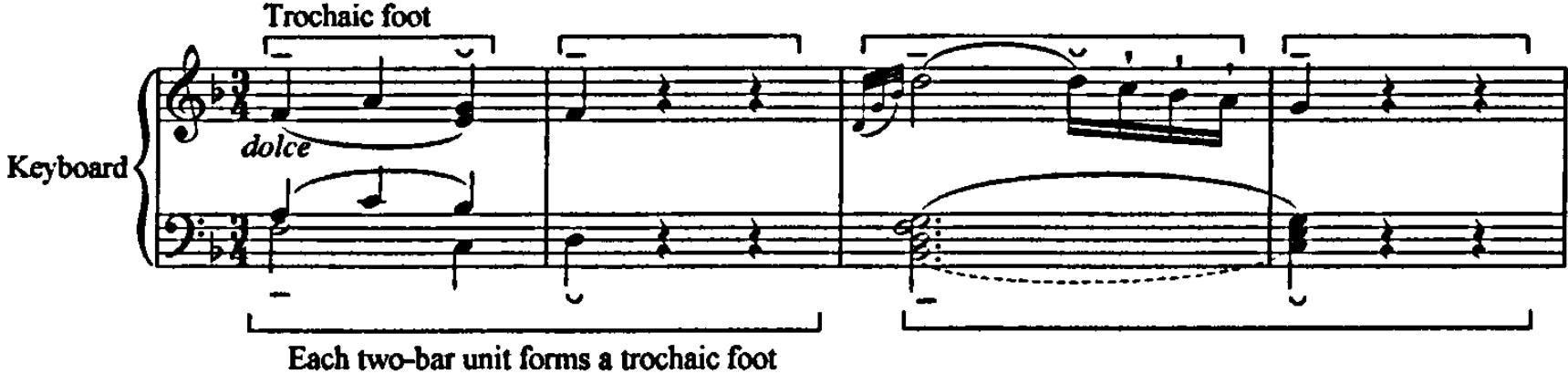
In terms of poetic feet, the accentuation within each bar of this minuet corresponds to the trochaic foot (- v), which Mattheson describes as a minim followed by a crotchet. This foot is conveyed by the harmonic rhythm of the first bar and by the shape of the melody in bars 1 and 3 (see example 5.44). On a larger scale, the overall hierarchy of dance steps in a minuet operates in two-bar phrases, in which the second bar is rarely strongly accented (Allanbrook, 1983: 34). This is clearly the case in bars 3 to 4, where a G7 chord resolves to a C major harmony; although chord VI is unexpected in bar 2, it is nevertheless hierarchically weaker than the start of bar 1. Each two-bar unit therefore also follows the strong-weak pattern of the trochaic foot; indeed, some music theorists fixed the actual rhythm of each poetic foot, but others (such as Printz and Scheibe) recognised the concept of ‘quantitas intrinseca’, or intrinsically long or short beats — the so-called ‘good’ and ‘bad’ beats of a bar. Applying this theory to the phrase-structure of this minuet, one can say that although each bar is literally of equal length, the relative weight of each identical unit can be described in relation to poetic feet. Only in bars 24 and 36 does Mozart extend this pattern into a four-bar phrase; this extension serves to link back into the opening material.
中文讲解
本段是本节的核心技术分析,可分四层讲解。
-
小步舞曲的’扬抑格’(trochaic foot,符号 - v):马泰松(Mattheson)把这一诗步解释为’二分音符加四分音符’,即强长弱短。莫扎特K377小步舞曲每个小节的重音落点,正与这种’强—弱’节奏相吻合;这种吻合具体由第一小节的和声节奏(harmonic rhythm)与第1、3小节的旋律轮廓共同支撑(见例5.44)。
-
两小节一组的’扬抑’结构:根据阿兰布鲁克(Allanbrook),小步舞曲的舞蹈步伐层级以两小节为单位,第二小节通常不会被强重音突出。第3—4小节为典型例证:G7解决到C大调,即便第2小节出现意外的和弦VI,它在层级上仍弱于第1小节起点。因此每个两小节单位内部亦呈现强—弱模式。
-
‘quantitas intrinseca’(内在时值)概念的引入:普林茨(Printz)和沙伊贝(Scheibe)等理论家承认,某些诗步虽然节拍长度看似相等,但具有’内在的’长或短——也就是人们所说的小节中’好’与’坏’的拍。本节借此说明:即便每个小节字面上等长,其相对权重仍可用诗步描述。
-
唯一的例外:仅第24与36小节,莫扎特把两小节模式扩展为四小节;这种扩展起到回指(link back)开头素材的作用,而非中断扬抑格逻辑。
理解价值:‘quantitas intrinseca’是本节分析的关键理论支点。它解决了’小节等长’与’诗步强弱不均’之间的矛盾——节奏长度可均,重音权重不必均。这一概念使得’扬抑格’可以同时被用于单小节和两小节单位,是本节后文判断三声中段’抑扬格’(iambic foot)的逻辑前提。
补充说明
‘Quantitas intrinseca’(拉丁语)在本节中以原文形式保留,作者亦以英文解释。本段提到的 ‘chord VI’ 即C大调中的a小和弦(六级),文中强调它虽意外但层级仍弱。
第3段(P0031)
原文复述
[Image/score placeholder on page 10; embedded image data omitted, but its position on the page is preserved.]
中文讲解
本条是版面中的图像或乐谱占位符:原文文本在此处被图像所替代,内嵌图像数据已被省略,仅保留位置信息。结合上下文判断,该图应对应上一段(P0030)所引用的’例5.44’(example 5.44),即K377小步舞曲第1—3小节,用以视觉化展示扬抑格重音、和声节奏及旋律轮廓。读者若要核对具体音高、和声进行与节奏型,需查阅原书第10页图像。
理解价值:占位符本身不构成论证,但它在前文’第1、3小节的旋律轮廓’与’第一小节的和声节奏’两句之后出现,正是为了让读者能将抽象描述落实为乐谱细节。
补充说明
需查看原图。
第4段(P0032)
原文复述
The trochaic foot is consistently described as suitable for dancing; this view dates back to the classical writings of Aristotle and is echoed in the eighteenth century by Mattheson. Mattheson also describes a contrasting Affekt that trochees can convey, writing that they are appropriate for the seemingly disparate genres of peasant dances and lullabies, and also that they suit ‘running’, or ‘dancing and singing’ (Mattheson, 1739: 353). It is the ‘soft and tender’ character of the trochaic foot — the Affekt associated with lullabies and singing — that Mozart exploits here. This is confirmed, in the first edition of the sonata but not in the autograph version (Eisen, 2007: 120), by the Italian term ‘dolce’ at the start of the movement, a marking reiterated in the violin entry at bar 9.
中文讲解
本段把’扬抑格’的情感(Affekt)内涵及其在莫扎特笔下的具体实现讲清楚。
-
扬抑格的’宜舞性’谱系:从亚里士多德的古典论述,到18世纪马泰松的呼应,扬抑格被历代作者视为最适合舞蹈的诗步。
-
看似矛盾的体裁并置:马泰松列举的扬抑格适用体裁——农民舞、摇篮曲、‘奔跑’、‘边舞边唱’——乍看相距甚远,实则共享一种’柔和而亲切’(soft and tender)的情感属性,这是本节抓住的核心Affekt。
-
莫扎特对’柔和亲切’的利用:这一情感在版本中得到证实——首版(first edition)开头有意大利语’dolce’(甜美、柔和)字样,自笔稿(autograph)却没有;作者引艾森(Eisen, 2007: 120)以说明这一版本差异。该标记在第9小节小提琴进入时再次出现(reiterated),形成呼应。
理解价值:作者在这里做了三件事——(a)解释为何K377小步舞曲’柔和’的解读有古典理论依据;(b)引入版本学证据,把抽象的Affekt落到乐谱上的’dolce’字样;(c)借助版本差异(首版有、笔稿无)说明首版的指示更直接地表达了演奏意图。换言之,‘dolce’不仅是一个表情术语,它是被理论支撑的’扬抑格Affekt’在乐谱上的印记。
补充说明
首版与自笔稿版本的差异,由艾森(Eisen, 2007: 120)注释提示;本节仅以此说明’dolce’的来源问题,未对版本真伪作进一步评判。
第5段(P0033)
原文复述
With the gentle and graceful nature of this minuet in mind, it is fitting that the accents which characterise each poetic foot should likewise be tender in quality. Quintilian, for instance, writes that for calmer passions the voice should fall and be ‘pitched… lower’ (Quintilian: XI.iii.65), and that, in order to placate listeners, the delivery should be quiet (Quintilian: XI.iii.170). Here, then, is an example of an accent which, while needing enough prominence to convey the stress and therefore the Affekt of the poetic foot or dance step, should be delivered with an appropriately sweet and round tone — thus heeding Quantz’s advice that contrasts of light and shade should not be too ‘vehement’ (Quantz, 1752: 256). To perform these accents with a sharp and sudden attack would create the antithesis of the intended Affekt.
中文讲解
本段把’扬抑格’的分析推到演奏层面:要保持’柔和而亲切’的Affekt,重音本身也必须’柔和’。
-
古典修辞学的支持:昆体良(Quintilian)指出,面对较为平静的情感时,声音应’降下’并’调低’(XI.iii.65),并以’轻声’来安抚听众(XI.iii.170)。这两条规则直接被借用来规定K377小步舞曲中的重音处理方式。
-
跨领域的并置:昆体良(古典修辞学)与匡茨(Quantz,18世纪长笛演奏法)被并置,作者借此强调一个共通原则——强弱对比不可过于’vehement’(激烈、猛烈)。
-
演奏上的具体含义:重音需要’足够的突出度’以传达诗步或舞步的’压力’及其Affekt,但其音色应是’甜美而圆润’(sweet and round tone)。若以尖锐、突发的重音来演奏,则正好与本乐章所欲表达的Affekt背道而驰。
理解价值:这是本节少有的直接给出演奏指引的段落。它揭示了一个易被忽略的悖论——‘重音’不等于’强音’:在保持足够突出度的同时,音色仍须柔和。这一处理方式正是扬抑格’宜舞、宜摇篮曲’的Affekt在演奏上的落实。
补充说明
本段同时征引昆体良(修辞学家)与匡茨(演奏理论家),二者属于不同历史领域,作者以共通的’温和vs激烈’对照把它们并置。
第6段(P0034)
原文复述
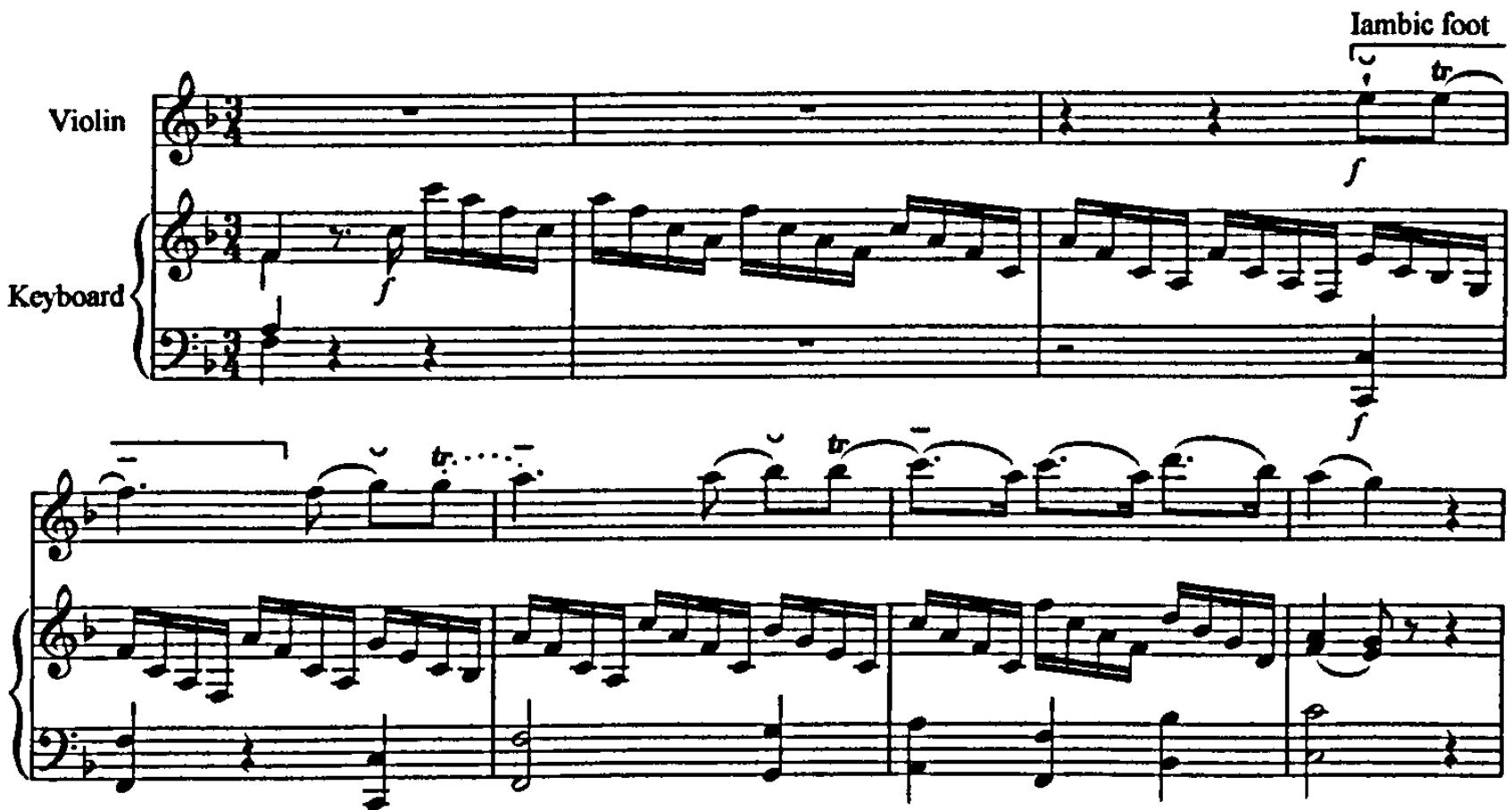
This model representation of the refinement of the minuet is maintained until bar 48, the start of the trio section (see example 5.45), where it is interrupted by a tirade of keyboard semiquavers. Importantly, the new theme now predominantly starts on the upbeat to each bar, rather than on the downbeat; the structural rhythm here is a crotchet upbeat followed by a minim downbeat, which is confirmed by the harmonic rhythm and the rhythmic profile of the left-hand keyboard part. According to Printz’s application of poetic feet to music, this creates an iambic foot (v -): although the upbeat itself is relatively strong, the downbeat, by virtue of its placement on the strongest beat of the bar and in this instance because of its length, is the strong syllable of the foot (Printz, 1696; quoted in Houle, 1987: 70). Mattheson writes that the iamb (which for him translates into musical rhythms as crotchet, minim) is ‘most readily combined in minuets with the trochaic foot’, and that its name is derived from the ‘sarcastic, cutting poems’ used in satires (Mattheson, 1739: 351). It is appropriate, then, that it is the iambic foot which Mozart uses to disturb the calm and restraint of the minuet. Indeed, it is a poetic foot described by classical writers as being ‘pompous’ and ‘harsh’ (Quintilian: IX.iv.136), ‘vehement’ (Vossius, 1673: 72-3; quoted in Houle, 1987: 73), and suitable for ‘dramatic action’. The accents of these iambs should therefore contrast starkly with those of the trochaic foot; the two feet are juxtaposed, almost as if in conflict with one another. Quintilian writes that in arguments the speaker should use the whole voice to ‘strain every nerve’, and that debate should be ‘precise’ (Quintilian: XI.iii.64). These accents should therefore be not only greater in quantity of sound — as Mozart indicates by the dynamic marking f — but also more percussive and immediate in their quality.
中文讲解
本段是本节的高潮,论证K377小步舞曲在第48小节进入三声中段后,如何由’扬抑格’切换为’抑扬格’,并由此带来情感与演奏方式的根本转变。
-
结构转折点:第48小节(见例5.45)由一串键盘十六分音符(semiquavers)打断之前那种精致(refinement)的小步舞曲模式。新主题由’弱起’(upbeat)起句——四分音符弱起加二分音符正拍——构成。这一节奏由和声节奏与左手节奏型共同确认。
-
抑扬格的成立:根据普林茨(Printz, 1696)的诗步—音乐对应,‘弱起—正拍’即抑扬格(iambic foot,v -)。尽管弱起本身相对较强,正拍因落在小节最强拍且时值更长,仍是这一诗步的强音节。
-
抑扬格的情感谱系:马泰松(1739: 351)指出抑扬格(对应crotchet + minim)‘最常与小步舞曲中的扬抑格并用’,其名称源自讽刺诗中’挖苦、刻薄’的诗体。古典作家亦将其描述为’pompous’(华夸)、‘harsh’(刺耳)(昆体良IX.iv.136)、‘vehement’(激烈)(福修斯Vossius, 1673: 72-3,引于Houle, 1987: 73),并适合’dramatic action’(戏剧动作)。
-
两种诗步的对置:作者强调,扬抑格的柔和与抑扬格的激动被并置,‘几乎像在相互冲突’。昆体良关于论辩修辞(XI.iii.64)——‘竭尽全力’、‘精确’——被借来规定抑扬格重音的演奏特征。
-
演奏上的具体要求:这些重音不仅在音量上更大(莫扎特标以f力度记号),其音色也应是’更具敲击性、更直接’(more percussive and immediate)。这是对前段(P0033)‘甜美而圆润’原则的反向规定。
理解价值:作者通过’扬抑↔抑扬’的对照,把K377第三乐章结构为两种情感与两种演奏方式的戏剧性冲突:三声中段不只是调性或织体的对比,更是诗步结构的整体反转。把昆体良’论辩’类比引入此处极具洞察力——它解释了为何小步舞曲能在保持体裁身份的同时承载戏剧张力。
补充说明
抑扬格(iamb)一词的古典词源来自希腊讽刺诗体(iambos),马泰松提到其名源自’讽刺诗中挖苦、刻薄的诗作’;本节借此说明该诗步天生带有对抗性色彩。
脚注 / 边栏 / 图表 / 附加信息(如有)
本节中P0031为第10页的图像或乐谱占位符,位置与图注保留,但内嵌图像数据已省略;结合上下文,它应对应P0030所引用的’例5.44’,展示K377小步舞曲第1—3小节,供读者核对’扬抑格’在和声节奏与旋律轮廓上的具体实现。P0034提到的’例5.45’则对应第48小节起的三声中段,原文中未给出占位符文本,但读者可据此定位乐谱。
💡 本节核心要点
- 重音与言语、舞蹈在本质上是相连的,因此’诗步’(poetic feet)这一源自古典诗学的工具可以被合法地引入小步舞曲分析。
- K377第三乐章开篇以’扬抑格’(trochaic foot,- v:二分音符加四分音符)为基本重音单位,并在两小节一组的层级上重复同一强—弱模式;这一模式由和声节奏、旋律轮廓与’quantitas intrinseca’(内在时值)共同支撑。
- 扬抑格的Affekt为’柔和而亲切’(soft and tender),与农民舞、摇篮曲、‘边舞边唱’的体裁谱系相通;首版起始处的’dolce’字样即为这一Affekt在乐谱上的印记。
- 演奏上,扬抑格的重音须保持足够突出但音色甜美圆润,遵循昆体良与匡茨所共同主张的’强弱对比不可过于激烈’的原则。
- 第48小节进入三声中段后,乐章切换为’抑扬格’(iambic foot,v -:四分音符弱起加二分音符正拍),其Affekt为’华夸、刺耳、激烈’,适合戏剧动作;这一切换通过键盘十六分音符打断此前精致的模式。
- 两种诗步在乐章中被对置,犹如相互冲突;扬抑格重音要求柔和圆润,抑扬格重音则要求更大音量(f力度)与更具敲击性、更直接的音色,由此把小步舞曲的体裁框架转化为承载戏剧张力的结构。
🔑 关键术语
- Trochaic foot(扬抑格):本节中表现为强—弱模式(- v),由马泰松具体化为’二分音符接四分音符’。在小步舞曲中既作用于单小节,也作用于两小节短语层级;其Affekt为’柔和而亲切’。
- Iambic foot(抑扬格):本节中表现为弱—强模式(v -),由普林茨具体化为’四分音符弱起接二分音符正拍’。在三声中段替代扬抑格;其Affekt为’华夸、刺耳、激烈’,名源与讽刺诗相关。
- Affekt(情感):18世纪音乐修辞学中的’情感学说’概念,指音乐作品所承载或拟传达的情感状态。本节中分别指扬抑格的’柔和亲切’与抑扬格的’激烈讽刺’。
- Quantitas intrinseca(内在时值):源自普林茨与沙伊贝的概念,指小节中即使长度相等、亦具有’内在的’长或短的拍(即’好’拍与’坏’拍)。本节借此化解’小节等长’与’诗步强—弱’之间的矛盾。
- Dolce(甜美):意大利语力度/表情术语。本节中出现在K377小步舞曲首版而非自笔稿起始处,作者将其视为扬抑格Affekt在乐谱上的印记,并在第9小节小提琴进入处再次出现。
5.8 [描述性拆分] Tender trochees and percussive iambs in the K377 trio
第1段(P0035)
原文复述
Example 5.45: K377, movement 3, bars 48-54.
中文讲解
这是第45号谱例的图注,标注了所引用的乐谱片段为莫扎特K377第三乐章(小步舞曲/三声中段)第48至54小节。该图注本身没有分析内容,仅作为后续讨论或图像占位符的标识;其作用是把读者引向一个具体的乐谱位置,以便与本节的论述相印证。
第2段(P0036)
原文复述
中文讲解
此为第11页的图像或乐谱占位符。结合P0035的图注可知,该位置承载的是Example 5.45,即K377第三乐章第48至54小节的乐谱图像。由于具体音符内容无法从文字中读取,相关细节(如实际声部配置、力度记号、装饰音位置等)需参照原书图像。本节正文并未直接讨论此段乐谱,疑为前文或后文段落引用之示例;其位置紧贴P0037开篇关于三声中段尾声的论述,属于该段上下文中的配套谱例。
第3段(P0037)
原文复述
Towards the end of this trio section the ‘soft and tender’ character of the opening of the minuet is recalled: during bars 77 to 84, the piano dynamic and high pitch of the keyboard and violin parts create a delicate texture, and the harmonic rhythm of a minim followed by a crotchet re-establishes the predominance of the trochaic foot. At bar 85, notated accent markings more explicitly evoke characteristics of the typical minuet model with which the movement began. From bar 85 to 92 (see example 5.46), fp markings on alternate bars (in the first edition only) highlight the return of a two-bar phrase structure, which is again reminiscent of the trochaic (strong-weak) hierarchy at the start of this movement.
中文讲解
本段是小节的核心论述之一,揭示了莫扎特在K377第三乐章(三声中段)尾声处对开篇小步舞曲主题性格的回溯。
第一层(第77–84小节):作者指出,此处的“soft and tender”(柔和而温柔)性格呼应了小步舞曲开篇的特征。具体落实方式有三:(1)力度转为p(piano);(2)小提琴与键盘声部均位于高音区;(3)和声节奏(harmonic rhythm)呈现“二分音符—四分音符”的组合。这里的关键概念是“trochaic foot”(扬抑格音步),即强—弱的两拍单元:二分音符占据重拍并被赋予更长时值,随后接以四分音符,构成与小步舞曲开篇一致的强弱层级。
第二层(第85小节起):作者认为,自第85小节起,作曲家通过显式的重音记号(accent markings),更加直接地唤起本乐章起始的典型小步舞曲模式。
第三层(第85–92小节,见Example 5.46):在首版(first edition)独有、间隔一小节出现的fp(forte-piano)力度记号,强调了“每两小节构成一个乐句”的两小节乐句结构(two-bar phrase structure)。这种两小节一组的周期性结构同样暗示了开篇的扬抑格层级。
需要注意的是“in the first edition only”这一限定——fp记号只出现在首版中,而原典版(如NMA、Peters Urtext)并未保留。这一信息为后文(特别是P0040及脚注P0041)讨论首版与原典版记号差异埋下伏笔。
本段的教学要点是:作者通过力度(p、fp)、音区、和声节奏与乐句结构等多个表层参数,同时回溯小步舞曲的性格与节律模型,从而论证“trochaic foot”在全乐章中作为结构性主导的持续存在。
补充说明
“trochaic foot”(扬抑格音步):在英语言语节奏学中指重—弱两音节的组合;在本节中被借用来形容“长—短”或“强—弱”的节拍单元,对应小步舞曲典型的二分音符接四分音符的和声节奏模式。两小节乐句结构(two-bar phrase structure)也是古典时期小步舞曲的常见组织特征,与扬抑格的强弱交替相辅相成。
第4段(P0038)
原文复述
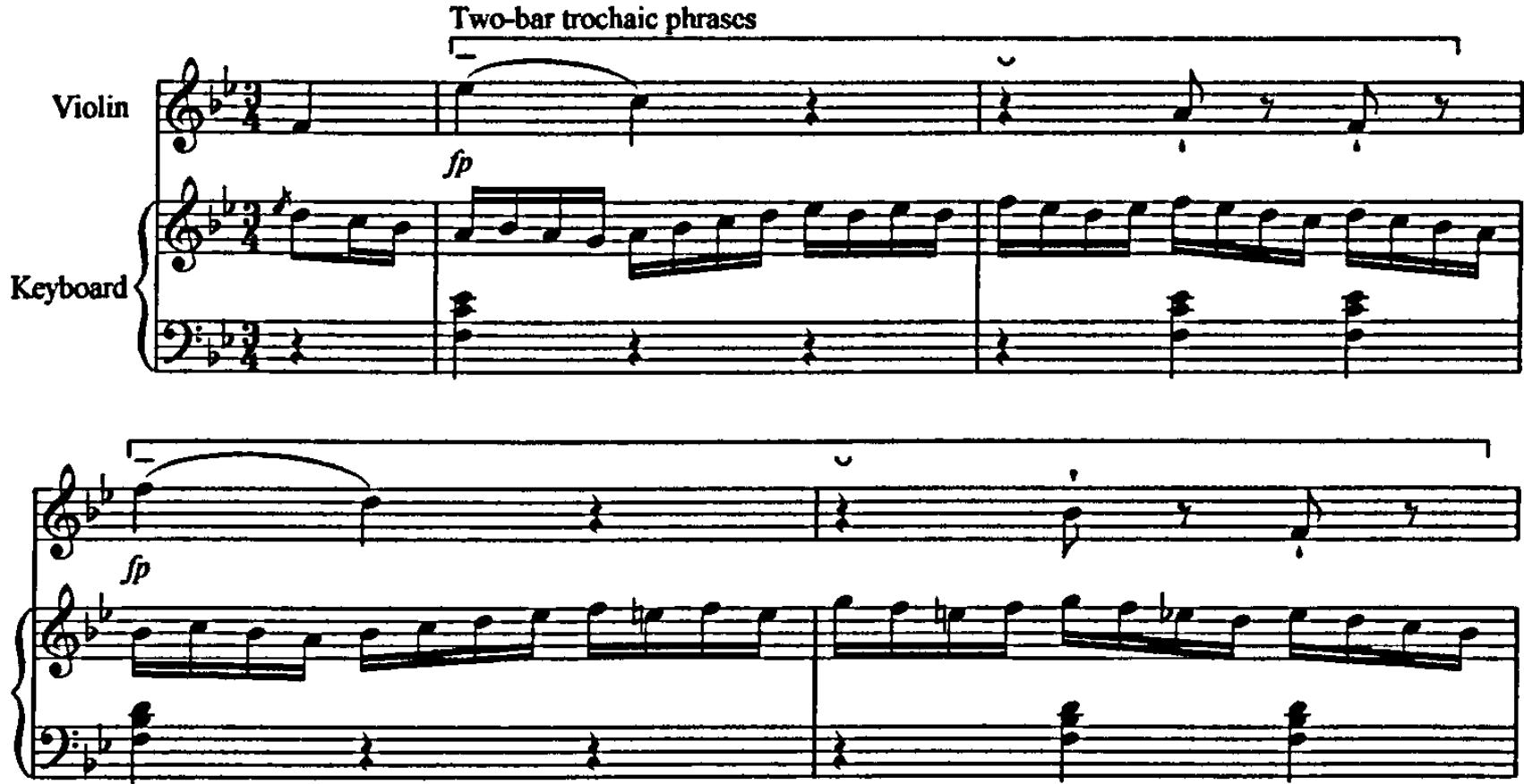
Example 5.46: K377, movement 3, bars 84-88.
中文讲解
这是第46号谱例的图注,标识莫扎特K377第三乐章第84至88小节的乐谱片段。它直接对应P0037中所讨论的第85–92小节区域中的前段,作者在此处用这一谱例支撑关于fp记号、两小节乐句结构以及扬抑格层级的论述。
第5段(P0039)
原文复述
中文讲解
此为第12页的图像或乐谱占位符。结合P0038的图注,该位置承载的是Example 5.46,即K377第三乐章第84至88小节的乐谱图像。由于无法从文字读取具体音符,详细内容需参照原书图像。该谱例与P0037中关于fp记号、两小节乐句结构及扬抑格层级的论述直接对应。
第6段(P0040)
原文复述
This hierarchy is more emphatically conveyed in bars 101 to 104 (see example 5.47); here, dominant seventh chords marked rinf resolve to p tonic chords, restlessly descending through a cycle of fifths. $^{60}$ Clive Brown writes that during the 1760s and 1770s, rinf was often used to prescribe a rapid crescendo through groups of notes. Here, though, the rinf marking appears to apply to a dotted minim in the violin part alone, while the keyboard part is marked f. In this context, rinf could indicate a crescendo through the long violin note, with a sudden p on the downbeat of the next bar, or it could be taken to mean, as Reichardt suggested just five years before the publication of this sonata, ‘nothing more than a small pressure, an accent, on the note on which it stands’ (Reichardt, 1776: 68; quoted in Brown, 1999: 88). This interpretation of $rinf$ as indicating an impulse from which the sound diminishes, rather than a crescendo, is supported by the first edition, which has the $p$ marking during the dotted minim rather than on the following crotchet, as it is represented in both the NMA and Peters Urtext editions (and in example 5.47). At bar 109, the trochaic foot is entirely restored, with a recapitulation of the opening theme.
中文讲解
本段是本节最核心的论述,承接P0037对扬抑格层级的讨论,进一步在第101–104小节论证该层级的强化呈现,并展开了关于rinf(rinforzando)一词在当时语境下含义的关键释义争论。
第一层(第101–104小节,见Example 5.47):作者指出,扬抑格层级在这里被更加强有力地传达——属七和弦(dominant seventh chord)标记为rinf,解决至p(piano)的主和弦(tonic chord),并通过五度循环(cycle of fifths)持续下行。rinf→p的“强—弱”交替是扬抑格层级在力度层面的直接体现。作者用“restlessly descending”(不安地下行)形容这一连串五度下行,既描述了和声进行的方向,也暗示了音乐的情绪张力。
第二层(关于rinf含义的释义争论):
- Clive Brown的通行观点:1760–1770年代,rinf常被用来表示“一组音的快速渐强”(rapid crescendo through groups of notes)。
- 莫扎特此处的特殊性:rinf标记仅出现在小提琴声部的一个附点二分音符(dotted minim)上,而键盘声部则标记为f。如果按Brown的通行解释,则应理解为小提琴的长音上做渐强,并在下一小节正拍突转p。
- Reichardt 1776年的替代解释:五年后(按Reichardt 1776年出版、K377首版于同年前后推算),Reichardt认为rinf“仅仅表示一种轻微的压迫感,一个落在该音上的重音”(nothing more than a small pressure, an accent)。这是一种“从音头发力随后衰减”的处理,而非渐强。
- 作者的判断:作者倾向于接受Reichardt的解读,关键证据来自首版记号——首版将p(弱)记号置于附点二分音符期间,而非随后的四分音符上;而NMA与Peters Urtext原典版(以及Example 5.47)则把p记在下一个四分音符上。这一记号位置的差异决定了“弱”的位置究竟在何处,从而影响对rinf含义的解读。
第三层(第109小节):作者总结道,扬抑格音步在第109小节得到完全恢复,伴随着开篇主题的再现(recapitulation)。这意味着扬抑格作为全乐章结构性主导的地位,在三声中段尾声与回到主部之间得到了完整的回归。
本段的教学要点在于:通过一个具体的记号(rinf)在历史语境中的多义性,展示了原典编辑(Urtext)与历史首版(first edition)之间的差异如何影响演奏诠释;以及作者如何通过对18世纪文献(Reichardt 1776)的征引来支持自己的解读。这种“文本证据+历史文献+音响逻辑”三重论证是音乐学论文的典型方法。
补充说明
脚注60指向P0041,提示关于此段落中力度记号的首版/手稿差异的来源说明。五度循环(cycle of fifths)在本节中作为和声下行运动的术语被使用,描绘属—主关系连续下行所形成的序进。NMA指Neue Mozart-Ausgabe(新版莫扎特全集),是当前学界权威的原典版来源;Peters Urtext则是另一重要原典版。
第7段(P0041)
原文复述
$^{60}$ These dynamic markings are present in the first edition, but not in the autograph version (Eisen, 2007: 120). However, their inclusion in the first edition simply serves to clarify the accentuation of the harmonic discourse, rather than imposing anything unexpected.
中文讲解
这是脚注60,对应正文P0040中的上标。其内容包含三层信息:
- 事实陈述:本段(第101–104小节附近)所讨论的力度记号(dynamic markings)出现在首版中,但不见于手稿版本(autograph version)。
- 文献溯源:作者援引Eisen 2007年著作第120页作为依据。
- 解释性判断:作者认为,首版增补这些记号的目的仅仅是“澄清和声陈述的重音关系”(clarify the accentuation of the harmonic discourse),而非引入任何意料之外的内容。
本脚注的功能有二:第一,对正文所述记号差异给出版本学来源;第二,为后段(尤其是关于rinf含义的解读)建立版本学合法性——首版的记号虽为后加,但具有澄清作曲家和声意图的解释价值,因此可被纳入对rinf含义的判断依据。脚注中“rather than imposing anything unexpected”这一限定语,提示读者:作者不认为首版的增补改变了作曲家的原始意图,而是将其明示化。
💡 本节核心要点
🔑 关键术语
- trochaic foot (扬抑格音步):本节借语言学的扬抑格(重—弱两音节)来描述音乐中的强—弱节拍单元,对应小步舞曲典型的二分音符接四分音符和声节奏模式,是全乐章的结构性主导特征
- harmonic rhythm (和声节奏):指和弦变换的速度与节律;本节中以二分音符接四分音符的组合方式承载扬抑格层级,是开篇小步舞曲性格的标识之一
- rinf (rinforzando):18世纪后期具有多义性的力度术语;既可解作一组音的快速渐强(Brown),也可解作音头施压随后衰减的重音/压迫(Reichardt 1776)。本节作者依据首版p记号位置倾向后者
- dominant seventh chord (属七和弦):构建在属音上的七和弦;本节中标记rinf并解决至p主和弦,其强—弱交替构成扬抑格层级的力度体现
- cycle of fifths (五度循环):以五度下行为单位的和声序进;本节中连续属—主关系下行推动第101–104小节的和声运动
- fp (forte-piano):先强后弱的力度记号;本节中仅出现在首版第85–92小节,间隔一小节标注,强调两小节乐句结构与扬抑格层级
- first edition vs. autograph (首版 vs. 手稿):本节论证的关键文本对照:首版包含正文中讨论的力度记号,手稿则无;脚注60指出首版增补仅起澄清和声重音的作用,不改变作曲意图
- NMA / Peters Urtext:NMA指Neue Mozart-Ausgabe(新版莫扎特全集),Peters Urtext是另一原典版;本节中两者在rinf语境下均将p记号置于附点二分音符之后的四分音符上,与首版不同
5.9 [描述性拆分] Summary of the K377 minuet and transition to K547
第1段(P0042)
原文复述
Example 5.47: K377, movement 3, bars 100-104.
中文讲解
这是一段图例/谱例标题文字(Example 5.47),标明随后的图像对应 Mozart 为小提琴与键盘而作的奏鸣曲 K. 377 第三乐章(Tempo di Menuetto)的第 100–104 小节。该谱例被置于段 P0044 的分析之前,作为视觉佐证,提示读者去查看被分析小节中的力度记号、跳音/重音记号以及分句等具体细节,从而印证关于“舞步重音模式”的论述。
补充说明
标题与 P0043 的图像占位符配对使用;K. 377 是 Mozart 1777 年的小提琴奏鸣曲,本节所谓“第三乐章”即该奏鸣曲的末尾乐章 Tempo di Menuetto。
第2段(P0043)
原文复述
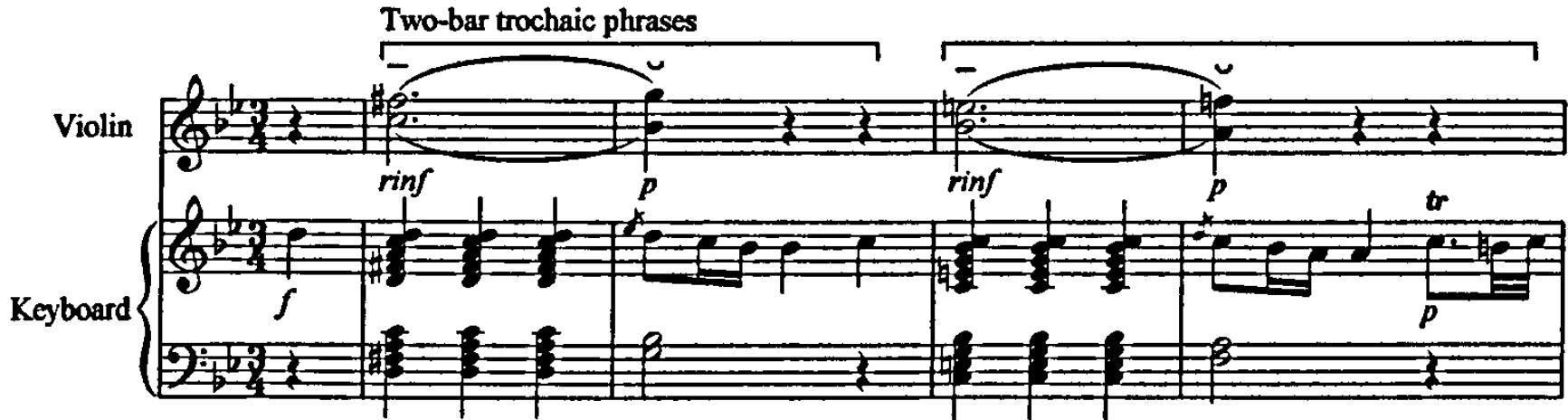
中文讲解
这是页面上的乐谱图像占位符——内嵌的图像数据在文本提取时被省略,仅保留了位置(第 13 页)与图注信息(对应 P0042 的 Example 5.47)。读者需要翻阅原始第 13 页方能查看 K. 377 第三乐章第 100–104 小节的实际记谱,以便对照 P0044 中关于 trochees 与 iambs、力度与重音标记的分析。
补充说明
由于看不到实际音符,本讲解中关于谱面细节(例如具体哪些音上有跳音或重音记号)的论断只能保留为“需查看原图”;不应猜测未显示的内容。
第3段(P0044)
原文复述
This Tempo di Menuetto therefore provides an example of a movement which at least in part conforms to the conventional accentual pattern of its dance-model; it can be described in relation to poetic feet, each foot in effect representing a musical ‘word’. The accentual structure of this movement remains largely consistent throughout each section (with trochees in the outer sections, contrasting with iambs in the central section), and the accents coincide with the metrical hierarchy of a 3/4 movement. Various clues as to the character of the movement are provided through the use of dynamics, Italian terms, and notated accents: by understanding the poetic feet of this movement, the performer can use accentuation in order to clarify the character or Affekt.
中文讲解
本段是对 K. 377 第三乐章 Tempo di Menuetto 全文分析的小结,论证功能为“以一个具体乐章证明前述方法可行”。其中心主张是:该乐章至少在相当程度上符合其舞曲原型(小步舞曲)所固有的重音模式,因此可以用诗的韵律脚(poetic feet)来描述音乐——每一个脚大致相当于一个“音乐词”。
需要理解的几个关键点:
- 重音结构的内部一致性。每一段落内部的重音分布大体保持稳定——外段用 trochees(扬抑格,强—弱),中段改用 iambs(抑扬格,弱—强),与三段体(ABA)小步舞在中央 Trio 段落改变性格的惯例相呼应。
- 重音与 3/4 节拍层级一致。即这些“诗脚”的强弱与 3/4 拍子的强弱层级重合,因此演奏者按诗脚处理就自然贴上了节拍的强弱位置。
- 性格线索。作者进一步指出,力度术语、意大利语表情记号(tempo 提示等)以及谱面上明确记下的重音记号(>、跳音点等)都给出了关于乐章 Affekt(情感/性格)的提示。
- 演奏意涵。理解诗脚的划分后,演奏者就能通过重音处理(accentuation)来“clarify the character or Affekt”——即让听者感到该段应有的情绪与性格。
整段在本小节起收束作用:它以 K. 377 为范例,证实了“用诗脚解释莫扎特舞曲乐章重音”这一方法在舞曲模型未受破坏的情况下是有效的;同时它也为本节(5.9)的过渡任务埋下伏笔——如果遇到不像舞曲那样规整的乐章,这种诗脚模型还管用吗?这是 P0045 要提出的问题。
补充说明
trochee = 扬抑格(重音在前:STRONG–weak),对应小步舞外段常见的“正拍起、强—弱”模式;iamb = 抑扬格(重音在后:weak–STRONG),对应中段常见的“弱起、强在第二拍”模式。Affekt 一词来自德语,指巴洛克/古典时期表演理论中所说的“情感”或“情绪性格”,是演奏诠释的最终指向。
第4段(P0045)
原文复述
Thus, Mozart’s dance-influenced movements can be described in relation to poetic feet, thereby enabling us to identify the function, placement and Affekt of accents. Even where dance forms are not explicitly named, a number of Mozart’s sonata-movements convey the metrical hierarchies of dance. However, the examples of accentuation in K481 and K526 demonstrate (see pages 177-184) that Mozart’s use of harmonic rhythm, dissonance, slurs, rests and beaming, all of which enable the performer to identify individual musical motives, or musical ‘words’, often vary or even subvert such regular metrical hierarchies. In these instances, where the rhythmic content of a movement is more varied and speech-like than the conventional and regular accentuation patterns of a dance-form such as the minuet, can poetic feet still be used by the performer to interpret the individual musical ‘words’ which constitute each musical phrase?
中文讲解
本段是本小节最关键的“过渡段”,它一面回收 K. 377 的结论,一面把读者的注意力引向新的难题。
首先,本段以“Thus”开篇,把上一段的个案上升为通则:凡莫扎特受舞曲影响的乐章,皆可用诗脚描述,进而辨认重音的功能、位置与 Affekt。
接着是一个限定性补充:即便未在曲名上写明舞曲类型,许多莫扎特奏鸣曲乐章仍然呈现出舞曲式的节拍层级。这一观察由脚注 61(Riggs 1996)作为外部佐证。
然后是“However”——本段论证的真正转折:K. 481 与 K. 526 这两部作品(详见第 177–184 页)表明,莫扎特有时会借助和声节奏、不协和音、连线(slurs)、休止符以及符尾连写(beaming)这些手法,来引导演奏者识别一个个独立的音乐动机、即“音乐词”;而这些手法常常变动甚至颠覆上面那种规整的舞曲重音层级。
最后一句是修辞性提问:当一段音乐的节奏内容比小步舞之类舞曲那种规整、模式化的重音更具变化、更像“说话”(speech-like)时,演奏者还能不能借助诗脚去解释构成每个乐句的各个“音乐词”?
值得点出的论证意义有三:①它把“音乐词”这个隐喻从“诗的”拓展到了“散文的”——即从规整的舞曲隐喻转向更接近演说/语言的隐喻;②它把 K. 377 作为正例、把 K. 481 与 K. 526 作为反例或边界例,构成一种“模型—边界检验”的论证结构;③它用提问而非断言的方式为下一节(K. 547 的讨论)布置任务。
补充说明
harmonic rhythm(和声节奏)指和弦更替的速率,它会形成一种独立于表面节拍的重音脉动;slurs、rests、beaming 三者都是谱面“分组”记号,帮助演奏者把音符切分成动机或“词”。文中提到的“pages 177-184”是同一章后续页码的内部交叉引用,并非外部文献。
第5段(P0046)
原文复述
Robert Riggs traces the presence of dance forms in Mozart’s Sonatas for Violin and Keyboard in R. Riggs (1996): ‘Authenticity and Subjectivity in Mozart Performance: Türk on Character and Interpretation’. College Music Symposium 36, 33-58.
中文讲解
这是脚注 61 的全文。它引自 Robert Riggs 1996 年发表在《College Music Symposium》第 36 卷第 33–58 页的文章《Authenticity and Subjectivity in Mozart Performance: Türk on Character and Interpretation》。该脚注附在 P0045 中“Even where dance forms are not explicitly named, a number of Mozart’s sonata-movements convey the metrical hierarchies of dance”这一句之后,所起的功能是提供外部学术支持:证明莫扎特小提琴与键盘奏鸣曲中确实存在未明示舞曲名却保留舞曲节拍层级的现象。脚注同时把 Türk(十八世纪德国钢琴教学传统中的重要理论家,其著作长期被用作讨论莫扎特演奏实践的原始依据)带入论证,作为解读 Affekt 的参照资源。
就性质而言,本脚注属于“佐证/来源”类注释:它本身不展开论证,但用以加固正文关于“未命名舞曲”的观察。
补充说明
脚注中的“36, 33-58”即期刊卷号与页码范围;Türk 的全名 Daniel Gottlob Türk(1750–1813),其《Klavierschule》是研究古典时期演奏实践的一手文献。本讲解不就这些人物补充超出本任务输入的内容。
脚注 / 边栏 / 图表 / 附加信息(如有)
本小节包含一项图例(Example 5.47,P0042 标题 + P0043 图像占位符),指向 K. 377 第三乐章第 100–104 小节;以及一项脚注(61,P0046),引自 Riggs 1996 年《College Music Symposium》上的文章,用以支持“未标舞曲名的奏鸣曲乐章仍保留舞曲式节拍层级”的论断。除此之外,本小节内无其他图表、表格或边栏。
💡 本节核心要点
- K. 377 第三乐章 Tempo di Menuetto 至少在相当程度上遵循其舞曲原型的传统重音模式,可由“诗脚”描述其重音结构。
- 该乐章的重音结构在每段内部大体一致:外段为 trochee(扬抑格),中段转为 iamb(抑扬格),且都与 3/4 拍子的强弱层级重合。
- 力度记号、意大利语术语和谱面明确的重音符号共同提供关于乐章 Affekt 的线索,理解诗脚后演奏者即可通过重音处理来塑造性格。
- 即便未在曲名上明示舞曲类型,许多莫扎特奏鸣曲乐章仍隐含舞曲式的节拍层级(脚注 61 / Riggs 1996 提供外部佐证)。
- K. 481 与 K. 526 的例子(详见第 177–184 页)显示,和声节奏、不协和音、连线、休止符与符尾连写等手法常变动或颠覆规整的舞曲重音层级,使节奏内容更接近“说话”而非舞蹈。
- 因此本节以一个修辞性问题收尾:当乐章的节奏更具变化和散文化时,诗脚模型是否仍可用来解释每个“音乐词”——这一问题把论证引向下一节对 K. 547 的讨论。
🔑 关键术语
- trochee(扬抑格):诗的韵律脚之一,重音在前、弱音在后(STRONG–weak);用于描述 K. 377 第三乐章外段的重音模式。
- iamb(抑扬格):诗的韵律脚之一,重音在后、弱音在前(weak–STRONG);用于描述 K. 377 第三乐章中段(即 Trio 一类中央段落)的重音模式。
- Affekt(情感/性格):巴洛克与古典时期表演理论中的德语术语,指作品所应传达的特定情绪或性格;本节中作为诗脚—重音分析最终要塑造的目标。
- musical ‘word’(音乐词):本节使用的隐喻,指一段旋律/节奏中被独立辨认出的较短乐思单位,类比于诗行中的词;它和“poetic feet”一起构成把音乐当作“诗”来阅读的解释框架。
- metrical hierarchy(节拍层级):节拍内由强拍、弱拍、次强拍等构成的强弱层级(如 3/4 中的强—弱—弱);本节用它来衡量乐章是否符合舞曲的常规重音模式。
- harmonic rhythm(和声节奏):和弦更替的速度所形成的独立重音脉动;本节指出它在 K. 481 与 K. 526 中常常与表面舞曲节拍层级不一致,从而挑战诗脚模型。
5.10 [描述性拆分] Dactyls, trochees, and the molossus in K547, movement 2
第1段(P0047)
原文复述
The second movement of K547, like the minuet of K377, is in 3/4 time. Unlike the minuet, however, the melody—found in the keyboard right-hand part—suggests accents not only on beat one but also on beat three, the latter being produced by an appoggiatura and a slur (see example 5.48). The melody’s dominant poetic foot is the dactylic foot (- vv). The author underlines that, in Mozart’s rhythmically intricate movements, one must rigorously distinguish structural accentual notes from decorative ones: although beat three of the keyboard part contains four semiquavers on the surface, the underlying dactylic rhythm (a quaver followed by two semiquavers) is articulated by the contrast between two slurred semiquavers and two detached semiquavers. Two contrasting accounts of the dactyl’s Affekt are then set out. On one side, Quintilian describes the foot as ’lofty’ and ’expansive’ (IX.iv.136), Longinus calls it ‘beautiful’ and ‘heroic’, arousing nobility and grandeur (Longinus, 1932: 237), and Aristotle in his Poetics refers to its ‘stately and grandiose’ Affekt (Aristotle, 1996: 41). On the other side, Vossius characterises the dactyl as ‘cheerful and joyous’ (Vossius, 1673: 72-3; quoted in Houle, 1987: 73), a reading that Quintilian’s description of short syllables within a foot as ‘rapid and nimble’ (IX.iv.83) is said to support. Mattheson reconciles these accounts by stating that dactyls are ‘suited to serious as well as to light-hearted melodies, according to the affection’ (Mattheson, 1739: 355). To decide which character is in play here, the author argues, one must examine the rhythmic profile of the accompanying parts.
中文讲解
本段为整节定下基调,先建立K547第二乐章的节拍与重音框架,再引入对’抑抑扬格’(dactyl,- vv)这一韵足之Affekt的解读冲突。
第一层工作是比较与定位:本乐章虽与K377小步舞曲同为3/4拍,但旋律右手部分通过倚音(appoggiatura)与连线(slur),使重音除落在第1拍外,也落在第3拍上——这打破了小步舞曲仅强调第1拍的惯例。第3拍表面上是四粒十六分音符,但通过’连—断’两种奏法的差异,作者论证真正的结构节奏是’八分音符加两粒十六分音符’的dactyl结构。这一区分提醒读者:在莫扎特节奏复杂的乐章中,不能把表层音值直接等同于结构节奏,必须分辨’骨架’与’装饰’。
第二层工作是对dactyl的Affekt之争作横向梳理:Quintilian、Longinus、Aristotle代表’庄严—崇高’传统(lofty、expansive、heroic、stately、grandiose);Vossius代表’欢快—喜悦’传统(cheerful and joyous),后者由Quintilian关于’短音节迅捷灵动’的描述提供旁证。Mattheson’s 1739一书(p.355)作为调和者出现:dactyl既可庄重也可轻快,关键取决于语境(‘according to the affection’)。
第三层工作是推迟判断:作者明确表示,单凭旋律自身的dactyl结构不足以判定其Affekt,必须进一步分析伴奏声部的节奏形态——这是下一段(P0048)展开的伏笔。教学上应注意:①同一种dactyl在不同作曲家手中可能承担截然不同的情感;②韵足分析需要’上下文证据’而非套用先验标签。
补充说明
本段是整节的方法论入口,‘区分结构节奏与装饰节奏’的论断以及’考察伴奏声部’的方法,为P0048的分析埋下伏笔。脚注62在本页范围内未完整给出,但P0049会处理。
第2段(P0048)
原文复述
Recapitulating earlier analysis, the first bar of this movement contains two accents, falling on beats one and three, and can therefore be described as containing two ‘words’ or ‘motives’. The accompaniment figure essentially consists of two crotchets that underscore the first ‘word’ of the melody. In the violin part, a slur binds the quavers of beat one into a crotchet-shaped rhythm, thereby outlining the same rhythmic foot as the left-hand keyboard part. Applying the theory of ‘intrinsic length’, these two crotchets may be classified as a trochee (- v), a foot that is ‘suitable for dancing’ (Aristotle, 1996: 40; Mattheson, 1739: 353). Given this context, the author concludes that the dactyl in the second half of the bar should be heard as more ’light-hearted’ than ‘serious’. Classical witnesses are then adduced for the sonic profile of joy: Cicero writes that ’energy’ requires a tone that is ‘intense, vehement, eager’, and that joy should sound ‘cheerful and gay’ (Cicero: III.lviii.219); Le Faucheur describes joy as sounding ‘full, flowing and brisk’ (Le Faucheur, 1727: 99); and Quintilian similarly states that cheerful subjects should be ‘full’ and have an ‘unaffected’ tone (Quintilian: XI.iii.63). From these descriptions the author infers that the accents characterising the dactylic and trochaic feet should be fairly loud, that the tone quality should be full (and therefore resonant) and pure, and that the references to a ‘brisk’ and ’eager’ tone may also imply that the rate of decay of these accents should be quick.
中文讲解
本段回答了P0047末尾悬置的问题:通过分析伴奏声部,作者判定本乐章的dactyl应解读为’偏轻快’而非’庄重’。
推理链清晰可辨:①首小节含两个重音,故可视作两个’词’或两个’动机’;②伴奏的两粒四分音符支撑第一个’词’,小提琴连线把第1拍两粒八分音符合并为四分音符节奏,与左手键盘构成同一种韵足;③依据’内在时值’(intrinsic length)理论,两粒四分音符构成trochee(- v),而Aristotle与Mattheson均称trochee’适于舞蹈’(suitable for dancing);④既然第一个’词’是舞蹈性、轻快的,那么第二个’词’中的dactyl也应承袭这一’轻快’基调,而非庄严。
接下来,作者引述三位古典权威为’轻快’提供表演参数:Cicero论’能量’与’喜悦’应’激烈、猛烈、热切’‘欢快明丽’;Le Faucheur形容喜悦之声’饱满、流畅、轻快’;Quintilian指出喜悦题材应’饱满’且’不做作’。由此推导具体的演奏指令:①重音应’相当响’(fairly loud);②音色应’饱满(故而共鸣)且纯净’(full/resonant, pure);③’轻快’‘热切’等描述暗示重音的衰减速率应’较快’(quick decay)。
教学要点:①’内在时值’如何把表面节奏单位映射为韵足;②同小节不同’词’之间的性格连贯性——trochee的性格为dactyl提供旁证;③古典修辞学的表演建议如何具体化为力度、音色、衰减三类参数。
补充说明
本段提到的’内在时值’(intrinsic length)理论是本节分析方法的核心概念;它意味着音的内在时值(长/短)而非外在重音标记决定韵足归属。该理论的提出背景本输入未给出,无须补充。
第3段(P0049)
原文复述
Footnote 62: Aristotle refers here to the ‘heroic verse’, which Quintilian confirms as meaning the dactylic foot (Quintilian: IX.4.88).
中文讲解
此为脚注62。其功能是澄清P0047所引Aristotle那段话的具体所指:Aristotle所说的’heroic verse’(英雄格律诗),经Quintilian(IX.4.88)确认,指的正是dactylic foot。换言之,Aristotle的’stately and grandiose’评语原本就指向dactyl,这为P0047中’庄严—崇高’传统的dactyl解读提供了直接出处,而非泛指其他韵足。
在整节论证中,此脚注对正文主张起到来源限定作用:它把Aristotle这一权威文献锚定在dactyl上,避免读者把’heroic verse’误读为其他韵足或泛指庄严诗体。
补充说明
脚注支持正文主张的方式:来源锚定(source anchor)——把古典权威Aristotle的具体所指锁定为dactylic foot。
第4段(P0050)
原文复述
Figure placeholder: Example 5.48, illustrating K547, movement 2, bar 1. (Embedded image data omitted; caption and position retained.)
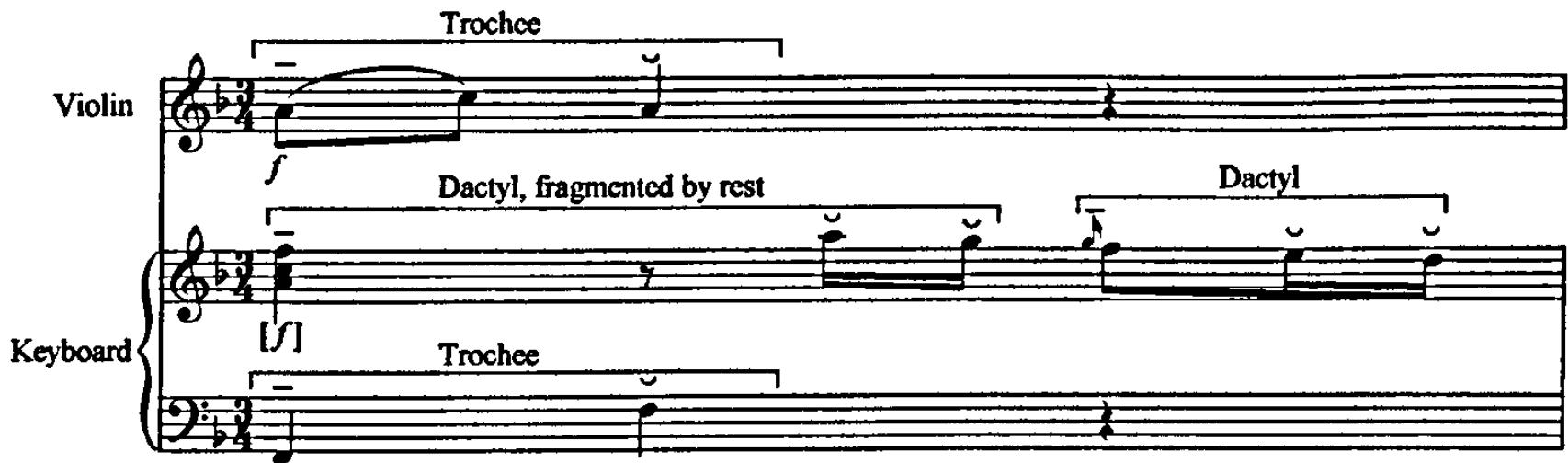
中文讲解
图像占位符:Example 5.48,所指为K547第二乐章第1小节的乐谱(旋律右手、键盘左手伴奏以及小提琴声部)。该图位于第15页,是P0047关于倚音、连线、四粒十六分音符节奏结构分析所依据的谱例,也是P0048分析trochee节奏形态的依据。由于嵌入图像数据已省略,具体音符分布、连线走向、跳音与连音的对应关系均’需查看原图’核对,本节论述的具体结论仍以原书为准。
第5段(P0051)
原文复述
Bar 4 introduces completely different material, consisting of the three long beats of the molossus poetic foot (—) (see example 5.49). Although the right-hand keyboard melody of bar 5 is a dotted minim, and long slurs bind crotchets together in the left-hand and violin parts, the articulated crotchets at the start of bar 4 in the right-hand part draw the ear to the crotchet movement that governs the internal rhythm of these bars. In contrast to the ’lighthearted’ cheerfulness of the first four bars, the molossus is universally interpreted as stately. Vossius describes it as ‘grave and slow’ (Vossius, 1673: 72-3; quoted in Houle, 1987: 73), and Mattheson states that it conveys ‘arduousness or something toilsome… very serious, sad or melancholy circumstances’ (Mattheson, 1739: 355). Accordingly, the accents during this theme (such as the dissonance at the start of bar 5) should be more discreet than those of the first three bars, and could be played with a swelling sound rather than an immediate or percussive effect: Cicero writes that the tone of sorrow should be ‘full’ (Cicero: III.lvii.217), while Quintilian describes the delivery suitable for funerals as ‘melancholy and subdued’ (Quintilian: XI.iii.153). This character, the author concludes, is aided by Mozart’s use of slurs.
中文讲解
本段转向第4小节的molossus(—,长长长格),与前四小节的’轻快’形成强烈对照。
结构观察:尽管第5小节右手声部是附点二分音符(一个延音),且左手与小提琴中的四分音符被长连线绑定,但第4小节起首右手声部的’分奏四分音符’(articulated crotchets)将听者注意力引向贯穿这几小节的四分音符律动。这一观察呼应P0047的方法论——表层音值(长延音)不等于结构节奏(分奏四分音符驱动的crotchet运动)。
与dactyl的Affekt之争不同,molossus在古典权威中罕见地达成一致:Vossius称其’庄重缓慢’(grave and slow),Mattheson说它传达’艰辛或费力……极为庄重、悲伤或忧郁的境况’。这一致性为表演诠释提供了清晰指引:①重音应比前三小节’更克制’(more discreet);②可使用’渐强的声音’(swelling sound),而非’即刻、打击性的’(immediate or percussive)效果;③音色仍应’饱满’(Cicero论悲伤的’full’),但情绪基调应’忧郁而克制’(Quintilian XI.iii.153所述葬礼演讲方式)。莫扎特在该段使用大量连线,进一步柔化、延展重音,与修辞学的’克制—饱满’指示相配合。
教学要点:①molossus的Affekt一致性反衬出dactyl的诠释开放性;②同首乐章内不同韵足的切换如何驱动力度、音色、起音方式的相应调整;③作曲手段(连线)如何与修辞学指示相互印证。
补充说明
本段提及Example 5.49,但该谱例图未包含在本次输入的source_paragraphs中。如需核对molossus段落的具体节奏形态,需另查原书相应图示。
脚注 / 边栏 / 图表 / 附加信息(如有)
本节范围内的非正文附加材料:①脚注62(P0049)——澄清Aristotle的’heroic verse’即dactylic foot,对正文主张起到来源锚定作用;②Example 5.48(P0050,图像占位符)——位于第15页,所示为K547第二乐章第1小节,是P0047与P0048关于dactyl和trochee节奏分析所依据的谱例;③Example 5.49(仅在P0051文本中被引用,未包含在本次输入中)——所示为K547第二乐章第4小节的molossus段落。
💡 本节核心要点
- 本乐章虽与K377小步舞曲同为3/4拍,但通过倚音与连线在第3拍引入第二重音,构成两个’词’或两个’动机’的结构框架。
- 旋律的主导韵足为dactyl(- vv),但须区分表层音值与结构节奏——四粒十六分音符的表层下,由’连—断’奏法差异承载着真正的’八分+两粒十六分’dactyl结构。
- 古典权威对dactyl的Affekt有’庄严—崇高’(Quintilian、Longinus、Aristotle)与’欢快—喜悦’(Vossius,Quintilian部分支持)两种解读;Mattheson以’according to the affection’调和二者,主张由语境决定。
- 伴奏声部的两粒四分音符依据’内在时值’理论构成trochee(- v),Aristotle与Mattheson称之为’适于舞蹈’;这一’舞蹈—轻快’基调反过来推定本乐章的dactyl应偏’light-hearted’而非’庄重’,并据此推导力度’相当响’、音色’饱满共鸣而纯净’、衰减’较快’的演奏指令。
- 第4小节转入molossus(—),其Affekt在古典权威中罕见地一致为’庄重—缓慢—忧伤’,对应’更克制’、‘渐强’、‘非打击性’的演奏处理;Cicero论悲伤仍应’饱满’,Quintilian论葬礼演讲应’忧郁而克制’,二者共同界定了’克制—饱满’的音色走向。
- 莫扎特使用大量连线既是作曲手段,也与修辞学指示相印证:连线在dactyl段落延展重音、在molossus段落柔化起音,分别服务于’轻快’与’庄重’两种相反的性格。
🔑 关键术语
- Dactylic foot (- vv):抑抑扬格:一个长音节后接两个短音节的韵足。本乐章旋律的主导韵足。其Affekt在古典文献中既有’庄严—崇高’也有’欢快—喜悦’两种解读,需由伴奏声部语境决定。
- Trochee (- v):扬抑格:一个长音节后接一个短音节的韵足。本乐章中由伴奏声部的两粒四分音符以及小提琴连线后的quaver节奏构成,依据Aristotle与Mattheson,被称为’适于舞蹈’。
- Molossus (—):长长长格:三个长音节构成的韵足。本乐章第4小节由三粒长拍构成,Vossius与Mattheson均称其Affekt为’庄重、缓慢、艰辛或忧伤’,在古典权威中罕见地一致。
- Affekt:古典修辞学与音乐修辞学中的’情感’或’情绪’概念,指一段音乐或文字所应传达的情感特征。本节以Affekt作为dactyl、trochee、molossus三种韵足之诠释枢纽,并区分同一韵足在不同语境下的不同Affekt。
- Intrinsic length:‘内在时值’理论:音的固有长度(长或短)决定其在韵足中的角色归属,而不仅由外在重音标记决定。本节用以把两粒四分音符映射为trochee,把quaver+两粒semiquaver的’连—断’形态映射为dactyl。
- Appoggiatura:倚音:本乐章中第3拍上的倚音配合连线,使该拍获得结构性重音,打破了小步舞曲仅强调第1拍的惯例,是构成两个’词’结构的关键装饰手段。
- Poetic foot:韵足:古典韵律学的最小节奏单位(dactyl、trochee、molossus等)。本节把韵足作为分析音乐节奏与情感的桥梁,用以将修辞学传统中的Affekt描述转化为演奏指令。
5.11 [描述性拆分] Paeons, antispastus, and rhythmic variety in K547, movement 2
第1段(P0052)
原文复述
Example 5.49: K547, movement 2, bars 4-8.
中文讲解
这是图注,标注乐谱示例 5.49 摘取自莫扎特 K547 第二乐章的第 4–8 小节。该示例承接前一节对开篇四小节中扬抑格(trochee)与扬抑抑格(dactyl)音步的讨论,作为分析第 4–8 小节重音变化与连奏对(slurred pairs)作用的具体对象。
补充说明
图注 5.49 与紧随其后的图像占位符(P0053)配对,对应文中所述 bars 4–8 的乐谱片段。
第2段(P0053)
原文复述
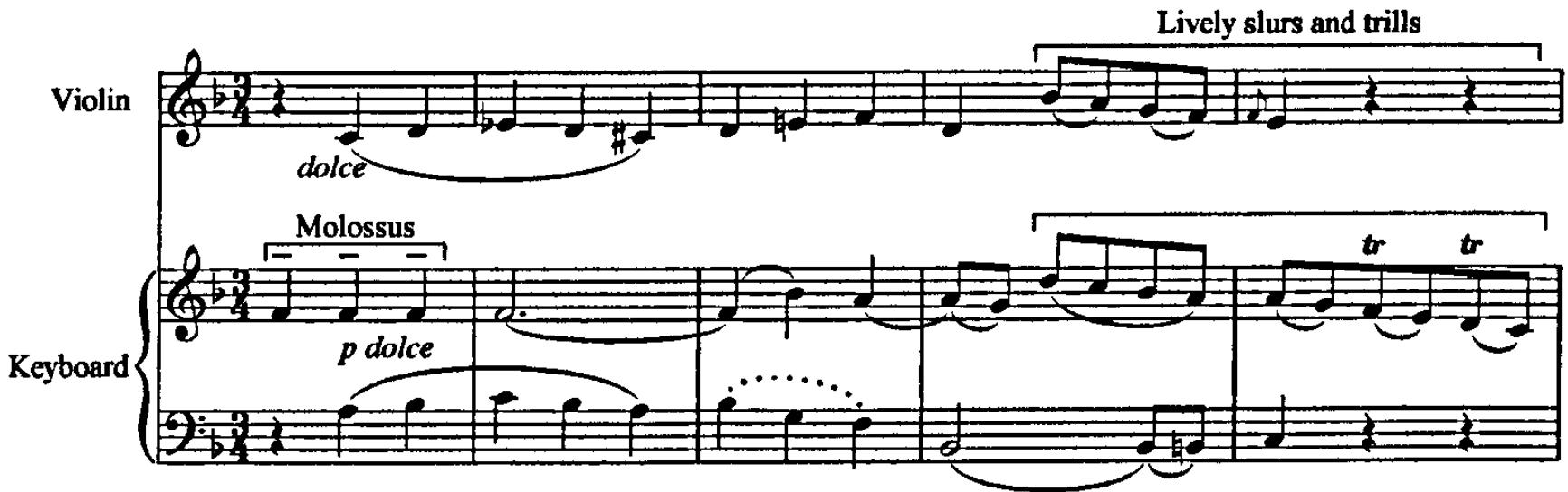
中文讲解
此处为第 16 页上的乐谱图像占位符,对应图注 5.49(K547 第二乐章第 4–8 小节)。原文中的具体音符、连音线、力度记号等细节不可见,需查阅原图。但从前后文可确认,此图是用来印证作者关于第 6–8 小节重音渐趋活泼、连奏对暗示渐弱、并向开篇 trochee/dactyl 律动回归等论述的关键乐谱。
补充说明
图像位置:第 16 页中部,紧接图注 5.49 之后。功能:作为 bars 4–8 中 trochee/dactyl 律动及 slurred pairs 的视觉证据。
第3段(P0054)
原文复述
These gentle accents, however, should gradually become more enlivened and direct during bars 6 to 8. In bars 7 and 8, slurred pairs – which each imply a diminuendo – hint at the return to the lively Affekt of the trochaic and dactylic feet which characterised the opening four bars. Indeed, the first theme is repeated at bar 9, this time with the theme in the violin part.
中文讲解
本段推进了前文关于开篇四小节"温柔重音"的讨论:作者认为第 6–8 小节中,这些温柔的重音应当逐步变得更加生动、直接。第 7–8 小节中出现的"连奏对"(slurred pairs)各自暗示一次渐弱(diminuendo),这并非削弱活泼性,反而呼应、预告了开篇四小节由 trochee(扬抑格)和 dactyl(扬抑抑格)所塑造的活泼 Affekt(情感特征)的回归。第 9 小节是第一主题的重复,但这次主题被移到小提琴声部——这是结构上的一个重要信号:主题重复的同时改变了音色与表达者,为后续的进一步变化埋下伏笔。
补充说明
本段在论证链中的作用:将开篇的 trochee/dactyl 律动从"温柔"过渡到"活泼",并以主题在第 9 小节移交给小提琴这一事实连接下一节键盘声部的新主题。
第4段(P0055)
原文复述
When a new theme is introduced in the keyboard part at bar 16, decorated versions of the dactylic and trochaic feet of the opening theme are recalled:
中文讲解
本段是一个承接与转折的节点:第 16 小节,键盘声部引入新主题;但作者明确指出,这并不是全新的材料,而是对开篇主题中 dactylic 与 trochaic 两种音步的"装饰化变体"(decorated versions)的回响。这意味着莫扎特在主题对比中保持了底层节奏词汇的一致性,新主题与其说是对比,不如说是对原有节奏细胞的再加工。冒号引出紧随其后的示例 5.50。
补充说明
本段与 P0054 中"第一主题在第 9 小节重复于小提琴"构成时间顺序:9 小节(小提琴)→ 16 小节(键盘新主题)。两个主题共享相同的音步来源。
第5段(P0056)
原文复述
Example 5.50: K547, movement 2, bars 17-18.
中文讲解
图注,标注示例 5.50 取自 K547 第二乐章第 17–18 小节,对应 P0055 所述键盘声部新主题中"装饰化的 dactylic 与 trochaic 音步"的具体乐谱证据。
补充说明
图注 5.50 与 P0057 的图像占位符配对。
第6段(P0057)
原文复述
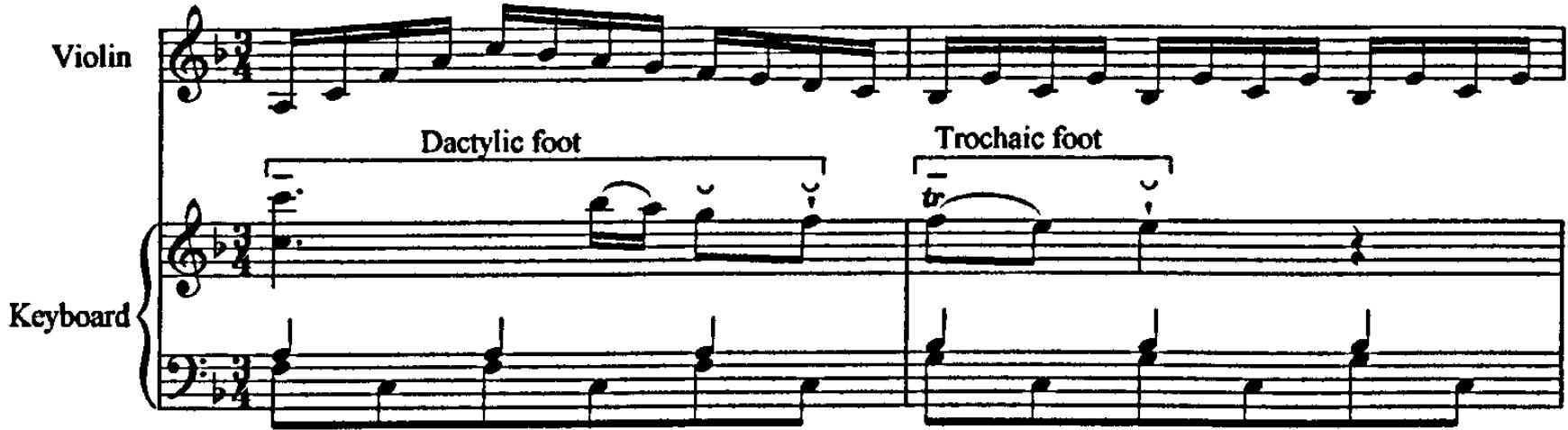
中文讲解
此处为第 16 页的乐谱图像占位符,对应图注 5.50(第 17–18 小节)。具体音符不可见,需查阅原图。从上下文可知,此图用来展示新主题中 dactylic/trochaic 音步如何被装饰化处理,与开篇主题形成既相似又有变化的对照。
补充说明
图像位置:第 16 页,紧接图注 5.50。功能:视觉化展示新主题中"装饰化的扬抑格/扬抑抑格"音步。
第7段(P0058)
原文复述
Adding to the cheerful character of this dactylic and trochaic melody, a ‘paeon the fourth’ (Mattheson, 1739: 359) (- v v v ) is used in bars 19 and 23 (see example 5.51). This is a foot used for ‘songs of praise’ (Mattheson, 1739: 359). Quintilian writes that such exhortations as this should be ‘strong’ (Quintilian: XI.iii.64), and Le Faucheur advises that in similar situations, when speaking of a hero, one’s tone should be ’lofty’ and ‘magnificent’ (Le Faucheur, 1727: 107). The accents at the start of the paeon in bars 19 and 23 should therefore be even more emphatic and immediate than those used to characterise the dactyl and trochee, although the performer must take care to achieve this within the prescribed dynamic (which is forte at bar 19 and piano when the figure is repeated in bar 23).
中文讲解
本段是本小节的核心论述之一,引入第四种音步——“第四佩昂”(paeon the fourth,节奏模式为 - v v v,即长短短短),分别出现在第 19 与第 23 小节。作者援引三条权威文献为这一音步赋予修辞—情感意义:(1) 马泰松(Mattheson, 1739: 359)指出此音步用于"赞美之歌"(songs of praise);(2) 昆体良(Quintilian, XI.iii.64)认为此类劝勉(exhortation)应当"有力"(strong);(3) 勒福舍尔(Le Faucheur, 1727: 107)建议在谈及英雄时语调应当"崇高"(lofty)而"壮丽"(magnificent)。由此作者推论:第 19 和第 23 小节佩昂开头的重音应当比此前刻画 dactyl 和 trochee 的重音"更为强调、更为直接"。但同时存在一个重要的演奏限定条件——必须"在规定的力度之内"实现这种强调:第 19 小节是 forte(强),第 23 小节重复该音形时却转为 piano(弱)。这一限定提示读者:重音的"强调性"不等同于力度的"响度",tone accent(音色重音)可以在不同动态层级上以不同方式实现。
补充说明
三条引文的功能分工:Mattheson 提供音乐—诗律的定义(paeon = 赞美之歌);Quintilian 与 Le Faucheur 提供古典修辞学关于"劝勉/英雄语调"的处理建议,三者共同支撑作者的演奏诠释结论。
第8段(P0059)
原文复述
Example 5.51: K547, movement 2, bar 19.
中文讲解
图注,标注示例 5.51 取自 K547 第二乐章第 19 小节,正是 P0058 所讨论的"第四佩昂"首次出现的具体位置。
补充说明
图注 5.51 与 P0060 的图像占位符配对。
第9段(P0060)
原文复述
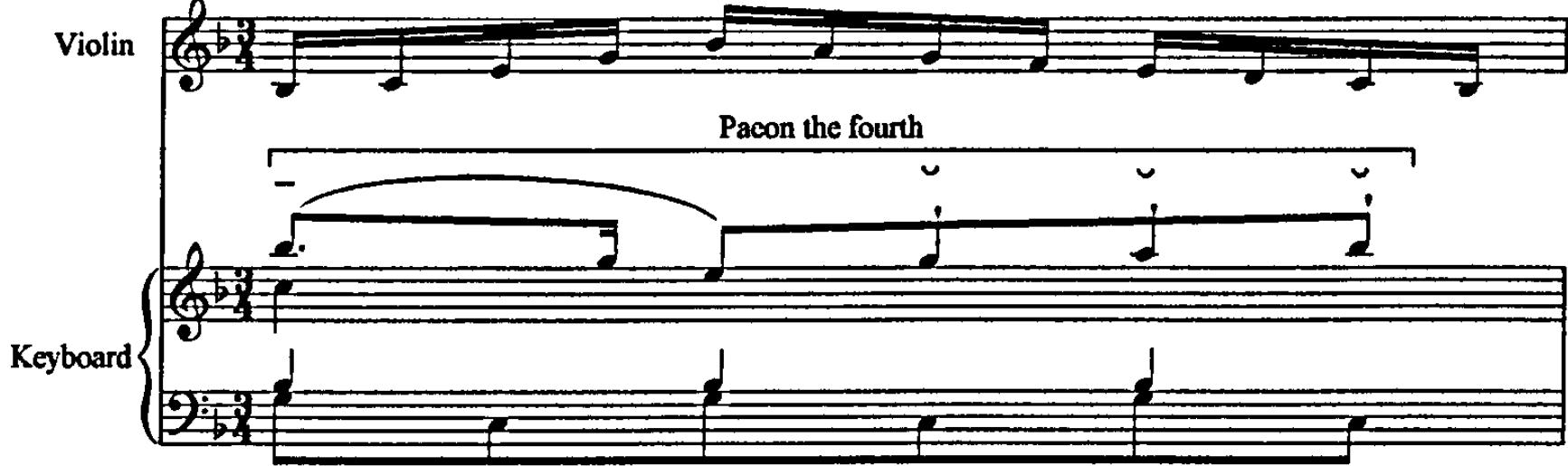
中文讲解
此处为第 17 页的乐谱图像占位符,对应图注 5.51(第 19 小节)。具体音符不可见,需查阅原图。从上下文可知,此图是第四佩昂音形在 forte 力度下首次出现的乐谱证据,演奏者据此观察其开头的重音位置。
补充说明
图像位置:第 17 页,紧接图注 5.51。
第10段(P0061)
原文复述
At bar 27 a five-bar transition leads into a third theme (see example 5.52). During this transition, the antispastus poetic foot in the violin part (v - - - v) heralds another departure from the positive character of the previous theme. In this foot, the ‘sounds are… drawn against one another’ (Mattheson, 1739: 361); here, the syncopations of the violin are in conflict with the metrical emphasis of the keyboard writing. To achieve this ‘argument’ between the two parts, a forceful tone which ‘strains every nerve’ should be used (Quintilian: XI.iii.63). As such, this foot does not contain one specific accent, unlike the trochees, dactyls and paeons which precede it. Instead, each syncopation is played forcefully against the beat in order to create the Affekt of conflict:
中文讲解
本段是本小节的第二个核心论述,引入第五种音步——“反向抑扬格”(antispastus,节奏模式为 v - - - v,即短短长长),出现在第 27 小节起的五小节过渡段落的小提琴声部中。作者援引马泰松(Mattheson, 1739: 361):该音步中"声音彼此相互拉扯"(drawn against one another)。具体到此处,小提琴的切分音(syncopations)与键盘声部的节拍重音相冲突,形成声部间的"论辩"(argument)。为实现这种"论辩",演奏应使用一种"竭尽全力"(strains every nerve)的、有力的语调(Quintilian: XI.iii.63)。与之前 trochee、dactyl、paeon 都具有"某一个特定重音位置"不同,antispastus 不包含单一固定重音,而是每一个切分音都要"逆着节拍有力地演奏",由此创造出"冲突"的 Affekt。冒号引出紧随其后的示例 5.52 图像。
补充说明
作者在本节使用的四类音步按"重音明确性"递增排列:trochee/dactyl → paeon → antispastus。前三者均有明确重音位置(强调性递增),而 antispastus 取消了单一重音,转而以"冲突"作为其情感特征。
第11段(P0062)
原文复述
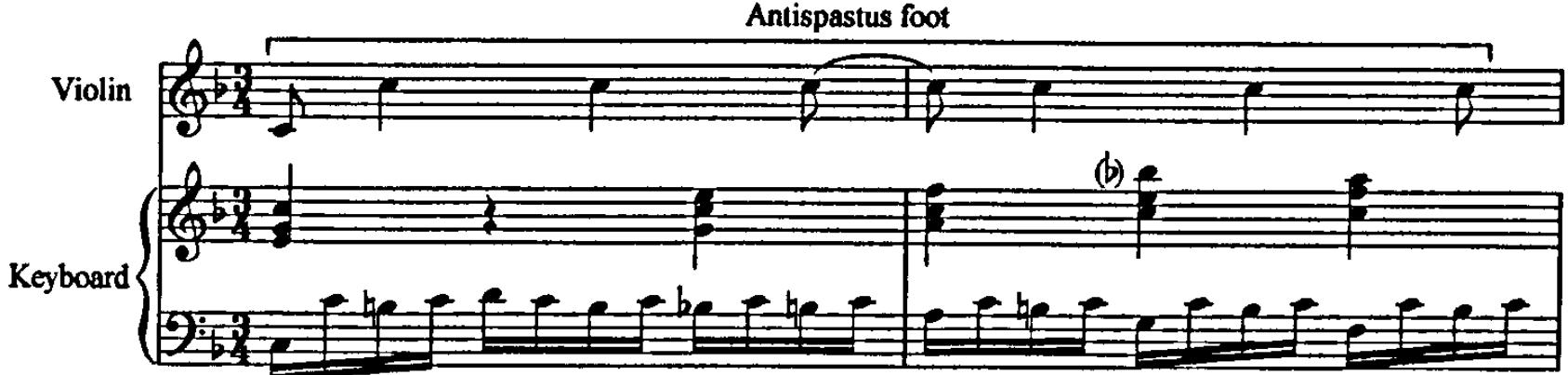
中文讲解
此处为第 18 页的乐谱图像占位符,从 P0061 末尾冒号引出"see example 5.52"可知,此图对应示例 5.52,展示 antispastus 音形在小提琴声部与键盘声部形成冲突的具体乐谱。具体音符不可见,需查阅原图。
补充说明
图像位置:第 18 页,对应 P0061 中提及的示例 5.52。功能:视觉化展示 antispastus 音形的切分音如何与小提琴—键盘声部间的节拍错位相对应。
第12段(P0063)
原文复述
In these first 30 bars alone, Mozart conveys great rhythmic variety. As in the Tempo di Menuetto of K377, individual motives are clarified and characterised by slurs, their harmonic and melodic shape, and by their relationship to (or against) the 3/4 metre. By breaking phrases down into these motives, we can more clearly differentiate between the structural and decorative rhythmic elements of themes, and can therefore define their accentual hierarchy. Furthermore, the performer must try to uncover the Affekt of these motives, and vary the tone accents according to the character of each musical ‘word’; the discussions of poetic feet and tone contained in classical and eighteenth-century rhetorical writings, as well as those in eighteenth-century music treatises, provide a useful tool for the interpretation of these musical words and their accents.
中文讲解
本段是本小节的总结与理论提升。作者先点明观察结论:仅在前 30 小节之内,莫扎特已展现了丰富的节奏多样性(rhythmic variety)。然后将其与 K377 的 Tempo di Menuetto 进行类比,强调动机(motive)的辨识依靠三种手段——连音线(slurs)、和声与旋律轮廓、以及与 3/4 拍子的"顺应或对抗"关系(relationship to / against the 3/4 metre)。方法论层面:将乐句拆解为动机后,可以更清晰地区分主题中"结构性"与"装饰性"节奏元素,进而定义其"重音层级"(accentual hierarchy)。演奏层面:演奏者须揭示每个动机的 Affekt,并根据每个"音乐词"(musical ‘word’)的性格变化"音色重音"(tone accents)。作者最后再次援引其方法论依据:古典与 18 世纪修辞学著作中关于诗律音步与语调的讨论,连同 18 世纪音乐论著,为解读这些"音乐词"及其重音提供了有用的工具。本段的功能是把前文逐音步的微观分析上升为可迁移的方法论。
补充说明
本段提及的 K377 Tempo di Menuetto 是本节以外的参照案例,作者用类比论证节奏多样性与动机—重音分析方法的可迁移性。“musical word"这一比喻源自 18 世纪修辞学与音乐美学的"音乐即语言"传统,作者以此将节奏动机与修辞学中的"词"对应。
脚注 / 边栏 / 图表 / 附加信息(如有)
本节附有三个正式标注的乐谱示例(图注 5.49、5.50、5.51,各配一个图像占位符)以及一个由 P0061 末尾冒号引出但仅有图像占位符的示例 5.52(P0062)。这些图例按文中论述顺序依次为:第 4–8 小节(trochee/dactyl 的 slurred pairs)、第 17–18 小节(装饰化变体)、第 19 小节(第四佩昂)、antispastus 过渡段落(第 27 小节起的五小节)。本节还包含三条引文:Mattheson 1739: 359(paeon = songs of praise)、Mattheson 1739: 361(antispastus = sounds drawn against one another)、Quintilian XI.iii.63–64(strong / strains every nerve)、Le Faucheur 1727: 107(lofty / magnificent)。这些引文分别承担定义、对比、情感—语调三类论证功能。
💡 本节核心要点
- 开篇四小节由 trochee 与 dactyl 确立的"温柔重音”,在第 6–8 小节中通过 slurred pairs 暗示的 diminuendo 与渐趋活泼的处理,向开篇的活泼 Affekt 回归;第 9 小节第一主题在小提琴上重复,为音色与表达主体的转换。
- 第 16 小节键盘声部引入的新主题并非新材料,而是对开篇 dactylic/trochaic 音步的"装饰化变体"——莫扎特以同源节奏细胞实现主题对比。
- 第 19、23 小节引入第四佩昂(- v v v),作者援引 Mattheson、Quintilian 与 Le Faucheur 三家,将之诠释为"赞美之歌"式的劝勉语调,其重音应比 dactyl/trochee 更强调、更直接,但必须服从既定的力度层级(第 19 小节 forte,第 23 小节 piano)。
- 第 27 小节起的过渡段落中,小提琴声部的 antispastus(v - - - v)通过切分音与键盘声部的节拍重音形成冲突,“声音彼此相互拉扯”,产生论辩式的 Affekt;与前三类音步不同,antispastus 不存在单一固定重音,而是每个切分音均"逆节拍"地有力演奏。
- 作者将上述四种音步的对比归纳为节奏多样性(rhythmic variety),并以 K377 Tempo di Menuetto 为类比,提出"将乐句拆为动机→区分结构性与装饰性节奏→定义重音层级"的可迁移方法论。
- 古典与 18 世纪修辞学著作(关于诗律音步与语调)与同时代音乐论著共同构成作者诠释"音乐词"及其重音的工具箱,使演奏中的 tone accent 变化获得文本依据。
🔑 关键术语
- Paeon the fourth(第四佩昂):节奏模式为 - v v v(长短短短)的四音节音步。在本节中依据 Mattheson 1739: 359 用于"赞美之歌",其重音在第一个长音上,故应被演奏得比 dactyl/trochee 的重音更强调、更直接,但仍须服从所在小节的力度规定(第 19 小节 forte、第 23 小节 piano)。
- Antispastus(反向抑扬格):节奏模式为 v - - - v(短短长长)的四音节音步,Mattheson 1739: 361 形容其"声音彼此相互拉扯"。在本节第 27 小节起的过渡中,小提琴声部的切分音借此与键盘声部的节拍重音形成冲突,产生"论辩"式的冲突 Affekt;该音步无单一固定重音,每一 syncopation 均须逆节拍有力地演奏。
- Affekt(情感特征/情绪):巴洛克至古典时期音乐修辞理论中的核心概念,指一段音乐所传达的特定情感或情绪状态。本节中 trochee/dactyl = 活泼/愉悦、paeon = 赞美/劝勉、antispastus = 冲突/论辩,是不同音步分别承载的不同 Affekt。
- Tone accent(音色重音):通过音色、起音或细微的力度变化实现的重音,区别于纯粹由节拍位置决定的节拍重音。本节作者强调演奏者应根据每个动机的 Affekt 调整 tone accent,使重音服务情感表达而非机械地落在拍点上。
- Accentual hierarchy(重音层级):一段主题内部不同重音之间的强弱层次关系。本节作者主张通过将乐句拆解为动机、区分结构性与装饰性节奏元素,从而明确这一层级。
- Dactyl 与 Trochee(扬抑抑格与扬抑格):分别为 - v v 与 - v 节奏模式的两音节音步(实际在音乐中以不同音长实现)。本节中它们共同刻画开篇主题的活泼 Affekt,第 16 小节的新主题则被描述为对它们的"装饰化变体"。
5.12 [描述性拆分] Emphasis: hierarchy and the projection of phrase structure
第1段(P0064)
原文复述
Emphasis
中文讲解
这是一个小节标题,原文写作 “## Emphasis”,提示本节将围绕 “emphasis”(强调)这一概念展开论述。标题本身没有更多内容,但作为分节标志,它把接下来关于重音的讨论转入到一个新的、更宏观的层级:从单个音的 accent 上升到对短语/句子层级的 emphasis。
第2段(P0065)
原文复述
We have seen that accents are essential to the definition of small-scale nuance within the musical discourse of Mozart’s Sonatas for Violin and Keyboard. However, Schoenberg’s criticism that performers whose ‘musical insecurity requires them to shorten the distance from one fixed point to the next as much as possible… are like swimmers who dare not leave the shore’ (Schoenberg, 1995: 215) encapsulates one of the foremost flaws of accentuation in performance; that is, the tendency for it to become monotonous through its regularity, and for accents to be played with equal strength. A study of the variety of tone colour which should be used to characterise each individual accent helps to avoid this effect. It is also important for accentuation to be delivered within the hierarchy of each complete phrase, and without breaking a phrase into short and isolated sections. This is where the concept of ’emphasis’ comes into performance. While small-scale details such as accents and articulation are integral to the character of individual words, emphasis gives those words a hierarchy and clarifies the meaning of sentences:
中文讲解
本段是本节的核心导入句,功能是承接前文关于 accent(重音)的小尺度处理,并把问题推进到一个新的概念——emphasis(强调)。作者做了几件事:第一,回顾性地承认 accent 对莫扎特小提琴与键盘奏鸣曲中的小尺度 nuance 至关重要,这是对前几节论点的总结性回顾。第二,引用 Schoenberg 对演奏家的批评:那些因"音乐上缺乏安全感"而把每一个固定点都拉得很近、不断加重的演奏者,像"不敢离开岸边的游泳者"。这个比喻揭示了重音处理中最常见的问题——因过于规律而变得单调,以及每个重音都被以同等力度弹奏。第三,作者提出解决办法的两条线索:一是研究 tone colour(音色)的多样性以区分每个 accent,二是把重音处理纳入到完整短语的层级(hierarchy)之中,避免把短语切碎成孤立的短段。第四,正式引出 emphasis 概念,并把它和 accent 进行层级对比:accent 与 articulation 决定"单个字"的性格,emphasis 则赋予这些字一个层级关系并澄清"句子"的意义。这是一种"由字到句"的类比,与本节标题"hierarchy and the projection of phrase structure"呼应。理解时要注意,作者并不是否定 accent,而是指出 accent 单独存在时的局限——它需要被组织进一个更高的结构层级。
补充说明
Schoenberg 的比喻"swimmers who dare not leave the shore"是用来形容那些只敢在岸边的固定点附近徘徊、不敢进入开放水域(也就是更大音乐结构)的演奏者。这是针对"不断加码重音、压缩结构距离"的批评,与本段对单调 accentuation 的批评同源。
第3段(P0066)
原文复述
As accent, is the link which ties syllables together, and forms them into words; so emphasis unites words together and forms them into sentences, or members of sentences. (Sheridan, 1762: 57)
中文讲解
这是一句 Sheridan 在 1762 年的引文,原文使用了类比句式 “As… so…",把 accent 与 emphasis 之间的层级关系表述得极为清晰:accent 把音节(syllables)连成字(words),emphasis 把字连成句子(sentences)或句子的组成成分(members of sentences)。作者引用这句话,是为了给"emphasis 是一种更高层级的组织力量"这一论点提供一个经典理论支持。在教学上要注意:Sheridan 这里的 accent 并不是音乐术语,而是修辞学/演说学意义上的"重读”,但作者把它移植到音乐演奏讨论中,把语言结构作为音乐结构的类比基础——这正是本节论证的关键策略:音乐表演可以借用语言学中关于 accent/emphasis 的层级模型。
第4段(P0067)
原文复述
This distinction between accent and emphasis is also highlighted in the writings of some eighteenth-century music theorists. Mattheson, for example, defines accent as taking place on one syllable, while emphasis is attached to a whole word ‘according to the meaning contained therein’ (Mattheson, 1739: 369-70).
中文讲解
本段用十八世纪音乐理论家 Mattheson 的定义,从音乐理论的角度强化上一段 Sheridan 的论断。Mattheson 把 accent 限定在"一个音节(one syllable)“的层级,而把 emphasis 放在"整个字(a whole word)“的层级,并强调 emphasis 的依据是"字中所包含的意义”(the meaning contained therein)。这一引文起到三重作用:第一,证明这种 accent/emphasis 的区分并非作者个人发明,而是有十八世纪音乐理论的传统依据;第二,把 Sheridan(演说学/修辞学)和 Mattheson(音乐理论)两个传统并列起来,建立跨学科的合法类比;第三,引出 emphasis 的核心性质——它是"按意义"来安排的,而不是按固定规则或发音习惯来安排的。理解这句话的关键是"according to the meaning contained therein"这个短语,它为后续段落中"emphasis 可以在句子中任意一点"的论点埋下伏笔。
第5段(P0068)
原文复述
Emphasis plays a similar two-fold function to accent: first, it reinforces the sense of sentences, awakening the listener’s understanding by drawing the attention to important words. Secondly, emphasis contributes to the Affekt of speech, helping to convey its expressive meaning and thereby moving the listener:
中文讲解
本段是作者自己提出的概括性论点,结构非常工整。明确指出 emphasis 具有双重功能(two-fold function),与前文(指作者之前关于 accent 的讨论)形成平行结构:第一,加强句子的意义(reinforces the sense of sentences),通过把注意力引向重要的字来唤醒听者的理解;第二,贡献于 speech 的 Affekt,即通过传达表达性意义来感动听者(moving the listener)。作者用冒号结尾,意在为接下来两句 Sheridan 和 Mattheson 的引文做铺垫。教学上的关键:注意 “sense”(理智上的理解)与 “Affekt”(情感上的感动)这两个层次的区别——前者对应 clarification of meaning,后者对应 expressive impact。这与 accent 的两层功能(小尺度 nuance 的定义 + 音乐表达)平行,但层级更高。
补充说明
Affekt 一词在本节语境中特指"通过表达手段传达并唤起的情感/激情状态”,它在十八世纪音乐修辞传统中是一个核心概念,指演奏需要传递并打动听众的情感内涵,与现代意义上较模糊的"感情"不同。
第6段(P0069)
原文复述
[Emphasis is used] not only to make others conceive our ideas as we conceive them, but to make them also feel them, as we feel them. (Sheridan, 1762: 68)
中文讲解
这是 Sheridan 1762 年著作第 68 页的引文,作者用方括号注明了对原文的省略([Emphasis is used]),以使引文语法上更清晰。原文以"not only… but also…“的对仗结构强调了 emphasis 的双重目的:第一,让别人像我们一样"构想(conceive)“我们的观念;第二,让别人也像我们一样"感受(feel)“它们。理解时要注意,Sheridan 用 conceive vs feel 这一对动词,正好对应上一段作者概括的 sense 与 Affekt 两个层次。这条引文的作用是为作者自己提出的"双重功能"提供权威依据,而不是引入新论点。
第7段(P0070)
原文复述
Mattheson similarly writes that emphasis ‘points toward the emotion, and illuminates the sense or meaning of the performance’ (Mattheson, 1739: 370).
中文讲解
本段再次用 Mattheson 的论述与 Sheridan 形成跨学科呼应。Mattheson 用动词 “points toward”(指向)说明 emphasis 引导出 emotion,用 “illuminates”(照亮)说明 emphasis 揭示 sense or meaning of the performance。这里需要注意:Mattheson 明确地把 emphasis 的功能描述应用到"表演(performance)“上,而不是抽象的语言学论述。这意味着十八世纪音乐理论家本身就把语言学中的 emphasis 概念直接迁移到音乐演奏中——这正是作者整节论证的历史正当性所在。句式上"similarly writes"对应上一段的 Sheridan 引用,两条引文形成对称结构。
第8段(P0071)
原文复述
It is clear from the fact that accent is a feature of syllables within words, and emphasis a feature of words within sentences, that emphasis is integral to the projection of large-scale structures in performance, and is, therefore, more essential to the overarching ‘meaning’ of the musical discourse than accent. In illustrating the extent to which emphasis affects the meaning of speech Sheridan gives the example of a simple phrase, which has already been cited in the preface to this thesis: ‘Shall you ride to town to-morrow?’ (Sheridan, 1762: 58). By repeating this sentence, placing the emphasis on each word in turn (‘Shall you ride to-morrow?’, ‘Shall you ride to town to-morrow?’, and so on), the sentence takes on completely new meanings. Thus, while one could argue that there is (to a certain extent) a ‘right’ or ‘wrong’ way to use accent, since it is essential to the correct ‘pronunciation’ of words and of those musical motives which are governed by convention (such as the treatment of dissonances and the start of slurs), emphasis could theoretically be used at any point within a musical or written sentence.
中文讲解
本段是本节论证的高潮,承担多重功能:第一,从前文 Sheridan 与 Mattheson 的定义中推出结论——因为 accent 是字内音节的特征、emphasis 是句内字的特征,所以 emphasis 是大尺度结构投射(projection of large-scale structures)的关键,对"音乐话语的总体意义"比 accent 更重要。注意 “more essential than accent” 是一个相对性的判断,而不是否定 accent。第二,引入著名的"Shall you ride to town to-morrow?“例句(Sheridan 1762: 58),通过依次把 emphasis 放在每一个字上,让同一句话产生完全不同的意义。这个例子的修辞力量在于:它直观地说明 emphasis 决定了句子的整体意思,而不仅仅是单个字的清晰度。作者说这个例子已经出现在论文的 preface 中,意味着这是一个贯穿全文的核心例证。第三,做出关键性对比——accent 在某种程度上有"对/错"之分(因为它涉及字词的正确发音,以及音乐中受惯例约束的动机,如不协和音的处理、连弓的起拍);而 emphasis 在理论上可以放在句子中的任何位置。这并不是说 emphasis 没有"对/错”,而是强调它拥有远比 accent 更大的自由度。理解这段的关键是把握"音节→字→句子"的层级类比,以及"惯例约束 vs 自由选择"这一对照所揭示的演奏空间。
第9段(P0072)
原文复述
Sheridan identifies two different techniques of emphasis, which enable discourse to be understandable and moving. ‘Simple emphasis’ is created by quantity of sound rather than quality, using force alone to stress important words and therefore to clarify the sense of a sentence. In order to move the passions of listeners, ‘complex emphasis’ unites quantity and quality of sound, combining force with a ‘superadded and manifest change of tone’ (Sheridan, 1762: 66-7). Like accent, emphasis created by a change in tone can also be accompanied by a change in time (Cockin, 1775: 33), and in this way it is perceived as ‘one of the most important branches of delivery, since the power of animating and affecting the hearers, depends much upon it’ (Sheridan, 1762: 73). It is therefore the performer’s role to identify each point of emphasis within a phrase, and to vary tone in a way that conveys the Affekt of the music to the listener:
中文讲解
本段是本节的收束段落,把理论概念转化为演奏实践的指引。第一,介绍 Sheridan 区分的两种 emphasis 技术:“simple emphasis”(单纯强调)仅依靠声音的量(quantity)也就是力度(force)来突出重要的字,目的是澄清句意;“complex emphasis”(复合强调)则同时结合声音的量与质(quantity and quality),即在力度之外加上一种"额外的、明显的音色变化(superadded and manifest change of tone)",目的是打动听众的情感。第二,把 emphasis 与 accent 在"音色变化"这一维度上再次打通——Cockin 1775 年指出,像 accent 一样,由音色变化产生的 emphasis 也可以伴随时间(节奏)变化。第三,用 Sheridan 自己的判断——emphasis 是"朗诵/表达艺术中最重要的分支之一”——来为整个 emphasis 概念定调。第四,把讨论拉回到演奏实践层面,明确演奏者的责任:在短语中识别每一个 emphasis 点,并以变化音色的方式传达音乐的 Affekt 给听者。本段以冒号结尾,预示着接下来应该有具体的乐谱实例(按本节的结构,下文应给出具体应用)。教学上的关键把握:simple vs complex emphasis 的区别不是"用/不用力度”,而是"只用力度"vs"力度+音色”,这与本节开头论及的"音色多样性避免单调"形成呼应。
脚注 / 边栏 / 图表 / 附加信息(如有)
本节脚注、图表等附加材料的情况:节内出现的所有括注均为作者对原始文献的引用(Schoenberg 1995: 215;Sheridan 1762: 57、58、66-7、68、73;Mattheson 1739: 369-70、370;Cockin 1775: 33)。它们承担的功能有:①为论点提供十八世纪演说学/音乐理论的传统依据(Sheridan、Mattheson、Cockin);②引用现代权威批评以反衬 accent 处理的常见缺陷(Schoenberg)。其中 Sheridan 1762: 58 的 “Shall you ride to town to-morrow?” 已在论文 preface 中出现,作者以"already been cited in the preface to this thesis"明确点出其贯穿全文的核心例证地位。这些引文都是论证性引用,并非附加旁注,因此不构成独立脚注栏。本节没有图表或乐谱实例(按段落边界判断)。
💡 本节核心要点
- 本节论证的核心结构是一种"由字到句"的层级类比:accent 处理音节层级(小尺度 nuance),emphasis 处理字到句的层级(大尺度结构投射)。
- 作者引用 Sheridan、Mattheson、Cockin 等十八世纪理论家的论述,建立音乐演奏可以从语言修辞学/演说学传统中借用 emphasis 概念的合法类比。
- emphasis 与 accent 一样具有双重功能:加强句意(sense)以及传达 Affekt(情感),但其作用层级比 accent 更高,对"音乐话语的总体意义"更关键。
- Sheridan “Shall you ride to town to-morrow?” 例句通过依次将 emphasis 放在不同字上,让同一句话产生完全不同的意义,直观说明 emphasis 决定整体句意而非局部清晰度。
- accent 在一定程度上有"对/错"之分(受发音与音乐惯例约束),而 emphasis 在理论上可置于句中任何位置,因而拥有远比 accent 更大的表现自由度。
- Sheridan 区分 simple emphasis(仅靠力度/quantity)与 complex emphasis(力度+音色变化/quantity+quality),后者通过"额外的、明显的音色变化"实现打动听众情感的目的;演奏者的责任正是在短语中识别每个 emphasis 点并以变化的音色传达 Affekt。
🔑 关键术语
- emphasis:本节的核心概念,源自十八世纪演说学/修辞学传统,指对句子中重要字的层级性突出。作用是把字组织成句子并赋予句子整体意义,区别于处理音节层级的 accent。
- accent:在作者笔下既指小尺度音乐 nuance 的重音,也借自演说学传统中"音节层级重读"的概念。作用是定义字内音节的相对突出,与 emphasis 形成字/句层级上的对照。
- Affekt:十八世纪音乐修辞传统中的核心概念,指通过表达手段传达并唤起的情感/激情状态。本节中与 “sense”(理智理解)相对应,强调 emphasis 不仅要让人听懂,还要动人以情。
- Simple emphasis:Sheridan 提出的两种 emphasis 技术之一,仅依靠声音的量(quantity),即以力度(force)突出重要的字,目的在于澄清句意而非打动情感。
- Complex emphasis:Sheridan 提出的两种 emphasis 之一,结合声音的量与质(quantity and quality),即在力度之外加上一种"额外的、明显的音色变化”,目的是打动听者的情感。
- Hierarchy (of the phrase):短语/句子内部由 accent 与 emphasis 共同构成的层级关系:accent 在字内安排音节,emphasis 在句内安排字,使短语不被打碎为孤立短段,而是具有可被听者感知到的整体结构。
5.13 [描述性拆分] The Accent-Emphasis distinction in modern and eighteenth-century sources
第1段(P0073)
原文复述
A composer who punctuates and phrases well is a clever fellow; a singer who feels, and marks well his phrases and their accents, is a man of taste: but one who can only see and render the notes, the tones, the times, and the intervals, without entering into the sense of the phrases—however sure, however exact he may be in every other respect—is no more than a sapskull. (Rousseau, 1768 R.1779: 317)
中文讲解
本段是本节开篇的题词式引文(epigraph),引自 Rousseau《音乐词典》1768 年版(1779 年重印)第 317 页。其修辞结构是一个逐级降级的三层等级:(1)能良好断句与分句的作曲家——仅仅是"机灵的家伙";(2)不仅能标记乐句与重音、还能"感受"到的歌唱家——是"有品味的人";(3)只能视读并再现音高、时值与音程,而无法进入乐句含义的演奏者——无论他在其他方面多么稳妥精确,也不过是个"笨蛋"。句中"however sure, however exact he may be, in every other respect"这一让步状语是关键:它否定了以技术精确性代替艺术理解的企图。引文在本节中的作用是从十八世纪权威那里为本节的核心立场奠基——真正合格的演奏必须"进入乐句的含义",这就为随后区分小尺度 accent 与大尺度 emphasis 提供了哲学前提。
补充说明
Sapskull 是十八世纪英语口语化贬义词,约相当于现代汉语的"笨蛋/无用之人";Rousseau 选用这一粗俗词而非更文雅的同义词,是为了强化技术至上者的讽刺效果,与上下文中"a man of taste"形成尖锐对照。本引文也呼应了第 5 章对演奏、修辞与品味三者关系的总体关切。
第2段(P0074)
原文复述
The coexistence of small-scale accentuation and large-scale emphasis within phrases is given short shrift by some modern musicologists, and this is partly an issue of terminology. The terms ’emphasis’ and ‘accent’ are occasionally treated as synonyms in eighteenth-century writings; Holden, for example, states that ‘in the performance of music, there is a certain emphasis or accent laid on the beginning of every measure’ (Holden, 1770: 94-5; quoted in Tarling, 2004: 122). If, however, one turns to English eighteenth-century rhetorical treatises, the definitions of these two facets of delivery are more consistently described: as has been seen, accent refers to the stress of the strong syllable within each word, while emphasis is defined as the stress placed on the most important word in a sentence. Despite the clarity of this terminology among the eighteenth-century Elocutionists, the words ’emphasis’ and ‘accent’ are often confused in modern writings on performance practice, thereby obscuring the distinction between these two aspects of delivery. Judy Tarling, for example, in a chapter entitled ‘Emphasis’, cites Cockin to illustrate how concepts discussed by the eighteenth-century Elocutionists can be applied to musical delivery; however, she places his descriptions of ’emphasis’ and ‘accent’ side by side, as though they refer to the same aspect of performance (Tarling, 2004: 120-22). Leonard Ratner similarly conflates emphasis and accent in his brief treatment, using ’emphasis’ to refer to both small- and large-scale hierarchies of stress (Ratner, 1980: 191-2). In his detailed discussion of accentuation, Clive Brown only briefly alludes to the distinction, writing that ‘superimposed upon this basic framework was a level of accentuation that was designated rhetorical, oratorical or expressive accent, or, by some English writers, emphasis’ (Brown, 1999: 8). Brown does not go on to clarify this terminology, or the different functions that ‘accent’ and ’emphasis’ play in musical performance.
中文讲解
本段提出本节的核心诊断:现代演奏实践研究在术语层面混淆了小尺度 accent(重音)与大尺度 emphasis(强调)这两种现象,且对这种共存"关照甚少"。论证分两步走。
第一步是承认部分依据——某些十八世纪作者本身就互换使用这两个词,作者用 Holden (1770) 的引文作为证据:在每小节开始处施加"某种 emphasis 或 accent"。
第二步是提出修正视角:一旦转向英语修辞学(Elocutionists)传统,两个术语的定义其实相当一致——accent 指向词内重读音节(小尺度),emphasis 指向句中最重要之词(大尺度)。这说明十八世纪的术语资源原本就足以支撑清晰区分。
第三步列举三种现代混淆模式:(a)Tarling (2004) 将 Cockin 对两词的描述并列摆放,使其等同于同一现象——沉默的同义化;(b)Ratner (1980: 191-2) 干脆用"emphasis"一个词同时涵盖大小两层——范畴压缩;(c)Brown (1999: 8) 虽承认有"rhetorical/oratorical/expressive accent"或"emphasis"的存在,却未进一步澄清其与基础 accent 框架的功能差异——擦肩而过的辨识。
作者借此把十八世纪修辞学树立为现代学界缺乏的术语资源:不是创新理论,而是恢复区分。
补充说明
“Short shrift"原指旧时对死囚从速处决,此处用作"草率对待/不充分处理”。Holden 的引文出自音乐语境而非修辞学语境,因此只能证明音乐写作中存在术语互换,不能代表整个十八世纪话语。“As has been seen"提示读者前文(第 5 章之前部分)已经讨论过 Elocutionists 的术语,本节是在其基础上的延伸。
第3段(P0075)
原文复述
Alongside this lack of distinction between the terminology and function of small-scale accentuation and large-scale emphasis in performance-practice scholarship, there is also a general tendency to attach a greater significance to the large-scale shaping of phrases. Thiemel’s article on ‘accentuation’ in The New Grove Dictionary states that ‘accentuation is an expression of the performer’s understanding of large-scale structure, informed by the music theory and performing practice of the period represented by a composition’ (Thiemel, 2001: 49). More specifically, with regard to the period of music in question here, Houle writes that towards the end of the eighteenth century theorists were ‘more interested in defining phrase structure and less interested in musical meter’ (Houle, 1987: 133).
中文讲解
本段在术语混乱(P0074)之外,又诊断第二种平行的现代偏向:即使在使用同一术语(如"accentuation”)时,学者们也普遍更看重大尺度结构。
关键证据是 Thiemel 在《新格罗夫词典》“accentuation"条目中给出的定义——他把 accentuation 直接等同于"演奏者对大尺度结构的理解”。这是一个隐蔽的术语滑动:本来 accentuation 应同时涵盖小尺度重音与大尺度乐句塑造两层,Thiemel 却只保留了大尺度一层,无形中抽掉了小尺度 accent。
第二段引文来自 Houle (1987: 133),进一步把这一偏向历史化:到十八世纪末,理论家们"更感兴趣于界定乐句结构,对音乐节拍则兴趣减弱"。这与 Thiemel 的定义方向一致——大尺度结构占据论述中心。
本段在论证上的作用是为 P0074 增加一个并列的证据维度:现代学者不仅在术语上合并两层(混淆),而且在注意力分配上偏向一层(偏重)。这两层偏向共同构成了现代演奏研究对 eighteenth-century 演奏传统的扭曲。
补充说明
Thiemel 的定义是一个术语滑动(term slippage)的清晰例证:原本的双层术语被无声地收窄为单层。Houle 的引文并非否定十八世纪末仍有节拍感,而是描述理论写作重心从 meter 转向 phrase,这与后续 Quantz 与 Spohr 的对比直接相关——因为后者正体现了这种重心转移。
第4段(P0076)
原文复述
It must be conceded that the musical examples of nuance, accent and emphasis given in treatises throughout the period do illustrate an increasing interest in projecting a large-scale shape in performance. This can be seen by comparing the examples of dynamic nuance provided by Quantz—whose musical language lies on the cusp between ‘high-Baroque’ and the ‘Galant’—and Spohr, whose compositions represent the transition from ‘Classical’ to ‘Romantic’ styles. Examples 5.53 and 5.54 show the contrasting styles of delivery suggested by Quantz and Spohr for melodic figures that bear rhythmic and melodic similarities and that are both conceived as part of an ‘Adagio’ movement. Quantz’s version (example 5.53) contains more regular articulation, which suggests a greater degree of accentuation: after a messa di voce on the longest note of the phrase, each slur is begun strongly and then phrased away. Spohr’s articulation is less frequent (example 5.54), and a crescendo at the end of the first slur warns the performer not to phrase away, but to treat the repeated motives as part of one extended phrase. Indeed, even when the articulation is more frequent (example 5.55), Spohr’s slow movements demonstrate a greater concern for the broad sweep of a phrase—that is, its ’emphasis’—rather than smaller-scale ‘accentuation’.
中文讲解
本段是一个让步段(concessive paragraph):作者承认,P0075 所指出的趋势——大尺度 emphasis 逐渐获得更多关注——在原始材料中确有支撑。为了不流于笼统,作者用两位作曲家的具体例子加以落实。
时代坐标:Quantz 的音乐语言处于"晚期巴洛克"与"华丽风格"(Galant)之间;Spohr 的创作代表从"古典"到"浪漫"的过渡。两人所给的旋律片段在节奏与旋律上彼此相似,且都被标示为慢板(Adagio)乐章的一部分——这就排除了"风格差异源于体裁不同"的干扰变量。
例 5.53(Quantz)体现典型的小尺度 accentuation 模式:在乐句最长音上做 messa di voce(同一音上先渐强后渐弱),随后每条连线(slur)都以强起开始并被"奏离"(phrased away)——即逐个动机独立处理。
例 5.54(Spohr)则呈现大尺度 emphasis:连线较少,且第一条连线的末尾出现了渐强(crescendo),这是关键标记——它警告演奏者不要在动机边界处"离开",而要把重复动机整合成一个扩展乐句。
例 5.55 用于进一步巩固:即使 Spohr 在某些段落中使用较频繁的 articulation,他的慢板乐章整体上仍显示出对乐句"宽广轮廓"的关切,亦即 emphasis 而非 accentuation。
本段在论证结构上的功能是双重的:一方面承认历史趋势确实存在(避免显得偏颇),另一方面通过两作曲家对比把"大尺度对小尺度"的转移具象化,从而反过来说明:若不把 accent 与 emphasis 区分开,就无法准确刻画这一历史转向。
补充说明
Messa di voce 是同一音上先渐强后渐弱的演奏/演唱手法,源自声乐传统,被 Quantz 等巴洛克/前古典理论家明确写入器乐论著。“Phrased away"指在连线或乐逗结束时通过渐弱或离键让乐思自然离开——这是小尺度 articulation 的典型句法。Crescendo 出现在连线尾而非开头,是区分"分散动机 + 奏离”(Quantz 模式)与"统一大乐句 + 内部分解"(Spohr 模式)的关键标记。例 5.55 在原文中需对照谱例查看,本节文字无法替代具体音符分析。
脚注 / 边栏 / 图表 / 附加信息(如有)
本小节涉及的图表/谱例需查看原书第 20–21 页附近的 Example 5.53(Quantz)、5.54(Spohr)与 5.55(Spohr):它们是论证的核心实证,分别展示了小尺度 accentuation(Quantz 的 messa di voce + 强起奏离)与大尺度 emphasis(Spohr 的连线尾渐强 + 扩展乐句)的典型形态。引用的所有文献均为正文内嵌引文(无独立脚注条目):Rousseau (1768 R.1779: 317);Holden (1770: 94-5),转引自 Tarling (2004: 122);Tarling (2004: 120-22);Ratner (1980: 191-2);Brown (1999: 8);Thiemel (2001: 49);Houle (1987: 133)。这些文献在本节中起三种不同作用:作为权威依据(Rousseau)、作为术语混淆的反面例证(Tarling、Ratner、Brown)以及作为偏向大尺度结构的描述者(Thiemel、Houle)。
💡 本节核心要点
- 本节以 Rousseau 的箴言开篇,确立核心立场:合格的演奏必须"进入乐句的含义",单纯的音高与时值精确性并不足够。
- 现代音乐学界对小尺度 accent 与大尺度 emphasis 的共存关照甚少,部分原因是术语层面的合并(Tarling 平行摆放、Ratner 用一词涵盖两层、Brown 提及而不澄清)。
- 十八世纪英语修辞学(Elocutionists)原本已对两词做出清晰区分——accent 指词内强音节的应力,emphasis 指句中最重要之词上的应力——可作为现代学界恢复区分的资源。
- 即使在使用同一术语(accentuation)时,现代学者也偏向大尺度结构(Thiemel 2001 的定义、Houle 1987 关于十八世纪末理论兴趣转移的论述)。
- Quantz 与 Spohr 的谱例对比说明,十八世纪末至十九世纪初确实出现了从小尺度 accentuation(规则 articulation + messa di voce + 强起奏离)向大尺度 emphasis(连线尾渐强 + 扩展乐句)的转移——这一历史趋势反过来要求研究者必须把两层现象区分开来。
🔑 关键术语
- Accent(小尺度重音):在十八世纪英语修辞学传统中指词内重读音节上的应力;在音乐语境中对应小尺度 articulation 模式(如每条连线强起、奏离)。本节将其与 emphasis 严格区分。
- Emphasis(大尺度强调):在十八世纪英语修辞学传统中指句子中最重要之词上的应力;在音乐中引申为乐句乃至更大结构的整体塑造(如把多个动机整合为一个扩展乐句)。本节将其与 accent 严格区分。
- Accentuation:本节用作涵盖小尺度 accent 与大尺度 emphasis 两层的总体术语。Thiemel (2001: 49) 的定义则将其收窄为"大尺度结构的表达",成为本节批评的术语滑动例证。
- Elocutionists:十八世纪英语修辞学/演讲术作家群体。本节以他们对 accent 与 emphasis 的精确区分作为术语资源,纠正现代音乐学界的混用。
- Messa di voce:同一音上先渐强后渐弱的演奏/演唱手法。Quantz 例 5.53 在乐句最长音上使用此法,是小尺度 accentuation 的标志性处理之一。
- Slur(连线):演奏中的连线标记。本节通过比较 Quantz(连线内强起奏离)与 Spohr(连线尾渐强)所暗示的不同力度走向,区分两类句法。
- Crescendo(渐强):渐强标记。本节强调其出现位置(连线开头 vs. 结尾)所揭示的不同句法逻辑:Spohr 例 5.54 把渐强放在连线尾,是大尺度 emphasis 的关键标记。
5.14 [描述性拆分] Quantz and Spohr on small-scale accentuation and large-scale emphasis
第1段(P0077)
原文复述
Example 5.53: Quantz’s suggestions for light and shade in an adagio movement (Quantz, 1752: 140, table IX figure 1).

中文讲解
本段是一条例证编号与图注,对应正文将要引用的一幅示例。功能上,它把读者引向 Quantz 1752 年著作第 140 页、Table IX 中第 1 幅示例,该示例给出的是 Quantz 关于慢板(adagio)乐章中如何处理明暗(light and shade)的演奏建议。此处“light and shade”是 Quantz 文本中的术语,对应强弱、轻重等力度层次的安排。它出现在本小节是为了与下文 Spohr 的力度记号做对比——Quantz 提供的是较早时期(十八世纪中叶)的样板,Spohr 提供的是十九世纪初的样板,作者借此在两种历史来源之间建立对照。
补充说明
示例编号 5.53 与后面 5.54、5.55、5.56 在本小节内构成连续编号,作者用来按顺序展示从 Quantz 到 Spohr 的不同力度/重音处理。无额外补充。
第2段(P0078)
原文复述
Example 5.54: Spohr’s suggestions for dynamics in an adagio (Spohr, 1832: 208, bars 19-20).

中文讲解
本段是与 Example 5.53 直接配对的图注,指向 Spohr 1832 年著作第 208 页第 19-20 小节。作者引入这条例证,是为了在同一类作品(慢板,adagio)维度上把 Spohr 与 Quantz 并列对比:Quantz 的来源给出“light and shade”层面的处理建议,Spohr 的来源则标明了具体的力度记号(dynamics)。两者并置是本小节核心论证——慢板中“large-scale emphasis”(大尺度上的力度起伏)在十九世纪音乐中愈趋突出——的史料基础。
补充说明
“bars 19-20”指 Spohr 著作中第 19 至第 20 小节的具体乐谱片段,作为力度记号分析的最小单位。无额外补充。
第3段(P0079)
原文复述
Example 5.55: Spohr’s dynamics with more frequent articulation (Spohr, 1832: 74, bars 1-4). Interestingly, Spohr’s performance directions for faster movements, such as the first movement of Rode’s $7^{\text{th}}$ Concerto (see example 5.56), while still tracing the broad arch of more lyrical phrases simultaneously suggest the same type of small-scale accentuation that we have seen in Mozart’s Sonatas for Violin and Keyboard. For example, Spohr adds accentuation within slurs in order to clarify metre (see bar 11), strengthens the start of long notes and dissonances (bar 15), and prescribes slurs which should be phrased away (bar 32).
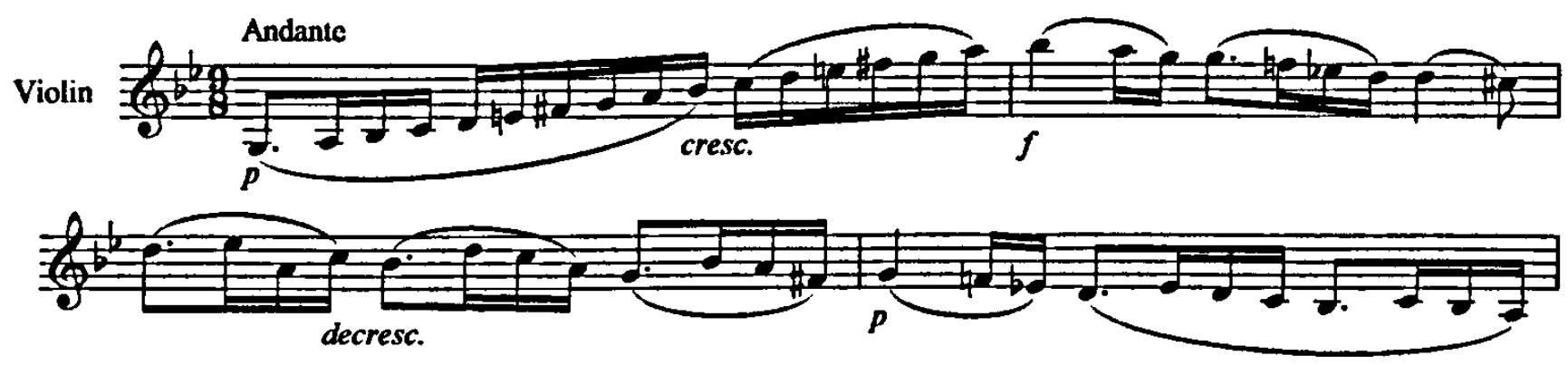
中文讲解
本段由两部分组成:开头的图注(Example 5.55)与紧随其后的正文。正文承担了本小节的中心论证之一——Spohr 在处理快速乐章时表现出“小尺度重音”与“大尺度乐句拱形”并存的双重特征。
作者以 Spohr 为 Rode 第 7 协奏曲第一乐章所作的演奏指示(详见 Example 5.56)作为证据,阐明三重要点:第一,Spohr 在连弓(slurs)之内添加重音,以澄清节拍归属(bar 11);第二,他在长音与不协和音的起音处加强力度(bar 15);第三,他规定某些连弓应当被“奏得像被甩开一样”(phrased away,bar 32)。这些具体的演奏规定说明,Spohr 关心的不仅是乐句层面的力度轮廓,还包括乐句内部的微观重音安排。
作者写这一段是为了与前一段(慢板比较)形成对照:慢板倾向于突出大尺度 emphasis,而快板则同时保留了小尺度 accentuation。这一点直接支持本小节最后一段的总结——小尺度与大尺度在 Spohr 的实践中是同时存在的两种要素,并引导读者去理解“superimposed”式的叠合结构。
补充说明
本段将小尺度重音细分为三类(连弓内重音、长音/不协和音起音的加强、可被“甩开”的连弓),它们的功能分别为:明确节拍、加重结构性的音、与前文“rhetorical delivery”相呼应。其中“phrased away”指连弓线条不应被无差别地连贯下去,而应在某处中断方向感以形成语气。无额外补充。
第4段(P0080)
原文复述
Example 5.56: Spohr’s performance instructions for Rode’s $7^{\text{th}}$ Concerto, movement 1, bars 11, 15 and 32 (Spohr, 1832: 181).
中文讲解
本段是紧接 P0079 正文后给出的例证编号与定位信息。它告诉读者,本段在 Spohr 1832 年著作第 181 页中可以查到上述第 1 乐章第 11、15、32 小节三处具体标记,对应 P0079 中引用的三类演奏规定。功能上属于学术性定位注(reference locator),便于读者直接到原典核对乐谱与文字标记。
补充说明
“movement 1”指 Rode 第 7 协奏曲的第一乐章;“bars 11, 15 and 32”是 P0079 所举三类重音处理各自所在的小节。无额外补充。
第5段(P0081)
原文复述
The embedded image data for this page has been omitted; the position and its associated figure caption are retained. ([内嵌图像数据已省略;位置与图注保留])

中文讲解
本段是一处图像/乐谱占位符,对应第 23 页上的一张示例图。从其前后关系可以判断:它通常用于呈现 Example 5.56 的乐谱本体——即 Spohr 为 Rode 第 7 协奏曲第一乐章第 11、15、32 小节所标注的演奏符号。由于图像数据本身在输入中被省略,本节文字无法直接观察到具体音符、力度记号与连弓符号,需要参阅原书 Spohr 1832: 181 的相应页面或扫描版本。
补充说明
无额外补充;图像信息需查原图。
第6段(P0082)
原文复述
Thus, while a comparison of Quantz and Spohr’s suggestions for the performance of slow movements highlights a greater propensity for large-scale emphasis in later music, Spohr’s fast movements demonstrate that well into the nineteenth century, accent and emphasis are both essential for characterful delivery. The concurrent importance of small-scale detail and large-scale phrasing is reminiscent of trends in declamatory and legato articulation during this period. It has been shown that although legato articulation is more often attributed to nineteenth-century performance practice, just as large-scale phrasing is attributed to late eighteenth- and nineteenth-century music, declamatory and cantabile articulations actually co-exist during the eighteenth century. While we have already seen that small-scale accentuation is integral to the concept of ‘rhetorical delivery’ in Mozart’s Sonatas for Violin and Keyboard, to what extent do the ‘superimposed’ (Brown, 1999: 8) emphases of large-scale phrasing contribute to their discourse?
中文讲解
本段是本小节的小结段,负有双重功能:综合前文例证 + 抛出通向下一小节的问题。
第一句建立本节的总判断:对 Quantz 与 Spohr 慢板演奏建议的比较凸显出——年代较晚的音乐(在 Spohr 这一方)更倾向于“大尺度 emphasis”;而 Spohr 处理快速乐章的方式则证明,即便进入十九世纪,“accent”(小尺度重音)与“emphasis”(大尺度强调)对于“有性格的演绎”(characterful delivery)同样是必要的。这一句话纠正了可能的误解——即把后期的音乐只同大尺度联系起来——并由此锁定本节的核心主张:两种尺度是并存的。
第二句将这一并存现象与同时期的“declamatory”(朗诵式)与“legato”(连奏式)articulation 趋势进行类比,并补充一个已经论证过的历史事实:尽管 legato articulation 常被归入十九世纪实践、large-scale phrasing 常被归入十八世纪末至十九世纪,但十八世纪内 declamatory 与 cantabile articulation 实际上是同时存在的。这条注脚性陈述为接下来的反问搭建语境。
第三句回到本书讨论的核心曲目——Mozart 的小提琴与键盘奏鸣曲——并把在小尺度 accentuation 与“rhetorical delivery”概念之间已经建立的关系,进一步延伸到要讨论的问题:Bowen Brown 提出的“superimposed”(叠加的)大尺度 emphasis,究竟在 Mozart 奏鸣曲的“话语”(discourse)中起多大作用?此处“discourse”是修辞学借喻,与前文“rhetorical delivery”呼应:音乐结构如同一段话语,而大尺度上的叠加强调了 discourse 中的语气层级。
因此本段在论证链上承担过渡:从对 Quantz/Spohr 史料的归纳,走向下一节对 Mozart 奏鸣曲内部大尺度 emphasis 的专题讨论。
补充说明
Brown 1999: 8 仅在原文中以括号引用形式出现,作者本人在本段中并未解释该出处具体是何著作;不可以在此处补写该书的全名或论点。
脚注 / 边栏 / 图表 / 附加信息(如有)
本小节的附加材料集中于编号为 5.53–5.56 的四幅例证及其图注:Example 5.53 源自 Quantz 1752 年第 140 页 Table IX 第 1 幅(用于慢板中的明暗处理);Example 5.54 源自 Spohr 1832 年第 208 页第 19–20 小节(Spohr 的慢板力度标记);Example 5.55 与 Example 5.56 分别源自 Spohr 1832 年第 74 页第 1–4 小节、以及第 181 页 Rode 第 7 协奏曲第一乐章第 11、15、32 小节(Spohr 在快板中的小尺度重音规定)。此外,P0081 是一处被省略的图像占位符,对应的物理对象需查阅原书或扫描版本方能确认符号内容。本段末尾的脚注式引文 Brown, 1999: 8 用于支撑“superimposed emphases”的概念,由后续小节进一步展开。
💡 本节核心要点
- 在慢板(adagio)的演奏建议中,将 Quantz(1752)与 Spohr(1832)并置可看出年代愈晚,则大尺度 emphasis 愈突出,但二者都仍以大尺度乐句轮廓为基本结构。
- 在快板(如 Spohr 为 Rode 第 7 协奏曲第一乐章所加的演奏指示)中,accent 与 emphasis 同时发挥作用;具体表现为连弓内重音、长音/不协和音起音加强、以及可被“甩开”的连弓三类。
- 小尺度 accentuation 与大尺度 emphasis 是叠加共存的关系,作者借 Brown 1999 的“superimposed”一词刻画这种叠合结构。
- 这种叠加并非只是力度现象,它与同时期 declamatory(朗诵式)与 legato/ cantabile(连奏式/如歌式)articulation 并存的趋势相平行。
- 本节为下一节设问:在大尺度 emphasis 已经存在的前提下,它如何在 Mozart 小提琴与键盘奏鸣曲的 rhetoric/ discourse 中贡献意义。
🔑 关键术语
- light and shade:Quantz 文本中用以描述力度强弱层次的术语,本节借 Example 5.53 把这一概念作为十八世纪中叶慢板演奏法的样本。
- dynamics:在 Example 5.54 中指 Spohr 在乐谱上所标注的具体力度记号;与 Quantz 的“light and shade”相对照,作者用它在慢板维度上将两种传统作并列比较。
- small-scale accentuation:指乐句内部、单个音符或音组上的重音布置,本节以 Mozart 奏鸣曲及 Spohr 快板指示(例 5.56 第 11、15、32 小节)作为论据;其作用是澄清节拍归属、突出结构音与控制连弓方向感。
- large-scale emphasis:指跨小节、跨乐段的力度起伏与乐句拱形;作者论证其随着年代推移愈显突出,但对具有性格的演绎而言仍不足以取代小尺度 accentuation。
- rhetorical delivery:本节及前文用以刻画音乐演绎的修辞学范畴,强调小尺度 accentuation 在传达音乐“话语”中的作用;本节末尾问句把这种范畴进一步延伸到对大尺度 emphasis 的讨论。
- superimposed emphases:出自 Brown, 1999: 8,作者借以指大小尺度重音/强调在同一乐句中并存、叠加的现象。
- declamatory 与 cantabile / legato articulation:作者用来对照十八世纪与十九世纪演奏法中两种 articulation 类别的术语对;本节强调二者在十八世纪实际上已经并存,并非晚出的简单替代关系。
5.15 [描述性拆分] Koch’s theory of musical discourse: incises, phrases, and periods
第1段(P0083)
原文复述
To analyse this, we must turn to the eighteenth-century music theorists who, as Houle states, devote their interest to issues of phrase structure (Houle, 1987: 133). The metaphor of music as a discourse, consisting of the same sections and divisions as speech, is common in late eighteenth-century theoretical treatises. Kirnberger, for example, writes that:
中文讲解
本段是整节的引子。它宣告作者接下来要诉诸十八世纪的音乐理论家来处理某个尚未指明的问题(承接前文),并引用Houle的综述(Houle, 1987: 133)说明这一时期的理论家关注的核心议题是“乐句结构”(phrase structure)。随后点出本节的关键隐喻:音乐被看作一种“话语”(discourse),其段落划分与言语类似。这一比喻在十八世纪后期的理论著作中相当普遍,作者以Kirnberger为代表引入下文的直接引语。本段的功能是设定理论背景——把音乐结构与修辞—语言结构类比——为后文引出Koch的详细分类做铺垫。
补充说明
Houle (1987) 在原书是研究十八世纪音乐修辞学的标准参考文献;此处作者用它作为权威背书,说明转向这一时期理论资源是有学理依据的。
第2段(P0084)
原文复述
Just as a sentence in speech consists of several words that belong together and express a complete idea, a harmonic sentence or period consists of several chords that are connected and end with a close. And just as a succession of many sentences constitute an entire speech, a composition consists of a succession of many periods. (Kirnberger, 1771: 109)
中文讲解
本段是Kirnberger的原文引语(Kirnberger, 1771: 109),用以示范前段所说的“音乐即话语”比喻。Kirnberger在两个层级上做类比:第一层是句子的内部——词组合成句,和声中的和弦组合成“和声句”(harmonic sentence)或“乐段”(period),并以终止(close)结束;第二层是句子的连接——句连成演讲,period连成整部作品。注意这里的关键词“close”特指和声终止,说明在该隐喻中,“完整”与否由和声收束方式决定,而非纯旋律考量。作者挑选这条引语,是为后文Koch关于“完整思想”与“休止点”的论述建立同源性参照。
补充说明
Kirnberger原文引文中使用了period一词,作者在本节中会重新定义这一术语的层级归属,需注意与后文脚注64的术语协调。
第3段(P0085)
原文复述
In his description of the ‘incisions’ which make up a melody, Mattheson mockingly relays the anecdote of ‘a Great German poet’, who:
中文讲解
本段引入第二位理论家Mattheson,并带出一个关键术语“incisions”(切口/分段),它是Mattheson用来描述旋律内部切分的概念。Mattheson在此处以反讽的口吻转述一位“伟大德意志诗人”的轶事,这一句故意悬停,留待下段引出诗人的原话。作者用Mattheson的反讽引语,是为了表明:即使在十八世纪,把音乐比作修辞已是常识,以至于连一位诗人都能“挖苦”地指出作曲家对这一点的忽视——这种反讽本身就构成了一种历史证据。
补充说明
Mattheson此处使用的“incisions”一词在本节中后来被Koch的术语“incise”所继承,二者概念上一脉相承。
第4段(P0086)
原文复述
thought he had made the unique discovery that music is almost exactly the same in this regard as rhetoric. How amazing! Musical masters, especially those who want to and should instruct others in composition, should really be ashamed that they have been so negligent with these things. (Mattheson, 1739: 380)
中文讲解
本段是Mattheson所转述的那位诗人的话(Mattheson, 1739: 380)。诗人宣称自己作出了一个伟大发现:音乐几乎与修辞完全相同,并讥讽音乐大师们本应教导他人作曲,却长期忽视这一显而易见的事实。这里有两层信息需要拆解:第一层是修辞—音乐类比在当时的传播程度之广——连非音乐家的诗人都能老生常谈;第二层是Mattheson本人的态度——他用“m mockingly”(反讽地)转述,表明他其实不赞成诗人的自夸,反而认为音乐理论家早已论述过这一关系。这是作者引入Mattheson的关键意图:借一位外行的“发现”来反衬内行的沉默或忽视。
第5段(P0087)
原文复述
Mattheson’s disbelief is demonstrative of the widespread acceptance of links between rhetoric and music at this time.
中文讲解
本段是作者对上段轶事的总结。Mattheson的反讽式不相信(disbelief),本身恰好证明了相反的事实:在十八世纪,修辞与音乐之间的关联被普遍接受,已经到了“发现”它都不再新鲜的程度。这是一段非常短的论证桥段,其作用是从轶事过渡到结论,为下一段引入Koch的体系作铺垫——既然修辞—音乐类比已是共识,那么真正需要看的,是谁给出了最完整、最一致的理论表述。
第6段(P0088)
原文复述
The most consistent and complete theory on the construction of musical discourse was provided by Koch. The relevance of Koch’s writings to our understanding of Mozart’s music – that is, an understanding forged through theoretical information contemporary with Mozart’s works – is evidenced by the fact that Koch used Mozart’s music as illustrations of his theories. For example, in the third volume of Versuch einer Anleitung zur Composition (published in 1793), Koch praised Mozart’s ‘Haydn’ Quartets, and in 1802 he even adjusted his definition of the term ‘concerto’ in his Lexicon so that it would better fit Mozart’s works (Nancy Kovaleff Baker, in preface to Koch, 1787: xx-xxi).
中文讲解
本段将焦点正式落在Koch身上,确立其在本节中的权威地位。作者提出两个支持性论据:第一,Koch的音乐话语构建理论是“最一致、最完整的”(most consistent and complete);第二,Koch与Mozart同时代,且他自己就用Mozart的作品来阐释其理论。具体例证为:《作曲指南》(Versuch einer Anleitung zur Composition)第三卷(1793年出版)中Koch盛赞Mozart的“海顿”弦乐四重奏;1802年Koch在其《音乐辞典》(Lexicon)中甚至调整了“协奏曲”(concerto)的定义以更贴合Mozart的作品。这两个例子共同说明:用Koch的理论分析Mozart是“时代同步”的(contemporary),因此具有史料合理性,避免了用后世理论强加于前人的风险。这为后文用Koch体系分析Mozart K380慢乐章提供了方法论正当性。
补充说明
Versuch einer Anleitung zur Composition是Koch最重要的作曲理论著作;1793年出版的第三卷延续前两卷的乐句—乐段论述并扩充为系统化的音乐话语学说。Nancy Kovaleff Baker是该著作英译本的译者,其序言中的说明常被引为Koch与Mozart关系的权威文献。
第7段(P0089)
原文复述
Koch writes that just as speech contains sentences, so music contains phrases. He explains how individual phrases are constructed: a phrase may consist of just one part, which is a ‘complete thought in itself’. However, in the case of an ‘incomplete thought’, another section described as an ‘incise’ is added in order to make it complete – this is akin to the clauses which make up sentences. Sometimes a complete phrase may still need ‘something more’ to express the feeling of the period – this is called a ‘closing phrase’ (Koch, 1787: 2). Phrases and incises are both concluded by ‘resting points’ – the musical equivalent of punctuation marks:
中文讲解
本段是本节的核心概念介绍,集中处理Koch对乐句(phrase)内部构造的说明。要点必须分层理解:(1)类比层——音乐含乐句,正如言语含句子;(2)内部构件层——乐句可由一个“完整思想”单独构成,也可由一个“不完整思想”加上一个“incise”(类似句中的从句)构成;某些已经完整的乐句可能还需要一个“结束乐句”(closing phrase)来充分表达情感;(3)收束机制层——乐句与incise都以“休止点”(resting points)结束,休止点相当于标点符号。最后一点尤其关键,因为它把“完整与否”与“可感知的中断”绑在一起,为下一段Koch关于休止点的引语埋下伏笔。本段末尾的冒号引出下段的Koch原文。脚注63和64分别处理“incise”的术语来源和层级定义问题,作者预先在此提示它们的存在。
补充说明
无额外补充;脚注63与64的解释见对应段落。
第8段(P0090)
原文复述
Certain more or less noticeable resting points are generally necessary in speech and thus also in the products of these fine arts which attain their goal through speech, namely poetry and rhetoric, if the subject that they present is to be comprehensible. Such resting points are just as necessary in melody if it is to affect our feelings. This is a fact which has never yet been called into question and therefore requires no further proof. (Koch, 1787: 1)
中文讲解
本段是Koch原文(Koch, 1787: 1)的直接引语,作为前段“休止点”概念的权威依据。Koch的论述包含两个并列主张:其一,言语以及依赖言语的“美的艺术”(fine arts)——具体指诗歌与修辞——若要让听者/读者理解主旨,就必须有“或多或少可被察觉的休止点”;其二,旋律若要感动情感,同样必须有休止点。他甚至断言这是“不曾被质疑的事实”,因此无需再证。教学重点:作者引用Koch的原话,是为了给后文关于休止点决定乐句完整性的论点提供修辞—心理双重合法性——休止点既是结构识别的标记,也是情感传达的机制。
第9段(P0091)
原文复述
$^{63}$ ‘Incise’ is the terminology adopted by Nancy Kovaceff Baker in her translation of Koch’s Versuch; although it is not a proper noun, it is a term which shall be retained here.
中文讲解
本段是脚注63,对前段中出现的术语“incise”作出术语学说明。Nancy Kovaceff Baker在其Koch《Versuch》英译本中采用“incise”这一译法;虽然它不是专有名词,但作者决定在本研究中保留Baker的术语选择,以保持与英译Koch文本的一致性,便于读者查阅。这一脚注的学术作用是术语透明化——告诉读者“incise”并非Koch德文原词逐字对译,而是Baker的英译选择,作者据此沿用。
第10段(P0092)
原文复述
$^{64}$ To clarify, we will refer to large sections (such as exposition, exposition, development and recapitulation) as ‘periods’, the parts which make up these sections are ‘phrases’, and the parts which make up phrases ‘incises’.
中文讲解
本段是脚注64,作者明确本研究中的术语层级体系。这是一段必须被仔细理解的“术语对照表”:第一级“periods”指作品中的大段落,例如奏鸣曲式中的呈示部、发展部、再现部;第二级“phrases”指构成这些大段落的部件;第三级“incises”指构成乐句的更小单位。值得注意的是,这一用法与Kirnberger在P0084中把period等同于“和声句”的用法不同——作者在此重新界定了period的层级,把它从乐句级上移到曲式段落级,从而让phrases腾出空间给曲式内部的中等尺度单位。这是读者阅读本节时最容易混淆的地方:本研究的period≠Kirnberger的period。
补充说明
此处作者对period一词做了与Kirnberger用法不同的重新界定,读者需注意术语层级已重新分配。
第11段(P0093)
原文复述
The ‘completeness’ of each thought is thus determined by the way in which it finishes at its ‘resting point’ or ‘caesura’. In the case of complete phrases, the resting point interrupts ’the continuity of the melody in the strong part of the measure by a tone of an essential triad basic to that key in which the melody is rendered’ (Koch, 1787: 22). In contrast, incises or phrases which feel unfinished are often terminated by a dissonant or inconclusive chord, such as a seventh chord, an imperfect cadence, or an informal cadence (Koch, 1787: 34).
中文讲解
本段承接前文关于休止点的论述,把“完整性”(completeness)这一抽象概念与具体的和声操作绑定,使理论可被分析性地使用。要点:(1)每个思想的完整性由其在“休止点”或“停顿”(caesura)处的收束方式决定;(2)完整乐句(complete phrases)的休止点特征:在小节的强拍上,通过属于本调主三和弦(essential triad basic to that key)的音中断旋律的连续性——这是稳定、协和的终止;(3)未完成的incise或乐句则相反,常以不协和或非决定性的和弦终止,例如七和弦(seventh chord)、不完全终止(imperfect cadence)、或非正式终止(informal cadence)。教学关键:作者在此把“完整与否”从主观判断转化为可识别的和声特征,从而为后文的实际音乐分析提供操作标准——看到协和终止可判为完整,看到不协和/非收束性终止可判为未完成。
补充说明
“caesura”一词源自诗歌/修辞学,指意义或气息上的停顿,Koch将其移植入音乐,用作休止点的同义词。
第12段(P0094)
原文复述
Koch goes on to describe in detail how phrases are arranged within a movement, stating that they can have three manifestations; a ‘basic phrase’ contains ‘only as much as is absolutely necessary for it to be understood and felt as an independent section of the whole’ (Koch, 1787: 3). An ’extended phrase’ (which is discussed at length in his second chapter) is one which contains ‘a clarification… of the feeling’, and as such often consists of repetitions (which are either exact or varied) of parts of the phrase (Koch, 1787: 3). Finally, two complete phrases can be joined together to form a ‘compound phrase’ (which is the subject of his third chapter) (Koch, 1787: 3). Using Koch’s theories on the divisions of a musical discourse, appendix 2 demonstrates how a movement from Mozart’s Sonatas for Violin and Keyboard (the second movement of K380) can be divided into incises, phrases and periods. Using the same symbols as those chosen by Koch, the resting points of incomplete incises are marked with a triangle above the stave, while phrases are denoted by a square. We know from eighteenth-century rhetorical treatises that within each sentence (or musical phrase) there is a point of emphasis which clarifies the meaning of the discourse; by outlining the boundaries of every phrase as described by Koch, we are better placed to identify each point of emphasis. Taking Quantz’s recommendation that ’the variety of good execution’ is essential to delivering Adagios, and that ‘as long as nothing is said of the Allegro, the slow tempo must always be understood’ (Quantz, 1752: 172), it is to Mozart’s slower movements that we shall turn our attention in the investigation of emphasis.
中文讲解
本段是本节中最长、信息密度最高的段落,承担三项功能:(一)介绍Koch关于乐句在乐章内部排列方式的三种形态——基本乐句(basic phrase,仅含理解与感受该段落所必需的最小内容)、扩展乐句(extended phrase,含对情感的“澄清”,常通过原样或变化的重复实现)、复合乐句(compound phrase,由两个完整乐句组合而成);(二)说明如何把这一理论应用于Mozart的实际作品——附录2将以K.380第二乐章为例,展示如何将其切分为incise、乐句和乐段,并采用与Koch相同的标记符号(不完整incise上方标三角,乐句上方标方块);(三)由此桥接到下一节的研究主旨——结合十八世纪修辞学关于“句子中必有重点”这一原则,通过Koch划分乐句边界的方法,可以更准确地定位每个乐句的“重音点”(point of emphasis)。最后,作者援引Quantz(1752: 172)的建议——慢板(Adagio)的演奏多样性极为重要,且只要乐章未指明快板就应理解为慢速——从而预告:下一阶段对“重音”的考察将聚焦于Mozart的慢乐章。教学重点:学生应把握本段是“从理论走向分析应用”的过渡段,其结尾的Quantz引语同时是本节与下一节的分界线。
补充说明
K380为Mozart为小提琴与键盘所作奏鸣曲(K.380 = Sonata in E-flat major, K.380/374a),其第二乐章是西西里舞曲(Sicilienne)风格的慢乐章,为本节附录2的分析对象。Quantz《关于长笛演奏的论文》(Versuch einer Anweisung die Flöte traversiere zu spielen, 1752)是十八世纪器乐演奏实践的重要文献。
第13段(P0095)
原文复述
$^{65}$ Koch writes that closing phrases do not need to be marked with a square, because their cadence clearly defines them as the completion of a phrase (Koch, 1787: 9). However, they are marked here on both inconclusive and closing phrases for the sake of clarity. There is also debate over whether Koch places these symbols consistently (see Lester, 1992: 289); here, they will be placed over the final melody notes of incises and phrases.
中文讲解
本段是脚注65,对Koch标记符号的实际使用作出操作说明。其内容包括三点:(1)Koch本人认为结束乐句(closing phrase)无需方块标记,因为其终止本身已清晰表明乐句的完成;(2)但作者在本研究中为了视觉上的清晰与统一,无论乐句是未完成的还是收束的,一律加上方块标记;(3)学界对Koch自身是否始终如一地使用这些符号存在争议(Lester, 1992: 289),因此作者在本研究中采取一种简化操作——符号一律置于incise和乐句的最后一个旋律音之上。教学意义:这一脚注展示了作者对自己分析方法的学术自觉——既说明与Koch原文标记的偏离,又说明该偏离是出于一致性与可比性的考量,而非误读。
脚注 / 边栏 / 图表 / 附加信息(如有)
本节涉及的脚注共三条(63、64、65),均集中于术语透明化与分析方法的说明:脚注63交代“incise”译名的来源(Nancy Kovaceff Baker英译本),脚注64规定本文的层级术语(periods > phrases > incises,与Kirnberger用法不同),脚注65说明附录2中标记符号的具体操作规则及其与Koch原文标记的偏差。此外,本节引用了一个附录(appendix 2),用以Mozart K.380第二乐章为例,展示如何用Koch体系进行实际切分;该附录的标记符号(incise上方的三角,乐句上方的方块)是本节理论向分析应用转化的关键视觉工具。
💡 本节核心要点
- 十八世纪后期音乐修辞类比普遍流行,Kirnberger、Mattheson、Koch均把音乐结构比作言语/话语,Mattheson的反讽轶事反证该类比已是常识。
- Koch的音乐话语理论被作者视为当时最一致、最完整的体系,并且Koch本人用Mozart作品作为例证,使其成为分析Mozart的“同时代”理论资源。
- Koch体系中乐句由incise构成,incise与乐句的完整性由“休止点”(resting point / caesura)的和声特征决定:完整则由主三和弦于强拍上终止,未完成则由不协和或非决定性和弦终止。
- 作者对术语层级作出重新界定:periods指奏鸣曲式大段落(如呈示部、发展部、再现部),phrases为其构成部件,incises为乐句的更小单位——这一用法需与Kirnberger把period等同于和声句的旧用法区分。
- Koch区分乐句的三种形态:基本乐句、扩展乐句(通过重复澄清情感)、复合乐句(两个完整乐句组合),三者构成节内层级扩展机制。
- 本节理论将落实于附录2对Mozart K.380第二乐章的实际切分,并通过Quantz的建议将研究焦点导向Mozart慢乐章中的“重音”问题。
🔑 关键术语
- incise:Koch体系中比乐句更小的结构单位,相当于语言中的从句;术语由Nancy Kovaceff Baker在其Koch英译本中确立,本研究沿用。
- phrase:构成乐段的中等尺度结构单位,可由一个完整思想单独构成,也可由一个未完成思想加上incise构成;本研究指奏鸣曲式大段落内部的部件,不同于Kirnberger的“和声句”。
- period:本研究中指作品的大段落,如奏鸣曲式的呈示部、发展部、再现部;与Kirnberger把period用作“和声句”的旧含义不同。
- resting point / caesura:旋律中的停顿点,相当于音乐标点,决定所收束思想的完整与否;Koch认为这是使旋律能被感受所必需的“事实”。
- basic / extended / compound phrase:Koch对乐句在乐章内部排列方式的三种分类:基本乐句(仅含必要部分)、扩展乐句(通过重复或变化澄清情感)、复合乐句(两个完整乐句组合)。
- closing phrase:在完整乐句之后用以进一步表达情感的补充性收束乐句,本身即标志着乐句的完成。
- point of emphasis:本节由修辞学“句子内必有重点”原则引入的术语,指每个乐句中能澄清话语意义的重点位置;本节的乐句切分即服务于识别此点。
5.16 [描述性拆分] Emphasis in the Andante of K380: phrase- and period-level structures
第1段(P0096)
原文复述
The Andante con moto from Mozart’s Sonata K380 is a classic example of the way in which emphasis can be used to give individual phrases shape by highlighting harmonic structure. Using Koch’s theories to identify the individual phrases which constitute this movement, we can see that in phrases A, B and D (see appendix 2) Mozart uses emphasis (which is dictated here by his placement of dynamics) to mark the start of the cadential sequence of each phrase. This has the effect of signalling the end of the phrases to the listener, making us aware that the ‘complete thought’ (Koch, 1787: 2) of the phrase is about to come to a ‘resting point’ (Koch, 1787: 1). Furthermore, these formulaic points of emphasis draw the ear to the length of each phrase; the frequent repetition of phrase A, which has its emphasis on the third bar, leads us to expect the four-bar phrases which were considered to be ‘pleasing for our feelings’ (Koch, 1787: 10). After the repetitions of phrase A, the placement of emphasis at the start of the final cadence of a five-bar phrase in bar 36 (phrase D) highlights the interruption to this ‘pleasing’ four-bar-phrase scheme. $^{66}$
中文讲解
本段开门见山地提出本小节的核心论点:莫扎特《奏鸣曲》K380 的 Andante con moto(带运动的行板)是"通过力度重音来勾勒乐句形态"这一手法的经典范例。论述分三层推进:第一层是分析框架——作者借助 18 世纪德国音乐理论家科赫(Koch)的乐句划分理论,把全曲切成若干乐句(参看附录 2 中的 A、B、D 等);第二层是具体现象——在乐句 A、B、D 中,力度(dynamic)所形成的重音总是落在每个乐句终止式(cadence)的开始处,从而向听者预告"乐句即将结束",并呼应科赫所谓"完整乐思"(complete thought,1787: 2)和"休止点"(resting point,1787: 1)的概念;第三层是节奏预期——乐句 A 的重音固定在第三小节,又反复出现多次,于是让听者对"四小节一句"的句法产生强烈期待,而这种句法正是科赫所说的"令人愉悦的"(pleasing for our feelings,1787: 10)。因此当第 36 小节乐句 D 突然扩展为五小节、并把重音放在其终止式开始处时,这种力度安排就把"打破常规句长"这件事本身高亮了出来。换言之,重音在这里承担了双重功能:既标出每个乐句的句尾,又把一个反常句长的乐句作为一个"异常事件"标记给听者。脚注 66 进一步补充了科赫关于"四小节乐句通过小节重复来扩展后仍被视为四小节"的规则,是理解 D 乐句为何被视为"惊喜"的关键依据。
补充说明
科赫的两个引文页码(1787: 1 和 1787: 2)指的是 Heinrich Christoph Koch《音乐作曲导论》(Versuch einer Anleitung zur Composition)1787 年的版本,其中他把乐句定义为可以独立成立的一个"完整的乐思",并以和声上的休止点作为其终止标志。科赫(Koch, 1787: 10)关于"四小节句法令人愉悦"的说法,是 18 世纪常见的句法美学预设,构成本段论述的对比基准。乐句 A 的反复出现使得听者把"四小节 + 第三小节重音"内化为一个默认模式,因此 D 乐句的扩展才会形成可被感知的"中断"。
第2段(P0097)
原文复述
Emphasis in this movement does not only demarcate the structure of each phrase; it also highlights the ‘period’ structure of the movement (see appendix 2), with its exposition (bars 1 to 31), development (bars 32 to 50) and recapitulation (bars 50 to 82). Indeed, while the phrases within each of these three sections receive an emphasis at the start of their closing cadence, it is the final tonic which is emphasised in the cadences at the end of the exposition and recapitulation. At the close of the exposition, the B♭ tonic chord in bar 31 is marked f. $^{67}$ Given that there is no crescendo leading into this forte (as has been the case in each of the f emphases in such as bars 4, 8, 13, 22 and 26), it is feasible that this bar should be played subito forte, thus lending the tonic chord even greater weight. The equivalent phrase at the end of the movement (bars 78 to 82), sees this forte marking brought forward by two bars. Bar 80 is far more emphatic than its corresponding bar in the exposition (bar 29): although the downbeat of bar 29 is a B♭ harmony, the chord is weakened by the fact that it lacks its tonic note, and it is therefore fitting that it should sound understated with a piano dynamic. In bar 80, a first inversion G minor chord, which this time does have its tonic in the violin part, is marked forte. The result of this dynamic marking is to emphatically establish the home key in bar 80, as well as the full cadence to G minor which closes the movement (bars 81-2).
中文讲解
本段把论述从"乐句级"重音上推到"乐段/period 级"重音。作者借用奏鸣曲式的三分结构(呈示部 1–31,发展部 32–50,再现部 50–82)说明:力度重音不仅划分单个乐句,也在更大的乐段层面强调结构性终止。作者首先观察到,每一个分句的终止式开始处都有重音,但只有在呈示部和再现部结束处的全终止中,主音(tonic)才被特别凸显。随后是对两个关键小节的逐处比较:第 31 小节呈示部结束处的 B♭ 主和弦被记为 f,且由于此前没有任何渐强引出这个 f,作者推断它可能应当演奏为 subito forte(突强),以给予主和弦更大份量。与之对照的是再现部结尾:f 标记被前移了两小节,落在了第 80 小节。第 80 与第 29 小节在表面上位置类似,但音响结果完全不同——第 29 小节虽然也在 B♭ 和声上,却因为缺失主音而被削弱,因此配以 piano 是合适的;第 80 小节则是 g 小调第一转位和弦,且小提琴声部持有了主音,再被标为 forte,于是不仅在第 80 小节稳固了主调,也在第 81–82 小节引出收束全曲的完整终止。整段的论证逻辑是:通过同一力度术语(f)在两个不同段落位置的不同表现,作者揭示了力度重音如何同时服务于句法划分与调性巩固这两层功能。
补充说明
本段对子结构(小节 4、8、13、22、26 等)的提及,与 P0096 中"乐句 A 反复出现"的观察形成衔接:这些小节都是 f 重音的落点,说明 f 既承担内部乐句收束的标记功能,也成为呈示部结束处 subito forte 安排的对照参照系。第 29 小节被钢琴化的原因(缺乏主音的 B♭ 和声)与第 80 小节小提琴声部持有 g 小调主音形成的对比,是本段最核心的声部—和声—力度三位一体的论证。
第3段(P0098)
原文复述
$^{66}$ According to Koch, if a four-bar phrase is extended by the repetition of one of its bars (as is the case here), it may still be described as a four-bar phrase (Koch, 1787: 42). However, after the numerous repetitions of the four-bar phrases preceding phrase D, this five-bar unit is a surprise.
中文讲解
脚注 66 紧接 P0096 末尾的脚注标号,是对"第 36 小节五小节乐句为何仍可被理解为对四小节句法的偏离"所做的理论澄清。作者先引用科赫 1787 年著作第 42 页的规则:四小节乐句若因其中某一小节重复而拉长,仍可被称为四小节乐句;接着把规则与本曲具体情境对接——既然 D 乐句确实是五小节(多了一个小节),那么按科赫的规则,它本可以"合法"地被视为四小节的延伸,但是因为前面反复出现的都是规整的四小节乐句,所以这个五小节单位在听感上构成了"惊喜"。脚注的功能不在于反驳 P0096 的结论,而在于明确这种"惊喜"来自于与科赫常规用法的对照,而不是来自于规则本身的破坏。
补充说明
本脚注的页码 42 是科赫原书中讨论"乐句因小节重复而延长"的具体段落,作者借此说明 D 乐句的五小节长度既在科赫体系中可以解释,又在听觉上构成异常。脚注本身在结构上是对正文 D 乐句"打断四小节句法"这一论断的限定与支撑。
第4段(P0099)
原文复述
$^{67}$ In the first edition this f is marked in bar 29, therefore following the same dynamic pattern as the end of the movement.
中文讲解
脚注 67 是对 P0097 中第 31 小节 f 标记的版本学补充:在初版乐谱中,这个 f 其实标记在第 29 小节,因此其力度布局与乐章末尾(第 80 小节)的力度布局是一致的。换言之,作者在正文里强调"第 80 小节的 f 是从第 31 小节前移两小节而来",而脚注则进一步指出初版中其实两个位置都已经各自拥有 f,只是早期版本中 f 出现在第 29 小节而非第 31 小节。脚注由此把 P0097 的力度分析锚定到了具体的版本史事实上,并暗示在采用这一版本演奏时,subito forte 的解释需要把第 29 小节的力度也一并纳入考虑。
补充说明
脚注指向第一版(first edition)谱面的力度差异,为演奏诠释提供了版本选择层面的依据。P0097 正文与本脚注之间构成"理论解释—版本史证据"的分工:正文说明现版本第 31 小节 f 的功能,脚注说明初版的位置并提示两版之间的力度安排差异。
第5段(P0100)
原文复述
The final cadence of the development is an interesting interpretative conundrum. The closing phrase of the development and the first phrase of the recapitulation form a ‘compound phrase’. The perfect cadence to G minor in the violin part thus creates the conclusion to the development section, while the ascending chromatic scale in the keyboard part leads into the recapitulation; the two instruments converge on a G minor harmony at the start of bar 50. Here, the crescendo marking in bar 49, followed by a p in bar 50, can be interpreted in two ways. First, each of the descending figures in bars 47 and 48 could be played with a diminuendo. This is implied by the descending pitch of the motives, and by the fact that they are slurred. $^{68}$ After this implied diminuendo, the crescendo in bar 49 starts at a quieter dynamic than p, and naturally grows to the p at the start of bar 50. Alternatively, the crescendo in bar 49 could be interpreted as starting at a piano dynamic, meaning that the change back to p at the start of bar 50 will create a sudden drop in dynamic. Either of these interpretations is valid, and in view of the fact that Mozart emphasises the tonic chord at the end of both the exposition and recapitulation, either interpretation will likewise mark the arrival of the tonic at the end of this section. In the first version, the loudest dynamic, p, not reached until the downbeat of bar 50. In the second interpretation, instead of emphasising the tonic chord with an increase in volume, the sudden drop to p on the downbeat of bar 50 draws our attention to the end of the ‘period’.
中文讲解
本段处理的是本节最具诠释张力的节点——发展部末尾的终止如何过渡到再现部。作者首先指出,发展部结束乐句与再现部起始乐句在结构上合并为一个"复合乐句"(compound phrase):小提琴声部在 G 小调上做出完满终止(perfect cadence),完成发展部的句法收束;与此同时,键盘声部的上行半音阶则通向再现部,两件乐器在第 50 小节的开头共同汇合于 G 小调和声。句法上的"双重功能"由此被确立为分析的关键。紧接着,作者面对第 49 小节的渐强(crescendo)与第 50 小节的 p 之间形成的力度落差,给出两种同样合法的诠释。第一种:第 47、48 小节的下行音型先做渐弱(diminuendo),依据是动机音高下行且被连音线(slur)划为一组;于是第 49 小节的渐强从一个比 p 更弱的力度开始,自然地在第 50 小节到达 p,听感上是无缝延续。第二种:第 49 小节的渐强直接从 p 出发,到第 50 小节再次回落为 p,因此出现一个"突然的力度下坠"。作者强调,两种诠释都合乎乐谱标记,并且都能与本节前文(呈示部、再现部结尾处对主音的力度强调)保持一致:前者把最响的 p 推迟到第 50 小节正拍,靠音量本身的到达来强调主音;后者则用突然的力度落差"标记"主音的出现时刻,效果与 subito forte 类似,但方向相反。本段的论证价值在于它表明,力度标记本身并非单一意义,而是允许至少两种同样"忠实"的演绎,并因此把诠释选择转化为"哪一种更符合乐段结构功能"的问题。
补充说明
“复合乐句”(compound phrase)一词指两个本来独立的乐句通过共享终止或共享和声而被合并为一个更大的乐句单位——这是本段用于解释发展部末句与再现部起句无缝衔接的关键结构概念。第 47–48 小节连音线下行音型,是支撑第一种诠释(先渐弱再渐强)的乐谱依据;脚注 68 应指向科赫对动机下行配以渐弱这一常见做法的论述,是第一种诠释的理论根据。
脚注 / 边栏 / 图表 / 附加信息(如有)
本节共含两条编号脚注:脚注 66(P0098)针对 P0096 末尾的脚注标号,引科赫 1787 年第 42 页关于"四小节乐句因小节重复而延长后仍可视为四小节乐句"的规则,并指出在 K380 中,乐句 D 的五小节相对于此前反复出现的四小节单位构成"惊喜";脚注 67(P0099)针对 P0097 中第 31 小节的 f 标记,指出在初版乐谱中该 f 实际上标记于第 29 小节,因而与乐章末尾的力度布局相同。此外,P0100 末尾出现的脚注标号 68,在所提供的输入中其对应脚注正文未包含在本段 source_paragraphs 之内,应视为与本节相关但未在本节展开的脚注线索。附录 2 在本节中被两次引用(“see appendix 2”),用于呈现乐句结构图与奏鸣曲式三分结构的图示,是本节力度分析的视觉支撑。
💡 本节核心要点
- 莫扎特 K380 的 Andante con moto 通过力度形成的重音来标记乐句终止式的开始,从而让听者预先感知乐句的"完整乐思"与"休止点"。
- 乐句 A 反复出现、且重音固定在第三小节,使听者对四小节句法产生强烈期待;第 36 小节乐句 D 的五小节扩展因此成为对这一常规句法的可感知中断。
- 力度重音同时在更大的奏鸣曲式层面运作:呈示部(第 31 小节)与再现部(第 80 小节)结尾的主音被以 f 显著强调,且再现部的力度重点被前移两小节,从而更稳固地建立主调。
- 发展部末句与再现部起句构成"复合乐句":小提琴声部在 G 小调上完成完满终止,键盘声部的上行半音阶通向再现部,两者在第 50 小节汇合。
- 第 49 小节渐强与第 50 小节 p 形成的力度关系允许两种同样合法的诠释——“由弱渐强至 p"与"自 p 起渐强后再骤降为 p”——二者都能保留莫扎特以力度标记主音到达的功能意图。
🔑 关键术语
- Koch’s theories / Koch, 1787:指海因里希·克里斯托夫·科赫 1787 年的《音乐作曲导论》中关于乐句与乐段的句法理论,本节用以划分 K380 Andante 中的乐句并判断句法偏离。科赫在该书中提出乐句是"完整的乐思",以和声上的休止点(终止式)为标志。
- complete thought / resting point:科赫对乐句功能的两层描述:“complete thought"指乐句承载一个自足的音乐陈述,“resting point"指乐句在和声上的停顿。本节借此说明力度重音为何落在终止式开始处。
- phrase A / phrase B / phrase D:本曲按科赫理论切分出的具体乐句标签(详见附录 2):乐句 A 是反复出现、强调四小节句法的基本单位;乐句 D 是第 36 小节出现的五小节单位,其长度构成对四小节句法的偏离。
- cadence / cadential sequence:终止式及其所在序列。本节中"重音标记终止式开始"指的是落在终止式进入处而非终止式本身,用以预告乐句结束。
- emphasis (dictated by dynamics):本节特指由力度标记(f、p、crescendo、subito forte 等)所产生的重音,是莫扎特塑造乐句与乐段结构的主要手段。
- period structure (exposition / development / recapitulation):本节用以指奏鸣曲式的三分结构,分别对应小节 1–31、32–50、50–82,是力度重音在更大尺度上运作的框架。
- subito forte:突强,指在没有渐强铺垫的情况下突然出现的 f。本节作者认为第 31 小节的 f 可能应作此处理,以放大主和弦的份量。
- first inversion / tonic note:和弦的第一转位以及和弦根音(主音)。本节用第 29 小节(缺乏主音的 B♭ 和声)与第 80 小节(小提琴持 g 小调主音)的对照,说明主音是否真正出现决定了力度的合理安排。
- compound phrase:复合乐句,指两个原本独立的乐句因共享终止或共享和声而合并为一个更大乐句单位。本节用以解释发展部末句与再现部起句在第 50 小节无缝衔接的结构事实。
- diminuendo implied by descending slurs:下行音型配以连音线时被默认为渐弱处理。本节用此作为第一种诠释(第 49 小节渐强起自比 p 更弱力度)的乐谱依据。
5.17 [描述性拆分] Emphasis and extended phrases in the Adagio of K481
第1段(P0101)
原文复述
We have already seen in K380 that emphasis is often used to great effect in clarifying the varied phrase-length of individual phrases (such as the five-bar phrase at bar 36). In the Adagio of K481, Mozart’s use of emphasis again elucidates his digressions from typical four-bar phrase schemes. In bar 28 an irregular phrase lasting six and a half bars is strengthened by Mozart’s dynamics (see example 5.57). While the listener might expect the phrase to end at the start of bar 32, a semiquaver passage marked crescendo leads the ear instead to a forte at the start of bar 33, from which the performers could gradually diminuendo in preparation for a dolce p version of the movement’s opening theme (halfway through bar 34). In order to enhance the effect of this elongated phrase, bar 31 should not be played too conclusively, thus enabling the crescendo in bar 32 to be the true focus of the phrase.
中文讲解
本段是本小节的开篇,提出本节的核心论点:力度标记(emphasis)不是装饰,而是揭示乐句实际长度边界的关键线索。作者先回扣 K380(第 36 小节五小节乐句)的例子,说明力度如何帮助听众感知偏离四小节常规的乐句长度。在 K481 第二乐章 Adagio 中,他以第 28 小节起的一句 6.5 小节的不规则乐句为例展开论证:听众凭直觉可能以为乐句在第 32 小节头结束,但莫扎特用一个 cresc 标记的十六分音符段落把听觉焦点拉到第 33 小节头的 forte,再逐渐 diminuendo,引出第 34 小节中段 dolce p 的开篇主题回归。这一处的关键在于:第 32 小节的 cresc 才是乐句的真正高点,因此第 31 小节不能演奏得过于收束(too conclusively),否则会提前终结乐句,削弱延长的效果。简言之,作者主张演奏者应从力度起伏来推断乐句的实际边界,而不是依赖听觉惯性。
补充说明
本段为 K380 与 K481 之间建立对照:两例都用力度来标记偏离四小节范式的乐句延伸。第 33 小节头 forte → dolce p 是主题再现前的过渡处理,对理解 K481 主题回归方式有直接帮助。
第2段(P0102)
原文复述
68 Cliff Eisen has also suggested that pia: (see bar 48) is used by Mozart as a notation of diminuendo (Eisen, 2007: v). The current writer has found that the contexts in which Mozart uses this marking do not consistently support this interpretation. Furthermore, throughout the first edition of this movement, f and p are used instead of for: and pia:
中文讲解
这是脚注 68,讨论 Cliff Eisen 提出的一个具体术语解读:把 pia: 视为 diminuendo 的写法标记(出现在第 48 小节)。作者本人不同意这一解读,理由有两层:第一,他检查了莫扎特使用 pia: 的上下文,发现并非都支持"渐弱"含义;第二,本乐章初版(first edition)中相对应的位置实际写的是更常规的 f 与 p,而非 for: 与 pia:。这一脚注的作用是建立文献对话——既承认前人研究(Eisen 2007),又以版本与上下文的证据提出异议。这与本节主旨(力度标记的解读必须基于语境而非孤立术语)一致。
补充说明
本脚注引入了"初版”(first edition)作为版本依据,这是本节后续多处版本对照(P0107、P0108、P0110)讨论的起点。Eisen 2007 是脚注 68 所引文献。
第3段(P0103)
原文复述
Example 5.57: K481, movement 2, bars 28-34. 69
中文讲解
这是例 5.57 的图注,标识乐谱摘录取自 K481 第二乐章第 28–34 小节;右上角的上标 69 对应 P0107 的脚注。该例是 P0101 论述的视觉依据。
第4段(P0104)
原文复述
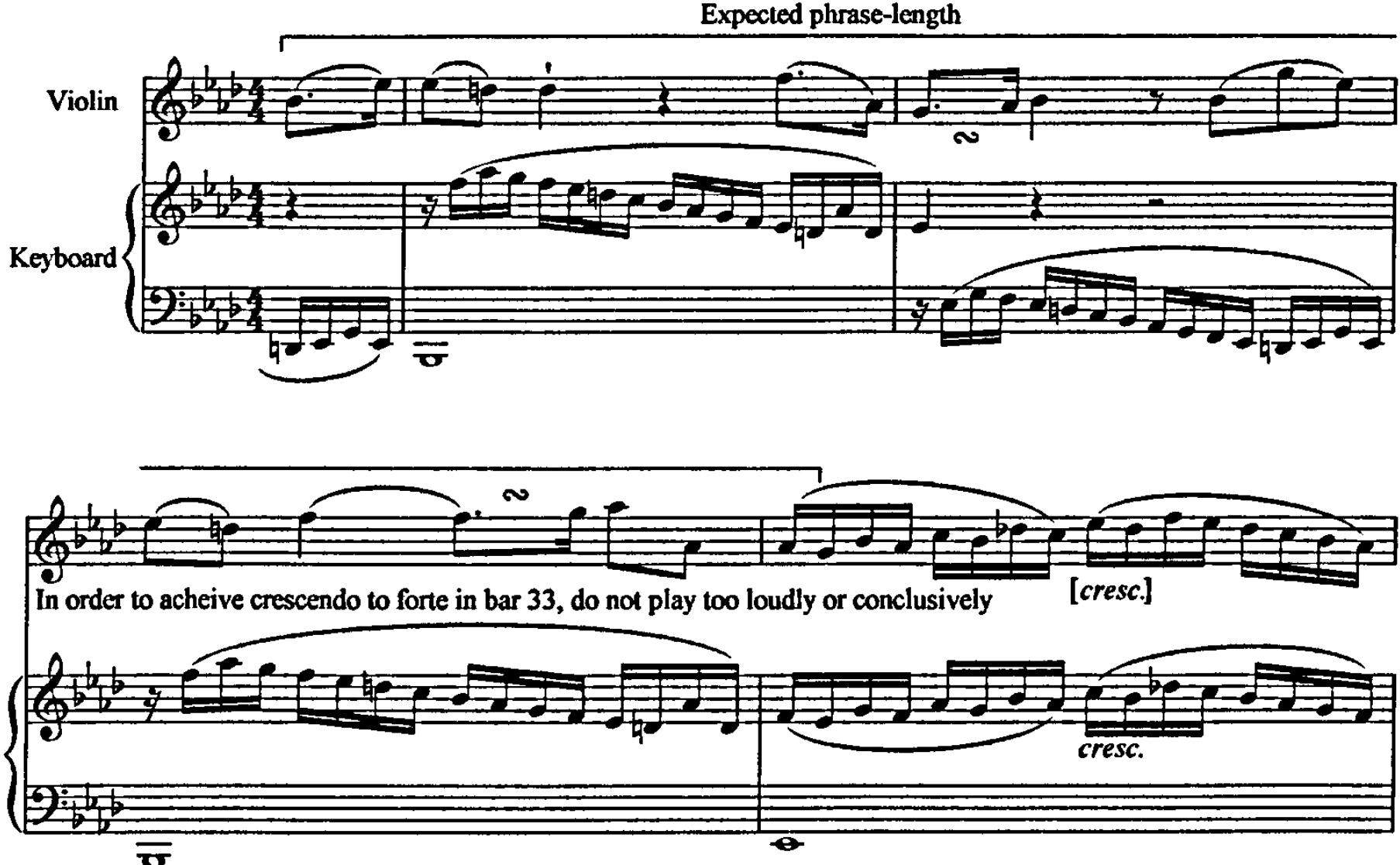
中文讲解
本页第 28 页上的乐谱图像占位符,对应例 5.57(K481 第二乐章第 28–34 小节)。图像细节未给出,需查看原图以核对作者关于力度、连线、句法断点的论述。
第5段(P0105)
原文复述
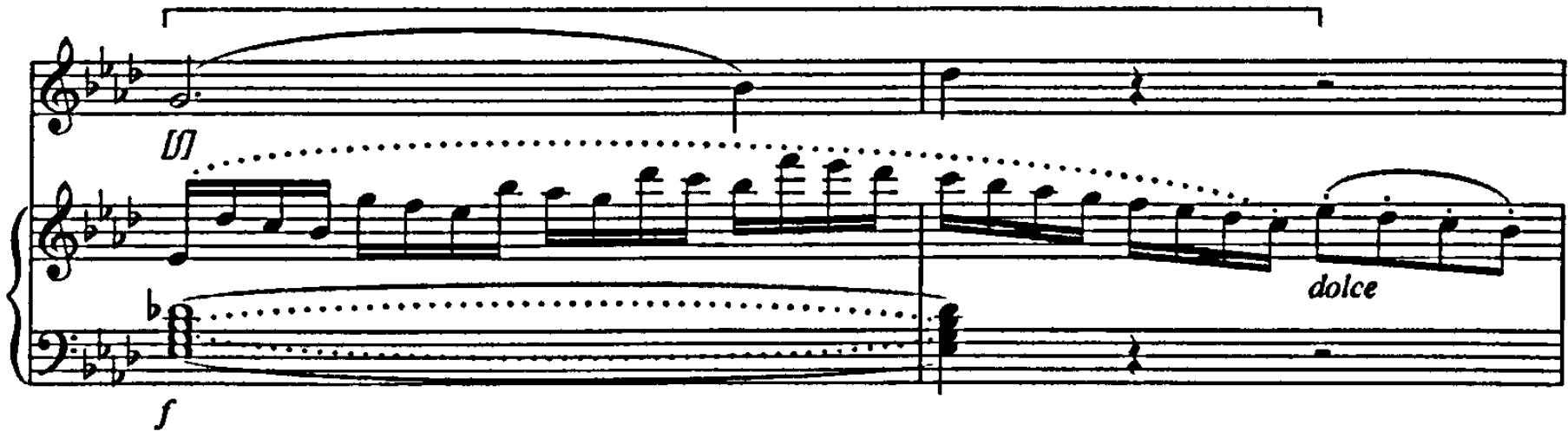
中文讲解
此处为图内说明文字占位符,原文意指"从 forte 力度渐弱进入 dolce 主题”。它与 P0101 描述的力度走向(forte 于第 33 小节头 → diminuendo → dolce p 主题再现)直接对应,是 P0104 乐谱示例的功能性图说。
第6段(P0106)
原文复述
A comparison of bars 60 to 63 (see example 5.58) and 98 to 105 (see example 5.59) further illustrates how emphasis is used to highlight the extension of phrases. The hierarchy of emphasis in bars 60 to 63 is unclear from notated accents alone, since the phrase contains two sf markings. 70 However, as we have seen in chapter 4, repetition is a rhetorical figure most often used for emphasis, and the second sf is made particularly dramatic due to the immediate silence which follows it, highlighting the fact that the E7 chord does not immediately resolve. We can therefore interpret the middle of bar 63 as being the most emphatic point of the phrase. The second version of this phrase (at bar 98) contains the same sforzandi heard in bars 62 and 63; however, the strength of the second sf in this instance is lessened because here the B7 chord resolves (albeit briefly) to E major. A crescendo to f followed by p in bars 102 to 103 prolongs the phrase, 71 shifting the most emphatic part to the return to Ab major (the home key) at the start of bar 103.
中文讲解
本段是本节的第二个主要论证,通过对比同一乐句的两次出现(第 60–63 小节与第 98–105 小节,例 5.58、5.59)来揭示力度如何"重定"乐句的强调中心。
第一次出现(第 60–63 小节):乐句内有两个 sf,仅看力度记号无法判定哪个 sf 更重要。作者援引第 4 章的修辞原则——重复(repetition)即强调,并指出第二个 sf 之后的休止使 E7 和弦悬而未决(do not immediately resolve),由此判定第 63 小节中段才是乐句真正的最高点。
第二次出现(第 98 小节起):表面上沿用相同 sf 结构,但因 B7 和弦短暂解决到 E 大调,第二个 sf 的戏剧性被削弱。取而代之的是第 102–103 小节的 cresc. → f → p 把乐句延长,让强调中心移到第 103 小节头 Ab 大调(主调)回归之处。
由此可见:相同旋律材料在重复时,力度布局可以重新分配乐句的高点。作者借此说明,演奏者不应把第一次出现的句法分析照搬到第二次出现上,而要依据力度走向判断真正的乐句边界。
补充说明
例 5.58 与 5.59 形成"同句异构"对照;本段也是第 4 章"重复即强调"修辞原则在 K481 中的具体应用。第 60–63 与 98–105 小节是回旋曲式或奏鸣曲式中主题再现的典型位置。
第7段(P0107)
原文复述
69 The first edition has the cresc. at the start of bar 32 in the violin part.
中文讲解
脚注 69:初版(first edition)把 cresc. 标记写在第 32 小节开头的小提琴声部中。该信息支持 P0101 的力度走向分析——cresc. 自第 32 小节起,把听觉引导至第 33 小节的 forte。
第8段(P0108)
原文复述
70 In the first edition the keyboard part has rinf instead of sf.
中文讲解
脚注 70:初版中键盘声部在对应位置写的是 rinf(rinforzando,加强)而非 sf(sforzando,突强)。这意味着第 60–63 小节中两个 sf 在不同声部存在记号差异,可能影响演奏者对力度的判断。作者在 P0106 中以"两个 sf"为前提进行论证时,需以此版本差异为参照。
第9段(P0109)
原文复述
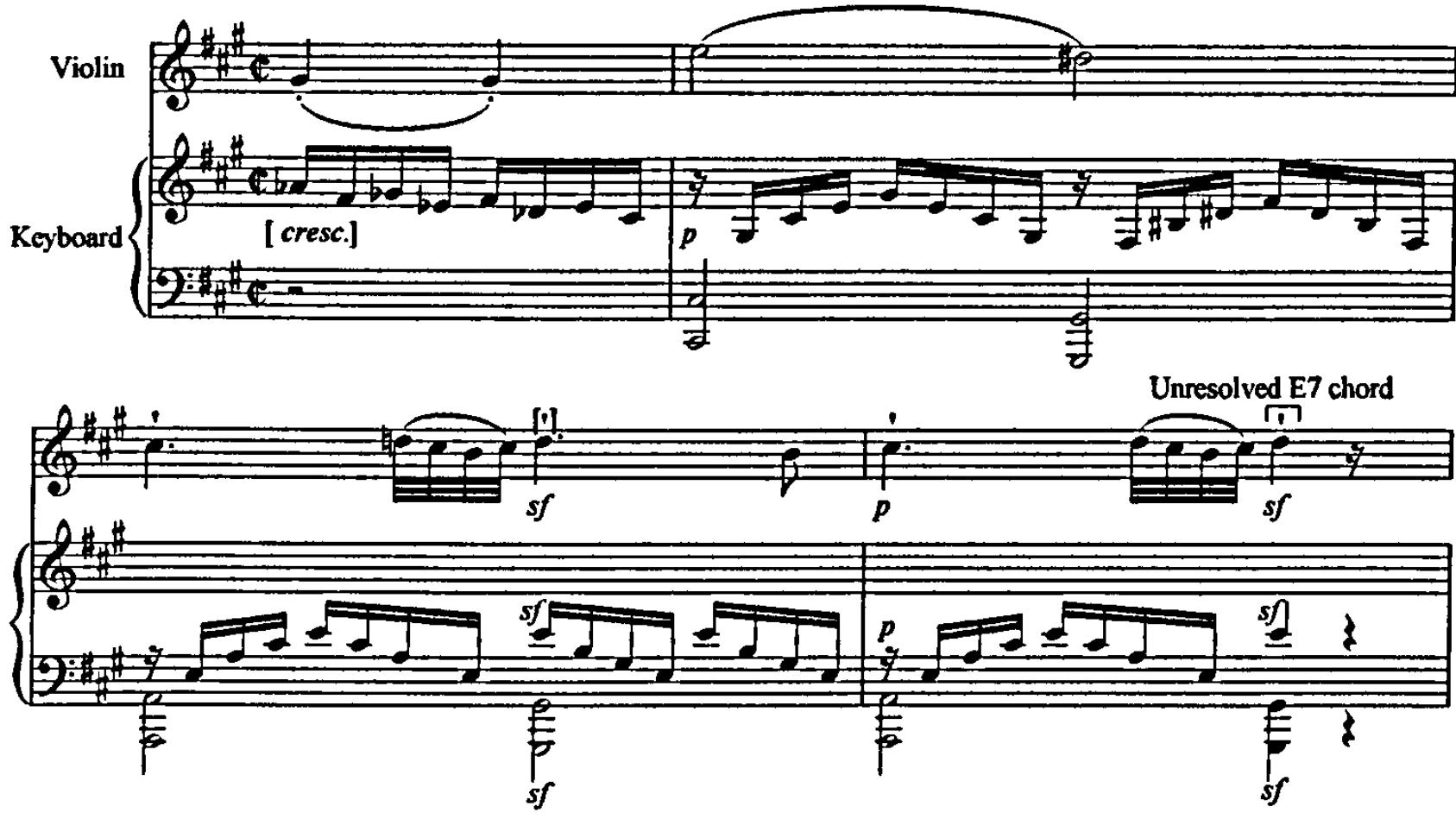
中文讲解
这是第 29 页上的乐谱占位符,对应例 5.58(K481 第二乐章第 60–63 小节)。该例支撑 P0106 中关于"第一次出现的乐句,其强调中心在第 63 小节中段"的论证。
第10段(P0110)
原文复述
71 These dynamics are written as they appear in the first edition. The p and cresc markings at bar 102 do not appear in the keyboard part in the autograph version, but can be added by analogy with the violin. There is no f in either part at bar 103 of the autograph copy (Eisen, 2006: 108).
中文讲解
脚注 71 解释第 102–103 小节力度标记的版本依据:所用 f、p、cresc. 沿用初版。手稿(autograph)中键盘声部缺失第 102 小节的 p 与 cresc.,但可参照小提琴声部类推补入;第 103 小节手稿两声部均无 f 标记,引自 Eisen 2006 第 108 页。该脚注让读者了解 P0106 关于"第 102–103 小节延长乐句"的论述建立在版本校勘之上,而非孤立地依据某一单一文本。
补充说明
Eisen 2006 是初版/手稿版本校勘的来源。“by analogy with the violin”(参照小提琴声部类推)是编辑实践中常见的补入方式。
第11段(P0111)
原文复述
Example 5.59: K481, movement 2, bars 98-105; to demonstrate that emphasis can be used to highlight extended phrase-length.
中文讲解
例 5.59 图注,说明乐谱摘录取自 K481 第二乐章第 98–105 小节;图注副标题点明该例的功能:演示"力度可用于突出延长的乐句长度"。它与例 5.58 形成同句对比,是 P0106 第二层论证的视觉证据。
脚注 / 边栏 / 图表 / 附加信息(如有)
本小节共引用三个乐谱示例(5.57、5.58、5.59)、四则脚注(68、69、70、71)和三段主要正文论述。脚注 68 引入版本学家 Cliff Eisen 关于 pia: 术语的解读并被作者驳议,奠定本节"力度解读须基于语境与版本"的方法论基调;脚注 69、70、71 分别就初版与手稿之间的力度记号差异进行说明,其中脚注 71 引用 Eisen 2006 第 108 页。例 5.57 论证 6.5 小节延长乐句(28–34),例 5.58 与 5.59 通过同句两次出现的对比展示力度如何重新分配强调中心。本节无独立图表或边栏文字。
💡 本节核心要点
- 本节核心论点是:力度标记是判断乐句实际边界、特别是识别偏离四小节范式的延长乐句的关键线索。
- K380(第 36 小节五小节乐句)的力度分析为本节 K481 的讨论提供先例与参照。
- 例 5.57(第 28–34 小节)展示 6.5 小节延长乐句:第 31 小节不可收束过紧,以让第 32 小节 cresc. 引向第 33 小节 forte,再 diminuendo 进入 dolce p 的主题回归。
- 例 5.58 与 5.59(第 60–63 与 98–105 小节)形成同句对比:第一次出现时第二 sf 因后续休止与未解决的 E7 和弦成为最强点(第 63 小节中段);第二次出现时 B7 短暂解决至 E 大调削弱了第二 sf 的戏剧性,力度高点转移至第 103 小节 Ab 大调回归处。
- 本节方法论强调:力度解读必须结合初版与手稿的版本对照(脚注 69、70、71),不能孤立看待某一记号;并援引第 4 章"重复即强调"的修辞原则。
- 作者对 Eisen 将 pia: 解读为 diminuendo 的观点提出异议,依据是该术语出现的上下文并不一致支持此解读,且初版中对应位置用的是常规 f 与 p。
🔑 关键术语
- emphasis:在本节中指力度(dynamics)标记所形成的听觉强弱对比,作者用以揭示乐句的真实长度与句法边界,不是泛指"重音"。
- phrase-length / extended phrase:本节特指偏离四小节常规范式的不规则乐句(如 K481 的 6.5 小节乐句),作者主张通过力度而非小节计数来识别。
- sf (sforzando):突强记号。P0106 中乐句内出现两个 sf,作者借助重复修辞与后续和声解决状态来判断哪一个 sf 才是乐句的真正高点。
- rinf (rinforzando):加强。脚注 70 指出初版键盘声部写的是 rinf 而非 sf,提示同一位置存在版本差异。
- first edition:初版。是本节版本校勘的基准文本,脚注 69、70、71 均对照初版与手稿(autograph)的力度记号差异。
- autograph:莫扎特手稿。脚注 71 指出第 102 小节手稿键盘声部缺少 p 与 cresc.,第 103 小节两声部均无 f,需参照小提琴声部类推补入。
- p (piano) / f (forte) / cresc. / dim.:本节反复使用的力度术语:p 弱、f 强、cresc. 渐强、dim. 渐弱;forte 于第 33 小节头经 diminuendo 引向 dolce p 的主题再现是 P0101 的力度骨架。
- pia::本节中讨论的渐弱类术语记号。Eisen 将其解读为 diminuendo 的记法,但作者以语境与初版证据提出异议。
- rhetorical repetition:修辞意义上的"重复即强调"原则,源自第 4 章,本节用以解释 K481 第 60–63 小节第二个 sf 的强化效果。
- resolution:和声解决。P0106 依据 E7 是否解决、B7 是否短暂解决到 E 大调来判断 sf 后的戏剧性强度。
5.18 [描述性拆分] Emphasis and elongated phrases in the Andante of K526
第1段(P0112)
原文复述
Similarly, in K526 the opening theme of the Andante (bars 1 to 8) is extended in bars 48 to 58 (see examples 5.60 and 5.61). A chain of harmonically restless suspensions (in bars 54 to 55) steers the movement back to its home key of D major, and a crescendo to f in bar 55 highlights the augmented phrase for the listener: ![内嵌图像数据已省略;位置与图注保留]
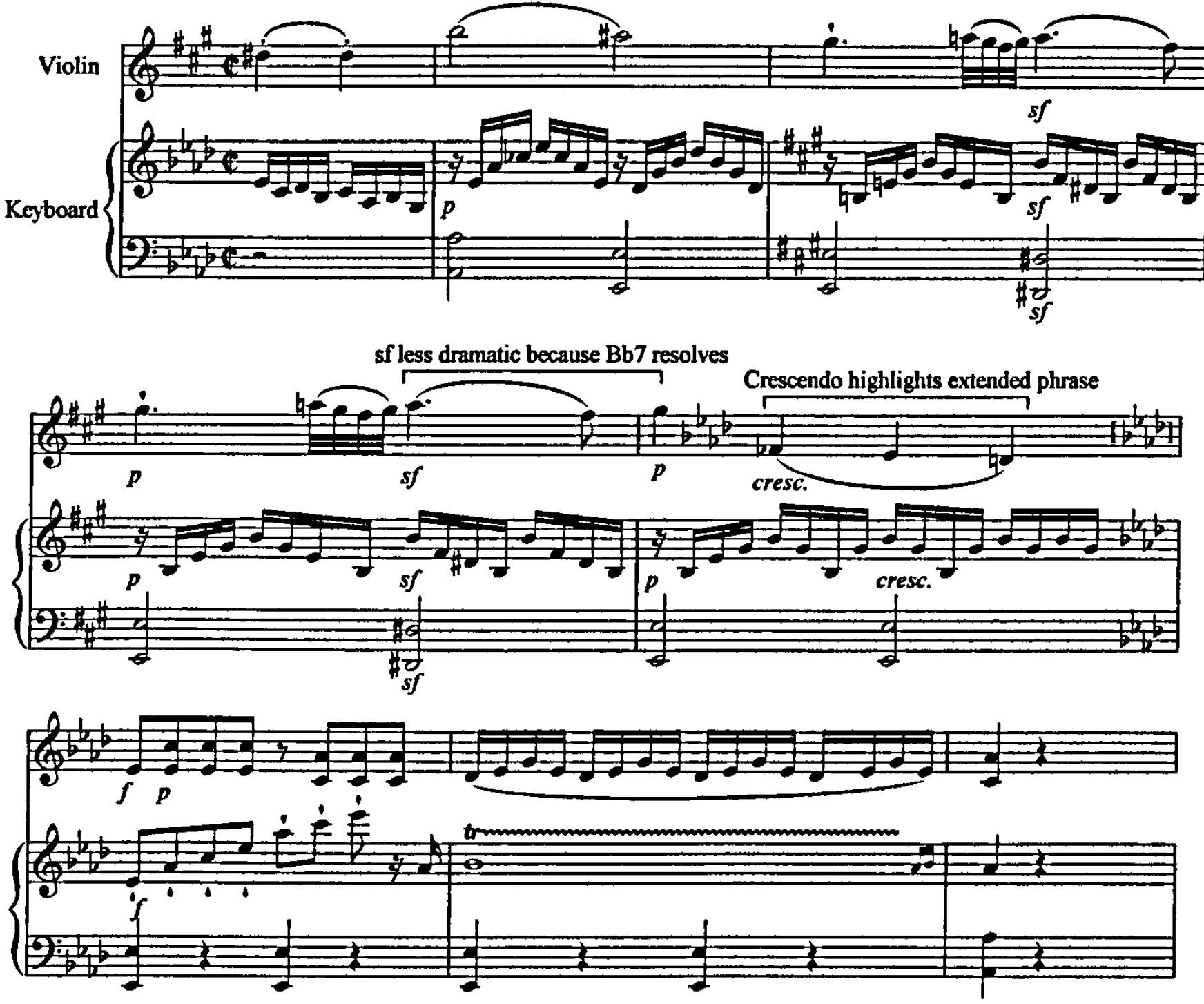
中文讲解
本段以"Similarly"开头,把论述从上一例顺势接到K526第二乐章(Andante)。作者指出,开篇主题(第1—8小节)在第48—58小节处被再次展开并扩展,这一点需参照例5.60与例5.61来核对乐谱。在扩展过程中,第54—55小节出现一连串"和声上不安定的延留音(suspensions)",其功能是把调性拉回主调D大调;同时第55小节有一个渐强至"f",作者明确把这个力度高点解释为:它把被扩展的乐句"高亮"出来,让听者感知到这一乐句比常规长度更长(即"augmented phrase",扩展乐句)。因此,本段同时承担两件事:陈述主题如何再现并被延长,再用具体的和声与力度手段(延留音链、到f的渐强)说明延长是如何被"标记"给听者的。
补充说明
段落末尾的"![内嵌图像数据已省略;位置与图注保留]“标记表示此处原本嵌入了一幅与所述内容相关的图示或谱例,但图像数据本身不可见,其具体内容需查阅原书。“augmented phrase"在此处指被拉长、超出正常乐句长度的乐句结构。
第2段(P0113)
原文复述
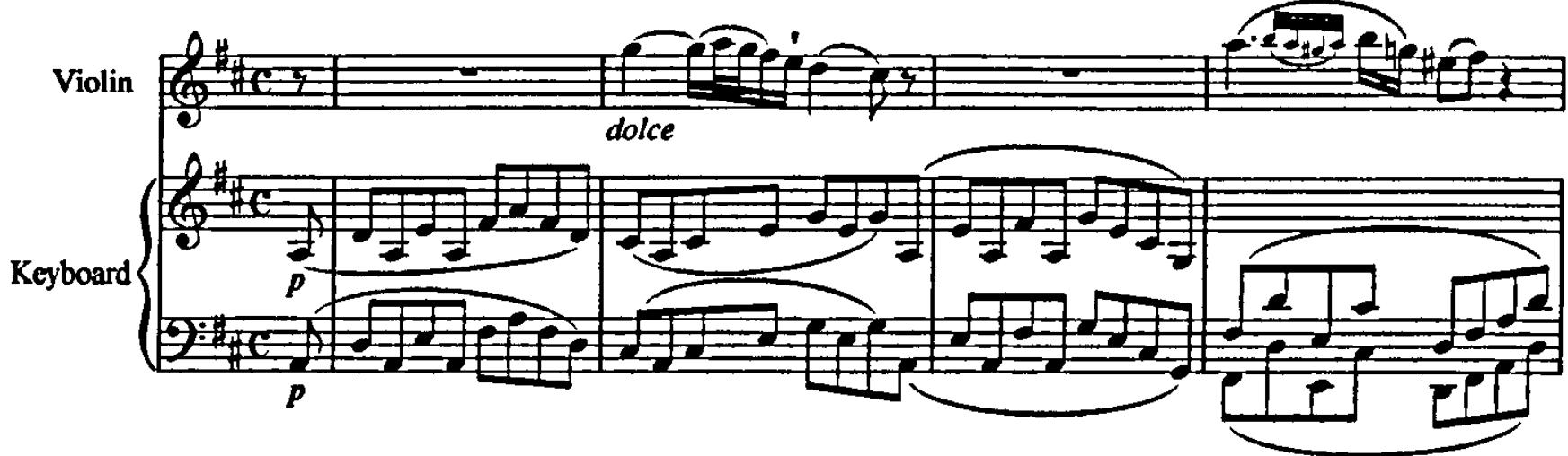
中文讲解
此条为第31页上的图像或乐谱占位符,原文标签为"第31页图像或乐谱示例”,且图像数据本身已被省略。它在版面中位于上一段文字之后,应视为P0112所引例5.60或5.61的视觉内容之一,但因图像不可见,无法对其细节作进一步描述。
第3段(P0114)
原文复述
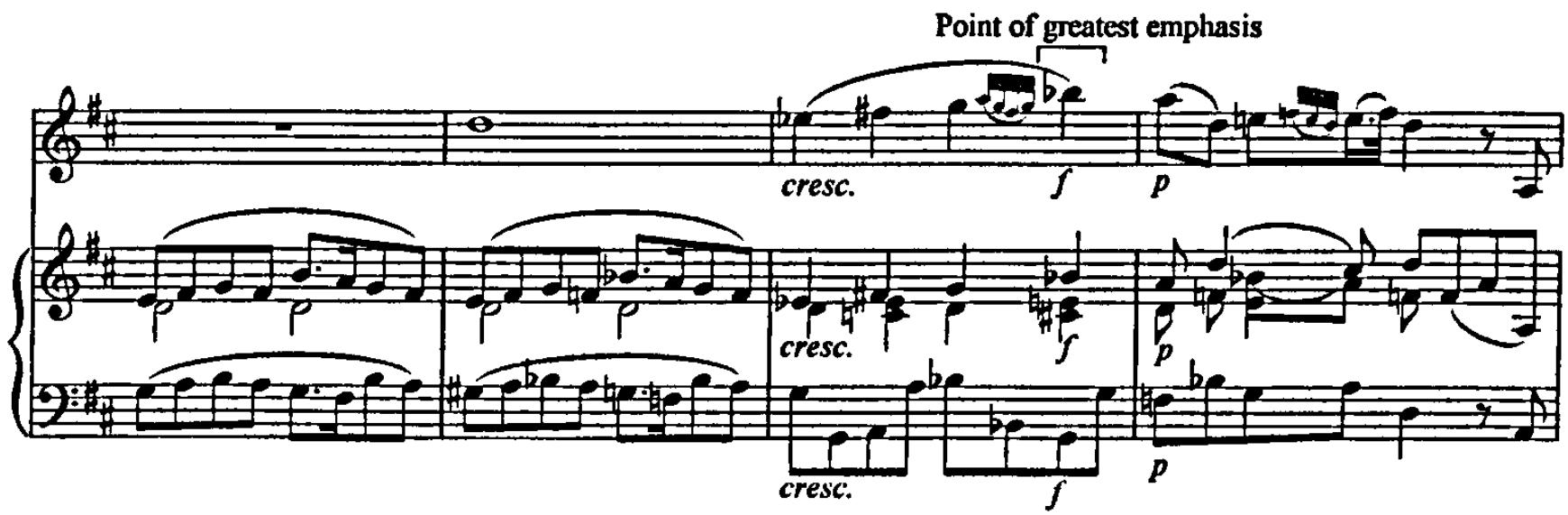
中文讲解
此条同样为第31页的图像或乐谱占位符,与P0113并列出现,原文标签同为"第31页图像或乐谱示例”,图像数据已省略。需结合P0112—P0116的图注方能判断它对应例5.60还是例5.61的一部分。
第4段(P0115)
原文复述
Example 5.61: K526, movement 2, bars 47-58, to demonstrate that emphasis can be used to highlight extended phrase-length.
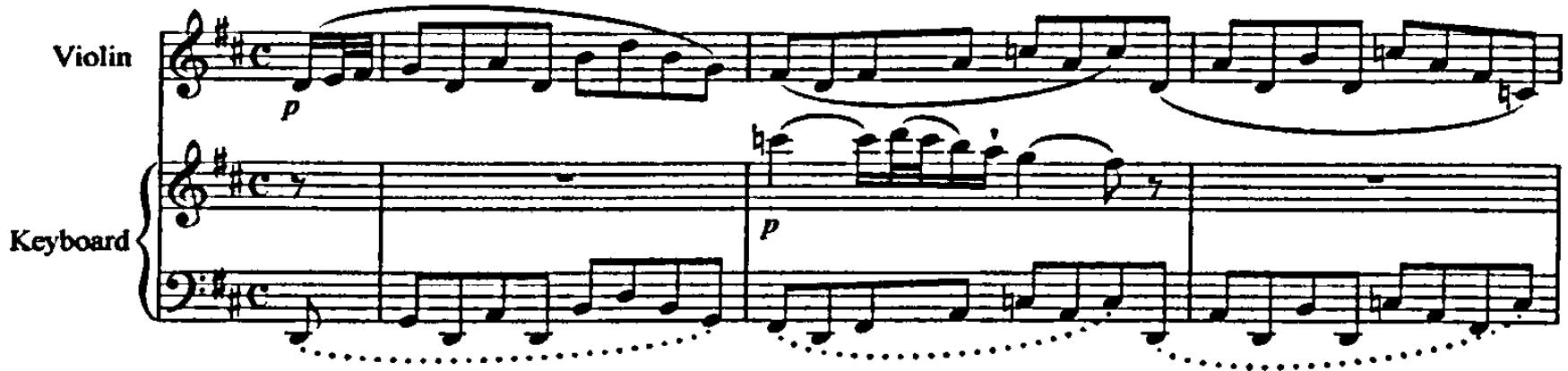
中文讲解
这是例5.61的图注,标明该谱例选自K526第二乐章(movement 2),范围为第47—58小节。值得注意的是,谱例范围(47—58)比正文所述的扩展段(48—58)多出第47小节,这一小节很可能用于呈现主题再现前后的过渡或对位,使听者能更清楚地看到从常规长度主题向扩展主题的过渡。图注明确指出此例的论证目的:“用以说明强调记号可被用来高亮扩展的乐句长度”,这与P0112中关于"crescendo到f突出被扩展乐句"的论述在逻辑上互为支撑。
补充说明
图注中的"emphasis"一词在此特指力度/演奏标记层面的强调(如渐强、突出重音),与音乐修辞层面的"emphasis"(强调)一致;本图注明确把它和"乐句长度的扩展"联系起来,作为本节的视觉论证材料。
第5段(P0116)
原文复述
Extended point of emphasis highlights elongated phrase
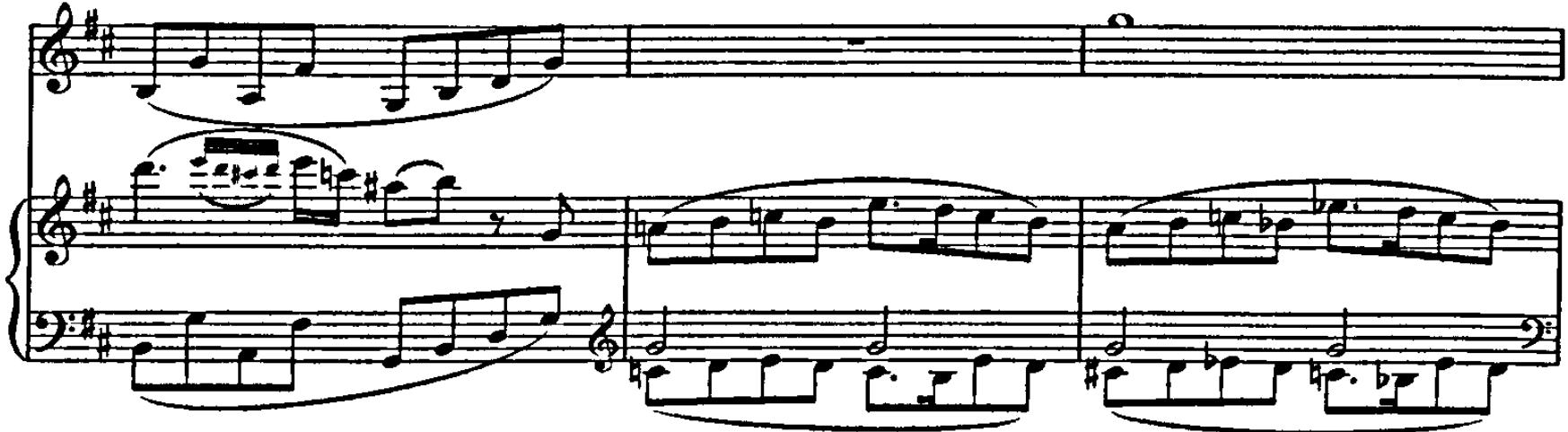
中文讲解
此条为图内或图表中的简短说明文字,作用是把谱例中的视觉信息凝缩为一句概括:“被延长的强调点高亮出拉长的乐句”。它与P0115图注形成"图注—图内说明"的层级关系:图注说明选段范围与论证目的,图内说明点出该处"强调"与"延长"二者之间的对应关系,使读者不必通读谱例也能抓住作者要论证的核心关系。
第6段(P0117)
原文复述
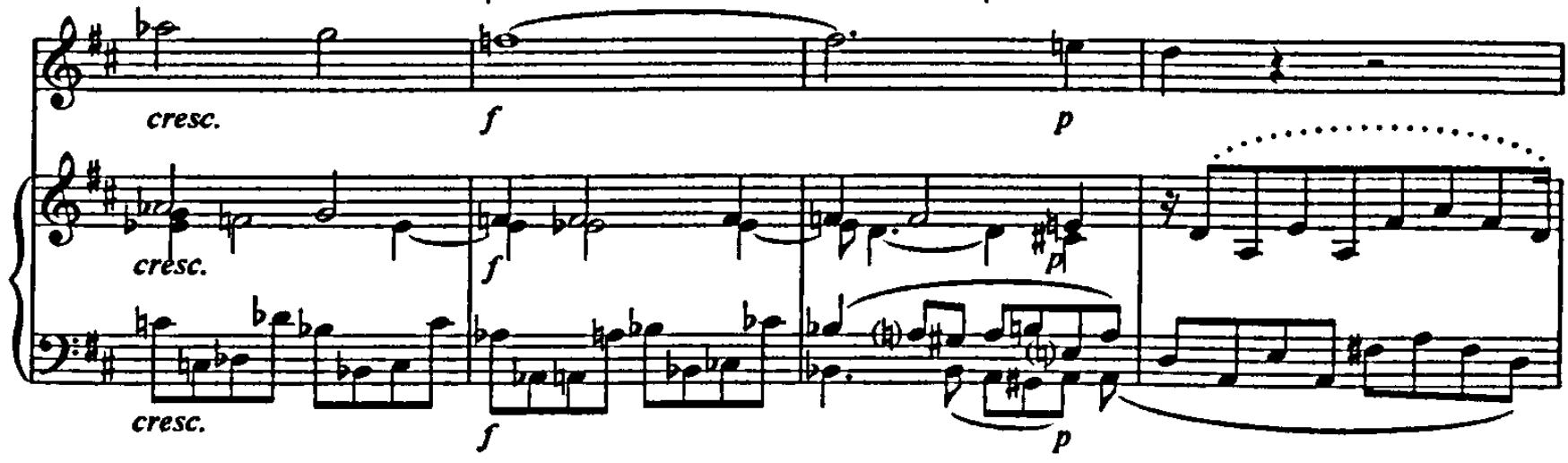
中文讲解
此条为第31页上的另一处图像或乐谱占位符,标签仍为"第31页图像或乐谱示例",图像数据被省略。从它出现在P0116(“Extended point of emphasis highlights elongated phrase”)之后来看,它很可能是承载该图内说明文字的具体谱例或图示,但具体内容不可见,不能作进一步判断。
第7段(P0118)
原文复述
Thus, the emphases that are notated in these sonatas have the function of elucidating the structure of the musical discourse; they give each phrase a point of greatest focus, highlighting large-scale harmonic structure, clarifying developments in phrase-lengths, and creating a hierarchy of phrases within a movement by demarcating the relative strength of each cadence.
中文讲解
本段以"Thus"作结,把前面各例(K309第二乐章与K526第二乐章)所观察到的"强调记号"上升为通论:这些sonatas中所标注的强调记号,其功能是"阐明音乐陈述的结构"。作者进一步把这一总功能分解为四点:①给每个乐句一个"最大焦点"(point of greatest focus);②凸显大尺度的和声结构;③澄清乐句长度的发展变化;④通过标示各个终止式的相对强度,在乐章内部建立乐句之间的层级关系。这四点既呼应本节开篇关于"emphasis and elongated phrases"的论题,也呼应前文关于K309第二乐章的论述,从而把单点观察综合为一条贯穿多部奏鸣曲的论断。需要注意作者用"demarcating the relative strength of each cadence"而非简单的"marking cadences",说明作者所关心的是终止式之间的强弱对比,而非终止式的位置本身。
补充说明
“musical discourse”(音乐陈述/音乐话语)一词暗示作者把奏鸣曲视为一种具有修辞结构的"话语",“emphases"在其中承担类似口语中重音的功能;此处的"emphasis"延续了P0112—P0117中"力度/演奏强调"的具体含义,但被提升为结构修辞层面的一般概念。
脚注 / 边栏 / 图表 / 附加信息(如有)
本节涉及两幅编号谱例:例5.60与例5.61。图注标明例5.61取自K526第二乐章第47—58小节,目的为说明"强调可被用来高亮扩展的乐句长度”;其图内进一步附有简短说明"Extended point of emphasis highlights elongated phrase"。P0113、P0114、P0117为第31页上的图像/乐谱占位符,因图像数据已被省略,无法对其谱面细节作进一步叙述。
💡 本节核心要点
- 本节以K526第二乐章(Andante)为对象,分析开篇主题(第1—8小节)在第48—58小节被扩展再现的过程。
- 扩展的实现与可听感来自两套手段:一是第54—55小节"和声上不安定"的延留音链把调性拉回D大调;二是第55小节渐强至"f"这一力度高点把被扩展的乐句"高亮"给听者。
- 谱例(例5.60、5.61)的选段范围与图注共同服务于一个论证:被记下的"emphasis"并非装饰,而是揭示乐句长度变化的结构信号。
- 本节结论(P0118)把单点观察上升为通论:这些奏鸣曲中的emphasis具有阐明音乐话语结构的功能,体现在最大焦点、大尺度和声结构、乐句长度的发展、以及通过终止式相对强度建立的乐句层级四个方面。
- 本节以"Thus"收束,与K309相关论述形成呼应,使"强调—结构"关系成为贯穿多部奏鸣曲的论断,而非孤例。
🔑 关键术语
- emphasis (emphasized note):在本书中指奏鸣曲谱面上被特意标记出来的力度/演奏重音;本节论证其功能不是装饰性的,而是揭示结构(特别是乐句长度与终止式强弱)的信号。
- suspension:和声学中的延留音,前一和弦的音被保留并与新和弦形成不协和;P0112称之为"harmonically restless suspensions",意指这些延留音在听觉上制造紧张感,从而推动和声进行。
- augmented / elongated phrase:指长度超出常规、被有意拉长的乐句;本节用K526第二乐章第48—58小节作为实例,并配以第55小节到f的渐强作为听者感知这一拉长的标记。
- home key:段落中指D大调,即K526第二乐章的主调;作者描述延留音链的功用之一是把音乐"steers the movement back"到主调,从而稳定调性。
- cadence:终止式;P0118特别强调的不是终止式本身的位置,而是各终止式之间的"相对强度",因为emphasis的功能之一是通过对比各cadence的强度来建立乐章内部乐句的层级。
- musical discourse:“音乐陈述”,作者借自话语/修辞的隐喻,把奏鸣曲视为一种具有结构的"话语",emphasis在其中承担类似口语重音的修辞功能。
5.19 [描述性拆分] Long emphases, sudden emphases, and sforzandi in slow movements
第1段(P0119)
原文复述
Often, Mozart’s emphases are notated in such detail that we can glean not only their function within the musical discourse, but also something of their intended Affekt. When an emphasis is signalled by a forte marking, it is invariably preceded by a crescendo. This can be seen, for example, in theme A of K380 (see appendix 2). Conversely, Mozart rarely marks diminuendi from these emphatic peaks. Instead, a forte marking is regularly followed at some distance by a piano dynamic; this is the case in the retreat from the emphasis of phrase A in K380, and bars 15 to 16 of the Andante from K526:
中文讲解
本段是本小节的总纲,提出Mozart记谱中关于"重音"的两条一般规律。第一条:凡以forte标记的重音,前方必有crescendo作为准备,这意味着Mozart并不把forte视为突然的爆发,而是视为一个渐强过程的顶点。第二条:Mozart很少在这些重音峰位直接标注diminuendo,而是让forte在一定距离之后由piano接替,由此形成自然的消退而不是急促的回落。作者用K380主题A以及K526第二乐章Andante的15–16小节作为例证。这两条规律为后面讨论"长时间重音"和"突然重音"提供了对照基准:Mozart记谱中若违反这两条,就往往具有特殊的修辞意义。
补充说明
术语Affekt在此沿用18世纪音乐修辞学的含义,指乐句所传达的情感或表情内涵,而非现代意义上的纯粹力度记号。K380与K526是Mozart钢琴奏鸣曲的Köchel编号,分别对应第11首与第18首钢琴奏鸣曲。
第2段(P0120)
原文复述
Example 5.62: K526, movement 2, bars 15-16.
中文讲解
这是谱例5.62的标题,说明该例取自K526第二乐章(Andante)第15至16小节。结合P0119,此例被引用来佐证"forte之后间隔一定距离出现piano"这一记谱惯例,即Mozart在Andante主题中典型的力度消退方式。
第3段(P0121)
原文复述
[Occasionally, fortes are followed immediately by piano (as two separate dynamic markings, rather than fp) thus creating a dramatic Affekt, as in the opening phrase of the second movement of K526 (see example 5.63):]
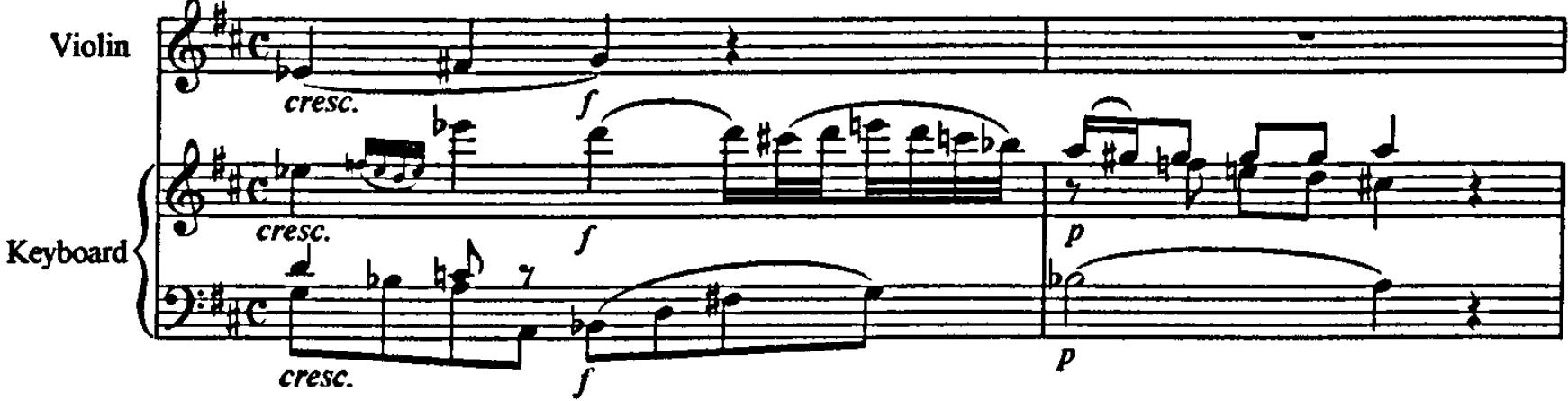
中文讲解
虽然原文未给出图像,但图注文本保留了完整信息:Mozart偶尔会把forte与p紧邻排列(作为两个独立的力度记号,而非fp这种组合记号),从而制造戏剧性的情感效果。作者以K526第二乐章开篇乐句为例,指出这是对P0119一般规律的偏离,需要演奏者特别留意。区分"两个分立记号"与"fp"是关键:fp暗示短促而尖锐的断奏式重音,而f紧接p则更强调力度层面的突然对比,常带有更宽阔的情感跨度。
补充说明
原文已嵌入图像省略标记,此处仅复述图注文字,不得猜测乐谱内容。
第4段(P0122)
原文复述
Example 5.63: K526, movement 2, bars 7-8.
中文讲解
谱例5.63的标题,说明所引段落为K526第二乐章第7至8小节。该例紧接P0121,用以展示Mozart在同一乐章开篇乐句内部所设置的"紧邻f–p"突然对比,与本乐章15–16小节(P0120)所体现的"长距离消退"形成同一乐章内部的两种力度处理对照。
第5段(P0123)
原文复述
[Since Mozart prescribes the places where he expects an immediate p after a forte, in many instances it seems appropriate that where he does not notate this striking contrast, and instead prescribes a p some beats later, there should be a natural and gentle phrasing away into the piano dynamic. In this case, bar 4 of K380 (see example 5.64) could diminuendo through the slurred final crotchet of the bar into p at bar 5, rather than remaining f until the end of bar 4, followed by a subito p.]
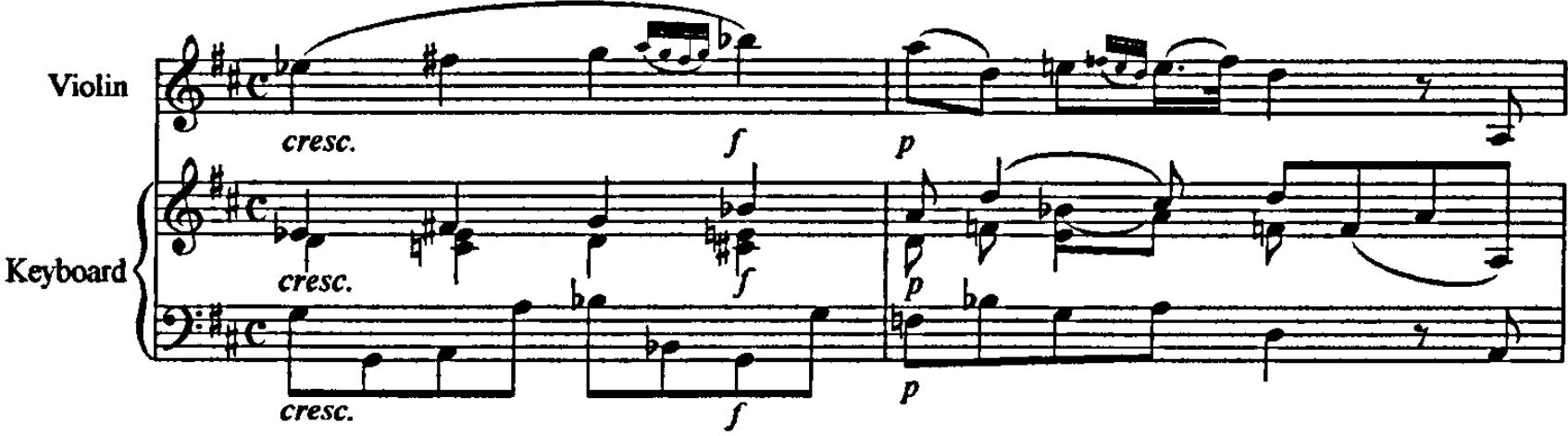
中文讲解
图注文字构成一段独立论证:既然Mozart会在需要"紧邻f–p"对比的场合明确记出,那么当Mozart没有记出这种尖锐对比、而是把p放在稍后的小节时,演奏者就应当推断他期待的是自然的力度消退,而非到末拍突然转弱。作者以K380第二乐章第4小节为例(谱例5.64),主张该小节被连线的最后一个四分音符应作diminuendo过渡,把力度引向第5小节的p,而不是把f维持到第4小节末尾再作subito p。这条推论将P0119的常规记谱惯例转化为演奏诠释原则:Mozart记谱中p出现的位置暗示了他所设想的力度曲线形状。
补充说明
原文已嵌入图像省略标记,此处仅复述图注文字,不得猜测乐谱内容。术语subito p指毫无预示的突然转弱,与diminuendo形成过程性的渐弱相对。
第6段(P0124)
原文复述
Example 5.64: K380, movement 2, bars 3-5.
中文讲解
谱例5.64的标题,说明所引段落为K380第二乐章第3至5小节。该例服务于P0123的演奏建议,作为演示"在连线末拍做diminuendo并滑入下小节p"这一诠释方案的具体乐谱上下文。
第7段(P0125)
原文复述
[第33页图像或乐谱示例]
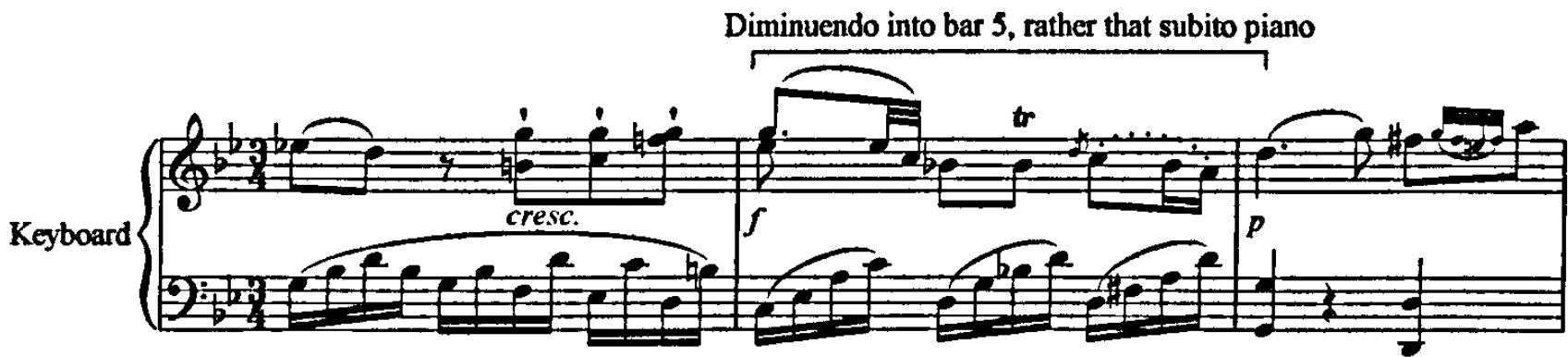
中文讲解
这是第33页一处图像或乐谱占位符,原文以方括号注明图像内容已省略,仅保留位置信息。结合本节其余谱例的安排,此处应是与P0126所讨论主题D第二次陈述相对应的乐谱示例,但因图像不可见,无法进一步核对细节。读者须参照原书第33页相应插图。
第8段(P0126)
原文复述
With this in mind, it is clear that some phrases have longer and therefore more forceful points of emphasis than others. A comparison of Mozart’s two treatments of theme D in K380 demonstrates this (see appendix 2). As we have already seen, the five-bar length of the first statement of this theme is highlighted by a crescendo through bar 35, which comes to its peak with a forte marking in bar 36. This phrase ends at bar 37, and should thus diminuendo to its cadence in B♭ major. The gap after the caesura at bar 37 is filled by a violin motive, connecting (in a method described by Koch, 1787: 34) the first phrase D to its C minor repetition which begins in bar 38. After initially following the same scheme of emphasis as the first rendition of phrase D, with a crescendo through the fourth bar of the phrase (bar 41), and a for: marking (and f in the right-hand keyboard part) on bar 42, Mozart launches into a new dactylic figure, which lasts for four bars. In this context Eisen’s interpretation of for: as a graded dynamic implying a crescendo (Eisen, 2007: v) is appropriate; this extension of the phrase is extremely emphatic throughout, with a series of suspensions, doubled octaves in the keyboard, and a rising scale through bars 44 and 45. The forte which is initiated in bar 42 should thus be maintained until the top of the scale in bar 45, an E♭ chord with an added augmented 6th – this German 6th should phrase away to the D major resolution (which becomes the dominant to G major, which is reached in bar 50) in bar 46. This diminuendo prepares for the p entry on the second semiquaver of bar 46. The emphasis in the second version of theme D is thus much greater and more expansive than that of the first.
中文讲解
本段是小节的高潮段落,用K380主题D的两次陈述进行对比,论证Mozart会在重复陈述中扩展重音规模。论证分三步展开:第一,主题D首次陈述为五小节,通过第35小节的渐强在第36小节以forte达到顶峰,到第37小节收束于B♭大调终止,期间Koch(1787:34)所描述的小提琴动机填补caesura之后的空白,连接首次陈述与c小调重复。第二,主题D的重复陈述在结构上沿用同样的crescendo+forte方案(crescendo经过第41小节,第42小节出现for:与右手键盘声部的f记号),但Mozart随即引入新的扬抑格(dactylic)动机延续四小节,使重音范围大幅扩展。第三,作者援引Eisen(2007:v)把for:解释为带有渐强意味的渐进力度,支持把第42小节起始的forte一直维持到第45小节上升音阶顶端——一个带增六度的E♭和弦(德国增六和弦),该和弦应diminuendo地解决到第46小节的D大调(D大调作为G大调属和弦延伸至第50小节),并顺势引出第46小节第二十六分音符上的p。结尾明确结论:主题D第二次陈述的重音远较首次陈述更为宽广有力。
本段的论证意义在于把前文P0119–P0124建立的两条一般规律(crescendo接forte、forte之后间隔piano)放进具体重复结构中观察:Mozart对同主题的不同陈述并非简单复制,而是通过延长渐强区间、引入新材料(扬抑格动机、键盘八度叠加、延长音阶上行)以及延迟p出现的位置,使第二次陈述的重音"时间更长、力度更强、修辞更重"。这也是本小节标题中"Long emphases"概念的具体落地。
补充说明
Koch(1787:34)所指为 Heinrich Christoph Koch《Musikalisches Lexikon》(1802年的版本常被引用,但作者此处明确标注1787年版本第34页),是18世纪重要的音乐修辞与曲式理论文献。Eisen(2007:v)所指为Cliff Eisen对Mozart钢琴奏鸣曲所作编辑版本的序言页v,其将sf:视为渐进力度而非瞬时重音。术语dactylic figure指扬抑格节奏型,即长–短–短的三音节节奏(如附点四分音符接两个八分音符)。augmented 6th / German 6th指德国增六和弦(增六度+大三度+完全五度构成),是古典时期重要的半音化变和弦,常解决到属音上方八度的解决音。caesura指乐句之间的停顿或呼吸点。
脚注 / 边栏 / 图表 / 附加信息(如有)
本小节包含若干谱例与对应图注:谱例5.62(K526第二乐章第15–16小节)支撑"forte后间隔出现p"的常规模式;P0121图注与谱例5.63(K526第二乐章第7–8小节)展示"紧邻f–p"的突然对比作为例外情形;P0123图注与谱例5.64(K380第二乐章第3–5小节)则把常规模式转化为具体的演奏诠释建议。P0125为第33页另一处图像占位符,服务于P0126主题D第二次陈述的讨论。脚注或括号文献援引方面,本段引用Koch 1787:34关于"间隙动机连接两个乐句"的方法论,以及Eisen 2007:v对sf:作为渐进力度而非瞬时重音的解释,两者均为本段论证的关键文献依据。
💡 本节核心要点
- Mozart记谱中,forte重音前方必有crescendo准备,且其后通常以一定距离的piano接替而非diminuendo标记,这一常规构成全节论述的对照基准。
- 当Mozart故意把forte与p紧邻排布(而非写作fp)时,往往是为了制造戏剧性的Affekt效果,如K526第二乐章开篇所示。
- 若Mozart未在forte之后立即记出p,而是把p放在稍后小节,演奏者应推断该处期待自然的力度消退,例如K380第二乐章第4小节连线末拍可作diminuendo过渡。
- K380主题D的两次陈述对比表明,同主题在重复陈述中可被显著扩展:crescendo区间被延长,新引入的扬抑格动机、延音叠加、键盘八度及上升音阶使重音区域更为宽广。
- 本段援引Eisen把sf:视为渐进力度而非瞬时重音的解释,从而把第42小节的forte与第45小节顶端的德国增六和弦及随后至第46小节的解决连贯成一个长弧线。
- 小节整体论证从Mozart记谱的一般规律出发,逐步落实到具体演奏诠释:记谱中p的位置与力度记号之间的距离是Mozart预设的力度曲线线索。
🔑 关键术语
- Affekt:18世纪音乐修辞学概念,指乐句所承载的情感或表情内涵。本节中用以说明Mozart通过力度记号安排所要传达的情绪倾向,而非单纯的响度数值。
- for: / sf: (forte-sforzando with continuation dots):本节将其按Eisen 2007:v的解释,理解为带有渐进渐强意味的力度,而非瞬时的尖锐重音。这一解读支持把forte视为长时间持续事件而非点状爆发。
- German 6th (German augmented sixth):德国增六和弦,常见于古典时期的半音化变和弦;本节中K380主题D第二次陈述第45小节顶端的E♭和弦即带有增六度,需diminuendo解决到D大调并最终导向G大调。
- dactylic figure:扬抑格节奏型,长–短–短的三音节节奏单位;本节中Mozart在主题D重复陈述里引入此动机以扩展重音的时值跨度。
- caesura:乐句间的停顿或呼吸点;本节中第37小节开头的caesura由小提琴动机填补,连接主题D的首次陈述与其c小调重复。
- subito p:突然的p记号,无过程准备;本节把它与diminuendo作对照,用以说明Mozart未记出subito p之处演奏者应解读为渐进过渡。
5.20 [描述性拆分] Expansive emphases and fp markings in slow movements
第1段(P0127)
原文复述
In K481 dynamics are similarly used to great effect, creating an expansive plateau of emphasis (see example 5.65). Here, as in K380, a harmonically restless theme marks the end of the development, before the recapitulation of the movement’s opening theme in bar 75. Starting in bar 69, the violin and keyboard parts are treated in rising sequence, which is marked with a crescendo. Here, for: is used (in the autograph version only) as well as a crescendo, and the dynamic markings thus follow the melodic shape, growing louder as the instruments ascend. A forte dynamic is reached in the right-hand keyboard part in the middle of bar 71, but this dynamic seems to be marked early, since the theme has not yet reached its peak (which occurs at bar 73). The implication is that this phrase – which uses material from the movement’s opening theme, extending the rising scale beyond its original range of a fifth to a compound major second – should be strong from bar 71 until the downbeat of bar 73, instead of being performed with graded dynamics through bars 71 and 72 in order to steadily reach the loudest moment in bar 73 itself.
中文讲解
本段继续上节对K380“长段落式强调”的讨论,将同一观察延伸到K481第二乐章(参见例5.65)。作者提出的核心概念是“expansive plateau of emphasis”——即一段旋律或乐句从进入f起,保持一段较平稳的响度平台,而非按常规理解在小节内继续渐强直至顶点。具体论证如下:第69小节起,小提琴与键盘声部进入上行模进并标有渐强;手稿中另标注了“for:”(仅见于手稿),提示动态随旋律上行而增长。在第71小节中段,右手键盘声部已到达f,但作者指出该f显得标得“过早”,因为旋律真正的最高点出现在第73小节。这意味着该f并非仅作用于第71小节本身,而应该从第71小节一直延伸到第73小节正拍,使整段在两小节多的时间内保持强奏,从而形成一块响度“平台”,而不是用渐变式动态在71-72小节逐级推进、直到73小节才到达最强。作者还补充了主题材料上的依据:该片段来自乐章开篇主题,但将原本五度范围内的上行音列扩展到了复合大二度(compound major second),因此其强调长度必然超出原始主题的短句结构。与K380相同的是,这里“harmonic restlessness”也出现在发展部末尾、紧接开篇主题再现(第75小节)之前。
补充说明
作者将本段与前文K380的讨论并置(“similarly used to great effect”),可见本节论证的递进关系:先以K380为典型案例建立“长段落式强调”的分析模型,再用K481进一步验证并细化。复合大二度(compound major second)指超过八度的大二度,即大九度音程;此处指上行音列从原本五度的跨度扩大到超过八度,从而在结构上支撑更长的强调平台。
第2段(P0128)
原文复述
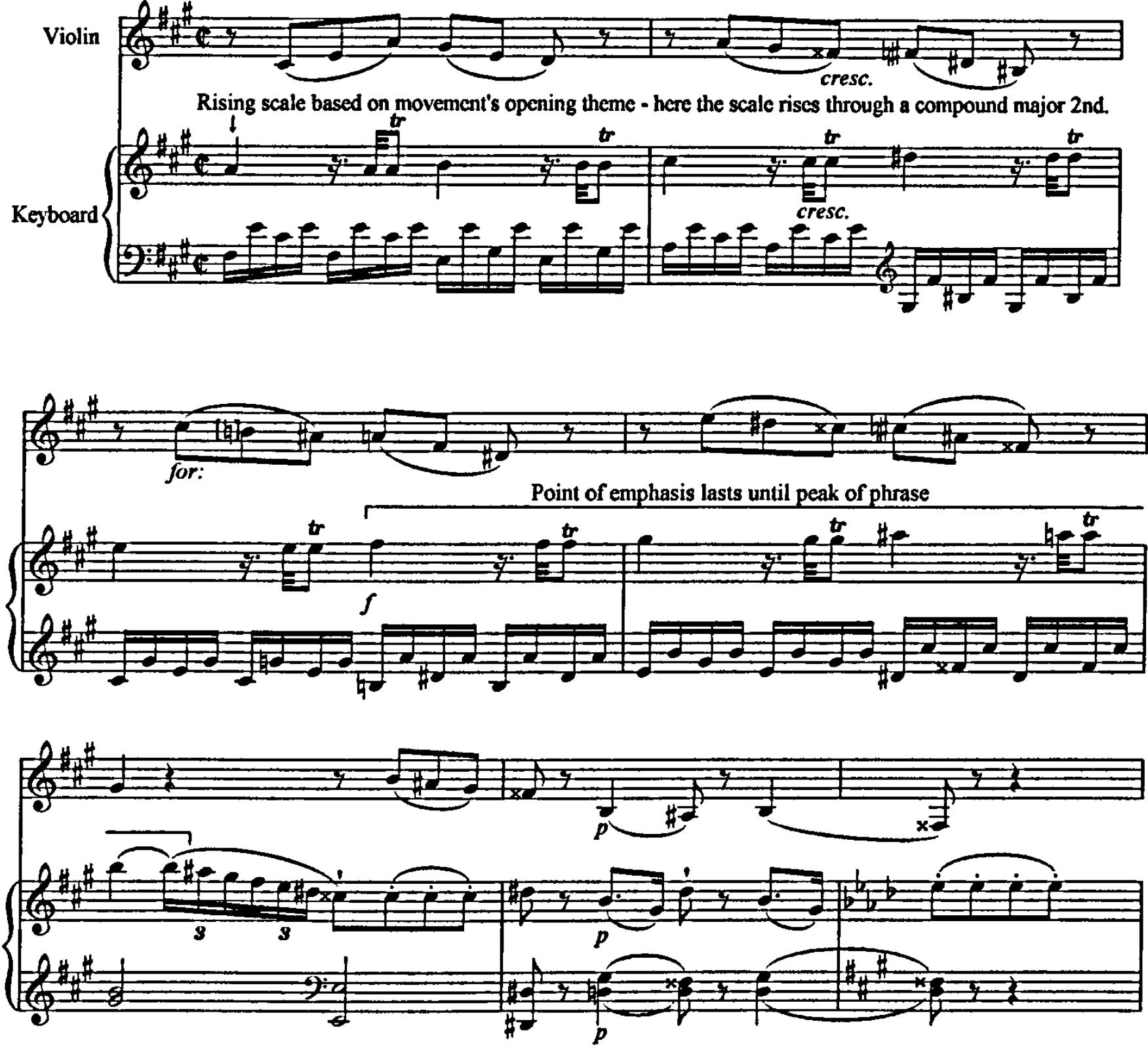
中文讲解
此为版面上的图像或乐谱占位符,位于第35页,对应前文P0127所引用的例5.65(Example 5.65),即K481第69-73小节附近的乐谱片段,用以直观展示作者所讨论的“上升序列+for:+渐强+f的提前出现”这一组合标记。由于内嵌图像数据已省略,具体谱例内容须查阅原书。占位符本身仅承担版面位置与图注指向功能,不承载独立的文字主张。
第3段(P0129)
原文复述
In contrast to these long passages of emphasis, marked with forte at their beginning and piano a number of beats or bars later, the use of fp suggests a shorter emphasis. In theme B of K380 (bars 15-18, see appendix 2), two fps are marked. The listener might expect a perfect cadence to B♭ major after the first two-bar statement of an F major harmony (bars 15-16), but instead Mozart delays this resolution to the tonic by repeating similar melodic material with the same harmony in bar 17. While the first fp therefore marks the start of an attempted perfect cadence, it is the fp in bar 17 which indicates the cadence proper. Due to the use of repetition, and the higher pitch of bar 17 as compared with bar 15, we can determine that the second of these fp markings is the most emphatic. The fps here mark the start of each incise, to use Koch’s terminology – that is, the incomplete sections which join to form a complete phrase (Koch, 1787: 2). The fp must therefore be played very definitely, and it should be followed by a diminuendo to p. The speed of this diminuendo is ambiguous, because fps are simultaneously written on three note lengths: a semiquaver chord in the right-hand keyboard part, a crotchet in the left-hand part and a minim in the violin melody. Leopold writes that the marking fp should be performed ‘strongly… and to relax the tone again… But when accenting a note strongly the bow must not be lifted from the string as some clumsy people do, but must be continued in the stroke so that the tone may still be heard continuously, although it gradually dies away’ (L. Mozart, 1756: 219). Leopold’s description of a gradual rather than sudden drop in dynamic and release of sound suits the violin part well here. It is also supportable in the keyboard part. Indeed, although fp is marked on a semiquaver chord in the right hand, this same chord is repeated throughout the bar, essentially conveying a decorated dotted minim. In the left-hand part, the moving crotchets of the bass line are slurred together (in the autograph version). The keyboard part could therefore be conceived as a bar-long gesture, in spite of the shorter note lengths which are contained within it, thus rendering a relatively gradual rate of decay suitable for both the keyboard and violin parts.
中文讲解
本段从“长段落式强调”转向其对照——“短促式强调”,即fp标记所暗示的紧缩力度。作者以K380 B主题(第15-18小节,参见附录2)为例展开论证:表面上,听众会在第15-16小节F大调和声之后期待一个到降B大调的完满终止(perfect cadence),但莫扎特通过第17小节重复相似旋律与同一和声,主动推迟了对主调的解决。因此,第一个fp标记(第15小节)仅指示“尝试性完满终止”的开始,而真正标记终止本身的,是第17小节的第二个fp。又因为第17小节运用了重复、且音区比第15小节更高,作者判断第二个fp才是两个标记中更具强调力的那个。接下来作者引入Koch(1787: 2)的术语“incise”来解释fp的结构位置:incise指组合成完整乐句的、未完结的小分段;fp位于每个incise的起点,因此应当“非常确定地奏出”,并紧接一个到p的渐弱。本段论证最精微之处在于对渐弱速度的讨论:三个声部同时承载fp标记,但记谱音长不同——右手键盘声部为十六分音符和弦、左手声部为四分音符、小提琴旋律为二分音符。若按字面理解,三者从f到p的衰减速率应当不同,演奏者由此面临歧义。作者援引L. Mozart(1756: 219)关于fp演奏的论述——“强奏……并让音色再次放松……弓不应离开弦,而应在运弓中延续,使声音仍然可闻”,指出应采取“渐进而非突然”的衰减。这对小提琴声部自然适用,对键盘声部也站得住脚:右手的十六分音符和弦在小节内反复出现,本质上是“装饰化的附点二分音符”;左手四分音符低音在手稿中以连奏(slur)连为一体;因此键盘部分可以作为一个跨小节的整体姿态来理解,从而使较慢的渐弱速率在键盘与小提琴两个声部间都获得合理性。
补充说明
“Incise”出自Koch 1787年的音乐修辞理论,本节中作者用其指代乐句内部的次级结构单元,与“phrase”相对;“fp”是forte-piano的缩写,表示一个音或和弦先强奏再立即转弱。L. Mozart 1756年的论述是当时通行的键盘与小提琴演奏实践的权威记录,本段借此为现代演奏中对fp衰减速度的歧义提供历史依据。
第4段(P0130)
原文复述
$^{72}$ In the first edition the left-hand keyboard part has cresc. half-way through bar 70, and f on third note of bar 71.
中文讲解
这是正文P0127关于K481第69-73小节力度标记讨论的脚注(编号72)。它提供了一个版本异文信息:在初版(first edition)中,左手键盘声部于第70小节半处标有渐强(cresc.),并在第71小节的第三个音符上标有f。这与正文所依据的手稿(autograph)版本不同——手稿中该位置是“for:”与渐强并用(仅见于手稿)。脚注的作用在于:限定并补充正文关于早期力度标记的来源差异,提醒读者作者对“f标得偏早”这一判断是基于手稿谱面,同时也指明初版存在另一种(更接近常规渐变式动态的)力度安排。这条脚注并不直接反驳正文的演奏建议,但提示了不同版本之间在力度标记上的差异。
补充说明
脚注在此承担“版本限定与旁证”功能:它既支持正文对autograph版本标记的引用,又通过对比first edition,提醒读者力度标记具有版本敏感性。
脚注 / 边栏 / 图表 / 附加信息(如有)
本节包含一处版面包含元素:P0128为第35页的图像或乐谱占位符,对应正文P0127中提及的“例5.65”,内容须查阅原书。另含一条编号脚注P0130(编号72),提供K481左手声部在初版与手稿之间的力度标记异文,作为对正文autograph版本依据的版本补充与限定。
💡 本节核心要点
- 本节区分两种力度强调形态:跨越多小节的“长段落式强调”(expansive plateau,K481为例),与紧缩的“短促式强调”(fp,K380主题B为例)。
- K481第71小节中段的f并非局部最强点,而是为旋律峰值(第73小节)做铺垫的响度平台起点;该平台由开篇主题材料扩展上行跨度(五度→复合大二度)所支撑,因此强调长度超出常规短句。
- K380主题B中的两个fp分别标记“尝试性终止”与“真正的完满终止”,第二个fp因重复与更高音区而更具强调力;fp在结构上标记Koch意义上每个incise(未完结小分段)的开始。
- 本节最具方法论意义的观察是:fp在三种不同音长(十六分音符和弦、四分音符、二分音符)上同时出现时,演奏上存在衰减速度歧义;作者借L. Mozart 1756年的论述,主张按“渐进而非突然”的速率衰减,并将键盘声部整体理解为一个跨小节姿态以消解歧义。
- 脚注72通过对比初版(first edition)与手稿(autograph)的力度标记差异,限定了正文主张的版本基础,提示力度标记具有版本敏感性。
🔑 关键术语
- expansive plateau of emphasis:本节核心概念之一,指一段力度维持在f附近的稳定响度区域,而非在短句内部做渐变式推进;在K481中体现为第71小节起的f一直延伸到第73小节正拍。
- fp (forte-piano):力度记号,表示一音或和弦先强奏后立即转弱;在本节中用以与“长段落式强调”对比,被作者解读为标记Koch意义上每个incise起点、且应“非常确定地奏出”后接渐弱的短促式强调。
- incise (Koch 1787):Koch音乐修辞理论中“未完结的小分段”,由若干incise组合成一个完整乐句(phrase);本节以此术语定位fp的结构功能——标记每个incise的起点。
- perfect cadence:完满终止,即V→I的和声进行;本节在K380主题B中讨论对它的“推迟”:第一个fp标记的是“尝试性”完满终止的开始,第二个fp标记真正的终止本身。
- rising sequence / 上行模进:本节K481例证中的关键进行,第69小节起小提琴与键盘声部进入上行模进并伴随渐强,是f平台得以形成的旋律与和声载体。
- compound major second:复合大二度(即超过八度的大二度,大九度音程);本节指K481该片段将开篇主题原本五度范围内的上行音列扩展至此跨度,从而支撑更长的强调平台。
- autograph version / first edition:本节论证同时涉及莫扎特手稿谱(autograph)与初版印刷谱(first edition),二者力度标记存在差异;脚注72明示初版左手声部在第70小节半处有渐强、第71小节第三音有f,与正文依据的手稿标记不同。
5.21 [描述性拆分] Emphasis as interruption: sudden emphases in K526, movement 2
第1段(P0131)
原文复述
Emphasis can also occur as an interruption to the music which precedes it. This is the case at bar 19 of the Andante from K526 (see example 5.66); a forte marking on the fourth quaver of the bar indicates a point of emphasis in a phrase which has the general dynamic of p. Unwritten metrical accents at the start of bars 17, 18 and 19 are all phrased away with a slurred rising arpeggio. The third quaver of bar 19 is thus the softest part of the bar, and the f upbeat to an $E^{7}$ chord with an added fourth is a sudden and intense interruption.
中文讲解
这一段说明,强调不一定落在小节开头的自然重音上,也可以通过对先前音乐的抑制,在之后突然插入一个新的力度高点。K526第二乐章《Andante》第19小节整体处于p的动态背景中;第17、18、19小节开头的潜在节拍重音都被带连线的上行琶音处理掉。因此,第19小节第三个quaver成为全小节最柔软的部分,而第四个quaver上的f把音乐引向带有加四度的E7和弦,形成突然而强烈的打断。这里要区分“拍点上的潜在重音”和“实际听见的强调”:理论上的节拍重音并不会自动成为听觉重点,连奏处理和力度安排可以先削弱它,再把强调转移到别处。
补充说明
“未写出的节拍重音”指小节开头潜在的节拍位置重音,并不是额外的力度标记;原文明确把第19小节第三个quaver称为最柔软的部分。
第2段(P0132)
原文复述
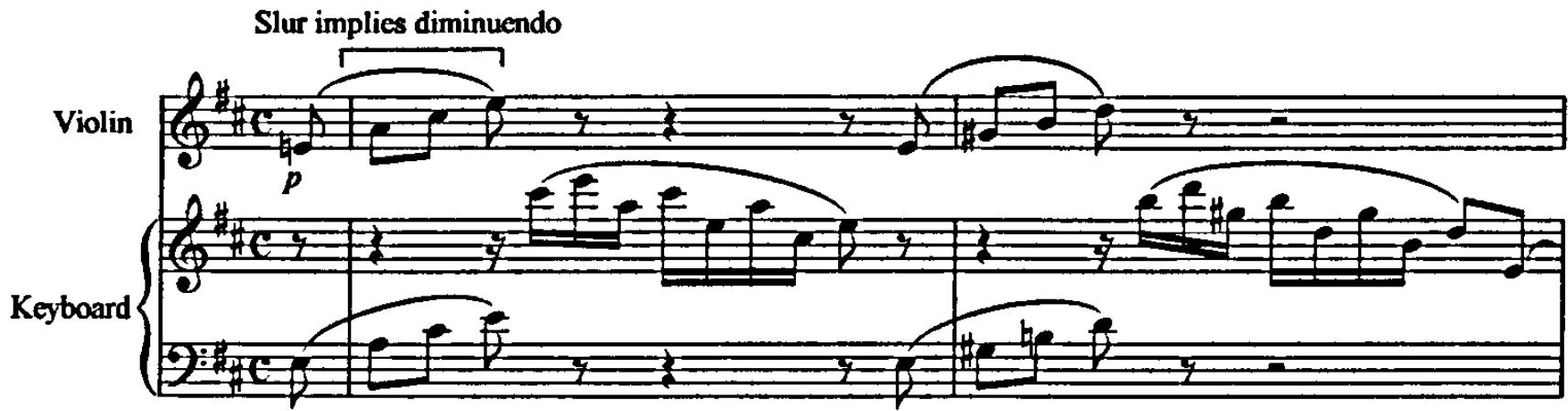
中文讲解
这是第37页的图像或乐谱示例占位符,文本只保留了页面位置以及“内嵌图像数据已省略”的说明,没有呈现图像中的实际内容。它属于版面位置标记,不能仅凭本段恢复谱表、音型或力度细节。
补充说明
需查看原图或原始扫描件;本段没有可直接补充的图像信息。
第3段(P0133)
原文复述
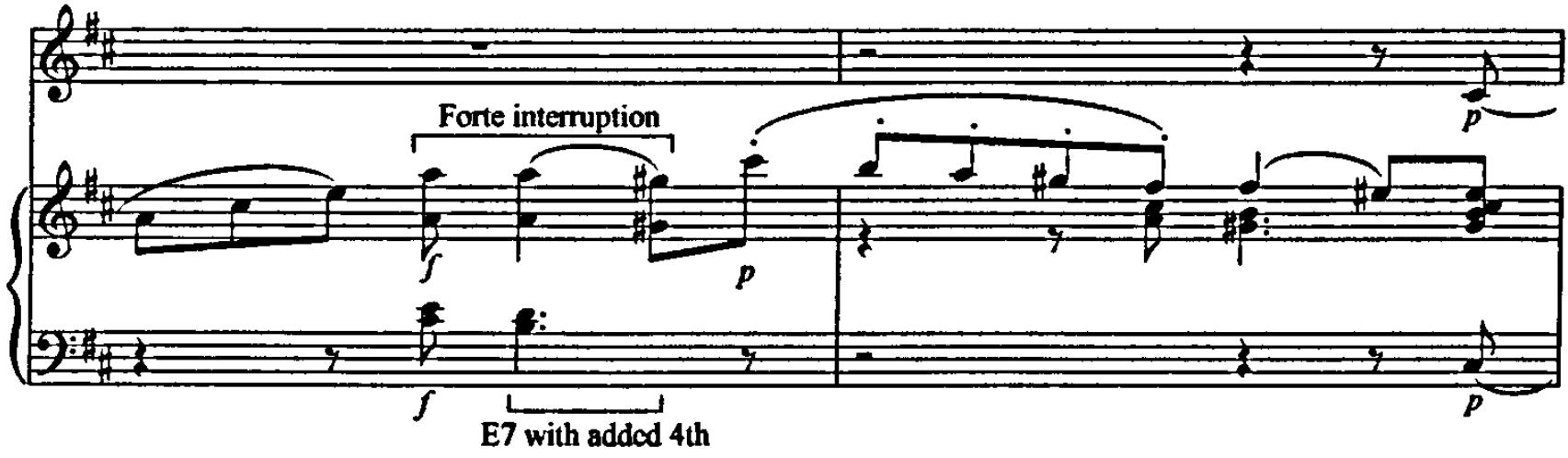
中文讲解
作者在此处重复了第19小节的基本机制,但把例子推进到第69小节。小提琴和键盘两个声部中的上行连线音型都应作diminuendo,即逐渐减弱;这样,上行音型原本可能带来的力度增长或重音预期被压低。随后,第70小节上拍出现的大调、forte版本主题,便以自信而突然的方式打断B小调所造成的阴暗效果。这个例子的重点不是单纯把上行音型奏得响,而是用此前的渐弱制造反差,使后一个进入显得格外突出。
补充说明
diminuendo在这里不是独立的装饰,而是为后面的forte大调主题制造突然反差的前提。
第4段(P0134)
原文复述
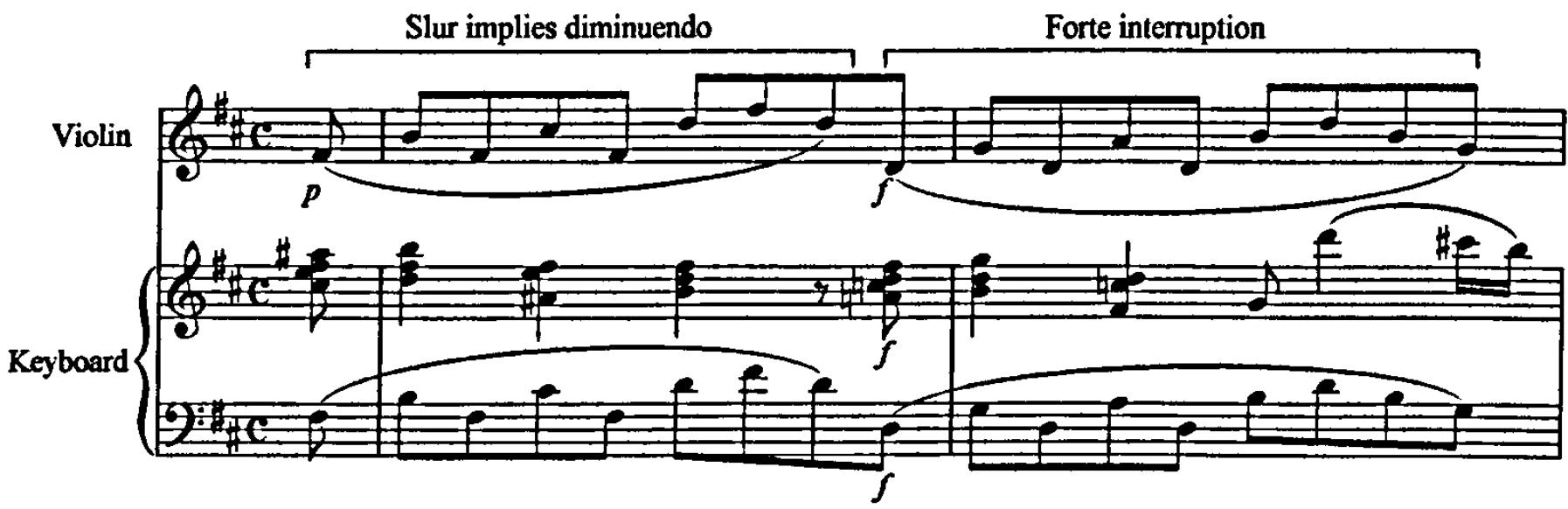
中文讲解
这一段以Example 5.67的图注文字开头,随后把第69小节的突然强调与第81小节上拍对相似材料的处理进行对照。第81小节上拍出现的主题再现形成compound phrase,也就是复合乐句;它与前面一个在第81小节正拍结束于D小调的乐句相重叠,而不是完全独立地重新开始。作者把第81处小调与大调之间的运动说成比第68处流畅得多,并准备通过一种graded的推进来加强这种效果。段落末尾停在“a graded”,句子在下一段由“progression”继续,因此本段不能脱离P0135单独补成完整表述。
补充说明
末句跨到P0135;“graded”的完整说明应与下一段的“progression to and from…”连起来理解,但两段仍须按原始paragraph_id分别保留。
第5段(P0135)
原文复述
progression to and from the most emphatic point of the phrase at the end of bar 81. Following the cadence to D minor, Mozart slides into D major, with an F# on the second quaver of bar 81. There follows a crescendo through B minor and a forte marking with the emphatic arrival of G major at the end of bar 81. Finally, a modulation to D major in bar 82 prepares for the end of the movement; this relaxation into the home key establishes stability after the rapid modulations in bar 81, and is heightened by the piano dynamic.
中文讲解
本段承接P0134末尾的“graded”,说明第81小节的强调不是孤立的突发,而是通过逐步推进和逐步离开形成的。第81小节先在D小调终止,随后滑入D大调,并以第二quaver上的F#标示这一转向;音乐接着经过B小调作渐强,在小节末以forte到达G大调,构成整个乐句最emphatic的终点。第82小节再转为D大调,并以piano的动态把音乐带回文本所称的home key。第81小节内部的快速调性移动因此被转化为一个逐步达到强调点的过程;最终的放松在稳定感上与第69小节那种突然打断形成对照。
补充说明
“piano dynamic”是文本明确提到的动态处理,用来加强第82小节回到主调后的稳定感;不要把它与第19小节前那种持续偏弱、等待突强的p背景混为一谈。
第6段(P0136)
原文复述
Example 5.68: K526, movement 2, bars 79-82.
中文讲解
这是Example 5.68的图注,标明了作品为K526第二乐章、范围为第79至82小节。它为上文关于第81小节上拍相似材料、D小调向大调的运动以及最终稳定收束的比较提供了例号和谱例范围;图注本身没有增加新的音乐主张。
第7段(P0137)
原文复述
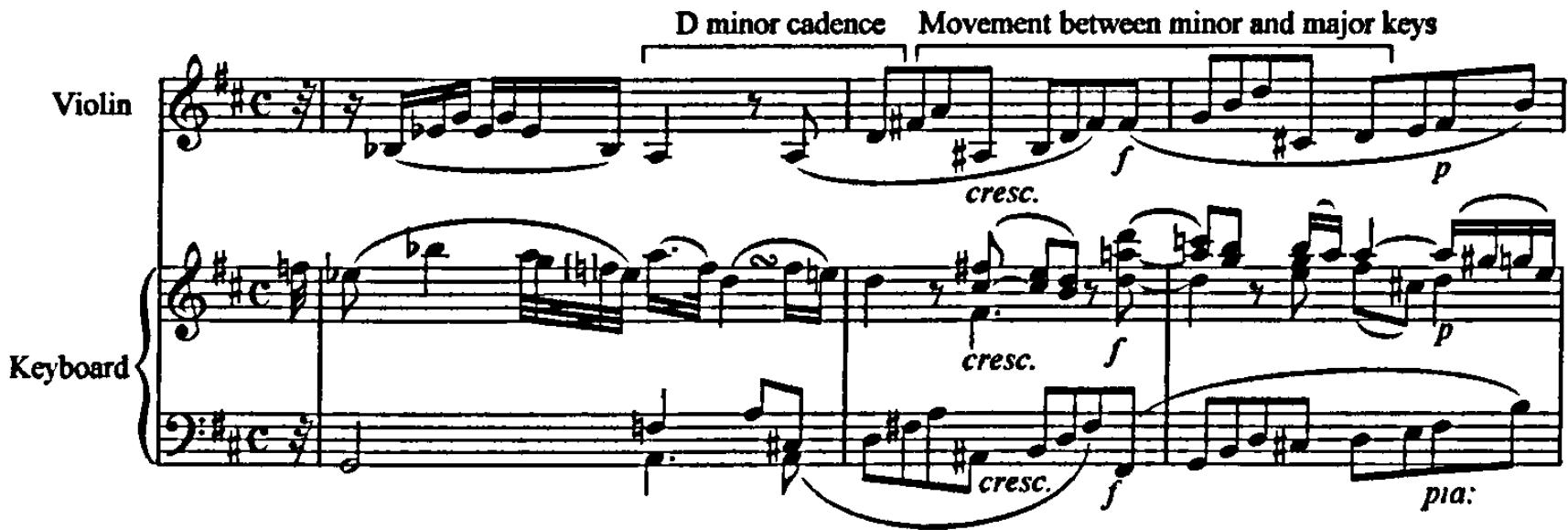
中文讲解
这是第38页的另一个图像或乐谱示例占位符,位于Example 5.68图注之后。原文只说明内嵌图像数据被省略,没有提供足以恢复谱表、具体音型或力度标记的文字;相关细节需要查看原图。
补充说明
占位符保留的是位置信息;不能据此补写图像中不可见的内容。
脚注 / 边栏 / 图表 / 附加信息(如有)
本节包含P0132、P0133、P0134和P0137四个图像或乐谱占位段落;其中P0132和P0137只保留页面位置及“内嵌图像数据已省略”的说明,P0133和P0134还保留了与Example 5.67相关的可见文字。P0136是Example 5.68的文字图注,标出K526第二乐章第79至82小节。由于图像数据已省略,谱表、音型及其他视觉细节均需查看原图确认。
💡 本节核心要点
- 强调可以作为一种中断:第19小节先以p的总体背景和连奏处理削弱小节开头的潜在节拍重音,再在第四个quaver以f和带加四度的E7和弦突然打断。
- 第69小节重复了类似机制:小提琴和键盘声部的上行连线音型作diminuendo,为第70小节上拍forte大调主题的进入制造反差,并打破B小调的阴暗效果。
- 第81小节对相似材料的处理不同:主题再现与前面结束于D小调的乐句重叠,形成compound phrase,因此强调不是孤立的进入,而是乐句结构内部的延伸。
- 第81小节的调性运动比第68处更流畅,并形成走向并离开乐句最强调点的graded progression:从D小调滑入D大调,经过B小调渐强,最终在G大调以forte到达。
- 第82小节转入D大调,piano动态把音乐带回home key,在第81小节快速转调之后建立稳定感;这与第19和第69小节通过突然力度反差形成强调的方式形成对照。
🔑 关键术语
- emphasis:强调;本节指通过力度、连奏处理和乐句位置形成的听觉突出,并不等同于每个小节开头都会自然实现的节拍重音。
- interruption:打断;第19和第69小节中,前面的弱化或渐弱处理压低预期后,forte进入突然截断原有的音乐进行。
- diminuendo:渐弱;第69小节小提琴和键盘声部的上行连线音型应逐渐减弱,以制造随后forte大调进入的强烈反差。
- compound phrase:复合乐句;第81小节上拍的主题再现与前面结束于D小调的乐句重叠,使新的主题材料嵌入既有乐句结构。
- graded progression:分级推进;第81小节通过逐步转向、渐强和最终到达G大调,使最强调点成为乐句过程的结果,而不是突然插入的孤立事件。
- modulation:转调;第81小节在D小调、D大调和B小调之间移动,随后第82小节转入D大调以准备乐章结束。
5.22 [描述性拆分] Sforzandi, context, and the varied delivery of emphasis
第1段(P0138)
原文复述
Mozart also uses other kinds of performance information—such as sforzandi—to dictate emphasis. Yet, as has already been demonstrated, any generalised definition of the meaning of such directions is virtually impossible: each must be understood within its own particular context. The degree of variety that eighteenth-century performers were expected to achieve in their delivery of emphasis is illustrated by comparing bars 10 and 85 of the Adagio of K481 (examples 5.69 and 5.70). In bar 10, an E♭7 chord bears the marking sf in both the violin and keyboard parts; the return to p takes place at the end of the bar, with the resolution to A♭ major. Earlier study of Mozart’s careful placement of dynamic markings has shown that this p on the fourth beat of the bar can be read as a diminuendo through the bar rather than as a sudden drop after the initial impact of the sf. Indeed, throughout the entire movement every sf is meticulously paired with a following p, which fixes the length of the emphasis. So in this context sf implies a diminuendo—but what of the character of the attack itself? Clive Brown’s general principle is that where both sf and fz appear, fz normally receives a sharper attack, and that sf, and even fz, was sometimes intended to signify only a relatively light accent within a piano context (Brown, 1999: 75/78). The E♭7 in bar 10 is a fairly gentle dissonance and the surrounding context is a dolce and p movement. Mozart marks the corresponding moment in bar 85, however, with mf followed by p (example 5.70); this surely implies an even gentler emphasis, so that although the sf at bar 10 need not be attacked sharply, it should still receive greater weight than its bar-85 counterpart. A further nuance is supplied by the stroke on beat 2 of the right-hand keyboard part of bar 85, which spreads variety across the melody: the emphasis marked mf in the violin and left-hand parts is likely meant to rise gradually toward its dynamic peak at the second-beat stroke rather than to land with the immediate impact of the sf in bar 10.
中文讲解
这一段的核心主张是:莫扎特用 sforzandi 一类的力度指示来规定重音,但这些记号并不能用统一定义去解释,而必须在具体语境中读。作者把全段组织成一条从一般到具体的论证链:①开场承认一般化定义几乎不可能;②随即以 K481 第二乐章 Adagio 的第 10 小节与第 85 小节并列作为比较样本,展示同一和声位置(第 10 和 85 小节都是 E♭7)如何被赋予不同强度;③指出在该乐章中,sf 之后总是跟着 p,所以这里的 sf 在功能上等于规定了一条渐弱弧线,而不是一个孤立的撞击;④引用 Clive Brown 关于 sf 与 fz 的总原则——fz 通常带更尖的起音,sf 甚至 fz 都可能仅表示 piano 段落内的轻起音——为 bar 10 的 sf 确定一个柔化的起音基调;⑤在 dolce、p 的大语境下,B♭大调、E♭7 这种相对温和的不协和音自然对应较弱的撞击;⑥再转看 bar 85 同一结构位置上 mf 配 p 的标注,论断 bar 10 的 sf 仍然比 bar 85 的 mf 重一点;⑦最后以 bar 85 右手键盘部分第二拍上的跳音(stroke)作为关键证据,说明 bar 85 的 mf 不是骤然起音,而是逐渐上升到第二拍才达到峰值,与 bar 10 sf 那种瞬时撞击形成对照。
这一段在整个小节中承担的是方法论与具体示范双重任务:方法论上,它重申前文已经论证过的"力度记号必须结合上下文来读";具体上,它为下一段将要上升到的"重音如何决定 Affekt"提供了一份可量化的对照实验。Brown 的引用是作为 sf–fz 等级体系的外部权威,K481 的两个小节则是把这种理论落到莫扎特笔下的实例。容易误解的一点是:作者并不是说 sf 等于 diminuendo,而是说在该乐章的具体语境里,sf 被写成了带渐弱的强调;离开这个上下文,sf 完全可以被演奏成尖锐、短促的撞击。bar 85 中右手第二拍跳音的细节才是本段真正的新信息:它解释了为什么同样是 mf,bar 85 与 bar 10 的"到达方式"不同,这也是 P0143 进一步把"重音可有长有短、可渐进或突然"推到 Affekt 层面的桥梁。
第2段(P0139)
原文复述
[Image-placeholder index] Example 5.69: K481, movement 2, bars 8–12. Example 5.70: K481, movement 2, bars 83–87.
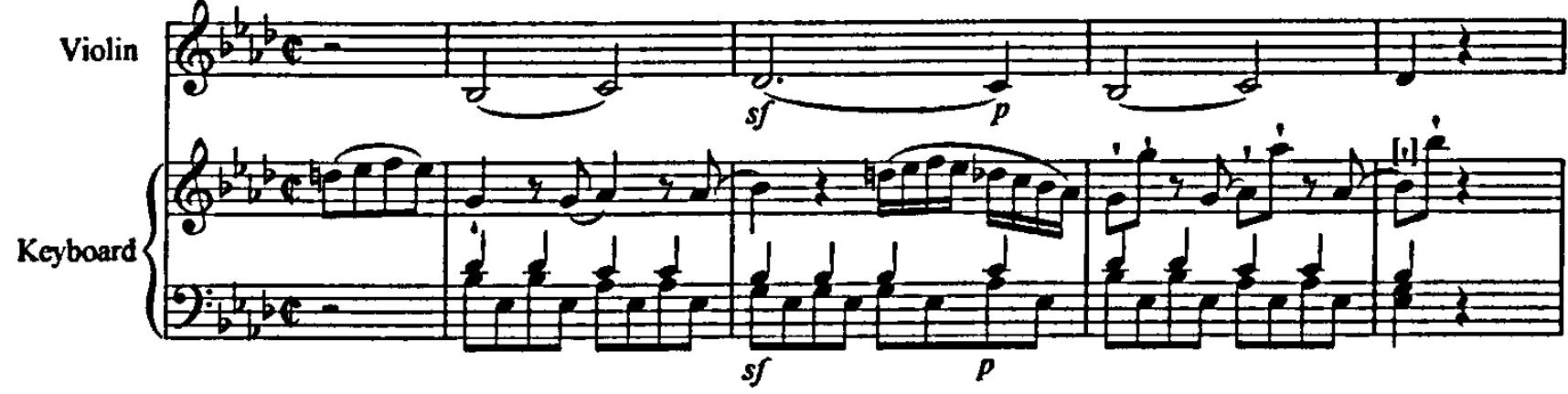
中文讲解
此条目是在 P0138 注释中提到的两个谱例的合并索引:在 Markdown 中以图像占位符出现,标题文字指明 example 5.69 取自 K481 第二乐章第 8–12 小节,example 5.70 取自同一乐章第 83–87 小节。它本身不携带新的论点,仅把读者引向上述两个具体的乐谱片段,以配合 P0138 中关于第 10 与第 85 小节的对比。
补充说明
占位符表明两份乐谱本身未以文字形式给出;具体音符、力度记号与跳音符号需查阅原 PDF/原书图像。
第3段(P0140)
原文复述
[Embedded image data omitted; position and generic caption retained: page-39 image or musical-score example.]
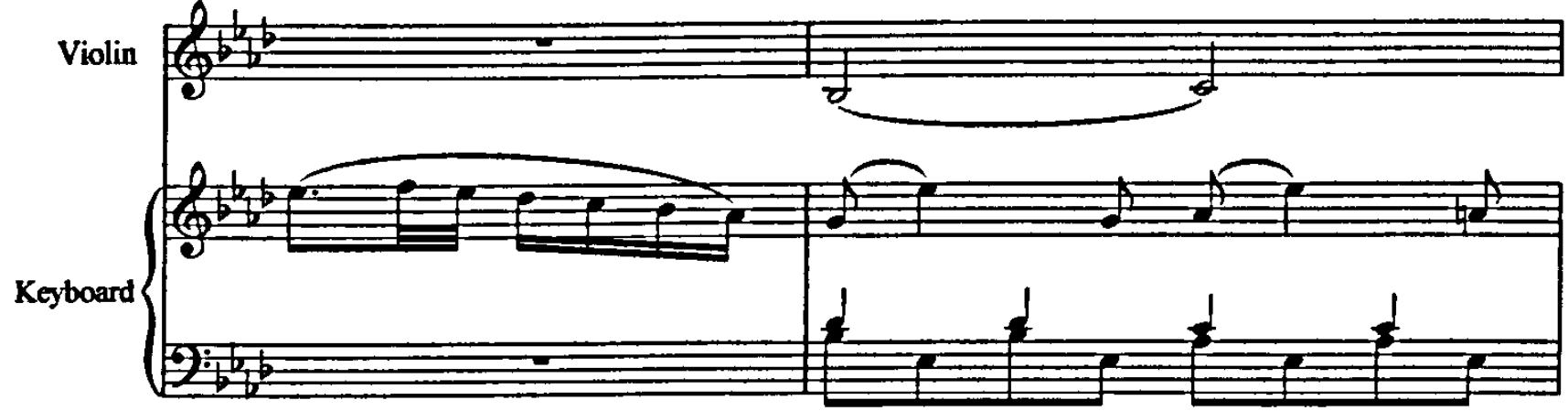
中文讲解
此条目为第 39 页某一图像/乐谱示例的内嵌数据占位符,原始图像信息未保留。从本节语境推断,它应与 example 5.69 或 example 5.70 之一对应,位于 K481 第二乐章 Adagio 的相关小节段落中,目的是让读者直观看到 P0138 描述的 sf、p、跳音与 mf 等记号。
补充说明
因输入仅指出"位置与图注保留"而未给出实际音符细节,任何关于拍号、临时记号、对位或奏法的具体描述均不宜补写;欲查证须回到原始图件。
第4段(P0141)
原文复述
[Embedded image data omitted; position and generic caption retained: page-39 image or musical-score example.]
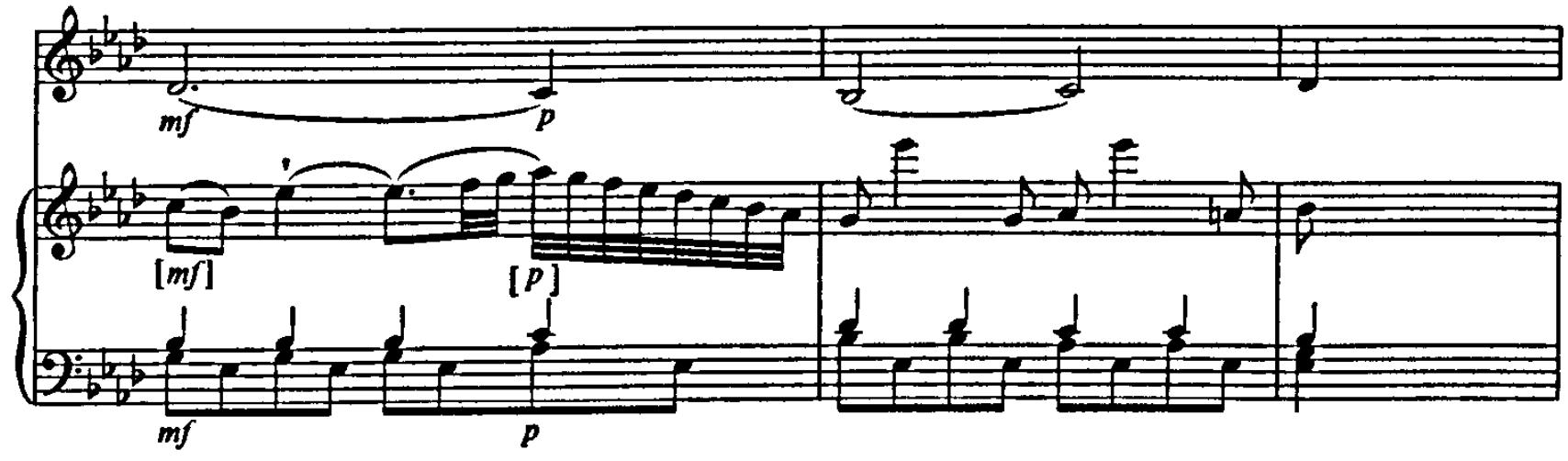
中文讲解
此条目为第 39 页另一图像/乐谱示例的内嵌数据占位符。与 P0140 平行出现,二者共同承担展示 example 5.69 与 example 5.70 的功能,即把 K481 Adagio 第 10 与 85 小节附近的力度标记和键盘声部跳音以可视方式呈现出来。
补充说明
同上:原始图像数据未保留,具体音符层面无法在本节文本内确认;读者需查阅原图像。
第5段(P0142)
原文复述
Footnote 73: Eisen asserts that, although bar 85 of the first edition is marked with sf, this could easily be due to a misreading of Mozart’s mf in the autograph, which is written ‘sloppily’ (Eisen, 2006: 108).
中文讲解
这条脚注是对 P0138 对比论证的一个文本批判性限定。Eisen 主张,初版(first edition)第 85 小节上印的 sf,很可能是抄写者误读了莫扎特手稿(autograph)里写得"潦草"的 mf;如果此说成立,那么 bar 85 与 bar 10 之间那层 sf/mf 之差就部分地来自版本流传中的讹误,而非纯粹出自莫扎特的本意。脚注的功能是给正文论证加一道护栏——它并未推翻 P0138 的演奏推论,只是提醒读者:所依据的力度对比,部分依赖于一种可能并不可靠的印刷版记谱。Eisen 2006 第 108 页是该论点的来源。
补充说明
在 P0143 总结段中,作者仍然以 sf/mf 已被印刷版固定下来的对比作为论据,因此本脚注是对论证强度的限定,而不是对其结论的撤销。
第6段(P0143)
原文复述
The foregoing examples accordingly demonstrate that Mozart uses emphasis to highlight and characterise phrase- and period-structures in his Sonatas for Violin and Keyboard. His carefully placed dynamic markings in the slow movements of the late sonatas dictate the Affekt of these points of emphasis; like accents, emphases themselves can be long or short, and they may begin and end either gradually or suddenly. It is through their varied rendition that the musical discourse acquires its drama and meaning. The importance of emphasis can be illustrated with a verbal analogy—Sheridan’s question, ‘Shall you ride to town to-morrow?’—since, just as shifting the stress from one word to another in a single sentence alters its meaning, altering the emphasis within a musical phrase can completely change its Affekt. The second phrase of the Adagio of K481 (example 5.69) consists of two bars of music that are essentially repeated, and the phrase’s emphasis falls at the end of the first group of two bars, on an E♭7 chord in bar 10. Although the material of bar 12 is a repetition of that moment of emphasis, Mozart’s markings make it clear that bar 12 should not receive a stress. Consider, by contrast, what Affekt would have resulted had the sforzando been placed at bar 12 instead of (or as well as) bar 10: putting the sf in the middle of the phrase would have produced a gentler ebb and flow, so that the repetition, rather than strengthening the phrase’s argument, would close as a question, yielding the gentle Affekt of doubt. Mattheson observes that questions in music may be represented, as is the case here, by an ‘imperfect consonance’ and by a ‘raising of the voice [in pitch]’ at the close of a phrase, because ‘in everyday speech and pronunciation the voice is always raised more or less with a question’ (Mattheson, 1739: 398). He adds, however, that questions need not always be rooted in doubt, and that ‘one must not therefore restrict oneself so strictly to the usual form with questions of this type.’ Had the emphasis instead been placed on bar 12 (example 5.71), the phrase would have ended ‘in an interrogative manner’ (Mattheson, 1739: 399), producing a dramatic Affekt comparable to that of bar 62 of the same movement, which is based on related melodic and harmonic material (example 5.72). Mozart’s actual placement of the emphasis at bar 10 therefore allows the movement to return to the dolce character announced at the opening and to proceed with a varied restatement of the first theme at bar 13; shifting the sf to bar 12 would have produced a more aggressive Affekt.
中文讲解
本段是整节的高潮段,把前文 P0138 与 P0142 所铺设的具体观察提升到对莫扎特奏鸣曲整体修辞策略的概括。中心主张有三层:①莫扎特把"重音"当作句法和曲式层级的修辞工具,用以勾画乐句与乐段的轮廓;②重音不是均质的瞬时撞击,而是有长度、有起音形状(渐进或突然)、有衰减曲线(长或短)的连续可塑形动作;③正是这种可塑形性,让同一段重复材料因为重音落点不同而呈现截然不同的 Affekt。
论证手法上,作者先用 Sheridan 的句法反问——“Shall you ride to town to-morrow?"——把语言学中重音改变句义的机制转译到音乐,使读者直觉地理解"在哪个位置施重"比"施加多大的力"更为关键;再以 K481 Adagio 第二乐句为反事实推演:这条乐句由基本重复的两小节构成,重音落在第 10 小节末的 E♭7 上,而第 12 小节虽然材料相同却被刻意不再施重,这种"重复但不再次重击"的设计让该乐句以"陈述—承接—疑问化"的方式结束,营造温柔而带犹疑的 Affekt。紧接着,作者用 Mattheson 1739 关于音乐中"疑问"的两个标志——不完全协和(imperfect consonance)与句末音高的上扬——为这种 Affekt 提供同时代的理论背书,并借 Mattheson 自己的限定(即疑问不必然等同于怀疑)打开另一种重音安排的可能性:若把 sf 挪到第 12 小节,结尾便会落入 Mattheson 所说的"interrogative manner”,得到更具侵犯性、更显著的戏剧化 Affekt,与同乐章第 62 小节那种基于相关材料的处理相似。
由此观之,本段在本节中承担两个收束作用:一是把 P0138 关于 bar 10 vs. bar 85 的微观比较,反推到关于"为何 bar 10 重而 bar 12 不重"的乐句结构层面;二是借 Mattheson 把当代理论与莫扎特实践双向锚定。容易误解之处在于:作者并不是主张音乐应当普遍以"疑问式"为目标,而是通过对比证明,把 sf 放在第 10 小节正是为了让该乐句保留 dolce 与开头的整体气质,并能在第 13 小节以变奏重复第一主题;如果挪到 bar 12,整体的 Affekt 会变得更强烈而有侵略性。Sheridan 的类比也应理解为一个教学桥梁,而不是语言学/语音学的实质论断。
补充说明
本段提到 examples 5.69、5.71、5.72 三处乐谱;其中 5.71 与 5.72 未在本节文本内提供图像数据,故无法在本栏做进一步描述。
脚注 / 边栏 / 图表 / 附加信息(如有)
本节的附加材料主要有两类:①脚注 73(P0142),引自 Eisen 2006 第 108 页,对 bar 85 力度记号的版本流传真伪提出质疑;②四组图像/乐谱占位符(P0139–P0141 及 P0143 中提到的 example 5.71 与 example 5.72),其中 P0139 是 example 5.69(K481 第二乐章第 8–12 小节)与 example 5.70(K481 第二乐章第 83–87 小节)的索引占位符,P0140、P0141 是第 39 页另两处图像数据的占位符。脚注 73 起到限定正文论证强度的作用;图像占位符的功能是为正文中关于 sf、p、mf 与跳音的具体位置提供视觉证据;example 5.71、5.72 由于图像数据未在本节文本内给出,仅以编号方式被引用。
💡 本节核心要点
- sforzandi 等力度指示不能被套用统一定义,而必须在每一具体语境中解读,这是本节的方法论前提。
- 在 K481 第二乐章 Adagio 中,每一处 sf 之后都跟随一个 p,因此该乐章中的 sf 在功能上等同于规定一条 diminuendo 弧线,而非单纯的瞬时撞击。
- 同一和声位置(第 10 小节与第 85 小节的 E♭7)可被赋予不同强度的重音:bar 10 的 sf + p 与 bar 85 的 mf + p 加上右手键盘第二拍的跳音,构成了一对关于"起音方式"与"力度峰值"的对照实验。
- 脚注 73(Eisen 2006)指出初版中 bar 85 的 sf 可能是把莫扎特手稿中潦草的 mf 误读而来,从而对 bar 10 vs. bar 85 的力度对比加上版本流传方面的限定。
- 莫扎特在奏鸣曲中把重音当作塑造乐句与乐段结构的修辞手段;重音可以是长的或短的,起点与衰减也可以是渐进的或突发的,正是这种可塑形性赋予音乐话语以戏剧与意义。
- K481 Adagio 第二乐句中把 sf 放在 bar 10 而非 bar 12,配合材料重复与不再次施重,使乐句以 Mattheson 所论的"疑问"方式收尾,营造温柔的犹疑 Affekt;把 sf 移到 bar 12 则会落入 Mattheson 所谓的 interrogative manner,得到更具侵略性的 Affekt。
🔑 关键术语
- sforzando (sf):一种力度指示符号,通常被理解为一种重音或突强,但本节强调其意义依赖上下文;在 K481 第二乐章 Adagio 中,sf 后必跟 p,因此 sf 在该乐章中功能上等同于规定一条 diminuendo 而非瞬时撞击。
- Affekt:本节用以指音乐瞬间所呈现的情感/表现性特征;作者认为 Affekt 不只由音高、和声决定,也由重音的落点、长度、起音与衰减形状所塑造。
- diminuendo:渐弱;在本节中指 bar 10 中 sf 之后跟随 p 所形成的力度下行曲线,而非瞬时的声音释放。
- imperfect consonance:Mattheson 1739 提出的术语,本节中用以指代被用来标志乐句"疑问式"收尾的一类协和度(如三度、六度等非完全协和),与句末音高抬升一起构成音乐中表示疑问的两大标志。
- K481:莫扎特《为小提琴和键盘而作的降 E 大调奏鸣曲》K. 481,其第二乐章 Adagio 是本节论证的主要实例,重点对比 bar 10 与 bar 85 的力度安排。
- stroke (跳音/楔形记号):键盘右手部分在 bar 85 第二拍上的跳音记号,作者用以论证该小节的 mf 力度峰值是逐渐到达而非立即出现,与 bar 10 sf 的瞬时撞击形成对照。
5.23 [描述性拆分] Introduction to the K296 analysis: applying accent and emphasis to a fast movement
第1段(P0144)
原文复述
Example 5.71: K481, movement 2, bars 8-12, to demonstrate the effect of altered emphasis. Mozart’s dynamics are indicated below the violin stave, while alternative dynamics are written above the stave.
中文讲解
这是一个图注(Example 5.71)。它告诉读者:接下来展示的是K481第二乐章第8至12小节,用来示范改变emphasis(强调)所产生的效果。版面安排上有一个关键细节——Mozart原本标注的力度记号位于小提琴谱表下方,而作者所提供的替代力度方案则写在谱表上方。这种上下对照的排版方式意味着本例的核心功能是“对比”:让读者直接看见Mozart原谱记号与作者建议的不同力度处理,从而体会同一种音乐素材在力度调整后所产生的不同emphasis效果。因此,这一图注本身就预告了作者要讨论的核心议题——演奏者对emphasis的二度诠释如何改变乐句的层次。
补充说明
图注中提到“alternative dynamics”,说明作者在本节后续会基于K481提出一套与Mozart原记号不同的力度建议;这与本节讨论“在缺乏演奏指示的乐章中如何运用accent与emphasis”的主题直接相关。
第2段(P0145)
原文复述
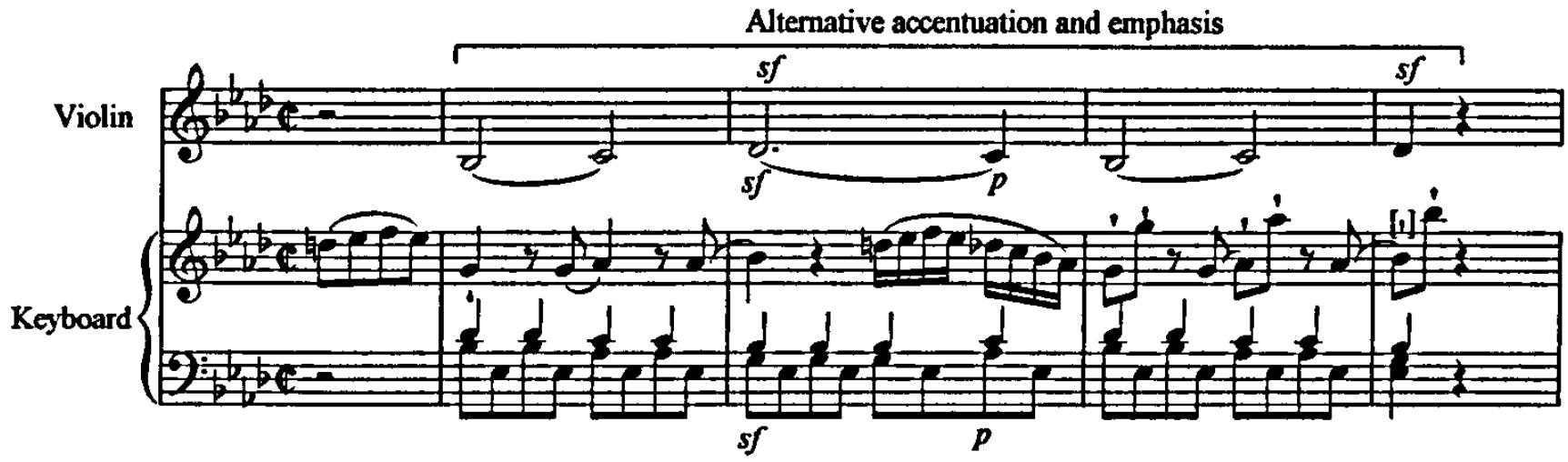
中文讲解
这是页41上Example 5.71所对应的图像/乐谱占位符。其内嵌提示保留“第41页图像或乐谱示例”的位置信息与图注信息,但图像本体不可读取。从图注可知,本图展示的是K481第二乐章第8至12小节的小提琴声部乐谱,并以小节上方的替代力度与下方的Mozart原记号形成对照。由于原文仅通过图注传达信息,图像内部具体的音符、力度记号位置与连线均无法从文本中确认,需查阅原书扫描图像。
第3段(P0146)
原文复述
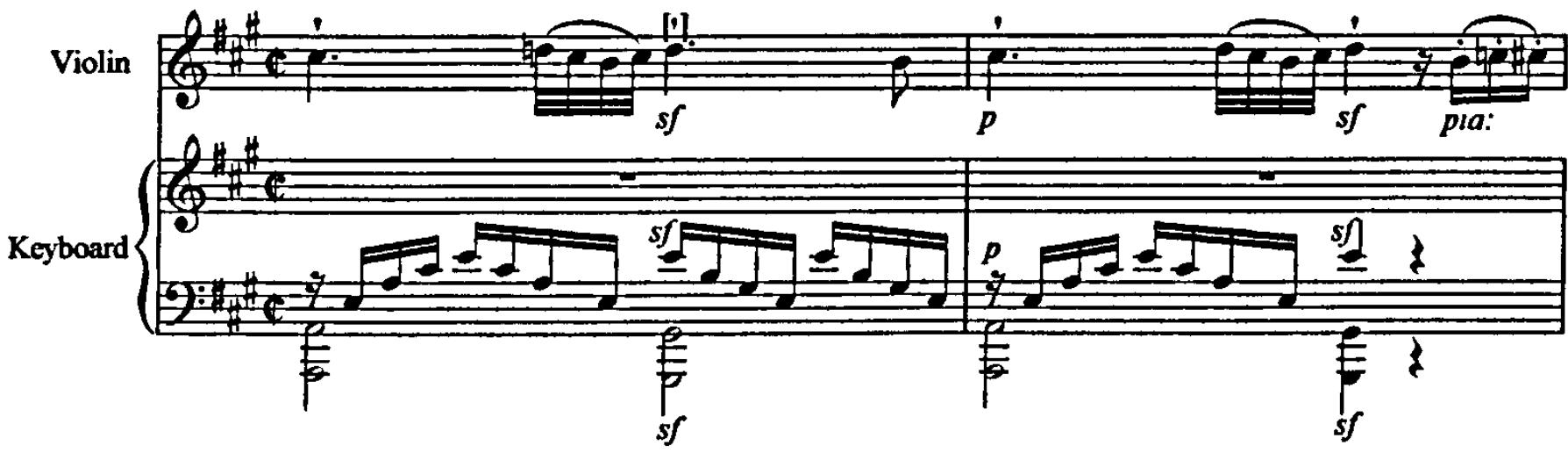
中文讲解
这是页41上Example 5.72对应的图像/乐谱占位符。从占位符中保留的标题信息可知:本例引用的是K481第二乐章第62至63小节,并冠以“The Application of Accent and Emphasis to K296”——也就是将K481的局部片段作为应用范例,借以过渡到对K296的分析。换言之,这一图例承担的是“桥梁”作用:它先呈现K481中经过作者标注accent与emphasis的样本,随后作者将同一套分析方法迁移到K296第一乐章这一演奏信息稀少的快板乐章中。
补充说明
占位符中保留了副标题“The Application of Accent and Emphasis to K296”,可视为本节核心论题的提示语。
第4段(P0147)
原文复述
In practice, accent and emphasis are co-existing facets of delivery. They both concern the hierarchy of stress given to the musical discourse, and are therefore subject to many of the same techniques of performance. We have seen that their differing functions are a result of the scale on which they occur in music and speech; while accent refers to the small-scale frequent stresses which are created by the syllabic inflexion of words (or musical motives), emphasis gives these words a hierarchy within sentences, and is therefore intrinsic to larger-scale phrasing. Mozart’s indications for accent and emphasis (which are represented by dynamic and accent markings, such as f, p, sf) have illustrated that compositional context is responsible for dictating phrasing hierarchies, and rhetorical theory has been seen to give further insight into the placement and Affekt of accents and emphases. By combining Koch’s theories of musical organisation, which define ‘musical sentences’, with information on poetic feet, which characterise the ‘musical words’ within these sentences, we can attempt to apply our knowledge of Mozart’s use of accent and emphasis to movements which are not rich in performance information. The first movement of K296 is one such work (appendix 3 should be consulted alongside the following analysis), and is cited here as an example of the application of accent and emphasis to a fast movement. Up to this point, emphasis has been described in relation to Mozart’s slower movements, with their often long-breathed cantabile melodies. As we have seen, the rendition of one point of emphasis within each phrase enhances this broad phrasing. In this fast movement, where phrases often consist of two contrasting incises (such as in bars 15 to 18), a more regular use of emphasis will help to convey energy and frequently changing character. Thus, following Sheridan’s observation that ’emphasis unites words together and forms them into sentences, or members of sentences’ (Sheridan, 1762: 57), there is often a case to be made for citing one emphasis per incise, rather than performing one emphasis per phrase.
中文讲解
这是本节的核心论说段落,功能相当于K296分析的“理论导言”。它包含多个层次:
-
概念区分:作者把accent(重音)与emphasis(强调)视为同一演奏现象的两个并存层面——它们都关乎音乐话语中应力(stress)的层级,因此受许多相同演奏技法支配;二者的功能差异源自它们在音乐与语言中所发生的尺度(scale)不同。accent指由词(或音乐动机)的音节屈折所产生的、小尺度、频繁出现的应力;emphasis则将这些词在句子内部组织成层级,因而属于更大尺度的乐句构造。
-
谱面来源:Mozart对accent与emphasis的指示以力度记号与重音记号(如f、p、sf)呈现,作者强调作曲语境决定乐句层级,修辞理论则进一步照亮这些重音/强调的位置与Affekt(情感色彩)。
-
方法论综合:作者将Koch关于音乐组织的理论(界定“音乐句子”)与关于诗步(poetic feet)的信息(刻画句子中的“音乐词”)相结合,构成一套分析工具,用以处理那些演奏信息稀少的乐章。
-
K296的引入:第一K296第一乐章正是这样一个信息稀少的作品;作者要求读者参照附录3,并将其作为“把accent与emphasis应用到快板乐章”的范例。
-
关键调整:在此之前,emphasis是相对于Mozart缓慢、长气息、如歌(cantabile)的乐章来讨论的,每个乐句内强调一次以增强宽阔的句法;而K296的快板乐章中,乐句常由两个对立的incise(短句片段)构成(如第15至18小节),更规律的emphasis使用有助于传达能量与频繁变化的性格。
-
Sheridan’s理论的转译:作者引用Sheridan 1762年《Lectures on the Art of Reading》第57页:“emphasis unites words together and forms them into sentences, or members of sentences”(emphasis把词联结起来,使之形成句子或句子的组成成分),并据此提出:在这种快板乐章中,往往可以论证为“每个incise 一次emphasis”,而不是“每个phrase(乐句)一次emphasis”。
这一段在本节中的功能是确立分析前提:解释为何在K296中要把emphasis的密度提高(从每句一次降为每个incise 一次),并把这一调整挂在Sheridan与Koch两条理论线索上,使后续逐小节分析具有方法论依据。
补充说明
段落中提到的Affekt是18世纪修辞—音乐理论中的核心概念,意指作品所欲传达的特定情感状态;“incise”是Koch乐句理论中的基本单位,相当于phrase之下的短句片段;“poetic feet”(诗步)在此被借用来度量音乐动机的内部轻重音结构,与脚注74中dash与semicircle的符号约定直接对应。
第5段(P0148)
原文复述
Although K296 was not published until 1781, it is dated March 1778, and is therefore directly contemporary with the Palatine Sonatas (K301 to K306). At the start of this chapter, examples from this set of sonatas demonstrated Mozart’s use f and p markings; while the second movement of K296 displays copious performance information of this type, the two outer movements are more barren. Indeed, Mozart only gives dynamic markings towards the end of the exposition, development and recapitulation in the first movement (at bars 44, 60, 96, 126 and 144). In spite of the lack of direct instructions for the use of dynamics and accentuation, various elements of Mozart’s compositional language highlight where and when these details of delivery should be added by the performer.
中文讲解
本段为K296的分析提供历史与谱面事实背景。关键信息包括:
-
创作与出版年代:K296虽至1781年才出版,但实际创作日期为1778年3月,因此与“帕拉蒂尼奏鸣曲”(Palatine Sonatas,即K301至K306)属于同一时期。这一时间定位使读者能够预期:K296与那些作品中观察到的力度处理惯例之间具有可比性。
-
谱面信息的反差:作者将K296第二乐章(演奏信息丰富)与第一、第三乐章(信息匮乏)作了对照——第一乐章中Mozart仅在呈示部、发展部与再现部临近末尾处给出力度记号,具体位置是第44、60、96、126与144小节。换言之,除了这五处之外,全曲大部分小节缺乏直接的力度或重音标记。
-
由此引出本段的核心论点:尽管直接演奏指示稀少,但Mozart作曲语言中的诸多要素仍然能够提示演奏者“何处、何时”应当补充力度与重音细节。这是接下来逐小节分析的合法性来源——作者主张从作曲文本本身(而非单纯的主观诠释)抽取演奏建议。
补充说明
“Palatine Sonatas”得名于帕拉蒂尼选帝侯(Kurfürst Karl Theodor von der Pfalz),Mozart于1778年初随母亲赴 Mannheim—Paris 旅行时所作;本段仅说明K296与这组奏鸣曲属同一时期,并未进一步讨论选帝侯或旅行背景。
第6段(P0149)
原文复述
The first two bars of this movement constitute what Koch describes as a ‘complete idea’; a short phrase, ending firmly on the tonic chord of C major. The assertive and confident material of the first two bars outlines the tonic triad of C major, each note being played at octaves between the keyboard and violin parts. Slurs in the keyboard right-hand part starting on beats 1 and 3 create the aural effect of the dotted-crotchet quaver rhythm which is heard in the left-hand and violin parts, and they imply accents at the start and middle of each bar. The strongest of these accents – the emphasis of this two-bar phrase – should be the first note of the piece. ⁷⁴
中文讲解
本段是K296第一乐章分析的起点,针对开头两小节做逐层剖析:
-
句法定位:作者借用Koch的术语,将前两小节定性为一个“完整乐思”(complete idea)——一个稳固终止于C大调主和弦的短乐句。
-
织体与音色布局:前两小节的主题材料自信、肯定,勾勒出C大调的主三和弦;每个音都在键盘与提琴声部之间以八度关系同时奏出,形成饱满的开场音色。
-
节奏与重音来源:键盘右手声部从小节第一拍与第三拍开始的连线(slurs),制造出与左手及小提琴声部相同的附点四分音符加八分音符(dotted-crotchet quaver)节奏的听觉印象,并暗示每小节开端与中部各有一个accent。
-
emphasis的落点:在这些隐含accent中,最强者——即这一两小节乐句的emphasis——应当放在全曲的第一个音。
因此本段的论证逻辑是:由作曲技法(八度齐奏、连线造成的节奏幻象)推出accent位置,再由Koch“完整乐思”的尺度上升至emphasis层级,最终指出全曲首个音即为该乐句的emphasis所在。这一论断为本节后续的逐句分析确立“开篇即高点”的处理原则。
补充说明
本段末尾的“⁷⁴”指向脚注74,对符号系统(dash、semicircle、=、方括号、三角形、方形)作图例说明。
第7段(P0150)
原文复述
⁷⁴ Again, dashes and semicircles are used to indicate the strong and weak syllables of each poetic foot, and = is used to mark the point of emphasis within each phrase or incise. Square brackets above the stave are used to define each incise, and Koch’s symbols (triangles and squares) are used to indicate the end of incises and phrases.
中文讲解
这是脚注74,对本节后续分析示例中所使用的图示符号系统作集中说明。其规定包括:
- 诗步符号:dash(短横线)与semicircle(半圆)分别标记每个poetic foot(诗步)中的强音节与弱音节。
- emphasis标记:等号“=”标示phrase或incise内部的emphasis位置。
- incise界定:谱表上方的方括号(square brackets)界定每个incise的起止。
- Koch符号:Koch所定义的三角形与方形分别标示incise与phrase的结束。
此脚注的功能是为读者阅读附录3及后续谱例提供解码钥匙;它本身不对正文主张作支持、限定或反驳,仅属于符号约定说明(即“图例”性质)。
脚注 / 边栏 / 图表 / 附加信息(如有)
本节包含两个乐谱图例(Example 5.71,K481第二乐章第8–12小节;Example 5.72,K481第二乐章第62–63小节),以及一处脚注(图例74,规定dash、semicircle、=、方括号、三角形、方形等符号的用法)。两幅图例的功能是为K296分析的“应用阶段”提供示范样板——以K481中已完成的accent/emphasis处理作为方法论原型,再迁移到K296。脚注74则属于符号约定说明(gloss),不参与论证。
💡 本节核心要点
- accent与emphasis是同一演奏现象的两个并存层面:前者属小尺度、对应词(或动机)的音节屈折;后者属大尺度、对应乐句内部的层级组织。
- 分析框架由两条理论线索综合而成:Koch的“音乐句子”理论提供乐句/incise的层级结构,poetic feet(诗步)理论提供动机内部的轻重音度量。
- K296第一乐章在谱面上力度信息稀少(Mozart仅在第44、60、96、126、144小节给出力度记号),因此作者主张从作曲语言本身(如八度齐奏、连线造成的节奏幻象)抽取演奏建议。
- 快板乐章(如K296第一乐章)中,乐句常由两个对立的incise构成,作者据此提出“每个incise 一次emphasis”的处理原则,以替代慢板乐章中“每个phrase 一次emphasis”的旧做法。
- K296创作于1778年3月,与帕拉蒂尼奏鸣曲(K301–K306)属同一时期,因此其演奏处理惯例可与那组作品相互参照。
- 开篇两小节作为Koch意义上的“完整乐思”,其emphasis落在全曲第一音;本节的逐句分析由此建立“开篇即高点”的处理原则。
🔑 关键术语
- accent:在本节中指小尺度、频繁出现的应力,源自词或音乐动机音节屈折所形成的强弱对比,对应谱面上的力度或重音记号(如f、p、sf)。
- emphasis:在本节中指大尺度上对乐句内部层级关系的强调,使若干词或动机在句子中取得突出地位;本节主张在K296这样的快板乐章中,每个incise 安排一次emphasis。
- incise:Koch乐句理论中的基本单位,相当于phrase之下的短句片段;本节以谱表上方方括号界定,并依Sheridan的理论作为emphasis所归属的尺度。
- complete idea (Koch):Koch术语,指一个具有完整意义并以稳定终止结束的短乐句;本节将K296第一乐章前两小节定性为这样的单位。
- poetic feet:诗步,传统诗律学中度量重音—轻音交替节奏的单位;本节借用其术语(dash表强音节、semicircle表弱音节)来刻画音乐动机的内部轻重结构。
- Affekt:18世纪修辞—音乐理论中的概念,指作品所欲传达的特定情感状态;本节中用以指明accent与emphasis的布置服务于特定的情感传达。
- Palatine Sonatas:Mozart于1778年旅行期间创作的六首奏鸣曲(K301–K306),得名于帕拉蒂尼选帝侯;K296与之属同一时期,谱面惯例具有可比性。
5.24 [描述性拆分] Accent and emphasis in the opening phrase of K296, movement 1
第1段(P0151)
原文复述
The opening beat emerges as the most forceful moment of the phrase for two combined reasons: it is articulated by a triple-stopped violin chord, and, because it stands at the head of a descending sequence, it lies in a higher tessitura than the rest of the phrase. Within bar 1, the dotted rhythm generates a trochaic metrical foot (– v), which Mattheson characterises as ‘running’ or ‘dancing and singing’ (Mattheson, 1739: 353). For subject matter of such energetic character, Cicero prescribes a manner of delivery that is ‘intense, vehement, eager, with a sort of impressive urgency’ (Cicero: III.lviii.219), while Le Faucheur describes a confident vocal tone as sounding ’loud’ and ‘strong’ (Le Faucheur, 1727: 99). The full textural density here does indeed imply a loud dynamic, and the half-bar accents could be attacked with a percussive, decisive onset — an articulation that mimics ’explosive consonants’ would further reinforce this Affekt. Although the peak of emphasis falls at the start of bar 1, this energetic character should be sustained throughout the entire phrase. To transmit the intensity and strength identified by Cicero and Le Faucheur, the resonance of each individual accent should not decay too rapidly.
中文讲解
这一段集中解释 K296 第一乐章开篇动机中"第 1 拍之所以是全句最强重音"的两层物理原因:一是小提琴用三音和弦(triple-stopped chord)奏出该音,能量密度最高;二是该音作为"下行模进"(descending sequence)的起点,所处音区(tessitura)高于后续各音,因此听感上更突出。作者进一步把第 1 小节的附点节奏分析为抑扬格音步(trochaic foot, – v),并征引 Mattheson 的修辞学分类,论证这种节奏在 18 世纪话语体系中属于"奔跑/歌舞"性质,因此本身就携带"energectic"的修辞意味。
在情感投射(Affekt)层面,本段同时援引 Cicero 与 Le Faucheur 两条 18 世纪演说学权威——Cicero 用"intense, vehement, eager"等词汇界定"有威势"的发声方式,Le Faucheur 则将"confident"的声音描述为"loud and strong"。这两条引语的功能不是简单的装饰,而是为演奏中的"强音具有穿透力"这一主张提供历史语境的合法性。
作者由此归结出三层演奏指示:(1)整体力度应偏 loud;(2)半小节位置的重音应采用"打击性、明晰的起音"(percussive and definite start),其修辞原型是"爆破辅音"(explosive consonants),即 t、k、p 等带短促爆发的音,借此把演说学翻译成具体的弓速/触键方式;(3)每个重音的衰减不应过快,否则无法维持 Cicero/Le Faucheur 所描述的"强烈而急切"的语调。值得注意的是,“最大强调在第 1 拍,但全句都应保持这一 energetic character"这一表述,是为接下来第 2 小节开始的衰减以及第 3 小节突然转柔所做的铺垫,本段在结构上承担着确立"第一乐句的修辞底色"的功能。
补充说明
本段中的 trochaic foot (– v) 即重音落在长音符或第一个音符上的二拍音步,与下一段即将讨论的 dactylic foot (– v v) 形成结构对照;二者的差别正是本节论证轴心。Mattheson 的出处页码 353 指向 Der vollkommene Capellmeister (1739) 中讨论节奏与情感对应关系的章节,但本节并未提供这一外部信息。“Explosive consonants"作为类比,是本段将抽象的 Affekt 转化为可操作的弓法/触键术语的关键枢纽,值得在演奏分析时单独标记。
第2段(P0152)
原文复述
Three quaver upbeats to bar 3 usher in a new two-bar phrase with a contrasting character. The texture here is thinner — the violin drops out — and the gap between the left- and right-hand keyboard parts narrows, both of which point toward a quieter dynamic. Slurs once again indicate the rate of accentuation by marking the start and middle of bars 3 and 4. In bar 4 a chromatically raised C♯ launches a new melodic shape: an ascending motive. According to Leopold Mozart, a chromatically raised note should be played ‘rather more strongly’ (L. Mozart, 1756: 218); here it therefore becomes the point of emphasis from which the remainder of the bar is phrased away. Despite the piano dynamic, the rhythmic feet of this phrase imply that the accents of bars 3 and 4 should be less percussive and energetic than those of bars 1–2. Paired slurs combined with appoggiaturas in bar 3 suggest a tender, yearning Affekt, and the articulation scheme of two slurred quavers followed by two detached quavers produces the auditory impression of a dactylic foot (– v v). The same foot is implied in bar 4 by the placement of dissonance: the downbeat of bar 4 is strong, while the second beat is weakened through the syncopated rhythm of the keyboard right hand. Both beats 3 and 4 carry on-beat dissonance, in the form of 4–3 and 6–5 appoggiaturas respectively. The structural rhythm produced by dissonance in bar 4 is therefore a minim followed by two crotchets — an augmentation of the dactylic foot that appears twice in bar 3. According to Mattheson, this foot is appropriate for both ‘serious’ and ’light-hearted’ melodies (Mattheson, 1739: 355); in the present context it expresses a serious character and should be delivered with a gentle articulation. The contrast between this tender phrase and the rhythmic drive of bars 1–2 can be heightened not only by varying the attack but also by lengthening the C♯ emphasis at the start of bar 4.
中文讲解
本段转入对第 3–4 小节"第二短句"的描述,并与上一段构成明确的对仗。第 3 小节前三个八分音符的上拍(quaver upbeats)被作者视为"引入新性格"的过渡装置,新性格由三组可观察的迹象确立:(a)小提琴休止,织体(texture)变薄;(b)左右手键盘声部之间的间距收窄,听感上力度变弱;(c)连线(slurs)依然标在第 3、4 小节的开头与中点,提示重音出现的速率较前句更均匀。
段落的论证核心是第 4 小节升半音的 C♯。它一方面在旋律形态上启动了一个新的上行动机(ascending motive),另一方面根据 Leopold Mozart 的规则(1756: 218)——“升半音的音应奏得’略强’"——成为这一短句的最高强调点,后续各音均需从它"phrased away”(朝下释放)。作者特意提醒:尽管整体力度为 piano,重音依然存在,只是变得更柔、更非打击化(less percussive and energetic)。
本段最精彩的方法论展示是对"扬抑抑格”(dactylic foot, – v v)的双重论证。第一条路径来自第 3 小节的演奏配置:两条连线接两条跳音本身就制造出"一长两短"的听觉等值;第二条路径则来自第 4 小节的和声——通过分析不协和音(dissonance)的位置,作者指出第 1 拍强、第 2 拍因右手切分音而弱,第 3、4 拍又各有落在拍上的 4–3 与 6–5 倚音,因此第 4 小节的"结构节奏"实质上是"一个二分音符接两个四分音符”,即第 3 小节 dactylic foot 的扩大化(augmented)。这一推论是本段最关键的逻辑点:演奏者不能只靠连线来感知节奏脚,还应通过不协和的安放位置来"读出"同一个脚。
Mattheson 在 1739: 355 把这种脚同时归属于"严肃的"与"轻快的"两类旋律,作者据此判断本处属于前者,演奏应采取"温柔"(gentle)的咬字/起音。最后,作者回到第 4 小节开头 C♯ 的处理——除了变换触键(varying attack)之外,还应"延长"(lengthening)该强调点的时值,以放大与第 1–2 小节动力性之间的反差,呼应全曲论证核心:演奏重音不能只看力度,更要看节奏脚、织体密度与时值长度三者的协同。
补充说明
本段交叉援引两位 Mozarts(Leopold 与 Wolfgang)的著作是论证技巧的关键。Leopold Mozart 引语的作用是为一个具体音(C♯)的稍强处理提供 18 世纪乐器教学传统的合法性,从而把单独一个升高半音转化为有据可循的演奏指令;而 Mattheson 的 dactylic 论述则为整个短句的性格定位提供框架。两人一具体一抽象,互为支点。
“On-beat dissonance”(拍上的不协和)与"syncopated rhythm"在本段中并非互相排斥的现象:第 2 拍被切分而弱化,是因为声部间的错位让原本的强拍位置落入弱拍;第 3、4 拍的 on-beat dissonance 则重新把"结构重音"拉回到拍点上。两者的合力使得第 4 小节呈现出一条"弱—强—强"的非均匀形态,正是 dactylic foot 的放大。
💡 本节核心要点
🔑 关键术语
5.25 [描述性拆分] Accent and emphasis in the repeated and contrast theme of K296
第1段(P0153)
原文复述
At bar 5 the music of bars 1 to 4 is repeated, so that the gentle cadence of the second phrase is cut short by the return of bar 1; the two themes together form what Koch calls a compound phrase (1787: 3), which now converges on the downbeat of bar 5. At bar 9 a new theme appears (which itself creates another compound phrase) and sets up an energetic dialogue between the violin and the keyboard. Although bars 9 to 14 recall something of the bold arpeggios of the opening theme, the more intricate texture perhaps requires a slightly quieter dynamic than the start of the movement, in order to preserve clarity. This phrase is built from a two-bar incise that is repeated three times (bars 9–10, 11–12 and 13–14), thereby illustrating Koch’s account of how a phrase may be extended by repetition (Koch, 1787: 43). The ascending triads played by the violin and by the right hand of the keyboard (for instance in bar 9) each receive an accent on their first note. The final note of the arpeggio is also accented, because of the trill and its written-out termination, which gives direction to the third crotchet of the figure. The result is an accentuation on beats 1 and 3, distributed in dialogue between the two instruments. Because the two bars are harmonically static, it is their melodic shape and their rhythmic variety that give them their character. Rising figures in bar 9 are answered by falling figures in bar 10; by taking the downbeat of bar 10 as the point of greatest emphasis, the ascending triads acquire a sense of arrival, and the descending figures are given an impulse from which they can respond.
中文讲解
本段把注意力从K296第1–8小节的句法结构转向第9小节起新材料内部的力度与重音处理,作者用三层信息来组织论述:
- 句法位置与新材料:第5小节处第1–4小节被重复,导致第1乐句原本温和的下行收束被突然打断,作者引用Koch 1787年第3页的“compound phrase(复合乐句)”概念,把这两个主题视为一个整体结构,并强调它们共同收束到第5小节的强拍上。第9小节引入新主题,形成又一个复合乐句,开启小提琴与键盘之间的“energetic dialogue(充满能量的对话)”。
- 演奏力度的建议:作者注意到第9–14小节虽然让人联想到开头主题的大胆琶音,但织体更复杂,因此建议演奏采用比乐章开头略轻的力度(a slightly quieter dynamic),以便保持清晰度——这是一个把音乐分析与演奏实践直接挂钩的判断。
- 两小节乐节的重复与重音安排:这两小节的核心材料是一个“two-bar incise(两小节乐节)”,它被重复三次(第9–10、11–12、13–14小节),对应Koch 1787年第43页所述的“通过重复扩展乐句”。在这个乐节内部,作者指出小提琴与右手键盘声部的上行三和弦(例如第9小节)均在第一个音上获得重音;琶音的最后一个音也因颤音及其written-out termination(写明的终止)而获得重音,从而把图式的第三四分音符“带向”结尾音。结果是节拍1和3被同时强调,形成两个乐器之间的对位式重音格局。
- 和声静态下的表现力来源:因为这两小节在和声上是静态的(harmonically static),其性格必须依靠旋律轮廓与节奏变化来塑造。第9小节的上行形态与第10小节的下行形态构成呼应关系;若把第10小节的强拍视为整段中“最具强调力的点”,则第9小节的上行三和弦会获得“到达感”(sense of arrival),而第10小节的下行形态则获得“得以回应”的推动力。
这一段的论证价值在于:把Koch的句法理论、具体的力度与重音指示、以及演奏上的可操作建议三层合并起来,使读者既能在结构层面理解第9小节起的材料,也能在微观层面理解每个三和弦与颤音终止所承担的重音功能。
第2段(P0154)
原文复述
The poetic feet (Versfüße) of this two-bar incise help once again to clarify the Affekt of the accents in question. Applying the theory of intrinsic strength, the violin and right-hand parts of bar 9 can each be read as one of two possible feet. Taken separately, the violin and the keyboard each play the amphimacer foot (– ⏓ –), which Mattheson calls an energetic foot ‘thus named from pitched battles and fights’ (1739: 357). However, since the strong beats played by the two instruments coincide, producing accents on beats 1 and 3 and weakness on beats 2 and 4, the poetic foot in each bar may equally be described as a trochee (– ⏓), the foot Mattheson recommends as appropriate for ‘running’ or for ‘dancing and singing’ (1739: 353) and which, as we have already seen, is the foot used at the start of the movement. The triadic motive is answered in bar 10 by a paeon the fourth (⏓ ⏓ ⏓ –), which Mattheson regards as suitable for ‘songs of praise’ (1739: 359). The ‘lofty, magnificent, noble’ tone that Le Faucheur considers necessary for the praise of ‘brave men’ (1727: 107) is appropriate here, and may be conveyed by accents that draw on depth of sound rather than on percussive attack. At the same time, the performer should take care to characterise the different appearances of this two-bar incise: the C major renditions (bars 9 and 13) ought to sound more positive than bar 11, in which the rising motive is heard as a second-inversion F major triad.
中文讲解
本段继续上一段关于重音的话题,但把分析工具从Koch的句法转向18世纪关于“诗性节拍”(poetic feet / Versfüße)和“内在力度”(intrinsic strength)的修辞学理论。其论证结构可分为三个层次:
- 两种诗性节拍的双重解读:作者提示同一段音乐可以按不同的诗性节拍来理解。一方面,若把小提琴与右手键盘声部分开来看,两者各自演奏的是amphimacer(– ⏓ –,长短长或长短短)这一“充满能量的”节拍,Mattheson 1739年第357页解释其名称源自“pitched battles and fights(激战与格斗)”;另一方面,由于两件乐器各自的强拍位置恰好对齐——节拍1和3被同时强调,节拍2和4则被弱化——所以从每小节整体看,又可以视作trochee(– ⏓,扬抑格)。这种双重解读让重音同时具有“搏斗”的能量感和“奔跑/歌舞”的流动性,作者特别提醒trochee正是乐章开头所用的节拍(Mattheson 1739: 353),从而把第9小节起的材料与开头的Affekt联系在一起。
- 第10小节的“praise(赞美)”Affekt:第10小节被作者归为paeon the fourth(⏓ ⏓ ⏓ –,三个短音后跟一个长音),Mattheson 1739年第359页把它与“songs of praise(赞歌)”相联系。作者进一步引述Le Faucheur 1727年第107页关于“lofty, magnificent, noble(崇高、华贵、庄严)”的颂扬语调,用于赞颂“brave men(勇者)”,并由此得出演奏建议:这种重音应当依靠“depth of sound(声音的厚度)”而不是“percussive attack(打击性的触键)”来实现,也就是说,重音应在音色与共鸣上体现,而非通过硬撞琴键来表达。
- 三次重复之间的性格差异:最后作者给出一条演奏提醒:同一个两小节乐节的三次重复不应被处理得完全一致。其中第9小节和第13小节是C大调呈现,应听起来更明亮、更肯定(more positive);而第11小节中那个上行动机实际上呈现为F大调的second inversion(第二转位),色彩更暗或更不稳定,因此在性格上应有所区别。
整段把18世纪的诗性节拍、Affekt理论与具体的力度/音色演奏建议整合起来,论证这一对两小节乐节既具有“能量+赞美”的复合情感色彩,又通过重复之间的调性差异制造微妙的性格变化。
脚注 / 边栏 / 图表 / 附加信息(如有)
本节内引用的文献条目均以脚注形式出现:Koch 1787年第3页(compound phrase 概念)、第43页(通过重复扩展乐句);Mattheson 1739年第357页(amphimacer 与搏斗)、第353页(trochee 与奔跑、歌舞)、第359页(paeon the fourth 与赞歌);Le Faucheur 1727年第107页(崇高、华贵、庄重的颂扬语调)。这些文献在节内充当“理论支持”而非“史料旁证”,用于把具体的重音处理与18世纪的Affekt—Versfuß学说直接对接。
💡 本节核心要点
- 第9小节起的新主题通过两小节乐节的三次重复(第9–10、11–12、13–14小节)构成Koch意义上的“复合乐句”和“通过重复扩展的乐句”。
- 小提琴与右手键盘声部在节拍1和3上同时形成重音,制造出两件乐器之间的“对位式对话”力度格局,第9小节的上行与第10小节的下行构成“到达—回应”的呼应关系。
- 由于这两小节在和声上是静态的,其表现力主要来自旋律轮廓与节奏变化,演奏上需要更轻的力度以保持织体清晰。
- 运用诗性节拍理论时,同一段材料既可被解读为amphimacer(能量、搏斗),也可被解读为trochee(奔跑、歌舞),且trochee正是乐章开头所用的节拍。
- 第10小节的praise(赞歌)Affekt应通过声音的厚度而非打击性触键来表达,以呼应Le Faucheur所主张的颂扬语调。
- 三次重复之间须做性格区分:C大调的第9和第13小节应更明亮肯定,而第11小节中的第二转位F大调呈现应相应更暗或更不稳定。
🔑 关键术语
- compound phrase:Koch 1787年提出的句法概念,指由两个或更多主题/乐句组合而成的更大结构单位;在本节中用于说明第5小节处第1–4小节与第9小节起的两个主题各自如何形成一个复合乐句。
- extension of a phrase by repetition:Koch 1787年第43页所述的乐句扩展手段,即第9小节起的两小节乐节通过三次重复(第9–10、11–12、13–14小节)实现结构延展。
- two-bar incise:由两小节构成的最小乐思单位,是第9小节新主题的细胞,通过重复与微妙的性格差异承担整个第9–14小节的表现力。
- written-out termination (of a trill):把通常以符号缩写的颤音及其收束完整写出,本节中它使琶音的最后一个音获得重音,从而把图式的第三四分音符“带向”结束音。
- poetic foot (Versfuß) / amphimacer / trochee / paeon the fourth:18世纪音乐修辞学借用古典诗学节拍来分析旋律节奏与情感的单位。Amphimacer(– ⏓ –)被Mattheson与搏斗能量联系;trochee(– ⏓)与奔跑、歌舞联系;paeon the fourth(⏓ ⏓ ⏓ –)与赞歌联系。本节用它们说明第9–10小节的重音与Affekt。
- intrinsic strength:Mattheson理论中音本身的“内在力度”,指不依赖外部记号、仅凭音在节拍中的位置和时值而产生的强弱倾向;本节据此解释为何两个声部的强拍会重合。
- Affekt:18世纪美学—修辞学的核心概念,指音乐所应传达的具体情感状态;本节通过amphimacer的“搏斗”、trochee的“奔跑/歌舞”与paeon the fourth的“赞歌”来说明同一材料的多重情感指向。
- second inversion (F major triad):三和弦的五音置于低音的排列方式;本节指出第11小节的上行动机以F大调第二转位呈现,因此在三次重复中色彩与C大调(第9、13小节)不同,演奏上应作区分。
5.26 [描述性拆分] Spondees, proceleusmaticus, and pyrrhic feet in the K296 incises
第1段(P0155)
原文复述
The paeon in the violin part at the end of bar 14 breaks into the repetitions spanning bars 9 to 14, propelling the movement into its next incise. The right-hand passagework is supported by full chords and a sustained violin line, recalling comparable textures found in K301-306 (cf. examples 5.11-5.14). As previously noted, Mozart frequently marks such a texture f, a dynamic that would certainly amplify the exuberant character at this point. The violin establishes a minim pulse in bars 15 and 16, yet because no bass note occurs in the middle of these bars, the first minim of each bar ought to be stronger than the second. Our earlier examination of rhetorical figures in connection with articulation has shown that repetition commonly serves emphasis; the same applies here. Consequently, the altered repetition (or, in rhetorical terminology, synonymia) of bar 15 in bar 16 makes the opening of bar 16 the point of emphasis within this two-bar incise. This reading is further supported by the higher tessitura of the right-hand theme in bar 16 and by the use of chord VI, which yields a stronger harmonic progression than chord I would have provided. The rhythmic foot of the violin part at this juncture is a spondee (- -), characterised as ‘devotional’ and ‘devout’, and it complements the paeon figures in the keyboard’s left-hand part. The accents ought to be expansive and long, not dying away too rapidly after the initial attack.
中文讲解
本段讨论的是K296第15–16小节两小节乐思单元(incise)的内部结构与演奏处理。中心主张是:尽管第15与16小节在表面上构成一组重复,但通过修辞手法synonymia(变化重复)、更高的右手音区以及从一级和弦改为六级和弦这三条线索,作者把重音支点从第15小节转移到了第16小节的开头。
承接关系上,本段紧接前文对第14小节末尾小提琴paeon(四音节格)的讨论——那个paeon打断了第9–14小节的反复模式,将乐句推进到下一乐思单元,从而把分析焦点切到15–16。需要注意的是,作者提醒读者:第15–16小节的小提琴声部是二全音符(minim)脉动,而低音在每小节中间缺失,因此每小节头一个二全音符应当比第二个更强。这是从织体判断强弱重音的依据之一,而非随意添加。
关键的修辞概念是synonymia。作者把音乐上的“变化重复”对应到古典修辞学的同名格,强调重复本身就是强调手段,而当第16小节以更高的音区出现、并用chord VI替代可能的chord I时,harmony上的推进也支持这一重音后移。因此演奏上,第16小节起拍应被视作这两小节单元的高点,而不是第15小节。
在韵律脚方面,小提琴声部被识别为spondee(扬扬格 – –),作者直接引用“devotional”/“devout”这一术语强调它的庄重、虔敬色彩。它与左手声部的paeon(四音节格)在性格上互补:一个是长音的稳重,另一个是流动的活跃,从而在键盘内部形成节奏对比。
演奏建议上,作者明确:这里的重音应当“宽广而长”,不能一击之后迅速衰减——这与spondee的庄重性格一致,也与“f的力度配以欢腾性格”的整体语境相符。
补充说明
本段中的spondee(– –)、paeon、synonymia等术语均按原文所给的定义使用;K301-306和examples 5.11-5.14是作者前后文中的既有参照,不在本段内展开。
第2段(P0156)
原文复述
In response to this two-bar incise, Mozart introduces a new rhythmic foot. A proceleusmaticus comprising four semiquavers (v v v v) followed by a pyrrhic foot of two quavers (v v) clearly defines the half-bar harmonic rhythm of bar 17, thereby producing accents on beats 1 and 3 that propel the phrase toward a C major cadence. These poetic feet are described as ‘a commanding, rousing cry’ (Mattheson, 1739: 361) and as being performed ‘quite quickly and vigorously’ (Mattheson, 1739: 351). Indeed, without the sustained violin writing of bars 15 and 16, the effect here is more contained and incisive, exhibiting a narrow melodic range and short punctuating chords in the accompanying parts. In fact, the decreasing length of these accompanying chords—from crotchets followed by crotchet rests (bar 17), to quavers followed by quaver rests (bar 18)—suggests that the phrase could conclude with a diminuendo. The opening of this incise, the downbeat of bar 17, is therefore the point of emphasis. The accents should be ‘vigorous’ and percussive, with a quick release of sound, yet within a fading dynamic.
中文讲解
本段处理的是K296第17小节起的回应性乐思单元,分析重心放在节奏脚(rhythmic foot)如何规定重音位置和演奏性质。中心主张是:Mozart在这里引入了一组新的韵律脚——proceleusmaticus(四个十六分音符,v v v v)接以pyrrhic foot(两个八分音符,v v)——它在第17小节清晰地勾画出半小节一单位的和声节奏,因而把重音锁定在第1拍和第3拍,推动乐句走向C大调终止。
与前一段(第15–16小节)相比,本段的织体发生了明显转折:去掉了小提琴的持续长音,旋律音区收窄,伴奏以短促、点状的和弦出现,整体效果由“sustained + 宽广”变为“contained + incisive(紧凑而锐利)”。作者用“contained and incisive”这一对照,说明新乐思的性格与小提琴长音段落形成对比。
关于术语来源:作者两次引用Mattheson 1739(页361和页351),分别为“a commanding, rousing cry”与“quite quickly and vigorously”,用以说明这些韵律脚在18世纪修辞–韵律传统中所对应的演奏姿态——有号召力、节奏明快。作者的论证逻辑是:既然这些脚属于这类性格,那么演奏上的“重音但短促释放”就顺理成章。
伴奏声部的节奏递减是作者判断力度走向的关键证据:第17小节是四分音符配四分音符休止,第18小节缩短为八分音符配八分音符休止,长度递减暗示收束感,因此作者提出“以渐弱结束”的演奏建议。
综合判断:第17小节的下拍(downbeat)被认定为本乐思单元的重音支点。重音处理应当“vigorous and percussive(有力且打击性强)、quick release(快速收声)”,但同时落在“a fading dynamic(渐弱的力度框架)”之中——即虽然一击要尖锐,却处在整体收束的渐弱之中,这是“短促”而非“延伸”的重音,与第15–16小节的spondee式“长而宽广”形成鲜明对比。
补充说明
Mattheson 1739的两处引用(页361与页351)是本段节奏脚性格判断的直接文献依据;该作者在前后文中作为韵律–修辞传统的资料来源被反复使用,本段是其在本节中的应用之一。
脚注 / 边栏 / 图表 / 附加信息(如有)
本小节无脚注、图例或独立边栏材料;段落内部已包含两处直接引自Mattheson 1739(页361与页351)的引文,分别承担“节奏脚的性格描述”与“演奏速度/力度姿态描述”的功能。
💡 本节核心要点
- 第14小节末的小提琴paeon打断了第9–14小节的反复模式,将乐句推进到由第15–16小节构成的下一乐思单元(incise)。
- 在第15–16小节中,通过synonymia(变化重复)、更高的右手音区以及从chord I改用chord VI,重音支点从第15小节转移到第16小节开头。
- 小提琴声部被识别为spondee(– –),性格为‘devotional / devout’,与左手paeon在节奏性格上形成庄重与活跃的互补。
- 第17小节作为回应性单元,引入proceleusmaticus(四个十六分音符)接pyrrhic foot(两个八分音符),由此在半小节和声节奏下于第1、3拍产生重音并推向C大调终止。
- 伴奏和弦的长度从第17小节的四分音符+休止递减到第18小节的八分音符+休止,作者据此提出以渐弱收束的可能。
- 演奏上形成对比:第15–16小节要求宽广而长的重音(spondee性质),第17小节起则要求‘vigorous、percussive、quick release’但整体处于渐弱之中的短促重音(proceleusmaticus/pyrrhic性质)。
🔑 关键术语
- paeon:由一个长音与三个短音构成的四音节韵律脚;本段中出现在第14小节末的小提琴声部,作为打断反复、推动进入下一乐思单元的节奏脚。
- spondee:两个长音构成的韵律脚(– –);在本节中对应第15–16小节小提琴声部,被描述为‘devotional / devout’,要求宽广而长的重音。
- proceleusmaticus:四个短音构成的韵律脚(v v v v,即四个十六分音符);与随后的pyrrhic foot共同界定第17小节半小节一组的和声节奏,产生第1、3拍的重音。
- pyrrhic foot:两个短音构成的韵律脚(v v,即两个八分音符);紧接proceleusmaticus出现,是第17小节韵律脚的后半段。
- synonymia:古典修辞学中的‘同义反复’格,指通过变化重复实现强调;本节中用于解释第15小节在第16小节中的变化重复及其重音后移效果。
- incise:作者用于分析Mozart键盘奏鸣曲乐句结构的最小(或较短的)乐思单元单位,本节讨论的‘两小节单元’即以此为单位。
- tessitura:一段音乐所处的整体音区范围;本节中用于指出第16小节右手主题的音区高于第15小节,是重音后移的论据之一。
- Mattheson 1739:Johann Mattheson于1739年出版的论著,本节中两次直接引用(页361与页351),分别用于说明proceleusmaticus/pyrrhic foot的性格(commanding, rousing cry)及其演奏方式(quite quickly and vigorously)。
5.27 [描述性拆分] Altered repetitions, iambs, and anapests in K296
第1段(P0157)
原文复述
At the equivalent moment in the repeat of this phrase, Mozart alters the melodic shape and chordal accompaniment, thereby suggesting a new hierarchy of emphasis. The phrase is shortened to three bars (19 to 21), and the vigorous proceleusmaticus and pyrrhic feet are set to an ascending melody in bar 21. Furthermore, the violin accompaniment becomes more forceful throughout bar 21, progressing from double-stopped to triple-stopped chords. Therefore, instead of an emphasis at the start of bar 21, this incise should crescendo to the start of bar 22, where it forms a compound phrase with the next theme.
中文讲解
本段论述的是乐句反复时 Mozart 对同一结构所做的变形处理及其对演奏重音层级的影响。原文中作者把反复的对应位置与首次陈述进行对比,指出 Mozart 在此处改变了旋律形态与和声配置,从而生成了一套新的强弱关系。具体表现有三:其一,乐句由原本的长度被压缩至第 19–21 小节三小节;其二,原先用 proceleusmaticus(四短)与 pyrrhic(两短)节奏型呈现的素材在第 21 小节被改写为一条上行旋律;其三,小提琴声部由原本的双音程双音(double-stop)发展为三音程三音和声(triple-stop),力度随之加重。这三处改动加在一起,使原本落在第 21 小节起拍上的重音被"腾空",作者由此得出演奏指令:此处不应在第 21 小节重音落地,而应做渐强(crescendo),把真正的力度顶点推到第 22 小节起拍。需要特别理解的是,“crescendo to the start of bar 22"并非孤立的技术建议,而是结构性结论——因为第 22 小节同时是下一个主题的起点,所以第 19–21 小节这个 incise(短句)必须与下一主题合并为 compound phrase(复合乐句),演奏上的渐强正是为这个更高层级的结构衔接服务的。这也是本段在整个小节论证中的核心作用:揭示 Mozart 通过变形重复重写了重音层级,从而改变了小节级别的句法归属。
补充说明
本段中 incise(短句)和 compound phrase(复合乐句)是 Caplin 句法分析中的两个术语,incise 指长度短、不构成完整乐句的动机片段,compound phrase 指两个前后相接的乐句共同构成一个更大的结构单位;二者在本节被用以解释为何第 21 小节不能再承担重音终点。
第2段(P0158)
原文复述
In bars 22 to 25 the right-hand keyboard melody dictates the dynamic scheme. After the strong downbeat of bar 22, a drop in dynamic would allow the rising melodic sequence to grow through bars 22 and 23, and this same pattern can be applied to bars 24 to 25. In its most simplified and structural form, the repeated dotted rhythm followed by a crotchet conveys an iambic foot, with one weak upbeat and a strong downbeat (v - ). Mattheson describes this foot as being ‘moderately gay, not running or hasty, quite tender, noble simplicity’ (Mattheson, 1739: 352). This dotted motive could also be interpreted as an anapest (v v - ), which is ‘very useful in serious pieces’ (Mattheson, 1739: 355). This suggests that the accents on each crotchet in the melody, and the emphasis at the top of the first rising sequence (downbeat of bar 24), should be sonorous and tender rather than energetic. The sustained upper-pedal in the violin part also contributes to this Affekt.
中文讲解
本段把视点移到第 22–25 小节,处理的是动态布局与音步(metrical foot)的解读两个相关问题。首先,作者指出右手键盘旋律决定了这四小节的力度走向:第 22 小节强起拍之后需要一个力度回落,让第 22–23 小节的上行旋律得以"长出来”,同样的处理套用于第 24–25 小节。这里关键的理解是,作者不是简单地在描述强弱起伏,而是在用动态服务于旋律的上升——即弱下来是为了让后续上行听起来更明显。
其次是音步分析:作者把"附点节奏 + 四分音符"这一重复动机抽象为 iamb(抑扬格,弱-强,v -)。紧接着又指出它也可以被读作 anapest(抑抑扬格,弱-弱-强,v v -)。这两种读法并不是随意的选择,而是承载了具体的演奏意涵——作者援引 Mattheson 1739 年的论述:iamb 是"moderately gay, not running or hasty, quite tender, noble simplicity",anapest 则"very useful in serious pieces"。这两条引文的作用是把节奏型绑定到一种特定的情感色彩上:温和、典雅而非躁动、猛烈。作者由此推出演奏结论——旋律中每一个四分音符上的重音、以及第一次上行序列顶端(第 24 小节起拍)的强调,都应当"sonorous and tender"(圆润而温柔),而非 energetic(有冲力的)。
最后,作者补充小提琴声部持续的高音踏板音(upper-pedal)也强化了这种 Affekt(情感特质)。这构成全段的最终落点:节奏解读(iamb/anapest)→ 18 世纪权威表述(Mattheson)→ 演奏处理(圆润温柔而非猛烈)→ 伴奏层面(小提琴高音踏板)。整段是把节奏分析与历史理论资源结合起来论证演奏情感色彩应当为何。
第3段(P0159)
原文复述
The emphasis of the second rising sequence would occur at the start of bar 26 – but since this also is the start of the next phrase (and hence another compound phrase), it should be played within the character of the new theme, therefore fulfilling Leopold’s dictum that music should be performed in such a way that the ‘variation strikes the ear at once’ (L. Mozart, 1756: 124). Indeed, the narrowing intervals of the left-hand part at the end of bar 25, in comparison with the broadening intervals into the emphasis at the start of bar 24, could imply a slight phrasing-off
中文讲解
本段接续上一段对两次上行序列的论述,处理第二次上行(落点在第 26 小节起拍)的演奏归属问题。其推理包含三层:第一,第二次上行的力度高点落在第 26 小节起拍;第二,这个点同时也是下一乐句的起点,因此它在结构上构成了又一处 compound phrase(复合乐句);第三,既然它是新主题的开端,那么演奏上就不能沿用前一乐句的力度与情感色彩,而必须"within the character of the new theme"——即在新主题的性格范围内奏出。这是作者援引 Leopold Mozart 1756 年著作中"variation strikes the ear at once"(变化须一听即辨)的根据:听众应在第一时间感知到主题性格的切换。
段末还提供了一个内文本证据:左手声部在第 25 小节末的音程是收窄的(narrowing intervals),而进入第 24 小节重音时则是放宽的(broadening intervals)。这一对照说明作者不是单凭力度走势来推断演奏处理,而是从织体形态(音程的宽窄)来寻找佐证——音程的由宽趋窄暗示着句法的轻微断开(slight phrasing-off),从而支持第 26 小节作为新句法起点的判断。需要注意的是,最后一句以"could imply"结尾,措辞克制,作者把这一推断作为一种可能性而非定论提出,提示读者这是一种基于织体特征的合理猜测。
整段在本节中的功能是收束前面的力度与节奏讨论,并把分析拉到结构边界(乐句衔接)的层面。
补充说明
本段引用 Leopold Mozart(1756)作为演奏传统的权威依据,与前段引用 Mattheson(1739)的做法形成呼应:节奏型解读援引 Mattheson,演奏性格与变奏即时可感性的判断则援引 Leopold Mozart,二者共同构成本节历史理论支撑的两条线索。
脚注 / 边栏 / 图表 / 附加信息(如有)
本节为小节 5.27 “[描述性拆分] Altered repetitions, iambs, and anapests in K296”,位于第 46 页,由 P0157–P0159 共三段组成。节内出现的两条引文分别出自 Mattheson《Der vollkommene Capellmeister》(1739: 352, 355)与 Leopold Mozart《Versuch einer gründlichen Violinschule》(1756: 124),前者用于节奏型(iamb / anapest)情感色彩的权威界定,后者用于支撑"变奏须一听即辨"的演奏原则;两处引用共同支撑本节的演奏推论,而无单独的脚注、图表或边栏。
💡 本节核心要点
- Mozart 在乐句反复时通过缩短长度、改写旋律为上行、由双音变三音和声,重写了重音层级,使原应在第 21 小节起拍的重音被推后。
- 演奏处理上的结论是该 incise 应渐强至第 22 小节起拍,因为它必须与下一主题合并为 compound phrase(复合乐句)。
- 第 22–25 小节右手附点节奏 + 四分音符的动机可读作 iamb(v -)或 anapest(v v -),二者在 Mattheson 那里分别对应"温和、典雅"与"适用于严肃作品"的情感色彩。
- 由此推得演奏上的重音(尤其第 24 小节起拍的上行顶端)应是 sonorous and tender 而非 energetic,并由小提琴持续的高音踏板音在 Affekt 层面加以强化。
- 第二次上行的力度高点位于第 26 小节起拍,恰为新主题起点,应在新主题性格内奏出,从而实现 Leopold Mozart 所说的"variation strikes the ear at once"。
- 左手声部音程由宽趋窄的织体特征支持第 26 小节作为新句法起点的判断,但作者仅以"could imply"表述,保留了推断的克制。
🔑 关键术语
- incise:短句(Caplin 句法术语),指长度短、不构成完整乐句的动机片段;本节中指第 19–21 小节这一被压缩的三小节单位,其重音归属被变形重复所重写。
- compound phrase:复合乐句,由两个前后相接的乐句共同构成一个更大的结构单位;本节两次出现,分别指第 21–22 与第 25–26 之间的衔接点,是决定力度重音归属的关键。
- proceleusmaticus:作者用以指称四短音音步(proceleusmatic),出现在乐句首次陈述处;本节用以标记原素材与第 21 小节上行旋律之间的节奏差异。
- pyrrhic foot:由两个短/弱音组成的音步;与 proceleusmaticus 同样出现在原素材中,作者借此强调首次陈述的"轻盈"性质,以便对比第 21 小节的强力上行。
- iamb:抑扬格音步(v -),作者用于刻画"附点节奏 + 四分音符"动机的最简化形式,对应 Mattheson 所描述的"moderately gay, not running or hasty, quite tender, noble simplicity"。
- anapest:抑抑扬格音步(v v -),作者提供的第二种读法,对应 Mattheson 所言"very useful in serious pieces";两种读法共同把节奏型锁定在温柔、典雅的 Affekt 上。
- crotchet:四分音符;本节特指附点节奏之后那个承担重音落点的四分音符,作者认为其上的重音应"圆润温柔"而非猛烈。
- upper-pedal:高音踏板音,小提琴声部持续的高音延留;本节被作者视为在配器层面强化同一 Affekt(温柔典雅)的手段。
- Affekt:情感特质,巴洛克与古典早期音乐修辞与演奏理论中的核心概念;本节用以指代由节奏解读与小提琴高音踏板共同营造的"sonorous and tender"情感基调。
- downbeat:强拍,本节讨论中第 22、第 24、第 26 小节起拍分别为不同力度顶点的候选位置,作者据结构归属逐一判定其应有的演奏处理。
5.28 [描述性拆分] Paeons, appoggiaturas, and dactyls in the K296 phrase continuations
第1段(P0160)
原文复述
The music enters its new material at bar 26, but the right-hand theme keeps climbing throughout bars 24 and 25, which means that any fading dynamic shape leading into bar 26 should not be drawn too far back. Even so, the most emphatic moment in the new phrase falls on the downbeat of bar 27, and this prominence is made possible only if the start of bar 26 itself is not struck too strongly.
The stress placed on the backward-dotted rhythm at the start of bar 27 is implied both by the placement of the melody in the tessitura and by the change of harmony. In bar 28 this same backward-dotted motive is extended, and by not stressing the start of the sequential repetition in bar 28, that extension can be brought out. Instead, a crescendo passing through bar 28 would put an emphatic point at the start of bar 29. Mozart uses two different varieties of the paeon foot at the opening of this phrase in bar 26: paeon the first [– v v v] in the keyboard part, and paeon the fourth [v v v –] in the violin accompaniment; Mattheson (1739: 358-9) describes both as appropriate for songs of praise. The backward-dotted appoggiaturas in bars 27 and 28 function as iambs (v –), and as such are tender and singing in character. Quintilian writes that placating passions should be performed with a ‘quiet’ tone (Quintilian: XI.iii.170), so these accents should retain something of the tender and noble character of the previous phrase.
Ascending semiquaver scales at the end of bars 29 and 31 mark the downbeats of bars 30 and 32 as the most emphatic points of the next two incises. In this phrase the left-hand keyboard part has returned to the bass clef, creating a wider range and implying a fuller dynamic. The violin is low and resonant as it approaches each of these emphases. By contrast, the second half of bars 30 and 32 is more contained and energetic; the right-hand keyboard theme is narrower in range and sits at a lower pitch than in the first half of these bars. The violin part echoes the keyboard motive, but uses a mixture of slurs and strokes. These new articulations vary the keyboard’s proceleusmaticus foot, producing the aural effect of a dactylic foot, which is described here as ’light-hearted’. This suggests that the end of bars 30 and 32 should be played at a slightly quieter dynamic, and with accentuation that is more incisive and percussive.
Bars 33 to 42 consist of elaborations on limited thematic material (another example of Koch’s description of extended phrases), but Mozart’s use of varied rhythmic feet and implied points of emphasis endows the musical discourse with a sense of escalating drama. The dotted rhythms (trochees) of bars 33 and 34 are reminiscent of bars 1 and 2; however, the hierarchy of accentuation is reversed here.
中文讲解
这一段的核心论点是:通过对小节26至42中各个节奏型匹配相应的修辞格“音步”(rhetorical foot),作者把18世纪修辞学传统(Mattheson、Quintilian)转译为一套具体的演奏力度与重音建议。
几个层次需要区分清楚:(1) 每一组音步对应一种特定的“情感色彩”或体裁——paeon被关联到“赞美之歌”、iamb被关联到“温柔歌唱”、dactyl被关联到“轻快”、trochee / pyrrhic / proceleusmaticus的组合被关联到“进取、激昂”;(2) 同一段音乐中不同声部可以被标注为不同的音步(小节26中键盘声部是paeon the first,小提琴声部是paeon the fourth,二者互为镜像);(3) 由此推导出的并非一般性的“情绪描写”,而是具体的力度控制——例如起拍不要太重、靠渐强把重音推到小节29开头、把bars 30/32后半处理得更紧凑而有颗粒感。
段落内部还埋下一条贯穿小节33–42的论证线索:作者在此把bars 1–2的trochaic材料重新启用,但宣称“重音层级被反转”,这意味着后文必然会讨论反转到什么程度——这正是P0161所要展开的内容,因此本段的最后一句话实际上是为下段做铺垫。
容易误解之处:作者所说的“the hierarchy of accentuation is reversed”并非指bars 33–34整体听起来与bars 1–2相反,而是指原本在开拍的重音现在被移到了其他位置(具体位置留待下段说明)。
补充说明
本段引用的几条来源具有不同的功能:Mattheson 1739: 358-9为paeon两种变体提供“赞美之歌”的体裁归属;Quintilian XI.iii.170的’quiet tone’为bars 27–28的iamb式appoggiatura提供力度上限的论据(须保留上一句的“tender and noble”性格);Monteverdi / Strunk 1998的引文并未在本段出现,而是出现在下段bars 41–42的讨论中,应避免提前引入。
第2段(P0161)
原文复述
Bar 33 should begin at a dynamic that still has room to grow through the forceful repetition of the trochaic figure, since it is the start of bar 34 which receives the most emphasis. This is confirmed by the harmonic rhythm: the two bars basically reiterate D major chords, but the A major anacrusis to beats 1 and 3 of bar 33 and to beat 1 of bar 34 creates an internal rhythm which propels the phrase forward to the start of bar 34. The middle of bar 34 sees the addition of a seventh to this D major harmony, but in spite of the rising right-hand keyboard scale, the lack of a bass line weakens the middle of the bar; the point of emphasis at the start of bar 34 thus initiates a diminuendo through the ascending right-hand scale. This pattern of accentuation is repeated in bars 35 to 36. In each case the ‘running’ trochees of the left-hand and violin parts combine with the ‘rousing cry’ of the proceleusmaticus and pyrrhic feet. The accentuation here should therefore be energetic and percussive.
In bars 37 to 38 this same theme is decorated: here, an added counter-melody in the violin part, which follows the keyboard melody in a canon at the quaver, lands on a D7 harmony in the middle of bar 38 with a down-bow slur. In this case, and still in spite of the lack of a bass note (as in bars 34 and 36), the energetic violin part enhances the strength of the middle of bar 38. This has the effect of shifting the point of emphasis from the start of the bar (as it was in bars 34 and 36) to the middle of the bar. A new rhythmic foot in the violin part at bar 37 also contributes to the delayed effect of this emphatic point: syncopated ties create the antispastus foot, in which ‘syllables or sounds are so to speak drawn against one another’ (Mattheson, 1739: 361), thus creating a sense of struggle and anticipation.
In the final rendition of this thematic material, bars 39 to 40, the point of emphasis is delayed even further in the keyboard part. While a slur in the middle of bar 40 creates emphasis in the violin part, the keyboard scale in this instance follows the violin in a canon at the quaver – in order to convey a sense of increasing energy, its most emphatic point could therefore be the top of the ascending scale on beat 4 of bar 40. The descending figure that concludes the right-hand passagework allows for a slight phrasing-off into bar 41.
The cadential formula of bars 41 and 42 returns rhythmic order after the syncopations and overlapping emphases of the previous bars. A rising sequence in the keyboard part of bar 41, along with a bar of repeated d’ semiquavers in the violin part (which are reminiscent of Monteverdi’s suggestion for the representation of anger and disdain, described in the preface to Madrigali guerrieri, et amorosi [Monteverdi, 1638; quoted in Strunk, 1998: 156]), lead to the emphasis of this two-bar incise at the start of bar 42. It is interesting to note that although this is an imperfect cadence, in preparation for the resolution to G in bar 43, it is the most complete cadence that has been heard so far. All phrases up to this point have been elided, forming compound phrases, and this cadence therefore restores order after the rhythmic and accentual variety which has preceded it.
中文讲解
本段将P0160末尾预告的“重音反转”落实为一种可观测的“迁移”过程:重音点位从bars 33–34的开拍 → bars 37–38的中段 → bars 39–40的音阶顶点,节节推迟。
理解这一迁移需要把握三种对位的手段:(1) 和声节奏——bars 33–34里A大导音的anacrusis把能量推到bar 34开拍;(2) 低音缺失——bars 34/36/38中段都缺少低音声部,使中段自然弱化,但bars 37–38的小提琴counter-melody以八分音符卡农强化了中段,从而把重音从开拍挪到了中段;(3) 节奏音步的变化——bar 37的小提琴切分延留产生了antispastus,Mattheson把这种“音互相拉扯”的格律解释为“struggle and anticipation”,正好在音乐层面解释了重音为何被推迟。
bars 39–40是迁移的终点:键盘反过来模仿小提琴的卡农,最高点落在bar 40第四拍的音阶顶端,重音由此悬在了旋律的最高音上,而不是回到开拍。
bars 41–42的终止式在全段中扮演“恢复秩序”的功能:(1) 节奏上回归方正;(2) 在此之前所有的乐句都被elided(叠置),合并为复合乐句,这是听众第一次听到完整的cadence;(3) 即使它只是为bar 43解决到G做的imperfect cadence,却是“目前为止最完整的终止”。作者借此把“先前重音与节奏的多样化”框定为一种有目的的戏剧化建构——以终止式的回归作为解决。
最后一句提到Monteverdi在《Madrigali guerrieri, et amorosi》前言中关于“愤怒与轻蔑”的建议,用来佐证bar 41小提琴反复d’十六分音符的修辞意味:作者把这一处与前文Quintilian的“quiet tone”形成对照,说明情感色彩在同一段里发生了切换。
补充说明
段落中三处“同样的主题,递进式变形”的关系需要看清:bars 33–34与35–36是平行重复(同一模式重复一次);bars 37–38与39–40则是同一模式的进一步变体(小提琴加counter-melody,再变成键盘模仿小提琴)。这种“重复—变奏—再变奏”结构正是Koch所谓“延展乐句”的具体体现(参见P0160末句的提示)。本段没有新增外部文献,只在引用Monteverdi时通过Strunk 1998的二手转引,因此应避免在释义中补出Monteverdi原书具体页码或章节以外的细节。
脚注 / 边栏 / 图表 / 附加信息(如有)
本节所引文献的功能一览: (1) Mattheson 1739: 358-9——为bars 26的小节开头的两种paeon提供“赞美之歌”的体裁标签;361——为bar 37的antispastus提供“拉扯、期待”的修辞效果说明。 (2) Quintilian XI.iii.170——‘quiet tone’的引文用于约束bars 27–28的iamb式appoggiatura的力度上限,使其承接前句的“tender and noble”性格。 (3) Monteverdi 1638 preface to Madrigali guerrieri, et amorosi(经Strunk 1998: 156转引)——用于解释bars 41的小提琴反复d’十六分音符所暗示的“愤怒/轻蔑”色彩,并预示cadence的回归。 (4) Koch关于“延展乐句”的描述——在P0160末句与P0161末段共同呼应,作为bars 33–42结构整体的理论归属。 本节无图表、无脚注占位符、无乐谱占位符;段落中提到具体小节号、力度变化、和声配置(D大调主和弦反复 + A大导音 + 加入七音)、弓法(down-bow slur)和声部关系(canon at the quaver)均属正文中可直接定位的细节。
💡 本节核心要点
- 小节26–42被作者组织为一条由“修辞音步”驱动的力度/重音论证链:paeon(赞美)→ iamb(温柔歌唱)→ dactyl(轻快)→ trochee + pyrrhic + proceleusmaticus(激昂)→ antispastus(拉扯、期待)。
- 同一片段内部存在跨声部的音步对照:bars 26中键盘声部为paeon the first,小提琴声部为paeon the fourth,二者构成镜像关系;bars 37–38中键盘与八分音符卡农的小提琴则改为互相“推动”重音迁移。
- bars 33–42呈现一个“重音点位逐步后移”的清晰序列:开拍(33–34)→ 中段(37–38)→ 音阶顶点(39–40),由和声anacrusis、低音缺失、卡农模仿与切分延留四种手段逐级实现。
- bars 41–42的终止式是全段首次出现的完整cadence:此前所有乐句都被elided为compound phrases,因此这一终止即便只是为bar 43准备的不完全终止,也承担了“恢复秩序”的功能。
- 作者在情感色彩的设置上形成对照:bars 27–28以Quintilian的’quiet tone’维持温柔贵族气,bar 41却转向Monteverdi所说的“愤怒与轻蔑”,同一段内出现了情感色调的明显切换。
- 全部修辞学引文(Mattheson 1739、Quintilian、Monteverdi经Strunk 1998)都直接指向具体的力度、弓法或重音决策,而非停留在一般性的风格描述。
🔑 关键术语
- paeon the first [– v v v]:四音音步,第一个音为长音、后三音为短音;本节中用于标注bar 26开头的键盘声部节奏型,与赞美之歌相关(Mattheson 1739: 358-9)。
- paeon the fourth [v v v –]:paeon的第四种变体,前三音为短、第四音为长;本节中用于标注bar 26小提琴伴奏声部的节奏型,与paeon the first构成镜像,同样属赞美之歌(Mattheson 1739: 358-9)。
- iamb [v –]:短长二音步;本节中用于解释bars 27–28的backward-dotted appoggiatura应保留温柔歌唱的性格,并受Quintilian所论“quiet tone”约束。
- proceleusmaticus:四个短音构成的音步;本节中用于描述bars 30、32及bars 33–36中键盘/小提琴的快速音型,与pyrrhic合称为“rousing cry”。
- dactyl [– v v]:长短短三音步;本节中作为bars 30、32后半小提琴混合slur与stroke产生的“听觉效果”,被描述为“light-hearted”,并由此推出该处应稍弱、颗粒感更强。
- trochee [– v]:长短二音步;本节中指bars 33–34及35–36中与bars 1–2呼应的附点节奏型,被作者用来推动力度递增,与proceleusmaticus、pyrrhic共同构成“energetic and percussive”重音。
- pyrrhic [v v]:两个短音构成的音步;本节中与proceleusmaticus搭配出现,作为bars 33–36“rousing cry”效果的一部分。
- antispastus:短长短长四音步;本节中由bar 37小提琴声部的切分延留产生,Mattheson 1739: 361将其解释为“syllables or sounds drawn against one another”,由此推出“struggle and anticipation”的情感色彩,并直接推迟重音。
- backward-dotted rhythm / appoggiatura:本节特指bars 27、28中倚音落于弱拍、随后点出强拍的进行;既是iamb的实例,也是作者论证“温柔歌唱”力度上限的载体。
- incise:作者所用的术语,指一个短小的、独立的乐意单元;本节中bars 30–32被处理为两个incise,并以bars 29尾和31尾的上行十六分音符音阶分别指向各自的开拍重音。
- anacrusis:弱起音;本节中bars 33–34的A大调anacrusis被用来解释为何重音被推至bar 34开拍。
- canon at the quaver:两声部以八分音符时距的精确模仿;本节中bars 37–38小提琴模仿键盘,bars 39–40则反过来键盘模仿小提琴,用以迁移重音点位。
- down-bow slur:下弓连弓;本节中用于bar 38中段,使小提琴counter-melody在缺少低音支撑的情况下仍能强化该处重音。
- compound phrase / elision:复调/句法中的术语;本节中用于说明截至bars 41–42之前的全部乐句都被叠置合并,唯有cadential formula首次恢复了独立的终止结构。
- Madrigali guerrieri, et amorosi:Monteverdi 1638出版的牧歌集;本节经由Strunk 1998: 156转引其前言中关于“愤怒与轻蔑”表现的论述,用以解释bar 41小提琴反复d’十六分音符的修辞意味。
- Koch’s description of extended phrases:本节把bars 33–42的处理归入Koch所谓“延展乐句”的范畴,理由是这些小节在有限主题材料上做变奏,与P0160末句的提示共同呼应。
5.29 [描述性拆分] Accent, emphasis, and dactyls in the final K296 exposition phrases
第1段(P0162)
原文复述
Bars 44 to 59 consist of an eight-bar phrase which is heard twice. The accentual hierarchy is straight-forward: emphases at the start of bars 45 and 47 (and thereafter bars 53 and 55) are dictated by repetition and melodic shape. At bars 48 and 49, keyboard slurs suggest accents at the start of each bar. While bar 49 is stronger that 48, being higher in pitch, bar 50 is the point of emphasis, marking the start of a perfect cadence to G major and the convergence of violin and right-hand melodies. Throughout this passage, the violin’s dactylic rhythm dominates the texture. It provides a ’light-hearted’ character (Mattheson, 1739: 355), which can be particularly energetic in bars 44 to 47. The accentuation and articulation in bars 48 to 49 could be warmer and more tender, in order to support the sustaining quality of the keyboard slurs.
中文讲解
该段聚焦K296呈示段末八小节(44-59)的重音层次结构。作者将其视为一个’重复两次的八小节乐句’(即44-51与52-59两次陈述),逐层标定重音位置:45、47、53、55小节起始的重音由’重复’(两次陈述中相同的对齐点)和’旋律形态’决定;48、49小节由键盘连奏线(slur)暗示每小节开头的重音;49小节因音高更高而强于48小节;真正的高点(point of emphasis)落在50小节——完美终止(perfect cadence)进入G大调的开端,也是小提琴声部与右手旋律’汇合’的位置。作者在此演示一个分析层面的递进:从单纯的’重音位置’(accent)逐步走向’强调点’(emphasis)这一更宏观的概念——50小节不仅是局部重音,更是整个重复八小节乐句的归结点,承载调性与织体的双重汇聚。随后讨论小提琴的’扬抑抑格节奏’(dactylic rhythm,即长-短-短音节节奏)贯穿该织体,并引用Mattheson 1739年的论述,说明这种节奏带来’轻快’(light-hearted)的性格,在44-47小节尤其有活力;与之相对,48-49小节的重音与发音(articulation)应’更温暖、更柔和’,以配合键盘连奏线的延续性(sustaining quality)。这是本章’小尺度重音’与’大尺度强调’二分理论在具体乐句上的首次完整演示:作者既标出由重复/旋律形态/连线提示的局部accent位置,又指出真正的emphasis落在50小节这种归结点。
补充说明
本段是接续前文进入’反复八小节’内部的重音分析;Mattheson 1739:355的引文是本节首次以术语化方式引入节奏—性格关系。‘dactylic’一词源自希腊—拉丁韵律学,本节将其作为’长-短-短’音步的术语重新启用,提示读者本章借用古典韵律学词汇。‘perfect cadence’即V-I完满终止,作者说’进入G大调’,意味着G大调是该乐句的目标调性,而非全曲主调。
第2段(P0163)
原文复述
During the last phrases of the exposition, Mozart’s printed dynamic markings initially suggest patterns of accentuation and emphasis: the first edition has f in bar 60, followed by p in bar 61. This allows the performer to strengthen the D^7 chord, which resolves to G major in bar 61. A crescendo at the end of bars 59 and 61 would strengthen the emphases at the start of bars 60 and 62, while a diminuendo into the p markings after these points of emphasis seems more appropriate than a sudden change of dynamic. Interestingly, the autograph version of this sonata has for: and pia: instead of f and p symbols (as is shown in the Peters Edition, and therefore in appendix 3). We have already noted Cliff Eisen’s suggestion that these markings imply a crescendo and diminuendo respectively, and have proposed that this reading of Mozart’s notation does not always make sense in context. Indeed, an application of Eisen’s interpretation to the dynamic scheme here contradicts the harmonic profile of the passage, resulting in a crescendo through bars 60 and 62, with the point of greatest emphasis on the G major resolution rather than the dissonant D^7 chord. Pia: would then indicate the diminuendo from this emphasis through bar 61. One could argue that Mozart has prescribed these dynamics in order to clarify unusual shapes; here, then, is an example of the contrasting interpretations which can be made by each individual performer, even within the boundaries of a study of performance practice which is guided by historical information.
中文讲解
本段进入呈示段最后乐句(60小节起)的力度标记与重音/强调关系讨论。作者提出具体演奏建议:第一版中60小节为f(强)、61小节为p(弱),目的是让演奏者强调60小节的D7和弦——它在61小节解决到G大调;按照该标记,59和61小节末应渐强以加强60和62小节起始的强调,进入p时则应渐弱以避免突然的力度切换。接下来引入关键版本学问题:手稿(autograph)中Mozart使用的是’for:‘和’pia:’(带冒号的’forte’和’piano’缩写),而Peters版(及附录3)已将其简化为单纯的f和p符号。作者前文曾提到Cliff Eisen的观点:冒号在Mozart手稿中常意味着力度渐变(for: = crescendo, pia: = diminuendo)。作者对此持保留意见,认为这种读法’在上下文中并非总是合理’。具体到本段:若按Eisen解释,会导致60和62小节整体做渐强,最高点落在61小节的G大调解决上(而非D7上);作者认为这’与本段和声轮廓相悖’——按照第一版f-p标记,强调应在不协和的D7和弦上,解决时自然释放。这正是accent(局部重音点)与emphasis(整体强调点)关系的微妙演示:若把f理解为’持续渐强’,则emphasis被推迟到解决;若理解为’一个起始的强调’,则emphasis与accent在60小节重合,和声张力最大。作者最后承认可理解为Mozart用这些力度标记来’澄清不寻常的乐句形态’,并指出此处展示了即便在历史信息指导的演奏实践研究中,每个演奏者仍可能做出不同的诠释。
补充说明
本段涉及历史演奏实践(HIP)研究中的典型争议——手稿符号与印刷符号的差异。‘for:‘和’pia:‘是18世纪常见的带冒号缩写,其语义存在学术争论:部分学者(如Eisen)认为冒号表示渐变过程,另一些学者(包括本章作者)认为仍是静态力度。Peters Edition是19世纪以来广泛使用的标准普及版,通常对Mozart手稿做符号’清理’与规范化,因此其力度标记未必忠实于手稿意图。‘D^7’即属七和弦(dominant seventh),在G大调中为V7。
第3段(P0164)
原文复述
A comparison of bars 63 to 64 and 65 to 68 demonstrates that extending a phrase can shift the point of emphasis. The point of emphasis in bars 63 to 64 is suggested by the shape of the bass line, the lowest pitch at the start of bar 64 representing the strongest part of the incise. However, the addition of a two-bar cadential figure at the end of the exposition (bars 67 to 68) suggests that instead of accenting the start of bar 66 (by analogy with the phrasing of bars 63 to 64), the performers should crescendo through to the start of bar 67, thus emphasising the arrival at G major. In this final phrase, Mozart combines most of the rhythmic feet which have been been heard in the exposition (see appendix 3), thus creating a varied and energetic texture. The accentuation during the final phrases should therefore be percussive and lively.
中文讲解
本段通过对比63-64小节与65-68小节,说明一个核心演奏原理:‘延长一个乐句可以移动强调点’(extending a phrase can shift the point of emphasis)。具体分析:63-64小节中,强调点由低音线条的形态暗示——64小节开头的最低音是’乐节’(incise)中最强的部分;而65-68小节加入了’两小节终止式动机’(two-bar cadential figure,67-68小节),形成扩展。若按63-64的类比在66小节开头重音,会错失真正的归结点;正确做法是从65小节持续渐强到67小节开头,强调G大调的真正到来。这正是’重音 vs. 强调’理论的实战演示:63-64小节中重音位置(accent)与强调位置(emphasis)大致重合;而65-68小节因为乐句被延长,两者在时间上分离——局部重音可能仍在66小节等位置,但真正的强调点(乐句的’意义汇合处’)被推迟到67小节。这一对比是本章理论的关键证据之一,说明演奏者不能机械地在每个’对应位置’加重音,必须识别乐句延长造成的强调点位移。最后指出,最后乐句中Mozart综合了呈示段中出现过的大多数’节奏足’(rhythmic feet),形成’变化而充满活力的织体’,因此该处的重音应’敲击感强、活泼’(percussive and lively)。
补充说明
‘incise’(乐节)是介于动机(motif)与乐句(phrase)之间的结构单位,指一个完整的’微句’。‘cadential figure’指终止式动机,是典型的V-I或类似终止音型;‘percussive’在古典演奏语境中并非贬义,而是指短促、有弹性、起音清晰的弓法或触键,与连奏(legato)相对。‘rhythmic feet’借用韵律学的’音步’概念,前文已建立长-短、扬抑抑、抑扬格等节奏型的术语;附录3中应有可视化对照。
第4段(P0165)
原文复述
By paying close attention to the issues of accent and emphasis in Mozart’s Sonatas for Violin and Keyboard, performers can thus achieve a marriage between the small- and large-scale hierarchies of phrasing. Accentuation, along with articulation, creates clarity, and a declamatory style of performance which conveys the intricate details of variety and contrast to the listener. By viewing these aspects of delivery within the broader concept of emphasis, these self-contained components, the ‘syllables’ and ‘words’ of the musical discourse, are united to form meaningful sentences. Performances which convey either accent or emphasis are therefore unsatisfactory; accent without emphasis creates delivery which is broken up by regular accentuation, because it is not conceived as part of an over-arching phrase, while emphasis without accent produces performances which lack variety and detail. Even with an awareness of these hierarchies, it is only through the imitation of the expressive tone and variety of the human voice that the Affekt of syllables, words and sentences can be conveyed to the listener. For violinists, it is the artful use of the bow which demonstrates that ‘singing is at all times the aim of every instrumentalist’ (L. Mozart, 1756: 102), and it is therefore the means by which to give ’life to the notes’ (L. Mozart, 1756: 114) inMozart’s Sonatas for Violin and Keyboard.
中文讲解
本段是整章的总结性段落,将前文关于重音与强调的讨论上升到演奏美学与方法论层面。核心论点有四层:第一层是’大小层级的婚姻’——通过对重音与强调的双重关注,演奏者实现’小尺度(局部重音)与大尺度(乐句强调)层级之间的统一’。第二层是’重音+发音→清晰+朗诵性风格’——重音与发音(articulation)共同产生清晰度,形成’朗诵式的、字字清晰的演奏风格’(declamatory style),把变化与对比的细节传递给听众。第三层是隐喻的统合——将独立的’音节’(syllables,accent所在)与’词’(words,短语)通过’强调’(emphasis)这一更宏观的概念统一为有意义的’句子’(sentences,乐句);这是本节音乐—语言隐喻的最终收束。第四层是辩证的缺一不可:只有重音没有强调→演奏被规律的重音’切碎’,缺乏整体乐句的把握;只有强调没有重音→演奏缺乏变化与细节;只有两者兼备,并通过模仿人声的表现力与变化,才能传达Affekt(情感/情绪)。最后落到小提琴演奏的具体落点——弓法的艺术性使用(artful use of the bow)体现了’歌唱始终是每个器乐演奏者的目标’(L. Mozart, 1756: 102),也是Mozart小提琴与键盘奏鸣曲中’赋予音符生命’(L. Mozart, 1756: 114)的手段。这两处引文与本章开篇的理论框架首尾呼应,将’音乐—语言—歌唱’的隐喻链收束为对弓法的具体要求。
补充说明
L. Mozart即Leopold Mozart(1719-1787),W.A. Mozart的父亲,《小提琴演奏教程》(Versuch einer gründlichen Violinschule, 1756)的作者;该书是18世纪最重要的器乐演奏文献之一,也是本章’音乐作为语言/歌唱’比喻的权威来源。‘Affekt’是18世纪音乐修辞学核心术语,指特定的情感或情绪状态;本章反复用’音节—词—句子’的隐喻来对应局部accent—中等结构—完整乐句的层级,最终都指向Affekt的传达。‘declamatory’一词在18世纪演奏美学中具有特殊地位——理想的器乐演奏应当像演说一样清晰、有节奏、有重音,因此’朗诵性’并非贬义,而是演奏艺术性的标志。
脚注 / 边栏 / 图表 / 附加信息(如有)
本节所有段落都来自第5.29小节(原章节锚定段落P0162-P0165),主要涉及K296奏鸣曲呈示段末的重音与强调分析。引用的两类历史文献需要读者注意:(1)Mattheson 1739:355,为节奏—性格(Rhythmus-Affekt)关系的18世纪权威论述,支撑P0162中关于扬抑抑格’轻快’性格的判断;(2)L. Mozart 1756的两处引文(第102页和第114页),支撑P0165中’歌唱是器乐演奏目标’与’赋予音符生命’的总论点。版本学讨论见P0163:手稿中的’for:’/‘pia:‘与Peters Edition(及附录3)中的f/p符号之间的差异,是历史演奏实践研究中关于Mozart力度记号释读的典型争议,作者站在Eisen诠释的对立面,以和声轮廓为依据坚持静态力度读法。附录3应包含呈示段所有节奏型的可视化对照,供P0164中’综合多种节奏足’的论述参照。
💡 本节核心要点
- 呈示段末44-59小节具有双重强调点:局部accent位置(45、47、48、49、53、55小节,由重复、旋律形态、键盘连奏线决定)与整体emphasis位置(50小节——完美终止与旋律汇合点);二者不必重合。
- 小提琴的扬抑抑格节奏(dactylic rhythm)赋予该段’轻快’性格(Mattheson 1739:355),但需分两区段处理:44-47可强调能量感,48-49则应配合键盘连奏线而更温暖柔和。
- 60-61小节的力度标记存在手稿与印刷版的差异(for:/pia: vs. f/p);作者以和声轮廓(D7→G)为依据,认为强调应放在不协和的D7和弦上而非解决和弦上,与Eisen的’持续渐变’读法相反。
- 乐句延长(63-64 vs. 65-68)证明:扩展乐句可以移动强调点——演奏者必须在延长的终止式上持续渐强到G大调的真正到来,而非按类比在66小节处加重音。
- 演奏的成败在于同时把握小尺度(accent)与大尺度(emphasis)两个层级;只有通过模仿人声的表现力(在小提琴上即弓法的艺术性——L. Mozart 1756: 102, 114),才能将’音节—词—句子’统一为有意义的Affekt传达。
🔑 关键术语
- dactylic rhythm(扬抑抑格节奏):源自古典韵律学的’长-短-短’音步;在音乐中指一个长音符后接两个短音符的节奏型(如附点音符+两个十六分音符),带来推进感与活泼性格,是本章借用韵律术语的核心案例。
- perfect cadence(完美终止):V-I的完满终止;本节中指50小节进入G大调与67小节再次进入G大调两处终止,是emphasis所在的位置。
- incise(乐节):介于动机与乐句之间的结构单位,指一个完整的’微句’;在63-64小节中作为强调点定位的基本单位。
- cadential figure(终止式动机):典型的终止音型;在67-68小节作为两小节扩展,使emphasis从66小节位移到67小节。
- declamatory style(朗诵式风格):18世纪演奏美学的理想范本——像演说一样清晰、有重音、有节奏地演奏;本章将其作为accent+articulation所应达成的目标。
- Affekt(情感/情绪):18世纪音乐修辞学核心术语,指特定的情感或情绪状态;本章中作为’音节—词—句子’层级所要传达的最终对象。
- D7 chord(属七和弦):G大调中的V7(dominant seventh)即D7;其解决到G大调构成正格终止,是60→61小节中强调点定位的关键和声依据。