目录
CH4 [Continuation of Chapter 4: Articulation and Figures of Repetition in Mozart’s Sonatas]
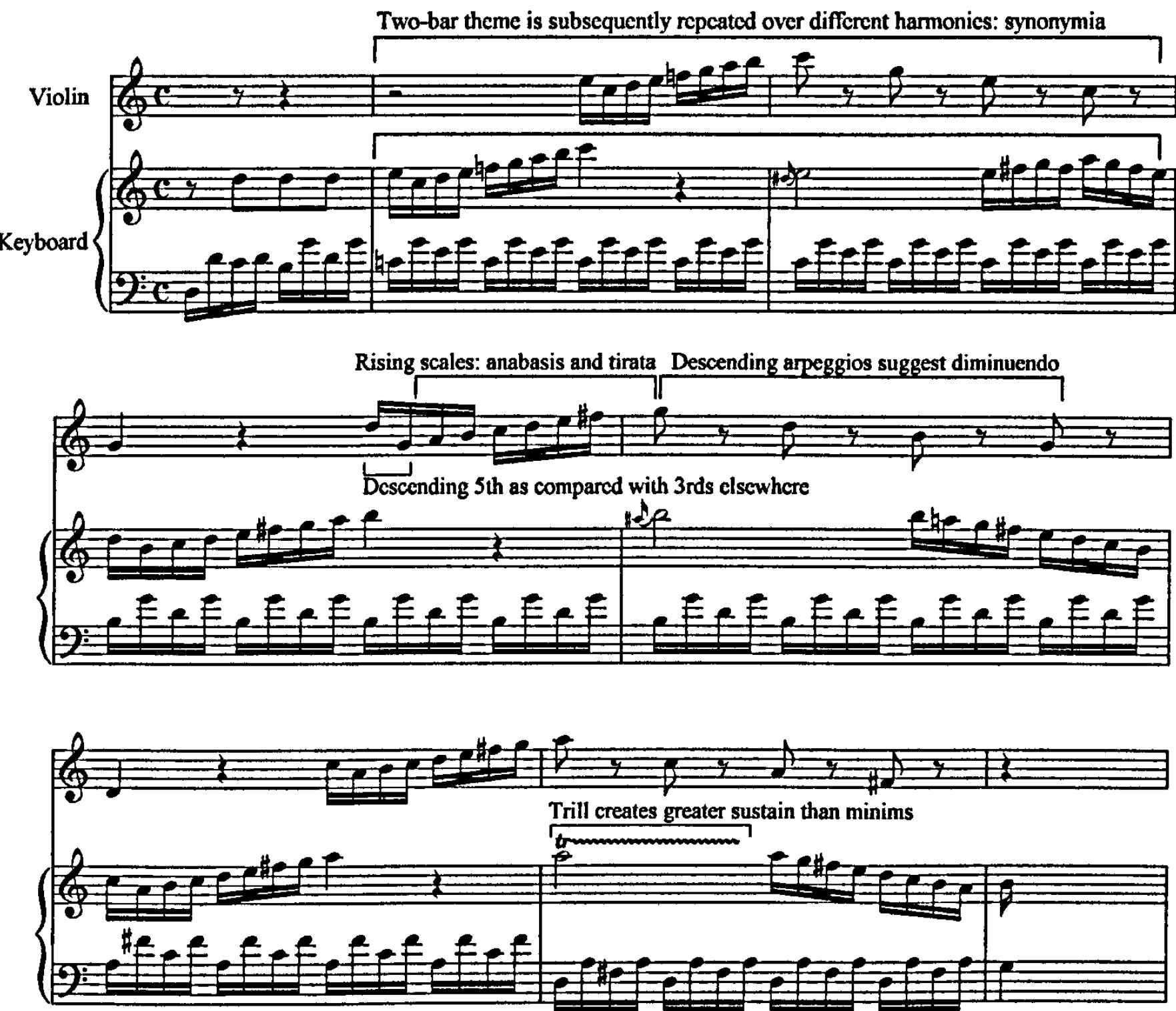
- CH4-S1 [描述性拆分] Synonymia and the Joyful Descent in K28, Bars 11–17
- 页码:1-2
- CH4-S2 [描述性拆分] Epizeuxis and Escalating Repetition in K28, Bars 18–19
- 页码:3-3
- CH4-S3 [描述性拆分] Distributio and Increasing Frequency in K28, Bars 20–28
- 页码:4-5
- CH4-S4 [描述性拆分] Articulation, Punctuation and Figures of Repetition in Performance
- 页码:5-5
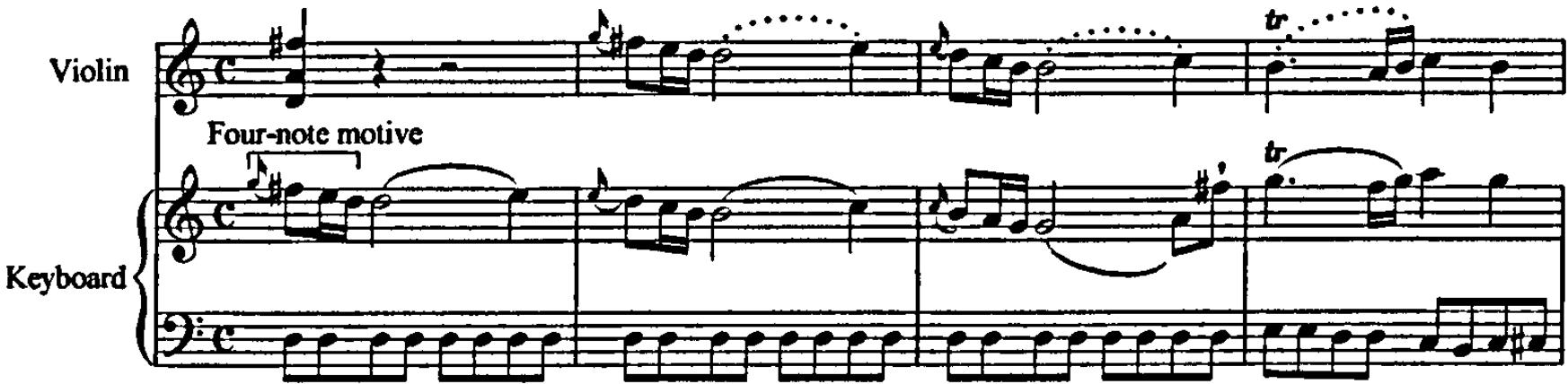
- CH4-S5 [描述性拆分] Aposiopesis and Catabasis in the K30 Adagio, Bars 1–2
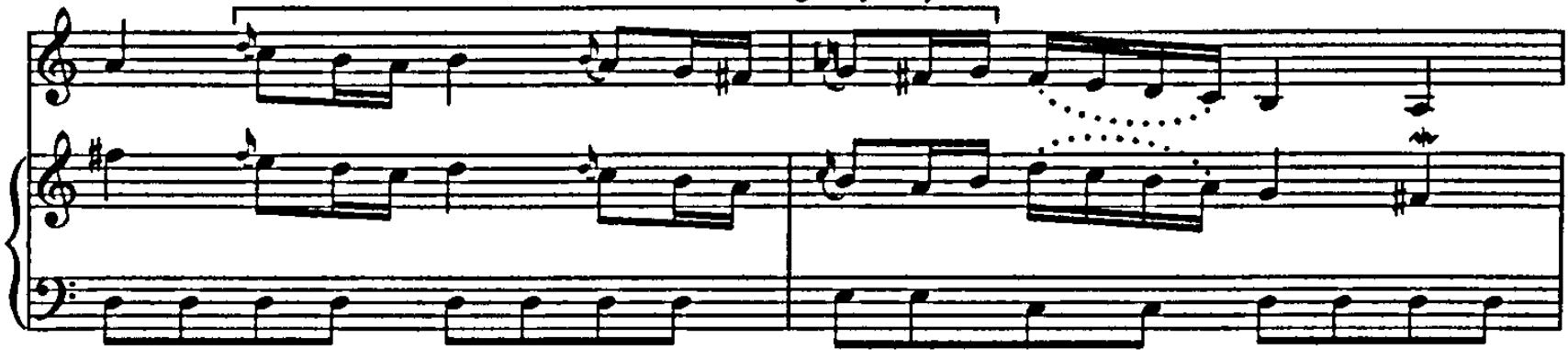
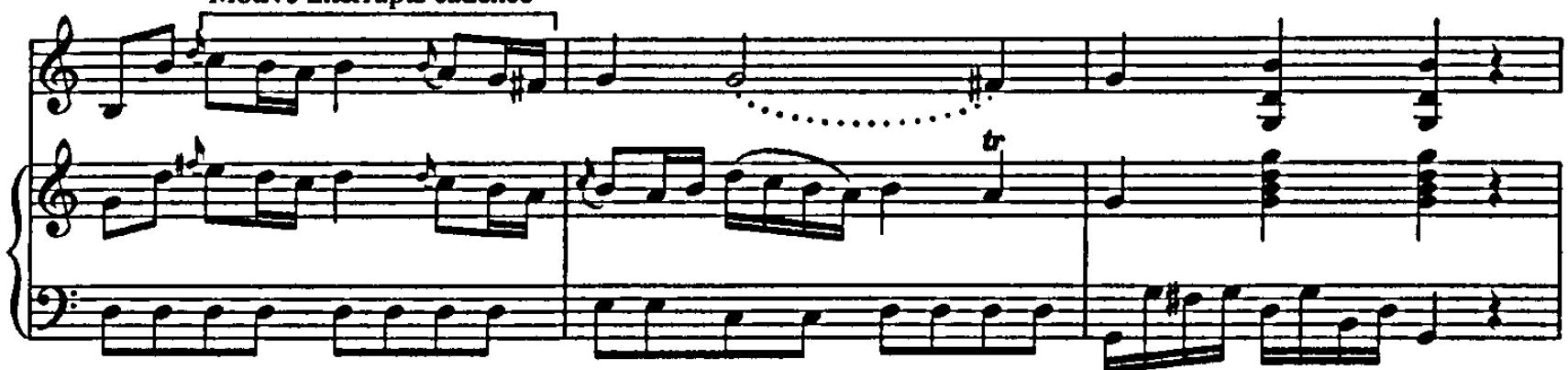
- 页码:6-7
- CH4-S6 [描述性拆分] Interrogatio and the Questioning Counter-Theme in K30, Bars 5–8
- 页码:7-8
- CH4-S7 [描述性拆分] Conclusion on Articulation, Slurs and the Imitation of the Voice
- 页码:8-8
CH5 Accent and Emphasis: the Hierarchy of Words and Sentences
- CH5-S1 Light and Shade: the Development of Mozart’s Use of Dynamics
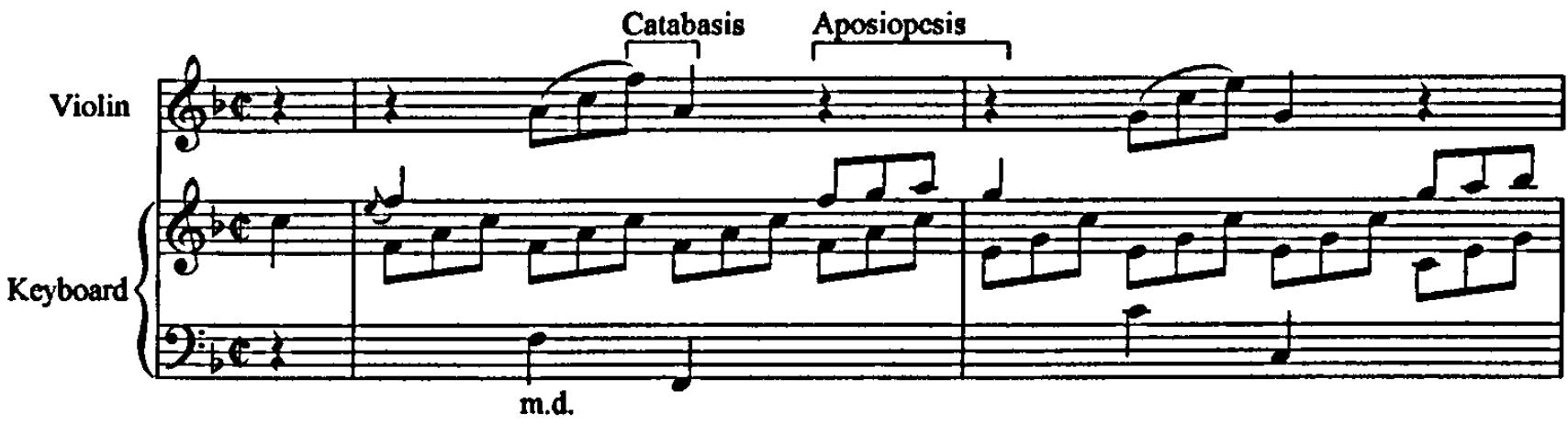
- 页码:10-13
- CH5-S2 [描述性拆分] The Violin’s Subordinate Role in Early Accompanied Sonatas
- 页码:14-14
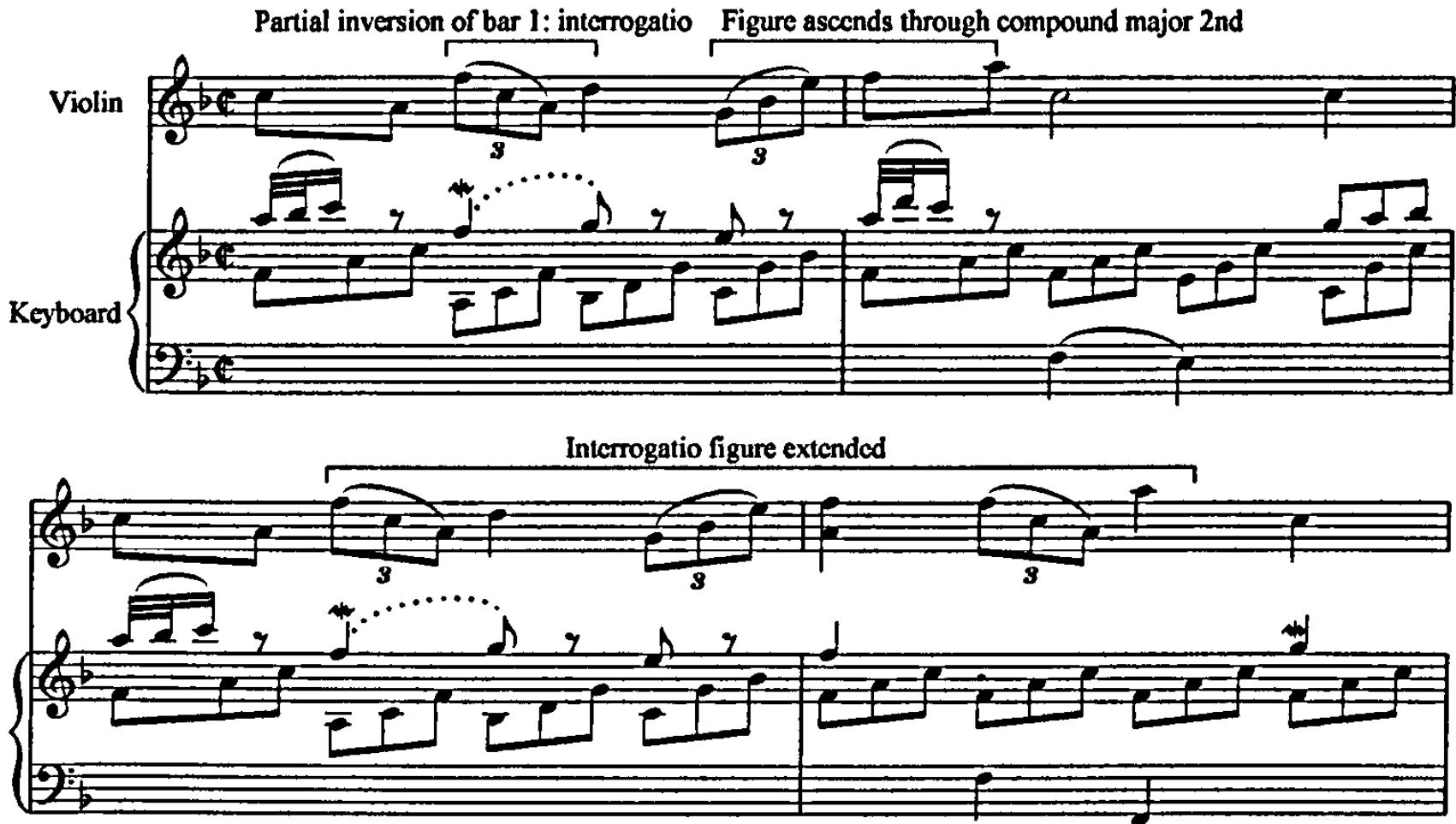
- CH5-S3 [描述性拆分] Variety of Sound in the Palatine Sonatas: Heavy and Light, Cantabile and Allegro
- 页码:14-15
- CH5-S4 [描述性拆分] Texture, Emphatic Accompaniment and the F-P Continuum in the Palatine Sonatas
- 页码:16-20
- CH5-S5 [描述性拆分] Sustaining Power and Elevated Cantabile Line Over Busy Keyboard Texture
- 页码:20-22
- CH5-S6 [描述性拆分] From Prescribed Dynamics to Self-Devised Light and Shade Across the Sonatas
- 页码:22-23
- CH5-S7 Accent
- 页码:23-23
- CH5-S8 [描述性拆分] Grammatical, Logical and Pathetic Accents in Speech and Music
- 页码:24-26
- CH5-S9 Accent and Metre
- 页码:26-27
- CH5-S10 [描述性拆分] Notated Accents Clarifying Ambiguous Metres (K377 and K378)
- 页码:27-29
- CH5-S11 [描述性拆分] Accents Doubling, Restoring and Interrupting the Pulse in K380, K296, K303 and K306
- 页码:29-35
- CH5-S12 [描述性拆分] Notated Accents That Contradict the Metrical Hierarchy
- 页码:35-37
- CH5-S13 [描述性拆分] Conventional Indicators of Non-Notated Accent
- 页码:38-38
- CH5-S14 [描述性拆分] Slurs as Indicators of Accent: First Note, Long Slur and Syncopated Note
- 页码:38-42
- CH5-S15 [描述性拆分] Chromaticism, Dissonance, Length and Pitch as Indicators of Accent
- 页码:42-42
- CH5-S16 [描述性拆分] Rests, Strokes and Harmonic Rhythm as Accentual Clues in K481 and K526
- 页码:42-49
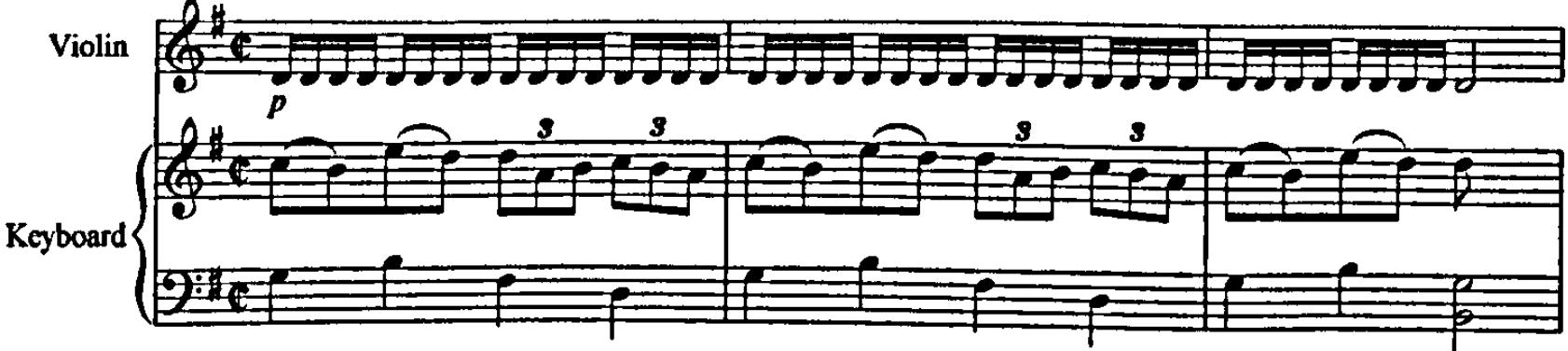
- CH5-S17 [描述性拆分] From Grammatical Accent to Pathetic Accent: Toward Rhythmic Expressivity
- 页码:50-50
CH4-S1 [描述性拆分] Synonymia and the Joyful Descent in K28, Bars 11–17
第1段(P0001)
原文复述
The root of the word ’tirata’ is debated in eighteenth-century sources, but in this context Leopold Mozart describes it as meaning ‘flight of an arrow or shot’ (L. Mozart, 1756: 212). Furthermore, Kirnberger writes that ascending octaves, which constitute the range of this rising scale, are ‘happy, courageous, [and] encouraging’ (Kirnberger, 1776: 373). The character of bars 11 to 17 is therefore energetic and positive.
中文讲解
本段为后续分析奠定基调:它先确立两个18世纪权威定义——一是 Leopold Mozart 把 “tirata” 解释为"箭矢或射弹的飞行",二是 Kirnberger 把上行八度归为"快乐、勇敢、鼓舞人心"的进行。本节所谓 rising scale(上行音阶)正是在此范围内,因此 11–17 小节被定性为 energetic and positive(充满能量与正面情绪)。要注意的是,作者并没有仅凭音乐直觉下结论,而是援引当时权威论著,用以佐证其解读;这构成本节以历史文献支撑演奏诠释的核心方法。
补充说明
两条引文分别出自 Leopold Mozart 的小提琴教程与 Kirnberger 的和声论著;其在本段中的作用是为第 11–17 小节的总体性格提供权威背书,而非讨论 tirata 的词源学。
第2段(P0002)
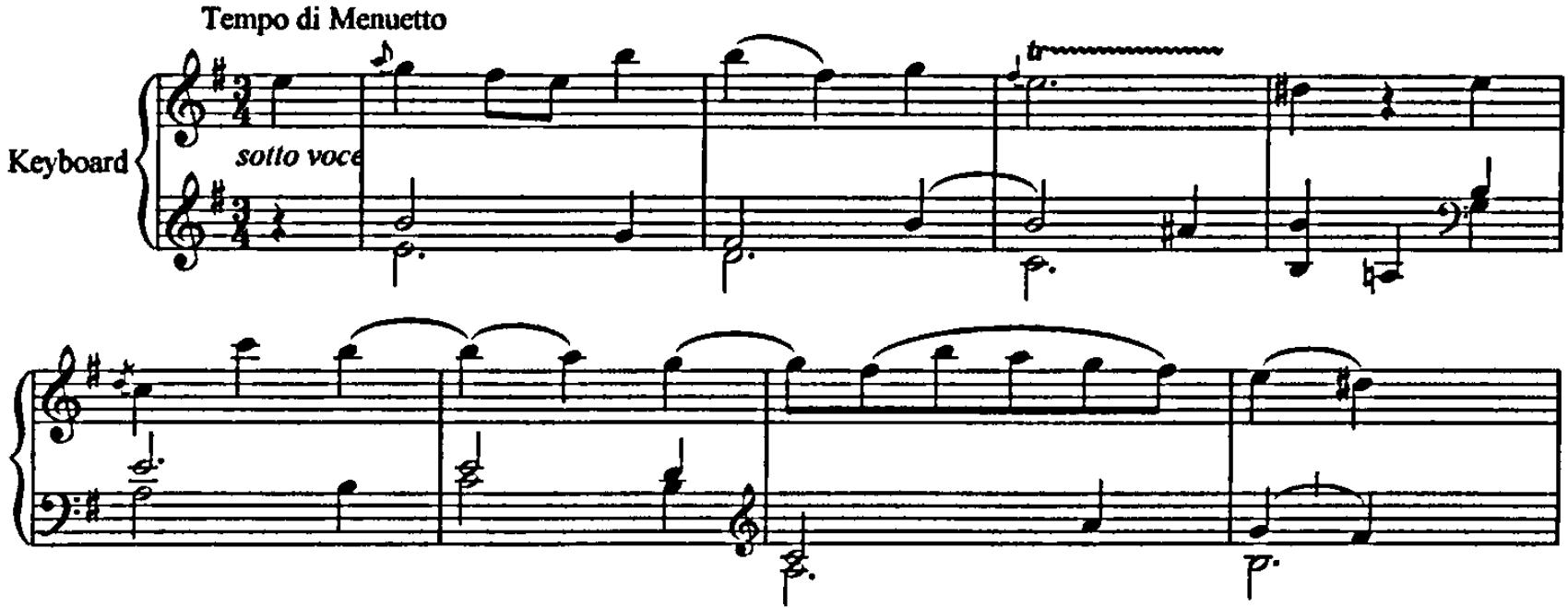
原文复述
However, Gottsched writes of the figure synonymia that:
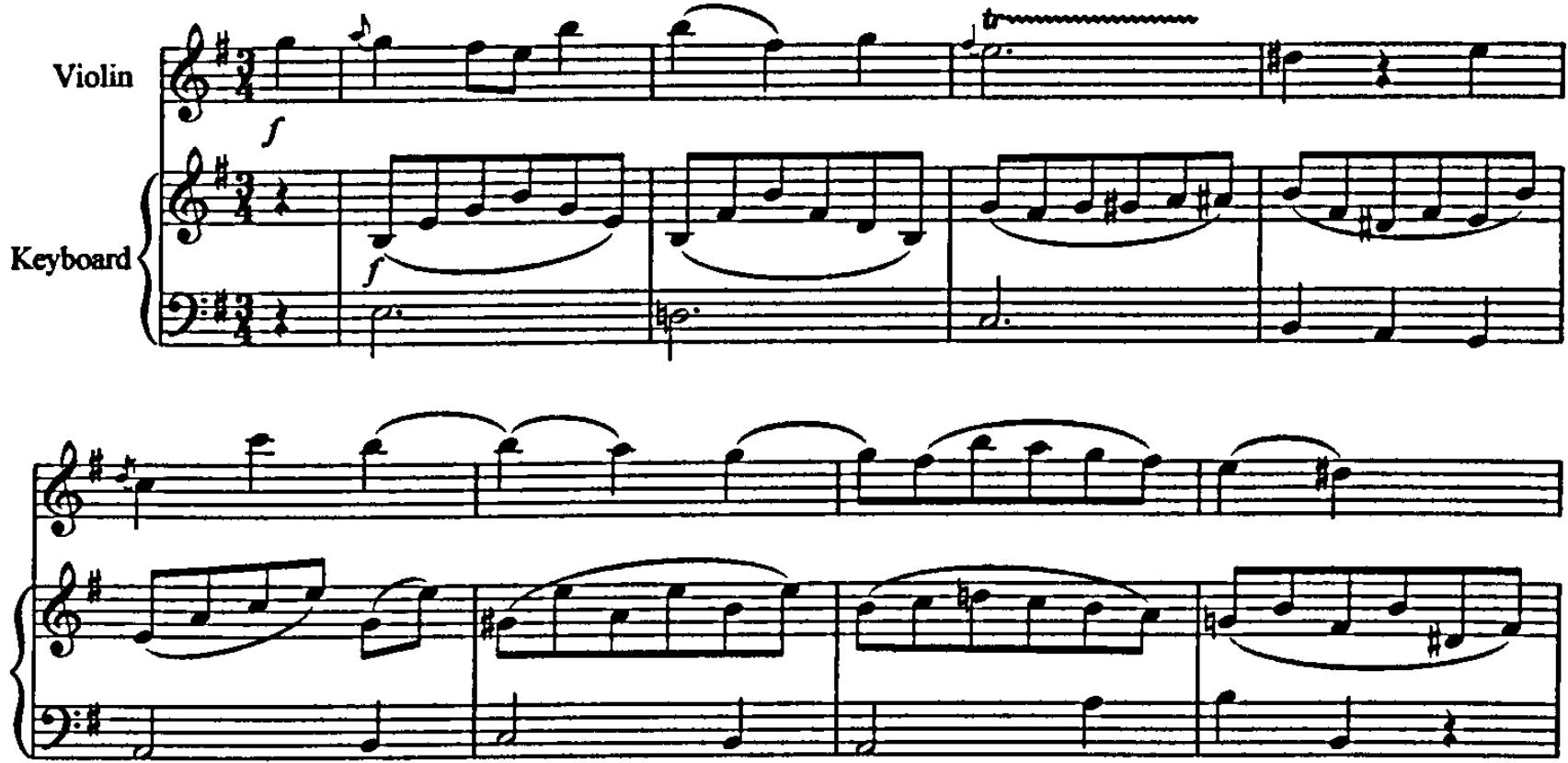
中文讲解
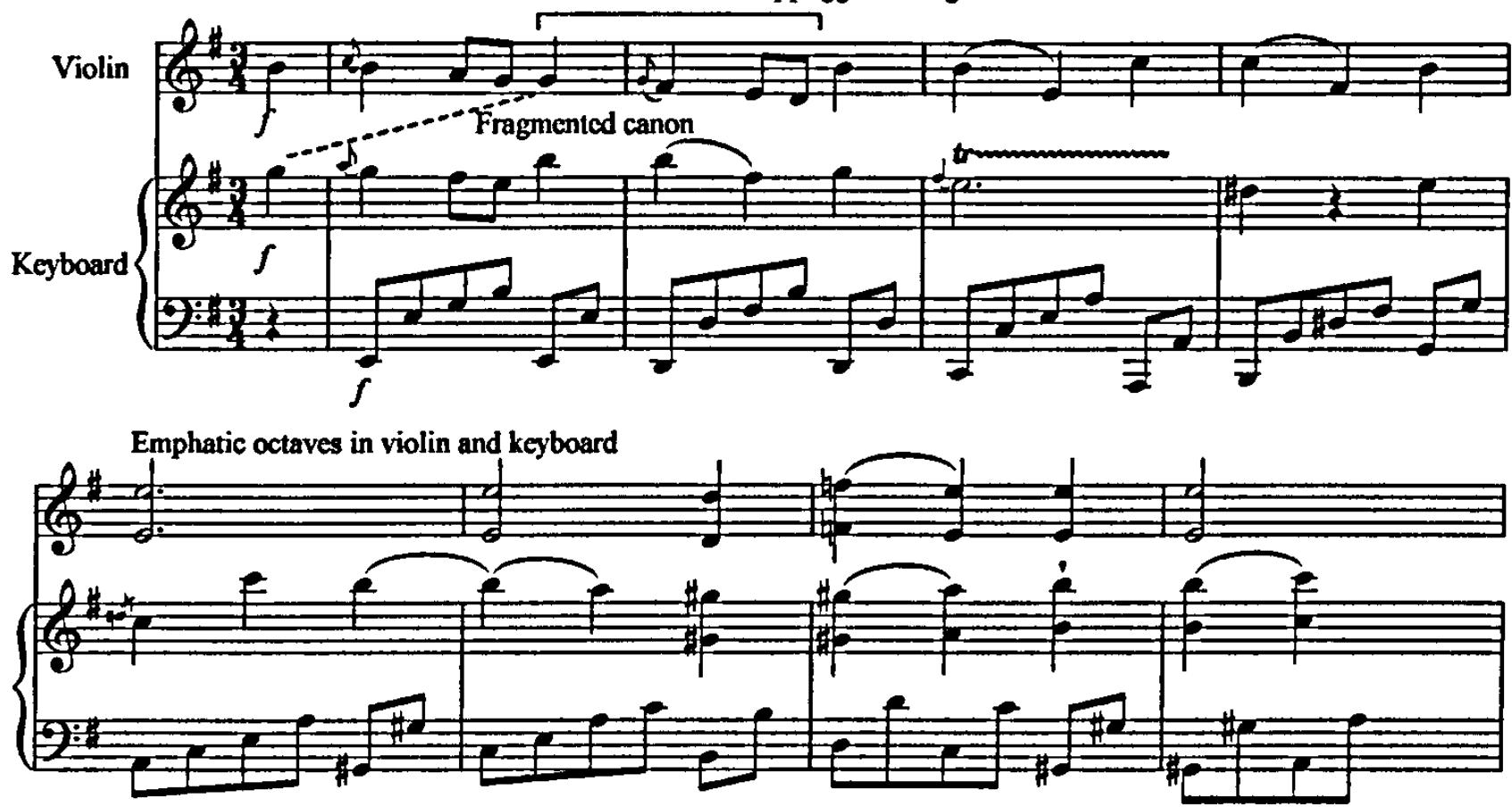
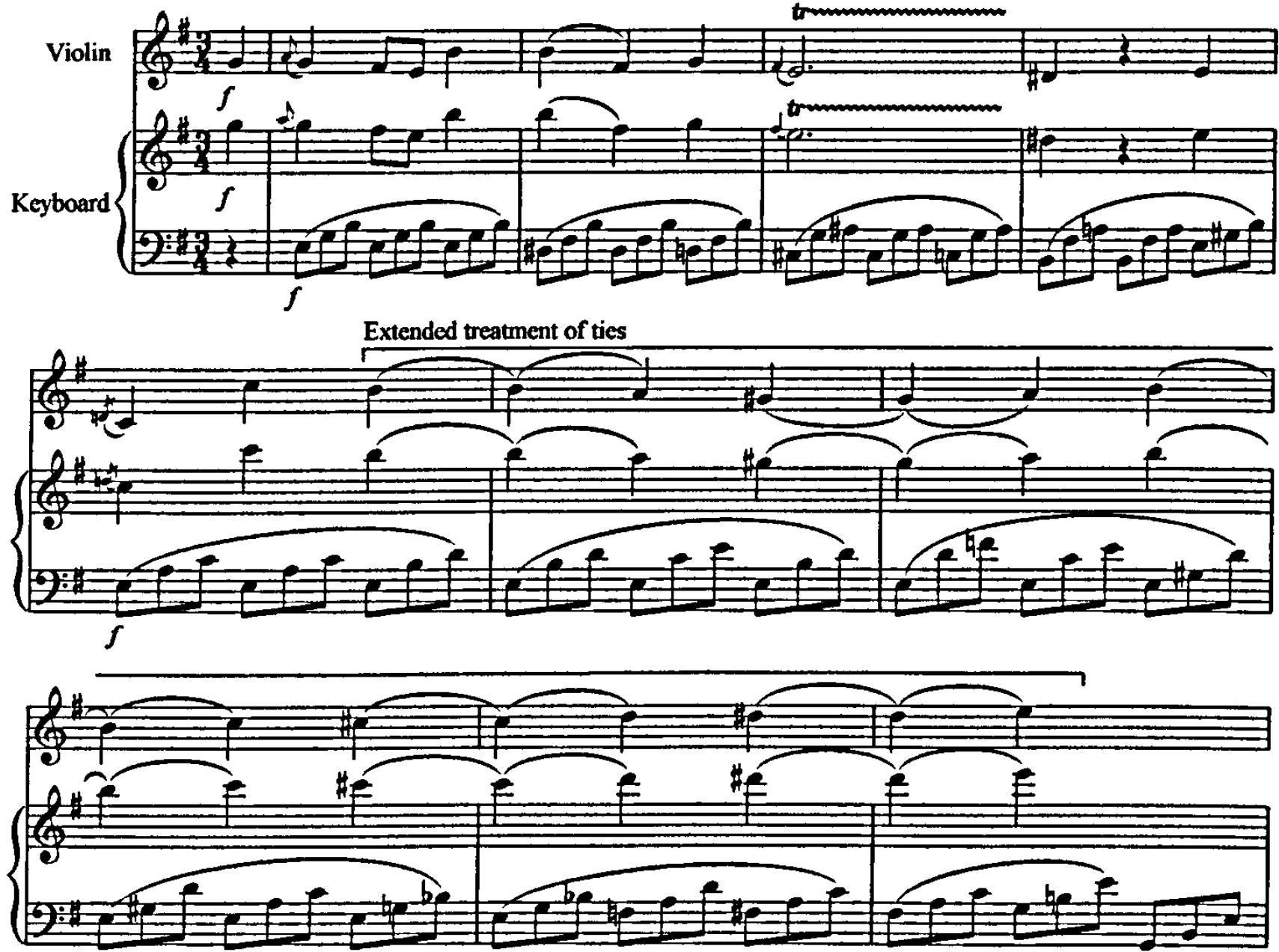
这是一个承上启下的过渡句,本身并不承载实质信息,但其作用关键:它以 “However” 标志语气的转折——前段确立了总体性格是 energetic and positive,此处则准备引入 synonymia(同意叠用)这一修辞格,引出下文将讨论的"同一乐思用不同表情反复陈述"所引发的诠释问题。读者应将此句理解为引语入口,而非独立主张。
第3段(P0003)
原文复述
“The next figure is the doubling of one and the same thought but with entirely different words. An impassioned person endeavours to influence and persuade his readers and listeners of his thoughts. He will therefore also say the same thing a number of times, but always with different expressions.” (Gottsched, 1751: 326; quoted in Bartel, 1997: 407)
中文讲解
本段给出 synonymia 的修辞学定义。synonymia 指"用完全不同的话语重复同一个思想"——即同一核心内容以多种措辞反复表达,目的在于以激情说服听者。Gottsched 的这一定义原属诗学/修辞学范畴,作者将其移植到器乐分析中,暗示 11–17 小节两小节乐思的三次反复(实际上是同一乐思的多次转调陈述)即是一种音乐版的 synonymia:旋律骨架未变,而和声、调性、音区以及由此带来的表情色差却使其成为"以不同说法表达同一件事"。这一概念是本节用以统一"分而述之"(不同 Affekt)与"合而论之"(统一乐思)之间张力的关键。
补充说明
Gottsched 的原作出版于 1751 年,本节引用经由 Bartel 1997 年的二手文献转引。理解此定义时不应将其局限为语言修辞,而应看到作者对它的功能化挪用。
第4段(P0004)
原文复述
Therefore, although the overall character is joyful, the performer must find a different Affekt for each statement of the two-bar theme. These bars have a harmonic purpose, which is to modulate from C major to G major; the repetitions of this theme form a descending sequence, and each statement of the theme is heard over a different harmony. In bar 11 the key is C major; as the home-key, this version of the theme embodies the joy and energy of the movement. The violinist can convey this through a lively bowstroke. The semiquavers should be played on-the-string, according to Geminiani’s descriptions of the strokes suitable for different note-values in each tempo (Geminiani, 1751: 27). By using the middle of the bow, this on-the-string stroke receives a ‘small softness’ at the start and end of each stroke due to the natural elasticity of the bow; while the hair stays on the string, the stick remains flexible, giving energy and release to each note. The quavers in bar 13, however, can be lifted off the string with a fairly short and fast stroke. The effect would be similar to that which Türk describes as ’light’ execution on the keyboard, with the fingers being lifted off the keys before the note has reached its full written length (Türk, 1789: 347).
中文讲解
本段是全节论证的枢纽:它把 synonymia 的修辞原则转译为具体的演奏操作。作者指出,虽然总体性格为 joyous,但三次重复必须各自呈现不同的 Affekt;其根据在于和声功能——主题以"下行模进"的方式从 C 大调转调至 G 大调,每次重复都落在不同的和声之上,因此第 11 小节作为主调陈述承载"喜悦与能量",可用 lively 的运弓表达。接下来作者援引 Geminiani 关于不同音符时值与不同弓法的论述,主张十六分音符用 on-the-string(中弓、贴弦)奏法:弓毛贴弦而弓杆保持弹性,赋予每音能量与释放感,并因弓的自然弹性获得起止的"小柔软"。反之,第 13 小节的八分音符则可以离弦(spiccato 类的短快弓),其效果可与 Türk 在键盘上所说的"轻盈"奏法相类比——手指在音符达到完整时值之前即抬起。理解本段的关键在于:作者不只是描述"该用什么弓法",而是用 synonymia 这一概念统摄——同一乐思在不同和声位置、不同音区需要不同的演奏处理,正是 Gottsched “以不同说法表达同一件事"在器乐中的体现。
补充说明
Geminiani 与 Türk 在此分别作为小提琴弓法与键盘触键的权威依据;两人论述的核心都是"不同时值/语境对应不同奏法”,本节借此为不同主题重复的差异化处理提供历史合法性。
第5段(P0005)
原文复述
In bars 13 to 15 the theme descends into G major. This is still an open and bright key—indeed, Kirnberger describes it, along with C major, as being in the ‘first class’ (Kirnberger, 1776: 340) of major keys, which are best suited to ‘pleasant, joyous, [and] harmonious’ Affekts (Kirnberger, 1776: 337). However, the lower pitch and the violin’s wider descending interval of a 5th render this repetition of the theme less extrovert than that in bar 12. This could be conveyed by a generally warmer violin articulation, imitating an open rather than narrow vowel sound. This is achieved by placing the bow slightly further away from the bridge, and using a slower and heavier bowstroke on both the semiquaver scale and the quavers (which should nevertheless still be lifted).
中文讲解
本段处理主题第二次与第三次重复(13–15 小节)的乐思降格。作者先援引 Kirnberger 把 G 大调与 C 大调并列为调性等级中的"第一类",皆适于"愉悦、欢乐、和谐"的 Affekt,从而否定"G 大调是暗淡调"这一常见误解;然而他随即指出,尽管 G 大调同样明亮,较低的音高与下行五度的更大音程跨度使这一次的重复相比第 12 小节"不那么外向"。演奏上的对应建议是:弓位稍微远离琴马(sul tasto 方向的暖音色),使用较慢、较重的运弓;其修辞性的比喻是"模仿一个开元音而非窄元音的声音"。这一段对理解本节至关重要——它示范了 synonymia 在演奏层面的具体落实:同样的主题骨架,因为和声位置、音区与音程的差异而获得"较温暖、较内敛"的新表情,而这种差异并非标新立异,而是结构内在的逻辑结果。
补充说明
Kirnberger 1776 年的著作中将大调按情感适宜性分等级;本段援引其等级制度以正面方式引入 G 大调,随即以本节自身的乐句分析修正其普适性。
第6段(P0006)
原文复述
The D7 harmony in bars 16 and 17 creates a sense of expectation, which gives a new intention to the lifted quavers of this version of the theme. While the descending arpeggio of these quavers has previously suggested a diminuendo throughout the bar, the unresolved harmony in bar 17 implies that the violin should remain louder here, using a more emphatic articulation than in bars 13 and 15. The trill in the right-hand keyboard part at bar 17 also corroborates this interpretation, creating a longer sustaining effect than the minims previously heard in bars 13 and 15, which will immediately die away after being struck.
中文讲解
本段处理主题第四次重复(16–17 小节)所引入的张力转捩。D7 和声带来的悬而未决造成"期待感",这赋予该次重复中离弦八分音符"新的意图"。作者推翻了读者/演奏者根据下行琶音自然得出的"渐弱"直觉:尽管旋律本身继续下行,未解决的 D7 暗示小提琴此处应保持更强力度、采用比第 13、15 小节更强调性的奏法。右键盘声部的颤音进一步佐证这一解读——颤音的延绵效果与先前第 13、15 小节二全音符的瞬时消失形成对比,使整体持续更长。这一段展示了 synonymia 的另一面:相同主题材料在悬而未决的和声语境中,不再是"内敛",而是"期待性"的强调,因此演奏处理亦须随之转向。理解本段的关键在于把和声、弓法、键盘声部三个层面的论据汇聚起来,论证"持续更响、更强调"的诠释并非个人偏好,而是被结构关系所要求的。
补充说明
第 13、15 小节与 16、17 小节在旋律轮廓上相似(同为离弦八分音符的下行琶音),但和声与对位支撑不同;本段正是利用这种"形似而语境异"的结构,进一步印证 synonymia 的解释力。
第7段(P0007)
原文复述
[Example 4.62: K28, movement 1, bars 11–17, demonstrating Mozart’s use of synonymia.] (Embedded image data omitted; position and caption retained)
中文讲解
此处为图例占位符(Example 4.62),对应 K28 第一乐章第 11–17 小节的乐谱片段,图注明确指出该例用于"展示 Mozart 对 synonymia 的运用"。它在本节论证链中的功能是为前文所述的"同一主题三次以上重复+和声模进+差异化演奏处理"提供可视化的谱例支撑,使读者得以对照总谱验证作者的修辞学挪用是否合理。由于内嵌图像数据已省略,本讲无法呈现谱面细节;如需核实具体音高、和声位置与弓法标记,应查看原书图 4.62。
补充说明
图注中的 “synonymia” 一词直接呼应 Gottsched 的定义,表明该图例并非单纯展示主题重复,而是被作者明确标记为 synonymia 的实例。
脚注 / 边栏 / 图表 / 附加信息(如有)
本节附加材料主要为图 4.62 的谱例(位于 P0007),其图注明确将 11–17 小节定性为 Mozart 使用 synonymia 的例证;这是作者将诗学术语移植到器乐分析的关键可视化支撑。引文与脚注方面,本节密集援引 L. Mozart (1756)、Kirnberger (1776)、Gottsched (1751,经 Bartel 1997 转引)、Geminiani (1751) 与 Türk (1789) 五种 18 世纪权威论著,分别承担词义/情感/修辞/弓法/触键的论据功能,使全节论证具有跨文本、跨体裁的历史文献基础。
💡 本节核心要点
- 第 11–17 小节在总体上被定性为 energetic and positive(充满能量与正面情绪),依据是 Leopold Mozart 对 “tirata” 的定义与 Kirnberger 对上行八度的情感定性。
- 本节借用 Gottsched 修辞学术语 synonymia(以不同措辞重复同一思想)来解释主题的多次重复,从而把"统一乐思"与"差异处理"统合在同一概念框架内。
- 下行模进(C 大调 → G 大调)使每次主题重复落在不同和声之上,这一和声差异是演奏者必须在每次重复中寻找不同 Affekt 的根本依据。
- 具体演奏建议源自 18 世纪权威论述:十六分音符用贴弦中弓以获得能量与起止的小柔软;八分音符用短快离弦弓以获得轻盈效果;音区下行时通过弓位离琴马、运弓变慢变重来获得"开元音"般的温暖。
- 第 16–17 小节的 D7 未解决和声打破"渐弱"直觉,使该次重复在演奏上要求保持更强力度与更强调性,右键盘颤音的持续效果进一步佐证这一诠释。
- synonymia 在本节中既是分析概念也是演奏原则:它既解释了为何同一主题要重复,也规定了每次重复必须不同地演奏。
🔑 关键术语
- tirata:18 世纪小提琴/作曲术语,Leopold Mozart 在本节语境中将其解释为"箭矢或射弹的飞行",用以描述连续快速音符的上行进行;本节借此为 11–17 小节的开头音阶赋予能量与正面情绪。
- synonymia:本节取自 Gottsched(1751)的修辞学概念,原指"以完全不同的话语重复同一思想";作者将其挪用至器乐分析,指同一主题在多次重复中因和声、音区不同而获得不同表情,是本节贯穿全段的核心概念。
- Affekt:18 世纪美学/音乐理论中的"情感"或"情绪"范畴,是作曲家指定、演奏者追求的具体情感状态;本节以此为单位规定每次主题重复所需的差异化表达。
- descending sequence (下行模进):本节中指主题旋律在保持轮廓不变的前提下,每一次重复都比前一次低一定音程(本节为由 C 大调下移至 G 大调)的进行方式;既是 synonymia 的结构基础,也是和声转调的实现路径。
- on-the-string stroke (贴弦弓法):本节援引 Geminiani,针对十六分音符的奏法:弓毛持续贴弦、弓杆保持弹性,在中弓位置产生能量与释放感,并因弓的自然弹性获得起止的"小柔软"。
- lifted stroke / ’light’ execution (离弦/轻盈奏法):本节针对八分音符的奏法:弓短暂离弦,配合 Türk 所说的键盘"轻盈"触键——指/弓在音符达到完整时值之前即抬起,从而获得短促、明亮的音响。
- D7 harmony (D 属七和弦):本节第 16–17 小节中悬而未决的属七和声,制造期待感;其功能是扭转"下行琶音即渐弱"的直觉,使小提琴在该次重复中维持力度并采用更强调性的奏法。
CH4-S2 [描述性拆分] Epizeuxis and Escalating Repetition in K28, Bars 18–19
第1段(P0008)
原文复述
Mozart’s surprise is that this sense of expectation does not resolve to a full G major triad; indeed, a rest in the violin part interrupts this cadential formula. Instead, a new figure of repetition develops a two-beat motive (see example 4.63). The ‘immediate and emphatic repetition of a word, note, motif, or phrase’ is described as the musical rhetorical figure epizeuxis (Bartel, 1997: 263). The circulatio figure in the keyboard’s right-hand part, a figure which ‘is thus called because it forms a circle, as it were’ (Spiess, 1745: 156; quoted in Bartel, 1997: 219), is often expressive of ‘circular or infinite concepts’ (Bartel, 1997: 217), while a rising scale in the left hand and bass notes of the right hand suggests the ‘ascending’ emotions associated with the figure anabasis (Bartel, 1997: 179). The increasing emphasis of each repetition of this short motive can be rendered partly through dynamic, but also through articulation. By playing the first descending third with a small amount of bow, the violinist can increase the intensity of each subsequent playing by lengthening the amount of bow used, and using finger pressure to create a more incisive attack at the start of each slur. The keyboard player can create a similar effect by increasing the length and heaviness of attack on each crotchet. Le Faucheur confirms this articulation, writing that each repetition of a word should be ’louder and stronger’ (Le Faucheur, 1727: 146).
中文讲解
本段承接上一小节关于K28第18–19小节听感期待的讨论,把焦点从“期待如何被打破”转向“打破之后作曲家如何继续”。核心主张是:莫扎特用一个两拍的重复动机替代了预期中的完满终止,这一手法属于音乐修辞学中的epizeuxis(紧接重复),其定义为对词、音符、动机或短句的“即时而强调的重复”(引Bartel, 1997: 263)。
作者同时把另外两个修辞格叠合到同一段落:键盘右手的循环音型是circulatio(循环),因其“形似一个圆圈”(Spiess, 1745: 156),常表达“循环或无穷”的概念(引Bartel, 1997: 217);左手的上升音阶与右手低音则暗示anabasis(上升),承载与“上升”相关的情绪(引Bartel, 1997: 179)。也就是说,epizeuxis提供了“重复”这一骨架,circulatio和anabasis则各自赋予骨架不同的意象色彩——一个回到原点,一个逐步上升。
在表演层面,本段的论证推进了一步:epizeuxis的递增效果不仅来自力度,还来自articulation(发音法/弓法与触键)。小提琴家可通过第一次用短弓、随后逐次增加弓长并以指尖压力获得更尖锐的起音来制造渐强的紧张感;钢琴家则可通过逐次加重每个四分音符的起音长度与力度来达到类似效果。Le Faucheur(1727: 146)的引文“louder and stronger”为这种演奏处理提供了修辞学传统上的依据,把表演建议与文本理论对接起来。
需要注意的细节:作者特别强调“a rest in the violin part interrupts this cadential formula”,这说明期待的中断来自休止而非音高本身,是节奏打断和声,这一观察比单纯说“没有解决”更精确。
补充说明
本段中epizeuxis、circulatio、anabasis三者的关系可定位为:epizeuxis是“如何重复”(横向修辞),circulatio与anabasis是“重复中蕴含的意象”(纵向修辞)。作者让三个标签同时出现在同一动机上,说明在音乐修辞学分析中,复合修辞格可以共存。Bartel(1997)、Spiess(1745)、Le Faucheur(1727)三个出处分别承担定义、历史溯源与表演传统佐证的功能。
第2段(P0009)
原文复述
Example 4.63: K28, movement 1, bars 18-19, demonstrating Mozart’s use of epizeuxis.
中文讲解
这是乐谱示例4.63的标题/说明文字,标明其对应莫扎特K28第一乐章第18–19小节,功能是直观展示epizeuxis(紧接重复)的实际写法。由于本段仅为图注,读者需结合Example 4.63的谱面来核对上文P0008所讨论的两拍动机、循环音型与上升音阶的具体形态。
补充说明
该图注紧接P0008的正文叙述,是正文论证所依赖的视觉证据;正文中“see example 4.63”的指引即指向此处。
第3段(P0010)
原文复述
Bars 20 to 28 illustrate a more intricate form of repetition (see example 4.64, page 140). Here, a descending four-note motive is taken out of its original context and heard with increasing regularity, thus illustrating a figure known as distributio. This figure refers to ‘a multifarious thought [which] is subdivided into its parts in order to provide the reader with a thorough understanding of the argument’. ([内嵌图像数据已省略;位置与图注保留])
中文讲解
本段将讨论从第18–19小节延伸到第20–28小节,核心主张是:莫扎特在此处使用的重复比epizeuxis更为复杂。作者把这种写法称为distributio(分配/分部),其定义为把“一个多面的思想拆分为若干部分,以便让读者/听者对其论旨获得彻底的理解”。具体做法是:一个四音下行动机被从其原始语境中抽取出来,并以越来越规则的间隔重复出现。
与P0008的epizeuxis相比,distributio的关键差异在于“拆分后重组”:epizeuxis是同一短句的直接重复,强调情绪递增;distributio则是把一个整体动机拆散再以规律间隔铺开,强调结构上的清晰与穷尽。这一对比构成本小节内部的一个小型论证层级——从简单重复(epizeuxis)走向复杂重复(distributio)。
需注意的细节:作者用“taken out of its original context”说明动机脱离原位的修辞功能,用“increasing regularity”说明重复间隔的规律化,这两点共同支撑distributio的定义。
方括号内为图像数据省略标记,原图的具体谱面需参照Example 4.64(位于第140页)。
补充说明
distributio的定义引文中保留了“multifarious”和“subdivided”的关键限定词,说明它强调“拆解”与“穷尽”,而不仅仅是“重复”。本段末尾的图注保留位置意味着图例编号为Example 4.64,页码140,与正文交叉引用一致。
脚注 / 边栏 / 图表 / 附加信息(如有)
本小节共含两条带原始图像的占位(Example 4.63和Example 4.64),分别对应第18–19小节与第20–28小节的谱例,原图谱面信息在本输入中未提供,需查阅原书以核对epizeuxis与distributio的具体音型。小节中所有引文均为脚注/夹注性质的二次文献引用(Bartel 1997、Spiess 1745、Le Faucheur 1727),承担定义、词源与表演佐证三种功能,但本身不构成本小节的附加论证。
💡 本节核心要点
- 本小节聚焦K28第一乐章第18–19小节,分析epizeuxis(紧接重复)如何取代预期的完满G大调终止,从而构成莫扎特的“surprise”。
- 两拍动机上叠合了三种修辞格:epizeuxis(横向重复结构)、circulatio(循环意象,右手)和anabasis(上升意象,左手与低音)。
- 递增效果不仅依赖力度,还依赖articulation:小提琴通过加弓长与指尖压力逐次强化起音,键盘通过加重每个四分音符的起音实现相同效果。
- Le Faucheur(1727)“louder and stronger”的修辞学传统为上述演奏处理提供了历史依据。
- 第20–28小节将分析推进到更复杂的distributio:把四音下行动机从原语境中抽取并以递增的规律间隔重复,从简单重复走向拆解式重复。
🔑 关键术语
- epizeuxis:音乐修辞格之一,定义为对词、笔记、动机或短句的“即时而强调的重复”,本节中表现为K28第18–19小节的两拍动机直接反复。
- circulatio:音乐修辞格之一,因形似圆圈而得名,常表达“循环或无穷”的概念,本节中对应键盘右手的循环音型。
- anabasis:音乐修辞格之一,承载与“上升”相关的情绪,本节中对应左手上升音阶与右手低音。
- distributio:音乐修辞格之一,把多面思想拆分为部分以使听者获得彻底理解,本节中表现为四音下行动机被从原语境中抽取并以递增规律间隔重复,对应K28第20–28小节。
- articulation(发音法/弓法与触键):本节中指通过弓长、指尖压力、起音长度与力度等演奏手段实现epizeuxis的递增效果,区别于单纯的力度变化。
CH4-S3 [描述性拆分] Distributio and Increasing Frequency in K28, Bars 20–28
第1段(P0011)
原文复述
(Gottsched, 1736: 282; quoted in Bartel, 1997: 240). Forkel writes that ‘the expression is given exceptional vitality and beauty only if the general expressions are also periodically dissolved and individualized’ (Forkel, 1788: 51; quoted in Bartel, 1997: 242). In bars 20 and 21 this four-note motive is simply a flourish which is followed by longer note values; therefore, after the initial energy of this motive at the start of the bar, the long note values create an expansive effect. With a long up-bow slur on the minim and crotchet of bars 20 and 21 (which has been applied to the violin part in NMA by analogy with the existing slur in the right hand of the keyboard), the slurred semiquavers at the start of each bar need to be played with a long bowstroke, which will contribute to a cantabile and expansive effect. In bar 24 this flourish-motive is taken out of its original context, and is heard with increasing regularity. This transforms it into an energetic and forceful motive. The bowstroke can be shorter and more contained and incisive, thus emphasising the increasing energy of this motive. In bar 26, the motive is used to interrupt the previous cadence; this interruption can be initiated by a lifted bow stoke on the second quaver of the bar, followed by clear and energetic articulation for the rest of the bar. Hence, with the increasing frequency of this four-note motive, which is removed from its original expansive context and used to create energy, the violinist’s bowstroke can become gradually more contained and cleanly articulated, using shorter bows to create a focussed sound, and finger pressure to mark the start of each group of slurred semiquavers.
中文讲解
这一段是本小节的核心分析,作者将十八世纪修辞学/美学权威的话语与具体的演奏法建议交织在一起。
首先,Gottsched(1736)和 Forkel(1788)的两则引言奠定了理论依据:Forkel 强调,“表情”之所以获得活力与美,正在于那些“一般化的表情”能够被周期性地“溶解并个别化”。这正是本段随后要论证的现象——同一个四音动机在 K28 第 20–28 小节中如何由“一般化、舒展”的形态逐步被重新切分、转化为更具个性和动能的形象。
随后是按小节推进的演奏建议:
- 第 20–21 小节:四音动机只是一句“装饰性引子”(flourish),其后跟随较长音符,因此产生 expansive(开阔、舒展)的效果。NMA 版基于键盘右手已有的连弓线,将一个长的“上弓连弓”(up-bow slur)覆盖在小节中的 minim(二分音符)和 crotchet(四分音符)上。演奏者需要让开头的连弓十六分音符用一长弓演奏,由此带来 cantabile(如歌)与舒展的听感。
- 第 24 小节:同一动机脱离原本的语境,以更高的规律性反复出现,其性格从“装饰”转变为“energetic and forceful”(有活力、有力)。弓法随之变短、更紧凑、更具穿透力(contained and incisive),以突出该动机能量的增长。
- 第 26 小节:该动机被用来“打断”此前正在进行的收束式进行(cadence)。作者建议在小节第二拍的 quaver(八分音符)处做一个“抬弓”(lifted bow stroke),随后用清晰有力的发音完成该小节,借此实现“打断”这一修辞功能。
整段的逻辑是:随着同一四音动机出现频率的提升、并被抽离出原本舒展的语境,能量需求上升,因此弓法应逐步从“长弓、连绵、舒展”走向“短弓、清脆、聚焦”,并在每组连弓十六分音符的起音处施加手指压力(finger pressure)以加强颗粒感。这一弓法谱系上的渐变,正是 Forkel “溶解与个别化”命题在演奏层面的具体兑现。
补充说明
本段中的两条引言来源已在括号中给出(Gottsched 1736: 282 与 Forkel 1788: 51,均经 Bartel 1997 转引),本节未提供这两本书的章节主题或作者背景,故不补充其外部生平。NMA 指 Neue Mozart-Ausgabe(新编莫扎特全集),本节通过“键盘右手的连弓线类比”说明为何小提琴版也采用同样连弓,这是本段内部唯一可以确认的版本依据。注意段落原文“bow stoke”疑为“bow stroke”之笔误,含义仍为弓法动作,本讲解按“抬弓”理解。
第2段(P0012)
原文复述
Example 4.64: K28, movement 1, bars 20-28; demonstrating Mozart’s use of distributio.
中文讲解
这是乐谱示例 4.64 的标题,原文以英文写明该示例出自莫扎特 K28 第一乐章第 20–28 小节,并指出此处用于展示莫扎特对 distributio(分配/分配法)这一修辞手段的运用。该标题将紧随其后的乐谱与本节小标题“Distributio and Increasing Frequency in K28, Bars 20–28”直接绑定起来:示例的功能就是为前一段的演奏分析提供视觉参照。
补充说明
distributio 在本节作为小节标题中的关键词出现,其具体含义与功能将在下方术语栏中说明。
第3段(P0013)
原文复述
中文讲解
这是 Example 4.64 的主体乐谱图像占位符,位于第 5 页,与上一条标题文字直接对应。原图的嵌入数据已被省略,但其位置(紧跟在示例标题之后)表明它就是展示 K28 第一乐章第 20–28 小节谱例的图像。
补充说明
无额外补充;请参阅原书第 5 页 Example 4.64 的实际谱例以核对音型分布。
第4段(P0014)
原文复述
中文讲解
这是对 P0013 中同一谱例所作的“标注/分析图像”占位符,其英文图注为“四音动机以逐渐增加的频率出现”。与 P0013 的原始谱面相比,这张图的作用是叠加式地标出同一四音动机在第 20、21、24、26 等小节反复出现的位置,从而以视觉方式印证 P0011 所说的“increasing frequency / increasing regularity”。原图嵌入数据已省略,需查阅原书获取具体标记方式。
补充说明
图注中“increasing frequency”正是本段论证的中心现象:动机反复出现,但其语境与奏法随小节推进而变化。
第5段(P0015)
原文复述
中文讲解
这是第 5 页上另一处乐谱示例图像占位符。原文未给出独立图注,其所在位置紧随 P0014 的分析图之后,通常用于继续呈现同片段的谱例细节或对比片段,以便读者将“动机频率增加”与具体谱面进行核对。
补充说明
无额外补充;具体内容需查看原书第 5 页对应图像。
第6段(P0016)
原文复述
In each of these three passages, Mozart uses a limited amount of melodic material. It is up to the performer to identify how these figures of repetition evolve within the context of the movement, identifying aspects of the compositional language such as harmonic structure, melodic shape and rhythmic development to interpret their Affekt. Figures of repetition essentially function in order to emphasise an argument, whether it is by increasing the intensity (as in bars 18 to 20), or by exploring different facets of the same character or Affekt (as in bars 11 to 17 and 20 to 28). Engaging with these figures and conveying them through the variation of articulation can contribute greatly to the sense of musical drama.
中文讲解
本段是这一小节的总结性收束,把前述针对具体弓法与谱例的讨论提升到演奏诠释的一般原则层面。
其要点可拆为三层:
- 素材层面的事实——“三个段落”均建立在极有限的旋律材料之上,因此演奏者面对的并不是“谱面上写了多少不同内容”,而是“同一个材料如何变化”。
- 演奏者的任务——从和声结构、旋律轮廓、节奏发展三个维度去辨认这些“重复型写作”(figures of repetition)在乐章语境中如何演变,并据此解读其 Affekt(情感/情绪特征)。这一表述把谱面分析的主导权明确交给演奏者。
- 重复型写作的功能——其本质作用在于“强调某种论证”:要么通过强度递增(第 18–20 小节即此类)实现聚焦,要么通过同一 Affekt/性格的不同侧面(第 11–17 与 20–28 小节即此类)展开。
作者最后把这一切落到“发音变化”(variation of articulation)上:演奏者通过弓法/触键等发音手段的差异去“承载”这些重复型写作,从而对“音乐戏剧性”(musical drama)作出贡献。换言之,本段在为 P0011 中所提出的“弓法渐变方案”提供理论依据:演奏诠释并非任意添加情绪,而应当对作曲家的重复型写作逻辑做出结构化的回应。
补充说明
“three passages”对应本节之前讨论的三个相关片段,本节输入中并未逐条列出这三段所指,但据 P0011 的描述,可确认其中包括第 20–21 小节、第 24 小节、第 26 小节这一序列;其余可能与第 18–20 小节等对照片段有关,需参见原文前后文方能完全核对,本处不外推。
脚注 / 边栏 / 图表 / 附加信息(如有)
本小节包含一条带编号的谱例(Example 4.64),位于第 5 页,标题为“K28, movement 1, bars 20-28; demonstrating Mozart’s use of distributio”。该谱例以三张相关图像呈现:P0013 为谱例主图,P0014 为叠加了分析标注的版本(英文图注:Four-note motive heard with increasing frequency),P0015 为同一区域的另一谱例片段。三者共同支撑 P0011 中关于四音动机出现频率递增的论证。脚注性质的两条引言(Gottsched 1736: 282 与 Forkel 1788: 51)均经 Bartel 1997: 240 与 242 转引,分别承担“一般化表达”与“表情的活力与美来自一般化被周期性地溶解和个别化”的理论支点作用,其功能是为随后按小节展开的演奏法建议提供美学/修辞学根据。
💡 本节核心要点
- Forkel 的命题(一般化表情需被周期性地“溶解与个别化”)是本小节的美学前提,直接对应 K28 第 20–28 小节中同一四音动机的渐变处理。
- 同一四音动机在第 20–21、24、26 小节中先后承担“装饰性引子 → 规则反复 → 打断收束”三种功能,其修辞意义随出现频率递增而升级。
- 演奏法上的对应:从长弓、连绵、舒展(cantabile, expansive)逐步过渡到短弓、紧凑、清脆(contained, incisive, focussed),并在第 26 小节通过抬弓实现 cadence 的中断。
- NMA 版本在小提琴声部套用键盘右手已有的连弓线,这是本小节中唯一可确认的版本依据,并支撑了 P0011 的弓法建议。
- Mozart 在这三个段落中仅使用极有限的旋律材料,演奏者的任务在于从和声、旋律轮廓、节奏三个层面辨认重复型写作的演变,并据此诠释其 Affekt。
- 重复型写作的功能有两种:提升强度(如第 18–20 小节)或在同一 Affekt 内展开不同侧面(如第 11–17、20–28 小节);通过发音变化(variation of articulation)传达这些结构差异,是塑造“音乐戏剧性”的关键。
🔑 关键术语
- distributio:古典修辞学中的一种论证方式,指将同一素材在文本不同位置反复出现、逐步展开,以强化论述或情绪。本节以此命名 K28 第 20–28 小节中同一四音动机反复出现的作曲手法。
- figures of repetition:本节使用的术语,指作曲家通过重复同一材料并加以变化来建构音乐论证的写法;其作用被作者归结为两种:提升强度,或在同一 Affekt 内展示不同侧面。
- Affekt:源自德语 Affekt(情感、情绪),在十八世纪音乐修辞学中指作品所承载的特定情感/性格特征。本节将其作为演奏诠释的目标对象:演奏者需通过对和声、旋律、节奏的辨认去解读同一动机的 Affekt。
- cantabile:意大利语,“如歌地”。本节中指第 20–21 小节通过长弓连弓所产生的歌唱性与舒展效果,与随后第 24、26 小节“energetic and forceful”的发音方式形成对照。
- flourish:本节特指第 20–21 小节中四音动机作为“装饰性引子”的角色:短促出现后即让位于较长音符,本身不承担主导动力。
- up-bow slur / lifted bow stroke:两种弓法指令。前者为上弓方向的连弓线,覆盖第 20–21 小节的 minim 与 crotchet,要求十六分音符组用一长弓演奏;后者出现在第 26 小节第二拍的 quaver 上,用以打破既有的收束进行,标志 cadence 被中断。
- minim / crotchet / quaver / semiquaver:依次为二分音符、四分音符、八分音符、十六分音符。本节按这一英国术语体系描述第 20–26 小节中弓法所覆盖的不同时值单位,决定了弓段的长短与发音颗粒感。
CH4-S4 [描述性拆分] Articulation, Punctuation and Figures of Repetition in Performance
第1段(P0017)
原文复述
Thus, articulation is primarily a small-scale aspect of performance, being described in speech as the enunciation of and relationship between syllables. As such it can be used to create variety at a local level, for example by conveying the developing Affekt of a theme such as in the examples of melodic repetition cited above. However, we saw at the start of this chapter that these small-scale details of articulation can also serve an important function on a larger scale, by punctuating the end of motives and phrases. The figures of rhetoric again provide a useful source of information for the interpretation of the articulation of these moments of punctuation.
中文讲解
本段在小节中起收束与提升作用,把"articulation(发音/咬字)“从纯粹的小尺度技法重新定位为兼具大尺度结构功能的表现要素。
逐句拆解:
- 作者以演讲(speech)作为类比,把articulation界定为"音节的发声方式及音节之间的关系”,从而把音乐中的发音/奏法锚定在一个可感知的微观单位——音节(即单个音符或短小的音型)之上,并强调它首先是"小尺度"(small-scale)的表现层面。
- 在这种微观定位上,articulation可以用来在局部制造变化(variety at a local level),作者给出的例证是:通过不同的咬字方式来呈现主题中Affekt(情感/情绪意向)的发展,尤其可参见前文已经引用过的那些旋律重复例子——也就是说,在重复中通过发音细节的变化来让同一旋律每次呈现不同的情感色彩。
- “然而”(However)是一个转折标志,作者把视角拉回到本章开头的观察:这些小尺度发音细节同样承担着大尺度的结构功能——即对动机和乐句的结束进行标点(punctuating the end of motives and phrases)。这意味着articulation不仅是装饰或表情,它同时是划分结构的手段。
- 最后一句指出,对这些标点性时刻的articulation解释,可以再次借助"修辞格"(figures of rhetoric)这一资源——与本节前半部分对重复的解释路径相同,从而把articulation与repetition两类问题统一在修辞学的解释框架之下。
教学提示:理解本段的关键在于把握"小尺度细节兼具大尺度功能"这一双层视角。作者并不是在抛弃articulation的小尺度属性,而是在说:正是同一组发音细节,向上聚合之后承担了句读/标点的功能。这一双层关系是后续把articulation与figures of rhetoric重新接续起来的逻辑桥梁。
补充说明
本段中"examples of melodic repetition cited above"以及"at the start of this chapter"都指向当前输入未包含的前后文,本节内无法进一步定位其具体内容;仅可确认作者在本节及本章中已使用过"旋律重复"的例子和"修辞格"作为解释工具。
脚注 / 边栏 / 图表 / 附加信息(如有)
无额外的脚注、图表或边栏内容需要汇总。
💡 本节核心要点
- articulation首先被界定为小尺度(small-scale)的演奏表现层面,其含义通过演讲中"音节的发声与音节之间的关系"加以类比说明。
- articulation可在局部制造变化,典型用法是通过不同咬字方式呈现主题中Affekt的发展,本节中的旋律重复例子即为这一功能的实例。
- 作者明确指出articulation的小尺度细节同时承担大尺度结构功能,即对动机与乐句的终止进行标点(punctuation)。
- 作者把对articulation的解释与对repetition的解释统一在修辞格(figures of rhetoric)这一解释资源之下,保持本章解释框架的一致性。
- 全段以"Thus"承接前文并以"However"形成转折,体现了本节从小尺度到大尺度的论证推进逻辑。
🔑 关键术语
- articulation:在本节中指演奏中的发音/咬字方式,作者通过演讲中音节发声的类比将其界定为音节级的微观表现细节,并强调其兼具局部表情与大尺度句读标点的功能。
- Affekt:德语音乐修辞学中的核心概念,指作品所欲传达的情感或情绪意向;本段中指主题发展中通过articulation变化而被塑造的情感色彩。
- figures of rhetoric(修辞格):本节用来解释旋律重复与发音标点两套现象的共同理论资源,作者主张借用修辞格来理解articulation在标点时刻的处理方式。
- punctuation(句读/标点):在本段中并非指文字标点,而是比喻性地指articulation在动机或乐句终止处所起的结构划分与强调作用。
- motive / phrase(动机/乐句):本段中被articulation标点作用所作用的对象,分别对应音乐结构的较小与较大单位,体现articulation从小尺度细节上升为大尺度结构手段的对象层级。
CH4-S5 [描述性拆分] Aposiopesis and Catabasis in the K30 Adagio, Bars 1–2
第1段(P0018)
原文复述
In the first movement of Mozart’s Sonata K30, the melody is contained in the uppermost part of the keyboard right-hand part. The tempo, Adagio, is described by Leopold as ‘slow’, and we know from his descriptions of other slow tempi that this movement requires ’long strokes’ which should be performed with ‘much tranquillity’ (L. Mozart, 1756: 51). During this movement, the violin’s ability to sustain contributes a great deal to this gentle Affekt. However, the violinist’s use of the bow can also enhance the contrast between moments of repose and those of energy; these contrasts are illustrated clearly during the opening bars of the movement.
中文讲解
这段是分析K30第一乐章开头的导言,作用是为后面阐释1-2小节中的具体手法铺设语境。逐点说明如下:(1) 主题位置——旋律位于键盘右手声部的最高音区,这决定了小提琴只能以独立的句法层与之对话,而非重复或加厚。(2) 速度性格——作者借助利奥波德《Violinschule》(1756, p. 51) 对其他慢速乐章的描述,类推出本乐章需要"长弓段"并以"高度宁静"演奏;这个引证不是装饰,而是把术语 Adagio 锚定在具体的运弓动作上。(3) Affekt 的两个层面——小提琴的"持续"能力天然契合"柔和"情感,这是静态一面;但运弓还能在"静"与"动"之间制造对比,这是动态一面,两者共同构成这一乐章的Affekt。“然而”(However) 一词揭示出本章关心的不是单纯的宁静,而是宁静与张力的并置,并预告这一并置将在开篇1-2小节中率先呈现。
补充说明
本段引用的 Leopold Mozart (1756: 51) 出自原文章节脚注体系,是该文本的内部定位信息;对术语 Affekt 的功能解释同样依赖上下文(L. Mozart 与后文 Garcia、Le Faucher 都属于同一18世纪修辞-表演理论谱系)。
第2段(P0019)
原文复述
In bars 1 and 2 (see example 4.65) the violin punctuates the keyboard theme, commenting on it with a short triplet motive - it is the way that each of these punctuations ends that clarifies the Affekt of the movement. The ascending triplet is terminated with a descending 6th, which is followed by rests. Although the ascending triplet can be described as an anabasis figure, which ’expresses ascending or exalted images or affections’ (Bartel, 1997: 445), the interruption by a descending interval, or ‘catabasis’, ’expresses descending, lowly, or negative images or affections’ (Bartel, 1997: 445). Furthermore, the use of rests which interrupt the flow of the violin part can be described as ‘aposiopesis’, a figure which is used ‘when one begins to make a statement but stops’ (Gottsched, 1736: 289; quoted in Bartel, 1997: 205) or to represent ‘suppression… when [a melody] should actually continue to sing’ (Spiess, 1745: 155; quoted in Bartel, 1997: 206). These triplet motives are therefore cut short by rests, but the general character of the movement is one of tranquillity; the start of the slurred triplets should thus be played with a soft articulation, while the crotchet at the end of each motive should receive a slightly stronger emphasis, similar to the ‘sustained consonants’ described by Garcia. The end of these crotchets can be played with a gently fading bowstroke, much like a sigh. Indeed, Le Faucher writes that in the delivery of aposiopesis, which he describes as ‘holding one’s peace’, ’the forgoing words that introduce it’ should receive ’the highest Accent’ (Le Faucher, 1727: 143).
中文讲解
本段是本节的核心,逐层把开篇1-2小节的三连音动机拆成"升—断—静"三类修辞图式,并把它们转译成具体的运弓指令。
(1) 结构层面:小提琴并不陈述主题,而是用短促的三连音动机对键盘主题进行"标点"式点缀(punctuates / commenting)。这里的要点是——最终决定整个乐章Affekt的,不是动机本身,而是"每一个标点的结束方式"。这就把注意力的焦点限定在动机尾部那个六度下行及其后的休止。
(2) 修辞层面:作者调用三种古典修辞术语来命名同一乐句的三种局部特征——上行三连音 = anabasis (Bartel 1997: 445,“上升或崇高意象”);紧接的下行六度 = catabasis (Bartel 1997: 445,“下降、卑下或负面意象”);切碎句流的休止 = aposiopesis,分别援引Gottsched (1736: 289) 和 Spiess (1745: 155) 的定义,即"话说到一半突然停下"以及"对正在歌唱的旋律的压抑/抑制"。三个拉丁-希腊术语共同描述一个完整的"欲言又止"的姿态:上行=欲言 → 下行=收回 → 休止=沉默。
(3) 演奏层面:作者由此导出操作性的弓法——尽管动机被休止切短,整个乐章"宁静"的总特征不变,所以句首的连奏三连音要用柔触 (soft articulation),而句尾的四分音符则要给一个稍强的重音,对应Garcia 所说的"持续辅音"(sustained consonants);这个四分音符的尾端再用"温柔消退、像叹息"的弓收尾。
(4) 句法重心:最后援引 Le Faucher (1727: 143),把aposiopesis定义为"沉默/噤声"(holding one’s peace),并要求"引出沉默的那些词"承担"最高的Accent (重音/升势)"。这与前一句一致——重音应放在动机开头的发声上,而不是句尾,因为句尾的功能是让声音消失。这种"头重尾虚"的处理正是本章赋予小提琴演奏K30开篇的句法身份。
补充说明
Bartel (1997)、Gottsched (1736)、Spiess (1745)、Le Faucher (1727)、Garcia 的引述均出自本节正文,可作为本节内部的互证依据;本段未提供的"catabasis 在六度下行中的具体音程分析"或"休止在乐谱上的精确拍数"应回到例4.65(见P0020)的视觉信息中核对。
第3段(P0020)
原文复述
[Image content omitted in source. Caption retained: Example 4.65: K30, movement 1, bars 1-2, demonstrating violin punctuations of keyboard theme.] —位置与图注按原文保留,乐谱图像内嵌数据已在源文件中省略;需查看原图以核对小提琴声部的三连音、随后的六度下行与休止符的具体形态,以及与键盘右手主题的对位关系。
中文讲解
本条目对应原文中的图片占位符(例4.65),其内容为K30第一乐章第1-2小节的乐谱。从图注可以确认:图示对象正是P0019所分析的对象,即键盘右手主题上方方的小提琴三连音标点动机。“demonstrating violin punctuations of keyboard theme"一句与P0019中的 “the violin punctuates the keyboard theme” 直接照应,因此本图的功能是为前段的修辞-弓法分析提供谱面证据。其版面信息(图像内嵌数据已省略)要求读者参阅原图以核对:三连音的连弓线、句尾六度下行的方向与音程、以及休止符如何切割小提琴声部——这些视觉细节支持了正文所谓"上升—下行—休止"的三段式解读以及"头重尾虚"的演奏建议。
脚注 / 边栏 / 图表 / 附加信息(如有)
本节涉及的附加材料仅为例4.65(P0020):K30第一乐章第1-2小节的乐谱图示,为小提琴标点动机的修辞与运弓分析提供视觉依据。其余文献引证(Leopold Mozart 1756, Bartel 1997, Gottsched 1736, Spiess 1745, Le Faucher 1727, Garcia)均为正文叙述中的内嵌式出处,不独立构成本节的附加材料。
💡 本节核心要点
- 第1-2小节中真正决定Affekt的不是动机本身,而是小提琴动机"如何收尾”。
- 一个短三连音动机同时承载三种修辞图式:上行=anabasis(欲言)、下行六度=catabasis(收回)、随后的休止=aposiopesis(沉默)。
- 尽管动机被休止"切短",整个乐章的总特征仍是宁静,因此演奏逻辑不是放大戏剧性,而是让"压抑/噤声"本身成为情感标记。
- 弓法对应关系:句首连奏用柔触 → 句尾四分音符给略重的重音(对应Garcia的"持续辅音")→ 弓端"如叹息般消退"。
- Le Faucher (1727) 把aposiopesis定义为"holding one’s peace",并要求引向沉默的语音承载最高Accent——这把重音位置从音高、节奏层面落到小提琴运弓的"起始发力、尾端消隐"。
- P0018以"静/动对比"预告论点,本节则在1-2小节中以最浓缩的形式把"安静处的张力"具体化。
🔑 关键术语
- Adagio:本乐章的速度标记;作者援引Leopold Mozart (1756: 51) 将其落实为"长弓段+高度宁静"的运弓姿态,而非抽象的速度值。
- Affekt:18世纪修辞-表演理论中的情感/激情术语;本节用它统称K30第一乐章"温柔的持续性",并指出此Affekt是通过小提琴动机尾端的"噤声"被揭示的。
- anabasis:古典修辞图式;Bartel (1997: 445) 定义为"表达上升或崇高的意象/情感";本节用以命名开篇三连音的上行段。
- catabasis:古典修辞图式;Bartel (1997: 445) 定义为"表达下降、卑微或负面的意象/情感";本节用以命名紧随其后的六度下行音程。
- aposiopesis:古典修辞图式,意指"欲言又止"或"噤声";本节援引 Gottsched (1736) 与 Spiess (1745) 的定义,指涉打断小提琴句流的休止符,并对应 Le Faucher (1727) 所谓的"holding one’s peace"。
- long strokes / much tranquillity:Leopold Mozart 1756 描述慢速乐章的运弓用语,被作者借用来把Adagio锚定为具体的弓段长度与气质,而非单一速度。
- sustained consonants (Garcia):Garcia 修辞-发声理论中的术语,指语音中带持续共鸣的辅音;本节把它类比为小提琴动机尾部四分音符上"略重而稳定"的重音,强调句法重音应落在动机起始与尾部,而非平均分布。
- Accent (in Le Faucher):Le Faucher (1727: 143) 用语,指aposiopesis中"引出沉默的那一话语"所应承受的最高重音;本节把它转换为小提琴弓法——把力度集中在动机的起始发声上,使后续的休止具有"言而未尽"的说服力。
CH4-S6 [描述性拆分] Interrogatio and the Questioning Counter-Theme in K30, Bars 5–8
第1段(P0021)
原文复述
In bar 5 the violin’s triplet motive is developed into a longer-breathed counter-theme (see example 4.66). The middle of each bar from 5 to 8 conveys the feeling of a moment of punctuation. Mattheson is cited to the effect that musical punctuation tallies with the punctuation of language: while some moments of rest are very final (as represented by the full-stop), others are much less substantial (such as the comma). The character of the violin’s punctuation of this theme is dictated by the motive which precedes each of these punctuations, and is comparable to the lighter punctuation marks. In bar 5 the original motive from bar 1 is inverted: a descending triplet is followed by an ascending leap. This is identified as the musical equivalent of a question, or the figure of ‘interrogatio’. Bartel is quoted as writing that a musical question can be rendered through ‘a rise at the end of the phrase or melody’ (Bartel, 1997: 312), and Scheibe is quoted as asserting that ‘it can be particularly useful in instrumental music…. After all, who does not recognize the necessity and charm of the question in all musical compositions?’ (Scheibe, 1745: 695; quoted in Bartel, 1997: 316). In contrast to the resigned nature of the descending interval in bars 1 and 2, the questioning character of this ascending interval can be conveyed through a lifted bowstroke, although the articulation must remain relatively gentle because of the overall character of the movement.
中文讲解
本段的核心主张是:K30第一小节小提琴三连音动机在第5小节被发展为一个气息更长的对位主题(参见例4.66),而第5—8小节中每小节中部的停顿都带有标点感,其性质由停顿前的动机决定。
作者援引Mattheson,将音乐中的停顿比作语言中的标点:句号代表终结性强的停顿,逗号则代表较弱的停顿。这一比喻为整段分析提供了理论框架——第5—8小节中部的停顿不是句号式的决断,而是逗号式的可延续停顿。
第5小节的具体手法是“倒影”:原本第1小节的下行三连音在第5小节变为先下行再上行的跳进。这一上行跳进被作者识别为巴洛克修辞中的interrogatio(疑问格)。作者用Bartel的定义“乐句或旋律末端的上升”来强化这一识别,又用Scheibe的论述说明疑问格在纯器乐中同样有效,以此为第5小节的上行提供18世纪的理论合法性。
演奏层面,作者将上行跳进的“疑问性”对应到“抬起的弓触”(lifted bowstroke),但同时提醒读者不可过度——第1—2小节下行音程表现的是“听天由命”的情绪,而第5小节上行音程表现的则是“疑问”;二者性格相反,但都受到整首乐章整体轻柔性格的约束,因此疑问的呈现必须克制。
补充说明
本段中Bartel的引文出处标注为Bartel, 1997: 312,Scheibe的引文标注为Scheibe, 1745: 695(转引自Bartel, 1997: 316);这两个出处只标注页码,未在输入中出现完整参考文献信息,因此本节不能进一步追溯其上下文。
第2段(P0022)
原文复述
Example 4.66: K30, movement 1, bars 5-8, demonstrating development of violin punctuations.
中文讲解
这是例4.66的图注,说明该谱例选自K30第一乐章的第5—8小节,专门用以展示小提琴声部标点式停顿的发展过程。该谱例是P0021和P0024文字论述的视觉依据,读者需对照乐谱理解上行跳进、倒影动机与三连音节奏如何在小提琴声部中展开。
第3段(P0023)
原文复述
中文讲解
这是第8页上嵌入的乐谱或图像占位符,图片数据已省略,只保留位置与图注。读者需查看原书第8页的例4.66谱例,方能对照文字描述的小提琴三连音动机、上行跳进以及不同形态的停顿。文本本身没有提供可识别的视觉信息,故此处不宜猜测谱例的具体音符走向或谱号。
补充说明
图注已在P0022中给出(P0023为图像主体占位符),故不再重复其功能说明。
第4段(P0024)
原文复述
After this interrogatio figure Mozart immediately extends the violin’s phrase, and thus lessens the finality of the question in the middle of bar 5. In bar 6 the moment of rest in the middle of the bar recalls the shape of bars 1 and 2; the triplet motive ascends much further here, through an interval of a compound major 2nd. This can be rendered through a slightly livelier articulation at the start of bar 6, which is however followed by a descending interval. This interruption to the energy of the beginning of bar 6 can be created through a slow and fading bowstroke on the minim c’’. Throughout bars 7 and 8 the questioning interrogatio figure is extended, and each of the ending crotchets ascends to a higher pitch which further emphasises the questioning character of this figure. By giving each successive crotchet a greater lift with the bow, this confident questioning Affekt can be conveyed.
中文讲解
本段接续P0021的疑问格话题,把分析从第5小节推到第6—8小节,重点说明Mozart如何通过扩展小提琴乐句来“弱化”疑问的终结感。
第5小节的中部停顿原本带疑问的终结感,但Mozart紧接其后延展小提琴的乐句,使该疑问并未真正收束,因此读出的不是句号,而是逗号式的延续。这一处理把孤立的“提问”变成了持续的“追问”。
第6小节中部的停顿在轮廓上呼应第1—2小节,但三连音动机的上行幅度更大,达到一个复合大二度(compound major 2nd,即超过一个八度的大二度)。演奏上作者建议:第6小节开头可略带更活泼的运弓,但必须紧跟一个下行音程作为“打断”,其能量衰减通过c’‘二分音符上一个缓慢渐弱的弓触(slow and fading bowstroke)来实现。这一处理是把“活力”与“消退”并置在同一个小节内,避免疑问格变成单纯的明亮上扬。
第7—8小节进一步把疑问格扩展:每一组结束的四分音符都上行到更高的音高,使疑问性不断累积。演奏上对每一个后续的四分音符施加更大的抬弓动作(greater lift with the bow),由此传达一种自信的疑问Affekt。这一阶段与第5—6小节不同——疑问不再被弱化或打断,而是被放大。
补充说明
输入中出现的compound major 2nd为复合大二度(即大于一个八度的大二度),c’‘表示小字二组的c;这两个术语仅依据本段文字本身解释,不引入外部音高体系或换算关系。
第5段(P0025)
原文复述
Thus, although the violinist can exploit the cantabile qualities of the bow during this movement, subtle variations in the amount of lift given to certain notes will prevent a performance which is dull in its seamlessness. As we have seen through the example of the opening of this movement, the opportunity for these varieties in articulation are largely related to how notes and figures are ended, and they are therefore related to the punctuation of moments of rest.
中文讲解
本段是第5—8小节分析的收束句,功能是把前述具体弓法处理上升为整首乐章通行的演奏原则。
第一层论点是:尽管小提琴手在全乐章中应充分发挥弓的歌唱性(cantabile qualities),但若所有音符的抬弓量一致,乐句就会因过于平滑而显得单调乏味。差异化的抬弓是避免“流畅即无聊”的关键。
第二层论点把这一原则与开篇乐句的分析相挂钩:全乐章中丰富的articulation变化空间,主要来自“音符或动机如何结束”,因此归根结底是与“停顿处的标点”相关。
由此作者把本节与CH4前面对bars 1–2的讨论明确连接起来:bars 1–2建立的是“通过终止方式制造性格”的基本方法,bars 5–8则用疑问格把同一方法推进到疑问、追问、扩展三个阶段;本段最后一句即是这一推进的总结:音的结尾方式=停顿的标点=articulation的差异空间。
补充说明
本段的逻辑前提已在P0021—P0024中铺垫;本节内部不引入新的补充信息。
脚注 / 边栏 / 图表 / 附加信息(如有)
本节唯一的附加材料是例4.66(标注于第8页,图注见P0022,图像主体见P0023),其作用是为P0021中三连音动机的发展以及P0024中第6—8小节上行幅度与弓触建议提供谱例对照;该谱例的数据在输入中以占位符形式给出,原图细节需查看原书。本节不含独立脚注。
💡 本节核心要点
- 第5—8小节小提琴声部中部的停顿在性质上属于“逗号式”而非“句号式”的标点,其终结感由停顿前的动机决定。
- 第5小节通过对第1小节动机的倒影——下行三连音接上行跳进——构成巴洛克修辞中的interrogatio(疑问格),Bartel和Scheibe为这一识别提供了18世纪的理论支持。
- 疑问格的“疑问性”在演奏上对应弓触的上扬(lifted bowstroke),但必须服从整首乐章轻柔的整体性格。
- 第5小节之后Mozart立即延展小提琴乐句,从而弱化疑问的终结感;第6小节在呼应第1—2小节轮廓的同时把三连音上行扩展到复合大二度,并以c’‘上渐慢渐弱的弓触中断开头的活力。
- 第7—8小节将疑问格不断扩展,每个结束的四分音符逐次上行,弓的抬升量也逐次加大,由此传达一种自信的疑问Affekt。
- 本节最终归纳出一条贯穿全乐章的演奏原则:articulation的多样性来自“音符与动机如何结束”,从根本上与“停顿处的标点”互相绑定。
🔑 关键术语
- Interrogatio:本节中指巴洛克音乐修辞中表示“疑问”的格(figure),其特征是乐句或旋律末端的上升;本节以此术语命名第5小节先下行再上行的倒影动机。
- Mattheson的音乐标点观:本节援引Mattheson的主张:音乐中的停顿与语言中的标点对应,句号对应终结性强的停顿,逗号对应较弱的停顿;本节借此解释第5—8小节中部停顿的“非终结性”。
- Cantabile qualities of the bow:本节末尾使用,指弓的歌唱性特质;本节主张在保持歌唱性的同时,通过弓触抬升量的细微差异避免演奏陷入单调的平滑。
- Compound major 2nd:本节出现在第6小节描述中,指大于一个八度的大二度(即复合大二度);本节以此说明第6小节三连音动机上行的幅度比第1—2小节更大。
- Affekt:本节在描述第7—8小节时使用,指情绪或情感特质;本节以“自信的疑问Affekt”概括逐次上行与逐次加大抬弓量所应传达的情绪。
CH4-S7 [描述性拆分] Conclusion on Articulation, Slurs and the Imitation of the Voice
第1段(P0026)
原文复述
In conclusion, it is clear that even prescribed articulation markings can and should be interpreted in various ways depending on their context. It is up to the performer to decide on the amount of attack given to a note, its length, and also the quality of the end of a note. When notes are unmarked, the addition of slurs is a plausible performance option, as is the shortening of notes if the context demands a more declamatory articulation: we must engage with the musical text in order to make these decisions. While string treatises of the Classical period do discuss a wide range of bowstrokes, from those which are lifted off the string, to those which should be performed seamlessly, it is to the discussion of the use of syllables in wind treatises, and ultimately to the quality of sound given to syllables by the human voice, that the violinist must turn in order to practise and exploit the full spectrum of articulation which is possible with the bow. Although it is important to understand the techniques used to create each bowstroke, of more consequence is a thoughtful consideration of the sound of the stroke itself. Indeed, the bow is repeatedly described throughout the period as being the medium by which violinists can imitate the variety of sound of human voice, and it is this diversity which we must aim to achieve in our articulation of Mozart’s Sonatas for Violin and Keyboard.
中文讲解
本段是整个小节乃至整章论述的收束,作者在此把此前铺陈的各种具体规则归拢到一条更高的原则上。
第一层主张是关于“标记”的有限性:作者明确指出,即使是乐谱上已经写出的吐音(articulation)记号,也应当根据上下文被理解为多种可能,而不是机械地执行。换言之,演奏者面对的不是“音符+记号=唯一答案”,而是一组需要语境化处理的提示。这一立场延续了前文对弓法多样性与谱面信息缺口之间关系的讨论,并为后文的“可变通”立场定调。
第二层把责任落实到演奏者身上:决定权落在三件事上——起音(attack)的强度、音的长度、以及音符结束时声音的“收尾质感”(quality of the end of a note)。这三项共同构成一个完整乐音的“外形”,作者暗示任何一项都可以被独立调整。
第三层处理无标记的情形:当乐谱未给出指示时,加连线(slurs)是合理选项;若语境要求更接近宣叙/朗诵式的吐音(declamatory articulation),缩短音符也是合理选项。冒号后的总结句“we must engage with the musical text in order to make these decisions”是全段的方法论核心——演奏者必须主动“进入”乐谱、与文本互动,而不是被动服从符号。这一句实质上把演奏定义为一种诠释行为。
第四层出现一个看似出人意料、实则关键的转向:作者承认古典时期的弦乐论著(string treatises)确实讨论了从离弦(lifted off the string)到无缝连贯(seamlessly)等各种弓法,但为了穷尽弓所能实现的吐音光谱,演奏者必须求助于两类材料——其一是木管论著(wind treatises)中关于音节(syllables)的讨论,其二是人声赋予这些音节的“声音质感”。也就是说,作者主张小提琴的吐音训练不能只读弦乐文献,还应跨乐器、跨人声领域去寻找参照。这个“跨界”是作者论证的独到之处,也是她为Mozart奏鸣曲演奏建立的方法论框架。
第五层提出价值排序:理解制造每种弓法的技术虽然重要,但更要紧的是对弓法“声音本身”(sound of the stroke itself)的深思熟虑。这一句把“如何做”让位于“听起来如何”,呼应了作者一贯的“声音先行”立场。
最后一句回到全章的题旨:弓在古典时期的文献中反复被描述为小提琴家“模仿人声音色多样性”的媒介(medium),而这正是我们在演奏Mozart的Violin and Keyboard Sonatas时应当追求的吐音多样性的来源。结尾把整章从“规则清单”升华到“声音理想”,即演奏的目标不是还原记号,而是再现人声所具备的那种内在的音色变化幅度。
理解本段时需注意:作者并非在淡化谱面标记的重要性,而是在主张标记要被“语境化地读”。同时,跨乐器借鉴并非要小提琴家去模仿木管,而是把音节与人声作为弓法音色光谱的参考坐标系。
补充说明
本段中“the sound of the stroke itself”与前文关于弓法分类的讨论形成对照:前者属于技术层面(如何运弓),后者属于音响/美学层面(声音听起来如何)。作者在此明确把后者置于更高的优先级,这呼应了18世纪欧洲音乐修辞传统中“模仿人声”的核心观念(亦即所谓 Strumento-chi parla 思想),但本段并未展开该词源,故仅以“媒介—模仿”这一对关系作为理解线索,不引入该词源学背景。
脚注 / 边栏 / 图表 / 附加信息(如有)
无额外的脚注、图表或边栏内容需要汇总;本段本身即是该小节的结论性段落。
💡 本节核心要点
- 乐谱上的吐音记号并非单一指令,而须依语境作多种合理解读。
- 演奏者承担三方面的微观决策:起音强度、音长、音尾收束质感。
- 无标记处可合理加连线,也可在需要宣叙性吐音时缩短音符,核心是“与文本互动”。
- 弦乐论著虽覆盖了弓法,但弓的完整吐音光谱需借由木管论著中的音节讨论以及人声赋予音节的音质来拓展。
- 在“如何做”(技术)与“听起来如何”(声音)之间,作者把后者放在更高的优先级。
- 全章的终极目标是在Mozart奏鸣曲的演奏中再现人声音色的内在多样性,弓是实现这一模仿的媒介。
🔑 关键术语
- articulation markings:乐谱上用以提示吐音/连断方式的记号,如staccato、tenuto、accent等;在本节中作者强调它们并非唯一指令,需依语境解释。
- slurs:连线记号,提示将多个音符连贯地奏出;本段指出在无标记处加连线是合理选项之一。
- declamatory articulation:接近朗诵/宣叙风格的吐音,强调语言化的清晰与重音感;作者认为此时可缩短音符。
- bowstrokes:弓法,即运弓的若干类型,从离弦的断弓到连贯的连弓等;作者承认古典弦乐论著已大量讨论,但其完整光谱仍需借助木管与人声音节。
- wind treatises / syllables:木管乐器论著及其中关于音节使用(如吐音辅音对应)的讨论;作者将其作为小提琴吐音训练的跨界参照。
- imitation of the human voice:古典时期文献反复出现的观念——弓是小提琴家模仿人声音色变化的媒介;这是本节也是作者演奏美学的核心目标。
CH5-S1 Light and Shade: the Development of Mozart’s Use of Dynamics
第1段(P0027)
原文复述
CHAPTER 5
中文讲解
这是第五章的篇首标记。它表明本节属于全书第五章的内容,本身不承载命题性主张,而是起版面/章节定位作用——告诉读者已经进入该书的第五个章节。
补充说明
版面属性:章号标题,无命题内容。
第2段(P0028)
原文复述
Accent and Emphasis: the Hierarchy of Words and Sentences
中文讲解
这是第五章的小节标题之一,预告其下将讨论"重音与强调"在词句层次上的等级化关系。它为下一段(P0030)中提出的类比——“重音/强调之于词句,恰似发音之于音节”——提供论题框架,并把整个第五章的论证锁定在"层次"这一概念上。
补充说明
与紧随其后的 P0029 共同构成第五章两节并列的章内标题;此处先出现"重音与强调"标题,暗示本章的论证顺序从发音细节层级向更大的句法/语义层级推进。
第3段(P0029)
原文复述
Light and Shade: the Development of Mozart’s Use of Dynamics
中文讲解
这是本节(CH5-S1)的正式标题。它同时宣告两个核心命题:(1)将以"明暗"(light and shade)这一绘画比喻作为贯穿全节的概念锚点来讨论力度;(2)将以"发展"为线索,追踪莫扎特在力度运用上的历时变化。标题把"明暗"设为概念线索,把"莫扎特的发展"设为论证主线。
第4段(P0030)
原文复述
Accent and emphasis are central to the expressive and persuasive delivery of both music and speech, bringing variety to the tone of discourse by producing the peaks and troughs that phrasing requires. The author proposes that, as the section will show, accent and emphasis stand to the delivery of words and sentences in the same way that articulation stands to the enunciation of syllables. Composers usually notate these aspects of performance through dynamic markings, which — like the slurs and strokes that promote variety of articulation — appear with increasing frequency and precision across the Classical period. With the growing use of f, p, cresc., sf and fp, composers can notate not only passages of loud and soft but also the intervening degrees of sound.
中文讲解
本段是整节的概念铺垫。它首先指出,重音与强调在音乐和演讲中扮演相同角色:它们制造出乐句(phrasing)所需的"峰与谷",使语气有起伏。然后提出一个贯穿全书的对应关系——“重音/强调之于词句,正如发音(articulation)之于音节”——把音乐中的句法层次和语音层次打通。继而指出,作曲家一般用力度标记来记录这些表现要素;这些标记与连弓/跳弓一样,在古典时期被使用的频率和精确度都在提高。最后,列举 f、p、cresc.、sf、fp 等符号的增多,使作曲家不仅能标记"响"与"轻",还能标记二者之间的层次——这一点正是后文"明暗"论述的物质基础。
补充说明
本段为后文两个主题同时埋下伏笔:既从理论层面(力度标记增多)又从概念层面(与发音、演讲的类比)准备了论证入口。
第5段(P0031)
原文复述
Eighteenth-century treatises describe dynamics as an expressive device through which performers can attempt to move the listeners:
中文讲解
这是一句过渡句,把"力度"从作曲家的标记(P0030 的主题)转向演奏家的表现意图,并预告接下来将引用 18 世纪论著来说明"力度是被用来感动听众的表现手段"。冒号导向紧随其后的 Quantz 直接引文。
第6段(P0032)
原文复述
“The exact expression of the Forte and Piano is one of the most essential matters in performance. The alternation of the Piano and Forte is one of the most convenient means… to represent the passions distinctly.” (Quantz, 1752: 274)
中文讲解
这是 Quantz 1752 年著作第 274 页的直接引文,提出两个主张:(1)准确奏出 forte 与 piano 是演奏中"最核心的事情之一";(2)强弱交替是"最便利的手段之一",用以"清晰地表征情感"。它把力度定位为情感表达的工具,呼应 P0031 中"力度是一种表现手段"的过渡句。注意 “the most convenient means… to represent the passions distinctly” 中的省略号代表作者对原文的节略,引用呈现的是节选而非完整段落。
补充说明
引用页码 (1752: 274) 与下文 P0034、P0040 中反复被引用的来源同页,便于读者回溯同一处的不同论点。
第7段(P0033)
原文复述
The importance of attending to these notated dynamics is emphasised by Quantz, who goes on to berate those players who do not heed the careful markings provided by composers:
中文讲解
这是一句过渡句。它一方面承接 P0032 中"力度即情感表征"的命题,另一方面把视角从作曲家意图转向演奏者责任——若演奏者忽视作曲家写下的力度标记,效果就会打折扣。“berate”(斥责)一词暗示接下来将引用 Quantz 对那些不按标记演奏的乐手的尖锐批评。
第8段(P0034)
原文复述
“Many pieces might have a better effect upon the listener than they do, if the Piano and Forte were observed by every player in the proper proportion, and at the correct time. One might imagine that nothing could be easier than to play loudly or softly in accordance with the indications of two letters…. Since a good number of professional musicians have little feeling for, and pleasure in, music, however, and devote themselves to it only to earn their livelihood, they often play without pleasure and without the proper attentiveness.” (Quantz, 1752: 274)
中文讲解
本段引文延续 Quantz 的批评,包含两层意思:第一层是假设——“如果每个演奏者都按适当比例和正确时机演奏 piano 与 forte,许多曲目的效果会比实际更好”;第二层是原因诊断——“人们也许以为按两个字母的指示奏响或奏轻是世上最容易的事”,但因为许多职业乐手"对音乐缺少感受与乐趣,只是为了谋生",他们常常"演奏中没有乐趣,也没有应有的专注"。Quantz 把效果不佳归因于职业演奏者把音乐当作谋生手段而非艺术,从而失去应有的敏感。省略号标示的引文节略处并未破坏论证链。
补充说明
“two letters”(两个字母)特指 f 和 p 这两个标记符号;Quantz 用反讽笔法先说"没有什么比按两个字母演奏更简单",再转折指出,正是这种"简单"被多数职业乐手所忽视。
第9段(P0035)
原文复述
Treatises spanning the entire period, and including writers of different nationalities, from Quantz and Leopold, to Baillot, Campagnoli and Spohr, use the metaphor ’light and shade’, comparing musical sound to painting in order to illustrate the degree of variety that is necessary in a performer’s use of dynamics:
中文讲解
这句起到承上启下的作用:上承 Quantz 时期的"力度作为情感表现"论述,下启贯穿整个时期、多国作家(Quantz、Leopold Mozart、Baillot、Campagnoli、Spohr)共同使用的"明暗"(light and shade)这一绘画比喻。它指出,论者们借用绘画来说明演奏中力度变化的"程度"(degree of variety)应当有多丰富。冒号引导出后面 P0036、P0037 的两条直接引文。
补充说明
作者点明"明暗"比喻跨越整个时期并被多国作家共用,这本身即是论证——它说明这一比喻不是某一作家的个人趣味,而是该时期音乐表现理论的一个共识性修辞资源。
第10段(P0036)
原文复述
“These various gradations of tone produce the most beautiful effects in music, and are to melody what the chiaro oscuro and the distribution of light are to painting.” (Campagnoli, 1824: 6)
中文讲解
这是 Campagnoli 1824 年著作第 6 页的引文,提出一个比喻:音色的"层层渐变"(gradations of tone)在音乐中产生"最美的效果",它们之于旋律,正像"明暗对照"(chiaro oscuro,即意大利语 chiaroscuro)和光线分布之于绘画。引文的功能是把力度层次(明暗)确立为旋律美感的来源——没有明暗,旋律就缺少画面感。
补充说明
“chiaro oscuro"是意大利语术语,作者保留原文形式以传达原文术语;与下一段 Baillot 的引文共同形成多语并置,呼应 P0035 中"不同国籍作家"的说法。
第11段(P0037)
原文复述
“nuances, as they are understood today in relation to music, are the different degrees of softness or loudness through which can pass one or more sounds in a note, a melody, a passage, or an entire piece….Nuances are to music what chiaroscuro and the play of lights are to painting. Their power is so great that it supplements the music itself; sometimes a single sound of an artfully determined loudness or softness is sufficient to produce as much of an effect as the most beautiful harmonized passage.” (Baillot, 1834: 254)
中文讲解
这是 Baillot 1834 年著作第 254 页的引文,分两层:第一层定义——“nuances”(音色层次)指一个或多个声音在一音、一旋律、一片段或一整曲中所经过的强弱程度;第二层比喻与功能——它之于音乐,正像明暗对照与光线游戏之于绘画;其力量之大,足以"补足"音乐本身,有时一个被艺术化设定强弱的声音,效果堪比最美的一段和声。引文既给出"nuances"的可操作定义(可作用于单音、旋律、片段、全曲),又给出力度变化的最高表现力论述——单音的精准强弱可等同于多声部和声。
补充说明
Baillot 用"supplements the music itself”(补足音乐本身)暗示:力度层次具有独立于旋律、和声之外的表现价值,这是后文 Burney 论点(要求更明显的强弱渐变)所依赖的理论基础。
第12段(P0038)
原文复述
Nevertheless, although the application of ’light and shade’ is credited in Classical treatises as being essential to expressive delivery, descriptions of the timbral boundaries of dynamics highlight a change in taste throughout the period. In his chapter ‘On the Manner of Playing the Adagio’, Quantz warns that:
中文讲解
这是本节的关键转折句。它承认"明暗"在古典论著中被一致视为表现的核心,但随即指出:对力度"音色边界"(timbral boundaries)的描述,揭示出整个时期审美发生了变化。“timbral boundaries"提示读者:所谓"明暗"并非任意拉宽,而是受可接受音色范围约束;这一边界在不同时期被界定得宽窄不同。冒号引出 P0039 中 Quantz 关于"mezze tinte"的告诫。
补充说明
转折词"Nevertheless"标志着论证从"明暗的必要性"转入"明暗的边界及其变化”,是本节第二个论证方向(历时变化)的起点。
第13段(P0039)
原文复述
“You must not always take these words [crescendo, decrescendo, strong, weak] in their extreme degree; you must proceed as in painting, where so-called mezze tinte or half-tints, by which the dark is imperceptibly joined to the light, are employed to express light and shadow.” (Quantz, 1752: 172-3)
中文讲解
这是 Quantz 在《论演奏柔板的方式》章节中的引文(1752: 172-3)。其主张是:(1)crescendo、decrescendo、strong、weak 这些词不可被理解为极端程度;(2)应当像绘画那样,使用所谓"mezze tinte"或"半色调"(half-tints),让暗"不可察觉地"(imperceptibly)连接到亮,以此来表达明暗。引文一方面延续"明暗"比喻,另一方面把审美推向"不可察觉的过渡"——即 P0038 中提到的早期"timbral boundaries"较窄、强调微妙渐变这一立场的核心证据。
补充说明
括号内的"[crescendo, decrescendo, strong, weak]“是作者为方便读者对原文措辞的增补说明,不应理解为 Quantz 原文原话;“mezze tinte"为意大利语"中间色调”,与下文"half-tints"互译。
第14段(P0040)
原文复述
Quantz further insists that severe contrasts of dynamics should be avoided, writing that ‘The Forte and Piano must never by unduly exaggerated’ (Quantz, 1752: 274). Leopold also promotes this approach to dynamics, cautioning violinists that ’evenness must be maintained at all times in the changes from strong (forte) to quiet (piano)’ (L. Mozart, 1756: 100), so that although variety is achieved by light and shade, consistency of tone provides unity, and prevents an unnecessarily extreme effect:
中文讲解
这句延续 P0039 的"避免极端"立场。它给出两条平行证据:Quantz 在第 274 页直接写"forte 与 piano 不应被过分夸大”;Leopold Mozart 1756 年著作第 100 页警告小提琴手"由强至弱的变化必须始终保持平稳"。作者随后给出论证综合:通过"明暗"获得变化(variety),通过"音色的一致性"获得统一(unity),从而避免"不必要的极端效果"。冒号引出下一段 P0041 中 Leopold 对极端处理的具象批评。
补充说明
作者并列 Quantz(长笛/通奏低音论著)与 Leopold(小提琴论著)两位跨乐器权威,意在说明"避免极端"并非某一乐器或流派的特殊偏好,而是一种跨乐器的共识。
第15段(P0041)
原文复述
“They are therefore by no means to be praised who express piano so quietly that they can scarce be heard, and in forte start such a rasping with the bow that no notes can be distinguished, especially on the lower strings, but only an unintelligible noise be heard.” (L. Mozart, 1756: 101)
中文讲解
这是 Leopold Mozart 1756 年著作第 101 页的引文,对极端力度处理提出具体批评:那些把 piano 奏得"几乎听不见"、把 forte 奏得琴弓"嘶嘶作响"以致"分不清音符"——尤其在低音弦上只听得见"无法辨认的噪音"——的人,“绝对不应受到赞扬”。引文把"避免极端"这一抽象原则落到可听现象层面:过弱的 piano 失去语义、过响的 forte 退化为噪音。Leopold 用否定式赞扬(“by no means to be praised”)强化批评语气。
补充说明
“rasping”(刺耳的摩擦声)与"unintelligible noise"(无法辨认的噪音)成对出现,构成 Leopold 论证的修辞核心:极端力度的真正代价不是夸张,而是语义可辨性的丧失。
第16段(P0042)
原文复述
By 1772, however, Charles Burney’s comments on Quantz’s style of performance suggest that this subtlety of sound had become outmoded. Indeed, Burney complains that he misses ‘a gradual enforcing and diminishing of whole passages, as well as single notes’ in Quantz’s playing (Burney, 1772: 182). Baillot’s descriptions of light and shade at the end of the period confirm a definite shift in taste; while the intention to move the listener through the delivery of nuance still exists, the desired aural effect of these dynamics is now described as being more extreme:
中文讲解
这是本节最关键的历史转折句。它指出:到 1772 年,Burney 对 Quantz 演奏风格的评论表明,那种"声音的精微"(subtlety of sound)已经过时——Burney 抱怨自己在 Quantz 演奏中"听不到整段乃至单音上渐进式的加强和减弱"。作者随即指出,Baillot 在期末的论述"确认了这一审美转向的确定性":以力度层次打动听众的意图依然存在,但所追求的听觉效果"被描述为更极端"。冒号引出 P0043 的 Baillot 引文作为新审美立场的证据。注意转折词"however"在句首的出现位置,它把 Quantz/Leopold 的"微妙过渡"立场与 Burney/Baillot 的"更宽幅度"立场显式对立。
补充说明
Burney 1772 年观察构成一份"同时代见证",他在听 Quantz 本人演奏后感到某种过渡的缺失,比后人的回顾性评论更直接地标记出审美转折的时间点。
第17段(P0043)
原文复述
“These degrees are determined by the signs known as piano, crescendo, forte, and diminuendo. These indications cover the range from a sound that can scarcely be heard to one whose loudness has as a limit the point at which the ear ceases to receive a pleasant impression.” (Baillot, 1834: 254)
中文讲解
这是 Baillot 1834 年著作第 254 页的引文,定义力度层次的合法范围:由 piano、crescendo、forte、diminuendo 等标记所确定的"度",覆盖从"几乎听不见的声音"到"响度以耳朵不再接收愉悦印象为限"这一范围。引文与 P0037 中 Baillot 的"明暗"论述出自同一页,但本段重点在于"宽幅范围"被合法化:上限不再是"音色统一",而是"愉悦听觉的极限";下限也不再是"微弱但可辨",而是"几乎听不见"。这正是 P0042 所说"更极端的听觉效果"的具体内涵。
补充说明
同一页(254)既给出"明暗"比喻(P0037),又给出力度合法范围(P0043),作者有意让两条引文形成对位——同一作者、同一年代、同样的概念(nuance),但表现出来的幅度却比 Quantz 时代更宽。
第18段(P0044)
原文复述
In the performance of ’light and shade’, it is therefore important to acknowledge the appropriate parameters of timbral variety. This is also discussed by mid-eighteenth century treatises in relation to the capabilities of each instrument, Quantz for example warning that instruments should not ‘be handled with more force than their constitution permits, since the ear will be most disagreeably affected’ (Quantz, 1752: 274). Rhetorical treatises similarly advise orators that the use of a loud and soft tone should be moderated; Quintilian writes that ‘The voice must not be forced beyond its strength. On the one hand, it often chokes… on the other, it sometimes breaks’ (Quintilian: XI.iii.51-2).
中文讲解
本段是 P0040—P0043 之上的综合与扩展。它先用一句话点明本节核心命题——演奏"明暗"时,“音色变化的适当边界"必须被承认——然后回到 18 世纪中叶论著,用两条平行证据展开:(1)乐器物理性能层面,Quantz 警告不要"以超出其体质所允许的力度"操作乐器,“否则耳朵将受到极不愉快的刺激”;(2)声音本身层面,Quintilian 提醒演说家不要"把声音逼出它的承受力”——否则"声音常常会哽住……有时甚至会破裂"。两条引文把"力度边界"从乐器物理拓展到人声生理,共同支撑"明暗需有合理边界"这一立场。
补充说明
Quantz 用"constitution"(体质/构造)一词将乐器拟人化;Quintilian 用"chokes"(哽)与"breaks"(破裂)给出嗓音被过度使用时的两种典型失效模式。两段并置形成"乐器—人声"的对位,呼应本章"音乐与演讲"这一并行主题。
第19段(P0045)
原文复述
With the expressive aim of dynamics in mind, it is unsurprising that as well as describing ’light and shade’ in relation to painting, eighteenth-century music theorists also acknowledge the indebtedness of music to speech in using piano and forte. Geminiani’s treatise, The True Art of Playing the Violin (1751), in an observation which was later reproduced verbatim by Cartier in his L’art du violon (1798), makes this connection between music and speech most directly:
中文讲解
这句完成论证方向的转换:上承"明暗需有合理边界"(P0044),转入"音乐对演讲的借鉴"。作者指出,18 世纪音乐理论家在用 piano 与 forte 时承认音乐借鉴了演讲,并以 Geminiani 1751 年的《小提琴演奏真艺术》为例——该观点后来被 Cartier 1798 年的《小提琴艺术》“逐字复制”。冒号引出 P0046 中 Geminiani 的直接引文。
补充说明
“reproduced verbatim”(逐字复制)是一个有力的文本证据:意味着 18 世纪后期仍有人在照搬 Geminiani 的观点,说明"音乐—演讲"类比在跨代作家之间被原样继承。
第20段(P0046)
原文复述
“Of Piano and Forte. They are both extremely necessary to express the Intention of the Melody; and as all good Musick should be composed in imitation of a Discourse, these two Ornaments are designed to produce the same Effects that an Orator does by raising and falling his Voice.” (Geminiani, 1751: 7)
中文讲解
这是 Geminiani 1751 年著作第 7 页的引文,标题性引出"Piano 与 Forte"主题。其核心主张是:(1)两者都"极为必要"以表达旋律的意图;(2)既然所有好的音乐"应当被写作来模仿一段话语",这两种装饰(Ornaments)旨在产生与演说家"通过抬升与降低声音"所产生的相同效果。引文把力度明确定位为音乐对修辞(discourse)的模仿工具,把"抬升/降低声音"(raising and falling his Voice)作为音乐演奏的修辞原型。
补充说明
Geminiani 把 piano 与 forte 称作"Ornaments"(装饰),这与今人把它们视为力度符号的用法不同;作者保留原文用词,提醒读者该术语在 18 世纪的含义范围比今天更宽。
第21段(P0047)
原文复述
Equally, Sheridan compares volume in speech to dynamic in music, stating simply that ‘Loud and soft in speaking is like forte and piano in music’ (Sheridan, 1762: 83). Indeed, the Elocutionists, starting with Le Faucheur, all value the importance of ‘varying your Voice according to the diversity of the Subjects… of the Passions you would either express your self or excite in others’ (Le Faucheur, 1727: 71). Le Faucheur goes on to give volume and pitch as the means by which to achieve this end. In his illustration of the importance of variety, he draws numerous analogies between speech and music. On the significance of volume and pitch he writes that ‘There’s no Consort or Musick without keeping a mean betwixt high and low, muttering and making a noise’ (Le Faucheur, 1727: 82), while on the broader issue of the dullness of uniformity in delivery he turns to the violin itself to enforce his argument:
中文讲解
本段沿"音乐—演讲"类比展开。它先给出 Sheridan 1762 年的简短对位——“演讲中的响与轻就像音乐中的 forte 与 piano”——然后把视角转向"雄辩术家"(Elocutionists)群体,从 Le Faucheur 1727 年著作开始,强调"根据主题多样性、根据你想自我表达或激发于他人的情感,来变化你的声音";并提出"音量"(volume)与"音高"(pitch)是实现这一变化的两种手段。Le Faucheur 用大量音乐类比来说明变化之必要:在音量和音高层面,他写道"没有乐队或音乐能在高与低、咕哝与噪音之间取中位";在更广泛的"千篇一律令人乏味"问题上,他转向小提琴本身来强化论证。冒号引出 P0048 的具体小提琴比喻。
补充说明
作者选择 Le Faucheur(1727)—Sheridan(1762)这一时间序列,意在显示"音乐与雄辩"互动关系跨越 18 世纪始终存在;同时 Le Faucheur 用小提琴来论证雄辩,正好与本章研究对象(小提琴与键盘奏鸣曲)形成主题呼应。
第22段(P0048)
原文复述
“Or as a Scraping Fiddler that should harp always upon one String, would be ridiculous; and his Musick Intolerable. So there is nothing can grate the Ear of your Auditors, and give them great disgust as a Voice still in the same Key, to the Tune of Hum Drum, without either Division or Variation.” (Le Faucheur, 1727: 71)
中文讲解
这是 Le Faucheur 1727 年著作第 71 页的引文。Le Faucheur 用一个具体的小提琴形象作类比:“一个总在同一根弦上拉琴的’刮琴师’会显得可笑,他的音乐令人难以忍受”——同理,“没有什么比永远同一个调子、Hum Drum 的声音——没有分段也没有变化——更能刺耳、令听众作呕”。引文的功能是:(1)以小提琴作比喻反证雄辩中"千篇一律"之不可接受;(2)将音乐—雄辩类比推到最具体的乐器层面;(3)“Scraping Fiddler"带有贬义色彩,强化"无变化的演奏 = 可笑 = 刺耳"的等式。
补充说明
“harp upon one String”(在同一根弦上反复弹)这一表述本身隐含小提琴换弦动作的图像;“Hum Drum"是 18 世纪英语中形容单调乏味声音的拟声词,作者保留以传达 Le Faucheur 的修辞色彩。
第23段(P0049)
原文复述
While Mozart prescribed articulation marks (such as strokes and slurs) throughout his entire oeuvre of Sonatas for Violin and Piano, from the earliest works of 1764 (K6-9), to his latest sonata published in 1788 (K547), a chronological survey of his use of dynamic markings in these sonatas demonstrates a development in the detail with which he describes the varieties of ’light and shade’. In his earliest sonatas for violin and keyboard, dynamic markings are rare. Where they do occur they typically serve as a warning, as for example in the first movement of K9 (see example 5.1), usually to the violinist, that the main theme should be accompanied softly.
中文讲解
本段把论证从论著引用切换到莫扎特作品本体。它给出时间跨度:1764 年最早作品(K6-9)至 1788 年最后一首奏鸣曲(K547);说明在这批小提琴与钢琴奏鸣曲中,发音标记(跳弓、连弓)始终存在,但力度标记的密度在历时上逐步增加——这正是"明暗描写"从简到繁的发展。作者指出,早期奏鸣曲中力度标记"稀少”;当出现时,它们通常起"警示"作用,例如 K9 第一乐章"通常警示小提琴手,主主题应被轻声伴奏”。末尾的"see example 5.1"将读者引向谱例(P0050、P0051)。
补充说明
本段把整节论著论证(明暗的必要性、合理边界、力度 vs. 演讲)落到莫扎特作品上,使前文论著的"应然"主张对接作品的"实然"证据,从而完成本节的论证转型。
第24段(P0050)
原文复述
Example 5.1: K9, movement 1, bars 67-68.
中文讲解
这是谱例 5.1 的图注:作品 K9 第一乐章,第 67—68 小节。它是 P0049 所预告的具体证据——展现莫扎特早期奏鸣曲中"警示性"力度标记的实例。图注本身只标定位置与作品坐标,谱例的实际记谱内容需对照原书查看。
补充说明
图注与正文 P0049 的"see example 5.1"形成明确指针关系;K9 是莫扎特 1764 年所作的小提琴奏鸣曲之一,作者选择其作为"早期力度标记稀少且具警示性"的代表性例证。
第25段(P0051)
原文复述
中文讲解
这是第 13 页的乐谱/图像占位符,对应 P0050 的图注"Example 5.1: K9, movement 1, bars 67-68"。它向读者展示 K9 第一乐章 67—68 小节的实际谱面,包含此处的力度标记——按 P0049 所说,应是用来警示小提琴手主主题应被轻声伴奏的力度符号。占位符提示此处原书有一份乐谱插图,需查看原图以确认具体音符、力度符号位置及上下文。
补充说明
占位符仅保留版面位置与图注;不可对未显示的音符内容、力度符号的精确字形或乐器声部布局作推测。
脚注 / 边栏 / 图表 / 附加信息(如有)
本节包含两类附加材料:(1)直接引文——Quantz(1752: 172-3, 274, 274)、Leopold Mozart(1756: 100, 101)、Campagnoli(1824: 6)、Baillot(1834: 254, 254)、Burney(1772: 182)、Geminiani(1751: 7)、Sheridan(1762: 83)、Le Faucheur(1727: 71, 71, 82)、Quintilian(XI.iii.51-2)——它们是论证素材而非装饰,作用分别为:界定明暗的必要性(Quantz/Campagnoli/Baillot)、划定其合理边界(Quantz/Leopold/Baillot)、标记审美转折(Burney)、连接音乐与演讲(Geminiani/Sheridan/Le Faucheur/Quintilian)。(2)谱例图注与图像占位符——Example 5.1(K9 第 1 乐章,67-68 小节)——作为莫扎特早期力度标记稀少且具警示性的实例,对应 P0049 的论证。
💡 本节核心要点
- 本节以"重音与强调"为类比入口,指出力度标记(f、p、cresc.、sf、fp)在古典时期的运用日益频繁和细致,目的是刻画强弱之间的多层次过渡。
- 18 世纪至 19 世纪初的论著(Quantz、Campagnoli、Baillot)一致借用绘画中的"明暗"(chiaroscuro / light and shade)比喻来阐述力度变化的表现功能。
- 同一时期论著警告应避免极端的强弱对比,主张使用"mezze tinte"(中间色调)保证过渡平滑与音色统一;Leopold Mozart 批评过弱或过响的极端处理。
- 到 18 世纪末和 19 世纪(Burney 1772, Baillot 1834),审美发生变化,更倾向明确、宽幅的力度对比,从"几乎不可察觉的过渡"转向"可听见的渐变"。
- 力度被同时比作演讲中的音量与音高变化(Geminiani、Le Faucheur、Sheridan、Quintilian),并要求演奏者遵循乐器和声音本身的物理限度。
- 在莫扎特的小提琴与键盘奏鸣曲(K6-9 至 K547)中,力度标记从早期稀少的"提示性"用法,逐步发展为对"明暗"的细致描写,本节末尾以 K9 第一乐章为例(谱例 5.1)开启后续讨论。
🔑 关键术语
- Light and shade(明暗):借自绘画的隐喻,在本节所引论著中用于描述演奏力度变化的丰富程度;是本节标题与贯穿论证的概念锚点。
- Mezze tinte / half-tints(中间色调):Quantz 借自绘画的术语,指介于 forte 与 piano 之间的中间渐变层次,用于告诫避免极端对比、保持过渡不可察觉。
- Nuance(力度层次):Baillot 笔下的术语,指一个或多个声音在一音、一旋律、一片段或一整曲中所经过的强弱程度,被等同于绘画中的明暗对照。
- Dynamic markings(力度标记):作曲家记录力度变化的符号,如 f、p、cresc.、sf、fp 等;其在古典时期出现频率的提升,被本节视为"明暗描写"得以物质化的条件。
- Chiaroscuro(明暗对照法):绘画中分配光影的技术;Campagnoli 与 Baillot 把力度层次比作音乐中的 chiaroscuro,以此论证力度变化具有独立于旋律、和声之外的表现价值。
CH5-S2 [描述性拆分] The Violin’s Subordinate Role in Early Accompanied Sonatas
第1段(P0052)
原文复述
This taste for a dominant keyboard solo part and a quieter accompanying violin is described in various prefaces throughout the mid-1700s. While the violin apparently fulfilled an important expressive role in the accompanied sonata genre, ‘adapt[ing] the “choppy” sound of harpsichord to the demands of a more lyrical style’ (Simon Simon’s preface to Pièces de clavecin dans tous les genres [Op.1, 1761]; quoted in Fillion, 2001: 54), it was nevertheless to be played discreetly, with an unobtrusive sound:
中文讲解
本段为整个小节设定核心命题:在带伴奏奏鸣曲(accompanied sonata)这一体裁中,键盘是主导声部,小提琴虽承担一定的表现任务,却必须以克制、隐蔽的音色出现。
首先,作者点明这种审美偏好并非孤立现象,而是贯穿十八世纪中期诸多作曲家序言中的共同立场。这里所说的“taste”即十八世纪中叶在巴黎、伦敦等地流行的“带伴奏奏鸣曲”编制的演奏惯例:羽管键琴或早期钢琴担任独奏主体,小提琴则作为辅助。
随后引述Simon Simon为其Op.1(1761)《各种风格的羽管键琴作品》所作序言(经Fillion 2001转引,第54页),指出小提琴并非可有可无的装饰,而是具有实质表现功能——它把羽管键琴原本较为短促、颗粒化(“choppy”,原意为“被砍断的”,此处指每个音符收得干脆、缺乏延续的音色)的音响加以柔化,使其能适应更流畅、更歌唱化(lyrical)的风格需求。换言之,小提琴的工作是给键盘的颗粒性声音加上歌唱性的连绵。这正是“伴奏奏鸣曲”区别于纯独奏奏鸣曲的关键美学价值。
但作者紧接着用“nevertheless”转折:尽管小提琴有此功能,它的演奏姿态依然应当“discreetly”与“with an unobtrusive sound”(克制、不突出)。换句话说,角色有功能,但音量与表现强度上仍要让位于键盘。这一转折为下面Avison与Guillemain的更尖锐表述做了铺垫。
补充说明
本段包含两个外部文献锚点:Simon Simon的《Pièces de clavecin dans tous les genres》Op.1(1761)序言,以及Fillion 2001年第54页的转引。两者均为转引材料,原文未提供完整序言文本。
第2段(P0053)
原文复述
The accompanying Violins which are intended to enforce the Expression of the Harpsichord, should be kept always subservient to it for thus an Effect results from the whole, as from the sound of one improved, or… multiplied instrument. (Avison, preface to Op.7, 1760; quoted in Fillion, 2001: 54)
中文讲解
本段是Avison为其Op.7(1760)所作序言的完整引文(同样经Fillion 2001年第54页转引)。它以最为直白的方式把上段隐含的等级关系表述出来。
第一句即点明伴奏小提琴的目的论——“to enforce the Expression of the Harpsichord”(强化羽管键琴的表现),也就是说它不是独立声部,而是主声部的延伸和放大手段。第二句提出关键原则“should be kept always subservient to it”(应当始终从属于羽管键琴),这里的“subservient”不是贬义的“卑下”,而是乐种学意义上的“附属、次要”。
第三句给出一个很重要的听觉比喻:整部作品所产生的效果,应当如同“one improved, or… multiplied instrument”(一件被改良或倍增的乐器)发出的声音。这里的破折号和省略号保留了原文的语气停顿,意为:键盘是这件“被改良的乐器”的本体,小提琴只是让这件乐器的音量与音色在事实上得到了扩展,但听觉印象仍应统一为一个乐器,而不是两件乐器的对话。这正是十八世纪中叶伴奏奏鸣曲审美的关键理想——声部从属但效果融合。
本段的作用是把P0052的含蓄表述推到极致的清晰化:小提琴不是主角,而是让键盘听起来“更大、更丰富”的手段。
补充说明
Avison即英国管风琴家、作曲家Charles Avison(1709–1770)。其Op.7为键盘与小提琴奏鸣曲集,本引文转引自Fillion 2001年第54页,原序言文本未在输入中给出全貌。
第3段(P0054)
原文复述
Louis-Gabriel Guillemain (1705-1770) was even more brutal about the role of the violin in his accompanied sonatas (published in 1745), stating in his preface that he included the part merely to ‘satisfy current taste’ and that it should therefore be played very softly (Irving, 2001: 678). Nevertheless, in the delivery of Mozart’s early sonatas we would do well to recall Leopold’s derision of performers who play quietly by ‘letting the bow leave the violin and merely slipping it loosely about the strings, which results in a totally different and whistling tone’ (L. Mozart, 1756: 100).
中文讲解
本段由两个对比鲜明的引文拼接而成,承担本小节最重要的转折功能。
第一部分:Louis-Gabriel Guillemain(1705–1770)的序言(转引自Irving 2001年第678页)。作者用“even more brutal”(更为粗暴/直白)形容其立场,将其置于P0052、P0053两位作曲家的更温和措辞之后。Guillemain在其1745年发表的带伴奏奏鸣曲集序言中明确说,他加入小提琴声部仅仅是为了“satisfy current taste”(迎合当下流行的口味),并且因此小提琴必须“played very softly”(演奏得非常轻柔)。这句话的关键在于:它把伴奏小提琴的功能完全祛魅——它不是出于音乐结构的内在需要,而只是市场与品味的产物,其正确姿态就是小声。作者用“brutal”一词强调这种态度在十八世纪中叶的法国(Guillemain是法国小提琴家与作曲家)已属相当坦率的表态。
第二部分以“Nevertheless”(尽管如此/话虽如此)转折,从作曲家序言的抽象审美原则,转向演奏实践中的具体问题——通过引用Leopold Mozart 1756年著作(一般指其小提琴教程《Versuch einer gründlichen Violinschule》)第100页,警示演奏者:所谓“安静”并非字面意义上的弱奏。一些演奏者为了达到“quiet”的要求,做法是让弓“leave the violin”(离开琴弦),仅“slipping it loosely about the strings”(在弦上松散地滑过),结果产生一种“totally different and whistling tone”(完全不同、如同口哨般的空洞音色)。Leopold对此的态度是“derision”(嘲讽、蔑视),他认为这不是真正的轻声,而是一种劣质的声音替代。
这段在本小节中的作用是把抽象审美原则(discreet、unobtrusive、very softly)与具体的演奏实践联系起来。它提醒读者:在演绎莫扎特早期奏鸣曲时,“让小提琴不突出”绝不等于“弓离弦、声音空洞”。真正符合时代审美的克制,应当是力度上的平衡,而不是音色上的退化。这是本小节对演奏诠释最具方法论意义的一句。
补充说明
本段涉及三处外部文献:Guillemain(1745)序言,转引自Irving 2001年第678页;Leopold Mozart 1756年第100页的原文。两位作曲家的生卒年(Guillemain 1705–1770)在原文给出,可作为定位信息。
脚注 / 边栏 / 图表 / 附加信息(如有)
本小节无脚注、无图表、无乐谱占位符,所引材料均为带括号出处的序言转引。主要文献锚点包括:Simon Simon《Pièces de clavecin dans tous les genres》Op.1(1761)序言;Avison Op.7(1760)序言;Guillemain 1745年序言;Leopold Mozart 1756年著作第100页。所有引文均经Fillion 2001(第54页)与Irving 2001(第678页)转引,原文未直接呈现。这些引文的功能是:依次递进地展现十八世纪中叶作曲家与理论家对伴奏小提琴角色的不同表述强度——从有功能性贡献(Simon)、到声部从属(Avison)、再到仅为市场需要(Guillemain),最后以Leopold Mozart的演奏批评作收,把抽象审美原则落到演奏实践层面。
💡 本节核心要点
- 十八世纪中叶的“带伴奏奏鸣曲”编配惯例以键盘为主导声部,小提琴虽承担表现功能,但必须保持从属地位与克制音色。
- 小提琴的实质性贡献在于柔化羽管键琴短促颗粒性的音响,使其适应更歌唱化、连贯化的风格需求。
- Avison的序言把这种从属关系表述为听觉统一性的理想:两件乐器应当听起来像“一件被改良或倍增的乐器”。
- Guillemain的序言把伴奏小提琴的角色彻底祛魅为“迎合当前口味”的产物,明确要求其极弱奏。
- Leopold Mozart警告:所谓“quiet”不可通过弓离弦、气声滑奏的方式达成,那会产生空洞的口哨音色,与时代所要求的克制背道而驰。
- 本小节对演绎莫扎特早期奏鸣曲的方法论意义在于:理解“小提琴的次要地位”是体裁惯例而非贬低,但“次要”应通过力度与角色平衡实现,而非牺牲音色质量。
🔑 关键术语
- accompanied sonata:“带伴奏奏鸣曲”,十八世纪中叶流行的一种键盘奏鸣曲体裁,通常为羽管键琴或早期钢琴主声部,加一把小提琴作伴奏声部。其美学核心是键盘主导、小提琴从属且音色融合。
- choppy sound:原文为Simon Simon用语,形容羽管键琴每个音符被干脆断开、缺乏延续的颗粒性音色;小提琴的加入正是为弥补这一缺陷以适应更歌唱化的风格。
- subservient:原文为Avison用语,意为“附属、从属”,在乐种学语境中指小提琴在力度、表现强度与听觉印象上均应让位于键盘,而非独立的对话声部。
- one improved, or multiplied instrument:Avison的听觉比喻,意指键盘与小提琴合奏的整体音响应听上去像“一件被改良或倍增的乐器”,强调两声部在听感上的统一而非各自独立。
- satisfy current taste:Guillemain序言原话,意为“迎合当时流行的口味”,把伴奏小提琴的必要性完全归于市场与时尚,而非音乐结构的内在需要,是本小节中最祛魅、最直白的表述。
- whistling tone:Leopold Mozart批评的劣质音色,泛指弓毛未充分压弦、音量与共鸣不足时产生的空洞、如同吹口哨般的虚弱音响;本节借以反对把“弱奏”误解为弓离弦的演奏方式。
CH5-S3 [描述性拆分] Variety of Sound in the Palatine Sonatas: Heavy and Light, Cantabile and Allegro
第1段(P0055)
原文复述
By the time of Mozart’s Palatine Sonatas (K301–306), published as his first opus in Paris in June 1778, his handling of the ‘accompanied sonata’ genre had changed considerably. The keyboard and the violin now relate to each other in a more concerted way, and the movements are noticeably longer. Dynamic markings also appear far more often than in any of his earlier keyboard-and-violin sonatas. Although Mozart still employs graded dynamics such as crescendi and occasional diminuendi, as well as accent-implying signs like fp, it is the alternation of piano and forte sections that is prescribed with the greatest care. And since these two dynamic levels frequently coincide in both the keyboard and the violin parts, they can no longer be read as a signal for the violinist to remain ‘subservient’ to the solo keyboard, the way they had been in K6–9.
中文讲解
本段是本小节的总论,先把历史坐标钉死:帕拉蒂娜奏鸣曲 K301–306 于 1778 年 6 月在巴黎作为莫扎特第一号作品集出版,与 K6–9(其早期伴随奏鸣曲)之间隔了一段相当长的创作距离,因此作者用 considerable change 形容这一转变。三条比较线索需要分别把握:(1) 体裁关系——键盘与小提琴从旧式「伴随奏鸣曲」中键盘独大、小提琴附庸的关系,转变为更对等的「协奏式(concerted)」关系;(2) 篇幅——乐章长度大幅增加,意味着戏剧空间扩大;(3) 力度记号——密度显著高于早期奏鸣曲。作者特别强调:在渐强、偶现的渐弱、fp 这类「渐变式」记号之外,真正被精心规划的是 p 与 f 区段的交替;又因为这两级力度常在两个声部中同步出现,旧式「用力度提醒小提琴向键盘让步」的解读便不再成立。这是一处关键的论断转折——力度的功能从「等级礼仪」转为「独立的表情参数」,为下文铺路。
补充说明
「accompanied sonata」(伴随奏鸣曲)是 18 世纪常见的键盘主导、小提琴装饰性附属的室内乐体裁;「concerted」则指两件乐器以对等或协奏方式互动——这两个术语构成全段新旧体裁对照的轴心。K6–9 指莫扎特童年时期写作的早期奏鸣曲,与 K301–306 在力度使用与体裁关系上形成对照。
第2段(P0056)
原文复述
Mozart’s distribution of f and p throughout K301–306 shows that, although variety of sound is fundamental to the expressive Affekt of these sonatas, dynamic markings are not tied exclusively to particular styles of themes. This finding reinforces…
中文讲解
这一句是 P0055 论述的逻辑延伸,焦点从「力度记号的功能已变」切换到「力度记号与主题类型并非一一对应」。作者用 not mutually exclusive to specific styles of themes 这一否定式表达,明确反驳了那种把 f 与「重/如歌」主题、把 p 与「轻/欢快」主题机械挂钩的旧看法。句子末尾以 This corroborates(这印证了……)收尾却未写完,提示下文即将援引外部权威来印证——这一信息缺口由 P0057 接住。本段的论证位置是:观察 → 结论 → 即将进入外部佐证。
补充说明
Affekt(德语「情感、情绪」)是 18 世纪音乐修辞学的核心术语,指作品所拟传达或激发的特定情感状态;本节反复使用它来解释力度变化的表现意义,区别于纯粹的音量记号本身。
第3段(P0057)
原文复述
Türk maintains that ‘heavy or light execution’ – where ‘heavy’ denotes the manner of delivery suited to music that is ’exalted, serious, solemn, pathetic’, and ’light’ denotes the manner of delivery suited to music that is ‘pleasant, gentle, agreeable… lively, humorous, joyous’ – depends ‘more on the sustaining or detaching of a tone rather than on the softness or loudness of the same’ (Türk, 1789: 347–8). Türk then goes on to specify that:
中文讲解
本段引入德国理论家 Türk(1789 年著作)的论述作为外部理论支撑。Türk 对「重/轻演奏」的定义要分两层理解:第一层是情感归类——「重」对应庄严、严肃、哀婉等情感色彩,「轻」对应愉悦、活泼、诙谐;第二层是发声方式——「重/轻」指的是音符的 sustaining(延音保持)与 detaching(断音断开)方式,而不是 softness/loudness(音量的弱与强)。这一拆分是论证的关键:作者借此说明力度(音量)与演奏风格(连/断)属于不同范畴,二者不能简单等同。这一转引为莫扎特在 K301–306 中「以力度变化丰富情感而不拘泥于主题风格」的做法提供理论合法性。
补充说明
Türk(Daniel Gottlob Türk, 1750–1813)的《键盘演奏教程》(Klavierschule, 1789)是 18 世纪后期德语区最重要的钢琴教学法文献;本段标注的页码 347–8 表明该论述位于其讨论演奏风格的章节,而非讨论力度记号的章节。
第4段(P0058)
原文复述
Türk clarifies: “In certain cases, for example in an allegro vivo, scherzando, vivace con allegrezza, etc., the execution must be rather light (short) but at the same time more or less loud” (Türk, 1789: 346).
中文讲解
本段是 Türk 原文的直接引语,用以进一步拆解「轻演奏」的内涵。原文以三个速度与性格术语(allegro vivo、scherzando、vivace con allegrezza——皆为活泼、轻巧的速度/性格标记)作为例子,说明「轻演奏」虽然要求短促、利落,但并不必然意味着音量弱;它甚至可以 more or less loud。这一句话直接打通了「力度」与「演奏风格」之间的简单对应:演奏方式(断/连、轻/重)独立于音量(p/f)存在。这正是作者用以反驳「f 对应重主题、p 对应轻主题」机械看法的理论依据。引文末尾的 etc. 表明该规则可推广至其他类似的速度/性格标记。
补充说明
本段引自 Türk 1789 年第 346 页,与上一段 347–8 页属于相邻段落,两段共同支撑「力度不等同于演奏风格」这一核心论点。
第5段(P0059)
原文复述
Therefore, rather than being bound to the execution of either ‘heavy’ or ’light’ themes – or, in Tartini’s parallel classification of themes, ‘cantabile’ or ‘allegro’ themes [Tartini, 1771: 55] – dynamics are used by Mozart to imbue these themes with contrasting Affekt.
中文讲解
本段是作者对前两段(Türk 的两条引文)的小结,并在此引入 Tartini 的并列概念作为另一条对照线索。Tartini 在 1771 年著作中将主题分为「如歌的(cantabile)」与「欢快的(allegro)」两类,这与 Türk 的「重/轻」分类在思路上类似但术语不同。作者借此表达:莫扎特让力度标记不再专门归属于某一类主题,而是借助力度在同一主题内部或在不同主题之间注入相互对照的情感色彩。换言之,p 与 f 是塑造 Affekt 对比的工具,而非主题分类的标签。contrasting Affekt 是本节的核心表达:力度服务于情感对比,而非主题类型界定。
补充说明
Tartini(Giuseppe Tartini, 1692–1770)的 1771 年著作一般指其《音乐论集》(Trattato di musica secondo la vera scienza dell’armonia),第 55 页涉及主题分类;该引文意在说明「如歌/欢快」是当时欧洲另一种与「重/轻」平行的主题二分法。
第6段(P0060)
原文复述
The second movement of K304 exemplifies this point. Its opening theme, which returns throughout the movement, is made up of descending appoggiaturas, descending slurred intervals, and suspensions tied across barlines – features that mark it as a theme for which ‘heavy’ or ‘cantabile’ delivery is appropriate. The dissonance-and-resolution shape of the appoggiaturas and suspensions generates tension and release within the theme, while the descending leaps function as sighing figures. Mozart later heightens the Affekt of each of these motives by isolating them and restating them in sequence (see Examples 5.4 and 5.5). The dissonance-resolution figure receives particular emphasis through being played on the violin in double-stopped octaves (see Example 5.4). Even though a forte dynamic clearly intensifies the emphasis and yearning Affekt of each figure, the theme is also heard sotto voce at the start of the movement. This shows that these melodic and harmonic gestures are not exclusive to ‘cantabile’ themes that are marked f. Nonetheless, comparing the two versions of this theme brings to light a significant difference in Mozart’s use of forte and piano dynamics in each setting of this ‘cantabile’ theme.
中文讲解
本段是本小节的核心案例分析——K304 第二乐章开篇主题。需要细读的要点有五:(1) 主题素材:下行倚音(appoggiatura)、下连音程(slurred intervals)、跨小节延留的延留音(suspensions tied across bar lines)。这些都属于「需要保持、绵延发音」的旋律元素,因此天然契合 Türk 所说的「重」或「如歌」演奏风格。(2) 表情机制:倚音与延留音的不协和—解决形成张力—释放;下行跳进被解读为叹息音型(sighing figure)。这是一组典型的 18 世纪「悲情/渴望」修辞资源。(3) 强化手段:作者指出莫扎特稍后把这些动机单独抽取、顺序重复(例 5.4 与 5.5),且让小提琴以双音八度奏出不协和—解决动机以加重分量。(4) 反例张力:尽管 f 自然强化了「渴望」的 Affekt,主题在乐章开端却是以 sotto voce(轻声、耳语般)呈现的;这意味着同一「如歌」主题素材在 p 与 f 两种力度下都被使用,从而直接支持作者「旋律—和声素材并非某一级力度专属」的论点。(5) 落点:作者预告,下一步将通过比较同一主题的两次呈示(开端的 p/sotto voce 版本 vs. 之后 f 版本)揭示力度对「如歌主题」表情究竟起了怎样的差异化作用。
补充说明
倚音(appoggiatura)、延留音(suspension)、双音八度(double-stopped octaves)以及叹息音型(sighing figure)皆为 18 世纪音乐修辞学的固定词汇;sotto voce 在乐谱指示中通常指轻声、近乎耳语般的演奏,与 pp 类似但带有更明确的「内省」意味。
第7段(P0061)
原文复述
The opening theme is heard first on the keyboard alone (see Example 5.2); the left-hand accompaniment that supports the theme is extremely simple, the dotted-minim harmonic rhythm being gently ornamented by chords moving in a minim-crotchet motion:
中文讲解
本段以片段形式开启对「开端 p 版本」的细读——首句说明开篇主题首先单独由键盘奏出(参见例 5.2),左手的伴奏极度简洁:附点二分音符构成的和声节奏仅由四分音符与八分音符时值的柱式和弦轻轻装点。作者用 extremely simple 与 gently embellished 两个限定语暗示这个版本的克制与内省气质;这与同一主题之后在小提琴双音八度下以 f 奏出的「强化版」形成素材同源、情境迥异的对比。句末的冒号(:)表明乐谱例 5.2 的内容紧随其后在本页呈现。需要注意的是,作者已经把「开端 sotto voce/钢琴呈示」作为后续展开的铺垫。
补充说明
本段以冒号收束,紧接乐谱例 5.2(开篇主题的钢琴谱例),属于「文字+谱例」的衔接句;具体谱例细节需查原图。
脚注 / 边栏 / 图表 / 附加信息(如有)
本节援引了两条外部理论文献——Türk 1789 年《键盘演奏教程》第 346 页与 347–8 页,以及 Tartini 1771 年著作第 55 页——作为支撑「力度不等同于演奏风格」这一核心论点的权威佐证。文中还指向三处乐谱例:例 5.2(K304 第二乐章开篇主题的钢琴单独呈示)、例 5.4(不协和—解决动机在小提琴双音八度上的呈示)、例 5.5(动机序列重复的实例);这些谱例需结合原书查看,本节文字本身不包含谱面细节。
💡 本节核心要点
- 帕拉蒂娜奏鸣曲 K301–306 是莫扎特风格上的转折点:键盘与小提琴的关系从「伴随式」变为「协奏式」,乐章长度显著增加,力度标记的密度大幅上升,且 p–f 区段的交替被精心规划。
- 由于 p 与 f 经常在键盘与小提琴两声部中同步出现,它们不再被理解为「提醒小提琴向键盘让步」的等级礼仪,而成为独立的表情资源。
- 借 Türk(1789)「重/轻演奏」取决于 sustaining/detaching 而非强弱,以及 Tartini(1771)「如歌/欢快」主题分类,作者论证力度(强弱)与主题风格(连/断、抒情/欢快)并不一一对应。
- 在 K301–306 中,力度是塑造 Affekt 对比的工具——p 与 f 在同一主题或不同主题之间产生情感对比,而不是主题类型的标签。
- K304 第二乐章开篇主题是上述论点的具体例证:其下行倚音、延留音与叹息音型天然适合「重/如歌」演奏,但同一素材既在乐章开端以 sotto voce/钢琴单独奏出,又在稍后以 f 在小提琴双音八度上奏出,素材本身并不专属某一级力度。
- 比较同一「如歌」主题的两种力度版本(开端 p/sotto voce vs. 后续 f)揭示出莫扎特如何以力度差异而非素材变化来区分 Affekt。
🔑 关键术语
- Affekt:德语「情感、情绪」,18 世纪音乐修辞学的核心概念,指作品所拟传达或激发的特定情感状态;本节用以解释力度变化的表现目的,使其区别于纯粹的音量记号。
- accompanied sonata / concerted relationship:伴随奏鸣曲指键盘主导、小提琴装饰性附属的室内乐体裁;concerted(协奏式)关系指两件乐器以对等或对话方式互动,是作者用以刻画 K301–306 与 K6–9 之间体裁关系转变的关键术语对照。
- cantabile vs. allegro(Tartini):Tartini 在 1771 年著作第 55 页提出的主题二分法:「如歌」与「欢快」,与 Türk 的「重/轻」分类在思路上平行但术语不同,本节用以并列展示 18 世纪欧洲对主题类型的两种并行划分。
- heavy vs. light execution(Türk):Türk 在 1789 年《键盘演奏教程》第 347–8 页提出的演奏方式二分:「重」对应庄严、严肃、哀婉等情感色彩的延音演奏,「轻」对应愉悦、活泼、诙谐等情感色彩的断音演奏;关键在于这一区分以 sustaining/detaching 为标准,而非以强弱为标准。
- appoggiatura:倚音,即通过不协和音延后解决到协和音所形成的旋律—和声张力,是 18 世纪「渴望/悲情」修辞的常用素材;本节将其作为 K304 第二乐章主题的代表性元素之一。
- suspension:延留音,前一和弦的音被保留到下一和弦并随后下行解决,造成不协和—解决的张力;与倚音同属 K304 主题的修辞资源。
- sighing figure:叹息音型,通常表现为下行跳进或下行级进,是 18 世纪表达哀婉、渴望的固定修辞;本节将其与下行跳进等同看待,用于解释 K304 主题中的「悲情」色彩。
- sotto voce:乐谱演奏指示,指轻声、近乎耳语般的演奏,比 pp 更带有「内省」意味;本节用以描述 K304 第二乐章开篇主题的首次呈示方式。
- double-stopped octaves:小提琴上同时拉奏两根弦构成八度音程的演奏手法;本节指 K304 第二乐章中不协和—解决动机在小提琴上的强化呈现方式,与 f 力度共同加强「重」的表情。
CH5-S4 [描述性拆分] Texture, Emphatic Accompaniment and the F-P Continuum in the Palatine Sonatas
第1段(P0062)
原文复述
In each of the subsequent forte versions of the theme the texture becomes progressively more active (see example 5.3). At bar 16 the minim-crotchet pulse is replaced by running quavers in the keyboard right-hand part, which has the effect of filling out the harmony as well as being more rhythmically involved.
中文讲解
本段以图注形式紧接前文K304第二乐章主题的分析,论述该主题在每一次以forte力度再现时,织体都逐步变得更加活跃。作者具体指出第16小节是一个关键变化点:原本由全音符-四分音符(minim-crotchet)构成的稳定脉动被键盘右手部分的连续八分音符跑动所取代。这一变化带来两重效果——一是和声被"填充"得更加饱满(即内声部运动更加绵密),二是节奏参与度提高,音乐向前推进的力量感增强。这段话的核心主张是:莫扎特并不仅仅通过力度记号本身来强化forte段落,而是借助织体密度的递增(从长音符的脉动到八分音符的跑动)来实现力度提升的听感,这与后文将反复出现的"织体即力度"论证主线直接相连。需查看原图5.3以核对第16小节键盘右手的音型细节。
补充说明
本段是图5.3的引言性图注,位置在第16页顶部;其中提及的"minim-crotchet pulse"指全音符-四分音符构成的、平稳的2拍子基本脉动,“running quavers"指连续的八分音符快速跑动,二者构成织体密度上的对比。
第2段(P0063)
原文复述
Example 5.3: K304, movement 2, bars 16-24. Bar 78 (see example 5.4) sees the theme treated in a fragmented canon between the keyboard and violin parts, while the accompanying bass line consists of wide-ranging quavers which emphatically embellish the original minim-crotchet rhythm. At bar 135 (see example 5.5) the doubled theme is accompanied by triplet-quaver arpeggios.
中文讲解
本段由三个部分拼接而成:(1) 图5.3的图题——K304第二乐章第16-24小节;(2) 第78小节的描述,对应图5.4(缺失于本节段落范围),主题被处理为键盘与小提琴之间的"片断化卡农”(fragmented canon),同时低音声部以大跨度的八分音符明显地装饰了原本全音符-四分音符的节奏型;(3) 第135小节,对应图5.5,主题被加倍陈述,并伴随三连音八分音符的琶音。这段话的论证逻辑是:随着再现次数的增加,莫扎特使用的织体强化手段也在升级——从图5.3的八分音符跑动(第16小节),到图5.4的卡农式分裂与低音装饰(第78小节),再到图5.5的琶音式加倍(第135小节)。三个例子共同证明,主题的forte再现不仅通过力度的增强,更通过织体复杂度的阶梯式提升来制造emphatic(强调性)效果。需查看原图以核对具体音型与音区。
补充说明
三个例子的位置在K304第二乐章内部依次推进(第16、78、135小节),构成"同一主题、不断升级的织体强化"的纵向对比序列。“Doubled theme"在此指主题在两个声部(通常键盘与弦乐)同时陈述。
第3段(P0064)
原文复述
Extended treatment of appoggiatura figure.
中文讲解
本段是一个简短的图注/小标题,意为"倚音动机的扩展处理”。它出现在第17页,对应图5.5(K304第二乐章第135-145小节)的功能定位:此图例所要展示的核心内容不是主题本身,而是倚音(appoggiatura)这一装饰性动机如何在主题陈述中被扩展、放大。倚音通常指旋律中悬挂在外、不属于本调和弦的不协和音,通过下行或上行解决到协和音,从而产生张力和表情。在本节的语境中,作者想说明倚音动机在forte主题中也作为织体强化的手段之一被"扩展处理"——即从原本简单的装饰音型演变为更显著的旋律-和声事件。需查看原图5.5以确认倚音的具体形态及其扩展方式。
补充说明
倚音(appoggiatura)是18世纪器乐与声乐作品中常见的装饰音类型,其扩展处理往往出现在主题再现或变形处;本节后续段落还将涉及与此相关的织体强化策略。
第4段(P0065)
原文复述
Example 5.5: K304, movement 2, 135-145. Another simple example of the textural contrast between Mozart’s piano and forte ‘cantabile’ themes is demonstrated by the second movement of K303 (see examples 5.6 and 5.7). Here a comparison of bars 13 and 51 illustrates the use of octaves for emphasis during forte themes, as was seen in example 5.4 above.
中文讲解
本段兼具图题与论证推进的功能:(1) 标识图5.5为K304第二乐章第135-145小节;(2) 引出K303第二乐章作为另一组简洁的对比案例(对应图5.6和图5.7),用以展示莫扎特"piano cantabile主题"与"forte cantabile主题"之间的织体差异;(3) 具体比较K303第二乐章的第13小节与第51小节,指出forte主题使用八度叠加来实现强调,这种手段在前文图5.4中已经出现过。这段话的关键在于:作者通过K304与K303两个作品、第二乐章的"慢板/如歌"主题,建立起一个跨作品的类比——“piano=单线/对位,forte=八度加倍/和弦加厚”。这种织体-力度的对应关系并非K304所独有,而是莫扎特帕拉丁奏鸣曲中反复出现的创作惯例。需查看原图5.6与图5.7以核对第13和第51小节的对照细节。
补充说明
本段中将图5.7(P0066)的位置提前提及,形成"前指-后置"的结构;“cantabile"在原文中指"如歌的"主题类型,与前一节讨论的piano cantabile主题相关联。
第5段(P0066)
原文复述
Example 5.7: K303, movement 2, bars 51-54.
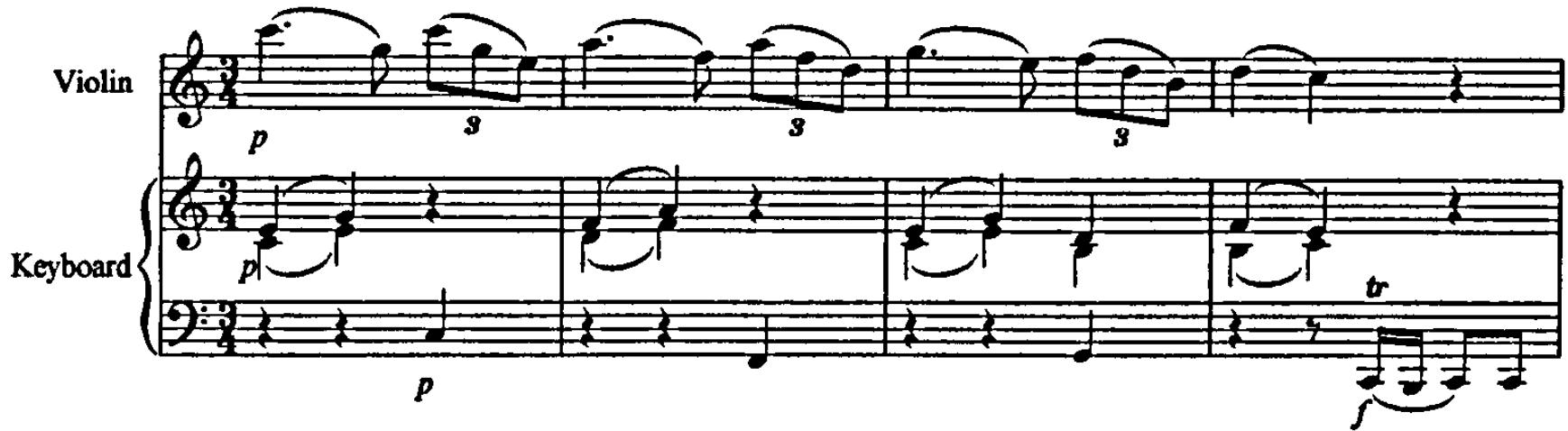
中文讲解
本段是图5.7的图题,标明该例为K303第二乐章第51-54小节。结合前段P0065的论证,这是K303"forte主题使用八度叠加"论证中的forte一侧(即第51小节起的forte段落)的乐谱例证。第51-54小节是该forte主题陈述的起始片段,作者用以对照第13小节附近的piano版本,从而让读者直观看到同一主题在两种力度/织体处理下的形态差异。需查看原图5.7以核对八度叠加的具体声部配置与和声细节。
补充说明
图5.6(piano版本,本节段落中未单独列出文本段落)位于本书第17或18页的某处,与图5.7共同构成成对的对照例子。
第6段(P0067)
原文复述
第18页图像或乐谱示例
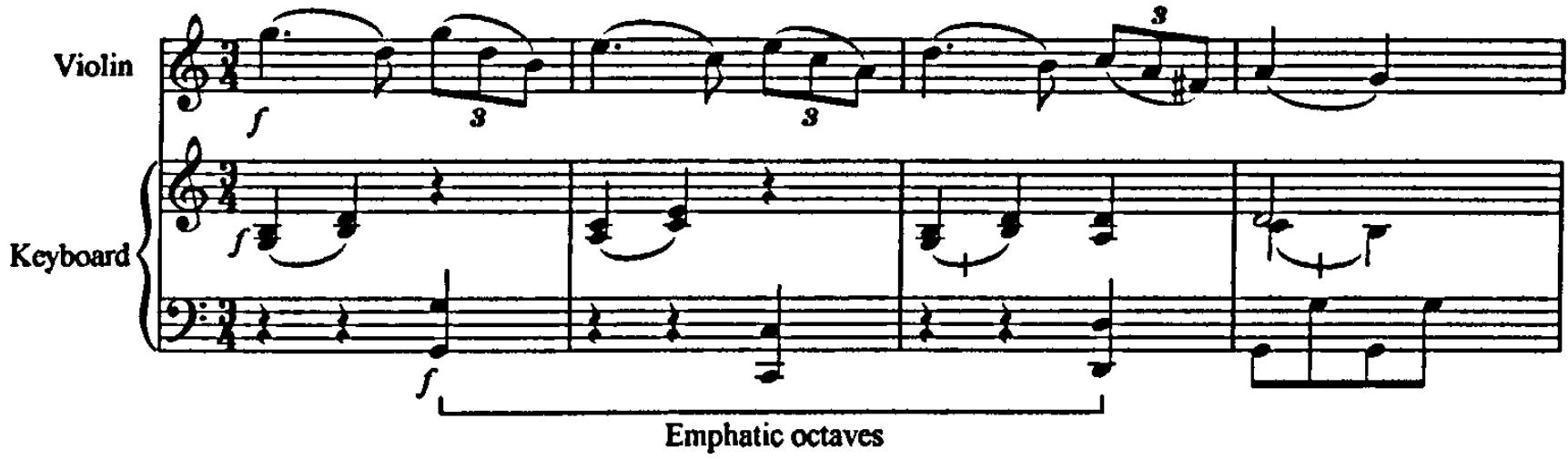
中文讲解
本段是位于第18页的一个图像或乐谱占位符。文本来源中除"第18页图像或乐谱示例"的占位说明外,未提供更多可定位的信息;根据上下文推断,该图像很可能与K303第二乐章的piano/forte对比相关(即对应前段提及的图5.6),但因本节段落中未出现明确的图题或说明文字,作者意图不可仅凭该占位符确定。需查看第18页原图以确认其具体内容、所对应的乐谱段落与论证功能。
补充说明
无额外补充(原文信息不足以确认具体功能)。
第7段(P0068)
原文复述
Thus, while the melodic and harmonic characteristics of this theme are equally suited to f or p dynamics, contrast is often dictated by the textural setting of the theme and its accompaniment.
中文讲解
本段是前文一系列谱例论证之后的小结性论断。作者承认,K303第二乐章主题本身的旋律与和声特征对forte或piano力度具有同等的适应性——也就是说,力度差异并非来自主题素材的内在属性。然而,真正决定两者之间"对比"效果的,是织体的设置(textural setting),即主题与伴奏在声部数量、音区、节奏密度上的安排方式。这句话是本节前半部分(K304第二乐章主题的连续升级与K303的p/f对比)的理论性结论,标志着论证从具体谱例转向普遍原则:莫扎特在帕拉丁奏鸣曲中通过织体而非旋律-和声内容来实现p-f对比与强调。承接关系上,本段为下文转入对allegro/lively主题(而非cantabile主题)的讨论提供了过渡。
补充说明
“textural setting"是本节核心术语之一,指主题陈述所处的织体环境,包括声部数量、伴奏音型、音区分布、节奏密度等维度。
第8段(P0069)
原文复述
Similarly, Mozart’s lively and ’light’ themes, or ‘allegro’ to use Tartini’s terminology (Tartini, 1771: 55), are heard in both forte and piano guises – but specific characteristics of their musical context render the forte versions far more emphatic than their piano counterparts. As in his most insistent and forte cantabile melodies, Mozart uses texture to create a vigorous Affekt in his forte allegro themes. For example, the second theme of K301 first movement (see example 5.8) is first heard in four octaves at once, with strokes marked on the keyboard quavers to indicate extra force, and with rests separating each statement of the motive – these rests serve to emphasise the motive by surrounding it with silence. According to musical and rhetorical treatises, this draws the listener’s attention to the motive, thereby making it intelligible and moving. $^{44}$
中文讲解
本段将论证范围从cantabile主题扩展到allegro主题,引入18世纪小提琴家与理论家塔蒂尼(Tartini)的术语来命名"活泼的、轻盈的主题”。作者的主张有四层:(1) 莫扎特的allegro主题同样存在piano与forte两种面貌;(2) 但forte版本远比piano版本更具强调性(emphatic),原因在于具体音乐语境中的某些特征;(3) 与cantabile主题一样,织体是制造vigor(强劲、有力)的Affekt(情感/情绪)的关键手段;(4) 以K301第一乐章第二主题(图5.8)为例:它首次出现即以四个八度同时陈述,键盘的八分音符上标有"stokes”(楔形重音记号),动机之间以休止分隔——休止通过"以沉默环绕动机"来强化其听觉显著性。作者引用18世纪音乐与修辞学论著说明,休止使听众注意力聚焦于动机,从而使其更易理解、更具感染力。脚注44随即对此提供文献支持。这段话的核心创新在于将"休止"也纳入"织体强化"的范畴:休止不仅是结构手段,更是修辞手段。
补充说明
Tartini(朱塞佩·塔蒂尼,1692-1770)的术语引自其1771年著作第55页;“Affekt"是18世纪音乐修辞学中的核心概念,指作品所欲表达的情感状态;“strokes"即楔形重音记号(accent marks),指示演奏时加大力度。脚注44位于P0070。
第9段(P0070)
原文复述
$^{44}$ For a description of pauses and rests in eighteenth-century rhetorical treatises see W. Cockin (1775): The Art of Delivering Written Language; or, An essay on reading. In which the subject is treated philosophically as well as with a view to practice. London: H. Hughes, pp.99-110; and T. Sheridan (1762): A course of Lectures on Elocution. London: W. Strahan, pp. 75-82. For musical-
中文讲解
本段是脚注44的开头部分,作者为正文中"休止与静默能够吸引听众注意、使动机更易理解且更动人"这一主张提供文献依据。脚注首先指向两份18世纪的修辞学/朗读论著:W. Cockin 1775年的《The Art of Delivering Written Language》(关于书面语言口头表达之艺术,副题为"哲学与实践并重”,伦敦H. Hughes出版,第99-110页),以及T. Sheridan 1762年的《A course of Lectures on Elocution》(雄辩术讲义,伦敦W. Strahan出版,第75-82页)。两书所讨论的核心概念——停顿与休止在口头/书面表达中的修辞功能——被作者借用到音乐语境中,构成跨学科的类比论证。脚注在此的功能是"来源支持”,印证了正文将"音乐休止"比附于"语言停顿"这一论点的修辞学渊源。脚注末尾以"For musical-“未完结,表明其内容在P0074继续。
补充说明
本段为脚注的第一部分,跨页延续至P0074;Cockin与Sheridan均为18世纪英语世界的修辞学/朗读理论家,他们关于停顿的论述被作者引用以支撑"休止=注意力聚焦"的修辞性解释。
第10段(P0071)
原文复述
Example 5.8: K301, movement 1, bars 8-12. In the piano treatment of this same theme, however, the keyboard and violin interact in seamless dialogue, thus removing the unisons and the punctuating rests:
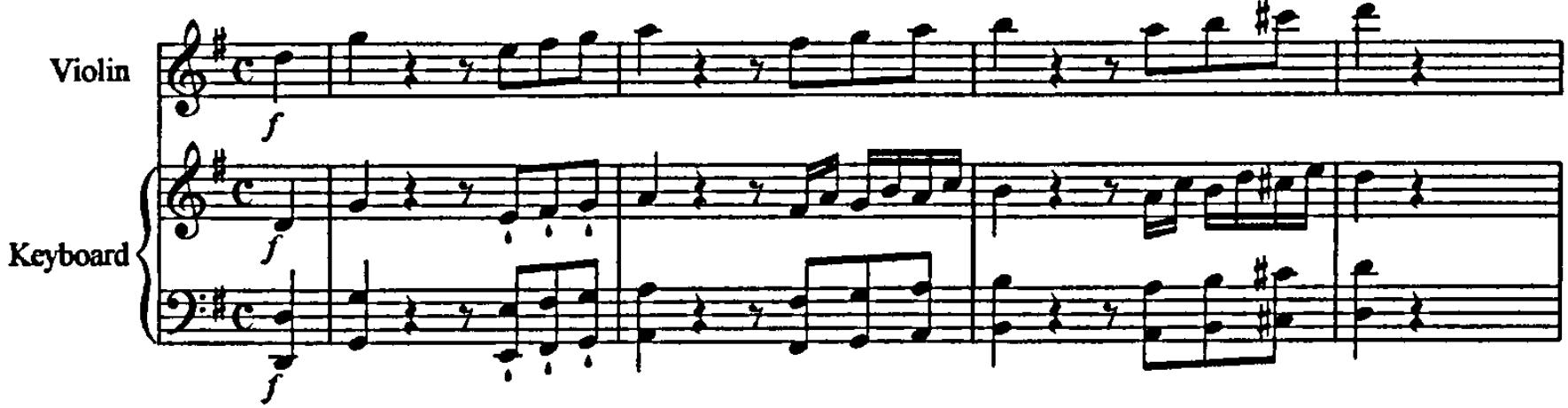
中文讲解
本段兼具图题与论证推进功能:(1) 标识图5.8为K301第一乐章第8-12小节(即前段所论第二主题的forte陈述);(2) 转向piano版本:同一主题在piano处理下,键盘与小提琴之间进行"无缝对话”(seamless dialogue),由此去掉了forte版本中的两个关键特征——齐奏(unisons,四八度同时陈述)与分隔动机的休止(punctuating rests)。这段话的论证逻辑是:通过删除unisons与rests这两个织体-修辞手段,piano版本获得了一种流畅、连续、不被切分的听感,与forte版本被强调、被聚焦的效果形成鲜明对比。冒号结尾提示读者紧随其后的图5.9即为piano版本的乐谱实例。需查看原图5.8与图5.9以核对两版本的具体音型与声部配置。
补充说明
“seamless dialogue"指两件乐器以对话式对位进行,无统一节拍重音或强断句;与forte版本中的齐奏+休止形成"强调-流畅"对照。
第11段(P0072)
原文复述
Example 5.9: K301, movement 1, bars 28-32.
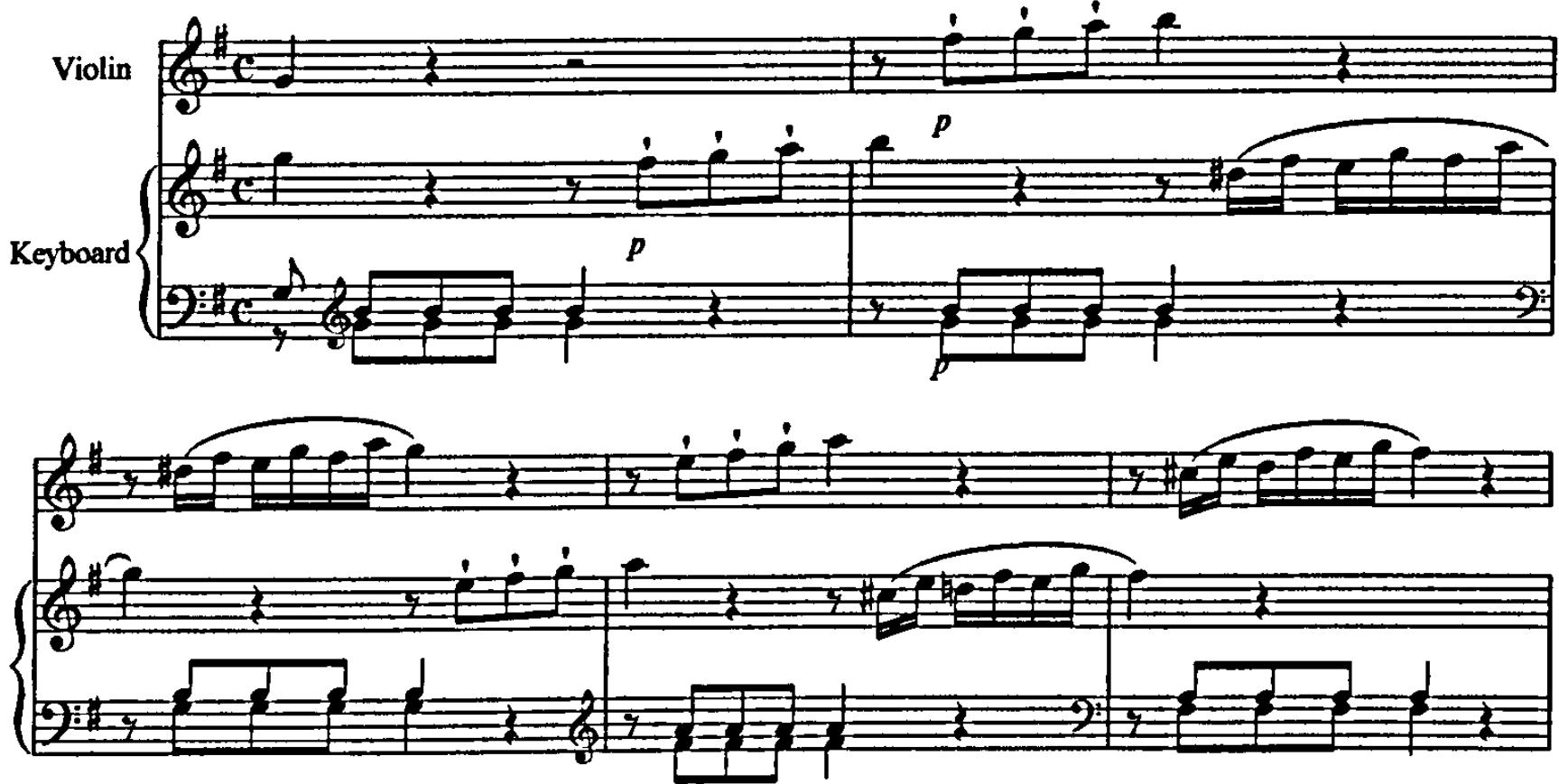
中文讲解
本段是图5.9的图题,标明该例为K301第一乐章第28-32小节。结合P0071的论证,这是K301"第二主题piano版本"的乐谱例证——即forte版本(第8-12小节,图5.8)之后经过主题变形与对话化处理后呈现的piano面貌。第28-32小节是该piano陈述的对应起始片段,作者用以直观展示"无缝对话"的织体形态(无齐奏、无分隔休止)。需查看原图5.9以核对小提琴与键盘声部的具体对位关系与节奏配合。
补充说明
图5.8(P0071)与图5.9在本节中构成第二组成对的p/f对比例证,与K303第二乐章(图5.6/5.7)的对比共同支撑"织体即力度"的论点。
第12段(P0073)
原文复述
The character of the lively third theme of the first movement of K302 (see example 5.10) – which imitates the orchestral crescendo famed in the city where this work was composed, Mannheim – is also transformed through the use of texture, as well as rising tessitura and a broadening intervallic range. Mozart’s trademark devices for enlivening a theme are clearly at work; the accompanying triplet quavers of the piano version of this theme are replaced by semiquavers in the violin part when it is played forte (bar 23). Furthermore, the keyboard player’s left-hand pedal (a repeated quaver Eb) is reinforced by an octave grace note at the start of each bar during the crescendo and ultimately becomes an alternating octave Eb in the forte version of the theme. The ascending sequence which begins in the violin part in bar 15 is also marked with strokes during the crescendo and forte renditions. Even without strokes this theme would be performed with a detached articulation, but the notation of strokes reinforces the fact that this motive should be played with increasing energy as the dynamic rises.
中文讲解
本段以K302第一乐章第三主题(图5.10)为案例,论述"活泼主题"如何通过多种织体手段实现力度强化与性格转变。作者的论证包含五个层次:(1) 主题本身模仿了曼海姆乐派著名的管弦乐渐强(Mannheim crescendo),这种渐强传统正是帕拉丁奏鸣曲创作背景中的标志性音响;(2) 主题的性格不仅通过织体,也通过音区上升(rising tessitura)与音程幅度扩大(broadening intervallic range)来转变;(3) 莫扎特"激活主题"的标志性手段之一:piano版本中键盘的三连音八分音符伴奏,在forte版本(第23小节)被小提琴部分的十六分音符取代——节奏密度提高一倍;(4) 左手持续音的处理:原本重复的八分音符Eb(low-hand pedal)在渐强过程中每小节开头被加入八度倚音加以强化,最终在forte版本中演变为八度Eb的交替音型;(5) 第15小节起小提琴的上升音型在渐强与forte版本中标有楔形重音记号,作者强调即便没有这些记号,主题本身也会以断奏(detached articulation)演奏,但记号强化了"力度上升=能量上升"的演奏意图。这段话揭示了莫扎特"织体强化"手法的多维性:节奏加密、音区扩张、伴奏音型变化、倚音强化、重音记号叠加共同作用。
补充说明
“Mannheim crescendo"特指18世纪曼海姆宫廷管弦乐派标志性的、跨越整个乐队的大幅度渐强效果;“left-hand pedal"此处指左手维持的持续低音,而非现代钢琴的"弱音踏板”(una corda);该例为"非八度叠加型"的织体强化路径,与K301/K303的八度手法形成补充。
第13段(P0074)
原文复述
rhetorical figures of interruption of silence, D. Bartel (1997): Musica Poetica: Musical and Rhetorical Figures in German Baroque Music. Lincoln: University of Nebraska Press, p.447.
中文讲解
本段是脚注44的结尾部分(与P0070的开头连接)。它在"For musical-“之后补全了文献指向:为正文关于"休止与静默的修辞功能"的主张提供一份直接相关的音乐-修辞学文献,即D. Bartel 1997年的《Musica Poetica: Musical and Rhetorical Figures in German Baroque Music》(林肯:内布拉斯加大学出版社,第447页)。该书专门研究德国巴洛克音乐中的音乐-修辞学格律(figures),其中第447页讨论"中断静默”(interruption of silence)这一修辞格——即通过休止打破连续陈述以吸引注意力。这正是正文K301例中所论"休止环绕动机"的理论原型。脚注在此的功能是将正文的修辞类比落地到具体的音乐修辞学文献,强化论点的学术根基。
补充说明
D. Bartel的著作是20世纪末以来音乐修辞学复兴中的重要文献,将18世纪修辞学理论与巴洛克音乐实践系统对接;“interruption of silence"对应正文K301例中"rests separating each statement of the motive"的修辞意涵。
第14段(P0075)
原文复述
Example 5.10: K302, movement 1, bars 15-25.
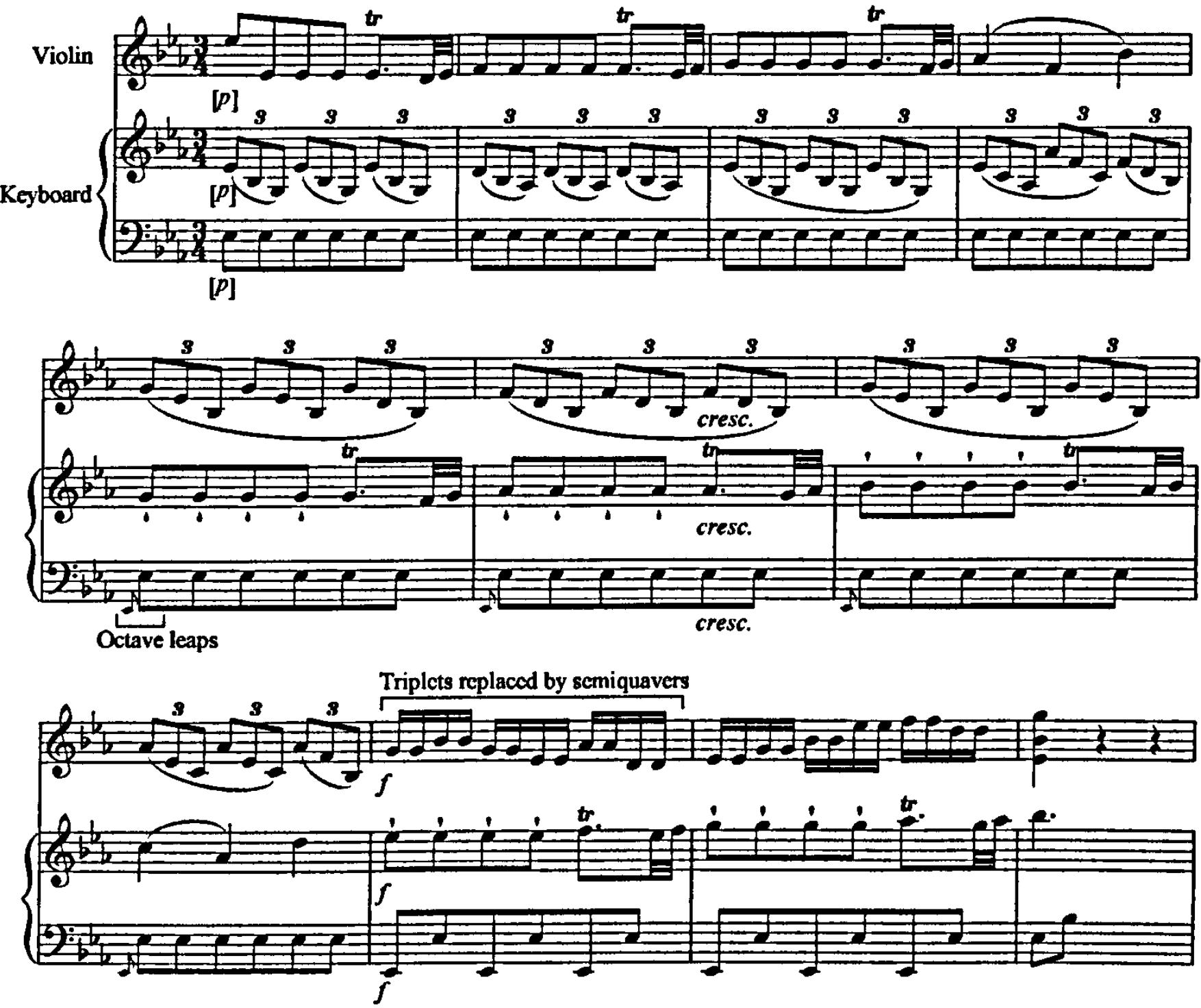
中文讲解
本段是图5.10的图题,标明该例为K302第一乐章第15-25小节。结合P0073的论证,这是"第三主题”(模仿曼海姆渐强的活泼主题)从piano陈述渐入forte陈述的关键段落。第15小节是小提琴上升音型的起始(forte版本中标有楔形重音),第23小节是三连音八分音符被十六分音符替代的转折点,第15-25小节覆盖了整个渐强-转入forte的过程。作者以此例支持论点:莫扎特通过节奏加密、音型变化、重音记号叠加等多重手段,将同一主题从piano版本转化为强调性远更强的forte版本。需查看原图5.10以核对各小节织体变化的具体细节。
补充说明
图5.10与前文图5.8/5.9(K301)、图5.6/5.7(K303)共同构成三个不同作品、不同主题类型的p/f对比案例库,支撑本节"织体是力度对比的主要决定因素"的核心论点。
脚注 / 边栏 / 图表 / 附加信息(如有)
本节涉及的附加材料包括:(1) 谱例图5.3(P0062-P0063)、图5.4(仅P0063提及,本节段落中未呈现)、图5.5(P0064-P0065)、图5.6(仅P0065提及,本节段落中未呈现)、图5.7(P0065-P0066)、第18页未命名图(P0067)、图5.8(P0069、P0071)、图5.9(P0071-P0072)、图5.10(P0073、P0075)——这些乐谱例证是本节论证的核心载体,分别支撑"同一主题不同再现的织体升级”(K304)、“p/f主题织体对照”(K303、K301)、“曼海姆渐强的织体强化”(K302)三类案例;(2) 脚注44(P0070、P0074)为正文"休止具有修辞功能"的主张提供两份18世纪英语修辞学文献(Cockin 1775、Sheridan 1762)与一份音乐修辞学文献(Bartel 1997)的跨学科支持。
💡 本节核心要点
- 本节的核心论点是:莫扎特帕拉丁奏鸣曲中piano与forte之间的对比,并非主要由旋律-和声素材的差异决定,而是主要由主题所处的织体环境(声部数量、节奏密度、音区、音型、休止)决定。
- 通过K304第二乐章主题在第16、78、135小节三次再现的递进(八分音符跑动→片断化卡农+低音装饰→琶音式加倍),莫扎特展示了在同一主题上逐步升级织体复杂度以强化forte效果的策略。
- K303第二乐章与K301第一乐章第二主题的p/f对照表明,forte主题典型地采用八度叠加、齐奏、动机间休止等"强调性"手段,而piano主题则呈现为键盘与小提琴之间的"无缝对话”,无齐奏、无分隔休止。
- 休止在莫扎特的forte主题中不仅是结构手段,更是修辞手段——它通过"以静默环绕动机"吸引听众注意,使动机更易理解与更具感染力,这一点得到18世纪语言修辞学与音乐修辞学文献的双重支持。
- K302第一乐章第三主题揭示了非八度叠加型的织体强化路径:通过节奏加密(三连音八分音符→十六分音符)、持续音倚音强化(重复Eb→八度Eb交替)、音区上升、音程扩大、楔形重音记号叠加,共同制造曼海姆渐强式的能量上升效果。
- 塔蒂尼(Tartini)的allegro主题类型学扩展了本节的论证视野:莫扎特对"活泼主题"的处理同样遵循"织体即力度"的原则,使allegro主题的forte版本远比其piano版本更具强调性。
🔑 关键术语
- textural setting:本节核心术语,指主题所处的织体环境,包括声部数量、伴奏音型、音区分布、节奏密度、休止使用等维度;作者主张莫扎特通过textural setting的变化来实现p/f对比,而非改变主题的旋律-和声内容本身。
- fragmented canon:片断化卡农,K304第二乐章第78小节处出现的织体手段:主题动机在键盘与小提琴之间以交错方式轮流陈述,而非完整的同时陈述;既制造对话感又强化主题的存在。
- Affekt:18世纪音乐修辞学中的核心概念,指作品所欲表达的情感或情绪状态;本节中作者强调莫扎特通过织体手段来创造forte allegro主题中的"vigorous Affekt"(强劲有力的情感)。
- Mannheim crescendo:曼海姆渐强,18世纪曼海姆宫廷管弦乐派标志性的创作手法,即跨越整个乐队的大幅度持续渐强效果;K302第一乐章第三主题即模仿此种风格,并通过织体变化加以实现。
- tessitura:音区,此处特指旋律或织体在音高上的分布范围;本节中forte主题常伴随"rising tessitura"(音区上升),作为力度提升的辅助手段。
- appoggiatura:倚音,不属于本调和弦的不协和装饰音,通常通过下行解决产生张力;本节图5.5专门展示该动机在K304主题中被"扩展处理"的形态。
- Tartini’s ‘allegro’ terminology:塔蒂尼在其1771年著作第55页使用的术语,指"活泼、轻盈"一类的主题类型;作者借此术语将本节论证从cantable主题扩展到allegro主题。
CH5-S5 [描述性拆分] Sustaining Power and Elevated Cantabile Line Over Busy Keyboard Texture
第1段(P0076)
原文复述
There appears to be one context in which p markings are rarely used. A forte dynamic is often employed by Mozart to characterise themes which Johann Friedrich Schubert would describe as ’elevated’. In these themes, ’notes are bound to each other, emphatic, and precisely held to the full extent of their value’ (J.F. Schubert, 1804: 130-1; quoted in Brown, 1999: 629-30); the new-improved sustaining ability of the late eighteenth-century bow (be it transitional or Tourte) is thus exploited to its full advantage. While the violin sustains pedal notes (see example 5.11) or slow-moving scales (see example 5.12), thereby creating an expansive and full cantabile line, the keyboard’s intricate passagework contributes energy and excitement to the texture:
中文讲解
本段提出了本小节的核心论题:在莫扎特笔下有一类几乎从不使用 p(弱音)力度记号的主题,这类主题常以 f(强音)来刻画,J.F. Schubert 称之为“elevated(崇高的/高昂的)”主题。要点如下:
- 主题特征:引文给出 Schubert 对“elevated”主题的定义——音符彼此紧扣、语气坚定(emphatic),并被严格地保持到其时值的完整长度。这是一种讲求“饱满、持续、明确收尾”的歌唱性主题,而非轻盈、断奏的主题。
- 乐器学条件:作者把这种演奏可能性归因于 18 世纪晚期弓的“改良”——无论属于过渡型还是最终的 Tourte 弓——它让小提琴能够真正把一个音“撑满”其全部时值,从而支撑上述定义。
- 织体对比:音乐的实际织体被概括为“持续的小提琴 + 忙碌的键盘”。小提琴用持续音(例 5.11)或慢速音阶(例 5.12)拉出一条宽广、饱满的 cantabile(歌唱性)旋律线;与此同时,键盘以繁复的走句(passagework)提供能量与兴奋感。
- 在本节论证中的位置:这是一句总论,下文紧接的两段示例(5.11、5.12 之后是 5.13、5.14)将逐一展示“提琴如何被安排在键盘的繁忙织体之上歌唱”。因此本段既设定了音响理想,又预告了接下来的实例类型。
易误解之处:p 标记稀少并非因为作曲家疏漏,而是因为主题的审美性质决定了它本身就需要饱满与力度;持续性来自弓的物理能力,而非单纯的力度标记。
补充说明
J.F. Schubert(1804)的引文是通过 Brown(1999: 629-30)转引的,括号中的页码分别对应原文献与转引文献。本节主题名中的 “Cantabile Line” 与本段 “expansive and full cantabile line” 一致。“elevated”主题的判断与作者上一节关于强弱标记使用习惯的讨论形成直接对照。
第2段(P0077)
原文复述
Example 5.11: K301, movement 1, bars 33-36. Sustained violin pedal over keyboard passagework.
中文讲解
这是图例 5.11 的标题(caption),提供三条定位信息:作品编号(K301,即莫扎特 G 大调小提琴与钢琴奏鸣曲)、乐章(第一乐章)、小节范围(第 33–36 小节)。其功能说明(小提琴持续长音 vs. 键盘走句)与 P0076 总论一一对应,是该论点的第一个具体例证。
第3段(P0078)
原文复述
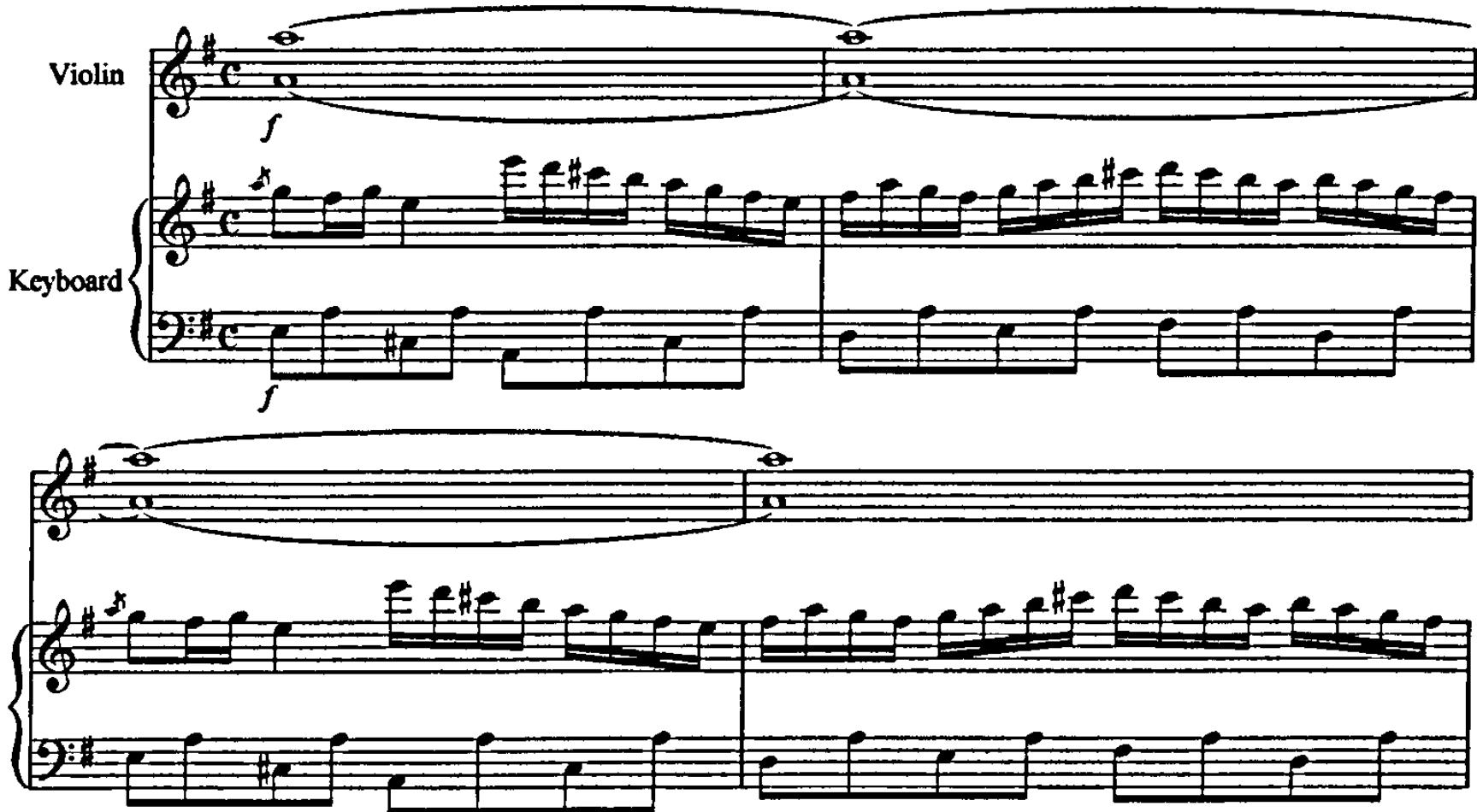
中文讲解
这是第 21 页上例 5.11 的乐谱/图像占位符。该占位符对应的具体内容(K301 第一乐章第 33–36 小节的小提琴与钢琴声部、具体的弓法与键盘走句形态)需查阅原图,本节文本仅在 P0077 中给出位置与功能说明。
补充说明
无额外补充;细节以原图为准。
第4段(P0079)
原文复述
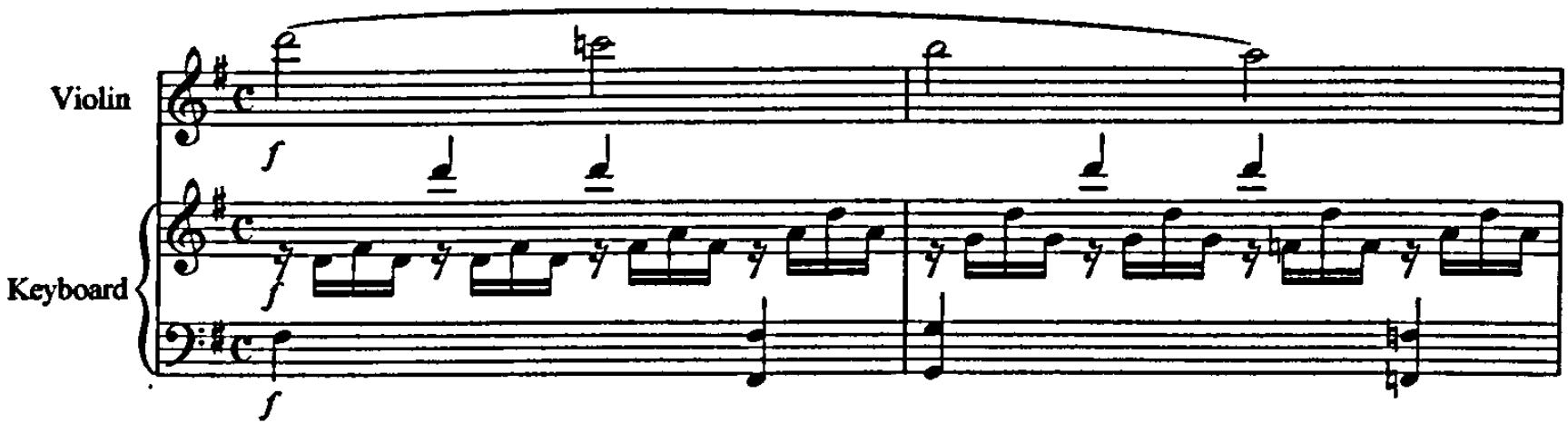
中文讲解
此为图例 5.12 的图像条目。标题给出定位信息:K301 第一乐章,第 59–60 小节;功能说明为“持续的小提琴音阶 vs. 键盘走句”。与例 5.11 不同的是,本例展示的不是保持不变的持续长音,而是小提琴的慢速音阶——同样属于 P0076 中所说“slow-moving scales”范畴;可见作者将“持续”广义理解为“音符被拉满时值”,具体形态既可以是长音(pedal),也可以是缓慢流动的音阶。
补充说明
无额外补充;细节以原图为准。
第5段(P0080)
原文复述
Alongside the sustaining power of the violin bow, Mozart enhances the violinist’s ability to sing out above the busy keyboard texture, utilising high tessitura (see example above 5.12), and emphatic octave leaps which draw attention to repeated violin themes (5.13), and leaping double-stopped chords (see example 5.14):
中文讲解
本段接续 P0076,将“歌唱性投射”从弓的“持续”扩展到另外三种让小提琴在忙碌键盘织体中“被听见”的手法。要点:
- 论证推进:从“声音被维持”到“声音被听见”——单纯把一个音撑满并不足够,必须让它在密度上胜出键盘。作者明确写出三种具体手段。
- 三种手法及其例证对应:
- 高音区(high tessitura):见例 5.12(“above 5.12”即指向 P0079 的例子),把小提琴旋律放到高于键盘繁忙织体的音区。
- 强调性的八度跳跃(emphatic octave leaps):用在反复出现的小提琴主题上(第 5.13 例),用音程跳跃“抢耳”。
- 跳跃式双音(leaping double-stopped chords):见例 5.14,让小提琴在一个动作里同时奏出两条音线以增加“份量”。
- 与 P0076 的关系:P0076 强调弓的“撑满时值”,本段强调“高度+八度跳+双音”的纵向强度。两者共同回答“提琴如何在键盘上方歌唱”。
易误解之处:作者将这三者并列为“enhance singing out”的手段,并不意味着每段都用齐,而是按场景挑选——5.12 用高音区,5.13 用八度跳,5.14 用双音。
补充说明
无额外补充;例 5.13、5.14 的细节分别在 P0081、P0083 给出定位与功能。
第6段(P0081)
原文复述
Example 5.13: K301 movement 1, bars 173-177. Octave leaps enhance violin’s singing melody.
中文讲解
图例 5.13 的标题。定位信息:K301 第一乐章,第 173–177 小节;功能说明——“八度跳跃强化小提琴的歌唱旋律”。此例服务于 P0080 中第二种投射手法(emphatic octave leaps on repeated violin themes),与 P0076 中 “notes are emphatic… precisely held to the full extent of their value” 的定义相符:八度跳跃本身既是音程上的强调,也是把旋律推到更突出位置的手段。
第7段(P0082)
原文复述

中文讲解
这是第 22 页上例 5.13 的乐谱/图像占位符。具体的八度跳跃位置、其在小节中的节奏形态、与键盘声部的对位关系,需查阅原图。
补充说明
无额外补充;细节以原图为准。
第8段(P0083)
原文复述
Example 5.14: K303, movement 1, bars 43-46. Violin’s sustain is enhanced by emphatic leaping double-stopped chord.
中文讲解
图例 5.14 的标题。定位信息:作品改为 K303(莫扎特另一首小提琴与钢琴奏鸣曲),第一乐章,第 43–46 小节;功能说明——“跳跃式双音强化小提琴的持续”。值得注意的是标题中使用了“sustain”,呼应 P0076 关于弓的持续能力与“elevated”主题的论题;此处通过“跳跃式双音”同时承担“持续”(时值被拉满)与“跳跃”(强突出)双重功能,是本节技法谱系中最复杂的组合。
第9段(P0084)
原文复述
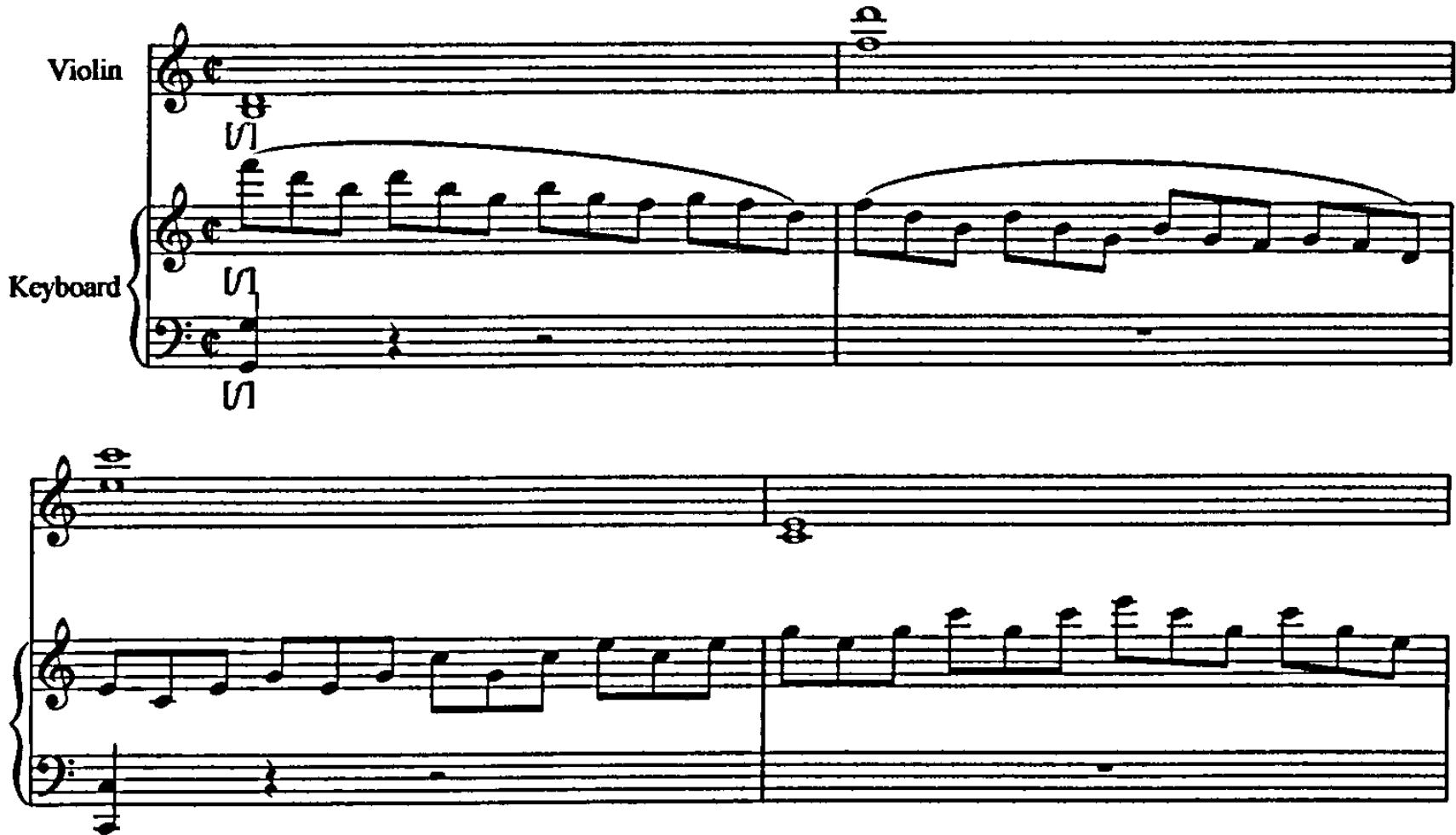
中文讲解
这是第 22 页上例 5.14 的乐谱/图像占位符。具体的双音结构、跳进方向、与键盘织体的对位关系,需查阅原图。
补充说明
无额外补充;细节以原图为准。
脚注 / 边栏 / 图表 / 附加信息(如有)
本小节共引用四段谱例:例 5.11(K301 第一乐章 33–36)与例 5.12(K301 第一乐章 59–60)同属 K301,分别展示“持续长音”与“慢速音阶”两种小提琴持续形态,对应 P0076 的总论;例 5.13(K301 第一乐章 173–177)与例 5.14(K303 第一乐章 43–46)从同一首奏鸣曲跨到另一首,对应 P0080 列出的“八度跳跃”与“跳跃式双音”两种投射手法。J.F. Schubert(1804: 130-1)的定义经 Brown(1999: 629-30)转引,属于旁证/权威定义功能,用以支撑“elevated”主题的描述。小节标题 “Sustaining Power and Elevated Cantabile Line Over Busy Keyboard Texture” 直接取自 P0076 与 P0080 的内容主题。
💡 本节核心要点
- 本节聚焦一类例外情形:莫扎特笔下几乎不出现 p 记号的主题——由 f 标记的“elevated”主题;其审美特征是音符紧扣、语气坚定且被完整保持时值。
- 这一演奏可能性依赖于 18 世纪晚期弓(过渡型或 Tourte 弓)的改良,使小提琴能够真正撑满每个音符的时值。
- 本节的织体对比统一为“持续/歌唱性的小提琴 vs. 繁忙的键盘走句”:键盘提供能量与兴奋感,小提琴提供宽广、饱满的 cantabile 旋律线。
- 作者进一步列出三种让小提琴在键盘织体上方被听见的投射手法:高音区(high tessitura)、强调性八度跳跃、跳跃式双音;分别对应例 5.12、5.13、5.14。
- 四例中前两例(5.11、5.12)证明“持续”,后两例(5.13、5.14)证明“歌唱性地凸显”;两者共同回答“提琴如何在忙碌键盘之上歌唱”。
🔑 关键术语
- p markings (钢琴/弱音力度标记):本节中指的是莫扎特奏鸣曲乐谱里标注的 piano(弱)力度记号;作者指出在“elevated”主题这一特殊语境下几乎不见 p 标记,因为主题本身要求饱满与持续。
- elevated theme (J.F. Schubert, 1804):Schubert 用以描述一类主题:音符彼此紧扣、语气 emphatic、并被严格保持到完整时值;本节以此界定莫扎特使用 f 而不使用 p 的语境。
- late eighteenth-century bow / Tourte bow:指 18 世纪晚期出现的改良小提琴弓(含过渡型与最终定型的 Tourte 弓);它使小提琴能够真正“撑满”一个音的整个时值,是本节“sustaining power”得以实现的乐器学条件。
- cantabile line:歌唱性的旋律线;本节指由持续长音或慢速音阶构成的小提琴声部,作者形容其“expansive and full”。
- tessitura:一段音乐的总体音高分布范围;本节中特指把小提琴旋律置于高位的“high tessitura”,以在音区上突出于键盘织体。
- double-stop / leaping double-stopped chord:小提琴上同时奏两条弦的双音;本节指带跳进的、emphatic 的双音和弦,用以增加小提琴声部的“份量”并强调持续。
- pedal notes:被持续保持的长音;本节例 5.11 中提琴用 pedal notes 与键盘走句形成对比,构成最简形式的“持续 vs. 繁忙”织体。
CH5-S6 [描述性拆分] From Prescribed Dynamics to Self-Devised Light and Shade Across the Sonatas
第1段(P0085)
原文复述
Unsurprisingly, Mozart’s later Sonatas for Violin and Keyboard become increasingly detailed in their instructions to the performer: not only are ‘blocks’ of alternating $f$ and $p$ prescribed, but also directions for graded dynamics, and various degrees of accent, including $mfp$, $fp$ and $sf$. It is therefore mainly to these later sonatas (K376-80, published in 1781,^{45}) and the four late Viennese Sonatas, published between 1784 and 1788) that we will turn for our investigation of the more detailed nuances of sound which are achieved through the delivery of accent and emphasis.
中文讲解
本段提出本章考察对象的选择依据。作者观察到, Mozart 晚期的小提琴与键盘奏鸣曲对演奏者的指示越来越精细——除交替的 $f$ 与 $p$“区块”外,还出现了渐次层次(graded dynamics)以及 $mfp$、$fp$、$sf$ 等不同强度的重音标记。因此,下文将以 K376–80(1781 年出版)与四首晚期维也纳奏鸣曲(1784–1788 年间出版)为主要分析对象,专门考察“通过重音与强调处理来实现的更细腻的声音差异”。逻辑关键在于:精细的力度符号越多,分析者越能反推作曲家预设的声音层次,故这些晚期曲目成为研究“accent and emphasis”最直接的证据。
补充说明
$mfp$ 指“中强后即弱”、$fp$ 指“强后即弱”、$sf$ 指“突强”,三者都属于带重音的渐变(graduated)力度记号,与单纯的 $f$/$p$ 交替不同,它们记录的是瞬间的强度起伏。段落末尾括号中 K376–80 的出版年 1781 是上一版发现的缺失信息,此处据原文保留并附脚注标记 ^{45}}。
第2段(P0086)
原文复述
Most essential to the modern performer, though, is the realisation that eighteenth-century musicians were not only expected to observe and deliver those dynamic markings that were indicated by the composer. Additionally, players were expected to understand how and where to incorporate their own dynamics:
中文讲解
本段从“作曲家写下的力度”过渡到“演奏者自行施加的力度”,是整小节论证的枢纽句。它对现代演奏者提出一个关键认识:十八世纪乐手的职责并不止于忠实复述作曲家标注的力度,还要懂得在何处、以何种方式加入自己的力度处理。作者用 “not only…Additionally” 的递进结构,把“尊重谱面”与“自创力度”并列为同等重要的能力,从而为下一段引用 Leopold Mozart 关于“light and shade”的比喻、以及 P0089 中 Spohr 关于“masterly delivery”的论述铺设逻辑前提——只有当演奏者具备后一种能力时,才能把“正确”提升为“大师级”的演绎。
补充说明
句末冒号提示下文(P0088 的 L. Mozart 引文)将给出“自行施加力度”的权威例证。
第3段(P0087)
原文复述
^{45} Although K296 was also published with K376-80, it was written in 1778 alongside the Palatine Sonatas, K301-306.
中文讲解
这是一条对正文 P0085 的限定性脚注。脚注说明:虽然 K296 在出版时与 K376–80 归在同一集,但它的实际创作时间是 1778 年,与所谓的“帕拉丁奏鸣曲” K301–306 同期,而不属于正文所指的 1781 年出版批次。功能上,这条脚注防止读者把 K296 误认为晚期奏鸣曲,也为后文把 K296 选为“早期奏鸣曲个案研究”(见 P0089 末句)埋下伏笔——它是一首以早期手法写成、后被纳入晚期出版合集的曲子,正好适合检验力度理论在标记稀少的早期作品中的适用性。
补充说明
脚注体例标记 ^{45} 与正文中 K376–80 后的上标对应;这里“Palatine Sonatas”指慕尼黑选帝侯宫廷时期(1777–1778)Mozart 为宫廷所作的六首奏鸣曲,K301–306。该说法见原文。
第4段(P0088)
原文复述
The prescribed piano and forte must be observed most exactly… one must know how to change from piano for forte without directions and of one’s own accord, each at the right time, for this means, in the well-known phraseology of the painters, light and shade. (L. Mozart, 1756:218)
中文讲解
这是 Leopold Mozart 1756 年《Versuch einer gründlichen Violinschule》第 218 页的原文引文,构成本节理论支柱。其含义分两层:其一,已经标出的 piano、forte 必须严格遵守;其二,演奏者还要懂得在作曲家未指示之处,自行在恰当时机由 p 转 f 或由 f 转 p。作者借用绘画术语“light and shade”(明暗对比)来形容这种力度起伏,暗示音乐表演与视觉艺术中的明暗法遵循相同的修辞原则——通过对比与渐变制造立体感与表现力。读者须注意“without directions and of one’s own accord”这几个字,它精准地呼应了 P0086 中 “incorporate their own dynamics” 的主张。
补充说明
L. Mozart 即 Leopold Mozart,W. A. Mozart 的父亲,《小提琴演奏法教程》(1756)的作者;此处文献按原文标注为 L. Mozart, 1756:218。引文开头的省略号代表作者对原话的截取。
第5段(P0089)
原文复述
While delivering the written dynamics can in itself enhance the expression of a piece of music, devising one’s own dynamics must surely elevate a performance from what Spohr describes as ‘correct’ delivery, to ‘masterly delivery’, in which ‘the artist, imbued with the soul of the composer, can from his own soul interpret the composer’s intentions’ (Spohr, 1832: 178). Thus, while Mozart’s later sonatas more clearly represent the detailed nuances that he would have expected in performance, it is vital that the performer should not neglect these contrasts and progressions of ’light and shade’ – which are described in the mid-eighteenth century by such as Leopold and Quantz – in his earlier works. This chapter will survey the function and Affekt of Mozart’s prescribed accents and emphases in his Sonatas for Violin and Keyboard. These findings are coupled with rhetorical teachings in order to uncover the degree of variety which is necessary in the realisation of accent and emphasis, and to attempt to apply these aspects of delivery to sonatas which are less abundant in their performance directions. A case study of the first movement of K296 at the end of this chapter demonstrates how these theories can be applied to one of Mozart’s earlier sonatas.
中文讲解
本段是小节(也是本章)的论证收束与研究计划声明,分三层。
第一层提出“自行设计力度”使演绎从“正确”跃升为“大师级”,作者引 Spohr 1832 年著作第 178 页:艺术家须“浸润于作曲家的灵魂之中,再以自己的灵魂诠释作曲家的意图”。这一引文把 Leopold Mozart 的“light and shade”从技法层面提升到美学层面——自创力度不是任意发挥,而是以理解作曲家精神为前提的再创造。
第二层回到 Mozart 自身:尽管晚期奏鸣曲把细部力度写得最详尽,演奏者却不能在早期作品中放弃“light and shade”,因为这些对比在 Leopold Mozart、Quantz 等十八世纪中叶理论家的论述中本就是常规要求。
第三层宣告本章研究路径:先考察小提琴与键盘奏鸣曲中作曲家标示的重音与强调的“功能与 Affekt”,再与同时期修辞学(rhetorical teachings)相结合,确定“实现重音与强调”所需的“变化幅度”(degree of variety),最后尝试把同样的力度原则应用到指示较少的早期奏鸣曲,并以 K296 第一乐章为个案研究收尾。换言之,本章的论证结构是:晚期谱面证据 → 修辞学与十八世纪理论支撑 → 早期奏鸣曲的逆向应用 → K296 案例验证。
读者需注意:“Affekt”是十八世纪音乐修辞学的核心概念,指乐曲所欲传达的情感状态或情绪姿态;而“rhetorical teachings”指当时关于演说与表达如何以“起伏、对比、强调”来打动人心的修辞规则,本书将其类比到音乐中的力度与重音处理。
补充说明
Spohr, 1832:178 指 Louis Spohr 的《Violinschule》(1832),此处原文作为“masterly delivery”的权威定义来源。Quantz 与 Leopold Mozart 同为十八世纪中叶器乐演奏理论的代表人物(详见本段引用)。K296 第一乐章即本章末尾的案例研究对象。
脚注 / 边栏 / 图表 / 附加信息(如有)
本小节包含一条脚注(第 45 条,见 P0087),用于限定正文 P0085 中 K376–80 的出版范围,排除虽然同年出版但实际创作于 1778 年的 K296;为后文把 K296 选为“早期作品案例”提供时序依据。此外,P0088 是 Leopold Mozart 1756 年著作第 218 页的直接引文,P0089 中的“masterly delivery”出自 Spohr 1832 年著作第 178 页;两者构成本章最关键的两条文献支撑,分别承担“自行设计力度的技法合法性”与“演绎美学的精神性”两重论证功能。
💡 本节核心要点
- Mozart 晚期小提琴与键盘奏鸣曲(K376–80 与四首晚期维也纳奏鸣曲)的力度标记从 $f$/$p$ 交替扩展到 $mfp$、$fp$、$sf$ 等带重音的渐变层次,为考察 accent 与 emphasis 提供了最直接的谱面证据。
- 十八世纪演奏者的职责不止于复述作曲家标示的力度,还要懂得在作曲家未指示之处自行加入力度变化。
- Leopold Mozart 以绘画“light and shade”(明暗)作比,确立了自创力度在十八世纪器乐美学中的合法性。
- 自行设计力度能将演绎从 Spohr 所称的“正确”提升为“大师级”,前提是演奏者先浸润于作曲家的精神再以自己的灵魂诠释。
- 尽管早期奏鸣曲的力度标记较少,但 Leopold Mozart 与 Quantz 等中叶理论家描述的“light and shade”对比原则仍应贯穿其中。
- 本章的研究路径是:以晚期奏鸣曲的谱面证据为基础,结合修辞学教诲,确定“实现重音与强调”所需的“变化幅度”,再将同一原则逆向应用于指示稀少的早期奏鸣曲,并以 K296 第一乐章作个案验证。
🔑 关键术语
- $mfp$ / $fp$ / $sf$:三种带重音的渐变力度记号:$mfp$=中强后即弱、$fp$=强后即弱、$sf$=突强。它们记录的不仅是静态强弱,更是瞬间的强度起伏,是分析 Mozart 晚期力度细节的关键谱面证据。
- graded dynamics:渐次层次的力度,即在 $f$–$p$ 两极之间分出更细的强度等级与渐变过程,区别于仅做块状交替的早期力度处理。
- light and shade:Leopold Mozart 借自绘画的比喻,指演奏中力度由 p 至 f 或由 f 至 p 的对比与转换,尤其指作曲家未标出、由演奏者自行把握的部分;本节将其等同于“演奏者自创的力度起伏”。
- Affekt:十八世纪音乐修辞学的核心概念,指作品所欲传达的情感状态或情绪姿态;本章将考察 Mozart 重音与强调的 Affekt,即它们各自承载何种情感与表达意图。
- rhetorical teachings:十八世纪关于演说与表达的修辞规则,强调以起伏、对比、强调来打动人;本章将其类比到音乐力度与重音处理,作为支撑 accent/emphasis 变化幅度的理论资源。
- masterly delivery vs. correct delivery:Spohr 提出的两层次演绎概念:“正确”指忠实复述谱面;“大师级”指演奏者浸润于作曲家精神后再以自身灵魂诠释,是本节论证演奏者应自创力度的美学依据。
CH5-S7 Accent
第1段(P0090)
原文复述
Accent
中文讲解
这是第五章第七节的小节标题’Accent’(重音)。它把论域从更宏观的Affekt/character讨论收束到一个具体的技术概念——重音——并预示本节将沿’言语—音乐’两条平行线索,分别交代重音在塑造Affekt与character方面的功能、机制与术语边界。
第2段(P0091)
原文复述
Accents are presented as an integral part of Affekt and character in both speech and music. Sheridan describes accents as the ’essence of words’—as opposed to the essence of sentences or paragraphs—on the grounds that they ‘distinguish one syllable from the rest’ (Sheridan, 1762: 71). From this it follows that, while articulation concerns the enunciation of each syllable, accent concerns the stress placed on syllables within each word. By analogy, musical accents are used to emphasise and vary individual notes or short motives within longer phrases and passages. The stress given to a syllable or a note is achieved in one of three ways: through ‘smarter percussion’, by dwelling on the syllable or note, or by a combination of both attack and time.
中文讲解
本段的功能是为’重音’建立一个贯通言语与音乐的合法定义,并由此说明它在Affekt/character表达链中所处的层级。其论证策略是借助十八世纪演说术权威Sheridan的定义来为音乐中的重音概念正名:Sheridan把重音视为’词的精髓’(区别于句子或段落的精髓),依据是重音使一个音节区别于同一词内的其他音节。这一引证既给出了重音的最小作用单元(音节),也暗示了它与更高层级(句、段)表情单位的层级关系——后者是后续小节才会展开的论题,本节暂不深入。基于Sheridan的定义,作者进一步把发音(articulation)和重音(accent)区分开:发音处理的是如何把每个音节念清楚,重音处理的是词内音节之间的强弱关系。把这一对关系平移到音乐中,就得到一个对应的命题:音乐中的重音在更长的乐句或段落内部,用来强调和变化单个音或短动机。最后一段说明重音的物理实现方式有三种:更鲜明的敲击(percussion)、延长音节或音符的时值(dwelling)、以及起音(attack)与时值(time)的综合运用。这意味着无论在言语还是音乐中,重音都既是结构单元(区别音节/音符),也是可被演奏者操控的表现参数(力度、时值、起音),并由此成为Affekt被听者感知的具体载体。
补充说明
本段末尾上标47为一条引文来源脚注,脚注内容未包含在当前输入范围内,故不展开。
第3段(P0092)
原文复述
The term ‘accent’ is given two meanings in some nineteenth-century musical treatises. Baillot, for example, writes that ‘The character is thus traced by the composer, and the accent is rendered by the performer’ (Baillot, 1834: 352). This kind of accent—later labelled by Baillot as the ‘general’ accent (1834: 376)—refers broadly to the expressive delivery of an entire piece of music. It must be uncovered and conveyed by the performer, since it can never be fully prescribed by the composer. The second meaning, the ‘specific’ stress applied to individual notes (1834: 376), is the sense in question in the discussion above. The ‘specific’ accent is an essential part of how a performer realises the ‘general’ accent, but the two meanings of the word should not be confused.
中文讲解
脚注46对正文中的’accent’一词作了词义史层面的限定。它指出在十九世纪部分音乐论著中,‘accent’存在两种含义,并借助Baillot(1834)做出区分:第一种是Baillot后来说的’general’ accent(一般重音),指整首作品的表情性表达(expressive delivery),由作曲家勾勒(trace),却只能由表演者揭示并传达(render),因为作曲家无法在乐谱上完全规定它;第二种是Baillot所说的’specific’ accent(个别重音),即施加于个别音符的应力,也就是P0091正文所讨论的对象。脚注同时澄清两者的关系:‘specific’重音是表演者实现’general’重音的必要组成部分,但两种含义不能混为一谈。这一脚注的功能是防止读者把P0091关于’音符层面的局部应力’的论述,误读为关于’整首作品的表情处理’的论述;它把本节锚定在Baillot意义上的’specific’ accent这一较窄层面,而把’general’ accent作为更大的、贯穿整部作品表达的问题留待后续。
补充说明
本条即P0091正文末尾上标46所对应的脚注,其作用是为正文中的’重音’概念在十九世纪音乐修辞中划定词义边界。
脚注 / 边栏 / 图表 / 附加信息(如有)
本小节包含一处正文外的附加材料,即以独立段落形式给出的脚注46(P0092),用于在词义史上限定’accent’一词,并区分Baillot意义上的’general’ accent与’specific’ accent;P0091末尾另有一处上标47,所对应的脚注内容未包含在当前输入范围内。
💡 本节核心要点
- 重音(accent)被定位为贯通言语与音乐、构成Affekt与character的组成要素。
- 作者援引Sheridan(1762:71)将重音界定为’词的精髓’,依据是它’使一个音节区别于其他音节’,从而把重音的作用层级锚定在词内音节之间,而非句子或段落之间。
- 发音(articulation)关注每个音节如何念清楚,重音(accent)关注词内音节之间的应力关系;与此对应,音乐中的重音在更长的乐句或段落内部,用来强调和变化单个音或短动机。
- 重音的物理实现有三种途径:更鲜明的敲击(percussion)、延长时值(dwelling)、以及起音与时值的综合运用。
- 脚注46依据Baillot(1834)区分了两种重含义:‘general’ accent指整首作品的表情性表达,由作曲家勾勒、由表演者揭示并传达;‘specific’ accent指施加于个别音符的应力,是本节P0091所讨论的对象。
- ‘specific’ accent是表演者实现’general’ accent的必要手段,但两个层次不能混为一谈;本节只锚定在’specific’这一较窄层面上。
🔑 关键术语
- Accent(重音):在本节中指词内音节之间(言语)或更长乐句/段落内部的单个音或短动机上(音乐)的应力关系,是Affekt与character表达链中的具体技术单元,可通过更鲜明的敲击、延长时值、或起音与时值的综合运用来实现。
- Affekt:音乐或言语表演所要传达的表情性内容或情感特征;本节将重音定位为塑造Affekt的组成要素之一。
- Articulation(发音/起音):在本节中与重音相对:发音关注如何把每个音节念清楚(言语)或音符如何被奏出(音乐),而重音关注的是音节之间、音符之间的应力对比。
- General accent(一般重音,Baillot):Baillot(1834:376)所指的整首作品层面的表情性表达(expressive delivery),由作曲家勾勒,但需由表演者揭示并传达,因作曲家无法在谱面上完全规定。
- Specific accent(个别重音,Baillot):Baillot(1834:376)所指的施加于个别音符的应力,是P0091正文中’accent’一词所指的对象;它是表演者实现general accent的必要组成部分,但两个含义不能混用。
CH5-S8 [描述性拆分] Grammatical, Logical and Pathetic Accents in Speech and Music
第1段(P0093)
原文复述
The first role of accent is to clarify the sense of a speech or piece of music. Eighteenth-century theorists (including, for example, Jean-Jacques Rousseau, Koch and Johann Georg Sulzer), define two types of accents relating to the ‘syntactical’ organisation of speech and music (Beicken’s preface to Hiller, 1780: 21). The first of these is the ‘grammatical’ accent (Rousseau, 1768 R.1779: 3; Hiller, 1780: 68); in speech this entails stressing strong syllables of words, and in music, the emphasis of ’note buone’, that is, metrically strong beats, such as the first beat of a bar (L. Mozart, 1756: 219). Secondly, ‘oratorical’ or ’logical’ accents (Rousseau, 1768 R.1779: 4; Hiller, 1780: 68) are described by Suzanne Beicken as relating to ’the meaning of speech, through the structuring and patterning of word and sentence intonation’ (Beicken’s preface to Hiller, 1780: 21). The grammatical and logical accentuation of syllables within each word is thus intrinsic to correct pronunciation; an incorrectly placed accent can render a word incomprehensible, or can give it an entirely new meaning. Take an English example, such as the word content. The meaning of the word as content or content will usually be plain to a reader by its context, but by pronouncing the word with the incorrect syllabic accent, the sense is altered. Music of the eighteenth and nineteenth centuries similarly has conventions which dictate the ‘pronunciation’ of ‘musical words’, and Spohr writes that the ‘just accentuation, and exact division of the bar into its several durations of notes’ (Spohr, 1832: 178) is integral to the concept of ‘correct performance’. As such, these types of accents (the grammatical and logical) are the conventions of their language – speakers and performers would have been expected to use them automatically in order to make words and music understandable to the listener.
中文讲解
本段围绕重音的第一种功能——澄清意义——展开,把18世纪理论家(Rousseau、Koch、Sulzer,由Beicken的Hiller前言整理)归纳的两类“句法性”重音一并推出。
-
语法重音(grammatical accent):在言语中指读重一个词中的强音节;在音乐中对应意大利术语 note buone,即节拍上的强位,如小节第一拍(L. Mozart, 1756年的规定)。
-
演说重音/逻辑重音(oratorical / logical accent):Beicken将其描述为通过词与句的语调结构与模式来组织“意义”,关注的是语义的层级。
作者用 content 一词的双重读音(名词重音在前、形容词重音在后)做例子,说明错置重音可以彻底改变一个词的意义;音乐同样有约定俗成的“发音”规则,Spohr把“准确的重音和精确的小节时值划分”视为“正确演奏”的核心。
本段把小节标题中的三类重音里的前两类(grammatical和logical)落地,强调它们属于“语言惯例”,演奏者应当自动遵守;下一段才会进入第三类(ppathetic)、且超越惯例的表达性重音。
第2段(P0094)
原文复述
However, adhering in performance to ’note buone’ alone does not in itself enhance expressive delivery – if one were to equally stress the first note of every bar, for example, the performance would soon sound as repetitive and monotonous as if no notes were stressed, and were instead played evenly. The performer must therefore determine the hierarchy of accents within a speech or piece of music, deciding which words should receive a stronger or weaker accent in order to express Affekt. This type of accent is described in music as the ‘pathetic’ accent (Rousseau, 1768 R.1779: 4; Hiller, 1780: 68), and in this context, accents in speech are considered to be ’the life, blood, and soul which put the body [that is, the words or speech] in motion, and give it power to act’ (Sheridan, 1762: 71). Musical treatises attribute this same quality to accents, Campagnoli writing that ‘Accent may in general be regarded as the soul of music; for, expressed without accents, it becomes monotonous, dull, and insipid’ (Campagnoli, 1824: 7).
中文讲解
承接前段,本段揭示一个悖论:只忠于 note buone 反而扼杀表达。如果每小节第一拍都被同等强调,结果如同什么都不强调——一律平滑——演奏会陷入机械与单调。
因此演奏者必须自行判断重音的等级(hierarchy):决定哪些词/音符获得更强、哪些获得更弱的重音,以传达 Affekt(情感倾向)。这便是第三类重音——pathetic accent(情感/表情重音)——它不再是被动遵守的语法或逻辑规则,而是表演中的主动选择。
作者用两个互证引文撑起这一主张:
- Sheridan(1762)把言语中的重音比喻为让“身体”即词语活动起来的“生命、血液与灵魂”;
- Campagnoli(1824)把音乐中的重音直接称为“音乐的灵魂”,缺了它音乐就“单调、乏味、平庸”。
值得注意的是,pathetic accent与前两者的关键区别是:前两者可以被规则化,pathetic accent必须被艺术家“在每次表演中重新组织”,这为下文讨论弓压、音色、力度长度等表演参数做好铺垫。
第3段(P0095)
原文复述
$^{47}$ For references to these techniques of accentuation in speech and music see Cockin, 1775: 23; Sheridan, 1762: 71; Türk, 1789: 327; Hiller, 1780: 68.
中文讲解
这是脚注47,与正文关联:当作者提到“言语与音乐中的重音技巧”时,列出可进一步参阅的文献——Cockin(1775)、Sheridan(1762)、Türk(1789)、Hiller(1780)。这些是18世纪讨论朗诵与音乐重音的代表著作,Türk的《Klavierschule》是当时钢琴教学法的标杆。
对正文的作用:作为旁证线索,提示读者关于pathetic accent在言语与音乐中历史先例的更多一手出处,属于延展阅读指引,对正文的逻辑链不起直接论证作用。
第4段(P0096)
原文复述
In order to convey expression, the performer must consider the tone quality and relative length of the accent; although some accents are dictated by convention, and others can be indicated by the composer, the degree and exact character of an accent is difficult to prescribe. Indeed, accents can differ hugely in colour and force and it is through this that they become more than a simple clarification of metrical stress. Baillot warns that ‘some are not indicated by any sign’, and that ‘Others are indicated only partly’. He goes on to write that in response to this, ‘Modern composers, especially Beethoven, have employed more signs and have notated them with extreme care so that the character of the piece, of the passage, or of the note is given with the greatest possible accuracy’ (Baillot, 1834: 376).
中文讲解
本段把讨论从“要不要做重音”推进到“如何具体地做重音”。作者指出,表达性重音的两个可塑维度是音色(tone quality)与时值长度(length)——即使谱面无法精确规定其程度与性格,演奏者依然要在力度、声音色彩和时值上做出细腻差别。
作者承认三层现实:
- 部分重音靠惯例自动达成(对应grammatical/logical);
- 部分重音由作曲家记号给出;
- 但重音的确切程度与性格难以被规则化,正是这一可变维度让它超越了节拍强弱的简单标注。
Baillot(1834)的引文承担双重功能:一方面承认“有些重音没有任何记号”,另一方面赞美以Beethoven为代表的现代作曲家以更细密的记号追求“重音性格”的精确化。这为后文Dancla弓弦的引文埋下伏笔:即便记号增多,演奏者仍需以个人音色/弓压补足“文字未写尽”的表达。
第5段(P0097)
原文复述
Thus, by carefully considering both the amount and length of attack, and quality of sound, accents are an invaluable asset to the expressive delivery of music and speech:
中文讲解
这是承上启下的过渡句。作者把前段提到的三个变量(力度大小 amount、时值长度 length of attack、音色 quality of sound)整合为演奏者必须同时考量的三要素,并断言:只要谨慎运用,重音便是音乐与言语表达中无可替代的资产。冒号邀请下一段以一段实质性引文来“举例证明”这一资产。
这句本身不加新信息,但通过总结并以冒号引出文献证据,制造出由理性框架过渡到感性例证的修辞效果。
第6段(P0098)
原文复述
The bow in the hands of a clever artist is the soul of song, it is its intelligent pressure which produces those accents which delight and impassion us. But the pupil must never forget that it is in true sentiment and the inspiration of the heart that he will find this quality of sound, those sympathetic and penetrating bursts of melody which cannot fail to move and charm. (Dancla, c.1860: 232)
中文讲解
在过渡句的冒号之后,作者引用小提琴家、巴黎音乐学院教授Dancla的整段文字作为对前句“无可替代的资产”的实证。
这段引文分两层意义:
- 乐器的物质层:弓在巧匠手中是歌唱的灵魂,弓压的智慧(action)产生让人被打动、被激动(delight and impassion us)的重音。这与Campagnoli“重音即音乐之魂”形成跨乐器(小提琴)、跨传统的呼应。
- 演奏者的精神层:Dancla提醒学生,**真正的情感(tr sentiment)与心灵灵感(inspiration of the heart)**才是那种声音质量的源头——“共鸣而穿透人心”的乐句只能由此而生,单纯模仿弓法技巧并不能做到。
作者用这段引文完整展示了pathetic accent的运作方式:物质手段(弓压)+精神源头(真情)→ 打动人心的重音。它把上一段抽象的“力度、长短、音色”三要素落到了小提琴的具体演奏语境里。
第7段(P0099)
原文复述
Rousseau similarly writes that ‘A study of these various Accents and of their uses in language, should be the main business of a musician’ (Rousseau, 1768 R.1779: 4), because the performance of accents imbues music with the communicative power of speech:
中文讲解
作者追加Rousseau的论断来与Dancla的小提琴言论形成跨领域呼应:重音在语言中的各种用法,应当是音乐家最主要的学习任务。
为何重音对音乐家如此重要?因为“演奏中的重音赋予音乐以言语的交际力量(communicative power)”。冒号再次为下一段Rousseau的进一步阐发作铺垫。
这一句在本节的论证中扮演总结—衔接的角色:它把Dancla的弦乐实例抽象回“音乐—言语”类比的总原则,并指明学习重音不只是技术练习,而是一种以言语为基础的表达训练。
第8段(P0100)
原文复述
What a greater or less degree of Accent, is the real cause which renders language more or less musical; for what relation could music bear to discourse, were not the modulations of the singer an imitation of the verbal Accents. (Rousseau, 1768 R.1779: 6)
中文讲解
这是Rousseau对前段冒号预告的“为何”之具体作答,构成全节核心论点的最高点。
两层论证:
- 重音的强弱程度决定语言“有多像音乐”——重音越大,言语越具音乐性;
- 反向假设:若歌唱者对人声重音不作模仿,音乐与话语(演说)之间还能有什么关系?
Rousseau借此把音乐的本质定义为对言语重音的有声模仿,从而稳固作者的根本论点:pathetic accent的学习之所以是音乐家的“主要事务”,是因为没有这种模仿就没有音乐与修辞的桥梁。
易误解点:Rousseau并非说音乐只模仿音高或音色,而是强调“声调的高低起伏”必须服务于“言语中已然存在的重音模式”,这与本节一直强调的“音乐是言语的延伸”立场一致。
第9段(P0101)
原文复述
The performer’s role is therefore first to recognise the musical ‘words’ which make up each phrase, and within those words to identify which ‘syllable’ needs to be accented: Hiller describes the classification of these grammatical and logical accents as being ‘involved with the intellect’ (Hiller, 1780: 68). The ‘correct’ accentuation of music, together with thoughtful variation of tone quality, are the tools which a performer must use in order to achieve ‘rhetorical’ delivery, that is, delivery which aims to move the understanding and passions of listeners.
中文讲解
本段为本节收束,把分散在多段中的论点凝结为演奏者的两步任务:
- 辨认乐句中由哪些“音乐词(musical words)”组成;
- 识别每个词里应当被重读的“音节(musical syllable)”。
Hiller的引文为这一认知活动定性——语法与逻辑重音的分类“与理智(involved with the intellect)相关”,也就是说这一步是理性分析而非情感投入。
最后一句把语法/逻辑重音(正确重音)与音色变化(tone quality)并列,定义为演奏者达到修辞性(rhetorical)表达的两大工具。作者特意解释“修辞性”=“意在打动听众的理解力与激情”,从而把冷(理智归类)与热(感情打动)两个看似矛盾的能力捆成同一演奏艺术。
本段在论证上的功能:将pathetic accent放回由理智分类开始、再到音色与时值的执行链路中,确立演奏者是“连接规则与表达”的中介,从而呼应章节标题所列的三种重音如何在演奏实践中被一并调动。
脚注 / 边栏 / 图表 / 附加信息(如有)
本节包含1个脚注(P0095/$^{47}$),列出言语与音乐中重音技巧的参考文献(Cockin 1775、Sheridan 1762、Türk 1789、Hiller 1780),属于延展阅读指引,对正文论证不起直接作用。其余引文均嵌入正文行文(Sheridan 1762、Campagnoli 1824、Baillot 1834、Dancla c.1860、Rousseau 1768 R.1779、Spohr 1832、Hiller 1780、L. Mozart 1756)。本节无图表、乐谱或独立边栏,全部论述由正文段落及其内嵌引文承载。
💡 本节核心要点
- 重音在言语与音乐中共享三层次功能:语法重音(规则化地标记强音节/强拍)、逻辑重音(通过语调结构组织语义)、pathetic重音(由表演者按情感需求决定等级)。
- 仅机械遵守 note buone 反而导致单调——演奏者必须在三种重音之上建立等级,才能传达 Affekt;pathetic 重音因此是写作之外的表演责任。
- 重音的程度与确切性格难以被规则化,其可塑维度——音色、时值长度、力度——正是pathetic 重音超越节拍强调的关键。
- Dancla 与 Rousseau 共同支撑“音乐模仿言语重音”这一根本命题:弓压/歌唱的强弱起伏是对言语声调的延伸,使音乐获得交际与修辞力量。
- 演奏者的双重任务:以理智(Hiller)完成词与音节的归类,再以音色与正确重音达成修辞性表达,从而同时调动听众的理解与激情。
🔑 关键术语
- note buone:意大利术语,直译“好音”,指小节中应当被强调的拍位(如第一拍);本节中作为节拍性、约定性的强音代号,与语法重音对应。
- Affekt:德语术语,指18世纪美学与音乐修辞中的“情感倾向”;本节中pathetic重音的功能被界定为“表达Affekt”,即把乐曲内在的情感意图外化为可听的重音等级。
- pathetic accent(情感/表情重音):本节三类重音的第三类,由Rousseau和Hiller定义;不像语法与逻辑重音那样规则化,而是由表演者按表现需要灵活决定其强度与时长,是从“正确演奏”走向“修辞性演奏”的关键。
- grammatical accent(语法重音):言语中读重一个词中的强音节、音乐中读重小节强位的重音;属于语言惯例,演奏者自动遵守以保证可懂。
- logical / oratorical accent(逻辑/演说重音):用以组织和呈现言语意义的重音,通过词与句的语调结构把意义层级化,Beicken称之为句法和语义层面的重音。
- rhetorical delivery(修辞性演奏/表达):本节总结性术语,指演奏者通过正确的重音与音色变化实现“打动听众理解与激情”的演奏目标,区别于机械化的节拍对齐。
- Bow pressure / attack:弓压与起音;在Dancla引文中代表乐器层面的“智能施力”,是pathetic重音在弓弦乐器上的物质载体,与“力度(amount)和长度(length of attack)、音色(quality of sound)”共同构成可塑四要素。
CH5-S9 Accent and Metre
第1段(P0102)
原文复述
Accent and metre
中文讲解
本条是对小节标题“Accent and metre”(重音与节拍)的复述。该标题表明本节将讨论演奏者如何识别并处理音乐中的重音位置,以及节拍体系与音乐表述之间的关系。它开启了从拍号(time signature)出发分析重音层级、并联系弓法与音乐句法的话题。
第2段(P0103)
原文复述
The primary information available to the performer when identifying the placement of accents is the time signature. Indeed, Leopold writes that ‘Time makes melody, therefore time is the soul of music’ (L. Mozart, 1756:31). At the heart of our understanding of time is the perception of the strong and weak beats of each bar, or thesis and arsis – it is this that provides the musical ‘pulse’. Each time signature suggests a hierarchy of what Leopold describes as the ’nota buona’, or metrical stress (L. Mozart, 1756: 219): for example, duple metres imply a strong beat at the start of each bar and a weaker second beat; in quadruple metres the greatest stress is on the first beat, with a smaller accent on the third beat, while beats two and four are unaccented (Kirnberger, 1776: 392); in triple metres the hierarchy of accentuation is more variable, the strongest beat always being beat one, while the second beat can either be accented or unaccented depending on context (Kirnberger, 1776: 397). Kirnberger writes that performances which do not convey these accents of metre are ‘comparable to a monotonously flowing stream’. The ‘faster or slower current’ (Kirnberger, 1776: 381) which is suggested by metrical stress should be one of music’s distinguishing features, conveying its character to listeners. Pertinently, Kirnberger goes on to compare musical accentuation to the accents of speech:
中文讲解
本段是本节的核心论述,作者围绕“重音与节拍”展开层层推进。第一层是认识的起点:演奏者识别重音位置的首要依据是拍号,时间因此成为音乐的“灵魂”(引用 Leopold Mozart 1756 年版第 31 页)。第二层是基本范畴:在每一小节中,感知强拍与弱拍(称为 thesis 与 arsis)就构成了音乐的“脉搏”(pulse)。第三层是分门别类地说明不同拍号暗示的重音层级——Leopold 用“nota buona”(“好音符”)指称节拍重音:在二拍子中起拍强、第二拍弱;在四拍子中第一拍最强、第三拍次重、第二和第四拍不重(Kirnberger 1776 年第 392 页);而在三拍子中层级更可变化,第一拍始终最强,第二拍是否重音取决于上下文(Kirnberger 1776 年第 397 页)。第四层是回到表达层面:Kirnberger 警告说,若演奏不能传达节拍重音,音乐听上去将像“一股单调地流动的溪流”,而由节拍重音带来的“急缓之流”正是音乐有别于其他声响、向听众传达其性格的关键特征。最后一句起过渡作用,引出 Kirnberger 把音乐重音比作语言重音这一类比,为下一段引文铺垫。整体而言,本段的功能是在“理论—分类—表达”三层面上建立节拍重音的重要性。
补充说明
本段中“nota buona”是 Leopold Mozart 使用的意大利术语,字面意为“好音符”,在本节中特指节拍重音所在的音符;“thesis and arsis”是源自古典韵律学的术语,借用到音乐中分别表示强拍与弱拍。这两个术语在 supplement 中提供注释,是为了辅助读者理解作者引文中的关键概念,并未引入原文之外的史实。
第3段(P0104)
原文复述
If a melody is to become similar to speech and adapted to the expression of various emotions and sentiments, individual notes must be turned into meaningful words and several words into meaningful phrases. (Kirnberger, 1776: 381-2)
中文讲解
这是 Kirnberger(1776 年版第 381–382 页)一段引文的复述。其论点是:若旋律要在表达上接近语言、能够承载各种情感与感受,就必须把单个音符化为“有意义的词”,把若干音符组合化为“有意义的短语”。这段话承接上一段末“音乐重音类比于语言重音”的过渡,作者借此把节拍重音的功能进一步具象化为“构词”与“造句”的层级——重音划分出音乐的最小意义单元,并把这些单元组成更高一级的乐句。这一引文是支撑下一段“音乐词(musical words)”说法的直接来源。
补充说明
此段为单独的引文块,作用是为作者随后提出的“音乐词”概念提供 18 世纪权威出处。
第4段(P0105)
原文复述
The accents of metre are therefore central to the division of a piece into ‘musical words’; by failing to convey these localised and small-scale metrical hierarchies we are, in effect, ‘mispronouncing’ the musical text, therefore rendering it less understandable to the listener.
中文讲解
本段是作者自己的概括句。它把前一段 Kirnberger 引文中的比喻正式纳入作者论证:节拍重音是把音乐作品切分为“音乐词”的核心。如果演奏者未能传达这些“局部的、小尺度”的节拍层级,等于把音乐文本“读错了词”,从而使听者难以理解。作者由此把重音处理上升为一种“正确发音”问题,把技术问题(重音位置)和诠释问题(音乐是否被听懂)联系起来。换言之,本段将前两段提供的理论与引文落到一句清晰可记的结论,为接下来讨论弓法上的对应实践(如下弓规则)作铺垫。
补充说明
本段中的“musical words”与上一段 Kirnberger 引文中的“meaningful words”相对应;“mispronouncing”用引号强调这是比喻用法,强调节拍重音之于音乐就像发音之于语言。
第5段(P0106)
原文复述
The importance of these metrical hierarchies is further reflected in eighteenth-century discussions of string bowing. Although the ‘rule of the down-bow’ was criticised by some violinists (most notably by Geminiani, who referred to it as a ‘wretched Rule’ [Geminiani, 1751: 4], and Tartini who wrote that ’there are no definite rules for determining whether one should begin with a down-bow or up-bow’ [Tartini, 1771: 56]), it remained fundamental to Leopold’s descriptions of bowing technique, and, in spite of the increased evenness of up- and down-bows which could be achieved towards the end of the century with the Tourte bow, it continued to be practiced well into the nineteenth century (see for example, Baillot, 1834: 27-8). The essence of this rule is that downbeats and other strong beats of the bar should, where possible at each given tempo, should be played with a down-bow. This means that each strong note is begun near the naturally strong part of the bow, that is, the heel. The down-bow is also strong because it works with the force of gravity rather than against it. 48
中文讲解
本段将“节拍重音”这一抽象原则落到弦乐弓法的具体实践上——“下弓规则”(rule of the down-bow)。论证分三层:第一层承认争议,列举两位小提琴家的批评:Geminiani(1751 年第 4 页)称之为“糟糕的规则”,Tartini(1771 年第 56 页)认为“无法确定究竟该以下弓还是上弓开始”。第二层指出,尽管有这些反对,该规则仍然是 Leopold 弓法描述中的基础,并且在 18 世纪末 Tourte 弓出现使上下弓力度更趋均衡后,仍延续至 19 世纪(如 Baillot 1834 年第 27–28 页)。第三层给出规则的核心与物理根据:在每种可行速度下,强拍以及小节中其他重拍都应以下弓起奏;这样做意味着重音音符从弓的自然强力部位——弓根(heel)附近开始;同时,下弓与重力方向一致、顺势借力,因此天生的力度更大。段尾的脚注 48 标号表示此处有附加注释(原文未给出注释内容)。由此,节拍重音不仅在拍号与“音乐词”层面重要,也通过弓法在演奏物理层面得到强化。
补充说明
本段中提到的 Tourte 弓是 18 世纪后期由法国制弓师 François Tourte 发展定型的现代小提琴弓,使上下弓的力度差异较旧弓减小;此补充信息直接来自原文“increased evenness of up- and down-bows which could be achieved towards the end of the century with the Tourte bow”这一句所述的事实,并未引入原文之外的史料。脚注 48 在原文段落中以脚注上标形式出现,但本任务所提供的 source_paragraphs 范围内未含该脚注正文,故其具体内容不予补写。
💡 本节核心要点
🔑 关键术语
- Thesis and arsis:源自古典韵律学的术语,在本节中分别指强拍与弱拍,二者的交替构成音乐的脉搏(pulse)。
- Nota buona:Leopold Mozart 使用的意大利术语,字面意为“好音符”,在本节中专指节拍重音所在的音符,即拍号所暗示的重音层级中的突出者。
- Duple / quadruple / triple metres:二拍子、四拍子、三拍子三种基本拍号类别;本节中分别说明它们的重音层级:二拍子强—弱;四拍子强—弱—次强—弱;三拍子第一拍最强、第二拍依情况可重可弱。
- Rule of the down-bow:“下弓规则”,本节指在小节强拍(以及可行范围内的其他重拍)上用下弓起奏,以便自然借重力、配合弓根发力来突出重音的弓法惯例。
- Down-bow / up-bow:下弓与上弓:小提琴运弓的两个基本方向。Tourte 弓出现之前,下弓因接近弓根并借重力而下,力度通常强于上弓。
- Tourte bow:18 世纪后期由制弓师 Tourte 定型的小提琴弓,本节原文提及它能“增大上下弓的均匀度”,但并未使“下弓规则”消亡。
CH5-S10 [描述性拆分] Notated Accents Clarifying Ambiguous Metres (K377 and K378)
第1段(P0107)
原文复述
Although metrical structures are often easily recognisable, being indicated by compositional features such as the time signature, harmonic rhythm and tempo, there are numerous occasions throughout Mozart’s Sonatas for Violin and Keyboard on which he clarifies the metre with notated accentuation. Often, these accents seem to occur where the music could admit an alternative rate of metrical accentuation. This kind of ambiguity is avoided, for example, in Variation 6 of K377, movement 2 (see example 5.15). Bars 9 to 11 are marked fp on every downbeat, and the weight of these accents is bolstered by four- and three-part chords in the keyboard bass.
中文讲解
本段是这一小节的论点导入。节拍结构通常由谱号、调号、拍号、和声节奏和速度等作曲手段自然标示,但在莫扎特的小提琴与键盘奏鸣曲中,有不少地方他需要借助"书面记写的重音"(notated accentuation)来主动消除节拍解读的歧义。值得注意的限定语是:“Often, these accents seem to occur where the music could admit an alternative rate of metrical accentuation”——也就是说,作曲家加记重音的时机,恰好是音乐自身存在多种重音方案、演奏者有可能听错"每几拍一重"的位置。第一例证是 K377 第二乐章变奏 6(参见例 5.15):第 9–11 小节每个正拍都标了 fp(强后即弱),并且这种重音的份量由键盘低音部的四音和弦与三音和弦加以支撑。本段的论证作用是提出"莫扎特用书面重音消歧"的总论点,并以 K377 变奏 6 作为第一条具体证据。
补充说明
本段中 “downbeat” 指小节首拍;“fp”(fortepiano)是要求奏出强音后立即转弱的力度记号;“harmonic rhythm” 指和声变换的速度,即单位时间内和弦更换的频率,是判断节拍层次的重要参考。
第2段(P0108)
原文复述
- For examples of the application of the rule of the down-bow, see G. Muffat (1698): Florilegium Secundum. Indiana: Indiana University Press, p.34ff; and L. Mozart (1756): Versuch einer gründlichen Violinschule. Oxford: Oxford University Press, 73ff.
中文讲解
这是脚注 48,提供与"下弓规则"(rule of the down-bow) 相关的两部文献出处:一是 G. Muffat 1698 年的 Florilegium Secundum(第二选粹集),由 Indiana University Press 出版,p.34 及之后;二是 Leopold Mozart 1756 年的 Versuch einer gründlichen Violinschule(小提琴演奏基础教程),由 Oxford University Press 出版,p.73 及之后。该脚注的功能是文献来源标注,为前文(很可能涉及弓法讨论的段落)补充权威引证,而非对当前小节"书面重音"主线的直接支持。
第3段(P0109)
原文复述
The possible ambiguity of this metre arises first from the fact that the keyboard and violin melodies are in canon at the bar, and also from the accentuation implied by dissonances. Given that the Siciliana dance, on which this variation is based, can be performed in one- or two-bar phrases (Little, 2001: 350), accents could have been performed in dialogue between the two parts. The consonant D minor chord at the start of bar 9 is intrinsically weak compared with the 4-3 suspensions in bars 10 (in the keyboard part) and bar 11 (in the violin part). This suggests that the stress could fall on the second bar of this theme in each part, that is, in bar 10 for the keyboard, and bar 11 for the violin. Conversely, further dissonance within bars 10 and 11 suggests a faster rate of accentuation; while the first beats of these bars are the most dissonant (with their 4-3 suspensions within a seventh chord), they themselves resolve to seventh chords. By stressing the dissonances in both halves of the bar, the performers would thus emphasise what Leopold describes as the ’equality’ of this metre. Indeed, this pattern of accentuation is recommended by Leopold for movements in 6/8 or 12/8 time (Leopold also suggests short articulation in this context, see example 5.16), and Mozart is therefore wise to negate it through his specific use of fp markings.
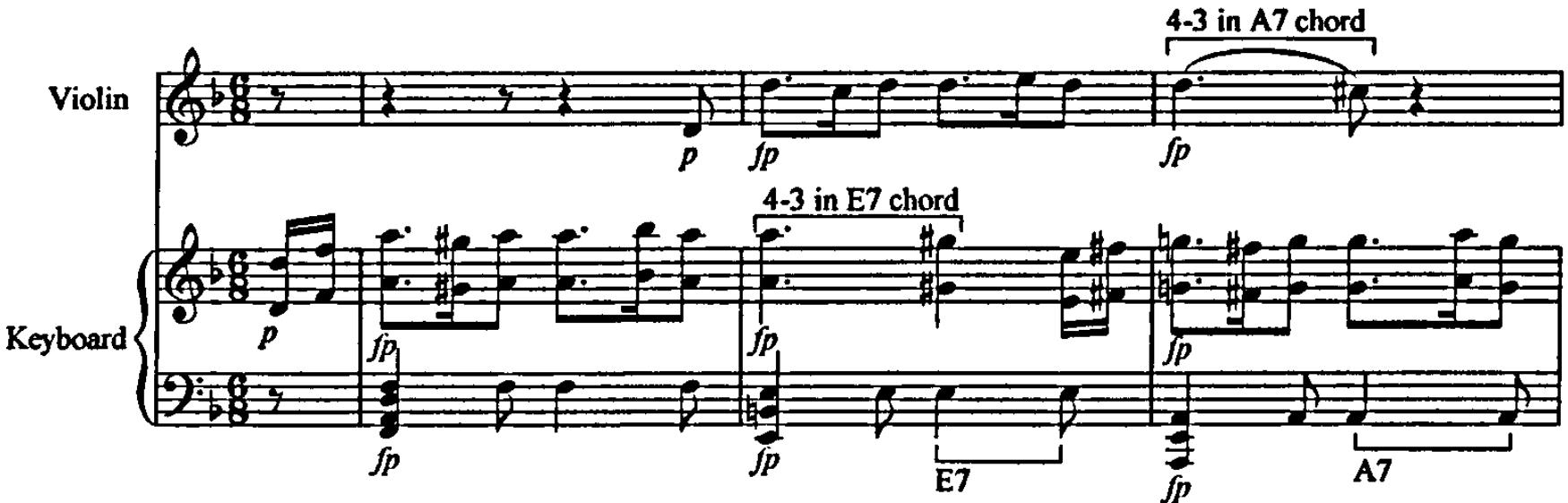
中文讲解
本段是对例 5.15(K377 第二乐章变奏 6)的深入分析,说明节拍为何存在歧义,以及莫扎特为何必须用 fp 来"消歧"。作者给出两层歧义来源:(1) 键盘与小提琴旋律以卡农方式相隔一小节追逐(Siciliana 舞曲传统允许一或两小节为一句),因此两个声部可以"轮流"作为重音层,形成上下句对答;(2) 不协和音本身暗含的重音位置——第 9 小节开始协和的 D 小调和弦相对弱,但第 10 小节键盘声部、第 11 小节小提琴声部的 4-3 延留音(4-3 suspension)却强烈提示着重音"应"落在每个声部的第二小节(即键盘在第 10 小节、小提琴在第 11 小节)。然而这两个小节内部又含有更细的重音线索:每小节首拍虽最不协和(4-3 延留于七和弦内),却解决到七和弦;若演奏者把重音落在两个不协和点(即小节前后两半),就形成了 Leopold 所说的节拍"平等性"(’equality’ of this metre),而 Leopold 在其 1756 年著作(p.223,参见例 5.16)中也确实建议在 6/8 或 12/8 拍子下如此处理,并辅以短弓/短断奏。这恰恰是莫扎特不愿意让演奏者走的歧路——所以他"明智地"用每个正拍上的 fp 来明确否定这种小节内重音对答,使节拍收束为单纯的每小节一拍。本段论证的功能是:把 K377 变奏 6 从"需要消歧的个案"上升为"暴露了演奏学一般规则冲突"的理论案例。
补充说明
“canon at the bar” 指两声部以一小节为单位进入的卡农式追逐;“4-3 suspension” 即古典时期常见的下四上三音延留;“seventh chord” 在此指七和弦;“equality of this metre” 出自 Leopold,指 6/8 或 12/8 中每两个四分音符(或每两半拍)地位"平等"而可同时被强调的处理方式。Little (2001: 350) 的引文证实了 Siciliana 既可以一句也可以两句的句法传统。
第4段(P0110)
原文复述
Example 5.16: Leopold’s suggestion for the accentuation of 6/8 movements (Leopold, 1756: 223).
中文讲解
这是例 5.16 的图题(说明文字),指出该例是 Leopold Mozart 1756 年著作第 223 页中关于 6/8 拍子重音处理建议的谱例。它与前段论证直接对应:前段提到 Leopold 在同一处建议"在小节前后两半都重音"的处理,本例正是这一演奏学建议的实物谱例来源。
第5段(P0111)
原文复述

中文讲解
这是位于第 28 页的图像/乐谱占位符,根据上下文即例 5.16 的乐谱本体。其作用是以视觉化的方式展示 Leopold 1756 年著作中所建议的 6/8 拍子重音分布(即在小节前后两半均施加重音的"平等"重音模式)。原图数据已被省略,细节需查阅原书或原 PDF。
补充说明
由于图像数据未提供,无法描述谱例具体音符,仅可确认其位置与图题(例 5.16)。
第6段(P0112)
原文复述
- In the first edition, keyboard fp only marked between the right- and left-hand parts.
中文讲解
这是脚注 49,限定了前文论述中"每个正拍 fp"这一观察的版本条件:在初版(first edition)中,键盘上的 fp 重音仅在右手与左手声部之间被标注。换言之,脚注提醒读者,fp 记号是写给键盘演奏者看的两手分工提示,而不仅是一个统一的小节层面力度标记。这一限定并不动摇"莫扎特通过 fp 取消歧义"的总论点,但提示该记号在键盘织体内部承担着左右手分工与对齐的功能。
第7段(P0113)
原文复述
A similar process can be seen at the start of K378: here, Mozart’s use of f and p in the keyboard bass line, together with careful beaming and large interval leaps, establishes an accent at the start of each bar (see example 5.17). The rest of the bar is written under one slur which, after the emphatic isolation of the first beat of the bar, prevents any accentuation in the middle of the bar. Thus, in spite of the relatively steady Allegro Moderato tempo, and the common time signature, Mozart instructs the performers to highlight an expansive one-in-the-bar metre.
中文讲解
本段是本小节第二条证据,平行论证 K378 第一乐章开头的消歧手法。几个手段叠加:(1) 键盘低音线以 f 与 p 的力度对比,让每小节首音变得"突起";(2) 谨慎的连尾线(beaming)设计配合;(3) 跨越大音程的跳进;(4) 小节其余部分被统一在一根连线(slur)之下,从而在"首拍被孤立强调"之后,排除对小节中段任何附加重音的可能性。结果是:尽管拍号为常见拍(common time,即 4/4)、速度为中庸快板(Allegro Moderato)且相对平稳,莫扎特依然通过这些手段指示演奏者强调一种"扩张的每小节一拍"的节拍感——即一乐句或一乐段以小节为节拍单位的呼吸长度,而非以拍为单位的细碎脉动。本段在小节整体论证中提供了与 K377 平行而又相互印证的处理例证:将 K377 的 fp 单一手法扩展为 K378 的多手段综合(力度、连尾线、跳进、连线),并揭示"每小节一拍"在不同作品中是莫扎特刻意保护的对象。
补充说明
“common time” 即 4/4 拍的旧称;“beaming” 指将八分或十六分音符用横梁相连的记谱方式,其形态本身可暗示节拍重音的分组;“one slur” 中包含若干音符意味着它们作为一个连贯的乐句被演奏,中间不应再断奏或重音。
第8段(P0114)
原文复述
Example 5.17: K378, movement 1, bars 1-2. 50.
中文讲解
这是例 5.17 的图题(说明文字),指出该例为 K378 第一乐章第 1–2 小节。题末的上标 50 提示此处有一脚注 50,但脚注 50 的具体文字不在本节输入范围内。该例与前一段论述直接对应,是莫扎特通过力度、连尾线、跳进与连线将节拍单位"扩张"为每小节一拍的实物谱例。
补充说明
脚注 50 的具体内容未包含在本段输入中,无法复述。
第9段(P0115)
原文复述
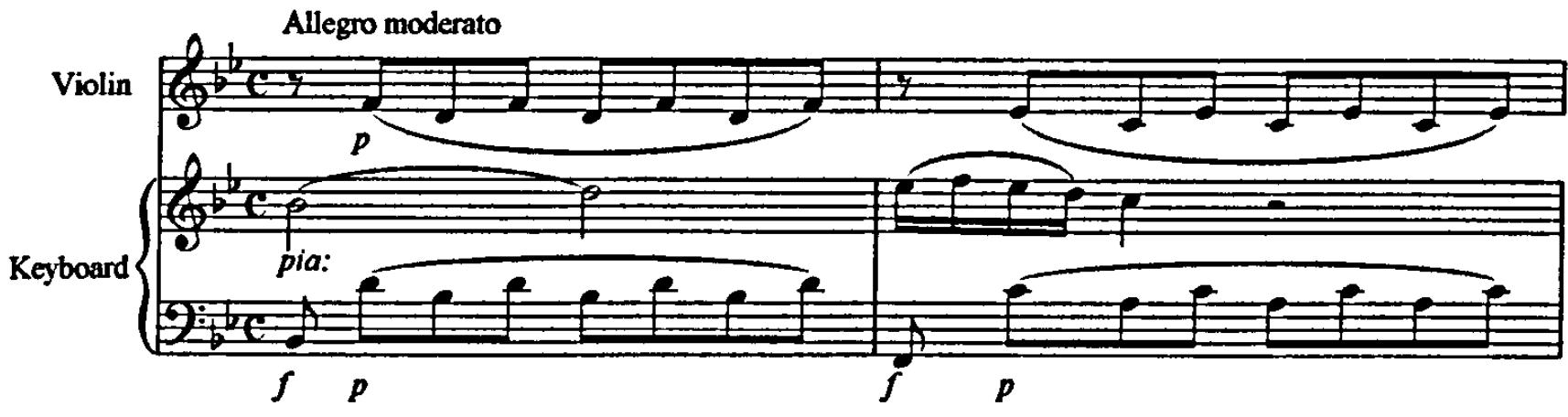
中文讲解
这是位于第 29 页的图像/乐谱占位符,根据上下文即例 5.17 的乐谱本体。其作用是以视觉化的方式呈现 K378 第一乐章开篇第 1–2 小节中键盘低音 f/p 力度变化、大跳以及连线结构,从而直观支撑前一段关于"扩张的每小节一拍"的分析。原图细节需查阅原 PDF。
补充说明
由于图像数据未提供,无法描述谱例具体音符,仅可确认其位置与图题(例 5.17)。
脚注 / 边栏 / 图表 / 附加信息(如有)
本节共包含两段脚注与三个乐谱/图像占位符:脚注 48(位于第 27–28 页之间)提供 G. Muffat 1698 与 Leopold Mozart 1756 著作中关于下弓规则的两条文献来源,属于前文弓法讨论的来源标注;脚注 49 限定 K377 变奏 6 中 fp 在初版中仅标注于键盘左右手之间,是版本与声部分工层面的限定;脚注 50 仅以编号出现,正文未在本节内。例 5.15(K377 变奏 6 第 9–11 小节)、例 5.16(Leopold 1756, p.223 关于 6/8 拍子重音的建议)与例 5.17(K378 第一乐章第 1–2 小节)三个谱例本体均以图像占位符呈现,具体音符需对照原图查阅。三例共同构成"书面重音消歧"主题的可视证据链:例 5.15 展示歧义本身与莫扎特的 fp 应对,例 5.16 展示演奏学上的"歧路",例 5.17 展示多手段综合的另一种消歧实践。
💡 本节核心要点
- 莫扎特在节拍可能被多种方式解读的位置使用书面记写的重音(fp、f/p 等)来主动消歧;这并不是普遍现象,而是用于"可能存在替代重音方案"的关键节点。
- K377 第二乐章变奏 6 是典型个案:卡农式追逐、Siciliana 句法传统与 4-3 延留音共同暗示小节内部的"对话式"或"小节前后两半均重"的节拍处理,而莫扎特在每个正拍上标注 fp,从而把节拍收束回"每小节一拍"的稳定解读。
- Leopold Mozart 在 1756 年著作(p.223)中提出的 6/8 拍子"平等性"重音建议,正是 K377 变奏 6 试图避免的歧路;莫扎特的 fp 标记可视为对演奏学一般规则的自觉否定。
- K378 第一乐章开头以另一种综合手段(f/p 力度对比、连尾线、大音程跳进、整小节连线)实现相同目的:在 4/4 拍、中庸快板的平稳速度中,仍指示演奏者塑造"扩张的每小节一拍"节拍感。
- 两条例证(K377 与 K378)平行且互补:一为单一记号手段(fp),一为多手段综合,但目标都是把"每小节一拍"作为听者应感知的节拍层级加以保护。
🔑 关键术语
- notated accentuation:作曲家在乐谱上明确记写的重音符号或力度记号(如 fp、sf、f/p 等),用以补充或纠正由节拍、和声、节奏自然产生的重音分布;本节指莫扎特主动用这类记号消除节拍歧义。
- fp (fortepiano):力度术语,要求奏出强音后立即转弱;在本节中起到"把每小节首拍孤立出来、并阻止小节中段任何附加重音"的作用。
- downbeat:小节首拍,即谱面上小节线之后的第一拍;本节所有 fp 与 f/p 标记均落在 downbeat 上以建立"每小节一拍"的层次。
- Siciliana:一种以 6/8 或 12/8 拍、轻盈附点节奏为特征的舞曲;Little (2001: 350) 指出其句法既可以一小节也可以两小节为单位,这正是 K377 变奏 6 节拍歧义的舞曲传统来源。
- 4-3 suspension:古典时期常见的下四度音对上三度音的延留不协和音,本节中出现在 K377 变奏 6 第 10 与 11 小节,是作者论证"歧义重音位置"的关键听觉线索。
- canon at the bar:两声部以一小节为单位先后进入的卡农式追逐;K377 变奏 6 中键盘与小提琴即以此方式对话,为"上下句对答式重音"提供了结构性可能。
- one-in-the-bar metre:指听者将"小节"感知为最小重音单位的节拍层次;本节中莫扎特通过多种手段刻意维护这一层次,避免被细密的小节内重音所打破。
- common time:4/4 拍的旧称;K378 第一乐章虽用此拍号,但通过力度与连线等手段仍指示演奏者按"每小节一拍"的方式感知节拍。
CH5-S11 [描述性拆分] Accents Doubling, Restoring and Interrupting the Pulse in K380, K296, K303 and K306
第1段(P0116)
原文复述
In contrast to these examples of regular metrical stress in K377 and K378, Mozart also uses notated accents in order to suggest the varied pace of a metre. For example, bar 47 of K380 (movement 1) displays the same one-in-the-bar accentuation as K378. In bar 48, however, the rate of accentuation is doubled (see example 5.18). This accentuation is clarified for the performer through fp markings, but compositionally its effect is dictated by the quickening harmonic rhythm.
中文讲解
本段从与前文(K377、K378 那种规则的节拍重音)对照的角度切题,指出 Mozart 还使用记谱重音来暗示节拍速率的可变。作者以 K380 第一乐章第 47 小节作为锚点:其重音布局与 K378 相同,呈每小节一拍的模式;但第 48 小节起重音频率加倍,形成 “速率翻倍” 的效果。记谱层面,fp 力度记号帮助演奏者看清这种重音;但在作曲层面,真正驱动这一变化的根本因素是和声节奏的加快——节拍重音的速度实际由和声运动决定,而 fp 只是把已经由和声决定的结果呈现出来。这一点对于理解 Mozart 用力度记号来结构节拍层级的方式非常关键:力度记号并非随意加入,而是服从于更深的和声-节拍逻辑。
补充说明
本段开头的 “In contrast to these examples of regular metrical stress in K377 and K378” 表明本节将与此前讨论的常规重音段落形成对照,需结合上文理解 “regular metrical stress” 的具体含义。
第2段(P0117)
原文复述
Example 5.18: K380, movement 1, bars 47-48. 51
中文讲解
这是乐谱示例 5.18 的标题,标注该谱例取自 K380 第一乐章第 47-48 小节,对应正文中讨论的重音由每小节一拍变为每半小节一拍的瞬间。末尾的 “51” 表示此处涉及脚注 51。需查看原谱以确认 fp 标记的具体位置与左右手声部的实际分句。
补充说明
示例编号 5.18 表明这是本章第 18 个谱例,作者用编号系统组织乐谱证据。
第3段(P0118)
原文复述
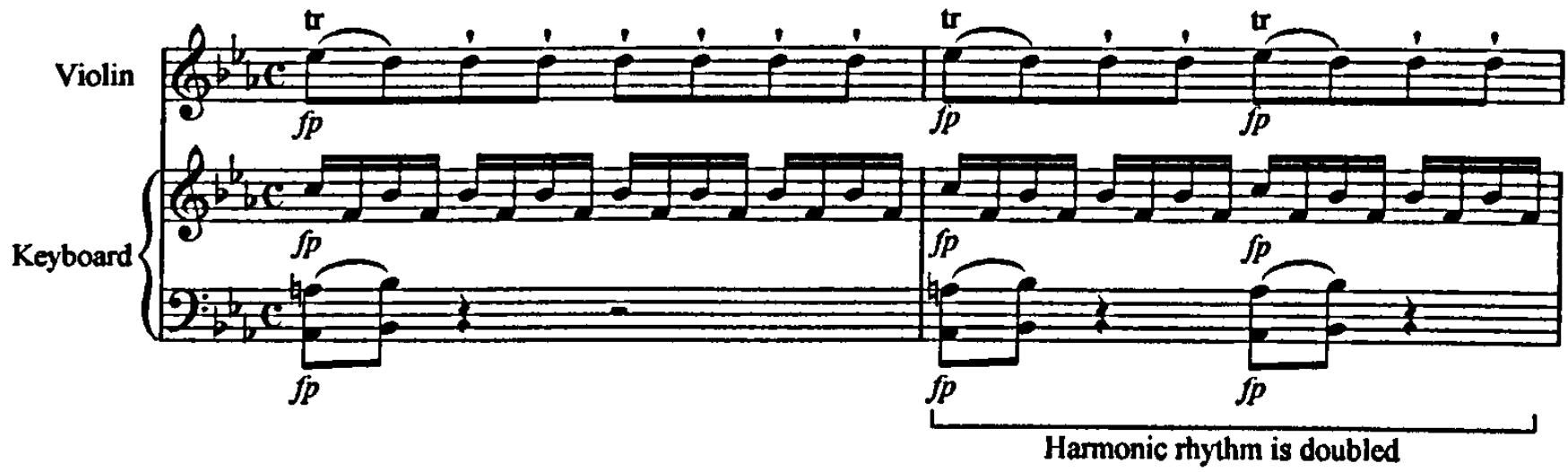
中文讲解
本条为第 29 页的图像或乐谱占位符,对应示例 5.18 的实际谱例内容,展示 K380 第一乐章第 47-48 小节的记谱细节。由于内嵌图像数据被省略,具体的音符位置、和声进行以及 fp 标记的左右手分布均需查阅原图。
第4段(P0119)
原文复述
50 The first edition has p rather than pia: in the right-hand keyboard part.
中文讲解
这是脚注 50,说明初版(而非手稿)在右手键盘声部中把 pia 记作 p。这是一条版本校勘性质的脚注,提示读者不同版本之间在力度记号上的差异,但与本节主体论证关系不大。
第5段(P0120)
原文复述
51 In the keyboard part of the first edition, fp only appears between the right- and left-hand parts.
中文讲解
这是脚注 51,说明在初版的键盘声部中,fp 标记只出现在右手与左手声部之间的中间位置。这暗示 fp 标记可能并非严格属于某一声部,而是同时影响两手的力度布局;读者在对照原谱与脚注时应注意此点。
第6段(P0121)
原文复述
Mozart’s use of fp markings in the third movement of K296 seemingly fulfils the same function as those in K380, prescribing variety in metrical accentuation. Accents on bars 86 and 88 clarify the two-bar harmonic pattern of Vc7-I; accents on the dominant seventh chord emphasise the tension of dissonance, while the lack of accent on tonic chords in bar 87 and 89 allows for a gentle resolution:
中文讲解
本段将 K296 第三乐章的 fp 标记与 K380 的情况相联系,认为两者功能相同——规定节拍重音的多样性。具体到 K296 第 86-89 小节:第 86、88 小节上的重音对应两小节一组的和声进行 Vc7-I(即属七和弦到主和弦);属七和弦上的重音突出不协和的张力,而第 87、89 小节的主和弦上不加重音,使解决显得柔和。读者需注意 “lack of accent on tonic chords… allows for a gentle resolution” 这一表述——这是从重音的有无反向推断其功能:没有重音本身也是一种 “弱化” 的处理,从而使解决听起来不突兀。
补充说明
Vc7 指属七和弦(罗马数字 V 加七度),I 指主和弦;此处大写加粗表示对和声功能的强调性引用。
第7段(P0122)
原文复述
Example 5.19: K296, movement 3, bars 86-89. These regular accents contrast with those of the preceding bars. 52
中文讲解
这是示例 5.19 的标题,标注谱例取自 K296 第三乐章第 86-89 小节,并提示:这些规则的重音与前面小节的重音形成对比。末尾 “52” 关联脚注 52。需查阅原谱才能看到具体的重音位置与和声标记。
第8段(P0123)
原文复述
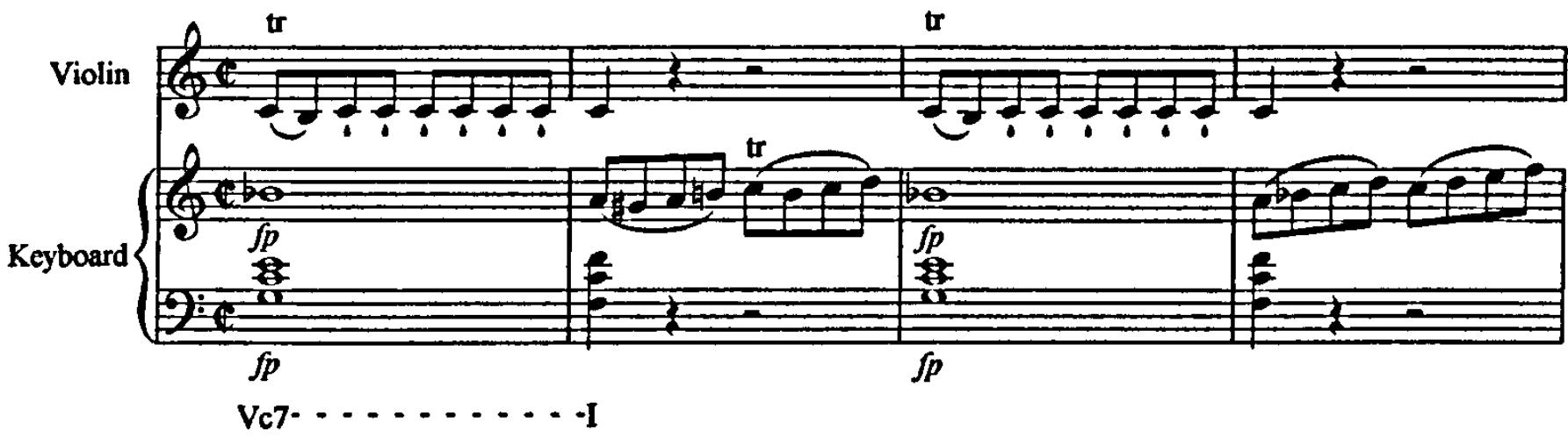
中文讲解
本条为第 30 页的图像或乐谱占位符,对应示例 5.19 的实际谱例,展示 K296 第三乐章第 86-89 小节的记谱。具体的重音符号、和弦性质、左右手声部结构需查阅原图。
第9段(P0124)
原文复述
This accentuation of alternate bars is in contrast with the previous section, whose melodic and rhythmic shape imply the accentuation of every bar from bar 78 to 81, and every half-bar from 82 to 85 (see example 5.20). The harmonic rhythm explicitly confirms this accentuation, with one harmony per bar in 78 to 81, and a doubled pace from bar 82. Furthermore, Leopold states that chromatically raised notes such as those in bar 82 and 83 should be ‘played rather more strongly’ (Leopold, 1756: 218), and that the start of slurs should receive an accent (Leopold, 1756: 115), therefore also suggesting stress on beats 1 and 3 in bars 84 and 85:
中文讲解
本段通过对照来支撑前面的论断:第 86 小节起的 “每隔一小节” 的重音,实际上是在补足一种 “修正”——前面一段(第 78-81 小节每小节一拍、第 82-85 小节每半小节一拍)的重音模式是被旋律与节奏的轮廓暗示出来的,且由和声节奏确认(78-81 小节每小节一个和声,82 小节起速度加倍)。换言之,K296 在不同段落中以不同的速度安插重音,这一现象把节拍层级塑造为一种可塑的、随段落变化的结构。本段还引入 Leopold Mozart 的两条规则:一是 “变化半音应奏得稍强一些”,二是 “连线的开始处应有重音”,由此推断第 84-85 小节的第 1、3 拍也应被强调。作者借父亲 Leopold 的论述来补强对 Mozart 本人记谱实践的解释,这是该书方法论上的一个关键特点。
补充说明
Leopold Mozart 指 Wolfgang 的父亲 Leopold Mozart,其著作 Versuch einer gründlichen Violinschule(1756)是该书频繁援引的演奏实践权威来源。
第10段(P0125)
原文复述
52 fp only appears between the right- and left-hand keyboard parts.
中文讲解
这是脚注 52,内容与脚注 51 类似,说明此处的 fp 也只标注在键盘的右手与左手声部之间。这一重复出现的版式细节暗示 fp 标记在 Mozart 的键盘作品中可能被默认视为覆盖整个键盘声部,但在初版印刷上仅放在中间位置。
第11段(P0126)
原文复述
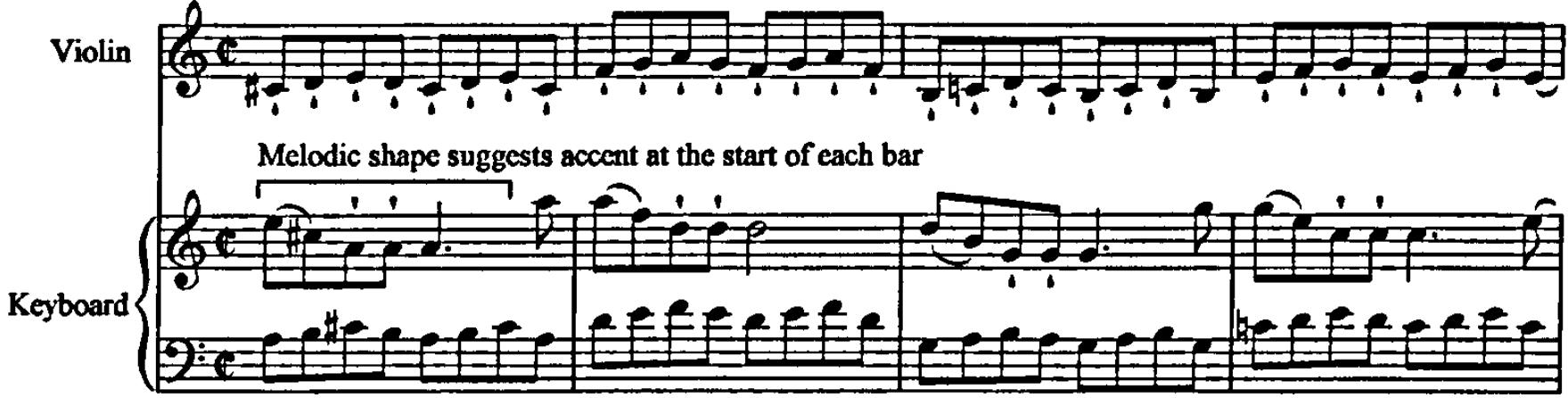
中文讲解
本条为图像/乐谱占位符,图注提示 “变化半音暗示每小节中部的重音”,对应示例 5.20 之前作者对第 82-85 小节的分析。由于变化半音需 “奏得稍强”,因此这些位置充当了隐性重音,需查看原谱确认其具体音高位置。
第12段(P0127)
原文复述
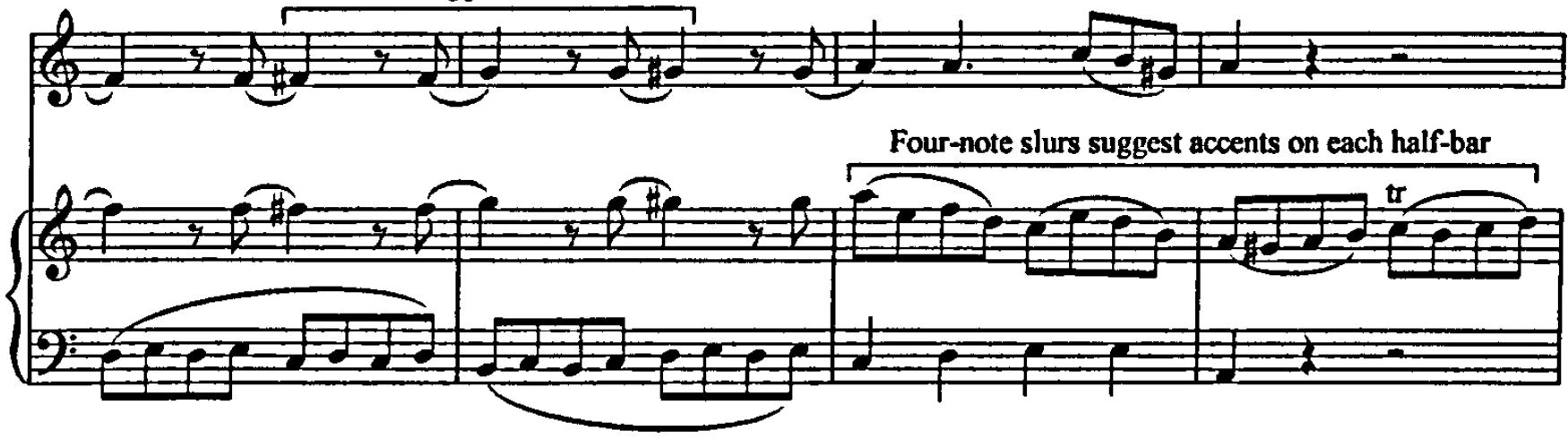
中文讲解
本条为第 31 页的图像或乐谱占位符,推测对应示例 5.20 的一部分,展示 K296 第三乐章第 78-85 小节的实际记谱,以呈现每小节一拍与每半小节一拍两种重音模式的对照。需查阅原图。
第13段(P0128)
原文复述
In K303 movement 2, the alternation of two types of metrical accentuation is intrinsic to the development of thematic material. The opening phrase of the Tempo di Menuetto follows a typical structure of 1 bar + 1 bar + 2 bars (see example 5.21); bar 1 is treated in sequence in bar 2, and in bar 3 is extended to create a closing cadence. Accentuation can be used to highlight this scheme, with a stress at the start of bars 1 and 2. Bar 3 can also be slightly accented, but the main focus falls on the double appoggiatura at the start of bar 4.
中文讲解
本段从 K303 第二乐章展开,论点推进一层:此处两种节拍重音的交替不再仅是节拍速率的变化,而是融入主题材料的发展本身。具体而言,Tempo di Menuetto 的开头乐句遵循 1+1+2 小节的结构——第 1 小节在第 2 小节以模进方式重复,第 3 小节被扩展以形成终止;第 4 小节则是装饰化的收束。重音对应这一结构:第 1、2 小节开始处强调(每小节拍),第 3 小节可略微强调,而真正的焦点落在第 4 小节开头的 “double appoggiatura”(双倚音)上。读者需注意 “the main focus falls on the double appoggiatura”——这是重音被导向具体音乐事件而非抽象节拍位置的典型例子。
补充说明
“Appoggiatura” 意为 “倚音”,即不协和音在解决到协和音之前被强调;“double appoggiatura” 指同时或连续的两个倚音,通常放在强拍以制造强调效果。
第14段(P0129)
原文复述
Example 5.21: K303, movement 2, bars 1-4, demonstrating the 1+1+2 bar-structure of the minuet.
中文讲解
这是示例 5.21 的标题,标注谱例取自 K303 第二乐章第 1-4 小节,用以演示小步舞曲中 1+1+2 小节的结构。需查阅原谱以查看具体的模进、扩展与双倚音的记谱细节。
第15段(P0130)
原文复述
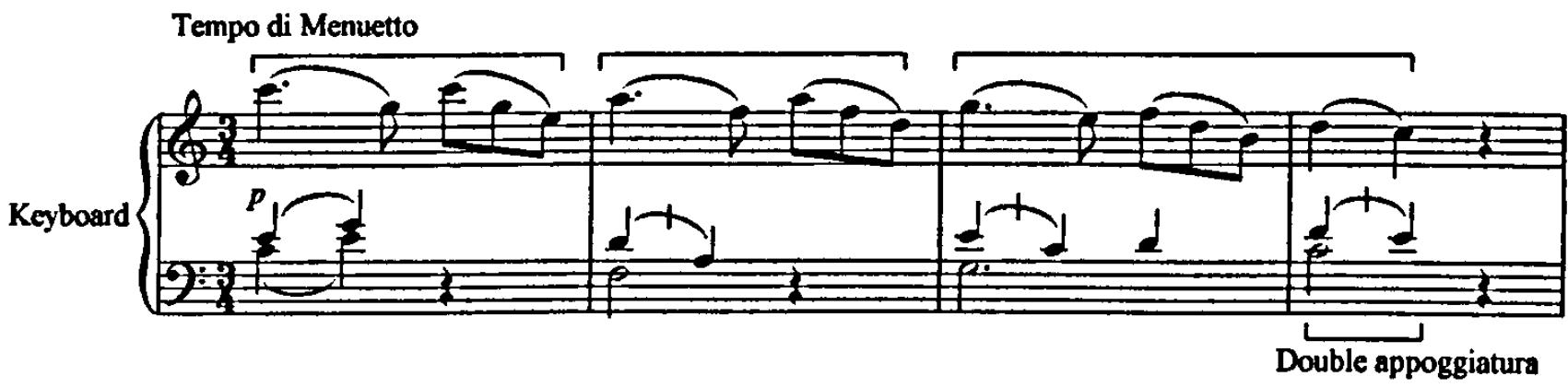
中文讲解
本条为第 31 页的图像或乐谱占位符,对应示例 5.21 的实际谱例,展示 K303 第二乐章第 1-4 小节的开头乐句结构。具体的乐句划分、模进关系与双倚音记谱需查阅原图。
第16段(P0131)
原文复述
At the restatement of this theme in bar 43, this fourth-bar accentuation is explicitly specified; in bar 46, a violin entry marked fp emphasises the dissonance of a’ against g (see example 5.22). However, the thematic material of bar 46 (which corresponds with bar 4) is then developed, thus extending the original four-bar theme, and prolonging the pattern of the accentuation of every other bar. This thematic development therefore enhances the accentual variety of the movement:
中文讲解
本段说明主题再现时的处理:第 43 小节开始的主题再现中,第 4 小节的重音被 “显式” 指定——也就是说,本来在主题陈述中可能较为含蓄的结构性重音,在再现时被 fp 标记清楚地标明出来。第 46 小节小提琴声部的进入被标 fp,用以突出 a′ 对 g 的不协和碰撞——这是把节拍重音与具体的音程张力结合起来的例子。关键的发展在第 46 小节之后:对应原主题第 4 小节的材料被展开,从而把原本四小节的主题延长,使 “每隔一小节重音” 的模式延续。这一主题展开因此强化了乐章整体的重音多样性。本段的论述逻辑是:再现=重音被显式化,展开=重音模式被延长。
补充说明
a′ 对 g 指的是小提琴旋律中的 a 音与 g 音形成的不协和碰撞;a′ 标记指该音高于中央音域,具体音高需对照总谱。
第17段(P0132)
原文复述
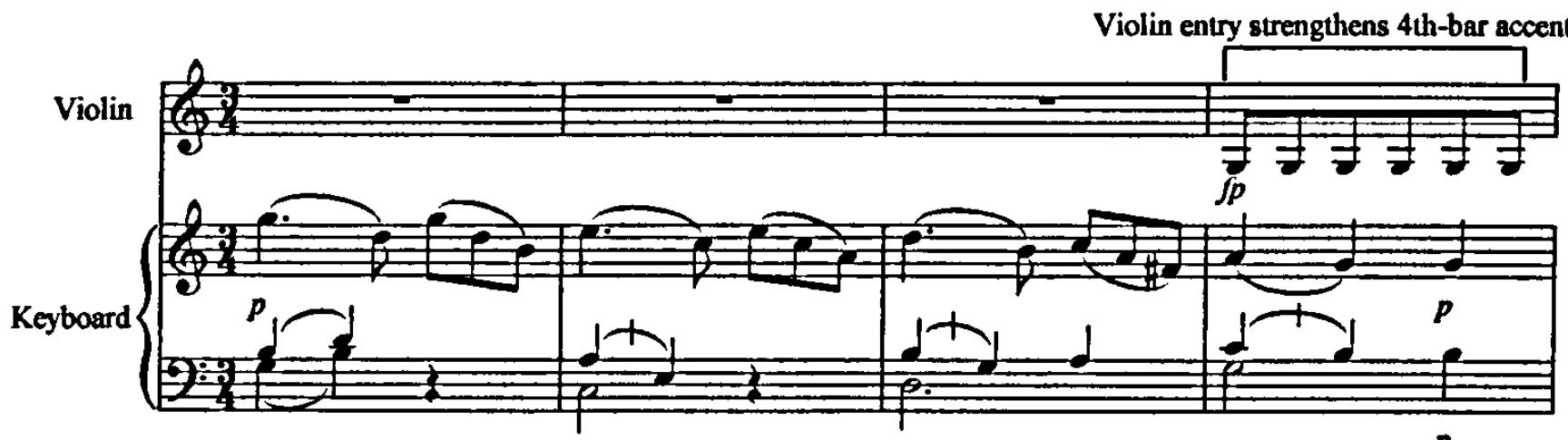
中文讲解
本条为图像/乐谱占位符,图注说明 “主题被扩展,延续了每隔一小节的重音模式”,对应示例 5.22 的实际谱例,展示 K303 第二乐章第 43-50 小节。需查阅原图以确认主题再现后的展开与 fp 标记。
第18段(P0133)
原文复述
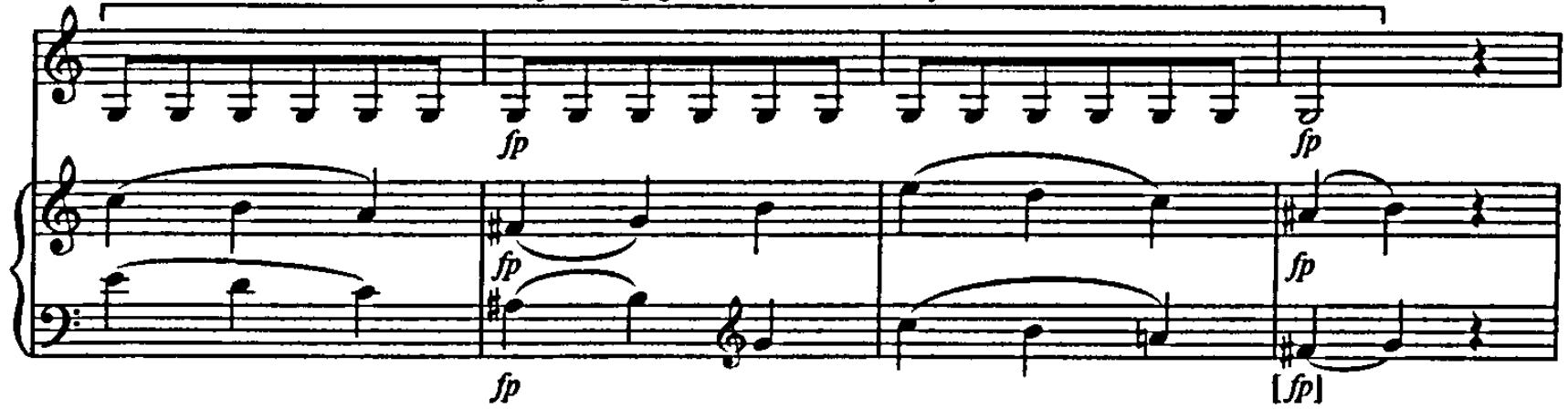
中文讲解
本条为第 32 页的图像或乐谱占位符,推测对应示例 5.22 的延续部分或同一示例的另一页截图。需查阅原图。
第19段(P0134)
原文复述
Mozart also uses notated accents to re-establish regular metres after passages which display accentual variety. Such is the case in the first movement of K380, where, as we have seen (in example 5.18 above), a variety of metrical accents are prescribed. Shortly after the passage of alternating patterns of accentuation (bars 47 to 58), a long ascending sequence begins, marked fp or fp at the start of each bar (see example 5.23). It is interesting to note the contrasting markings in the violin and keyboard parts here. The placing of f and p in the keyboard right- and left-hand parts perhaps suggests the length of diminuendo which can be applied to each fp in the violin part – indeed, Leopold describes this marking as meaning ‘dying away’ (L. Mozart, 1756: 219), and the gradual reduction from f to p suggested by the distance between these markings in the keyboard parts, reaching p by second crotchet of each bar, may be more appropriate than a sudden accent. 53 This example demonstrates that the careful use of fp is not to clarify any ambiguities of accentuation within the passage itself, but rather to resume regular metric accentuation after the playful variety provided by bars 47 to 58.
中文讲解
本段引入本节第三种重音功能:在节拍多样性段落之后,Mozart 用记谱重音 “恢复” 规则的节拍。以 K380 第一乐章为例:在第 47-58 小节那种交替重音的段落之后,一段长的上行序列从第 65 小节开始,每小节开头标 fp。作者特别指出小提琴与键盘声部之间记号的不同:小提琴只有一个 fp,而键盘的右手与左手分别标有 f 与 p,这种空间分布暗示了一个渐弱的幅度——Leopold 将 fp 解释为 “dying away(渐弱消退)",即从 f 渐弱到 p;键盘部分中 f 与 p 之间的距离相当于把这一渐弱幅度 “画” 了出来,到每小节的第二个四分音符时已经弱到 p,因此演奏者把小提琴的 fp 理解为长渐弱比理解为突然的重音更合适。本段最后一句点明主旨:此处 fp 的功能不是消除本段内部的节拍歧义,而是在多样化的重音游戏之后重新引入规则的节拍层级。
补充说明
“Diminuendo” 指渐弱;Leopold Mozart 1756 年的著作将 fp 解释为 “渐弱消退”,与现代演奏中常把 fp 处理为 “强-突弱” 的方式有所不同。
第20段(P0135)
原文复述
53 These left-hand keyboard dynamics are as they appear in the autograph version of this sonata [Eisen, 2007: 80], not the first edition.
中文讲解
这是脚注 53,说明此处左手键盘部分的力度记号采用手稿版本(Eisen 2007 年版第 80 页)而非初版。这一版本说明很重要,因为力度记号的空间分布在不同版本中可能不同,从而影响作者关于 “f 与 p 之间的距离暗示渐弱幅度” 的论证。
补充说明
Eisen(2007)是该书所引用的 Mozart 奏鸣曲校勘版,提供手稿与初版的差异对照。
第21段(P0136)
原文复述
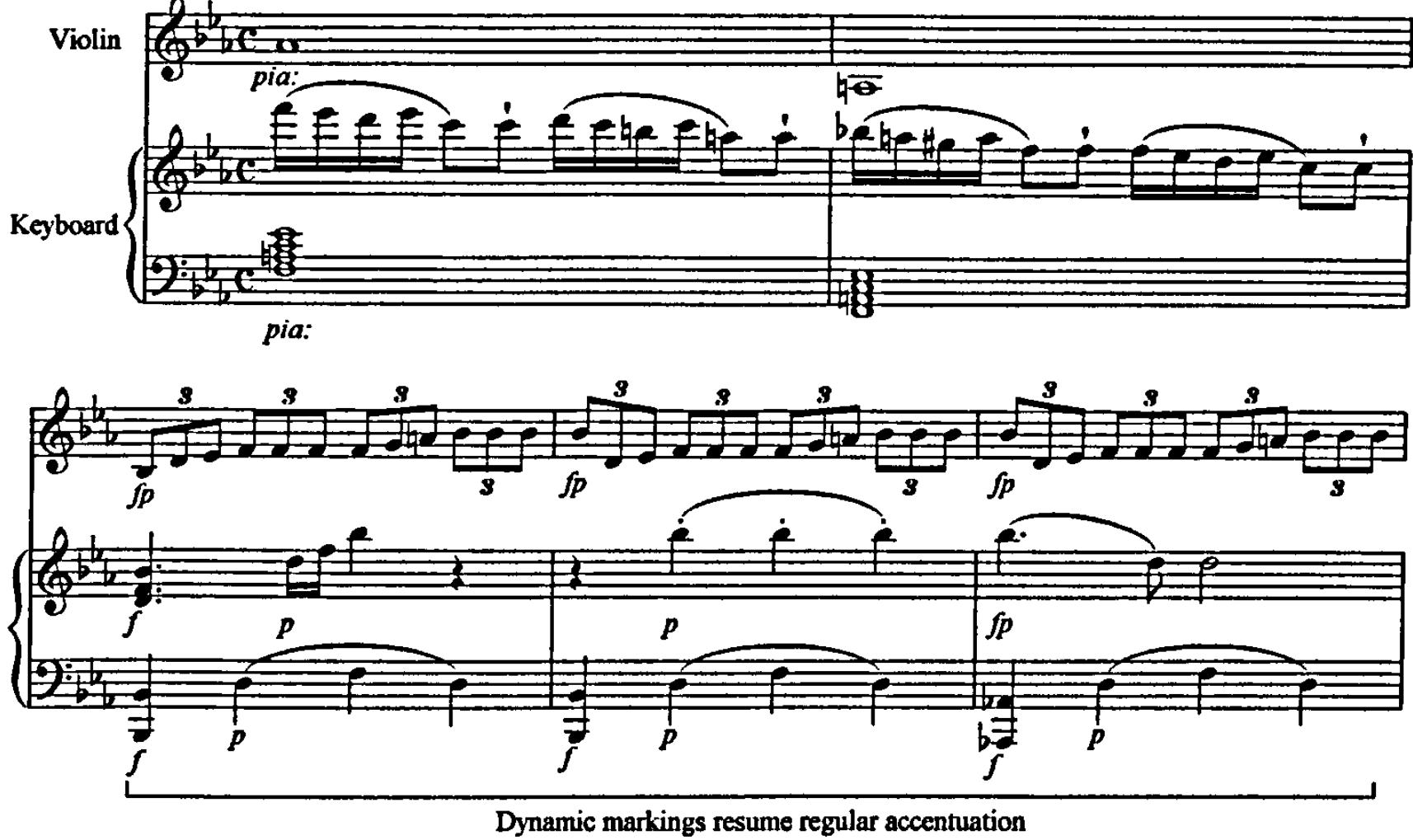
中文讲解
本条为图像/乐谱占位符,对应示例 5.23 的实际谱例,展示 K380 第一乐章第 65-69 小节,即可见到上行序列中每小节开头 fp 与键盘声部 f/p 空间分布的位置。需查阅原图以确认力度记号的精确位置。
第22段(P0137)
原文复述
Similarly, f and p markings are used to highlight the restoration of regular metre in K306 movement 3. In this instance the preceding music has not so much played with the sense of metre, as disregarded it entirely. At the Allegro Assai in bar 187 a keyboard solo is marked ‘cadenza’, implying some degree of rhythmic and metrical freedom; this freedom is suggested by frequent rests and fermatas at the end of sections of passagework. Solo keyboard figurations occasionally accompanied by the violin (as in bars 193 and 197), but it is not until bar 207 that the two voices converge as equals (see example 5.24). In bar 208, a violin slur starting on an offbeat, together with a written-out trill figure in both the violin and keyboard parts, render the metre vague. But in bar 209 a regular pattern of articulation implies accentuation on each half bar. Although this establishment of metrical regularity and arrival at a D major chord (chord V) suggest that the cadenza is about to end, the two instruments subsequently launch back into passagework.
中文讲解
本段以 K306 第三乐章为案例,把 “恢复规则节拍” 这一论点推向更极端的情境:此前不是 “玩弄” 节拍感,而是几乎完全 “无视” 节拍感。第 187 小节 Allegro Assai 处的键盘独奏被标为 “cadenza(华彩)",通过频繁的休止与段落结尾的 fermata 来暗示节奏与节拍的自由。键盘独奏的走句运行偶尔有小提琴伴奏(如第 193、197 小节),但直到第 207 小节,两件乐器才以平等地位汇聚(示例 5.24)。第 208 小节的小提琴连音线从弱拍起,加上两件乐器中的写明颤音,使得节拍变得模糊。然而在第 209 小节,一种规则的发音模式暗示了每半小节的重音;同时抵达 D 大调和弦(和弦 V,即属和弦)。尽管这种节拍规则的建立与属和弦的到来都暗示华彩即将结束,两件乐器却又重新投入走句运行。本段关键句 “not so much played with the sense of metre, as disregarded it entirely” 区分了 K380 与 K306 的差异:前者是 “重音游戏”,后者是 “节拍缺席”。
补充说明
“Fermata” 指延长记号;此处出现在华彩段落的走句末尾,赋予演奏者自由停顿的空间。
第23段(P0138)
原文复述
Example 5.24: K306, movement 3, bars 207-210.
中文讲解
这是示例 5.24 的标题,标注谱例取自 K306 第三乐章第 207-210 小节,即两件乐器汇聚、节拍从模糊走向规则的关键位置。需查阅原谱。
第24段(P0139)
原文复述
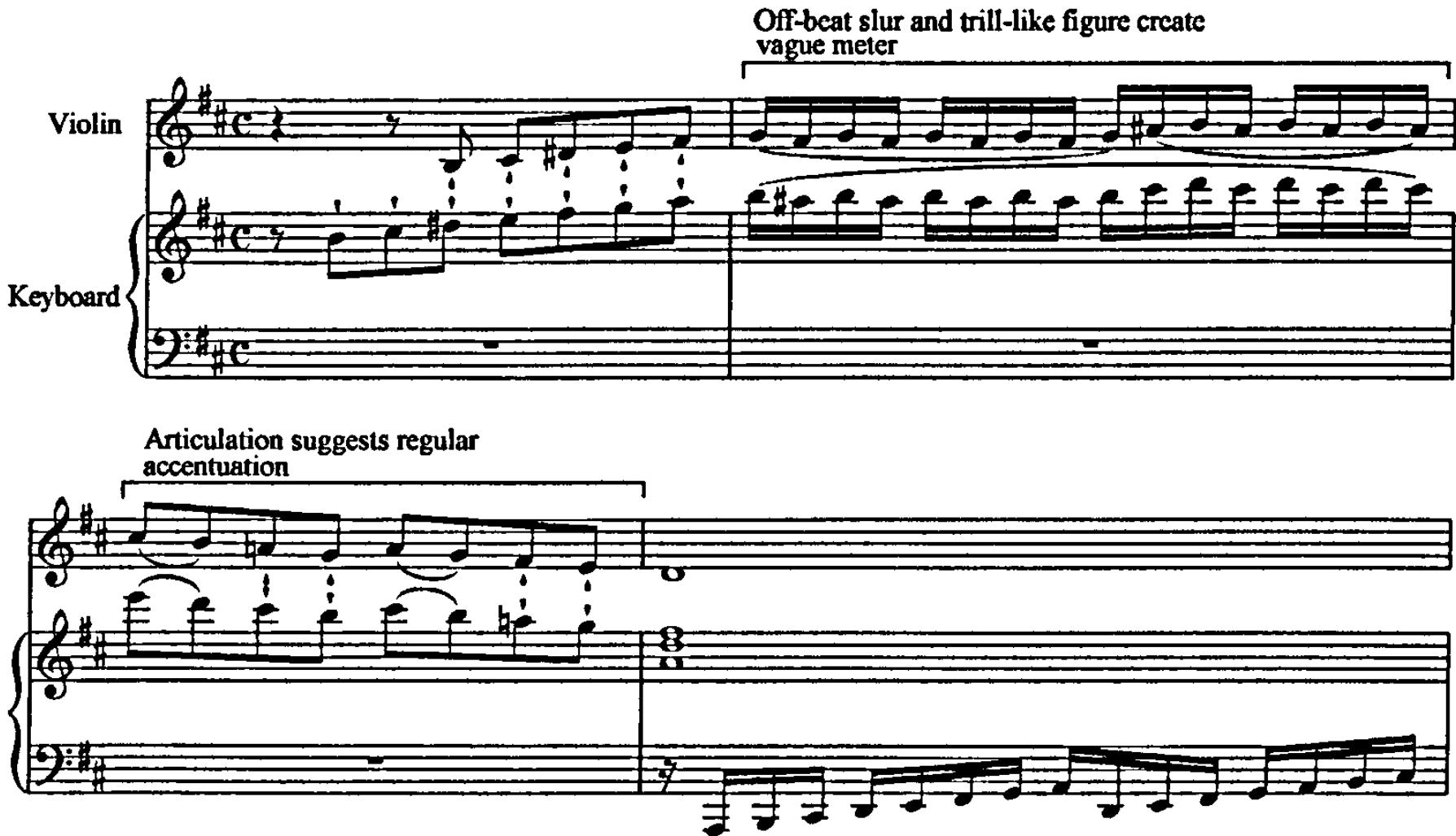
中文讲解
本条为第 34 页的图像或乐谱占位符,对应示例 5.24 的实际谱例,展示 K306 第三乐章第 207-210 小节中节拍从模糊到规则的过渡。需查阅原图。
第25段(P0140)
原文复述
After further semiquaver figurations from both the violin and keyboard, and a fragmented melody which comes to an interrupted cadence in bar 218, the regular articulation pattern of bar 209 is reiterated, suggesting another moment of accentual regularity (see example 5.25). Here, fps highlight the start of each half bar, heralding the start of the final section of the cadenza. Furthermore, these fp markings recall for the listener the regular duple pulse which dominates the rest of the movement.
中文讲解
本段继续 K306 第三乐章的分析:经过第 209 小节的规则发音模式与 D 大调和弦之后,两件乐器又进入十六分音符走句,并以一段片段化的旋律在第 218 小节结束于一个 “interrupted cadence(中断终止)"。之后第 209 小节的发音模式被重复(示例 5.25),暗示又一处节拍规则的瞬间;此处的 fp 标记突出每个半小节的开始,标志着华彩最后一段的开始。更进一步,这些 fp 标记还为听者唤回整乐章其余部分所主导的规则 “duple pulse(双拍脉动)"。读者应注意三层意义:当下标识节拍回归、与第 209 小节呼应形成 “规则之岛”、以及与全乐章其他段落形成跨段落的节拍回忆。
补充说明
“Semiquaver” 指十六分音符;“interrupted cadence” 指中断终止,即原本预期终止于主和弦却被替换为属和弦(或其他非主和弦)的进行,在此处暗示华彩段尚未结束。
第26段(P0141)
原文复述
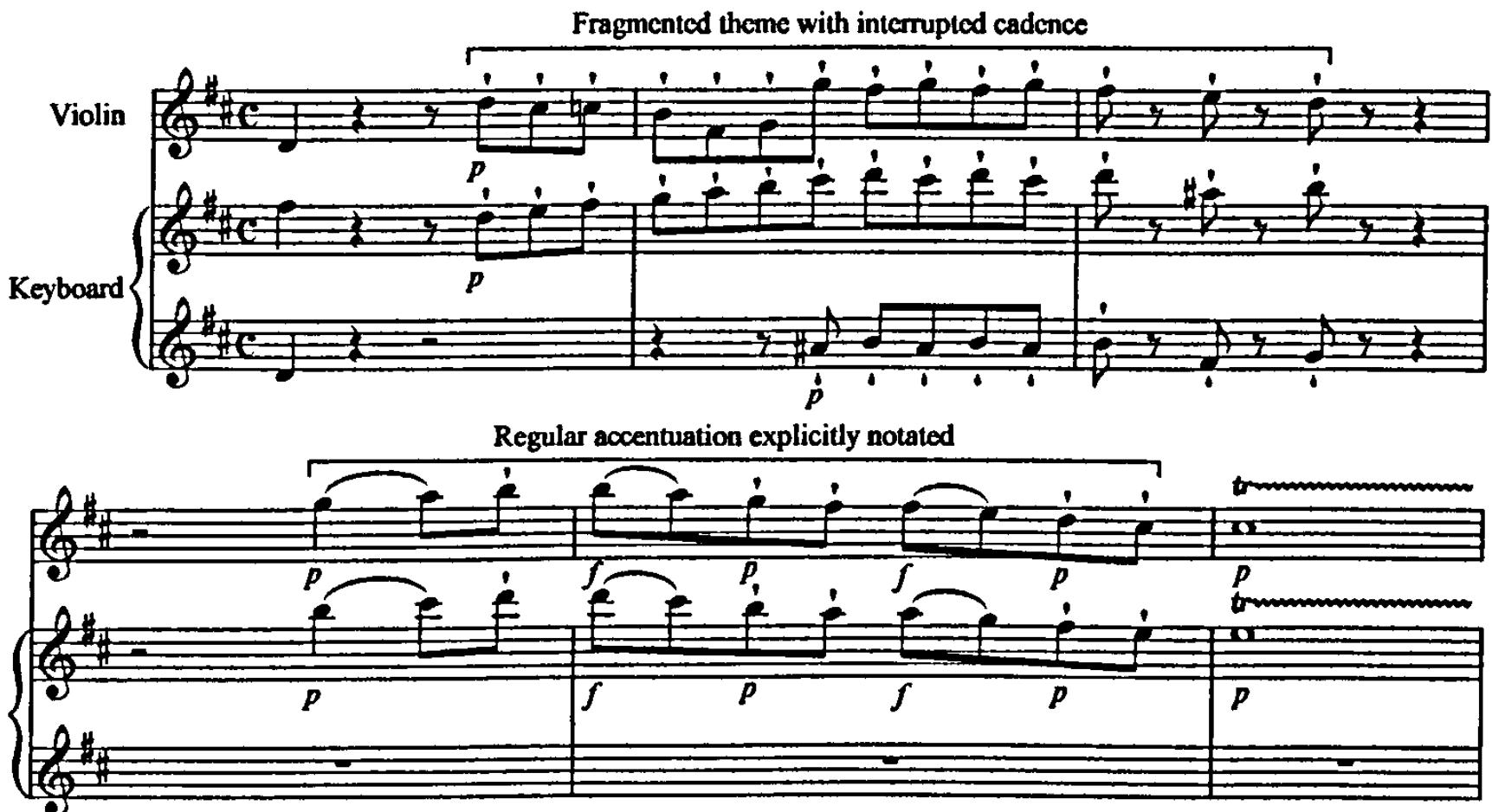
中文讲解
本条为图像/乐谱占位符,对应示例 5.25 的实际谱例,展示 K306 第三乐章第 216-221 小节,即第 209 小节规则发音模式被重复、华彩最后一段开始的位置。需查阅原图。
第27段(P0142)
原文复述
Thus, Mozart regularly notates accents to clarify the metrical hierarchy of his music; they function to confirm the regularity of accentuation within passages which would otherwise be ambiguous, they instruct performers to highlight the changing pace of metre, and they can be employed to re-establish metric regularity after varied or ambiguous passages.
中文讲解
本段是全节的小结,归纳 Mozart 使用记谱重音的三种功能:(1)在原本节拍可能含糊的段落中确认重音的规律性——即"澄清"功能;(2)指示演奏者突出节拍速率的变化——即"变速"功能(K296 与 K303 的情况);(3)在多样化或模糊的段落之后重新建立规则的节拍——即"恢复"功能(K380 第一乐章与 K306 第三乐章的情况)。这三项功能构成本节论证的骨架,把前面四个奏鸣曲片段(K380、K296、K303、K306)的分析统一到 “重音的多重功能” 这一主题之下。
脚注 / 边栏 / 图表 / 附加信息(如有)
本节包含五个脚注(50、51、52、53 及正文中再次引用的脚注),其中脚注 50 提示初版与手稿在 pia/p 上的版本差异;脚注 51、52 两次说明 fp 标记在初版中只出现在键盘左右手之间的位置(版式细节);脚注 53 明确 K380 例 5.23 中左手键盘力度取自手稿版(Eisen 2007:80)而非初版,这一版本选择直接支撑了正文关于 “f 与 p 之间的空间距离暗示渐弱幅度” 的解读。本节包含多个乐谱示例(5.18、5.19、5.20、5.21、5.22、5.23、5.24、5.25),其中示例 5.20 在原文中以 “Chromatic notes suggest accents in middle of each bar” 作为图注。脚注与示例共同服务于本节的核心主张:记谱重音在 Mozart 的键盘奏鸣曲中具有澄清、变速与恢复三种功能。
💡 本节核心要点
- Mozart 用记谱重音(fp、f、p 等)实现节拍层级的多重功能,而不仅是装饰性的力度装饰。
- K380 第一乐章第 47-48 小节展示了 “重音速率加倍”——和声节奏的加快是驱动力,fp 仅是标记手段。
- K296 第三乐章第 86-89 小节呈现 “交替小节重音”,与此前每小节/每半小节重音段落形成对照;Leopold 关于 “变化半音应奏得更强” 与 “连线开始应加重” 的规则被用来补强对隐性重音的识别。
- K303 第二乐章的小步舞曲主题遵循 1+1+2 小节结构,主题再现时第 4 小节的双倚音重音被 fp 显式化;主题材料的展开延长了 “每隔一小节重音” 的模式。
- K380 与 K306 都展示了第三种功能——节拍规则性的恢复;K306 第三乐章华彩段则把这一功能推向极端,fp 同时是当下节拍回归的标识、对第 209 小节的呼应,以及全乐章 “duple pulse” 的听觉回忆。
- fp 在 Leopold 的解释中意为 “dying away(渐弱消退)",K380 第 65-69 小节中键盘声部 f 与 p 的空间距离暗示了渐弱幅度,因此演奏上的渐弱处理比突强更符合 Mozart 记谱意图。
🔑 关键术语
- fp (fortepiano):强后即弱的力度记号;在 Leopold Mozart 的释义中意为 “dying away(渐弱消退)",与现代常作的突强后立刻弱不同。本节中 fp 用于 (a) 标记每小节或每半小节开头的重音;(b) 暗示渐弱幅度(K380 例 5.23)。
- harmonic rhythm (和声节奏):和声变换的速度,以每个和声所占的时间单位衡量。在 K380 第 48 小节,和声节奏加倍驱动了节拍重音速率的加倍,说明节拍重音从属于和声运动的深层结构。
- metre / metric accentuation (节拍 / 节拍重音):音乐中由小节线、拍号、强弱拍安排所规定的重音层级。本节讨论 Mozart 如何用记谱重音塑造这一层级的稳定、变化与恢复。
- double appoggiatura (双倚音):两个倚音(不协和音)在解决到协和音之前被强调;K303 第二乐章第 4 小节的双倚音作为结构性重音的焦点,被再现时的 fp 标记显式化。
- interrupted cadence (中断终止):原本预期结束于主和弦的终止被替换为属和弦或其他非主和弦,造成 “终止被悬置” 的效果;K306 第三乐章第 218 小节的中断终止用于在节拍回归的 “规则之岛” 之后再度推迟华彩结束。
- duple pulse (双拍脉动):以二拍为基本单位的脉动;K306 第三乐章中第 209 小节与第 216 小节起的 fp 标记既恢复当下节拍,也唤起全乐章其余部分的双拍脉动。
CH5-S12 [描述性拆分] Notated Accents That Contradict the Metrical Hierarchy
第1段(P0143)
原文复述
Conversely, Mozart also writes accents in his Sonatas for Violin and Keyboard which contradict the normal hierarchies of metre. Leopold warns performers of such occasions, writing that:
中文讲解
本段以Conversely开头,标志着与前文论述方向的转换:前文可能主要讨论了符合节拍层级的常规重音,此处转向违反节拍层级的标记重音。Mozart在小提琴与键盘奏鸣曲中确实存在违背常规节拍层级的重音记号。Leopold作为Mozart的父亲和重要的音乐理论家,专门警告演奏者注意这类情况,为作者后续的实证分析提供了理论依据。
补充说明
本段作为引子,引出Leopold的直接引文(下一段),确立了’违背节拍层级的重音’这一分析主题。
第2段(P0144)
原文复述
There are nowadays certain passages in which the expression of a skilful composer is indicated in a quite unusual and unexpected manner, and which not everyone would divine. (L. Mozart, 1756: 221)
中文讲解
这是Leopold Mozart于1756年的原文引文,页码为221。其核心含义是:当时(即18世纪中叶)某些乐曲中会出现非常规、出人意料的表情标记方式,并非所有演奏者都能自行领悟这些记号的含义。关键词包括’skilful composer’(技艺高超的作曲家)、‘unusual and unexpected manner’(不寻常且出人意料的方式)、’not everyone would divine’(并非所有人都能察觉)。这段引文为作者论述Mozart的非常规重音标记提供了历史理论背景——Leopold本人就承认存在需要特别说明的反常表情记号。
补充说明
Leopold Mozart的引文出自其1756年的著作《给小提琴演奏者的小提琴教程》(Versuch einer gründlichen Violinschule)。此处在脚注形式引证为’L. Mozart, 1756: 221’。
第3段(P0145)
原文复述
The example given by Leopold shows accents which are syncopated against the strong beats of the bar; Mozart similarly uses accents to create rhythmic syncopation. In the first movement of K454, for example, Mozart uses mfp to accent the third quaver of a common time bar (see example 5.26), and a p A7 chord in the keyboard part on what would usually be a strong downbeat (bar 34) further warns against the regularity of metrical accentuation. The first edition violin dynamics of this section show even greater variety of accentuation, with lurching mfps marked on the second notes of bars 34 and 35. Similar syncopated accents can be heard in the third movement of the same sonata (see example 5.27); here Mozart unusually specifies an accent within a slur, displacing the metrical accents of these bars by one quaver:
中文讲解
本段通过具体作品例证展示Mozart如何通过标记重音制造切分音效果,从而打破节拍强弱的常规层级。首先,作者呼应Leopold给出的例子——重音与小节强拍错位(即切分重音),并指出Mozart同样使用重音来制造节奏切分。
第一个例子是K454第一乐章:mfp(中等强后即弱)记号出现在4/4拍小节的第三个八分音符上,该位置本应属弱拍节拍位置;另外键盘声部第34小节通常应为强下拍的位置,出现了带p(弱)记号的A7和弦,警示演奏者不要按常规节拍重音处理。初版小提琴力度标记显示更多样的重音变化,第34和35小节第二音上标记了跌宕的mfp。
第二个例子来自同首奏鸣曲第三乐章(参看例5.27),Mozart非常规地在连弓线内标记重音,使这些小节的节拍重音偏移一个八分音符位置。这是’连线内重音’这一反常规现象的具体实例。
补充说明
K454是Mozart为小提琴与键盘而作的B大调奏鸣曲。mfp记号表示先中等强再转弱,p A7意为带弱力度记号的A属七和弦。‘连弓线内重音’(accent within a slur)是本节重要的反常规现象之一。
第4段(P0146)
原文复述
Example 5.26: K454, movement 1, bars 33-35, demonstrating the notation of accents which contradict metre. Dynamic markings from autograph version are given here.
中文讲解
这是Example 5.26的图注说明。该例取自K454第一乐章第33-35小节,用于演示Mozart如何在乐谱中标记违背节拍层级的重音。值得注意的是,图注明确指出此处展示的力度标记来自手稿版本(autograph version),而非印刷版本,这是文献学上的重要区别——手稿反映了作曲家最原始的意图。
补充说明
本段为图注(caption),需参看原图(谱例)以确认具体音符上的力度与重音标记位置。
第5段(P0147)
原文复述
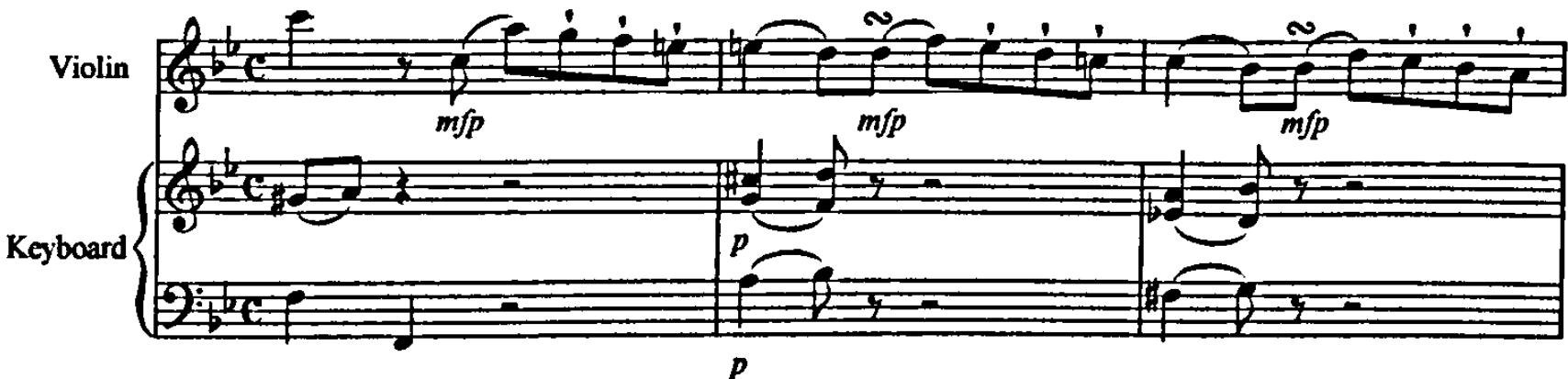
中文讲解
此为第35页的图像或乐谱占位符。原文图像数据已省略,但保留了位置标识。该占位符对应Example 5.26(K454第一乐章第33-35小节)的乐谱示例,用于直观展示Mozart在此处标记的重音与节拍层级的矛盾关系。具体音符位置与重音符号需查阅原图。
补充说明
无额外补充;需查看原图以确认mfp等力度记号在乐谱小节线中的具体位置。
第6段(P0148)
原文复述
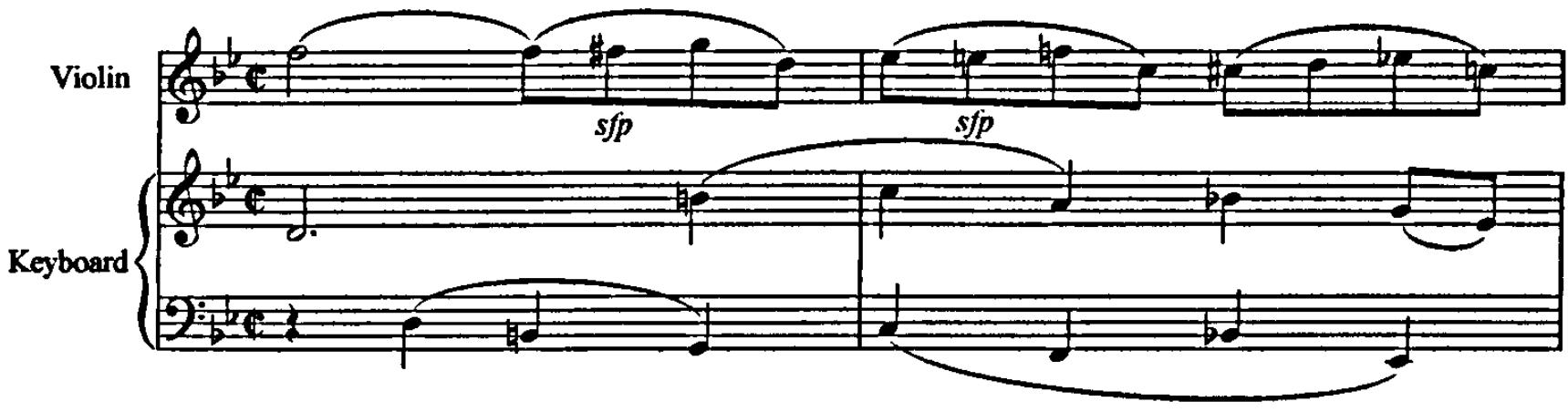
中文讲解
此为第36页的图像或乐谱占位符。原文图像数据已省略,但保留了位置标识。该占位符可能对应Example 5.27(K454第三乐章的相关片段)或与第36页讨论的其他例证相关。具体内容需查阅原图与上下文判断。
补充说明
无额外补充;需查看原图以确认具体内容。
第7段(P0149)
原文复述
Notated accents are also used to reinforce dissonances which occur on ‘weak’ beats of the bar (see example 5.28). In the first movement of K376, a diminished seventh chord on the second beat of the bar (which is a weak beat within the metrical hierarchy) is treated as a typical dissonance: it is accented and long, and resolved gently at the end of a slur.
中文讲解
本段论述标记重音的另一功能:在小节的’弱拍’位置上强化不协和和弦。具体例证是K376第一乐章——小节第二拍(属于节拍层级中的弱拍)出现的减七和弦,按典型不协和和弦的方式处理:被加重、时值较长,并在连弓线末端轻柔地解决。这一处理既保留了不协和和弦的常规演奏方式(重音、延长、延迟解决),又通过将其放置于弱拍而与节拍层级形成张力,因为听众通常预期弱拍不被强调。
补充说明
K376是Mozart为小提琴与键盘而作的F大调奏鸣曲。减七和弦(diminished seventh chord)为高度不协和和弦,理论上是’需要被解决’的紧张和弦,通常应予以重音处理。
第8段(P0150)
原文复述
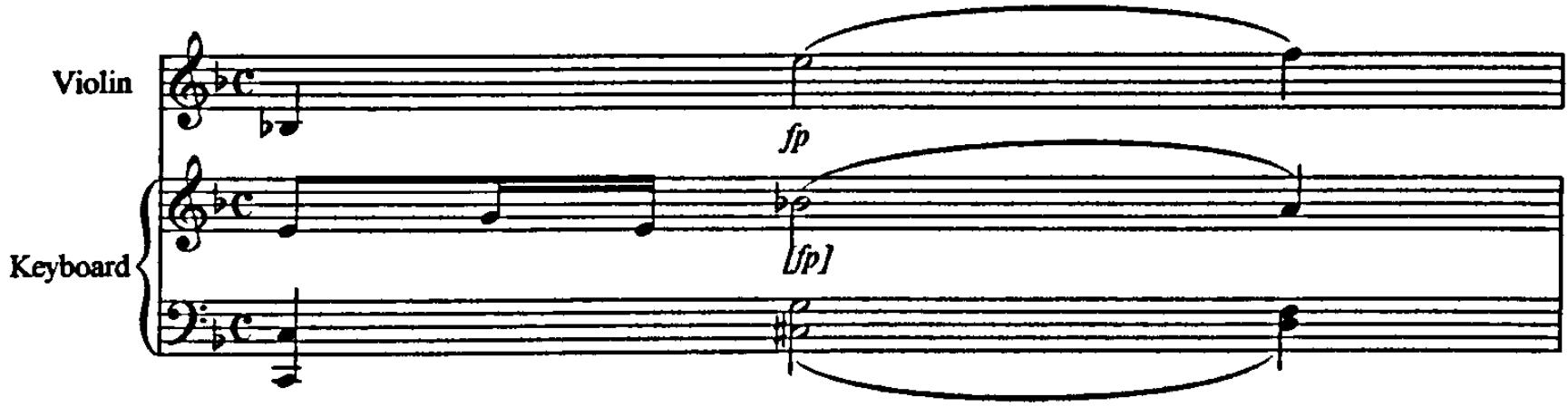
中文讲解
此条目包含一个图像/乐谱占位符及其图注说明,附带脚注54标记,并引入下一个示例。图注指出Example 5.28取自K376第一乐章第106小节,用于演示’违背节拍但强化不协和’的重音记号。该图后引出K380第三乐章的例证——同时展示了’弱拍上的不协和’与’连线内重音’两种反常规现象的并存。脚注54指出初版在右手键盘声部缺少fp或连线,与本段讨论的具体标记细节相关。
补充说明
脚注54明确:K376第一乐章第106小节的初版右手键盘声部没有fp记号或连线标记。这说明本段讨论的某些力度记号可能仅存于手稿或后期版本中,文献版本差异值得关注。
第9段(P0151)
原文复述
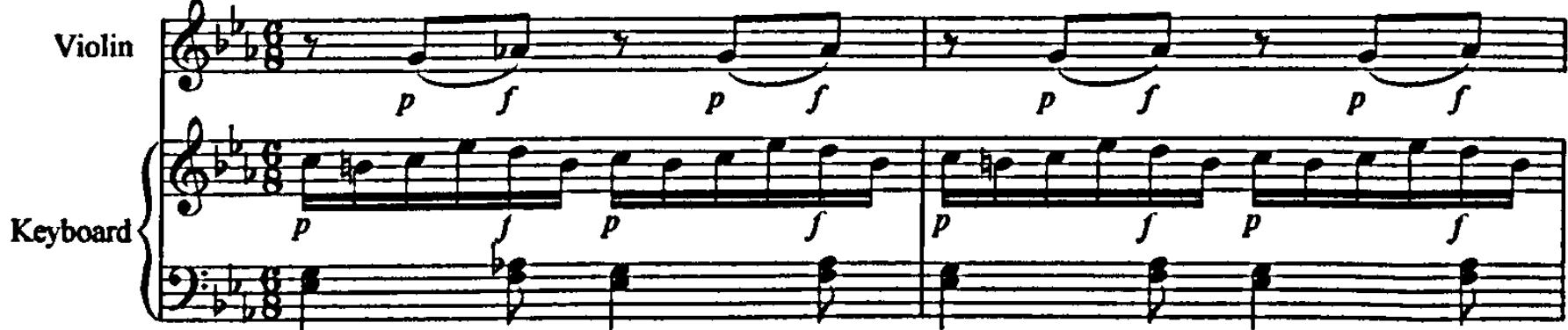
中文讲解
此为Example 5.29的图像/乐谱占位符,对应K380第三乐章第72-73小节。该例与P0149-P0150段论述相关,具体展示了Mozart如何在同一片段中同时运用’弱拍不协和’与’连线内重音’两种反常规手法。具体音符位置与重音标记需查阅原图。
补充说明
K380是Mozart为小提琴与键盘而作的降E大调奏鸣曲。需查看原图以确认具体谱例细节。
第10段(P0152)
原文复述
54 The first edition has no fp or slur in the right-hand keyboard part.
中文讲解
这是脚注54的内容,说明K376第一乐章第106小节相关的初版(first edition)情况:右手键盘声部没有fp(突强后即弱)记号或连线标记。该脚注承担版本对照功能,提醒读者此处讨论的某些表情记号在初版中可能并不存在,可能来源于手稿或其他版本来源,因此对于演奏实践的判断应基于可靠的版本依据。
补充说明
脚注54支持正文关于’标记重音强化弱拍不协和’的论述,同时提示版本差异——印刷版本与手稿版本之间在表情细节上可能存在出入。
第11段(P0153)
原文复述
Occasionally notated accents are also used to stress not only a metrically weak beat, but also a harmonically gentle chord, such as the resolution rather than dissonance at a cadence. This is the case in the second movement of K377 (see example 5.30); in the first half of Variation 6, f markings on the final chord of each phrase contradict the usual pattern of cadential accentuation. Instead of stressing the dissonant chord in bar 7, a dominant seventh, Mozart prescribes a conclusive and abrupt f on the resolution of the cadence, the tonic chord:
中文讲解
本段论述第三种反常规现象:标记重音不仅可作用于节拍弱拍上,还可作用于和声上’柔和’的和弦——例如终止式中的解决和弦而非不协和和弦本身。具体例证为K377第二乐章变奏6的前半部分:每句结尾和弦上的f(强)记号违背了常规的终止重音模式。通常情况下,演奏者预期在第7小节的不协和和弦(属七和弦)上加重音,但Mozart却在终止式的解决音——主和弦上标记了一个果断而突兀的f。这一处理打破常规——把终止式的重音落在解决而非紧张点上,产生了独特的修辞效果。
补充说明
K377是Mozart为小提琴与键盘而奏的F大调奏鸣曲。属七和弦(dominant seventh, V7)是高度不协和并需要解决到主和弦(tonic)的紧张和弦,传统上会予以强调。
第12段(P0154)
原文复述
Example 5.30: K377, movement 2, variation 6, bars 7-8. 55
中文讲解
这是Example 5.30的图注,说明该例取自K377第二乐章变奏6的第7-8小节,用于演示终止式中标记重音落在解决和弦而非不协和和弦上的反常规现象。脚注55标记同样出现于此。
补充说明
图注中的脚注55标记对应紧随其后的P0158脚注内容。
第13段(P0155)
原文复述
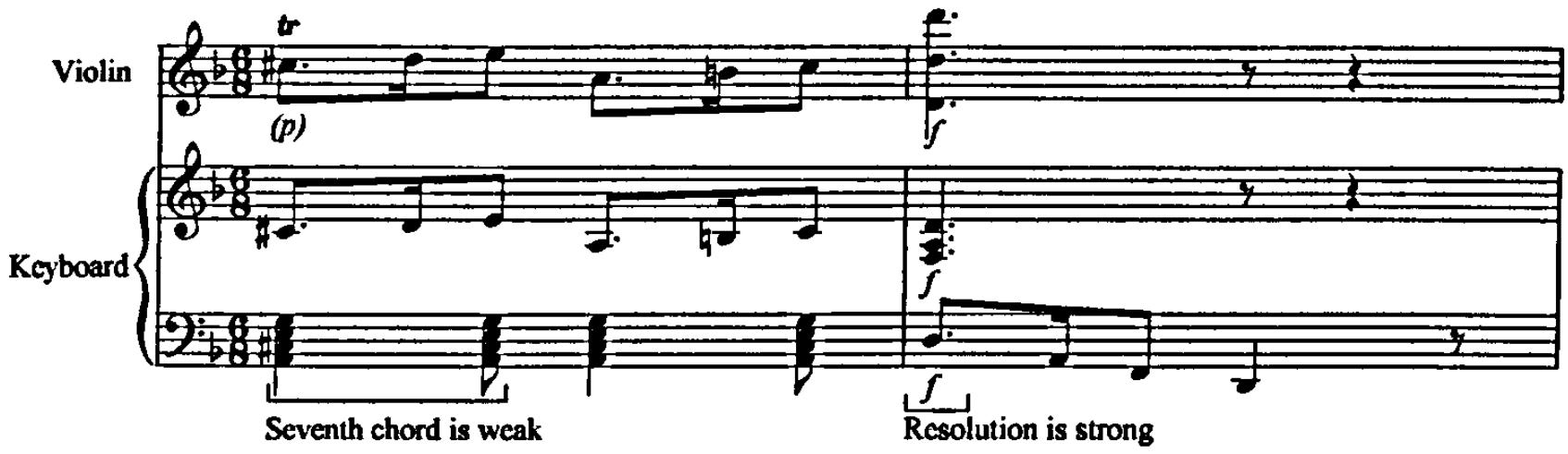
中文讲解
此为第37页的图像或乐谱占位符。原文图像数据已省略,但保留了位置标识。该占位符对应Example 5.30(K377第二乐章变奏6第7-8小节)的乐谱示例,用于直观展示Mozart在终止式解决和弦上标记f重音的反常规处理。具体音符位置与重音符号需查阅原图。
补充说明
无额外补充;需查看原图以确认f记号在终止式主和弦上的具体位置。
第14段(P0156)
原文复述
We have thus learned that metre is integral to the distinction of the individual ‘words’ which make up musical phrases. Although the accents of metre are often straightforward (and should therefore be recognised by performers without the aid of prescribed markings), notated accents in Mozart’s Sonatas for Violin and Keyboard demonstrate that a huge array of variety can be achieved by altering the rate of metrical stress. Furthermore, when composers expect accents which contradict this metrical structure, due features such as dissonance, these are often specified by notated performance instructions. Mozart thus corroborates Leopold’s assertion that accents which are ‘unusual and unexpected’ are indicated by ‘a skilful composer’ (L. Mozart, 1756: 221).
中文讲解
本段是小节层面的总结段落,承担了三个功能:
第一,重申节拍在构成音乐短语中’词’的基本单位方面不可或缺(即节拍是音乐句法的基础)。第二,承认节拍重音通常较为直接,无需特别标记,但Mozart的小提琴与键盘奏鸣曲表明,通过改变节拍重音的速率可获得丰富的变化。第三,当作曲家预期出现与节拍结构相矛盾的重音(特别是与不协和等要素相关时),这些重音往往通过演奏指示明确标注。最后,作者将Mozart的实践与开头引用的Leopold观点相印证——Mozart的具体例子证实了Leopold所谓’技艺高超的作曲家’会以’不寻常且出人意料’的方式指示重音这一理论断言。
本段在结构上呼应P0143-P0144的引子,形成首尾呼应的论证闭环。
补充说明
本段为小节总结,正式收束关于’违背节拍层级的标记重音’的论述。引文’(L. Mozart, 1756: 221)‘呼应P0144段的同一文献来源。
第15段(P0157)
原文复述
While these prescribed accents are essential to the stylish delivery of the sonatas, the fact still remains that performances which fulfil the rhetorical aims of delivery, to move the listener, must convey more than ‘Just accentuation, and an exact division of the bar into its several durations of notes’, which is a component of ‘correct performance’, or the ’exact exposition of such details as an be prescribed by notes, signs, and technical terms’ (Spohr, 1832: 178). Indeed, treatises written throughout the eighteenth and nineteenth centuries inform us that in order to move the passions of the audience, performers must identify greater detail in the accentuation of the pieces that they perform:
中文讲解
本段承担承上启下的过渡功能。它既肯定了前文所讨论的标记重音对于奏鸣曲’风格化呈现’的重要性,又通过引入Spohr的观点提出更高层面的要求:演奏若要实现修辞目标——感动听众——则必须超越单纯的’重音记号与精确的小节时值划分’。Spohr将这类机械性准确性定义为’正确演奏’(correct performance)的组成部分,即’精确呈现乐谱中可由音符、记号与技术术语规定的一切细节’。作者指出,18至19世纪的理论著作一致表明,要’打动观众情感’(move the passions of the audience),演奏者必须在重音处理上识别比谱面标记更多的细节。
这一段的功能是为后续讨论(演奏修辞与情感表达)做铺垫,将本节关于’标记重音’的探讨延伸至更大的演奏美学语境中。
补充说明
Spohr(路易·施波尔,1784-1859)是著名德国小提琴家、作曲家,其1832年的著作(《小提琴教程》Violinschule)是19世纪上半叶重要的演奏理论文献。引文’(Spohr, 1832: 178)‘为原书页码。‘move the passions’(打动情感)呼应18世纪修辞学传统中的’affectus movere’概念。
第16段(P0158)
原文复述
55 The first edition has no f in the left-hand keyboard part.
中文讲解
这是脚注55的内容,说明K377第二乐章变奏6第7-8小节相关的初版(first edition)情况:左手键盘声部没有f(强)记号。该脚注承担版本对照功能,与脚注54性质相似——提示读者此处讨论的某个力度记号在初版中可能并不存在。这再次提醒读者,对Mozart表情细节的判断应基于可靠的版本学依据。
补充说明
脚注55对应P0154图注中的脚注标记,是关于K377谱例的版本差异说明。
脚注 / 边栏 / 图表 / 附加信息(如有)
本节包含两个脚注和三个谱例图注。脚注54说明K376第一乐章第106小节初版右手键盘声部无fp或连线标记;脚注55说明K377第二乐章变奏6第7-8小节初版左手键盘声部无f标记。两个脚注均承担版本对照功能,提示读者表情细节在版本间存在差异,演奏判断应基于可靠版本依据。三个谱例(Example 5.26、5.28、5.30)分别演示K454、K376、K377中违背节拍层级的标记重音,是本节论证的核心实证材料。图像/乐谱占位符(P0147、P0148、P0151、P0155)需查阅原图以确认具体音符位置与重音符号。
💡 本节核心要点
- 本节论证Mozart在小提琴与键盘奏鸣曲中存在违背节拍层级的标记重音,与Leopold Mozart所谓’不寻常且出人意料’的作曲家表情指示相印证。
- 反常规重音的第一种形式:标记重音落在节拍弱拍上(小节中非强拍位置),如K454第一乐章mfp标记于4/4拍第三八分音符。
- 反常规重音的第二种形式:连线内重音(accent within a slur),使节拍重音位移,如K454第三乐章与K380第三乐章的例证。
- 反常规重音的第三种形式:在弱拍的不协和和弦上加重音,强化而非缓解不协和紧张度,如K376第一乐章的减七和弦。
- 反常规重音的第四种形式:在终止式中标记重音于解决和弦(主和弦)而非不协和和弦(属七和弦)上,如K377第二乐章变奏6。
- 节拍是构成音乐短语’词’的基本单位,但演奏者还须超越谱面标记,识别更细致的重音处理以实现感动听众的修辞目标(Spohr观点)。
🔑 关键术语
- metrical hierarchy:节拍层级,指小节内各拍按强弱规律形成的层次结构(强拍与弱拍的层级关系)。本节论证Mozart的标记重音常与此层级发生矛盾。
- syncopated accents:切分重音,指重音落在非强拍位置或与节拍强拍错位,从而产生节奏切分效果。本节作为反常规重音的核心形式之一加以讨论。
- accent within a slur:连线内重音,指在连弓(连奏)线条内标记的重音记号。传统上连线内音应保持连贯平滑,该标记方式构成对节拍流畅性的特殊强调。
- mfp:中等强后即弱(mezzo-forte-piano)的力度记号,表示先奏出中等强度再立即转弱。本节用作K454第一乐章切分重音的实例。
- dominant seventh chord (V7):属七和弦,建立在调式第五级音上的七和弦,为不协和和弦,传统上需要在终止式中予以重音处理并解决到主和弦。本节以K377为例说明Mozart反常规地将终止式重音放在解决主和弦而非属七和弦上。
- diminished seventh chord:减七和弦,由两个小三度叠置构成的高度不协和和弦。本节以K376第一乐章为例,说明该和弦出现在弱拍上时被Mozart加重并延长,构成’强化不协和’的反常规处理。
- first edition:初版,指作品首次刊印的版本。本节脚注54与脚注55均提及初版与手稿版本(或作者讨论所用版本)之间在表情记号(fp、连线、f等)上的差异。
- correct performance (Spohr):Spohr提出的演奏概念,指精确呈现乐谱中可由音符、记号与技术术语规定的一切细节。本节以此概念为对照,强调演奏还需超越机械准确性以打动听众情感。
CH5-S13 [描述性拆分] Conventional Indicators of Non-Notated Accent
第1段(P0159)
原文复述
Thus it is insufficient for the performance of a piece of music for one to know well how to strike and maintain the mensuration according to prescribed signs; but the director must as it were guess the meaning of the composer: that is, he must feel the various impulses which the piece is supposed to express. (Rousseau; quoted in Mattheson, 1739: 368)
中文讲解
本段是卢梭(Rousseau)经由马泰松(Mattheson, 1739: 368)转引的一段话,核心主张是:仅凭谱面上规定的拍号与节拍记号(mensuration)来"打"出节拍并维持节拍律动,对于作品的演出是远远不够的。指挥者(director)还必须"猜出”(guess)作曲家的意图,也就是说,他必须感受到乐曲所要表达的各种情绪冲动(impulses)。
这句话的关键张力在于:作者把演奏分为两个层次——一是技术性地"敲出"并维持规定节拍,二是情感性地"猜出"并"感受"作曲意图。卢梭用了"as it were”(仿佛、可以说)这样的措辞,暗示这种"猜测"并非随意揣测,而是一种基于音乐修养的移情式理解。这一区分在小节论证中的作用十分关键:它为本节乃至整章的核心问题——“未被记出的重音"为何重要——做了哲学层面的铺垫。即,谱面记号(含 mensuration 记号)只是底线,演奏者还须在记号之外去体察作品内在的"冲动”,而这些冲动往往会体现为重音与力度起伏。
补充说明
本段中的"mensuration"指18世纪意义上的节拍度量体系,涵盖拍号与节拍维持规则;“director"在18世纪用法中不局限于现代意义上的指挥,也指负责带领演奏的总负责人(如合奏领头人);“prescribed signs"对应谱面节拍记号。卢梭原文为法文,此处经马泰松在1739年德文著作中转引为英文,引用链条需注意。
第2段(P0160)
原文复述
Spohr, writing in 1832, raises the same issue, reminding violinists of the importance of, as it were, ‘speaking’ the music that they perform. His comments on the lack of prescribed performance information in the (at his time of writing) 130 year old works of Corelli are more than relevant to our approach to the works of Mozart, at over 200 years remove:
中文讲解
本段将卢梭所处的18世纪传统与19世纪小提琴家、作曲家斯波尔(Spohr, 1832)的论述加以衔接。斯波尔提出了与卢梭"实质上"相同的问题,并提醒小提琴家:演奏音乐时要像"说话”(‘speaking’)一样去呈现它。
本段还隐含一个时间距离的论证:斯波尔写作时,科雷利(Corelli)的作品距其时已约130年;而本书作者讨论莫扎特(Mozart)的作品时,距莫扎特时代已超过200年。换言之,作者指出,他们今天面临的"谱面信息不足"问题,与斯波尔当年面对科雷利旧作时的处境完全同构,因而斯波尔的论述对作者的方法有直接借鉴意义。
“as it were ‘speaking’“中的引号与"as it were"提示:斯波尔意识到这是一个比喻,强调演奏不是机械敲击,而是要让音乐像语言一样具有句法、重音与表情。这一比喻正是为下一段那个著名的"诗朗诵"类比做铺垫。
补充说明
本段中的"130 year old works of Corelli"指科雷利(1653–1713)的作品距1832年约130年;“200 years remove"指莫扎特(1756–1791)距本书写作语境已逾200年。“our approach"表明作者将自身研究定位在与斯波尔相同的方法论脉络中。
第3段(P0161)
原文复述
To play the works of Corelli merely as they stand in their original publication would be, to use an analogy, like reciting poetic verse without the aid of inflexions of voice, punctuation, or aught which makes eloquence. (Spohr, 1832: 180)
中文讲解
本段是斯波尔在1832年著作第180页给出的著名类比:仅按原版乐谱去演奏科雷利的作品,无异于朗诵诗句却不用声音的抑扬变化(inflexions of voice)、不用标点停顿、不借助任何使语言具有感染力(eloquence)的手段。
类比的实质是:诗的"文本"对应乐谱的音符,而朗诵时的"抑扬、标点、使之有口才的一切"对应演奏中的重音、力度、句法与表情。也就是说,谱面音符之于演奏,正如诗的文本之于朗诵——前者是骨架,后者才赋予其生命。
这一类比直接呼应上一段的"speaking the music”,并把"未被记出的演奏信息"具象化为一种人人都能体会到的体验:把诗念得毫无抑扬顿挫,听者会觉得干瘪失味;同理,把旧乐谱只按字面演奏,听者会觉得僵硬无情。这为本节最终要讨论的"十八世纪演奏惯例所暗示的重音点"做了逻辑准备:既然原谱存在这种"朗诵无抑扬"式的缺陷,那就必须有某种补偿机制——下一段正引出这种机制。
补充说明
“inflexions of voice"指朗诵中声音的升降与曲折变化;“eloquence"此处特指语言表达的说服力与感染力。类比的目的不是证明音乐等同于诗,而是说明两者都依赖"文本之外的表演层"才能传达本意。
第4段(P0162)
原文复述
To this end there are further eighteenth-century conventions of performance which are intrinsic to accentuation, suggesting points of stress where no notated accent or dynamic markings are given.
中文讲解
本段是一句承上启下的论点陈述,指出为了解决上一段所揭示的"谱面信息不足"问题,存在一些十八世纪演奏惯例(conventions of performance),它们内在于重音处理(intrinsic to accentuation),会在谱面上没有标注重音或力度记号的地方暗示出重音点(points of stress)。
关键词"intrinsic”(内在于)表明这些惯例并非演奏者外部强加的随意发挥,而是被视作音乐本身所固有的一部分——也就是说,它们像是"未被写下却理应如此"的演奏规则。这与前文卢梭所说演奏者须"猜出作曲家意图"以及斯波尔所说须"像说话一样演奏"形成呼应:演奏者的任务,是依据这些惯例去"听出"或"补出"谱面未标的重音。
本段在小节论证结构中的功能,是正式宣告下文将转入对"非记谱性的重音惯例"的具体讨论。换言之,本节在前面引用卢梭与斯波尔完成理论铺垫后,在这里确立其正面论题:除了明确记出的重音记号与力度标记外,十八世纪音乐自身还携带着一套暗示重音的惯例。
补充说明
本段中"conventions of performance"指约定俗成、被演奏者社群普遍遵守并传承的演奏规则;“intrinsic to accentuation"强调这些规则与重音逻辑不可分割;“points of stress"即演奏中应加以强调的时点或音点,与后文可能涉及的小节强拍、旋律高点、长音、切分等因素相关。
脚注 / 边栏 / 图表 / 附加信息(如有)
本小节P0159与P0161均为带括号出处的引文,分别出自 Mattheson (1739: 368) 转引 Rousseau,以及 Spohr (1832: 180)。P0160 起到引用桥接与时间距离论证的作用。P0162 是本小节的论点收束句,宣告接下来讨论十八世纪演奏惯例所暗示的重音。无图表、乐谱或脚注条目需要单独说明。
💡 本节核心要点
- 演奏仅凭谱面规定的拍号与节拍记号是不够的,演奏者还须体察作曲家所欲传达的"冲动”,这是十八世纪以来关于旧乐谱演奏的核心张力。
- 斯波尔 (1832) 与卢梭实质上提出同一问题,并借助"像说话一样演奏"以及"朗诵诗句而无抑扬"的类比,把谱面记号的局限性具象化。
- 时间距离(科雷利作品在斯波尔时已逾130年、莫扎特作品距今已逾200年)使得"原谱演奏信息不足"这一问题更加尖锐,也使历史惯例的重建更具必要性。
- 作者由此过渡到本节正面论题:十八世纪存在一些内在于重音处理的演奏惯例,它们能在谱面未标重音或力度记号之处暗示重音点。
- 这些惯例被视为"内在"于音乐本身,而非演奏者的随意添加,是后续讨论非记谱性重音指标的方法论前提。
🔑 关键术语
- mensuration:十八世纪意义上的节拍度量体系,包括拍号记号以及据此维持节拍律动的规则;与"prescribed signs"共同构成谱面节拍层面的最低限度信息。
- inflexions of voice:朗诵或说话时声音的升降、曲折变化;斯波尔以此作为类比,说明演奏中应具备的抑扬顿挫。
- conventions of performance:十八世纪演奏者社群约定俗成并代代相传的演奏规则;本节强调其中与重音处理相关的那一部分。
- intrinsic to accentuation:形容演奏惯例与重音处理不可分割、内在于音乐本身;意味着这些惯例不是外部修饰,而是音乐表达的必要组成部分。
- points of stress:演奏中应被强调的音点或时点;本节强调它们有时并不通过记谱上的重音记号或力度记号直接给出,而是由惯例暗示。
CH5-S14 [描述性拆分] Slurs as Indicators of Accent: First Note, Long Slur and Syncopated Note
第1段(P0163)
原文复述
Conventional indicators of non-notated accent
中文讲解
这是一个小节标题,把论述从上一节关于节拍重音的内容,引向新主题:当力度记号未在谱面上明确写出时,作曲家与演奏者依据哪些约定俗成的标记(如连线 slur)来推断重音位置。它标志着一个新论域的开启。
第2段(P0164)
原文复述
The ’note buone’ to which Leopold refers are not restricted to metrical stress alone. Indeed, he cites a number of other compositional features which imply accentuation in performance where it is not prescribed by dynamics. One such indicator of accent is the notation of slurs:
中文讲解
本段把 Leopold Mozart 笔下的 note buone(应当被强调的音)从单纯的节拍重音扩展出去:在力度没有明确记号之处,仍有若干作曲特征暗示演奏上的重音。其中第一类将要详细讨论的指示,就是连线的标记方式。它为整节关于连线与重音的展开做铺垫。
补充说明
’note buone’是 Leopold 著作中使用的意大利术语;本段以它为入口,把讨论从节拍重音拓宽至作曲标记暗示的重音。
第3段(P0165)
原文复述
“If several notes of this kind [passagework in one note-value] follow each other, over which… a slur be placed, the accent falls on the first… and is not only played somewhat louder, but it is also sustained somewhat longer… the others, on the contrary, being slurred on to it in the same stroke with a diminishing of the tone, even more and more quietly and without the slightest accent. (L. Mozart, 1756: 220)”
中文讲解
这是直接引自 Leopold Mozart 1756 年著作第 220 页的原文。其中方括号[passagework in one note-value]是作者加的编辑性说明,提示读者“this kind”指同音值的快速跑动音群。引文同时规定了两件事:连线内的重音落在第一音,且第一音不仅“稍响”还“稍长”;后续音用同一个弓/呼吸顺势带出,音色越来越弱且不再加重。这是“连线起始重音”传统在 18 世纪早期文献中的典型规定之一。
补充说明
方括号[passagework in one note-value]为编辑性补注;引文中的省略号为原文形式,保留原引文的语流节奏。
第4段(P0166)
原文复述
Referring to both the quality of attack, and the length of the note (or syllable), this technique of stressing the first note of each slur is reminiscent of the descriptions in eighteenth-century rhetorical treatises on how to create accents (see page 158 above). The convention of stressing the first note in short groups of slurred notes is described in music treatises throughout the period (as we have seen in chapter 4), and is perceived as an important source of variety in delivery. Quantz, for example, writes tables which outline the types of nuance and accentuation that are necessary in order to introduce ’light and shade’ (Quantz, 1752: 276) to music, asserting that without these details of performance ‘you play everything with the same colour or volume, [and] the listeners will remain unmoved’ (Quantz, 1752: 276). His examples of accentuation, like Leopold’s, often specify that the first note under a slur should receive the greatest stress:
中文讲解
这一段把 Leopold 的做法放入更广的语境:他描写重音时同时提到“起音的力度”与“音符/音节的时值长短”,这与 18 世纪修辞学论著中关于“如何制造重音”的论述相通(参本论文前面第 158 页)。本段还指出,“小连线组里加重第一音”这一规则在整个 18 世纪的音乐论著中反复出现,被视为能为演奏带来变化的重要手段。Quantz 用表格列出实现“明暗对比”所需的 nuance 与重音类型,并警告:缺乏这些演奏细节,演奏将只剩一种“色彩和音量”,听者将无动于衷;Quantz 的重音例子与 Leopold 一样,常规定连线下的第一音获得最大重音。
补充说明
‘see page 158 above’与’as we have seen in chapter 4’指向本论文前面已经讨论过的内容;Quantz 所用’light and shade’在 18 世纪演奏论著中泛指通过力度、节奏与发音变化造成的明暗对比效果。
第5段(P0167)
原文复述
Example 5.31: Quantz’s suggestions for the accentuation of slurs (Quantz, 1752: 142, table X, figures o, p and t) $^{56}$
中文讲解
这是示例 5.31 的图注,提示本图取自 Quantz 1752 年著作第 142 页表 X 中编号为 o、p、t 的三段谱例,意在展示 Quantz 对连线重音的具体建议。右上角的 $^{56}$ 为对应的脚注编号,紧接着的 P0171 即为该脚注的内容。
补充说明
须查看原图方能确认具体音符与记号布局;图注中提及的三个 figure (o, p, t) 与脚注 56 共同帮助读者定位 Quantz 原书。
第6段(P0168)
原文复述

中文讲解
这是一条图像/乐谱占位符,位于第 39 页,紧接示例 5.31 的图注之后,对应 Quantz 关于连线重音建议的谱例图。具体的音符、力度记号与连线形状需要查阅原书第 39 页才能确认。
补充说明
须查看原图(PDF 第 39 页示例 5.31);本占位符本身无新文字主张。
第7段(P0169)
原文复述
Such descriptions of the accentuation of slurs survive well into the nineteenth century: Campagnoli, for example, writes that ‘The first of two, three, or four notes slurred together must always be marked and dwelt upon a little, and the others must follow a very little later, decreasing in tone’ (Campagnoli, 1824: 8), and Spohr annotates melodies with slurs which start with a stress and are then phrased away (see example 5.56 of this thesis). This is in spite of the fact that, as Clive Brown writes, ’the association became increasingly out of touch with composers’ practices’ (Brown, 1999: 32).
中文讲解
本段把“连线起始重音”的规则向后延伸至 19 世纪:Campagnoli 在 1824 年仍主张连线内两、三、四个音的第一个必须被稍稍“标记和停留”,其余音在稍后跟上并渐弱;Spohr 也在旋律中标出“起音加重、再渐轻带出”的连线处理。然而作者随即引述 Clive Brown 的研究指出:尽管规则在论著中沿用,但它与作曲家实际创作实践的关联性已经越来越脱节。这暗示演奏论著中的规则与作曲家谱面意图之间存在张力,是本节后续讨论“何时不应照规则加重”的伏笔。
补充说明
‘see example 5.56 of this thesis’为本论文更靠后位置的谱例编号,本节并未引用其内容,仅作交叉指引。
第8段(P0170)
原文复述
Even during the middle to late eighteenth century, however, the accentuation of the start of a slur was not always appropriate. Leopold gives examples of slurs starting on an upbeat and slurred to the downbeat of the next bar: instead of accenting the start of the slur, he places f on the downbeat. In this instance, metric accentuation takes precedence over the accentuation which would normally be used at the start of a slur (L. Mozart, 1756: 125). Furthermore, even though numerous theorists express the opinion that long slurs should not contain accents within them (see Corri, 1810: 72 and Koch, 1802, art. ‘Legato’; quoted in Brown, 1999: 236), Leopold’s description ‘of the many varieties of bowing’ makes reference to metric accentuation within long slurs:
中文讲解
本段对前文铺陈的“连线起始加重”通则提出两条限定。第一条:当连线从弱拍起、跨到下一小节的强拍时,Leopold 把强音(f)放在小节强拍上,而非连线起点——节拍重音在此压倒“连线起始加重”的默认规则。第二条:尽管多位理论家(Corri, 1810;Koch, 1802)都强调长连线内部不应再有重音,Leopold 在讨论“多种弓法”时却承认长连线内部仍需考虑节拍重音。两条限定共同表明,所谓“连线起始加重”并非铁律,而需根据节拍位置、连线长度等上下文灵活取舍。
补充说明
‘f’在本段语境中指强奏记号 forte;Leopold 关于“多种弓法”(bowing)的论述是“长连线内仍要照顾节拍重音”的直接证据,本节下一段(P0172)即给出他的具体原话。
第9段(P0171)
原文复述
$^{56}$ Quantz’s instructions for dynamic nuances are not notated on his musical examples, but described in prose in chapter XIV, §26-39 (pages 173-178). These descriptions of dynamics have been realised by the current writer in the musical examples included here. Hairpins are used to indicate Quantz’s descriptions of nuances, and – and $\smile$ signs are used to show his ‘strong’ and ‘weak’ notes respectively.
中文讲解
这是脚注 56 的内容,对应示例 5.31。脚注交代了三条关键信息:(1)Quantz 在原书中并未把力度处理直接记在谱例上,而是用散文写于第 XIV 章第 26–39 节(第 173–178 页);(2)本论文中的谱例是“the current writer”(即论文作者本人)根据 Quantz 的散文描述重新“实现”(realised)出来的;(3)记号约定:用渐强/渐弱记号(hairpins)表示 nuance,用“–”表示 Quantz 所说的“强音”,用 $\smile$ 表示“弱音”。这条脚注帮助读者判断本节图示里力度记号的可靠性来源。
补充说明
脚注对正文示例具有“来源说明”作用;它告诉读者本节图中的力度可视化来源于作者对 Quantz 散文描述的转写。
第10段(P0172)
原文复述
“One can even play a whole bar [of semiquavers] in one stroke. But here also, as in the previous style, the first notes of each crotchet must be marked by an emphasis. (L. Mozart, 1756: 117)”
中文讲解
这段直接引语紧承 P0170 末尾提出的“长连线内节拍重音”问题。Leopold 表示:即使一整小节的音符可以在一个弓/呼吸里拉完,每个四分音符的第一音仍然需要被强调。引文中方括号[of semiquavers]是编辑性补注,提示“一整小节”具体指十六分音符的均匀跑动。引用目的是为了印证“长连线内部并非完全没有重音”——这里以四分音符为单位,在长连线里嵌套了一组次级的小连线重音。
补充说明
[of semiquavers]为编辑性补注,原句中由 Leopold 隐含给出但未直接写出该词;引文出处为 Leopold Mozart 1756 年著作第 117 页。
第11段(P0173)
原文复述
Quantz similarly gives examples of long slurs during which the crotchet pulse should be emphasised (see example 5.32). In these, the slur begins on a weak beat of the bar. Rather than stressing the weak off-beat, Quantz suggests displacing the accent to the first strong beat:
中文讲解
本段引出 Quantz 对同类问题的处理:当连线跨过弱拍时,Quantz 与 Leopold 一样不加重连线起点,反而把重音移到小节内第一个强拍上。这意味着 Quantz 在面对“长连线 + 弱拍起头”的情形时,实际上把节拍层级置于“连线起始加重”规则之上。段落末尾的冒号提示:紧接的 P0174 是 Quantz 这一做法的谱例图注。
补充说明
本段与 P0170 共同构成对“通则”的限定:Quantz 的处理与 Leopold 互相印证。
第12段(P0174)
原文复述
Example 5.32: Quantz’s specification for metrical accentuation within slurs (Quantz, 1752: 140 and 142, table IX, figure p and table X, figure q).
中文讲解
这是示例 5.32 的图注,注明本图取自 Quantz 1752 年著作第 140 与 142 页(分别为表 IX 的 figure p 与表 X 的 figure q),目的在于展示 Quantz 如何在连线内部指定节拍重音。
补充说明
须查看原图(第 40 页示例 5.32)以确认谱例中连线跨越的拍位与重音标记。
第13段(P0175)
原文复述

中文讲解
这是第 40 页的图像/乐谱占位符,与示例 5.32 的图注相对应。具体音符与重音位置须查阅原书第 40 页才能确认。
补充说明
须查看原图(PDF 第 40 页示例 5.32);本占位符无新文字主张。
第14段(P0176)
原文复述
Interestingly, Quantz also suggests an alternative accentual pattern for the rhythm of figure q in table X (example 5.32 above); in this alternative pattern, the relative stress given to the start of each beat – regardless of whether it is the start of a slur – is considered within the context of the hierarchies of the metre (see example 5.33). Therefore, instead of adhering to the rule that the start of each beat or slur requires an accent, weak beats of the bar are played gently.
中文讲解
本段告诉读者:Quantz 对图 5.32 中 figure q 的节奏型还提供了一种替代的重音方案。在这种方案中,无论是否处于连线起点,每拍起点的相对强弱都要服从小节的节拍层级——结果是弱拍被轻轻地处理,而非一律被加上重音。这进一步说明:即便是同一位理论家(Quantz),在面对同一节奏型时也允许不同的重音方案;演奏者需要在节拍层级与“连线加重”两种取向之间做选择。段末“see example 5.33”指向紧随其后的谱例图注。
补充说明
本段与 P0170、P0173 共同构成“规则有例外、同一规则存在多种实现”的论证链。
第15段(P0177)
原文复述
中文讲解
这条图像占位符中同时嵌入了图注与作者的解释性文字。图像为示例 5.33,原图取自 Quantz 1752 年著作第 141 与 146 页(表 IX.2 的 figure m 与表 XII 的 figure c)。图注说明:本例展示了 Quantz 如何在“小节节拍层级”内做出弱连线的处理。冒号之后的句子进一步指出:表 XII 中的 figure c 还能说明 Quantz 在某些情形下建议“在连线之内渐强到下一个特别强的拍”——但他也常常警告演奏者:尽管连线的音量在增长,到连线末仍需“抬起”以便于在下一个音之前做出清晰的起音(articulate)。这是本节中第一条“允许在连线内做渐强处理”的文献依据。
补充说明
须查看原图(PDF 第 41 页示例 5.33)方能确认具体谱例;“lifted at the end”在演奏语境中通常指弓速/气息的轻微回收以便新音干净起音,文本本身未展开。
第16段(P0178)
原文复述

中文讲解
这是示例 5.34 的图像占位符,原图取自 Quantz 1752 年著作第 140 与 142 页(表 IX 的 figure ll 与表 X 的 figure n),用于展示 Quantz 关于“带有细致力度变化的连线处理”。具体记号与谱例细节须查阅第 41 页原图方能确认。
补充说明
须查看原图(PDF 第 41 页示例 5.34);本占位符文字本身只起图题作用。
第17段(P0179)
原文复述
The debate over whether to accent the start of an off-beat slur, or whether to stress the metrically strong beat within a slur (or tie), is encapsulated by the multifarious descriptions of the delivery of syncopated rhythms. Duncan Druce raises this issue, writing that most commonly syncopations are now performed with an accent at the start of each note, while in fact there is much evidence to suggest that in some circumstances each note should receive a small crescendo (Druce, 2002: 56-7). Even in Leopold’s treatise, Clive Brown observes, there is a conflict of opinion. In the original edition, ‘Leopold Mozart unreservedly condemned the practice of swelling though each note’ writing that ‘such notes must be attacked strongly and, with a gradual dying away be sustained without after-pressure’. By the time of the 1787 revision of his treatise, however, a footnote advises performers that when syncopated notes follow each other in quick succession, ‘This is the only case in which it is customary to mark the division of the notes by a perceptible after-pressure of the bow’ (quoted in Brown, 1999: 39-40).
中文讲解
本段把“连线起点加重 vs. 节拍强拍加重”的争论收束到切分节奏(syncopation)的演奏上:Duncan Druce 指出,当代普遍做法是在每个切分音起点加重,但有证据显示某些情况下每个音都应有微小渐强。Clive Brown 进一步指出,连 Leopold Mozart 自己都在切分音处理上前后矛盾——第一版《Violinschule》坚决反对“每个音都渐强”,主张“强起后渐弱但不要有后续压力”,但 1787 年修订版中的脚注又承认:当切分音快速连续时,“这是唯一可以用可感知的弓压标记音与音之间分界的常用情形”。这说明即便在同一位作者笔下、同一套规则内,也会因切分音的特殊节奏属性而产生张力;它是本节“规则需视上下文而定”的最高明证。
补充说明
‘after-pressure of the bow’指弓在起音后继续施加的弓压,用以“延音并带出”;Leopold 1787 年版脚注承认这种处理在快速连续切分音中是唯一被允许的例外情形。
第18段(P0180)
原文复述
Thus, slurring can be indicative of accentuation; but it remains the performer’s decision, dependent on context, whether to accent the start of slurs, or whether the underlying metric hierarchy should receive greater stress.
中文讲解
这是本节的总结句,回应 P0164 提出的问题。结论是:连线确实可以暗示重音,但演奏者必须根据上下文决定究竟要遵循“连线起点加重”的传统规则,还是把节拍层级的强拍放在更优先的位置。它把前文给出的所有例外与限定(弱拍起头连线、长连线内部的节拍重音、切分节奏)一并收束,明确把最终决定权留给演奏者。
补充说明
此句是整个小节 CH5-S14 的论点收束;它把“作曲家记号”与“演奏者解释”之间的张力,作为本段论证的最终落脚点。
脚注 / 边栏 / 图表 / 附加信息(如有)
本节含三类附加材料:(1)脚注 56(P0171),属“来源说明”,交代本节谱例中的力度可视化是论文作者依据 Quantz 第 XIV 章第 26–39 节(第 173–178 页)的散文描述转写出来的,并给出“–”表示强音、$\smile$ 表示弱音的记号约定。(2)四张谱例图及其图注:示例 5.31(P0167–P0168)取自 Quantz 表 X 的 figures o, p, t,展示连线重音建议;示例 5.32(P0174–P0175)取自表 IX figure p 与表 X figure q,展示连线内节拍重音;示例 5.33(P0177)取自表 IX.2 figure m 与表 XII figure c,展示弱连线在节拍层级中的处理以及表 XII 中“在连线内渐强至强拍但末须抬起”的处理;示例 5.34(P0178)取自表 IX figure ll 与表 X figure n,展示带细致力度变化的连线。(3)交叉指引若干处:P0166 指引本论文前面第 158 页与第 4 章;P0169 指引本论文更靠后的示例 5.56;P0177 与 P0180 提示前文示例 5.32 的存在。这些附加材料共同支撑“连线暗示重音,但决定权在演奏者”的论点。
💡 本节核心要点
- “note buone”不仅指节拍重音,作曲家还在力度记号之外用其他作曲标记暗示重音;本节聚焦其中之一——连线(slur)标记。
- 18 世纪以来的论著(Leopold Mozart、Quantz 等)形成“连线内第一音加重、稍延长,后续音顺势渐弱”的通则;Quantz 强调此细节是为演奏带来“明暗对比”,缺此则演奏单调。
- 该规则在 19 世纪仍被援引(Campagnoli、Spohr),但 Clive Brown 指出它已逐渐与作曲家实际创作实践脱节。
- 规则存在多种例外:连线起点位于弱拍时,节拍强拍压倒连线起点加重;长连线内部仍可按四分音符或小节层级重新安置重音(Leopold、Quantz 均有例证);Quantz 还允许在长连线内做渐强至特别强拍、末须抬起以便下一个音清晰起音。
- 在切分节奏上,是否每个音都“渐强”还是仅起点加重,连 Leopold 本人在 1756 与 1787 两种版本中都给出过矛盾意见。
- 综上,连线只是暗示;是否加重、加在哪里,须由演奏者依具体上下文(节拍层级、连线长度、节奏型)作出判断。
🔑 关键术语
- note buone:Leopold Mozart 著作中的术语,指“应当被强调的音”;本节把它从节拍重音扩展至由其他作曲标记暗示的重音。
- slur / 连线:本节讨论的核心作曲标记;约定俗成地表示“连线内第一音加重、稍延长,后续音顺势渐弱”。
- passagework in one note-value:Leopold 引文中方括号内的编辑性补注所指的对象,指同一时值的连续快速走句。
- light and shade / 明暗:Quantz 在 1752 年使用的术语,指通过力度、节奏与发音等细节在演奏中形成的对比效果;Quantz 认为缺此则演奏单调、听者无动于衷。
- metric accentuation / 节拍重音:依据小节内拍位强弱关系决定的重音;本节中常被拿来与“连线起始加重”规则相对比,并在弱拍起头跨小节与长连线内部两种情形下压倒后者的优先级。
- after-pressure of the bow:弓在起音后继续施加的弓压;Leopold 1787 年版脚注承认在快速连续切分音中允许以此“标记音与音之间的分界”,是 Leopold 自己前后矛盾意见的关键点。
- syncopation / 切分:本节把它作为“加重连线起点 vs. 加重节拍强拍”争论的集中体现,并展示 Leopold 本人在不同版本中的矛盾态度。
CH5-S15 [描述性拆分] Chromaticism, Dissonance, Length and Pitch as Indicators of Accent
第1段(P0181)
原文复述
The author introduces another of Leopold Mozart’s recommendations regarding accentuation, one that is connected to chromaticism and dissonance, and signals that the next sentence will be a direct quotation from Leopold.
中文讲解
本段是过渡性的引语导引,作用是把读者从前文对重音记号本身的讨论,引向Leopold关于"何时应该打重音"的另一类判据:半音化与不协和音。“He writes that:“这一句话明确预告了下一段是Leopold原文的直接引用,因此P0181自身不提供实质内容,仅起桥接与点题的功能。
第2段(P0182)
原文复述
Leopold Mozart is quoted as saying that notes raised by a sharp or natural should always be played somewhat more strongly, with the tone then diminishing through the course of the melody; in the same way a sudden lowering of a note by a flat or natural should be distinguished by forte. The citation is given as L. Mozart, 1756: 218.
中文讲解
这是Leopold Mozart原文的引文,提出两条关于临时记号的力度原则。其一:被升号或还原号"升高"的音应演奏得稍强,然后随旋律进行渐弱;其二:被降号或还原号"突然降低"的音应以forte标记。“raised by a sharp and natural"指升号或还原号所造成的上行半音变化(还原号在原本为降音的音上等于升高),而"diminishing through the course of the melody"强调的是从该强调音开始的局部渐弱,并非整段旋律的整体减弱。这两条原则在今天的演奏实践中仍然部分保留——例如在小提琴传统中,遇到#或♮记号的音符往往会被略加重音以提示音色的明亮变化。作者在此处将Leopold的论述作为后续讨论Koch与C.P.E. Bach的起点。
第3段(P0183)
原文复述
The author observes that, as previously discussed, this type of accentuation is necessary not only for highlighting melodic chromaticism but also for emphasizing harmonic dissonance, which should then resolve gently (with reference to example 5.28 above). Koch is cited as stating that the first note of a cadence—often a dominant seventh—should always fall on the strong beat of a bar (Koch, 1787: 38). More specifically, C.P.E. Bach explains that all dissonances can be traced back to appoggiaturas: they should be performed louder than the following tone, and the release should be smoothly joined to the appoggiatura while receiving a “light tone” (C.P.E. Bach, 1753: 87-8).
中文讲解
本段把Leopold的半音化原则延伸到了和声层面。其逻辑链是:重音不仅标记旋律中的半音化,也标记和声中的不协和音——而和声不协和音随后应以"轻柔"方式解决。Koch提供了节拍层面的支持:终止式的第一个音(通常为属七和弦)应落在小节强拍上,这意味着不协和音与节拍重音天然重叠。C.P.E. Bach则给出了更深一层的解释:所有不协和音本质上都可以追溯为倚音(appoggiatura),倚音应演奏得比解决音更响,而解决则以"轻的音色"平滑地接入倚音。三位作者在此形成递进关系——Leopold给出旋律层面的现象,Koch确认其在节拍结构中的位置,C.P.E. Bach则在演奏机制上说明如何具体执行(重音落在不协和音上、解决用轻音色平滑过渡)。这一递进是本节论证的关键结构性安排。
补充说明
例5.28位于本节上方,演示不协和音及其解决的乐谱,本节仅引用其位置而不复述其内容。
第4段(P0184)
原文复述
Leopold also proposes that accentuation is implied by the rhythmic and melodic context; he states that it is customary to accent a long note when it is mixed with short notes, and that in certain circumstances, high notes can be accented: “In lively pieces the accent is mostly used on the highest note, in order to make the performance right merry” (L. Mozart, 1756: 221). The author notes that this is illustrated by the notated accents in the first movement of Mozart’s K547.
中文讲解
本段引出Leopold关于节奏与旋律位置的重音判据,两条规则须细读其限定条件:第一,长短音混合时强调长音,这是基于节奏时值的自然重音;第二,仅在"活泼的”(In lively pieces)段落中,最高的音通常被重音,其目的是让演奏"right merry”(恰当地欢快)——这一限定表明高音重音并非普遍规则,而是特定风格(活泼)下的表情手段。“right merry"是Leopold原文的英语措辞,保留它有助于体现18世纪演奏美学中力度重音与情感表达(欢愉)的直接关联。两条新规则与前文的半音化、不协和音原则合并,构成Leopold关于"何时打重音"的多元判据:音高变化、和声张力、音长、最高音。本段末尾预告下文将以K547第一乐章作为最高音重音的实例。
第5段(P0185)
原文复述
A heading introducing Example 5.35: K547, movement 1, bars 9-10.
中文讲解
这是谱例标题,标号5.35,内容为Mozart K547第一乐章第9-10小节。该谱例用以印证P0184引述的Leopold关于"活泼段落中最高音应被重音"的论述——Mozart本人在这一乐章相应位置所标注的力度重音记号即为该原则的具体乐谱例证。读者需要查看原谱才能确认重音记号所在的具体音符位置。
第6段(P0186)
原文复述
An image/musical score placeholder on page 42, located between the example caption (Example 5.35) and the surrounding text; the embedded image data has been omitted, and only the caption position is preserved.
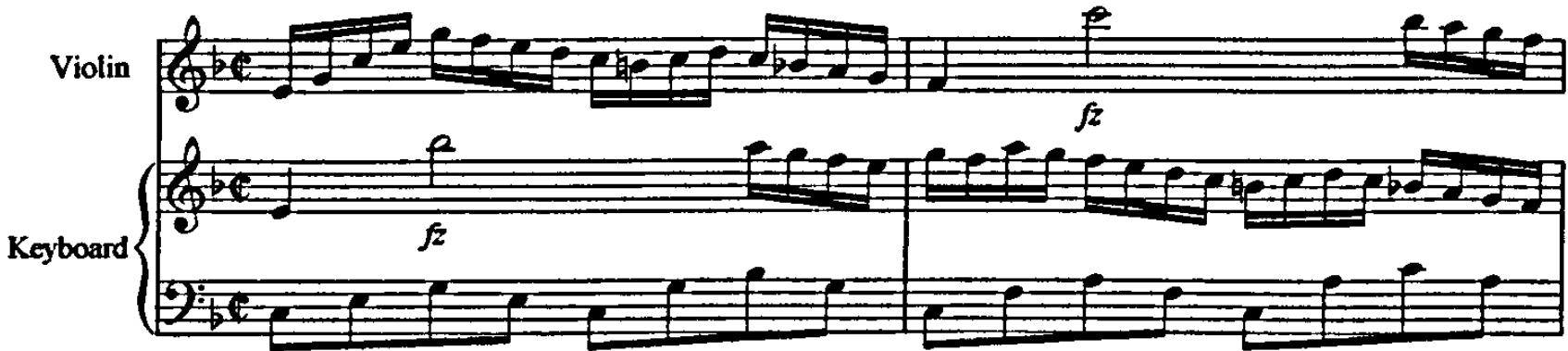
中文讲解
这是位于第42页的乐谱图片占位符,对应Example 5.35的谱面内容(Mozart K547第一乐章第9-10小节)。由于内嵌图像数据已省略,具体音符、力度重音记号与演奏提示不可见,需查看原书第42页的乐谱图方可核实。该谱例在本节中的功能是为P0184所引Leopold"最高音重音"原则提供作品实例:Mozart在该段落原谱上亲笔标注的重音记号,是这一演奏传统的直接证据。
补充说明
需查看原图以核实重音记号的具体位置。
脚注 / 边栏 / 图表 / 附加信息(如有)
附加材料:(1) 引文与出处——本节四条主要引文分别为L. Mozart 1756: 218(半音化与不协和原则)、Koch 1787: 38(终止式首音落强拍)、C.P.E. Bach 1753: 87-8(倚音演奏规则)、L. Mozart 1756: 221(长音与高音重音原则)。(2) 谱例——Example 5.28位于本节上方,演示不协和音的解决;Example 5.35(K547第一乐章第9-10小节)位于本节下方,为最高音重音原则提供Mozart原谱实例。(3) 本节无独立标题,由原文描述性拆分而来;亦无其他边栏、脚注或页眉信息。
💡 本节核心要点
- Leopold Mozart提出多重重音判据:半音化(升/还原/降)、和声不协和、节奏长音、旋律最高音。
- 升号或还原号升高的音应演奏得稍强然后渐弱;降号或还原号降低的音应以forte强调。
- Koch补充:终止式第一音(常为属七和弦)应落在小节强拍,从而让不协和音与节拍重音重合。
- C.P.E. Bach将所有不协和音追溯为倚音,要求倚音比解决音响,解决则以"轻的音色"平滑过渡。
- Leopold的长音与高音重音原则带有风格限定:长短音混合时强调长音;仅在"活泼"段落中强调最高音以营造欢快氛围。
- Mozart K547第一乐章(Example 5.35)作为最高音重音原则的实例,需查看原谱以确认具体重音记号位置。
🔑 关键术语
- chromaticism:半音化;旋律中出现半音变化(升、降、还原)的处理。在本节中,半音化的音被Leopold视为应被力度重音的旋律信号。
- dissonance:不协和音;和声上产生张力的音。在本节中,不协和音应在强拍被重音并随后以"轻柔"方式解决至协和音。
- appoggiatura:倚音;通过不协和到协和的解决形成装饰或强调效果的音。C.P.E. Bach在本节中将所有不协和音归为倚音一类,并由此导出倚音演奏规则。
- dominant seventh:属七和弦;本节中Koch以它作为终止式首音的典型例子,说明不协和音应当落在小节强拍。
- forte:强奏记号;Leopold用以标记被降号或还原号"突然降低"的音。
- accent:重音;本节讨论的是由音高变化、和声张力、音长、最高音等上下文触发的力度重音(dynamic accent),而非谱面显式标出的重音记号。
CH5-S16 [描述性拆分] Rests, Strokes and Harmonic Rhythm as Accentual Clues in K481 and K526
第1段(P0187)
原文复述
The effect of these compositional features on accentual patterns can be seen clearly in K481 and K526. In the whole of the third movement of K481, no accents are notated by symbols such as sf or fp. The theme itself is rhythmically unadventurous, and could easily become four-square and monotonous in performance. However, Mozart’s slurs and use of rests give clues as to the division of this theme into its constituent musical motives, or musical ‘words’, and they therefore also suggest accentuation. Cockin states that ‘pauses’ (or rests):
中文讲解
本段是本小节的总论:作者指出,前文讨论的作曲要素(休止、连弓、和声节奏等)对重音格局的影响,可以在 K481 与 K526 中清楚看到。在 K481 第三乐章全章之内,莫扎特并未用 sf 或 fp 等符号直接标出重音;主题本身的节奏也相当保守,若处理不当极易变得方整而单调。然而莫扎特使用的连弓(slurs)和休止(rests)为演奏者划分主题的动机——即所谓的音乐"词”——提供了线索,从而也暗示了重音的所在。Cockin 关于"休止"的论述将在下一段直接引用,本段只起引介作用。
补充说明
本段为论题开启段,确立本小节的两件讨论对象(K481 第三乐章、K526 第一乐章),以及三个核心作曲要素:休止、弓法/连弓、stroke(分弓记号),并预告将与和声节奏一起作为推断重音的辅助线索。
第2段(P0188)
原文复述
have a very graceful effect in the modulation, on the same account they are so essential to music – In both cases, like blank spaces in pictures, they set off and render more conspicuous whatsoever they disjoin or terminate. (Cockin, 1775: 99)
中文讲解
本段是 P0187 所引 Cockin 原文的延续。核心主张是:休止在音乐中具有"画中留白"的功能——它通过断开或终止某个乐思,使前后内容更为突出,因而对音乐而言是本质性的。这个比喻为本节把休止视为划分动机与暗示重音的依据提供了 18 世纪的理论支持。
补充说明
Cockin 这段引文来自 1775 年文献第 99 页,作者以"休止 = 留白"的视觉类比,把动机分割与表达强调联系在一起,是下文把休止解读为重音触发器的理据。
第3段(P0189)
原文复述
We can thus determine that bars 1 and 2 of the theme (see example 5.36) contain at least two motives, or ‘words’, which are separated by rests, and each word, according the advice given by eighteenth-century rhetorical treatises, requires a point of accentuation. The slur at the start of each bar implies an accent, and the 2/4 metre suggests another impulse in the middle of the bar. The strokes in bar 1 (which are consistently marked at analogous moments in the first edition, though not in the autograph [Eisen, 2006: 108]) could suggest a further subdivision of the second beat into two accents. Leopold writes that:
中文讲解
本段开始进入 K481 第三乐章主题第 1-2 小节的具体分析。作者综合三类线索:①休止将每小节切分为至少两个动机/“词”,而 18 世纪修辞学传统认为每个"词"都需要一个重音点;②每小节开头的连弓提示重音;③2/4 拍号自然让人倾向于在每小节中央加上一个推动;④第一小节的 stroke(分弓记号)可能将第二拍再细分为两个重音。作者特别提示:这些 stroke 在初版中持续出现于类似位置,但手稿中没有(引 Eisen, 2006: 108),因此并非孤例。末句"Leopold writes that:“是 P0190 引文的过渡。
补充说明
“strokes"指乐谱中音符上方或下方的短竖线(分弓记号 / 分音符记号),与"slurs”(连弓弧线)相对;它既可提示重音,也可提示弓法,二者在本段尚不确定,作者借此引出 Leopold 的定义。
第4段(P0190)
原文复述
A composer often writes notes which he wishes to be played each with a strongly accented stroke and separated one from another. In such cases he signifies the kind of bowing by means of little strokes which he writes over or under the notes. (L. Mozart, 1756: 47)
中文讲解
本段是 P0189 所预告的 Leopold Mozart 引文。Leopold 明确:作曲家在希望某些音被"用强重音的弓法各自奏出、彼此分开"时,会以小竖线(little strokes)标注于音符上下。Leopold 的定义把"stroke"与弓法和重音直接挂钩,为 P0189 中对 K481 第 1 小节 stroke 的两种解读提供了权威来源。
补充说明
Leopold Mozart 《小提琴演奏教程》(1756)第 47 页是该时期被引用最多的弓法/演奏论述来源之一;作者用它来支持 stroke = 强调+分离 的诠释。
第5段(P0191)
原文复述
Following Leopold’s interpretation, the strokes on each of these quavers would give them the effect of two monosyllabic words, both of which require an accent; conversely, they could simply be a preventative marking (such as those discussed in chapter 4), warning the performer not to slur the second half of the bar:
中文讲解
本段就 Leopold 定义给出对 K481 第 1 小节 stroke 的两种相反解读。第一种(与 Leopold 直接对应):每根 stroke 让该八分音符相当于一个"单音节词”,需要各自重音;第二种:本章第 4 章曾讨论过 stroke 可能仅是"预防性标记”,其作用是警告演奏者不要把第二拍后半连起来奏。两种解读对演奏法的影响相反,作者先呈现两可,再以冒号引出实例(Example 5.36)作为判断依据。
补充说明
注意"preventative marking"在本章第 4 节已专门讨论,本段以括注方式回指,表明这是承前结论而非新论点;冒号引出 Example 5.36 是后续图示。
第6段(P0192)
原文复述
Example 5.36: Outlining the musical ‘words’ in K481, movement 3, bars 1-2. $^{57}$
中文讲解
本段是图示编号与简短说明:Example 5.36 展示 K481 第三乐章第 1-2 小节中音乐"词"的划分方式。脚注序号 57 将指引向关于图中标记符号约定的注释(P0197)。
补充说明
“Outlining the musical ‘words’“说明本例的功能是把前文讨论的休止划分动机理论可视化。
第7段(P0193)
原文复述
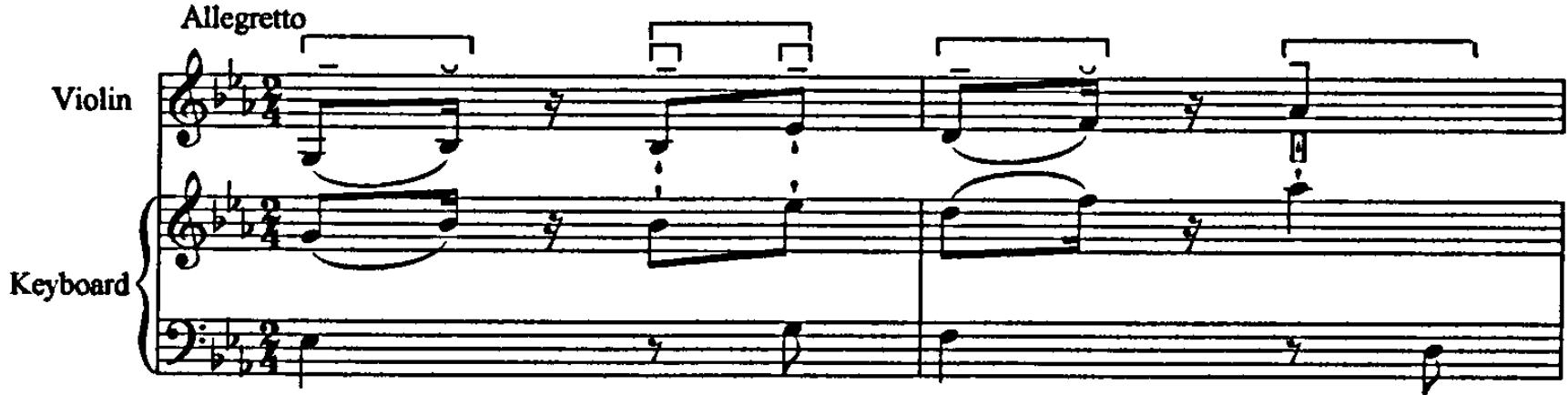
中文讲解
本段是 Example 5.36 的图示占位符(位于第 44 页)。由于无法直接查看原图,需结合 P0192 图注及 P0197 脚注(标记符号约定)来理解:方括号标示"词”,短横线标示词内重音,半圆标示较弱音。
补充说明
无额外补充;本图为版面对应位置,其内容须查原图。
第8段(P0194)
原文复述
In bars 3 and 4, slurs (which do not appear in the keyboard part of the first edition [Eisen, 2006: 108], though they should be added by analogy with the violin part) dictate that accentuation should be less frequent, with a stress only at the start of each bar. Bar 5 follows the same accentual pattern as bar 1:
中文讲解
本段继续 K481 第三乐章主题分析。第 3-4 小节中,连弓暗示重音频率较低——只在每小节开头出现一次。作者提示一个版本事实:第一版键盘部分没有这些连弓,但应根据小提琴部分以类比方式补上(引 Eisen, 2006: 108)。这一处理把演奏推断与文献校勘结合起来。第 5 小节重又回到第 1 小节的重音模式,冒号引出 Example 5.37 做对照。
补充说明
“first edition"指 18 世纪初版的印刷总谱/分谱(与"autograph"手稿相对);本段对版本差异的处理,提示"键盘声部缺失的连弓"应通过类比小提琴声部补足。
第9段(P0195)
原文复述
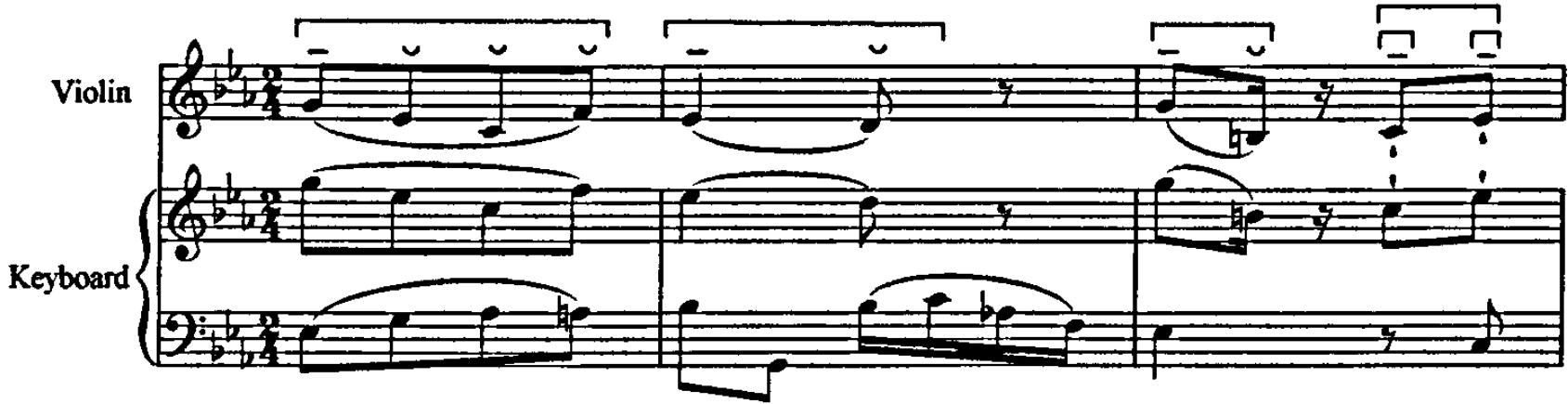
中文讲解
本段为 Example 5.37 的图示占位符(第 44 页),展示 K481 第三乐章第 3-5 小节。功能是可视化 P0194 的论述:第 3-4 小节重音稀疏(每小节仅开头一次),第 5 小节又回到第 1 小节模式。
补充说明
无额外补充;图示本身须查原图。
第10段(P0196)
原文复述
Bars 6 to 8 form a longer phrase (see example 5.38). Although a rest in the violin part of bar 6 creates a separation between beats one and two, a descending scale initiated by a dotted crotchet (instead of a crotchet followed by a quaver rest, as in bar 1) in the left-hand keyboard part suggests that the bar is conceived as one motive rather than two. Indeed, the beginning of this bar instigates the closing cadence of this phrase, with a chord V on F which resolves to B b major in bar 8. An accent at the start of bar 6 could therefore serve as the point of initiation from which the cadence of bars 6 to 8 springs. However, since the harmonic rhythm doubles in bar 7, accents on beats one (provided more by the left hand than by the violin or right-hand parts) and two generate increased emphasis towards the cadence.
中文讲解
本段分析第 6-8 小节构成的较长乐句。这里出现了与第 1 小节看似类似却实质不同的格局:①尽管小提琴声部第 6 小节中的休止仍把第一拍与第二拍分开,键盘左手从附点四分音符开始的"下行的音阶"取代了"四分音符 + 八分休止"的切分,使整小节被构思为一个动机而非两个;②该小节起始即以 F 上的 V 级和弦触发属到主(F→B♭)的终止,因此第 6 小节起始的重音可被视为整个第 6-8 小节终止的"出发点”;③然而第 7 小节和声节奏倍增(每拍一换),使第一拍(更多由左手承担而非小提琴或右手)与第二拍都需要重音,从而推动终止处的力度积累。该段论证的关键是:同一节奏外观可承载不同动机划分,重音决定依赖于纵向和声与声部关系的综合判断。
补充说明
“harmonic rhythm"指和弦变换的频率;本段是和声节奏作为重音线索的典型用例,第 7 小节和声变化频率翻倍,重音也相应翻倍。
第11段(P0197)
原文复述
$^{57}$ Throughout the following examples, the musical ‘words’ which constitute each phrase are marked above the stave with square brackets. Accents within these words are notated with dashes, and weaker notes are marked with semicircles.
中文讲解
本段是 P0192 图注末尾 $^{57}$ 所对应的脚注:交代本小节后续所有谱例中标记音乐"词"与重音的符号体系——方括号标"词”,短横线标词内重音,半圆标弱音。这是阅读 Example 5.36 至 5.43 的符号图例。
补充说明
本脚注提供对后续所有图示都适用的标记约定,并非仅限于某例。
第12段(P0198)
原文复述
Example 5.38: K481, movement 3, bars 6-8. The two sets of square brackets above the violin part illustrate the two interpretations of these bars, either as one long ‘word’ from bar 6 to 8, or as being divided into shorter ‘words’.
中文讲解
本段是 Example 5.38 的图注。作者特意说明:图中小提琴声部上方的两组方括号代表对第 6-8 小节两种相反的"词"划分解读——一是把它们视作一个跨 3 小节的长"词”,二是将之切分为更短的"词”。这种双重标记与 P0196 的论证直接呼应:休止表面看似切分,但和声/旋律走向要求按长动机理解。
补充说明
图注本身已把"二义性"显式标出,提示读者这正是 P0196 文字论证的可视化对照。
第13段(P0199)
原文复述
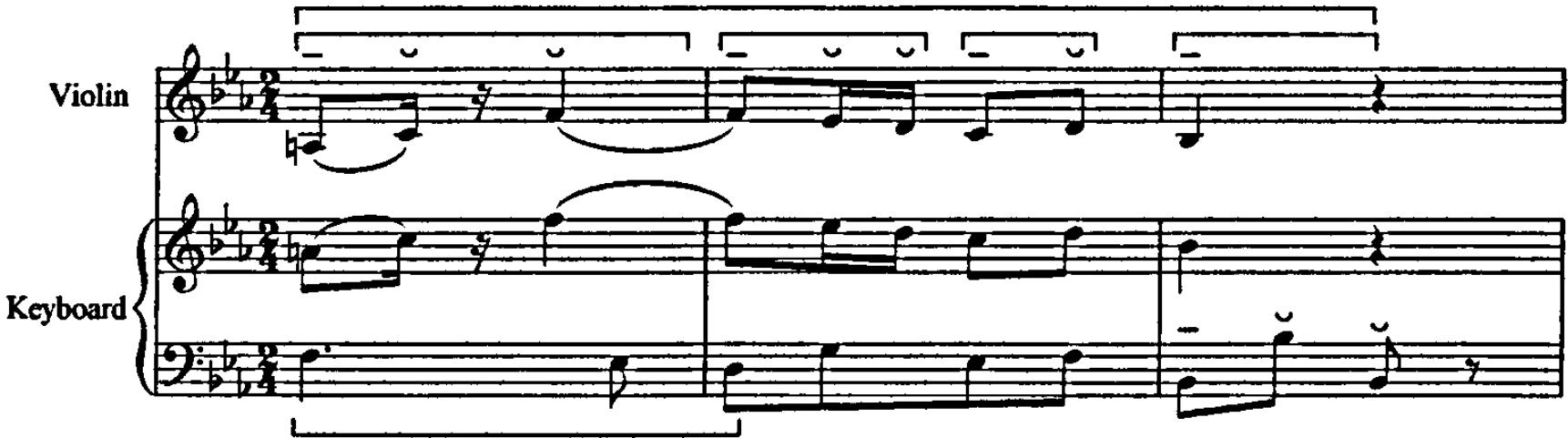
中文讲解
本段为图内说明文字(嵌入图像中的标注),位于第 45 页。其作用是直接指示:第 6 小节的下行音阶使该小节并不因十六分音符休止而被切分为两个"词”。它把 P0196 的文字结论以图内标记方式再次固定。
补充说明
该说明虽然格式上是图像标注,但在论证中承担与正文相同的论断功能,应与 P0196 一并阅读。
第14段(P0200)
原文复述
Thus, even though Mozart does not prescribe any specific accent marks (except, perhaps, through the use of strokes), slurs, rests and harmonic rhythm give the performer the information they need in order to recognise the varied accentuation of this theme. These same compositional features are subsequently used to vary the theme throughout the rest of the movement and as such they further serve to convey new accents which the violinist should emphasise through their use of the bow. Variation 1 is a case in point; here, the combination of new slurs and added dissonance in the violin part completely changes the pace and Affekt of accentuation. In bars 21 and 22 (see example 5.39), the second beat accents of the original theme are denied: in bar 21 a dotted crotchet in the violin theme is slurred over the middle of the bar thus removing any second-beat emphasis, and the melodic shape of the keyboard’s right-hand accompaniment of bars 21 and 22, with high notes in the middle of each bar, suggests lightness. The syncopated rhythm of the left hand in bar 22 also removes the second-beat accent which was heard in bar 2. The division of bar 23 into three ‘words’ is implied by the faster moving bass line and the appoggiaturas in the second half of the bar. Ties over the bar line in the violin part (as in bars 21 to 22, 22 to 23 and 26 to 27) create musical ‘words’ which are elided, thus conveying a more ‘cantabile’ and continuous character than in the original theme. Within this longer-breathed phrase, accentuation implied by metre, dissonance and harmonic rhythm gives each motive a point of focus. The cadence of this variation is also treated more expansively than in the original theme, with a slower harmonic rhythm in bar 27 as compared with bar 7 (see example 5.38 above).
中文讲解
本段是 K481 第三乐章主题分析的总结段,并向变奏 1 过渡。核心论点包括:①即便没有显式重音标记,连弓/休止/和声节奏也足以让演奏者识别主题中的多种重音;②这些要素在变奏中被重新组合以传达新重音,并通过弓法在小提琴上体现。变奏 1 的具体处理:——第 21-22 小节中第二拍重音被"剥夺”(21 小节小提琴主题的附点四分音符被跨小节中段的连弓盖住;22 小节左手的切分节奏也消除了第二拍重音);——22 小节键盘右手伴奏的旋律轮廓把高音置于小节中段,提示轻盈;——第 23 小节由于低音更快及后半的倚音,被分为三个"词”;——跨小节延音连线(21→22、22→23、26→27)使"词"被 elided(叠连),形成比主题更"cantabile”(如歌)连续的性格;——变奏的终止比主题更扩张,第 27 小节和声节奏慢于第 7 小节。这一段集中示范了"同一主题经过不同作曲处理如何产生完全不同的重音格局与情感(Affekt)"。
补充说明
“elided"指两"词"在边界上彼此叠合、无法截然断开;作者借此强调变奏 1 较主题更为连贯的气息。
第15段(P0201)
原文复述
![Example 5.39: K481, movement 3, variation 1 (bars 21-28). $^{58}$;In Variation 5, Mozart’s beaming raises questions for accentuation (see example 5.40). Bar 137 (which shares the same material as bars 5 and 17 of the theme) remains firmly divided into two ‘words’ in the violin part, and yet the beaming and slurring (this slur only appears in the autograph version [Eisen, 2006: 41) of four quavers together in the bass line could imply that there is an accent only at the start of the bar. The cadence in bars 138 to 140 is similar to that in bars 6 to 8 (discussed above, see example 5.38) and bars 18 to 20; as we have seen, in the original theme this bar could either be interpreted as part of one long phrase (with an accent at the start of bar 6), or with two accents in bar 7. At bar 139, the need for two accents is made explicit, with bass notes beamed in pairs. Furthermore, these pairs are both descending figures, and the high notes on each main beat of the bar emphasises the duple pulse.
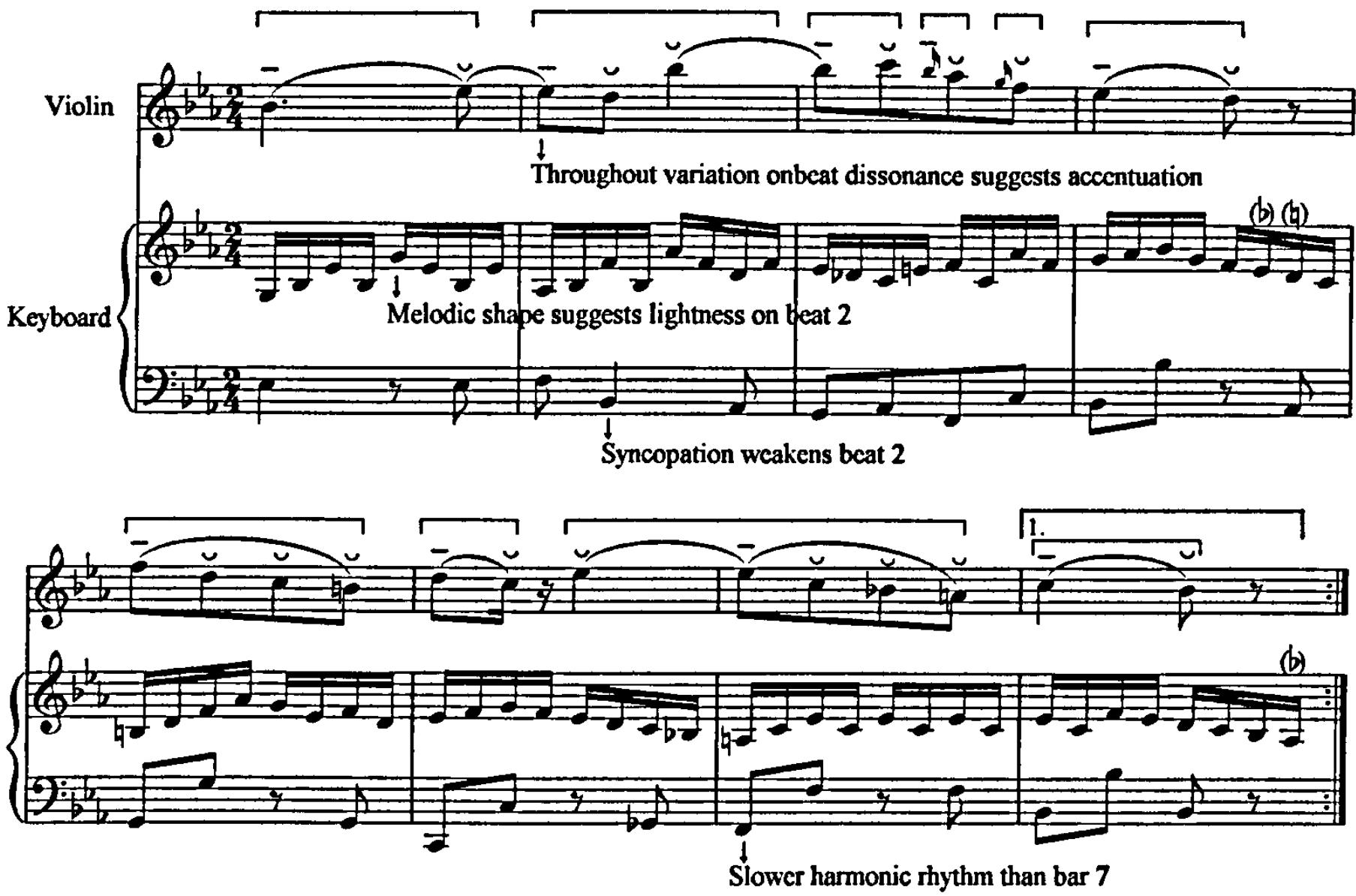
中文讲解
本段同时承担两个功能:图示占位(Example 5.39,K481 第三乐章变奏 1 第 21-28 小节,含脚注 58 引子)与变奏 5 的分析。变奏 5 中弓法/连弓/符尾连写(beaming)对重音产生了二义性:①第 137 小节(与主题第 5、17 小节同材料)的小提琴声部仍被划为两个"词”,但低音四个八分音符被连尾成组且带连弓(该连弓只见于手稿,引 Eisen, 2006: 41),可能暗示该小节只在开头出现一个重音;②第 138-140 小节的终止与第 6-8、18-20 小节同构,作者回顾对主题的二义性(既可作一长句,也可作 7 小节双重重音);③到了第 139 小节,二重重音被显式化为"低音按对连写”;④这些对组均为下行的形态,主拍上的高音进一步突出 duple(二拍)脉动。
补充说明
“beaming"指把若干短音符用一条粗横杠在符尾处连起来,是 18 世纪乐谱中提示拍组与潜在重音的视觉信号;作者在本段把它与连弓并列作为重音线索。
第16段(P0202)
原文复述
$^{58}$ The first edition violin part has no slur in bar 27.
中文讲解
本段是 P0201 图示占位末尾 $^{58}$ 所对应的脚注:仅一句版本说明——初版小提琴声部在第 27 小节没有连弓。作用是提示演奏者在参照时需注意到这一谱面差异,并理解为何 P0200 的论证(小提琴跨小节延音连线 26→27)只能依靠手稿或其他来源。
补充说明
此脚注再次表明本章对版本差异的处理方式一致:手稿与初版不一致时显式标注。
第17段(P0203)
原文复述
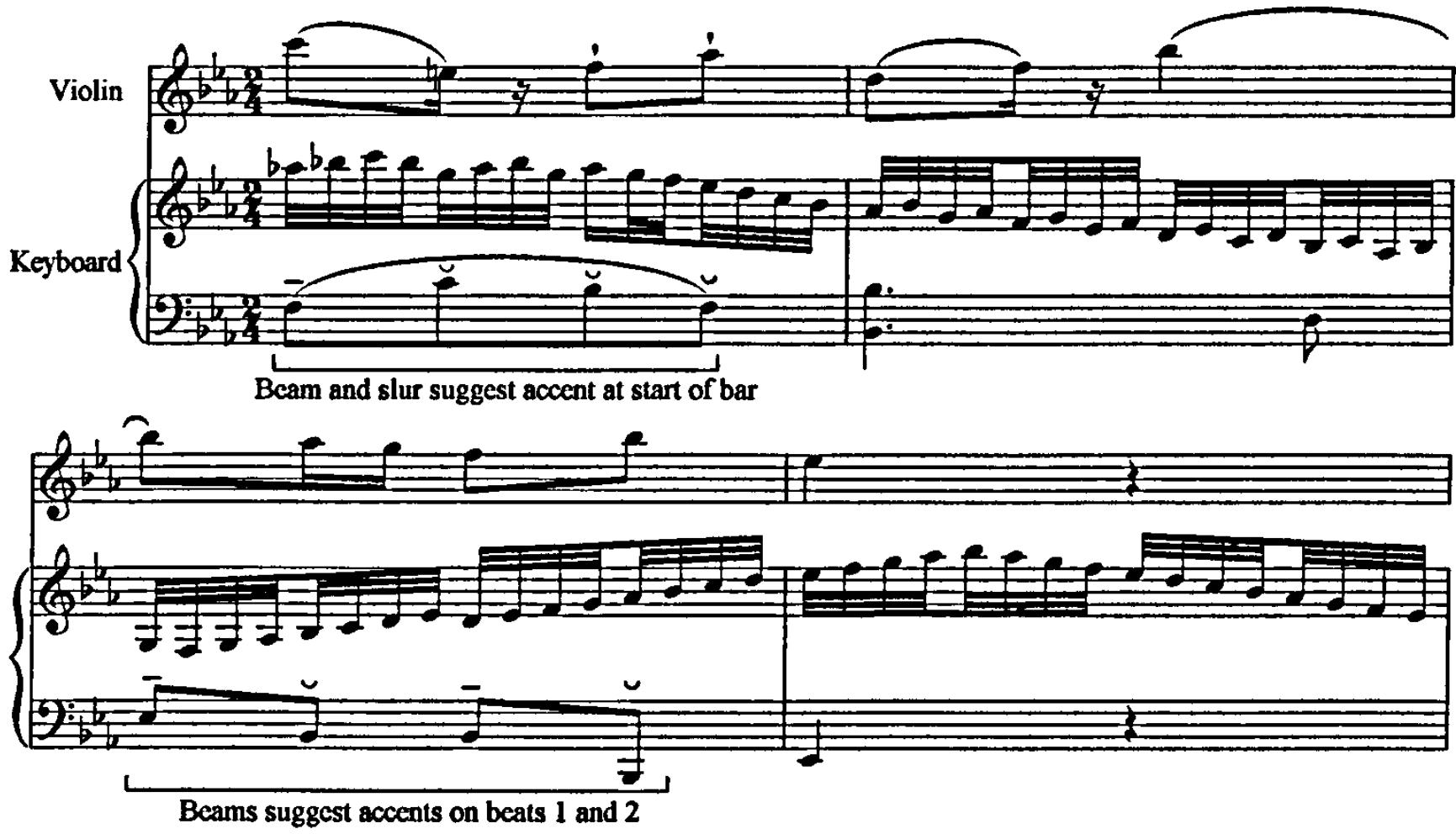
中文讲解
本段开始转向 K526 第一乐章的分析,并与 K481 形成对比。核心点包括:①K526 第一乐章主题同样没有任何显式重音记号,主题中的 stroke 不太可能是"重音"标记,而更可能是"抬起的上拍"和"轻收尾”(指 Example 5.41);②主题主要由均匀的八分音符构成,节奏变化靠连弓带来的重音暗示;③与 K481 的"重音落在符合小节层级"不同,K526 由连弓暗示的重音让人想起 K454 第一与第三乐章中莫扎特标出的切分重音(Examples 5.26, 5.27);④主题开篇动机:上拍的八分音符接四个连弓的八分音符,低音为 V⁷–I 进行,连弓加不协和使第一拍获得重音并向中段做渐弱;⑤莫扎特随即打破这一规则动机的重复,代之以成对连弓制造 hemiola(3 拍对 2 拍的交叉)效果;⑥到第 3-4 小节规则的逐拍重音回归。冒号结尾引出下一段图示。
补充说明
“hemiola"指 3 对 2 的节奏交叉;作者把它作为 K526 第一乐章主题第 2 小节节奏变化的关键术语。“stroke"在 K526 中被重新解读为"抬起上拍/轻收尾”,与 K481 中 stroke 可解读为"重音"形成对照。
第18段(P0204)
原文复述
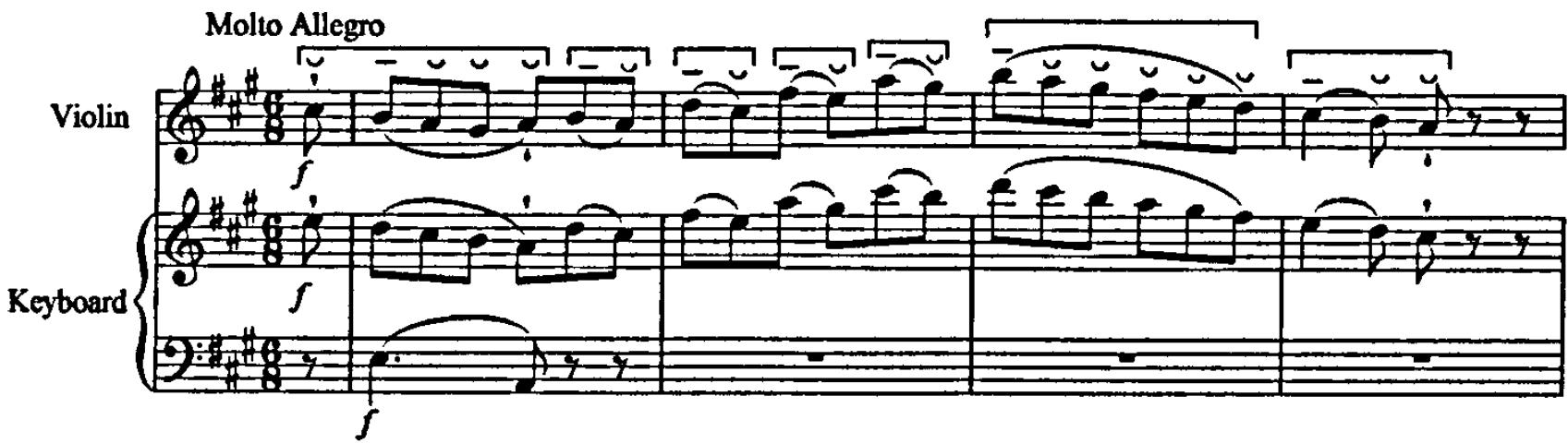
中文讲解
本段是位于第 48 页的图示占位符,所对应内容应与 P0203 末尾冒号后的论述相联——呈现 K526 第一乐章第 1-4 小节中规则重音回归的部分。
补充说明
无额外补充;图示须查原图。
第19段(P0205)
原文复述
In some instances during this movement, a consideration of slurring alone can give a misguided impression of accentuation. In bar 206 the violin slurring might suggest accents at the start of each bar (see example 5.42). However, the keyboard’s harmonic rhythm, changing every half bar, suggests two accents per bar in bars 206 to 208; this raises the question, should the violin bring out an accent in the middle of each slur, or create another layer of accentuation above the keyboard line? Leopold writes that slurred passagework should be played in such a way that the each beat is ‘marked by a strong emphasis of the bow’ (L. Mozart, 1756: 117). Furthermore, from the middle of 206 to 208, the first quaver of each dotted crotchet can be played on the D string, with the other two quavers of each group on the G string. The contrast in timbre between the two strings creates a subtle accent at the start of each group of three quavers. Interestingly, in bar 209, where the harmony is static for the whole bar, Mozart inverts the violin’s accompaniment figure, perhaps suggesting a smoother delivery during this bar with an accent at the start of the bar only. This inversion of the violin accompaniment is also maintained for the B $^{7}$ harmony throughout bar 210; the rising chromatic left-hand part creates a minor-major progression, and calls for a continuation of legato articulation. In the autograph version of this sonata, two groups of three slurred quavers create two accents in the violin part at bar 211 (Eisen, 2006: 111), thus clarifying the return of the doubled harmonic rhythm:
中文讲解
本段以 K526 第 206 小节起为案例,论证"仅看连弓可能误判重音”。具体步骤:①206 小节的小提琴连弓似乎暗示每小节仅头拍一个重音;②但键盘和声节奏每半小节一换,使第 206-208 小节内"每小节两重重音"成为可能,作者遂提出问题——小提琴应在连弓中段凸显重音,还是应在键盘线条之上再造一层重音?③援引 Leopold(1756: 117)“连弓经过句也应每拍以强弓强调"以支持重读中拍;④提出具体弓法/弦法建议:第 206-208 小节中段起,每组三连音的第一个八分音符可用 D 弦,其余两个用 G 弦,弦色对比形成微妙重音;⑤209 小节和声整小节静止,莫扎特把小提琴伴奏形倒置,可能提示该小节仅头拍一重、音色更平滑;⑥此倒置在 210 小节 B⁷ 和声中也保持,左手的半音上行构成小调-大调进行,需要继续 legato(连奏);⑦手稿中第 211 小节的两组三连音连弓明确制造了两个重音(引 Eisen, 2006: 111),由此和声节奏倍增的回归得以澄清。冒号引出下一段图示。
补充说明
“minor-major progression"指从小调到大调的色彩转换(如小下属接大主和弦);“D string vs G string"的音色差是演奏建议而非谱面事实,作者借此把谱面分析与可行演奏策略结合。
第20段(P0206)
原文复述
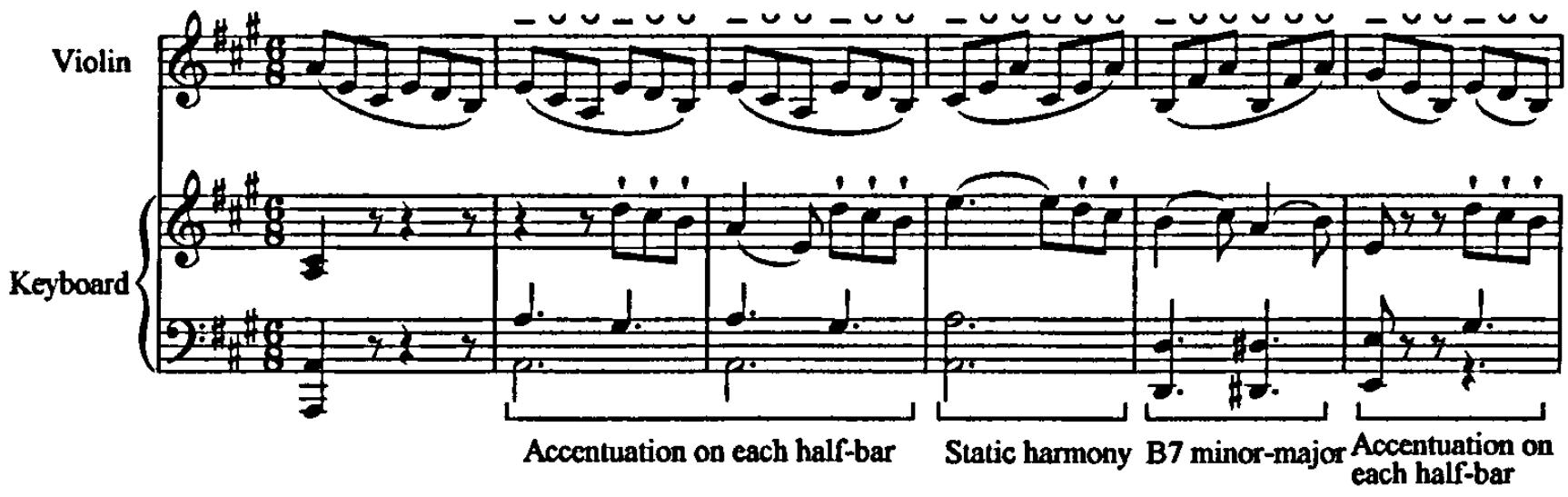
中文讲解
本段是位于第 49 页的图示占位符,对应 P0205 末尾冒号所引的谱例(与第 211 小节手稿中两组三连音连弓两个重音相关)。
补充说明
无额外补充;图示须查原图。
第21段(P0207)
原文复述
Harmonic rhythm similarly serves as an indicator of accentuation at other points during this movement. For example, violinists might be tempted to give metrical accents at the start and middle of bars 180 and 183 (see example 5.43), but the static harmonic rhythm implies that there should just be one accent at the start of the bar:
中文讲解
本段以 K526 第 180 与 183 小节为例,说明和声节奏如何反向"抑制"节拍暗示的重音:演奏者可能想当然地按小节头与中央给出两个节拍重音,但两小节和声节奏静止,因此推断只应在每小节开头保留一个重音。该例与 P0205 案例互补——同一手法既可指示"应多加一个重音”,也可指示"应减去一个重音”,关键在于和声节奏。冒号引出 Example 5.43。
补充说明
无额外补充;本段与 P0205 构成"和声节奏如何上下调节重音密度"的对照。
第22段(P0208)
原文复述
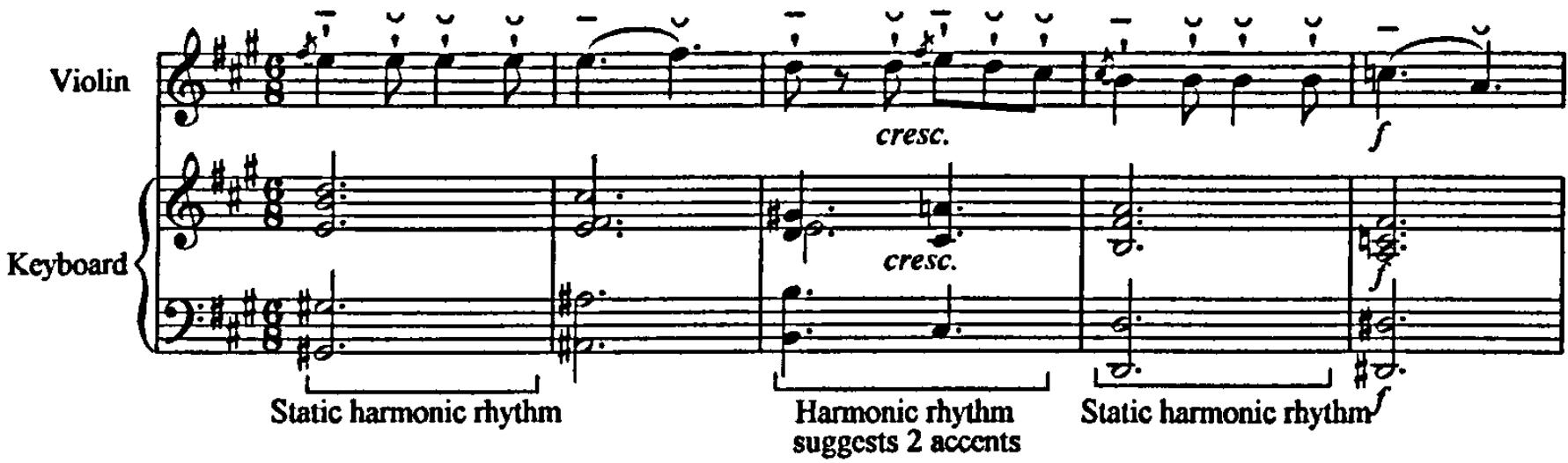
中文讲解
本段是 Example 5.43 的图示占位符(第 49 页),对应 K526 第一乐章第 180-184 小节,用以说明 P0207 的论点——和声静止下不应给予中拍重音。
补充说明
无额外补充;图示须查原图。
第23段(P0209)
原文复述
The foregoing examples from Mozart’s Sonatas for Violin and Keyboard demonstrate the numerous compositional features which can dictate the placement of accents; these accents are sometimes marked by the composer with notated symbols or dynamics, but are more often left to the judgement of the performer, whose choices can be a response to other compositional information such as metre, harmonic rhythm, dissonance and chromaticism, melodic and rhythmic shape, slurs and beaming. We have seen that ’logical’ accents (as suggested, for example, by harmonic tension and slurs) suggest accentuation regularly coincide with the ‘grammatical’ accents of metre, and that when they contradict the expected hierarchies of metre, they are often clarified by Mozart’s notation.
中文讲解
本段是全节总结。核心结论:①决定重音位置的作曲要素种类繁多(拍号、和声节奏、不协和与半音化、旋律与节奏轮廓、连弓、符尾连写),它们有时被作曲家以符号/力度直接标出,更多时候则交由演奏者根据上述要素综合判断;②"逻辑性"重音(如由和声紧张与连弓暗示的)与"语法性"重音(由拍号层级规定的)常常重合;③当两者冲突时,莫扎特往往会通过显式记号把答案澄清。本段以"逻辑"vs"语法"的二分术语,把整章的具体案例收束为一个可推广的分析框架。
补充说明
“logical"与"grammatical"是本节对两种重音来源的理论命名:前者源于音乐内部紧张与走向(harmonic tension、连弓等),后者源于节拍规约(metre)。这一术语为本节及前后文提供分析坐标。
脚注 / 边栏 / 图表 / 附加信息(如有)
本小节除正文外,包含若干谱例与两条脚注:——Example 5.36 (P0192-P0193):K481 第三乐章第 1-2 小节,音乐"词"的划分;脚注 57(P0197)解释标记约定(方括号=词,短横=词内重音,半圆=弱音),适用于本节所有谱例。 ——Example 5.37 (P0195):K481 第三乐章第 3-5 小节,展示稀疏重音与回返。 ——Example 5.38 (P0198-P0199):K481 第三乐章第 6-8 小节,下行音阶使该小节不被十六分休止切分;含二义性方括号标记。 ——Example 5.39 (P0201) + 脚注 58 (P0202):变奏 1 第 21-28 小节;脚注 58 指明初版第 27 小节无连弓。 ——Example 5.40 (P0201 内文字引):变奏 5 第 137-140 小节,beaming 与连弓的二义性。 ——Example 5.41 (P0203):K526 第一乐章开篇主题,stroke 非重音而是抬起上拍/轻收尾。 ——Example 5.42 (P0205):K526 第 206-211 小节,演示连弓暗示重音 vs 和声节奏要求重音之张力。 ——Example 5.43 (P0208):K526 第 180-184 小节,和声静止应抑制中拍重音。 所有图示因嵌入图像省略,须查原页图。
💡 本节核心要点
- 莫扎特在 K481 第三乐章主题与 K526 第一乐章中均未用 sf/fp 等符号直接标注重音,因此演奏者必须从作曲要素中推断重音。
- 休止(rests)与连弓(slurs)是切分动机/“词"与暗示重音的主要表层线索,每一"词"按 18 世纪修辞学传统需要一个重音点。
- stroke(小竖线)有二义性:依 Leopold 既可解读为"强重音+分离”,亦可能仅是"防止连弓"的预防性标记;不同作品语境中需分别判定(K481 第三乐章与 K526 第一乐章的 stroke 含义不同)。
- 和声节奏(harmonic rhythm)独立决定重音密度:其加快可在原重音基础上叠加新重音,其静止可抑制由节拍暗示的重音;因此"逻辑性重音"与"语法性重音"可能一致也可能冲突。
- 变奏中通过重新分配连弓、引入不协和与跨小节延音连线(elision)改变 Affekt:变奏 1 的连弓/延音使词与词叠合,造就更 cantabile 的性格;终止扩张(如变奏 1 第 27 小节)和声节奏减慢。
- 版本差异(手稿 vs 初版中的连弓/beaming)影响重音推断,作者在每一相关小节均显式注明以利演奏判断。
🔑 关键术语
- musical ‘words’:把动机类比为语言中的"词”,每个"词"在 18 世纪修辞学传统中要求一个重音点;休止与连弓负责切分"词"的边界。
- stroke:乐谱中标注于音符上下的短竖线(分弓/分音符记号)。在本节中既可被 Leopold 解读为强重音+分离(K481 第三乐章主题),也可被解读为抬起上拍/轻收尾(K526 第一乐章主题)或仅是预防性标记。
- harmonic rhythm:和声变换的频率。在本节作为独立于节拍的重音线索:加快则叠加重音,静止则抑制中拍重音。
- logical accent:由音乐内部要素(和声紧张、连弓、不协和等)暗示的重音;与"grammatical accent"相对。
- grammatical accent:由节拍/拍号层级暗示的强拍重音;与"logical accent"相对。本节证明两者常重合,冲突时由莫扎特记号澄清。
- hemiola:3 拍对 2 拍的节奏交叉;K526 第一乐章主题中莫扎特通过成对连弓立刻打破规则动机的均匀重音,制造 hemiola。
- elided ‘words’:相邻"词"在边界处彼此叠合、不被切分;变奏 1 的跨小节延音连线(21→22、22→23、26→27)使词 elided,形成更 cantabile 的气息。
- Affekt:18 世纪美学中"情感/情态"范畴;本节指变奏 1 中"新连弓+不协和"完全改变了重音的节奏与情感。
- cantabile:如歌的、连贯的;本节中用以描述变奏 1 通过 elision 获得的比主题更连贯的性格。
CH5-S17 [描述性拆分] From Grammatical Accent to Pathetic Accent: Toward Rhythmic Expressivity
第1段(P0210)
原文复述
It is thus the performer’s role to recognise the musical ‘words’ which constitute each phrase, and to give each word its just accentuation. Mattheson writes that the aim of accentuation is ’the pronunciation’ (Mattheson, 1739: 370); accentuation is therefore central to the communication of the compositional language to the listener. Indeed, writing over 250 years later than Mattheson, Drake and Parncutt postulate that ‘performances tend to be easier to understand, remember and reproduce when performed accents correspond with immanent [structural and notated] accents’ (Drake and Parncutt, 2001: 537-8).
中文讲解
本段确立演奏者在重音问题上的核心职责:识别构成乐句的“音乐词汇”,并给予每个词恰当的重音。Mattheson 的术语“pronunciation”(发音/读字)将重音类比为语言的清晰吐字,暗示音乐乐句有如语言的语法单位,重音的功能是让作曲家的“语言”传达给听者。随后以 Drake 与 Parncutt 2001 年的观点为现代佐证:当演奏者施加的重音与乐谱中固有的结构性重音一致时,听众更容易理解、记忆与再现音乐。两个引用跨越两百五十多年却得出相近结论,作者借此强调“让重音忠实于作品内在结构”是一条从 18 世纪延续到当代的共识。它也承接本节小标题前半“从语法重音出发”的思路:重音首先是揭示音乐结构—让“词”与“句”被听清—的工具,而非单纯的情绪手段。
补充说明
Mattheson 的 “pronunciation” 一词在此并非“发音学”学科意,而是“朗读/读字”,呼应前文把音乐比作语言的隐喻;immanent accents 即“在乐谱中已被标定的、本已存在的结构性重音”,区别于演奏者临时附加的表情重音。
第2段(P0211)
原文复述
However, the purpose of musical accentuation is not limited to making the musical text clear and understandable. Accents should also contribute to the Affekt and character of a work; they should be used as a rhetorical device, with the aim of moving the listener. As we have seen, many eighteenth-century theorists describe a specific category of accents as ‘Pathetic’ accents:
中文讲解
本段用 However 转折,把重音的功能从“清晰传达文本”扩展到“情感与修辞”:重音不只是结构性的标记,也参与作品的 Affekt(情感特质)与性格塑造,其终极目标是“打动听者”(moving the listener)。这里的关键词 rhetorical device 把音乐演奏直接对应到 18 世纪盛行的“音乐即修辞”观念——音乐像演说一样通过强调来感染听众。“As we have seen” 是回溯前文已列举的 18 世纪文献,提示读者:作者此前已多次介绍过“Pathetic accents(悲情/表情重音)”这一类别,本段是再次把它推上讨论的中心,从而引出小标题后半“走向节奏的表情性”。整段的功能是搭桥:从“语法重音”迈向“表情重音”。
补充说明
Affekt 是 18 世纪德语音乐理论中的核心概念,指作品所要传达的情感类型或精神状态;“Pathetic”在此并非现代英语贬义的“可悲的”,而是源自希腊语 pathos,意为“情感、感动”,与 Affekt 同源。
第3段(P0212)
原文复述
By different variation of the voice, by a tone more or less elevated, by a method of discourse quicker, or more slow, expresses those sentiments which agitate the speaker, and communicate with the audience. (Rousseau, 1768 R.1779:4)
中文讲解
本段是一段独立引文,出自 Rousseau《音乐辞典》1768 年版(1779 年重印本)第 4 页。Rousseau 列举了三种“声音变化”的手段来传达情感:音色的变化(different variation of the voice)、音调的高低升降(a tone more or less elevated)、以及语速的快慢(a method of discourse quicker, or more slow)。这三项正是修辞学意义上的“delocutio(表达技巧)”,作用是表达那些“激动说话者的情愫”(sentiments which agitate the speaker),并与听者发生交流(communicate with the audience)。作者引用此句,是为了给“Pathetic accents”一个权威定义式的注脚:表情重音并非抽象概念,而是通过音色、音高、节奏三要素的实际变化得以落实。它与上一段的“rhetorical device”相呼应,证明 18 世纪理论家确曾系统思考过重音如何承载情感。
补充说明
本句虽未出现“accent”字样,但其描述的“语速快慢、音调升降、音色变化”正是 Rousseau 在同一条目中解释音乐重音时所列举的具体手段;作者以之作为“Pathetic accent”概念在 Rousseau 著作中的实际证据。
第4段(P0213)
原文复述
Clive Brown complains that the clarity between eighteenth-century definitions of the accents of grammar/logic and pathetic accents is often lacking:
中文讲解
本段是一个过渡段,引入现代学者 Clive Brown 对 18 世纪重音理论内部矛盾的批评。它单独成段,功能非常明确:为下一段的大段引文做铺垫。关键词 complains(抱怨)表明 Brown 不是在做中性描述,而是指出问题——18 世纪理论家虽然区分了“语法/逻辑重音”与“悲情/表情重音”,但二者之间的边界常常模糊不清。作者在此借助 Brown 的权威为后文将要提出的“重新理解两者关系”做合法化铺垫:若连专家都承认两者界限不清,那就值得换一种思考框架。
第5段(P0214)
原文复述
Some theorists seem to have regarded accentuation whose function was to define the extent and subdivision of musical phrases [that is, accentuation which is ‘grammatical’ or ’logical’]… as a distinct category, but it is not always possible to see where the dividing line between this and expressive accent occurs. (Brown, 1999: 8)
中文讲解
本段是 Clive Brown《古典与浪漫表演实践》1999 年第 8 页的引文,方括号内是引用者(即本章作者)插入的解释,把“划分乐句范围与子分句的重音”明确等同于“语法或逻辑重音”。Brown 的论点有两个层次:第一,某些 18 世纪理论家确实把这类重音视为独立的范畴;第二,然而这种重音与“表情重音”(expressive accent)之间的分界线往往难以辨别。整段揭示了一个理论史上的张力:分类标签存在,但分类边界却含糊。它同时回应了 Rousseau 那种似乎把“表情”当作自成一类的倾向——Brown 的实证提醒我们,理论与实际演奏中的界线远没有那么干净。这是作者在铺垫下一段自己的解决方案:与其争论界线,不如放弃“截然二分”的假设。
补充说明
expressive accent 即前文所称的 Pathetic accent,二者在本节中互换使用;方括号注释是引文常见的学术做法,表示插入的是引用者而非原作者的解释。
第6段(P0215)
原文复述
Instead of classifying grammatical/logical accents and pathetic accents as two ‘distinct’ categories, with the implication that they refer to accents which occur at different points in the musical discourse, it seems more useful to view these concepts of accentuation as two phases in the interpretation of each accent: having used our ‘intellect’ to identify grammatical and logical accents, we must use our ’emotions’ (Hiller, 1780: 68) to engage with their Affekt and deliver them in such a way that will move the audience. Whether accents exist to convey the pace of a metre, to characterise rhythms, or emphasise the harmonic discourse, they should all be
中文讲解
本段是作者本人的核心主张段,文本在末尾被截断。它先用一个 Instead of… 的对立句式,把 Brown 揭示的“二分不清”问题改写为方法论选择:与其把语法/逻辑重音与悲情重音当作发生在不同音乐位置的两类独立重音,不如把它们理解为解读同一个重音时的两个连续阶段。第一阶段用“理智”(intellect)识别结构与逻辑位置,第二阶段用“情感”(emotions,援引 Hiller 1780 年第 68 页)去把握其 Affekt 并交付给听者。换言之,重音从“被识别”到“被演奏”是一道连续工序,分析与表情不是互斥的范畴。最后一句以 Whether… they should all be 开启一个普遍性命题:无论重音是用来指示拍号速度、刻画节奏,还是强调和声进行的,都应当……(原文被截断,作者意图显然是“都应当经历这两阶段并服务于打动听者”)。这是整节论证的高潮:把重音的功能从“二元划分”重组为“分析—表情的连续过程”,为下文讨论具体的节奏表情手段做好理论准备。
补充说明
Hiller 一词很可能指 Johann Adam Hiller(1728–1804),莱比锡著名乐评人与作曲家;但本节文本未给出更多生平信息,按要求不补充外部细节。末句被截断是原文状况,复述时如实保留不完整状态。
脚注 / 边栏 / 图表 / 附加信息(如有)
本小节文字中出现的引文与文献归属:Mattheson 1739: 370;Rousseau 1768/R.1779: 4(页码标注表示 1768 年初版、1779 年重印本);Brown 1999: 8;Hiller 1780: 68;Drake and Parncutt 2001: 537-8。引文既涵盖 18 世纪原始理论资源(Mattheson、Rousseau、Hiller),也包含 20—21 世纪学者的回顾性研究(Brown、Drake & Parncutt),构成作者用以支持“从语法重音走向悲情重音”这一连续论证的文献骨架。P0214 中的方括号注释由本章作者插入,并非 Brown 原书文字,这是引文中常见的编辑处理。无图示、乐谱或表格。
💡 本节核心要点
- 演奏者的首要职责是识别构成乐句的“音乐词汇”,并对每个词施加恰当的重音,重音即 Mattheson 意义上的“pronunciation”。
- 重音不仅让音乐文本清晰可解,还必须服务于 Affekt 与性格塑造,作为修辞手段打动听者——这是从“语法重音”走向“表情重音”的转折点。
- Rousseau 的定义指出,声音的音色、音高、语速三方面的变化是“Pathetic accent”落实于表演的三个具体维度。
- Clive Brown 揭示 18 世纪理论家在“语法/逻辑重音”与“表情重音”之间划出的界线其实并不清晰,质疑了两类并置的可行性。
- 作者据此提出新框架:二者不是发生在不同位置的两类重音,而是解读同一重音时连续的两阶段——先用理智识别结构,再用情感注入 Affekt 并交付给听者。
- 无论是标示拍速、刻画节奏还是强调和声的重音,都应统一经过“理智—情感”这一双相过程,从而实现真正的修辞性表情演奏。
🔑 关键术语
- grammatical/logical accent:本节中指用以划分乐句范围与子分句、揭示音乐语法结构的重音,其功能相当于语言的语法与逻辑重音,让“词”和“句”清晰可辨。
- Pathetic accent:18 世纪理论家用语,指用于传达 Affekt、打动听众的表情性重音;并非贬义的“悲怆”,而是源自希腊语 pathos 的“情感、感动”。
- Affekt:18 世纪音乐修辞学与美学中的核心概念,指作品所欲传达的特定情感状态或精神特质,是 Pathetic accent 所服务的目标。
- rhetorical device:修辞手段;本节把音乐重音类比为演说中的强调,认为其终极目的是说服/感动听众。
- immanent accents:Drake 与 Parncutt 提出的概念,指乐谱中已被结构性标定的内在重音(structural and notated accents),是演奏重音应对齐的基准。
- pronunciation (Mattheson):Mattheson 用以概括重音功能的术语,意为“清晰读字”,强调重音是让音乐语言被听清的首要工具。