目录
CH4 Chapter 4: Articulation in Mozart’s Sonatas for Violin and Keyboard
- 4.1 [描述性拆分] Strokes as Lifted Bowstrokes: Bow Division and Contextual Evidence
- 页码:1-3
- 4.2 [描述性拆分] Strokes Confirming Phrase Structure and Character
- 页码:4-5
- 4.3 [描述性拆分] Strokes Modified by Tempo, Note-Length, and Character
- 页码:5-8
- 4.4 [描述性拆分] Strokes as Precautionary Markings Against Conventional Bowing
- 页码:8-10
- 4.5 [描述性拆分] Strokes Clarifying Rhythm, Metre, and Rhythmic Alteration
- 页码:10-13
- 4.6 [描述性拆分] Transferring Strokes Between Parts and Conclusion of Stroke Discussion
- 页码:13-15
- 4.7 [描述性拆分] Slurs: Definitions, Diminuendo, and Context-Dependent Delivery
- 页码:15-18
- 4.8 [描述性拆分] Slurs and Mixed Articulations in the Rondo of K454
- 页码:18-20
- 4.9 [描述性拆分] Adding and Varying Slurs in Repeated Material
- 页码:21-23
- 4.10 [描述性拆分] Comparing Articulations Across Sources: Leopold, Autograph, and First Edition
- 页码:23-26
- 4.11 [描述性拆分] Ornamenting Articulations: Mozart’s Violin Concerto and Baillot on Syncopation
- 页码:27-27
- 4.12 [描述性拆分] The Performer’s Responsibility: Speaking the Notes
- 页码:27-28
- 4.13 [描述性拆分] Quantz’s Tongue-Strokes and Their Application to Musical Passages
- 页码:29-30
- 4.14 [描述性拆分] Tromlitz on Syllables, Note-Lengths, and the Ends of Notes
- 页码:30-33
- 4.15 [描述性拆分] The Human Voice as Model: Consonants and Vowels
- 页码:33-35
- 4.16 [描述性拆分] Carulli’s Transcriptions and the Influence of Vocal Texts on Articulation
- 页码:36-39
- 4.17 [描述性拆分] Applying Vocal Variety to Instrumental Contexts: Unmarked Crotchets in K304
- 页码:39-42
- 4.18 [描述性拆分] Cherubino’s ‘Non so più’: Affekt, Repetition, and Syllabic Articulation
- 页码:42-44
- 4.19 [描述性拆分] Musical Rhetorical Figures and Repetition in K28
- 页码:44-50
4.1 [描述性拆分] Strokes as Lifted Bowstrokes: Bow Division and Contextual Evidence
第1段(P0001)
原文复述
[Image placeholder: Example 4.9: K6, movement 1, bars 38-40. The superscript 35 links to a footnote.]

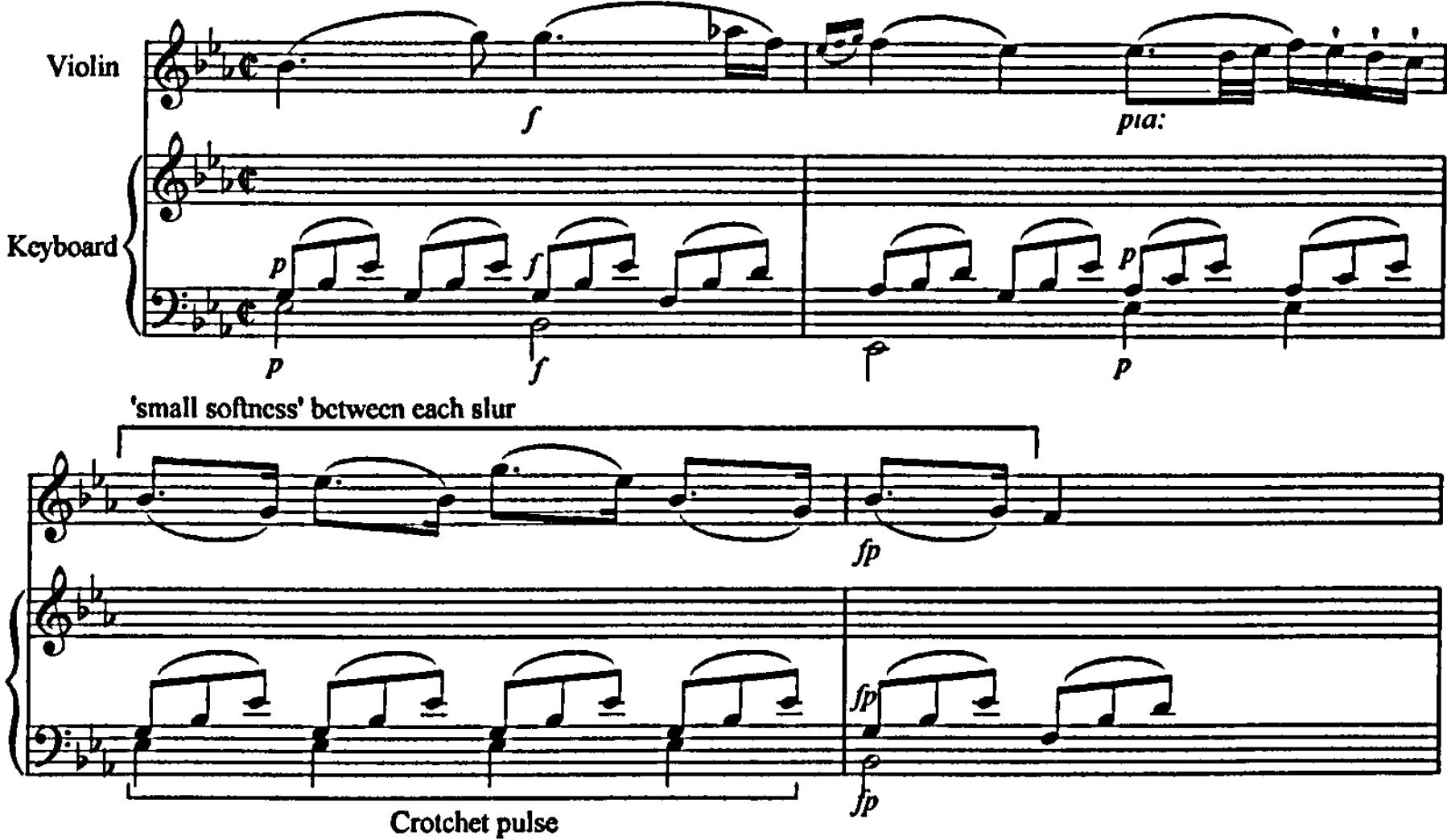
中文讲解
这是例 4.9 的图像占位符,标注来自 K6 第一乐章第 38–40 小节,并在图注中带有上标 35,提示读者查阅该例相关的脚注。原文图像数据未嵌入,因此本段不提供谱面细节。
补充说明
该例的具体谱例内容需查看原图;但可以确认它处于第 4.1 节开头,紧接其后是同乐章的例 4.10,二者共同构成 K6 第一乐章第 38–40 小节的对照例证。
第2段(P0002)
原文复述
[Image placeholder: Example 4.10: K6, movement 1, bars 38-40. Notes with strokes are realised as half their written value.]

中文讲解
这是例 4.10 的图像占位符,同样来自 K6 第一乐章第 38–40 小节。其图注说明:标有 stroke(跳弓记号)的音符在实际演奏中以书面时值的一半呈现。结合 P0001 的图注位置可知,例 4.9 与 4.10 形成一组对照,演示带 stroke 记号音符的演奏实现方式。
补充说明
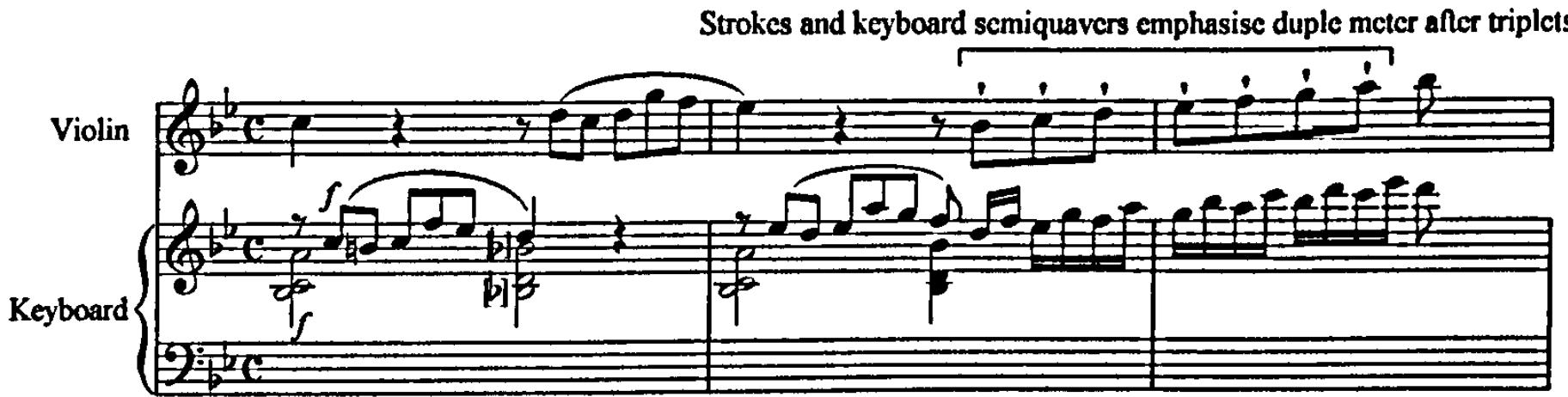
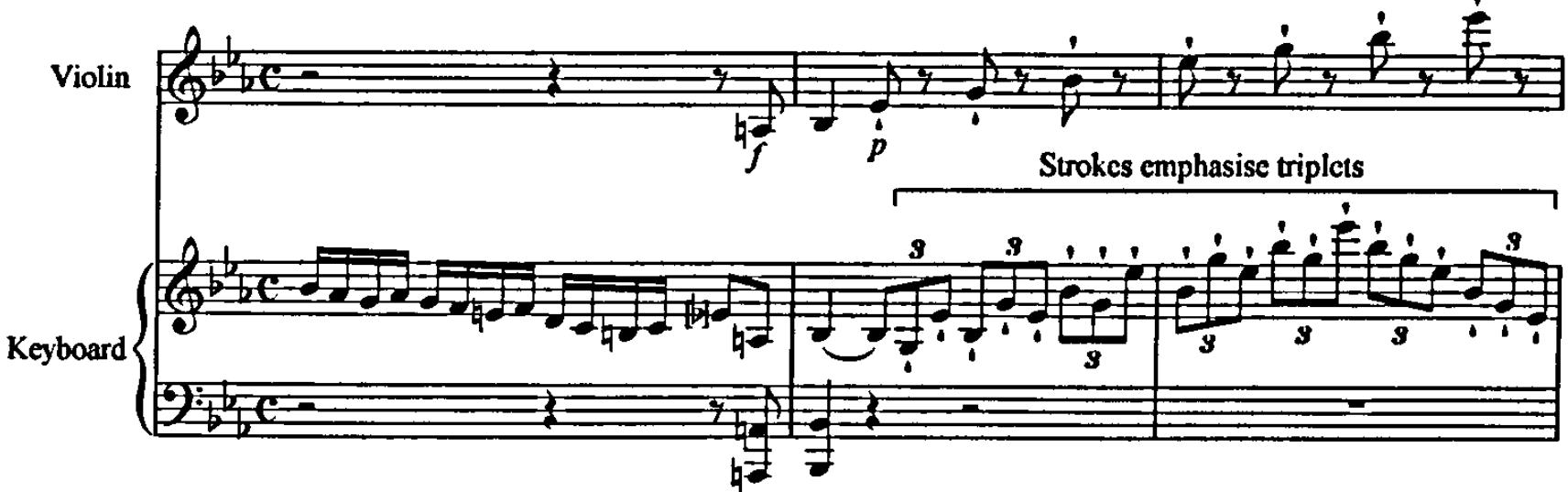
“realised as half their written value”强调 stroke 不仅是奏法记号,还关联到音符时值的实际缩短处理,这是 18 世纪小提琴演奏实践中 stroke 演奏法的一项关键特征。
第3段(P0003)
原文复述
The fact that notes with strokes can be played with a lifted bowstroke, and therefore in the middle of the bow, is also regularly substantiated by their context. In the first movement of K376, for example, long upper pedal notes in the violin part alternate with quavers with strokes (see example 4.11). Here, quavers lead into the fp at the start of each long held note; in order to have enough bow for the long note, and to be near enough to the heel which is the most powerful part of the bow and therefore most appropriate for playing the fp, the violinist must play each group of quavers in the middle of the bow. This is the most suitable part of the bow for a lifted stroke. In bar 25, this means that the violinist must move to the middle of the bow after the long held note.
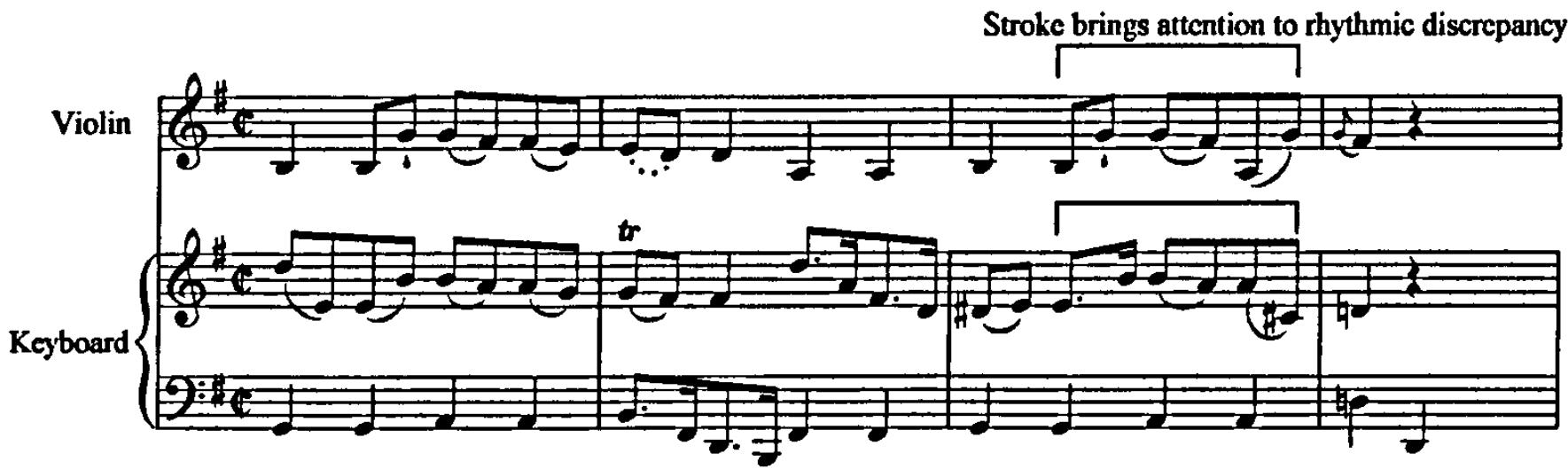
中文讲解
本段是第 4.1 节的核心论证段之一,正式提出本节主张:带有 stroke 记号的音符既可奏为抬弓(lifted bowstroke),又必须处于弓的中段。其论证方法不是孤立地看 stroke 记号本身,而是回到乐句的弓段分配(bow division)上下文。以 K376 第一乐章为例:上方声部出现持续的长音(pedal notes),与之交替出现的是带 stroke 的八分音符(quavers),这些八分音符正好引向长音起始处的 fp(强后即弱)。为了让长音有足够的弓长,并靠近弓根(heel)——弓最有力的部位,从而适合奏出 fp——演奏者必须在每组八分音符上把弓位安排在弓的中段,而弓的中段正是抬弓最适宜的位置。第 25 小节由于长音在前、八分音符在后,因此演奏者需要在奏完长音后再回到弓的中段。
本段的关键推理逻辑可概括为:fp 需要弓根 → 长音之前需先回到弓根 → 八分音符须在弓中段演奏 → 弓中段恰好适合抬弓 → 因此 stroke 在此上下文中可解释为抬弓。它承接前文对 stroke 抬弓性的基础论述,进一步用弓段分配来证明这一奏法的合理性。
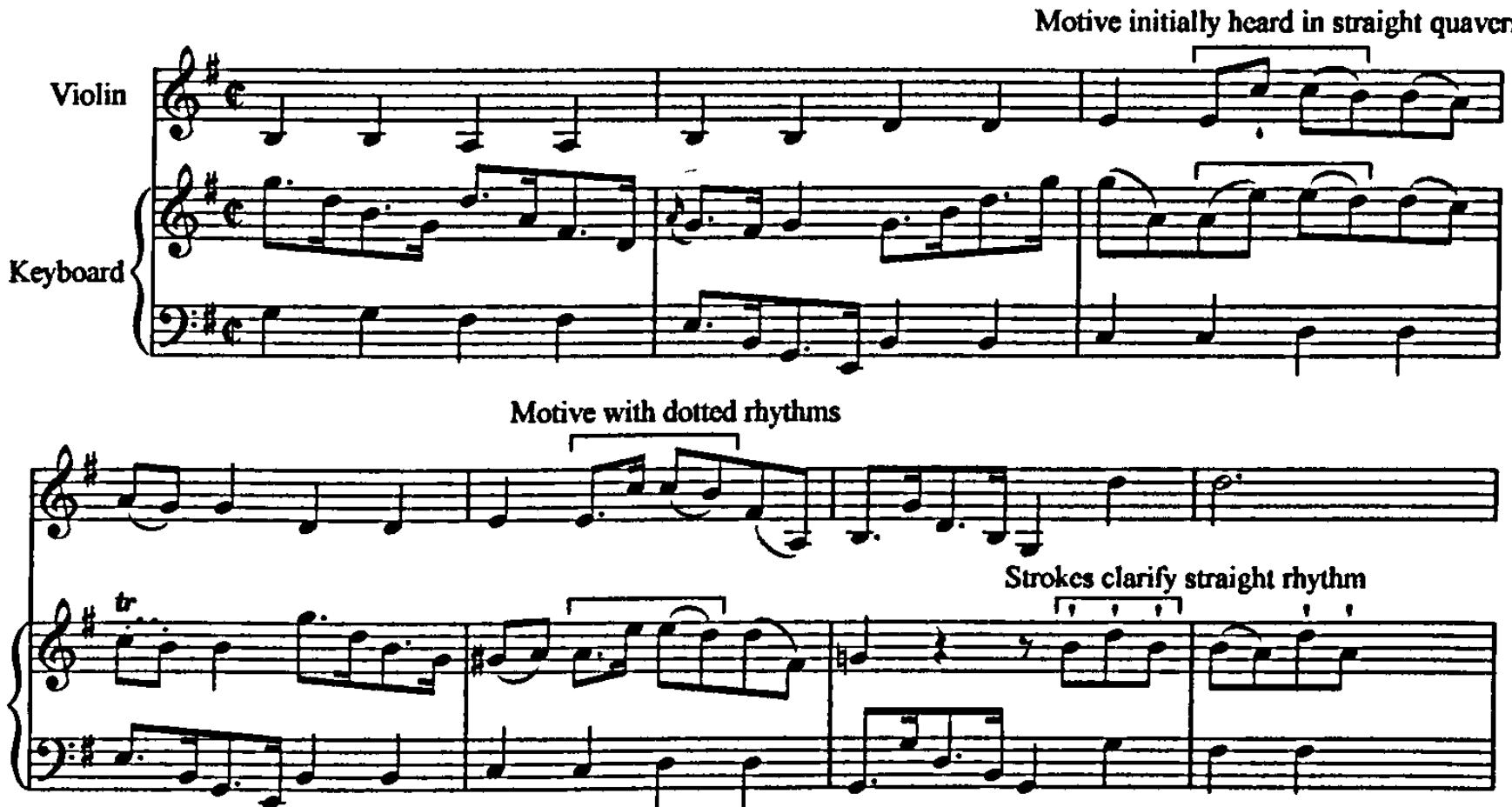
补充说明
“heel(弓根)”与“middle of the bow(弓中段)”在小提琴演奏学中分别对应弓的最强与最灵活的部位;fp 要求爆发力,因此靠近弓根;抬弓则需要在弓的弹性最佳处进行,故选弓中段。作者以弓段需求作为间接证据,把抽象的奏法选择落实到弓的物理分配上。
第4段(P0004)
原文复述
Example 4.11: K376, movement 1, bar 23-25.
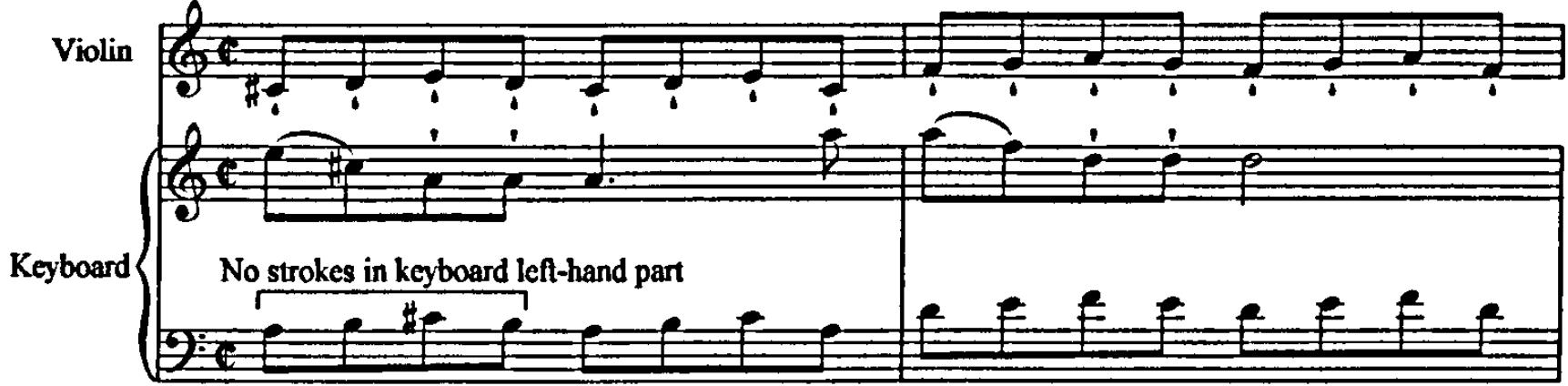
中文讲解
这是例 4.11 的图注,指向 K376 第一乐章第 23–25 小节。该谱例为正文 P0003 段所引的实例,提供论证所需的实际乐句图示。
第5段(P0005)
原文复述
[Image placeholder: page 1 musical example; embedded image data omitted, position and caption retained.]

中文讲解
这是第 1 页某乐谱示例的图像占位符,承接 P0004 所述的例 4.11。原文图像未嵌入,因此具体音符内容需查看原图。
补充说明
该图像所在位置正是 P0003 关于 K376 弓段分析所对应的谱例区。
第6段(P0006)
原文复述
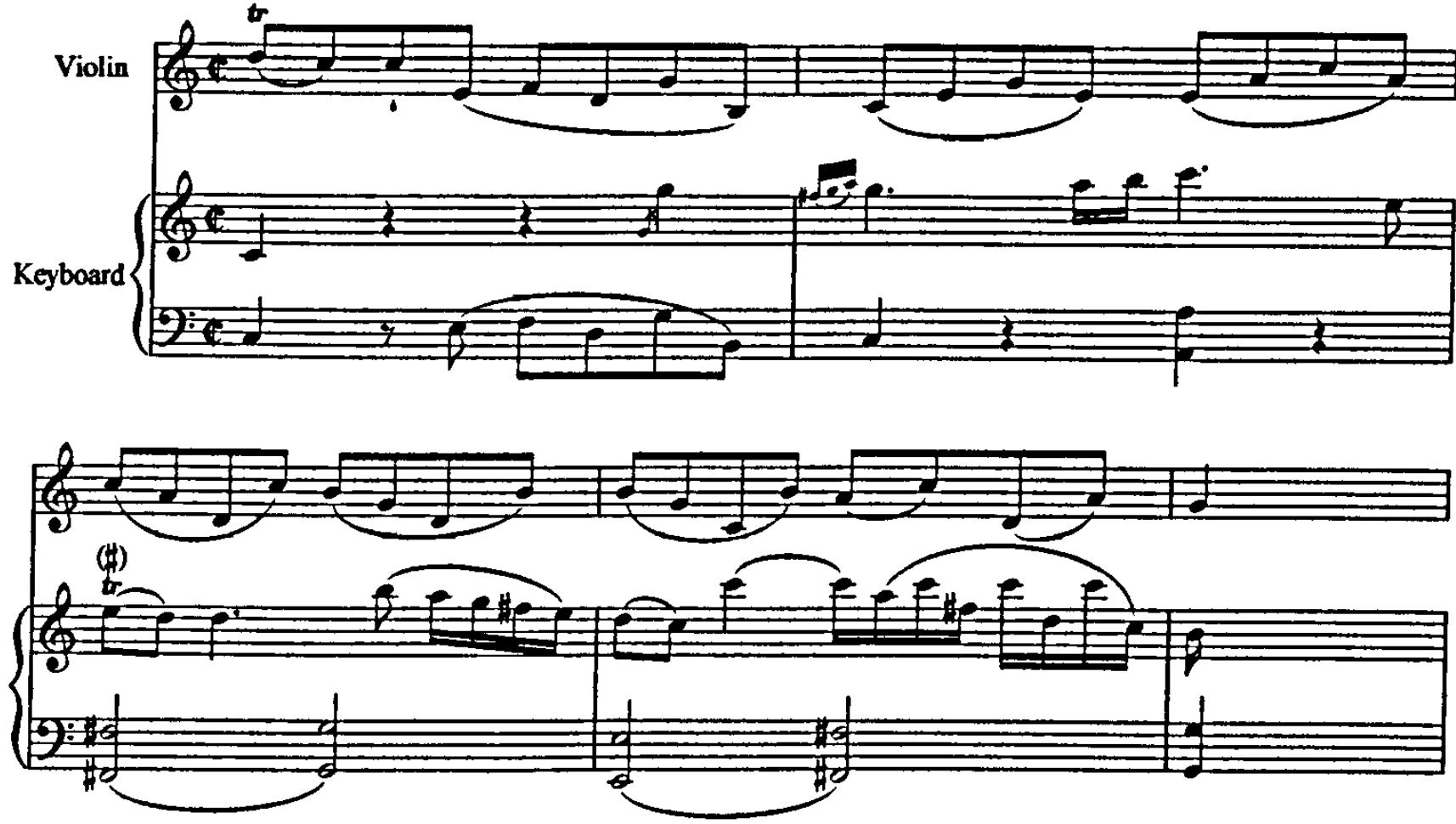
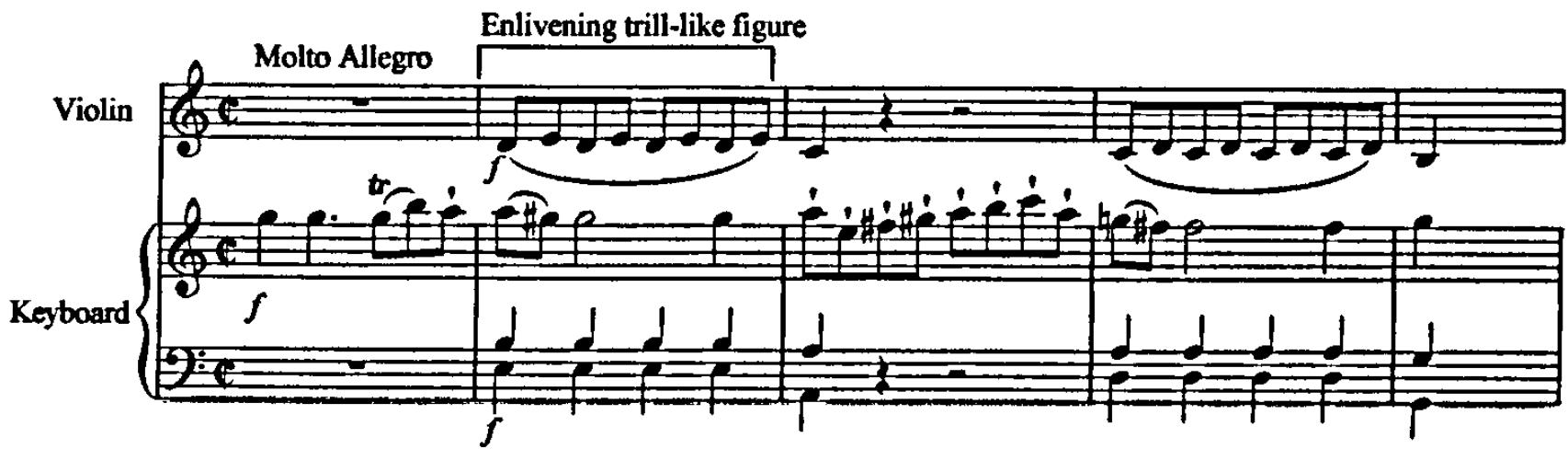
In K380, triplets which contain mixed articulations of slurs and strokes are followed a longer slur (see example 4.12). In order to play these longer slurs in bars
中文讲解
本段开启第二个案例分析,以 K380 为例。所述乐句结构是:三连音内部混合连弓(slur)与跳弓(stroke)两种不同奏法,紧随其后是一段较长的连弓(longer slur)。作者由此引出弓段分配的需求,说明这三连音与后续连弓之间的弓位衔接是关键。该段文字在原书中断于“bars”,下句接续到 P0008 才对“bars 29 and 31”作出明确指认。
补充说明
“triplets with mixed articulations”指同一组三连音内既有连弓音符也有跳弓音符,这种混合奏法正是作者用以推导弓段分配的入口。
第7段(P0007)
原文复述
$^{35}$ The stroke in bar 39 does not appear in the first edition.
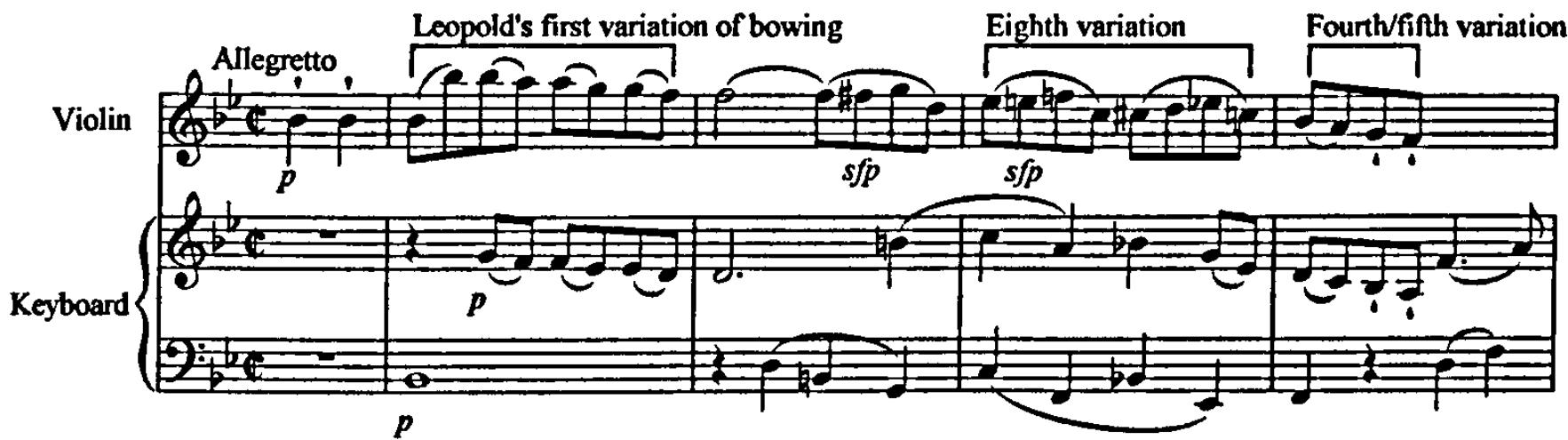
中文讲解
这是上标 35 所对应的脚注。脚注指出:例 4.9(或相关谱例)第 39 小节中的 stroke 记号并未出现在初版(first edition)中。脚注在此承担的是文本校勘(source-critical)功能,提醒读者注意不同版本(手稿与初版)之间在 stroke 标记上的差异。这种版本差异会影响演奏者对抬弓奏法是否成立的判断,因为如果某个 stroke 仅存在于某一版本,那么“抬弓奏法”很可能只是某一谱本传统的产物,而非作者原意。
补充说明
该脚注揭示出:本节所讨论的 stroke 抬弓解释依赖的具体记号存在版本选择性,提示研究者在用初版或手稿作为依据时需特别留意。脚注不构成对正文论证的削弱,而是限定其依据来源。
第8段(P0008)
原文复述
29 and 31 without running out of bow, the violinist needs to use the middle of the bow. To enable this bow division, the triplet passagework in bars 28 and 30 should also be played in the middle, thus meaning that the notes with strokes can be performed with a lifted bowstroke:
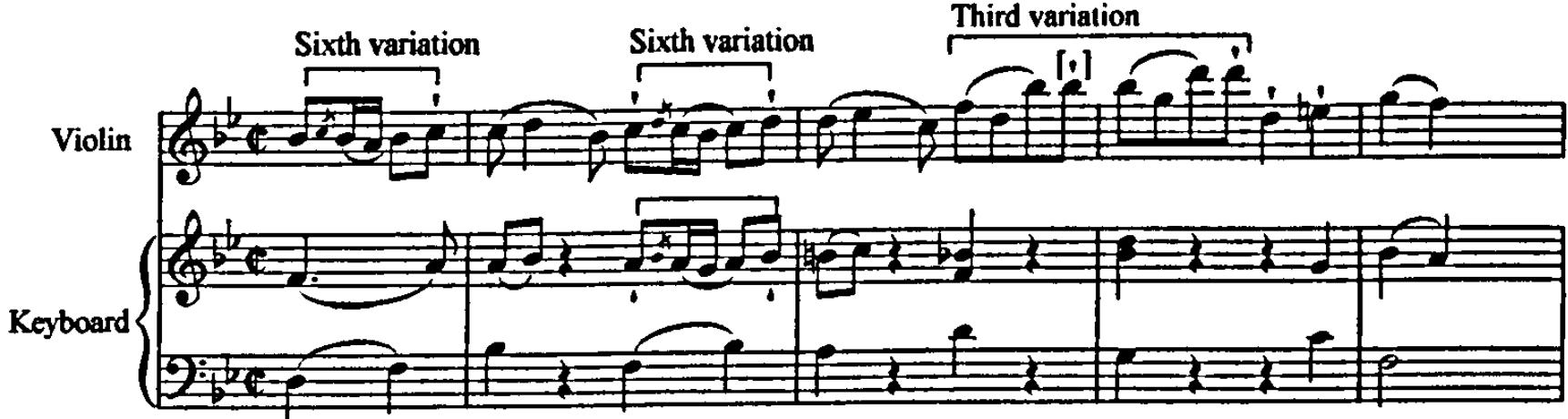
中文讲解
本段接续 P0006 中断的句子,完成对 K380 第 28–31 小节的弓段论证。论证逻辑是:要在第 29 与 31 小节演奏长连弓而不耗尽弓长(without running out of bow),必须将弓位定在弓的中段;而要让整个弓段分配成立,第 28 与 30 小节的三连音段落也必须同样在弓的中段演奏。其推论是:既然三连音段落在弓的中段,那么这些三连音中带 stroke 的音符自然可以以抬弓奏法来演奏。本句末以冒号收尾,引出例 4.12 的谱例图示。
补充说明
“running out of bow”是弓弦乐演奏中的常见困境:当弓用至弓尖后无力继续完成长句。此处的弓段论证核心正是通过“前段弓位”和“后段弓位”必须彼此协调来反向证明 stroke 音符的弓位与奏法。
第9段(P0009)
原文复述
Example 4.12: K380, movement 1, bars 27-31.
中文讲解
这是例 4.12 的图注,指向 K380 第一乐章第 27–31 小节。该谱例为 P0006 与 P0008 共同论证的三连音与长连弓衔接段落提供图示依据。
第10段(P0010)
原文复述
[Later in this movement, fps are marked during passages containing quavers with strokes; in order to play these fps with enough power, the middle of the bow should be used throughout this passage (rather than the upper half of the bow), with a lifted stroke for the detached quavers:]

中文讲解
本段是嵌入在乐谱图注位置(以方括号包裹)的论述性文字,说明 K380 第一乐章稍后出现的另一处实例:在含有带 stroke 八分音符的段落中标记了 fp。为了让这些 fp 奏得有力,应在整个段落中使用弓的中段(而非上半弓),而那些被奏成分离的八分音符则以抬弓演奏。括号末以冒号引出例 4.13 的谱例。这一段实质上是 K380 案例的进一步强化:再次以 fp 的力度需求反推出弓段,再由弓段推出 stroke 的抬弓奏法。
补充说明
“rather than the upper half of the bow”提示作者在此明确排除了上半弓作为替代方案,强化其论证唯一性:上半弓无法提供 fp 所需的力量。
第11段(P0011)
原文复述
Example 4.13: K380, movement 1, bars 144-5.
中文讲解
这是例 4.13 的图注,指向 K380 第一乐章第 144–145 小节。该例对应 P0010 中关于 fp 与 stroke 八分音符并置的段落,为作者弓段论证提供第二处 K380 实例。
第12段(P0012)
原文复述
[Image placeholder: page 2 musical example; embedded image data omitted, position and caption retained.]

中文讲解
这是第 2 页某乐谱示例的图像占位符,承接例 4.13 的图注位置。原文图像未嵌入,具体音符内容需查看原图。
补充说明
该图像所在位置对应 K380 第一乐章第 144–145 小节,是 P0010 论述的实例依据。
第13段(P0013)
原文复述
The bow division in Sonata K377 provides an interesting case in point: long notes are once again mixed with short notes marked with strokes. However, discrepancies between the slurs in the autograph version and first edition of this sonata result in contrasting bowing patterns (see example 4.14), which could suggest the use of different parts of the bow. While the shorter slur of the first edition leads to a down-bow on each semibreve, the slur over four quavers in the autograph version renders these long notes as an up-bow:
中文讲解
本段引入第三个案例 K377,作为本节论证中最复杂、最具争议的实例。K377 同样呈现长音符与带 stroke 短音符的混合,但其特殊性在于:手稿(autograph)与初版在连弓(slur)标记上存在差异,由此导致两种截然不同的运弓模式(bowing patterns),并可能暗示弓的使用部位不同。
作者对比两种版本:初版的较短连弓导致每个全音符(semibreve)都以下弓(down-bow)开始;而手稿中跨越四个八分音符的连弓,则把这些长音符变为上弓(up-bow)。这种运弓方向的反转直接影响弓段分配——下弓版本允许 stroke 短音符在弓中段抬弓演奏;上弓版本则要求短音符靠近弓尖,以便长音符可以靠上弓完成。这一案例不仅论证 stroke 抬弓奏法,更暴露出版本研究对演奏决定的关键影响。
本段以冒号收尾,引出下一段(P0014)中关于例 4.14 的详细讨论与演奏建议。
补充说明
“contrasting bowing patterns”是 K377 案例的关键:版本差异并非仅关乎音高或节奏,而是直接改变演奏者的运弓与弓段选择,因此该案例被作者标为“interesting case in point”。
第14段(P0014)
原文复述
[Image placeholder: Example 4.14: K377, movement 1, bars 30-33. First edition slurs are annotated below the stave, autograph slurs are above the stave. Printed up- and down-bows are the current author’s suggestions.] Thus, while the notes with strokes in the first edition can be comfortably played with a lifted articulation in the middle of the bow, in order to be near the heel for the down-bow semibreve (which could be followed by a retake to another down-bow at the start of bar 32), in the autograph version the triplets with strokes must be played closer to the tip of the bow, enabling the violinist to play the long note on an up-bow. Nevertheless, it would still be possible to play the triplets in the autograph version of this passage with a an energetic and clean bowstroke; indeed, published in 1781, it is likely that this sonata could have been played with a bow which possessed a stronger and more flexible stick than the bows of the mid-eighteenth century. Writing with reference to Tourte bows (Stowell, 1991: 140), Campagnoli describes ‘spirited’ and ‘short’ strokes as being played at three-quarters of the length of the bow (that is, a quarter-length away from the tip), in order to create an articulation which will ‘put the strings equally well into vibration [so] that the sounds may be conveyed as far as possible, that each note may come out clear, and that the performance may acquire warmth and vigour’ (Campagnoli, 1824: 7). By playing the triplets in this part of the bow, rather than at the point, the semibreve can still comfortably be played with an up-bow. Thus, with a late-eighteenth century bow, it would be possible to follow the slurs of Mozart’s autograph version of this passage, while still articulating the triplets with a lively (and possibly lifted) bowstroke. An alternative solution to the bowing marked in the autograph version would be to start the slurs on an up-bow. This would take some strength away from the start of bars 30 and 32, and make the long notes in bars 31 and 33 the focus of the passage. In this case, the detached quavers could be played with a lifted bowstroke in the middle of the bow.
中文讲解
本段是第 4.1 节最长的论述段,承担多重任务:图像图注说明、版本差异下的弓段推演、历史弓制(Tourte 弓)的引入、以及备选演奏方案的提出。
首先,图像占位符内的图注给出阅读指引:初版的连弓标记在五线谱下方,手稿的连弓标记在五线谱上方;印出的上下弓符号是作者本人建议(current author’s suggestions)。这一说明本身就揭示出,演奏者所见的“印刷运弓”并非原始来源,而是研究者的诠释。
其次,正文展开两种版本下的弓段对比:初版中带 stroke 的音符可在弓中段舒适地以抬弓奏法演奏,因为演奏者需要靠近弓根来准备下弓全音符(甚至可衔接第 32 小节开头的下弓);而手稿版本中,带 stroke 的三连音必须靠近弓尖,以便全音符以上弓完成。看似手稿版本与抬弓奏法相冲突,但作者随即引入历史弓制作为调解:他指出 K377 出版于 1781 年,所用之弓可能比 18 世纪中期的弓具有更强、更富弹性的弓杆。
接着,作者援引 Campagnoli(1824 年)通过 Stowell(1991: 140)转述的论述:所谓“spirited”(有精神的)与“short”(短促)的弓法,应当在弓长的四分之三处(即距弓尖四分之一弓长处)演奏,以使琴弦充分振动、声音传得远、音符清晰且演奏富于温暖与力度。作者以此说明:在弓靠近弓尖的四分之三处演奏三连音,全音符仍可舒适地以上弓完成。换言之,即便按手稿的连弓标记演奏,演奏者仍可在弓尖区奏出活泼、可能带抬弓性质的 stroke。
最后,作者提出另一种演奏方案:将手稿中的连弓改为从上弓起奏。这会让第 30、32 小节开头的力度稍弱,而把第 31、33 小节的长音符塑造为段落的焦点;此时,分离的八分音符便可在弓中段以抬弓演奏。
本段在小节整体论证中的意义在于:抬弓奏法并非孤立自明的奏法选择,而必须放在弓段分配、版本谱面、历史弓制三者交汇处加以判断;同时也示范了研究者如何在面对版本冲突时提供多种合理演奏方案。
补充说明
Tourte 弓通常指 18 世纪末由 François Tourte 设计的现代小提琴弓,其弓杆更细、更具弹性、弓尖更接近尖形,被视为现代小提琴弓的定型。Campagnoli 的引文为作者把“弓尖区可奏出有力 stroke”这一论点引入了同时期或稍后的演奏文献支持。需要注意的是,Campagnoli 的引文是通过 Stowell 1991 年的研究转引,而非直接来自 Campagnoli 原书——这一点对评估引文权威性有意义。
第15段(P0015)
原文复述
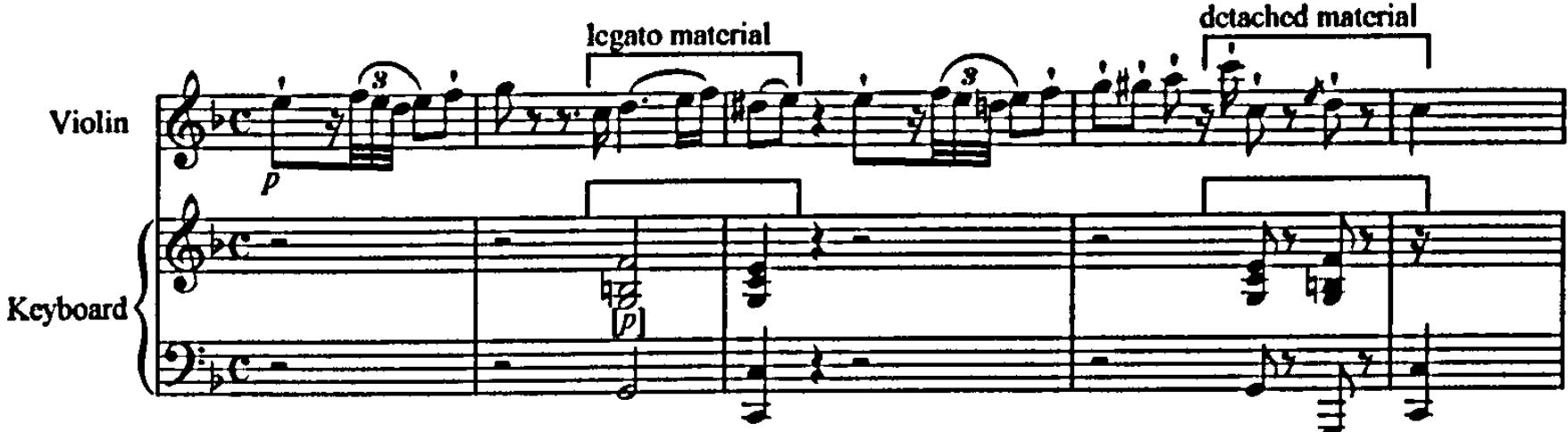
The performance of strokes as light and lifted articulations is further suggested in some of Mozart’s music for violin and keyboard through his careful attention to the character of upbeats. The use of strokes in the first movement of K376 (see example 4.15) vividly conveys an alternation of character between light and energetic music, characterised by triplet ornamental figures and strokes (bars 40 and 42-3), and more singing material which makes use of slurs and sustained keyboard accompaniment (bars 41-2). Thus, the unmarked semiquaver upbeat to the middle of bar 41 introduces legato material. The semiquaver upbeat to the middle of bar 43, in contrast, is marked with a stroke, and is followed by quavers marked with strokes in the violin part:
中文讲解
本段从弓段分配的“功能性”论证,过渡到 stroke 的“表情性”论证。作者指出,在莫扎特为小提琴与键盘所作的音乐中,对弱拍(upbeat)性格的精细处理,进一步支持将 stroke 奏为轻巧抬弓的解释。
以 K376 第一乐章为例(参见例 4.15):stroke 标记的使用生动地呈现了乐曲性格的交替——一方面是轻盈而充满动力的音乐,以三连音装饰音型与 stroke 为特征(第 40 与 42–43 小节);另一方面则是更富歌唱性的段落,使用连弓与持续性键盘伴奏(第 41–42 小节)。这种对比通过两种弱拍的处理得以强化:第 41 小节中部的十六分音符弱拍未标 stroke,因而引入连音(legato)材料;而第 43 小节中部的十六分音符弱拍标有 stroke,随后又接续小提琴声部中标有 stroke 的八分音符。
本段的逻辑是:stroke 在弱拍上的出现并非偶然,而是莫扎特用以标记“轻盈—活力”性格的手段;既然 stroke 标志的是轻巧活泼的性格,那么“轻巧抬弓”就成为最自然的演奏实现。这一段将本节论证从“弓段功能”拓展到“音乐性格”,使 stroke 抬弓奏法的解释获得更立体的支撑。
补充说明
“upbeat”在音乐学中既可指节拍意义上的弱起,也可指小节内部的弱位重音,此处更接近后者——即非重拍位置上的引入性音符。段末以冒号收尾,预告后续将展示例 4.15 的谱例图示。
脚注 / 边栏 / 图表 / 附加信息(如有)
本节包含若干脚注与谱例图示。第 35 号脚注(对应 P0007)指出 K6 第一乐章第 39 小节的 stroke 记号不见于初版,属于文本校勘性脚注,提示读者注意手稿与初版之间的版本差异。其他图注(例 4.9、4.10、4.11、4.12、4.13、4.14、4.15)均按位置与编号标注所属奏鸣曲号、乐章与小节号;其中例 4.14 的图注额外说明初版与手稿连弓标记的呈现位置,并声明印出的上下弓符号系作者本人建议。
💡 本节核心要点
- 本节的核心主张是:标有 stroke 记号的音符既可奏为抬弓(lifted bowstroke),又必须在弓的中段演奏,这一解释由乐句上下文中的弓段分配所支持。
- 论证方法采用上下文(contextual evidence)路径:以长音符与 stroke 短音符的交替、fp 的力度需求等具体乐句结构,反推演奏者所必需的弓位,进而推出 stroke 的抬弓奏法。
- 三个核心案例(K376、K380、K377)从不同角度支撑论证:K376 以长音前的 fp 需求推导弓中段与抬弓;K380 以三连音与长连弓的衔接推导同样的弓段;K377 则揭示版本差异如何导致不同的运弓与弓段选择。
- K377 案例进一步引入 18 世纪末弓制(Tourte 弓)的因素,说明即便按手稿连弓标记演奏,演奏者仍可在弓尖区奏出活泼的 stroke;同时作者提供另一种演奏方案(改以上弓起弓),将长音符塑造为段落焦点。
- 本节还从“性格”维度扩展论证:stroke 在弱拍上的出现与莫扎特所标记的“轻盈—活力”性格相对应,使抬弓奏法的解释获得表情上的合理性。
- 作者始终保持演奏方案的开放性:面对版本冲突,不强行给出唯一答案,而是结合弓段、历史弓制与表情意图,提出多种合理演奏可能性。
🔑 关键术语
- lifted bowstroke:抬弓奏法。本节核心术语,指在小提琴演奏中将带 stroke 记号的音符奏为轻巧的离弦动作;本节论证其在弓的中段或弓尖附近均可实现。
- bow division:弓段分配。指演奏者根据乐句需求在弓的不同部位(弓根、弓中段、弓尖)进行弓长规划,本节以此作为推导 stroke 抬弓奏法的关键证据。
- heel of the bow:弓根。弓靠近手的一端,是力量最大、最适合奏出强音(如 fp)的部位;本节以靠近弓根的需求反推前文 stroke 音符所处的弓中段位置。
- tip of the bow:弓尖。弓靠近末端的部分,力度较弱但灵活性高;本节在 K377 手稿版本案例中讨论弓尖区演奏带 stroke 三连音的可能性。
- fp:强后即弱(forte-piano)。一种力度标记,要求先强后立即转弱;本节以 fp 的力度需求作为推导弓段分配的依据。
- stroke:跳弓记号。本节中作为奏法记号,作者论证其在 18 世纪小提琴实践中可解释为轻巧抬弓,且实际演奏时其音符时值约为书面值的一半。
- slur:连弓记号。本节讨论其与 stroke 在同一乐句中混合出现的情形,以及不同版本(手稿与初版)中连弓标记的不同所导致的运弓差异。
- autograph vs first edition:手稿与初版。本节多次涉及二者之间的差异(特别是 stroke 与连弓标记),并以此说明版本研究对演奏决定的关键影响。
- Tourte bow:Tourte 弓。通常指 18 世纪末由 François Tourte 设计的现代小提琴弓,弓杆更细、更有弹性;本节借 Campagnoli 经 Stowell 转引的论述,论证在弓尖四分之三弓长处可奏出富于力度与温暖的 stroke。
4.2 [描述性拆分] Strokes Confirming Phrase Structure and Character
第1段(P0016)
原文复述
Example 4.15: K376, movement 1, bars 40-44.
中文讲解
这是谱例 4.15 的图注,引自 K376 第一乐章的第 40 至 44 小节。该标注为读者定位原始乐谱片段提供坐标,本身不包含论证文字,而是与后续相关讨论配对出现。
第2段(P0017)
原文复述
中文讲解
这是位于第 4 页的图像或乐谱示例占位符,对应谱例 4.15 (K376, 第一乐章, 第 40–44 小节) 的具体谱面。原文此处因图像数据省略而无法直接读取音符细节,需查看原图方可核对作者所讨论的具体笔触位置与连线。
补充说明
在文本处理中,应配合 P0016 的图注和紧随其后的讨论文字 (P0018) 一并理解;当前仅能确认其版面位置,无法核实细节。
第3段(P0018)
原文复述
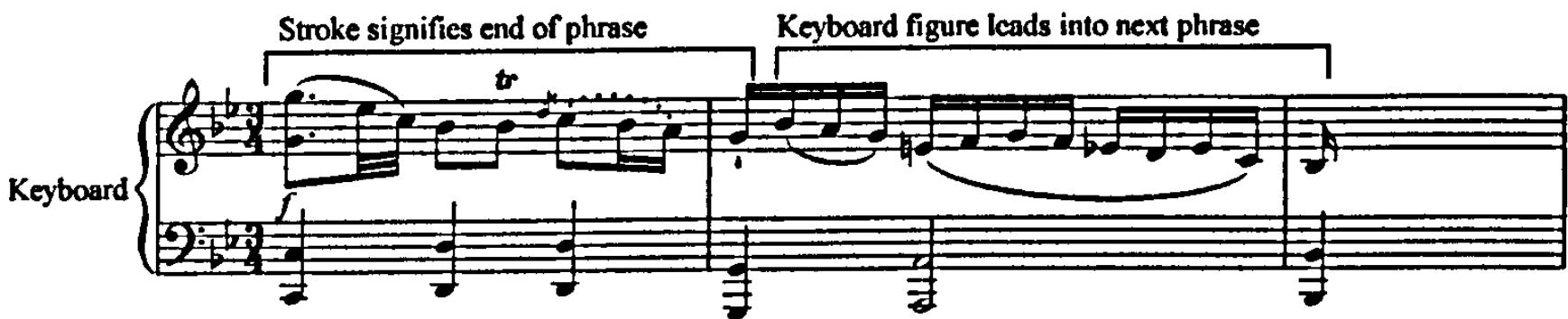
A single stroke is often used to punctuate the end of a phrase. This can function to confirm the note on which a phrase ends, as in the Andante con moto, K380 (see example 4.16). In this instance, the phrase (if it did not contain a stroke) could be interpreted as continuing to the end of bar 9 and in effect eliding with bar 10; the use of a stroke here indicates that after the downbeat, bar 9 should be delivered as a new idea, leading into bar 10.
中文讲解
本段提出一个具体的小论点:单独的笔触 (stroke) 常常用于在乐句末尾作出句读,它的功能之一是确认乐句究竟在哪一个音上结束。作者以 K380 第二乐章 (Andante con moto) 第 8–10 小节为例说明:若没有这一笔触,演奏者很可能把乐句理解为一直延续到第 9 小节末尾、并与第 10 小节产生叠入 (eliding) 关系;而笔触的出现则表明,重拍之后的第 9 小节应当作为新的乐思来演奏,并顺势引向第 10 小节。这里要抓住的逻辑是:笔触不是装饰,而是一种"乐句边界"的标记,它防止演奏者把两小节的内容误读为一条连绵不断的线条。承接上文关于笔触界定乐句结构的讨论,本段将这一功能细化到"确认终止音"这一具体任务上。
补充说明
术语 elide / eliding 在此指乐句之间互相叠入、难以切分边界的现象;作者用假设的"无笔触"情形来说明笔触的辨义作用。
第4段(P0019)
原文复述
Example 4.16: K380, movement 2, bars 8-10.
中文讲解
谱例 4.16 的图注,标定讨论对象为 K380 第二乐章 (即上文提到的 Andante con moto) 第 8 至 10 小节。
第5段(P0020)
原文复述
中文讲解
第 4 页的图像或乐谱示例占位符,对应谱例 4.16 (K380, 第二乐章, 第 8–10 小节)。该例具体展示了第 9 小节重拍之后用于切断乐句的那一记笔触,需查看原图才能核对音符时值、连线及笔触位置。
第6段(P0021)
原文复述
As well as clarifying the phrase-structure of a piece, strokes on the final notes of phrases frequently serve to clarify that the last note should be detached and light. Such is the case in the Andante of K377 (see example 4.17); the phrase ends with a slurred suspension and resolution, and the note with a stroke is a reiteration of the consonant note. The stroke may thus remind the performer that the final note of the phrase should be played lightly, in effect continuing the diminuendo of the slur which precedes it:
中文讲解
本段在上一段"笔触界定乐句结构"的基础上,再向前推进一层:乐句末尾的笔触还常常意味着"最后一音应被处理得断而轻"。以 K377 第二乐章 (Andante) 为例,该处的乐句以一个连弓内的挂留音及其解决 (slurred suspension and resolution) 收束,带笔触的那个音是对解决协和音 (consonant note) 的重复。作者由此推断,笔触的作用是提醒演奏者:乐句的尾音应当弹得轻,从而延续前文连弓渐弱 (diminuendo) 的力度趋势。要点在于,作者并不把"断奏"理解为孤立的技法,而是把它与连弓渐弱的方向联系起来,使笔触成为"力度收束"的视觉标记。
补充说明
suspension and resolution (挂留与解决) 是古典音乐常见的不协和处理;此处需注意,作者所说的"consonant note"指的是挂留之后得到解决的协和音,而非挂留音本身。
第7段(P0022)
原文复述
Example 4.17: K377, movement 2, bar 20-21.
中文讲解
谱例 4.17 的图注,对应 K377 第二乐章 (Andante) 第 20 至 21 小节。原文此处用单数 “bar 20-21” 而非 “bars”,仅为写法差异。
第8段(P0023)
原文复述

中文讲解
第 5 页的图像或乐谱示例占位符,对应谱例 4.17 (K377, 第二乐章, 第 20–21 小节),展示了连弓挂留—解决后带笔触的协和音重复,需查看原图以核对笔触与连弓的具体位置关系。
第9段(P0024)
原文复述
Conversely, the Andantino cantabile second movement of K379 (see example 4.18) demonstrates strokes which are used as they are described by Leopold, to mark strongly accented notes (L. Mozart, 1756: 47). At the end of bars 58 and 60 it could therefore be the absence of a stroke which tells the performer to finish the phrase lightly, while the strokes at the start of the bars, within the context of a variation which is full of dramatic gestures including wide-interval leaps and furious demisemiquaver keyboard accompaniment, imply detached and accented notes:
中文讲解
本段以 K379 第二乐章 (Andantino cantabile) 第 57–60 小节为反例 (conversely),说明笔触的另一种用法:它并不总是意味着"轻断收尾",有时恰恰相反,被用来标记强重音。作者援引 Leopold Mozart 1756 年著作第 47 页作为权威依据,把此处的笔触解释为"强烈重音的指示"。由此,作者提出一个需要演奏者反向解读的细节:在第 58 与第 60 小节末尾,正是"没有笔触"才提示演奏者轻柔收束;而小节开头的笔触,由于该变奏充满大跳与键盘声部密集的三十二分音 (demisemiquaver) 伴奏等戏剧化手势,意味着音应被处理为断奏且重音鲜明。本段的关键意义在于:通过对比,揭示笔触的语义取决于上下文 (dramatic variation 的语境),并强调权威文献 (Leopold) 在此类判断中的参照价值。
补充说明
L. Mozart, 1756: 47 是 Leopold Mozart 的《Versuch einer gründlichen Violinschule》(1756) 第 47 页,作者在此用作笔触=重音这一含义的历史文献支撑。demisemiquaver 即三十二分音符。
第10段(P0025)
原文复述
Example 4.18: K379, movement 2, bars 57-60. $^{36}$
中文讲解
谱例 4.18 的图注,对应 K379 第二乐章 (Andantino cantabile) 第 57 至 60 小节,末尾的上标 $^{36}$ 表示该例在原书中附有第 36 号脚注。
补充说明
脚注 36 的具体内容未在当前段落给出,应在脚注汇总中另行说明。
第11段(P0026)
原文复述

中文讲解
第 5 页的图像或乐谱示例占位符,对应谱例 4.18 (K379, 第二乐章, 第 57–60 小节),展示了在戏剧化变奏语境下,小节开头带笔触的重音音头以及小节末尾无笔触的轻柔收尾,需查看原图核对具体位置。
第12段(P0027)
原文复述
There are also more rare occasions on which strokes appear to be an indicator of strength alone, with no relation to note-length. This is the case in K481, where strokes at the start of a tied note are more likely to imply an accent than a short articulation (see example 4.19). Similarly, strokes on the first note of a slur suggest emphasis, rather than a break in the slur (see example 4.20). This is in contrast with articulated slurs, which, as we have seen, indicate a stopping of the bow between each note under one bowstroke.
中文讲解
本段进一步扩展笔触的含义层次,指出少数罕见情形下笔触只表示"力度强弱",与音符长短无关。作者给出两个具体情形:其一,在 K481 中,连线 (tied note) 起音处的笔触更可能意味着重音,而非短促断奏 (short articulation);其二,连弓 (slur) 起音处的笔触倾向于表示强调,而非打断连弓。这两种用法与前文讨论的"断—轻"型笔触形成对比。最后,作者把它与之前已讨论过的"articulated slurs" (可视为断连弓或跳弓连弓) 区分开:后者指在一弓之内各音之间需要停弓 (stopping of the bow between each note),与此处笔触所代表的单纯力度标记是两种不同符号逻辑。整体上,本段在为笔触的语义场做边界收束——它可以指乐句结构、指断轻收束、也可以只指力度本身。
补充说明
articulated slurs 在原文前文已有讨论 (参见 P0008 等相关段落);本段的 “as we have seen” 提示此处为回顾性引用。
脚注 / 边栏 / 图表 / 附加信息(如有)
本小节包含 5 个谱例 (Example 4.15–4.18 以及文中提及但未列入当前段范围的 4.19、4.20) 和 5 处图像占位符;谱例 4.18 末尾附有上标脚注 $^{36}$,其内容未在段落正文中展开,应在脚注汇总中另行核查。这些谱例共同支撑作者论证:笔触 (stroke) 在不同语境下分别承担"界定乐句终止"“提示断轻收束"“标记重音"“单纯力度强调"四类功能,并与 articulated slurs 构成对比关系。
💡 本节核心要点
- 笔触常用于确认乐句终止音的位置,避免乐句被误读为跨越至下一小节 (K380 例)。
- 在乐句末尾,笔触可提示演奏者将尾音处理为断而轻,并延续连弓渐弱的力度趋势 (K377 例)。
- 在戏剧化变奏语境中,笔触可被用来标记强重音,其依据可上溯至 Leopold Mozart 1756 年的论述 (K379 例)。
- 作者通过反向解读 (absence of a stroke) 进一步说明,符号意义需结合上下文判断。
- 少数情形下笔触只指示力度强弱,与时值无关,出现在连线或连弓起音处 (K481 例)。
- 笔触的单纯力度标记功能需与 articulated slurs 区分:后者指一弓内逐音停弓,与时值/断奏相关,而非纯粹的重音标记。
🔑 关键术语
- stroke:原文指乐谱上的笔触符号 (在本节语境下大致相当于点状重音 / staccato 类的标记),但其含义需视上下文而定:可以是乐句边界的句读、断轻收束、强烈重音或单纯的力度强调。
- phrase:乐句,即音乐中相对完整的乐思单位;本节多次讨论笔触如何界定或确认乐句的边界与终止音。
- eliding:乐句之间的叠入或无明确切分,本节以 K380 为例说明若没有笔触,演奏者可能将两小节误读为互相叠入的连续线条。
- diminuendo:渐弱,本节指乐句末尾连弓之内自然出现的力度衰减,笔触被视为这一衰减趋势的视觉提示。
- suspension and resolution:挂留与解决,前者为不协和音在强拍延续,后者为其随后进行到协和音;本节 (K377 例) 用以说明笔触落在解决后的协和音重复之上。
- demisemiquaver:三十二分音符,本节用以描述 K379 变奏中键盘声部的急促伴奏织体,作为该处笔触被解读为戏剧化重音的语境依据。
- articulated slurs:带断奏意味的连弓 (一弓之内逐音停弓),本节用以与"单纯表示力度强调的笔触"作对比。
4.3 [描述性拆分] Strokes Modified by Tempo, Note-Length, and Character
第1段(P0028)
原文复述
$^{36}$ The strokes in bar 58 are as in the autograph version (Eisen, 2007: 74). The first edition has strokes over all three quavers in bar 58, but only the first two quavers in bar 60.
中文讲解
本条为第36号脚注,承接第4.2小节对K481某个段落跳弓记号的版本考察。脚注说明:第58小节的跳弓标记与莫扎特手稿一致(参Eisen 2007: 74),而初版则在第58小节三个八分音符上都标有跳弓、却在第60小节只在前两个八分音符上标有。作者借此提示演奏者注意版本差异:初版的记号覆盖更宽,但手稿更可能反映莫扎特本人的意图,因此本节的论证以手稿为本。
补充说明
本脚注属于版本考证类附注,作用是为正文论及的跳弓位置提供文献支持与限定。
第2段(P0029)
原文复述
Example 4.19: K481, movement 2, bar 18.
中文讲解
图例4.19的标题,标注乐谱取自K481第二乐章第18小节。
补充说明
图例标题,无额外说明。
第3段(P0030)
原文复述

中文讲解
第6页的图像或乐谱占位符,对应图例4.19(K481第二乐章第18小节)。原图未在此处呈现,需查阅原书第6页以确认具体音符、弓法标记与节奏。
补充说明
图像占位符,需查看原图。
第4段(P0031)
原文复述
Example 4.20: K481, movement 3, bars 94-95.
中文讲解
图例4.20的标题,标注乐谱取自K481第三乐章第94-95小节。
补充说明
图例标题,无额外说明。
第5段(P0032)
原文复述

中文讲解
第6页的图像或乐谱占位符,对应图例4.20(K481第三乐章第94-95小节)。原图未呈现,需查阅原书以确认跳弓与连弓的分布。
补充说明
图像占位符,需查看原图。
第6段(P0033)
原文复述
In the same way that the delivery of unmarked notes cannot be generalised, the articulation of strokes is likewise always dependent on context. Although these examples demonstrate that Mozart often calls for strokes to be performed as short and lifted notes, there are numerous occasions where this standard bowstroke is modified. Indeed, Quantz writes that, as is the case for unmarked notes, tempo and note-length have an effect on the degree of separation between notes:
中文讲解
本段是第4.3小节的论证枢纽。它把第4.2小节关于“未标记音符的演奏方式不能一概而论”的论点延伸到“跳弓记号本身的articulation也不能一概而论”:作者承认前面的图例(K481第二乐章第18小节与第三乐章第94-95小节)展示了莫扎特确实经常要求短促离弦的跳弓,但立刻强调“大量场合”需要修正这一“标准弓法”。随后用Quantz作为权威佐证,引出下文P0034的Quantz原文:本句预告了三类语境因素——速度(tempo)、音符时值(note-length)以及与之相关的“音符间分离程度”——将共同决定跳弓的实际演奏方式。
第7段(P0034)
原文复述
Previously it was stated that in playing the notes above which the little strokes appear, the bow must be detached a little from the strings. This means only those notes in which the time permits. Thus the quavers in the Allegro, and the semiquavers in the Allegretto are excepted if many follow one another; they must be played with a very short bow-stroke, but the bow must never be detached or removed from the strings. If it were always raised as high as is required when we say that it is detached, there would not be enough time to return it to the string at the proper time, and notes of this kind would sound as if they were chopped or whipped. (Quantz, 1752: 232)
中文讲解
Quantz原文(1752: 232)的核心论点是:标有跳弓记号(小点)的音符应“略微离弦”,但仅限“时间允许”的场合。在Allegro中的八分音符与Allegretto中的十六分音符若连续出现,则属例外——必须改用“极短的弓段”,但弓不可真正离弦。其理由是:如果每次都按“离弦”所需的幅度抬弓,根本来不及在合适时点回到弦上,结果是音符听上去“像被砍或被鞭打(chopped or whipped)”。这段引文为本节奠定了最关键的一条修正规则:当速度与时值让真正的离弦动作不可能时,跳弓标记应被解读为“短弓不离弦”而非“真正的离弦跳弓”。
补充说明
此引文是本节Quantz论述的核心,其页码232来自其1752年著作。
第8段(P0035)
原文复述
Hence, Quantz echoes Geminiani’s advice on the various bowstrokes which are suitable for differing note-lengths and tempi (Geminiani, 1751: 27), warning that extended fast passagework marked with strokes is better suited to an on-the-string stroke. He confirms that notes with strokes can be played either on or lifted off the string, but that the bowstroke should always be short, and attention should be paid to the quality of the bowstroke, in order that each short note receives good tone. Similarly, Türk writes that character, tempo and dynamic all modify the length and attack which should be given to notes with strokes, with ‘serious, tender, sad, etc.’ pieces requiring a longer articulation than pieces which are ’lively, humorous, and the like’ (Türk, 1789: 343).
中文讲解
本段把三位18世纪权威源并列,用以加固“跳弓需被语境修正”的中心命题:(1) Quantz呼应Geminiani(1751: 27)关于“不同时值与速度适配不同弓法”的建议,明确警告“标记跳弓的快速连续乐段更宜用贴弦弓法”;同时Quantz承认跳弓可贴弦也可离弦,但弓段必须短,并强调要关注弓的“质”,使每个短音符都能发出好的音色。(2) Türk(1789: 343)则把语境维度扩展到“体裁、速度、力度”三项,并具体区分:“严肃、温柔、悲伤”等作品需要比“活泼、幽默”类作品“更长”的articulation。作者借此把上一段Quantz的“速度/时值”两维升级为包含“体裁/性格”的多维语境。
补充说明
本段是三位理论家论点的合成,所引页码(Quantz 1752: 232、Geminiani 1751: 27、Türk 1789: 343)即构成本节的主要文献基础。
第9段(P0036)
原文复述
Notes which are marked with strokes are therefore usually detached, excepting the examples which demonstrate strokes as indicators of accents alone, but the character of this detached articulation, with regard to its length and degree of attack, should be modified in relation to context. Sonata K376 (see example 4.21) demonstrates that the quality of strokes can be informed by the surrounding performance information. The tempo marking is Andante, which Quantz describes as being played ‘quietly, and with a light bow-stroke’ (Quantz, 1752: 231), and in which Geminiani describes lifted bowstrokes for semiquavers as being ‘bad or peculiar’ (Geminiani, 1751: 27). Indeed, in usual circumstances a descending scale in a relatively slow tempo would be played legato (according, for example, to Tartini’s description of ‘cantabile’ themes [Tartini, 1771: 55]). While the strokes over these scales warn performers not to play the descending figures with the conventional smooth articulation, it is clear from their context that they should not be attacked, or played with the same shortness of articulation that would be appropriate in an Allegro movement. The slur at the start of each motive thus sets a gentle context for the descending scale, which could be played with a lifted, but gentle and brushed bowstroke:
中文讲解
本段是本节的“正向”案例论证,可拆为三层:(1) 给出总规则——标有跳弓的音符通常离弦演奏(排除仅作重音标记的少数例子),但其“长度与起音强度”必须随语境调整。(2) 进入K376第二乐章(Andante)案例:Quantz把Andante描述为“安静、轻弓”(1752: 231);Geminiani指出在Andante中十六分音符的离弦跳弓“糟糕或古怪”(1751: 27)。(3) 与体裁常理对照——慢速下行音阶按Tartini的“cantabile”主题处理(1771: 55)本应连奏,因此这里的跳弓标记在警告“不要用通常的平滑articulation”。但每个动机开头的连弓线又设定了“温柔”语境,因此答案不是“硬起音的短促离弦”,而是“离弦但轻、像刷过一般(brushed)的弓法”。这是一段把速度、体裁、邻近记号(连弓线)三类语境信息综合起来处理跳弓的完整推理。
补充说明
本段综合了Quantz、Geminiani、Tartini三位理论家的论述,并与K376的具体乐谱相互印证。
第10段(P0037)
原文复述
Example 4.21: K376, movement 2, bars 22-24.
中文讲解
图例4.21的标题,标注乐谱取自K376第二乐章第22-24小节,对应上文关于“温柔语境中的下行跳弓音阶”的讨论。
补充说明
图例标题,无额外说明。
第11段(P0038)
原文复述

中文讲解
第7页的图像或乐谱占位符,对应图例4.21(K376第二乐章第22-24小节)。原图未呈现,需查阅原书以确认跳弓点、连弓线与下行音阶的具体位置。
补充说明
图像占位符,需查看原图。
第12段(P0039)
原文复述
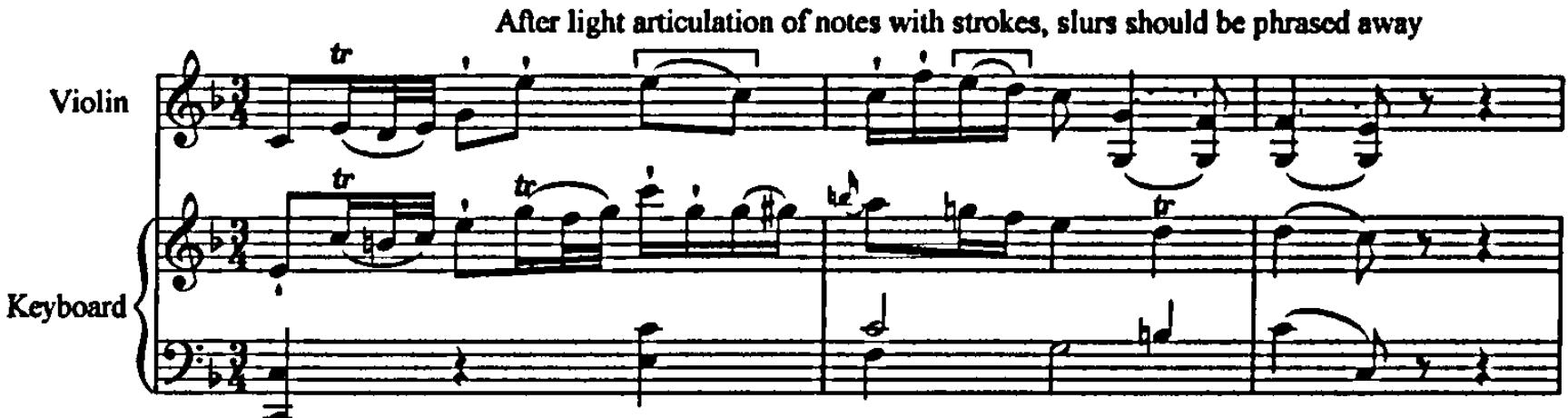
On the contrary, the use of strokes before a series of slurs can create a lifted and detached context for music which would otherwise be performed singly and legato. In the ‘Andante Grazioso’ of K8 (see example 4.22), it is the use of strokes on up-beats and detached notes that conveys a sense of grace. If the slurs which follow these strokes are played with a sustained bowstroke, they will sound incongruous. The slurs should therefore be phrased away, creating Leopold’s ‘small softness’ between each bowstroke. This is in spite of the fact that in relatively slow movements, violinists were often advised to play more singly.
中文讲解
本段给出K376之外的“反向”案例:当跳弓出现在一连串连弓之前时,它可以为本来“应单弓连奏”的乐句创造“离弦、分离”的语境。K8的“Andante Grazioso”(图例4.22)中,弱拍与分离音符上的跳弓传达“优雅(grace)”;如果其后连弓用持续弓法演奏,听感会“不协调(incongruous)”。因此这些连弓应被“抑开(phrased away)”,在每个弓段之间制造Leopold所说的“small softness(小柔软度)”。作者预先处理了一种潜在反驳——慢速乐章常被建议“更单弓演奏”——但仍坚持此处的跳弓语境优先于该通则,说明语境修饰规则的强度。
补充说明
本段援引Leopold的“small softness”概念,用以描述跳弓与连弓交界处的轻巧分离。
第13段(P0040)
原文复述
中文讲解
第8页的图像或乐谱占位符,对应图例4.22(K8的Andante Grazioso)。原图未呈现,需查阅原书以确认弱拍跳弓与后续连弓的分布及节奏位置。
补充说明
图像占位符,需查看原图。
脚注 / 边栏 / 图表 / 附加信息(如有)
本小节包含两幅跨页图例群:图例4.19-4.20位于第6页(K481第二乐章第18小节与第三乐章第94-95小节),用于在4.2向4.3过渡处展示跳弓标记;图例4.21位于第7页(K376第二乐章22-24小节),用于展示Andante中跳弓与连弓并置的“温柔语境”案例;图例4.22位于第8页(K8的Andante Grazioso),用于展示“弱拍跳弓后接连弓”的反向案例。此外第36号脚注(P0028)属于版本考证脚注,作用是为4.2小节讨论的K481段落提供手稿与初版的差异对照(参Eisen 2007: 74)。
💡 本节核心要点
- 本小节的核心论旨:跳弓记号虽然通常表示“短促离弦”,但其articulation的“长度与起音强度”必须随语境调整,而不能被机械套用为单一的离弦动作。
- Quantz(1752: 232)的关键修正规则:Allegro中的八分音符与Allegretto中的十六分音符若连续出现,跳弓标记应被解读为“极短弓不离弦”,否则听感会“像被砍或被鞭打”。
- Türk(1789: 343)把语境维度扩展为“体裁/速度/力度”三项,并区分“严肃、温柔、悲伤”类作品需要比“活泼、幽默”类更长的articulation。
- K376第二乐章(Andante)案例:慢速下行音阶上的跳弓标记警告演奏者“不要用通常的连奏”,但开头的连弓线设定了“温柔”语境,因此应演奏为“离弦但轻、像刷过一般(brushed)”的弓法。
- K8的Andante Grazioso反向案例:弱拍与分离音符上的跳弓为后续连弓创造“离弦、分离”的语境,连弓应被“抑开”,制造Leopold所说的“small softness”。
- 语境修饰的优先级:本节论旨意味着“速度、时值、体裁、邻近记号”共同决定跳弓的“质”,而非“是否离弦”这一单一维度。
🔑 关键术语
- strokes / stroke marks (little strokes):18世纪弓弦记号系统中标在音符上方的小点;本节论证其通常指示“短促离弦”,但演奏方式受速度、时值、邻近记号(连弓线)与体裁的修正。
- bowstroke:一次运弓的动作;本节关注其两个维度——“弓段长度”与“是否离弦”。Quantz明确要求跳弓“弓段必须短”,并允许贴弦或离弦两种执行方式。
- articulation:音符之间的连接方式(连/断/抑);本节强调跳弓的articulation可“长”可“短”,并非固定不变,Türk更把其与“性格、力度”关联。
- on-the-string stroke / lifted stroke (贴弦/离弦):贴弦弓法与离弦弓法;Quantz指出“标记跳弓的快速连续乐段更宜用贴弦弓法”,修正了“跳弓=离弦”的等号。
- chopped or whipped (砍/鞭):Quantz的形容:若在快速连续跳弓中强行按标准离弦动作抬弓,声音会“像被砍或被鞭打”,由此证成“短弓不离弦”的必要性。
- small softness (Leopold):Leopold Mozart用以描述跳弓与连弓交界处的轻微柔软分离;本节在K8案例中用以刻画连弓应被“抑开”的实际效果。
- tempo / note-length / character (速度/音符时值/性格):本节认作决定跳弓articulation的三大语境维度,分别来自Quantz-Geminiani与Türk的论述。
- slur / legato (连弓线/连奏):本节反复用以界定跳弓所在语境的邻近标记;K376案例中“动机开头的连弓线”决定了跳弓应“温柔”,K8案例中跳弓之后“应被抑开的连弓”产生“small softness”。
4.4 [描述性拆分] Strokes as Precautionary Markings Against Conventional Bowing
第1段(P0041)
原文复述
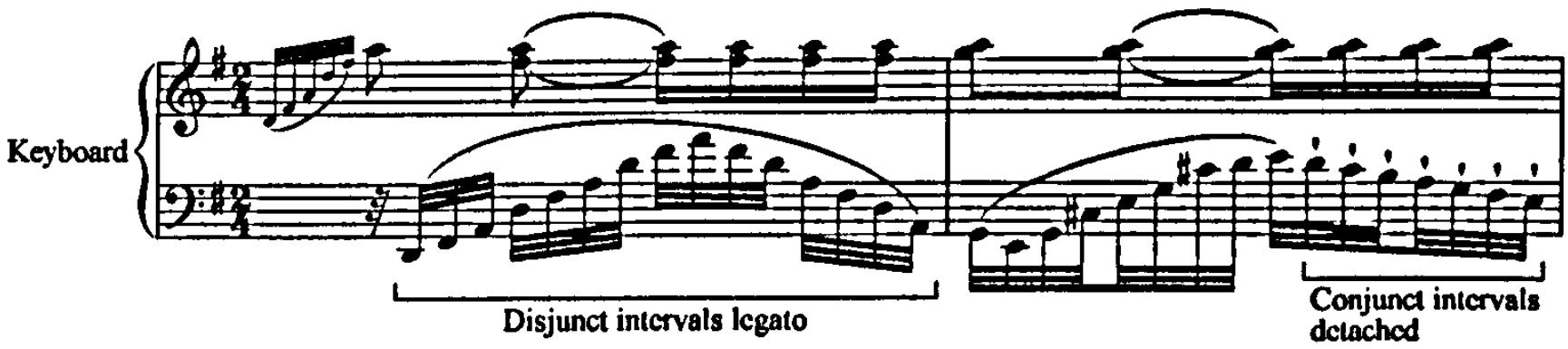
Thus, as well as showing that the delivery of strokes should vary depending on context, Mozart’s Sonatas for Violin and Keyboard demonstrate that strokes often function as a sign of precaution: when the articulation contradicts the expected bowstroke for a given context, it can be indicated through the use of performance markings. Indeed, we have seen in example 4.21 that strokes are used during scalic motives which might otherwise be performed legato. This is seen even more clearly in the keyboard part of the opening Adagio of K379, where leaps, which usually receive a detached articulation, are slurred, and scales are marked with strokes:
中文讲解
本段是4.4小节的核心论点段。它在承前(小节主题"Strokes as Precautionary Markings Against Conventional Bowing”)的基础上,正式提出本章主张:莫扎特的钢琴与小提琴奏鸣曲中,stoke(顿弓记号)常常作为"预防性标记"出现——当实际演奏所需的发音方式与某一语境下默认预期的弓法相矛盾时,演奏者会用演奏标记(如stoke、连弓线)来明示这种偏离。段落用"as well as"表明这一功能与之前讨论过的"stoke的delivery应随语境变化"是并列、互补的两个观察,并不取代前者。段落随即以example 4.21(已在4.3小节出现过)作为过渡证据,但明确指出"seen even more clearly”——真正的范例将出现在紧接着的K379第一乐章Adagio中。在该例中出现了两个反向操作:通常应当断奏的跳进被加上连弓线,而通常可以legato演奏的音阶却被加上stoke记号。这种"该断不断、该连不连"的双重反向,正是作者所谓"precautionary"的核心:用演奏记号提醒演奏者不要落入习惯性弓法的陷阱。
补充说明
段落开头的"Thus"承接前文;“example 4.21"是上文已引用的例子编号;“example 4.23"即将在下一段引出。“expected bowstroke for a given context"中的"given context"是理解全段的关键,指乐句的体裁、速度、风格等默认条件。
第2段(P0042)
原文复述
Example 4.23: K379, movement 1, bars 20-21. $^{37}$
中文讲解
这是Example 4.23的图注,说明该乐谱片段取自K379第一乐章第20–21小节。末尾的上标37表示其内容与脚注37有关联。
补充说明
K379即莫扎特G大调钢琴与小提琴奏鸣曲,K.379/373a;脚注37将在P0045中给出具体内容。
第3段(P0043)
原文复述
中文讲解
这是Example 4.23对应的乐谱图像占位符,位于第8页,紧接其图注之后。该图像本身承载P0041中提到的"跳进加连弓、音阶加stoke"两类反向记号的信息。读者需查阅原图以确认具体音符位置与stoke/连弓线的标注。
补充说明
因图像数据被省略,无法从此处直接读出stoke和连弓线分别落在哪些音上;具体信息依赖脚注37(P0045)补充。
第4段(P0044)
原文复述
Movements which are marked with Italian terms such as ‘sostenuto’ or ‘dolce’ also benefit from the use of strokes to clarify when the performer should contradict the overriding Affekt of the movement. The Andantino sostenuto e cantabile of K378 is a case in point (see example 4.24); here, strokes at the end of bar 32 create a lifted articulation which contrasts with the singing slurs which precede it. This provides another example of strokes setting a context for the slurs which follow them. The ‘small softness’ between each of the slurs in bar 33 is enhanced by the string crossings between each slur, and the energy at the start of each slur is supported by the crotchet pulse of the left hand of the keyboard. This is in contrast with the minim pulse which accompanied the legato theme of bar 31.
中文讲解
本段把"预防性stoke"的概念扩展到带有意大利语情态标记(如sostenuto、dolce)的乐章。这类乐章整体笼罩在歌唱性、绵延的Affekt之下,正是这种默认情态使某些局部段落需要stoke来"反衬"地提醒演奏者保持清晰、抬起(lifted)的发音。段落以K378第二乐章Andantino sostenuto e cantabile为例(Example 4.24):第32小节末尾的stoke制造出一种"抬起"的发音,与前面的歌唱性连弓形成对比,作者用"strokes setting a context for the slurs which follow them"再次强调stoke作为"上下文提供者"的功能——stoke通过断开让随后的连弓更显歌唱性。第33小节中各连弓之间的"small softness”(细微柔化)靠小提琴的换弦实现,而每个连弓起始处的能量则由钢琴左手四分音符的脉动支撑;这与第31小节以二分音符脉动支撑legato主题形成对照,说明stoke不只是一个孤立的发音符号,而是改变整段节奏-触键关系的事件。本段对论证链的意义在于:它把stoke的"预防性"从单纯的弓法层提升到乐章情态与节奏脉动之间相互作用的层次。
补充说明
“Affekt"在本节中指乐章整体情绪基调(此处为sostenuto/cantabile所暗示的歌唱、绵延);术语sostenuto与cantabile的搭配表明该乐章默认要求持续、歌唱的连奏风格。“crotchet pulse"和"minim pulse"分别指钢琴左手的四分音符与二分音符节奏骨干。
第5段(P0045)
原文复述
$^{37}$ The first edition has slurs over notes 1-4 and 5-8 of bar 21. Strokes are notated over notes 9-16.
中文讲解
脚注37澄清Example 4.23乐谱的原始记谱情况:第一版(the first edition)在K379第一乐章第21小节的第1–4音与第5–8音上标有连弓线(slurs),而第9–16音标有stoke。这一注释直接支持P0041的论断:在通常应连奏的音阶材料上标出stoke,正是"与默认预期相反"的预防性标记。该脚注作为来源性证据,使论断不依赖二手推测。
补充说明
“The first edition"指莫扎特作品的首版乐谱,是本段论证的原始依据;脚注编号37同时挂载于P0042的图注与P0045本身。
第6段(P0046)
原文复述
Example 4.24: K378, movement 2, bars 31-34.
中文讲解
Example 4.24的图注,说明所引乐谱片段位于K378第二乐章第31–34小节,对应正文段落中所讨论的sostenuto情态下stoke与连弓的对照。
补充说明
K378即莫扎特降B大调钢琴与小提琴奏鸣曲,K.378/317d。
第7段(P0047)
原文复述
中文讲解
这是Example 4.24对应的乐谱图像占位符,位于第9页图注之后。读者需查看原图方可确认第32小节末尾stoke与歌唱性连弓的具体位置,以及第33小节中的换弦结构。
补充说明
无额外补充(图像细节依赖原图)。
第8段(P0048)
原文复述
Strokes can also be used as a precautionary measure to confirm that notes are not to be played as part of a slur (as has been seen in example 4.6 above). Such strokes can occur over a single note or throughout a whole passage. For example, in the first movement of K7 (see example 4.25), a single upbeat quaver is marked with a stroke, clarifying that unlike the quaver upbeats in the bars before it, it should be lifted before the next note:
中文讲解
本段引入stoke的第二种预防性用途:明确某个音不属于(也不应被理解为)某条连弓线的一部分。作者以"as has been seen in example 4.6 above"回指前文已给出的例证,说明这不是孤立现象,而是贯穿全章的稳定模式。段落强调该用法的两种规模——单个音上的stoke和整段落的stoke标记。然后以K7第一乐章为例(Example 4.25):一个单独的弱拍八分音符被标上stoke,与前几小节看似相同的弱拍八分音符(默认可连入下一音)形成对比,作者指出此处的stoke意在使演奏者在该音处抬起,形成断奏的预防性提示。该例子的论证价值在于:仅凭一个音上的一个记号,就可以"否定"演奏者按既有模式连续演奏的本能。
补充说明
“example 4.6 above"是本章前面已出现过的例子编号,回指以建立与先前讨论的连续性;“upbeat quaver"指位于小节弱拍位置的八分音符。
第9段(P0049)
原文复述
Example 4.25: K7, movement 1, bars 10-12.
中文讲解
Example 4.25的图注,说明所引片段取自K7第一乐章第10–12小节,对应正文中关于单个弱拍八分音符上stoke预防性标记的讨论。
补充说明
K7为莫扎特早期A大调钢琴与小提琴奏鸣曲,K.7。
第10段(P0050)
原文复述

中文讲解
这是Example 4.25对应的乐谱图像占位符,位于第9页图注之后。读者需查看原图方可定位第10–12小节中具体被标stoke的弱拍八分音符及其与前后小节的关系。
补充说明
无额外补充(图像细节依赖原图)。
第11段(P0051)
原文复述
In the first movement of K8, every unslurred note in the violin’s first theme is marked with a stroke. While this implies a lifted style of performance, it also confirms the configuration of mixed articulations.
中文讲解
本段给出stoke预防性用法的更系统性例证:K8第一乐章小提琴声部第一主题中,每一个无连弓的音符都被标上了stoke。这里"每一个”(every)一词提示该标记并非偶尔为之的提示,而是贯穿主题的系统性配置。作者用"While…also…“的句式同时指出该标记的两层含义:一方面它暗示整体上应采取"抬起”(lifted)的演奏风格,另一方面它确认了混合发音(mixed articulations)的整体配置,即连弓与stoke在主题内部交替出现以构成对比。换言之,stoke在此并非单纯"提示某音断开”,而是承担了对整段音乐结构的确认功能——演奏者通过stoke明确知道哪些音属于歌唱性连弓,哪些不属于。
补充说明
“first theme"指奏鸣曲式呈示部中的主部主题;“mixed articulations"即连弓与断奏交替的发音配置,是本段论证的核心概念。
第12段(P0052)
原文复述
Example 4.26: K8, movement 1, bars 1-7.
中文讲解
Example 4.26的图注,说明所引乐谱片段取自K8第一乐章第1–7小节,对应正文中关于主题内"每个无连弓音均标stoke"的系统性配置。
补充说明
K8为莫扎特降B大调钢琴与小提琴奏鸣曲,K.8。
第13段(P0053)
原文复述

中文讲解
这是Example 4.26对应的乐谱图像占位符,位于第10页图注之后。读者需查看原图方可确认K8第一主题中stoke的具体分布及其与连弓的对应关系。
补充说明
无额外补充(图像细节依赖原图)。
脚注 / 边栏 / 图表 / 附加信息(如有)
本小节包含三组乐谱图例(Example 4.23、4.24、4.25、4.26)和一条脚注(37)。脚注37作为来源性证据,澄清了K379第一乐章第21小节第一版的记谱细节(连弓线位于第1–4与第5–8音,stoke位于第9–16音),支撑P0041中关于"音阶材料上使用stoke"的论断。Example 4.23(K379/1,bars 20–21)配合脚注37;Example 4.24(K378/2,bars 31–34)展示sostenuto情态下stoke与连弓的对比;Example 4.25(K7/1,bars 10–12)展示单个弱拍八分音符上的预防性stoke;Example 4.26(K8/1,bars 1–7)展示整段主题内stoke的系统性配置。所有图像细节均需查原图方可确认。
💡 本节核心要点
- Stoke常作为预防性标记使用:当实际需要的发音方式与某一语境下的默认预期弓法相矛盾时,用演奏记号来明示偏离。
- 预防性stoke可分为两类:1)在通常默认legato的音阶材料上标stoke(如K379第一乐章),2)确认某音不属于某条连弓线(如K7、K8)。
- 在带有sostenuto、dolce等意大利语情态标记的乐章中,stoke通过制造抬起式发音反衬整体歌唱性Affekt(如K378/2)。
- Stoke不只标记单个音的断开,它还能为紧随其后的连弓提供语境,使"断开"成为衬托"歌唱"的对照事件。
- Stoke的预防性功能可以从单音级别(如K7的一个弱拍八分音符)扩展到整段主题级别(如K8第一主题每个无连弓音均标stoke),后者同时确认了混合发音的整体配置。
🔑 关键术语
- strokes:小节的核心术语,指乐谱上的顿弓/跳音类演奏记号。在本节中其功能不是常规的断奏提示,而是"预防性标记”——当默认弓法与所需发音相矛盾时用以提示偏离。
- slurs:连弓线/连奏记号。在本节中常被作为stoke的对照对象出现,stoke常用于确认或衬托紧随其后的连弓。
- Affekt:乐章整体情绪基调。本节用其指代sostenuto、cantabile、dolce等情态标记所暗示的歌唱性、绵延的默认演奏风格。
- precautionary markings:本节小节标题中的核心概念,指stoke记号的预防性用途:用来避免演奏者按习惯性弓法误读乐谱。
- legato:连奏,在本节中常作为某种语境下的"默认预期弓法"出现,作者以此衡量stoke是否构成反向标记。
- crotchet pulse / minim pulse:分别为四分音符与二分音符的节奏脉动。在K378第二乐章的对比中,前者支撑stoke处的能量,后者支撑legato主题,作者借此说明stoke不只影响弓法还改变节奏骨架。
4.5 [描述性拆分] Strokes Clarifying Rhythm, Metre, and Rhythmic Alteration
第1段(P0054)
原文复述
Another function of strokes is to clarify rhythmic or metrical features. In the final movement Rondeau of K378 (see example 4.27) strokes are written over quavers which immediately follow extensive triplet passages. The strokes therefore reinforce the even pulse, and encourage the performer to emphasise this in their delivery:
中文讲解
本段开启了本小节的核心论点:弓法标记(strokes)除了已经讨论过的功能之外,还具有澄清节奏与节拍特征的作用。作者以K378第三乐章回旋曲(Rondeau)为例,解释了一个具体的演奏逻辑:在小提琴声部出现一段较长的三连音(triplet)段落之后,紧随其后的八分音符(quavers)上被加上弓法标记。由于三连音倾向于把律动带向"三等分"的惯性,紧接着回到常规偶数拍时,听者或演奏者很容易继续按三连音的律动去感觉这些八分音符。因此作者认为,这些八分音符上的弓法标记起到一种"听觉扶正"的作用——强调偶数拍的均匀脉动(even pulse),提醒并鼓励小提琴演奏者在衔接处明确地把节奏"拉回"到二拍子的等分律动上。这一论点的关键不在于弓法标记本身改变音色,而在于它被作者(莫扎特)当作一种节拍示意工具来使用,把演奏者的注意力引向节奏回到正拍脉动的瞬间。
补充说明
本段首次引出K378作为后续段落中K378与K380对比的基础;它将"rhythmic/metre clarification"确立为与rhythmic alteration并列的两大功能之一。
第2段(P0055)
原文复述
Example 4.27: K378, movement 3, bars 183-5.
中文讲解
此条为图例4.27的标题:标识K378第三乐章第183-185小节的谱例。它是P0054所讨论现象的视觉证据,需参照原谱查看才能确认三连音段落与紧随其后的带弓法标记的八分音符的准确位置及具体音符。
补充说明
图例编号为4.27,呼应章节属于第4章(K numbering与本小节编号体系需查看原书第4章)。
第3段(P0056)
原文复述
中文讲解
此条原为图例4.28的图注,说明K380第一乐章中弓法标记承担了一种与K378相反的节奏功能:在K378中,弓法标记用于把节奏从三连音拉回到偶数拍;而在K380中,弓法标记则用于突出从二拍脉动(duple pulse)转向三连音段落(triplet passagework)的过渡节点。换言之,作者借助这一对比,把"弓法标记 = 标记节奏过渡点"的功能从"过渡到均匀二拍"扩展到"过渡到三连音”,使小节开篇关于"澄清节奏"的论点更加完整。
补充说明
图注中"opposite rhythmic effect"一词与P0054构成对照关系:同一类标记在不同作品中可能服务于相反的节奏引导。
第4段(P0057)
原文复述
中文讲解
此条为第11页的图像/乐谱占位符,因图像内容未保留,无法直接确认具体谱例细节。其在原文中的位置紧跟P0056的图注之后,故可推断它承载的是图例4.28(K380第一乐章的谱例)的图像本体,需参照原书查看具体小节与小提琴声部弓法标记的音符位置。
补充说明
占位符中"第11页"对应原书页码;与P0056配合共同构成图例4.28。
第5段(P0058)
原文复述
In K7 and K9, strokes appear to be used in order to draw attention to issues of rhythmic alteration. In the autograph version of the second-movement Adagio of K7, strokes are consistently written on a recurring motive in the right-hand keyboard part. However, the rhythms themselves are inconsistent (these discrepancies are illustrated in example 4.29). When the motive follows rests it is always dotted (as in bars 13, 14, 16, 36, 38 and 40), but otherwise, the first note of the figure is written as a semiquaver (bars 8, 18 and 42). In one instance, bar 41, the entire motive is written as semiquavers. The fact that these motives are related to one another is substantiated by the painstaking application of strokes to each version; perhaps, then, the strokes indicate that all hearings of this motive should be dotted (probably imitating the triplet pulse of the left hand), as occurs in the majority of cases:
中文讲解
本段把话题从"澄清节奏"转向本小节的第二个功能——揭示节奏变化(rhythmic alteration)的问题。以K7第二乐章Adagio的亲笔手稿(autograph)为例,作者观察到右手键盘声部中有一个反复出现的主导动机(recurring motive),每一次出现时作者都仔细地加上了弓法标记——这一点本身已经暗示莫扎特对这个动机有特别的意图。然而这个动机在不同小节里的实际记谱并不一致:紧跟休止符出现时(例如第13、14、16、36、38、40小节),它总是被记成附点节奏(dotted);而在非休止符后出现时(第8、18、42小节),动机的第一个音被记成十六分音符(semiquaver);第41小节更是整个动机都用十六分音符记写。作者由此推论:尽管记谱有出入,但所有版本都被仔细加上弓法标记这一事实表明这些动机在概念上是同一材料的不同写法;弓法标记可能在指示演奏者:无论记谱上写的是哪一种,所有出现都应统一演奏为附点节奏——很可能是模仿左手声部的三连音律动(triplet pulse)。这一推论的关键在于"标记者的意图"与"记谱的字面"之间的张力:弓法标记不是附属装饰,而是对演奏节奏的隐性指令。
补充说明
作者在这里区分了亲笔手稿(autograph)与出版版本的区别——本段观察基于亲笔手稿,因此排除了印刷排版引入的错误。
第6段(P0059)
原文复述
Example 4.29: K7, movement 2, bars 40-42.
中文讲解
此条为图例4.29的标题,标识K7第二乐章第40-42小节的谱例。这一小节范围正涵盖P0058所述的关键例子:第40小节附点节奏、第41小节全动机十六分音符化、第42小节首个音为十六分音符这三种记谱变体恰好被并置在同一谱例中,因此该图例承担了用视觉证据集中展示"同一动机的不同记谱"的功能。
补充说明
图例范围(40-42小节)的选择本身即作者的论证——把最反常的变体(第41小节)夹在两个相对更典型的变体之间,以便对照查看。
第7段(P0060)
原文复述

中文讲解
此条为第11页的图像/乐谱占位符,对应图例4.29(K7第二乐章40-42小节)的图像本体。需参照原书查看亲笔手稿中具体弓法标记在每种变体动机上的位置与方向。
补充说明
占位符提示该图例与P0058共同支持"记谱不一致但弓法标记一致"的论点。
第8段(P0061)
原文复述
In the first movement of K9, strokes bring the player’s attention to a rhythmic issue which is even less consistently notated. In the opening theme of this Allegro spiritoso, a motive which is initially heard as straight quavers (in bar 3), is varied on its repeat (bar 5) to include at dotted rhythm (see example 4.30). The slurs in the keyboard right-hand part in bar 3 confirm that the dotted rhythm of the first two bars does not cut in bar 3, and the stroke on the third note of the violin’s bar 3 (and similarly in bar 48) in the autograph version of this sonata could either be interpreted as a precautionary marking, clarifying that the violin should not slur notes 2 and 3, or as an indication that these notes should be played as straight quavers. The use of strokes to signify straight quavers is further suggested at the end of bar 6; here, the right-hand quavers which contrast with the violin and left-hand dotted rhythms are marked with strokes:
中文讲解
本段以K9第一乐章(Allegro spiritoso)为案例,将上一段的"记谱不一致"主题推向更深的层次:这里不仅记谱不一致,而且记谱形式本身可能存在错误。作者指出:在第3小节中,开场主题动机最初以平直的八分音符(straight quavers)呈现;但在其重复(第5小节)时,被变奏为附点节奏。键盘右手声部第3小节的连线(slurs)确认了第1-2小节的附点节奏并未延续到第3小节。然而在亲笔手稿中,小提琴声部第3小节(同样在第48小节)第三个音上有一个弓法标记——这一标记至少有两种合理解读:其一,它是一个预防性标记(precautionary marking),用以澄清小提琴不应把第2和第3个音连奏;其二,它是一个演奏指示,明确这两个音应作为平直八分音符演奏。本段进一步在第6小节末尾找到一个旁证——右手键盘声部中与小提琴和左手附点节奏形成对比的那些八分音符也带有弓法标记。这一对照强化了第二种解读的可能性:弓法标记确实被用来"标记平直八分音符”。本段的论证策略是:先展示一个孤立标记的双重解释空间,再用第二个标记位置建立旁证,从而支持其中一个解释。
补充说明
“precautionary marking”(预防性标记)这一概念是本节的核心解释工具——意味着莫扎特添加标记不是因为有错误,而是为了防止演奏者可能犯的常见错误。
注意原文"at dotted rhythm"疑为"a dotted rhythm"的OCR误植,应按"附点节奏"理解。
第9段(P0062)
原文复述
Example 4.30: K9, movement 1, bars 1-7.
中文讲解
此条为图例4.30的标题,标识K9第一乐章第1-7小节的谱例。该范围覆盖了开场主题的完整初次陈述(第1-4小节)及其变奏重复(第5-8小节中的5-7小节),并包含了P0061所讨论的第3小节、第6小节末尾两处弓法标记,是论证"弓法标记在K9中功能"的主要视觉证据。
补充说明
图例范围(1-7小节)恰好包含开场主题的两种形态对比,便于在同一谱面上观察变奏关系。
第10段(P0063)
原文复述
中文讲解
此条为图例4.31的图注。它延续P0061的论证,把焦点转到K9第一乐章第36小节:小提琴声部第三个音在此处获得了一个弓法标记,标记所在位置恰好暴露出小提琴与键盘声部之间存在节奏差异。作者提出两种解释来框定此现象:其一,从版本对比来看(比较同动机在第5、第50小节中的处理),小提琴与键盘在此处演奏不同节奏几乎不可能,因此小提琴声部的记谱很可能是一个错误(mistake)——弓法标记是莫扎特自己(或者抄写者)针对某个不一致处的补救;其二,弓法标记也可能并非修错,而是对小提琴演奏者的一个明确信号,要求小提琴演奏者主动对那个八分音符作节奏上的变动(rhythmically alter),使其与键盘声部保持一致。图注本身并未在两个解释之间作出最终判断,而是把这一不确定性呈现给读者,作为整段论证的收束——把"节奏差异"与"标记功能"的解读空间完整地暴露出来。
补充说明
原文"violin’s third note receives a stroke"呼应P0061对第3小节第三音的讨论——两处相似位置的相似处理形成K9内部的呼应,可能暗示一种系统性的标记习惯。
“rhythmically alter”(节奏改动)是本节rhythmic alteration概念的演奏学落地:标记不是装饰,而是允许/要求演奏者改动记谱本身的指令。
第11段(P0064)
原文复述
中文讲解
此条为第13页的图像/乐谱占位符,对应图例4.31(K9第一乐章第36小节)的图像本体。需参照原书查看小提琴与键盘声部之间的具体节奏形态,以及第三个音上弓法标记的方向与位置。
补充说明
占位符与P0063的图注配合,共同构成图例4.31。
第12段(P0065)
原文复述
While the strokes in this movement are not consistently applied to these motives of questionable rhythm, they certainly serve to draw the performer’s attention to irregularities in the notation.
中文讲解
本段是本小节的收束句,对K9第一乐章的讨论作了温和的限制性总结:作者承认弓法标记在那些"节奏值得怀疑"的动机上并未被一致地使用(即不是每次出现都加了标记),因此不能简单地说"标记=统一处理某动机”;但同时,作者仍明确主张弓法标记的核心功能是——把演奏者的注意力引向记谱中存在的异常(irregularities)。这一收束既肯定了弓法标记的演奏学价值(注意力指引),又对前面过度依赖标记一致性的推论作出克制的限定,体现出作者方法论上的严谨:从"标记出现"到"标记即指令"之间存在不可跨越的推论距离。
补充说明
“irregularities in the notation"与本节标题中的"rhythmic alteration"互为表里:记谱的不规则性正是节奏改动讨论的现实基础。
脚注 / 边栏 / 图表 / 附加信息(如有)
本小节包含四个独立图例:4.27(K378第三乐章183-185小节,P0054-P0055)、4.28(K380第一乐章,P0056-P0057)、4.29(K7第二乐章40-42小节,P0058-P0060)、4.30(K9第一乐章1-7小节,P0061-P0062)、4.31(K9第一乐章第36小节,P0063-P0064)。其中4.27、4.28支持"澄清节奏/节拍"的功能;4.29支持"弓法标记一致但记谱不一致"的K7案例;4.30、4.31支持K9案例。所有图例的图像本体均因OCR/格式原因未保留,需查原书方能确认谱面细节。小节内无独立脚注。
💡 本节核心要点
- 弓法标记具有双重节奏功能:在K378中用于把节奏从三连音拉回到均匀偶数拍(reinforce the even pulse);在K380中则用于强调从偶数拍向三连音的过渡——同一类标记在不同语境中可服务于相反的节奏引导。
- 在K7第二乐章中,弓法标记被持续地、一致地施加于一个反复出现的动机,尽管该动机在不同小节中记谱形式不同(附点节奏vs十六分音符);作者推断标记可能在指示演奏者将所有出现统一为附点节奏,以模仿左手声部的三连音律动。
- 在K9第一乐章中,弓法标记与记谱之间的关系更加模糊;它们既可以被解读为预防性标记(防止演奏者错误连奏),也可以被解读为对平直八分音符的明确演奏指示;第6小节末尾的对照处理倾向于支持后一种解读。
- 在K9第36小节,弓法标记暴露出小提琴与键盘声部之间的节奏差异,作者允许两种解释并行:记谱错误,或标记作为对小提琴声部作节奏改动的信号。
- 本节的方法论克制点:作者明确承认弓法标记在K9中并非一致地施加于所有"节奏可疑"的动机,因此不能机械地把"标记"等同于"指令”;弓法标记的可靠功能被限定为"把演奏者的注意力引向记谱中的异常”。
🔑 关键术语
- Strokes:在本节中指莫扎特在小提琴声部音符旁所加的弓法标记(通常为上弓、下弓记号)。本节论证的核心是:这些标记除了指示运弓方向外,还在节奏层面承担"澄清节拍"与"揭示节奏改动"的功能。
- Rhythmic alteration:节奏改动,即演奏者根据乐谱中某个标记的指示,对原本记谱的节奏时值进行有意的延长、缩短或重音化,以符合作品的内在律动要求;本节中常体现为将平直八分音符改为附点节奏(或反之)。
- Even pulse / Duple pulse:均匀的偶数拍脉动,即每拍被均分为两份的律动;与三连音形成的三等分律动相对。本节中"弓法标记reinforce the even pulse"意味着把节奏意识从三等分拉回二等分。
- Triplet passagework:三连音段落,即连续以三等分方式组织节拍单位的音乐片段;K380第一乐章中弓法标记用于标记从偶数拍进入此类段落的过渡节点。
- Precautionary marking:预防性标记,指作曲家为防止演奏者可能犯的常见错误(如不当连奏)而预先添加的标记;本节认为K9中的部分弓法标记可作此理解,但其与"明示演奏法"之间的边界并不确定。
- Autograph:作曲家亲笔手稿。本节所有关于弓法标记的判断均以亲笔手稿为依据,以避免印刷版本引入的偏差。
4.6 [描述性拆分] Transferring Strokes Between Parts and Conclusion of Stroke Discussion
第1段(P0066)
原文复述
Another issue surrounding strokes is whether to transfer them to other instruments when they are only notated in one part, therefore equalising the articulation of a passage. This, again, is a problem which must be judged in accordance to each specific circumstance, and which will therefore give rise to differing interpretations from one performer to the next. Take, for instance, the third movement of K296 (see example 4.32): in bar 78, strokes are notated in the violin part only, yet the left-hand keyboard part plays the same passagework a third beneath the violin. In his critical commentary to the Peters Urtext edition of this sonata, Cliff Eisen writes that ‘Since neither autograph nor first edition has strokes, I take the differing articulation between Keyboard and Violin to be intentional’ (Eisen, 2007:118). It seems more likely to the current writer, however, that due to the rhythmic and melodic unanimity between these parts the keyboard should add these strokes by analogy with the violin, thus imbuing the two instruments with a shared and equal expressive intent:
中文讲解
本段引入弓法记号讨论中另一个具体问题:当一个弓法记号只写在小提琴声部、而钢琴左手声部在小提琴下方三度处演奏相同旋律材料时,演奏者是否应当将这一记号"传递”(transfer)给钢琴声部,使两件乐器取得统一的奏法。
作者开门见山地指出,这是无法一概而论的问题,必须根据每一处的具体情境来判断,因此不同演奏者会得出不同的解释。这一限定本身即呼应了本节反复强调的核心立场:弓法记号不能机械套用规则。
随后作者以 K296 第三乐章第 78 小节(参见例 4.32)作为案例:弓法记号只写在小提琴声部,钢琴左手在小三度下平行演奏相同段落。作者引用 Cliff Eisen 在 Peters Urtext 版评注中的立场——手稿与初版均无 strokes,因此两件乐器奏法的差异应被视为"有意为之”(Eisen 2007:118)。这一引述为作者随后提出反观点设定了对话对象。
作者明确表态:由于两个声部在节奏和旋律上完全一致(unanimity),钢琴应当以"类推”(by analogy)方式把小提琴的弓法也用上,让两件乐器共享同一表达意图。换言之,作者用演奏学上的类推推理来反驳纯文本校勘学(text-critical)的主张,把"记号在原谱中是否同时出现"这一证据的等级降低,把"音乐语境的一致性"提升为更重要的判断依据。
本段的功能:在弓法记号讨论的最后一组小节中,举出"跨声部分享记号"这一边缘但实际的问题,并以 K296 为具体例证建立作者立场,为下一段的总结与 Dancla 引文提供新的论证素材。
第2段(P0067)
原文复述
³⁸ The stroke over note 3 of the violin part in bar 34 does not appear in the first edition.
中文讲解
这是 P0066 后所附的脚注 38,提供关于 K296(或紧邻谱例)小提琴声部第 34 小节第 3 音上弓法记号的版本信息。
这条脚注的作用是版源性旁证:它告诉我们初版(first edition)中没有这一弓法记号。结合 P0066 中 Eisen 主张"手稿与初版均无 strokes",本脚注印证了不同版本之间弓法记号存在差异,提示读者:在评估任何弓法记号时,原始资料与后续版本之间可能并不一致。
它对正文主张是支持性的:用版源差异来佐证作者所关注的"单一乐器声部独享记号"问题并非孤例。
第3段(P0068)
原文复述
中文讲解
本条为第 14 页的图像或乐谱占位符,位置紧接 P0066 关于 K296 第三乐章第 78 小节的讨论,对应正文所提及的"例 4.32"。
依据 P0066 的描述,可以确认该谱例展示的内容是:K296 第三乐章第 78 小节前后,小提琴声部带有弓法记号、钢琴左手声部在小三度下方演奏相同旋律材料且无弓法记号的状态。具体的音符、和声与谱面细节因图像省略无法核实,“需查看原图”。
此图在 P0066 论证中的功能是让读者直观比较两件乐器声部在节奏与旋律上的一致性,从而理解作者所主张的"通过类推使两声部获得统一奏法"。
补充说明
需查看原图以确认具体音高、力度与记号位置。
第4段(P0069)
原文复述
These various examples of the appearances of strokes in Mozart’s Sonatas for Violin and Keyboard illustrate their wide ranging functions and varied articulation. In numerous circumstances strokes primarily act to draw our attention to change, whether it is rhythmic change, or alterations of established patterns of slurs or mixed articulations. They are also important signifiers of character change, and as such are used to clarify that the performer should contradict the expected or conventional articulations suited to a movement-type (such as a slow movement, or one marked with qualifying terms such as ‘sostenuto’ or ‘cantabile’) or motive (such as a scale, which would usually imply legato bowstrokes). Strokes appear to be used by Mozart in various contexts to imply a lifted and short articulation, be it within a phrase, as an upbeat, or the last note of a phrase. In other circumstances, however, we have seen that it is the unmarked note at the end of a phrase which can be interpreted as signifying lightness, while the strokes which precede it suggest a heavy and accented stroke. Indeed, the articulation of a stroke is by no means limited to its general definition as half the written note length, and performed with a lifted bow. Dancla therefore warns violinists, less than 100 years after Mozart’s Sonatas were published, that:
中文讲解
本段是本节前半部分(4.1–4.5)所有弓法记号案例的回顾与综合,立在 P0070 的 Dancla 引文之前,起到承上启下的作用。
作者先承认:莫扎特小提琴与键盘奏鸣曲中出现的弓法记号功能多样、奏法各异,因此无法用单一规则概括。这是本节的核心结论之一。
接着作者归纳出弓法记号的若干主要功能,按重要性大致排列:
- 标示变化——无论是节奏变化,还是既定连弓或混合奏法模式的改变。
- 标示性格转换——让演奏者故意违背"慢板"“sostenuto"“cantabile"等体裁/术语所暗示的常规奏法,或违背"音阶通常应连奏"这种动机层面的预期。
- 表达"短促、抬弓"的奏法——既可出现在乐句中间,也可作为弱起或乐句末音。
但作者随后给出反例:有时乐句末音并未标弓法记号,反而是它前面的记号暗示了一个"重而强调"的弓法,而无记号的末音被解读为"轻”。这与一般把弓法记号等同于"短促抬弓"的简化理解相矛盾。
最后,作者用"Dancla therefore warns……“的转折引出 P0070 的引文,意在用一位距莫扎特不到 100 年的小提琴教育家的实践忠告,来印证作者本人对弓法记号不能简单套用"半音符值、抬弓"这一定义的立场。
第5段(P0070)
原文复述
In certain editions of the Sonatas by MOZART for Piano and Violin the dash [stroke] is equally employed in Adagio and Allegro movements… let us not forget that it cannot have the same meaning. The performer must use his intelligence and skill to interpret the true character of the composer’s thoughts, without preoccupying himself too much with a sign often misapplied. (Dancla, c.1860: 194)
中文讲解
这是 Charles Dancla 约 1860 年著作中关于弓法记号(dash/即 stroke)使用的一段引文,作者用其作为 P0069 论点的外部权威佐证。
引文含义:某些版本的莫扎特钢琴与小提琴奏鸣曲中,“dash”(即本文讨论的 stroke)被同等地用于 Adagio 与 Allegro 乐章——但这并不意味着它在两种速度下具有相同含义;演奏者必须运用自己的智识与技巧去判断作曲家真正想要表达的性格,而不能被一个常被误用的记号所束缚。
这段引文的作用有三重:
- 时代佐证——Dancla 距离莫扎特奏鸣曲出版(多在 1780s–1790s)不到 100 年,其演奏实践传统比现代演奏者更接近原作语境。
- 反驳简化定义——明确指出弓法记号在快慢乐章中含义不同,呼应作者对"半音符值、抬弓"这一定义的批评。
- 演奏学立场——把判断权下放给演奏者,要求其基于"作曲家意图"与"上下文"作出解释,而非机械套用记号。
第6段(P0071)
原文复述
Thus, while strokes and dots are variously defined throughout the eighteenth and nineteenth centuries, and the issue of whether Mozart used both strokes and dots is hotly contested, the above examples illustrate that in any case, the function and delivery of a stroke cannot be neatly defined. Like unmarked notes, the quality of articulation given to each note marked with a stroke must be assessed in the light of its context. Furthermore, the function of any given stroke can only be ascertained through the interpretation of its role within a particular movement. Appendix 1 (movement 2 of K379) demonstrates that even within one movement, strokes can be interpreted as having an array of contrasting functions and articulations. In conclusion, as significant indicators of change, strokes highlight important moments within the musical discourse, challenging us as to what has gone before the stroke, and what happens after it. It is the performer’s task to interpret the function and quality of each stroke depending on its context, and to convey it through their delivery.
中文讲解
本段是 4.6 小节乃至整篇弓法记号讨论的正式收束。
作者以"Thus"重申本节总论点:弓法与跳音(dots)在 18、19 世纪的定义本身就多种多样,而"莫扎特是否同时使用两种记号"也仍是被激烈争论的问题,但无论如何,弓法记号的功能与执行(function and delivery)都无法被整齐划一地定义。
接着作者提出两条具体判断原则:
- 与"无记号"的音一样,每一个带弓法记号的音的奏法质量都必须在其上下文(context)中被评估。
- 任何给定记号的功能只能通过其在该乐章中所扮演角色的解释来确认。
作者随后把读者导向附录 1(K379 第二乐章),以证明即使在同一个乐章内部,弓法记号也可能被解释为一系列功能与奏法相互对比的角色——这是从"跨乐章差异"推进到"乐章内差异”。
最后是整节结论:弓法记号是"变化”(change)的重要指示符,能在音乐论述中标记关键时刻,并让演奏者与分析者对"记号之前发生了什么、之后又发生了什么"进行反思。作者以一句总结明确演奏者的任务:根据每一个记号的上下文解释其功能与质量,并通过演奏把它传达出来。
本段在论证链中相当于整节的"收口":把前面所有具体例证(4.1–4.5)压缩为方法论原则,并把演奏学责任明确归于演奏者本人。
脚注 / 边栏 / 图表 / 附加信息(如有)
本节包含一项脚注(P0067,即脚注 38,版源性信息,关于小提琴声部第 34 小节第 3 音弓法记号不见于初版)和一个图像/乐谱占位符(P0068,对应 P0066 中提到的例 4.32,K296 第三乐章第 78 小节)。P0070 是对 Dancla c.1860:194 的引文,起到时代佐证作用;P0071 提及附录 1(K379 第二乐章)作为同乐章内弓法记号功能多样性的进一步例证。
💡 本节核心要点
- 弓法记号不能机械套用规则:作者反复强调每一个记号都必须依据其具体上下文(包括乐章类型、动机特征、所在声部、相邻记号)来判断其功能与奏法。
- 跨声部传递记号的问题:以 K296 第三乐章第 78 小节为例,作者主张当两件乐器在节奏和旋律上完全一致时,钢琴应通过类推采纳小提琴的弓法记号;这与 Eisen 依据手稿与初版所做的纯文本校勘立场不同。
- 弓法记号的核心功能是标示变化:包括节奏变化、既定连弓或混合奏法模式的打破,以及对慢板、sostenuto、cantabile 等常规奏法的故意违反。
- 对简化定义的反驳:作者明确反对"弓法记号一律等于半音符值的抬弓"这一定义;并以 19 世纪小提琴家 Dancla 的警告(同一记号在 Adagio 与 Allegro 中含义不同)为时代佐证。
- 演奏者的解释权与责任:记号功能最终由演奏者根据上下文解释并通过演奏传达出来;附录 1(K379 第二乐章)证明同一乐章内弓法记号可承担多种相互对比的功能。
🔑 关键术语
- stroke:本节核心讨论对象,指小提琴分弓(抬弓)记号,在历史与本节语境中也称 dash;与点(dot)相对应,但本节强调其含义与奏法因上下文而异。
- transferring strokes between parts:指当某弓法记号只写在一个声部时,是否应类推到平行演奏相同材料的另一声部;作者主张以"节奏与旋律一致性"为依据。
- by analogy:本节作者所用推理方法:当两声部材料完全一致时,缺失记号的声部应参照有记号的声部补上记号,以求统一表达意图。
- sostenuto / cantabile:莫扎特奏鸣曲中常见的体裁/术语标记,分别暗示持续、歌唱的奏法;作者指出弓法记号有时被用来故意违反这些暗示。
- Peters Urtext edition:由 Peters 出版的"原始版"乐谱,附 Cliff Eisen 的评注;Eisen 在其中以"手稿与初版均无 strokes"为由,主张 K296 第 78 小节两声部奏法不同是"有意的"。
- Dancla, c.1860:19 世纪小提琴教育家,其著作约 1860 年;本节用其论述来佐证"同一弓法记号在快慢乐章中含义不同,演奏者需自行判断"的立场。
- Appendix 1 (movement 2 of K379):作者所指附录 1,K379 第二乐章;本节末尾以它为例证明同一乐章内弓法记号可承担多种相互对比的功能。
4.7 [描述性拆分] Slurs: Definitions, Diminuendo, and Context-Dependent Delivery
第1段(P0072)
原文复述
Slurs
中文讲解
这是第4.7节的小节标题,仅由单词"Slurs"(连音/连弓)构成。它开启本节的核心论题:连弓作为十八至十九世纪小提琴演奏中最适合呈现歌唱性旋律的运弓方式,其定义、力度变化(diminuendo)以及在不同上下文中的具体执行方式。
第2段(P0073)
原文复述
Although eighteenth- and nineteenth-century violinists were increasingly advised to create a smooth and cantabile detached articulation through discreet bow changes, slurs were still described as being the best way to deliver a singing melody. Indeed, Leopold writes that in order to bring out the ‘cantilena’ of a piece, one must know how much to ‘fit… into one stroke’, ‘in such a fashion that the notes which belong together shall run into each other’ (L. Mozart, 1756: 101-102). He furthermore explains that when a composer slurs ’two, three, four and even more notes’ together, ‘one recognizes therefrom that the composer wishes the notes not to be separated but played singly in one slur’ (L. Mozart, 1756: 123).
中文讲解
本段确立连弓(slur)的核心功能:尽管十八、十九世纪的小提琴家越来越多地被建议通过谨慎的换弓来实现平滑、歌唱性的断奏(detached articulation),连弓仍被视作传递歌唱性旋律的最佳手段。作者援引Leopold Mozart的两段引文:其一强调演奏者需要判断"多少音应纳入一弓",使属于一起的音符彼此连贯、流入彼此(run into each other);其二指出作曲家将两、三、四乃至更多音连写时,表明他希望这些音不被分开、而是在一个连弓中单独奏出。这两段引文分别从"弓量分配"与"记谱意图解读"两个角度为连弓下操作性定义,说明连弓不仅是符号,更是作曲家塑造连贯乐句的明确指示。
第3段(P0074)
原文复述
Commonly, slurs are described as being performed with a diminuendo, the first note being ‘gently (and almost imperceptibly) accented’ (Türk, 1789: 344). Leopold adds that the first note can also be played slightly long, with the remaining note or notes ‘slurred on to it quite quietly and rather late’ (L. Mozart, 1756: 115). Although Leopold writes that no further stress should be made within a slur (L. Mozart, 1756: 45), there are some occasions on which notes other than the first should receive emphasis; C.P.E. Bach teaches that slurs in groups of three or four notes pressure should be given on the first and third notes (C.P.E. Bach, 1753: 154), and Leopold himself gives examples of long slurs which contain accents at the start of each main beat (L. Mozart, 1756: 118). In these instances, the emphasis serves to clarify the pulse of the piece (this will be discussed further in chapter 5).
中文讲解
本段论述连弓的默认力度处理及其例外。默认模式下,连弓被描述为以渐弱(diminuendo)演奏,第一个音"轻微地(且几乎难以察觉地)被强调",并可略微拉长,其余音"安静地、较晚地连入"。Leopold亦主张连弓内部不再加重。然而作者随即指出例外:1)C.P.E. Bach教导三音或四音一组的连弓应在第一与第三音上施加压力;2)Leopold本人亦给出长连弓在每个主要重拍起音处带重音的实例。这些内部重音的目的并非破坏连弓,而是为了澄清乐曲的脉动(pulse),作者预告该议题将在第5章进一步讨论。可见连弓的"内部力度"在不同作者笔下并不统一,演奏者需根据连弓长度与音组结构判断是否需要内部重音。
补充说明
本段提及的Türk(1789)、L. Mozart(1756)、C.P.E. Bach(1753)均为十八世纪德语区主要的小提琴/键盘演奏理论家;本节中将反复援引他们的论述以建立十八世纪主流的连弓观念。
第4段(P0075)
原文复述
Most slurs in this period are, in spite of a move towards longer-breathed cantabile lines, fairly short. Clive Brown writes that until the nineteenth century, it was rare for slurs to exceed what could not be played in a single bowstroke or sung in one breath (Brown, 2001: 89). As such, these short slurs are the equivalent of short melismas which occur on one syllable in vocal music of this period, and are therefore still analogous to eighteenth-century descriptions of articulation as being the enunciation of one syllable. Although slurs were used to indicate a true legato, during which a finger should be held on a key for its full duration (Türk, 1789: 344), and notes should be ’not detached but bound together in one stroke, without lifting the bow’ (L. Mozart, 1756: 45), they are, as is the case for unmarked and staccato notes, used in a variety of contexts. Indeed, while C.P.E. Bach writes that slurs are generally used during ‘stepwise passages, and in the slower or moderate tempos’ (C.P.E. Bach, 1753: 155), and are therefore most suitable for tender and gentle Affekts, Leopold acknowledges the varied characters that can be conveyed by slurs. In his chapter on the many combinations of slurs and混合 articulation which can be applied to a continuous passage of rapid notes, he writes that:
中文讲解
本段说明本时期连弓的典型长度及其与声乐的关系。Clive Brown指出:直到十九世纪,连弓很少超过一弓或一口气能完成的范围。因此这些短连弓相当于声乐中一个音节上的短花唱(melisma),延续了十八世纪把吐音(articulation)视为"一个音节的发音"的类比。本段后半段承认连弓亦用于表示真正的连奏(legato)——指应保持琴键/指按至完整时值、不抬弓地绑在一起——但即便如此,连弓仍与未标奏法音与跳音一样,出现在多种上下文中。C.P.E. Bach认为连弓适合级进、慢速或中速段落,因而宜于温柔、柔和的"Affekt"(情感);Leopold则承认连弓可传达多种性格。该段为下一段Leopold关于连弓可唤起多样情感的引文作了铺垫。
补充说明
术语"melisma"指一个音节上演唱多个音符的花唱式旋律,此处被作者用来类比短连弓内的音组;“Affekt”(德语)指巴洛克—古典早期美学中的"情感/情绪范畴",本节中频繁出现以表示演奏者需根据情境传达的情感类型。
第5段(P0076)
原文复述
The bowing… produces now a modest, now an impertinent, now a serious or playful tone, now coaxing, or grave and sublime; now a sad or merry melody; and it is therefore the medium by the reasonable use of which we are able to rouse in the hearers the aforesaid affects. (L. Mozart, 1756: 114)
中文讲解
本段是Leopold Mozart原话的完整引文,论及运弓所能传达的多样性格:端庄、放肆、严肃、嬉戏、哄劝、庄重崇高、悲伤或欢快。他强调运弓是合理地激起听者上述情感的中介(medium)。这段引文是上一段的落脚点:连弓并非单一性格的演奏法,而是可以通过弓速、压力、连断组合等方式塑造出从温柔到嬉戏、从庄严到欢快的多种情感,为下文K303案例中的"上下文依赖性"提供了理论依据。
第6段(P0077)
原文复述
Thus, the same issues of context which have been shown to alter the articulation of unmarked notes and strokes can also be applied to slurs. The first movement of K303, for example, demonstrates that tempo can have a effect on the delivery of slurs. Throughout this movement, the tempo alternates between Adagio, during which one would expect long bowstrokes and tranquillity, and Molto Allegro, which would usually suggest a light and lively articulation. In both sections the violin regularly provides a slurred quaver accompaniment to the keyboard melody, and as such, the articulation of these slurs can do much to support the prevailing Affekt suggested by the tempo. In bars 10 to 17 (see example 4.33), Mozart carefully binds quavers into groups of four or two; with a slight emphasis at the start of each group, these varied slurs changes the pace of the accompaniment, imbuing it with a sense of ebb and flow. Given the character of an Adagio, each of these stresses should be delivered through a weighty bowstroke, rather than a sharp accent, in a manner similar to Leopold’s description of ‘sostenuto’: ‘serious, long, and sustained bowing, and keep the melody flowing smoothly’ (L. Mozart, 1756: 51). The bowstroke at the start of bars 12 and 13 requires an extra depth of sound, in order to emphasise the dissonance:
中文讲解
本段将连弓的演奏纳入"上下文依赖性"主题,并以K303第一乐章作为具体例证。该乐章速度在Adagio(宜长弓、宁静)与Molto Allegro(通常宜轻巧活泼)之间交替,小提琴在两段都为键盘旋律提供八分音符连弓伴奏;故连弓的演奏方式对支撑速度所暗示的"Affekt"至关重要。作者聚焦bars 10–17(例4.33):Mozart将八分音符细分为四音或两音一组的小连弓,每组起音略带强调,使伴奏的律动产生涨落(ebb and flow)。在Adagio语境下,这些重音应通过"有重量(weighty)的运弓"而非尖锐的重音来实现,对应Leopold所谓"sostenuto"——“严肃、长、持续的运弓,保持旋律流畅”。作者进一步指出bars 12、13起音的弓需更深,以突出不协和音。该段是本节方法论转折点:从抽象规则走向具体作品分析。
补充说明
“K303"指Mozart的G大调小提琴与钢琴奏鸣曲K303,第一乐章以Adagio–Molto Allegro的对比结构著称,是本节用作连弓上下文分析的核心案例。
第7段(P0078)
原文复述
Example 4.33: K303, movement 1, bars 10-14: Mozart’s use of slurs in an Adagio.
中文讲解
这是谱例说明文字。例4.33截取K303第一乐章第10–14小节,用以呈现本节刚讨论的Adagio段落中小提琴对八分音符连弓分组(每组四音或两音)以及不协和音重音处理。读者需查看原谱以获得具体音符细节。
第8段(P0079)
原文复述
中文讲解
此段为图像/乐谱占位符,附带说明性文字。其内容指出:在Molto Allegro开端,八个起伏的连弓八分音符具有"写出的颤音"效果(参例4.34)。Leopold认为颤音的速度差异传达不同性格;此快速段中该动机的Affekt是"极活泼、充满精神与动感”。与Adagio段的连弓不同,这些连弓可以采用活泼、敲击性的奏法,从而为小节其余部分提供渐弱(diminuendo)的起始冲力。读者需查看原谱以确认该动机的具体形态。
补充说明
“写出的颤音”(written out trill)指作曲家将本可记为trill ~的快速交替音直接写出的连续音形,此处指八个起伏连弓八分音符所模仿的颤音效果。
第9段(P0080)
原文复述
Example 4.34: K303, movement 1, bars 19-23: Mozart’s use of slurs in a Molto Allegro. $^{39}$
中文讲解
这是谱例说明文字,标号为例4.34,截取K303第一乐章第19–23小节,展示Molto Allegro段中Mozart对连弓的运用方式。段末上标"$^{39}$“指向脚注39,但本节范围内未给出该脚注的具体内容。读者需参看原谱与脚注39以了解附加信息。
第10段(P0081)
原文复述
中文讲解
此为第18页上的图像/乐谱占位符。由于内嵌图像数据已被省略,具体内容无法在此处确认;依据上下文,该图应位于例4.34谱例说明之后,承接关于Molto Allegro段连弓处理的讨论。需查看原图。
第11段(P0082)
原文复述
In bars 27 to 30 (see example 4.35), Mozart’s violin figurations imply an even greater degree of energy. Here the string crossings, which are accompanied by short quavers in the keyboard right-hand part, interrupt the seamless and smooth nature of the slur. The string crossings create the impression of two voices, with an upper pedal on each off-beat, and a moving lower part on the main beats of the bar. This gives the aural effect of the metrical accentuation that Leopold suggests for long slurs: each string crossing creates an impulse on the strong beats of the bar, projecting the fast internal rhythm of the Molto Allegro. The violinist could chose to enhance this by giving each beat an extra emphasis through right-hand finger pressure.
中文讲解
本段延续K303案例,分析bars 27–30(例4.35):Mozart的小提琴音型暗示更大的能量。弦的换弦动作配合键盘右手的短八分音符,打断了连弓原本的连贯平滑感。换弦造成两声部的听觉错觉——上方声部在每个弱拍形成持续音(pedal),下方声部在小节重拍上活动。这呼应Leopold对长连弓所建议的节拍重音效果:每次换弦在小节强拍上形成冲力,投射出Molto Allegro快速的内部节奏。作者进一步建议,演奏者可以通过右手手指压力在每个重拍上添加额外强调以强化此效果。该段将连弓与换弦动作结合,揭示连弓内部的"伪重音"如何在快速段中发挥节拍支撑功能。
补充说明
术语"pedal"此处指持续音/保持音(pedal point)效果,即某音在低层被持续保留形成和声与节奏支撑。
第12段(P0083)
原文复述
Example 4.35: K303, movement 1, bars 27-8. $^{40}$
中文讲解
这是谱例说明文字,标号为例4.35,截取K303第一乐章第27–28小节,展示上文所述的换弦与多声部错觉段落。段末上标”$^{40}$“指向脚注40,其具体内容在本节范围内未给出。读者需参看原谱与脚注40以了解附加信息。
第13段(P0084)
原文复述

中文讲解
此为第18页上的另一图像/乐谱占位符,对应例4.35所引用的bars 27–28小节谱例。由于内嵌图像数据已被省略,具体内容无法确认;需查看原图以核对音符、连弓标记与换弦位置。
脚注 / 边栏 / 图表 / 附加信息(如有)
本节包含三个谱例(例4.33、例4.34、例4.35)以及多幅内嵌图像/乐谱占位符。谱例说明后附有上标脚注编号(例4.34附$^{39}$,例4.35附$^{40}$),但其脚注具体内容未在本节输入中给出;这些脚注的作用按通常学术规范可能是来源说明或对所述演奏法的补充限定。
💡 本节核心要点
- 连弓被十八至十九世纪的理论家(L. Mozart、Türk、C.P.E. Bach)一致认定为呈现歌唱性旋律的最佳手段,其核心特征是音符彼此"流入彼此”,由一弓完成。
- 连弓的默认力度模式是渐弱(diminuendo):首音轻微且几乎难以察觉地被强调,可略微拉长,其余音安静、稍迟地连入;但C.P.E. Bach与Leopold均承认在长连弓或三、四音一组连弓中应存在内部重音以澄清脉动。
- 本时期大多数连弓较短(限于一弓或一口气内),与声乐中一个音节上的短花唱(melisma)相对应,延续了"吐音=一个音节的发音"的十八世纪类比。
- 连弓并非单一性格的演奏法:Leopold明确指出运弓(包括连弓)可传达端庄、放肆、严肃、嬉戏、庄重崇高、悲伤、欢快等多种Affekt,因此连弓的具体执行高度依赖上下文(速度、段落性格)。
- 以K303第一乐章为例,Adagio段的连弓应通过"有重量"的长弓实现sostenuto效果,bars 12–13需加深弓压以突出不协和音;Molto Allegro段(例4.34)则可采用活泼敲击性的连弓奏法,构成"写出的颤音"并启动后续渐弱。
- K303 bars 27–30(例4.35)展示换弦动作打断连弓的连贯性,形成上声部弱拍持续音与下声部强拍活动的双声部错觉,呼应Leopold关于长连弓内部节拍重音的论述;演奏者可借右手指压强化重拍以投射快速的内部节奏。
🔑 关键术语
- slur(连弓/连音):本节中小提琴术语,指在一弓内连贯奏出的两音或更多音;其默认力度模式为渐弱,首音微弱地被强调,但内部可依长度与分组出现例外重音。
- cantilena(歌唱性旋律):源自意大利语,本节中Leopold用以指称一首乐曲的歌唱性线条,是连弓追求的核心表达目标。
- diminuendo(渐弱):力度术语,本节中作为连弓的典型默认执行方式——首音略强,其后音安静、逐渐减弱。
- melisma(花唱):声乐术语,指一个音节上演唱多个音符;本节中被作者类比为短连弓内若干音符在一弓中连贯奏出,与"吐音=一个音节发音"的旧类比相呼应。
- legato(连奏):本节指真正的连奏——指按至完整时值、不抬弓地将音符绑在一弓内奏出;是连弓的最高强度形式,但本节强调连弓也可用于比legato更活泼的语境。
- Affekt:德语"情感/情绪",本节中频繁出现,用以指演奏者应根据速度、段落性格传达的情感范畴(如温柔、欢快、严肃等),决定连弓的具体执行方式。
- sostenuto:Leopold所用术语,指"严肃、长、持续"的运弓方式,保持旋律流畅;本节中将其与Adagio段的"有重量"连弓执行相联系。
- pedal(持续音/踏板音):此处指低层被持续保留的音,用以形成和声或节奏支撑;本节例4.35分析中用以上声部在弱拍的持续音形成两声部错觉。
4.8 [描述性拆分] Slurs and Mixed Articulations in the Rondo of K454
第1段(P0085)
原文复述
The Rondo of K454 also illustrates clearly that the varied use of slurs can imbue a theme with any number of contrasting characters. Indeed, this rondo is marked Allegretto, which Leopold describes as ‘having something pleasant, charming, neat, and playful…. It must therefore be performed in a pleasing, amusing, and playful manner’ (L. Mozart, 1756: 50). This playfulness is demonstrated in the first theme, which is made up of two parts (bars 1 to 4 and 4 to 8), and is repeated (bars 9-18). The first four bars of the movement consist of three different slurring patterns (see example 4.36). Leopold describes paired slurs such as those in bar 1 as his first variation of bowing (L. Mozart, 1756: 115), writing that they should be played with ’the first of two notes coming together in one stroke accented more strongly and held slightly longer, while the second is slurred on to it quite quietly and late’. He further notes that this will ‘promote good taste’ (L. Mozart, 1756: 115). Thus, while this figure is essentially legato, it also requires lightness of stroke between each pair of slurs and a degree of inequality.
中文讲解
本段是 4.8 节的核心立论段,主题是:连线(slur)的不同用法可以让同一个主题呈现截然不同的性格。它以莫扎特 K454 第三乐章回旋曲(Rondo)作为分析对象,该乐章标注为 Allegretto,Leopold 将 Allegretto 解释为"愉快、迷人、整洁而嬉戏的……必须以令人愉悦、逗趣、嬉戏的方式来演奏"(L. Mozart, 1756: 50)。本段先把这一性格基调和主题的结构交代清楚:第一主题由两段组成(第 1–4 小节与第 4–8 小节),并重复一次(第 9–18 小节);仅在前 4 小节中就出现了三种不同的连弓模式(参看 Example 4.36)。接着聚焦第一种——成对连线(paired slurs,第 1 小节),对应 Leopold 体系中的"第一种运弓变体"(first variation of bowing)。Leopold 规定:连弓内两个音中的第一个音"重一些、保持稍长",第二个音则"很安静、稍晚加入";他还强调这种处理会"促进良好的品味"。教学要点:作者并不是简单地把连线翻译成连奏(legato),而是揭示成对连线本身就包含一种轻微的不等(inequality),以及弓与弓之间的轻巧——表面上是连奏,本质上却暗藏节奏的轻量级摆动。这一张力正是该乐章"嬉戏"性格的来源之一。
补充说明
本段确立了本节的论证骨架:(1) Allegretto 的整体性格基调用 Leopold 的原文奠定;(2) 前 4 小节将逐一展示三种连弓模式(成对、四连、断连混用);(3) Leopold 的"运弓变体"编号(第一、四、五、六、八变体等)将在后文 P0090、P0091、P0092 反复出现,构成连贯的引用体系。
第2段(P0086)
原文复述
Footnote 39: The violin slurs in this example are from the autograph version (Eisen, 2003: 28). Bar 20 in the first edition has violin slurs from notes 1-4 and 5-8. Bar 22 has one slur over whole bar.
中文讲解
这是脚注 39,承担版本校勘的功能。它告诉读者:Example 4.36 中所展示的小提琴连弓记号取自手稿版本(autograph),出处为 Eisen 2003 年第 28 页。同时对比初版(first edition)的差异——初版第 20 小节的小提琴连弓是 1–4 音与 5–8 音两对连线,第 22 小节则是覆盖整小节的一道长连线。教学要点:脚注的用途在于支撑正文中"连弓来源"的判断,让演奏者知道当前看到的连弓记号是 Mozart 手稿原意,而非后人初版的改动。
第3段(P0087)
原文复述
Footnote 40: Bar 28 in the first edition has slurs over notes 1-4 and 5-8.
中文讲解
这是脚注 40,是脚注 39 的延续。同样是版本比对:初版第 28 小节也使用 1–4 音与 5–8 音的成对连线。它与脚注 39 一起说明成对连线的写法在初版中重复出现,与手稿之间存在版本差异。教学要点:连续两条脚注说明本节对文本来源的严谨态度,连弓的呈现以手稿为准,初版的差异被逐一记录。
第4段(P0088)
原文复述
Example 4.36: K454, movement 3, bars 1-4.
中文讲解
这是谱例 4.36 的标题(caption),用于标识紧随其后的音乐片段——K454 第三乐章第 1–4 小节。它的作用是把读者定位到正文正在分析的具体乐谱位置,三种连弓模式都在这 4 小节中呈现。教学要点:标题本身不包含分析信息,只是位置标记。
第5段(P0089)
原文复述
[Image or musical score placeholder on page 19; image data omitted; position and caption retained]
中文讲解
这是第 19 页的乐谱/图像占位符,对应谱例 4.36(K454 第三乐章第 1–4 小节)的实际图样。原图未在此处呈现,读者需要查看原文页面才能看到三种连弓模式(成对连线、四连、断连混用)实际写在何处,以及小提琴声部与键盘伴奏的对照。教学要点:图片虽未显示,但它的存在使前后文字描述(成对连线在第 1 小节、四连在第 3 小节、断连混用在第 4 小节)变得可验证。
第6段(P0090)
原文复述
The convention for performing four slurred notes (which is the second articulation motive, bar 3, and described by Leopold as the eighth variation of bowing), is much the same as for pairs, with an emphasis at the start of each group: ‘one must differentiate the first note of each crotchet [or minim in this case] by means of an accent’ (L. Mozart, 1756: 117). Here, though, Mozart has displaced the fp accent onto the second quaver of each group, thus contradicting the conventional delivery of this type of slur, and heightening the sense of inequality which Leopold suggests for the performance of the paired slurs of bar 1.
中文讲解
本段进入第二种连弓模式:四连(four slurred notes),出现在第 3 小节,对应 Leopold 的"第八种运弓变体"。Leopold 的常规规则是:每组四连的第一个音(crotchet 或本例中的 minim)必须靠重音来区分,即每组的开端都要被强调。但 Mozart 在这里做了一个反常规的处理——把 fp 重音记号(accent)挪到了每组的第二个八分音符(quaver)上,而不是按惯例放在第一个音。教学要点:(1) 这是一种"故意的违反",Mozart 用记号位置的偏离迫使演奏者把重音放在错位的位置;(2) 这种偏离放大了第 1 小节成对连线中已经出现的不等感(inequality),让节奏的摆动更加明显;(3) 作者借此表明:Mozart 的连弓记号不是机械套用 Leopold 规则,而是有意识地偏离规则以塑造性格。
补充说明
本段所说的"第八变体"与 P0085 的"第一变体"、P0091 的"第四、五变体"、P0092 的"第三、六变体"共同构成 Leopold 在 Versuch einer gründlichen Violinschule 中编号的运弓变体体系;本节按编号顺序引用,但本段未提供该书的完整书目信息。
第7段(P0091)
原文复述
In the third slurring pattern (bar 4), Mozart mixes slurs with detached quavers. The articulation of two slurred quavers followed by two separate quavers is described in two ways by Leopold. If the quavers are bowed separately (which is Leopold’s fourth variation of bowing [L. Mozart, 1756: 115-6]) they are to be played ‘quickly’ and ‘accented’, but if they are both played as up-bows (variation 5 [L. Mozart, 1756: 116]) they should be lifted (L. Mozart, 1756: 115-6). Within the first half of this opening phrase, then, a varied assortment of articulations contributes to the movement’s playful character. Both the inequality of paired slurs and the off-beat accents create an uneven pulse, while slurs mixed with detached notes are performed with a lively bowstroke.
中文讲解
本段分析第三种连弓模式(第 4 小节):连线与断奏八分音符的混合——两个连弓八分音符后接两个分奏八分音符。Leopold 提供了两种读法:(1) 如果两个分奏的八分音符分别用下弓和上弓演奏(第四变体),则要"快速"并"加重音";(2) 如果两个都用上弓(第五变体),则应"抬起"弓。教学要点:(1) 同一记号在 Leopold 的体系里对应两种演奏选择,演奏者需要根据弓法上下文判断;(2) 段末是一个"总结式归纳"——前 4 小节三种连弓模式累积的效果是塑造了"嬉戏"的性格:成对连线的不等与弱拍重音共同造成脉搏的不齐,连断混合则带来活泼的运弓(lively bowstroke)。这是本节第一次明确把"多变弓法 ↔ 嬉戏性格"这一因果链说透。
第8段(P0092)
原文复述
Although there are also syncopations and slurs in the second half of the phrase (bars 4 to 8), Leopold describes rhythmic precision as being an essential feature of two of the varieties of slurs which are used (see example 4.37). The third variation (three slurred notes plus one separate note, as in bars 6 and 7) should be performed in such a way that conveys ‘The equality of the notes’ (L. Mozart, 1756: 115). Equality is also important in the delivery of the sixth variation of bowing (consisting of a detached quaver, two slurred quavers and another detached quaver), which is used in a decorated version at the end of bars 4 and 5 of the autograph version of this sonata. Leopold writes that ‘The first and last notes of each crotchet are to be played with a quick stroke, for otherwise an unevenness of time-measure will ensue’ (L. Mozart, 1756: 116). This equality is confirmed by the keyboard accompaniment, which consists of on-beat chords, in contrast to the overlapping slurs of bars 1 to 4 of the autograph version of this sonata. Thus, while the first part of this phrase is characterised by off-beat accents and inequality, the performance-style recommended by Leopold for the slurs of the second part suggest that balance and evenness of time is restored.
中文讲解
本段将视角从前 4 小节切换到乐句后一半(第 4–8 小节,参看 Example 4.37)。虽然切分与连线依然存在,但 Leopold 强调这里的关键词是"节奏的精确"(rhythmic precision),也就是均等(equality)。具体涉及两种连弓变体:(1) 第三变体(三连一断,出现在第 6、7 小节)必须传达"音符的均等"(L. Mozart, 1756: 115);(2) 第六变体(断–连–断,即一音分奏、两音连奏、再一音分奏)以装饰形式出现在手稿版第 4、5 小节末尾,Leopold 规定:每拍的第一个与最后一个音必须用快速弓段,否则会"造成拍子的不均"(p. 116)。教学要点:(1) 钢琴伴奏用正拍和弦(on-beat chords)来强化均等,与手稿前 4 小节"交叠的连线"形成对比——前者是不等与错位,后者是规整与平衡;(2) 作者借此构造了一个乐句级的弧线:从"弱拍重音 + 不等"过渡到"节拍平衡的恢复",让"嬉戏"性格收束于秩序。本段是本节论证的转折点。
补充说明
本段提到的"键盘伴奏由正拍和弦构成"用于佐证均等性;同段又再次回到手稿版本(autograph version)的连弓差异,提醒读者本节的分析对象始终是手稿。
第9段(P0093)
原文复述
[Image placeholder for Example 4.37: K454, movement 3, bars 4-8; image data omitted; position and caption retained]
中文讲解
这是谱例 4.37 的图像占位符,对应第 20 页上 K454 第三乐章第 4–8 小节的乐谱。原图未呈现,读者需要查阅原文页面以验证正文 P0092 中描述的"三连一断"(第 6、7 小节)、装饰形式的"断–连–断"(第 4、5 小节末尾)以及键盘声部的正拍和弦伴奏。教学要点:图像缺位不影响论证逻辑,但读者若要核对每种连弓变体的具体落点,仍需回到原谱。
第10段(P0094)
原文复述
It is therefore clear that although slurs provide an effective tool for binding notes together and creating a legato and cantabile melody, conversely, they can be used to characterise lively and energetic themes. Their interpretation is entirely dependant on context, and it is up to the performer to recognise the ways in which the articulation of slurs should be varied.
中文讲解
本段是 4.8 节的收束句,对前文的具体分析进行总结升华:连线既能"把音连在一起,营造连奏、如歌的旋律",反过来也能"刻画活泼、有力的主题"。其诠释完全依赖上下文(context),演奏者必须自己识别该如何变化连弓的奏法(articulation)。教学要点:(1) 这是双重否定式的辩证——连线 ≠ 单纯柔和,连线 ≠ 单纯连奏;(2) 把分析责任交还给演奏者:作曲家的记号只是起点,决定如何"变化"是演绎的任务;(3) 与本节开篇 P0085 的立论形成闭环:开头说"连线的不同使用可以让同一主题呈现多张面孔",结尾说"如何变化由演奏者决定",首尾呼应。
脚注 / 边栏 / 图表 / 附加信息(如有)
本节附加材料包括:脚注 39(P0086)与脚注 40(P0087),分别记录谱例 4.36 中所引小提琴连弓取自手稿(参 Eisen, 2003: 28),并列出初版第 20、22、28 小节的连弓差异,用于版本校勘。谱例 4.36(P0088–P0089,K454 第三乐章第 1–4 小节)与谱例 4.37(P0093,K454 第三乐章第 4–8 小节)原图未在此处呈现,仅保留图注与位置。两条脚注共同支撑"以手稿为准"的文本判断;两个谱例承担"把分析落到具体小节"的可视化功能。
💡 本节核心要点
- K454 第三乐章回旋曲的主题性格由 Allegretto 与 Leopold 定义的"嬉戏"基调奠定,而具体的连弓模式是把这一性格兑现到声音中的关键手段。
- 前 4 小节集中展示三种连弓模式:成对连线(第一运弓变体)、四连(第八变体但重音被错位)、连断混合(第四、五变体),三者共同制造不等与错位,构成嬉戏感的来源。
- Mozart 在第 3 小节把 fp 重音从每组第一音移到第二音,是有意识地偏离 Leopold 的常规规则,从而放大不等感。
- 乐句后一半(第 4–8 小节)的连弓以"均等"为关键词:第三、第六变体都要求节奏精准;钢琴声部的正拍和弦进一步确认节拍的平衡。
- 由此,乐句形成"前 4 小节不等 + 错位重音 → 后 4 小节均等 + 平衡"的弧线,使嬉戏感在秩序中收束。
- 本节的最终结论是辩证的:连线既能塑造连奏如歌,也能塑造活泼有力,诠释取决于上下文,演奏者承担"识别如何变化"的责任。
🔑 关键术语
- Slur / 连线:在乐谱上以弧线或方括号表示的弓法/奏法记号。本节证明:连线不只是"连奏"的同义词,其意义随上下文变化。
- Variation of bowing / 运弓变体:Leopold Mozart 在其小提琴教程中按编号列出的连弓/分弓组合规则。本节引用了第一(成对连线,P0085)、第三(三连一断,P0092)、第四与第五(断连混合的两种弓法选择,P0091)、第六(断–连–断,P0092)、第八(四连,P0090)变体。
- Allegretto / 小快板:速度与性格标记。本节采用 Leopold 的定义:“愉快、迷人、整洁而嬉戏的……必须以令人愉悦、逗趣、嬉戏的方式来演奏”(L. Mozart, 1756: 50)。
- fp accent / 重音记号 (fp):强后即弱的重音记号。本节在 P0090 中指出 Mozart 把 fp 放在每组第二音而非第一音,构成对 Leopold 规则的故意偏离。
- Off-beat accent / 弱拍重音:落在弱拍或非重拍位置的重音。本节把它与"不等"(inequality)并列为前 4 小节塑造嬉戏性格的两大要素。
- Autograph version / 手稿版本:作曲家本人书写的原始乐谱。本节明确以手稿版的小提琴连弓为准(P0086 脚注 39、P0092),并对比初版的差异。
- First edition / 初版:首次出版的印刷版本。P0086、P0087 通过脚注记录了初版在第 20、22、28 小节的连弓与手稿不同。
- Legato / Cantabile:连奏 / 如歌。P0094 用这两个词刻画连线的"常规"功能,并与"活泼、有力"的功能对照,从而强调连线的多义性。
4.9 [描述性拆分] Adding and Varying Slurs in Repeated Material
第1段(P0095)
原文复述
Beyond conveying contrasting Affekt through the articulation of slurs that are already notated, however, eighteenth-century treatises also suggest that performers ought to add their own slurs to the music. Leopold, for instance, writes that:
中文讲解
本段起过渡作用:作者在前面已讨论了谱面既有连音/断音记号如何传达对比性的 Affekt(情感特质),此处转向另一个层面——演奏者不仅可以尊重既有记号,还应根据十八世纪的理论自行添加连音。引出 Leopold Mozart 的论述作为权威依据。Leopold 是十八世纪最重要的器乐演奏理论家之一,其著作在连弓/连音问题上具有规范地位,故作者以他的观点为佐证。
补充说明
本段作为引言段,引出 Leopold Mozart 关于演奏者自主添加连音的论述,为后文 Mozart 本人作品中重复乐句的连音变化提供理论依据。
第2段(P0096)
原文复述
“Slurring and detaching distinguishes a melody. Therefore not only must the written and prescribed slurs be observed with the greatest exactitude, but when, as in many a composition, nothing at all is indicated, the player must himself know how to apply the slurring and detaching tastefully and in the right place.” (L. Mozart, 1756: 220)
中文讲解
这是 Leopold Mozart《Violinschule》(1756)第220页的原话。其核心主张分为两层:(1) 连与断塑造旋律的个性;(2) 已标注的连音必须严格遵守,但当乐曲中“什么都没有标”时,演奏者必须自己知道如何在合适的位置得体地应用连与断。关键词是 tastefully and in the right place——这表明十八世纪理论并不把连音视为机械规定,而视为一种需要审美判断的演奏决定。这也意味着演奏者在没有谱面指示的位置拥有自主权,但必须以“得体”和“合宜”为前提。
补充说明
引文出处页码为 220,对应 Leopold Mozart, Versuch einer gründlichen Violinschule(1756)。本引文为作者整节论证的权威支点:先确立“演奏者可添加连音”的理论合法性,再以此去观察 Mozart 本人在作品中的实践。
第3段(P0097)
原文复述
By studying Mozart’s own use of slurs, and the way he alters them during repeated phrases, we can begin to recognise how slurs could be added or changed by the performer. Through this kind of inventive approach to slurs the performer can, in effect, ornament the musical discourse, thereby clarifying its Affekt.
中文讲解
本段从理论过渡到实证。作者提出方法论:通过研究 Mozart 自己如何使用连音、特别是他在重复乐句中如何改变它们,演奏者可以学到“添加或改变连音”其实是合法的演奏实践。该段的关键隐喻是 inventive approach(创造性处理)——演奏者对连音的处理本身即是一种装饰(ornament),能够使音乐话语(musical discourse)的 Affekt 更加清晰。这里需注意:作者把连音变化提升到与旋律装饰相同的地位,认为它能“澄清情感”而非仅是技术细节。
补充说明
本段是把 Leopold 的理论原则与 Mozart 自身作品证据连接起来的关键桥段,预示下文将从乐谱实例中举证。
第4段(P0098)
原文复述
The variation of slurs can be seen, for example, in the opening phrase of K376. On the repeat of this phrase, the even slurring pattern of bar 5 is altered (see example 4.38). By adding slurs which create syncopations across the beat, using a pattern which Leopold describes as his seventh variation of bowing (L. Mozart, 1756: 117), Mozart enlivens the theme:
中文讲解
本段进入第一例实证。以 K376 第一乐章开篇乐句为例:第一次陈述(bar 5)使用均匀的连音,重复时则改变这一模式。改变的方式是加入制造跨拍切分效果的连音,这恰好对应 Leopold 在《Violinschule》第117页列为“第七种弓法变化”的模式。Mozart 通过这种切分式连音使主题更有生气。理解要点:(1) 这里“变化”不是随意的,而是符合 Leopold 所列举的弓法范式之一;(2) 例 4.38 之后需要查看原谱才能看到具体音符与连线位置;(3) 这里的“bar 5”是相对于第一乐章而言。
补充说明
K376 是 Mozart 一首奏鸣曲(K. 376),此处及下文多次出现。Leopold 第117页的“第七种弓法变化”原文需查阅原书,本段未提供具体弓法描述,仅说明其特征是“产生跨拍切分”。
第5段(P0099)
原文复述
Example 4.38: K376, movement 1, bars 5 and 9.
中文讲解
乐谱示例的标题:例 4.38 出自 K376 第一乐章第 5 与第 9 小节。该标题本身不携带论证文字,但其所指向的小节是本节第一个核心证据——展示 bar 5 的均匀连线在 bar 9 的重复中如何被切分式连线替换。读者需要查看原谱才能核对两次陈述在连音上的差异。
补充说明
需查看原图以确认 bar 5 与 bar 9 的具体连音位置与音高对照。
第6段(P0100)
原文复述

中文讲解
图注原文(同时为图像占位符)。内容是:Mozart 在同一首奏鸣曲(K376)末乐章再次使用同一种切分式连弓模式。情境是:键盘部分在 bar 20 已先呈示了一段主题,重复时小提琴加入,以复三度(compound thirds)方式重复键盘左手声部。小提琴没有沿用键盘左手的相同连音,而是采用切分弓法,从而为这段下行音阶添加了更强的强调。该图注对论证的关键贡献在于:它表明 K376 内不只一处使用“切分式连弓替代均匀连线”的手法,提示这是一种有意识的作曲选择。需查看原图(例 4.39)以核对具体音高、连音位置与复三度对应。
补充说明
compound thirds(复三度)指相隔两个全音的三度音程叠加;这里指小提琴与键盘左手形成的三度对位结构。bar 20 与该图对应的具体小节需查阅原谱。
第7段(P0101)
原文复述
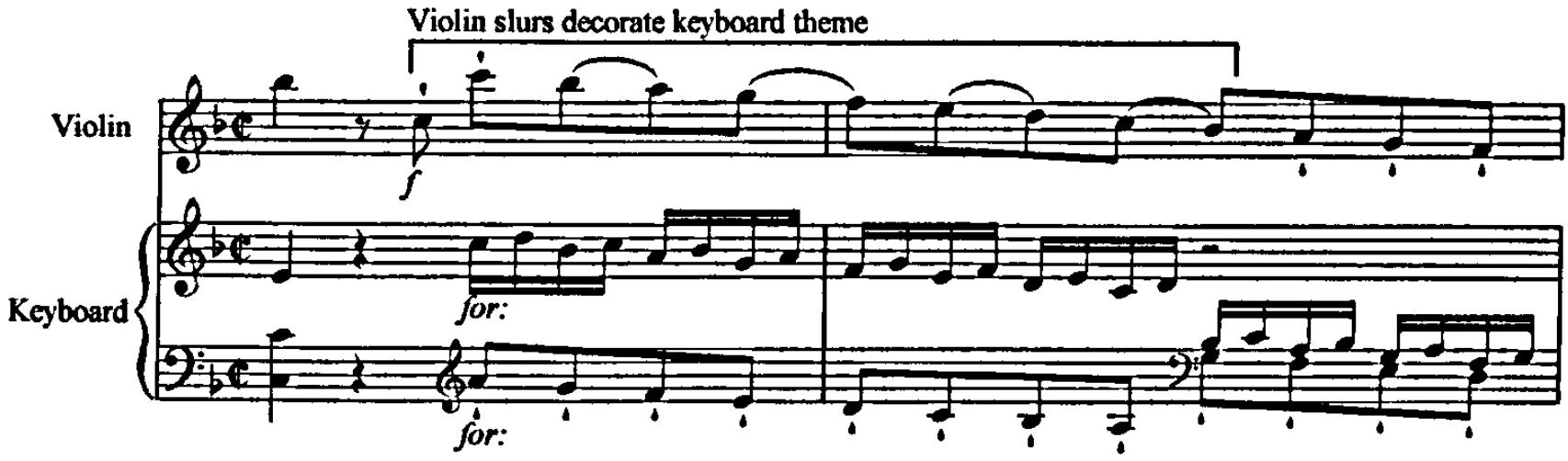
中文讲解
图注原文(同时为图像占位符)。本段指向 K296 末乐章中的同一主题的两个版本(例 4.40 与 4.41)。伴奏型(先在小提琴声部出现,后由键盘右手承担)在第二版中略有改动,但作者认为:变化的重点不在音高,而在连音——用连音变化来强化两次呈示的对比性格。具体而言:bar 74 采用“两连两断”的八分音符模式,使每小节开头与中部具有推进性冲力;bar 30 则是带跳弓记号的连续八分音符,传达连续而不变的效果。作者通过这种对比论证“连音变化塑造不同 Affekt”这一核心命题。需查看原图以核对两种连音模式的具体小节形态。
补充说明
本段图注与图注 P0102、P0103、P0104、P0105 一同属于 K296 末乐章对照示例(例 4.40 与 4.41)。quavers 指八分音符(八分音符)。strokes 指跳弓/跳音记号。
第8段(P0102)
原文复述
Example 4.40: K296, movement 3, bars 30-31.
中文讲解
乐谱示例标题:例 4.40 出自 K296 第三乐章第 30–31 小节。配合 P0101 的图注阅读,可知此处呈现的是带跳弓记号的连续八分音符伴奏型,其音响效果是“持续不变”。该小节是“基准”版本,例 4.41 是其变化版本。需查看原谱核对具体音高与跳弓位置。
第9段(P0103)
原文复述
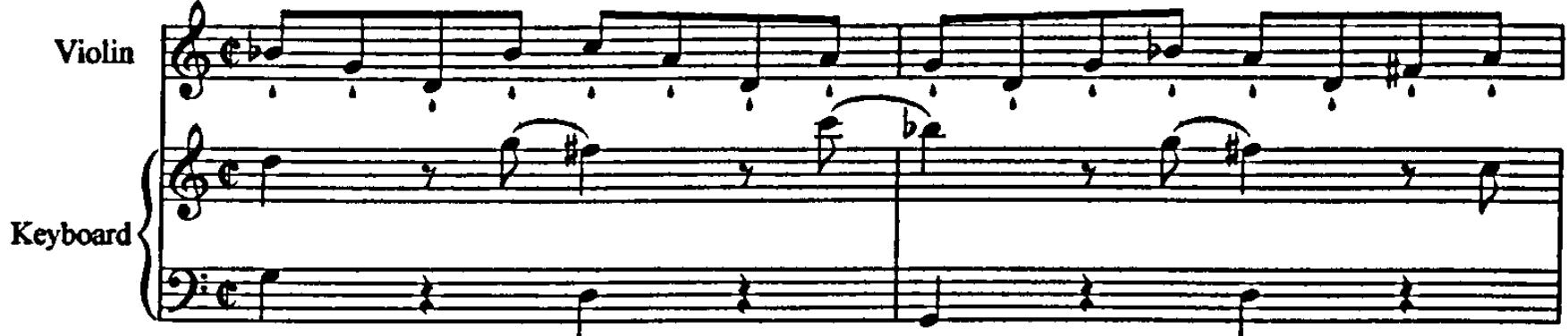
中文讲解
图像占位符:对应例 4.40(K296 第三乐章第 30–31 小节)的实际乐谱图。内嵌图像数据已省略,故具体音符、跳弓记号位置、谱表信息需查看原图。
补充说明
无文本补充,需查看原图。
第10段(P0104)
原文复述
Example 4.41: K296, movement 3, bars 74-75: varied accompaniment articulation.
中文讲解
乐谱示例标题:例 4.41 出自 K296 第三乐章第 74–75 小节,副标题强调此处为“变化了的伴奏连音”。配合 P0101 的图注阅读,可知此处的连音模式是“两连两断”,与例 4.40 的跳弓八分音符形成对比。该标题本身已自带作者解读方向(varied accompaniment articulation)。需查看原谱核对具体连线与音符分组。
第11段(P0105)
原文复述
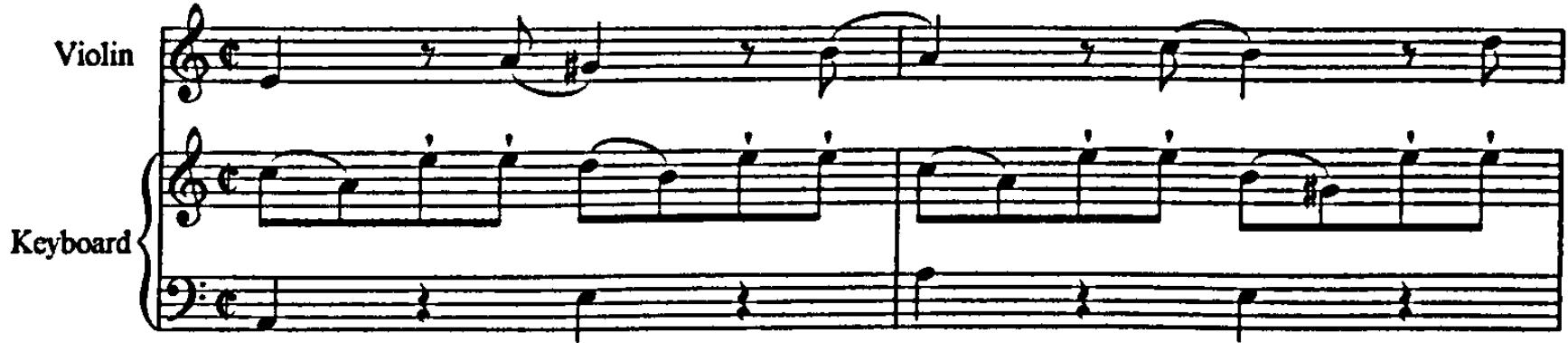
中文讲解
图像占位符:对应例 4.41(K296 第三乐章第 74–75 小节)的实际乐谱图。内嵌图像数据已省略,故“两连两断”的具体落点、谱表与键盘/小提琴声部分配需查看原图。
补充说明
无文本补充,需查看原图。
第12段(P0106)
原文复述
Comparisons of articulations in autograph and first edition versions of the sonatas can also give us insight into the rich variety which can be achieved by the careful placement of slurs. In K376, for example, the altered slurs in the dotted figure at bar 57 completely change the music’s character. While the longer slur of the autograph version (see example 4.42) retains the same ’two-in-a-bar’ pulse of the preceding bars, the shorter slurs of the first edition quicken the pulse of the bar, rendering it more energetic and emphatic:
中文讲解
本段把论证从“作曲家在同一作品内部的变化”扩展到“作曲家手稿(autograph)与初版(first edition)之间的差异”。论点是:比较手稿与初版的连音标记,可以揭示连音位置的不同如何塑造完全不同的音乐性格。以 K376 第三乐章第 57 小节的点状节奏型(dotted figure)为例:手稿版本使用较长的连线,保留前几小节“两拍一组”的脉动;初版则采用更短的连线,使脉动加密,变得更急促有力。这一对比的关键在于:连音长度的差异不是“正确与错误”之争,而是作曲家或编订者通过连音位置的选择来重新决定该处的性格与能量。作者使用 completely change 一词,强调连音位置变化具有塑造性格的杠杆作用。需查看例 4.42 以核对具体连线形态。
补充说明
autograph 指作曲家亲笔手稿;first edition 指首次印刷出版的总谱/分谱。K376 第三乐章第 57 小节是本段实证焦点。
第13段(P0107)
原文复述
Example 4.42: K376, movement 3, bar 57. Slurs from the autograph version are written above the stave, and first-edition slurs are annotated below.
中文讲解
乐谱示例标题及说明:例 4.42 出自 K376 第三乐章第 57 小节。版式约定——手稿版连音写在谱表上方,初版连音标注在谱表下方。读者据此可在同一谱例中直接对照两种连音方案。该标题本身已说明作者的版面对位方法。
第14段(P0108)
原文复述
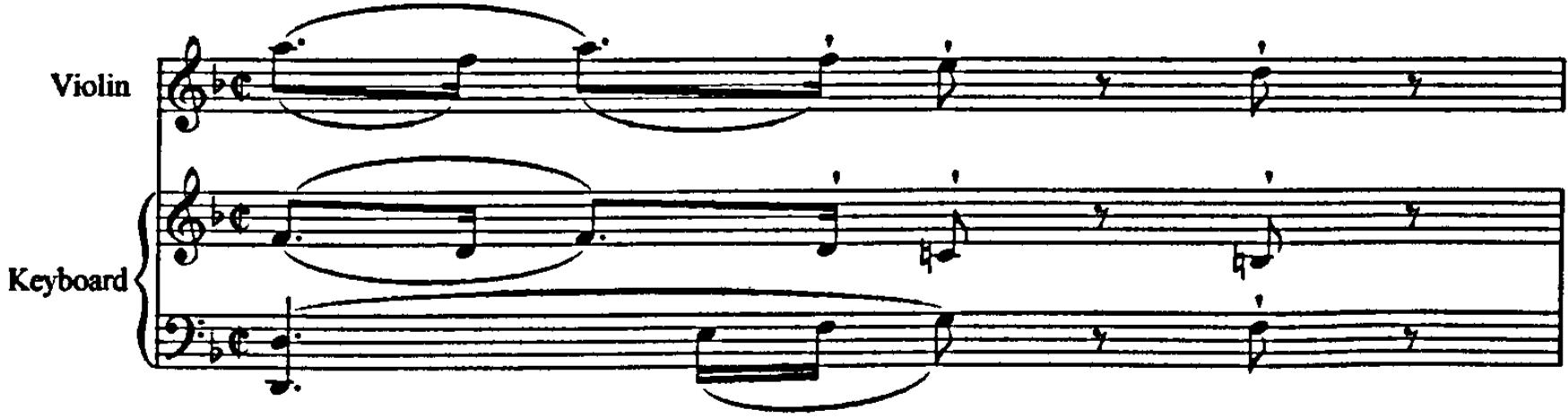
中文讲解
图像占位符:对应例 4.42(K376 第三乐章第 57 小节)的实际乐谱图。内嵌图像数据已省略,手稿与初版连音的具体差异(长连线 vs 多条短连线)以及点状节奏型的音高需查看原图。
补充说明
无文本补充,需查看原图。
第15段(P0109)
原文复述
In the first movement Allegro of K379, quavers which are detached in the autograph version (either marked with strokes, or unmarked), are altered through the addition of a slur in the first edition (see example 4.43). Hence, while the character of the autograph version fluctuates between cantabile slurs and lifted up-beat quavers, the whole of this passage is rendered legato in the first edition:
中文讲解
本段是手稿/初版比较的第二个案例,焦点在 K379 第一乐章 Allegro。论证内容:手稿中的八分音符或是带跳弓记号,或是完全无标记(即演奏者自行决定);而初版则通过添加连线,使整段变成完全 legato(连奏)。其结果差异为:手稿的性格在“歌唱性的连线”与“抬起的弱拍八分音符”之间起伏,而初版则呈现统一的连贯性。作者借此再次说明:连音的“加上”或“去掉”足以改变一段音乐的整体性格与运动方式。需查看例 4.43 核对具体连线分布。
补充说明
cantabile 指“如歌般地”,是十八世纪常用的演奏指示术语;legato 是连奏;strokes 在此处指跳弓记号。八分音符(quavers)在 4.43 的具体位置需查阅原谱。
第16段(P0110)
原文复述
Example 4.43: K379, movement 1, bars 88-90. Articulations from the autograph version are above the stave and those from the first edition are below.
中文讲解
乐谱示例标题及说明:例 4.43 出自 K379 第一乐章第 88–90 小节。版式约定同例 4.42——手稿连音/跳弓在上,初版在下。该标题与版式说明是 P0109 论断的可视化依据,读者可直接在同一谱例中对照两种连音方案。
第17段(P0111)
原文复述

中文讲解
图像占位符:对应例 4.43(K379 第一乐章第 88–90 小节)的实际乐谱图。内嵌图像数据已省略。手稿与初版在连线与跳弓上的具体差异需查看原图方可核对。
补充说明
无文本补充,需查看原图。
脚注 / 边栏 / 图表 / 附加信息(如有)
本节附带材料包括六处乐谱示例(例 4.38–4.43)及对应的图注/图像占位符:
- 例 4.38(K376 第 1 乐章第 5、9 小节):用于展示同一主题重复时连线由均匀变为切分;
- 例 4.39(K376 末乐章,图注文本):用于展示同一奏鸣曲中切分式连弓模式的复用;
- 例 4.40 与 4.41(K296 第 3 乐章第 30–31 与第 74–75 小节):通过对照“连续跳弓八分音符”与“两连两断”,展示连音变化如何强化两次呈示的对比性格;
- 例 4.42(K376 第 3 乐章第 57 小节):手稿与初版连线对比,版式约定为手稿在上、初版在下;
- 例 4.43(K379 第 1 乐章第 88–90 小节):手稿与初版连线/跳弓对比,版式同上。 所引脚注/文献包括 Leopold Mozart《Violinschule》1756 年版的第 220 页(演奏者自主添加连音的理论依据)与第 117 页(第七种弓法变化,即切分式弓法)。所有乐谱内嵌图像数据在本输入中均已省略,需查阅原书核对。
💡 本节核心要点
- 十八世纪演奏理论(Leopold Mozart, 1756: 220)明确允许演奏者在乐谱未标注时自行添加得体的连音与断音。
- 连音变化的功能相当于一种装饰手段,用以澄清或重塑音乐的 Affekt。
- Mozart 在重复乐句中通过改变连音模式——例如把均匀连线换成跨拍切分连线(K376 bar 5 → bar 9),或在同一奏鸣曲其他乐章复用同一手法——赋予主题新的能量。
- 同一主题的不同呈示(如 K296 末乐章)可以通过连音/跳弓的差异塑造对比性格:连续跳弓传达持续稳定,两连两断传达推进冲力。
- 手稿与初版之间存在有意义的连音差异(K376 mvt.3 bar 57;K379 mvt.1 bars 88–90),短连线或附加连线可使点状节奏更急促有力,或使整段由 cantabile-跳音起伏转为统一 legato。
- 本节的核心方法论是:乐谱连音并非静态指令,而是作曲者/演奏者塑造性格与运动方式的杠杆,演奏者的“创造性”连线处理具有合法地位。
🔑 关键术语
- Affekt:德语 Affekt,指音乐所要传达的情感特质或情绪状态;在十八世纪美学中,每段音乐往往对应一种主导情感,连音的取舍服务于该情感的清晰呈现。
- slurring and detaching:连与断;Leopold 用以说明这两种基本奏法勾勒旋律的个性,是本节演奏者自主权讨论的核心对象。
- seventh variation of bowing (Leopold Mozart, 1756: 117):Leopold 列出的第七种弓法变化,其特征是产生跨拍切分效果;K376 第 1 乐章重复中的连线改造即采用此模式。
- autograph / first edition:作曲家亲笔手稿与首次印刷出版谱;本节通过比较两者揭示连线位置在编订过程中的可变性及其对性格的影响。
- cantabile / legato:如歌地/连奏;用于描述连奏风格。K379 例 4.43 中手稿在“如歌连音”与“抬起弱拍”之间起伏,初版则统一为 legato。
- compound thirds:复三度;K376 末乐章中键盘左手与加入的小提琴声部形成的三度对位结构。
- quavers / strokes:八分音符 / 跳弓记号;K296 末乐章对照例中用以区分两种连音模式:连续带跳弓 vs 两连两断。
4.10 [描述性拆分] Comparing Articulations Across Sources: Leopold, Autograph, and First Edition
第1段(P0112)
原文复述
The first movement of K8 is another case in point. A version of the first movement which exists in Nannerl’s Notebook in Leopold’s handwriting (Reeser, 1977: 29) demonstrates that a recurring figure can receive constantly changing slurs. Each different articulation emphasises new parts of the bar depending on the placement of slurs, and on which notes are marked with a stroke (see example 4.45). The irregularity of Leopold’s slurs may in part be due to haste – Reeser refers to Leopold’s handwriting as ‘fleeting’ (flüchtigen) – however, there are notable contrasts between his slurs and those of his son. Mozart’s autograph and first edition (see example 4.44) display a consistent pattern of slurs; these slurs create a long upbeat which propels the melody to the downbeat of each subsequent bar. Contrastingly, Leopold’s slurs onto the fourth beat of bars 22 and 23 suggest phrasing away, while short three-note slurs lead each bar into the next. In bar 24, a stroke on beat 4 suggests strength, therefore creating variety after the weak fourth beats of bars 22 and 23.
中文讲解
本段以K8第一乐章作为又一个例证,将三个版本——纳内尔笔记本中利奥波德的手抄谱、莫扎特手稿、首版——并置比较。中心主张是:同一个重复出现的动机,在利奥波德笔下会因连弓与击弦记号位置的不断变化而强调不同的拍点与重音,体现出演奏者视角的灵活处理;这种不规则性部分源于利奥波德书写速度的快(被Reeser形容为"flüchtigen"——匆忙、飞逝的笔迹),但与莫扎特版本形成的是有意义的差别,而非单纯的潦草。
关键对比有两层:其一,莫扎特手稿与首版中连弓模式一致,构成一个长跨小节的"长上拍",将旋律推向每一小节的正拍,形成统一的向前动力;其二,利奥波德第22、23小节将连弓收在第四拍,提示乐句"向外走",配合三音一组的短连弓把每一小节引向下一小节;24小节又在第四拍加上一个击弦记号(stroke),在小节末制造一个力度强点,弥补22、23小节第四拍的薄弱,并以变化打破前两小节的均势。
承接关系上,本段为下文莫扎特亲自"修订"弓法、演奏者可否依此改写弓法以突出Affekt的讨论奠定实证基础。也就是说,K8的对照展示的不是"父与子谁对谁错",而是同源动机下两种合理却意图不同的articulation逻辑。作者借此铺垫:连弓与击弦的每一次重新放置,都是对乐句方向与重音结构的一次再阐释。
补充说明
本段中"recurring figure"指K8第一乐章中反复出现的动机;“upbeat"在这里不是节拍术语意义上的弱拍,而是指一种贯穿性的连弓线,使旋律听起来像一直在"推向"下一个正拍。flüchtigen为德语形容词,意为"飞逝的、转瞬即逝的”,Reeser用来形容利奥波德书写速度,而非形容其音乐内容。
示例4.44与4.45的对应位置在下一组段落(P0113、P0114),本段已为其功能做了预告。
第2段(P0113)
原文复述
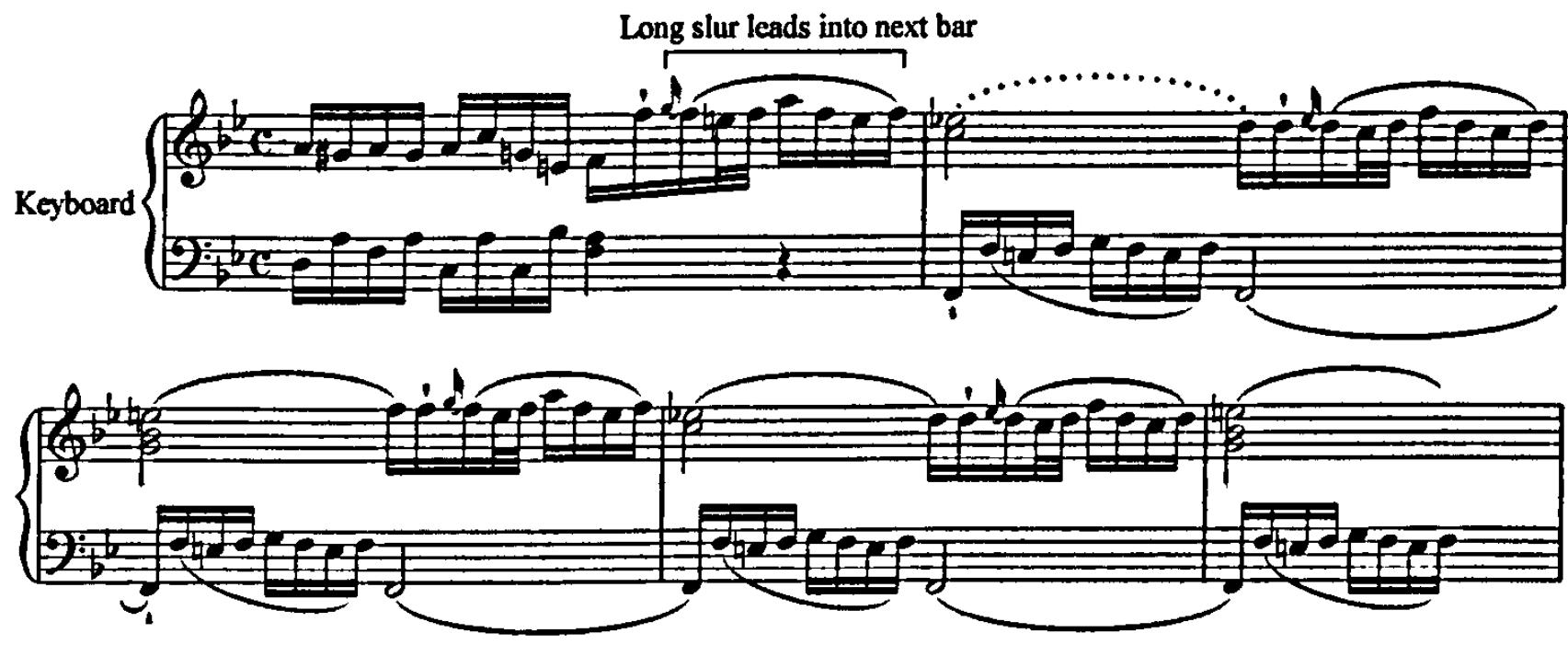
中文讲解
本条是内嵌图像占位符,对应示例4.44:莫扎特为K8第一乐章第22–26小节标写的连弓与击弦记号。原图中每条小节内可见莫扎特统一的连弓线,以及贯穿第22–26小节的长连弓模式,构成"长上拍"结构;图注末尾的上标41指向P0115的脚注。本书此处需查看原图以核对记号细节。
补充说明
无额外补充;占位符中保留的仅为图题与脚注索引。
第3段(P0114)
原文复述
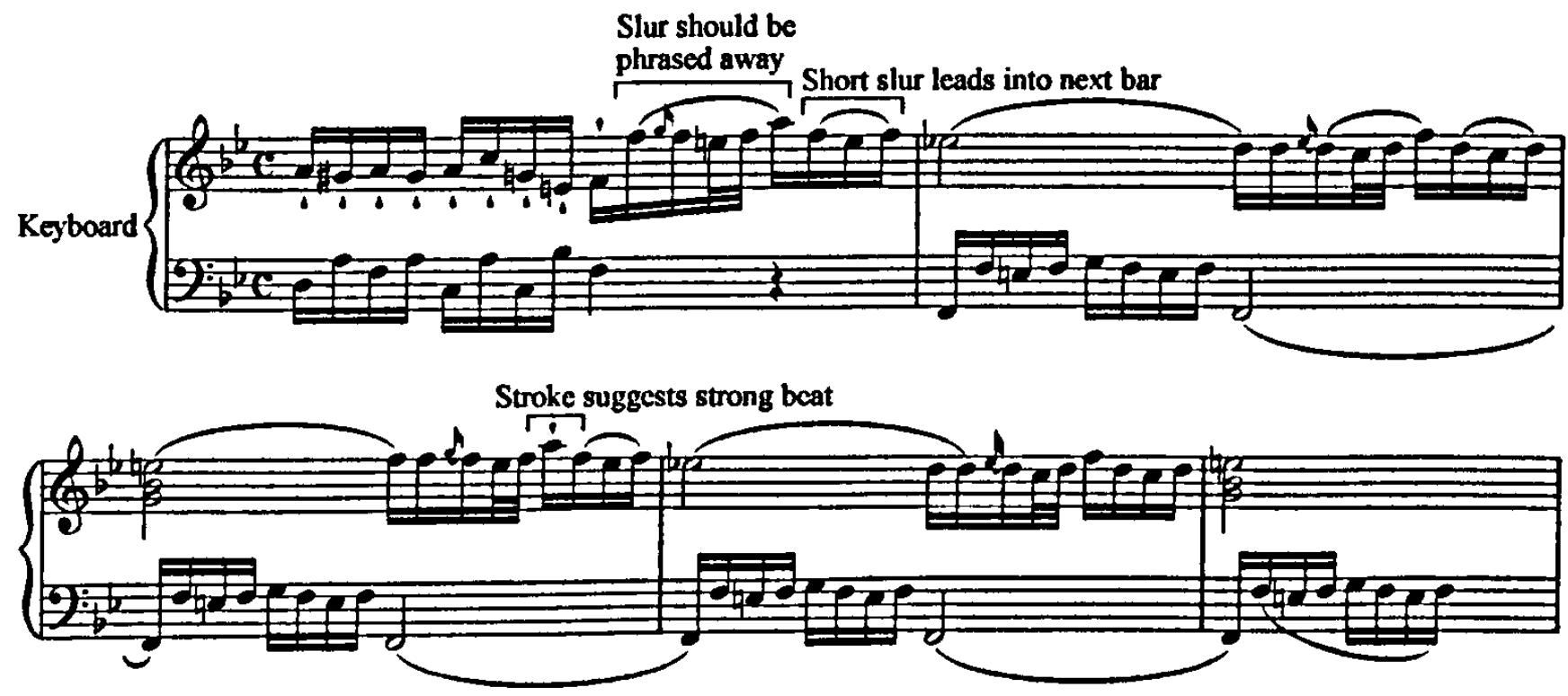
中文讲解
本条是内嵌图像占位符,对应示例4.45:利奥波德在纳内尔笔记本中为K8第一乐章第22–26小节所标写的连弓与击弦。与示例4.44相比,本图突出利奥波德版本中连弓较短、在第22、23小节落在第四拍,以及24小节击弦记号造成的强弱交替。本图与4.44共同构成P0112所讨论的"父与子"两种articulation模式的视觉对照。本书此处需查看原图以核对细节。
第4段(P0115)
原文复述
$^{41}$ Erroneously, the stroke is missing on note 3 of the right-hand part in bar 24.
中文讲解
这是脚注41,对应示例4.44第24小节右手声部第3音。脚注指出该处本应有一个击弦记号(stroke),但首版/手稿副本中遗漏了它。这一遗漏具有论述意义:正是这个本应出现在24小节第四拍的击弦记号,承担着P0112所论述的"在弱四拍之后制造力度变化"的功能——它的缺失,使得本应存在的力度强点被磨平。作者借此将一个版式层面的笔误与音乐表现层面的实际效果联系起来,提醒演奏者与编者:版面上的微小遗漏足可改变articulation的Affekt意图。脚注在原文中属于对正文的限定/修正,而非旁证。
第5段(P0116)
原文复述
The performance directions in Mozart’s Sonatas for Violin and Keyboard are often extremely prescriptive; Mozart thus seems to have followed his father’s teaching that careful composers make a ‘reasonable choice’ of articulations in order to characterise their music (L. Mozart, 1756: 114). For this reason there are very few places where the performer would need to add articulations, particularly in his later sonatas. However, following Mozart’s own example of varying articulations between the autograph versions of his sonatas and the authorised first editions (see examples 4.44 and 4.45 above) it would be possible for performers to alter articulations, ‘ornamenting’ the bowings in order to clarify Affekt; Leopold writes that in reading the prescribed performance directions of a piece, it is essential ’to play them in keeping with the outstanding characteristics of the piece’ (L. Mozart, 1756: 216), and the same rule must apply to the any additions which the performer makes. (Conversely, example 4.60 below shows that in some circumstances, altering articulation has the opposite effect, undermining the character of a piece). Thus, although we have already seen that the third movement rondo of K454 is richly detailed in its prescribed articulations, the rondo theme itself retains its original articulations on each playing. Perhaps by altering the final version of this theme its playful character could be enhanced.
中文讲解
本段从"比较不同来源的articulation"转向"演奏者是否/如何能动地改写弓法"的理论命题。中心主张由两层构成:
第一层是莫扎特作品的弓法记号大多极具规定性,因此演奏者通常无须补加,连晚期的几首奏鸣曲更是如此——这一点被追溯到利奥波德1756年著作第114页的教导,即"细心的作曲家应对articulation作出合乎情理的选择以塑造音乐特征"。
第二层承认这一规定性并不绝对。莫扎特本人在手稿与授权首版之间本就作过改写(4.44与4.45即为证据),故演奏者借助类似手段"装饰"弓法、从而凸显Affekt,是有先例可援的。但作者同时援引利奥波德1756年著作第216页的另一段话:所标记号必须"与乐曲的突出特征相一致"——这一标准同样适用于演奏者自行添加的articulation。也就是说,演奏者的改动不是任意的,它必须服务于乐曲自身的特征。括号内的反向提示(对应后文示例4.60)则预先为读者打了一剂预防针:在某些情境下,改动articulation反而会损害音乐性格,呼应利奥波德那条原则的双向性。
接下来,作者将这一原则落到K454第三乐章回旋曲主题:尽管该乐章在既定articulation方面极为丰富,但主题每次出现都保持原样,由此提出一个开放性的演奏假设——若改动主题最后一次陈述的articulation,或可增强其"嬉戏性"。这一问句把上一层的"可行性"与"原则"合并为具体的演奏设想,构成本节向下文K219维也纳协奏曲例证的过渡。
承接关系:上承P0112–P0115关于K8的版本对照与脚注修订,本段将其归纳为"莫扎特自己也改articulation";再援引利奥波德的方法学为演奏者改动提供合法性与边界;末尾把K454第三乐章主题的"未变"作为留待回答的问题,向P0117抛去。
补充说明
本段引用的利奥波德1756年著作即Versuch einer gründlichen Violinschule。本节虽未说明,但L. Mozart, 1756: 114与216两个页码来自同一著作的两处不同段落;演奏者引用本节时须注意:第一段谈的是作曲家应如何选择articulation,第二段谈的是演奏者如何"演奏所标记号"——两者被作者合并为同一原则的两面。
K454是莫扎特1784年的小提琴与键盘奏鸣曲;K8是其早期奏鸣曲(1763–64);K219即下文将讨论的A大调第五小提琴协奏曲。
示例4.60在前文中尚未出现,作者以括号形式预告其反向例证,体现了本节论点的双向平衡。
第6段(P0117)
原文复述
Mozart’s treatment of the rondo theme in the third movement of his Violin Concerto in A offers some insight into how it might be possible for the performer to develop the Affekt of the third movement of K454. Example 4.46 shows the first playing of the concerto’s rondo theme. While this original theme is graceful and poised, with articulations which accentuate the metrical hierarchies of a minuet, its new syncopated articulations at bar 262 (see example 4.47), similar to those seen in examples 4.38 and 4.39 above, adopt the playful and energetic character of the Turkish music which precedes it.
中文讲解
本段把K454回旋曲主题"可否被演奏者改写articulation"这一问题,转化为一个作曲家先例:莫扎特自己在A大调小提琴协奏曲(K219)第三乐章的回旋曲主题中就做过类似处理。
论述分两步。第一步(示例4.46):主题首次出现时的articulation使它优雅而沉着,那些articulation强调的是小步舞曲的节拍层级——即突出正拍与规整的重音,符合小步舞曲端庄的步伐。第二步(示例4.47):第262小节处同一主题再次出现时被加入切分音articulation,与前文的4.38、4.39例相呼应;此时它承接前一段土耳其音乐的Affekt,转化为嬉戏而充满活力的性格。
作者借此论证:作曲家自己就是通过改变articulation(含切分),让同一主题在不同上下文中呈现不同的Affekt;那么演奏者对K454主题最后陈述做出articulation改写,在创作方法学上是有莫扎特自身先例可援的。K454回旋曲主题若依此原则加入切分等off-beat重音,或可使其"嬉戏性"凸显。
该论证把演奏诠释问题接入一个作曲家具体写作策略的内部分析,对本节论证链而言是关键过渡:从"理论原则(利奥波德)+ 作者先例(K8版本差异)“走到"作曲家自我变奏先例(K219)",为下文引入Baillot的演奏理论作铺垫。
补充说明
“metrical hierarchies of a minuet"指小步舞曲中由强拍、弱拍与三拍子结构所决定的节拍等级;“playful and energetic character of the Turkish music"与该协奏曲前一段土耳其风格的段落直接相关(K219第三乐章中段有显著的"土耳其风"段落)。
K219即莫扎特A大调第五小提琴协奏曲,1775年作于萨尔茨堡。
第7段(P0118)
原文复述
Example 4.46: The original rondo theme of Mozart’s Violin Concerto in A major K219, movement 3, bars 1-8.
中文讲解
这是示例4.46的图题,对应K219第三乐章回旋曲主题首次陈述(第1–8小节)的乐谱片段。本乐谱的功能是为P0117中的"第一次陈述:优雅而沉着,articulation强调小步舞曲的节拍层级"提供视觉对应;具体articulation细节需查看原图核对。
第8段(P0119)
原文复述

中文讲解
本条是内嵌图像占位符,对应示例4.47:K219第三乐章回旋曲主题第262–270小节变奏版本。其功能是为P0117中"新加入的切分articulation借鉴土耳其音乐前段而变得嬉戏、充满活力"的论述提供视觉例证;具体切分articulation的设置需查看原图核对。
第9段(P0120)
原文复述
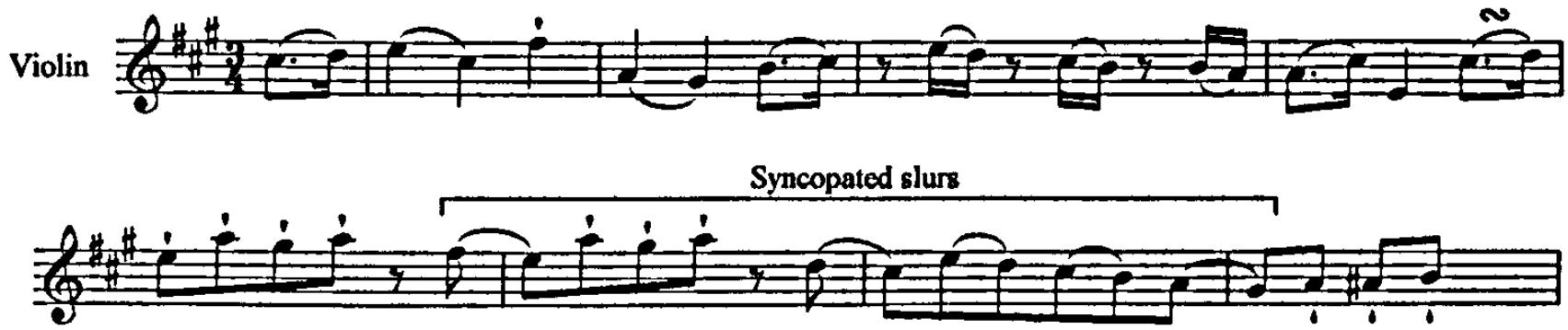
中文讲解
本条为第26页的图像/乐谱占位符,标题泛化为"第26页图像或乐谱示例”。其与上下文可确认的关联是:该图位于P0119之后的同一页,在P0121的论述中以第262小节后的新articulation为讨论对象,并以此例支持"切分可用以变奏主题”。其余细节不可考,须查看原图。
第10段(P0121)
原文复述
Baillot, writing in 1834, also explains that syncopation can be used to vary a theme. He describes it as a type of rubato which is ‘a manner of altering or interrupting the beat’ (Baillot, 1834: 237); in practice the new articulations which are created by these syncopations are an important part of their Affekt. His suggestion for the final playing of the rondo theme in Viotti’s Concerto Number 18 demonstrates this:
中文讲解
本段引入1834年小提琴家/教育家Baillot的论述,把"切分可用以变奏主题"这一作曲家策略升格为有演奏理论支撑的原则。中心主张三层:
第一,切分可作为变奏手段——这是Baillot在他的1834年著作中所阐述的。 第二,切分在他的界定下是一种特殊的rubato,定义是"改变或打断拍子的方式”。换言之,切分并非简单的节奏错位,而是节奏-时值层面的rubato,它通过articulation的重新划线将旋律从规整节拍中"撬起"。 第三,由此产生的新articulation本身就承载Affekt——切分不仅改变节奏,还改变情绪表达。
Baillot对维奥蒂第18号协奏曲回旋曲主题"最后一次陈述"的具体改编(即下一示例4.49),把抽象定义落到实例。作者借此在作曲家先例(K219)之外又添加一条演奏家先例,使论点不依赖单一来源。这一段的作用是为P0122–P0124的Viotti/Baillot示例及其与K454的类比打开空间。
补充说明
Pierre Marie François de Sales Baillot(1771–1842),法国小提琴家、教育家;其1834年著作即L’Art du violon。Viotti的Concerto Number 18为Giovanni Battista Viotti(1755–1824)的第18号小提琴协奏曲。本节引用旨在说明19世纪初法国小提琴学派对articulation变奏的论述。
“rubato"在这里被Baillot用来涵盖节奏的灵活位移,并非后世专指速度伸缩的rubato。
第11段(P0122)
原文复述
Example 4.48: Viotti’s original rondo theme, Concerto Number 18.
中文讲解
这是示例4.48的图题,对应维奥蒂第18号协奏曲回旋曲主题原作(即未作Baillot改写之前)的乐谱片段。它作为P0121所论述的"原作"存在的视觉参照,与4.49的Baillot改编形成对照;细节需查看原图核对。
第12段(P0123)
原文复述

中文讲解
本条为第26页的图像/乐谱占位符。它在P0122与P0124之间起衔接作用,位置处于P0121论述"Baillot的改写方案"与P0124图题"Baillot建议的变奏版本"之间;具体内容须查看原图以核对。
第13段(P0124)
原文复述

中文讲解
本条是内嵌图像占位符,对应示例4.49:Baillot对维奥蒂第18号协奏曲回旋曲主题所作的articulation变奏建议。其功能是把P0121所述"Baillot主张对主题最后一次陈述进行articulation变奏"由口头论述落实到具体记号;具体切分articulation位置与原作的差异需查看原图核对。
第14段(P0125)
原文复述
Since syncopations and off-beat accents are such an integral aspect of the Affekt of the K454 rondo, these could be invoked at the final playing of the theme in bar 239:
中文讲解
本段以一句话作为本节的收束与提议:把K454回旋曲整体Affekt中本就重要的"切分与弱拍重音"特征,回灌到主题最后一次陈述(第239小节)中。作者由此把前面三组先例——利奥波德原则、莫扎特在K219的自我变奏、Baillot对维奥蒂主题的articulation变奏建议——合并为一句具体的演奏动作。该句以冒号结尾,意味着本节正文在此处戛然而止,下一页(或下一段)将紧接乐谱示例展示具体改写方案。
承接关系:呼应P0116末尾"若改动主题最后一次陈述或许能增强其嬉戏性"的开放性假设;呼应P0117中莫扎特自己在K219第262小节的处理(在其回旋曲主题最后一次变奏中加入切分);呼应P0121中Baillot对维奥蒂主题最后一次陈述加入articulation变奏的提议。三线合流,构成K454第239小节回旋曲主题改写articulation的合法性论述。
本段也是由论说体转向演奏诠释建议体的过渡句:前一节是分析,这一节是建议。冒号之后将显示具体音的列表或乐谱示例,构成下一节开始的演奏示范。
补充说明
K454第三乐章回旋曲主题的最后一次陈述落在第239小节——这一信息在本节中由P0125首次具体给出(之前P0116仅笼统说"the final version of this theme”,P0117说"类似改动出现在K219第262小节")。
脚注 / 边栏 / 图表 / 附加信息(如有)
本节附加材料包括:
- 示例4.44(P0113)与4.45(P0114):分别展示莫扎特手稿/首版与利奥波德抄本对K8第一乐章第22–26小节的不同articulation,构成P0112版本对比的视觉主体。
- 脚注41(P0115):指出示例4.44第24小节右手第3音本应有击弦记号却被遗漏,作用是限定/修正——为读者理解24小节应为力度变化点提供依据。
- 示例4.46(P0118)与4.47(P0119):K219第三乐章回旋曲主题原作与第262小节后加入切分articulation的变奏版本,是P0117作曲者自我先例的视觉支撑。
- 示例4.48(P0122)与4.49(P0124):Viotti第18号协奏曲主题原作与Baillot建议的articulation变奏,是P0121演奏理论先例的视觉支撑。
- 第26页的P0120与P0123为泛化的图像占位符,分处示例4.47与4.49之间,起到版面上的衔接作用。 以上图例在论证链中各自承担一重先例作用(作曲家自我先例、演奏家先例),脚注41则在版式层面为力度论述提供证据。
💡 本节核心要点
- K8第一乐章的同一动机在利奥波德与莫扎特两个版本下使用了不同的连弓与击弦articulation,前者强调每小节第四拍的"向外走"以及24小节第4拍的力度强点,后者则用贯穿性的长连弓构筑"长上拍",揭示了两种合理但意图不同的articulation逻辑。
- 示范作品(K8)首版中第24小节右手第3音遗漏了一个本应存在的击弦记号(脚注41),说明版式笔误足可改变articulation所暗示的Affekt,由此加强"演奏者应注意源文本"的论点。
- 莫扎特奏鸣曲的articulation极其规定性,源自利奥波德"细心作曲家应对articulation作出合乎情理选择"的教导;但演奏者在尊重乐曲特征(利奥波德"突出特征"原则)的前提下,改写articulation以凸显Affekt是有合法空间的——莫扎特本人在K8手稿与首版之间、在K219第262小节回旋曲主题中即作过类似改动。
- K219第三乐章回旋曲主题第一次陈述articulation强调小步舞曲节拍层级,突显优雅端庄;第262小节加入切分articulation并借鉴前段土耳其音乐,主题转为嬉戏活泼——这构成了演奏者改写K454主题最后一次陈述的作曲家先例。
- Baillot(1834)将切分定义为一种"改变或打断拍子"的rubato,并通过对维奥蒂第18号协奏曲回旋曲主题最后一次陈述的articulation变奏建议为演奏者提供历史先例,使论点不依赖单一作曲家来源。
- 综合三条先例(利奥波德原则、莫扎特在K219中的自我变奏、Baillot对Viotti主题的articulation变奏),作者将K454第三乐章回旋曲主题本身反复保持articulation不变视为可被演奏者打破的稳定结构,建议在第239小节的最后一次陈述中引入切分与弱拍重音以强化其嬉戏性。
🔑 关键术语
- Affekt (Affekt, Affekt的拼写即德语Affekt):本节反复出现的核心概念,指乐曲在特定段落所应传达的情绪-性格特征。articulation不仅是技术记号,更是Affekt的载体;改动articulation被认为可以改写Affekt,本节对其使用为中性,指作曲/演奏的"情绪意图"。
- articulation:本节特指连弓(slur)与击弦(stroke/staccato-like记号)的综合记谱;本节将articulation视作可被演奏者视情境改写以突出Affekt的参数,而非仅仅是固定谱面记号。
- slur:连线/连弓记号。在本节里既可指钢琴上的连奏(legato),也可指小提琴的连弓;其长度和位置直接塑造乐句方向。
- stroke:本节使用的一个细分的articulation记号,作用是为指定音符添加一个力度强点或断奏意味(如P0112中24小节第四拍的stroke用以创造力度变化)。
- rubato (此处为Baillot的拓展含义):Baillot(1834)把切分定义为一种rubato,意为"改变或打断拍子的方式",强调通过articulation对节拍层级进行灵活重排,后世"rubato"通常专指速度伸缩,但本节使用Baillot原文的更宽含义。
- syncopation / 切分:本节作为改变articulation的关键手段:将重音从强拍移至弱拍或拍间,从而重塑主题的节拍-情绪结构。在K219 262小节、Viotti主题的Baillot建议以及K454建议的239小节最后一次陈述中均为此用法。
- K8 / K219 / K454 / Viotti Concerto Number 18:本节四处示例作品的编号。K8、K219、K454为莫扎特作品(依Köchel编号),分别代表作者学琴阶段作品、协奏曲、自作的奏鸣曲回旋曲主题;Viotti第18号协奏曲为19世纪初作曲家G. B. Viotti所作,本节作为Baillot演奏理论阐述的载体。
4.11 [描述性拆分] Ornamenting Articulations: Mozart’s Violin Concerto and Baillot on Syncopation
第1段(P0126)
原文复述
Example 4.50: Suggestions for syncopated slurs in the rondo theme of K454, movement 3 (compare with original rondo theme, example 4.36 above).
中文讲解
本段是 Example 4.50 的图注。它指出本例展示的是针对 K454 第三乐章回旋曲主题所提出的切分连弓(syncopated slurs)建议方案,并提示读者与上方 Example 4.36 所示的莫扎特原始回旋曲主题进行比较。换言之,本例承接前文对原始主题的呈现,进一步引出“用切分弓法加以装饰”这一改写建议,并以图注形式为读者建立前后参照关系。
补充说明
图注中的 K454 即莫扎特《第五小提琴协奏曲》(Turkish Concerto),Example 4.36 在本节前文已经出现过,本例与之形成“原始 vs. 装饰建议”的对照关系。
第2段(P0127)
原文复述
Other passages in this movement could also be ‘ornamented’ with playful syncopated bowings. For example, in bars 200 to 212 the same theme is heard twice. The octave leaps in the keyboard left hand and staccato marks in the melody lines are already light-hearted in character. Adding new articulations to the second playing of this material can serve to enhance this lively Affekt:

中文讲解
本段的中心主张是:本乐章中还有别的小节也适合用“带游戏感的切分弓法”加以装饰,而其中第 200 至 212 小节是一个典型案例。论证步骤如下:(1)限定范围——作者用 “Other passages” 表明这并非孤例,装饰的可能性延伸到乐章其他位置;(2)指明具体段落——第 200 至 212 小节中,同一主题出现两次;(3)描述该处本身的音乐特征——键盘左手已有八度跳进、旋律线上有断音(staccato)记号,作者认为这些记号本身就带有轻松诙谐的性格;(4)由此推出装饰的合理性——在主题第二次出现时新增运弓法(articulations),能够强化这种活泼的 Affekt(情绪/心境)。关于词义,‘ornamented’ 在原文中带有单引号,这一排版事实可如实记录;但是否暗示作者对“装饰”一词持保留或审视态度,属于讲解者的解读,本段不复述作者未明示的意图。
补充说明
本段出现的 Affekt 是德语音乐修辞学概念,指作品所表现的情绪状态;staccato 与八度跳进都是该处已有的演奏记号或材料特征,作者以此为依据说明“再加切分弓法”与既有风格相协调。
第3段(P0128)
原文复述
Example 4.51: K454, movement 3, bars 208-212, with Mozart’s original articulations, and suggested varied slurs.
中文讲解
本段是 Example 4.51 的图注,说明本例取材于 K454 第三乐章第 208 至 212 小节,把莫扎特原有的演奏法记号(original articulations)与所建议的“变化后的连弓”(suggested varied slurs)并列呈现。其功能是为上一段(P0127)所提出的“在主题第二次出现时新增切分连弓”主张,提供具体可见的谱例对照:左半是莫扎特原稿的运弓/断音标记,右半(或并列层)是作者建议的改写方案,让读者直接比较原始与装饰后两种处理。
补充说明
图注只声明 208–212 这一取样范围,并未说明该取样在第 200–212 区段中的具体结构位置,因此不应据此推断它“恰好是第二次出现的尾句”或“最佳取样位置”。
第4段(P0129)
原文复述
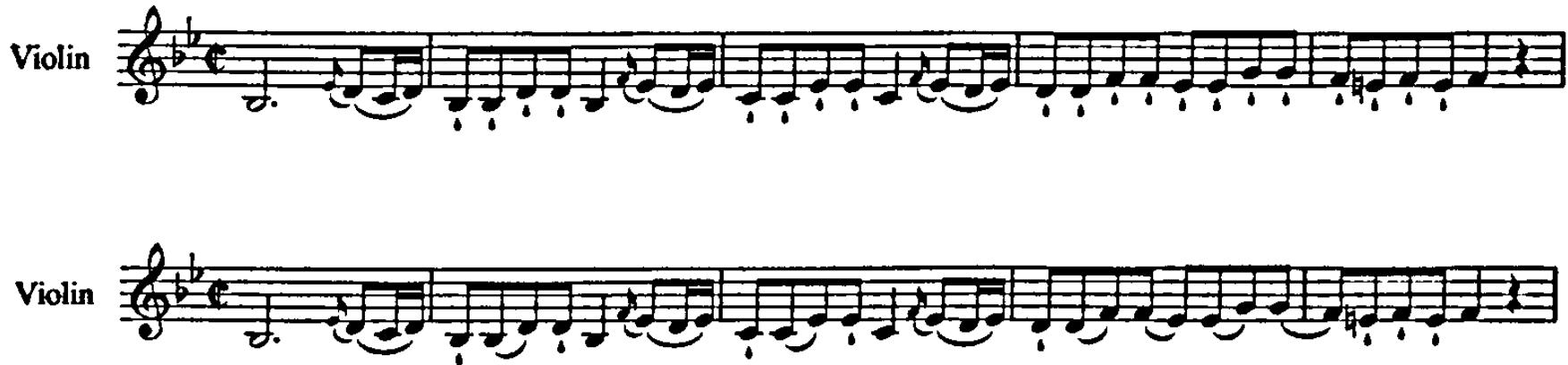
中文讲解
本段是页面上的图像/乐谱占位符,与 P0128 的图注 Example 4.51 在版面上配对,承载 K454 第三乐章第 208 至 212 小节的谱例内容。由于内嵌图像数据已省略,具体音符、连线与断音标记需查看原图方可确认,本段不再复述不可见的细节。
脚注 / 边栏 / 图表 / 附加信息(如有)
本小节正文由两段连续论述(P0127 为唯一带完整论证的段落)与三处图像/图注元素(P0126 图注、P0128 图注、P0129 图像占位符)构成;P0127 与 P0128 之间构成“文字论点 → 具体谱例”的承接关系。无脚注、无边栏。
💡 本节核心要点
- 本小节聚焦 K454 第三乐章中用切分连弓(syncopated slurs)来’装饰’既有演奏法记号这一手法。
- 第 200–212 小节是作者举出的典型案例:同一主题出现两次,原谱已含八度跳进与断音等轻松诙谐的元素。
- 在主题第二次出现时附加新的运弓处理,目的是强化该处已有的活泼 Affekt。
- Example 4.50(参照 Example 4.36)与 Example 4.51 两处图例/图注,分别对应回旋曲主题以及 208–212 小节的原始记号与建议改写的对照。
🔑 关键术语
- syncopated slurs:切分连弓,指跨过节拍重音、以连线将本应分开或换弓的音符连为一体的弓法处理,能产生切分节奏效果。
- Affekt:德语音乐修辞学概念,指作品所表达的情绪状态或心境;本段中作者用以指第 200–212 小节处轻快诙谐的性格。
- articulations:演奏法记号(如连弓、断音、重音等),本段中既指莫扎特原稿中已存在的标记,也指作者建议新增的运弓方式。
- K454:莫扎特《第五小提琴协奏曲》(Turkish Concerto, 1775)的克歇尔编号,本节讨论对象。
- rondo theme:回旋曲主题,即第三乐章反复出现的主部材料,与 Example 4.36、Example 4.50 直接相关。
4.12 [描述性拆分] The Performer’s Responsibility: Speaking the Notes
第1段(P0130)
原文复述
The Performer’s Responsibility: Speaking the Notes
中文讲解
本段为小节标题「表演者的责任:让音符发声」。标题中的"Speaking the Notes"用隐喻把演奏比作"说话"——演奏者不只是机械地奏出符号,而要让每个音符像话语一样具有表达力。这一标题承接前文对谱面记号(unmarked notes、slurs、strokes/dots)的分析,把论题从"记号本身意味着什么"转向"表演者在记号之外仍需承担什么"。
补充说明
本节对应的页码范围为27–28,正文段落锚点为P0131–P0135。标题用"Speaking"而非"Playing",强调演奏是一种带有表达意图的陈述行为。
第2段(P0131)
原文复述
While unmarked notes, slurs, and strokes or dots all suggest different manners of performance, we have seen that it is impossible to draw generalised conclusions about what they mean in the music of Mozart. Depending on context, strokes can be a sign for lifted or accented notes, or can exist to draw our attention to altered rhythms or bowing patterns; slurs were perceived as the performer’s province as well as the composer’s, and differences between autograph and first edition scores suggest that it was feasible for them to be altered from performance to performance; and the concept of the unmarked note meaning ‘detached’ was being pushed to its limit during this period, with lifted notes existing alongside the legato articulation created by smooth bow changes. Therefore, even though an adherence in performance to these three types of notated articulation gives rise to variety, the performer should also remain aware of the level of variety which would have been expected within each of these types of articulation in order to move the passions of listeners. Indeed, a slur can described as being strong at the start, and gradually fading away, and a stroke can indicate that a note should be lifted; the violinist nevertheless has a number of decisions to make about the attack, length and quality of a note.
中文讲解
本段是本节的核心论证段落,承担两个功能:先总结前文对三类谱面记号的分析,再由此推出演奏者的责任。
第一层是回顾。原文用"we have seen"明确表示这是对前文讨论的收束。三类记号——unmarked notes(无标记的音符)、slurs(连线)、strokes or dots(跳音点/圆点)——尽管都暗示不同的演奏方式,但作者强调"在莫扎特的音乐中不可能得出普适性的结论"。这里的限定语"in the music of Mozart"很关键:作者并非否认这些记号有意义,而是主张它们的含义高度依赖上下文(context)。随后作者分三类回顾:① strokes 可以表示抬指(lifted)、重音(accented),或用来提示节奏型与弓法的变化;② slurs 同时属于作曲家与表演者的领域,手稿(autograph)与首版(first edition)的差异说明它可以在不同演出中被改动;③ “未标记 = 断奏(detached)“这一概念在当时的实践中正被推到极限,因为抬指与连奏(legato,由换弓圆滑产生)已经并存。
第二层是推论。作者用"Therefore"引出结论:即使演奏者严格依照这三类记号去演奏,已经能产生变化(variety),但演奏者还必须意识到——在每一类记号"内部"也存在当时听众预期中的变化幅度。换言之,记号标记出的是大致范畴,范畴之内仍有伸缩空间。这种伸缩空间的服务对象被点明为"to move the passions of listeners”——即打动听众的情感,这是十八世纪美学的核心目标。
第三层是具体说明:a slur can be strong at the start, and gradually fading away(连线的开头可强、随后逐渐减弱);a stroke can indicate that a note should be lifted(圆点可表示抬指)。但即便给出了这种通用描述,作者仍提醒:the violinist nevertheless has a number of decisions to make about the attack, length and quality of a note——演奏者在起音(attack)、时值(length)、音色(quality)上仍需自行判断。
本段在论证上的作用是把"记号 → 含义"的单向链条打破,引入"记号 + 演奏者判断 → 表达"的双重模型,从而为下一段转向十八世纪小提琴教程(treatises)作铺垫:既然教程中记载了弓法与运弓细节,下面就要考察这些教程如何谈论演奏者在记号之外的操作空间。
补充说明
原文"a slur can described as being strong at the start"在英语上应为"a slur can be described”,此处保留了原段落中的拼写状态。“move the passions"是十八世纪音乐修辞中"affect/passions"传统的核心表达。
第3段(P0132)
原文复述
Violin treatises throughout the eighteenth century draw our attention to diverse articulations, including lifted and legato bowstrokes, and we are advised of the contexts in which these strokes can be used. By the nineteenth century, the varied bowstrokes of the Tourte bow are described in treatises with a new vocabulary; the techniques needed to produce them are explained, and exercises in their use generally focus on one bowstroke at a time. This is exemplified by Kreutzer’s 40 Etudes: number four, for example, provides an entire exercise in the perfection of articulated slurs, while number six requires the performer to use a martelé stroke throughout (a heavy and articulated stroke in the upper half of the bow). Other than Leopold’s descriptions of the use of slurs to vary articulation, there are very few examples of the application of mixed articulations within one exercise in eighteenth- and early nineteenth-century string treatises. Furthermore, there is little advice on how to vary the quality of sound at the beginning and end of different types of bowstrokes. This is in contrast with the wind treatises of the same period, which demonstrate the variety that is appropriate within a passage by using different syllables to create tongue-strokes of assorted lengths and strengths.
中文讲解
本段从抽象结论转入文献证据,考察十八世纪以来小提琴教程(treatises)如何处理运弓细节,从而印证P0131中"演奏者仍需对attack、length、quality作判断"的论点。
作者按时序分两层。第一层是十八世纪:当时的教程已经讨论"diverse articulations”——包括抬指弓法(lifted bowstrokes)与连奏弓法(legato bowstrokes),并提示这些弓法适用的上下文。
第二层是十九世纪:随着Tourte弓(Tourte bow)的出现,教程采用了一套新词汇(new vocabulary)来描述多样弓法,开始解释具体技术,并设计"一次只练一种弓法(one bowstroke at a time)“的练习。Kreutzer的40首练习曲(40 Etudes)被作为典型:第4号是一整首针对"articulated slurs"的练习,第6号则要求通篇使用martelé弓(“a heavy and articulated stroke in the upper half of the bow”,即上弓半段、沉重而颗粒清晰的运弓)。这两个例子一柔一刚,证实了十九世纪教程"分解练习"的方法论。
随后作者揭示一个重要缺陷:除了Leopold(即Leopold Mozart)的描述之外,十八世纪至十九世纪初的弦乐教程中,几乎找不到在同一练习内混合运用多种articulation的范例;同时也很少有关于"在某一类弓法的起音与收音处改变音色"的建议。换言之,教程虽然细分了弓法种类,却没有系统地教演奏者如何在同一种弓法内做微观变化(这正是P0131所说的"每类记号内部的variety”)。
最后,作者用对比手法转向同时期的管乐教程(wind treatises):管乐教程通过不同的音节(syllables)演示同一乐句中"tongue-strokes"的长短与强弱变化,为演奏者示范"如何在同一段落内做弓法/吐音变化"提供了可操作的工具。
本段的功能是为下一句"Quantz写道"作铺垫:管乐教程中"用音节示范"的做法,正是P0134引文中Quantz将舌头比作琴弓的实践基础。
补充说明
“Leopold"在小节语境中应理解为Leopold Mozart(列奥波德·莫扎特),本段正文未给出全名;本节没有为此提供独立脚注,因此读者只能凭上下文判断。“Kreutzer’s 40 Etudes"首次出版的细节由脚注42(即P0135)补充。
第4段(P0133)
原文复述
Quantz writes that the role of the tongue in flute-playing is the same as that of the bow in string playing:
中文讲解
这是一句引导句(signal phrase),作用是把读者的注意力从弦乐教程的不足之处,转向管乐理论家Johann Joachim Quantz的一段直接引语。引导句自身即完成了论证转换:既然管乐教程通过"音节"示范吐音变化,而Quantz又明确把"舌头"比作"琴弓”,那么从管乐经验反推弦乐实践就成为合法的方法。
该句本身没有实质论点,只是为下一段P0134的长引语作铺垫。
补充说明
作者在引导句中只写"Quantz”,未给出日期或页码;具体出处信息"Quantz, 1752: 71"由P0134内的引文尾注提供。
第5段(P0134)
原文复述
The tongue is the means by which we give animation to the execution of the notes upon the flute. It is indispensable for musical articulation, and serves the same purpose as the bow-stroke upon the violin. Its use so distinguishes one flute player from another that if a single piece is played in turn by several persons, the differences in their execution frequently make the work almost unrecognizable…. The liveliness of the execution, however, depends less upon the fingers than upon the tongue. It is the latter which must animate the expression of the passions in pieces of every sort, whatever they may be: sublime or melancholy, gay or pleasing. (Quantz, 1752: 71)
中文讲解
本段为Quantz的直接引语,来源标注为1752年第71页。引文的核心是建立一个类比:flute-playing中的舌头(tongue)=string-playing中的弓(bow-stroke)。
引文的论证结构可以拆成四步: ① 舌头是"give animation to the execution of the notes upon the flute"的工具——它让长笛音符"活"起来。 ② 舌头对于"musical articulation"不可或缺(indispensable),并服务于与琴弓相同的目的。这是类比的核心命题。 ③ 舌头的作用如此具有区分度(“distinguishes one flute player from another”),以至于同一首曲子由不同人演奏,差异之大几乎让人认不出原曲。 ④ 演奏的生动性(“liveliness”)较少依赖手指,而更多依赖舌头;正是舌头必须使任何类型乐曲——“sublime or melancholy, gay or pleasing”(无论崇高、忧郁、欢快或悦人)——的表达富有感情(“animate the expression of the passions”)。
这段引文对本节的论证至关重要。它把P0131提出的"演奏者需对attack、length、quality作判断"与P0132所引的小提琴教程的缺陷衔接起来:Quantz的类比暗示,弓(bow)之于小提琴正如舌头之于长笛,因此小提琴演奏者同样应该——甚至必须——在articulation上做出个人化的、有表现力的选择。结尾的"sublime or melancholy, gay or pleasing"又呼应P0131的"move the passions",把演奏者的责任直接锚定在十八世纪affective aesthetics(情感美学)的核心目标上。
补充说明
Quantz的全名Johann Joachim Quantz在引文中未出现,仅以姓氏形式出现。引文中的破折号"….“保留了原文的省略号形态,表示Quantz原文中部分内容被略去。
第6段(P0135)
原文复述
Kreutzer’s 40 Etudes were first published in 1796. The two etudes which were added at a later date are of doubtful authenticity (Charlton, 2001: 905).
中文讲解
本段是正文P0132中"Kreutzer’s 40 Etudes"后角标"42"对应的脚注内容。
脚注提供两点限定性信息:① 40首练习曲的首次出版时间为1796年;② 后来追加的两首练习曲的真实性存疑(“of doubtful authenticity”),并以Charlton 2001年第905页为参考文献。
这两点信息的作用都属于"限定”:它们并不影响P0132借Kreutzer练习曲说明"十九世纪教程一次练一种弓法"这一主张的成立——因为P0132所举的范例(第4号与第6号)属于1796年初版的40首之内,不属于"后来追加的两首"。也就是说,脚注是在排除潜在质疑,让读者放心地以这两首练习曲作为十九世纪弓法教学法的代表。
补充说明
脚注以"Charlton, 2001"为唯一文献引用;这是P0132提及Kreutzer练习曲时所需的可信度保障。
脚注 / 边栏 / 图表 / 附加信息(如有)
本小节正文中出现的非正文材料有两项,均与"Kreutzer’s 40 Etudes"相关:① 正文中以角标"42"的方式引用该曲集作为十九世纪弓法教学法的代表(P0132);② 脚注42(P0135)补充其初版年代(1796)以及后来追加两首的真实性存疑,并以Charlton 2001年第905页作为出处。此外,P0134的Quantz引文以括号注明"Quantz, 1752: 71",其作用是把管乐类比的权威性锚定到十八世纪最重要的长笛理论文本之一。小节内不含独立图表或乐谱。
💡 本节核心要点
- 三类谱面记号(unmarked notes、slurs、strokes/dots)在莫扎特音乐中无法得出普适含义,必须依赖上下文判断,这是前文论证的总结。
- 演奏者的责任不仅在于"依照记号演奏",更在于把握每类记号"内部"在当时实践中的variety幅度,最终目标是"move the passions of listeners"——打动听众的情感。
- 十八至十九世纪小提琴教程虽然细分了lifted与legato等弓法,并设计出Kreutzer式的一次一弓法的练习,但几乎不教演奏者如何在同一类弓法内做起音、收尾与音色上的微观变化。
- 同时期管乐教程通过不同音节演示tongue-strokes的长短与强弱,为"在同一段落中变化articulation"提供了可操作的工具,与弦乐教程形成对照。
- Quantz把舌头比作琴弓,论证articulation的个性化选择直接决定演奏的"animation"与"liveliness",从而把演奏者的责任上升到affective aesthetics层面。
- 脚注42限定Kreutzer 40首练习曲的可引用范围——P0132所举第4号与第6号均属1796年初版,避开了后来追加、真实性存疑的两首。
🔑 关键术语
- strokes or dots:本节所说的"stroke"或"dot"是谱面中提示抬指、重音或节奏/弓法变化的标记。本节强调其含义高度依赖上下文,可表示lifted note或accented note,也可用来提示altered rhythms或bowing patterns。
- slur:本节中的slur(连线)不仅是作曲家的标记,也是表演者可以调整的对象;不同抄本(autograph与first edition)的差异说明连线可以在不同演出中被改动。其内部还允许"开头强、随后渐弱"之类的弹性处理。
- unmarked note / ‘detached’:指谱面上没有附加任何articulation记号的音符,在当时实践中等同于"detached"(断奏)的概念。本节指出该概念在十八世纪末已被推到极限,因为lifted notes与legato articulation并存。
- legato:在本节中特指"由smooth bow changes(圆滑换弓)所产生的连奏articulation",与lifted bowstroke共同构成当时并存的两类基本弓法。
- articulated slurs:本节把它定义为一种特定的弓法:表面是连线(slur),实际每个音都被颗粒清晰地奏出。Kreutzer 40 Etudes第4号被用作"专门练习articulated slurs"的范例。
- martelé:本节直接定义为"a heavy and articulated stroke in the upper half of the bow",即上弓半段、沉重而颗粒清晰的运弓。Kreutzer第6号要求通篇使用martelé。
- Tourte bow:本节仅指出Tourte弓出现后,十九世纪教程采用了new vocabulary来描述多样化的弓法,并配合"一次只练一种弓法"的练习结构,未在本节内进一步解释Tourte弓的物理特征。
- tongue-strokes:指管乐演奏中由舌头动作产生的吐音。本节用它来对照弓法,强调同时期管乐教程使用不同syllables演示同一段落内tongue-strokes的"assorted lengths and strengths"。
- move the passions of listeners:本节小提琴演奏者责任的最终美学目标,呼应Quantz引文中"animate the expression of the passions"。它代表十八世纪affective aesthetics(情感美学)的核心命题。
- Kreutzer’s 40 Etudes:本节把它作为十九世纪"一次只练一种弓法"教学法的代表。脚注42限定其首次出版于1796年,后来追加的两首真实性存疑。
4.13 [描述性拆分] Quantz’s Tongue-Strokes and Their Application to Musical Passages
第1段(P0136)
原文复述
Quantz grounds his description of the single tongue-stroke in the contrast between $ti$ and $di$. He explains that $ti$ is used to produce an articulation characterised as ‘short, equal, lively, and quick’ (Quantz, 1752: 71), whereas $di$ is appropriate to melodies that are ‘slow’ and also to those that are ‘gay, provided that it is still pleasing and sustained’ (Quantz, 1752: 72). He traces the differing sound of the two strokes to the location in the mouth where each is formed.
中文讲解
本段奠定Quantz单吐音体系的逻辑起点:以$ti$与$di$的对立作为最基本的二元单位。$ti$被规定为’短、均匀、有生气、迅捷’的吐音,适合节奏紧凑、气质活泼的旋律;$di$则被规定为’缓慢’,或’欢快但仍须悦耳、绵长’的吐音,可以承担更长、更抒情的乐句。两者的音色差异并非源自舌头动作的’力度’,而是源自舌头在口腔内的接触位置——也就是说,Quantz把吐音差别首先归因于发音部位的几何差异。这一论断在下一段(P0137)将以具体的’舌尖是否弹回上腭’展开论证。此外,‘provided that it is still pleasing and sustained’这一限定说明:$di$并非只能用于慢速旋律,只要’欢快而绵长’的审美条件满足,它就可以出现——这为后文P0144中在同一乐句内用$ti$/$di$/$ri$并置提供了依据。
第2段(P0137)
原文复述
Quantz observes that in producing the $ti$, the tongue springs back against the palate immediately, whereas in producing the $di$ the tongue must remain free in the middle of the mouth so that the wind is not prevented from sustaining the tone (Quantz, 1752: 73).
中文讲解
本段补足P0136所预告的因果链条:$ti$与$di$音色差异的物理机制在于舌尖与上腭的关系。发$ti$时,舌尖一旦完成’切断’动作就立即弹回上腭,重新阻挡气流、把音干脆地终止,因此得到短促、跳跃的音响;发$di$时,舌尖停留在口腔中部、不接触上腭,使气流能够继续支撑音的延续,于是得到柔和、绵延的效果。读者需要抓住的关键是:在Quantz的体系里,‘口腔接触部位’是基本自变量,‘气流的延续或终止’是因变量,音色是结果变量。这与现代管乐教学中’舌头位置可调—声音延续性受其影响—音色随之变化’的思路一致,但Quantz把这一关系上升为可被讲授的’基本规则’。
第3段(P0138)
原文复述
Turning to passagework of ‘moderate quickness’—and especially passages built on dotted notes—Quantz proceeds to describe the articulation $tiri$ (see example 4.52). In this stroke, $ri$ is applied to the longer note, while $ti$ articulates the short upbeat (Quantz, 1752: 76).
中文讲解
本段把讨论从单吐音推进到复合吐音。当乐句速度属于’中等快速’、特别是出现附点节奏时,仅靠单一的$ti$或$di$已经不足以清晰刻画’长—短’的对比,于是Quantz引入$tiri$:长音对应$ri$,短促的上拍对应$ti$。需要留意的是,$ri$在该段之前并未被单独定义,作者直接将其当作一个读者已经熟悉的基本吐音来使用——这暗示$ri$在Quantz的体系里是更’长’、更’持续’的吐音,本节主要通过$tiri$与$ti$/$di$的并置来反衬其作用。换言之,$ri$在本节中的意义并不在于它’是什么’,而在于它在复合吐音里承担’长而强’的那一拍。
第4段(P0139)
原文复述
[Figure caption] Example 4.52: Quantz’s example of the articulation $tiri$ (Quantz, 1752: 77, figure 10). The embedded image data is omitted; only the position and caption are preserved.

中文讲解
本段是图4.52的占位符,对应Quantz原著第77页图10。配合上文P0138说明:原图的功能是把$tiri$这一复合吐音的记法以谱例形式呈现,即在附点节奏处把长音记为$ri$、短上拍记为$ti$。具体音符与谱面位置需要查阅原图才能确认,本节文字已经概括了$tiri$中$ri$与$ti$的分工,图4.52的意义在于把这种分工视觉化、可模仿化。
补充说明
图4.52(Quantz, 1752: 77, figure 10)的嵌入图像数据已省略,仅保留位置与图注。具体音符与记谱需查阅原图;本节P0138已概括其教学功能(演示$tiri$中$ri$与$ti$的分工)。
第5段(P0140)
原文复述
These syllables also have parallels with string techniques described in eighteenth-century treatises: $ti$ can be likened to a lifted bowstroke, while $di$ resembles a gentler legato stroke. Crucially, however, Quantz himself explicitly states that these are basic strokes which the performer should modify in order to obtain greater variety:
中文讲解
本段在论证结构上承担’转’的功能:作者把$ti$/$di$与十八世纪弦乐文献中的运弓术语建立类比——$ti$≈‘lifted stroke’(起跳的断弓或抛弓),$di$≈‘gentler legato stroke’(柔和的连弓)。这一类比让熟悉弦乐语汇的读者能够把陌生的吹管吐音术语转译为熟悉的运弓触感,从而快速把握两者的差异。但作者随即加入重要限定:Quantz自己也明确指出,这些吐音只是’基本型’,演奏者必须自行调整以获得更丰富的变化。也就是说,类比只是理解的入口,不是结论——它把读者领进门后,下一段(P0141)就要展开’基本型如何被调整’的论述。
第6段(P0141)
原文复述
Quantz writes that it is impossible to capture fully in words either the distinction between $ti$ and $di$—on which a considerable share of the expression of the passions depends—or the full range of tongue-stroke varieties. Just as there are intermediate shades between black and white, so there is more than one intermediate degree between a firm and a gentle tongue-stroke. He indicates that this variation is achieved through both the quicker or slower withdrawal of the tongue from the palate and the stronger or weaker exhalation of the wind (Quantz, 1752: 75).
中文讲解
本段是Quantz吐音理论中最关键、也最容易被低估的一段:他承认$ti$与$di$之间的差异——以及吐音种类的全部差异——‘无法用语言完全定义’。其论据是连续性:正如黑白之间存在无穷的灰阶,刚劲吐音与柔和吐音之间也存在多于一种的中间程度。这种连续性通过两个可操作的变量实现:(1) 舌尖从上腭撤回的速度(更快=更短促,更慢=更柔和);(2) 气息呼出的强弱(更强=更刚,更弱=更柔)。本段之所以重要,是因为它揭示了Quantz的体系并非二元对立的封闭分类,而是一条可连续调节的渐变谱——而’激情的表达’在很大程度上正是建立在这种渐变之上。理解这一点,是正确把握后文Example 4.53中’同值音符用不同吐音’这一实践的关键。
第7段(P0142)
原文复述
The stroke $tiri$ can likewise be aligned with bowing patterns: the rule of the down-bow teaches us that the down-stroke is naturally stronger than the up-bow. Hence the down-bow forms the longer and stronger $ri$, which is followed by an up-bow producing the short and light $ti$. Even so, in a period when the evenness of sound—and therefore of bowstroke—was coming to the fore, and when violinists were being urged by writers such as Geminiani to learn to start passages on both up-bows and down-bows so as to become ‘a Master in the Art of Bowing’ (Geminiani, 1751: 6), Quantz’s descriptions of tongue-strokes serve as a vivid reminder of the variety which is still needed in order to characterise melodies. Indeed, Quantz’s application of these syllables to short musical passages shows in detail the contrasts of articulation that can be achieved within one piece (see example 4.53):
中文讲解
本段完成两件事。 第一,把$tiri$与运弓模式直接对应:下弓天然强于上弓,因此下弓自然形成长而强的$ri$,上弓自然形成短而轻的$ti$,这与附点节奏’长—短’的力学结构天然契合。 第二,把这一类比放回十八世纪中叶的音乐美学语境中:当时’声音的均匀’——从而也是运弓的均匀——正在被推崇,Geminiani(1751: 6)就建议小提琴家要学会从上下弓两种起弓下都能起奏乐句,以成为’运弓艺术的大师’。然而,Quantz笔下的吐音描述却提醒我们:在追求均匀的时代,对比与变化仍然是刻画旋律性格所必需的——也就是说,本段用Geminiani作为反衬来突出Quantz的立场:‘均匀’不排斥’对比’,反而以’对比’为前提。 最后一句把视角从理论引向实践:Quantz把这些音节应用到短乐句中,展示了’在一首作品内部就能够实现的多种吐音对比’,由此过渡到下一个占位符(P0143)对应的Example 4.53的具体谱例。
补充说明
本段引文来源(Quantz, 1752与Geminiani, 1751)在原文中以括注形式给出,作者用Geminiani关于’运弓均匀性’的劝诫作为Quantz关于’吐音对比’的反衬,两者并置凸显十八世纪中叶’均匀—对比’的辩证。
第8段(P0143)
原文复述
[Figure caption] Example 4.53: Quantz’s application of syllables to a passage (Quantz, 1752: 78, figure 19). The embedded image data is omitted; only the position and caption are preserved.

中文讲解
本段是图4.53的占位符,对应Quantz原著第78页图19。该图的功能是把$ti$/$di$/$ri$三种音节应用到一段实际旋律上,使读者能够看到吐音选择与具体乐句的对应关系。具体音符、节奏位置与小节号(如’bar 2的c’‘‘等)需要查阅原图才能确认;下一段P0144将以此图为对象进行逐句分析。
补充说明
图4.53(Quantz, 1752: 78, figure 19)的嵌入图像数据已省略,仅保留位置与图注。具体音符、节奏位置与小节号需查阅原图;本节P0144将逐句分析该例。
第9段(P0144)
原文复述
In this example, the use of $ti$ at the opening of the passage produces a sharp attack. Quantz indicates that $di$ may be substituted for $ti$ when the passage is quick, which immediately introduces a contrast between the first two semiquavers, and thereafter a contrast between the short but gentler $di$ and the long syllable $ri$. Of particular note is Quantz’s handling of the quavers at the end of the passage. These notes are of equal length, and either $ti$ or $di$ would be an appropriate articulation; Quantz demonstrates the use of both syllables, thereby showing how contrasts in expression can be created on one repeated note value even when they are not marked by the composer. The ascending semiquaver passage ends with a $ri$ on the c’’ in bar 2; this is followed by four quavers articulated with the lively $ti$, which are then answered by four notes articulated with the more sustained $di$ tongue-stroke. In violinistic terms, this contrast could be realised by employing a lifted and fast bowstroke for the $ti$ syllables, and a slower, less attacked detached stroke for $di$.
中文讲解
本段是对Example 4.53的逐句分析,是本节论证的最终落点。可分四层理解: (1) 起首用$ti$,产生锐利的起音;作者随即提示,当乐句速度更快时,$ti$可替换为$di$,于是’前两个十六分音符’之间立刻产生音色对比。这是用吐音差异制造’micro-contrast’的实例。 (2) 此后进入’短而柔和的$di$‘与’长的$ri$‘的对比,即短长+强弱的双重对比,呼应P0138中$tiri$的逻辑。 (3) 最值得注意的一点是尾段同值的四分音符:时值完全相同,没有作曲家标记区分,但Quantz演示了$ti$与$di$两种吐音都可适用——这就证明,在完全相同的音值、相同的音符上,演奏者(依Quantz的方法)可以通过选择吐音音节来制造表情对比。换言之,对比的来源不一定是作曲家写下的articulation marks,而可以是演奏者的吐音选择;这一点是Quantz吐音体系的实践核心。 (4) 上升的十六分音符段落以bar 2中c’‘上的$ri$结束;接着四音用活泼的$ti$起奏,再以四音用更绵延的$di$‘回答’,形成’活泼—绵延’的对答结构。 (5) 最后一句把吹管吐音翻译回弦乐运弓:$ti$对应’抬起且快速的弓触’(lifted and fast bowstroke),$di$对应’更慢、起音更不明显的断弓’(slower and less attacked detached stroke)。本节由此以’管—弦之间术语可互译’作结,把Quantz的吐音体系嵌入更广阔的十八世纪器乐演奏话语之中。
补充说明
本段最后一句关于’violinistic terms’的翻译,是作者主动把吹管吐音映射回弦乐语汇,与P0140的类比相呼应,构成’管—弦互译’的闭环。
脚注 / 边栏 / 图表 / 附加信息(如有)
图4.52(Example 4.52):Quantz原著第77页图10,演示$tiri$复合吐音的记法。嵌入图像数据已省略,仅保留位置与图注;具体音符需查阅原图。 图4.53(Example 4.53):Quantz原著第78页图19,把$ti$/$di$/$ri$音节应用到一段实际旋律中,是P0144逐句分析的对象。嵌入图像数据已省略,仅保留位置与图注;具体音符、节奏位置与小节号需查阅原图。 引文来源:Quantz, 1752: 71($ti$定义)、72($di$定义)、73(舌尖与上腭关系)、75(吐音的连续性)、76–77($tiri$及图4.52)、78(Example 4.53);Geminiani, 1751: 6(关于’运弓艺术的大师’的劝诫)。两条引文均以括注形式出现在原文中,本节按原标注保留。
💡 本节核心要点
- Quantz的吐音体系以$ti$与$di$的对立为最底层单位:$ti$短促跳跃、$di$绵长柔和,差别源自舌在口腔中的接触位置(弹回上腭 vs 停留在口腔中部),而非仅是力度差异。
- 当乐句为’中等快速’且包含附点节奏时,Quantz引入复合吐音$tiri$,由$ri$(长音)与$ti$(短上拍)构成,与附点节奏’长—短’的力学天然契合。
- $ti$/$di$可类比于弦乐的lifted stroke与gentler legato stroke,但Quantz明确指出这些只是’基本型’,演奏者应沿’舌尖撤回速度’与’气息强弱’两个变量加以变化。
- Quantz承认吐音之间存在连续的中间程度(如同黑白之间的灰阶),这一渐变性承载了’激情的表达’;因此吐音体系不是封闭的二元分类,而是可连续调节的谱系。
- $tiri$与下弓(长、强)/上弓(短、轻)的运弓模式对应;与Geminiani所代表的十八世纪中叶’运弓均匀性’潮流并不冲突,反而以’对比’为前提。
- Quantz的实际应用(如Example 4.53)证明:在没有作曲家标记的情况下,演奏者可通过在相同音值上选择不同吐音音节($ti$ vs $di$)来制造表情对比,这是该体系的核心实践意义。
🔑 关键术语
- ti:单吐音音节,对应’短、均匀、有生气、迅捷’的吐音;舌尖立即弹回上腭;可类比为弦乐的lifted stroke。在本节中是Quantz吐音体系的基础短吐音,与$di$构成最底层的对立单位。
- di:单吐音音节,对应’缓慢’或’欢快而绵长’的吐音;舌尖停留在口腔中部,让气流延续以支撑音的持续;可类比为弦乐的gentler legato stroke。在本节中是Quantz吐音体系的基础长/柔和吐音。
- tiri:复合吐音音节,用于’中等快速’及附点节奏的乐句;$ri$承担长音,$ti$承担短上拍;与下弓(长、强)—上弓(短、轻)的运弓模式对应,是P0142论证的核心。
- ri:单吐音音节,在$tiri$中承担长音功能;在Quantz体系中是比$ti$更长、更连贯的吐音,与下弓的力度属性对应。本节通过$tiri$的反衬来定义其作用,而非单独定义。
- lifted stroke / legato stroke:十八世纪弦乐运弓术语,分别作为$ti$与$di$的运弓类比;前者起音短促跳跃,后者起音柔和连贯。功能是帮助读者(尤其是熟悉弦乐语汇者)把陌生的吹管吐音转译为熟悉的运弓触感。
- tongue-stroke(吐音):本节核心术语,指Quantz体系中以音节($ti$/$di$/$ri$/$tiri$等)记写、由舌在口腔中的位置与动作所决定的基本吹管发音方式。其变化构成’激情的表达’的重要基础(P0141),而非封闭的二元分类。
4.14 [描述性拆分] Tromlitz on Syllables, Note-Lengths, and the Ends of Notes
第1段(P0145)
原文复述
Published in 1791, Tromlitz’s Ausführlicher und gründlicher Untericht die Flöte zu spielen is yet more specific about the variety that can be created by articulation. In his preface, Tromlitz suggests that Quantz’s method was still an important source for flautists at the end of the eighteenth century, writing that his own treatise ‘may well seem unnecessary to many people, especially since the Royal Prussian Chamber-Musician Quantz, a worthy musician, and one of the foremost and greatest flute-players of his time, published an Essay on a Method of Playing the Flute several years ago’ (Tromlitz, 1791: 4). He later describes Quantz’s treatise as having ‘paved the way and shown the thoughtful student a path down which he may travel’ (Tromlitz, 1791: 4); indeed, building upon this foundation, Tromlitz’s treatise has been described as the most comprehensive flute tutor of the eighteenth century, particularly his chapters on single and double tonguing which ‘were at the time the most thorough written treatment of the subject for any instrument’ (Powell, 2001: 773).
Like Quantz, Tromlitz refers to two syllables suitable for single tonguing, creating a ’lively’ or ’tender’ articulation respectively (Tromlitz, 1791: 171). Instead of ti and di, however, he uses ta and da, stating that ’the letter i does not have the best effect on the tone of the flute, because when it is pronounced all the inner parts and muscles are drawn together, making the flute’s tone thin’ (Tromlitz, 1791: 153). Tromlitz also uses combinations of ta, ra, ta-a and ra-a to create the impression of ’long’ and ‘short’ notes, whether they are written as notes of equal value (but with different degrees of ‘intrinsic’ length depending on where the note is placed within the bar), or as dotted notes (Tromlitz, 1791: 158-162).
One of the most striking additions to Tromlitz’s survey of articulation is the section on how to end notes; having discussed the different tongue-strokes which can be given to the start of the note, he draws a distinction between those notes which should be made long, ending with a vowel sound, and those which should be cut short with the articulation of a consonant (see example 4.54). Although he describes this contrast in relation to his definition of strokes and dots, it is an aspect of articulation which can also be a source of variety on unmarked notes:
Strokes over the notes mean that all the notes must be accented separately or articulated with ta, but not cut short: rather they must be made long, so that the articulation is always tatata etc. Dots over the notes, however, must be cut short, and expressed by the above-indicated tat-at-at. (Tromlitz, 1791: 156)
中文讲解
本段是本小节的总纲,作用有三层:第一,定位Tromlitz 1791年长笛教程与Quantz之间的关系;第二,介绍Tromlitz在音节选择上对Quantz的具体修订;第三,引出Tromlitz最具原创性的贡献——关于"音符如何结束"的处理。
关于Tromlitz与Quantz的关系,作者特别强调两层意思。其一,Tromlitz自己承认Quantz的著作已经在场并铺好道路(‘paved the way’),因此其著作可能显得多余;其二,但Powell(2001:773)的评价指出,Tromlitz关于单吐和双吐的章节在18世纪是任何乐器中最详尽的论述。也就是说,Tromlitz不是另起炉灶,而是在Quantz基础上的深化。
关于音节修订,需要注意的是ta/da并非ti/di的简单译写或方言变体,而是出于具体的声学-生理考量:Tromlitz认为元音i发音时口腔内部肌肉收紧,使长笛音色变薄(’thin’),因此改用开口元音a。这说明音节选择与乐器音色直接挂钩,不能任意替换。同时,作者扩展出ra以及复合音节ra-a、ta-a,用来制造"长"与"短"的听感;这种"听感长度"既适用于记谱上等时值但因小节内位置不同而具有不同"内在长度"(‘intrinsic’ length)的音,也适用于附点音符。
最关键的推进是段末引入的"音符结尾"范畴。Tromlitz区分:以元音结束的音应被拉长,以辅音(t)收尾的音应被截断。他用两个德式音节串来说明:stokes(记号"")对应tatata(长、不截断、每个音单独重音);dots(记号"·")对应tat-at-at(短、截断)。这一区别虽挂在stokes/dots的符号体系下,但作者特意指出,它同样适用于无标记的音——也就是说,这是独立于记号、靠演奏者理解并自由施加的多样化手段。这一点是本段区别于Quantz的关键创新。
补充说明
段中引用的Powell 2001来自本段作者标注的二手文献,是作者对Tromlitz地位的外部评价,需要与Tromlitz自己的谦虚表态区分开来。例4.54(example 4.54)出现在原文标示中,但本段未给出谱例内容,仅描述其功能——区分元音收尾的"长"音与辅音收尾的"短"音,需查看原图谱例。
第2段(P0146)
原文复述
Slurs are also explained in relation to syllables, with the attack of ta at the start of the slur, tied onto a, which should be made by the chest in order to avoid the fault of bad performance in which the second note of a slur frequently sounds ‘very unclear, sometimes quite inaudible’. Furthermore, he writes that when four notes are slurred together, the pattern taaraa should be used; the ra on the third note allows the note to be seamlessly linked to the second note, and means that ’each note can be produced clearly according to its correct value’ (Tromlitz, 1791: 157). This method is reminiscent of Leopold’s descriptions of marking the beats within long slurs in order to maintain evenness (L. Mozart, 1756: 117).
中文讲解
本段将上一段建立的"音节系统"应用到连奏(slur)这一具体语境中,解决连奏中第二音听不清的实际问题。
逻辑链如下:(1) 连奏的第一个音用ta起音(提供清晰攻击),(2) 第二个音过渡为a(开放元音,由胸腔支持,避免舌部干扰——这是为了解决第二音"very unclear, sometimes quite inaudible"的常见演奏缺陷)。这里的要点是:连奏不是简单地"少吐",而是要通过音节内部元音的转换(ta→a)保证每个音都有发声支点。
对于四音连奏,Tromlitz给出taaraa模式。第三音用ra,其作用不是发音清晰,而是让第三音与第二音之间保持衔接(seamlessly linked),从而使四个音各自仍能"按照正确的时值被清楚地发出"。也就是说,ra在这里承担的是"连续性"的连接功能,而不是新的攻击点。
末尾作者将其与L. Mozart 1756年第117页的做法进行对比:Mozart主张在长连奏中用标记拍点(beats)来维持均匀性。两者的共同点是:长连奏并非整片糊掉,而是要在内部为每个音提供发声依据——Tromlitz用音节,Mozart用节拍标记,功能相通。这一对照为下一段将音节"应用于实际乐曲"作了铺垫。
补充说明
本段中的L. Mozart 1756: 117是Leopold Mozart的小提琴教程,作者将其与Tromlitz连奏法对照,说明管乐和弦乐虽乐器不同,但在"长连奏内部均匀性"问题上有相通解法。无外部补充。
第3段(P0147)
原文复述
Like Quantz’s treatise, the highest achievement of Tromlitz’s discussion of articulation, and the aspect which sets it apart from its string counterparts, is his application of these articulations to a piece of music. A short excerpt from one such piece (see example 4.55) demonstrates articulations which have varied attacks: ta creates a ’lively’ stroke, used predominantly to emphasise the start of phrases here, or as a short and lifted up-beat (as for example in bar 4). Ra and da are both softer consonants, ra specifically being employed on longer notes, or on those with a longer ‘intrinsic’ value (such as in the middle of bars 1 and 3). In bar 5 the choice of da instead of ta creates a tender (Tromlitz, 1791: 171) rather than lively syncopation in the middle of the bar, and the ta-a articulation (which Tromlitz describes as being used for slurs [Tromlitz, 1791: 156]) at the start of bar 5 is more emphatic than the ra-a slur in bar 6. Furthermore, attention is paid to the quality of the ends of notes as for example in bars 1 and 3. Tromlitz describes the use of taat or tahat for ‘fast or lively’ movements (Tromlitz, 1791: 156); this articulation at the end of the note cuts it short, in contrast to the more gentle effect of the open vowel of raa in bar 7:
中文讲解
本段是本小节的高潮,展示了Tromlitz讨论的最高成就:把抽象的音节规则落实到一首具体乐曲(例4.55)的演奏上。这一"应用"恰恰是管乐论述区别于同时期弦乐论述的关键——弦乐论著往往停留在规则层,而Tromlitz进入谱例层。
讲解时需把握三层对比关系,便于读者理解谱例分析的逻辑:
第一,攻击音之间的对比。ta是"活泼"(lively)的攻击,多用于乐句开头或短促的上拍(如第4小节);ra和da是较软的辅音,ra专门用于较长的音或"内在时值"较长的位置(如第1、第3小节中部)。在第5小节,作者特意点出:选择da而不是ta,使得小节中部的切分音获得"柔和"(tender, Tromlitz 1791: 171)而非"活泼"的性格。同一节拍位置,因攻击音不同,性质迥异。
第二,连奏力度对比。Tromlitz在第156页将ta-a用于连奏;但在第5小节起头用ta-a,比第6小节起头用的ra-a更强调(more emphatic)。这说明同一类记号下的连奏,因起音音节不同仍可有强弱差。
第三,结尾方式的对比。本段落实了P0145的"音符如何结束"主题。Tromlitz在第156页指出taat或tahat用于"快速或活泼"段落,作用是把音截短;与之相对,第7小节末尾的raa以开口元音收束,效果更柔和(gentle)。因此结尾的处理不只是"停"或"不截",还涉及用什么音素收尾。
本段的功能是把前面建立的音节词典(ta/da/ra、ta-a/ra-a、taat/tahat/raa)逐一对应到谱面位置,是抽象规则向实践的兑现。
补充说明
本段所引用的Tromlitz 1791: 171、: 156是Tromlitz原文中关于音节分类的页码,作者通过谱例4.55(example 4.55)将之与具体小节挂钩。原谱具体音符需查看example 4.55才能确认。
第4段(P0148)
原文复述
Although Quantz and Tromlitz discuss many of the same issues of articulation as string treatises of the same period, such as notes being lifted or legato and slurred or detached, their application of syllables to music demonstrates the level of variety which was expected of the performer within each piece. The use of syllables in wind playing specifically highlights the expression which can be achieved through the amount of attack used at the start of a note, the length given to a note, and, in Tromlitz’s examples, the manner in which a note is ended.
中文讲解
本段是全节的收束,做了三件事:
第一,承认Quantz和Tromlitz讨论的许多问题(断奏/连奏、断连奏等)与同时期弦乐论著重合——也就是说,管乐与弦乐在记号层面面对同样的问题集。
第二,但通过把音节系统真正应用到音乐中,管乐论著揭示出"每首乐曲内部、演奏者被期待的表达多样化程度"。这是作者的关键判断:记号只是底线,音节系统的真正贡献在于激发演奏者在同一乐曲内部做出细致的差别处理。
第三,作者提炼出管乐音节系统特别突出的三个表达维度:(1) 起音的攻击量(amount of attack);(2) 音的长度(length given to a note);(3) 在Tromlitz的例子里进一步加入了音的收尾方式(manner in which a note is ended)。其中第(3)点是Tromlitz相对Quantz的扩展。
理解时需注意:作者不是把管乐凌驾于弦乐之上,而是说管乐因为有"音节"这一独特工具,能够在起音、长度、收尾三处同时进行细致处理;弦乐缺乏类似的对音头、音长、音尾的系统化符号或发音指引,因而达不到同样粒度的表达控制。
脚注 / 边栏 / 图表 / 附加信息(如有)
无独立于正文的脚注、图表说明或边栏文本。段中提及example 4.54(P0145)和example 4.55(P0147)两处谱例,但本节source_paragraphs未包含谱例内容;其具体音符需查看原书对应页面。引用的二手文献Powell 2001: 773位于P0145,是作者对Tromlitz地位的外部评价。
💡 本节核心要点
- Tromlitz 1791年教程定位为Quantz之后的深化,而非替代;其单吐与双吐章节被Powell 2001评价为18世纪任何乐器中最详尽的论述。
- Tromlitz用ta、da替代Quantz的ti、di,理由是元音i使口腔收紧、长笛音色变薄;音节选择服从音色考量。
- Tromlitz最具原创性的贡献是"音符如何结束":以元音收尾则音被拉长,以辅音(t)收尾则音被截断;taat/tahat用于活泼段落截短音,raa以开放元音作柔和收尾。
- stokes(重音记号)对应tatata——长而不截;dots(断音记号)对应tat-at-at——短而截;该区别也适用于无标记的音。
- 连奏中通过音节内部转换(ta→a,四音连奏用taaraa)解决第二音不清的演奏缺陷;与L. Mozart 1756的长连奏内标记拍点法功能相通。
- Tromlitz论述的最高成就在于把音节规则落到具体乐曲(例4.55)上,使同一乐曲内部出现活泼/柔和、强调/不强调、截断/柔和收尾的细致差别——这是管乐音节系统相对同时期弦乐论著的关键推进。
🔑 关键术语
- Ausführlicher und gründlicher Unterricht die Flöte zu spielen:Tromlitz 1791年出版的长笛教程全名;在本节中被定位为Quantz基础上更具体的咬音多样性论述,特别是单吐、双吐章节。
- ta / da / ra:Tromlitz用于单吐的三个音节,分别对应"活泼"(ta)、“柔和”(da)和较软辅音(ra,多用于较长音或内在时值较长位置)。它们替代Quantz的ti/di,理由是i音色薄。
- ta-a / ra-a:复合音节,用于连奏:起音由辅音给出清晰攻击,随后过渡到开口元音a延续,以解决第二音不清的演奏缺陷;ta-a比ra-a更强调。
- taaraa:Tromlitz为四音连奏设计的音节模式:第三音的ra承担与第二音之间的衔接,使每个音仍按正确时值被清楚发出。
- taat / tahat / raa:Tromlitz用以处理音符收尾的音节:taat或tahat用于"快速或活泼"段落,截短音符;raa以开放元音作柔和收尾二者共同构成P0145所说的"音符如何结束"这一新维度。
- intrinsic length(内在长度):指记谱等时值音符因在小节内位置不同而具有的不同听感长度;Tromlitz通过不同音节组合在这种等时值音符之间制造长/短听感。
- stokes vs dots:Tromlitz对咬音符号的区分:stokes(重音/楔形记号)= 长而不截,对应tatata;dots(圆点)= 截短,对应tat-at-at。该区别虽与记号挂钩,但同样适用于无标记音。
4.15 [描述性拆分] The Human Voice as Model: Consonants and Vowels
第1段(P0149)
原文复述
Although wind treatises furnish string players with a rich pool of ideas on how to vary their management of the bow, the practice of using syllables for articulation draws us back to what eighteenth- and nineteenth-century theorists and performers regarded as the most varied and expressive instrument of all: the human voice. Tromlitz writes, in his discussion of articulation, that ‘our model should always be the good singer… both in beautiful melodies, which should be flowing, soft and full of feeling, and in round, running passages, which should be distinct and full of expression’ (Tromlitz, 1791: 152). Whereas wind treatises tend to concentrate on different combinations of three or four syllables, an examination of the sounds the human voice produces opens up a whole array of consonants and vowels available for the violinist to imitate. Agricola, in his Anleitung zur Singekunst (1757)—a translation, with additions, of Tosi’s Opinioni de’ cantori antichi e moderni (1723)—writes that:
中文讲解
本段为整节4.15立论:由气息乐器(管乐)转向人声,作为弦乐咬字的最终模型。需要注意三点递进。第一,作者并未否定管乐文献——仍然承认其对运弓管理有启发价值——但咬字所需的音素范围超出管乐所能提供的三四个音节,故必须转向人声理论。第二,Tromlitz的引用具有修辞策略:他本人是长笛演奏家与理论家,由他承认“好歌手”才是模型,反驳了“器乐文献已足够”的潜在质疑。第三,作者交代Agricola 1757年德文译本是Tosi 1723年意大利文 Opinioni 的增译版,等于把论证基础一直追溯到十八世纪初的意大利声乐教学传统。段末冒号引出P0150中Agricola关于辅音成声机制的长引文。
第2段(P0150)
原文复述
According to Agricola it is an undeniable truth that the correct pronunciation of consonants contributes greatly to the overall clarity of speech, and is even the origin and cause of that clarity. [Consonants] are produced by a momentary new impetus, pressure, or vibration of one or another of the parts of the mouth necessary for speech—such as the tongue, palate, teeth and so on—so that the air, continuously forced out of the windpipe, takes on in an instant a modification or a different direction (Agricola, 1757: 162).
中文讲解
Agricola的引文提出一个因果性主张:辅音不只是装饰,而是语音清晰度的“根源和原因”。其发声机制的描述包含三个要点:(1)“瞬时的新冲力、压力或振动”——强调动作的短暂性;(2)由舌、腭、齿等口腔部件执行——不同的部件意味着不同的辅音音色;(3)使来自气管的持续气流被瞬间改道或改造。对小提琴的类比意义在于:每一类辅音对应一种短促、明确、有特征的发声动作,恰好对应于不同性质的小提琴运弓起音(articulated bow strokes)。如果学生只追求均匀持续的压力,就丢失了辅音所暗示的那种瞬时性强弱变化。
第3段(P0151)
原文复述
This account of how consonants are formed through different parts of the mouth vividly illustrates the enormous variety the human voice can achieve—a variety necessary for conveying the meaning and expression of words with clarity. Hiller advises that, in order to ‘prepare for pure pronunciation’, the syllables da, me, mi, po, tu and be offer a good foundation (Hiller, 1780: 48). Already these syllables offer a broader range of articulation than those outlined in eighteenth-century wind treatises. Writing in 1840, Manuel Garcia goes into even greater detail, illustrating the varieties of sound produced by consonants. He describes the effect of ’explosive’ consonants, which arise when two parts of the mouth are placed against each other (such as the tongue against the teeth) and then quickly separated, so that ’the consonant is immediately heard’ (Garcia, 1840: 44). Explosive consonants include the letters p, k and t. ‘Sustained consonants’, by contrast, are those that ‘produce a whistling sound, that may be prolonged at pleasure, such as ch, x and s; or else they are given out with a continuous noise, like m, n, gn, l, and gl’ (Garcia, 1840: 44).
中文讲解
本段在概念上是全节的关键转折,要分两层看。其一,作者从Hiller六个音节(da、me、mi、po、tu、be)出发,把可用的语音材料从管乐的三四音节进一步扩展,并由此确立优势:选择空间越大,咬字的语义—表情潜能越高。其二,Garcia的分类学给出了本节借用的核心二元区分:“爆破性”辅音(p、k、t)由两个口腔部位瞬间贴合再快速分离,因而是“立刻被听到”的——映射为短促离弓的打点性弓法(martelé等);“持续性”辅音又分为两小类——可延长的哨音类(ch、x、s)和连续摩擦类(m、n、gn、l、gl)——前者近似于延续的弓—弦摩擦,后者近似于带鼻音共鸣的连弓或flautando音色。作者用Garcia的术语,为后文把辅音对应为具体的小提琴运弓方式,提供了分类工具。
第4段(P0152)
原文复述
Vowels, too, are an important signifier of articulation. Agricola maintains that ’to produce vowels, the parts of the mouth remain motionless in the position that the pronunciation of each vowel necessitates’ and that vowels therefore produce a ‘continuous sound’ such as that of the flute or organ pipe; this stands in contrast with the ‘hammer of an anvil’ carried by consonants (Agricola, 1757: 162). Garcia similarly relates vowels to questions of tone, declaring that their exact pronunciation and ‘shading’ varies according to the character of the music:
中文讲解
这是全节最简洁却最核心的二元对立。Agricola的关键观察是:元音发声时口腔不动,从而形成“持续的声音”(如同笛子或管风琴),而辅音发声时口腔部件必须动作,因而像“铁砧之锤”一样打断气流。这个对立结构使小提琴类比立刻成立——元音 → 连弓/长音/持续音色;辅音 → 断弓/起音/打击性。重要的是,作者还拉出Garcia作平行:Garcia把元音和tone(音色)问题直接挂钩,但他的具体阐述留待下段(冒号)。读者应注意到两位理论家在此被并列:Agricola提供机械原理,Garcia提供表情含义,二者互为支撑而非重复。
第5段(P0153)
原文复述
‘A person pronouncing any word does not always give to the vowels it contains the same stress and sound; for as soon as any passion animates a speaker, the vowels unavoidably receive its influence, and strike our ear by the clearness or dulness [sic.] of their shadings, and the brilliancy or somberness of their timbre…. The timbre should vary with every varying passion to be expressed.’ (Garcia, 1840: 43-4)
中文讲解
Garcia的引文把元音从“持续音”上升到“表情载体”:同样的元音字母在不同的激情下,被赋予不同的强度、明暗与音色。其成对修辞——clearness/dulness(清/钝)与brilliancy/somberness(明亮/阴沉)——勾勒出一个二维表情调色盘。对小提琴手而言,这并非抽象类比:同一音高通过改变运弓压力、速度、触弦点,可以获得这套清/钝、明/暗的对照。教学意义在于:弓法变化并非技巧炫示,而是承载不同的“passion”的结构性手段。作者保留 [sic.] 以标记 dulness 系Garcia原文拼法而非讹误。
第6段(P0154)
原文复述
We have already seen that Tromlitz likewise allied the quality of flute-tone to the use of ‘a’ rather than ‘i’, because the muscles of the mouth are more open and relaxed. The various shadings of vowels also bear on the articulation of note length, depending on how open or closed the vowels are.
中文讲解
本段包含两项功能。第一,呼应:作者回顾前文(4.14或其前段)已提到的 Tromlitz 例子,将元音 a 与长笛音色联系起来——因为口腔肌肉更开、更放松;与之相对,闭口元音 i 暗示收紧。第二,扩展:在音色之外,元音的开放/闭合程度也影响音符时值的咬字逻辑——开口元音倾向于更长、更不被打断的音符;闭口元音倾向于更短促、更具阻隔感的发音。这等于把前一节的“单点对比”扩展为“连续谱”:从 a 到 o 到 e 到 i,口腔收紧程度增加,对应的应是弓幅、压力、时值的渐变。
第7段(P0155)
原文复述
The violin was regarded as a worthy rival to the expressive capabilities of the human voice, as was shown in chapter 2 of this thesis, and this holds especially with respect to its capacity for varied articulation. Agricola writes of the human voice that:
中文讲解
这是明显的过渡段:把全节论证与第二章的主题——小提琴作为人声表达能力的对手——明确挂接,然后把应用范围收缩到当前议题“可变咬字”。句末冒号引出P0156中Agricola关于口腔各部位必须协同工作的长引文,为P0157的弓臂类比做铺垫。
第8段(P0156)
原文复述
‘If a person is to pronounce and enunciate the words clearly without affecting the pitch or volume of the sound, the palate, the uvula, the tongue, the teeth, and the lips must also assist in countless ways the reverberation in the mouth—by their position or their movement, by the expulsion of the air through the glottis, and by their alignment. In singing, these mechanisms for enunciation must operate smoothly in conjunction with those for sound production.’ (Agricola, 1757: 71)
中文讲解
Agricola列举了清晰吐字所必需的解剖学部件:腭、悬雍垂、舌、齿、唇,以及负责气流经声门(glottis)排出的部分。这段引文传递两条要点。其一,咬字与音高、音量是各自独立又必须并存的功能——清晰发音“不得影响”音高和音量,意味著两者服从同一协调机制。其二,发声(声音产生)与吐字(enunciation)必须“顺利配合”——这正是小提琴所面临问题的镜像。值得注意的是,Agricola在此把“数量众多”的部件逐一点名,正是为下一段的弓臂类比提供可对应的“解剖学清单”。
第9段(P0157)
原文复述
Similarly, the violinist has at his disposal the bow, which, as we have seen in chapter 2, can produce varied effects through different combinations of pressure, weight, bow-speed and contact point. Just as the parts of the mouth and throat must work together to maintain good sound quality as well as clear enunciation, so violinists must use their fingers, wrist, elbow and shoulder to direct the bow, which is responsible for both tone and articulation.
中文讲解
这是全节最直接的类比落点,必须逐项对应来读。口腔/喉部部件 ↔ 手指、腕、肘、肩等弓臂环节;气流、压力与振动 ↔ 运弓压力、重量、速度与触弦点;声乐中“吐字机制与发声机制须顺畅协同”这一原则 ↔ 小提琴中弓对“音色与咬字”双重负责。作者特别点明琴弓是音色与咬字的共同承担者,这意味着任何弓速/压力的改变都会同时影响二者——这一点与 P0156 中 Agricola 关于吐字与音高互不破坏的命题形成结构性平行。回指第二章既表示该弓法分析已在前文建立,也表示本章将其再次运用于咬字问题。
第10段(P0158)
原文复述
Clive Brown refers to Corri’s Select Collection (c.1782) of vocal music, compiled in order ’to facilitate, and at the same time to render more perfect, the performance of vocal and instrumental music’ (Corri, c.1782: 1; quoted in Brown, 1999: 147). The main purpose of this work was to instil in performers the natural breaks of phrasing that can be easily identified in vocal music (Brown,
中文讲解
这是过渡到下一段的衔接段,引入历史证据使“人声作为模型”这一原则不再只是理论家主张,而是已经制度化于十八世纪末的印刷出版物中。Corri的声乐选集标题明示“声乐与器乐表演”双重服务目的——表明当时教学市场把声乐原则作为工具提供给器乐学生。其教学重点是“自然呼吸分句”,即声乐中的气口式乐句断点,对应小提琴中的弓向分句。本段在原始文本中被截断(“(Brown,”),剩下的引用内容应见于下一段,本节输入边界止于此。
补充说明
本段在原文中以左括号 “(Brown,” 结束,剩余的年份与页码应在下一段(不属于本次输入)补全。
脚注 / 边栏 / 图表 / 附加信息(如有)
本小节仅出现文本引文与内嵌引用,无独立图表、谱例、脚注或边栏。所有引用(Tromlitz 1791: 152;Agricola 1757: 162, 71;Hiller 1780: 48;Garcia 1840: 43–44;Brown 1999: 147 转引 Corri c.1782: 1)均作为支撑论点的论据出现,承担来源与原文证据双重功能。
💡 本节核心要点
- 人声是咬字问题的最终模型,相比管乐三四个音节,它提供由辅音与元音构成的更完整音素库。
- Garcia的二元分类(爆破性辅音 p/k/t 与持续性辅音 ch/x/s 或 m/n/gn/l/gl)映射为短促断弓与延续性/共鸣性弓法。
- Agricola的元音/辅音对立(元音=连续声如笛管;辅音=铁砧之锤)是小提琴连弓/分弓二元性的概念来源。
- Garcia指出元音的shading随激情而变,明暗对比的调色盘对应小提琴通过运弓变量创造的音色表情。
- 口腔部件(腭、悬雍垂、舌、齿、唇、声门)与弓臂环节(指、腕、肘、肩)逐项对应;弓同时承担音色与咬字功能。
- Corri《声乐选集》(约1782)显示人声作为模型的原则已被十八世纪末的出版物制度化,承接到下一段对自然乐句断点的讨论。
🔑 关键术语
- articulation (咬字):在本节指小提琴上音符起音与连接的清晰度与性格,模拟人声中辅音与元音的发声方式。
- explosive consonants (爆破辅音):Garcia 术语,指由两口腔部位瞬间贴合再快速分离而发出的辅音(p、k、t),对应小提琴短促分明的运弓。
- sustained consonants (持续辅音):Garcia 术语,指可延长哨音(ch、x、s)或带连续摩擦噪音(m、n、gn、l、gl)的辅音,对应延续性或共鸣性小提琴弓法。
- vowel shading (元音明暗):Garcia 术语,指同一元音在不同情绪下表现出的音色明暗变化,本节映射为小提琴弓法带来的 timbre 变化。
- glottis (声门):声乐中的声带开口,负责气流排出;在 Agricola 的口腔部件清单中作为发声机制的一部分。
- Anleitung zur Singekunst:Agricola 1757 年德文声乐教学著作,是 Tosi 1723 年意大利文 Opinioni de’ cantori antichi e moderni 的增译版,本节作为辅音/元音理论的来源。
4.16 [描述性拆分] Carulli’s Transcriptions and the Influence of Vocal Texts on Articulation
第1段(P0159)
原文复述
The passage opens mid-sentence with a continuing reference (1999: 148) and argues that the kind of exercise under discussion would also benefit instrumentalists in handling the small-scale articulation details that are automatically dictated by a text. Studying vocal music can heighten awareness of (a) the quality of sound at the start of syllables, (b) the way syllables relate to each other—whether they are strongly articulated or whether they elide to form ’liquid’ consonants (Bacilly, 1668: 149)—and (c) how syllables end. Eighteenth- and nineteenth-century writers constantly urged instrumentalists to imitate the human voice; Leopold Mozart, for example, maintained that musicians should be ‘aware that singing is at all times the aim of every instrumentalist’ (L. Mozart, 1756: 101-102). The author proposes, as it were, ‘playing the words’, so that the syllables themselves guide articulation decisions. When Corri’s Select Collection was published, the performance of vocal music on instruments was by no means new or uncommon. In the Classical period one finds near-contemporary transcriptions such as Peter Lichtenthal’s string quartet of Mozart’s Requiem and Abbé Cajetan Vogel’s string quintet of Le nozze di Figaro, listed in Mozart’s estate (Deutsch, 1965: 603). Mozart also showed the influence of song on his violin music through two sets of variations: K359 uses the French song ‘La bergère Célimène’, and K360 uses ‘Au bord d’une fontaine’ (see footnote 43). The study now turns to Ferdinando Carulli (1770-1841) and his early-nineteenth-century transcription for violin and guitar of arias from Le nozze di Figaro, in order to investigate how text affects articulation. The author notes that, in Mozart’s original, articulation markings in the vocal parts do not always match those in the doubling instrumental parts: in Cherubino’s aria ‘Non so piu’ (discussed below), at bar 30 the bassoon and clarinet doubling of the vocal line uses bar-long slurs, while Cherubino’s articulation is set syllabically or with short slurs, so that the doubling instruments create long legato lines in contrast with the aria’s energetic, chattering text. Similarly, in the Introit of Mozart’s Requiem, the instrumental and vocal writing in bars 37-42 contains detailed slurs that do not always coincide, even though the underlying material is the same. In Carulli’s setting, however, the violin essentially takes over the role of the solo singer. The author stresses that the aim is not to claim that performers of Carulli’s arrangements would necessarily have known Mozart’s words; rather, the libretto is used as a tool to demonstrate the variety the human voice would produce in enunciating the text, and to suggest how that variety can be transferred to ideas of violin bowing. Finally, Carulli’s publication transcribes the aria melodies quite literally, the only consistent change being in key, presumably so that the figurations suit the guitar.
中文讲解
本段是整个小节的总纲,作用是交代研究思路、史料背景和方法边界,可以拆成五层来理解。
第一层是论证前提。承接前段(某个被略去的1999年文献,第148页)的观点,作者主张:歌唱文本会自动规定细节层面的咬字法(articulation),所以声乐研究可以让器乐演奏者在这些细节上变得更敏锐。作者又把这种敏锐分成三个聚焦点——音节起首的音质、音节之间的相互关系(强咬或滑成所谓的"液辅音"/’liquid’ consonant,引Bacilly 1668: 149)、音节收尾。这三点恰好对应后面具体分析《Se vuol ballare》每一段歌词时反复使用的三个维度。
第二层是18–19世纪的方法论前提。L. Mozart那句被反复引用的"singieren zu allen Zeiten das Augenmerk jedes Instrumentalisten sein solle"是模仿歌唱这一演奏美学的最高权威背书。本段的论证逻辑是:因为权威鼓励"模仿人声",而人声的发音细节由歌词决定,所以把歌词作为弓法决策的参考是有正当性的——“演奏歌词"成了将声乐规律迁移到小提琴上的方法论桥梁。
第三层是历史背景的铺设。Corri选集的年代并非孤例——Lichtenthal改编的弦乐四重奏《安魂曲》、Cajetan Vogel的《费加罗》弦乐五重奏都证明"在乐器上演唱声乐作品"在古典时期本就常见。Mozart本人的K359、K360两套变奏(第360号主题参见脚注43)则从作曲家层面证明器乐写作自始就受歌曲影响。这两层铺垫为Carulli的改编提供合法性。
第四层是核心问题域的转向与一个重要的"分清原则与权宜”。转向Carulli的早期19世纪小提琴-吉他改编,目的在于考察文本如何影响咬字法。中间插入了Mozart原作的一个现象:声乐声部的articulation标记与器乐加声声部的标记不总是一致——《Non so piu》第30小节低音管与单簧管的整小节连线与Cherubino的"逐音节+短连线"形成对比(即器乐担当legato底色,凸显歌词的活泼吵杂);《Requiem》引子第37-42小节声乐与器乐虽材料相同,slur却常常错位。这两例说明在Mozart本人的二重配置中,文本驱动的articulation与器乐驱动的articulation可以各走一路。
第五层是方法论自觉。Carulli改编里小提琴几乎承担独唱者角色,作者强调不打算主张演奏Carulli的人一定认识Mozart的原词;这只是借词本身作为分析工具,揭示人声念词时会自然产生的articulation变化,并尝试将其转译为各种弓法。同时交代Carulli的转写除调性外基本忠实于旋律(改调显然是为吉他指法服务)。理解这一段最关键的是:作者把"研究方法"和"历史事实"分开——词本身只是当代人的解码工具,不必假设当年演奏者有同样的认知。
补充说明
段内首次出现的人物、文献与作品说明(均以本节内信息为准):Bacilly(1668: 149)关于"液辅音"的术语见段中具体解释;Leopold Mozart《Versuch einer gründlichen Violinschule》(1756)第101-102页关于"歌唱永远是器乐家目的"的论断,是18世纪器乐美学模仿歌唱传统的核心出处;Mozart K359(基于法国歌《La bergère Célimène》)与K360(基于《Au bord d’une fontaine》),以及第360号主题更常被冠以《Hélas, j’ai perdu mon amant》的别名(详见脚注43);Carulli改编改调是为适应吉他指法这一观察,是本段对carulli版谱面现象的非独立判断。
第2段(P0160)
原文复述
Footnote 43: Although the theme of K360 is based on the song ‘Au bord’ by Antoine Albanese, the sonata is often given the title of a different text, namely ‘Hélas, j’ai perdu mon amant’.
中文讲解
这是正文中编号43的脚注,揭示一个曲目学的小细节:Mozart K360这首变奏曲的主题虽然源自Antoine Albanese所作的歌曲《Au bord》,但在流传过程中却常被错冠以另一首歌的标题《Hélas, j’ai perdu mon amant》。作者加上这条脚注,是为了对正文里"K360取自Au bord d’une fontaine"的说法作一个限定——它实际上关乎到作品标题的真伪问题,但和正文的主论证(文本影响articulation)无直接关系,因此以脚注形式轻处理。读者注意:这里的标题错配只说明早期出版常将变奏主题与当时流行的歌词挂钩,不必把"Hélas…“看作K360的真实文本。
第3段(P0161)
原文复述
‘Se vuol ballare’ (transposed in Carulli’s version from Mozart’s F major to D major) is the aria in which Figaro schemes to outwit the Count. The cavatina traces Figaro’s reaction to the news that the Count—whom he has served and respected loyally—wishes to reclaim his ‘rights’ over Susanna, whom Figaro is about to marry. Following Allanbrook (1983: 80), the author notes that the aria juxtaposes two conflicting aspects of Figaro’s persona: the first is Figaro the loyal servant, embodied by the stately and graceful ‘minuet’ to which the outer sections are set. However, although Figaro’s references to the Count initially appear to be ’the unctuous invitation of a sycophant’, the sarcastic and contemptuous diminutive ‘Signor Contino’ (’little Count’) soon shows that Figaro is determined not to yield his future wife to the Count. He is thus possessed by a sense of controlled menace and vitriol.
中文讲解
本段是案例文本背景的概述,向没有读过Mozart原版歌剧的读者交代《Se vuol ballare》的剧情功能与人物心理。
关键有三:1) 调性差异——Carulli改为D大调,Mozart原作为F大调,这种下行的四度转调在小提琴-吉他配器里既为吉他空弦服务,也使整体调性更明亮、易于突出旋律线条。2) 剧情——这首cavatina(cavatina是一种短小的咏叹调形式,常见于18世纪意大利喜歌剧开场陈述性格)让Figaro在听到伯爵要"行使"对Susanna的旧权利后,开始酝酿对策;这就把音乐和"智斗+潜在怒火"的双重心境联系在一起。3) 音乐-文本的双重性格——依据Allanbrook 1983: 80,外段是"庄严、优雅的小步舞曲”,对应Figaro那副忠诚、谄媚的表面;但歌词中"Signor Contino"(带轻蔑意味的"小伯爵")暴露了言语之下的尖酸。
作者选择引用Allanbrook是要为后面的articulation分析提供文学-戏剧的语义坐标:后面要谈的"sustained consonants"(外段、逢迎面)和"explosive consonants"(“conti-no”,挖苦面),正是这场伪忠诚与真愤恨的双面戏曲。读者需理解:文本意义不是用来"复述剧情",而是要成为判断每个音节咬字的戏剧语境。
补充说明
Allanbrook(1983: 80)所讨论的"unctuous invitation of a sycophant"在段落中被直接用作引语,用以形容Figaro起初对伯爵那种拍马屁的语气;与之相对的是讽刺挖苦的"Contino",两者共同构成段中所谓"controlled menace and vitriol"(克制的敌意与尖酸)的人物底色。
第4段(P0162)
原文复述
It is strikingly apparent in the violin transcription that the melody itself is extremely simple, consisting largely of unmarked detached crotchets (see Example 4.56). However, from the very beginning the text of Mozart’s original reveals articulation details that support the character’s juxtaposition of smarmy loyalty and menacing plotting. The first two bars are dominated by syllables which Garcia—who made his debut as Figaro in 1828—describes as ‘sustained consonants’: consonants that either produce a ‘whistling sound’ capable of prolongation or generate a continuous noise (Garcia, 1840: 4). The only consonant in these first two bars that is not ‘sustained’ is the ‘b’ of ‘bal’, which is classified as a ‘mixed explosive consonant’ because the explosive effect is softened by a ‘slight noise’ preceding it (Garcia, 1840: 45). Although each of these consonants is made using a different part of the mouth and therefore produces a unique articulation, they are all essentially relatively gentle sounds. The same holds at the start of bar 3, where the word ‘si-gnor’ consists of two ‘sustained consonants’ which elide to form what Bacilly calls a ’liquid’ consonant (Bacilly, 1668: 149). By contrast, the word ‘con-ti-no’, with which Figaro insults the Count by calling him ’little Count’, uses ’explosive consonants’ (Garcia, 1840: 44) that produce an immediate sound with no preparation, and therefore create a much sharper articulation.
中文讲解
这一段是全节论证的转折点,也是技术性最强的一段。它的逻辑结构是:谱面看似平淡(小节1-4基本是未标articulation的断奏四分音符),但只要还原歌词,立刻能发现一组互相矛盾的辅音类型,从而揭示文本早已在该旋律下埋下了articulation对比。
Garcia(Manuel García,著名西班牙歌唱教师,1840年著作即为他的《新歌唱法论集》)的辅音分类是本段的支点。理解他的术语是后续弓法推论能站得住脚的前提:“sustained consonants"指发音时能持续造声(气息或摩擦持续)的辅音,包括两个子类——“whistling sound"类(哨音型,能拖长,比如 s、f、sh)和"continuous noise"类(持续噪音型,比如 l、r、m、n、v、z)。这两类辅音在自然说话中就会拉长、彼此可衔接。
相对地,“explosive consonants”(爆破音)一经发出立即达成阻塞解除,没有准备段,声音短促尖锐,是Garcia术语里与之对立的一类。“Mixed explosive consonant”(混合爆破音,如 b、d、g)则因为前面带有"slight noise”(如合唇时的气流),爆破感被削弱,介于持续与真正爆破之间——这正好和它们所在小节的功能(柔化、外段、谄媚面)相配。
段中三个词的对比是后面弓法设计的关键:
- “si-gnor”——两个持续辅音彼此滑入,构成Bacilly所称的"液辅音”,发音柔和、连续;
- “con-ti-no”——爆破辅音直接开头,无任何准备音,发音尖锐;
- “bal"的b——“混合爆破”,位置上既不归"持续"也不归"纯爆破”,是过渡型。
这种辅音内在的软/硬差异为后面每一小节具体弓法选择(fast stroke、portato、lifted stroke等)提供了语言学依据——也就是说,作者让Garcia的声乐发声学去替代谱面上缺失的articulation标记。对读者来说,本段的真正意思是:作曲家没有标符号,但歌手的发音类型已经替作曲家做了articulation;器乐演奏者要做的是把这种"语音特性"翻译回运弓特性。
补充说明
Garcia的演奏/教师身份脚注:Garcia本人于1828年首演Figaro(路易吉·凯鲁比尼《塞维利亚的理发师》,亦含Figaro角色),其1840年的英文歌唱法著作是19世纪上半叶英语世界最系统的发声学教程。本段引用的具体页码(第4、44、45页)分别给出"sustained"“whistling"“explosive"“mixed explosive"的定义。“liquid consonant"概念源自Bacilly 1668年第149页,与上述Garcia的语音分类并行。
第5段(P0163)
原文复述
Example 4.56: Carulli’s setting of Mozart’s ‘Se vuol ballare’, Op. 66, bars 1-4. Although the opera text does not appear in Carulli’s arrangement of the arias, it has been added here for reference.
中文讲解
这是插图标题(Example 4.56),说明:1) 内容范围为Carulli作品第66号改编中《Se vuol ballare》前4小节;2) Carulli原版谱面不含歌词,这里加上只是为了便于读者查看作者所讨论的文本与音符的对应关系。
标题本身是中性的版面说明,但透露两点重要信息:第一,Carulli作为改编者把词去掉,只保留旋律与和声——这印证了P0159的论断,演奏Carulli的人未必知道原词;第二,作者必须自行为该谱例补上歌词才能论证文本如何塑造articulation,换言之,这种"加词以服务于分析"的工作是本研究方法论的可见产物。
第6段(P0164)
原文复述
[Image/score placeholder on page 38. The image is Example 4.56 referenced in P0163, showing Carulli’s transcription of ‘Se vuol ballare’ bars 1–4 with the opera text added underlay for reference. The actual score content is not legible from the available text and should be consulted in the original publication.]
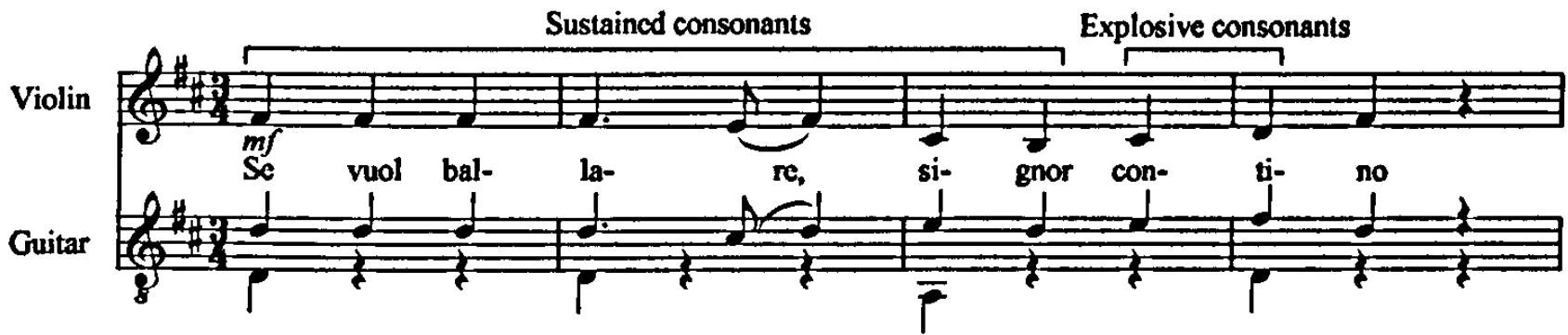
中文讲解
本条对应第38页的图示占位符(即Example 4.56谱例本身),其图注已由P0163给出。原文录入中此处的内嵌图像数据被省略,仅保留位置与图注。其版位含义:作者用它同时展示Carulli改编谱面(在Carulli版中是去歌词的纯器乐形态)与作者为分析加补的原歌词,使读者可见——这位’卡鲁利的提琴旋律’看起来就是谱面无articulation标记的逐小节断奏crotchet,但其下所对应的词(se / vuol / bal- / la / re / si-gnor / con-ti-no)本身就是P0162/P0166–P0169分析的对象。需查阅原图才能确认记谱布局。
第7段(P0165)
原文复述
The essential contrast that the violinist can produce in performing Carulli’s transcription is the distinction between the gentler articulation associated with the ‘sustained consonants’ and the detached articulation associated with the word ‘conti-no’. To translate these syllables into more varied and specific bowstrokes, one must examine more closely how each is formed, and combine that information with bowing techniques known to have been used in the eighteenth century (as discussed in chapter 2)—namely, the variation of speed, pressure, weight and contact.
中文讲解
本段是从"辅音语音学"过渡到"弓法实践"的桥梁句。它把前一段的所有语音学分析都收束在一个具体演奏任务上:小提琴演奏者所应建立的最关键对比,是"sustained consonants对应较柔的articulation"与"conti-no对应断奏articulation"之间。
更关键的是它给出的"翻译词典”:作者把第一章/第二章讨论过的18世纪弓法参数——速度、压力、重量、触弦(speed, pressure, weight, contact)——指定为本研究专用的转译维度。也就是说,接下来三段(P0166–P0169)的每一项具体推论都会落在这四个参数之中。这是一种有意识的方法论收敛——以确保所有从歌词迁移到小提琴的articulation建议都可以回溯到当时演奏实践可证实的弓法变量,而不是凭空创造新动作。
补充说明
本段中提到的"技术已在第二章讨论"是与全书的章节分配有关的提示;这里的"第二章"指本书关于弓法变奏手段的章节,是节与节之间的互文桥梁(不在本节范围内展开)。
第8段(P0166)
原文复述
The ’s’ of ‘se’ is, in Garcia’s description, a ‘whistling sound’ (Garcia, 1840: 44), and the vowel ’e’ is short. Since this syllable falls on the strong beat of the bar, and ’s’ is produced by air being pushed quickly through the teeth, the energy of this first note could be produced by a fast bowstroke and a quick release of pressure in order to match the short effect of the ’e’. The ‘v’ of ‘vuol’ is created by an ‘incomplete closing’ of the upper teeth and the lower lip, and ‘b’ is formed by the lips. Both of these syllables close with the letter ’l’—one of Garcia’s ‘sustained consonants’ that gives a ‘continuous noise’ (Garcia, 1840: 44). ‘Vuol’ and ‘bal’ are therefore comparatively gentle notes, consisting of long vowels and ending consonants. According to Leopold’s rule of the down-bow, in triple time beats two and three (here on the syllables ‘vuol bal-’) should be played on up-bows, in order to arrive at a down-bow on the down-beat of bar 2 (L. Mozart, 1756:
中文讲解
这是把语音学翻译成具体弓法的第一段案例分析。它对小节1的"Se vuol bal-“三个音节分别建模:
(1) “se”——s是Garcia意义上的哨音型辅音(气流快速通过牙齿),’e’是短元音,整个音节落在强拍上。作者建议用快速的弓速(fast bowstroke)加上压力的快速释放(quick release of pressure)来对应"哨音短且脆"的语音感。这其实是把所有参数都集中到一个动作上:弓速高+压力释放——对应一个尖锐、瞬时的起音。
(2) “vuol” 与 “bal”——v由上齿与下唇"不完全闭合"产生,b由双唇闭合产生,两者都以’l’这个持续辅音结尾(’l’是Garcia意义上的continuous noise)。所以这两个音节都是"长元音+持续尾音”,比"se"温柔得多。
(3) 弓法配置——作者引入18世纪著名的"下弓法则”(rule of the down-bow,由Leopold Mozart在1756: 83提出):三拍子中第二、第三拍用上弓,从而让下一小节第一拍接上下弓。在本例中,“vuol bal-“正好对应第二、第三拍,所以应使用两弓上弓(up-bow)而非顺向的下弓+下弓。这一弓法选择本身并不是因为乐谱有标注,而是基于节拍结构与下弓调度的习惯。
句子末尾的"L. Mozart, 1756:“逗号收尾是为了与下一段连接——后者补完页码和弓法详情。读者需注意:作者在每个音节层面都回到了"Garcia讲的辅音类型→Mouth成音动作→L. Mozart讲的弓法分配"三步链条,这是本节方法论的样本实现。
补充说明
段末为引文未闭合,由P0167续完;‘sustained consonants’与Garcia原文的具体引用位置(第44页)可帮助读者回溯到Garcia 1840的体系化章节。
第9段(P0167)
原文复述
83). These two up-bows could be rendered through a stroke that uses pressure or weight from the right hand to articulate the start of each syllable (in contrast to the fast bow required for ‘se’), with a slight release of pressure between the syllables to produce the ’l’ ending of each. The resulting effect would amount to a kind of bow-vibrato, or what would now be described as ‘portato’.
中文讲解
本段续完L. Mozart的"下弓法则"第83页引文,并把上一段提出的两弓上弓具体化为弓法操作:右手用压力(pressure)或弓重(weight)来起每个音节——这与处理"se"时所用的快速弓速形成对比。两个音节之间略微释放压力(slight release of pressure),以模拟’l’这种持续辅音收尾时的"连续噪音”。
最终作者给它命名:这种"每一弓内部都有压力起伏、弓与弓之间略松"的奏法,是某种弓震音(bow-vibrato),或可对应到今人所谓的"portato”。Portato在现代弦乐术语中通常指"音与音之间不断开但每音都带一次清晰的起音重音"的弓法,是本题情境下最自然的现代称谓。
逻辑上,本段让"两上弓+压力塑形+音节间微释压”——这种18世纪弓法技术,去模仿发音"vuol bal-“的人声语音学动作。所以这是一次成功的跨媒介翻译:单纯用谱面无articulation标记的断奏crotchet,是无法实现这种’柔韧但每个音节都被点出’的质感;唯有利用弓压塑形,方能做到。
第10段(P0168)
原文复述
In bar 3, the ’l’ of ’la’ is produced by the front of the tongue and the palate, and the syllable is very long. The ‘r’ of ’re’ is a whistling sound whose ’e’ makes it a very short and light syllable. ‘La’, as the longest syllable of the first two bars, is not as energetic as ‘se’ at the start of bar 1; to produce this effect with the bow, one could use a slow and weighty stroke, with a discreet bow change onto the start of ’re’. ‘Re’ itself should be a gently lifted stroke, in order to convey the shortness of ’e’. Like ’la-re’, the syllables ‘Si-gnor’ should be elided by a smooth bow change, though one could again use a faster bow speed at the start of ‘si’.
中文讲解
本段对应小节3的"la-re / Si-gnor”。逻辑与P0166平行:作者继续把每个音节的语音学特征一对一映射为弓法参数。
“la”——’l’由舌前与上颚接触产生,本身是非常长的音节(实际上比"se"还长,且能量不集中),所以应该用慢而重的弓(slow and weighty stroke);分弓点放在"re"起始之前要"矜持”(discreet),即不要太突兀。
“re”——‘r’被Garcia视为whistling sound类,’e’为短元音。所以这个音节应当是"轻轻提起"的弓(gently lifted stroke),用以对应其轻、短的语音感。
“Si-gnor”——回到P0162已经定性的’液辅音’关系:两个持续辅音彼此滑入,因此应当用平滑的换弓(smooth bow change)把它们连起来,但"si"的起始仍然可以用稍快的弓速——这和"se"的处理逻辑一致(强烈哨音需要快速弓速)。
关键认识:本段与上一段(P0166/P0167)形成节奏上的呼应——“se vuol bal-“用快弓+压力塑形;“la re Si-gnor"则以慢弓为底色,在’lifted’与’elided’两极之间细分;这四小节内部的弓速节奏正映射了歌词节奏(小步舞曲优雅段落中的四音节词与三音节词交替)。读者要理解:本研究并不主张演奏者去"按词念着唱”,而是主张以呼吸节奏+辅音性质为参照,建立一套差异化的弓法参数。
补充说明
Garcia 1840的辅音构造理论中,舌前与上颚构成的’l’以及’颤’r都各有具体发声位置,本段只交代到"哪个部位"以及成音的轻重,不引入与本节无关的术语扩展。
第11段(P0169)
原文复述
As ’explosive consonants’, the syllables ‘con-ti-no’ should all be lifted. The endings of each syllable suggest a degree of variety: both ‘con’ and ’no’ are short syllables, whereas the ‘i’ of ’ti’ is a longer vowel. This interpretation is supported by the fact that ’ti’ also falls on the downbeat of the bar, which is an inherently strong beat.
中文讲解
本段照应"conti-no”——P0162已经定性其全部为explosive consonant,所以三个音节都应取"提弓”(lifted stroke)型起音,即每一音节都从弓上轻轻抬起而非靠压力塑形延续,使爆破音"瞬间达成、立即终止"的语音特点被清晰地体现。
但作者进一步在音节内部做细分,而不是把这三个音节一笔画成"全一样"的断奏:‘con’和’no’是短音节(短元音o,没有持续尾音),所以即便都是"lifted”,起音收尾应紧凑;而’ti’的’i’是较长元音,落在小节强拍上,自然应从一开始就获得比’con-no’稍多一点的弓重或弓长——这就把Garcia的爆破辅音+元音长度的差异翻译回弓法变量。
整段逻辑:作者告诉我们不要看到"con-ti-no"就只用一个staccato处理完,而是要在统一断奏的大方向下,基于"音节长短+节拍位置"做细微分层。这才是文本对articulation的真正影响——不是非此即彼的强弱,而是基于语音物理特性的连续光谱。
第12段(P0170)
原文复述
The bowing techniques suggested here are akin to those described in eighteenth-century treatises for the variation of sound. While their application to the articulation of syllables at the start of ‘Se vuol ballare’ demonstrates the degree of contrast achievable through experimentation with bowstrokes, the foregoing examples are simply one interpretation of how these techniques can be applied to an otherwise seemingly unvaried melody that predominantly consists of unmarked crotchets.
中文讲解
这是本小节的结论句,承担两件事:1) 把前面所有弓法建议回收到18世纪文献的范畴内——它们只是把同时代已存在的speed/pressure/weight/contact变量重新分配到articulation上,并非发明新技法;2) 以"simply one interpretation"明确作者立场——所举的’fast bow for se’、‘portato for vuol bal’、’lifted strokes for con-ti-no’等示范只是众多合理解读中的一种,并非历史定论。
这样做的修辞效果是把研究自我限定在方法论示范层面,避免读者把单个案例上升为唯一答桉。也提示读者:即使面对谱面"全都是未标crotchet"的看似毫无变化的旋律,演奏者仍可——也有必要——根据歌词与人声语音学,应用多种18世纪弓法参数去重现文本所暗示的articulation光谱。
本段的功能因此是双重收束——既回收弓法理论的合法性,又把案例定位为示范性而非穷尽性,从而让全节落在一个有节制的、可被进一步讨论的开放式结论上。
脚注 / 边栏 / 图表 / 附加信息(如有)
本节附加材料汇总:1) 脚注43(P0160),关于K360主题源头与作品标题不一致,仅作主题材料的学名补充;2) 引文P0163(Example 4.56图注),说明Carulli改编不附歌词、分析用词系作者添加;3) 第38页图像占位符P0164,对应Example 4.56(小节1-4谱例+歌词下标),为分析对象视觉载体。本节无附录、无表格;附加材料唯一直接服务于正文之论证。
💡 本节核心要点
- 本节核心命题:谱面无articulation标记的器乐改编(小提琴-吉他版《Se vuol ballare》),仍可借助原本的人声歌词,揭示旋律内部先在的articulation对比;演奏者可将此翻译成18世纪弓法参数(speed, pressure, weight, contact)。
- 研究方法学的两条边界:(a) 不主张Carulli演奏者必知原词,词只是当代分析者用来显化articulation光谱的工具;(b) 所给弓法示范仅为多种合理解读之一,并非历史定论。
- Garcia(1840)的语音学分类——sustained consonants(whistling vs. continuous noise)、explosive consonants、mixed explosive consonant——与Bacilly(1668)的’liquid consonant’概念,共同为每个音节提供语音物理性质的判据。
- Allanbrook(1983)对《Se vuol ballare》双重性格(小步舞曲外段下的’伪忠诚/真愤恨’、‘Signor Contino’的讽刺)的解读,为歌词-弓法映射提供戏剧语义坐标,决定哪里要’gentle/sustained’,哪里要’sharp/explosive’。
- Leopold Mozart(1756)的下弓法则(rule of the down-bow)在三拍子中规定beats 2–3用上弓,本节用以分配’vuol bal-‘两弓的弓向,从而与弓压塑形、portato等18世纪奏法结合,复现’持续辅音+液辅音’的语音柔软度。
- 结论层:所有弓法建议都限于18世纪已存在的奏法变量,并非发明新的器乐技术;案例只是把语音物理参数与已知弓法参数做映射的一种示范性尝试。
🔑 关键术语
- Sustained consonants(持续辅音):Garcia 1840的语音学术语,指发音时可以拉长或产生连续噪音的辅音;本节又把这类辅音细分为"whistling sound"(哨音型,如s、f)和"continuous noise"(连续噪音型,如l、r、m、n、v)。其弓法译义为柔顺、可衔接的起音或抬压塑形。
- Explosive consonants(爆破辅音):Garcia 1840术语,指发音无准备段、一经发出立即解除阻塞的辅音(Garcia书中列于第44页);其弓法译义为轻提型lifted stroke,每音节起音即刻。无"slight noise"前导音。
- Mixed explosive consonant(混合爆破辅音):Garcia 1840术语(其书第45页),指爆破因前面有轻微气流或摩擦声而感稍减的辅音,如b、d、g;本节内代表例为"bal"的b。其弓法处理在sustained与explosive之间。
- Whistling sound(哨音型辅音):Garcia 1840将sustained consonants下的一个子类,因气流快速通过牙齿/唇部等窄缝产生的可拖长摩擦音(如s、f、r);本节内"se"的s、“re"的r均属此类,对应快速弓速+短促起音。
- Liquid consonant(液辅音):Bacilly 1668: 149的概念,指两个持续辅音彼此滑入、发音听起来"流"的辅音组合;本节内"si-gnor"中si与gnor的过渡为其例。弓法上对应elision——平滑换弓略不强调断点。
- Rule of the down-bow(下弓法则):Leopold Mozart《Violinschule》(1756: 83)所给的小节起弓分配规则:三拍子中将第2、3拍置于上弓,以便下一小节第一拍自然落到下弓上。本节用以确定"vuol bal-“两音节的弓向。
- Portato / bow-vibrato(带塑弓 / 弓震音):现代弦乐术语,指每个音都带清晰起音但音之间不断开;本节用其描述"两上弓内用弓压塑形、弓间微释压"以模拟持续辅音的语音感。
- Cavatina:18世纪意大利喜歌剧常用的一种短小咏叹调形式,常用于交代角色心理或简短抒怀;本节《Se vuol ballare》为其例之一,承担Figaro心理刻画与对外段的性格铺垫。
4.17 [描述性拆分] Applying Vocal Variety to Instrumental Contexts: Unmarked Crotchets in K304
第1段(P0171)
原文复述
Turning to the first movement of Mozart’s Sonata K304 for Violin and Keyboard, three instances of unmarked crotchets provide an ideal opportunity to apply the kind of variety explored in ‘Se vuol ballare’ to a purely instrumental piece. Bars 28 to 30, 37 to 44 and 77 to 84 (see examples 4.57-4.59) are all characterised by repeated unmarked crotchets, and yet their individual contexts suggest that the manner of articulating these notes should vary dramatically.
中文讲解
本段是第 4.17 节的开门段,承前启后:把上一小节在声乐曲《Se vuol ballare》中建立的“变化”原则,移植到纯器乐语境——莫扎特为小提琴与键盘而作的 K304 第一乐章。作者从乐谱中挑出三处段落(第 28–30、37–44、77–84 小节),它们的共同点是均由“未标奏法的四分音符”构成,但作者断言这三段在演奏处理上应截然不同。论点的核心在于:决定演奏法的是“上下文”——织体、声区、力度、伴奏形态等——而不是孤立的音符外观。这一句就为整节设下了论证方向:用同一节奏型在不同音乐语境下的对照来证明“演奏变化”原则在器乐中同样成立。
第2段(P0172)
原文复述
Bar 28 sees repeated notes in both the violin and keyboard parts (see example 4.57); a repeated C major chord, with octaves between the left-hand and violin parts, is marked f. Repeated notes suggest a certain degree of detachment, especially on the keyboard, where the finger must be lifted from the key before it can be restruck. The character of this passage, within the context of the rest of the movement, is serious; this is conveyed by such features as the low tessitura, dense texture and f dynamic. Türk suggests a ‘heavy’ execution for such serious passages, where ’every tone must be played firmly (with emphasis)’ (Türk, 1789:347), and the articulation should convey ‘fullness and force, strongly accented’ (Türk, 1789: 347-8). In order to characterise these bars as ‘serious’, the articulation should therefore be accented and detached, but also full, using a heavy and slow bowstroke in the middle third of the bow or near the heel in order to produce power. However, the notes should not be so short as to render the music lively.
中文讲解
本段展开第一例:第 28 小节。作者先把“上下文证据”一一摆出——小提琴与键盘声部均为重复音、C 大调和弦反复、左手键盘与小提琴之间构成八度、f 力度——再把这些信号综合为一种“庄严”(serious)的性格判断。判断既出,演奏处理随之确定:键盘要重按、抬起(detached),小提琴应在中弓或近弓根处以缓慢厚重的运弓发力,配合明显的重音。关键限定在最后一句——“音符不应短到让音乐变得轻快”——它把“detach”与“staccato(短促跳跃)”的语义在这里清晰切开:这里是“庄严式的断奏”,不是活泼式的短音。其说服力在于双轨论证:先从谱面客观信号推出性格,再由 Türk 1789 年的演奏法文献为该性格给出具体技术处方。
第3段(P0173)
原文复述
Example 4.57: K304, movement 1, bars 28-30.
中文讲解
这是图注,标识下一条乐谱示例为 Example 4.57,定位到 K304 第一乐章第 28–30 小节。它为 P0172 的讨论和紧随其后的 P0174 图位提供索引,使读者能直接对照所描述的小节。
第4段(P0174)
原文复述
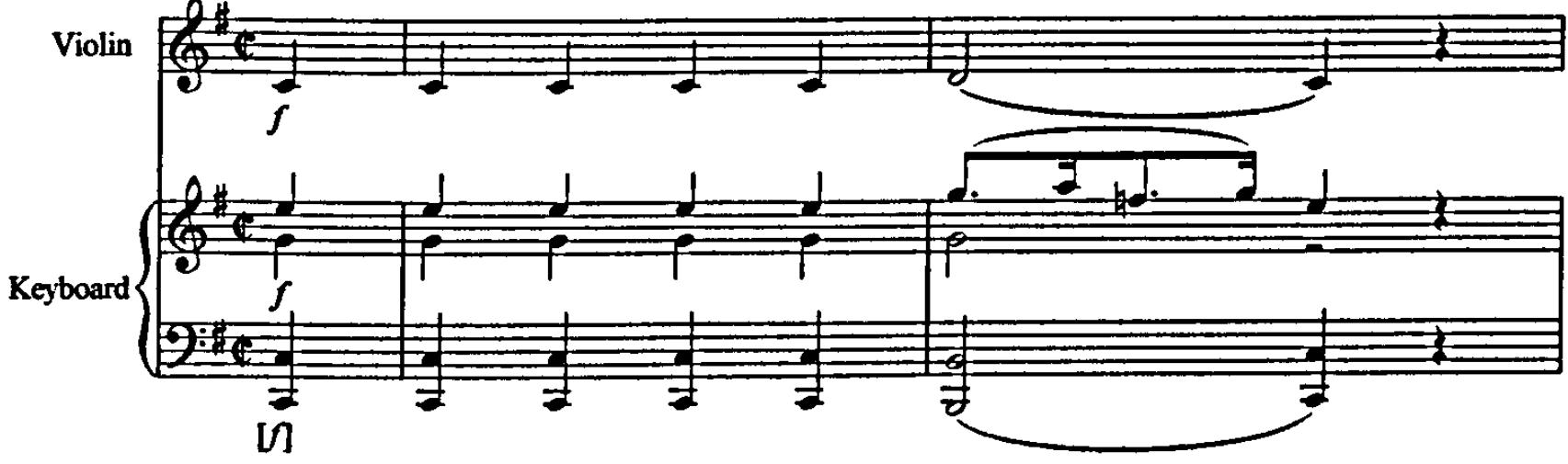
中文讲解
此处为原书第 40 页的乐谱/图像占位符,对应 Example 4.57(K304 第一乐章第 28–30 小节)。具体谱面形态(小节线、和声织体、力度记号等)需查阅原书图版;正文 P0172 已用文字交代了这段谱面上的关键特征——小提琴与键盘均为重复音、左手与小提琴构成八度、C 大调和弦、f 力度——因此占位符在论证链中起“视觉锚点”作用,让读者把抽象描述与实际谱面联系起来。
第5段(P0175)
原文复述
In bar 40 this same material is played by the violin (having been heard in the keyboard part at the upbeat to bar 37), but in a new context (see example 4.58). Here, the accompanying counter-melody, which consists of quavers marked with strokes, suggests a livelier character. Türk writes that when detaching notes:
中文讲解
本段引入第二例。第 28 小节那段四分音符材料原以键盘为主,到第 37 小节弱拍起转交键盘声部,至第 40 小节由小提琴奏出。材料本身看似一致,但作者指出“上下文已变”:键盘用带跳音记号的八分音符构成对位旋律(counter-melody)。这一伴奏层直接把性格从“庄严”切换为“活泼”(livelier)。段末以一句话预告 Türek 的原则——断奏时值要看作曲性格——作为下一段引文的引子。整段的逻辑是:相同节奏 + 不同上下文 ⇒ 不同演奏法。
第6段(P0176)
原文复述
‘One must particularly observe the prevailing character of the composition…. If the character of a composition is serious, tender, sad, etc., then the detached notes must not be as short as they would be in pieces of a lively, humorous, and the like, character.’ (Türk, 1789: 343)
中文讲解
这是来自 Türk《Klavierschule》(1789:343)的直接引文。它是整节方法论的核心支柱:断奏的长度不是固定值,而要服从作品的“当下性格”。作者在第 40 小节的例子中引用它,是为“更短促、更抬起”的演奏决定提供权威依据。原文用省略号省略了中间一句,但保留“必须特别关注作品的当下性格”以及“庄严/温柔/忧伤的断奏不可像活泼/幽默作品那样短”这两条核心原则,正足以支撑对照论证。
第7段(P0177)
原文复述
This would suggest that unlike the serious crotchets of bar 28, the articulation in bar 40 could be more lifted and light, creating the same incisive effect as an ’explosive consonant’. An appropriate bowstroke may be one which conveys energy through the use greater speed and finger-pressure at the start of each note. Other aspects of context – such as the dynamic marking of p, the thinner texture and higher tessitura – further suggest that a lighter articulation in which ’every tone is played with less firmness (emphasis), and the finger lifted from the key [or bow lifted from the string] somewhat sooner than the actual prescribed duration’ (Türk, 1789: 347) would be appropriate.
中文讲解
本段回到应用层面,演绎第 40 小节的具体处理。作者用一个生动的比喻“explosive consonant”(爆破辅音)形容既抬起又具穿透力的击弦音色,并落实到小提琴技法——加快弓速、加大起音的指压。第 40 小节除伴奏对位外,另有三个上下文证据:p 力度、更薄的织体、较高的声区,三者共同把推断从“合理”推向“必然”。另一段 Türk 引文(1789:347)则为“抬得比实际时值稍早”提供文本支持。整段以对照句式(unlike the serious crotchets of bar 28…)收束,与 P0172 形成镜像:同样时值的音符在两处不同语境下走向完全相反的演奏方向,这一对照直接证明“奏法取决于上下文而非记号本身”。
第8段(P0178)
原文复述
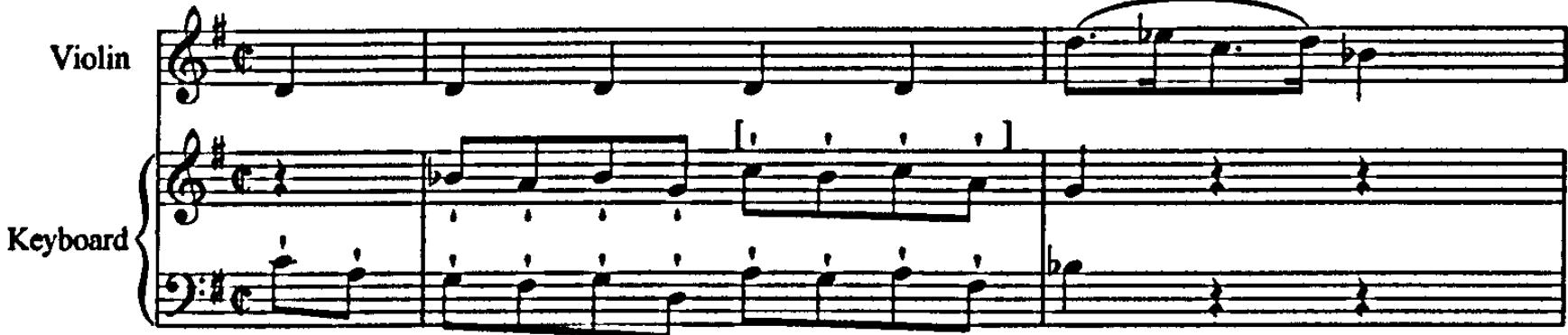
中文讲解
此为原书第 41 页的乐谱/图像占位符,对应 Example 4.58(K304 第一乐章第 40–42 小节)。该段正是 P0175–P0177 反复讨论的小提琴声部带 C 大调和弦材料、键盘以带跳音记号的八分音符作对位伴奏的段落。占位符用作“文字分析与原谱之间的视觉桥梁”,具体音符形态需查阅原书图版。
第9段(P0179)
原文复述
The unmarked crotchets of bars 79 to 83 are part of a different theme to that heard in bars 28 and 40 (see example 4.59). Here, rising scales (which are a decoration of the opening theme of the movement) are heard in octaves, either between the violin and right-hand keyboard part, or in the left hand. With a forte dynamic, the character would again seem to be ‘heavy’. Since these crotchets are not repeated notes, it is feasible to play them more legato than those in bar 28; although the octaves in the left-hand keyboard part demand a degree of articulation between each crotchet, the right-hand part and violin can create a more sustained effect. Indeed, eighteenth-century performers recommend playing movement by step smoothly; Tartini, for example, writes that ‘if the melody moves by step, the passage is cantabile and should be performed legato’ (Tartini, 1771: 55), and the violinist should therefore aim to change bows as discreetly as possible. A question mark remains over the final two crotchets in bar 83: here, two repeated notes perhaps require a greater degree of detachment than the conjunct legato of the previous bars. This new articulation would create clarity at the end of the phrase.
中文讲解
本段进入第三例。第 79–83 小节来自另一主题——上行级进音阶(它装饰了第一乐章开头主题),用八度分别出现在小提琴与键盘右手之间、或键盘左手的独奏线上。表面看,这里也是未标奏法的四分音符,也是 f 力度,似乎又该“厚重”。但作者做了关键的二度区分:这里的音并非重复音,而是级进,这就让“连奏”变得可行。作者以 Tartini 1771 年的论述——“级进旋律为如歌风格,应连奏”——支持小提琴尽可能隐换弓、键盘右手保持歌唱性连贯;同时承认左手八度为避免撞击粘连需保留一定程度的断奏。最后,作者在第 83 小节末两音处设置一处“问号”:这两音又落到重复音上,应比前几拍的级进更多断奏以便乐句收尾清晰。这一“同一段落内部还要逐处细分”的细节,恰恰把“演奏由上下文决定”这一原则推到极致。
第10段(P0180)
原文复述
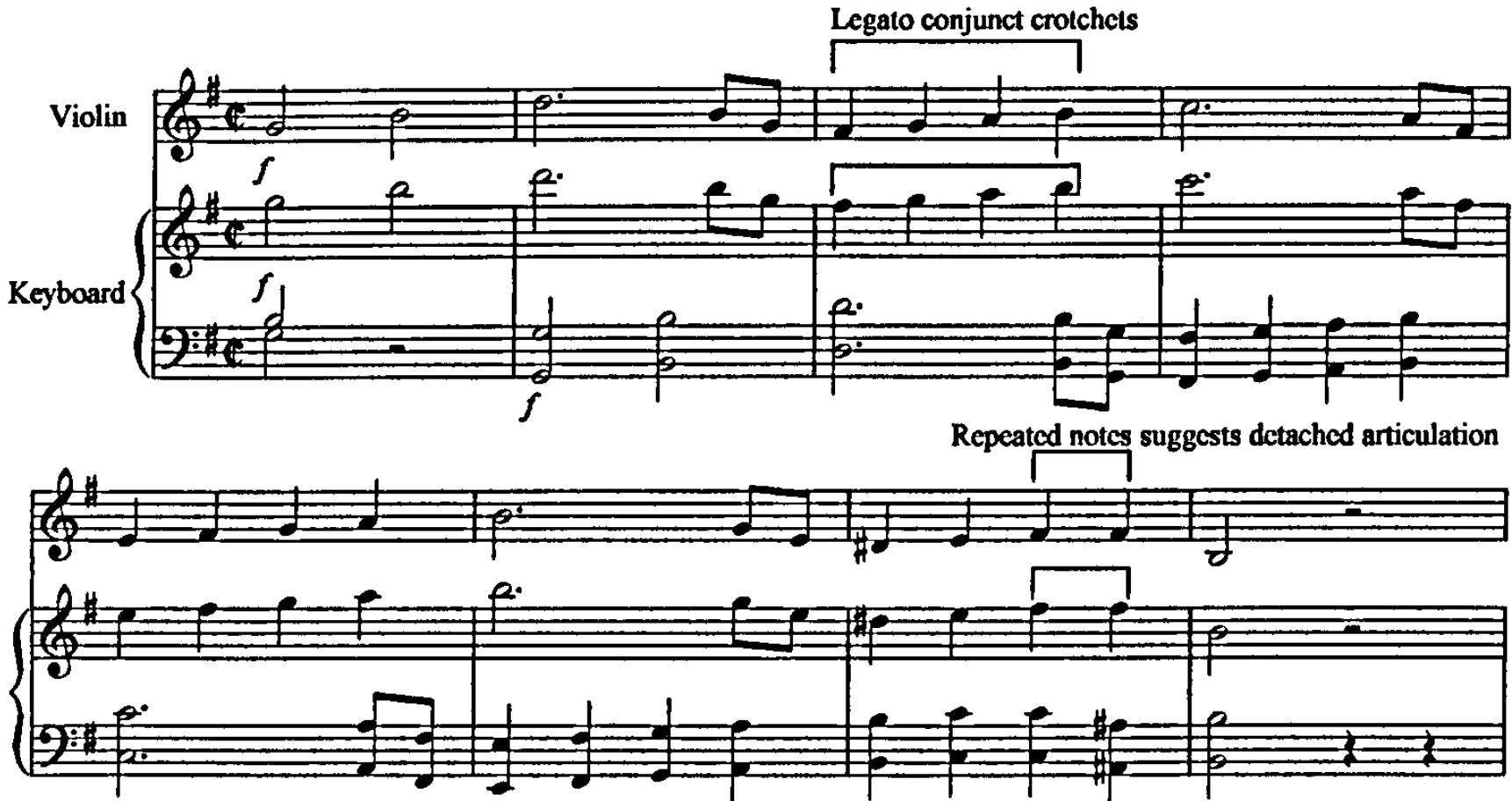
中文讲解
此为原书第 42 页的乐谱/图像占位符,对应 P0179 所讨论的第 79–83 小节段落(属 Example 4.59 的范围)。它承担“看谱说理”的视觉锚点作用:读者将 P0179 关于八度、级进、连奏与局部断奏的论述与谱面上的实际音高走向、八度配置、力度标记相互印证。具体谱面形态需参阅原书图版。
脚注 / 边栏 / 图表 / 附加信息(如有)
本节为非正文性内容。其中包含三个乐谱示例:Example 4.57(P0173–P0174,K304 第一乐章第 28–30 小节)、Example 4.58(P0178,K304 第一乐章第 40–42 小节)、Example 4.59(P0180,K304 第一乐章第 79–83 小节附近)。P0174、P0178、P0180 均为图/谱占位符,正文描述了对应段落的力度、织体、声区与重复音/级进特征。引文方面,本节三次引用 Türk《Klavierschule》(1789):343 页(性格决定断奏时值)、347 页(每一音须用力演奏)、347–348 页(饱满、有力、重音鲜明),另一次引用 Tartini(1771:55)的级进旋律应如歌连奏的论述。两处原文引文均用于支持“上下文决定演奏法”的核心论点。
💡 本节核心要点
- 本节的方法论主张是:决定演奏法的是音乐上下文(性格、织体、声区、力度、伴奏形态),而不是音符外观或孤立的奏法记号——这是把声乐中的“变化”原则迁移到器乐演奏的核心命题。
- K304 第 28 小节的四分音符处于重复音、低声区、厚织体、f 力度之中,被界定为“庄严”性格,要求重音、抬起式断奏、饱满厚重的运弓(中弓或近弓根),但又不可短至显轻快。
- 同一材料在第 40 小节转交小提琴,伴奏出现带跳音记号的八分音符对位旋律,且整体力度降至 p、织体变薄、声区抬高,因此演奏法应从“庄严式厚重断奏”反转为“抬起式轻盈短促”,以“爆破辅音”般的起音取得穿透力。
- 第 79–83 小节为另一主题的上行级进八度:虽为 f 力度,但因系级进而非重复音,宜以连奏为主(Tartini 的级进如歌原则),左手八度保留轻断奏,第 83 小节末两音作为重复音例外需更多断奏以结束乐句。
- Türk 提出的“作曲当下性格决定断奏时值”是贯穿三例的方法论支点,它把演奏决定的权力从乐谱记号转移到音乐上下文。
- 同一记谱节奏在不同段落(甚至同一段落内部)应得到逐处的演奏微调,这是第 4.17 节希望读者带走的整体演奏态度。
🔑 关键术语
- unmarked crotchets:未标奏法记号的四分音符;在本节中指的是同外观音符因上下文不同而须作不同演奏处理,是本节论证的核心对象。
- detachment:键盘/弦乐上抬起式的断奏手法;在本节强调其时值长度要服从作品当下性格,区别于一般意义上短促跳跃的 staccato。
- Türk (1789, Klavierschule):十八世纪德国钢琴教师与其著作;本节用作权威依据,提供“断奏时值随性格伸缩”与“每音须用力演奏”的演奏处方。
- Tartini (1771):意大利小提琴家与理论家;本节援引其“级进旋律为如歌风格,应连奏”之说,支持 K304 第 79–83 小节以连奏为主的处理。
- explosive consonant:作者用以比喻小提琴“短促但具冲击力”之起音的声学类比,对应第 40 小节所需的轻盈抬起断奏。
- cantabile:意大利语音乐术语,如歌风格;Tartini 用以指级进旋律应有的歌唱性连奏。
- tessitura:声区;本节用其高低(low / high)作为判断段落性格“庄严或轻盈”的上下文信号之一。
- counter-melody:对位旋律;本节特指 K304 第 37 小节起键盘声部带跳音记号的八分音符线,用以触发上下文从“庄严”到“活泼”的性格转换。
4.18 [描述性拆分] Cherubino’s ‘Non so più’: Affekt, Repetition, and Syllabic Articulation
第1段(P0181)
原文复述
Cherubino’s aria ‘Non so più’ from Le nozze di Figaro demonstrates that articulation is also essential in order to convey Affekt even in more rhythmically varied pieces. Karl Dietrich Gräwe writes that at this moment in the opera ‘Cherubino is overwhelmed by the erotic ecstasies and anguish he feels but cannot yet understand’ (Gräwe, 2001: 8). As Cherubino (who is the Count’s young page) sings of his passion for the Countess, the accompanying off-beat slurs in Mozart’s original string parts convey a sense of his urgency. This quaver movement is given to the guitar in Carulli’s transcription of the aria, while Cherubino’s melody forms the violin part.
中文讲解
本段引出本节的核心案例:凯鲁比诺的咏叹调"Non so più”。作者的主张是:即使在节奏更为多变的乐段中,articulation(奏法/吐音方式)仍是传达Affekt(情感/情绪气质)的关键要素。“Affekt"沿用十八世纪音乐修辞学的术语,指一种特定、可被听者感知的情感状态,而非泛泛的"情绪”。作者通过Gräwe(2001: 8)的引述点明凯鲁比诺此时的处境——一个尚未理解自身欲望的少年,被情欲的"狂喜与痛苦"所淹没,正是这种无法自持的紧迫感需要被演奏传达出来。Mozart原谱中弦乐声部采用了off-beat slurs(弱拍连线),用以暗示凯鲁比诺的急切;而在Carulli的改编中,原本由弦乐承担的quaver movement(八分音符律动)被改写给吉他,凯鲁比诺的旋律则落到小提琴独奏声部。这一改写的关键含义是:原本由伴奏声部承担的"急切感”,现在必须由小提琴自身的articulation来实现。这为下文讨论奏法选择埋下伏笔。
补充说明
本段中Affekt、articulation、off-beat slurs等术语均与本节标题中的关键词直接对应。Carulli的改编把声乐旋律转写为小提琴独奏,因此原本由歌词承载的"急切"必须由小提琴的奏法来补足——这是本节论证链的起点。
第2段(P0182)
原文复述
Most strikingly, this setting by Carulli demonstrates that although adding slurs was practiced by musicians during the eighteenth century, it must be done with the Affekt of the piece in mind. Here, with a knowledge of the meaning of the text and plot, Carulli’s slurs only undermine the chattering and passionate articulation which is conveyed by Cherubino’s text. Example 4.60 illustrates the equalising and smoothing effect of these slurs, in contrast with the articulation which would be created by the syllabic text:
中文讲解
本段是本节论证的关键转折。作者承认十八世纪乐手确有"加连线"(adding slurs)的实践传统,但强调这种做法必须以作品的Affekt为前提。在Carulli的版本中,由于加连线时未充分考虑歌词含义与剧情,结果连线反而破坏(undermine)了歌词原本要传达的"chattering and passionate articulation"——喋喋不休、激情而短促的吐字方式。作者用"equalising and smoothing"(齐平化、柔顺化)来概括这些连线的效果:所有音被连成一片,失去了歌词一字一音所暗示的清晰、断奏、激越感。Example 4.60的作用正是以乐谱对比展示这种效果——让读者看见Carulli的连线如何抹平了原本由音节文字所产生的节奏张力。这是典型的"以谱例代论证"写法:与其长篇叙述,不如直接呈现视觉对比。
补充说明
本段与P0181形成因果关系:既然旋律现在落在小提琴上(P0181),那么小提琴上的奏法就成了传达歌词情感的主要工具(P0182);如果奏法选择不当,反而会消解情感。
第3段(P0183)
原文复述
Example 4.60: Carulli’s setting of Mozart’s ‘Non so piu’, bars 1-3.
中文讲解
这是图注标题,标识谱例4.60的内容为Carulli改编版"Non so piu"的第1-3小节。
补充说明
该谱例用于支撑P0182的论述:可视化展示连线的"equalising and smoothing"效果。具体乐谱细节需对照原图,本输入未提供可读乐谱数据。
第4段(P0184)
原文复述

中文讲解
这是P0183所标识的Example 4.60的图像占位符,出现在第43页,用于直观呈现Carulli连线版本的前几小节。
补充说明
原图细节无法从占位符读取;其论证功能由P0182与P0183承担,需查看原图以补足论证。
第5段(P0185)
原文复述
Indeed, Allanbrook stresses the importance of these short syllables, referring to Cherubino as ‘a natural poet’, whose arias are ‘meant to be apprehended as sung poems; measured words, rather than measured gestures, seem to be the motive power of Cherubino’s song’ (Allanbrook, 1983: 84). Thus, in order to convey the Affekt of this aria based on its text, the first choice regarding articulation must be, in the majority of situations, to remove Carulli’s slurs.
中文讲解
本段借Allanbrook(1983: 84)的权威论述进一步强化论点。Allanbrook将凯鲁比诺称为"a natural poet"(天生的诗人),并指出他的咏叹调应当作为"sung poems"(被歌唱的诗)来理解——推动其歌唱的核心动力是"measured words"(有节律的歌词)而非"measured gestures"(有节律的姿态/手势动作)。这一引述实际上把凯鲁比诺旋律的本质从"旋律线条"重新定位为"歌词的载体",因此每一个音节本身就承载了节律与情感。基于此,作者得出本节最直接的操作性结论:要传达此曲基于歌词的Affekt,多数情况下首要的奏法选择应是去掉Carulli所加的连线。这一结论与P0182的批评形成闭环:既然连线"抹平"了歌词,那么去掉连线就是让歌词回归的方式。原文的"in the majority of situations"仅出现一次,表明这是默认规则而非绝对——仍有少数例外情形,将在P0186中讨论。
补充说明
Allanbrook的引述既为作者论点提供权威支撑,也引入了"measured words vs measured gestures"这一对范畴,帮助读者理解为何articulation必须服从歌词节律。
第6段(P0186)
原文复述
Repetition is an important compositional device throughout this aria, either in sequence or at pitch (and sometimes with varied rhythms). For example, bars 22 to 25 consist of a repeated two bar phrase (see example 4.61), and the sound of Mozart’s syllables can provide a rich source of information for the violinist’s approach to articulation in Carulli’s transcription. In bar 22, the words ’e a’ are slurred together by Carulli; this is one of the rare occasions on which his slurs accurately convey the sound of the text. Indeed, without the ‘hammer of an anvil’ (Agricola, 1757: 162) effect of consonants, these words are formed by a constant flow of air and a change of the shape of the mouth and position of the glottis. The equivalent moment at the beginning of bar 24, however, requires two detached bows. Here the sound of ‘sfor’ is very emphatic, with the ‘whistling’ sound of ’s’ being immediately followed by the ’explosive’ release of air caused by the consonant ‘f’ (Garcia, 1840: 44). This emphatic effect can be conveyed by a violinist through the combination a fast bow speed, and a heavy bowstroke. The bow could also be placed close to the bridge in order to produce a direct and clean sound. This sound quality is also important for the imitation of ‘za’, which is another ‘continued whistling’ sound (Garcia, 1840: 45). The bow should be cleanly changed to an up-bow, and with some pressure from the bow-hand in order to create an energetic accent.
中文讲解
本段展开"重复"这一作曲手法与奏法的关系,并给出本节中少有的"例外"——即Carulli连线奏法奏效的少数情形。作者先以22-25小节的两小节重复乐句为例,引出谱例4.61。bar 22中的"e a"被Carulli用连线连起,作者认为这是少有的、与歌词发声吻合的连线:因为没有辅音那种"hammer of an anvil"(铁砧之锤)的敲击效果,这两个音节之间是气流的连续与口型/声门位置的变化,本身就具有连贯性。但到bar 24开头,对应位置则需要两个分弓:“sfor"中的"s"是吹哨般的哨音,紧接着"f"爆破式释放气流(参Garcia 1840: 44),听觉上极具强调性,要用快速弓速+重弓触+靠近琴桥的弓位来实现干净直接的声音。同样,“za"也属于Garcia所说的"continued whistling”(持续哨音,1840: 45),应通过干净的换上弓+弓手压力制造有力的重音。本段的核心论证逻辑是:重复的旋律片段并不意味着要重复同样的奏法——奏法必须根据每次重复处的歌词辅音/元音性质来决定,这是P0185中"measured words"原则的具体落地。
补充说明
本段引用Agricola(1757)与Garcia(1840)两本十八至十九世纪声乐论著,为不同辅音的"发声性质”(哨音、爆破、持续)提供历史依据;这些发声性质直接对应小提琴上分弓/连弓/重音/弓位等奏法选择。
第7段(P0187)
原文复述
At the start of bars 23 and 25, it is the vowels which suggest the variation of articulation. The syllables ’la-re’ in bar 23 and ‘mo-re’ in bar 25 are all ‘sustained consonants’, which require a gentle start to each note. They are also appoggiaturas which resolve to G major chords on beat two, and should therefore be played with a legato bow change onto ’re’. However, the ‘a’ of ’la’ is a less open sound than ‘mo’, and so variety could be created by playing a longer crotchet with greater emphasis and depth of sound in bar 25.
中文讲解
本段继续上一段的话题,把视线从辅音(bar 22、24)转向元音(bar 23、25)。bar 23的"la-re"和bar 25的"mo-re"都是"sustained consonants"(持续性辅音——这里实际上指需要柔和起音的音节),同时它们也都是appoggiaturas(倚音),在第二拍解决到G大调和弦,因此向"re"换弓时应当legato(连贯)。但元音之间的差异——“a"比"mo"更"不开”(openness较低)——意味着即便奏法框架相同,仍可在bar 25奏出更长、更强调、更有"深度"的四分音符来制造变化。本段与P0186合在一起展示了作者的核心方法论:旋律重复是表面,歌词语音才是articulation差异化的依据;演奏者需要在尊重基本奏法规则(legato换弓、柔和起音)的前提下,以元音开放度等细节制造"音乐意义上的多样性"。
补充说明
sustained consonants与appoggiatura两个术语在本节中交叉:倚音本身的解决方式决定了legato换弓是必需的,而元音开放度则允许在legato框架内做出细微表情差异。
第8段(P0188)
原文复述
Example 4.61: Carulli’s setting of Mozart’s ‘Non so piu’, bars 22-5.
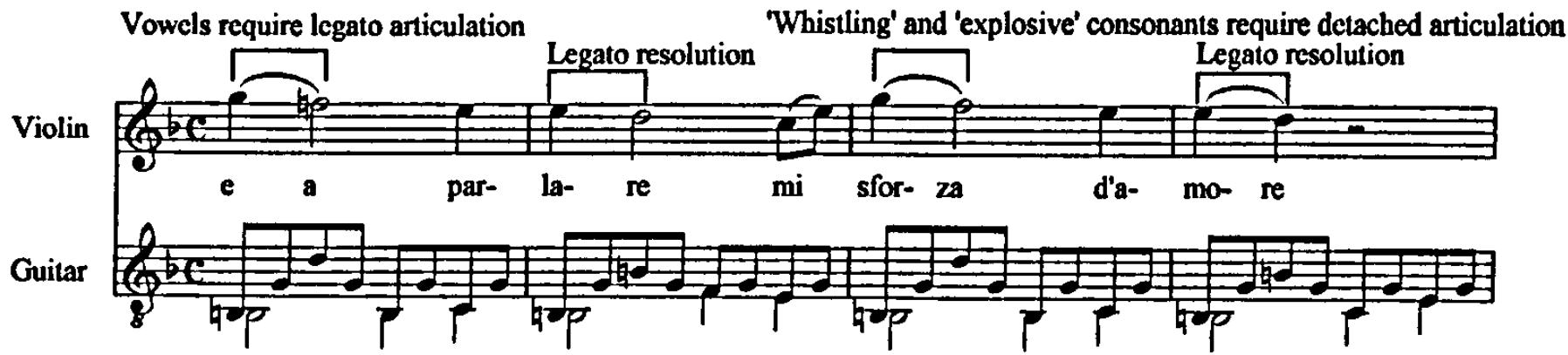
中文讲解
这是谱例4.61的图注及图像占位符,标识该谱例呈现Carulli改编版"Non so piu"的第22-25小节,与P0186的论述相对应。
补充说明
原图细节不可读;其作用是让读者直观看到bar 22的连线与bar 24的分弓对比,以及bar 23、25两个重复乐句中元音差异在乐谱上的位置。
第9段(P0189)
原文复述
Thus, just as eighteenth-century musicians would have played songs in order to gain an insight into tasteful phrasing, vocal music can open our ears to the degree of variety that is possible on a detailed scale in Mozart’s music. Figaro’s aria ‘Se vuol ballare’ demonstrates that unmarked crotchets should be thoughtfully performed; by engaging with articulation it is possible to create a performance which moves the affections, and which, in a sense, creates an aural narrative. Cherubino’s aria ‘Non so più’ shows that even when the melody consists of more varied material, articulation still plays an important part in conveying character to the listener. This is vividly illustrated by the bland and equalising effect of Carulli’s slurs, and by the importance of using different articulations for dramatic effect on repetitions of melodic material.
中文讲解
本段是本节的小结,将两个案例提升为方法论。作者呼应十八世纪乐手的做法——通过演唱歌曲来获得对"tasteful phrasing"(品味高雅的乐句处理)的洞察——论证声乐作品可以作为器乐演奏者"打开耳朵"的教材。‘Se vuol ballare’(前节已讨论)证明即使未标记的四分音符也需要谨慎处理,通过articulation可以"move the affections"(打动情感)、构筑一种"aural narrative"(听觉叙事)。‘Non so più’则把这一结论延伸到节奏更多变的段落:articulation同样是传达人物性格的关键。最后两句以"bland and equalising effect of Carulli’s slurs"和"different articulations for dramatic effect on repetitions"再次收束本节两段论证——前者对应P0182-P0185,后者对应P0186-P0187。整段的作用是把单点案例上升为"通过声乐提升器乐诠释"的普遍原则。
补充说明
本节与前一节(讨论"Se vuol ballare")构成姊妹篇:本节标题"Affekt, Repetition, and Syllabic Articulation"提示这是论证的延展,把奏法问题从单一节拍扩展到重复与音节层面。
脚注 / 边栏 / 图表 / 附加信息(如有)
本节包含两个谱例/图注及对应图像占位符:Example 4.60(P0183、P0184)呈现Carulli改编版"Non so piu"第1-3小节,用于说明连线奏法对歌词articulation的"齐平化"效果;Example 4.61(P0188)呈现同一改编版第22-25小节,用于对比bar 22的连线与bar 24的分弓、bar 23与bar 25的元音差异。两个谱例均未提供可读图像数据,论证须结合正文文字描述完成。此外,本节引用了Karl Dietrich Gräwe(2001: 8)、Wye J. Allanbrook(1983: 84)、Johann Friedrich Agricola(1757: 162)、Manuel Garcia(1840: 44-45)等文献,分别就角色处境、歌词作为诗歌、铁砧效果、哨音/爆破辅音等提供论据支撑。
💡 本节核心要点
- 即便在节奏多变的乐段中,articulation仍是传达Affekt的核心手段;凯鲁比诺的"Non so più"通过Carulli改编为小提琴版后,原本由弦乐伴奏承担的急切感必须由小提琴奏法来实现。
- Carulli在改编中所加的连线"齐平化、柔顺化"了原本由歌词产生的喋喋不休、激情而短促的articulation,因此默认规则是去掉这些连线;谱例4.60以视觉对比支撑这一判断。
- Allanbrook将凯鲁比诺定位为"天生的诗人",其咏叹调的核心动力是"measured words"(有节律的歌词)而非手势——这为以歌词为本的奏法原则提供了理论支撑。
- 重复的旋律片段不应采用相同的奏法:bar 22的"e a"可保留连线(无辅音阻碍,气流连续),但bar 24的"sfor"与"za"需要分弓、重弓触、靠琴桥、上弓重音等处理,以模拟哨音与爆破辅音。
- 在重复乐句中,元音的开放度(如bar 23"la"vs bar 25"mo")允许在legato换弓的框架内制造细微的时长、强调与音色变化。
- 本节最终上升为方法论:声乐作品可以打开器乐演奏者的耳朵,使其意识到Mozart音乐中articulation所能实现的精细变化,并借此构筑"听觉叙事"。
🔑 关键术语
- Affekt:源自十八世纪音乐修辞学,指一种具体、可被听者感知的情感状态。本节中用于强调articulation的目的不是技术性的清晰,而是传达特定情感气质——凯鲁比诺此处是"被情欲狂喜与痛苦所淹没"。
- articulation:奏法/吐音方式,包括连弓、分弓、重音、弓速、弓位等具体演奏手段。本节强调articulation必须服从歌词节律与情感,而非套用统一的连线规则。
- syllabic articulation:由歌词音节自然产生的、断奏的、一字一音的articulation。本节用以指代凯鲁比诺歌词原应承载的"喋喋不休、激情"吐字方式。
- off-beat slurs:落在弱拍上的连线。Mozart原谱中以这一手法暗示凯鲁比诺的急切感。
- appoggiatura:倚音。bar 23、25的"la-re"“mo-re"都是倚音,在第二拍解决到G大调和弦,因此其后的"re"必须legato换弓。
- sustained consonants:本节用来指称那些需要柔和起音的音节(如元音起首或持续音)。
- hammer of an anvil:Agricola(1757: 162)的比喻,形容辅音敲击般的清晰冲击感;用于说明"e a"为何没有这种辅音效果因而适合连线。
- whistling / explosive consonants:Garcia(1840: 44-45)对辅音发声性质的分类:“s"等为"吹哨般"的持续哨音,“f"等为"爆破式"瞬间释放。本节以此为依据论证bar 24需要分弓与重音。
- aural narrative:“听觉叙事”。本节核心比喻:通过articulation的多样化,演奏可以在听者脑海中构建出有情节、有情感起伏的音乐叙述。
4.19 [描述性拆分] Musical Rhetorical Figures and Repetition in K28
第1段(P0190)
原文复述
The issue of varying the delivery of repeated material is a good point of departure for the application of these techniques of articulation to pieces in which Affekt is not clarified by the meaning and sound of a text – that is, purely instrumental works. In order to decide how to vary articulation, the performer must attempt to understand the character which they need to convey through their performance. The interpretation of Affekt and character is to an extent a subjective task; however, there are stylistic and aesthetic parameters suggested in the writings of eighteenth-century theorists which can offer the modern performer insight into the compositional language of Classical composers. Indeed, we have seen that Leopold admired theoretical works by authors such as Mattheson, Spiess, Forkel and Gottsched, and while this is not proof that he agreed with their teachings, and even less conclusively that they are theoretical concepts that were inherited by his son, they provide a valid contemporary source in the attempt to understand the expressive language of eighteenth-century composers.
中文讲解
本段是整节的引子,承担从"声乐咬字"过渡到"纯器乐咬字"的转折任务。作者先将"如何变化重复材料的呈现方式"这一问题定位为把前几节建立的咬字技巧推广到纯器乐曲的关键切口,因为纯器乐曲失去了歌词语义这一现成的Affekt提示,演奏者必须主动从乐谱本身读出性格。为了弥补这一困难,作者承认Affekt判断具有主观性,但立刻指出十八世纪理论家的著述提供了可参照的风格与美学参数,可以作为现代表演者进入古典作曲家音乐语言的桥梁。这里特别援引Leopold Mozart曾推崇Mattheson、Spiess、Forkel、Gottsched等理论家的事实,但作者同时自觉地加了三道限制:第一,这并不证明Leopold赞同其学说;第二,更不能据此断言这些理论被其子(Wolfgang Amadeus Mozart)所继承;第三、它们仍可作为理解十八世纪作曲家表情语言的有效同时代来源。理解这段要抓住"主观性+同时代理论参照"这一双重立场:作者既不夸张理论权威,也不放弃理论参照,而是把后者作为"可对话的资料"而非"可照搬的指令”,这为后续把修辞格搬到K28分析上的做法提供方法论上的正当性。
补充说明
本段对Leopold Mozart是否认同这些理论家、以及这些理论是否被其子继承这两个问题给出了递进的限定,语气为"this is not proof… and even less conclusively…",阅读时要避免将其解读为对理论有效性的全盘肯定或否定。Affekt在十八世纪音乐修辞语境中可理解为乐句/乐段所携带的特定情感或表情特征。
第2段(P0191)
原文复述
Following a two-hundred year tradition, Mattheson, Spiess, Forkel and Gottsched all made notable contributions to the cataloguing and definition of musical rhetorical figures, a large proportion of which are made up by the various figures of melodic repetition, such as those heard in Cherubino’s ‘Non so più’. Le Faucheur demonstrates that eighteenth-century orators were encouraged to study the art of varying the voice according to the figures of rhetoric, describing them as ’the lights of Speech, that render it most agreeable both for the Variety and good Grace; every one of ’em carrying along with it a particular Air, Ornament and Novelty’ (Le Faucheur, 1727: 128). In 1757, Agricola similarly alluded to the relevance of rhetorical figures to musical performance, writing that in order to learn to articulate clearly and effectively, singers should train themselves in the art of speech:
中文讲解
本段把分析对象的谱系向前推进一千年:Mattheson、Spiess、Forkel、Gottsched这四位理论家沿袭一种延续两百年的传统,共同致力于音乐修辞格的编目与定义;而其中最大的一类修辞格就是"旋律重复"诸格。作者用Cherubino的"Non so più"作为听觉例证(在前文中出现过),暗示读者对重复格的效果已有感受。接着,作者引出Le Faucheur(1727)的原始证据:十八世纪演说家被要求研究"按照修辞格变化声音"的艺术,并把修辞格称为言语中的"光芒”,让言语因"多样与优雅"而动人,每一种格都自带特殊的语气、装饰与新奇感。段末以Agricola 1757年的提示作承前启后:歌唱者要清晰有效地咬字,应当先从说话的艺术中训练——由此把"歌唱→说话→修辞"的逻辑链公开化,替下一段Agricola的完整引文铺路。本段要在理解上注意:Le Faucheur的引语并非谈论音乐,而是把"修辞格让声音有变化与优雅"的道理放在演说场域,是为了之后把它类推到歌唱与演奏。
补充说明
Le Faucheur(1727)的引语核心是"修辞格=言语中的光,让言语既多样又有风度”,这正是音乐重复格被借用的修辞前提。Cherubino的"Non so più"出自莫扎特歌剧《费加罗的婚礼》,是前文已讨论的重复格示例。
第3段(P0192)
原文复述
It is very necessary, however, for a singer to learn from the art of speaking or from oral instruction by good speakers (if they are available), or through careful attention to their lectures what kinds of vocal sounds are necessary for the expression of each Affect or each rhetorical figure. (Agricola, 1757: 163)
中文讲解
本段是P0191末句预告的Agricola引文完整内容,其论点可以拆成三层:第一,歌唱者应当学习说话的艺术(或直接接受优秀演说者的口传训练,或细致聆听他们的讲座);第二,目的是弄清"每一个Affect(即情感)/每一个修辞格"对应的是哪一种嗓音;第三,这种对应关系是清晰且有效咬字的前提。这段引文是整节方法论的支柱——它把"歌唱咬字—说话咬字—修辞格"三者正式挂钩:歌唱者只要识别出修辞格,就能从说话艺术中提取相应的声音类型应用到歌唱中。理解时要注意,Agricola所谓"vocal sounds"涵盖音色、力度、咬字清晰度等多维属性,并非单指音高。
第4段(P0193)
原文复述
Musical rhetorical figures can therefore be taken as relevant to the interpretation of Affekt in eighteenth-century music; their identification in the Sonatas for Violin and Keyboard by Mozart will provide a context for suggestions of articulations, with the aim of imitating the degree of variety that can be expected from the human voice.
中文讲解
本段是节内方法论的小结,也是从理论转向具体作品分析的过渡。作者明确宣布两条推论:第一,音乐修辞格可被用于解释十八世纪音乐的Affekt;第二,在莫扎特的小提琴与键盘奏鸣曲中识别这些修辞格,将为咬字建议提供语境,其目的是让人声可期待的那种"变化程度"在器乐演奏中被仿造出来。这段承担了三重任务:它上承P0190–P0192的理论铺垫,把修辞格作为可操作的工具;中启后文K28的具体分析;下连"仿人声变化"这一演奏美学目标。读者在这里要意识到,作者的咬字建议并非凭空,而是先要识别格,再以格所暗示的表情为依据指导运弓与触键。
补充说明
段中"Sonatas for Violin and Keyboard by Mozart"为后文限定了曲种,本节只关注小提琴与键盘奏鸣曲中的重复格现象。
第5段(P0194)
原文复述
In a piece such as the first movement of Mozart’s Sonata K28 for Violin and Keyboard (written in 1766), where much of the melodic material is formed by repetitions of motives or phrases, a knowledge of musical rhetorical figures is a useful tool for the performer. Indeed, Mozart uses three different figures of repetition in close succession. In bars 11 to 17 (see example 4.62, page 137), a two-bar theme is repeated, being played in imitation between the violin and the right-hand keyboard part. Here, the repetition has a slightly altered interval arrangement (bar 14 descends by a 5th in the violin part, rather than a 3rd as in bars 12 and 16), and can therefore be described as ‘synonymia: an altered or modified repetition of a musical idea’ (Bartel, 1997: 403). The repeated figure itself is joyful in character. An ascending rapid scale can be described as two figures: anabasis, which is used to ’express ascending or exalted images’ (Bartel, 1997: 179), and tirata, which is a rapid scale. The root of the word ’tirata’ is debated in eighteenth-century sources, but in this context, Leopold describes it as meaning ‘flight of an arrow or shot’ (L. Mozart, 1756: 212). Furthermore, Kirnberger writes that ascending octaves, which is the range of this rising scale, are ‘happy, courageous, [and] encouraging’ (Kirnberger, 1776: 373). The character of bars 11 to 17 is thus energetic and positive.
中文讲解
本段正式进入K28第一乐章(1766)的实例分析,并把"重复格"在短时间内密集出现这一点提为莫扎特手法的关键。作者指出11–17小节的小提琴与键盘右手以模仿方式重复一个两小节主题,其中第14小节在小提琴声部以五度下行代替了第12、16小节的三度下行——这种"略有变化的重复"即synonymia。原主题本身具有"喜悦"性格,其中的快速上行音阶同时对应两格:anabasis(表达上升/崇高的意象)与tirata(快速音阶)。关于tirata一词的词源在十八世纪资料中有争议,但Leopold在此取"箭或子弹的飞驰"之意。最后作者援引Kirnberger(1776)指出跨度达八度的上行音阶象征"快乐、勇敢、鼓舞",从而把局部(音阶)与整体(11–17小节)的性格归结为"充满活力与积极"。理解本段要把层次分清:先认格(synonymia、anabasis、tirata),再查词义(Leopold释tirata为"飞箭"),最后综合权威(Kirnberger的八度上行象征),由此推出表情结论,这是后续每段咬字建议的依据。
补充说明
K28创作于1766年;乐章分析的对象是第一乐章。需对照原谱example 4.62(位于第137页)确认三个段落位置的细节,本段文字未给出具体音列。synonymia是Bartel 1997年第403页定义的"音乐意念的改变或修饰性重复"。
第6段(P0195)
原文复述
However, Gottsched writes of the figure synonymia that:
中文讲解
这是一个仅有引导句的过渡段,其作用是预告下一段Gottsched对synonymia的描述。它通过"However"一词暗示:尽管上一段已说明synonymia的修辞含义是"变化的重复",但Gottsched的措辞将引导读者认识到synonymia还包含"用完全不同的措辞说同一件事"的含义,而这与纯器乐中"用弓法/音色的变化说同一主题"的演奏逻辑直接相关。读者应把本段理解为对Gottsched权威意见的一次"敬请留意"式引入。
第7段(P0196)
原文复述
The next figure is the doubling of one and the same thought but with entirely different words. An impassioned person endeavours to influence and persuade his readers and listeners of his thoughts. He will therefore also say the same thing a number of times, but always with different expressions. (Gottsched, 1751: 326; quoted in Bartel, 1997: 407)
中文讲解
本段是Gottsched对synonymia的完整定义,引自Bartel 1997年著作,转引自Gottsched 1751年原著。其核心含义可拆为两层:第一格的形式定义是"用完全不同的措辞重复同一个意念";第二格的心理依据是:激情中的人为了影响并说服读者/听众,会主动把同一件事说多遍,但每次都用不同的表达。把这两层对应回P0194的器乐例子便可推出:synonymia要求演奏者虽然主题相同,但每一次陈述都需要一种有差别的处理。这层意思正是下一段P0197中"演奏者必须为每一遍主题找到不同的Affekt"的合法性根据。读者理解时需注意,作者特意挑选"用不同的词"这一修辞学术语,是为了将之对译成器乐演奏中"用不同的弓法与触键处理同一主题"。
补充说明
Gottsched 1751引语中的"impassioned person"可理解为"被激情驱动的人",即有强烈情感需要传递的说话者。
第8段(P0197)
原文复述
Therefore, although the overall character is joyful, the performer must find a different Affekt for each statement of the two-bar theme. These bars have a harmonic purpose, which is to modulate from C major to G major; the repetitions of this theme form a descending sequence, and each statement of the theme is heard over a different harmony. In bar 11 the key is C major; as the home-key, this version of the theme embodies the joy and energy of the movement. The violinist can convey this through a lively bowstroke. The semiquavers should be played on the string, according to Geminiani’s descriptions of the strokes suitable for different note-values in each tempo (Geminiani, 1751: 27). By using the middle of the bow, this on-the-string stroke receives a ‘small softness’ at the start and end of each stroke due to the natural elasticity of the bow; while the hair stays on the string, the stick remains flexible, giving energy and release to each note. The quavers in bar 13, however, can be lifted off the string with a fairly short and fast stroke. The effect would be similar to that which Türk describes as ’light’ execution on the keyboard, with the fingers being lifted off the keys before the note has reached its full written length (Türk, 1789: 347).
中文讲解
本段是把Gottsched的synonymia理论落到弓法上的关键段落,核心主张是"虽然整体性格是喜悦,但每次主题陈述需要不同的Affekt"。原因被作者拆为三条线索:第一,和声目的是从C大调向G大调转调;第二,主题重复形成下行模进;第三,每次主题出现都在不同的和声之上。具体而言:第11小节处于C大调(主调),因此这次陈述承担"喜悦与活力",可建议小提琴手用活泼的运弓,其中十六分音符按Geminiani 1751年的描述贴弦演奏、采用中弓位置,靠弓杆弹性获得每个音首尾的"小柔软感",既贴弦又有能量又有释放;而第13小节的八分音符则相反,可以用短促、较快的挑弓离弦,对应Türk 1789年所说的键盘"轻"奏法——手指在音符达到完整时值之前即离键。这里需要特别注意的两点是:第一,作者把挑弓/贴弦的选择权完全托付给十八世纪权威;第二,本段的弓法建议并不源于现代演奏惯例,而是用Geminiani与Türk的术语翻译synonymia所要求的"差异"。
补充说明
Geminiani(1751:27)与Türk(1789:347)的引述分别为贴弦与离弦/轻奏提供同时代演奏文献依据;第13小节的八分音符选弓法与P0198中再次出现的quavers承接。
第9段(P0198)
原文复述
In bars 13 to 15 the theme descends into G major. This is still an open and bright key – indeed, Kirnberger describes it, along with C major, as being in the ‘first class’ (Kirnberger, 1776: 340) of major keys, which are best suited to ‘pleasant, joyous, [and] harmonious’ Affekts (Kirnberger, 1776: 337). However, the lower pitch and violin’s wider descending interval of a 5th render this repetition of the theme less extrovert than that in bar 12. This could be conveyed by a generally warmer violin articulation, imitating an open rather than narrow vowel sound. This is achieved by placing the bow slightly further away from the bridge, and using a slower and heavier bowstroke on both the semiquaver scale and the quavers (which should nevertheless still be lifted).
中文讲解
本段处理第13至15小节主题在G大调上的第二次陈述。论证逻辑分四步:第一步是确认G大调仍是"开放、明亮"的调性,借Kirnberger将其与C大调并列划入大调的"第一类"(最宜"愉悦、喜悦、和谐"的Affekt);第二步是指出此处的差异源自两个非调性因素——音区更低、且第14小节小提琴的下行音程为五度而非三度(已在P0194标出);第三步是综合得出这次主题陈述比第12小节"更内敛";第四步给出咬字建议:用更温暖的小提琴奏法来模拟"开元音"而非"窄元音",弓毛位置稍远离琴桥,并对十六分音阶与八分音符都用更慢、更重的弓法——后者按P0197的逻辑仍应挑弦,因此"重但挑"是本句的关键张力。本段理解上的难点是把"温暖=更慢更重的弓毛远离琴桥"与"挑弦离弦"同时满足,作者默认二者可并存。
补充说明
Kirnberger把G大调与C大调并入"第一类"大调,意指最契合正面情绪的调性。P0198中提及的8分音符应理解为仍按P0197的方式离弦演奏,只是弓速更慢、压力更重。
第10段(P0199)
原文复述
The D7 harmony in bars 16 and 17 creates a sense of expectation, which gives a new intention to the lifted quavers of this version of the theme. While the descending琶音 of these quavers has previously suggested a diminuendo throughout the bar, the unresolved harmony in bar 17 implies that the violin should remain louder here, using a more emphatic articulation than in bars 13 and 15. The trill in the right-hand keyboard part at bar 17 also corroborates this interpretation, creating a longer sustaining effect than the minims previously heard in bars 13 and 15, which will immediately die away after being struck.
中文讲解
本段处理第16、17小节中D7和声带来的"期待感"及其对弓法的影响。论证链为:第一,D7和声制造未解决的悬置感;第二,这种悬置感让之前的下行琶音所暗示的"全小节渐弱"不再合适;第三,小提琴声部在此应保持更响、使用比13、15小节更强调性的咬字;第四,键盘右手第17小节的颤音从旁佐证——它比13、15小节的二分音符拥有更长的延音效果,二分音符被敲击后会迅速消失,而颤音的延绵为小提琴"保持音量"提供了外部依据。理解的关键在于把握"未解决的和声"如何逆转常规的下行力度惯性,并把弓法从"渐弱"调整为"保持响度且更强调",这是synonymia在synonymia句子内第三次呈现"差异"的表现。
补充说明
段首"descending琶音"在原文中保留原拼写(原文写作descending arpeggio的相应位置),理解为第13、15小节中带有下行形态的琶音音型。D7在C大调中属V7,是转向G大调的属七和弦。
第11段(P0200)
原文复述
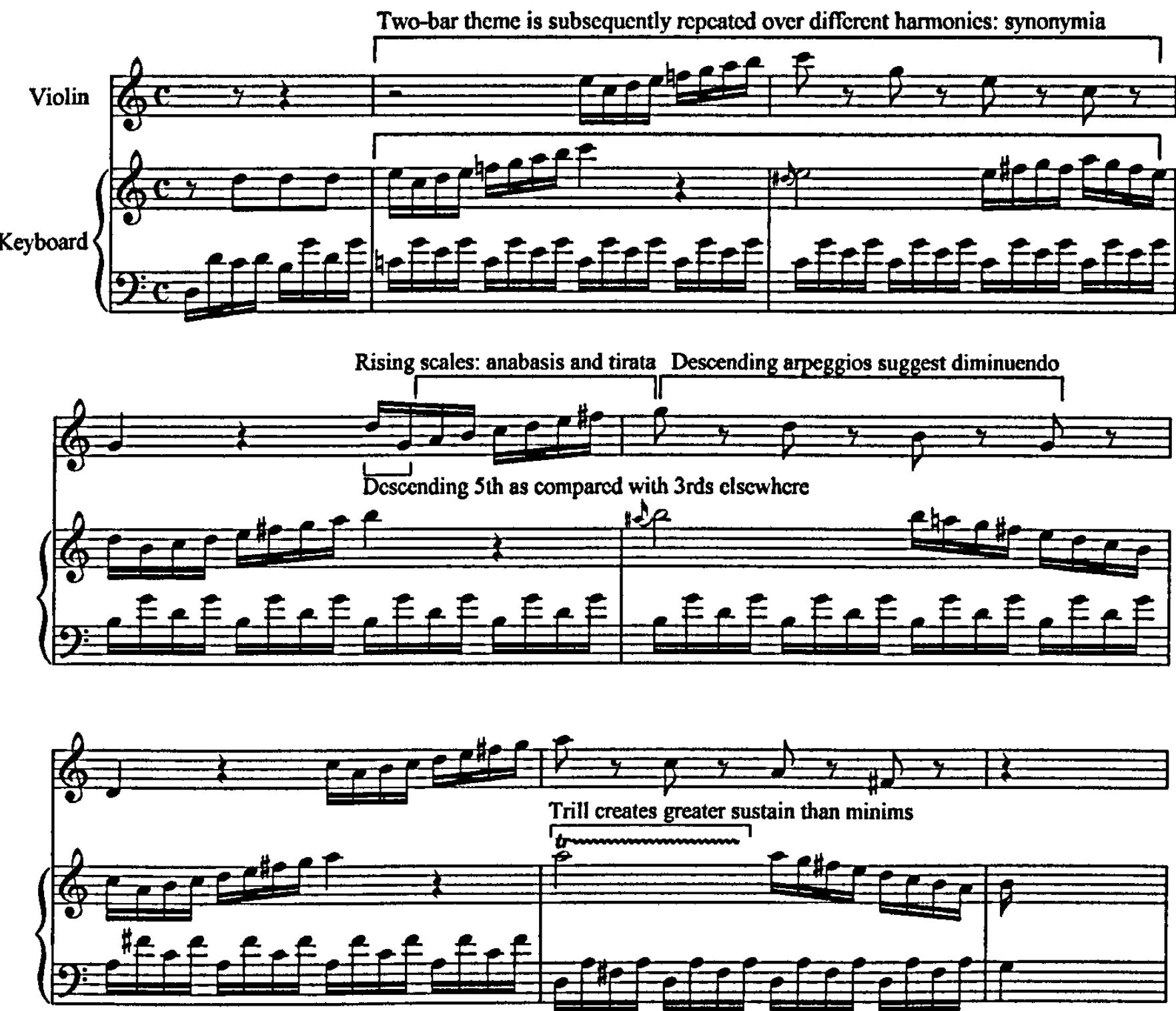
中文讲解
本段为图示占位段,原文提供的是example 4.62的标题:演示K28第一乐章11–17小节中synonymia的使用。需配合原始乐谱图查看小提琴与键盘右手声部在11、13、16小节对同一两小节主题的模仿关系,并核对第14小节小提琴声部的五度下行以及16分音阶与8分音符的记号。其作用是:让读者直观比较三次主题陈述的音程、和声、节奏细节,作为P0194、P0197、P0198、P0199所有咬字建议的实物根据。本段不展开不可见细节。
补充说明
无额外补充;图示见example 4.62。
第12段(P0201)
原文复述
Mozart’s surprise is that this sense of expectation does not resolve to a full G major triad; indeed, a rest in the violin part interrupts this cadential formula. Instead, a new figure of repetition develops a two-beat motive (see example 4.63). The ‘immediate and emphatic repetition of a word, note, motif, or phrase’ is described as the musical rhetorical figure epizeuxis (Bartel, 1997: 263). The circulatio figure in the keyboard’s right-hand part, a figure which ‘is thus called because it forms a circle, as it were’ (Spiess, 1745: 156; quoted in Bartel, 1997: 219), is often expressive of ‘circular or infinite concepts’ (Bartel, 1997: 217), while a rising scale in the left hand and bass notes of the right hand suggests the ‘ascending’ emotions associated with the figure anabasis (Bartel, 1997: 179). The increasing emphasis of each repetition of this short motive can be rendered partly through dynamic, but also through articulation. By playing the first descending third with a small amount of bow, the violinist can increase the intensity of each subsequent playing by lengthening the amount of bow used, and using finger pressure to create a more incisive attack at the start of each slur. The keyboard player can create a similar effect by increasing the length and heaviness of attack on each crotchet. Le Faucheur confirms this articulation, writing that each repetition of a word should be ’louder and stronger’ (Le Faucheur, 1727: 146).
中文讲解
本段揭示莫扎特在前段D7悬置之后的一个"出乎意料"的处理:期待并未落在完整的G大三和弦上——小提琴声部出现休止打断了这一终止式——转而由一种新的重复格推动两拍动机的展开。文中点名三格:epizeuxis(即时且强调性地重复一个词、动机或乐句,由Bartel 1997:263定义);circulatio(键盘右手的环绕型音型,Spiess 1745将其命名为"形成一个圆");anabasis(键盘左手的上行音阶与右手低音对应"上升"情绪)。三格叠加的表情后果被转化为演奏建议——逐步增大强度通过力度,但同样通过咬字:小提琴家第一个下行三度用极少弓量,然后逐次加长弓长,并在每条连弓起音用指压获得更尖锐的起音;键盘手则通过逐次加长和加重四分音符的触键时长度来取得相同效果。Le Faucheur的引语"louder and stronger"再次从演说一端为演奏端的"渐强咬字"提供修辞依据。本段的关键是把synonymia所强调的"差异"换成epizeuxis所强调的"渐次强调":前者强调色彩差异,后者强调强度递增。
补充说明
example 4.63位于本节内,具体内容请见图示;circulatio一格的Spiess引语强调其"形如圆"的比喻性名称来源。
第13段(P0202)
原文复述
Example 4.63: K28, movement 1, bars 18-19, demonstrating Mozart’s use of epizeuxis.
中文讲解
本段是example 4.63的图注,仅说明该谱例展示了K28第一乐章18–19小节中epizeuxis的使用。应结合原图核对:18–19小节的两拍动机在键盘右手的circulatio、键盘左手的anabasis以及小提琴的下行三度之间的对位关系,以及小提琴休止的位置与P0201所述"打断终止式"之关系。
第14段(P0203)
原文复述
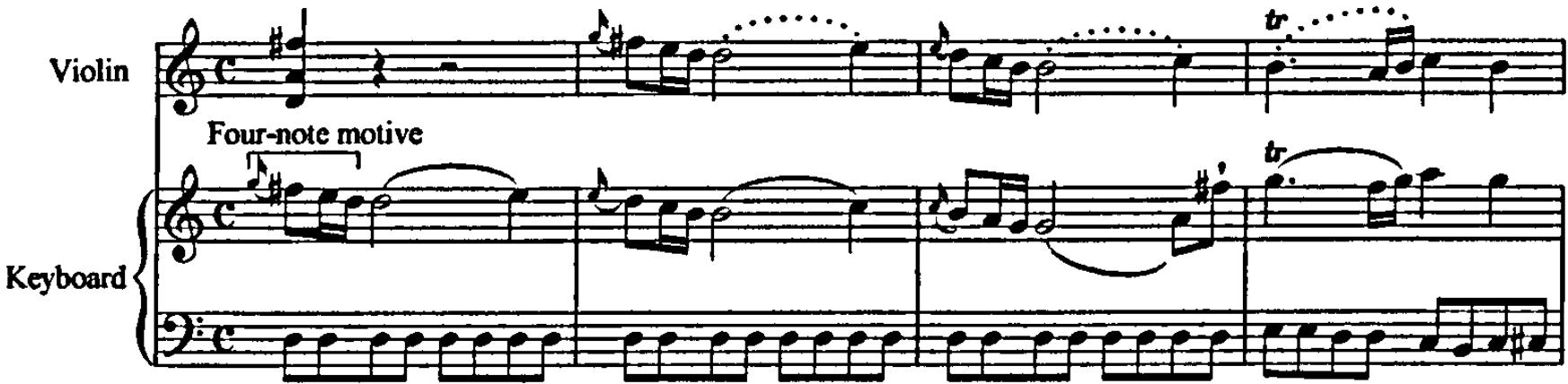
中文讲解
本段为第50页的图像/乐谱示例占位符,原文未保留具体说明文字。从其在原文中与P0203、P0204、P0205的位置关系可确认:它出现于example 4.64附近,作为例4.64的实物示意之一(很可能是P0204所述20–28小节相关片段的曲谱截图)。具体谱例细节需查看原图,不在此处推测。
补充说明
占位符位于example 4.64相关区域。
第18段(P0207)
原文复述
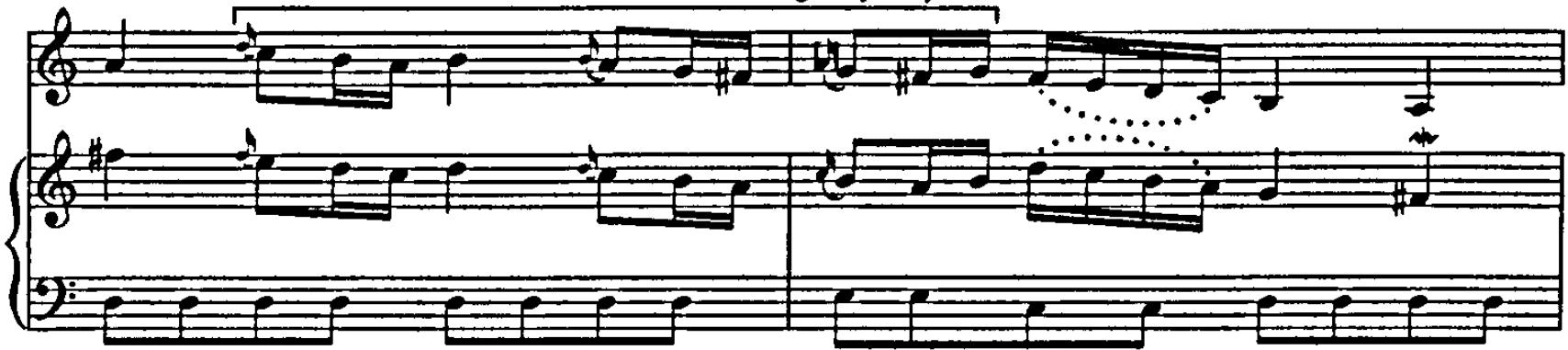
中文讲解
本段为图像占位符,附简短英文标注"四音动机以渐增的频率出现"。从其文字含义可确认:该图示意的是同一四音动机从20、21小节作为flourish的松散出现,到24–28小节越来越规律化、被反复用以制造张力的渐密现象。这与P0204对distributio"将一个思想拆解为组成部分"的定义正相对应——一张可视化的"渐密过程"图。其余细节需查看原图。
第19段(P0208)
原文复述
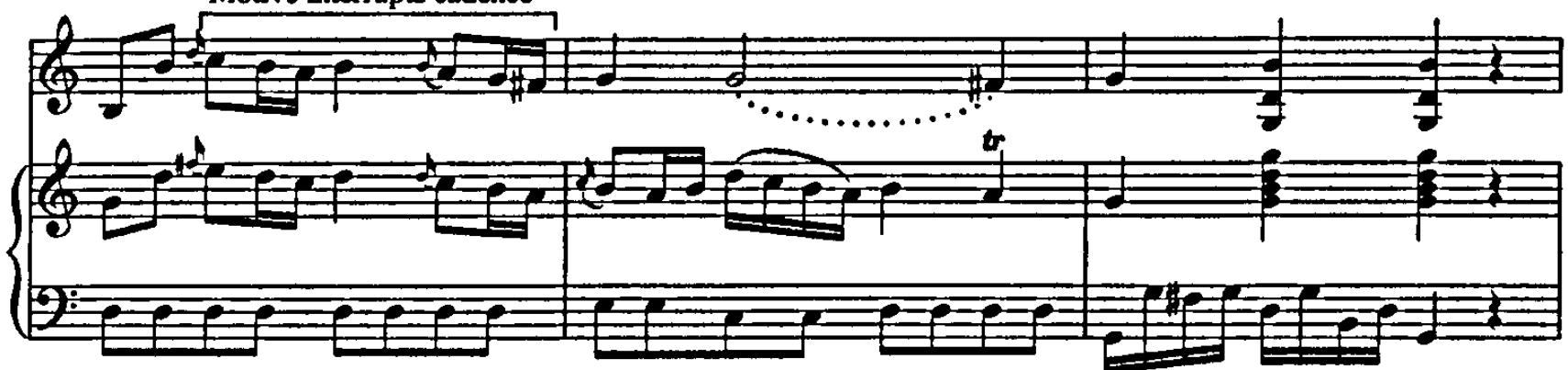
中文讲解
本段为第50页另一图像/乐谱示例占位符,原文未保留说明文字。结合P0205–P0207相邻占位符的位置,可推断它与example 4.64或"四音动机频率渐增"示意图一同构成第50页谱例组。具体内容需查看原图,不在此处推测。
第20段(P0209)
原文复述
In each of these three passages, Mozart uses a limited amount of melodic material. It is up to the performer to identify how these figures of repetition evolve within the context of the movement, identifying aspects of the compositional language such as harmonic structure, melodic shape and rhythmic development to interpret their Affekt. Figures of repetition essentially function in order to emphasise an argument, whether it is by increasing the intensity (as in bars 18 to 20), or by exploring different facets of the same character or Affekt (as in bars 11 to 17 and 20 to 28). The engaging with these figures and conveying them through the variation of articulation can contribute greatly to the sense of musical drama.
中文讲解
本段是整节的小结,把三个片段(11–17、18–19、20–28)作为统一现象来归纳。核心论点有四:第一,三个片段都建立在极少的旋律素材之上;第二,演奏者的任务是识别这些重复格如何在乐章语境中演变——需要观察和声结构、旋律形态、节奏发展三项元素来解读其Affekt;第三,重复格的根本功能是"强调论点",其实现路径有两种——通过增加强度(18–20小节的情况)或通过开发同一性格的不同侧面(11–17与20–28小节的情况);第四,通过咬字变化来传递这些重复格,对音乐戏剧感有重大贡献。这段在论证中起"分类定型"作用:它把synonymia、epizeuxis、distributio三种格的功能提炼为"强度的递进"与"性格的多面"两种逻辑,并把器乐演奏对咬字的细致追求与"音乐戏剧感"宏大价值勾连起来,回应P0190为K28分析铺垫的初心。
补充说明
段末"the engaging with"在原文中保留此形式(疑为原文用法),可视为对前文开篇"identification of figures"的回环闭合。
第21段(P0210)
原文复述
Thus, articulation is primarily a small-scale aspect of performance, being described in speech as the enunciation of and relationship between syllables. As such it can be used to create variety at a local level, for example by conveying the developing Affekt of a theme such as in the examples of melodic repetition cited above. However, we saw at the start of this chapter that these small-scale details of articulation can also serve an important function on a larger scale, by punctuating the
中文讲解
本段是节末的过渡句,把局部发现回收到章节的更大议题上。其论点可分两层:第一层——咬字在本质上是一种"小尺度"的演奏层面,可以类比为言语中"音节之间的发音与相互关系";第二层——作为一种小尺度工具,咬字可用于在局部制造变化,例证正是上文各色旋律重复——主题发展的Affekt通过咬字差异被传达。然而,作者紧接着承认章节开头就已论述过这些小尺度咬字细节还可在更大尺度上承担重要功能(例如通过"punctuating the…"——句尾被截断,说明原文在此结束)。教学上要抓住本节在全章中的位置:它是局部与全局咬字观之间的一座桥梁段,理解上需要把它读作"先承认咬字是小尺度,再预告它有更大尺度功能",因此最后那句未完成的"punctuating the"应让读者意识到下面的章节将具体论述这种大尺度功能。
补充说明
末句"punctuating the"在原文处被截断,属section边界;具体接续应属于下一节/章节内容。
脚注 / 边栏 / 图表 / 附加信息(如有)
本节含三组谱例(example 4.62、4.63、4.64),分别对应K28第一乐章11–17、18–19、20–28小节,全部位于K28分析的实例部分。第50页含多张图像/乐谱占位(P0206、P0207、P0208),其中P0207附英文简短标注"Four-note motive heard with increasing frequency",提示该图用于呈现distributio格中四音动机渐增密度的过程。三组引文都同时承担理论支持与演奏建议的双重功能:Le Faucheur(1727:128、146)两次出现,分别提供"修辞格使言语多样化与优雅"以及"重复应louder and stronger";Agricola(1757:163)一次,把歌唱咬字接回到说话艺术;Geminiani(1751:27)、Türk(1789:347)、Kirnberger(1776:337、340、373)、Gottsched(1736:282;1751:326)、Spiess(1745:156)、Forkel(1788:51)、Bartel(1997:219、240、242、263、337、403、407)、L. Mozart(1756:212)多次分别承担格定义、键性/音程象征与演奏弓法/触键描述的功能,是节内权威支柱。
💡 本节核心要点
- 重复材料如何变化呈现是纯器乐曲咬字的关键切口,原因是失去了歌词的Affekt提示,需依赖十八世纪理论家的同时代文献作为参照
- 十八世纪音乐理论家延续两百年的传统将修辞格系统引入音乐,其中旋律重复占据最大份额;Le Faucheur与Agricola把歌唱咬字明确系于说话艺术
- K28第一乐章短时间内连用三种重复格:11–17小节synonymia(变化的重复)、18–19小节epizeuxis(即时强调性重复)、20–28小节distributio(拆解性重复)
- synonymia要求演奏者在同一主题的每次陈述上找出不同的Affekt,11–17小节的C大调活泼、G大调温暖内敛、D7悬置保持音量等弓法差异源自此
- epizeuxis要求强度逐步递增,通过弓长、指压与触键长短递增实现,并得到Le Faucheur"louder and stronger"的修辞证实
- distributio的核心是把同一动机从其舒展语境中抽出并渐次加密,靠弓幅渐短、清晰度渐增、指压起点音来表达能量的转化与终止式的打断
- 三格在演奏层面的共同逻辑是:先在谱面识别格,再以格所暗示的表情/修辞内涵为依据指导弓法与触键,从而在小尺度咬字上承担"音乐戏剧感"的大尺度功能
🔑 关键术语
- Affekt:十八世纪音乐修辞语境中,乐句/乐段所携带的特定情感或表情特征。在纯器乐曲中由于缺乏歌词语义,需由演奏者主动从乐谱元素(和声、旋律、节奏)解读并通过咬字与弓法来传达。
- Synonymia:Bartel 1997定义为"音乐意念的改变或修饰性重复"。Gottsched则描述为"用完全不同的措辞表达同一个意念"。在本节K28 11–17小节中表现为同一两小节主题在每次陈述时和声、旋律细节发生变化,要求演奏者每次都采用不同的Affekt与咬字。
- Anabasis:表达"上升/崇高的意象"的修辞格。本节用以描述11–17小节与18–19小节键盘左手(或小提琴/键盘右手低音)的快速上行音阶。
- Tirata:快速的音阶运行。Leopold Mozart 1756将之释为"箭或子弹的飞驰"。本节用以对11–17小节上行音阶作修辞格分类的补充标签。
- Epizeuxis:即时且强调性地重复一个词、动机或乐句。本节对应18–19小节的两拍动机并辅以键盘右手的circulatio与左手的anabasis;修辞逻辑要求每次重复都"louder and stronger",对应弓长递增与指压渐强的咬字处理。
- Circulatio:一种环绕型音型,Spiess 1745因"形如圆"而命名,常表达"循环或无限"的概念。本节出现于K28 18–19小节键盘右手声部。
- Distributio:将一个多重含义的思想拆分为若干组成部分以便听者完整理解的修辞格。Gottsched 1736给出原始定义。本节对应K28 20–28小节中四音动机从作为flourish的舒展语境被抽出、以渐次加密的频率重复、最终打断终止式的过程。
- Cantabile:歌唱般的、流畅的演奏风格。本节在讨论20、21小节长弓弧度时使用,意指为该处四音动机的开头16分音符组配合长弓以获得舒展歌唱感。
- Florish:装饰性炫技段。本节用以描述20、21小节中四音动机的初始功能——它被后续长音符舒展掉,因此最初属"装饰"角色,而在24小节之后才被"激活"为能量化的动机。