目录
CH-FRONT Front Matter
- S-FRONT-1 [描述性拆分] Title Page
- 页码:1-1
- S-FRONT-2 Abstract
- 页码:2-2
- S-FRONT-3 Contents
- 页码:3-3
- S-FRONT-4 [描述性拆分] Acknowledgments and Declaration
- 页码:4-4
CH-INTRO Introduction: Rhetoric and Current Musicology: the Rhetoric of Composition and the Rhetoric of Performance
- S-INTRO-1 [描述性拆分] The Five Canons of Rhetoric and Their Application to Music
- 页码:5-5
- S-INTRO-2 [描述性拆分] Compositional Rhetoric in the Baroque Era
- 页码:6-6
- S-INTRO-3 [描述性拆分] Classical Music and the Declining Influence of Rhetoric
- 页码:7-7
- S-INTRO-4 [描述性拆分] Rhetoric as a System Within Which There Is Infinite Variety
- 页码:8-8
- S-INTRO-5 [描述性拆分] Continued Relevance of Rhetoric to Classical Compositional Design
- 页码:9-9
- S-INTRO-6 [描述性拆分] The Neglect of Pronunciatio and the Need for This Study
- 页码:10-10
- S-INTRO-7 [描述性拆分] The Communicative Power of Delivery: Sheridan’s Example
- 页码:11-12
- S-INTRO-8 [描述性拆分] Scope and Aims of the Thesis
- 页码:13-13
- S-INTRO-9 Sources
- 页码:13-17
CH1 Chapter 1: The Rhetoric of Performance in the Eighteenth and Nineteenth Centuries
- S1-1 The Art of Delivering Speech
- 页码:18-20
- S1-2 [描述性拆分] The Elocutionary Movement and Social Change
- 页码:21-22
- S1-3 [描述性拆分] Delivery on the Stage and the Performing Arts
- 页码:23-24
- S1-4 [描述性拆分] France, Germany, and the International Reach of Delivery
- 页码:25-27
- S1-5 [描述性拆分] Criticism of the Elocutionary Movement and the Limits of Rules
- 页码:28-30
- S1-6 The Art of Delivering Music
- 页码:30-31
- S1-7 [描述性拆分] To Teach, Delight and Move: the Shared Aesthetic Aims of Speech and Music
- 页码:31-33
- S1-8 [描述性拆分] The Rhetorical Standing of Instrumental Music
- 页码:33-34
- S1-9 [描述性拆分] Shared Advice for Musicians and Orators in Moving the Listener
- 页码:35-36
CH2 Chapter 2: The Techniques of Expressive Delivery: in Search of a Wordless Rhetoric
- S2-1 [描述性拆分] The Unity and Variety of Tone: the Violin’s Voice
- 页码:37-37
- S2-2 [描述性拆分] The Violin’s Capacity to Imitate the Human Voice
- 页码:38-40
- S2-3 [描述性拆分] The Bow as the Soul of Song and the Tourte Bow
- 页码:40-42
- S2-4 [描述性拆分] Tonal Equality and the Choice of Position and String
- 页码:43-46
- S2-5 [描述性拆分] Exploiting the Individual Characters of the Strings: Beethoven’s Op.96
- 页码:46-50
- S2-6 Techniques of Expressive Bowing: the Soul of the Violin
- 页码:50-50
S-FRONT-1 [描述性拆分] Title Page
第1段(P0001)
原文复述
The Rhetoric of Classical Performance Practice: Giving ‘Life to the Notes’ in Mozart’s Sonatas for Violin and Keyboard
中文讲解
本段是论文的完整标题,分为主标题和副标题两部分。主标题《古典演奏实践的修辞》(The Rhetoric of Classical Performance Practice)点明研究的学科归属——音乐学中的演奏实践(performance practice)领域,并以"修辞"(rhetoric)一词揭示作者的理论视角:演奏并非单纯的技术执行,而是一种带有说服力和表达意图的话语行为。副标题"在莫扎特为小提琴与键盘而作的奏鸣曲中赋予’音符以生命’"(Giving ‘Life to the Notes’ in Mozart’s Sonatas for Violin and Keyboard)进一步收窄研究对象,明确以莫扎特的小提琴与键盘奏鸣曲作为分析语料,并将核心研究问题浓缩为"如何让音符活起来"。‘Life to the Notes’用引号标示,暗示这是一个被作者特别定义或重新诠释的概念,暗示音乐演奏实践的目标不只是准确复现乐谱,更要让静态的乐谱符号转化为有生命力的听觉经验。
补充说明
标题中的 Mozart 与 Sonatas for Violin and Keyboard 共同构成研究对象的关键范围限定;引号内的 ‘Life to the Notes’ 在本节只是标题用语,其具体定义需在正文展开。
第2段(P0002)
原文复述
Nia Elizabeth Lewis
中文讲解
本段是论文作者的署名:Nia Elizabeth Lewis。按照英美学位论文扉页的常规排版格式,这一行文字标识论文的独立责任者,说明本文的全部研究、写作与学术主张均由该作者承担,是版权归属与答辩责任的直接体现。
第3段(P0003)
原文复述
Ph.D.
中文讲解
本段标示学位层次为 Ph.D.(Doctor of Philosophy,哲学博士)。这一行说明本文是一篇博士学位论文,而非硕士论文或其他层级的学位论文;它提示读者后文将以博士论文所要求的原创性研究、完整论证和学术贡献标准来评价本文。
补充说明
Ph.D. 一词即使在非英语学位体系中也沿用此缩写,扉页中常以独立一行呈现以示庄重。
第4段(P0004)
原文复述
University of York
中文讲解
本段指明授予学位的机构为 University of York(约克大学),位于英国。该行表明本文的学术认证归属——约克大学的学术审查体系(导师、评审、答辩委员会)将对本文的研究质量负最终审定之责;同时它也间接暗示读者,约克大学在音乐学(尤其是历史表演实践研究领域)具有特定的学术传统。
补充说明
约克大学的音乐系在历史演奏实践(Historical Performance Practice)研究方向上具有较强的学术积累,这一点可由 P0005 的系所信息进一步印证。
第5段(P0005)
原文复述
Department of Music
中文讲解
本段标示作者的学科归属与研究场域为 Department of Music(音乐系)。这一信息明确了论文所属的二级学科单位——音乐学,而非表演系、作曲系或其他人文学科;它为后文涉及的音乐分析、演奏实践史与修辞学方法提供了学科合法性背景,也提示读者本文将以学术研究(而非演奏家自述或纯演奏手册)的方式展开论证。
补充说明
与 P0004 共同构成"机构—系所"两层归属关系。
第6段(P0006)
原文复述
September 2007
中文讲解
本段标示论文完成的月份与年份:2007 年 9 月。该日期通常对应论文提交答辩或正式完成的时点,是确定研究文献截止时段的参考坐标——也就是说,本文所引用与讨论的演奏实践文献及莫扎特奏鸣曲相关研究,大致截止于 2007 年 9 月前后,读者据此评估其学术时效性。
补充说明
英国博士学位论文扉页常以提交月份与年份标示完成时点;与 P0001–P0005 共同组成完整的扉页信息链。
脚注 / 边栏 / 图表 / 附加信息(如有)
本节为论文扉页(Title Page),仅包含元数据性质的信息条目(标题、副标题、作者、学位、机构、系所、日期),不涉及正文、脚注、图表、边栏或参考文献等附加材料,因此 additional_information 项无额外内容。
💡 本节核心要点
- 本节是论文的扉页,承担学位论文的元数据标识功能。
- 主标题确立研究主题——古典演奏实践中的修辞问题,副标题将研究对象收窄至莫扎特的小提琴与键盘奏鸣曲。
- ‘Life to the Notes’ 以引号形式呈现,暗示这是作者将在正文中专门界定与论证的核心概念。
- 作者 Nia Elizabeth Lewis 依托约克大学(University of York)音乐系(Department of Music)完成哲学博士(Ph.D.)学位,论文完成于 2007 年 9 月。
- 扉页六项要素(标题、作者、学位、机构、系所、日期)共同构成对论文责任归属、研究对象与学术背景的基本交代。
🔑 关键术语
- Performance Practice:演奏实践;音乐学中研究历史时期演奏惯例、风格与技术规范的研究领域,是本文的核心论域。
- Rhetoric:修辞;在本文中被借用来指演奏中的表达策略与说服性话语,暗示演奏不是机械执行而是带有意图的沟通行为。
- Sonatas for Violin and Keyboard:为小提琴与键盘乐器(小提琴与钢琴或古钢琴)而作的奏鸣曲;本文选择莫扎特这一体裁作为分析语料。
- ‘Life to the Notes’:标题中带引号的表述,意为"赋予音符以生命";作为核心概念,其精确定义与论证将在正文展开。
- Ph.D.:Doctor of Philosophy 的缩写,指哲学博士学位;标示本文为博士层级的学位论文。
- University of York, Department of Music:约克大学音乐系;标示论文的学术归属机构与学科单位,为后文研究提供制度背景。
S-FRONT-2 Abstract
第1段(P0007)
原文复述
ABSTRACT
中文讲解
本行是论文摘要部分的章节标题,标记接下来进入摘要正文。它不承载论证信息,仅指示章节性质:以压缩形式交代整篇论文的研究问题、方法和章节安排。
第2段(P0008)
原文复述
In modern scholarship the relevance of rhetoric to music has largely been attributed to issues of composition; the introduction to this thesis outlines the current state of musical-rhetorical research, and proposes that studies into the rhetoric of performance (pronunciatio), and specifically Classical performance, are lacking. Chapter 1 traces parallel developments in oratorical and musical delivery during the eighteenth and nineteenth centuries. Chapter 2 explores whether a theory based on communication by words can be applied to textless music, and examines the expressive and technical correlations between the human voice and the violin, specifically focussing on the bow. While the issues of expressive performance discussed here are universally applicable to all instruments/voices, and will therefore be relevant to players of every instrument, the specifics of how to achieve expressive performance are described in terms of string techniques. Chapter 3 delineates the differences between notated expression marks – those which are prescribed by the composer – and ’non-notated’ expression, which is the responsibility of the performer in order to create delivery which is moving.
中文讲解
本段是摘要的第一段,承担两个功能:交代研究空白并预告前三章的内容。
第一句话点明当前学术状况:现代学界在讨论修辞学与音乐的关系时,几乎只把它和作曲问题挂钩。这是一种带有转折含义的判断——作者用 “largely been attributed to issues of composition” 暗示学界视野偏窄,从而为后文的研究动机让出空间。
第二句话交代论文绪论的工作:综述音乐修辞学研究的现状,并提出真正的缺口在于表演(修辞学术语 pronunciatio)的修辞研究,尤其针对古典时期演奏。作者用 “proposes that studies … are lacking” 明确把自己的研究定位为补缺式工作。
第三句概述第一章:通过梳理十八、十九世纪演说术与音乐演绎两条脉络的平行发展,建立历史参照系。这里的 “parallel developments” 提示读者,作者关心的是两条传统之间的相互映射,而不是单纯的音乐史。
第四句概述第二章的核心方法论问题:一种以"语言传达"为基础的理论能否被移植到"无词音乐"?作者选择的切入点是歌唱的人声与小提琴之间的表达与技术关联,重点落在运弓上。这一选择的逻辑在于:弓弦乐器与小号、人声一样需要持续的"气息"控制和力度塑形,因此可以作为检验修辞表演理论的合适载体。
紧跟的限定句非常重要:作者承认本书讨论的"有表达力的演奏"问题对所有乐器和声部普遍适用,因此对任何乐器的演奏者都有意义;但在具体说明"如何实现"时,则只用弦乐技法作为描述语言。这是研究范围的自我界定——避免读者误以为结论只对小提琴成立,同时承认论证材料以弦乐为主。
最后一句概述第三章的核心区分:作曲家谱面写下的"标记性表达记号"(notated expression marks)vs. 演奏者为了使演绎"动人"(moving)而必须自行负责的"非标记性表达"(non-notated expression)。这个二分法是全篇的方法论骨架——作曲家责任与演奏者责任的界限——也是后续讨论莫扎特奏鸣曲时的分析工具。
总体而言,本段以"现状—缺口—三章分工"的结构铺开,最重要的隐含线索是作者不断在"作曲"与"表演"两端做切分:现有研究偏作曲,本文偏表演;标记归作曲家,未标记归演奏者。
补充说明
原文中 pronunciatio 一词为古典修辞学五步骤(inventio, dispositio, elocutio, memoria, pronunciatio)中的最后一步,专指演说时的口头/身体呈现(发声、姿态、表情),与本节 “delivery” 对应。该词在原文以斜体或特殊词形出现,作用是把音乐演奏类比为演说的"发声"环节。“Classical performance” 在本节指古典时期风格的演奏实践,与后来浪漫主义时期的诠释传统相区别。
第3段(P0009)
原文复述
In chapters 4 and 5 concepts of rhetorical delivery are applied to the performance of Mozart’s Sonatas for Violin and Keyboard. Chapter 4 focuses on issues of articulation, while chapter 5 evokes eighteenth-century descriptions of accent and emphasis, and their importance to dynamic variety and hierarchies of phrasing. Mozart’s own performance instructions are discussed in the light of practices contemporary to his music, and rhetorical theories of composition and performance are used to interpret the expressive purpose of these markings. These findings serve as a point of departure for the investigation of those aspects of performance which are not notated by the composer, but which were conventions of the time, and considered the duty of the performer in order to fulfil the expressive aims of rhetoric.
中文讲解
本段是摘要的第二段,把研究焦点从方法论问题(前三章)转向具体应用案例(后两章)。
第一句明确案例对象:莫扎特的《小提琴与键盘奏鸣曲》。这是一个精心选择的素材——古典时期的器乐奏鸣曲既承载作曲家的明确标记,又要求演奏者补充大量未写出的表达惯例。
第二句分工:第四章处理"articulation"(断奏/连奏的音头划分),第五章则调动十八世纪文献对"重音与强调"(accent and emphasis)的描述,并指出这些概念对两件事至关重要——一是"力度的多样变化"(dynamic variety),二是"句法的层级结构"(hierarchies of phrasing)。换言之,第五章不只是讨论单音强弱,而是要把局部重音与整体乐句结构挂钩,这呼应了修辞学把"词重音"扩展到"思想层级的强调"的传统。
第三句交代研究方法:对莫扎特本人的演奏指示,作者不是孤立地按字面理解,而是放到与该音乐同时代的实践惯例中去读,并用作曲与表演两方面的修辞理论来解读这些记号的"表达目的"(expressive purpose)。这里的关键词是 “in the light of practices contemporary to his music”——表明作者警惕的是后世(尤其是浪漫主义以降)形成的演奏成见,主张回到十八世纪语境。
最后一句给出这些发现的功能定位:它们作为"出发点"(point of departure),用于进一步追问那些作曲家没有写在谱上、却是当时惯例并被演奏者视为"修辞表达之职责"(the duty of the performer in order to fulfil the expressive aims of rhetoric)的演奏层面。这一句与摘要第一段中第三章的 notated / non-notated 二分法形成呼应——第四章和第五章的"标记解读"是已知项,由此推断的"未标记惯例"才是真正的研究目标。
整体来看,本段的论证弧线是:选定作品(莫扎特奏鸣曲)→ 选定章节切入点(断奏 vs. 重音/句法)→ 选定方法(同时代语境 + 修辞理论双重视角)→ 指出研究的真正落点(未标记的演奏惯例)。作者的态度始终是节制、谨慎的:他没有宣称要"重新发现"莫扎特,而是要把作曲家留下的标记作为跳板,考察当时的演奏者应承担何种修辞责任。
补充说明
“Mozart’s Sonatas for Violin and Keyboard” 指莫扎特为小提琴与键盘乐器(古钢琴/早期钢琴)所写的奏鸣曲,属古典时期室内乐核心曲目。“articulation” 在本节特指乐谱上以连线、跳音、圆点、staccato 等方式规定或暗示的音与音之间的衔接方式,是弦乐演奏中由弓法直接控制的核心参数,与文中 “bow” 的讨论直接对应。“Hierarchies of phrasing” 指乐句内部按修辞等级(小短语—大短语—整段)建立的从属与突出关系,是把演说结构类比到音乐句法上的关键概念。
脚注 / 边栏 / 图表 / 附加信息(如有)
摘要部分无脚注、图表或边栏;段落 P0007 为标题占位,P0008–P0009 为摘要正文。
💡 本节核心要点
- 作者把研究定位在"修辞学与音乐关系"中长期被忽略的一端——演奏(pronunciatio)而非作曲
- 核心方法论二分法:作曲家规定的 notated expression vs. 演奏者负责的 non-notated expression,全文围绕这一张力展开
- 前三章承担理论和方法搭建:历史脉络(Ch.1)、理论与无词音乐的契合性(Ch.2)、表达责任的划分(Ch.3)
- 后两章以莫扎特《小提琴与键盘奏鸣曲》为案例,分别通过 articulation 与 accent/emphasis 进入,并要求回到十八世纪同时代语境解读
- 研究的真正落点不是作曲家写下的标记本身,而是当时作为演奏者"修辞职责"的未标记演奏惯例
- 小提琴/弓弦乐器是论证载体,但所讨论的"有表达力的演奏"问题被作者明确为对所有乐器普遍适用
🔑 关键术语
- rhetoric(修辞学):在本文中专指古典—十八世纪意义上的演说与说服技艺,包括 inventio、dispositio、elocutio、memoria、pronunciatio 五步骤;作者把它作为分析音乐演奏的概念框架。
- pronunciatio:古典修辞五步骤中最末一步,指演说的口头与身体呈现(发声、姿态、表情);本文用以指代"演奏层面的修辞",与 composition 端的修辞研究形成对照。
- Classical performance(古典时期演奏):指十八世纪古典主义时期风格下的器乐/声乐演奏实践;本文将其与后来(尤其是十九世纪浪漫主义)形成的诠释传统相区别,主张回到同时代语境。
- notated expression marks:由作曲家在乐谱上以文字、记号或符号明确写下的演奏指示;其权威性归属作曲家,是"标记性表达"。
- non-notated expression:乐谱上未写出、但当时演奏惯例默认由演奏者补足的表达要素;其权威性归属演奏者,目的是实现"动人"的修辞表达。
- articulation:音与音之间的衔接方式(连、断、跳等),在弦乐中直接由弓法控制;第四章以此为切入点分析演奏修辞。
- accent and emphasis:十八世纪文献中的"重音与强调"概念;第五章用以讨论它如何同时影响力度变化(dynamic variety)与乐句层级(hierarchies of phrasing)。
- Mozart’s Sonatas for Violin and Keyboard:莫扎特为小提琴与键盘乐器所作的奏鸣曲;本文第四、五章的案例对象,因其兼具明确作曲家标记与丰富的演奏惯例而成为分析素材。
S-FRONT-3 Contents
第1段(P0010)
原文复述
CONTENTS
中文讲解
这一行是该页的标题,本身不承载论点,仅作为版面标识出现,告诉读者接下来进入的是全书的目录部分。它的功能相当于一个结构性的导航入口:在学术著作中,目录页通常紧跟在扉页与版权页之后,用以概览全书各章、各节、各附录的先后次序与起止页码,从而帮助读者在阅读正文之前或检索特定主题时迅速定位。
第2段(P0011)
原文复述
Acknowledgments and Declaration 4 Introduction: Rhetoric and Current Musicology: the Rhetoric of Composition and the Rhetoric of Performance 5 Chapter 1: The Rhetoric of Performance in the Eighteenth and Nineteenth Centuries 18 Chapter 2: The Techniques of Expressive Delivery: in Search of a Wordless Rhetoric 37 Chapter 3: Notated Expression Versus Non-notated Expression 63 Chapter 4: Articulation: the Enunciation of Syllables 70 Chapter 5: Accent and Emphasis: the Hierarchy of Words and Sentences 145 Conclusion: The Boundaries of Taste and the Freedom of Rhetoric 231 Appendix 1: Interpretations of the Function and Articulation of Strokes in K379, Movement 2 236 Appendix 2: An Application of Koch’s Theories on the Divisions of Musical Discourse to K380, Movement 2 246 Appendix 3: The Application of Accent and Emphasis to K296, Movement 1 253 Appendix 4: Programme Note to Accompany PhD Recital 259 Bibliography 263
中文讲解
这一段是本书的完整目录,依原书顺序列出前言、引言、五章正文、结论、四篇附录以及参考文献的标题与起始页码。从条目本身可以直接读出本书的整体架构与论证重心:(1) 前置材料包含“致谢与声明”(第4页)和“引言:修辞学与当代音乐学——作曲的修辞与表演的修辞”(第5页),把全书的研究问题——“修辞学在音乐学中的位置”——置于开篇。(2) 正文共五章,呈现明显的递进关系:第一章(第18页)在18—19世纪的历史语境中讨论“表演的修辞”,属于历史定位;第二章(第37页)转向“表情性表达的技术”,寻找一种“无言的修辞”,属于理论建构;第三章(第63页)对照“有记谱的表情”与“无记谱的表情”,进入方法论层面的比较;第四章(第70页)与第五章(第145页)分别落到“咬字:音节的清晰发出”和“重音与强调:词与句的层级”,是把前几章的总论具体化为演奏实践中的细节规则——这也是全书最长的两章,第五章由第145页一直延伸到结论前的第231页,仅单独一章就占据约86页,可见“词与句的层级”是本研究的最终落脚点。(3) 结论(第231页)题为“趣味的边界与修辞的自由”,以否定式提法(“边界”)与肯定式提法(“自由”)之间的张力作为收束,提示全书的论证不是要把修辞规则无限扩张,而是要承认趣味的约束。(4) 四篇附录(第236、246、253、259页)分别处理K379第二乐章的弓法诠释、Koch的“音乐话语划分”理论在K380第二乐章的应用、以及“咬字、重音与强调”规则在K296第一乐章上的运用,第四篇附录则是伴随博士演奏会的节目单说明;这些附录相当于把正文中的理论“落地”到具体作品(K379、K380、K296均出自莫扎特)和具体演奏场合中。(5) 参考文献位于第263页,居全书最末,标示研究建立在既有学术文献之上。整张目录的篇幅分配(第五章最长、附录多为个案分析)已经暗示作者走的是一条“由史到论、再由论到个案”的研究路径。
补充说明
条目中出现的作品编号 K379、K380、K296 可在原目录中直接对应;这些编号与 K 编号体系本身的关联、作曲家身份及其生平背景均未在本节原文中给出,故不在此处补充。条目中“Koch”指目录所提示的人名,原文未提供其全称或国籍,不在此增补。
脚注 / 边栏 / 图表 / 附加信息(如有)
本节即目录页本身,不含脚注、插图说明或边栏文本。目录中出现的页码属于版面导航信息,已在 chinese_explanation 中用于说明各章相对篇幅与论证顺序。
💡 本节核心要点
- 本节为全书目录,以“CONTENTS”为标题,列出从致谢到参考文献的全部条目及其起始页码。
- 全书的宏观结构是:致谢与声明 → 引言 → 五章正文 → 结论 → 四篇附录 → 参考文献。
- 五章的篇幅由短到长、再到最长(第五章约86页),呈现“历史定位—理论建构—方法比较—演奏细节”的递进论证。
- 附录集中于 K379、K380、K296 三部具体作品与一份博士演奏会节目单,承担把正文理论落到个案与演出实践的功能。
- 结论以“趣味的边界”与“修辞的自由”之间的张力收束全书,提示论证并非主张修辞规则的无限扩张。
🔑 关键术语
- Rhetoric:目录中多次出现(Introduction、Chapter 1、Chapter 2、Conclusion 等),在本书语境中指被借用进音乐分析、用于解释作曲与表演中结构组织与表达策略的概念框架;本节原文未对其下定义,详尽内涵须由正文给出。
- K379 / K380 / K296:目录附录条目中出现的作品编号,原文未解释编号体系或作者身份,本节仅知它们是附录用以演示正文中“弓法诠释”“话语划分”“咬字与重音”等规则的具体作品。
- Articulation:出现在 Chapter 4 标题“The Enunciation of Syllables”之中,本节上下文将其与“音节的清晰发出”并列;具体技术含义由第四章正文承担。
- Accent and Emphasis:出现在 Chapter 5 标题中,与“词与句的层级”并列;本节原文未给出技术定义,仅指出其研究对象是音乐表演中词层与句层级的重音处理。
S-FRONT-4 [描述性拆分] Acknowledgments and Declaration
第1段(P0012)
原文复述
ACKNOWLEDGMENTS
中文讲解
该段为小节标题 “## ACKNOWLEDGMENTS”(致谢),位于论文正文之前。标题本身不承载论证内容,但其功能是开启论文的前置部分,向在研究过程中提供过帮助的导师、同事、家人、机构及出版方正式致谢,并交代附录中乐谱材料的版权许可来源。
第2段(P0013)
原文复述
I would like to thank my supervisor Dr Peter Seymour for his support and insightful guidance throughout this study. Thanks to Dr Simon Jones and Andrea Morris for their advice and encouragement, and to Dr Jonathan Wainwright and Dr Nicky Losseff for their useful comments at various stages throughout my research. I am also grateful to Cliff Eisen for his advice and thoughts on Mozart sources. The movements from Mozart’s Sonatas for Violin and Keyboard which constitute the appendices are reproduced by kind permission of Peters Edition Limited, London (see bibliography for full references to these editions).
中文讲解
本段集中致谢三类帮助并交代一项版权事项。其一是学术指导:作者首先感谢导师 Dr Peter Seymour,对其提供贯穿整个研究的支持与富有洞察力的指导(insightful guidance)表达谢意,这是致谢中最核心的位置,反映了博士论文中导师作用的优先性。其二是同行评议式的建议:作者感谢 Dr Simon Jones 和 Andrea Morris 的建议与鼓励,以及 Dr Jonathan Wainwright 和 Dr Nicky Losseff 在研究各阶段提出的有益评论(useful comments at various stages),其中 “at various stages” 强调这些帮助贯穿了研究全程而非一次性。其三是专业方向的指导:作者特别感谢 Cliff Eisen 对莫扎特文献(Mozart sources)所提供的建议与想法,Cliff Eisen 出现在此处说明本研究在莫扎特原始材料或文献考据层面依赖了专家意见。最后,作者声明附录中所收录的莫扎特《小提琴与键盘奏鸣曲》乐谱乐章,是经伦敦 Peters Edition Limited 善意许可(by kind permission)后复制的,并指引读者到参考文献(bibliography)中查阅这些版本的完整出版信息。理解上需注意三点:1) “by kind permission” 表明这是版权许可而非放弃版权,附录材料仍受 Peters Edition 的版权约束;2) “which constitute the appendices” 把正文与附录的关系点明——附录的乐谱材料与论文正文研究的对象是同一套作品;3) “see bibliography” 是版式指引,提示读者后文参考文献部分会列出 Peters Edition 的具体版本信息。
第3段(P0014)
原文复述
I have been lucky to have the support of family, friends and colleagues, and would especially like to thank Dan Edgar, and Roger and Pamela Lewis for their unending practical help, patience and encouragement. Thanks also to Andrew Skidmore for his impromptu German translations.
中文讲解
本段将致谢从学术领域扩展到私人生活层面,强调研究得以完成也依赖于家人、朋友与同事的支持。作者用 “I have been lucky to have…” 这一表达,把支持描述为一种幸运而非理所当然,口气谦逊。具体的私人致谢包括:Dan Edgar,以及 Roger 和 Pamela Lewis,作者用 “unending practical help, patience and encouragement”(持续不断的实际帮助、耐心与鼓励)形容他们的支持——这与上一段以学术性 “advice”、“guidance”、“comments” 为中心的用语形成对比,说明研究在生活层面所需的扶持性质不同于学术讨论。最后,作者特别感谢 Andrew Skidmore 提供即兴的德语翻译(impromptu German translations),“impromptu” 一词点出这些翻译并非按部就班的合作,而往往是在临时需要时迅速提供的,间接说明作者在研究过程中可能频繁需要处理德语一手文献。整体上,本段展示了博士论文背后非学术的支持网络,与前一段形成学术-私人互补。
第4段(P0015)
原文复述
DECLARATION
中文讲解
该段为小节标题 “## DECLARATION”(声明)。该标题开启的是英式博士论文中位于致谢之后、正文之前的一项标准法定声明,用于作者本人以签字承诺的形式确认论文的原创性、未发表性以及未用于其他学位评审的事实。该项声明是论文提交与评审程序合规性的一部分。
第5段(P0016)
原文复述
The material presented in this thesis is solely the work of the author. It has not appeared in any publication, nor has it been submitted for examination for any other qualification.
中文讲解
本段以作者第一人称作出两项相互独立但常被合并阅读的声明。第一项 “The material presented in this thesis is solely the work of the author”(本论文所呈现的全部材料仅为作者本人之作)确认原创性:论文中的所有内容均由作者独立完成,没有抄袭或代笔。第二项 “It has not appeared in any publication, nor has it been submitted for examination for any other qualification” 包含两个并列否定:其一,论文内容未曾以任何形式发表于公开出版物;其二,论文未曾为任何其他学位资格而被提交评审。两项否定通过 “nor” 连接,覆盖了 “已发表” 和 “已用于其他学位” 两种最常见的学术不当情形。理解上需注意:“solely” 与 “any”、“nor” 共同构成最高级别的承诺语气;这一声明虽然简短,却具有学术诚信的法律性质,违反其中任一项都会构成严重的不端行为。该声明的措辞是英式博士论文的范式语言,本身不必再作内容性引申。
脚注 / 边栏 / 图表 / 附加信息(如有)
本节包含两项非正文性内容:1) 致谢中提及附录乐谱的版权许可信息(来自 Peters Edition Limited, London),并指引读者到参考文献中查阅完整版本信息;2) 论文原创性与未发表声明。两项均属于论文前置部分的固定格式要素,不参与正文论证。
💡 本节核心要点
- 本节由两个标准前置部分组成:致谢(Acknowledgments)与原创性声明(Declaration),均位于论文正文之前。
- 致谢按功能分为三层:导师的全程指导、其他学术同事在研究各阶段的建议、以及莫扎特文献专家 Cliff Eisen 在材料层面提供的意见。
- 致谢同时交代了附录乐谱的版权来源:莫扎特《小提琴与键盘奏鸣曲》乐章经 Peters Edition Limited(伦敦)许可复制,并由"参见参考文献"指向版本详细信息。
- 私人致谢部分强调研究对家人、朋友与同事支持的依赖,并特别提及 Andrew Skidmore 在德语翻译方面的临时性协助,间接显示研究涉及德语一手材料。
- Declaration 以最高级承诺语气(solely / any / nor)声明论文为作者独立完成,且未曾发表或用于其他学位评审,是英式博士论文学术诚信的固定格式要素。
🔑 关键术语
- Acknowledgments:论文前置的标准致谢部分,用于正式感谢在研究过程中提供学术指导、建议、鼓励或实际帮助的个人与机构;本节中该部分按学术指导、专业材料帮助、私人支持三个层次展开。
- Declaration:英式博士论文中由作者本人签署的原创性与未发表声明,确认论文为作者独立完成、未经发表、未用于其他学位评审,是学术诚信的固定格式要求。
- by kind permission:版权许可用语,表示材料在权利人允许下被使用,但版权并未放弃;在本节中指向 Peters Edition Limited 对附录中莫扎特奏鸣曲乐谱乐章的复制授权。
- Mozart’s Sonatas for Violin and Keyboard:莫扎特为小提琴与键盘乐器所写的奏鸣曲,是本论文研究的对象;其部分乐章被收入论文附录,且以 Peters Edition 的版本为基础。
- Peters Edition Limited, London:位于伦敦的 Peters 出版机构,本节中作为附录乐谱材料的版权许可方,详细版本信息需查阅论文参考文献部分。
S-INTRO-1 [描述性拆分] The Five Canons of Rhetoric and Their Application to Music
第1段(P0017)
原文复述
Section heading: “## INTRODUCTION”. This line functions as a top-level chapter heading marking the beginning of the Introduction.
中文讲解
这是整章的最高级标题,开启本节所在章节——引论部分。它表明接下来的内容属于该书/该论文的导言性质,作者将在此交代研究背景、核心问题与全文结构。P0018 在这一标题之下进一步给出更具体的论域小标题,因此 P0017 本身只承担版面分割与导言定位的功能,不承载具体主张。
第2段(P0018)
原文复述
Subsection heading: “## Rhetoric and Current Musicology: the Rhetoric of Composition and the Rhetoric of Performance”. This heading narrows the Introduction to a specific topic – the relationship between rhetoric and current musicology – and previews a binary structure: a rhetoric of composition versus a rhetoric of performance.
中文讲解
这是 P0017 之下的二级标题,把引论的题目进一步限定到“修辞学与当代音乐学”这一具体论域。标题中的冒号将论域切为两条互相对照的研究路径——“作曲的修辞”(rhetoric of composition)与“表演的修辞”(rhetoric of performance)——这一对照正是本节后半段将要展开论述的核心框架。读者据此可以预期:作者先介绍修辞学五范畴及其与音乐的关系(P0019–P0020),再点出当前学术研究在两条路径上的偏向(P0021)。
第3段(P0019)
原文复述
Rhetoric is an art consisting of numerous creative disciplines, which combine to accomplish the tripartite aim of the orator: to compose and deliver a speech which should teach, delight, and move the listener (Quintilian: III.v.1). The art of rhetoric, that is, the art of persuasion, is thus divided into five stages or canons; the first three canons are related primarily to the composition of a speech, and the last two to its performance. Inventio is the stage during which the orator invents the idea that he will present to his audience; dispositio is the arrangement of this idea into an argument; elocutio is the stage at which this argument is furnished with tropes and figures of speech, thereby making it more eloquent (this elaboration can be done both in composition and in performance); memoria is the committing of the speech to memory; pronunciatio is the delivery of the speech, whereby the orator aspires to teach, delight and move the audience. By following this five-part structure, and with not a small amount of talent from the orator, it was believed that he could physically affect the constitution of the listener’s four humours – phlegm, black bile, yellow bile and blood – which were thought to regulate each person’s passions, or emotions. ¹
中文讲解
本段是全节理论地基,需要逐层拆解。第一,作者开门见山地把修辞学定义为“由众多创造性学科共同构成的艺术”,其总体目标是昆体良(Quintilian, 《修辞学规范》III.v.1)所说的“三重目的”:教诲(teach)、愉悦(delight)和打动(move)听众——这三词将反复成为衡量音乐修辞效果的标尺。第二,作者把修辞—说服的艺术拆成五范畴(canons / 五步):Inventio(构思,提出要说之理)、Dispositio(布局,把所构思之理组织为论证)、Elocutio(措辞/文体,给论证加上比喻与辞格使之更有文采)、Memoria(记忆,把讲稿熟记于心)、Pronunciatio(表达/朗诵,实际呈现讲稿)。第三,作者的关键分类在于:前三范畴主要属于“作文”层面,后两范畴属于“演出”层面;并特别指出 Elocutio 跨越两层——既可在写作中、也可在演出中完成。这是为后文“作曲的修辞 vs. 表演的修辞”埋下的关键伏笔。第四,作者点出修辞术的古典身体观:以为若严格按这五步骤进行,且演说者富有才华,便可对听众的四体液(黏液、黑胆汁、黄胆汁、血液)产生物理影响,而四体液被认为主宰着人的“激情/情绪”(passions)。这一句把修辞从“技艺”延伸到“身体—情绪机制”,是后文 Affekt(情感/情态)理论的古典源头。
补充说明
句中 Quintilian: III.v.1 是昆体良《修辞学规范》第三卷第 5 章第 1 节的引用编号,作者在此只用作“教—悦—动”三目的出处。脚注标记 ¹ 指向 P0022 的 Hippocrates/四体液注释。术语 Inventio / Dispositio / Elocutio / Memoria / Pronunciatio 是后文反复出现的核心范畴名,本段已给出标准定义。
第4段(P0020)
原文复述
As a means of communication and persuasion, rhetorical theory was also applied to other arts – including music, painting, dance and drama – particularly during the Renaissance and Baroque periods. ² Its widespread influence was hardly surprising, given the primacy of rhetoric within society at this time; rhetoric not only formed the basis of education systems across Europe, but was also seen in practice in court, parliament and the church.
中文讲解
本段把修辞学从“演说术”扩展为“跨艺术的理论框架”,是论证的核心转折。其要点有三:第一,作者明确将音乐与绘画、舞蹈、戏剧并列为受修辞理论影响的姊妹艺术,但限定时段为“文艺复兴与巴洛克时期”——这一限定为后文集中讨论巴洛克音乐修辞划定了合法范围。第二,作者用“hardly surprising”作反预期判断:修辞之所以渗透各艺术,并非偶然,而是因为它当时在整个社会处于“首要地位”(primacy)。第三,作者用具体场所——教育系统、宫廷、议会、教会——支撑这一社会地位判断,说明修辞既是欧洲教育的基础,又在政治与宗教实践中被实际运用。这就在“理论”与“实践”双重意义上为音乐被纳入修辞框架提供了合理性。
补充说明
脚注标记 ² 对应 P0023 的 Le Coat (1975) 著作。句中“courts, parliament and the church”三处并置突出了修辞同时贯穿世俗政治(宫廷、议会)与宗教(教会)两个领域。
第5段(P0021)
原文复述
Rhetoric has thus provided a context for the understanding of Baroque music and its expressive content, or Affekt, and is largely accepted as an important facet of music from this period, being described as having ‘profoundly affected the basic elements of music’ (Wilson, 2001: 260). However, modern scholarship of musical rhetoric has generally been biased towards the canons of rhetoric which form the compositional process, particularly focusing on dispositio (the arrangement or form of a piece of music) and elocutio (the elaboration of a musical idea using figures and tropes). This has been to the detriment of the two canons of performance-rhetoric, memoria and pronunciatio.
中文讲解
本段承担本节最重要的论证推进:从“修辞学是什么”转入“当代音乐学实际研究了什么、还缺什么”。第一句用“thus”承接前两段,把修辞学正式确立为理解巴洛克音乐及其“表达内容/情态”(Affekt)的语境,并以 Wilson (2001: 260) 的引语“profoundly affected the basic elements of music”为其合法性背书——说明这一观点在学界是被广泛接受的。第二句以 “However” 转折,指出当代音乐修辞研究存在系统偏向:偏好五范畴中属于“作曲”范畴的前三项,尤其集中于 Dispositio(作品的结构与曲式)和 Elocutio(用辞格与比喻修饰音乐主题)。第三句给出价值判断 “to the detriment of”:这种偏向是以牺牲另外两条“表演修辞”范畴 Memoria 与 Pronunciatio 为代价的。也就是说,作者的真正论题并非泛谈修辞与音乐,而是为后文“表演的修辞”研究做铺垫——揭示研究缺口,从而证明本书/本章的介入具有必要性。这恰好与 P0018 小标题中“作曲的修辞 vs. 表演的修辞”的二分对应起来。
补充说明
Wilson (2001: 260) 的引用作为支持性二手文献出现,用以佐证“修辞学深刻影响了音乐基本要素”这一已被学界接受的判断。Affekt(情态/情感)一词在本节被首次正式提出,是巴洛克音乐修辞的核心对象,与 P0019 中的“passions / emotions”形成概念上的延续。
第6段(P0022)
原文复述
¹ The theory of the four humours was initiated by the Greek Doctor, Hippocrates (460-370BC)
中文讲解
这是正文 P0019 中脚注标记 ¹ 所对应的注释。其作用属于“来源说明”:为正文中提到的“四体液”理论(phlegm, black bile, yellow bile, blood)指出古典源头——希波克拉底(Hippocrates),并附其生卒年代约公元前 460–370 年。该注释并不修正、限定或反驳正文,仅为正文中的历史性概念提供出处性背景,使读者能把“演说者能物理影响体液—激情”这一古代信念锚定在具体的医学史人物上,从而为后文讨论 Affekt 提供更扎实的来源链条。
第7段(P0023)
原文复述
² This cross-discipline influence is discussed by Le Coat (1975): The Rhetoric of The Arts, 1550-1650. Bern: Herbert Lang and Co. Ltd.
中文讲解
这是正文 P0020 中脚注标记 ² 所对应的注释。其作用同样属于“来源说明”,但指向的是跨学科影响这一论断:作者为“修辞理论被应用于音乐、绘画、舞蹈、戏剧等艺术,尤其在文艺复兴与巴洛克时期”这一陈述,指定了二级文献 Le Coat (1975),书名《艺术修辞学,1550–1650》,出版地为瑞士伯尔尼,出版者为 Herbert Lang and Co. Ltd.。该注释把 P0020 的总括性论断与一部专题著作绑定,提示希望深挖此话题的读者可以直接溯源至该书。
脚注 / 边栏 / 图表 / 附加信息(如有)
本节包含两条脚注(P0022、P0023),均为来源性注释:P0022 为 P0019 中“四体液”理论提供古典医学源头(Hippocrates, 460–370 BC),属“概念溯源”类脚注;P0023 为 P0020 中“修辞学向其他艺术扩展”的论断提供二级文献出处(Le Coat, 1975),属“二手文献指引”类脚注。本节无图表、无乐谱、无边栏文字。
💡 本节核心要点
- 本节为全书/本章奠定修辞学理论地基:以昆体良的三重目的(教、悦、动)为修辞学的总体目标,并把修辞过程拆为 Inventio、Dispositio、Elocutio、Memoria、Pronunciatio 五个范畴。
- 五范畴被分为两组:前三范畴对应“作文/作曲”,后两范畴对应“演出/表演”,其中 Elocutio 跨越两层,既可在写作中、也可在演出中完成。
- 修辞理论在文艺复兴与巴洛克时期被系统扩展到音乐、绘画、舞蹈、戏剧等姊妹艺术,这源于修辞学在当时教育、政治(宫廷、议会)、宗教(教会)中的首要地位。
- 修辞学为理解巴洛克音乐及其表达内容(Affekt)提供了公认语境(Wilson, 2001: 260),但当代音乐修辞研究系统偏向作曲范畴(尤其是 Dispositio 与 Elocutio),以牺牲表演范畴(Memoria 与 Pronunciatio)为代价——这正是本节小标题所预告的“作曲的修辞 vs. 表演的修辞”二元结构,也是作者介入研究的切入点。
🔑 关键术语
- Five Canons of Rhetoric(五范畴/修辞五步):Inventio、Dispositio、Elocutio、Memoria、Pronunciatio。本节把它们作为修辞术的标准五阶段,前三属“作文”,后两属“演出”,Elocutio 跨层。是全节最核心的分类框架。
- Tripartite Aim(三重目的):teach / delight / move(教诲、愉悦、打动),引自 Quintilian III.v.1,是衡量修辞效果乃至音乐修辞效果的根本标尺。
- Four Humours(四体液):phlegm, black bile, yellow bile, blood;希波克拉底提出,被认为支配人的 passions(激情/情绪)。本节借此说明修辞被古典理论设想为能物理性地作用于听众的身体—情绪机制。
- Affekt:巴洛克音乐中由修辞传统所界定的“表达内容/情态”。本节把它与古典体液—激情理论相联系,作为音乐修辞研究的对象。
- Rhetoric of Composition vs. Rhetoric of Performance(作曲的修辞 vs. 表演的修辞):本节小标题给出的二元划分:前者对应 Inventio、Dispositio、Elocutio(尤其后两者),后者对应 Memoria、Pronunciatio。作者指出当代研究偏向前者,本书/本章将聚焦后者。
- Quintilian III.v.1:昆体良《修辞学规范》第三卷第 5 章第 1 节,本节“教—悦—动”三目的的古典出处。
S-INTRO-2 [描述性拆分] Compositional Rhetoric in the Baroque Era
第1段(P0024)
原文复述
Throughout the Baroque era, numerous theorists adapted the rhetorical concepts of dispositio and elocutio to music. Writers across Europe in the seventeenth and eighteenth centuries drew parallels between musical and rhetorical structures, as illustrated by treatises such as Marin Mersenne’s Harmonie universelle (1636-7), Athanasius Kircher’s Musurgia universalis (1650) and Johann Mattheson’s Der vollkommene Capellmeister (1739). The earliest treatise to make an explicit link between elocutio in rhetoric and music is identified as Joachim Burmeister’s Musica autoschediastike (1601), which listed definitions of figures and described their musical counterparts. The text states that this work paved the way for other theorists to give their own interpretations of musical-rhetorical figures throughout the eighteenth and nineteenth centuries.
中文讲解
本段为整节论证铺设历史事实基础:巴洛克时期确有多位欧洲理论家把修辞学中的概念系统移植到音乐领域。
关键信息分三层。第一,时间跨度:从十七世纪初一直延伸到十八世纪,跨度近百年。第二,空间覆盖:‘across Europe’说明这是欧洲范围内的思潮,而非一国一地之现象。第三,作者列举了四位代表人物及其代表著作——Mersenne《Harmonie universelle》(1636-7)、Kircher《Musurgia universalis》(1650)、Mattheson《Der vollkommene Capellmeister》(1739),以及被作者认定为最早明确建立’elocutio—音乐’对应的Burmeister《Musica autoschediastike》(1601)。
’elocutio’和’dispositio’是修辞学传统中的两个概念:前者关注语言的具体表达与修辞手法的运用,后者关注论述材料整体结构与段落顺序的安排。作者选择这两个概念切入,说明他关注的是’如何表达’与’如何安排’两个层面——这恰是与音乐中曲式结构和装饰手法最直接相关的两个维度。
值得注意的是,作者把Burmeister定位为’earliest treatise to make an explicit link’,这是一种审慎的措辞——’earliest explicit’意味着可能存在更早的隐性影响,但未被论证为’明确对应’。这一谨慎表述为后文P0026讨论怀疑论立场埋下伏笔:作者并不主张所有作曲家都自觉运用修辞,只是承认理论家已做出明确类比。
本段的论证功能是为’修辞—音乐’关联提供历史合法性:既然多位独立理论家不约而同地建立了这一类比,那么把修辞概念用作分析工具就不是现代学者的凭空发明,而是有深厚历史传承的研究范式。
补充说明
本段中dispositio和elocutio两个术语在本节中并未给出明确定义,其含义需结合本段提到的’figures’(修辞格)以及下文Bartel对其音乐对应物的编目来理解;‘musical counterparts’即figures在音乐中的对应物,是后续P0025将要系统编目的对象。
第2段(P0025)
原文复述
Present-day musicologists have striven to catalogue the various ways in which these literary concepts were adapted and related to music, with Dietrich Bartel’s study Musica Poetica cited as perhaps the most impressive example of such work, gathering together the many divergent interpretations and descriptions of musical rhetorical figures throughout the Baroque period. Furthermore, the text notes, modern scholars have applied these rhetorical concepts to actual musical works, using theoretical treatises to understand the compositional and artistic processes of composers across the Renaissance and Baroque eras. This type of rhetorical analysis, the paragraph continues, in fact dates back to Renaissance and Baroque compositional treatises themselves, many of which applied theoretical rhetorical concepts to specific pieces of music. Two examples are offered: Gallus Dressler’s Praecepta musicae poetica (1563), which explicitly compares the formal construction of musical compositions to the divisions of a speech, and Burmeister’s description (1601) of musical rhetorical figures in the music of Lassus.
中文讲解
本段把视角从’历史理论家的论述’切换到’现代学者的整理与应用’,并顺势把修辞—音乐分析法的源头进一步上推。
第一层:现代音乐学的工作分为两类——一类是’编目式’,即Bartel《Musica Poetica》所做的工作,把分散在不同理论家笔下的musical-rhetorical figures搜集、对比、整理;另一类是’应用式’,即用修辞理论去解读实际作品,理解作曲家的创作过程。‘perhaps the most impressive example’一语表明作者认为Bartel的编目工作是这一领域的标杆。
第二层:脚注标记3的出现暗示了一个关键事实——‘这种分析法并非现代发明’,它本身就有文艺复兴和巴洛克的源头。Dressler《Praecepta musicae poetica》(1563)比P0024提到的Burmeister(1601)还要早近四十年,他把音乐曲式与’演说分段’做显性比较。Burmeister则在1601年把修辞格应用到Lassus的具体作品中。
这段话因此构成了对前段的补充与扩展:P0024只说’理论家把修辞移植到音乐’,P0025则进一步说明(1)现代学者系统化了这一传统,(2)这一传统本身就是从分析具体作品中生长出来的,而非纯粹的理论演绎。
论证功能:为作者本人后续将进行的作品分析(虽然本节未给出具体作品,但暗示了即将进行)提供合法性——他既站在现代学术的肩膀上(编目成果),又承袭了四百年前理论家的实践(应用于具体作品)。
补充说明
本段末尾的脚注标记'3’对应P0027,其内容具体展示了’modern scholars have applied these rhetorical concepts to musical works’的两个实例:Toft对Dowland的研究以及Kirkendale对Bach《Musical Offering》的研究。1563年Dressler的著作早于P0024提到的Burmeister(1601),说明’用修辞概念分析音乐’这一实践在1601年之前已经存在。
第3段(P0026)
原文复述
Although rhetoric-sceptics are keen to argue that there is little proof to support the suggestion that musicians were aware—consciously or sub-consciously—of rhetorical concepts during the compositional process, the author counters that there is often much corroborative evidence in the form of biographical links between composers and theorists, and statements by individual composers demonstrating their interest in musical-rhetorical theories. As an example, Georg Philipp Telemann’s foreword to the sacred cantatas Harmonischen Gottesdienstes (1731) is quoted, in which Telemann writes that in his musical setting of the text he aimed ’to make the enunciation understandable and to apply the rhetorical figures in such a way, that the emotional impulses that reside in the poetry might be awakened’ (translated in Krones, 2001: 515). The author concludes that Telemann thus advocates the use of rhetorical figures as a compositional device in order to convey the meaning of the text and to move the passions of listeners.
中文讲解
本段是整节论证的关键转折:它正面回应一种可能的反对意见,并为’作曲家自觉运用修辞’这一主张提供实证支撑。
第一层:作者描绘对立立场。‘rhetoric-sceptics’(修辞怀疑论者)的论点是:缺乏证据表明作曲家在创作过程中意识到修辞概念——无论是自觉的还是不自觉的。这是一个相当有力的怀疑论,因为它攻击的是因果链条中的’动机’环节:即便理论家写下了修辞—音乐类比,也不等于作曲家真的据此创作。
第二层:作者提出两类反驳证据——(1) 作曲家与理论家之间的’biographical links’(生平关联,例如师承、私交、通信),表明作曲家可能通过这些渠道接触到修辞思想;(2) 作曲家本人的直接陈述,即他们亲口表达对音乐—修辞关系的兴趣。
第三层:作者援引Telemann《Harmonischen Gottesdienstes》(1731)序言作为最有力的证据。这段引文的修辞学含量极高:‘make the enunciation understandable’对应让歌词内容清楚可解的目标;‘apply the rhetorical figures’直接点名修辞格;’emotional impulses … might be awakened’对应通过情感激发让听众产生共鸣的修辞目标。引文末段’Translated in Krones, 2001: 515’标明出处,便于核查。
作者据此得出结论:Telemann本人主张把修辞格作为作曲手段,用以传达文本含义并打动听众情感。这就把’修辞—音乐’的关联从理论家的’类比游戏’升级为作曲家的’创作纲领’。
论证功能:本段是整节的论证高潮。前两段建立了历史事实和学术合法性,本段则证明’作曲家本人就是这一传统的实践者’,从而使后续将修辞概念用作分析工具变得不但是允许的,而且是恰当的——因为作曲家自己就是这么创作、这么思考的。
补充说明
Telemann引文’awakened’一词对应的德文原文,本节未给出;’to move the passions of listeners’是作者对Telemann意图的概括,紧接在引文之后出现,可视为对引文意义的提炼。本段中提到的’rhetoric-sceptics’是作者笔下的对立面,而非具体某位学者的命名。
第4段(P0027)
原文复述
Footnote 3 cites two bibliographic references as examples of the kind of modern rhetorical analysis described in the preceding paragraph. The first is R. Toft (1984), ‘Musicke a sister to Poetrie: Rhetorical artifice in the passionate airs of John Dowland’, published in Early Music, volume XII/2, pages 190-99. The second is W. Kirkendale (1997), ‘On the Rhetorical Interpretation of the Ricercar and J.S. Bach’s Musical Offering’, published in Studi Musicali, volume xxvi, pages 331-76.
中文讲解
这是P0025正文中脚注标记'3’所对应的注释内容,属于学术注释而非正文段落。它列举了两项现代修辞—音乐分析的研究,作为P0025中’modern scholars have applied these rhetorical concepts to musical works’一语的具体例证。
第一项:R. Toft 1984年的文章以十六世纪末英国作曲家John Dowland的’passionate airs’(一般为lute accompaniment的声乐体裁)为对象,标题’Musicke a sister to Poetrie’直接点明音乐—诗—修辞三位一体的关系。第二项:W. Kirkendale 1997年的文章以J.S. Bach《Musical Offering》中的ricercar为对象,探讨对位写作中的修辞解释。
两例覆盖了不同体裁(声乐、键盘器乐)与不同时期(文艺复兴晚期、巴洛克晚期),用以说明这种分析法的适用范围很广,且都聚焦于具体作品而非笼统理论。
论证功能:作为’补充来源’型脚注,它不限定或修正正文主张,而是为正文论点提供佐证文献,让有兴趣的读者可以进一步追溯。
补充说明
本脚注提供的两例与P0025正文提到的’Lassus’(Burmeister研究对象)和’Dressler’形成互补:正文列举的是历史源头(1563、1601),脚注提供的是现代应用(1984、1997),由此体现这一研究传统从十六世纪到二十世纪末的连续性。
脚注 / 边栏 / 图表 / 附加信息(如有)
本节含一条编号脚注(脚注3,对应P0027),位置在P0025末段。该脚注为补充来源型注释,列举Toft 1984与Kirkendale 1997两项研究作为’modern scholars have applied these rhetorical concepts to musical works’的具体佐证。本节无图表、无谱例、无边栏材料。
💡 本节核心要点
- 巴洛克时期确有跨欧洲的理论家群体(Mersenne、Kircher、Mattheson、Burmeister等)将修辞学中的dispositio与elocutio明确移植到音乐中,Burmeister 1601年的Musica autoschediastike被作者认定为最早的明确对应文本。
- 现代音乐学已把这一传统系统化:Dietrich Bartel的《Musica Poetica》对各家musical-rhetorical figures的编目是这一领域的标杆工作。
- 修辞—音乐分析法的历史源头早于巴洛克,可上推至Dressler 1563年的《Praecepta musicae poetica》;该传统本身就是从分析具体作品(如Lassus、Bach)中生长出来的,并非现代学者的凭空创造。
- 针对’作曲家未必自觉运用修辞’的怀疑论,作者援引Telemann 1731年的《Harmonischen Gottesdienstes》序言作为作曲家本人的直接陈述,证明作曲家明确主张把修辞格作为作曲手段。
- Telemann序言中提出的两个目标——‘让歌词可解’与’激发诗歌中蕴含的情感’——分别对应修辞的清晰性原则与情感诉求,使作曲家的创作意图与修辞学目的直接对应。
- 全节的论证逻辑由’历史事实→现代学术合法化→反驳怀疑论→作曲家本人证词’四步构成,为后续将修辞概念用作具体作品分析工具奠定基础。
🔑 关键术语
- dispositio:修辞学概念,指对论述材料的整体结构与段落顺序的安排;在本节中被作者与elocutio并列引入,对应音乐作品结构层面的修辞移植。
- elocutio:修辞学概念,指语言的具体表达与修辞手法(含figures)的运用;本节中由Burmeister(1601)首先明确对应到音乐,构成P0024论述的核心。
- Musica Poetica(Bartel):Dietrich Bartel的研究著作,在本节中被作者定位为现代对巴洛克musical-rhetorical figures各类解释进行系统编目的标杆。
- Musica autoschediastike(Burmeister 1601):Joachim Burmeister的著作,被作者认定为最早明确建立elocutio与音乐之间对应、列出figures定义并描述其音乐对应物的理论文本。
- Praecepta musicae poetica(Dressler 1563):Gallus Dressler 1563年的著作,把音乐作品的’正式构造’与’演说的段落划分’进行显性比较,是本节中最早的修辞—音乐实践源头之一。
- Harmonischen Gottesdienstes(Telemann 1731):Georg Philipp Telemann 1731年的宗教康塔塔集,其序言是本节反驳修辞怀疑论的关键证据;Telemann本人在序言中明确主张以修辞格作为作曲手段。
- musical rhetorical figures:修辞学figures在音乐中的对应物(如重复、延展、转调等被类比为修辞格的作曲手法),是本节整套分析法的核心对象,也是Bartel《Musica Poetica》编目的目标。
- rhetoric-sceptics:修辞怀疑论者,本节P0026中指那些认为缺乏证据证明作曲家自觉或不自觉运用修辞概念的学者立场;本节通过援引Telemann序言正面回应了这一立场。
- biographical links:本节P0026中作者用以反驳怀疑论的一类证据,指作曲家与修辞理论家之间的生平关联(师承、通信、交往等),表明作曲家可能通过这些渠道接触到修辞思想。
S-INTRO-3 [描述性拆分] Classical Music and the Declining Influence of Rhetoric
第1段(P0028)
原文复述
Even more disputed than the application of rhetoric to Baroque music, however, is the connection between Classical music and rhetoric. Some scholars have explained what they call the declining influence of rhetoric during this era by attributing it to its incompatibility with two new aesthetic movements. The first movement consists of ‘rational’ schools of thought, which demanded ‘objectivity’ — that is, ’laws, structures, predictability and verifiableness, and fixed order’ (IJsseling, 1994: 1) — a concept that is represented musically by the periodicity and grace of the mid-eighteenth-century Galant style. Secondly, the rise of increasingly ‘romantic’ notions of self-expression, as announced during the same period by the Empfindsamkeit style, seems to deny the appropriateness of a ‘system’ of expression such as is provided by rhetoric.
中文讲解
这一段把争论的焦点从前文关于巴洛克音乐的修辞关系,进一步推进到更受争议的“古典时期音乐与修辞”关系。作者用转折(More disputed than…though…)来提升问题的争议等级,并借助未具名的“some scholars”的解释,把修辞影响衰退的原因归结为它与两股新兴美学潮流不相容。第一股潮流被概括为“理性主义”学派,要求客观性、法则、结构、可预测性、可验证性以及固定秩序(IJsseling, 1994: 1),作者把这个抽象观念直接对应到十八世纪中叶“华丽风格”(Galant style)的句法周期性和优雅感上。第二股潮流是被“情感风格”(Empfindsamkeit)所预示的日益“浪漫化”的自我表现,它主张情感的自然流露,因此与修辞这种对表现进行系统编码的做法形成冲突。要点在于:正是这两股美学(一个要求法则化与可验证,一个要求主观与自然),从两端夹击,使以“体系”为本性的修辞在古典时期失去了立足之地。
补充说明
段落内的对应关系是:理性思潮 → Galant 风格的周期性与优雅;浪漫自我表现的思潮 → Empfindsamkeit 风格。原文保留 ‘Galant’ 与 ‘Empfindsamkeit’ 两个外来术语,未做翻译,以保持其历史风格的专名属性。引号内对‘理性’内涵的列举全部出自 IJsseling (1994: 1)。
第2段(P0029)
原文复述
Although in 1745 Scheibe made a valiant attempt to salvage the Baroque rhetorical concepts for the new music aesthetic, the attempt was ultimately doomed to failure. For the coming age — intent as it was upon an individualistic expression of subjective sentiment in ’natural’ melody — could not accommodate a concept which had evolved within and indeed was reflective of a fundamentally contradictory conception of music. (Bartel, 1997: 156)
中文讲解
本段给出一个具体的失败案例:1745 年 Scheibe 曾努力将巴洛克的修辞概念搬用到新的音乐美学之中,但这一尝试在结构上注定失败。其逻辑依据是“时代意向”与“概念属性”之间的冲突——新时代执着于以“自然”旋律对个人情感进行主观表达,而修辞是一种在另一种音乐观念(即与新时代根本对立的那种观念)中形成并反映那种观念的概念,因此两者无法调和。作者借助 Bartel (1997: 156) 的措辞,把失败原因从“个人不得力”上升到“概念错位”:不是 Scheibe 做得不够好,而是承载修辞的那套音乐观本身就与新美学在根基上矛盾。
补充说明
括号中 Bartel (1997: 156) 是该判断的文献出处;[in 1745] 系原文方括号插入,用以标明 Scheibe 尝试的历史时点。原文以“valiant”但“doomed to failure”构成对照,强调失败不是偶然而是概念层面不可调和的结果。
第3段(P0030)
原文复述
In a similar vein, Peter Hoyt regards the link between Classical composition and rhetoric as tenuous at best.
中文讲解
这是一个承上启下的过渡段,仅一句:作者用“Similarly”接续上一段的 Bartel 观点,并预告将引入 Peter Hoyt 作为又一位持怀疑态度的学者,以加强“修辞—古典时期关系脆弱”的多方共识。‘at best’ 一词限定了 Hoyt 的立场强度:他最多承认这种联系是勉强存在的,并不是在描述一种确凿的、稳定的影响关系。
第4段(P0031)
原文复述
‘The extent to which rhetoric impinged upon compositional thought, however, remains a subject of much debate… It is thus difficult to see classical rhetoric as part of a comprehensive Weltanshauung influencing the compositional choices of late eighteenth century musicians.’ (Hoyt, 2001: 272-3)
中文讲解
本段是 Hoyt (2001: 272-3) 的直接引文,包含两层判断。第一层是认识论层面的保留:修辞究竟在多大程度上介入作曲思维,至今仍是“much debate”的议题。第二层是结论性的否定:“很难”将古典修辞视为一种完整的“Weltanshauung”(世界观),从而影响十八世纪晚期作曲家的创作选择。两个分句用“It is thus”相连,意味着后一句是从前一句“缺乏共识”直接推导出的暂定结论。需要注意的是,作者并未断言修辞毫无影响,而只是否认它构成一个足以统摄创作的整体世界观——这是一种审慎的怀疑,而非绝对否定。
补充说明
引文原文中的 Weltanshauung(应为更常见的拼写 Weltanschauung)为德语“世界观”,作者保留其原文形式,以维持该术语在学术语境中的精确含义。省略号(…)为原文中的真实省略标记,代表作者刻意保留的引文截断形式。
脚注 / 边栏 / 图表 / 附加信息(如有)
本小节主要附加材料为三处文献引注:IJsseling (1994: 1) 为‘理性’学派内涵(客观性、法则、结构、可预测性、可验证性、固定秩序)的来源;Bartel (1997: 156) 为 Scheibe 1745 年尝试必然失败这一判断的来源;Hoyt (2001: 272-3) 为“修辞难以构成影响古典作曲家之世界观”这一结论的直接出处。三者共同支撑本节的核心论题:进入古典时期后,修辞与新美学的兼容关系遭到严重质疑。
💡 本节核心要点
- 与巴洛克时期相比,古典时期音乐与修辞之间的关系在学术界争议更大。
- 学者通常把修辞影响的衰退归结为它与两股新兴美学(理性主义 / Galant 风格;浪漫式自我表现 / Empfindsamkeit 风格)的不相容。
- Scheibe 在 1745 年试图把巴洛克修辞概念搬入新美学,但因修辞所根植的音乐观与‘自然’主观表达之间存在根本矛盾,其尝试在概念层面注定失败(Bartel, 1997: 156)。
- Peter Hoyt 进一步以审慎的方式主张:既不能确定修辞对作曲思维的介入程度,也难以将其视为一种统摄十八世纪晚期作曲家选择的完整世界观(Hoyt, 2001: 272-3)。
- 三处文献形成由弱(IJsseling 的概念定义)到具体个案(Scheibe)再到概括性评判(Hoyt)的论证链,共同削弱了‘古典修辞具有体系性影响’这一假设。
🔑 关键术语
- Galant style:十八世纪中叶盛行于欧洲的轻快、优雅且具周期性句法结构的音乐风格;在本节中被作者用作‘理性’美学在音乐中的对应物。
- Empfindsamkeit:德语‘情感风格’,十八世纪中叶与 Galant 并行的风格,强调情感的自然流露与主观自我表现;在本节中被视为排斥系统化修辞表达的浪漫化潮流代表。
- Weltanshauung / Weltanschauung:德语‘世界观’;在 Hoyt 引文中指一个足以统御整个时代创作取向的综合观念体系,作者以此说明古典修辞难以充当这样的整体框架。
- rhetoric as a ‘system’ of expression:把修辞理解为一套对情感与劝说进行程序化编码的体系;这是本节论证的核心,理性主义和浪漫自我表现这两股潮流都因其‘系统性’而与之发生冲突。
- rational schools of thought:作者借 IJsseling (1994: 1) 概述的理性主义思潮,要求客观性、法则、结构、可预测性、可验证性与固定秩序,被作者对应到 Galant 风格的音乐特征上。
S-INTRO-4 [描述性拆分] Rhetoric as a System Within Which There Is Infinite Variety
第1段(P0032)
原文复述
What these critics fail to recognise is that while rhetoric can be described as a ‘system’ – in that it offers a framework for orators and musicians alike, acting as a guide in the techniques of composition and delivery – it is consistently promoted with the caveat that in order to teach, delight and move, the skilful orator (or musician) must use infinite variety. The ‘system’ of rhetoric therefore warns against a rigid and rule-bound approach to oratory. For example, while Cicero lists the vocal techniques which are suitable for the expression of Affekts such as anger, compassion, sorrow, fear, energy, dejection and joy – thereby, in effect, consigning ‘rules’ of delivery to each passion – he maintains that every aspect of voice management offers scope for diversity, and therefore that beyond his recommendations for good delivery, there are a multitude of ways in which the different Affekts can be expressed by each individual:
For the tones of the voice are keyed up like an instrument, so as to answer to every touch, high, low, quick, slow, forte, piano, while between all of these in their several kinds there is a medium note; and there are also the various modifications derived from these, smooth or rough, limited or full in volume, tenuto or staccato, faint or harsh, diminuendo or crescendo. For there are none of these varieties that cannot be regulated by the control of art; they are the colours available for the actor, as for the painter, to secure variety. (Cicero: III.lvii.216-217)
Thus, rhetoric is a system of communication which by no means limits the artistic creativity of the speaker or musician; one of its central precepts is the necessity for variety as a means for moving and pleasing listeners, and rhetoric can therefore be seen as a framework within which there is endless scope for compositional and performance freedom, and which offers a relevant context for the understanding of the divergent musical styles of the eighteenth and nineteenth centuries.
The modern scholarship that does exist on Classical music and rhetoric mainly takes its lead from Baroque musicology, focusing less on matters relating to performance and discussing instead the continuing relevance of rhetoric to composers’ formal designs and the use of figures. Indeed, there is supporting contemporary theoretical evidence of the continuing influence of rhetoric on composition during the Classical period, particularly in relation to dispositio and elocutio. In terms of structure (dispositio), parallels were drawn between sonata form and rhetoric. In his Musikalischer Almanach für Deutschland (Leipzig, 1784), Johann Nicolaus Forkel invokes rhetoric when discussing sonata form:
中文讲解
本段的核心主张:批评者把修辞学视作一套规则体系,因而担心它会束缚艺术创造力;作者在此反驳——修辞学虽是"系统",却始终以"无限变化"为前提,其规则服务于表达,并不排斥个体创造与诠释的自由。
承接与推进:本段接续前文对修辞学作为框架的讨论,专门澄清"系统"一词不意味着僵化,并把这一论点落到 Cicero 的具体论述上加以印证。
Cicero 例子在论证中的作用:Cicero 列举了适用于各种 Affekt(情感)的声音技巧——愤怒、怜悯、悲伤、恐惧、活力、沮丧、快乐——表面上似乎是为每种情感规定了"规则"。然而 Cicero 紧接着强调,声音管理的每一维度都为多样性留出了空间,因而在 Cicero 所建议的"良好表达"之外,优秀的演说者(以及音乐家)仍有无数途径表达各种情感。作者正是用 Cicero 的自我论述来支撑"系统并不僵化"的中心论点:规则并不取消多样性,而是为多样性提供入口。
长引文的功能:Cicero 把声音比作乐器上的弦,能够回应每一次"触碰",产生高低、快慢、强弱(forte/piano)以及介于其间的中间音;其上又有平滑/粗糙、收窄/饱满、tenuto/staccato、柔/刚、渐弱/渐强等变化。Cicero 把这些可比作画家或演员手中的"色彩",其目的不是别的,正是"获得变化"(secure variety)。这段引文承担双重作用:其一,把"声音管理中的多样性"具体化、形象化;其二,把修辞学的技术控制(ars)类比为艺术性着色——规则提供的是调色的方法,而非限制可用的颜色本身。
术语的边界:原引文确实出现了 forte、piano、tenuto、staccato、faint、harsh、diminuendo、crescendo 等词,但本段原文并未说明这些词在 Cicero 之后如何被音乐理论吸收,也未声明它们是后世音乐专用术语的历史来源;只能如实指出 Cicero 在此处以这些词描述声音变化的多种方式。
随后的总结:作者由此得出——修辞学是一种"系统"的传播方式,不仅不限制艺术创造力,反而把"变化"作为其核心教条;因而修辞学应被理解为一种允许无限创作与表演自由的框架,并构成理解十八、十九世纪音乐多元风格的相关语境。
转向学术史的过渡:段末笔锋一转,指出现有关于古典时期音乐与修辞的现代研究主要沿袭巴洛克音乐学的路径,更少关注演奏层面,而更多讨论修辞对作曲家形式设计与修辞格运用的持续影响。作者预告,有同时期的理论证据表明修辞在古典时期仍对作曲具有持续影响,尤其在 dispositio(结构安排)与 elocutio(措辞/表达)方面,并以 Forkel 1784 年莱比锡出版的《Musikalischer Almanach für Deutschland》中将奏鸣曲式与修辞学并置的论述作为切入点,引出下一段的案例。
易误读之处:其一,把修辞学误读为僵化的"规则手册",会忽略它一贯强调的"多样性"前提;其二,把 Cicero 引文中的若干术语直接等同于后世音乐理论词汇,会超出本段所提供的依据。
补充说明
本段内部可定位的术语关系:Cicero 的 Affekt 列表(愤怒、怜悯、悲伤、恐惧、活力、沮丧、快乐)与其后的"声音色彩"比喻同属"用规则为表达服务"这一核心逻辑;引文末尾的"画家—演员—色彩"比喻与开篇"teach, delight and move"三项演说目的共同构成作者所主张的"修辞即系统内的变化"的修辞学图景。Forkel 的 1784 年莱比锡出版物是本段末尾用以连接修辞学(dispositio)与奏鸣曲式之间类比的现成案例,作者并未在本段给出具体引文内容,而是为下一节铺垫。
💡 本节核心要点
🔑 关键术语
S-INTRO-5 [描述性拆分] Continued Relevance of Rhetoric to Classical Compositional Design
第1段(P0033)
原文复述
According to Forkel, as quoted in Irving (2001: 677), one of the foremost principles of musical rhetoric and aesthetics is the careful ordering of musical figures and the progression of the ideas to be expressed through them, so that these ideas are coherently set forth as in an oration, according to logical principles that are still preserved by skilled orators – namely, exordium, proposition, refutation, confirmation, and so on.
中文讲解
本段借助 Forkel(1784)的引文,把音乐修辞与音乐美学的一项首要原则确立为对音乐辞格(musical figures)的有序编排,以及对其所要表达之观念的层层推进。其核心主张是:音乐作品应当像一篇演说那样,按修辞学所确认的逻辑步骤来组织材料,使观念得以连贯地呈现。Forkel 所列举的“exordium(开端/绪论)、proposition(命题/提出论点)、refutation(反驳)、confirmation(证实)”等环节,原本是古典修辞学中演说各部分的功能划分,作者借此说明作曲家在安排乐思时,也应当遵循类似的整体推进结构。值得注意的是,作者特意强调这些原则“仍然为熟练的演说家所保存”,暗示该套逻辑在 18 世纪仍是活的修辞传统,而非仅是古代遗存。
补充说明
本段的引文出处 Forkel(1784)经 Irving(2001: 677)转引,下一段将进一步引述同一时期其他理论家(Vogler、Scheibe)以扩充论据;本节整体论点是:尽管进入古典时期,修辞对作曲的影响仍在理论层面延续。
第2段(P0034)
原文复述
In a comparable fashion, Georg Joseph Vogler uses rhetoric to describe variation form.
中文讲解
本段是一个过渡句,作用是把论据来源由 Forkel 转向另一位 18 世纪理论家 Georg Joseph Vogler。句中“Similarly”提示作者欲以 Vogler 的论述与 Forkel 的论述相互印证:两者都以修辞学框架来解释一种特定的作曲现象。Vogler 在这里被介绍为“用修辞学描述变奏曲式”的代表,下一段将给出他的具体说法。
第3段(P0035)
原文复述
Vogler writes: “Variations are a type of musical rhetoric, where the given meaning appears in different guises, with the distinction that the boundary lines are much more rigorously determined in music than in oratory” (Vogler, 1793: 2).
中文讲解
本段是 Vogler(1793: 2)的直接引文,提出两点主张:其一,变奏(variations)是一种音乐修辞,其功能是把一个已有的“意义”在不同的外观下反复呈现;其二,音乐与口头演说之间存在一条关键差异——音乐的边界线(boundary lines)比口演更为严格地被确定。作者借此为古典时期的作曲与修辞学联系提供一个具体而有限的案例:变奏之所以可以被视作修辞,是因为它在保持“给定意义”不变的同时变换表达方式,这正符合修辞学中“同一论题以不同面目出现”的精神;但同时 Vogler 也明确划出了音乐修辞与口头修辞的差别——音乐的句法与结构边界比口头演说更受规则约束。
第4段(P0036)
原文复述
Musical-rhetorical figures also remain prominent in a number of theoretical treatises of the eighteenth and nineteenth centuries. Notable advocates include Forkel and Johann Scheibe. Scheibe, situated at the very start of the Classical period, rather presumptuously declares the following.
中文讲解
本段是一个综述性的过渡句,功能有三:第一,把前两段对 Forkel 与 Vogler 的引用纳入一个更大的事实判断——音乐辞格在 18、19 世纪的诸多理论论著中持续显著存在;第二,明确点名 Forkel 与 Johann Scheibe 为这一传统的代表倡导者;第三,交代 Scheibe 的时间位置——古典时期之始,并以“rather presumptuously”(颇为自以为是地)一词预先标记作者对 Scheibe 接下来那段引文的态度,即作者认为 Scheibe 的措辞虽雄辩,却带有夸饰成分。整体上,本段把论据从个案扩展到“理论论著群”这一层级,为下一段 Scheibe 的强论断做铺垫。
第5段(P0037)
原文复述
Scheibe writes: “Everyone will agree with me, if I state that it is the figures which give the greatest impression to the musical style and lend it an uncommon strength…. It is the same in music as in oratory and poetry. Both these fine arts would possess neither fire nor the power to move, if one took away from them the use of figures. Could one indeed arouse and express the passions without them?” (Scheibe, 1745: 683; quoted in Waite, 1970: 388).
中文讲解
本段是 Scheibe(1745)经 Waite(1970: 388)转引的直接引文,论证强度极高。其逻辑链可拆为三层:第一,肯定辞格(figures)是音乐风格产生“最强烈印象”并获得“非凡力量”的根源;第二,把音乐与口演、诗这三门艺术并置,主张它们在这一点上完全相同——若失去辞格,这些艺术既不会有“fire(火/热情)”,也不会有“打动人的力量”(the power to move);第三,以反问形式收束——“没有辞格,人们能够激起并表达情感吗?”——以修辞问句强化结论。Scheibe 的论断把修辞辞格抬升为音乐感染力的必要条件,这一立场恰好印证前文“古典时期之初修辞在作曲中仍然显著”的观点;与此同时,本段开头“Everyone will agree with me”与前一过渡句中的“rather presumptuously”形成呼应,提示读者注意:作者承认 Scheibe 立场的影响力,但也对其断言之绝对化持保留态度。
补充说明
Scheibe 引文出自 1745 年,正值古典风格肇始;该引文与上一段“古典时期之始”的时间定位相对应。
第6段(P0038)
原文复述
As was already the case during the Baroque period, these links between rhetoric and composition are articulated most often by musical theorists. Because composers themselves rarely wrote about their compositional processes, the practical application of such rhetorical concepts to specific works must be undertaken with caution. Hoyt cites this very point as further evidence for the declining influence of rhetoric on composition during the Classical period.
中文讲解
本段是本小节论证的转折点。作者先承认一个延续性事实:与巴洛克时期一样,作曲与修辞学之间的联系主要是由理论家、而非作曲家自己阐发的。这一来源差异(理论家 vs. 作曲家)引出方法论上的告诫——因为作曲家很少记录自己的创作过程,所以把“修辞概念”套用到具体作品时必须谨慎。紧接着,作者引入 Hoyt 的观点,把上述两点(理论家主导、作曲家沉默)解释为“修辞对作曲之影响在古典时期走向衰落”的进一步证据。也就是说,本段一方面保留了此前几位理论家引文所显示的“修辞仍然显著”这一表象,另一方面又通过来源归属(理论家)悄然提出:作曲实践层面上的修辞影响可能正在衰减——这为下一段 Hoyt 的更明确论断做铺垫。
补充说明
本段提到的巴洛克类比——即“修辞与作曲的联系主要由理论家提出”——与前几段 Forkel、Vogler、Scheibe 的身份(理论家)相互印证;同时与本节下一段 Hoyt 的观点直接相连。
第7段(P0039)
原文复述
Hoyt observes: “[there has been the suggestion] that rhetoric did not provide models for composers; rather, writers on music seem to have adapted rhetorical concepts to conform – rather tenuously – to musical practice” (Hoyt, 2001: 273).
中文讲解
本段是本小节的核心结论,引自 Hoyt(2001: 273)。其论断包含两个相互关联的子主张:第一,因果方向被反转——并非修辞为作曲家提供模型,而是音乐写作者“反向”地把修辞概念“适配”给音乐实践;第二,这一适配关系是“rather tenuously”(相当脆弱/牵强)的,亦即修辞概念与音乐实践之间的对应并不牢固。本段的论证意义在于:它把前文列出的多位理论家言论(Forkel、Vogler、Scheibe)重新解释为“修辞学被理论家事后比附于音乐”,而非作曲家真正以修辞原则作曲。如此一来,本节同时呈现了两个看似矛盾却又兼容的层面——古典时期理论文本中修辞仍然“显著”,但其在作曲实践中的真实影响力已经衰减,作者由此完成对“修辞对古典作曲设计的持续相关性”这一标题问题的辩证回答。
脚注 / 边栏 / 图表 / 附加信息(如有)
本小节中出现的引文来源(含转引层级)包括:Forkel 1784 经 Irving 2001: 677 转引;Vogler 1793: 2 为直接引文;Scheibe 1745: 683 经 Waite 1970: 388 转引;Hoyt 2001: 273 为直接引文。此外,作者以 Forkel、Vogler、Scheibe、Hoyt 四位理论家的引文构成递进论证:前三位展示修辞在 18–19 世纪理论论著中的显著存在,Hoyt 的引文则把这一表象解释为“理论家的事后比附”,从而支持“修辞对古典作曲影响趋于衰落”的判断。
💡 本节核心要点
- 古典时期之初及随后,修辞概念仍然显著地出现在音乐理论著作中,Forkel、Vogler、Scheibe 是其代表倡导者。
- Forkel 把音乐辞格的有序安排与演说中的逻辑步骤(exordium、proposition、refutation、confirmation)相对应,强调乐思应当像演说一样被连贯地组织。
- Vogler 把变奏定义为一种音乐修辞,并指出音乐的规则边界比口演更为严格。
- Scheibe 主张辞格是音乐获得感染力与“打动人的力量”的必要条件,但作者以“rather presumptuously”标记其论断之绝对化。
- 作者指出,作曲与修辞之间的联系主要由理论家阐发,而非作曲家本人记录,因此将修辞概念套用到具体作品时需要谨慎。
- Hoyt 把上述现象解释为“修辞并未真正为作曲家提供模型,而是理论家事后牵强地将修辞概念比附给音乐实践”,从而论证修辞对古典作曲的真实影响正在衰落。
🔑 关键术语
- musical figures:指音乐中的“辞格”,即借用修辞学概念来命名的特定音乐手法或局部结构,在本节中被用作音乐与修辞学之间的核心对接单位。
- exordium, proposition, refutation, confirmation:古典修辞学中演说的标准功能环节:绪论、提出论点、反驳、证实;Forkel 在本节中用它们来比附音乐中乐思的有序推进。
- variation form:变奏曲式,即保持某一既定主题或“给定意义”,而以多种不同方式反复呈现;Vogler 在本节中将其定义为一种音乐修辞。
- Classical period:本节特指 18 世纪中后期至 19 世纪初的西方音乐“古典时期”;作者强调 Scheibe 正处其开端,并以 Hoyt 的论述说明修辞对作曲的影响在该时期趋于衰落。
- musical theorists vs. composers:本节用以区分修辞与作曲之间联系的来源:理论家撰写论著提出二者关联,而作曲家本人极少记录其创作过程,这一不对称是作者方法论告诫与 Hoyt 论断的共同基础。
S-INTRO-6 [描述性拆分] The Neglect of Pronunciatio and the Need for This Study
第1段(P0040)
原文复述
In response to this theoretical evidence, however, many modern publications have worked to demonstrate that Classical composers were indebted to rhetoric. Issues of performance, however, are generally side-lined. In his study of Wolfgang Amadeus Mozart’s keyboard sonatas, Irving avoids pronunciatio altogether, writing that ‘Delivery… had to do with the “performance” of an oration rather than its composition; musically, this is the preserve of performance practice rather than actual composition’ (Irving, 1997: 110). Joshua Rifkin boldly asserts that ’the [rhetorical] treatises from the late fifteenth century to the eighteenth are addressed to composers, not performers or analysts; they have to do mainly with composing pieces of music, not usually with performing them’ (Sherman, 1997: 383). It is also common for references to delivery to be cursorily appended to studies on compositional rhetoric; Beghin states that while his analysis of Haydn Piano Sonatas focuses on inventio, dispositio and elocutio, ’the two stages of performance, memoria and pronunciatio, will always be latently present’ (Beghin, 1997: 202). Ratner similarly deals with performance briefly at the end of a lengthy analysis of rhetorical influences on Classical compositional style (Ratner, 1980: 181-202).
中文讲解
本段是本节承前启后的核心段落,其作用是揭示既有研究中的一个系统性盲点。逻辑线索如下:
-
总述:尽管大量现代出版物都在致力于证明古典作曲家深受修辞学影响(呼应前文 P0039 的"理论证据"),但表演(performance)这一维度却被普遍边缘化。两个"however"形成两次转折,是本段论证骨架。
-
逐层举证——四位学者四种典型回避姿态:
- Irving(1997):研究莫扎特键盘奏鸣曲时彻底回避 pronunciatio,理由是 delivery 属于演说的"表演"而非"创作",因此在音乐中应归入演奏实践而非实际创作。
- Rifkin(经 Sherman 1997 转引):更彻底地宣称 15 世纪末至 18 世纪的修辞论著是写给作曲家而非演奏家或分析者的,主要谈作曲而非演奏。
- Beghin(1997):虽然承认 memoria 与 pronunciatio"始终潜在地存在",但其分析焦点是 inventio、dispositio、elocutio,delivery 只是附带提及。
- Ratner(1980):在长达二十多页(181-202 页)的作曲修辞分析之末才简短涉及演奏。
-
论证功能:作者通过四位代表性学者展示出"作曲中心、演奏边缘"这一研究倾向的普遍性,为下文提出"填补空白"提供反证基础。
第2段(P0041)
原文复述
Clearly, performance, particularly that which aims to teach, delight and move the audience, should be a response to and communication of a composer’s expressive language, and the performer must therefore strive to understand the compositional devices at work in a piece of music. These compositional devices consist of conventions of style and idea, which are often summarised as the term ’topic’ or ’topos’; in rhetoric, these topics (or loci topici) are described as an aspect of the first canon of composition, inventio, and essentially provide categories of ideas from which arguments can be constructed. This concept has been transferred to modern music scholarship; most notably, Leonard Ratner alludes to the various ’topics’ and their associated ‘meanings’, which are recurrent in Classical music (Ratner, 1980: 9-29). Integral to this thesis will be such ’topics’ as dance and the ‘cantabile style’. Further specific compositional devices, including the use of musical rhetorical figures (which impact on all aspects of composition: harmony, melody and rhythm) and poetic feet, as outlined in eighteenth- and nineteenth-century treatises, are also important points of departure for discussions of delivery throughout this study. With a knowledge of these compositional conventions, performers can hope to fulfil Carl Philipp Emanuel Bach’s advice that ‘a stirring performance depends on an alert mind which is willing to follow reasonable precepts in order to reveal the content of compositions’ (C.P.E. Bach, 1753: 147). And yet, delivery, or pronunciatio, is a rhetorical discipline in its own right – it has its own system of communication, and is a subject worthy of proper and thorough academic study. Therefore, while ’topics’ and conventions of Classical composition are acknowledged and assimilated, it is the consequences that such devices have on performance which constitute the central concern of this thesis.
中文讲解
本段是论文立场最清晰的核心宣言,回应 P0040 所揭示的盲点,逻辑链条环环相扣:
-
应然论:表演应当是作曲家表现语言的回应与传达,因此演奏者必须理解作品中的作曲手法。
-
概念溯源:这些作曲手法即"主题"(topic / topos)。在古典修辞学中,topic(loci topici,“题材位”)属于第一创作法则 inventio 的一部分,本质上是构建论证时可调用的意象范畴。Ratner 将该概念移植入现代音乐学,指出古典音乐中反复出现的各种 topic 及其约定俗成的"含义"。
-
论文具体切入点:作者声明本论文将以"舞蹈"(dance)与"如歌风格"(cantabile style)这两个 topic 为重点案例。
-
进一步扩展:音乐修辞格(musical rhetorical figures,影响和声、旋律、节奏)与诗律格(poetic feet)也是讨论 delivery 的重要起点,依据 18-19 世纪的修辞论著。
-
名家背书:援引 C.P.E. Bach 1753 年著作的箴言——“动人的演奏依赖于一颗愿意遵循合理准则以揭示作品内容的警觉心灵”——说明掌握惯例有助于演奏。
-
关键转折"然而":delivery(pronunciatio)本身是一门独立的修辞学科,有自己的传达体系,值得严谨学术研究。
-
论文核心界定:承认并吸收古典作曲惯例,但本论文的核心关切是这些手法对演奏所产生的影响——即"演奏中的修辞",这是与既有"作曲中的修辞"研究的关键区别,也是本论文的差异化定位。
补充说明
本段中的 inventio、dispositio、elocutio、memoria、pronunciatio 即古典修辞学的五大创作或传达阶段(分别对应构思、布局、措辞、记忆、朗诵),本论文的研究重心 pronunciatio 处在该序列的最末,负责把前四步的成果最终付诸"传达"环节。
第3段(P0042)
原文复述
Footnote 4: For discussions on compositional rhetoric in Classical music, see John Irving (1997): Mozart’s Piano Sonatas. Contexts, Sources, Style. Cambridge: Cambridge University Press; T. Beghin (1997): ‘Haydn as Orator’, in E. Sissman (ed.) Haydn and His World. Princeton: Princeton University Press; E. Sissman (1994): ‘Pathos and the Pathétique: Rhetorical Stance in Beethoven’s C-minor Sonata, Op.13’. Beethoven Forum 3, 81-105; L.G. Ratner (1980): Classic Music: Expression, Form, and Style. New York: Schirmer Books; M.E. Bonds (1991): Wordless Rhetoric and the Metaphor of the Oration. Massachusetts: Harvard University Press.
中文讲解
本条对应正文 P0040 中"众多现代出版物致力于证明古典作曲家受修辞影响"这一陈述的脚注 4。其功能是提供支撑来源(source),列举五部代表性著作:Irving 的莫扎特钢琴奏鸣曲研究、Beghin 关于"海顿作为演说家"的论文、Sissman 关于贝多芬 Op.13"悲怆"奏鸣曲修辞姿态的文章、Ratner 的古典音乐通论专著,以及 Bonds 的《无声的修辞与演说隐喻》。这些书目共同证明"作曲修辞"研究领域已有相当积累,与 P0040 的描述相互印证。
第4段(P0043)
原文复述
Footnote 5: Notable and useful studies which discuss performance in relation to rhetoric include R. Toft (2000): Heart to Heart: Expressive Singing in England 1780-1830. New York: Oxford University Press; and G. Barth (1992): The Pianist as Orator: Beethoven and the Transformation of Keyboard Style. Ithaca: Cornell University Press. However, these works focus on the application of rhetoric to specific aspects of Classical performance practice (singing in England, and Beethoven’s keyboard playing), and tend to concentrate more on the theory and history of performance issues rather than on their application to the interpretation of the delivery of the music itself. Brief mention of rhetoric and performance is also made in R. Stowell (2001): The Early Violin and Viola, A Practical Guide. New York: Cambridge University Press. A recent study on rhetoric and performance, T. Beghin (2007): Haydn and the Performance of Rhetoric, was published too late for proper inclusion in this thesis. The main innovation of this study is the inclusion of a DVD, meaning that some of the book’s arguments are brought to life through performance.
中文讲解
本条对应正文 P0040 提及"演奏议题普遍被边缘化"时的脚注 5,与脚注 4 形成对照结构:
-
首先承认 Toft(2000)的《心连心:1780-1830 年英国的抒情演唱》和 Barth(1992)的《钢琴家作为演说家:贝多芬与键盘风格的转型》是讨论修辞与演奏关系的"显著而有用的研究"。
-
接着通过"然而"转折给出局限:两书聚焦于"特定方面的古典演奏实践"(英国声乐演唱与贝多芬键盘演奏),更关注演奏的理论与历史,而非对音乐 delivery 本身的诠释。
-
Stowell(2001)的小提琴指南只是"简略提及"修辞与演奏。
-
Beghin 2007 年的《海顿与修辞的表演》虽直接相关,却因出版过晚"无法充分纳入"本论文,但其"DVD 创新形式"(将论证通过演奏"活现")值得记录。
-
功能:既承认前人贡献,又明确既有研究的边界,从而为本论文的差异化定位提供脚注层面的支撑——“演奏中的修辞诠释"仍是有待填补的空间。
脚注 / 边栏 / 图表 / 附加信息(如有)
本节包含两条脚注:脚注 4(P0042)支撑正文 P0040 关于"众多现代出版物"研究作曲修辞的陈述,列出 Irving、Beghin、Sissman、Ratner、Bonds 五部代表性著作;脚注 5(P0043)支撑正文 P0040 关于"演奏议题普遍被边缘化"的陈述,先承认 Toft 与 Barth 等少数相关研究,再逐一限定其覆盖范围过窄、关注重点偏理论史而非诠释的局限,并提及 Beghin 2007 年附 DVD 的创新性专著因出版过晚而无法充分纳入。本节无图表、无乐谱、无边栏材料。
💡 本节核心要点
- 既有现代研究已经充分证明古典时期作曲家深受修辞学影响,但演奏维度——特别是 pronunciatio / delivery——却被系统性地边缘化甚至回避。
- 通过 Irving、Rifkin、Beghin、Ratner 四位学者的具体表述,作者揭示出"作曲中心、演奏边缘"这一研究倾向的普遍性。
- 表演应当是作曲家表现语言的回应与传达,演奏者必须掌握源自 inventio 的"主题”(topic / topos)这一作曲手法概念。
- 本论文将以舞蹈(dance)与如歌风格(cantabile style)这两个 topic 为重点案例,并以音乐修辞格与诗律格为讨论 delivery 的起点。
- pronunciatio 本身是一门独立的修辞学科,本论文承认并吸收古典作曲惯例,但核心关切转向这些手法对演奏所产生的影响——这是与既有"作曲修辞"研究的关键区别,也是本论文的差异化定位。
- 脚注 5 同时承认 Toft、Barth 等学者对演奏-修辞关系的贡献,但也指出其聚焦特定方面或出版过晚,从而为本论文的独特切入点提供佐证。
🔑 关键术语
- pronunciatio:古典修辞五阶段(inventio 构思、dispositio 布局、elocutio 措辞、memoria 记忆、pronunciatio 朗诵/传达)中的最后一环,对应本论文中音乐演奏的 delivery;本论文正是以这一过去被边缘化的环节作为核心研究对象。
- inventio:古典修辞学五阶段之首,指发现、收集并选择论证素材的过程;在本节中被引申为作曲惯例与"题材位"(topic / loci topici)范畴系统的理论来源。
- topic / topos(及 loci topici):源自 inventio 的"题材位"概念,指可被调用以构建论证的意象或概念范畴;在 Ratner 的古典音乐学框架中指反复出现的风格惯例及其约定俗成的"含义"。
- delivery:与 pronunciatio 对应的英文术语,指演说或音乐作品的最终"传达/呈现"环节;本论文将其视为演奏者对作曲家意图的具身化回应,并强调其本身即是一门独立的修辞学科。
- musical rhetorical figures:音乐修辞格,指影响和声、旋律、节奏等作曲各层面的修辞手法;本节将其与诗律格并列为讨论 delivery 的重要起点之一,依据 18-19 世纪修辞论著。
- cantabile style:如歌风格,源自 18-19 世纪意大利声乐传统的演奏与作曲惯例;作者声明本论文将以"舞蹈"与此风格这两个 topic 作为贯穿全论的核心案例。
S-INTRO-7 [描述性拆分] The Communicative Power of Delivery: Sheridan’s Example
第1段(P0044)
原文复述
The importance of delivery as a form of communication in its own right is succinctly illustrated by an example given by Thomas Sheridan (1719–1788). In his discussion of the use of a varied voice, he writes that, ’to use a trite instance, the following sentence may have as many different meanings, as there are words in it, by varying the emphasis. “shall you ride to town to-morrow?”’ (Sheridan, 1762: 58). By placing the stress on ‘shall’, the speaker raises a general sense of doubt; with stress on ‘you’ it becomes a question of who will ride to town; stress on ‘ride’ casts doubt over the method of transport; a stress on ’town’ queries where the person is travelling to; and by emphasising ’tomorrow’, it becomes a matter of when the person is travelling to town. It is thus the way that the words are delivered that gives them meaning. One need not change the order (or dispositio) of those words, or the words themselves (elocutio); but by repeating the sentence with the emphasis on a different word each time, it is imbued with entirely new meanings. Likewise, any musical phrase can receive a variety of contrasting effects, simply by emphasising a different note or motive (as will be continued at the break to the next paragraph).
中文讲解
本段的中心主张是:delivery(表达/传达)本身就具有独立的意义生产能力,而不仅仅是dispositio(安排)和elocutio(措辞)的附属品。作者通过Sheridan的例子来证明这一点——同一句话、同一组词、同一排列顺序,仅靠强调不同的词,就能产生五种完全不同的含义。作者列举的五个变体实际上对应五种不同的语用功能:‘shall’重读时是说话者整体上对事件的真伪表示怀疑;‘you’重读时询问的是施动者身份;‘ride’重读时质疑的是交通方式;’town’重读时转向目的地;’tomorrow’重读时聚焦于时间。作者为什么要举这个例子?因为它以最直观的方式剥离了’内容’与’表达’,揭示了一个反直觉的修辞学事实:意义并非完全寄居于词汇本身,而相当程度上由说话的声音行为所生产。
值得注意的术语对应:dispositio是古典修辞五项任务中的’安排’(词语次序的布局),elocutio是’措辞’(词语本身的选择与修饰),而delivery对应的拉丁术语在后面段落中以pronunciatio出现,构成五项任务中的第五项。本段通过这个例子在逻辑上为delivery的独立地位进行辩护:如果改变词语次序或词语本身当然可以改变意义,但delivery仅靠重音位置的移动就能完成同样深刻的意义重构,这足以说明它不是装饰性的附属,而是意义的共同生产者。
段末将这一原理类比到音乐:任何乐句都可以通过强调不同的音或动机获得对比性效果。这个类比是整段论证的关键桥梁,因为它把语言修辞学中的delivery直接对接到音乐表演,预告了下文将展开的’speech与音乐的delivery纽带’主题。
补充说明
Sheridan (1762: 58)这一引用方式表明原书有页码标注,且Sheridan在原文中使用了’trite instance’(老生常谈的例子)这样的措辞,提示这个强调变换句子的例子在他所在的十八世纪演讲修辞训练中已是经典教具。段末’(as will be …)‘是跨段未完成句的衔接标记,其完整内容由P0045开头承接,本段内不应补充。
第2段(P0045)
原文复述
The previous sentence is completed: the bond between delivery in speech and music … will be discussed in chapter 5. This bond between delivery in speech and music can be observed in eighteenth- and nineteenth-century writings: in chapter 1 the reader will see that the two art forms regularly drew from each other’s teachings in order to corroborate and illustrate the importance of delivery, and the techniques involved therein. It is therefore entirely appropriate for the twenty-first-century musician to turn to the art of rhetoric in their quest for good performance. Indeed, rhetoric offers musicians a valuable vocabulary for the description of expressive delivery, which can only enhance our approach to performance. Good delivery is thus essential in order to communicate speech and music to listeners, and it certainly deserves more than a brief mention as an addendum to the application of dispositio or elocutio to a piece of music.
The paragraph then introduces a historical contrast: if the Baroque era saw a ‘high flowering’ (Krones, 2001: 514) of the rhetoric of composition, with its plethora of theoretical writings on musical-rhetorical structures and figures, then the Classical period can be seen to represent a high flowering of the rhetoric of performance—a view shared by Barth (1992: 3) and Buelow (2001: 271). The sudden surge in performance treatises during this period certainly suggests this new trend in the application of rhetoric to music; and unlike compositional rhetoric, which is promoted during the eighteenth and nineteenth centuries almost exclusively by theorists, the rhetoric of delivery is promoted by the performers themselves. Classical performance treatises therefore stand as a testament to the practical application of the art of pronunciatio at this time.
The paragraph further reflects that it is easy not to fully appreciate the scope of rhetoric; it is an all-encompassing system, drawing together the aesthetics, compositional and performance practices of its time. As such, the word ‘rhetoric’ is often used, incorrectly, as a synonym for some of the concepts that constitute it. Nevertheless, rhetoric has clearly come to be important in understanding the historical and aesthetic context of Baroque and Classical music. It is a concept which helps to deepen our appreciation of compositional processes, and which, in spite of a lack of thorough scholarship on the fifth canon of rhetoric, the art of delivery, is of practical use to performers today. Harnoncourt’s Baroque Music Today demonstrates the extent to which the concept of rhetoric has infiltrated modern performance, and the number of references to rhetoric in CD liner notes illustrates the fact that the term ‘rhetoric’ has become an integral part of the vocabulary of historically-informed performance. This is further confirmed by Judy Tarling’s The Weapons of Rhetoric.
中文讲解
本段承接P0044,分为三个互相递进的论证层。
第一层:把delivery在语言中的作用平移到音乐,并确立现代实践意义。作者指出十八、十九世纪的文献可以观察到’言语delivery与音乐delivery的纽带’,两种艺术互相借鉴以印证delivery的重要性及其技术;由此推出一个规范性结论——二十一世纪的音乐家在追求’好的演奏’时转向修辞学是完全合适的,因为修辞学为’expressive delivery’提供了有价值的描述词汇。注意这里的论证结构:先建立历史依据(两种艺术互鉴),再推导出当代行动建议(应当借鉴修辞学)。‘Good delivery deserves more than a brief mention as an addendum to the application of dispositio or elocutio’一句是对前段论证的总结性表态:delivery不能被当作安排或措辞的附录,必须有独立位置。
第二层:引入历史断代对比,建立本书的核心分期论点。作者提出一个对称结构——巴洛克时期是’composition rhetoric’的’高盛期’(high flowering),其证据是大量关于音乐修辞结构与figure的理论著作;而古典时期则是’performance rhetoric’的’高盛期’,其证据是表演论著(performance treatises)的激增。作者特别强调一个体制性差异:作曲修辞学几乎完全由理论家推动,而表演修辞学是由表演者自己推动的。这一对比的功能不仅是历史描述,更是为本书研究表演修辞学的合法性奠基——它有独立的传承者谱系和文本证据(Classical performance treatises)。引用的Krones (2001: 514)、Barth (1992: 3)、Buelow (2001: 271)是为这一断代论点提供学术背书。
第三层:拓展到对修辞学整体的认识论反思。作者承认rhetoric容易被人低估,因为它是一个涵盖美学、作曲与表演实践的’all-encompassing system’;由此导致一个常见的误用——把’rhetoric’当作其部分组成概念的同义词使用。尽管对delivery(第五修辞任务)缺乏彻底的学术研究,但rhetoric对今天的表演者仍具有实践用途。最后通过Harnoncourt的Baroque Music Today、CD liner notes中频繁出现的rhetoric词汇、以及Judy Tarling的The Weapons of Rhetoric三处证据,论证rhetoric已渗透到historically-informed performance(历史知情表演)的术语体系中。这三层共同完成从’原理例证’到’历史定位’再到’当代合法性’的论证推进。
补充说明
段中三处学术引用(Krones 2001: 514;Barth 1992: 3;Buelow 2001: 271)共同支撑’Classical period = rhetoric of performance’这一断代命题,作者明示这是学界共享的判断而非独家观点。最后提到的Harnoncourt与Judy Tarling两部作品均为’rhetoric已渗透至现代历史知情演奏’提供旁证。’(as will be discussed in chapter 5)‘与’in chapter 1 we shall see’两句是本书的跨章预告结构,表明本节处于全书开篇位置,后面章节会回扣这一论题。
💡 本节核心要点
🔑 关键术语
S-INTRO-8 [描述性拆分] Scope and Aims of the Thesis
第1段(P0046)
原文复述
Tarling has put together a manual on the basic precepts and theories of rhetoric, producing an accessible guide that is read widely by performers, academics, and students alike. The manual offers a useful overview of rhetoric, specifically as it applies to Baroque and Renaissance music.
中文讲解
本段先承认前人成果,作为本论文展开自身定位的参照。Tarling 编写的手册把修辞学的基本原理与理论整理为可读的导览式读物,被表演者、学者与学生共同使用;其覆盖范围明确限定在巴洛克与文艺复兴时期的音乐。隐含的对位关系由此建立:Tarling 的视野止于 Baroque 与 Renaissance,因此留给作者的学术空白恰好是向前延伸至 Classical 时期——这正是下一段所要正式宣告的两处“被忽视”的领域之一。
第2段(P0047)
原文复述
In an attempt to expand the existing scholarship on the rhetoric of music, this thesis is intended to contribute to two areas of study which are too often neglected: exploring the relevance of rhetoric to Classical music, and focussing in detail on just one canon of the art – pronunciatio. Furthermore, since music is primarily an oral art, this thesis will only investigate one of the two parts of pronunciatio. As Quintilian (c.35–95 AD) wrote, ‘Delivery, taken as a whole, is divided… into two parts, voice and gesture. One appeals to the eye, the other to the ear, the two senses by which all emotion penetrates to the mind. We must first speak about voice, to which gesture also has to conform’ (XI.iii.14). Mozart, whose Sonatas for Violin and Keyboard are taken as case studies for the application of concepts of rhetorical delivery in chapters 4 and 5 of this thesis, similarly declared his allegiance with sound over gesture. In a letter to his father, written on November 8th 1777, Mozart admitted that:
中文讲解
本段是本小节的核心,集中交代论文的范围与目标,结构上层层收窄:第一层,明确贡献方向,即补足“音乐修辞学”研究中被长期忽视的两块空白——一是把修辞学应用到 Classical 时期的音乐(衔接上一段对 Tarling 的覆盖范围之评论),二是聚焦于五大修辞规范(canon)中的某一个:pronunciatio(“诵读/演述”)。第二层,进一步收窄:因为音乐主要是听觉/口头艺术,作者只考察 pronunciatio 内部的两部分之一。第三层,借助昆体良(Quintilian,约公元 35–95 年)的权威定义确立划分依据——《修辞学原理》XI.iii.14 明确将 delivery 分为 voice(诉诸耳)与 gesture(诉诸眼),并规定“必须先讲 voice,gesture 须与之相一致”。第四层,将论域引向作曲家实例:莫扎特的小提琴与键盘奏鸣曲将在第 4、5 章作为案例,用于检验修辞性“演述”概念的应用;莫扎特本人亦声明自己归属于声音而非姿态。第五层,引出 1777 年 11 月 8 日莫扎特致父亲书信中的关键自述,为下一段铺路。
这段在论证上的作用是双重的:一方面,它为论文的“窄题”辩护(修辞学的分支众多,仅取 pronunciatio 的 voice 部分,既因音乐的听觉本质,也借古典权威背书);另一方面,它把古典修辞学源头(昆体良)与 Classical 时期的作曲家(莫扎特)形成古今呼应,使后文的案例研究获得合法性与说服力。须注意“similarly”一词——作者意在强调莫扎特与昆体良在“声音先于姿态”这一原则上的一致,而非主张莫扎特直接受过昆体良的影响。
补充说明
本段中“canon”一词取古典修辞学中“五大修辞规范”(inventio 构思、dispositio 布局、elocutio 风格、memoria 记忆、pronunciatio 演述)之一的含义;引文出处 XI.iii.14 指昆体良《修辞学原理》卷十一第三章第 14 节,第 4、5 章与 Mozart 小提琴与键盘奏鸣曲的关系将在后文展开。
第3段(P0048)
原文复述
‘I cannot write in verse, for I am no poet. I cannot arrange the parts of speech with such art as to produce effects of light and shade, for I am no painter. Even by signs and gestures I cannot express my thoughts and feelings for I am no dancer. But I can do so by means of sounds, for I am a musician.’ (W.A. Mozart; in Anderson, 1985: 363)
中文讲解
此段是莫扎特 1777 年 11 月 8 日致父亲书信的直接引文,由 Anderson 1985 年版本第 363 页转引。莫扎特以四个否定加一个肯定的排比结构自述其表达能力的边界:他声明自己既不是诗人(不能用韵文写作)、也不是画家(不能像调配光影那样编排言语的各部分)、更不是舞蹈家(不能用符号与姿态传达思想情感),最终落到肯定的结论——唯有作为音乐家,他能够凭借声音完成表达。
这段引文在论证链中并非装饰,而是直接呼应前一段的双重收窄:第一,与昆体良 voice / gesture 二分法对应,莫扎特主动将自己划入 voice(声音)一侧,明确放弃 gesture(视觉/姿态)一侧;第二,与“音乐主要是听觉艺术”这一前提对应,莫扎特的自我定位即以声音为唯一媒介。作者借此把昆体良的古典修辞学原则与 Classical 时期作曲家本人的艺术自觉对接,使后文以莫扎特奏鸣曲作为“声音演述”之案例具备作曲家本人的内证支持,而非仅凭外部理论投射。引用上的注意点:引文被括注于作曲家本人署名与转引来源之间,表明这是研究者从二手文献(Anderson, 1985: 363)中所引,原书信的德文文本与上下文并未在论文此处呈现。
补充说明
引文页码 363 出自 Anderson 1985 年版莫扎特书信集的转引;引文中的“light and shade”借自绘画语汇,对应德文原信中莫扎特用以类比“言语编排”的视觉艺术概念。
脚注 / 边栏 / 图表 / 附加信息(如有)
P0047 中包含一段昆体良的直接引文(XI.iii.14),属正文内嵌引文而非脚注;P0048 为莫扎特书信的直接引文,括注 (W.A. Mozart; in Anderson, 1985: 363) 即为其文献来源标注。本小节内未出现独立的脚注、图表、表格或边栏。
💡 本节核心要点
- 论文将自身定位为对现有“音乐修辞学”研究的扩展,明确指出两块被长期忽视的空白:把修辞学引入 Classical 时期音乐,以及对修辞学某一 canon 的深入聚焦。
- 论文选定的 canon 是 pronunciatio(演述/诵读),这是古典修辞学五大规范中负责把文本付诸声音与姿态的实施环节。
- 在 pronunciatio 内部,论文进一步收窄至 voice(声音)一支,排除 gesture(姿态),理由是音乐本质上是听觉/口头艺术。
- 昆体良《修辞学原理》XI.iii.14 被援引为划分依据,确立“先讲 voice,gesture 须与之相一致”的原则,为论文的范围限定提供古典权威。
- 莫扎特作为案例作曲家被引入:其小提琴与键盘奏鸣曲将在第 4、5 章中作为“修辞性演述”概念的应用对象。
- 莫扎特 1777 年 11 月 8 日致父亲的著名自述(Anderson, 1985: 363)以“唯有作为音乐家,凭声音方能表达”的宣言,与昆体良的原则形成古今呼应,为以声音为中心的论文取向提供作曲家本人的内证。
🔑 关键术语
- rhetoric of music:将古典修辞学的概念、范畴与分析方法应用于音乐研究的学科方向;本论文把自己定位为该领域在 Classical 时期与 pronunciatio 单一 canon 上的扩展。
- canon (of rhetoric):古典修辞学将修辞实践划分为五大规范(inventio、dispositio、elocutio、memoria、pronunciatio),“canon”在此为其中之一;本论文聚焦于第五个 pronunciatio。
- pronunciatio:五大修辞规范之一,负责把已组织好的文本以声音与姿态“演述”出来;昆体良将其进一步划分为 voice 与 gesture 两部分,本论文只考察 voice。
- voice and gesture:昆体良对 pronunciatio 的二分:voice 诉诸耳,gesture 诉诸眼,且“gesture 须与 voice 相一致”;这是本论文确定“只取 voice”之范围的关键依据。
- Quintilian (c.35–95 AD):古罗马修辞学家,《修辞学原理》(Institutio Oratoria)作者;本论文借助其 XI.iii.14 节的定义,确立 pronunciatio 的二分结构与 voice 的优先地位。
- case studies:本论文用以检验“修辞性演述”概念的具体作品,即 Mozart 的小提琴与键盘奏鸣曲,将在第 4、5 章集中讨论。
S-INTRO-9 Sources
第1段(P0049)
原文复述
Sources
中文讲解
这是本小节的标题“Sources”,作用是开启对研究所使用的修辞学、表演理论、版本和引文来源的说明。它本身不提出论证,而是为下文列举文献及交代资料使用原则提供框架。
第2段(P0050)
原文复述
In any study of rhetoric, the classical writings of such as Quintilian, Aristotle (384-322 BC) and Cicero (106-43 BC) are an important point of departure. Quintilian’s Institutio Oratoria (95 AD) offers by far the most complete discussion of the art of delivery, and is rich in analogies between music and rhetoric. Other classical texts consulted here include Cicero’s De Oratore (55 BC), Aristotle’s Rhetoric (Greek fourth century BC) and the anonymous Ad Hernnium (c.90 BC). The continued editions and translations of these works, which extend well into the eighteenth century, are evidence of their ongoing relevance during the Classical period. ^6
中文讲解
本段规定了修辞学研究的基本起点:Quintilian、亚里士多德和西塞罗等古典作者的著作。Quintilian的《Institutio Oratoria》之所以特别重要,不仅在于它对delivery的讨论远为完整,还在于它大量把音乐与修辞联系起来。其余列出的古典文本构成作者实际使用的文献范围;这些作品在18世纪仍不断再版、翻译,因此被作者当作它们在Classical period持续具有相关性的证据。段末的^6为这一判断提供参考文献。
补充说明
脚注6承接本段末尾的“ongoing relevance”,其内容在P0051和P0054中接续。
第3段(P0051)
原文复述
^6 For references to eighteenth-century editions of classical rhetoric, and of their integration into other eighteenth-century writings: D.C. Stewart (1979): ‘The Legacy of Quintilian’. English Education 11.2, 103-17; J.L. Mahoney (1958): ‘The Classical Tradition in Eighteenth-Century English
中文讲解
本条是脚注6的开头,主要功能是为P0050关于古典修辞著作在18世纪继续产生影响、并进入其他写作的判断提供书目依据。这里列出了D.C. Stewart和J.L. Mahoney的研究,但Mahoney的书目在本条末尾尚未完整,续接在P0054。
补充说明
本条在“English”处结束,是跨页的脚注片段;“English”不能被当作本段独立的论述。
第4段(P0052)
原文复述
A number of eighteenth-century rhetorical treatises (which are discussed fully in chapter 1) demonstrate that the art of performance flourished during this period: while this fascination in pronunciatio was pan-European, the tracts of the English Elocutionists are here taken as representative of eighteenth-century teachings on delivery. Sheridan’s A Course of Lectures on Elocution (1762), William Cockin’s The Art of Delivering Written Language: or, An Essay on Reading (1775), and John Walker’s The melody of speaking delineated; or, elocution taught like music, by visible signs (1787) are consulted, alongside Michel Le Faucheur’s Traitte de l’action de l’orateur ou de la pronunciation et du geste. Originally published in Paris in 1657, the 1727 English translation of this work, The art of speaking in publick: or an essay on the action of an orator; as to his pronunciation and gesture, has been cited by scholars of rhetoric as the greatest influence on the English Elocutionists (Howell, 1971: 165; Conley, 1990: 213). ^7
中文讲解
本段把18世纪的修辞论著作为表演艺术繁荣的证据。作者先限定范围:这种对pronunciatio的兴趣遍及欧洲,但本文用英语Elocutionists的论著代表18世纪关于delivery的教学。Sheridan、Cockin和Walker的作品显示,朗读、书面语言的声音呈现以及把发声与可见符号、音乐相联系,都是作者关注的文本类型。Le Faucheur的著作原本于1657年在巴黎出版,其1727年英译本被修辞学学者视为影响英语Elocutionists的最大来源;^7将进一步说明本文为何选择这一版本。
补充说明
段末的^7说明作者将在P0055交代具体的版本引用选择。
第5段(P0053)
原文复述
Since the aim of chapter 2 is to trace the correlation between the qualities of the human voice and the art of violin playing throughout the Classical era, the majority of treatises referred to here span the whole period, from 1750 to the 1830s. The earliest works include such as Francesco Geminiani’s The Art of Playing on the Violin (1751), Leopold Mozart’s Versuch einer gründlichen Violinschule (1756), ^8 and the writings of Giuseppi Tartini, who is said to have been a strong influence on Leopold, Traité des agréments de la musique (1771). Representing the latter years of Classical violin performance practice are Louis Spohr’s Violinschule (1832) and Pierre Marie François de Sales Baillot’s L’Art du violon: Nouvelle méthod (1834). Later treatises, in particular those which are a continuation of the ‘French school’ of violin playing initiated by Giovanni Battista Viotti (and embodied by such as Baillot), are also cited, demonstrating the continued connection between violin playing and the voice well into the nineteenth century. Such works include Ecole du violon: méthode complète et progressive (1844) by Delphin Alard, who was Baillot’s successor at the Paris Conservatoire, Charles-Auguste de Bériot’s Méthode de violon (1858) and Charles Dancla’s Méthode élémetaire et progressive du violon, Op.52 (c.1860). Marking the end of a tradition, Bériot is described as having ‘modernized the classical French school, established by Viotti and perpetuated at the Conservatoire by Rode, Kreutzer and Baillot’ (Schwarz, 2001: 359), while Dancla is regarded as being the last ambassador of the French school of playing (Mell and Newark, 2001: 914).
中文讲解
本段围绕第二章的目标安排小提琴理论文献:作者要追踪人声音质与小提琴演奏之间的关系,因此所列论著从1750年一直延伸到19世纪。Geminiani、Leopold Mozart和Tartini代表早期来源,Spohr与Baillot代表Classical violin performance practice的后期;随后Alard、Bériot和Dancla等著作延续了由Viotti发端、由Baillot体现的“French school”。这一编排的论证意义在于,它把小提琴演奏与声音的联系从所考察时期内部延伸到19世纪,而不是把这一联系限制在早期小提琴教材中。Bériot对传统的现代化描述和Dancla被称为该演奏传统最后的大使,则把该传统的终结线索交代出来。
第6段(P0054)
原文复述
Rhetorical Education’. History of Education Journal 93-7; T.M. Conley (1990): Rhetoric in the European Tradition. Chicago: University of Chicago Press.
中文讲解
本条继续P0051的脚注6,补全J.L. Mahoney条目的书名,并列出T.M. Conley的研究。它和P0051一样属于书目材料,功能是为P0050关于古典修辞作品持续影响18世纪研究的说法提供来源,而不是另立一个论证结论。
补充说明
本条与P0051共同构成脚注6,Mahoney的书目内容在此处完整。
第7段(P0055)
原文复述
^7 As it is the 1727 translation of Le Faucheur’s treatise which is thought to have initiated the eighteenth-century Elocutionary movement, it is this version which will be cited and referenced throughout this thesis.
中文讲解
脚注7交代了全文的版本选择原则。由于1727年的英译本被认为启动了18世纪的Elocutionary movement,本文将在各处引用和参考这一版本,而不是仅凭标题另作处理。这个说明把P0052中关于英译本影响的文献判断转化为具体的写作规范。
补充说明
本条是P0052中^7的解释;它只说明全文引用哪一版本,不补充判断该版本影响的外部依据。
第8段(P0056)
原文复述
^8 For clarity, Leopold Mozart will henceforth be referred to as ‘Leopold’ within the text, and Wolfgang Amadeus Mozart will be referred to as ‘Mozart’.
中文讲解
本条是称谓上的编校说明:文中将Leopold Mozart简称为“Leopold”,而将Wolfgang Amadeus Mozart称为“Mozart”。这一区分使后文讨论父子两人的教学、论著和演奏问题时,不至于因共享姓氏而产生指代混淆。
补充说明
本条与P0057中的^8相联系。
第9段(P0057)
原文复述
Chapters 4 and 5 of this thesis consist of the application of concepts of expressive delivery to Mozart’s Sonatas for Violin and Keyboard. Here, Leopold’s violin treatise is the main point of departure for issues relating to string playing. While we cannot prove that Mozart adhered to his father’s teachings, Leopold’s treatise offers invaluable insight into the context within which Mozart would have learnt the tools of his trade. Other contemporary instrumental and vocal treatises are taken into account, offering a broader framework for the understanding of performance issues. Indeed, Leopold himself mentions numerous works in letters: for example, on May 29th 1778, he lists Carl Philipp Emanuel Bach’s keyboard treatise Versuch über die wahre Art das Clavier zu spielen (1753) and Johann Friedrich Agricola’s translation and enlargement of Tosi’s tract on singing, Anleitung zur Singkunst (1757) (see Anderson, 1985: 548-9). Leopold also refers to Johann Joachim Quantz in the introduction to his violin treatise (L. Mozart, 1756: 22). Indeed, Quantz’s Versuch einer Anweisung die Flöte traversiere zu spielen (1752) offers the most complete and influential treatise on wind playing during this period, and in 1768 it was described by Johann Adam Hiller as providing the same service for wind players as Leopold’s treatise does for string players:
中文讲解
本段说明第四章和第五章如何把expressive delivery的概念应用到Mozart的小提琴与键盘奏鸣曲。Leopold的小提琴论著是弦乐问题的出发点,但作者明确限定其证据功能:它能说明Mozart学习演奏工具的历史语境,却不能证明Mozart完全遵从父亲的教导。其他器乐和声乐论著因此被纳入,以避免只从Leopold一家之说来理解表演问题。Leopold在1778年5月29日的信中列出C.P.E. Bach和Agricola改编、扩充Tosi的歌唱论著,又在自己的小提琴论著导言中提到Quantz;这些材料把一个跨键盘、声乐、弦乐和管乐的理论网络呈现出来。P0057末尾的冒号引出P0058的Hiller引文。
补充说明
本段结尾的冒号表示P0058将继续引述Johann Adam Hiller的判断。
第10段(P0058)
原文复述
Herr Mozart’s Violin School and Herr Quantz’s Instructions on the Flute should not remain unknown to lovers of these instruments…. Both works are still highly esteemed after more than two decades. (Hiller, 1768; quoted in Deutsch, 1965: 79-80)
中文讲解
本段是P0057所预告的Hiller引文。Hiller在1768年把Leopold的《Violin School》与Quantz的《Instructions on the Flute》并列,认为两部著作都不应被相关乐器的爱好者忽视,并在二十多年后仍受到高度评价。这段引文的作用是支持P0057所说的“同类服务”:Leopold的论著之于弦乐演奏者,相当于Quantz的论著之于管乐演奏者。
补充说明
本段不是作者自己的概括,而是P0057结尾所引用的Hiller文字;括号中的信息标明了原始出处和转引来源。
第11段(P0059)
原文复述
Leopold’s Versuch saw numerous reprints and translations well into the nineteenth century: it was revised for 2nd and 3rd editions in 1769-70 and 1787, and was translated into Dutch in 1766 and French in 1770, with revisions continuing until 1817 (Eisen and Keefe, 2006: 299). In the preface to the 1804 version, however, the editor writes that ‘this book now displays the signs of age’ (quoted in Stowell, 1991: 127). Treatises including Baillot, Pierre Rode and Rudolphe Kreutzer’s Méthode de violon ^9 (1803) are representative of the more up-to-date techniques associated with the Tourte violin bow, which would have been gradually coming into use at the end of the eighteenth century, towards the end of Mozart’s life. Fittingly, the preface to the 1817 revision of Leopold’s treatise asserts that the writings of the French school (such as that of BRK) and those of Leopold ‘belong together, so to speak, and supplement each other’ (quoted in Stowell, 1991: 157). Later eighteenth-century keyboard, wind and vocal treatises are also consulted. These include Johann George Tromlitz’s Ausfürliche und gründliche Unterricht die Flöte zu spielen (1791), Daniel Gottlob Türk’s Klavierschule oder Anweisung zum Klavierspielen für Lehrer und Lernende mit kritischen Anmerkungen (1789) and Hiller’s Anweisung zum musikalisch-zierlichen Gesang (1780).
中文讲解
本段从Leopold论著的流传、修订和老化问题,转向小提琴技术的时代变化。Leopold的《Versuch》多次再版并被译成荷兰语和法语,但1804年版序言所说的“出现老化迹象”也表明,论著的持续流传不等于其技术内容始终最新。Baillot、Rode和Kreutzer合著的《Méthode de violon》被作者用来说明与Tourte violin bow相关的较新技术;它出现在18世纪末、Mozart生命将近结束时,因此与Leopold的写作形成需要相互补充的关系。1817年修订本所说的“属于彼此、互相补充”,正是对这种关系的明确概括。段落最后又把键盘、管乐和声乐论著纳入,表明作者建立的是一个多器种、跨表演问题的参考框架。
补充说明
^9所指的BRK缩写将在P0062中定义;P0062规定Baillot、Rode和Kreutzer合著的《Méthode de violon》以后统一写作BRK。
第12段(P0060)
原文复述
References to the rhetorical aims and devices of Mozart’s compositional language are supported by theorists who were known to Leopold. Corroborating the assertion that the writings of such as Cicero and Quintilian continued to influence eighteenth-century scholars, Irving states that Leopold would have been well versed in the classical tracts on rhetoric through his philosophical and legal studies at the University of Salzburg (Irving, 1997: xvii), and furthermore that in his preparation for writing Versuch, he ‘immersed himself in the study of rhetorical textbooks’ (Irving, 1997: 106). Indeed, letters to his publisher on June 9th and August 28th 1755 requested that he be sent works by Johann Cristoph Gottsched (he is known to have owned both Ausführlich Redekunst [1736] and Grundlegung einer Deutschen Sprachkunst [1748]) (Irving, 1997: 192), and the list of theorists in the introduction to the second section of Versuch includes a number of musicians whose work is indebted to the teachings of rhetoric, such as Scheibe, Mattheson, Spiess, Marpurg and Riepel (L. Mozart, 1756: 22). It is also known from his letters that Leopold owned a copy of Mattheson’s Der volkommene Capellmeister (1739) (see Irving, 1997: xvii). Other contemporary theoretical works are also cited, including Heinrich Cristoph Koch’s Versuch einer Anleitung zur Composition (consisting of three volumes published in 1782, 1787 and 1793 respectively), and Johann Phillip Kirnberger’s Die Kunst des reinen Satzes in der Musik (published in two volumes, 1771 and 1776-9 respectively).
中文讲解
本段为Mozart作曲语言中的修辞目标和修辞手段提供理论与文献支持。作者把Leopold可能熟悉的理论家作为支撑来源:Irving据其哲学和法律学习以及写作《Versuch》前的准备,说明Leopold熟悉古典修辞论著;1755年寄给出版商的书信、Leopold拥有Gottsched和Mattheson著作的记录,以及《Versuch》第二部分导言开列的音乐家名单,则把这些判断落实到具体的书籍和人物。段落还补充了Koch的作曲论著和Kirnberger的音乐理论著作,使Mozart作品所涉及的修辞与作曲问题不只依赖古典修辞文本。这里的证据层次需要注意:Irving的“熟悉”“沉浸”等表述是转述性判断,而书信、书目和论著名单则是作者列出的具体材料。
补充说明
本段中的“whose work is indebted to the teachings of rhetoric”是对Scheibe、Mattheson、Spiess、Marpurg和Riepel等人的原样概括;本段没有进一步说明他们各自受到何种具体影响。
第13段(P0061)
原文复述
Throughout this thesis, citations from treatises will be referenced with their year of publication. This is with the exception of classical rhetorical texts, for which citations will be referred to according to their book, chapter and section numbers. Since reliable modern translations of the primary sources listed above exist (also including Mozart documents, such as letters), these have been used throughout – the full details of translators and year of publication can be found in the bibliography.
中文讲解
本段交代全文的引文和译本使用规则。普通论著按出版年份引用;古典修辞文本则按书、章和节号定位,这是一个明确的例外。鉴于所列主要来源,包括Mozart书信等文件,已有可靠的现代译本,本文将使用这些译本,译者姓名和译本出版年份的完整信息则集中放在参考文献中。这样,读者既能看到正文所采用的版本,也能据此核对完整的书目信息。
补充说明
本段没有在此处重复译者和译本年份,而是明确说明这些完整信息可在bibliography中查到。
第14段(P0062)
原文复述
^9 Méthode de violon by Baillot, Rode and Kreutzer will henceforth be abbreviated to BRK.
中文讲解
本条规定后文的简称规则:Baillot、Rode和Kreutzer合著的《Méthode de violon》统一缩写为BRK。这个缩写与P0059中讨论法国小提琴学派和Tourte violin bow技术的段落直接对应,目的是减少重复并明确作者讨论的是该合著论著。
补充说明
本条只提供称谓缩写,不增加对三位作者或该论著内容的说明。
第15段(P0063)
原文复述
Reliable urtexts of Mozart’s Sonatas for Violin and Keyboard (namely, Neue Mozart Ausgabe [NMA] and Peters Edition) have been the starting point for collating Mozart’s performance information. Close reference to the critical commentaries of these editions is particularly elucidating with regard to the content of Mozart’s autograph scores, and authorised first printed editions have been consulted by the current writer where possible. Where pertinent to the argument of the thesis, differences between autograph and first editions are referenced. The movements contained in appendices have been copied from Peters Urtext Edition, with kind permission.
中文讲解
本段说明Mozart小提琴与键盘奏鸣曲表演信息的版本基础。Neue Mozart Ausgabe [NMA]和Peters Edition被作为整理资料的起点;这些版本的critical commentaries尤其有助于理解Mozart autograph scores的内容。作者在条件允许时还参考获授权的第一版印刷本,并且只在与论文论点有关的地方标示手稿与第一版之间的差异。附录中的乐章则明确从Peters Urtext Edition复制,并获得许可。这里的“起点”并不意味着排斥其他版本,而是说明了正文资料整理的主要依据和比较原则。
补充说明
NMA是Neue Mozart Ausgabe的缩写;P0059涉及BRK,而本段则明确区分NMA、Peters Edition、手稿和第一版印刷本各自在资料整理中的作用。
脚注 / 边栏 / 图表 / 附加信息(如有)
本节没有图表或边栏。脚注6在P0051和P0054中接续,为18世纪古典修辞版本及其进入其他写作的情况提供书目支持;脚注7在P0055中说明本文统一引用Le Faucheur论著的1727年英译本;脚注8在P0056中规定Leopold与Mozart的称谓;脚注9在P0062中规定BRK缩写。P0058引用Hiller的话,说明Leopold与Quantz论著在弦乐和管乐方面的并列地位;P0063说明附录乐章的版本来源及使用许可。
💡 本节核心要点
- 古典修辞著作是研究的起点;Quintilian关于delivery的论述及其音乐与修辞的类比尤其重要,持续到18世纪的版本和翻译被视为其持续相关性的证据。
- 18世纪修辞论著显示表演艺术和pronunciatio受到广泛重视;英语Elocutionists的论著被选作代表,并因1727年Le Faucheur英译本被认为启动Elocutionary movement而成为主要引用版本。
- 第二章围绕人声音质与小提琴演奏的对应关系安排理论来源,从1750年延伸到19世纪;Viotti发端、由Baillot体现的法国小提琴学派把这种联系延续到19世纪,Bériot和Dancla则标示该传统的终结线索。
- 第四章和第五章把expressive delivery应用于Mozart的小提琴与键盘奏鸣曲;Leopold的论著提供学习语境,但不能单独证明Mozart遵从其父教诲,其他器乐和声乐论著构成更广的参照。
- Leopold的哲学、法律学习、书信、藏书和《Versuch》的理论家名单,为Mozart作曲语言中的修辞目的和手段提供文献联系;本文同时规定普通论著按年份、古典修辞文本按书章节号引用的规则。
- Mozart表演信息以NMA和Peters Urtext为整理起点,结合critical commentaries、手稿、获授权的第一版印刷本及必要的版本差异;附录乐章明确来自Peters Urtext Edition。
🔑 关键术语
- classical rhetorical texts:Quintilian、亚里士多德、西塞罗等古典修辞著作,是本节所说的修辞研究出发点;本文对它们按book、chapter和section number引用,而不是按出版年份引用。
- art of delivery / pronunciatio:涉及发声、朗读、pronunciation和gesture的表演性表达问题。18世纪论著以及Le Faucheur的著作都围绕这些内容展开,是英语Elocutionists论著所代表的教学对象。
- Elocutionary movement:本节所说的18世纪Elocutionary movement,被认为由Le Faucheur论著的1727年英译本启动;因此该译本成为本文统一引用和参考的版本。
- French school of violin playing:由Giovanni Battista Viotti发端、在Baillot身上得到体现,并由Rode、Kreutzer和Baillot延续的小提琴演奏传统;后来的Alard、Bériot和Dancla论著继续讨论小提琴与声音的联系。
- urtext and critical commentaries:本文把NMA和Peters Edition等可靠urtext作为整理Mozart表演信息的起点,并参考这些版本的critical commentaries来理解autograph scores;获授权的第一版印刷本在条件允许时也被对照使用。
- BRK:Baillot、Pierre Rode和Rudolphe Kreutzer合著的《Méthode de violon》的简称,正文用BRK指称这一合著论著。
S1-1 The Art of Delivering Speech
第1段(P0064)
原文复述
CHAPTER 1
中文讲解
本段是全书结构中的章级标题,以Markdown二级标题("##")格式标记,标示本书/本论部分正式进入"第一章"。它在版面上起边界标志作用,把紧随其后的章节内容与前文区隔开,本身不承载具体主张。
第2段(P0065)
原文复述
The Rhetoric of Performance in the Eighteenth and Nineteenth Centuries
中文讲解
本段是第一章的主标题"The Rhetoric of Performance in the Eighteenth and Nineteenth Centuries"(十八、十九世纪的表演修辞学),限定本章的时空范围与研究对象:以十八、十九世纪为考察时段,以"表演性"修辞——即发声、神态、手势等身体/声音层面的表达技艺——为核心议题。这一标题暗示作者将打破传统把修辞学等同于"内容与措辞"的认知,把delivery重新放到研究中心。
第3段(P0066)
原文复述
The Art of Delivering Speech
中文讲解
本段是第一章首节的标题"The Art of Delivering Speech"(演讲表达的艺术)。它把研究焦点进一步收窄到"delivery"这一项,开启本节关于delivery在古典修辞学中的地位、被忽视的原因,以及在十八/十九世纪被重新激活的历史叙述。
第4段(P0067)
原文复述
From the beginnings of rhetoric, delivery (or pronunciatio, the fifth canon of rhetoric) has been unanimously lauded as indispensable to the aims of oratory, and therefore as holding a high status alongside the other canons of the art, inventio, dispositio, elocutio and memoria. Aristotle was the first Greek theorist to discuss delivery, describing it as contributing to the ‘style’ of expression of a speech (Aristotle: III.i.2), and as being an aspect of oratory which ’largely contributes to making the speech appear of a certain character’ (Aristotle: III.i.3). Aristotle therefore regards delivery as one of the greatest means of fulfilling the goal of rhetoric: to persuade the listener. Cicero similarly praises delivery in De Oratore, referring to it as the most important canon in the art of rhetoric:
中文讲解
本段中心主张:自修辞学诞生起,delivery(即pronunciatio,修辞五艺之第五项)就被一致公认为不可或缺,与其他四艺——inventio(构思)、dispositio(布局)、elocutio(措辞)、memoria(记忆)——享有同等的崇高地位。
关键概念:“unanimously lauded”(一致赞扬)是作者的强表达,意在建立"古之共识"的权威背景。修辞五艺(five canons)是西方古典修辞学的标准骨架,作者在此引入delivery与其他四艺的并列关系。
引证策略:作者请出Aristotle作为最早讨论delivery的希腊理论家。Aristotle把delivery归入"style"(风格)范畴,并指出delivery让演说"在相当程度上呈现出某种性格"——也就是说,delivery不仅修饰文本,还塑造演说者的修辞形象。Aristotle因此把delivery视作实现修辞学核心目标(说服听众)的最重要手段之一。
段尾预告:作者接着引出Cicero在《论演说家》(De Oratore)中的类似赞誉,为下一段直接引文做铺垫。整段构造是"总—分—总":先用"unanimously lauded"概括,再用Aristotle例证,最后让Cicero接过论点。
第5段(P0068)
原文复述
But the effect of all these oratorical devices depends on how they are delivered. Delivery, I assert, is the dominant fact in oratory; without delivery the best speaker cannot be of any account to all, and a moderate speaker with a trained delivery can often outdo the best of them. (Cicero: III.lv.213)
中文讲解
本段是Cicero《论演说家》III.lv.213的直接引文。
核心论断:“Delivery… is the dominant fact in oratory”——delivery是演说中"占支配地位的事实"。“dominant"一词带有等级意味,标志Cicero比Aristotle走得更远:他不只让delivery与其他四艺并列,而是把delivery抬到首要位置。
Cicero的论证逻辑:所有修辞手段(oratorical devices)的效果都取决于它们被如何"表达”(delivered)。由此推出两个对比鲜明的例子——其一,最优秀的演说家若没有好delivery,对听众而言"毫无价值"(of no account to all);其二,一个普通演说家(moderate speaker)若训练有素,反而常常能超越最优秀的对手。这一对比通过极端化后果强化delivery的决定性地位。
本段作用:把上一段"并列地位"的论点升级为"至高地位",使Cicero成为本节中代表"delivery至上论"的标志性古典权威。
第6段(P0069)
原文复述
For Cicero, then, the compositional ‘devices’ of rhetoric can only fulfil their persuasive aims when they are supported and conveyed by good delivery. Indeed, both Cicero and Quintilian (in his Institutio Oratoria) recall the story of Demosthenes, who, when asked to give his opinion on ’the chief excellence in the whole art of oratory, gave the palm to delivery and assigned to it also the second and third place, until he ceased to be questioned, so that he may be thought to have esteemed it not merely the principal, but the only excellence’ (Quintilian: XI.iii.6).
中文讲解
本段先用一句概括性断言把上一段Cicero的立场抽象出来:所有修辞"手段"(compositional devices)的说服目的,都必须经由"good delivery"承载与传达才能完成。“supported and conveyed”(支撑并传达)点明delivery的双重功能——既是底层支撑,又是表面载体。
接下来,作者引入Demosthenes的故事作为跨代际的旁证。Cicero与Quintilian(《演说术原理》Institutio Oratoria)共同记述:有人问Demosthenes"修辞艺术中最主要的优点"时,他连续三次把delivery列为一、二、三位,直到对方不再追问。Quintilian的评论是:由此看来,Demosthenes"或许不只是把delivery视作首要优点,而是唯一的优点"。
这个故事的功能:以轶事/幽默夸张的方式印证Cicero的立场;同时以Demosthenes这位古希腊著名演说家本人之口说出"delivery至上论",比单纯引述Cicero更具修辞冲击力,也为Quintilian的引用做了背书。
“the only excellence"是本节的关键升级——从"首要”(principal)到"唯一"(the only),与Cicero"dominant"形成呼应。
第7段(P0070)
原文复述
Even the anonymous writer of Rhetorica ad Herennium, who does not agree that any one canon of rhetoric should be awarded more importance than another, concedes that ‘an exceptionally great usefulness resides in delivery’. He further confirms that the perception of delivery’s high status was widespread, stating that ‘Many have said that the faculty of greatest use to the speaker and the most valuable to persuasion is Delivery’ (III.xi.19).
中文讲解
本段引入第三位古典权威——《献给赫伦尼乌姆的修辞学》(Rhetorica ad Herennium)的匿名作者。值得注意的是,这位作者的立场与Cicero、Demosthenes不同:他认为五艺中任何一项都不应凌驾于其他。
但即便如此,这位"持中性立场"的作者也"承认"(concedes)delivery"具有超常的巨大效用"(an exceptionally great usefulness resides in delivery)。“concedes"一词揭示让步关系:原本不偏袒任何一艺的人,面对delivery也不得不承认其特殊价值。这是对"unanimously lauded"判断的反向加强——即便不偏向delivery的人,也无法否认它。
接着作者援引这位作者的另一句断言:“许多人都说过,对演说者最有用、对说服最有价值的才能就是delivery”。这一引文说明delivery的崇高地位不只是个别理论家的观点,而是"许多人"的共识,从而强化"widespread”(广泛)的判断。
本段论证作用:让上一段"古典权威一致赞扬"的说法变得更具体、更可信——Aristotle、Cicero/Quintilian以及持中性立场的Rhetorica ad Herennium作者,三方汇聚支撑"delivery地位崇高"的总论点。
第8段(P0071)
原文复述
In spite of the significance attributed to delivery, and its role in persuading listeners, it is an aspect of rhetoric which was often relegated by writers and orators in favour of the study of the three compositional canons of rhetoric: inventio, dispositio and elocutio. This disparity was noted in the writings of classical theorists, Cicero and Quintilian being amongst the few to dedicate themselves to redressing the imbalance. Cicero writes that ‘My reason for dwelling on these points is because the whole of this department [delivery] has been abandoned by the orators’ (Cicero: III.lvi.214).
中文讲解
本段揭示一个关键矛盾:尽管delivery地位崇高,却在写作传统中长期被贬抑(relegated)。作者用"in spite of"标志转折——从"理论上被推崇"转入"实践/写作中被忽视"。
“被忽视"的具体表现:作家和演说者更倾向于研究三项"文本构造"性质的修辞法则——inventio(构思)、dispositio(布局)、elocutio(措辞)。memoria在此被略去不提,强化"delivery被排斥在文本研究之外"的印象。
古典理论家中只有Cicero与Quintilian等少数人注意到这种不均衡,并致力于纠正之。Cicero本人直接抱怨:“the whole of this department [delivery] has been abandoned by the orators”——演说家已经"完全放弃"对delivery的研究。“My reason for dwelling on these points"这一开头把Cicero的语用立场揭示出来:他之所以反复强调delivery,正是因为他认为该领域被冷落得太久。
本段是论证的关键转折:从"理论上一致推崇"转入"写作中实际冷落”,为下一段开始的两原因解释(道德与可教性)做铺垫。
第9段(P0072)
原文复述
The reason for the neglect of the art of delivery is two-fold: first, the power of persuasion which is inherent in good delivery carries with it some questions of morality in traditional oratory. Aristotle in particular was aware of a battle between an eloquent style and the accurate content of speech, and disapproved of orators who sought to persuade listeners through their skills of performance alone, rather than imbuing their arguments with solid facts and truth. Some orators were thus thought to have used unfair means to persuade listeners, which has serious consequences in such important arenas as courts of law and the church. For this reason, Aristotle stated that delivery, when ‘rightly considered’, ‘is thought vulgar’ (Aristotle: III.i.5). This was a view which would later be echoed by Immanuel Kant (1724-1804) in his third Critique in 1790.
中文讲解
本段提出"被忽视的第一个原因”:道德忧虑。“two-fold"提示读者另一原因将在下文出现。
核心张力:delivery的劝服力越强,越容易滑向"以表演取胜”——即用语言的外在魅力代替事实和真理。Aristotle尤其意识到这一冲突,因此反对那些单凭表演技巧说服听众的演说家,要求论证必须建立在"solid facts and truth"(可靠的事实与真理)之上。
这种表演被滥用的后果在两类高风险场合尤其严重:法庭(courts of law)和教会(the church)——前者涉及判决与公正,后者涉及信仰与救赎。“unfair means”(不公平的手段)点明作者对delivery滥用的伦理评估。
正因如此,Aristotle宣称delivery若"以正确方式审视"(rightly considered),“会被视为庸俗/粗鄙”(vulgar)。这一判断虽出自古代,却在1790年被Kant(1724-1804)的《判断力批判》(third Critique)所呼应。
本段以"two-fold"留扣子——下一段将给出第二个原因。Kant的名字提示作者将横跨古代与十八世纪末讨论delivery的命运,呼应本章标题中的"十八、十九世纪"。
第10段(P0073)
原文复述
The second obstacle to in-depth investigations of delivery was the issue of nature versus nurture; many believed that since good delivery requires a natural talent, it cannot be quantified or taught. Furthermore, because the Affekt of delivery is entirely related to the passions, or emotional response, of listeners, it cannot be successfully described in words:
中文讲解
本段接续上段"two-fold",提出第二个阻碍:先天 vs 后天(nature versus nurture)的争论。
第一层论证:因为优秀的delivery需要"natural talent"(天然禀赋),所以它既"不能被量化"(cannot be quantified),也"不能被教授"(cannot be taught)。这与P0072的"道德"问题互为补充——前者关心是否应研究delivery,本段则关心即使想研究,能否成功?
第二层论证:delivery的"Affekt"(情感/情绪影响)与听众的"passions"(情感反应)紧密关联,因此无法用语言成功描述。“Affekt"是德文术语,意指情绪激发的瞬间效果,作者使用这个词暗示十八世纪德国美学/修辞学讨论的资源。“the passions, or emotional response"是作者以同位语方式对"passions"的英文释义,使不熟悉德文术语的读者也能理解。
本段以冒号结尾,预示下一段进入直接引文,引述古典权威关于"delivery无法被言说"的具体论述。
第11段(P0074)
原文复述
Now, when delivery comes into fashion, it will have the same effect as acting. Some writers have attempted to say a few words about it… and in fact, a gift for acting is a natural talent and depends less upon art (Aristotle: III.i.7)
中文讲解
本段是Aristotle《修辞学》III.i.7的直接引文,对应上段末尾预留的位置。
Aristotle的论点分两层:其一,当delivery盛行时,它的效果等同于表演艺术(acting)——也就是说,delivery本质上是一种表演。这一比喻奠定了西方"delivery—acting"的类比传统,本节后文在十八、十九世纪语境中会再次出现。
其二,表演的天赋"主要依赖天然禀赋”(a natural talent)而"较少依赖技艺”(depends less upon art)。“art"与"talent"的对立正是P0073所提出的"nature versus nurture"问题——技艺(可教)vs 天赋(不可教)。
本段的引文功能:直接为上一段抽象的"无法量化、无法教授"提供古典权威支持;同时"acting"一词预示了本章题目"Performance"以及后文将向戏剧/剧场修辞学的扩展。
“Some writers have attempted to say a few words about it…“中省略号说明引文为节选,原Aristotle原文中此处还有作者尝试著述delivery的描述,本书此处仅取其核心句。
第12段(P0075)
原文复述
No one has written carefully on this subject [delivery] – all have thought it scarcely possible for voice, mien, and gesture to be lucidly described, as appertaining to our sense-experience. (Rhetorica ad Herennium, III.xi.19)
中文讲解
本段引自《献给赫伦尼乌姆的修辞学》III.xi.19,与P0074互为呼应:P0074从Aristotle角度说明delivery依赖天赋、无法系统讲授,本段则从另一位古典权威角度说明delivery的"难以言说”。
核心论断:没有人仔细撰写delivery这一主题,因为大家都觉得声音(voice)、神态(mien)和手势(gesture)几乎不可能被清晰描述——它们属于"感官经验”(sense-experience)。
关键概念解读:
- “voice, mien, and gesture”(声音、神态、手势)——这是古典修辞对delivery的标准三分法,对应发音、外表和动作三大维度。
- “sense-experience”(感官经验)——指这些要素必须通过身体感知才能传达效果,无法用抽象的逻辑语言完全固定下来。
- “luc描述"与"scarcely possible"形成对比:尽管delivery重要,却几乎没有详尽论述它的古典著作流传下来。
两段引文合力作用:P0074说delivery"不可系统讲授”(认识论/方法论障碍),本段说delivery"不可清晰描述”(语言/书写障碍),共同把delivery塑造为一种"在场却不可被文本化"的修辞技艺。这一困境是下一段(P0076)讨论delivery在中世纪与文艺复兴时期衰落的历史前提。
第13段(P0076)
原文复述
Perhaps it was these barriers to the study of delivery which resulted in its virtual absence in later writings on rhetoric – a fate which was sealed during the years of its temporary decline, the Medieval and Renaissance periods. The blame for this beleaguered attention to delivery is often attributed to Petrus Ramus (1515-1572). A writer on rhetoric and dialectic, Ramus re-classified the five canons of rhetoric, making style (elocutio) and delivery (pronunciatio) parts or rhetoric, and assigning inventio, dispositio and memoria to dialectic. Kathleen Welch describes this division of the canons as having ‘weakened not only delivery but rhetoric in general’, and accuses the ‘persistent influence’ of Ramus’ theories of still having repercussions on our current perception of rhetoric (Welch, 2001: 218). 10
中文讲解
本段把"delivery被忽视"的困境推进到中世纪/文艺复兴时期,并把责任具体归于法国修辞学家Petrus Ramus(1515-1572)。
论证逻辑链:前文指出delivery研究面临"道德"与"可教性/可描述性"两大障碍(“these barriers”),本段进一步提出,正是这些障碍导致delivery在后来修辞学作品中近乎缺席(virtual absence),而中世纪与文艺复兴的"暂时衰落"则把这一命运"封死"(sealed)。“Perhaps"标志作者把因果关系作为合理推断而非确证。
Ramus的关键动作:他重新划分了修辞五艺——把elocutio(措辞)和pronunciatio(delivery)归入修辞学(“parts or rhetoric"系原文拼写差异,应为"parts of rhetoric”),把inventio、dispositio和memoria划给辩证法(dialectic)。这一划分的深远影响由Kathleen Welch(2001: 218)评论:它"不仅削弱了delivery,也削弱了修辞学整体”,且Ramus理论的"持续影响"对今日我们认知修辞学仍有回响。
值得注意的修辞结构:作者把Ramus塑造成一个转折性人物——表面看只是分类调整,实质上把"内容生产"(构思、布局、记忆)从修辞学剥离,使修辞学只剩下"风格+表达",从而埋下delivery结构性弱化的种子。“beleaguered attention”(被围困的注意)一词暗示delivery在中世纪后期始终处于"被打压但未完全消失"的暧昧状态。
上标"10"对应P0079的脚注,提供关于Ramus的延伸阅读文献。
第14段(P0077)
原文复述
It was not until the eighteenth century that the classical writings on delivery found their fullest realisation: the British Elocutionary Movement, a school of thought which spanned the eighteenth and nineteenth centuries and which was founded by Sheridan, singled out delivery as the most important aspect of rhetoric, assimilating classical theory and adapting it to a new social climate. The influence of this movement was so great that it infiltrated every sphere of society, finding niches in education, in the public arenas of the church, bar and parliament, and in the home. This popularity is testified by the fact that by 1785 the largest proportion of rhetorical writings in England were handbooks on delivery (Enos, 1996: 496), and Sheridan’s A Course of Lectures on Elocution was universally available in British elementary schools between the 1760s and 1800 (Howell, 1971: 246).
中文讲解
本段是把delivery重新激活的转折点:直到十八世纪,古典关于delivery的论述才获得"最充分的实现"——即英国"朗读运动"(British Elocutionary Movement)的兴起。
关键事实:
- 时段:跨越十八至十九世纪。
- 创立者:Sheridan。
- 核心立场:把delivery提升为"修辞学最重要的方面",与P0068的Cicero立场遥相呼应。
- 性质:既继承(“assimilating”)古典理论,又将其"改造"(adapting)以适应新的社会气候。“social climate"暗示十八世纪是社会剧变时期(英国公众演讲、议会政治、福音派复兴等),旧有的古典delivery论述需要重新调适。
社会影响:作者用"every sphere of society"和"finding niches"两个表达,说明运动渗入社会的每个领域——教育、教堂、法庭、议会、家庭。“niches"原义是"生态位”,这里意指delivery在各社会场景中找到专属位置。
量化佐证:到1785年,英国修辞学出版物中"最大比例"是delivery手册(Enos, 1996: 496);Sheridan的《朗读演讲教程》(A Course of Lectures on Elocution)在1760s至1800年间几乎是英国小学"通用教材”(universally available,Howell, 1971: 246)。
本段作用:从"中世纪/文艺复兴衰落"转向"十八世纪复兴",是全节论证的高潮性转折,为下一段(P0078)讨论社会变革如何重塑delivery角色做铺垫。
第15段(P0078)
原文复述
Thus, the Elocutionary Movement was central to the continuation of traditional rhetorical delivery in eighteenth-century Britain, providing a model for speakers in courts, church and parliament. Even in this traditional sphere, however, the effects of social change on rhetoric were apparent. For example, preachers were no longer instructed in how to compose and deliver their own original sermons, but instead in how to deliver pre-existing readings from the Book of Common Prayer (Howell, 1971: 154). In A Course of Lectures on Elocution, Sheridan insists that even when the words are not a speakers’ own, he must deliver them naturally and earnestly (Sheridan, 1762: 5-6), so as to persuade and move the listeners. By removing composition from the rhetorical scheme in this way, the success of the preacher is entirely hinged on his skills of delivery. 11
中文讲解
本段论证角色转型对delivery的深远影响:即便在传统演说领域——法庭、教会、议会——社会变迁也已悄然改写了修辞任务。
例证:传道人(preachers)不再被教导如何创作并宣讲自己的原创讲章,而是被要求如何宣读《公祷书》(Book of Common Prayer)中"预先存在的文本"。“pre-existing readings"是关键词——文本先于演说者存在,意味着"创作"环节被从修辞任务中剥离。
Sheridan的对策:在《朗读演讲教程》中,他坚持即便文字非本人所写,宣读者也必须"自然”(naturally)、“认真”(earnestly)地将其传达出来,以打动听众(Sheridan, 1762: 5-6)。“naturally and earnestly"是Sheridan眼中有效delivery的双重要件:表面要自然(不显得机械朗读),内里要认真(让情感真挚)。
关键论断:“By removing composition from the rhetorical scheme in this way, the success of the preacher is entirely hinged on his skills of delivery”——当"创作"环节被剥离后,传道人的成败"完全”(entirely)系于delivery技能。这一"entirely"标志delivery从"修辞学的辅助环节"被提升为"文本固定情境下唯一的可变说服杠杆"。
本段意义:它把delivery的研究对象从古典的"原创演讲"扩展到"文本固定情境下的表达艺术",这正是本章标题"Performance"修辞学转向的入口——也是后续章节进入朗诵、戏剧、剧场等"非原创"修辞分支的伏笔。
上标"11"对应P0080的脚注,作"研究范围限定"使用。
第16段(P0079)
原文复述
10 See also W. Covino, and D.A. Jolliffe (1995): ‘Ramus’, in Rhetoric: Concepts, Definitions, Boundaries. Boston: Longman, pp.78-9.
中文讲解
本段是脚注10,内容为关于Petrus Ramus的延伸文献:W. Covino与D.A. Jolliffe(1995)合著的《修辞:概念、定义、边界》(Rhetoric: Concepts, Definitions, Boundaries)一书中题为"Ramus"的章节(Boston: Longman, pp.78-9)。
脚注功能:为正文P0076关于Ramus对五艺重新分类的论述提供"延伸阅读"(see also),属于"来源扩展"性质——对Ramus分类理论感兴趣者可借此进一步查阅,不直接参与正文论证。
“See also"提示本脚注并不替代正文已经引用的Welch(2001)观点,而是补充另一文献线索,使Ramus这一关键人物的讨论更具学术纵深。
第17段(P0080)
原文复述
11 Although rhetorical delivery is the focus of this thesis, it is important to acknowledge the various branches of rhetoric which emerged during the eighteenth and nineteenth centuries – indeed, the other
中文讲解
本段是脚注11,但从文本显示它在源段落中被截断,以"indeed, the other"结尾,后续内容应在本页之外或下一页。
已可见部分的作用:脚注11起"研究范围限定"作用——明确承认本文虽以"修辞delivery"为焦点,但十八、十九世纪同时出现了"各种修辞分支”(various branches of rhetoric)。它提醒读者勿将本文的研究对象误认为该时期修辞学的全部。
“the other"作为被截断的措辞,未完成的并列结构暗示原脚注将列举其他分支(很可能包括非delivery方向的修辞流派),用以界定本文的边界并指向后文将讨论的"非delivery修辞"对象。
由于原文明显截断,本节对脚注11的复述仅止于已可见部分,并据此推断其作用为"研究范围限定+分支指向”。
补充说明
本段对应的脚注11在源文本中显示为被截断的段落,结尾处"indeed, the other"暗示未完成的句法结构;其完整内容在本节范围之外。
脚注 / 边栏 / 图表 / 附加信息(如有)
本节范围内的非正文附加材料:
- 脚注10(P0079):提供Covino与Jolliffe(1995)《修辞:概念、定义、边界》中"Ramus"章节的延伸阅读,对正文P0076关于Ramus分类影响的论述起"来源扩展"作用。
- 脚注11(P0080):在源文本中显示为被截断(以"indeed, the other"结尾)。从已可见部分判断,它起"研究范围限定+分支指向"作用——明确承认十八、十九世纪存在delivery之外的其他修辞分支,为后续章节转向非delivery修辞(很可能包括更宽泛的"表演性"修辞)做铺垫。
- 本节无图表、无边栏、无图片占位符。
💡 本节核心要点
- delivery(pronunciatio)在古典修辞五艺中被一致视为不可或缺;Aristotle把它归入"style"并视之为塑造演说"性格"的关键手段;Cicero在《论演说家》中更把delivery抬到"dominant fact"的首要地位,Demosthenes"三冠delivery"的轶事则将这一立场夸张到"the only excellence"。
- Rhetorica ad Herennium的匿名作者虽持五艺中立立场,亦"承认"delivery具有"超常的巨大效用",从而使delivery的崇高地位由多方古典权威共同支撑。
- delivery在写作传统中长期被忽视,原因有二——其一,强大的表演说服力带来道德风险(Aristotle斥之为"vulgar",Kant在1790年的《判断力批判》中再次呼应);其二,delivery依赖天赋与情感,难以量化、教授、用语言描述(Aristotle III.i.7与Rhetorica ad Herennium III.xi.19)。
- 中世纪/文艺复兴时期Ramus对五艺的重新分类(把inventio等划归辩证法)是修辞学被削弱的结构性转折,Welch(2001)评价其"持续影响"波及今日。
- 十八世纪英国朗读运动(Elocutionary Movement)由Sheridan创立,跨越十八至十九世纪,使古典delivery论述获得"最充分的实现";到1785年英国修辞学出版物中最大比例为delivery手册,Sheridan的《朗读演讲教程》在小学中近乎通用教材。
- 社会变迁改写了修辞角色:传道人从创作并宣讲原创讲章,转变为宣读《公祷书》既有文本;其成败"完全"系于delivery技能——这标志delivery的研究对象从"原创演讲"扩展到"文本固定情境下的表达艺术",为后续章节进入朗诵、戏剧、剧场等"表演性"修辞埋下伏笔。
🔑 关键术语
- delivery / pronunciatio:修辞五艺之第五项,又称"表达艺术",指声音、神态、手势等身体/声音层面的传递方式;本节论证的核心对象,被Aristotle视为"风格"的组成部分,被Cicero视为演说的"dominant fact"。
- five canons of rhetoric(修辞五艺):西方古典修辞学的标准框架,包括inventio(构思)、dispositio(布局)、elocutio(措辞)、memoria(记忆)、pronunciatio(delivery);本节以这一框架为坐标衡量delivery的崇高地位及其被Ramus重新划分的历史。
- British Elocutionary Movement(英国朗读运动):由Sheridan创立、跨越十八至十九世纪的修辞学派,把delivery置于修辞学首要地位,既继承古典理论又改造以适应新的社会气候;本节论证delivery复兴的关键节点。
- Affekt:德文术语,意指情感的瞬时激发/情绪影响;本节用以说明delivery的效果完全诉诸听众情感反应,因而难以用语言描述,并暗示十八世纪德国美学/修辞学讨论的资源背景。
- Petrus Ramus(1515-1572):法国修辞学家与辩证学家,重新划分修辞五艺——把elocutio与pronunciatio留归修辞学,把inventio、dispositio、memoria划给辩证法;本节把他视为delivery在现代早期被结构性削弱的关键人物。
- Book of Common Prayer(《公祷书》):英国国教标准祈祷书,其文本先于演说者存在;本节以此为例说明十八世纪传道人角色转变——从创作原创讲章到宣读既有文本,从而把delivery提升为"唯一的可变说服杠杆"。
S1-2 [描述性拆分] The Elocutionary Movement and Social Change
第1段(P0081)
原文复述
The importance of producing convincing delivery also impacted new areas of public life during the eighteenth century. While at the start of the century universities primarily provided a training ground for men intending to enter the ministry, during the second half of the century, as people began to become more ‘upwardly mobile’, this emphasis shifted to business (Horner, 1996: 206). This, along with the use of the Book of Common Prayer, meant another change in the traditions of rhetoric; communication was now taking place in English rather than in Latin or Greek. The significance of delivery thus had a bi-partite implication for eighteenth-century merchants. First, it enabled them to successfully steer their businesses using persuasive speech. Secondly, a command of ‘good’ English led to a good reputation, since it was perceived as an outward manifestation of social status and high-quality education.
中文讲解
本段将修辞学的关注重心从神职训练拉到十八世纪英国社会的经济与阶层语境。开头指出,大学在十八世纪初主要为进入神职者提供训练,但随着社会流动性(upwardly mobile)增强,下半叶的重点转向商业;这一变化与《公祷书》(Book of Common Prayer)所代表的英语崇拜一道,使修辞实践语言从拉丁语、希腊语切换为英语。在此背景下,对十八世纪商人而言,‘表达’(delivery)具有双层含义:其一,它是实际经营中的说服工具;其二,‘好的英语’被视为社会身份与高质量教育的外在标志,因此关乎商誉。本段的作用是为后面’传声运动’的兴起提供社会土壤:当表达被等同于教养与地位,演讲技巧就不再仅是修辞问题,而是阶层晋升的资本。
第2段(P0082)
原文复述
four canons of rhetoric (inventio, dispositio, elocutio and memoria) by no means disappeared from theoretical writings. For example, the eighteenth and nineteenth centuries saw four divergent branches of rhetorical study in Britain; the Elocutionists, Stylists/Neo-Classicists, Belletrists and Epistemologists each offer an individual response to the dichotomy between an old rhetoric based on the five canons described by ancient Greek and Roman traditions, and a new rhetoric which while retaining conventional aspects of rhetoric is also influenced by the philosophical concepts of the time.
中文讲解
本段要解决一个潜在疑问:进入十八、十九世纪后,传统修辞学是否已经’死掉’?作者的回答是否定的——四个核心范畴(inventio 构思、dispositio 安排、elocutio 风格、memoria 记忆)仍出现在理论著作中,没有消失。但真正的变化是修辞学被分成四条路径:Elocutionists(表达派)、Stylists/Neo-Classicists(风格派/新古典派)、Belletrists(美文派)和 Epistemologists(认识论派)。这四条路径的共同背景,是作者所点出的张力:一端是古希腊罗马传统下’五范畴’(five canons)的老修辞学,另一端是既保留传统要素、又被当时哲学概念(the philosophical concepts of the time)渗透的新修辞学。本段的关键意义在于建立’新修辞学并非抛弃传统,而是在传统与新哲学之间寻找回应’这一基本立场。需要特别注意的是,本段仅在列举持续存在的核心范畴时点了’四’(inventio、dispositio、elocutio、memoria),在提及古希腊罗马传统时则用了’五’(five canons),本段自身并未解释’五’与’四’之间少了一项是什么。
第3段(P0083)
原文复述
Traditional rhetoric persisted mainly in the theoretical tracts of the ‘Stylists’ or ‘Neo-Classicists’, in the official speech-writing of politicians and ministers, and as a basic foundation to the new branches of rhetoric. This approach, championed by scholars such as John Ward (1679-1758) and John Holmes (1703-1759), focuses on the theory (rather than practice) of traditional systems of rhetoric, with a particular interest in the use of figures and tropes to ornament speech.
中文讲解
本段是上一段四条路径中’Stylists/Neo-Classicists’一支的具体展开。它说明传统修辞学主要以三种形式延续下来:(1) 风格派/新古典派的理论论文;(2) 政治家和大臣的官方演讲稿撰写;(3) 作为新修辞学分支的基础底色。代表人物 John Ward(1679–1758)和 John Holmes(1703–1759)以理论研究为主而非实践演练,特别关注 figures(修辞格)与 tropes(比喻/转义)的装饰功能。本段与 P0082 的关系是:先给出四分支的总体地图,再依次交代各分支的样貌、代表人物与重理论轻实践的特征,为后续美文派、认识论派的’新意’做反衬——传统派守护修辞格与比喻,新派则开始关注人、情感与心智。
第4段(P0084)
原文复述
Beyond this traditional approach, the aesthetic aims and practices of rhetoric had begun to evolve. While the purpose of rhetoric ’to teach, delight and move’ remained constant throughout the period (as shall be discussed below), the methods for achieving this are indebted to a new understanding of human nature and the passions. Belletrism and Epistemology both disseminate the traditional teachings of rhetoric, but their innovations are that they simultaneously reflect the influence of contemporary concepts of philosophy, aesthetics and psychology on the study of rhetoric; their teachings were less concerned with the traditional technicalities of composition, instead focusing on the aims of rhetoric to teach, delight and move. The Bellestrists (led by Hugh Blair [1718-1800], Adam Smith [1723-1790] and Lord Kames [1696-1782]) valued the issue of interpretation above that of composition – in fact, Hugh Blair renounced the art of inventio (the first canon of rhetoric) altogether, stating that this is a faculty which cannot be taught by rules (such as the loci topici of the music theorist, Johann Heinichen [1683-1729]), and is instead guided by natural genius. In teaching the art of interpretation, the Bellestrists aimed to instil good taste and morals in the reading and listening public (Horner, 1996: 206, Covino, 1995: 32).
中文讲解
本段从传统派别转到’美学转向’。作者首先划定一个连续性框架:修辞的根本目的——‘教导、取悦、感动’(to teach, delight and move)——在整个时期保持不变;真正改变的是实现这三项目标的方法,它们开始依赖一种关于人性与激情(human nature and the passions)的新理解。Belletrism(美文派)和 Epistemology(认识论派)的共同点是都传播传统修辞教学内容,其’新’在于同时反映出当代哲学、美学、心理学对修辞研究的影响;它们对修辞的关注点从’如何写’(composition 的技术细节)转向’如何被接收’。随后具体说明美文派:以 Hugh Blair、Adam Smith、Lord Kames 为代表,把’诠释’(interpretation)置于’写作’之上;Blair 甚至公开摈弃 inventio(构思,第一范畴),认为构思不能由规则(如音乐理论家 Johann Heinichen 的 loci topici 之类的成法)教出来,只能由天赋(natural genius)引导。美文派的教学目的是通过诠释训练在读者和听众中培养良好的品味与道德。本段确立了’目的恒定、方法更新’这一关键转折,为下一段认识论派的登场做了铺垫。
第5段(P0085)
原文复述
Epistemological rhetoric also centres on how speech is received by the listener, but has a more psychological focus, investigating how speech affects the mental faculties of each individual. Its theories combine old and new concepts, addressing the question of how the five traditional parts of rhetoric (invention, arrangement, style, memory and delivery) can be adapted depending on the listener, occasion and subject, in order to successfully teach, delight and move. An awareness of the science of human nature, as it was understood during the eighteenth century, was thus fundamental to achieving the ultimate aims of rhetoric. George Campbell, a bastion of the Epistemological rhetoric, describes the purpose of his The Philosophy of Rhetoric as being:
中文讲解
本段说明认识论派修辞(Epistemological rhetoric)的独特定位。它与美文派一样关心’听者如何接收话语’,但进一步聚焦于心理层面,研究话语如何影响每一位个体的心智官能(mental faculties)。其理论是’新旧融合’的:既保留五项传统修辞内容——invention(构思)、arrangement(安排)、style(风格)、memory(记忆)、delivery(表达)——又追问这些传统项目应如何根据听众、场合、主题进行调整,以达成’教导、取悦、感动’的总目标。要做到这一点,关键是把握十八世纪所理解的’人性的科学’(the science of human nature)。本段最后引出 George Campbell 作为认识论派的代表,并以一句话预告他对自己《修辞哲学》目的的著名界定。‘bastion’一词形象地说明 Campbell 在认识论派中的堡垒式地位。
第6段(P0086)
原文复述
On the one hand, to exhibit, he [Campbell] does not say, a correct map, but a tolerable sketch of the human mind; and, aided by the lights which the Poet and the Orator so amply furnish, to disclose its secret movements, tracing its principal channels of perception and action, as near as possible to their source: and, on the other hand, from the science of human nature, to ascertain with greater precision, the radical principles of that art, whose object it is, by the use of language, to operate on the soul of the hearer, in the way of informing, convincing, pleasing, moving, or persuading. (Campbell, 1776: xliii)
中文讲解
这是 Campbell《修辞哲学》(1776)序言中的自陈目的,是认识论派修辞观的纲领性表述。Campbell 把目标一分为二:一方面,借助诗人和演说家所提供的丰富例证,勾勒一幅’人类心灵的’可容忍草图(a tolerable sketch),追溯知觉与行动的主要渠道,尽可能接近其源头——注意他特意说不是’精确地图’而是’可容忍的草图’,表现出启蒙时期对人类认识局限的自觉;另一方面,从’人性的科学’出发,更精确地确立修辞这门艺术的根本原理——其对象是用语言在听者灵魂上运作,分别以告知(informing)、说服(convincing)、愉悦(pleasing)、感动(moving)、劝服(persuading)这些方式发生作用。这段话体现了认识论派的双向论证策略:既以哲学—心理学为根基研究’如何接收’,又以此反过来校准修辞艺术的规则;这也是西方修辞史从’技艺手册’走向’心智科学’的关键宣告。
第7段(P0087)
原文复述
‘Belletristic’ and ‘Epistemological’ rhetorics were popular on many curricula in Britain and abroad (notably in America), and Hugh Blair’s Belles Lettres (1789) became the standard text for the study of English in higher education (Miller, 2001: 231).
中文讲解
本段是一个承上启下的简笔交代:美文派与认识论派的修辞学不仅在英国本土,也在海外(特别是美国)被纳入大学课程。Hugh Blair 的 Lectures on Rhetoric and Belles Lettres(1789)成为高等教育中英语学习的标准教材。本段的意义不在于详细展开教学史,而在于用’标准教材’和’多国课程’两条事实,把前两段勾勒的理论地位落到制度化的层面——这也间接说明为什么在十八、十九世纪之交,‘以英语为本位的修辞教学’能够把听众从精英扩展到更广人群,为后面传声运动的群众基础埋下伏笔。
第8段(P0088)
原文复述
Thus, the history of rhetoric in eighteenth- and nineteenth-century society demonstrates that its influence prospered long after the end of the Baroque era. Indeed, Vickers has stated that ‘If we wish to understand European culture from the Sophists to the Romantics then our studies must include rhetoric’ (Vickers, 1982: 13). In practice, however, the skill of composing and delivering one’s own speech was becoming outmoded. Composition moved from the public sphere of speeches to the private world of the written arts. The part of rhetoric that was therefore generally considered most useful and relevant to eighteenth- and nineteenth-century life was delivery.
中文讲解
本段是对前文四分支叙述的一次总结与转折。作者先用 Vickers 的判语——‘要理解从智者派到浪漫主义时期的欧洲文化,研究必须包含修辞学’——给修辞学在整个西方文化史中的位置下了一个高规格定位。但随即指出’理论繁荣’与’实践萎缩’之间的反差:自己写自己说(composing and delivering one’s own speech)的能力在十八、十九世纪变得过时;写作/构思(composition)从公共演讲转入私人书写世界;‘表达’(delivery)遂成为一般被认为对当时生活最有用的部分。这是从前几段铺垫到本节主题的关键过渡:理解了修辞总体为何仍重要、为何其他范畴相对退场,才能理解’传声运动’(elocutionary movement)为何在社会层面集中爆发。
第9段(P0089)
原文复述
‘Good’ English was essential to social standing within the private world, as well as in the public sphere of business. Those aspiring to high status were expected to have an understanding of persuasive and moving speech, thus enabling them to speak well in public, after dinners and on other such occasions. Furthermore, the elocutionary movement was dedicated to preparing people for polite society by eradicating regional accents; it was only through the use of proper English that people would be taken seriously. This was indeed the case for Sheridan himself. Born in Ireland, the cultivation of proper English was central to his success in London. And it was his recognition of ’the Want of proper Places to finish the Education of a Gentleman’ (Sheridan, 1757: 13-14) in both England and Ireland that prompted him to pursue the subject of delivery at length in his many lectures and treatises. The vast number of manuals on the subject and anthologies of speeches written by Sheridan and his followers became the ‘self-help’ books of their time, and ‘spread educated tastes among the reading public by providing provincials, women, and other marginalized groups with lessons on how to read and speak with the self-control and moderate sentiment of a person of taste’ (Miller, 2001: 230). With this teaching, the general public learned how to analyse critically and deliver the words of others, a skill which was applied to public speaking, and general conduct within polite society. Lord Chesterfield most clearly explained the significance of good delivery in both work and polite society in a letter to his son, written in 1739. It is remarkable and telling that he deemed it necessary to bring such issues of social aspiration to the attention of a boy of just eight years old:
中文讲解
本段正式进入本节主题:传声运动(elocutionary movement)与社会变迁的互动。‘好英语’既是公共商业领域也是私人社交圈的身份标志——能说动人心的英语是跻身社会上层的必备条件,包括晚宴后发言等场合。传声运动的根本宗旨是’为上流社会做准备’,手段之一是消除地方口音(eradicating regional accents),因为只有’规范的英语’才会被认真对待。Sheridan 自己是这一逻辑的缩影:他生于爱尔兰,通过磨炼’规范的英语’在伦敦获得成功;他察觉英格兰和爱尔兰都缺乏’完善绅士教育的合适场所’(Sheridan 1757: 13–14),因此在讲稿与论著中大量讨论 delivery 主题。Sheridan 及其追随者出版的大量演讲手册与选集成为当时的’自助书’,把’有教养的品味’传播到外省人、女性及其他边缘群体之中,教导他们如何以’有品味之人’的自控与适度情感来诵读和言说。普通人由此学会分析与传达他人之词,并将这一能力运用到公共演讲和上流社会的一般行为规范中。最后以 Lord Chesterfield 1739 年写给八岁儿子的信作过渡,引出下一段原文引文。本段的功能是把抽象的’修辞=社会资本’命题具体化为:教育出版、口音规训、跨地域流动三类社会现象。
第10段(P0090)
原文复述
A man can make no figure without it [eloquence], in Parliament or in the Church, or in the law; and even in common conversation, a man that has acquired an easy and habitual eloquence, who speaks properly and accurately, will have a great advantage over those who speak incorrectly or inelegantly…. You must then, consequently, be sensible how advantageous it is for a man who speaks in public, whether it be in Parliament, or in the pulpit, or at the bar (that is, in the courts of Law), to please his hearers. (Lord Chesterfield, 1739; quoted in Conley, 1990: 212)
中文讲解
这是 Lord Chesterfield 1739 年写给儿子的信中的一段,由 Conley 1990 年编辑重印。它把本节的核心命题用私人通信的形式做了最直白的呈现:缺乏辩才(eloquence),人在议会、教会、法律界都无法’成器’(make no figure);即便在日常会话中,‘已经养成轻松、习惯性辩才、说话得体而准确的人’也会比’说得不正确或不优雅的人’占优势。在公共演讲——无论是议会、布道坛还是法庭——‘取悦听者’是一项关键优势。值得注意的是作者对此信的评论:一位父亲在儿子仅八岁时就把这种’社会上升’的命题写进家书,既说明这类教养在十八世纪被视作早期必修,也说明修辞/辩才与上流身份之间的紧密联系已经深入到家庭教育层面。本引文的功能是为本节关于’传声运动与社会身份’的论述提供一个来自上层教养实践的代表声音,也呼应了本节主题的副标题:‘好英语/好表达 = 阶层通行证’。
脚注 / 边栏 / 图表 / 附加信息(如有)
本小节包含两段嵌入的较长直接引文:P0086 引 Campbell《修辞哲学》(1776, xliii)作者自陈目的,界定认识论派修辞的双向研究纲领——既勾勒人心草图、又以人性之科学确立修辞原则;P0090 引 Lord Chesterfield 1739 年致儿子的家书(转引自 Conley 1990, 212),以私人教养的视角说明辩才对议会、教会、法庭及日常会话的价值。其余学术出处 Horner (1996)、Covino (1995)、Miller (2001)、Vickers (1982) 与 Sheridan (1757) 均作为对各分支定位、传播范围与社会影响的支撑性引证,分布于 P0081、P0084、P0087、P0088、P0089 中,并非独立附加材料;本小节不含独立图表、图像、乐谱或边栏。
💡 本节核心要点
- 十八世纪大学培养重心由神职转向商业,加上《公祷书》的英语化,使修辞实践语言从拉丁语、希腊语切换为英语;‘好的英语’由此同时成为商业工具与社会身份标志。
- 传统修辞学的核心范畴并未消失,而是分化出四条路径——Elocutionists、Stylists/Neo-Classicists、Belletrists、Epistemologists——分别回应’古希腊罗马传统的五范畴’与’受当代哲学影响的新修辞学’之间的张力。
- 美文派(Belle-Lettrists)以 Hugh Blair、Adam Smith、Lord Kames 为代表,把重心从’写作/构思’转向’诠释’,并主张 inventio 不能由规则教出,只能由天赋引导;其教学目的在于通过诠释陶冶品味与道德。
- 认识论派(Epistemologists)以 George Campbell 为代表,将修辞学锚定于’人性的科学’,追问五项传统内容应如何依听众、场合、主题调整,以达成’教导、取悦、感动’的总目的。
- 修辞的’总目的’(to teach, delight and move)虽然保持不变,‘自己写自己说’的实践在十八、十九世纪却变得过时;写作转入私人书写世界,‘表达’(delivery)成为与当时社会生活关联最紧密的部分。
- 传声运动以消除地方口音、训练规范英语为目标,被 Sheridan 等人转化为面向外省人、女性等边缘群体的’自助式’教养读物;Lord Chesterfield 致八岁儿子之家书则把这种社会上升逻辑内化到家庭教育层面。
🔑 关键术语
- delivery(表达/传声):传统修辞范畴之一,指演说的口头表达方式;在十八、十九世纪因其与社会身份的紧密关联而成为最具实践相关性的部分,亦是本节’传声运动’(elocutionary movement)讨论的核心。
- inventio / dispositio / elocutio / memoria(构思/安排/风格/记忆):传统修辞学的四个核心范畴,是十八、十九世纪英国修辞学持续使用的理论框架。
- Elocutionists(表达派):十八、十九世纪英国修辞学四分支之一,专注口头传达与发音规范,本节主题’传声运动’与之直接相关。
- Stylists / Neo-Classicists(风格派/新古典派):关注修辞格与比喻的装饰功能,重理论轻实践;代表人物 John Ward(1679–1758)与 John Holmes(1703–1759)。
- Belletrists(美文派):由 Hugh Blair、Adam Smith、Lord Kames 引领,把’诠释’置于’写作’之上,主张 inventio 不能由规则教出,强调以诠释陶冶品味与道德。
- Epistemologists(认识论派):以 George Campbell 为代表,将修辞学锚定于’人性的科学’,研究话语对心智官能的影响。
- Book of Common Prayer(公祷书):英国国教礼拜用书,因以英语固定下来,推动修辞教学语言从拉丁语、希腊语转为英语。
- loci topici(议题/论题目录):传统修辞与部分其他学科使用的’现成议题清单’,Blair 据此说明 inventio 不能由这类规则教出。
- polite society(上流社会):以规范英语与适度情感表达为标志的社交圈,是传声运动的重要服务对象,也是’好表达 = 阶层通行证’命题的具体落地。
S1-3 [描述性拆分] Delivery on the Stage and the Performing Arts
第1段(P0091)
原文复述
Perhaps most interestingly for musicians, the rhetoric of delivery also influenced the performing arts during the eighteenth and nineteenth centuries, proving to be a useful subject for actors. The link between delivery on the platforms traditionally associated with rhetoric (the pulpit and bar), and delivery on the stage, is in fact an ancient one. Aristotle writes that delivery has become as much to do with poetry (in other words, theatre) as rhetoric, stating that ‘people who excel in this [the art of delivery] in their turn obtain prizes’ (Aristotle: III.i.7). In his (albeit critical) account of the power of good delivery, he goes on to bemoan the ascendancy of style over content:
中文讲解
本段为本节开篇,起到两重作用。第一重是交代写作意图:作者把讲演(delivery)这一修辞学范畴延伸到十八、十九世纪的表演艺术中,并特别声明这一主题对音乐家也有意义——这暗示本节的真正受众是研究表演艺术的读者,而把讲演与音乐相联系正是本书的整体关切。第二重是回溯历史渊源。作者明确说,讲台(pulpit)、法庭(bar)等"修辞平台"上的讲演与舞台讲演之间的联系是"古老的(an ancient one)"。作者随即援引亚里士多德《修辞学》第三卷第一章(III.i.7),指出讲演术已与诗(即戏剧)紧密相关,并在竞技中获奖。这一定位说明:本节不是把舞台讲演视为修辞学的衍生,而是把它视为与修辞讲演平起平坐的另一极。段末用"批评性(albeit critical)“一词预先标记亚里士多德对讲演影响力的态度不是单纯赞扬——下一段将引出他对"风格压倒内容"的抱怨。
补充说明
段落中 Aristotle 引文出自《修辞学》III.i.7;引用编号(III.i.7)为传统章节编码,作者用方括号补注 [the art of delivery],用以对应原文中的指示对象。
第2段(P0092)
原文复述
poets, as was natural, were the first to give an impulse to style; for words are imitations, and the voice also, which of all our parts is best adapted for imitation, was ready to hand; thus the arts of the rhapsodists, actors, and others, were fashioned. And as the poets, although their utterances were devoid of sense, appeared to have gained their reputation through their style, it was a poetical style that first came into being. (Aristotle: III.i.8)
中文讲解
本段是上一段末尾预告的"亚里士多德批评"的具体内容,是一段直接引文,要逐句解读其论证逻辑。亚氏的因果链是:因为词语本身就是"模仿(imitations)",而人的"声音(the voice)“又是身体各部分中最擅长模仿的工具,所以"风格(style)“自然最早由诗人推动——吟游诗人(rhapsodists)、演员(actors)等模仿性艺术由此诞生。第二层论证是历史反讽:尽管诗人的话语本身空洞(devoid of sense),他们却凭风格赢得声誉,于是"诗的风格"成为后世风格之滥觞。值得注意的是,本段虽出自亚氏,却巧妙地为本书主题服务——它把"模仿性表演(mimetic performance)“的发生时刻定位于诗人与演员之中,从而为讲演修辞与舞台艺术的共生关系找到了古典源头。
补充说明
rhapsodists 在古希腊语境中指吟诵荷马史诗的职业吟游者,是与早期戏剧演员密切相关的表演职业。本段引自《修辞学》III.i.8,与前一段 III.i.7 构成同一论证的连续两节。
第3段(P0093)
原文复述
Cicero further observes that there is much to be learned by orators from the status afforded to delivery by actors: ’this department has been abandoned by the orators, who are the players that act real life, and has been taken over by the actors who only mimic reality’ (Cicero: III.lvi.214).
中文讲解
本段用西塞罗作为第二古典权威,再次巩固"讲演与表演同源"的主题,但角度与亚里士多德不同。亚氏侧重"风格先于内容"的因果发生论,西塞罗则提出一种职业比较:他观察到,讲演这一技艺(department)已被修辞家们遗弃,反被演员所接管,并以此讽刺修辞家。西塞罗的修辞逻辑是一组平行对照——修辞家是"演真实人生的演员(players that act real life)",舞台演员是"只模仿现实的演员(actors who only mimic reality)"。这种对照传递出一个看似悖论的信息:真正"演真实"的人反而不讲究讲演,而只"模仿"的人反而垄断了讲演技艺。这与本节要论证的"舞台讲演传统对修辞讲演传统的反哺"正相呼应。
补充说明
引文出自西塞罗《论演说家》(De Oratore)第三卷第五十六章 214 节,作者按引文惯例用罗马数字标注。该引文是西塞罗作品中较少被引用的一处,但它支持了一个特殊观点:演员对讲演技巧的占有比修辞家更专业。
第4段(P0094)
原文复述
The continuation of the rhetorical art of delivery on the stage is at the heart of the Elocutionary Movement. As we shall later see, French treatises on delivery are often cited as having laid the foundations of the English Elocutionary Movement; it is these works that Charles Gildon (c.1665-1724) invokes in his biography-come-treatise on The Life of Mr. Thomas Betterton, a seventeenth-century actor. Gildon describes the necessity for actors to train their voices and practise. His comments, which derive from the French treatises, also parallel those of the ancient Greek and Roman writers on voice-management and the aims of delivery:
中文讲解
本段是从古典转向近代的关键桥梁,提出本节的核心命题:“修辞讲演艺术在舞台上的延续"是"朗诵运动(Elocutionary Movement)“的核心。句首的判断句式把舞台讲演定位为近代朗诵运动的精髓,同时为后文铺路:作者预告(As we shall later see)后续章节将详述法国讲演论著如何成为英语朗诵运动的基础。这一预告的功能是引入 Charles Gildon(1665–1724,约略生卒年)这一中介案例:Gildon 在为十七世纪演员 Thomas Betterton 所写的"传记—论著合一"的作品中,引述了法国讲演著作,并主张演员必须训练声音、反复练习。作者点出 Gildon 的论述"既源自法国论著,又与古希腊罗马的"嗓音管理"论述相平行”,从而构建出一条贯穿古今的传承链:希腊罗马讲演传统→法国讲演论著→Gildon 的舞台实践论→英语朗诵运动。句末冒号表明下一段将给出 Gildon 的直接引文。
补充说明
Thomas Betterton(1635?–1710)是英国复辟时期最重要的悲剧演员之一,Gildon 的著作因此兼具演员传记与讲演手册的双重性质,作者用 biography-come-treatise 这一复合词精准刻画该作品的体裁。
第5段(P0095)
原文复述
employ much care and time in learning the art of varying the voice, according to the diversity of the subjects, of the passions you would express or excite, stronger or weaker, higher or lower… a good voice, indeed, though ill-managed, may fill the ear agreeably, but it would be infinitely more pleasing if they knew how to give it the just turns, risings and fallings, and all other variations suitable to the subjects of passions. (Gildon, 1710: 102-3)
中文讲解
本段是 Gildon 著作的直接引文,是上段末尾预告的具体内容。引文的核心主张是"声音的运用需要系统训练”,要点有三:第一,声音的变化(varying the voice)必须随主题(subjects)和情感(passions)的多样性而调整,可表现为强弱(stronger or weaker)、高低(higher or lower)的对比;第二,即便天生一副好嗓子(a good voice),如果管理不善(ill-managed),只能取悦耳朵,却远不如懂得"正当转折(just turns)、起伏(risings and fallings)“以及其他变化的嗓音动人;第三,所有变化都应"合乎主题与情感”。这段引文与上一节亚里士多德"声音是最擅长模仿的部分"形成跨时代呼应,但把焦点从"声音天生可模仿"推进到"声音需要技艺化训练”——这正是朗诵运动对古典传统的近代转化:从哲学命题变成演员可操作的方法。
补充说明
引文出自 Gildon 1710 年出版的 The Life of Mr. Thomas Betterton,第 102–103 页。passions 在十八世纪修辞与讲演语境中特指"激情"或"情感类型”,与 subjects(主题)共同构成调节声音的两大维度。
第6段(P0096)
原文复述
Notably, Sheridan began his career in Ireland on the stage, being employed at the Theatre Royal in Smock Alley, Dublin, as both an actor and a manager. In 1759, the year in which he dissolved the Dublin theatre company, he turned his attention to the teaching of good delivery. But even during his years in London (where he moved permanently in 1758) he again gravitated towards the theatre, becoming a partial owner of his son’s theatre (Theatre Royal, Drury Lane) in 1776, and its manager until 1781. In his autobiographical account of his endeavours to revive the art of oratory, he explains that:
中文讲解
本段由 Gildon 案例过渡到 Thomas Sheridan 这一本节的关键人物,并交代其生平与本节主题的关联。叙事顺序有四步:其一,Sheridan 在爱尔兰的都柏林 Smock Alley 皇家剧院以演员与经理双重身份开始舞台生涯;其二,1759 年他解散都柏林剧团,转向"讲演术的教学”;其三,他 1758 年迁居伦敦后再度亲近戏剧界,1776 年成为其子经营的 Drury Lane 皇家剧院的"部分所有人”,并任经理至 1781 年;其四,他将在自传中解释转向舞台的动机(具体引文见下一段)。作者用 Notably(值得注意地)一词提示读者:Sheridan 是少有的既贯穿舞台又贯穿讲演教学的近代代表,因此是验证"舞台与修辞讲演相通"命题的最佳个案。段末冒号引出 Sheridan 本人对该转向的自述。
补充说明
Smock Alley Theatre(皇家剧院)位于都柏林 Essex Street,是十八世纪爱尔兰戏剧活动的核心场所;Drury Lane Theatre 则是伦敦乃至英国戏剧传统中最重要的剧院之一,作者注明 Sheridan 与该剧院的两层身份——股东(1776)与经理(至 1781)——以体现他对戏剧的深度介入。
第7段(P0097)
原文复述
At length I found that Theory alone would never bring me far on my Way; and that continual Practice must be added to furnish me with Lights to conduct me to my Journey’s End. To obtain this, there was but one Way open, which was the Stage. (Sheridan, 1757: 21)
中文讲解
本段是 Sheridan 自传中的直接引文,与上一段末尾的冒号相接,是作者用以支持 Sheridan"转向舞台"动机的第一手证据。Sheridan 在自传中以"旅程"(my Way、my Journey’s End)作为修辞框架,提出了一个清晰的二元论断:纯理论(Theory alone)不足以推进他的事业,必须加入"持续实践(continual Practice)",而"实践"在他眼中只有一条可行之路——舞台(the Stage)。这一表述有两层理论意义:第一,它呼应了启蒙时期关于"理论—实践"关系的普遍讨论,但把"实践"具象化为舞台表演;第二,它暗示在十八世纪爱尔兰/英国的文化体制中,舞台是少数能够提供"持续发声实践(continual vocal practice)“的公共场所。段末冒号提示还有后续引文继续展开。
补充说明
引文出自 Sheridan 1757 年出版物(页码 21),原书为其自传体讲演论著。Sheridan 在此书中系统化他"讲演艺术复兴"的计划,本书这一节正以其作为重要史料来源。
第8段(P0098)
原文复述
Other champions of the Elocutionary Movement were also heavily involved in the theatre – for example, Walker (author of The Melody of Speaking Delineated written in 1787) worked under David Garrick (who also worked with Thomas Sheridan) at Drury Lane.
中文讲解
本段是承接 Sheridan 个案的"类比扩展”,把论点从单一个案推广到整个朗诵运动群体。作者用 Other champions of the Elocutionary Movement 一语,提示读者 Sheridan 并非孤例,而是一个群体的代表。具体证据是 Walker——《1787 年出版的 The Melody of Speaking Delineated》作者——曾在大卫·加里克(David Garrick)手下于 Drury Lane 工作;而加里克本人又曾与 Thomas Sheridan 共事。作者通过这两个戏剧界人物关系(Walker ↔ Garrick ↔ Sheridan),编织出一张网,论证"朗诵运动的核心成员多有舞台经验"。这是一个"通过人物关系网"展开的微观论证:不是靠理论,而是靠具体合作事实。
补充说明
David Garrick(1717–1779)是十八世纪英国最具影响力的演员与剧院经理,主持 Drury Lane 长达近三十年。Walker 与 Sheridan 都与 Drury Lane 形成交集,这是十八世纪英国戏剧界与讲演界彼此交融的典型人事例证。
第9段(P0099)
原文复述
The life of Richard B. Sheridan (1751-1816, son of Thomas Sheridan) illustrates well the intrinsic links between delivery on the stage and oratory in the political arena of parliament during the eighteenth century. Having been trained by his father in daily elocution lessons, R.B. Sheridan’s primary career was, unsurprisingly, based in the theatre; he was a playwright and theatre owner, and his knowledge of good delivery would have been realised in his role as director. But it was when he entered the political arena in 1780 that his own skills as a performer were fully recognised. His speeches on the impeachment of Warren Hastings in 1787 were so compelling and moving that R.B. Sheridan was lauded as being ‘one of the most persuasive orators of his time’ (C.J.L.P., 1985: 729). Hence, the skills of oratory taught by his father were fulfilled in the contrasting public worlds of entertainment and politics.
中文讲解
本段是本节乃至全章的收束段落,用 Richard Brinsley Sheridan(小 Sheridan,1751–1816)这一具体人物的一生,呼应开篇所提的"舞台讲演与修辞讲演同源"主题,并把论证推进到政治领域。论证分四层:第一,R.B. Sheridan 自幼接受其父 Thomas Sheridan 的"每日朗诵训练(daily elocution lessons)",使他本就具备讲演资本;第二,他的主业是戏剧(剧作家与剧院主),讲演知识在导演身份中得以实践;第三,1780 年他进入议会(political arena)后,舞台训练出的表演技能终于在政治讲演中获得广泛承认;第四,1787 年他在弹劾 Warren Hastings 案中的演说极具感染力(compelling and moving),被赞为"其时代最具说服力的演说家之一"。末句"Hence"得出结论:父亲 Thomas Sheridan 所教的讲演艺术,在 R.B. Sheridan 身上同时在"娱乐"(entertainment,舞台)与"政治"(politics,议会)两个公共领域开花结果。作者把 R.B. Sheridan 的双重生涯作为本节命题的最终实证。
补充说明
Warren Hastings(1732–1818)是英国首任印度总督,1787 年遭议会弹劾,弹劾案审理长达七年,是十八世纪英国政治史上的重大事件。C.J.L.P., 1985: 729 是作者引用的辞典或传记条目,作者以缩写标注典据来源。
💡 本节核心要点
🔑 关键术语
S1-4 [描述性拆分] France, Germany, and the International Reach of Delivery
第1段(P0100)
原文复述
Through the eighteenth and nineteenth centuries, the Elocutionary Movement extended the inherited classical body of teaching on the value of well-managed delivery. As literacy rose and printing technology advanced, manuals offering instruction in reading and the control of the voice reached a much broader public. These treatises frequently adopted a philosophical orientation, articulating the rhetorical purpose of moving audiences—whether in court, church, parliament, or theatre. The same literature also addressed the link between delivery and social advancement, defining what counted as ‘proper English’ and showing how to satisfy polite company (as seen, for example, in the works of Thomas Sheridan and Cockin [1736–1801]). These two aims that may look opposed—stirring the passions of listeners and ’tickling’ the ears of genteel company—are in fact already framed by Quintilian, among others, in his summary of the ends of rhetoric: to teach, to delight, and to move (Quintilian: III.v.1).
中文讲解
本段是本小节的概括性铺垫,承担三个功能。第一,定位十八、十九世纪的宣讲运动,将其视为古典修辞学(昆体良等权威)关于’delivery’重要性命题的扩展与普及。第二,交代外部社会条件——识字率上升与印刷术进步——解释了为什么对’reading and voice-management’的指导能够走出精英圈层、进入更广读者。第三,本段把乍看对立的两个目标(动之以情、悦之以耳)统一到昆体良古典三分法(教/娱/动)之下。‘Tickle the ears of genteel company’与’proper English’暗示了口音/措辞与社会身份的关联,这一线索将在后续Gildon、法国影响、19世纪德国对’national language、correct grammar、proper accent’的讨论中反复出现。Quintilian: III.v.1这一古典坐标是本节多段落反复回引的核心参照。
补充说明
Thomas Sheridan(Thomas Sheridan, 1736?–1788,演员兼演讲教学者)与本节P0105再次出现的’Sheridan’s Lectures on the Art of Reading’是同一人——他的德译年表构成19世纪德国讨论的桥梁。Cockin [1736–1801]为英国宣讲运动的另一位代表作者,与Sheridan并列出现说明该时期对’proper English’的关注并非孤例,而是整个运动共同的关注点。
第2段(P0101)
原文复述
Although the Elocutionary Movement may appear to be a peculiarly English phenomenon, its driving force came not only from classical writers such as Cicero and Quintilian but also from French authors whom Gildon cites in his The Life of Mr. Thomas Betterton. Gildon himself credits these French sources for his observations on delivery, writing that ‘I have borrow’d many of them from the French, but then the French drew most of them from Quintilian and other Authors’ (Gildon, 1710: ix–x). Howell has identified the key French precursors of the British Elocutionary Movement as two figures: Louis de Cressoles, whose Vacationes Autumales appeared in 1620, and—‘more important by far’ (Howell, 1971: 162)—Michel Le Faucheur. Le Faucheur’s Traitte de l’action de l’orateur, ou de la Pronunciation et du geste was first issued anonymously, and Howell traces its earliest publication to 1657. By the close of the seventeenth century it had gone through at least seven editions, with a Latin edition appearing in 1690. Three anonymous English translations were produced, the first following shortly after the 1690 Latin version. The second translation (1727) carried an extended title advertising its usefulness ‘in the Senate or Theatre, the Court, the Camp, as well as the Bar and Pulpit’. A 1750 edition appeared with a modified title. It is from these seventeenth-century treatises, the passage concludes, that the Elocutionary Movement ultimately arose. Indeed, the cultural dominance of France during this period was so extensive that until 1750 the bulk of rhetorical writings in both Britain and Germany consisted mainly of translations from French texts (Conley, 1990: 203).
中文讲解
本段承接P0100,把视角从英国本土外推到欧洲大陆,强调宣讲运动的’英国性’只是表象。作者的论证链条是:Gildon自承借自法国人→法国人又主要取材自昆体良等古典权威→Howell追溯出两位法国先驱(de Cressoles与Le Faucheur)→Le Faucheur的论著在17世纪内至少印了七版,外加拉丁文版与三部匿名英译→其中1727年版以长标题强调其适用于’元老院、剧场、宫廷、军营、律师席、布道坛’等一切公开场合→因此英伦宣讲运动实质导源于17世纪的法国著述。本段最关键的一句论断在结尾:‘直到1750年为止,英、德两国的修辞学著作主要是法文著作的译本’(Conley, 1990: 203)。该论断把下一段关于德国的讨论也预先纳入’法国影响’的框架。注意具体数字:1620、1657、‘at least seven editions’、1690、1727、1750——这些时间节点支撑’法国文化主导地位’这一论点。Howell 1971与Conley 1990在这里形成文献学层面的双重权威支撑。
补充说明
‘Traitté de l’action de l’orateur, ou de la Pronunciation et du geste’是法文术语,本书名采用’Pronunciation et du geste’强调口音与肢体动作两个面向,与本节核心对象’delivery’完全对应。Gildon 1710所引的那句话实际上清晰说明了一个’转借链’:昆体良等古典权威→17世纪法国作者→18世纪英国Gildon→英国宣讲运动,这是本节传播论的关键节点。
第3段(P0102)
原文复述
Placeholder for an image or musical example on page 25; the embedded image data have been omitted, with only the position and caption retained.

中文讲解
此条为非正文条目,仅起版面定位作用。原文以Markdown图像占位符呈现(第25页),内嵌图像数据已省略。本节论述主题是法国、德国与宣讲运动的国际传播,故该图依上下文很可能与17—18世纪修辞学著作版本、人物肖像、章节示意或与本段引用相关的视觉材料相关,但当前输入未提供可定位的图像内容,故不应做细节推测,需查阅原书第25页方可知晓。
第4段(P0103)
原文复述
Throughout eighteenth- and nineteenth-century France, those seventeenth-century rhetorical texts continued to dominate in educational institutions. Abel-François Villemain (1790–1870), professor of rhetoric at the Sorbonne and minister of education from 1816 to 1830, characterized the seventeenth century as the age of ‘bon goût’ and praised its emphasis on the virtues of eloquence:
中文讲解
本段是P0101法国影响论的延续,专门聚焦法国本土的高等教育制度,说明十七世纪的修辞传统在十八至十九世纪的法国学院中继续占据主导。Villemain的双重身份——索邦修辞学教授兼1816至1830年的教育大臣——使其评价同时具有学术与制度分量。短语’age of bon goût’既是历史定位,也是审美判断:把十七世纪定义为’良好品味’的黄金时期,并把其对雄辩美德的强调确立为典范。下一段(P0104)将接续Villemain的具体引文,展开他对该传统的礼赞。本段援引Villemain,意在提供一位身兼学者与行政长官的’内部权威’以佐证法国对古典—十七世纪修辞传统的延续。
补充说明
‘bon goût’原文保留法语,指’良好品味/高雅趣味’。Villemain的职业生涯特别值得注意:他既在学院讲授修辞学,又主管全国教育,其对’bon goût’的礼赞因此同时承担学术评价与课程辩护两重功能。
第5段(P0104)
原文复述
‘Instead of contenting yourselves with a cold and solitary reading, come to this gathering and hear the immortal voices which will manifest themselves as so sonorous and alive…. Nourish now your souls with these great thoughts…. This eloquence has become the last resort of our political system.’ (Villemain, 1822: 216; quoted in Conley, 1990: 242)
中文讲解
本段是Villemain原话的延续引用,核心功能是把上一段抽象的’bon goût’落实到具体的演说场景。引语采用三段式内在结构:(1) ‘取代冷清孤独的阅读’——对照宣讲运动所强调的口语传播优于默读;(2) ‘不朽的声音将响亮而鲜活地显现’——强调声音的物质性与生命力,正是宣讲运动的核心关切;(3) ‘雄辩已成为我们政治体制最后的依凭’——把elocution抬升到政治制度层面。三句话分别与P0100昆体良三目标(教/娱/动)形成呼应:以不朽之声动人灵魂(movere)、以伟大思想教化听众(docere)、以响亮鲜活悦人耳目(delectare)。Conley 1990: 242是二手出处,标明本引语经Conley著作第242页转引。
补充说明
’the last resort of our political system’直译为’政治体制最后的依凭/最后手段’,意味着在印刷、议会、行政等其他政治机制之外,演说依然是法国政治沟通的终极途径。该判断对作者’宣讲运动的国际延伸’叙事构成直接证据。
第6段(P0105)
原文复述
In nineteenth-century Germany, however, the influence of France receded and was replaced by English rhetorical theory—which, as the author reminds the reader, itself has some of its roots in French teaching. Sheridan’s Lectures on the Art of Reading received its first German translation in 1793, and Austin’s Chironomia, an English elocution treatise first published in 1806, was translated into German in 1818. Conley also reports that from 1750 to 1850 there emerged ‘an enormous outpouring of handbooks of declamation and elocution’ (Conley, 1990: 244). Like the British Elocutionary Movement, these German manuals addressed delivery for a varied readership. Some declamation handbooks aimed at readers keen to advance their careers with practical training in public speaking. German literature of the period displays a marked preoccupation with a national language, correct grammar, and a proper accent—which, as noted earlier, are bound up with social aspiration and success. Other treatises focused on the psychological effects of delivery, exploring how sound and timbre move listeners. Among the ’enormous outpouring’ produced in Germany from the mid-seventeenth to the mid-nineteenth century, Gottsched (1700–1766) stands out. Through Ausfürliche Redekunst (1728) and Grundlegung einer deutschen Sprachkunst (1748), Gottsched laboured to improve German literary standards, developing style and pursuing the purification of the language (Conley, 1990:
中文讲解
本段标志着论述重心从法国转入德国,并主动承认了文化传播链的层级关系——英语理论本身就含法国—古典根源。关键论证建立在时间序列上:1750年后法国影响退潮,英语修辞学取而代之。证据点是Sheridan 1793年的德译本、Austin 1818年的德译本;Conley用’enormous outpouring’概括1750—1850年间德国涌现的朗诵与宣讲手册。本段进一步二分德国手册:一类是’实用型’(为职业进阶者提供公开演讲训练),另一类是’心理学型’(讨论声音与音色如何打动听众),这一二分预示后文将进一步展开。Gottsched与其两部著作(Ausführliche Redekunst 1728、Grundlegung einer deutschen Sprachkunst 1748)被特别提出,作为德国修辞学’语言纯化’潮流的代表。‘as we have already seen’一句与P0100的’proper English’形成主题呼应——national language、correct grammar、proper accent是该议题在德国语境下的对应版。段末未关闭的’(Conley, 1990:‘由下段续完,故意保留以维持段落边界。
补充说明
‘Sheridan’s Lectures on the Art of Reading’的作者即P0100中提到的Thomas Sheridan。本段通过其德译年表(1793)建立起德国宣讲实践与英国宣讲理论的跨语种联系。Austin的Chironomia 1806年首版、1818年德译——这两条时间线索共同勾勒出英国理论在德国的输入节奏’。Gottsched两部著作的出版年(1728/1748)早于Sheridan/Austin德译本,说明德国的语言纯化项目先于’英语转德语’的转译阶段,二者构成两代不同的输入。
第7段(P0106)
原文复述
Footnote 12: Conley cites a useful bibliography containing titles of German works on elocution: C. Winkler (1931), Elemente der Rede. Halle: M. Nieymer.
中文讲解
这是对上一段末尾P0105所引Conley 1990: 244的脚注12之内容复述。本脚注处于’二次文献的二次文献’层级:Conley引用了一部较早期书目——C. Winkler 1931《演讲诸要素》(Elemente der Rede,哈雷:M. Nieymer出版社)。其作用并非为P0105'1750—1850年间德国宣讲手册大量涌现’提供具体证据,而是为研究德国宣讲著作的读者提供书目入门线索(useful bibliography),因此属于研究指引而非正文主张的支撑证据。
第8段(P0107)
原文复述
206). Ausfürliche Redekunst consists of two parts; in the first, Gottsched lays out the rules for good speaking, covering inventio, dispositio, elocutio and pronunciatio. The second part supplies numerous sample speeches for a range of occasions—funeral and wedding orations, addresses by teachers and students, and speeches fit for the court and the state. As in Britain, then, the German preoccupation with rhetoric centred on the practical art of speaking and encompassed the desire to teach, please and move listeners.
中文讲解
本段承接上一段未完成的’(Conley, 1990:’,以'206)‘这一页码完成引用闭合,随后剖析Gottsched《详尽雄辩术》(Ausführliche Redekunst)的内部结构。两部分的分工对应古典修辞学’五艺’中的四艺(inventio/dispositio/elocutio/pronunciatio;记忆常被并入pronunciatio中讨论),第二部分’多种范例’——葬礼/婚礼致辞、师生演讲、宫廷与国家演说——则展示该书作为实用手册的广谱适用性。最后一句呼应本节论点的核心:德国的修辞学与英国一样,以’实用讲话技艺’为中心,并统摄于teach/please/move三重目标之下。这就与P0101结尾的法国主导地位及P0103—P0104的法国学院传统形成跨语种的镜像——三个国家的修辞学在’实用性’层面取得一致,但各自有不同的输入渠道与制度依托。
补充说明
‘inventio/dispositio/elocutio/pronunciatio’即古典修辞学’五艺’中的四艺(第五艺为memoria)。作者保留拉丁术语,以准确指出Gottsched论述覆盖的范围,而非用通俗翻译语稀释。teach/please/move三目标与P0100的Quintilian III.v.1完全呼应,本段借此把法国与德国两条线索收束于同一古典框架之下。
第9段(P0108)
原文复述
Running alongside this concern with rhetorical delivery, a fixation with the aesthetics and philosophy of rhetoric in nineteenth-century Germany threatened to undermine rhetoric’s standing. A debate over the distinctions between fine art, pseudo-art and science, led by Kant and supported by Georg Wilhelm Friedrich Hegel (1770–1831) and Adam Müller (1779–1829), produced the theory that, if rhetoric counts as an art, then the writings on rhetoric and the traditional approach to it are themselves not art but ’notebooks for a pseudo-art’ (Conley, 1990: 243). Moreover, Kant addresses the Aristotelian argument that rhetoric—and specifically persuasive delivery—is morally problematic. After his discussion of the merits of poetry, he writes:
中文讲解
本段转入德国宣讲传统的’对立面’——18世纪末至19世纪哲学—美学层面对其合法性的挑战。这一辩论围绕’fine art / pseudo-art / science’三个范畴展开,其核心判断由Kant提出:关于修辞学的写作本身不再是艺术,而是’伪艺术的笔记’(’notebooks for a pseudo-art’,Conley 1990: 243)。该判断实质上把修辞学教学边缘化,使其无法获得完整艺术身份。Hegel(1770–1831)与Müller(1779–1829)作为支持者加入辩论;Aristotelian关于修辞学(特别是说服性宣讲)存在道德瑕玷的传统指控也由Kant重新处理。‘Running concurrently / Running alongside’这一连接短语提示该辩论并非外部冲击,而是与德国宣讲实践并行生长的内部声音,因而构成对本节主题’德国修辞学’的双面叙述。P0109紧接Kant原话,将使道德批评具体化。
补充说明
本段三位德国哲学家的生卒年(Kant、Hegel 1770–1831、Müller 1779–1829)为读者提供学术活动时代坐标。‘pseudo-art’一词提示辩论的实质是艺术地位问题,而非修辞教学的方法论问题。
第10段(P0109)
原文复述
‘Oratory [on the other hand] insofar as this is taken to mean the art of persuasion… i.e., of deceiving by means of a beautiful illusion (ars oratoria), rather than mere excellence of speech (eloquence and style), is a dialectic that borrows from poetry only as much as the speaker needs in order to win over people’s minds for his own advantage before they judge for themselves, and so make their judgment unfree.’ (Kant, 1790: 197)
中文讲解
本段是P0108末尾预告的Kant原话。引语的逻辑结构分三层:(1) 定义层面——把’ars oratoria’(说服技艺)等同于’以美的幻象进行欺骗’的艺术,明确将其与单纯的’eloquentia et stilus’(辞令与风格之优秀)区分开;(2) 对比层面——Kant有意把后一种’eloquence and style’保留下来而不否定,仅把矛头对准带操纵性的’ars oratoria’;(3) 动机层面——‘在听者自行判断之前先赢取其心意,从而使判断失去自由’,这正是Aristotelian修辞伦理批评的核心。本段被作者援引的功能在于:把P0108提到的’修辞道德瑕玷’主题具体化。值得注意的是:作者在此并非要彻底否定修辞,而是借Kant之口呈现反对声音所给出的最强论据,为下一段’尽管有反对,修辞学依然保留位置’的反转留下铺垫。
补充说明
‘ars oratoria’原文为拉丁术语,Kant自古典传统继承而来,用于指有操纵性的说服技艺,故意与’eloquentia’(单纯的辞令优秀)形成对比。‘movere’/‘delectare’/‘docere’的道德问题本质上是说服与判断自由之间的张力,Kant的论辩出发点与P0100宣讲运动提倡者的乐观叙述形成对峙。
第11段(P0110)
原文复述
In spite of these oppositions, rhetoric continued to retain its place within the German educational system. Nineteenth-century writings on rhetoric, including those devoted to declamation, existed side by side with classical texts by Cicero and Quintilian and with a vast body of books that drew upon them. As Conley has suggested, nineteenth-century German rhetoric ‘continued to be dominated by the social and cultural ideals of the ancient régime’ (Conley, 1990: 246), and Vickers has argued that, in any case, such oppositions to rhetoric are not exclusive to the eighteenth and nineteenth centuries but have been a recurring concern throughout rhetoric’s 2000-year history (Vickers, 1982: 14).
中文讲解
本段是小节S1-4的收束句,承担双重功能。其一,反驳’修辞学在德国走向衰落’的简化叙事,明确指出修辞学在德国教育体制中长期保持位置——十九世纪撰写修辞学(包含declamation)的著作与Cicero、Quintilian的古典原典及大量衍生著作并存。其二,把辩论语境从十八、十九世纪扩展到修辞学两千年史:Vickers的论证把Kant等的反对声音定位为周期性现象,从而削弱其作为’德国独有’或’现代独有’危机的特殊地位。结尾短语’continued to be dominated by the social and cultural ideals of the ancient régime’(Conley 1990: 246)是关键命题——十九世纪德国修辞学继承的并非现代价值,而是前现代(旧制度)社会—文化理想,这与P0101法国文化主导地位的论点形成完整闭环:本节论证重心由法国/德国的国别比较,最终转入了跨世纪的长时段判断。
补充说明
‘ancient régime’为法语借词,指法国大革命前的社会—政治秩序,作者借助它指出十九世纪德国修辞学所继承的并非’现代’价值,而是前现代的社会文化理想——这与P0101提出的’法国文化主导’形成了跨越地理与时代的呼应。Vickers 1982与Conley 1990是本节的双重视野支撑——前者在长时段尺度上为反对声音去特殊化,后者在短时段尺度上为德国修辞学的连续性背书。
💡 本节核心要点
🔑 关键术语
- Elocutionary Movement:宣讲运动。指十八、十九世纪以讲授朗读与发声技巧、强调口语表达在各类公开场合(法庭、教会、议会、剧场)效用为旨的修辞学潮流。本节论证它是混合古典—法国—英语三种资源而形成的,并非纯英语现象。
- delivery:宣讲/讲诵/演说表达。古典修辞学五艺之一(通常对应pronunciatio),指演说中的声音、姿态、表情等表达层面的管理技术。是本节自始至终讨论的核心对象。
- Quintilian: III.v.1:昆体良《雄辩术原理》卷三第5章第1节,本节援引处给出修辞的三大目标——教、娱、动(docere, delectare, movere)。该坐标在本节多段落反复回引,用以把各种’宣讲实践’收束到统一的古典框架。
- Traitté de l’action de l’orateur, ou de la Pronunciation et du geste:Le Faucheur《演说者行动论,或论口音与手势》,Howell认定为英国宣讲运动最重要的法国先驱著作。本节以其版本史(至少七版、拉丁文版、三部匿名英译)支撑’法国文化主导’论点。
- ars oratoria:拉丁术语,‘说服技艺’。Kant使用该术语指带操纵性质的修辞,与’eloquentia’(单纯辞令之优)形成有意对比。本节作为反对修辞者的核心语汇出现。
- pseudo-art (Pseudo-Kunst):Kant/Hegel/Müller辩论中使用的概念:若某事物号称艺术但其’理论写作’本身达不到艺术标准,则该理论只能算作’伪艺术的笔记’。本节以此描述德国哲学对修辞学地位的边缘化定性。
- ancient régime:法语借词’旧制度’。Conley用以概括十九世纪德国修辞学延续的十七、十八世纪社会—文化理想。本节以此词收束,证明德国修辞学的精神根源仍属前现代秩序。
- inventio/dispositio/elocutio/pronunciatio:古典修辞学’五艺’中的四艺(第五艺为memoria)。本节借以描述Gottsched《详尽雄辩术》第一部分覆盖的范围——即从素材发现、布局、措辞到宣讲四个层面。
- declamation:朗诵/雄辩术。十八至十九世纪德国宣讲手册的常用题材类别,与英国’elocution’并用,强调公开演讲的发声与表达技术。本节以此并列于英国’elocution handbooks’的德语对应。
S1-5 [描述性拆分] Criticism of the Elocutionary Movement and the Limits of Rules
第1段(P0111)
原文复述
The study of delivery has thus risen and fallen in popularity across the history of rhetoric. Its neglect throughout the Medieval and Renaissance periods was overturned by an intense fixation on delivery during the eighteenth and nineteenth centuries, a period in which the writings of classical theorists were borrowed from, expanded upon, and ultimately surpassed. As the most heavily favoured dimension of rhetoric in this period, delivery generated an enormous body of scholarship. Although this movement is conventionally embodied by—and traditionally credited to—the British Elocutionists, the concern with delivery was in fact universal. The earliest stirrings of the Elocutionary Movement can actually be traced to French seventeenth-century writings; British works were widely translated; and, as the German texts on delivery demonstrate, original works on the subject were being published in great numbers across Europe. The Elocutionary Movement was further disseminated to America, where rhetoric was to enjoy huge popularity at colleges in the late eighteenth and nineteenth centuries—indeed, in nineteenth-century American colleges rhetoric was ‘considered a prerequisite course of study in the liberal arts’ (Johnson, 2001: 518). The works of Sheridan and Austin were published there, and inspired scholars such as Ebenezer Porter (1772–1834) to contribute their own writings on delivery.
In spite of its long-lasting and wide-spread influence, however, the study of delivery has been staunchly criticised. Howell summarises the opposition to the Elocutionary Movement, echoing the author of the Rhetorica ad Herennium in his opinion that no single canon of rhetoric should be isolated as being more important than another. He writes that Sheridan’s lectures on oratory faced ridicule from some (such as Dr Samuel Johnson), stating that this was:
Possibly the outcome of the growing conviction of men of learning that Sheridan was solemnly claiming to have made a significant new discovery when what he had found was considerably less than a discovery, considerably less than new, and considerably less than significant. (Howell, 1971: 234)
Even more scathingly, he goes on to comment that ‘it was Sheridan’s tragedy as a rhetorician that he glimpsed a peninsula through the fog of his own folly and thought his discovery a continent’ (Howell, 1971: 239). Howell takes issue with the fact that Sheridan appears to reduce rhetoric to one of its components, just as John Stirling, for example, focuses on figures and tropes (in his System of Rhetoric, 1733), thereby making rhetoric ’the term not for the whole art of speaking, but for artificial elegance of style’. He is further concerned, hiding in the shadow of Aristotle, that delivery is an art which cannot be successfully taught, and that prescribing aspects of elocution leads to ‘declamation without sincere conviction and earnest feeling’ (Howell, 1971: 145).
中文讲解
本段承担本节的双重开篇任务:先把"朗读术运动"放进更宏观的修辞史,再立即转入对该运动的最强批评。
第一层—历史背景:作者先用"此起彼落"概括"delivery(讲演姿态/发声技巧)“在修辞传统中的命运—中世纪与文艺复兴的冷落被十八、十九世纪的狂热取代,后者既借鉴古典理论家,又对其加以扩充乃至超越。修辞史中这一时期被传统标签化为"英国朗读术运动”,但作者在此明确反驳单一民族归属:法国十七世纪著述是其源头之一,英国著作被大量译介,德国本土成果数量庞大,美国则在十八世纪末、整个十九世纪把修辞列为博雅教育必修课(援引 Johnson 2001: 518),Sheridan 与 Austin 著作传入后激励了 Ebenezer Porter(1772–1834)一类学者。读者因此应当把这一运动理解为跨欧洲与美国的现象,而非英国的孤立产物。
第二层—批评核心:尽管影响深远,朗读术运动遭到了严厉批评。Howell 的反对意见具有经典权威背书—他援引《Rhetorica ad Herennium》(伪西塞罗名下古典修辞学著作)的立场,主张修辞五艺(invention、arrangement、style、memory、delivery)中不应有任何一艺被拔高。Dr Samuel Johnson 经 Howell 转述对 Sheridan 的嘲讽有两层含义:一是 Sheridan 把自己包装成重大"新发现",二是这"发现"实际既不新、也不大、也不重要。“半岛—大陆"的比喻尤为关键:Sheridan 自以为发现了整片大陆(修辞的真正核心),实际只是在迷雾中瞥见一座半岛(delivery 这一个面向),却把局部当成了全部。Howell 进一步把 Stirling 在《System of Rhetoric》(1733) 中的取向—把修辞窄化为 figures and tropes—作为同类窄化的旁证,认为这种做法会把修辞简化为"风格的矫饰”,而非"说话的整体技艺"。最后 Howell 自称以 Aristotle 为依据(“hiding in the shadow of Aristotle”)提出两点更深忧虑:delivery 是不可教之艺;一味照规则训练最终只产出"缺乏真诚信念与恳切情感的高声诵读"。
本段对全节的功能:确立张力—朗读术运动规模宏大、影响深远 vs. 同时遭到内行的强力否定;为后两段(P0112、P0113)的辩护与限定铺路。
补充说明
本段中"Rhetorica ad Herennium"作为匿名古典修辞学著作被引用,作者并未在此为其正名;下文 Howell 的批评将围绕"五艺不可偏废"这一立场展开。Sheridan 与 Austin 均是十八世纪英国朗读术运动的代表人物,在前文已有交代;Ebenezer Porter (1772–1834) 在原文范围内仅作为"受其启发的美国学者"出现,不补充其他背景。
第2段(P0112)
原文复述
It is difficult to judge for ourselves the sincerity of the delivery of the Elocutionists, at a temporal distance of over 200 years. If however, as seems to have been the case, their style of delivery became a parody of itself, it is essential that we remember the initial mission of the Elocutionary Movement; indeed, Howell’s assessment of the failings of the Elocutionists is completely contrary to the movement’s own aesthetic aims. Aristotle writes that good delivery ‘is a matter of voice, as to the mode in which it should be used for each particular emotion’ (Aristotle used the term ‘pathos’ to describe ’the rhetor’s appeal to the audience’s emotions’) (Aristotle: III.i.4), and Cicero similarly asserts that ’nature has assigned to every emotion a particular look and tone of voice’ (Cicero: III.lvii.216). The eighteenth- and nineteenth-century approach to delivery was no different. We have seen that delivery’s primary purpose was to move and to please audiences—a lack of conviction and earnestness is thus anathema to the aims of the Elocutionists. This is most succinctly illustrated by repeated references to the expectation that a speaker must be moved himself before he can hope to move the passions of listeners. Persuasive speech must therefore be both ’natural’ and ’earnest’ (Sheridan, 1762: 4–5) and it is the responsibility of the speaker to understand the Affekt of his text, so that he may deliver it convincingly. However, we must concede that some speakers will achieve this aim more successfully than others, which is what the French philosopher Claude Buffier (1661–1737) refers to when he compares ‘apparent eloquence’, or a facility with words, with ’true eloquence’, which is ’the ability to create in the souls of others by speaking the impression of immediate understanding (sentiment) and the emotion (mouvement) which we intend’ (Conley, 1990: 195). In this way, we must understand that although eighteenth- and nineteenth-century rhetorical manuals offer systematic ‘rules’ for good delivery, an adherence to rules is rarely enough in and of itself to create moving and pleasing delivery; rather, rules offer guidelines for delivery, and it is only when they are thoughtfully assimilated by a sensitive orator that a speech can be successfully communicated to an audience.
中文讲解
本段是对上一段 Howell 批评的反诘与限定,论证分四步推进:
第一步—承认困难:相距两百多年,我们已无法直接判断朗读家本人是否真诚;并且据实观察,他们的发声方式很可能已沦为自我戏仿。然而作者强调:即便如此,仍应回到运动的原始使命来评判。
第二步—正面主张(古典权威背书):用 Aristotle 与 Cicero 证实朗读术运动的目标与古典传统完全一致。Aristotle 主张"好的 delivery 关系到声音的使用方式,使其与每一种具体情感相匹配",并明确指出这里的关键词是 pathos(诉诸听众情感的修辞手段)。Cicero 的措辞更具体:“自然为每种情感都分配了特定的表情与声调”。既然古典权威都把 delivery 锚定在情感调动上,十八、十九世纪的实践其实"与古典并无二致"。
第三步—目标的实质化:delivery 的根本目的是"打动与愉悦听众";因此缺乏信念(conviction)与恳切(earnestness),恰恰与该运动的核心目标背道而驰。最简明的表达就是反复出现的要求—“演讲者自己先动情,方能谈得上打动听众的情欲”。Sheridan (1762: 4–5) 凝练为"自然"与"恳切"两个标准;讲者还须体会文本的 Affekt(德语术语,指文本的情感气质、内在情调),方能讲得真切。
第四步—层次化的限制:作者并未把问题简化。承认不同讲者的成效确有差异,并引入法国哲学家 Buffier(1661–1737)的区分:表面雄辩(apparent eloquence)只是言语流畅;真正雄辩(true eloquence)则是通过说话在他人灵魂中生成我们意图的理解印象(sentiment)与情感运动(mouvement)(Conley, 1990: 195 转引)。由此得出本节关键结论:十八、十九世纪修辞手册给出的"规则"只是供人参照的指南,单凭规则本身不足以造就动人演讲—规则必须被敏感的讲者经深思后内化为自身能力,方能完成向听众的有效传达。
本段在全节中的作用:从 P0111 的"运动成就及其反对意见"转到对反对意见的回应,确立朗读术运动的真实目标,从而把 Howell 的"无真诚"批评部分化解;并把讨论推进到下一段要处理的关键—规则本身能教到什么程度。
补充说明
“pathos"“Affekt"“sentiment"“mouvement"同属情感—表达谱系,但各有理论传统:pathos 源于 Aristotle 的修辞学三分(logos/ethos/pathos);Affekt 为德语 Leibniz 以来美学—修辞学中的内在情动概念;sentiment 与 mouvement 为 Buffier 使用的法语术语,特指听众心中产生的理解印象与情感运动。本段内四词不能互译,但功能指向同一问题—讲者如何把文本情感传递给听众。Buffier 的"表面雄辩 vs 真正雄辩"区分是本段规则论的核心杠杆。
第3段(P0113)
原文复述
It is notable that in spite of the shared aims of the Elocutionists and the ancients, aspiring eighteenth- and nineteenth-century orators were operating within a very different rhetorical regime to that of their forerunners. It was no longer certain or necessary that the performer of a speech was also its author. People were being trained in how to read and deliver the works of other authors; contrary to Howell’s criticisms, a focus on delivery alone, albeit delivery which should have serious regard for the composition in order to fulfil the aim of pleasing and moving audiences, was inevitable. This was the case in schools, where anthologies of well-known speeches provided a training ground for public speech, in the church, where sermons were delivered from the Book of Common Prayer, and on the stage, where actors inhabit characters created by playwrights. And we share this same viewpoint in the twenty-first century: if we read the literature and plays of eighteenth- and nineteenth-century authors, it is in our interest to endeavour to understand their language and expressive content in order to be able to deliver those works convincingly. Therefore, regardless of whether, as Howell purports, the eighteenth- and nineteenth-century interest in elocution was narrow-minded or misguided, it offers us an invaluable insight into the world of performance during that era. To this end, Buffier’s challenge to Aristotle’s view that dramatic ability cannot be taught is encouraging: Conley summarises his stance, writing that ‘This “talent” can be cultivated by adhering to rules and by practice,’ even though it ‘cannot be reduced to them’ (Conley, 1990: 195).
中文讲解
本段承接前段对 Howell 的部分化解,进一步从"修辞体制的差异"与"朗读术运动的史料价值"两个维度巩固辩护。
第一层—制度差异:朗读家与古典讲者共享目标,但所处的修辞体制迥异。古典修辞学假定讲者即作者,而十八、十九世纪已不再有这种必然性—人们被训练去朗读他人作品。因此,仅关注 delivery 不仅是合理的,而且是不可避免的;当然这种关注仍须以理解为前提—讲者必须认真对待文本,才能真正实现"打悦听众"的目的。作者列出三个具体制度性场景:学校的著名演讲选集(作为公共演说的训练场)、教会中依照《公祷书》(Book of Common Prayer)宣讲布道、舞台上演员扮演剧作家笔下的人物。三者共同体现了"表演者 ≠ 作者"的修辞生态。
第二层—延伸至当下:我们今天读十八、十九世纪文学与剧本时,同样要努力把握其语言与表达内涵,才能把它讲得动人。这意味着我们与朗读术运动共享一种立场—理解文本是有效呈现的前提。
第三层—史料价值与限度:因此无论 Howell 所谓的"目光狭隘"或"误入歧途"能否成立,十八、十九世纪的朗读术研究都为我们提供了对那个时代表演世界的宝贵洞见。
第四层—回到 P0112 的张力线:以 Buffier 对 Aristotle"表演才能不可教"之说的回应作结(Conley, 1990: 195 转引):这种"才能"可通过规则与练习加以培养,却无法被还原为规则。这是本节核心立场的精简表述:规则是脚手架而非目的地。
本段对全节的功能:在辩护之内划出批评的合理位置(朗读术并非完美),同时说明其历史价值,并把上一段规则与才能的张力明确收束。
补充说明
“Book of Common Prayer"在原文范围内仅作为教会布道诵读依据出现,本节对其历史不作延伸。Buffier 对 Aristotle 的回应,在 P0112 已铺垫其"表面雄辩 vs 真正雄辩"的区别;本段将其压缩为"可培养、不可还原"的判断。Stirling 的《System of Rhetoric》出自 1733,本节未再讨论其细节。
脚注 / 边栏 / 图表 / 附加信息(如有)
本节无独立脚注、图表、边栏或图像;出现的全部文献信息(Johnson 2001: 518;Howell 1971: 234/239/145;Aristotle: III.i.4;Cicero: III.lvii.216;Sheridan, 1762: 4–5;Conley, 1990: 195)均为文中夹注。所引 Ebenezer Porter (1772–1834) 与 Claude Buffier (1661–1737) 的生卒年直接见于原文段落内。
💡 本节核心要点
- 朗读术运动规模宏大但民族标签失真:其源头跨法国、英国、德国,延伸至美国,被作者重新定位为跨欧洲—美国的修辞现象,而非英国独有的传统。
- Howell 的核心批评(与《Rhetorica ad Herennium》立场一致)是修辞五艺不可偏废:聚焦 delivery 即窄化修辞,“半岛当大陆"是 Sheridan 悲剧的隐喻。
- Howell 的另一层忧虑(与 Aristotle 同调)是 delivery 不可教、规则化训练导致"无真诚的高声诵读”,这是本节"规则限度"论题的直接来源。
- P0112 用 Aristotle 的 pathos、Cicero 的情感—声调对应、Buffier 的表面雄辩/真正雄辩三重权威,证明朗读术运动的真实目标与古典修辞完全一致,从而部分化解"无真诚"的批评。
- 本节核心结论:十八、十九世纪的规则只是指南;唯有被敏感的讲者内化才能动人心魄—规则可培养才能,却不可还原为规则(Buffier)。
- 十八、十九世纪修辞体制的差异(表演者 ≠ 作者,存在于学校、教会、舞台)使聚焦 delivery 具有不可避免性;其当代史料价值因此不可被 Howell 的批评所抹杀。
🔑 关键术语
- canon of rhetoric(修辞五艺):修辞学古典五分项—invention(立意)、arrangement(布局)、style(文体)、memory(记忆)、delivery(讲演)。本节核心批评即基于五艺不可偏废这一立场(Howell 引《Rhetorica ad Herennium》)。
- Elocutionary Movement(朗读术运动):十八至十九世纪围绕 delivery 兴起的大规模学术潮流;常被贴上"英国"标签,但本节明确指出其源头跨法国、英国、德国,影响延伸到美国,本质上是跨欧洲—美国的修辞现象。
- pathos:Aristotle 修辞学三要素之一,指演讲者对听众情感的调动;本节引 Aristotle III.i.4 把它锚定为"好 delivery 要以声音配合每种情感”,从而论证朗读术运动的真实目标并未偏离古典传统。
- Affekt:十八、十九世纪德语修辞—美学中表示文本内在情动—情感气质的术语;本节内 Sheridan 引述要求讲者"体会文本的 Affekt"方能讲得真切,是规则必须内化的具体要求之一。
- apparent eloquence vs true eloquence(表面雄辩 vs 真正雄辩):Buffier(1661–1737)的区分:表面雄辩仅指言语流畅,真正雄辩指能在听众灵魂中激发我们意图的理解(sentiment)与情感运动(mouvement)。该区分是本节论证"规则只是指南"的关键概念杠杆。
- Rhetorica ad Herennium:文中以匿名古典修辞学著作出现,本节援引其作者立场支持"修辞五艺不可偏废”,作为 Howell 批评的经典权威背书。
- declamation(高声诵读):Howell 批评语境中的贬义用法:照搬规则而缺乏真诚信念与恳切情感的机械讲演状态,被认为是朗读术规则化的负面产物。
S1-6 The Art of Delivering Music
第1段(P0114)
原文复述
Section heading: “The Art of Delivering Music”.
中文讲解
本段是章节小标题,英文为 “The Art of Delivering Music”,可译作「传递音乐的艺术」。它标志着论述主题的转向:在此之前,作者讨论的是修辞学三大法则(inventio、dispositio、elocution)对巴洛克作曲的影响;自此标题起,焦点转入 eighteenth- and nineteenth-century 修辞学中第四个也是原本最少受到关注的环节——delivery(演述/表达),并考察它在音乐表演理论与实践中的兴起。因此,这个标题不只是分隔符,而是承担「论题切换」的提示功能。
第2段(P0115)
原文复述
It is clear that rhetoric held a prominent role in eighteenth- and nineteenth-century society, and in the same way that the practical application of oratory to literature had adjusted to the period’s philosophical and social climate, the influence of rhetoric on music also faced a change following the ‘high flowering’ (Krones, 2001: 514) of the Baroque era. During the Baroque period an abundance of compositional treatises emphasise the first three canons of rhetoric: inventio, dispositio and elocution. By the middle of the eighteenth century, however, it was delivery which received most attention from literary and musical thinkers. Barth notes that the renewed primacy of delivery creates an ‘inverted version of [the] origins’ of rhetoric (Barth, 1992: 3), reflecting the high status that delivery was afforded in the writings of such as Cicero and Quintilian. In parallel with developments in the rhetoric of speech during the eighteenth and nineteenth centuries, this renewed interest in musical performance is indicative of a shift in the relationship between composition and delivery. Previously the composer of a piece of music was often also the performer; while this was still true during the Classical era, music was no longer exclusively played by or in the presence of its composer. With the rise of music publishing to meet the demands of amateur musicians and public concerts, the issue of tasteful and expressive interpretation was of primary importance, as it is to the twenty-first-century performer at a distance of over 200 years.
中文讲解
本段是本节的论证主干,提出三组相互支撑的观点。第一,本段以与上一节平行的方式重申修辞学在 18—19 世纪社会中的重要地位,并接续前文「口述修辞学已随时代哲学与社会气候做出调整」的结论,把同样的逻辑移植到音乐上:巴洛克「盛花期」(high flowering,此处引自 Krones, 2001: 514)之后,修辞学对音乐的影响发生了重新洗牌。第二,本段指出重心从前三艺转向第四艺:巴洛克时期的作曲论著强调的是 inventio(构思)、dispositio(布局)与 elocution(文辞/润色),但到 18 世纪中叶,无论文学界还是音乐界都把目光集中到了 delivery(演述/表达)。作者援引 Barth (1992: 3) 的话说,delivery 的重新崛起造成了一种「与 [修辞学] 原点的『颠倒版本』」(inverted version of [the] origins),这一判断并非偶然——在 Cicero 与 Quintilian 等古典权威那里,delivery 原本就享有崇高地位,因此 18 世纪的「重提」其实是一种「回归经典中的次级重点」。第三,本段把这一理论趋势落到音乐史的具体变化上:此前作曲家往往同时也是演奏者,而到古典主义时期,演奏与作曲已逐渐分离,作曲家不再必须在场或亲自演奏;配合面向业余演奏者与公共音乐会的音乐出版业兴起,「如何富于品味与表现力地诠释音乐」一跃为首要问题,并被作者点明——这一议题与 200 多年后的 21 世纪演奏者仍然切身相关。理解本段的关键在于把握「重心转移」这一核心:从前三艺到 delivery,从作曲兼演奏到诠释独立,从宫廷内化生产到印刷出版与公共演出,正是这三层转变让「传递音乐的艺术」成为一个独立的研究议题。容易误读处是「inverted version」并非「颠倒修辞学」,而是相对其在巴洛克时期被忽视的位置而言的「颠倒回归」。
补充说明
本段中 super‑script 13 对应的脚注说明在下文 P0116 中给出,属于补充参考文献而不参与本句主张。
第3段(P0116)
原文复述
Footnote 13: For a useful overview of treatises written before 1800, see G.J. Buelow (1970): ‘Music, Rhetoric and the Concept of the Affections: A Selective Biography’. Notes 27, 55–84.
中文讲解
本段是正文 P0115 中巴洛克作曲论著论断的脚注 13,起来源与延伸阅读的作用,而非新的主张。作者指引读者查阅 G.J. Buelow 1970 年的文章《Music, Rhetoric and the Concept of the Affections: A Selective Biography》,它发表于《Notes》期刊第 27 卷、第 55–84 页。其功能是为「巴洛克时期有大量作曲论著强调 inventio、dispositio、elocution」这一陈述提供书目依据,因此属于来源/佐证类脚注,而不是限定或例外说明。读者由此可以获得一份「1800 年前修辞—音乐论著」的入门地图。
第4段(P0117)
原文复述
We have already seen that in literature the increased attention to delivery was largely inspired by the popular manuals by the Elocutionists, including Thomas Sheridan’s A Course of Lectures on Elocution (1762) and John Walker’s The Melody of Speaking Delineated (1787). In music, the vast number of performance treatises which emerged during the middle of the eighteenth century heralded the new interest in the art of delivery, with influential works such as Quantz’s Versuch einer Anweisung die Flöte traversiere zu spielen (On Playing the Flute) (1752), Leopold Mozart’s Versuch einer gründlichen Violinschule (The Fundamental Principles of Violin Playing) (1756), and C.P.E. Bach’s Versuch über die wahre Art das Clavier zu spielen (Essay on the True Art of Playing Keyboard Instruments) (1753). With developments in printing technology, these self-help books were available to a wide cross-section of society; in both literature and music, such treatises were of practical use not just to professionals and within formal education, but also at home.
中文讲解
本段把上一段抽象的「重心转移」落地为具体的文本与社会现象,并通过「文学—音乐」两两对照的结构,凸显「delivery 之兴起」并非单一领域的孤立现象。文学一侧,作者回溯到上一节已经讨论过的 Elocutionists(雄辩术/朗诵术倡导者)及其通俗手册:以 Thomas Sheridan 1762 年的《A Course of Lectures on Elocution》和 John Walker 1787 年的《The Melody of Speaking Delineated》为代表。音乐一侧,18 世纪中叶大量涌现的演奏论著(performance treatises)宣告了「演述之艺」的新兴趣,作者举出三本最具影响力的著作作为坐标——Quantz 1752 年的横笛教程、Leopold Mozart 1756 年的小提琴教程、C.P.E. Bach 1753 年的键盘教程,均以德文 Versuch(「尝试/论试」)为题,分别对应英译题名《On Playing the Flute》《The Fundamental Principles of Violin Playing》《Essay on the True Art of Playing Keyboard Instruments》。理解时需注意,这些并非作曲论著,而是演奏/诠释论著,这一类别本身就是「delivery 在音乐中获得独立地位」的物质证据。段末进一步说明:印刷技术的发展使这些自助类书籍能够进入社会的各个层面,无论文学还是音乐,它们的实际用途都不限于专业人士和正式课堂,也深入家庭。这与上一段提及的「业余音乐家与公共音乐会之出版需求」前后呼应。修辞学意义上看,delivery 作为「公开演述」的环节,其知识载体(手册)的可及性扩大,正与其「从学术精英走向大众表演」的命运转移同步发生。
补充说明
三位作者中的 C.P.E. Bach 即 Carl Philipp Emanuel Bach,J.S. Bach 的次子;Leopold Mozart 是 Wolfgang Amadeus Mozart 的父亲。这些关系有助于将三本著作 1752、1753、1756 这一紧邻时序理解为 18 世纪中叶「演述之艺」同时在多种乐器门类内部成熟的历史证据(依据仅限本段书目排列本身的呼应,不再引入额外的传记细节)。
脚注 / 边栏 / 图表 / 附加信息(如有)
本节附加材料只有 1 条脚注:脚注 13(P0116)指引读者查阅 G.J. Buelow (1970) 的论文《Music, Rhetoric and the Concept of the Affections: A Selective Biography》,刊于 Notes 27, 55–84,作为 P0115 中「巴洛克作曲论著强调前三艺」这一陈述的来源/延伸阅读依据。无图表、无边栏材料。
💡 本节核心要点
- 本节的核心主张是 18 世纪中叶以后,无论文学修辞学还是音乐修辞学,重心都从 inventio、dispositio、elocution(前三艺)转向 delivery(演述/表达)。
- Barth 将 delivery 的重新崛起称作对修辞学「原点」的「颠倒版本」,意指这一阶段又呼应了 Cicero、Quintilian 时代对 delivery 的高度重视。
- 音乐层面之所以让「演述」独立成题,是因为作曲家兼演奏者的格局在古典主义时期结束,演奏与作曲分离,配合音乐出版与公共音乐会的兴起。
- 文学侧的「雄辩术/朗诵术手册」(Sheridan 1762、Walker 1787)与音乐侧的「演奏论著」(Quantz 1752、L. Mozart 1756、C.P.E. Bach 1753)是这一重心转移的物质证据。
- 印刷技术的发展使这些「自助手册」进入社会的多个层面,其用途从专业人士和课堂延伸到家庭,从而把 delivery 这一修辞议题大众化。
- 作者把上述变化视为与 21 世纪演奏者相距 200 多年的「诠释问题」,藉此说明 delivery 在音乐中的相关性与持久性。
🔑 关键术语
- inventio:古典修辞五艺之首,指寻找与构思论证素材;本节指巴洛克作曲论著中受到强调的「立意/选材」环节。
- dispositio:修辞五艺之二,指把素材组织为有序结构;本节对应巴洛克音乐论述中的「布局/曲式安排」。
- elocution:修辞五艺之三,指文辞层面的润色与表达;本节指巴洛克时期音乐论著中关于旋律修饰、文体风格的部分。
- delivery:修辞五艺之四(pronuntiatio / actio),指公开演讲时的声音、姿态与表达;本节将之移植为「音乐演述/诠释」,是 18 世纪中叶文学与音乐论著的共同新焦点。
- Elocutionists:18 世纪推动朗读/演讲技艺规范化的英国学者群体;本节以 Thomas Sheridan 与 John Walker 为代表。
- ‘high flowering’ (Krones, 2001):巴洛克音乐最高峰时期的代称(Krones 2001: 514),本节以此作为「前三艺重心」向「delivery 重心」转移的时间分界。
- performance treatise:18 世纪中叶新兴的乐器演奏/诠释论著类型,与之前的作曲论著相对;Quantz、L. Mozart、C.P.E. Bach 的 Versuch 系列是其代表。
S1-7 [描述性拆分] To Teach, Delight and Move: the Shared Aesthetic Aims of Speech and Music
第1段(P0118)
原文复述
Section heading: ‘To Teach, Delight and Move: the Shared Aesthetic Aims of Speech and Music.’ The opening paragraph argues that, although the art of delivery clearly occupied a central place in both oratory and music during the eighteenth and nineteenth centuries, it is also striking that these two disciplines held an identical aesthetic outlook. The fact that rhetorical aims continued to be integral to the arts in general—and to music in particular—across the eighteenth and nineteenth centuries is supported by many aesthetic treatises of that era. Eighteenth-century theorists are routinely indebted to rhetorical concepts when describing the aesthetic aims of music, and even though the word ‘rhetoric’ is sometimes replaced by terms such as ’expression’ (used, for instance, by James Beattie, 1735–1803) or ’elocution’ (George Campbell, 1719–1796), the underlying rhetorical ideology remains pervasive. This is especially visible in rhetoric’s traditional tripartite aim of ’teach, delight, and move’, discussed by Quintilian in his Institutio Oratoria, among others. The paragraph then notes that Thomas Twining (1735–1804), for example, never directly compares music and rhetoric, yet his observations are clearly deeply indebted to this tripartite concept.
中文讲解
本节标题为「教、娱、动:言语与音乐的共同美学目标」。开篇段落提出核心论断:十八、十九世纪不仅修辞与音乐都极为重视「表达的艺术」(art of delivery),而且这两门学科共享同一种美学立场。作者援引当时的众多美学论著,证明修辞目的在整个十八、十九世纪始终是艺术——尤其是音乐——不可分割的组成部分。修辞一词虽常被替换为「表现」(如 Beattie)或「朗诵」(如 Campbell),但底层的修辞意识形态依然普遍存在。这一段尤其强调古典修辞学的三项传统目标——「教、娱、动」(teach, delight, and move),其来源可追溯至昆体良的《演说术原理》(Institutio Oratoria)。段落最后铺垫 Twining 这一例证:Twining 虽未明确将音乐与修辞并举,但其论述明显依赖「教、娱、动」这一概念框架。整段的作用是为本节奠定总体论题——音乐美学在十八世纪被纳入修辞学的审美框架之中,古典时期对音乐的理解必须放在「教、娱、动」这一三项目标之下来检视。
补充说明
本段内已自含注释:Beattie (1735–1803)、Campbell (1719–1796)、Twining (1735–1804) 的生卒年标明于文中,Quintilian 的《演说术原理》是「teach, delight, and move」这一提法的来源依据。「teach, delight, and move」在本节中将作为贯穿全段的核心三联概念反复出现。
第2段(P0119)
原文复述
Direct quotation from Twining (1789: 44): ‘The whole power of music may be reduced, I think, to three distinct effects; — upon the ear, the passions, and the imagination: in other words, it may be considered as simply delighting the sense, as raising emotions, or, as raising ideas.’
中文讲解
本段是 Thomas Twining(1789: 44)的一段直接引文。Twining 把音乐的「全部力量」归结为三种各不相同的效果——作用于耳朵、作用于激情、作用于想象;换言之,音乐可被视为单纯取悦感官、唤起情绪、或唤起观念。这段引文正好对应昆体良式的「教、娱、动」框架:「raising ideas」(唤起观念)对应「teach」,「delighting the sense」(取悦感官)对应「delight」,「raising emotions」(唤起情绪)对应「move」。作者举 Twining 为例的目的,是要表明:即便一位理论家未明言借鉴修辞学,其分类骨架本身就是修辞学三项传统目标的翻版。本引文同时为后文讨论音乐是否能「教」(即传达清晰观念)埋下伏笔,因为「raising ideas」是后文 Kant 与 Krause 等人质疑的对象。
补充说明
原文行末括注 ‘(Twining, 1789: 44)’ 是文献出处,引号内的英文论述需保留原文表述。Twining 把「ear / passions / imagination」与「delighting the sense / raising emotions / raising ideas」两组三联词相互对应,形成本段所说的「three distinct effects」。
第3段(P0120)
原文复述
The aims of delighting and moving the listener are encapsulated by two divergent musical styles which mark the start of the Classical period. According to Voltaire, ‘being Galant, in general, means seeking to please’ (quoted in Heartz, 2001b: 430). Philip Downs also states that:
中文讲解
本段把「娱」(delight)与「动」(move)这两个目标,分别对应到标志古典时期开端的两种风格上:「Style Galant」(华丽风格)对应「娱」,「Empfindsamkeit」(情感风格)对应「动」。作者引用 Voltaire 经 Heartz(2001b: 430)转引的判断——「Galant 的要义在于取悦」——来界定「Style Galant」的本质。Philip Downs 的陈述则将在下一段引出,本段只作为预告结尾。整段的功能是用具体的音乐风格阵营来具象化昆体良三联目标中的两项,把抽象美学命题落实到十八世纪音乐史的实际分野。
补充说明
Heartz (2001b: 430) 是本段内唯一给出的转引出处;Voltaire 的原文以法文短语「being Galant, in general, means seeking to please」呈现,作者未提供法语原词以外的额外背景。两种风格将在 P0121–P0124 依次展开。
第4段(P0121)
原文复述
Direct quotation from Downs (1992: 65): ‘[Style Galant] remained an art of surface – of appearance – and its polish reflected light, preventing penetration. Because the stuff of music was still the emotions, it could not avoid emotional content, but the range of that content was limited to those emotions which could readily be displayed in public and which were fashionable.’
中文讲解
此段为 Philip Downs(1992: 65)关于「Style Galant」的直接引文。其核心论点是:Galant 风格仍是「表面的艺术」——一种外观的艺术——其光泽反射光线,反倒阻止了深度穿透。Downs 同时承认,音乐的本质仍关乎情感,因此无法全然去除情感内容;但这种情感内容的范围被严格限定于那些适合公开场合展示、且合乎时尚的情绪。作者引用 Downs 是为了勾勒「娱」式美学的具体特征:表面化、修饰化、公开可得、限制于时尚情感。这一段与下一段 Quantz 的作曲格言共同支撑「Style Galant = 娱」的等式。读者需注意 Downs 的语气略带批评——他把「preventing penetration」与「limited to … fashionable emotions」并置,暗示 Galant 风格的情感深度有限。
补充说明
Downs (1992: 65) 出处已在引文末标注;引文中的破折号与「–」符号需照原文保留。本段与 P0120 的「seeking to please」前后呼应:Voltaire 定义「取悦」,Downs 解释「取悦」的具体形态。
第5段(P0122)
原文复述
This aesthetic was represented musically by clarity and naturalness: for example, Quantz writes that ‘If it is to have a galant air, it must contain more consonances than dissonances’ (Quantz, 1752: 91), and numerous theorists refer to the importance of balanced and symmetrical phrase-structure.
中文讲解
本段把「Style Galant」的美学进一步落到音乐技术层面:清晰(clarity)与自然(naturalness)是其音乐化的代表特征。作者援引 Quantz(1752: 91)的作曲格言——「若要具备 galant 气质,作品中的协和音必须多于不协和音」——说明 Galant 的音响取向偏向协和、明亮、稳定。同时指出众多理论家都强调乐句结构应平衡、对称。协和多于不协和、乐句平衡对称,两项技术特征共同把「娱」式美学转译成具体的作曲规则。读者应注意,此处的「galant air」是十八世纪音乐术语,指一种轻盈、悦耳、便于社交场合演奏的旋律—音响气质,与「galant style」的总体美学是一致关系。
补充说明
Quantz (1752: 91) 的具体页码已给出;「galant air」中「air」在十八世纪英语中常指带旋律的器乐曲调或短曲,本段未作进一步界定,按上下文可理解为承载 Galant 风格的旋律性乐段。
第6段(P0123)
原文复述
Direct quotation from Koch (1787: 11): ‘Most common, and also, on the whole, most useful and most pleasing for our feelings are those basic phrases which are completed in the fourth measure.’
中文讲解
本段为 Koch(1787: 11)的直接引文,用以佐证上段「balanced and symmetrical phrase-structure」一说。Koch 强调:在四小节内完成的基本乐句最为常见,整体而言也最为有用、最令人感到愉悦。四小节乐句是十八世纪器乐曲最标准的句法单位之一,Koch 的陈述既描述经验事实(最常见),又给出价值判断(最有用、最令人愉悦)。这与 Galant 风格的清晰、自然、平衡之美学目标完全一致,也从作曲技术角度印证了「娱」式美学的具体实现方式——听觉上的可预期性与对称感本身即是愉悦感的来源。
补充说明
Koch (1787: 11) 是本节给出的唯一讨论句法单位的引文出处,与 P0122 的 Quantz 引用共同构成「Style Galant = 娱」的技术层证据。
第7段(P0124)
原文复述
In contrast, at the heart of the Empfindsamkeit style, which is attributed to such composers as C.P.E. Bach, is a more dramatic spirit, which displays great variety and juxtaposes contrasting musical ideas in quick succession, in order to move the listener.
中文讲解
本段把论题切换到「动」(move)一极。与「Style Galant」相对,「Empfindsamkeit」(情感风格,亦译「敏感风格」)的核心是更具戏剧性的精神气质,其特征是展现极大变化、并以快速交替的方式并置对比性的音乐观念,目的是打动(move)听者。作者举 C.P.E. Bach 为该风格的代表作曲家。「Empfindsamkeit」一词源自德语,十八世纪中后期在德语区音乐写作中尤为盛行,强调演奏与作曲中对即时情感与对比的渲染。读者须把握住本段与前几段的对照逻辑:Galant = 娱 = 清晰、对称、协和、限定于时尚情感;Empfindsamkeit = 动 = 戏剧性、多样、快速对比、直接冲击情感。两者的并置将「娱、动」两项修辞目标具体化为十八世纪器乐创作中可识别的两种风格取向。
补充说明
C.P.E. Bach 是本段唯一被点名的代表作曲家;Empfindsamkeit 与 Style Galant 在本节中被作者明确处理为古典早期「娱」与「动」两种美学倾向的代表。
第8段(P0125)
原文复述
This belief in the rhetorical capabilities of music was not unanimous. Kant, like Twining, describes the issues which determine the aesthetical value of fine art as being ‘charm and movement of the mind’ and ‘culture supplied to the mind’, or ideas (Kant, 1790: 205). However, while Twining maintains that music is able to teach, delight and move, Kant only concedes that it can produce ‘charm and mental agitation’:
中文讲解
本段是关键转折:作者指出「音乐具备修辞能力」这一信念并非人人接受。Kant(1790: 205)与 Twining 一样,把决定艺术美学价值的要素界定为两(或三)项:心灵的魅力与运动(charm and movement of the mind),以及提供给心灵的文化涵养,即观念(ideas)。然而二人结论不同——Twining 认为音乐可以「教、娱、动」三项目标兼备;Kant 则只承认音乐能产生「魅力与心灵的骚动」(charm and mental agitation)。换言之,Kant 把「teach」(教/传达观念)从音乐的合法功能中剔除,只允许音乐在「娱」与「动」(魅力、骚动)层面有所作为。这就把前文对「Style Galant」与「Empfindsamkeit」的肯定推向一个根本性的美学难题:纯器乐能否像带文字的音乐那样完成修辞学意义上的「教」?
补充说明
Kant (1790: 205) 与 Kant (1790: 198) 两个页码分别为本段和下一段引文出处,均出自康德 1790 年的《判断力批判》。本段为 P0126 的直接引文作了铺垫。
第9段(P0126)
原文复述
Direct quotation from Kant (1790: 198): ’the art of music…. speaks through nothing but sensations without concepts, so that unlike poetry it leaves us with nothing to meditate about…. it is admittedly more a matter of enjoyment than of culture’.
中文讲解
本段为 Kant(1790: 198)的直接引文,是其否定音乐能「教」这一立场的最清晰表述。Kant 主张:音乐这门艺术只通过无概念的感觉来说话,因此与诗不同,它不留给任何可供沉思的内容;坦率地说,音乐更多是享受之事,而非文化涵养之事。两层含义值得拆解:其一,音乐只借助「感觉」而不借助「概念」运作,故无法传达确定观念;其二,正因为缺乏概念内容,音乐提供的是「享受」(enjoyment),而非「教化」(culture/Bildung)。前者直接剥夺了音乐「教」的能力,后者则把音乐贬至「娱」的层面。本引文与 P0125 中 Kant 所说的「charm and mental agitation」互证:Kant 承认音乐的魅力与情绪冲击,但拒绝承认它具备语言—概念层面的认知价值。这与 Twining 三分法中「raising ideas」(教)一栏构成直接对立。
补充说明
Kant 在原文中以「enjoyment」与「culture」两个英文词对照,本段引文需按原文保留此二词。引文中两处省略号(「….」)为 Kant 原文段落中省略的标记,本节未补全。
第10段(P0127)
原文复述
The view that music cannot convey precise ideas (and therefore cannot achieve one of the aims of rhetoric, to ’teach’) is shared by many eighteenth-century writers: Lippman describes Krause’s (1719–1770) stance, that ’the musician produces only general impressions, while the orator can produce not only satisfaction in general but also satisfaction with particular circumstances’ (Lippman, 1992: 69). Thus, in order to convey ideas, music must be united with text. It seems, then, that the issue is not whether rhetorical concepts are applicable to Classical music, but rather whether instrumental music is capable of achieving the aesthetic aims of rhetoric as convincingly as music with a text.
中文讲解
本段是全节结论。Kant「音乐不能教」的立场并非孤例——Lippmann(1992: 69)转述 Krause(1719–1770)的观点即指出:音乐家只能制造一般的印象,而演说家不仅能制造一般的满足,还能制造针对特定情境的满足。这一对比再次凸显「带文字的音乐 vs. 纯器乐」之间的根本差异。因此,若要传达具体观念,音乐就必须与歌词结合。作者由此推出本节的核心结论:问题不在于修辞学概念能否适用于古典音乐,而在于纯器乐能否像带文字的音乐那样,令人信服地实现修辞学的全部美学目标。这一结论把本节从前文的风格分析(Galant vs. Empfindsamkeit)推向更深的哲学问题——音乐作为一门艺术究竟能「说」什么、能「教」什么。这同时为后续小节关于「器乐—修辞」关系之讨论作了铺垫。
补充说明
Krause (1719–1770) 的生卒年由原文给出;Lippmann (1992: 69) 是本节最后一条文献出处。‘united with text’ 这一表述点出了十八世纪关于「带词音乐」与「纯器乐」分野的核心论题,本节以此结束但未展开,留作后续讨论的入口。
脚注 / 边栏 / 图表 / 附加信息(如有)
本节未出现脚注、页眉页脚编号、图表说明或边栏文字。所有附加材料均为各段内部的括注式文献出处:Twining (1789: 44)、Heartz (2001b: 430)、Downs (1992: 65)、Quantz (1752: 91)、Koch (1787: 11)、Kant (1790: 205)、Kant (1790: 198)、Lippman (1992: 69);以及括注的人物生卒年 James Beattie (1735–1803)、George Campbell (1719–1796)、Thomas Twining (1735–1804)、Krause (1719–1770)。这些出处的作用是为每一处直接引文提供来源依据,本身不构成独立脚注。
💡 本节核心要点
- 十八、十九世纪的修辞学与音乐共享同一种美学立场,昆体良《演说术原理》中的「教、娱、动」三联目标被众多美学论著用来界定音乐的审美功能。
- 「娱」与「动」两项目标具体落实为古典时期开端的两种风格:Style Galant(以 Voltaire「seeking to please」为定义核心)对应「娱」,Empfindsamkeit(以 C.P.E. Bach 为代表)对应「动」。
- Style Galant 的美学被 Downs、Quantz、Koch 等人从「表面化、外观化」一直刻画到「协和多于不协和」「四小节乐句」等具体作曲规则,其本质是清晰、自然、平衡、可公开展示。
- Empfindsamkeit 风格的特征则是戏剧性、多样化与对比性观念的快速并置,旨在直接打动听者。
- 并非所有理论家都同意音乐具备完整的修辞能力:Kant(1790)只承认音乐能制造「魅力与心灵的骚动」,否定其能传达概念性观念,因而否定音乐能「教」。
- 本节的最终结论不是「修辞学概念是否适用于古典音乐」,而是「纯器乐能否像带文字的音乐那样令人信服地实现修辞学三项美学目标」——即把问题从概念适用性转向器乐与带词音乐的对比。
🔑 关键术语
- Teach, delight, and move(教、娱、动):古典修辞学三联目标,源自昆体良《演说术原理》。在本节中被用来框定音乐的三种审美功能:传达观念(教)、取悦感官(娱)、打动情感(动)。
- Style Galant(华丽风格):本节中代表「娱」式美学的十八世纪音乐风格。其特征被 Voltaire 界定为「seeking to please」,被 Downs 描述为「表面的艺术」,被 Quantz 落实为「协和多于不协和」,被 Koch 落实为「四小节完整乐句」。
- Empfindsamkeit(情感风格):本节中代表「动」式美学的德语区音乐风格,以 C.P.E. Bach 为代表作曲家。其特征为戏剧性、多样化、并置对比观念以打动听者。
- Rhetoric / rhetorical aims(修辞学/修辞目的):本节核心概念,指源自古典演说术的审美目标体系。「教、娱、动」三项为其代表。作者借此说明十八世纪音乐美学从属于修辞学传统。
- Charm and movement of the mind(心灵的魅力与运动):Kant 在《判断力批判》(1790: 205)中对艺术美学价值所用之表述,本节用来对照 Kant 与 Twining 在音乐功能问题上的异同。
- Sensations without concepts(无概念的感觉):Kant(1790: 198)用以刻画音乐本质的术语:本节借此说明 Kant 否定音乐能传达确定观念、因而否定音乐能「教」的关键依据。
S1-8 [描述性拆分] The Rhetorical Standing of Instrumental Music
第1段(P0128)
原文复述
The scepticism surrounding non-texted music dates back to the emergence of an autonomous instrumental repertoire during the seventeenth century. While this new genre should have been accepted as an exciting musical innovation, it was instead viewed by many as worthless (LeCoat, 1975: 42) and it thus lived in the shadow of vocal music:
中文讲解
这段是本节的开场陈述,为后续讨论设定历史背景。它提出了一个值得注意的反差:17世纪出现的独立器乐曲(即脱离声乐而自成一体的器乐体裁)本应是令人激动的音乐创新,却被同时代许多人视为毫无价值,长期居于声乐(vocal music)的阴影之下。作者引用LeCoat (1975: 42) 作为学界对这一现象的判定依据。关键词"autonomous instrumental repertoire”(独立的器乐曲目)和"in the shadow of vocal music”(处于声乐的阴影之下)构成本节的核心张力:器乐是否具备与声乐同等的修辞地位。这里的"autonomous"并非哲学意义上的"自主”,而是指脱离了歌词、脱离了舞蹈或仪式用途而独立存在的器乐作品。段末冒号(colon)提示后文将以引语支持这一判断。
第2段(P0129)
原文复述
Playing, no matter how well done, when it goes on for a long time is boring. It has often happened to different organists… the little bell has rung to make them stop. Such a thing does not happen to those that sing; people are sorry when they finish and always want them to go on longer. (Pietro Della Valle, 1640; quoted in Strunk, 1998: 38)
中文讲解
本段是一段17世纪的引语,由Pietro Della Valle于1640年说出,被Strunk (1998: 38) 转引。引语通过两组对比表达对纯器乐演奏的负面评价:第一组是"演奏即使再好,持续太久也会令人厌倦"——并佐以一个具体而生动的场景,即教堂里曾多次响起小铃(little bell)催促管风琴师停下来,这一细节是教会仪式中实际存在的习俗,用以提示礼拜环节的转换;第二组是与歌唱家(singers)的反差,听众对歌唱家结束演出常感不舍、希望能延长。值得注意的是,“the little bell"并非装饰性比喻,而是1640年前后意大利教堂中确实存在的信号铃。作者选择此例的目的不只是提供趣闻,而是用日常观察为P0128的"器乐被视为毫无价值"提供经验层面的证据:当时人对纯器乐演出的耐受度远低于歌唱。它所服务的论证是——器乐在修辞层面(rhetorical standing)缺乏说服力和感动人心的能力,故听众反应冷淡。
补充说明
该引语中的"the little bell"是17世纪教会用于提示礼拜进程转换的实物信号铃,作者借此实物场景使抽象的反差说法变得具体可感。
第3段(P0130)
原文复述
This low opinion of textless music was received by Renaissance and Baroque thinkers from the writings of Plato (427-347 BC), and his influence lasted well into the eighteenth century. His view that ‘the lack of taste and meaningless virtuosity of solo instruments, which seem… to have hardly any meaning or mimetic worth’ (Plato: ii.670) highlights the perceived problem with instrumental music: while vocal music could fulfil the most important aim of rhetoric, that is to move the passions of the listener through the mimetic power of words, music without a text was seen as unable to achieve this goal. Thus, musical rhetoric was generally considered to be ‘the application of verbal principles to music’ (Neubauer, 1986: 40), and if instrumental music was to be considered as being of worth it needed to be capable of representing passions and ideas, specifically through the imitation of speech. To some critics, even this subordination of instrumental music to vocal was not enough to render it worthwhile. According to the French rhetorician Noël-Antoine Pluche (1688-1761), instrumental music has ‘no significance, not even that which it might acquire through imitating the human voice’ (Pluche, 1746; quoted in Palisca, 2001: 749).
中文讲解
本段追溯了"无词音乐地位低下"这一观念的古典来源,并将论证推进一步:它不仅是品味问题,更是修辞能力问题。作者层层推进:第一层定位源头——柏拉图(公元前427–347)的著作是文艺复兴和巴洛克思想家"接收”(received)这种观念的渠道,其影响延续到18世纪;第二层引用柏拉图原文(ii.670),用"缺乏品味"(lack of taste)与"无意义的炫技"(meaningless virtuosity)双重贬低独奏乐器,尤其指出其似乎"几乎不具有意义或模仿价值"(hardly any meaning or mimetic worth);第三层作出关键理论概括——修辞最根本的目标是通过语言的"mimetic power"(模仿之力,即再现/模拟现实的能力)来"move the passions of the listener"(打动听众的情感),而无歌词的音乐被认为无法达成这一目标,因此"musical rhetoric"(音乐修辞)通常被理解为"verbal principles applied to music"(把语言学原则应用于音乐,引自Neubauer 1986: 40);第四层引出对器乐的最严苛立场——即便器乐必须依靠"模仿人声"(imitation of speech)来获得价值,对法国修辞学家Noël-Antoine Pluche (1688–1761) 而言这仍然不足,他直言器乐"连通过模仿人声可能获得的那种意义都没有"(引自Pluche 1746,转引自Palisca 2001: 749)。理解本段的关键术语:mimetic(模仿的)指再现或模拟外在对象的能力;passions(激情/情感)在古典修辞学中并非泛指"感情",而是演说者有意调动并传递给听众的特定情感状态(如悲悯、愤怒)。整段服务于一个核心判断:18世纪之前,器乐要获得"worth"(价值)必须依附于语言并复制语言的功能;纯器乐独立地位因而在理论上始终被否定。
补充说明
段中"mimetic power"与"imitating the human voice"在功能上彼此呼应:前者是古典修辞的总体原则(用符号再现现实),后者是把这一原则落到音乐领域时唯一可见的路径——通过模拟人声、语调与抑扬,把语言中的激情特征转移到纯音响上。
第4段(P0131)
原文复述
Although this belief in the supremacy of the rhetorical qualities of texted music persisted during eighteenth and nineteenth centuries, there was recognition among some aestheticians that while music alone is unable to convey precise ideas, it is nevertheless more than capable of achieving another of rhetoric’s aims: moving the passions. This view is also substantiated by the writings of the ancients. Quintilian, for example, praises instruments for their ability to move the passions, declaring that ‘different emotions are roused even by the various musical instruments, which are incapable of reproducing speech’ (Quintilian: I.x.25). Eighteenth-century writings on instrumental music further describe it as having an inherent ability to move listeners, sometimes even more intensely than speech.
中文讲解
本段是论证的关键转折。作者承认前一压制性立场(“texted music"具备最高修辞地位)依然在18、19世纪占据主流,但同时指出一些美学家(aestheticians)开始承认器乐虽然不能传达"precise ideas”(精确观念),却能达成修辞的另一项目标——“moving the passions”(打动情感)。为给这一立场提供古代权威依据,作者援引昆体良(Quintilian, I.x.25),让古典权威本身就成为反驳柏拉图式偏见的资源。昆体良的原句点出关键反差:不同的乐器虽然"incapable of reproducing speech"(不能复制语言),却仍然能够"rouse different emotions"(激发不同的情感)。这一引语的功能不仅在于支持18世纪美学家,也在结构上暗示:古典传统内部本身就存在对器乐的肯定传统,并非铁板一块。最后一句把时态拉回到18世纪,说明当时文献已将器乐视为具备"inherent ability"(内在能力)来打动听众,并且"sometimes even more intensely than speech"(有时甚至强过语言)。这一让步为后续两段(P0132、P0133)确立器乐独立修辞地位铺平道路。需要注意的是修辞学(rhetoric)在此处的"两大目标"区分:(a) 传达精确观念,(b) 打动情感;前者主要靠语言,后者既可由语言也可由纯音乐承担。
补充说明
昆体良(Quintilian, 约35–约100 AD)的《雄辩术原理》(Institutio Oratoria)本身就是古典修辞学的奠基之作,作者借此权威来源证明"承认器乐激发情感"并非近代新发明,从而削弱了柏拉图传统的绝对性。
第5段(P0132)
原文复述
Not only are the emotions and passions that are also themes of poetry and oratory subject to music, but also a thousand other feelings that cannot be named and described precisely because they are not themes of eloquence. (Marpurg, 1754: I.293; quoted in Lippman, 1992: 117)
中文讲解
本段是一条18世纪引语,源自Marpurg 1754年著作第I卷第293页(Lippman 1992: 117转引)。其论证结构是一个递进式的"not only… but also…“句式:前半句承认"诗歌与演说所处理的情感和激情"也属于音乐的范围;后半句(也是本段的关键新意)进一步提出,“还有一千种其他感受,由于不属于雄辩的主题,因此无法被命名和精确描述”,但音乐同样能够呈现。这种"a thousand other feelings”(一千种其他感受)的修辞性数字意在突出音乐所能触及的情感范围远比修辞学所能穷尽的更广。论证上,这段与P0131的转折形成承接:Marpurg不再把器乐限定在"复制语言效果"之内,而是赋予它一个独立且更宽泛的情感表达领域——一个超出雄辩(eloquence)语言能力之外的领域。它要解决的具体问题是:如果器乐只能模仿人声,它就永远处在语言的下位;但若音乐能触及语言根本无力命名的感受,它的价值就不再从属于语言,而是自成一类。
第6段(P0133)
原文复述
Music was thus considered by some theorists to have its own unique expression. Indeed, J.N. Forkel (1749-1818) also writes that musical expression arises from its ‘inner force’ (Forkel, 1778-9; quoted in Lippman, 1992: 125). With this new approach to music as being able to communicate through its own expressive ‘pseudo-language’ (Downs, 1992: 342), instrumental music received greater praise towards the end of the century:
中文讲解
本段是对前一段(Marpurg引语)的理论性概括,并为下一段引语作铺垫。它把零散的肯定性观点凝练为一个判断:音乐"has its own unique expression"(拥有自身独特的表达方式)。作者随即援引J.N. Forkel (1749–1818),他于1778–9年的论述把音乐表达归因于"inner force"(内在之力),这是一种内在自生的、不依赖外来歌词的动力来源,因此把音乐修辞的重心从"模仿语言"转向"音乐内部的自生动力"。随后作者引用当代学者Downs (1992: 342) 提出的术语"pseudo-language"(伪语言)来概括这一整套新思路:器乐并不真的在说话,但它具有一种类似语言的表达结构,能与听者交流。这一术语显然既承认音乐借助某种语言式的可理解性,又保留音乐自身的特殊性。本段末尾说"instrumental music received greater praise towards the end of the century",为下一段Adam Smith的引语提供语境:到18世纪末,器乐的地位开始显著上升。整段的功能是把"承认器乐独立价值"从个别美学家观点上升为可识别的理论潮流。
补充说明
“pseudo-language"一词构词上的"pseudo-"(伪、拟)前缀明确保留了"这不是真正的语言"这一限定,意味着作者并未把音乐等同于语言,只是说它具有与语言结构相类的传达功能。
第7段(P0134)
原文复述
[Instrumental music] becomes itself a gay, a sedate, or a melancholy object; and the mind naturally assumes the mood or disposition…. Whatever we feel from instrumental music is an original, and not a sympathetic feeling: it is our own gaiety, sedateness, or melancholy. (Smith, 1795: 164)
中文讲解
本段引自Adam Smith 1795年著作第164页,是本节器乐"修辞地位上升"的一个标志性引语。引语前半句说纯器乐本身(“becomes itself”)就成为"a gay, a sedate, or a melancholy object”——这种把音乐本身形容为"快乐、沉静或忧郁的对象"的说法意味着音乐不再需要歌词来"传递"情感,而是自身就具有这些情感的属性。后半句"the mind naturally assumes the mood or disposition"指这种情感状态会被听者自然地"接收"。最关键的概念在于后半部分"an original, and not a sympathetic feeling":Smith区分了"原始的情感"与"同感的情感"。同感情感(sympathetic feeling)是因为别人(或媒介中的人物)在感受而自己也感受,比如听到悲伤的话语时因"他悲伤"所以自己悲伤;原始情感(original feeling)则不假借他人,是纯粹由音乐本身直接在我们心中激发出来的、属于听者自己"的"快乐、沉静或忧郁。这一区分在哲学上回应了修辞传统里"激情是被演说者唤起的"这一逻辑:当激情"原发于"听者内部、由器乐独立触发时,器乐就不再是语言的附庸,而具备了自成一类的感动力。这是Smith把器乐抬升至与语言并列、甚至更纯粹的情感媒介的关键论证。
补充说明
“sympathetic feeling"与"original feeling"的区分呼应了当时美学中"同情”(sympathy)和"内在感知"两类不同的情感机制,Smith用前者专指被外界对象的情绪传染,用后者专指由纯音响自身唤起的自发情感。
第8段(P0135)
原文复述
In spite of this perception of music having its own expressive language, eighteenth-century writers still predominantly explain its ability to move and please listeners in relation to the qualities it shares with speech. In his treatise The Art of Delivering Written Language (1775), Cockin compares speech with music, writing that:
中文讲解
本段为本节设定收束性的转折,与开篇的压制性立场形成对称。前一句承认了"music having its own expressive language"(音乐拥有自身表达语言)的新观念已经存在,但同时用"in spite of"(尽管)和"still predominantly"(仍主要地)两个限定语指出18世纪主流作者依然倾向于通过音乐与"speech"(语言)共享的特质来解释其打动人心的能力。这里的限定性副词"predominantly"至关重要——它既不否认新观念的存在,也不承认它已成为主流,旨在为后续小节铺垫:本节所呈现的"器乐独立表达力"的辩护仍未取代语言中心范式。最后一句引入Cockin 1775年的《The Art of Delivering Written Language》(《书面语言表达之法》),并以冒号提示下一段是其原文比较speech与music的引语。该书名本身已透露出作者立场——他要谈的"delivering written language"(书面语言的朗读/口头表达)将音乐与口头修辞作为同源现象来讨论。理解本段的关键在于把握"share with speech"这一短语:它意味着即使是承认器乐独特表达力的作者,也多从"器乐与人声在语调、节奏、句法上的相似性"角度切入,并未彻底切断音乐与修辞学的关联。这为下一段Cockin引语定下基调——尽管承认器乐有独立的一面,18世纪依然以"音乐模仿/分享语言特征"作为主导解释框架。
补充说明
段末冒号(colon)提示引语紧接其后(按本卷编排应见下页),其作用是把Cockin的具体比较作为本节末尾例证的支撑。
脚注 / 边栏 / 图表 / 附加信息(如有)
本小节由正文段落构成,未单独列出脚注或图表。文中出现的引文(来自Pietro Della Valle 1640、Plato ii.670、Quintilian I.x.25、Marpurg 1754、Forkel 1778-9、Smith 1795、Cockin 1775、以及Pluche 1746)均通过括号注释标明出处(含转引来源如Strunk 1998、Palisca 2001、Lippman 1992),充当支撑各阶段主张的历史证据。段末冒号(P0128、P0133、P0135)均提示后续将有引语展开具体例证,本节因此具有"概括—引语—再概括—再引语"的交错论证结构。
💡 本节核心要点
- 17世纪独立器乐曲目出现后,器乐长期被视作无价值、处在声乐阴影之下。
- 以柏拉图为代表的古典权威将修辞根本目标界定为通过语言模仿之力打动激情;无词音乐因无法模仿语言而被认为不具备修辞价值,甚至Pluche认为其连模仿人声的意义都没有。
- 18世纪出现转折:部分美学家承认器乐虽不能传达精确观念,却能独立打动激情,并援引昆体良等古典权威支持这一立场。
- Marpurg与Forkel等理论家进一步主张音乐拥有"内在之力"所生的独特表达,构成可与语言比照的"pseudo-language"(伪语言)。
- Adam Smith以"original feeling"(原始情感)与"sympathetic feeling"(同感情感)的区分,把器乐感动方式抬升为听者内部自发产生的、属于听者自己的情感。
- 尽管新观念兴起,18世纪作者仍主要从音乐与语言共享的特质来解释器乐的感动能力,这成为下一小节Cockin比较speech与music的伏笔。
🔑 关键术语
- autonomous instrumental repertoire:独立的器乐曲目,指17世纪开始脱离声乐、舞蹈或仪式用途而自成一体的器乐作品;本节围绕其在修辞传统中地位低下这一现象展开。
- mimetic power (of words):语言的模仿之力,指通过语言再现现实并传递激情的能力;在古典修辞学中被视为打动听众情感的根本手段。
- moving the passions:打动激情;修辞学的核心目标之一,作者据此把器乐问题界定为:它是否以及如何达成这一目标。
- pseudo-language:Downs (1992: 342) 用以概括器乐拥有自身表达方式的概念;意指器乐具有类似语言的结构,但并非真正语言。
- original feeling vs. sympathetic feeling:Adam Smith (1795: 164) 用以区分两种情感来源的概念:同感情感因他人的情感而触发,原始情感则由纯器乐在听者内部直接激发,构成Smith为器乐独立修辞地位辩护的核心。
S1-9 [描述性拆分] Shared Advice for Musicians and Orators in Moving the Listener
第1段(P0136)
原文复述
Music possesses power over the passions, and its notes are characterised by what we mean by such words as sweet, harsh, dull, lively, plaintive, joyous, etc. In practical music this commanding particular is called Expression. Since we find certain tones in music frequently coalescing with the modulation of the voice, which indicate our passions and affections (thereby more particularly pointing out the meaning of what we say), the term [expression] is usually applied in the same sense to speaking and reading. (Cockin, 1775: 82)
中文讲解
本段是Cockin对"表达"(Expression)一词的核心定义。作者先承认音乐对情感具有支配力,并用sweet、harsh、dull、lively、plaintive、joyous等一系列描述性词汇来说明音乐音符如何被定性。接着指出:在实践音乐中,这种支配情感的特殊力量被称为"表达"。关键转折在于:因为人们发现音乐中的某些音色常常与声音的抑扬(modulation of the voice)相融合,而声音的抑扬本就用来标示我们的激情与情感,从而更具体地指明所说之话的含义,所以"表达"这一术语便被同样地用于说话与朗读。这里隐含了一个重要的概念桥梁:音乐中的音色变化与言语中的声调变化在功能上同源——都是为了表达和指示情感。这为下文音乐与演说共享"表达"建议奠定了概念基础。
补充说明
段中"modulation of the voice"指人声的抑扬起伏,即通过声调变化传情达意。Cockin将这一概念从音乐延伸到口头表达,是当时美学讨论中的常见思路。
第2段(P0137)
原文复述
Descriptions of the expressive power of music and speech are also contained in the instrumental treatises of the time. In The Art of Playing the Violin Geminiani vehemently defends the expressive qualities of instrumental music:
中文讲解
这是一句过渡性导引。作者指出,对音乐与言语表达力的描述同样见于当时的器乐论著中,并即将引述Geminiani《论小提琴演奏艺术》中的激烈辩护。“vehemently defends"一词预示下一段将出现一种对抗性的语气——即Geminiani需要为器乐(纯由"木头与金属丝"构成的乐器)能够具有表达力这一观点进行辩护,说明这种能力在当时并非不言自明,而是需要论证的立场。
第3段(P0138)
原文复述
Men of purblind Understandings, and half Ideas may perhaps ask, is it possible to give Meaning and Expression to Wood and Wire; or to bestow upon them the Power of raising and soothing the Passions of rational Beings? But whenever I hear such a Question put, whether for the Sake of Information, or to convey Ridicule, I shall make no Difficulty to answer in the Affirmative, and without searching over-deeply into the Cause, shall think it sufficient to appeal to the Effect. Even in common Speech a Difference of Tone gives the same Word a different Meaning. (Geminiani, 1751: 8)
中文讲解
Geminiani在此激烈地为器乐的表现力辩护。他预设了一种质疑者的立场:那些目光短浅、见识不全的人或许会问,难道能给木头与金属丝赋予意义和表达吗?能让它们具有唤起和安抚理性存在者情感的力量吗?他对这种质疑——无论出于求知还是出于嘲讽——都毫无犹豫地给予肯定回答,并且不去深究原因,而是诉诸效果本身(即让听众实际产生的情感反应来证明)。最后他以一个日常语言现象作为类比论证:即使在普通言语中,语调的差异也能让同一个词产生不同的含义。这个类比的作用是:将"音调变化产生意义"这一公认的语言事实推广到音乐,证明器乐同样可以通过音色与音高变化承载意义和情感。这个类比与上一段Cockin的定义形成呼应:两者都建立在"音乐中的音色变化≈声音中的语调变化"这一同构关系上。
补充说明
“Wood and Wire"指木制琴体和金属琴弦,对应小提琴等弦乐器。Geminiani用"purblind Understandings"和"half Ideas"等尖锐措辞表明在当时确实存在轻视器乐表现力的观念。
第4段(P0139)
原文复述
It follows that in their shared quest for expressive delivery, musicians and orators of the eighteenth and nineteenth centuries receive identical advice. Cockin warns that:
中文讲解
本段是承上启下的关键论断。作者指出:基于前文所确立的"音乐表达"与"言语表达"在概念上的相通性,一个逻辑推论就是——在追求表达性传达(expressive delivery)的共同目标下,十八、十九世纪的 musicians 与 orators 获得了完全相同的建议。这是一个重要的论点转折:前两段在概念层面论证"音乐与言语的表达同源”,而本段则将这一概念基础推进到实践层面——既然两者本质相同,那么指导实践的建议也就应当相同。下文即开始具体列举这些共享的建议,首先以Cockin对朗读者的警告为例。
第5段(P0140)
原文复述
it will be necessary every reader should feel his subject as well as understand it, yet, that he may preserve a proper ease and masterliness of delivery, it is also necessary he should guard against discovering too much emotion and perturbation. (Cockin, 1775: 85-6)
中文讲解
Cockin在此提出一个看似矛盾但实际上精妙平衡的原则。第一个要求:每个朗读者必须既理解(understand)自己的主题,也感受(feel)自己的主题——理解是理性的,感受是情感的,两者缺一不可。然而,第二个要求构成制衡:为了保持恰当的从容与驾驭感(ease and masterliness of delivery),朗读者还必须防范表现出过度的情绪与激动。这个双重原则的实质是:表演者必须在"内在投入"与"外在克制"之间取得平衡。内在上要真正进入情感,外在上又不能让情感失控——否则表演就失去了艺术化的呈现,变成单纯的情感宣泄。这里的"masterliness"暗示表演是一种需要技艺控制的艺术行为,而非自发的情感爆发。这一原则为下文器乐论著中的同类建议埋下伏笔。
第6段(P0141)
原文复述
Similarly, instrumental treatises stress that in order to move the listener it is essential first to uncover, and to some extent feel, the Affekt that they wish to convey.
中文讲解
作者指出,器乐论著同样强调:为了打动听众,表演者首先必须发掘并在一定程度上感受到他所希望传达的Affekt。这里的"similarly"直接呼应上一段Cockin的原则,表明器乐领域也持相同立场——表演者必须先有内在的情感体验作为传达的前提。注意作者用"to some extent"这一限定,与Cockin"guard against discovering too much emotion"形成精确对应:内在感受是必要的,但要有限度,不能完全失控。Affekt这一术语在这里首次出现,指作品所承载的情感内涵或情感基调。
补充说明
“Affekt"为德语借用词,在十八世纪音乐修辞学中指作品中所要表达的具体情感状态(如悲伤、喜悦、愤怒等),是巴洛克至古典时期音乐美学与表演理论的核心概念。
第7段(P0142)
原文复述
But one must throw oneself into the affect to be expressed. (L. Mozart, 1756: 216)
中文讲解
这是Leopold Mozart的简洁格言,作为对上一段总论的具体引证。“throw oneself into”(投身于)比"feel”(感受)更进一步——不是旁观式地观察情感,而是全身心投入其中。它体现了十八世纪器乐演奏理论的一个核心信念:真正的表达要求表演者在表演时刻真实地处于那种情感状态之中。这与后来斯坦尼斯拉夫斯基的表演理论有相通之处,但在十八世纪音乐语境中,这被视为传达Affekt的必要前提。
补充说明
L. Mozart即Leopold Mozart,W.A. Mozart之父,其1756年的小提琴论著是当时重要的器乐教学文献。
第8段(P0143)
原文复述
A musician cannot move others until he too is moved. He must of necessity feel all of the affects that he hopes to arouse in his audience, for the revealing of his own humour will stimulate a like humour in the listener… he must make certain that he assumes the emotion which the composer intended in writing it. (C.P.E. Bach, 1753: 152)
中文讲解
C.P.E. Bach在此系统阐述了三层递进原则。第一层:因果律——表演者若不能先被感动,就无法感动他人(“cannot move others until he too is moved”)。第二层:机制——表演者展现出自身的"humour”(性情/情感状态),会激发听众心中相应的情感(通过情感共鸣的传染机制)。第三层:规范要求——表演者必须确保自己进入作曲家写作时所设定的情感。值得注意的是,第三层在表面上似乎与第一、二层的"自发感受"相矛盾:表演者既要真实地感受,又要服从作曲家原意。这与Cockin的"感受但不过度"原则遥相呼应,共同体现了这一时期表达理论中"主观真实"与"客观规范"之间的张力。“humour"一词在十八世纪英语中含义比现代更广,指性情、情绪、气质。
补充说明
“humour"在十八世纪用法中接近现代英语的"mood"或"temperament”,指一种持续的情感气质状态。C.P.E. Bach的原文为德语,此处为英译。
第9段(P0144)
原文复述
I would besides advise, as well the Composer as the Performer, who is ambitious to inspire his Audience, to be first inspired himself; which he cannot fail to be if he chuses a Work of Genius… and if while his Imagination is warm and glowing he pours the same exalted Spirit into his own Performance. (Geminiani, 1751: 8)
中文讲解
Geminiani在此将建议的对象从表演者扩展到作曲者——凡是想激励(inspire)听众的人,自己必须先被激励。这"cannot fail to be”(不可能不被激励)的保证建立在两个条件上:其一,选择一部天才之作(Work of Genius);其二,在想象炽热之际将同一种崇高的精神灌注到自己的演奏之中。这里"warm and glowing imagination"(炽热的想象)和"exalted Spirit"(崇高的精神)共同勾勒出一种近乎柏拉图式的灵感传递图景:灵感从天才作品出发,先点燃作曲/表演者的内在精神,再经由演奏传递给听众。这进一步丰富了"必须先感受"这一原则,使之不仅是被动的情感共鸣,而是主动的灵感汲取与再传达。
第10段(P0145)
原文复述
The performer therefore carries a great responsibility: it is through good delivery that the Affekt of a piece of music is conveyed and the listener is moved and pleased. In fact, many theorists maintain that the performer is more liable for the Affekt of music than the composer himself:
中文讲解
本段将论证推进到一个更强的结论:表演者承担着重大的责任——正是通过良好的传达(delivery),作品的Affekt才能被传递,听众才会被打动和取悦。更进一步,许多理论家主张表演者对音乐的Affekt比作曲家本人更应负责(“more liable”)。这里的"more liable"是双关的:既指"更应承担责任",也指"更易被归咎/评判"。这一论断显著提升了表演者在音乐传达链中的地位,将传统上归属于作曲家的"表达意图"权能部分转移到了表演者身上。下文C.P.E. Bach的引文将为这一主张提供具体例证。
第11段(P0146)
原文复述
But let someone else play these [works], a person of delicate, sensitive insight, who knows the meaning of good performance, and the composer will learn to his astonishment that there is more in his music than he had ever known or believed. (C.P.E. Bach, 1753: 153)
中文讲解
C.P.E. Bach通过一个假设情景证明表演者的提升力量:当一位具有细腻敏感洞察力、深谙良好表演之道的人来演奏作曲家的作品时,作曲家本人会惊异地发现——他作品中所蕴含的东西比他曾经所知或所信的更多。这段话的关键在于:作品中的表达潜能可以超出作曲家本人的自觉意识,由表演者发掘并实现出来。它具体支持了上一段"表演者比作曲家更应负责Affekt"的主张,同时也暗含一个重要美学观念:作品本身蕴含着尚未被完全实现的表达潜能,而真正伟大的表演能够揭示这种潜能。这与十九世纪关于演奏艺术"二度创作"的讨论一脉相承。
第12段(P0147)
原文复述
This is reminiscent of Quintilian’s observation that ‘It matters less what sort of things we have composed within ourselves than how we utter them, because people are affected according to what they hear’ (Quintilian: XI.iii.2).
中文讲解
作者将前文观点追溯至古代修辞学家Quintilian的论断:在内心构思的内容是什么并不如我们如何表达重要,因为人们是根据所听到的而被感动。Quintilian在此确立了"传达"相对于"构思"的优先性——内心的内容固然重要,但若没有有效的传达,听众无法被影响。这与上一段C.P.E. Bach"表演者揭示作曲家未自觉之内容"的观点形成历史呼应:将十八世纪音乐理论中表演者的核心地位,连接到公元一世纪Quintilian《雄辩术原理》中关于"pronunciatio"(表达/传达)的论述,从而证明这一思想跨越两千年的延续性。引文出处XI.iii.2表明出自Quintilian《雄辩术原理》第十一卷第三章第2节。
补充说明
Quintilian(约公元35-100年),古罗马修辞学家,《雄辩术原理》(Institutio Oratoria)作者。“pronunciatio"为修辞学五要素之一,指表达与传达。
第13段(P0148)
原文复述
It is therefore evident that during the eighteenth and nineteenth centuries, both oratory and music saw a resurgence in the study of the fifth canon of rhetoric, pronunciatio, and that good delivery was regarded as essential in order to achieve the aesthetic aims of rhetoric. Through eighteenth- and nineteenth-century treatises we are instructed that a performer should strive to act as the channel for a composer’s expressive language, thus fulfilling two of the goals of rhetoric: to move and please the passions of the listeners. The force of successful delivery is such that the Affekt of a piece of music can be augmented, and even transcended or altered by the performer. Conversely, bad performance will obscure and ruin any composition’s Affekt.
中文讲解
本段是整节的小结与升华。第一层结论:十八、十九世纪,无论是演说还是音乐,都见证了对修辞学第五准则(pronunciatio)的复兴研究,良好的传达被视为实现修辞美学目标的必要条件。第二层:那个时代的论著教导我们,表演者应努力成为作曲家表达语言的渠道,由此实现修辞学的两大目标——打动并取悦听众的情感。第三层以正反两方面收束:成功的传达能够增强作品的Affekt,甚至超越或改变之;反之,拙劣的表演则会遮蔽乃至毁掉任何作品的Affekt。整段论证在此达到顶点:表演者的角色不仅是再现,而是具有主动的塑造力量——他既可以是作曲家意图的忠实渠道,也可以是作品潜能的拓展者,抑或是作品的潜在毁灭者。这为下一节进一步讨论具体表演技巧奠定了基础。
补充说明
修辞学五准则(canons of rhetoric)包括:inventio(构思)、dispositio(布局)、elocutio(措辞)、memoria(记忆)、pronunciatio(表达/传达)。“to move and please”(打动与取悦)是修辞学传统的经典双重目标,可追溯至贺拉斯"dulce et utile”(甜美且有益)的诗学原则。
脚注 / 边栏 / 图表 / 附加信息(如有)
本节的主要附加材料集中于脚注式引文与作家群体:包括Cockin(1775年,演说与朗读论著)、Geminiani(1751年《论小提琴演奏艺术》)、L. Mozart(1756年小提琴论著)、C.P.E. Bach(1753年《论键盘乐器的真正演奏》)、Quintilian(公元一世纪《雄辩术原理》)。这些引文的功能并非单纯例证,而是分别承担概念定义、辩护立场、实践原则、机制解释、历史回溯等不同论证功能,共同支撑"音乐与演说共享传达原则"这一核心论点。
💡 本节核心要点
- 音乐与言语的"表达"在概念上同源:Cockin的定义指出音乐中的音色变化与言语中的语调变化功能相同,因此"表达"一词被通用
- 器乐表现力在十八世纪需要被辩护:Geminiani通过日常言语语调改变词义的类比,证明器乐同样能承载意义与情感
- 共享实践原则:表演者必须先感受作品所传达的Affekt,方能打动听众;这一原则同时见于演说论著(Cockin)与器乐论著(L. Mozart, C.P.E. Bach, Geminiani)
- 平衡原则:内在感受与外在克制并重——表演者既要投身于情感,又要防止情绪过度失控
- 表演者承担重大责任:许多理论家认为表演者对音乐Affekt的实现比作曲家更应负责,优秀的表演甚至能揭示作曲家未自觉的作品潜能
- 该思想具有深厚历史根基:从Quintilian的修辞学到十八、十九世纪的音乐论著,“传达优先于构思"的原则跨越两千年延续,并在十八、十九世纪经历了对pronunciatio的研究复兴
- 成功传达具有主动塑造力:可增强、超越甚至改变作品Affekt;拙劣传达则毁掉一切
🔑 关键术语
- Expression:十八世纪音乐与演说理论中的核心术语,指通过音色或语调的变化来指示和唤起情感的能力。在Cockin的定义中,它是音乐与言语共通的概念基础。
- Affekt:德语借用词,指作品中所承载的具体情感状态或情感基调(如悲伤、喜悦、愤怒)。在十八世纪器乐论著中是表演理论的核心概念,表演者的任务就是传达作曲家所设定的Affekt。
- pronunciatio:古罗马修辞学五准则中的第五项,指表达与传达。在十八、十九世纪经历研究复兴,被视为实现修辞学"打动并取悦"双重美学目标的关键环节。
- expressive delivery:表达性传达,指表演者通过音色、语调、力度等手段将内在情感或作品意图传达给听众的行为。是连接音乐与演说两大领域的实践枢纽。
- humour:十八世纪英语中含义比现代更广,指性情、情绪、气质状态。C.P.E. Bach认为表演者展现自身的humour会激发听众心中相应的情感,构成情感传达的感染机制。
S2-1 [描述性拆分] The Unity and Variety of Tone: the Violin’s Voice
第1段(P0149)
原文复述
CHAPTER 2
中文讲解
这是第二章的章节标识,表明接下来进入全文的第二章。该条本身只是版面层级标记,不承载论证内容。
第2段(P0150)
原文复述
The Techniques of Expressive Delivery: in Search of a Wordless Rhetoric
中文讲解
这是第二章的总标题,原文含义为“富有表现力的演奏技巧:寻找一种无言的修辞”。它点明了本章的核心问题:当音乐缺少文字所承载的精确语义时,演奏中的语气、力度、节奏等“表达方式”如何像修辞学一样承载情感?标题中的“wordless rhetoric(无言的修辞)”一语提前提示了本节乃至本章的论证取向——声音本身即是一种说服与打动的手段。
第3段(P0151)
原文复述
The Unity and Variety of Tone: the Violin’s Voice
中文讲解
这是本章第一个描述性子节的小标题,原文为“音色的统一与变化:小提琴的‘声音’”。标题中“unity(统一)”与“variety(变化)”并置,暗示作者将要论证:尽管小提琴音色千变万化,其核心仍由一种统一的情感发声机制贯穿;“voice”一词刻意双关,既指人声中的语气,又指小提琴作为一种“会说话的乐器”的发声特点。该小标题开启了关于“语气(tone)”作为跨语言、跨媒介的共通情感载体的讨论,为随后引用 Sheridan、Türk 等修辞学家的论述做铺垫。
第4段(P0152)
原文复述
In defending the expressive worth of instrumental music we have been faced with a fundamental question: can music alone, without the benefit of the precise meanings that are conveyed by text, move the passions of listeners? Interestingly, eighteenth- and nineteenth-century rhetorical treatises turn this issue on its head; Sheridan suggests that words alone are not enough to delight and move an audience, describing them as ‘signs of emotions, which it is impossible they can represent’ (Sheridan, 1762: 100). He goes on to argue that the function of text is rather to allow the understanding to ‘perceive the cause’ of emotions (Sheridan, 1762: 101), suggesting that instead it is the speaker’s delivery rather than the sense of the words themselves that moves the listener. Indeed, even in the most simplistic terms, any sentence can be leant new meaning by the tone of one’s voice. Türk thus writes that:
中文讲解
本段先抛出一个本节乃至全书的核心问题:在没有文字精确语义支撑的情况下,纯器乐能否打动人?随后作者做了一个巧妙的论证反转——他不再继续为器乐辩护,而是援引十八、十九世纪的修辞学论著指出:其实语言本身同样不足以打动听众。Sheridan 的论点被概括为两层:第一,词只是“情感的符号”,不可能真正代表情感本身(Sheridan, 1762: 100);第二,词的功能只是让理解力“看到情感产生的原因”(Sheridan, 1762: 101),真正打动听者的不是词义,而是说话者的“delivery(表达/朗诵方式)”。段末以一句浅显的日常观察——同一句话因说话语气不同而含义迥异——过渡到 Türk 的具体例子,为下一段的引文铺垫。要点在于:作者并非孤立地声讨语言无力,而是借用修辞学家对语言局限的承认,反过来为器乐的“纯音色感动”找到理论同盟。
补充说明
Sheridan(1762)第 100、101 页的两处引文在本段中先后承担不同功能:前者用于说明词是“符号”而非情感本身,后者用于说明词只标示情感原因。打动人靠的是 delivery,这一区分奠定了后续将“语气”引入音乐合法性论证的基础。
第5段(P0153)
原文复述
The words: will he come soon? can merely through the tone of the speaker receive a quite different meaning. Through them a yearning desire, a vehement impatience, a tender plea, a defiant command, irony, etc., can be expressed. The single word: God! can denote an exclamation of joy, of pain, of despair, the greatest anxiety, pity, astonishment, etc., in various degrees. In the same way tones by changes in the execution can produce a very different effect. (Türk, 1789: 337-8)
中文讲解
本段是 Türk(1789)的直接引文,作者用它来具体化上一段的论点。Türk 用两个递增的例子加以说明:先是一个疑问句“will he come soon?(他会很快来吗?)”,同一组词经不同语气可承载渴望、强烈焦躁、温柔恳求、挑衅式命令、讽刺等迥异情感;再进一步压缩到单个感叹词“God!”,仅靠语气就能分别表达喜悦、痛苦、绝望、焦虑、怜悯、惊讶等不同程度。作者借 Türk 之口推出关键类比——“In the same way tones by changes in the execution can produce a very different effect”:演奏中音色、力度、节奏的“execution(演绎处理)”之变化,能产生与说话语气变化同等丰富的情感效果。这一句是本段的论证核心:将音乐演绎中的处理方式(演奏语气)与说话语气明确等同,从而为“器乐也可动人”提供机制上完全平行的解释。
补充说明
作者将 Türk 引文的最后一句“in the same way”作为论证枢纽,把语言学层面的语气概念延伸到演奏层面;阅读时应特别注意这一类比句,而非被前面两个戏剧性例子所淹没。
第6段(P0154)
原文复述
It is therefore often not the words themselves but the way they sound that conveys character and expression. In his description of excellent delivery, Le Faucheur observes that:
中文讲解
这是作者自己对前一段 Türk 引文的总结与推进。关键转折词是“therefore(因此)”:基于前面 Sheridan 与 Türk 的论述,作者提炼出总命题——承载性格与表情的,往往不是词义本身,而是词的“声响方式”。紧接着这一论断,作者引出又一位修辞学家 Le Faucheur 的论述,作为下一段引文的过渡。结构上,本段起到承上启下的功能:上承 Türk 的语气类比,下启 Le Faucheur 关于声音本身即可取悦听众的极端说法。
第7段(P0155)
原文复述
In fine, you must endeavour to give your Voice such Smoothness, that the Turns, the Tones and the Soft measures of it may please the Ear of your Auditor, though he understand nothing at all either of your Language or of the Subject of your Discourse. (Le Faucheur, 1727: 68-9)
中文讲解
本段是 Le Faucheur(1727)关于何为“出色的朗诵表达”的直接引文。其重要性在于一个看似极端的假设:即使听者完全不懂说话者的语言,也不知道话语的主题,声音中的回转、音色与柔和的格律仍应取悦其耳朵。这一“剥离语义”的理想情形是本节论证的关键一步——它等于宣布:声音本身就具备独立打动人的能力。配合前文 Sheridan“词只是情感符号”的论断,本段把“语义可有可无、声音不可缺”的逻辑推到极致,为紧接着将这一逻辑直接搬用到音乐的 Kant、Sheridan、Cockin 等人铺平道路。在论证链上,本段是作者论证的支点:修辞学家早在十八世纪初就承认纯声音可动人,作者只是把这一立场迁移到音乐领域。
补充说明
Le Faucheur 的措辞——“though he understand nothing at all either of your Language or of the Subject of your Discourse”——是本节中语义剥离得最彻底的一句,应特别留意其“剥离语义而保留声音效果”的论证力度。
第8段(P0156)
原文复述
Kant agrees that ’tone indicates, more or less, an affect of the speaker and in turn induces the same affect in the listener too’ (Kant, 1790: 198). He goes on to explicitly link the importance of tone in speech and music, stating that ‘just as modulation is, as it were, a universal language of sensations that every human being can understand, so the art of music employs this language all by itself in its full force, namely, as the language of the affects’ (Kant, 1790: 198-9). Also making this direct connection between tone of speech and tone in musical performance, Sheridan states that ’the very tones themselves, independent of words, will produce the same effects, as has been amply proved by the power of musical imitations’ (Sheridan, 1762: 101). Similarly, Cockin describes tone in both speech and music as being able to ‘indicate our passions and affections (thereby more particularly pointing out the meaning of what we say)’ (Cockin, 1775: 82). The importance of tone as an expressive tool of delivery is emphatically sealed by Sheridan’s description of it as ’the language of the passions, and all internal emotions’ (Sheridan, 1762: 108).
中文讲解
本段将前文分散的论述收束为一个由多位修辞学家联合背书的核心立场:语气既是说话者情感的指示,又是听者情感的诱发器,从而在说话与音乐之间架起直接桥梁。段中四段引文各有分工:Kant(1790: 198)先给出简明的双向命题——“tone 指示说话者的情感,并反过来在听者身上诱发同样的情感”;随即 Kant(1790: 198-9)将语调与“modulation(抑扬变化)”并提为“普遍的感觉语言”,并指出音乐艺术以全部力量独自运用这种语言,即“情感的语言”。Sheridan(1762: 101)则补一句方法论层面的佐证——“独立的音调本身即可产生同样的效果”,并以“musical imitations(音乐模仿)”作为已得到充分证明的实例。Cockin(1775: 82)将语气在说话与音乐中的功能并置为“指示我们的激情与情感,并进一步指出我们所言的意义”。段末以 Sheridan(1762: 108)将语气封为“情感与一切内在情感的语言”作为收束,强调其作为“表达手段”的不可替代地位。本段的论证作用在于把“语气 = 情感语言”这一论断,从多位思想家不同侧面反复加固,从而为接下来将小提琴音色类比为“人声语气”提供哲学与修辞学双重依据。
补充说明
本段四位作者按层次依次出现:Kant 提供哲学命题;Sheridan 提供经验性佐证;Cockin 提供一般性概括;段末又回到 Sheridan 作收束句。这种“开篇—展开—佐证—概括—封口”的结构是本节论证的最高潮,阅读时应注意它与前面 Sheridan、Türk、Le Faucheur 引文的呼应关系。
脚注 / 边栏 / 图表 / 附加信息(如有)
本小节内的附加材料全部嵌入正文段落之中,没有独立的脚注、图表、边栏或图像占位符。所有引文均以括注形式给出作者、年份与页码,充当支持性来源。
💡 本节核心要点
- 本节的中心问题并非为器乐辩护,而是借助修辞学传统承认语言本身同样不足以动人,从而把“语气(tone)”确立为跨语言与跨音乐的共通情感载体。
- Sheridan 提出词只是“情感的符号”,其作用是标示情感产生的原因,真正打动人的是说话者的表达方式,这一论断为器乐的纯声音感动提供了同盟。
- Türk 通过“will he come soon?”与“God!”两组递进例子证明:同一语言内容经不同语气可承载截然不同的情感,并由此类比至演奏中的“演绎处理”同样可以制造不同效果。
- Le Faucheur 的极端假设——即使听者完全不懂语言与话题,声音本身仍能取悦其耳——剥离了语义,使“纯声音动人”这一命题获得修辞学内部的合法性。
- Kant、Sheridan、Cockin 三人从不同侧面将语气在说话与音乐中的功能直接关联:语气既是情感指示器,也是情感诱发器;音乐即以全部力量运用这一“情感的语言”。
- 本节为下一节将小提琴音色比喻为“人声语气”奠定哲学与修辞学双重基础,论证主线从“语言局限”转向“声音共情”。
🔑 关键术语
- tone:本节中指说话或演奏中的“语气、腔调、声调”,既包括语音中表达情感的音高、力度变化,也被类比至器乐的音色处理,是本节论证的核心概念,被 Sheridan 称为“情感的语言”。
- delivery:指说话者的“表达方式、朗诵演绎”,含语气、节奏、停顿等综合表现,是 Sheridan 论证中真正打动人而非词义的因素,在本节被进一步类比到器乐的 expressive delivery(富有表现力的演奏)。
- modulation:Kant 用以指“抑扬变化、声音的调节”,他将之与语调并称为“普遍的感觉语言”,并指出音乐艺术独自以全部力量运用这一语言,是连接“说话语气”与“音乐表现”的关键术语。
- musical imitations:Sheridan 用以指纯器乐通过音色与音响本身所产生的情感效果,充当“音调独立于词仍可动人”的经验性例证。
- wordless rhetoric(无言的修辞):出现在第二章总标题中,指不依赖文字、而通过声音本身的处理来实现的表达与说服;本节通过修辞学家的论述为这一概念在音乐中的合法性奠基。
S2-2 [描述性拆分] The Violin’s Capacity to Imitate the Human Voice
第1段(P0157)
原文复述
While it is clear that non-texted Classical music shared the same aesthetic aims as rhetoric, some instruments were perceived as being more capable of achieving these goals than others. Indeed, in spite of the increasing popularity of non-texted genres of music – this period saw the establishment of the canon of great instrumental forms, the symphony, quartet, concerto and sonata – instrumental manuals consistently advise performers to strive to imitate the inherent expressive sound of the human voice and words. Leopold describes this widespread principle:
中文讲解
本段是整节的总纲:先承认非文本古典音乐与修辞学共享美学目的,再切入本节的核心命题——并非所有乐器都能平等地实现这些目的,器乐演奏者被反复告诫要模仿人声与词语所固有的表情力量。作者特意用让步状语(in spite of)指出,即便无词器乐体裁(交响曲、四重奏、协奏曲、奏鸣曲)在这一时期被确立为经典形式,器乐手册中的Advice从未改变:歌唱性仍是器乐演奏的标尺。引出Leopold Mozart的引文作为下文Leopold Mozart quote(P0158)的衔接钩子。
补充说明
作者将’无词器乐体裁的兴起’与’模仿人声的建议’并列,形成一种张力:表面上的形式独立化,并未削弱对歌唱性的内在要求。
第2段(P0158)
原文复述
And who is not aware that singing is at all times the aim of every instrumentalist; because one must always approximate to nature as nearly as possible. (L. Mozart, 1756: 101-2)
中文讲解
Leopold Mozart以反问句强调:歌唱是每一位器乐演奏者在任何时候的目标,理由是演奏必须尽可能地接近自然。这条原则把’模仿人声’上升为一种自然律——它不是某一流派或某位教师的偏好,而是符合自然本身的普遍要求。作为本节第一条文献佐证,它为后续整节关于小提琴’歌唱性’的论述奠基。
补充说明
Leopold Mozart此处所依据的’自然’(Natur)概念,是18世纪美学中的关键词,与修辞学中’贴近自然表达情感’的原则同构。
第3段(P0159)
原文复述
Historically, the sound of the violin has been perceived as one of the closest rivals to the human voice. During the late sixteenth and seventeenth centuries, the violin became increasingly popular, outgrowing its lowly status as a mere dance instrument. Mersenne hailed it as the ‘King of Instruments’ (Mersenne, 1636; quoted in Boyden, 1965: 137); violinists were the second highest paid musicians next to singers (Stowell, 1992: 46), and while 280 works were printed for the keyboard between 1580 and 1700, there were 350 for the violin (Apel, 1990: 2). The violin was further championed throughout the eighteenth and nineteenth centuries, a fact which is evidenced by the number of violin treatises and sonatas published from the middle of the eighteenth century, and the sheer volume of instruments that were made during this period. The violin was the foundation of professional and domestic musical culture: it was during the Classical period that the orchestra, an ensemble which is dominated by and often directed from the violin, became firmly established, and the birth of accompanied keyboard sonatas (most often written for violin or flute)
中文讲解
本段从历史维度论证小提琴的特殊地位:第一,作者援引Mersenne(1636)‘乐器之王’的称号;第二,用薪酬排名(小提琴家仅次于歌手)证明其职业地位;第三,以1580–1700年间印刷数量的对比(键盘280首 vs. 小提琴350首)作为量化证据;第四,提示18、19世纪小提琴论著与奏鸣曲的大量出版及乐器制造数量本身即佐证其中心地位。作者的论证策略是:把小提琴从’舞蹈乐器’的低位解放出来,进而指出它支撑着职业与家庭双重音乐文化——乐队编制由其主导并常由其指挥,有伴奏键盘奏鸣曲的诞生亦服务于小提琴家用。段落以悬置的’most often written for violin or flute’截断,与下一段家庭演奏场景衔接。
补充说明
数字对比(280 vs. 350)虽不构成绝对证明,但作为同一时间窗内的相对指标,已能支持’小提琴在出版市场上超越键盘’的论断。
第4段(P0160)
原文复述
during the 1730s catered for those wishing to play the violin at home. Violin duets were also extremely popular during the eighteenth century, the Breitkopf Catalogue listing c.450 duets for violins from 1762-1787, as compared with 300 for flutes (Ratner, 1980: 120). E. van der Straeten’s The History of the Violin describes the numerous professional violinists of the Classical period, while paintings of the eighteenth century vividly illustrate the extent to which a culture of keyboard and violin-playing had become a part of domestic life.
中文讲解
承接P0159末尾的悬置分句,本段把’小提琴走入家庭’这一论断落实为具体证据:1730年代有伴奏键盘奏鸣曲的诞生服务于家庭小提琴演奏;Breitkopf目录中1762–1787年间小提琴二重奏约450首、长笛二重奏约300首的对比,进一步用出版数据说明家庭重奏市场对小提琴的偏好。最后援引两类文献——van der Straeten的小提琴史(侧重职业小提琴家)和18世纪绘画(侧重家庭场景)——从文本与图像两条路径共同坐实’小提琴=家庭音乐文化的核心’这一论断。
补充说明
作者刻意把’职业演奏’(van der Straeten)与’家庭演奏’(绘画)并置,呼应P0159中’professional and domestic musical culture’的并列结构。
第5段(P0161)
原文复述
Central to the violin’s popularity was its innate capacity for a varied tone, which made it a worthy challenger to the expressive powers of the human voice. This was a quality often recognised in the playing of the eighteenth- and nineteenth-century French school of violin playing which was initiated by Viotti (1755-1824); Karl Guhr (1787-1848) summarises the achievements of the great violinists from the sixteenth to nineteenth centuries (including Corelli, Tartini, Viotti), writing that their influence on the playing of the French school inspired delivery which ‘By the magic of [its] tones… vied with that of the human voice, [and] succeeded in representing all passions or feelings of the soul’ (Guhr, 1829: vi). Spohr similarly writes of the violin that ‘More nearly than any other instrument, it approaches the human voice’ (Spohr, 1832: 1). Even into the Romantic period, amidst the nineteenth-century desire for virtuosity, Bériot reminds us of the true power of the violin:
中文讲解
本段将前文的历史地位论证收束为一条核心因果链:小提琴流行的根本原因在于其’内在的、多变的音色’(innate capacity for a varied tone),这使它足以与人声的表情力量匹敌。为支撑此论断,作者列出三组权威证据:第一,18–19世纪由维奥蒂(Viotti, 1755-1824)开启的法国小提琴学派被公认为具备这种品质;第二,Karl Guhr(1829)总结Corelli、Tartini、Viotti等大师的影响,明确以’凭借其音色之魔力与人声争胜、能再现灵魂的一切激情与情感’描述其delivery;第三,Spohr(1832)以近乎定义式的语言——‘比其他任何乐器都更接近人声’——确立小提琴的独特位置。最后以Bériot的引文作为下一段(P0162)的引子,并暗示浪漫时期炫技潮流偏离了这一传统。
补充说明
本段是本节论证的转折点:前文(至P0160)以社会学/经济/出版数据论证’小提琴地位’,此处转而论证’地位背后的音色原因’。法国学派被作者选作音色—歌唱性论断的主要历史载体。
第6段(P0162)
原文复述
The technical fever which has of late years attacked the violin-player has often had for effect to divert the violin from its legitimate sphere, namely to serve to imitate the accents of the voice - a noble mission which has gained for it the glory of being called the ‘Queen of Instruments’…. Our aim is, therefore, less to enlarge the sphere of mechanical perfection than to preserve to the violin its true character: the power of giving expression to all the sentiments of the soul. (Bériot, 1858: Volume 1, 6)
中文讲解
Bériot的这段话实际上是一篇对19世纪炫技潮流的短篇檄文:他首先命名了一种’技术狂热’(technical fever)——它使小提琴偏离了本来的、合法的领域(legitimate sphere),即’模仿人声的抑扬顿挫’;接着把模仿人声称为一项’崇高使命’,并解释这正是小提琴赢得’乐器之后’(Queen of Instruments)光荣的原因;最后提出自己的目标——不是扩大机械完美(mechanical perfection)的边界,而是维护小提琴的真正品格,即表达灵魂一切情感的能力。值得注意的是Bériot给出的双重称谓:Mersenne(P0159)称之为’King’,Bériot称之为’Queen’——作者保留了这一性别差异,暗示历史称谓并非统一。
补充说明
本段的修辞策略——把’炫技’定性为偏离本分——为后文讨论演奏技术(颤音、揉弦、揉音、换把等)服务于歌唱性,而非独立炫示,埋下了价值判断的伏笔。
第7段(P0163)
原文复述
Furthermore, the expressive tone of stringed instruments was not only recognised by musicians, but also by writers on rhetoric:
中文讲解
这是一个承上启下的过渡句。‘Furthermore’承接P0157中’非文本古典音乐与修辞共享美学目的’的总论断,并通过’not only… but also…‘的对举结构,把论证从音乐家内部话语扩展到修辞学家的外部话语,从而说明’弦乐器音色富于表情’这一观念具有跨学科的共识基础。该句引出P0164中Gildon(一位修辞学作家)的引文。
第8段(P0164)
原文复述
Every Passion or Emotion of the Mind has from Nature its proper and peculiar Countenance, Sound and Gesture; and… every Sound of his Voice, like Strings on an Instrument, receives their Sounds from the various Impulses of the Passions. (Gildon, 1710: 43)
中文讲解
Gildon(1710)的这段话在两件事上具有论证价值:第一,它主张每种心灵激情天生拥有自己独特对应的’面容、声音与姿态’,从而把修辞学中的情感表达问题与声音的物质形式挂钩;第二,它用明喻’声音如同乐器上的弦’,把人声类比为弦乐器——并指出声音的音高与色彩取决于情感的推动(Impulses of the Passions)。这条类比从修辞学方向反向支撑本节主张:弦乐器之所以被视为最接近人声,是因为它们在物理发声机制上与人声’以情感为动力’的模式相似。Gildon为修辞学家身份,正好印证P0163中’修辞学家的共识’。
第9段(P0165)
原文复述
In his Nouvelle méthode de la mécanique du jeu de violon, Bartolomeo Campagnoli (1751-1827) recollects ¹⁴ the advice that ‘To play well, said Tartini, it is necessary to sing well’ (Campagnoli, 1824: 11). ¹⁵ The violin treatises of the eighteenth and nineteenth centuries thus describe various techniques of expressive performance in direct relation to the timbre of the human voice. A few of these effects are to do with the violinist’s left hand; for instance, both Leopold and Spohr, at each end of the Classical period, describe the use of vibrato in order to imitate the voice:
中文讲解
本段开始进入具体的演奏技术论证,并以Campagnoli(1824)转述Tartini的名言——‘要演奏好,必须歌唱好’——作为总纲。这条箴言把前述’模仿人声’的抽象原则落到演奏者的身体训练上。‘Thus’一词暗示本节接下来将列举各种直接与’人声音色’挂钩的表情演奏技法。段末以’左手技法’(left hand)作为第一批例子,明确把讨论范围限定在揉弦(vibrato)上,并以Leopold(1756,古典早期)和Spohr(1832,古典晚期)两人作为’跨越整个古典时期’的对照。这一处理暗示:歌唱性原则不是一个时代、一种风格所独有,而是整个古典—早期浪漫时期的共识。本段包含两个脚注标号(¹⁴ 和 ¹⁵),需参看原书脚注。
补充说明
标号¹⁴与¹⁵在OCR文本中无对应内容,需查看原书脚注。Campagnoli的方法书标题保留法语原文’Nouvelle méthode de la mécanique du jeu de violon’,作者未译为英文,提示这是一部以法语出版的体系性小提琴方法论著。
第10段(P0166)
原文复述
The Tremolo is an ornamentation which arises from Nature herself and which can be used charmingly on a long note, not only by good instrumentalists but also by clever singers. Nature herself is the instructress thereof. (L. Mozart, 1756: 203)
中文讲解
Leopold Mozart(1756)以’自然本身就是其教师’(Nature herself is the instructress thereof)一句,把颤音/揉弦(Tremolo)的合法性直接挂靠到自然律上。值得注意的是,此处Leopold并未把Tremolo界定为弦乐器的专属技法,而是强调它既能被优秀器乐演奏者’迷人地使用于长音’,也能被聪明的歌唱家使用——即揉弦并非小提琴的’发明’,而是对人声自然现象的复制。这条引文通过’Nature’一词的反复出现(arises from Nature herself / Nature herself is the instructress),呼应本节总纲(P0157、P0158)所建立的’模仿自然/人声’的修辞学—美学框架。
补充说明
在Leopold时代,Tremolo一词既可指弦乐的揉弦(vibrato),也可指其他颤动式装饰;作者在P0165中已明确以vibrato对应之。
第11段(P0167)
原文复述
When the singer with passionate emotion gives forth his voice to its fullest power, a certain tremulous effect is audible, resembling the vibrations of a powerfully-struck bell. This, like many other peculiarities of the human voice, may be closely imitated on the violin. (Spohr, 1832:163)
中文讲解
Spohr(1832)的这段话是Leopold(P0166)论证的镜像与推进:他不再诉诸’自然之师’的抽象修辞,而是给出具体的声学类比——当歌唱家以激情全力发声时,可以听到一种’颤动的效果’,类似重击的钟的振动。这一描述把颤音/揉弦定位为对’激情性人声’的精确物理复制,并明确指出这种人声的’诸多特殊品质之一’都可以在小提琴上’紧密地模仿’。与Leopold的’自然—普遍’论述相比,Spohr提供了更具体的感官类比(钟声),从而把歌唱性原则从美学命题转化为可观察的声学事实。
第12段(P0168)
原文复述
Other ornaments are further described as contributing to the ‘singing style’ of violin playing. For example, Leopold writes of appoggiaturas that ‘They are demanded by Nature itself to bind the notes together, thereby making a melody more song-like’ (L. Mozart, 1756: 166).
中文讲解
本段将歌唱性原则从颤音/揉弦扩展到另一类装饰音——倚音(appoggiaturas)。Leopold的解释有两层结构:第一层是规范性主张(‘被自然本身所要求’),第二层是功能性解释(‘把音符连接起来,从而使旋律更具歌唱性’)。‘bind the notes together’一语揭示倚音在Leopold体系中并非单纯的’装饰’,而是承担句法连接功能——它服务于歌唱性的’连贯’维度。与P0166中’自然之师’的提法呼应,此处Leopold再次以Nature为最终根据,从而把倚音与揉弦并列为’自然—歌唱’原则下的合法手段。
第13段(P0169)
原文复述
Violinists are also encouraged to choose fingerings and positions which best recreate the equality and evenness of the human voice (though we will later see that this has implications for bowing, as well as being related to the left-hand technique):
中文讲解
本段是连接左右手技法的过渡句:把歌唱性原则再扩展到指法与把位的选择上——其目标是再现人声的’均匀与平稳’(equality and evenness)。括号中的’later’一词是显式的后向伏笔,提示作者将在别处讨论运弓(bowing)与歌唱性的关系;但在当下的段落中,作者把讨论范围限定在左手技法之内。这一处理使本段具备’承接+预告’的双重结构,并为后续关于换把与运弓的讨论留出空间。
第14段(P0170)
原文复述
the positions are used for the sake of elegance when notes which are Cantabile occur closely together and can be played easily on one string. Not only is equality of tone obtained thereby, but also a more consistent and singing style of delivery. (L. Mozart, 1756: 132)
中文讲解
Leopold Mozart(1756)的这段话是P0169提要的具体落实。论证分两层:第一层是触发条件——当旋律需要歌唱性(Cantabile)、音高相邻且能在同一根弦上方便地演奏时,应当换把(positions are used for the sake of elegance);第二层是双重效果——‘不仅得到音色的均匀(equality of tone),而且得到更连贯、更具歌唱性的演绎方式’。‘Not only… but also…‘句式把’音色的均匀’与’演绎的歌唱性’并列为换把所带来的两种相互加强的收益。值得注意的是Leopold用’elegance’一词把换把的合理性挂在美学范畴内,从而与P0166、P0168中’被自然所要求’的论证路径形成互补:换把既合乎自然律,也合乎优雅趣味。
脚注 / 边栏 / 图表 / 附加信息(如有)
P0165段内出现两个脚注标号(¹⁴ 与 ¹⁵),OCR文本中未呈现脚注内容;其功能通常为支撑Campagnoli对Tartini箴言的转述来源,以及补充文献背景,需查阅原书脚注。段落P0159末尾的’Queen/King’性别差异(P0159 Mersenne称King、P0162 Bériot称Queen)暗示了小提琴在不同时代被赋予的不同性别化尊号,未在文中进一步讨论。
💡 本节核心要点
- 非文本古典音乐虽与修辞学共享美学目的,但模仿人声(歌唱性)被各类器乐手册一致地立为演奏的根本标尺,Leopold Mozart 1756年的引文提供了纲领性证据。
- 小提琴在16世纪末至19世纪凭借’乐器之王/之后’的称号、仅次于歌手的薪酬、印刷数量的优势、乐队主导地位与家庭音乐文化的核心角色,确立了其最接近人声的地位。
- 小提琴的特殊地位根源于其’内在的、多变的音色’(innate capacity for a varied tone),Guhr(1829)和Spohr(1832)的引文分别从法国学派的影响与近乎定义式的判断两方面加以确认。
- Bériot(1858)将19世纪的炫技潮流(technical fever)定性为对’模仿人声’这一本分的偏离,从而把歌唱性原则从演奏技法上升为价值评判标准。
- Gildon(1710)从修辞学一侧提供外部证据:人声如同弦上的音,受激情驱动而发声,这从发声机制层面解释了弦乐器为何被视作人声的最佳替代。
- 具体技法层面,Leopold Mozart与Spohr跨越古典早、晚期共同把颤音/揉弦(Tremolo/vibrato)和倚音(appoggiaturas)界定为’自然所要求’的表情手段;换把(positions)则被Leopold同时论证为’获得音色均匀’与’实现歌唱性演绎’的关键左手策略。
🔑 关键术语
- Cantabile:意为’如歌的’,在Leopold Mozart的论述中(P0170)指需要歌唱性处理的乐句;选择把位时优先让相邻的歌唱性音符保持在同一根弦上演奏,以获得音色均匀与歌唱性演绎。
- Tremolo / vibrato:在本节语境下(Tremolo与vibrato交替使用)指小提琴的揉弦技法;Leopold(P0166)把它解释为’自然本身所生’的装饰,可同时被器乐演奏者与歌唱家使用;Spohr(P0167)则将其具体类比为激情发声时类似’重击钟声振动’的颤动效果。
- appoggiatura:倚音,一种装饰音;Leopold Mozart(P0168)将其论证为’被自然本身所要求’,功能是把音符连接起来从而使旋律更具歌唱性。
- Queen/King of Instruments:本节中小提琴在不同时代被赋予的尊号:Mersenne(1636)称其为’King of Instruments’(P0159),Bériot(1858)称其为’Queen of Instruments’(P0162),均与’模仿人声’这一’崇高使命’挂钩。
- French school of violin playing:由Viotti(1755–1824)开启的18–19世纪小提琴演奏学派;Guhr(1829,节录于P0161)总结其演奏以’音色之魔力’与人声争胜、并能再现灵魂的一切激情。
- Nouvelle méthode de la mécanique du jeu de violon:Bartolomeo Campagnoli(1824)的方法论著作名,本节仅以法语原文形式出现(P0165),书中转述Tartini箴言’要演奏好,必须歌唱好’。
- Nouvelle méthode(脚注标号 ¹⁴ 与 ¹⁵):本节段落P0165内出现的两个脚注标号,对应原书脚注;OCR文本未提供脚注内容,需查阅原书方能确认其具体支撑来源。
S2-3 [描述性拆分] The Bow as the Soul of Song and the Tourte Bow
第1段(P0171)
原文复述
Footnote 14. While it seems unlikely that this is a personal recollection, Campagnoli’s performance style is indebted to the school of Tartini through the influence of his pupils Pietro Nardini and Guastarobba (White, 2001: 883).
中文讲解
这是一则脚注(编号14),说明虽然上文看似是对Campagnoli演奏风格的直接回忆,但作者指出这一风格实际上源自Tartini学派,通过Tartini的两位学生Pietro Nardini和Guastarobba传承而来,引用White 2001年第883页为据。这条脚注起到限定作用:它提醒读者不要把文中对Campagnoli风格的描述误读为亲历回忆,而是经由师承链条间接继承的Tartini传统。该限定对于理解后续关于cantilena与运弓传统的论述很重要——Campagnoli并非孤立的源头,而是Tartini—Nardini—Guastarobba—Campagnoli这一链条上的环节。
第2段(P0172)
原文复述
Footnote 15. Clive Brown writes that ‘A date of c.1797 has conventionally been associated with an original Italian edition [of Campagnoli’s Nouvelle méthode], but it has been impossible to trace it in any library, and there does not appear to be any reliable evidence that such an edition existed’ (Brown, 1999: 220). The date of 1824 is therefore adopted by the current writer throughout this thesis.
中文讲解
这是脚注15,处理Campagnoli《新方法》(Nouvelle méthode)的版本与年代问题。Clive Brown指出,传统上认为此书有约1797年的意大利原版,但任何图书馆都未能找到该版本,也缺乏可靠证据证明其存在(Brown 1999: 220)。因此本文作者在整篇论文中统一采用1824年作为该书引文的依据。这条脚注具有方法论意义:作者主动交代文献版本选择,并对潜在争议版本作出说明,体现了学术研究的版本意识,也为后文引用Campagnoli(1824)作了铺垫。
第3段(P0173)
原文复述
The ‘singing style’ of the violin, though, is more often attributed to right-hand technique; indeed, Dancla, who was associated with the French school through such violinists as Rode, Baillot and François-Antoine Habeneck, describes the bow as ’the voice which sings’ and ’the soul of song’ (Dancla, c.1860: 227 and 232). The bows used by these violinists would have resembled those made by François Tourte; his bow-design was standardised in the 1780s, but did not come into widespread use until the nineteenth century (Stowell, 1985: 21). Footnote 16. Tourte (and simultaneously, John Dodd in England) developed a bow-design which, through its concave stick, higher head, increased length and broader ribbon of hair, allows for ’lightness, strength and elasticity’ (Stowell, 1985: 19). While the flexibility of the Tourte bow’s concave stick produces light and lively bowstrokes, its power enables violinists to create an even sound from the heel to the tip, and it enhances smooth bow changes and long singing phrases. This move towards a smooth bowstroke reflects similar developments in eighteenth-century singing style, with the increasing desire for a legato and seamless sound.
中文讲解
本段是小节的核心立论段。它首先明确:小提琴的"歌唱风格"主要归因于右手(即运弓)技术,而非左手。Dancla属于法国学派(经由Rode、Baillot、Habeneck等人),把弓形容为"the voice which sings"与"the soul of song”——这一比喻把弓提升到人声核心的地位。
接着交代物质基础:这些法国学派小提琴家所用的弓形类似François Tourte所制;Tourte弓的设计在1780年代标准化,但直到十九世纪才广泛使用(Stowell 1985: 21)。Tourte(与英格兰的John Dodd同时)通过四个设计要素实现"lightness, strength and elasticity":凹形(concave)弓杆、抬高的弓头、增长的长度、以及更宽的弓毛带宽。
随后解释这些物理设计如何转化为演奏优势:弓杆的弹性带来轻快活泼的弓法;弓的力度使演奏者从弓根到弓尖都能产生均匀的声音(even sound),并促进平滑的换弓(smooth bow changes)以及悠长的歌唱性乐句。最后把这种对平滑弓法的追求与十八世纪歌唱风格的演变联系起来——双方都日益追求legato(连奏)与无缝的声音效果。
这一段的论证逻辑是:歌唱风格→右手运弓→Tourte弓的物理设计→演奏性能→与声乐发展的平行关系。它奠定了小节标题"The Bow as the Soul of Song and the Tourte Bow"的双重含义:弓既是"歌之魂"(精神性比喻),又是Tourte弓的物质性实体。
补充说明
文中Dancla(c.1860)、Stowell(1985)等引用分别见段落与脚注16;Tourte与Dodd的同步发展属同一脚注16所引同一文献的说明。
第4段(P0174)
原文复述
Eighteenth-century pre-Tourte bows were not standardised in their design, taking many shapes and lengths; they are nevertheless all essentially less powerful and even than their successors. They also have a less elastic stick, which impedes their ability to create bounced or sprung bowstrokes. Demonstrating the different types of bows which were used during the period, one of the bows pictured in Leopold’s treatise (see L. Mozart, 1756: 97-99) footnote 17 seems to illustrate a straight stick and a pike head which is more raised than that of the Baroque bow, while the plates which show Leopold playing the violin (L. Mozart, 1756: 55) footnote 18 depict an earlier model, with a convex stick and gently sloping pike head. Footnote 19. This bow does seem rather long, perhaps marking it as similar to the type of bow said to have been used by Tartini (see Stowell, 1985: 14). Leopold describes the bow as creating a ‘small softness’ at the beginning and end of every stroke. In spite of this softness, in some contexts violinists are urged to strive to produce the legato and singing sound that was to become more natural with the Tourte bow: ‘You must therefore take pains where the Cantilena of the piece demands no break… to leave the bow on the violin when changing the stroke’ (L. Mozart, 1756: 102).
中文讲解
本段与前段形成对照:从Tourte弓的成熟形态回溯到Tourte之前的十八世纪弓。它首先建立总判断——Tourte之前的弓形未被标准化,形状和长度多样,但都明显比其继任者更弱、音量更不均匀;弓杆弹性较低,难以完成抛弓(bounced)或跳弓(sprung)等弓法。
然后以Leopold Mozart的著作作为图像证据:1756年版《试论》(Versuch)中第97-99页有一把弓,呈现直杆(straight stick)和比巴洛克弓更抬高的pike head(鱼镖形弓头);而展示Leopold演奏小提琴的图版(第55页)则描绘一种更早的型号——凸形(convex)弓杆与轻微倾斜的pike head。这一把弓看起来相当长,可能与Stowell所述Tartini所用的弓形相似。
Leopold描述这种弓在每弓起收时产生一种"small softness"(微小的柔和感)。但尽管有这种柔化,Leopold在某些语境中仍敦促演奏者努力追求legato歌唱性声音——而这种声音在Tourte弓时代才变得自然。他引用Leopold原话:要"在乐句的cantilena要求不间断时……换弓时把弓留在琴弦上"。
本段的论证功能:以前段Tourte弓为标尺,反衬Tourte前弓在物理性能(力度、均匀、弹性)和歌唱性能力(legato)上的局限;同时通过Leopold的忠告暗示:即便在Tourte弓尚未普及的年代,作曲家/演奏家已经在文本中要求歌唱性的连奏效果——这为Tourte弓的诞生提供了"需求侧"的解释。
补充说明
本段三个脚注编号17、18、19分别在后续P0176、P0177、P0178中给出详细文献信息;本段正文仅作为占位标记。
第5段(P0175)
原文复述
Footnote 16. For a detailed survey of the developments of the bow during the Classical period see R. Stowell (1985): Violin Technique and Performance Practice in the Late Eighteenth and Early Nineteach Centuries. Cambridge: Cambridge University Press, pp.11-23.
中文讲解
脚注16,为读者提供Tourte弓与古典时期弓法演变史的进一步阅读指引:R. Stowell (1985)《Violin Technique and Performance Practice in the Late Eighteenth and Early Nineteenth Centuries》,剑桥大学出版社,第11-23页。该书对小节涉及Tourte弓发展的论述是主要参考来源。
第6段(P0176)
原文复述
Footnote 17. In the original 1756 edition of Versuch, this bow is pictured on pages 102-104.
中文讲解
脚注17,对正文中"L. Mozart, 1756: 97-99"的图示位置作校正:Leopold Mozart《Versuch》1756年初版中,前述那把弓实际出现在第102-104页。这是对一手文献图版位置的精确说明,避免读者按正文所引页码去找图时发生错位。
第7段(P0177)
原文复述
Footnote 18. In the original edition, this bow is pictured on the plates opposite pages 53 and 54.
中文讲解
脚注18,进一步指明正文所谓"plates which show Leopold playing the violin (L. Mozart, 1756: 55)“中提到的弓所在图版的位置:1756年原版中,该弓出现在第53、54页对面的图版上。脚注起到了把正文中的页码指引(55)转化为图版实际位置(53、54对页)的作用。
第8段(P0178)
原文复述
Footnote 19. Clive Brown cites other pictorial evidence of the bows used by Leopold, describing the convex stick which is illustrated in Carmontelle’s water-colour of the Mozart family (c.1764), and the transitional bow (with a straighter stick) in Della Croce’s painting of c.1780 (Brown, 1999: 259-60).
中文讲解
脚注19,补充Leopold所用弓的另两类图像证据:Clive Brown指出,Carmontelle约1764年的水彩画描绘了Mozart一家,其中弓为凸形(convex)弓杆;Della Croce约1780年的油画则展示了一种弓杆更直的过渡型弓(transitional bow)。这两条证据与正文P0174所述Leopold著作中的两把弓形成三角验证:Leopold著作(凸形)—Carmontelle水彩(凸形)—Della Croce油画(直杆过渡型),从而支持正文关于Tourte之前弓形多样、且存在由凸向直过渡趋势的论断。脚注起到了扩展一手图像证据的作用。
第9段(P0179)
原文复述
A survey of eighteenth- and nineteenth-century violin treatises further reveals that bowing was not only inspired by the tone of the singing voice; the qualities of sound which required of an expressive bowing style are identical to those required of a good speaking voice. Quintilian’s description of elegant delivery is representative not only of the opinions of the ancient rhetoricians, but also of the Elocutionists from Le Faucheur onwards. He describes the tone of a good speaking voice as being ’easy, powerful, fine, flexible, firm, sweet, well-sustained, clear and pure’ (Le Faucheur, 1727: 40). Using strikingly similar descriptive terms, Baillot states that good bowing should create a sound which is ‘full, strong, round… sweet… delicate’ (Baillot: 1834: 227). Leopold also writes that one should strive for a tone which is ‘strong but pure’ (L. Mozart, 1756: 96-7) and ’even, singing, round’ (L. Mozart, 1756: 100), and Campagnoli attributes sweetness, brilliance, fullness, power and roundness to the violinist’s adept use of the bow (Campagnoli, 1824: 5-6). These qualities of sound were described in the finest players of the period; for example, Regina Strinasacchi, for whom Mozart wrote the Sonata for Violin and Keyboard K454, was a violinist who was renowned for her sensitivity as a performer. Mozart, upon writing to his father before the first performance of this sonata in 1784, described her as a player with ‘a great deal of taste and feeling’ (Anderson, 1966: 875). In 1785 Leopold heard Strinasacchi perform, and his response was that:
中文讲解
本段把小节的论证从"歌唱"扩展到"演讲/朗诵”——运弓的灵感来源不仅是歌唱的声音,还有演讲的声音;表达性运弓所需的声音品质与优秀演讲声音所需者相同。
为建立这一对应,作者调动四个层次的证据:
- 古典修辞学源头:Quintilian对优雅表达(elegant delivery)的描述代表了古代修辞学家及自Le Faucheur以降的"雄辩术家"(Elocutionists)的共同看法——好演讲的声音"easy, powerful, fine, flexible, firm, sweet, well-sustained, clear and pure"(Le Faucheur 1727: 40)。
- 小提琴教学文献:Baillot用惊人相似的描述性词汇——好弓法应产生"full, strong, round… sweet… delicate"的声音(1834: 227);Leopold要求"strong but pure"(1756: 96-7)以及"even, singing, round"(1756: 100);Campagnoli把sweetness、brilliance、fullness、power、roundness归于运弓的精妙运用(1824: 5-6)。
- 修辞—弓法词汇的"惊人相似"被作者明确强调,构成全段的中心论据。
- 实例层面:当时最优秀演奏家之一Regina Strinasacchi(莫扎特曾为她写K454小提琴与键盘奏鸣曲)以敏感著称;莫扎特1784年致父亲信中称她"a great deal of taste and feeling"(Anderson 1966: 875);1785年Leopold亲耳听了她的演奏并作出评价(评价内容见下段P0180)。
这一段的论证策略是横向并列:把修辞学—雄辩术传统与小提琴教学传统并置,证明二者共享一套声音美学词汇。Strinasacchi的例子则把抽象的"品质描述"落到具体的演奏家身上。
第10段(P0180)
原文复述
She plays no note without feeling, so even in the symphonies she always played with expression. No-one can play an adagio with more feeling and more touchingly than she. Her whole heart and soul are in the melody she is playing, and her tone is both beautiful and powerful. (Leopold; quoted in White, 1980: 274)
中文讲解
本段是Leopold对Strinasacchi演奏的直接评价(转引自White 1980: 274)。评价要点:1) 没有一个音不带感情;2) 即使在交响乐段落中也始终富有表情;3) 没有人能比她更深情、更动人地演奏柔板;4) 她的全副身心都投入所奏旋律;5) 她的音色既美且强。
这段引文的功能是承接P0179末句"Leopold heard Strinasacchi perform"作为具体内容;同时其描述"beautiful and powerful"的音色,以及"heart and soul"投入旋律的说法,恰与本小节标题"the soul of song"呼应——Strinasacchi的演奏被Leopold视为这种理想弓—声音美学的具体化身。
第11段(P0181)
原文复述
These descriptions of the tone created by the bow and voice are testament to the level of variety which was expected of the performer: from sweetness to brilliance, and sustain to delicacy. This variety is essential in order to convey the Affekt of a speech or piece of music to the listener:
中文讲解
本段是对前两段(弓法与声音品质描述、Strinasacchi实例)的提炼与提升:所有这些描述共同证明,十八至十九世纪的演奏家被期待具备高度的声音多样性——从甜美(sweetness)到辉煌(brilliance)、从持续(sustain)到精巧(delicacy)。作者强调,这种多样性不是装饰,而是传达Affekt(情感/情绪)的本质需要。Affekt一词直接连接音乐与修辞两大传统:无论是演讲还是乐曲,要打动听者,声音必须能配合题材与情感的变化。
本段同时充当下一段P0182(Quintilian引文)的引子:正是因为要传达Affekt,声音才需要多样性,下一段Quintilian的原文正是关于这一点的修辞学权威表述。
第12段(P0182)
原文复述
The art of giving variety to pronunciation adds grace to it and pleases the ear… the tone of our voice must conform to the nature of the subjects on which we speak and to the feelings of our minds, that the sound may not disagree to the sense. (Quintilian: XI.iii.43-5)
中文讲解
本段引自Quintilian《雄辩术原理》(Institutio Oratoria)第XI卷第3章第43-5节,是修辞学经典论及"声音应配合内容与情感"的核心段落。
其要点:1) 让发音具有变化是一门艺术,能为表达增添优雅并愉悦耳朵;2) 声音必须配合所讲主题的性质与内心的情感,否则声音将与意义相冲突(“the sound may not disagree to the sense”)。
这一引文在小节中具有收束与升华功能:它把小节前半讨论的Tourte弓物理性能、Leopold与Baillot等弓法教学、以及Strinasacchi的演奏实例,全部纳入一个古典修辞学框架——声音服务于意义,运弓服务于情感传达。它把本节标题"the soul of song"与丹达拉"the soul of song"的比喻,安置在从Quintilian到Le Faucheur再到十九世纪小提琴教学的一条连续传统之中。读者由此理解:所谓"歌之魂",不仅是音色本身的美,更是有能力表达多样情感、与乐曲意义协调一致的发声方式。
💡 本节核心要点
🔑 关键术语
S2-4 [描述性拆分] Tonal Equality and the Choice of Position and String
第1段(P0183)
原文复述
Indeed, it is the violin’s ability to rival the infinite variety of the human voice that made it so popular during the Classical period, and led to the opinion that ‘There is no instrument from which there can be drawn a more varied and universal expression than the violin’ (Rousseau, 1768 R.1779: 163).
中文讲解
本段以卢梭的引文确立了本节的一个基本前提:小提琴之所以在古典时期风靡,是因为它能够模仿人声那种近乎无穷的变化。这一句是全节的背景铺垫——小提琴被视作人声的竞争者,由此引出下文要讨论的"声音统一性"问题。卢梭的引文被作者用作权威背书,强调小提琴在"表达的多样性"上的卓越地位。需要注意的是,这里强调的是"varied and universal expression",这与下一段即将讨论的"variety"主题直接呼应。
补充说明
卢梭原文出自1768年著作,1779年再版。本段中Rousseau的引用是支撑小提琴模拟人声这一观点的权威性来源。
第2段(P0184)
原文复述
In spite of the importance of variety, however, performers were also expected to maintain a sense of equality in their delivery. Quintilian explains that these seemingly contradictory traits are in fact compatible (Quintilian: XI.iii.44). Variety is necessary in order to convey the many Affekts of a speech or piece of music, rather than presenting just one aspect; without variety, it would be impossible to move the passions of the listeners, and boredom would ensue. Variety therefore provides for the ear the same relief that ‘alterations in position, standing, walking, sitting, lying’ do for the body (Quintilian: XI.iii.44). But equality of sound must underline this variety, bonding it into a unified whole – this unity is achieved by those qualities of speaking (or singing) and bowing which should be the constants of delivery, regardless of the specific Affekt being conveyed. These ‘constants’ include evenness, purity and strength. The need for these qualities of sound to support all delivery is best described by Leopold:
中文讲解
本段是本节的核心概念框架,揭示出表面上看似矛盾的"变化(variety)“与"统一(equality)“实际如何共存。作者借助昆体良(修辞学理论家)的论点指出:变化是必要的,因为音乐或演讲要传达多种情感(Affekts),若没有变化,听众会感到无聊——作者巧妙地用身体的姿势变化来类比耳朵对声音变化的"舒缓"需求。但仅有变化还不够,必须有"声音的统一性"贯穿其中,把变化黏合成一个完整的整体。这种统一由"演奏/演唱中的常量"来实现,这些常量包括三个具体的声音品质:均匀(evenness)、纯净(purity)和力度(strength)。这里的关键逻辑是:变化是表层,是表达情感的多样需求;统一是底层,是支撑所有表达的质量底线。段末以"Leopold"引入下一段的具体引文作为例证。
补充说明
昆体良(Quintilian)是公元一世纪的罗马修辞学家,其著作《演说术原理》(Institutio Oratoria)第十一卷讨论演说者的表达与表演。这里的XI.iii.44是作者标注的具体章节位置,提示读者可在原典中查证。
第3段(P0185)
原文复述
Great pains must be taken to obtain evenness of tone; which evenness must be maintained at all times in the changes between strong (forte) and weak (piano). For piano does not consist in simply letting the bow leave the violin and merely slipping it loosely about the strings, which results in a totally different and whistling tone, but the weak must have the same tone quality as the strong, save that it should not sound so loudly to the ear. We must therefore so lead the bow from strong to weak that at all times a good, even, singing and, so to speak, round and fat tone can be heard. (L. Mozart, 1756: 100)
中文讲解
本段是利奥波德·莫扎特对前段"均匀(evenness)“概念的具体阐释。他的论证包含一个重要的辨析——许多演奏者错误地理解piano(弱奏),以为只是让弓"松开"或"漫不经心地擦过弦”。利奥波德明确反对这种做法,指出这样会产生一种"完全不同且带有哨音的音色”。他的核心论点是:弱奏的音色必须与强奏的音色在音质上相同,只是在音量上更轻——“the weak must have the same tone quality as the strong, save that it should not sound so loudly to the ear”。最后用"round and fat tone”(圆润饱满的音色)来形容理想的声音,这是一种典型的18世纪声音美学描写,强调声音的厚度和歌唱性。这一段是Leopold Mozart《给小提琴的全面演奏教程》(Versuch einer gründlichen Violinschule, 1756)第100页的内容。
补充说明
Leopold Mozart是Wolfgang Amadeus的父亲,1756年的著作是18世纪最重要的小提琴教学法之一。这里引用的页码100是该书中关于弓法与音色章节的具体位置。
第4段(P0186)
原文复述
Baillot also stresses the significance of these aspects of sound, emphatically linking them to qualities of the human voice: ‘The bow sustains the sounds and sings, as does the voice’ (Baillot, 1834: 269).
中文讲解
本段是P0185观点的延续与佐证——巴约(Pierre Baillot,1835年小提琴教学法作者)进一步把"声音的统一性"这一概念明确地与人声联系起来。他的关键比喻是"弓维持着声音并歌唱,正如人声所做的那样"。这一段的功能是为前述抽象原则提供一个权威背书,并把"声音持续性与歌唱性"这一概念明确锚定在"模拟人声"的目标上。这与P0183卢梭的引文首尾呼应——小提琴追求人声般的表达,而弓法的持续性歌唱性是实现这一目标的核心技术。
补充说明
Baillot是19世纪法国小提琴学派的代表人物之一,与罗德、克鲁采尔合著《小提琴教学法》(Méthode de violon, 1835)。这里标注的1834年与1835年应是同一著作的不同印刷或引文页码。
第5段(P0187)
原文复述
The importance of this marriage of unity and variety is demonstrated by an aspect of violin playing which combines left- and right-hand techniques: while shifting and choices of fingering are primarily to do with the left hand, they also determine which string the violinist plays with the bow, and as such are inherently linked to the production of an expressive sound.
中文讲解
本段是从一般性的声音原则过渡到具体小提琴技术的关键桥梁。作者指出"统一性与多样性的结合"在小提琴上是通过一个兼具左手与右手技术的环节来体现的:换把(shifting)与指法选择(虽然主要是左手的事)同时也决定了弓要接触哪根弦,因此天然地与富有表情的声音生产联系在一起。这里的逻辑是:换把与选弦不只是技术问题,而是声音美学的载体——左手决定"在哪根弦上",弓决定"如何在弦上演奏",二者合起来才是完整的声音生产单位。这一段为本节后半部分关于"换把与选弦如何影响音色"的讨论奠定了基础。
第6段(P0188)
原文复述
One of the primary concerns regarding the expressive use of positions (and the resultant choice of which string is to be played) was the projection of an even tone:
中文讲解
本段是一个承接性段落,明确指出在P0187所揭示的换把与选弦问题中,演奏者和理论家最关心的核心是"投射均匀的音色"。这一句独立成段,起到承上启下的作用——它把P0187的一般论述聚焦到本节的具体主题:换把位置与弦的选择如何服务于"均匀音色"的目标。这是一个过渡性的陈述句,本身不展开论证,而是为接下来Galeazzi和Leopold的具体引文作铺垫。
第7段(P0189)
原文复述
In passing then from one string to another, it is inevitable that a sensitive ear hears a certain unevenness of tone which is not very agreeable and which is caused by the difference in the thickness of strings. (Galeazzi, 1791: 122; quoted in Stowell, 1985: 118)
中文讲解
本段是Galeazzi对弦间音色差异问题的具体描述。他承认一个不可回避的物理事实:从一根弦换到另一根弦时,敏感的耳朵必然会听出音色上的某种不均匀,这是由弦的粗细不同所导致的。这段引文建立了问题的物理基础——“弦的粗细不同"是产生音色不均的客观原因。值得注意的是Galeazzi的措辞"inevitable”(不可避免)和"a certain unevenness"(某种不均匀),他既承认问题的存在,又暗示这可以通过演奏策略来缓解。这为下一段引出Leopold关于换把选择的建议埋下伏笔。
补充说明
Galeazzi是18世纪意大利音乐理论家,其1791年的著作Elementi teorico-pratici di musica是重要的18世纪小提琴演奏文献。这里的Stowell 1985应是Robinson Storm著《Violin Technique and Performance Practice in the Late 18th and Early 19th Centuries》。
第8段(P0190)
原文复述
Leopold writes that in order to achieve evenness, the violinist must be thoughtful when choosing positions. He clarifies that this choice should not only dictated by necessity and convenience, but that positions can promote ’elegance’ because ’equality of tone [is] obtained thereby’ (L. Mozart, 1756: 132). He similarly lists shifting up strings into high positions as his first and principal rule of tone equality.
中文讲解
本段揭示了利奥波德·莫扎特对换把位置选择的核心建议。值得注意的是他的双重论点:换把位置的选择不应仅由"必要性与便利性"决定(即机械地选择最方便的指法),还应考虑"优雅"(elegance)的维度——因为通过选择合适的位置可以获得"音色的均匀"。这就把技术选择提升到美学层面。Galeazzi同样把"上高把位"列为音色均匀的第一条主要规则。这两段引文共同构成了"音色均匀"作为换把决策的首要标准的原则。
第9段(P0191)
原文复述
In expressive passages string changes should be attempted as little as possible, one should not play on four strings that which can be played on three, nor on three that which can be executed on two, nor on two that which can be performed on one. (Galeazzi, 1791: 122; quoted in Stowell, 1985: 118)
中文讲解
本段是Galeazzi的第一条主要规则的具体内容,呈现为一个递减的级数结构:能用一根弦完成的不要用两根,能用两根的不要用三根,能用三根的不要用四根。其逻辑核心是"在表情段落中应尽可能少换弦"。这是一个非常实用的演奏规则——限制弦数可以减少音色差异的产生,从而促进音色的均匀。注意规则特别限定在"expressive passages"(表情段落)中,意味着在非表情段落中这一规则可以放宽。
第10段(P0192)
原文复述
In order to maintain this equality of sound when it is not possible to use just one string, advice is also given on how to achieve a seamless transition from one string to the next through the use of open and stopped strings. Roger North, as early as c.1726, warns against using any open strings, describing them as ‘an harder sound than stopped and not always in tune’ (Stowell, 1985: 117). Leopold similarly urges violinists to avoid the unevenness caused by open strings:
中文讲解
本段引入了"必须换弦时如何处理"的第二层讨论:当不能只用一根弦时,作者们建议通过选择"空弦还是按弦"来实现无缝衔接。这里引出了Roger North(约1726年)作为18世纪早期(甚至早于其他引用的理论家)的一位早期声音美学倡导者。他对空弦持强烈否定态度,把空弦描述为"比按弦更硬的声音,而且不总是音准"。注意North是本节引用的最早一位理论家(c.1726),他开启了关于空弦使用的批评传统。下一段将展示Leopold Mozart也持类似立场。
补充说明
Roger North是17世纪末至18世纪初英国的音乐爱好者与评论家,留有重要的音乐手稿。其音乐评论材料约成书于1726年左右,是18世纪早期演奏实践的重要原始资料。
第11段(P0193)
原文复述
an even quality of tone must be maintained on the violin in strength and weakness not on one string only, but on all strings, and with such control that one string does not overpower the other. He who plays a solo does well if he allows the open strings to be heard but rarely or not at all. The fourth finger on the neighbouring lower string will always sound more natural and delicate because the open strings are too loud compared with stopped notes, and pierce the ear too sharply. (L. Mozart, 1756: 101)
中文讲解
本段是Leopold Mozart对空弦使用问题的具体建议,包含三个层次的论点。首先是原则性的陈述:均匀的音色必须在"所有弦上"维持,无论强弱,且一根弦不应压倒另一根。其次是建议性陈述:独奏者最好极少或完全不使用空弦。最后是技术性建议:用相邻低弦上的第四指代替空弦,因为空弦相对按弦"太响"且"过于刺耳"。这构成了一个完整的论证——从原则到实践,从"为什么"到"怎么办"。值得注意的是他用了"pierce the ear too sharply"(刺耳地刺穿耳朵)这样生动的感官描述,反映了18世纪声音美学中对"温柔细腻"(delicate)的偏好。
第12段(P0194)
原文复述
Six of Galeazzi’s ten rules for equality of tone (rules 2-6 and 8) are also concerned with the proper choice of open or stopped strings. He is less puritanical about the use of open strings than Roger North, but has strict views on what constitutes an appropriate context for their use (Galeazzi, 1791: 122-9; quoted in Stowell, 1985: 119-123).
中文讲解
本段进一步说明了Galeazzi在"音色均匀"问题上的系统化论述——他共有十条规则,其中六条(规则2-6和8)专门讨论空弦与按弦的选择问题。这意味着空弦问题是Galeazzi论述的重点之一。作者还指出了一个有趣的对比:Galeazzi对空弦的态度"没有Roger North那么严厉"(less puritanical),但他仍然对"什么是合适的使用场合"有严格的看法。这暗示着关于空弦使用,18世纪理论家之间存在程度上的差异,而非简单的两极对立。
第13段(P0195)
原文复述
It is therefore clear that among some theorists there is a preference for equality of tone across the entire range of the instrument, using positions to create unity of sound by playing on one string rather than across many, and a careful choice of open and stopped strings to disguise string crossings where they are necessary. This technique finds parallels in eighteenth-century descriptions of singing, and the desire to create a seamless connection between the different registers of the voice: Agricola, following Tosi’s example, describes the evenness and beauty which can be achieved through uniting the falsetto and natural registers (Agricola, 1757: 67), and Hiller similarly praises the good effect of connecting the registers in order to expand the vocal range (Hiller, 1780: 53-4). Expression is therefore facilitated by timbral unity.
中文讲解
本段是本节前半部分(P0183-P0194)的总结与升华。作者先把小提琴方面的论述归纳为:一些理论家偏好"整个乐器音域内的音色均匀"——通过换把在某根弦上演奏(而非跨多弦)创造声音统一,以及在必要时谨慎选择空弦与按弦来掩盖换弦的痕迹。然后作者做了一个关键的跨领域类比:这种小提琴技术与18世纪声乐论述中"在不同声区之间建立无缝连接"的追求相平行。引用的声乐权威是Agricola(1757)和Hiller(1780),他们都主张统一假声(falsetto)与自然声区。本段以"表达因此由音色统一所促成"作为论点总结,把小提琴的"换把—选弦"技术与声乐的"声区统一"实践联系在一起,揭示出18世纪关于"音色统一"的跨媒介美学追求。
补充说明
Agricola是18世纪德国声乐教育家,著有《歌唱法导论》(Anleitung zur Singekunst, 1757),继承了Tosi的声乐教学传统。Hiller(Johann Adam Hiller)是德国作曲家与音乐评论家。
第14段(P0196)
原文复述
Alongside these principles of shifting and fingerings, which strive to retain the evenness and unity of sound by using as few strings as possible for each melody, the concept of timbral unity across the entire instrument was rejected by some – instead, the inequality between the strings was exploited, harnessing each of their individual characters. Indeed, Andrew Manze writes that:
中文讲解
本段是本节的关键转折。从这里开始,作者引入与"音色统一"原则相对的另一种观点:并非所有人都追求音色统一——有些人拒绝音色统一的概念,转而利用各弦之间的音色差异,发挥每根弦各自的"个性"。这一句起到了引入对立观点的作用,为接下来的Manze引文和Baillot关于各弦"性格"的讨论作铺垫。这是本节的一个重要转折点:前文建立的"音色统一"原则并不是唯一的美学取向,“音色多样"同样具有合法性。
补充说明
Andrew Manze是当代著名的小提琴家与历史演奏实践倡导者,其著作涉及巴洛克与古典时期的小提琴演奏。
第15段(P0197)
原文复述
In the eighteenth century a violinist referred to the four strings at his disposal not necessarily as e” - a’ - d’ - g or I-II-III-IV as nowadays, but by epithets such as cantino (French la chanterelle; German, Chorsaite), canto, tenore and basso respectively. (Manze, 1995: 6-7)
中文讲解
本段通过Manze的考证揭示了一个关键的历史事实:18世纪的小提琴家称呼四根弦不是用现代的音名(e"-a’-d’-g)或编号(I-II-III-IV),而是用人声术语:cantino(小高音/高音弦)、canto(歌声)、tenore(次中音)、basso(低音)。这四种称呼本身就是"弦各有其个性"这一观点的最直接证据——把小提琴的四根弦类比为四种人声音域,意味着每根弦都有自己的"声部身份",不应该被混为一谈。本段的功能是用历史证据支持P0196引入的"利用弦间音色差异"的观念。
补充说明
这里的音高标记采用了Helmholtz音高记号体系:e"=E5, a’=A4, d’=D4, g=G3,对应小提琴从高到低的四根空弦。
第16段(P0198)
原文复述
The distinction between the characters of the four strings and the designation of vocal qualities to each one continued well into the nineteenth century, with pedagogues such as Baillot explaining that ’there is a kind of timbre which each of the strings is capable of receiving from the performer’ (Baillot, 1834: 244). These contrasting timbres are described as conveying the ’natural character’ of the human voice: while the E and A strings have the character of ’the soprano voice’, the D string represents the alto, and the G string the tenor (Baillot, 1834: 244-50). Quantz writes that although ‘Italians and several other nations unite [the] falsetto with the chest voice’, it was not customary to extend the voice beyond its natural register in
中文讲解
本段进一步证明了"弦各有其声音性格"的观念跨越18与19世纪依然存在。Baillot(1834年)明确指出每根弦都能从演奏者那里获得某种音色,并把这些不同的音色与人声的"自然性格"对应:E弦与A弦具有女高音(sopranto voice)的性格,D弦代表女低音(alto),G弦代表男高音(tenor)。这是一种系统化的音色分类,把小提琴四弦完全映射到四种人声音域。然后作者引入Quantz的观点作为对照——Quantz指出虽然"意大利人和其他一些民族会把假声与胸声统一起来",但法国(他在写作的语境下)并不习惯把声音延伸到其自然声区之外。这一对照为下一段埋下伏笔。
补充说明
Baillot的引用页码244-250连续标注,说明这一论述在其教学法著作中占有较长的篇幅,可能是他论述弦的特征的完整一章。
第17段(P0199)
原文复述
France at this time (Quantz, 1752: 55). Thus, while some singing styles sought to unite the registers, in the same way that violinists use careful fingerings to create evenness, others strove to retain the variety of timbre between each different type of voice.
中文讲解
本段是Quantz引文的结尾段,并形成了本节的高潮性总结。作者把Quantz的论述延续——他指出法国当时不习惯把声音延伸到其自然声区之外——然后用一个精妙的并列结构总结本节的核心对比:一方面,某些歌唱风格追求声区统一(正如小提琴家用细致的指法来创造音色均匀);另一方面,另一些歌唱风格则努力保留不同类型嗓音之间的音色多样性。这与本节前文(P0195-P0198)建立的小提琴双线论述完美呼应——小提琴领域也存在"音色统一派"与"音色多样性派"的对立,而声乐领域的对应分歧与之形成跨媒介的平行。这一句是本节"音色统一 vs. 音色多样"主题的最终理论概括。
补充说明
Quantz是18世纪德国长笛演奏家、作曲家与音乐教育家,其1752年著作《长笛演奏法论稿》(Versuch einer Anweisung die Flöte traversiere zu spielen)也是18世纪音乐美学的重要文献,其中包含关于声乐美学的论述。
脚注 / 边栏 / 图表 / 附加信息(如有)
本节中的脚注与图表说明已分别在各段落内处理。无独立的附加材料(如附录、表格或图像)。
💡 本节核心要点
- 小提琴在古典时期的流行源于其模仿人声无穷变化的能力(Rousseau),但演奏还需在变化中维持声音的统一性。
- 昆体良的修辞学传统揭示出"variety"与"equality"看似对立实则兼容:变化传达多元情感,统一则通过"常量"(如均匀、纯净、力度)黏合整体。
- 利奥波德·莫扎特强调piano不能简单地让弓"松开",而应保持与forte相同的音色质量(round and fat tone)。
- 关于换把与选弦,理论家共同关心"投射均匀音色":Galeazzi提出"尽可能少用弦"的级数规则,Leopold强调换把应服务于"优雅"与"音色均匀"。
- 关于空弦使用,理论家普遍建议谨慎——Roger North c.1726年最早提出警告,Leopold建议用相邻低弦第四指代替空弦。
- 小提琴的"音色统一"追求与18世纪声乐中"声区统一"的追求(Agricola、Hiller)形成跨媒介的平行。
- 与"音色统一"原则相对的是另一种观点:四根弦各有"性格"——18世纪以人声术语(cantino、canto、tenore、basso)命名,19世纪Baillot仍延续这种分类(E/A=女高音,D=女低音,G=男高音)。
- 本节揭示的核心张力是"音色统一 vs. 音色多样"——这一分歧同时存在于小提琴演奏和声乐美学中,对应着两种不同的表达美学。
🔑 关键术语
- Affekt:德语术语,指音乐或演讲中表达的特定情感或情绪状态。本节中指小提琴家需要在演奏中传达的多种情感,每种情感需要不同的音色处理,但需要被统一性声音品质所贯穿。
- Tonal equality:“音色均匀"或"声音的平等/统一性”,本节核心概念。指小提琴家应努力使音色在音量变化(forte/piano)、弦切换(换弦)、指法选择(按弦vs空弦)中保持一致,避免可感知的不连续。
- Variety:“变化"或"多样性”,与"音色统一"形成互补而非对立的概念。指演奏需通过音色、力度、情感的变化来避免单调,传达多种Affekt,与"统一性"共同构成完整的表达美学。
- Constants of delivery:“演奏中的常量”,指那些无论表达何种特定情感都应保持的声音品质——本节明确列出的三个常量是:均匀(evenness)、纯净(purity)、力度(strength)。
- Cantino/Canto/Tenore/Basso:18世纪意大利术语,分别对应小提琴四根弦,意为"小高音/高音/次中音/低音"。Manze的考证显示当时用这种人声术语替代现代的音名或编号,揭示出每根弦具有独立的"声部身份"。
- Timbral unity vs. timbral variety:本节揭示的核心张力——“音色统一 vs. 音色多样”。前者追求跨弦音色的均匀一致(对应声乐中声区统一);后者利用各弦的音色差异作为表达手段(对应声乐中保留不同嗓音类型的特色)。
S2-5 [描述性拆分] Exploiting the Individual Characters of the Strings: Beethoven’s Op.96
第1段(P0200)
原文复述
The second movement of Beethoven’s Sonata Op.96 for Keyboard and Violin (composed in 1812) demonstrates the extent to which both unity and variety of tone became important expressive devices in violin playing at the start of the nineteenth century. The sonata was composed for Pierre Rode (1774-1830), a French violinist, pedagogue and important exponent of the Viotti school of performance. Much can be learned about the performance practice of this sonata through an understanding of Rode’s own technique. Indeed, Baillot (a close colleague of Rode, with whom he and Kreutzer wrote the treatise Méthode de Violon in 1803) advises violinists to chose fingerings based on the practices of each individual composer, or in this case, performer:
中文讲解
本段是小节开篇,宣告论题:以贝多芬Op.96第二乐章为案例,展示19世纪初小提琴演奏中"音色统一性"与"音色多样性"如何成为重要的表现手段。三个关键定位需要把握:(1)作品1812年作于Pierre Rode(1774–1830),他是法国小提琴家、教育家,Viotti学派的代表人物,这就把乐曲风格与Rode的演奏实践直接绑定;(2)作者主张理解这首奏鸣曲的演奏实践必须以Rode本人的技法为入口,这是"演奏实践考古"式的研究路径;(3)Baillot(Rode的同事,1803年与Rode、Kreutzer合著《Méthode de Violon》)的论断被用作方法论依据——指法选择应尊重每位作曲家(或演奏家)的独特惯例,这为后文用Rode的技法推论贝多芬乐谱提供合法性。本段实质上在为后续"以演奏家技法逆推作曲家意图"的论证铺设框架。
补充说明
Viotti学派的演奏传统强调歌唱性运弓和声部连贯,与下文将反复出现的"统一音色"理想直接相关。Rode作为该学派的继承人,其技法特点构成了整段论证的经验基础。
第2段(P0201)
原文复述
It is by observing in the music of each composer the differences which result from the choice of position, of string, and of fingering, that violinists can finger their own music so much better, depending on the type of expression they would like to give it. (Baillot, 1834: 263)
中文讲解
本段是Baillot原话的引文,作用是作为方法论声明的权威背书。引文要点有三:(1)观察对象是"每位作曲家"的音乐中因把位(position)、弦(string)和指法(fingering)选择而产生的差异——三个变量被并列;(2)目的不是模仿,而是让演奏家根据自己想要表达的"表现类型"(type of expression)来选择自己的指法;(3)逻辑顺序是"观察差异→理解意图→自主选择",这正是作者随后用Baillot的描述来推断贝多芬Op.96演奏法的依据。注意Baillot说"so much better",强调指法选择对表现力的根本性影响,而非装饰性细节。
第3段(P0202)
原文复述
A letter from Beethoven to Archduke Rudolph (who played the fortepiano in the first performance of this work, 29th December, 1812) confirms that Rode’s performance style was a principal concern in the conception of this piece:
中文讲解
本段是过渡段,将论证从"演奏实践史"推进到"作曲家本人意图"。两个信息点至关重要:(1)Archduke Rudolph是1812年12月29日首演中的古钢琴演奏者(fortepiano一词指定古钢琴而非现代钢琴),这让首演语境清晰;(2)“confirms"一词表明作者即将用作曲家本人的书信来支撑前文Baillot的推论,把外部观察与作曲家自述对接。这段本身是引语的引介,下一段才是Beethoven书信原文。
第4段(P0203)
原文复述
I have not hurried unduly to compose the last movement merely for the sake of being punctual, the more so as in view of Rode’s playing I have had to give more thought to the composition of this movement. In our Finales we like to have fairly noisy passages, but R[ode] does not care for them. (Beethoven; in Anderson, 1961: 391)
中文讲解
本段是Beethoven书信原文的引文,是整段论证最关键的文献证据之一。其核心信息有三层:(1)贝多芬自述写末乐章时考虑到Rode的演奏方式,因此特意调整了构思(“more thought to the composition”);(2)“In our Finales we like to have fairly noisy passages”——贝多芬承认德国传统中末乐章通常较喧闹;(3)“but R[ode] does not care for them”——但Rode不喜欢这种风格,所以贝多芬为配合Rode而做出妥协。引文中"R[ode]“方括号表示原文中缩写,作者补全。这条证据的功能是把"Rode的演奏偏好影响贝多芬的写作"这一论断从推测变为作曲家亲证,对全节论证起到奠基作用。
第5段(P0204)
原文复述
It is clearly documented by Baillot that Rode tended to shift up strings rather than playing across them:
中文讲解
本段是连接句,引出下一段Baillot对Rode具体技法的描述。关键词"clearly documented"表明作者认为这一观察有可靠文献基础;“shift up strings"指的是在演奏中换到更高的弦(也涉及把位上移),而不是在同一把位跨多根弦演奏。这是Rode技法的核心特征,也是本节所有后续分析的经验前提。
第6段(P0205)
原文复述
Rode shifted on the same string; this style favours ports de voix in graceful melodies, and gives these melodies a certain unity of expression which comes from the homogeneity of sound of the single string. (Baillot, 1834: 263)
中文讲解
本段Baillot的引文界定了Rode技法的两个要点:(1)“shifted on the same string”——为获得高把位音而沿同一根弦换把,而非跨弦;(2)这一做法带来两种结果——“favours ports de voix in graceful melodies”(便于在优雅旋律中做滑音式揉弦/portamento)和"gives these melodies a certain unity of expression which comes from the homogeneity of sound of the single string”(让旋律获得来自单弦音色同质性的统一表现力)。“ports de voix"是法语术语,指运弓揉弦/滑奏式发声,是18–19世纪小提琴歌唱性演奏的标志。该引文是把"单弦统一音色"这一概念钉到Rode名下的关键证据。
补充说明
ports de voix直译为"声音的搬运”,在小提琴语境中指在两个音之间用同一弓做带揉弦效果的连贯过渡,是Viotti-Rode学派歌唱性演奏的标志性手法。
第7段(P0206)
原文复述
Furthermore, examples of Rode’s own fingerings provide unarguable evidence that he would regularly shift into 5th position in order to create this unified sound:
中文讲解
本段过渡到具体指法证据。“unarguable evidence"强调接下来要展示的不是推论而是Rode本人指法的实证;“5th position"是5把位——把小提琴指板上的手型向上推到较高区域,以便在G弦(最低音弦)上演奏较高音域,从而保持单弦音色的统一。在G弦上高把位演奏可以避免跨到D弦造成的音色断裂,这是Rode技法的具体技术细节。
补充说明
小提琴把位(position)从1把位(最低)向上数;5把位意味着左手在指板上较高位置,让同一根弦能够覆盖更宽音域而不必换弦。
第8段(P0207)
原文复述

中文讲解
本段是图注与图像占位符。展示的实例2.1是Rode为克莱门蒂(Muzio Clementi)的《C大调小提琴与钢琴奏鸣曲Op.24》第二乐章第78–81小节所标的指法,由Baillot(1834:263)转引。该例的作用是用Rode本人写下的指法实证上段的"unarguable evidence”——说明Rode确实在旋律中通过高把位(达到5把位)保持在单弦上演奏,从而实现"统一音色”。读者需查看原图才能看到具体指法数字与音符的对应。
补充说明
图像数据未在文本中提供,位置与图注保留以与原书页面对应。
第9段(P0208)
原文复述
That shifting and the use of positions were integral to the expressive language of Rode’s delivery is further evidenced by the reactions of Spohr and Ferdinand David to his violin playing. In his Violinschule Spohr includes an annotated version of Rode’s 7th Concerto as an example of ‘The practical application of all those means of expression… indispensable for a finished style’ (Spohr, 1832: 179). According to Clive Brown, ‘Spohr had heard the concerto performed by its composer in 1804 and had, by his own admission, striven to perform it as much like Rode as he was able’ (Brown, 1999: 439). A further version of the concerto was printed by Ferdinand David, with the claim that ‘The markings and ornaments are precisely those which the composer was wont to employ in performance of this concerto, and the editor thanks his late friend Eduard Rietz, one of Rode’s most prominent pupils, for the information’ (David; quoted in Brown, 1999: 439). While neither of these claims are proof a Rode’s own practice – indeed, Clive Brown describes the differences between the three versions of this concerto, citing altered notes and bowings – the fact that ’the fingering is similar’ (Brown, 1999: 439) in each version is notable: it is this aspect of Rode’s performance style on which Spohr and David are in agreement. Indeed, Spohr’s attempts to recreate expressive shifts led to criticism in 1805, his attempts to recreate expressive shifts being described as a ‘constant sliding of the hand up and down on a string in order to give the notes the greatest possible connection and to melt them into one another, also presumably to inspire the string with the sighing sound of a passionate voice’ (Reichardt, 1805: 95; quoted in Brown, 1999: 564).
中文讲解
本段提供第三方旁证,进一步确认Rode的"换把+单弦"是其表现语言的核心要素。论证结构分四步:(1)Spohr在《Violinschule》中收入了Rode第7协奏曲的注释版,作为"已臻完美的风格所必需的所有表现手段的实践应用"之例证;(2)Clive Brown指出Spohr 1804年听过Rode亲自演奏此曲,并自承尽可能模仿Rode;(3)Ferdinand David也出版了该协奏曲的另一版本,称其标记和装饰来自Rode的学生Eduard Rietz的传授;(4)作者用转折(“While neither of these claims are proof”)提醒:三个版本的音符和弓法存在差异,不可视为Rode本人的直接证据,但三者指法相似这一事实本身值得注意——说明指法(换把)是Rode演奏风格中最具共识性的部分。最后用Reichardt 1805年的批评作为旁证:当时人把Spohr的频繁滑把描述为"在弦上不断上下滑动手以让音符最大程度连接、彼此融合”,并推测是为了让弦发出"激情人声的叹息声”。该批评在表面上是否定,实际上却精确描述了Rode-Spohr一派追求"如歌般连贯"的核心技法。本段功能是把Rode的技法从"Baillot一家之言"扩展为"多位演奏家、教育家、当代批评共同承认的实践"。
补充说明
Spohr(1784–1859)是德国小提琴家、作曲家,《Violinschule》是其1832年的小提琴教学法。Ferdinand David(1810–1873)是德国小提琴家、门德尔松小提琴协奏曲首演者。Reichardt 1805年的引文是当时人对Spohr演奏的现场评论,可视为对"换把表现性"的同期史料。
第10段(P0209)
原文复述
It is likely, then, that Rode would have employed this technique of shifting up strings to attain a unified sound during his performance of Beethoven’s Sonata Op.96. In fact, there is evidence that in composing this piece, Beethoven may have been aware of the effect that this practice would have had on the timbre and therefore expression of the work. The performance directions in the 2nd movement of this sonata are highly prescriptive – there are detailed dynamic markings and phrasing slurs in both the violin and keyboard parts, as well as an unusually specific description of tone colour through the use of Italian terms in the violin part. Although directions such as sotto voce and mezza voce are often associated with dynamics (see for example Rousseau, 1768 R.1779: 373), in the context of a movement which has a wide variety of dynamic markings, they also imply specific timbral effects. Beethoven regularly uses the terms sotto voce and mezza voce in string music; the anonymous New Grove Dictionary article on mezza voce states that ‘in very similar circumstances he also used sotto voce’ (n.a., 2001: 584), therefore implying that these terms are interchangeable. The fact that they are both used in this movement, and are therefore not synonymous, illustrates the level of variety that Beethoven expected from the performer. Indeed, the context of these performance directions determines exactly how this variety can be achieved by the violinist.
中文讲解
本段是论证的转折点,从"Rode的演奏技法"过渡到"贝多芬的作曲意图",并引入本节最核心的两个意大利术语sotto voce(小声地)和mezza voce(半声地)。逻辑链如下:(1)Rode很可能在演奏Op.96时使用单弦换把技法以获得统一音色;(2)有证据显示贝多芬在作曲时已经意识到Rode这种技法对音色与表现的影响;(3)第二乐章的演奏指示"highly prescriptive"——小提琴与键盘声部都有详尽的力度标记与连句线,并且在小提琴部分使用了"异常具体"的意大利术语来描述音色;(4)Rousseau 1768/1779词典将sotto voce/mezza voce归类为力度术语;(5)但在本乐章已充满力度对比的语境中,这些术语还暗示具体的"音色效果"(timbral effects);(6)New Grove指出贝多芬在弦乐中混用sotto voce与mezza voce,表面上暗示二者可互换;(7)但本乐章同时使用两者,意味着在贝多芬心目中它们"不同义"——这反过来揭示了贝多芬要求演奏家在音色层次上实现多样性的程度;(8)这些术语的具体效果取决于上下文,由小提琴家通过选弦与指法实现。本段的论证核心是:sotto voce与mezza voce虽常被混用,但贝多芬在Op.96中并用二者,是有意识地区分两种音色,为演奏家提供了"选弦"的语义钥匙。
补充说明
sotto voce字面意为"在声音之下",常被理解为"低吟的"或"压低声音的";mezza voce意为"半声",传统上力度更弱。New Grove Dictionary of Music and Musicians是当代权威音乐工具书。
第11段(P0210)
原文复述
20Throughout this thesis, where examples start with an incomplete bar, bar-numbering includes the incomplete bar. This includes bars which contain an anacrusis only.
中文讲解
本段是脚注20,作用是统一全论文的乐谱小节编号规范。内容:当乐谱实例以不完整小节(即弱起小节/anacrusis)开始时,该小节计入编号。也就是说,下文如果出现"bar 9",意思是包含第一个不完整小节在内的第9个小节,而非"完整小节起算的第9个"。这是版本学/编辑规范说明,目的是让正文中所有"bar X"引用与图示严格对应。对正文主张不起直接论证作用,但保证后续所有小节定位的准确性。
补充说明
anacrusis即弱起,意为小节开始前的一两个音,在拍号后的不完整小节。
第12段(P0211)
原文复述
Sotto voce is written over a phrase which, when applying Rode’s technique of shifting to and from high positions on one string, could comfortably and effectively be played on the G string. When the melody extends beyond the G string in bar 11 Beethoven describes the change in timbre with the marking ’espress’:
中文讲解
本段是理论落到谱面的第一步。论证逻辑:sotto voce标记下的乐句,如果按Rode的单弦高把位技法处理,可以"舒适且有效"地在G弦(小提琴最低、最粗、音色最暗的弦)上演奏——这就把"sotto voce"这一抽象术语与"G弦"这一具体选弦联系起来。当旋律在第11小节超出G弦的音域时,贝多芬用"espress"(富有表情地)来标记这一音色转变,暗示演奏家需要意识到音色已从G弦过渡到其他弦。本段功能是给出第一个谱例佐证:贝多芬的术语暗指具体的弦选择。
补充说明
G弦是四根弦中音最低、音色最暗、最具"男中音/低音"色彩的一根,符合Baillot后文将其比作tenor voice的描述。
第13段(P0212)
原文复述
Example 2.2: Suggested fingerings and strings for Beethoven Op.96, movement 2, bars 9-14.
中文讲解
本段是图注,说明谱例2.2的内容:贝多芬Op.96第二乐章第9–14小节的建议指法与选弦。该谱例是配合前一段(P0211)论证的实证图示,显示sotto voce乐句在G弦上的指法安排以及第11小节处的音色转折。需查看原图才能看到具体音符与指法数字。
第14段(P0213)
原文复述

中文讲解
本段是P0212谱例2.2的图像占位符。位于第48页,是配上前述"sotto voce + G弦 + bar 11 espress"论述的乐谱实证。图像数据未在文本中提供。
第15段(P0214)
原文复述
The mezza voce phrase (bar 38, see example 2.3) implies a less covered sound than sotto voce, lying on the D string until the final bar and a half (bars 45 to 46). These final bars are an echo of the sotto voce phrase from the start of the movement, and the darker G-string timbre here contrasts with the D-string mezza voce melody:
中文讲解
本段处理第二个术语mezza voce。论证要点:(1)mezza voce(第38小节起,参见谱例2.3)暗示一种"比sotto voce更明亮"的音色——“less covered"意为声音没有被G弦那么浓重地"罩住”;(2)作者推论该乐句可在D弦(G弦上方一根更亮的弦)上演奏;(3)该mezza voce乐句在第45–46小节(最后1.5小节)回到G弦,形成对开头sotto voce乐句的"回声"(echo);(4)这一回声之处用G弦较暗的音色,与D弦mezza voce旋律形成对比。本段功能是把"mezza voce"与"D弦"绑定,并展示了贝多芬如何通过在同一乐章内让不同乐句对应不同弦来制造音色对比——即"统一性来自每个乐句的单弦音色,多样性来自乐句之间的弦色对比"。
补充说明
D弦音域比G弦高五度,音色较G弦明亮但比A、E弦暗;符合Baillot后文将其比作contralto(女低音)的描述。
第16段(P0215)
原文复述
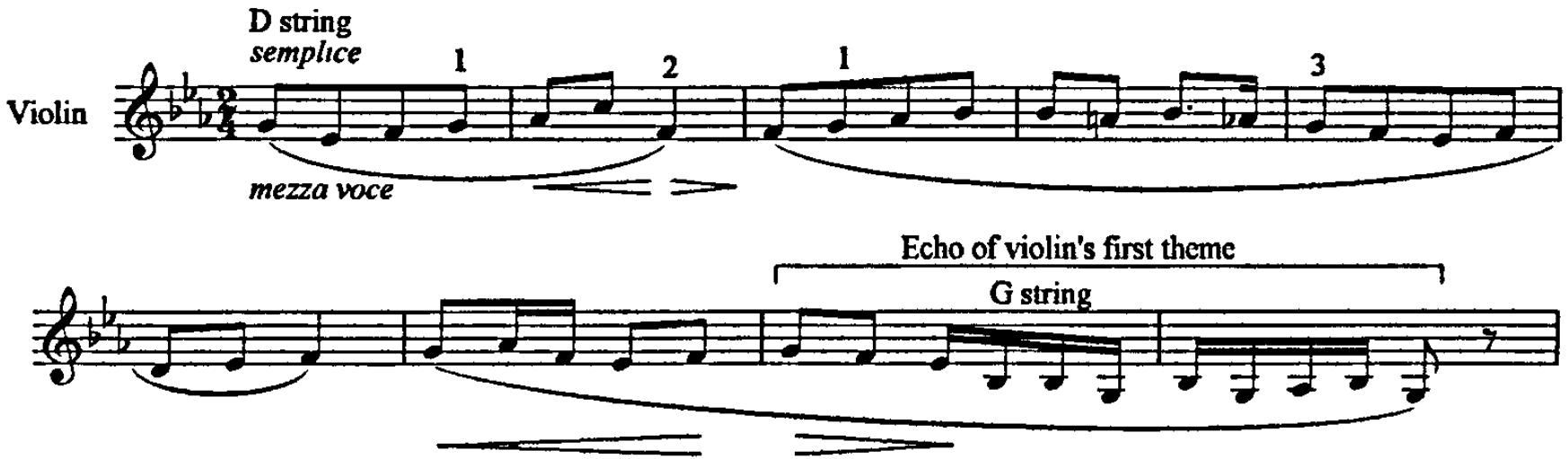
中文讲解
本段是谱例2.3的图像占位符,展示Op.96第二乐章第38–46小节的建议指法与选弦。配合前一段论述"mezza voce在D弦,结尾回声回到G弦"的实证图示。需查看原图。
第17段(P0216)
原文复述
Thus, while individual phrases are played on one string, and consist of a unified timbre of the type described by Leopold, the difference between mezza and sotto voce is achieved through the contrasting tone of the D and G strings. Baillot’s detailed descriptions of the different characters and tone colours of each string provide an interesting comparison to Beethoven’s exploitation of timbre in this movement. Baillot states that the G string is akin to ’the tenor voice… [it] establishes the empire of the violin; there are lower sounds on other instruments, but none with as much authority… and the deeper the voice is, the more it enables expression to reach the sublime’ (Baillot, 1834: 250). He goes on to describe it as being able to imitate the ’noble and touching sounds of the horn’ (Baillot, 1834: 251). The D string conveys ’the noble and velvety character of the contralto voice… the tone has much less intensity than when the violinist produces sounds similar to those of the oboe [which are produced on the A string]’ (Baillot, 1834: 249). This lack of intensity is perhaps acknowledged by Beethoven with the word ‘semplice’ at bar 38.
中文讲解
本段是本节的关键综合段,把前文的Rode技法、贝多芬术语、选弦推论与Baillot的弦色人声比喻并置。论证分四层:(1)小结前文:单个乐句在单根弦上演奏形成Leopold(莫扎特父亲)所描述的"统一音色",而mezza voce与sotto voce之间的差异则通过D弦与G弦的音色对比实现;(2)引用Baillot对四根弦的"人格化"描述:G弦=tenor voice(男高音),具有"建立小提琴帝国"的权威,能"使表现力达到崇高",并能模仿"noble and touching sounds of the horn"(圆号的庄严动人音色);(3)D弦=contralto voice(女低音),“noble and velvety”(庄严而天鹅绒般柔顺),强度低于A弦模仿双簧管音色的强度;(4)D弦强度较弱这一点,可能正是贝多芬在第38小节用semplice(朴素地)一词所"承认"的内容——semplice在此与mezza voce一起暗示节制、不夸张的音色。本段功能是给"贝多芬选弦暗喻"提供Baillot的同时代权威音色理论支撑,并暗示贝多芬不仅知道这些弦色差异,而且用文字标记来呼应它们。
补充说明
Leopold指Leopold Mozart,其著作是18世纪小提琴教学法的奠基文献,前文应已引用其关于"统一音色"的论述。semplice字面意为"简单的、朴素的",作为演奏指示时常暗示避免炫技、保持音色纯净。
第18段(P0217)
原文复述
It is pertinent that in Beethoven’s choice of Italian terms (‘voce’) and Baillot’s descriptions of the qualities of each string, reference is made to the expressive power of the voice. The terms sotto and mezza voce were originally used in vocal music, and mezza voce is most often seen in nineteenth-century operatic scores (n.a., 2001: 584). Through a choice of position, and therefore string, the violinist is able to communicate the same type of expression as a singer. This is perhaps best illustrated in bars 58-61 (see example 2.4). This is the highest pitch of the movement, and the violinist must play on the E string for the first time in the entire movement (assuming that bars 25-8 and 36 and 56 are played on the A string). While much of the movement displays an introverted character, with directions such as semplice and melodies on the lower strings, the higher tessitura, crescendo and disjunct intervals at bar 60 encourage more extrovert delivery. Baillot states that ‘some of [the E string’s] tones can be considered an extension of the voice… to a certain degree, they seem to be the result of a passionate movement which makes the voice rise in proportion to the strength of sentiment animating it’ (Baillot, 1834: 244). This outburst, however, is short-lived, the movement drawing to a close with the ’touching’ timbre of the G string.
中文讲解
本段是论证的高潮段,把"弦色=人声音域"的隐喻推进到E弦(最高、最亮的一根)。论证层次:(1)贝多芬使用"voce"(声音)这一意大利语词根与Baillot以人声比喻弦色相互呼应,两者都承认小提琴具有"声音的表达力";(2)sotto/mezza voce最初是声乐术语,mezza voce在19世纪歌剧总谱中最常见——这意味着贝多芬通过选弦让小提琴家"像歌唱家一样"表达同等类型的表现力;(3)谱例2.4(第58–61小节)是这一论断的最佳例证:这是本乐章的最高音,小提琴家必须在全乐章中首次使用E弦(假设第25–28、36、56小节都在A弦上演奏);(4)大部分乐章以"introverted"(内敛)性格为主——用semplice等标记、低弦旋律——但第60小节的高音区、渐强(crescendo)和跳进(disjunct intervals)鼓励"更外向"(extrovert)的表达;(5)Baillot认为E弦的某些音色"可被视为人声的延伸",“似乎是激情运动的结果,使人声随着情感强度而上升”——这是"声音随情感上扬"的隐喻;(6)但这次"爆发"很短暂,乐章在G弦"动人"的音色中收尾。本段功能是把整章的"弦色多样性"从理论推到谱面顶点:E弦是情感爆发,G弦回归内敛,形成"内省—爆发—回归"的完整情感弧线。
补充说明
E弦是四根弦中音最高、音色最亮的弦,常被比喻为女高音/小号般的音色。tessitura指声部/旋律的音域分布。
第19段(P0218)
原文复述
Example 2.4: Suggested fingerings and strings for Beethoven Sonata Op.96, movement 2, bars 58-62.
中文讲解
本段是图注,说明谱例2.4的内容:贝多芬Op.96第二乐章第58–62小节的建议指法与选弦。这是配合前一段关于"高音区+E弦+爆发+回归"论证的实证图示。需查看原图。
第20段(P0219)
原文复述

中文讲解
本段是P0218谱例2.4的图像占位符。位于第50页,展示第58–62小节的指法与选弦,配合"E弦爆发后回归G弦"的论证。图像数据未在文本中提供。
第21段(P0220)
原文复述
Throughout this movement Beethoven’s intricate performance directions and idiomatic writing for the violin thus encourage the performer to choose strings and fingerings carefully. The violin is no longer imitating one voice by creating a unified and consistent tone across the whole instrument; instead, as Baillot describes, it imitates many voices, from the tenor of the G string to the soprano of the E string. While each phrase is represented by the unified tone of one string, the contrast between these phrases harnesses the vast timbral diversity of the four strings of the violin. In this way, the violinist is able to exploit both the unity and variety of the instrument.
中文讲解
本段是本节结论。核心论点以对照方式呈现:(1)过去(前文Leopold代表的早期实践):小提琴通过在整件乐器上追求统一一致的音色来"模仿一个声音";(2)现在(贝多芬Op.96的实践):小提琴"模仿许多声音"——从G弦的tenor(男高音)到E弦的soprano(女高音);(3)每个乐句保留单一弦的"统一音色"(继承自Leopold/Rode传统);(4)但乐句之间的对比"驾驭"了四根弦的巨大音色多样性。本段功能是用"统一性+多样性"的辩证总结全节,与开篇P0200的"unity and variety of tone became important expressive devices"形成首尾呼应,并明确指出贝多芬的Op.96代表了一个新阶段:不再仅追求单一声部统一,而是通过选弦实现"多声部模拟"。
补充说明
“imitating many voices"呼应Baillot的弦色人声比喻,是本节的关键诗化表达,也是与Leopold时期"单一模仿"传统之间的历史分期标志。
脚注 / 边栏 / 图表 / 附加信息(如有)
本节附加材料包含三个乐谱示例(Example 2.1, 2.2, 2.3, 2.4)和一个脚注(脚注20)。脚注20规定全论文乐谱小节编号规则:弱起小节计入编号。该规则保证后续所有"bar X"引用与图示的严格对齐。谱例2.1(P0207)转引自Baillot(1834:263),展示Rode本人在克莱门蒂Op.24第二乐章第78–81小节的指法,作用是为"Rode在5把位单弦演奏"提供实证。谱例2.2(P0213)和2.3(P0215)由作者编订,展示Op.96第二乐章第9–14小节和第38–46小节的建议指法与选弦,作用是把贝多芬的术语(sotto voce, mezza voce)落到具体弦位选择上。谱例2.4(P0219)展示第58–62小节,作用是显示E弦的使用与乐章末尾G弦回归。所有谱例因图像数据省略,需查看原书页面才能看到具体音符与指法数字。
💡 本节核心要点
- 19世纪初小提琴演奏的两个核心表现要素是"音色统一性"与"音色多样性”,贝多芬Op.96第二乐章是展示二者结合的关键案例。
- Rode(贝多芬专为此曲创作的演奏对象)的技法核心是"单弦高把位"演奏——为获得同一弦上的音色同质性而换把,避免跨弦造成的音色断裂。
- 贝多芬1812年给Archduke Rudolph的信件亲证:在写Op.96时考虑到Rode的演奏偏好,调整了末乐章的构思,表明作曲家的写作与特定演奏家技法直接挂钩。
- 贝多芬在第二乐章同时使用sotto voce与mezza voce两个意大利术语,暗示演奏家在音色层次上区分两种表现——前者对应G弦(暗、tenor voice),后者对应D弦(velvety、contralto voice)。
- 乐章第58–61小节首次使用E弦(soprano voice般的音色)作为情感爆发的顶点,然后迅速回到G弦"动人"的音色收尾,构成"内省—爆发—回归"的情感弧线。
- 全节论证的最终结论:每个乐句保持单弦统一音色(继承Rode-Leopold传统),乐句之间通过选弦对比利用四根弦的全部音色多样性——这把小提琴从"模仿单一声音"提升为"模仿多种声音"。
🔑 关键术语
- Viotti school:以Giovanni Battista Viotti(1755–1824)为奠基人的小提琴演奏学派,强调歌唱性运弓和声部连贯,Rode是该学派最重要的继承者。
- Méthode de Violon (1803):Baillot、Rode、Kreutzer合著的小提琴教学法,是19世纪初法国小提琴演奏实践的权威文献,本节多处引用。
- port de voix:法语小提琴术语,指在两个音之间用同一弓做带揉弦/滑奏效果的连贯过渡,Viotti-Rode学派歌唱性演奏的标志。
- 5th position (五把位):小提琴把位术语,指左手手型在指板上较高位置;Rode在G弦上达到5把位是为了在单弦上覆盖更宽音域而无需换弦。
- sotto voce:意大利语,意为"在声音之下",本节中贝多芬用此标记暗示在G弦上演奏的暗音色乐句。
- mezza voce:意大利语,意为"半声",本节中贝多芬用此标记暗示在D弦上演奏的柔顺音色乐句;与sotto voce虽常被互换使用,但在Op.96中并用意味着贝多芬有意识地作区分。
- tessitura:声部或旋律的音域分布;本节第60小节"higher tessitura"指旋律运行到较高音区。
- fortepiano:贝多芬时代使用的早期钢琴(古钢琴/槌击式键盘乐器),区别于后来的现代钢琴;Archduke Rudolph在Op.96首演中担任fortepiano演奏。
S2-6 Techniques of Expressive Bowing: the Soul of the Violin
第1段(P0221)
原文复述
Section heading (level 2): ‘Techniques of Expressive Bowing: the Soul of the Violin.’
中文讲解
本条是小节标题,向读者宣告本节主题:表现性运弓的技巧——并以副题"the Soul of the Violin"(小提琴的灵魂)把这一技术与乐器的表现本质直接挂钩。冒号前点出技术对象(Techniques of Expressive Bowing),冒号后给出比喻性定位(the Soul of the Violin),意味着本节并非中立罗列弓法种类,而是要把"运弓"论证为小提琴之所以能"歌唱"的核心表现媒介,这正呼应了作者此前把提琴与声乐/演讲并置的总体思路。
第2段(P0222)
原文复述
There are striking parallels between the descriptions of vocal and bowing techniques used to create the variety and unity of tone which are essential to expressive delivery. While in rhetorical treatises these techniques are referred to as ‘management of the voice’ (see for example Sheridan, 1762: 82), in violin manuals they are described as ‘management of the bow’ (Spohr, 1832: 118).
中文讲解
本段提出本节的核心论断:用于实现"音色之变化与统一"的"声乐技巧"与"运弓技巧"之间存在"显著的类比"(striking parallels),而"音色之变化与统一"(variety and unity of tone)被作者明确界定为"富有表现力地演绎"(expressive delivery)的本质条件。作者没有停留在笼统比喻,而是从术语层面对类比加以具体化:在修辞学论著中,这类技术被称为"嗓音的管理"(management of the voice),他引Sheridan 1762年第82页为据;而在小提琴教本中,则被称为"弓的管理"(management of the bow),他引Spohr 1832年第118页为据。两处引文一方面让类比落地为可在两套文献中核对的对称措辞,另一方面也为本节的方法奠基:他将以"嗓音管理"的修辞学论述为参照,去阐发"弓的管理"在小提琴上的表现原则,从而为小提琴的运弓教学引入一套本属于人声/演讲的概念词汇。
第3段(P0223)
原文复述
One of the first requisites for a good speaking voice is breath control. Through good management of the breath, the speaker can give sentences unity in two
中文讲解
本段从"嗓音管理"一侧切入,列出第一项表现性技巧——“呼吸控制”(breath control),并明确将其定位为"良好说话嗓音的首要条件之一"(one of the first requisites)。接着作者预告:通过良好的呼吸管理,说话者能"以两种方式赋予句子统一性"(give sentences unity in two…),但句子在"in two"处被截断,“两种方式"的具体内容并未出现在本节提供的第50页文本中。因此读者在本段只能确认作者的论证骨架——呼吸控制是句子统一性的来源——而无法在本段内得知其后续将如何区分这"两种"统一性(具体所指非本节所能确证)。这段残句同时也提示本节在第50页只是导引性开篇,真正展开要进入原文后续页面。
补充说明
本段在 ‘in two’ 处被截断,原文此处未完整收束;‘两种方式’的具体所指不在本节输入范围内。
脚注 / 边栏 / 图表 / 附加信息(如有)
本节在第50页截取的三段中,P0222包含两处文献引用:Sheridan (1762: 82) 对应修辞学体系中 ‘management of the voice’ 的术语出处;Spohr (1832: 118) 对应小提琴教本中 ‘management of the bow’ 的术语出处。这两处引文构成本节跨学科类比的方法论支点。P0223 在 ‘in two’ 处截断,作者预告的’两种统一性’的具体内容未在本节给出。
💡 本节核心要点
- 本节标题以’小提琴运弓技巧 = 小提琴的灵魂’为定位,把运弓抬升为乐器表现力的核心媒介。
- 本节的核心论断是:声乐/演讲的发声技巧与运弓技巧之间存在’显著的类比’,二者的共同目标是实现’音色的变化与统一’。
- 作者用’management of the voice’(嗓音管理,对应修辞学论著)与’management of the bow’(弓的管理,对应小提琴教本)这一对对称术语,将类比落到文献措辞层面。
- Sheridan (1762: 82) 与 Spohr (1832: 118) 两处具体引证为跨学科类比提供了方法论支点。
- 在’嗓音管理’一侧,作者首先提出’呼吸控制’为良好说话嗓音的首要条件之一,并预告它能以两种方式赋予句子统一性——但这两种方式在本节输入范围内未展开。
- 第50页的三段只是本节的导引性开篇,论证的实质展开落在原文后续页面。
🔑 关键术语
- management of the bow:弓的管理;小提琴教本中对运弓表现力技巧的统称(参Spohr 1832: 118),在本节中与’嗓音的管理’对称,作为本节的核心技术对象。
- management of the voice:嗓音的管理;修辞学/演讲论著中对发声表现力技巧的统称(参Sheridan 1762: 82),在本节中作为运弓技巧的类比参照系。
- breath control:呼吸控制;作者列为’良好说话嗓音的首要条件之一’,在本节中被定位为使句子获得统一性的关键手段。
- expressive delivery:富有表现力地演绎;本节把它界定为’音色的变化与统一’所服务的高层艺术目标,连接运弓技巧与发声技巧。
- variety and unity of tone:音色的变化与统一;作者在本节中认为是’富有表现力地演绎’所必需的一对声音品质,并以此作为声乐技巧与运弓技巧的共同评判标准。