目录
ch1 Chapter One (continuation): C. P. E. Bach’s Free Fantasia — Sensibility, Variety, and Three Fundamental Liberties
- 1.1 [描述性拆分] Arpeggiated openings in H. 148 and stylistic contrast with J. S. Bach
- 页码:1-3
- 1.2 2. Sensibility
- 页码:3-4
- 1.3 [描述性拆分] Recitative modeling in H. 339 and the declamatory style of H. 75
- 页码:4-7
- 1.4 [描述性拆分] Theory of imitation, das Sprechende, and self-expression in the late fantasias
- 页码:7-10
- 1.5 [描述性拆分] 3. The Beauty of Variety: virtuosic figuration and astonishment
- 页码:10-13
- 1.6 [描述性拆分] Songful passages, noble simplicity, and introspective central sections
- 页码:13-15
- 1.7 [描述性拆分] C. Three Fundamental Liberties — 1. Time
- 页码:15-19
- 1.8 [描述性拆分] 2. Tonality: freedom from a conventional key plan and gradual/abrupt modulation
- 页码:20-23
- 1.9 [描述性拆分] Liberties of harmonic syntax: ellipsis, chordal inversion, and diminished seventh
- 页码:24-29
- 1.10 [描述性拆分] Tonality, syntax, and the simulation of madness in H. 284
- 页码:29-31
- 1.11 [描述性拆分] 3. Arrangement of Ideas: the absence of a Hauptsatz and orderly rhetoric
- 页码:31-33
- 1.12 [描述性拆分] Inventiveness, eccentric juxtaposition, and feverish repetition in the fantasias
- 页码:34-37
- 1.13 [描述性拆分] Programmatic borrowings and memento mori associations in the late fantasias
- 页码:38-40
- 1.14 [描述性拆分] Conclusion of Chapter One
- 页码:40-41
- 1.15 [描述性拆分] Chapter Two title page
- 页码:42-42
- 1.16 [描述性拆分] Chapter Two introduction: the nineteenth-century crisis of genre
- 页码:43-44
- 1.17 [描述性拆分] A.1. Origins of the stylus phantasticus in Italian vocal music and Kircher’s definition
- 页码:45-47
- 1.18 [描述性拆分] Transmission to Germany via Froberger and characteristics defined by Brossard
- 页码:47-50
1.1 [描述性拆分] Arpeggiated openings in H. 148 and stylistic contrast with J. S. Bach
第1段(P0001)
原文复述
understanding of harmony" required in this genre. $^{25}$ Through a series of examples, Bach illustrates how this framework guides gradual and abrupt modulation “to closely related, remote, and all other keys.” $^{26}$ The framework of H. 148 in F (example 6), however, recalls Bach’s preliminary examples of “the briefest and most natural means of which a keyboardist, particularly one of limited ability may avail himself in preluding [“Vorspielen”]. “With due caution,” Bach advises, the inexperienced musician should “fashion his bass out of the ascending and descending scales of the prescribed key, with a variety of figured bass signatures; he may interpolate a few half steps, arrange the scale in or out of its normal sequence, and perform the resultant progressions in broken or sustained style.” $^{27}$
中文讲解
本段属于对前文已引入的“本类型所需和声理解”的补述。脚注25和26提示:巴赫在《试奏法》(Versuch)中通过一系列示例说明,某种框架能够引导演奏者向“所有近关系、远关系以及其他调”进行渐变与突变的转调。然而,作者随即转折——H. 148(F大调)的框架(第6例)所回应的,并非这种高阶转调系统,而是巴赫在该书前部针对“初学者最简短、最自然的即兴前奏(Vorspielen)手段”所给出的建议。脚注27引用了这段建议的原文:键盘演奏者应“在谨慎的前提下”,以指定调的上下行音阶为低音,配置多样的数字低音记号,可以插入半音、将音阶打乱或保持原序,并以分解或持续的方式奏出这些进行。
本段的论证作用是:将H. 148放在《试奏法》中那段针对“有限能力的键盘演奏者”的最简易前奏规则之下,而不是那段针对高水平演奏者的复杂转调框架之下。换言之,作者意在指出这部作品看似华丽,实则在底层遵循的是巴赫为初学者给出的最基础低音组织法,这为后文分析其低音结构(下一段)作了铺垫。需注意德文Vorspielen被作者保留原词,并经脚注27说明不应译为“即兴演奏”(extemporizing),因为此处讨论的对象是前奏(preludes),而非成熟的自由幻想曲。
第2段(P0002)
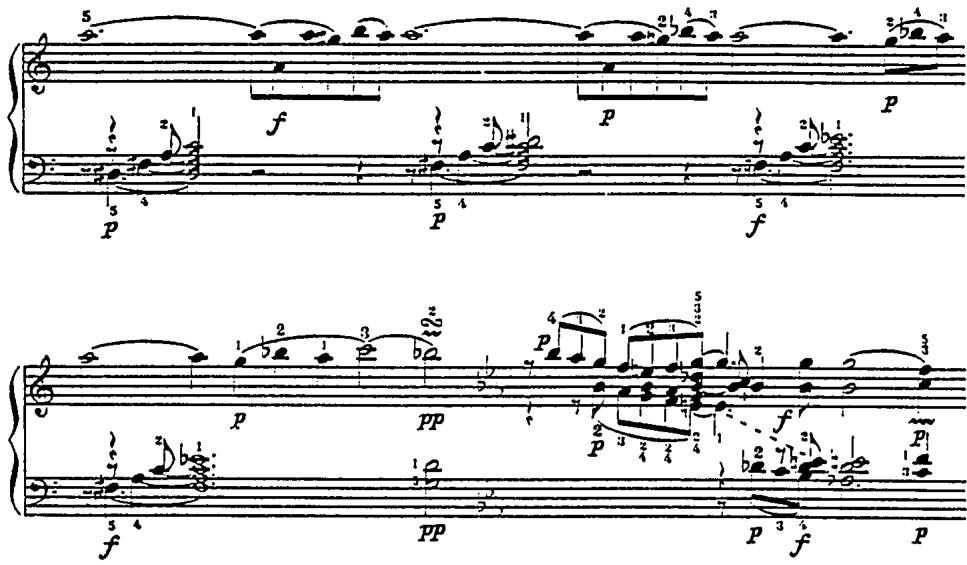
原文复述
The fantasia in F, H. 148 closely follows this advice. The bass line itself comprises a descending segment of the tonic scale (f to c) followed by a descending segment of the chromatic scale (f-sharp to c). The harmonization of the chromatic-scale segment as a series of inverted dominant sevenths (a circle of fifths) recalls (or, rather, prefigures) Bach’s harmonizations of the chromatic scale in the last chapter of the Versuch. $^{28}$
中文讲解
本段承接上文所引述的初学者建议,宣称F大调幻想曲H. 148“严格遵循”该建议。作者随后给出具体证据:低音由两段下行组成——先是主音音阶的下行(f到c),接着是半音音阶的下行(升f到c)。这种组织方式直接对应前段引文所说的“以指定调的上下行音阶为低音……插入半音……将音阶打乱或保持原序”。
更深一层,作者指出半音音阶段的和声化方式是一连串“转位属七和弦”(即一系列以五度循环连接的属七)。这处细节的论证意义在于:尽管作品总体上回应的是《试奏法》中面向初学者的最简易低音规则,但这段半音进行却“呼应(甚至预先暗示)”了巴赫在《试奏法》最后一章所示范的更高级的半音音阶和声法。换言之,H. 148同时折射出巴赫教学体系的两端——最简与最深——这种并置本身就揭示了C. P. E. 巴赫幻想曲的风格包容力。脚注28指明作者此处的引文来源为《试奏法》2, 41, §. 7。
第3段(P0003)
原文复述
$^{25}$ Bach, Versuch, 2, 41, §. 2, trans. Mitchell, 430.
中文讲解
脚注25为正文引用的“本类型所需和声理解”提供出处:巴赫《试奏法》第二卷第41页第2节,米切尔英译本第430页。这是正文学术引证,对正文主张起支持作用。
第4段(P0004)
原文复述
$^{26}$ Bach, Versuch, 2, 41, §. 9, trans. Mitchell, 434.
中文讲解
脚注26为正文关于“渐变与突变转调至所有近关系、远关系以及其他调”的引述提供出处:巴赫《试奏法》第二卷第41页第9节,米切尔英译本第434页。此为支持性引证,标明巴赫原文中确实提到了向各类远、近关系调进行转调的框架。
第5段(P0005)
原文复述
$^{27}$ Bach, Versuch, 2, 41, §. 7, trans. Mitchell, 431-32. (Translation modified: Mitchell’s translation of Vorspielen as extemporizing obscures the fact that Bach is here discussing preludes, rather than fully fledged free fantasias).
中文讲解
脚注27是本节最重要的一处文献注:它标明关于“初学者最简短、最自然的即兴前奏手段”的长引文出自《试奏法》第二卷第41页第7节,米切尔译本第431—432页。作者特别加注说明:米切尔将德文Vorspielen译为extemporizing(即兴演奏)并不准确,因为巴赫此处讨论的对象是前奏(preludes),而非成熟的自由幻想曲(free fantasias)。这一译注提醒读者:正文反复强调H. 148在低音组织法上承袭的是巴赫关于“前奏写作”的建议,而不是关于“自由幻想曲写作”的建议;这是论证H. 148“植根于前奏传统”的关键文献依据。
第6段(P0006)
原文复述
Reproduced with permission of the copyright owner. Further reproduction prohibited without permission.
中文讲解
本段为版权声明,表明第1页的复制得到版权所有者授权,未获许可不得再行复制。这仅是版面包装信息,与正文学术论证无关。
第7段(P0007)
原文复述
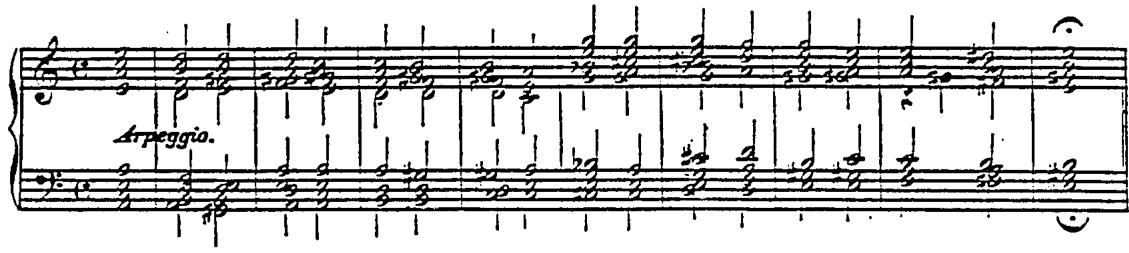
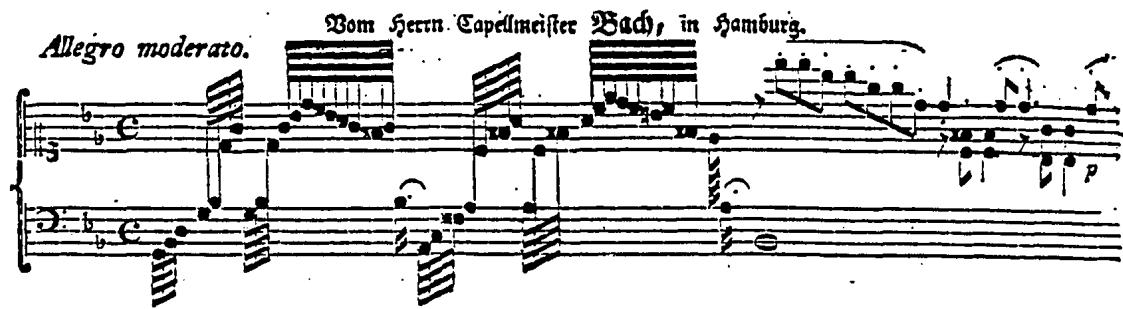
The realization of this figured-bass framework illustrates several of the most distinctive stylistic features of C. P. E. Bach’s free fantasias. There is an opening arpeggio section similar to passages in fantasias by J. S. Bach. The fantasia from the fantasia and fugue in a minor, BWV 944 (after 1712) (example 7), comprises ten measures of such “fully gripped chords,” $^{29}$ and the chromatic fantasia, BWV 903, employs arpeggio passages in mm. 27-30, 33-42, and 44-49 (cf. example 1). Yet C. P. E. Bach avoids uniformity through a greater use of octave displacements of bass notes and through rapid alternation of forte and piano. Whereas J. S. Bach’s arpeggio fantasia BWV 944 is well suited to the harpsichord, the wide dynamic range of H. 148 (from pianissimo to forte) is better suited to the clavichord and fortepiano. In discussing the fantasia, C. P. E. Bach remarks that “the best instruments for our purpose are the clavichord and pianoforte.” $^{30}$
中文讲解
本段将H. 148与J. S. 巴赫的作品并置,正式开启本节“风格对比”的主题。
首先,作者指出H. 148开头的分解琶音段落(arpeggio section)与J. S. 巴赫的若干幻想曲相似:a小调幻想曲与赋格BWV 944(约1712年后)(第7例)中有十小节的所谓“完全按住的和弦”(fully gripped chords),即全部同时按下的和弦;“半音幻想曲”BWV 903在第27—30、33—42、44—49小节也使用了琶音段落。这是父辈传统的直接传承。
然而,作者用一个转折“Yet”标出关键差异:C. P. E. 巴赫通过两种手段避免统一感(uniformity)——一是更多地使用低音八度移位(octave displacements),二是快速交替forte与piano。这一风格差异进而引出乐器匹配问题:J. S. 巴赫的BWV 944适合羽管键琴(harpsichord,因为其力度单一),而H. 148具有从pp到f的宽广力度范围,更适合击弦古钢琴(clavichord)与早期钢琴(fortepiano,二者都能做力度变化)。作者引用C. P. E. 巴赫本人言论佐证:他在《试奏法》中明言“最适宜我所述目的的乐器是击弦古钢琴与钢琴”。
本段的论证意义在于:以乐器选择为切入点,把“力度对比”从单纯的风格特征上升为C. P. E. 巴赫幻想曲的美学基础——这正是下一段将进一步展开的“对情感(passions)的激发与平息”命题的伏笔。
第8段(P0008)
原文复述
Example 7. J. S. Bach, Fantasia in a, BWV 944 (after 1712).
中文讲解
本段是第7例的图注,说明其后乐谱的曲目为J. S. 巴赫a小调幻想曲BWV 944,年代定为1712年之后。该例在正文中用于说明J. S. 巴赫幻想曲开头的“完全按住的和弦”与琶音段落风格,从而与H. 148形成对比依据。
第9段(P0009)
原文复述
中文讲解
本段为第2页的乐谱图像占位符,原始内嵌图像数据已省略,仅保留其版面位置。根据上下文可知此处即上文图注所标的“第7例”——J. S. 巴赫a小调幻想曲BWV 944的乐谱;具体音符内容需查看原图,本书文本不作进一步分析。
第10段(P0010)
原文复述
These differences between C. P. E. Bach’s and J. S. Bach’s treatment of arpeggiated chords reflects the younger composer’s pursuit of variety and his aim rapidly to rouse and still the passions:
中文讲解
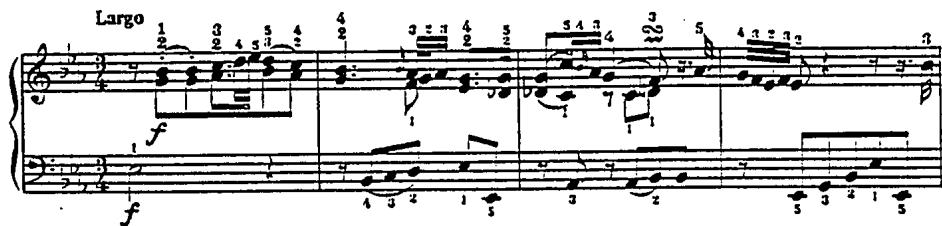
本段是过渡段,承接前文所做的具体对比,提出一个总括性论断:C. P. E. 巴赫与J. S. 巴赫在处理分解琶音和弦上的差异,反映出这位年轻作曲家两方面的追求——其一是对“变化(variety)”的追求,其二是要“迅速激发并平息情感(passions)”。冒号表示下文紧接的引文将进一步用C. P. E. 巴赫本人的言论支撑这一论断。这一句在结构上充当“现象—原因”的桥梁,把H. 148的具体风格差异上升为作曲家的美学意图。
第11段(P0011)
原文复述
$^{28}$ Bach, Versuch, 2, 41, §. 7.
中文讲解
脚注28为P0002中关于“半音音阶被处理为一系列转位属七和弦(属五六和弦)构成五度循环”的论述提供出处:巴赫《试奏法》第二卷第41页第7节。此注与P0005的脚注27指向《试奏法》的同一节,提示作者在论证H. 148的低音与和声双重来源时,都回到巴赫这一节文字,是全节论证的关键文献支点。
第12段(P0012)
原文复述
$^{29}$ The phrase is Bach’s: see Versuch, 2, 41, §. 14, trans. Mitchell, 442.
中文讲解
脚注29指出P0007中出现的“fully gripped chords(完全按住的和弦)”这一短语出自巴赫本人,而非作者的概括性描述;其文献出处为《试奏法》第二卷第41页第14节,米切尔英译本第442页。这一脚注的功能是:揭示作者借用的是巴赫的原始术语,从而把H. 148与J. S. 巴赫BWV 944的比较建立在双方共享的巴赫家族教学术语之上。
第13段(P0013)
原文复述
$^{30}$ Bach, Versuch, 2, 41, §. 4, trans. Mitchell, 431.
中文讲解
脚注30为P0007中关于“最适宜的乐器是击弦古钢琴与钢琴”的直接引语提供出处:巴赫《试奏法》第二卷第41页第4节,米切尔英译本第431页。该引语对正文主张起支持作用,证明C. P. E. 巴赫本人明确意识到力度对比需要具备力度变化的乐器,而非羽管键琴。
第14段(P0014)
原文复述
Reproduced with permission of the copyright owner. Further reproduction prohibited without permission.
中文讲解
本段为第2页的版权声明,与P0006属同类型版面信息,标明本页复制已获版权所有者授权,未经许可不得再行复制。
第15段(P0015)
原文复述
The beauty of variety is made evident in the fantasia. A diversified figuration and all the attributes of good performance must be employed. The ear tires of unrelieved passage work, sustained chords, or broken chords. By themselves they neither stir nor still the passions; and it is for these purposes that the fantasia is exceptionally well suited . . . The performer must not break his chords constantly in a single color [that is, at a fixed dynamic level]. $^{31}$
中文讲解
本段是C. P. E. 巴赫本人论述“变化之美”的长引文,是本节论证的核心理论支柱。其要点可分四层:
第一,“变化之美在幻想曲中最为明显”,开宗明义将variety确立为幻想曲体裁的首要美学价值。
第二,演奏中必须运用“多样的音型与一切优良演奏的属性”,把变化从作曲维度延伸到演奏维度。
第三,否定性论据:“耳朵会厌倦无变化的音群、持续和弦或分解和弦”,因为它们单独存在“既不能激发也不能平息情感”。这是用反向推理确立变化之必要性:单调之所以不可接受,正因其无法实现幻想曲的真正功能。
第四,幻想曲之所以“特别适合”实现激发与平息情感的目的,正因为它可以承载变化;演奏者“不可永远以单一色彩(即固定的力度层次——方括号为作者补注)来分解和弦”。
方括号“that is, at a fixed dynamic level”是作者为读者所作的释义,说明巴赫“a single color”指的不是音色而是力度层级,从而将巴赫的话与前文H. 148的f/p对比直接关联起来。脚注31标明这段引文出自《试奏法》第二卷第41页。
第16段(P0016)
原文复述
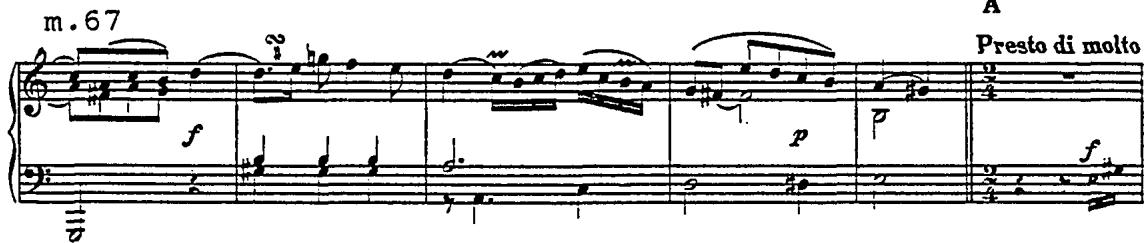
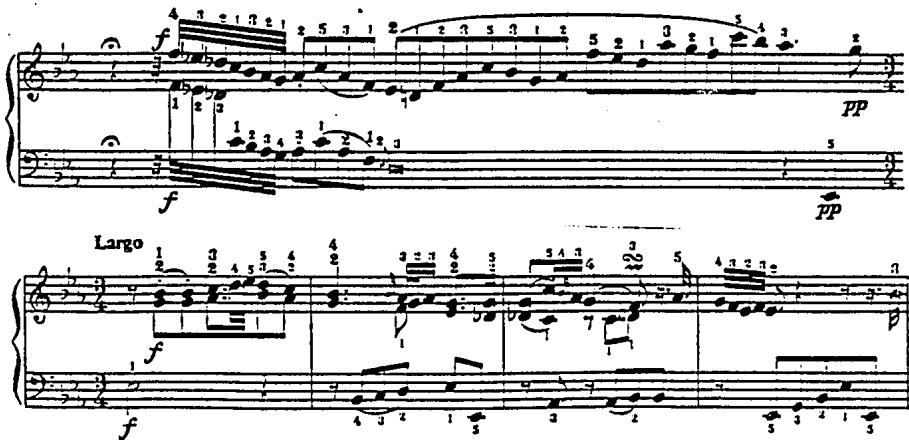
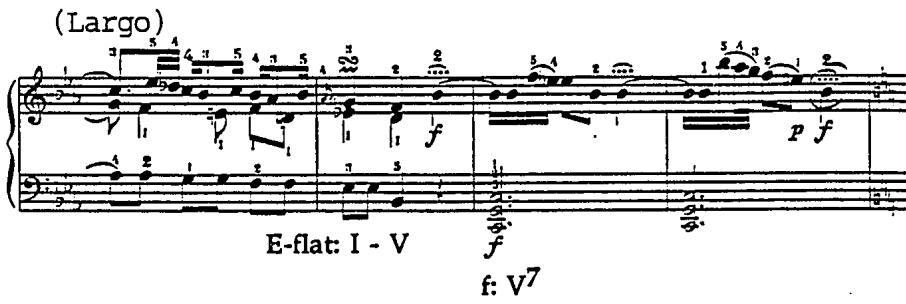
The rapid alternations of forte and piano in H. 148 seek to stir and still the passions. The contrast between, on the one hand, the opening and closing passages of arpeggiation, and, on the other, the piquant sighing figure that is set-off pianissimo and in a high register, creates the affective variety, and bold shifts of affection that Bach admired in the free fantasia.
中文讲解
本段是本小节的总结,将前文所有材料收束到H. 148的具体分析上。
第一句指出,H. 148中f与p的快速交替旨在“激发并平息情感”,直接回扣P0010与P0015所引C. P. E. 巴赫本人的美学意图。
第二句进一步具体化“情感变化”如何在该作品中实现:作品在两极之间形成对比——一是首尾的琶音段落(力度起伏的整体框架),二是以pp力度在高音区奏出的“辛辣的叹息音型”(piquant sighing figure)。这种布局创造出“情感的多样性与大胆的情感转换(shifts of affection)”,正是C. P. E. 巴赫在自由幻想曲中所推崇的东西。
本段在本节整体论证中的作用:完成从“父辈传统(J. S. 巴赫的琶音风格)”到“子辈突破(C. P. E. 巴赫通过力度对比与情感对比实现的风格创新)”的论证闭环,并以C. P. E. 巴赫自己的言论(巴赫所钦佩的对象)作为收尾,确立作者对H. 148风格史定位的判断。
脚注 / 边栏 / 图表 / 附加信息(如有)
本节包含以下非正文附加材料:
- 脚注25—30,均为对《试奏法》(Versuch)第二卷第41页相关小节及米切尔英译本的引证。其中脚注27含一处对米切尔译文的修正(Vorspielen不应译作extemporizing,应理解为前奏),脚注29说明“fully gripped chords”为巴赫本人用语,脚注30支持正文关于击弦古钢琴与钢琴的引语。
- 图例:第7例——J. S. 巴赫a小调幻想曲BWV 944(1712年后)的乐谱,占据第2页版心,原始图像数据已省略,需查看原图。
- 两处版权声明(分别位于第1页与第2页),属版面包装信息,与论证无关。
- 正文中P0015内出现的方括号释义“that is, at a fixed dynamic level”为作者对巴赫原话“a single color”的补充说明,起到将原文术语与本节“力度对比”主旨挂钩的桥梁作用。
💡 本节核心要点
- H. 148在底层低音组织上承袭的是《试奏法》中面向初学者的最简易前奏规则:上行/下行音阶加半音插入,而非高阶转调框架。
- H. 148的低音由主音音阶下行(f—c)与半音音阶下行(升f—c)两段组成,其中半音段被和声化为一系列转位属七和弦(五度循环),同时呼应《试奏法》最后一章的高阶半音和声法。
- H. 148开头的琶音段落在风格上与J. S. 巴赫BWV 944的“完全按住的和弦”及BWV 903的琶音段同出一源,体现父辈传统的延续。
- C. P. E. 巴赫通过更频繁的低音八度移位与f/p快速交替,避免统一感,将力度对比提升为该体裁的核心风格特征。
- 宽广的力度范围(pp—f)使H. 148只能适配击弦古钢琴与早期钢琴,而非羽管键琴;C. P. E. 巴赫本人在《试奏法》中明确陈述了这一乐器选择。
- 上述差异体现C. P. E. 巴赫的美学意图——“变化之美”与“迅速激发并平息情感”,通过首尾琶音与高音区p叹息音型的对比,在H. 148中得以具体实现。
🔑 关键术语
- Vorspielen:德文术语,巴赫《试奏法》中用以指“前奏”而非泛指“即兴演奏”。本节作者通过脚注27特别纠正米切尔英译,确立巴赫此处讨论的对象是前奏写作,与自由幻想曲体裁区分开来,是H. 148低音组织法归属问题的关键术语。
- fully gripped chords(完全按住的和弦):巴赫本人在《试奏法》§. 14中使用的术语,指同时按响全部音的实按和弦(即持续和弦)。在本节中,作者借用此术语描述BWV 944开头十小节的和弦处理方式,并以此作为H. 148与之比较的共同术语基础。
- broken or sustained style(分解或持续风格):巴赫在《试奏法》§. 7中给出的两种低音呈现方式:分解(将和弦音先后奏出)与持续(同时奏出)。本节以此作为H. 148遵循巴赫低音写作建议的具体技术依据。
- circle of fifths(五度循环):和声进行中每一和弦根音下移纯五度(或上移纯四度)的连续进行。本节中H. 148半音下行段的和声化即被描述为一连串转位属七和弦所构成的五度循环,呼应《试奏法》最后一章的半音音阶和声示范。
- piquant sighing figure(辛辣的叹息音型):H. 148中以pp力度在高音区出现的短促叹息式动机,作者将其与首尾的琶音段落对置,用以解释作品中“情感的多样性与大胆的情感转换”如何被具体实现。
- shifts of affection(情感转换):C. P. E. 巴赫美学中的核心概念,指通过力度、音区、音型等手段在短时间内激起不同情感状态。本节以H. 148的f/p交替与琶音—叹息对比作为该概念在具体作品中的实例化。
1.2 2. Sensibility
第1段(P0017)
原文复述
2. Sensibility — a level-2 section heading that opens the second section of the chapter, titled “Sensibility.”
中文讲解
本段为二级小节标题”## 2. Sensibility"(中文意为"敏感性")。它提示读者:本节将围绕"敏感性"(sensibility)这一概念展开论述,焦点是它在幻想曲的创作与接受两端所扮演的角色。正式论述从下一段(P0018)开始。
补充说明
此条仅作为小节标题,不含正文论述。
第2段(P0018)
原文复述
The opening paragraph observes that the suitability of fantasias to rousing sentiment points to the importance of sensibility in both their creation and their reception. Sensibility, defined in the Oxford English Dictionary as “exceptional openness to emotional impressions; delicacy of feeling,” ranged in its eighteenth-century meanings “from a use much like that of modern awareness (not only consciousness but conscience) to a strong form of what the word appears literally to mean, the ability to feel.” If improvised fantasias are an ideal medium through which “to master the feelings of the audience,” the Versuch makes it equally clear that not only the listener but also the performer or improviser must possess sensibility for this aim to be achieved. The paragraph ends with the unfinished phrase “As Bach,” which continues into the next paragraph.
中文讲解
本段是本节论证的起点,提出三层主张。第一层:从效果回推——幻想曲之所以适合激发情感,根源在于其创作与接受两端都需要"敏感性"。第二层:通过OED定义与Raymond Williams的论述界定"sensibility":本意是对情感印象的开放与感受的细腻,18世纪语义跨度极大,从接近现代"awareness"(含意识甚至良知之意)一直延伸到字面上的"the ability to feel"。第三层:双向性论点——若幻想曲是"to master the feelings of the audience"的理想媒介,那么《Versuch》同样清楚地表明,要达到这一目的,演奏者(improviser)与听众一样必须具备sensibility。这就把情感效果从单向的"作者→听众"变成了演奏者与听众共同参与的回路。段末以"As Bach"断句,下段P0024补全引语。
补充说明
段末"As Bach"为悬置句,下段P0024承接并补全引文;脚注34(Versuch 1, 3, §. 15)指向"to master the feelings of the audience"的来源。
第3段(P0019)
原文复述
Footnote 31 cites Bach, Versuch, 2, 41, §. 12, trans. Mitchell, pp. 438-39, as the source for an earlier appearance of the quotation about mastering the feelings of the audience.
中文讲解
脚注31提供P0018中"to master the feelings of the audience"一语的另一处原典位置:巴赫《Versuch》第二部分第41页第12节,Mitchell英译本第438–39页。它与脚注34一起,提示读者该短语在《Versuch》中至少出现两次,本节引用的是其中一处。
第4段(P0020)
原文复述
Footnote 32 cites The Oxford English Dictionary, 2nd ed., s. v. “Sensibility,” as the source for the definition of sensibility.
中文讲解
脚注32为P0018引用的"sensibility"定义提供辞书来源:牛津英语词典第二版"Sensibility"词条。功能是支撑文中"exceptional openness to emotional impressions; delicacy of feeling"的权威性。
第5段(P0021)
原文复述
Footnote 33 cites Raymond Williams, Keywords: A Vocabulary of Culture and Society, rev. ed. (New York: Oxford University Press, 1985), p. 281, as the source for the account of the eighteenth-century range of meanings of sensibility.
中文讲解
脚注33为P0018中关于sensibility在18世纪"从现代awareness到ability to feel"的语义跨度提供学术来源:Raymond Williams《Keywords: A Vocabulary of Culture and Society》修订版(纽约:牛津大学出版社,1985)第281页。它表明本节对sensibility词义的把握不是孤立词义,而是放在文化关键词的谱系中理解。
第6段(P0022)
原文复述
Footnote 34 cites Bach, Versuch, 1, 3, §. 15, trans. Mitchell, p. 153, as the source for the quotation about mastering the feelings of the audience.
中文讲解
脚注34为P0018所引"to master the feelings of the audience"提供第一部分出处:巴赫《Versuch》第一部分第3页第15节,Mitchell英译本第153页。与脚注31配合,标识该短语在《Versuch》中的两个出处位置。
第7段(P0023)
原文复述
A copyright notice reading: “Reproduced with permission of the copyright owner. Further reproduction prohibited without permission.”
中文讲解
版权提示语,属版面属性内容:声明本文经版权所有者授权转载,未经许可不得再次复制。该条不参与正文论证。
第8段(P0024)
原文复述
The paragraph completes the unfinished sentence begun in P0018 with Bach’s remark: “a musician cannot move others unless he too is moved. He must of necessity feel all the affections that he hopes to arouse in his audience.”
中文讲解
本段承接P0018末尾的"As Bach",直接引用巴赫原话:“a musician cannot move others unless he too is moved. He must of necessity feel all the affections that he hopes to arouse in his audience.“这段引语是P0018双向sensibility论点的核心文本证据:演奏者若不能被自己的演奏打动,便无法打动他人;并且"of necessity"与"all"两词赋予这条原则以必然性——演奏者必须感受他希望唤起的一切情感。它把感性的双向性坐实为巴赫本人明确表达的命题。
补充说明
此引文出处为脚注35(指向巴赫《Versuch》相关章节,Mitchell译本对应页码在原书此处注出)。
第9段(P0025)
原文复述
The paragraph identifies declamatory melody as the principal musical means by which “to master the feelings of the audience.” It notes that in part one of the Versuch, Bach emphasizes the importance of what he calls “das Sprechende,” or declamatory style, as a component of the free fantasia, because of its suitability to rousing rapidly changing sentiments and affections.
中文讲解
本段从抽象的"sensibility"过渡到具体的音乐实现:宣叙性旋律(declamatory melody)是"to master the feelings of the audience"的主要音乐手段。巴赫在《Versuch》第一部分中以德语术语"das Sprechende”(字面意为"说话般的”)来命名这种风格,并在自由幻想曲中突出它。理由很明确:这种风格擅长激发"rapidly changing"(快速变化的)情感与affect。这就解释了为什么sensibility要由declamatory style来承担——后者天然支持情感的快速转换。
补充说明
“das Sprechende"为德语短语,字面意为"the speaking [one]",即"说话般的"风格,与英文declamatory style对应。
第10段(P0026)
原文复述
The paragraph quotes Bach: “As stated earlier, it is especially in fantasias . . . that the keyboardist more than any other executant can practice the declamatory style, and move audaciously from one affect to another.”
中文讲解
本段直接引述巴赫原话,用以论证体裁与风格的特殊配对。引文包含两层意思:第一,“it is especially in fantasias”——幻想曲是键盘演奏者练习declamatory style的特别合适的体裁;第二,“more than any other executant”——键盘演奏者比任何其他乐器演奏者都更能做到这一点。结尾的"move audaciously from one affect to another"点出关键效果:在幻想曲中,演奏者可以"大胆地"在affect之间跳转。这种大胆的情感跳跃,正是declamatory style与sensibility最直接的对应物。
补充说明
此引文出处为脚注36。
第11段(P0027)
原文复述
The paragraph notes that declaratory style, sometimes explicitly titled “recitative,” was not new in German keyboard music, though Bach’s immediate inspiration lay not in earlier keyboard music but in accompanied recitative. Bach admired the abrupt contrasts of affection that were achieved in this type of recitative through rapid changes of tempo and meter. As he wrote in the first part of the Versuch of 1753, the metrical freedom of the free fantasia permitted similar effects at the keyboard.
中文讲解
本段提供历史与体裁的上下文。三层信息:第一,“declamatory/recitative style在德国键盘音乐中并非新事物”——巴赫并非首创;第二,但"Bach’s immediate inspiration”(巴赫的直接灵感来源)不是早期键盘音乐,而是"accompanied recitative"(带伴奏的宣叙调),即声乐-通奏低音体裁;第三,巴赫看重这种体裁的特质——通过速度和节拍的频繁变换,实现"abrupt contrasts of affection"(情感的突然对比)。结论由这一对照得出:自由幻想曲的"metrical freedom"(节拍自由)使其在键盘上复制这种突然对比成为可能。这就把巴赫对宣叙调的钦慕与自由幻想曲的体裁特征连了起来。
补充说明
“accompanied recitative"指带伴奏的宣叙调,通常为人声加通奏低音(continuo)的体裁,与"dry recitative”(干宣叙调,仅通奏低音)相对。
第12段(P0028)
原文复述
The paragraph quotes Bach at length: “Unbarred free fantasias seem especially adept at the expression of affects, for each meter carries a kind of compulsion within itself. At least it can be seen in accompanied recitatives that tempo and meter must be frequently changed in order to rouse and still the rapidly alternating affects. Hence the metric signature [of free fantasias] is in many cases more a convention of notation than a binding factor in performance. It is a distinct merit of the fantasia that, unhampered by such trappings, it can accomplish the aims of recitative at the keyboard with complete, unmeasured freedom.”
中文讲解
本段是本节最长的巴赫原话,也是论证的高潮,包含一串递进的论点。第一步:“Unbarred free fantasias seem especially adept at the expression of affects”——无小节线的自由幻想曲尤其擅长表达affect;理由是"each meter carries a kind of compulsion within itself"——每种节拍自身带有某种强制力。第二步:用伴奏宣叙调作类比,证明为了"rouse and still"(激起与平息)快速交替的affect,必须频繁变换速度与节拍。第三步:由此推出结论——自由幻想曲的"metric signature"(拍号)“in many cases more a convention of notation than a binding factor in performance”,更多是记谱惯例而非演奏束缚。第四步:这是幻想曲的"distinct merit"(独特优点)——摆脱节拍束缚后,它能在键盘上"with complete, unmeasured freedom"实现宣叙调的目标。这段引语把本节两大要素——sensibility与declamatory style——统一在自由幻想曲的节拍自由之中:节拍自由=音乐层面的"sensitivity"=模仿宣叙调情感快速变换的能力。
补充说明
“compulsion"在巴赫此处并非贬义,而是指节拍自身所携带的强制性节奏规律;正是这种强制性使得节拍本身成为affect表达的限制因素。
脚注 / 边栏 / 图表 / 附加信息(如有)
本节包含五条脚注与一条版权提示。脚注31(Bach, Versuch, 2, 41, §. 12, trans. Mitchell, 438–39)与脚注34(Bach, Versuch, 1, 3, §. 15, trans. Mitchell, 153)共同标识"to master the feelings of the audience"一语在《Versuch》中的两处出处。脚注32(OED第二版"Sensibility"词条)为sensibility的定义提供辞书来源。脚注33(Raymond Williams, Keywords, rev. ed., 1985, p. 281)为sensibility的18世纪语义范围提供学术来源。脚注35(P0024所引"a musician cannot move others…“的出处)与脚注36(P0026所引"it is especially in fantasias…“的出处)在原文中标识巴赫原话位置。P0023为版权提示(“Reproduced with permission of the copyright owner. Further reproduction prohibited without permission."),属版面属性内容。
💡 本节核心要点
- “Sensibility"是本节核心概念,OED定义为对情感印象的开放与感受的细腻;Raymond Williams指出其在18世纪语义跨度从近现代"awareness”(含意识、良知之意)到字面意义的"the ability to feel”。
- Sensibility是双向的:演奏者与听众都必须具备sensibility,幻想曲方能调动情感;巴赫原话"a musician cannot move others unless he too is moved"将这一点表述为必然性的命题。
- 在音乐手段层面,宣叙性旋律(“das Sprechende” / declamatory style)是幻想曲"to master the feelings of the audience"的主要方式,因为它擅长激发快速变化的sentiments与affections。
- 幻想曲(而非奏鸣曲或协奏曲)是键盘演奏者练习declamatory style的特别合适的体裁,且比其他乐器演奏者更能在affect之间"大胆地"跳转。
- 巴赫的直接灵感来源并非早期德国键盘音乐,而是带伴奏的宣叙调(accompanied recitative);他看重其中通过频繁变换速度与节拍实现affect突然对比的手法。
- 自由幻想曲的拍号"更多是记谱惯例而非演奏束缚”,其"无小节线的自由"使键盘音乐能够以"complete, unmeasured freedom"完成宣叙调的目标——这正是sensibility与declamatory style在体裁层面的统一。
🔑 关键术语
- Sensibility:本节核心概念。OED定义为"exceptional openness to emotional impressions; delicacy of feeling”(对情感印象的开放与感受的细腻)。在18世纪含义跨度大:从近现代"awareness”(含意识、良知之意)到字面意义的"the ability to feel"。本节论证其双向性:演奏者与听众都必须具备sensibility,幻想曲方能调动情感。
- Fantasia (Free fantasia):幻想曲,本节重点讨论的体裁。其特征是节拍自由(“unbarred”),允许affect的快速、突然跳转,被作者视为键盘音乐中练习declamatory style的特别合适的体裁。
- Versuch:巴赫1753年出版的著作《键盘演奏艺术的真正方法试论》(Versuch über die wahre Art das Clavier zu spielen),英文常译作"Essay on the True Art of Playing Keyboard Instruments",是本节引语的主要来源。Mitchell英译本为现代通行译本。
- das Sprechende / Declamatory style:德语"das Sprechende"字面意为"the speaking [one]",即"说话般的"风格,对应英文declamatory style或recitative style。本节中作为sensibility的主要音乐实现手段,擅长激发快速变化的情感。
- Recitative / Accompanied recitative:宣叙调,一种接近说话的声乐体裁。“accompanied recitative"指带伴奏的宣叙调,通常人声加通奏低音。本节指出巴赫的直接灵感来源不是早期键盘音乐,而是这一体裁中通过速度与节拍频繁变换实现的affect突然对比。
- Affect / Affection:18世纪音乐修辞学中的核心概念,指特定的情感状态。本节中affect与sensibility、declamatory style三者紧密关联:sensibility是感受affect的能力,declamatory style是表达affect的手段,自由幻想曲则是容纳affect快速变换的体裁。
1.3 [描述性拆分] Recitative modeling in H. 339 and the declamatory style of H. 75
第1段(P0029)
原文复述
$^{35}$ Bach, Versuch, 1, 3, §. 13, trans. Mitchell, 152. The pertinence of Bach’s famous remark to composer, performer and listener is suggested by Susan Wollenberg, “Changing Views of C. P. E. Bach,” Music and Letters 69/4 (1988): 463.
中文讲解
这是第35号脚注。它引用了C. P. E. 巴赫《试论键盘乐器演奏艺术真髓》(Versuch über die wahre Art das Clavier zu spielen)第一编第三章第13节,由Mitchell翻译本第152页。Wollenberg在《音乐与文学》1988年第69卷第4期第463页的文章指出,巴赫那段著名言论同时适用于作曲者、演奏者和聆听者三类角色。脚注的作用是为正文所引用的巴赫原话提供权威出处,并以Wollenberg的学术评论扩展该言论的适用范围。
第2段(P0030)
原文复述
$^{36}$ Bach, Versuch, 1, 3, §. 15, trans. Mitchell, 153.
中文讲解
这是第36号脚注,仅引用《试论》第一编第三章第15节,Mitchell英译本第153页,用以支撑正文所引用的巴赫关于器乐风格"令人惊异而炽烈"的描述。
第3段(P0031)
原文复述
$^{37}$ See Herbert Seifert, “Das Instrumentalrezitativ vom Barok bis zur Wiener Klassik,” in De ratione in musica: Festschrift Erich Schenk (Cassel: Bärenreiter, 1975), 103-116, with reference to Johann Kuhnau, Biblische Historien (1700) and J. S. Bach, Chromatische Fantasie, BWV 903 (ca 1720).
中文讲解
这是第37号脚注,指示读者参阅Herbert Seifert所撰《从巴洛克到维也纳古典时期的器乐宣叙调》一文,该文收入1975年Bärenreiter出版社为Erich Schenk祝寿而编的论文集《论音乐之理性》第103–116页。Seifert在文中援引了Kuhnau 1700年的《圣经故事》和J. S. 巴赫约1720年的《半音幻想曲》BWV 903作为器乐宣叙调的早期实例,为正文所述"器乐宣叙调"传统提供学术依据。
补充说明
本脚注指示的Seifert文章从巴洛克延伸至维也纳古典时期,为本节讨论C. P. E. 巴赫如何在键盘上吸收宣叙调写法提供了更长的历史脉络。
第4段(P0032)
原文复述
Reproduced with permission of the copyright owner. Further reproduction prohibited without permission.
中文讲解
这是出版社的版权声明,提示该页内容经版权所有者授权复制,未获许可不得再行复制。它属于版面容置信息,不参与正文论证。
第5段(P0033)
原文复述
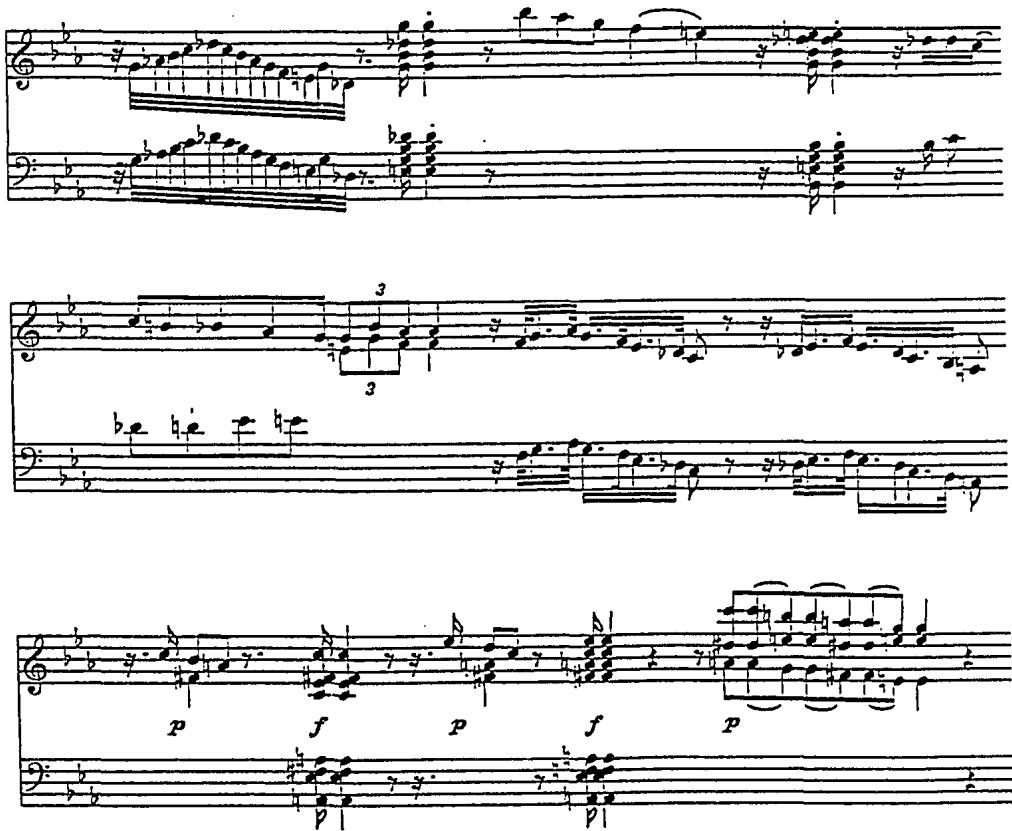
Bach’s first free fantasia, H. 339 in E-flat (by 1747), employs extended passages modelled on accompanied recitative (example 8) and thus shows a close relationship to Bach’s remarks, above, from the first part of the Versuch. Sighing figures, either solo, or with the single-note accompaniment, are punctuated with thick orchestral chords and dotted unison interjections. Bach’s passing reference to instrumental styles as “startling and fiery” aptly describes the character of these orchestral interjections. $^{39}$
中文讲解
本段把音乐作品与其理论著作联系起来观察。巴赫最早的自由幻想曲、降E大调H. 339(不晚于1747年)采用了以"带伴奏宣叙调"为模仿对象的较长段落(例8),因此与上文引用的《试论》第一编中巴赫自己的言论高度吻合。具体处理上:叹息式(sighing)动机可以单独出现,也可以只配一个单音作支撑;这些动机被厚重的乐队和弦以及带附点的齐奏插句所打断。巴赫随口用"令人惊异而炽烈”(startling and fiery)形容的器乐风格,正可贴切地刻画这些插句的性格(脚注39)。本段的功能在于:先以作品实例证明巴赫的理论言论并非空泛之谈,再用他自己对器乐风格的描述回流印证作品的听觉效果,由此建立作品—理论之间的双向印证。
补充说明
“sighing figure"指带切分或下行的短小动机,类似声乐宣叙调中表现叹息的常见写法;“unison interjection"意味着乐队同度齐奏插入,用以打断和强调。“accompanied recitative"即带数字低音或乐队伴奏的宣叙调,H. 339对其的模仿是把声乐体裁的句法直接移植到键盘独奏中。
第6段(P0034)
原文复述
中文讲解
本句原本应分为两部分:一是图注(Example 8. Free Fantasia in E-flat, H. 339 (1747).),指向下降E大调自由幻想曲H. 339的乐谱举例;二是正文过渡句——指出在后来的作品中,巴赫脱离了这种对宣叙调较为显性的模仿,转向一种更合键盘器乐本色的"宣叙性织体”(declamatory texture)。后一句设定了本节论证的转折:从H. 339的"声乐化移植"推进到H. 75的"键盘化的宣叙性织体”。
补充说明
图注编号为Example 8,原图未能显示,仅依原书位置保留占位提示。“declamatory texture"是一种介于歌唱化与器乐化之间的写法,强调句法起伏和修辞性,而非完整的声乐宣叙调句法。
第7段(P0035)
原文复述
$^{38}$ Bach, Versuch, 1, 3, §. 15, trans. Mitchell, 153.
中文讲解
第38号脚注,再次引《试论》第一编第三章第15节第153页,应是支撑P0033或P0034中关于巴赫对器乐风格描述的相关论述。
第8段(P0036)
原文复述
$^{39}$ Bach, Versuch, 1, 2, §. 8, trans. Mitchell, 81.
中文讲解
第39号脚注,引用《试论》第一编第二章第8节,Mitchell译本第81页,对应正文中巴赫将器乐风格描述为"startling and fiery"的话语出处。
第9段(P0037)
原文复述
Reproduced with permission of the copyright owner. Further reproduction prohibited without permission.
中文讲解
版权声明,与P0032同性质,仅作版面容置信息处理。
第10段(P0038)
原文复述
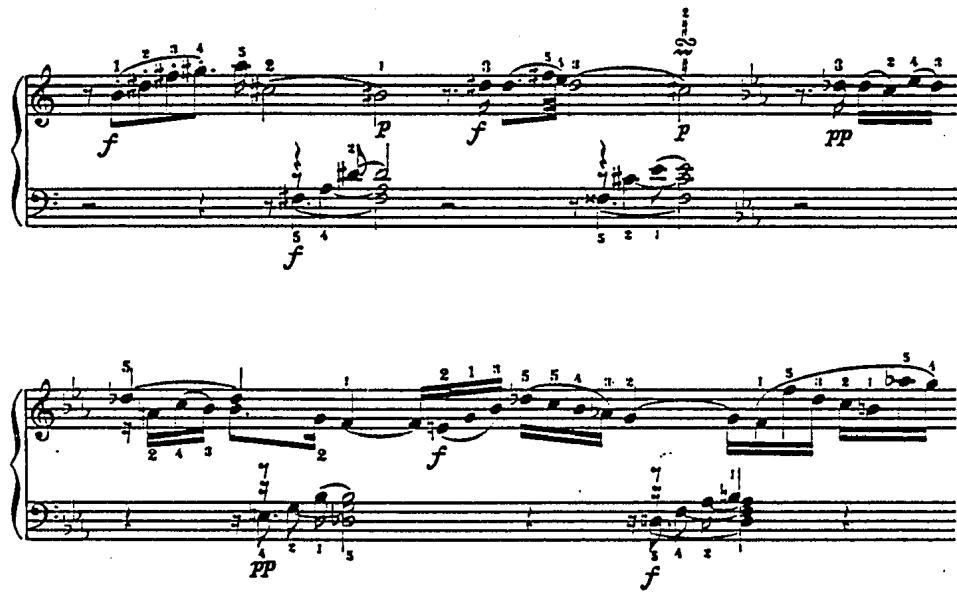
Example 9, from the free fantasia in c minor, H. 75 (1753)–a work that Bach cites in his discussion of declamatory style–the right hand projects a declamatory melody, comprising vocal sighing figures. These sighing figures are approached by, and interspersed with, wide affective leaps, ornaments and arpeggiations unsuited to vocal performance. Beneath this declamatory melody, the left hand provides an arpeggiated chordal accompaniment suggestive of a continuo realization during recitative. $^{40}$
中文讲解
本段集中分析例9的写法,作者选自C小调自由幻想曲H. 75(1753),而这恰是巴赫本人在讨论"宣叙性风格"时所引用过的作品,因此它兼具实例与自证的份量。右手承担"宣叙性旋律”,其本质仍是声乐化的叹息动机;但这些动机被宽幅的、富有情感对比的跳进、装饰音以及不适合人声演奏的分解和弦所包围和串接——也就是说,表面骨架借自声乐宣叙调,骨肉则是器乐才胜任的炫技与修辞。左手则在下方提供分解式和弦伴奏,让人联想到宣叙调中的数字低音实现(脚注40指出巴赫在《试论》第二编第38章第3–9节专门讨论宣叙调中的和弦分解)。本段的关键论证是:H. 75不是直接照搬宣叙调,而是把宣叙调的句法精神转化为键盘独有的修辞方式,这正是P0034预告的"更合键盘器乐本色"的宣叙性织体。
补充说明
“continuo realization"指巴洛克通奏低音由演奏者(或作曲家草稿中的数字标注)落实为具体和弦的过程;“arpeggiated chordal accompaniment"即把和弦按一定次序先后奏出,是对通奏低音实现方式的一种键盘化模拟。
第11段(P0039)
原文复述
Example 9. Free Fantasia in c, H. 75 (1753).
中文讲解
图注:标明例9的曲目来源为H. 75,C调(实即C小调)自由幻想曲,作于1753年。该例属本节核心谱例之一,用以展示宣叙性织体如何在键盘上重构宣叙调句法。
第12段(P0040)
原文复述
中文讲解
本行为内嵌图像占位符,位于第6页,对应例9的乐谱图像(原图未显示,仅保留位置与图注提示)。
补充说明
阅读时应回查原书第6页对应位置的谱例来配合P0038的论述。
第13段(P0041)
原文复述
Declamatory style in the free fantasia expressed new notions of human emotion as based on nerve activity and thus subject to constant flux and change. This new concept of emotion replaced the older theory of relatively static and stable affections around the middle of the eighteenth century, from which period dates Bach’s first free fantasia. $^{41}$ In 1749, Marpurg observed that “the rapidity with which the emotions change is common knowledge, for they are nothing but motion and restlessness.” Daniel Webb, writing in the 1760s, with reference to the instrumental music of Geminiani and Jomelli composed in the 1720s and 1730s, described not just affective variety but also the fluid interrelationship of sentiments, the possibility of a continuum of feeling, and the psychological truth of transition between one emotion and another:
中文讲解
本段是本节的理论枢纽,把作品风格的转变挂接到18世纪中叶情感理论的整体转向。它提出三层关系:(1)自由幻想曲中的宣叙性风格体现了"情感基于神经活动、因此不断流动变化"的新观念;(2)这种新观念取代了早先"情感相对静止稳定”(affections学说)的旧观念,过渡节点恰在18世纪中叶——也正是C. P. E. 巴赫第一首自由幻想曲的创作期(脚注41);(3)作者用同时代人的表述加以佐证:1749年Marpurg观察到情感变化之迅速乃常识,情感本质上就是"运动和不安”;1760年代Daniel Webb在评述1720–1730年代Geminiani和Jomelli的器乐作品时,更进一步指出情感之间不仅是种类多样,更是彼此连续、可相互过渡、过渡本身也具有心理真实性。正文将以冒号结尾,引出P0045中Webb的直接引语。本段功能在于:将作品分析放在情感哲学史的框架中,把"宣叙性风格为什么不断变换情绪"这个问题接到更广的学术语境上。
补充说明
“affections”(Affektenlehre)是巴洛克时期把情感视为若干稳定范畴的学说;本节论述的核心张力即"静态的情感范畴"被"动态的神经—运动模型"取代。“continuum of feeling"意味着情感不再分类清楚,而是连续光谱。
第14段(P0042)
原文复述
$^{40}$ Bach discusses the arpeggiation of chords in recitative in Versuch, 2, 38, §§. 3-9, trans. Mitchell, 421-425.
中文讲解
第40号脚注,指示巴赫在《试论》第二编第38章第3–9节(Mitchell译本第421–425页)专门讨论宣叙调中如何将和弦分解奏出,为正文P0038关于左手分解和弦伴奏的说法提供理论依据。
第15段(P0043)
原文复述
$^{41}$ See Claude V. Palisca, Baroque Music, Prentice-Hall History of Music Series, 2d ed. (New Jersey: Prentice-Hall, 1981), 4, and Bellamy Hosler, Changing Aesthetic Views of Instrumental Music in 18th-Century Germany, Studies in Musicology, no. 42 (Ann Arbor, Michigan: UMI Research Press, 1981), 246.
中文讲解
第41号脚注,列出两本参考书:Palisca《巴洛克音乐》第二版第4页;Hosler《18世纪德国器乐音乐审美观念之变迁》第246页,为正文关于"旧情感学说约在18世纪中叶被新观念取代"的论断提供学术支持。
第16段(P0044)
原文复述
Reproduced with permission of the copyright owner. Further reproduction prohibited without permission.
中文讲解
版权声明,版面容置信息。
第17段(P0045)
原文复述
Pleasure [those emotions that are opposed to pain] is not, as some have imagined, the result of any fixed or permanent condition of the nerves and spirits, but springs from a succession of impressions, and is greatly augmented by sudden or gradual transitions from one kind of strain of vibrations to another. $^{43}$
中文讲解
本段是Daniel Webb原文的直接引语,由方括号中作者加入的注解"那些与痛苦相对的情感"作出限定。Webb提出三层命题:(1)愉悦(即正面的情感)并非来自神经与精气的某种固定或恒久状态;(2)它来源于一连串不断更替的印象(succession of impressions);(3)它在由一种振动"紧张度”(strain of vibrations)突然或渐次地转入另一种时,反而得到极大增强。这段引语的功能是把P0041所述理论落到一个具体表述:变化本身(无论突转或渐变)才是产生强烈情感效果的关键机制——这正可解释自由幻想曲中频繁调性游移与情绪切换的合理性。脚注43随后将给出Webb的原始出处。
补充说明
“strain of vibrations"中strain有"紧张度、张力"之意,整句指神经—振动模式的不同张力状态之间的过渡,与18世纪神经生理学中的纤维—振动隐喻一致。
第18段(P0046)
原文复述
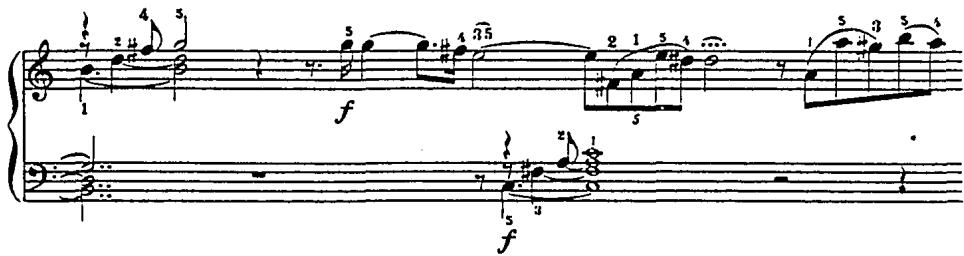
In example 10, from the free fantasia in c minor, H. 75, rapid changes of sentiment are portrayed through modulatory flux (shifting diminished and dominant seventh chords) and changes of dynamic level. The way in which the resolute dotted figure near the beginning of the extract is answered with a fearful Bebung is a particularly vivid example of rapidly changing emotion.
中文讲解
本段是把P0041–P0045铺垫的情感理论回收到具体谱例中。例10同样取自H. 75,作者指明:作品中情绪的快速转换是通过两条音乐途径实现的——一是调性的流动(modulatory flux),具体表现为减七和弦与属七和弦的不断推移;二是力度的层次变化。最具画面感的细节在末尾:谱例开篇处一个果决、带附点的动机,随后被一处怯生生的"颤音”(Bebung)所应答——同一段音乐里"果断"与"恐惧"在短时间内对置,正是P0045 Webb所谓"突转或渐变使情感效果大为增强"的鲜活写照。本段在本节末尾的作用是把抽象理论钉死在可被听见、可被看见的演奏记号上,结束本节论证。
补充说明
“Bebung"是羽管键琴(以及早期钢琴)上通过手指在键上颤动以延长并润饰一个音的特殊奏法,常用来表达哀叹、恐惧或犹豫。“diminished seventh chord"与"dominant seventh chord"则是调性游移与不协和张力的典型来源。
第19段(P0047)
原文复述
Example 10. Free Fantasia in c, H. 75 (1753).
中文讲解
图注:标明例10同样来自H. 75(1753)。与例9出自同一作品,但作者挑选不同片段以呈现作品的另一侧面——调性流动与力度变化。
第20段(P0048)
原文复述
中文讲解
第7页的内嵌图像占位符,对应例10的乐谱图像,原图未显示,位置与图注提示保留,供读者回查原书核对。
补充说明
阅读时应回查原书第7页对应谱例以配合P0046的分析。
脚注 / 边栏 / 图表 / 附加信息(如有)
本节末尾集中了三处版权声明(P0032、P0037、P0044),仅属版面容置信息;本节有三组谱例占位符(例8、例9、例10),其原图均未显示,讲解中已指明应回查对应页码。本节共引用脚注35–43,其中35、36、38、39出自《试论》正文段落,37引用Seifert论器乐宣叙调,40引用《试论》关于宣叙调的和弦分解,41提供情感理论史的二手文献,43则标记Webb引文出处(引文本身已出现于P0045)。
💡 本节核心要点
- C. P. E. 巴赫的第一首自由幻想曲H. 339(不晚于1747年)以"带伴奏宣叙调"为模仿对象,宣叙性的叹息动机被厚重的乐队和弦与齐奏插句打断,构成其与《试论》第一编言论之间的双向印证。
- 从H. 339到H. 75,巴赫的写法从"显性借用宣叙调"过渡到"键盘器乐本色的宣叙性织体”——右手保留声乐式的叹息动机,但用宽跳、装饰和分解和弦加以包装;左手以分解和弦模仿通奏低音。
- 这一风格转变对应18世纪中叶情感理论的更替:稳定静态的"情感范畴说"被基于神经活动的"流动可变"情感观取代。
- Marpurg(1749年)和Daniel Webb(1760年代)的文本相继支持了"情感变化迅速"乃至"情感之间存在流动过渡"的命题,Webb更指出突然或渐次的变化本身就能增强情感效果。
- 在H. 75的例10中,减七与属七和弦的调性流动、力度的层次变化,尤其是果决的附点动机与怯生生的Bebung之间的对置,是上述理论在演奏记号层面的具体落实。
🔑 关键术语
- accompanied recitative / 带伴奏宣叙调:指与数字低音或乐队同时进行的宣叙调,H. 339对其的模仿是把声乐句法移植到键盘独奏体裁的关键桥梁。
- declamatory style / 宣叙性风格:C. P. E. 巴赫用于键盘音乐的风格术语,指一种借用宣叙调句法精神、修辞性的键盘织体,区别于对宣叙调的显性复刻,更贴合键盘器乐的本色。
- sighing figure / 叹息动机:短小、带切分或下行特性的动机,源出声乐宣叙调中的叹息表达;既是巴赫键盘写作与声乐传统之间连续性的标识,也是本节分析中最常出现的基本材料。
- Bebung:键盘乐器上通过手指在键上颤动以延长并润饰一个音的特殊奏法,常用于表达哀叹或不安;例10中"恐惧"的对置正是借助Bebung实现。
- modulatory flux / 调性流动:本节借自Marpurg与Webb的语境,意为频繁的、持续进行的调性转移,本节中借助减七与属七和弦的不协和张力来具体落实这种流动。
- affections theory / 情感范畴说(Affektenlehre):巴洛克时期以若干相对稳定的情感范畴解释音乐表现的传统学说,在本节被界定为18世纪中叶前后的旧观念,与基于神经活动的流动情感观形成对照。
1.4 [描述性拆分] Theory of imitation, das Sprechende, and self-expression in the late fantasias
第1段(P0049)
原文复述
Footnote 42: Friedrich W. Marpurg, Der Critischer Musicus an der Spree (Berlin: A. Haude and J. C. Spener, 1750), issue dated Sept. 2, 1749, as cited by Mitchell in Bach, Essay, 81, note 3.
中文讲解
这是一条脚注,引证马普格(Marpurg)1750年出版的《斯普雷河畔的批评音乐家》中1749年9月2日的一期,并说明该出处由Mitchell在《Bach, Essay》第81页注3转引。脚注本身不展开论点,只是为正文提供文献来源。
第2段(P0050)
原文复述
Footnote 43: Daniel Webb, Observations on the Correspondence between Poetry and Music (London: J. Dodsley, 1769), reprinted in Musical Aesthetics: A Historical Reader, vol. 1, From Antiquity to the Eighteenth Century, ed. Edward A. Lippman (New York: Pendragon Press, 1986), 203.
中文讲解
这是一条脚注,引证Daniel Webb 1769年的著作《诗歌与音乐对应关系观察》,并说明该文被收入Edward A. Lippman编辑的《音乐美学:历史文选》第一卷(从古代到十八世纪),1986年由Pendragon出版社出版,第203页。脚注为正文提供文献来源。
第3段(P0051)
原文复述
Reproduced with permission of the copyright owner. Further reproduction prohibited without permission.
中文讲解
这是版权声明行,表明本页内容经版权所有者授权复制,在未获许可的情况下不得再次复制。属于期刊/出版物的常规版权标识,不含学术论点。
第4段(P0052)
原文复述
[Image placeholder: Example 10, continued.] (Embedded image data omitted; position and caption retained.)
中文讲解
此处为乐谱或图像占位符,标示“Example 10, continued.”(例10续)。由于原图中嵌入数据被省略,可见细节不可见,需查阅原图。该占位符承接前页例10的谱例,应是配合正文关于C. P. E. Bach幻想曲中宣叙性(declamatory)风格与“das Sprechende”论述的谱例材料。
第5段(P0053)
原文复述
Bach’s notion of “das Sprechende” is rooted in the prevailing theory of imitation. The power of declamatory style to “master the feelings of the audience” lay in its imitation of the rhythms and inflexions of impassioned speech. In German musical aesthetics, the theory of imitation was primarily concerned with the imitation of passionate speech, rather than the physical world. Music was thought to move the listener by presenting audible signs of the passions. The rhythms and pitch contours of declamatory style present a particularly vivid example of these audible signs. The theory of imitation underlies Schering’s widely cited “redende Prinzip” in C. P. E. Bach’s music, that is, the principle of expressive, speech-like instrumental melody. The fantasia gave fullest expression to this principle.
中文讲解
本段是本节的核心论点之一:把C. P. E. Bach的“das Sprechende”(说话般的性质)追溯到当时的模仿理论。作者先解释宣叙性风格(declamatory style)之所以能“掌控听众情感”,是因为它模仿了有激情之言的节奏与抑扬起伏;再强调德语音乐美学语境下的模仿理论主要不是模仿自然界事物,而是模仿激情之语,音乐通过呈现激情的“可听标志”来打动听众;接着说明宣叙性风格的节奏与音高走向正是这些可听标志的鲜明实例;最后把Schering著名的“redende Prinzip”(说话的原则)也归入同一个模仿理论框架,并指出该原则在幻想曲中得到最充分的表达。整段逻辑是:模仿理论→激情之语→可听标志→宣叙性风格→说话的原则→幻想曲。
第6段(P0054)
原文复述
Yet, if rooted in the theory of imitation, declamatory style could also be employed for purposes of self-expression on the part of the composer or
中文讲解
本段是被截断的句子(段末以单词“or”结尾,文字在下一页续接)。其功能是引出一个转折:尽管宣叙性风格植根于模仿理论,但它同样也可以服务于作曲家或演奏者的自我表达。这是从前一节的“模仿/感动听众”转到后文“自我表达/抒发情感”的关键过渡句。
第7段(P0055)
原文复述
Footnote 44: The imitative theory of passionate utterance in music is discussed in Hosler, Changing Views, 31-32, 45-47, 63-67.
中文讲解
这是脚注44,提示关于音乐中激情之言的模仿理论,可在Hosler《Changing Views》第31-32、45-47、63-67页找到讨论。脚注为正文提供二手文献来源支持。
第8段(P0056)
原文复述
Footnote 45: Arnold Schering, “C. P. E. Bach und das redende Prinzip in der Musik,” Peters Jahrbuch 45 (1938): 13-29.
中文讲解
这是脚注45,提供Arnold Schering文章的完整出处:《C. P. E. Bach与音乐中的说话原则》,载于《Peters Jahrbuch》第45卷(1938年),第13-29页。这是文中提到的“redende Prinzip”的来源注脚。
第9段(P0057)
原文复述
Reproduced with permission of the copyright owner. Further reproduction prohibited without permission.
中文讲解
版权声明行,性质同P0051。
第10段(P0058)
原文复述
improviser. The use of declamatory style for self-expression is evident from its extensive use in the free fantasia in f-sharp minor, H. 536 (1787) for harpsichord with violin accompaniment, which the composer titled C. P. E. Bachs Empfindungen (“C. P. E. Bach’s feelings”). The title could also be applied to the unpublished solo keyboard fantasia in f-sharp minor, H. 300 (1787) of which H. 536 is an arrangement.
中文讲解
本段续接P0054被截断的句子。主旨是以具体作品证明宣叙性风格确实被用于自我表达:作品是1787年的f小调自由幻想曲H. 536(为古钢琴与小提琴伴奏而作),作曲家亲题为《C. P. E. Bachs Empfindungen》(C. P. E. Bach的情感);同调性的另一首未出版的键盘独奏幻想曲H. 300(1787)是H. 536的改编版,也可冠以同一标题。论据逻辑在于:把作品直接命名为“作曲家本人的情感”,正是宣叙性风格被用作自我表达的明证。
第11段(P0059)
原文复述
The title C. P. E. Bachs Empfindungen suggests the emotional self-expression cultivated in the 1770s and 1780s in the context of north German Empfindsamkeit or sensibility. Literature and music aspired to be an outpouring of the heart. J. P. Kirnberger, in the entry “Expression in music” from Sulzer’s Allgemeine Theorie, declared “the outpourings of a sensitive heart” to be the composer’s ultimate goal. Similarly, C. F. D. Schubart, in a review of Martin Miller’s novel Siegwart, distinguished between “the mock sensibility of a mawkish fop” and the true sentimental spirit [“Das Empfindsam”] which is expressed in “a genuine outpouring of the heart.” In his description of the clavichord in the Ideen zu einer Ästhetik der Tonkunst, Schubart again invoked this ideal of an outpouring of the heart, the touch-sensitive clavichord (one of the instruments Bach recommends for free fantasias) being particularly suited to achieving the effect in music:
中文讲解
本段把作品标题《C. P. E. Bachs Empfindungen》放入北德“Empfindsamkeit”(情感主义/敏感精神)这一文化语境中。论点分三层:第一层指出该标题反映的是1770、1780年代北德情感主义所推崇的“情感自我表达”;第二层援引Kirnberger在Sulzer《Allgemeine Theorie》中“Expression in music”条目,把“一颗敏感心灵的情感流露”宣称为作曲家最高目标;第三层援引Schubart在评论Miller小说《Siegwart》时区分假装的“fop式感伤”与真正的情感精神——后者靠“真正的心之流露”表达;最后引出Schubart在《Ideen zu einer Ästhetik der Tonkust》中对古钢琴的描述,将“心之流露”理想与触感敏感的古钢琴(自由幻想曲所推荐的乐器之一)联系起来。整段意在说明:自我表达并非C. P. E. Bach偶然的个人行为,而是嵌入了一套由美学理论家与文学评论共同塑造的“情感主义”文化范式。
第12段(P0060)
原文复述
Clavichord, this lonely, melancholic, inexpressibly sweet instrument surpasses the harpsichord or piano when it is made by a master. Through the pressure of the fingers, through the oscillation and
中文讲解
这是Schubart《Ideen zu einer Ästhetik der Tonkust》中关于古钢琴的长段引文的开头部分(段末“through the oscillation and”被截断,下一段续),引文前文提到古钢琴优于大键琴或钢琴的条件是“由名家制作”,并以“孤独、忧郁、无比甜美”等情感性词汇形容古钢琴。第一句强调“由名家制作”这一限定条件,作者显然借此凸显古钢琴所承载的精英化、内省化的情感表达媒介价值。
第13段(P0061)
原文复述
Footnote 46: See Carl Dahlhaus, Esthetics of Music, trans. William W. Austin (Cambridge: Cambridge University Press), chapter 3.
中文讲解
脚注46,提示可参考Carl Dahlhaus《Esthetics of Music》(由William W. Austin翻译,剑桥大学出版社)第3章。这是为正文关于Empfindsamkeit/情感主义之美学背景提供的二手文献来源。
第14段(P0062)
原文复述
Footnote 47: “Bemerken wir aber in dem Gesang, außer der vollkommenen Fortströhmung der Töne, eine Sprach, die uns die Aeußerungen eines fühlenden Herzens verräth, so dienet die angenehme Unterhaltung des Gehörs.” Kirnberger, “Ausdruck in der Musik,” in Allgemeine Theorie, ed. Sulzer, 1:146, cited in Peter Le Hurray and James Day, ed. and trans., Music and Aesthetics in the Eighteenth and Early-Nineteenth Centuries (Cambridge: Cambridge University Press, 1981), 124.
中文讲解
脚注47引证Kirnberger《Ausdruck in der Musik》(载于Sulzer编《Allgemeine Theorie》第1卷第146页)德语原文一段,原文指出:若在歌唱中除声音的完美流动之外,还能听到一种透露“有感情之心的外显”的语言,则可使听觉得到愉悦的陪伴。该段出自Peter Le Hurray与James Day编、译的《Music and Aesthetics in the Eighteenth and Early-Nineteenth Centuries》(剑桥大学出版社,1981)第124页。脚注是P0059引用Kirnberger原话的来源。
第15段(P0063)
原文复述
Footnote 48: Cited in Darrell Berg, “The Keyboard Sonatas of C. P. E. Bach: an Expression of the Mannerist Principle” (Ph.D. diss., State University of New York at Buffalo, 1975), 12.
中文讲解
脚注48,标识P0059中Schubart评论《Siegwart》之引文的转引出处:Darrell Berg的博士论文《C. P. E. Bach的键盘奏鸣曲:矫饰主义原则之表达》(纽约州立大学布法罗分校,1975年)第12页。
第16段(P0064)
原文复述
Reproduced with permission of the copyright owner. Further reproduction prohibited without permission.
中文讲解
版权声明行,性质同P0051。
第17段(P0065)
原文复述
vibrato of the strings, through the strong or gentler touch of the hand, can be determined not only the immediate musical colorings but the middle tints, the swelling and dying away of the tone, the expiring trills melting away under the fingers, the portamento or glide–in a word, all the qualities out of which feeling is comprised. Whoever does not prefer to bluster, rage, and storm; whoever’s heart overflows often and readily in sweet feeling–he passes by the harpsichord and piano, and chooses a clavichord.
中文讲解
本段续接P0060被截断的Schubart引文。完整地看,Schubart论述的核心是:古钢琴由于对手指压力的反应、弦的振动、手的轻重触键,能够操控音色的即时色彩、细微中间色调、音的起伏消长、指下渐弱的颤音、portamento(滑奏)等——简言之,所有构成“情感”的要素;因此,一个不愿喧嚣、怒号、暴躁,而心灵常常“甘美情感”之下自然流露的人,会舍弃大键琴与钢琴而选择古钢琴。Schubart把乐器选择与情感表达偏好直接挂钩,作者借此再次印证:触感敏感的古钢琴正是情感主义“心之流露”理想的物理媒介。
第18段(P0066)
原文复述
In sum, when C. P. E. Bach spoke of the suitability of the free fantasia to mastering the feelings of the audience he pointed to the importance of this genre in the context of north German Empfindsamkeit or sensibility. The suitability of improvised free fantasias to rousing sentiment lay in the direct communication between improviser and listener, without the potentially distorting mediation of a separate performer. Yet written free fantasias, especially when performed on the clavichord or fortepiano, and employing declamatory style, were also ideal means through which to move the audience and achieve the effect of emotional outpouring prized in the cult of sensibility.
中文讲解
本段是本节总结句,回应小节标题并收束两套彼此相关又略有不同的机制:一、即兴自由幻想曲之所以适合唤起情感,是因为即兴者与听众之间是直接沟通,没有“另一演奏者”作为中介的潜在歪曲;二、写成曲谱的自由幻想曲——尤其在古钢琴或古钢琴类键盘乐器上演奏、并使用宣叙性风格时——同样是触动听众、达成情感主义所推崇的“情感流露”效果的理想手段。作者以此整合前文:模仿理论/宣叙性风格与受Empfindsamkeit文化影响的自我表达,这两条线索共同说明晚期幻想曲在北德情感主义语境中的核心地位。
脚注 / 边栏 / 图表 / 附加信息(如有)
本节附有脚注42-48,多为引文出处(Marpurg、Webb、Hosler、Schering、Dahlhaus、Kirnberger、Schubart、Darrell Berg、二手论文与文选等),并穿插三处版权声明行;正文中含一处乐谱占位符“Example 10, continued.”(具体谱例细节未在此文本中给出,需查阅原图)。这些脚注的功能有:(1) 支撑“模仿理论→宣叙性风格→说话原则→幻想曲”这一论证链(P0049、P0050、P0055、P0056);(2) 为Empfindsamkeit/情感主义之美学背景提供文献来源(P0061、P0062、P0063);(3) 版权声明为期刊合规标识,无学术含义。
💡 本节核心要点
- C. P. E. Bach的“das Sprechende”植根于德语音乐美学中的模仿理论,其核心不是模仿自然界,而是模仿有激情之言的节奏与抑扬。
- Schering所谓的“redende Prinzip”与模仿理论同源,宣叙性风格是其中最鲜明的可听标志,幻想曲是该原则最充分的表现场域。
- 宣叙性风格除了模仿、感动听众外,同样服务于作曲家/即兴者的自我表达;C. P. E. Bach亲自将f小调自由幻想曲H. 536命名为《C. P. E. Bachs Empfindungen》即为直接证据,H. 300是其键盘独奏改编版。
- 自我表达并非个人偶为,而是嵌入1770-1780年代北德Empfindsamkeit文化范式中的整体理想:文学与音乐均以“心之流露”为最高旨归(Kirnberger、Schubart等理论家皆如此表述)。
- Schubart的乐器美学把古钢琴界定为触感敏感、适合情感细微流露的乐器,与C. P. E. Bach推荐自由幻想曲使用古钢琴的做法相呼应,使乐器—体裁—表达三者在情感主义框架下形成统一。
- 即兴自由幻想曲凭借即兴者与听众的直接沟通去唤起情感,而写定版的自由幻想曲在古钢琴/古钢琴类键盘乐器上通过宣叙性风格亦能达到同样的情感主义效果——两者共同确立该体裁在北德情感主义语境中的核心地位。
🔑 关键术语
- das Sprechende:德语,“说话般的性质”。指C. P. E. Bach音乐中旋律对激情之语节奏与抑扬的模仿,是本节讨论宣叙性风格与自由幻想曲表达功能的核心术语。
- declamatory style:宣叙性风格。器乐中模仿有激情之言节奏与抑扬起伏的写法;本节视其为受模仿理论支配的、能够打动听众的“可听标志”。
- theory of imitation:模仿理论。德国音乐美学语境下特指对激情之言的模仿而非对自然界的模仿;认为音乐通过呈现激情的可听标志来感动听众。
- redende Prinzip:“说话的原则”。Arnold Schering用以概括C. P. E. Bach音乐中器乐旋律的言说性、表情性表达;本节把它置于模仿理论框架内,并指出幻想曲是其最充分体现。
- Empfindsamkeit:18世纪北德“情感主义/敏感精神”文化潮流,文学与音乐均以“心之流露”为最高目标;本节视其为自由幻想曲中自我表达倾向的文化土壤。
- C. P. E. Bachs Empfindungen:C. P. E. Bach亲自为f小调自由幻想曲H. 536(1787)所题之标题,意为“C. P. E. Bach的情感”,是宣叙性风格被用作作曲家自我表达的直接证据。
- Empfindungen:德语,“感受/情感”。在Empfindsamkeit文化语境中,既指个体情感也指文学与音乐对情感的再现,与Kirnberger所谓“有感情之心的外显”相呼应。
- portamento:Schubart在描述古钢琴时所用术语,指滑奏或滑音;体现古钢琴触感细腻、便于塑造情感色调的物理性能。
- free fantasia:自由幻想曲。本节论证的核心体裁:既能以即兴形式实现即兴者与听众的直接沟通,也能以写定形式在古钢琴或古钢琴类键盘乐器上借宣叙性风格实现情感主义理想的情感流露。
1.5 [描述性拆分] 3. The Beauty of Variety: virtuosic figuration and astonishment
第1段(P0067)
原文复述
3. The Beauty of Variety
中文讲解
这是本章第三节的标题,正文为“## 3. The Beauty of Variety”(变化之美)。该标题开启了本节的核心论题:巴赫对自由幻想曲(free fantasia)的推崇,不只来自其唤起情感的能力,更来自其中所展现的“变化之美”——即不同风格与材料的并置所造成的效果。后续段落将围绕风格杂糅、炫技性音型、以及惊奇(astonishment / Verwunderung)这一审美范畴展开。
第2段(P0068)
原文复述
The suitability of free fantasias to rousing sentiment in the listener accounts only in part, however, for the value Bach placed upon them. He also admired the “beauty of variety” that arose from their use of contrasting materials. $^{50}$ In addition to declamatory style, Bach employed improvisatory, virtuosic figurations, songful measured passages, and dance topics to widen expressive and stylistic horizons. Kollmann and Kirnberger both cite stylistic variety within individual works as characteristic of free fantasias. Kollmann observed that “respecting the style of a free fancy, it would be as improper to pay no regard to any style at all, as to confine the fancy to one fixed style. For the former would betray a want of consideration, and the latter render the fancy limited.” Kirnberger noted that “several fantasias wander from one genre [“Gattung”] to another.“51
中文讲解
本段在论证上承接前文:作者已说明自由幻想曲能唤起情感,但本节认为这只能部分解释巴赫对它的重视。巴赫更看重的是不同材料并置所产生的“变化之美”(beauty of variety)。具体而言,巴赫在作品里不仅使用宣叙性风格(declamatory style),还加入即兴性的炫技音型(improvisatory, virtuosic figurations)、如歌的有节拍段落(songful measured passages)以及舞曲主题(dance topics),从而拓宽了表现与风格的视野。
Kollmann 和 Kirnberger 的引文从理论家角度佐证这一点。Kollmann 强调:自由幻想曲既不应“完全不顾及任何风格”,也不应“局限于一种固定风格”;前者显得缺乏考量,后者则使幻想显得局促。Kirnberger 则指出许多幻想曲会在不同“体裁”(Gattung)之间游走。两则引文共同说明,风格的杂糅与流动是这一体裁的本质特征,而非偶然的装饰。
第3段(P0069)
原文复述
$^{49}$ Christian F. D. Schubart, Ideen zu einer Ästhetik der Tonkunst (Vienna: J. V. Degen, 1806), 288-289, trans. Newman, Classic Era, 83.
中文讲解
这是正文段落中某个引用的脚注 49。内容为:Christian F. D. Schubart 的《音乐美学思想》(Ideen zu einer Ästhetik der Tonkunst),1806 年由维也纳 J. V. Degen 出版,第 288–289 页;译文出自 Newman 编译的《Classic Era》第 83 页。该脚注为正文中的某个论点提供文献来源,属于来源性质的注释。
第4段(P0070)
原文复述
$^{50}$ Bach, Versuch, 2, 41, §. 12, trans. Mitchell, 438.
中文讲解
这是脚注 50。出处为 Bach(指 C. P. E. Bach 的《试论键盘乐器演奏的真谛》——Versuch über die wahre Art das Clavier zu spielen)第 2 卷第 41 页第 12 节;译文出自 Mitchell 译本第 438 页。它支撑 P0068 中关于巴赫欣赏“beauty of variety”的引述,属于来源性脚注。
第5段(P0071)
原文复述
Reproduced with permission of the copyright owner. Further reproduction prohibited without permission.
中文讲解
这是版权声明文本(版式标记),出现在该页正文中,原文为英文版权许可声明。对正文论证无内容贡献,仅说明此处的内容(通常为图片或示例)系经版权所有者授权使用,未经允许不得再行复制。讲解时只需指出其版面属性,不展开。
第6段(P0072)
原文复述
The imagination, die Fantasie, is expressed in such stylistic eclecticism, for this faculty, according to Francis Bacon, “being not tied to the laws of matter, may at pleasure join that which nature hath severed, and sever that which nature hath joined, and so make unlawful matches and divorces of things.“52 The use of contrasting materials within the fantasia reflects the role of the imagination (die Fantasie) in a genre that takes this faculty as its name.
中文讲解
本段要解释为何自由幻想曲的风格杂糅具有理论意义。关键词是“想象力”(die Fantasie):这个德文词既是这一音乐体裁的名称,也是心灵中“想象力”这一官能的名称。作者援引培根(Francis Bacon)的话——想象力“不受物质法则束缚,可以随意把自然已分开的东西结合,把自然已结合的东西分开,从而做出不合法的匹配与分离”——来为这种风格杂糅提供哲学根据。
由此,文中材料风格的“违和并置”被视作想象力的具体外显:幻想曲体裁以“想象力”为名,而想象力本身又以打破自然常规的联系与区分为特征;体裁名称、所指官能与音乐实践三者之间形成呼应。这是从体裁名称的词源出发,为“对比材料的并置”这一美学选择提供的理据。
第7段(P0073)
原文复述
Virtuosic figurations are particularly prominent in Bach’s discussion of the free fantasia. Bach describes a variety of types: chords to be performed arpeggio; broken chords; “breaking with acciaccature;” runs; “runs with repetition,” and imitations in parallel and contrary motion. $^{53}$ These figurations were rooted in north German keyboard music, particularly the toccata. The spasmodic figurations employed at the opening of many Baroque toccatas inspired, for example, the arpeggiations and runs at the opening of the free fantasia in g minor, H. 225 (1766) (example 11).
中文讲解
本段将视线从“风格的杂糅”收窄到其中一类具体材料——“炫技性音型”(virtuosic figurations),指出它在巴赫对自由幻想曲的讨论中尤为突出。巴赫本人列举了若干种类:用琶音方式演奏的和弦、分解和弦、“带倚音的分解”(breaking with acciaccature)、跑句(runs)、“带反复的跑句”(runs with repetition),以及平行与反向的模仿。
在渊源上,这些音型根植于北德键盘音乐,特别是托卡塔(toccata)。作者举出具体例证:许多巴洛克托卡塔开头的痉挛式(spasmodic)音型,正是 g 小调自由幻想曲 H. 225(1766)开头的琶音与跑句所借鉴的对象(对应谱例 11)。本段一方面落实“炫技性”是一个有谱可循、可被点名的体裁特征,另一方面也提示这一材料是有历史传统的,而非凭空而生。
第8段(P0074)
原文复述
The impact of these materials on the listener is best understood in terms of astonishment, or Verwunderung, an effect that lay outside of the theory of imitation and the affections. Though astonishment was one of the six primitive passions cited by Descartes, its position in the theory of the
中文讲解
本段由材料转向效果,引入本节的另一个关键词:惊奇(astonishment / Verwunderung)。作者指出,理解上述材料在听众身上所产生的冲击,最恰当的概念不是“模仿”(imitation)也不是“情感”(the affections),而是“惊奇”。值得注意的是限定语:“惊奇”虽在笛卡尔列举的六种基本情感之中,但在 18 世纪中叶的情感学说(theory of the affections)里,它的地位非常薄弱——句子在此处被脚注截断。
由此,本段在为后续讨论铺垫:自由幻想曲中的炫技性音型,其美学效果所归入的范畴,恰恰是当时情感学说难以妥善安置的那种反应。下一段(P0079)的 Cramer 引文正是对这一效果的延伸论述。
第9段(P0075)
原文复述
$^{51}$ Kollmann, Harmony, 17, 272, §. 7; Kirnberger, “Fantasiren; Fantasie,” in Allgemeine Theorie, ed. Sulzer, 1:368, col. 2.
中文讲解
脚注 51。出处包括两部文献:Kollmann 的《和声学》(Harmony)第 17、272 页第 7 节;以及 Kirnberger 撰写的“幻想与即兴”(“Fantasiren; Fantasie”)条目,收入 Sulzer 主编的《一般美学理论》(Allgemeine Theorie)第 1 卷第 368 页第 2 栏。它为 P0068 中 Kollmann 与 Kirnberger 的两段引文提供来源,属于来源性脚注。
第10段(P0076)
原文复述
$^{52}$ Francis Bacon, Two Books of the Proficiency and Advancement of Learning [1605], cited in Monroe C. Beardsley, Aesthetics from Classical Greece to the Present (New York: Macmillan, 1966), 170.
中文讲解
脚注 52。引文出处为培根《学问的进展》两卷本(Two Books of the Proficiency and Advancement of Learning,原书 1605 年出版),由 Monroe C. Beardsley 引用,见其《美学:从古希腊到当代》(Aesthetics from Classical Greece to the Present)一书(纽约:Macmillan,1966)第 170 页。该脚注支撑 P0072 中培根关于想象力不受物质法则束缚的引述。
第11段(P0077)
原文复述
$^{53}$ Bach, Versuch, 2, 41, §. 13, trans. Mitchell, 439-40.
中文讲解
脚注 53。出处为 C. P. E. Bach《试论》第 2 卷第 41 页第 13 节;译文见 Mitchell 译本第 439–440 页。用于支撑 P0073 中巴赫对各种炫技性音型的列举说明。
第12段(P0078)
原文复述
Reproduced with permission of the copyright owner. Further reproduction prohibited without permission.
中文讲解
版权声明(版式标记)。原文为英文版权许可声明,提示此页内容(通常为图或谱例)经版权所有者授权使用。讲解时仅作版面属性说明,不展开内容。
第13段(P0079)
原文复述
affections of the mid-eighteenth century was extremely tenuous. $^{54}$ Cramer, who saw in Bach’s fantasias a rejection of music as a medium of the affections, dwelt instead upon the invention and virtuosity manifested in these works. He emphasized the “brilliant fingerwork” of Bach’s improvisations, and “the pleasure of astonishment at hearing technical difficulties overcome.” $^{55}$
中文讲解
本段承接 P0074 末句:先补全 P0074 被脚注截断的判断——“惊奇”在 18 世纪中叶情感学说中的地位“极为薄弱”(extremely tenuous),并通过脚注 54 指向 Hosler 的相关讨论。
接着引入同时代评论家 Cramer(Carl F. Cramer)的视角:他视巴赫的幻想曲为对“情感作为音乐媒介”这一观念的拒绝,转而关注作品中体现的“发明”(invention)与“炫技”(virtuosity)。Cramer 强调两点:巴赫即兴演奏的“辉煌指法”(brilliant fingerwork),以及“听到技术困难被克服时所产生的惊奇快感”(the pleasure of astonishment at hearing technical difficulties overcome)。
这里要注意一个微妙之处:作者随后(P0082)将修正 Cramer 这一观感——惊奇主要并非来自“技术困难本身被克服”,而是来自“炫技性音型的突然闯入”这种结构性的惊异效果。
第14段(P0080)
原文复述
Example 11. Free Fantasia in g, H. 225 (1766). Berg, ed., Collected Works, 5:229.
中文讲解
这是谱例 11 的图注:曲目为 g 小调自由幻想曲 H. 225,1766 年;版本来自 Berg 编辑的巴赫作品集(Collected Works)第 5 卷第 229 页。该谱例配合 P0073 关于巴洛克托卡塔开头的“痉挛式”音型如何启发 H. 225 开头的琶音与跑句的论述。讲解时只需说明它所对应的正文章节内容以及引文出处,不臆测乐谱细节。
第15段(P0081)
原文复述
中文讲解
这是谱例 11 在第 12 页的图像占位符。原始图像数据未提供,但位置与图注(即 P0080 的说明)已保留。它对应 P0073 所引的 g 小调自由幻想曲 H. 225 开头的琶音与跑句,是“痉挛式”炫技音型的具体实例。建议读者查阅原图以核对谱面细节。
第16段(P0082)
原文复述
The abrupt entry of virtuosic figuration is, however, a greater source of astonishment than any technical difficulty in the figurations themselves. “Brilliant and astonishing” passages in Bach’s fantasias usually fall easily under the hands, as, for example, in the cadenza-like passage in the F-major fantasia, H. 279 (1782) (example 12), with its opening 6/4 chord.
中文讲解
本段对前文 Cramer 的印象作出修正与深化。作者承认技术困难带来的惊奇,但指出更关键的是“炫技性音型的突然闯入”(abrupt entry of virtuosic figuration)本身——其结构性、突发性比音型内部的技术难度更能产生惊奇效果。
更耐人寻味的是作者的进一步观察:巴赫幻想曲中那些被形容为“辉煌而惊人”(brilliant and astonishing)的段落,在指法上其实“通常演奏起来相当顺手”。换言之,惊奇感并不必然来自演奏的难度,而来自音响的突变与体裁的跨界体验。作者举 F 大调自由幻想曲 H. 279(1782)开头那个 6/4 和弦之后的华彩乐句(cadenza-like passage,参见谱例 12)作为说明。这种写法在听众那里制造的不只是对“难事被克服”的赞叹,而是对音乐结构突然“换装”的惊异。
第17段(P0083)
原文复述

中文讲解
这是谱例 12 在第 12 页的图像占位符。图像数据已省略,位置与图注保留。原图对应 P0082 提到的 F 大调自由幻想曲 H. 279(1782)开头 6/4 和弦之后的华彩乐句,用以说明“炫技性音型的突然闯入”如何制造惊奇。建议读者查阅原图。
第18段(P0084)
原文复述
$^{54}$ On the distinction between Verwonderung and the affections in the mid-eighteenth century see Hosler, “Changing Views,” 250 n. 88.
中文讲解
脚注 54。提示读者可参见 Hosler 的“Changing Views”一文第 250 页注释 88,以了解 18 世纪中叶关于 Verwunderung(惊奇)与 the affections(情感范畴)之区别的进一步讨论。该脚注支撑 P0074、P0079 中关于“惊奇”在情感学说中地位微弱的论断,属于延伸阅读性质的指引。
第19段(P0085)
原文复述
$^{55}$ Carl F. Cramer, ed., Magazin der Musik, 2 vols. (1783-6; reprint, Hildesheim: Georg Olms, 1971), 1/2, 1250, cited in Ottenberg, C. P. E. Bach, trans. Whitmore, 170-171.
中文讲解
脚注 55。出处为 Carl F. Cramer 编辑的《音乐杂志》(Magazin der Musik),共 2 卷,初版 1783–1786 年;重印本由 Hildesheim 的 Georg Olms 于 1971 年出版;引文位置见第 1 卷第 2 部分(1/2)第 1250 页。该引文经 Ottenberg 的《C. P. E. Bach》一书转引(Whitmore 译本第 170–171 页)。用于支撑 P0079 中 Cramer 关于“辉煌指法”与“技术困难被克服之惊奇快感”的两段引述。
第20段(P0086)
原文复述
Reproduced with permission of the copyright owner. Further reproduction prohibited without permission.
中文讲解
版权声明(版式标记)。原文为英文版权许可声明,提示此处出现的材料(通常为谱例图片)系经版权所有者授权使用,未获允许不得复制。讲解时仅作版面属性说明,不展开。
第21段(P0087)
原文复述

中文讲解
这是谱例 12 在第 13 页的延续图像占位符,位于前一占位符(P0083)之后。图像数据未提供,位置与图注保留。它延续 P0082–P0083 中对 H. 279 开头 6/4 和弦之后华彩乐句的展示,让读者可继续观察“炫技性音型的突然闯入”所产生的效果。建议查阅原图。
脚注 / 边栏 / 图表 / 附加信息(如有)
本节范围内的附加材料汇总:
- 脚注 49(P0069):Schubart《音乐美学思想》之引文出处。
- 脚注 50(P0070):C. P. E. Bach《试论》第 2 卷第 12 节之引文出处。
- 脚注 51(P0075):Kollmann《和声学》与 Kirnberger 在 Sulzer 主编《一般美学理论》中条目之引文出处。
- 脚注 52(P0076):培根《学问的进展》经 Beardsley 引用之出处。
- 脚注 53(P0077):C. P. E. Bach《试论》第 2 卷第 13 节之引文出处。
- 脚注 54(P0084):Hosler 关于 Verwunderung 与 the affections 之区别的延伸阅读指引。
- 脚注 55(P0085):Cramer《音乐杂志》经 Ottenberg 转引之出处。
- 谱例 11(P0080–P0081):g 小调自由幻想曲 H. 225(1766)开头乐谱,Berg 编辑版第 5 卷第 229 页,对应“痉挛式”炫技音型之论述。
- 谱例 12(P0083、P0087):F 大调自由幻想曲 H. 279(1782)开头 6/4 和弦后华彩乐句,跨第 12–13 页,对应“炫技性音型突然闯入”之论述。
- 三处版权声明(P0071、P0078、P0086):为示例图/谱例之授权使用提示。 以上材料共同服务于本节两条主线:风格杂糅(“变化之美”)的材料层面,以及惊奇(Verwunderung)的效果层面。
💡 本节核心要点
- 巴赫对自由幻想曲的重视不只源于其唤情能力,更源于“变化之美”——不同风格与材料的并置所产生的效果。
- 自由幻想曲在风格上是杂糅的:宣叙性、即兴炫技、如歌段落与舞曲主题并存;Kollmann 与 Kirnberger 均指出幻想曲不应局限于单一风格,而会在不同体裁(Gattung)之间游走。
- 风格杂糅在哲学上与“想象力”(die Fantasie)相对应:培根意义上的想象力能够突破自然的常规联结,幻想曲的体裁名即取自这一官能。
- 自由幻想曲中“炫技性音型”尤为突出,巴赫《试论》第 13 节列举了琶音、分解和弦、带倚音的分解、跑句、带反复的跑句及平行与反向模仿等具体类型;这些音型根植于北德键盘传统,特别是巴洛克托卡塔的“痉挛式”开头。
- 理解这些材料在听众身上的冲击,应借助“惊奇”(astonishment / Verwunderung)这一范畴,它在 18 世纪中叶情感学说中地位薄弱,落在“模仿”与“情感”两大既有理论之外。
- Cramer 等评论家强调“辉煌指法”与“技术困难被克服”带来的惊奇快感;但作者进一步指出,更关键的惊奇来源并非音型自身的技术难度,而是“炫技性音型的突然闯入”这一结构性突变,且那些所谓“惊人”的段落往往在指法上并不难。
🔑 关键术语
- free fantasia:自由幻想曲,是 C. P. E. Bach 等人于 18 世纪中叶推崇的一种体裁;本节指出其核心特征是风格杂糅与炫技性音型,并以此与传统的情感型音乐相区别。
- beauty of variety:巴赫自己所赞赏的自由幻想曲的价值之一,意指不同风格材料并置所产生的变化之美,与本节标题呼应。
- virtuosic figuration:炫技性音型,巴赫《试论》第 13 节列举的若干具体类型(如琶音和弦、分解和弦、带倚音的分解、跑句、反复跑句、平行与反向模仿),根植于北德托卡塔传统。
- Verwunderung / astonishment:惊奇,一种审美效果,作者认为它落在 18 世纪中叶“模仿”与“情感”两大理论框架之外,最能说明炫技性音型在听众身上引起的冲击。
- die Fantasie (imagination):德语中既指作为心灵官能的“想象力”,又是该音乐体裁的名称。培根意义上,想象力不受物质法则约束,可打破自然既有联结;这种官能与体裁名之间的呼应被作者用来为风格杂糅提供哲学根据。
- Gattung:德语“体裁/类别”。Kirnberger 用以指出幻想曲会在不同体裁之间游走,是“变化之美”的具体表现之一。
- acciaccatura / breaking with acciaccature:倚音及其衍生写法,巴赫《试论》将其列为炫技性音型之一;本节中作为北德键盘炫技传统的一项具体内容。
- toccata:托卡塔,巴洛克北德键盘音乐的重要体裁,以“痉挛式”开头的炫技音型著称;本节认为它是自由幻想曲炫技材料的历史源头之一。
1.6 [描述性拆分] Songful passages, noble simplicity, and introspective central sections
第1段(P0088)
原文复述
To widen stylistic and expressive horizons still further, and so achieve the “beauty of variety,” Bach employed songful measured passages alongside recitative and virtuosic figuration. In contrast to the abrupt contrasts of affection in declamatory style, and the astonishment roused by virtuosic figuration, songful melody aspires (in Bach’s words) to a “noble simplicity:”
中文讲解
本段是这一小节的总纲。承接前文对宣叙风格与炫技风格的分析,作者提出 Bach 还使用了第三类材料——“歌咏性(songful)的规整段落”——与宣叙段、炫技巧段并置,从而进一步拓展风格与表现维度,服务于"变化之美(beauty of variety)“的理想。关键对比是:宣叙风格以"感情(affection)的突兀对比"见长,炫技巧段以"惊奇感"取胜,而歌咏性旋律则追求 Bach 自己所说的"高贵的单纯(noble simplicity)"。本段同时为后面出现的"noble simplicity"一词设下了定义性引语。
补充说明
句中"beauty of variety"是 Bach 在《Versuch》中反复标举的审美目标,与本节标题"描述性拆分"形成呼应:自由幻想曲内部的多种材料即是这种"变化之美"的具体载体。
第2段(P0089)
原文复述
My chief effort, especially in recent years, has been directed towards both playing and composing as songfully as possible for the clavier, notwithstanding its lack of sustaining power. This is not at all easy if the ear is not to be left too empty and the noble simplicity of the melody is not to be disturbed by too much bustle. $^{56}$
中文讲解
本段是 P0088 中"noble simplicity"一词的直接出处。Bach 自述近年主要努力方向,是"尽可能歌咏化地"演奏与创作古键盘作品,尽管古钢琴缺少延音能力。其难度在于两方面:一是不能让听觉感到过于空洞;二是不能用过多装饰和繁忙音型去破坏旋律的"高贵的单纯”。这两个限制恰恰从反面界定了"歌咏性”:少而精、旋律清晰、不被繁复装饰淹没。脚注 56 标明此语录出处为 William S. Newman 编辑的 Emanuel Bach 自传文献。
补充说明
“clavier"指当时通行的古键盘乐器,包括翼琴、击弦古钢琴等,普遍没有踏板延音,因此"歌咏化"演奏对指触、句法、装饰节制要求极高。脚注 56 在 P0093 中给出完整出处。
第3段(P0090)
原文复述
Mattheson associated songfulness and noble simplicity with gentle and virtuous affections. The absence of elaborate and artificial figures appeals to “sensitive souls:”
中文讲解
本段从 Bach 自身的审美陈述,过渡到 Mattheson 的理论支持,赋予"歌咏性与高贵的单纯"以情感内容。Mattheson 将二者关联到"温柔而高尚的感情(gentle and virtuous affections)",并指出缺乏繁复人工音型之所以能打动"敏感的灵魂(sensitive souls)"。这一句的功能是为下一段 Mattheson 的引语铺垫语境——“noble simplicity"不仅是一种风格特征,更是一种情感与受众类型的对应物。
补充说明
Johann Mattheson(1681–1764)是德国重要的音乐理论家,其《Der vollkommene Capellmeister》(1739)系统化了 18 世纪初期"感情论"美学,是本节话语来源的关键参照。
第4段(P0091)
原文复述
Mere melody moves hearts with its noble simplicity, clarity, and distinctiveness . . . [especially to] the more sensitive inclinations, such as love, hope, fear, and so on. $^{57}$
中文讲解
本段是 Mattheson 的核心引语,承接 P0090 中"歌咏性 → 温柔感情 → 敏感灵魂"的链条:“单纯的旋律"以"高贵的单纯、清晰与鲜明"打动心灵,尤其能触动"更敏感的情感倾向”——爱、希望、恐惧等。括号中省略号和方括号均忠实于原文标记,作者明确省略了引语中的其他词句,集中提取与本节论点直接相关的部分。脚注 57 指向 Mattheson 原著出处及 Lippman 的美学选本。
第5段(P0092)
原文复述
A songful passage often appears in Bach’s fantasias as a central section resembling an aria or slow movement. Set off from their immediate context by rests, pauses, and changes of tempo, key, and dynamic level, such passages could be heard as music within the music. A central largo section in the free fantasia in c minor, H. 75 (example 13) offers relief from the rhapsodic uncertainty of the two outer sections through a highly embellished, but still cantabile melody, and finely chiselled phrases.
中文讲解
本段将抽象的"歌咏性段落"落实为具体曲式位置:在 Bach 的幻想曲中,歌咏段常常以"中段(central section)“出现,类比歌剧咏叹调或慢乐章。它通过休止、停顿、速度、调性、力度的对比,与前后语境拉开距离,形成"音乐中的音乐"效果——即被独立围合出来的内嵌抒情空间。作者举出 c 小调自由幻想曲 H. 75 的中央 Largo 段作为范例(example 13):两端狂想曲式的不确定性,被这一段高度装饰但仍可歌(cantabile)的旋律与精雕细琢的乐句所"缓解(relief)"。这就把"noble simplicity"和"歌咏性"与曲式功能、内省空间、对比修辞三者结合起来。
补充说明
H. 75 指 C. P. E. Bach 的《c 小调自由幻想曲》,Wotquenne 主题编号为 H. 75;本段提到 example 13 为其乐谱插图,对应 P0097 的图像占位符。
第6段(P0093)
原文复述
56William S. Newman, “Emanuel Bach’s Autobiography,” The Musical Quarterly 51/2 (1965): 372.
中文讲解
脚注 56,标明 P0089 中 Bach 自述"尽可能歌咏化地演奏与作曲"一语的学术出处:William S. Newman 编译的 Emanuel Bach 自传文章,刊于《The Musical Quarterly》第 51 卷第 2 期(1965)第 372 页。该脚注为正文主张提供第一手文献来源。
第7段(P0094)
原文复述
57 Johann Mattheson, Der vollkommene Capellmeister (1739; reprint, ed. Margarete Reimann, Cassel: Bärenreiter, 1954), part 2, ch. 5, cited in Lippman, ed., Musical Aesthetics, 1:130-132. Mattheson’s account is among the earliest documents of the sentimental movement in music.
中文讲解
脚注 57,标明 P0091 与 P0095 中 Mattheson 引语的原始与转引出处:原书《Der vollkommene Capellmeister》1739 年初版,1954 年由 Margarete Reimann 编辑、Bärenreiter 出版社再版;引语位于第 2 部分第 5 章;经由 Lippman 编辑的《Musical Aesthetics》第 1 卷 130–132 页转引。注释者特别指出,Mattheson 的论述是"音乐中感伤主义运动(sentimental movement in music)“最早的文献之一,从而把本节的"歌咏性 / 敏感灵魂 / 情感传染"主题置入 18 世纪情感美学史的脉络。
补充说明
“sentimental movement"指 18 世纪中叶欧洲文学与艺术中"感伤"或"情感主义"潮流,本书将之扩展到音乐领域,Mattheson 的这段文字因此具有思想史标志意义。
第8段(P0095)
原文复述
“Sensitive souls,” Mattheson advises, are moved to “sensitive inclinations, such as love, hope and fear” through singing style. Furthermore, the listener may experience emotions as though they were his own, such that an audience “at one of the newest Parisian ballets” was moved to “actual sadness,” and melody alone often “forces tears from the eyes of people in great churches.”
中文讲解
本段展开 Mattheson 的两重主张。第一重:“敏感的灵魂"通过歌唱风格被引向"敏感的情感倾向”(爱、希望、恐惧)。第二重更具理论意义:听者可以把别人的情感"当作自己所有的(as though they were his own)",由此引发共鸣——例证包括巴黎最新芭蕾舞演出中观众被感动得"真正悲伤(actual sadness)",以及旋律独自就能"逼出大教堂中人们的眼泪”。后者把"歌咏性"从单纯的风格描述提升为情感传染机制,是 P0090–P0091 论点的具体例证强化,也是理解 Bach 幻想曲中"中央歌咏段"为何能造成强烈内省效果的关键。
第9段(P0096)
原文复述
Reproduced with permission of the copyright owner. Further reproduction prohibited without permission.
中文讲解
本段是版权声明,性质属于版面的页脚/版权说明,并非论述正文。在本节中它出现在两幅乐谱示例之间,属于排版标识。
第10段(P0097)
原文复述
中文讲解
图注占位符,标记 Example 13 的位置,对应 P0092 所讨论的 c 小调自由幻想曲 H. 75(1753)的乐谱节选,具体乐谱须查阅原书图版。本节作者用它来展示中央 Largo 段"高度装饰但仍可歌(cantabile)的旋律"以及"精雕细琢的乐句”。
补充说明
因图像未提供,无法对其内部音符细节进行描述或推测。
第11段(P0098)
原文复述
The style and expressive character of such passages is diverse. The central poco adagio of the free fantasia in E-flat, H. 277 (1782) is far removed from the virtuosic opening (example 14). This fearful, introspective section, set off in a minor, conveys constant fluctuations of affective intensity through dynamic shaping, dissonance and consonance, and accelerations and cessations of rhythmic motion. What Bach terms rubato–the staggering of hands in mm. 1 and 3–suggests the “restlessness” of the emotions noted by Marpurg. $^{58}$
中文讲解
本段承接 P0092 的范例推进:歌咏/中央段落的风格与表现性格其实多种多样。作者举出降 E 大调自由幻想曲 H. 277(1782)中央 poco adagio(example 14)作为反例——它与该曲炫技的开头形成强烈反差:小调色彩、内省而"恐惧(fearful)",通过力度起伏、不协和与协和的交替、节奏运动的加速与停滞来传达感情强度的持续波动。其中 Bach 自己称为 rubato 的手法——第 1、3 小节两手的错位(staggering of hands)——被作者解读为 Marpurg 所谓情感"躁动(restlessness)“的音乐化身。脚注 58 在 P0100 中给出详细引证。
补充说明
“rubato"在 C. P. E. Bach 的用法中并非现代意义的速度伸缩,而特指两手之间的节拍错位(一方对位、一方贴合拍点),详见 P0100 的脚注释义。
第12段(P0099)
原文复述

中文讲解
图注占位符,标记 Example 14 的位置,对应 P0098 中讨论的降 E 大调自由幻想曲 H. 277(1782)中央 poco adagio 段乐谱节选,用以呈现"rubato 错位手法"与"情感躁动"的对应关系。具体音符须查阅原图。
补充说明
因图像未提供,无法描述其内部细节。
第13段(P0100)
原文复述
$^{58}$ Of rubato, Bach states that “when the execution is such that one hand seems to play against the bar and the other strictly with it, it may be said that the performer is doing everything that can be required of him.” Versuch, 1, 3, §. 28, trans. Mitchell, 161. For Marpurg on the emotions, see n. 42 above.
中文讲解
脚注 58,包含两层信息。第一层:引 Bach《Versuch》第 1 部分第 3 章 §.28 对 rubato 的定义——“当演奏中一只手似乎与拍点对抗、另一只手严格跟拍,便可说演奏者做到了一切应做之事”;注明 Mitchell 英译本页 161。这是对 P0098 中"staggering of hands"概念的权威定义性来源。第二层:关于 Marpurg 论情感的论述,回指前文脚注 42,为 P0098 中"restlessness of the emotions"提供理论支撑。脚注起着限定与来源的双重作用。
补充说明
“Versuch"指 C. P. E. Bach《Versuch über die wahre Art das Clavier zu spielen》(1753),本节多处引语出自此书。“Mitchell"为 William J. Mitchell 的经典英译本。
第14段(P0101)
原文复述
Reproduced with permission of the copyright owner. Further reproduction prohibited without permission.
中文讲解
版权声明,性质为版面标识,与 P0096 相同,非论述正文。
第15段(P0102)
原文复述
In sum, the free fantasia was the ideal means through which to achieve the beauty of variety, combining declamatory style, virtuosic figurations and songful measured passages. The conflation of these contrasting materials reflects the role of the imagination (die Fantasie) in the fantasia.
中文讲解
本段是 1.6 小节乃至整章的总结句。作者明确:自由幻想曲是实现"变化之美"的理想体裁,因为它能在一个作品中并置宣叙风格、炫技巧段与歌咏性规整段这三类对比材料。最后一句将这种材料的融合(conflation)上升为"想象力(die Fantasie)“的体现——即幻想曲(fantasia)曲式与"幻想/想象力(Phantasie)“概念之间的本体呼应。这是整节乃至整章主题的收束。
补充说明
“die Fantasie"为德语,作者特意保留原文词形并以括注形式给出,提示幻想曲的曲式名与"想象力"概念在德语中同形,这是该书论证的关键概念纽结。
脚注 / 边栏 / 图表 / 附加信息(如有)
本节包含三组附加材料:(1) 脚注 56(P0093)—— Bach 自述"歌咏化演奏"的文献出处;(2) 脚注 57(P0094)—— Mattheson《Der vollkommene Capellmeister》的版本与转引信息,并指出其属音乐感伤主义运动最早文献;(3) 脚注 58(P0100)—— Bach 对 rubato 的定义性引语与页码定位,并回指前文 Marpurg 论情感的脚注。此外含两幅乐谱示例图注:Example 13(H. 75, 1753, P0097)与 Example 14(H. 277, 1782, P0099),分别支撑中段歌咏性"缓解"与"内省躁动"的论点;以及两处版权声明(P0096、P0101),属版式信息。
💡 本节核心要点
- 自由幻想曲实现"变化之美”,依赖宣叙、炫技、歌咏三类材料的并置;歌咏性是第三类关键材料。
- Bach 与 Mattheson 均把"歌咏性"与"高贵的单纯(noble simplicity)“相联,视其为触动温柔、敏感情感的核心风格。
- 歌咏段落常作为幻想曲的中段出现,以休止、停顿、速度/调性/力度对比围合出"音乐中的音乐"式抒情空间。
- 中段歌咏性的具体表现并非单一:H. 75 体现为可歌旋律的"缓解"功能,H. 277 则体现为小调内省的"躁动”。
- Bach 所谓 rubato(两手错位)作为节奏手法,可将情感的不安具身化为可听见的节拍对抗。
- 材料融合的"自由幻想曲"最终被定位为"die Fantasie”(想象力/幻想)的曲式化身。
🔑 关键术语
- noble simplicity:Bach 与 Mattheson 共同使用的关键审美概念,指旋律在缺乏繁复人工音型情况下仍能打动"敏感灵魂"的高贵而单纯的状态,是本节歌咏性段落的核心风格理想。
- songful measured passages:指 Bach 幻想曲中规整、歌唱性的段落,与宣叙、炫技巧段并置而形成"变化之美”,常以中央段的形式出现。
- beauty of variety:Bach 在《Versuch》中标举的审美目标,指通过并置不同风格与表现材料而获得的丰富多样性;自由幻想曲被视为达成此目标的理想体裁。
- rubato:Bach 用法中特指两手错位——一手"与拍点对抗”、另一手"严格跟拍”——以制造节拍张力;在本节被解读为情感"躁动"的音乐化身。
- die Fantasie:德语词,既指"幻想曲"曲式,又指"想象力/幻想"概念;作者借此指出自由幻想曲并置多种材料的做法正是想象力本身的体现。
- sensitive souls / sensitive inclinations:Mattheson 美学中指易被歌唱风格触动的受众及其情感倾向(如爱、希望、恐惧),并主张听者可将他人情感体验为"仿佛自己所有”,构成情感传染机制。
1.7 [描述性拆分] C. Three Fundamental Liberties — 1. Time
第1段(P0103)
原文复述
C. Three Fundamental Liberties
中文讲解
这是章节三级标题“自由幻想曲的三种基本自由”,它在小节 1.7 中开启了对 C.P.E. 巴赫自由幻想曲中三种关键自由(time 时间、tonality 调性、arrangement of ideas 乐思安排)的逐一讨论。本节标题表明,这一部分将进入第二章中段的第一个子分支,即从整体导论转入具体的三类“自由”分析。
第2段(P0104)
原文复述
The more extensive use of liberties of time, tonality and arrangement of ideas in the free fantasia may now be considered in greater detail.
中文讲解
作者宣布将更详细地讨论自由幻想曲中对“时间、调性、乐思安排”这三类自由更为扩展的使用。本句承接前文对自由幻想曲的总体介绍,正式切入三种基本自由的细分讨论,并暗示这三个维度是后续小节将要逐项展开的核心主题。
第3段(P0105)
原文复述
1. Time
中文讲解
这是三级标题“1. 时间”,宣告了 C 类(三种基本自由)之下的第一个子项即将讨论的是与音乐时间相关的自由。本节接下来将围绕拍号变化、速度变化和无节拍段落等议题展开。
第4段(P0106)
原文复述
With regard to musical time, the fantasia permits the use of unmeasured passages (Bach, Kirnberger, Türk), changes of meter (Brossard, Klein), and changes of tempo (Koch). $^{59}$ These liberties were not new with C. P. E. Bach’s fantasias. Frescobaldi had drawn attention to changes of meter in his keyboard works in the preface to his Toccate e partite, primo libro of 1615; Athanasius Kircher noted “the remarkable change of time [that is, meter]” in a fantasia by Froberger, and Mattheson allowed both composed and improvised works to proceed “now quickly, now slowly . . . now for a while behind the beat; without meter.” $^{60}$
中文讲解
本段是本节论证的核心起点。作者首先列举了在“音乐时间”维度上幻想曲所允许的三类自由:无节拍段落(引用了巴赫、基恩贝格尔、蒂尔克)、拍号变化(引用了布罗萨尔、克莱因)、速度变化(引用了科赫),并以脚注 59 提供出处。重要的是,作者紧接着指出:这些自由并非 C.P.E. 巴赫首创——他举出四个史前例证:1615 年弗雷斯科巴尔迪在其《托卡塔与帕蒂特第一卷》的前言中已经注意到拍号变化;基歇尔在弗罗伯格的一首幻想曲中发现了“时间(即拍号)的显著变化”;马泰松在《完全乐队指挥》中允许作品“快慢交替……偶尔偏离拍点,无节拍”。作者借此将 C.P.E. 巴赫的做法置于更长的历史传统之中,暗示其创新在于把这些自由推到极端并以特定记谱方式体现,而非发明本身。这一历史定位为本节后文讨论巴赫的记谱选择和大规模连续结构打下了铺垫。
第5段(P0107)
原文复述
The way in which Bach notated these liberties of time has a more equivocal relationship with tradition. The notation employed in Bach’s free fantasias, in which durations are notated exactly even in the absence of barlines, extends the attempt, already mounted by Nicolas Antoine Lebègue and Jean Henri d’Anglebert, to include at least some indication of note length within the context of an the unmeasured prelude. Yet Bach’s knowledge of the unmeasured prelude of these composers, though a reasonable supposition, cannot be established with certainty. $^{61}$
中文讲解
本段转入讨论巴赫对“时间自由”的记谱方式。作者强调,这种记谱与既有传统的关系是“模棱两可的”:一方面,巴赫在自由幻想曲中即便没有小节线也精确记写音的时值,这延续了勒贝格和当格勒贝尔在“无节拍前奏曲”中加入时值提示的尝试;另一方面,作者谨慎地指出巴赫是否真知这两位法国羽管键琴家的无节拍前奏曲,仍属合理推测,无确证(脚注 61 进一步引用《试作法》中关于法国键盘音乐装饰奏的段落作为巴赫对法国羽管键琴家至少“泛知”的旁证)。本段的论证意义在于:巴赫对时间自由的“处理方式”(记谱)比“自由本身”更具有原创性,但作者同时对影响关系持保留态度,避免作出过强的传承断言。
补充说明
脚注 61 提示作者为了支持“巴赫至少泛知法国羽管键琴家音乐”这一点,引用了《试作法》第 1 卷第 2 节第 4 段与第 25 段关于装饰奏的段落;并指出无节拍前奏曲向德国的传播在 Schleuning《Die freie Fantasie》64–66 与 154 页有所讨论。
第6段(P0108)
原文复述
$^{59}$Bach, Versuch, 2, 41, §. 1; Kirnberger, “Fantasiren,” in Allgemeine Theorie, ed. Sulzer, 1:368, col. 2; Türk, Klavierschule, 395-6, §. 35; Sebastien de Brossard, Dictionnaire de Musique, 2d ed. (Paris: Christophe Ballard, 1705), 30; Klein, Versuch, 1, 61, §. 69; Heinrich Christoph Koch, Musikalisches Lexicon (1802; reprint, Hildesheim: Georg Olms, 1964), 554.
中文讲解
这是脚注 59,列出了正文 P0106 中提到的六位理论家的具体出处:巴赫《试作法》第 2 卷第 41 页第 1 节、基恩贝格尔《通论》中“幻想”一节(载于苏尔泽编《通论》第一卷 368 页第 2 栏)、蒂尔克《钢琴学校》395–6 页第 35 节、布罗萨尔《音乐辞典》1705 年第 2 版 30 页、克莱因《试作》第 1 卷 61 页第 69 节、科赫《音乐辞典》1802 年初版(1964 年奥尔姆斯重印本)554 页。该脚注支撑正文中关于三类时间自由的论断。
第7段(P0109)
原文复述
$^{60}$ Girolamo Frescobaldi, preface to the Toccate e partite, primo libro, cited in Willi Apel, The History of Keyboard Music to 1700, trans. and rev. Hans Tischer (Bloomington: Indiana University Press, 1972), 456; Athanasius Kircher, Musurgia universalis, cited in Kerala J. Snyder, Dieterich Buxtehude: Organist in Liibeck (New York: Schirmer Books, 1987), 253, and Mattheson, Der vollkommene Capellmeister, 1, 10, §. 93. These references are cited and discussed in chapter two, below.
中文讲解
脚注 60 为 P0106 中关于“时间自由并非巴赫首创”的三个史前例证提供了来源:弗雷斯科巴尔迪的序言经由阿佩尔《1700 年以前的键盘音乐史》(1972 年印第版)第 456 页转引;基歇尔《普遍音乐学》经由斯奈德《吕贝克管风琴家布克斯特胡德》(1987 年)253 页转引;马泰松《完全乐队指挥》第 1 卷 10 页第 93 节直接引述。脚注末尾说明这些引用与讨论将在第二章进一步展开。
第8段(P0110)
原文复述
Reproduced with permission of the copyright owner. Further reproduction prohibited without permission.
中文讲解
这是版权声明版心页脚,提示本节正文复制于版权方授权,未获许可不得进一步复制。它属于版式信息,不含论证内容。
第9段(P0111)
原文复述
Bach’s notation reflects a concern with musical intelligibility, a need for the duration of notes and chords to be precise, and precisely notated, even in the absence of meter:
中文讲解
作者过渡到对巴赫记谱动机的概括:他精确记写音与和弦的时值,即使在没有拍号的情况下也是如此,这反映的是一种对“可懂性”(musical intelligibility)的关注。本句为下一段引述巴赫原话提供了语境。
第10段(P0112)
原文复述
Although no bar lines are employed, the ear demands a definite relationship in the succession and duration of chords themselves, as we shall see later, and the eye, a relationship in the lengths of notes so that the piece may be notated. $^{62}$
中文讲解
作者引用巴赫《试作法》中的话,强调即使不使用小节线,“耳朵”也需要和弦在时值上的明确关系,“眼睛”也需要音符长度上的关系以便记谱。这句话直接来自 C.P.E. 巴赫本人(脚注 62 标明出处为《试作法》第 2 卷 41 页第 3 节),是巴赫本人对“为何在无节拍段落中仍精确标注时值”的解释。本段在论证中的作用是为“无小节线仍精确记谱”这种看似矛盾的做法给出作曲家本人的理由:可听性(耳)与可读性(眼)的双重需求。
补充说明
脚注 62 标明此引文来自《试作法》第 2 卷 41 页第 3 节,并指出译文出自 Mitchell,第 430 页。
第11段(P0113)
原文复述
Liberties of time underlie some of the most distinctive aspects of Bach’s free fantasias: their use of unmeasured declamatory style; juxtaposition of ideas in different meters, and, on a large scale, their continuous multisectional designs. Bach’s fantasias often comprise a series of continuous sections differentiated in style, meter and tempo. Sometimes these structures resemble those of other types of multisectional or multimovement works, such as the rondo, or the three-movement sonata. These instances, in which the multisectional and multimovement forms of other genres are employed in fantasias are particularly instructive, because they show (within the context of the fantasia itself) how the formal structures of other genres are modified by fantasy influences.
中文讲解
本段是本节论证的枢纽:作者把“时间自由”从细节记谱层面提升到曲式层面,指出时间自由支撑了巴赫自由幻想曲最具特色的几个面向——无节拍的宣叙风格、不同拍号乐思的并置,以及大规模上的“连续多段结构”(continuous multisectional designs)。作者进一步指出,幻想曲常常由连续且在风格、拍号、速度上各异的段落组成;有时这种结构会与回旋曲、三乐章奏鸣曲等其他多段/多乐章体裁相似。而正是这种“其他体裁的多段/多乐章形式被引入幻想曲”的情形,格外有教学价值:它能在幻想曲自身的语境中展示其他体裁的形式结构如何被“幻想曲的影响”所改造。本段的论证功能是为后文具体分析 H. 291 与 H. 75 提供理论框架——这两个例子分别说明“回旋曲形式被幻想曲化”与“多乐章奏鸣曲被幻想曲化”。
第12段(P0114)
原文复述
The free fantasia in C, H. 291 (1785-6), for example, is a rondo on a contredanse theme in which episodes are set off with new tempi and/or meters (example 15). This articulation of episodes through changes of tempo and meter distances the fantasia from the rondos included in the same collections of keyboard music für Kenner und Liebhaber. Of the 13 rondos included in these collections, only one, H. 265 in E, involves a change of meter, and here simply from quadruple (4/4) to compound quadruple (12/8) as a means of variation in the return of the refrain (see chapter four, example 16). Thus in Bach’s works at least, changes of meter and tempo distinguish the fantasia in rondo form from rondos proper.
中文讲解
本段以 H. 291(1785–86)为例,论证“幻想曲化”对回旋曲形式的影响。这首 C 大调自由幻想曲以一支乡村舞曲主题写成回旋曲,但插部以新的速度和/或拍号加以区分。作者由此把它与《für Kenner und Liebhaber》中的 13 首回旋曲进行对照:其中只有一首(E 大调 H. 265)涉及拍号变化,而且只是从 4/4 到 12/8,仅作为叠奏再现时的变奏手段。换言之,常规回旋曲几乎不在段落间改变拍号或速度,而 H. 291 的回旋曲却把这种改变作为分段手段。作者由此得出结论:在巴赫的创作中,至少拍号与速度的变化是“幻想曲形式的回旋曲”区别于“真正的回旋曲”的关键。这一对比策略巧妙地通过“同作曲家同风格圈内的体裁对比”来突出幻想曲的体裁特异性。
第13段(P0115)
原文复述
$^{61}$ Bach’s references to ornamentation in French keyboard music in the Versuch, 1, 2, §. 4 and §. 25, suggest at least a general acquaintance with the music of the clavecinists. The transmission of the unmeasured prelude to Germany is discussed in Schleuning, Die freie Fantasie, 64-66 and 154.
中文讲解
脚注 61 为 P0107 中关于巴赫对法国羽管键琴家“无节拍前奏曲”可能有所了解但尚无确证的判断提供了两条旁证:一是《试作法》第 1 卷第 2 节第 4 段与第 25 段涉及法国键盘音乐装饰奏的论述,暗示巴赫至少泛知法国羽管键琴家的音乐;二是关于无节拍前奏曲向德国传播的讨论见 Schleuning《Die freie Fantasie》第 64–66、154 页。
第14段(P0116)
原文复述
$^{62}$ Bach, Versuch, 2, 41, §. 3, trans. Mitchell, 430.
中文讲解
脚注 62 简注 P0112 中巴赫引文的原始出处为《试作法》第 2 卷 41 页第 3 节,译文取自 Mitchell 第 430 页。
第15段(P0117)
原文复述
Reproduced with permission of the copyright owner. Further reproduction prohibited without permission.
中文讲解
版权页脚,本节论证此处无新内容。
第16段(P0118)
原文复述
Example 15. Principal Sections of Free Fantasia in C, H. 291 (1785-6).
中文讲解
这是图注,标示图例 15 的内容为 C 大调自由幻想曲 H. 291(1785–86)的主要段落划分。该乐谱例在文中用于支撑 P0114 关于该曲“作为带新速度/拍号的回旋曲”的分析,需查看原谱以获得段落配对、拍号与速度标换等具体信息。
第17段(P0119)
原文复述

中文讲解
图例 15 的第一个乐谱图位,标题提示包含“Andante”与“A”段落。原文图像数据缺失,仅可见位置与图注信息,需查看原图。
第18段(P0120)
原文复述

中文讲解
图例 15 的第二个乐谱图位,标题提示为 B 段落(自第 49 小节起)。原文图像数据缺失,需查看原图。
第19段(P0121)
原文复述
中文讲解
图例 15 的第三个乐谱图位,标题提示包含 A 段落再现与 C 段落(自第 125 小节起)。原文图像数据缺失,需查看原图。
第20段(P0122)
原文复述

中文讲解
图例 15 在第 17 页上的一个未具体标标题的乐谱图位(OCR 通用占位)。需查看原图。
第21段(P0123)
原文复述
Reproduced with permission of the copyright owner. Further reproduction prohibited without permission.
中文讲解
版权页脚,本节论证此处无新内容。
第22段(P0124)
原文复述
Example 15, continued.
中文讲解
图例 15 在第 18 页的延续图注,承接上一图例 15 的剩余段落图像。需查看原图。
第23段(P0125)
原文复述
One of the most distinctive features of Bach’s fantasia-like sonatas, concertos and symphonies is continuity across the boundaries between movements. That this continuity was inspired by the continuous multisectional fantasia is suggested by the free fantasia in c minor, H. 75 (1753). This work comprises three continuous contrasting sections in the same fast-slow-fast sequence of movements that Bach employed in the vast majority of his sonatas, concertos and symphonias. Indeed, this fantasia is itself the final movement of a sonata in three movements, and thus its sequence of sections, fast-slow-fast, echoes the overall form of the sonata. What distinguishes the fantasia from the sonata in which it appears is the fantasia’s continuity across the boundaries between sections. The first section closes in the relative major, E-flat, preparing the key of the central largo section in the same way that a recitative prepares the key of the following aria (example 16).
中文讲解
本段把“时间自由”的影响从“内部多段”扩展到“多乐章边界”。作者指出巴赫那些具有幻想曲倾向的奏鸣曲、协奏曲、交响曲中,一个最具特色的特征是乐章之间“跨边界的连续性”。他举 c 小调自由幻想曲 H. 75(1753)为例:此曲是某三乐章奏鸣曲的末乐章,由三个连续对比的段落组成,且其快—慢—快顺序与巴赫绝大多数奏鸣曲、协奏曲、交响曲的乐章序列一致;于是末乐章的段落顺序“回响”着整首奏鸣曲的整体形式。区别于该奏鸣曲的,是幻想曲在段落之间保持连续——第一段结束于关系大调 E♭,从而像宣叙调为后续咏叹调准备调性那样,为中央 Largo 段的调性作了铺垫(参图例 16)。本段的论证作用在于把“时间自由”造成的连续性,扩展为对更大尺度作品体裁(奏鸣曲式)形式的反向影响:幻想曲的连续原则渗透进了奏鸣曲的乐章边界。
第24段(P0126)
原文复述
中文讲解
图例 16 的图注与图位,标示内容为 c 小调自由幻想曲 H. 75(1753)由 Allegro 进入 Largo 的段落,对应 P0125 中关于“宣叙调—咏叹调式调性准备”的分析。原文图像数据缺失,需查看原图。
第25段(P0127)
原文复述
Reproduced with permission of the copyright owner. Further reproduction prohibited without permission.
中文讲解
版权页脚,本节论证此处无新内容。
第26段(P0128)
原文复述
The continuity between the Largo and the final Allegro is even more pronounced; no strong cadence, rest or pause mark comes between them (example 17). Instead, Bach emphasizes continuity across the boundary between movements through the enharmonic equivalence of two pitches treated with Bebung, b-flat (at the end of the Largo), and a-sharp near the opening of the final Allegro. Modulatory flux at the end of the Largo and opening of the Allegro also serves purposes of continuity. After a half cadence in E-flat near the end of the Largo, a declamatory gesture, employing Bebung, enters abruptly, and suggests an ensuing cadence in f minor. Enharmonic voice-leading across the boundary between movements leads, however, to rapid and tenuous modulations to b minor and c-sharp minor. These modulations, side-stepping the tonic, c minor, bring us to the second fundamental liberty of the fantasia, concerning tonality.
中文讲解
本段进一步具体展示 H. 75 中 Largo 与终曲 Allegro 之间“更显著的连续性”:两个乐章之间没有强收束、休止或停顿记号(参图例 17)。作者指出巴赫通过两种手段强调跨乐章的连续:其一,在 Largo 末尾与终曲 Allegro 开端分别用 Bebung 处理了等音的两个音高——b♭(Largo 末尾)与 a♯(Allegro 开头),构成等音等价;其二,Largo 末尾与 Allegro 开端的调性流动本身也服务于连续:在 Largo 接近结束的 E♭ 上做出半终止之后,一个使用 Bebung 的宣叙式动作突然进入,暗示将要在 f 小调收束;然而跨乐章的等音声部进行却把调性带向 b 小调与 c♯ 小调这种“急促且不稳定”的短暂转调。这些转调“绕开”了主调 c 小调,从而把听众带到了本节论证的下一步——幻想曲的第二种基本自由:“调性”。作者借此自然地把论述从“时间自由”过渡到下一节“调性自由”,并暗示时间自由带来的连续性会与调性自由发生联动。
第27段(P0129)
原文复述
Example 17. Free Fantasia in c, H. 75 (1753), Largo–>Allegro.
中文讲解
图例 17 的图注,标示内容为 c 小调自由幻想曲 H. 75(1753)由 Largo 进入终曲 Allegro 的段落,对应 P0128 中关于等音等价与调性流动的分析。需查看原图。
第28段(P0130)
原文复述
中文讲解
图例 17 在第 19 页上的一个未具体标标题的乐谱图位(OCR 通用占位)。需查看原图。
第29段(P0131)
原文复述
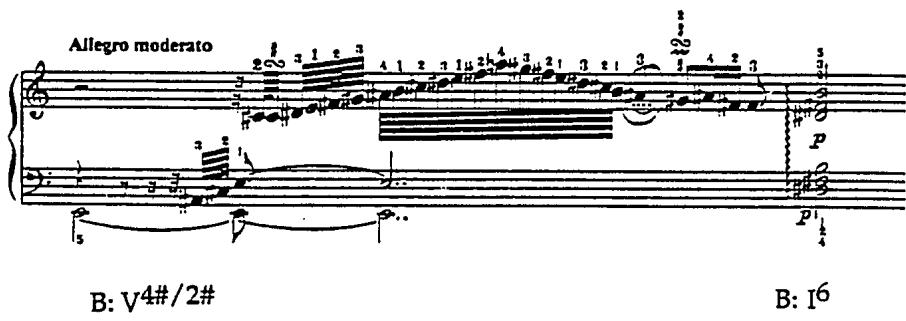
中文讲解
图例 17 在第 19 页上的另一个未具体标标题的乐谱图位(OCR 通用占位)。需查看原图。
第30段(P0132)
原文复述
Reproduced with permission of the copyright owner. Further reproduction prohibited without permission.
中文讲解
版权页脚,本节论证此处无新内容。
脚注 / 边栏 / 图表 / 附加信息(如有)
本小节共含三个脚注(59、60、61、62),其中 59 与 60 为正文 P0106 中“时间三类自由”及“非巴赫首创”的史前例证提供原始文献出处,涵盖 Bach《Versuch》、Kirnberger《Allgemeine Theorie》中的“ Fantasiren”条目、Türk《Klavierschule》、Brossard《Dictionnaire de Musique》、Klein《Versuch》、Koch《Musikalisches Lexicon》、Frescobaldi 1615 年《Toccate e partite, primo libro》前言(经 Apel 转引)、Kircher《Musurgia universalis》(经 Snyder 转引)、Mattheson《Der vollkommene Capellmeister》。脚注 61 在 P0107 中支持“巴赫至少泛知法国羽管键琴家”这一审慎判断,并指明 Schleuning《Die freie Fantasie》64–66、154 页讨论无节拍前奏曲向德国的传播。脚注 62 简注 P0112 引文来自《Versuch》2, 41, §.3,译文见 Mitchell 第 430 页。
本节含三个图例:图例 15(C 大调自由幻想曲 H. 291 主要段落;跨越第 17–18 页)支撑 H. 291 作为“带新速度/拍号的回旋曲”分析;图例 16(H. 75 的 Allegro→Largo 段;第 18 页)支撑“宣叙调—咏叹调式调性准备”比喻;图例 17(H. 75 的 Largo→Allegro 段;第 19 页)支撑等音等价与跨乐章调性流动的论证。所有图像在当前 OCR 中以占位符形式保留,需查原图。
页脚版权声明共出现四次(每次跨越新一页),纯系版式信息。
💡 本节核心要点
- “时间自由”在 C.P.E. 巴赫自由幻想曲中包括三类:无节拍段落、拍号变化、速度变化;作者用多位 18 世纪理论家(巴赫、基恩贝格尔、蒂尔克、布罗萨尔、克莱因、科赫)的论述加以支撑。
- 作者把上述自由置于更长传统中:弗雷斯科巴尔迪(1615)、基歇尔、马泰松等早已论及拍号/速度变化,因此巴赫的贡献不在“发明”,而在记谱与曲式上的极端化处理。
- 巴赫记谱上的独特之处是即便没有小节线也精确记写音的时值;作者借巴赫本人的话(耳朵需要和弦时值关系、眼睛需要音符长度关系)解释这种做法的“可懂性”动因,并谨慎指出其与法国羽管键琴家(Lebègue、d’Anglebert)无节拍前奏曲的关系只是一种合理推测。
- 时间自由在小尺度上表现为无节拍宣叙风格与不同拍号乐思并置;在大尺度上表现为“连续多段结构”——既可能在幻想曲内部形成似回旋曲、似三乐章奏鸣曲的轮廓,也可能在外部渗透进奏鸣曲、协奏曲、交响曲的乐章边界。
- 通过对比 H. 291 与《für Kenner und Liebhaber》中 13 首回旋曲,作者说明“拍号/速度变化”是巴赫“幻想曲形式的回旋曲”区别于真正回旋曲的关键。
- 通过 H. 75 这一既是末乐章又含快—慢—快连续段落的案例,作者说明巴赫在幻想曲中维持乐章间的连续性(宣叙调式的调性准备、等音等价、调性流动绕过主调),并以此把读者过渡到下一基本自由——调性自由。
🔑 关键术语
- unmeasured passages:无节拍段落,指作品中不设小节线、节奏不按固定拍号组织的段落;本节中它是巴赫幻想曲“时间自由”的一类,由 Bach、Kirnberger、Türk 的论述支撑。
- free fantasia:自由幻想曲,本书的核心研究对象;指一种允许对时间、调性、乐思安排作大幅自由处理的键盘乐曲体裁,在 C.P.E. 巴赫创作中尤为典型。
- Bebung:一种键盘上的颤音式演奏法/记号;在本节 H. 75 中,作者把它与跨乐章的等音等价(b♭ 与 a♯)联系起来,用于强调 Largo 与终曲 Allegro 之间的连续性。
- continuous multisectional design:连续多段结构,本节用以描述巴赫幻想曲中由连续、风格/拍号/速度各异的段落串联而成的整体曲式特征;它既出现在幻想曲内部,也被作者认为影响了奏鸣曲、协奏曲等体裁的乐章边界处理。
- fantasia in rondo form:以回旋曲形式写成的幻想曲,本节以 H. 291 为例;作者指出其通过新速度/拍号区分插部,使它区别于真正按叠奏原则反复的回旋曲。
- enharmonic equivalence:等音等价,指音高拼写不同但在十二平均律中音响相同的音;本节中作者以 Largo 末尾的 b♭ 与 Allegro 开端的 a♯ 为例,说明巴赫如何利用它跨乐章地维持连续性。
1.8 [描述性拆分] 2. Tonality: freedom from a conventional key plan and gradual/abrupt modulation
第1段(P0133)
原文复述
2. Tonality
中文讲解
本段是小节标题,正式开启第2节,论题集中于调性层面的自由——即自由幻想曲如何脱离常规的近关系调布局,以及如何使用渐进式或突进式的转调。
第2段(P0134)
原文复述
Among the liberties of tonality, the freedom of the fantasia from a conventional plan of closely related keys is the most fundamental. Bach spent a greater part of his discussion of improvisation describing techniques of gradual and abrupt modulation to closely related, distant and remote keys. Kollmann, basing his comments largely on the Versuch, regarded modulation as “the greatest object in a free fancy.“63 Cramer reports that “the greatest virtuosi here in Hamburg who heard him improvise when he was in just the right frame of mind, were astonished at the inventions and ideas, the transitions, the bold, unprecedented, and yet technically correct modulations, in a word, at the great wealth of harmony that Bach laid bare, much of which was unknown to them.“64 The fantasia explored the whole system of tonality that was opened up by new temperaments. Bach advocated equal temperament, which was ideal for the rapid modulations of improvised fantasias.65
中文讲解
本段确立本节核心论点:在调性层面所能享有的诸多自由中,幻想曲摆脱常规近关系调布局的自由是最根本的。作者用三组材料支撑这一判断:第一,C.P.E. Bach本人在《试笔》(Versuch)中讨论即兴演奏时,大量篇幅都用来谈渐进的与突进的转调;第二,Kollmann依据《试笔》把转调视为"自由幻想曲最大的目标”;第三,Cramer记述汉堡的同行聆听了Bach即兴后,对其大胆、前所未有却技术正确的转调以及和声财富惊叹不已。最后,作者将幻想曲对调性体系的全面探索与新律制联系起来,指出Bach所倡导的等律(equal temperament)正是实现快速转调的理想条件。作者态度十分明确:调性自由并非随意,而是依赖新的律学基础。
补充说明
本段为全节的总论点段落,将"近关系调布局"与"渐进的/突进的转调"这一对概念先全部摆出。句末脚注65所提的等律与本节末段所暗示的"键盘在所有二十四个调上都同样准确"是同一条线索。
第3段(P0135)
原文复述
That wide-ranging modulation was a liberty of improvisation is evident in Türk’s distinction between the modulatory freedom of the fantasia and the “laws of modulation” that belong to formal composition or, in his word, Setzkunst. These laws, though they cannot be stated categorically, included a familiar succession of closely related keys. Some late eighteenth-century theorists described sonata form in these terms, and the conventional movement from tonic to dominant, through the submediant and back to tonic, common to a variety of formal designs, was already recognized by Löhlein at mid-century.66
中文讲解
本段通过Türk所作的对比,把"幻想曲中的转调自由"与"作曲(Setzkunst)中的转调规律"并置。作者承认Setzkunst的规律难以一言以蔽之,但其中包含着一套大家熟悉的近关系调序列——主调—属调—下中音调—主调。Löhlein在18世纪中叶已经描述过这种走向,作者又指出,18世纪末的一些理论家用这一类术语解释奏鸣曲式,说明此模式已成常规。这里用Türk作引证,意在说明幻想曲的"自由"是与某种公认规范作对照才显现出来的——没有Setzkunst里的常规,就没有所谓幻想曲里的偏离。
补充说明
Setzkunst是德语"写作艺术/作曲"的术语,与即兴的幻想曲形成对照。作者引用的是Türk《钢琴教程》(Klavierschule)§.35。
第4段(P0136)
原文复述
63 Kollmann, Harmony, 17, 272, §. 6
中文讲解
脚注63。出处为Kollmann《和声学》第17页与第272页第6节,对应正文引述Kollmann关于"自由幻想曲中转调是最大目标"的言论。
补充说明
该脚注只为正文中的Kollmann引文标注页码与节号。
第5段(P0137)
原文复述
“Die größten Virtuosen, welche hier in Hamburg gewesen, und neben ihm standen, wenn er grade in seiner Laune war, und ihnen so vorfantasirte, erstaunten über die Einfälle, Uebergänge, kühne, nie gehörte und doch satzrichtige Ausweichungen, mit einem Worte, über die großen Reichthümer und Schätze der Harmonie, die ihnen Bach darlegte, und davon ihnen selbst viele noch unbekannt gewesen.” Cramer, ed., Magazin der Musik, 2/2, 871.
中文讲解
脚注64,原文为德语,译述大意为:当Bach心情正好、为身边的汉堡顶尖乐师作即兴幻想曲时,他们对其创意、转接、大胆前所未闻却又写作规范的转调——一言以蔽之,对Bach展示的丰富和声宝藏惊叹不已,而其中许多宝藏他们此前甚至闻所未闻。出处为Cramer所编《音乐杂志》(Magazin der Musik)第2册第2部分第871页。
补充说明
此脚注为正文Cramer引文的德语原文及出处,对正文起支撑证人证言的作用。
第6段(P0138)
原文复述
65 See Bach’s remarks on “the new method of tuning,” producing a “keyboard [that] plays equally in tune in all twenty-four tonalities,” Versuch, 1, Einleitung, §. 14, trans. Mitchell, 37. Barthold Fritz dedicated his treatise on equal temperament to C. P. E. Bach, Anweisung, wie man Claviere, Clavecin, und Orgel, nach einer mechanischen Art, in allen zwölf Tönen gleich rein stimmen könne, daß aus solchen allen sowohl dur als moll wohlklingend zu spielen sei, 2d ed. (Leipzig: J. G. I. Breitkopf, 1757).
中文讲解
脚注65,先指向Bach本人关于"新的调律法"的言论——即能让键盘在全部二十四个调上都同等准确地发声(《试笔》卷1导论§.14,Mitchell英译第37页);再指出Barthold Fritz将一部关于等律的论著题献给C.P.E. Bach,书名为《怎样用机械方法在所有十二个调上同等准确地调准键盘、大键琴及管风琴,使每个调无论大调或小调都能好听》(1757年莱比锡J.G.I. Breitkopf第二版)。该脚注的作用是为正文Bach倡导等律、并因此使其幻想曲转调无障碍这一论断,提供一手与二手文献的双重支撑。
补充说明
此处出现的"twenty-four tonalities"指十二个大调加十二个小调,与Fritz书名中"zwölf Tönen”(十二个调)在概念上对应。
第7段(P0139)
原文复述
Reproduced with permission of the copyright owner. Further reproduction prohibited without permission.
中文讲解
版权页声明。属于版面元素,不承载论证内容。
第8段(P0140)
原文复述
To state that the free fantasia is “free” from a conventional sequence of closely related keys should not obscure, however, the knowledge and skill displayed in the modulatory techniques of Bach’s free fantasias, and, on a larger scale, their coherent tonal organization. First and foremost, Bach insists on the need for overall tonal unity. If wide-ranging modulation is to be intelligible, the tonic must be clearly established at the beginning and the end as a point of reference:
中文讲解
本段在承认"自由"之后立即设置一个关键限定:自由并不等于放任。作者强调,Bach自由幻想曲的转调背后有高度的知识与技巧,整体的调性组织依然具有连贯性。其中首要条件是"整体调性统一”——若要让大幅度的转调能为听者所理解,主调必须在首尾都得到清楚的建立,作为参照点。本段逻辑上承接前文对"自由"的强调,又对其作出修正:自由有边界,调性统一即是边界。
补充说明
本段引出下一段Bach关于主调应"开头久驻、收束前回"的具体规则。
第9段(P0141)
原文复述
The principal key must not be left too quickly at the beginning nor regained too late at the end. At the start the principal key must prevail for some time so that the listener will be unmistakably oriented. And again before the close it must be well prolonged as a means of preparing the listener for the end of the fantasia and impressing the tonality upon his memory.67
中文讲解
本段是Bach《试笔》中关于主调如何处理的直接引文。具体规则有两条否定与两条肯定:开始时不能过早离开主调,结束时不能过晚回到主调;开始时主调应持续一段足以让听者明确定向的时间,临近结尾时主调应再次充分延长,以便为听者预示幻想曲的终了、并将调性印入其记忆。作者借此句落实了前段所提"整体调性统一"的原则——主调是锚点,其在首尾的延长是听者把握全曲的坐标。
补充说明
出处为《试笔》卷2第41页§.6,Mitchell英译本第431页。
第10段(P0142)
原文复述
Overall tonal unity distinguishes Bach’s fantasias from the more extreme licenses of the fantastic tradition (discussed in chapter two), in which, according to Mattheson, tonal unity in improvisation was not necessarily observed.68 Similarly, though inspired by recitative, Bach did not adopt its migrating tonality. In part because of its transitional function (leading from one operatic number to the next) recitative usually began and ended in different keys. In his “Unterricht vom Recitativ,” Marpurg noted that “a recitative possesses no specific tonality or mode.“69
中文讲解
本段通过两组对比进一步界定Bach的调性立场。第一个对比:Bach的幻想曲与"奇幻传统"中的更极端自由——Mattheson记述后者在即兴中并不一定遵守调性统一;由此把Bach视为这一极端之下的克制者。第二个对比:Bach虽受宣叙调的启发,却并未采用其"游移的调性”。作者解释宣叙调通常起讫不在同一调上是因其过渡功能(连接歌剧中的不同段落);Marpurg也明确指出宣叙调没有特定的调或调式。两个对比都把Bach定位在一种"既自由又自律"的中间地带:他敢于远离主调,但绝不让听者失去主调的指引。
补充说明
Mattheson的引文见《完美的乐队指挥》(Der vollkommene Capellmeister)第1卷第10页§.94;Marpurg关于宣叙调的引文则见于《音乐评论信札》(Kritische Briefe über die Tonkunst)第二卷第三部分第259页§.8。
第11段(P0143)
原文复述
66 Türk, Klavierschule, 395-6, §. 35. On late eighteenth-century descriptions of tonal design see Leonard Ratner, “Harmonic Aspects of Classic Form,” Journal of the American Musicological Society 2/3 (1949): 159-168. Löhlein describes modulation from tonic to dominant to submediant to tonic in strict fantasias, Clavier-Schule, ch. 20, 180-186, §§. 11-12. See also, Kirnberger, “Recitativ,” in Allgemeine Theorie, ed. Sulzer, 2:945, col. 2: “Es [das Recitativ] hat keinem Hauptton, noch die regelmäßige Modulation der ordentlichen Tonstücke.”
中文讲解
脚注66。包含三层信息:其一,Türk《钢琴教程》§.35是正文Türk引文的出处;其二,Ratner在《美国音乐学会会刊》2卷3期(1949年)第159–168页发表的《古典曲式的和声方面》是关于18世纪末调性设计讨论的代表性二手文献;其三,Löhlein《键盘乐教程》第20章第180–186页§§.11–12在所谓"严格幻想曲"中描述了主—属—下中音—主的转调顺序。脚注末还附Kirnberger词条"Recitativ"中的德语原句:宣叙调没有主调,也没有正规曲式中那种规则化的转调。该句与正文Marpurg引文相互印证。
补充说明
该脚注同时为Türk、Löhlein、Kirnberger三处文献作注,前两者支撑正文中关于Setzkunst常规转调路径的论断,后者支撑宣叙调无主调一说。
第12段(P0144)
原文复述
67 Bach, Versuch, 2, 41, §. 6, trans. Mitchell, 431.
中文讲解
脚注67。为前段引文(《试笔》卷2第41页§.6)标注Mitchell英译本第431页的位置。
第13段(P0145)
原文复述
68 Mattheson, Der vollkommene Capellmeister, 1, 10, §. 94. Clearly Beethoven felt no obligation to overall tonal unity in his fantasia Op. 77. For commentary on this work see Hugh Macdonald, “Fantasy and Order in Beethoven’s Phantasie Op. 77,” in Modern Musical Scholarship, ed. Edward Olleson (Stocksfield: Oriel Press, 1980), 141-150.
中文讲解
脚注68。正文部分指明Mattheson引文出处(《完美的乐队指挥》卷1第10页§.94)。补充部分则指出Beethoven的Op. 77幻想曲明显并未遵守整体调性统一,相关评论见Hugh Macdonald收录于Edward Olleson编《现代音乐学术》中的《贝多芬Op. 77幻想曲中的幻想与秩序》一文,第141–150页。该补充把Bach与Beethoven在调性统一问题上的态度差别点明:Beethoven可以彻底不顾整体调性统一,而Bach则坚持主调作为参照。
补充说明
此脚注兼具出处与延伸对照双重作用。
第14段(P0146)
原文复述
Reproduced with permission of the copyright owner. Further reproduction prohibited without permission.
中文讲解
版权页声明。属于版面元素,不承载论证内容。
第15段(P0147)
原文复述
Bach’s discussion of modulation in the free fantasia begins with gradual modulations to diatonic keys, proceeding then to “slightly circuitous ways of modulating from a major key to the distant [nondiatonic] keys.“70 The modulatory techniques that are most distinctive of the free fantasia, however, are abrupt modulations by means of the diminished seventh and sudden changes of tonal direction. The latter, which Bach calls “rational deceptions,” are particularly prized:
中文讲解
本段刻画Bach在《试笔》中讨论自由幻想曲转调的层次结构:先谈渐进的、向自然音体系内各调的转调;再谈稍稍迂回的、跨入远关系(非自然音)调的途径。然而作者指出,自由幻想曲最具特色的转调技巧,其实是两类突进式手法——借助减七和弦的突进转调,以及调性方向的突然改变。后者被Bach称为"理性的欺瞒”(rational deceptions),并被特别看重。本段在结构上完成一次焦点转移:从"自由"转到"自由中的标志性技巧”,为下一段的直接引文与具体谱例作铺垫。
补充说明
“rational deceptions"是Bach自创术语,指通过完整终止式让听者以为已经转入新调、随即却转入另一方向的写作手法。
第16段(P0148)
原文复述
It is one of the beauties of improvisation to feign modulation to a new key through a formal cadence and then to move off in another direction. This and other rational deceptions make a fantasia attractive.71
中文讲解
本段是Bach对"理性的欺瞒"的正面表述。两条规则:第一,通过一个完整的终止式伪装已经转入新调;第二,实际却走向另一方向。这类手法与其他类似的"理性欺瞒"共同构成幻想曲吸引人的原因。作者此处直接征引Bach的措辞,意在表明这一类违反预期的转调并非随意失向,而是有目的、有美感的写作策略。
补充说明
出处为《试笔》卷2第41页§.8,Mitchell英译本第434页。
第17段(P0149)
原文复述
The humorous effect of rational deceptions is felt in example 18 from the free fantasia in c minor, H. 75. A modulation to D major is strongly implied through a trilled dominant seventh (“x” in example 18). The D-major tonic chord is evaded, however, and a solitary c-natural (subsequently harmonized as G/V4/2 ) leads, instead, to a cadence in G major.
中文讲解
本段将抽象规则落到具体作品上:选用的例子是c小调自由幻想曲H. 75,例18。具体过程是:通过一个颤音的属七和弦(图中标"x"处)强烈暗示转调至D大调;然而属七和弦之后并未出现预期的D大调主和弦,反而出现一个孤立的还原c(之后被和声化为G/V4/2,即G大调属和弦的第二转位),最终引向G大调的终止。作者由此点明"理性欺瞒"中关键的幽默感机制:听者的期待被结构性地建立起来,再被精确地打破,但破局并非失控,而是引向另一合乎逻辑的方向。
补充说明
G/V4/2指G大调的属七和弦的第二转位,其低音为还原c。这一还原c正是前文"solitary c-natural"的和声化解。
第18段(P0150)
原文复述
Example 18. Free Fantasia in c, H. 75 (1753).
中文讲解
图例18的标题。标明该谱例出自1753年的c小调自由幻想曲H. 75。
补充说明
本段仅为图注,正文分析见上段。
第19段(P0151)
原文复述
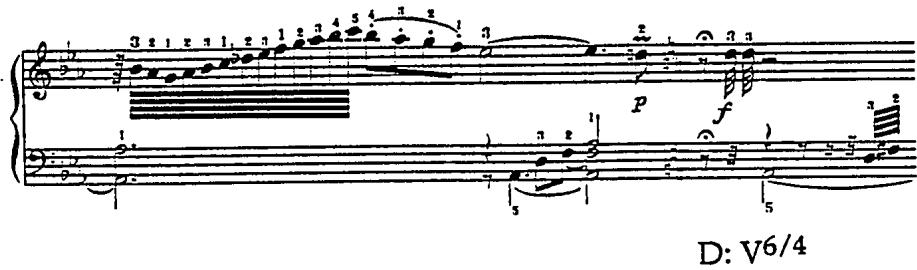
中文讲解
第22页的乐谱示例占位符,对应例18的起始部分。文本中已注明该图的内容与图注一致,但图像细节需查原图。
补充说明
无法从此处获取乐谱细节;分析与文字注释以前段叙述为准。
第20段(P0152)
原文复述
69"Es wird bei einem Recitativ kein gewisser Ton und Modus.” Friedrich W. Marpurg,
中文讲解
脚注69的开头部分。引文为德语:“在宣叙调中没有确定的调与调式。“出处作者为Friedrich W. Marpurg。
补充说明
此句接续下一段以给出Marpurg文章的具体信息。
第21段(P0153)
原文复述
“Unterricht vom Recitativ,” in Kritische Briefe über die Tonkunst (Berlin: F. W. Birnstiel, 1762), vol. 2, part 3, 259, §. 8.
中文讲解
脚注69的出处剩余部分。文章标题为"关于宣叙调的教导”(Unterricht vom Recitativ),载于Marpurg《音乐评论信札》(1762年柏林F. W. Birnstiel出版)第2卷第3部分第259页§.8。
补充说明
与上一段合并即构成完整的脚注69。
第22段(P0154)
原文复述
70 Bach, Versuch, 2, 41, §. 10, trans. Mitchell, 436.
中文讲解
脚注70。为前段关于"渐进入远关系调"的引文标注位置——《试笔》卷2第41页§.10,Mitchell英译本第436页。
第23段(P0155)
原文复述
71 Bach, Versuch, 2, 41, §. 8, trans. Mitchell, 434.
中文讲解
脚注71。为前段"理性欺瞒"引文标注位置——《试笔》卷2第41页§.8,Mitchell英译本第434页。
第24段(P0156)
原文复述
Reproduced with permission of the copyright owner. Further reproduction prohibited without permission.
中文讲解
版权页声明。属于版面元素,不承载论证内容。
第25段(P0157)
原文复述
Example 18, continued.
中文讲解
图例18的延续部分标题,提示该谱例延续于第23页。
补充说明
谱例细节需查原图。
第26段(P0158)
原文复述
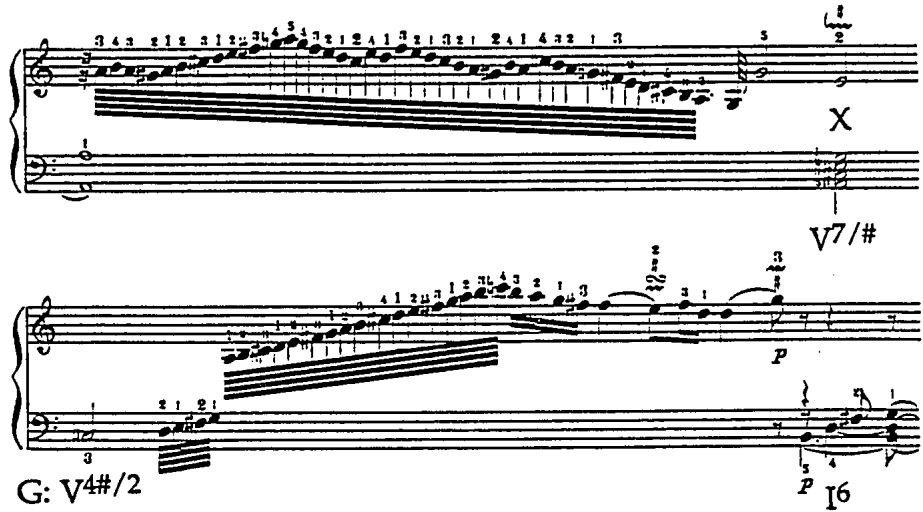
中文讲解
第23页的乐谱示例占位符,为例18的延续部分。文本未给出具体音符细节,需查原图。
第27段(P0159)
原文复述
The evasion of D major preserves the tightly knit key scheme of this work. Modulation proceeds largely by step, first in descent away from the tonic, and then in ascent back to it. Both the highly structured tonal design, and the stepwise modulations in particular, are characteristic of Bach’s free fantasias:
中文讲解
本段把例18中D大调被回避这一细节拉回整体结构:避开的目的是保全全曲调性布局的紧密。转调主要按"级进"进行——先以级进下行远离主调,再以级进上行回归主调。作者认为,这种高度结构化的调性设计、尤其是其中按级进行的转调,是Bach自由幻想曲的典型特征。语气上是把上段那种局部的"理性欺瞒"放进更大的"整体级进调性框架"中理解:局部有突进,整体仍有秩序。
补充说明
本段为下一段列出调性方案作了铺垫。
第28段(P0160)
原文复述
Allegro Moderato: c, A-flat, G (e), f, E-flat
中文讲解
本段以调名序列标示H. 75第一段快板(Allegro Moderato)的调性布局:c → 降A → G(括号内为e)→ f → 降E。可见从主调c出发,按小三度—大二度的下行模式向远关系调逐级推进,整体呈下行态势。括号内的e虽未单独成段,但提示G大调段落中存在短暂的e小调关系。
补充说明
此为调性方案列表的一部分,紧接下一段列出慢板与再现段的调性。
第29段(P0161)
原文复述
Adagio: E-flat, f, g, A-flat, B-flat, c, E-flat/V
中文讲解
本段标示H. 75中段慢板(Adagio)的调性布局。从降E开始,依次经f、g、降A、降B、c,再回到降E/V(即降E大调的属)。整体呈循环式设计,调性以级进上行再下行,最终停在属音为下一段的回归作准备。
第30段(P0162)
原文复述
Allegro Moderato: B, c-sharp, c
中文讲解
本段标示H. 75再现段快板(Allegro Moderato)的调性布局:从B出发,经升c,回到主调c。再现段的调性跨度比第一段短得多,作者借此突出下一段所说的关键差别。
第31段(P0163)
原文复述
The fact that the final Allegro begins out of tonic points, however, to a fundamental difference between the tonal structure of this multisectional fantasia and the multimovement work it resembles. In fantasias, the tonic is withheld to the end of the piece, whereas, in multimovement works, the tonic is most often clearly established at the beginning of the final movement.
中文讲解
本段从具体作品引出一个结构性论断:H. 75的最终快板并非在主调上开始,这一点揭示了多段落幻想曲与表面相似的多乐章作品在调性结构上的根本差异——幻想曲会把主调推迟到全曲之末才正式确立,而多乐章作品往往在末乐章开头就明确呈现主调。这一对比呼应前文关于"主调作为参照点"的论点:幻想曲的修辞策略是把"回到主调"的高潮与"全曲结束"重叠在一起,由此放大主调回归的分量。
补充说明
此处区分"多段落幻想曲”(multisectional fantasia)与"多乐章作品”(multimovement work)的调性策略,对理解本节"自由但有秩序"的主旨至关重要。
第32段(P0164)
原文复述
In addition to wide-ranging modulations, certain details of harmonic syntax that Bach mentions in the context of the free fantasia should also be noted as liberties pertaining to tonality. These are worth examining since modern writers have not considered harmonic syntax in the fantasia in any detail. In defining his fantasia topic, Ratner, for example, alludes only to “shifting harmonies, chromatic conjunct bass lines.“72 A note of caution is necessary, however, since we are unlikely to agree upon details of interpretation in complex, chromatic and elliptical progressions. This is partly because listeners differ in the extent to which they hear and understand harmonic progressions in terms of voice-leading, that is, motion of contrapuntal voices, or in terms of the movement of chordal roots, as identified in Roman-numeral analysis.
中文讲解
本段为下一阶段讨论"调性自由的具体和声句法细节"做导引。作者提出两个层面的判断:其一,Bach在自由幻想曲语境中还提到一些和声句法层面的细节,可视为调性自由的延伸;其二,现代学界(如Ratner)只以"变换的和声、半音化级进低音"概括幻想曲的和声特点,缺少深入讨论。本节随后将补足这一空白。但作者预先设置一个方法论警示:在复杂、半音化、跳跃式(elliptical)的进行中,听者与分析者难以对细节达成一致,部分原因在于人听和声进行时可能以声部进行的视角(voice-leading),也可能以罗马数字分析所标识的根音进行视角。本段的写作意在提示读者:接下来的讨论必然涉及解析方式的选择,不是单义的解读。
补充说明
Ratner在正文中提到的文章即前述JAMS 2/3(1949年)一文,与本节前段脚注相关。
第33段(P0165)
原文复述
Reproduced with permission of the copyright owner. Further reproduction prohibited without permission.
中文讲解
版权页声明。属于版面元素,不承载论证内容。
脚注 / 边栏 / 图表 / 附加信息(如有)
本节包含脚注63–72(编号70前的引用Kollmann、Cramer的德语原文、Bach关于等律与Fritz论著的并列、《试笔》§.10与§.8的引文位置、Türk与Löhlein关于严格幻想曲转调顺序的文献、Mattheson关于即兴调性不统一的论断及Macdonald关于Beethoven Op. 77的评论、Marpurg与Kirnberger关于宣叙调无主调的德语原句、Ratner关于幻想曲和声特点的简短引文)。图例18位于第22–23页,对应H. 75的c小调自由幻想曲中"理性欺瞒"的实例,文字分析参见正文段落P0149–P0159,其调性方案列表则在P0160–P0162。
💡 本节核心要点
- 调性层面的核心自由是幻想曲可以摆脱近关系调的有序布局,但这种自由依赖等律所提供的技术基础。
- Bach的"自由"不等于放任:主调必须在首尾明确建立并充分延续,作为听者把握大幅转调的参照锚点。
- Bach幻想曲的转调策略明显区别于Setzkunst的常规(主—属—下中音—主)以及宣叙调的游移调性,体现一种介于两者之间的节制。
- 自由幻想曲最具特色的转调技巧是借助减七和弦的突进转调,以及通过完整终止式"伪装"转向再突然改向的"理性欺瞒”。
- H. 75同时具备局部突进(例18中D大调被回避)与整体级进(先降后升)的双重结构,体现了Bach式"局部突变、整体有序"的调性组织。
- 多段落幻想曲将主调推迟到全曲之末确立,与多乐章作品末乐章直接呈现主调的做法形成根本区别。
🔑 关键术语
- Setzkunst:德语术语,指"写作/作曲艺术”,Türk用以与即兴幻想曲作对照——前者服从"转调规律”,后者享有转调自由。
- rational deceptions(理性的欺瞒):Bach在《试笔》中使用的术语,指通过完整终止式让听者以为已转入新调、随即却转向另一方向的手法,是自由幻想曲中标志性的突进转调技巧。
- diminished seventh(减七和弦):用以进行突进式转调的和声工具,本节中作为自由幻想曲转调技巧的代表性手段之一。
- equal temperament(等律):Bach所倡导的律制,使键盘在十二个大调与十二个小调上同样准确发声,是本节所述"大幅自由转调"得以成立的技术前提。
- voice-leading vs. Roman-numeral analysis(声部进行视角与罗马数字分析):本节末段提出的两种和声分析取向——前者关注对位声部运动,后者关注根音进行;作者借此警示,复杂、半音化、跳跃式进行中的解读必然与分析视角相关。
- tonic withheld to the end(主调推迟至终曲):本节用以概括多段落幻想曲调性结构的关键特征:主调被故意推迟到全曲结束才正式确立,与多乐章作品末乐章常以主调开始形成对比。
1.9 [描述性拆分] Liberties of harmonic syntax: ellipsis, chordal inversion, and diminished seventh
第1段(P0166)
原文复述
Among the liberties of harmonic syntax characteristically employed in the fantasia is ellipsis, or the omission of chords. In his comments on the figured-bass framework of the free fantasia in D, H. 160 (1762) (example 19), Bach remarks that “the change from the seventh chord on b to the following chord of the second on b-flat is an ellipsis, for normally the six-four chord on b or the triad on c would precede the chord of the second.” $^{73}$
中文讲解
本段是本小节的开篇,提出幻想曲体裁在和声语法上的第一项"自由”——省略(ellipsis)。作者直接以C. P. E. 巴赫本人在《试金集》(Versuch)中对1762年D大调自由幻想曲H. 160的分析为依据,定义省略为和弦的缺省,并具体说明:在从b上的七和弦到降b上的二和弦这一进行中,原本应当插入b上的四六和弦或c上的三和弦,但巴赫故意略去了这些本应出现的中间和弦。这里脚注73引用了巴赫原话与Mitchell英译的页码,说明这一省略并非随意删减,而是作曲家在严格理论框架内的有意选择。整段在论证上起总起作用:通过巴赫自己的术语把"省略"确立为本节讨论的第一种语法自由,为后文关于和弦转位、减七和弦的自由使用等例子提供分类框架。
补充说明
脚注73的出处(Bach, Versuch, 2, 41, §. 14, trans. Mitchell, 442)表明作者依赖的是Mitchell的英译本,并定位到巴赫亲自分析自由幻想曲和声框架的章节,可与P0169对照。
第2段(P0167)
原文复述
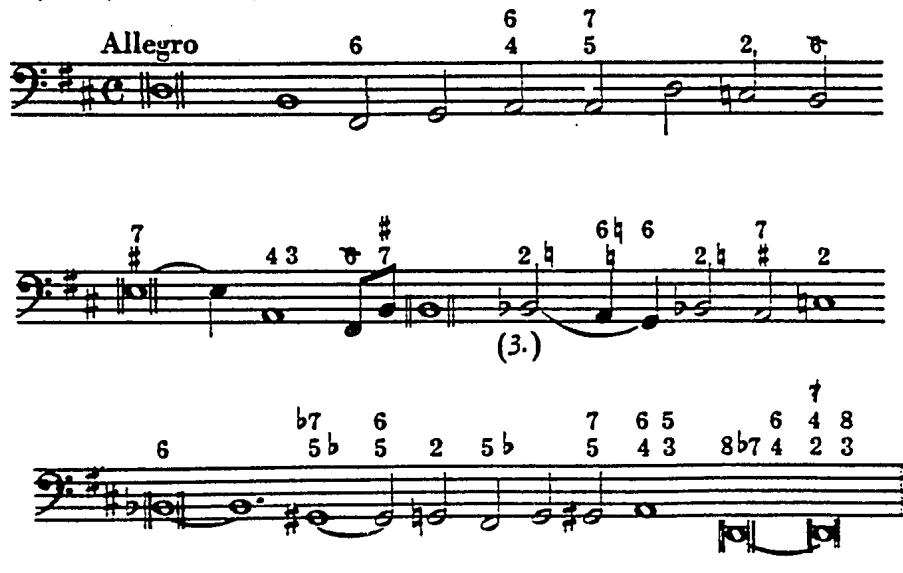
中文讲解
这是Example 19的图注与图像占位符,原文为"Example 19. Figured-Bass Framework of Free Fantasia in D, H. 160 (1762).",对应巴赫D大调自由幻想曲H. 160(1762)的数字低音框架图。由于本节所有相关讨论(包括P0166中省略的b—降b进行)都依赖此图来具体定位和声位置,读者需要查阅原书插图以核对巴赫所述的七和弦—二和弦省略及其周围的六四和弦与c小三和弦环境。
第3段(P0168)
原文复述
$^{72}$ Ratner, Classic Music, 24.
中文讲解
这是脚注72,对应的正文位置在上一段或上文,引用了Ratner《Classic Music》第24页。这一脚注未被本节正文段落正文直接引用,但保留在版面上作为背景参考。它属于典型的引用性脚注,仅提供文献出处信息,不对正文观点作补充论证。
第4段(P0169)
原文复述
$^{73}$ Bach, Versuch, 2, 41, §. 14, trans. Mitchell, 442.
中文讲解
这是脚注73,对应P0166中的上标,给出巴赫《试金集》第二卷第41页第14节,以及Mitchell英译本第442页。它是P0166中巴赫原话的来源依据,证明作者直接引用了作曲家本人的理论说明,使"省略"这一概念具备第一手权威性,而非作者本人对巴赫作品的事后解读。
第5段(P0170)
原文复述
Reproduced with permission of the copyright owner. Further reproduction prohibited without permission.
中文讲解
这是与Example 19相关的版权声明页脚,说明该图例的复制已获版权所有者授权,未获许可不得进一步复制。在阅读论证上没有实质内容,仅是出版层面的限制说明。
第6段(P0171)
原文复述
A second liberty of syntax concerns unorthodox use of successions of inverted chords that obscure familiar harmonic progressions. Bach does not discuss this aspect of harmonic syntax, but he does draw attention to a relatively straightforward instance of chordal inversion (what he calls, interchange of chordal tones) in his commentary on H. 160 (cf. example 19):
中文讲解
本段引出本节的第二类和声语法自由——非常规的转位和弦连接,这种连接会模糊常规的和声进行。作者明确指出两点对比:第一,巴赫在《试金集》中并未把这种"模糊常规进行"的转位链作为独立的语法类别加以理论化;第二,巴赫确实在H. 160的评注中举出了一个相对直白的转位实例,并称之为"interchange of chordal tones”(德文Verwechselung der Harmonie,字面意为"和声的互换”)。这一段在论证上的作用是:把巴赫的术语从"直白实例"扩展为"可能产生复杂和声语法"的普遍现象,从而为下文用H. 234的复杂实例进行类比做好准备。
第7段(P0172)
原文复述
The three tones at 3, joined by a slur, elucidate the transition to the repetition of the chord of the second which is regained by means of an interchange of chordal tones [“eine Verwechselung der Harmonie”]. $^{74}$ This is a straightforward example, but interchange of chordal tones may create complex harmonic syntax. At first glance, the bass line of the fantasia in d minor, H. 234 appears to be musical madness for it proceeds through preposterous leaps (example 20). Interchange of chordal tones occurs in the central portion of the first arpeggio section (at x), and again, just before the music breaks off on V $^{6/4}$ for a written-out cadenza (at y). There is a bumpy effect, a tonal whiplash at these two moments of voice exchange; the motion of roots by fourth is contorted by inversion. $^{75}$
中文讲解
本段是本节论证最密集的一段,作者先用H. 160的简单例子证明巴赫本人使用的"Verwechselung der Harmonie”(和弦互换)就是指通过和弦转位形成的不寻常连接,并指出此概念在更复杂的作品中会产生复杂语法;然后立刻切换到d小调幻想曲H. 234(1767),指出该曲低音乍看像"musical madness”(音乐上的疯狂),因为它由看似荒唐的跳进构成。作者在第一段琶音段的中部(标x处)以及音乐在V6/4上中断以写就的华彩段前(标y处)识别出两次和弦互换。关键修辞是"bumpy effect"和"tonal whiplash”——作者用身体感受的比喻说明:原本以四度进行的根音运动被转位扭曲,听觉上产生颠簸与调性鞭打的效果。论证逻辑是:直白例子→复杂实例→听觉效果描述,三层共同支撑"转位/互换可成为语法自由"这一命题。
第8段(P0173)
原文复述
Example 20. Fantasia in d, H. 234 (1767).
中文讲解
这是Example 20的图注,对应1767年d小调幻想曲H. 234的谱例。该图与P0172讨论的两次和弦互换位置(x与y)相对应,需查阅原谱以核对低音的跳进及转位细节。
第9段(P0174)
原文复述
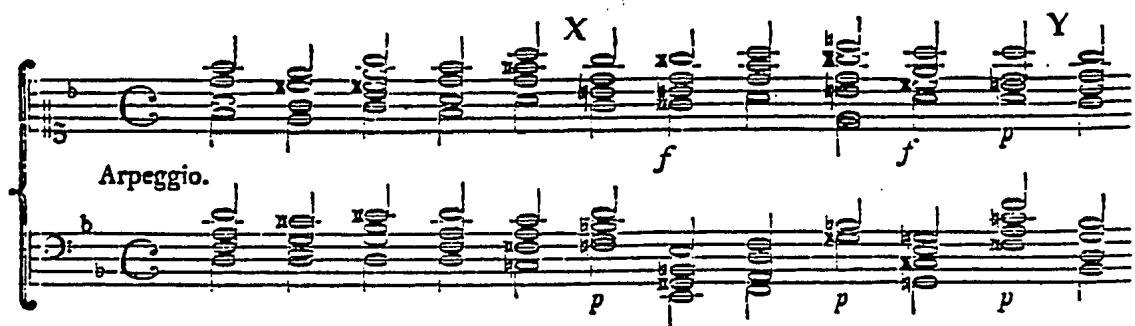
中文讲解
这是Example 20对应的第25页乐谱/图像占位符。读者需查看原书插图以核对H. 234低音的实际音型与作者所标注的x、y两处互换和弦位置。
第10段(P0175)
原文复述
$^{74}$ Bach, Versuch, 2, 41, §. 14, trans. Mitchell, 442. Mitchell’s translation of “Verwechselung der Harmonie” as “interchange of chordal tones,” rather than as chordal inversion, is appealing since it reflects the awareness of voice-leading which clearly underlies Bach’s explanation. A Schenkerian concept that is closely related is voice exchange. “The voice exchange is a pattern that involves two and only two voices, a pattern in which the voices literally exchange their pitches.” Allen Forte and Steven E. Gilbert, Introduction to Schenkerian Analysis (New York: W. W. Norton, 1982), 110.
中文讲解
这是脚注74,承担双重功能:第一,给出P0172中巴赫原话的出处(Bach, Versuch, 2, 41, §. 14, trans. Mitchell, 442);第二,对术语翻译作出方法论判断——指出Mitchell把德文"Verwechselung der Harmonie"译为"interchange of chordal tones"而非"chordal inversion"更为可取,因为这一译法揭示了巴赫解释背后的声部进行意识。随后作者引入申克分析中的"voice exchange”(声部交换)概念作为参照,给出Forte与Gilbert《Introduction to Schenkerian Analysis》第110页的定义:声部交换指两个声部彼此互换音高的模式。这条脚注的关键作用是为后续分析H. 234时使用的"voice exchange"术语建立概念桥梁,并暗示巴赫的"和弦互换"与申克的"声部交换"在观察视角上相通——一个偏和弦,另一个偏声部。
第11段(P0176)
原文复述
$^{75}$ Recognition of these moments of inversion, and of the polyphonic nature of the bass line, allows us to identify the familiar descending fourth 8-7-6-5 underlying this work.
中文讲解
这是脚注75,对应P0172末尾上标,作用是补足一个分析结论:如果在H. 234低音中正确识别出转位发生的位置(即视低音为多声部而非单声部),就能在该曲表层看似疯狂的跳进之下辨认出一条熟悉的8-7-6-5下行四度进行。这一脚注以一条补充句完成论证闭环——表面混乱并非无序,其下仍埋藏着古典的终止进行,只是被转位和声部交换遮蔽。
第12段(P0177)
原文复述
Reproduced with permission of the copyright owner. Further reproduction prohibited without permission.
中文讲解
这是与Example 20相关的版权声明页脚,无分析内容。
第13段(P0178)
原文复述
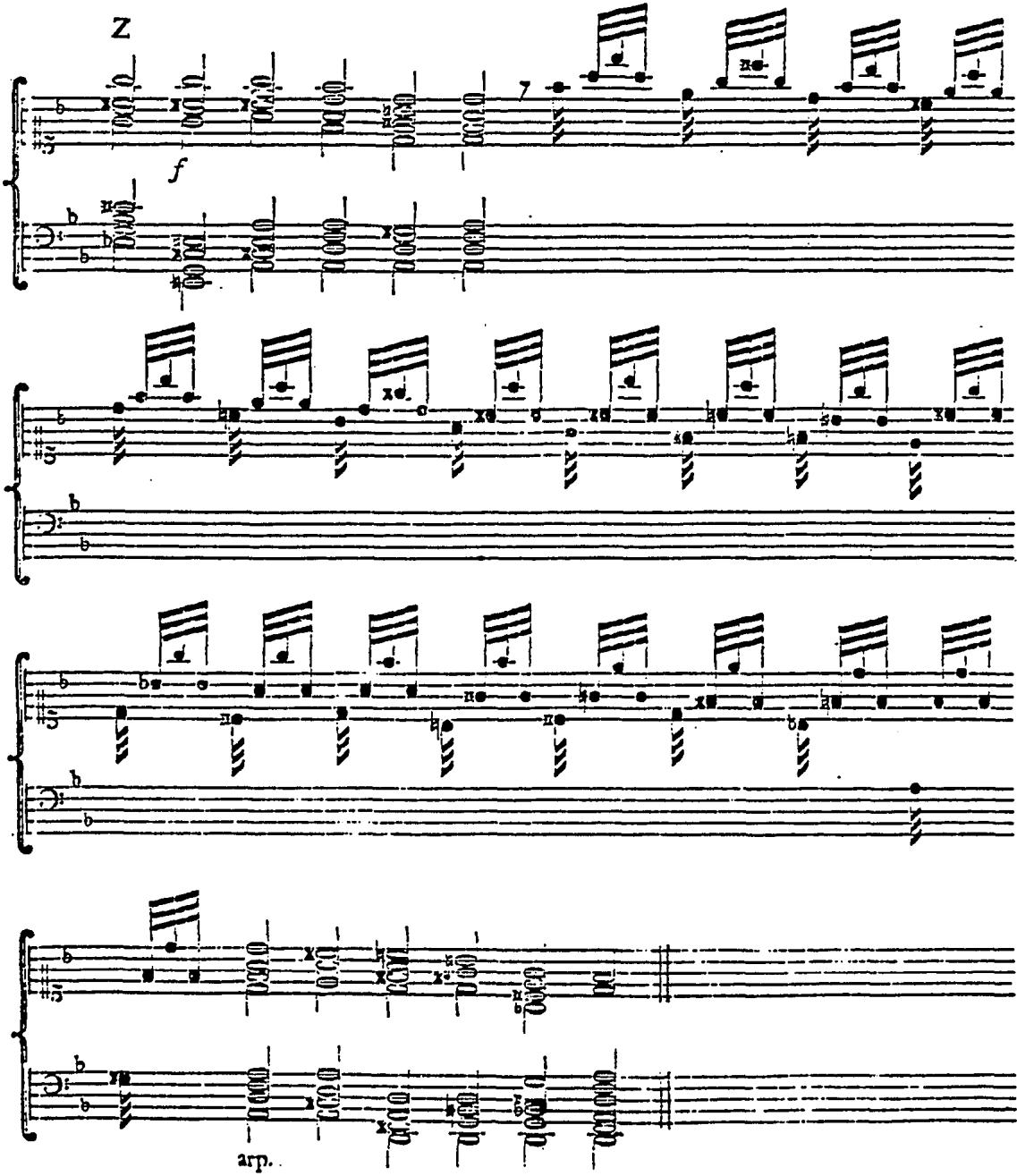
中文讲解
本段由于OCR边界与图像位置叠合,开头似乎被图例截断,但文本内容可辨。它引入本节第三种语法自由——减七和弦的自由引入。承前文H. 234(对应example 20,此处"this fantasia"指H. 234),作者指出减七和弦(谱中标z处)是一种巴赫本人在即兴演奏中也鼓励使用的自由。其功能机制是:减七和弦被作为后一和弦的副属和弦(secondary dominant)使用。文本在"as a secondary dominant to"处中断,下一句P0180将继续说明它与前一和弦的关系。
第14段(P0179)
原文复述
Reproduced with permission of the copyright owner. Further reproduction prohibited without permission.
中文讲解
这是与Example 20相关的版权声明页脚,无分析内容。
第15段(P0180)
原文复述
the following chord (vii $^{07}$ functioning as a dominant), but has only a voice-leading connection with the preceding augmented-sixth chord.
中文讲解
本段紧接P0178结尾,完成对减七和弦在H. 234中的功能分析。作者指出:vii°7作为副属和弦(functional as a dominant)与后面的和弦构成功能关系,但与前方的增六和弦之间只有声部进行上的关联,而无清晰的根音功能关联。这一句的论证意义是:减七和弦的"自由"恰在于它可能跨越功能边界,只凭线性逻辑与前后和弦衔接,从而成为又一类语法自由。它与本节主题的关系是:在省略与转位之外,补充了"任意引入减七和弦"作为第三类自由。
第16段(P0181)
原文复述
Occasionally the harmonic syntax of the fantasia includes progressions that possess, first and foremost, only a voice-leading logic. Here there is no readily identifiable root-functional connection between successive chords. In H. 75 such a progression is employed between the second, adagio section and the final Allegro moderato (cf. example 17). A declamatory gesture, employing Bebung, and suggesting the affection “fear,” expresses the chord F/V $^{7}$ . Yet this chord is held, on either side, solely by pivot notes and enharmonic equivalence. $^{76}$ The tenuous root-functional syntax at this point reinforces the affection “fear” that is suggested by the use of Bebung and augmented melodic intervals (e-natural to b-flat).
中文讲解
本段把上一段关于减七和弦的观察推进到一个更具概括性的命题:幻想曲的和声语法有时仅以声部进行逻辑为基础,连续和弦之间并无清晰可辨的根音功能关系。作者以c小调幻想曲H. 75为例,说明在第二段柔板与终曲Allegro moderato之间出现这样一个和声部连接:一句使用Bebung(揉弦)并暗示"恐惧"情感的朗诵性乐句,表达出F/V7和弦;而该和弦前后仅靠共同音(pivot notes)和等音转换(enharmonic equivalence)维持。最后一句给出美学解释:根音功能语法的脆弱正与Bebung和增音程(e自然音到降b)所暗示的"恐惧"情感相互强化。本段在论证上的作用是:把省略、转位、减七和弦的具体例子归纳为一个更高层判断——幻想曲的和声有时完全由声部进行逻辑支撑,从而把本节从"自由种类"的清单推进到"自由的整体后果”。
第17段(P0182)
原文复述
The liberties of harmonic syntax described above may join with enharmony to create disorienting passages of modulatory flux from relatively straightforward harmonic progressions. The underlying progression in example 21 from the free fantasia in C, H. 284 (1784) is a circle of fifths, but this is disguised by voice-exchange, enharmony, and ellipsis. Chord “x” (b, c-sharp, e-sharp, g-sharp) is an inverted and enharmonically respelled seventh chord (d-flat, f, a-flat, c-flat), in a circle-of-fifths relationship with the preceding seventh chord on a-flat. This enharmonic respelling is further complicated through “interchange of chordal tones” to create an unorthodox succession of inverted seventh chords. The movement to the first inversion b-minor chord in the next measure involves an ellipsis, in which one member of the circle-of-fifths chain, the seventh chord on f-sharp, is omitted. The first inversion b-minor chord moves, without undue complication, to an E-major chord (a/V7).
中文讲解
本段把前文介绍的三种语法自由综合到一个完整例证中——C大调自由幻想曲H. 284(1784),对应example 21。作者论证的核心是:表层听上去的方向迷失感,底层其实只是一条纯五度循环(circle of fifths);这种表里反差通过三种机制同时实现——声部交换、等音转写与省略。具体识别过程为:和弦"x”(b、#c、#e、#g)是一个转位且等音改写的七和弦(即降d、f、降a、降c),它与前一降a上的七和弦构成五度循环关系;这一等音改写又叠加上"和弦互换",形成一连串非常规的转位七和弦链;进入下一小节b小调第一转位和弦时发生省略,五度链中的#f七和弦被略去;b小调第一转位和弦较直接地走向E大调和弦(a/V7)。本段的论证价值在于:把省略、声部互换、等音转写这三种"自由"集中到一个谱例中演示,体现它们可以协同制造方向迷失感,使读者具体看到本节标题所言的"和声语法的自由"如何在曲中复合运作。
第18段(P0183)
原文复述
$^{76}$ In light of Wiemer’s speculation that H. 75 in c minor is a lament on the death of J. S. Bach, this fearful approach to the final Allegro could be seen as a response to imminent tonic return in a work in which tonic closure has become a metaphor of death. Wolfgang Wiemer, “Carl Philipp Emanuel Bachs Fantasie in c-Moll–ein Lamento auf den Tod des Vaters?” Bach Jahrbuch 74 (1988): 163-177. Yet Wiemer’s evidence is weak: B-A-C-H motifs often appear in works by C. P. E. Bach, as they do, for example, in the F-major fantasia, H. 279; nor has the formal design of H. 75 anything at all to do with a funeral oration–it is a fast-slow-fast sonata cycle compressed into a single movement.
中文讲解
这是脚注76,对应P0181的上标。作者首先复述Wiemer的推测——H. 75可能被解读为哀悼J. S. 巴赫之死的挽歌,因此接近终曲Allegro时的"恐惧"可被看作对即将到来的主调回归(在此作品中主调闭合已成为死亡的隐喻)的反应,并给出文献出处(Wiemer, Bach Jahrbuch 74 [1988]: 163-177)。随后,作者明确表达反对意见:Wiemer的证据薄弱,理由有二:第一,B-A-C-H动机在C. P. E. 巴赫其他作品中亦常见(如F大调幻想曲H. 279),因此单独出现并不足以支撑哀悼解读;第二,H. 75的曲式结构与葬礼演说毫无关系,而是一部压缩为单一乐章的快-慢-快奏鸣曲循环。这条脚注的论证作用是驳斥一种将"恐惧"与作曲家丧父背景强行挂钩的传记式解读,从而保护本节分析的核心主张——“恐惧"情感的来源是和声语法的脆弱性(Bebung、增音程、纯声部进行逻辑)而非外在生平事件。
第19段(P0184)
原文复述
Reproduced with permission of the copyright owner. Further reproduction prohibited without permission.
中文讲解
版权声明页脚,无分析内容。
第20段(P0185)
原文复述
Example 21. Free Fantasia in C, H. 284 (1784).
中文讲解
这是Example 21的图注,对应1784年C大调自由幻想曲H. 234,需查阅原书插图以核对P0182中描述的等音改写七和弦、省略与五度循环等具体细节。
第21段(P0186)
原文复述
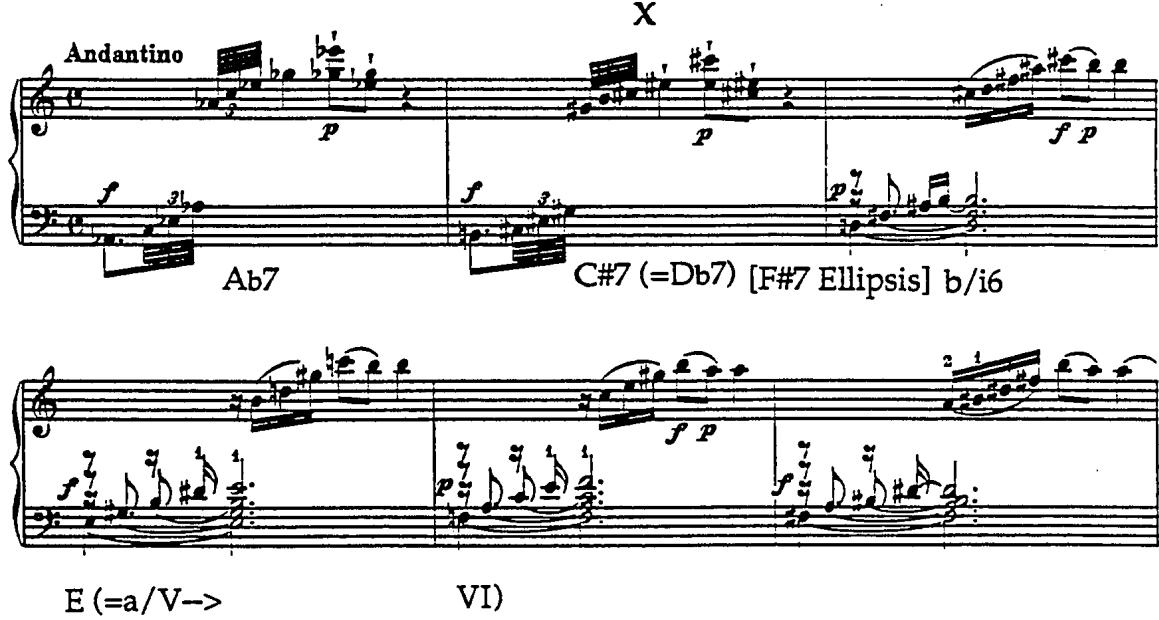
中文讲解
这是Example 21对应的第28页乐谱/图像占位符,读者需查看原图。
第22段(P0187)
原文复述
Liberties of syntax go hand in hand with affective intensity and turbulence. Enharmony, for example, is employed to rouse violent affections. Marpurg attributed to enharmony the affections of anger, despair, vengeance, and envy. $^{77}$ Example 21, in which liberties of syntax suggest irrationality and violently fluctuating emotion, occurs within a passage involving disorientating juxtapositions of contrasting materials that has few parallels outside of operatic mad-scenes in Baroque opera seria (example 22). Like the famous mad-scene from Handel’s Orlando, this passage simulates madness through the rapid juxtaposition of contrasting material, specifically, a slow
中文讲解
本段把和声语法的"自由"从纯技术范畴推进到美学范畴:自由与情感强度、情感动荡相伴而生。作者以等音转写为例,引Marpurg为权威(脚注77)说明等音可以激起愤怒、绝望、复仇、嫉妒等激烈情感;接着指出H. 284中example 21所在的整段(对应example 22)通过材料对比的急速并置模拟失常与激烈情绪波动,其程度之强烈在巴洛克正歌剧中的"疯狂场景”(mad-scene)以外罕有匹敌,并类比亨德尔的《奥兰多》中著名的疯狂场景。这一类比的作用是:把和声语法的技术特征(省略、转位、等音)锚定到18世纪歌剧舞台上对"疯狂"的程式化表达,使本节的分析既是音乐语法分析也是情感修辞分析。
第23段(P0188)
原文复述
$^{77}$ Marpurg, “Unterricht vom Recitative,” in Kritische Briefe, 2, 3, 257, §. 6.
中文讲解
这是脚注77,引用Marpurg《Kritische Briefe》第二卷第三册第257页第6节中"Unterricht vom Recitative"(论宣叙调)的论述,作为P0187中将等音与激烈情感相联系这一观点的来源依据。
第24段(P0189)
原文复述
Reproduced with permission of the copyright owner. Further reproduction prohibited without permission.
中文讲解
版权声明页脚,无分析内容。
第25段(P0190)
原文复述
arpeggiation that ends with a declamatory sighing figure (mm. 1-6, 17-21); a songful theme in meter (the rondo-type allegretto theme, mm. 7-14, 22-33), and a virtuosic, instrumental gesture (the ascending arpeggiation, andantino, mm. 15-16, 34-35). This connection between the juxtaposition of ideas in the free fantasia and madness (at least as it was musically portrayed on the eighteenth-century operatic stage) is supported by C. F. Cramer’s review not of this work, but of the fantasias in the preceding collection of solo keyboard music für Kenner und Liebhaber (volume four). Pointing specifically to abrupt contrasts of material, Cramer quoted (or, rather, misquoted) Polonius’ famous description of Hamlet’s feigned madness: “Though this is madness, yet there’s method in it.“78 The artful simulation of madness to which Cramer points brings us to the third fundamental liberty of the genre, concerning the apparently disorderly arrangement of material.
中文讲解
本段承接P0187对疯狂场景的类比,先具体描述example 22中三种材料的并置及其小节定位:缓慢的琶音段以叹息性的朗诵收束(mm. 1-6, 17-21)、有韵律的歌曲性回旋主题(allegretto主题,mm. 7-14, 22-33)、炫技性的上行琶音(andantino,mm. 15-16, 34-35)。然后引入外部文献佐证——C. F. Cramer对前一部《für Kenner und Liebhaber》第四卷幻想曲的评论,Cramer以波洛涅斯(Polonius)对哈姆雷特假装疯狂的著名描述"Though this is madness, yet there’s method in it”(虽然这是疯狂,其中自有章法)来概括材料突变的特征(并指出Cramer实为误引)。本段最后一句的论证功能是关键收束:作者指出Cramer所指出的"对疯狂的艺术化模拟"将论证带入本节主题之外的第三类根本自由——材料的表面无序安排,为下一节(关于材料布局的自由)作铺垫。
第26段(P0191)
原文复述
Example 22. Free Fantasia in C, H. 284 (1784).
中文讲解
这是Example 22的图注,对应C大调自由幻想曲H. 284(1784)的另一谱例,与P0187、P0190中讨论的疯狂场景类比相对应,需查阅原图核对三种材料的并置结构。
第27段(P0192)
原文复述
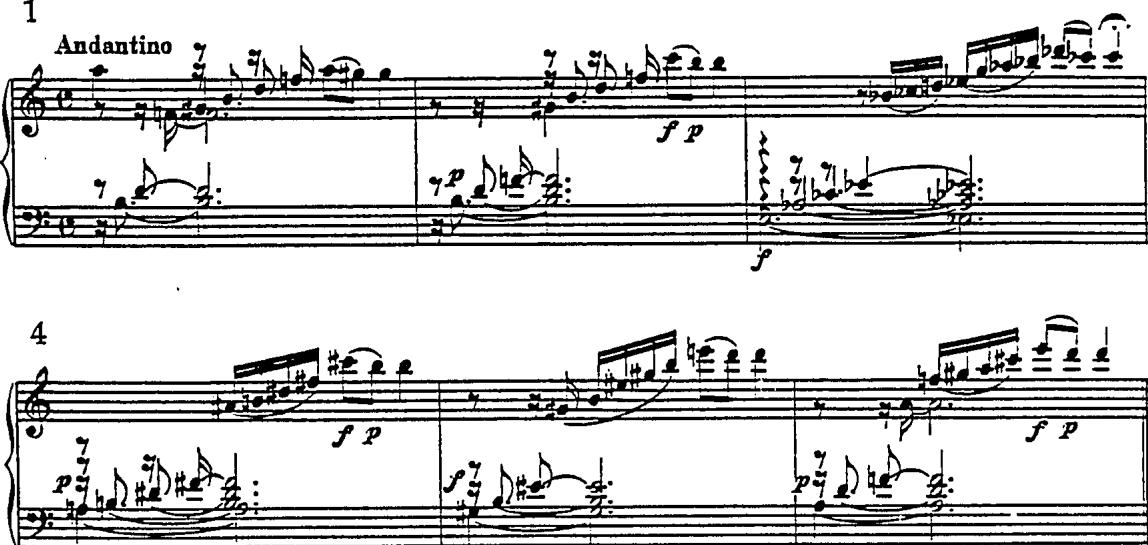
中文讲解
这是Example 22对应的第29页乐谱/图像占位符,读者需查看原图。
脚注 / 边栏 / 图表 / 附加信息(如有)
本节附加材料集中为三类:
- 谱例与图注:Example 19(H. 160,1762的数字低音框架)、Example 20(H. 234,1767)、Example 21(H. 284,1784,example 21对应的五度循环段)、Example 22(H. 284中模拟疯狂场景的材料并置段)。这些谱例是本节论证的事实证据,所有关于省略、转位、等音、省略与五度循环等具体定位都需依赖它们。
- 脚注:72(出处Ratner《Classic Music》p. 24,本节正文未直接引用);73(巴赫《试金集》2:41 §. 14,Mitchell译p. 442,P0166巴赫原话来源);74(Mitchell译法判断及申克"voice exchange"概念,Forte & Gilbert《Introduction to Schenkerian Analysis》p. 110);75(H. 234低音实为8-7-6-5下行四度进行的补充分析);76(Wiemer关于H. 75为J. S. 巴赫挽歌的推测及其驳论,Wiemer, Bach Jahrbuch 74 [1988]: 163-177);77(Marpurg《Kritische Briefe》2:3:257 §. 6);78(Cramer对《für Kenner und Liebhaber》卷四的评论及Polonius/Hamlet典故,本节未给出具体引文页码)。
- 版权声明:多页重复出现"Reproduced with permission of the copyright owner. Further reproduction prohibited without permission.",仅属出版层面的复制限制。
💡 本节核心要点
- 幻想曲体裁在和声语法上有三类特征性自由:省略(ellipsis,即省略原本应出现的中间和弦)、和弦转位/互换(chordal inversion / “Verwechselung der Harmonie”,即通过转位和声部互换制造非常规进行)、以及减七和弦的自由引入。
- 这些自由不仅由C. P. E. 巴赫在《试金集》中以H. 160为例作出理论说明,也在H. 234(1767)和H. 284(1784)等作品中以更复杂的形式实践;巴赫本人把后者称为"和弦互换”,并与申克分析中的"声部交换"(voice exchange)概念相通。
- 这些语法自由常使连续和弦之间不再有清晰的根音功能关系,而只靠声部进行逻辑、共同音与等音转换相互衔接——H. 75中接近终曲时F/V7仅由Bebung、增音程与等音维持的"恐惧"段即为代表。
- 多种语法自由可复合作用:H. 284(example 21)中表层的方向迷失感底层只是一条五度循环,被声部交换、等音转写和省略同时遮蔽。
- 语法自由与情感强度共生:Marpurg将等音与愤怒、绝望、复仇、嫉妒等激烈情感联系;H. 284中材料急速并置的段落与巴洛克正歌剧中的疯狂场景(如亨德尔《奥兰多》)平行,Cramer则以波洛涅斯"虽为疯狂,其中自有章法"之语为之佐证,并把讨论引向本节之外的第三类自由——材料的表面无序安排。
🔑 关键术语
- ellipsis(省略):在本节中特指和声语法上的省略,即在和弦进行中略去按惯例应当出现的中间和弦(如b上的七和弦到降b上的二和弦之间本应插入的b上四六和弦或c上三和弦)。C. P. E. 巴赫本人在《试金集》中以H. 160为例对这一做法作出说明,是本节讨论的第一类语法自由。
- chordal inversion / Verwechselung der Harmonie(和弦转位 / 和声互换):巴赫原术语,指通过转位或声部互换使非常规的和弦连接得以出现,从而模糊或遮蔽常规的根音功能进行。Mitchell将其译为"interchange of chordal tones"以突出其声部进行意味;与申克分析中的voice exchange(声部交换)相通。
- voice exchange(声部交换):申克分析中的术语,指两个声部彼此互换音高的模式。脚注74(Forte & Gilbert, Introduction to Schenkerian Analysis, p. 110)给出定义,是本节用来分析H. 234低音中x、y两处"bumpy effect"与"tonal whiplash"的概念工具。
- diminished seventh chord(减七和弦, vii°7):在本节中作为副属和弦引入下一个和弦,却只与前一增六和弦之间保持声部进行关系而无功能关系。它在H. 234(标z处)的自由出现,是巴赫本人在即兴演奏中也鼓励的语法自由之一。
- augmented sixth chord(增六和弦):本节中作为减七和弦的前一和弦出现,与减七和弦之间只存在声部进行的关联而非根音功能关联。
- voice-leading logic(声部进行逻辑):在本节中与root-functional syntax(根音功能语法)相对:和弦之间不依赖可识别的根音进行,而仅靠线性声部运动、共同音(pivot notes)和等音转换(enharmonic equivalence)维系。H. 75接近终曲处即典型例证。
- Bebung(揉弦):键盘乐器上通过手指在键上颤动模拟人声揉弦的装饰技法,本节中与"恐惧"情感及和声语法的脆弱性相联系(H. 75)。
- enharmony / enharmonic equivalence(等音,等音转换):把同一音高以不同音名书写(如#c = 降d),由此使和弦在功能上跨越调性边界。本节中H. 284的example 21和弦"x"(b, #c, #e, #g / 降d, f, 降a, 降c)即为典型例子;Marpurg将其与愤怒、绝望、复仇、嫉妒等激烈情感相联系。
- circle of fifths(五度循环):本节中作为H. 284 example 21的潜在进行;表层的方向迷失感来自声部交换、等音转写和省略对这条五度循环链的遮蔽(Forte & Gilbert书中称为voice exchange,本节将其与巴赫的Verwechselung der Harmonie相对应)。
- mad-scene(疯狂场景):巴洛克正歌剧中表现人物精神失常的程式化场景,本节将H. 284中材料急速并置的段落与之类比(具体类比为亨德尔《奥兰多》中的疯狂场景),并以C. F. Cramer对《für Kenner und Liebhaber》卷四的评论及波洛涅斯对哈姆雷特的著名描述作为佐证,从而把和声语法的自由与情感修辞联系起来。
1.10 [描述性拆分] Tonality, syntax, and the simulation of madness in H. 284
第1段(P0193)
原文复述
Footnote 78. Source: Cramer, Magazin der Musik, 1/2, 1251. The author suggests Cramer may have been quoting from memory, because every modern edition of the play the author has consulted gives a more elegant wording: “Though this be madness, yet there is reason in’t.” The author adds that this famous line occurs in Act 2, scene 2 of the play.
中文讲解
这是一条编号 78 的脚注,其来源被标注为 Cramer 发表于《Magazin der Musik》第 1/2 卷第 1251 页。脚注的主要工作是校勘文本细节:作者推测 Cramer 当时凭记忆转述,因此与他所查阅的各现代版本对勘时出现了文字差异;现代版本给出的措辞是 “Though this be madness, yet there is reason in’t”(原文用了斜体,提示此处为引文)。脚注最后补充了这条著名台词的出处定位——该剧第 2 幕第 2 场。这条脚注说明:本节正文所引用或讨论的 Cramer 文本可能并不精确,作者已经在脚注中替读者核对了通行版本,并给出了这一著名台词在剧本中的位置。它对正文起的是限定与校正作用,并不引入新的主张。本节小标题中出现的 “H. 284” 在此脚注里并未得到任何解释,脚注只关心 Cramer 的引文差异和场次定位,因此讲解时不应把 “H. 284” 与特定的作曲家、编号系统或具体作品细节在此处坐实。
补充说明
脚注中唯一直接可定位的事实是 Cramer 的出处(Magazin der Musik, 1/2, 1251)、“Though this be madness, yet there is reason in’t” 这一更通行版本、以及该台词位于第 2 幕第 2 场。小节标题中的 “H. 284” 与本脚注之间没有进一步的可定位关联,脚注亦未命名该剧。
第2段(P0194)
原文复述
Reproduced with permission of the copyright owner. Further reproduction prohibited without permission.
中文讲解
这是页面底部的版权声明,属于期刊/出版物的固定版面提示语,说明本页(或此处所引图例)已经过版权所有者授权使用,未经许可不得再次复制。它不承担论证功能,读者只需知道此处受版权约束即可,不影响本节对调性、句法与"疯狂"模拟的讨论。
第3段(P0195)
原文复述
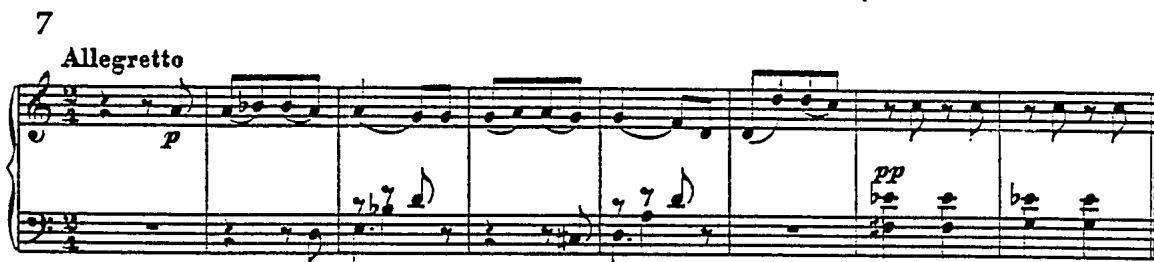
中文讲解
这是一个图注/图像占位符,图注文字为 “Example 22, continued."(例 22,接续),表明本页继续呈现编号为 22 的音乐示例。由于内嵌的图像数据本身在输入中被省略,具体音符、谱表、调号与节拍细节均无法直接看到,讲解只能停留在"图注 + 图像占位"的事实层面。本节小标题谈的是调性、句法与对"疯狂"的模拟,但图注本身并未给出任何分析性说明,因此不能据此推断 Example 22 具体展示了何种和声进行、终止式或主题特征。读者若要核对谱例,应回到原始出版物查阅原图。
第4段(P0196)
原文复述
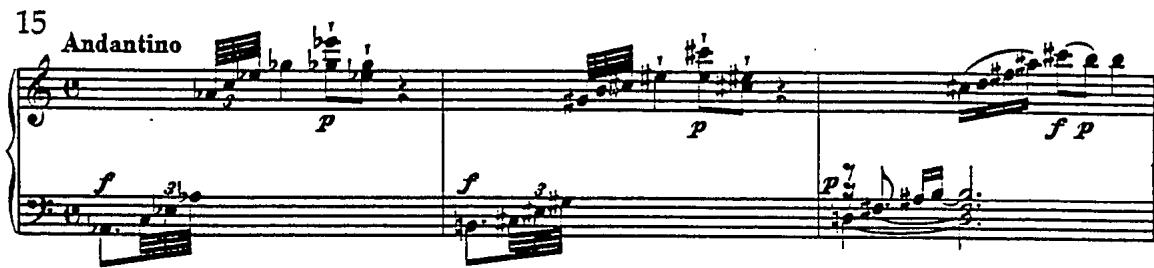
中文讲解
这是第 30 页上的一个图像/乐谱占位符。原文仅保留了图注说明,具体的图像或乐谱内容未在输入中给出,因此只能说明此处存在一段示例图像;其与 Example 22 的关系、所讨论的调性或句法处理、以及是否承担任何具体论证作用,都无法从现有文本直接确定。
第5段(P0197)
原文复述

中文讲解
这是第 30 页上的另一个图像/乐谱占位符,处理方式与 P0196 相同:原文仅给出占位符说明,没有可读的图像内容,也没有相关的分析语句,故只能如实指出此处是一段示例图像,其具体内容、调性处理或句法效果均无法在现有文本层面作出结论性陈述。
第6段(P0198)
原文复述
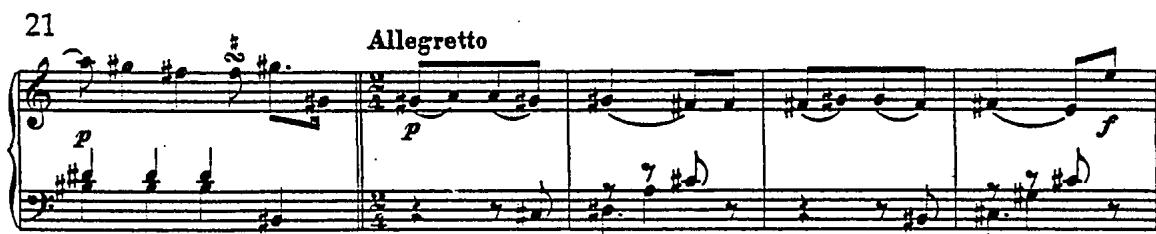
中文讲解
这是第 30 页上又一个图像/乐谱占位符,输入中只保留了占位说明。它在版面位置上仍是 Example 22 序列的延续,但图像内容本身缺失,文本也未对它附加任何评论,因此讲解不应在此处补充关于作曲家、作品号、乐章位置或"疯狂"修辞效果的具体断言。
第7段(P0199)
原文复述

中文讲解
这是第 30 页上继续出现的图像/乐谱占位符。与前几条占位符一样,图像本身的内容(谱表、音符、调号、和声进行等)在输入中均不可见,本节文字也没有对它作出直接评述。它在 Example 22 的连续展示中具有版面意义,但就本输入能够直接定位的信息而言,没有更多可断言之处。
第8段(P0200)
原文复述
Reproduced with permission of the copyright owner. Further reproduction prohibited without permission.
中文讲解
这是第 30 页尾部的版权声明,措辞与 P0194 一致。它是出版物的固定提示语,不承担论证功能,仅提醒读者本页示例受版权限制,不影响对调性、句法或"疯狂"主题的学术讨论。
第9段(P0201)
原文复述
Example 22, continued.
中文讲解
这是位于第 31 页的图注 “Example 22, continued."(例 22,接续),说明跨页的 Example 22 在第 31 页继续展开。图注本身仅为定位与接续提示,没有附加分析;因此,关于该谱例如何体现"调性、句法与对疯狂的模拟"的具体判断,都需要回到原图核对,本输入未提供这部分内容。
第10段(P0202)
原文复述
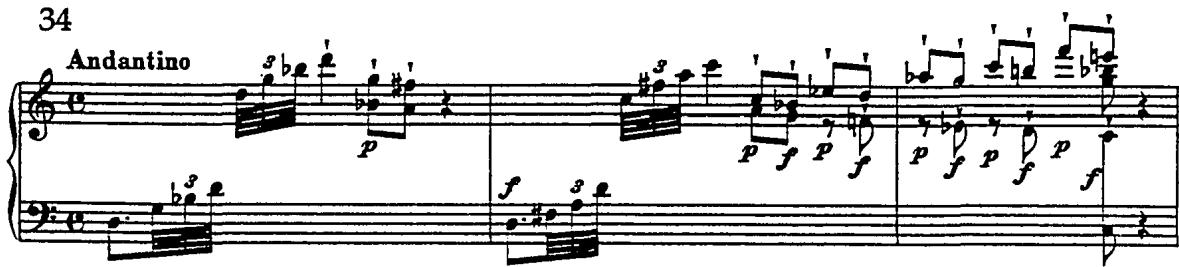
中文讲解
这是第 31 页上的图像/乐谱占位符,与 P0201 的图注 “Example 22, continued.” 配对出现。图像内容本身在输入中被省略,本节文字也没有对它作出直接论述,故应仅按"图注 + 缺失的图像"来理解。读者若要查看具体谱例,需要回到原出版物;讲解不应在此处补写关于作曲家、作品号、乐章位置、终止式或"疯狂"修辞效果的具体断言。
脚注 / 边栏 / 图表 / 附加信息(如有)
本节范围内可定位的附加材料包括:脚注 78(Cramer 出处、校勘差异、Act 2 scene 2 的场次定位)以及以 “Example 22, continued.” 为图注、跨越第 30—31 页的连续谱例展示,配以两段版权声明(“Reproduced with permission of the copyright owner. Further reproduction prohibited without permission.")。这些材料的作用分别是:脚注用于校正正文对 Cramer 转述的引文并定位原剧台词的场次;连续谱例用于以乐谱形式呈现 Example 22 的接续内容;版权声明则是出版物的版面提示,不参与论证。
💡 本节核心要点
- 本节的论证主体是乐谱示例 Example 22 及其在小节标题下所暗示的调性、句法与"疯狂"模拟之间的关系。
- 脚注 78 提示正文对 Cramer 的引述可能不精确,并给出了更通行的版本 “Though this be madness, yet there is reason in’t”,同时定位该著名台词于第 2 幕第 2 场。
- P0195—P0199、P0201—P0202 共同构成跨第 30—31 页的 Example 22 续谱,但具体乐谱内容在输入中不可见,不能据此作出关于作曲家、作品号、乐章位置或修辞效果的具体断言。
- 本节文本对小节标题中的 “H. 284” 没有给出可直接定位的作曲家、作品目录或乐章说明,相关具体信息不属于本节原文能够证实的内容。
- 第 30—31 页配有的版权声明仅起版面提示作用,不参与学术论证。
🔑 关键术语
- Cramer, Magazin der Musik, 1/2, 1251:本节脚注 78 给出的二手文献出处,作者据此核对 Cramer 对一段著名台词的转述,并指出 Cramer 可能是凭记忆引述,与现代通行版本存在措辞差异。
- “Though this be madness, yet there is reason in’t”:脚注中给出的该台词的更通行版本,用于对照 Cramer 文中可能不精确的转述;脚注把这条著名台词定位在 Act 2, scene 2,但未在原文中命名剧名。
- Example 22, continued.:横跨第 30—31 页、用于本节音乐分析的连续乐谱示例的图注字样,本身仅为定位与接续提示,具体乐谱内容在输入中不可见。
- H. 284:出现在本节小标题中的编号;本节脚注与正文未提供关于其归属、作品目录身份或具体音乐细节的可定位信息,因此仅作为标题字面信息保留。
1.11 [描述性拆分] 3. Arrangement of Ideas: the absence of a Hauptsatz and orderly rhetoric
第1段(P0203)
原文复述
3. Arrangement of Ideas
中文讲解
本段为章节小标题,标志着第三部分’思想的安排’的开始。这一节将集中讨论18世纪理论家如何把幻想曲(fantasia)相对于有序作曲规范的’偏离’理解为一种特殊的修辞自由,并具体追问其’无序’究竟体现在哪里——亦即Hauptsatz(主要主题)的缺席这一核心特征。标题中的’Arrangement of Ideas’(思想的安排)一语直接借用了18世纪把器乐作品视为’思想序列’的修辞传统,为整章奠定话语基调。
第2段(P0204)
原文复述
The notion that the fantasia is a piece without a plan or form is not articulated openly until D. G. Türk’s definition of the genre in his Klavierschule of 1789. Nevertheless, eighteenth-century writers had long observed that, in the fantasia, material is not elaborated and arranged according to the orderly rules of composition and rhetoric.
中文讲解
本段提出一个时间差:‘幻想曲没有计划或形式’这一观念直到Türk 1789年《钢琴教程》(Klavierschule)才被明确表述;但在此之前,18世纪作家们其实早已观察到幻想曲中的素材并未按作曲与修辞的有序规则加以展开与安排。论点的功能是为后文铺垫——既要凸显Türk定义的标志性地位,又承认此观念有更长的潜伏史,从而引出Mattheson、Klein、Türk、Koch等理论家对’无Hauptsatz’现象的共同关注。
第3段(P0205)
原文复述
The arrangement of material in the fantasia was judged disorderly by the standards of formal composition. Mattheson, Klein, Türk and Koch noted that the fantasia and the capriccio were composed or improvised without a Hauptsatz or principal theme. The importance, so to speak, of this absence of a principal theme to eighteenth-century definitions of the fantasia was such that Kant, in a brief reference to the genre in the Critique of Judgement, described the fantasia as music “without a theme.” In formal composition, however, the Hauptsatz occupied a pre-eminent position. It was equivalent to the subject of an argument in rhetoric. Subsidiary ideas
中文讲解
本段推进论证的核心:幻想曲和随想曲(capriccio)的素材安排在正式作曲标准下被视为’无序’,因为它们被Mattheson、Klein、Türk、Koch等人一致观察到没有Hauptsatz(主要主题)。此’缺席’重要到Kant在《判断力批判》中也以’无主题’来概括幻想曲。与此对照,正式作曲中Hauptsatz占据首要位置,相当于修辞学里’论辩的主题’,是统摄全篇的核心,因此辅助性思想……(段末因跨页而截断)。这一对照把’无序’从美学印象变成可与修辞规范正面比较的结构事实,为接下来引入Löhlein的有序作曲论述奠定逻辑基础。
补充说明
本段在第31页底部中断,下一段接续’Subsidiary ideas might be introduced, but the Hauptsatz must remain the focal point of the discourse’。
第4段(P0206)
原文复述
“Frey heißt eine Fantasie . . . wenn er [der Erfinder] sich völlig seiner Laune überläßt, ohne einem bestimmten Plan auszuführen.” Türk, Klavierschule, 395-6, §. 35.
中文讲解
脚注79,引自Türk《钢琴教程》第395-6页第35节,原文为德文:‘当[发明者]完全放任自己的兴致、不去实施任何既定计划时,那幻想曲就是自由的。‘这一引文是为正文P0204中关于Türk对幻想曲’无计划、无形式’之明确定义的文献来源,其关键短语’sich völlig seiner Laune überläßt, ohne einem bestimmten Plan auszuführen’直接呼应正文论点,即幻想曲拒绝任何预定方案的展开。
补充说明
脚注中对’Erfinder’一词的方括号补注是原文编辑加入的说明性插入,保留德文以与正文的Türk引证保持一致。
第5段(P0207)
原文复述
James C. Meredith, ed. and trans., Kant’s Critique of Aesthetic Judgement (Oxford: Clarendon Press, 1911), 72. Kant’s reference to the fantasia is further discussed below in the conclusion to this chapter.
中文讲解
脚注80,提供Kant《判断力批判》(由Meredith编辑并英译,Clarendon出版社1911年版)第72页作为正文P0205中Kant称幻想曲为’无主题’之引用的文献出处。同时该脚注提示读者:Kant对幻想曲的提及还将在本章结论部分进一步讨论,构成对该引证的后向照应。本脚注本身仅为来源性引证,不展开学术评论。
第6段(P0208)
原文复述
Reproduced with permission of the copyright owner. Further reproduction prohibited without permission.
中文讲解
第31页页脚的版权声明:‘经版权所有者许可复制;未经许可不得进一步复制。‘属于版式信息,不承载学术内容。
第7段(P0209)
原文复述
might be introduced, but the Hauptsatz must remain “the focal point of the discourse.”
中文讲解
本段是P0205跨页后的续句:在正式作曲中虽然可以引入辅助性思想,但Hauptsatz必须保持’话语的焦点’。引文出处见脚注81(即Bonds《无言的修辞》第95页)。这句话与P0205前半段合在一起,构成完整的Hauptsatz定义性论述——它是论辩的核心、是统摄全曲的支点;只有把握这一点,才能理解幻想曲’无主题’为何被同时视为修辞上的’自由’与对规范的’偏离’。
补充说明
引文’the focal point of the discourse’出自脚注81,作者Mark Evan Bonds。
第8段(P0210)
原文复述
To understand this particular liberty of the fantasia it is essential to describe in more detail how contemporary writers conceived of orderly composition. For if we are unaware of the rules we cannot fully appreciate the licences of the fantasia. Löhlein, writing only three years after the publication of Bach’s discussion of improvisation, offers a lucid account of what he describes as Setzkunst or the orderly arrangement of ideas. Though concerned with improvisation, and explicitly acknowledging that the fantasia is not bound to these rules, Löhlein advises that musicians should at least know about them, since, he suggests, these rules may prove useful for strict fantasias.
中文讲解
本段承上启下:作者提出,要真正理解幻想曲的’自由’,必须先把有序作曲(orderly composition)的规则讲清楚——‘不知规矩,无以见自由’。他之所以选用Löhlein作为主要参照,是因为后者写作时间仅在Bach讨论即兴演奏的著作出版三年之后,对所谓Setzkunst(有序编配艺术)有清晰阐述。值得注意的是,Löhlein虽以即兴演奏为论域,却明确承认幻想曲不受这些规则约束;他仍然建议演奏者应了解规则,因为他认为这些规则对’strict fantasias’(严格的幻想曲)可能有用——这一保留把’严格’与’自由’两端在幻想曲内部作了进一步区分。
补充说明
脚注82指向Löhlein《钢琴教程》(Clavier-Schule)第20章第178页第5节,并提示作者Bonds在《修辞》中未讨论Löhlein。
第9段(P0211)
原文复述
Löhlein uses the terms Setzkunst, Rhyt[h]mus and Klangrede synonymously with reference to the orderly arrangement of ideas required in composition. He describes the phrase structure and tonal design of a binary minuet with a view to explaining “how the parts relate to the whole” (example 23). The minuet consists of two repeated parts (“Theile”) within which Löhlein distinguishes musical units of different lengths as they are marked out by cadences. In so doing he employs terminology from grammar; he describes a musical comma or Einschnitt in m. 2, and a period (“Punct”) in m. 4. Löhlein intertwines harmonic design with this account of phrase
中文讲解
本段具体展开Löhlein的Setzkunst理论。三个术语——Setzkunst、Rhythmus(原文拼作Rhyt[h]mus)和Klangrede——在Löhlein笔下是同义词,皆指作曲中所要求的’思想的有序安排’。方法上,Löhlein以一段二段体小步舞曲(见例23)为例,演示’部分如何关联整体’:该曲由两个反复部分(‘Theile’)构成,Löhlein在其中依据终止式划分出不同长度的音乐单位;他借用语法术语,在第2小节称为Einschnitt(乐逗/句读),在第4小节称为’Punct’(乐段/句号)。他把和声设计与这一短语结构论述交织在一起……(句末因跨页而截断,下一段续)。这里的核心论点是:18世纪的有序作曲在概念资源上借自语法/修辞学,这正是幻想曲’无序’的对立面参照。
补充说明
本段在第32页底部截断,下一段(P0214)从’structure or musical grammar’续起。
第10段(P0212)
原文复述
Mark Evan Bonds, Wordless Rhetoric. Musical Form and the Metaphor of the Oration (Cambridge: Harvard University Press, 1991), 95. Bonds argues that in the eighteenth and early-nineteenth centuries “the instrumental work was seen as a wordless oration, and its form was viewed not so much as a harmonic or thematic plan but an ordered succession of thoughts. In the interests of intelligibility, these musical ideas–an amalgam of melodic, harmonic, and rhythmic elements–tended to be arranged within a limited number of conventional patterns.” In developing this metaphor, Bonds invokes the fantasia and capriccio as “revealing exceptions,” for these genres are “wholly unrelated to any kind of stereotypical pattern,” 53. Löhlein, Clavier-Schule, ch. 20, 178, §. 5. Löhlein is not discussed in Bonds, Rhetoric.
中文讲解
本条目合并了脚注81与脚注82两段来源信息。脚注81:Mark Evan Bonds《无言的修辞:音乐形式与演说之隐喻》(哈佛大学出版社1991年)第95页。Bonds的论点是,18世纪至19世纪初,器乐作品被视为’无言的演说’,其形式并非主要以和声或主题为骨架,而是被看作’思想的有序序列’——为求清晰可解,这些音乐思想(旋律、和声、节奏要素的混合)倾向于被安排在数量有限的几种常规模式之中。Bonds在发展这一隐喻时,把幻想曲与随想曲称为’揭示性的例外’,因为这两种体裁’与任何定型化的模式全然无涉’(第53页)。脚注82:Löhlein《钢琴教程》第20章第178页第5节,并附说明:Bonds的《修辞》一书未讨论Löhlein——即作者本人将Löhlein纳入论述是对Bonds既有研究的一项材料补充。
补充说明
脚注82中提示的’Bonds未讨论Löhlein’是作者插入的学术定位,意在声明本文相对于Bonds既有研究的材料增量。
第11段(P0213)
原文复述
Reproduced with permission of the copyright owner. Further reproduction prohibited without permission.
中文讲解
第32页页脚的版权声明,版式信息,不承载学术内容。
第12段(P0214)
原文复述
structure or musical grammar. The first part “closes with a cadence in the relative major and, so to speak, with a period.”
中文讲解
本段承接P0211,将论述拉回Löhlein对例23小步舞曲的句法分析:他论证这一小步舞曲的结构——或者用他的隐喻说,其’音乐语法’——第一部分以关系大调(relative major)的终止式结束,作者补充说,这一结束’就仿佛是一个句号(period)’。通过把句法/语法概念与终止式相连,Löhlein让读者看到:终止式并非纯粹的和声现象,而是音乐’思想序列’中相当于句读或句号的结构标记。这正是’思想的有序安排’得以成立的最小单位机制,也是P0217后即将展开的’幻想曲无序’反题的根本参照。
补充说明
引文出处见脚注83:Löhlein《钢琴教程》第20章第178-180页第6-10节。
第13段(P0215)
原文复述
Example 23. Georg Simon Löhlein, Minuet in d. Clavier-Schule, ch. 20, 179-180, §. 8.
中文讲解
图注23:Georg Simon Löhlein d小调小步舞曲,引自《钢琴教程》第20章第179-180页第8节。该乐谱是正文P0211与P0214讨论’有序安排思想’与’部分如何关联整体’的具体例证。
第14段(P0216)
原文复述
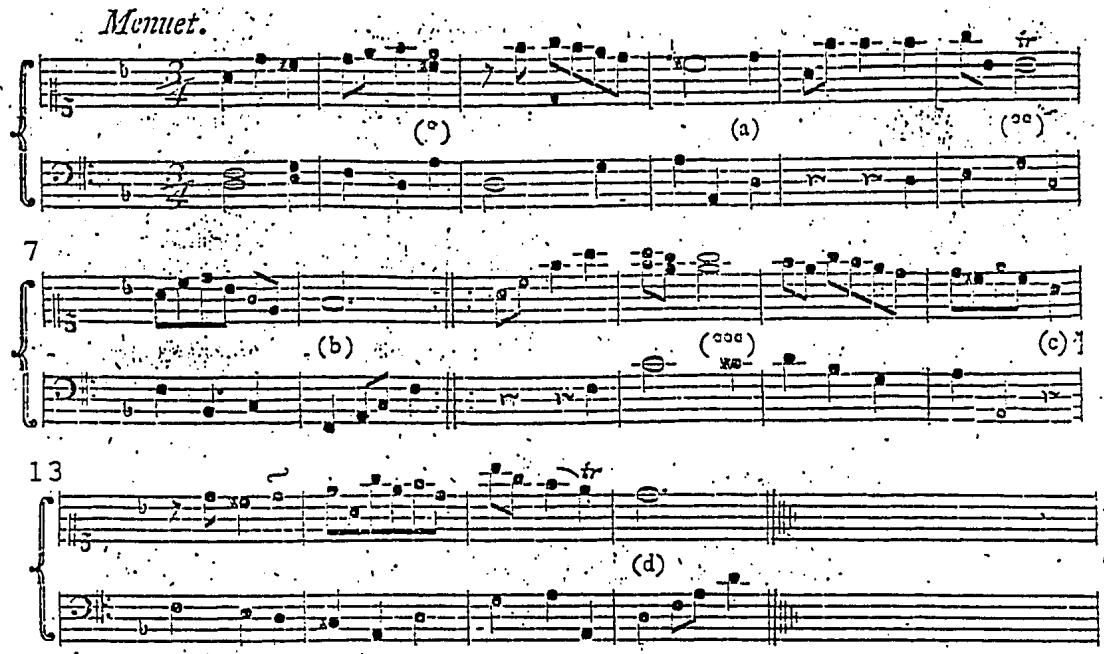
中文讲解
本页(33页)的乐谱图像占位符,对应图注23所标识的Löhlein d小调小步舞曲。图像的原始数据未嵌入本节文本,仅保留其位置与图注信息;具体谱面、和声走向与终止位置需查阅原书第33页图像。从正文论证角度看,该谱例是Löhlein用以演示Einschnitt(第2小节)、Punct(第4小节)以及关系大调终止等’有序安排’特征的最小实例。
补充说明
图注信息已在P0215中完整复述,本占位符只承担谱面图像本身。
第15段(P0217)
原文复述
The fantasia, in contrast, does not follow the rules of musical rhetoric and grammar. Koch described the fantasia as comprising “melodic phrases that are now precisely interconnected, now loosely strung together.” In a review of Bach’s fantasias from the fourth volume für Kenner und Liebhaber, Cramer pointed to “a collection of momentary ideas, thoughts, capriccios.” The disorderly arrangement of ideas in this genre is rooted in the tradition of phantastischer Styl (discussed in chapter two). Mattheson described an irrational unfolding of material in this style, “for one sometimes lights upon a sudden idea, and then another, as one is bound neither to
中文讲解
本段是本节论证的转折核心:在前述Löhlein有序作曲作为参照之后,正式揭示幻想曲’不遵循音乐修辞与语法规则’的对立面。Koch把幻想曲概括为’时而被紧密交织、时而被松散串联的乐句’;Cramer在评论Bach《为行家与爱好者》(für Kenner und Liebhaber)第四卷中的幻想曲时,更把它看作’瞬间念头、思想、随想的集萃’。作者随即把这种无序的素材安排追溯到第二章讨论过的phantastischer Styl(幻想风格)传统,并引Mattheson描述该风格中素材’非理性地展开’的过程——‘因为有时突然冒出一个念头,然后又冒出另一个,演奏者既不必……’(句末因跨页而截断)。这一段的功能是把’无序’从’反规则’升级到’反规则的传统本身’:幻想曲的无序并非偶发的偏离,而是承接自一个具有自身谱系的’幻想风格’。
补充说明
段末因第33页页脚排版而中断;引文出处分别见脚注84(Koch《音乐辞典》第555页)和脚注85(Cramer编《音乐杂志》第一卷第二期第1251页)。
第16段(P0218)
原文复述
Löhlein, Clavier-Schule, ch. 20, 178-180, §§. 6-10.
中文讲解
脚注83,提供P0214中关于Löhlein分析小步舞曲’第一部分以关系大调终止、并仿佛以句号结束’之引文的文献出处:Löhlein《钢琴教程》第20章第178-180页第6-10节。本脚注仅为来源性引证。
第17段(P0219)
原文复述
“[Der Tonkünstler] seine Ideenfolge bald in genau zusammenhängenden, bald in locker an einander gereiheten melodischen Sätzen . . . darstellet.” Koch, Lexicon, 555.
中文讲解
脚注84,引自Koch《音乐辞典》第555页,原文为德文:’[音乐家]将其思想序列时而在紧密相连的、时而在松散串联的乐句中加以呈现……’。这一引文为P0217中Koch对幻想曲素材’时而紧密交织、时而松散串联’之描述提供直接文献来源;其关键短语’genau zusammenhängenden’(紧密相连)与’locker an einander gereiheten’(松散串联)正是后文’无序’判定的语言学根据。
第18段(P0220)
原文复述
“. . . eine solche Sammlung von momentaneen Einfällen, Gedanken, Capriccio’s.” Cramer, ed., Magazin der Musik, 1/2, 1251.
中文讲解
脚注85,引自Cramer所编《音乐杂志》第一卷第二期第1251页,原文为德文:’……这样一组瞬间的念头、思想、随想。‘这是P0217中Cramer评论Bach《为行家与爱好者》第四卷幻想曲之’瞬间念头、思想、随想集萃’说法的直接文献出处;三个名词Einfällen(念头)、Gedanken(思想)、Capriccio’s(随想)以并列结构罗列,本身即隐喻幻想曲内部并置、无统一主线的’无序’结构。
第19段(P0221)
原文复述
Reproduced with permission of the copyright owner. Further reproduction prohibited without permission.
中文讲解
第33页页脚的版权声明,版式信息,不承载学术内容。
脚注 / 边栏 / 图表 / 附加信息(如有)
本节附加材料包括七则脚注(79-85)、一幅谱例(Example 23)以及三处版权页声明。脚注79、84、85分别为德文原文引证(Türk、Koch、Cramer),承担为正文论点提供原始文献来源的功能;脚注80、81、82、83为英文出版信息和文献索引,其中脚注81(Bonds)较长,承担为’器乐作品=无言演说’这一修辞隐喻提供学术背景的功能,并构成作者自身的对话对象;脚注82末尾点明’Bonds未讨论Löhlein’,是作者对自己材料贡献的学术定位。Example 23为Löhlein d小调小步舞曲谱例,是正文P0211与P0214讨论’有序思想安排’与’部分—整体关系’的具体演示载体。三处版权声明分别为第31、32、33页的版式脚注,不承载学术内容。
💡 本节核心要点
- 18世纪理论家普遍把幻想曲界定为’无计划、无形式’的体裁,Türk 1789年《钢琴教程》虽为最早的明文定义,但此前Mattheson、Klein、Koch等都已观察到幻想曲素材并不按作曲与修辞的有序规则加以展开。
- 幻想曲被共同诊断的结构性特征是Hauptsatz(主要主题)的缺席;这一缺席如此关键,以至于Kant在《判断力批判》中将幻想曲直接称为’无主题’的音乐;而在正式作曲中,Hauptsatz相当于修辞学中的论点,是统摄话语的焦点。
- 为凸显幻想曲的’修辞自由’,作者引入Löhlein的Setzkunst(有序编配艺术)作为对立参照:Setzkunst、Rhythmus、Klangrede在Löhlein笔下为同义词,皆指’思想的有序安排’,并以二段体小步舞曲为最小实例,借用语法术语Einschnitt(乐逗)与Punct(句号)来标记终止结构。
- Löhlein虽以即兴演奏为论域却明确承认幻想曲不受规则约束,但他仍建议演奏者了解这些规则,因为他认为它们对’strict fantasias’(严格的幻想曲)可能有用——这在’严格/自由’两端对幻想曲作了内部区分。
- 与有序参照形成对照,Koch把幻想曲描述为’时而紧密交织、时而松散串联的乐句’,Cramer把它形容为’瞬间念头、思想、随想的集萃’;作者由此把幻想曲的’无序’进一步追溯到第二章讨论过的phantastischer Styl(幻想风格)传统,把无序升级为’反规则的、有自身谱系的传统’。
🔑 关键术语
- Hauptsatz:德语术语,指’主要主题/正题’,在18世纪正式作曲与修辞学中相当于论辩的主题或话语的焦点。本节把Hauptsatz的有无作为衡量有序作曲与幻想曲’无序’的关键标尺。
- Setzkunst:德语术语,Löhlein用以指代作曲中有序的思想安排(orderly arrangement of ideas),在本节中作为与幻想曲’无序’相对的正面参照概念出现。
- Klangrede:德语术语,直译’音响修辞/言语’,Löhlein与Setzkunst、Rhythmus并列为同义词,共同指作曲中所要求的’思想的有序安排’。
- Rhyt[h]mus / Rhythmus:节奏,原文拼作Rhyt[h]mus(方括号提示字母h可省略)。在Löhlein笔下与Setzkunst、Klangrede同义,强调节奏作为有序编曲机制之一。
- Einschnitt:德语术语,意为’切分/句读’。Löhlein用以标记例23小步舞曲第2小节处的音乐句读,相当于语法中的逗号。
- Punct:德语术语,意为’句号/句点’。Löhlein用以标记第4小节处的小节单位结束,在文中也被借来形容关系大调终止处的’如句号般’的收束感。
- Theile:德语术语,意为’部分/段落’。Löhlein用以指例23小步舞曲中两个反复段,构成二段体的形式骨架。
- phantastischer Styl:德语术语,意为’幻想风格’。作者在本节末段指出幻想曲的无序素材安排根源于此传统,该传统在第二章已作讨论,此处属跨章节照应。
1.12 [描述性拆分] Inventiveness, eccentric juxtaposition, and feverish repetition in the fantasias
第1段(P0222)
原文复述
…words nor a melody, … without a formative Hauptsatz and outline, without a theme or subject that is to be elaborated.
中文讲解
这是一段引文的收尾部分。原文在前面已经讨论了某种幻想曲的不足——既没有可识别的“词”,也没有可识别的旋律,缺少构成性的 Hauptsatz(主句/主题句)和轮廓,更没有可供展开的主题或 subject(主部)。Hauptsatz 是德语理论术语,指乐曲中最先确立、作为整段展开基础的核心句法单位;在此处用来说明此类作品根本没有这种结构支点。引文的省略号(…)表明它在原书中只是一段更长论述的截取尾段,因此本句的逻辑重点在于连续否定:缺乏“词”/缺乏“旋律”/缺乏主句/缺乏可展开主题,由此衬托出与下文将出现的“自由幻想曲”截然相反的形象。
补充说明
Hauptsatz 是 Koch 与同时代德语音乐理论中的核心术语,与 Nachsatz(副句)相对,本节中作为对照标准出现。无额外补充。
第2段(P0223)
原文复述
Bach himself had little to say about inventiveness in his discussion of the free fantasia. Nonetheless, it is manifest in Bach’s free fantasias themselves. The free fantasia in B-flat, H. 289 (1785-6), bristles with inventive spontaneity (example 24). The first section (mm. 1-35) portrays what Koch, with reference to the fantasia, described as “the unrestricted play of the imaginative and inventive powers of the composer.” There are 14 distinct motifs, as summarized in table 2.
中文讲解
本段提出一个重要区分:C. P. E. Bach 本人在讨论自由幻想曲时几乎没有谈过“创造性”(inventiveness),但这种创造性在他自己的自由幻想曲作品中却显而易见。作者随即用 B♭ 大调自由幻想曲 H. 289(1785–6)作为正面的乐例,认为其“充满发明性的自发性”(见例 24)。该曲第一段(mm. 1–35)被作者用来比附 Koch 对幻想曲的经典描述——“作曲家想象性与创造性力量的毫无拘束的发挥”。作者进一步用具体的数字证据支撑这一印象论断:仅这 35 小节中就可辨识出 14 个不同的动机,并汇总于表 2。本段在本节中的作用是为“创造性”建立一个从文献证据到乐曲证据的双重锚点——既有 Koch 的理论表述,也有 H. 289 中的具体材料分析。
补充说明
H. 289 即 C. P. E. Bach 的 B♭ 大调自由幻想曲,编号沿用 Helm 主题目录。本段中 Koch 的引文与 14 个动机的统计由表 2 体现;表 2 不在本节文字范围内。无额外补充。
第3段(P0224)
原文复述
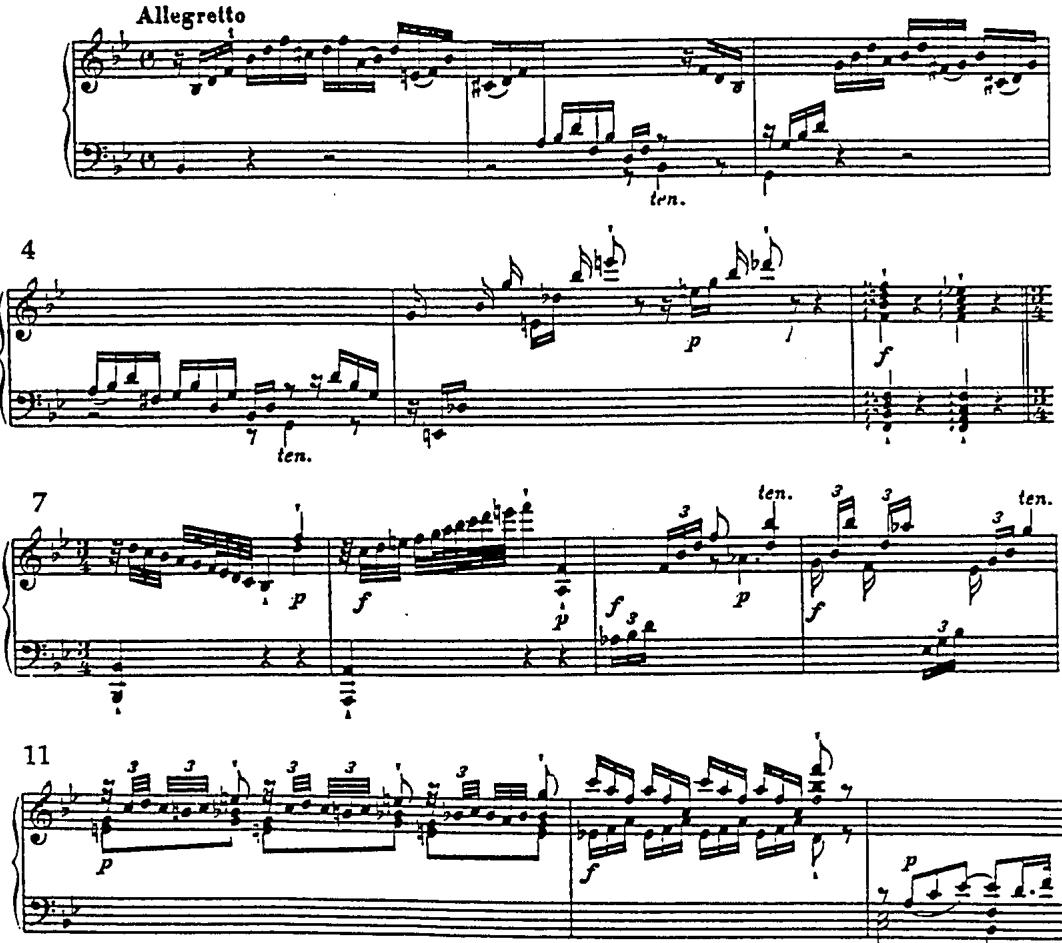
中文讲解
这是乐谱占位符及其图注:例 24,C. P. E. Bach《B♭ 大调自由幻想曲》H. 289(1785–6)第 1–35 小节。它对应 P0223 中关于“14 个不同动机”与“毫无拘束的想象性发挥”的论述,是作者用来将 Koch 的抽象定义与具体谱面并置的关键证据。由于内嵌图像数据已被省略,需查看原图以核对 14 个动机的具体音型划分。无额外补充。
补充说明
图注中标注的 mm. 1–35 与 P0223 所述“第一段”范围一致;具体谱例内容需查看原图。
第4段(P0225)
原文复述
Reproduced with permission of the copyright owner. Further reproduction prohibited without permission.
中文讲解
这是版权声明版面信息,复述其内容即可:经版权所有者许可而复制,未经许可不得进一步复制。它与 P0224 的例 24 配对出现。无额外补充。
第5段(P0226)
原文复述
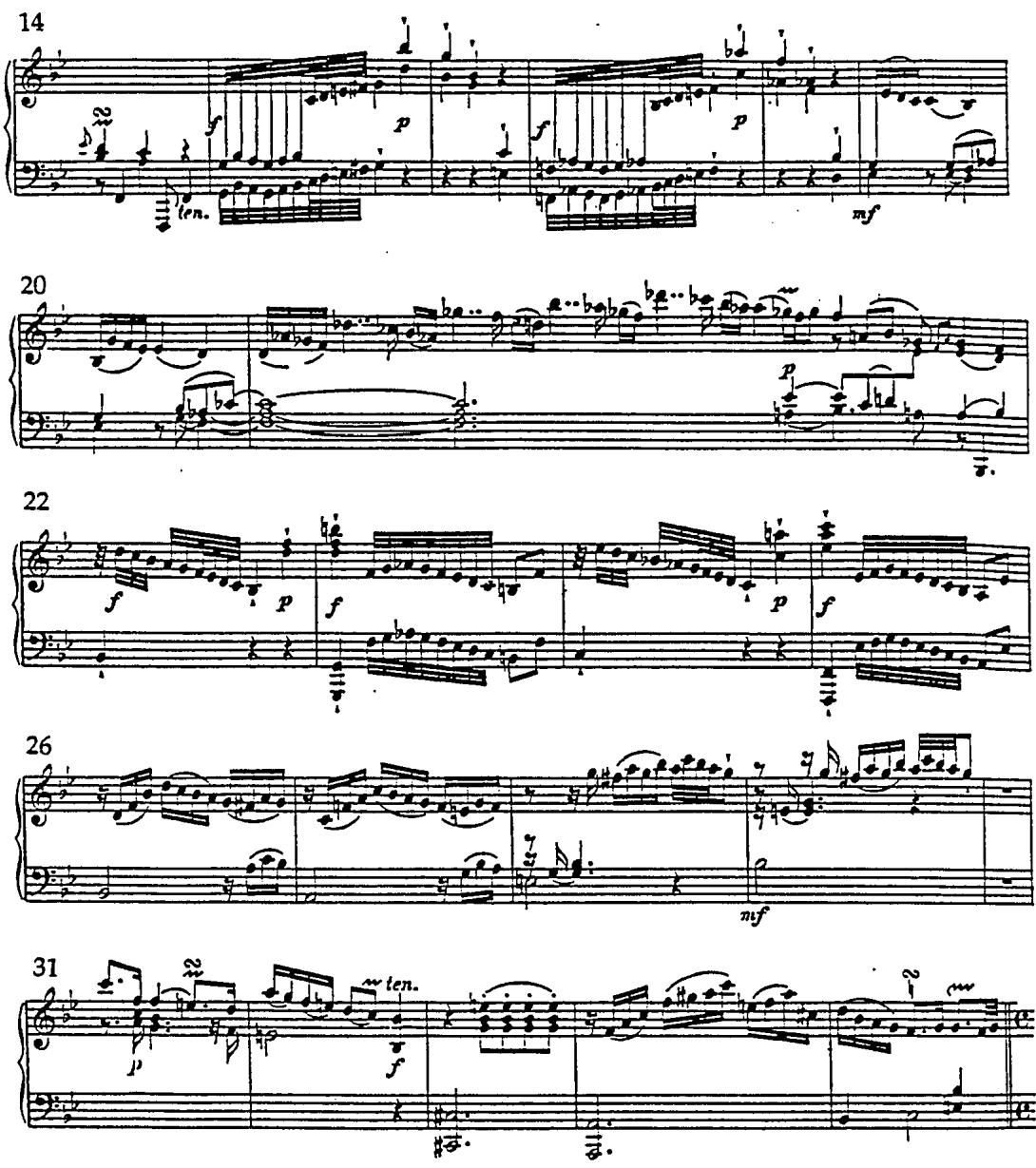
中文讲解
第 35 页上的图像或乐谱占位符,原始标注指出此处为第 35 页图像或乐谱示例,具体内容需查看原图方可确认。从章节脉络来看,它应承续例 24 的讨论并配合 P0227 的版权声明。无额外补充。
补充说明
占位符未给出确切图例编号,需查看原书第 35 页以核对内容。
第6段(P0227)
原文复述
Reproduced with permission of the copyright owner. Further reproduction prohibited without permission.
中文讲解
版权声明版面信息,与第 35 页上的图像或乐谱占位符配对。功能与 P0225 相同。无额外补充。
第7段(P0228)
原文复述
The faculty of the imagination is felt once more in the characteristic inventiveness of the fantasia. Koch’s equation (above) of “imaginative and inventive” powers reflects the assumption on the part of eighteenth-century writers that the imagination (die Fantasie) was the principal inventive faculty. In his definition of the fantasia, Koch began with an account of the faculty of the imagination that he associated largely with richness of invention. Mattteson’s use of the phrase freie Fantasie with reference to inventiveness (noted above) attests to this connection.
中文讲解
本段把“创造性”重新安放在 18 世纪心理学的语义框架中。Koch 将“想象性”与“创造性”画等号,反映的是 18 世纪普遍的理论假设:想象(die Fantasie)本身就是首要的创造性官能。Koch 对幻想曲的定义因此是从“想象官能”讲起,并把“发明的丰富性”几乎等同于想象本身。Mattheson 在前文中用 freie Fantasie 一语与“创造性”挂钩,亦是这一假设的旁证。本段的功能是补上概念史的链条:自由幻想曲之所以在 18 世纪成为发明性最自然的载体,并非偶然,而是因为当时的“fantasia”一词本身就承载了“想象—发明”这组心理—创作能力。
补充说明
die Fantasie 与 freie Fantasie 均为德语术语,本段中第一次出现 die Fantasie,作者以括号形式给出原文以说明 18 世纪德语理论资源。无额外补充。
第8段(P0229)
原文复述
The proliferation of contrasting inventions in the free fantasia in B-flat, H. 289 also creates the whimsical or eccentric impression that is so characteristic of C. P. E. Bach’s solo keyboard music. The juxtaposition of the opening broken chords in 4/4 (mm. 1-6) with the descending scalar run in 3/4 (m. 7) is a calculated simulation of irrationality in the stream of ideas.
中文讲解
本段把“发明的增殖”与“怪诞(eccentric)”印象联系起来。H. 289 中并置出现的大量彼此对比的发明性材料,造成一种异想天开甚至怪诞的总体气质——这正是 C. P. E. Bach 独奏键盘音乐最典型的风格印记。作者紧接着举出一个最精炼的实例:开头在 4/4 拍中以分解和弦展开(mm. 1–6),紧接着第 7 小节突然转入 3/4 拍的下行音阶。作者特别强调,这并非失控,而是“刻意模拟思想流中的非理性”。也就是说,节拍与织体的突然错位是作曲家主动追求的效果,用以模拟人在自由联想时跳跃、断裂、非逻辑的一面。本段的作用是把前段“创造性”概念向“怪诞联想”延伸。
补充说明
footnote 87 标注本段使用了 Darrell Berg 关于“eccentric 与 irrational”的术语体系,详见 P0232。无额外补充。
第9段(P0230)
原文复述
Since the fantasia is not bound to an orderly arrangement of material it may portray illogical patterns of thought. Feverish repetition of a short motif, for example, simulates a burst of obsessive energy, as in example 25, where the acciaccatura motif “x” (c-sharp, d, g-sharp) immediately before the
中文讲解
本段提出“狂热式重复”(feverish repetition)作为幻想曲模拟非理性思维的另一种手法。逻辑前提是:幻想曲不必遵循材料的整齐安排,因此可以刻画非逻辑的思想模式。当一个短小动机被反复、密集地重复时,它模仿的是一种强迫式的能量爆发。随即作者以例 25 引入具体分析,并给出动机“x”的具体音程构成——倚音(acciaccatura)形态的 c♯、d、g♯——恰好出现在一个延长记号之前。本段在本句末尾被截断,描述将在 P0234 中继续。无额外补充。
补充说明
acciaccatura 即“碎音”“倚音”,指接近主音但提前轻轻击下的装饰音。本段末尾“immediately before the”指向下一个 feramta 处的延长记号,叙述在 P0234 中续完。
第10段(P0231)
原文复述
86 Heinrich Christoph Koch, Kurzgefaßtes Handwörterbuch (1807; reprint, Hildesheim: Georg Olms, 1981): 146-7.
中文讲解
这是脚注 86,出处为 Heinrich Christoph Koch,《简明音乐手册》(Kurzgefaßtes Handwörterbuch),1807 年初版,重印本由希尔德斯海姆 Georg Olms 出版社于 1981 年出版,所引页码为 146–147。该脚注与 P0228 中 Koch 对“想象官能”与“发明的丰富性”的论述相对应,是作者引用 Koch《简明音乐手册》第 146–147 页的直接来源。
补充说明
Koch(1749–1816)是德国音乐理论家,《简明音乐手册》是他生前未完成、由其遗稿整理出版的重要词典。该书是 18 世纪末德语音乐修辞学与形式理论的代表性文献。无额外补充。
第11段(P0232)
原文复述
87 Darrell Berg employs the terms eccentric and irrational throughout her study of Bach’s sonatas; see introduction, above, p. 1 n. 2.
中文讲解
脚注 87 指出,作者采用的“eccentric(怪诞)”与“irrational(非理性)”一对术语源自 Darrell Berg 对 C. P. E. Bach 奏鸣曲研究的贯穿用法;详细出处见本书导论部分(即前文,p. 1, n. 2)。该脚注是对 P0229 “怪诞印象”描述的术语来源说明,属于对前人研究的引用旁证。
补充说明
此处仅复述脚注信息本身;Darrell Berg 的研究全名及详细出版信息按规则需以本书导论 p. 1 n. 2 为准,本节文字未提供额外细节,因此不予补写。
第12段(P0233)
原文复述
Reproduced with permission of the copyright owner. Further reproduction prohibited without permission.
中文讲解
版权声明版面信息,与本节内某图例或乐谱占位符配对出现。功能与 P0225、P0227 相同。无额外补充。
第13段(P0234)
原文复述
fermata, is repeated in ever expanding versions, as the upper voice rises through an octave to d. The feverish repetition of this motif dramatizes the approach to the ensuing authentic cadence in a minor, of which the pitch d (the goal of the expanded repetitions) serves as the seventh of the dominant-seventh chord.
中文讲解
承接 P0230,本段完成对例 25 的具体分析。动机“x”(c♯–d–g♯)出现在延长记号之前,随后被反复,但每次重复都作“扩张”处理:上声部持续上升,跨越一个八度,最终到达 d。这条 d 不仅是所有扩张性重复的“终点目标”,更重要的是,它紧接着作为属七和弦的七音,引入小调中的正格终止(authentic cadence)。因此这一“狂热重复”并不是空洞的炫技,而是把听众一步步推向终止的戏剧化手段——重复的密度和扩张感模拟出能量即将爆发的瞬间,与终止处的解决形成强烈的期待与释放。本段的作用是把“怪诞/非理性”手法安放在和声功能论的框架内:表面上的非理性重复,最终服务于一个高度理性化的终止结构。
补充说明
本段是 P0230 的逻辑续写,所有音乐分析术语——authentic cadence(正格终止)、dominant-seventh chord(属七和弦)、seventh(和弦七音)——均按作者原意使用,无外部补充。
第14段(P0235)
原文复述

中文讲解
乐谱占位符及其图注:例 25,C. P. E. Bach《E♭ 大调自由幻想曲》H. 277(1782)。该图例即 P0230–P0234 中关于倚音动机“x”被狂热式重复、扩张,并最终导向小调正格终止的分析对象。由于内嵌图像数据已被省略,倚音动机的具体节奏位置与上声部八度扩张的细节需查看原图。无额外补充。
补充说明
H. 277 与 H. 289 均为 C. P. E. Bach 自由幻想曲,编号沿用 Helm 主题目录。无额外补充。
第15段(P0236)
原文复述
Alternately, a more lyrical idea, potentially the subject of a longer passage, may break off, be passed over, and forgotten (example 26). If fantasias unfold (in Koch’s words) as “[eine] Ideenfolge,” then this “train of thought” was not necessarily logical. 88
中文讲解
本段提出与“狂热重复”相对的另一种幻想曲手法:原本听起来像是要发展为较长段落的抒情性乐思,可能在展开前被突然打断、被略过、被遗忘——见例 26。作者随即借 Koch 的术语 Ideenfolge(思想/观念序列)指出:幻想曲的展开是“思想流”,但这种思想流并不必然是合逻辑的。脚注标号 88 提示此处有进一步文献支持,注的具体内容不在本节范围内。本段的功能是补足本节对幻想曲“模拟非理性思维”的两种典型策略——一是同一动机的狂热重复与扩张(P0230–P0234),二是看似合理的乐思被突然中断(P0236)。两者共同证明 Koch 意义上 Ideenfolge 的非逻辑性。
补充说明
Ideenfolge 是 Koch 使用的德语术语,本段以方括号补全“eine”表示可省略冠词;脚注 88 的具体出处信息不在本节文字中。
第16段(P0237)
原文复述
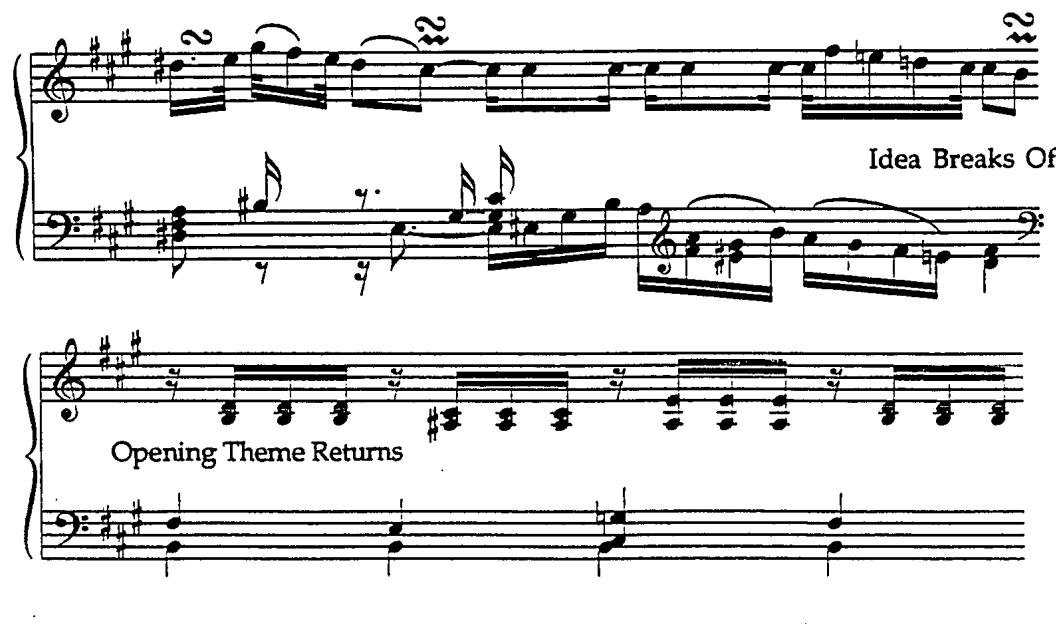
中文讲解
乐谱占位符及其图注:例 26,C. P. E. Bach《升 f 小调自由幻想曲》H. 300(1787)。该图例对应 P0236 所描述的“抒情性乐思被中途打断并遗忘”的处理方式。由于内嵌图像数据已被省略,乐思中断的具体小节位置与前后材料关系需查看原图。无额外补充。
补充说明
H. 300 为 C. P. E. Bach 升 f 小调自由幻想曲,编号沿用 Helm 主题目录。无额外补充。
第17段(P0238)
原文复述
Reproduced with permission of the copyright owner. Further reproduction prohibited without permission.
中文讲解
版权声明版面信息,与例 26 配对出现。功能与本节其他版权声明相同。无额外补充。
脚注 / 边栏 / 图表 / 附加信息(如有)
本节包含三个图例(例 24:H. 289 mm. 1–35;例 25:H. 277;例 26:H. 300),每个图例均配有版权所有者许可声明;三段许可声明分布于 P0225、P0227、P0233、P0238。本节脚注共出现三个编号:86(Koch《简明音乐手册》1807 年初版,Olms 1981 重印本,pp. 146–7,用以支持 P0228 中 Koch 关于“想象官能”与“发明的丰富性”的论述);87(Darrell Berg 对 C. P. E. Bach 奏鸣曲研究中贯穿使用的 eccentric 与 irrational 术语,详细出处见本书导论 p. 1 n. 2,用以支持 P0229);88(与 P0236 中 Koch 的 Ideenfolge 用法相关,具体出处不在本节文字范围内)。P0224 与 P0226 处均为图像/乐谱占位符,原书第 35 页的占位符未提供具体图例编号,需核对原书方能确认。
💡 本节核心要点
- 本节区分“作曲家本人的言论”与“作曲家作品中的实践”:C. P. E. Bach 很少直接谈论 inventiveness,但这种性质在他自己的自由幻想曲中清晰可见。
- 本节将 inventiveness 安放在 18 世纪心理学与音乐理论语境中:die Fantasie 被视为首要的发明官能,自由幻想曲由此成为承载“想象—创造”最自然的体裁。
- 本节提出自由幻想曲用以模拟非理性思想流的两种典型手法:其一,节拍与织体的并置造成的怪诞/非理性印象(以 H. 289 mm. 1–7 为例);其二,同一动机的狂热式重复与扩张(以 H. 277 倚音动机“x”为例),并指出这种看似失控的重复最终服务于和声上的正格终止。
- 本节借助 Koch 的术语 Ideenfolge 指出:幻想曲展开的“思想流”并不必然是合逻辑的,乐思可以在尚未展开时被中断并遗忘(以 H. 300 为例)。
- 本节通过“理论定义—文献证据—谱面分析”三层并置,使 inventiveness 既是 Koch 意义上的美学范畴,又是作曲家在谱面上具体可数(如 14 个动机)的事实性特征。
🔑 关键术语
- inventiveness:创造性、发明性。在本节中既指 18 世纪理论家(如 Koch、Mattheson)所理解的“想象官能的首要产物”,也指 C. P. E. Bach 自由幻想曲谱面上可观察到的“大量彼此对比的新动机并发出现”。
- die Fantasie / freie Fantasie:德语术语,前者指“想象(官能)”,后者指“自由幻想(曲)”。在本节中两者被刻意并置,用以说明 18 世纪德语理论把“自由幻想曲”视为“想象—发明”最自然的载体。
- Hauptsatz:德语音乐形式术语,指最先确立并作为整段展开基础的核心句法单位(与 Nachsatz 相对)。在 P0222 中作为对照项出现,用来界定“缺乏主句”的非典型作品类型。
- Ideenfolge:Koch 使用的德语术语,意为“思想/观念序列”。本节借此说明幻想曲的展开是“思想流”,但并不必然合逻辑。
- eccentric / irrational:作者借自 Darrell Berg 的术语对(见脚注 87),用以描述 C. P. E. Bach 自由幻想曲中节拍突然切换、动机狂热重复、乐思突然中断等“看似非理性”的表现。
- acciaccatura:倚音/碎音,指接近主音但提前轻轻击下的装饰音。本节中例 25 的动机“x”(c♯–d–g♯)即以此形态出现,并被反复扩张。
- authentic cadence:正格终止,V–I(或其变体)的终止进行。本节中例 25 的“狂热重复”最终服务于小调中的正格终止,其中 d 作为属七和弦的七音被刻意设置为反复扩张的终点目标。
1.13 [描述性拆分] Programmatic borrowings and memento mori associations in the late fantasias
第1段(P0239)
原文复述
The unconnectedness of thoughts in the fantasia goes hand in hand with one of the unique features of the genre: the inclusion of borrowings from other works that bear programmatic significance. These borrowings are thrown into relief by their unconnectedness with the material that surrounds them. The Largo theme of the free fantasia in f-sharp minor, H. 300 (1787), for example, is borrowed from Bach’s song Andenken an der Tod, H. 752 (1781), specifically the opening line “Wer weiß wie nah der Tod mir ist” (example 27a). When this theme returns later in the fantasia, it is set off from its immediate context in both register and key, a dreamy effect that may alert the listener to its programmatic significance (example 27b). In light of this quotation, Schleuning’s suggestion that the fantasia is a memento mori in the tradition of Froberger is all the more plausible. $^{89}$
中文讲解
本段提出了本节的核心论点:自由幻想曲中思想段落之间的不连贯性,恰好让“引用其他作品”这一体裁特征得以凸显。这些被嵌入的引文因与前后文缺乏衔接而显得格外突出,从而带有明确的标题性(programmatic)含义。作者以升f小调自由幻想曲 H. 300(1787)为例:其Largo主题借自巴赫本人的歌曲《Andenken an der Tod》(《忆念死亡》,H. 752,1781),准确地说引用的是该歌曲首句“Wer weiß wie nah der Tod mir ist”(谁能知道我离死亡有多近)。当这段主题在幻想曲中再次出现时,作者通过音区与调性的双重隔离,让它在上下文中被“框”出来,营造出梦境般的效果,从而提示听者注意其象征意义。结合这处明引,作者认为Schleuning将此曲视作承袭Froberger传统的“memento mori”(死亡纪念)作品这一推断就更为可信。这里的关键逻辑是:思想的不连贯并非缺陷,而是体裁特征;正是这种“缝隙”为外来引文提供了附着点,使其标题性含义得以浮现。
补充说明
本段中“unconnectedness”与“programmatic significance”构成本节两条相互支撑的主线;“memento mori”指代欧洲音乐传统中以死亡为主题的器乐体裁,与下文出现的tombeau同属死亡纪念传统。
第2段(P0240)
原文复述
The quotation of W. F. Bach’s Polonaise in E (Fk 12/7) in the free fantasia in B-flat, mm. 19-20 (cf. example 24), is not set off from the preceding idea to any notable degree, but rather from the material that follows. The quotation leads to an expanded, dream-like measure (m. 21), in which the principal motif of this idea is repeated on different pitch levels over a diminished seventh. The return of the descending scalar idea in m. 22 dispels the meditative character of m. 21 like a clap of hands. As Schleuning has suggested, the quotation may allude to the death of W. F. Bach two years prior
中文讲解
本段进入第二个例证:降B大调自由幻想曲中对W. F. 巴赫《E大调波兰舞曲》(Fk 12/7)第19—20小节的引用。值得注意的是,作者指出该引文与前面乐思并未形成明显断裂,反而是与紧随其后的材料形成对比——这一观察与上一段升f小调例子的“前后双断”形成互补的引用模式。引文之后是第21小节的扩展:主要动机在不同音高上反复出现,底层为减七度音程,从而营造出梦幻、冥想般的氛围;第22小节下行级进乐思的回归则像“猛然一击掌声”,瞬间驱散了这种沉思气氛。这里作者运用了一个音乐修辞上的对比手法——梦境(diminished seventh所暗示的不协和与悬浮感)与惊醒(下行级进的清晰轮廓)之间的瞬间切换,强化了引文的象征意味。最后一句将引文与W. F. 巴赫去世于该曲创作前两年的史实相联系,为“该幻想曲可能是悼亡之作”埋下伏笔。
补充说明
Fk 12/7为W. F. 巴赫作品编号(属于其作品目录中的波兰舞曲集)。例24在前面小节已出现,本段以“cf.”方式回指,提示读者对照阅读。第21小节“diminished seventh”所暗示的和声张力是营造“梦幻”效果的核心手段。
第3段(P0241)
原文复述
89The quotation was first identified by Heinrich Poos, “Harmoniestrukture und Hermeneutik in C. P. E. Bachs fis-moll-Fantasie” in Bericht über den Internationalen Musikwissenschaftlichen Kongress Berlin 1974, ed. Hellmut Kühn und Peter Nitsche (Cassel: Bärenreiter, 1980), 319-23. See also, Heinrich Poos, “Nexus vero est poeticus. Zur fis-Moll-Fantasie Carl Philipp Emanuel Bachs,” in Studien Zur Instrumentalmusik, Lothar Hoffmann-Erbrecht Zum 60. Geburtstag, ed. Anke Bingmann et al., Frankfurter Beiträge Zur Musikwissenschaft, vol. 20 (Tutzing: Hans Schneider, 1988), 189-220. Schleuning, Die freie Fantasie, 283.
中文讲解
这是注89的完整内容,主要功能是为前段关于“升f小调幻想曲引用巴赫《Andenken an der Tod》”这一发现提供学术出处,并补全Schleuning观点的文献来源。注中三处信息具有不同的作用:第一条Heinrich Poos 1980年的文章首次指认该引文,是该发现的源头;第二条Poos 1988年的文章是对同一主题的进一步研究(标题中的“Nexus vero est poeticus”暗示作者从“诗性关联”角度理解这部作品);第三条Schleuning《Die freie Fantasie》第283页则是本段所引“memento mori”论断的直接出处。三条文献共同表明,这一解释并非作者本人首创,而是建立在既有学术成果之上的综合判断。
补充说明
本节脚注同时承担了“首次发现”“后续研究”“综合论断来源”三种功能,是判断作者论证严谨程度的重要依据。
第4段(P0242)
原文复述
Reproduced with permission of the copyright owner. Further reproduction prohibited without permission.
中文讲解
这是版权声明的样板文本,说明本页面上的内容(谱例或文字)经版权所有者授权使用;如需进一步复制须另行获得许可。该信息与本节学术论证无直接关系,仅为出版层面的法律提示。
第5段(P0243)
原文复述
Example 27b. Free Fantasia in f-sharp, H. 300 (1787). Berg, ed., Collected Works, 6:106.
中文讲解
这是谱例27b的标题与出处信息:升f大调自由幻想曲 H. 300(创作于1787年),引自Berg所编《巴赫全集》第6卷第106页。该谱例对应P0239中提到的“当主题再次出现时被音区与调性隔离出来”的具体乐谱位置,是支撑前段“梦境化处理”论证的视觉材料。
补充说明
Berg版《Collected Works》指C. P. E. 巴赫的批判性全集版本,是现代学界引用其作品时的标准出处。
第6段(P0244)
原文复述
Etwas langsam
中文讲解
“Etwas langsam”是德语速度标记,意为“稍慢”或“略缓”,通常出现在谱例上方作为该段落的演奏指示。它指示演奏者在该处以略慢于基本速度的方式处理乐句,与正文中描述的“梦境化”效果在表演实践层面相互呼应。
补充说明
“Etwas langsam”在德语速度术语体系中位于“langsam”(慢)与基本速度之间,常见于C. P. E. 巴赫与同时代作曲家的手稿中,作为一种具有表情意味的微调速度标识。
第7段(P0245)
原文复述
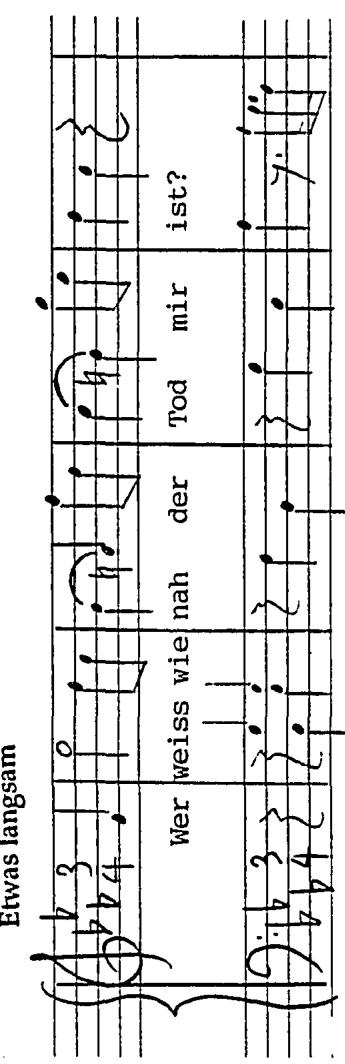
中文讲解
这是谱例27a的图注位置:歌曲《Andenken an der Tod》H. 752(1781)的乐谱图像。该谱例与正文P0239对应,呈现被幻想曲H. 300所引用的原曲首句“Wer weiß wie nah der Tod mir ist”的实际面貌。由于内嵌图像数据已省略,无法呈现具体的音符与歌词排布细节,需查阅原图以确认旋律轮廓与歌词对齐方式。
补充说明
本图作为引用来源的视觉证据,与谱例27b(幻想曲中再次出现的主题)形成“原曲—引文”的对照关系,是读者理解“引文如何被加工”所需的基础材料。
第8段(P0246)
原文复述
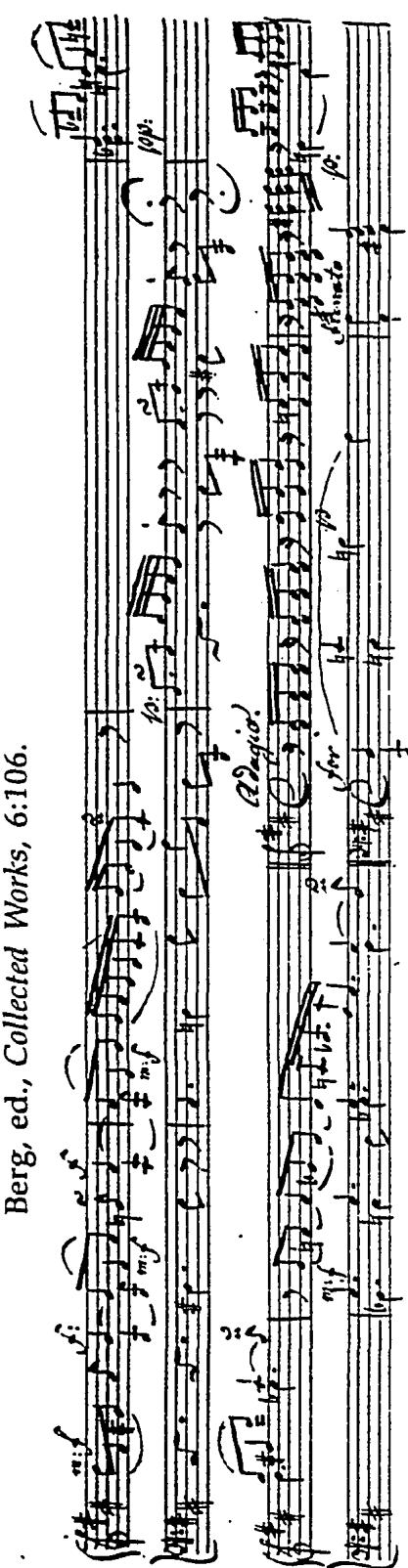
中文讲解
这是第39页上另一处乐谱图像的占位符。结合其位于谱例27a之后、谱例27b标题之前的位置判断,此处很可能是升f小调幻想曲H. 300中出现该主题“被音区与调性隔离”处理的具体段落(即对应正文P0239所描述的“主题回归处”)。由于内嵌图像数据已省略,具体音符细节、谱号、调号及表情标记均需查阅原图。
补充说明
该图与图27a、27b共同构成本节升f小调例证的视觉证据链;如需验证“音区隔离”与“调性偏移”的具体效果,必须结合原谱阅读。
第9段(P0247)
原文复述
Reproduced with permission of the copyright owner. Further reproduction prohibited without permission.
中文讲解
这是与P0242相同的版权声明样板文本,说明第39页上的图像或乐谱亦经版权所有者授权使用;进一步复制需另行获得许可。该信息属于出版层面的法律提示,与本节学术论证无直接关系。
第10段(P0248)
原文复述
to the composition of the fantasia. The work could thus be seen as an arcane tombeau. $^{90}$
中文讲解
本段承接P0240中被截断的句子,补全W. F. 巴赫去世时间与该幻想曲创作之间的关联:既然W. F. 巴赫的去世发生在该曲创作前两年,那么对其作品的引用就被合理地解释为一种隐秘的悼亡。由此作者得出结论——降B大调自由幻想曲可被视为一种“隐秘的tombeau”(追思曲)。这里的“arcane”一词尤为关键:它表明这种悼亡意图并非公开宣示,而是通过引用、暗示等手法埋藏在作品内部,需要具备相应知识背景的听众或研究者方能识破。结合上段升f小调的例子,本节最终确立了一个贯穿两部晚期幻想曲的统一解释框架:以体裁内部的不连贯性为载体,借用既有作品(既有巴赫本人的死亡歌曲,也有W. F. 巴赫的波兰舞曲)作为标题性符号,使幻想曲成为一种承载“memento mori”与“tombeau”双重传统的复合体裁。
补充说明
“tombeau”是法国音乐传统中专门用于悼念亡者的器乐体裁(如F. 库普兰、勒鲁瓦尔等的作品),与“memento mori”侧重“提醒世人死亡难免”的道德寓意相比,更强调“对特定逝者的追忆”。“arcane”一词暗示作者认为C. P. E. 巴赫此处是有意为之、但以含蓄方式实现。
脚注 / 边栏 / 图表 / 附加信息(如有)
本节包含以下附加材料:
- 注89(P0241):为升f小调幻想曲H. 300引用巴赫《Andenken an der Tod》的发现提供学术来源(Heinrich Poos两篇文章与Schleuning专著),起到来源追溯与观点支撑的作用。
- 注90(在P0248中以角标形式出现,但具体内容未在本节范围内呈现):指向降B大调幻想曲作为“arcane tombeau”这一解释的进一步文献支持。
- 谱例27a(P0245):《Andenken an der Tod》原曲谱例,作为引用来源的视觉证据。
- 谱例27b(P0243及P0246处图像):升f小调幻想曲中主题回归处的乐谱,配合P0244速度标记“Etwas langsam”呈现“梦境化”处理的实际样貌。
- 两处版权声明(P0242、P0247):属于出版法律提示,非论证内容。
💡 本节核心要点
- 自由幻想曲中思想段落之间的不连贯性并非缺陷,而是体裁特征;正是这种“缝隙”为带有标题性含义的外来引文提供了附着点。
- 升f小调自由幻想曲H. 300的Largo主题借自巴赫《Andenken an der Tod》H. 752的首句“Wer weiß wie nah der Tod mir ist”,其回归通过音区与调性的双重隔离营造梦境效果,提示其象征意义。
- 降B大调自由幻想曲对W. F. 巴赫《E大调波兰舞曲》(Fk 12/7)的引用,通过减七度与下行级进的对比,在“梦境—惊醒”的瞬间切换中暗示对W. F. 巴赫去世的悼念。
- 两部晚期幻想曲共同体现“memento mori”(继承Froberger传统)与“tombeau”(追思特定逝者)的双重死亡纪念传统,且都以含蓄(arcane)方式实现,非公开宣示。
- 作者的解释建立在既有学术成果(Heinrich Poos 1980、1988;Schleuning)之上,属于综合性论断而非首创发现。
🔑 关键术语
- unconnectedness of thoughts:指幻想曲内部各思想段落之间缺乏主题或动机上的连贯过渡,是自由幻想曲的典型体裁特征;本节论证其恰恰为外来引文的凸显提供了条件。
- programmatic significance:指音乐作品中带有标题性、象征性或叙事性含义的内容;本节特指那些借用其他作品所携带的、超越纯音乐结构层面的指向意义。
- memento mori:拉丁语,意为“记住你终将死去”;欧洲音乐与视觉艺术中以死亡为主题的传统,本节特指Froberger开创的器乐传统,被作者用于解释升f小调幻想曲。
- tombeau:法语,意为“墓碑/追思曲”;专门用于悼念特定逝者的器乐体裁;本节中作者以“arcane tombeau”描述降B大调幻想曲对W. F. 巴赫的隐秘追忆。
- diminished seventh:减七度音程;本节中作为和声底层,用于营造第21小节的悬浮、不协和与梦幻氛围。
- Etwas langsam:德语速度标记,意为“稍慢”;谱例27b上方的演奏指示,与正文中“梦境化”处理在表演实践层面相互呼应。
- Andenken an der Tod:C. P. E. 巴赫本人的歌曲作品H. 752(1781),意为“忆念死亡”;其首句“Wer weiß wie nah der Tod mir ist”成为升f小调幻想曲H. 300的引用来源。
1.14 [描述性拆分] Conclusion of Chapter One
第1段(P0249)
原文复述
Conclusion
中文讲解
这是第一章末尾的标题“Conclusion”(小结/结语)。它标志着作者要在此对整章关于C. P. E.巴赫与十八世纪“fantasia”(幻想曲)这一体裁的核心论证进行收束。该标题开启的是一个总结性的论题,而非新的论点;后面紧随的小节功能是把分散于第一章各处的论述——即兴性、自由度、想象力、情感表达、与作曲领域的区分等——汇拢为一份总览。
第2段(P0250)
原文复述
To summarize: according to C. P. E. Bach and other eighteenth-century writers, the fantasia, though not necessarily improvised, was an improvisatory work. Bach wrote fantasias to leave a record of his famous improvisations, and to use as examples in a pedagogic context, but the fantasia was first and foremost a genre of improvisation. Eighteenth-century writers made a categorical distinction between the fantasia and other types of piece that belong to the realm of composition proper, on the basis of liberties of time, tonality and the arrangement of ideas. These liberties were not expressed in a single fantasia style. Indeed, the freedom of the fantasia to assume different styles both within and between works was a noted liberty of the genre. The extent to which the liberties of the genre were employed in any one work underlay a distinction between strict and free fantasias that originated with C. P. E. Bach and is apparent in his own works.
中文讲解
这是全章的总结段落,集中重申第一章的核心论点。它包含三层递进:(一)fantasia的本质定位——C. P. E.巴赫与十八世纪其他理论家虽不认为每首幻想曲都必须即兴演奏,但fantasia从本质上属于即兴类作品,巴赫写作幻想曲的目的在于“留档”和“教学示范”,但该体裁的首要身份是即兴体裁;(二)fantasia与“proper composition”(严格意义上的作曲)之间的范畴性区分依据——时间、调性、意念安排三方面的自由度;(三)fantasia内部的次级区分——“strict”(严格的)与“free”(自由的)幻想曲之分依据于上述自由度的实际使用程度,这一划分由C. P. E.巴赫提出,并在他自己的作品中有所体现。需要特别注意的是本段的限定词:作者强调fantasia“not necessarily improvised”(不必然即兴)但仍是“improvisatory work”(即兴类作品),保留了“可能”与“通常”之间的微妙距离,这正是十八世纪理论家对fantasia定位的精确措辞。
补充说明
本段中的“composition proper”指十八世纪理论家严格意义上的作曲范畴,与fantasia所归属的即兴范畴相对;“strict and free fantasias”是C. P. E.巴赫本人在《论键盘乐器演奏的真正艺术》中提出的体裁内二级分类,本段强调该分类在他自己作品中亦有体现,与本章前文论证呼应。
第3段(P0251)
原文复述
The faculty of the imagination underlies the characteristic inventiveness and (in Bach’s words) “beauty of variety” in the fantasia. Similarly, the fantasia was an ideal medium of sensibility, suited to rousing sentiment in the listener and to self expression on the part of the composer or improviser. From Bach’s commentary on the genre, and from his fantasias, it is also clear, however, that liberties were not employed at the expense of musical intelligibility or coherence. Fantasias were ideally suited to
中文讲解
本段把fantasia的美学基础追溯到两个心理学-美学概念:想象力(the faculty of the imagination)和感受性(sensibility)。想象力为fantasia提供“characteristic inventiveness”(特征性的独创性)以及巴赫所言之“beauty of variety”(变化之美);感受性则使fantasia成为触动听者情感、便于演奏者或即兴者自我表达的“理想媒介”。但作者随即用一个“however”设置重要限定:上述自由度的行使绝不以牺牲“musical intelligibility or coherence”(音乐的可理解性与连贯性)为代价。这一限定呼应本节总论点——fantasia的自由有其内在边界。原文在此页末以“Fantasias were ideally suited to”中断,语句将跨页续接。
补充说明
“beauty of variety”和“sensibility”在本节是关键的十八世纪美学词汇;本段的功能是把前文对fantasia体裁特征的体裁学论述提升到美学层面的总结。
第4段(P0252)
原文复述
$^{90}$ Schleuning, Die freie Fantasie, 249-50.
中文讲解
这是脚注90,内容为德语文献施洛伊宁《Die freie Fantasie》第249-50页。该脚注应对应正文的具体出处提示(位于P0251所在论证之中),属于来源型注释,提示读者关于“composition proper”之范畴区分或“strict and free fantasias”之分类的进一步材料来自施洛伊宁此书。
补充说明
脚注内容仅提供文献出处,不展开论证;其作用是支持而非限定正文主张。
第5段(P0253)
原文复述
Reproduced with permission of the copyright owner. Further reproduction prohibited without permission.
中文讲解
这是出版社或数据库加注的版权声明,提示该页内容的使用须得到版权所有者许可,禁止未经授权的再复制。它属于版式信息而非论述内容,因此在本章论证链中不承担论证功能。
第6段(P0254)
原文复述
mastering “the feelings of the audience,” but there was nonetheless a need for the improviser or composer to possess both sense and sensibility.
中文讲解
本段承接P0251被页面截断的句子,说明fantasia之所以“ideally suited”(理想地适于)的内容是“mastering the feelings of the audience”(掌握听众的情感)。紧随其后作者用一个“nonetheless”再设限定:即兴者或作曲者仍需同时具备“sense”(理性/判断力)与“sensibility”(感受性)。这一对“sense and sensibility”的双重要求,对应P0251中所提“不以可理解性与连贯性为代价”的边界——fantasia的自由以理性为依托。因此本句在表面上承接前段,实则重申“自由须有理性约束”这一中心限定。
补充说明
“sense and sensibility”这一对概念呼应十八世纪美学中理性与情感之平衡的张力;本句是P0251跨页续接,务必与前句连读才能完整理解。
第7段(P0255)
原文复述
The fantasias of C. P. E. Bach are “far-flung” and “fantastical works” (to employ key words from the early nineteenth-century reception of Beethoven’s music examined at the beginning of the next chapter). They embrace apparently contradictory musical and aesthetic elements. At once spontaneous in conduct and rationally structured to the point of contrivance, they bristle with original inventions and yet are based upon stereotypical figurations. They are a medium of sensibility and yet cultivate brilliant fingerwork and virtuosity. The fantasia existed outside the realm of composition proper and yet it was in some ways the pinnacle of the art of music, not only for Bach, as we have seen, but for such a writer as Kant. For Kant the fantasia epitomized the “free beauty” characteristic of instrumental music as a whole, a beauty independent of purpose and even meaning, a beauty experienced independently of any prior concept of perfection, that is, of how it should be, and found as often in nature–in tulips and the plumage of the bird of paradise, for example–as in art. $^{91}$
中文讲解
本段以一组矛盾修辞概括C. P. E.巴赫fantasia的本质。作者刻意使用“far-flung”“fantastical works”等形容,并预告这两个词将在下一章开头讨论的贝多芬接受史中再次出现,由此把本章与下一章在用词上建立衔接。随后作者列出一组对照性张力:自发性与高度理性结构的对峙、独创性发明与程式化音型的并存、感受性媒介与炫技性指法的融合、超越“proper composition”却又构成“音乐艺术之巅”的悖论。最后作者引入康德,把fantasia提升到“free beauty”(自由美)的哲学高度——这种美独立于目的、独立于意义、独立于任何先行的完美概念,既见于自然(如郁金香与天堂鸟的羽毛),也见于艺术。本段的功能是把本章对fantasia的体裁学论述收束为一种美学-哲学定位,为下一章的讨论铺设美学前提。
补充说明
本段中“far-flung”和“fantastical works”是与下一章贝多芬接受史形成术语呼应的关键词;“free beauty”是康德《判断力批判》中的核心概念,与“adherent beauty”(依附美)相对,指不预设任何目的或概念之美。
第8段(P0256)
原文复述
* * *
中文讲解
三个星号组成的分隔符(dinkus),是一种版式标记,用于在主要论述与下一节之间作视觉分隔,标志着第一章主体内容的结束与下一部分(如脚注或下一章)的开始。它本身不承载论点。
第9段(P0257)
原文复述
$^{91}$ Meredith, ed., Kant’s Aesthetics, 72.
中文讲解
这是脚注91,出自Meredith编辑的《康德美学》第72页。该脚注对应P0255中关于康德“free beauty”之论述,为作者对康德美学立场的引用提供原始文献依据。Meredith译本是英语学界引用康德《判断力批判》时常采用的来源。
补充说明
本脚注属于来源型脚注,为正文中康德的观点提供权威文献依据;它限定了作者对康德“free beauty”概念的理解是基于Meredith所编的康德美学文本这一具体版本。
第10段(P0258)
原文复述
Reproduced with permission of the copyright owner. Further reproduction prohibited without permission.
中文讲解
这是与P0253相同的版权声明,出现在本页底部。它同样属于版式信息,不参与本章的论证。
脚注 / 边栏 / 图表 / 附加信息(如有)
本章结尾包含两条脚注(脚注90:Schleuning, Die freie Fantasie, 249-50;脚注91:Meredith, ed., Kant’s Aesthetics, 72)和两处版权声明。脚注90为前文fantasia体裁定位与strict/free之分提供德语文献依据;脚注91为正文中康德“free beauty”之引用提供原始文献依据。版权声明属版式信息。分隔符“* * *”标志本章主体论述结束。
💡 本节核心要点
- fantasia在十八世纪理论家(包括C. P. E.巴赫)的界定中本质上属于即兴类体裁,虽不必每次即兴演奏,但以即兴性为根本属性;巴赫写作幻想曲的目的是留档与教学。
- fantasia与“composition proper”之间存在范畴性区分,依据为时间、调性、意念安排三方面的自由度。
- fantasia内部有“strict”和“free”的二级划分,由C. P. E.巴赫提出,依据为该体裁自由度在实际作品中被使用的程度。
- fantasia以想象力为美学基础,体现独创性与“变化之美”,同时是感受性的理想媒介;但其自由度不以牺牲可理解性与连贯性为代价,即兴者与作曲者需兼具sense与sensibility。
- C. P. E.巴赫的fantasia内部充满自发性与理性结构、独创性与程式化、感受性与炫技性等矛盾性张力,使其在“proper composition”之外却又构成音乐艺术之巅。
- 康德将fantasia视为“free beauty”(自由美)的典范——独立于目的、意义与完美概念的美,这一美学定位连接了本章与下一章对贝多芬fantastical reception的讨论。
🔑 关键术语
- fantasia:十八世纪由C. P. E.巴赫等人界定的键盘音乐体裁,核心属性为即兴性;在本节中它被定位为与“composition proper”相对的体裁类别,并内部分为strict与free两类。
- composition proper:十八世纪理论意义上严格作曲的范畴,与fantasia所归属的即兴类体裁相对;本节以此范畴与fantasia之范畴性区分为依据。
- improvisatory work:指“即兴类作品”,是C. P. E.巴赫对fantasia本质属性的定性;它强调体裁性质而不必然要求每次演奏都即兴。
- strict and free fantasias:C. P. E.巴赫提出的fantasia内部二级分类,依据为该体裁自由度(时间、调性、意念安排)在具体作品中被使用的程度。
- beauty of variety:巴赫用以形容fantasia中由想象力所产生的特征性独创性的术语,强调变化中的美感。
- sensibility:感受性,十八世纪美学概念,指主体对情感的反应与表达能力;在本节中fantasia被视为该特质的理想媒介。
- free beauty:康德美学中与“adherent beauty”相对的概念,指独立于目的、意义及任何先在完美概念的自由美;本节中fantasia被视为这种美的化身。
- far-flung / fantastical works:用以形容C. P. E.巴赫fantasia之张力与想象性的关键词,作者预告这两个词将在下一章讨论贝多芬音乐接受史时再次出现。
1.15 [描述性拆分] Chapter Two title page
第1段(P0259)
原文复述
Chapter Two “Quasi una Fantasia:” History of an Idea
中文讲解
这是第二章的标题页,宣告本章的核心主题:追溯"近乎幻想曲”(quasi una fantasia)这一观念的历史。“Quasi una fantasia"是贝多芬为作品 Op. 27 两首钢琴奏鸣曲所加的副标题,因此本章将以这一用语为切入点,考察幻想曲体裁在十九世纪初对严肃器乐体裁(奏鸣曲、交响曲、序曲)所引发的冲击与反响。标题将"quasi una fantasia"作为历史观念加以审视,意味着作者并非只讨论贝多芬一则副标题,而是把它视作一个跨文本的、承载着批评话语的观念对象。
第2段(P0260)
原文复述
During the first decades of the nineteenth century, some critics despaired of a crisis of genre in contemporary music, a crisis they attributed to the pervasive and subversive influence of the reportedly chaotic fantasia upon orderly composition. Ernst L. Gerber admitted that music without fantasy was inconceivable, but lamented that “the fantasia, like a despot, has seized absolute power over music:”
中文讲解
本段交代历史背景与批评氛围:十九世纪初,一部分批评家将当时音乐中出现的体裁混乱诊断为一种"体裁危机”,并把这种危机的根源归咎于幻想曲对秩序井然之作曲方式的广泛而颠覆性的渗透。“据称混乱”(reportedly chaotic)一语提示作者对这种叙述有所保留——混乱并非幻想曲自身的客观属性,而是批评话语所赋予的标签。接着引出本节的关键代言人恩斯特·L·格尔伯(Ernst L. Gerber)。格尔伯承认音乐不可能没有幻想,但随即用专制者隐喻批判幻想曲已经僭越了它的合法地位。这一比喻(幻想曲=暴君,统治了音乐)建立了本章反复回响的修辞框架:体裁之间的等级秩序被幻想曲这一"反叛者"所颠覆。
补充说明
Ernst L. Gerber(恩斯特·路德维希·格尔伯,1746–1819)为德国音乐理论家、词典编纂者,其关于幻想曲的判断是十九世纪初体裁批评的重要文献证据。
第3段(P0261)
原文复述
Now any forms or any limits to fantasy are unthinkable. Everything goes everywhere and nowhere; the madder, the better! The wilder and more fantastic, all the more new-fangled and effective; there is a constant chasing after distant keys and modulations, after unharmonious transitions, ear-splitting dissonances and chromatic progressions, without respite and end for the listener. Thus we hear and play nothing but fantasias. Our sonatas are fantasias, our overtures are fantasias, and our symphonies, at least those by Beethoven and his crowd, are fantasias. $^{1}$
中文讲解
本段是格尔伯 1817/18 年致克里斯托夫·H·林克信函英文译文的正文部分,需要把握三处要点。第一,格尔伯的诊断是逐级递进的:先是否定幻想曲仍有任何形式边界(“any forms or any limits to fantasy are unthinkable”),接着以一组排比描绘作曲家一味追逐远关系调、不协和转位、刺耳不协和音与半音进行,给听众以毫无喘息之感的听觉轰炸。第二,核心修辞是"je toller, je besser”(越疯狂越好)与"je wilder, je bizarrer”(越狂野、越怪诞越好)所体现的"新奇即效果"的趣味——这一趣味被格尔伯贬为虚浮的时尚。第三,结论是把体裁差异抹平:奏鸣曲、交响曲、序曲已统统沦为幻想曲。点名贝多芬及其追随者(“Beethoven and his crowd”),意味着这种混乱在他眼中并非个案,而已经成为一股风气。脚注 1 提示原文为德文,详见后续注释。
补充说明
本段译文据脚注 1 知出自作者自译(“my own”),所据底本为彼得·施洛伊宁《Die freie Fantasie》页 358–59。这一段是 P0260 中格尔伯那句引言(“the fantasia, like a despot…")的完整展开。
第4段(P0262)
原文复述
After the Viennese première of the Eroica Symphony in 1804, an anonymous reviewer described the work as “a very far-fetched, bold and wild fantasia.“2 Beethoven himself published the two sonatas of Op. 27 (1801) with the subtitles “quasi una Fantasia.” Berlioz composed the Symphonie fantastique in 1830. For Amadeus Wendt, music after Haydn and Mozart “took an entirely fantastic course.“3
中文讲解
本段以四个节点串联"幻想曲观念"在十九世纪初的扩散。1804 年《英雄交响曲》维也纳首演后即被匿名评论者径直称作"非常遥远、大胆而狂野的幻想曲”——这是把交响曲视为幻想曲的典型一例。1801 年贝多芬亲笔为 Op. 27 两首奏鸣曲加上"quasi una Fantasia”(近乎幻想曲)副标题,则是作曲家本人承认其作品已偏离奏鸣曲常规体裁。1830 年柏辽兹谱写《幻想交响曲》,将"幻想"二字直接嵌入标题,反映此种体裁越界至十九世纪三十年代已成自觉的美学姿态。最后,阿马戴乌斯·温特(Amadeus Wendt)以"took an entirely fantastic course"总结海顿、莫扎特之后的音乐走向,把这一现象定性为整体性的方向偏移。四个例子从匿名评论、作曲家自署、他者命名到概括性诊断层层累积,构成作者进入"Quasi una Fantasia"观念史的具体证据链。脚注 2 与 3 分指首演评论与温特文献来源。
补充说明
脚注 2 与 3 的具体出处及原文分别在 P0264 及脚注中给出。Amadeus Wendt 为十九世纪德国音乐美学家,其评论是当时德语区音乐批评的代表。
第5段(P0263)
原文复述
“Endlich scheint es mir, als ob die Phantasie, als Despot, die unumschränkte Herrschaft über die Musik an sich gerissen habe. Freilich läßt sich keine Musik ohne Phantasie denken; nur muß sie durch Geschmack und Vernunft zweckmäßig geregelt seyn. Aber jetzt sind an keine Formen, an keine Schranken der Phantasie mehr zu denken. Alles geht obenaus und nirgend an; je toller, je besser! je wilder, je bizarrer, desto neumodischer und effektvoller; das ist ein unaufhörliches Haschen nach fremden Tonarten und Modulationen, nach unharmonischen Ausweichungen, nach ohrenzerreißenden Dissonanzen und nach chromatischen Gängen, ohne Erholung und Aufhören für den Zuhörer. Auf solche Weise hören und spielen wir aber nichts, als lauter Phantasien. Unsere Sonaten sind Phantasien, unsere Ouvertüren sind Phantasien und selbst unsere Sinfonien, wenigstens die von Beethoven und Konsorten, sind Phantasien.” Ernst Ludwig Gerber, letter of 1817/8 to Cristoph H. Rinck, cited in Peter Schleuning, Die freie Fantasie. Ein Beitrag zur Erforschung der klassischen Klaviermusik, Göppinger Akademische Beiträge 76 (Göppingen: Kummerle, 1973), 358-59 (this and other translations below are my own unless otherwise noted).
中文讲解
本脚注承担双重功能:一是提供 P0261 英文译文所对应的德文原文,使读者能直接核对作者翻译;二是提供文献来源与作者立场说明。原文以"Phantasie, als Despot, die unumschränkte Herrschaft über die Musik an sich gerissen habe”(幻想作为专制者,攫取了音乐的无限统治权)开篇,正是 P0260 中所引"the fantasia, like a despot, has seized absolute power over music"的德文原句。原文保留了关键修辞节奏:“je toller, je besser! je wilder, je bizarrer, desto neumodischer und effektvoller"对应英文译文里的"the madder, the better! The wilder and more fantastic, all the more new-fangled and effective”。出处为 Ernst Ludwig Gerber 1817/1818 年致 Cristoph H. Rinck 的书信,转引自 Peter Schleuning, Die freie Fantasie(贡平根学术丛书第 76 号,1973)第 358–59 页。括号中的"this and other translations below are my own unless otherwise noted"是一项译注声明:本章若无特别说明,所有英文译文均由本书作者自行翻译,这一点关乎 P0262 中匿名评论与温特引语的翻译责任归属。
补充说明
出处信息中 Göppinger Akademische Beiträge 76 即贡平根学术丛书第 76 卷,出版地 Göppingen、出版社 Kummerle、出版年 1973 为该书的版本信息。
第6段(P0264)
原文复述
“Eine sehr weit ausgeführte, kühne and wilde Phantasie.” Allgemeine Musikalische Zeitung 7 (1804): 321, cited in Schleuning, Die freie Fantasie, 358.
中文讲解
本脚注给出 P0262 中匿名评论的原文与出处。原德文"Eine sehr weit ausgeführte, kühne and wilde Phantasie”(一部非常深远、大胆而狂野的幻想曲),正是评论者用以形容 1804 年维也纳首演的《英雄交响曲》。它直接坐实了格尔伯所谓"交响曲已沦为幻想曲"的判断在 1804 年便已出现:作品尚未被称作交响曲之前,评论者已经用幻想曲来命名它。该句刊登于 1804 年《通用音乐杂志》(Allgemeine Musikalische Zeitung)第 7 卷第 321 页,转引自 Schleuning 第 358 页。值得注意的是 1804 年正逢该周刊创刊不久,此条评论因此具有较高的史料价值。
补充说明
Allgemeine Musikalische Zeitung 是莱比锡的 Breitkopf & Härtel 主办的德语权威音乐期刊,1798 年创刊,是十九世纪初音乐批评的核心媒介。脚注原文中的 “and”(而非 “und”)疑系英文转录中的拼写疏漏或 OCR 现象;本书作者选择保留原文未予订正。
第7段(P0265)
原文复述
Reproduced with permission of the copyright owner. Further reproduction prohibited without permission.
中文讲解
此为版权声明,说明本章(或所引文献的)文本系经版权所有者授权复制,禁止未经许可的进一步复制。本句并非论证文字,而是出版层面的法律标注,因此不需要进入正文论证。
脚注 / 边栏 / 图表 / 附加信息(如有)
本节包含两则学术脚注:脚注 1(P0263)提供格尔伯 1817/1818 年致 Rinck 信函的完整德文原文及其在 Schleuning 著作中的页码,同时声明本章英文译文除特别注明外均为本书作者自译;脚注 2(P0264)给出 1804 年《通用音乐杂志》第 7 卷第 321 页评论《英雄交响曲》的德文原文,同样转引自 Schleuning 第 358 页。两则脚注共同支撑正文对十九世纪初"交响曲即幻想曲"之批评话语的引证。P0265 为版权声明,非论证材料。
💡 本节核心要点
- 本章以贝多芬为 Op. 27 所加的"quasi una Fantasia"副标题为切入口,探讨"幻想曲"作为一种观念而非单纯体裁在十九世纪初的历史。
- 十九世纪初的德国音乐批评(以格尔伯、温特为代表)将幻想曲对奏鸣曲、交响曲、序曲的渗透诊断为"体裁危机”,并以"专制者"等隐喻修辞表达对秩序崩解的不满。
- 本章开篇以格尔伯的英文译文为引文枢轴(脚注 1 同时给出德文原文与 Schleuning 出处),用具体而生动的修辞(“je toller, je besser"等)说明幻想曲在批评家眼中如何与"新奇即效果"趣味挂钩。
- 通过 1804 年匿名评论、贝多芬 Op. 27、柏辽兹《幻想交响曲》、温特评论四个节点,作者勾勒出"幻想曲化"从批评话语到作曲家自我命名再到体裁自觉的发展轨迹。
- 本章的论证基础建立在德语原始文献(《通用音乐杂志》、格尔伯信函)的直接引用与作者自译之上,文献可靠性的同时翻译责任归属于作者本人。
🔑 关键术语
- Quasi una fantasia:意大利语,意为"近乎幻想曲”,贝多芬 1801 年用于其作品 Op. 27 两首钢琴奏鸣曲的副标题;在本章中被作者作为一个跨文本的批评观念对象加以追溯。
- fantasia / Phantasie:幻想曲体裁;在十九世纪初德国批评语境中,被视为破坏奏鸣—交响体裁秩序的颠覆性力量,格尔伯以"专制者"喻之。
- Eroica Symphony / Heroische Sinfonie:贝多芬《第三交响曲》,1804 年维也纳首演后被匿名评论直接称为"深远、大胆而狂野的幻想曲”,成为体裁越界的典型案例。
- Op. 27:贝多芬 1801 年出版的两首钢琴奏鸣曲(作品第 27 号),作曲家亲自署以"quasi una Fantasia"副标题,是本章标题用语的直接来源。
- Symphonie fantastique:柏辽兹 1830 年所作,将"fantastique"嵌入标题,被作者列为"幻想曲化"趋势在 1830 年代的自觉标志。
- Ernst Ludwig Gerber:德国音乐理论家与词典编纂者(1746–1819),本章核心批评引语来源,其 1817/1818 年致 Rinck 信函构成讨论十九世纪初幻想曲批评观的关键文献。
1.16 [描述性拆分] Chapter Two introduction: the nineteenth-century crisis of genre
第1段(P0266)
原文复述
The idea of fantasia elements appearing in other genres is not, however, an invention of early nineteenth-century musical criticism. Rather, it has a history that begins in Italy in the early seventeenth century with what Athanasius Kircher and, later, Johannes Mattheson called the stylus phantasticus (literally, “fantastic style”). This compositional and theoretical tradition bears directly upon C. P. E. Bach. The fundamental liberties of the fantasia, discussed in chapter one, were rooted in this tradition, a tradition which was, as Schleuning has argued, subsumed and supplanted by the free fantasia around the middle of the century. Within Bach’s lifetime, though, fantasia elements in other types of piece were largely discussed in terms of genius, inspiration and humor. Yet, as we shall see, the musical elements discussed under these headings were those of the fantastic tradition and the fantasia.
中文讲解
本段是第二章的导言性段落,作者要纠正一个潜在误解:以为在非幻想曲体裁中出现幻想曲元素只是十九世纪早期乐评的发明。作者明确把这种讨论回溯到十七世纪初意大利的stylus phantasticus(幻想风格)传统,提名Athanasius Kircher和Johannes Mattheson作为这一术语的提出者。这一传统对C. P. E. Bach有直接的影响,因此第一章讨论的fantasia的根本自由正是植根于此。作者借Schleuning的研究指出,到了十八世纪中叶,这一传统被free fantasia(自由幻想曲)所吸收并取代。接下来作者预告:在Bach的有生之年,其他体裁中的fantasia元素主要以genius、inspiration、humor这些范畴来讨论,但作者将在本章证明,这些范畴下所谈到的音乐要素其实就是fantastic传统和fantasia的要素。这段的功能是为整章设定历史纵深:表面上十九世纪的讨论只是用新词谈论老传统。
第2段(P0267)
原文复述
A. C. P. E. Bach and the Tradition of Stylus Phantasticus
中文讲解
这是一个二级章节标题,标示出本章第一个大节,主题是把C. P. E. Bach置于stylus phantasticus的传统脉络中来考察。这一标题把前段提及的Kircher–Mattheson–Schleuning传统,与作为个案研究对象的C. P. E. Bach直接勾连起来,是从历史背景向个案过渡的结构标志。
第3段(P0268)
原文复述
1. Origins
中文讲解
这是上节之下的第一个小节标题"起源"。它预告接下来将追溯stylus phantasticus的源头,承袭上一段提出的"history that begins in Italy in the early seventeenth century",开始从源头讲起。
第4段(P0269)
原文复述
The characteristic features of the stylus phantasticus–an unpredictable sequence of contrasting and elided sections, wide-ranging modulations, changes of meter and tempo, harmonic complexity, the absence of a main theme and formal plan–are essentially those of what later became the free fantasia. The origins of fantastic style did not lie in the early fantasia, however, but in Italian vocal music of the seventeenth century.
中文讲解
本段罗列出stylus phantasticus的核心特征:不可预测的、互相强烈对比且彼此过渡(elided)的段落序列;幅度宽广的转调;节拍与速度的变化;和声的复杂性;以及缺乏一个主导主题与整体形式规划。作者强调,这些特征在本质上正是后来所谓free fantasia(自由幻想曲)的特征。但紧接着一句关键的转折:fantastic style的源头并不在早期的fantasia里,而是在十七世纪的意大利声乐音乐中。这就为下一段引入Frescobaldi与"drama without words"做了铺垫,也提醒读者:键盘的fantasia传统其实是声乐传统的移植。
第5段(P0270)
原文复述
3 “Einen ganz phantastischen Gang genommen.” Amadeus Wendt, “Gedanken über die neueste Tonkunst, und van Beethoven’s Musik,” Allgemeine Musikalische Zeitung 17 (1815): 385, cited in Schleuning, Die Freie Fantasie, 359.
中文讲解
这是正文P0266提到的十九世纪乐评的一个脚注来源。脚注给出德文短语"Einen ganz phantastischen Gang genommen"(“走上了一条完全幻想的路径”),出自Amadeus Wendt 1815年发表于《普通音乐报》(Allgemeine Musikalische Zeitung)第17卷第385页的文章"关于最新音乐艺术以及贝多芬的音乐的思考",经Schleuning《Die Freie Fantasie》第359页转引。该引文是作者用以证明十九世纪初期的乐评确实以"fantastisch"描述非幻想曲体裁内出现幻想性段落的关键例证;它在前一段所设定的论证里提供文献支撑。
第6段(P0271)
原文复述
Reproduced with permission of the copyright owner. Further reproduction prohibited without permission.
中文讲解
这是版权声明,说明本页内容是经版权所有者授权复制,进一步复制需取得许可。它属于出版社附加的版面要素,与正文论证无关。
第7段(P0272)
原文复述
The pursuit of what Snyder calls “drama without words” in sinfonias, ensemble sonatas and solo keyboard music led composers to employ the rapid contrasts of tempo, style, meter and affection that were characteristic of dramatic vocal music. In his preface to the Toccate e partite, primo libro (1615), Frescobaldi made an explicit connection between the affective and stylistic contrasts of his keyboard works and the seventeenth-century madrigal:
中文讲解
本段承接P0269关于stylus phantasticus源头在意大利声乐音乐的说法。Snyder用"drama without words"(无词的戏剧)一词概括十七世纪在sinfonias、合奏奏鸣曲和独奏键盘音乐中追求的效果,这种效果促使作曲家使用戏剧性声乐音乐中典型的速度、风格、节拍和affection(情感变化)的迅速对比。作者随后引出Frescobaldi《Toccate e partite, primo libro》(1615)的序言,作为键盘作品与十七世纪madrigal(牧歌)之间情感与风格对比的明确关联。该关联同时支持两点:一是键盘的fantasia/幻想风格源自戏剧性声乐,二是这种渊源到Frescobaldi已是自觉的传统。脚注4挂在"dramatic vocal music"处,将在下文展开。
第8段(P0273)
原文复述
To the reader:
中文讲解
这是Frescobaldi《Toccate e partite》序言的引语小标题"致读者"。它标志接下来是直接引文,让读者意识到即将看到的不是作者转述,而是Frescobaldi本人写给演奏者的前言。
第9段(P0274)
原文复述
Since I well know how much the manner of playing that involves vocal affects and differentiation of sections [“passi”] is favored, I thought it right to prove my interest and sympathy therewith through this modest work, which I deliver to the printer together with the following remarks . . .
中文讲解
这是Frescobaldi序言总起句的英译。他自陈因深知"涉及声乐情感(vocal affects)和段落分化(passi)的演奏方式"广受喜爱,遂决定以这部谦卑的作品来表明自己对这种风格的兴趣与共鸣,并连同下面的若干说明一并付印。引文中"passi"作为原文术语括注保留,提醒读者此词既可指"段落"也可兼指"步伐/乐句进程"。该句证明Frescobaldi自觉地把键盘演奏的affect和passi原则与声乐传统相联系。
第10段(P0275)
原文复述
- This manner of playing must not always follow the same meter; in this respect it is similar to the performance of modern madrigals . . .
中文讲解
Frescobaldi序言的第一条规则:这种演奏方式不必始终保持同一节拍(meter);在这方面,它近似于现代madrigal的表演。这里的"meter"在十七世纪用法中包含节拍、拍号乃至小节规则等多重含义;Frescobaldi通过比附"现代madrigal的表演",把节拍自由的合法性直接挂在声乐传统上,与P0269/P0272关于fantastic style源自戏剧性声乐的主张相互印证。
第11段(P0276)
原文复述
- In the Toccatas I have seen to it not only that they are rich in varied sections and moods [“passi diversi et affetti”] but that one may play each section separately, so that the player can stop wherever he wishes.
中文讲解
Frescobaldi序言的第二条规则:在这些Toccata中,他不仅确保其包含丰富的变化段落与情绪(“passi diversi et affetti”),还使每一段落都可以单独演奏,让演奏者可以在任意一处停下。这条规则同时落实两件事:一是内容上段落与情绪的多样,二是结构上段落之间彼此独立、不依赖连续发展。这正是P0269所列举的stylus phantasticus的核心特征——对比强烈、无整体形式规划——在Frescobaldi笔下的实例化。脚注5挂在句末。
第12段(P0277)
原文复述
Direct connections between improvisatory keyboard works and dramatic vocal music continued into the eighteenth century. C. P. E. Bach pointed to recitative as his model for the metrical and modulatory freedom of the fantasia. Indeed, the composer’s first free fantasia (H. 339 in E-flat) was an accompanied recitative at the keyboard. In this light, Schleuning’s
中文讲解
本段把Frescobaldi所体现的键盘–声乐关联推进到十八世纪:即兴式键盘作品与戏剧性声乐之间的直接联系一直延续。C. P. E. Bach以recitative(宣叙调)作为fantasia节拍自由与转调自由的典范模型,其首部自由幻想曲(H. 339,降E大调)本身就是键盘上的伴奏宣叙调。这就把Bach的fantasia放回源自戏剧性声乐这条纵贯线。最后半句"In this light, Schleuning’s"戛然而止,留作下段继续,作者意在提示:以下将重新解读Schleuning关于fantasia被free fantasia取代的论点,把替代关系放回声乐–键盘互动的大背景中考察。脚注6位于C. P. E. Bach那句话的末尾。
第13段(P0278)
原文复述
4 The drama of contrasting sections was explored in the ensemble sonatas of Biagio Marini (ca 1587–1663) and Massimiliano Neri (1615–1666), and in the sonatas and sinfonias of Giovanni Legrenzi (1620–1690) and Pietro Andrea Ziani (ca 1620–1684). See Eva Linfield, “North and South European Influences on Buxtehude’s Chamber Music: Despite Influences, a Unique Repertory,” Schütz-Jahrbuch 10 (1988): 104–125, [hereafter, “A Unique Repertory”]. The phrase “drama without words” is from Kerala J. Snyder, “Buxtehude’s Organ Music: Drama Without Words,” The Musical Times 120 (1979): 517–521.
中文讲解
脚注4扩展P0272中"dramatic vocal music"一处的文献背景。它列举了把对比段落之戏剧性加以探索的合奏奏鸣曲与sonata/sinfonia作曲家:Biagio Marini(约1587–1663)、Massimiliano Neri(1615–1666)、Giovanni Legrenzi(1620–1690)、Pietro Andrea Ziani(约1620–1684),并指示读者参见Eva Linfield关于Buxtehude室内乐中南北欧影响的论文(Schütz-Jahrbuch 10, 1988, 104–125;此后简称"A Unique Repertory")。脚注还指出"drama without words"一语出自Kerala J. Snyder《Buxtehude’s Organ Music: Drama Without Words》(The Musical Times 120, 1979, 517–521)。该脚注对正文主张提供作曲家谱例与文献两方面的支撑。
第14段(P0279)
原文复述
5 Cited in Willi Apel, The History of Keyboard Music to 1700, trans. and rev. Hans Tischler (Bloomington: Indiana University Press, 1972), 456.
中文讲解
脚注5指明P0276所引Frescobaldi第二条规则(passi diversi et affetti等)转引自Willi Apel《1700年以前的键盘音乐史》,由Hans Tischler翻译并修订(Bloomington: Indiana University Press, 1972)第456页。它为该引文提供可追溯的版本来源。
第15段(P0280)
原文复述
6 Carl Philipp Emanuel Bach, Versuch über die wahre Art das Clavier zu spielen, 2 vols. (vol. 1, Berlin: C. F. Henning, 1753; vol. 2, Berlin: G. L. Winter, 1762), 1, 3, §. 2.
中文讲解
脚注6标出P0277中C. P. E. Bach以recitative为fantasia节拍与转调自由之典范一说的来源:《试论键盘乐器演奏的真谛》(Versuch über die wahre Art das Clavier zu spielen),两卷本:第一卷Berlin: C. F. Henning, 1753;第二卷Berlin: G. L. Winter, 1762;具体位于第1卷第3页§.2。该引文为Bach把fantasia与宣叙调模型直接挂钩的关键一手文献。
第16段(P0281)
原文复述
Reproduced with permission of the copyright owner. Further reproduction prohibited without permission.
中文讲解
这是第二页末尾的版权声明,与P0271属同一性质,标示本页内容经授权复制。
脚注 / 边栏 / 图表 / 附加信息(如有)
脚注材料:P0270为正文关于十九世纪乐评的引文来源(Wendt 1815,经Schleuning转引);P0278、P0279、P0280分别为P0272、P0276、P0277的文献出处,分别支撑"dramatic vocal music"、Frescobaldi的"passi diversi et affetti"规定,以及C. P. E. Bach以recitative作为fantasia节拍与转调自由之模型的主张。三条脚注合力构成从十七世纪声乐传统到十八世纪Bach的纵贯文献链。版权声明P0271与P0281仅为出版标识,不参与论证。
💡 本节核心要点
- 作者在导言中修正了潜在误解:把fantasia元素从非幻想曲体裁中识别出来,并非十九世纪乐评的发明,而是可追溯到十七世纪意大利stylus phantasticus传统。
- stylus phantasticus的核心特征(段落强烈对比与过渡、大幅转调、节拍与速度变化、和声复杂、无主导主题与整体形式规划)本质上就是后来free fantasia的特征。
- 该传统的真正源头不在早期fantasia,而在十七世纪意大利的戏剧性声乐音乐,尤其是madrigal传统。
- Frescobaldi在1615年《Toccate e partite》序言中以声乐affect与passi为依据,明确把键盘演奏的节拍自由与段落独立性归入madrigal传统。
- 到十八世纪,C. P. E. Bach直接把recitative作为fantasia节拍与转调自由的模型,其首部自由幻想曲(H. 339)即是键盘上的伴奏宣叙调,从而把这条键盘–声乐关联延续下去。
- 以上三点合力为下段重读Schleuning关于fantasia被free fantasia取代的论点奠定前提:替代关系不是凭空产生,而是植根于十七至十八世纪键盘与戏剧性声乐之间的持续对话。
🔑 关键术语
- stylus phantasticus:“幻想风格”,十七世纪初由Kircher提出、后由Mattheson加以发挥的作曲与理论传统;其特征在本文中成为fantasia与free fantasia共同的历史根源。
- free fantasia:“自由幻想曲”,据Schleuning的论述,在十八世纪中叶前后逐步吸收并取代了stylus phantasticus的传统,成为该传统的后继体裁。
- fantasia:“幻想曲”,本章讨论的核心体裁,其根本自由植根于stylus phantasticus传统,并在十九世纪被讨论为genius、inspiration、humor等范畴下的音乐要素。
- drama without words:“无词的戏剧”,Kerala J. Snyder提出的术语,用以概括十七世纪sinfonias、合奏奏鸣曲和独奏键盘音乐通过速度、风格、节拍、affection的迅速对比所追求的戏剧效果,是stylus phantasticus在声乐之外的核心美学指向。
- affection / affetti:“情感”,十七世纪音乐修辞中的基本单位,指作品所欲唤起的特定情感状态;Frescobaldi序言中的"passi diversi et affetti"意味着段落与情感的多样化是其作品的刻意目标。
- passi:Frescobaldi所用的术语,既可解作"段落"也可兼指"乐句进程",在本文语境中既指形式上的段落分化,也指演奏中的句法进行。
- recitative:“宣叙调”,C. P. E. Bach用以解释fantasia节拍自由与转调自由的声乐模型;其首部自由幻想曲H. 339在降E大调上即以键盘伴奏宣叙调写成。
- madrigal:“牧歌”,十六至十七世纪意大利的主要声乐体裁,Frescobaldi明确把键盘演奏的节拍自由与"现代madrigal的表演"相比附,凸显stylus phantasticus的声乐源头。
1.17 [描述性拆分] A.1. Origins of the stylus phantasticus in Italian vocal music and Kircher’s definition
第1段(P0282)
原文复述
assertion that the free fantasia was emancipated from Baroque vocal music is misleading. $^{7}$
中文讲解
这段是接续前一小节的句尾片段,断言“自由幻想曲是从巴洛克声乐音乐中解放出来的”这一说法是误导性的。它构成本节的出发点:作者反对把自由幻想曲视为脱离声乐传统的纯器乐现象,并随即用脚注 7 进一步展开反驳。理解本节的关键在于抓住这个总立场——自由幻想曲的所谓“解放”并不成立,它的根源仍在巴洛克声乐传统之中。
补充说明
本段末尾的上标 $^{7}$ 指向紧随其后的脚注 7(P0289),其中提供了对 Schleuning 论点的具体反驳。
第2段(P0283)
原文复述
The term stylus phantasticus first appeared in Anthanasius Kircher’s Musurgia universalis of 1650. With this term, Kircher pointed to the importance of the composer’s imagination in fantastic music: the adjective phantasticus deriving from phantasia (“imagination”). Kircher may have derived both the term stylus phantasticus and the concept of a free, imaginative approach to composition and improvisation from Zarlino’s account of comporre di fantasia, that is, to compose counterpoint on newly invented subjects. $^{8}$ Like Zarlino, Kircher emphasizes the freedom of the stylus phantasticus from pre-existing subjects and cantus firmi:
中文讲解
本段交代“stylus phantasticus”(幻想风格)一词的词源与思想来源。它首次出现在 Kircher 1650 年的《Musurgia universalis》中,形容词 phantasticus 来自拉丁语 phantasia(想象),因此 Kircher 用这个词强调作曲家想象力在幻想音乐中的核心地位。Kircher 的术语和概念可能借鉴自 Zarlino 所说的 comporre di fantasia——即在新创主题上写作对位。Zarlino 与 Kircher 一脉相承之处在于他们都强调“自由”:幻想风格不必依赖既有主题或定旋律(cantus firmus)。本段的作用是为下一段引用 Kircher 原文做铺垫,并把 Kircher 的概念放置到更早的意大利对位传统之中。
补充说明
术语 comporre di fantasia 直译即“凭想象作曲”,强调主题的即兴发明;cantus firmi 是定旋律,即预先存在、必须被其他声部模仿或对位化的旋律素材。
第3段(P0284)
原文复述
The fantastic style is suitable for instruments. It is the most free and unrestrained method of composing; it is bound to nothing, neither to words nor to a melodic subject [“subjectus harmonicus”]; it was instituted to display genius and to teach the hidden design of harmony and the ingenious composition of harmonic phrases and fugues; it is divided into those [pieces] that are commonly called fantasias, ricercatas, toccatas, sonatas. $^{9}$
中文讲解
这是 Kircher 对 stylus phantasticus 的核心定义引用,可拆解为五个要点:其一,适合器乐(不依附于歌词);其二,是“最自由、最不受约束”的作曲方法;其三,不受词和旋律主题(subjectus harmonicus)的束缚;其四,其设立目的在于展示天才,并揭示和声设计的奥秘与对位乐句、赋格的巧妙构造;其五,体裁涵盖 fantasia、ricercata、toccata、sonata 四类。这段定义在结构上为整个小节确立了 Kircher 视角下幻想风格的两条主轴——对位技巧(ingenious composition of harmonic phrases and fugues)与自由展示(freedom, display of genius)。下一段将用 Froberger 的作品具体展示这两个维度。
补充说明
作者用方括号在引文内补注 subjectus harmonicus,说明 Kircher 所指“旋律主题”其实就是和声主题;ricercata 与 toccata 是十六至十七世纪器乐幻想传统中的常见体裁。
第4段(P0285)
原文复述
Kircher’s musical example, Johann Jakob Froberger’s Fantasia super ut re mi
中文讲解
本段只有半句话,跨页续写。其作用是引入 Kircher 在《Musurgia universalis》中所附的音乐实例——Johann Jakob Froberger 的《Fantasia super ut re mi fa sol》。这一引入方式说明:Kircher 的定义不是抽象空谈,而是直接对应到具体作品;Froberger 作为十七世纪中叶重要的键盘作曲家,其作品恰好可以体现 Kircher 所描述的幻想风格。读者需要将 P0285–P0287 视为同一长句的换行/换页分段。
补充说明
作品标题中的 ut re mi fa sol 是六声音阶(hexachord)的唱名系统,作曲家以之作主题进行变奏与对位。
第5段(P0286)
原文复述
fa sol, displays the contrapuntal ingenuity that is central to Kircher’s notion
中文讲解
接续 P0285,完成作品标题《Fantasia super ut re mi fa sol》,并指出该曲展示了 Kircher 所谓幻想风格的核心特征——对位的巧妙(contrapuntal ingenuity)。这句话把 Kircher 的抽象定义与具体作品勾连起来:正是通过 Froberger 这首曲子所体现的精妙对位,Kircher 的“幻想风格”才获得了实证基础。
第6段(P0287)
原文复述
of the stylus phantasticus (example 1). Yet this work also possesses the
中文讲解
完成“对位技巧是 Kircher 幻想风格概念的核心”这一判断的句子,并把读者引向“图例 1”(example 1)这首作品。紧接着用 Yet 转折,引出下一段:本作品不仅体现对位技巧,还具有别的特征(见 P0288)。转折句的修辞意义在于指出 Kircher 的定义虽然突出对位技巧,但 Froberger 这首作品本身就提示我们——幻想风格远不止对位技巧一种维度。
补充说明
括号中的 example 1 指向页 46 上的图例(Froberger 该曲的乐谱)。
第7段(P0288)
原文复述
imaginative and dramatic sectional contrasts, involving changes of both tempo and rate of rhythmic motion that remained part of fantastic style through the first decades of the eighteenth century when contrapuntal ingenuity was much less prominent in theoretical accounts of this style. Kircher notes “the remarkable change of the time,” thereby highlighting one of the liberties of the style as it was later defined by Mattheson and employed in the free fantasia. $^{10}$
中文讲解
本段紧接 P0287 的转折,指出 Froberger 此曲还具备另一种维度:富于想象且富于戏剧性的段落对比,具体体现在速度和节奏运动速率的变化上。这种段落对比一直延续到十八世纪头几十年。然而在此期间,理论家们对幻想风格的描述中,“对位技巧”的地位反而下降了。Kircher 之所以用“时间上的显著变化”(the remarkable change of the time)这种说法,正是预见了后来 Mattheson 对幻想风格的定义,以及“自由幻想曲”(free fantasia)实际创作中所运用的那种自由——即通过速度与节奏对比来制造戏剧性。理解这段的关键在于:作者用 Froberger 这首作品同时支撑两个时代——既符合 Kircher 1650 年的定义,也契合十八世纪初自由幻想曲的实践。
补充说明
本段末尾的 $^{10}$ 指向 P0295(Snyder, Buxtehude, 253)。
第8段(P0289)
原文复述
$^{7}$ Schleuning concludes his study of the free fantasia with a summary (in English) of his thesis that “free fantasy is the first species denying the Baroque principle of subsuming instrumental music under vocal-music-aspects,” Die freie Fantasie, 392. Yet not only accompanied recitative, which offered the model for Bach’s first free fantasia, but even ideas of death, madness and dreaming, both implicit and explicit in Bach’s free fantasias–ideas which Schleuning rightly emphasizes–can be traced back to the world of Baroque opera seria.
中文讲解
这是正文 P0282 所引脚注 7 的完整内容。它分两部分:其一,介绍 Schleuning 在《Die freie Fantasie》第 392 页的论点——自由幻想曲是“第一种否认巴洛克‘将器乐归入声乐范畴’原则的体裁”;其二,作者反驳这种说法,指出不仅 Bach 第一首自由幻想曲所依据的伴奏宣叙调(accompanied recitative)来自声乐传统,就连 Bach 自由幻想曲中关于死亡、疯狂、梦境的意象(无论隐含还是显性),其源头也都可追溯至巴洛克正歌剧(opera seria)。这条脚注的作用是为本节开头的“误导”判断提供文献与具体反例支撑。
补充说明
Schleuning 的论点和 Bach 的自由幻想曲体例属于本节预设的讨论背景,脚注中提到的“死亡、疯狂、梦境”等主题在后文将进一步展开。
第9段(P0290)
原文复述
$^{8}$ Gioseffo Zarlino, The Art of Counterpoint [1558], trans. Guy A. Marco and Claude V. Palisca, part 3 of Le Istitutioni Harmoniche (New Haven: Yale Univeristy Press, 1968), 53.
中文讲解
这是正文 P0283 所引脚注 8 的内容,标明 Kircher 可能借鉴的来源——Zarlino 1558 年的《Le Istitutioni Harmoniche》第三部分(对位法部分),英译本由 Marco 与 Palisca 译出,1968 年由耶鲁大学出版社出版,正文见第 53 页。这是一条来源性脚注,仅指明 Zarlino 文本的版本与页码,便于读者核查。
第10段(P0291)
原文复述
$^{9}$ Athanasius Kircher, Musurgia universalis, cited in Kerala J. Snyder, Dieterich Buxtehude: Organist in Lübeck (New York: Schirmer Books, 1987), 251-252. Phantasia and phantasticus derive from the Greek phainein (to show), through phantazein (to make visible), through phantasia (literally, ‘a making visible’). See, The Oxford English Dictionary, 2d ed., s. v. “fantasy, phantasy.”
中文讲解
这是正文 P0284 所引脚注 9 的内容。它同时承担两种功能:一是文献来源——Kircher 原文经由 Snyder 的《Dieterich Buxtehude: Organist in Lübeck》(Schirmer Books, 1987)第 251–252 页转引;二是词源说明——phantasia 与 phantasticus 源自希腊语 phainein(显示),经 phantazein(使可见)演变为 phantasia(字面义为“使可见”),并辅以《牛津英语词典》第二版的 fantasy/phantasy 条目作为参考。这条脚注对正文 P0283 的词源解释作了加固。
第11段(P0292)
原文复述
Reproduced with permission of the copyright owner. Further reproduction prohibited without permission.
中文讲解
这是第 45 页上的版权提示行,属于版面元信息。它声明该页内容(含 Froberger 乐谱示例)经版权所有者许可使用,禁止未经许可的进一步复制。在学术文本中,此类声明通常出现在含受版权保护材料(乐谱、图像)的一页下缘。
第12段(P0293)
原文复述

中文讲解
这是图例 1 的位置占位符,位于第 46 页。图注标明所附图像为 Froberger《Fantasia super ut re mi fa sol》的乐谱。它对应正文 P0285–P0287 中所引“example 1”,是用以佐证 Kircher 定义的听觉—视觉材料。需查看原图方能获取谱面细节。
第13段(P0294)
原文复述
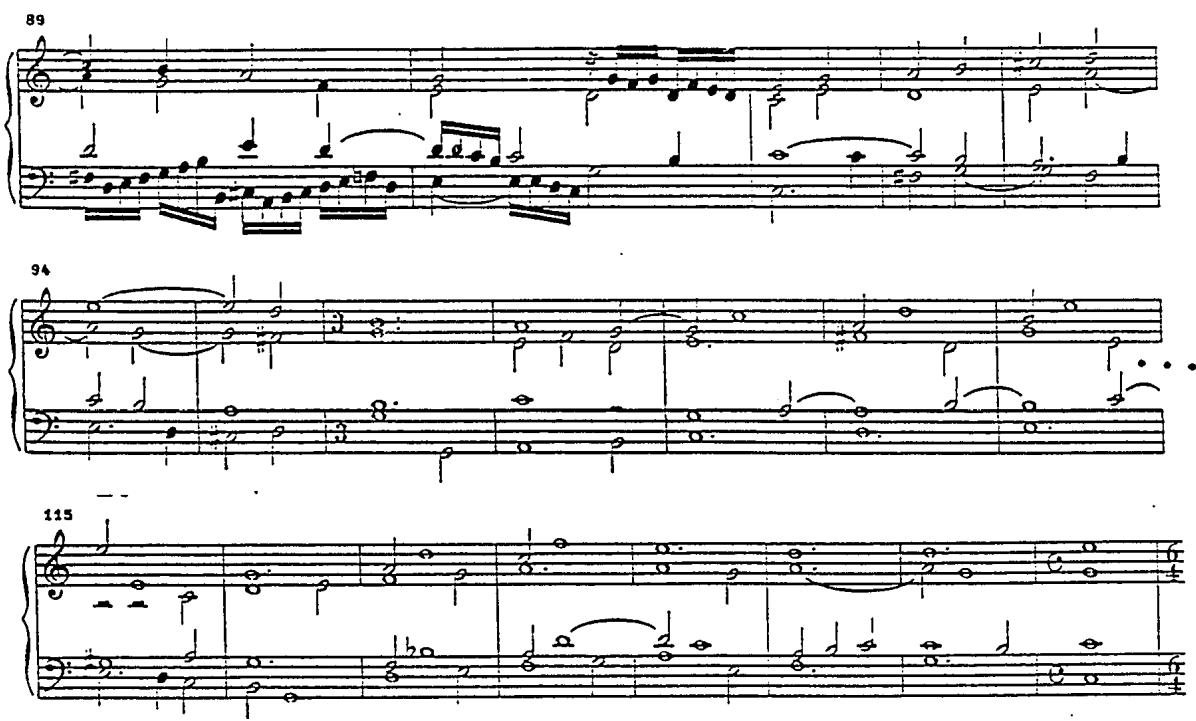
中文讲解
这是第 46 页上另一图像或乐谱的占位符。与 P0293 共同构成图例 1 的多页乐谱呈现,具体谱面内容须查阅原图。
第14段(P0295)
原文复述
$^{10}$ Snyder, Buxtehude, 253.
中文讲解
这是正文 P0288 所引脚注 10 的内容,仅指向 Snyder《Dieterich Buxtehude: Organist in Lübeck》第 253 页,是一处文献来源脚注,用以支撑 P0288 关于“the remarkable change of the time”的引文。
第15段(P0296)
原文复述
Reproduced with permission of the copyright owner. Further reproduction prohibited without permission.
中文讲解
这是第 46 页上的版权提示行,作用与 P0292 相同,声明该页(含图例 1 续)的受版权状态。
第16段(P0297)
原文复述
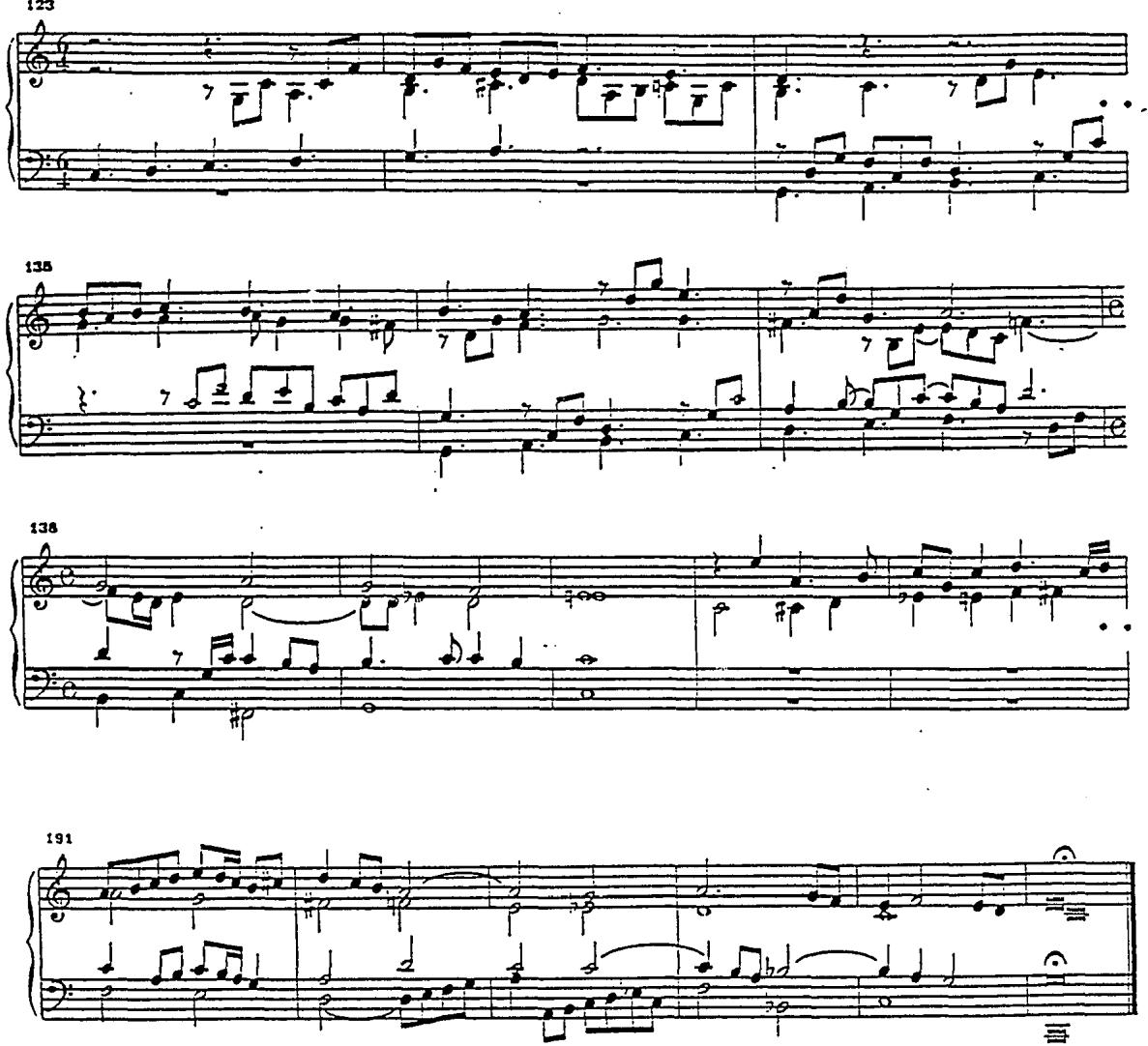
中文讲解
这是图例 1 在第 47 页的续图占位符。它延续 P0293、P0294 中的 Froberger 乐谱图示,构成完整谱例。需查阅原图。
第17段(P0298)
原文复述
Contrapuntal ingenuity played a less prominent role in later accounts of the stylus phantasticus, but technical skill remained a crucial part of this style. C. P. E. Bach remarked that “nothing more is required [in the fantasia] than a display of the keyboardist’s skill.” Knowledge of harmony and modulation took the place of contrapuntal ingenuity. $^{11}$
中文讲解
本段位于第 47 页,是对本节论述的关键收束:十八世纪以后,理论叙述中“对位技巧”的地位下降了,但“技术能力”仍是幻想风格不可缺的核心。C. P. E. Bach 直接说,幻想曲中所需要的,不过是“展示键盘演奏者的技艺”。其重心从严格意义上的对位转向和声与转调知识。这一转变的意义在于:Kircher 笔下“ingenious composition of harmonic phrases and fugues”所定义的对位性核心,被十八世纪“harmony and modulation”的现代和声意识所替代——这正是 Bach 自由幻想曲所处时代的理论语境。脚注 11 指向相应来源。
脚注 / 边栏 / 图表 / 附加信息(如有)
本节附有四条脚注(7–10)和一张跨页乐谱图例(Example 1: Froberger, Fantasia super ut re mi fa sol),并在第 45 与第 46 页附有版权声明。脚注功能分布如下:脚注 7(P0289)反驳 Schleuning 的“解放论”并提供 Bach 自由幻想曲源自声乐传统的反例;脚注 8(P0290)标明 Zarlino《和声体制》对位法部分的英译版本;脚注 9(P0291)同时给出 Kircher 原文的转引来源与 phantasia 的希腊—拉丁词源;脚注 10(P0295)标注 Kircher 关于“the remarkable change of the time”一段话的页码出处。Example 1 是支撑 Kircher 定义的核心乐谱证据,与正文 P0285–P0288 直接对应。
💡 本节核心要点
- 本节开头明确反对“自由幻想曲从巴洛克声乐中解放出来”这一说法,作者主张其根源仍在声乐传统。
- “stylus phantasticus”概念由 Kircher 在 1650 年《Musurgia universalis》中首次使用,其思想可能借鉴自 Zarlino 关于“comporre di fantasia”的论述。
- Kircher 定义的两条主轴:对位技巧(ingenious composition of harmonic phrases and fugues)与自由展示(freedom, display of genius),且体裁涵盖 fantasia、ricercata、toccata、sonata。
- Froberger《Fantasia super ut re mi fa sol》同时体现对位技巧与速度、节奏的戏剧性对比;后者预示了十八世纪初自由幻想曲的实践方向。
- 十八世纪的理论叙述中,“对位技巧”地位下降,转而被和声与转调知识所取代;C. P. E. Bach 将幻想曲的本质归结为“展示键盘演奏者的技艺”。
🔑 关键术语
- stylus phantasticus:Kircher 在 1650 年《Musurgia universalis》中提出的术语,指最自由、不受歌词与既定主题束缚的器乐幻想风格,以作曲家的想象力与对位技巧为核心。
- comporre di fantasia:Zarlino 提出的意大利术语,意为“凭想象作曲”,即在新创主题上写作对位;Kircher 的 stylus phantasticus 概念可能源自这一说法。
- cantus firmus:定旋律,指预先存在、供其他声部在其上进行模仿或对位化的旋律素材;Kircher 与 Zarlino 都强调幻想风格对其的解放。
- subjectus harmonicus:Kircher 用来指代“旋律主题”的拉丁术语,实即和声主题;幻想风格对其不加约束。
- accompanied recitative:伴奏宣叙调,一种源自意大利歌剧的声乐体裁,脚注 7 指出 Bach 第一首自由幻想曲正是以此为模型。
- free fantasia:“自由幻想曲”,本节讨论的体裁对象,作者认为其虽为器乐曲,但其主题、模型均源自巴洛克声乐传统,反对将其视为“脱离声乐”的解放体裁。
1.18 [描述性拆分] Transmission to Germany via Froberger and characteristics defined by Brossard
第1段(P0299)
原文复述
Footnote 11: Bach, Versuch, 2, 41, §. 5. This and subsequent translations, unless indicated otherwise, cited from C. P. E. Bach, Essay on the True Art of Playing Keyboard Instruments, trans. William J. Mitchell, 2d ed. (London: Ernst Eulenberg, 1974), 431.
中文讲解
这是编号为11的脚注,说明后续引文(除非另有标注)出自C. P. E. Bach《试论键盘乐器演奏的真艺术》(Versuch über die wahre Art das Clavier zu spielen)第二卷第41页第5节,所用英译本为William J. Mitchell的译本(伦敦Ernst Eulenberg出版社1974年第2版)第431页。它是一条版本/翻译出处说明,向读者交代:C. P. E. Bach著作中所有英文译文都统一采用Mitchell版,以便核对。
第2段(P0300)
原文复述
Reproduced with permission of the copyright owner. Further reproduction prohibited without permission.
中文讲解
这是出版社/版权方附加的版权声明(page 47页脚处),说明本页内容经版权所有者授权复制,未经许可不得再行复制。它不承载学术信息,只具有法律和版面属性。
第3段(P0301)
原文复述
The transmission of the stylus phantasticus to Germany has been documented in several recent studies. The movement of Italian composers to Germany, and vice versa, for study and employment, ensured the circulation of national styles. Froberger (whose hexachord fantasia was cited by Kircher and who studied with Frescobaldi, an early exponent of the stylus phantasticus), proves important in the transmission of fantastic style. Froberger served, somewhat intermittently, as organist at the Imperial Court in Vienna from 1637-1658, and had north-German connections (important ultimately for C. P. E. Bach), through his friendship with Matthias Weckmann (predecessor of Buxtehude as organist at Lübeck) and Sibylla, Princess of Württemberg. C. P. E. Bach’s indebtedness to the stylus phantasticus is suggested by C. F. Abel’s description of the composer’s music as “fantastical and recherché” (a description subsequently employed by Burney in his General History), and by stylistic features of his music, discussed below.
中文讲解
本段是本节论证的起点,提出一个历史链条:stylus phantasticus(幻想风格)如何从意大利传入德国、最终影响到C. P. E. Bach。其逻辑分四层:(1)总体背景——意大利与德国作曲家双向流动保证风格流通;(2)关键人物Froberger——曾师从Frescobaldi(六声部幻想曲被Kircher引用过),是style phantasticus向德国传播的重要中介;(3)Froberger的人际网络——1637–1658年间断地任维也纳宫廷管风琴师,并通过与Matthias Weckmann(布克斯特胡德在吕贝克的管风琴师前任)以及Württemberg公主Sibylla的交往,拥有北德联系,这条线最终通向C. P. E. Bach;(4)证据——C. F. Abel曾形容C. P. E. Bach的音乐为"fantastical and recherché"(奇异而考究),该评价后来又被Burney在《通史》中沿用,加之其音乐本身具有的风格特征(详见下文),由此可推断C. P. E. Bach对stylus phantasticus的承袭。换言之,本段用一条"人物—师承—网络—评价/风格"的证据链,把意大利源头的stylus phantasticus接续到C. P. E. Bach名下,为后续分析其音乐特征奠定前提。
补充说明
无额外补充(脚注12–14已分别交代意大利音乐在德国的传播文献、Froberger人脉的二手来源,以及Abel评价归属问题,正文不再复述)。
第4段(P0302)
原文复述
2. Characteristics
中文讲解
这是第2小节的标题,开启了论文的第二部分议题:在确认stylus phantasticus经Froberger传入德国并影响C. P. E. Bach之后,转而回答"Abel所说的’fantastical and recherché’究竟指哪些具体音乐特征"。小节标题本身只起论题转换作用,并不展开论证。
第5段(P0303)
原文复述
What specific musical features might Abel have had in mind? To answer this question we must examine eighteenth-century definitions of the stylus phantasticus in more detail. Brossard, borrowing directly from Kircher, defined the stylo phantastico as “proper for instruments [that is, for improvisation] or a way of composing that is free and without restraint, as is explained under the terms PHANTASIA, RICERCATA, SUONATA, and TOCCATA.” Both composition (including the ensemble genres, ricercata and sonata) and improvisatory genres are included in this definition. Entries for these specific types of piece make clear that by “free and without restraint” Brossard means without text and cantus firmus.
中文讲解
本段把分析重心从"传播史"转入"风格定义"。它先抛出一个问题——Abel的评价到底对应哪些具体的音乐特征——然后以18世纪Brossard的词典定义为切入口。Brossard的"stylo phantastico"条目直接借鉴Kircher的定义:它"适合器乐(即适合即兴演奏),或是一种自由而不受拘束的作曲方式",并具体由PHANTASIA、RICERCATA、SUONATA、TOCCATA这几个词条共同解释。作者由此点出两条关键信息:(1)该风格既覆盖作曲体裁(包括合奏体裁如ricercata和sonata),也涵盖即兴演奏;(2)“自由而不受拘束"在Brossard的相关条目中具体落实为"没有歌词、没有cantus firmus(定旋律)"——即不必受歌词或固定旋律的约束,可以充分展开乐思。这两条对理解C. P. E. Bach的器乐创作至关重要,因为它们限定了"fantastical"在纯器乐语境中的所指。
第6段(P0304)
原文复述
Footnote 12: On the transmission of Italian music in Germany see Eva Linfield, “Dietrich Buxtehude’s Sonatas: A Historical and Analytical Study” (Ph.D. diss., Brandeis University, 1984), ch. 4 [hereafter, “Buxtehude’s Sonatas”]. See also Friedhelm Krummacher, “Stylus phantasticus und phantastische Musik: Kompositorische Verfahren in Toccaten von Frescobaldi und Buxtehude,” Schütz-Jahrbuch 2 (1980): 7-77; Christine Defant, Kammermusik und phantastische Musik: Studien zu Dietrich Buxtehudes Triosonaten, Europäische Hochschulschriften Reihe 36, Musikwissenschaft 14 (Frankfurt am Main: Peter Lang, 1985); Linfield, “Buxtehude’s Sonatas,” ch. 6.
中文讲解
这是12号脚注,列举了关于意大利音乐在德国传播的二手研究:Linfield关于布克斯特胡德奏鸣曲的博士论文第4章;Krummacher讨论Frescobaldi和Buxtehude托卡塔中作曲手法与stylus phantasticus关系的文章;Defant关于Buxtehude三重奏鸣曲的专著;以及Linfield同书第6章。这些文献为正文P0301中关于"意大利—德国风格流通"的论断提供学术支撑。
补充说明
无额外补充(脚注本身只是文献索引,正文未对其内容进一步展开)。
第7段(P0305)
原文复述
Footnote 13: On Froberger’s connection with Weckmann and Sibylla, Princess of Württemberg, see Apel, Keyboard Music, trans. Tischer, 552.
中文讲解
这是13号脚注,为正文P0301中关于Froberger与Matthias Weckmann及Württemberg公主Sibylla之间关系的说法提供文献来源——出自Apel《键盘音乐》(Tischer英译本)第552页。它属于支持性引证,限定了正文所用人际网络信息的可追溯依据。
第8段(P0306)
原文复述
Footnote 14: Burney, History, ed. Mercer, 2:955. On the attribution of this remark to Carl Friedrich Abel see Hans T. David and Arthur Mendel, The Bach Reader: a Life of Johann Sebastian Bach in Letters and Documents, rev. ed. (New York: W. W. Norton, 1966), 262 n. 34.
中文讲解
这是14号脚注,指出C. F. Abel那句"fantastical and recherché"的评价见于Burney《通史》(Mercer编)第2卷第955页,而关于该评价归属于Abel的考证来自David和Mendel《The Bach Reader》(修订版,1966年)第262页注34。该脚注兼具原始出处与归属考证两重功能:前者是来源,后者是限定——告诉读者Abel之评价并非毫无疑义地直接出自其本人。
第9段(P0307)
原文复述
Reproduced with permission of the copyright owner. Further reproduction prohibited without permission.
中文讲解
这是page 48上的版权声明,性质与P0300相同,仅具版面与法律意义。
第10段(P0308)
原文复述
Brossard’s definition of the sonata suggests such rhapsodic works as Buxtehude’s d-minor sonata (BuxWV 257) and the Italian canzone from which Buxtehude drew inspiration:
中文讲解
本段是一个过渡句,承上启下:上段刚给出Brossard关于stylus phantasticus的总定义,本段则指出,Brossard对"sonata(SUONATA)“一项的具体解释正可以对应布克斯特胡德d小调奏鸣曲(BuxWV 257)这类狂想曲式作品,以及启发该作品的意大利canzone(坎佐纳)。它由此把抽象的定义与具体的作品实例对接起来,为下一段引出SUONATA词条做准备。
第11段(P0309)
原文复述
SUONATA. Sonatas are properly large pieces, fantasies or preludes varied by all kinds of tempos and expressions, choice and extraordinary harmonies, simple or double fugues, etc., and all this purely according to the fancy of the composer, who, without being subjected to any fixed number or particular kind of meter, does his best, inspired by his genius, changing meter and mode whenever he judges it appropriate.
中文讲解
本段直接引用Brossard词典中SUONATA词条:奏鸣曲"理应是大体量的作品,是幻想曲或前奏曲,由各种速度与表情、精心而出人意料的和声、简单或双重赋格等等变化而成,一切都纯粹依作曲家的奇思而行;作曲家不受固定数目或特定拍号的拘束,受其天才启发而尽力发挥,自行判断在合适之处变换拍号与调式”。这一词条同时给出三层信息:(1)体量上是大型作品;(2)内容上自由组合速度、表情、和声、赋格等元素;(3)形式上作曲家可自行决定拍号与调式,无需拘泥于既有规范。这正是stylus phantasticus在sonata体裁上的具体展开。
第12段(P0310)
原文复述
The fantastic character of the stylus phantasticus is more pronounced here than in Kircher’s description. Contrapuntal ingenuity is still a component, but expressive diversity, “extraordinary harmonies” and unpredictability are also prominent. Counterpoint is not even mentioned in Brossard’s definitions of the other genres belonging to this style. Instead, the subjective creativity manifested in this style is emphasized. Fantastic music is composed or improvised “purely according to the fancy of the composer,” who is “inspired by his genius.”
中文讲解
本段对前述SUONATA词条进行解读,指出与Kircher的描述相比,Brossard笔下stylus phantasticus的"幻想性"更加突出。具体差别有两点:(1)Kircher的版本以对位精巧为主导,而Brossard虽然仍保留对位,但同时强调"表现力的多样性”、“出人意料的和声"和"不可预测性”;(2)Brossard在stylus phantasticus其他体裁的词条里甚至不再提及对位,转而强调作曲家的"主观创造力"——音乐是"纯粹依作曲家奇思"、“受其天才启发"而作或即兴演奏。作者的言外之意是:到18世纪初的Brossard,对stylus phantasticus的理解已从"以对位技艺为核心"转向"以主观、不可预测的创意为核心”,这恰好预示了C. P. E. Bach那种被形容为fantastical and recherché的趣味。
第13段(P0311)
原文复述
The ensemble sonatas of Dietrich Buxtehude exemplify the stylus phantasticus in north-German music of the later seventeenth century. They consist of an unpredictable series of interlocking sections in contrasting tempos. Surprise is intensified as movements break off and enter abruptly. In example 2 from BuxWV 257, an Allegro with short, manically repeated motifs breaks off, and, after a general pause, an Adagio enters on a 6/5 chord.
中文讲解
本段把抽象定义落到具体作品:布克斯特胡德的合奏奏鸣曲是17世纪后半叶北德音乐中stylus phantasticus的典范。其特征在于:(1)由一系列不可预测、彼此咬合的段落组成,速度相互对比;(2)“惊奇"效果被强化——乐章/段落突然中断又突然进入。以谱例2(BuxWV 257)为例:一个由短促、近乎机械地反复的动机构成的快板突然中断,经全休止(general pause)后,慢板直接在一个6/5和弦上进入。这个"断—停—突转"的瞬间,恰好印证了Brossard所强调的"不可预测性"与"惊奇”。
补充说明
无额外补充(谱例2本身在P0315以图占位符出现)。
第14段(P0312)
原文复述
Footnote 15: Sebastien de Brossard, Dictionnaire de Musique, 2d ed. (Paris: Christophe Ballard, 1705), 116, cited from Brossard, Dictionary of Music, trans. Albion Gruber, Musical Theorists in Translation, vol. 12 (Henryville: Institute of Mediaeval Music, 1982), 118.
中文讲解
这是15号脚注,交代P0303所引Brossard关于stylo phantastico定义的来源:原书为Brossard《音乐词典》(Paris: Christophe Ballard, 1705)第2版第116页;所用英文译本为Albion Gruber译《Dictionary of Music》,收入Musical Theorists in Translation丛书第12卷(Henryville: Institute of Mediaeval Music, 1982)第118页。它属于来源标注脚注,本身不补充新论点。
第15段(P0313)
原文复述
Footnote 16: Brossard, Dictionary, trans. Gruber, 120-121.
中文讲解
这是16号脚注,标注P0309所引SUONATA条目的英译出处——Brossard《Dictionary of Music》Gruber译本第120–121页。同样为来源说明脚注。
第16段(P0314)
原文复述
Reproduced with permission of the copyright owner. Further reproduction prohibited without permission.
中文讲解
这是page 49上的版权声明,性质同前。
第17段(P0315)
原文复述
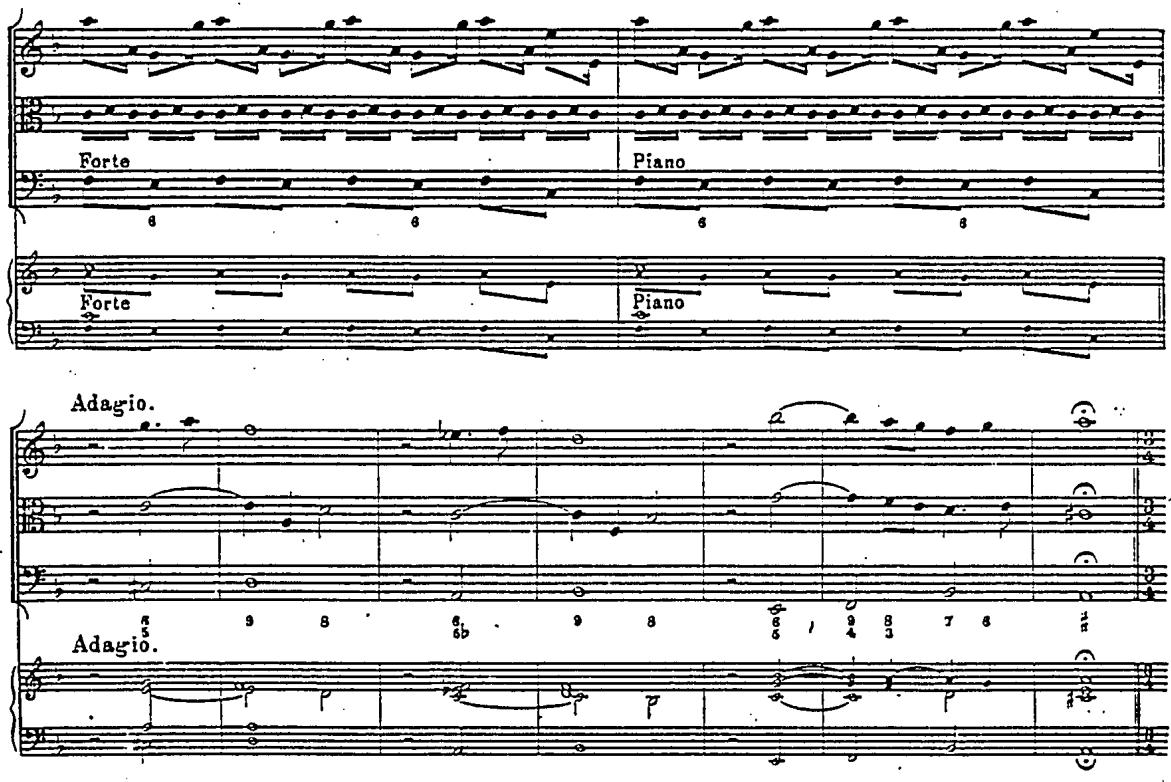
中文讲解
这是图注占位符,对应谱例2:布克斯特胡德d小调奏鸣曲(BuxWV 257),为小提琴、维奥尔琴和拨弦古钢琴而作。它在文中与P0311所述"快板突然中断—全休止—慢板进入6/5和弦"这一段直接相关,用于直观呈现stylus phantasticus的"突发对比"特征。具体谱面细节需查阅原图。
补充说明
谱例2的具体谱面信息(速度标记、调号、和声进行等)须查看原图,本输入未提供可读图像数据。
第18段(P0316)
原文复述
The surprise effects of elided, contrasting sections remained a hallmark of the stylus phantasticus. At the end of the third, allegro section of J. S. Bach’s toccata in g minor (BWV 915, for harpsichord) a V6/4–>5/3 progression prepares a perfect authentic cadence in B-flat (example 3, m. 67).
中文讲解
本段把"段落突断、对比强烈"这一stylus phantasticus特征从布克斯特胡德延伸到J. S. Bach:作者指出,在J. S. Bach g小调托卡塔(BWV 915,拨弦古钢琴)第67小节、第三段快板的末尾,一个V6/4→5/3的进行准备了一个落到降B大调的完全正格终止。作者以此暗示:J. S. Bach的托卡塔仍然保留stylus phantasticus那种"省略过渡、突然转向对比段落"所带来的惊奇效果。整段的功能是用更晚、更具权威性的作曲家(J. S. Bach)作为旁证,证明stylus phantasticus的"突断—惊奇"手法在该传统中长期延续。
补充说明
无额外补充(谱例3未在本节内出现,仅作为后续内容预告)。
第19段(P0317)
原文复述
Footnote 17: For a fuller discussion of Buxtehude’s cyclic forms see Linfield, “Buxtehude’s Sonatas,” ch. 6.
中文讲解
这是17号脚注,引导希望深入了解布克斯特胡德循环形式的读者去查阅Linfield《Buxtehude’s Sonatas》第6章。它属于延伸阅读提示,既支持P0311关于布克斯特胡德奏鸣曲"不可预测、段落咬合"的论点,又把读者引向更详尽的二手研究。
第20段(P0318)
原文复述
Reproduced with permission of the copyright owner. Further reproduction prohibited without permission.
中文讲解
这是page 50上的版权声明,性质同前。
脚注 / 边栏 / 图表 / 附加信息(如有)
本节包含以下附加材料:(1)脚注11说明C. P. E. Bach《Versuch》英译本(William J. Mitchell译本)作为通用译本的来源;(2)脚注12列举关于意大利音乐在德国传播的学术文献,包括Linfield、Krummacher、Defant的研究;(3)脚注13为Froberger与Weckmann、Sibylla的联系提供Apel《Keyboard Music》的出处;(4)脚注14既给出Abel评价的原始出处(Burney《History》),又交代归属考证来源(David与Mendel《The Bach Reader》);(5)脚注15、16分别标注Brossard词典中stylo phantastico总条目与SUONATA条目的英译本(Gruber译本);(6)脚注17指引读者查阅Linfield第6章以深入了解布克斯特胡德的循环形式;(7)图占位符为谱例2(图注保留,图像内容须查阅原图),与正文P0311所述"快板突断—全休止—慢板6/5和弦进入"直接对应;(8)多次出现的"Reproduced with permission of the copyright owner"为出版社版权声明。这些附加材料共同构成支撑正文的来源、翻译与图像证据链。
💡 本节核心要点
- stylus phantasticus经由意大利作曲家(尤其Frescobaldi)→Froberger→Weckmann/Sibylla的北德网络→C. P. E. Bach,形成可追溯的人物—师承传播链。
- C. P. E. Bach对stylus phantasticus的承袭得到Abel评价"fantastical and recherché"(后被Burney沿用)及其自身音乐风格特征的双重佐证。
- Brossard将stylus phantasticus定义为适合器乐/即兴、自由而不受拘束(无歌词、无cantus firmus),既涵盖作曲体裁(ricercata、sonata等)也涵盖即兴体裁(fantasia、toccata)。
- 相比Kircher,Brossard笔下的stylus phantasticus更强调表现多样性、“extraordinary harmonies"与不可预测性;主观创造力(“依奇思”、“受天才启发”)取代对位精巧成为风格核心。
- 在sonata层面,Brossard要求体量大型、速度与表情自由对比、和声与赋格任意组合、拍号与调式随作曲家判断变换——这正是stylus phantasticus在sonata体裁上的具体展开。
- 布克斯特胡德BuxWV 257合奏奏鸣曲中"段落突然中断—全休止—新段落突入"的写法,被作者作为stylus phantasticus"不可预测与惊奇"的具体例证;此传统在J. S. Bach BWV 915中以类似手法延续。
🔑 关键术语
- stylus phantasticus:本节核心术语,指17–18世纪欧洲器乐(及即兴)音乐中的一种风格类型,特征是自由、不受拘束、强调主观创造力与不可预测性,涵盖fantasia、ricercata、sonata、toccata等体裁。
- Froberger (Johann Jacob Froberger):17世纪中叶的德—奥管风琴家与作曲家,曾师从意大利Frescobaldi学习,是stylus phantasticus从意大利传入德国(特别是北德)的重要中介人物。
- Brossard (Sébastien de Brossard):18世纪初法国音乐理论家,其《Dictionnaire de Musique》(1703/1705)对stylus phantasticus及下属各体裁的释义是本节定义stylus phantasticus特征的关键文献来源。
- Kircher (Athanasius Kircher):17世纪德国学者,其著作中关于stylus phantasticus的较早描述是Brossard相关条目的直接来源之一;与Brossard相比,Kircher的版本更强调对位精巧。
- cantus firmus:拉丁文术语,指"定旋律”,即作曲中作为骨架被反复运用的固定旋律线;在Brossard的语境中,stylus phantasticus"自由而不受拘束"具体意味着无需依附于歌词或定旋律。
- BuxWV 257:布克斯特胡德d小调奏鸣曲(小提琴、维奥尔琴、拨弦古钢琴)的作品编号,本节用作stylus phantasticus"段落突断、对比强烈"风格特征的实例。
- BWV 915:J. S. Bach g小调托卡塔(拨弦古钢琴)的作品编号,本节用以证明stylus phantasticus那种"突断—惊奇"手法在该传统中延续到J. S. Bach。
- C. F. Abel:Carl Friedrich Abel,曾形容C. P. E. Bach的音乐为"fantastical and recherché";该评价后被Burney在《General History》中沿用,是本节用来切入C. P. E. Bach风格特征归属问题的核心证据。