目录
C00 Front Matter and Abstract
- S001 [描述性拆分] Document of Defense and Title Page
- 页码:1-2
- S002 Abstract
- 页码:3-4
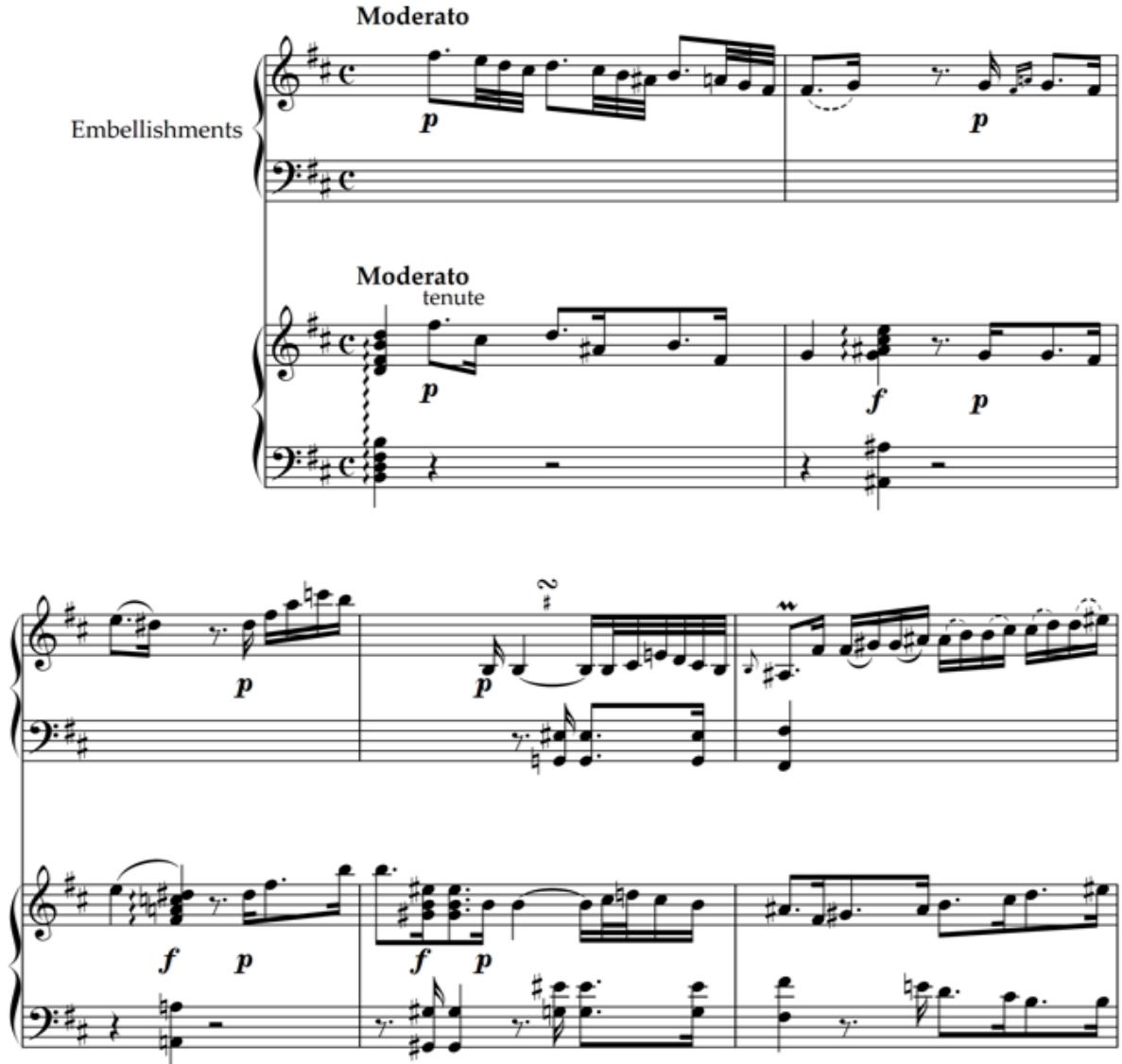
- S003 [描述性拆分] Copyright, Acknowledgements, Table of Contents, Lists of Examples and Tables
- 页码:5-12
C01 Chapter 1: A dilemma in the analysis of C. P. E. Bach’s late keyboard sonatas
- S101 Introduction
- 页码:13-16
- S102 Elements of fantasia
- 页码:16-20
- S103 Fantasia elements in Bach’s late keyboard sonatas
- 页码:20-24
- S104 Dilemma in the analysis of C. P. E. Bach’s late keyboard sonatas
- 页码:25-26
- S105 Two prior analytical approaches to C. P. E. Bach’s keyboard sonatas
- 页码:26-29
- S106 Reconsidering the nature of unity and diversity
- 页码:29-33
- S107 Resources for developing a flexible formal approach
- 页码:34-37
- S108 Outline of the following chapters
- 页码:37-39
C02 Chapter 2: A Non-mechanical view of unity and diversity in the second half of the 18th-century Europe
- S201 [描述性拆分] Non-mechanical view of unity and diversity vs. mechanical view of unity and diversity
- 页码:40-43
- S202 [描述性拆分] A non-mechanical view of unity and diversity as a cultural phenomenon: Continental Rationalism vs. British Empiricism
- 页码:44-45
- S203 English taste in Northern Germany
- 页码:45-49
- S204 Music
- 页码:50-50
S001 [描述性拆分] Document of Defense and Title Page
第1段(P0001)
原文复述
University of Cincinnati
中文讲解
这是一级 Markdown 标题,内容仅为校名 ‘University of Cincinnati’(辛辛那提大学)。位于论文 ‘Document of Defense’(答辩文件)首页的最上方,标明该答辩文件的所属机构。版面属性上属于页眉式机构标识,无正文论述功能。
第2段(P0002)
原文复述
Date: 6/27/2024
中文讲解
答辩文件中标注的日期,格式为 ‘Date: 6/27/2024’,即 2024 年 6 月 27 日。该日期代表答辩文件填写的签署日期,而非答辩发生的日期。需注意后文 P0020 显示论文最终落款日期为 2024 年 7 月 10 日。
第3段(P0003)
原文复述
I, Yan Kit Li, hereby submit this original work as part of the requirements for the degree of Doctor of Philosophy in Theory.
中文讲解
作者 Yan Kit Li(李恩杰)以第一人称声明,提交此原创作品作为获得音乐理论(Theory)方向哲学博士学位(Doctor of Philosophy, Ph.D.)所需条件的一部分。‘hereby submit’ 与 ‘as part of the requirements’ 是学位论文标准措辞,用以确认原创性与学位申请的合规性。关键词 ‘original work’ 强调本论文系作者本人原创。
第4段(P0004)
原文复述
It is entitled:
中文讲解
过渡句 ‘It is entitled:’(其题目为:),用于引出紧随其后的论文正式标题。该句本身没有实质内容,仅起衔接作用,引导读者关注下一行的论文题名。
第5段(P0005)
原文复述
On C. P. E. Bach’s Late Keyboard Sonatas: Towards a Flexible Formal Analytical Approach
中文讲解
论文正式标题:《论 C. P. E. 巴赫晚期键盘奏鸣曲:迈向一种弹性的曲式分析方法》。标题中 ‘C. P. E. Bach’ 指卡尔·菲利普·埃曼努埃尔·巴赫(C. P. E. Bach),‘Late Keyboard Sonatas’ 指其晚期键盘奏鸣曲,副标题 ‘Towards a Flexible Formal Analytical Approach’ 点明研究方法论主张——作者试图发展一种’弹性’的曲式分析路径,而非套用既有僵化模式。这一题名已预告全篇的核心问题意识。
补充说明
标题中的 C. P. E. Bach 与 P0023 中的 Hong Kong Baptist University 等专有名词在本节中按原文形式保留。
第6段(P0006)
原文复述
Student’s name: Yan Kit Li
中文讲解
答辩文件再次列明作者姓名 ‘Yan Kit Li’,并标注其身份为 ‘Student’s name’(学生姓名)。与 P0003 中的 ‘I, Yan Kit Li’ 形成照应,确保作者身份在文件首页出现两次以满足签字确认要求。
第7段(P0007)
原文复述
This work and its defense approved by:
中文讲解
引导句 ‘This work and its defense approved by:’(本作品及其答辩已获下列人员批准:),用于引出答辩委员会的成员名单。该句明确答辩文件的制度功能:不仅确认论文本身获通过,也确认答辩环节已完成。
第8段(P0008)
原文复述
Committee member: David Carson Berry, Ph.D.
中文讲解
答辩委员会成员之一:David Carson Berry 博士(Ph.D.)。其角色标注为 ‘Committee member’(委员),并非主席。Ph.D. 后缀表明其学术头衔,与本节末尾的 ‘Steven Joel Cahn, Ph.D.’ 头衔用法一致。
第9段(P0009)
原文复述

中文讲解
页 1 中的图像或乐谱占位符。括号注释明确说明:内嵌的图像数据已被省略,仅保留其位置与图注。版面属性上属于答辩文件首页的一处嵌入图形,可能为签字栏、印章位置或校徽等版式元素;从上下文无法进一步判断其具体内容。需查看原图方可确认。
补充说明
本占位符出现在两位委员姓名之间,提示此处可能为原版 PDF 中的签字栏或图形标识;不要凭外观推测其内容。
第10段(P0010)
原文复述
Committee member: Jonathan Kregor, Ph.D.
中文讲解
答辩委员会成员之二:Jonathan Kregor 博士。其角色亦为 ‘Committee member’(委员)。与 P0008 的 David Carson Berry 并列,均非主席。’, Ph.D.’ 头衔与 Berry 一致。
第11段(P0011)
原文复述
Committee chair: Steven Joel Cahn, Ph.D.
中文讲解
答辩委员会主席:Steven Joel Cahn 博士。与前两位 ‘Committee member’ 不同,此处明确标注为 ‘Committee chair’(委员会主席),表明其在答辩程序中负有主持职责。’, Ph.D.’ 为其学术头衔。该姓名也在 P0024 中作为 ‘Committee Chair’ 再次出现,构成对主席身份的二次确认。
第12段(P0012)
原文复述
48209
中文讲解
纯数字 ‘48209’。从版面位置(位于答辩委员会名单之后、P0013 打印日期之前)来看,最可能是与答辩机构或文件相关的编号,例如邮区编码(辛辛那提大学所在地区的 ZIP Code 之一)或机构内部文件编号。原文并未给出解释,应仅按原文呈现,不作推测。
第13段(P0013)
原文复述
Last Printed:7/10/2024
中文讲解
标注 ‘Last Printed:7/10/2024’,意为此答辩文件的最后一次打印日期为 2024 年 7 月 10 日。与 P0002 的填写日期 6/27/2024 相比,打印日期晚约两周;与 P0020 的论文落款日期 7/10/2024 完全一致,说明该答辩文件最终于论文完成同日定稿打印。
第14段(P0014)
原文复述
Document Of Defense Form
中文讲解
标题 ‘Document Of Defense Form’(答辩文件表),是页 1 整张表单的名称标识。该标题位置处于 P0001–P0013 的填写内容之后、页 2 论文扉页之前,作用是确认本页的法律性表单性质。它不是论文的正式扉页(扉页在 P0015 起),而是答辩程序的官方证明文件。
第15段(P0015)
原文复述
On C. P. E. Bach’s Late Keyboard Sonatas: Towards a Flexible Formal Analytical Approach
中文讲解
论文扉页中央的题名,与 P0005 内容完全一致:‘On C. P. E. Bach’s Late Keyboard Sonatas: Towards a Flexible Formal Analytical Approach’。题名在此处重复出现,是因为学位论文的传统扉页需独立、完整地展示论文题名,不依赖前文答辩文件中的信息。
第16段(P0016)
原文复述
A dissertation submitted to the Graduate College of the University of Cincinnati
中文讲解
扉页说明文字第一句:‘A dissertation submitted to the Graduate College of the University of Cincinnati’(一篇提交给辛辛那提大学研究生院的学位论文)。‘Graduate College’(研究生院)表明学位论文所归属的行政单位,与一般 ‘Department’(系)相区分,强调研究生院的统一管理。
第17段(P0017)
原文复述
in partial fulfillment of the requirements for the degree of
中文讲解
扉页说明文字第二句:‘in partial fulfillment of the requirements for the degree of’(作为取得……学位所需条件的部分满足)。原文保留换行;语义上承接 P0016,指明本论文是获得学位的’部分’条件(‘partial’)之一,意味着学位授予还包含其他要求(如课程、资格考试等)。
第18段(P0018)
原文复述
Doctor of Philosophy
中文讲解
扉页所示学位名称:‘Doctor of Philosophy’(哲学博士,Ph.D.)。与 P0003 中 ‘Doctor of Philosophy in Theory’ 相比,此处仅显示主学位名 ‘Doctor of Philosophy’,专业方向留给 P0019 补充。
第19段(P0019)
原文复述
in Music Theory in the Division of Composition, Musicology, and Theory of the College-Conservatory of Music
中文讲解
专业方向与所属单位:‘in Music Theory in the Division of Composition, Musicology, and Theory of the College-Conservatory of Music’。层次上由小到大分别为:(1)专业方向 Music Theory(音乐理论);(2)所在分部 Division of Composition, Musicology, and Theory(作曲、音乐学与理论分部);(3)所属学院 College-Conservatory of Music(音乐学院-音乐学校,即 CCM)。这一嵌套说明完整交代了作者在大学内的学术归属。
第20段(P0020)
原文复述
July 10, 2024
中文讲解
论文完成日期 ‘July 10, 2024’(2024 年 7 月 10 日),即论文落款的最终日期。与 P0002 的答辩文件填写日 6/27/2024 相比,约晚两周;与 P0013 的 ‘Last Printed’ 日期完全相同,暗示这一天既是答辩文件定稿日,也是论文落款日。
第21段(P0021)
原文复述
by
中文讲解
单词 ‘by’(由……完成)。该词单独成段,是扉页的传统版式要素,用于引出作者署名,作用相当于汉语扉页中的’著’或’撰’。本身无独立信息,仅起语法衔接作用。
第22段(P0022)
原文复述
Yan Kit Li
中文讲解
作者署名 ‘Yan Kit Li’(李恩杰)。在扉页的版式惯例中,作者姓名独立成段、字号较大、居中排列,是扉页的核心标识要素。其姓名拼写与 P0003、P0006 中出现的拼法完全一致。
第23段(P0023)
原文复述
B.A. (Hons.) in Music, Hong Kong Baptist University, 2013 M.M. in Music Theory, University of Cincinnati, 2016
中文讲解
作者的学历背景,分两行列出:(1)‘B.A. (Hons.) in Music, Hong Kong Baptist University, 2013’——2013 年于香港浸会大学获得音乐学荣誉文学士;(2)‘M.M. in Music Theory, University of Cincinnati, 2016’——2016 年于辛辛那提大学获得音乐理论硕士。这两条信息揭示了作者的学术轨迹:先在香港取得本科学位,再赴美在辛辛那提大学完成硕士,并在同一所大学继续攻读博士,使读者了解其研究训练的连续性与机构背景。
第24段(P0024)
原文复述
Committee Chair: Steven Joel Cahn, PhD
中文讲解
扉页末尾的答辩委员会主席署名:‘Committee Chair: Steven Joel Cahn, PhD’。与 P0011 的 ‘Committee chair: Steven Joel Cahn, Ph.D.’ 在姓名上一致,但拼写细节略有差异:此处头衔 ‘PhD’ 不带句点,与 P0011 的 ‘Ph.D.’ 略不同;‘Committee Chair’ 的 C 为大写,体现了扉页正式版式下头衔的规范化写法。这一行作为扉页收束,再次确认答辩主席身份。
补充说明
PhD 与 Ph.D. 的拼写差异属于版式惯例,扉页一般采用无句点的缩写形式。
脚注 / 边栏 / 图表 / 附加信息(如有)
本节附加材料包括:P0009 处的图像/乐谱占位符(其原始内容需查看原图,仅可确认位于两位委员姓名之间,可能为签字栏或图形标识);P0012 的数字 ‘48209’(原文未给出解释,不作推测)。
💡 本节核心要点
- 本节由两页构成:第 1 页为 ‘Document of Defense Form’(答辩文件表),第 2 页为论文正式扉页,两者承担不同制度功能。
- 论文题名为《On C. P. E. Bach’s Late Keyboard Sonatas: Towards a Flexible Formal Analytical Approach》,作者为 Yan Kit Li,副标题暗示其方法论主张——‘弹性的曲式分析路径’。
- 答辩委员会由两位委员(David Carson Berry、Jonathan Kregor)与一位主席(Steven Joel Cahn)组成;主席身份在第 1 页(P0011)与第 2 页(P0024)两次确认。
- 作者的学术轨迹为:2013 年香港浸会大学音乐荣誉学士 → 2016 年辛辛那提大学音乐理论硕士 → 2024 年辛辛那提大学音乐理论方向博士。
- 关键日期有三个:填写日 6/27/2024、最终打印日 7/10/2024、论文落款日 July 10, 2024;后两者为同一日。
- 作者的学术归属按层次逐级展开:专业(Music Theory)→ 分部(Division of Composition, Musicology, and Theory)→ 学院(College-Conservatory of Music,CCM)。
🔑 关键术语
- Document of Defense Form:答辩文件表,美国博士论文制度中的标准化文件,证明论文及答辩已获委员会成员批准,包含日期、机构、姓名、委员会名单等必备信息。
- Graduate College:研究生院,负责统一管理全校研究生学位授予的行政单位;扉页以此表明论文归属层级。
- Doctor of Philosophy (Ph.D.):哲学博士,美国高校最高学术学位之一;此处具体方向为音乐理论(Music Theory)。
- Division of Composition, Musicology, and Theory:作曲、音乐学与理论分部,辛辛那提大学音乐学院(CCM)下属的学系级单位,作者攻读博士学位期间所属的学术单位。
- College-Conservatory of Music (CCM):辛辛那提大学音乐学院兼音乐学校,作者博士学位所在学院;兼具 ‘College’(学院)与 ‘Conservatory’(音乐学校)双重属性。
- Committee Chair:答辩委员会主席,主持答辩程序并对论文终审负责的最高委员会成员;本节中由 Steven Joel Cahn 担任。
S002 Abstract
第1段(P0025)
原文复述
Abstract — section heading that introduces the dissertation’s abstract, signaling that the following text will summarize the research problem, the proposed analytical framework, the methodology, and the chosen case studies.
中文讲解
「## Abstract」为本节标题,标识本节为学位论文的摘要部分。下列段落将依次呈现:论文所针对的研究张力、作者提出的应对框架、分析方法,以及作为分析对象的三首奏鸣曲乐章。
第2段(P0026)
原文复述
This dissertation proposes a flexible formal analytical approach to C. P. E. Bach’s late keyboard sonatas, which were composed during his Hamburg period from 1768 to 1788. The author claims that this approach resolves a persistent dilemma: the tension between form — understood as it interacts with sonata genre types — and content, which need not conform to generic expectations. The source of this dilemma lies in Bach’s fantasia-like treatments within his sonatas. Such treatments generate eccentricities and digressions, which in turn produce an incongruence between musical details and formal expectations.
The abstract observes that, generally, two analytical approaches have been taken to this dilemma. The first narrows analytical scope to clear-cut examples that conform to genre-based formal norms. The second concentrates on idiosyncratic details while disregarding their relevance to any formal process unfolding in dialogue with the sonata genre. Neither approach, the author maintains, reveals the dynamic relationship between idiosyncratic details and the formal process.
To bring this dynamic relationship into view, the author argues that Mikhail Bakhtin’s concept of dialogized heteroglossia recognizes the role that incongruent details play in shaping the formal process. Through dialogized heteroglossia one can bridge the gulf between form and content because this concept embodies what the author calls a non-mechanical view of unity and diversity — a topic discussed in various ways across Western Europe in the second half of the eighteenth century.
The non-mechanical view of unity and diversity conceives unity through a bottom-up approach. It rejects an all-encompassing external structure that imposes hierarchical relationships between the general and the particular, and instead respects the properties of the musical materials themselves. Dialogized heteroglossia captures the interanimation among the details and acquires meanings that emerge from the materials’ mutual illumination. By closely inspecting how incongruent details participate in shaping the formal process, a possible logical thread becomes evident — one that discloses hidden similarities among the incongruities.
中文讲解
本段是摘要的论证主体,分四步展开。
第一步(第一句群)交代研究对象与核心问题:论文针对 C. P. E. 巴赫汉堡时期(1768–1788)的晚期键盘奏鸣曲,提出一种灵活的形式分析方法,用以解决一个棘手的张力——形式(在与奏鸣曲体裁类型的对话中所体现的形式期待)与内容(不必与体裁期待一致)之间的不可调和性。这一张力的根源在于巴赫在奏鸣曲内部所作的"幻想曲式处理":它们制造出偏离与枝节,导致音乐细节与形式期望之间的脱节。
第二步(第二句群)排他性地审视学界已有的两条路径:其一,将分析范围限定于体裁契合、形式清晰的样本;其二,集中关注特异细节,但忽略这些细节在奏鸣曲体裁对话中对形式进程的意义。作者明确指出,两条路径都无法揭示特异细节与形式进程之间的"动态关系"。这一否定性结论为下文引入新框架作了铺垫。
第三步(第三句群)提出解决方案:引入米哈伊尔·巴赫金的"对话化杂语"(dialogized heteroglossia)。该概念承认不一致细节在塑造形式进程中的作用,因此能够跨越形式与内容之间的鸿沟。它背后所体现的,是作者所称的"非机械的统一与多样观"——一个在18世纪后半叶西欧曾以多种方式被讨论的话题。注意作者用 “a topic discussed variously in the second half of the 18th century” 这一历史定位,把自己的方法学立场放回18世纪的思想语境中,但并未在摘要内展开具体人物或文本。
第四步(第四句群)对"非机械的统一与多样观"作进一步刻画:它采用自下而上的方式构想统一,拒斥那种用外在总体结构去强制规定一般与个别之等级关系的做法,转而尊重音乐材料自身的属性。“对话化杂语"捕捉到细节之间的相互激活(interanimation),意义产生于材料之间的相互照亮。由此,对不一致细节如何参与形式进程作细致审视,隐藏于各不一致现象之间的相似之处便汇聚为一条可识别的逻辑线索。
值得留意的论证修辞:本段并未正面论证"为什么巴赫金的概念合适”,而是采取"既有路径皆不足 → 唯有该路径能揭示动态关系"的反证结构,把巴赫金作为唯一能完成"桥梁"功能的概念引入。
补充说明
本段同时引入了两个层次的术语关系:“对话化杂语"是分析工具,“非机械的统一与多样观"是它所依托的方法论立场——前者用于操作层面(捕捉细节之间的相互激活),后者用于观念层面(拒斥自上而下的等级结构)。原文用 ’embodies’(体现)一词把两者绑在一起,而非简单等同,提示二者是不同层次的概念。
第3段(P0027)
原文复述
The author’s analytical methodology consists of a three-phase procedure. Phase one is a phenomenological report that reflects the diachronic musical experience. Phase two is a similarity matrix that visualizes dialogized heteroglossia by systematically comparing every musical module with every other musical module. Phase three is an interpretation that elucidates eccentricities.
中文讲解
本段交代研究方法的三阶段结构。
第一阶段:现象学报告(phenomenological report),其对象是"历时性的音乐体验”(diachronic musical experience),即音乐随时间展开、听者依次经历的过程。“Phenomenological” 强调对体验本身的描述而非预先的理论判断,这与第一段中尊重材料自身属性的立场一致。
第二阶段:相似性矩阵(similarity matrix),把第一阶段所述的"对话化杂语"转化为可视化的系统比较——对每一音乐模块与其他每一模块作对比。该阶段是把抽象理论(细节之间的相互激活)落到可操作层面的关键步骤:通过穷尽式比较,把所有潜在的相互关系呈现出来。
第三阶段:诠释(interpretation),其任务是阐明那些在第二阶段中浮现的"偏离”(eccentricities),亦即与体裁期待不一致的细节究竟如何塑造形式进程。
三阶段之间存在递进逻辑:先如实记录体验(描述)→ 再把所有材料之间的关系网可视化(系统比较)→ 最后对偏离之处给出意义诠释(解释)。第三阶段正是回应第一段所提出的核心问题——如何理解那些 fantasy-like 偏离与体裁形式之间的脱节。
补充说明
“Diachronic”(历时性)一词强调随时间展开的过程,与之相对的 synchronic(共时性)指不考虑时间维度的截面式观察。本节方法的第一步刻意采用历时视角,意味着分析不预先假设结构框架,而是让结构从材料的时间展开中浮现。
第4段(P0028)
原文复述
The author has selected three sonata movements as case studies: the Sonata in A major, Wq. 56/6, third movement (1780); the Sonata in G major, Wq. 56/2, third movement (1774); and the Sonata in C major, Wq. 65/47, first movement (1775). Each of these three movements involves a mix of styles. Structurally, they share a common feature: a cantabile passage framed in the middle of the movement (Wq. 56/6) or rotation (Wq. 56/2 and Wq. 65/47). Although all three cantabile passages are sandwiched by passages in fantasia style, each cantabile relates to its surrounding musical materials in a different way. Other Bakhtinian literary concepts drawn into the discussion include double-voiced discourse in Wq. 56/6, the role of the fool in the novel in Wq. 56/2, and genre theory in Wq. 65/47. These Bakhtinian insights help to disclose the musical irony in Bach’s late keyboard sonatas.
中文讲解
本段交代案例研究的选取与配置。
所选三首乐章为: · A 大调奏鸣曲 Wq. 56/6 第三乐章(1780); · G 大调奏鸣曲 Wq. 56/2 第三乐章(1774); · C 大调奏鸣曲 Wq. 65/47 第一乐章(1775)。
三者在风格层面都属"混合风格"(mix of styles);在结构层面共享一个共同特征:一个歌唱性的(cantabile)段落被框置在乐章或回旋曲式(rotation)的中央。三首都属于"中部歌唱性段落 + 两端幻想曲式材料"的对称布局,但作者紧接着用 ‘Though … in different ways’ 一句指出,三例中歌唱性段落与周围材料的关系并不同——表面结构相似而内部关系各异,这正是运用"非机械统一观"加以比较的合适素材。
每一例分别引入一个不同的巴赫金文学概念: · Wq. 56/6 → 双重声音话语(double-voiced discourse); · Wq. 56/2 → 小说中的"愚人"角色(role of the fool in the novel); · Wq. 65/47 → 体裁理论(genre theory)。
这一"一案一概念"的配置揭示两点:第一,作者并不认为单一理论概念足以覆盖所有案例;第二,每一首奏鸣曲中"歌唱性段落与幻想曲式材料之间的张力"在质地上各有差异,需要借助不同的概念工具去揭示。最终,三个巴赫金视角共同服务于揭示巴赫晚期键盘奏鸣曲中的音乐反讽(musical irony)。
“Rotation” 一词指回旋曲式(rondo),与 “movement” 一起限定歌唱性段落的位置:Wq. 56/6 中是乐章中段,Wq. 56/2 与 Wq. 65/47 中是回旋曲式中段。
补充说明
三首作品的创作年代(1774、1775、1780)均落在论文界定的汉堡时期(1768–1788)之内,且时间分布相对集中,使案例之间在风格语境上具有可比性。三首作品的乐章位置选择(iii 与 i)也暗示作者刻意跨越不同乐章类型进行比较,而非限定于单一乐章类型。
脚注 / 边栏 / 图表 / 附加信息(如有)
本节为论文摘要,不含脚注、图表或边栏;所有附加信息均已并入相应段落处理。
💡 本节核心要点
- 论文针对 C. P. E. 巴赫汉堡时期(1768–1788)晚期键盘奏鸣曲中形式与内容之间的脱节提出灵活的形式分析路径;这一脱节的根源是巴赫奏鸣曲中的"幻想曲式处理"所带来的偏离与枝节。
- 学界既有两条分析路径——限定于体裁契合的形式样本,或聚焦于特异细节而忽视其形式意义——皆无法揭示特异细节与形式进程之间的动态关系。
- 作者引入巴赫金的"对话化杂语"概念作为方法论桥梁,其背后是作者所提出的"非机械的统一与多样观",一个18世纪后半叶西欧学界曾以多种方式讨论的话题。
- “非机械的统一与多样观"以自下而上的方式构想统一,拒斥用外在总体结构强加一般与个别的等级关系,让意义产生于材料之间的相互激活与相互照亮。
- 分析方法分为三阶段:现象学报告(历时体验)→ 相似性矩阵(系统比较)→ 诠释(阐明偏离);其中第二阶段是把"对话化杂语"落到可操作层面的关键。
- 三首案例(Wq. 56/6 iii、Wq. 56/2 iii、Wq. 65/47 i)共享"中部歌唱性段落"的结构特征,但各歌唱性段落与周围幻想曲式材料的关系各异,分别借助"双重声音话语”、“小说中的愚人”、“体裁理论"三个巴赫金概念来揭示巴赫晚期键盘奏鸣曲中的音乐反讽。
🔑 关键术语
- dialogized heteroglossia(对话化杂语):本节核心理论概念,作者借用自米哈伊尔·巴赫金;在论文中用于承认不一致细节在塑造形式进程中的作用,并通过第二阶段的"相似性矩阵"把这一概念落地为可操作的方法。
- non-mechanical view of unity and diversity(非机械的统一与多样观):作者为本论文提出的方法论立场,18世纪后半叶西欧曾以多种方式加以讨论;其要点为以自下而上的方式构想统一,拒斥自上而下的等级结构,尊重音乐材料自身的属性。
- fantasia-like treatments(幻想曲式处理):巴赫奏鸣曲内部造成偏离与枝节的处理方式,是论文所论"形式—内容"脱节的直接来源;案例研究中则对应于夹置歌唱性段落两端的那类风格段落。
- cantabile passage(歌唱性段落):在三首案例乐章中被框置在乐章或回旋曲式中段的歌唱风格段落,是案例之间共同的结构特征,但其与周围幻想曲式材料的关系在每一例中各不相同。
- similarity matrix(相似性矩阵):第二阶段分析工具,将"对话化杂语"可视化为对每一音乐模块与其他每一模块的系统比较,用以呈现所有潜在的相互关系。
- double-voiced discourse(双重声音话语):本论文为分析 Wq. 56/6 第三乐章所引入的巴赫金文学概念。
- role of the fool in the novel(小说中愚人的角色):本论文为分析 Wq. 56/2 第三乐章所引入的巴赫金文学概念。
- genre theory(体裁理论):本论文为分析 Wq. 65/47 第一乐章所引入的巴赫金文学概念。
S003 [描述性拆分] Copyright, Acknowledgements, Table of Contents, Lists of Examples and Tables
第1段(P0029)
原文复述
Copyright © 2024 by Yan Kit Li All rights reserved
中文讲解
这是论文版权页的标准法律声明。第一行注明著作权归属:版权属于 Yan Kit Li,版权年份为 2024 年。第二行"All rights reserved”(保留所有权利)是国际通用的版权保留声明,表明未经著作权人许可,任何人不得复制、传播、演绎或以其他方式使用本作品。该声明不构成对论文内容的学术评价,仅为法律层面的权利宣告。
第2段(P0030)
原文复述
Acknowledgements
中文讲解
这是一个二级标题"致谢",标志着论文正式开始前的非学术性前页部分。它将引导读者进入一段作者对在博士论文写作过程中给予帮助的个人与机构表达感谢的文字。该标题本身不包含学术信息,但作为前页内容的一部分,承载了学术规范中人际答谢的功能。
第3段(P0031)
原文复述
This dissertation is the product of a four-year effort. Without the support of the people around me, it is hard to conceive how the project could be completed.
中文讲解
作者开篇指出本篇博士论文是四年心血的成果,并强调若无周围人的支持,几乎无法想象如何完成该项目。该句的作用是:1)说明论文的研究跨度较长(四年),暗示其工作量与挑战性;2)以谦逊的口吻预先说明论文是集体努力的成果而非作者一人的功劳,从而为随后逐一感谢各位师长、家人、朋友奠定基调。
第4段(P0032)
原文复述
First of all, I would like to use this opportunity to express my greatest gratitude to my dissertation advisor, Dr. Steven Joel Cahn. Over the four years of my dissertation writing, he provided an enduring support to my project. Through his guidance, I discovered my interest in C. P. E. Bach’s keyboard music, and it soon became my research topic. Under his mentorship, he made numerous suggestions to my dissertation, and many of them are crucial for the development of my paper. His continuous patience and encouragement are also an important source of my mental support.
中文讲解
作者首先致谢博士论文导师 Dr. Steven Joel Cahn,原因有四:1)在四年写作期间给予持续(“enduring”)的支持;2)通过他的指导,作者才发现自己对 C. P. E. Bach 键盘音乐的研究兴趣,并由此确定了论文题目;3)他提出的许多建议对论文的发展至关重要(“crucial”);4)他长期的耐心与鼓励也是作者精神支持的重要来源。值得注意的是,作者特意说明 C. P. E. Bach 的键盘音乐这一选题是导师引导下产生的,这从侧面透露了论文的核心研究对象。
补充说明
C. P. E. Bach 是德国作曲家卡尔·菲利普·伊曼纽尔·巴赫(Carl Philipp Emanuel Bach,1714–1788),J. S. Bach 的次子,键盘音乐(特别是钢琴奏鸣曲与幻想曲)是其重要创作领域,也是本论文的核心研究对象。
第5段(P0033)
原文复述
I am also obliged to Dr. David Carson Berry and Dr. Jonathan Kregor, the committee members of my dissertation. Both of them are experienced and friendly readers of my paper. They provided a lot of useful suggestions and improvements. At the same time, they brought out many insightful questions that invited me to further explore the topic. In short, their professional advice was invaluable for my dissertation.
中文讲解
作者继续感谢论文委员会的两位成员——Dr. David Carson Berry 与 Dr. Jonathan Kregor。作者对二位的评价包含三个层次:1)身份——博士论文委员会成员;2)特征——经验丰富且为人友善的论文读者;3)贡献——既提供了大量有用的建议与改进意见,又通过提出富有洞察力的问题促使作者进一步深入探索主题。作者最后总结,他们的专业建议对论文而言是无价的(“invaluable”)。这段致谢表明论文经过答辩委员会的严格审阅,并非作者孤立的个人写作。
第6段(P0034)
原文复述
Other faculty members in Music Theory at the University of Cincinnati College-Conservatory of Music (CCM) also enriched my intellectual exploration in music. It is a fortune to study in the music theory program. For this, I am grateful to Dr. Samuel Y. Ng, Dr. C. Catherine Losada, Dr. Miguel A. Roig-Francolí, and Dr. Christopher Segall.
中文讲解
作者感谢辛辛那提大学音乐学院(University of Cincinnati College-Conservatory of Music, 简称 CCM)音乐理论系的另外四位教师:Dr. Samuel Y. Ng、Dr. C. Catherine Losada、Dr. Miguel A. Roig-Francolí 和 Dr. Christopher Segall。作者认为他们的教诲丰富了其在音乐方面的智识探索,并认为能就读于 CCM 的音乐理论项目是幸运之事。这一段不仅表达感谢,也间接披露了作者的学术机构归属与学科背景(音乐理论),为后续理解论文的学科定位提供线索。
补充说明
CCM(College-Conservatory of Music)是美国知名的音乐学院,隶属于辛辛那提大学,音乐理论专业具有传统优势。
第7段(P0035)
原文复述
My professional development would be incomplete without the nurturance of my instrumental teachers. Mr. Tak Chee Tony Tsang, my piano teacher since my childhood, not only laid a solid foundation for my studies in music, but also encouraged me to pursuit music theory.
中文讲解
作者认为如果没有乐器老师的培养,其专业发展将不完整。他特别感谢从童年起就教他钢琴的 Mr. Tak Chee Tony Tsang。这位老师不仅为作者的音乐学习奠定了扎实基础,还鼓励他追求音乐理论。这段说明作者不仅是一位音乐理论研究者,也具备钢琴演奏的训练背景——这一演奏经验对其后续研究键盘音乐(特别是 C. P. E. Bach 的键盘作品)可能具有重要的实践意义。
第8段(P0036)
原文复述
Dr. Michael Unger, my harpsichord teacher, inspired my musical imagination by his practical training in performance and lectures on early music. I am indebted to them.
中文讲解
作者感谢他的大键琴(harpsichord)教师 Dr. Michael Unger。这位老师通过演奏方面的实际训练以及早期音乐(early music)的讲座,激发了作者的音乐想象力。作者以"I am indebted to them"(“我深为感激他们”)作结,呼应前段钢琴老师的贡献。值得注意的是,“harpsichord"作为巴洛克至古典早期典型的键盘乐器,与本论文研究对象 C. P. E. Bach 的键盘音乐直接相关,作者学习大键琴的经历显示其演奏训练覆盖到了所研究作品的演奏实践范畴。
补充说明
大键琴(harpsichord)是 C. P. E. Bach 时代最主要的键盘乐器之一,钢琴(pianoforte)在当时尚处于发展早期。
第9段(P0037)
原文复述
I would also like to thank Dr. Janine Hartman, my teacher in French reading class. Through stimulating conversations, she raised my interest in exploring the cultural issues in the Age of Enlightenment.
中文讲解
作者感谢其法语阅读课教师 Dr. Janine Hartman。通过富有启发性的对话(“stimulating conversations”),Hartman 老师激发了作者对探索启蒙时代(Age of Enlightenment)文化问题的兴趣。这一信息暗示论文的研究视角不仅限于音乐技术分析,还延伸到 18 世纪欧洲的文化史维度——这一点从目录中第二章关于"18 世纪后半叶欧洲的统一与多样性"的题目亦可印证。掌握法语则为作者直接接触启蒙时代的原始文献提供了语言基础。
补充说明
启蒙时代(Age of Enlightenment)通常指 18 世纪欧洲的智识运动,强调理性、批判与进步,与 C. P. E. Bach 所处的时代高度重合。
第10段(P0038)
原文复述
I owe much to my parents, Kwok Kuen Li and Lin Chi Chung, who have always given me unconditional support to my studies. I would also like to thank my little brother, Yan Wo Li.
中文讲解
作者感谢父母 Kwok Kuen Li 和 Lin Chi Chung,他们一直给予作者学业上无条件的支持。同时感谢他的弟弟 Yan Wo Li。这段致谢表明作者的家庭背景及其家人在其长年学术追求中的支撑作用,是博士论文写作不可或缺的精神基础。
第11段(P0039)
原文复述
I also appreciate the encouragement of my friends and relatives from my hometown, my church, and CCM, whose list is too long for me to mention all their names.
中文讲解
作者还感谢来自家乡、教会以及 CCM 的朋友和亲友们所给予的鼓励,但因人数过多,无法逐一列出姓名。这段说明作者拥有一个来自家乡(华人社群)、宗教(教会)和学术机构(CCM)三个不同圈层的社交支持网络,三个并列的名词暗示作者在文化与信仰上的多元背景。
第12段(P0040)
原文复述
However, none of the above could happen without the providence of God. I know it is through the grace of Jesus Christ that I am able to finish the project. Soli Deo gloria!
中文讲解
作者以转折连词"However"引出最根本的感恩对象——上帝的眷顾。作者明确表示,他深知自己能够完成此论文完全是通过耶稣基督的恩典。最后以拉丁文短语"Soli Deo gloria!"(“唯独荣耀归于上帝”)作结,这是基督教改革宗传统的标志性表达,常作为宗教改革家加尔文、路德宗传统下学术作品的署名式结尾。该句点明了作者的宗教信仰背景,并将其学术成就归因于神圣恩典。
补充说明
“Soli Deo gloria"意为"唯独将荣耀归于上帝”,源自拉丁文,是基督教神学中"五项唯独”(Sola Scriptura 等)传统之一。
第13段(P0041)
原文复述
Table of Contents
中文讲解
这是一个二级标题"目录",标志着论文正文的导航部分从此开始。该标题本身不包含实质性内容,但其下将列出论文的全部章节与页码,为读者提供论文整体结构的索引。
第14段(P0042)
原文复述
Abstract….ii Acknowledgements….v Table of Contents….vii List of Examples….x List of Tables….xi Chapter 1: A dilemma in the analysis of C. P. E. Bach’s late keyboard sonatas….1 Introduction….1 Elements of fantasia….4 Fantasia elements in Bach’s late keyboard sonatas….8 Dilemma in the analysis of C. P. E. Bach’s late keyboard sonatas….13 Two prior analytical approaches to C. P. E. Bach’s keyboard sonatas….14 Reconsidering the nature of unity and diversity….17 Resources for developing a flexible formal approach….22 Outline of the following chapters….25 Chapter 2: A Non-mechanical view of unity and diversity in the second half of the 18th-century Europe….28 Non-mechanical view of unity and diversity vs. mechanical view of unity and diversity….29 A non-mechanical view of unity and diversity as a cultural phenomenon….32 Continental Rationalism vs. British Empiricism….32 English taste in Northern Germany….33 Music….38 Aesthetics….39 Theories of language….46 Gartenkunst….50 The novel….52 Chapter 3: Towards a flexible approach to formal analysis….57 Three global concepts….59 Prosaics….60 Unfinalizability….63 Dialogue….65 Dialogized heteroglossia….69
中文讲解
这是论文目录的第一部分。前置部分依次列出了摘要(页 ii)、致谢(v)、目录(vii)、实例目录(x)、表格目录(xi)。正文共六章:第一章"C. P. E. Bach 晚期键盘奏鸣曲分析中的一个困境",从引言、幻想曲元素、奏鸣曲中的幻想曲元素、分析困境、两种既有分析方法、统一性与多样性的重新审视、构建弹性形式分析的资源到后续章节大纲共 8 个小节,跨度从第 1 页至第 25 页。第二章"18 世纪后半叶欧洲统一性与多样性的非机械观",对比非机械观与机械观,并把它作为文化现象考察,涵盖大陆理性主义与英国经验主义、北德意志的英国趣味、音乐、美学、语言理论、园林艺术(Gartenkunst)和小说的多个文化领域。第三章"迈向形式分析的弹性方法",提出三个全球性概念(散文性、未完成化、对白)以及对话化杂语(dialogized heteroglossia)等关键概念。该段目录揭示出论文的研究路径:从一个具体的分析困境出发,上升至 18 世纪欧洲的文化哲学背景,再回归音乐分析的方法论建构。
补充说明
Gartenkunst 指德语中的"园林艺术",尤指 18 世纪德语区流行的英中式园林(English garden)造园风格。
第15段(P0043)
原文复述
The analogy of two peasants….69 Monoglossia, heteroglossia, polyglossia, and dialogized heteroglossia….70 Dialogized heteroglossia in music analysis….73 Whose perspective? Kenner or Liebhaber?….78 Methodology….85 Chapter 4: Case study 1—Sonata in A major, Wq. 56/6, iii….92 Phenomenological report….96 Similarity matrix….123 Comments from the musicologists….123 Double-voiced discourse and irony….124 Discovering double-voiced discourse through similarity matrix….128 Interpretation….134 The markedness of sonata style and fantasia style….134 Parallelism between music and literature….137 Chapter 5: Case study 2—Sonata in G major, Wq. 56/2, iii….142 Phenomenological report….143 Similarity matrix….161 Comments from the musicologists….161 Formal chart….162 Use of repetitive motivic unit for sectional demarcation….164 Fantasia style as a centripetal force….167 Singing style as a centrifugal force….170 Singing style modules in relation to other modules….170 Prinner….174 Dialogism and musical wit….177 The musical wit in Sonata in G major, Wq. 56/2, iii….182 Interpretation….188 Formal necessity of the out-of-place module….188 Chapter 6: Case study 3—Sonata in C major, Wq. 65/47, i….193 Phenomenological report….194 Towards an interpretation….224 Comments from the musicologists….224 The significance of the cantabile passage (mm. 33-37)….227
中文讲解
这是目录的中间部分。接续第三章,列出"两个农民的类比"、单语/杂语/多语/对话化杂语的术语区分、对话化杂语在音乐分析中的应用、Krenner 与 Liebhaber(专家与爱好者)的视角问题以及方法论等小节。第三、四、五、六章为四个具体案例研究,每个案例都使用类似结构:现象学报告、相似矩阵、音乐学家评论、形式图(部分案例)、解读、关键概念分析等。三个具体研究作品分别为:第四章 A 大调奏鸣曲 Wq. 56/6 第三乐章;第五章 G 大调奏鸣曲 Wq. 56/2 第三乐章;第六章 C 大调奏鸣曲 Wq. 65/47 第一乐章。“Wq.“是 C. P. E. 巴赫作品编号体系(Wotquenne catalog)。从三个乐章的选择上看,作者有意覆盖奏鸣曲的不同乐章位置(两个第三乐章、一个第一乐章)和不同调性,以呈现 C. P. E. Bach 晚期键盘奏鸣曲的多样性。
补充说明
Wq. 编号源于 Alfred Wotquenne 于 1906 年编订的 C. P. E. Bach 作品主题目录,是该作曲家作品引用的标准格式。Kenner 与 Liebhaber 是德语词汇,分别意为"专家"与"爱好者”,源自康德《判断力批判》中对艺术鉴赏者的分类。
第16段(P0044)
原文复述
Sonata Theory and Genre Theory…..230 Formal chart…..234 Two different threads: tonal and motivic…..238 Similarity matrix of the motivic thread…..239 Discrepancy in modular division between the formal chart and the similarity matrix…..239 The structural importance of #4/2 and the formal function of echoing γ in different perspectives…..241 New formal chart based on the motivic thread and an alternative understanding of the Satzklammer structure…..242 Caveat: the complexity of the motivic thread…..246 An in-depth comparison of similarities and differences in the matrix…..250 Pattern of the recurring modules: centripetal vs. centrifugal…..255 Experiencing the formal structure through the unfolding of time…..256 Constructing a narrative for the motivic thread…..260 Jigsaw puzzles as an analogy of formal perception…..263 Similarity matrix of the tonal thread…..263 Applying motivic thread’s narrative in the tonal thread…..263 Epilogue…..270 Bibliography…..278
中文讲解
这是目录的最后部分。第六章后半部分继续展开奏鸣曲理论与体裁理论的比较、形式图、调性线索与动机线索的双线索分析、相似矩阵中模块划分的差异、Sat zklammer 结构的替代理解、循环模块的向心与离心模式、拼图类比等形式分析层面的核心讨论。最后是尾声(Epilogue,第 270 页起)和参考文献(Bibliography,第 278 页起)。本段表明第六章的研究是全文最庞大的个案分析,作者将调性线索与动机线索作为两条相互交织的分析线,对应了第二章"统一性与多样性"的哲学命题在具体作品中的展开。
补充说明
Satzklammer 是德文音乐分析术语,意指奏鸣曲式中两端的和声结构(呈示部主调与结束调、再现部主调与结束调),相当于英语中的"exposition frame"或汉语的"板式结构”。
第17段(P0045)
原文复述
List of Examples
中文讲解
这是一个二级标题"实例目录",标志着论文中所有乐谱实例(Example)的索引部分从此开始。该标题本身不包含实质内容,其下将列出每个实例的编号、说明文字及所在页码,便于读者快速定位论文所引用的具体乐谱片段。
第18段(P0046)
原文复述
Example 1.1. Figured bass harmonic reduction of Fantasia in D major, Wq. 117/14 ….. 5 Example 1.2. Embellishments for Sonata in B minor, Wq. 49/6, i, mm. 1-5 ….. 11 Example 4.1. Sonata in A major, Wq. 56/6, iii, mm. 1-4….. 98 Example 4.2. Sonata in A major, Wq. 56/6, iii, mm. 5-6….. 100 Example 4.3. Sonata in A major, Wq. 56/6, iii, mm. 9-10.1….. 103 Example 4.4. Sonata in A major, Wq. 56/6, iii, mm. 10-12.1….. 104 Example 4.5. Sonata in A major, Wq. 56/6, iii, mm. 12-14….. 104 Example 4.6. Sonata in A major, Wq. 56/6, iii, mm. 23-26….. 106 Example 4.7. Middleground of Sonata in A major, Wq. 56/6, iii, mm. 23-26 ….. 110 Example 5.1. Sonata in G major, Wq. 56/2, iii, reduction of mm. 1-3 ….. 143 Example 5.2. Sonata in G major, Wq. 56/2, iii, mm. 9-10….. 148 Example 5.3. Sonata in G major, Wq. 56/2, iii, mm. 15-16….. 150 Example 5.4. Sonata in G major, Wq. 56/2, iii, mm. 17-18….. 152 Example 5.5. Sonata in G major, Wq. 56/2, iii, reduction of m. 20….. 153 Example 5.6. Sonata in G major, Wq. 56/2, iii, mm. 23-24….. 154 Example 5.7. Sonata in G major, Wq. 56/2, iii, mm. 25-28….. 155 Example 5.8. Sonata in G major, Wq. 56/2, iii, reduction of mm. 13-16 ….. 176 Example 6.1. Sonata in C major, Wq. 65/47, i, mm. 1-8….. 197 Example 6.2. Sonata in C major, Wq. 65/47, i, mm. 8-10….. 199 Example 6.3. Sonata in C major, Wq. 65/47, i, mm. 16-18….. 202 Example 6.4. Sonata in C major, Wq. 65/47, i, mm. 19-22….. 203 Example 6.5. Sonata in C major, Wq. 65/47, i, mm. 23-24….. 205 Example 6.6. Sonata in C major, Wq. 65/47, i, mm. 33-37….. 206 Example 6.7. Sonata in C major, Wq. 65/47, i, harmonic reduction of mm. 38-43….. 212
中文讲解
这是论文的实例目录,列出了所有按章节编号的乐谱实例。共 21 个实例:第一章 2 个(涉及 D 大调幻想曲 Wq. 117/14 的数字低音和声简化图,以及 B 小调奏鸣曲 Wq. 49/6 第一乐章的装饰音);第四章 7 个(覆盖 A 大调奏鸣曲 Wq. 56/6 第三乐章的开头、中段以及中景层次);第五章 8 个(覆盖 G 大调奏鸣曲 Wq. 56/2 第三乐章的关键小节及其简化);第六章 6 个(覆盖 C 大调奏鸣曲 Wq. 65/47 第一乐章的不同位置,特别小节 33–37 的如歌段落)。目录中"reduction"表示和声简化图,“mm.“表示小节(measures)。这一目录体现了论文以乐谱实证为基础的分析方法。
第19段(P0047)
原文复述
List of Tables
中文讲解
这是一个二级标题"表格目录”,标志着论文中所有表格(Table)的索引部分从此开始。该标题本身不包含实质内容,其下将列出每个表格的编号、说明文字及所在页码,便于读者快速定位论文所使用的形式图、相似矩阵与汇总图等非乐谱类视觉材料。
第20段(P0048)
原文复述
Table 3.1. Formal chart of the hypothetical piece….88 Table 3.2. Similarity matrix of the hypothetical piece….88 Table 4.1. Formal chart of Sonata in A major, Wq. 56/6, iii….129 Table 4.2. Similarity Matrix of Sonata in A major, Wq. 56/6, iii….131 Table 5.1. Formal chart of Sonata in G major, Wq. 56/2, iii….163 Table 5.2. Similarity matrix (filtered) of Sonata in G major, Wq. 56/2, iii (P-motive and figura corta).165 Table 5.3. Similarity matrix (filtered) of Sonata in G major, Wq. 56/2, iii (fantasia style)….169 Table 5.4. Matrix (filtered) of Sonata in G major, Wq. 56/2, iii (comparison with the cantabile module)….171 Table 5.5. Similarity matrix (filtered) of Sonata in G major, Wq. 56/2, iii (position of Prinner)….175 Table 5.6. Similarity matrix (filtered) of Sonata in G major, Wq. 56/2, iii (emphasis on ^4)….184 Table 6.1. Formal chart of Sonata in C major, Wq. 65/47, i….235 Table 6.2. Similarity matrix (filtered) of Sonata in C major, Wq. 65/47, i (recurring motives)….240 Table 6.3. Formal chart derived from Table 6.2….244 Table 6.4. Similarity matrix (filtered) of Sonata in C major, Wq. 65/47, i (recurring motives + modified motives)….247 Table 6.5. Similarity matrix (filtered) of Sonata in C major, Wq. 65/47, i (in-depth comparison of the recurring motives)….251 Table 6.6. Chart of cadences and resting points of Sonata in C major, Wq. 65/47, i….265 Table 6.7. Similarity matrix (filtered) of Sonata in C major, Wq. 65/47, i (tonal thread)….266
中文讲解
这是论文的表格目录,列出了所有按章节编号的表格。共 16 个表格,主要分为两类:形式图(formal chart)与相似矩阵(similarity matrix)。第三章有 2 个表格,是"假设性作品"的形式图与相似矩阵,作为方法论演示。第四章 2 个表格对应 A 大调奏鸣曲的形式图与相似矩阵。第五章 6 个表格对应 G 大调奏鸣曲的形式图及多张筛选(filtered)的相似矩阵,分别聚焦 P-motive 与 figura corta、幻想曲风格、cantabile 模块比较、Prinner 位置、^4 强调等不同主题。第六章 6 个表格对应 C 大调奏鸣曲的形式图、动机相似矩阵、动机的深入比较、终止与停顿点表以及调性线索的相似矩阵。该目录显示作者借鉴了申克分析传统中的"相似矩阵”(源自 Lewin 的工作)作为关键的可视化分析工具,并以多个筛选矩阵揭示同一作品的不同分析侧面。
脚注 / 边栏 / 图表 / 附加信息(如有)
本节为论文前页部分(front matter),按学术规范依次包含版权页(P0029)、致谢(P0030–P0040)、目录(P0041–P0044)、实例目录(P0045–P0046)与表格目录(P0047–P0048)。其中致谢部分不仅传达人情答谢,也提供了关键的背景信息:作者 Yan Kit Li 是辛辛那提大学音乐学院(CCM)音乐理论专业的博士,师从 Dr. Steven Joel Cahn,研究方向为 C. P. E. Bach 的键盘音乐。目录、实例目录与表格目录则共同构成论文的导航系统,为读者揭示论文的结构:第一章提出分析困境,第二章上升到 18 世纪后半叶欧洲的文化哲学背景,第三章建立弹性形式分析的方法论工具(散文性、未完成化、对白、对话化杂语),第四、五、六章分别以 Wq. 56/6 iii、Wq. 56/2 iii 与 Wq. 65/47 i 为案例进行详细的形式分析。论文以"Soli Deo gloria"作结,体现了作者的基督教信仰背景。
💡 本节核心要点
- 作者 Yan Kit Li 的博士论文以 C. P. E. Bach 的晚期键盘奏鸣曲为研究对象,由辛辛那提大学音乐学院(CCM)Dr. Steven Joel Cahn 指导完成。
- 论文采用三层结构:第一章从具体分析困境出发,第二章上升到 18 世纪后半叶欧洲文化哲学的统一性与多样性命题,第三章建立以散文性、未完成化、对白、对话化杂语为核心的弹性形式分析方法。
- 论文包含三个完整的案例研究(Wq. 56/6 iii、Wq. 56/2 iii、Wq. 65/47 i),每个案例都运用现象学报告、相似矩阵、形式图、解读等统一结构展开。
- 相似矩阵(similarity matrix)作为可视化分析工具贯穿全文,特别是经过筛选(filtered)的多个矩阵从不同侧面揭示同一作品的形式结构。
- 前页部分同时承担学术规范与人文信息的功能:致谢透露了作者的学术训练背景(钢琴、大键琴、法语阅读)和信仰背景(基督教),并揭示了论文研究方向的形成过程。
🔑 关键术语
- Wq.:Wotquenne 编号,源自 Alfred Wotquenne 1906 年编订的 C. P. E. Bach 作品主题目录,是该作曲家作品引用的标准格式。
- C. P. E. Bach:Carl Philipp Emanuel Bach(1714–1788),J. S. Bach 的次子,18 世纪德语区最重要的作曲家之一,以键盘奏鸣曲与幻想曲闻名,是本论文的核心研究对象。
- Soli Deo gloria:拉丁文短语,意为"唯独荣耀归于上帝",源自基督教神学传统,作者用以表达其信仰归因。
- Similarity matrix(相似矩阵):一种将乐谱中各点之间的音乐相似度以矩阵形式呈现的可视化分析工具,源于 David Lewin 的工作,是本论文方法论的核心视觉工具。
- Satzklammer:德文音乐分析术语,指奏鸣曲式中呈示部与再现部两端的和声框架结构,即主调与结束调之间形成的"板式"制约。
- Kenner 与 Liebhaber:德文术语,分别意为"专家"与"爱好者",源自康德《判断力批判》中对艺术鉴赏者的分类,作者借以讨论音乐分析中的视角问题。
- Gartenkunst:德文术语,指 18 世纪德语区流行的园林艺术,特别是受英国自然风景园影响的造园风格,是论文第二章考察 18 世纪统一性与多样性文化现象的一个领域。
- CCM(College-Conservatory of Music):辛辛那提大学音乐学院,作者的博士培养机构,音乐理论专业具有传统优势。
S101 Introduction
第1段(P0049)
原文复述
Chapter 1: A dilemma in the analysis of C. P. E. Bach’s late keyboard sonatas
中文讲解
本段是第一章的标题,揭示整章的核心议题:在C. P. E. 巴赫晚期键盘奏鸣曲的研究中,存在一个待解决的困境(dilemma)。这一标题一方面预告了研究对象——巴赫的晚期键盘奏鸣曲(C. P. E. Bach’s late keyboard sonatas),另一方面也提醒读者,作者并非平铺直叙地介绍作品,而是要面对并剖析某种研究层面的悖论或张力。这一标题为本节及整章定下"问题导向"的基调。
补充说明
标题层级与正文标记方式表明该标题属于章(Chapter)级别,使用Markdown的"#“标识。其作用是为整章设定议题边界,而非提供具体观点。
第2段(P0050)
原文复述
Introduction
中文讲解
本段是章内小节标题"Introduction”(导论),标志第一章正文开始。它开启的论题是:本节将围绕C. P. E. 巴赫晚期键盘奏鸣曲研究中的核心困境这一总主题,为整章搭建背景、提出问题、引入关键文献与文献史料,引出后续分析框架。
补充说明
该小节标题使用Markdown的"##“层级,是章内的次级结构单元。它本身不承载论证内容,仅起承上启下的结构提示作用。
第3段(P0051)
原文复述
Carl Philipp Emanuel Bach’s years as Kapellmeister at Hamburg (1768-1788) saw the composer’s final creative impulse in the genre of keyboard sonata. In the last decade of his life, Bach devoted sustained energy into his project of self-publishing six volumes of works for Kenner und Liebhaber [Connoisseur and Amateur] (Wqq. 55-59, 61, 1779-1787), a culmination of his solo keyboard music. Compared with Bach’s keyboard collections from the Berlin Period (1738-1767), the publishing process of the six volumes of Kenner und Liebhaber is a more concentrated effort in a shorter period of time. During Bach’s service at the court of Frederick the Great, King of Prussia, a span of more than twenty years, Bach published collections of keyboard sonatas that secured his fame. Each collection comprises six sonatas, including Prussian Sonatas (Wq. 48, 1742), Württemberg Sonatas (Wq. 49, 1744), Probestücke (Wq. 63/1-6, 1753), and three volumes of Sonatas with Varied Reprises (Wqq. 50-52, 1760-1763).
中文讲解
本段为本章研究对象设定时空与历史坐标,包含三层关键信息:
第一,时间与身份定位:C. P. E. 巴赫1768–1788年在汉堡任宫廷乐长(Kapellmeister),这是其在键盘奏鸣曲体裁上最后一段创作高峰。其余韵集中在生命最后十年,以自费出版的形式结集为六卷《给鉴赏家与爱好者》(Kenner und Liebhaber, Wqq. 55-59, 61, 1779-1787),被作者视为其独奏键盘音乐的"集大成之作”(culmination)。
第二,柏林时期与汉堡时期的对照:柏林时期(1738-1767)跨度超过二十年,巴赫出版了多套奠定其声誉的奏鸣曲集(普鲁士奏鸣曲Wq. 48、符腾堡奏鸣曲Wq. 49、试作曲Probestücke Wq. 63/1-6、变奏回旋奏鸣曲三卷Wqq. 50-52);六卷《鉴赏家与爱好者》则在更短时间内集中出版,构成一种"集中化"的出版行为模式。
第三,作者借此对比为后文议题铺垫:既然《鉴赏家与爱好者》在出版密度、时间跨度上均不同于柏林时期的奏鸣曲集,那么它在体裁选择、出版意图、流传接受等方面很可能存在新的分析问题,这正是所谓的"研究困境"的来源。
补充说明
Wqq. 为Wotquenne catalogue number的复数形式,是C. P. E. 巴赫作品的现代编目系统,由Alfred Wotquenne编订。术语Kenner und Liebhaber德文直译为"行家与爱好者",对应英国汉诺威/伦敦时期英语副标题"Connoisseur and Amateur",本段即采用此英译,是与巴赫原意最为接近的对译。“culmination of his solo keyboard music"是作者本人的判断,并非巴赫自陈。
第4段(P0052)
原文复述
For the history of Bach’s self-publication of Kenner und Liebhaber, see Peggy Daub, “The Publication Process and Audience for C. P. E. Bach’s Sonaten für Kenner und Liebhaber,” in Bach Perspectives: Volume Two—J. S. Bach, the Breitkopfs, and Eighteenth-Century Music Trade, ed. George B. Stauffer (Lincoln: University of Nebraska Press, 1996), 65-83; Steven David Zohn, Music for a Mixed Taste: Style, Genre, and Meaning in Telemann’s Instrumental Works (New York: Oxford University Press, 2008), 336. Peggy Daub’s article outlines the publication process of the collections and discusses the variety of their audience. Zohn’s book chapter asserts that Bach also learned a great deal from Georg Philipp Telemann’s experience of self-publishing around fifty years prior to him, who is not only Bach’s godfather, but also Bach’s predecessor at Hamburg.
中文讲解
本段是关于正文P0051提及的"自费出版"的学术来源脚注,提供两类文献的支持:
第一,Peggy Daub的文章概述了《鉴赏家与爱好者》的出版过程及其受众的多元性,为后世理解"集中化出版"提供了史料基础。
第二,Steven David Zohn关于泰勒曼(Telemann)的研究则将巴赫的出版行为与前人经验联系起来:泰勒曼在巴赫之前约五十年已经从事过类似的自我出版活动;更关键的是,泰勒曼不仅是巴赫的教父(godfather),也是巴赫在汉堡的职位前任(predecessor at Hamburg)。
这一脚注的作用是为正文提供两条线索:史料层面(Daub交代出版过程和读者群)与影响史层面(Zohn说明巴赫从泰勒曼那里借鉴了出版经验)。这种背景对理解巴赫为何把晚期键盘作品集以"自费、批量、独立卷次"形式推出具有关键作用。
可能误解之处:脚注标题虽在文末引用正文,但其内容实质上揭示了巴赫出版计划的师承语境。
补充说明
脚注中Georg Philipp Telemann与巴赫的亲属关系——godfather——以及同为Hamburg乐长的人事关系,是解读"集中出版"动因的关键背景。Breitkopfs为18世纪德国音乐出版业核心家族,Daub文章所在文集即以此为题。
第5段(P0053)
原文复述
For Probestücke, most Anglophone musicologists retain the original title in their writings. The term can be translated to “Test pieces” or “Sample pieces.”
中文讲解
本段是关于作品标题"Probestücke"的翻译说明脚注。作者指出一个常见的英文音乐学界处理方式:多数英语学者在写作中保留德文原词,不做翻译,仅在必要情况下以"Test pieces"或"Sample pieces"作为释义。
其作用是:在脚注2引用Prussian Sonatas等柏林时期作品时(参见P0051),向读者说明Probestücke这个德文词的特殊学术处理惯例,避免读者误以为该词必须译成某固定英文术语。
补充说明
对照来看:作者在P0051中给出了Wq. 48为"Prussian Sonatas”、Wq. 49为"Württemberg Sonatas"的英译,唯独Probestücke保留德语原文,这一做法正呼应本脚注说明的学界惯例。
第6段(P0054)
原文复述
only sonatas. On the other hand, during Bach’s lifetime, his other keyboard genres (such as fantasia) in Berlin period were either circulated in manuscript or were published individually or in anthologies that included works by other composers. The situation changed in the six volumes of Kenner und Liebhaber; these collections included not only sonatas, but also rondos and fantasias.
中文讲解
本段紧接P0051段尾被切断的句子,说明两种出版模式在体裁构成上的差异:
第一,柏林时期的重要键盘曲集(与P0051呼应)只包含奏鸣曲(“only sonatas”);其他巴赫的键盘体裁,如幻想曲(fantasia),主要以手稿形式流通,或以单独作品形式、与其他作曲家合编的曲选形式出版——即缺乏独立成卷的"署名个人作品集"地位。
第二,汉堡时期的《鉴赏家与爱好者》六卷打破了这一格局:除了奏鸣曲,还纳入了回旋曲(rondos)与幻想曲。
这一段构成后文议题的关键铺垫:把幻想曲首次正式纳入"严肃键盘曲集"是《鉴赏家与爱好者》的标志性突破,也正是"研究困境"所在:如何在分析巴赫晚期奏鸣曲时处理这种体裁混杂与体裁扩展的特殊性。
补充说明
Rondos与fantasias作为独立类别进入巴赫署名个人曲集,是相较柏林时期的最大差异。“anthologies that included works by other composers"说明巴赫在柏林时期的"个人体裁收藏"未能成型,与汉堡时期自费出版机制形成对比。
第7段(P0055)
原文复述
Including the genre of fantasia in serious keyboard collections is an unusual move. It is true that Bach’s musical thinking is closely related to the genre of fantasia, a genre closely related to keyboard improvisation. Bach’s fame as an improviser was established during his lifetime. He is the authority on the topic during the second half of the 18th century; in the second part of his Versuch über die wahre Art das Clavier zu spielen [Essay on the True Art of Playing Keyboard Instruments] (1762) (hereafter, Versuch), there is an extensive discussion of improvisation and fantasia. More importantly, his prowess in keyboard improvisation was witnessed and documented by connoisseurs such as Charles Burney, Carl Friedrich Cramer, and Johann Friedrich Reichardt. Still, putting his fantasias in print and published is another matter. While there are sporadic instances of publishing fantasias during Bach’s Berlin period, they were either published individually or served as an appendage and demonstration to the Versuch (1753-1762). The Fantasia in C minor (Wq. 63/6, iii), published in Probestücke, is used as a demonstration for improvisation in the Versuch. The Fantasia in D major (Wq. 117/14) is an example from the chapter on improvisation in the Versuch. Even during the first half of his Hamburg period, Bach, in his letter to Johann Nikolaus Forkel on 10 February 1775, Bach expresses his perplexity on the matter of publishing his fantasias in the format of collection:
中文讲解
本段是本节论述重心所在,提出一个矛盾性的观察:把幻想曲体裁纳入"严肃键盘曲集"是反常之举。
第一,巴赫音乐思维与幻想曲高度相关:幻想曲本就与即兴演奏紧密相连,且巴赫生前即以即兴演奏家身份著称,是18世纪后半叶该领域的权威(authority),其《键盘演奏真艺之论》(Versuch, 1762)第二部分长篇讨论即兴与幻想曲;Charles Burney、Carl Friedrich Cramer、Johann Friedrich Reichardt等鉴赏家见证并记录了其即兴演奏能力。
第二,但"印行幻想曲"是另一回事:在柏林时期,幻想曲的出版是零星的,常以单一作品形式或作为《论集》的附录与示范出现。文中给出两个例证:
- 收录于Probestücke的c小调幻想曲(Wq. 63/6, iii)用作《论集》中关于即兴的示范;
- D大调幻想曲(Wq. 117/14)是《论集》“即兴"章节中的例子。
第三,1775年2月10日,巴赫在写给Forkel的信中仍就此表示困惑。
本段正是"研究困境"的最具体表述:巴赫作为即兴/幻想曲权威,本应乐于出版,但实际却迟疑犹豫。这为下一段引用Forkel书信做铺垫。
补充说明
Wq. 63/6, iii的"iii"是指Probestücke第六首中的第三乐章,该乐章即为c小调幻想曲;Wq. 117/14的数字是Wotquenne编号,14表示该作在编号序列中的次序。Versuch副标题"Essay on the True Art of Playing Keyboard Instruments"是本节的英文对照译名。
第8段(P0056)
原文复述
Head, “Fantasy,” 8.
中文讲解
本段为正文P0055中关于巴赫幻想曲相关背景的脚注3,进一步来源指向:Matthew William Head的博士论文《Fantasy in the Instrumental Music of C. P. E. Bach》(耶鲁大学,1995)第8页。这是支持"巴赫音乐思维与幻想曲体裁紧密相关"以及"即兴演奏权威"论断的学术文献来源。
补充说明
作者不直接复制完整出版信息于每条脚注,仅以"作者, 短题, 页码"格式延续前条脚注的体例,提示读者前后脚注出自同一文献。
第9段(P0057)
原文复述
Head, “Fantasy,” 8.
中文讲解
本段为正文P0055中"由Charles Burney等鉴赏家见证并记录巴赫即兴演奏"这一具体事实的脚注4,与脚注3一样指向Head的论文第8页。其作用是为巴赫即兴声誉的历史见证者名单提供学术来源。
补充说明
同一文献多次出现在紧邻脚注中,这反映了作者重点倚重Head的研究作为巴赫幻想曲/即兴议题的核心权威参考。两条脚注的页码相同,表明Head论文中相关讨论较为集中。
第10段(P0058)
原文复述
Now I have been asked for 6 or 12 fantasies similar to the eighteenth Probestück in C minor; I do not deny that I would like very much to do something along this line; perhaps I would also not be entirely inept at it. Besides, I have a batch of collected things pertaining to the discussion of the free fantasy in my second Versuch that I would put in order if I had time and possibly add to them, especially concerning the use of all three styles, but how many are there who love, understand, and play that sort of thing well?
中文讲解
本段是巴赫1775年2月10日致Forkel书信中的一段引文,呈现巴赫本人对出版幻想曲的复杂态度:
第一层:有人邀约他创作6或12首类似"试作曲第十八首”(即c小调幻想曲Wq. 63/18,亦即Wq. 63/6第三乐章)的作品,他承认自己"很愿意"也"不无能力"完成。
第二层:他手头已有《论集》第二部分关于"自由幻想曲"的材料,且愿意整理并增补,特别涉及"三种风格"的使用问题。但随即笔锋一转:“but how many are there who love, understand, and play that sort of thing well?"——有多少人真正喜欢、理解并能演奏好这类作品呢?
此引文的关键作用:揭示巴赫犹豫的真正根源并非创作能力,而是对受众(audience)能否读懂这类高难度体裁的忧虑。这是后文P0062所述"自我声誉"问题的预兆。
补充说明
“三种风格”(all three styles)的含义在此处依据原书信上下文使用,未在本段内明示具体所指;通常涉及巴赫对演奏/写作风格的分类讨论,但具体内涵需参考原书信相关章节。引文中"the eighteenth Probestück in C minor"是对c小调幻想曲的另一编号指称方式,与Wq. 63/6, iii/Wq. 63/18相同。
第11段(P0059)
原文复述
While Bach was eager to publish his fantasias in the format of collection, he was ambivalent because he was not certain about the public reception.
中文讲解
本段是对上一段Forkel书信引文的提炼与诠释,转入作者自己的分析:巴赫内心既渴望出版(eager),又存在矛盾(ambivalent),矛盾源于对公众接受度的不可预期(uncertain about public reception)。
这一段承上启下:从史料引文(Forkel信件)过渡到作者评论,并将矛盾在概念上凝练为"渴望—公众疑虑"两极。这一两极结构正是后文P0066"将即兴遗产传给后世"思想张力之源头。
补充说明
本段作为过桥短句,体现作者在史料与其诠释之间交替推进的写作习惯;这种引文—短评—再引文的节奏,是英语音乐学论文的常见模式。
第12段(P0060)
原文复述
Nevertheless, in the fourth volume of Kenner und Liebhaber (Wq. 58, 1783), eight years after his letter to Forkel, Bach included two fantasias. More fantasias are included in the fifth and sixth volumes. In total, there are six fantasias published in the Kenner und Liebhaber. In Bach’s letter to his publisher Johann Gottlob Immanuel Breitkopf on 15 October 1782, Bach explains why he intended to include fantasias in his collection:
中文讲解
本段以"Nevertheless”(尽管如此)这一转折词标记叙事关键节点:Forkel书信八年之后,巴赫在《鉴赏家与爱好者》第四卷(Wq. 58, 1783)中首次纳入两首幻想曲;第五、六卷继续增加,六卷总计出版六首幻想曲。
为说明此决策动因,作者转向巴赫1782年10月15日致其出版商J. G. I. Breitkopf的书信。这一过渡句将故事推进到"何以实现"的史料来源。
此段在本节论证中的作用是:先呈现事实(事实层面突破),再以书信引入动机层面的解释。这也是一种经典的史料—诠释写作节奏。
补充说明
Breitkopf为18世纪德国著名音乐出版家族(Breitkopf & Hartel),本段致信对象Johann Gottlob Immanuel Breitkopf是当时掌管该家族业务的成员之一,与脚注1提到的同一家族有关联。
第13段(P0061)
原文复述
My friends positively wanted 2 fantasies included, so that after my death one could see what an improviser [Fantast] I was.
中文讲解
本段是1782年巴赫致Breitkopf书信的关键引文,可分层理解:
第一层(表层原因):朋友们"坚持要求”(positively wanted)把两首幻想曲纳入曲集。
第二层(深层动机):“so that after my death one could see what an improviser [Fantast] I was”——目的是让他身后的人能看到他作为即兴演奏家的水准。
德文词"Fantast"被Stephen Clark原译保留,作者则采用Matthew Head的英译"improviser"。这一词的选择本身是重要的解释学问题:本段是后文P0062所论"自我声誉"动机的直接史料锚点。
补充说明
脚注6标注本译文有"modified",即作者并非照搬Clark原译,而采用Head对"Fantast"的英语化处理。此处理直接影响读者对原文意图的解释。
第14段(P0062)
原文复述
Apparently, the inclusion of the two fantasias in the fourth volume of Kenner und Liebhaber is a result of Bach’s friends’ request. However, it is in the second half of the sentence that the true intention of Bach may be revealed. As Christopher Hogwood points out, the publication of Kenner und Liebhaber may relates to the composer’s desire to secure his reputation. While Bach was unable to travel to foreign countries, as reflected in his autobiography, the circulation of his publication beyond the German lands would be a compensation for the composer. The
中文讲解
本段对P0061引文作出关键性诠释:表面上看是朋友们促成,但句子后半部分(“after my death, one could see what an improviser I was”)才真正揭示巴赫的意图。
作者援引Christopher Hogwood的观点强化此论:把《鉴赏家与爱好者》整体出版理解为作曲家"确保自身声誉"(secure his reputation)的手段。结合巴赫自传中反映出的"无法亲赴外国"(unable to travel to foreign countries)的限制,作品的超越德国边界的流通便成为作曲家弥补这种局限的途径(compensation)。
末句"The"与后续P0065"商业成功"段落连接,体现本节末段(讨论声誉与补偿)从Hogwood观点出发,将全部论述推向"出版=留名"主题。
补充说明
Hogwood(C. Hogwood)为本节提供二手学术论述;该观点与P0052文献链一道,构成讨论巴赫自费出版动因的两条主要学术传统线索。“compensation"一词为作者借用经济学/心理学隐喻表达巴赫的"以作品代旅行"之策略。
第15段(P0063)
原文复述
Carl Philip Emanuel Bach, The Letters of C. P. E. Bach, ed. and trans. Stephen L. Clark (New York: Oxford University Press, 1997), 76. Cf. Head, “Fantasy,” 9; Annette Richards, The Free Fantasia and the Musical Picturesque (New York: Cambridge University Press, 2001), 35; Richard Kramer, Unfinished Music (New York: Oxford University Press, 2012), 33.
中文讲解
本段是P0058引文(F591中的Forkel书信段落)的脚注5,引文出处为Stephen L. Clark编辑及翻译的《C. P. E. 巴赫书信集》1997年牛津版第76页。同时引用Head、Annette Richards(关于自由幻想曲)、Richard Kramer(关于"未竟之乐”)等相关文献,进一步为巴赫对幻想曲出版的犹豫提供更多学界支持。
值得注意的是:脚注中作者拼写作"Carl Philip Emanuel Bach"(缺Emanuel中的e),属于作者原书笔误/排印问题;正文文本通常使用标准的"Carl Philipp Emanuel Bach"。本脚注的作用是给出Forkel书信段落英文译本的权威文献来源。
补充说明
本脚注体现了F591中Forkel书信段落作为本节论证支柱的来源地位:被同时引证于多部二级文献,说明它已成为学界讨论巴赫幻想曲/即兴议题的经典文献。
第16段(P0064)
原文复述
Bach, Letters, 187. I have slightly modified Stephen Clark’s translation. While Clark retained the original German word “Fantast,” I have followed Matthew Head, who translates the word “Fantast” to improviser. Cf. Head, “Fantasy,” 8; Richards, Free Fantasia, 35.
中文讲解
本段是P0061引文(致Breitkopf书信段落)的脚注6,其内容分两层:
第一层,译本说明:引文出自Clark的《C. P. E. 巴赫书信集》第187页,但作者对Clark英译做了轻微修改——Clark保留德文词"Fantast"原样,作者则按Matthew Head的做法把"Fantast"译为英文"improviser"。
第二层,参引文献:附引Head与Richards的相关讨论以支持此处理选择。
脚注6表明作者并非简单引用巴赫书信原文,而是具有翻译学/诠释学意识——他要在"保留异质词"与"统一英译"之间做出明确选择,并说明选择背后的学术依据。这对本节乃至全章的论证方式具有方法论意义。
补充说明
“Cf.“为拉丁文"confer"的缩写,意为"参看”,其性质弱于直接引用,表明此处引文献是为了便于读者交叉参考而非直接引证。
第17段(P0065)
原文复述
commercial success of the first volume of Kenner und Liebhaber might be a boost for Bach to expand the keyboard genres of the following volumes.
中文讲解
本段接续P0062被切断的句子(“The commercial success…"),从前段"声誉与流通"的论述转入更具体的解释:第一卷《鉴赏家与爱好者》的商业成功可能为巴赫扩展后续卷次的键盘体裁(如纳入rondos与fantasias)提供了直接动因。
此句之功能是把抽象的"声誉"诉求落到具体的"市场—体裁扩张"链条上,构成连接P0062"动机论"与P0066"遗产论"的桥梁。
补充说明
“commercial success"一词暗示《鉴赏家与爱好者》不仅是艺术项目,也是市场产品;这是18世纪自费出版行为与今日学术"自我出版"概念相通的关键差异。
第18段(P0066)
原文复述
In this sense, even though the genre of fantasia has a strong association with Bach throughout his career, it was only in the last decade of his life that Bach’s will to publish his fantasias in the collections was put into action. This consciousness to bestow his legacy of improvisation to posterity can be perceived not only in the fantasias, but also in the rondos and sonatas of Kenner und Liebhaber. For Bach’s rondos in Kenner und Liebhaber, the “fantasia-like digression within refrains” and “abbreviated, non-tonic returns of the refrain” are some of the main features that reflect the influence of fantasia to rondo. For his sonatas in Kenner und Liebhaber, even the influence of fantasia is relatively modest due to the constraints of the genre; one can still detect the fantasia elements in these sonatas.
中文讲解
本段是本节(Introduction)的小结性段落,提出贯穿全章(乃至全书)的核心论点:
第一,巴赫的"将幻想曲在曲集中出版"的意愿从职业贯穿终生,但真正付诸实践只在生命最后十年(《鉴赏家与爱好者》六卷)。
第二,这种"将即兴遗产留给后世”(bestow his legacy of improvisation to posterity)的自觉意识不仅体现在幻想曲之中,也体现在回旋曲与奏鸣曲之中。
第三,作者预告后续研究的具体观察对象:
- 在回旋曲中,表现为"类幻想曲的副歌内插段”(fantasia-like digression within refains)与"缩短、非主调性的副歌再现”(abbreviated, non-tonic returns of the refrain);
- 在奏鸣曲中,由于奏鸣曲体裁本身的局限,幻想曲的影响较为含蓄,但仍可辨识。
此段是本节论证的收束与展开:以"遗产—即兴—体裁扩散"为主线,为后续章节里分别分析幻想曲、回旋曲、奏鸣曲的具体特征做好议题铺设。
补充说明
“legacy of improvisation"是本节论点的核心概念,它把P0055-P0062所述个别抉择(出版幻想曲)升华为"贯穿全作品集的持续性意图”。该段落也预告了全章的分析计划:先谈fantasia,再谈rondo,最后谈sonata——这构成阅读本节预测后续章节结构的线索。
脚注 / 边栏 / 图表 / 附加信息(如有)
本节(Introduction)包含三类非正文内容:
-
章节标题:P0049为章级标题,指出整章主旨为C. P. E. 巴赫晚期键盘奏鸣曲分析的"困境"。
-
小节标题:P0050为节级标题"Introduction",标志本节为章的导论,开启论题:自费出版、《鉴赏家与爱好者》六卷、幻想曲首次正式入卷等议题。
-
脚注:P0052(脚注1)讨论自费出版史料与Telemann影响;P0053(脚注2)说明Probestücke一词的学界翻译惯例;P0056(脚注3)与P0057(脚注4)皆引Head论文第8页;P0063(脚注5)说明Forkel书信引文出处;P0064(脚注6)说明对Clark译本的小修改及对"Fantast"一词的处理。三至五处脚注共同构建本章关于幻想曲/即兴议题的文献链:Head → Richards → Kramer → Hogwood → Daub → Zohn。
-
引文:P0058为Forkel书信,呈现巴赫对出版幻想曲的矛盾;P0061为Breitkopf书信中关于"身后的我"的关键论述,是本节声誉论证最关键的一手文献。
-
无图表。
整体来看,本节通过三段史料(柏林曲集背景、致Forkel信、致Breitkopf信)以及对应的二手文献(Daub、Zohn、Head、Hogwood、Richards、Kramer),将"自费—体裁扩展—声誉—遗产"四步论证链嵌入到第一章的导论中。
💡 本节核心要点
- C. P. E. 巴赫在汉堡最后十年(1768–1788)以《鉴赏家与爱好者》六卷自费出版集中呈现其键盘音乐,相较柏林时期奏鸣曲集呈现"出版时间更短、体裁更广"两大差异。
- 把幻想曲(fantasia)正式纳入署名个人曲集是18世纪键盘音乐出版中的反常之举;巴赫虽然生前即为即兴/幻想曲权威,但在实际出版上长期犹豫,原因聚焦于公众接受度。
- 1775年Forkel书信表明巴赫的犹豫在于受众质量——有多少人"爱、理解并能演奏好此类作品",是出版决策的核心顾虑。
- 1782年致Breitkopf书信呈现关键转折:表面上是朋友们要求,实质动机是"以作品形式留名身后",将出版与作曲家声誉/遗产问题直接挂钩。
- 本节以"遗产—即兴—体裁扩散"三步总结全章论证方向:在《鉴赏家与爱好者》中,幻想曲的影响不仅出现于幻想曲本身,也体现于回旋曲(副歌内插段、非主调再现)与奏鸣曲(更含蓄)的体裁特征中。
- 本节引用Footnotes构成相互交织的二手文献网:Head、Richards、Kramer、Hogwood、Daub、Zohn共同支撑巴赫自费出版与即兴议题的多角度学术论证。
🔑 关键术语
- Kenner und Liebhaber:德文短语,意为"鉴赏家与爱好者";本节指C. P. E. 巴赫1779–1787年自费出版六卷(Wqq. 55-59, 61)的键盘作品集,是本章核心研究对象。
- Kapellmeister:德文术语,指宫廷乐长;本节特指巴赫1768–1788年于汉堡任职的宫廷乐长身份。
- Probestücke:德文术语,意为"试作曲/测试曲";本节特指Wq. 63/1-6(1753)。学界惯例多保留德文原词。
- Fantasia / Free Fantasia:幻想曲/自由幻想曲;本节指一种与即兴演奏紧密相连的键盘体裁。在《鉴赏家与爱好者》中首次正式纳入个人曲集。
- Versuch über die wahre Art das Clavier zu spielen:《键盘演奏真艺之论》,巴赫1753–1762年的两卷本论著;本节特指其第二部分关于即兴与幻想曲的讨论,作为巴赫幻想曲/即兴理论权威地位的来源。
- Fantast:德文术语,指即兴演奏家;在脚注6中Clark原译保留此德文词,本书作者则改译为英文"improviser"。
- Wqq. / Wq.:Wotquenne catalog number的简称,指C. P. E. 巴赫作品的现代编目系统;Wqq. 为复数形式。
S102 Elements of fantasia
第1段(P0067)
原文复述
Elements of fantasia
中文讲解
这是本节的小节标题,用以开启下文对fantasia(幻想曲)诸要素的讨论。该标题点明本节将围绕构成fantasia的核心要素展开,即即兴创作、调性游移、和声进程、风格混融与情感迅速变换等。
第2段(P0068)
原文复述
For Bach, improvisation is almost a synonym of fantasia. In a review published in the Hamburgischer unpartheyischer Correspondent in 1783, the reviewer states that Bach’s fantasia “offered a glimpse of that fabulous art for which Bach was so renowned.” $^{9}$
中文讲解
本段提出本节的核心论断:对C.P.E.巴赫而言,即兴几乎等同于fantasia。作者用1783年《汉堡无党派通讯报》的一篇乐评作为旁证,评论者认为巴赫的fantasia让人得以窥见其闻名遐迩的奇妙技艺。脚注9指向Richards的《Free Fantasia》第34页。该段为整节定调:fantasia与即兴在巴赫的音乐思维中实为一物。
补充说明
Hamburgischer unpartheyischer Correspondent为18世纪汉堡发行的德文报刊,是当时重要的音乐评论阵地之一;此处由Richards一书转引。脚注编号9对应Richards出处。
第3段(P0069)
原文复述
Bach offers a detailed account of improvisation in the last chapter of Versuch. In that book chapter, there is an extensive exploration of the technical aspects of free fantasia.
中文讲解
本段交代主要文献来源:巴赫在《试论键盘乐器演奏真艺》(Versuch über die wahre Art das Clavier zu spielen)的最后一章详细讨论了即兴演奏,并对自由幻想曲的技术层面进行了深入探讨。言下之意,后文引用的巴赫言论主要出自此章,因此具有权威性。
补充说明
Versuch(《试论》)出版于1753年,是巴赫最重要的键盘乐器教学与美学论著;其末章专论自由幻想曲。
第4段(P0070)
原文复述
$^{7}$ Carl Philip Emanuel Bach, Carl Philipp Emanuel Bach: The Complete Works, series I, vol. 4, part 1, “Kenner und Liebhaber” Collections I, ed. Christopher Hogwood (Los Altos, CA: Packard Humanities Institute, 2009), xi. $^{8}$ Head, “Fantasy,” 210, 213.
中文讲解
这是脚注7与脚注8的合并体。脚注7给出《C.P.E.巴赫全集》第一辑第4卷第1部分《Kenner und Liebhaber》第一集的版本信息,由Hogwood编辑,2009年由Packard Humanities Institute出版,第xi页。脚注8引自Head文《Fantasy》第210、213页。两条脚注为前文的巴赫言论与fantasia定义提供学术来源。
第5段(P0071)
原文复述
$^{9}$ Richards, Free Fantasia, 34.
中文讲解
脚注9指向Richards《Free Fantasia》第34页,对应正文P0068所引1783年汉堡乐评的转引来源。
第6段(P0072)
原文复述
According to Bach’s definition, a free fantasia is “unmeasured and moves through more keys than is customary in other pieces.” $^{10}$ It “consists of varied harmonic progressions which can be expressed in all manner of figuration and motives,” therefore the genre demands “a thorough understanding of harmony.” $^{11}$ For a keyboardist, this would mean a deep understanding of figured bass. To illustrate the relation between free fantasia and figured bass, Bach offered a figured bass harmonic reduction of Fantasia in D major (Wq. 117/14) and demonstrates how this figured bass skeleton can be elaborated into a full-fledged free fantasia. The figured bass harmonic reduction is shown in Example 1.1.
中文讲解
本段给出巴赫对自由幻想曲的正式定义。三个关键特征:(1) “unmeasured”——无小节规整节拍束缚;(2) “moves through more keys than is customary”——调性游移范围比一般作品更广;(3) 由"varied harmonic progressions"(变化多端的和声进程)构成,可通过各种音型与动机表达。这意味着演奏者必须具备"thorough understanding of harmony",对键盘手而言即精通数字低音(figured bass)。作者进一步指出,巴赫本人以《D大调幻想曲》(Wq. 117/14)为例,给出该曲的数字低音和声骨架,并演示如何由此骨架展开为完整自由幻想曲,骨架谱见例1.1。逻辑链是:fantasia的和声—低音骨架→音型与动机的展开。
补充说明
Wq. 117/14为巴赫自由幻想曲目录编号Wotquenne 117之第14首。Example 1.1即文中所指的数字低音和声缩减谱。
第7段(P0073)
原文复述
In his Versuch, Bach also explores the relationship between improvisation and composition. He states that “a good future in composition can be assuredly predicted for anyone who can improvise,” which can serve as a good starting point for developing a “comprehensive knowledge of composition.” $^{12}$ Free fantasia offers a field for all sorts of adventurous exploration, so that the originality is cultivated. Back to the review published in the Hamburgischer unpartheyischer Correspondent in 1783, the reviewer states that the free fantasia corroborates a “creative genius of the composer, who alone, with his knowledge of harmony, supported by the liveliest imagination, could produce such masterpieces.” $^{13}$ In a letter to Forkel on 15 October 1777, Bach wrote about his aesthetics of originality in composition. To educate the amateurs in this matter:
中文讲解
本段讨论即兴与作曲之间的递进关系。巴赫认为能即兴者能预示良好的作曲前景,即兴是通向"全面作曲知识"的起点;自由幻想曲因此成为培养独创性(originality)的试验场。作者再次援引1783年汉堡乐评,强调fantasia印证了作曲家的"创造天才",并以和声知识加上最活跃的想象力方能产出杰作。最后引出1777年10月15日巴赫致Forkel的信,作为讨论独创性美学的来源,下一段将引出该信的具体内容。
补充说明
Forkel为德国音乐学者Johann Nicolaus Forkel,是巴赫的重要通信对象与早期传记作者。脚注12指向《试论》第430页,脚注13指向Richards《Free Fantasia》第34-35页。
第8段(P0074)
原文复述
$^{10}$ Carl Philipp Emanuel Bach, Essay on the True Art of Playing Keyboard Instruments, trans. William Mitchell (New York: W. W. Norton, 1949), 430.
中文讲解
脚注10给出巴赫《试论》英译本版本信息:William Mitchell译,1949年由W.W. Norton在纽约出版,第430页,对应P0072所引"unmeasured"等定义。
第9段(P0075)
原文复述
$^{11}$ Bach, Essay, 430.
中文讲解
脚注11同样指向《试论》英译本第430页,对应P0072所引"thorough understanding of harmony"一句。
第10段(P0076)
原文复述
…One may take true masterpieces from all types of musical works; may show the amateur the beautiful, the daring, the new in them; at the same time one may show how insignificant the piece would be if all of these things were not in it; further one may point out the mistakes, the traps that are avoided; and especially how far one would be able to depart from the ordinary and could risk something, and so forth. $^{14}$
中文讲解
本段为1777年10月15日巴赫致Forkel信的关键引文。巴赫建议教育业余爱好者时应:从各类音乐杰作中挑选范例,向其展示其中美、胆识、新意之处;与此同时指出若无这些要素作品将何等平庸;再指出作曲家如何避错、避陷阱;尤其要说明可偏离常规多远、能承担何种风险。此引文与P0077的论点直接呼应:原创性以技术正确为前提。
第11段(P0077)
原文复述
Even daring and novelty in composition are praised; there is no toleration of technical error. In short, artistic originality does not preclude careful technical control by the composer. Paradoxically, free fantasia offers a field for developing technical correctness and exploring different surprising moves, even to the extent of being eccentric and capricious. While one can acquire a thorough knowledge in harmony, at the same time one can explore the most circuitous and distant harmonic progression. The dual property of fantasia is reflected in Cramer’s commentary on Bach’s improvisation, published in the Magazin der Musik in 1786. In his article, Cramer observes that Bach’s improvisation is full of “bold ideas and transitions, his daring, unprecedented, and yet technically correct modulations,” and they are the source of the listener’s amazement. $^{15}$ No wonder why free fantasia stands at the “pinnacle of the art of music,” and its
中文讲解
本段提炼fantasia的核心悖论:既赞美大胆与新颖,又不容许技术错误;独创性与技术控制并存。自由幻想曲因此成为同时发展"技术正确"与"出其不意"的场域,可达eccentric与capricious之极致。和声知识可与最迂回、最遥远的和声进程并存。这一双重性由Cramer 1786年《音乐杂志》文章所印证——巴赫的即兴充满"bold ideas and transitions… daring, unprecedented, and yet technically correct modulations",正是令听者惊叹之源。由此过渡到下句:fantasia位居"音乐艺术之巅"。
补充说明
Cramer为Carl Friedrich Cramer,《Magazin der Musik》的编辑。脚注15引自Ottenberg《C. P. E. Bach》第167-168页。
第12段(P0078)
原文复述
$^{12}$ Bach, Essay, 430.
中文讲解
脚注12引《试论》第430页,对应P0073所引"a good future in composition can be assuredly predicted for anyone who can improvise"一句。
第13段(P0079)
原文复述
$^{13}$ Richards, Free Fantasia, 34-35.
中文讲解
脚注13指向Richards《Free Fantasia》第34-35页,对应P0073所引1783年汉堡乐评中"creative genius of the composer"等语。
第14段(P0080)
原文复述
$^{14}$ Bach, Letters, 116. Cf. Head, “Fantasy,” 1.
中文讲解
脚注14给出P0076引文的两个来源:巴赫《书信集》(Letters)第116页,并参(cf.)Head《Fantasy》第1页。前者为引文原出处,后者为相关讨论参考。
第15段(P0081)
原文复述
$^{15}$ Hans-Günter Ottenberg, C. P. E. Bach. trans. Philip Whitmore (New York: Oxford University Press, 1987), 167-168.
中文讲解
脚注15给出Hans-Günter Ottenberg所著《C. P. E. Bach》一书的版本信息:Philip Whitmore英译,1987年由Oxford University Press在纽约出版,第167-168页。此为P0077所引Cramer评论的学术来源。
第16段(P0082)
原文复述
discussion is placed at the end of the Versuch; it is the most direct medium by which a listener can sense the improviser’s genius. $^{16}$
中文讲解
本句承接P0077末句,说明为何fantasia位居"音乐艺术之巅":因为对fantasia的讨论被置于《试论》之末,它是听者最直接地感受即兴者天才的中介。换言之,fantasia之所以占据最高位置,是因其最能即时揭示演奏家/作曲家的即兴才能。脚注16指向Head《Fantasy》第2、9-10页。
第17段(P0083)
原文复述
Because the genre of fantasia is a field where the improviser’s musical erudition can be demonstrated, it is common to find in these pieces not only bold harmonic progressions, but also disruptive juxtapositions of incongruent figures. In this sense, one can encounter a mixture of styles in fantasias. In Johann Georg Sulzer’s Allgemeine Theorie der schönen Künste [General Theory of Fine Art] (1771-1774) (hereafter, Allgemeine Theorie), the entry “Fantasiren; Fantasie” (this entry may have been written by Johann Kirnberger) states that “several fantasias wander from one genre to another.” $^{17}$ Likewise, in 1796, Augustus Frederic Christopher Kollmann comments on the paradoxical nature of the style of fantasia. He notes that “it would be as improper to pay no regard to any style at all, as to confine the fancy to one fixed style. For the former would betray a want of consideration, and the latter render the fancy limited” $^{18}$ More specific to Bach’s publication, in Cramer’s commentary to the fourth volume of Kenner und Liebhaber, he observes that there is “an assortment of abrupt ideas, thoughts, capriccios,” which contribute to “free outbursts of poetico-musical inspiration.” $^{19}$ In Bach’s Versuch, the composer also mentions the frequent changes of tempo and meter in fantasia, which serve to “rouse and still the rapidly alternating affects.” $^{20}$ The ability for rapid change in sentiments makes the fantasia the best musical medium to “master the feelings of his audience.” $^{21}$
中文讲解
本段从"风格混融"与"情感迅速变换"两方面扩展fantasia的要素。第一层:fantasia是即兴者展示博学的场域,故常出现大胆和声进程与不协和形象的并置,构成风格混融。三位作者为证:(1) Sulzer《一般美术理论》(1771-1774)中"Fantasiren; Fantasie"条目(可能由Kirnberger执笔)指出若干fantasia"在不同体裁间游走";(2) Kollmann于1796年评论fantasia风格的悖论性——既不可全然不顾任何风格,亦不可将想象限定于单一风格,前者显得缺乏考虑,后者使想象受限;(3) Cramer在《Kenner und Liebhaber》第四卷的注释中观察到"sudden ideas, thoughts, capriccios的杂陈",构成"诗乐灵感之自由迸发"。第二层:巴赫本人在《试论》中指出fantasia频繁变换速度与拍号,用以"激起并平复迅速交替的情感"。这种迅速变换情感的能力使fantasia成为"掌控听众情感"的最佳媒介。整段逻辑是:fantasia的体裁特征(风格混融+情感速变)使其同时具备展示学识与操控听众的双重功能。
补充说明
脚注17、18均引自Head《Fantasia and Sensibility》第260页;脚注19引自Ottenberg《C. P. E. Bach》第170-171页;脚注20、21引自《试论》第153、152页。Sulzer为德意志启蒙时期美学家,Kirnberger为巴赫学生、重要的对位与和声理论家。
第18段(P0084)
原文复述
$^{16}$ Head, “Fantasy,” 2, 9-10.
中文讲解
脚注16指向Head《Fantasy》第2页及第9-10页,对应P0082关于fantasia位居"音乐艺术之巅"以及置于《试论》之末的论述。
第19段(P0085)
原文复述
$^{17}$ Matthew Head, “Fantasia and Sensibility,” in The Oxford Handbook of Topic Theory, ed. Danuta Mirka (New York: Oxford University Press, 2014), 260.
中文讲解
脚注17给出Matthew Head《Fantasia and Sensibility》一文的版本信息:收录于Danuta Mirka主编的《The Oxford Handbook of Topic Theory》,2014年由Oxford University Press在纽约出版,第260页。对应P0083所引Sulzer条目。
第20段(P0086)
原文复述
$^{18}$ Head, “Fantasia and Sensibility,” 260.
中文讲解
脚注18指向Head《Fantasia and Sensibility》第260页,对应P0083所引Kollmann 1796年的评论。
第21段(P0087)
原文复述
$^{19}$ Ottenberg, C. P. E. Bach, 170-171.
中文讲解
脚注19指向Ottenberg《C. P. E. Bach》第170-171页,对应P0083所引Cramer关于《Kenner und Liebhaber》第四卷的评论。
第22段(P0088)
原文复述
$^{20}$ Bach, Essay, 153.
中文讲解
脚注20指向《试论》英译本第153页,对应P0083所引"rouse and still the rapidly alternating affects"一句。
第23段(P0089)
原文复述
$^{21}$ Bach, Essay, 152.
中文讲解
脚注21指向《试论》英译本第152页,对应P0083所引"master the feelings of his audience"一句。
第24段(P0090)
原文复述
As we see from above, Bach’s musical thought is predominated by improvisation. The influence of fantasia is not only limited to the genre of fantasia, but can also be found in other genres, such as his keyboard sonatas.
中文讲解
本段为小结,承上启下:(1)回顾前文,指出巴赫的音乐思想以即兴为主导;(2)前瞻,预告fantasia的影响不止于fantasia体裁内部,还延伸至其他体裁,如其键盘奏鸣曲。这一句为下一节讨论fantasia对奏鸣曲体裁的渗透提供过渡。
脚注 / 边栏 / 图表 / 附加信息(如有)
本节共含15条脚注(编号7-21),按主题可分为四组:(1)巴赫本人著作(《试论》《书信集》《全集》),为定义与教学法陈述提供原典依据;(2)二次研究文献(Head、Richards、Ottenberg),为巴赫fantasia美学与历史定位提供现代学术背景;(3)历史文献(1783年汉堡乐评、1786年Cramer《音乐杂志》、1771-1774年Sulzer《一般美术理论》、1796年Kollmann评论),勾勒同时代及稍后对fantasia的接受史。本节另引用Example 1.1,即巴赫为《D大调幻想曲》(Wq. 117/14)所作的数字低音和声缩减谱,是连接"和声骨架"与"自由展开"概念的关键图示。
💡 本节核心要点
- 对C.P.E.巴赫而言,即兴与fantasia几乎是同义词;其权威论述集中在《试论》末章。
- 自由幻想曲的核心定义要素有三:无小节规整、调性游移范围广、以多样和声进程为基础。
- fantasia的悖论性——独创性(大胆、新颖、奇异)与技术正确性并存,二者非但不矛盾,反而相互成就。
- fantasia的另一要素是风格混融:体裁间游走、不同形象的并置、不拘单一风格的折衷态度。
- 速度与拍号的频繁变换使fantasia成为操控听众情感的至上媒介;该体裁位居《试论》之末即体现其巅峰地位。
- fantasia的影响并不限于自身体裁,还会渗入其他键盘体裁(如奏鸣曲),为下节铺垫。
🔑 关键术语
- free fantasia(自由幻想曲):本节核心体裁。C.P.E.巴赫定义为"无小节规整、调性游移广、以多样和声进程为基础"的键盘作品,是即兴天才的最直接展示。
- figured bass(数字低音):18世纪键盘和声标记法,用数字标示和弦音程。巴赫以《D大调幻想曲》Wq. 117/14的数字低音缩减为骨架,演示其如何展开为完整自由幻想曲,连接和声理论与即兴实践。
- Versuch(über die wahre Art das Clavier zu spielen):C.P.E.巴赫1753年出版的《试论键盘乐器演奏真艺》,末章专论自由幻想曲,是本节绝大多数巴赫言论的来源。
- Kenner und Liebhaber(《行家与爱好者》):C.P.E.巴赫1779-1787年间出版的多卷键盘作品集。Cramer为其第四卷所作评论是本节关于"风格混融"与"灵感迸发"的重要旁证。
- Hamburgischer unpartheyischer Correspondent(汉堡无党派通讯报):18世纪汉堡发行的德文报刊。本节所引1783年乐评即出于此,经Richards《Free Fantasia》转引,为fantasia在公众层面的接受史提供旁证。
- Magazin der Musik(音乐杂志):Carl Friedrich Cramer编辑的音乐期刊。Cramer 1786年在此发文评论巴赫的即兴,提出"大胆、史无前例却技术上正确"的关键悖论。
- originality(独创性):本节用以概括fantasia美学追求的关键概念。巴赫强调独创性以技术控制为前提;幻想曲正是同时培育独创性与和声知识的场域。
- affects(情感):18世纪音乐修辞理论中的关键范畴。巴赫认为fantasia中频繁的速度与拍号变换服务于"激起并平复迅速交替的情感",使其成为"掌控听众情感"的最佳媒介。
S103 Fantasia elements in Bach’s late keyboard sonatas
第1段(P0091)
原文复述
Fantasia elements in Bach’s late keyboard sonatas
中文讲解
这是本节的小节标题,用二级标题(##)形式呈现。它宣告本节要讨论的主题是 C. P. E. Bach 键盘奏鸣曲中的“幻想曲因素”。标题中的“late”提示本节将聚焦于 Bach 成熟期(尤其是汉堡时期)的键盘奏鸣曲,而不是泛指所有时期的奏鸣曲。需要注意的是,本节实际内容并不局限于“late”——作者先借助 Head 的研究建立理论框架,再向前追溯到 1740 年代柏林时期早中期的奏鸣曲,最后回到汉堡时期的成熟作品,形成一种“早期实验—成熟融合”的论证路径。
补充说明
标题以英文书名形式出现,保留了原文的拼写与大小写,未做翻译。
第2段(P0092)
原文复述
In Matthew Head’s dissertation “Fantasy in the Instrumental Music of C. P. E. Bach” (1995), the author claims that fantasia-like treatment and improvisatory elements are found in a range of Bach’s instrumental genres, which includes keyboard sonata, rondo, concerto, and symphony. For the reason why Bach treats other instrumental genres in the manner of a fantasia, Head states that the key to the answer lies within Bach’s letter to Forkel in 1777 as mentioned above. The pursuit of “daring and novelty” in a fantasia manner affords liberties to other instrumental genres; they are an important source of the unorthodox. The liberties taken in other instrumental genres can be expressed in the treatment of time, tonality, and the arrangement of musical ideas.
中文讲解
本段为本节建立理论框架。作者援引 Matthew Head 1995 年的博士论文,提出一个核心主张:fantasia-like(类幻想曲式)的处理与即兴性元素并不局限于幻想曲本身,而是渗透到 Bach 多种器乐体裁中,包括键盘奏鸣曲、回旋曲、协奏曲和交响曲。Head 对此现象的解释依赖于 Bach 1777 年写给 Forkel 的信(这是前文已提到的材料,作者用“as mentioned above”回指),信中 Bach 强调对“daring and novelty(大胆与新奇)”的追求。最后一句具体化了“liberties”在音乐中的三个落点:time(时间/节奏处理)、tonality(调性)、and the arrangement of musical ideas(音乐素材的安排)。这三个维度将作为后续分析 Hamburg 时期奏鸣曲的分类依据。
补充说明
原文中的 Head 博士论文题目以英文加引号保留;本段的三个“liberties”(time、tonality、arrangement of musical ideas)实际上构成了论文后续 P0116 段落分析 Hamburg 时期奏鸣曲“和声怪异性”与“素材排列”时所用维度的理论先导。
第3段(P0093)
原文复述
Fantasia-like treatment in Bach’s keyboard sonatas is not limited to the Kenner und Liebhaber. As early as the 1740s, Bach has already conducted different experiments to fuse the fantasia elements into his keyboard sonatas. Bach’s “Prussian” Sonata No. 1 in F major (Wq. 48/1) is an early example. By placing this piece as the first sonata in his first published collection, we can feel that in his early career Bach has already demonstrated his boldness and confidence in using improvisatory elements in sonatas. The second movement of the sonata is “an arioso
中文讲解
本段承担“打地基”的功能:作者先否定一种潜在误解——即只有晚期 Kenner und Liebhaber 集中的奏鸣曲含幻想曲因素——再把时间线推早到 1740 年代。具体证据是《普鲁士奏鸣曲》第一首 F 大调(Wq. 48/1),它是 Bach 第一部公开出版的奏鸣曲集中的开篇之作,这一“放置位置”本身被作者解读为 Bach 早期自信敢于在奏鸣曲体裁中引入即兴因素的信号。句子在“an arioso”处被截断,quote 的后半部分(“interspersed with moments of recitative”)在 P0096 中续完,因此 P0093 与 P0096 实际上是属于同一证据链的连续段落。
补充说明
“Prussian” Sonata 是 Bach 1742 年献给普鲁士国王腓特烈大帝的六首奏鸣曲(Wq. 48),写作背景不同于通常的私人应酬;将其放在第一部出版集的开篇,作者借此强调 Bach 早期即有意识地把 fantasia 因素带入奏鸣曲。
第4段(P0094)
原文复述
Head, “Fantasy,” 10-11.
中文讲解
脚注 22。出处为 Head 1995 年博士论文《Fantasy in the Instrumental Music of C. P. E. Bach》第 10–11 页。在正文中,P0092 提到的“daring and novelty”追求与 Bach 1777 年给 Forkel 信件之间的关系,正由这一页码支撑。
第5段(P0095)
原文复述
Head, “Fantasy,” 11.
中文讲解
脚注 23。出处为 Head 同篇论文第 11 页。功能是为 P0092 末句所列举的“时间、调性、音乐素材安排”三类自由提供文献依据。
第6段(P0096)
原文复述
interspersed with moments of recitative. The recitative has a strong declamatory effect; like free fantasia, it is an important musical means “to master the feelings of the audience.” The interruption of the recitatives produces not only rapid changes in the musical flow, but also an abrupt contrast of affections. Moreover, in the beginning of the slow movement, there is a disturbing diminished octave ascent from G to Gb; the Gb is foreign to the harmonic progression of the measure. In short, these unusual temporal and harmonic features reflect fantasia’s central role in Bach’s musical thought. Another early sonata, Bach’s Sonata in G minor (Wq. 65/17, 1743 or 1746), is perhaps the most explicit attempt to combine the fantasia with the sonata. As described by David Schulenberg, this imaginative sonata “alternates between unmeasured, cadenza-like passages and more conventional passages, all integrated into a through-composed sonata form.” Likewise, the Sonata in C major (Wq. 65/16, 1743 or 1746) and Sonata in Bb major (Wq. 65/20, 1747) consist of a “radical juxtapositions of style.” These three sonatas challenge the conventions of sonata writing; this may explain why they are only circulated in the form of manuscript.
中文讲解
本段与 P0093 衔接,继续讨论早中期奏鸣曲中的 fantasia 因素:(1) 完成对《普鲁士奏鸣曲》Wq. 48/1 第二乐章的引用——“an arioso interspersed with moments of recitative”(一段宣叙调穿插的咏叙调)。作者强调宣叙调在两个层面起作用:它模仿自由幻想曲“掌控听众情感”的功能;它的介入产生情感突变(abrupt contrast of affections)。(2) 同样在 Wq. 48/1 的慢乐章开头出现一个临时性的减八度上行 G→Gb,作者把 Gb 视为“foreign to the harmonic progression”的和声闯入者。(3) 把视角转向嘉年华副产物:1740 年代的几首奏鸣曲——G 小调(Wq. 65/17)、C 大调(Wq. 65/16)、降 B 大调(Wq. 65/20)——以“radical juxtapositions of style”著称,被 Schulenberg 形容为“unmeasured, cadenza-like passages”与“more conventional passages”的交替。作者用一句归因解释三首作品仅以手稿形式流传:它们挑战了奏鸣曲的体裁惯例,因此不见容于出版市场。
补充说明
P0096 与 P0093 共同构成的论证单位可以概括为:早期奏鸣曲中 fantasia 因素体现为“局部拼贴”与“和声异质性”;P0107/P0114/P0116 之后将转向 Hamburg 时期“贯穿式整合”——这是本研究用以区分 Bach 早晚期同一体裁写作的关键发展线索。
第7段(P0097)
原文复述
Moreover, one must not forget that Bach’s fantasia-like treatment in sonatas is also exhibited in the extemporaneous embellishments in the reprise, a performance practice common in Bach’s sonatas. Bach is a master of “the improvisatory art of embellishment during
中文讲解
本段开启新一层证据:除了体裁融合,Bach 在奏鸣曲中的“类幻想曲姿态”还体现在 reprise(再现段)中的即兴装饰(extemporaneous embellishments)。这一实践指向 Bach 演奏/创作中“文本与即兴并存”的特点。句子在表演引语的一半处被截断,后半句在 P0106 中以“performance.”续完,并由脚注 32 支撑。
补充说明
“reprise”在此指奏鸣曲乐章内部或乐章结尾处再次呈现主题的段落;即兴装饰既可发生在演奏现场,也可能在手稿中以小音符或装饰符的形式记录下来。
第8段(P0098)
原文复述
Darrell M. Berg, “C. P. E. Bach’s Kenner und Liebhaber Collections: A Series for the Distant Future,” BACH: Journal of the Riemenschneider Bach Institute 52, no. 1 (2021): 4.
中文讲解
脚注 24。出处为 Darrell M. Berg 2021 年文章,刊于 BACH 杂志第 52 卷第 1 期第 4 页。功能是为 P0096 中关于《普鲁士奏鸣曲》第二乐章“an arioso interspersed with moments of recitative”这一描述提供文献依据。
第9段(P0099)
原文复述
Head, “Fantasy,” 38.
中文讲解
脚注 25。出处为 Head 论文第 38 页。功能是支撑 P0096 中宣叙调“to master the feelings of the audience”的功能定位。
第10段(P0100)
原文复述
Head, “Fantasy,” 38.
中文讲解
脚注 26。出处同为 Head 论文第 38 页。功能是支撑 P0096 关于“宣叙调介入造成的快速音乐流变化与情感突变”这一论断。
第11段(P0101)
原文复述
Berg, “Bach’s Kenner und Liebhaber,” 4.
中文讲解
脚注 27。出处为 Berg 2021 年文章第 4 页。功能是支撑 P0096 关于 Wq. 48/1 慢乐章开头 G→Gb 减八度上行“foreign to the harmonic progression of the measure”的描述。
第12段(P0102)
原文复述
Berg, “Bach’s Kenner und Liebhaber,” 15.
中文讲解
脚注 28。出处为 Berg 2021 年文章第 15 页。功能是支撑 P0096 中“Another early sonata, Bach’s Sonata in G minor (Wq. 65/17, 1743 or 1746)”作为 Bach 早期将 fantasia 与奏鸣曲结合的最显例的判断。
第13段(P0103)
原文复述
David Schulenberg, The Music of Carl Philipp Emanuel Bach (Rochester, New York: University of Rochester Press, 2014), 82.
中文讲解
脚注 29。出处为 Schulenberg 2014 年专著《The Music of Carl Philipp Emanuel Bach》(罗切斯特大学出版社)第 82 页。功能是支撑 P0096 中关于 Wq. 65/17 在“unmeasured, cadenza-like passages”与“more conventional passages”之间交替的描述。
第14段(P0104)
原文复述
Schulenberg, Music of Emanuel Bach, 82.
中文讲解
脚注 30。出处为 Schulenberg 同书第 82 页。功能是支撑 P0096 中关于 Wq. 65/16 与 Wq. 65/20“radical juxtapositions of style”的判断。
第15段(P0105)
原文复述
Carl Philip Emanuel Bach, Carl Philipp Emanuel Bach: The Complete Works, series VIII, vol. 1, Cadenzas, Embellishments, and Compositional Studies, ed. Peter Wollny (Los Altos, CA: Packard Humanities Institute, 2019), xv. Cf. Bach, Essay, 165-166.
中文讲解
脚注 31。出处为 Peter Wollny 编辑的 Bach 完整作品集第 VIII 系列第 1 卷《Cadenzas, Embellishments, and Compositional Studies》(2019 年,Packard Humanities Institute 出版)第 xv 页;cf. Bach 的《Essay on the True Art of Playing Keyboard Instruments》第 165–166 页。功能是支撑 P0097 关于“extemporaneous embellishments in the reprise”作为 Bach 奏鸣曲通行表演实践的论点。
第16段(P0106)
原文复述
performance. He knows well that the embellishments can “connect and enliven tones and impart stress and accent”; they make the “music pleasing and awaken our close attention,” and heighten the expression. By providing a “spontaneous variation of the fixed written musical text,” the listener can better “comprehend the emotional impulses of the performer.” Example 1.2 shows the first five measures of the embellishments for the first movement of the “Württemberg” Sonata No. 6 in B minor (Wq. 49/6). These embellishments are found in Veränderungen und Auszierungen über einige Sonaten und Concerte für Scholaren [“Variations and embellishments for students on some sonatas”], recorded in Bach’s Nachlaß Verzeichnis [Legacy Inventory] (1790), the thematic catalogue based on Bach’s record. In Example 1.2, the embellishments are in the upper system, and the original form of the sonata is in the lower system (which is not included in the manuscript). The embellishments include the florid fast running notes that fill in the leaps, ornaments, nonchord tones (appoggiatura and anticipation), and registral shifts. Bach’s embellishments maintain “a balanced mix of brilliance and simplicity,” and “preserves the composition’s basic design, which displays its affect.”
中文讲解
本段接续 P0097,把“reprise 中的即兴装饰”落到一个具体乐谱实例上,论证结构是“理论功能 → 具体谱例 → 谱例内部特征 → 平衡原则”。核心要点:(1) 装饰对 Bach 而言承担多重功能——连接音、强调重音、激发注意、提升情感表达;(2) 装饰构成对既有文本的“spontaneous variation”,使听者能直觉地把握演奏者的情感冲动;(3) 例 1.2 展示 B 小调《符腾堡奏鸣曲》第六首(Wq. 49/6)第一乐章前 5 小节的装饰,原始文本在下方声部(手稿未保留);(4) 装饰的具体手法包括快速跑动填充大跳、装饰音、非和弦音(倚音与 anticipation)、声部移位;(5) 这些装饰遵循“brilliance 与 simplicity 的平衡”原则,并保留原作的“basic design”以呈现其情感内涵。最后一点是作者观点中关键的限制:Bach 的即兴装饰虽自由却不破坏作品轮廓。
补充说明
段落中三个方括号内为德文原题与英译/简释:Veränderungen und Auszierungen……(“为学生所作的若干奏鸣曲与协奏曲上的变奏与装饰”);Nachlaß Verzeichnis(“遗作目录/遗产清单”)是以 Bach 自己的记录为基础的 1790 年主题目录。
第17段(P0107)
原文复述
The fantasia-like treatment in Bach’s Hamburg period sonatas are more mature than his Berlin period sonatas. Just as Philip Barford summarizes, the sonatas in Kenner und Liebhaber are “a compendium of all Bach’s musical devices,” and “an encyclopaedic collection of all the elements that he finally fused in his personal style.” Several of the sonatas in the collections
中文讲解
本段是论证转捩点:作者明确提出“Hamburg 时期奏鸣曲中的类幻想曲处理比 Berlin 时期更成熟”。这一判断通过 Philip Barford 的概括性引语获得权威支持——巴赫在《Kenner und Liebhaber》中的奏鸣曲被形容为“一本 Bach 所有音乐手段的纲要”(compendium)和“个人风格中所有元素最终的百科全书式汇集”(encyclopaedic collection)。句子在“collections”处被截断,列表式的具体作品清单在 P0114 中给出。Barford 的两个比喻(compendium / encyclopaedic)暗示 Hamburg 时期奏鸣曲不是某一两种新技法的尝试,而是 Bach 此前所有元素(包含 fantasia 元素)的整合与定型。
补充说明
P0093–P0096 已建立“Berlin 时期早期就有 fantasia 因素”的事实;P0107–P0116 是作者要让读者相信:Hamburg 时期的产物是“融合的产物”,而不是“现象的起源”。两段之间存在时间差与方法差,需要区分。
第18段(P0108)
原文复述
Bach, Complete Works VIII/1, xiv.
中文讲解
脚注 32。出处为 Bach 完整作品集 VIII/1 卷第 xiv 页。功能是支撑 P0097–P0106 中 Bach 作为“the improvisatory art of embellishment during performance”之“master”的论断。
第19段(P0109)
原文复述
Bach, Essay, 79.
中文讲解
脚注 33。出处为 Bach 的《Essay on the True Art》第 79 页。功能是支撑 P0106 中关于装饰可以“connect and enliven tones and impart stress and accent”、“make the music pleasing and awaken our close attention”以及“heighten the expression”的多重功能论述。
第20段(P0110)
原文复述
Bach, Complete Works VIII/1, xiv-xv.
中文讲解
脚注 34。出处为 Bach 完整作品集 VIII/1 卷第 xiv–xv 页。功能是支撑 P0106 中关于装饰作为“spontaneous variation of the fixed written musical text”以及使听者能够“comprehend the emotional impulses of the performer”的论述。
第21段(P0111)
原文复述
Darrell M. Berg, “C. P. E. Bach’s ‘Variations’ and ‘Embellishments’ for His Keyboard Sonatas,” The Journal of Musicology 2, no. 2 (Spring 1983): 151, 155. Cf. Bach, Complete Works VIII/1, xv, 176.
中文讲解
脚注 35。出处为 Berg 1983 年发表于《The Journal of Musicology》第 2 卷第 2 期(春季号)第 151、155 页的文章;并对照 Bach 完整作品集 VIII/1 卷第 xv、176 页。功能是支撑 P0106 中关于装饰谱例出自 Bach 1790 年遗作目录中的《Veränderungen und Auszierungen über einige Sonaten und Concerte für Scholaren》这一来源说明。
第22段(P0112)
原文复述
Bach, Complete Works VIII/1, xv. Cf. Bach, Essay, 166.
中文讲解
脚注 36。出处为 Bach 完整作品集 VIII/1 卷第 xv 页;cf. Bach《Essay》第 166 页。功能是支撑 P0106 末句关于装饰“a balanced mix of brilliance and simplicity”并“preserves the composition’s basic design, which displays its affect”的论断。
第23段(P0113)
原文复述
Philip Barford, The Keyboard Music of C. P. E. Bach (London: Barrie and Rockliff, 1965), 106.
中文讲解
脚注 37。出处为 Philip Barford 1965 年专著《The Keyboard Music of C. P. E. Bach》(伦敦 Barrie and Rockliff)第 106 页。功能是支撑 P0107 中 Barford 把 Kenner und Liebhaber 形容为“a compendium of all Bach’s musical devices”与“an encyclopaedic collection of all the elements that he finally fused in his personal style”的两条评价。
第24段(P0114)
原文复述
中文讲解
本段在文本上接续 P0107 末尾的“collections”,给出 Hamburg 时期 Kenner und Liebhaber 集中“几乎等同于幻想曲”的奏鸣曲清单。段首“![”附近的方括号标记以及输入中标注的“[内嵌图像数据已省略;位置与图注保留]”表明本段含有一处被略去的图像或图注;本研究分析不依赖该图。文本内容上,作者以“Practically fantasias”作定性判断:这些奏鸣曲的乐章按“连续”方式前后衔接(movements succeed one another in a continuous manner),模仿多段式幻想曲(multisectional fantasias)的结构。所列作品包括 Wq. 56/2(1774)、Wq. 56/4(1780)、Wq. 56/6(1780)、Wq. 59/1(1784)、Wq. 61/2(1785)以及 Wq. 61/5(其后接续在 P0116 中给出创作年份)。这些作品并非“因素渗透”而是“几乎就是幻想曲”。句子在“Wq. 61/5,”处被截断,剩余年份与下一段衔接。
补充说明
“多段式幻想曲”(multisectional fantasias)指自由幻想曲中通过速度、织体、调性等对比把若干段落顺次串联、不形成明确奏鸣曲式主题—发展—再现陈述的曲式安排。
第25段(P0115)
原文复述
David Schulenberg, “Carl Philipp Emanuel Bach,” in Eighteenth-Century Keyboard Music, 2nd ed., edited by Robert L. Marshall (New York: Routledge, 2003), 198; Head, “Fantasy,” 123.
中文讲解
脚注 38。出处为 David Schulenberg 在 Robert L. Marshall 编《Eighteenth-Century Keyboard Music》第二版(纽约 Routledge,2003)第 198 页中的章节(第 198 页);并参照 Head 论文第 123 页。功能是支撑 P0114 中“Practically fantasias”以及这些奏鸣曲的乐章按连续方式相互衔接并模仿多段式幻想曲的判断。
第26段(P0116)
原文复述
1785). Comparing these with his sonatas in the Berlin period, one see that Bach pays intense concentration on harmonic surprise in his Hamburg period sonatas; many of them are published in the collections of Kenner und Liebhaber. Eccentric key relations are found in these sonatas, and different sonatas exhibit their harmonic eccentricities in different ways. The Sonata in B minor (Wq. 55/3, 1774) is indecisive about its tonic; it alternates between B minor and D major. The Sonata in F major (Wq. 55/5, 1772) opens in the “wrong” key; its opening with an unstable C minor harmony appears as an in medias res beginning. The Sonata in G major (Wq. 58/2, 1781) begins in G major, and ends in E major, an unrelated key. The eccentric harmonic treatment is also closely related to the non sequitur arrangements of musical ideas; the in medias res opening of the Sonata in F major (Wq. 55/5) is a good illustration. Other idiosyncratic treatment of musical materials includes a “swift succession of passages differentiated in terms of thematic structure,” and “rhythm.” The agility of the materials facilitates a rapid change in sentiments, which echoes with the genre of fantasia. The eccentric arrangements of harmony and musical materials in the Hamburg period sonatas often create a sense of abruptness. This abruptness sounds more as a spontaneous flow of musical thoughts from the improvisation than as logically arranged patterns of a musical idea. This idiosyncratic treatment of musical materials gives the impression that the music is free from the reign of conventions. In this sense, like the fantasia, a genre which Bach was uncertain about the public audiences’ ability to appreciate (as expressed in his letter to Forkel in 1775), these sonatas with fantasia-like treatment also place a higher demand on the listeners. After all, Kenner und Liebhaber is likely to be collections that record the legacy of the composer. Therefore, like Bach’s fantasias, these sonatas are more likely meant to be the pieces “written merely for” himself, rather than “for specific individuals and for the public.”
中文讲解
本段是本节的核心论证段落,把 P0092 提出的三类“liberties”(time、tonality、arrangement of musical ideas)一一对应到 Hamburg 时期的具体奏鸣曲上,可分五层理解:(1) 总论:与 Berlin 时期相比,Bach 在 Hamburg 时期倾注精力于“harmonic surprise”,而出处多为 Kenner und Liebhaber;(2) 调性怪异性(eccentric key relations)三例——Wq. 55/3(B 小调,1774)以 B 小调与 D 大调交替而“主音游移”;Wq. 55/5(F 大调,1772)以“错调”C 小调开篇,呈现 in medias res(叙事中途式)起始;Wq. 58/2(G 大调,1781)从 G 大调起、却结束于无关的 E 大调;(3) 调性怪异与“non sequitur(逻辑断裂)式素材安排”紧密耦合,Wq. 55/5 的开端即为证;(4) 素材层面的 idiosyncratic 处理包括“主题结构”与“节奏”两维度的快速对比,从而实现情感的快速切换,与 fantasia 的体裁特征呼应;(5) 结论性比较:Hamburg 时期的“和声与素材怪异性”制造的“abruptness”更接近即兴的自发思绪,而非逻辑结构;这种“脱离惯例”的印象对听众要求更高。作者把这一点与 Bach 1775 年给 Forkel 的信(再次回指前文)并置——Bach 自己都不确定公众能否欣赏幻想曲——并由此推断:Kenner und Liebhaber 很可能是 Bach 留给后人的“音乐遗产记录”,这些奏鸣曲与 Bach 自况的幻想曲一样,更可能是“written merely for himself”,而非为特定个人或公众而作。
补充说明
“in medias res”是叙事/文学/音乐中常见的术语,指“在事情进行中开始”——主人公已身处冲突之中,听众/读者需自行补全前情。Wq. 55/5 以不稳定调性开端,迫使听众即时进入材料解释,而非按常规听到主调陈述后再进入展开,呼应 fantasia 的“闯入式”姿态。
第27段(P0117)
原文复述
Berg, “Bach’s Kenner und Liebhaber,” 7.
中文讲解
脚注 39。出处为 Berg 2021 年文章第 7 页。功能是支撑 P0116 中关于 Hamburg 时期奏鸣曲中的 harmonic surprise 与 Kenner und Liebhaber 集之间联系的判断。
第28段(P0118)
原文复述
Barford, Keyboard Music, 106.
中文讲解
脚注 40。出处为 Barford 1965 年专著《The Keyboard Music of C. P. E. Bach》第 106 页。功能是支撑 P0116 中关于 Hamburg 时期奏鸣曲在“thematic structure”与“rhythm”维度上存在“swift succession of passages differentiated”这种非常规素材处理的描述。
脚注 / 边栏 / 图表 / 附加信息(如有)
本节正文无独立图表说明文字,但脚注与文内文本中包含了一处图像参考:P0106 提到“Example 1.2 shows the first five measures of the embellishments for the first movement of the ‘Württemberg’ Sonata No. 6 in B minor (Wq. 49/6)”,谱例上声部为装饰、下声部为奏鸣曲原形(手稿未保留)。文中段落标记“![are practically fantasias”处由于输入标注“[内嵌图像数据已省略;位置与图注保留]”,暗示该位置存在内嵌图像或图注,但在分析中无需依赖该图。
本节还有两个回指历史文献的关键锚点:(1) Bach 1777 年写给 Forkel 的信(提供“daring and novelty”追求的根据,由 P0092 引入);(2) Bach 1775 年写给 Forkel 的信(提供“公众能否欣赏幻想曲”之怀疑,由 P0116 引入)。这两封信构成本节的“外部权威性”框架。
💡 本节核心要点
- 本节以 Head 博士论文为理论起点:fantasia-like 处理与即兴因素并非为幻想曲所独有,而是 Bach 多种器乐体裁(包括键盘奏鸣曲)共有的特征,其内在动因是 Bach 对“daring and novelty”的追求。
- Bach 在键盘奏鸣曲中掺入 fantasia 因素并非晚期现象:1740 年代起即有实验,《普鲁士奏鸣曲》Wq. 48/1 是早期样本,其第二乐章运用了 arioso 中穿插宣叙调的手法,并通过卷入 G→Gb 的减八度异质和声体现“time”和“tonality”上的 liberties。
- 早中期奏鸣曲中 Wq. 65/17、65/16、65/20 三首以“radical juxtapositions of style”著称,把无节拍的华彩乐句与常规段落、整段风格并置,可能正因挑战奏鸣曲惯例而仅以手稿流传。
- reprise 中的即兴装饰是 Bach 奏鸣曲中另一层 fantasia-like 表现:以《符腾堡奏鸣曲》Wq. 49/6 第一乐章前 5 小节的《Veränderungen und Auszierungen》谱例为证,装饰遵循“brilliance 与 simplicity 的平衡”并保留原作的情感设计。
- Hamburg 时期奏鸣曲是“成熟阶段”:Barford 称之为 Bach 所有音乐手段的“纲要”“百科全书式汇集”;多首奏鸣曲(Wq. 56/2、56/4、56/6、59/1、61/2、61/5 等)的乐章以连续方式衔接,几乎等同于多段式幻想曲。
- Hamburg 时期奏鸣曲的“怪异性”集中体现在调性关系与素材排列上:Wq. 55/3 主音游移、Wq. 55/5 以 C 小调“错调” in medias res 开篇、Wq. 58/2 结束于无关调;这种“abruptness”模仿即兴思绪,使作品像 Bach 自况的幻想曲一样,更可能“为作曲家本人而作”,要求更高的听众参与。
🔑 关键术语
- fantasia-like treatment / 虚幻曲式(类幻想曲)处理:Head 论文用语,指 Bach 在非幻想曲的器乐体裁(如奏鸣曲、回旋曲、协奏曲、交响曲)中运用与自由幻想曲相近的即兴、意外、和声偏移等手法;本节以此作为分析 Bach 奏鸣曲的切入点。
- Kenner und Liebhaber:Bach 自 1773 年起在汉堡陆续出版的六卷奏鸣曲集,副标题为“für Kennern und Liebhabern”(为行家与爱好者而作);本节把它视为 Bach 晚期风格的“百科全书式汇集”,是分析成熟期 fantasia 因素的关键体裁文本。
- reprise(再现段):奏鸣曲乐章内部或乐章结尾处主题/材料的再次陈述;本节强调 Bach 在 reprise 中允许即兴装饰,这构成“fantasia-like treatment”的另一层表现。
- Veränderungen und Auszierungen über einige Sonaten und Concerte für Scholaren:Bach 遗作目录 Nachlaß Verzeichnis(1790)中收录的“为学生所作的若干奏鸣曲与协奏曲上的变奏与装饰”;本节以其中 Wq. 49/6 第一乐章的装饰作为谱例证据。
- in medias res(叙事中途式):源自古典诗学/戏剧的术语,指在事件进行中开始叙述。本节用以解读 Wq. 55/5 以“不稳定的 C 小调”而非主调 F 大调开篇的处理——迫使听者即时进入材料解释,模仿 fantasia 的“闯入式”姿态。
- non sequitur(逻辑断裂):本节用以描述 Hamburg 时期奏鸣曲中素材并置方式:主题、调性、节奏对比的迅速切换不依赖逻辑因果关系,造成“abruptness”;这与 P0092 提出的“arrangement of musical ideas”这一类 liberty 直接对应。
- Prussian Sonata / Württemberg Sonata:分别为 Bach 1742 年献给普鲁士腓特烈大帝的六首奏鸣曲(Wq. 48)和 1742/1744 年献给符腾堡公爵的六首奏鸣曲(Wq. 49);本节把前者的 Wq. 48/1 作为“早期类幻想曲奏鸣曲”的代表,把后者的 Wq. 49/6 作为再现段装饰的谱例来源。
S104 Dilemma in the analysis of C. P. E. Bach’s late keyboard sonatas
第1段(P0119)
原文复述
Dilemma in the analysis of C. P. E. Bach’s late keyboard sonatas
中文讲解
本段是本节的标题,英文原文为"Dilemma in the analysis of C. P. E. Bach’s late keyboard sonatas”,直译为"C. P. E. 巴赫晚期键盘奏鸣曲分析中的困境”。它以Markdown二级标题的格式出现,因此本段在功能上属于版面层级标记,而非正文论述。从标题可以读出本节的两个核心要素:第一,研究对象被限定为C. P. E. 巴赫的"晚期"键盘奏鸣曲;第二,分析视角聚焦在这些作品给音乐分析所带来的"困境"上。该标题所开启的论题是:这些奏鸣曲在形式与内容之间存在某种张力,使传统的形式分析方法难以直接套用。后续段落P0120、P0121、P0123、P0124将从不同侧面展开这一困境的具体表现与成因。
补充说明
本段仅为Markdown格式的二级标题,不含正文论据,因此无需额外补充。标题所预告的"晚期键盘奏鸣曲"在P0121中将被进一步界定为汉堡时期(1768–1788)的作品。
第2段(P0120)
原文复述
Though the fantasia-like treatment in Bach’s keyboard sonatas offers a glimpse of the composer’s creative genius to the audience, Bach’s improvisatory mindset creates difficulties in the formal analysis of his sonatas. Since Bach’s sonatas are filled with non sequitur moments, they often interfere with the formal logic of the sonatas, making the formal process hard to follow. In this sense, the abrupt ideas, thoughts, and capriccios in Bach’s sonatas prevent a straightforward relation between form and content. A study of their relation is intractable to the extent that one may doubt if there is necessarily any dynamic relationship between the form and content in Bach’s sonatas.
中文讲解
本段是本节的正文起点,提出核心问题的初步描述。需要把握以下几个层次:
第一,作者先承认一个看似正面的事实——巴赫奏鸣曲中的"fantasia-like treatment"(近似幻想曲的处理)让听众得以一窥作曲家的创造性天赋。这一承认很重要,因为它预先排除了"贬低巴赫"的解读方向,本节的矛头不是指向作曲家本人,而是指向分析方法的局限。
第二,紧接其后用"Though…“引导的转折引入真正的困难:巴赫的"improvisatory mindset”(即兴式思维)在让作品富有创造力的同时,也使其形式分析变得困难。“improvisatory"一词在此具有关键意义——它意味着音乐生成逻辑不是预先严格规划好的,而是带有当下即兴生成的特点。
第三,作者用"non sequitur moments”(不合前因后果的片段)和"abrupt ideas, thoughts, and capriccios"(突兀的念头、思绪与随想性段落)来刻画这种即兴风格在乐谱上留下的痕迹。这些段落的共同特征是:它们在局部听起来是合理且富有表现力的,但在整体形式逻辑上缺乏明确的因果递进关系。
第四,也是本段最关键的一步:作者据此推断出"form and content"(形式与内容)之间无法建立直接、稳定的关系,并且在研究这种关系时"intractable"(棘手到几乎无从下手),以至于让人怀疑——在这些奏鸣曲中,形式与内容之间是否真的存在任何动态关系。“doubt if there is necessarily any dynamic relationship"这一表述特别值得注意:作者并不是否定关系的可能性,而是把这种不确定性作为本节要正面回应的分析困境。
本段的作用是为全节定调:它提出了"困境"的具体形态——即兴思维带来的非逻辑片段,使传统的形式—内容对应分析难以施展——并把这种困境抬高到"是否真有动态关系"的层面,从而为下一段作者提出自己解决该困境的研究方案做好铺垫。
补充说明
本段出现的"fantasia-like treatment"“improvisatory mindset"“non sequitur moments"“capriccios"“form and content"等术语,将在P0124中再次回扣;尤其是"improvisatory treatment"与P0124所讨论的"eccentric writing style"形成前后照应。“dynamic relationship between form and content"是本节核心问题意识的雏形,在P0121、P0123中将以更具体的措辞重复出现。
第3段(P0121)
原文复述
This dissertation proposes to solve a dilemma that has plagued analyses of C. P. E. Bach’s late keyboard sonatas (Hamburg period, 1768-1788), namely the irreconcilability between their form and content. This dilemma deters music theorists from choosing Bach’s sonata movements (including his late sonatas) to use as illustrations in their formal theories. C. P. E. Bach’s music is missing from the books of some of the most influential formal theories in recent years, which include William Caplin’s Classical Form (1998) and Poundie Burstein’s Journeys Through Galant Expositions (2020). Even though Bach’s keyboard sonatas attain a high level of historical and artistic importance, no less than the works of the Haydn, Mozart, and
中文讲解
本段是本节的核心段落,明确陈述论文的研究问题,并给出了具体的研究范围与文献背景。
第一句直接以"This dissertation proposes to solve…“亮出作者的方法论姿态:本文要正面处理一个长期困扰学界的"困境”(dilemma)。该困境被精确界定为"the irreconcilability between their form and content”——即形式与内容之间的"不可调和性”。同时,本句也对研究对象作出了时代界定:C. P. E. 巴赫的"晚期"键盘奏鸣曲,具体指其汉堡时期(1768–1788)的作品。这就把前文P0120所提到的笼统"fantasia-like treatment”,落实到了一个具体的历史时段与作品集合上。
第二句紧接着说明这一困境的实际后果:它使音乐理论家在构建自己的形式理论时,倾向于不选用巴赫的奏鸣曲乐章作为例证。换言之,巴赫的作品之所以在主流形式理论中缺席,并非因为其艺术价值不足,而是因为它会给理论的内部论证带来麻烦。
第三句提供了具体的文献证据:William Caplin的《Classical Form》(1998)以及Poundie Burstein的《Journeys Through Galant Expositions》(2020)这两本近年极具影响力的形式理论著作中,C. P. E. 巴赫的音乐均未出现。这一引用具有双重功能:既为"困境"提供了实证支撑,也明确了本论文所要进入对话的理论坐标——即Caplin学派与Burstein所代表的嘉兰特风格(galant)分析传统。
第四句开始进一步抬高巴赫奏鸣曲的地位(“a high level of historical and artistic importance”),并通过与Haydn、Mozart(以及下一页P0123将补出的Beethoven)的并列对比,暗示学术界对巴赫奏鸣曲的忽视与作品本身的艺术地位之间存在显著落差。本句在原文中被页面分断,结尾以"and"悬置,由P0123承接续完。
本段的作用是:把P0120所提出的"困境"转化为一个可被博士论文正面处理的研究问题,并通过引用两部代表性形式理论著作,确立本研究的学术对话对象。
补充说明
本段提及的两部形式理论著作——Caplin的《Classical Form》(1998)与Burstein的《Journeys Through Galant Expositions》(2020)——在原文中作为本节分析困境的实证依据出现。“galant"一词原指18世纪中叶一种强调优雅、自然、对比清晰的音乐风格;此处用以说明Burstein著作的研究对象与巴赫晚期奏鸣曲所处风格区域有所重叠,因此巴赫的缺席更为引人注目。Hamburg period(汉堡时期)特指巴赫1773年移居汉堡并担任教堂音乐总监之后的阶段,本节将其操作性地界定为1768–1788年。
第4段(P0122)
原文复述
$^{41}$ William S. Newman, “Emanuel Bach’s Autobiography,” The Musical Quarterly 51, no. 2 (April 1965): 371.
中文讲解
本段是一条编号为41的脚注,引用了William S. Newman于1965年4月发表在《The Musical Quarterly》第51卷第2期第371页上的文章"Emanuel Bach’s Autobiography”(《埃马努埃尔·巴赫的自传》)。
该脚注的版式位置紧跟在P0121末尾"no less than the works of the Haydn, Mozart, and"之后,因此它在正文中所对应的论断是关于巴赫奏鸣曲具有与Haydn、Mozart同等历史与艺术地位的说法。Newman作为20世纪重要的C. P. E. 巴赫研究学者,其专文常被用作巴赫生平与作品断代的基本参考来源;此处引用其1965年文章,意在为巴赫奏鸣曲艺术地位的评价提供权威支撑,同时暗示下文P0123将要指出的"忽视"现象与既有学术评价之间存在落差。
需要注意的是,脚注本身只提供了引文出处,并未给出可供分析的论点正文;它在论证中的功能因此属于"来源/权威支撑"性质,而非"论据展开"性质。
补充说明
本段中"Emanuel Bach"是C. P. E. 巴赫的全名Carl Philipp Emanuel Bach的口语化称呼;脚注保留了Newman原文使用的"Emanuel"写法,未改为"Emanuel"或"C. P. E."。这是C. P. E. 巴赫研究文献中常见的同义指称。
第5段(P0123)
原文复述
Beethoven in the same genre, the fact that Bach’s keyboard sonatas are seldom scrutinized in different formal theories is hard to ignore. Few attempts at thorough formal analysis have been made on these pieces, and of these, even fewer address the dynamic relationship between musical details and formal processes.
中文讲解
本段承接P0121末尾悬置的并列结构,补完了"Haydn、Mozart、and Beethoven in the same genre"这一比较对象,并据此进一步强调巴赫奏鸣曲在形式理论研究中被忽视的事实。
第一句的关键句法是"Even though… the fact… is hard to ignore”。这一让步结构把两组事实并置在一起:一边是巴赫奏鸣曲具有与Haydn、Mozart、Beethoven同等的体裁地位(“in the same genre”,即同属键盘奏鸣曲体裁);另一边是其在不同形式理论中鲜少被细致审视(“seldom scrutinized”)。作者用"is hard to ignore"强调这一落差是难以回避的,意在引出下文对现有研究状况的具体描述。
第二句接着以"Few attempts… even fewer…“的递进结构,把研究稀少的程度进一步细化:不仅针对这些作品的完整形式分析本就不多,而且在这些为数不多的分析之中,能够真正处理"musical details与formal processes之间的dynamic relationship"的更是少之又少。
这里出现的"dynamic relationship between musical details and formal processes"正是P0120所提出的核心问题的精确化表述:它把"form and content"的抽象对应关系,落实为"具体的音乐细节如何与整体形式过程互动"这一可操作的分析问题。作者以此进一步收窄研究目标:本论文不仅要补足巴赫奏鸣曲在形式理论中的缺席,更要正面处理其细节与形式过程之间动态关系这一被长期回避的难题。
本段在节内的作用是:从P0121所引两部代表性形式理论出发,进一步把"困境"扩展为学界整体研究的不足,从而为本论文的必要性提供更广泛的论证支撑。
补充说明
本段中的"in the same genre"特指与Haydn、Mozart、Beethoven同属键盘奏鸣曲这一体裁,但并未声明风格或时代上的等价。“formal processes"“musical details"是本节首次以成对方式出现的术语,将贯穿P0124以及后续分析章节。
第6段(P0124)
原文复述
The irreconcilable relation between musical details and formal processes in Bach’s sonatas stems from his eccentric writing style. As a result of his improvisatory treatment of musical materials, Bach’s late keyboard sonatas are replete with idiosyncratic treatment of musical details. These details are not necessarily congruent with the formal frameworks discussed in different formal theories (an example would be Sonata Theory), and create difficulties for the musicologists to encapsulate all the elements into the analysis of a complete movement.
中文讲解
本段是本节对困境成因的总结段落,把前文所描述的现象归因于作曲家的写作风格本身。
第一句以"stems from”(源于)直接给出因果判断:音乐细节与形式过程之间的不可调和关系,根源于巴赫"eccentric writing style”(独特的、甚至带偏离常规意味的写作风格)。这一表述带有价值判断色彩,“eccentric"一词既肯定了其特殊性,也暗示其与同时代主流规范的偏离。
第二句把这种独特风格进一步归结为对音乐材料的"improvisatory treatment”——即兴式的处理方式。这是P0120所提"improvisatory mindset"在写作层面的对应物:作曲家的内在即兴思维,最终落实为乐谱上对材料的即兴式处理。本句指出晚期键盘奏鸣曲因此充满了"idiosyncratic treatment of musical details”——细节处理上的高度个性化、难以归类的特征。“replete with"强调这种个性化处理在作品中是普遍存在、而非偶发的。
第三句分析其理论后果:这些细节往往与现有形式理论(作者在此以"Sonata Theory"奏鸣曲理论为例)所依赖的形式框架并不"congruent”(契合)。也就是说,现有理论是按照某些标准化、类型化的形式单位(如呈示部、展开部、再现部及其内部主题、对句、连接段等)来组织分析的,而巴赫的个性化细节常常落不进这些预设单位之内。其结果是:分析者在试图把"所有元素都囊括进对一个完整乐章的分析"时,遭遇困难。“encapsulate all the elements into the analysis of a complete movement"一句特别值得注意,它暗示作者认为一个合格的形式分析应当能够把局部细节与整体乐章结构统一呈现,而不是只挑出符合理论的部分、把其余部分视为异类而略过。
本段在节内的作用是:把P0120–P0123所描述的"困境"和"研究缺席"从现象层面推向成因层面,从而为本论文后续提出新的分析视角预留接口。
补充说明
本段提及的"Sonata Theory"是20世纪末以来以Caplin为代表的形式—功能分析学派,其核心主张是把奏鸣曲式拆解为主题、连接、终止、展开、再现等具有特定句法与和声功能的模块;本段以此为例说明巴赫奏鸣曲中的"idiosyncratic"细节与这类模块化分析框架存在张力。“complete movement"一词表明作者承认奏鸣曲分析的基本单位是单个乐章,而非整部作品,这与后续讨论中"一个完整乐章的分析"这一表述相呼应。
脚注 / 边栏 / 图表 / 附加信息(如有)
本节包含一条编号为41的脚注(P0122),引用William S. Newman于1965年4月发表在《The Musical Quarterly》第51卷第2期第371页的文章"Emanuel Bach’s Autobiography”。该脚注在论证链中起权威支撑作用,为P0121末尾关于巴赫奏鸣曲具有与Haydn、Mozart同等的艺术地位之判断提供来源依据。本节正文未引用任何图表、谱例或边栏材料,论证完全依靠文字论述与两部形式理论著作(Caplin 1998;Burstein 2020)的标题指认。
💡 本节核心要点
- 本节提出C. P. E. 巴赫晚期键盘奏鸣曲分析中的一个核心困境:其即兴式思维所产生的非逻辑片段,使得"形式—内容"之间无法建立传统意义上的稳定关系,甚至令人怀疑二者之间是否还存在动态关系。
- 该困境在研究文献中具有可观察的后果:在William Caplin的《Classical Form》(1998)与Poundie Burstein的《Journeys Through Galant Expositions》(2020)等近年极具影响力的形式理论著作中,巴赫的奏鸣曲均未作为例证出现。
- 本论文将研究对象界定为巴赫汉堡时期(1768–1788)的晚期键盘奏鸣曲,并把研究目标精确化为考察"音乐细节"与"形式过程"之间的"动态关系”。
- 困境的成因被归结为巴赫本身"eccentric"且带有即兴性质的写作风格:其作品中的细节处理高度个性化,难以与现有形式理论(以Sonata Theory为代表)所预设的模块化框架相契合,导致完整乐章分析难以实现。
- 作者由此为论文后续章节设立任务:既要补足巴赫奏鸣曲在主流形式理论中的缺席,又要正面处理其细节与形式过程之间的动态关系问题。
🔑 关键术语
- fantasia-like treatment:指巴赫键盘奏鸣曲中近似幻想曲的处理方式,特点是材料组织带有即兴性与非逻辑递进;在本节中既是创作天才的体现,也是形式分析的障碍。
- improvisatory mindset / improvisatory treatment:指作曲家在创作与组织材料时所持的即兴式思维,落到乐谱上即表现为对音乐材料的即兴式处理;本节将其视为巴赫奏鸣曲形式与内容不可调和的内在根源。
- non sequitur moments:在逻辑或因果上与前后文不连贯的片段,本节借以刻画巴赫奏鸣曲中那些局部合理、整体难以串联的即兴性段落。
- form and content:音乐分析中的经典对应范畴,指整体形式结构与具体音乐材料之间的关系;本节讨论的核心问题是这一关系在巴赫奏鸣曲中是否仍可建立,以及在何种意义上可以建立。
- dynamic relationship between musical details and formal processes:本节对"form and content"关系的精确化表述,意在追问具体的音乐细节如何与整体形式过程发生互动;作者认为现有研究极少正面处理这一问题,本论文旨在填补此空白。
- eccentric writing style:本节对巴赫写作风格的概括性描述,强调其偏离同时代主流规范的独特性;既是巴赫艺术个性的来源,也是其奏鸣曲难以被标准化形式理论完全容纳的原因。
- Sonata Theory:以Caplin为代表的形式—功能分析学派,将奏鸣曲式拆解为主题、连接、终止、展开、再现等具有特定句法与和声功能的模块;本节以此为例说明现有形式框架与巴赫奏鸣曲细节处理之间的张力。
S105 Two prior analytical approaches to C. P. E. Bach’s keyboard sonatas
第1段(P0125)
原文复述
Two prior analytical approaches to C. P. E. Bach’s keyboard sonatas
中文讲解
这是一个二级小节标题,向读者预告本节内容:将回顾学界已有的两种对 C. P. E. Bach 键盘奏鸣曲的分析路径。标题以 “Two prior” 暗示作者将先评述前人立场,再另行提出自己的综合方案,因此具有承上启下的论题提示功能:先勾勒文献光谱的两端,再为本研究的方法论留出空间。
第2段(P0126)
原文复述
Due to the above difficulties, there are two approaches that have been taken to the study of Bach’s sonata movements in general: either to limit one’s study to the sonata movements with the least eccentricities (which excludes most late sonata movements), or to study the idiosyncratic musical details with little regard to the overall formal processes.
中文讲解
本段开门见山地指出:由于前文所述的那些分析上的困难,学者在处理 Bach 奏鸣曲乐章时实质上只能在两条路径之间二择一。第一条是只挑选最不怪异、最契合既有曲式理论的乐章来分析,但这意味着把大多数晚期奏鸣曲排除在外;第二条是专注于 Bach 作品中那些乖僻、独特的音乐细节本身,却几乎不考虑整体曲式结构如何运作。作者用 “in general”、“either…or…” 的句式强调了非此即彼的两难,为后文具体文献综述与自家方案埋下伏笔。“the above difficulties” 指向前一节已讨论过的曲式归类、表面离题、幻想性插入等棘手问题。
第3段(P0127)
原文复述
James Hepokoski and Warren Darcy’s treatment of Bach’s sonatas in Elements of Sonata Theory (2006) sets an example of the first approach. Other than sporadic comments on Bach’s musical characteristics within the context of Sonata Theory, the finale of the “Prussian” Sonata No. 1 in F major (Wq. 48/1) is the only movement that involves an analysis of a complete
中文讲解
本段以 Hepokoski 与 Darcy 合著的《Elements of Sonata Theory》(2006)作为第一条路径的范例。该书在论述奏鸣曲理论时,几乎只对 Bach 的音乐作零星评述(“Other than sporadic comments”),唯一被完整分析的一个乐章是 F 大调第一首 “普鲁士” 奏鸣曲(Wq. 48/1)的末乐章。这一句凸显此路径的局限:它把 Bach 视为可被既有理论偶发触及的对象,却不能系统覆盖其晚期奏鸣曲。该句在此处被截断,跨页延续至 P0128。
补充说明
Wq. 编号是 C. P. E. Bach 作品的主题目录编号(依原文照录),本节中以 Wq. 48/1 与 Wq. 59/6 两次出现;“Prussian” 之名依原文加引号拼写保留。
第4段(P0128)
原文复述
movement. This movement shows a clear-cut case for a Type 2 sonata of the 1740s. The analyses of complete movements of Bach’s late sonatas remain uncharted by Sonata Theory.
中文讲解
续接 P0127,本段完成对 Wq. 48/1 末乐章的描述:它是 1740 年代 “Type 2” 奏鸣曲的一个清晰范例(“clear-cut case”)。紧接着,作者以 “remain uncharted by Sonata Theory” 收束:晚期奏鸣曲那些完整的乐章仍处于该理论框架的版图之外。这一句是本节对第一条路径的核心批评——它只能挑选最易于纳入既有曲式类型的乐章,而真正需要解释的晚期作品恰恰被排除在外。
补充说明
“Type 2 sonata” 在 Hepokoski-Darcy 体系中对应副部主题以转调方式(而非原调严格再现)引入的奏鸣曲类型,是 1740 年代典型的奏鸣曲做法;本节中作为分类标签照录,不另作外部补充。
第5段(P0129)
原文复述
Musicologists who adopt the second approach are interested in categorizing the eccentricities of Bach’s instrumental music. They devote their attention to the nonconforming aspects of Bach’s music. Under the rubrics of mannerism, inconsistency, non sequitur, etc., these scholars reveal how different local details are incoherent with respect to the formal sonata structure. Darrell Berg’s view, represented in her dissertation “The Keyboard Sonatas of C. P. E. Bach: An Expression of the Mannerist Principle” (1975), is perhaps the most extreme in treating the dichotomy of form and content. Berg states that form and content in Bach’s keyboard sonatas are “separable aspects”, and their relationship “is not an essential one.” In this sense, the “inflexible structural design” provides a background to fill in “a variety of capricious details.” Pamela Fox’s dissertation “Melodic Nonconstancy in the Keyboard Sonatas of Bach” (1983) shows a similar attitude. She states that “the relationship of nonconstancy to form” in Bach’s music proves to be “one of the problematic aspects of Bach’s highly personalized keyboard style.” In Fox’s view, Bach makes no attempt to modify “the conventional formal frameworks” of “symmetrical binary and extended binary/sonata
中文讲解
本段转入第二条路径:一些学者专门为 Bach 器乐曲中的 “怪异性”(eccentricities)分类,把注意力放在不符合常规范式的局部细节上,使用 “mannerism”、“inconsistency”、“non sequitur” 等标签揭示局部细节与奏鸣曲式结构之间的不协调。Darrell Berg 1975 年的博士论文以 “Mannerist Principle” 命名,被作者视为这种 “形式—内容二元对立” 立场中最极端的代表:Berg 认为 Bach 键盘奏鸣曲中的形式与内容是 “可分离的两个方面”,两者之间 “并非本质关系”;“僵化的结构设计” 仅是承载 “各种各样任性细节” 的背景。Pamela Fox 1983 年的博士论文以 “Melodic Nonconstancy”(旋律的不恒常)为主题,持相似立场:她把 Bach 的 “不恒常素材” 与 “对称二部曲式” 等常规形式框架之间的关系视为 Bach “高度个性化键盘风格” 中成问题的方面。本段在 “extended binary/sonata” 处中断,跨页延续至 P0134。
补充说明
“Mannerist Principle”(依 Berg 论文标题照录)与 “Melodic Nonconstancy”(依 Fox 论文标题照录)在本节中分别作为 Berg 与 Fox 论点的核心标签使用。“Non sequitur”(不合逻辑、不接续)依原文照录,是该路径用于描述 Bach 音乐片段关系的术语。
第6段(P0130)
原文复述
$^{42}$ James Hepokoski and Warren Darcy, Elements of Sonata Theory: Norms, Types, and Deformations in the Late Eighteenth-Century Sonata (New York: Oxford University Press, 2006), 359-361.
中文讲解
脚注 42,标示 Hepokoski 与 Darcy《Elements of Sonata Theory》牛津大学出版社版的页码 359-361,为正文 P0127-P0128 中关于 “普鲁士” 奏鸣曲末乐章被作为 Type 2 奏鸣曲完整分析这一论断提供来源。属支撑性文献出处。
第7段(P0131)
原文复述
$^{43}$ Darrell Matthews Berg, “The Keyboard Sonatas of C. P. E. Bach: An Expression of the Mannerist Principle” (PhD diss., State University of New York at Buffalo, 1975), 122; Pamela Ruth Fox, “Melodic Nonconstancy in the Keyboard Sonatas of C. P. E. Bach” (PhD diss., University of Cincinnati, 1983), 212-213; David Schulenberg, The Instrumental Music of Carl Philipp Emanuel Bach (Ann Arbor, Michigan: UMI Research Press, 1984), 157-158. $^{44}$ Berg, “Keyboard Sonatas,” 88.
中文讲解
脚注 43 与 44 同列:脚注 43 同时引述 Berg(1975,第 122 页)、Fox(1983,第 212-213 页)和 Schulenberg(1984,第 157-158 页)三部文献,作为正文中 “Under the rubrics of mannerism, inconsistency, non sequitur, etc., these scholars reveal how different local details are incoherent with respect to the formal sonata structure” 的来源;脚注 44 引 Berg 第 88 页,是正文中 “form and content… ‘separable aspects’, and their relationship ‘is not an essential one’” 的具体出处。两则脚注共同支撑 P0129 对第二条路径的多家代表论述。
第8段(P0132)
原文复述
$^{45}$ Berg, “Keyboard Sonatas,” 122.
中文讲解
脚注 45,引 Berg 1975 年博士论文第 122 页,是正文中 “the ‘inflexible structural design’ provides a background to fill in ‘a variety of capricious details’” 的引文出处。属支撑性引文来源。
第9段(P0133)
原文复述
$^{46}$ Fox, “Melodic Nonconstancy,” 212.
中文讲解
脚注 46,引 Fox 1983 年博士论文第 212 页,是正文中 “the relationship of nonconstancy to form” 在 Bach 音乐中是 “one of the problematic aspects of Bach’s highly personalized keyboard style” 的引文出处。属支撑性引文来源。
第10段(P0134)
原文复述
“designs.” In Fox’s opinion, since Bach accomplished no “formal innovations,” it is unavoidable for Bach’s “nonconstant material” to be “ill-suited for the inherent repetition of binary structure.” David Schulenberg’s The Instrumental Music of Carl Philipp Emanuel Bach (1984), when undertaking a formal analysis of Bach’s Fantasia in C major (Wq. 59/6, 1784), the author also shows no faith in the coherency between form and content. His analysis ends up with the conclusion that “the transition section” and “the more mysterious parts of the outer sections” are “little more than one thing after another.” The non sequitur interruptions challenge the conventional “formal connection,” which is now stretched “to its limits.” For Charles Rosen, although he did not analyze any music of Bach, in his book The Classical Style (1972) the author likewise comments briefly on Bach’s lack of synthesis of form and content. In Rosen’s view, though Bach’s music is full of “violent, expressive, brilliant,” and “continuously surprising” ideas, they are “often incoherent.” Unlike Haydn, who “knew how to weld his effects together,” Bach “is more interested in local effects,” which makes “his practice” of formal organization “incoherent.” In sum, while fantasia elements prevail in Bach’s late keyboard sonatas, they are seldom considered in relation to the formal process, not to mention the construction of meanings of these fantasia elements.
中文讲解
本段续接 P0129,先收束 Fox 的论点:因为 Bach 并无 “形式创新”,其 “不恒常素材” 与二部曲式固有的反复逻辑注定 “不合”。接着讨论 Schulenberg 在 1984 年专著中对 Wq. 59/6(C 大调幻想曲,1784)的形式分析,结论是 “过渡段” 与 “外段更神秘的部分” “不过是一件事接一件事”;那些 “非逻辑性” 的插入将常规 “形式连接” “拉扯到了极限”。再引 Charles Rosen 的《The Classical Style》(1972):虽然 Rosen 本身并未分析 Bach 任何具体作品,他却简短评论 Bach 缺乏形式与内容的综合;在他看来 Bach 的音乐虽充满 “猛烈、富于表情、光彩夺目” 且 “持续出人意料” 的念头,却 “常常不连贯”;与 Haydn “懂得把效果焊接到一起” 不同,Bach “更关心局部效果”,使其形式组织实践 “不连贯”。最后一句 “In sum” 是作者自己的过渡性总结:尽管幻想性元素在 Bach 晚期键盘奏鸣曲中占据主导,它们却很少被纳入与形式过程的关系之中,更遑论其意义的建构——这是本节为下一节方法论提案留出的关键缺口。
补充说明
Wq. 59/6 是 C 大调幻想曲,1784 年问世,依原文照录。Rosen《The Classical Style》的副标题 “Haydn, Mozart, Beethoven” 见脚注 51,本段未引此副标题。“Fantasia elements” 在本节中作为 Bach 晚期作品的标志性特征,与 “formal process” 之间的关系是作者即将展开论证的核心议题。
第11段(P0135)
原文复述
Compare with the above authors, Matthew Head’s study of Bach shows a greater concern of Bach’s formal design. In his dissertation “Fantasy in the Instrumental Music of C. P. E. Bach” (1995), Head offered many insightful observations of how improvisatory style affects the design of the whole sonata, the inter-movement and the intra-movement. However, such illustrations are painted in broad brushstrokes; the presentation tends to be categorical, and there lacks a thorough analysis of a complete sonata movement.
中文讲解
本段插入 Matthew Head 的研究作为过渡性评价:相较前几位学者,Head 1995 年的博士论文《Fantasy in the Instrumental Music of C. P. E. Bach》对 Bach 的形式设计给予了更多关注,提供了许多关于即兴风格如何影响整首奏鸣曲、乐章之间与乐章内部之设计的有见地的观察。但作者随即点出 Head 的局限:论述多停留在宏观分类与宽笔触(“broad brushstrokes”、“categorical”),缺乏对一首完整奏鸣曲乐章做透彻分析。这一句为本节最后一段的结论做了铺垫——Head 走的是中间路线,但仍不够 “彻底”。
第12段(P0136)
原文复述
$^{47}$ Fox, “Melodic Nonconstancy,” 230.
中文讲解
脚注 47,引 Fox 1983 年博士论文第 230 页,是正文中 “the conventional formal frameworks of ‘symmetrical binary and extended binary/sonata designs’” 的引文出处。属支撑性引文来源。
第13段(P0137)
原文复述
$^{48}$ Fox, “Melodic Nonconstancy,” 230.
中文讲解
脚注 48,引 Fox 1983 年博士论文第 230 页,是正文中 “since Bach accomplished no ‘formal innovations,’ it is unavoidable for Bach’s ’nonconstant material’ to be ‘ill-suited for the inherent repetition of binary structure’” 的引文出处。属支撑性引文来源。
第14段(P0138)
原文复述
$^{49}$ Schulenberg, Instrumental Music, 158.
中文讲解
脚注 49,引 Schulenberg 1984 年专著第 158 页,对应正文中关于 Wq. 59/6 “the transition section” 与 “the more mysterious parts of the outer sections” “little more than one thing after another” 的结论。属支撑性引文出处。
第15段(P0139)
原文复述
$^{50}$ Schulenberg, Instrumental Music, 157. Cf. Richards, Free Fantasia, 19.
中文讲解
脚注 50,引 Schulenberg 1984 年专著第 157 页,作为正文中 “the non sequitur interruptions challenge the conventional ‘formal connection,’ which is now stretched ’to its limits’” 的出处;同时以 “Cf.” 旁注 Richards 的《Free Fantasia》第 19 页,作为观点的旁证。属支撑性引文出处加旁证。
补充说明
Richards 的《Free Fantasia》依原文照录;本节作者不止一次以 “Cf.” 引之作为与 Schulenberg 观点相互呼应的旁证。
第16段(P0140)
原文复述
$^{51}$ Charles Rosen, The Classical Style: Haydn, Mozart, Beethoven (New York: W. W. Norton, 1972), 44. Cf. Richards, Free Fantasia, 18-19.
中文讲解
脚注 51,引 Rosen《The Classical Style: Haydn, Mozart, Beethoven》1972 年 W. W. Norton 版第 44 页,对应正文中 “Bach’s music is full of ‘violent, expressive, brilliant,’ and ‘continuously surprising’ ideas” 而 “often incoherent” 的评论;同时以 “Cf.” 引 Richards《Free Fantasia》第 18-19 页作为旁证。属支撑性引文出处加旁证。
第17段(P0141)
原文复述
$^{52}$ Rosen, Classical Style, 79. Cf. Richards, Free Fantasia, 18-19.
中文讲解
脚注 52,引 Rosen《The Classical Style》第 79 页,对应正文中 Bach “is more interested in local effects”、其形式组织 “incoherent”,与 Haydn “knew how to weld his effects together” 的对比性评论;以 “Cf.” 引 Richards《Free Fantasia》第 18-19 页作为旁证。属支撑性引文出处加旁证。
第18段(P0142)
原文复述
The above approaches demonstrate two extremes of the spectrum in analyzing Bach’s sonatas. If one wants to include the eccentric details in the analysis, while at the same time not forsaking the dynamism between form and content, there awaits a flexible formal theory to capture these seemingly unbridgeable facets of Bach’s late sonatas.
中文讲解
本段为本节收束。前述几条路径位于分析 “光谱” 的两端:要么丢弃晚期曲目的怪异细节,要么丢失形式与内容之间的张力。作者点出本节论证的最终落点——若想同时保留 Bach 晚期奏鸣曲中那些看似 “不可调和” 的方面(怪异细节与形式—内容之间的动态),仍需要一种 “灵活的曲式理论” 来加以捕捉。“seemingly unbridgeable” 一词尤其关键:作者暗示前人之所以把两端对立,是因为他们所用理论不够灵活,而非材料本身真的无法调和。这一句同时是通往下一节作者自家方法论提案的桥梁。
脚注 / 边栏 / 图表 / 附加信息(如有)
本小节共含 11 则脚注(编号 42–52),集中支撑 P0127–P0134 的文献综述:脚注 42 注明 Hepokoski-Darcy《Elements of Sonata Theory》第 359-361 页;脚注 43-48 引 Berg、Fox、Schulenberg 三家关于 “形式—内容脱节” 的代表论述;脚注 49-52 引 Schulenberg 与 Rosen 的具体评论,其中脚注 50、51、52 还以 “Cf.” 旁注 Richards《Free Fantasia》第 18-19、19 页作为观点的旁证。本节无图表或乐谱插图,所有引文均以页码形式锚定正文。
💡 本节核心要点
- C. P. E. Bach 的键盘奏鸣曲分析长期面临两难:要么只挑选最符合既有曲式理论的 “正常” 乐章,要么专注于怪异细节而放弃形式结构,学者实际上只能二择一。
- 第一条路径以 Hepokoski 与 Darcy《Elements of Sonata Theory》(2006)为代表,完整分析 Bach 的只有 Wq. 48/1 末乐章一例(Type 2 奏鸣曲),晚期奏鸣曲在该体系内 “仍属未开垦之地”。
- 第二条路径以 Berg、Fox、Schulenberg、Rosen 为代表,把 Bach 音乐中的怪异之处归入 “矫饰主义”、“前后不一”、“非逻辑” 等标签,主张 Bach 的形式与内容是 “可分离的两个方面”,对形式与内容之间的内在张力失去信心。
- Matthew Head 的研究尝试兼顾形式设计与即兴风格的影响,但论述停留在宏观层面(“broad brushstrokes”、“categorical”),缺乏对一首完整奏鸣曲乐章的透彻分析,处于光谱的中间偏形式一端但仍未到位。
- 本节论证的最终落点是:学界目前的两端立场都不足以处理 Bach 晚期奏鸣曲 “看似不可调和”(seemingly unbridgeable)的两面,由此为作者下一节提出的 “灵活曲式理论” 留出空间。
🔑 关键术语
- Sonata Theory:Hepokoski 与 Darcy 在《Elements of Sonata Theory》(2006)中系统化的奏鸣曲形式理论,以 “norms, types, and deformations” 为基本框架;本节中作为第一条分析路径的代表,被批评为只能覆盖 Bach 最 “正常” 的乐章。
- Type 2 sonata:Hepokoski-Darcy 体系中以转调方式引入副部主题为特征的奏鸣曲类型,盛行于 1740 至 1770 年代;本节中 Wq. 48/1 末乐章被视为其 “清晰范例”(clear-cut case)。
- Wq. 编号(Wq. 48/1, Wq. 59/6):C. P. E. Bach 作品的主题目录编号(依原文照录),本节中用以定位 Wq. 48/1(F 大调 “普鲁士” 奏鸣曲第一首)与 Wq. 59/6(C 大调幻想曲,1784)。
- Mannerist principle(矫饰主义原则):Berg 1975 年博士论文标题中的核心概念,依原文照录;本节将其作为 Bach 形式—内容脱节立场最极端表达的标签——形式仅作 “僵化背景” 而承载 “任性细节”。
- Melodic nonconstancy(旋律不恒常):Fox 1983 年博士论文标题中的核心分析范畴,依原文照录;指 Bach 旋律频繁背离反复、对应等古典范式的现象,与 “对称二部曲式” 固有的反复逻辑构成张力。
- Fantasia elements(幻想性元素):本节中指 Bach 晚期键盘奏鸣曲里带有即兴、突发、离题等性格的段落或插入;本节论证的关键问题是这些幻想性元素如何与正式曲式过程互动,并如何参与意义的建构。
- Form–content dynamism(形式与内容之间的动态):本节反复出现的核心议题,指局部素材与曲式结构之间的相互塑造关系;第一条路径回避之,第二条路径否认之,作者以此作为衡量一种曲式理论是否 “足够灵活” 的标尺。
S106 Reconsidering the nature of unity and diversity
第1段(P0143)
原文复述
Reconsidering the nature of unity and diversity
中文讲解
这是本节的小节标题,英文原文为"Reconsidering the nature of unity and diversity”(重新审视音乐分析中统一与多样性的本质)。标题本身就预告了本节的核心任务:不再沿用前文音乐学家们默认的"有机统一”(organic unity)标准来评判巴赫晚期键盘音乐,而是回到这一标准本身,对其加以反思与重估。标题用"Reconsidering"一词,表明作者并非要彻底抛弃"统一与多样性"这一对范畴,而是要追问这对范畴在音乐分析中究竟应当如何被理解,从而为后文提出更适合巴赫晚期奏鸣曲的分析路径做铺垫。
第2段(P0144)
原文复述
The concern of the incongruity between form and content in Bach’s late keyboard music in fact reveals something deeper: the nature of unity and diversity in music analysis. Concerning the above analytical approaches (especially the categorization of the eccentricities), the musicologists generally believe that a dynamic relationship between form and content is missing from Bach’s instrumental music. Why do they have such a view? What supports their argument? Reconsidering the nature of unity and diversity in music analysis is beneficial for the discussion; this discussion will eventually pave the way towards a more flexible analytical approach of the formal process in Bach’s late sonatas.
中文讲解
本段是本节的开场论述,承担由前文过渡到本节的任务。其中心主张是:前文所讨论的"形式与内容不一致"问题,表面上是在评价巴赫晚期键盘作品,实际上它揭示了一个更深层的问题——音乐分析中究竟如何理解"统一"与"多样性”。
逻辑上,本段先把前文音乐学家们的判断加以概括:他们之所以认定巴赫器乐作品中形式与内容之间缺乏动态关系,原因之一正是他们将作品中的"怪异性"(eccentricities)单独归类,而没有把形式与内容视为有机联动。本段通过两个反问——“他们为何这样看?““他们的论据何在?"——把读者引向对其评判标准的反思,而非停留于对巴赫作品本身的评价。
本段最后一句交代本节的写作目的:通过重新审视"统一与多样性"这一对分析范畴,最终为分析巴赫晚期奏鸣曲的"形式进程”(formal process)提供一种更具弹性的方法。换言之,本节并非要放弃分析,而是要为分析更换一个更合适的理论前提。
第3段(P0145)
原文复述
The type of unity in the analyses of the musicologists discussed above amount to what Joseph Kerman calls organic unity. Kerman’s discussion of organic unity appears in his article “How We Got into Analysis, and How to Get Out” (1980), a critique of music analysis. In an analysis that concerns organic unity, the top priority is “to discern and demonstrate the functional coherence” of the piece. Under this approach, “the true focus of analysis” is “the synthetic element and the functional significance of the musical detail.” Writing in the days when structuralist approaches dominated the scene of music theory, Kerman shows that analysts evaluate the artistic value of the music according to the following criterion: whether there is a “perfect, organic relation among all the analyzable parts” of a piece. Technically speaking, their analyses “attempt to show how all aspects or ‘parameters’ or ‘domains’ of the masterpiece perform their function for the total structure.” In this sense, Bach’s instrumental music is foreign to this concept of organic unity; one can hardly trace a hierarchical relationship between the form and content in Bach’s instrumental music. This explains why Berg views the form and content of Bach’s keyboard sonatas as two “separable aspects,” and describes the structural design as “inflexible.” For Rosen, even his view does not belong to the structuralist approach, he stresses the importance of musical coherence; “balanced relations” between tonalities and the blending of musical effects demonstrates the worth of a masterpiece, of which Mozart’s and Haydn’s works are exemplary. In Rosen’s view, Bach’s instrumental music is incoherent because of its overfocus on local effects.
中文讲解
本段是本节的核心论证之一,任务是给前文音乐学家们默认的"统一"标准命名,并指出其根源是 Joseph Kerman 所说的"有机统一”(organic unity)。
作者引用了 Kerman 1980 年发表于《Critical Inquiry》的文章《How We Got into Analysis, and How to Get Out》,把这种分析范式的特征概括为三层:(1)首要任务是"辨别并证明作品的功能性连贯”(functional coherence);(2)真正的分析焦点在于"综合性的元素与音乐细节的功能意义";(3)评价作品艺术价值的标准是各部分之间是否存在"完美的、有机的关系",并尝试说明作品的各个"参数"或"层面"如何服务于总体结构。
关键限定是:Kerman 写作于结构主义(structuralist approaches)主导音乐理论界的年代,本段把这一历史语境交代清楚,使读者明白"有机统一"并非永恒真理,而是一种时代性的分析意识形态。
接着作者把这一标准应用到巴赫身上:巴赫的器乐音乐与"有机统一"概念相去甚远——形式与内容之间难以追溯出一种等级式的功能性关系。本段随后用两位前文已提及的学者来说明这一点:(1)Berg 因此把巴赫键盘奏鸣曲的形式与内容视为两个"可分离的方面",并将结构设计描述为"不灵活的"(inflexible);(2)Rosen 虽然不属于结构主义阵营,但他同样强调"音乐连贯性"与调性之间的"平衡关系"以及音乐效果的融合,并以莫扎特、海顿为典范,认为巴赫器乐音乐过度聚焦于局部效果(local effects)而显得"不连贯"(incoherent)。
由此,本段把前文对巴赫的负面评价归因到一个共同的隐含标准——“有机统一”,为后文反思这一标准奠定基础。
补充说明
本段出现的引文出处编号 53-59 对应 P0147 至 P0153 的脚注条目;引用编号仅是定位标记,具体内容见相应脚注。
第4段(P0146)
原文复述
The reason why Kerman criticizes the emphasis on organic unity in analysis is that organicism is only an underlying ideology, not a scientific objectivity. As Kerman observes, there is a trend of writing articles on music in a quasi-scientific manner, as if to achieve an
中文讲解
本段在内容上承接 P0145,进一步揭示 Kerman 批判"有机统一"的根本理由。其中心主张是:有机主义(organicism)只是一种潜在的分析意识形态(ideology),而非科学的客观性。
作者通过 Kerman 的观察指出,当时音乐学界存在一种以"准科学"(quasi-scientific)方式撰写音乐文章的倾向,仿佛只要采用这种方法,就能在其研究中获得某种能避免"价值判断"的"客观地位"。本段在最后一句中途截断(“as if to achieve an”),下一段(P0155)将继续完成这一论述。
这一段对本节论证的作用是揭示"有机统一"标准的双重问题:它既不客观,也排除了其他审美价值。这一铺垫为后文 Kerman 与 Agawu 关于"分析应如何被理解"的争论埋下伏笔。
补充说明
本段是 P0145 与 P0155 之间的过渡句,被有意切断以形成段间衔接效果;其完整语义依赖 P0155 的补全。
第5段(P0147)
原文复述
Joseph Kerman, “How We Got into Analysis, and How to Get out.” Critical Inquiry 7, no. 2 (Winter 1980): 312.
中文讲解
这是 P0145 中"to discern and demonstrate the functional coherence"一句的出处脚注,引自 Kerman 1980 年发表于《Critical Inquiry》第 7 卷第 2 期(1980 年冬季号)第 312 页。
补充说明
这是支撑 P0145 论证的关键文献来源之一。
第6段(P0148)
原文复述
Kerman, “How We Got into,” 312.
中文讲解
这是 P0145 中"the true focus of analysis"以及"the synthetic element and the functional significance of the musical detail"一句的出处脚注,页码同为 312。
第7段(P0149)
原文复述
Kerman, “How We Got into,” 315.
中文讲解
这是 P0145 中"perfect, organic relation among all the analyzable parts of a piece"一句的出处脚注,引自同篇文章第 315 页。
第8段(P0150)
原文复述
Kerman, “How We Got into,” 315.
中文讲解
这是 P0145 中"attempt to show how all aspects or ‘parameters’ or ‘domains’ of the masterpiece perform their function for the total structure"一句的出处脚注,引自第 315 页。
第9段(P0151)
原文复述
Berg, “Keyboard Sonatas,” 88, 122.
中文讲解
这是 P0145 中 Berg 把巴赫键盘奏鸣曲的形式与内容视为两个"separable aspects"并将结构设计描述为"inflexible"的出处脚注,分别引自 Berg “Keyboard Sonatas” 一文第 88 页与第 122 页。
第10段(P0152)
原文复述
Rosen, Classical Style, 79. Cf. Kerman, “How We Got into,” 322.
中文讲解
这是 P0145 中 Rosen 强调"balanced relations"与音乐效果融合、并以莫扎特、海顿为典范的论断的出处脚注,主引为 Rosen《Classical Style》第 79 页,并参校(cf.)Kerman 同文第 322 页。
补充说明
“Cf.“在学术注释中表示"参校"或"另见”,用于提示读者可同时查阅的另一处文献。
第11段(P0153)
原文复述
Rosen, Classical Style, 79.
中文讲解
这是 P0145 中 Rosen 认为巴赫器乐音乐因其过度聚焦局部效果而"incoherent"的出处脚注,引自 Rosen《Classical Style》第 79 页。
第12段(P0154)
原文复述
Kerman, “How We Got into,” 314.
中文讲解
这是 P0146 中 Kerman 把有机主义定性为"underlying ideology, not a scientific objectivity"一句的出处脚注,引自第 314 页。
第13段(P0155)
原文复述
“objective status” in their studies that can avoid “value judgments.” Unfortunately, this is only an illusion. By applying the idea of organic unity in music analysis, different cultural-historical assumptions sneak into the studies. In this sense, an uncritical use of organicism in analysis inadvertently excludes “other kinds of aesthetic value in music besides organicism,” which prevents the analyst from developing more comprehensive and humane insights about the music. Therefore, Kerman has an extremely negative view towards much music analysis of the time (when Kerman’s article was published), when music analysis bonded closely with organicism.
中文讲解
本段承接 P0146 被截断的句子(“as if to achieve an”),完整表述了 Kerman 的批判:那些以准科学方式写就的音乐文章,表面上似乎要在研究中获得能避免"价值判断”(value judgments)的"客观地位"(objective status),但这种客观性其实只是幻象(illusion)。
作者进一步指出:当分析套用"有机统一"的观念时,各种文化—历史假设(cultural-historical assumptions)会悄然渗入研究之中。换言之,看似客观的方法实际上承载着未被审视的价值预设。
基于这一判断,本段得出两层推论:(1)对有机主义不加批判的使用,会无意识地排除"音乐中有机主义之外的其他审美价值"(other kinds of aesthetic value in music besides organicism);(2)这种排除阻碍分析者发展出对音乐更全面、更具人文性的洞察(comprehensive and humane insights)。
本段在本节论证中的作用是:把对"有机统一"的批判从方法层面上升到价值层面与意识形态层面,从而为后文引入 Agawu 与 Morgan 的替代性观念铺平道路。
需要注意的限定是:Kerman 对当时(其文章发表之时)“音乐分析与有机主义紧密绑定"这一现象持极度负面的看法(extremely negative view),作者并未把这一判断普遍化为对所有音乐分析的评价。
第14段(P0156)
原文复述
Kofi Agawu, who was not of like mind with Kerman’s hostility towards analysis, sees the value of music analysis in enhancing one’s musical experience. In the time when Agawu wrote the article “How We Got out of Analysis, and How to Get Back in Again” (2004), as response to Kerman’s article, the structuralist outlook in the field of music theory is stripped away, and is replaced by a pluralistic milieu that encompasses different methodologies. In his reevaluation of music analysis, Agawu states that analysis is “most productively understood and practiced as a mode of performance and as a mode of composition.” In this sense, music analysis is an activity, not an atemporal report.
中文讲解
本段引入 Kofi Agawu 作为 Kerman 的对话者。其中心主张是:Agawu 与 Kerman 在对音乐分析的态度上并不一致——Kerman 对分析抱持敌意,Agawu 则肯定音乐分析在增强听者音乐体验方面的价值。
关键背景是:Agawu 写作于 2004 年(其文章《How We Got out of Analysis, and How to Get Back in Again》发表于《Music Analysis》),作为对 Kerman 1980 年文章的回应。这一时间差具有意义——在 Agawu 写作时,结构主义在音乐理论界的主导地位已被削弱,被一种容纳多元方法论的多元氛围(pluralistic milieu)所取代。本段通过这一历史对照,把 Kerman 与 Agawu 的不同立场锚定在不同的学术语境中。
本段最重要的命题是 Agawu 对分析的重新定义:分析应被"最富成效地理解为并实践为一种演奏方式与一种作曲方式”(a mode of performance and as a mode of composition)。这意味着分析不是给出超越时间的客观报告(atemporal report),而是一种活动(activity)。
本段在本节论证中的作用是:从 Kerman 对"有机统一"意识形态的批判,过渡到 Agawu 对分析本身的重新定位,为后文展开"分析作为活动"的具体含义做铺垫。
补充说明
本段出现的引用编号 63 对应 P0160 的脚注条目。
第15段(P0157)
原文复述
When analysis is understood as an activity, it requires the analyst to have a “close contact with the musical material,” which in turn aids and develops the analyst’s musical perception. This attentiveness to the musical materials allows the analyst to respect the so-called oddities in detail, and to ponder options beyond organic unity. In this sense, an analysis is “permanently
中文讲解
本段在 P0156 把分析界定为"活动"的基础上,进一步说明这种理解对分析者提出的具体要求。
核心主张是:当分析被理解为一种活动时,分析者必须与"音乐材料”(musical material)保持"密切接触"(close contact),这种接触反过来有助于培养并发展分析者的音乐感知(musical perception)。
由此引出的方法论效果是:对音乐材料的这种专注,使分析者能够尊重细节中的所谓"怪异性"(oddities),并思考超越"有机统一"之外的其他选项。换言之,分析的活力恰恰来自于不急于把细节强行纳入某个总体结构。
本段在段末再次以截断句结束(“an analysis is ‘permanently”),下一段 P0162 将接续完成句子。这一断句方式与 P0146 至 P0155 的过渡相同,形成贯穿的修辞节奏。
补充说明
本段出现的引用编号 64 对应 P0161 的脚注条目。
第16段(P0158)
原文复述
Kerman, “How We Got into,” 313.
中文讲解
这是 P0155 中关于"objective status"与"value judgments"一句的出处脚注,引自 Kerman 同文第 313 页。
第17段(P0159)
原文复述
Kerman, “How We Got into,” 331.
中文讲解
这是 P0155 中关于"other kinds of aesthetic value in music besides organicism"一句的出处脚注,引自 Kerman 同文第 331 页。
第18段(P0160)
原文复述
Kofi Agawu, “How We Got out of Analysis, and How to Get Back in Again,” Music Analysis 23, no. 2-3 (July-October 2004): 273.
中文讲解
这是 P0156 中 Agawu 提出"a mode of performance and as a mode of composition"一句的出处脚注,文献信息完整:发表于《Music Analysis》第 23 卷第 2-3 期(2004 年 7-10 月号)第 273 页。
补充说明
该脚注的期刊与卷期信息首次完整披露 Agawu 文章的发表载体,与 P0156 中对历史语境的描述形成呼应。
第19段(P0161)
原文复述
Agawu, “How We Got out,” 270.
中文讲解
这是 P0157 中"close contact with the musical material"与"musical perception"一句的出处脚注,引自 Agawu 同文第 270 页。
第20段(P0162)
原文复述
open"; it is “dynamic and on-going” and “subject only to provisional closure.” In Agawu’s opinion, an ideal analysis goes on forever, and “the analyst [is] permanently transformed by the experience.”
中文讲解
本段承接 P0157 的截断句(“an analysis is ‘permanently”),完整表达 Agawu 关于分析之开放性的命题。
中心主张是:分析是"永远开放的"(permanently open),具有"动态与持续进行"(dynamic and on-going)的特性,并且"只服从于暂时的收束"(subject only to provisional closure)。其潜台词是:分析永远不能宣称已得到最终结论,因为新的解读随时可能改写既有的理解。
由此引出一个具有浪漫色彩的推论:在 Agawu 看来,“理想中的分析会无限进行下去”(an ideal analysis goes on forever),并且"分析者会被这一体验永久地改变"(the analyst [is] permanently transformed by the experience)。本段将分析从一份静态报告升格为一种能持续转化分析者本身的体验。
本段在本节论证中的作用是:与前文 Kerman 对"有机统一"意识形态的批判对接,把分析重新定位为一种永不终结、不断生成的认知活动。
补充说明
本段出现的引用编号 65 与 66 对应 P0165 与 P0166 的脚注条目。
第21段(P0163)
原文复述
Good music analysis also brings to the analyst discoveries beyond music. It opens up a “spiritual dimension in our quest for meaning”; an analyst is invited to extract something meaningful that can only be acquired when one is reading between the lines. This attitude motivates the analyst to be aware of “specific socio-cultural and historical moments” reflected in the music. In this sense, music analysis becomes more humane, an attitude that is missing in analysis with unconditioned adherence to organicism.
中文讲解
本段在 P0162 的基础上,进一步拓展"好的音乐分析"所带来的超越音乐本身的发现。其中心主张是:好的音乐分析能在音乐之外为分析者带来发现,因为它开启了一种"追求意义过程中的精神维度"(spiritual dimension in our quest for meaning)。
作者用"reading between the lines"(字里行间阅读)这一隐喻,提示分析者从音乐中提炼出只能在文本之外获得的意涵。这一态度激励分析者关注音乐中所反映的"特定的社会—文化与历史时刻"(specific socio-cultural and historical moments)。
本段最后一句回扣到 P0155 对"有机主义"的批判:当分析无保留地信奉有机主义时,这种更具人文性(more humane)的态度就会缺失。换言之,Agawu 的分析观是对 Kerman 批判的正面回应——它给出了一种替代方案,使分析可以容纳音乐中超出"功能连贯"之外的人文化意义。
补充说明
本段出现的引用编号 67 与 68 对应 P0167 与 P0168 的脚注条目。
第22段(P0164)
原文复述
When music analysis is practiced in the above manner, a subjective dimension of analysis arises, an experience that is missing in analysis with unconditioned adherence to organicism. Analysis no longer remains as an activity that produces detached, “objective,” and “replicable” knowledge; instead, it is transformed into a subjective experience, and becomes “an invitation to a way of perceiving.” Like the activities of performance and composition, an analyst engages into a direct contact with music. Similar to improvisation, a term “tangentially related to ‘improve,’” in which the improviser works “with the given in order to ‘create’ something new,” an analyst continuously creates new and better readings and interpretations of the given piece. In short, this attitude of analysis “encourages more thinking in music about music.”
中文讲解
本段是 Agawu 部分的高潮段落,集中论述当分析按上述方式实践时所产生的主观维度(subjective dimension)。
关键转折是:分析不再是产出"超然的"、“客观的”、“可复制的”(detached / objective / replicable)知识的活动,而是被转化为一种主观体验(subjective experience),并成为"对一种感知方式的邀请"(an invitation to a way of perceiving)。这里"邀请"一词尤为关键——分析不再强迫读者接受唯一结论,而是向其发出共同感知音乐的邀请。
本段引入一个重要的类比:分析与即兴演奏(improvisation)具有结构上的相似性。“Improvisation"一词被解释为与"improve”(改善)“切线相关”(tangentially related)的术语——即兴者"与所给定之物一同工作以’创造’新事物"。同样,分析者持续地对所给定作品进行新的、更好的解读与诠释。
最后一句以 Agawu 的原话作为总结:这种分析态度"鼓励更多的关于音乐之音乐的思考"(encourages more thinking in music about music)。它表明分析的回归点始终是音乐本身,而非凌驾于音乐之上的某种抽象结构。
本段在本节论证中的作用是:把 Agawu 关于分析作为活动的论述推进到极致,确立分析的主观性、生成性和与人文体验的紧密联系。
补充说明
本段出现的引用编号 69、70、71 对应 P0169、P0170、P0171 的脚注条目。
关于 improvisation 与 improve 的关系,原文使用了"tangentially related"这一表述,意在说明即兴一词在词义上与"改善"仅有侧面接触,而非严格等同;不要将其理解为"即兴等同于改善"。
第23段(P0165)
原文复述
Agawu, “How We Got out,” 270.
中文讲解
这是 P0162 中关于"permanently open"一句的出处脚注,引自 Agawu 同文第 270 页。
第24段(P0166)
原文复述
Agawu, “How We Got out,” 270.
中文讲解
这是 P0162 中"subject only to provisional closure"以及"the analyst [is] permanently transformed by the experience"一句的出处脚注,引自同篇文章同一页 270 页。
第25段(P0167)
原文复述
Agawu, “How We Got out,” 271.
中文讲解
这是 P0163 中"spiritual dimension in our quest for meaning"一句的出处脚注,引自 Agawu 同文第 271 页。
第26段(P0168)
原文复述
Agawu, “How We Got out,” 273.
中文讲解
这是 P0163 中"specific socio-cultural and historical moments"一句的出处脚注,引自 Agawu 同文第 273 页。
第27段(P0169)
原文复述
Agawu, “How We Got out,” 276.
中文讲解
这是 P0164 中"an invitation to a way of perceiving"一句的出处脚注,引自 Agawu 同文第 276 页。
第28段(P0170)
原文复述
Bruce Ellis Benson, The Improvisation of Musical Dialogue: A Phenomenology of Music (New York: Cambridge University Press, 2003), 32; Agawu, “How We Got out,” 279.
中文讲解
这是 P0164 中关于即兴演奏(improvisation)类比的复合出处脚注。主引为 Bruce Ellis Benson《The Improvisation of Musical Dialogue: A Phenomenology of Music》(剑桥大学出版社 2003 年版)第 32 页;并参引 Agawu 同文第 279 页。
补充说明
“Cf.“未在此出现,但同样属于文献互证结构;此脚注同时提供了哲学现象学(phenomenology)传统与音乐分析传统两个来源。
第29段(P0171)
原文复述
Agawu, “How We Got out,” 279.
中文讲解
这是 P0164 中"encourages more thinking in music about music"一句的出处脚注,引自 Agawu 同文第 279 页。
第30段(P0172)
原文复述
How do Kerman’s and Agawu’s insights in analysis shape an understanding of unity and diversity beyond organic unity? Robert Morgan’s article “The Concept of Unity and Musical Analysis” (2003) gives a summary of a sophisticated view of unity and diversity; his view echoes different aspects of Kerman’s and Agawu’s opinions. Just as Kerman is against the idea that every musical detail should be subsumed to an overarching top-down structure, as demonstrated in organic unity, Morgan shows a similar attitude towards unity. Morgan states that “unity does not mean absolute determination, any more than the unexpected detail means absolute disunity.” Moreover, while Agawu’s insistence of “close contact with the musical material” in the analysis implies that musical oddities are not forsaken, Morgan takes the strange musical events seriously in the analysis. Morgan thinks that the “strange events” play an important role in the “ultimate ‘connectedness’” of the music, so that the full effect of the piece is at work. In short, Morgan’s view of unity and diversity is not predicated on ready-made models, but arises from the intertwining of the details. Therefore, a top-down structure alone cannot explain the formal process; each piece develops its own logical thread according to its details, and awaits the analyst to discover its unique formal process. In this sense, incongruent details are respected, and even embraced; they serve as a source for constructing an underlying logic unique to the context. This view of unity and diversity can be applied in analysis of Bach’s late keyboard sonatas. While presupposing a unity that allows one to comprehend the “connectedness” of different events, such a unity can arise from the interaction of details (no matter how incongruent they are with one another). Such an understanding of unity and diversity paves the way towards a more flexible analytical approach of the formal process in Bach’s late sonatas.
中文讲解
本段是本节的总结段落,任务是综合 Kerman、Agawu 与 Robert Morgan 三人的观点,提出一种超越"有机统一"的统一与多样性观念,并将其落到巴赫晚期奏鸣曲的分析之上。
论证逻辑分为四步:
第一步,作者以一个引导性反问把前两位的洞见串起来:“Kerman 与 Agawu 关于分析的洞见,如何塑造一种超越’有机统一’的统一与多样性理解?“这一问将本节前两部分收束,并指向 Morgan 的综合立场。
第二步,作者指出 Morgan 2003 年发表于《Music Analysis》的文章《The Concept of Unity and Musical Analysis》给出了一个"精致的”(sophisticated)统一与多样性观,其立场分别呼应了 Kerman 与 Agawu。Morgan 的名言——“统一并不意味着绝对的限定,正如同出人意料的细节并不意味着绝对的失序”(unity does not mean absolute determination, any more than the unexpected detail means absolute disunity)——既拒绝了有机主义那种自上而下的全控结构,也拒绝了把任何意外细节都判为破坏统一的简单化倾向。
第三步,作者把 Morgan 与 Agawu 接续起来:Agawu 强调"与音乐材料密切接触”,意味着不抛弃音乐中的怪异性;Morgan 则进一步把"奇异事件”(strange events)看作"最终’连通性’"(ultimate ‘connectedness’)中的重要角色,使作品的整体效果得以完整运作。换言之,奇异事件不是统一性的破坏者,而是统一性的构成要素。
第四步,作者从 Morgan 的立场推出方法论结论:统一与多样性的观念不应预先套用现成模型(ready-made models),而应从细节的相互交织(intertwining of the details)中浮现。因此,单纯的自上而下结构无法解释形式进程;每一部作品根据其自身细节发展出独特的逻辑线索,等待分析者去发现。在此前提下,“不一致的细节”(incongruent details)被尊重甚至被拥抱——它们正是构造该作品语境中独特内在逻辑的素材。
本段最后回到巴赫晚期奏鸣曲:分析既预设一种允许理解不同事件"连通性"的统一,又允许这种统一源自细节的相互作用(无论细节之间多么不一致)。本节以这一陈述收束,明确告知读者本节如何为后文对巴赫的形式进程分析做铺垫。
补充说明
本段出现的引用编号 72、73 对应 P0173、P0174 的脚注条目。
第31段(P0173)
原文复述
Robert P. Morgan, “The Concept of Unity and Musical Analysis,” Music Analysis 22, no. 1-2 (March-July 2003): 42.
中文讲解
这是 P0172 中"unity does not mean absolute determination, any more than the unexpected detail means absolute disunity"一句的出处脚注,文献信息完整:Robert P. Morgan,《The Concept of Unity and Musical Analysis》,发表于《Music Analysis》第 22 卷第 1-2 期(2003 年 3-7 月号)第 42 页。
补充说明
这是 Morgan 文章的首次完整文献信息披露,确立了本节引用 Morgan 的具体出处。
第32段(P0174)
原文复述
Morgan, “Concept of Unity,” 42.
中文讲解
这是 P0172 中关于"strange events"在"ultimate ‘connectedness’“中起重要作用的论断的出处脚注,引自 Morgan 同文第 42 页。
脚注 / 边栏 / 图表 / 附加信息(如有)
本节涉及的脚注均为引文出处,集中于三篇文章:Kerman《How We Got into Analysis, and How to Get Out》(1980)、Agawu《How We Got out of Analysis, and How to Get Back in Again》(2004)、Morgan《The Concept of Unity and Musical Analysis》(2003)。所有脚注的作用是支持正文中的引文与判断,没有独立的解释性脚注。本节没有图表、乐谱或边栏。
💡 本节核心要点
- 前文音乐学家们对巴赫晚期键盘音乐"形式与内容不一致"的判断,根源在于他们默认的"有机统一”(organic unity)标准——一种在结构主义时代主导音乐分析的评价意识形态。
- Kerman 批判"有机统一"并非科学的客观性,而是一种潜在意识形态;其表面上的准科学姿态只是幻象,并会无意识地排除音乐中有机主义之外的其他审美价值。
- Agawu 把分析重新界定为一种活动(演奏与作曲意义上的活动),强调与音乐材料的密切接触,主张分析是永远开放、动态进行、只服从暂时收束的过程,并由此带来分析者本身的永久转化。
- Agawu 进一步将分析类比为即兴演奏,分析者持续地对所给定作品进行新的、更好的解读与诠释;这一态度鼓励"关于音乐之音乐的更多思考”。
- Morgan 综合 Kerman 与 Agawu 的立场,提出统一并不意味着绝对限定、出人意料的细节也不意味着绝对失序;“奇异事件"在作品的最终"连通性"中扮演重要角色。
- 由此推导出本节的核心方法论主张:统一与多样性不应套用现成模型,而应从细节的相互交织中浮现;每部作品按其自身细节发展出独特的形式进程,等待分析者去发现。
- 本节最终将这一立场落到巴赫晚期奏鸣曲上:分析既预设能贯通不同事件的统一,又允许这种统一源自相互不一致的细节之间的相互作用,从而为更弹性的形式进程分析铺平道路。
🔑 关键术语
- Organic unity / 有机统一:在本节中指 Kerman 所命名的那种将作品各部分视为服务于一个总体结构、强调"完美的功能性连贯"与"综合性元素"的分析标准。它在本节中被定位为一种特定时代(结构主义主导期)的分析意识形态,而非永恒的客观真理。
- Organicism / 有机主义:作为意识形态层面的概念,指相信音乐作品应被理解为有机整体的分析倾向。在本节中它被 Kerman 批判为承载未被审视的文化—历史假设,并被指出会排除音乐中其他类型的审美价值。
- Structuralism / 结构主义:在本节中作为历史背景出现,特指 1980 年前后主导音乐理论的那种强调等级结构与功能关系的分析潮流。Kerman 的批判与本节对"有机统一"标准的反思都以此为参照。
- Pluralistic milieu / 多元氛围:在本节中指 Agawu 写作时(2004)取代结构主义的那种容纳多种方法论的音乐理论环境。它为 Agawu 重新定义分析提供了语境,使分析不再局限于单一的有机统一标准。
- Analysis as an activity / 作为活动的分析:Agawu 在本节中提出的核心观念,指把分析理解为一种演奏、作曲与即兴意义上的生成性活动,而非产出超越时间的客观报告。这一观念将分析者重新定位为持续感知、持续被音乐改变的主体。
- Improvisation / 即兴:在本节中作为分析活动的类比物出现。Agawu 借用 Benson 的论述,将即兴者"与所给定之物一同工作以创造新事物"的方式,比作分析者持续对给定作品进行新的、更好的解读与诠释。
- Ultimate ‘connectedness’ / 最终的"连通性”:Morgan 在本节中提出的概念,指作品中所有事件——包括所谓的"奇异事件"——最终汇聚而成的整体效果。它取代了"有机统一"那种自上而下的限定性结构,强调连通性是从细节的相互作用中浮现的。
- Formal process / 形式进程:本节反复出现的核心研究对象,特指巴赫晚期奏鸣曲中形式如何在细节相互作用中展开的过程。本节主张不应以现成的自上而下模型来解释它,而应让分析者从每部作品自身的细节中重新发现其独特的形式进程。
S107 Resources for developing a flexible formal approach
第1段(P0175)
原文复述
Resources for developing a flexible formal approach
中文讲解
这是本节的总标题,作者把它放在第一章“背景与文献回顾”末尾,作为方法论资源的过渡。在“Develop”一词的使用上,作者暗示这不是在介绍一个已经完成的理论,而是在为自己写作时将要组装的方法提供原材料;标题中的“flexible”与前文的“form and content dilemma”直接呼应——形式分析必须足够灵活,才能容纳巴赫晚期奏鸣曲里幻想曲式因素对奏鸣式规范的偏离。中文讲解同时包含对标题字面含义的翻译与对其方法论意图的说明。
第2段(P0176)
原文复述
In order to develop a formal analytical approach flexible enough to reveal a dynamic relation between form and content in Bach’s late sonatas, I have consulted different resources from literary theory and music theory. For literary theory, Mikhail Bakhtin’s concept of dialogized heteroglossia is a core idea for establishing a needed view of unity and diversity for these compositions. The concept will in turn provide a possible solution to the dilemma of form and content in analyzing Bach’s late sonatas. For music theory, Hepokoski and Darcy’s Sonata Theory and Burstein’s Neo-Kochian Theory provide analytical tools for the analyst to practice a flexible formal analysis of Bach’s late sonatas. While these two theories demonstrate a historical awareness of 18th-century instrumental forms, they also consist of elements that resonate with a more sophisticated view of unity and diversity. These elements allow the analyst to adapt theories that reveal a dynamic relationship between form and content in Bach’s late sonatas. In addition, Annette Richards’ analysis of Bach’s Fantasia in Bb major (Wq. 61/3, 1786) in her book The Free Fantasia and the Musical Picturesque (2001) gives an example of how fantasia elements and sonata elements can be incorporated into a single formal analysis. If Richards’ analysis works for a fantasia quasi una sonata (as she dubbed the fantasia in her analysis), her analytical insights are also applicable for sonata quasi una fantasia (those sonatas with fantasia-like treatment).
中文讲解
本段以“为了发展一种足够灵活的形式分析方法,以揭示巴赫晚期奏鸣曲中形式与内容的动态关系”开场,明确方法论构建的目标是揭示“dynamic relation”。作者把将要征用的文献分成两类:文学理论中的巴赫金“对话化异语”(dialogized heteroglossia)作为思想核心,用来建立一种兼容统一与多元的视角,并借此化解“形式—内容”困境;音乐理论中的两类工具——Hepokoski 与 Darcy 的“奏鸣曲理论”(Sonata Theory)以及 Burstein 的“新柯赫主义理论”(Neo-Kochian Theory)——则提供可操作的分析手段。作者指出,这两种音乐理论的共同优势在于“具有18世纪器乐形式的历史意识”,并具备能与巴赫金观念共振的要素,因而能够被改造为揭示形式与内容动态关系的工具。在两位音乐理论家之外,作者再举一例:Annette Richards 在《The Free Fantasia and the Musical Picturesque》(2001)中对巴赫《降B大调幻想曲》(Wq. 61/3,1786)的分析展示了“幻想曲要素与奏鸣曲要素如何被纳入同一形式分析”。段末以一个类比推理收束:既然 Richards 的方法适用于 Richards 自己所说的“fantasia quasi una sonata”(类似奏鸣曲的幻想曲),那么同样的洞察也可反向适用于作者自己的对象——“sonata quasi una fantasia”(带幻想曲式处理的奏鸣曲)。这一类比是全段的方法论枢纽:它把外部文献的成功例证转译为自身分析对象的合法性证明。
补充说明
Wq. 61/3(1786)是 C.P.E. 巴赫的幻想曲,作者称之为“fantasia quasi una sonata”;与之相对的“sonata quasi una fantasia”是作者对巴赫晚期奏鸣曲的命名方式,二者共享“形式类型混合”这一分析问题。
第3段(P0177)
原文复述
In this dissertation, I propose the concept of dialogized heteroglossia, as theorized by the Soviet literary theorist Mikhail Bakhtin (1895-1975), which may offer a perspective on the question of form and content of Bach’s late sonatas. This perspective encourages the analyst to reconsider the nature of unity and diversity in music analysis in a dialogic sense as a discourse of genres, and to develop a new methodology that respects the inclusion of fantasia elements (or any incongruity) in Bach’s late sonata, that at the same time demonstrates the formal significance of these details. The new methodology not only facilitates a thorough formal analysis of a complete sonata movement, but also provides a possible reading of the music.
中文讲解
本段从“资源总览”切入具体的第一项核心资源——巴赫金的“对话化异语”。作者标明巴赫金的国籍(苏联)与生卒年(1895—1975),主要服务于学术来源的正式交代。“dialogized heteroglossia”按作者译法直译为“对话化异语”,作者把它的功能定位为“提供看待形式—内容问题的视角”。这一视角的核心要义包含三层:第一,要求分析者把“统一与多元”的关系重新理解为“一种对话性意义上的、作为体裁话语的多元并存”;第二,要求发展一种“既容纳幻想曲要素(或任何不一致因素)又同时显示这些细节之形式意义”的新方法;第三,这一方法既能对整个奏鸣曲乐章作完整的形式分析,又能给出“可读解的诠释”(a possible reading of the music)。换言之,巴赫金在本节中不是被借用其小说理论本身,而是被借用其“体裁之间相互对话”的元观念,用来把音乐分析中的“奏鸣 vs. 幻想曲”转化为一种对话关系,而非主从关系。
补充说明
“a possible reading of the music”在本节语境下应理解为:分析不仅给出结构图,也给出与作品语境相关的诠释,而不是唯一正确的结构还原。
第4段(P0178)
原文复述
To understand how the Bakhtinian concept of dialogized heteroglossia can be put to work in formal analysis, it is beneficial to review the concept of dialogic form in Sonata Theory. After all, our aim is to construct a flexible formal theory capable of a dialogic sense of unity and diversity in Bach’s late sonatas. According to the concept of dialogic form, when this or that composer writes their own sonata, when this or that composer writes their own sonata, they enter into a dialogue with the “contextually relevant, normative expectations of a once-in-place, taken-for-granted genre.” In their compositional process, each composer needs to make “a linear series of compositional choices” either by following the generic norm or deviating from it. This concept stands out as an important starting point; it reminds the analyst that the central task of analysis is “to reanimate this implicit dialogue in a way that is historically and musically sensitive.” The formal norm does
中文讲解
本段把论证从“借用巴赫金”转向“为借用提供理论接口”,即 Sonata Theory 中的“对话性形式”(dialogic form)概念。作者说明这样做的合理性:我们的目标是构建一种“能够以对话性方式把握巴赫晚期奏鸣曲中统一与多元”的灵活形式理论,所以先在已经接受度高的音乐理论中找出与之共振的概念,是稳妥的策略。接下来,作者用三句直接引文勾画 dialogic form 的核心定义:(1)作曲家在某部奏鸣曲的写作中,进入了一场与“情境相关的、被当作不证自明的体裁常规期望”的对话;(2)在创作过程中,作曲家必须做出一连串“线性的作曲选择”,可遵循规范也可偏离;(3)分析的核心任务是“以一种历史与音乐上都敏感的方式,重新激活这场隐含的对话”。作者强调这是“an important starting point”——它为分析者提供一种工作姿态:不是把形式当作静止模板,而是当作作曲家与体裁规范之间的对话痕迹。
补充说明
P0178 在原文印刷上被截断于“The formal norm does”,其完整结论将在 P0183 段继续,这是常见的跨页排版,不要把它误读为论述结束。
第5段(P0179)
原文复述
^74 Richards, Free Fantasia, 20.
中文讲解
这是 P0176 中关于 Richards《Free Fantasia》分析的脚注注,来源页码为第 20 页。它为正文末句的类比推理(fantasia quasi una sonata → sonata quasi una fantasia)提供文献依据,属于“来源”型脚注。
第6段(P0180)
原文复述
^75 James Hepokoski, A Sonata Theory Handbook (New York: Oxford University Press, 2021), 2.
中文讲解
这是 P0178 中“contextually relevant, normative expectations of a once-in-place, taken-for-granted genre”引文的来源脚注,出自 James Hepokoski 2021 年由牛津大学出版社出版的《A Sonata Theory Handbook》第 2 页。该书为 Hepokoski 奏鸣曲理论的延伸手册,引文出处由它而非更早的《Elements of Sonata Theory》提供,脚注起“来源”作用。
第7段(P0181)
原文复述
^76 Hepokoski and Darcy, Elements of Sonata Theory, 10.
中文讲解
这是 P0178 中“a linear series of compositional choices”引文的来源脚注,出自 Hepokoski 与 Darcy 合著的《Elements of Sonata Theory》第 10 页。该页位于全书导论部分,界定作曲家在体裁规范下的选择行为,对应“linear series of compositional choices”这一关键定义。
第8段(P0182)
原文复述
^77 Hepokoski and Darcy, Elements of Sonata Theory, 605.
中文讲解
这是 P0178 中“to reanimate this implicit dialogue in a way that is historically and musically sensitive”引文的来源脚注,出自《Elements of Sonata Theory》第 605 页。第 605 页位于全书尾声部分,与导论相呼应,将“重新激活隐含对话”定位为分析的根本任务,属“来源”型脚注。
第9段(P0183)
原文复述
emerge ex nihilo but emerges from the composer’s encounter with the myriad sonatas of the period. This awareness brings us to a more dynamic view of a formal norm, since historical-cultural awareness in formal analysis should not be neglected. This dynamic view of a formal norm also urges us to experience form as a temporal event of the unfolding musical materials, rather than just a visual analysis of the score. In fact, a strong sense of temporal awareness permeates Sonata Theory, since sonata form is viewed as “an ordered system of generically available options permitting the spanning of ever larger expanses of time.” This aptitude encourages the analyst to embrace rather than to neglect the incongruent musical details, and through their unique placement in unfolded time their formal significance is revealed.
中文讲解
本段承接 P0178 末句“The formal norm does”,完成关于 dialogic form 的论述闭环。作者提出两层递进:第一,规范“并非凭空产生”(emerge ex nihilo),而是“来自作曲家与该时期大量奏鸣曲的相遇”,由此引出对“形式规范”的动态理解,即形式规范必须有历史—文化意识;第二,这种动态观要求把形式“体验为乐思在时间中展开的事件”,而不是乐谱的视觉分析。然后作者援引《Elements of Sonata Theory》第 15 页的句子,把奏鸣曲形式界定为“一套有秩序的、可供选择且允许跨越越来越大时间跨度的体裁选项系统”。这一引文的功能是把“时间性”确立为奏鸣曲理论的内在维度,从而为本研究的分析伦理提供理论依据:分析者应当“接纳而非忽视”不一致的音乐细节,因为这些细节在“展开的时间”中获得其形式意义。整段是把 Sonata Theory 的“时间性”论说与作者自己“在展开中显示细节之形式意义”的方法论主张对接起来的关键桥段。
补充说明
ex nihilo 为拉丁语“自无而出”,作者用来说明形式规范并非凭空而生,须有历史依据。
第10段(P0184)
原文复述
Like Sonata Theory, Burstein’s Neo-Kochian Theory also strives for a flexible formal analysis, but from the local level. His theory draws heavily from Heinrich Christoph Koch’s discussion of Satz and Ruhepunct (in Volume 2 of Versuch einer Anleitung zur Composition [Introductory Essay on Composition], published in 1787). Guided by the spirit of the journey metaphor schema, sonata form is perceived as being “framed around motions toward a series of standard resting points.” In this sense, formal perception is established through phrase construction, and the theorizing of the Satz and Ruhepunct recreates the temporal experience of the details. Moreover, Koch’s point of view as a composer (rather than an analyst) allows more flexibility in phrase construction, and hence in formal perception.
中文讲解
本段把第二项音乐理论资源——Burstein 的“新柯赫主义理论”(Neo-Kochian Theory)——纳入工具箱。作者明确它与 Sonata Theory 的区别与共性:两者都追求“灵活的形式分析”,但 Neo-Kochian Theory“从局部层面”(from the local level)入手。其学理来源是 Heinrich Christoph Koch《作曲入门指南》(Versuch einer Anleitung zur Composition)第二卷(1787)中对 Satz 与 Ruhepunct 的论述;作者用“journey metaphor schema”(旅程隐喻图式)概括其精神:奏鸣曲形式被视为“围绕朝向一系列标准停顿点之运动而被组织起来的”。由此,形式感知是通过乐句构造建立的,而 Satz 与 Ruhepunct 的理论化重建了细节的时间体验。作者还指出 Koch 是以“作曲家而非分析家”的视角写作,这使乐句构造——进而形式感知——获得更大灵活性。这与作者的方法论需求高度契合:既要细致到局部,又要保持对作曲家意图的敏感性。
补充说明
P0184 中 Satz 与 Ruhepunct 的详细解释由 P0186 脚注给出,下一段将补充。
第11段(P0185)
原文复述
^78 Hepokoski and Darcy, Elements of Sonata Theory, 15.
中文讲解
这是 P0183 中“an ordered system of generically available options permitting the spanning of ever larger expanses of time”引文的来源脚注,出自《Elements of Sonata Theory》第 15 页。该句用以支持“时间性贯穿奏鸣曲理论”的判断,属“来源”型脚注。
第12段(P0186)
原文复述
^79 L. Poundie Burstein, Journeys Through Galant Expositions (New York: Oxford University Press, 2020), 10. Satz and Ruhepunct are two crucial concepts in Koch’s theory. Ruhepunct can also be translated as “resting point”; it is the “articulated moment of melodic/harmonic/rhythmic arrival at the end of a passage.” For Satz, it refers to a short musical passage (at least four measures long) that leads to a Ruhepunct. See Burstein, Journeys Through Galant Expositions, 8, 24, 258.
中文讲解
这是 P0184 中关于 Koch 与 Burstein 之来源的复合脚注:前一半注明 Burstein《Journeys Through Galant Expositions》(纽约:牛津大学出版社,2020)第 10 页;后一半由作者补入术语注解,说明 Satz 与 Ruhepunct 这两个概念:Ruhepunct 也可译作“resting point”(停顿点),是“一段音乐在旋律、和声或节奏层面于段落末尾之被清晰表达的‘到达’时刻”;Satz 则指“引向一个 Ruhepunct 的短小音乐段落,长度至少四小节”,并指出读者可参 Burstein 同书第 8、24、258 页。该脚注兼具“来源”与“术语界定”双重功能,是理解 Neo-Kochian Theory 的关键。
补充说明
Ruhepunct 与 Satz 是 Koch 体系中的最小时间单元;作者的脚注给出其操作定义,是理解 P0184“局部层面”灵活分析的前提。
第13段(P0187)
原文复述
^80 Burstein, Journeys Through Galant Expositions, 10.
中文讲解
这是 P0184 中“framed around motions toward a series of standard resting points”引文的来源脚注,出自 Burstein《Journeys Through Galant Expositions》第 10 页,与脚注 79 共用同一文献来源,属“来源”型脚注。
第14段(P0188)
原文复述
Richards’ analysis of Bach’s Fantasia in Bb major (Wq. 61/3) offers insights for an analysis that simultaneously respects sonata elements and fantasia elements. In her analysis, there is a tension between sonata style and fantasia style, and the mix of these two styles creates a generic ambiguity. The sonata elements act as the guiding principles of formal process through “the pattern of key relationships and reprise of thematic groups” Yet, the fantasia elements act in an “aberrant manner” with “the fragmented, irregular and decidedly unperiodic thematic material, coupled with the audacious moments of harmonic experimentation.” The tension between the two styles presents “an overt challenge to the listener”; while the “sonata paradigm” sets up expectations, these expectations can be thwarted in any time by incongruent fantasia elements. In this sense, the fantasia demonstrates a non-mechanical view of unity and diversity (a concept that I will further elaborate in Chapter 2). To interpret the formal process, the analyst cannot have a total dependence on an extrinsic principle (such as the sonata paradigm), but needs to involve the incongruent details extracted through careful listening. In this way, one can derive a formal interpretation that is closely related to the musical context. At the same time, a serious consideration of musical incongruity allows an analyst to derive musical meanings through musical irony.
中文讲解
本段以 Richards 对 C.P.E. 巴赫《降B大调幻想曲》(Wq. 61/3)的分析作为范例,展示如何“同时尊重奏鸣要素与幻想曲要素”。作者提取其分析中的三组对立:(1)奏鸣风格 vs. 幻想曲风格的张力,二者混合造成“体裁模糊性”(generic ambiguity);(2)奏鸣要素以“调性关系模式与主题组再现”为形式进程的引导原则,幻想曲要素则以“片段化、不规则、明显非周期性主题材料,加之大胆的和声实验”作“偏离方式”;(3)这种张力对听者构成“公开的挑战”,因为“奏鸣范式”所建立的预期随时可能被不一致的幻想曲要素所挫败。借助这一案例,作者提出对自身研究的两条方法论要求:其一是不能“完全依赖某种外在原则(如奏鸣范式)”,而必须纳入通过细听得出的不一致细节,从而得出与音乐语境紧密相关的形式诠释;其二是对这些不一致的认真考量使分析者得以通过“音乐反讽”(musical irony)获得音乐意义。段末作者预告“non-mechanical view of unity and diversity”这一概念将在第二章进一步展开,把本节与后续论证衔接起来。
补充说明
“non-mechanical view of unity and diversity”是本节关键术语之一,作者明确说明其完整论述推迟到第二章,本段先以 Richards 的案例作铺垫。
脚注 / 边栏 / 图表 / 附加信息(如有)
本节无独立图表或边栏;附加材料全部由正文内嵌脚注 74—80 构成,承担两类功能——文献来源(注明 Hepokoski 2021;Hepokoski & Darcy《Elements of Sonata Theory》第 10、15、605 页;Burstein《Journeys Through Galant Expositions》第 10 页;Richards《Free Fantasia》第 20 页)与术语界定(脚注 79 给出 Satz 与 Ruhepunct 的操作定义)。
💡 本节核心要点
- 作者从文学理论与音乐理论两个维度征用资源,目标是构建一种能揭示巴赫晚期奏鸣曲中形式与内容动态关系的灵活分析方法。
- 文学理论方面的核心资源是巴赫金的“对话化异语”,它提供把“统一与多元”理解为体裁对话的元视角,是化解形式—内容困境的概念钥匙。
- 音乐理论方面,作者征用 Hepokoski 与 Darcy 的 Sonata Theory,强调其历史—文化意识与对时间的敏感性,并指出其与巴赫金“对话”观的可共振之处。
- 作者进一步征用 Burstein 的 Neo-Kochian Theory,从局部层面以 Satz 与 Ruhepunct 重建乐句构造的灵活时间体验,弥补 Sonata Theory 在细节上的不足。
- 作者以 Richards 对 C.P.E. 巴赫 Wq. 61/3 的分析为案例,论证“奏鸣要素与幻想曲要素并置”时,分析应容纳不一致细节并通过音乐反讽获取意义,从而提出一种非机械的统一与多元观。
- 整个小节为后续第二章“对话化异语”的完整理论化做好铺垫:资源已备,方法论合法性与可操作性均已论证。
🔑 关键术语
- Dialogized heteroglossia(对话化异语):源自巴赫金的文学理论概念,在本节中被作者借用为看待音乐形式“统一与多元”的元视角:不同体裁要素在作品中相互对话,而非一方压倒另一方。
- Sonata Theory(奏鸣曲理论):Hepokoski 与 Darcy 提出的奏鸣曲分析方法,本节特别强调其“历史—文化意识”与“时间性”维度,被作者用作与巴赫金概念共振的音乐理论接口。
- Dialogic form(对话性形式):Sonata Theory 的核心子概念,认为奏鸣曲写作是作曲家与体裁规范期望之间的一场隐含对话,分析的任务是以历史与音乐皆敏感的方式重新激活这场对话。
- Neo-Kochian Theory(新柯赫主义理论):Burstein 基于 Koch《作曲入门指南》(1787)的局部性形式分析路径,以 Satz 与 Ruhepunct 为单元重构乐句构造与时间体验,为作者提供“自下而上”的灵活性。
- Satz:Koch 体系中“引向一个 Ruhepunct 的短小音乐段落”,长度至少四小节;本节用作最小局部时间单元之一。
- Ruhepunct:Koch 体系中“段落末尾旋律、和声或节奏上清晰表达的‘到达’时刻”,亦译“resting point”;与 Satz 共同支撑局部时间体验的重建。
- Sonata quasi una fantasia / Fantasia quasi una sonata:作者在本节中对两类混合体裁作品的命名:前者指带幻想曲式处理的奏鸣曲(本研究对象),后者指类似奏鸣曲的幻想曲(Richards 案例),两者共享“形式类型混合”这一分析问题。
- Generic ambiguity(体裁模糊性):在本节中指奏鸣要素与幻想曲要素并存所造成的不确定性,是 Richards 分析与作者自身对象共同呈现的核心分析张力。
- Non-mechanical view of unity and diversity(非机械的统一与多元观):作者在本节末尾预告并将在第二章详细展开的核心立场:统一与多元不应靠外在范式机械保证,而应通过在展开时间中容纳不一致细节来动态达成。
S108 Outline of the following chapters
第1段(P0189)
原文复述
Outline of the following chapters
中文讲解
这是第二章开头的小节标题,宣布本节的功能是为后续章节提供导读(outline)。它并非论述性段落,而是结构导航:告诉读者接下来将依次预览每一章的议题、方法和案例安排,以便在进入正式分析之前建立全书的路线图。
第2段(P0190)
原文复述
In this chapter, I have defined my thesis: In the formal analysis of Bach’s late keyboard sonatas, an analyst faces the dilemma of either restricting to clear-cut examples or forsaking to reveal the dynamic relation between the idiosyncratic details and formal process. This brings us to a call for a flexible methodology that pays respect to dialogic form. At the same time, it also compels us to reconsider the nature of unity and diversity, and draws us to the conclusion that a non-mechanical view of unity and diversity is a solution to the dilemma. I argue that Bakhtin’s concept of dialogized heteroglossia encapsulates such a view of unity and diversity, and is crucial for developing a flexible methodology for formal studies of Bach’s late sonatas.
中文讲解
本段以回顾第一章的方式收束前文并为下一节做铺垫。作者首先重述自己的论题(thesis):在分析 C. P. E. 巴赫晚期键盘奏鸣曲时,分析者面临两难——若只挑选清晰明确的例子,就不得不放弃揭示那些独特细节(idiosyncratic details)与整体形式过程(formal process)之间的动态关系;若想揭示这种动态关系,则可能越出传统分析的安全边界。
由此作者推出双重诉求:其一,需要一种尊重对话性形式(dialogic form)的灵活方法论;其二,必须重新思考统一与差异(unity and diversity)的本质。作者认为,非机械(non-mechanical)的统一与差异观正是化解上述两难的关键。
在本节的功能上,这段话承担“论题收束”的作用:它把第一章已经铺陈的两难、方法论需求和理论资源(巴赫金的对话化杂语,dialogized heteroglossia)浓缩为一句宣言,从而为下文逐章展开提供方向。它与下面 P0194–P0196 的章节预告直接衔接——后者就是把这个宣言分解到各章中具体落实。
补充说明
术语说明:dialogized heteroglossia 译为“对话化杂语”,源自巴赫金关于小说中多种社会—语言声音相互对话的理论;在本书中被借用为分析音乐统一与差异非机械关系的工具。该术语在 P0195 中将进一步展开。
第3段(P0191)
原文复述
81 Richards, Free Fantasia, 20.
中文讲解
脚注 81:仅给出文献出处 Richards,《Free Fantasia》,第 20 页。属于引文来源类脚注,作用是为第一章正文中某个主张提供文献支持。
补充说明
无额外补充;具体支撑哪一句正文需对照原书页面。
第4段(P0192)
原文复述
82 Richards, Free Fantasia, 20.
中文讲解
脚注 82:再次引用 Richards《Free Fantasia》第 20 页。重复出处表明第一章节中可能有多处论点均取自同一文献来源。
第5段(P0193)
原文复述
83 Richards, Free Fantasia, 20.
中文讲解
脚注 83:同样引用 Richards《Free Fantasia》第 20 页。该脚注与 P0191、P0192 一起,构成第一章对 Richards 同一页文献的密集援引,显示作者在第一章反复回到该文献以支撑其方法论论断。
第6段(P0194)
原文复述
The application of Bakhtin’s concept of dialogized heteroglossia may raise concern since one can hardly draw any relation between a 20th-century Soviet literary theory and 18th-century German music. In chapter 2, one finds a historical-cultural survey on the understanding of unity and diversity in different fields in the second half of the 18th century. Like the concept of dialogized heteroglossia, the concern over a non-mechanical view of unity and diversity permeated different cultural realms in Western Europe in the second half of the 18th century; many of them can be ascribed to the influence of British Empiricism. This new type of unity and diversity is found in the realms of aesthetics, linguistics, garden art, and the novel. This cultural phenomenon dispels concerns over applying and adapting an alleged unrelated literary theory to music analysis, since the Enlightenment intelligentsia also demonstrates a will to do away with a preset worldview to perceive the world.
中文讲解
本段预告第二章内容,并交代其写作动机。
作者预先点出一个潜在质疑:把 20 世纪苏联的文学理论(巴赫金的对话化杂语)套用到 18 世纪德国音乐上,似乎时代、地域和学科都不搭。为化解此疑虑,第二章将进行一次历史—文化调查(historical-cultural survey),考察 18 世纪后半叶不同领域如何理解“统一与差异”。
关键论点是:作者声称,对非机械的统一与差异的关注并不只存在于巴赫金理论中,而是弥漫在 18 世纪后半叶西欧的多个文化领域;其中许多思想又可追溯到英国经验主义(British Empiricism)的影响。具体而言,这种新的统一与差异观出现在美学、语言学、园林艺术和小说等领域。
因此本章承担“合法化铺垫”的功能:通过指出 18 世纪启蒙知识界本身已表现出抛弃预设世界观、重新感知世界的倾向,作者为后续把巴赫金概念移植到音乐分析中提供历史语境上的合理性。换言之,不是把一个外来理论硬塞给音乐,而是揭示两类思想在深层的同源性。
补充说明
本章预告中提及的美学、语言学、园林艺术和小说四个领域,将在第二章逐项展开;本段仅列出名称,未提供具体作者与作品。
第7段(P0195)
原文复述
Chapter 3 explains Bakhtin’s concept of dialogized heteroglossia in details, and discusses its usefulness for constructing a flexible formal analytical approach. Methodology is shown by outlining the steps of the analytical approach. Moreover, the importance of dialogized heteroglossia is also investigated in its role of discovering the Romantic irony in C. P. E. Bach’s late keyboard sonatas.
中文讲解
本段预告第三章内容,包含三个层次的任务:
第一,详细解释巴赫金“对话化杂语”概念本身——为读者补足第一章和第二章中尚未充分展开的理论内核。
第二,讨论该概念如何被用来构建一套灵活的形式分析方法,并以“步骤”(steps of the analytical approach)的形式把方法论程序化。换言之,第三章不仅要介绍理论,还要把理论转化为可操作的分析流程。
第三,把对话化杂语与 C. P. E. 巴赫晚期奏鸣曲中的“浪漫反讽”(Romantic irony)联系起来——这暗示作者认为巴赫金概念不仅能解释结构,还能揭示作品中的修辞性、戏谑性表达。
在本节整体结构中,这一段起到“理论—方法桥梁”的作用:第二章已经为概念的合法化做了历史铺垫,第三章则正式把它转化为音乐分析工具。
补充说明
术语说明:Romantic irony(浪漫反讽)指作曲家通过出人意料的转折、风格混用或对自身材料的戏仿,制造出听众预期被颠覆的效果;它与本书“对话化杂语”中多声部相互碰撞的逻辑相呼应。
第8段(P0196)
原文复述
Chapters 4 to 6 include three case studies of Bach’s late keyboard sonatas that apply Bakhtin’s perspective. Three sonata movements are selected: Sonata in A major, Wq. 56/6, iii (1780); Sonata in G major, Wq. 56/2, iii (1774); and Sonata in C major, Wq. 65/47, i (1775). 84 vol They were composed between 1774 and 1780. While the first two sonatas were published in the second volume of Kenner und Liebhaber (Wq. 56, 1780), the third sonata remains in the form of a manuscript during Bach’s lifetime. These three sonata movements are carefully chosen for the purpose of comparison. In these three sonata movements, each is filled with passages in fantasia style, and consists of seemingly incongruent cantabile passages. Albeit their similarity of including incongruent cantabile passages amid the fantasia-like passages, in each sonata movement the cantabile passages and the passages in fantasia style interact differently. Their discrepancy enables each sonata movement to set up a formal logic unique to its musical context. While they propose difficulties for textbook-like application of Sonata Theory, these examples provide occasions for the concept of dialogized heteroglossia to demonstrate its value in formal analysis.
中文讲解
本段预告第四至第六章的三个案例研究,是本节中信息密度最高的一段。
首先交代选曲:三首 C. P. E. 巴赫的奏鸣曲/乐章——A 大调 Wq. 56/6 第三乐章(1780)、G 大调 Wq. 56/2 第三乐章(1774)以及 C 大调 Wq. 65/47 第一乐章(1775)。其中前两首收于《行家与爱好者》第二卷(Wq. 56, 1780),第三首在作曲家生前只有手稿(manuscript)留存。这一出版/手稿差异为讨论文本流传与版本问题埋下伏笔。
接着说明选曲原则:作者强调三者是“为比较目的而精心挑选”(carefully chosen for the purpose of comparison)。其比较的共同基础是:每首都充满了幻想曲风格(fantasia style)的段落,并包含表面上不相协调的如歌(cantabile)段落。然而尽管有上述表面相似,三首作品中如歌段落与幻想曲段落之间的互动方式各不相同,这种差异使每首作品都建立起一种“专属于其音乐语境”的形式逻辑。
最后点出案例研究的方法论意义:这些作品对教科书式的奏鸣曲理论(Sonata Theory)造成困难,却恰恰为对话化杂语概念提供了展示其分析价值的舞台。这就把前文铺垫的“两难”以具体作品形式落实:选这三首是因为它们既暴露了既有理论的不足,又能让新方法有所作为。
补充说明
关于“84 vol”的 OCR 占位说明:原文中脚注 84 编号后紧跟“vol”,疑为 OCR 把脚注起首符与正文“vol”误置;本段正文中脚注 84 的完整释文见 P0197。
第9段(P0197)
原文复述
84 In these three sonatas, their movements are connected in an attacca manner, resulting in a continuous, contrasting multisectional structure in each sonata. This formal design adds complexity to the analyses of Wq. 56/6, iii and Wq. 56/2, iii. The case of Wq. 56/6 is the most ambiguous. Its outer movements are connected by a brief modulatory passage. One can hardly tell whether the modulatory passage is a separate movement, the ending part of the first movement, or the beginning part of the finale. Wq. 56/2 also consists of a slow movement in the middle, whose boundaries with the outer movements are blurred. Nevertheless, I consider both as third movement finales since the preceding slow movements possess contrasting材料. In my analyses, I will consider how the musical events immediately prior to the finale shape the listener’s experience, since what happens before the finales of Wq. 56/6 and Wq. 56/2 impacts the listener’s perception.
中文讲解
脚注 84 实质上对正文提到的三首奏鸣曲补加了一个关键的形式特征:它们的乐章之间以 attacca(紧接不断)方式连接,形成一种连续、对比的多段式结构(continuous, contrasting multisectional structure)。
作者承认这一设计增加了 Wq. 56/6 第三乐章和 Wq. 56/2 第三乐章的分析难度。最棘手的是 Wq. 56/6:其外乐章之间由一段简短的转调段落(brief modulatory passage)相连,以至于难以判断该段落究竟是一个独立乐章、第一乐章的尾声,还是末乐章的开头。Wq. 56/2 同样在中间包含一个慢乐章,它与外乐章的边界也模糊不清。
但作者明确采取一个分析上的决断:尽管边界模糊,他仍把这两者视作“第三乐章末乐章”(third movement finales),理由是前接的慢乐章在材料上具有对比性。进一步地,他在分析中将考察末乐章之前立即发生的音乐事件如何塑造听者体验,因为这些前序事件会影响对末乐章的感知。
该脚注对正文的论点构成支持与限定:一方面补充了选曲的共同形式特征(attacca 衔接、边界模糊),另一方面以“如何处理边界”这一具体问题预先为后续案例分析设定了方法论任务。
注:原 OCR 中“contrasting材料”处有乱码混排,应理解为“contrasting materials”。
补充说明
术语说明:attacca 指乐章之间不停顿直接进入下一乐章的演奏方式,常用于制造连贯而多段对比的整体结构。multisectional structure 指一首作品由多个段落/区段拼接而成而非单一主题发展贯通的结构。
第10段(P0198)
原文复述
Wq.
中文讲解
此行仅为一个残片“Wq.”,位于第 39 页末。结合上下文(前文反复出现 Wq. 56、Wq. 65 等作品编号),它极可能是被分页或 OCR 截断的页眉、页脚或表格行首,而非完整句子。在本节论证中不承载论点。
补充说明
无额外补充;建议结合原书第 39 页版式核对。
脚注 / 边栏 / 图表 / 附加信息(如有)
本节包含四则脚注(P0191、P0192、P0193、P0197),其中 P0191–P0193 为第一章正文中对 Richards《Free Fantasia》第 20 页的来源标注,起支持作用;P0197(脚注 84)为对正文中三首奏鸣曲形式特征的补充与限定(attacca 衔接、乐章边界模糊、作者对“第三乐章末乐章”之分析决断及其理由)。脚注 84 实质上为第四至第六章的案例研究预设了形式语境的复杂性,与正文中“sonata theory 难以直接套用”的判断互为支撑。
💡 本节核心要点
- 本书论题可概括为:分析 C. P. E. 巴赫晚期键盘奏鸣曲时存在两难,需以对话化杂语这一非机械的统一与差异观来构建灵活的形式分析方法。
- 第二章通过 18 世纪后半叶西欧美学、语言学、园林艺术、小说等领域的历史—文化调查,为把 20 世纪苏联文学理论引入音乐分析提供合法化语境,并指出其与英国经验主义影响下的同源思想倾向。
- 第三章承担理论—方法桥梁功能:先详细解释巴赫金的对话化杂语概念,再将其转化为可操作的分析步骤,并联系到巴赫作品中的浪漫反讽。
- 第四至第六章选择 Wq. 56/6 iii、Wq. 56/2 iii 与 Wq. 65/47 i 三首作品进行案例比较:三者都含幻想曲段落与表面不相协调的如歌段落,但二者互动方式各异,从而各自建立独特的形式逻辑。
- 脚注 84 揭示三首作品以 attacca 方式连接乐章,形成连续而多段对比的结构;尤其是 Wq. 56/6 的转调过渡段落使乐章边界高度模糊,作者因此在分析中预设需考察前序事件对末乐章听感的影响。
- 整体而言,本节以章节预告的方式把“两难—合法化—理论转化—案例验证”四步论证链预先展示出来,为读者建立全书的阅读路线图。
🔑 关键术语
- dialogized heteroglossia(对话化杂语):源自巴赫金的文学理论,指多种社会—语言声音在文本中相互对话、彼此冲突又相互渗透的状态;在本书中被借用为分析音乐中统一与差异之间非机械关系的核心工具。
- non-mechanical view of unity and diversity(非机械的统一与差异观):本书主张的分析立场:拒绝把统一与差异视作可由现成公式或模板机械套用的关系,而承认其在每一作品中呈现独特逻辑。
- British Empiricism(英国经验主义):本书第二章追溯 18 世纪后半叶西欧美学、语言等领域新统一与差异观的思想来源之一,用以支撑把巴赫金概念合法地引入音乐分析。
- attacca(紧接不断):乐章之间不停顿直接进入下一乐章的连接方式;本节中用于描述三首案例奏鸣曲的乐章衔接,形成连续、对比的多段式结构。
- cantabile(如歌的):旋律性、歌唱性的段落风格;在本书案例中常以“表面不相协调”的方式穿插于幻想曲风格段落之间,成为对话化杂语分析的关键材料。
- Sonata Theory(奏鸣曲理论):教科书式的奏鸣曲形式分析范式;本书认为 C. P. E. 巴赫晚期作品对其直接套用造成困难,从而为新方法提供展示空间。
- Romantic irony(浪漫反讽):通过出人意料的转折、风格混用等手段颠覆听众预期的修辞策略;本书第三章将探讨其在巴赫晚期奏鸣曲中的存在及其与对话化杂语的关系。
S201 [描述性拆分] Non-mechanical view of unity and diversity vs. mechanical view of unity and diversity
第1段(P0199)
原文复述
Chapter 2: A Non-mechanical view of unity and diversity in the second half of the 18th-century Europe
中文讲解
这是第二章的章标题,宣告本章的核心主题——在18世纪后半叶的欧洲文化语境中提出并阐释一种’非机械论’的’统一与多样性’观念。标题中的时间限定(second half of the 18th-century)与地理限定(Europe)共同框定了后文跨学科考察的历史范围,为后续进入美学、语言学、园林艺术、小说与音乐五个文化领域埋下伏笔。该标题在结构上回应第一章对巴赫晚期键盘奏鸣曲分析困境的提出,宣告解决方案将在本章展开。
第2段(P0200)
原文复述
As mentioned in the previous chapter, when analyzing Bach’s late keyboard sonatas, an analyst faces the dilemma of either restricting to clear-cut examples or forsaking to reveal the dynamic relation between the idiosyncratic details and formal process. I propose that a non-mechanical view of unity and diversity is a solution to the dilemma.
中文讲解
本段承接第一章提出的分析两难:分析巴赫晚期键盘奏鸣曲时,分析者要么只能列举清晰明确的例子(restrict to clear-cut examples),要么被迫放弃揭示那些特殊细节(idiosyncratic details)与整体形式过程之间的动态关系。作者明确表态——提出’非机械论的统一与多样性观’作为破解这一两难的方案。关键张力在于:传统分析要求可清晰示例化,而巴赫音乐中那些反常、不可归类的细节恰恰难以被既有形式系统纳入;非机械论正是在保留动态关系的同时不再要求所有细节都被事先归类。本段是全章论证的出发命题。
第3段(P0201)
原文复述
This chapter will expound on a non-mechanical view of unity and diversity. The essence of a non-mechanical view of unity and diversity will be illustrated through the comparison with a mechanical view of unity and diversity. Moreover, I will demonstrate how these two views of unity relate to the analysis of Bach’s instrumental music. Afterwards, I argue that the concern for a non-mechanical view of unity and diversity is not an isolated phenomenon that exists only in the field of music, but since the second half of the 18th century has permeated various cultural realms in Western Europe. Therefore, I have selected five cultural realms and illustrate how a non-mechanical view of unity and diversity has affected each field. Besides music, fields such as aesthetics, theories of languages, garden art, and the novel will be studied. This historical-cultural survey will not only provide a background for the study of Bach’s late sonatas, but also pave the way for applying Bakhtin’s concept of dialogized heteroglossia in the analysis of Bach’s late sonatas.
中文讲解
本段是全章的路线图(programme),规定了论证的展开顺序与双重目的。第一层目的:直接阐发非机械论观念,方法上通过与机械论的对照凸显其本质,并把两种观念与巴赫器乐分析对接。第二层目的:把这一关切放回18世纪后半叶西欧的更大文化语境中加以检验——选取音乐、美学、语言理论、园林艺术、小说五个领域,论证非机械论并非音乐学的孤立现象,而是该时期整个西欧文化的共通倾向。作者明确点出这一历史—文化考察的双重功能:(1)为巴赫晚期奏鸣曲研究提供文化背景;(2)为后续章节引入巴赫金的’对话化杂语’(dialogized heteroglossia)概念做铺垫。这意味着读者要理解:‘非机械论’既是分析范畴,也是18世纪后期的文化范畴;它最终要承担起跨学科桥梁的角色。
第4段(P0202)
原文复述
Non-mechanical view of unity and diversity vs. mechanical view of unity and diversity
中文讲解
这是本节(位于第40—43页的小节)的小标题,正式开启’两种统一观对比’的论题。从结构上看,本节将围绕非机械论与机械论的对照展开:先界定机械论,再揭示其弱点,最后转入非机械论的正面陈述。标题中’vs.‘一词已暗示整段论证将以对抗性(antithesis)而非并列式方式展开。
第5段(P0203)
原文复述
In order to expound the significance of the non-mechanical view of unity and diversity, the easiest way is to begin with an explanation of what it is not. Therefore, we will start with the mechanical view of unity and diversity. A mechanical view of unity and diversity is an overtly top-down understanding of unity, in which there is a clear hierarchical relationship between the general and the particular. The mechanical view of unity and diversity is derived from the idea of mechanism. Mechanism proposes a structure that performs “a function in virtue of its component parts, component operations, and their organization,” and “the orchestrated functioning of the mechanism is responsible for one or more phenomena.” In this sense, the structure of mechanism is a machine-like clockwork. The idea of mechanism also implies causalities because such an idea enables “the identification of causal relations.” The occurrence of the late events is predetermined in the outset, since every component is tightly related under a system.
中文讲解
本段以’先说它不是什么’的反推法(apophatic method)定义非机械论,先建立其反面参照——机械论的统一观。其三个核心特征为:(1)方法论上是明确的自上而下(overtly top-down),一般与个别之间存在清晰等级关系;(2)哲学来源是’机制’(mechanism)观念,即结构凭组件、组件操作及其组织方式实现功能,整体协调运行产生现象,本质上如同钟表装置;(3)蕴含因果性,能’识别因果关系’,故后发事件从一开始就被系统所预设。脚注1、2引用Daniel J. Nicholson 2012年文章为机制概念提供学理依据。此段的关键修辞是借科学哲学中的’机制’概念来类比美学/音乐领域的统一观,预设两者共享同一逻辑——这正是作者将要解构的隐含前提。
补充说明
脚注1、2均引自Nicholson《The Concept of Mechanism in Biology》一文,页152、153。两处脚注分别对应’机制凭组件及其组织实现功能’与’机制观念蕴含因果识别’两段引语。
第6段(P0204)
原文复述
In music analysis, the mechanical view of unity and diversity is present in organic unity, as discussed in Chapter 1. In an analysis that concerns organic unity, the top priority is “to discern and demonstrate the functional coherence” of the piece. Under this structuralist approach, “the true focus of analysis” is “the synthetic element and the functional significance of the musical detail.” Technically speaking, the analyst attempts “to show how all aspects or ‘parameters’ or ‘domains’ of the masterpiece perform their function for the total structure.”
中文讲解
本段将机械论的统一观与音乐分析中的’有机统一’(organic unity)直接对应,作者借此概念在第一章已出现,此处延续其论说。有机统一分析的首要任务是’辨别并展示作品的功能一致性’(functional coherence),其真正聚焦于’综合要素与音乐细节的功能意义’。技术层面上,分析者试图’展示杰作的各方面/参数/领域如何为整体结构执行其功能’。三个被加引号的关键短语揭示了这种分析的结构主义(structuralist)内核:音乐作品被模型化为多参数/多领域的有机体,每个细节都有其分配好的功能位,一切服务于整体结构。脚注3—5均出自Joseph Kerman 1980年Critical Inquiry文章,Kerman既是有机统一分析的代表性辩护者,也是后文将被作者批评的对象。
补充说明
脚注3、4出自Kerman页312,脚注5出自Kerman页315,三处引语分别支撑’功能一致性’‘综合要素与功能意义’‘参数/领域为整体服务’三个关键表述。
第7段(P0205)
原文复述
Daniel J. Nicholson, “The Concept of Mechanism in Biology,” Studies in History and Philosophy of Biological and Biomedical Sciences 43, no. 1 (March 2012): 152.
中文讲解
这是脚注1,提供正文中’机制凭组件、组件操作及其组织方式实现功能’以及’机制的协调运行负责一种或多种现象’两段引语的文献出处。该脚注属于来源性脚注(source footnote),为非音乐学语境下的’机制’概念提供科学哲学依据。
第8段(P0206)
原文复述
Nicholson, “Concept of Mechanism,” 153.
中文讲解
这是脚注2,承接脚注1的同一篇文章,指明页码为153,对应正文中’机制观念能够识别因果关系’这一表述,属于来源性脚注,进一步巩固作者从科学哲学借用’机制’概念的做法。
第9段(P0207)
原文复述
Joseph Kerman, “How We Got into Analysis, and How to Get out.” Critical Inquiry 7, no. 2 (Winter 1980): 312.
中文讲解
这是脚注3,为正文中’首要任务是辨别并展示作品的功能一致性’提供完整文献出处。Kerman此文是20世纪80年代音乐分析自我反思的经典文本,作者引用它来代表有机统一分析的方法论承诺。该脚注属于来源性脚注。
第10段(P0208)
原文复述
Kerman, “How We Got into,” 312.
中文讲解
这是脚注4,承接脚注3,同为Kerman文章第312页,对应正文中’真正聚焦于综合要素与音乐细节的功能意义’的表述,属于来源性脚注。
第11段(P0209)
原文复述
Kerman, “How We Got into,” 315.
中文讲解
这是脚注5,Kerman同篇文章第315页,对应正文中’展示杰作的各方面/参数/领域如何为整体结构执行功能’这一表述,属于来源性脚注,集中体现有机统一分析追求’功能—整体’闭环的方法论特征。
第12段(P0210)
原文复述
Therefore, this type of music analysis is highly hierarchical, and its aim is to reveal a “perfect, organic relation among all the analyzable parts” of a piece.
中文讲解
本段是前两段的小结,以一句高度浓缩的判断收束机械论/有机统一分析的方法论本质:它具有高度等级性(highly hierarchical),目标在于揭示’所有可分析部分之间的完美的有机关系’。其中’perfect’与’all the analyzable parts’两个限定语尤其关键——前者意味着不容许例外,后者意味着不容许遗漏;这构成了后文揭示其缺陷的反面参照:一旦出现不能纳入’完美有机关系’的细节,整个框架即失效。脚注6援引Kerman同篇文章页315,‘完美的有机关系’是关键短语。
补充说明
脚注6对应Kerman页315,‘完美的有机关系’这一短语在该页有明确文本对应。
第13段(P0211)
原文复述
As discussed in Chapter 1, the concept of organic unity hardly copes with Bach’s instrumental music, since Bach’s music is full of surprising and incongruent elements. These elements simply do not fit into the all-encompassing system. A mechanical sense of unity leaves no room for understanding these oddities, unless they are interpreted as mere randomness. Even by doing so, that does not explain much about how the oddities participate in the formal process.
中文讲解
本段揭示有机/机械统一观的致命弱点:为前文论证设置关键转折。理由分两层:(1)巴赫器乐充满’令人惊讶、不协调’(surprising and incongruent)的元素;(2)这些元素根本不能被全包性系统(all-encompassing system)所容纳。如果坚持机械论的统一观,这些奇异性(oddities)只能被贬低为’纯粹的随机性’(mere randomness);但即便如此,仍无法解释这些奇异性如何参与形式过程——因为它们已被排除在统一关系之外。这一段在论证结构上承担关键过渡功能:先把有机统一的不可处理对象暴露出来,为下文引入非机械论提供必要动机。
第14段(P0212)
原文复述
A similar problem happens in Ferdinand de Saussure’s semiotics, a language theory that highly influenced the Russian Formalists, as well as one of Bakhtin’s favorite targets of criticism. Like mechanism and organic unity, Saussure’s semiotics is also an overtly top-down approach. In his semiotics, there is a sharp distinction between essential and accidentals, namely langue (abstract structure of language) and parole (concrete instance of language). While the essence of language is abstracted into langue, “the remainder, parole, could only be an accessory phenomenon, a formless realm outside scientific inquiry.” In this linguistic understanding, the components that do not fit into langue are like an “assembly of accidental, incomprehensible, unclassifiable phenomena.” They are left unexplained, and thus a theory of this kind is “incapable of explaining the origin of the new.”
中文讲解
本段将音乐分析中的困境类比到索绪尔语言学,并以此为后续引入巴赫金做铺垫。其论证逻辑有四层:(1)指出索绪尔符号学既深刻影响了俄国形式主义,又是巴赫金最常批评的对象之一(双向定位其在学术史中的角色);(2)将其与机制、有机统一归入同一类——明确的自上而下方法论;(3)展示其关键二元对立:本质与偶然之分,对应langue(语言,抽象结构)与parole(言语,具体实例);(4)说明后果——parole被贬为’附属现象、形式之外的领域’,无法归入langue的成分被视为’偶然、不可理解、不可归类的现象集合’,因此该理论’无法解释新事物的起源’。‘无法解释新事物的起源’是与P0211相对应的关键命题——为P0213的非机械论正面陈述留下切入点。脚注7—9出自Morson与Emerson 1990年巴赫金研究专著。
补充说明
脚注7、8出自Morson与Emerson合著《Mikhail Bakhtin: Creation of a Prosaics》(Stanford UP, 1990)页39;脚注9出自同书页40,三处引语分别对应parole作为’附属现象’‘偶然不可归类现象’以及该理论’无法解释新事物的起源’三层判断。
第15段(P0213)
原文复述
What is weak in the mechanical view of unity and diversity is precisely the strength of the non-mechanical view of unity and diversity; the non-mechanical view of unity and diversity is capable of explaining the origin of the new. Unlike the mechanical view of unity and diversity, which only depends on a top-down approach, the non-mechanical view of unity and diversity involves a bottom-up approach for understanding unity. In order to derive unity with the involvement of a bottom-up approach, one cannot depend on an external system that is all-encompassing. On the contrary, one becomes attentive to the details as they are encountered, and through trial and error one derives a thread that connects the events, a thread that is unique to the context. While the materials are given, each individual has a unique perspective for connecting these materials. In this sense, the unity is not totally determined by the materials, but the interpretation of the unity involves the freedom of each individual. Therefore, one can always find new and creative ways of connecting the dots.
中文讲解
本段是本节的核心正面论点。其论证逻辑分四步:(1)直接翻转P0212末尾的命题——‘机械论的弱点正是非机械论的长处’,即非机械论能’解释新事物的起源’;(2)方法论上引入’自下而上’(bottom-up)路径作为对自上而下的补充,不再依赖任何全包性的外部系统;(3)描述自下而上统一观的具体运作——关注所遇细节、通过试错法(trial and error)抽出一条贯穿事件的线索,该线索具有情境独特性(unique to the context);(4)引出诠释学意涵——材料虽给定,但每个个体有独特视角去连接它们,因此统一并非完全由材料决定,解释中包含个体自由,故’总能发现新的、有创造性的连点成线方式’。这一段不仅定义非机械论,也为后文讨论音乐分析作为’活动’(P0218)、引入巴赫金的’对话化杂语’概念奠定基础——后者本质上就是关于多重声音如何在文本中相互作用而生成新意义的理论。
第16段(P0214)
原文复述
Kerman, “How We Got into,” 315.
中文讲解
这是脚注6,再次援引Kerman页315,对应正文中’完美的有机关系’这一关键短语,强化P0210论点。该脚注属于来源性脚注。
第17段(P0215)
原文复述
Gary Saul Morson and Caryl Emerson. Mikhail Bakhtin: Creation of a Prosaics (Stanford, California: Stanford University Press, 1990), 39.
中文讲解
这是脚注7,引用Morson与Emerson合著的《Mikhail Bakhtin: Creation of a Prosaics》(Stanford University Press, 1990)第39页,对应正文中关于parole被贬为’附属现象、形式之外的领域’的引语。该脚注属于来源性脚注,其引语又转引自巴赫金对索绪尔的批评,故具有双重文献学价值——既引证Morson/Emerson的二手阐释,也间接联系到巴赫金本人的立场。
第18段(P0216)
原文复述
Morson and Emerson, Mikhail Bakhtin, 39.
中文讲解
这是脚注8,仍引自Morson与Emerson同一书第39页,对应正文中关于无法归入langue的成分被视为’偶然、不可理解、不可归类现象集合’的引语,属于来源性脚注。
第19段(P0217)
原文复述
Morson and Emerson, Mikhail Bakhtin, 40.
中文讲解
这是脚注9,引自Morson与Emerson同书第40页,对应正文中’该理论无法解释新事物的起源’这一关键判断。该判断是从机械论过渡到非机械论的枢纽命题,脚注9为其提供转引来源。该脚注属于来源性脚注。
第20段(P0218)
原文复述
The non-mechanical view of unity and diversity echoes with understanding music analysis as an activity. In general, practicing music analysis as an activity is suitably described as bottom-up. The analyst needs to have a “close contact with the musical material,” which in turn aids and develops the analyst’s musical perception. Because of each individual’s unique perspective, the analysis is “permanently open” to the analysts; it is also “dynamic and on-going” and “subject only to provisional closure.” Richards’ analysis of Bach’s Fantasia in Bb major (Wq. 61/3), as mentioned in Chapter 1, precisely treats music analysis as an activity. Richards does not start by assuming that sonata form is the form that frames the piece. Instead, through her careful observation of the details, she found that there is a tension between sonata style and fantasia style. While there are “fragmented, irregular and decidedly unperiodic thematic material[s]” and “audacious moments of harmonic experimentation,” there are also “the pattern of key relationships and reprise of thematic groups.” Because of the generic ambiguity, Richards interprets this piece as a fantasia quasi una sonata.
中文讲解
本段把抽象的非机械论与方法论层面’将音乐分析视为一种活动’(music analysis as an activity)相对接,分三层展开。第一层(普遍方法论):分析活动本质上是自下而上的,分析者需与音乐材料’保持密切接触’(close contact with the musical material),这种接触反过来促进并发展分析者的音乐感知。第二层(开放性):由于每个个体的视角独特,分析’永远开放’(permanently open)、‘动态、持续’(dynamic and on-going)、‘只有暂时的封闭’(subject only to provisional closure)。第三层(具体案例):以Richards对巴赫《降B大调幻想曲》(Wq. 61/3)的分析为例(该例在第一章已提及),展示自下而上统一观如何实际运作——她不预设奏鸣曲式为框架,而是从细节观察中发现奏鸣风格与幻想曲风格的张力:一方面有’破碎、不规则、明显非周期性的主题材料’与’大胆的和声实验时刻’,另一方面又存在’调性关系模式与主题组的再现’,由于体裁模糊(generic ambiguity),Richards将作品解释为’似奏鸣曲的幻想曲’(fantasia quasi una sonata)。该案例具体演示了P0213所描述的方法:从细节出发、通过试错抽出一条情境独特的线索。脚注10—11出自Kofi Agawu 2004年Music Analysis文章,提供了’密切接触’‘永远开放’等关键引语。脚注12、13在P0218正文中被引用,但其完整文本不在本节段落边界范围内,故此处不予复述。
补充说明
脚注10、11均出自Kofi Agawu《How We Got out of Analysis, and How to Get Back in Again》(Music Analysis, vol. 23, no. 2-3, July-October 2004, p. 270),分别支撑’密切接触’与’永远开放/动态持续/暂时封闭’两组表述。脚注12、13在正文中被引用(分别对应调性关系模式与’似奏鸣曲的幻想曲’表述),但其引文具体内容不在本节段落范围(P0199—P0220)之内,故不展开。
第21段(P0219)
原文复述
Kofi Agawu, “How We Got out of Analysis, and How to Get Back in Again,” Music Analysis 23, no. 2-3 (July-October 2004): 270.
中文讲解
这是脚注10,为正文中’分析者需要与音乐材料保持密切接触,而这种接触反过来促进和发展分析者的音乐感知’提供完整文献出处。该脚注属于来源性脚注,Agawu此文与Kerman文形成有趣对话——一个反思’如何走出分析’,一个反思’如何进入分析’,作者借两者共同支撑’分析是动态活动’的命题。
第22段(P0220)
原文复述
Agawu, “How We Got out,” 270.
中文讲解
这是脚注11,仍引自Agawu同篇文章第270页,对应正文中关于分析’永远开放’‘动态、持续’‘只有暂时的封闭’的表述。该脚注属于来源性脚注,三组限定短语精炼刻画了非机械论分析观的开放性——它与P0213的方法论描述形成精确呼应:既然统一是从细节中抽取的情境独特线索,分析就不可能也不应该被一次性封闭。
脚注 / 边栏 / 图表 / 附加信息(如有)
本节共含11条脚注(编号1—11):脚注1—2引自Nicholson 2012年文章(页152—153)支撑’机制’概念定义与因果含义;脚注3—6引自Kerman 1980年Critical Inquiry文章(页312、315)支撑’功能一致性’‘综合要素’‘参数为整体服务’‘完美有机关系’等关键短语;脚注7—9引自Morson与Emerson 1990年Stanford专著(页39—40)支撑索绪尔符号学中parole被排斥的判断与’无法解释新事物起源’的关键命题;脚注10—11引自Agawu 2004年Music Analysis文章(页270)支撑’密切接触’与’永远开放/动态持续/暂时封闭’两组表述。脚注12、13在P0218正文中被引用,但其引文具体内容不在本节段落边界(P0199—P0220)之内,未予复述。
💡 本节核心要点
- 分析巴赫晚期键盘奏鸣曲的两难(清晰示例化 vs. 揭示动态关系)是非机械论统一观出场的问题起点;该方案由P0200明确提出。
- 机械论统一观有三个核心特征:自上而下、等级化、源自’机制’观念并蕴含因果预定性,其在音乐分析中的对应物是Kerman式的’有机统一’。
- 机械论/有机统一的根本弱点是无法处理巴赫音乐中’令人惊讶、不协调’的元素,且索绪尔符号学在langue/parole二分中呈现同一结构性缺陷(无法解释新事物的起源),由此构成由音乐分析扩展到跨学科论证的关键桥梁。
- 非机械论统一观的正面主张:自下而上路径取代对全包性外部系统的依赖,通过对细节的关注与试错法抽出一条情境独特的线索,承认个体视角与诠释自由,因此统一既非完全由材料决定,又能不断产生新的创造性连接方式。
- Richards对巴赫《降B大调幻想曲》(Wq. 61/3)‘似奏鸣曲的幻想曲’式解释是自下而上统一观的具体案例演示:不预设奏鸣曲式框架,而是从破碎、非周期的主题材料与大胆和声实验的张力中归纳出体裁模糊的统一线索。
- 音乐分析作为’活动’(activity)的方法论特征——与材料密切接触、永远开放、动态持续、只有暂时封闭——为非机械论提供操作性描述,也为后续引入巴赫金的’对话化杂语’概念做铺垫。
🔑 关键术语
- Non-mechanical view of unity and diversity(非机械论的统一与多样性观):本章正面提出的核心观念。其要点为:放弃依赖全包性的外部系统,采用自下而上的方法,从所遇细节出发通过试错法抽出一条情境独特的统一线索;统一并非完全由材料决定,个体视角与诠释自由介入其中,因此不断产生新的创造性连接方式。该术语由P0200、P0201正式提出,并在P0213完成正面界定。
- Mechanical view of unity and diversity(机械论的统一与多样性观):作为非机械论对照面提出的反面观念。其特征为自上而下、一般与个别之间存在清晰等级关系,源自’机制’观念并蕴含因果预定性。在音乐分析中的具体形态即’有机统一’,其结构主义特征是把作品模型化为多参数/多领域有机体,一切细节须为整体结构服务。该术语由P0203引入并贯穿P0204、P0210、P0211。
- Organic unity(有机统一):音乐分析中机械论统一观的代表形态,由Joseph Kerman在1980年Critical Inquiry文章中加以阐述。其首要任务是辨别并展示作品的功能一致性,分析真正聚焦于综合要素与音乐细节的功能意义,技术上试图展示各方面/参数/领域如何为整体结构执行功能。该术语由P0204引入,P0210、P0211中揭示其面对巴赫音乐的局限。
- Mechanism(机制):源自科学哲学(Nicholson 2012)的概念,指凭组件、组件操作及其组织方式实现功能、其协调运行负责一种或多种现象的结构,类比于钟表装置,且蕴含因果关系识别。该概念被作者借用为机械论统一观的哲学根源,由P0203引入。
- Top-down / Bottom-up approach(自上而下/自下而上方法):两种统一观的方法论对照。自上而下指从既定系统/框架出发把所有细节纳入其功能位,自下而上指从细节出发通过试错法归纳出情境独特的统一线索;前者是机械论独享,后者是非机械论的特色补充。该对比由P0213正式奠定。
- Langue / Parole(语言/言语):索绪尔符号学中的关键二分:langue指语言的抽象结构,parole指语言的具体实例。在该框架中,parole被贬为附属现象而langue成为科学对象;不能归入langue的成分被视为偶然、不可理解、不可归类的现象集合,使该理论’无法解释新事物的起源’。这是P0212用来类比机械论/有机统一局限的语言学样本,也为后续引入巴赫金批评做准备。
- Fantasia quasi una sonata(似奏鸣曲的幻想曲):P0218中Richards对巴赫《降B大调幻想曲》(Wq. 61/3)提出的体裁定位,意指在体裁模糊中以’幻想曲—奏鸣曲’杂糅方式呈现统一线索。这一案例是非机械论统一观的具体演示:不预设既有形式框架,而是从破碎、非周期的主题材料与大胆和声实验的张力中归纳出统一线索。
S202 [描述性拆分] A non-mechanical view of unity and diversity as a cultural phenomenon: Continental Rationalism vs. British Empiricism
第1段(P0221)
原文复述
A non-mechanical view of unity and diversity as a cultural phenomenon
中文讲解
这是本节的主标题,提示作者将不再以机械论(mechanical)方式来看待"统一性与多样性"这一议题,而是把它作为一种文化现象来考察。该标题表明本节进入的是思想史/文化史层面的讨论,而非自然科学或纯形而上学的层面,所谓"非机械"也是对前文把世界(包括音乐、语言、风格)拆解、拼接为机器部件那种看法的隐含否定。
第2段(P0222)
原文复述
Continental Rationalism vs. British Empiricism
中文讲解
这是上一主标题下的小标题,明确点出本小节将以"欧陆理性主义"与"英国经验主义"这两大近代哲学传统的对立作为切入框架。它告诉读者:作者要把18世纪后半叶以来西欧文化中对"统一与多样性"的非机械式理解,放回到这场哲学论争的背景中加以定位。
第3段(P0223)
原文复述
Since the second half of the 18th century, a non-mechanical view of unity and diversity has permeated various cultural realms in Western Europe. Generally speaking, these cultural activities may be viewed against the backdrop of the philosophical controversy between Continental Rationalism and British Empiricism. Representatives of the former school include René Descartes, Baruch Spinoza, and Gottfried Wilhelm Leibniz, and that of the latter school include John Locke, George Berkeley, and David Hume. To make a quick summary, the rationalists have “the preference for reason over sense experience as a source of knowledge.” $^{14}$ On the other hand, the empiricists believe that “our concepts or our knowledge are, wholly or partly, based on experience through the senses and introspection.” $^{15}$ During the 18th century, the French philosophers “were considerably influenced by English thought, especially by Locke and Newton.” $^{16}$ The most prominent examples are Voltaire (influenced by Locke and Newton) and Étienne Bonnot de Condillac (influenced by Locke). $^{17}$ This empirical mindset criticizes the notion of innate ideas (an immutable a priori knowledge), and allows sense and perception to
中文讲解
本段是本小节的核心立论段,需要逐层解读其论证逻辑。(1)作者首先限定时间范围——18世纪后半叶以来,一种"非机械的"统一与多样性观渗透进西欧多个文化领域。(2)随后,作者把这些文化活动放进"欧陆理性主义 vs. 英国经验主义"的哲学论争框架下,并列代表人物:理性主义一方是 René Descartes、Baruch Spinoza、Gottfried Wilhelm Leibniz;经验主义一方是 John Locke、George Berkeley、David Hume。(3)作者给出简明定义:理性主义者"偏好以理性而非感官经验作为知识的来源"(引自《牛津哲学词典》,脚注14);经验主义者则认为"我们的观念或知识全部或部分地建立在通过感官与内省而来的经验之上"(引自《劳特利奇哲学词典》,脚注15)。(4)关键的跨文化事实:18世纪法国哲学家"相当受英国思想、特别是 Locke 与 Newton 的影响"(脚注16),最显著的例子是 Voltaire(受 Locke 和 Newton 影响)与 Étienne Bonnot de Condillac(受 Locke 影响)(脚注17)。(5)作者给出经验主义心态的方法论后果——它批判"天赋观念"(即不可变动的先天知识),并让感官与知觉在知识获取中扮演重要角色——句子在此处被截断,由下一页 P0230 承接。该段的作用是建立本节的哲学坐标:用理性—经验之争作为理解18世纪欧洲文化整体走向的透镜,并通过法国的"洛克—牛顿"接受案例说明这种哲学张力如何跨越国界,进入音乐、文学等具体文化实践。
补充说明
“天赋观念”(innate ideas)即先天不可变知识,是理性主义传统中尤为关键的概念;经验主义对它的批判是近代认识论转向的标志性事件之一。此说明仅基于本段对术语的自我界定,不引入本节以外的史实。
第4段(P0224)
原文复述
$^{12}$ Annette Richards, The Free Fantasia and the Musical Picturesque (New York: Cambridge University Press, 2001), 20.
中文讲解
这是脚注12,文献信息为:Annette Richards,《The Free Fantasia and the Musical Picturesque》(《自由幻想曲与音乐如画性》),剑桥大学出版社,2001年,第20页。它为前文关于"自由幻想曲"及"音乐如画性"等论断提供学术来源支持,属于支持性脚注。
第5段(P0225)
原文复述
$^{13}$ Richards, Free Fantasia, 20.
中文讲解
脚注13是脚注12的简写形式,仍引自 Annette Richards《Free Fantasia》第20页,说明作者在同一文献同一页上有不止一处需要分别标注的引文,属于支撑性出处脚注。
第6段(P0226)
原文复述
$^{14}$ The Oxford Dictionary of Philosophy. 3rd ed. (2016), s.v. “rationalism.”
中文讲解
脚注14的文献信息为:《牛津哲学词典》(The Oxford Dictionary of Philosophy)第3版,2016年,“rationalism”(理性主义)词条。它为正文中"理性主义者偏好以理性而非感官经验作为知识来源"这一定义提供权威辞典依据,属于定义性引证。
第7段(P0227)
原文复述
$^{15}$ The Routledge Dictionary of Philosophy. 4th ed. (2010), s.v. “Empiricism.”
中文讲解
脚注15的文献信息为:《劳特利奇哲学词典》(The Routledge Dictionary of Philosophy)第4版,2010年,“Empiricism”(经验主义)词条。它为正文中关于经验主义"知识全部或部分建立在感官与内省经验之上"的定义提供辞典依据,与脚注14(“rationalism”)形成对称的引证结构。
第8段(P0228)
原文复述
$^{16}$ Frederick Copleston, A History of Philosophy Volume VI, Modern Philosophy: From the French Enlightenment to Kant (New York: Image Books, 1994), 3.
中文讲解
脚注16的文献信息为:Frederick Copleston,《哲学史》第六卷《现代哲学:从法国启蒙运动到康德》,Image Books,1994年,第3页。它支持正文关于"18世纪法国哲学家深受英国思想影响,尤其是 Locke 与 Newton"这一事实性陈述,Copleston 的哲学史是该领域常见二手参考。
第9段(P0229)
原文复述
$^{17}$ Copleston, History of Philosophy, 18-19, 28.
中文讲解
脚注17仍引自 Copleston《哲学史》第18—19页与第28页,为前文给出的两个具体例证——Voltaire(受 Locke 与 Newton 影响)与 Condillac(受 Locke 影响)——分别提供出处页码,属于多页码支撑性脚注。
第10段(P0230)
原文复述
play important roles in knowledge acquisition. Thus, an understanding of the world through gathering simple ideas from sense impressions becomes a trend of the age.
中文讲解
这一句接续 P0223 中被截断的句子:"……感官与知觉在知识的获取中扮演重要角色。因此,通过从感官印象中汇集简单观念来理解世界,便成为那个时代的潮流。“它完成了经验主义的方法论后果陈述:(1)感官与知觉被赋予认识论上的核心地位;(2)知识获取被理解为"从感官印象中采集简单观念"这一累积式过程;(3)这种思路上升为"那个时代”(即18世纪后半叶)的整体趋势。作者借此为后续讨论音乐、语言等领域中的"统一与多样性"主题铺设共同的思想背景——经验主义式的"从局部印象建构整体"的思路,将在文化层面折射为对风格、素材的多样化整合,从而呼应本节标题中"非机械"的提法。
补充说明
“simple ideas”(简单观念)是 Locke 经验主义中的关键术语,指感官直接获得、不可再分的基本观念元素;与之相对,“complex ideas”(复杂观念)由简单观念组合而成。原文仅通过"gathering simple ideas from sense impressions"这一短语暗示了这一思路,本节后文是否会进一步展开这一区分需留意。
脚注 / 边栏 / 图表 / 附加信息(如有)
本小节共含5条文献脚注(编号12—17),全部为来源/出处脚注,无内容性补充说明。脚注12、13出自 Annette Richards《The Free Fantasia and the Musical Picturesque》(剑桥大学出版社2001年版)第20页,用于支撑前文关于音乐自由幻想曲与"如画性"美学的话语。脚注14出自《牛津哲学词典》第3版(2016年)“rationalism"词条;脚注15出自《劳特利奇哲学词典》第4版(2010年)“Empiricism"词条;二者互为对照,分别为本节"理性主义"与"经验主义"两个定义提供权威辞典依据。脚注16、17出自 Frederick Copleston《哲学史》第六卷(Image Books,1994年),其中脚注17以多页码(18—19页与28页)形式覆盖 Voltaire 与 Condillac 两个接受英国影响的法国哲学家例证。文中无图表、乐谱、边栏或图像。
💡 本节核心要点
- 本节把18世纪后半叶以来西欧文化中"统一与多样性"的非机械式理解,定位在"欧陆理性主义"与"英国经验主义"的哲学论争背景之下。
- 理性主义以 Descartes、Spinoza、Leibniz 为代表,偏好以理性而非感官经验作为知识来源;经验主义以 Locke、Berkeley、Hume 为代表,主张知识建立在感官经验与内省之上。
- 18世纪法国哲学深受英国思想(特别是 Locke 与 Newton)影响,Voltaire 与 Condillac 是最显著的接受者,使经验主义潮流跨越英吉利海峡成为西欧共同的思想氛围。
- 经验主义的方法论后果是批判"天赋观念”,让感官与知觉在知识获取中扮演核心角色,把世界理解为"从感官印象中汇集简单观念"的累积式建构。
- 这一经验主义式的时代潮流为后续讨论音乐、语言等领域中的"统一与多样性"主题提供了共同的认识论前提。
🔑 关键术语
- Continental Rationalism(欧陆理性主义):17—18世纪盛行于欧洲大陆、以 Descartes、Spinoza、Leibniz 为代表的哲学传统,主张理性是知识的主要来源,倚重演绎法与天赋观念,是本节对照框架中的一极。
- British Empiricism(英国经验主义):17—18世纪盛行于英国、以 Locke、Berkeley、Hume 为代表的哲学传统,主张知识全部或部分来自感官经验与内省,强调观念的归纳与后天形成,是本节对照框架中的另一极。
- innate ideas(天赋观念):理性主义传统中指人心中先天具备、不可变动的知识;经验主义对其加以批判,是本节经验主义立场的核心标志之一。
- simple ideas from sense impressions(来自感官印象的简单观念):经验主义(尤其 Locke)术语,指感官直接获得、不可再分的基本观念元素;其累积与组合构成更复杂的知识,是本节末句用以概括经验主义时代潮流的关键短语。
- the age(那个时代):在本节中特指18世纪后半叶的西欧,作者以此把从感官印象汇集简单观念的思路上升为时代性潮流,而非局限于单一学派的立场。
S203 English taste in Northern Germany
第1段(P0231)
原文复述
Section heading: “English taste in Northern Germany.”
中文讲解
这是本章内的一个二级标题,宣告本节将要讨论的话题:英格兰的文化趣味(尤其是经验主义、感伤主义、英式园林与小说)如何在18世纪后半期传入并塑造北德意志地区。作者在本节开头即将"英语品味"具体化为两条主要路径——英式园林与斯特恩小说——并将二者背后的共同价值观(sensibility)作为本节的主线。
第2段(P0232)
原文复述
Just as in France, Northern Germany was also exposed to the influence of empiricism. This influence did not remain confined to philosophical writing; through the English garden and through the novel (particularly Laurence Sterne’s novels), German thought also came into contact with empiricist ideas. Compared with the conceptually rich and specialized vocabulary of philosophical discourse, the ideas of empiricism are delivered more obliquely when carried by the English garden and the novel. Yet the English garden and the novel offer people a chance to grasp empiricism as it is meant, through concrete experience and observation.
中文讲解
本段建立全节的比较框架:北德与法国一样受到了经验主义的影响,但传入途径有别。哲学话语承载的是概念化、专门化的语言,而园林和小说则以更"迂回"的方式传递经验主义观念。作者强调,这种迂回并非缺陷,恰恰因为它们诉诸具体经验和观察,反而更接近经验主义"知识源于感官经验"的本意。读者由此被预先告知:英式园林与斯特恩小说不是单纯的审美对象,而是经验主义观念的载体——这一判断为本节后续两条平行论述(园林线、小说线)奠基。
补充说明
段中提及的 Laurence Sterne(劳伦斯·斯特恩,1713–1768),原文称为"his novels"以及后续指明的《项狄传》《多情客游记》,可作为本节叙事人物出现,但作者本人并未在本段进一步介绍,按规则不补写外部背景。
第3段(P0233)
原文复述
In the latter half of the eighteenth century, Northern Germany underwent a period in which English influence was dominant. This is especially the case for Hamburg, which is not only “the hub of English culture in North Germany,” but also the place to which both English “literature and its garden style” were imported. What was imported was not merely these two forms of art, but also the shared value lying behind them, namely the idea of sensibility. The concept of sensibility was “commonly used in the second half of the eighteenth century to refer to a special capacity to respond with sensitivity to one’s environment.” Though the term is hard to define, it is related to words derived from “sense,” such as “sensible,” “sensation,” “sensorium,” and “sensus communis”; the roots of these terms can be traced back to late seventeenth-century empiricism. According to Locke, “knowledge is derived from a sense experience of the world.” Such an epistemology privileges sense for its role in knowing. With this “new psychoperceptual system,” one can explore the world and discover new ideas. With the concept of sensibility in mind, the visitors of English gardens and the readers of Sterne’s novels can gain new perceptual experience.
中文讲解
本段完成三件事:(1)把"英语品味"在北德的影响具体落到18世纪后半期与汉堡这一城市;(2)提炼出英式园林与英国小说共同背后的核心价值——sensibility(感伤/感受性);(3)把 sensibility 的概念谱系回溯到洛克的经验主义。sensibility 的难点是"难以定义”,作者没有给出统一定义,而是通过词族(sensible, sensation, sensorium, sensus communis)以及洛克的"知识源于感官经验"来勾勒其边界。其功能是充当一种"新的心理—感知系统",使园林访客和小说读者都能通过感官获得新的知觉经验。读者应注意:sensibility 在本节并非情感主义意义上的"煽情",而是一种把感官放在认识论中心位置的能力——这正是后续把园林与斯特恩小说并置的理论枢纽。
补充说明
段中提到的 Locke(洛克)作为经验主义源头被援引;作者本人并未在本段进一步展开其理论,按规则不在此补写《人类理解论》等外部细节。Hamburg 在此被定位为"the hub of English culture in North Germany",这一城市定位将在 P0258–P0259 通过博德翻译圈得到具体印证。
第4段(P0234)
原文复述
Footnote 18: Richards, Free Fantasia, 140.
中文讲解
脚注18,对应正文 P0233 中关于汉堡是"the hub of English culture in North Germany"以及英语"literature and its garden style"被引入汉堡的论断。属于支撑性来源,引自 Annette Richards 的《Free Fantasia》一书第140页。
补充说明
此条脚注提供史料来源,作用是支持 P0233 关于汉堡地位的描述。
第5段(P0235)
原文复述
Footnote 19: Julie Murray, “Sensibility: Passion, Emotion, Affect,” in The Cambridge Companion to Eighteenth-century Thought, ed. Frans De Bruyn (New York: Cambridge University Press, 2021), 227.
中文讲解
脚注19,支撑 P0233 中 sensibility 的定义引文:“commonly used in the second half of the eighteenth century to refer to a special capacity to respond with sensitivity to one’s environment.” 出自 Julie Murray 撰写的章节,载于剑桥大学出版社2021年出版的《The Cambridge Companion to Eighteenth-century Thought》(编者 Frans De Bruyn)第227页。属于概念定义来源。
第6段(P0236)
原文复述
Visiting an English garden offers an opportunity for cultivating one’s moral sentimentalism. The concept of moral sentimentalism is articulated in Adam Smith’s The Theory of Moral Sentiments (1759); the book focuses on “our emotional response to art and the place of that in our emotion and moral life as a whole.” The English garden plays a part in shaping our moral sentiments because the nature presented by the garden’s landscape contains a rich resource to cultivate our tastes and characters. In this reading, nature is “a wellspring of aesthetic and emotional enlightenment and as a source of moral power and guidance in public and private life.” This view works because of the parallelism between English garden design and the ideal moral character in society. Both domains exhibit a “freedom though the proportional restraint.” While the wild character of landscape is tamed by the gardener’s ingenious design, the ideal moral character, though free by nature, is aware of its harmony with others. The English garden art and the theory of moral sentiment display a harmony that does not stem from an overarching system, but from nature and individual freedom.
中文讲解
本段从"感伤"进一步走向"道德感伤主义"(moral sentimentalism),并把英式园林的功能锚定在道德培养上。其论证可拆为三层:第一层,援引亚当·斯密《道德情操论》(1759),把对艺术的情感反应嵌入整个人生的道德生活;第二层,英式园林之所以能塑造道德情感,是因为其所呈现的"自然"本身就是"美学与情感启蒙的源泉",也是公共与私人生活的"道德指引";第三层,作者给出园林设计与社会道德的平行类比——“freedom through the proportional restraint”(在比例化的克制中实现的自由)。野性自然被园丁的巧思驯化,正如自然状态下自由的理想人格自觉地与社会他人保持和谐。这种和谐不是来自某种外在的体系(overarching system),而是来自自然与个体自由本身——这是经验主义—感伤主义路径区别于理性主义体系的关键。本段因此把英式园林从一种审美风格升格为一种社会—道德隐喻,为下一段"公私领域的居间者"埋下伏笔。
补充说明
段中所引 Adam Smith《道德情操论》出版年份 1759 由原文给出;本节不展开其具体内容,按规则不补写。
第7段(P0237)
原文复述
Footnote 20: Murray, “Sensibility,” 228.
中文讲解
脚注20,支撑 P0233 中关于 sensible, sensation, sensorium, sensus communis 等词族以及其根源可追溯至17世纪后期经验主义的论断。出自 Julie Murray 同篇文章第228页。
第8段(P0238)
原文复述
Footnote 21: Murray, “Sensibility,” 228.
中文讲解
脚注21,支撑 P0233 中洛克的名言"knowledge is derived from a sense experience of the world"。出自同一篇文章第228页。
第9段(P0239)
原文复述
Footnote 22: Murray, “Sensibility,” 229.
中文讲解
脚注22,支撑 P0233 中"such an epistemology privileges sense for its role in knowing"的判断。出自第229页。
第10段(P0240)
原文复述
Footnote 23: Murray, “Sensibility,” 229.
中文讲解
脚注23,支撑 P0233 中关于"new psychoperceptual system"以及由此探索世界、发现新观念的描述。出自第229页。
第11段(P0241)
原文复述
Footnote 24: Paul Guyer, A History of Modern Aesthetics Volume 1: The Eighteenth Century (New York: Cambridge University Press, 2014), 195.
中文讲解
脚注24,支撑 P0236 中亚当·斯密《道德情操论》“our emotional response to art and the place of that in our emotion and moral life as a whole"的引文。引自 Paul Guyer 的《A History of Modern Aesthetics Volume 1: The Eighteenth Century》(剑桥大学出版社2014年版)第195页。
第12段(P0242)
原文复述
Footnote 25: Christian Cay Lorenz Hirschfeld, Theory of Garden Art, ed. and trans. Linda Parshall (Philadelphia: University of Pennsylvania Press, 2001), 1.
中文讲解
脚注25,支撑 P0236 中将自然视为"a wellspring of aesthetic and emotional enlightenment and as a source of moral power and guidance in public and private life"的引文。引自 Hirschfeld 的《Theory of Garden Art》,由 Linda Parshall 编辑翻译,宾夕法尼亚大学出版社2001年版,第1页。Hirschfeld 是本节园林理论的关键人物。
第13段(P0243)
原文复述
Footnote 26: Hirschfeld, Theory of Garden Art, 25.
中文讲解
脚注26,支撑 P0236 中"freedom though the proportional restraint"以及园林与道德人格之间的平行类比。出自 Hirschfeld 同书第25页。属于关键概念的来源。
第14段(P0244)
原文复述
English gardens became available to Northern Germans around the 1760s and 1770s. It was the time when many aristocrats of Northern Germany renovated their own parks in the natural English style, perhaps as a result of their travels to England and of their bonds to the House of Hanover, the English ruling family. Since then “the English garden stood as a central metaphor in North German culture for the mediation between the private and public spheres.” As Annette Richards comments, paraphrasing Christian Cay Lorenz Hirschfeld’s opinion about this mediation…
中文讲解
本段从概念进入历史语境。英语园林在北德的传播被精确锚定在1760—1770年代,并指出两条具体传播渠道:(1)北德贵族赴英旅行,(2)汉诺威王朝(House of Hanover)的家族纽带——即英德之间的王朝关系降低了文化移植的门槛。作者随后引出本节园林论述的核心命题:英式园林在北德文化中成为"私域与公域之间居间者”(mediation between the private and public spheres)的中心隐喻。段末以 Annette Richards 转述 Hirschfeld 的话作为铺垫,把引文交给下一段。
补充说明
段中提到的 House of Hanover(汉诺威王朝)是英国统治家族,原文以括注方式给出,作者未在本段详述其与北德的政治联系。
第15段(P0245)
原文复述
Quoted from Annette Richards paraphrasing Hirschfeld: “Though ostensibly a public space, the garden represented a private utopia of liberty, offering a site of imaginative freedom in which to indulge in the pleasures of solitude and private feeling.”
中文讲解
此为上一段末尾引出之引文的具体内容。它揭示了英式园林在 Hirschfeld 看来具有表里双重性:表面上是公共空间,实质上代表了一个"自由的私人乌托邦",是享受孤独与私人情感、进行想象性放飞的场所。这正是"私域与公域之间居间者"的具体意涵——园林既不完全属于公,也不完全属于私,而是允许个体在公共场域中合法地从事私人体验。
第16段(P0246)
原文复述
Hirschfeld states his vision of seeing the English garden as a social metaphor. In the garden, one can find a mid-point between the world and solitude. In this view, “the English garden” is “a site of sociable pastime but also of liberating release from social life.” The natural landscape provides “the most reliable form of escape,” so that one can contemplate and experience transcendence in solitude. Solitude is “closely bound up with sensibility” because of the rich sensitive feelings the landscape arouses. Each individual’s emotional response to “the ingenuous beauty of the landscape” helps each one to gain a “compassion for humanity.”
中文讲解
本段把上一段的引文展开为系统的园林—社会理论。其论证骨架为:
- 园林是一种社会隐喻(social metaphor);
- 园林位于"世界"与"孤独"之间的中点,兼具社交娱乐与从社交中解放的双重功能;
- 自然景观提供"最可靠的逃离"形式,使个体能在孤独中沉思并体验超越;
- 这种孤独之所以可能,是因为它与 sensibility 紧密相连——景观唤起丰富的敏感感受;
- 由此,每个人对"质朴之美"的情感反应最终汇成对"人类整体的同情"(compassion for humanity)。 值得注意的是第5步:园林不只是审美场所,更被设想为培养道德情感的场所,从个体对景观的敏感性推广到对他人的同情——这与 P0236 中亚当·斯密的道德感伤主义形成完整回环。
第17段(P0247)
原文复述
For the picturesque aspect of the English garden and its relation to music, we will reserve that discussion for the section “Gartenkunst” [garden art] later in this chapter.
中文讲解
本段是一句过渡性说明:作者把"英式园林的如画性(picturesque)及其与音乐的关系"暂时搁置,留待本章后文"Gartenkunst"一节再展开。这告诉读者,本节对英式园林的讨论目前只限于其作为 sensibility 与道德情感载体的功能,并未涉及它与音乐的关联——这是本节自我边界的一次明示。
第18段(P0248)
原文复述
Footnote 27: Richards, Free Fantasia, 27.
中文讲解
脚注27,支撑 P0244 关于北德贵族在1760—1770年代依英国自然风格整修自家园林的史实,以及赴英旅行和汉诺威王朝纽带两条传播渠道的判断。出自 Richards《Free Fantasia》第27页。
第19段(P0249)
原文复述
Footnote 28: Richards, Free Fantasia, 171.
中文讲解
脚注28,支撑 P0244 中"the English garden stood as a central metaphor in North German culture for the mediation between the private and public spheres"的引文。出自第171页。
第20段(P0250)
原文复述
Footnote 29: Richards, Free Fantasia, 171.
中文讲解
脚注29,支撑 P0245 中关于园林作为"private utopia of liberty"的引文。出自第171页,紧接脚注28同一处。
第21段(P0251)
原文复述
Footnote 30: Hirschfeld, Theory of Garden Art, 25.
中文讲解
脚注30,支撑 P0246 开头"Hirschfeld states his vision for seeing the English garden as a social metaphor"的判断。出自 Hirschfeld 同书第25页。
第22段(P0252)
原文复述
Footnote 31: Richards, Free Fantasia, 145.
中文讲解
脚注31,支撑 P0246 中关于"in the garden, one can find a mid-point between the world and solitude"的论断。出自第145页。
第23段(P0253)
原文复述
Footnote 32: Richards, Free Fantasia, 173.
中文讲解
脚注32,支撑 P0246 中英式园林是"a site of sociable pastime but also of liberating release from social life"的引文。出自第173页。
第24段(P0254)
原文复述
Footnote 33: Richards, Free Fantasia, 148-149.
中文讲解
脚注33,支撑 P0246 中自然景观提供"the most reliable form of escape"以便在孤独中沉思与体验超越的论断。出自第148–149页,跨页引用。
第25段(P0255)
原文复述
Footnote 34: Richards, Free Fantasia, 149.
中文讲解
脚注34,支撑 P0246 中"solitude is closely bound up with sensibility"的判断。出自第149页。
第26段(P0256)
原文复述
Footnote 35: Hirschfeld, Theory of Garden Art, 25.
中文讲解
脚注35,支撑 P0246 中个体对"the ingenuous beauty of the landscape"的情感反应使其获得"compassion for humanity"的论断。出自 Hirschfeld 同书第25页,与脚注26、30同一位置反复被援引,足见此段在 Hirschfeld 园林理论中的枢纽地位。
第27段(P0257)
原文复述
The impact of sensibility can also be found in the reading experience of Laurence Sterne’s novels. We will explore Sterne’s novels in detail in the section “The novel” later in this chapter. Now it suffices to know that his novels propose an idiosyncratic type of “literary discourse of sensibility”: Sterne’s writing style is “non-linear,” and is “prone to digression and fragmented by pervasive punctuating (and puncturing) dashes.” Since Sterne’s idiosyncratic novels often defeat the readers’ expectations, his novels cultivate a new type of perception toward artwork, which will be discussed at length later.
中文讲解
本节从此前的园林线切换到小说线,开宗明义指出 sensibility 的影响同样可见于斯特恩小说的阅读经验中。作者承认本段只是导论:斯特恩小说的详细讨论被推迟到本章后文"The novel"一节。此处先给出两点关键特征——其一是斯特恩式"文学感伤话语"(literary discourse of sensibility)的特异性,其二是其文体的形式特征:非线性、频繁离题、被横线打断。功能上,由于这种"打破读者预期"的写法,斯特恩小说培养读者"对艺术作品的新型感知"。本段因此为后续把斯特恩与巴赫音乐类比埋下形式层面的伏笔。
第28段(P0258)
原文复述
Sterne’s novels soon captivated German readers a few years after their publication. Hamburg experienced the height of the “Sterne craze” in 1768, when Johann Joachim Christoph Bode’s German translation of Sterne’s A Sentimental Journey was published in that same year. The “Sterne cult” continued in German lands because Bode consciously disseminated Sterne’s novels, since Bode felt it was “a kind of vocation to give in German everything that Sterne has written, or whatever has immediate relation to his writing.”
中文讲解
本段为斯特恩在北德的接受史落地。汉堡在1768年迎来"斯特恩热"的顶点,时间点由 Bode(约翰· Joachim 克里斯托弗·博德)翻译《多情客游记》(A Sentimental Journey)的德文版同年出版所标志。博德不仅翻译,而且有意识地传播——他自视为一种"天职"(a kind of vocation),要把斯特恩的全部作品及其周边材料译介到德语世界。这就把"斯特恩热"从偶然的阅读时尚,提升为有组织、有意识的德语翻译—传播工程。
补充说明
段中提到的 1768 年作为汉堡"斯特恩热"顶点的时间锚点,将在下一段与 C.P.E. 巴赫移居汉堡同年这一巧合形成对照。
第29段(P0259)
原文复述
Coincidentally, 1768 was also the year when C. P. E. Bach began to settle in Hamburg as the city’s Kapellmeister. Since Bach was also “a member of Bode’s intellectual circle,” a group that met regularly. Other members “included the poets Klopstock, Lessing, Claudius, Voss, Gestenberg, the historian Christoph Daniel Ebeling and the philosopher Reimarus.” Therefore, Bach “would surely have known Sterne’s idiosyncratic sentimental-ironic literary style.” This group consists of many “Sterne enthusiasts,” and it is also…
中文讲解
本段把本节两条主线(园林—斯特恩小说)与本书主角 C.P.E. 巴赫正式钩连。1768年的双重时间巧合被强调:博德译介斯特恩与巴赫出任汉堡宫廷乐长同年。关键论点在于:巴赫是博德知识圈(Bode’s intellectual circle)的成员之一,这个圈子定期聚会;圈内成员名单明确列出——诗人 Klopstock、Lessing、Claudius、Voss、Gestenberg,历史学家 Ebeling,哲学家 Reimarus 等。作者由此推出一个"必然性"判断:巴赫"surely would have known"斯特恩那种感伤而反讽的文学风格。换言之,巴赫对斯特恩的熟悉不是个人偶得的趣味,而是他所处社交—知识网络的必然产物。本段将斯特恩—博德—巴赫编织进同一张网络,为后续章节的文学—音乐类比提供社会史基础。
补充说明
段中名单(Klopstock、Lessing、Claudius、Voss、Gestenberg、Ebeling、Reimarus)由原文给出,作者未对其身份进一步展开,按规则不在此补充人物传记。
第30段(P0260)
原文复述
Footnote 36: Richards, Free Fantasia, 136.
中文讲解
脚注36,支撑 P0257 中关于斯特恩文体"non-linear"以及"prone to digression and fragmented by pervasive punctuating (and puncturing) dashes"的描述。出自 Richards《Free Fantasia》第136页。
第31段(P0261)
原文复述
Footnote 37: Richards, Free Fantasia, 140.
中文讲解
脚注37,支撑 P0258 中关于1768年博德翻译《多情客游记》在汉堡出版标志"Sterne craze"顶峰的史实。出自第140页,与脚注18同一处。
第32段(P0262)
原文复述
Footnote 38: Richards, Free Fantasia, 141.
中文讲解
脚注38,支撑 P0258 中博德自述传播斯特恩是"a kind of vocation"的引文。出自第141页。
第33段(P0263)
原文复述
Footnote 39: Richards, Free Fantasia, 140.
中文讲解
脚注39,支撑 P0259 中巴赫是博德知识圈成员的判断。出自第140页。
第34段(P0264)
原文复述
Footnote 40: Richards, Free Fantasia, 140-141.
中文讲解
脚注40,支撑 P0259 中所列博德知识圈其他成员(诗人 Klopstock、Lessing、Claudius、Voss、Gestenberg,历史学家 Ebeling,哲学家 Reimarus)。出自第140–141页,跨页引用。
第35段(P0265)
原文复述
Footnote 41: Richards, Free Fantasia, 140.
中文讲解
脚注41,支撑 P0259 中"Bach would surely have known Sterne’s idiosyncratic sentimental-ironic literary style"的判断。出自第140页。
第36段(P0266)
原文复述
“…the same group of people who would champion Bach’s music.” It is likely that the intellectuals in Bode’s circle recognized the difficulties of comprehending Sterne’s novels and Bach’s music. In Bode’s preface to his translation of A Sentimental Journey, he wondered…
中文讲解
本段承接 P0259,把圈子的"斯特恩爱好者"与"巴赫音乐的拥护者"叠合为同一群人,由此指出一个对称现象:斯特恩的小说和巴赫的音乐都因为"难懂"而需要圈内知识分子的辩护。段末以"博德在译序中发出疑问"作为引出下一段引文的铺垫。读者应注意,作者在此使用的是"It is likely"(很可能)这一推断性措辞,把巴赫与斯特恩的可比性建立在社会史—智识史的共处结构上,而非直接断言二人互相影响。
第37段(P0267)
原文复述
Quoted from Bode’s preface: “How many have understood it? One finds people who despise it as the most nonsensical twaddle, and cannot comprehend how others, whom they must credit with a good deal of understanding, wit and learning, think quite other wise of it.”
中文讲解
此为博德《多情客游记》译序中的关键感叹。博德自问:究竟有多少人真正读懂了斯特恩?有人视之为最无意义的呓语,而另一些他们不得不承认具备相当理解力、机智与学识的人,却持完全相反的看法。这段引文的功能有二:(1)证实斯特恩作品在当时的接受难题——既被斥为胡说,又被博学之士推崇;(2)把"难懂但值得辩护"这种接受结构,平行地映射到巴赫音乐上,为下一段的类比做好铺垫。
第38段(P0268)
原文复述
Similarly, Bach also questioned the “comprehensibility of his fantasias to the general public,” as discussed in Chapter 1. The simultaneous affection toward Sterne’s novels and Bach’s music within the Bode circle provides an inspiring insight into understanding Bach’s late keyboard sonatas. Through the comparison between the two figures’ works, one may recognize “the idiosyncrasies of Sterne’s ironical humour” in Bach’s music. This theme will recur in the case studies of Bach’s late keyboard sonatas, especially in Chapter 4 and Chapter 5.
中文讲解
本段把博德的疑问与巴赫对自己幻想曲可理解性的怀疑并置,从而把"斯特恩—巴赫"的可比性从社会史层面的共圈,提升到作品接受层面的结构性同构:两者都需要一个受过 sensibility 训练的小众圈子来辩护其价值。作者由此给出本节最关键的论断:通过比较两人的作品,读者有可能在巴赫的音乐中辨认出"斯特恩式反讽幽默的特异性"。这一论断既是对本节的小结,也是后续第4、5章案例分析的总纲——斯特恩—巴赫类比从此成为贯穿全书的解释工具。
补充说明
段中提及 Chapter 1 关于巴赫对自己幻想曲可理解性的讨论,由原文以"as discussed in Chapter 1"回指,作者未在本段复述第1章内容。
第39段(P0269)
原文复述
Section break: “***”
中文讲解
这是章节内部的视觉分隔符(三颗星号),标志上一节的论述至此结束,下一节另起。它出现在哲学/思想背景回顾与新论题展开之间,是英文学术写作常见的过渡标记,不承载具体论证内容。
第40段(P0270)
原文复述
The above outline of the philosophical and ideological background shows that sense and perception were taken seriously in philosophical and artistic discussion. The involvement of sense and perception challenges a top-down model of understanding by allowing particular experience to shape meaning in a bottom-up manner. In this sense, the involvement of sense and perception is crucial for developing a non-mechanical view of unity and diversity. In the following sections, we will investigate how the non-mechanical view of unity and diversity unfolds in music, aesthetics, theories of languages, Gartenkunst, and the novel.
中文讲解
本段是整个思想史回顾的小结,承担承上启下的双重功能。承上:把前述法国与北德两条线索统一提炼为同一主张——感官与知觉在18世纪哲学和艺术讨论中获得前所未有的合法性。启下:把这一合法性表述为对"自上而下理解模型"的挑战——意义不再由先验体系自上而下赋予,而是由具体经验自下而上生成。这一认识论转向之所以关键,是因为它为一种"非机械论的统一与多样性观念"奠定基础——多样性能否以及如何统一于某种有意义的整体,而不诉诸外加的机械框架,正是本书剩余章节要回答的核心问题。作者预告了后续将展开的五个领域:音乐、美学、语言理论、Gartenkunst(园林艺术)、小说。
第41段(P0271)
原文复述
Footnote 42: Richards, Free Fantasia, 142.
中文讲解
脚注42,支撑 P0266 中关于博德圈子是"the same group of people who would champion Bach’s music"的论断。出自第142页。
第42段(P0272)
原文复述
Footnote 43: Harvey Waterman Thayer, Laurence Sterne in Germany: A Contribution to the Study of the Literary Relations of England and Germany in the Eighteenth Century (New York: Macmillan, 1905), 34; Richards, Free Fantasia, 141-142.
中文讲解
脚注43,支撑 P0267 中博德译序引文"How many have understood it?…",双重来源:Thayer 1905年的《Laurence Sterne in Germany》第34页,以及 Richards《Free Fantasia》第141–142页。跨页引用。
第43段(P0273)
原文复述
Footnote 44: Richards, Free Fantasia, 141. Cf. Carl Philip Emanuel Bach, The Letters of C. P. E. Bach, ed. and trans. Stephen L. Clark (New York: Oxford University Press, 1997), 76.
中文讲解
脚注44,支撑 P0268 中关于巴赫质疑其幻想曲对一般公众可理解性的判断,主来源为 Richards《Free Fantasia》第141页,旁参(“Cf.")Stephen L. Clark 编辑翻译的《The Letters of C. P. E. Bach》(牛津大学出版社1997年版)第76页,把巴赫书信中的一手文献与二手研究并举。
第44段(P0274)
原文复述
Footnote 45: Richards, Free Fantasia, 142.
中文讲解
脚注45,支撑 P0268 中"the idiosyncrasies of Sterne’s ironical humour"可被识别于巴赫音乐中的论断。出自 Richards《Free Fantasia》第142页。此脚注同时也是本节最后一个论证性主张的来源标记——斯特恩—巴赫类比正式被写入全书的论证骨架。
脚注 / 边栏 / 图表 / 附加信息(如有)
本节包含两类附加材料:(1)脚注18–45共28条,全部以页内引用方式支撑正文主张,来源集中于三本文献——Annette Richards《Free Fantasia》(Cambridge University Press),其中第140–142页被反复援引,集中处理汉堡—博德圈—斯特恩—巴赫这一核心叙事;Julie Murray 撰写、Frans De Bruyn 主编的《Cambridge Companion to Eighteenth-century Thought》中"Sensibility: Passion, Emotion, Affect"一文第227–229页,提供 sensibility 的概念史与词族谱系;Christian Cay Lorenz Hirschfeld 的《Theory of Garden Art》由 Linda Parshall 编辑翻译,第1页与第25页两次出现,承担英式园林作为道德—社会隐喻的核心论断。其余脚注(24、38、43、44)分别补充 Paul Guyer、Thayer 与 C.P.E. 巴赫书信集等来源;(2)段间以”***“作为本节哲学背景回顾与下一节论题展开之间的视觉分隔;(3)作者明确预告两类内容推迟至本章后文:英式园林的如画性及其与音乐的关系(“Gartenkunst"一节),以及斯特恩小说的详细讨论(“The novel"一节)。
💡 本节核心要点
- 北德在18世纪后半期通过英式园林与斯特恩小说两条路径间接接受经验主义;这两种艺术形式比哲学话语更迂回,但更贴近"通过具体经验把握观念"的经验主义本意。
- 汉堡是北德英语文化的枢纽,不仅引入英国的文学与园林风格,更引入二者共享的核心价值——sensibility(感受性),其概念谱系可追溯到17世纪后期经验主义和洛克的感官—知识论。
- 英式园林在 Hirschfeld 的理论中被构想为一种社会隐喻:它居于"世界"与"孤独"之间,是公共空间中的私人乌托邦,使个体能在孤独中沉思—超越,并把对景观的敏感性推广为对人类的同情(compassion for humanity)。
- sensibility 的另一条承载路径是斯特恩小说:其非线性、频繁离题与横线打断的文体打破读者预期,培养一种"对艺术作品的新型感知”。1768年博德译介《多情客游记》在汉堡迎来"斯特恩热"顶点。
- 1768年也是 C.P.E. 巴赫出任汉堡宫廷乐长之年;他属于博德知识圈,圈内诗人、史家与哲学家同样热爱斯特恩并拥护巴赫音乐,这从社会史层面为斯特恩—巴赫类比提供了结构性基础。
- 博德与巴赫都对自己作品的"可理解性"发出过类似疑问;正是在这种接受难题的对称中,作者主张:巴赫晚期键盘奏鸣曲中可辨识出"斯特恩式反讽幽默的特异性”,这一论断将在第4、5章的案例分析中反复出现。
- 本节总论:感官与知觉进入哲学与艺术讨论的合法性,挑战了自上而下的理解模型,使意义可由具体经验自下而上生成,由此为一种"非机械论的统一与多样性"观念奠基,后续将在音乐、美学、语言理论、Gartenkunst 与小说中分别展开。
🔑 关键术语
- empiricism(经验主义):本节作为底层认识论框架出现:知识源于感官经验。英式园林与斯特恩小说被定位为经验主义观念在艺术中的具体承载形式。
- sensibility(感受性):18世纪后半期被广泛使用,指个体对环境作出敏感反应的特殊能力,词族涵盖 sensible、sensation、sensorium、sensus communis;其根源被追溯至17世纪后期经验主义。本节以之统合英式园林与斯特恩小说两条线索。
- English garden(英式园林):本节讨论的核心艺术形式之一,由 Hirschfeld 理论化为道德—社会隐喻:在公共空间中提供私人自由与孤独沉思,并以"freedom through proportional restraint"与理想道德人格形成平行类比。
- moral sentimentalism(道德感伤主义):出自亚当·斯密《道德情操论》(1759);本节把英式园林的功能锚定为培养个体对艺术的情感反应,进而塑造整体道德生活。
- House of Hanover(汉诺威王朝):本节解释英式园林在1760–1770年代进入北德的渠道之一:北德贵族与英国统治家族之间的王朝纽带。
- Bode’s intellectual circle(博德知识圈):1760–1770年代汉堡的定期聚会知识分子网络,成员含 Klopstock、Lessing、Claudius、Voss、Gestenberg、Ebeling、Reimarus 与 C.P.E. 巴赫;本节以此网络作为斯特恩与巴赫音乐被同时拥护的社会史证据。
- Sterne craze / Sterne cult(斯特恩热):1768年博德翻译《多情客游记》德文版出版的同年,汉堡迎来斯特恩接受高潮;博德自视为译介斯特恩的"天职”,使这种接受成为有组织的传播工程。
- non-mechanical view of unity and diversity(非机械论的统一与多样性观念):本节作为小结提出的全书核心命题:在感官—经验基础上,多样性能否以及如何统一于某种有意义的整体,而无需诉诸外在机械框架;后续将在音乐、美学、语言理论、Gartenkunst 与小说中分别展开。
S204 Music
第1段(P0275)
原文复述
Music
中文讲解
这是一个小节标题,原文以两个井号加一个空格引出“Music”(音乐)作为本节主题,提示读者接下来将进入关于启蒙时代音乐的专门讨论。标题本身不展开论证,仅起到划分结构、引导主题的作用。
第2段(P0276)
原文复述
Concerning music in the Age of Enlightenment, two different ideas of musical unity exist in discussions of musical perception (which in turn reflect compositional practice). The older view reflects a strict unity of subject and character: emphasis is placed on unithematicism, a compositional practice that is found in many Baroque pieces. Johann Mattheson, a partisan of the older view, shows his adherence to such a unity in his criticism of Italianate galant music. In his discussion of writing a good melody in Der vollkommene Capellmeister [The Complete Kapellmeister] (1739), Mattheson asserts that constructing a melody with contrasting parts is as if one were to create a juxtaposition of Japanese and Moroccan elements. On the other hand, the newer idea of musical unity emphasizes a “unity out of multiplicity”; for a musical composition, it is a matter of “maintaining an appropriate proportion of unity and diversity within a work.” This broader sense of unity is favored by those who savor an aesthetics that includes complementary contrasting ideas in music; Italianate galant music is a good example of this type of musical unity. One may think about the symphonies by Giovanni Battista Sammartini, a prominent Italian composer due to his contribution to the early development of symphonies in early 1740s. In the first movement of his Symphony No. 32 in F major, one can recognize the “rapid succession” of different ideas, “each with a distinct rhythm and texture.” At the same time, these diverse musical ideas are unified within the binary form described by Heinrich Christoph Koch in the third volume of his Versuch einer Anleitung zur Composition
中文讲解
本段的核心主张是:在启蒙时代的音乐感知讨论中,存在两种对“音乐统一性”的不同理解,而这两种理解分别对应着不同的作曲实践。作者先提出对照框架,再分别阐释,并各以一个代表人物与作品加以说明。
第一种是“旧”的观念,强调主体与性格上的严格统一,其作曲实践即所谓的“单主题主义”(unithematicism),常见于许多巴洛克作品中。Mattheson 是这一派的拥护者,他在 1739 年的《完美的乐长》(Der vollkommene Capellmeister)中讨论如何写出“好旋律”时,批评意大利风格的主导风格音乐(galant music)将对比性段落并置的做法,认为这无异于把“日本元素”与“摩洛哥元素”生硬地拼在一起。这段引喻非常关键:它不仅揭示了 Mattheson 把风格上的协调性视为旋律构造的内在要求,也借一个异域拼贴的形象,直观地表达了他对“统一性”被破坏时所产生的突兀感的反感。
第二种是“新”的观念,强调“多中取一”的统一(unity out of multiplicity),主张在一首作品中“恰当地保持统一与多样之间的比例”。这种更宽泛的统一性观念受到欣赏“互补性对比观念”之美学的人青睐,而意大利风格的 galant 音乐恰恰是这种统一观的范例。为了让读者具体把握,作者举出 Sammartini《F 大调第 32 号交响曲》第一乐章:其中可以听到不同乐思的“快速接续”,每一乐思都“具有各自不同的节奏与织体”,这些表面上多样的素材却被统合在 Koch《作曲指南》第三卷所论述的二段体(binary form)形式之中。
由此可见,本段在全节论证中的作用是搭建一个“二元对照”的概念骨架:用 Mattheson 代表强调同质性统一的旧美学,用 Sammartini 与 Koch 代表允许并容纳对比性素材的新美学。两个例子分别从理论与作品层面说明“统一性”一词在启蒙时代并非单一含义,而是与作曲实践和美学趣味紧密关联的可争议范畴。
易误解之处在于:不要把两种观念看作“好与坏”的对立,而应理解为对“统一性”内涵的不同界定——前者将其等同于主题与性格的一致,后者将其等同于多样素材在更高形式层面上的协调。
补充说明
“unithematicism”通常译为“单主题主义”,指一首作品主要围绕一个主题材料展开;“binary form”指由两段(通常各自反复)构成的形式结构,在本段中作为 Sammartini 交响曲第一乐章承载多种对比乐思的框架。Mattheson 的“日本与摩洛哥”比喻本身是修辞性夸张,用以表达他对风格混杂的反感,而非字面意义上讨论异国题材。
第3段(P0277)
原文复述
46 Judith L. Schwartz, “Conceptions of Musical Unity in the 18th Century,” The Journal of Musicology 18, no. 1 (Winter 2001): 57.
中文讲解
这是正文段中脚注上标 46 对应的文献来源信息。它指向 Judith L. Schwartz 发表在 2001 年冬季《音乐学杂志》(The Journal of Musicology)第 18 卷第 1 期第 57 页的论文《十八世纪的音乐统一性观念》。在本节中,此脚注服务于正文提到的“单主题主义是许多巴洛克作品中可见的作曲实践”这一历史性主张,提供学术性的支持来源。
第4段(P0278)
原文复述
47 Johann Mattheson, Der vollkommene Capellmeister, trans. Ernest Harriss (Ann Arbor, Michigan: UMI Research Press, 1981), 337-338.
中文讲解
这是正文段中脚注上标 47 对应的文献来源信息。它指出正文引用的 Mattheson 言论出自《完美的乐长》(Der vollkommene Capellmeister),由 Ernest Harriss 翻译,1981 年由密歇根州安娜堡的 UMI Research Press 出版,具体引文位于第 337–338 页。该脚注为作者援引 Mattheson 对意大利 galant 音乐“日、摩”比喻批评提供了原典依据,属于一手文献支撑。
第5段(P0279)
原文复述
48 Schwartz, “Conceptions of Musical Unity,” 58.
中文讲解
这是正文段中脚注上标 48 对应的文献来源信息。它同样来自 Schwartz 的《十八世纪的音乐统一性观念》一文,但具体指向第 58 页。该脚注为正文中“unity out of multiplicity”以及“在一部作品中恰当地保持统一与多样之比例”的引文提供出处,是支撑“新统一观”的核心文献依据。
第6段(P0280)
原文复述
49 J. Peter Burkholder and Claude V. Palisca, ed. Norton Anthology of Western Music Volume 2: Classic to Romantic. 6th ed. (New York: W. W. Norton, 2010), 70-71.
中文讲解
这是正文段中脚注上标 49 对应的文献来源信息。它指出关于 Sammartini《F 大调第 32 号交响曲》第一乐章“快速接续的不同乐思,每一乐思具有各自不同的节奏与织体”的描述,出自 J. Peter Burkholder 与 Claude V. Palisca 主编的《诺顿西方音乐选集》第二卷《古典至浪漫》(第 6 版,纽约 W. W. Norton,2010 年)第 70–71 页。该脚注为作者对 Sammartini 作品的解读提供了曲例与文论依据,属作品层面的旁证来源。
脚注 / 边栏 / 图表 / 附加信息(如有)
本小节包含四条脚注(编号 46–49),均为正文中具体论点提供文献支撑:脚注 46 与 48 共同来自 Schwartz 关于十八世纪音乐统一性观念的论文,分别支撑“单主题主义”与“多中取一”的统一观;脚注 47 指向 Mattheson《完美的乐长》中关于旋律写作的原始论述,是作者转述“日本—摩洛哥”比喻的来源;脚注 49 指向《诺顿西方音乐选集》第二卷,对应 Sammartini 第 32 号交响曲第一乐章的乐思分析。这些脚注共同构成新旧两种统一观的理论与作品双重证据链。无图表、无边栏。
💡 本节核心要点
- 启蒙时代的音乐讨论中存在两种对“音乐统一性”的不同理解,这两种理解分别反映不同的作曲实践。
- 旧观念强调主体与性格的严格统一,体现为巴洛克音乐中常见的“单主题主义”(unithematicism),并由 Mattheson 在《完美的乐长》中以“日、摩拼贴”的比喻加以捍卫。
- 新观念强调“多中取一”的统一,主张在一首作品中恰当地保持统一与多样之间的比例,意大利风格的 galant 音乐是其典型代表。
- Sammartini《F 大调第 32 号交响曲》第一乐章以“快速接续”的方式呈现节奏与织体各异的多种乐思,这些乐思在 Koch 所论述的二段体形式中得以统一,为新统一观提供了作品例证。
- 两种统一观的对立本质上是美学趣味的差异——同质统一 vs. 对比统一——而非简单的优劣之分。
🔑 关键术语
- Unithematicism(单主题主义):指一首作品主要围绕单一主题材料展开、强调主体与性格一致的作曲实践,在本节中被视为旧统一观在巴洛克音乐中的具体体现。
- Italianate galant music(意大利风格的主导风格音乐):指十八世纪流行于欧洲、受意大利风格影响的轻松优雅的器乐与歌曲体裁,在本节中既是 Mattheson 批评的对象,又是新统一观的典型范例。
- Unity out of multiplicity(多中取一的统一):本节中代表新统一观的关键概念,强调在一部作品中通过恰当的比例协调多样素材以达成整体统一,区别于旧观念的同质统一。
- Binary form(二段体):由两段结构(通常各自反复)组成的形式框架,本节中作为 Sammartini 交响曲承载多种对比乐思、使之获得形式统一的手段,引自 Koch《作曲指南》第三卷。
- Der vollkommene Capellmeister(完美的乐长):Mattheson 1739 年出版的德文音乐理论著作,本节中作为旧统一观的代表文献来源,其中关于旋律写作的论述被作者援引以说明其美学立场。