目录
C1 Variation 10 Taciturn Jealousy: La Jalousie taciturne
- C1.S1 [描述性拆分] La Jalousie taciturne: Melodic Descent and the Trajectory of Scale Degree 5
- 页码:1-2
- C1.S2 [描述性拆分] Tonal Forces and Voice-Leading Strains in the Opening Measures
- 页码:3-4
- C1.S3 [描述性拆分] Tenor Resolution, Bass Neighbor, and Phrygian Half Cadence
- 页码:5-6
- C1.S4 [描述性拆分] Lamento Model and the Prolonged Descent in La Jalousie
- 页码:6-7
- C1.S5 [描述性拆分] Deeper Structure and Cooke on the Torturous Tetrachord
- 页码:8-9
- C1.S6 [描述性拆分] The Grey Cloak: Meaning and Metaphoric Mapping of Taciturn Jealousy
- 页码:10-11
C2 Variation 11 Disintegration and Hysteria: La Frénésie, ou le Désespoir sous le Domino noir
- C2.S1 [描述性拆分] Introduction to La Frénésie, ou le Désespoir sous le Domino noir
- 页码:11-11
- C2.S2 [描述性拆分] Stylistic Model: Opening Three Measures of La Frénésie
- 页码:12-15
- C2.S3 [描述性拆分] Model Continuation and Comparison to the Actual Opening
- 页码:16-18
- C2.S4 [描述性拆分] Imitative Opening and Delayed Stability in Measure One
- 页码:18-20
- C2.S5 [描述性拆分] Ascending Four-Note Gestures and Inertia
- 页码:21-22
- C2.S6 [描述性拆分] Broken Figuration and the Second Stage of the Do-Re-Mi
- 页码:22-24
- C2.S7 [描述性拆分] Tense Stasis and Erratic Motion in Measures Two–Three
- 页码:24-26
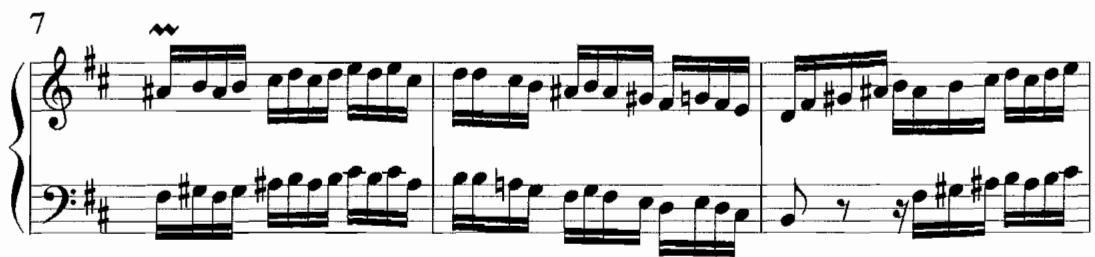
- C2.S8 [描述性拆分] Repetition, Inversion, and Modification of the Opening Material
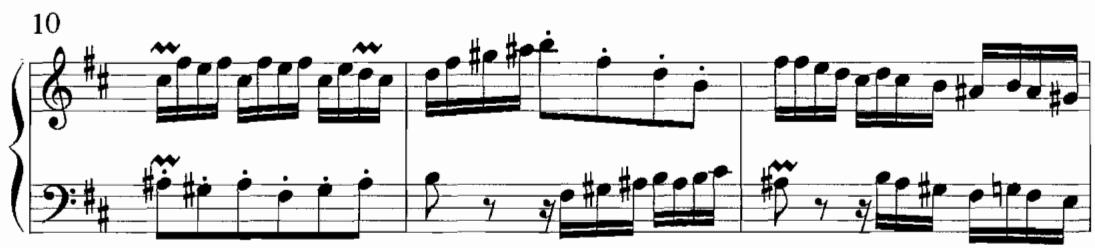
- 页码:26-28
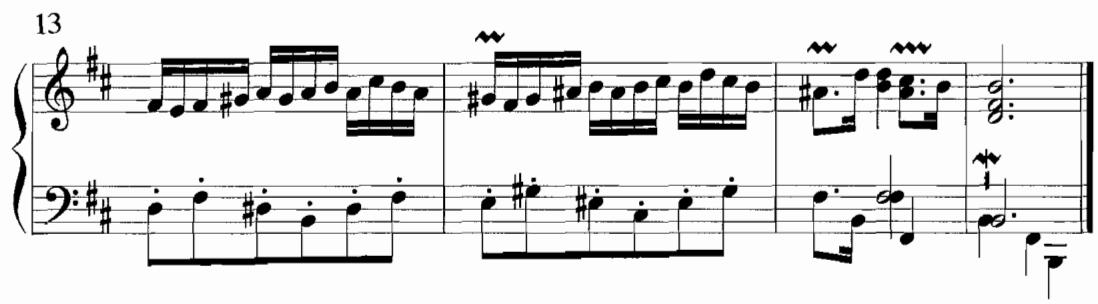
- C2.S9 [描述性拆分] Voice Contour and Overall Erratic Affect
- 页码:29-30
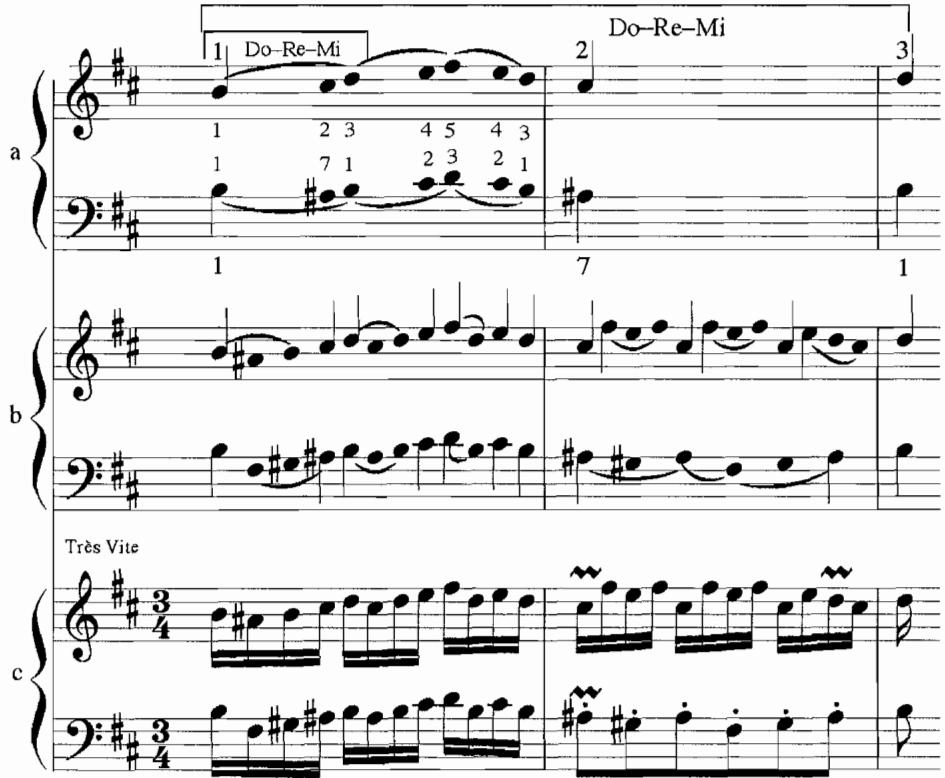
- C2.S10 [描述性拆分] Black Cloak, Hope, and Final Metaphoric Mapping
- 页码:30-31
C3 Summary and Conclusion of Chapter IV
- C3.S1 [描述性拆分] Summary: The Narrative Trajectory of Les Folies
- 页码:31-33
- C3.S2 [描述性拆分] Summary: Les Coucos bénévoles, Taciturn Jealousy, and Frenzy and Despair
- 页码:33-35
- C3.S3 [描述性拆分] Conclusion: Pattern, Metaphor, and Musical Meaning in Les Folies
- 页码:35-39
C4 Chapter V Case Study II: L’Âme-en peine — A Lamentation for the Death of Innocence
- C4.S1 [描述性拆分] Introduction to L’Âme-en peine and Chapter Overview
- 页码:40-40
- C4.S2 [描述性拆分] Chapter Plan and Compositional Aims
- 页码:41-42
- C4.S3 [描述性拆分] Thematic Context: Comparison to Les Folies and the Framework of the Treizième Ordre
- 页码:43-43
- C4.S4 [描述性拆分] Context of the Ordre and Couperin’s Use of the Term
- 页码:44-44
- C4.S5 [描述性拆分] The Treizième Ordre as Thematic Unit
- 页码:45-46
- C4.S6 [描述性拆分] Political and Moral Readings of the Ordre
- 页码:47-48
- C4.S7 [描述性拆分] Les Lis naissans and Les Rozeaux: Birth, Frailty, and Decline
- 页码:48-49
- C4.S8 [描述性拆分] L’Engageante, Les Folies, and the Position of L’Âme-en peine
- 页码:49-50
C1.S1 [描述性拆分] La Jalousie taciturne: Melodic Descent and the Trajectory of Scale Degree 5
第1段(P0001)
原文复述
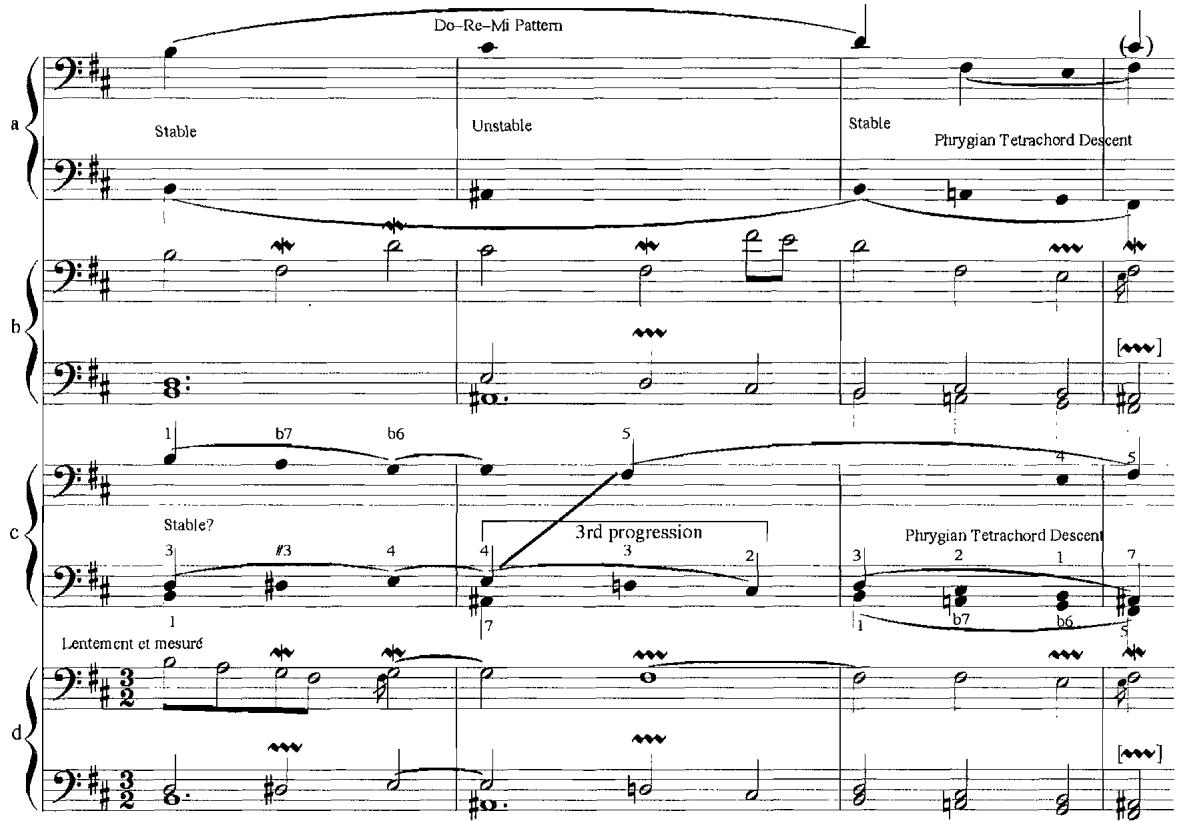
中文讲解
这是一张乐谱示例的占位符及其图注。图注表明示例编号为4.13a–d,所选材料为F. Couperin(库普兰)1722年《古钢琴曲集》第13组曲(ordre)中《沉默的嫉妒》(La Jalousie taciturne)的第1–4小节。由于正文(第2、3段)围绕该例(特别是其中的4.13d)展开分析,本图充当"被分析对象"的功能——读者需要回到谱面本身去核对旋律下行、四音列、低音声部骨架以及高音区等特征,以验证作者的论述。图注本身不包含分析主张,仅作为后续文字讨论的索引。
补充说明
图片数据本身在本任务输入中省略,仅保留了图注与位置占位符;故本段无法对谱面细节作进一步核对,需查看原图。
第2段(P0002)
原文复述
In contrast, the actual opening four measures of La Jalousie appear as Example 4.13d. While the bass line still projects the textbook content for both the Do–Re–Mi (1̂–7̂–1̂) and Phrygian tetrachord (1̂–b7̂–b6̂–5̂) patterns from previous examples, it is the melodic content of La Jalousie, along with a more chromatic role in the tenor voice, that differs. These differences contribute to an expression of tension that is fundamentally oppressive and almost menacing in this variation. No longer does Couperin use the ascending third in the melody to project a delicate sense of forward momentum; rather, there is an overwhelming drive to descend. The opening melodic figure in the first
中文讲解
本段以"In contrast"作衔接词,把读者的注意力从前面的谱例拉回到《沉默的嫉妒》真正的谱面(例4.13d)。作者作了"保留 vs 变化"的二分:①低音声部仍然投射先前示例中Do–Re–Mi(1̂–7̂–1̂)与弗里几亚四音列(1̂–♭7̂–♭6̂–5̂)这两条"教科书式"的骨架内容,因此结构基础是熟悉的;②真正发生变化的是旋律本身以及次中音(tenor)声部更具半音化的角色。作者由此推出情绪判断:这些差异共同把张力塑造成"压抑且近乎威胁"的效果(oppressive and almost menacing)。随后用"No longer… rather…“作转折——库普兰不再用旋律上行的三度去投射细腻的前进感,取而代之的是压倒性的下行趋势。最后那句"The opening melodic figure in the first"在原文中被截断、实际在下一段接续(“measure… is a tetrachord…"),为下一段对四音列下行的具体分析作铺垫。
第3段(P0003)
原文复述
measure in Example 4.13d is a tetrachord that begins on 1̂ and moves down to 5̂ through b7̂ and b6̂ on beats one and two. In combination with the bass, this can be heard as strongly responding to all three musical forces: gravity (moving down); inertia (continuing with its downward direction); and magnetism (resolving to the closest stable note, a half step between b6̂ [G] and 5̂ [F#]). The downward tendency of this melodic pattern is powerful, as is the pull from 1̂ to 5̂ as the temporary point of stability. This attention to descent is made more palpable when compared to the mostly ascending nature of the analogous passage in the previous variation, Les Coucos bénévoles. Additionally, its higher tessitura is in stark contrast to the lower, darker mood evoked here in La Jalousie.
中文讲解
本段把上一段预告的"压倒性下行"落实为具体的音型与三种"力”。要点:①第1小节第1–2拍构成一个四音列,从1̂经♭7̂、♭6̂下行到5̂,这正是上一段提到的弗里几亚四音列的旋律化呈现;②结合低音声部,作者认为这段音乐同时响应三种物理性的"力”——gravity(重力:整体向下移动)、inertia(惯性:持续保持下行方向)、magnetism(磁力:解决到最近的稳定音,即♭6̂=G到5̂=F#的小二度);③1̂到5̂的下行力量强大,且5̂成为"临时稳定点";④与前一首变体《热心的杜鹃》(Les Coucous bénévoles)中相对上行的对应段落作对比,使下行趋势的"被感知度"更强;⑤反差并置:《沉默的嫉妒》的旋律音区(tessitura)实际更高,却营造出低沉、阴暗(darker)的情绪——高音区与低情绪的悖论式组合,反过来强化了压抑与威胁感,而非明亮的高音形象。
补充说明
关于三种"力"(gravity/inertia/magnetism)的具体所指可在本段内部定位,无需外部补充;作者用物理化、拟人化的比喻来把下行趋势和5̂作为临时稳定点的功能讲透。
第4段(P0004)
原文复述
The emphasis on the fifth degree in La Jalousie can also be related to its disposition in the previous variations — La Coquéterie and Les Coucos bénévoles. In The Coquette, the fifth scale degree provides a leaping playfulness and bouncy flirtation around the structural melodic patterns of the opening Do-Re-Mi gambit (Example 4.9d, measures one-three). It then becomes the structural melodic note in the measure that precedes the Prinner Riposte and leaps playfully to and from scale degree one below (Example 4.9d, measure five). Additionally, The Coquette foreshadows the significance of 5 as a voice-leading strand of denial and ignorance in The Benevolent Cuckolds, by mimicking the essential components of The Cuckolds’ primary melodic gesture: the rearticulated pedal tone below the structural note of the ascending opening gambit (Example 4.10b). In La Jalousie taciturne, however, the fifth degree acts not as compound-melodic element to the larger structural pattern, but rather as the lowest point of a long and drawn-out — even torturous — descent. The result of that process contributes to the tenebrous mood appropriate to a variation whose subject is Jealousy. The use of scale degree 5̂ in these three variations follows a trajectory of behavior. In La Coquéterie, it is an obvious embellishment to the structural Do–Re–Mi; in Les Coucous, it is our focus, diverting attention from the ascending three-part pattern; in La Jalousie, as the structural Do–Re–Mi is gone completely, scale degree 5̂ is solitary, and all that is left — it is the center of the structural descent.
中文讲解
本段将5̂在三首变体(《调情》《热心的杜鹃》《沉默的嫉妒》)中扮演的角色串成一条"行为轨迹",并以此解释《沉默的嫉妒》整体情绪的来源,分三层:①在La Coquéterie(《调情》)中,5̂是围绕开篇Do–Re–Mi骨架进行的跳跃、活泼装饰,并在Prinner反衬之前的小节(例4.9d第5小节)成为结构性旋律音,且与低八度的1̂作"playful"的跳跃来去;此外,《调情》还通过模仿《被戴绿帽者》(The Cuckolds)核心旋律姿态——在上行开篇gambit的结构音下方重复的持续音(rearticulated pedal tone,例4.10b)——为5̂作为"否认与无知的声部进行线索"在《热心的杜鹃》中的重要性预先铺路;②在Les Coucous bénévoles中,5̂成为焦点,把注意力从原本上行的三音模式上引开;③到了La Jalousie taciturne,原本结构性的Do–Re–Mi骨架完全消失,5̂不再是复合性的装饰元素,而是孤立存在的下行终点——成为结构下行的"中心",把音乐推向漫长、延展、近乎折磨的下行,正是"嫉妒"主题所需的tenebrous(阴暗)氛围的来源。最后作者用三句话归纳轨迹:在《调情》中是Do–Re–Mi的明显装饰;在《热心的杜鹃》中是焦点、转移注意力;在《沉默的嫉妒》中则成为孤立的、唯一剩下的——结构下行的中心。
补充说明
作者提到《调情》预先铺设"5作为否认与无知的声部进行线索"在《热心的杜鹃》中的重要性,但本节输入并未提供《热心的杜鹃》与《被戴绿帽者》内部的材料,故仅作为作者自身的前后照应说明,不在本节内部进一步展开。Prinner Riposte在任务输入中未给出独立定义,按规则不补充外部词源。
脚注 / 边栏 / 图表 / 附加信息(如有)
本节仅包含一个乐谱图例占位符(图4.13a–d:La Jalousie taciturne, m. 1–4, 13th ordre (1722), F. Couperin),无附加脚注、表格或边栏。
💡 本节核心要点
- 《沉默的嫉妒》(La Jalousie taciturne)例4.13d保留了Do–Re–Mi(1̂–7̂–1̂)和Phrygian四音列(1̂–♭7̂–♭6̂–5̂)的低音声部骨架,但旋律处理被改为半音化的强下行。
- 这种下行通过三种"力"——gravity(向下重力)、inertia(持续下行的惯性)、magnetism(♭6̂=G到5̂=F#的小二度磁力解决)——被刻画为压抑且近乎威胁。
- 与前一首变体《热心的杜鹃》中相对上行的对应段落、以及高音区(higher tessitura)却营造低沉阴暗情绪的反差,共同强化了《沉默的嫉妒》的下行张力。
- 5̂在三首变体中呈"行为轨迹":在《调情》中作为Do–Re–Mi的活泼装饰→在《热心的杜鹃》中成为焦点、转移对上行三音模式的注意→在《沉默的嫉妒》中独立成为结构下行的终点。
- 《调情》通过模仿《被戴绿帽者》核心旋律姿态(重复的持续音+上行开篇骨架下的结构音,例4.10b),预先铺设5̂作为"否认与无知"的声部进行线索;该线索在《沉默的嫉妒》中被改写为折磨性下行的低点。
- Do–Re–Mi骨架在《沉默的嫉妒》中彻底消失,使5̂不再是复合性装饰,而是整个下行结构的中心,塑造了与"嫉妒"主题相称的tenebrous(阴暗)氛围。
🔑 关键术语
- Phrygian tetrachord(弗里几亚四音列):音程内容为1̂–♭7̂–♭6̂–5̂ 的下行四音列模式;本节中低音与旋律共用此材料,在《沉默的嫉妒》中被旋律化展开为压倒性的下行姿态。
- Tessitura(旋律音区):旋律实际所处的音高位置;本节指出《沉默的嫉妒》的旋律位于较高音区,却营造出低沉阴暗的情绪,形成反差并强化压抑、威胁的效果。
- Do–Re–Mi gambit(Do–Re–Mi开篇套路):1̂–7̂–1̂ 的开篇三音模式;作者把它作为各变体共享的"结构骨架"概念——《调情》保留并装饰它,而《沉默的嫉妒》则彻底去掉它,使5̂不再有骨架可依附。
- Prinner Riposte:作者用来标记《调情》例4.9d第5小节中出现的对位/反衬段落的术语;任务输入未给出独立定义,按规则不在此处补充外部词源。
- Tenebrous(阴暗):作者用其形容《沉默的嫉妒》最终形成的音乐氛围,对应"嫉妒"这一主题的性格特征。
- Gravity / Inertia / Magnetism(重力 / 惯性 / 磁力):作者用于描述下行趋势与5̂作为临时稳定点的三种"力";其中magnetism特指♭6̂(G)向5̂(F#)的小二度解决倾向,三者共同把下行感受拟人化/物理化。
C1.S2 [描述性拆分] Tonal Forces and Voice-Leading Strains in the Opening Measures
第1段(P0005)
原文复述
Although the overall direction of the melodic line is down, the ascending chromatic line in the tenor in this same measure — moving from $\hat{3}-#3-\hat{4}$ — creates a level of tension with the melody that affects the way in which it behaves. The tenor’s three-note pattern can be heard as responding to musical magnetism, resolving up to $\hat{4}$ from $#3$. The addition of this voice alters the perceived point of stability and arrival in the melody, from the F# as part of the tetrachord descent, to the G on beat three. While the F# is felt as the momentary resolution of a 6–5 appoggiatura over the B in the bass on beat two, the inclusion of the D# in the tenor guides our expectation for resolution to beat three of the measure. The ascending tenor, then, can be seen as fighting against the descending melodic line. Instead of allowing the melody to rest comfortably on $\hat{5}$ (F#), the tenor pattern forces it to resolve back up to $b\hat{6}$ (G) from $\hat{5}$ (F#), ultimately delaying what will be the final point of arrival on scale degree $\hat{5}$ at the end of the phrase. Based on the expectations established by La Virginité, the overriding expression of this measure of
中文讲解
本段聚焦于第1小节内部声部间的张力:旋律整体向下走(按四音列 tetrachord 下行),而男高音声部(tenor)却以半音上行的 3̂–♯3̂–4̂ 三音模式与之对抗。作者把男高音声部的上行解释为对"音乐磁场"(musical magnetism)的反应——♯3̂ 倾向于向上解决到 4̂。这一内声部的加入改变了听者对旋律稳定点与到达点的感知:原本作为四音列下行一环的 F♯ 不再被视为真正的稳定音,而是被男高音的线条"挤"上去,让 G(♭6̂)在第3拍成为更早的临时到达。技术上,F♯ 被重新理解为在第2拍 B(低音)上方的一个 6–5 倚音(appoggiatura)所得到的暂时解决;而男高音中 D♯ 的存在把听者的期待引向第3拍。于是下行旋律与上行男高音被描述为"相互对抗":男高音不让旋律在 5̂(F♯)上安定下来,反而迫使旋律从 5̂ 重新上行到 ♭6̂(G),从而把本应在乐句末出现于 5̂ 上的真正到达一再推迟。作者最后援引前文《La Virginité》所建立的表情期待作为评判基准,引出对这一小节主导表情的判断。
第2段(P0006)
原文复述
La Jalousie taciturne is an immediate move away from — or a lack of — the stability of the opening measure as the first stage of the pattern.
中文讲解
这是一个独立成段的判断句,对前一段 P0005 的分析作出总结性命名。作者把这种"开场即失去稳定"的处理定义为《La Jalousie taciturne》的第一阶段特征:相比前作《La Virginité》在乐句开端所建立的那种相对稳定感,本曲一进入就把那种稳定感撤走,或者说从一开始就没有让它出现。“the first stage of the pattern"指本节接下来要讨论的更大模式中的第一步。这一句本身并不展开论证,而是为 P0007 中对更深层结构的分析提供立论出发点。
第3段(P0007)
原文复述
At a deeper level of structure, the opening four-note pattern in the melody, along with the resolution upward on beat three, becomes a descending three-note pattern of $\hat{1}$ -b7-b6 ending on G, as illustrated in Example 4.13c. This coincides with the ascending pattern of $\hat{3}$ -#3-4 in the tenor, all over B (1) in the bass, the combination of which contributes to a sense of harmonic mobility or ambiguity unusual for the first stage of an opening gambit. In Example 4.13d, the G in the melody and E in the tenor tie over to beat one of the next measure, while the bass moves down to $\hat{7}$ — the second stage of its three-part $\hat{1}$ - $\hat{7}$ - $\hat{1}$ pattern. This move creates a dissonance with both the melody and tenor. The melody resolves down from its dissonant interval of a seventh with the bass to scale degree five on beat two (F#). However, we do not experience this moment as a resolution, as the tenor simultaneously moves from the seventh of the chord, E (4) — the dissonant diminished fifth with the bass — to D (3). We expect the chordal seventh in the tenor to resolve down by step to D, but in this instance, the D does not satisfy our need, as it is itself a dissonant passing tone that conflicts with the overriding chord of the measure. This passing tone does continue moving to C# on beat three, which we experience as the temporary — and delayed — moment of arrival and harmonic agreement for both the tenor and melody.
中文讲解
本段从更深一层结构揭示开篇的不稳定感。旋律表面看似四音列下行,但如果把第3拍那个被男高音"逼"出来的上行解决考虑进去,其内部其实可被听成 1̂–♭7̂–♭6̂ 的三音下行,落在 G 上(参例 4.13c)。与此同时,男高音是 3̂–♯3̂–4̂ 的上行,低音保持在 B(1̂)。三股力量同时作用,造成一种"谐和流动性 / 模糊性”——这在开篇起手式(opening gambit)的第一阶段并不常见。
进入下一小节(参例 4.13d)后:旋律的 G 与男高音的 E 都被延音到第1拍,低音则下移到 7̂,进入低音三步模式 1̂–7̂–1̂ 的第二阶段。这一下移同时与旋律和男高音构成不协和音程。旋律从与低音形成的七度不协和下行解决到第2拍的 5̂(F♯);按常规这应是一个解决点,但男高音此时同步从和弦七音 E(即与低音形成的减五度不协和)下行到 D。理论上和弦七音应该按级下行到 D,但这里的 D 自身又是一个与本小节和声背景冲突的经过音(passing tone),因此 E→D 的下行并不带来真正的解决感。D 继续作为经过音上行到 C♯,直到第3拍才让男高音与旋律同时抵达临时稳定——这是一个被延迟的、仅为局部的"谐和一致"点。整段的分析要点是:听感上的不解决,原因不在某一声部单独"做错",而是三个声部各自按自身逻辑运动(旋律 1̂–♭7̂–♭6̂、男高音 3̂–♯3̂–4̂、低音 1̂–7̂)相互错位叠加的结果。
补充说明
本段反复出现"resolve / resolution",但指涉对象不同:旋律在第2拍从七度下行到 F♯ 是声部进行意义上的"下行解决",而听感上它并不构成解决;真正的听感解决要到第3拍 C♯ 处才短暂出现,需读者区分"和声理论上的解决"与"听感上的抵达"两者在本段的差异。
第4段(P0008)
原文复述
The tenor’s unfolding third moving E–D–C# in measure two, labeled as a third (3 $^{rd}$ ) progression in Example 4.13c, essentially splits the tenor line at this moment into two separate voice-leading strands, creating a prolonged sense of tension over the measure. The lower of the two tenor lines begins with D in measure one and moves to C# in measure two — the point of temporary harmonic agreement described above — as illustrated below in Example 4.13e. The C# in the tenor then resolves down to B at
中文讲解
本段是 P0007 分析的延伸,专门处理第2小节男高音中 E–D–C♯ 的"展开式三度"进行。作者把这个 E–D–C♯ 的连续三音运动标记为例 4.13c 中的"third (3 $^{rd}$) progression",并指出其效果是把原本单线的男高音在此处拆分为两条独立的声部进行(voice-leading strands),从而使本小节的张力被延长。两条线中较低的那一条从第1小节的 D 出发,到第2小节上行到 C♯——也就是上一段所述两声部同时获得"临时谐和一致"的那个音点(参例 4.13e)。其后 C♯ 继续按级下行到 B,句子在此截断。需要说明的是:作者在此时把单一声部"拆"成两条线,是为了解释为何 E→D 这一本来应作为和弦七音下行解决的动作,没有带来解决感——因为那个 D 已经不再单纯属于男高音的同一条线,而是被听成另一条低层线的起点,于是解决被推迟、张力被拖长。本段也是承接 P0007 中"延迟到达"主题的关键一环。
补充说明
原文本段末尾的"resolves down to B at"为截断句,句子并未结束;为忠实原文,本节按所给文本照录,未补写其在原文后续部分的内容。
脚注 / 边栏 / 图表 / 附加信息(如有)
本节内部多次提及图例 Example 4.13c、4.13d、4.13e,但其正文内容并未在所提供段落中给出细节描述,因此除已知它们分别对应旋律/男高音的 3rd progression、跨小节的延音与低音下行、以及男高音低音层 D→C♯ 的图示外,其余视觉信息均需查看原图方可确认。本节未出现独立脚注或边栏;段落 P0005 中提到 La Virginité,是作者已在前文建立的表情/结构参照,本节中并未展开对该作品的进一步讨论。
💡 本节核心要点
- 旋律整体下行(四音列),但男高音以 3̂–♯3̂–4̂ 的半音上行与旋律对抗,使原本的 F♯ 落点被改写为第3拍的 G(♭6̂),把乐句真正的 5̂ 到达推迟。
- 在更深层结构上,旋律实可听为 1̂–♭7̂–♭6̂ 下行,男高音为 3̂–♯3̂–4̂ 上行,低音保持 B(1̂);三者的错位叠加在开场即造成异常的谐和模糊感,构成 P0006 所说的"立即失去稳定"。
- 进入下一小节后,低音 1̂→7̂ 的下移同时与旋律和男高音构成不协和;旋律虽在第2拍"下行解决"到 F♯,男高音 E→D 却因 D 自身为冲突性经过音而未能完成听感上的解决,张力被延续。
- 男高音的 E–D–C♯ 三度展开(标为 3rd progression)使其在第2小节实际分裂为两条独立的声部进行,较低的支线由第1小节 D 走到第2小节 C♯,延长了不解决感,并把临时到达进一步推迟。
- C♯ 是本节内两个段落共同指向的"临时 / 被延迟的谐和一致点":旋律与男高音在此处才同时获得暂时稳定,而真正的 5̂ 到达仍待乐句末出现。
🔑 关键术语
- Appoggiatura (倚音):本节中指一个非和弦音通过级进解决到和弦音的倚音式进行;P0005 把第2拍 F♯ 重新解读为在低音 B 上方 6–5 的倚音式解决,从而推迟听感上的稳定点。
- Tetrachord descent (四音列下行):由四个连续音级构成的下行音列片段,本节中用来描述旋律表面的整体下行走向,是与男高音半音上行相对比、说明声部对抗的基础参照。
- Chordal seventh (和弦七音):和弦的第七音,按惯例应向下级进解决到根音上方的六度音;P0007 中男高音 E 即承担此功能,其下行到 D 未带来解决感,是因为 D 在本小节中并非真正稳定的和弦音。
- Passing tone (经过音):在两个和弦音之间以级进方式短暂经过的非和弦音;本节 P0007 中男高音的 D 被归为此类,但因与本小节和声背景冲突,听感上不构成到达。
- Voice-leading strands (声部进行支线):当单一谱面上的一条声部在听感上被听成两条独立的线性运动时,作者称之为两条 voice-leading strands;P0008 即据此把男高音的 E–D–C♯ 处理为高层与低层两条并行线。
- Opening gambit (开场起手式):用以描述作品开篇若干小节所建立的结构 / 表情策略;P0007 指出在开场起手式的第一阶段出现谐和模糊是反常的,这也是把《La Jalousie taciturne》开篇视为"立即失去稳定"的依据。
C1.S3 [描述性拆分] Tenor Resolution, Bass Neighbor, and Phrygian Half Cadence
第1段(P0009)
原文复述
Example 4.13e. Reduction of Tenor’s Two Voice-Leading Strands in La Jalousie taciturne, m. 1–3, 13th ordre (1722), F. Couperin. [Embedded image data omitted; caption and position preserved.]
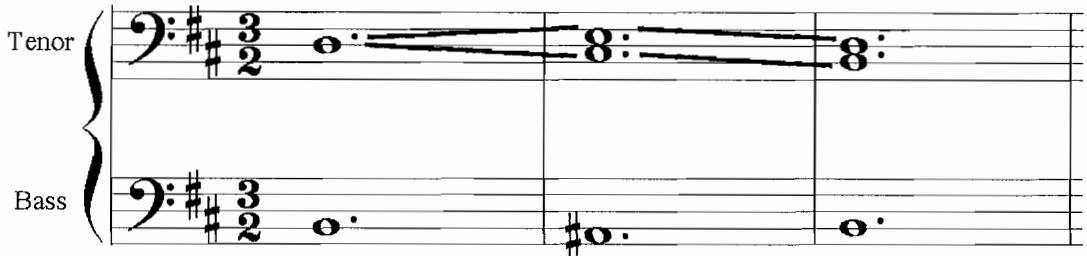
中文讲解
此段并非正文段落,而是图4.13e的图题(Figure caption)。该图位于第5页,呈现的是库普兰(F. Couperin)《沉默的嫉妒》(La Jalousie taciturne)第13组曲(13th ordre, 1722)第1–3小节中,男高音声部(tenor)两条声部进行线(voice-leading strands)的简化记谱(reduction)。所谓"简化",意味着图中只保留最核心的旋律骨架与低音轮廓,而不展示原本织体中的所有装饰音与和声填充;“两条声部进行线"则提示作者将男高音声部拆解为两条独立但交织的旋律线进行分析。该图为下文P0010的分析提供视觉依据——作者对两条线在第1、2、3小节的走向、解决(第7音的解决)与终止的描述,均以本图为参照。
补充说明
图像占位符,其具体音符与节奏内容无法从当前文本中确认;“需查看原图"以核对两条进行线的实际音高与时值。所引曲名 La Jalousie taciturne 与13th ordre(1722)皆来自图题本身,非外部补入的背景信息。
第2段(P0010)
原文复述
measure three, doubling the B in the bass that completes the pattern of the traditional opening gambit. The result is a descending third D–C#–B over a lower-neighbor figure in the bass, B–A#–B. The resolution we still require, however, comes from the second voice-leading strand depicted in Example 4.13e. This second line begins with D in measure one and then moves up to E — the chordal seventh — at the downbeat of measure two. The resolution of this seventh (to D) occurs at the downbeat of measure three while the bass completes its resolution from A# to B. After the arrival and resolution at the downbeat of measure three, the bass descends through the Phrygian tetrachord to conclude on a half cadence with the tenor moving above it in thirds. The
中文讲解
本段(承接前一句,以"measure three"起句)同时推进了三件事:其一,补充第3小节低音B音的到达与"传统开场模式”(traditional opening gambit)的完成——此处用"加倍(doubling)“低音B以呼应前文已经讨论的第一条声部进行线。其二,在和声—旋律关系上呈现出一个具体的结构:男高音声部作下行的三度 D–C#–B,同时低音作下邻音(lower-neighbor)进行 B–A#–B,两线并行形成上声部下行三度对低音邻音装饰的典型对位。其三,指明尚未解决的"第7音问题"需要依靠图4.13e所示的第二条声部进行线来完成:该线从第1小节的D开始,第2小节正拍上行到E(被明确标注为"chordal seventh”——和弦七音);该七音在第3小节正拍解决到D,恰好与低音 A#→B 的解决同步——这是本节论证的关键时点:两个独立的声部运动在第3小节正拍"合流”,共同到达稳定音,从而实现双重解决(double resolution)。此后,低音自该稳定点出发,沿弗里几亚四音列(Phrygian tetrachord,即半音—全音—全音的下行四音组)下行,以半终止(half cadence)结束乐句,而男高音声部则以三度叠置的方式在其上方移动。注意本段在句末以"The"结尾,显然是因排版分页而与下一段(P0011)断开,需连读。
补充说明
- “chordal seventh"指作为和弦成员出现的七音,而非旋律装饰产生的七音;此处E作为和弦七音,需要在解决时才下行到D,这与作者强调的"双重解决"时点对应。2) “Phrygian tetrachord"在自然小调语境中通常为下行半音—全音—全音的形态;此处结合前文 B–A#–B 的邻音进行,可推断该弗里几亚四音列自B开始下行。3) 段落起首"measure three"承接前段(本节边界之外的文字,可能涉及第一条进行线),故复述保留此残句形式以忠实原文。
第3段(P0011)
原文复述
melody completes the phrase with another three-note pattern, 5-4-5 as shown in Example 4.13c.
中文讲解
本段仅一句,以"melody"接续P0010末尾的"The”,完成一个被截断的句子。作者指出:旋律以又一个三音模式 5–4–5 来结束整个乐句,并参见图4.13c。所谓"又一个”(another)是与前文已经出现的三音模式相呼应——结合本节标题中"Bass Neighbor"以及P0010提到的低音 B–A#–B 下邻音模式,可推知此处 5–4–5 是与低音邻音相对应、上方声部的三音级进装饰轮廓(5→4→5,即先下行半音再返回);两个声部各自以三音模式组合,共同塑造了乐句收束时的装饰形态。图4.13c作为图4.13e的姊妹图,呈现的应是该旋律线 5–4–5 模式的简化记谱,本节对它的引用仅作为对该模式的视觉定位。
补充说明
“5–4-5"在此上下文中应理解为音级/音程数字(scale-degree figures),而非字面的小节或拍号;在以B为中心的语境中,5-4-5 通常对应 E–D–E 这一邻音式进行,与本段所述"another three-note pattern"呼应。
脚注 / 边栏 / 图表 / 附加信息(如有)
本节附加材料仅涉及图4.13e与图4.13c两个谱例图题。1) 图4.13e(图4.13e位于P0009):呈现库普兰《沉默的嫉妒》第13组曲第1–3小节男高音声部两条声部进行线的简化记谱,是P0010中描述七音解决与低音解决同步发生的视觉依据。2) 图4.13c(在P0011中被引用):呈现旋律5–4–5模式的简化记谱,作为该收束模式的视觉定位。节内无脚注、边栏或表格;两幅图共同支撑作者对两条进行线并行—合流—收束的论证。
💡 本节核心要点
- 本节论证的核心在于第3小节正拍出现的"双重解决”:男高音七音E→D与低音 A#→B 同步完成,标志着开场模式与传统对位问题的最终解决。
- 低音以 B–A#–B 的下邻音模式与男高音声部下行三度 D–C#–B 并行,构成上声部线性下行对低音邻音装饰的对位关系。
- 男高音声部被拆解为两条独立的声部进行线(见Example 4.13e);第一条完成"开场模式"(opening gambit),第二条承担七音解决的功能,二者既独立又协同。
- 解决到达后,低音沿弗里几亚四音列(Phrygian tetrachord)下行,以半终止(half cadence)结束乐句,男高音声部以三度叠置在其上方移动,体现本节标题所示的"Tenor Resolution"与"Phrygian Half Cadence"。
- 旋律在收束处以 5–4–5 的三音邻音模式结束乐句,与低音的下邻音模式共同构成装饰性收束形态,呼应库普兰作品中典型的对位化装饰语汇。
🔑 关键术语
- voice-leading strand:声部进行线。在本节中,作者将男高音声部拆解为两条独立而交织的旋律骨架线,以单独追踪其各自的音高走向与和声功能,是为分析库普兰复杂织体而采用的简化手法。
- chordal seventh:和弦七音。指作为和弦成员(而非经过音或倚音)出现的七音,本节中特指第2小节正拍上的E,它构成和声张力并需要在解决下行到D。
- lower-neighbor figure:下邻音音型。指一个音先下行半音(或全音)再返回原音的装饰模式;本节中低音的 B–A#–B 即为此模式,用以在和声框架内制造装饰性下行与回归。
- Phrygian tetrachord:弗里几亚四音列。指半音—全音—全音下行排列的四音组(在小调语境下即自然小调属音到主音的下行);本节中低音自稳定点沿该四音列下行,以半终止收束乐句。
- half cadence:半终止。乐句结束于属和弦(而非主和弦)的终止式,常造成未完成感并期待后续进行;本节以此作为库普兰这一乐句的收束。
- opening gambit:开场模式。指作品中开篇用以建立调性、织体或对位框架的固定音型;在本节中,该模式由低音B的加倍所完成,从而与男高音第二条进行线的解决在第3小节正拍汇合。
- traditional opening gambit:传统开场模式(此处即上条的同义复用)。在P0010中以"traditional"加以限定,表明该模式属于该体裁或库普兰写作惯例中常见的开场语汇,而非本曲独有。
C1.S4 [描述性拆分] Lamento Model and the Prolonged Descent in La Jalousie
第1段(P0012)
原文复述
The opening measures of La Jalousie are quite different from a more normalized manner of descending over the Phrygian tetrachord—what can equally be called a lamento bass—and this contrast is laid out in Example 4.13f. In this example the normalized model is illustrated in two parallel realisations, one with suspension figures and one without.
中文讲解
本段开门见山:库普兰《嫉妒》的开头并不沿用作者所设定的"常规化"弗里几亚四音列下行手法(亦即"悲歌低音"),本节将以 Example 4.13f 中两种并置的"常规化"模型(带挂留与不带挂留)作为对照基准,由此引出对《嫉妒》自身特殊处理的分析。需注意"descending over the Phrygian tetrachord — or a lamento bass —“是作者的术语对等:弗里几亚四音列下行与 lamento bass 在此处被视作同一手法的两种称呼,而非两种独立技术。
补充说明
例 4.13f 在本节中充当"对照母版”;其两种变体的声部配置与节奏处理将于 P0013、P0014 依次展开。
第2段(P0013)
原文复述
Continuing the description of Example 4.13f, in this example each measure of the four-measure passage maps onto one segment of the tetrachord descent. The bass articulates scale degrees 1̂–♭7̂–♭6̂–5̂, while the tenor, harmonizing a third above, moves from scale degree ♭3̂ to 7̂. The melody begins a fifth above the bass and, in the top of the two examples, steps upward to initiate a chain of 7–6 suspensions that resolves at the downbeat of measure four. The result is two elided patterns in the melody, 5̂–♭6̂–5̂ acting as an upper neighbor, and 5̂–4̂–5̂ acting as a lower neighbor. The melody of the lower example is described as taking a different turn beyond this point.
中文讲解
紧接 P0012,作者逐一交代 Example 4.13f 中第一种变体的声部逻辑。四小节的每一小节"承担"四音列下行的一个音,因此 1̂、♭7̂、♭6̂、5̂ 四个音被均匀分布到四小节中:低声部走 1̂–♭7̂–♭6̂–5̂;次中音居于低音上方三度,从 ♭3̂ 走向 7̂;最高声部从主音上方五度起步,并在第一种变体中"上行一步"以拉起一串 7–6 挂留,最终于第四小节正拍解决。这一串挂留在旋律中塑造出两个首尾相叠(elided)的邻音动机:上邻音 5̂–♭6̂–5̂ 与下邻音 5̂–4̂–5̂。所谓"elided",是指两动机的头尾共用一个音——前一动机的尾音正是后一动机的起音,于是二者无缝衔接,构成一条连贯的运动。
补充说明
“elided pattern"是本节承前启后的核心分析术语:它在 P0013 中首次出现并用以描述局部动机衔接方式,在 P0016 中再次出现并用以命名《嫉妒》旋律与低音如何各自将两个小动机拼合为一个完整的长四音列。
第3段(P0014)
原文复述
However, the melody of the lower example in Example 4.13f unfolds as an extended single lower-neighbor pattern of 5̂–4̂–5̂. It begins a fifth above the bass on F♯, sustains that pitch through measure two, steps down to E in measure three, and resolves back upward to F♯ in measure four.
中文讲解
本段说明 Example 4.13f 的第二种变体——去掉挂留的版本。其旋律不再拆成上、下两个邻音,而是退化为一个单一、被拉长的下邻音模式 5̂–4̂–5̂:F♯(位于低音上方五度)在第二小节被持续,“sustains it"暗示着一个被延长的力度感;第三小节下行到 E;第四小节再回到 F♯。这与第一种变体形成对照:第一版靠挂留链制造运动,第二版则靠节拍拉长与单一邻音将四小节填满。但二者共享相同的低音与次中音,区别仅在于最高声部如何"消化"同一个四音列骨架——这恰恰预示了后文对《嫉妒》旋律处理方式的追问。
第4段(P0015)
原文复述
Both variants of Example 4.13f are typical pattern-based skeletons for a three-voice descending tetrachord in the lamento style. In its own right, a lamento descent engenders a particular expression that can in general terms be described as sad or mournful. In Couperin’s La Jalousie, however, the process of descent is different: it is more prolonged, and is rife with tension between the voices, so that the expression takes on a particular negativity and heightened strain. The durational reduction given in Example 4.13g illustrates the basic progression of the opening of La Jalousie, and clearly demonstrates a…
中文讲解
本段起承上启下之功。它先对前两段所描述的两种变体作总体定位:二者都是三声部 lamento 风格下行的典型"骨架”。继而点出 lamento 在其未被变形的原型状态下所携带的情感基色——可笼统称为"悲伤或哀悼”。但随即笔锋一转:《嫉妒》中的下行方式不同、节奏被拉得更长、声部间充满张力,因此表达效果不再是泛泛的悲伤,而偏向"否定的"(negativity)与"高度紧绷的"(heightened strain)。这一转折把讨论从"原型规范"带入"作品特例",并以 Example 4.13g 的时长缩减谱作为分析入口,预示下一段将揭示《嫉妒》开头的对称结构。
补充说明
“durational reduction”(时长缩减谱)是一种常见的分析手法:将实际节奏压缩为均匀的骨架节奏,让底层的和声、对位结构浮现出来;本节中 Example 4.13g 的这一谱例所起的作用正是显化《嫉妒》开头低音与旋律之间的模式对称。
第5段(P0016)
原文复述
…significant symmetry of pattern between the bass and melody lines within this passage. The melody of the opening four measures of La Jalousie taciturne is a long, drawn-out descending tetrachord from 1̂ to 5̂, combining two elided patterns: a four-note pattern (1̂–♭7̂–♭6̂–5̂) followed by a three-note lower-neighbor pattern (5̂–4̂–5̂). The descent can be heard as giving in to musical gravity and magnetism as it moves from stable scale degree 1̂, passing through ♭7̂ and ♭6̂, to arrive on 5̂—provisionally in measure two, but finally in measure four after a dip down to a lower neighbor. The bass line too is a long, drawn-out descending tetrachord from 1̂ to 5̂ that combines two patterns, but it begins with a three-note lower-neighbor figure (1̂–7̂–1̂) followed by the same four-note pattern (1̂–♭7̂–♭6̂–5̂) that begins the melody. It is the activity in, and the chromatic nature of, the tenor that confounds the progression’s efforts to descend easily (Example 4.13d): it either forces an upward resolution in the melody, as in measure one, or delays the sense of arrival, as in measure two. The tenor finally gives in to gravity, and to the pressures exerted by the melody, as it descends in parallel thirds over the bass to finish the phrase and conclude on a Phrygian half cadence in measure four. The result of this passage is a sense of delay and harmonic instability, which extends in a particularly long-suffering way over the entire opening four measures.
中文讲解
这是本节论证的主段,集中说明《嫉妒》开头四小节如何在 lamento 骨架之上被重新塑形。要点有四:(一)旋律与低音之间存在显著的模式对称。两者都是从 1̂ 走向 5̂ 的"被拉长的四音列下行",并各自把两个小动机首尾相叠(elided)。但拼合顺序恰好相反——旋律先做 1̂–♭7̂–♭6̂–5̂、再以 5̂–4̂–5̂ 收束;低音则先以 1̂–7̂–1̂ 下邻音"暖身",再接与旋律开首相同的 1̂–♭7̂–♭6̂–5̂。Example 4.13g 的时长缩减谱正是要凸显这种"骨架同、顺序反"的对称。(二)真正阻碍下行顺利完成的,并非低音与旋律本身,而是次中音声部的活动与半音化(参 Example 4.13d):它在第一小节迫使旋律反向上行解决,又在第二小节推迟了"到达感"。(三)次中音最终向"重力"让渡,在与旋律形成的压力中以平行三度的方式随低音下行,把乐句在第四小节引向弗里几亚半终止。(四)整段四小节营造出一种延宕与和声不稳定的听觉印象——作者称之为"long-suffering"(长期受难式)的拉长。它与"La Jalousie taciturne"(阴郁的嫉妒)一词所暗示的情绪张力相呼应,并把常规 lamento 的"悲伤"推到"否定性 + 紧绷感"更高的强度。
补充说明
“Phrygian half cadence"指落在 5̂ 上的半终止,且往往与弗里几亚下行的特征音相连,本节中正是《嫉妒》开篇乐句经过四小节延宕后才最终收束之处。“taciturne"为法文,意为"沉默寡言的、阴郁的”,是《嫉妒》开头所标注的表情术语,锚定了本段音乐被赋予的"长期受难"式基色。
脚注 / 边栏 / 图表 / 附加信息(如有)
本节论证完全依赖三处谱例,文本中未给出谱面,需查阅原谱配合阅读:Example 4.13d——揭示次中音声部的活动与半音化如何阻碍四音列下行;Example 4.13f——作为对照基线的"常规化 lamento 骨架”,分带挂留与不带挂留两种变体;Example 4.13g——时长缩减谱,显露《嫉妒》开头低音与旋律之间的对称模式。本节不含脚注、边栏或图表说明等其他附加材料。
💡 本节核心要点
- 《嫉妒》的开头并未沿用作者视为"常规化"的弗里几亚四音列/lamento bass 下行;本节以 Example 4.13f 的两种变体作为对照基线,引出对《嫉妒》特殊处理的分析。
- Example 4.13f 的两种变体共享三声部下行骨架:变体一以 7–6 挂留链在旋律中塑造 5̂–♭6̂–5̂ 与 5̂–4̂–5̂ 两个 elided 邻音模式;变体二则以单一延伸的下邻音 5̂–4̂–5̂ 填满四小节。
- 《嫉妒》开头的旋律与低音均为 1̂→5̂ 的"拉长四音列下行",各自把两个小动机首尾相叠(elided),但拼合顺序恰好相反——旋律先四音列后下邻音,低音先下邻音后四音列——于是在 Example 4.13g 的时长缩减谱中显出显著的模式对称。
- 真正使下行举步维艰的是次中音的活跃与半音化(Example 4.13d):它迫使旋律在第一小节反向上行解决、推迟第二小节的到达感,最终以平行三度顺低音下行,在第四小节抵达弗里几亚半终止。
- 整段四小节铺陈出一种延宕与和声不稳定的"长期受难式"听觉效果,把常规 lamento 的泛泛"悲伤"推进到"否定性 + 紧绷感"的更高强度。
🔑 关键术语
- Phrygian tetrachord:弗里几亚四音列;自 1̂ 下行至 5̂ 的 1̂–♭7̂–♭6̂–5̂ 四音结构。本节中它既是 lamento bass 与弗里几亚半终止的核心骨架,也是用以衡量《嫉妒》开篇是否"常规化"的对照基线。
- lamento bass:悲歌低音;以 1̂–♭7̂–♭6̂–5̂ 下行为典型动机的低音程式,原型携带"悲伤/哀悼"的情感标记。本节中它作为对照规范出现,而《嫉妒》正是对其的偏离与变形。
- 7–6 suspension:7–6 挂留;保留音与低音之间先形成七度、再下行一步解决到六度的对位进行。Example 4.13f 的第一种变体以一连串 7–6 挂留链来塑造其旋律骨架。
- elided pattern:首尾相叠的模式;两个短小邻音动机的尾与头共用一个音,由此形成无缝衔接。P0013 用其描述挂留变体中的 5̂–♭6̂–5̂ 与 5̂–4̂–5̂;P0016 用其命名《嫉妒》旋律与低音各自把两个小动机拼合为一个长下行四音列的方式。
- durational reduction:时长缩减谱;将实际节奏压缩为均匀骨架节奏以显露底层和声、对位模式的分析手段。本节 Example 4.13g 即借助此法显化《嫉妒》开头低音与旋律之间的模式对称。
- Phrygian half cadence:弗里几亚半终止;以属音上的和声收束、并与弗里几亚下行骨架相连的终止式。P0016 指出《嫉妒》开篇乐句最终在第四小节落到此终止,而这"到达"恰恰是被延宕了四小节才得以实现的。
C1.S5 [描述性拆分] Deeper Structure and Cooke on the Torturous Tetrachord
第1段(P0017)
原文复述
At a deeper level of structure, the opening progression of La Jalousie is similar to the basic normalized skeletons depicted in Example 4.13f. The opening pattern in the melody could be considered an initial descent from B to the first structural note of F#, as shown in Example 4.13h and i. This F# would sustain for two measures before producing the lower neighbor figure as the bass completes its descent to the F#.
中文讲解
本段进入对《La Jalousie》开头进程的更深层结构分析。作者指出,这段开头的进行与例4.13f所展示的基本规范化骨架相似。在旋律层面,开头模式可被视为从B下行到第一个结构音F#(如例4.13h和i所示);这个F#会持续两小节,随后在低声部下行至F#时,旋律产生一个下方的邻音音型。这里需要把握的核心是分析的层次:表层是旋律与低音的同步下行,而更深一层看,旋律的F#是一个被强调的“结构音”,它先悬停、再以邻音方式被装饰,这种延留-装饰的安排是后续论证两声部之间张力的伏笔。作者通过把具体作品片段与教科书式的“规范化骨架”对照,为后面将这段音乐归入lamento四音音列提供了形式上的依据。
补充说明
本段中提到的Example 4.13f、h、i属于先前章节已展示的图示,本节仅作指代;所谓“normalized skeletons”(规范化骨架)是指去掉装饰音、节奏等表层细节后保留下来的基本音程轮廓。
第2段(P0018)
原文复述
both the melody and the bass lines enhances the expression of La Jalousie taciturne.
中文讲解
这是上一段句意的收束句,单独成段强调一个关键论点:在“中景”(middleground)层面上,lamento四音音列下行模式在旋律与低音两条线中同时出现,这种重复强化了《La Jalousie taciturne》(“沉默的妒忌”)的情感表达。短句本身是承前启后的过渡:前面已经指出旋律与低音各自的下行骨架,这里把两声部同时承载同一音列这一事实,升格为“增强表现力”的原因,从而引出下一段Cooke对lamento四音音列表情意义的经典论述。
第3段(P0019)
原文复述
According to Cooke, the expression of the tetrachord descent from $\hat{1}$ to $\hat{5}$ in minor is particularly torturous. “To fall from the tonic to the dominant, taking in the ‘mournful’ minor seventh and ‘anguished’ minor sixth, is clearly to express an incoming painful emotion, an acceptance of, or yielding to grief; passive suffering; and the despair connected with death.” $^{47}$ Cooke’s definition is, simultaneously, rather broad and quite narrow. He relates the descending tetrachord to a general set of emotions — pain, grief, suffering, and despair — however he limits the expressive meaning of this descent to these ideas. A melodic opening that embodies these dark associations seems well suited to the tenth variation out of eleven that span a trajectory of increasing distress and jaded emotional states. And yet, when we consider its use as the opening pattern in Couperin’s piece specifically — not in just one voice, but in two — the evocative title can guide our mapping process for a more refined expressive meaning. The interaction, or strain, between voices throughout the descent, which is prolonged, unstable, and tension-filled, can map onto the bitterness of jealousy. Moreover the emotion, and its associations of suspicion, spite, envy, and resentment, is suppressed — or taciturn — in this setting. It silently lurks below the surface of composure or maybe even awareness. The tension between the voices can be viewed as the struggle to suppress that jealousy, which threatens to arise via the chromatic line of the tenor. $^{48}$ We can almost imagine a character embodying this negativity by quietly seething, yet working to contain the jealousy that threatens to emerge.
中文讲解
本段是整节的核心,集中处理“lamento四音音列在库普兰作品中究竟表达了什么”这一问题,可以分为四层。
第一层是引述Cooke的观点:小调中从主音到属音的下行四音音列(包含所谓“哀悼的小七度”和“痛苦的小六度”)被他描述为“尤其折磨人”的,表达的是一种正在到来的痛苦情感——对悲伤的接受或屈服、被动的受难,以及与死亡相关的绝望。注意Cooke用的是“painful emotion”“acceptance”“yielding”等词,强调被动与承受。
第二层是作者对Cooke定义的辩证评价:这一界定“既宽泛又狭窄”。宽是因为它把多种负面情绪(pain, grief, suffering, despair)笼统归入这一音列;窄是因为它把这些情绪框定为该音列所能表达的全部意义,把更具体的差别都排除在外了。
第三层是批评性回应:在一个由十一首变奏构成、整体情感轨迹是“不断加剧的苦恼与厌倦”的套曲里,把lamento模式放在第十变奏这种次要位置上是合适的;但库普兰这里却把它用作开头,并且不是只用在一个声部,而是同时用在旋律与低音两声部——这一双重出现才是独特的现象。
第四层是本段最关键的“再映射”:作者认为,库普兰作品的标题本身就指引我们做出比Cooke更精细的表情解读。在下行过程中,两条声部之间的互动、摩擦——持续、不稳定、充满张力——可以被映射为“妒忌的苦涩”;而妒忌所关联的怀疑、恶意、嫉妒、怨恨,又是“被压抑的”——即“taciturne”(沉默的),潜伏在镇定的表面下,甚至潜伏在意识之下。两声部之间的张力正可被视为压抑妒忌的努力,而这种妒忌随时可能通过次中音的半音线条浮现出来。作者最终用一个形象的画面收束:一个人安静地闷烧,努力压制着随时可能浮现的妒忌。
这段的论证逻辑很清楚:先承认Cooke的权威解释→指出其局限→再利用作品的标题与两声部同时使用这一具体特征,把Cooke的“被动受难”改写为“压抑中的妒忌”,从而把lamento音列的表情意义往更精确的方向推进了一步。
补充说明
段落中提到的“第十变奏/十一首变奏”属于原文上下文所提供的套曲结构信息;“tenor的半音线条”是两声部摩擦的具体载体,与本节开头所述的F#延留、下方邻音等中景结构相对应;脚注48将在附加信息中说明其归属。
第4段(P0020)
原文复述
$^{47}$ Cooke, The Language of Music, 162–163.
中文讲解
脚注47,正文引述Cooke关于小调lamento四音音列那段文字的出处:Cooke,《The Language of Music》,第162–163页。该脚注作为来源注释,为正文中的Cooke引文提供文献依据,属于支持性引用。
补充说明
本脚注只承担来源标注功能,不引入新的论证内容。
💡 本节核心要点
🔑 关键术语
- lamento tetrachord:“哀歌式四音音列”。在本节特指小调中从主音(1̂)下行至属音(5̂)、经过小七度与小六度的四音下行模式;在Cooke的论述中被视为承载痛苦、悲伤、被动受难等表情的传统音型。
- middleground:中景。申克分析中的中间结构层次,处于表层细节与背景长线条之间。本节正是把“lamento音列同时出现在旋律与低音”这一观察定位在中景层面。
- normalized skeleton:规范化骨架。指剔除装饰音、节奏等表层因素后保留下来的基本音程与和声轮廓;本节用它作为对照,把库普兰作品的具体片段归入lamento四音音列的模式。
- structural note:结构音。在中景—背景分析中起支柱作用的音;本节指旋律下行到F#后被延长两小节的那个F#,是该片段的结构落脚点。
- lower neighbor figure:下方邻音音型。在结构音下方一个半音或全音处短暂出现后回到结构音的装饰性音型;本节中它在低音完成向F#的下行时出现,构成旋律的细部运动。
- taciturne:“沉默的”。既是库普兰作品标题的一部分,也是本节重新解读的表情关键词:妒忌不是外显的爆发,而是被压抑、潜伏在表面之下的情绪状态。
C1.S6 [描述性拆分] The Grey Cloak: Meaning and Metaphoric Mapping of Taciturn Jealousy
第1段(P0021)
原文复述
Additionally, Taciturn Jealousy wears a cloak of “Moorish” Grey, which offers another layer of meaning for the pattern-based behavior in this variation. Clark states that the color is “doubtless a reference to the legendary jealousy of Moorish captors of European maidens.“⁴⁹ Mellers, on the other hand, says that, “[i]f the Domino gris de Maure is a reference to Shakespeare’s Othello, as is not impossible, this gives an additional twist to the theme of appearance and reality. ‘Noble’ Othello is a blackamoor, and blackness is associated with evil and sin.” Outside of these meanings and more
中文讲解
本段引入本节的核心比喻对象——“摩尔人灰”(Moorish Grey)斗篷。作者把这一色彩与"沉默的嫉妒"主题再次关联,并指出它为这一变奏中"基于模式的行为"提供了新的解释层。本段的关键结构是并列两位学者的两种解读:Clark 将灰色视为对"摩尔人掳走欧洲少女"这一传说性嫉妒典故的指涉;Mellers 则提出另一种可能——Domino gris de Maure(摩尔式灰斗篷)或许指向莎士比亚《奥赛罗》,由此引入"表象与真实"主题的额外维度,并强调"高贵的"奥赛罗作为黑人所承载的"黑=邪恶与罪"的联想。需要注意的是:1)作者用"on the other hand"展示两种解读的张力,而非二选一;2)Mellers 的判断用"as is not impossible"这样的弱断言表达,保留了不确定性;3)段落以"Outside of these meanings and more"中断,意味着后面还有其他解释将要展开——下一段脚注 48 中的音乐分析正是这"更多"内容的一部分。
补充说明
脚注 49 的具体出处(Clark and Connon, Mirror, 82)见 P0022;Mellers 关于《奥赛罗》的引用未在本节中标注页码,但与脚注 49 处于同一注释体系。Domino gris de Maure 一词在本节中作为法文术语被保留,指带有帽兜的灰色彩衣/面具服饰。
第2段(P0022)
原文复述
⁴⁸ In these opening four measures, the struggle for containment is fruitful, as the melody ultimately completes its descent to 5̂ from 1̂ at the close of the first phrase. However, this is temporary. The chromatic nature of the tenor persists throughout the entire variation and continually creates tension with the melody. It is almost as if these two voices are at odds: one is jealousy that threatens to surface while the other actively works to suppress it. In the end, jealousy does surface. The variation concludes with an ascending melody in the final four measures after reacting to the constant chromaticism in tenor and pressure to resolve up — the only variation within the entire set to end in such a manner. All others conclude in descending pattern. For a full score of La Jalousie taciturne, see Example 4.12. ⁴⁹ Clark and Connon, Mirror, 82.
中文讲解
本段其实是两段脚注的合并内容。脚注 48 提供了与上一段中"灰色斗篷"比喻相呼应的音乐分析:开头四小节中旋律从 1̂ 下行到 5̂,象征着对嫉妒的"压抑是成功的(fruitful)",但作者明确指出这只是暂时的——男高声部(tenor)持续半音化进行,与旋律形成持续张力,作者把这两个声部比喻为"相互对立"的两种力量:一种代表即将浮现的嫉妒,另一种代表对它的主动压制。最终嫉妒确实浮出水面:变奏在最后四小节以"上行旋律"结束,这是整部组曲中唯一一个以这种方式结尾的变奏——其他所有变奏都以"下行模式"结束。这种例外被作者赋予了叙事意义,即压抑终将以向上的、爆发式的方式突破,而非顺从地下行收束。脚注 49 则是 Clark 论述的文献出处(Clark and Connon, Mirror, 第 82 页)。这两条脚注共同支撑了 P0021 中关于"灰色斗篷"如何映射音乐行为的论断:音乐的紧张与释放机制与"沉默嫉妒"的心理机制形成同构。
补充说明
本段为脚注内容,应作为对正文的限定与支持来理解:脚注 48 提供具体音乐分析证据,脚注 49 提供 Clark 引文的文献溯源。1̂ 与 5̂ 是音级记号,分别代表主音和属音;下行 1̂→5̂ 与上行收束的对照是本节论证的关键音乐现象。例 4.12 是该变奏的完整乐谱参考。
第3段(P0023)
原文复述
generally speaking, grey is a color between black and white — it is neither one nor the other. It carries with it a sense of expectation, uncertainty, and foreboding. Grey skies, for example, represent the tension that builds before the storm breaks.
中文讲解
本段从具体文化典故抽离,转入对"灰色"这一颜色本身的一般性象征意义的讨论。作者提出了三层递进的解释:1)本体层面——灰色是介于黑与白之间的颜色,“既非此亦非彼”,具有中间性与模糊性的本质;2)心理层面——它承载"期待、不确定与不祥预感”(expectation, uncertainty, and foreboding);3)具象层面——以"灰色的天空"为例,象征暴风雨来临前不断累积的紧张感。这三层构成了与上一段中 Clark 的摩尔人典故、Mellers 的奥赛罗典故并行的"通用层"意义,为下一段将"灰色"整合到对库普兰作品的解读中提供了基础。作者用"generally speaking"明确划界:本段讨论的是与具体文化典故无关的颜色通义。
补充说明
“foreboding” 一词在本节承担关键的氛围功能,其内涵包括对即将发生之事的预感与不安,与下文"impending tragedy"相呼应。“Grey skies represent the tension that builds before the storm breaks” 是一个被广泛接受的文化隐喻,作者在此将其作为分析灰色象征意义的支撑。
第4段(P0024)
原文复述
With any of these meanings — the general or the more specific — the grey cloak symbolizes darkness. Relating the color more particularly to Couperin’s piece, the grey cloak can represent the strain associated with jealousy being taciturn and ready to explode, and perhaps with that comes a sense of impending tragedy. In combination with the thick texture and low tessitura of this variation, it is possible to imagine that the musical expression of tension in La Jalousie taciturne maps onto the imminent emotional turmoil, and dark, suspicious nature of the character just prior to the explosion of the last stage of the narrative, Frenzy or Despair.
中文讲解
本段是本小节的总结性论断,将前三段铺陈的所有意义层次(通义的"灰色”、Clark 的摩尔人典故、Mellers 的奥赛罗典故,以及脚注 48 中的音乐分析)汇聚为对库普兰作品的综合解读。推理链条由四个步骤构成:1)所有这些意义——无论是通义的还是更具体的——都使灰色斗篷象征"黑暗";2)具体到库普兰的曲子,灰色斗篷代表"沉默嫉妒"状态下即将爆发的张力;3)随之而来的是"迫近的悲剧感";4)结合该变奏的厚密织体(thick texture)与低音区(low tessitura),可以设想 La Jalousie taciturne 中的音乐紧张"映射"(maps onto)了叙事最后阶段"狂乱或绝望"(Frenzy or Despair)爆发之前人物即将到来的情绪动荡与阴郁多疑的性格本质。值得注意的是作者使用了"it is possible to imagine"这样的谨慎措辞,表明这是建立在多重证据上的解读性推论而非确定断言。“maps onto” 一词揭示了本节的核心方法论:音乐特征与文学/心理特征之间存在结构同构关系。
补充说明
“Frenzy or Despair” 应理解为该叙事作品最后一个阶段的名称,与前文出现的"沉默嫉妒"共同构成完整的嫉妒叙事弧线(从压抑到爆发)。“thick texture” 指音乐中声部密集、和声厚重的写法,“low tessitura” 指旋律主要在低音区活动,二者与脚注 48 中的半音声部张力共同构成"灰色"听觉化的物质基础。“maps onto” 是本节核心方法论术语,提示音乐—叙事之间的隐喻转写关系。
脚注 / 边栏 / 图表 / 附加信息(如有)
本小节包含两条脚注(48 与 49)和一项乐谱指引。脚注 48 对正文"灰色斗篷"比喻提供具体音乐分析证据:开头四小节旋律从 1̂ 下行至 5̂ 的暂时压抑、男高声部持续半音化制造的张力、变奏最终以罕见的上行旋律结束(整部组曲中唯一的例外),并指引读者参阅例 4.12 中的完整乐谱。脚注 49 为 Clark 论述的文献出处(Clark and Connon, Mirror, 第 82 页)。例 4.12 是 La Jalousie taciturne 的完整乐谱,本节并未在正文中展开其细节。
💡 本节核心要点
- 灰色斗篷作为本节核心比喻对象,至少承载三层意义:Clark 提出的摩尔人掳掠欧洲少女的传说典故、Mellers 提出的莎士比亚《奥赛罗》指涉,以及灰色作为"非黑非白"之色的通义象征(期待、不确定、不祥预感)。
- 脚注 48 的音乐分析为比喻提供物质支撑:开头四小节旋律 1̂→5̂ 的暂时下行压抑与男高声部的持续半音化形成张力,象征"压抑中的嫉妒",最终以全曲唯一的上行旋律收束,暗示压抑的爆发。
- 该变奏以"上行收束"区别于组曲中其他所有变奏的"下行收束",这一例外在叙事层面被赋予了从压抑走向爆发/狂乱的意义。
- 本节的方法论核心是"映射"(maps onto)——音乐的紧张机制(半音声部、厚密织体、低音区)与沉默嫉妒即将爆发的心理机制之间存在结构同构。
- 灰色斗篷最终被综合解读为"黑暗"的象征:与该变奏的厚密织体与低音区相结合,映射出"狂乱或绝望"爆发之前人物阴郁多疑、动荡不安的情绪状态与迫近的悲剧感。
🔑 关键术语
- Taciturn Jealousy / La Jalousie taciturne:库普兰组曲中的变奏之一,描绘"沉默的、被压抑的嫉妒"这一心理状态,是本节音乐分析与文学比喻的研究对象。
- Domino gris de Maure:法文术语,意为"摩尔式灰色彩衣/面具",本节中作为带帽兜的灰色彩衣被引用,是灰色斗篷比喻的文化来源之一。
- Tessitura:音乐术语,指一首作品主要旋律所在的音高区域。本节中"低 tessitura"指旋律整体处于低音区,与"厚密织体"共同营造阴郁压抑的听觉氛围。
- Blackamoor:源文本中用于描述莎士比亚《奥赛罗》主角的旧式英语词汇,本节中作为 Mellers 引文的一部分出现,与"黑=邪恶与罪"的联想相连。
- Frenzy or Despair:源文本中提及的叙事最后阶段名称,与"沉默嫉妒"构成完整叙事弧线,标志压抑的最终爆发。
C2.S1 [描述性拆分] Introduction to La Frénésie, ou le Désespoir sous le Domino noir
第1段(P0025)
原文复述
Variation 11 Disintegration and Hysteria: La Frénésie, ou le Désespoir sous le Domino noir
中文讲解
这是一个二级标题,开启本小节所讨论的库普兰《Folies》中的最后一首变奏(Variation 11)。标题由两层信息构成:英文副题"Disintegration and Hysteria"(解体与歇斯底里)是作者为本小节所提炼的主题概括,暗示这首变奏在情感与音乐材料上呈现的是崩溃、失控的状态;冒号之后的法文"La Frénésie, ou le Désespoir sous le Domino noir"(狂躁,或黑面具下的绝望)则是库普兰原曲的标题,点明主角是身着黑面具(domino noir)的"狂躁"或"绝望"两种情绪拟人。该标题的功能是把即将分析的乐曲锚定为整部组曲叙事的终曲,并预告其与此前各变奏在情绪强度上的对比走向。
第2段(P0026)
原文复述
We now reach the final point of Couperin’s narrative within Les Folies — La Frénésie, ou le Désespoir sous le Domino noir. His character(s), Frenzy or Despair are wrapped in black, a color that signifies — among many things — sorrow, evil, and mourning. The piece appears as Example 4.14. Beaussant writes about this last movement, “Variation 11, Très Vite: Florid passages in sixteenth-notes.” This statement is true — the surface of the music is filled with rapidly moving sixteenth-notes, tightly wrought gestures, repeated figures, and chromatic embellishments — all of which are important to the piece’s expression. It is, though, a limited assessment given the significance of this piece as the last act of such an expressive narrative. We are far from the grace and clarity of La Virginité, or even the brooding, tense, and drawn-out torture of La Jalousie taciturne. In fact the flurry of activity — embodied by intricate figures moving predominantly by step, an accelerated tempo, and rapid shifts between high and low register — is in stark contrast to the overall agonizing gloom of the previous variation, represented by constrained tension and consistently low register. Given the context of the larger trajectory of Les Folies, which begins with the innocence and tentativeness of Virginity, the musical features in Couperin’s final variation described above express a frantic state of motion befitting Frenzy or Despair — subjects that represent the ultimate descent into emotional turmoil.
中文讲解
本段是整节的核心论述,作者在此为最后一首变奏建立分析框架并反驳前人较为浅表的评价。
一、作者首先把La Frénésie定位为库普兰在Les Folies整个叙事弧线中的终点,与上一变奏(La Jalousie taciturne)直接衔接,但又在情绪强度上形成对比。
二、人物与色彩层面的解读:角色"狂躁"或"绝望"被"黑色"包裹,作者指出黑色在西方象征体系中至少承载悲伤、邪恶、哀悼等多重含义。这里的"among many things"是关键的限定词,说明作者并未将黑的意义单一化,而保留了它同时指向多种文化解读的可能。
三、对Beaussant评价的处理:作者引用Beaussant对这一乐章的描述——“Très Vite: Florid passages in sixteenth-notes”(非常快的速度:十六分音符的花奏段落),并承认这一陈述为事实,因为音乐表层确实充满快速十六分音符、紧密编织的乐句、重复音型与半音装饰,这些材料对乐曲表达确有贡献。但作者随即指出这种描述"limited"(有限),原因在于作为整个高度表现性叙事的最后一幕,仅描述表层十六分音符的活跃性,未能涵盖该乐章在整部组曲中的终结性地位与情感意义。
四、音乐特征的细致描写:作者进一步提炼出该变奏的具体手法——以级进为主的繁复音型(intricate figures moving predominantly by step)、加速的节奏、以及在高音区与低音区之间的快速切换(rapid shifts between high and low register)。这三项加在一起,构成了一种"flurry of activity"(纷乱的活动感)。
五、对比论证:作者把上述纷乱活动与前一变奏La Jalousie taciturne形成对照——前者是"constrained tension and consistently low register"(受抑的张力与持续的低音区),强调压抑与阴郁;后者则是高强度、高密度、高对比的活动。两者的"in stark contrast"构成作者论证的关键:仅以"持续低音区的压抑"并不足以代表叙事的终点,库普林选择了让情绪在最后的乐章中爆发为"a frantic state of motion"(一种狂乱的运动状态)。
六、回扣整体叙事弧线:作者最后将这一变奏放在整部Les Folies的轨迹中——从开端的"innocence and tentativeness of Virginity"(童贞的天真与迟疑),到终点的"the ultimate descent into emotional turmoil"(情感混乱的最终跌落)。这样,Frenzy与Despair作为主角就被解释为"终极跌落"的代表,与"解体与歇斯底里"的小节标题呼应。
容易误解之处:作者并非否认Beaussant的音乐表层观察,而是认为该观察作为对终曲的意义判断不够充分;因此学习者应把本段理解为"对前人评论的局部修正与扩展",而非全盘否定。
脚注 / 边栏 / 图表 / 附加信息(如有)
本小节正文段落(P0026)直接提及三处附加材料:①该乐章在原书中被标为Example 4.14,是作者配以谱例的乐曲之一;②Beaussant关于"Variation 11, Très Vite: Florid passages in sixteenth-notes"的引文,用作作者论述的对话对象(既有引用又有反驳);③标题中提及的"黑色"作为颜色符号,作者明确采用"among many things"作开放性限定,未给定单一解释。这些附加材料共同服务于"终曲分析须超越表层描写"这一论证目的。
💡 本节核心要点
- La Frénésie, ou le Désespoir sous le Domino noir 是库普兰Les Folies叙事弧线的终点变奏(Variation 11),其情绪强度高于此前所有变奏。
- Beaussant"Très Vite:花奏式十六分音符"的描述虽描述了表层特征,却被作者判定为对该终曲意义的"有限"评价。
- 本变奏的核心音乐特征为:以级进为主的繁复音型、加速的节奏、以及高/低音区之间的快速切换,三者共同营造出"狂乱的运动状态"。
- 本变奏与前一变奏La Jalousie taciturne形成强烈对比——前者是受抑的、持续低音区的阴郁张力,后者则是高密度、高对比的爆发性活动。
- 放在整部组曲的轨迹中看,从La Virginité的天真迟疑到La Frénésie的狂躁/绝望,作者将该终曲解释为情感混乱的"终极跌落",呼应小节标题"Disintegration and Hysteria"。
🔑 关键术语
- Les Folies:库普兰的组曲/变奏套曲,是本节分析对象;本节聚焦于其叙事弧线的终点——第11变奏La Frénésie。
- La Frénésie, ou le Désespoir sous le Domino noir:Variation 11的法文原题;主角为身穿黑色面具(domino noir)的"狂躁"或"绝望",在本节中被解读为情感混乱的终极象征。
- Variation 11:本节分析对象在套曲中的编号,Beaussant将其速度标记为Très Vite。
- domino noir:法文术语,指黑色面具/黑色化装斗篷;在本节中作为包裹角色"狂躁/绝望"的色彩符号,承载悲伤、邪恶、哀悼等多重含义。
- La Virginité:Les Folies叙事弧线的开端,作者将其情调概括为"innocence and tentativeness"(天真与迟疑),用于与终曲形成对照。
- La Jalousie taciturne:Variation 11之前的变奏,其音乐特征为受抑的张力与持续低音区,与本变奏的高密度活动形成强烈对比。
- Beaussant:本节引用的库普兰研究学者;其"Florid passages in sixteenth-notes"的评述在本节中被作者部分承认但整体判定为有限。
- Example 4.14:作者原书中为本乐章配的谱例编号,是该变奏分析的实物依据。
C2.S2 [描述性拆分] Stylistic Model: Opening Three Measures of La Frénésie
第1段(P0027)
原文复述
[Image or score placeholder on page 12 of the source. The embedded image data has been omitted; position and caption are preserved in the original layout.]
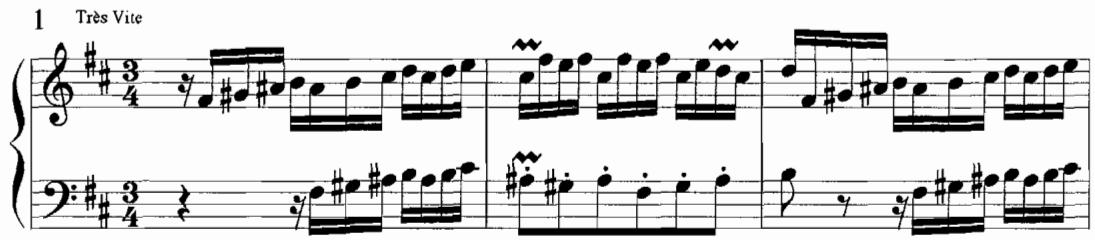
中文讲解
本段对应原书第12页起始位置的一个图像或乐谱占位符;原书的嵌入图像数据已被省略,仅保留其在版面中的位置与图注标记。读者需查阅原书第12页才能看到对应的例图内容。
补充说明
由于无法访问原图内容,无法就该图所承载的具体信息作进一步解读。
第2段(P0028)
原文复述
[Image or score placeholder on page 12 of the source. The embedded image data has been omitted; position and caption are preserved in the original layout.]
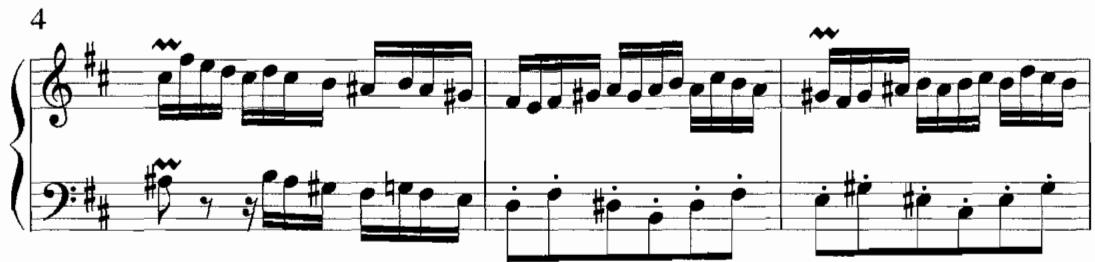
中文讲解
本段为第12页同一组中第二个图像或乐谱占位符;原书嵌入图像数据已省略,仅保留版面位置与图注标记。具体内容需查阅原书。
第3段(P0029)
原文复述
[Image or score placeholder on page 12 of the source. The embedded image data has been omitted; position and caption are preserved in the original layout.]
中文讲解
本段为第12页同一组中第三个图像或乐谱占位符;原书嵌入图像数据已省略,仅保留版面位置与图注标记。具体内容需查阅原书。
第4段(P0030)
原文复述
[Image or score placeholder on page 12 of the source. The embedded image data has been omitted; position and caption are preserved in the original layout.]
中文讲解
本段为第12页同一组中第四个图像或乐谱占位符,是紧接其后的Example 4.14之前的一组图像元素;原书嵌入图像数据已省略,仅保留版面位置与图注标记。具体内容需查阅原书。
第5段(P0031)
原文复述
Example 4.14. La Frénésie, ou le Désespoir sous le Domino noir from Les Folies françaises, ou les Dominos, 13th ordre (1722), F. Couperin. [Score or image placeholder; embedded image data has been omitted; position and caption are preserved.]
中文讲解
本段为Example 4.14的图题,是本节中第一次出现的带完整文献信息的图注。它标识了该例的曲名、所属曲集、序号与作者:弗朗索瓦·库普兰(François Couperin)的《La Frénésie, ou le Désespoir sous le Domino noir》(《狂热,或黑面具下的绝望》),选自《Les Folies françaises, ou les Dominos》(《法国的疯狂,或多米诺》)第13 ordre(1722年)。该图题在P0027–P0030所铺垫的占位图像之后出现,确立了本节分析的核心对象——库普兰《La Frénésie》原版的开头部分。读者需查阅原书第12页谱例方可看到具体音符。
补充说明
图题作为非正文内容,主要承担学术标注(曲名/曲集/序号/年代/作者)的功能,便于读者在原作集中迅速定位此曲。
第6段(P0032)
原文复述
The general musical qualities described above can metaphorically map onto Couperin’s evocative title, guiding potential meanings for the piece. Yet, other attributes pertaining to pattern-based activity contribute particularly to the piece’s expression, expanding — while simultaneously refining — possible mappings to include loss of control, instability, obsession, and utter emotional chaos. For example, consider Example 4.15. Couperin could have started the piece in a way similar to this musical passage. This example is stylistically comparable to the actual opening measures of Frenzy or Despair depicted in Example 4.14, and includes many of the same musical qualities previously described as contributing to the frantic motion of the piece, such as tightly wrought passages of sixteenth notes, repetition of figures, and a rapid tempo. There are, however, important differences between the two examples.
中文讲解
本段是本节论述的纲要性段落,提出一个新的分析工具——“风格模型”(stylistic model),并说明它在本节论证中的功能。
-
承接前文:前文已把库普兰曲题所暗示的"狂热/绝望"与若干一般性音乐特征(如密集十六分音符、节奏急促、动机反复)对应起来。本段进一步指出,除了这些一般性特征之外,“基于模式(pattern)的活动"对全曲情感表达具有特殊意义,能够扩展并细化这些对应关系,使之内含"失控、不稳定、痴迷、彻底的情绪混乱"等更具体的情感意涵。
-
引入"风格模型"的真正功能:作者以Example 4.15作为一项假想版本——库普兰"本来可能写成这样"的段落。该假想版本与Example 4.14(真实开头)共享若干一般性特征(十六分音符密集段落、动机反复、快速拍子),在风格上可比。然而两例之间存在重要差异——这正是风格模型这种分析策略的核心:必须先有一组"标准、规则、典型"的素材作为参照,才能凸显库普兰真正选择的开头在哪些地方偏离了常规、为何偏离、由此生成了怎样的表现意义。
-
本段的教学要点:风格模型是一种"反事实"的比较范例,它不是历史假设,而是教学工具——通过让读者先在想象中听到"一个普通但合理的库普兰式开头”,再转入真实版本,以便精确感受真实版本中哪些细节被改写、哪些惯例被打破。
补充说明
示例编号(4.14、4.15)表明这属于第四章的连续例证体系:4.14为真实谱例,4.15是分析者为比较目的而构建的假想谱例。
第7段(P0033)
原文复述
Example 4.15a–c. Stylistic Model Progression for Opening Three Measures of La Frénésie, ou le Désespoir sous le Domino noir. [Score or image placeholder; embedded image data has been omitted; position and caption are preserved.]
中文讲解
本段为Example 4.15a–c的图题。该图题指出:这三幅小图(a、b、c)共同构成"La Frénésie开头三小节的风格模型演变过程"。换言之,4.15a、4.15b、4.15c并非三个并列的不同例子,而是同一思路在三个阶段下的演进序列——作者借此让读者在对照中逐步看出风格模型如何被建构、调整并最终定型。读者需查阅原书第14页方可看到具体音符。
补充说明
图题中的"Progression"(演变/渐进)暗示a、b、c按时间顺序或细化顺序排布,承接P0032中"用风格模型来定位与真实版本之间的差异"这一目的。
第8段(P0034)
原文复述
In measure one of Example 4.15c, both the melody and bass voices enter on a downbeat octave, move in parallel sixteenth notes over the course of the measure, and clearly establish the stable tonic harmony and the first stage of the expected Do–Re–Mi opening gambit. This stability is a central feature of the traditional presentation of the pattern as an opening schema. On the first beat, each voice completes a four-note figure. The melody begins on B, steps down to the lower neighbor A#, resolves back up to B, and then continues its ascending motion by stepping up to C#. We do not necessarily
中文讲解
本段开始对Example 4.15c第一小节进行细部分析,把风格模型如何呈现一个"典型的库普兰式开头"具体化。
-
开头的稳定性:在第1拍上,旋律与低音以八度齐奏(downbeat octave)进入,整小节以平行的十六分音符进行,迅速确立稳定的主音(tonic)和声,并展开Do–Re–Mi开头模式(opening gambit)的第一阶段——这一稳定性正是"传统开篇模式(opening schema)“的典型特征。
-
第一拍旋律的具体轮廓:起始音B先下行到下邻音A#(A#是B的下方半音邻音),再返回B(形成 $\hat{1}-\hat{7}-\hat{1}$ 的回绕),随后继续上行到C#(即 $\hat{1}-\hat{2}$ 的延续)。这一四音轮廓:① 包含了邻音装饰,② 随后立刻向上展开——这是"下行邻音 + 继续上行"的典型小节内部结构。
-
段末悬停:本段以"We do not necessarily"收尾,文字上故意在下一段(P0035)继续展开这一四音轮廓"作为整体是否为完成的"这一感知判断;本段的作用是先把四音轮廓和它在第一拍内的位置交代清楚。
补充说明
本段提到的"B、A#、C#“在下一段将给出音级标注( $\hat{1}$、$\hat{7}$、$\hat{2}$ );“下邻音”(lower neighbor)是装饰性进行,指暂时下行半音/全音后再回到原音。
第9段(P0035)
原文复述
experience this four-note figure — B-A#-B-C#, or $\hat{1}-\hat{7}-\hat{1}-\hat{2}$ — as being complete. The musical inertia of the stepwise ascent (to C#) after the lower-neighbor figure (B-A#-B) establishes an expectation that the ascent will continue, completing the figuration on the D that follows on beat two. The D then initiates a repetition of the lower-neighbor figure followed by a stepwise ascent (D-C#-D-E), fulfilling our expectation a second time by ending on F# on beat three. We have then a series of four-note patterns, each one leading into the next: B-A#-B-C#; D-C#-D-E; F#. Because of the sense of arrival on the D and F# respectively, these can be heard as five-note gestures, each of which is comprised of two elided three-note patterns: B-A#-B ( $\hat{1}-\hat{7}-\hat{1}$ ) + B-C#-D ( $\hat{1}-\hat{2}-b\hat{3}$ ); D-C#-D ( $b\hat{3}-\hat{2}-b\hat{3}$ ) + D-E-F# ( $b\hat{3}-\hat{4}-\hat{5}$ ). This series can be heard as a sequence responding to musical inertia, which first establishes a pattern and then repeats it, leading the melody upward and prolonging the tonic harmony in this first measure.
中文讲解
本段承接P0034中停在"We do not necessarily"处的悬停,说明听众为何不会把B-A#-B-C#这一四音轮廓听成"完整”,进而揭示整段旋律的展开逻辑。
-
为何四音轮廓"没有结束”:在B-A#-B(邻音环绕)之后,立刻上行到C#( $\hat{1}-\hat{2}$ )——这个"已经向上迈出一步"的动作形成音乐惯性(musical inertia),使听众预期上行要继续,把完整感推到第二拍的D。因此单独的B-A#-B-C#不会被听成终点。
-
同一模式的反复:D达到后,再次启动"下邻音 + 上行"模式:D-C#-D-E;到第三拍F#再次重复一次此预期。于是整段构成由四个音组成的连续模式链:① B-A#-B-C#;② D-C#-D-E;③ F#(开始下一个)。
-
五音手势的重新切分:由于每次D和F#都具有"到达感"(sense of arrival),可以把整段听成两个五音手势(第二小节开头会引入下一个):第一个五音手势 = B-A#-B ( $\hat{1}-\hat{7}-\hat{1}$ ) + B-C#-D ( $\hat{1}-\hat{2}-b\hat{3}$ );第二个五音手势 = D-C#-D ( $b\hat{3}-\hat{2}-b\hat{3}$ ) + D-E-F# ( $b\hat{3}-\hat{4}-\hat{5}$ )。每个五音手势由两个相互重叠(elided)的三音模式组成——前一个的最后一个音就成了后一个的起始音。
-
模式学意涵:这一系列"建立 → 重复 → 模仿延续"的链式结构,是音乐惯性驱动的"序列"(sequence)的具体表现:先确立一个模式,再把它向上重复,从而把旋律向上推,并以主音延长(tonic prolongation)完成第一小节的功能。
补充说明
音级标注中的 $b\hat{3}$ 指降三级;其具体的调号与调式设定需结合Example 4.15c在原书中的实际呈现来确定。
第10段(P0036)
原文复述
The bass progresses in a similar fashion in Example 4.15c, following the melody and establishing a point of harmonic stability to initiate the opening of the Do-Re-Mi pattern of the larger three-measure unit. It begins on B, leaps down to F# to follow the melodic ascent in parallel tenths, resulting in another series of four-note gestures that concludes on the D on beat three: B-F#-G#-A#; B-A#-B-C#; D. The second of these four-note gestures can be heard similarly to what occurred in the melody — the combination of two elided three-note patterns: B-A#-B ( $\hat{1}-\hat{7}-\hat{1}$ ) + B-C#-D ( $\hat{1}-\hat{2}-b\hat{3}$ ) to create a larger five-note unit that concludes on the D. However, the opening gesture (B-F#-G#-A#) is different. The first B acts as an initial attack, but the pattern we hear and attend to — and expect a resolution of — is a four-note pattern that begins on the F# and ascends to the B on beat two (B [8]; F#–G#–A#–B [5–6–7–8]). This pattern can be heard as responding strongly to both musical magnetism and inertia as it ascends through the raised sixth and seventh scale degrees to resolve to B. The bass line in beats one, two, and to the first note of beat three is comprised of a four-note pattern that elides with the three-note patterns, which follow. In both the melody and bass voices at beat three of this measure, the figuration changes to accommodate the arrival of the second stage of the larger Do–Re–Mi, which begins on the downbeat of measure two. As illustrated in Example 4.15a, the shift in figuration results in a smooth stepwise descent from F# in the melody and D in the bass to C# and A# in the melody and bass respectively.
中文讲解
本段把分析重心转向低音线,揭示它与旋律如何共同塑造第一小节,并为进入Do-Re-Mi模式第二阶段做好铺垫。
-
低音的总体功能:低音与旋律以平行十度(parallel tenths)进行,紧随旋律,在大尺度三小节Do-Re-Mi模式的开始处建立和声稳定点。低音形成的四音模式链为:B-F#-G#-A#;B-A#-B-C#;D(与旋律一样终止在第三拍的D)。
-
第二次四音手势与旋律相似:B-A#-B-C#这一组与旋律的小节内第二组完全平行,可同样听成两个相互重叠的三音模式(B-A#-B + B-C#-D)形成的五音手势。
-
起首四音手势的特殊性:始于B的第一组(B-F#-G#-A#)则与旋律不同——这里的B只是一个"初始攻击音"(initial attack);真正被听成"模式起点并期待解决"的是从F#上行到第二拍B的那一组(F#–G#–A#–B)。这一上行经过升六级和升七级(F#-G#-A#-B),终结于B,体现了同时受到"音乐惯性(继续上行)“和"音乐磁力(magnetism,向B主音的吸引)“双向驱动而得到解决。
-
节拍三处的形态转换:第3拍处,旋律与低音的装饰形态(figuration)同时发生改变,以迎接大尺度Do-Re-Mi模式第二阶段的到来(自第二小节正拍开始)。如Example 4.15a所展示,这一形态转换的效果是:旋律从F#、低音从D平稳地下行到C#(旋律)和A#(低音)——为下一阶段的下行轮廓埋下伏笔。
-
本段在节论证中的作用:通过把第一小节中旋律与低音的内部结构完全展开(P0034、P0035处理旋律;P0036处理低音),作者实际上为后续比较做好了准备:当下一阶段进入真实Example 4.14时,读者已经知道"风格模型原本是什么样”,从而能精确识别库普兰在哪些节拍、哪些音程、哪些模式层上做了偏离。
补充说明
本段末尾提到的"音乐磁力”(musical magnetism)与"音乐惯性"(musical inertia)共同构成风格分析中关于模式感知的两个核心动因——前者指向稳定音级的吸引力,后者指向既有方向的延续。
脚注 / 边栏 / 图表 / 附加信息(如有)
本节包含两个主要图例:Example 4.14(库普兰《La Frénésie》真实开头三小节的谱例,标注文献信息为:Les Folies françaises, ou les Dominos, 13th ordre, 1722年,F. Couperin)与Example 4.15a–c(风格模型三阶段演进的谱例)。图中的嵌入图像数据已省略,读者需查阅原书第12–14页方可看到谱例内容。无脚注。
💡 本节核心要点
- 本节引入"风格模型"(stylistic model)作为分析工具:用一种"合乎风格但假想"的库普兰式开头(Example 4.15)与真实开头(Example 4.14)对照,从而精准定位真实版本对风格惯例的偏离及其表现意义。
- Example 4.15a–c并非三个并列的不同例,而是同一风格模型在三阶段下的演进过程,因此需作为整体看待。
- 在风格模型的第一小节中,旋律与低音以八度齐奏进入,并以平行十六分音符迅速确立稳定的主音和声与Do–Re–Mi开头模式的第一阶段——这是"传统开篇模式"的典型特征。
- 旋律的核心是B-A#-B-C#( $\hat{1}-\hat{7}-\hat{1}-\hat{2}$ )这一"下邻音 + 上行"的四音轮廓;由于上行惯性,听众不会把它视为完成,从而推动同一模式在D、E、F#上重复,形成链式向上序列。
- 每一组四音轮廓因到达感也可被重新切分为两个相互重叠的三音模式,构成五音手势,强化了"序列"与"主音延长"的双重功能。
- 低音以平行十度紧随旋律;其第二组四音轮廓与旋律结构相同,但首组B-F#-G#-A#把B作为"初始攻击音",真正被听成模式的是从F#经升六级、升七级上行至B的过程——同时体现了音乐惯性与磁力的合力;第3拍处两声部装饰形态同步转换,平稳下行至C#(旋律)和A#(低音),为大尺度Do–Re–Mi模式第二阶段做好铺垫。
🔑 关键术语
- Stylistic Model(风格模型):本节提出的分析工具:一种"合乎风格但非真实历史"的假想版本(如Example 4.15),用来与真实作品(Example 4.14)对照,从而分离出作曲家的"偏离"及其表现意义。
- Do–Re–Mi opening gambit / opening schema:库普兰时代常见的开篇模式:在主音和声上以三小节(大致对应Do、Re、Mi三个阶段)逐步展开旋律轮廓;本节中Example 4.15c在第一小节呈现其第一阶段(Do)。
- Lower-neighbor figure(下邻音轮廓):旋律性的装饰模式:从主音暂时下行至其下方半音/全音(即下邻音),随后回到原音;本节旋律的四音轮廓B-A#-B即以此起首。
- Musical inertia(音乐惯性):风格分析中的核心动因之一,指已经发生的方向性运动倾向于继续下去;本节中B-A#-B-C#之上的C#因惯性预期D,驱动模式重复。
- Musical magnetism(音乐磁力):与音乐惯性相辅的动因,指流动的音倾向于被吸引到稳定的音级(特别是主音)上来;本节中低音F#–G#–A#–B上行到B即同时受惯性与磁力驱动。
- Elided three-note patterns(相互重叠的三音模式):两个三音模式共享最后一个与第一个音,因而构成一个更长的五音(或更长)手势;本节旋律中的B-A#-B + B-C#-D即为典型例子。
- Parallel tenths(平行十度):两声部之间相距十度作平行进行;本节低音与旋律之间采用平行十度,是18世纪键盘音乐常见的低音支撑手法。
- Tonic prolongation(主音延长):和声在主音上持续停留、推迟向下一和声区域的转换;本节风格模型第一小节在主音和声上的持续即属于此。
C2.S3 [描述性拆分] Model Continuation and Comparison to the Actual Opening
第1段(P0037)
原文复述
As the patterns ascend in sequence at the start of measure one in this model progression, each completes its gesture with the note we anticipate hearing and fulfills our expectations of recurrence of motive. The combination of ascending progressions in the melody and the bass, as shown in Example 4.15b, clearly outlines the chord of the tonic for the duration of the measure. Additionally, the measure establishes a stable first stage of the opening three-part Do-Re-Mi and provides a hidden repetition of the gambit between beats one and two, as indicated by the smaller bracket in Example 4.15a, confirming the pattern’s stability over the rapidly moving surface level of the music. As the first stage of the Do-Re-Mi comes to a close, it moves smoothly into stage two in the second measure (Example 4.15c). The measure sustains this stage with a repeating figure in the melody, while the bass slows to eighth notes and combines two familiar patterns — the lower neighbor (A#-G#-A#) and an augmentation of the ascending fourth from the opening melody (F#-G#-A#-B) — to complete the measure. The second of these bass
中文讲解
本段承接前文对模型化进行曲(model progression)前三小节的分析,聚焦第一、二小节的结构与和声功能。核心论点有三:
-
第一小节的稳定感:尽管表层音符快速运动,旋律与低音声部的上行使主和弦(tonic chord)贯穿整个小节,使听者感到"意料之中的回归"。作者用"recurrence of motive"(动机再现)说明每个上行的乐思都收束在与期待相符的音上。
-
隐藏的呼应:Do-Re-Mi 三段式开局(opening gambit)的第一阶段在小节内是稳定的;而且在第一与第二拍之间,还存在一次被小括号标记的"隐蔽重复"(hidden repetition)。这说明表面的快速运动之下潜藏着稳定的骨架,是模型与后面 Couperin 原作形成对比的关键。
-
第二小节的两条熟悉低音线:进入 Do-Re-Mi 第二阶段时,旋律以重复音型维持,低音则放缓为八分音符,并合并两种熟悉模式——下邻音(A#-G#-A#,即 A# 上下抖动回到 A#)与上一段开头上行四度的扩大(augmentation)变形(F#-G#-A#-B)。扩大指节奏时值被拉长,旋律轮廓相同但更慢。
本段教学要点:理解"稳定 vs. 表面快速运动"的双层结构是把握模型性质的关键,下邻音与扩大四度都是前文已出现材料的变形,作者用"familiar"强调互文关系。
补充说明
本段末尾被截断(“The second of these bass”),下一段 P0038 接着完成该句。模型曲谱所在谱例为 Example 4.15a–c,作者用小括号标记第一小节内隐蔽的 gambit 重复,用以与 Couperin 原作中"侵蚀稳定性"的开局形成对照。
第2段(P0038)
原文复述
patterns concludes on the B: the arrival point of the third portion of the larger three-measure unit, while the melody concludes on its expected D after a slightly altered figuration on beat three of measure two, as reflected by Example 4.15a.
中文讲解
本段是 P0037 数据截断的衔接句,主要补充两个收束点:
-
低音的终止:第二条低音模式——即扩大四度 F#-G#-A#-B——结束在 B 音上。这个 B 恰好是三小节大单元中第三阶段(即最后阶段)的"到达点"(arrival point)。换言之,前两小节低音的最终落点为第三小节要做的事预先做好了属音方向的准备。
-
旋律的终止:第二小节第三拍上旋律花奏经过轻微变化(slightly altered figuration),但仍然落在预期中的 D 上。D 在这里代表第二阶段的可预期落点。
本段虽然短,但揭示了模型进行曲中两声部如何为第三小节铺垫:低音以属音 B 收束,旋律以 D 收束,为第三小节进入更大结构的高潮或解决埋下伏笔。“Slightly altered figuration"一词暗示花奏虽变,但骨架未变,这正是模型追求"稳定骨架 + 表面变化"原则的又一例证。
补充说明
无额外补充。两声部收束安排(低音 B、旋律 D)对照谱例 Example 4.15a 可得,作者用括号与字母标记进行了细致标注。
第3段(P0039)
原文复述
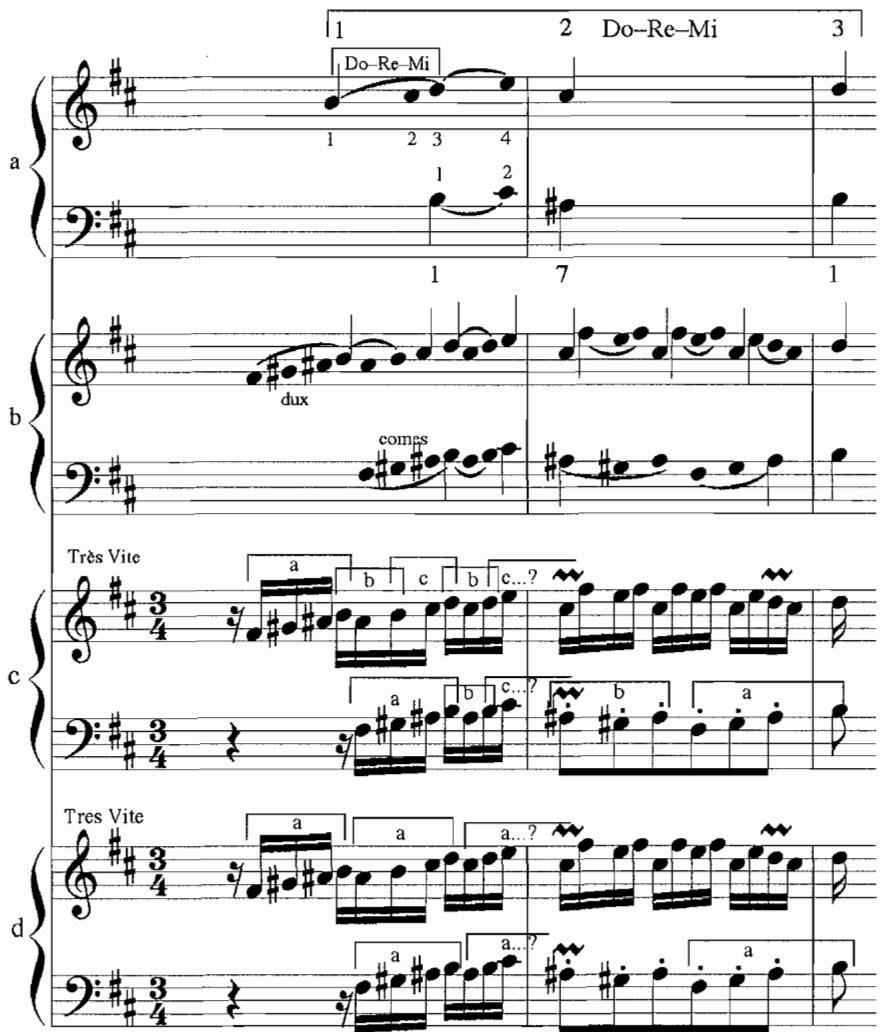
The first three measures of the model passage (proposed as a stylistic alternative for the opening of Frenzy) clearly establish each stage of the expected opening gambit within a texture that maintains many of the frantic qualities of motion associated with the title of the piece. Comparing Example 4.15c to the actual opening of La Frénésie, ou le Désespoir, reproduced in Example 4.16d, illuminates its character. The first measure of Frenzy (as written) erodes the stability of the opening Do-Re-Mi demonstrated in the model progression immediately upon initiating its first beat. Instead of beginning both voices simultaneously, Couperin begins in imitation — the only variation within the collection to start in this manner. The melody enters as the leading voice (dux) on F# and attacks on the unstable second note of the sixteenth-note group, rather than on the downbeat of the measure. The F# initiates a four-note ascent: F#-G#-A#-B (5-6-7-8) in the melody, labeled as “a” and with a bracket in measure one of Example 4.16d. This ascent is familiar: it is comprised of the same four-note pattern that appeared in the bass in the model progression, and maintains many similar qualities as it did in that example. Beginning on scale degree five and ascending through the raised sixth and seventh degrees to resolve on B (8) can be heard as strongly responding to musical magnetism and inertia, driving the half-step resolution between the leading tone and the note of the home key. We experience this as a single gesture that creates an expectation for resolution, which does occur, but not until beat two of the measure.
中文讲解
本段是本节的核心对比段,通过把模型最后部分(Example 4.15c)与 Couperin 实际作品《La Frénésie, ou le Désespoir》(Example 4.16d)进行对照,揭示两种不同的开局策略。关键论点依层次展开:
-
模型的总体特征:模型前三小节在保留"标题所暗示的狂躁运动感”(frantic qualities of motion)的同时,仍清晰地建立了开局 gambit 的每一阶段——即在动感中保持结构清晰。
-
Couperin 原作的颠覆:第一小节"立即侵蚀"(erodes)了模型中 Do-Re-Mi 的稳定性。关键手段是模仿(imitation)——在整部作品中这是唯一以模仿开局的变奏(variation)。旋律作为先导声部(dux)以 F# 进场,但不在小节强拍上,而是在十六分音符组中不稳定的第二个音上。
-
熟悉的上行四度:F# 启动一条四音上行 F#-G#-A#-B,对应调式音级 5-6-7-8,标记为"a"并用括号标出。这正是模型低音中曾出现过的同一模式,但此处被搬到旋律声部。
-
磁性引力(magnetism)与惯性(inertia)的解释:从 5(属音)级开始,经过升高六级与七级,到 8(主音)解决,这种上行受"调性引力"驱动——导音(leading tone,即 A#)到主音(B)的半音进行是必须被解决的紧张度。整个手势被体验为"对解决的期待",但 Couperin 把解决推迟到第二拍才发生。
本段的教学要点:理解"音乐引力"(magnetism)与"惯性"(inertia)的概念是关键——前者指调性系统天然的紧张—解决倾向,后者指旋律一旦上行就倾向于继续上行的动能。Couperin 在第一拍只给出上行期待,到第二拍才解决,正是用"延迟解决"(delayed resolution)来塑造标题暗示的焦躁与不稳定感。
补充说明
“Dux"为模仿对位术语,指先进入的主题声部(对应另一跟进声部称为"comes”)。作者指出整个变奏集中只有这一首以模仿开篇,构成 Couperin 的独特选择。例 4.16 标记字母"a"与括号对应模型低音中已讨论过的同一模式,凸显材料的跨声部呼应。“The only variation within the collection to start in this manner"这一表述是相对整部作品变奏集的限定,强调其特殊性。
第4段(P0040)
原文复述
[Example 4.16a–d. La Frénésie, ou le Désespoir, m. 1–3, 13th ordre (1722), F. Couperin] (image placeholder: embedded image data omitted; position and caption preserved)
中文讲解
本段为谱例 4.16a–d 的图注占位符,引用的文献来源是 F. Couperin 于 1722 年出版的《La Frénésie, ou le Désespoir》,位于第 13 序曲(13th ordre)中第 1–3 小节。由于图像数据被省略,读者需查阅原图方可对照作者对第 1 小节括号、字母"a"等具体标记的分析。该谱例在前文 P0039 的论证中承担核心参照功能,用于对比模型曲例(Example 4.15c)与 Couperin 原作在开篇策略上的差异。
补充说明
图注中所标注的"a"与括号用在前文 P0039 中引用的分析:字母"a"标记旋律中的四音上行 F#-G#-A#-B,括号标出该音群的位置。原图数据缺失,需另查阅原始出版物以核对乐谱细节。
脚注 / 边栏 / 图表 / 附加信息(如有)
P0040 对应的谱例 4.16a–d 标明了引用作品的完整出处:F. Couperin《La Frénésie, ou le Désespoir》,第 13 序曲(13th ordre),1722 年出版,第 1–3 小节。该谱例在前文论证中作为"对照样本"使用——与作者提出的模型曲例(Example 4.15a–c)并置,用以揭示 Couperin 原作如何在第一小节即通过模仿与延迟解决来"侵蚀"模型所追求的稳定骨架。谱例中 P0039 提及的字母"a"与方括号标记用于追溯模型低音中已讨论过的同一四音模式(F#-G#-A#-B)。由于原图像数据缺失,所有关于谱例的细节(小节内音色、力度、连断符)需查阅原出版物。
💡 本节核心要点
- 模型进行曲在快速表面运动下维持稳定的 Do-Re-Mi 三段式开局骨架,第一小节内还存在隐蔽的 gambit 重复,于 1–2 拍之间形成上下呼应。
- 模型第二小节低音结合下邻音(A#-G#-A#)与来自开头上行四度的扩大变形(F#-G#-A#-B),两声部分别落 D 与 B,为第三小节提前做好属方向的准备。
- Couperin 原作是整部变奏集中唯一以模仿开局的曲子:旋律作为 dux 在 F# 上起句,但落在十六分音符组的不稳定第二音而非强拍上。
- 旋律上行的 F#-G#-A#-B(5-6-7-8)实为模型低音中已出现的同一四音模式,被搬到高音区域,并由调性磁性引向 B(8)音的解决。
- 解解决被故意推迟到第二拍才发生,以"延迟解决"制造焦躁与不稳定感,从而呼应标题《Frénésie》(狂躁)所暗示的性格——这正是模型与原作在开局策略上的关键分野。
🔑 关键术语
- opening gambit:开局棋局/开局套路,在本节中指作品开篇用以建立调性、风格与期待感的固定模式或策略;模型在第一拍即建立一个可预期的开局棋局,而 Couperin 原作则通过模仿与延迟解决来"打破"这一棋局。
- Do-Re-Mi (three-part opening gambit):本节约定的三段式开局音型,以唱名 Do-Re-Mi 类比其阶段性推进;本节分析的第一、二小节分别作为该 gambit 的第一与第二阶段。
- lower neighbor (下邻音):和弦音上方或下方半音/全音的辅助音再回到原音的装饰;在本节中具体表现为 A#-G#-A#,即 A# 与其下方相邻的 G# 之间的来回。
- augmentation (扩大):把一段旋律的节奏时值整体拉长但保持音高轮廓不变的手法;本节中模型低音的 F#-G#-A#-B 是对开篇旋律同一四音模式的扩大变形。
- imitation (模仿):对位写作中一声部先陈述主题、另一声部随后以同主题跟进的技法;本节中 Couperin 以旋律作为 dux 先进入,低音随后跟进,是整部变奏集中唯一以模仿开局的写法。
- dux (先导声部):模仿对位中先陈述主题的声部,对应随后跟进的 comes(答句声部);在本节中指代 Couperin 原作中率先进入的旋律声部。
- magnetism and inertia (磁性与惯性):本节用"调性引力"指导音向主音的半音解决倾向,“惯性"指旋律沿某一方向持续运动的动能;F#-G#-A#-B 的上行被解释为受这两种音乐力共同作用而驱动。
- delayed resolution (延迟解决):本节指 Couperin 让本应在第一拍完成的解决延迟到第二拍才发生;这一手法是原作"侵蚀稳定性”、呼应《Frénésie》标题焦躁感的关键策略。
- scale degrees 5-6-7-8 (5-6-7-8 级):调式音级系统中的属音(5)、下中音(6)、导音(7)、主音(8);本节中 F#-G#-A#-B 对应升 f 小调中的 5-6-7-8,揭示四音模式在调性层级中的关系。
C2.S4 [描述性拆分] Imitative Opening and Delayed Stability in Measure One
第1段(P0041)
原文复述
The pattern’s conclusion on B at beat two serves as the first stage of the structural melody in the larger three-stage Do-Re-Mi unit. The bass then enters one beat later with this same four-note pattern in imitation, also labeled as “a” with a bracket in Example 4.16d, finally arriving on its first structural portion of the gambit on beat three of the measure (Example 4.16a).
中文讲解
本段交代了第1小节里两层结构事件之间的时序关系:第一,声部在第2拍落在B音上,这被认定为整个Do-Re-Mi三段式旋律单元中第一阶段的真正到达;第二,低音声部在整整一拍之后,以相同的四音动机作模仿进入,并以方括号标注、标记为"a”,最终在第3拍完成其gambit的第一阶段(参见Example 4.16a)。作者在此把"第一阶段"严格限定在结构到达点上,而不是任何起始音,因此即便旋律在更早的位置发声,第一阶段的成立时间仍以B音落点为准。这一时序判定是后续"稳定性被延迟"论证的前提:声部虽以模仿方式同时开始,结构意义上的稳定点却分别落在第2拍与第3拍,构成了本小节特有的错位。
补充说明
此处所引用的Example 4.16a与Example 4.16d属于同组谱例,分别承担"bass到达结构点"与"上方声部谱面细节"的功能,括号标记"a"则暗示该动机在第2小节乃至更后的段落中会继续以同标签出现,构成本节后半段所讨论的序列性四音上行姿态。
第2段(P0042)
原文复述
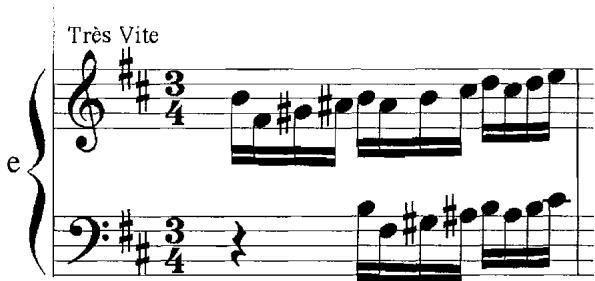
A central feature to the traditional presentation of the Do–Re–Mi is an established sense of stability during its first stage by outlining the chord of the tonic. Rather than establishing this stability on the downbeat, as found in all other variations from the collection that use this opening gambit, as well as in our stylistic model, the first stage of the Do–Re–Mi in Frenzy does not occur until the second beat of the measure after an unstable beginning on a weak part of the beat — and that event is restricted to the melody alone. The bass does not declare its first stage until beat three, as reflected in Example 4.16a. Even by starting the voices in imitation, the first measure of La Frénésie could have established its stability and first stage of the Do–Re–Mi much sooner by beginning the figuration on the downbeat with a B in the melody, as illustrated in Example 4.16e. This pattern would then repeat a beat later in the bass.
中文讲解
本段的中心主张是:《La Frénésie》通过把Do-Re-Mi第一阶段的稳定到达从强拍推迟到弱拍,违反了同组变奏曲及风格模型(stylistic model)的常规做法。作者先给出"传统Do-Re-Mi呈现方式"的判据——第一阶段必须稳定地勾勒主和弦,并通常自强拍起。然后指出本曲的偏离:旋律的第一阶段要到第2拍才到达,且起始于弱拍上的不稳定音;低音的第一阶段更延至第3拍。作者随后以Example 4.16e这一假设性版本作为反事实对照:若旋律自第1拍B音起、低音在一拍后模仿重复,则稳定感与第一阶段本可在更早的位置完成。这个反例的关键作用不在于说明"发生了什么",而在于让读者量化地感知:本曲实际版本究竟把稳定点推迟了多少、推迟带来了何种听感。值得注意的是,作者明确把"不稳定起点"限定于旋律一处单独的事件——这意味着延迟稳定并非由两个声部共同造成,而是先由旋律主导,bass在更晚一拍跟进,因此模仿并不带来同步的稳定。
补充说明
本段所说的"stylistic model"指前文已建立的标准Do-Re-Mi呈现范式,“opening gambit"指开篇这一套起始音型/策略;这两项都是作者先前已引入的概念,本段将其作为参照系来量化本曲的偏离程度。
第3段(P0043)
原文复述
中文讲解
该条目为第19页的图示/谱例占位符,位于P0042所讨论的Example 4.16a、4.16d,以及紧接着将出现的Example 4.16e等谱例的版面位置。它在论证链中的作用是承载P0042末尾提到的"假设性开始于B音"的改写版本,以及P0045中关于"两个声部都去掉B音、改为F#起"的对比说明。具体音高走向、谱号、调号、小节线及声部交错等视觉信息需查看原图方能确认。
第4段(P0044)
原文复述
Example 4.16e. Alternate Opening for La Frénésie, ou le Désespoir Figure Beginning on B
中文讲解
这是Example 4.16e的图题/说明:标题为"La Frénésie, ou le Désespoir的开篇音型改以B音起始的替代版本”。图题本身就限定了此例的性质——它不是作品的实际版本,而是作者基于P0042末尾假设所构造的反事实改写版,专门用来对照实际作品开头缺乏B音、稳定性被延迟这一处理。其论证功能是"反例对照":以一个’若如此则不同’的版本,让读者更精确地度量实际版本在强拍与稳定到达上的偏离幅度。
补充说明
图题中的"Figure"承接P0042中的"figuration"一词,指的是开篇那一组分解/装饰式音型;“Beginning on B"提示读者注意其起始音与实际作品(F#起始)的差异。
第5段(P0045)
原文复述
When voices enter in imitation, the presence of a downbeat event on tonic provides an immediate tonal and metric anchor. In Example 4.16d, Couperin eliminates the B in both voices in favor of beginning on the unstable part of the beat on F#, delaying any sense of stability until beats two and three of the measure. Combined with the rapid tempo and constant sixteenth-note figuration, the result of the fragmented opening is a breathless tonal and metric ambiguity. Within the context of the variation set this technique, reserved specifically for the final piece of the narrative, expresses a state of unbalance, unsteadiness, and lack of solid footing — either emotional, mental, or both.
中文讲解
本段推进了上一段已建立的"延迟稳定"论点,并把它与情绪/叙事解释联系起来。作者的推理分四步:第一,给出一般规则——当声部以模仿方式进入时,若强拍出现主音事件,则立刻提供调性与节拍的双重锚点;第二,回到Example 4.16d这一具体谱面,指出库普兰主动在两个声部中都去除B音、改以弱拍位置上的F#起首,从而把任何稳定感都推迟到第2拍(旋律)与第3拍(低音);第三,把这种延迟稳定与"快速速度+持续的十六分音符音型"相结合,归结出听感上"令人屏息的调性与节拍模糊”——这是一种"什么都没有被锚定"的状态;第四,把这一技术放置到整组变奏曲的语境中:这种手法被库普兰特别保留给叙事终曲(最后一首),因此其功能不仅是结构上的延迟,更是语义的——表达失衡、不稳、缺乏立足点的状态,可能是情绪上的,也可能是心理上的。
本段最容易被误读之处在于:作者并非主张库普兰在技术上’犯错’,而是主张他在叙事终曲上有意使用了一个违背自身风格模型常规的手法,借结构延迟制造情绪—心理—叙事的失重感。读者应将此处的"不稳定"理解为一个被精确设计过的修辞,而非缺乏控制。
补充说明
本段明确把所讨论的技术处理与"variation set的最后一首"绑定,这意味着前文已建立的变奏集合中其他乐曲遵循的是另一种开篇模式;该技术差异因此具有分章定位的功能,而不仅是局部装饰。
第6段(P0046)
原文复述
In the opening of Frenzy or Despair, stability is compromised. This is a feature that continues well beyond beats one and two of the piece. After the melody begins with the four-note pattern ascent on F# in Example 4.16d, it continues its ascending figuration just as it did in both the stylistic model (Example 4.15c), as well as in the alternate opening from Example 4.16e. The melody steps down to the lower-neighbor A# after the arrival on the structural B on beat two, and is followed by three steps up to create another four-note unit (A#–B–C#–D). The bass follows accordingly with its entrance on F#. The difference between the alternate (Example 4.16e) and actual (Example 4.16d) openings of the piece is the omission of the B on the downbeat of the melody. This exclusion emphasizes the “four-ness” of the pattern, which leads us to hear the melody, and subsequently the bass, as series of four-note ascending gestures. These gestures appear with brackets and are labeled as “a” in Example 4.16d. However, we know from the description of the stylistic model of Example 4.15c that, aside from the initial four-note pattern in both the melody and the bass, the remaining figures (e.g., B; A#–B–C#–D) are a series of elided three-note patterns (e.g., B-A#-B; B-C#-D). Measure one of Example 4.16c illustrates this pattern grouping: the four note pattern remains labeled as “a”, while the lower-neighbor figure is labeled as “b” and the ascending third as “c”. Patterns “b” and “a” carry into the figuration of the bass in measure two.
中文讲解
本段是本小节论证的收束层,它由三个层次的工作构成:
第一层是’分离差异’。作者把实际版本(Example 4.16d)与风格模型(Example 4.15c)以及假设替代版本(Example 4.16e)并列,提取出共同点:旋律以F#起四音上行至B(第2拍)、随后下到下邻音A#,再连续上行构成第二组四音单元A#–B–C#–D;低音同样以F#起,模仿进入。差异点仅在’第1拍是否出现B音’——实际版本省略了B音,假设版本则保留。
第二层是’听觉重塑’。作者指出,正是因为省去了强拍上的B,听者倾向于把旋律与低音都听成’一系列四音上行姿态’,从而强化了pattern的’four-ness’(四音性)。这是上一段所建立’延迟稳定’论点的进一步延伸:延迟不只是稳定到达的问题,还改变了我们切分音型的基本单位——四音姿态成为听感中的主导单元,而非三音形态。
第三层是’模式细分’。作者调回Example 4.15c(风格模型)中的描述,对实际版本中的音型做标签化切分:起始四音上行保持标为"a",下邻音姿态标为"b"(B–A#–B),再上行的三度姿态标为"c"(B–C#–D)。其中"a"由两个被elided(重叠/省略化)的三音模式B–A#–B与B–C#–D在第二音B处elide合并而成;“b"与"c"本质上是同一类三音上下行姿态的拆分。Example 4.16c第1小节即承担展示该分组的可视化功能。最后一句指出"b"与"a"这两组模式在第2小节会继续延伸到低音的figuration中,从而把本小节建立的音型分解逻辑向下一小节作出预告。
本段的论证意义在于:它把先前’延迟稳定’的负面描述,转译为’对四音姿态的强调’这一正面结构特征,使库普兰的偏离同时具有’破坏’与’重组’的双重身份——既有情绪上的失重,又在结构上制造出新的可听单位。
补充说明
本段涉及两个相互配合的谱例:Example 4.16c承担模式分组(a/b/c)的可视化,Example 4.15c承担风格模型的对照参照;二者都在本段中被交叉调用,读者在理解时需要在三组谱例之间来回切换:4.16d(实际作品)、4.16e(假设替代)、4.15c(风格模型)、4.16c(实际作品中的模式分组)。
脚注 / 边栏 / 图表 / 附加信息(如有)
本小节涉及Example 4.16a、4.16c、4.16d、4.16e四个谱例及对应图注(其中4.16e图注出现在P0044)。谱例的功能可分为三类:(1) 实际作品的局部展示——4.16a标记bass第一阶段到达,4.16c展示音型a/b/c的分组,4.16d展示旋律以F#起的实际开篇;(2) 反事实改写版本——4.16e用以对照凸显省去B音所造成的差异;(3) 风格模型参照——4.15c虽不属本小节谱例组,但在P0046中被反复调用,作为衡量本曲偏离程度的基准。页内图像占位符P0043承载上述谱例的版面位置。
💡 本节核心要点
- Do-Re-Mi第一阶段的稳定到达在《La Frénésie》中被系统地推迟:旋律推迟至第2拍、低音推迟至第3拍,违反了同组变奏曲及风格模型中"强拍勾勒主和弦"的常规做法。
- 推迟稳定的技术手段是主动省去强拍上的主音B,旋律与低音均改以弱拍位置上的F#起始,因此模仿并不带来同步的稳定,反而把"不稳定"延长到第2拍。
- 延迟稳定与快速速度、持续十六分音符相结合,制造出"屏息的调性与节拍模糊”,作者明确将这一听感与叙事终曲所需的’失衡、不稳、缺乏立足点’状态绑定。
- 省去强拍B音的另一后果是听觉单位的重塑:旋律与低音都被听成一系列四音上行姿态(标签a),而非以三音形态为基本单元。
- 实际版本中的音型可拆分为起始四音上行(a)、下邻音姿态B–A#–B(b)与三度上行B–C#–D(c)三个标签;其中a由b与c在B音上elide合并而成。
- 本小节建立的音型分解逻辑(a/b/c)会在第2小节继续延伸至低音的figuration,构成与下一小节的衔接。
🔑 关键术语
- Do–Re–Mi gambit / Do-Re-Mi unit:本曲开篇所建立的三段式旋律音型策略,作者将其作为结构模板来定位各阶段的稳定到达点;本小节讨论的核心就是其第一阶段的实际呈现方式。
- imitation (模仿):低音在一拍之后重复上方声部的同一四音动机;在本曲中,模仿虽同步进行,却未带来同步的稳定,因为两个声部均起始于不稳定音F#。
- stylistic model (风格模型):前文已建立的Do-Re-Mi标准呈现范式,作为对照基准,用以衡量本曲在强拍稳定、省略主音B等方面的偏离程度。
- elision / elided three-note patterns:两个相邻的三音模式在共享音上重叠/省略化,从而合并为更长的音型;本曲中起始四音姿态即由下邻音姿态(b)与三度上行姿态(c)在B音处elide而成。
- four-note pattern / four-ness:本曲被强调的听感单位——一系列四音上行姿态;其形成的关键条件是省去强拍B音,从而使原本可能被听成三音衔接的素材被重新切分为四音单元。
- lower-neighbor figure:旋律到达结构音B后下行至下邻音A#再回到B的装饰姿态,作者将其单独标记为b,并视作本曲开篇音型的基本构件之一。
- downbeat event on tonic:强拍上出现的调性主音事件;作者把它视为建立调性与节拍双重锚点的关键,库普兰在本曲中正是去除了这一锚点以制造模糊。
C2.S5 [描述性拆分] Ascending Four-Note Gestures and Inertia
第1段(P0047)
原文复述
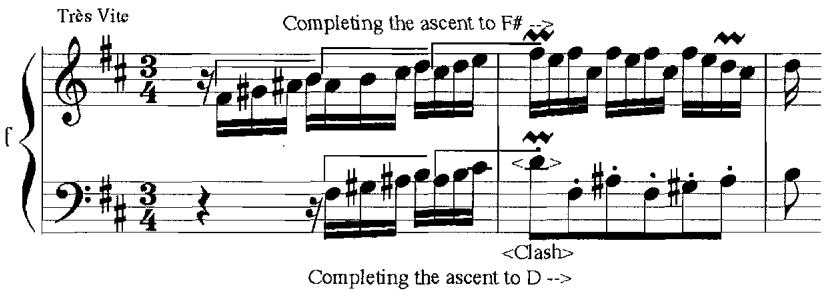
In measure one of Examples 4.16c and d, musical inertia can be heard as perpetuating the gesture’s repetition in both the melody and the bass, which then guides our expectation for the final, resolving note of each pattern as in Example 4.16f. In the melody, the first four-note gesture, F#-G#-A#-B, is followed by the second four-note
中文讲解
本段为全节定下核心概念:musical inertia(音乐惯性)。作者指出,在例 4.16c 与 4.16d 的第一小节中,惯性表现为旋律与低音同时把四音动机的重复持续下去,从而把听者的期待引向每个片段的最终解决音(参例 4.16f)。具体到旋律上,第一组四音动机为 F#–G#–A#–B,紧接着是第二组四音动机(本段在此中断,由下一段继续)。需要注意的是,本段并非在描述一个独立片段,而是为整条论证链提供机理:先说明"惯性"何以产生期待,再说明期待指向哪个音(例 4.16f 的标题即写作"惯性将四音动机延续到 F# 与 D",这正是期待的目标)。因此"musical inertia"不是修辞,而是作者用以解释听者为何会把重复上行片段理解为"尚未完成、需要继续"的关键心理—听觉机制。
补充说明
本段中的"musical inertia"与"gesture’s repetition"互为前提:惯性需要动机的重复才能被建立,而动机的重复反过来又由惯性维持其继续。下段(P0049)将对本段被截断的"second four-note gesture"作出具体展开。
第2段(P0048)
原文复述
[Example 4.16f. Inertia Continuing the Four-Note Gestures to F# and D]
中文讲解
这是图 4.16f 的图注。该图所呈现的,正是 P0047 所预告的"惯性所引导出的最终解决音":旋律最终上行至 F#,低音最终上行至 D。图题中"Inertia Continuing the Four-Note Gestures"表明,这幅谱例的功能不是引入新材料,而是把上段所述的"惯性强度的听觉结果"以谱面形式固定下来,因此它与正文构成例证—解释关系:正文先解释听觉感受(期待被引向解决音),谱例随后给出具体的音高目标(F# 与 D)。作为占位条目,原图的乐谱细节不可见,但可由标题确认:上行四音动机在惯性驱动下,最终分别落在旋律的 F# 与低音的 D。
补充说明
本图题同时预告了两个目标音——旋律的 F# 与低音的 D——这与 P0049 中"B、D、F# 作为到达点"以及"旋律最终上行至 F#“的描述一致,但需要注意:P0049 还补充了低音"在到达 D 之后"发生了意外碰撞并被调整为 A# 的过程,因此 D 并非低音真正的最终音,F# 才是旋律与低音共同收敛到的音。
第3段(P0049)
原文复述
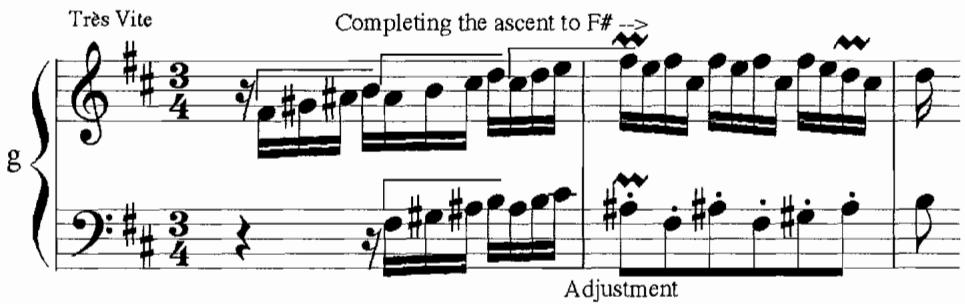
gesture, A#–B–C#–D, and finally the third four-note gesture, C#–D–E–F#, which concludes on the downbeat of measure two. The B, D, and F# serve as points of arrival, completing each ascending figure and fulfilling our expectations for resolution. The bass then follows in the same manner with the first four-note gesture, F#–G#–A#–B, followed by the second four-note gesture, A#–B–C#–D. The pattern’s concluding D on the downbeat of measure two clashes with the expected harmony of the measure: the chord of the fifth degree. The adjustment in the bass to A#, breaking the ascending-fourth gesture as illustrated in Example 4.16g, solves this and supports the melody as it continues to respond to musical inertia as it ascends to F#, fulfilling our expectation for resolution at the close of the pattern. The repeating melodic figure in measure two — F#–E–F#–C# — alternates between a lower neighbor and a pedal on C#. The C# in the
中文讲解
本段是全节信息量最大的一段,承担了三重任务:陈述旋律的最终形态、揭示低音与和声的冲突、并交代冲突如何被解决。
第一,旋律部分。第二组四音动机为 A#–B–C#–D,第三组为 C#–D–E–F#,并结束于第二小节正拍。B、D、F# 三个音在结构上扮演arrival points(到达点):每一组上行四音都落在下一个音程的起点,从而把"尚未结束"的张力一次性释放——这正是 P0047 所说"期待最终解决音"的具体兑现方式。
第二,低音部分。前两组低音动机的音程结构与旋律一致(F#–G#–A#–B,A#–B–C#–D),但当惯性同样把低音推到 D 时,冲突发生了:D 落在第二小节正拍,但该小节的和声却是"五级和弦(chord of the fifth degree)"——也就是说,惯性按预期把低音推到了 D,但和声并不接受 D 作为根音或和音。这一句揭示了"惯性—期待"与"和声语法"之间的张力:D 在低音线上是惯性的逻辑终点,在和声上却是不协和的入侵。
第三,冲突的解决。作者随即指出低音做出"调整为 A#“的处理(参例 4.16g),打断原本的上行四度惯性链。这一调整同时承担两个功能:一是消除与五级和弦的冲突(A# 与五级和弦相容),二是让低音继续配合旋律——旋律在惯性的驱动下继续上行至 F#,并由此兑现了开篇所说的"对最终解决音的期待”。
最后,本段还为下一段留下一个动机种子:第二小节旋律反复出现 F#–E–F#–C#,其中 E 是 F# 的lower neighbor(下方邻音),而 C# 持续充当pedal(持续音/踏板音)。这一小节既不像前两小节那样纯粹由上行四音惯性推动,又为最终落在第三小节正拍的解决埋下伏笔。
补充说明
本段存在两条并行的论证线索,必须分别追踪:(1) 旋律线索为 F#–G#–A#–B → A#–B–C#–D → C#–D–E–F#,三组动机的尾音(B、D、F#)恰是下一组动机的首音,形成链式推进;(2) 低音线索原本被期望复制同样的链式推进,却在第二小节正拍因 D 与五级和弦的冲突而被打断,改走 A#。两条线索的不对称,正是作者论证"惯性需要被和声约束"的具体证据。
第4段(P0050)
原文复述
[Example 4.16g. Adjustment of Gesture in the Bass to A#]
中文讲解
这是图 4.16g 的图注。该图的功能与 P0048 中的图 4.16f 形成对照:图 4.16f 展示的是惯性如何把动机推向原计划的终点音(F# 与 D),而图 4.16g 展示的则是低音在惯性被打断后,如何调整为 A#。换言之,4.16f 与 4.16g 是一对互补的谱例——前者呈现"惯性的力量”,后者呈现"惯性的修正"。这种"原计划—调整"的对照结构,正是 P0049 论证低音为何要改走 A# 的视觉支撑。作为占位条目,原图乐谱不可见,但图题已明确指出:在低音线上,原本应继续上行的四音动机被截断并改为 A#,由此解决与五级和弦的冲突。
补充说明
两幅谱例与正文之间的关系不是简单的"图配文",而是先证后解:4.16f 先证"惯性使旋律到达 F#、低音到达 D",4.16g 再证"低音因与和声冲突而改走 A#"。读者若只看其中一幅,容易误以为低音真的结束在 D,必须两幅并置才能理解作者的全部分析。
第5段(P0051)
原文复述
melody and the adjustment to A# in the bass serve as the second stage of the larger Do-Re-Mi pattern. The pattern concludes smoothly at the downbeat of measure three.
中文讲解
本段是全节的收束,将前文局部现象归位到一个更大的 Do-Re-Mi 模式之中。所谓"第二阶段",指的是本节所讨论的第二小节事件——旋律中的 C# 与低音中调整为 A# 这两件事——共同构成了 Do-Re-Mi 模式的中间环节。Do-Re-Mi 是唱名体系,作者在此用以暗示:尽管表面上是上行四音动机的惯性推进、并伴有一次低音的意外调整,但从更高的结构层级看,整段音乐仍沿着一组熟悉的上行音阶步骤平稳运行。最后一句"the pattern concludes smoothly at the downbeat of measure three",把视角从小节内部的张力(惯性与和声的冲突)拉回到整条旋律线:到达点是平滑的,听者最终听到的是一个顺畅的收束,而非一次突兀的转调。
本段的核心作用,是提醒读者:局部的修正并不意味着整体被打乱。A# 的出现看上去是惯性被强行打断,但从 Do-Re-Mi 模式看,它只是模式中间正常的一步;这就把"和声对惯性的约束"重新解释为"更高层级模式的一部分",从而消解了 P0049 所暗示的"冲突—解决"戏剧性。
补充说明
本节结束于"在第三小节正拍平滑收束",并未展开第三小节的内容,因此 Do-Re-Mi 模式的最终音高在本节输入中未给出,留待下一节继续论述。
脚注 / 边栏 / 图表 / 附加信息(如有)
本节包含两幅谱例及其图注(4.16f 与 4.16g),均作为正文论证的视觉支撑:4.16f 印证"惯性把四音动机推向 F# 与 D",4.16g 印证"低音因与五级和弦冲突而调整为 A#"。两幅谱例必须并置阅读,才能完整理解作者关于"惯性—和声冲突—修正"的论证链。无其他脚注或边栏材料。
💡 本节核心要点
- musical inertia(音乐惯性)是本节的核心机制:动机的重复建立起听者的期待,期待指向每个上行片段的最终解决音。
- 旋律的三组上行四音动机 F#–G#–A#–B、A#–B–C#–D、C#–D–E–F# 构成链式推进,每组的尾音(B、D、F#)即下一组的首音,因此 B、D、F# 同时是到达点与新起点。
- 低音原本被期望复制同样的链式上行,却在第二小节正拍因到达 D 而与该小节的五级和弦发生冲突,因此必须调整为 A#,由此打断了原本的上行四度惯性链。
- 低音的 A# 与旋律的 C# 共同构成更大 Do-Re-Mi 模式的第二阶段,说明"对惯性的修正"本身就是更高层级模式的一部分,并非真正的偏离。
- 全节最终在第三小节正拍平滑收束,从局部看有冲突,从整体看则是顺畅的模式运行。
🔑 关键术语
- musical inertia:音乐惯性,指一个已建立起来的动机或模式倾向于按其自身的逻辑继续重复与延伸,并在听者心中形成对该模式走向的期待。本节中,惯性是上行四音动机不断链式推进、并把旋律与低音分别引向 F# 与 D 的心理—听觉机制。
- four-note gesture:四音动机,本节特指由四个连续音组成的短小旋律片段,如 F#–G#–A#–B。在本节语境中,三组四音动机首尾相接,形成持续上行的链式结构。
- point of arrival:到达点,本节指 B、D、F# 这三个音:它们既是上一组上行四音动机的结束音,也是下一组上行四音动机的起始音,因此同时承担"完成上一组"与"开启下一组"的双重结构功能。
- chord of the fifth degree:五级和弦,本节中出现在第二小节正拍,是低音原本上行到 D 时所碰撞到的和声。低音调整为 A# 正是因为 A# 与五级和弦相容,从而解决了 D 与该和弦之间的冲突。
- lower neighbor:下方邻音,指与主音相差小二度的下方音。本节第二小节旋律 F#–E–F#–C# 中的 E 即 F# 的下方邻音,它先下行一步再回到主音 F#,形成对 F# 的装饰性环绕。
- pedal:持续音/踏板音,本节指 C# 在第二小节旋律中持续出现,作为相对静止的低音支撑,与围绕其上下浮动的 F#、E 形成动静对比。
- Do-Re-Mi pattern:Do-Re-Mi 模式,本节中作为更高层级的结构框架被引用,用以说明本节讨论的局部事件(旋律 C# 与低音 A# 的调整)实际上属于一个更大的、按唱名体系逐步上行的模式之第二阶段。
C2.S6 [描述性拆分] Broken Figuration and the Second Stage of the Do-Re-Mi
第1段(P0052)
原文复述
Couperin’s treatment, however, is different. In Example 4.16c, the bass leaps down to A# in measure two as it did in Example 4.16g, adjusting its pattern and breaking the ascent. However, rather than fulfilling expectation and ascending to F#, Couperin also breaks the ascending pattern in the melody, leaping down to C# on the downbeat of measure two for the second stage of the measure-to-measure Do-Re-Mi. After the series of ascending figures in the first measure, providing a rapid — almost manic — drive upward, the break in figuration in both voices is startlingly abrupt, even if it emphasizes the second structural stage of the opening gambit in measure two of the melody. Example 4.16a illustrates how this break leaves incomplete upper neighbors in both the melody and bass lines, which are not resolved until the downbeat of measure three. As Example 4.16g illustrates, the opening measure and its transition to measure two could have been something more fluid, especially in the melody. Yet, it is these abrupt breaks that are significant to the various meanings for the piece. Broken figurations and lack of harmonic footing can be heard as expressing meanings such as instability, and with that, a possible mapping of uncertainty or even an unsound state of mind associated with the descent into emotional turmoil.
中文讲解
本段对比两种可能的下行处理,并阐明库普兰选择’突然断跳’的修辞效果。第一小节通过一系列上行音型形成’近乎癫狂’的上推动力;进入第二小节正拍时,低音与旋律同时反向——低音跳至 A#,旋律跳至 C#——切断了对 Do-Re-Mi 第二阶段本应上行的预期。这一断裂在两声部同时出现,因而极为突兀,但恰恰落在该’起手式’的第二结构阶段。Example 4.16a 进一步显示,两声部中残留着未解决的上邻音,要延迟到第三小节正拍才完成解决。作者用 Example 4.16g 作对照,说明原本存在更流畅的写法,因此这里的’粗暴’是有意为之。本段的论证核心是音乐修辞的解读:破碎的音型与缺失的和声落脚被听成’不稳定’,并由此映射为不确定性乃至与’坠入情绪混乱’相对应的不健全心理状态。换言之,技术现象(断跳、未解决邻音)在这一段被明确嫁接到情感叙事上,是本小节’音乐即意义’论证的关键转接。
补充说明
本段反复援引 Example 4.16a、4.16c、4.16g 三个谱例作为对照依据,但其谱面细节未在输入中给出,需对照原谱方能验证具体的音程与邻音形态;本节论述的可信度部分依赖于这三例之间的并置关系。
第2段(P0053)
原文复述
Ironically, it is this second stage — the typically unstable part of the gambit — that provides a stronger sense of stability, or rather, less harmonic mobility to the piece. Just as in the stylistic model progression, at measure two the piece hovers at one of the higher parts of the range in this variation to clearly outline the chord of the fifth degree. The bass line relaxes its pacing by slowing to eighth notes from sixteenth notes, as the melody obsessively repeats the melodic figuration of a C# pedal followed by a neighbor figure of F#–E–F#. However, after the rapid ascent and free mobility of measure one, the resulting expression is one of tense stasis, which dissipates as the pattern resolves to the third stage at the downbeat of measure three. It is significant that the most “relaxed” and harmonically stable portion of the Do–Re–Mi is the typically unstable part of pattern. The piece opens in imitation with a series of ascending patterns that drive the voices upward in rapid figurations, which expresses mobility and unsteadiness as opposed to the
中文讲解
本段集中阐释一种反讽:Do-Re-Mi 起手式中结构上’最不稳定’的第二阶段,在这里反而提供了最强的稳定感——准确地说,是更少的和声流动性。具体手法上,第二小节停留在该变奏较高的音区,明确勾勒出五级和弦:低音从十六分音符放缓为八分音符,节奏上的’喘息’随之产生;与此同时,旋律以 C# 为持续音反复,紧接着接 F#–E–F# 的邻音音型,形成’偏执式’的循环。然而,第一小节的速度与上推造成的’自由流动’已在听感上设定了动力预期,于是这种节奏放缓与音型重复反而被读作’紧绷的静止’(tense stasis),直到第三小节正拍进入第三阶段才消解。作者由此点出本曲最具张力的悖论:Do-Re-Mi 中最’放松’、和声最稳固的部分,恰恰落在通常被认为是不稳定的结构位置上。段落末尾一句’……as opposed to the’在原文中似被截断,未给出完整的对立项,但从上下文可推断作者意在对照’第一阶段的稳定预期’与’此处呈现的流动与不稳’。本段的论证价值在于揭示结构功能与表达功能之间的错位——稳定结构被用来承载’紧张静止’,并由此为下一段将’紧张’升级为’狂热’提供节奏与和声上的准备。
补充说明
本段在原文输入中末尾被截断(止于 ‘as opposed to the’),下一段 P0054 起句恰为 ’expected stability of stage one’,可据此补全作者本欲表达的对照关系:即此处第一小节的快速上行所表达的,是与’第一阶段应有的稳定性’相对的’流动与不稳’。这一推断仅依据输入中两段首尾的拼合,不引入外部信息。
第3段(P0054)
原文复述
expected stability of stage one. The melody and bass then prolong the unstable phase of the opening gambit with repeating gestures while suspended at the high point — or manic portion — of the piece’s range. While Couperin’s final piece in the narrative does maintain the three-stage opening gambit of the Do–Re–Mi, in this setting it possesses an erratic, almost volatile quality appropriate to the character’s state of mind. The imitative entrances of structural points in both the melody and bass portions of the pattern possess an inherent harmonic mobility and contribute to an expression of unsteadiness. In the analogous passage of the previous variation Taciturn Jealousy, the stability is somewhat uncertain as well by comparison to the openings of other variations in this chapter. However, what was tense instability in Taciturn Jealousy is now feverish instability in Frenzy and Despair, which can represent the emotional fragility and unsound state of mind of the subject in this final stage of the narrative.
中文讲解
本段将前两段的技术分析收束到叙事层面。第一小节的快速上行表达的是与’第一阶段应有的稳定性’相反的流动与不稳;随后旋律与低音在乐曲音区的最高点——作者称之为’癫狂段’——以重复姿态延长了起手式中的不稳定阶段。库普兰这一’叙事终曲’虽仍维持 Do-Re-Mi 的三阶段起手骨架,但整体呈现出’飘忽、几近暴烈’的特质,与人物当下的心理状态相符。作者特别指出,旋律与低音在结构点上的模仿式进入本身就带有’与生俱来’的和声流动性,由此加剧了’不稳’的听感。最后一段转入跨变奏的对照:在前一变奏《Taciturn Jealousy》中,同一处已经’稳定性存疑’,而此处《Frenzy and Despair》则把’紧张性的不稳定’升级为’狂热性的不稳定’,从而映射出叙事最后一幕人物情绪的脆弱与心智的不健全。整段的论证结构是:技术延续(三阶段骨架)→ 表达偏离(飘忽、暴烈)→ 跨变奏对照(从’紧张’到’狂热’)→ 叙事意义(情绪脆弱、心智失衡)。
补充说明
本段提到的两首变奏曲名 Taciturn Jealousy(‘沉默的嫉妒’)与 Frenzy and Despair(‘癫狂与绝望’)属于同一叙事章节中的相邻变奏,作者以之构成递进式对照,但关于二者的具体文本语境需参照章节其余内容,本节输入未提供,故此处不另行展开。
脚注 / 边栏 / 图表 / 附加信息(如有)
本节正文反复援引 Example 4.16a、4.16c、4.16g 三个谱例作为论证支撑,但谱面内容未在 task_input 中给出,需查阅原书图谱方可核实具体音程与音型;其作用已被作者明示为:4.16a 展示断裂后未解决的上邻音,4.16c 展示本曲实际的断跳处理,4.16g 展示原本可更流畅的对照写法。此外,P0053 在原文中末尾被截断(止于 ‘as opposed to the’),其完整意涵需与 P0054 起句 ’expected stability of stage one’ 拼合方能完整呈现,详见 P0053 的 supplement。
💡 本节核心要点
- 库普兰在第二小节同时让低音与旋律反向断跳(低音至 A#、旋律至 C#),打破 Do-Re-Mi 起手式第二阶段本应上行的预期,并留下未解决的上邻音直到第三小节正拍。
- 这种’破碎音型 + 缺失和声落脚’被作者明确解读为可听见的’不稳定’,并进一步对应于不确定性、不健全心理状态以及’坠入情绪混乱’的叙事意涵。
- 本曲存在一个核心反讽:Do-Re-Mi 中结构上最不稳定的第二阶段,反而通过节奏放缓(C# 持续音 + 八分音符 + F#–E–F# 邻音循环)成为整首中最’放松’、和声最稳固的部分,营造出’紧绷的静止’。
- 尽管维持了三阶段起手骨架,库普兰的’叙事终曲’仍因模仿式进入与高音区的重复姿态而呈现飘忽、暴烈的特质,区别于其他变奏中相对稳定的开场。
- 跨变奏对照揭示情感递进:Taciturn Jealousy 中的’紧张性不稳定’在本曲《Frenzy and Despair》中升级为’狂热性不稳定’,映射叙事末段人物情绪的脆弱与心智失衡。
🔑 关键术语
- Do-Re-Mi (opening gambit):本节反复出现的核心结构概念,指一段以三阶段展开的起手式音型:第一阶段上行、第二阶段结构上不稳定、第三阶段收束;本节讨论的重点是其在库普兰笔下被故意’打碎’后的表达效果。
- broken figuration:作者用以描述第一小节上行音型在第二小节被突然反向截断的现象,是本节将技术处理与’不稳定’听感相连的核心抓手。
- upper neighbor (incomplete):上邻音——围绕主音上下方相邻音构成的装饰音型;本节指出断跳使其在两声部中’未完成’,要推迟到下一小节正拍才解决,是听感上’缺乏落脚’的来源之一。
- harmonic footing / harmonic mobility:和声落脚指和声进行中明确的稳定支撑点;harmonic mobility 指和声流动的速度与方向。二者在本节中互为对立,‘缺乏落脚’与’更高流动性’共同塑造不稳听感。
- tense stasis:作者用以概括本曲第二阶段的特殊表达:在节奏放慢、音型重复、和声稳固的条件下产生的’紧绷的静止’,是稳定结构与紧张听感之间的悖论结合。
- C# pedal / neighbor figure F#–E–F#:本曲第二小节旋律的音型素材:以 C# 为持续音反复,再以 F#–E–F# 这一围绕 F# 的邻音进行收尾,形成’偏执式’循环,是’紧绷静止’听感的具体来源。
- imitative entrances of structural points:旋律与低音在结构点上以模仿方式先后进入同一音高或音型;本节强调其本身具有’与生俱来的和声流动性’,是造成’不稳’听感的技术成因之一。
C2.S7 [描述性拆分] Tense Stasis and Erratic Motion in Measures Two–Three
第1段(P0055)
原文复述
This expression of feverish instability continues well beyond the material of the opening measures. If La Frénésie followed the same sequence of style-based patterns first presented in the theme La Virginité, we would expect the ascending opening Do-Re-Mi gambit to be followed by a balancing Phrygian tetrachord descent that concludes with the first half cadence of the piece. A continuation of our stylistic model depicted as Example 4.17c clearly illustrates this expected order of patterns. The downbeat of measure three of this example marks the end of the ascending Do-Re-Mi gambit and the beginning of the descending tetrachord pattern. After the tense stasis of measure two, the melody in measure three begins with a stepwise descending third (D-C#-B) followed by a skip up to the initial note of the figure (D), which then steps down to C# on beat two to finish the gesture. The gesture, responding to musical inertia, repeats starting on C# (C#-B-A-C#), and then a third time on B (B-A-G-B) to conclude on A# at the downbeat of measure four. The result is a turning figure that surrounds each structural note of the melodic portion of the tetrachord schema as the figuration descends. The structural notes of the melody appear as stemmed notes in Example 4.17b. The bass begins first with an eighth-note B on the downbeat, but gradually increases its motion with each passing beat to eventually follow the melodic figuration on beat three of the measure (G-F#-E-G). The bass concludes on F# at the downbeat of measure four. Combined, the two voices clearly outline the expected descending Phrygian tetrachord, shown in Example 4.17a.
中文讲解
本段的中心主张是:作者先建立一种“应然”参照模型,再以它作为衡量 La Frénésie 实谱的尺子。如果 La Frénésie 沿用 La Virginité 中展示过的风格序列,那么在 Do–Re–Mi 上行之后,应当出现一段弗里几亚四音列下行,并结束于本曲的第一个半终止。作者把这种应然状态外化为 Example 4.17c,让第三小节的正拍同时承担两件事:终结 Do–Re–Mi 上行与开启四音列下行。
需要解释几个关键概念。“Do–Re–Mi gambit"指的是第二小节中以 D–E–F#(即 Do–Re–Mi,对应于该调性下的唱名层级)的上行三音列作为动机登场;与之对应的"balancing Phrygian tetrachord descent"则是同主题中既与之对称、又在和声上属功能清晰的弗里几亚下行四音列。所谓"弗里几亚四音列”,即下行方向上小二度—小二度—大二度(此处对应 E–D–C#–B 的局部进行),它在功能和声上暗示主调的属领域,为半终止铺路。“First half cadence"指本乐句段在属和弦上的开放性停顿,是风格模型的预设终点。
作者描述第三小节旋律的具体动作:每组音形从结构音开始,先以级进下行三度(D–C#–B)下探,然后回跳一个跳进(skip)回到该音(D),再在第二拍以级进下到 C# 收束。该音形被作者称为"responding to musical inertia”——音乐惯性让同一个轮廓在 C# 上重演(C#–B–A–C#),再在 B 上重演(B–A–G–B),最终于第四小节正拍落在 A#。其结果是一种"turning figure"(环绕式音形):每次重演都包绕一个结构音,结构音本身以带杆音符(stemmed notes)显示在 4.17b 中,而装饰性的回旋则围绕这些结构音展开。换言之,下行的同时被装饰线包裹,结构骨架与花音之间形成"框架—填充"关系。
低音线(bass)的处理则展示了"逐步加快的运动密度":正拍先以八分音符 B 静态起步,然后每一拍都增加运动量,最终在第三拍完全跟进旋律的环绕型态(G–F#–E–G),并在第四小节正拍落到 F#。这种写法让低音从"支撑"角色逐步过渡到"参与花音"角色,与旋律一起明确勾画出弗里几亚下行四音列(4.17a)。
承接关系上,本段承接上文对"feverish instability"的论述,进一步把这种不稳定感定位为风格模型的一部分——它不是偏离,而是 La Virginité 主题中既定的模式。这一段的真正功能是为下一段揭示 La Frénésie 中"very different"的处理做铺垫:模型已立,破格待述。容易误解之处在于:作者此处的"stasis of measure two"并非真正静止,而是 Do–Re–Mi 上行加伴奏造成的相对静止期待;以及"structural notes"(结构音)指的是下沉骨架,而非作者另行指定的某个固定音列——它们就是四音列本身被装饰音环绕后凸显出来的节点。
补充说明
本段中的 Example 4.17a/b/c 互为分层关系:4.17a 是四音列的骨架和声形态;4.17b 显示旋律层结构音的位置;4.17c 则把旋律装饰音形与低音同步呈现。三幅图合并起来即本段所谓"stylistic model"的完整图示。本段的术语解释均基于该模型自身展开,未引入额外史料。
第2段(P0056)
原文复述
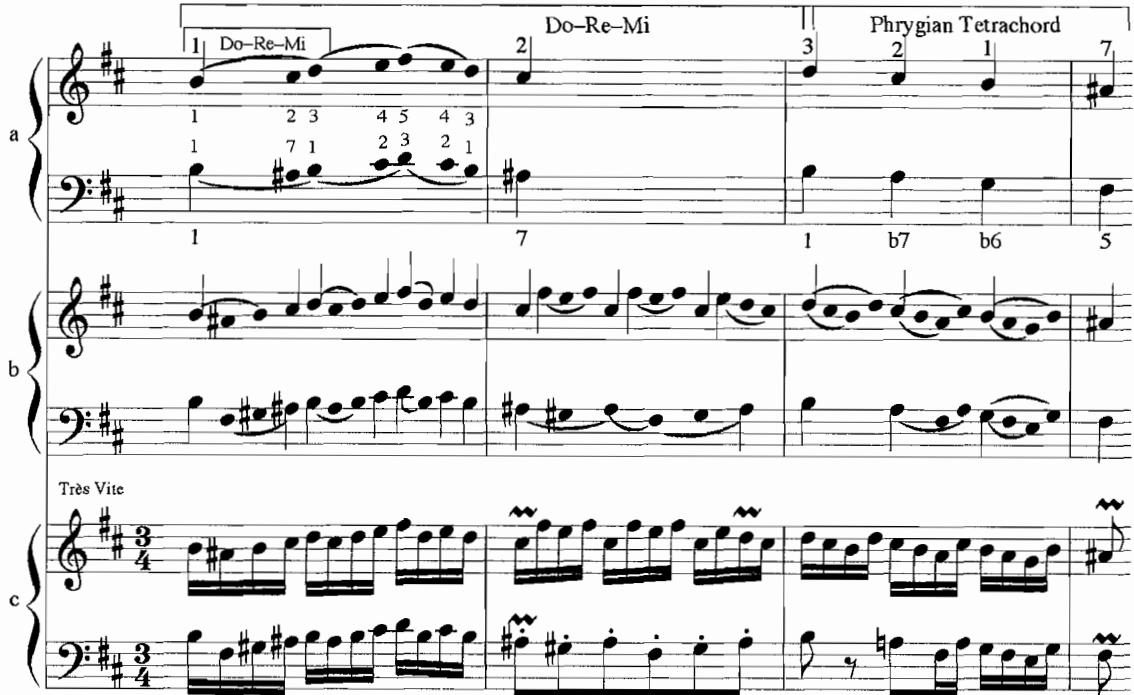
中文讲解
本段为图示占位符,对应一组三联示例图(4.17a、4.17b、4.17c),题名为"Stylistic Model Progression for m. 1–4 of La Frénésie, ou le Désespoir sous le Domino noir"(《黑色面具下的绝望,名为狂躁》第一至四小节的风格模型演进)。其版面功能是:把上一段文字分析中提到的"应然"模型可视化——a 展示下行弗里几亚四音列的骨架、b 标出旋律层结构音、c 把旋律装饰音形与低音同步呈现,以便读者核对作者的级数记法(structural notes 为带杆音符,figuration 为环绕音形)。需注意:图像数据未嵌入,实际音符走向与节奏须以原书插图为准,本节文字已给出关键音(D–C#–B、C#–B–A–C#、B–A–G–B 等)以及低音 G–F#–E–G 的同步。
补充说明
无额外补充;图示本身即为对前段的视觉印证。
第3段(P0057)
原文复述
The treatment of this analogous passage in La Frénésie is very different. Consider Example 4.18c. The descending tetrachord, which balanced the opening Do–Re–Mi in
中文讲解
本段(截断于句中)起承转折的功能非常明确:作者以"very different"一词宣告风格模型在 La Frénésie 实谱中将被打破,并示意读者转向 Example 4.18c 进行对照。从句法上看,下一句本应说明"在 La Virginité 中平衡 Do–Re–Mi 上行的下行四音列,在 La Frénésie 中如何不再起平衡作用",但本节只到"balanced the opening Do–Re–Mi in"便中断,故具体差异留待后续小节展开。教学要点:此句是典型的"对照式开头"(contrastive opening)——先点出差异存在,再把分析的重心从模型(Example 4.17 系列)切换到实谱(Example 4.18 系列),因此读者应在阅读时留意接下来作者将从哪些维度(旋律、低音、节奏、终止式)逐一拆解这种"very different"的具体含义。
补充说明
原段落被截断,下文应包含 Example 4.18a–c 的描述以及对实谱中相应小节的具体音形分析;本节只能基于已给出的半句作出铺垫性解读。
💡 本节核心要点
🔑 关键术语
- Do–Re–Mi gambit:以 D–E–F#(在该调性中对应唱名 Do–Re–Mi)上行三音列作为动机登场,是 La Virginité 主题开头建立调性的核心音形。
- Phrygian tetrachord:下行方向上小二度—小二度—大二度的四音音列;本节模型中即 E–D–C#–B 一段,暗示属功能并为半终止做准备。
- First half cadence:乐句在属和弦上的开放性停顿,是本节风格模型预设的第二段终点。
- Tense stasis:由 Do–Re–Mi 上行与属功能期待共同造成的"紧张而静止"的听感;并非真正静止,而是被作者用以标示第二小节的功能特征。
- Turning figure / surrounding figure:本节对环绕式装饰音形的称呼:每次重演都包绕一个结构音,结构音以带杆音符显示,装饰音则围绕其运动。
- Musical inertia:作者用以解释同一音形轮廓连续在 C#、再在 B 上重演的理由——音乐惯性驱动旋律沿既定模式继续下行。
- Structural notes (vs. figuration):结构音是被装饰音形包绕而凸显的骨架音(带杆音符);figuration 则指围绕结构音运行的回旋装饰。
- Stylistic model (Example 4.17a–c):基于 La Virginité 主题外化而来的"应然"序列图示:三联图分别展示骨架(a)、旋律结构音(b)、旋律装饰与低音同步形态(c),用作衡量 La Frénésie 实谱的参照。
C2.S8 [描述性拆分] Repetition, Inversion, and Modification of the Opening Material
第1段(P0058)
原文复述
Figure caption / image placeholder: Example 4.18a–c. La Frénésie, ou le Désespoir, m. 1–5, 13th ordre (1722), F. Couperin. [Embedded image data omitted; caption and position retained.]
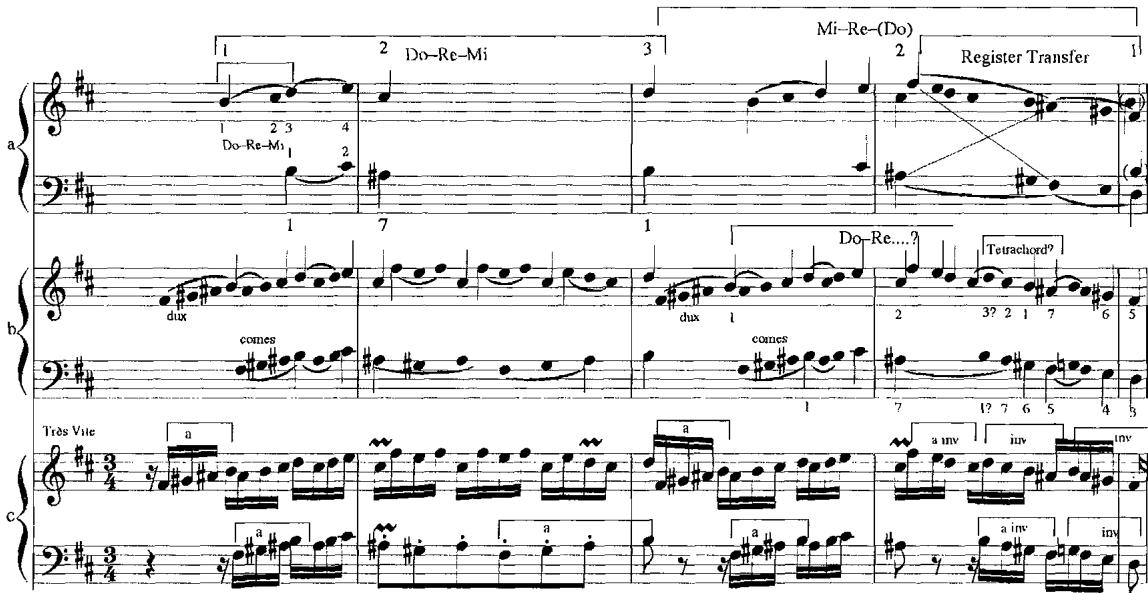
中文讲解
这是 Example 4.18a–c 的图注与图示占位符,对应库普兰(François Couperin)1722 年《羽管键琴曲集》第 13 套曲中《La Frénésie, ou le Désespoir》(《狂热,或绝望》)的前 5 小节。Example 4.18a、b、c 是同一谱例的三种不同分析标注版本:本节全部论证都围绕此谱例展开,因此图示是讨论对象本身,离开它下文无法读懂。图注中保留的 a、b 两个变化音记号($b\hat{3}$ 在旋律、$\hat{1}$ 在低音)和第 5 小节括号中的解决音(Mi–Re–Do)将在 P0063 中再次被作者指点引用。需查看原图以获得三个标注层的具体谱面形态。
补充说明
本段仅为图题与图像占位符,没有可逐句讲解的正文论断;图内标注(brackets、字母 a、连线、括号中的解决音)的解释需要对照 Example 4.18a–c 原图。
第2段(P0059)
原文复述
the stylistic model, is gone. The resolution on D in the melody at the downbeat of measure three remains only for a moment, and instead of beginning a figuration that would descend through the tetrachord to a half cadence, the melody quickly leaps away from the D to the F# below to repeat familiar material — the unstable first stage of the Do-Re-Mi that begins the piece. The bass then follows with its ascent from F#. In fact, measure three to the downbeat of four is an exact replica of measure one to the downbeat of two.
中文讲解
本段直接接续前文,应理解为"……样式范型(stylistic model),已经消失。第 3 小节正拍处旋律对 D 的解决只停留了一瞬间,旋律并未依照预期沿四音列下行去构成半终止,而是迅速从 D 上跳至下方的 F#,以重复开篇那个不稳定的第一阶段 Do–Re–Mi 材料。低音随即从 F# 向上接应。事实上,第 3 小节到第 4 小节正拍,恰好是第 1 小节到第 2 小节正拍的完全重复。"
本段承担两个关键论证功能:第一,它正式宣告"结构性预期"失效——在常规的 Do–Re–Mi 三阶段 gambit 中,第 3 小节应当进入下行 figuration 走向半终止,本曲却用"完全复制前两小节"替换了它。第二,作者点出 m.3–downbeat of m.4 与 m.1–downbeat of m.2 是"精确复制"(exact replica),这为本节标题"Repetition"提供了第一条材料证据,并使读者意识到范型之所以"gone",恰恰是因为作曲家选择用原样重复取代了原先的下行继续。“迅速跳离 D 至下方 F#“和"低音随后从 F# 上行接应"两个动作,使开篇材料以未解决状态被强行重启,这是后续段落讨论"重复作为强迫性冗余"的来源。
补充说明
本段开头以小写 the 起句,是从前一自然段末尾的句子延续而来(mid-sentence continuation),并非新句开始;这意味着 P0059 与前一段构成一个完整句,本段讲解应以前段已交代的"gambit 三阶段 + 半终止样式范型"为前提。
第3段(P0060)
原文复述
At this point, and as the stylistic model illustrates, we would expect an easy, balancing gesture to conclude the phrase after the opening gambit. Instead, we get a modified version of material we have already heard, which still expresses the same qualities of unsteadiness and instability. Moreover, by returning to opening material, there is a frequent repetition of the ascending four-note pattern — F#-G#-A#-B. In measures one through three, the four note F# to B appears a total of five times. These repetitions are marked with brackets and the letter “a” in Example 4.18c. This four-note ascent can be heard as strongly responding to musical magnetism — as the pattern ascends, the drive to resolve to B increases, especially as it approaches A#. However, the pattern also emphasizes F# — the fifth degree of the collection. According to Cooke, the fifth degree is “emotionally neutral, but does express a context of flux, intermediacy.” 50 Flux — changeability, instability, or unsteadiness — is a hallmark of this variation’s behavior and its expression. Yet we can infer additional facets of meaning to the repetition of this material specifically. Rather than stressing upward motion and momentum, as the pattern repeats it takes on qualities that express compulsive redundancy: a winding up — so to speak — or perhaps a preoccupation with the same material without reaching any real conclusion. This pattern behavior can metaphorically map onto our emotionally distraught character, obsessing over the same thoughts — never gaining peace of mind.
中文讲解
本段承接 P0059 提出的"材料精确重复”,从三方面推进论证:
(1)预期对照:在样式范型下,乐句 gambit 之后本应出现"易于平衡的结束动作”,实际听到的却是已出现材料的"修改版",依然传达着不稳与不安。“modified version"一词预告了本节标题中的 Modification。
(2)四次统计性观察:第 1–3 小节内,F#–G#–A#–B 这一上行四音动机总共出现 5 次,作者要求对照 Example 4.18c 中以方括号和字母 a 标示的位置。这一数据是"重复密度"的具体证据,“repetition of the ascending four-note pattern"由此坐实为本段的中心观察对象。
(3)理论—表情意义双重解读:作者先借"musical magnetism"解释其向 B 的解决驱力(越接近 A# 越强烈),再借 Cooke 对属音"情感中立却表达流动与中间状态"的定义,说明 F# 重复为何强化"flux(变化/不穩)"。最后,作者跨入隐喻层面,认为这种重复不是强调上行势能,而是表达"compulsive redundancy”(强迫性冗余)——同一材料反复缠绕而无法得出结论——并把这种行为映射到乐曲所暗示的"情绪崩溃的人物"对同一念头的执念,从未获得心安。
本段是本节主旨最浓的一段:技术、理论、表情、叙事四层并置,第一次将"重复"转化为戏剧化与心理化的修辞策略。
补充说明
脚注 50 标注"Cooke, The Language of Music, 90”,对应下一段(P0062)中显示的完整出处。该段中"emotionally neutral, but does express a context of flux, intermediacy"系 Cooke 直接引语;本段讲解不补写超出 task_input 的史实,仅指出它在本节论证中作为对属音表情角色的权威依据使用。
第4段(P0061)
原文复述
As the Do–Re–Mi pattern returns in measures three–four of Example 4.18c, it is identical to the initial presentation at the opening of the piece, but the remainder of the pattern is modified to conclude the phrase, given its new position within the formal structure of the piece. Given the repetition of the gambit, we would expect a resolution to the third stage at the downbeat of measure five. That, however, does not take place. As we arrive at stage two, measure four, the melody leaps from C# up to F#, just as it does in measure two. Instead of using that leap from C# to F# to initiate a repeating figure in the melody (C#–F#–E–F#), the leap begins a rapid descent from the F# above, cascading through the register to the F# below at the downbeat of measure five through a series of inverted four-note melodic gestures to conclude the phrase. The bass follows this inverted descent beginning on B, beat two of measure four, until it completes its plummet to D at the downbeat of measure five.
中文讲解
本段在 P0060 关于"重复"的论述基础上,正式进入本节标题中的"Modification(修改)“和"Inversion(倒影)“两个范畴。论证分三层:
第一层是"同与异"的对照:m.3–m.4 的 Do–Re–Mi 头两阶段与开场完全相同(identical),但由于该 gambit 现在处于句末位置,其后接续部分必须被修改(modified)以承担收束功能。这就把前面观察到的"重复"与材料功能位置的改变绑在一起:同一材料,因位置不同而必须变换后续形态。
第二层是预期再次落空:gambit 重复之后,听者本应在 m.5 正拍听到第三阶段的解决,但作者明确说"That, however, does not take place”。于是解决任务被推迟、并以非预期方式完成。
第三层是具体的修改手法:m.4 上旋律仍像 m.2 那样从 C# 上跳至 F#,但这一次不再用此跳进去引发通常的 C#–F#–E–F# 重复音型,而是开启一段从高 F# 向低 F# 的级联式快速下行(rapid descent / cascading through the register),由一系列"倒影四音组”(inverted four-note melodic gestures)构成,至 m.5 正拍到达下方 F# 结束全句。低声部则在 m.4 第二拍起从 B 开始同步下行,至 m.5 正拍跌至 D。
由此段可见三个关键改动:方向由"上行重复"改为"下行级联"、动机由"原形四音组"改为"倒影四音组"、跨度由"同度重复"扩张为"贯穿音区的级联"(register transfer)。这些改动既满足"结束乐句"的功能需求,又保留了与开篇 F#–G#–A#–B 上行材料的镜像对应——这是本节"Inversion"论点的技术落点。
补充说明
“register transfer”(音区转移)一词虽未在本段独立定义,但与 P0063 中"register transfer"的复现一起构成了贯穿本节的术语;本节末段对该术语有更直接的展开。
第5段(P0062)
原文复述
50 Cooke, The Language of Music, 90.
中文讲解
脚注 50:Cooke,《The Language of Music》,第 90 页。
这是 P0060 中"emotionally neutral, but does express a context of flux, intermediacy"直接引语的来源注。该注对 P0060 的论证作用是为"属音 = 情感中立但表达流动与中间状态"这一关键断言提供文献依据,使作者得以从属音的表情中性跨步到将之整合进"flux"的含义建构,并最终支撑"compulsive redundancy"的修辞性解读。脚注承担的是"权威佐证"角色,而非引入新的事实或观点。
第6段(P0063)
原文复述
Nowhere in this passage do we experience an overt resolution to the expected third stage of the Do–Re–Mi gambit, with b3 in the melody and 1 in the bass. There is one moment in measure four where these two degrees occur simultaneously. However, the overriding function of this measure is to prolong the chord of the fifth degree and we hear this moment of b3 in the melody and 1 in the bass as part of an embellishing neighbor rather than a structural resolution, as indicated by the slurs above and below in Example 4.18b. The real arrival, or conclusion of this gesture, does not occur until the downbeat of measure five, which — at a deeper structural level — we do experience as a resolution, but not of an ascending Do–Re–Mi pattern, but rather of its inversion — Mi–Re–Do — as indicated in Example 4.18a. Those resolving notes appear in parentheses in Example 4.18a, measure five. This resolution is after a frantic descent to conclude the phrase. It is as though the voices, so consumed by going over the same material, realize that an exact replication of a Do–Re–Mi gambit as we had the beginning of the piece, will not work given its position in the phrase. The voices quickly make the necessary modifications to ultimately conclude the phrase in the proper way in preparation for the next portion of the piece. They do so by changing direction and descending rapidly in a register transfer, as shown in Example 4.18a, and by providing a token descending tetrachord gesture along the way in the middle of measure four — albeit a major tetrachord — followed by the bass pattern 5–4–b3 to remind us of a more typical type of phrase end from other variations.
中文讲解
本段是本节论证的总结与收束,承担三件事:
(1)确立"显性解决缺席":全段不曾出现过对第三阶段(旋律上的 $\flat\hat{3}$ 和低音上的 $\hat{1}$)的真正解决。m.4 那一瞬间虽有两音同时出现,但其功能被界定为"属音和弦的延长"中的"装饰性邻音"(embellishing neighbor),由 Example 4.18b 上下的连音线标示,因此不应被误解为结构解决。这是本节对前几小节预期的最终定性。
(2)揭示真正的解决及其形态:真正的到达发生在 m.5 正拍;它确实是一个解决,但解决的并非上行的 Do–Re–Mi,而是它的倒影 Mi–Re–Do(参见 Example 4.18a,m.5 括号内的音)。倒影解决与倒影下行片段(P0061)一起,把本节标题"Inversion"推到论证核心位置:解决本身也是"倒过来的"。
(3)将技术改动叙事化、为"Modification"作结:作者把上述所有修改拟人化为"声部意识到……必须快速做出必要修改……在合适的位置结束乐句,为下一段做准备"。具体修改手段被重新指认:(a)改变方向并急速下行通过音区转移(register transfer,见 Example 4.18a);(b)在 m.4 中段给出一个"标志性的下行四音列"(token descending tetrachord gesture)作为让步,虽然只是大调四音列(major tetrachord),仍提示了惯用终止语汇;(c)低声部 $\hat{5}-\hat{4}-\flat\hat{3}$ 这一下行级进模式,把读者引向其他变奏中更典型的乐句结尾。
因此本段是把 Repetition、Inversion、Modification 三者收束为同一解决事件的总结段:技术上是倒影+修改,表情上是疯狂下行后的被迫结束,叙事上是声部对"重复已经不能收束"的觉醒与自我修正。这是全小节最厚的一层修辞综合。
补充说明
本段中 $\hat{5}-\hat{4}-\flat\hat{3}$ 的下行级进是"其他变奏中更典型的乐句结尾"模式的提示(hint),并非本变奏的实际结尾;这一对比让读者意识到本变奏是如何在"刻意偏离常规终止语汇"的同时"又留有公约性提示"的双重策略。
脚注 / 边栏 / 图表 / 附加信息(如有)
P0058 为 Example 4.18a–c 的图注与图像占位符,对应库普兰《La Frénésie, ou le Désespoir》(《狂热,或绝望》),出自 1722 年第 13 套曲(13e ordre);谱例显示前 5 小节的三种分析标注版本(a、b、c),其中 c 用方括号与字母 a 标示 5 次 F#–G#–A#–B 上行四音组,b 用连音线标示 m.4 中 $\flat\hat{3}/\hat{1}$ 为装饰性邻音而非结构性解决,a 在 m.5 用括号标示 Mi–Re–Do 的倒影解决音。P0062 为脚注 50,仅给出 Cooke《The Language of Music》第 90 页的引文出处,对 P0060 中关于第五级属音表情作用的论断起权威佐证作用。
💡 本节核心要点
- 句末 gambit 的"完全重复":m.3–downbeat of m.4 与 m.1–downbeat of m.2 精确一致,作曲家以复制代替样式范型所预期的下行 figuration 与半终止,把"Repetition"作为核心偏离手段。
- F#–G#–A#–B 上行四音组在 m.1–m.3 共出现 5 次:被方括号和字母 a 在 Example 4.18c 中标示;该动机既受 musical magnetism 推往 B 的解决驱动、又坐落于属音 F# 上,由 Cooke 的"flux"概念支撑其"变化/不稳定"之意涵。
- 重复的表情修辞被改写为"compulsive redundancy":上行不再强调势能,而被解读为对同一材料的执念,象征情绪崩溃人物对同一念头的执着。
- Modification:m.4 上旋律以 C#→F# 跳进开启"非重复性"的快速下行,并通过 cover to the lower F# 结束乐句,改变方向、下行级联、走通整个音区(register transfer)。
- Inversion:m.4 中段的快速级联被明确为"倒影四音组"(inverted four-note melodic gestures),低声部自 B 起同步倒影下行至 D;真正的解决在 m.5 正拍并非上行 Do–Re–Mi 的第三阶段,而是其倒影 Mi–Re–Do(参见 Example 4.18a 括号中的解决音)。
- m.4 的 $\flat\hat{3}/\hat{1}$ 同时出现被界定为属音延长中的装饰性邻音而非结构解决;终止语气借助 m.4 中段下行大调四音列和低声部 $\hat{5}-\hat{4}-\flat\hat{3}$ 模式被"标记为更典型的乐句结尾"作为提示,而不真正执行。
🔑 关键术语
- gambit (Do–Re–Mi):本节用以指代开篇那个三阶段动机(在 F# 上开始的 Do–Re–Mi 上行乐思);它是分析的参照原型,作曲家在本变奏中以"精确复制 + 修改 + 倒影解决"的方式偏离它,因此 gambit 既是被重复之物,也是被违背之范型。
- flux (Cooke):取自 Cooke《The Language of Music》第 90 页对第五级属音的定义:“情感中立但表达流动、变化、中间状态”。本节借用此概念说明 F# 的重复为何带来"不稳",是 compulsive redundancy 修辞解读的理论支点。
- musical magnetism:指音高间的解决倾向驱动:F#–G#–A#–B 上行时,越接近 A#,向 B 解决的驱力越强。作者借此说明上行四音组本身带有的向主音倾斜的内在动力。
- register transfer:贯穿音区的转移:m.4 起旋律从高 F# 经连续倒影四音组下行至低 F#,通过音区位移完成乐句收束。本节以此修饰终止时急速下行的修辞性陈述。
- inverted four-note melodic gestures:倒影形式的四音音型:与开篇上行 F#–G#–A#–B 在轮廓上呈倒影关系,构成 m.5 Mi–Re–Do 倒影解决的技术实现路径。
- embellishing neighbor / prolonging the chord of the fifth:本节对 m.4 那一瞬间 $\flat\hat{3}/\hat{1}$ 同时出现的功能定性:因整小节以属音和声功能为主导,两音被理解为"装饰性邻音"而非"结构解决",须由 Example 4.18b 的连音线辅助判断。
- token descending tetrachord gesture (major):m.4 中段出现的下行大调四音列;作者称之为"提示性"(token)的终止语汇,作用是让听者回忆起其他变奏中更常见的下四音列收束,但本变奏并未真正采用自然小调的下四音列,因此只是借而不发。
C2.S9 [描述性拆分] Voice Contour and Overall Erratic Affect
第1段(P0064)
原文复述
The overall affect of the activity of the voices is one of extremely erratic motion, as illustrated by Figure 4.3. In measure one, the voices rapidly ascend starting on the F#, and rise up to the F# in measure two, but only after abruptly breaking the figuration established in measure one. Measure represents tense stasis, where both the melody and bass lines float along the chord of the fifth (5). Finally resolving on D in measure three, the melody again abruptly breaks off and jumps to the F# below to begin another ascent, repeating the opening Do–Re–Mi schema. The melody again reaches the high F# in measure four after a break in the ascending figuration. Instead of floating at the top part of the range to complete the larger measure-to-measure Do–Re–Mi, both the melody and the bass alter course by plummeting down over the measure to conclude at the downbeat of measure five. In the melody, this descent is a frenetic register transfer of an octave.
中文讲解
本段是本节论证的描述性起点,作者以图4.3为依据,对库普兰《La Frénésie, ou le Désespoir》第1—5小节的人声音响轨迹(voice contour)做逐小节的形态描写,并把这种形态概括为“极其不规则的运动”(extremely erratic motion)。其论证逻辑通过四个并列的形态事件展开:(1) 第1小节从F#快速上行,旋即在第2小节到达F#之前突然打断已建立的上行音型——上行被截断;(2) “Measure represents tense stasis”一句中停在属和弦(fifth/5)上,使旋律与低音共同悬浮,构成一种带有张力的静止(tense stasis),而非真正的解决;(3) 在第3小节终于落到D音解决,但随即又跳到下方的F#,重复开头的Do–Re–Mi音型,重新启动又一次上行——前一次被截断的欲望被“强迫性”地重演;(4) 第4小节再次到达高音F#之后,旋律与低音并未停留在高点去完成“更大尺度的”Do–Re–Mi,而是双双急剧坠落,落入第5小节正拍,旋律以八度跳跃(register transfer of an octave)完成这次“歇斯底里式”的下落。作者用此四点共同说明:上行的Do–Re–Mi音型与小节间更大的Do–Re–Mi结构在同一首作品里被反复设立又反复中断,因此“erratic”一词并非随意——它精确描述了“设定—破坏—重设—再破坏”的循环。从读者理解角度看,需要特别注意“chord of the fifth”并非古代教会调式意义,而应理解为属功能(dominant)上的悬浮;“Do–Re–Mi schema”在本段中同时存在于两个层级(四音音型与大跨度音高走向),两层都遭到破坏,这正是“erratic”的深层来源。
补充说明
原文“Measure represents tense stasis”在限定上有所缺失,从上下文判断所指的是第2小节(m. 2);复述保留原文字面,未做改写。“Do–Re–Mi schema”在文中同时对应F#–G#–A#–B这一四音音型(第1小节起)以及更大跨度的音高走向,作者用同一solfege名称标记两种结构尺度,本段先呈现后者,在P0067中才给出四音音型的具体音名。
第2段(P0065)
原文复述

中文讲解
这是第29页上一处内嵌图像或乐谱示例的版面占位符,原图像数据已在阅读时省略,仅保留其位置与图注信息。该占位符出现在P0064描述性段落之后、P0066图4.3的正式图注之前,从版面位置判断,它可能是图4.3本身的图像区,也可能是在图4.3旁边或之前出现的另一处乐谱或示意图,用以支持作者对第1—5小节旋律轮廓的逐小节描写。由于图像数据未提供,无法从原图本身确认细节,P0064与P0067的文字论述可视为对该图所示内容的替代描述。读者若需精确核对音高走向,应回到原始印刷页面查看图4.3中的曲线轨迹。
第3段(P0066)
原文复述
Figure 4.3. Voice Contour Diagram of Melody, m. 1–5, in La Frénésie, ou le Désespoir, 13th ordre (1722), F. Couperin.

中文讲解
这是图4.3的图注(caption),说明图中内容为François Couperin(库普兰)1722年出版的第13th ordre(第十三组曲)中的《La Frénésie, ou le Désespoir》(“狂热,或绝望”)一乐章第1—5小节旋律的“声部轮廓图”(Voice Contour Diagram)。该图以图形方式把P0064所描述的音高起伏“画”出来:横轴为时间(小节),纵轴为音区高度,曲线则呈现旋律在不同小节间的上升、悬停与坠落。它是P0064逐小节文字描写(P0064)的视觉对应物,也为P0067的解释(把上行解读为“歇斯底里”、把突然中断与八度坠落解读为心理失衡)提供直观依据——读者可以直观地“看到”那些反复被截断的上行与反复的坠落的图形轮廓。
补充说明
“Voice Contour Diagram”是音乐分析中常用的图形化表示方法:通过一条沿时间轴展开的线,呈现某声部音高随时间的整体走势,而非逐音的精确音高。在本节中它被用来支撑“erratic motion”这种整体性格判断。
第4段(P0067)
原文复述
These opening four measures certainly express frenzied motion, but within the context of the narrative as a whole, the possible meanings for Frenzy or Despair can become more specific. The persistent and repeated drives upward can be interpreted as hysteria, especially as the ascents reach a tense stasis, as in measure two of the piece. After hysteria reaches its peak, it abruptly breaks off and drops to begin another ascent, obsessing over the same material as it does so to (e.g., the four-note pattern F#–G#–A#–B), only to once again plummet down an octave to the downbeat of measure five. All along the way, patterns break abruptly and change directions, defying expectation for resolution and expressing an unstable, unbalanced, and potentially disturbed state of mind.
中文讲解
本段是本节论证的解释性收束,作者从P0064的“形态描写”转入“语义/心理”层面,完成从“听起来像什么”到“它可能意指什么”的分析跃迁。其论证逻辑分三步:(1) 先承认第1—4小节确实表达了“狂热式运动”(frenzied motion),与作品标题《Frenzy/Despair》形成直接对应;(2) 但作者随即指出,置于“叙事整体”之中,标题所暗示的情绪含义可以变得更具体——反复且持续的上行可被解读为“歇斯底里”(hysteria),尤其是当这种上行以“tense stasis”(如第2小节停在属和弦上)结束时,因为“悬停于未解决”正是歇斯底里欲达而不得的音响化;(3) 歇斯底里到达顶点后被突然切断,再次重复同一材料(F#–G#–A#–B四音音型),然后再一次以八度跳跃坠落到第5小节正拍——作者用“obsessing over the same material”这一表述将音乐上的循环标记为心理上的强迫性重复。段落最后用“patterns break abruptly and change directions, defying expectation for resolution”对全段做出总结性归纳,并把这一系列事件定性为表达了一种“unstable, unbalanced, and potentially disturbed state of mind”(不稳定、不平衡、可能受到扰动的精神状态)。读者需要把握的关键是:作者没有把“hysteria”作为一种现代临床诊断来使用,而是把它当作18世纪语境中形容“过度敏感、失去自我控制”的修辞,其语义依据完全由可观察到的音乐事件(上行的反复、悬停、截断、再重复)所支撑,而非来自外部历史考据。
补充说明
文中“obsessing over the same material as it does so to (e.g., the four-note pattern F#–G#–A#–B)”一句在英文措辞上略有断裂(疑似“as it does so”处本应承接材料对象),复述保留原文。F#–G#–A#–B正是P0064中所谓“opening Do–Re–Mi schema”的具体音名形式,等于F#大调上的1–2–3–4级,本段首次把这一音型具名化,使P0064的抽象描写与P0067的心理解读之间获得可验证的对应。
脚注 / 边栏 / 图表 / 附加信息(如有)
图4.3(P0066)作为本节的视觉支撑,以“声部轮廓图”形式呈现第1—5小节旋律的音高走势,与P0064的逐小节文字描写一一对应,并为P0067把上行解读为“歇斯底里”、把八度坠落解读为心理失衡提供直观依据。P0065为同一页另一处内嵌图像/乐谱示例的占位符,原数据省略;其确切内容需回到原书第29页核对。两处视觉材料共同使本节同时具备“图形描写—文字描写—语义解读”三层证据结构。
💡 本节核心要点
- 第1—5小节的人声音响轮廓由四个形态事件构成:快速上行—突然中断—属和弦上的悬停—再次上行后八度坠落,整体性格被概括为“extremely erratic motion”。
- Do–Re–Mi音型在作品中存在两个尺度:第1小节起的F#–G#–A#–B四音音型,以及更大跨度的“measure-to-measure Do–Re–Mi”,两层结构都被有意中断,从未真正完成。
- 第2小节停在“chord of the fifth(属和弦)”上的悬停(tense stasis)不是解决,而是一种带有张力的静止,使上行欲望始终处于未释放状态。
- 第5小节正拍的八度跳跃被标记为“frenetic register transfer of an octave”,其功能不是主题延续而是急促的坠落。
- P0067将反复上行与悬停解读为“hysteria”,将反复重演同一音型解读为心理上的“obsessing”,将反复的中断与方向突变解读为“unstable, unbalanced, and potentially disturbed state of mind”。
- 本节的论证顺序为:图4.3描写(视觉)→ P0064逐小节文字描写(听觉)→ P0067心理/叙事解读(语义),从“frenzied motion”的笼统印象收窄为“hysteria”这一更具特异性的心理标签。
🔑 关键术语
- Voice Contour(声部轮廓):指一个声部的音高随时间变化所形成的整体走势曲线,在本节中由图4.3的轮廓图(Voice Contour Diagram)可视化呈现,是P0064逐小节文字描写的直接对应物。
- Chord of the fifth (5)(属和弦/第五级和声):本节中并非教会调式意义,而是属功能(dominant)意义上的第五级和声;第2小节停在此和声上构成“tense stasis”,即带有张力的悬停而非真正解决。
- Do–Re–Mi schema(Do–Re–Mi 音型):一种上行级进的solfege模式,在本节中同时对应两个尺度:小尺度上为F#–G#–A#–B四音音型(1–2–3–4级),大尺度上为跨越多个小节的整体音高走向;两层的Do–Re–Mi均被截断,是“erratic”的核心来源。
- Tense stasis(带有张力的静止):旋律与低音共同停留在未解决的和声(如属和弦)上时所形成的悬停状态;与稳定终止(resolution)相反,本节中它被解读为歇斯底里上行无法释放的听觉标志。
- Frenetic register transfer of an octave(八度的急促音区转换):本节特指第4—5小节处旋律与低音未按常规停在高点,而是把同一音高(F#)下移一个八度以“坠落”方式到达第5小节正拍;这一转换不是主题承袭,而是以急促方式完成的下行。
- Hysteria(歇斯底里):在P0067中被用作心理性修辞标签,对应的是“反复上行、悬停、截断、再重复”这一可被听到的音乐事件模式;并非现代临床诊断,而是18世纪语境中形容“过度敏感、失去自我控制”的概念。
- 13th ordre, 1722, F. Couperin(库普兰1722年出版的第13组曲):《La Frénésie, ou le Désespoir》出自François Couperin 1722年出版的《Pièces de clavecin》(古钢琴曲集)中的第13组曲(13th ordre),是本节分析对象,由图4.3的图注明确给出。
C2.S10 [描述性拆分] Black Cloak, Hope, and Final Metaphoric Mapping
第1段(P0068)
原文复述
We can further relate these meanings to the color of Frenzy and Despair’s cloak. Our characters wear black, which traditionally embodies a variety of meanings, such as death and mourning, fear, darkness, and evil. Black also represents the absence of light and even the absence of color altogether. When we consider the meaning of the title — Despair — and its direct antonym — Hope — it offers an additional layer of interpretation for the meaning of the color for this final variation. Hope is also a variation in this collection, though not discussed in this chapter. In that variation, Hope wears green, which is traditionally associated with spring or budding promise, and maybe even youthful enthusiasm. In contrast black, as the absence of color, can also be considered as the lack of hope in the context of this variation. We can metaphorically map this idea onto a character, perhaps aging or at least jaded by life’s disappointments, wrapped in a black robe and utterly lost in a maze of mental and emotional distress, with no glimmer of hope for salvation.
中文讲解
我们可以进一步把这些含义与“狂乱与绝望”所披斗篷的颜色联系起来。我们的人物身着黑色,而黑色在传统上承载着多种含义,诸如死亡与哀悼、恐惧、黑暗与邪恶。黑色还象征着光的缺失,甚至意味着色彩的全然缺席。当我们考虑曲名——Despair(绝望)——及其直接的反义词——Hope(希望)——时,这为理解这一最终变体中颜色的意义提供了更深一层的解读。Hope(希望)也是本套曲中的一首变体,不过本章不予讨论。在那一变体中,希望身披绿色,而绿色传统上与春天、萌发的希望乃至青春的活力相联系。与之相对,黑色作为色彩的缺席,在本变体的语境中也可被视作希望的缺失。我们可以将这一观念隐喻性地映射到一个角色身上——他或许已步入暮年,或者至少已被人生的失望所磨老——身裹黑色长袍,完全迷失在心理与情感困扰的迷宫之中,看不到任何得救的希望之光。
这段的论证有三重推进:首先承接前文已建立的意义网络,将之落实到视觉层面(斗篷的颜色),使抽象象征具象化;其次引入反义词“希望”以及该套曲中对应的另一变体(Hope,绿色),通过黑白对照把"色彩的缺席"重新阐释为"希望的缺席",从而让色彩本身成为一个心理—道德的标记;最后以隐喻映射(metaphoric mapping)的方式把色彩含义转化为一个完整的角色形象——年迈或被生活磨平、包裹在黑袍中、困于精神与情感迷宫而不见希望。值得注意的是,作者用"perhaps"一词标明这一映射是诠释性的而非事实性的;这是一个从音乐/视觉象征向人物形象延伸的修辞动作,是整段论述的核心方法。
补充说明
本段隐含地与本套曲中的其他变体(特别是 Hope)形成对照,但 Hope 的内容不在本章讨论范围内,相关信息仅作为反衬出现,用于衬托黑色/绝望的含义。
第2段(P0069)
原文复述
For Couperin’s final stage in the emotional narrative of Les Folies, the focus is on instability. Rapid figurations, erratic motion, broken gestures, abrupt register shifts, and repetition of material express a distinct sense of uncertainty, hysteria, and obsession. These meanings metaphorically map onto our character that not only embodies the fevered state of emotional despair, but also the mental fragmentation associated with becoming slowly deranged and disturbed over the course of the narrative. As the black cloak suggests, all hope is lost. The composure of the protagonist in Les Folies slowly unwinds, and ultimately, completely unravels as the emotional trajectory of collection concludes with La Frénésie, ou le Désespoir.
中文讲解
在库普兰《洁心狂想曲》(Les Folies)情感叙事的最终阶段,重点落在"不稳定"(instability)之上。快速的音型、游移不定的运动、断裂的乐句、突如其来的音区转换以及对材料的重复,传达出一种明确的——不确定、歇斯底里与执迷——意味。这些意味隐喻性地映射到我们的人物身上:他不仅体现了情感绝望的亢奋状态,还体现了在叙事进程中逐渐变得精神失常、错乱之下的心智碎裂。正如那件黑色斗篷所暗示的,所有希望都已失去。《洁心狂想曲》中主人公的镇定逐渐松动,最终完全崩溃——而整部套曲的情感轨迹也以《狂乱,或曰绝望》(La Frénésie, ou le Désespoir)收束。
这段是本小节论证的收束。它先在音乐层面点名一组具体特征(rapid figurations、erratic motion、broken gestures、abrupt register shifts、repetition),再将这些特征与一组心理状态(不确定性、歇斯底里、执迷)对应起来,最后由音乐/视觉双层象征(黑色斗篷=希望全失)落到人物形象上——镇定(composure)被缓慢拆解直至彻底 unravel(瓦解)。需要特别注意的是“unwinds”与“unravels”这对动词隐喻:作者把情感轨迹写成一种"被缠绕而后又被拆解的线团",呼应前文"迷宫"的意象,使绝望不仅是瞬间的爆发,更是渐进的解构。La Frénésie, ou le Désespoir 是整套曲的终曲,也是情绪弧线的最低点,本段因此承担了"终点定性"的功能:从符号、声响、动作三个层面共同宣告挽救之不可能。
补充说明
本段中的曲目名 La Frénésie, ou le Désespoir 与段首提到的 “Frenzy and Despair” 以及作品标题 Despair 互为呼应;黑色斗篷的意象则承接 P0068,构成跨段视觉线索的一致性。
脚注 / 边栏 / 图表 / 附加信息(如有)
无新增脚注、图表或边栏。本小节由两段连续论述构成,第一段建立色彩象征(黑色 vs. 绿色)与隐喻人物形象,第二段将音乐技法特征与人物心理状态对应,并完成整套曲情感轨迹的收束。
💡 本节核心要点
- 黑色作为希望的缺席:通过对 Despair 与其反义词 Hope 的对照,黑色被重新定义为“希望的缺失”,构成色彩—心理的双重象征。
- Hope 变体(绿色,象征春天与青春)作为隐含的反衬,使本变体的精神困境更具张力。
- 隐喻映射(metaphoric mapping)的方法论贯穿两段:把音乐特征与视觉色彩共同投射到一个“被生活磨老、困于精神迷宫、无望获救”的角色形象上。
- 库普兰终曲的音乐不稳定特征(rapid figurations、erratic motion、broken gestures、abrupt register shifts、repetition)与心理状态(不确定、歇斯底里、执迷)一一对应,体现音响即心象的诠释逻辑。
- 镇定(composure)—松动(unwinds)—崩解(unravels)的动词链将绝望刻画为渐进的心理解构,而非瞬间的爆发。
- La Frénésie, ou le Désespoir 作为套曲情绪弧线的最低点,宣告“所有希望皆已失去”,完成整部叙事终点的定性。
🔑 关键术语
- metaphoric mapping:本节核心方法论:将音乐与视觉象征(色彩、斗篷)共同投射到一个角色形象之上,使抽象情感具象化为人物状态。
- Frenzy and Despair / La Frénésie, ou le Désespoir:本变体及套曲终曲的法文原名,意为“狂乱,或曰绝望”,是整套曲情感弧线的最低点。
- Hope(变体):本套曲中的另一变体(本章节未讨论),其人物穿绿色(象征春天、萌发的希望),与本变体的黑色形成对照。
- figurations:音乐中的音型/动机型态,本段中以“rapid figurations”出现,标示快速、密集的音型进行,作为不稳定感的音响标志。
- register shifts:音区/声域转换,本段以“abrupt register shifts”出现,标志突然的音高跳跃或声域反差,用以表达情绪的剧烈摆荡。
- composure / unwinds / unravels:三者构成一条渐进的解构隐喻:镇定—逐步松动—彻底崩解,对应本小节将绝望描述为一种渐进性的心理瓦解。
C3.S1 [描述性拆分] Summary: The Narrative Trajectory of Les Folies
第1段(P0070)
原文复述
Summary
A level-2 section heading that opens the summary discussion of the narrative trajectory of the collection.
中文讲解
这是页面正文中的一个二级小节标题,原文写作"## Summary"(中文意为"概要/小结")。它的功能是开启对整部作品叙事轨迹的总结性论述——接下来的P0071段将用一段浓缩的文字,概括这十二首作品的总体走向及其所依托的folia传统;P0072与P0073段则进一步以《La Virginité》《La Langueur》《La Coquétérie》等若干首作品为样本,示范具体的音乐—意象分析。
补充说明
本段仅为标题层级,不含正文论述。
第2段(P0071)
原文复述
Each of Couperin’s twelve pieces is part of a narrative structure — the composite of which represents a trajectory of emotional and moral descent. The collection progresses from innocence and purity of the virgin state, to discomfort and wretchedness of despair. It is possible that Couperin’s variations, as Jane Clark suggests, served as a moral commentary on the political climate of the day. Or, he might simply have wished to represent the beauty and bitterness of love and loss common to everyday life experience. Or, perhaps even both. What is clear, however, is that Couperin chose the well-trod path of the folia tradition as the platform for his chronicle. While there are similarities between Couperin’s theme and the schema of the so-called “late” folia — indeed the variation set is operating within a repeating framework — it is the spirit of the early folia, with its theatrical trappings of costumes and masks, and wild, unrestrained nature, that provides the soul of Couperin’s French Follies.
中文讲解
这一段是全节的核心论点,要点包括:
-
总体叙事弧线:库普兰这十二首作品共同构成一个"叙事结构",其整体走向是一条"情感与道德的下降轨迹"(trajectory of emotional and moral descent)。具体而言,作品从"童贞状态的纯真与无瑕"开始,逐步滑向"绝望中的不适与悲苦"。作者用"descent"(下降)一词,暗示整组变奏不只是情绪起伏,更带有某种道德意义上的堕落方向。
-
多种可能的解释并存:作者并不把解读锁定在单一意图上,而是给出三种可以并存的可能性——Jane Clark所提出的将变奏视为对当时政治气候的道德评注;将作品视为对日常爱情得失之"美与苦"的再现;或者两者兼而有之。这种"或……或……甚至两者皆是"的句式,是作者有意保留诠释的开放性。
-
载体——folia传统:明确指出库普兰"选择了folia这条已被反复踏过的老路作为其编年史的载体"。这里的"well-trod path"暗示folia并非库普兰首创,而是有着深厚传统的既有形式。
-
晚期folia与早期folia的区分:这是本段最值得细读之处。作者承认库普兰的主题与所谓"晚期folia"的图式有相似之处——变奏集确实在某种"重复的框架"内运作(即反复出现的主题加上一连串变奏的结构)。但真正给作品注入"灵魂"的,却是"早期folia"的精神——那种带有戏剧情境(costumes戏服、masks面具)和"狂野、不受拘束的自然本性"的精神。也就是说,库普兰在结构上借用了晚期folia的"形",在气质上却复活了早期folia的"魂",由此成就了"French Follies"这一独特的混合体。
本段的作用是为整个章节奠定基调:把Les Folies从一组抽象的键盘变奏,提升为一条具有叙事方向、承载道德与情感重量的音乐弧线,同时定位它在folia传统谱系中的特殊位置。
补充说明
本段对"晚期folia"与"早期folia"的区分仅以"重复框架"与"戏剧情境/狂野本性"两类特征加以对比,未给出更具体的历史定义;Jane Clark仅作为被引用的观点来源出现,其身份与著作不在本节输入范围内,不另行扩展。
第3段(P0072)
原文复述
Knowing definitively Couperin’s purpose is not required to appreciate how the moods and emotions expressed in Les Folies françaises effectively evoke the imagery associated with the subjects. Each piece is distinct in its spirit. The purity and innocence of La Virginité wearing an invisible cloak are depicted through the piece’s transparent quality, as well as its virtually unadorned structure of some of the most popular stylistic schemata in galant vocabulary. Virginity, with its clear presentation of the theme, provides the means to compare the other pieces within the collection. The uncomplicated opening gambit of the Do-Re-Mi that begins the piece changes to Do-Re-Do in La Langueur robed in a cloak of purple. The resolution down to scale degree one at the third stage of the pattern evokes laziness — or perhaps even surrender — because of the tensions implicit to the within-measure figuration of the opening three bars. Couperin’s use of open note heads and ceaseless rhythmic figuration enhance the possible mappings onto associations with languor, such as stillness, oppressiveness, or listlessness.
中文讲解
这一段把注意力从"库普兰的意图"转移到"音乐如何唤起意象",并以《La Virginité》和《La Langueur》两首为样本,示范其分析方法。
-
无须确定意图即可感受作品:作者强调,即便无法确知库普兰的创作目的,听者仍然能够通过每首曲子的情绪,去把握它与主题意象之间的对应关系。这是为后续具体分析所作的方法论铺垫。
-
La Virginité(童贞)——基线作品:这件作品披着"隐形的斗篷"(invisible cloak),这一意象暗示童贞几乎不外显、与外界无明显边界。其音乐对应物是"透明质感"(transparent quality)与"几乎不加修饰的结构",所用的素材恰恰是"galant风格语汇中最流行的一些风格图式"(stylistic schemata in galant vocabulary)。换言之,作者把galant schemata本身视为一种"已被听惯的素材",被原样直陈,便自然生成"纯净无瑕"的听感。重要的是,《La Virginité》之所以"透明",并非因为它缺少内容,而是因为它以最少装饰的方式呈现主题,从而成为整组作品中其他作品的对照基准(baseline),使后续作品的差异得以被衡量。
-
La Langueur(倦怠)——Do-Re-Do的变化:作者用solfege音级作切入:在《La Virginité》中,主题以"Do–Re–Mi"的上行三音列开始,是最简单直白的开局(“uncomplicated opening gambit”);到了《La Langueur》中,同样的三音变成了"Do–Re–Do"——上行两步之后又回到起点。这一改动看似细微,却带来方向性的逆转:原本向上攀升的能量,在第三阶段回到"do",即落在主音(scale degree 1)上。这种"未完成的上行"暗示力量的松弛、放弃甚至投降。
-
首三小节小节内音形的张力:作者特别说明,这种"投降感"并不只来自solfege的走向,还来自开篇三小节内部音形(within-measure figuration)所暗含的张力。换言之,前两小节在do–re间来回所积蓄的紧张度,直到第三小节落到do才得以释放,听起来就像是"耗尽力气后瘫倒"。
-
空心符头与不息的节奏:作者还指出库普兰使用了"open note heads"(空心符头,即不带符杆、符尾修饰的骨干音符)和"ceaseless rhythmic figuration"(不间断的节奏音形),这些写法放大了与"倦怠"相关的听感联想——静止感(stillness)、压迫感(oppressiveness)、无精打采(listlessness)。
本段是后续音乐分析(P0072、P0073)的范式:每首作品都有"披风/斗篷"、solfege起始音列、节奏与节拍特征,作者逐一对应到该曲所代表的情感或人格意象。
补充说明
“galant vocabulary / stylistic schemata"指本段所述galant风格语汇中常见、可被听者即时识别的作曲程式;本段未对其作进一步定义,仅以"最流行的一些图式"来描述其在听感上的"熟知"特征。“open note heads"为记谱术语,本段用以指明作品中那些不带倚音或装饰的"裸"骨干音符。
第4段(P0073)
原文复述
In La Coquétérie wearing different cloaks, the ascending Do–Re–Mi returns. However the timing is adjusted — the second stage is delayed, dashing our expectations of arrival to elicit a sense of playfulness associated with the title. The variation’s frequent meter changes, perhaps signifying the different cloaks, enhance the flirtatious expression and chameleon-like personality of the subject. We first experience a luring-in to a false sense of security, then a withholding of expectation, and finally a momentary satisfaction followed by a chase. Additionally, the structural ascending pattern bounces from a pedal fifth scale degree below, heralding the significance of $\hat{5}$ within the primary melodic gesture of the next variation, Les Coucos bénévoles wearing yellow.
中文讲解
本段继续以"披风"作隐喻分析《La Coquétérie》(卖弄风情/卖俏),并由此引向下一首《Les Coucos bénévoles》(自愿的布谷鸟,戴黄色披风)。要点如下:
-
披风的变化:与《La Virginité》的"不可见斗篷"和《La Langueur》的"紫色斗篷"不同,《La Coquétérie》穿着"不同的斗篷”——这"different"本身就预示了主题人物的性格:善变、难以捉摸。
-
Do–Re–Mi的回归与"延宕”:在前两首的对比之后,上行的Do–Re–Mi音列在《La Coquétérie》中重新出现,但"时值被调整"(timing is adjusted):第二阶段被推迟(the second stage is delayed),从而"挫败听者对其到达的预期"。这种节奏上的延迟制造了"故意不按预期抵达"的效果,与"playfulness(俏皮/好玩)“的标题相呼应——它不是不出现,而是让人等一等再出现,借此挑逗听者。
-
频繁的拍号变化=不同的斗篷:作者推测曲中频繁的拍号变化(meter changes)正象征着"不同的披风”——每一件披风对应一种节拍律动,由此强化"调情式的表达"与"变色龙般的人格"。拍号的切换本身就是一种"换装"。
-
叙事化的情绪曲线:作者把这首曲子的体验过程拆解成四个阶段——先是"诱入一种虚假的安全感"(luring-in to a false sense of security),再"扣住期待不予兑现"(withholding of expectation),然后"短暂的满足"(momentary satisfaction),最后紧跟"追逐"(chase)。这是把音乐体验叙事化为情节的写法:诱、悬、达、追,对应"调情"的核心机制。
-
属音的伏笔:最后一句是跨曲衔接的关键。作者指出,上行的结构图式从下方一个"持续音五度"(pedal fifth,即sol上的持续低音)弹起——换言之,上行的Do–Re–Mi并非从低音do开始,而是从sol($\hat{5}$,属音)下方起步。这一处理"预告了下一首《Les Coucos bénévoles》中$\hat{5}$在主要旋律姿态中的核心地位"。也就是说,《La Coquétérie》的结尾处,已经为下一首"戴黄色披风"的布谷鸟主题埋下了属音的种子。
本段的作用:既完成对《La Coquétérie》“调情机制"的分析,又通过”$\hat{5}$的伏笔"把段落与下一首《Les Coucos bénévoles》串接起来——这正是variation set(变奏集)作为一个有机整体在结构上互相关联的具体例证。
补充说明
“pedal fifth scale degree below"指在主持续音上构筑的五度低音基础;本段未明确指出其主音调性,因此仅可说明这是一个"持续性的五度低音"用以支撑上方的旋律图式,不作具体调性推测。"$\hat{5}$“为音乐分析中表示属音(第五级音)的标准记号,本段借此把《La Coquétérie》末尾的处理与《Les Coucos bénévoles》中属音的核心地位联系起来。
脚注 / 边栏 / 图表 / 附加信息(如有)
本小节范围(P0070–P0073)内未出现脚注、图表、谱例或边栏文字。P0070为小节标题,P0071–P0073为正文段落。
💡 本节核心要点
- 库普兰的十二首作品共同构成一条"情感与道德的下降"叙事弧线,自童贞的纯真滑向绝望的悲苦。
- 对作品意图的诠释具有开放性:既可能是Jane Clark所说的对当时政治气候的道德评注,也可能是对日常爱情得失中"美与苦"的再现,甚至两者兼而有之。
- 库普兰以folia传统为载体:作品的结构图式接近所谓"晚期folia"的重复框架,但其精神气质——戏服、面具、狂野不羁——取自"早期folia”,由此构成"French Follies"的独特混合体。
- 每首作品都有"披风"作为人格/情感的隐喻,其音乐对应物包括galant schemata的透明运用、solfege起始音列的改动、节奏与节拍的处理。
- 《La Virginité》以最简朴、最"透明"的方式呈现主题,成为其他作品的对照基准;《La Langueur》将Do–Re–Mi改为Do–Re–Do,配合空心符头与不间断的节奏音形,营造倦怠、放弃、压抑的听感。
- 《La Coquétérie》通过Do–Re–Mi中第二阶段的延宕、频繁的拍号变化以及"诱—悬—达—追"的情绪曲线,塑造调情式的俏皮人格;其末尾上行的属音伏笔(pedal fifth),为下一首《Les Coucos bénévoles》中属音的核心地位埋下结构上的准备。
🔑 关键术语
- Folia / Folia tradition:一种源出葡萄牙、在巴洛克与早期古典时期被反复使用的固定主题变奏传统;本节中库普兰以此传统作为其"编年史"的载体。
- “Late” folia 与 “early” folia:本节对folia传统的内部区分:所谓"晚期folia"指变奏集那种重复的框架结构;“早期folia"则带有戏剧情境——戏服、面具、狂野不羁的自然本性,本节认为库普兰真正承袭的是后者的灵魂。
- Galant schemata / galant vocabulary:本节所述galant风格语汇中常见、可被听者即时识别的作曲程式;本节指出《La Virginité》以最不加修饰的galant schemata呈现主题,从而获得"透明"的听感,并成为衡量其他作品的对照基准。
- Scale degree(音级)与 $\hat{5}$(属音):本节用音级数字来定位音乐事件:Do–Re–Mi–Do中落到"1"被解读为"投降/放弃”;pedal fifth与$\hat{5}$则用以说明《La Coquétérie》末尾的低音支点及其对下一首《Les Coucos bénévoles》中属音核心地位的预告。
- Variation set(变奏集):在重复的固定主题或框架之上展开若干变奏的成套体裁;本节借此说明库普兰既利用folia变奏集的"重复框架”,又通过各曲之间的伏笔与衔接(如属音的跨曲呼应),使整组作品成为一个有机的叙事整体。
- Open note heads(空心符头):记谱术语,指不带符杆、符尾修饰的"骨干"音符;本节用以说明库普兰在《La Langueur》中以基本节拍骨架配合不间断的节奏音形,营造倦怠、压抑、静止的听感。
C3.S2 [描述性拆分] Summary: Les Coucos bénévoles, Taciturn Jealousy, and Frenzy and Despair
第1段(P0074)
原文复述
In the variation Benevolent Cuckolds, the opening Do–Re–Mi pattern that begins the set transforms, on its return at A’, into a Do–Re–Do shape, which the author describes as a deflated or defeated version of the original. The broken figure is decorated with leaps up to and down from scale degree five, and these leaps are said to look and sound like the pecking motion of a bird — a musical pun that exploits the two French meanings of the word coucous (cuckold or cuckoo). The melodic figure ends by moving downward, so that what stands out is the inner voice rather than the upper melodic line. That inner voice, in both statements of the figure, “goes nowhere”: in measures one through three it simply rests on scale degree five, forming a static pedal; when the figure returns in measures nine through eleven it is inverted, shifting attention to what had previously been the structural (outer) portion of the pattern, but the new contour is Do–Re–Do, which likewise “goes nowhere.” The author reads this stagnation as a cluster of metaphors: a bird with its head down, oblivious to its surroundings; a coward with its tail between its legs; and impotence, whether sexual or simply a passive personality. In the context of the Benevolent Cuckolds, the imagery is taken to express denial, inadequacy, and even a passive acceptance of the situation.
中文讲解
这一段把焦点放在变奏曲集的第一首变奏《Benevolent Cuckolds》上,核心论点是:开头那个朝气向上的 Do–Re–Mi 三音动机,到 A’ 处归来时已经被“压扁”成 Do–Re–Do,它在音高走向与终止感上都呈现出一种塌陷、无法前进的状态。
作者的音乐分析有几个层次值得注意:
- 音高与节奏的双重“破折”:Do–Re–Do 比 Do–Re–Mi 少一个向上的冲刺,末尾不上行而是下行,于是听感上是“回到原地”。同时作者特别指出,这一动机反复出现时加入了向五度音的跳跃与回落,模仿了鸟嘴反复点啄的动作。
- 语言学双关:法语 coucous 同时有“戴绿帽的人”与“布谷鸟”两个意思,所以“啄”这个音乐动作同时是字面意义(鸟在啄)和隐喻意义(被戴绿帽者的窘态)。这是作者把音乐—语言—叙事三层意义焊接在一起的典型手法。
- 结构层次重心的转移:第一次出现(mm.1–3)时,作者听到的是上方旋律线,并把内声部当作静止的五度持续音;到 A’ 处(mm.9–11)时上下声部关系颠倒,内声部接管结构位置,但 Do–Re–Do 同样“原地踏步”。这说明“停滞”并非某一声部的偶然现象,而是整个动机的结构性特征。
- 多重隐喻的合法性:作者列出三组意象——低头看不见四周的鸟、夹着尾巴的懦夫、性无能或人格上的被动——它们看似跳跃,却共享“向内退缩、不再有外部行动”这一动作逻辑,因此都可以由 Do–Re–Do 这个“回到原点”的图形来承载。
放在本节论证中,这一段建立了一个重要前提:动机变形不只是“音高不同”,而是“音乐姿态不同”。Do–Re–Do 的“停滞”会随着后续变奏的累积,被作者解读为越来越深的精神溃败。
补充说明
本段中“pedal”一词指的不是踏板演奏法,而是五度上的持续音(static pedal on scale degree five)。cou cous 的双关完全依赖法语词义,不应替换为英文译词;本段也未给出变奏集的调性或拍号,这些信息需从前文获取,本节不另行补充。
第2段(P0075)
原文复述
As the variation set moves toward its end and the emotional states of the characters become increasingly distressed, the opening Do–Re–Mi pattern gradually breaks down. In Taciturn Jealousy, who is clothed in grey, the melodic portion of the gambit is removed altogether. Couperin reverts to the void or white notation (empty staff lines with no noteheads) that had been used in earlier variations, and instead writes a long, drawn-out descent in close voicing and in a low register, falling from scale degree one down to scale degree five, supported by the typical bass line of scale degrees 1–7–1; the aim is to evoke the darkness and negativity of jealousy. Meanwhile, a struggling chromatic tenor voice pushes upward, attempting to force the melody in an upward direction, while the melody itself tries to suppress that tenor. The tension between the two voices is read as the torment of jealousy, hidden just beneath the surface; this torment stays largely suppressed until the final variation, where all attempts to disguise bitterness and resentment finally collapse.
中文讲解
这一段处理变奏集中段的《Taciturn Jealousy》,承上段“动机开始瓦解”的判断,把 Do–Re–Mi 的瓦解过程再向前推进一步:从《Benevolent Cuckolds》里“动机仍在但形态瘫软”,变成《Taciturn Jealousy》里“动机中能向上走的部分被完全剔除”。
分析要点:
- “白色记谱”的回归:作者特意指出 Couperin 重新启用之前变奏里出现过的“空谱表”写法。空谱表在视觉上是“音符被掏空”,在听觉上则往往是等待、悬置或无声的延伸,与嫉妒那种“想说又不肯说”的压抑相呼应。
- 下行的方向感:典型低音 1–7–1 与上方一个从一度到五度的长距离下行,叠合在低声部、紧贴的声部排列之上。作者把它解读为一种“缓慢下沉的痛苦”,而非剧烈的撕裂——这符合“沉默的(taciturn)嫉妒”这一形象:表面平静,内部却一直被向下拖拽。
- 两条声部的拉锯:一个上行的半音化男高音声部在试图把旋律“顶”上去,而旋律本身又试图压住它。这种矛盾是本段的音乐戏剧性所在:嫉妒本身是“既想爆发又被压下去”的双重运动。作者强调这种张力一直“压在地表下”,是为下一段《Frenzy and Despair》里压抑彻底崩塌做铺垫——情绪压抑必须先积压够久,最后的爆发才有分量。
- 节段位置:作者特别提到“一直压到最后一次变奏才彻底崩溃”,这是把本节(第二节)理解为通向最终爆发的过渡节段,因此本段同时在描写嫉妒本身,也在为全节的高潮蓄势。
补充说明
“close voicing”与“low register”是两个独立但互相强化的手法:紧贴声部让音色浑浊、模糊个体,低音区则加重阴郁色彩,两者结合才能在心理层面塑造“嫉妒的黑暗”。本段所提到的“白色记谱”在前文变奏中已使用,作者在此仅作回归说明,并未在本节给出新例。
第3段(P0076)
原文复述
Frenzy and Despair, dressed in black, finally give in to their wretchedness and degenerate into madness. These emotions and mental states are conjured up by musical techniques including frenetic sixteenth-note figures, a blazing tempo, a displaced imitative opening between the voices — which is the only variation in the whole set to begin in this imitative way — and broken patterns. The familiar opening gambit of the Do–Re–Mi returns, but instead of establishing the clear sense of tonic stability and comfort that is typical of the first stage of the pattern, the imitation and the rapid movement express constant harmonic mobility and frantic
中文讲解
本段进入变奏集的最终乐章《Frenzy and Despair》,是 P0074 所建立的分析逻辑的总兑现:动机变形所积累的“失稳”在这里不再是局部塌陷,而是蔓延为整首变奏的主导状态。
关键分析点:
- “黑色”不只是配色,而是语义升格:从灰色(嫉妒的压抑)跳到黑色(绝望的全盘放弃),色彩由“半遮半掩”过渡到“彻底沦陷”。作者把这种颜色升级直接对应到音乐失控的强度。
- 失控的技法清单:作者并列了若干相互叠加的破坏性手法——密集的十六分音符、光亮/燃烧般的速度(blazing tempo)、声部间的错位模仿开头,以及被打散的模式。它们共同把“可听懂的旋律线条”撕碎。
- “唯一的错位模仿开头”:作者特意强调本变奏是整套变奏集中唯一以错位模仿方式开头的,这是一个结构上的孤立标记——它意味着作者借“例外”突显本变奏在叙事中的极端地位:嫉妒一爆发就不再是常规音乐语言。
- Do–Re–Mi 的“归来但不归来”:熟悉的开头动机确实再次出现,但其原本在第一阶段承担“确立主音稳定感”的功能被彻底逆转——模仿和快速运动带来的不是安顿,而是持续的和声流动和烦躁不安。第一阶段的稳定感在这一变奏中正面缺席,这是一个反讽式的动机变形。
本段在尾句被截断(P0076 结尾于“frantic”),具体的“失稳如何呈现”留给 P0077 完成,因此本段承担“提出问题”与“建立张力”的功能。
补充说明
“displaced imitative opening”意味着两个声部没有同时齐奏开头动机,而是错开小节或拍点进入;这是从模仿写法(imitation)派生的“错位”版本,与传统主题齐奏形成对照。“blazing tempo”并非中文学术标准译名,作者用其暗示速度极快、音色强烈,本节保留原文并按其字面意思理解即可。
第4段(P0077)
原文复述
discomfort. It is the second stage of the pattern — the normally unstable portion of the three-stage unit — that here provides the only perceived moment of temporary relaxation. The left-hand figure slows its note values to eighth notes, and both voices combine to clearly outline the dominant sonority for the entire duration of the second measure. Other familiar patterns break down as well — the Phrygian descent is gone. Instead, Couperin repeats opening motives (in measures three through five) and uses chromatic descents to accomplish rapid shifts of register. In this variation, the musical emphasis is on instability, erratic motion, and obsessive repetition, all of which are deployed to summon the manic character of mental disintegration that is associated with frenzy and despair, and, ultimately, to bring about the emotional descent that runs through the entire narrative.
中文讲解
本段接续 P0076,对《Frenzy and Despair》中的“失稳感如何呈现”进行具体回答,同时也收束整个本节乃至变奏集的叙事弧线。
分析要点:
- 三阶段动机的功能反转:作者重申动机是“三阶段单位”。在健康版本里,第一阶段稳定(建立主音),第二阶段不稳定(产生张力),第三阶段解决(回到稳定)。但本变奏把这种功能重新分配:第一阶段不再稳定,反而是“永远在跑”;真正提供片刻喘息的反而是本来就不稳定的第二阶段。这种“用不稳定来替代稳定”的反转,是整首变奏的修辞核心。
- “暂时放松”的具体写法:放松之所以是“暂时的”,是因为它依赖一个非常局限的资源——左手放慢到八分音符、两声部合在一起清晰地勾画属七和声,而且只持续第二小节一拍的长度。属七本是“期待解决”的紧张功能,作者却把它读作“短暂的休息”,这是因为在整首变奏持续狂躁的背景下,属七的相对稳定感已经成了听众的“喘息点”。这是以邻为壑的相对论:原本的紧张在此刻变成相对的安全。
- 熟悉的弗里几亚下行的消失:弗里几亚下行(从主音下行到属音、再下到主音的 iv–V–i 式小调典型进行)一向是变奏集中“下行、阴暗”情绪的固定配方。它的消失意味着作者承认:常规的下行悲怆已不足以表达这里的崩溃,必须用更混乱的手法取代。
- “重复”作为狂躁的标记:作者列出三件被有意为之的事——开头动机在 mm.3–5 的重复、半音化下行带来的快速转区、以及整体的反复与无序。这三者在心理学上对应强迫与精神崩溃的“卡在同一处”的体验,因此被作者当成“狂躁性精神瓦解”的音乐化身。
- 节段收束:作者明确点出,这首变奏是整条叙事弧线情感下行的终点。换言之,本节从《Benevolent Cuckolds》(否认与被动)经《Taciturn Jealousy》(压抑的嫉妒)走到《Frenzy and Despair》(精神瓦解),呈现出一条完整的心理崩溃链,而《Frenzy and Despair》是这条链的最终落点。
放在 C3.S2 这一节中,这一段完成两件事:一是回答 P0076 提出的“失稳如何呈现”,二是为本节乃至后续讨论提供一个收束式结论:本节分析的三首变奏构成一条从“被动接受”到“精神崩溃”的叙事下行线。
补充说明
“Phrygian descent”是西方音乐中常见的小调式进行方式,并非仅限于弗里几亚调式本身,作者在此把它当作“常规下行”情绪套式的代称;“dominant sonority”指属功能和弦的整体音响,并非必须为属七和弦本身,本段中两声部“清晰勾画”的就是该属功能群组的整体感觉。
脚注 / 边栏 / 图表 / 附加信息(如有)
本节为描述性拆分节,本身不包含脚注、图表或边栏材料;段落中的谱例编号、节拍与和声细节均需参照原谱实例,原文未提供可视化图示。
💡 本节核心要点
- Do–Re–Mi 动机在《Benevolent Cuckolds》中被压扁为 Do–Re–Do,其“原地踏步”与内声部持续音共同构成否认、被动与无能的隐喻,并通过 cou cous 一词的双关把布谷鸟的啄击与戴绿帽者的窘态焊接在一起。
- 《Taciturn Jealousy》在视觉与听觉上同时压抑:旋律被剔除,回归空谱表写法,长下行在低声部紧贴排列中缓慢展开,象征表面平静下的下沉;半音化男高音向上挣扎而旋律又压制它,把嫉妒表现为“想说又不说”的双向拉锯。
- 《Frenzy and Despair》是整套变奏集中情绪最极端的一首:色彩升至黑色,十六分音符密集、速度极快、开头声部错位模仿,这些手法共同摧毁了 Do–Re–Mi 原本“建立主音稳定感”的第一阶段功能。
- 三阶段动机的功能被反向使用:第一阶段不再稳定,真正提供片刻喘息的反而是本属“不稳定”的第二阶段;这构成“用不稳定替代稳定”的核心修辞,使属功能和弦被相对地听作放松。
- 熟悉的弗里几亚下行消失,开头动机在 mm.3–5 被强迫式重复,半音下行带来频繁转区,整首变奏以不稳定、错乱运动与强迫重复承载狂躁性精神瓦解,并把整条叙事弧线收束为情感下行。
🔑 关键术语
- Do–Re–Mi / Do–Re–Do pattern:本节分析的核心三音动机单元,原型为 Do–Re–Mi,被视为有“建立稳定—制造张力—回到稳定”三阶段的结构单位;在《Benevolent Cuckolds》中变形为 Do–Re–Do,从此失去向上解决的能力,并在后续变奏中被进一步瓦解。
- cou cous (cuckold / cuckoo):法语同形词兼指“戴绿帽的人”和“布谷鸟”,本节借该双关把动机中向五度音的跳跃解读为“鸟的啄击”,从而把音乐动作与叙事形象绑定。
- pedal on scale degree five:指内声部在五度音上长时间停留形成的持续音效果,与旋律上下翻动形成对比,作者用其强调“原地不动”的停滞感。
- void (white) notation:谱面上不写实际音高而留空的记谱方式,本节将其解读为“音符被掏空”,对应 Taciturn Jealousy 中旋律被剔除、声音被压抑的形象。
- close voicing / low register:声部在音高上紧贴排列并位于低声区,使音色浑浊模糊、缺乏明亮感,本节用其作为 Taciturn Jealousy“黑暗、负面”情绪的色彩来源。
- chromatic tenor vs. melody:Taciturn Jealousy 中向上半音推进的男高音声部与下行旋律之间的拉锯,被解读为嫉妒的双向心理运动:想说又被压下去。
- Phrygian descent:本节中作为“常规下行、阴郁”情绪套式出现的小调式进行;在《Frenzy and Despair》中被刻意取消,象征常规悲怆已不足以承载新的崩溃。
- dominant sonority:属功能和声的整体音响,本节中它在《Frenzy and Despair》的极端狂躁背景里被相对地听作“短暂放松”,属“用不稳定替代稳定”反转的一部分。
C3.S3 [描述性拆分] Conclusion: Pattern, Metaphor, and Musical Meaning in Les Folies
第1段(P0078)
原文复述
The multi-movement format of Les Folies françaises provides the opportunity to observe how the narrative structure evolves and how the associated moods change as the trajectory unfolds. The analyses carried out in this chapter demonstrate that a combination of tools is helpful for assessing these changes: Schenkerian analysis, Gjerdingen’s style-based schema theory, and Larson’s theory of musical forces supply information about the structure, timing, and combination of musical patterns, as well as the forces acting upon them in a given setting. For example, the use of stock musical phrases can produce either more or less predictable results depending on their context and timing, which in turn give rise to different responses. This suggests that pattern behaviors contribute to musical affect and expression, and as Larson states, “[T]he larger theory of expressive meaning…is built on the idea that higher-level musical meanings can emerge from
中文讲解
本段是章节结论的开篇,承担两个任务:第一,交代研究对象的多乐章结构允许追踪叙事与情绪的演变轨迹;第二,归纳本章所用方法论——三种分析工具的组合拳。其中 Schenkerian analysis(申克分析)关注深层结构与对位,Gjerdingen 的 schema theory(风格图式理论)着眼 18 世纪惯例化的乐句模板,Larson 的 musical forces(音乐力理论)则解释旋律与节奏在听者心理上引发的趋向感。三者并非各自孤立,而是分别提供结构(结构层级)、语用(套路识别)与动力(听感驱力)的信息。“stock musical phrases”(程式化乐句)即图式,“more or less predictable” 这一限定很重要:作者强调同一图式因语境与时机的不同,可预测性会有差异,进而引发不同情绪反应。最后半句引出 Larson 的高层理论核心:高层意义是从低层材料与力的交互中涌现的,而非直接被材料本身决定,为下文转入隐喻理论作铺垫。
补充说明
段末引文因排版延续到下一段(P0079),故此处未闭合;脚注 51 的具体出处将在 P0082 中给出。Augenmusik(视觉音乐)在 P0079 中出现,指乐谱中具有视觉象征意义的元素。
第2段(P0079)
原文复述
patterns of lower-level interactions of musical materials and musical forces.“⁵¹ The patterns discussed throughout this chapter come out of Couperin’s musical material and, combined with other elements such as meter, performance markings, and aspects of Augenmusik, are fundamental components to the expression of his music.
中文讲解
本段承接 P0078 末尾被截断的引文,闭合 Larson 的观点:高层表达性意义由低层音乐材料与音乐力的交互模式涌现。引文随即转入作者的归纳:本章讨论的"模式"并非抽象概念,而是直接来源于库普兰的作曲素材。当这些模式进一步与节拍(meter)、演奏标记(performance markings)以及视觉音乐(Augenmusik,即乐谱中可被"看"到的象征性元素,例如谱面上为表现标题含义而设计的特殊写法)相结合时,它们便成为库普兰音乐表达性的基础构件。理解本句的关键在于把握作者对"表达"的理解:表达不是单一来源的产物,而是低层模式 + 节拍 + 演奏指示 + 视觉要素的复合结果,这为下文引入多层次隐喻解读奠定基础。
第3段(P0080)
原文复述
How, then, do we interpret that expression and give voice to the meaning — or meanings — we experience? Cognitive metaphor theory is the system of ideas that helps to explain why we can associate, interpret — or map — elements of musical expression not only onto one meaning, but also onto several. Metaphor shapes virtually every aspect of our thought and communication processes. It provides a means to understand more abstract concepts (target domain) based upon relationship to, or analogy with, the more familiar, concrete, and often physical aspects of our world (source domain). Because each person might choose a different source domain as a frame of reference, the very nature of the theory allows for — and supports — multiple associations or cross-domain mappings. The more complex the domain of experience, the more mappings we need to engage the abstract concept. Its richness provides us with a powerful tool for interpretation of musical experience.
中文讲解
本段是结论的转折枢纽:从"音乐材料如何产生表达"转向"我们如何解读这种表达”,并系统介绍认知隐喻理论(cognitive metaphor theory)。作者用 Lakoff 式的源域—目标域(source domain / target domain)模型解释隐喻机制:抽象概念(target,目标域,如"爱情"“慵懒”)通过与熟悉、具体、常带身体经验的领域(source,源域,如"重力"“运动”)的类比被理解。本节核心论证前提由此奠定:因为不同听者可选取不同源域,理论本身就允许并支持多重映射(cross-domain mappings),这与音乐体验的多义性天然契合。“经验领域越复杂,需要的映射就越多”——这一原则解释了为何库普兰的标题性作品尤其需要多层隐喻来把握。本段还隐含一个方法论主张:隐喻不是修辞装饰,而是认知运作方式,因此可被用作严肃的音乐分析工具。
第4段(P0081)
原文复述
Where the capabilities of metaphor theory become most apparent in terms of pattern-based behavior within the Les Folies variations set, is that the same pattern can have different meanings in the context of different pieces. For example, Couperin’s use of a structural Do–Re–Do pattern in lieu of the expected Do–Re–Mi in Les Coucous bénévoles and La Langueur derives distinctly different meanings for the two variations.
中文讲解
本段明确点出隐喻理论在《法国Folies》中的最有力应用场景:相同的音乐模式在不同乐曲中可承载不同意义。这一论点直接呼应 P0078 中"模式行为贡献于情感与表达"以及 P0080 中"多重映射"的原则。作者给出具体例证:库普兰在两首变奏中以 Do–Re–Do 这一结构模式替代通常预期的 Do–Re–Mi。这一字面事实(同样的音程走向)将作为 P0083 中具体语义分歧的引子,揭示同一低层模式如何因语境而被映射到截然不同的情感目标域。注意作者用 “in lieu of the expected”(取代了所预期的)——Do–Re–Do 之所以具有表现力,正因为它偏离了听者熟悉的 Do–Re–Mi 上行解决模板,正是这种"偏离"给隐喻解读留下了空间。
补充说明
Do–Re–Do 与 Do–Re–Mi 之间的对比呼应了申克分析中对"上跳—回返"与"上跳—继续"两种基本线性进行的区分;本段未直接提及申克,但 Do–Re–Do 的"未完成"性质正是其语义张力的来源。
第5段(P0082)
原文复述
⁵¹ Larson, Musical Forces: Motion, Metaphor, and Meaning in Music, 1.12.
中文讲解
本条为脚注 51,指向 Steve Larson 著作《Musical Forces: Motion, Metaphor, and Meaning in Music》第 1 章第 12 节。该出处对应 P0078–P0079 中所引 Larson 关于"高层意义由低层材料与力的交互涌现"的核心命题,是正文中关于模式如何生成表达性意义这一主张的权威文献支持。脚注编号位置(紧接引文末尾)表明它仅承担来源标注功能,而非补充论证。
第6段(P0083)
原文复述
In La Langueur, the Do–Re–Do pattern can represent laziness and surrender. When presented as part of the melodic figure that incorporates the tensions between musical gravity and inertia — and in light of the meaning of the title — the broader representation of romantic yearning can also apply. In Les Coucos bénévoles the same Do–Re–Do pattern, incorporated as part of the downward-turning broken melodic figure, can represent a bird’s pecking motion, denial (head-in-the-sand), and even sexual impotence — all of which are meanings suggested by the title.
中文讲解
本段对 P0081 中的例证进行具体展开,展示同一 Do–Re–Do 模式如何在不同语境下映射到不同情感域。
在《La Langueur》(慵懒)中,Do–Re–Do 表现为:懒惰与放弃——音程上跳后又回落,象征动作的中止;当该模式与"重力—惯性"的拉锯相结合,并考虑到标题"慵懒"所暗示的爱欲意涵,更宽广的"浪漫渴求”(romantic yearning)解读也被激活——表面慵懒之下仍有未实现的张力。
在《Les Coucous bénévoles》(自告奋勇的布谷鸟)中,同一 Do–Re–Do 被嵌入"下行的分解旋律形态"(downward-turning broken melodic figure),结合标题含义,可映射为:鸟的啄击动作、“把头埋进沙子"式的否认,甚至性无能。三种映射都源自标题所暗示的拟人化或讽刺意味。
本段论证的关键是:模式的结构成分相同,但呈现方式(节奏、走向、织体位置)决定了隐喻源域的选取;而标题与语境则提示目标域。音乐结构本身不携带单一意义,它是隐喻映射得以展开的物质基础。
补充说明
原文中 “Les Coucos” 的拼写与 P0081 中 “Les Coucous” 不一致,本节按原文忠实保留 “Coucos” 拼写。这是 P0081 拼写与此处拼写的差异点。“musical gravity”(音乐重力)与 “inertia”(惯性)出自 Larson 音乐力理论:下行音倾向"坠落”,是重力;动作被中止则是惯性。
第7段(P0084)
原文复述
In both cases the structural components of the pattern are the same. However, the manner in which the pattern is presented, combined with knowledge of the title and the broader narrative context, provides a framework for our metaphoric mappings. It does not follow that multiple meanings engender limitless types of associations. In terms of human development and learning, we formulate and acquire a wealth of primary metaphors that are firmly rooted in bodily experience. These later serve as the foundations for making sense of more abstract, subjective ideas, and can be remarkably universal. Of course, culture and historical context can affect the metaphors we develop. However, the basic human condition fosters some overlap in the way we conceptualize metaphors for certain abstract ideas or emotions. The more complex the abstract idea, the more metaphors we tend to develop. Similarity in conceptualization guides the mapping possibilities for Couperin’s pieces, but it is his titles that direct our thinking more specifically, and refine the potential meanings of pattern behavior within each piece. Several different meanings can still be inferred, however they are reasonable mappings based upon theme, as well as upon a common understanding of musical schema — both the type and the use — within
中文讲解
本段是结论部分的方法论澄清,回应一个潜在质疑:既然允许多重映射,是否意味着任意解读都行?作者明确否定"多重含义等同于无限关联",并引入 Lakoff & Johnson 的"初级隐喻"(primary metaphors)概念作为边界条件。
核心论证链条如下:
- 模式的结构成分相同(P0083 已证),但呈现方式 + 标题 + 叙事语境共同构成映射的"框架";
- 多重意义并非无限制——它受限于身体经验所形成的"初级隐喻"(如"上=好"“下=坏"“接近=亲近”),这些是普遍且前概念的;
- 文化和历史语境会修正具体隐喻(如 18 世纪欧洲与 21 世纪亚洲对"慵懒"的情感评价不同),但身体经验的共通性仍保证了一定程度的重叠;
- 抽象概念越复杂,所需隐喻越多——这解释了为何库普兰的情感标题需要多重映射;
- 概念化的相似性引导映射的可能性,但标题"更具体地引导思维”,并"细化每首乐曲中模式行为的潜在意义"。
最后一句尚未闭合,引向 P0085:模式 + 标题 + 主题 + 对 18 世纪 galant 风格中音乐图式的常识性理解,共同约束合理映射的范围。这是典型的"有纪律的多义性"论证。
补充说明
“primary metaphors”(初级隐喻)源自 Lakoff & Johnson《Philosophy in the Flesh》(该书在 P0088 被引用为脚注 52 出处);指身体经验基础上形成的跨文化普遍概念映射。“galant style"将在 P0085 闭合时定义。
第8段(P0085)
原文复述
eighteenth-century galant style.
中文讲解
本段为 P0084 末句的闭合短语,限定"合理映射"的最后一个参照系:18 世纪 galant 风格(华丽风格)。galant 是 18 世纪上半叶盛行的音乐风格,以优雅、明晰、程式化的乐句和舞蹈性节奏为特征;该风格有自己一套听众耳熟能详的图式(如"舞曲模板"“句法终止式"等)。因此,对库普兰合理映射的约束条件共四项:模式呈现方式、标题、叙事语境、18 世纪 galant 风格中音乐图式的共有理解(含图式的类型与运用方式)。这是对 P0084 多义性论证的最终收敛。
补充说明
galant style 的常见图式包括 gjerdingen 学派所研究的"partimento 套语"“Prinner"“Fenaroli"等模板,本段未具体列举,但提示读者借助 Gjerdingen 图式理论补足历史语境的常识。
第9段(P0086)
原文复述
Couperin’s Les Folies françaises is filled with layers of association upon which to map our analytical observations and the resultant expressions from the musical material. Each individual piece of the multi-movement structure is named for an emotion or state-of-being with which we can equate certain characteristics and qualities. Together, the movements create a trajectory of experience, the context of which provides additional means of comparison and insight to each individual piece. Finally, each character wears a cloak of some color that symbolizes the related emotion or state-of-being. Colors, historically, are rich in meaning and associations of their own and add a final dimension to possible avenues of interpretation. By relating our analytical observations from the music to qualities and emotions associated with the characters, a fertile terrain of possible musical meanings surface. In each situation, we map an entire complex of elements (such as musical material and the piece’s title) onto an entire complex of potential meanings and mental images — no one meaning and interpretation will be identical. Engaging metaphor theory then re-informs how we experience the music: what we hear, what we see, and how we interpret.
中文讲解
本段系统勾勒《Les Folies françaises》所具有的多层解读结构,将隐喻理论具体应用于整套作品。论证分四个递进层次:
- 个体层次:每一首变奏以情感或存在状态命名,可与特定特征、品质相对应;
- 轨迹层次:所有乐章合在一起构成"经验轨迹”,这种叙事语境为理解个体乐章提供比较与洞见;
- 视觉/色彩层次:每个角色身披特定颜色的斗篷,颜色本身就历史地承载意义,构成另一维度的解释路径;
- 映射关系:作者明确表达的整体运作机制——“一整套元素复合体(如音乐材料与乐曲标题)映射到一整套潜在意义与心象的复合体”。
“no one meaning and interpretation will be identical”(任何意义与解读都不可能完全相同)这一陈述再次肯定多义性的合法性,但前提是"富有成果的地形”(fertile terrain)已被前述四层结构界定。结尾的"re-informs”(反向塑造)一词尤为关键:作者主张隐喻理论不是事后追加的解释,而是反过来塑造我们的聆听、观看与解读体验——这呼应了 P0080 中"隐喻塑造我们思维与交流的几乎每个方面"的认知主张。本段为整章的方法论提供了一个完整的应用框架。
补充说明
“Augenmusik”(视觉音乐)的另一层体现——斗篷颜色在舞台或乐谱插图中的视觉象征——在本段被纳入"多层关联"的组成部分。
第10段(P0087)
原文复述
Like the cloaks that, in essence, are the variations representing different shades of the theme in Les Folies françaises, these pieces are each tied to a subject within the context of a larger narrative structure. These subjects represent qualities that are “rich and important domain[s] of experience.“⁵² It is through the evocative titles that we can metaphorically map onto another level of representation for the purposes of
中文讲解
本段将色彩—斗篷的比喻扩展为整套作品的组织原则:斗篷在本质上就是变奏,它们代表主题的不同"色调”(shades,一语双关:色彩与变体);同样,每首变奏都隶属于更大的叙事结构中的某一主题(subject,此处兼具"主题/学科"与"主体/对象"双重含义)。作者援引 Lakoff & Johnson 的术语,将这些主题界定为"丰富而重要的经验域”,并指向脚注 52。该引文为标题的解释功能提供理论依据:标题因其唤发性(evocative),使听者能够隐喻地映射到"另一层表征”。“另一层"暗示音乐表层(结构与材料)之上叠加了语义层。句子在 “for the purposes of” 处未闭合,引向 P0089 中的"理解与评价”。
补充说明
“shades” 一词的双关:英文中既指"色调"也指"细微变化",呼应斗篷的颜色属性与变奏的变体属性,这是作者精心设计的隐喻结构。
第11段(P0088)
原文复述
⁵² Lakoff and Johnson, Philosophy in the Flesh, 71.
中文讲解
本条为脚注 52,出处为 Lakoff 与 Johnson 合著《Philosophy in the Flesh》(《肉身的哲学》)第 71 页。该引文支持 P0087 中将变奏主题定性为"丰富而重要的经验域"的论断,并为认知隐喻理论在音乐分析中的应用提供概念基础。该书是认知语言学奠基之作,论证了抽象概念普遍基于身体经验形成;本章节通过这一来源将认知科学与音乐分析连接起来。脚注位置(紧跟引文末尾)表明它仅承担来源标注功能。
第12段(P0089)
原文复述
comprehension and evaluation. This synthetic approach forges a connection between the concrete (elements of musical structure) and the abstract (metaphoric association), in order to provide further insight into musical meaning and to enhance analytical interpretations of Couperin’s musical portraits.
中文讲解
本段是结论的收束句,闭合 P0087 中"for the purposes of"引出的目的状语,并将全文论证凝练为一个"综合方法"(synthetic approach)。该方法的核心动作被表述为:在"具体"(音乐结构元素)与"抽象"(隐喻联想)之间建立连接。这一连接的目的有二:一是进一步洞悉音乐意义,二是强化对库普兰"音乐肖像"(musical portraits)的分析性解读。
注意"音乐肖像"这一术语:它把库普兰的标题性作品视为对人物或情感的描绘,而非抽象的纯音乐结构。这是全文的方法论落点——结构分析提供具体素材,隐喻理论提供解读框架,二者结合形成对库普兰式"音乐肖像"的多维理解。这也回应了开篇 P0078 中提出的三重分析工具,最终在认知隐喻的统摄下整合为一个综合视角。
脚注 / 边栏 / 图表 / 附加信息(如有)
本节包含两条脚注(编号 51、52),分别出现在 P0078 末尾(指向 Larson 著作第 1 章第 12 节)和 P0087 末尾(指向 Lakoff & Johnson《Philosophy in the Flesh》第 71 页)。二者均为引用来源标注脚注,承担支持正文中关于"模式涌现高层意义"和"经验域的丰富性与重要性"主张的文献支撑作用。本节无图、无表、无谱例占位符;Augenmusik 与色彩斗篷属于文本描述的视觉维度,未配有独立图示。
💡 本节核心要点
- 本章的三种分析工具——Schenkerian 分析、Gjerdingen 的风格图式理论、Larson 的音乐力理论——分别提供结构层级、程式识别与心理驱力的信息,其组合能更完整地刻画多乐章套曲中叙事与情绪的演变。
- Larson 的高层理论主张音乐表达性意义从低层材料与力的交互模式中涌现,这一涌现论为引入隐喻理论提供接口:低层模式作为具体源域,标题/情感作为抽象目标域。
- 认知隐喻理论通过源域—目标域映射解释音乐意义的多义性:同一音乐模式可因呈现方式、标题、叙事语境的不同被映射到不同情感目标域(如 Do–Re–Do 在《La Langueur》中映射为慵懒/放弃/渴求,在《Les Coucous bénévoles》中映射为啄击/否认/性无能)。
- 多义性受初级隐喻(基于身体经验)、文化历史语境、共有图式知识(特别是 18 世纪 galant 风格中的程式)等四类约束,并非任意解读——这是"有纪律的多义性"。
- 《Les Folies françaises》构成多层解读结构:个体情感命名 → 多乐章经验轨迹 → 色彩—斗篷的视觉象征 → 整体隐喻映射;隐喻理论"反向塑造"聆听、观看与解读体验本身。
- 综合方法的落点是"音乐肖像":库普兰的标题性作品被理解为对人物或情感的描绘,分析任务就是在具体结构与抽象联想之间锻造连接,以增强对音乐意义的多维把握。
🔑 关键术语
- Schenkerian analysis(申克分析):本节中作为三种分析工具之一,关注音乐深层结构与对位层次的层级化分析方法,提供关于乐曲结构的层级信息。
- Gjerdingen’s style-based schema theory(Gjerdingen 风格图式理论):聚焦 18 世纪音乐中惯例化、程式化的乐句模板(schema),帮助识别套语结构及其在特定作品中的运用方式;本节中与"stock musical phrases"和 galant 风格惯例直接相关。
- Larson’s theory of musical forces(Larson 音乐力理论):解释旋律与节奏在听者心理上产生的趋向感(如音乐重力、惯性),是连接低层材料与高层表达意义的关键理论;本节中"音乐重力与惯性之间的张力"是其典型表述。
- Cognitive metaphor theory(认知隐喻理论):Lakoff & Johnson 一系的隐喻认知理论,主张隐喻不仅修辞,更是认知机制;通过源域(具体/身体)到目标域(抽象)的映射组织抽象概念。本节是其音乐分析应用。
- Source domain / Target domain(源域 / 目标域):隐喻映射的两端:源域是具体、身体性的参照领域(如重力、运动),目标域是待理解的抽象概念(如爱情、慵懒);同一目标域可对应多个源域,由此允许多义性。
- Augenmusik(视觉音乐):乐谱中具有视觉象征意义的元素(如为表现标题含义而设计的特殊谱面写法);本节中与色彩斗篷同属视觉解读维度。
- Primary metaphors(初级隐喻):Lakoff & Johnson 提出的概念,指根植于身体经验、跨文化普遍的隐喻映射(如"上=好"“下=坏”),是约束音乐隐喻解读合理性的边界条件之一。
- Galant style(华丽风格):18 世纪上半叶盛行的音乐风格,以优雅、明晰、程式化乐句和舞蹈性节奏为特征;本节中作为约束合理映射的历史—风格语境。
C4.S1 [描述性拆分] Introduction to L’Âme-en peine and Chapter Overview
第1段(P0090)
原文复述
CHAPTER V CASE STUDY II: L’ÂME-EN PEINE — A LAMENTATION FOR THE DEATH OF INNOCENCE
中文讲解
本段为全书第五章的章名(chapter title),原文以英文撰写并嵌入了法语标题 L’ÂME-EN PEINE。从结构上看,它标示出本章在全书系列中的位置——即继第四章之后的第二个案例研究(Case Study II),并将研究对象限定于库普兰(Couperin)《古钢琴曲集》(Les Pièces de Clavecin)中第十三次组曲(treizième ordre)中的末曲《L’Âme-en peine》。副标题 A LAMENTATION FOR THE DEATH OF INNOCENCE(“为纯真的消逝所作的哀歌”)预先给出该章的论题取向:把 L’Âme-en peine 视为对“纯真之死”的挽歌,因此全章的论证重心在于将音乐形态与哀悼、失落、纯真殒灭等情感意涵相连接。这一标题为下文 P0091 的 Mellers 题词、P0092 的方法论宣告、以及 P0093 的上下文定位提供了阅读框架。
补充说明
标题中保留法语原文 L’Âme-en peine,不译为中文;其英文义项见后续 P0092 中作者的译法 The Lost Soul or The Soul in Torment。
第2段(P0091)
原文复述
Couperin has revealed the blackest terrors behind the masking dominos and ball’s frivolous façade, and appends as epilogue his most concentratedly tragic utterance — L’âme-en peine. Wilfrid Mellers
中文讲解
本段是置于章节正文之前的题词(epigraph),引自音乐学家 Wilfrid Mellers 的著作。该题词的功能不是分析本身,而是为本章定下基调与立场:作者断言库普兰在《Folies ou les Dominos》中已经透过狂欢假面与舞会表象揭露出最深重的恐怖(the blackest terrors),而 L’âme-en peine 作为该 ordre 的尾声(epilogue),是库普兰“最浓缩的悲剧性表达”(his most concentratedly tragic utterance)。因此,题词同时做了三件事:(1)将本章的分析对象定位为前曲的悲剧性收束;(2)把音乐文本与“恐怖”“悲剧”这类极端情感范畴直接关联;(3)借助权威学者的判断为后文作者的阐释提供引文背书。注意题词末端的连字符形式 L’âme-en peine 与章节标题 P0090 中全大写的 L’ÂME-EN PEINE 书写略有差异,但所指为同一作品。
补充说明
题词后右上角的上标 1 对应 P0094 的脚注出处说明;该脚注属于版本/学术来源信息,本身不构成正文论点。
第3段(P0092)
原文复述
The concluding musical portrait of the treizième ordre, L’Âme-en peine (The Lost Soul or The Soul in Torment), will serve as a final example for investigating how musical pattern can contribute to musical expression, which in turn, metaphorically maps onto a variety of emotions, sentiments, and connotations to give meaning to musical behavior. While this process of analysis encourages multiple interpretations, Couperin’s evocative subjects and titles can guide our mapping choices, both to further refine the meanings of the piece, as well as to constantly re-inform how we analyze, how we hear, and how we perform these selections from Les Pièces de Clavecin.
中文讲解
本段是本章的方法论宣告。它先把 L’Âme-en peine 限定为第十三次组曲(treizième ordre)中的“最后音乐肖像”(concluding musical portrait),并以括号形式给出两种英文译名 The Lost Soul 或 The Soul in Torment,使读者同时获得“迷失之魂”与“受难之魂”两种意涵维度。
在论证层面,作者勾勒出一条三段式因果链:(1)音乐形态(musical pattern)→(2)音乐表现(musical expression)→(3)通过隐喻的映射(metaphorically maps onto)将上述表现与各种情感、情绪、联想(emotions, sentiments, connotations)相连接,从而使音乐行为具有意义(give meaning to musical behavior)。换言之,意义并非音乐形态本身固有,而是分析者在“形态—表现—隐喻”链上做出的关联判断。
作者随即为这种分析设置两项限定与一项原则。其一,作者承认该过程鼓励多重解读(multiple interpretations),意味着解读具有开放性;其二,库普兰本人充满暗示性的主题与标题(evocative subjects and titles)可以为“映射的选择”(mapping choices)提供指引,从而在开放性与文本约束之间取得平衡。其三,这一映射反过来又能不断反哺(re-inform)我们分析、聆听与演奏《古钢琴曲集》中这些选曲的方式——即从“意义—演奏”两端形成互馈循环。
因此本段不仅是“将分析 L’Âme-en peine”这一研究意图的宣告,更承担了对全书方法论的简要总结:意义由形态经表现通向隐喻,并以作曲家的标题为约束、由演奏与聆听再次确认。
补充说明
原文中 les Pièces de Clavecin 前的定冠词在转写为英文时被略去,按库普兰原题 Les Pièces de Clavecin 处理;ordre 在法国古钢琴组曲语境中指“组曲”,与英文 suite 意义相近,本节沿用 ordre 以保持与库普兰原典术语一致。
第4段(P0093)
原文复述
As the last episode of the ordre, The Lost Soul follows Les Folies ou les Dominos — the collection of variations analyzed in the previous chapter. In that chapter, the structural organization of the variation set allowed for analysis across pieces related by the same formal schema, calling for an assessment of changing pattern behavior within a single narrative context. That context affected possible interpretations of the meaning, or meanings, for the music. The approach for examining how patterns contribute to meaning in L’Âme-en peine will necessarily be different, as the piece is a single through-composed composition as opposed to a series related by a single theme and unifying schema. And yet The Lost Soul acts as the closing chapter of an ordre, which can have some bearing on the broader context for expression.
中文讲解
本段的核心功能是:与前一章建立对照,从而说明本章方法必须调整。它先把 L’Âme-en peine 定位为第十三次组曲中的“最后一集”(last episode),紧接上一章所分析的变奏曲集《Les Folies ou les Dominos》。
在回顾前一章时,作者指出其分析之所以可行,依赖两个前提:变奏组(variation set)由“同一形式图式”(the same formal schema)统摄,使多首作品可以并置比较;分析对象是同一叙事语境(single narrative context)内“形态行为的变化”(changing pattern behavior)。在这种结构里,“语境”本身反过来会影响、甚至规定音乐意义解读的可能性(possible interpretations of the meaning, or meanings)。
随后作者明确转向本章:本章必须采取不同的方法(necessarily be different),因为 L’Âme-en peine 不是由统一主题与统一图式串联的变奏系列,而是“一部通作的整体”(a single through-composed composition)。这一对比突出了两章在分析对象上的根本差异——第四章处理的是“同图式下的变奏群”,本章处理的是“单一通作”。
但作者并未把本章与前章彻底切割:在最后一句,他提醒读者 The Lost Soul 同时也是整个 ordre 的“终章”(closing chapter of an ordre),因此本章的分析不能脱离其在组曲层级中的位置所产生的“更广的表达语境”(broader context for expression)。这意味着本章的分析需要同时兼顾两个层面:作品内部的通作逻辑,以及它作为 ordre 结尾所承载的篇章功能。
补充说明
原文中 Folies ou les Dominos 与 P0091 题词中的 masking dominos and ball’s frivolous façade 在描述对象上呼应,提示 L’Âme-en peine 的悲剧性是从 Dominos 的“面具/舞会”语境中延伸而出。
第5段(P0094)
原文复述
Wilfrid Mellers, François Couperin and the French Classical Tradition (London: Faber and Faber, 1987), 413.
中文讲解
本段为正文 P0091 题词所附的脚注,提供该引文的完整学术出处:作者 Wilfrid Mellers,书名 François Couperin and the French Tradition,出版地 London,出版社 Faber and Faber,出版年 1987,以及页码 413。该脚注属于“来源”类信息(source/出处),其作用是证明 P0091 引文的学术合法性,使读者得以查阅原文核对。它本身不增加新的论点,但为 P0091 中“最深重的恐怖”“最浓缩的悲剧性表达”等定性判断提供了可追溯的依据。
补充说明
脚注中的页码 413 为 Mellers 原书中 L’âme-en peine 相关论述所在的页码,可供读者回查原书;本节内其余信息均不再补写。
脚注 / 边栏 / 图表 / 附加信息(如有)
本节附录材料仅含一项:P0094 的脚注,注明题词 P0091 出自 Wilfrid Mellers, François Couperin and the French Classical Tradition (London: Faber and Faber, 1987), 413,属于来源类引证,为 P0091 的悲剧性定调提供学术出处。无图表或边栏。
💡 本节核心要点
- 本章将库普兰第十三次组曲的末曲 L’Âme-en peine(The Lost Soul / The Soul in Torment)作为第二个案例研究对象,并定位为“纯真之死的哀歌”。
- Mellers 题词将本章分析与“恐怖”“悲剧”等极端情感范畴相连,并把 L’Âme-en peine 视为前曲《Les Folies ou les Dominos》之后的悲剧性尾声。
- 作者提出三段式意义生成链:音乐形态 → 音乐表现 → 通过隐喻映射至情感、情绪与联想;意义在“形态—表现—隐喻”链上由分析者建构。
- 作者既承认多重解读的开放性,又以库普兰充满暗示性的标题与主题作为“映射选择”的约束条件,并使意义反过来反哺分析与演奏。
- 本章方法必须与第四章不同:第四章处理由同一图式统摄的变奏组,本章处理单一通作;但 L’Âme-en peine 作为 ordre 的终章,仍承载更广的组曲级表达语境。
🔑 关键术语
- L’Âme-en peine:第十三次组曲(treizième ordre)中的末曲,法语原名;英文译作 The Lost Soul 或 The Soul in Torment,本节中译为“迷失之魂 / 受难之魂”,被作者定位为对“纯真之死”的挽歌式悲剧尾声。
- treizième ordre:库普兰《古钢琴曲集》中的第十三次组曲编号,L’Âme-en peine 为其最末一首;ordre 是法国古钢琴组曲术语,本节沿用原法语词。
- Les Folies ou les Dominos:与 L’Âme-en peine 紧邻的前一作品,为一组以同一图式组织的变奏集;在第四章中被集中分析,并在本题词与本节叙述中作为狂欢面具/舞会表象的对应物。
- musical pattern:本节方法论中的起点概念,指可被识别的音乐形态单位(如音型、节奏型、结构图式等),在本章论证中作为通往“意义”的第一环节。
- musical expression:本节方法论中的中间环节,指由音乐形态所承载并被听者感知的“表现”层面;它自身不直接等同于情感,须经隐喻映射才能与具体情绪关联。
- through-composed composition:“通作”体裁特征,意为作品从头至尾连续发展而非由统一主题与统一图式贯穿的变奏群;本章以此区分 L’Âme-en peine 与第四章的变奏集对象。
C4.S2 [描述性拆分] Chapter Plan and Compositional Aims
第1段(P0095)
原文复述
To examine how musical patterns contribute to the expression of a piece that both stands alone and acts as part of a larger contextual unit, this chapter will first briefly outline and describe the pieces of the entire treizième ordre, and discuss the potential thematic contexts for the group as a whole. This will show that L’Âme-en peine holds a distinguished position as the final portrait within a singularly tragic collection of pieces. A summary of other authors’ observations of the mood of L’Âme-en peine follows, which makes clear that little connection has been made between the piece’s actual musical content and its expression. I will expand upon these observations to show that general compositional properties — such as structure, style, texture, ornamentation, and articulation — have significant impact on the expression of L’Âme-en peine, and, in many ways, are distinct from both the variations that precede it and also the other pieces within the ordre. Rather than embodying a style that is dance-like, L’Âme-en peine possesses qualities that are vocal in character, shifting the dramatic perspective of the piece to become more personal, or first-person in nature. While many of the compositional characteristics of this piece are in keeping with traditions such as the tombeau and the plainte, it is not the intention of this chapter to categorize L’Âme-en peine into a specific compositional genre. It is my goal, however, to demonstrate that the style of L’Âme-en peine is distinct from its counterparts within the ordre, and as such, its expression — and what I consider the perspective of that expression — is distinct as well.
中文讲解
这段是全章的写作大纲与论证路线图,需要分层理解:
-
研究对象的双重身份。作者一开篇就把研究对象定位在两个层次上:L’Âme-en peine 既是一件独立成篇的作品,又是 treizième ordre(第十三组曲)整体语境中的一个环节。这决定了本章的分析必须同时处理“个体内”与“群体内”两种意义。
-
整体定位:悲剧性组曲中的最后一幅肖像。作者声称 L’Âme-en peine 在整个十三组曲中占据“独特的悲剧性组曲中的最后一幅肖像”这一特殊位置。portrait(肖像)一词提示这件作品具有标题性、性格化的人物塑造意味;final(末篇)暗示它在叙事/情绪推进中具有收束功能。
-
对前人研究的批评。作者要先回顾学界对 L’Âme-en peine 情绪的评论,但指出一个关键缺环:以往讨论只停留在“情绪”层面,几乎没有把作品的实际音乐内容与情绪表达联系起来。这正是本章要填补的空白。
-
五类分析维度。作者明确列出将展开讨论的作曲要素:结构(structure)、风格(style)、织体(texture)、装饰(ornamentation)、发音/触键(articulation)。读者应记住:这五项就是后续各小节展开音乐分析时反复引用的分类框架。
-
风格的负面界定。作者用“并非舞蹈化,而是声乐化的(vocal in character)”来界定本曲风格,并由此引出一个重要命题:戏剧视角从舞蹈组曲常见的第三人称叙述转向第一人称、个人化的表达。这一转向是本章的核心论点之一。
-
有意的范畴悬置。虽然作品特征符合 tombeau(墓志铭/悼亡体)和 plainte(悲歌体)的传统,作者却明确表示不打算把作品归入某一固定体裁。这是一处刻意的克制:分析目的是揭示风格与表达的独特性,而不是贴标签。
-
总目标陈述。结尾以递进式逻辑收束:因为风格独特 → 表达独特 → 表达所采取的“视角”也独特。这一三段式等价关系,是读者把握本章论证骨架的关键。
补充说明
作者在段末通过“its expression — and what I consider the perspective of that expression — is distinct as well”的同位语扩展,把“表达”与“表达的视角”区分为两个相关但不同的层次,提示读者后续分析中“视角”(第一人称 vs. 第三人称)本身就是一个独立论点,而不是表达的附属品。
第2段(P0096)
原文复述
The final part of this chapter will examine formal structure, as well as musical pattern and its relevance to the expressive properties of L’Âme-en peine. This assessment will illustrate that the peculiar metric placement of the patterns, as well as their particular disposition, combination, and order within a form that slowly progresses from each preceding phrase or gesture — particularly within the first eight measures — contribute to the disjunct awkwardness of the piece, and at times, to an apparent lack of motion altogether. The odd formal structure and grouping of patterns suggests that L’Âme-en peine represents a different aesthetic rooted in principles of an earlier compositional ideal. This aesthetic is concerned more with focusing our attention on what is sounding in the moment — creating a sense of ambiguity, uncertainty, absorption, and at times absence of expectation — and less with thematic development and directed motion. This aesthetic supports the expression of The Lost Soul by producing a perception of aimless stasis. Combined with pattern behavior, these expressions can metaphorically map onto a representation of a troubled, fractured soul having lost its way and staggering under the weight of its turmoil. But within the context of the ordre as a whole, this mapping can extend even further onto death, sorrow, and loss, and, in view of the strong vocal qualities of the piece, L’Âme-en peine can even be considered an elegy — or lament — for the damned soul and the death of innocence.
中文讲解
本段预告章节的最后一部分,落点在“曲式结构+音乐型态”上,与上一段提出的五个作曲维度相呼应,并把论证推向具体的隐喻解读。需要逐层理解:
-
分析对象的具体化。作者把焦点收窄到 formal structure(曲式结构)与 musical pattern(音乐型态),并强调两者的“相关性”(relevance)——即型态如何承载表达,而不是孤立地描述谱面。
-
型态的四种特征导致两种异常感。作者用一长串名词罗列型态特征:节拍位置(metric placement)、排列(disposition)、组合(combination)、次序(order),并把这些特征植入一个“从前面乐句/动作缓慢推进”的曲式中,尤其在前八小节最为关键。这些特征共同制造出两种音乐感受:
- disjunct awkwardness(断裂的笨拙感):乐句衔接不流畅、跳进突兀;
- apparent lack of motion altogether(运动感的缺失):听感上似乎停滞不前。 注意“at times”这一限定——并非全曲始终如此,而是某些时段尤其明显。
-
一种“更早的作曲理想”。作者提出:本曲的怪异曲式与型态分组,暗示一种根植于更早期作曲观念的审美(an earlier compositional ideal)。这一表述与上一段提到的 tombeau、plainte 传统暗中呼应——作者并不展开定义,但要求读者把它理解为指向更古老、装饰性更强而发展性较弱的音乐思维。
-
审美的对比命题。作者用一对“more…less…”的对照句来界定这种审美:
- 更多关注当下正在发声的内容,制造 ambiguity(暧昧)、uncertainty(不确定)、absorption(凝神专注)、absence of expectation(期待的悬置);
- 更少关注主题发展与有方向感的运动。 这是典型的“非目的论”音乐审美,与同时期强调展开、对比、回归的写作倾向形成对照。
-
从听觉感知到情感表达的因果链。这种审美支撑了 L’Âme-en peine 对“失落的灵魂”这一标题的表达——它制造出一种 aimless stasis(无方向的静止感)。注意作者用语精确:不是真正的静止,而是“perception of”静止——是一种被诱导出的听感。
-
隐喻映射的三级扩展。这是本段论证最精彩的一处,作者用“metaphorically map onto”把音乐型态与情感表达层层对接:
- 第一级(个体层次):一颗受创的、破碎的、迷失的灵魂在自己困顿的重压下踉跄;
- 第二级(组曲层次):置于整部 ordre 的语境中,隐喻进一步扩展到死亡、悲恸与失落;
- 第三级(体裁层次):结合上一段提到的“声乐化”特质,本曲甚至可被视为一首挽歌/哀歌(elegy or lament),哀悼的是“被诅咒的灵魂”(the damned soul)与“纯真的死亡”(the death of innocence)。
-
本段的小节作用。如果说上一段是提出论点与维度,本段就是预告把这些论点落到曲式细节上,并以一组由小到大、由个体到体裁的隐喻链收束——为全章定下从技术分析通向诗性/哲学阐释的基调。
补充说明
“the first eight measures”这一精确小节数提示作者将在后续章节对该曲开篇八小节进行非常具体的型态与节拍分析,读者可将其作为锚点留意;“death of innocence”作为本段最后一个概念,与作品标题 L’Âme-en peine(字面可解作“受难的灵魂”)之间形成宗教/道德层面的呼应,但作者并未在段内进一步展开,留给后续章节或读者自行体悟。
脚注 / 边栏 / 图表 / 附加信息(如有)
本节无脚注、图表或边栏内容,仅由两段构成全章的研究路线图(chapter plan),为后续小节中具体的曲式、织体、装饰等分析提供论证骨架与目标。
💡 本节核心要点
- 本章同时在两个尺度上研究 L’Âme-en peine:作为独立作品与作为 treizième ordre 的末篇;前八小节是分析的重点区域。
- 作者批评前人研究仅停留于“情绪”层面,未把实际音乐内容与表达相连;本章正是要补足这一缺口。
- 分析围绕五项作曲维度展开:结构、风格、织体、装饰、发音/触键。
- 本曲风格并非舞蹈化,而是声乐化;由此带来戏剧视角从第三人称向第一人称的转换。
- 作者刻意不把作品归入 tombeau 或 plainte 等固定体裁,目标是揭示风格与表达的独特性。
- 奇特的节拍位置、型态排列、组合与次序制造出断裂的笨拙感与运动感的缺失,催生一种根植于更早期作曲理想的审美。
- 这种审美强调当下声景的凝神与暧昧,而非主题的有向发展,从而产生“无方向的静止感”。
- 作品的音乐表达可隐喻地映射为受创而破碎的灵魂;在组曲整体语境中,这一隐喻进一步扩展到死亡、悲恸与纯真的失落,并使作品可被读作一首悼亡挽歌。
🔑 关键术语
- treizième ordre:“第十三组曲”。ordre 是库普兰(Couperin)为键盘组曲所采用的法语术语,指由若干性格小品组成的曲集;此处指《Folies françoises》或类似编号中的第十三组。
- L’Âme-en peine:“受难的灵魂/失落的灵魂”(The Lost Soul)。本章的研究对象,作为十三组曲中具有悲剧肖像意味的末篇。
- ordre:库普兰用以称呼一组键盘小品的法语术语,功能上类似组曲(suite),但更强调各曲独立性格与整体氛围的统一。
- tombeau:“墓志铭/悼亡体”。法国巴洛克音乐中专门用于纪念逝者的器乐体裁传统,作者指出本曲在风格特征上与该传统相合,但拒绝据此对其作体裁定性。
- plainte:“悲歌/哀诉”。法国巴洛克音乐中以悲恸、哭诉为内容的器乐/声乐体裁传统,与 tombeau 同样被作者援引为风格参照而非体裁归属。
- disjunct awkwardness:“断裂的笨拙感”。作者用以描述本曲因节拍位置与型态排列所产生的听感特征:乐句之间跳进突兀、衔接不流畅。
- aimless stasis:“无方向的静止感”。指作品虽仍持续发声,但听感上缺乏推进与目的,制造出一种凝滞、滞留的效果,与“运动感的缺失”相联。
- first-person perspective:“第一人称视角”。作者用以描述本曲与同组曲中舞蹈化、第三人称叙述式作品之间的关键差别:表达更贴近个人内在经验而非外在叙事。
- elegy / lament:“挽歌/哀歌”。作者在本节末尾借用此体裁概念,把本曲的声乐化特质与对“被诅咒灵魂”与“纯真之死”的哀悼联系起来,但不构成正式体裁归属。
C4.S3 [描述性拆分] Thematic Context: Comparison to Les Folies and the Framework of the Treizième Ordre
第1段(P0097)
原文复述
Thematic Context and L’Âme-en peine: Comparison to Les Folies françaises and the Framework of the Treizième Ordre
中文讲解
P0097 是本节的标题,标题由两部分构成:其一指明本节的主题语境(Thematic Context),其二将具体作品 L’Âme-en peine 与 Les Folies françaises 之间的对比、以及 Treizième Ordre(第十三次第套曲)的整体框架作为切入路径。该标题向读者预告:作者将在一个更大的曲集结构中,把 L’Âme-en peine 与同属一变奏传统的 Les Folies 并置,通过二者所共享的"变奏—舞曲图式—加兰特风格"框架来提炼适用于全书的解释方法。
第2段(P0098)
原文复述
As a collection of pieces, the variation structure of Les Folies provided a relatively unique, and somewhat advantageous opportunity within Couperin’s keyboard output to compare how pattern-based behavior contributed to the changing musical expression across several pieces related by the same formal organization. This organization is rooted in a dance schema, consisting of a repeating bass and melodic framework constructed of typical galant stylistic patterns, and a balanced — or in modern terms antecedent-consequent — phrase structure. Within this formal structure and through comparison with the theme, we discovered that similar, and at times identical, patterns could have different meanings in different variations depending upon the context of the piece. The expression of those patterns metaphorically mapped onto a variety of potential ideas and associations, which were enhanced by taking into account the title of the piece and where that piece fell within the collection. We were fortunate — the context of the variation set provided a means for comparison and interpretation of musical meaning both within a single piece, and also over the narrative trajectory as a whole.
中文讲解
本段是本节的核心方法论陈述,其逻辑可拆为四步。
第一步,作者点出 Les Folies 的价值:在库普兰全部键盘作品中,由变奏结构串联起来的这一组乐曲提供了一个相对独特且颇具优势的观察窗口,使我们能够在共享同一形式组织的多个乐章之间,比较"以模式化行为为基础"的音乐表达如何变化。这里的"模式化行为"指的是作品中反复出现的音型、织体或旋律片段等可识别要素。
第二步,作者明确该形式的构成要素:舞曲图式(dance schema),由反复的低音线与旋律框架组成,框架以典型的加兰特(galant)风格音型写成,并辅以平衡的——用现代术语说即"前乐句—后乐句"(antecedent-consequent)——的乐句结构。这是一段定义性描写,告诉读者作者用什么客观特征来锁定"同一形式组织"。
第三步,作者提出该方法的关键洞见:在这一形式结构内部,并与主题对比时可以看到,相似的乃至完全相同的音型,在不同变奏中可能具有不同的意义,其差异取决于该变奏所处的上下文。换言之,意义不由音型自身单独决定,而由音型在变奏序列中所处的位置、共同出现的其他要素以及整体语境共同塑形。
第四步,作者将这些音型的表达作用描述为"隐喻性地映射"(metaphorically mapped)到一系列潜在观念与联想之上,并且强调:要把标题以及作品在整部曲集中的位置纳入考虑,这些联想才得以扩展。最后,作者用"我们很幸运"这种克制的口吻总结:变奏曲集的上下文为意义的比较与解读提供了双重尺度——既可在单一作品内部进行,也可贯穿整部曲集的叙事弧线。
就本节的作用而言,本段确立了后文将反复援引的两项前提:变奏结构既是形式约束也是意义容器,意义须通过跨变奏与跨作品的对比方能浮现。这一方法论将直接支撑作者把 L’Âme-en peine 放回 Treizième Ordre 全集加以考察的做法。
补充说明
本段中"antecedent-consequent phrase structure"是现代音乐分析术语,库普兰本人并不使用此说法,作者特别注明"in modern terms",表明此处是把 18 世纪库普兰的写作习惯翻译为当代分析者的描述框架,而非将其归于库普兰本人。“galant"一词指 18 世纪中叶盛行于欧洲、强调优雅旋律与对称乐句的风格,库普兰正是该风格在法国键盘音乐中的代表人物之一。
第3段(P0099)
原文复述
The historical background of the “folia” tradition that underscores Couperin’s variations provided further information for interpreting the meaning musical behavior and for guiding our process of metaphoric association. The folia’s theatrical heritage, and Couperin’s use of evocative titles — each of which represented some type of virtue, state-of-being, or emotion — allowed us to hear the variations as evoking a character, which in our minds eye we could see as embodying and acting-out that associated quality. The music was almost an invocation — or third-person narrative or description — of the character, the physical incarnation of which wore a cloak emblematic of its nature and personality.
中文讲解
本段在 P0098 的方法论基础上,引入"folia 传统的历史背景"作为第二层解释资源,其论证可分两层。
第一层是史料层面。作者指出,库普兰的变奏作品植根于"folia"传统,这一传统为解读音乐行为的意义、以及作者自身进行隐喻联想的过程提供了进一步的信息。也就是说,作者并不仅凭当代分析框架来推断意义,还借助 folia 自身的历史谱系——它所携带的惯例、联想与文化记忆——作为辅助。
第二层是效果层面,作者把 folia 的"剧场性血统”(theatrical heritage)与库普兰的"富于暗示性的标题"两类资源合在一起:每一个标题代表一种德性(virtue)、生存状态(state-of-being)或情感(emotion)。这两类资源共同使作者把变奏"听成"对某一人物的唤起——一个能在作者心目中具身化、并将所关联的品质"演出来"的人物。
末句进一步将此听觉印象凝练为两个修辞:音乐几乎像是对该人物的"召唤"(invocation),或是对其进行第三人称的叙述/描写(third-person narrative or description);而这一人物的肉身化形象,则披着一件象征其本性与人格的"斗篷"(cloak emblematic of its nature and personality)。
这一比喻的功能是把听觉—叙事—视觉三层打通:folia 的剧场传统提供"被观看的角色"这一先验框架,标题提供角色的具体身份(德性、状态、情感),变奏音乐则提供角色被"穿戴"与"上演"的具体纹理。需要注意,作者使用的是"几乎"(almost)一词,表明这是一种类比式的解读策略,而非声学意义上的真实语义。本段为下一节以 L’Âme-en peine 为例的展开铺平了道路:读者随后将看到,一个具体的 folia 主题如何在标题(“灵魂受难者”/阴郁游魂之义)和变奏序列中被穿戴为某类角色。
脚注 / 边栏 / 图表 / 附加信息(如有)
本节无脚注、无图例、无表格,亦无独立的边栏材料;P0097 仅作为分节标题存在,未携带附加说明。
💡 本节核心要点
- Les Folies 的变奏结构在库普兰的键盘输出中提供了一个相对独特且有优势的比较场域,使作者能在共享同一形式组织的多个乐章之间追踪模式化行为的意义变化。
- 该形式组织由三要素界定:舞曲图式(反复的低音与旋律框架)、典型的加兰特风格音型、以及平衡的前后乐句结构。
- 本节的方法论核心在于:相同或相似的音型在不同的变奏上下文中可能产生不同的意义,意义由音型在变奏序列中的位置与共同语境共同塑形。
- 标题与作品在曲集中的位置为隐喻联想提供额外的解读维度,使比较与解读既能在单一作品内部进行,也能贯穿整部曲集的叙事弧线。
- folia 传统的剧场性血统与库普兰富暗示性的标题(每一标题代表一种德性、生存状态或情感)共同把变奏"听成"对一个具身化角色的唤起。
- 音乐被类比为对该角色的召唤或第三人称叙述,而该角色的肉身形象披着一件象征其本性与人格的"斗篷",从而将听觉、叙事与视觉三层贯通。
🔑 关键术语
- Les Folies françaises:库普兰键盘作品中以 folia 变奏传统写成的一组乐曲;在本节中被用作方法论的范例,用以说明"在同一形式组织下不同变奏之间的对比与意义生成"这一研究路径。
- L’Âme-en peine:库普兰曲集中的一首具体作品,被本节标题点名为分析对象,承接 folia 变奏传统及标题所暗示的"阴郁游魂/灵魂受难者"形象。
- Treizième Ordre:库普兰《羽管键琴曲集》中的第十三次第套曲;本节把它作为整部曲集的框架提出,用以说明标题与作品在曲集中的位置如何介入意义的生成。
- galant (加兰特):18 世纪中叶在欧洲盛行的音乐风格,强调优雅的旋律、对称的乐句与轻快的节奏;本节用其指认库普兰变奏框架中所使用的典型音型来源。
- antecedent-consequent phrase structure:作者以现代分析术语标注的"前乐句—后乐句"对仗结构;作者特别注明此为现代用语,用以描述库普兰所写的那种对称、平衡的乐句组织。
- folia 传统:源出葡萄牙、流行于欧洲的舞曲与变奏传统,具有反复的低音图式与剧场化的联想谱系;本节将其作为第二层解释资源,与库普兰的暗示性标题共同作用,使变奏被听成对一个具身化角色的唤起。
C4.S4 [描述性拆分] Context of the Ordre and Couperin’s Use of the Term
第1段(P0100)
原文复述
As an individual piece (part of neither a variation structure rooted in a theatrical tradition nor another type of multi-movement series) the idea of “context” does not exist in the same way for L’Âme-en peine as it does for Les Folies. On the one hand, when heard or played — and perhaps even at sight — the dolorous and tragic mood of L’Âme-en peine is immediately accessible and can be experienced independent of any context or external ideas. On the other hand, this expression can take on additional dimensions and become more precise in meaning when considered in relationship to the surrounding pieces within the same ordre.
中文讲解
本段是整小节立论的起点:先划出 L’Âme-en peine 与上一章讨论的 Les Folies 在“上下文依赖度”上的根本差异。作者用括号中的两个否定(既不是源自戏剧传统的变奏结构,也不是其他类型的多乐章套曲)明确把 L’Âme-en peine 归类为“独立作品”,由此得出它对语境的依赖方式与 Les Folies 不同。接下来作者用 on the one hand / on the other hand 的平衡结构,提出一个看似矛盾、实则互补的双重命题:一是听感上的“即刻可达性”,即 L’Âme-en peine 悲痛的悲剧性情绪无需任何外部观念或语境便能被直接感知(甚至“at sight”——视奏时——就已成立);二是当它被放回同一 ordre 中的相邻作品之间去考察时,其表情会获得“额外的维度”,含义也会“更加精确”。这一段为本节定下基调:分析既不能脱离作品的内在表情能力,也不能忽略 ordre 作为整体语境对其的塑形作用,正是这两种视角的并存,才使得“上下文”成为一个值得专门讨论的题目。
补充说明
“Les Folies”指上一章讨论过的基于萨拉班德主题的变奏结构,其内涵源自戏剧传统;本段通过与之对比,使读者更容易理解为什么 L’Âme-en peine 的“上下文问题”需要单独处理。括号中“at sight”指演奏者未经事先练习直接读谱演奏的情形,作者借此强调作品的可读性本身就是表情即刻可达的证据。
第2段(P0101)
原文复述
Couperin’s ordres are thought of as units, organized primarily by key scheme, to be performed — and heard — as a group.
中文讲解
本段是一个高度压缩的命题陈述,作用是为随后关于术语史和语境功能的讨论提供基本前提:库普兰的 ordres 在学界共识中被视作“以调性方案为主要组织手段”的“单位”(units),且这些单位的预设使用方式是被作为一个整体来演奏和聆听。这一命题看似简单,实际上承上启下——它把 P0100 中提到的“同一 ordre 中的相邻作品”落实为一种乐界惯例层面的整体性,并预告了下文将解释的“为何是 unit”(调性统一)与“为何是 group”(演奏与聆听实践)两层理由。
第3段(P0102)
原文复述
In place of the word suite Couperin described the twenty-seven groupings of works as being in ‘ordres.’ The French term suite, meaning a group or pairing of dances in the same key, has been traced back to the mid-sixteenth century and was gradually adopted in other countries…It may well have been that François Couperin envisaged right from the start that his collection of harpsichord pieces would go well beyond the mere sequence of dance forms implied by the term suite, preferring instead the term ordre with its more widely embracing connotation of an ‘ordered arrangement’ of pieces…Such an ‘ordered arrangement’ is achieved largely through the unity imposed by the key-schemes, each ordre being in one particular key — both in its major and minor versions. ²
中文讲解
本段是本小节论证的核心,集中解释库普兰为什么不用 suite 而用 ordre 这个术语,及其对理解作品上下文的直接意义。作者给出三层递进:第一层是术语史事实——suite 在法语中原本指同调性下的舞曲组合,可追溯至十六世纪中期并被其他国家陆续采纳;第二层是推测性的作者意图(用 It may well have been that…这一谨慎措辞),库普兰从一开始可能就预见到自己的羽管键琴曲集将超越“单纯的舞曲序列”,因此选择 ordre 一词,因为该词蕴含“有序的安排”(ordered arrangement)这一更宽泛的含义;第三层是回到音乐本体,把“有序安排”具体化为调性方案的统一——每一个 ordre 都以一种特定调性(同时包含同名大调与小调版本)为组织骨架。这一段的真正论证目的是:ordre 不仅是名称的替换,它代表着库普兰用一种更具包容性的整体观念取代了以舞曲套曲为代表的传统观念,从而为“非舞曲、非变奏”的独立作品(如 L’Âme-en peine)也预留了合法的组织位置,这正是本节所要分析“上下文”概念得以成立的前提。
补充说明
文中提到“二十七组作品”(the twenty-seven groupings),指库普兰羽管键琴曲全集中 ordres 的总数,这一数字本身即暗示曲集规模远超常规舞曲套曲。末尾脚注 2 指向 David Tunley 2004 年的专著,本书是关于库普兰音乐思想的代表性研究,脚注位置表明作者关于“ordres”组织方式与调性统一的核心判断取材于该书第 105 页。
第4段(P0103)
原文复述
At times, these units are organized by more than key relationship — each individual piece can participate in a larger narrative process of the ordre as a whole. It is not, however, as rigid an interpretative context as the variation structure we encountered in the previous chapter. Therefore, we can then think about a single piece as either one that stands alone in its expression, or as one that relates in some way to the other members of the ordre — or perhaps even both — thereby enhancing the modes of interpreting expressive meaning. When assessing pattern behavior and how that behavior contributes to the expression of a piece in this collection, musical meaning can become richer and more specific because of our understanding of the contextual unit.
中文讲解
本段在 P0102 确立的“调性统一”基础上,把 ordre 的组织原则进一步展开为“多层次、非刚性”的关系结构。作者承认 ordre 的统一性有时并非仅靠调性,而是涉及“更大的叙事进程”(larger narrative process),每一首作品都可能参与其中——这正是 L’Âme-en peine 所处的层级:它既可独立表情,又可能与其他作品形成叙事呼应。然而作者紧接着用 It is not, however,… 设置关键限定:ordre 提供的解释语境不像上一章的变奏结构那样“rigid”(严格/刚性),也就是说,单件作品与整体之间的关系是“松散而多可能”的。基于这一认识,作者用“either…or…or perhaps even both”这一三选一乃至兼容结构,把对单件作品的理解方式分为三类:完全独立、与同 ordre 其他作品相关、或两者并存,从而“enhancing the modes of interpreting expressive meaning”(扩展了解释表情意义的途径)。最后一句把这一理论判断直接连接到本书的具体研究方法——对“模式行为”(pattern behavior)的评估正是因为有了“语境单位”的概念支撑,才会使“音乐意义变得更加丰富、更加精确”。换言之,本段既是对前文“双重可达性”命题的方法论总结,也是为后续具体曲例分析提供合法性论证。
补充说明
文中“pattern behavior”指对音乐中重复、变奏或模式化进行的研究范畴,这是本书后续章节将要展开分析的对象;本段在这里提前交代:模式行为的解释力依赖于“语境单位”这一观念的有效性。“上一章的变奏结构”即 Les Folies françoises 主题及其变奏,作者借此对照来界定 ordre 语境的“弹性”程度。
第5段(P0104)
原文复述
² David Tunley, François Couperin and ‘The Perfection of Music’ (Burlington, VT: Ashgate, 2004), 105.
中文讲解
这是 P0102 中脚注 2 的完整书目信息。David Tunley 是研究库普兰音乐的重要学者,其专著《François Couperin and ‘The Perfection of Music’》由 Ashgate 于 2004 年在佛蒙特州伯灵顿出版,该脚注引用的是该书第 105 页。该引文在正文中的作用是为“每个 ordre 以一种调性——同时包含同名大调与小调版本——为组织基础”这一关于库普兰 ordre 整体调性结构的论断提供学术来源依据,属于对正文核心主张的直接来源支持,而非限定、旁证或一般注释。
补充说明
脚注页码 105 对应的具体内容在原书中并未在本段转述,读者若需查阅库普兰 ordres 调性方案的原始论述需直接参见该书第 105 页。
脚注 / 边栏 / 图表 / 附加信息(如有)
本小节包含一条脚注(脚注 2),位于 P0102 末尾,引用 David Tunley《François Couperin and ‘The Perfection of Music’》(Ashgate, 2004)第 105 页,为关于库普兰 ordres 调性组织方式的论断提供学术出处。本小节本身不包含独立图表或谱例,所有分析对象(L’Âme-en peine、Les Folies)以文字描述方式出现,所引书目脚注即本小节唯一的附加材料。
💡 本节核心要点
- L’Âme-en peine 作为独立作品,其“上下文”概念与上一章讨论的变奏结构(如 Les Folies)存在根本差异:它同时具备“无需语境即被感知”的内在表情能力,以及“放入 ordre 整体语境后获得更精确意义”的可拓展性。
- 库普兰用 ordre 而非 suite 来命名其二十七组羽管键琴作品,反映出一种超越单纯舞曲序列、走向更宽泛“有序安排”观念的自觉选择。
- ordre 的“有序安排”在音乐本体上主要体现为调性方案的统一——每个 ordre 以一种特定调性(同名大调与小调并存)为组织骨架。
- ordre 提供的解释语境并非刚性的:单件作品既可独立表情,也可与同 ordre 其他作品发生叙事性关联,更可两者兼具,这种弹性扩展了对作品表情意义的解读方式。
- 理解“语境单位”这一观念,是后续分析模式行为(pattern behavior)如何塑造作品表情意义的方法论前提,使音乐意义的阐释能够更丰富、也更精确。
🔑 关键术语
- ordre:库普兰用以命名其羽管键琴曲集中各组作品的术语,本节中明确指二十七组作品,每组以一种特定调性(同名大调与小调)为统一基础,作者认为库普兰选择此词是为了表达一种超越“舞曲套曲”(suite)含义的更宽泛的“有序安排”。
- suite:法语中传统指同调性下的舞曲组合或舞曲配对,可追溯至十六世纪中期并逐渐被其他国家采纳,本节中作为与 ordre 对照的概念出现,用以说明库普兰为何另选 ordre 一词。
- L’Âme-en peine:库普兰曲集中的一首独立作品,本节将其作为“既可独立表情,又可在 ordre 整体语境中获得更精确意义”的典型例证,与上一章讨论的变奏结构形成对照。
- Les Folies:上一章讨论的变奏结构作品,源自戏剧传统;本节将其作为“上下文依赖度高、解释语境刚性”的对照参照,用以界定 ordre 语境的弹性。
- context / contextual unit:本节核心概念,指作品所处的解释框架;当框架为 ordre 整体时,它是“弹性的、多层次的”,可使单件作品既独立又相关,从而丰富音乐意义的阐释。
- key scheme:ordre 的主要组织手段,即每个 ordre 以一种特定调性(并包含其同名大调与小调版本)作为贯穿全组的统一性来源,是“有序安排”在音乐本体上的具体体现。
- pattern behavior:指对音乐中重复、变奏或模式化进行的研究范畴,本节指出其解释力依赖于“语境单位”概念的有效支撑,是后续章节将要展开的分析方法。
C4.S5 [描述性拆分] The Treizième Ordre as Thematic Unit
第1段(P0105)
原文复述
The significance of L’Âme-en peine as the final piece of the treizième ordre — whose titles and translations are listed in Table 5.1 — becomes more apparent when one considers the thematic relationship of the group as a whole. The ordre opens with Les Lis naissans (The Budding or Birth of Lilies), and is followed by Les Rozeaux (The Reeds). If these first two pieces were taken as thematically representative, the metaphoric associations of the collection would naturally drift toward ideas and images of nature. However, the ordre continues with L’Engageante (The Engaging One), a title that possesses no apparent reference to nature. The next group of pieces is Les Folies françaises ou les Dominos (The French Follies or the Dominos/Cloaks). As discussed in detail in the previous chapter, Les Folies, having no apparent association with images of nature, is a set of twelve variations, each of which is named for a virtue or a state-of-being as well as for a particular color. The set itself follows a narrative trajectory from innocence to madness, and the corresponding hues progress from transparent to the completely obscured. The ordre comes to a close with L’Âme-en peine (The Lost Soul or the Soul in Torment). If these pieces can be considered a loosely related thematic unit, the connection between them is still unclear.
中文讲解
本段的核心功能是为后续的主题论证做铺垫:通过逐一列举 treizième ordre(第十三组曲)中各曲标题及其表面含义,揭示这一组曲在主题上并不统一,从而把问题抛向下一段要介绍的解读。
具体而言,作者先用 L’Âme-en peine 作为整组曲的收束曲这一事实,引出 Table 5.1 所示的标题与译名清单,然后转入对整组主题关系的审视。前两首——Les Lis naissans(百合的萌芽/诞生)与 Les Rozeaux(芦苇)——都明显带有自然意象;如果读者以这两首作为基调去理解整组,自然会预期整组围绕自然展开。但接下来出现的 L’Engageante(迷人者/引人入胜者)却与自然没有明显关联,打破了这种预期。再下一组是 Les Folies françaises ou les Dominos(法兰西狂想曲或面具/斗篷),作者提醒读者该曲已在上一章详细讨论:它是十二首变奏,每首各对应一种美德或存在状态以及一种颜色,整体遵循从纯真到疯狂的叙事轨迹,色调则从透明逐渐走向彻底遮蔽。最后一组 L’Âme-en peine(失落的灵魂/受折磨的灵魂)作为终结,与前面诸曲的关系仍不清楚。
由此可见,本段通过"先给出自然意象的诱饵—再用反例打破—再以已有分析的 Folies 提示另一种解读可能—最终承认整体联系尚不明朗"这一节奏,把读者引向下一节将要展开的主题性解读(由 Jane Clark 提供的政治评论视角)。读者需要把握的关键张力是:组曲的标题既支持"自然主题"的猜测,又因中间几首明显脱离自然而使该猜测失效;Folies 的变奏结构本身虽带有从纯真到疯狂的叙事弧线,但这一线索能否推广到整组,仍是悬而未决的问题。
补充说明
本段提及 Table 5.1(标题与译名表)以及上一章对 Les Folies 的详细讨论,但原文未在此段内提供这些材料的实际内容,因此本段内无法对其作进一步展开。读者若需核验各曲标题与译名的对应关系,应回查 Table 5.1;若需了解 Les Folies 十二首变奏的具体美德/状态名与配色,应回查前章相关段落。
第2段(P0106)
原文复述
Jane Clark provides a compelling argument for the relationship of the ordre as a political commentary, and loosely traces the coming-to-power of the regent, and his eventual moral deterioration.
中文讲解
本段是一个过渡性、极简的桥接段落,作用是把读者引向 Jane Clark 的解读:由她论证该 ordre 可被视为一种政治评论,宽泛地追溯了"摄政者"从掌权到最终道德堕落的轨迹。
这里需要注意的是几个关键限定词:作者用 “provides a compelling argument” 表明 Jane Clark 的论证在他/她看来是有说服力的(compelling),而非定论;同时用 “loosely traces” 强调 Clark 的追溯只是大致的、非一一对应的——也就是说,组曲中的各首并不严格等同于摄政者生平中的具体事件,而只是在主题层面与"掌权—堕落"的弧线大致吻合。“the regent” 一词在 Couperin 的语境中通常影射当时的法国摄政王 Philippe d’Orléans,因此 Clark 的解读实质上是在政治寓意层面为整组曲提供一个统一的叙事框架。
在本小节的整体论证中,本段的功能是回应上一段末尾提出的"主题联系尚不清楚":既然自然主题的猜测无法成立,作者便通过引述 Clark 的政治寓言论证,给出一种"松散但有说服力"的主题统一性,从而把对 L’Âme-en peine 收束地位的讨论与整组曲的政治寓意挂钩,为后续段落进一步阐发这一论点留下空间。
补充说明
本段未提供 Jane Clark 论证的具体出处(著作、文章或页码),也未具体说明"摄政者"所指对象,这些信息读者需自行依据原文上下文及文献线索核实。原文内"the regent"的含义以本段所提供的语境为限,不在此进一步推断。
脚注 / 边栏 / 图表 / 附加信息(如有)
本小节涉及的非正文附加材料仅有 P0105 中提及的 Table 5.1(treizième ordre 各曲标题与译名对照表)以及前章对 Les Folies 的详细讨论。Table 5.1 在此处的作用是集中展示组曲标题及其中译,使读者便于核对后续主题论证;前章对 Les Folies 的讨论则在 P0105 中被简要复述(十二变奏、每首对应美德/状态与颜色、从纯真到疯狂的叙事弧线、色调从透明到彻底遮蔽)。两段均未出现脚注、边栏、图像或乐谱占位符。
💡 本节核心要点
- treizième ordre 的标题清单显示出主题上的不统一:前两首(Les Lis naissans、Les Rozeaux)指向自然意象,但 L’Engageante 与 Les Folies françaises 并无自然指涉,结尾的 L’Âme-en peine 与前几首的关系亦不明朗,因此仅凭标题无法形成统一的主题解读。
- Les Folies françaises 作为已在前章详细讨论的十二首变奏,自身已具备从纯真到疯狂的叙事弧线和从透明到彻底遮蔽的色调进程,是组曲中主题性最强的部分,但其模式能否推广至整组仍是开放问题。
- L’Âme-en peine 作为终曲,其意义只有在找到整组统一主题之后才能更清楚地显现——这一悬念直接驱动了下一段的解读引入。
- Jane Clark 提供了一种有说服力的政治寓言式解读,把整组曲松散地对应于摄政者从掌权到道德堕落的轨迹,作者承认其论证具吸引力但仅是大致对应。
- 本小节整体论证链为:先列举标题—指出自然主题猜测的失败—承认 Les Folies 自身具有内在叙事但不足以统摄全组—引入 Clark 的政治寓言论证作为目前最可信的主题统一框架—为后续段落进一步展开该论证留出空间。
🔑 关键术语
- treizième ordre:法文术语,指 Couperin 组曲中的第十三组,即本节所讨论的一组键盘作品;字面意为"第十三组",在本节中是分析对象整体。
- L’Âme-en peine:组曲终曲标题,法文意为"受苦的灵魂"或"失落的灵魂",本节用以指代组曲的最后一件作品。
- Les Lis naissans:组曲首曲标题,法文意为"百合的萌芽/诞生",被作者用作自然意象的最初例证。
- Les Rozeaux:组曲第二首标题,法文意为"芦苇",同样被作者归入自然意象的例证。
- L’Engageante:组曲第三首标题,法文意为"迷人者/引人入胜者",因不含自然意象而打破前两首建立的预期。
- Les Folies françaises ou les Dominos:组曲中的一组变奏曲,法文意为"法兰西狂想曲或面具/斗篷";在前章已被详述为十二首变奏,每首对应一种美德/状态与一种颜色,遵循从纯真到疯狂、从透明到彻底遮蔽的叙事弧线。
- the regent:英文"摄政者",在 P0106 中以 Jane Clark 的政治寓言论证为语境,宽泛对应一位从掌权走向道德堕落的统治者形象;本段未具体指名,需结合全书语境识别。
- political commentary:P0106 中 Jane Clark 对整组曲主题的定性,指把组曲视作对当时政治人物与权力变迁的影射式评论,而非纯粹的音乐或自然意象表达。
C4.S6 [描述性拆分] Political and Moral Readings of the Ordre
第1段(P0107)
原文复述
The whole of this ordre refers to Philippe of Orléans who became Regent of France on the death of his uncle, Louis XIV. This complex man has come down in history as a thoroughly bad lot, but this is not by any means the whole truth. In the same unfortunate position as the Prince de Conti…he had his wings clipped. The highly critical Saint Simon writes of the Duke in sadly sympathetic terms, “When his ambitions were thwarted he took pride in licentiousness. The rakes of Paris gained a hold over him. Resentment at being forced into an unsuitable marriage drove him to seek consolation elsewhere.“3
中文讲解
中文翻译:整个这套组曲(ordre)所指涉的人物是奥尔良的菲利普(Philippe of Orléans),他在叔父路易十四去世后成为法国的摄政王(Regent)。这位复杂的人物在历史上被定型为一个十足的坏蛋,但这远不是全部真相。与孔蒂亲王(Prince de Conti)处于同样不幸的处境……他被剪去了翅膀。态度严苛的圣西蒙(Saint Simon)以哀婉而同情的笔调如此描写这位公爵:“当他的野心受挫,他便以放荡为荣。巴黎的浪子们对他取得了控制。被逼进入一段不相称的婚姻所引发的怨恨,使他转往别处寻求慰藉。"(脚注3)
讲解:本段开启了对组曲的政治解读框架——把整套曲子视为对摄政王菲利普的指涉。作者先做两点关键限定:第一,菲利普虽被后世普遍视为品行恶劣,但作者明确反对这种简单化判断(“not by any means the whole truth”);第二,作者引入圣西蒙这位同时代的权威观察者,但注意圣西蒙虽然"highly critical”,语调却是"sadly sympathetic”——即严苛但带有同情。圣西蒙的引文揭示了菲利普行为背后的因果链:野心受挫 → 转向放荡 → 浪子操纵 → 被迫婚姻 → 寻求外部慰藉。引文的功能是暗示菲利普的堕落并非天生,而是被宫廷体制(“his wings clipped”)逼出来的,这与"complex man"的定性一致,为下文把组曲读作"道德训诫"埋下伏笔。脚注3指向Jane Clark的研究,将在后文脚注中正式出现。
补充说明
无额外补充(脚注3的内容已在P0110中作为独立条目处理)。
第2段(P0108)
原文复述
Wilfrid Mellers counters with a slightly different interpretation (invoking ideas of his associate Michael Moran) based upon the meanings inherent to the title of the first piece in the group — Les Lis naissans (The Birth or Budding of the Lilies). The lily, for both Mellers and Clark, refers to the Fleur de lis, which is the symbol and emblem of French royalty. According to Mellers, the Fleur de lis would have never been associated with a Regent. He writes, “An interpretation more in keeping with the literary spirit of the time would…be to regard the ordre as a ‘moral lecture’ to the young Dauphin, later Louis XV.“⁴ Mellers continues by quoting Moran.
中文讲解
中文翻译:威尔弗里德·梅勒斯(Wilfrid Mellers)提出一种略为不同的解读(援引其合作者迈克尔·莫兰[Michael Moran]的观点),其依据是该组第一首曲子的标题本身所蕴含的意义——《Les Lis naissans》(百合的诞生或萌发)。百合花无论对梅勒斯还是克拉克而言,都指代鸢尾花(Fleur de lis),即法国王室的象征与徽章。按梅勒斯的说法,鸢尾花绝不会与一位摄政王相关联。他写道:“一种更契合当时文学精神的解读是……将这套组曲视作赠予幼年王太子(即后来的路易十五)的’道德训诫’。"(脚注4)梅勒斯随后继续引用莫兰的话。
讲解:本段引入梅勒斯对圣西蒙式政治解读的反诘。其推理链相当精巧:第一步,从首曲标题"百合的诞生"中提取象征意义;第二步,把百合等同于鸢尾花这一王室徽志;第三步,排除它指向摄政王的可能性(因为摄政王不是国王本身);第四步,得出结论——它指向的是王位继承者,即年幼的王太子(Dauphin)路易十五。这一步把整组曲的接受对象从受批评的摄政王,切换成有待教化的年轻继承人,从而把组曲的性质从"政治讽喻"重新定性为"道德训诫”(“moral lecture”)。注意作者说Mellers"counters with a slightly different interpretation”,这意味着两种解读并非截然对立,而是角度差异。Moran的具体引文被推到下一段。
补充说明
无额外补充(脚注4的内容已在P0111中作为独立条目处理)。
第3段(P0109)
原文复述
Certainly the Regent’s lascivious life may have inspired Couperin to examine the nature of a tormented soul, but surely as a warning to one whose life was before him rather than as a tribute to one whose life was drawing to its close. This is the only ordre that concludes on a note of deepest pessimism. To the Dauphin it would have meant that such a dark fate as is contained in L’âme-en peine is inescapable if the passions are allowed to rule reason. If offered to the Regent its unassuaged gloom would have offered no consolation at all, scarcely a helpful gesture from Couperin who was his friend. $^{5}$
中文讲解
中文翻译:诚然,摄政王的放荡生活或许曾激发库普兰去审视一颗受难灵魂的本性,但更应当是作为对一个生命尚在前头之人的警示,而非对一个生命行将结束之人的颂赞。这是唯一一套以最深重的悲观音调作结的组曲。对于王太子而言,这意味着:若任由情欲支配理智,《L’âme-en-peine》(受难灵魂)中所呈现的那种黑暗命运便是无可逃避的。若把这套组曲献给摄政王,则其未得缓解的阴郁将丝毫无慰藉可言——对于身为摄政王之友的库普兰来说,这几乎算不上一份合乎情理的敬意。(脚注5)
讲解:本段是梅勒斯论证的决定性一击,它用"接受者—结局关系"的逻辑来判定指涉对象。核心推理是结果反推原因:组曲的结尾具有"最深重的悲观”(deepest pessimism),这个音乐事实本身就限定了可能的指涉对象。如果是献给一位生命"drawing to its close”(即将结束)的摄政王,悲观结局既不符合敬意,也不符合友谊(“scarcely a helpful gesture from Couperin who was his friend”);但如果是给一位"life was before him"(生命尚在前头)的年轻王太子,那么以阴郁结局警示情欲的危险,恰恰构成有效的道德训诫——王太子尚有改正的机会,因此警告才有意义。这种"作品结尾的调性—接受者的处境"的匹配关系,是本段最具说服力的论据。结尾L’âme-en-peine意为"受难灵魂",与组曲首曲百合萌发的纯真意象形成对照,暗示灵魂从纯洁到堕落的完整过程。
补充说明
无额外补充(脚注5的内容已在P0112中作为独立条目处理)。
第4段(P0110)
原文复述
$^{3}$ Jane Clark, François Couperin Pièces de Clavecin: The Background (Oxford: University of Oxford, 1992), 14.
中文讲解
中文翻译:脚注3:Jane Clark,《弗朗索瓦·库普兰的羽管键琴曲:背景》(牛津:牛津大学,1992年),第14页。
讲解:这是对P0107中圣西蒙引文的出处标注。Jane Clark的这部牛津背景研究为圣西蒙的史料提供权威来源;引文出现在该书第14页。
第5段(P0111)
原文复述
$^{4}$ Mellers, François Couperin, 413.
中文讲解
中文翻译:脚注4:梅勒斯,《弗朗索瓦·库普兰》,第413页。
讲解:这是对P0108中梅勒斯关于"道德训诫"判断的出处标注,引文位于该书第413页。
第6段(P0112)
原文复述
$^{5}$ Mellers, François Couperin, 413–414.
中文讲解
中文翻译:脚注5:梅勒斯,《弗朗索瓦·库普兰》,第413–414页。
讲解:这是对P0109中关于悲观结尾与接受者匹配论证的出处标注,引文跨越第413至414页,提示该论证的展开需要连续阅读这两页的内容。
第7段(P0113)
原文复述
Whether the thematic connection of the whole is a criticism of the Regent himself, or a morality lesson about the tragedies and torment that ensue from bad behavior — with perhaps the Regent as the object — the themes of wavering virtue, and the progressive unfurling of a spiritual and mental state over the course of the ordre are common to both interpretations.
中文讲解
中文翻译:无论整套组曲的主题关联究竟是对摄政王本人的批评,还是关于恶行所招致的悲剧与苦痛的道德训诫——或许让摄政王成为被训诫的对象——动摇的德行(wavering virtue),以及在整组曲过程中一段精神与心理状态逐步展开的主题,是这两种解读所共同具有的。
讲解:本段是本小节的总结与综合。作者不再要求读者在两种解读中二选一,而是指出它们在更高层面上是相通的:无论组曲是直接批判摄政王,还是借摄政王为对象进行道德教化,其承载的核心主题都是"动摇的德行"与"逐步展开的精神心理状态"。这一句话的功能是把P0107(圣西蒙式的批判视角)和P0108–P0109(梅勒斯的训诫视角)从对立拉回到统一:音乐文本的形式进程——即一组按顺序展开的心理/精神弧线——是两种政治-道德解读共享的载体。这种"形式承载多重解读"的写法,体现了作者更关心的是组曲作为音乐叙事的过程性,而非某一个确定的指涉对象。
脚注 / 边栏 / 图表 / 附加信息(如有)
本小节共包含三条脚注(编号3、4、5),均为对前文引用文献的出处标注:脚注3(P0110)指向Jane Clark 1992年牛津背景研究第14页,为P0107中圣西蒙引文的来源;脚注4(P0111)指向Mellers《弗朗索瓦·库普兰》第413页,为P0108中"道德训诫"判断的来源;脚注5(P0112)指向同一著作第413–414页,为P0109中悲观结尾论证的来源。三条脚注共同支撑本节对组曲政治与道德两种解读的学理依据。
💡 本节核心要点
- 本节围绕这套组曲提出了两种并行的解读框架:政治解读(指涉摄政王菲利普)和道德解读(作为对幼年王太子路易十五的训诫),并最终将二者统一于共同的主题关切。
- 圣西蒙的史料为本节奠定了对摄政王的复杂判断:菲利普的堕落并非天生,而是野心受挫、被迫婚姻等宫廷体制所逼出来的后果,为道德训诫的解读埋下伏笔。
- 梅勒斯的反诘从首曲标题《Les Lis naissans》(百合的诞生)的象征意义入手:百合=鸢尾花=法国王室徽志,但摄政王并非国王本身,因此该徽志必指向王太子路易十五。
- 决定性论据来自组曲的悲观结尾:若献给生命即将结束的摄政王,阴郁结局既不构成敬意也不符合友谊;只有献给生命尚在前头的年轻王太子,悲观警示才具有教化意义。
- 无论接受哪种解读,组曲在形式上呈现的"动摇的德行"与"逐步展开的精神心理状态"的主题进程,是二者共同的音乐-叙事基础。
🔑 关键术语
- Ordre:库普兰用于指称其羽管键琴组曲的术语;本节所讨论的这套组曲即下文出现政治与道德两种解读的对象。
- Regent (摄政王):指奥尔良的菲利普(Philippe of Orléans),路易十四的侄子,在路易十四去世后代行王权,是本节政治解读的核心指涉对象。
- Fleur de lis (鸢尾花):法国王室的象征与徽志;本节中通过首曲标题《Les Lis naissans》被引入,成为梅勒斯论证鸢尾花不指向摄政王而指向王太子的关键象征。
- Dauphin (王太子):法国王位继承人的称号;本节中特指年幼的路易十五(Louis XV),是梅勒斯道德训诫解读的接受对象。
- L’âme-en-peine (受难灵魂):本套组曲的末曲标题;其阴郁、悲观的内容被梅勒斯用作支持"训诫说"的关键证据——如此深重的悲观不适合作为对垂死摄政王的献礼。
- Les Lis naissans (百合的诞生/萌发):本套组曲的首曲标题;其象征意义(百合/鸢尾花→王室)开启了对组曲指涉对象从摄政王到王太子的重新定位。
C4.S7 [描述性拆分] Les Lis naissans and Les Rozeaux: Birth, Frailty, and Decline
第1段(P0114)
原文复述
The order opens with The Birth or Budding of Lilies. In traditional imagery, flowers in bud are a hallmark of spring and the changing of the seasons. Considering the emblem of the fleur-de-lis — appropriately or inappropriately ascribed to the Regent or the Dauphin — it can symbolize the changing tides of the political climate, although this ordre was published in 1722, seven years after the death of Louis XIV. Alternatively, and all royal associations aside, budding flowers can be viewed as representing the beginning — or the naissance — of life. The lilies are unopened and filled with promise, symbolizing hope or potential, and the expectation of beauty prior to the inevitable wilting that takes place as part of the life cycle. There is beauty, but with it comes sadness, as it is definite that it eventually fades away and ultimately dies. Philippe Beaussant writes:
中文讲解
这段开篇就把读者带入对整套 ordre 起首曲《Les Lis naissants(百合初生)》的多层次阅读。它先铺设两条交替出现的解释路径:
第一条与百合的皇室联想相关。作为法国王室纹章(fleur-de-lis)所代表的百合含苞待放,可以被读作政治气候的更迭——不论这种百合徽号归属于摄政王(the Regent)还是王太子(the Dauphin)。然而,文本随即加上一个重要的时间限定:这套 ordre 印行于 1722 年,已经在路易十四死后七年。因此作品所暗示的"政治时点"必须与"写作时点"分开来看——这是本节隐含但很重要的解读警戒。
第二条(“alternatively”)则把百合从皇室象征中抽离,回到一种更普遍的象征:含苞的花代表生命的起点(naissance)。这里的关键不在花本身,而在花与随后必然凋零之间的张力——美与希望并存,但花的生命周期决定了它终究要枯萎,所以美之中自带悲。这种"带着悲伤的美"正是本节论辩的情感底色。
作者以"Philippe Beaussant writes:“作为引语标记,把具体的情感论述(下一段)托付给 Beaussant 这一权威。
第2段(P0115)
原文复述
“Les Lis naissants trembles with life being born and, at the same time, with the overwhelming sight of beauty being born, with the emotional blossoming of a young girl into a woman in full flower…. From this contradiction is born a delicate voluptuousness and, at the same time, a tender melancholy. (Footnote 6.)”
中文讲解
这是 Beaussant 对《Les Lis naissants》的关键解读,必须逐层展开:
第一层是"同时性”——乐曲"颤栗(trembles)“的原因不只是新生命诞生,更同时是"美诞生的压倒性景象”。也就是说,听者感受到的不是单纯的喜悦,而是一瞬间被即将绽放之美所击中。
第二层是"具象类比"——这种情感绽放可以比作一个少女成熟为盛年的女人。这是把抽象的"诞生"落到一个有性别、有年龄的具体意象中,因此乐曲不只是关于花,更是关于人在某个不可逆的转折点上感受到的"我正在变成什么"。
第三层也是论点核心:上述两端——诞生/盛开 vs. 必然消逝——是一对"矛盾(contradiction)"。正是这个矛盾催生出两种听起来该对立、却在此融合的情感——“delicate voluptuousness(细腻的官能欢愉)“与"tender melancholy(温柔的忧郁)"。本曲之所以既不纯喜也不纯悲,正是因为这两种情感被同一组声音刻画出来。脚注 6 标示这句话出自 Beaussant 的 Couperin 传记(见 P0117)。
补充说明
文中"trembles"按原文保留(疑为复数主语后的动词拼写问题),本复述未予纠正。Beaussant 所指"矛盾”——诞生与必朽之间的张力——直接衔接下一段转向的"人性的脆弱"主题。
第3段(P0116)
原文复述
Les Rozeaux (The Reeds) appears next in the ordre, which Clark states are “emblems of human frailty.” (Footnote 7.) She continues by quoting seventeenth-century scholars….
中文讲解
这段从第一款过渡到第二款《Les Rozeaux(芦苇)》。它给出两件事:
- 这首曲子紧跟在《Les Lis naissants》之后,在整套 ordre 中位居第二——这一位置将在 P0119 中被赋予道德叙事的意义。
- 引入了 Clark 的判断:芦苇是"人性的脆弱(emblems of human frailty)“的象征。这是一个 17 世纪以来相当稳定的隐喻——但本段先不下结论,而是预告 Clark 将以两位 17 世纪学者的引语来佐证(具体原话见 P0119)。
第4段(P0117)
原文复述
Footnote 6: Philippe Beaussant, François Couperin (Portland, OR: Amadeus Press, 1990), 290.
中文讲解
本脚注是 P0115 中 Beaussant 引语的完整出处:书名《François Couperin》,出版地 Portland, OR,出版社 Amadeus Press,出版年 1990,页码 290。它的功能属于"来源类”,使上文对第一首乐曲的情感分析可以被回溯到 Couperin 研究文献中的具体页面。
第5段(P0118)
原文复述
Footnote 7: Jane Clark and Derek Connon, The Mirror of Human Life: Reflections on François Couperin’s Pièces de Clavechin (Huntingdon, England: King’s Music, 2002), 81.
中文讲解
本脚注同时承担两个支撑功能:是 P0116 中 Clark 关于芦苇是"emblems of human frailty"的判断之来源,也是 P0119 即将出现的 Pascal、Furetière 两段引语的来源。完整出版信息为:Jane Clark 与 Derek Connon 合著的《The Mirror of Human Life: Reflections on François Couperin’s Pièces de Clavechin》(中译可作《人类生活之镜——库普兰〈古钢琴曲集〉之反思》),King’s Music 出版社 2002 年版,第 81 页。功能为"来源类”。
补充说明
书名中的"Mirror of Human Life"以及副标题"Reflections on François Couperin’s Pièces de Clavechin",结合正文所引"芦苇 = 人类脆弱"的判断,提示该书把每一首古钢琴曲(pièces de clavechin,按原文保留写法)系统地解读为"人类生活"的镜像;本节所引 Clark 的芦苇论述正是这一思路的具体延伸。
第6段(P0119)
原文复述
…Blaise Pascal and Antoine Furetière to provide further context for her thematic association. “As Pascal said: ‘Man is only a reed, the weakest thing in nature.’ Furetière: ‘Un esprit faible qui plit comme un Roseau.’ (A weak spirit that bends like a reed.)” (Footnote 8.) Mellers shares Clark’s interpretation, but adds specifically that the piece is a reference to the Regent and his bendable will. In second position within the ordre, the piece can be thought of as representing the beginning of moral decline — folding under the temptations of life.
中文讲解
这段收束对第二首的解读,可拆为三层证据:
第一层是 Clark 援引的两位 17 世纪权威。Pascal 那句"Man is only a reed, the weakest thing in nature"把人钉死在自然秩序中最脆弱的位置上;Furetière 的"Un esprit faible qui plit comme un Roseau"(意志薄弱的人像芦苇一样被折弯)则把"脆弱"进一步引申到"道德软弱(esprit faible)"。两位作者的共同点在于:脆弱不仅是被动的"易碎",更是会主动"屈服(folding)“的倾向。
第二层是 Mellers 的补充。Mellers 接受 Clark 的总体判断,但把"芦苇会弯"具体落到"摄政王(the Regent)以及他可被塑造的意志(bendable will)"。由此,原本抽象的"脆弱"被转译为针对特定政治人物的讽喻——人在诱惑面前的弯曲,被 Mellers 直接解读为摄政王的弯曲。
第三层是本节最重要的论辩收尾:因为这首曲子在整套 ordre 中位居第二,紧接在"百合初生"之后,作者提出一个可读作叙事的解释顺序——初生之美之后接的是"道德衰落的开端”,也就是面对生活的诱惑而屈服。“folding under the temptations of life"既承接了"芦苇被折弯"的字面形象,也呼应了第一首"美终将逝去"的悲情主题:生之始 → 德之始坠。
补充说明
Furetière 法语原文"plit"按原文保留(疑为"plie"或"plît"的排印之误)。脚注 8 在原文中存在并被 P0119 引用以归属 Pascal 与 Furetière 的引语,但其完整文本未包含在本次输入范围内。
脚注 / 边栏 / 图表 / 附加信息(如有)
本节附加材料为脚注:
- 脚注 6(P0117):Beaussant《François Couperin》(Amadeus Press, 1990),页 290。功能为来源类,支撑 P0115 中 Beaussant 关于"delicate voluptuousness and tender melancholy"的引语。
- 脚注 7(P0118):Jane Clark 与 Derek Connon 合著《The Mirror of Human Life: Reflections on François Couperin’s Pièces de Clavechin》(King’s Music, 2002),页 81。功能为来源类,支撑 P0116 中 Clark 关于芦苇是"emblems of human frailty"的判断,以及 P0119 中 Pascal 与 Furetière 的两段引语。
- 脚注 8:在 P0119 正文中被引用以标记 Pascal 与 Furetière 引语的归属,但其完整文本未包含在本次输入范围内。
本节无图表、边栏或图像。
💡 本节核心要点
- 《Les Lis naissants》以含苞待放的百合象征新生与希望,但同时预设了凋零与衰亡,构成本节"美之伴生悲"这一论辩底色。
- Beaussant 的核心判读:正是"诞生/盛开 vs. 必然消逝"的张力使乐曲同时带有"delicate voluptuousness"与"tender melancholy"两种相反却相融的情感,本曲因此既不纯喜也不纯悲。
- Clark 把第二首《Les Rozeaux》中的芦苇判读为"人性的脆弱"的象征,这一隐喻上承 17 世纪 Pascal、Furetière 的道德—宗教散文传统。
- Pascal 与 Furetière 的引语从两个角度固定"芦苇 = 脆弱”:前者强调人在自然中作为最弱之物的被动易碎,后者强调"esprit faible"在诱惑面前的主动屈服。
- Mellers 在 Clark 之上补一层政治讽喻:芦苇所"弯"的就是摄政王(the Regent)那可被塑造的意志(bendable will)。
- 本节最终的统合性读法把整组 ordre 视作一条微型叙事链:第一首写生之始,紧接其位的《Les Rozeaux》则写德之始坠——面对生活的诱惑而"folding under the temptations of life"。
🔑 关键术语
- Ordre:在本节中专指 Couperin 以"ordre"为单位刊印的成组键盘曲集。文中两首作品被定位为整套 ordre 中的第一、第二位,作者由此把这种序列本身看作一条可被叙事化的小链条。
- Fleur-de-lis:百合徽章,法国王室纹章。在本节中它使含苞百合可被读作"政治气候更迭"的转喻,但作品 1722 年印行于路易十四死后七年,因此王室联想与"写作时点"必须分开理解。
- Naissance:法语"出生/诞生"。在本节被用来把含苞百合从皇室象征中抽离,回到对生命起点的普遍象征;这一法语词直接对应曲名 Les Lis naissants(初生的百合)。
- Les Rozeaux / Roseau:法语"芦苇"的复数/单数形式,曲名《Les Rozeaux》即"芦苇"。在本节被 Clark 解读为"人性的脆弱"的象征,并经 Pascal、Furetière 的引语坐实为既"易碎"又会"被折弯(pli / plit)“的双重含义。
- Regent:本节称之为"the Regent"的政治人物:百合徽号在本节可"归属"于他;Mellers 又进一步把《Les Rozeaux》中"bendable will"讽喻式地指向他。本节输入未提供其具体姓名或生平。
C4.S8 [描述性拆分] L’Engageante, Les Folies, and the Position of L’Âme-en peine
第1段(P0120)
原文复述
Next is L’Engageante (The Engaging One or That which Engages), a piece that is named — oddly enough — for items of clothing. In one meaning, an engageante is a flounced sleeve made of several layers of lace, which was pinned to an outer sleeve to adorn outfits, popular with women’s fashion beginning in the seventeenth century. “Elegant sleeves which allow beautiful arms to be seen have the name engageantes.” Alternatively, an engageante refers to “A bow of yellow ribbon that young ladies wear on their breast.” An engageante, then, is meant to be alluring — meant to catch the eye of men and pique their interest. Within the narrative of the ordre, the piece can be viewed as representing the morally weak man, easily enticed, persuaded, and drawn-in by frivolous things of beauty.
中文讲解
本段介绍 ordre 中的下一首乐曲 L’Engageante(法语意为"迷人者"或"引人入胜者”)。作者首先指出乐曲名奇怪的是取自服装——engageante 既指十七世纪起流行的、缝缀在外袖之上、由数层蕾丝构成的褶饰袖(flounced sleeve),也指年轻女子佩戴在胸前的黄色丝带蝴蝶结;两种释义均见于本段所引的注释。无论哪一种,engageante 的共同功能都是引人注目、撩拨异性目光。作者由此将这件作品读入 ordre 的叙事:它代表意志薄弱、易被华美之物吸引、说服、卷入的男人。这一释义承接前文对 Les Rozeaux(“芦苇们”,象征犹豫不决的男性意志)的讨论,解释了为何下一曲由"迷人者"出现——脆弱意志正是在华美诱惑面前让步。
补充说明
本段中两条法语引文(关于’elegant sleeves’和’yellow ribbon’)分别对应 P0123 与 P0124 两条脚注,标注其出处同源于前一条引用(Ibid., 81)所引的文献,其中第二条特别注明出自 Antoine Furetière 之口。
第2段(P0121)
原文复述
Les Folies françaises ou les Dominos follow, which — in one sense — can be considered a microcosm of the ordre as whole. The variations move over a trajectory that begins with innocence and purity and ends in the tragedy of madness and turmoil. The
中文讲解
本段开启对下一首作品 Les Folies françaises ou les Dominos 的讨论。作者先点明它紧随 L’Engageante 出现,并提出一个总论性的解读:在某种意义上,这首变奏曲可被视为整部 ordre 的微缩(microcosm)。其内部的变奏沿一条从天真、纯净出发、最终走向疯狂与混乱之悲剧的轨迹展开。需注意,本段在原文中于末尾的"The"处被截断,下一段(P0125)才补足相关论述;故本段本身只给出这一总判断,不含具体细节。
第3段(P0122)
原文复述
$^{8}$ Ibid., 81.
中文讲解
这是正文页的脚注 8,标注其引文出处为同一文献(Ibid.,即前一条注释所指的同一来源)第 81 页。这条脚注很可能支撑紧邻正文(位于 P0121 之前或附近)的某项陈述,但因脚注未提供更具体内容,仅起来源核对作用。
第4段(P0123)
原文复述
$^{9}$ Ibid.
中文讲解
这是正文页的脚注 9,仅以 Ibid. 标示来源同样指向同一文献。它对应 P0120 中关于 engageante 为"elegant sleeves which allow beautiful arms to be seen"的那条法语引文,起到来源指示作用,不再重复文献名与页码。
第5段(P0124)
原文复述
$^{10}$ Antoine Furetière, quoted by Ibid., 81.
中文讲解
这是正文页的脚注 10,明确指出 P0120 中第二条法语引文(关于 young ladies 胸前的黄色丝带蝴蝶结)出自 Antoine Furetière 之口,并由前述同一文献(第 81 页)转引。它为该定义提供人名层面的来源。
第6段(P0125)
原文复述
pieces that frame the ordre — The Budding Lilies and The Lost Soul/Soul in Torment — can be considered as thematically analogous to the pieces that frame the variation set — Virginity and to Frenzy and Despair. Alternatively Les Folies, as it is situated within the ordre, could thematically represent the cycle of a romantic conquest, which begins after the wavering will of the male (Les Rozeaux) bends to the temptations of beauty (L’Engageante). The cycle traverses the sweet emotions of innocence, passion, and hope, to the more tumultuous ones of betrayal, jealousy, and despair.
中文讲解
本段(接续 P0121 的论述)展开 Les Folies 在 ordre 内部位置上的两种主题读法。第一种:ordr e 首尾两端的作品——《含苞的百合》(The Budding Lilies)与《失落之魂/受难之魂》(The Lost Soul/Soul in Torment)——在主题上分别对应于 Les Folies 这套变奏曲两端的变奏——《童贞》(Virginity)与《癫狂与绝望》(Frenzy and Despair),从而使这套变奏成为整部 ordre 的镜像或缩影。第二种:把 Les Folies 看作一场浪漫征服的循环,其起点在男性意志(Les Rozeaux)于美色(L’Engageante)前让步之后;该循环由天真、激情、希望,渐次滑向背叛、嫉妒、绝望。作者借此把 L’Engageante 的释义(诱惑)与 Les Rozeaux(意志的动摇)正式钩连起来,使 Les Folies 内部的情绪轨迹获得完整叙事动机。
第7段(P0126)
原文复述
As Les Folies françaises concludes, the mood is demented and desperate. L’Âme-en peine follows to act as the nadir of this tragic ordre — an ordre that begins with the fledgling tentativeness of birth and concludes by reeling under the strain of life’s sufferings, and mourning the loss of integrity and innocence. As the piece in final position, its expression can be heard in relationship to the spirit of those that came before it. And, as the most wretched of the collection, L’Âme-en peine must successfully distinguish itself after the expressive tour de force of Les Folies. The role of the tragic ending to a tragic story is a significant one, and according to the authors who discuss the piece, L’Âme-en peine succeeds well in filling this function. What remains unanswered is how the communication of such pain and loneliness is accomplished musically.
中文讲解
本段把分析推至 ordre 的最末曲 L’Âme-en peine。Les Folies françaises 收束于一种癫狂、绝望的氛围,L’Âme-en peine 紧随其后,承担整部悲剧性 ordre 的最低点(nadir)。整部 ordre 的弧线由此被概括为:从诞生时的稚嫩与试探,走向承受生命苦难、为正直与纯真的失落而哀恸。作为收束之作,L’Âme-en peine 的表达必须与之前各曲的精神相互呼应;而作为整套中最悲惨的一首,它还需要在 Les Folies 的强力表达之后成功地再上层楼。作者引用其他讨论者的评价,认为 L’Âme-en peine 确实胜任了"以悲剧收束悲剧"的角色,但问题在于:这种痛苦与孤寂究竟是如何在音乐上被传达的——此问题悬置,留待后文讨论。
第8段(P0127)
原文复述
The Mood of L’Âme-en peine: General Observations from Others
中文讲解
这是 P0128 之前出现的小节标题,作用是把论述切入一个新角度:由他人对 L’Âme-en peine 的总体印象出发,先汇集外部评论,再据此提出作者自己的观察。
第9段(P0128)
原文复述
The few writers who have commented on L’Âme-en peine, reproduced in Example 5.1, agree that the expression of the piece is singularly dark. However, their
中文讲解
本段开启小节主体,指出曾评述 L’Âme-en peine 的少数几位作者(其评论在 Example 5.1 中转录)一致认为该曲的表达异常阴沉(singularly dark)。句末以"However, their"中断,叙述随即转入下一段——此处表明这些评论家之间即便共享"阴沉"这一总印象,仍在其他方面存在分歧,预示后文将从不同作者的不同观察切入。
脚注 / 边栏 / 图表 / 附加信息(如有)
本小节包含三处页内脚注(P0122、P0123、P0124),均指向同一文献第 81 页,分别支撑正文 P0120 中关于 engageante 的两条法语引文与 P0121 之前的相关陈述;其中 P0124 进一步注明第二条引文系 Antoine Furetière 所言。小节末尾引入 Example 5.1 作为对 L’Âme-en peine 已有评论的转录载体,但该图示内容在所给段落范围内未予展开。
💡 本节核心要点
- L’Engageante 之名取自服装(蕾丝褶饰袖或黄色丝带蝴蝶结),在 ordre 叙事中被读为诱惑,象征面对美色而让步的软弱意志,承前启下地把 Les Rozeaux 与 Les Folies 钩连起来。
- Les Folies françaises ou les Dominos 被视为整部 ordre 的微缩:其变奏沿天真—纯净—癫狂—绝望的轨迹展开,与 ordre 首尾两端(《含苞的百合》《失落之魂》)形成主题对应。
- Les Folies 同时可被读作浪漫征服的循环:在男性意志为美色所动之后,循环由纯真、激情、希望逐渐滑向背叛、嫉妒与绝望。
- L’Âme-en peine 处于整部悲剧 ordre 的最低点,其首要功能是作为悲剧之悲剧的结尾,须在 Les Folies 的强力表达后再上层楼。
- 已有评论者认为 L’Âme-en peine 在情感传达上胜任此任,但其究竟如何在音乐上实现痛苦与孤寂的传达,仍是悬而未决的问题,预示后文将从具体音乐手法切入。
🔑 关键术语
- L’Engageante:本节ordre中的一首作品,原指带蕾丝褶饰的袖口或女子胸前黄色丝带蝴蝶结等"诱人"服饰;本节中象征面对美色而动摇的男性意志。
- Les Folies françaises ou les Dominos:本节ordre中的一组变奏曲,作者在本节中将其定位为整部ordre的微缩,主题轨迹从纯真延展至癫狂与绝望。
- microcosm:作者用以概括 Les Folies 与整部 ordre 关系的术语,意指前者以更紧凑的形式重演了后者首尾的主题弧线。
- ordre:贯穿全文的体裁名称,本节中特指包含从《含苞的百合》到 L’Âme-en peine 等若干乐曲的整体结构,其内部各曲被赋予叙事—主题角色。
- L’Âme-en peine:本节ordre的收束曲,原意为"受难之魂/失落之魂",作者在本节中将其界定为悲剧之悲剧的最低点,并指出已有评论者一致认为其表达异常阴沉。