目录
ch1 Front matter and abstract
- ch1_sec1 [描述性拆分] Article metadata, abstract and author biography
- 页码:1-1
ch2 Introduction: Toccata as a repository for oral compositional practices
- ch2_sec1 [描述性拆分] The Italian keyboard toccata c.1615-1650: A repository for oral compositional practices
- 页码:2-2
- ch2_sec2 [描述性拆分] From oral performance to printed notation: the toccata as written repository
- 页码:3-3
- ch2_sec3 [描述性拆分] Defining improvisation and oral composition at the keyboard
- 页码:4-4
- ch2_sec4 [描述性拆分] Oral composition, scope of repertoire, and analytical framework
- 页码:5-6
ch3 Oral composition: an overview
- ch3_sec1 [描述性拆分] Sound, notation, and rhetoric in early modern oral practice
- 页码:6-6
- ch3_sec2 [描述性拆分] Melodic embellishment, diminution, and the rhetoric of copia
- 页码:7-8
- ch3_sec3 [描述性拆分] Memory, formulaic patterns, and keyboard treatises
- 页码:9-9
- ch3_sec4 [描述性拆分] Harmony, mental counterpoint, and unwritten contrapuntal skill
- 页码:10-12
ch4 The toccata: some generic evidence
- ch4_sec1 [描述性拆分] Formulae, generic contract, and the modal framework of the toccata
- 页码:12-13
- ch4_sec2 [描述性拆分] Hierarchy of formulaic textures: chords, passaggi, and counterpoint
- 页码:14-15
- ch4_sec3 [描述性拆分] Sample selection, generic scope, and the corpus of toccatas analysed
- 页码:16-17
- ch4_sec4 [描述性拆分] Quantitative findings on counterpoint and density of imitation
- 页码:18-19
- ch4_sec5 [描述性拆分] Qualitative classification of imitation types across composers
- 页码:20-23
ch5 Motivic patterns and formulaic figurations
- ch5_sec1 [描述性拆分] Trill-type diminution motifs as memorised formulae
- 页码:24-25
- ch5_sec2 [描述性拆分] Offbeat ascending-fourth patterns across Frescobaldi, Rossi and Froberger
- 页码:26-28
- ch5_sec3 [描述性拆分] Step-pair, neighbour-note, and skip-separated scale patterns
- 页码:29-31
ch6 Beyond single author collections: intertextuality and ascription
- ch6_sec1 [描述性拆分] The Chigi manuscript Q.IV.25 and shared formulaic patterns
- 页码:32-35
- ch6_sec2 [描述性拆分] Modular composition, concordances, and the limits of authorship attribution
- 页码:36-38
ch7 Conclusions
- ch7_sec1 [描述性拆分] Macrostructure, microstructure, and the embodied practice of oral composition
- 页码:38-41
ch1_sec1 [描述性拆分] Article metadata, abstract and author biography
第1段(P0001)
原文复述
Author/corresponding author: Naomi J. Barker.
中文讲解
这是论文的元数据条目,标明作者兼通讯作者为 Naomi J. Barker。它以页面顶部的标识行形式出现,为后续摘要、关键词和正文提供署名归属;通讯作者身份同时承担后续联系与投稿授权职责。
第2段(P0002)
原文复述
Article title: The Italian keyboard toccata c.1615-1650: A repository for oral compositional practices.
中文讲解
这是论文标题:“1615—1655 年间的意大利键盘托卡塔:口头作曲实践的储存库”。标题中 c.1615-1650(拉丁文 circa 的缩写,意为“约”)限定了讨论的年代范围;“repository for oral compositional practices”(口头作曲实践的储存库)暗示作者的主张——这些被书面保存下来的托卡塔曲目中保存了原本属于口头、即兴的作曲痕迹。这两个要素共同界定了本文的研究对象(意大利键盘托卡塔)与切入角度(书面曲谱中的口传痕迹)。
第3段(P0003)
原文复述
Affiliation: The Open University, UK.
中文讲解
作者所属机构为英国开放大学(The Open University, UK)。机构信息本身只是元数据,但有助于读者了解该研究的学术背景:开放大学以远程教学著称,意味着作者的研究条件与读者群体具有相当的国际化与远程特征。
第4段(P0004)
原文复述
Word count including references: 12,984; excluding references: 9,465.
中文讲解
稿件规模信息:包含参考文献在内总字数为 12,984 词,去除参考文献后正文为 9,465 词。这两条数字完整地描述了论文的篇幅——正文 9,465 词、参考文献部分约 3,519 词,二者相加为 12,984 词。区分这两个数字有助于读者判断研究本身的论述密度(9,465 词)与参考体量(约 3,519 词)之间的相对比例。
第5段(P0005)
原文复述
Abstract:
中文讲解
这是“摘要”一级标题(Markdown 中以 ## 表示)。它起结构提示作用,标志其后紧接的段落是论文摘要正文。在期刊投稿稿中,这类独立标题便于编辑和审稿人快速定位摘要字段。
第6段(P0006)
原文复述
This research uses statistical analysis of a sample of keyboard toccatas including pieces by Frescobaldi, Rossi, Froberger and the anonymous composer of the manuscript R-Vat Mus Chigi Q.IV.25 to investigate the extent to which surviving written examples of the genre contain indicators of their unwritten compositional processes. The results of the analysis indicate that within the measurably formulaic textural disposition, there are clearly defined motivic patterns and melodic shapes that are present in the work of all three composers. The intertextuality thus implied is indicative of common unwritten procedures used in the process of composing toccatas at the keyboard and undermines common assumptions about the use of concordances between sources as indicative of authorship.
中文讲解
这段摘要承担三件事:交代研究方法、报告核心发现、提出对既有学术共识的挑战。
1)方法:作者对一组键盘托卡塔样本做统计分析(statistical analysis),样本包含四位作曲家——Frescobaldi、Rossi、Froberger,以及手稿 R-Vat Mus Chigi Q.IV.25 的匿名作者。注意这里说“all three composers”(三位作曲家),是因为统计意义上的署名作曲家只有前三位;匿名作者虽被纳入样本但不计入这一表述。
2)问题意识:研究追问的是“现存书面谱例在多大程度上保留了其原本属于口头的(即未写下、未教条化的)作曲痕迹”(surviving written examples … contain indicators of their unwritten compositional processes)。换言之,谱面看似固定,但其中可能编码了口传传统的痕迹。
3)结果:在可被量化衡量的“公式化织体布局”(measurably formulaic textural disposition)内部,识别出在三位署名作曲家作品中均出现的清晰动机模式与旋律轮廓(clearly defined motivic patterns and melodic shapes)。也就是说,作品之间存在互文(intertextuality)。
4)意义:作者由此推断,键盘托卡塔的作曲过程中存在共通的、未被明文记录的程式(common unwritten procedures)。这进一步挑战了一种常见学术假设——把不同抄本之间“内容一致”(concordances)直接视为作者鉴定的依据;因为此类一致也可能是由共享的作曲程式所致,并不必然指向同一作者。
整段摘要在结构上呈现“方法—发现—推论”三段式:先确定研究工具与样本,再给出可重复量化的观察结果,最后把观察推回更宏观的史学方法论争议。
补充说明
R-Vat Mus Chigi Q.IV.25 是摘要中提到的唯一带具体编号的样本来源,指梵蒂冈宗座图书馆(Biblioteca Apostolica Vaticana)所藏、以 Chigi 家族命名的一卷乐谱手稿,编号 Q.IV.25。该编号在摘要语境中作用是定位手稿,并非对其内容做进一步说明;其匿名作者与 Frescobaldi 等署名作曲家形成对照,是研究的关键对照样本。
第7段(P0007)
原文复述
Biographical statement:
中文讲解
这是“作者简介”一级标题。它标志接下来是作者学术简介条目,提示读者此段为投稿稿所要求的作者背景说明。
第8段(P0008)
原文复述
Naomi J Barker is a lecturer in music at the Open University. Her research interests include 17th century Italian keyboard and other instrumental music; and cross-disciplinary studies of music in its cultural contexts, especially its relationship to art and the sciences.
中文讲解
作者简介:Naomi J Barker 在开放大学担任音乐讲师(lecturer in music)。她的研究兴趣分为两条线——一是 17 世纪意大利键盘音乐及其他器乐曲,二是把音乐置于文化语境中的跨学科研究,特别关注音乐与艺术、科学之间的关系。
这两条兴趣线恰好对应本论文的两个层面:统计性的曲式分析(对应第一条线)与把作曲过程作为“文化中的实践”加以讨论(对应第二条线)。在简介层面,作者把自己定位为既具备谱面分析能力、又对音乐的文化语境敏感的学者。
第9段(P0009)
原文复述
Key words: Frescobaldi, Froberger, Rossi, Chigi, seventeenth-century keyboard toccata, compositional process, improvisation.
中文讲解
关键词列表,包括作曲家名(Frescobaldi、Froberger、Rossi、Chigi)、体裁定位(seventeenth-century keyboard toccata,17 世纪键盘托卡塔),以及研究角度(compositional process,作曲过程;improvisation,即兴)。
关键词的实际功能有三点:(1)作曲家与“Chigi”(即 Chigi 手稿的简称)标出本研究的样本来源;(2)体裁词界定研究对象的体裁与年代;(3)过程与即兴两个词点出作者主张的突破口——把研究重心从作品本身转向“作品背后未留下文字记录的作曲/即兴过程”。
对照摘要可以发现,关键词中没有出现“statistical analysis”(统计分析)这一方法词,说明关键词更倾向于交代研究对象与核心论点,而非研究方法。
第10段(P0010)
原文复述
NOTE: I have been advised that the music examples in the paper are of a size and nature that permission to publish is not required. Their sources are all acknowledged. Please inform me if permissions are required.
中文讲解
这是一条投稿/编辑备注(NOTE)。作者说明:她被告知(have been advised)本文中的乐谱谱例在尺寸与性质上不需要另行取得出版许可;所有谱例的来源均已致谢(acknowledged)。最后仍请编辑或出版方在需要时告知(Please inform me if permissions are required),即保留一道兜底确认。
该备注的实际作用是:(1)声明谱例的版权/许可状态可由编辑判断不需要额外授权;(2)确认作者已履行来源标注义务;(3)将最终许可确认责任交给出版方。这是稿件元数据而非正文内容。
第11段(P0011)
原文复述
Contact details:
中文讲解
这是“联系方式”一级标题。它把作者机构邮箱之前后条目分离开,提示读者下一行是联系信息。
第12段(P0012)
原文复述
Email: naomi.barker@open.ac.uk
中文讲解
通讯作者邮箱:naomi.barker@open.ac.uk。邮箱域名 open.ac.uk 与作者所属机构(The Open University, UK)一致,可作为元数据自洽性的一个验证点。邮箱本身是投稿流程所需的联系信息,与学术内容无直接关系。
脚注 / 边栏 / 图表 / 附加信息(如有)
本节为论文首页元数据,未包含脚注、图表、边栏或公式。所有信息均为论文标识、摘要、作者背景、关键词与投稿备注。乐谱谱例的具体来源及许可状态在 P0010 中被声明,提示正文会引用谱例但其许可无需额外取得。
💡 本节核心要点
- 本论文由 Naomi J. Barker 撰写,所属单位为英国开放大学。
- 研究对象限定为约 1615—1650 年间的意大利键盘托卡塔,样本涵盖 Frescobaldi、Rossi、Froberger 三位署名作曲家及 Chigi 手稿(R-Vat Mus Chigi Q.IV.25)的匿名作者。
- 研究方法是统计性的曲式/织体分析,目的是检验书面谱例在多大程度上保留了未明文记录的作曲(即口传)过程痕迹。
- 核心发现是:在可量化的公式化织体中,三位署名作曲家共享若干动机模式与旋律轮廓,形成互文。
- 研究意义被作者表述为对既有做法的挑战:抄本间的“内容一致”(concordances)不能径直被当作作者鉴定依据,因为共享的未写下作曲程式同样会产生这种一致。
- 稿件体量信息:包含参考文献 12,984 词,正文 9,465 词;关键词突出体裁、过程与即兴,而非方法术语。
🔑 关键术语
- toccata:本节指 17 世纪上半叶意大利的键盘托卡塔体裁,是论文的研究对象;摘要主张这些书面保存下来的托卡塔曲谱中保留了口传作曲的痕迹。
- intertextuality:“互文性”;在摘要中指不同作曲家作品之间共享的动机与旋律模式,作者以此推断存在共通的未写下作曲程式。
- concordances:“一致抄本”或“内容一致”;指不同抄本之间出现相同片段的现象;摘要质疑把它们直接用作作者鉴定的标准。
- formulaic textural disposition:“公式化的织体布局”;指可在统计上衡量的、在多位作曲家的托卡塔中反复出现的织体组织方式,是作者辨认共通作曲程式所依据的量化层次。
- R-Vat Mus Chigi Q.IV.25:本节点出的样本来源之一,梵蒂冈宗座图书馆所藏 Chigi 系列乐谱手稿,编号 Q.IV.25;其作者匿名,故与三位署名作曲家形成对照样本。
- improvisation / compositional process:“即兴”与“作曲过程”;在关键词与摘要中对应作者的核心主张——书面谱例中保存了本属口头、即兴、未明文化的作曲痕迹。
ch2_sec1 [描述性拆分] The Italian keyboard toccata c.1615-1650: A repository for oral compositional practices
第1段(P0013)
原文复述
The Italian keyboard toccata c.1615-1650: A repository for oral compositional practices¹
中文讲解
这是本节以Markdown二级标题形式呈现的标题,附有上标1指向第一条脚注(P0016的致谢脚注)。标题本身界定了研究对象、时段与研究视角:1) 研究对象是意大利键盘托卡塔;2) 时段约为1615年至1650年——这一起点与下文P0018脚注中所记弗雷斯科巴尔迪(Frescobaldi)1615年于罗马出版的第一册托卡塔集(Toccate e partite…libro primo)相吻合;3) 视角是"承载处"(repository),作者将这一时期的书面乐谱视为更早口头/听觉传统的物质遗存。标题中的"c."(circa,约)表明作者对起讫年代采取粗略而非精确的划分。该标题以陈述句而非问句出现,意味着作者接下来不是要提问,而是要论证:这些书面保存的乐谱可以成为研究口头作曲实践的证据基础。标题因此预告了整篇文章的核心方法论立场——口头/听觉传统的痕迹被封存于书面文本之中,研究者要做的正是逆向还原。
补充说明
标题中的上标1在P0016脚注中得到回应,该脚注是致谢性质的,与标题的论证内容无直接关联。
第2段(P0014)
原文复述
In a letter to Mersenne, Giovanni Battista Doni wrote of his contemporary Girolamo Frescobaldi that ‘all his knowledge is at the ends of his fingers’. While acknowledging Frescobaldi’s ability to compose fantasies and dances, Doni’s comments capture a fundamental tension emerging in instrumental music of the early seventeenth century. Doni, unlike a practising musician, was immersed in the literate world of the Republic of Letters – an environment where information conveyed in writing had an authoritative status. His low opinion of Frescobaldi, based on the composer’s apparent lack of theoretical prowess, suggests that he was unable to comprehend fully the working practices of an instrumental musician deeply embedded in unwritten compositional procedures that were realised first and foremost in sound. His comment represents in many ways the collision of two worlds at a crucial juncture in the history of instrumental music and of keyboard music, in particular, as it emerged from an oral-aural past, becoming not just a written, but a printed repertory. Frescobaldi himself suggested in the dedication of his first book of toccatas addressed to Ferdinando Gonzaga, that the music presented in the book was created at the keyboard. His note, addressed to the reader (al lettore) who must be the performer and not a silent reader for it to make sense, indicates his own awareness of the tension between the performative or artisan aspects, and the literate or representational elements in his music as he presents it to a reading rather than listening public. Although we can learn compositional rules from various performance manuals, some of which will be discussed below, paradoxically, it is only music that has survived in writing that can provide us with concrete evidence of how unwritten traditions or practices might have been woven together into larger musical structures.
中文讲解
本段是本节的核心开篇段落,承载了整篇文章的方法论和历史定位,包含三层递进的内容。
第一层以一封书信中的引文建立张力。多尼(Giovanni Battista Doni)在给梅森(Mersenne)的信中评价同时代的弗雷斯科巴尔迪(Girolamo Frescobaldi)“所有知识都在指尖”。表面看这是对其技术熟练的肯定,实质却是多尼的贬低:他把弗雷斯科巴尔迪的才能归为"指尖"(表演性的、身体的)而非"头脑"(理论的、书面的)。原句先用"While acknowledging"点出多尼确实承认弗雷斯科巴尔迪能创作"fantasies and dances"(幻想曲与舞曲)这些具体体裁,但其整体评价仍偏向贬低。多尼身处"文人共和国"(Republic of Letters)——一个以书信为媒介、书面信息具有权威性的国际知识共同体;作者用"unlike a practising musician"点出多尼本人并非执业乐人。
第二层由此引出"两个世界的碰撞"。多尼对弗雷斯科巴尔迪的"low opinion"(评价不高),依据是其"apparent lack of theoretical prowess"(表面上缺乏理论能力)。作者谨慎地用"suggests"而非断言式地指出:多尼"无法充分理解"(unable to comprehend fully)一位深嵌于"未书写作曲程序"、且这些程序"以声音为首要实现方式"的演奏家的工作方式。这一碰撞发生在乐器音乐(尤其是键盘音乐)从"口耳相传的过去"(oral-aural past)走向"不仅被书写、而且被印刷的曲目库"的"关键节点"(crucial juncture)之上。作者用"emerged"(浮现/出现)一词强调:键盘音乐并未被简单地"转化为"书面文化,而是从原有的口头/听觉传统中"涌现"为新的书面乃至印刷形态。
第三层用弗雷斯科巴尔迪自己的话印证其意识到这种张力。在献给费迪南多·贡扎加(Ferdinando Gonzaga)的第一册托卡塔集的题献(依据脚注3,为1615年罗马印本)中,弗雷斯科巴尔迪说这些音乐"是在键盘上创作出来的"。‘al lettore’(致读者)这一称谓在弗雷斯科巴尔迪笔下只有当"读者"实际上是演奏者才有意义——印刷本虽是"读物",但其预设的读者必须能在键盘上把它实现为声音。这一自我表述显示出弗雷斯科巴尔迪对"表演性/工匠性"(performative or artisan aspects)与"文字性/表征性"(literate or representational elements)双重身份的心知肚明:他既是把音乐呈现给"阅读公众"(reading public)的人,也是把音乐"为演奏而保存"的人。
段落以方法论悖论作结:作者承认可以从各种"演奏手册"(performance manuals)中学习作曲规则(这些将在下文中讨论),但吊诡的是,唯有"以书面形式保存下来"的音乐才能为我们提供"具体的证据"(concrete evidence),来了解"未书写传统或实践"是如何被"编织进更大的音乐结构中"的。这一悖论正是标题中"repository"一词所暗示的——书面乐谱作为"储藏",保存了原本非书面的东西。本段因此为整篇文章确立了基本前提:键盘托卡塔的印刷本是被研究对象,但研究目标是其背后口头/听觉的实践。
补充说明
本段两句引文(多尼信中语、弗雷斯科巴尔迪题献语)的原文与文献信息分别由脚注2(P0017)和脚注3(P0018)提供。多尼致梅森的书信日期为1640年7月22日,弗雷斯科巴尔迪的题献出现在1615年罗马印本中——这两个时间点为P0013标题中c.1615-1650的时段提供了具体锚点。
第3段(P0015)
原文复述
Keyboard music preserved in a printed format perhaps suggests that as instrumental music emerged as a literate culture, it gradually acquired greater commercial value. The market for printed instrumental music before 1600 was dominated by lute tablatures, and keyboard
中文讲解
本段在P0014所建立的口头—书面张力之上引入经济/物质维度:印刷格式保存下来的键盘音乐"也许"(perhaps)表明,当乐器音乐成为一种"文字文化"(literate culture)时,它逐渐获得了更大的"商业价值"(commercial value)。“perhaps suggests"是一种谨慎的措辞——作者并不主张一种简单的因果关系(“印刷→商业化”),而是提出一种可能性。这与P0014中作者处理多尼—弗雷斯科巴尔迪碰撞时所用的"suggests that he was unable to comprehend"等推论性语言一脉相承,体现了一种学术克制。
第二句以1600年为分界线提出一个具体的市场史事实:1600年以前的乐器音乐印刷市场由"琉特琴表记谱”(lute tablatures)所"主导"(dominated)。“主导"一词说明琉特琴表记谱是主要商品,键盘音乐尚未与之竞争。最后的"and keyboard"是一个明显未完成的句子片段,句子被截断在"琉特琴"与"键盘"的对比中——这句话的后半段将在下一节或下一页继续展开。
本段因此是从"观念/实践张力"转向"物质/市场条件"的过渡段落,提示读者:弗雷斯科巴尔迪等人之所以能把口头传统"装入"印刷本,前提是已经存在一个具体的印刷经济与读者市场。本节虽然以观念/文化开篇,但很快就把"书面化"的进程置入一个具体的物质生产与消费框架之中。
补充说明
P0014-P0015两段共同构成本节的"两轴开场”:P0014是观念/文化之轴(口头-书面、表演-理论),P0015是物质/经济之轴(印刷、商业价值、市场格局)。标题中的"repository"一词同时呼应这两轴:托卡塔既储存了口头实践,也作为印刷商品进入了市场。
第4段(P0016)
原文复述
¹ I would like to thank colleagues who have read and commented on early versions of this article. In particular, Dr David Appleton for hours of discussion about statistics and stylometry and the anonymous readers for their helpful suggestions for improvements.
中文讲解
本段是脚注1,对应P0013标题中的上标1。它是一则学术致谢:作者感谢阅读并评论本文早期版本的同事,特别点名Dr David Appleton,原因是与他进行了"数小时关于统计学和文体测量学(statistics and stylometry)的讨论",并感谢匿名审稿人(anonymous readers)所提出的改进建议。
从该脚注内容可见三点:1) 文章经过了同行评议流程;2) 作者在写作过程中咨询过统计学与文体测量学领域的专家;3) “hours of discussion"说明这种讨论是密集而持续的,作者对相关方法的处理经过了专业校验。该脚注本身并未陈述文章实际采用了哪些统计或文体测量方法,因此其论证功能仅在于建立学术规范与可信度,以及让读者知道作者在方法学问题上得到过专业帮助。
补充说明
本脚注与标题中上标1的对应关系属于体例性关联,不承担论证性内容;脚注所述的统计与文体测量学讨论仅为致谢性质。
第5段(P0017)
原文复述
² …‘on peut dire qu’il ait toute sa science aux bouts des doits.’ Letter from Doni to Mersenne, 22 July 1640. Cornelius de Waard, Correspondence du P. Marin Mersenne, vol 9 (Paris: Editions du Centre National de la Recherche Scientifique, 1965), 488
中文讲解
本段是脚注2,为P0014中多尼那句英语翻译”‘all his knowledge is at the ends of his fingers’“提供原始文献依据。脚注的构成包含:1) 开头的省略号表明这是信中片段而非完整句;2) 原始法语引文"on peut dire qu’il ait toute sa science aux bouts des doits”(直译:可以说他的全部学问都在他的指尖),让读者可以核对P0014中"at the ends of his fingers"译法的准确性;3) 出处信息——多尼致梅森的书信,日期为1640年7月22日;4) 出版来源——Cornelius de Waard所编梅森通信集第9卷,由巴黎法国国家科学研究中心(CNRS)于1965年出版,第488页。
这一脚注属于典型的"原始文献引证"类型:它不提供对原文的评论,只承担"证明这句话确实出自该信"的功能,让持怀疑态度的读者可以自行核查。其对正文论证的意义在于确立多尼-弗雷斯科巴尔迪冲突的历史真实性,并把这一冲突锚定在一份可被独立查阅的17世纪书信文献之中。
第6段(P0018)
原文复述
³ ‘…havend’io composto il mio primo libro di fatiche musicali sopra i tasti’ Frescobaldi, Toccate e partite…libro primo (Rome: Nicolò Borbone, 1615)
中文讲解
本段是脚注3,为P0014中弗雷斯科巴尔迪"that the music presented in the book was created at the keyboard"这句英语转述提供原始引文与文献信息。意大利语原文"havend’io composto il mio primo libro di fatiche musicali sopra i tasti"可逐字还原为"我已在键盘之上(sopra i tasti)谱写(composto)了我关于音乐劳作(fatiche musicali)的第一册书(libro primo)",其中"havend’io composto"是"havendo io composto"的省写形式。“sopra i tasti”(在键盘之上)是P0014作者所说"created at the keyboard"的直接依据。
出版信息为:Frescobaldi, Toccate e partite…libro primo(托卡塔与变奏…第一册),罗马由Nicolò Borbone于1615年印行。这一年份与P0013标题中c.1615-1650的起点相吻合。该脚注与脚注2的体例一致:呈现原始引文+出版来源,承担"原文证据"功能。“fatiche"一词在该引文中作为"libro di fatiche musicali”(音乐劳作之书)的组成部分出现;本节原文未对该词作进一步解释。
脚注 / 边栏 / 图表 / 附加信息(如有)
本节首页(p.2)包含三条脚注,对应正文中三个上标:1) P0016致谢脚注,对应P0013标题的上标1,功能为学术致谢,无论证内容;2) P0017文献引证脚注,对应P0014中多尼信中语,引法语原文并给出1640年书信及Waard编梅森通信集第9卷(1965)作为出处;3) P0018文献引证脚注,对应P0014中弗雷斯科巴尔迪题献语,引意大利语原文并给出1615年罗马Borbone印本作为出处。三条脚注中,2与3属于"原始文献引证"型,1属于"致谢"型。此外,P0015在页面底部被截断,最后一句以"and keyboard"中断,未完成,留待后续节次继续。
💡 本节核心要点
- 标题将1615-1650年的意大利键盘托卡塔定位为"口头作曲实践的储藏处"(repository)——这些印刷乐谱保存了原本以声音为载体的非书面传统。
- 本节开篇以多尼对弗雷斯科巴尔迪"知识在指尖"的批评建立核心张力:“文人共和国"的书面权威 vs. 演奏家的口头-听觉工作方式,这一碰撞发生在键盘音乐从口耳相传转向书面与印刷的"关键节点”。
- 多尼无法真正理解弗雷斯科巴尔迪并非个人偏见,而是反映了"文字文化"(literate culture)与"声音文化"两种认识论之间的不可通约性。
- 弗雷斯科巴尔迪自己在献给贡扎加的第一册托卡塔题献中暗示作品"在键盘上创作",并以"al lettore"称呼"必须作为演奏者"的读者——这表明他对表演性与文字性双重身份有自觉意识。
- 本节提出核心方法论悖论:研究未书写传统的具体证据,只能来自书面保存下来的音乐;标题中的"repository"一词正是这一悖论的浓缩表达。
- 本节后半段(P0015)将分析从观念/文化层面延伸到物质/经济层面:印刷乐谱的出现伴随商业价值的获得,1600年前印刷市场由琉特琴表记谱主导,为键盘音乐进入印刷市场提供了背景。
🔑 关键术语
- toccata (托卡塔):17世纪初兴起的键盘音乐体裁,以即兴式、散体段落为特征;本节以弗雷斯科巴尔迪为该体裁的核心人物展开论述。
- Republic of Letters (文人共和国):17世纪以书信为媒介的国际知识共同体,多尼所属的环境;本节以此概念标识"书面信息具有权威性"的认识论立场,与弗雷斯科巴尔迪所属的演奏家"声音—实践"世界形成对照。
- oral-aural (口耳相传的):本节用以描述键盘音乐在被书写/印刷之前的传统形态——通过聆听与演奏而非记谱传递;标题中"oral compositional practices"即指这一形态。
- al lettore (致读者):意大利语"致读者";在弗雷斯科巴尔迪的题献语境中只能被理解为"演奏者",凸显书面文本与表演实践之间的张力,是本节分析的关键文本证据。
- tablature (表记谱/TAB记谱法):用字母/符号代替五线谱的记谱系统;本节指出1600年前乐器音乐印刷市场由琉特琴表记谱所主导,是P0015中引入的经济/物质背景。
- stylometry (文体测量学):通过统计方法分析文本/音乐风格特征的学科;本节仅在致谢脚注(P0016)中作为作者咨询过的方法学领域被提及,本节正文未对其作进一步讨论。
ch2_sec2 [描述性拆分] From oral performance to printed notation: the toccata as written repository
第1段(P0019)
原文复述
Music was slower to appear in print, and, even then, appeared only in a limited range of genres. The keyboard toccata, which routinely employed a large quantity of small note-values as well as textures not restricted to four equal voices, was particularly unsuited to typesetting. A strong manuscript tradition for keyboard music continued long after the introduction of the printing press, perhaps because of the incompatibility of the printing process with the genres associated with keyboard performance and composition. Whatever the reasons for printing music that had long been the domain of the performer-composer, both Judd and Boncella have noted that genre and notational formats were inextricably linked. Frescobaldi’s decision to publish his toccatas, and his choice of printing by means of engraving rather than type, seems to have been carefully considered. Cypess has suggested that the Toccate e partite … libro primo was published with a specific function in mind, and that it can be read as a pedagogical text for the stil moderno. A different view has been posited by Silbiger, who takes an overview of the 1637 reprints of both the Libro primo and the Secondo libro di toccate issued at the same time; he suggests that they were Frescobaldi’s attempt at creating a definitive edition of his own work. Whatever the composer’s motives for publication, what is clear is that these books mark a point of transition from the genuinely performative ‘improvisation’ that was composed mentally and not written down, to the apparently ‘finished’ composition, notated in some detail to mimic improvisation. Further, they indicate that the composer recognised the gap between the notation and what the original unwritten performance might have sounded like, providing the verbal instructions in his prefaces as an attempt to bridge that divide. The notation ‘freezes’ a version of a composition, the genesis and essence of which remained performative. It thus creates a repository from which we can extract and unravel some of the unwritten strategies of the composer at the keyboard.
中文讲解
本段是本小节的核心段落,提出并交织了五条相互支撑的论点,必须逐层拆开:
-
技术层面的限制:键盘托卡塔的记谱密度极高(大量小音符时值),且声部组织不限于四等声部写法,这种复杂的写法在活字排版(type)中几乎无法实现,而铜版雕刻(engraving)可以。本段将这一技术事实作为后续整段论证的物质前提。
-
手稿传统的延续:尽管印刷术早已出现,键盘音乐仍长期依赖手抄传承。这里的因果归因是"或许"(perhaps),作者并未坐实,而是把印刷技术与键盘体裁的"不兼容"作为一个候选解释提出,与 Judd、Boncella 提出的"体裁与记谱形式不可分割"形成呼应。
-
两种出版动机的学术对照:作者并未在 Cypess 与 Silbiger 之间选边,而是以"Whatever the composer’s motives"作转折,把两个看似不同的解释并置——Cypess 把 1615/16 的《libro primo》读作"stil moderno(新风格)“的教学文本,Silbiger 则从 1637 年《libro primo》与《Secondo libro》同时再版的事实出发,认为这是作曲家为其作品打造权威定本(definitive edition)的尝试。两者之间是视角差异而非互相否定。
-
从即兴到记谱的转折:本段最关键的论断——这些印刷物标志着一个转折点:从纯心智中的"真正具有表演性的即兴(genuinely performative improvisation)",走向一种"表面完成(apparently ‘finished’)“的、用详细记谱去模仿即兴的乐谱。“apparently"一词须重点理解:完成的只是外观,底层仍是即兴思维。
-
作曲家对记谱与表演之间裂隙的自觉:作者进一步指出,Frescobaldi 自身意识到了记谱与原始未写下的演奏之间的鸿沟,因此在前言中以文字说明来弥补。这一笔把 Frescobaldi 写成了一个对自身媒介局限有反思能力的作者。
-
“冻结的档案(repository)“的隐喻:本段的总结句将乐谱功能重新定义——它不是对作品的透明记录,而是对一种本质为表演性的创作过程的"冻结(freezes)",从而构成一个档案,研究者可以从中拆解出作曲家在键盘上未写下的策略。这一句直接呼应本节标题"toccata as written repository”,是整个论证的落点。
本段为整节服务:它解释了托卡塔为何从口传/手稿走向印刷,又为何印刷后的托卡塔仍然是关于即兴的记录而非即兴的替代品。
补充说明
本段两个术语在本节中的具体所指需明确:(1)“stil moderno"指早期17世纪以 Frescobaldi 为代表的新风格(即 seconda pratica 路线),区别于严格的 stile antico,本段特指 Cypess 用以定位该书教学语境的风格范畴;(2)“engraving rather than type”——铜版雕刻相比活字排版能容纳更小、更自由的音符与连线,是 Frescobaldi 选择此种印制方式的直接技术原因。两个学者的视角差异可以理解为:前者聚焦内容(教学性),后者聚焦版本史(权威化),两者互补而非互斥。
第2段(P0020)
原文复述
Footnote 4: Howard Mayer Brown, Instrumental music printed before 1600: a bibliography (Cambridge MA: Harvard University Press, 1965); Claudio Sartori, Bibliografia della musica strumentale italiana, 2 vols (Florence: Olschki, 1952, 1968).
中文讲解
本条脚注(脚注 4)为正文中"音乐较晚进入印刷、且体裁范围有限"这一论断提供文献依据。Brown 的《Instrumental music printed before 1600》是1600年以前印刷器乐的基础书目,Sartori 的两卷本《Bibliografia della musica strumentale italiana》则是意大利器乐印刷的核心目录。两部著作在该领域属经典参考工具书,被并置引用是为了以书目统计事实支撑正文开篇的历史判断。
第3段(P0021)
原文复述
Footnote 5: Heather F. Windram, Terence Charlston and Christopher J. Howe, ‘A phylogenetic analysis of Orlando Gibbons’s Prelude in G’, Early Music, XLII (2014) 515-528; Rebecca Herissone, Musical creativity in Restoration England (Cambridge: Cambridge University Press, 2013).
中文讲解
本条脚注(脚注 5)支持正文中"在印刷术引入之后,键盘音乐仍维持着强盛的手稿传统"这一观察。Windram、Charlston 与 Howe 合著的《对 Gibbons G 大调前奏曲的系统发育分析》以谱系学方法考察该作品的传抄与流变,Herissone 的《复辟时期英格兰的音乐创造力》则讨论英国家键盘音乐在印刷时代仍以手稿形式存续与传播。两项研究从不同角度(版本谱系与文化史)共同支撑手稿传统延续的判断。
第4段(P0022)
原文复述
Footnote 6: Robert Judd, The use of notational formats at the keyboard (PhD dissertation, University of Oxford, 1989); and Paul A. L. Boncella, The Classical Venetian organ toccata (1591-1604): An ecclesiastical genre shaped by printing technologies and editorial procedures (PhD dissertation, Rutgers State University, NJ, 1991). Footnote 7: Rebecca Cypess, ‘Frescobaldi’s Toccate e partitie…libro primo (1615-1616) as a pedagogical text. Artisanship, imagination, and the process of learning’, Ricercare xxvii (2015), 103-138. Footnote 8: Alexander Silbiger, ‘Frescobaldi’s two books of toccatas (1637): Student exercises or monuments of art?’ Forthcoming in Bruce Gustafson (ed), The worlds of the harpsichord and organ: Liber amicorum David Fuller, (New York: Pendragon).
中文讲解
本段实际承载脚注 6、7、8 三条注释。
脚注 6 把"体裁与记谱形式不可分割(inextricably linked)“这一关键论断归到两条博士论文:Judd(牛津,1989)从键盘记谱形式入手,Boncella(罗格斯,1991)则直接把威尼斯管风琴托卡塔定义为"由印刷技术与编辑程序塑造的教会体裁”——后者尤其直接呼应本节对托卡塔记谱史的关切。
脚注 7 标注 Cypess 在《Ricercare》(2015)上的文章,将《Toccate e partite…libro primo》解读为 stil moderno 的教学文本。
脚注 8 标注 Silbiger 即将发表于 Bruce Gustafson 主编、纪念 David Fuller 的文集(Pendragon 出版)中的文章,聚焦 1637 年两册托卡塔的同时再版,提出"权威定本"的解读。
三条脚注合在一起构成了本节核心引文网络的完整地图:Judd/Boncella 提供方法论前提(体裁与记谱共变),Cypess 与 Silbiger 则代表对 Frescobaldi 出版动机的两种不同但并列的学术解读。
脚注 / 边栏 / 图表 / 附加信息(如有)
本节附注均为页脚形式的参考文献脚注,承担论断的来源支撑功能,本身不展开学术内容:脚注 4 支撑"音乐晚入印刷且体裁有限"的开篇判断(Brown 与 Sartori 的书目);脚注 5 支撑"印刷时代键盘手稿传统仍在延续"的观察(Windram 等与 Herissone);脚注 6 把"体裁与记谱不可分"的判断溯源至 Judd 与 Boncella 的博士论文;脚注 7、8 则分别支撑 Cypess(教学性)与 Silbiger(权威定本)两种对 Frescobaldi 出版动机的不同读法。本节无图表或边栏。
💡 本节核心要点
- 键盘托卡塔因小音符时值密集、声部组织不拘于四声部而特别不适合活字排版,这为手稿传统的延续提供了一种技术层面的解释。
- 体裁(genre)与记谱形式(notational format)不可分割(Judd、Boncella),因此 Frescobaldi 放弃活字、转用铜版雕刻并非偶然,而是对托卡塔这一体裁排版需求的回应。
- 学界对 Frescobaldi 出版动机存在两种并置的解读:Cypess 将《libro primo》视为 stil moderno 的教学文本,Silbiger 则把 1637 年两册的同步再版读作作曲家为自身作品打造权威定本(definitive edition)的尝试。
- 这些印本标志着一个转折:从心智中即兴的、纯表演性的创作,过渡到外观上"完成”、实则用详细记谱去模拟即兴的乐谱。“apparently finished"中的 apparently 是理解这一过渡的关键限定词。
- Frescobaldi 自身意识到记谱与原始未写下演奏之间的裂隙,因此在前言中加入文字指示以试图弥合——作曲家被塑造为对自身媒介局限有自觉的反思者。
- 本节落点是"乐谱作为档案(repository)“的隐喻:记谱并非对作品的透明记录,而是对一种本质为表演性的创作过程的冻结,由此构成可供研究者拆解未写下策略的素材库。
🔑 关键术语
- stil moderno:本节中指早期17世纪以 Frescobaldi 为代表的新风格(即 seconda pratica 路线),区别于严格的 stile antico;Cypess 用以定位《Toccate e partite…libro primo》作为该风格教学文本的性质。
- engraving rather than type:指 Frescobaldi 选择铜版雕刻而非活字排版来印制托卡塔。雕刻能容纳更小、更自由的音符与连线,是该体裁得以进入印刷的关键技术条件。
- performer-composer:本节指既在键盘上即兴演奏又承担创作的复合身份,对应印刷前托卡塔体裁赖以存活的传统;印刷的到来迫使这种身份所产出的音乐进入记谱与流通。
- repository:本节核心隐喻,指乐谱作为一种"冻结的档案”——它固定了某一版本的文本,但其源头与本质仍是表演性的、即兴的,研究者可从中拆解出未写下的演奏策略。
- definitive edition:本节中指 Silbiger 提出的解释:Frescobaldi 于 1637 年同时再版两册托卡塔,是作曲家意图为自身作品确立权威文本的版本行为。
- Toccate e partite … libro primo / Secondo libro di toccate:Frescobaldi 前后两册托卡塔与变奏曲集;前者于 1615/16 首版(Cypess 关注),两者于 1637 同步再版(Silbiger 关注),是本节讨论的印刷转折的核心文献对象。
ch2_sec3 [描述性拆分] Defining improvisation and oral composition at the keyboard
第1段(P0023)
原文复述
The term improvisation in the early modern context incorporates a range of unwritten composition techniques: singing one or more additional parts to a cantus firmus; singing imitative counterpoint in several parts; the spontaneous creation of embellishments and variations by single-line instrumentalists and singers on existing melodies; responding on the organ for specific liturgical needs; and so on. With regard to the organ, Banchieri identifies four ways of playing: fantasia, intavolatura, spartitura, and basso seguente, all of which imply improvisation to a greater or lesser extent, but fantasia, or the playing of counterpoint, is accorded highest status. Recent research has demonstrated that the term ‘counterpoint’ in Renaissance and Baroque treatises means ‘improvised counterpoint’, or what Zacconi called contrapunto alla mente.
中文讲解
本段为“即兴”这一核心概念给出本节的定义。“早期现代的即兴"在作者笔下并非单一行为,而是一组未写下的作曲技法:在cantus firmus之上唱出一个或多个附加声部;在多声部中作模仿对位;器乐或声乐独奏者就既有旋律即兴作出装饰与变奏;为礼仪需求在风琴上作应答,等等。这表明作者刻意先给出广义清单,避免读者把“即兴”窄化为某一种行为。
随后段落聚焦于风琴:援引Banchieri,将风琴演奏分为fantasia、intavolatura、spartitura、basso seguente四种,并明确指出四者皆不同程度地包含即兴,但fantasia(即对位演奏)地位最高。这一排序之所以重要,是因为它揭示出在当时的等级观念里,“即兴对位"恰恰是最高级的键盘技艺,而不是与现代流行印象相反的“退而求其次”的次要技能。
段末借“近期研究”之口完成一次术语修正:文艺复兴与巴洛克理论著作中所谓的counterpoint,其本意其实是“即兴对位”,即Zacconi所称的contrapunto alla mente。这一句在全节中具有承上启下的功能——它把前文列举的多种即兴技法,与下文将要展开的键盘对位即兴,在术语层面正式衔接起来。
补充说明
cantus firmus指一首预先存在、作为对位附加声部结构基础的旋律,常见于教学与礼仪音乐;intavolatura、spartitura、basso seguente则是与即兴相对的各类记谱—演奏方式的具体名称,作者列举它们是为了说明“即兴/有谱”并非绝对二分,而是连续光谱。
第2段(P0024)
原文复述
With reference to the keyboard, improvisation implies more than the unwritten mental working out of voices in counterpoint, because it is also a physical act in which the capacities or limitations of the performer’s hands and instrument play a part. Cypess, drawing on the work of Gauvin, uses the term habitus to describe the instrumentality or physicality of the creative, performative process of composers of instrumental music of the early seventeenth century. Guido, Schubert, Bellotti and others have demonstrated that contrapuntal improvisation at the keyboard was a learned skill, acquired through methodical practice at the keyboard over long periods of time, as well as through memorisation of contrapuntal rules and patterns of voice-leading and embellishment. All of these skills were developed through performance. Memory and delivery were elements of rhetoric and were embedded in learning and teaching practices, which started with repetition and memorisation, progressed to imitation of models drawing on materials already learned, and culminated in delivery or performance.
中文讲解
本段将论域进一步收窄到键盘,并补上对“即兴”不可或缺的一层:它不只发生在头脑里,也发生在手上。键盘演奏者的手指机能、乐器的机械特性(音域、键程、踏瓣或音栓配置等),都是即兴过程的内在组成部分。正因如此,作者援引Cypess转用Gauvin的habitus一词,把17世纪初器乐作曲家—演奏者的创作过程界定为一种具身的、有乐器性的实践,而非纯心智活动。
接着作者援引Guido、Schubert、Bellotti等学者的研究,确立一个与今日流行印象相反的事实:键盘对位即兴不是灵感的偶发迸发,而是一项通过长期、方法性练习获得的后天技能;其养成既依赖手指在键盘上的反复训练,也依赖对声部进行规则、加花模式的记忆。这些技能又“通过演出而被发展出来”,即表演本身既是检验也是课堂。
末句把整套键盘即兴教学放入修辞学的古典框架:记忆与表达(memory and delivery)在古典修辞学中本就是核心环节;作者指出,键盘即兴教学遵循“重复—记忆 → 模仿已学范式 → 当众呈现/演出”的三阶递进。这意味着作者接下来讨论即兴时,将沿用修辞学—人文主义教育的母题,而非把即兴浪漫化为不可教授的天赋。
补充说明
habulus(habitus)在Cypess的用法中并非纯粹的“习惯”,而更接近Bourdieu意义上的“习性”:身体、工具与场域共同塑造的一种稳定倾向;本段中用以强调键盘即兴不是纯粹心智活动,而是与乐器、手指、身体协同形成的稳定行为模式。
第3段(P0025)
原文复述
9 Banchieri, Conclusioni nel suono dell’organo, (Bologna: heredi di Giovanni Rossi, 1609) Facsimile edition, (Bologna: Forni Editore, 1968) 24. See also Lee Raymond Garrett, Adriano Banchieri’s Conclusioni nel suono dell’organo of 1609: A translation and commentary (DMA dissertation University of Oregon. 1972) 60 10 Lodovico Zacconi Prattica di musica, part II (Venice: Alessandro Vincenti, 1622; facsimile edn. Bologna: Forni, 1983). Contrapunto alla mente is discussed in Ernst T. Ferand, ‘Improvised vocal counterpoint in the late Renaissance and early Baroque’, Annales musicologiques 4 (1956) 129-179; Julie E. Cumming, ‘Renaissance improvisation and musicology’, Music theory online: Journal of the Society for Music Theory, Volume 19, Number 2, June 2013 http://www.mtosmt.org/issues/mto.13.19.2/mto.13.19.2.cumming.html More specific applications of mental counterpoint are referenced below.
中文讲解
本段为正文的两条脚注(编号9与10),属于文献出处类脚注。
脚注9为正文“Banchieri将风琴演奏分为fantasia、intavolatura、spartitura、basso seguente四种,fantasia地位最高”的论断提供原始文献来源:Banchieri《Conclusioni nel suono dell’organo》1609年博洛尼亚Rossi原版及其Forni 1968年影印本第24页;同时附上Garrett的英译与注释(俄勒冈大学DMA论文,1972,第60页),便于现代读者核查。
脚注10为正文“counterpoint即contrapunto alla mente”的判断提供原始文献与近代研究索引:Zacconi《Pratica di musica》第二部分(1622威尼斯Vincenti原版,1983年Forni影印本),以及Ferand 1956年发表于《Annales musicologiques》、Cumming 2013年发表于《Music theory online》上的两篇关键研究;末句预告后文将进一步引用mental counterpoint的具体应用。
两脚注共同把正文中两个看似熟悉的术语(Banchieri的四类演奏、Zacconi的contrapunto alla mente)锚定在可核查的早期文献与现代学术脉络中。
补充说明
两脚注均为来源—旁证型脚注,不引入与正文相对立的新主张;脚注10中的Cumming条目附有URL,可视为作者邀请读者延伸阅读。
第4段(P0026)
原文复述
11 Rebecca Cypess, Curious and modern inventions: Instrumental music as discovery in Galileo’s Italy (Chicago and London: Chicago University Press, 2016) 22-24
中文讲解
本段为正文脚注11,是一条单一的文献出处脚注,指向Cypess《Curious and modern inventions: Instrumental music as discovery in Galileo’s Italy》(芝加哥与伦敦:芝加哥大学出版社,2016),具体页码为第22–24页。该书是正文引用habitus概念(借自Gauvin)以描述17世纪初器乐作曲家创作—演奏过程具身性的直接来源,作者给出页码区间便于读者核查其具体论述。
补充说明
脚注11属于页码定位型脚注,只提供一本书的一小段页码范围,与正文P0024中关于habitus的论述一一对应。
第5段(P0027)
原文复述
12 Massimiliano Guido, Con la mente e con le mani: teaching and learning the art of counterpoint on the keyboard (1585-1671), Philomusica on-line vol. 11, no. 2 (2012); Peter Schubert, From voice to keyboard: improvised technique in the Renaissance, Philomusica on-line vol. 11, no.2 (2012); Edoardo M. Bellotti, ‘Composing at the keyboard: Banchieri and Spiridion, two complementary methods’ in Studies in historical improvisation: from cantare super librum to partimenti edited by Massimiliano Guido, (Abingdon and New York: Routledge, 2017) 115-130; Cory M. Gavito, ‘In search of the improvising Froberger’, in Avec discrétion: rethinking Froberger, edited by Andreas Vejvar and Markus Grassl, Wiener Veröffentlichungen zur Musikgeschichte 14, (Vienna: Böhlau Verlag, 2018) 187-203
中文讲解
本段为正文脚注12,集中列出一组相互呼应、聚焦“键盘即兴对位作为习得技能”的近年学术研究:
- Guido《Con la mente e con le mani》(2012,Philomusica on-line第11卷第2期)研究1585–1671年间键盘对位的教学与学习;
- Schubert《From voice to keyboard》(同期同刊)考察文艺复兴时期从声乐到键盘的即兴技巧迁移;
- Bellotti《Composing at the keyboard》(收入Guido主编、2017年Routledge出版的《Studies in historical improvisation: from cantare super librum to partimenti》第115–130页),比较Banchieri与Spiridion两种互补的键盘作曲/即兴方法;
- Gavito《In search of the improvising Froberger》(收入Vejvar与Grassl主编、2018年Böhlau出版的《Avec discrétion: rethinking Froberger》第187–203页),专门寻找Froberger作为即兴演奏者的痕迹。
这四条文献共同支撑正文P0024的核心论断:键盘对位即兴是一项通过长期方法性练习习得的技能,需要记忆对位规则、声部进行与加花模式,并通过演出加以巩固。
补充说明
脚注12属于综合性旁证脚注,把正文P0024中“Guido, Schubert, Bellotti and others”这一概称展开为四条具体可查的现代研究;Gavito条目虽未在正文中点名,但属于该领域的同期重要个案研究,与其他三条形成互补。
脚注 / 边栏 / 图表 / 附加信息(如有)
本小节共含三条脚注(编号9–12),全部为文献出处/旁证类脚注,不引入与正文主张相左的新观点。其中:
- 脚注9(Banchieri、Garrett):锚定正文中关于Banchieri四种风琴演奏方式(fantasia、intavolatura、spartitura、basso seguente)及其等级排序的原始文献与现代英译。
- 脚注10(Zacconi、Ferand、Cumming):锚定正文中counterpoint = 即兴对位 = Zacconi contrapunto alla mente的判断,并预告后文将引用mental counterpoint的具体应用。
- 脚注11(Cypess):为正文habitus概念的具体引用提供精确页码(第22–24页)。
- 脚注12(Guido、Schubert、Bellotti、Gavito):把正文“Guido, Schubert, Bellotti and others”一句扩展为四条可核查的现代学术研究,支撑“键盘对位即兴为后天习得之技能”的核心论断。
脚注10的Cumming条目附有URL,为读者提供延伸阅读入口;脚注12中Gavito条目虽未在正文出现,却是同期重要的Froberger个案研究,与其余三条互为补充。
💡 本节核心要点
- 早期现代的“即兴”是一个涵盖范围广泛的概念:它包括为cantus firmus添加声部、创作模仿对位、即兴加花与变奏、为礼仪需要作风琴应答等多种未写下的作曲技法,而非单一行为。
- 在风琴领域,Banchieri将演奏分为fantasia、intavolatura、spartitura、basso seguente四种方式;四者皆不同程度地包含即兴,但fantasia(即对位演奏)地位最高——这说明在当时的等级观里,“即兴对位”恰是最高级键盘技艺。
- 文艺复兴与巴洛克理论著作中的counterpoint,其本意即“即兴对位”,亦即Zacconi所称的contrapunto alla mente;这一术语修正是本节展开键盘即兴讨论的前提。
- 键盘即兴不仅发生在脑中,也发生在手上:演奏者手指的机能、乐器的物理特性都是即兴过程的内在组成;Cypess借用habitus一词强调其具身性与乐器性。
- 键盘对位即兴是一项通过长时间、方法性练习以及对声部进行与加花规则的记忆而习得的后天技能,所有这些技能最终都在演出中得到巩固与发展。
- 键盘即兴教学遵循古典修辞学的三阶递进:重复与记忆 → 模仿已学范式 → 当众呈现/演出;这一框架将贯穿作者对即兴教学的进一步讨论。
🔑 关键术语
- improvisation:即兴创作/即兴演奏;本节中用以指代早期现代涵盖多种未写下作曲技法的广泛概念,包括对位构思、装饰变奏、礼仪应答等,而非现代意义上某一种孤立的即兴行为。
- cantus firmus:定旋律;用作对位附加声部结构基础的预先存在旋律线,是早期现代对位教学与礼仪音乐的基本素材。
- fantasia:幻想曲;在Banchieri对风琴演奏的四类划分中指即兴对位演奏,被赋予最高地位。
- intavolatura:键盘音乐的按谱演奏方式之一,与即兴相对但仍保留一定即兴空间,在Banchieri四类中位居fantasia之下。
- spartitura:以总谱/分谱形式记谱的风琴演奏方式之一,同样允许一定程度的即兴。
- basso seguente:跟随上方声部进行的低音线,Banchieri四类风琴演奏方式之一,亦含即兴成分。
- contrapunto alla mente:Zacconi所用术语,指“心算对位”,即在头脑中即时构思并演奏的对位;近代研究表明,文艺复兴与巴洛克理论著作中的counterpoint在本意上即指此即兴对位。
- habitus:习性/惯习;Cypess转用Gauvin的术语,在本节中用于描述17世纪初器乐作曲家—演奏者创作—演奏过程的具身性与乐器性维度,强调即兴不只是脑力活动,也是手指与乐器协同形成的稳定行为模式。
ch2_sec4 [描述性拆分] Oral composition, scope of repertoire, and analytical framework
第1段(P0028)
原文复述
Unwritten traditions were not confined to musicians in the past, nor are they confined to musicians now. The early modern period was still, to a large extent, an auditory rather than a visual culture. This does not necessarily indicate illiteracy, though levels of functional literacy were quite variable. To inform the analytical methodology used here, I have drawn on the work of scholars who have studied sound and listening, auditory cultures, and the long standing traditions of oral poetry stretching back to Homer.13 Orality in the early modern period was multi-dimensional, and its complexity is reflected in the range of surviving evidence and, indeed, in the scope of literature on the subject that covers a range of disciplines. In this article, the term ‘oral composition’ is preferred over the more common ‘improvisation’ in order to capture all aspects of unwritten composition including counterpoint; single-line melodic diminutions and more complex embellishment; memory skills including theoretical aspects as well as the tactile or kinetic elements of habitus; and the combinations of techniques used at the keyboard in the repertory under discussion.
中文讲解
本段先界定概念的历史范围:无书面传统在过去和现在都不局限于音乐家。早期现代被描述为听觉而非视觉文化;这里的“不必然”很重要,听觉文化不能直接等同于文盲,功能性读写水平本身也有很大差异。方法论上,作者借鉴研究声音与听觉、听觉文化以及可追溯至荷马的口述诗歌传统的学术成果,因为早期现代的口述性是多维的,遗存证据和相关文献的跨学科范围都反映了这种复杂性。术语选择是本段的核心:作者用 oral composition 取代更常见的 improvisation,是要覆盖无书面创作的对位、单声旋律的 diminutions 与更复杂装饰、记忆技巧的理论层面以及 habitus 的触觉或动觉层面,还有键盘曲目中的技术组合。因此,oral composition 在这里是宽的分析框架,不是单一即兴行为的标签;记忆既包含理论层面,也包含身体操作层面。脚注13所列文献见下一段。
补充说明
脚注13所列文献见 P0030;本段只说明作者借鉴了这些研究的方向,没有另行陈述各文献的具体论点。
第2段(P0029)
原文复述
This article will use a selection of keyboard toccatas written in intavolatura rather than score format, and Frescobaldi’s output will serve as a primary, though not exclusive, point of reference. As my analyses rest to an extent on statistics, the choice of a single genre notated in a specific way ensured that numerical comparisons could not be affected by generic or notational differences. This does not necessarily mean that conclusions drawn from the analyses of toccatas are not applicable to other genres such as canzoni or partite or to toccatas for other instruments such as the lute. I have chosen c.1615 as my starting point to include the creation and publication of Frescobaldi’s Toccate e partite… libro primo. This excludes the Neapolitan publications of the toccatas of Mayone and Trabaci which were printed in partitura format rather than in intavolatura. By doing this I do not imply that they were not of importance in informing the development of the toccata as a genre, but to ensure that my analyses were comparing like with like. I have also largely excluded the toccatas of Merulo, for stylistic reasons which will become clear in my discussion below.
中文讲解
本段交代研究对象、样本边界和可比性原则。文章选择以 intavolatura 而非 score format 记写的键盘托卡塔,并以 Frescobaldi 的作品为主要但非唯一参照。由于分析部分依赖统计,选定单一且以特定方式记写的体裁,是为了让数值比较尽量不受体裁或记谱差异影响。这是研究设计的可比性控制,不意味着作者的结论只能适用于这一样本。原文用“does not necessarily”明确保留外推可能:托卡塔分析未必不能适用于 canzoni、partite,或鲁特琴等其他乐器的托卡塔。以约 1615 年为起点,是为了纳入 Frescobaldi《Toccate e partite… libro primo》的创作和出版。Mayone 与 Trabaci 的那不勒斯托卡塔出版物因采用 partitura 而非 intavolatura 被排除;作者特别说明,这不表示它们对托卡塔体裁发展不重要,而只是为了让分析做到 like with like。Merulo 的托卡塔只被 largely excluded,理由是风格上的,下文会说明。
补充说明
intavolatura 与 partitura 的差异在本文中只承担样本纳入和排除的比较功能,原文没有进一步说明两者的记谱技术;Merulo 的排除理由留待下文说明。
第3段(P0030)
原文复述
13 Some of the key texts include: Albert B. Lord, The singer of tales (Cambridge MA: Harvard University Press, 1960); Walter J. Ong, Orality and Literacy: the technologizing of the word (London & New York: Routledge, 1982, rep 2014); Eric A. Havelock, The muse learns to write (New Haven & London: Yale University Press, 1986); Isidore Okpewho, African oral literature: backgrounds, character, and continuity (Bloomington: Indiana University Press, 1992); Veit Erlmann (ed.), Hearing Cultures: Essays on sound, listening, and modernity (Oxford and New York: Berg, 2004); Mark M. Smith (ed.) Hearing history: a reader (Athens and London: University of Georgia Press, 2004); Andrew Dell’Antonio, Listening as spiritual practice in early modern Italy (Berkeley and Los Angeles: University of California Press, 2011); Carol Harrison, The art of listening in the early church (Oxford: Oxford University Press, 2013)
中文讲解
这是脚注13所列关键文献的书目信息,承接 P0028 对所借鉴研究的说明,而不是本节新增的分析结论。清单包括:Albert B. Lord, The singer of tales (Cambridge MA: Harvard University Press, 1960);Walter J. Ong, Orality and Literacy: the technologizing of the word (London & New York: Routledge, 1982, rep 2014);Eric A. Havelock, The muse learns to write (New Haven & London: Yale University Press, 1986);Isidore Okpewho, African oral literature: backgrounds, character, and continuity (Bloomington: Indiana University Press, 1992);Veit Erlmann (ed.), Hearing Cultures: Essays on sound, listening, and modernity (Oxford and New York: Berg, 2004);Mark M. Smith (ed.) Hearing history: a reader (Athens and London: University of Georgia Press, 2004);Andrew Dell’Antonio, Listening as spiritual practice in early modern Italy (Berkeley and Los Angeles: University of California Press, 2011);Carol Harrison, The art of listening in the early church (Oxford: Oxford University Press, 2013)。从这些标题可确认其范围涵盖口述诗歌、口述性与读写、听觉文化、听觉史以及不同语境中的聆听;脚注没有转述各文献的具体论点,因此其作用是标示本文所借鉴的研究来源。
补充说明
无额外补充;该条是脚注书目信息,未提供图表、边栏或其他可见材料。
第4段(P0031)
原文复述
My analyses will be situated within a framework of theoretical and documentary evidence that describes oral composition in various pertinent contexts contemporary with the music. These sources provide the evidence for an argument that will enlarge our understanding of an unwritten tradition that was still an ongoing part of the working musician’s life well into the first half of the seventeenth century. In so doing it will also challenge the use of partial concordance of sources as one of the primary ways in which ascription of authorship is made in this repertory.
中文讲解
本段把前述样本分析与理论、文献证据结合,规定分析的证据框架:这些证据描述与音乐同时代、且与口述创作有关的各种语境。作者要由此支撑一个扩展理解的论证:无书面传统直到 17 世纪上半叶仍是职业音乐家生活持续的一部分。论证的方法论目标是重新审视归属标准,挑战把源本之间的 partial concordance 作为该曲目作者归属的主要方式之一。“挑战”在这里不是宣布这种方法毫无价值,而是质疑其主要地位;因此,原文并未说其他归属依据都应被排除。
补充说明
无额外补充;时间判断的明确边界是 17 世纪上半叶,“挑战”也不等于完全否定其他归属依据。
脚注 / 边栏 / 图表 / 附加信息(如有)
脚注13(P0030)是本节唯一明确列出的附加材料,列出八项关键文献,涵盖声音、听觉、听觉文化、口述诗歌和聆听研究,作用是支撑 P0028 所说明的方法论取径。本节没有其他脚注、图表说明、边栏或图像占位符。
💡 本节核心要点
- 早期现代被描述为听觉而非视觉文化;听觉性不必然等于文盲,且功能性读写水平差异很大,因此分析对象从广义无书面传统出发。
- 口述性具有多维结构;oral composition 比 improvisation 更能覆盖对位、旋律装饰、记忆与身体性 habitus、键盘技术组合等层面。
- 方法论借鉴声音与听觉、听觉文化、口述诗歌等研究,跨学科证据和文献范围反映口述性的复杂。
- 研究选择以 intavolatura 记写的键盘托卡塔,以 Frescobaldi 为主要参照,并从约 1615 年纳入指定作品;体裁和记谱选择用于控制统计比较。
- 理论和文献证据将与音乐同时代的相关语境结合起来,支持无书面传统在 17 世纪上半叶仍是职业音乐家生活组成部分的论断。
- 论证将挑战把部分源本一致性作为作者归属主要方式之一的做法,但原文并未宣布该方法毫无价值。
🔑 关键术语
- oral composition:本文有意采用的宽术语,替代更常见的 improvisation,以涵盖无书面创作的对位、单声旋律 diminutions 和复杂装饰、记忆技巧的理论/触觉或动觉 habitus 层面,以及键盘曲目中的技术组合。
- improvisation:原文提到的更常见术语;本文选择 oral composition,是为了不把无书面创作的范围限制在这一名称所能涵盖的单一现象。
- auditory culture:与声音、听觉和听觉文化研究相关的文化语境;原文强调听觉文化不必然等于文盲。
- functional literacy:功能性读写水平;原文说明其程度在早期现代时期有相当差异。
- habitus:本段列出的记忆和无书面创作层面之一,包含触觉或动觉元素;原文未在此进一步定义。
- toccata:本文选定分析的键盘体裁,样本以 intavolatura 记写;作者保留对其他体裁和乐器的分析结论可能适用的空间,但不作必然承诺。
- intavolatura 与 partitura:原文将二者作为不同的托卡塔记写或印刷格式相对:前者是样本纳入条件,后者导致 Mayone 和 Trabaci 出版物被排除;排除服务于 like with like,不是否认其历史重要性。
- partial concordance of sources:源本之间有限的一致或对应;原文挑战把它作为该曲目作者归属的主要方式之一,但并未宣布这种方法毫无价值。
ch3_sec1 [描述性拆分] Sound, notation, and rhetoric in early modern oral practice
第1段(P0032)
原文复述
Subsection heading, presented as a level-2 markdown title: ‘Oral composition: an overview’. The heading introduces the subsection that opens by surveying the broad terrain of oral composition in the early modern period before moving to specific sources.
中文讲解
这是本节(ch3_sec1,标题为 “Sound, notation, and rhetoric in early modern oral practice”)下的第一个子标题,写作 “Oral composition: an overview”(口头创作:概览)。它的功能是宣告:本段将以提纲挈领的方式,为后续具体引证(Vicentino、Peri、Caccini、Frescobaldi、Marini 等人的序言)勾勒一个总论点——即早期现代的口头音乐实践与记谱之间的复杂关系。标题中的 “overview” 提示读者,该段是宏观的导论而非个案分析。
第2段(P0033)
原文复述
In the early modern period the relationship between music as sounding number in a philosophical sense, music practised creatively as a sounding reality, and the complexities of music notation was intricate and operated on multiple levels. The inability of music notation to project the sounding reality of performance is evident in many sources. Vicentino, for example, in discussing performance gives advice about sharing diminutions around the singers and instrumentalists in a group, and goes on to state that ‘sometimes a composition is performed according to a certain method that cannot be written down, such as uttering softly and loudly or fast and slow, or changing the measure in keeping with the words, so as to show the effects of the passions and the harmony’. The echoes of classical rhetorical texts by Quintilian and Cicero are recognisable, and Vicentino continues his advice by referring his reader to the practices of the orator. Prefaces to music by Peri, Caccini, Frescobaldi, Marini and others all offer advice to the performer that indicates a relationship between sound and notation that might be described as non-linear, with the flexibility of performance being more akin to the verbal modes of rhetorical delivery. There is evidence also that those engaged in verbal delivery, such as preachers, were pointed to musical models for shaping their own performance. The fluid relationship between the written word and the voiced text, and reception of text as heard rather than read have clear parallels in instrumental music.
中文讲解
本段是本节的论点核心,提出一个三层框架:哲学意义上的"作为可闻之数(sounding number)的音乐”、作为创造性可闻实在的音乐实践、以及复杂的音乐记谱法,三者在早期现代呈现出多层面的纠葛关系。
作者的核心主张是:记谱法不足以投射演奏的真实声响,这一缺陷在多种史料中均有体现。他以 Vicentino 为例,Vicentino 在讨论演奏时建议把 “diminutions”(即兴装饰变奏)在声乐与器乐演奏者之间分配,并指出"有时作品的演出遵循某种无法书写下来的方法,例如轻声与大声、快与慢,或依词义变动拍子,以显示歌词与和声中的情感效果”。这一表述之所以重要,是因为它明确承认存在"不可记谱"的演奏维度——力度、速度、依从文词的节拍变化都是为了表达"passions”(情感/激情)。
接着作者指出 Vicentino 这段建议与 Quintilian(昆体良)和 Cicero(西塞罗)等古典修辞学著作的回响可辨,并引导读者参照演说家的实践。这并非偶然的修辞借用,而是揭示了早期现代音乐演奏者自觉地把自身实践类比于口传修辞:声音的强弱、速度的快慢、对文字的服从,这些原本属于修辞诵读(pronuntiatio / actio)的范畴,被移植到了音乐演奏之中。
随后作者把这一观察扩展到更多作曲家序言(Peri、Caccini、Frescobaldi、Marini 等),指出这些序言都在告诉演奏者:声音与记谱的关系是"非线性"的,演奏的灵活性更接近口头修辞的传达方式。最后作者补充:反过来,从事口头表达的人(如传教士)也被指引去借鉴音乐的范例来塑造自己的诵读。
末句把论述推进到器乐领域:书面文本与口头文本之间的流动性,以及"作为被听到而非被阅读的文本"这种接受方式,在器乐中具有清晰的对应物。整段论证的作用是为本节定调——声音、记谱与修辞三者并非各自独立,而是一个交织的口头实践场域。
需要避免的常见误读:作者不是说记谱"无意义”,而是说它不能穷尽演奏的声响实在;“non-linear"不是说随意的,而是指演奏具有修辞性表达的弹性。
补充说明
段内术语对照:“sounding number"指哲学传统中将音乐视为数的比例从而产生可闻关系的观念,与"sounding reality”(声响实存/演奏实在)形成对照;“diminutions"指16世纪常见的即兴装饰化变奏手法;“passions"在该语境中既可理解为"情感的展现”,也带有修辞学传统中 affectus(情感激荡)的含义。段末提及的"书面文本—口头文本"关系,为本节后续关于"被听到的文本"与"被阅读的文本"之辨埋下伏笔。
第3段(P0034)
原文复述
Footnote 14, containing the original Italian wording and its bibliographic source: ‘qualche volta si usa un certo ordine di procedere, nelle compositioni, che non si può scrivere, come sono il dir piano, & forte, & il dir presto, & tardo, & secondo le parole, muovere la Misura per dimostrare gli effetti delle passioni delle parole, & dell’armonia…’ Nicola Vicentino, L’antica musica ridotta alla moderna pratica (Rome: Antonio Barre, 1555) Lib IV, cap 42, f.94 v.
中文讲解
这是正文中那段 Vicentino 引文的原始意大利语出处与完整书志信息。原文大意:“有时在作品中采用一种无法书写的特定处理方式,例如奏出轻与重、快与慢,以及依歌词之需移动拍子,以展示歌词与和声中各种激情(passioni)的效果……” 出版信息为:Nicola Vicentino,《古代音乐归入现代实践》(罗马:Antonio Barre,1555),第四卷第42章,第94 verso 页。它所起的功能是为正文的主张(“记谱无法投射演奏的声响实存”)提供一手史料的支持,属于证据性脚注。
补充说明
原文中的 “&” 为早期印刷体中的合用符号 “et”,对应现代意大利语的 “e”。f.94 v 表示原书第94页的背面(verso)。
第4段(P0035)
原文复述
Continuation of footnote 14, providing the digital access location and the printed English translation consulted: ‘http://ks4.imslp.info/files/imglnks/usimg/9/94/IMSLP114662-PMLP210243-lantica_musica.pdf accessed 23/07/18. Translated by Maria R. Maniates, Ancient music adapted to modern practice (New Haven: Yale University Press, 1996), 301’.
中文讲解
这是脚注14的延续,提供两条辅助信息:其一,作者查阅 Vicentino 原书所使用的 IMSLP(国际乐谱图书馆项目)PDF 链接与最后访问日期2018年7月23日;其二,作者所依据的英译本——Maria R. Maniates 翻译的《古代音乐归入现代实践》(纽黑文:耶鲁大学出版社,1996年),引文出自第301页。这条脚注属于来源/版本信息(限定正文中英文转译的可追溯性),并不为正文主张提供独立证据。
第5段(P0036)
原文复述
Footnote 15, citing scholarship on the close relationship of musical and literary orality and their connection to print: ‘The close relationship of musical and literary orality and their relationship to print is a rich area of investigation, but see especially Christopher Marsh, “The sound of print in early modern England: the Broadside ballad as song” in Julia Crick and Alexandra Walsham (eds) The uses of script and print, 1300-1700 (Cambridge: Cambridge University Press, 2004) 171-90; Luca Degli’ Innocenti, I “reali” dell’ Altissimo, (Florence: Società Editrice Fiorentina, 2008) and “The singing voice and the printing press: itineraries of the Altissimo’s performed texts in Renaissance Italy”, The Italianist Volume 34, Issue 3 (October 2014) 318-335’.
中文讲解
这是正文中"多位作曲家序言揭示声音与记谱之非线性关系"一句所附的脚注15,起到旁证与扩展阅读的作用。其大意是:音乐与文学的口头性(orality)以及二者与印刷文化的关系是一个丰富的研究领域,但尤其可参见三篇/部文献——Christopher Marsh 关于早期现代英国 broadside ballad(单面印刷民谣)作为"歌"的研究(收入 Crick 与 Walsham 主编《1300-1700年间文字与印刷的用途》),以及 Luca Degli’ Innocenti 关于意大利 Altissimo 剧团演出文本的两项研究(专著与 The Italianist 期刊论文)。
它对正文主张而言属于旁证与延伸:Marsh 的工作从英国角度证明了口头性/音乐性与印刷品的交织;Degli’ Innocenti 的工作从意大利角度呈现了歌唱声音与印刷品之间的关系。这些都不是直接支撑"演奏与记谱非线性"的论据,而是支撑更宽的论域——“音乐—文字口头性与印刷文化”。
补充说明
段中提到的 “Broadside ballad” 指单面大幅印刷的通俗歌谣,常配有曲调在街头或酒馆演唱;“Altissimo” 是16世纪佛罗伦萨的著名即兴喜剧剧团,此处 “reali” 系其表演剧目类型之一。
脚注 / 边栏 / 图表 / 附加信息(如有)
本节末尾附有两则脚注(14、15):脚注14为 Vicentino 引文的意大利原文、版本与英译来源;脚注15为关于音乐—文学口头性与印刷文化关系的三项延伸阅读(Marsh 2004;Degli’ Innocenti 2008、2014)。两则脚注均不出现在正文中段所论的核心推理链中,而是为正文的两个关键主张——“记谱无法投射演奏实在"以及"声音—记谱之关系类同于修辞诵读”——提供一手史料和旁证文献。
💡 本节核心要点
- 早期现代的音乐实践同时涉及哲学意义的"可闻之数”、作为声响实存的演奏以及复杂的记谱系统,三者呈多层交织。
- 记谱法不足以投射演奏的声响实存——力度、速度、依从文词的节拍变化等均属"不可书写"的维度,Vicentino 的引文即明确承认这一点。
- 音乐演奏者自觉地把自身实践类比于古典修辞(Quintilian、Cicero)的口头诵读传统,二者共享一套关于强弱、快慢与依从文字的传达原则。
- 这一"非线性的声音—记谱关系"在 Peri、Caccini、Frescobaldi、Marini 等作曲家序言中反复出现,且呈双向流动:传教士等口头从业者也被指引去借鉴音乐范例。
- 口头文本与书面文本之间的流动性,以及"作为被听到而非被阅读的文本"这种接受方式,在器乐中具有清晰的对应物。
🔑 关键术语
- sounding number:哲学传统中将音乐视为由数的比例产生可闻关系的概念,与具体的声响实存(sounding reality)形成对照;在本节中用以标志"理论—实践"两端的张力。
- diminutions:16世纪常见的即兴装饰化变奏手法,演奏者在既有旋律骨架上即兴添加快速的音符;Vicentino 建议在声乐与器乐演奏者之间分配这些 diminutions。
- non-linear relationship:作者用以描述声音与记谱之间关系的术语,意指演奏具有超出记谱的弹性与修辞性表达维度,并非指随意或任意。
- passions:在本节语境中既指"情感的展现”,也带有古典修辞学传统中 affectus(情感激荡)的含义;Vicentino 用之以说明演奏要"显示歌词与和声中各种激情的效果”。
- rhetorical delivery:古典修辞学中的 pronuntiatio / actio,即关于声音、姿态、节奏如何传达文本的传统;本节将其作为理解早期现代音乐演奏的关键参照系。
ch3_sec2 [描述性拆分] Melodic embellishment, diminution, and the rhetoric of copia
第1段(P0037)
原文复述
Some components of unwritten practices are easier to understand if not to recreate in practice. The way in which a piece of music as a whole was structured conceptually during the process of improvised composition remains difficult to evaluate. Jessie Ann Owens’s research into how composers worked in the sixteenth century, and Rebecca Herrisone’s work on concepts of creativity in Restoration England have made significant progress in unravelling some of the complexities, but there is still a great deal that remains to be discovered and understood, especially as applied to specific repertories. In comparison, the rules of melodic embellishment, of counterpoint, and for playing from a bass line are all described in greater or lesser detail in a variety of treatises, the most important of which, for the purposes of this article, are those by Diruta, Banchieri and Spiridion a Monte Carmelo. The two areas on which my analyses focus are melodic embellishment and diminution practices and combinatorial processes of counterpoint. While this material is discussed in the literature, some points germane to the analyses which follow are worth noting.
中文讲解
本段是这小节的纲领性段落,作者在开头划定了论证的可行边界。他承认“未写成文字”的实践——例如即兴创作过程中音乐作品整体的构思方式——很难重建;Owens关于16世纪作曲家工作方式的研究和Herisone(原文拼作Herrisone,参见P0040订正为Herissone)关于英国复辟时期创造力观念的研究虽有推进,但仍有大量未知,尤其针对特定曲目。随后他把视角转向“已被论著描述”的实践:旋律装饰、对位法以及按低音线演奏的规则散见于各类手册,他为本文挑出三部最关键的——Diruta、Banchieri和Spiridion a Monte Carmelo。最后明确两条分析主线:旋律装饰/减值(diminution)实践,以及对位法中的组合(combinatorial)过程。读者需注意:本段同时完成两件事——一方面承认即兴整体构思难以复原,另一方面为下文锁定一组以印刷手册为依据的、更可分析的对象,正是这种可行性差异决定了后文将围绕装饰和减值的成文规则展开。
补充说明
原文将作者名写作“Rebecca Herrisone”,在P0040脚注中订正为“Rebecca Herissone”;这是同一人,文中前后应理解为Herissone。Owens与Herissone的著作均面向英语学界对早期现代作曲与创造力的史学考察,与本文倚重意大利语装饰手册的做法形成互补。
第2段(P0038)
原文复述
A variety of surviving performers’ manuals provide instructions how to embellish existing melodies. That this was done without necessarily having a notated original is evident from early sources such as Ganassi’s Opera intitulata Fontegara (Venice, 1535) in which simple intervals are the building blocks of an ever increasing density of notes. The complex multinote patterns that emerge may ultimately ‘represent’ just one interval. Florid embellishment is of course a given in the ’new music’ of the late sixteenth and early seventeenth century,
中文讲解
本段开始引入核心证据:现存的演奏者手册教导如何装饰既有旋律,并且这种装饰实践可以独立于一份“写定的原始旋律”而存在。Ganassi的Fontegara(威尼斯,1535)就是最早的关键证据——在该书中,简单音程被当作“积木”,随着音符密度递增,复杂的音型最终仍然可以“代表”原本的一个音程。这里“代表”一词加了引号,提示作者要强调:表面的繁多音符与底层的简单音程骨架之间存在对应关系,这是装饰逻辑的根基。最后一句“花式装饰在16世纪末17世纪初的‘新音乐’中自不待言”是过渡:把读者从早期源头引向所谓“新音乐”所代表的装饰化高潮,为P0042引出Ortiz等人更丰富的传统做铺垫。
补充说明
Ganassi的Fontegara是现存最早的器乐装饰手册之一,专为维奥尔琴(viola da gamba)演奏而写,“Opera intitulata Fontegara”即“以泉源命名之著作”。这里的“represent”应理解为“功能上对应”或“在听觉/结构上替代”,而非严格的等值。
第3段(P0039)
原文复述
Todd Borgerding, ‘Preachers, “Pronunciatio,” and Music: Hearing Rhetoric in Renaissance Sacred Polyphony’, The Musical Quarterly, Special Issue: “Music as Heard” 82 (1998), 586-598 http://www.jstor.org/stable/742340
中文讲解
这是脚注16,给出Todd M. Borgerding 1998年发表于《The Musical Quarterly》“Music as Heard”专号的论文。题名显示其论点:把文艺复兴宗教复调音乐与修辞学中的“pronunciatio”(发声/朗诵)并置,听出其中的修辞维度。该脚注在正文中未被直接引用,但其作用是为后文把音乐装饰与copia(丰繁)修辞学相联系的论述提供背景文献支持——把“听”音乐当作听一次讲道。
补充说明
脚注编号16在source_paragraphs中未在正文P0037/P0038中明确出现;按上下文(论装饰与修辞)应是为作者关于copia与装饰关系的总论点提供旁证。
第4段(P0040)
原文复述
Jessie Ann Owens, Composers at work: The craft of musical composition 1450-1600 (Oxford: Oxford University Press, 1997; Rebecca Herissone, Musical creativity in Restoration England (Cambridge: Cambridge University Press, 2013)
中文讲解
这是脚注17,对应正文P0037中提到的两项研究:Jessie Ann Owens的《Composers at Work: The Craft of Musical Composition 1450–1600》(牛津大学出版社1997年版)和Rebecca Herissone的《Musical Creativity in Restoration England》(剑桥大学出版社2013年版)。两部著作分别以1450–1600年的作曲过程和复辟时期英格兰的创造力观念为对象,正是作者用来证明“未写成文字”的作曲实践已开始被史学重建的代表性成果。脚注同时也订正了正文中“Rebecca Herrisone”的拼写,应为Herissone。
第5段(P0041)
原文复述
Diruta, Il transilvano, (Venice: 1593, 1609) Facsimile edition, edited by E.J. Soehnlen and Murray C. Bradshaw (Buren, Netherlands: Frits Knuf, 1983); Banchieri, L’organo suonarino with a new introduction by Giulio Cattin, (Amsterdam: Frits Knupf (nd)) Reprint of the edition of Venice 1605 (complete) plus parts of 1611 and 1638 editions; Donald E. Marcase, Adriano Banchieri L’organo suonarino: transcription, translation and commentary (PhD dissertation, Indiana University, 1970); Banchieri, Conclusioni nel suono dell’organo, (Bologna: heredi di Giovanni Rossi, 1609) Facsimile edition, (Bologna: Forni Editore, 1968); Spiridionis a Monte Carmelo, Nova instructio pro pulsandis organis, edited by Edoardo Bellotti, (Latina: Il Levante Editrice, 3rd ed. 2018); Bruce A. Lamott, Keyboard improvisation according to ‘Nova instructio pro pulsandis organis (1670 ca. -1675) by Spiridion a Monte Carmelo (PhD dissertation, Stanford University, 1980) Silvestro Ganassi, Opera intitulata Fontegara (Venice, 1535), translated by Hildemarie Peter (Berlin: Robert Lienau, 1956)
中文讲解
这是脚注18与19的合并条目。脚注18罗列正文P0037中提到的三部关键论著的全部版本与研究文献:Diruta的《Il transilvano》(威尼斯1593与1609版,由Soehnlen与Bradshaw编辑,荷兰Frits Knuf 1983年影印再版);Banchieri的《L’organo suonarino》(威尼斯1605全本加1611、1638部分,由Cattin作新引言重印;另含Marcase 1970年的印第安纳大学博士论文转写、翻译与注释);Banchieri的《Conclusioni nel suono dell’organo》(博洛尼亚1609,Forni 1968年影印);Spiridion a Monte Carmelo的《Nova instructio pro pulsandis organis》(由Bellotti编辑,意大利Latina:Il Levante Editrice 2018年第3版),以及Lamott 1980年的斯坦福大学博士论文(以该书为依据的键盘即兴研究)。脚注19给出P0038所引Ganassi《Fontegara》1535年威尼斯版的现代德语译本(Peter 1956年译,柏林Robert Lienau出版)。这条长脚注的功能是为后文所有以这三部著作为证据的论述一次性提供完整书目基础。
补充说明
Banchieri的《L’organo suonarino》在意大利早期键盘教学与装饰法讨论中地位核心;其书名意为“小风琴手”。Spiridion a Monte Carmelo的《Nova instructio》成书时间在脚注中标注为约1670–1675年,比Diruta与Banchieri晚约一个世纪,反映键盘即兴传统延续到巴洛克盛期。
第6段(P0042)
原文复述
however, the handbooks of Ortiz (1553), Sancta Maria (1565) Dalla Casa (1584), Bovicelli (1594), Conforti (1601, 1607) and others all suggest that a rich tradition of embellishment existed long before it appeared in the printed outputs of Caccini and his contemporaries. The techniques of embellishment outlined by these authors are fundamentally similar, in that they require the performer to identify the interval to be embellished, the temporal distance between the two notes that create that interval, and the number of notes required to fill the space thus identified. Decisions concerning temporal distance and number of notes to be used will determine the level of virtuosity required. The requirements for single-line instruments and keyboard instruments are essentially the same. The examples of vocal gorgie in Zacconi’s Prattica di musica provide further examples of longer passages of embellishments. The function of vocal gorgie too, parallels the diminutions expected in instrumental performance, to enrich the performance and to create meraviglia in the listener.
中文讲解
承接P0038末句“新音乐中装饰自不待言”,本段把时间往前推:Ortiz(1553)、Santa Maria(1565)、Dalla Casa(1584)、Bovicelli(1594)、Conforti(1601、1607)等手册说明,在Caccini及其同辈的“新音乐”印本出现之前,早已存在丰富的装饰传统。随后作者提炼出一套共通的程序:(1) 辨认待装饰的音程;(2) 辨认构成该音程的两音之间的“时间距离”(即两音之间的节拍跨度);(3) 决定填充这段空间所需的音符数量。其中第(2)、(3)项的组合决定了炫技程度的高低。再者,这种要求在单线乐器与键盘乐器之间本质相同——意味着装饰并非某种乐器特有的附属现象,而是跨乐器共享的修辞规则。最后,人声gorgie(花唱)在Zacconi《Prattica di musica》中的例证进一步把这一传统延伸到声乐;其功能与器乐减值一致:丰富演出并在听者身上制造“meraviglia”(惊奇/赞叹)。注意meraviglia是16–17世纪音乐修辞中一个核心目标词,理解它就理解了为什么copia(丰繁)是值得追求的。
补充说明
Ortiz的《Trattado de glosas》是键盘与弓弦乐器装饰法的里程碑;Dalla Casa与Bovicelli的声乐装饰手册直接影响了Caccini的“新音乐”。gorgie(或gorghe)一词指人声的长段花唱,与器乐diminution同源。
第7段(P0043)
原文复述
The lists of diminution patterns for each interval that may be extracted from these books suggest that a repertory of formulae was learned by instrumentalists as part of the ‘stock in trade’ of performing. While this sort of feat may seem strange to modern ideas about composition, the concept of copia was well established in early modern education. It was part of the study of rhetoric, the fundamentals of which were central to creative processes of the early modern period. The idea of successively embellishing, enriching and amplifying passages drawn from classical authors was embedded in the teaching of Erasmus, and inspired by the revival of the works of Quintilian and Cicero. It is easy to see the relationship between Erasmus’s 200 variations on a single sentence in De Copia and the multitude of amplifications of musical intervals presented in performance manuals. Ganassi, for example, directly echoes Erasmus’s virtuosic variations by providing 175 variants of a six-note cadence pattern.
中文讲解
本段是这小节论证的高潮——把音乐装饰纳入文艺复兴修辞学中的copia概念。论证分四步:第一,从上述手册中可抽取“每个音程”的减值模式清单,说明演奏者所习得的实际是一套公式化“库存”(stock in trade);第二,承认这在现代“作曲”观念下显得陌生,但copia(“丰繁”之义)这一概念在早期现代教育中早已确立,并属于修辞学;第三,copia的源头是Erasmus的教学,而Erasmus本人又受到Quintilian与Cicero复兴的影响——其核心做法是:对古人文本逐次进行装饰、丰富与扩展;第四,给出可感的对应:Erasmus在《De Copia》中对一个句子写出200种变体,而Ganassi在一个六音终止式上给出175种变体——数字上的相似说明Ganassi的工作直接呼应了Erasmus式的修辞练习。换言之,演奏者手册中堆积的减值变体并非随意的炫技,而是与修辞学课上“同一个意思如何翻出多种说法”的练习同构。读者应理解作者此处的方法论意图:用copia这把来自人文教育的钥匙,让那些看似繁复而无序的音符重组成可被理解的、系统的修辞实践。
补充说明
copia是文艺修辞学的核心德目之一,与brevitas(简洁)相对,强调就同一素材尽可能多地展开变体。Erasmus的《De Copia verborum ac rerum》(《论词与物之丰繁》)是早期现代修辞教学的标准教材;Ganassi的175种六音终止式变体是其音乐化翻版。
第8段(P0044)
原文复述
There is a growing literature on the issues relating to the interpretation of printed embellishments, particularly in vocal music. One argument is that some composer-performers deliberately withheld the critical information that would allow others to ‘read’ and recreate their performances and so undermine their status as virtuosi. See for example Tim Carter, ‘Printing the “new music”’ in Kate Van Orden (ed) Music and the cultures of print (New York: Garland Publishing Inc. 2002) 3-37 and Richard Wistreich, ‘High, Middle and Low: Singing Monteverdi’ in Dinko Fabris and Margaret Murata (eds) Passaggio in Italia: music on the Grand Tour in the Seventeenth century, (Turnhout: Brepols, 2015)
中文讲解
这是脚注20,补充说明关于“如何解读印刷出来的装饰谱”这一议题已经形成大量文献,尤其集中在声乐领域。其中一种主张是:某些“作曲家—演奏家”有意省略关键信息,使他人无法“读出”并再现他们的演出,借此维护自己作为virtuoso(炫技名家)的不可替代地位。脚注指向两项代表性研究:Tim Carter在Kate Van Orden编《Music and the Cultures of Print》(纽约Garland 2002)中所撰的“Printing the ’new music’”(第3–37页),讨论“新音乐”的印刷;以及Richard Wistreich在Fabris与Murata编《Passaggio in Italia》(Brepols 2015)中所撰的“High, Middle and Low: Singing Monteverdi”,讨论Monteverdi声乐演唱中的高低层次。这条脚注对正文论证起限定作用——它提醒读者:印刷谱中的装饰并非中立记录,其中含有“被刻意保留的秘密”,因此作者把印刷装饰作为copia的证据时,需保持对这一策略性的敏感。
补充说明
脚注中Carter与Wistreich的著作分别从印刷文化和演唱实践两个维度揭示“炫技作为身份建构”的现象,与正文把装饰视为修辞训练的视角形成互补张力。
第9段(P0045)
原文复述
Lodovico Zacconi, Prattica di musica Prima parte, (Venice: Bartolomeo Carampello, 1596; facsimile edn. Bologna: Forni Editore, 1983) 64-75
中文讲解
这是脚注21,给出正文P0042中提到Zacconi《Prattica di musica》具体页码的依据:Zacconi《Prattica di musica》第一部,威尼斯Bartolomeo Carampello 1596年原版,博洛尼亚Forni 1983年影印本,第64–75页。这一处集中呈现了人声gorgie的较长段落例子,是把声乐装饰与器乐减值并置讨论的关键文献来源。
补充说明
Zacconi的《Prattica di musica》分两部出版(1592/1596与1622),是17世纪初最重要的综合性音乐实践手册之一,其gorgie例证后来常被引为声乐装饰法的代表样本。
第10段(P0046)
原文复述
Desiderius Erasmus of Rotterdam, On Copia of words and ideas, trans. Donald B. King and H. David Rix, (Milwaukee Wisconsin: Marquette University Press, 2012). See also, Bettina Varwig, ‘Mutato Semper Habitu’: Heinrich Schütz and the Culture of Rhetoric, Music & Letters, Vol. 90, No. 2 (May, 2009), 215-239
中文讲解
这是脚注22,对应正文P0043把音乐装饰与Erasmus式copia并置的论证。脚注提供两项文献:Erasmus的《On Copia of Words and Ideas》(论词与物之丰繁),由Donald B. King与H. David Rix翻译,2012年由威斯康星州密尔沃基Marquette大学出版社出版的英译本——这是把音乐装饰类比为“同一句子的200种变体”的直接文本来源;以及Bettina Varwig 2009年发表于《Music & Letters》第90卷第2期的论文《‘Mutato Semper Habitu’: Heinrich Schütz and the Culture of Rhetoric》(第215–239页),论证德国作曲家Schütz的创作深受修辞文化浸润。Varwig的论文为作者把“修辞—音乐”关系从意大利语区延伸到德语区提供了同行参照,强化了copia作为跨地域、跨体裁的修辞—音乐纽带的普遍性。
补充说明
Varwig文题中的拉丁短语“Mutato Semper Habitu”(“衣冠屡改”)出自Horatius(贺拉斯)《Epistulae》中的诗句,常被用于指称外表更易而内在不易之主题,与Schütz作品中文本与音乐反复“重写”同一圣经段落的实践相呼应。
脚注 / 边栏 / 图表 / 附加信息(如有)
本小节包含五条编号脚注(16–22),脚注16(P0039)虽未在正文中明确编号引用,但其论旨(修辞—宗教复调)与本节“copia”主线相呼应,应视为作者总论点的旁证;脚注17(P0040)对应正文P0037中Owens与Herissone两部著作;脚注18/19合并条目(P0041)一次性提供Diruta、Banchieri、Spiridion a Monte Carmelo及Ganassi的全套版本与研究文献,是后文所有装饰分析的书目基础;脚注20(P0044)补充说明“印刷装饰解读”议题,并提示作者警觉印刷谱中的策略性省略;脚注21(P0045)锁定Zacconi《Prattica》中gorgie例证的具体页码(第64–75页);脚注22(P0046)同时提供Erasmus《De Copia》的现代英译与Varwig论Schütz与修辞文化的论文,把copia的音乐学论证锚定在人文主义修辞学传统之中。
💡 本节核心要点
- 作者把分析可行性分为两类:未成文的即兴整体构思难以重建,但装饰、对位与按低音演奏等成文规则可据手册分析。
- Ganassi的Fontegara证明装饰可以脱离写定原谱存在:简单音程被逐层加密成多音型,最终仍“代表”一个音程。
- Ortiz至Conforti诸手册揭示出一套共享的程序:辨认音程—辨认两音时间距离—决定填充音符数;时间距离与音符数共同决定炫技等级。
- 减值公式是演奏者的“stock in trade”(行头库存),看似与现代作曲观冲突,实则与早期现代修辞学中的copia同构。
- Erasmus《De Copia》对一个句子给出200种变体,Ganassi对一个六音终止式给出175种变体,二者构成跨学科的可比案例,确立音乐装饰作为修辞训练的延伸。
- 印刷装饰并非中立记录,Carter与Wistreich的研究提示作曲家—演奏家可能有意保留关键信息以维护virtuoso地位,这一限定贯穿作者对装饰手册的解读。
🔑 关键术语
- diminution:在16–17世纪音乐中指把一个长音或一个音程分解为更短、更多音符的连续进行;与中文“减值”对应。它既是装饰手段,也是炫技手段,构成演奏者“库存”的核心。
- gorgie (gorghe):人声的长段花唱装饰,与器乐的diminution同源同构;Zacconi《Prattica di musica》第64–75页集中呈现其例证。
- copia:文艺复兴修辞学概念,意为“丰繁”,即就同一素材给出尽可能多的变体与扩展;Erasmus《De Copia》为其标准教材,与brevitas(简洁)相对。在本节中,copia是把音乐装饰解读为修辞训练的关键概念桥梁。
- meraviglia:16–17世纪音乐修辞的核心审美目标之一,可译为“惊奇”“赞叹”。装饰与diminution的最终目的之一即在听者身上制造meraviglia。
- stock in trade:作者用语,指演奏者习得并随时取用的一整套减值公式;说明减值并非即兴发明,而是预成公式的灵活调用。
- virtuoso / virtuosi:16–17世纪用以指称兼具作曲与演奏能力、并以炫技表演获得声誉的音乐家;脚注20进一步指出,有些virtuoso会在印刷谱中故意省略关键信息以维护其不可替代性。
ch3_sec3 [描述性拆分] Memory, formulaic patterns, and keyboard treatises
第1段(P0047)
原文复述
That memory also played a key role in oral composition is indisputable. Lorenzetti has shown that in the sixteenth century concepts of fantasia were related to memory and rhetoric as well as to imagination. Roger North, though writing somewhat later, indicates explicitly that musicians relied on their memories of common musical patterns.
中文讲解
本段是本小节论证的起点,作者开门见山地宣称"记忆在口述创作中也扮演了关键角色,这是无可争议的”。这句话实际上承担了双重功能:一方面承认记忆是论述前提,另一方面把后续段落对记忆的讨论从"猜想"提升到"共识"层级。随后作者引出 Lorenzetti 的研究,用以证明 16 世纪的 fantasia 概念本就与记忆、修辞、想象三者交织,因此讨论即兴不能绕过记忆这一维度。紧接着,作者又预告了 Roger North 这一稍晚的英国证词,作为下文(P0048)展开的直接经验材料。整体上,本段的功能是铺设学理依据(Lorenzetti)与同时代证词(North)两条线索,并标明本节将围绕"演奏家对常见音乐程式的记忆"展开。
补充说明
段中两个上标(23、24)是引文标记,不是装饰;第 23 号注脚(P0050)支持 Lorenzetti 的学理引述,第 24 号注脚(P0051)支撑紧随其后的 Roger North 引文。
第2段(P0048)
原文复述
‘his memory will be filled with numberless passages of approved ayre, and have ad unguem all the cursory graces of cadences and semi-cadences, and common descants, and breakings, as well as the ordinary ornaments of accord, or touch… It is not to be expected that a master invents all he plays in that manner. No, he doth but play over those passages that are in his memory and habituall to him. But the choice, application, and connexion are his, and so is the measure, either grave, buisy or precipitate; also the severall keys to use as he pleaseth…’
中文讲解
本段是 Roger North 的原话引文,构成本节最核心的实证材料。North 在这里呈现了一幅演奏家记忆图谱:他的记忆中塞满了"无数已被认可的旋律段落”,并对终止式、半终止式、常见对位旋律(descants)、分解式音型(breakings)以及和声/触键装饰(ordinary ornaments of accord, or touch)都做到了"ad unguem"(拉丁语,意为"精细到指甲",引申为完美无误)的熟练掌握。
引文最关键的转折在第二句:“不能期待一位大师以那种方式(凭空)发明他所演奏的一切”——他只是把已存入记忆、已习以为常的段落再演奏一次。但 North 同时划出了"真正属于演奏者本人"的创造空间:选择(choice)、应用(application)、连接(connexion),以及速度(measure,可庄严、可繁忙、可急速)、调性(severall keys)的安排。
这段引文之所以被作者选用,是因为它把"即兴=凭空创造"的常识性误解一举击破:大师的即兴实际上是在一个庞大的程式库(cadences、descants、breakings、ornaments)内做选择与重组;真正的创造性体现在组装、连接、节奏与调性布置上,而非材料本身。这一论证为后文(P0049、P0053)关于论著功能与"model books"类比铺平道路。
补充说明
“ad unguem” 是拉丁成语,原指雕塑家用指甲检查接缝是否平滑,引申为技艺精到无可挑剔。“breakings” 在 17 世纪英语音乐用法中通常指音型的分解或拆分;“accord” 在此语境中可理解为和声进行或协和处理。“ayre” 即 air(旋律、曲调),North 用作押韵/古拼写。
第3段(P0049)
原文复述
Studies of Medieval and Renaissance mnemonic practices indicate that from at least the ninth century memory skills were methodically learned. Even though we do not know precisely how a young musician would have been taught, it is highly likely that even in the late-sixteenth and early-seventeenth centuries, whether a choir boy or instrumentalist, he would have been expected to memorise large quantities of musical material. This might have included theoretical concepts; chants with their associated intonations, reciting tones and conclusions; the order of antiphons and psalms; and so on. The pages of contrapuntal rules, diminution patterns and cadences found in instrumental treatises were, in all likelihood, designed to be memorised so that they could be drawn on at will in different improvisational contexts.
中文讲解
本段把论证从个人证词(North)切换到文化史层面,回答一个更基本的问题:音乐家究竟从何处获得如此庞大的"程式库"?作者的回答分三步:
第一,奠定历史纵深——“至少从九世纪起”,记忆训练在西方已是"被系统学习的"技艺。这意味着当十六、十七世纪的音乐学徒进入训练阶段时,他们继承的是一套延续数百年的成文记忆教学法,而非临时的个人习惯。
第二,列举实际背诵内容:理论概念、圣咏及其起调(intonations)、诵调(reciting tones)、结束式(conclusions)、以及对经文与诗篇次序的掌握。这一清单同时涵盖了声音、文本与仪式三个层面,说明记忆负担之重远超"记住旋律"本身。
第三,也是本段的关键推论:器乐论著(instrumental treatises)中那些对位规则、减缩模式(diminution patterns)、终止式的页面,“几乎可以肯定"是为被记忆而设计的,使其在不同的即兴场合中被随时调用。作者使用了双重谨慎措辞(“it is highly likely”、“in all likelihood”),表明这是一个从总体训练传统推导出的合理推断,而非某一具体教学法的直接记录。
这段的功能是把 North 的"个人记忆图谱"扩展为整个音乐训练传统的共有记忆图谱,并因此重新定位器乐论著的本质——它们不只是案头参考,更是记忆与即兴的工具书,为下一段(P0053)的"model books"类比作铺垫。
补充说明
“diminution” 是文艺复兴—早期巴洛克时期一项核心装饰技法,将长音符时值缩减为快速音符以构成炫技或装饰音型,常见于即兴演奏训练。“intonations / reciting tones / conclusions” 三者合起来构成圣咏诵读的基本骨架:起调、持续诵读音、收束式,作者用它们代表仪式音乐中需要背诵的标准单元。
第4段(P0050)
原文复述
23 Stefano Lorenzetti, ‘“Arboream inspicias figuram”. Figure e luoghi di memoria nel pensiero e nella pratica musicale tra Cinque e Seicento’ in Memory and Invention: Medieval and Renaissance literature, art and music, edited by Anna Maria Busse Berger and Massimiliano Rossi, Villa I Tatti, The Harvard University Center for Italian Renaissance Studies, vol 24 (Florence: Leo S. Olschki, 2009) 99-150
中文讲解
这是正文 P0047 中关于 Lorenzetti 论断的"来源型"脚注:它指向 Lorenzetti 发表在《Memory and Invention:中世纪与文艺复兴的文学、艺术与音乐》(Villa I Tatti 哈佛意大利文艺复兴研究中心丛书第 24 卷)一书中的论文,篇名拉丁文 “Arboream inspicias figuram”(“请你审视那棵树的形象”)暗示文中核心论证围绕某种树形(或类似)记忆图像展开,副标题 “Figure e luoghi di memoria nel pensiero e nella pratica musicale tra Cinque e Seicento” 直接点题——研究对象是 16—17 世纪音乐思想与实践中的"记忆图像与场所”(figure e luoghi di memoria),这正是 P0047 中所说"fantasia 与记忆、修辞、想象相联系"的具体学术根据。
补充说明
“luoghi di memoria” 是对拉丁文 “loci memoriae”(记忆场所,西塞罗—昆体良修辞传统中的核心概念)的意大利语直接对应,指记忆中预先设定的、用于存放信息的具体位置;“figure di memoria” 则指辅助记忆的图像化符号。两者合起来构成文艺复兴时期"记忆术"(ars memoriae)的两大支柱。
第5段(P0051)
原文复述
24 Roger North, An essay of musicall ayre, c.1715-20, edited by J. Wilson, quoted in Herissone, Musical creativity in Restoration England, 369-70
中文讲解
这是 P0048 中 Roger North 大段引文的"来源型"脚注,但同时隐含一条转引链路:North 的原始文献是《An essay of musicall ayre》(《音乐气韵论》),约 1715–20 年间写成,后由 J. Wilson 编辑整理;本书作者并非直接引用 Wilson 的编辑本,而是从 Herissone 的《Musical creativity in Restoration England》(《复辟时期英格兰的音乐创造力》,第 369–70 页)转录。这条信息提示读者:North 的原文措辞经过 Herissone 的挑选与排版,但基本表达应保留原貌;同时也把 North 这位活跃于斯图亚特晚期至乔治初期的人物放回"复辟时期"的英国音乐文化语境中。
补充说明
Roger North(1653–1734)是英国律师、政治家兼业余音乐评论家;他的几篇音乐论稿长期以手稿形式流传,至 20 世纪才被系统编辑出版,常被用作研究 17 世纪末—18 世纪初英国器乐演奏实践的一手资料。
第6段(P0052)
原文复述
25 Anna Maria Busse Berger, Medieval music and the art of memory, (Berkley and London: University of California Press, 2008); Mary J. Carruthers, The book of memory: a study of memory in medieval culture, (Cambridge: Cambridge University Press, 1992); Stefano Lorenzetti, ‘“Arboream inspicias figuram”. Figure e luoghi di memoria nel pensiero e nella pratica musicale tra Cinque e Seicento’
中文讲解
这是 P0049 中"中世纪与文艺复兴记忆术研究"这一判断的"来源型"脚注,列出三项支撑文献:Busse Berger 的《Medieval music and the art of memory》(加州大学出版社,2008)、Carruthers 的《The book of memory: a study of memory in medieval culture》(剑桥大学出版社,1992),以及 Lorenzetti 关于 16—17 世纪音乐记忆图像的论文(即 P0050)。前两者为整体历史—文化背景提供权威论述,Carruthers 尤其奠定了"中世纪记忆术作为一种受古典修辞学影响的、像艺术一样被传授的技艺"这一学术共识;Lorenzetti 则把这一图景延伸到本文真正关心的音乐领域。该注脚支撑的是"至少自九世纪起记忆技能已被系统训练"这一历史性主张,为下文把 16—17 世纪学徒的训练纳入悠长传统提供依据。
补充说明
Mary Carruthers 是英语学界中世纪修辞学与记忆术研究的奠基性学者;她的 “The book of memory” 主张中世纪对 memory 的理解与现代不同——它不是被动的心智仓库,而是像一本书一样被主动编排、复制与再写,这与本节把程式化音乐材料视为"可调用语汇"的视角形成呼应。
第7段(P0053)
原文复述
26 Busse Berger has compared such lists of patterns to artists’ model books that would have been used as generic types to be drawn on and embellished to suit the specific contexts in which they were used. Anna Maria Busse Berger ‘Models for composition in the fourteenth and fifteenth centuries’ in Memory and Invention: Medieval and Renaissance literature, art and music, edited by Anna Maria Busse Berger and Massimiliano Rossi, Villa I Tatti, The Harvard University Center for Italian Renaissance Studies, vol 24 (Florence: Leo S. Olschki, 2009) 59-80
中文讲解
这是 P0049 末尾"对位规则、减缩模式与终止式被设计来供记忆并在不同即兴语境中调用"这一推断的脚注,同时承担"来源 + 旁证"的双重功能。脚注正文本身已经包含了作者论点的关键类比:Busse Berger 把这些程式化清单与艺术家使用的 “model books”(样本册/范本)相比拟——后者提供"通用类型"(generic types),使用者按具体场合调用并加以装饰(embellished),而非逐字照搬。
这条类比对本节的核心意义在于:它把"记忆"与"即兴"的关系重新框定为"语汇库与修辞实践"的关系。即兴者不是面对空白的创造者,而是掌握一套被标准化了的通用语汇(vocabulary),然后在具体表演语境中做选择、变化与组合。这与 North 的实证证词(P0048)形成完美呼应,也呼应了本节标题中的"formulaic patterns"(程式化模式)。
补充说明
“model books” 是文艺复兴时期欧洲艺术工作室的常见工具书,收录标准化的人体姿势、植物、面孔、动物等图样,供学徒临摹学习;学徒掌握基本语汇后,再在实际作品中改造运用。Busse Berger 把这一视觉艺术训练范式移植到音乐领域,暗示程式化清单在功能上等同于艺术家的样本册。
💡 本节核心要点
🔑 关键术语
- fantasia:16 世纪音乐—修辞语汇中的"想象/幻想"范畴;本节据 Lorenzetti 指出它与记忆、修辞、想象三者紧密交织,是理解即兴心理的关键概念。
- oral composition:口述创作,指脱离书面的即兴或凭记忆进行的音乐创作;本节论证其核心支撑机制是记忆。
- ad unguem:拉丁成语,原指雕塑家用指甲检查接缝是否平滑,引申为技艺精确到无可挑剔;Roger North 用以形容演奏家对终止式、华彩等程式的熟练掌握。
- cadences / semi-cadences:终止式与半终止式,结构性乐思的句读单位;本节将其作为演奏家必须记忆并随时调用的程式代表。
- descants / breakings:North 引文中列出的两类程式——前者为对位旋律或附加声部,后者为音型的分解/流动处理;说明记忆储备涵盖宏观结构与微观装饰两个层级。
- diminution:减缩/细分,将长音符时值拆为快速音型以构成装饰或炫技段落;是本节所论器乐论著中可被记忆并即兴调用的典型程式之一。
- instrumental treatises:器乐论著;本节论证它们中的对位规则、减缩模式与终止式清单很可能是为背诵而设计的记忆材料库,而非仅供查阅的参考手册。
- model books:Busse Berger 借自视觉艺术训练的类比概念,指文艺复兴工作室中供学徒临摹的标准化范本;用以说明器乐程式化清单的"通用类型 / 调用并装饰"功能。
- intonations / reciting tones / conclusions:圣咏诵读三要素:起调、持续诵读音、收束式;作者用以代表仪式音乐中学徒需要背诵的标准单元,体现记忆负担的多层性。
ch3_sec4 [描述性拆分] Harmony, mental counterpoint, and unwritten contrapuntal skill
第1段(P0054)
原文复述
Guido has demonstrated that the method of teaching diminutions for keyboard instruments outlined in Diruta’s Il transilvano embeds fingering patterns in memory, and that the same sort of passages may be used in improvising contrapunto di note negri (counterpoint that requires multiple notes for each note of the cantus firmus). While small-scale, specially-written examples of toccatas are included in the treatise to convey his method, and further evidence of larger-scale pieces that match his miniatures is provided in the printed toccatas of Merulo, I will demonstrate below that with reference to toccatas from outside the Venetian area, Diruta’s statement that ’toccatas are all diminutions’ deserves further scrutiny.
中文讲解
本段是小节开头的一个承上启下句,把上一节关于减值(diminutions)教学的讨论与本节关于心算对位的论题衔接起来。作者先转述 Guido 的研究成果:Diruta 在《Il transilvano》中所教的键盘减值法,把指法模式植入演奏者的肌肉记忆;而同一类音型又可被用于即兴 contrapunto di note negri——这是一种每个定旋律音符(cantus firmus)对应多个对位音符的对位样式。Diruta 的论著中确实收入了专为教学而写的小规模触技曲,Merulo 已刊触技曲中也有可与之匹配的大型实例。但作者随即宣告:借助非威尼斯地区的触技曲证据,需要对 Diruta ’toccatas are all diminutions’(le toccata son tutte diminutioni)的概括性命题作进一步审视。这意味着本节将质疑而非简单沿用威尼斯的范式,触技曲不只是减值的容器。
补充说明
contrapunto di note negri 是 16–17 世纪意大利对位教学中的常见样式,即在每个定旋律音符上下展开多个对位音,Diruta 用它作为键盘减值训练的载体。
第2段(P0055)
原文复述
It was not until the 1670s that reference to existing printed repertories is made in connection with embellishment practices. Spiridion, in his Nova instructio, uses reference to extracts from Frescobaldi’s printed books as examples rather than teaching his techniques through purely theoretical methods that needed to be mastered through constant practice. These were probably also intended to be memorised as models from which to develop new ideas. The eventual appearance of reference to printed repertories rather than specially-written examples mirrors the emergence of references to printed vocal works in theoretical treatises in the late-sixteenth century.
中文讲解
本段从教学媒介的角度切入,标记出一个时间节点——1670 年代——之前后理论著作处理装饰教学方法的差异。在 1670 年代之前,装饰教学主要依靠抽象规则与专门编写的范例;此后,Spiridion 在《Nova instructio》中转而引用 Frescobaldi 已刊曲目作为示范,并把抽象规则训练转向具体的作品范例。这种’引用既有印刷曲目’的做法意味着学生被要求把这些片段熟记,作为日后生发新构思的模版。作者敏锐地把这一键盘现象与 16 世纪末声乐论著中开始引用印刷声乐作品的平行趋势联系起来,暗示印刷曲目作为教学锚点,是一个跨体裁、跨时代的理论写作模式转变。
第3段(P0056)
原文复述
Harmony too, could be composed mentally using a variety of formulae, though these are less evident in the theoretical literature when it comes to groups of instrumentalists. Van Orden has found evidence suggesting that in mid-sixteenth century France singers harmonised chansons in thirds and sixths, while the earliest treatises on playing the trumpet indicated harmonisation at a step distant in the harmonic series as a required performance technique. In relation to a slightly later period, Menke has found that early Baroque composition has parallels with earlier polyphonic strategies and that structures based on alternating thirds and fifths between outer voices provide a secure skeleton for unwritten practices including basso continuo. If at least one given part was present, there was a range of strategies available to the keyboard player to creatively work out more complex textures.
中文讲解
本段把论述从对位扩展到和声,强调’心算构筑和声’也是当时的现场技能,但在乐器演奏者群体中留下的文献痕迹较少。作者用三类横向证据来加固这一论断:(1) Van Orden 发现 16 世纪中叶法国歌手以三度、六度为香颂(chanson)现场和声化;(2) 最早的小号论著把在泛音列相邻音程上构筑和声列为必备表演技法;(3) Menke 在早期巴洛克发现,外声部之间三度与五度交替的骨架既支撑了书面复调,也支撑了包括通奏低音(basso continuo)在内的’未写出’实践。段末的关键收束是:只要至少有一个声部被给定,键盘演奏者就掌握了若干种策略,可以把织体现场生发得更为复杂——这是把通奏低音推演纳入’心算对位’的逻辑前提。
补充说明
van Orden 与 Menke 的研究在此段中被并置,意味着作者认为人声、小号、键盘三类的’心算构筑和声’实践具有共同的深层结构,虽文献形式不同。
第4段(P0057)
原文复述
27 Massimiliano Guido, ‘Counterpoint in the fingers: a practical approach to Girolamo Diruta’s breve & facile regola di contrappunto’, Philomusica On-line vol. 11 no. 2 (2012)
中文讲解
脚注 27 是 P0054 中 Guido 论证的来源出处。该文由 Massimiliano Guido 发表于 Philomusica On-line 2012 年第 11 卷第 2 期,题目从’手指对位’视角重新解读 Diruta 关于对位所作的简短规则,为作者在 P0054 的概括提供了一手学术依据。功能:来源脚注。
补充说明
Philomusica On-line 是意大利帕维亚大学出版社主办的音乐学在线期刊。
第5段(P0058)
原文复述
http://riviste.paviauniversitypress.it/index.php/phi/article/view/1452
中文讲解
本条为脚注 27 所引 Guido 一文的电子访问地址,与 P0057 同属 P0054 的引文出处。功能:来源脚注之 URL。
第6段(P0059)
原文复述
28 Diruta, Il transilvano, 1:36 ’le toccata son tutte diminutioni’
中文讲解
脚注 28 为 P0054 中’触技曲全是减值的’英文转译提供原始意大利文引文与出处页码——见 Diruta《Il transilvano》第一卷第 36 页。该句是作者紧接着要在下文中加以质疑的核心命题。功能:一手来源脚注,保留原文措辞以便读者直接核对。
补充说明
原文 ’le toccata son tutte diminutioni’ 中 ‘son’ 而非现代意大利语的 ‘sono’,是 16 世纪末/17 世纪初常见的简略拼写,这一细节本身就具有文献学意义。
第7段(P0060)
原文复述
29 Bruce A. Lamott, Keyboard improvisation according to ‘Nova instructio per pulsandis organis’, 52
中文讲解
脚注 29 是 P0055 关于 Spiridion《Nova instructio》论述的学术出处,引自 Lamott 关于该书键盘即兴教学的专著第 52 页。功能:来源脚注。
第8段(P0061)
原文复述
30 Cristle Collins Judd, Reading Renaissance music theory: hearing with the eyes (Cambridge: Cambridge University Press, 2000)
中文讲解
脚注 30 是 P0055 末句’印刷声乐作品在 16 世纪末理论著作中的出现’这一平行现象的学术出处,即 Judd 关于文艺复兴音乐理论’用眼睛去听’的专著。功能:类比/平行证据脚注。
第9段(P0062)
原文复述
31 Kate Van Orden, Materialities: Books, readers and the chanson in sixteenth-century Europe (Oxford: Oxford University Press, 2015), 206; Albert Hiller, Music for trumpets from three centuries (c.1600-after 1900), Cologne music series, (Cologne: Wolfgang G. Haas Musikverlag, 1993), 6-7; Edward H. Tarr, ‘The trumpet before 1800’ in Trevor Herbert and John Wallace (eds), The Cambridge companion to brass instruments 84-102. (Cambridge: Cambridge University Press, 1997), 84-85; Girolamo Fantini, Modo per imparare e sonare di tromba (Florence: 1638). See also Igino Conforzi, ‘Girolamo Fantini, “Monarch of the trumpet”: new light on his works’, Historic Brass Society Journal http://www.historicbrass.org/Portals/0/Documents/Journal/1994/HBSJ_1994_JL01_004_Conforzi.pdf
中文讲解
脚注 31 同时支撑 P0056 中的两条例证:Van Orden 第 206 页支撑'16 世纪中叶法国歌手以三、六度为香颂现场和声化’;Hiller、Tarr 与 Fantini 三项出处共同支撑’早期小号论著要求在泛音列相邻音程上和声化’;Conforzi 的补充文献进一步深化对 Fantini 的认识。功能:复合来源脚注,体现了作者跨专著、期刊、原始文献、现代电子资源的证据综合。
补充说明
脚注将人声、小号与原始 1638 年意大利文论著并列,表明作者在’心算构筑和声’这一论题上横跨语种与体裁地援引证据。
第10段(P0063)
原文复述
Counterpoint during the fifteenth and sixteenth centuries meant primarily mental counterpoint - a skill that was learned by every choir boy and governed by strict rules. It was practised at all levels of society and by singers and instrumentalists alike, as even the artisan classes sang sortisatio, a kind of orally composed polyphony. Well into the seventeenth century, knowledge and skill in counterpoint is the most important attribute of the ‘perfect musician’ cited in a letter from cornettist Luigi Zenobi to his patron. The evidence of tests for applicants for musical posts such as organist at St. Marks in Venice or Maestro di Cappella at Toledo Cathedral, though geographically diverse and fragmentary, indicates that the professional musician of the late-sixteenth and early-seventeenth century was expected to have extraordinary abilities in unwritten composition and performance.
中文讲解
本段是本节核心论题——‘心算对位’(mental counterpoint)——的正面定义与社会广度扫描,共叠加三层证据。(1) 教育普及层面:每位唱诗班男孩都学,受严格规则约束。(2) 社会阶层层面:不仅专业音乐家,手工业阶层也唱 sortisatio——一种口头创作的多声部实践,证明心算对位已渗透到非精英群体。(3) 专业声望层面:直到 17 世纪,小号手 Luigi Zenobi 给赞助人的信件仍把对位知识与技能列为’完美音乐家’(perfect musician)最重要的属性;威尼斯圣马可教堂管风琴师、托莱多大教堂乐长等职位的应聘考核也要求申请人具备非凡的’未写出’作曲与演奏能力。作者用’geographically diverse and fragmentary’这一限定诚实地承认:这些证据虽跨地域但零散,但仍共同指向一个一致的职业期待。
补充说明
sortisatio 是低地国家手工业阶层中流传的口头多声部实践,被作者作为’心算对位’跨越社会阶层渗透的关键证据。
第11段(P0064)
原文复述
While the reports of the skills of early modern musicians may well be exaggerated in order to reflect the superior tastes of a patron or institution, their skills may be learned today. Schubert has distilled the elements of a number of counterpoint treatises into a modern guide for students of counterpoint, and together with Guido, has demonstrated that strict counterpoint in the form of the ricercar was frequently composed ‘at the keyboard’ as a practiced technique. It seems highly likely that short bursts of contrapuntal activity within the otherwise free texture of the toccata, would have been similarly composed. The performed composing out of an accompaniment up from a given bass line in early basso continuo
中文讲解
本段处理史料可信度问题与现代复原研究的反向证据。作者承认:有关近代早期音乐家技艺的报告可能因赞助人或机构夸大其品味而失真。但随即以现代研究反驳:Schubert 已把多部对位论著的要义蒸馏为现代教学指南,与 Guido 共同证明里切卡尔(ricercar)形式的严格对位经常’在键盘上’被作为练习性技术当场完成。由此推论:触技曲(toccata)中那些自由织体里的’短促对位活动’,极有可能同样以键盘现场即兴的方式写出。段末因跨页被截断,‘The performed composing out of an accompaniment up from a given bass line in early basso continuo’ 在 P0071 中续接。
补充说明
段末分页截断的句子 ‘The performed composing out of an accompaniment up from a given bass line in early basso continuo’ 与 P0071 的开头 ‘accompaniment is also mental counterpoint’ 共同构成完整句。
第12段(P0065)
原文复述
32 Johannes Menke ‘“Ex centro” improvisation: sketches for a theory of sound progression in the early
中文讲解
脚注 32 第一行,引 Menke 关于’Ex centro’(由中心向外)即兴的文章。原文因跨页被截断,标题仅到此为止。功能:来源脚注(标题起始部分)。
第13段(P0066)
原文复述
Baroque’, in Dirk Moelants (ed) Improvising early music. Collected writings of the Orpheus institute, vol 11. (Leuven: Leuven University Press, 2014) 69-91
中文讲解
脚注 32 第二行,补完 Menke 文章的完整出版信息:文章完整标题为’Ex centro improvisation: sketches for a theory of sound progression in the early Baroque’,收入 Moelants 主编《Improvising early music》——Orpheus 研究所文集第 11 卷,鲁汶大学出版社 2014 年出版,第 69–91 页。该脚注为 P0056 中 Menke 关于’外声部以三度与五度交替’为低音通奏低音等’未写出’实践之骨架的论断提供出处。功能:来源脚注。
第14段(P0067)
原文复述
33 Julie E. Cumming, ‘Renaissance improvisation and musicology’, Music theory online: Journal of the Society for Music Theory, Volume 19, Number 2, June 2013 http://www.mtosmt.org/issues/mto.13.19.2/mto.13.19.2.cumming.html
中文讲解
脚注 33 为 P0063 中'15–16 世纪对位主要指心算对位’提供学术依据,引自 Cumming 2013 年 6 月发表于《Music Theory Online》第 19 卷第 2 期关于文艺复兴即兴演奏与音乐学的论文。功能:来源脚注。
第15段(P0068)
原文复述
34 Rob C. Wegman, ‘From Maker to Composer: Improvisation and Musical Authorship in the Low Countries, 1450-1500’, Journal of the American Musicological Society, Vol. 49, No. 3 (Autumn, 1996), 409-479, DOI: 10.2307/831769, http://www.jstor.org/stable/831769
中文讲解
脚注 34 为 P0063 中’低地国家手工业阶层也唱 sortisatio 这种口头对位’提供学术依据,引自 Wegman 1996 年秋发表于美国音乐学学会会刊第 49 卷第 3 期的论文。功能:来源脚注。
第16段(P0069)
原文复述
35 Bonnie J. Blackburn and Edward Lowinsky, ‘Luigi Zenobi and his letter on the perfect musician’ in Bonnie J. Blackburn, Composition, Printing and Performance: Studies in Renaissance music (Farnham: Ashgate, 2000), 61-107
中文讲解
脚注 35 为 P0063 中’小号手 Zenobi 信件把对位知识列为完美音乐家最重要属性’提供学术依据,出自 Blackburn 与 Lowinsky 合著、收入 Blackburn《文艺复兴音乐研究》文集中的章节。功能:一手来源脚注,提供核心引文(Zenobi 信件)的学术整理本。
第17段(P0070)
原文复述
36 Phillipe Canguilhem, ‘Singing upon the book according to Vicente Lusitano’, Early Music History 30, (2011), 55-103. doi:10.1017/S0261127911000052; James H. Moore, Vespers at St. Mark’s. Music of Alessandro Grandi, Giovanni Rovetta and Francesco Cavalli, 2 vols, (Ann Arbor, MI: UMI research Press, 1981 37 Peter Schubert, Modal counterpoint, Renaissance style, (New York and Oxford: Oxford University Press, 2008); Massimiliano Guido and Peter Schubert, ‘Unpacking the Box in Frescobaldi’s Ricercari of 1615’, Music theory online: Journal of the Society for Music Theory, Volume 20, Number 2, June 2014, http://www.mtosmt.org/issues/mto.14.20.2/mto.14.20.2.guido_schubert.html
中文讲解
脚注 36 支撑 P0063 中关于威尼斯圣马可教堂管风琴师与托莱多大教堂乐长职位申请测试的证据:Canguilhem 2011 年关于 Lusitano’按书演唱’的论文,以及 Moore 1981 年关于圣马可晚祷礼拜音乐的多卷本研究(后者的出版信息括号未闭合,反映了原文编辑排版的疏漏)。脚注 37 为 P0064 中 Schubert 与 Guido 关于’键盘上完成严格对位’的论断提供出处:Schubert 的现代教材《Modal counterpoint, Renaissance style》以及两人 2014 年合作发表于《Music Theory Online》的 Frescobaldi 1615 年里切卡尔研究。功能:复合来源脚注。
补充说明
两个脚注合在同一段落中,反映了作者在’职位应聘考核’(脚注 36)与’现代复原研究’(脚注 37)两类证据之间所做的精密切换。
第18段(P0071)
原文复述
accompaniment is also mental counterpoint and provides an additional window on the improvisational skills of the performer. Banchieri’s addition of a ‘quinto registro’ to the 1611 edition of his L’organo suonarino, explaining how to work from a bass line, is testimony to the need for working keyboard players to acquire this skill, even if they were unable to produce complex polyphony. While composing up from a bass line was evidently an increasingly important element of keyboard skills in the seventeenth century, toccatas do not appear as exemplars in demonstrating its rules in the treatises, and therefore bass-driven practices are not a primary consideration in my analyses.
中文讲解
P0071 衔接 P0064 段末被截断的句子,明确指出早期通奏低音伴奏中’自给定低音线现场向上构筑伴奏’这一动作本身就是心算对位的又一种形式,为演奏者即兴能力的研究再开一扇窗口。Banchieri 1611 年《L’organo suonarino》新增的’quinto registro’(第五登记/第五指法章节,即从低音线构筑伴奏的专门教学)被援引为:即便不能写出复杂复调的普通键盘从业者,也需要掌握此技。段末是方法论上的取舍声明:作者承认 17 世纪’自低音生发’在键盘技艺中日趋重要,但因为触技曲在论著中并未作为该规则的示范体裁,故作者决定不把’以低音驱动的实践’作为本书分析的首要考量,而把焦点保留在’键盘自身即兴对位’那一面。
补充说明
‘quinto registro’ 直译为’第五登记’,在 Banchieri 著作中专指从低音线生发伴奏的特定教学章节;Banchieri《L’organo suonarino》多次再版,1611 年版是加入该章节的关键版本。
第19段(P0072)
原文复述
We should not underestimate how much improvised counterpoint might have influenced compositional practice at the keyboard in genres other than those that are not strictly contrapuntal. That unwritten composition at the keyboard was a performative experiential activity is evident in Maugars’ account of hearing Frescobaldi on a visit to Rome in 1639. His description recounts how the composer made ‘a thousand sorts of inventions appear on his harpsichord’ but that even though his music had been printed, he needed to be heard to fully appreciate his skill in improvising.
中文讲解
本段是小节的收束句,提出一个具有扩展性的论断:即便在那些’并非严格对位’的体裁中,即兴对位也可能对键盘’作曲’实践产生过深远影响(即兴活动渗入写作实践)。作者以 Maugars 1639 年访问罗马聆听 Frescobaldi 演奏的目击记为认识论证据:即使 Frescobaldi 的作品已刊印,其即兴技艺仍须亲耳聆听才能完全领会——‘未写出的键盘作曲’是一种表演性、经验性的活动,而不仅是纸面技术。该段为后文可能讨论的具体触技曲案例预设了认识框架:演奏者的现场能力先于并影响着落笔成谱的作品。
脚注 / 边栏 / 图表 / 附加信息(如有)
本小节包含大量脚注(27–40),全部为引文来源,无插图与表格。具体分布:脚注 27–28 支持 P0054(Guido 关于 Diruta 的研究以及 Diruta 原句);脚注 29–30 支持 P0055(Spiridion《Nova instructio》与 16 世纪末印刷声乐作品参照);脚注 31 支持 P0056(法国香颂和小号实践);脚注 32 支持 P0056(Menke 关于外声部骨架);脚注 33–36 支持 P0063(心算对位的教学普及与社会广度);脚注 37 支持 P0064(Schubert 与 Guido 关于键盘上里切卡尔的复原研究);脚注 38–40 在正文 P0071–P0072 被引用,但其完整书目信息未出现在本小节输入段落中。脚注 36 与脚注 37 因跨页排版而被合并入同一段落 P0070。脚注整体功能:全部为来源/旁证脚注,不引入原文之外的事实。
💡 本节核心要点
- 心算对位(mental counterpoint)是 15–17 世纪音乐训练的核心:每位唱诗班男孩都学,各社会阶层(包括手工业者)都实践,Zenobi 信件称之为’完美音乐家’最重要的属性,威尼斯圣马可与托莱多等教堂的职位考核也以未写出的即兴作曲为依据。
- 现代复原研究(Schubert、Guido)证明看似需要纸笔的严格对位(如里切卡尔)经常是’键盘上当场完成’的实践;由此推论触技曲内部那些’短促的对位活动’很可能也以同样的方式现场即兴写出。
- 17 世纪键盘自低音生发伴奏(通奏低音推演的核心动作)本身就是心算对位的另一形式,Banchieri《L’organo suonarino》1611 年版新增的’quinto registro’即为普通从业者设立的入门指引。
- 方法论取舍:由于触技曲在论著中并非’自低音生发’规则的示范体裁,作者决定不把通奏低音推演作为首要分析对象,而聚焦于’键盘自身即兴对位’这一面。
- 即兴对位对落笔作品有不可忽视的影响——Maugars 1639 年听 Frescobaldi 演奏的目击记表明,印刷出来的作品无法完全承载演奏者的即兴能力,亲临现场才能完全领会’未写出的键盘作曲’是一种表演性活动。
- 来自法国香颂(Van Orden)、小号论著、早期巴洛克(Menke)的横向证据显示,‘心算对位 + 给定声部 → 即兴构筑织体’是一种跨体裁、跨地域的普遍能力,而非键盘演奏者的孤例。
🔑 关键术语
- mental counterpoint (心算对位):不借助纸笔、在脑中或键盘上现场完成的对位写作,15–17 世纪被视为对位训练的标准形式,是本小节的核心概念。
- sortisatio:低地国家手工业阶层中流传的口头多声部实践,在本节中被作者作为’心算对位跨越社会阶层’普及的关键证据。
- contrapunto di note negri:Diruta《Il transilvano》中教授的对位样式:每个定旋律(cantus firmus)音符对应多个对位音符,既是减值的载体也是即兴对位的练习。
- ricercar (里切卡尔):严格模仿式对位体裁,Schubert 与 Guido 通过现代复原证明其常在键盘上现场完成,本节将其作为’看似需要纸笔实则可以现场即兴’的典型。
- toccata (触技曲):自由织体的键盘体裁,作者论证其内部的短促对位片段与里切卡尔一样,很可能是键盘当场即兴对位的产物。
- basso continuo / composing up from a bass line (通奏低音 / 自低音线向上生发):在给定低音线上方即兴构筑和声化织体的实践,作者把它归入’心算对位’的范畴,但承认它在本研究的方法论上不作为首要分析对象。
- quinto registro:Banchieri《L’organo suonarino》1611 年版所增章节,专门教学如何从低音线生发伴奏,被作者援引为普通键盘从业者亦需掌握此技的史料。
- embellishment practice (装饰实践):本节中作者关注的是其教学媒介在 1670 年代发生的转向——从抽象规则与专门范例转向引用既有印刷曲目(如 Frescobaldi 已刊作品)。
- perfettissimo musico / ‘perfect musician’ (完美音乐家):Zenobi 信件中使用的术语,在 17 世纪早期仍以对位知识与技能为首要属性,被作者作为’心算对位’在专业声望层面延续的证据。
ch4_sec1 [描述性拆分] Formulae, generic contract, and the modal framework of the toccata
第1段(P0073)
原文复述
The toccata: some generic evidence
中文讲解
此为小节标题,英文写作“The toccata: some generic evidence”。它在第四章首节内部起划分作用,将“体裁层面的证据”作为本段论证主题予以宣告。其中“generic”兼具两层含义:一是体裁/类型(genre)所暗示的体裁契约,二是这些体裁所共有的、被反复沿用的程式化(formulaic)特质。该标题暗示:接下来作者将不进入具体作品的逐段分析,而是先就托卡塔作为体裁所共享的“程式—契约—调式框架”三个维度铺陈证据,为后文对具体作品前景动机的分析奠定基础。
补充说明
该标题与上方章标题“Formulae, generic contract, and the modal framework of the toccata”形成总分关系:章标题已预告三组关键词(formulae、generic contract、modal framework),本节标题以“generic evidence”切入,正是对这一预告的第一段回应。
第2段(P0074)
原文复述
Literary historians identify the use of formulae as a characteristic trait of oral poetry. The Italian keyboard toccata has likewise long been characterised as being formulaic, and it is tempting to see structural analogies to oral literature as described by Ong, Lord and others. Nevertheless, how formulae are used, combined and processed into a larger structure as a matter of compositional choice — that is, choices made during composition at the keyboard as an oral process, at least in initial stages — is far harder to evaluate without the benefit of a verbal syntax. There is nonetheless an expectation of certain elements within a piece called a toccata. Kallberg’s concept of a ‘generic contract’ between composer and listener is as germane to this type of improvised compositional process as it is to later genres. Indeed, the manipulation of expected gestures may have been a key indicator of ‘modernity’ in instrumental music and may have implications for our understanding of the term affetti as used in instrumental music, especially with regard to rhetorical modes of delivery. Formulae do not imply lack of structure or development, but are a tool in the creative process. However they do rest on an assumption of a shared language between listener and performer — a language the performer uses as a tool for creativity and the listener, for understanding — to be able to perceive norms, and departures from those norms that signpost meaning or direction in the narrative.
中文讲解
本段是整节的核心论断段,承担三个层面的论述。第一层是平行类比的建立:文学史家将“formulae(程式)”视为口头诗学的标志,意大利键盘托卡塔同样被长期描述为formulaic,故而与Ong、Lord等所分析的口头文学之间存在结构上的类比。但作者随即指出一项方法论困难——口头诗有“verbal syntax(言语句法)”可作为分析依据,而器乐缺乏对应的“语言”层,因此formulae如何在键盘上被选用、组合并整合为更大结构,作为一种口头化作曲过程的选择,难以直接评估。这一困难陈述实际上为后文转入对前景动机的具体分析提供了必要性。
第二层引入Kallberg的“generic contract(体裁契约)”概念,并将其从Chopin夜曲等成熟体裁迁移到托卡塔的即兴式创作过程。所谓“契约”是指作曲者和听者对某一体裁所含“预期元素”的共识。作者进而主张,正是对“expected gestures(预期姿态)”的manipulation(操控),可能是器乐中“modernity(现代性)”的关键指标,并关联到“affetti(情感)”在器乐中的含义,特别是rhetorical modes of delivery(修辞性的表达方式)。这一论断将后文的具体分析与“偏离即意义”的修辞学原则联结起来。
第三层是定性与边界澄清:formulae并非“无结构”的同义词,它是创作工具,但前提是表演者与听者共享一套语言;正是凭借这套语言,双方得以感知“norms(常规)”及其“departures(偏离)”,而偏离本身signpost(标示)着叙事中的意义与方向。作者以这一方法论宣告收束全段,为后文对“stock sections”中具体姿态偏离的判断确立了合法性。
补充说明
段中三处脚注标记分别指向注41(参见前文注13)、注42(Kallberg体裁修辞论)、注43(Dell’Antonio关于sonata/canzona句法形式),均详见后续条目。读者无需在本段中检索这些脚注的具体内容,但应注意:作者所引用的“generic contract”与“affetti”都不是孤立术语,而是与19世纪修辞—音乐学和17世纪器乐修辞两个研究脉络同时绑定。
第3段(P0075)
原文复述
https://ia902605.us.archive.org/27/items/diverstraitezdhi00sain/diverstraitezdhi00sain.pdf https://ia902605.us.archive.org/27/items/diverstraitezdhi00sain/diverstraitezdhi00sain.pdf ⁴¹ See note 13 above.
中文讲解
此条为脚注41的版面呈现行:前两行是重复出现的Internet Archive链接(指向Divers traitez电子化扫描版本),第三行是脚注41的指示语“See note 13 above.”。由此可知注41自身不再给出新的引文或论点,而是将读者指引至更早出现的注释13。
补充说明
两条URL虽重复出现,但功能上指向同一份电子化文献,作为后文P0078中Maugars引文出处的电子版备份。其版面重复应为OCR或排版残留,不影响文本含义。
第4段(P0076)
原文复述
³⁸ Bellotti, ‘Composing at the keyboard’, 125
中文讲解
此为脚注38,简短标注参考文献:Bellotti的文章《Composing at the keyboard》,第125页。该注与上一节讨论“键盘上作曲”相关,可视为对前文关于键盘即兴创作过程的旁证来源。
补充说明
作者名Bellotti与文章题名’Composing at the keyboard’在此仅作书目信息出现,本段不展开讨论该文献的具体论点。
第5段(P0077)
原文复述
³⁹ Banchieri, Conclusioni nel suono dell’organo, 24
中文讲解
此为脚注39,引自Banchieri的《Conclusioni nel suono dell’organo》第24页。原书题为意大利文,字面意为“管风琴之音的总结”。该书是17世纪初关于管风琴即兴与终止实践的重要理论文献,与本节论证键盘即兴传统直接相关。
补充说明
原文标题以意大利文形式保留,未译为英文,符合音乐文献引用惯例。Banchieri为同期意大利作曲理论家,其著作常与Frescobaldi的实践并置讨论。
第6段(P0078)
原文复述
⁴⁰ ‘Mais sur tout ce grand Friscobaldi fit paroitre mille sortes d’invention sur son clavecin, l’orgue tenant toujours ferme. Ce n’est pas sans cause que ce fameaux organiste de Saint Pierre a acquis tant de reputation dans l’Europe; car bien que ses oeuvres imprimées rendent d’assez bon témoignage de sa suffisance, toutefois pour en bien juger, il faut l’entendre à l’improviste faire des toccades pleines de recherches & d’inventions admirables.’ André Maugars, ‘Discours de la musique d’Italie et des operas’ in Divers traitez d’histoire, de morale et d’elequence (Paris: chez la veuve Thiboust et Pierre Esclassan, 1672) 162-163,
中文讲解
此为脚注40,引用了André Maugars在1672年发表的《Discours de la musique d’Italie et des operas》中关于Frescobaldi的著名段落,原文为法文。其核心意涵为:Maugars盛赞Frescobaldi在羽管键琴上展现“千变万化的发明”,强调其作为圣彼得大教堂管风琴家名满欧洲理所当然;他同时指出,虽Frescobaldi的印刷作品已足以见证其才华,但若要真正评判,则必须亲耳聆听他“à l’improviste(凭即兴灵感)”演奏的充满“recherches & inventions admirables(精妙研究与发明)”的“toccades”。该段是17世纪关于托卡塔即兴创作传统最常被援引的一手史料。
补充说明
此引文在本节的论证功能是:为P0074关于“formulae是创作工具且依托共享语言”的主张提供同期史料支撑。Maugars把“即兴”与“精妙研究”并置,恰恰反驳了“公式化=缺乏创造性”的潜在误解。原文使用17世纪法语拼写(如“fameaux”、“paraitre”、“suffisance”等),应原样保留以呈现史料原貌。
第7段(P0079)
原文复述
⁴² Jeffrey Kallberg, ‘The rhetoric of genre: Chopin’s Nocturne in G minor’, 19th Century Music, 11 (1988)
中文讲解
此为脚注42,标注“generic contract(体裁契约)”概念的原始出处:Jeffrey Kallberg于1988年发表于《19世纪音乐》第11期的文章《The rhetoric of genre: Chopin’s Nocturne in G minor》(体裁的修辞:肖邦g小调夜曲)。该注的功能是为P0074中迁移自Chopin研究的概念提供权威源头。
补充说明
Kallberg一文虽以19世纪肖邦为研究对象,但其关于体裁与作曲家—听者共享预期的修辞分析框架,被作者合法地迁移到17世纪即兴式托卡塔研究,构成本节关键的概念桥梁。
第8段(P0080)
原文复述
The modal theory prevalent at the end of the sixteenth and early seventeenth centuries is likely to have played a role in the generation of formulaic procedures in compositional processes. It is relatively easy to see how outlining boundaries of species; positioning of the final; cadential patterns; recurrence of pitch patterns; and so on could be a used as a frame of reference – the assumed shared language – for unwritten compositional practices of all types. The relationship between improvisation and rhetoric likewise invites parallels in terms of building a macrostructure but will be beyond the scope of this article. My focus here is on foreground motivic activity, but my analyses are based on a framework in which modal boundaries and species relationships are assumed to be a unifying principle.
中文讲解
本段的功能是为具体分析建立理论坐标系,承接前段“共享语言”的抽象主张并赋予其实质内容。作者指明16世纪末至17世纪初通行的modal theory(调式理论)很可能就是这套共享语言的核心:其具体资源包括species(教会调式类别)边界的勾勒、final(调式结束音)的定位、终止式(cadential patterns)以及音高模式的反复出现。所有这些都可以被作曲者作为“参考框架”——即“假定共享的语言”——调用,适用于各类未付诸文字的作曲实践。
随后作者主动划定文章的分析范围:宏观层面,即兴与修辞之间在宏观结构搭建上的类比虽然诱人,但不在本文讨论之列。本文聚焦于foreground motivic activity(前景动机活动),但分析所依赖的框架中,调式边界与species关系被视为统一的潜在原则。这意味着,调式框架本身不直接进入分析,而是作为前景分析得以成立的隐性前提——读者在阅读后文所有具体动机分析时,应意识到这些分析均嵌于这一未被言明的调式逻辑之中。
补充说明
段中脚注标记44指向P0083,其中详列Barnett、Dahlhaus、McClary、Meier、Powers五项调式/调性研究作为分析来源。注意species在调式理论中通常指八种教会调式(authentic/plagal配对);positioning of the final指每种调式终止音的固定位置——两者共同界定了调式的“身份”。作者在本段中使用了“used as a”的不规则表述,应理解为排版残留,但不影响句意。
第9段(P0081)
原文复述
In seeking vestiges of oral composition, the most obvious starting point is the notion of ‘stock sections’ identified as typical of the early- to mid-seicento toccata. From these ‘stock sections’, characteristic textural types may be drawn out, three of which predominate – chordal passages, running passaggi in one or both hands, and contrapuntal sections.
中文讲解
本段从方法论过渡到具体材料。作者主张:寻找“口头创作痕迹”的最自然起点,是学界已识别为早期至中期seicento(约1600—1650)托卡塔典型特征的“stock sections(现成段落/固定段落)”。这是一种清晰的分析策略声明——与其抽象地谈论formulae,不如从已被学界认定的“段落库”出发,再从中抽取characteristic textural types(特征性织体类型)。
作者从这些stock sections中提炼出三种主导的织体类型:(1) chordal passages(和弦式段落)——纵向和声化的织体;(2) running passaggi(跑动音群),可由单手或双手承担;(3) contrapuntal sections(对位段落)。这一三分法实际上构成了后文展开具体分析的对象清单,读者可预期作者将对这三类织体逐一进行formulae与动机层面的解剖。
补充说明
段中脚注45(见P0084)汇集了Hammond、Boncella、Silbiger三位学者关于stock sections的近似表述,分别为“由对比单元构成的大型段落作品”、“stock式段落”、“开篇公式的曲目库”。脚注46(见P0085)进一步引述Newcomb的“灵活的程式化范式”(un paradigma procedurale flessibile),其结构次序——和弦式开头、节奏活动递增、动机发展、终止活动——与本段三种织体的递进次序高度吻合。
第10段(P0082)
原文复述
⁴³ Andrew Dell’Antonio, Syntax, form and genre in sonatas and canzonas 1621-1635, (Lucca: Libreria Musicale Italiana, 1997)
中文讲解
此为脚注43,标引Andrew Dell’Antonio 1997年出版的专著《Syntax, form and genre in sonatas and canzonas 1621-1635》(奏鸣曲与坎佐纳中的句法、形式与体裁),出版地为意大利卢卡的Libreria Musicale Italiana。该注为P0074中关于affetti与rhetorical modes of delivery在器乐中作用的论断提供同期器乐研究领域的学术支撑。
补充说明
Dell’Antonio的研究覆盖时段(1621—1635)正与本节所述“early- to mid-seicento toccata”重合,是研究同代器乐体裁句法的核心参考文献之一。
第11段(P0083)
原文复述
⁴⁴ My analytical principles are derived from analytical studies by among others: Gregory Barnett, ‘Modal theory, church keys and the sonata at the end of the seventeenth-century, Journal of the American Musicological Society, 51 (1998) 245-281; Carl Dahlhaus, translated by Robert O. Gjerdingen, Studies on the origin of harmonic tonality ((Princeton: Princeton University Press, 1990); Susan McClary, The transition from modal to tonal organization in the works of Monteverdi (PhD dissertation, Harvard, 1976); Bernhard Meier, translated by Ellen S. Beebe, The modes of classical vocal polyphony, (New York: Broude Brothers, 1988); Harry S. Powers, ‘Tonal types and modal categories in renaissance polyphony’, Journal of the American Musicological Society, 34 (1981) 428-70
中文讲解
此为脚注44,明列作者调式分析原则的学术谱系,共五项研究:(1) Gregory Barnett 1998年发表于《美国音乐学会会刊》关于17世纪末调式理论、教会调与奏鸣曲的论文;(2) Carl Dahlhaus关于和声调性起源的经典研究(由Robert O. Gjerdingen翻译,1990年普林斯顿大学出版社);(3) Susan McClary关于Monteverdi作品中从调式到调性组织转变的哈佛大学博士论文(1976年);(4) Bernhard Meier关于古典声乐复调调式的著作(由Ellen S. Beebe翻译,1988年纽约Broude Brothers出版社);(5) Harry S. Powers 1981年发表于《美国音乐学会会刊》关于文艺复兴复调中调式类型与范畴的论文。这五项研究共同构成本节“modal boundaries and species relationships”作为统一原则的学理来源。
补充说明
此注承担“申明分析框架学术谱系”的功能:五项研究覆盖调式理论本体(Meier、Powers)、调式向调性转型(Dahlhaus、McClary)、以及17世纪末调式与奏鸣曲之关系(Barnett)三个相互衔接的层面。读者无需追溯每一篇的具体论点,但应注意这些文献构成了作者用以判断“偏离常规”的潜在坐标系。
第12段(P0084)
原文复述
⁴� ‘works in large sections built up of contrasting units’ Frederick Hammond, Girolamo Frescobaldi (Cambridge MA: Harvard University Press, 1983) 141-146; ‘having ‘stock’ type sections’ Paul A. L. Boncella, The Classical Venetian organ toccata (1591-1604), 162-183; ‘a repertory of opening formulas’ Alexander Silbiger, Italian manuscript sources of 17th century keyboard music. (Ann Arbor, MI: UMI Research Press, 1980) 32
中文讲解
此为脚注45,汇集三位学者对“stock sections”的三种近似表述:(1) Frederick Hammond 1983年哈佛大学出版社出版的Frescobaldi研究第141—146页中称之为“由对比单元构成的大型段落作品”(works in large sections built up of contrasting units);(2) Paul A. L. Boncella关于1591—1604年古典威尼斯管风琴托卡塔的研究第162—183页中称之为具有“stock式段落”(having ‘stock’ type sections);(3) Alexander Silbiger 1980年关于17世纪键盘音乐意大利手稿源的研究第32页中称之为“开篇公式的曲目库”(a repertory of opening formulas)。三种表述共同支撑P0081中“stock sections作为早期至中期seicento托卡塔分析起点”的核心概念。
补充说明
注意Silbiger原书题名中“17th”的上标形式系排版残留,不影响书目识别。Boncella所研究的1591—1604年段正好处于Frescobaldi创作活跃期之前,故其关于威尼斯托卡塔“stock式段落”的判定可视为对作者所提seicento托卡塔特征的同期参照。
第13段(P0085)
原文复述
⁴⁶ Anthony Newcomb, ‘Guardare ed ascoltare le toccate’ in Dinko Fabris and Sergio Durante (eds.) Frescobaldi nel IV centenario della nascita (Florence: Leo S. Olschki, 1986) 281-300 suggested a ‘flexible procedural paradigm’ (‘un paradigma procedurale flessibile’) consisting of a chordal opening, followed by sections of increased rhythmic movement, motivic development and cadential activity.
中文讲解
此为脚注46,引用Anthony Newcomb在Dinko Fabris与Sergio Durante合编的Frescobaldi诞辰四百周年纪念文集(1986年佛罗伦萨Leo S. Olschki出版社)中所撰文章《Guardare ed ascoltare le toccate》(观看与聆听托卡塔)第281—300页中的论点。Newcomb提出托卡塔遵循一种“flexible procedural paradigm(灵活的程式化范式)”,原文为意大利文“un paradigma procedurale flessibile”,其结构为:以chordal opening(和弦式段落)开头,随后各部分的rhythmic movement(节奏活动)、motivic development(动机发展)与cadential activity(终止活动)依次增强。这一范式与本节三种主导织体(和弦式段落、跑动音群passaggi、对位段落)的递进次序高度吻合,为后文具体分析提供了已被学界认可的总体结构蓝图。
补充说明
Newcomb所提范式的关键限定词是“flexible(灵活)”与“procedural(程式化)”的并置——前者承认即兴创作中的可变性,后者承认存在可识别的总体结构。这一双重性恰与P0074“formulae是工具而非缺乏结构”的主张相互印证。
脚注 / 边栏 / 图表 / 附加信息(如有)
本小节附加材料以脚注为主,未出现表格、乐谱或独立图示。脚注承担三种功能:(a) 提供原始文献支撑——注38(Bellotti)、注39(Banchieri)、注40(Maugars关于Frescobaldi即兴的1672年法文引文)、注45(Hammond/Boncella/Silbiger关于stock sections的三种表述)、注46(Newcomb关于“灵活的程式化范式”);(b) 提供概念出处的二次指引——注41回指前文注13,注42明确generic contract概念的原始出处为Kallberg 1988年论肖邦g小调夜曲;(c) 申明分析框架的学术谱系——注43(Dell’Antonio关于1621—1635年sonata/canzona的句法形式研究)支撑affetti与修辞性表达方式的论断,注44列举Barnett、Dahlhaus、McClary、Meier、Powers五项调式/调性研究作为作者的分析来源。此外P0075出现的两条Internet Archive链接指向Divers traitez电子化扫描版,与注40的Maugars引文出处相互对应。整体而言,这些脚注构成一个由“原始史料(Maugars)—当代二手研究(Hammond、Boncella、Silbiger、Newcomb)—理论框架(Kallberg、Dell’Antonio、调式学派)”组成的三层支撑结构。
💡 本节核心要点
- 意大利键盘托卡塔被定位为“formulaic(公式化的)”体裁,与口头诗学共享formulae特征;但因器乐缺乏verbal syntax(言语句法)层,formulae的具体运作机制难以直接评估。
- Kallberg的“generic contract(体裁契约)”概念被迁移到托卡塔的即兴式创作中:作曲者与听众共享关于体裁的预期,对“expected gestures(预期姿态)”的manipulation本身承载意义,是器乐“modernity”的标志,并关联到affetti与rhetorical modes of delivery的理解。
- 16世纪末至17世纪初通行的modal theory(调式理论)——包括species边界、final位置、终止式与音高模式——构成“共享语言”的实质内容,是formulaic程序生成的理论框架。
- 调式框架在本研究中并非分析对象,而是分析得以成立的隐性统一原则;本文聚焦于foreground motivic activity(前景动机活动),而宏观即兴—修辞关系不在本节范围之内。
- 寻找口头创作痕迹的最直接起点是早期至中期seicento托卡塔的“stock sections(现成段落)”,由此可提炼出三种主导织体类型:chordal passages(和弦式段落)、running passaggi(跑动音群)、contrapuntal sections(对位段落)。
- Newcomb提出的“flexible procedural paradigm / un paradigma procedurale flessibile(灵活的程式化范式)”——和弦开头—节奏活动—动机发展—终止活动递增——为本节三种织体的递进次序提供了已被学界认可的结构蓝图。
🔑 关键术语
- formulae (公式化程式):口头诗学与器乐创作中预先存在的、被反复使用的现成材料单位;并非缺乏结构的标志,而是依托共享语言的创作工具,是本节论证的核心对象之一。
- generic contract (体裁契约):Kallberg提出的概念,指作曲者和听者对某一genre所含预期元素的共享共识;本节将其从Chopin夜曲等成熟体裁迁移到托卡塔的即兴式创作过程,构成“偏离即意义”判断的合法性来源。
- affetti (情感修辞):本节中作为器乐修辞表达的核心术语,与rhetorical modes of delivery(修辞性表达方式)并置,关联到对预期姿态的操控如何承载意义。
- modal theory / modal boundaries and species relationships (调式理论 / 调式边界与调式类别关系):本节分析框架的隐性前提,包括教会调式(species)的边界、调式结束音(final)的位置、终止式与音高模式;不直接作为分析对象,而是统一原则,用以判断何为常规、何为偏离。
- stock sections (现成段落/固定段落):早期至中期seicento(约1600—1650)托卡塔中已被学界识别的、构成大结构的对比单元;本节从中提取三种主导织体类型。
- passaggi (跑动音群):本节三种主导织体之一,指单手或双手承担的快速跑动音群段落;与chordal passages和contrapuntal sections并列构成分析对象清单。
- “un paradigma procedurale flessibile” / flexible procedural paradigm (灵活的程式化范式):Newcomb提出的托卡塔总体结构范式:以和弦式段落开头,随后接节奏活动、动机发展、终止活动渐次增强的段落;为三种主导织体的递进次序提供学界认可的结构蓝图。
ch4_sec2 [描述性拆分] Hierarchy of formulaic textures: chords, passaggi, and counterpoint
第1段(P0086)
原文复述
The three types of formulaic texture share three characteristics: they rely on an underlying modal framework, they tend to function at particular points within the piece, and they can be categorised hierarchically, thereby supporting a macrostructure. [Figure 1] Each textural type, in turn, is constructed from smaller motivic units, many of which echo the underlying modal boundaries or species relationships, and these units form a microstructure. The opening of the toccata almost invariably uses chordal textures to prolong the primary pitches of the mode. The position of the final is usually made clear in relation to the species boundaries of the fifth and fourth within the overall register. The ending of the toccata is often formed of running scale passages that both re-establish the mode after the diversions of the central portion of the piece and serve to display the performer’s skill. Each textural type may be reduced to sub-categories, as indicated in Figure 1.
中文讲解
本段是本节的理论纲领,确立了三种"公式化织体"(chordal textures、passaggi、counterpoint)的三层共性:均以调式框架为基础、在曲式中有固定功能位置、并可被层级化分类。作者由此引出一对核心区分——macrostructure(宏观结构,由织体类型决定曲式位置)与 microstructure(微观结构,由更小的动机单元组成,与调式边界或"同类关系"呼应)。本段同时给出了开头、中段和结尾三种位置的织体分工假说:开头用和弦织体延长调式主音并确立 finals 位置(相对于五度、四度的 species boundary);结尾用音阶式跑句(running passages)来重塑调式并炫技。本节接下来的 P0088–P0090 正是分别对 chordal textures、passaggi 展开具体的实例和层级细分,因此 P0086 是后续三段的总纲。读者需注意"modal framework"“species relationships"“finals"等术语均沿用前文(church mode 的 finals 与 species 分类系统),作者没有重新定义。
第2段(P0087)
原文复述
[Figure 1. Hierarchy of formulaic textures and their components]
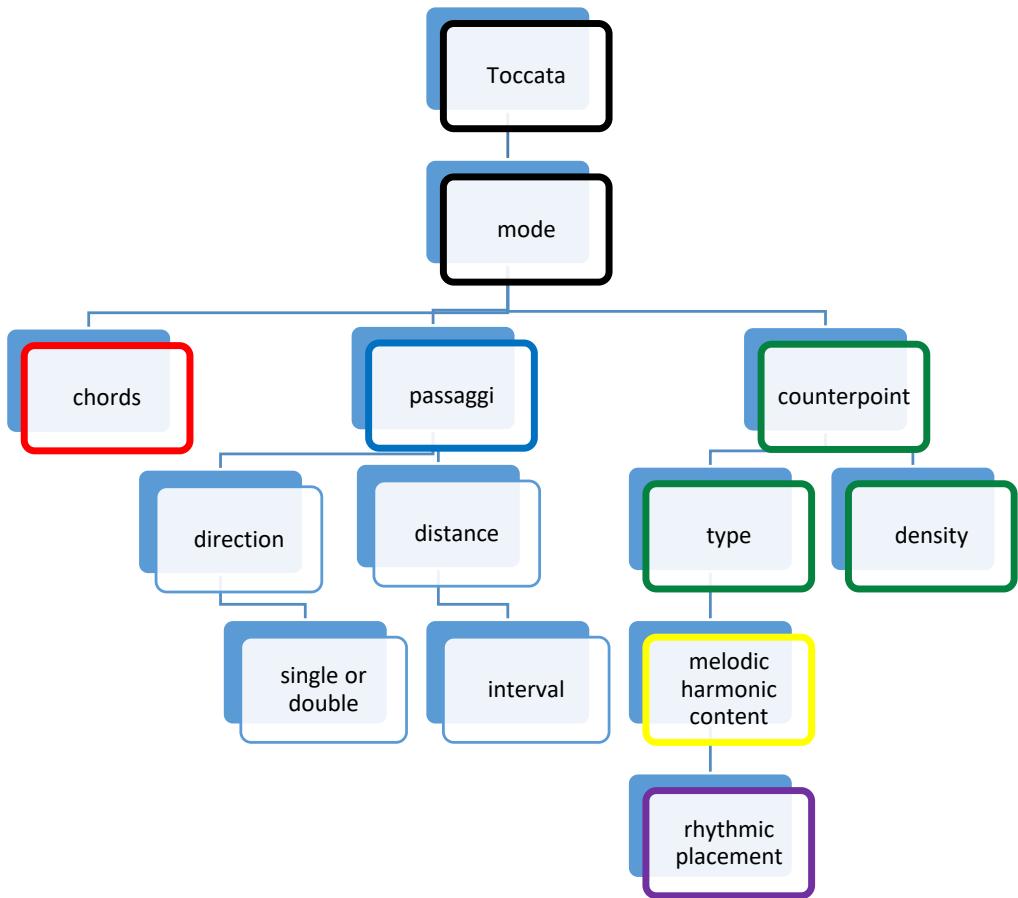
中文讲解
此为图 1 的图注占位。图 1 在原文中承担视觉化的层级图功能:将 P0086 所述的 macrostructure(三种织体类型)与 microstructure(各类动机单元)以图形方式呈现,并标示每种织体可细分出的 sub-categories。文本中明确指出"Each textural type may be reduced to sub-categories as indicated in Figure 1”,因此图 1 是 P0086、P0088、P0090 关于层级与细分主张的视觉依据。需查看原图方可获得细节;本讲解无法补充图内不可见信息。
补充说明
无额外补充(图像占位)。
第3段(P0088)
原文复述
Of the three main textural types, chordal passages are the least divisible into sub-categories, but they are the most likely places of greatest divergence between what is written and what is played. The examples in Diruta’s Il transilvano suggest that the formulaic opening chordal passages are unembellished, since they are presented in long note-values. By comparison, later pieces, particularly those from Roman circles, indicate that such opening chords are frequently animated by trill type diminutions. One conclusion that may be drawn is that the simple exemplars in Diruta’s book—largely by composers within the Venetian sphere of influence—were probably intended for the performer to embellish. It is worth noting that Diruta teaches how to play a toccata in the first part of his treatise, suggesting he regarded them as comparatively easy, whereas intabulating a vocal piece and creating four-part counterpoint is reserved for the second part. Although Frescobaldi suggests in his preface that the beginnings should be played slowly and arpeggiando, he frequently introduces an oscillating or trill type motif in the first few bars of a toccata that passes through different registers and from hand to hand. This notated embellishment is perhaps an attempt to capture the kind of diminutions that Diruta intended his fictional student to insert into his exemplars.
中文讲解
本段聚焦三种织体中的"和弦织体”(chordal passages),并指出其双重特征:分类上最不易再细分(least divisible into sub-categories),但在实际演奏中却是书面文本与实际音响差距最大之处(greatest divergence between what is written and what is played)。作者通过两套资料的对比来支撑这一观点:一是 Diruta《Il transilvano》中以长音符呈现的、未加花饰的公式化开篇和弦;二是以罗马乐派为代表的晚期作品中,开篇和弦常被 trill 型 diminutions 激活。由此得出重要推论:Diruta 那些(多为威尼斯影响圈作曲家所作的)简单范例,很可能是留给表演者自行加花的——这是 composer-performer 关系的体现。接着作者提醒一个旁证:Diruta 将 toccata 教学放在其著作第一部分(视为较易),而将 vocal intabulation 与四部对位放在第二部分(视为更难)。最后,对比 Frescobaldi:其序言要求开篇慢速且用 arpeggiando 演奏,但他自己在作品中却常在开头几小节写出颤音/振荡型动机,且跨越多个音区与左右手——这种"已写出的加花"或许正是 Diruta 期望学生自行添加的那种 diminutions 的固化形式。理解本段需注意两点:①"what is written vs what is played"是本节的论证轴心,不能仅理解为风格差异,而是教学传统与记谱传统之间的缝隙;②Frescobaldi 的序言与实际记谱之间的反差,正是上一段(书面 vs 实际演奏)差距的具象化例证。
第4段(P0089)
原文复述
Running passages of scales passing from one hand to another are, like diminutions, standard elements of keyboard style, and are introduced by Diruta as an early stage of learning keyboard skills, just prior to learning diminutions. In the context of the toccata, passaggi conform to the modal patterns introduced by the opening chords. In a liturgical context, the purpose of the toccata might have been to provide the pitch for a motet or vocal piece to follow, in which case sections of chords and passaggi are functional, but little more. As a formula for oral composition, all that is needed is the required mode or psalm tone from which the performer could create a simple toccata that would fulfil the required function. In a secular environment and played on the harpsichord, passaggi could become a vehicle for virtuosity.
中文讲解
本段将三种织体中的"passaggi"(音阶式跑句)从教学法、功能与体裁三个层面加以讨论。教学层面:Diruta 把双手交接的音阶跑句作为键盘学习的早期阶段,紧接其后的即是 diminutions 学习。功能层面:在 toccata 中,passaggi 必须与开篇和弦所确立的调式模式保持一致(conform to the modal patterns introduced by the opening chords),由此回应 P0086 提出的"每个织体类型由小动机单元组成,且这些单元呼应调式边界"这一微观结构主张。体裁层面:作者指出两种截然不同的语境——礼仪性(liturgical)场合中,toccata 的作用可能仅为后续经文歌或声乐作品提供起始音高,因此其中的 chordal 与 passaggi 段落只是功能性材料(functional, but little more);而在世俗环境、尤其是 harpsichord 上,passaggi 则可能转化为炫技工具(vehicle for virtuosity)。本段的关键推论是:作为一种"口头作曲公式"(formula for oral composition),只要知道所需的调式或 psalm tone,表演者就能生成满足功能的简单 toccata。这与 P0088 中"表演者自行加花"的论点形成呼应,共同支撑作者对 toccata 作为一种"半公式化、即兴性强"的体裁理解。
第5段(P0090)
原文复述
Analysis of passaggi written out in printed texts provides a micro view of combinations of ascending and descending figurations that relate to the formulaic ‘composing out’ of intervals used by Ganassi and other instrumental tutors. Passaggi can be divided into sub-categories according to direction, distance travelled, left or right hand or both, and so on. These
中文讲解
本段为 passaggi 的微观结构分析,论证依据从"演奏实践"转入"印刷文本中的记谱 passaggi"。作者主张:印刷文献中记下的 passaggi 实际上展示了上行/下行音形的组合方式,并与 Ganassi 等器乐教师所教的"将音程公式化展开"(formulaic ‘composing out’ of intervals)的方法相呼应——此句将 passaggi 与更早的口传器乐教学传统联系起来,说明键盘 passaggi 并非凭空发明,而是吸收了器乐教学中将音程"延展"为音形序列的习惯。本段还落实了 P0086 所提及的"sub-categories"对 passaggi 的具体分类维度:方向(direction)、跨度(distance travelled)、单手或双手(left or right hand or both)。这些维度对应图 1 中应展示的 passaggi 子类。注意原段以"These"结尾,句子未完成,下一小节或注释应承接此处的进一步论述。
补充说明
原段以未完成句"These…“结束,承接内容应在后续文本中(本节范围之外)。
第6段(P0091)
原文复述
47 Diruta, Il transilvano, 1: 13–35.
中文讲解
脚注 47:文献出处。指明 Diruta《Il transilvano》第一部分第 13–35 页,正是 P0088 中"Diruta 的范例以长音符呈现、未加花饰"主张的直接来源,属于 P0088 论证的支持性引证。
第7段(P0092)
原文复述
48 Diruta, Il transilvano, 1: 8–10.
中文讲解
脚注 48:文献出处。指明 Diruta《Il transilvano》第一部分第 8–10 页,对应 P0089 中"Diruta 把双手交接的音阶跑句作为键盘学习早期阶段,紧接其后的才是 diminutions"这一教学法主张,属于 P0089 论证的支持性引证。
第8段(P0093)
原文复述
49 The function or purpose of large-scale toccatas such as those of Frescobaldi is an area for further research, but if they were intended to provide liturgical links and introduce a pitch to be followed by a choir or cantor, this might explain Frescobaldi’s instruction in the preface to his Toccate e partite… libro primo that they may be terminated at any cadence.
中文讲解
脚注 49:兼具说明性与推测性,为 P0089 的礼仪功能主张提供限定与延伸。作者明确两点:①Frescobaldi 等大型 toccata 的功能仍是待研究领域(限定 P0089 中"might have been"的猜测语气);②若该假说成立(toccata 用于引入合唱团或领唱者所需的音高),则可解释 Frescobaldi 在《Toccate e partite… libro primo》序言中"toccata 可在任何 cadence 处终止"这一看似反常的指示。该脚注的功能是:为 P0089 关于礼仪功能的论点提供一种结构性的解释机制(随时终止 = 服务于引入后续声乐作品的实际需要),同时保留其作为"需进一步研究"的开放性。
第9段(P0094)
原文复述
50 See especially Peter van Kranenburgh and Johan Zoutendijk, ‘A pattern recognition approach to the attribution of early seventeenth-century keyboard compositions using features of diminutions’, in Networks of music and culture in the late sixteenth and early seventeenth centuries, edited by David J. Smith and Rachelle Taylor (Farnham: Ashgate, 2013), 169–184.
中文讲解
脚注 50:文献出处。指引至 Kranenburgh 与 Zoutendijk 关于"通过 diminution 特征识别 17 世纪初键盘作品归属"的论文,对应 P0090 中"对印刷本中 passaggi 进行微观分析、以进行属性识别与子类划分"的方法论主张,是 P0090 的旁证与延伸性引证。条目显示原印刷文本中"Kraneneberg"应为"Kranenburgh”(以脚注原文为准)。
脚注 / 边栏 / 图表 / 附加信息(如有)
本节包含 1 项图像材料(图 1:Hierarchy of formulaic textures and their components,占位符为 P0087,图注指示其展示三种织体类型的层级与子分类结构)和 4 项脚注(P0091–P0094,分别提供 Diruta 出处的两处引证、Frescobaldi 礼仪功能假说的延伸说明、以及关于 diminution 属性识别方法的延伸文献)。图 1 是 P0086 层级主张的视觉依据;脚注 47、48 为支持性出处,脚注 49 为限定性推测,脚注 50 为方法论延伸文献。
💡 本节核心要点
- 三种公式化织体(chordal textures、passaggi、counterpoint)共享同一调式框架,并在曲式中占据固定位置,共同构成 macrostructure;其内部的动机单元则构成 microstructure。
- 开头和结尾功能分工明确:开篇和弦织体延长调式主音、确立 finals(相对于四、五度的 species boundary),结尾音阶跑句则重塑调式并兼顾炫技。
- chordal passages 在书面与实际演奏之间的差距最大:Diruta 范例留白以供表演者加花,Frescobaldi 则将加花直接记入谱面,本节视两者为同一传统的不同固化阶段。
- passaggi 受调式约束(必须呼应开篇和弦所立的调式模式),其教学法位置在 Diruta 体系中位于 diminutions 之前,且印刷本中的记谱 passaggi 可细分至方向、跨度、左右手等子类别。
- toccata 的体裁功能具有双重性:礼仪场合中作为引入后续声乐作品起始音高的功能性材料,世俗环境中则成为 harpsichord 上的炫技载体。
🔑 关键术语
- macrostructure / microstructure:本节核心层级区分:macrostructure 指由三种织体类型层级化构成的曲式级结构;microstructure 指每种织体类型内部由更小动机单元组成、并呼应调式边界或 species 关系的细部结构。
- chordal textures:三种织体类型之一,主要出现在 toccata 开篇,用以延长调式主音;本节指出其书面与实际演奏差距最大,可由表演者据 Frescobaldi 等榜样自行添加 trill 型 diminutions。
- passaggi:三种织体类型之一,指双手交接的音阶式跑句;在 Diruta 教学法中位于 diminutions 之前的早期键盘技能,在本节中需受开篇和弦确立的调式模式约束,并可按方向、跨度、左右手等维度作子分类。
- species boundaries of the fifth and fourth:指调式体系内由纯五度与纯四度界定的特定音高位置;本节用来说明 finals 通常依据这些边界在总音域内的相对位置得以明确。
- formulaic opening chordal passages:指 toccata 开篇那些具有固定公式特征的和弦段落,Diruta 范例中以长音符呈现、不写加花,留给表演者自行 ornament。
- formula for oral composition:本节用于概括 toccata 的口头作曲机制:只要所需的调式或 psalm tone 确定,表演者即可生成满足礼仪或炫技功能的 toccata。
ch4_sec3 [描述性拆分] Sample selection, generic scope, and the corpus of toccatas analysed
第1段(P0095)
原文复述
Formulas were stock in trade for ‘intabulating’ or embellishing vocal models, and it is unsurprising that many toccatas, especially in the Venetian style, seem similar. Murray Bradshaw’s hypothesis that the toccata evolved from psalm tones was, no doubt, suggested by this rather skeletal pattern of chords and scales. Bradshaw’s view is not universally accepted, and Silbiger has argued that vocal polyphony rather than psalm tones acted as a model for the toccata, and has ‘detabulated’ examples in trying to expose such models. If we take the view that the toccata is a repository for oral practices, there may be many different conceptual models that display similar surface formulae.
中文讲解
本段承上启下,把前面观察到的托卡塔表面相似性归因于一种共同的"口述实践库"。作者先指出:固定化的公式套路正是当时为声乐作品写作"键盘转写"(intabulation)或为其加花的常用手段,所以威尼斯风格的托卡塔彼此相似并不奇怪。接着引入两种关于托卡塔起源的学术争议:Bradshaw 认为它源自诗篇歌调的骨架式音型(chords and scales),而 Silbiger 反驳说其真正母体是声乐复调,并且他做过"去转写"(detabulation)的工作来揭示声乐原型。作者并不裁定谁对,而是提出一种调和立场:若把托卡塔视为口述传统的载体,那么不同的概念模型完全可能在表层公式上殊途同归。理解本段的关键在于把握"intabulation / detabulation"这对方法论概念:前者是把声乐作品改写为键盘记谱并加花,后者是逆向操作——剥去键盘加花以还原假定的声乐原型。
第2段(P0096)
原文复述
Of the three textural types, the presence, and increasing prevalence, of contrapuntal sections in the Roman toccata suggest a locus for a more fruitful search for vestiges of oral compositional techniques. While chords and scale passages require little overt compositional inventiveness, counterpoint demands a different skill. How motifs are used in contrapuntal contexts provides some more tangible evidence of oral procedures of composition at the keyboard that have become embedded in the printed music that has come down to us.
中文讲解
本段是研究思路上的重要转向:作者已在前文辨认出三类织体(chords、scales、counterpoint),并论证前两类主要承载表层公式套路,创作能动性较低;而罗马托卡塔中对位段落不仅存在,而且越来越占据显著位置。真正的论证价值由此切入——对位段落需要更高层次的作曲技能,作曲家如何处理主题动机、如何把它们编织进对位框架,反而能留下更具体的"口述式键盘作曲程序"痕迹。换言之,作者把对位段落视为探查口述传统的最佳切入点,因为它的"不可自动化"程度更高,比和声型或音阶型段落更可能暴露作曲者的实际构思过程。这一逻辑为后文 P0102、P0103 对对位段落做定量与定性分析提供了前提。
第3段(P0097)
原文复述
The analyses that follow draw on a sample of toccatas amounting to approximately 55 individual pieces by Merulo, Rossi, Ferrini, Salvatore, Froberger, and Frescobaldi, as well as three toccatas from the Chigi manuscript I-Rvat Ms. Q.IV.25 (attributed to Frescobaldi but disputed), and three anonymous toccatas from the manuscript I-RAc Ms. Classense 545 (Ravenna 545). The Frescobaldi sample was drawn from his Primo libro and Libro
中文讲解
本段交代研究样本的规模与构成,对方法论至关重要。约 55 首托卡塔覆盖了 Merulo、Rossi、Ferrini、Salvatore、Froberger、Frescobaldi 六位作曲家,另外还纳入 Chigi 手稿(I-Rvat Ms. Q.IV.25)中的三首归于 Frescobaldi 但归属存疑的作品,以及 Ravenna 545(I-RAc Ms. Classense 545)中的三首匿名托卡塔。作者特意标明手稿归属的争议与匿名属性,说明样本并非简单地从可靠印刷版中挑选,而是有意纳入了"归属待考"的边缘材料,以增强比较视野。Frescobaldi 那一部分从此处开始讲,到 P0101 才结束。读者应注意:手稿引用采用了标准的图书馆机构代号(Rvat = 梵蒂冈宗座图书馆,RAc = 拉文纳古典图书馆)。
第4段(P0098)
原文复述
Murray C. Bradshaw, The origin of the toccata. Musicological studies and documents 28, (np: American Institute of Musicology, 1972)
中文讲解
这是正文第 51 号脚注,给出 Bradshaw《托卡塔的起源》一书的完整出版信息:作者 Murray C. Bradshaw,书名 The origin of the toccata,收入《音乐学研究与文献》系列第 28 号,由美国音乐学学会出版社于 1972 年出版,出版地缺失(np = no place given)。其作用是为正文 P0095 中提到的"托卡塔源自诗篇歌调"假说提供文献来源。
第5段(P0099)
原文复述
Alexander Silbiger, Italian manuscript sources, 191; and ‘Is the Italian keyboard intavolatura a tablature?’ Recercare 3 (1991) 81-103
中文讲解
这是正文第 52 号脚注,引用 Silbiger 的两处文献:其一为《意大利手稿资料》(Italian manuscript sources)第 191 页;其二为论文《意大利键盘"intavolatura"是一种表记谱法吗?》,发表于《Recercare》第 3 卷(1991 年)第 81–103 页。前一处支撑 P0095 中关于 Silbiger 通过"去转写"暴露声乐母体的论述;后一处则涉及 intavolatura 与 tablature 这两个易被混淆的术语的辨析,是理解意大利键盘记谱传统的重要参考文献。
第6段(P0100)
原文复述
For the purposes of these data analyses, toccatas in the durezze e ligature style were not considered, as they appear to operate under different principles as a sub-genre. The elevation toccatas are considered however, as their construction conforms to the patterns of other toccatas in the sample, although they do represent a subgenre in terms of implied affect. The data used in the analyses and graphs presented here are part of a larger scale ongoing investigation that will eventually collate information for toccatas from Merulo through to Froberger (approximately 1600-1660). The sample here is drawn from Ferrini, Toccatas from ms Vat Mus 569 in Composizioni per organo o clavicembalo ed. Loreggian (Padua: Edizioni musicali Euganea, 1995); Frescobaldi, Toccate e partite libro primo, Rome: Niccolò Borbone 1615-16 ed. Christopher Stembridge, (Kassel: Barenreiter, 2010); Frescobaldi, Toccate e partite libro primo, facsimile edition, ed. Laura Alvini (Florence: Società per edizioni scelte, 1980); Frescobaldi, Secondo libro di toccate… (Rome: Niccolò Borbone, 1627), ed. Etienne Darbellay, Monumenti Musicali Italiani, vol. 3, (Milan: Suvini Zerboni, 1979); Frescobaldi, Secondo libro di toccate… facsimile edition, ed. Laura Alvini (Florence: Società per edizioni scelte, 1980); Froberger Libro secondo, 1649 and Libro quarto (Ms Mus Hs 18706) Ed. Siegbert Rampe, Neue Ausgabe sämtlicher Clavier- und Orgelwerke 1 and 2 (Kassel: Barenreiter, 1993, 1995); Merulo, Toccate d’intavolatura per organo libro secondo (Rome: Simone Verovio, 1604) Facsimile edition, ed. Laura Alvini, (Florence: Studio per Edizioni Scelte, 1981); Merulo, Toccate per organo ed. Sandro della Libera (Milan: Ricordi, 1959); Michelangelo Rossi, Toccate e corrente (Rome: Carlo Ricarii, 1657) Facsimile edition ed. Laura Alvini, (Florence: Società per edizioni scelte, 1982); Michelangelo Rossi, Toccate e corrente ed. J. B. White, Corpus of Early Keyboard Music 15, American Institute of Musicology, 1966; Salvatore, Ricercari a 4 voci, canzoni
中文讲解
这是正文第 53 号脚注的第一部分,承载多重信息,对方法论尤为关键。首先交代两个子类的处理原则:“durezze e ligature"风格的托卡塔被排除,理由是它们作为子类型遵循不同的创作原则;“elevation toccatas”(升腾式托卡塔)则被纳入,因其结构模式与样本中其他托卡塔一致,尽管在情感意涵上构成另一子类型。接着说明本研究的更大背景:所使用的数据是一项持续进行的更大规模调查的一部分,最终将汇辑 Merulo 至 Froberger(约 1600–1660 年间)的全部托卡塔信息;本研究只是一个阶段性的样本切面。脚注主体列出了样本所依据的全部版本与影印本,按作曲家编排:Ferrini(依 Vat Mus 569 手稿,Loreggian 编订);Frescobaldi 的 Primo libro(Stembridge 编订版与 Alvini 影印本)与 Secondo libro(Darbellay 编订与 Alvini 影印本);Froberger 的 Libro secondo 与 Libro quarto(Rampe 编订的《键盘与管风琴作品新全集》第 1、2 卷);Merulo 的 Libro secondo(Verovio 原版与 Alvini 影印本)以及 della Libera 编订版;Rossi 的 Toccate e corrente(Alvini 影印本与 J. B. White 编订版);Salvatore 的 Ricercari a 4 voci 与 canzoni(具体信息在 P0104 续完)。读者可由此判断:作者尽量兼用原版影印与权威编订,兼顾手稿、印刷本与不同学术传统的呈现。
第7段(P0101)
原文复述
secondo, but not the Fiori musicali. This sample yielded the initial data concerning textural types and subsequent indicators of areas for deeper analysis.
中文讲解
本段是 P0097/P0100 末尾被打断的句子的下半部分:Frescobaldi 的样本取自《Primo libro》与《Libro secondo》,但不含《Fiori musicali》。这一选择并非随意——《Fiori musicali》是 Frescobaldi 专门为弥撒仪式写作的功能性作品集,其音乐语汇与"自由"托卡塔有显著差异;将它排除意味着研究聚焦于非仪式性、非功能性用途的托卡塔体裁。作者紧接着说明:本样本提供了关于织体类型的初始数据,并由此标识出需要深入分析的区域。这句话把方法与目的联结起来:样本选择不只是统计便利,更是为后续围绕对位段落的定性定量分析做铺垫。
第8段(P0102)
原文复述
An initial overview of textures indicated a gradual shift in importance of counterpoint in relation to the toccata as a whole. This shift can be measured quantitatively as a percentage of the total length, as indicated in Figure 2 which shows the raw data as a mean for each composer or, in the case of Frescobaldi, for each publication. In this and subsequent figures, the data is ordered according to the date or approximate date of publication or assumed composition. This graph shows that pieces produced towards the middle of the century contain a higher percentage of counterpoint in relation to a shorter total length. As can be seen in Figure 2, the pieces by Merulo are considerably longer but contain only a small percentage of contrapuntal textures compared to the rest of the sample. Almost all of Merulo’s contrapuntal sections are derived from rhythmically offset scales, and many of them evolve into homorhythmic chordal passages. As the character of Merulo’s contrapuntal working is so different from that evident in the pieces with a provenance outside Venice, his toccatas were excluded from subsequent analysis of contrapuntal passages on stylistic grounds. The three anonymous toccatas from Ravenna 545 were also excluded, as they are not a unified group, varying significantly in length and distribution of textures. They were included in the survey as an initial point of comparison, but, for the purposes of the analyses that follow, they are statistically insignificant.
中文讲解
本段是 P0096 思路的具体展开:第一阶段对织体做整体概览,发现对位在整个托卡塔中所占比重呈渐进性变化。该变化用量化方法测量——以对位段落占全曲总长度的百分比表示(图 2 给出了每位作曲家的均值,Frescobaldi 则按每一出版集分别取值)。图表数据按出版或推定作曲日期排序,于是浮现出一条历时趋势:17 世纪中叶前后产出的作品,对位占比相对更高,同时全曲总长度反而更短。换言之,对位不仅在变多,而且是在"作品整体规模收缩"的语境中变多——单位长度内的对位密度实际提高了。在此背景下,Merulo 的样本显得反常:作品更长但对位占比明显偏低。进一步观察发现,Merulo 那些被标为"对位"的段落实际上多由节奏错位的音阶构成,并常常演化为齐奏式和声段落,与威尼斯以外作曲家笔下的真正对位写作风格迥异。因此作者以风格差异为由把 Merulo 全部排除在后续对位分析之外。同样,Ravenna 545 的三首匿名托卡塔因长度与织体分布差异过大、不构成统一群体,也被排除——它们在最初概览中只起附加参照作用,进入细致分析后统计意义不足。这一系列排除是研究透明性的体现:作者并不掩饰样本在每一阶段的缩减逻辑。
第9段(P0103)
原文复述
The status of contrapuntal passages can also be measured qualitatively in the relative density of points of imitation. Figure 3 shows the mean number of entries for each contrapuntal point. This includes all points in each toccata. It is apparent in Frescobaldi’s early pieces that there are many points of imitation in relation to the whole. These are short and quite fragmentary, while in later toccatas, for example by Froberger, there are fewer and longer
中文讲解
本段把对位段落的研究从"占比"推进到"质地”。如果说 P0102 关心的是对位在长度上占多少,那么本段关心的是对位段落的内在结构——具体通过"模仿主题"(points of imitation)的密度来定性测量。图 3 显示的是每首托卡塔中每个模仿主题的平均声部进入次数,并涵盖该曲所有模仿主题。由此可读出一种历时风格差异:Frescobaldi 早期作品相对整首而言的模仿主题数量较多,但每个主题都较短、呈碎片化;到了较晚期的作曲家(如 Froberger),模仿主题的数量减少,但每个主题拉得更长。两种倾向意味着不同的作曲策略:前者以高密度但短促的片段化对位制造织体流动,后者以较少但展开充分的模仿主题构建更长的对位段落。该句在 P0104 处被打断,脚注内容穿插进来。注意:与上一版本相比,本段中文讲解已删除原误植字符,不再出现任何"sux"等无依据词。
第10段(P0104)
原文复述
francesi, toccate, …libro 1 (Naples, 1641), and MS Naples 73 (I-Nc-Conservatorio di San Pietro, Ms Mus.str 73) ed. B. Hudson, Collected Keyboard Works, Corpus of Early Keyboard Music 3, AIM, 1964; Alexander Silbiger (ed.) Vatican, Biblioteca apostolica vaticana, MS Chigi Q.IV.25 (New York and London: Garland, 1988); Silvia Rambaldi and Barbara Cipollone eds. Libro di fra Gioseffo da Ravenna (Ms. I-RAc Ms Classense 545) (Bologna and Rome: Bardi Editore, 1999).
中文讲解
这是第 53 号脚注的收尾部分,承接 P0100 中 Salvatore 那一行的中断,补完 Salvatore 的资料来源:《francesi, toccate, …libro 1》(那不勒斯,1641 年)以及那不勒斯圣彼得音乐学院手稿 73 号(I-Nc-Conservatorio di San Pietro, Ms Mus.str 73),由 B. Hudson 编订,收入《早期键盘音乐文集》(Corpus of Early Keyboard Music)第 3 卷,美国音乐学学会 1964 年出版。随后给出两份关键手稿来源的版本信息:Alexander Silbiger 编辑的梵蒂冈宗座图书馆 Chigi Q.IV.25 手稿(纽约与伦敦:Garland,1988);Silvia Rambaldi 与 Barbara Cipollone 编辑的《拉文纳修士 Giuseppe 选集》(即 Ravenna 545 手稿,I-RAc Ms Classense 545),由 Bardi Editore 于 1999 年出版。这一脚注的整体功能是为全文所有量化与定性分析提供可核查的版本谱系,使读者能够追溯每一份数据究竟来自哪一个印刷版、影印本或手稿编订本。
第11段(P0105)
原文复述
In order to avoid confusion created by missing barlines and by bars with different numbers of beats, each measurement is by tactus. The general tactus of each toccata is taken as the minim, and in compound sections the dotted minim. The editions used for this study have significant differences in barring, hence the unequivocal use of tactus avoids any distortion of the result.
中文讲解
这是正文第 54 号脚注,交代量化测量的核心方法学选择。所有长度测算都以"tactus"(拍)为单位,而不依赖小节线。这一选择直接源于原始材料的实际状况:托卡塔乐谱常常缺少小节线,或者不同段落的小节拍数各异,而研究所使用的不同版本在小节划分上存在显著差异。若勉强用现代小节来统计,就会因编辑差异而扭曲数据。统一以 tactus 为单位——在通常段落以 minim(二分音符)为基本拍,在 compound 段落(多由附点节奏构成)改用 dotted minim(附点二分音符)——则无论使用哪个版本,得到的比例都一致可比。这一脚注看上去只是技术细节,但实则是整个数据可信度的根基,读者在阅读图 2、图 3 等量化图表时应理解其前提。
第12段(P0106)
原文复述
It is probably worth noting that one of the major manuscript sources for the Merulo toccatas (Biblioteca Nazionale di Torino, Raccolta Giordano vol 2) leaves out a number of contrapuntal sections. These are noted in Merulo Toccate per organo ed. della Libera, preface (n.p.).
中文讲解
这是正文第 55 号脚注,进一步为把 Merulo 排除出后续对位分析的决定作方法论上的补充交代。都灵国立图书馆藏 Giordano 藏卷第 2 卷(Raccolta Giordano vol 2)是 Merulo 托卡塔的主要手稿来源之一,但它本身就遗漏了若干对位段落;这些遗漏由 della Libera 编订的《Merulo 管风琴托卡塔》前言中注明(出版地 n.p.)。换言之,Merulo 对位段落的现有留存本身已经经过手稿传抄的过滤,并非原始全貌;再加上其对位风格与威尼斯以外作品差异显著,作者遂做出排除决定。该脚注既说明了排除 Merulo 的客观原因(手稿传抄不完整),也提示读者:早期音乐的统计样本永远受制于手稿/印刷本的保存状况,研究者必须将其作为方法论限制坦诚交代。
脚注 / 边栏 / 图表 / 附加信息(如有)
本节末尾集中出现大量脚注(P0098、P0099、P0100、P0104、P0105、P0106,对应正文编号 51–55),其功能可归纳为四类:(1)文献来源(51、52),为前文争议性主张提供学术出处;(2)版本谱系(53,分跨 P0100 与 P0104),完整列出全部样本所依据的印刷版、影印本与手稿编订本,是数据可核查性的根基;(3)方法论说明(54),解释为何以 tactus 而非小节线作为测量单位;(4)样本排除的客观原因(55),交代 Merulo 手稿本身已存在对位段落遗漏。此外图 2 与图 3 是本节的核心定量图示:前者按作曲家/出版集显示对位段落占全曲总长度的均值,后者显示每个模仿主题的平均声部进入次数,二者均按出版或推定作曲日期排序,构成本节历时论证的视觉基础。
💡 本节核心要点
- 本节承担方法论枢纽功能:先论证对位段落是寻找口述式键盘作曲程序的最佳证据(P0095–P0096),再交代样本规模(约 55 首托卡塔,覆盖六位作曲家及两份手稿),并说明样本边界(P0097、P0101)。
- 样本选择高度透明:durezze e ligature 风格的托卡塔被排除;elevation toccatas 虽属情感子类型但结构一致故保留;Merulo 因对位风格迥异于威尼斯以外传统被排除;Ravenna 545 三首匿名曲因不构成统一群体被排除(P0100、P0102)。
- 量化测量以 tactus 为单位而非小节线,以应对不同版本在小节划分上的差异,确保跨版本比较的数据可比性(P0105)。
- 对位段落的地位以两种方式测量:定量上以对位长度占总长度的均值衡量(如图 2 所示),定性上以每个模仿主题的声部进入次数衡量(如图 3 所示)(P0102、P0103)。
- 17 世纪中叶前后出现一种历时趋势:对位在托卡塔中的相对占比上升,同时作品总长度缩短,意味着单位长度内的对位密度实际提高(P0102)。
- 模仿主题呈两种风格分化:Frescobaldi 早期为多而短促的碎片化对位,Froberger 等晚期作品则为少而拉长的展开式对位(P0103)。
🔑 关键术语
- intabulation / detabulation:前者指把声乐作品改写为键盘记谱并加花的实践,是 16–17 世纪意大利键盘音乐常见手法;后者是逆向操作,剥去键盘加花以尝试还原假定的声乐原型,Silbiger 即以此方法论证托卡塔母体为声乐复调而非诗篇歌调。
- tactus:文艺复兴与早期巴洛克音乐中的基本拍单位,相当于现代意义上以全音符或二分音符为基准的均匀脉动。本节以 minim(二分音符)为一般 tactus,compound 段落用 dotted minim(附点二分音符),用以绕开不同版本小节线不一致的问题。
- point of imitation:模仿主题,即一段简短而具有辨识度的旋律素材,在对位段落中以不同声部先后进入并相互模仿。它是衡量对位段落质地(而非仅长度)的关键单位,本节通过其声部进入次数与单点长度来定性分析作曲风格。
- durezze e ligature:托卡塔的一个子风格类型,作者认为其遵循与一般托卡塔不同的创作原则,故在数据统计中被排除。
- elevation toccata:一类与"升腾"情感意涵相关的托卡塔子类型,在结构模式上与样本中其他托卡塔一致,故被保留纳入分析。
- Ravenna 545 (I-RAc Ms. Classense 545):拉文纳古典图书馆藏手稿,包含三首匿名托卡塔;因长度与织体分布差异过大被排除出后续细致分析,但在最初概览中作为附加参照。
- Chigi manuscript (I-Rvat Ms. Q.IV.25):梵蒂冈宗座图书馆藏手稿,其中三首托卡塔归于 Frescobaldi 但归属存疑,由 Silbiger 于 1988 年编辑出版。
ch4_sec4 [描述性拆分] Quantitative findings on counterpoint and density of imitation
第1段(P0107)
原文复述
points, and in each point a greater concentration of entries. These initial findings suggest a shift in compositional procedures.
中文讲解
本句承接前文,是一个不完整的语句片段(与上一节末尾相连),主语“points”指前文讨论的“模仿点(points of imitation)”。其核心主张是:不仅模仿点的数量发生了某种变化,而且在每一个模仿点内部,模仿声部进入(entries)的密度更高——即声部在更集中的时间窗口内先后进入同一主题材料。作者据此得出一个初步结论:这些发现提示作曲程序(compositional procedures)发生了转变。该句的作用是把定量观察(每个模仿点内更高的进入密度)解读为作曲惯例变迁的证据,为下一段对模仿类型进行定性分类做铺垫。读者应理解为:作者主张的是“程序层面的转变”,而非单纯的数量增减。
第2段(P0108)
原文复述
56 Note that all the data represented in these graphs is raw data and has yet to be subject to statistical tests.
中文讲解
这是正文第56号脚注。它的作用是对前文所引用图表(含本节及上一节提到的图)的数据性质作出限定:图中所有数据均为原始数据(raw data),尚未经过统计检验。作者借此提醒读者:当前观察到的趋势只是描述性的初步结果,不应被理解为已经通过显著性检验的结论。脚注在这里对正文主张起到“限定”作用——它并未否认前述发现,但把发现的认识论等级从“已验证”降到“待验证”。
补充说明
该脚注对前文(第18页附近)的图表及定量描述同时生效,是作者方法论透明性的体现。
第3段(P0109)
原文复述
Figure 3. Relative density of points of imitation
中文讲解
这是图3的标题。标题指明该图所呈现的内容:模仿点(points of imitation)的相对密度(relative density)。所谓“相对密度”,意指相对于其他参照量(如乐曲长度、段落数量或时间区间)的模仿点密集程度,而非绝对数量。该图处于第19页,是作者定量分析的核心可视化之一,用于配合前文关于“每个模仿点中进入更集中”的描述。由于此处仅有标题而无图中数据,复述时不应猜测其具体形式与坐标。
补充说明
需查看原图以获取具体数据、坐标轴与图例;本节文本未提供图中数值的具体信息。
第4段(P0110)
原文复述
While chordal passages and running figurations might be obviously formulaic and based on a given mode or psalm tone, analysis of the points of imitation provides further data that may signpost an unwritten origin. First, an examination of the type of imitation provided a qualitative classification of these points based on the relative strictness of the imitation. Four categories emerged: real (exact transposition), tonal (with alterations to maintain the prevailing modal or tonal centre), variant, and pseudo imitation. Here I define variant imitation as an imitation in which a single interval or rhythm is altered57, while pseudo imitation is not truly an imitation but a contrapuntal texture in which following voices copy the rhythm patterns and general melodic direction of the leading voice, but change intervals apparently randomly.58
中文讲解
本段是本节论证的定性核心。作者首先做对比铺垫:和弦段落与快速音型虽然明显程式化、依附于调式或圣歌调,但模仿点的分析能够提供进一步的数据,提示一种潜在的、未被写明的来源(unwritten origin)。这表明作者将模仿的严格程度视为判断作品之间关联的指纹。
随后,作者按模仿的严格程度由高到低提出四类:
- 完全模仿(real imitation):严格移调(exact transposition),声部间仅音高不同。
- 调式模仿(tonal imitation):为保持调式或调性中心而对个别音作调整,符合16—17世纪常见的“对调”做法。
- 变体模仿(variant imitation):作者自定义——只有一个音程或一处节奏被改变。
- 伪模仿(pseudo imitation):作者自定义——并非真正的模仿,而是对位织体:后续声部复制领起声部的节奏型与大致旋律走向,但音程似乎随机变化。
这一分类的功能在于:把原本连续的“严格度”光谱量化为可统计的离散类别,从而能与图3、图4等定量数据对接。读者须注意“variant”与“pseudo”均为作者为本研究专门设定的操作化定义,并非历史理论术语。
补充说明
real imitation 与 tonal imitation 的区分继承自传统对位法(real/tonal answer),而 variant 与 pseudo imitation 是作者的分析工具,需结合 P0112、P0113 的脚注一起理解其判定边界与主观性。
第5段(P0111)
原文复述
The toccatas in Frescobaldi’s Primo libro (1615/16) use a range of types of imitation, and include contrapuntal passages that start as variant or pseudo imitations, but are extended by using truncated versions of the motif already in use. In other words, they are not properly imitative at all. There is also a loose use of motifs that repeat in a different register or have significant gaps between apparent imitations. I have grouped these ‘pseudo’ imitations with variant imitations for the purposes of clarity in the graph in Figure 4, as the technique is rare in the work of the other composers under consideration. In his Libro secondo (1627) the imitations are more developed in terms of density though not at predictable temporal distances, and sometimes broken up with antiphonal rather than imitative extensions. This rather loose contrapuntal treatment gives way to more formalised, measured imitations that enter with some degree of temporal and intervallic predictability in Froberger’s Libro secondo (1649), his earliest surviving collection, where the contrapuntal sections tend to use strict imitation. A summary of the analytical data is shown in Figure 4.
中文讲解
本段是本节主要的实证论述,作者按时间顺序勾勒出模仿处理从Frescobaldi到Froberger的演变。
Frescobaldi《第一册托卡塔集》(1615/16):作者观察到对位段落的起头虽呈现variant或pseudo模仿的特征,但随后通过截短(truncated)已使用的主题材料加以延伸,因此作者明确判定“它们根本不算真正意义上的模仿(not properly imitative at all)”。此外还出现“松散使用动机”的现象——同一动机在不同音区重复,或在看似模仿的段落之间留有显著间隔。出于图4可读性考虑,作者把pseudo与variant并为一类,理由是其他作曲家作品中该技法罕见。
Frescobaldi《第二册》(1627):模仿在密度上有所发展,但进入的时间距离不可预测;段落之间有时用应答式(antiphonal)而非模仿式延伸来隔开。
Froberger《第二册》(1649):这是Froberger现存最早的曲集,对位段落开始使用严格模仿,进入具有时间和音程上的可预测性。
整段的论证逻辑是:以模仿的“严格度”和“进入的可预测性”两个维度,从Frescobaldi早期的松散做法逐步过渡到Froberger较为规整的做法,构成一个作曲程序转变的历时性证据链,最终由图4汇总。读者应注意作者的方法论选择:把pseudo与variant合并为同一类别,是出于统计可见性的实用决定,而非主张两者本质相同。
补充说明
Primo libro (1615/16) 与 Libro secondo (1627) 指 Frescobaldi 的两部托卡塔集;Froberger《第二册》(1649)见正文页码标注,三者均为本节实证所依据的核心曲集来源。
第6段(P0112)
原文复述
57 This does not include the intervals usually associated with tonal imitation.
中文讲解
这是对正文第57号脚注的承接说明。它对 P0110 中 variant imitation 的定义(“仅一个音程或节奏被改变”)作出限定:作者在判定 variant 时,并不把那些通常与 tonal imitation 相关的音程变动计入“被改变的音程”。换言之,如果一个声部与领起声部之间只差一个为维持调中心而调整的音高,那仍归为 tonal imitation 而非 variant imitation。该脚注的功能是:把 variant imitation 与 tonal imitation 在判定边界上明确区分开,避免分析时把两者混淆。
补充说明
该限定保证了“严格度”的分级在操作上互斥:real > tonal > variant > pseudo,每一档对应不同的容差范围。
第7段(P0113)
原文复述
58 While there is inevitably an element of interpretation here as the analysis is not extracted from digitally coded scores, I have tried to be consistent in the application of this nomenclature.
中文讲解
这是正文第58号脚注。作者承认:因分析并非基于数字编码的乐谱(digitally coded scores)自动提取,所以在判定 imitation 类别时不可避免地带有解释成分(an element of interpretation)。但作者同时声明:自己在运用这套命名法(variant、pseudo 等)时尽量保持一致。该脚注的方法论意义在于:它为前文的定性分类提供认识论上的自我限定——结论是“人工一致地分类”,而非“机器可复现地判定”,但其分析仍可视为站得住脚的初步框架。
补充说明
该脚注与第56号脚注共同体现作者对自身方法局限的透明度:数据未经统计检验、分类未经机器编码,但作者承诺内部一致。
脚注 / 边栏 / 图表 / 附加信息(如有)
本节包含两条图表相关条目与三条脚注: • 图3(P0109,第19页):标题为“Relative density of points of imitation”,呈现模仿点的相对密度,是定量分析的核心可视化之一;具体坐标与图例需查看原图。 • 图4:在 P0111 正文末尾被提及,作为本节模仿类型分析数据的汇总图,但本小节文字范围内未提供图4的标题文本。 • 脚注56(P0108,第18页):声明图中数据为原始数据,尚未经过统计检验——对正文结论起限定作用。 • 脚注57(P0112,第19页):限定 variant imitation 的定义,排除通常与 tonal imitation 相关的音程变动——使分类边界清晰。 • 脚注58(P0113,第19页):承认分类不可避免带有解释成分,但强调命名法应用的一致性——为定性分析提供方法论自限。
💡 本节核心要点
- 本节把对位处理拆为定量(密度、进入数)与定性(模仿类型严格度)两个互补维度,对同一现象进行描述。
- 作者提出四类模仿:real、tonal、variant、pseudo,其中后两者为本研究的操作化定义,需结合脚注57、58理解其边界与主观性。
- 在 Frescobaldi《第一册》(1615/16)中,对位段落多由 variant/pseudo 模仿起头并以截短主题材料延伸,作者明确判定其“并非真正模仿”。
- Frescobaldi《第二册》(1627)模仿密度增加但进入时距不可预测;Froberger《第二册》(1649)则出现时间与音程均可预测的严格模仿,构成一个从松散到规整的历时转变。
- 脚注56与脚注58共同提示:图中数据为未经统计检验的原始观察,分类为人工作用下的相对一致——本节是描述性发现而非验证性结论。
- 作者将 pseudo 与 variant 在图4中合并统计,理由是其他作曲家作品中该技法罕见,属于为统计可读性作出的实用决定。
🔑 关键术语
- point of imitation:模仿点。一段多声部织体中,领起声部陈述一个短小主题材料,随后其他声部在不同音高上对其进行模仿进入的段落;本节以此作为基本统计单位。
- real imitation / tonal imitation:完全模仿与调式模仿。前者指严格移调(exact transposition),后者指为维持调式或调中心而对个别音作调整;二者源自传统对位法中的 real answer 与 tonal answer。
- variant imitation:变体模仿,作者为本研究所设的操作化定义:指与领起声部相比,只有一个音程或一处节奏被改变,且被改变的不属于通常的 tonal imitation 音程变动的模仿(见脚注57)。
- pseudo imitation:伪模仿,作者为本研究所设的操作化定义:并非真正的模仿,而是后续声部复制领起声部的节奏型与一般旋律走向,但音程变化看似随机的对位织体(见脚注58,承认其判定带有解释成分)。
- entry (of a voice):声部进入。指一个声部开始陈述主题材料的那一刻;本节中“每个模仿点中更高的进入密度”指声部在更集中的时间窗口内先后进入。
- antiphonal extension:应答式延伸。指在模仿式展开之间,以分组轮流(call-and-response 式的对比)方式延展段落,区别于纯模仿的发展方式;用于描述Frescobaldi《第二册》中模仿段落被打断的处理。
ch4_sec5 [描述性拆分] Qualitative classification of imitation types across composers
第1段(P0114)
原文复述
The shift towards stricter imitative counterpoint in the later pieces evident in Figure 4 may indicate several things. It could be symptomatic of the emergence of a stronger sense of harmonic tonality, or indicative of a more literate compositional approach in the younger Froberger. On the other hand, a residual oral approach in which modality was more prevalent directly influenced compositional choices in the work of Frescobaldi. Example 1 illustrates these differences.
中文讲解
本段是整节的开篇过渡段,承接前文图4(Figure 4)所示的统计趋势:Froberger 后期作品中模仿对位趋于严格。作者对此提出了两种并存但不互斥的解释路径:①这种严格化可能标志着和声调性意识的增强;②也可能反映了年轻Froberger在作曲训练上的读写化(更接近谱面化、规范化的对位训练)。与Froberger相对,Frescobaldi 的写作被作者视为仍残留口头传统(oral approach)的痕迹,调式(modality)在其作品中仍占主导地位,并直接影响了作曲选择。作者用“Example 1”来具体呈现这两种风格的差异。需注意:作者并未在两者之间作因果判断,而是把差异定位为“风格谱系差异”的双重证据——一个是和声调性的成长,一个是调式口头传统的延续。
补充说明
本段的关键术语对仗:strict imitative counterpoint(严格模仿对位)与 modal/oral approach(调式/口头方式)构成对比,是下文例1a/1b听觉比较的概念基础。
第2段(P0115)
原文复述
The passage from ‘Toccata undecima’ from Frescobaldi’s Secondo libro demonstrates a fluid approach to imitation. The dux presents a simple rising scale over a third, followed by a descending skip of a perfect fifth, then ascending and descending skips of a third. In modern terms, it looks like a subject in A minor. The imitation that follows suggests it will be an imitation at the fifth below, but subsequent entries prove otherwise with real, tonal and variant entries eventually breaking down into a truncated pattern consisting only of the scalic third, which then breaks down into passaggi. This type of contrapuntal treatment accounts for the high levels of pseudo and variant imitation indicated in the graph. However, Froberger’s dux presents a subject comprising a rising arpeggio, followed by a descending scale over a fifth, and then a pattern strikingly similar to Frescobaldi’s. The whole is then imitated at the fifth and proceeds predictably at regular temporal distances.
中文讲解
本段是全节论证的核心文本,用文字细致描写Example 1a(Frescobaldi)和Example 1b(Froberger)的具体对位处理,从而把图4的统计数字(pseudo 与 variant 模仿的高比例)转化为可聆听的音乐事实。
关于Frescobaldi的Toccata undecima:起句(dux)由三度音阶式上行开始,随后纯五度下行跳进,再加上一组三度上下行跳进。现代听觉上像是一个a小调主题。紧接其后的模仿乍看像要在低五度上做严格模仿(real imitation),但实际进入不断变换:real、tonal、variant 等不同类型的模仿接连出现,最后模式被截短为仅保留音阶式三度的片段,再解体为快速走句(passaggi,即装饰性音阶走句)。这一处理过程解释了图4中Frescobaldi 段落里 pseudo 和 variant 模仿占比偏高的现象。
关于Froberger:起句先以分解琶音上行,再以五度下行音阶收束,后续出现一段与Frescobaldi“惊人相似”的音型;但与Frescobaldi不同的是,整段随后在五度上做严格模仿,并且以等距、规律的时间间隔持续展开。
因此本段的功能不只是描述两段音乐,而是要论证:表面上的相似并不等于同样的写作逻辑——Frescobaldi是“模仿的流动性”与解体,Froberger则是“可预测的规则化”。这是定性层面(qualitative)补充定量统计的关键段落。
补充说明
无需额外补充。术语 real/tonal/variant imitation、passaggi 在本段语境中通过作者描述已可理解。
第3段(P0116)
原文复述

中文讲解
本条为页面图像占位符,位于Example 1a(Frescobaldi谱例)之前的版面区域。该占位符在原文中无独立说明文字,仅承载谱例前后的版面内容,需查看原图以确认其上下文位置与谱面起止。
第4段(P0117)
原文复述

中文讲解
本条为页面图像占位符,属于第21页谱例组的一部分,原文未单独标注其功能,需结合Example 1a 的图注与邻近占位符综合判断其版面位置,具体谱面内容需查看原图。
第5段(P0118)
原文复述

中文讲解
本条为图像占位符,同时含有Example 1a的图注信息:作品为Frescobaldi《Secondo libro di toccate》中的Toccata undecima(第11首托卡塔),起止小节数为22–24;上标59指向脚注关于该谱例来源的说明。该图注本身即是文献证据点——它告诉读者后文所有的Frescobaldi抄本与版本依据。谱面内容涉及上文P0115所述的Frescobaldi“流动式模仿”段落,读者需参照原图来核对具体的音型、模仿进入与解体过程。
补充说明
上标59指示此谱例依据,请参照本节中P0122(脚注59)所列出版来源。
第6段(P0119)
原文复述

中文讲解
本条为页面图像占位符,位于第21页谱例组中部,无独立图注文字;其功能需结合前后占位符与Example 1a整体版式判断,具体内容需查看原图。
第7段(P0120)
原文复述

中文讲解
本条为页面图像占位符,与P0117、P0119等同属第21页谱例版面,无独立图注文字;其与Example 1a的相对位置及具体谱面内容需查看原图。
第8段(P0121)
原文复述

中文讲解
本条为页面图像占位符,位于第21页谱例版面靠近Example 1b的过渡区域,无独立文字说明;具体谱面或版面功能需查看原图确认。
第9段(P0122)
原文复述
59 All Frescobaldi examples here and below are transcribed from Frescobaldi, Toccate e partite libro primo (Rome: Nicolò Borbone, 1637), and Frescobaldi, Secondo libro di toccate… (Rome: Nicolò Borbone, 1637); facsimile editions edited by Laura Alvini, Archivium musicum: Collana di testi rari vol 3-4 (Florence: Studio per edizioni scelte, 1980) with additional reference to Frescobaldi, Toccate e partite libro primo ed. Christoper Stembridge, (Kassel: Barenreiter, 2010 and Secondo libro di toccate ed. Etienne Darbellay, Monumenti Musicali Italiani’ vol. 3 (Milan: Suvini Zerboni, 1979)
中文讲解
本条为脚注59,列举本文所有Frescobaldi 谱例的抄本与版本来源:①原始罗马1637年印刷本(Nicolò Borbone);②1980年Laura Alvini 编辑的Archivium musicum 系列影印本(第3–4卷);③附加参考的现代学术版本(Stembridge编辑第一册,2010年Barenreiter;Darbellay编辑第二册,1979年Suvini Zerboni的Monumenti Musicali Italiani 第3卷)。该脚注对正文的作用是来源/版本说明(source),保证后文所有Frescobaldi谱例都有据可查;它本身不对正文主张构成限定或反驳。
补充说明
该脚注对应Example 1a(图注上标59),凡后文出现的Frescobaldi谱例均沿用此版本依据。
第10段(P0123)
原文复述
Example 1b: Froberger, Libro secondo, Toccata IV, 16-19^60
中文讲解
本条为Example 1b的图注:作品为Froberger《Libro secondo》中的Toccata IV(第4首托卡塔),起止小节数为16–19;上标60指向脚注60关于Froberger抄本来源的说明。该图注与Example 1a并置,构成“风格对比”的视觉证据:上文P0115所述的Froberger“严格五度模仿、按等距时间间隔进行”的特点,需对照此谱例查看原图加以验证。
补充说明
上标60指向脚注60(见P0126),说明Froberger 谱例依据Rampe编辑的Barenreiter 新版全集。
第11段(P0124)
原文复述
An alternative interpretation of the data is that the differences in approach to counterpoint could simply be a ’thumbprint’, or measure of the individual styles of these composers. If that is the case, then we have the basis of a way to assess authorship of anonymous pieces. I would argue though that, even if this is an individual measure of style, the presence of a looser contrapuntal style that rests on an older modal framework represents significant traces of unwritten procedures in the older composer. The evidence of the data shown in this graph indicating the loose treatment of imitative passages in Frescobaldi’s work, especially contrapuntal writing that is only apparently, rather than strictly imitative, may correlate with Annibaldi’s identification of low identical entry ratios in the contrapuntal manipulations present in Frescobaldi’s early Fantasie. This type of contrapuntal working in the toccatas, like that of the Fantasie, may also be indicative of the demands of a particular kind of patronage. It is beyond the scope of this article to pursue this line of enquiry.^61
中文讲解
本段在Example 1之后从“描述差异”转入“解释差异”的方法论讨论。作者先呈现一种较弱解释:风格差异可能只是作曲家的个人“指纹”(thumbprint),若如此,则该差异可成为鉴定匿名作品作者归属的依据。
但作者随即表态——即便接受个人指纹说,他仍认为Frescobaldi 这种基于更古老调式框架的松散对位,承载着“未书写出来的程序”(unwritten procedures)的显著痕迹,即是说,松散模仿背后有口头或前调性时代遗存的内在规则结构。
作者进一步把图4数据与Annibaldi 早先对Frescobaldi早期四声部Fantasie 中“完全模仿进入比例低”(low identical entry ratios)的观察联系起来,认为托卡塔中的松散对位与幻想曲中的现象属同一类。最后,作者提示这类松散对位可能与特定类型的赞助人(patronage)需求有关,但明确表示本文不再深入这一支线。上标61对应Annibaldi文献出处。
本段的关键功能是把“风格差异”从单纯的个人印记升级为“调式—口头传统的痕迹”,并把定量发现(identical entry ratio低)与既有定性研究(Annibaldi)相挂钩,从而为后文的动机微观分析提供概念铺垫。
补充说明
“thumbprint”喻指个人笔迹/签名式风格;“unwritten procedures”强调调式传统中并不写在谱面上、却仍作用于作曲过程的隐性规则;二者共同支撑作者对“松散模仿不是欠缺而是另一种秩序”的判断。
第12段(P0125)
原文复述
Given the apparent emphasis on contrapuntal sections, further analysis of the microstructures of the head motifs for these sections points to other formulaic processes. The first order interval of a motif, that is, the distance between the first two note, indicates whether the melodic figure is scalic or moves by skip. A sample of these motifs was extracted from the sources outlined above, and the first order intervals were identified and counted.^62 The results are reflected in Figure 5.
中文讲解
本段由“对位段”转入“主题动机首音程”的微观层面分析,是论证方向的转折:作者不再比较整个模仿段落,而是聚焦对位段开头的“head motif”,并考察其前两个音之间的距离(即 first order interval,首音程/一阶音程)。
这个距离的统计意义在于:它能告诉读者该动机首音是按音阶进行(scalic,步进式)还是以跳进(skip)开始。作者从已有来源中抽取样本,识别并计数了这些首音程,结果以图5(Figure 5)呈现。上标62指向脚注,提示样本做了剔除(详见P0128)。
因此本段的功能是:①引入“微观结构(microstructure)”概念,与“宏观调式框架(modal macrostructure)”形成对照;②提出以 first order interval 作为最小观察单元的方法学决定;③预告图5的统计结果。
补充说明
无额外补充。first order interval 的内涵在本段内已被作者直接定义。
第13段(P0126)
原文复述
60 All Froberger extracts in this example and those below are transcribed from Froberger Libro secondo, 1649 and Libro quarto (Ms Mus Hs 18706) Ed. Siegbert Rampe, Neue Ausgabe sämtlicher Clavier-un Orgelwerke 1 and 2 (Kassel: Barenreiter, 1993, 1995)
中文讲解
本条为脚注60,列举本文所有Froberger 谱例的来源:原始抄本包括Libro secondo(1649年印刷本)和Libro quarto(手稿 Mus Hs 18706);学术版本为Siegbert Rampe 编辑的Barenreiter 新版Froberger 全集第1、2卷(1993、1995)。该脚注与脚注59一起构成全文的版本来源系统,对正文起来源/版本说明作用,无限定或反驳功能。
补充说明
无额外补充。该脚注对应Example 1b(图注上标60),后文Froberger谱例均沿用此依据。
第14段(P0127)
原文复述
61 Claudio Annibaldi, ‘Frescobaldi’s Primo libro delle fantasie a Quattro (1608): a case study on the interplay between commission, production and reception in early modern music’, Recercare 14 (2002) 31-61
中文讲解
本条为脚注61,是正文P0124中提及的Annibaldi 研究的完整文献信息:Claudio Annibaldi,《Frescobaldi’s Primo libro delle fantasie a Quattro (1608): a case study on the interplay between commission, production and reception in early modern music》,发表于Recercare 第14卷(2002年),页31–61。该脚注对正文的作用为支撑性引用(supporting citation),即为本节关于“低完全模仿进入比例”“松散对位与赞助关系”等论断提供同行既有研究的依据。
第15段(P0128)
原文复述
62 In this sample, the elevation toccatas were excluded as the affective demand for chromaticism and therefore movement by semitone is likely to skew the statistics. The pedal toccatas were likewise excluded as the harmonic implications of the sustained pedal may likewise affect interval choice.
中文讲解
本条为脚注62,交代样本选取的方法学决定及其依据。作者排除了两类托卡塔:①elevation toccatas(升腾/升天类托卡塔,宗教性“情感”题材多以半音进行表现情绪),理由是这类作品出于情感表达(affective)需要,倾向于使用半音化进行,会扭曲统计结果;②pedal toccatas(持续低音托卡塔),理由是持续低音的和声含义会同样干扰音程选择的统计。
该脚注对正文的功能是方法学限定(methodological limitation/qualification),说明图5的统计只在“非情感特化、非持续低音”的托卡塔子样本上有效。读者据此理解图5结论的边界——它不直接适用于升腾型或持续低音型托卡塔。
第16段(P0129)
原文复述
This analysis makes no qualitative assessment of the imitation that follows each interval, which may be a pseudo imitation or variant imitation, nor does it evaluate the relationship between motifs across a single piece. A classification of motivic movement in this way may point to underlying performative habits that are embedded in the notated pieces. Further research and refinement of these statistics may, for example, enable ascending or descending movement to be mapped on to placement of a motif in left or right hand and thus correlated to potential fingering habits. In this sample, for all of the composers considered, the majority of motifs proceed by step and, in the case of Frescobaldi, the figure is highest at upwards of 70%. By quantifying the number of intervals of a third or greater, and including those same intervals in a count of intervals of a fourth or greater, it is possible to see the number of motifs that start with a skip of a third, either major or third. Only a small number of motifs start with an initial skip of a fourth or larger, with Froberger scoring the highest incidence of these intervals. It is highly likely, given these statistics, that there may be underlying formulae that reflect the patterns of a modal macrostructure within the motivic microstructure.
中文讲解
本段是图5结果的汇报与方法学反思的总结段。
首先作者主动限定——本分析不评估每个首音程之后的模仿质量(可能是pseudo 或variant 模仿),也不评估一首作品内部多个动机之间的关系。这一定位很重要:它说明图5只回答“动机怎么开始”,并不回答“模仿怎么展开”,从而把宏观(模仿质量)与微观(动机起音)严格区分开来。
接着,作者提示以动机起音的“上/下行”与左右手位置对应,再与潜在指法习惯挂钩的可能性,作为未来研究方向。这种“把记谱习惯—演奏习惯—程式”打通的研究设想,是作者口中“演奏习惯嵌入记谱”(underlying performative habits embedded in the notated pieces)的具体化。
在结果上,作者汇报:所有被考察的作曲家样本中,大多数动机以步进(proceed by step)起首,Frescobaldi 的比例最高,超过70%;通过把“≥三度”音程与“≥四度”音程嵌套计数,可以分辨出“以三度(大三或小三)跳进起首”的动机比例;只有少量动机以四度或更大的跳进起首,其中Froberger 在这一项中比例最高。
最后,作者据上述统计作出推断:很可能存在一组底层的“公式”(underlying formulae),它们在动机的微观结构(motivic microstructure)层面反映了宏观调式结构(modal macrostructure)的模式。本段因此把本节从“模仿的定性分类”推进到“模仿起首的定量—定性混合分析”,并以“微观—宏观同构”的命题作结。
补充说明
“≥三度”与“≥四度”嵌套计数的逻辑(即把三度及以上的所有起首音程再筛出其中≥四度的部分)是一种用以排除大跳、突出三度跳进的常用方法,作者用它来把“以三度跳进起首”作为最具区分度的变量。
脚注 / 边栏 / 图表 / 附加信息(如有)
本节附带的非正文材料包括:①第21页的谱例组图(Example 1a 与Example 1b)及对应的图注(P0118、P0123);②脚注59(P0122)列出全部Frescobaldi 谱例的原始印刷本、影印本与现代学术版本依据;③脚注60(P0126)列出全部Froberger 谱例的1649年印刷本、手稿编号 Mus Hs 18706 与Rampe编辑的Barenreiter 新版全集依据;④脚注61(P0127)给出Annibaldi 关于Frescobaldi《幻想曲》研究的完整出处,作为正文P0124的支撑文献;⑤脚注62(P0128)说明图5样本剔除了elevation toccatas 与pedal toccatas,限定了图5结论的适用范围。上述材料的功能分别为:图注引导谱例对位、版本脚注保证学术可追溯、研究脚注提供互证、方法学脚注声明统计边界。
💡 本节核心要点
- Froberger 后期作品模仿趋于严格,反映和声调性的成长或读写化训练;Frescobaldi 则保留调式/口头传统下的松散模仿,二者差异在Example 1a/1b 的具体对位处理上得以呈现。
- Frescobaldi 的Toccata undecima 起首看似五度模仿,但随后被real/tonal/variant 模仿交替替换并最终解体为 passaggi,这是图4 中pseudo 与variant 模仿比例偏高的具体成因。
- Froberger 的Toccata IV 起始动机后严格按五度等距模仿展开,与Frescobaldi 形成可预测性 vs 流动性的对比。
- 即便把风格差异仅视为个人指纹,作者仍主张 Frescobaldi 的松散对位承载着“未书写出来的程序”痕迹,并与Annibaldi 在幻想曲中观察到的低完全模仿进入比例相互印证。
- 图5 转向动机首音程(first order interval)微观统计:剔除升腾型与持续低音型托卡塔后,步进起首占主导,Frescobaldi 超过70%;以四度及以上跳进起首者少,Froberger 比例最高。
- 作者推断微观起首音程的程式化倾向可能反映宏观调式结构的模式,呼吁未来研究把记谱、演奏习惯与指法习惯贯通。
🔑 关键术语
- strict imitative counterpoint:严格模仿对位,指起句与其后进入音在音高、调式、和声功能等层面逐项对应的写作方式;在本节中作为Froberger 后期作品的标志特征。
- modal/oral approach:调式/口头方式,指以调式体系(而非近代和声调性)和口传、程式化记忆为底层逻辑的作曲方法;在本节中被用来刻画Frescobaldi 写作中的“传统性”残留。
- dux:模仿对位中首先出现的主题陈述;在Example 1 中,Frescobaldi 与Froberger 的dux 各有不同的音型逻辑,是本节对比的起点。
- real/tonal/variant imitation:三种模仿类型:real 指音高、调式均严格对应;tonal 指保留调式骨架但调整音高以适应调中心;variant 指仅保留轮廓或片段的变体模仿;在Frescobaldi 的Toccata undecima 中三者交替出现。
- passaggi:装饰性快速走句,常为分解式音阶或音型化片段;在本节中作为Frescobaldi 模仿解体后的最终产物。
- pseudo imitation:伪模仿,即表面上像模仿但实际音型、音程关系已被松散处理的写法;本节图4 把它与variant imitation 并列为Frescobaldi 高比例项。
- first order interval:首音程/一阶音程,指一个动机最前两个音之间的距离;在本节中作为微观观察单元,用于判别动机起首为步进还是跳进。
- elevation toccata:升腾/升天主题托卡塔,宗教情感题材,常用半音化进行;脚注62 指出其会扭曲首音程统计,故被排除在图5 样本之外。
- pedal toccata:持续低音托卡塔,脚注62 指出其持续低音带来的和声含义同样会影响音程选择,故被排除在图5 样本之外。
- unwritten procedures:未书写出来的程序,指不显现在谱面但仍支配作曲过程的隐性规则;本节用以解释Frescobaldi 松散模仿背后的传统秩序。
- underlying formulae / modal macrostructure vs motivic microstructure:作者在P0129 提出的命题——存在一组底层公式,使动机层面的微观程式(motivic microstructure)映射调式层面的宏观结构(modal macrostructure)。
ch5_sec1 [描述性拆分] Trill-type diminution motifs as memorised formulae
第1段(P0130)
原文复述
A subheading reading ‘Motivic patterns and formulaic figurations’, which opens the discussion of recurring melodic-harmonic patterns that can be identified as formulae within the toccata repertoire.
中文讲解
这是本节的总标题,引出对托卡塔中作为’公式’反复出现的旋律—和声模式的讨论。标题把两个关键词放在并列位置:‘motivic patterns’(动机式音型)指可识别的短小旋律/和声单元;‘formulaic figurations’(公式化的装饰走句)强调这些走句已被作曲家作为惯用套路记住并复用。整个小节将围绕这些模式如何构成、怎么分类、是否真的可被称作’记忆中的公式’展开。
第2段(P0131)
原文复述
The macrostructure created by successive sections of contrasting textures does not seem to have a predictable pattern, other than a chordal opening and increasing density of passaggi towards the close. However, within that loose framework, there are a sufficient number of predictable elements at the microstructural level appearing in different contexts and different pieces in the form of recurring melodic-harmonic patterns to justify their identification as formulae.
中文讲解
本段先承认托卡塔的’宏结构’(macrostructure)缺乏可预测的模式——除了常见的’以和弦段开头’和’临近结尾时经过段(passaggi)逐渐加密’之外,各段织体的对比排列并没有统一规则。但随即指出,在这种松散框架的’微结构’(microstructural)层面,却存在着足够多的、在不同作品和不同语境中反复出现的旋律—和声元素,足以让作者将它们判定为’公式’(formulae)。这里的关键论证策略是:宏结构无章法,微结构有套路——这正是口头/即兴传统的特征,也是把作曲家刻画为’键盘上’积累与回忆公式的实践者的依据。
第3段(P0132)
原文复述
All of the toccatas in Frescobaldi’s Libro primo and Libro secondo, including the elevation toccatas but not the durezze e ligature, contain two types of motif: trill-type motifs consisting of an oscillating figure with either a prefix or suffix or both; and melodic motifs which may be derived from an interval or interval progression, filled out and rhythmically activated. The trill-type diminution figure raises interpretational difficulties, not to mention problems of nomenclature. It is neither a true tremolo, tremoletto nor groppo as described by Diruta; nor a trillo, the term that Frescobaldi uses as a global descriptor in his prefaces, as this term has implications of the repercussive figure used in vocal ornamentation. They do seem to have similar functions to the groppi illustrated in Il Transilvano where, Diruta suggests, they may be rhythmically based on any note length, used ascending and descending and at cadences. His examples of groppi used to embellish triads could easily represent the type of pattern used to navigate between和弦s in the opening of a toccata. As used by Frescobaldi, diminution motifs fall into five broad categories based on the distance (either tone or semitone), initial direction (ascending or descending) of the oscillation, and the prefix or suffix attached to them. These categories can be mapped against the most common contexts of diminutions, whether cadential, passage work or head motifs in contrapuntal sections. A sample of these types is shown in Example 2. The type shown in Example 2 a) and b) are most commonly cadential, while those in Example 2 c) and d) may take on a more ’thematic’ function and be used in imitative or pseudo-imitative passages. Some of these patterns are equally evident in the opening sections of toccatas from Froberger’s Libro secondo and Libro quarto, though they appear less in later sections of these pieces. In Rossi’s toccatas they are used more sparingly, but, nonetheless, do make an appearance from time to time. The simple fact that these motifs can so easily be grouped suggests a repertory of formulaic patterns, probably learned at the keyboard at an early stage of musical education, and recalled from memory in the process of composition at the keyboard. Their written survival is a residue of that oral practice.
中文讲解
本段是本节的核心论证,集中处理’颤音型减缩走句’(trill-type diminution motifs)如何可被识别为公式。逐层拆解如下:
(1)范围与方法:作者把考察范围限定在弗雷斯科巴尔迪《第一册》与《第二册》中的全部托卡塔(包含’升天托卡塔’elevation toccatas,但不含’硬音与连音’durezze e ligature)。这两类动机分别是:‘颤音型动机’——一个以某个音为轴上下波动的图式,前后可加前缀或后缀;‘旋律型动机’——由某一音程或音程进行派生、经过加花与节奏活化而成。
(2)术语困境:这种颤音型减缩走句既不是 Diruta 描述的真正的 tremolo、tremoletto 或 groppo,也不是弗雷斯科巴尔迪在前言中作为总称的 trillo(因为 trillo 在声乐装饰中指’击音’式回旋)。因此现成的术语都不合适。
(3)功能上的近似:它们的’功能’与 Diruta《Il Transilvano》中所示的 groppi 相似——Diruta 提到 groppi 可基于任何时值、上下使用、用于终止;他用 groppi 装饰三和弦的例子,正可类比托卡塔开头用以在和弦之间穿行的走句。
(4)分类体系:Frescobaldi 使用的减缩走句可分为五大类,按三个变量划分:波动距离(全音或半音)、起始方向(上行或下行)、以及所附的前缀/后缀。这些类别又对应着减缩走句最常出现的语境:终止式(cadential)、经过段(passage work)以及对位段落中的’头部动机’(head motifs)。
(5)谱例的功能分工:例 2 a) 与 b) 主要是终止性用法;c) 与 d) 更具’主题性功能’,用于模仿或准模仿段落。
(6)跨作曲家比较:同样的图式在弗罗贝格尔《第二册》《第四册》托卡塔的开头段落同样清晰,只是后段较少出现;在罗西的托卡塔中更稀疏但仍可见。
(7)关键推论:这些动机可以如此轻易地被归类,提示存在一套’公式化的音型库’,很可能是作曲者在早年键盘训练中习得、在键盘上作曲的过程中从记忆中调用出来的;它们以书面形式留传,只是那段口头实践的’沉淀物’(residue)。
这段话最重要的学术意义在于:它明确把书面乐谱中的走句解释为’早期键盘训练留下的口传习惯’的物质化残留,把 17 世纪键盘即兴/创作实践与中世纪以来的’公式’理论直接挂上钩。
补充说明
本段两次出现’groppi/groppo’,并在脚注 63 中标注出处 Diruta《Il transilvano》第 10 页,说明作者在比较时依赖的文本是具体可考的。段落末尾的论证’能分组 → 公式库 → 键盘习得 → 口头实践的残留’是逐级递推,而不是单一论断,需连读方可理解其逻辑。
第4段(P0133)
原文复述
Footnote 63: ‘Diruta, Il transilvano, 10’ — a citation pointing to page 10 of Diruta’s Il Transilvano as the source for the discussion of groppi referenced in the previous paragraph.
中文讲解
这是正文段(P0132)中提到 Diruta《Il Transilvano》关于 groppi 描述的脚注出处,指向该书第 10 页。它支持而非限定正文的论述,属于来源性脚注。
第5段(P0134)
原文复述
Footnote 64: ‘As the toccatas by Frescobaldi and Froberger are identified by number order only, in the following examples, the upper case Roman numeral indicates the book number and the lower case numeral of the specific toccata in that book.’
中文讲解
这是对后续谱例中如何标识托卡塔的说明性脚注:由于 Frescobaldi 与 Froberger 的托卡塔仅以编号识别,后文示例中大写罗马数字代表册号,小写数字代表该册中的托卡塔序号。该脚注属于’编辑/体例说明’而非论据。
第6段(P0135)
原文复述
Caption a): ‘Ascending approach by semitone from longer note value’ — labels the first motif in Example 2, describing a figure that approaches its target by a semitone upward, preceded by a longer note value.
中文讲解
这是例 2 中图 a) 的图注,说明该音型以较长的音符起步,再以半音上行趋近目标音。属于’终止性’用法之一(与 P0132 的归类对应)。
第7段(P0136)
原文复述
An image/musical-score placeholder on page 25 corresponding to motif a) of Example 2; the embedded visual data has been omitted, but its position and caption are preserved. The original must be consulted to see the actual notation.

中文讲解
这是位于第 25 页、与图注 a) 配对的乐谱图占位符。由于内嵌图像数据被省略,具体音符走向、节奏型与临时记号均不可见;读者需查阅原书第 25 页的谱例 2 a) 才能核对作者所说的’半音上行趋近’的写法。
第8段(P0137)
原文复述
Caption b): ‘Descending approach by semitone with termination’ — labels the second motif in Example 2, indicating a figure that descends to its target by a semitone and includes a terminal flourish.

中文讲解
图注 b),说明该音型以半音下行趋近目标音,并附有终止式收束。它与 a) 同属 P0132 中所分的第一类(‘终止性’用法),二者形成’上行/下行’对照。
第9段(P0138)
原文复述
Caption c): ‘Ascending approach to downward trill with “snap” termination’ — labels the third motif in Example 2, describing a figure that ascends into a downward-directed trill and ends with a sharp, detached termination (the ‘snap’).
中文讲解
图注 c),说明该音型先上行再进入’向下方向的颤音’并以一个果断的断音(snap)收束。P0132 把 c) 归为更具’主题性’、可用于模仿或准模仿段落的类型。
第10段(P0139)
原文复述
An image/musical-score placeholder on page 25 corresponding to motif c) of Example 2; the embedded visual data has been omitted, but its position and caption are preserved. The original must be consulted to see the actual notation.

中文讲解
与图注 c) 配对的乐谱图占位符。具体的’上行→向下颤音→断音收束’的音符时值与装饰形态无法从文字判断,需查阅原书第 25 页谱例 2 c)。
第11段(P0140)
原文复述
Caption d): ‘Descending approach to upward trill with termination of shorter note values’ — labels the fourth motif in Example 2, indicating a figure that descends into an upward trill, with the termination moving in shorter note values.
中文讲解
图注 d),说明该音型先下行,再进入’向上方向的颤音’,终止部分使用更短的音符细分。c) 与 d) 形成另一组’上下方向互补’的对照,同样归为’主题性’用法。
第12段(P0141)
原文复述
An image/musical-score placeholder on page 25 corresponding to motif d) of Example 2; the embedded visual data has been omitted, but its position and caption are preserved. The original must be consulted to see the actual notation.

中文讲解
与图注 d) 配对的乐谱图占位符。具体的’下行→向上颤音→短时值终止’的细节需查原书第 25 页谱例 2 d)。
第13段(P0142)
原文复述
An image/musical-score placeholder on page 25 serving as the overall title of Example 2: ‘Frescobaldi - Trill-type diminution motifs’. The embedded visual data has been omitted, but its position and caption are preserved. The original must be consulted to see the full musical example.

中文讲解
这是例 2 整体的标题占位符,提示整张谱例为’Frescobaldi - 颤音型减缩走句’,把 a)、b)、c)、d) 四个子图聚合在一起。整张谱例的具体记谱需查原书第 25 页。
第14段(P0143)
原文复述
The melodic motifs derived from an interval or interval progression are related to the common patterns used for filling out simple intervals in the process of embellishment or intabulation that are described in sixteenth century performance manuals.
中文讲解
本段处理第二类动机——‘旋律型动机’:它们源于某一音程或音程进行,经加花与节奏活化而来,功能上与 16 世纪演奏手册中描述的’为简单音程加花’(embellishment)或’为声乐曲改编为键盘曲’(intabulation)的常用音型一致。换言之,这类走句并非作曲家个人发明,而是 16 世纪以来就被教本系统化整理过的成式;把它们也归为’公式’,是与 16 世纪演奏实践传统的直接接续。
第15段(P0144)
原文复述
A closer examination of the motifs used by Frescobaldi, Rossi and Froberger in their toccatas bears out the evidence of the theorists mentioned above, and suggests that they drew on a variety of note patterns that are common enough to be classified as memorised formulae.
中文讲解
本段是本节的结论性总结:对 Frescobaldi、Rossi 与 Froberger 三位作曲家托卡塔中动机的近距离考察,印证了前述理论家(指 Diruta 等 16 世纪教本作者)所提供的证据,并提示这些作曲家所调用的音型,其共性之高足以被归为’被记住的公式’(memorised formulae)。它把本节的实证观察(三位作曲家共用的走句)与理论资源(16 世纪教本)直接接榫,完成’口头/键盘训练留下的公式库’这一中心论点。
脚注 / 边栏 / 图表 / 附加信息(如有)
本小节包含两个脚注(63、64)与一张谱例(例 2,含四个子图 a–d)。脚注 63 是 Diruta《Il transilvano》第 10 页的出处标注,用于支撑 P0132 中关于 groppi 功能与例子的论述,属于来源性脚注;脚注 64 是体例说明,告知后文示例如何用大写罗马数字表示册号、小写数字表示该册托卡塔序号,属于编辑性脚注。例 2 的四个子图分别覆盖 P0132 所提的’五类减缩走句’中的部分样本:a) 半音上行趋近(长时值起),b) 半音下行趋近(带终止),c) 上行进入向下颤音并以断音收束,d) 下行进入向上颤音并以短时值收束;每个子图都有独立的图注文字与一个乐谱图占位符,最后再有一个整体标题占位符。由于内嵌图像数据已省略,实际音符走向与节奏型需查阅原书第 25 页。
💡 本节核心要点
- 托卡塔的’宏结构’缺乏可预测模式,但其’微结构’存在足够多反复出现的旋律—和声元素,可被识别为’公式’,这是本节的核心论断。
- 这些公式分两大类:‘颤音型减缩走句’(以某音为轴上下波动、可附前缀或后缀)与’旋律型动机’(由音程或音程进行派生并加花、节奏活化)。
- ‘颤音型走句’在术语上与 Diruta 描述的 tremolo/tremoletto/groppo,以及 Frescobaldi 自己在前言中作总称的 trillo 都不重合;作者只能以’功能上类似 groppi’的方式间接界定它,体现出 17 世纪装饰名称的混乱。
- Frescobaldi 的减缩走句按三个变量(波动距离——全音/半音;起始方向——上/下;有无前缀/后缀)分为五大类,并与终止式、经过段、对位段的头部动机等使用语境相互对应。
- 同一套走句在 Froberger《第二册》《第四册》托卡塔的开头段落同样清晰可见,在 Rossi 的托卡塔中虽更稀疏仍偶有出现,说明这是一套跨作曲家共用的’音型库’而非个别作曲家的个人癖好。
- 作者把这种’易被归类’的现象解释为’口头/键盘训练留下的记忆公式’:这些走句在键盘习得的早期阶段就被背下来,作曲时由记忆调用,其书面存留只是口头实践的’残留物’。
🔑 关键术语
- Passaggi:经过段、走句群;本节指托卡塔临近结尾时逐渐加密的、作为炫技与过渡的快速音群。
- Diminution:减缩走句;把一个结构骨架(通常是音程或和弦)用更短时值的音符加花、放大为可演奏的装饰走句;本节特指 Frescobaldi 等托卡塔作曲家所用的那类走句。
- Trillo:在本节中指 Frescobaldi 在前言中作为总称使用的术语,带有声乐’击音’式反复的内涵,作者明确指出它不等同于本节讨论的颤音型走句。
- Tremolo / Tremoletto / Groppo:Diruta《Il Transilvano》中分类的键盘装饰名称;作者指出本节讨论的走句在严格意义上不是其中任何一种,只是在’可基于任何时值、上下使用、用于终止’等功能上与 groppi 接近。
- Pseudo-imitative passages:准模仿段落;形似模仿对位但并非严格模仿的段落;c) 与 d) 类走句常用于其中以承担’主题性’功能。
- Intabulation:为声乐曲(或器乐曲)编写键盘改编本的过程;本节用以说明’旋律型动机’所依据的更古老的加花传统,出自 16 世纪演奏手册。
- Elevation toccatas / durezze e ligature:Frescobaldi《第一册》《第二册》中两类带宗教/礼仪用途的托卡塔;本节把前者纳入考察,而把后者排除。
ch5_sec2 [描述性拆分] Offbeat ascending-fourth patterns across Frescobaldi, Rossi and Froberger
第1段(P0145)
原文复述
Melodic patterns that outline fourths and fifths, especially if these are stepwise, project the species boundaries of the prevailing mode. They can be manipulated to generate or to evade cadential closure and may be easily chromaticised to create passing tonicisations. Patterns of fourths and fifths, importantly, also lie ‘under the hand’ on the keyboard.
中文讲解
本段为整节确立出发点:从三个层面说明为什么四度与五度音型值得作为分析对象。(1) 当这些音程以级进方式构成时,它们会勾勒出当时教会调式内部全音/半音的"species 边界",因此成为调式身份的可听信号;(2) 通过调整这些音型出现的节奏位置与音级安排,作曲家既可促成终止式(cadential closure),也可回避之;并且这些音型便于加入 chromatic alteration,从而制造 passing tonicisations(即短暂暗示另一调性中心又并不真正确立的过渡效果);(3) 从演奏角度看,四度与五度在键盘上"under the hand",即两手可轻松够到,故作曲家乐于使用。这一段因此把后文将要分析的音型一次性定位为:调式标记、修辞工具、键盘 idiom 三位一体。
第2段(P0146)
原文复述
One of the most common gestures in the toccatas under scrutiny is a stepwise ascending fourth, usually commencing from a rest or tie, giving it an offbeat rhythmic shape. It is found in both contrapuntal contexts and in passaggi. In Frescobaldi’s work this pattern may appear distributed across two voices, one of which has a sustained note, usually the lower extreme of the interval, while the other completes the ascent. Example 3a-c provides three different versions of this motif. The offbeat metrical position suggests movement toward the upper extreme of the interval and, depending on the position of tones and semitones, may infer a moment of perfect closure. If this is shifted to a strong-weak accentuation, it indicates movement away from the initial lower note, rather than progression toward the upper note. The fourth is a modal signifier, so this formula is embedded in the harmonic language of its context. Patterns ascending over a fourth from an offbeat are also found in Froberger and Rossi, but the distribution of such a motif over two voices seems peculiar to Frescobaldi.
中文讲解
本段提出本节第一种核心 formula——offbeat 上行四度,并说明其在对位与 passaggi(器乐/键盘中装饰性快速走句)中都常见。作者进一步从 Frescobaldi 的写法中抽出一个特征:上行四度可被分配到两个声部,下方那个极音(the lower extreme)以持续音形式留在一个声部,另一个声部完成上行——这就是 Example 3a-c 所展示的三种版本。
作者接着解释该音型的修辞含义取决于节奏位置:置于 offbeat 时,重音逻辑指向音程的上方端,结合音级安排可暗示"perfect closure"(即在该 species 边界处的明确收束);若重音被移到强-弱拍,则同一组音听起来变成了"自下方音出发"的运动,而非到达上方音——同一 formula 因重音位置不同而意义相反。最后作者指出,因为四度本身即是 modal signifier,故这一 formula 不是单纯装饰,而是与上下文的和声语言绑定。同时,offbeat 上行四度在 Froberger 与 Rossi 的作品中亦可见到,但"由两声部分担 + 下方音持续"的安排似为 Frescobaldi 所特有。
第3段(P0147)
原文复述
Rossi, in the ‘Ottava toccata’ (19) Example 3d for example, uses the offbeat ascending fourth to reach a longer note, inverting Frescobaldi’s trick of sustaining the lower note, but creating an equally compelling frame for species boundaries. Then over a period of several bars, (22-26) he opens the first interval of the ascent from a tone to a third, shifting the outlined interval from a fourth to a fifth. In the ‘Prima toccata’ (18-21) Example 3e he uses a succession of offbeat ascending scale segments separated by skips. The first scale segment is a fourth, but the subsequent segment of each group is more fluid, as demanded by the pseudo imitative character of the passage. Froberger, likewise combines two ascents to create an imitative passage in the fourth toccata of the Secondo libro (5-7), Example 3f, although in this case the second ascent is truncated.
中文讲解
本段把 P0146 提出的分析框架具体落到 Rossi 与 Froberger 的实例上,说明同一种 offbeat 上行四度在三位的笔下被怎样改造。
Rossi 的《Ottava toccata》第 19 小节(Example 3d)把上行四度引向一个长音:作者指出这是一种对 Frescobaldi 写法的倒置——Frescobaldi 让下方音持续,Rossi 则让上方音持续,但效果仍能清晰地框定 species 边界。同一首托卡塔的 mm. 22-26 中,Rossi 进一步把上行起首的音程从一个全音扩大到三度,于是原来勾勒的是四度音程,现在勾勒的是五度——通过改变音型开口的宽度,让同一 formula 承担不同的调式轮廓。
Rossi 的《Prima toccata》mm. 18-21(Example 3e)则把多个 offbeat 上行音阶片段用跳音连接起来:每组的第一个片段仍保持上行四度的形态,但随后的片段更流动,以配合该段落的"pseudo imitative character"(类似模仿但不严格的写法)。Froberger 在《Secondo libro》第四首托卡塔 mm. 5-7(Example 3f)也用两段上行来构成模仿性乐段,但与 Rossi 不同的是,他的第二段被截短,未完成一个完整的四度。
本段因此表明:offbeat 上行四度是三位作曲家共用的词汇,但持续音在何方、起首音程多宽、片段是否完整,皆可被操控以服务于不同的修辞目的——终止框架、调式轮廓扩展、假模仿段落等等。
第4段(P0148)
原文复述
a) Frescobaldi: Libro primo, Toccata quinta, 22
中文讲解
此为 Example 3a 的图注:Frescobaldi《Libro primo》中的《Toccata quinta》(第五首托卡塔)第 22 小节。该图注为 P0146 所述"两声部分担上行四度、较低音持续"的 Frescobaldi 写法提供第一个具体乐谱定位,也是 Example 3a-c 三例中的第一例。
补充说明
图注中的"Toccata quinta"指 Frescobaldi 第一册键盘曲集中的第五首托卡塔(具体作品需查阅原谱)。
第5段(P0149)
原文复述

中文讲解
此为 Example 3a 的乐谱/图像占位符,置于第 27 页。由于内嵌图像数据已省略,具体谱面形态(特别是上方声部如何完成上行、下方声部持续的是哪一个音)需查阅原书;判断其与 P0146 关于"下方音持续、两声部分担"的论述是否吻合,同样需参照原谱。
补充说明
因图像数据未呈现,无法对谱面细节作进一步描述。
第6段(P0150)
原文复述
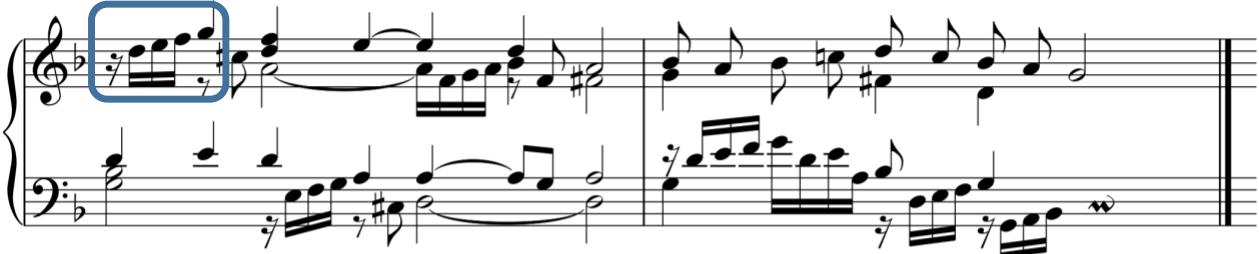
中文讲解
此为 Example 3b 的图注兼图像占位符:Frescobaldi《Libro primo》《Toccata decima》(第十首托卡塔)第 31-32 小节。该例与 3a 同属 P0146 所引"Example 3a-c"之列,是 Frescobaldi 特异性写法的第二个谱例版本,跨度为两小节(31-32),意味着该音型在该处持续时间比 3a 更长。
第7段(P0151)
原文复述

中文讲解
此为 Example 3c 的图注兼图像占位符:Frescobaldi《Secondo libro》《Toccata quarta》(第四首托卡塔)第 12-13 小节。作为 P0146 所引"Example 3a-c"的第三例,与 3a、3b 一同展示"两声部分担上行四度 + 下方音持续"这一 Frescobaldi 特异写法的多种具体形态;其出处属第二册而非第一册,提示该写法在 Frescobaldi 不同创作阶段中皆有延续。
补充说明
此例出自 Frescobaldi 第二册(具体出版年份本节未交代,需查原书)。
第8段(P0152)
原文复述

中文讲解
此为 Example 3d 的图注兼图像占位符:Rossi 的《Toccata ottava》(第八首托卡塔)第 19 小节。该例对应 P0147 第一句——Rossi 在此处把持续音放在上方而非下方,故与 Frescobaldi 3a-c 形成方向上的对照。
第9段(P0153)
原文复述

中文讲解
此为 Example 3e 的图注兼图像占位符:Rossi 的《Toccata prima》(第一首托卡塔)第 18-21 小节。该例跨度为四小节,对应 P0147 第二句所述"由跳音分隔的多组 offbeat 上行音阶片段"以及"假模仿性"写作,是判断"第一段为四度、其后为更流动的音阶"这一区分的实证依据。
第10段(P0154)
原文复述
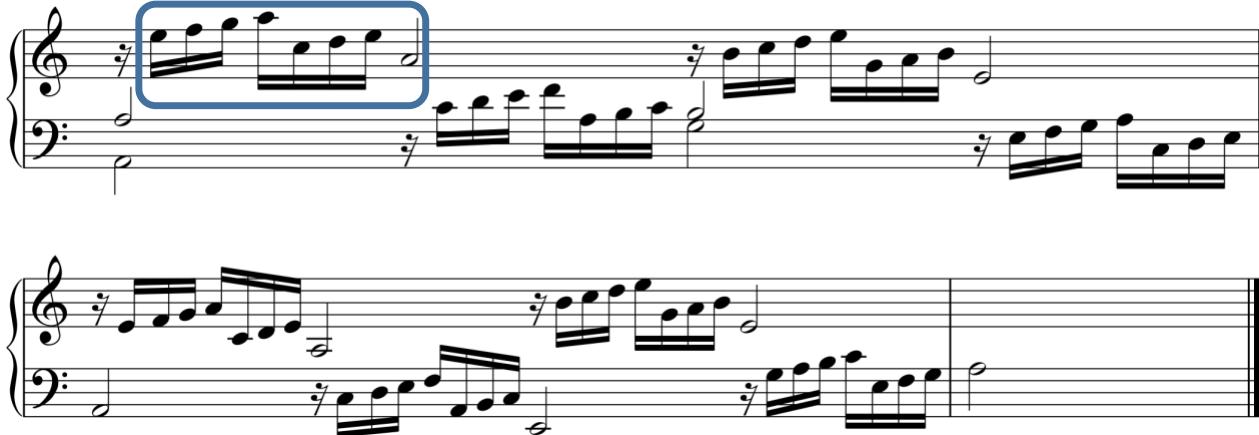
中文讲解
此为 Example 3f 的图注兼图像占位符:Froberger《Libro secondo》《Toccata IV》(第四首托卡塔)第 5-6 小节。同一行"Example 3 a-f. Offbeat ascending fourth patterns"是整组 Example 3 的总标题,标注了上标 65。该例对应 P0147 第三句,作为 Froberger"两段上行构成模仿乐段 + 第二段被截短"写法的实证。
补充说明
上标 65 指向 P0156 的脚注,仅说明 Rossi 谱例(3d、3e)的转写来源;Frescobaldi 与 Froberger 例的版本来源本节未给出。
第11段(P0155)
原文复述
A second figuration or formula is created from two pairs of ascending steps, comprising either tones or semitones, separated by a skip. [Example 4a-d] This pattern is harmonically mobile, nearly always contains some chromatic alteration, and may be manipulated to create or to avoid cadential expectations. This pattern too, is frequently positioned on an offbeat, creating forward movement, and may be split across ‘voice’ parts in sequential passages. Froberger uses it as a cadential approach in the final bars of the first two toccatas of his Libro secondo. Rossi uses a similar pattern in the ‘Decima toccata’ but, instead of creating cadential impetus, it is used in an imitative passage in which the rhythmic placing shifts the accent between stronger and weaker metrical positions. This figuration is related to patterns comprising an offbeat neighbour-note figure, followed by a skip. These appear both in the context of passaggi and as motifs used in imitation [Example 5a-c]
中文讲解
本段在第一种 formula(offbeat 上行四度)的基础上引入第二种 formula:由两对上行音级(全音或半音)组成、各对之间以跳进分隔的固定音型(Example 4a-d)。
作者指出其有三层可塑性:(1) 和声上灵活(harmonically mobile),几乎总带某种 chromatic alteration;(2) 既可被用来制造 cadential expectations(终止期待),也可被用来回避之;(3) 同样常置于 offbeat,从而推动旋律向前,并在 sequential(模进)段落中被拆分到不同"声部"。
作曲家使用此 formula 的修辞目的各异:Froberger 把它作为《Libro secondo》前两首托卡塔末段的 cadential approach(导向终止的过门);Rossi 在《Decima toccata》中则把类似音型纳入模仿性段落,通过节奏位置的强弱交替来改变重音落点,因此不再带来 cadential impetus。
本段最后把第二种 formula 与另一相关音型——“offbeat 邻音 + 跳进”——联系起来,指出后者既出现在 passaggi 中也作为模仿主题使用(Example 5a-c),由此把本节讨论的两个音型在节奏-动机维度上串接。
补充说明
段中提到的 Example 4a-d 与 Example 5a-c 在本节页面范围内未给出谱例,需结合下文或其他节次定位。
第12段(P0156)
原文复述
65 All Rossi extracts in this example and those below are transcribed from Toccate e correnti d’intavolatura d’organo e cimbalo, (Rome: Ricarii, 1657); Facsimile edited by Laura Alvini, Archivium musicum, Collana di testi rari vol 12 (Florence: Studio per edizioni scelte, 1982).
中文讲解
此为脚注 65,对应 P0154 谱例总标题中的上标。该脚注说明:本节 Example 3 以及其下文中所有 Rossi 谱例,均转写自 1657 年罗马 Ricarii 出版的 Rossi《Toccate e correnti d’intavolatura d’organo e cimbalo》;其影印本由 Laura Alvini 编辑,收入 Archivium musicum 丛书 Collana di testi rari 第 12 卷(佛罗伦萨:Studio per edizioni scelte,1982)。该脚注对正文主张属来源/版本说明——读者若需核对谱例,应以这一影印本为准;它既不支持也不限定具体的音乐分析结论,仅交代文本依据。
补充说明
脚注仅说明 Rossi 例的版本来源;Frescobaldi 与 Froberger 例的转写来源在本节未交代。
脚注 / 边栏 / 图表 / 附加信息(如有)
本节附有 Example 3 的六个谱例(图注 P0148、P0150、P0151 与图像占位 P0149、P0152、P0153、P0154),分别取自 Frescobaldi《Libro primo》Toccata quinta m. 22、Toccata decima mm. 31-32、《Secondo libro》Toccata quarta mm. 12-13,Rossi 的 Toccata ottava m. 19、Toccata prima mm. 18-21,以及 Froberger《Libro secondo》Toccata IV mm. 5-6;其作用是支撑 P0146–P0147 关于"offbeat 上行四度"在三位作曲家笔下不同形态的论述。P0154 行末附脚注 65(P0156),交代 Rossi 谱例的转写来源(1657 罗马 Ricarii 原版与 Alvini 1982 影印)。P0155 中提及的 Example 4a-d、5a-c 在本节页面范围内未呈现谱例,需结合后文或其他节次定位。
💡 本节核心要点
- 上行四度(及五度)音型既是调式 species 边界的标志,又因键盘上手感便利而成为托卡塔写作中的常用词汇。
- 从休止或延音后起奏的"offbeat 上行四度"是该节识别的第一种 formula:offbeat 位置使其指向"到达上方音",并依音级安排暗示或回避终止;将同一组音置于强拍则意义相反。
- Frescobaldi 的特征性写法是把这一音型分给两声部、下方音持续;Froberger 与 Rossi 也使用该音型,但"两声部分担 + 下方音持续"的安排似为 Frescobaldi 所特有。
- Rossi 通过把持续音移到上方、或扩展起首音程(tone→third,使勾勒音程从四度变五度)、或将多个 offbeat 音阶片段用跳音连接等手段,使同一种 formula 承担不同修辞功能。
- Froberger 以两段上行构成模仿乐段,第二段被截短,从而以"未完成"的形式呼应 offbeat 上行四度的修辞潜力。
- 第二种 formula 为"两对上行音级 + 跳进分隔",和声灵活、常含半音变化,可制造或回避终止期待;Froberger 用作收束式趋近,Rossi 在《Decima toccata》中则把它纳入模仿性段落并通过强弱拍切换改变重音落点。
🔑 关键术语
- offbeat ascending fourth:从弱拍或休止/延音后起奏的级进上行四度音型,本节第一种 formula;其节奏位置直接决定其修辞指向——指向"到达上方音"或"离开下方音"。
- species boundaries:教会调式内部由全音与半音位置所划定的调式属性边界;本节特指通过四度、五度音型所勾勒的调式特征轮廓。
- passaggi:键盘/声乐作品中作为装饰或过渡运行的音阶式或音型化段落;本节指 offbeat 上行四度等音型可出现于其中的语境之一。
- cadential approach:引向终止的进行/收束式过门;本节第二种 formula 在 Froberger《Libro secondo》前两首托卡塔末尾即被用作此类进行。
- pseudo imitative character:类似模仿但不严格遵守模仿规则的写作;Rossi《Prima toccata》mm. 18-21 的多组 offbeat 音阶片段被作者归入此类。
- harmonic mobility:音型在和声配置上的灵活性;本节特指第二种 formula 因几乎总含半音变化、和声选择余地较大这一特性。
ch5_sec3 [描述性拆分] Step-pair, neighbour-note, and skip-separated scale patterns
第1段(P0157)
原文复述
An embedded figure caption reads: “a) Frescobaldi: Libro primo, Toccata sesta, 16.” The image data itself has been omitted; only the caption and the figure’s position on page 29 are retained from the original layout.

中文讲解
这是位于第 29 页的 Example 4 子图(a)。从图题我们只能确认它所引为 Frescobaldi《Libro primo》中《Toccata sesta》第 16 小节。它与随后的三个子图共同组成 Example 4,组标题为「Patterns of pairs of ascending steps」(成对上行级进模式)。实际乐谱已被嵌入图片占位符替换,需查阅原图才能看到音符内容。
第2段(P0158)
原文复述
An embedded figure caption reads: “b) Frescobaldi: Secondo libro, Toccata undecima, 6-7.” The image data itself has been omitted; only the caption and the figure’s position on page 29 are retained from the original layout.

中文讲解
Example 4 第 29 页的子图(b)。图题标明出处为 Frescobaldi《Secondo libro》中《Toccata undecima》第 6–7 小节。其内容是否对应「一对上行级进」,必须查阅原图核验。
第3段(P0159)
原文复述
An embedded figure caption reads: “c) Froberger: Libro secondo, Toccata 1, final bar.” The image data itself has been omitted; only the caption and the figure’s position on page 29 are retained from the original layout.
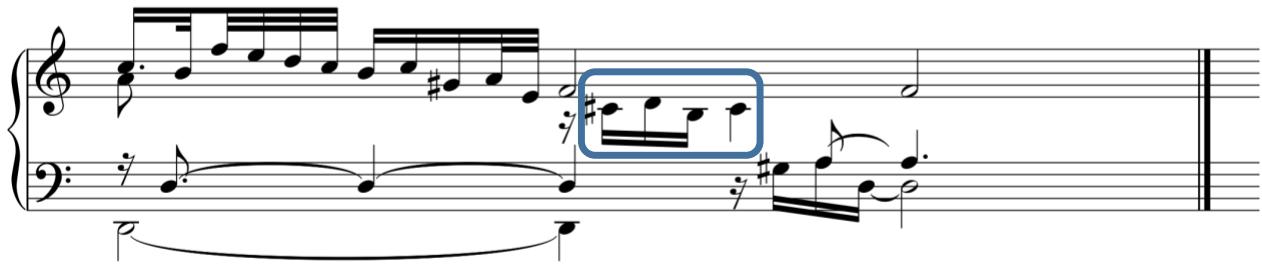
中文讲解
Example 4 第 29 页的子图(c)。图题注明其出处为 Froberger《Libro secondo》《Toccata 1》最末小节,由此把同一种「成对上行级进」模式扩展到 Frescobaldi 之外的作曲家,作为第三实例。
第4段(P0160)
原文复述
An embedded figure caption reads: “d) Rossi: Toccata decima. 39-41; Example 4a-d. Patterns of pairs of ascending steps.” The image data itself has been omitted; only the caption and the figure’s position on page 29 are retained from the original layout.

中文讲解
该图题同时承担两重功能:一是为 Example 4 加上最后一个子图(d)——Rossi《Toccata decima》第 39–41 小节;二是给出组合图的组标题「Example 4a-d. Patterns of pairs of ascending steps」。组合图题明确把 a、b、c、d 四个例子统一在同一种「成对上行级进」名下。从选段顺序上(Frescobaldi a、b → Froberger c → Rossi d)可看出,作者意在说明该模式跨越三位作曲家皆有使用。
补充说明
此条同时承担了子图注与组合图注的角色;其音程骨架与示例 a、b、c 之间的呼应需查阅原图。
第5段(P0161)
原文复述
An embedded figure caption reads: “a) Frescobaldi: Libro secondo, Toccata prima, b. 8.” The image data itself has been omitted; only the caption and the figure’s position on page 30 are retained from the original layout.

中文讲解
位于第 30 页的 Example 5 子图(a)。图题标明出处为 Frescobaldi《Libro secondo》《Toccata prima》第 8 小节。这是第二种典型模式——「Neighbour note-skip patterns」(邻音-跳进模式)——三例中的第一例,由 Frescobaldi 领起。
第6段(P0162)
原文复述
An embedded figure caption reads: “b) Rossi: Sesta toccata, b.18.” The image data itself has been omitted; only the caption and the figure’s position on page 30 are retained from the original layout.

中文讲解
第 30 页 Example 5 的子图(b),引自 Rossi《Sesta toccata》第 18 小节。作者把 Rossi 安排在两例 Frescobaldi / Froberger 之间,体现此模式为三作曲家所共用。
第7段(P0163)
原文复述
An embedded figure caption reads: “c) Froberger: Libro secondo, Toccata III, b. 6-7; Example 5a-c. Neighbour note-skip patterns.” The image data itself has been omitted; only the caption and the figure’s position on page 30 are retained from the original layout.

中文讲解
此图题同样身兼双重功能:附加子图(c)——Froberger《Libro secondo》《Toccata III》第 6–7 小节,并给出组合图标题「Example 5a-c. Neighbour note-skip patterns」。由此把第二种模式在三家作品中的存在完整呈现。
补充说明
此条同时承担了子图注与组合图注的角色。
第8段(P0164)
原文复述
A further pattern used by Frescobaldi in both passaggi and in contrapuntally active contexts is composed of a stepwise ascending fourth and descending third, separated by a single note a skip away from both scale portions. [Example 6a-c] The two scalic elements remain constant, but the distance of the skip is variable, making this a remarkably malleable figure. Its most frequent placing is between two chords, commencing from an offbeat. The central skip determines the pitch on which the figure ends, so the pattern may be used to prolong a single harmony or to change harmony. Rossi also uses this pattern in his ‘Ottava toccata’. Variants in which either the ascent or descent are shortened are also found, as in Example 7 from Frescobaldi’s Libro primo which likewise uses a stronger rhythmic profile.
中文讲解
本段是本小节的核心句子,引入第三种也是最复杂的一类模式:「上行级进四度 + 下行级进三度 + 与两段音阶皆隔一个跳进的中央音」。它由正文 P0164 给出规则,P0165–P0167 的谱例佐证之。其精要如下:
- 使用场合双轨:Frescobaldi 既在装饰性跑句(passaggi,复数形式)里使用此模式,也在对位活跃的声部里使用——由此排除了「它只属于某一类织体」的解释。
- 恒定骨架 + 可变跳进:两段音阶(一段上行四度、一段下行三度)保持不变,但分隔它们的「skip」距离可调。这种「骨不变、皮可变」正是作者称之为 a remarkably malleable figure(极富弹性的音形)的原因。
- 节奏位置:典型放置在两个和弦之间,从 offbeat(弱拍)起。
- 和声功能由中央跳进决定:中间的 skip 同时决定整条音形的收尾音,因此同一个外形既能单纯延长同一个和弦,也能跳到另一和声——这正是一形两用的根源。
- 跨作曲家流通:Rossi 在《Ottava toccata》中也用同一模式,进一步证明此模式并非 Frescobaldi 独有。
- 截短变体与节奏强化:上行或下行任一段被缩短即得 truncated 变体,对应 Example 7,来自《Libro primo》。作者强调截短版与之配套的是「更强的节奏轮廓」(a stronger rhythmic profile),即不仅旋律骨架缩短,节奏也被加重。
本段在论证链中的位置:先用规则引出模式,再用节奏与和声功能解释其灵活性,再通过跨作曲家与变体形式夯实证据,为末尾 P0169 关于「模式功能灵活而非单一」的综合判断备好素材。
补充说明
「skip」在本段中特指乐谱上把两段级进隔开的那一个跳进音;「offbeat」即弱拍,是相对于每小节强拍的位置;截短变体(truncated scale segments)的具体乐例见 P0168(Example 7)。
第9段(P0165)
原文复述
An embedded figure caption reads: “a) Frescobaldi: Libro secondo, Toccata quinta, 44-47.” The image data itself has been omitted; only the caption and the figure’s position on page 31 are retained from the original layout.

中文讲解
第 31 页 Example 6 的子图(a),引自 Frescobaldi《Libro secondo》《Toccata quinta》第 44–47 小节。它是 P0164 所述「上行四度 + 下行三度 + 中间跳进」模式的第一例乐谱证据。
第10段(P0166)
原文复述
An embedded figure caption reads: “b) Frescobaldi: Primo libro, Toccata prima, 22-23.” The image data itself has been omitted; only the caption and the figure’s position on page 31 are retained from the original layout.

中文讲解
第 31 页 Example 6 的子图(b),引自 Frescobaldi《Primo libro》《Toccata prima》第 22–23 小节。它与子图(a)一同表明 Frescobaldi 在不同作品集里都使用了同一种模式。
第11段(P0167)
原文复述
An embedded figure caption reads: “c) Rossi, Toccata ottava, bb. 62-3; Example 6a-c. Ascending and descending scale segments separated by a skip.” The image data itself has been omitted; only the caption and the figure’s position on page 31 are retained from the original layout.
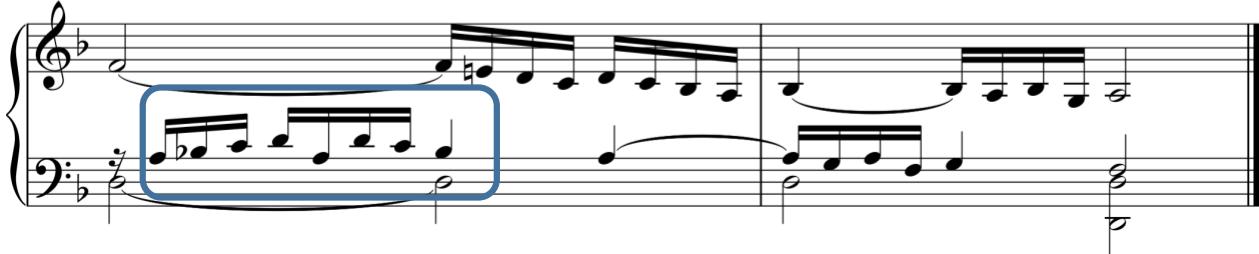
中文讲解
此图题同时承担子图注与组合图注:附上子图(c)——Rossi《Toccata ottava》第 62–63 小节,并给出组合标题「Example 6a-c. Ascending and descending scale segments separated by a skip」。这正是 P0164 行文中提到「Rossi also uses this pattern in his ‘Ottava toccata’」的乐谱依据。
补充说明
此条同时承担了子图注与组合图注的角色;与 P0164 的同名曲对应。
第12段(P0168)
原文复述
An embedded figure caption reads: “Frescobaldi: Libro primo, Toccata seconda, 16-17; Example 7: Truncated scale segments separate by a skip.” The image data itself has been omitted; only the caption and the figure’s position on page 31 are retained from the original layout.

中文讲解
这是第 31 页独立的 Example 7,引自 Frescobaldi《Libro primo》《Toccata seconda》第 16–17 小节。如 P0164 末尾的预告所述,它展示「截短」的音阶变体(上行或下行任一段被缩短),且因为 P0164 又指出其节奏轮廓被加重,所以这是一例既截短又被节奏加强的形态。单独的 Example 7 之存在,反向加强了 P0164 的断言:跳进分隔的音阶段不是单一固定形状,而是一族相关形状。
补充说明
原图题中「separate by a skip」按上下文语境应作「separated by a skip」,疑为笔误,但意思保持不变。
第13段(P0169)
原文复述
These patterns all have identifiable intervallic derivations, predominantly thirds, fourths and fifths, which suggests that they may function in relation to modal boundaries, and place them in a theoretical framework based on projection of modal finals. In addition, their relationship to specific intervals allows for them to behave like diminutions as substitutes for those intervals. Not only does one find identical figures in different contexts and in different modes, but also derivatives of these figures created from the alteration of a single interval or change in melodic direction. While there are differences in the way these patterns are used by Frescobaldi, Rossi and Froberger, the fact that they appear in so many different contexts suggests that individually they do not carry a specific function, such as pre-cadential extension or building passaggi, but are flexible enough for a range of purposes including points of imitation, sequence, chromatic alteration to shift harmonic direction, or fulfilment of cadential expectation. However, they are not generally used as exordial motifs at the start of a composition, and seldom as head motifs initiating contrapuntal sections. However, the presence of such patterns does not mean that there is a lack of cohesion in the compositions or, conversely, that they are predictable. Indeed, some of Frescobaldi’s toccatas indicate an almost organic treatment of motif.[66]
中文讲解
本段是本小节的总结段落,承担「综合收束」的功能。要点如下:
- 音程溯源 → 调式解释:上文所列三种模式都能追溯到具体音程——以三度、四度、五度为主(predominantly thirds, fourths and fifths)。由此把它们放在一个「从调式终音向外投射」(projection of modal finals)的理论框架里,并推测它们与 modal boundaries(调式边界)相关。这是从「记谱外形」上升到「调式结构理论」的关键一步。
- 作为减值的等价物:由于这些模式与具体音程挂钩,它们可以被理解为那些音程的 diminutions(减值),即某一音程的细密展开形式,而非独立的全新旋律线。
- 高复用度 + 高可变性:完全相同的音形能在不同模式(modes)与不同上下文中出现;同时也存在由「改动一个音程」或「改变方向」生成的衍生形态。因此它们是「同一底层骨架上的多种样态」。
- 功能灵活而非单一:作者明确否定「它们各自带有特定功能」这一假设(如终止前延展、组建 passaggi),转而列举多种可能用途——points of imitation(模仿进入点)、sequence(模进)、chromatic alteration(半音化以转和声)、fulfilment of cadential expectation(满足终止期待)。
- 使用场合的负向边界:然而这些模式一般不当作曲首的 exordial motifs(开篇动机),亦较少作为对位段起始的 head motifs(主题进入动机)。这两个反向界定是为了避免上一条被读作「无差别万能」。
- 避免反向误解:作者进而澄清——出现这些模式并不意味作品缺乏整体连贯性,反过来也不意味作品变得可预测。最后以「几乎有机的动机处理」(organic treatment of motif)形容部分 Frescobaldi 托卡塔,并把脚注 66 标记在此处。
本段在小节中的地位:把上面三组谱例(步进对、邻音-跳进、跳进分隔音阶段)的具体证据抽象到调式理论层面;同时既主张功能灵活性,又通过两条负向限制与两条「不会怎样」的澄清,避免结论被绝对化;最后以审美层面的「有机处理」一语做结。
补充说明
末尾上标 66 对应原文一个脚注,具体脚注正文未在所给段落范围内,无法在此复述。注意文中的限定语(predominantly、may function、individually they do not、not generally、seldom 等)都直接服务于作者「避免把结论绝对化」的写作策略。
脚注 / 边栏 / 图表 / 附加信息(如有)
本小节含四个组合谱例:Example 4(第 29 页,4a–d,由 Frescobaldi《Libro primo · Toccata sesta》、Frescobaldi《Secondo libro · Toccata undecima》、Froberger《Libro secondo · Toccata 1》、Rossi《Toccata decima》汇集,主题为「Patterns of pairs of ascending steps」);Example 5(第 30 页,5a–c,由 Frescobaldi《Libro secondo · Toccata prima》、Rossi《Sesta toccata》、Froberger《Libro secondo · Toccata III》汇集,主题为「Neighbour note-skip patterns」);Example 6(第 31 页,6a–c,由 Frescobaldi《Libro secondo · Toccata quinta》、Frescobaldi《Primo libro · Toccata prima》、Rossi《Toccata ottava》汇集,主题为「Ascending and descending scale segments separated by a skip」);Example 7(第 31 页,单独,引自 Frescobaldi《Libro primo · Toccata seconda》,主题为「Truncated scale segments separate by a skip」)。P0169 末尾有上标编号 66,对应一个脚注,脚注正文不在本节切片范围内。
💡 本节核心要点
- 本节归纳出三种在三作曲家(Frescobaldi、Rossi、Froberger)作品中流通的典型旋律模式:成对的上行级进(Example 4a–d)、邻音-跳进模式(Example 5a–c)、以及以跳进分隔的上下音阶段(Example 6a–c、Example 7),以乐谱例证显示其跨作曲家复用。
- 第三种模式(Examples 6–7)由 P0164 给出规则:上行级进四度 + 下行级进三度,由一个跳进音隔开;跳进距离可变而骨架恒定,故同一外形既能延长也可转换和声,并有截短的衍生形态。
- 三种模式的音程来源以三度、四度、五度为主,作者把它们放进「projection of modal finals」(从调式终音向外投射)的框架,并视为相关音程的减值(diminutions),由此跨过从记谱外形到调式理论的解释。
- 这些模式在多上下文、多模式中重复出现并可由改一个音程或改方向衍生新形态,作者由此断定它们各自并不承担单一功能(既非专用于终止前延展,也非仅用于构建 passaggi),而是可服务于模仿进入、模进、半音化以转和声、满足终止期待等多种目的。
- 它们的使用有明确边界:一般不当作曲首动机(exordial motifs),也较少作为对位段起始动机(head motifs),这两条负向界定防止前面的功能灵活性被读作万能。
- 这些模式的存在并不意味作品缺乏整体连贯性,也不意味作品变得可预测;Frescobaldi 部分托卡塔中的动机处理被形容为几近「organic」(有机的),最后这一评语把本节从旋律-调式分析层面推回到审美层面做结。
🔑 关键术语
- step-pair(成对上行级进):指 Example 4a–d 的模式名——同一音方向上「级进 + 级进」的成对出现,是本节讨论的第一类共享模式。
- neighbour note-skip pattern(邻音-跳进模式):Example 5a–c 的模式名:先以邻音装饰,再以跳进落到目标音。本节讨论的第二类共享模式。
- skip-separated scale pattern(以跳进分隔的音阶段模式):Example 6a–c 与 Example 7 的模式名。骨架为级进上行接级进下行,中间由一个跳进音分开;跳进距离可变而两段音阶不变,正是 P0164 所论之核心模式。
- passaggi:意大利文,复数形式,泛指键盘音乐中的装饰性跑动短句;在 P0164 中该词出现时与「contrapuntally active contexts」并列,用以标志该模式的使用场合之一。
- offbeat:弱拍;P0164 指出该模式「最常见的起点」,用以解释其节奏-和声对接方式。
- projection of modal finals / modal boundaries:P0169 提出的理论框架:把模式的音程溯源(三、四、五度)与调式边界相关联,并视为「自调式终音向外投射」的产物。
- diminutions(减值):在 P0169 中特指「由具体音程细密展开而成的旋律形态」。本节把那些共享模式看作它们所源音程的减值,从而既保留音形又保留音程身份。
- points of imitation / sequence / chromatic alteration / cadential expectation:P0169 列举的四种模式可能用途:模仿进入、模进、半音化以转和声、满足终止期待。它们构成「功能灵活而非单一」论证的正面清单。
- exordial motifs / head motifs:曲首动机 / 对位段起始动机;P0169 用以界定这些模式的负面使用场合,避免读者把前面的灵活性误读为全场景万能。
- organic treatment of motif:「有机的动机处理」;P0169 末尾的审美描述,用于形容 Frescobaldi 部分托卡塔中动机近乎自然生长的状态。本节以此与上文模式分析并置作为美学层面收束。
ch6_sec1 [描述性拆分] The Chigi manuscript Q.IV.25 and shared formulaic patterns
第1段(P0170)
原文复述
Beyond single author collections: intertextuality and ascription
中文讲解
这是一个二级或三级小节的标题。标题中的关键词是 intertextuality(互文性,指不同作品之间相互引用、共享素材的现象)和 ascription(归属/题献指定,指手稿或印刷谱上写明的作者归属)。标题宣告本节将离开“单一作曲家全集”的讨论框架,转而面对两个相互纠缠的问题:不同作曲家之间共享的音乐语汇到底意味着什么?手稿上写明的作者归属是否可靠?这是后续段落即将展开的核心议题。
第2段(P0171)
原文复述
The repetition of figurations in single author collections, both print and manuscript, by different composers raises the question as to whether such formulae have composer-specific variants, or whether they are more generally representative of an oral tradition that happens to have been preserved in a single-composer print or, in the case of Froberger, manuscript. In order to address this question, a manuscript collection that scholars agree is representative of the Roman keyboard tradition of the period 1630–50, Biblioteca Apostolica Vaticana – Vat Mus Chigi Q.IV.25 (henceforth Chigi 25), will present an illuminating case.
中文讲解
本段为本节提出研究问题并选定研究对象。它先指出一个经验事实:不同作曲家、不同载体的单一作者合集里反复出现相同的音型(figuration);由此提出两种可能的解释:其一,这些音型是带有作曲家个人变体的风格标记;其二,它们其实属于一个更宽泛的口头传统,只是恰好被印在了某位作曲家的集子里,或在 Froberger 的情况下被保存在手稿中。作者随后引入 Chigi 25 作为考察对象:这部手稿被学界公认为 1630–1650 年罗马键盘传统的代表,因此成为检验“音型究竟属于某位作曲家还是属于整个传统”这一问题的理想案例。这段为整节设定了问题—材料—方法的基本结构。
第3段(P0172)
原文复述
This manuscript bears an ascription to Frescobaldi on the flyleaf, but its authorship has been disputed for decades and the literature about it is sizeable.⁶⁷ The main scribal hand is that of
中文讲解
本段指出 Chigi 25 在扉页(flyleaf,即装订前后留出的空白页,常用于题献或署名)上题有 Frescobaldi 之名,但作者归属已争论数十年,相关文献也相当丰富,并给出脚注 67 作为引证。段末的句子跨越到了下一页,但本段的主要功能在于交代 Chigi 25 的归属争议:扉页题献不能作为作者认定的可靠证据,这是后面“是否真为 Frescobaldi 所作”讨论的前提。
第4段(P0173)
原文复述
⁶⁶ Motivic structures are discussed in more detail in my PhD dissertation, Analytical issues in the toccatas of Girolamo Frescobaldi, (Royal Holloway, University of London, 1995).
中文讲解
这是脚注 66,引用作者自己 1995 年在英国皇家霍洛威学院(Royal Holloway, University of London)完成的博士论文《Frescobaldi 托卡塔的分析问题》,作为本节对动机结构(motivic structures)作进一步讨论的出处。其作用是引导希望深入了解动机分析的读者去查阅作者本人的早期研究,本节正文不再展开动机分析的细节。
第5段(P0174)
原文复述
⁶⁷ Claudio Annibaldi, ‘La didattica del solco tracciato: Da ‘klavierbuchlein’ d’ignoti a prima fonte fresocbaldiana autografa’, Rivista italiana di musicologia, 20 (1985) 44–97; ‘Ancora sulle messe attribuite a Frescobaldi: proposta di un profittevole scambio’, in Sergio Durante and Dinko Fabris (eds) Girolamo Frescobaldi nel IV centenario della nascita: atti del convegno internazionale di studi, Ferrara 1983, Florence: Olschki, 1986) 125–152: Musical autographs of Frescobaldi and his entourage in Roman sources, Journal of the American Musicological Society XLIII (1990) 393–425; Was Frescobaldi a chameleonic scribe? Early music, XL (2012) 172; Etienne Darbellay, ‘The manuscript Chigi Q.IV.24 of the Biblioteca Apostolica Vaticana as Frescobaldian source: new criteria for authenticity’ in Claire Fontijn (ed) Fiori musicali: liber amicorum Alexander Silbiger (Michigan: Harmonie Park Press, 2010) 23–38; Hammond, Girolamo Frescobaldi, 258; Christine Jeanneret, L’oeuvre en filigrane, (Florence: Leo S. Olschki, 2009) 287–303; Leonhardt, G. ‘Johann Jacob Froberger and his music’. L’organo vi (1968) 15–40; Silbiger Italian manuscript sources, 123–125; ‘The
中文讲解
这是脚注 67 的一部分,列出围绕 Chigi 手稿归属问题的代表性文献。主要学者包括:Annibaldi(多篇文章涉及 Frescobaldi 罗马资料及其“变色龙”式的抄写特征)、Darbellay(关于 Chigi Q.IV.24 的真伪标准)、Hammond(其 Frescobaldi 传记第 258 页)、Jeanneret、Leonhardt(涉及 Froberger)、Silbiger(关于意大利手稿来源)等。这条脚注的功能在于用学术史为“归属争议几十年”这一判断提供文献支撑:Chigi 25 的归属问题不是作者的孤立看法,而是整个早期键盘研究界长期关注的议题。
第6段(P0175)
原文复述
Nicoló Borbone, one of Frescobaldi’s pupils, who was also an organist and composer in his own right as well as the engraver of Frescobaldi’s two toccata publications. Although the last three toccatas of the manuscript are the focus of most of the debates concerning the possible composer of the manuscript, they provide ideal case studies here. I have argued elsewhere that they may be examples of student work demonstrating the absorption of the Roman toccata idiom.⁶⁸ However, regardless of composer or purpose, these pieces represent compositional treatment of texture that is consistent with toccatas of a similar provenance and time period as can be seen in Figures 2–4 above.
中文讲解
本段承上句补完 Chigi 25 主抄写者的身份:Nicoló Borbone 是 Frescobaldi 的学生,自身也是风琴家与作曲家,并且承担了 Frescobaldi 两本托卡塔集子的雕版印刷工作。段中进一步收窄分析对象:手稿最后三首托卡塔是归属争论的焦点,但同时也是本节最理想的案例。作者此前已经论证这三首可能是展示罗马托卡塔语汇习得过程的“学生作业”。然而本节的关键论点在于悬置归属问题:无论作者是谁、创作目的如何,这三首作品所呈现的织体处理方式与同时期同来源的托卡塔一致——也就是说,论证的支点从“谁写的”转向“它们体现了什么样的共性”。这是从归属辩论到风格/语汇分析的方法论转折。
补充说明
Borbone 既是抄写者又是雕版师这一事实本身就说明 17 世纪罗马作曲家之间存在密切的师承与合作关系,是后文“共性语汇”论断的具体语境。
第7段(P0176)
原文复述
The typically Frescobaldian trill-type motifs appear, although there are fewer of them and they are not predictably near the start of each piece. Moreover, the types of motif used in contrapuntal sections are also consistent with generic expectations. Patterns based on an offbeat ascending fourth are present, though as with the trill-type motifs, there are fewer of them. However, the similarity of one occurrence of this gesture in the first of these toccatas to passages in Rossi and Froberger’s work is evident. Example 8. The offbeat neighbour-note pattern also appears in the Chigi toccatas in passages that resemble Rossi and Froberger shown in Example 9.
中文讲解
本段开始进入具体的音型比对,列出 Chigi 末三首托卡塔中可以观察到的三类音型:1)典型的 Frescobaldi 式颤音型动机(trill-type motifs),数量较少,且不像在 Frescobaldi 自身作品中那样可预测地出现在乐曲开头;2)基于弱拍上行四度的音型(offbeat ascending fourth),同样数量较少,但其中一次出现与 Rossi 和 Froberger 的段落高度相似(见 Example 8);3)弱拍邻音音型(offbeat neighbour-note pattern),也出现在 Chigi 托卡塔中,并与 Rossi 和 Froberger 的段落相似(见 Example 9)。作者用“出现得少”“并非可预测”这类限定条件来避免读者把这三首直接等同于 Frescobaldi 本人的作品;同时“与 Rossi、Froberger 相似”则是本节核心论点的具体落实:这些音型不属于某位作曲家,而是被同时期的罗马圈子共享。
补充说明
“offbeat ascending fourth”指的是在一个节拍的非重音位置出现、由较低音向上跳进纯四度或增四度再回落的音型;“offbeat neighbour-note pattern”则指弱拍上的上下邻音环绕。两者都是 17 世纪键盘托卡塔中常见的对位片段模式。
第8段(P0177)
原文复述
Nicoló Borbone, one of Frescobaldi’s pupils…(上文延伸) ‘The Roman Frescobaldi tradition c.1640–1670’ in Journal of the American Musicological Society 33 (1980) 42–87; Van Asperen, B, ‘Drei Toccaten in der Handschrift Chigi Q.IV.25: Űberlegungen zu einer möglichen Zuschreibung an Johann Jacob Froberger’ in Concerto: Das Magazin fur Alte Musik, 26 (2009) 34–41 ⁶⁸ ‘Learning the trade: What was Froberger doing in Rome?’ in Avec discrétion: rethinking Froberger, edited by Andreas Vejvar and Markus Grassl, Wiener Veröffentlichungen zur Musikgeschichte 14, (Vienna: Böhlau Verlag, 2018) 205–221
中文讲解
本段是脚注 67 的延续与脚注 68。延续部分给出 Silbiger 1980 年关于 1640–1670 年罗马 Frescobaldi 传统的文章,以及 Van Asperen 2009 年德文文章直接讨论 Chigi Q.IV.25 中三首托卡塔并提出可能归属 Froberger 的考量。脚注 68 是作者本人 2018 年发表的关于 Froberger 在罗马“学艺”的文章。整体作用是:既把 Chigi 与 Rossi、Froberger 的关系(脚注 67 中的 Silbiger、Van Asperen)也把作者自己关于师承与“学艺”过程的论述(脚注 68)作为论据的文献基础。
补充说明
Van Asperen 的德文标题提示这是直接讨论 Chigi 三首托卡塔归属问题的少数专题论文之一;与本节把 Chigi 与 Rossi、Froberger 并置比较的思路一致。
第9段(P0178)
原文复述

中文讲解
这是 Example 8 的图 a 位置:取自 Chigi 手稿 Q.IV.25 第一首托卡塔 1a 第 3 小节起的乐谱片段。由于嵌入图像数据已省略,需要查看原书图例以核对音符细节。其在论证中的功能是作为 Chigi 一方“offbeat ascending fourth”音型的实例,与随后 Rossi、Froberger 的实例并置比较。
补充说明
无额外补充(无法在原文以外补充乐谱具体音)。
第10段(P0179)
原文复述

中文讲解
Example 8 的图 b:取自 Rossi《Toccata prima》第 27 小节起的乐谱片段,用以与 Chigi 片段进行“offbeat ascending fourth”音型的相似性比较。图像数据已省略,需查原书。
第11段(P0180)
原文复述

中文讲解
Example 8 的图 c 及图题:取自 Froberger《Secondo libro, Toccata IV》第 5 小节起的乐谱片段,与 Chigi、Rossi 并置;图题指明三例共同点为“offbeat ascending fourth pattern”。上标 69 对应脚注 69,提示三例的乐谱来源。
补充说明
三个例证按 Chigi–Rossi–Froberger 顺序排列,意在显示同一音型跨越作曲家与出版物类型而存在,支撑本节“共性语汇”论点。
第12段(P0181)
原文复述
⁶⁹ Extracts from the Chigi toccatas are transcribed from the facsimile edition, edited by Alexander Silbiger Vatican, Biblioteca apostolica vaticana, MS Chigi Q.IV.25 (New York and London: Garland, 1988)
中文讲解
脚注 69 标明:Example 8、9 中所有取自 Chigi 托卡塔的片段都转录自 Alexander Silbiger 主编的 Chigi Q.IV.25 全彩影印版(New York and London: Garland, 1988)。其作用是为读者提供可信的原始来源,使“Chigi 与 Rossi、Froberger 音型相似”这一论断建立在可核对的影印本之上。
第13段(P0182)
原文复述

中文讲解
Example 9 的图 a:取自 Chigi 手稿 Q.IV.25 第一首托卡塔 1a 第 25 小节起的乐谱片段,作为“offbeat neighbour-note pattern”的 Chigi 实例。图像数据已省略,需查原书。
第14段(P0183)
原文复述

中文讲解
Example 9 的图 b:取自 Froberger《Secondo libro, Toccata III》第 10 小节起的乐谱片段,用以与 Chigi 片段比较“offbeat neighbour-note pattern”。
第15段(P0184)
原文复述

中文讲解
Example 9 的图 c 与图题:取自 Rossi《Toccata quinta》第 19 小节起的乐谱片段;图题说明三例并置比较的是“offbeat neighbour-note patterns”。这一组例证与 Example 8 共同支撑作者关于“音型跨作曲家共享”的主张:两种不同的音型在 Chigi、Rossi、Froberger 三位作曲家的作品中以高度相似的方式出现。
第16段(P0185)
原文复述
In addition to the Frescobaldian motivic formulae in this manuscript, there are also some longer figurations that are used by Rossi and Frescobaldi, such as a scalic gesture in contrary motion that Kirkendale described as a circulatio figure, and the use of a persistent ostinato in one hand against a changing pattern in the other.⁷⁰ Both of these gestures are created by physical movement of the hands. In the case of the former, both hands move in opposite directions, in the latter, one hand remains stationery and the other moves away from it. The presence of such formulaic patterns and motifs suggests that a repertory of common gestures used by the performer-composers of the time has been absorbed by the composer of this manuscript, and in all probability was learned working at the keyboard.
中文讲解
本段把论证从较短动机扩展到更长的音型:除了 Frescobaldi 式的动机公式外,Chigi 25 还包含 Rossi 和 Frescobaldi 都使用的两类较长音型——其一,Kirkendale 称为 circulatio(环绕式)的反向音阶进行;其二,一只手保持固定音型(persistent ostinato)、另一只手在其上方或下方持续变化的固定音型加对比音型组合。作者进一步指出,这两类音型都由手的物理动作直接产生:前者需要双手反向移动,后者则是一手固定、另一手在空间上展开。这一从“乐谱形态”到“演奏动作”的转译,是本节最关键的理论推进:它解释了这些“共性音型”之所以能在不同作曲家、不同手稿/印本中保留下来,是因为它们根植于键盘演奏的肢体习惯,最可能是“在键盘上工作”中学到的。换言之,传承的渠道不是乐谱的抄写,而是身体训练与口耳相传的演奏实践——这正是开篇“oral tradition”假设的具体落实。
补充说明
“circulatio”原为古典修辞学术语,Kirkendale 将其借用至音乐分析,描述音阶或旋律以环形方式环绕中心音运动;这里特指双手反向进行的音阶式乐句。
第17段(P0186)
原文复述
⁷⁰ Warren Kirkendale, “Circulatio”-Tradition, “Maria Lactans”, and Josquin as Musical Orator, Acta Musicologica Vol. 56, Fasc. 1 (Jan. – Jun., 1984), pp. 69–92, DOI: 10.2307/932617, http://www.jstor.org.libezproxy.open.ac.uk/stable/932617
中文讲解
脚注 70 给出 Kirkendale 1984 年《Acta Musicologica》文章的完整信息,作者借用其中“circulatio”这一术语来描述 Chigi 25 与 Rossi、Frescobaldi 共有的反向音阶进行。该脚注为正文中的术语溯源提供学术依据,并提示“circulatio”概念源自更宏观的古典—文艺复兴修辞学—音乐学传统(Kirkendale 在该文中将 Josquin 的音乐视为“演说家”)。
脚注 / 边栏 / 图表 / 附加信息(如有)
本节包含五处脚注(66、67、68、69、70)和两组图例(Example 8 与 Example 9)。脚注 66 引作者本人博士论文作为动机分析背景;脚注 67(分两段置于正文之间)汇集 Annibaldi、Silbiger、Darbellay、Hammond、Jeanneret、Leonhardt、Van Asperen 等学者围绕 Chigi 归属问题的代表性文献;脚注 68 引作者本人 2018 年关于 Froberger 在罗马学艺的文章,作为“学生作业”论点的出处;脚注 69 标明 Chigi 片段转录自 Silbiger 1988 年影印版;脚注 70 引 Kirkendale 1984 年文章,说明“circulatio”术语的来源。两组 Example(8 与 9)每组各含 Chigi、Rossi、Froberger 三段乐谱,按相同顺序排列,平行展示两类音型(offbeat ascending fourth 与 offbeat neighbour-note pattern)在三位作曲家作品中的相似形态。
💡 本节核心要点
- 本节将研究问题从单一作曲家全集的归属问题转向音型共享问题:相同 figurations 反复出现,究竟是作曲家个人风格还是更广泛口头传统的产物?
- 作者选择 Chigi Q.IV.25 作为案例,因为它被学界公认为 1630–1650 年罗马键盘传统的代表,而其扉页归属 Frescobaldi 又长期存在争议,正好适合检验归属与共性语汇的张力。
- Chigi 25 的主抄写者 Nicoló Borbone 是 Frescobaldi 的学生、也是 Frescobaldi 两本托卡塔集子的雕版师,这一师承与合作关系本身就是“罗马圈共性语汇”形成机制的缩影。
- Example 8(offbeat ascending fourth)与 Example 9(offbeat neighbour-note pattern)通过 Chigi–Rossi–Froberger 三方并置,以可核对的乐谱证据显示这些音型跨越作曲家而存在,否定“作曲家专属变体”的解释。
- 本节最重要的理论推进在于将共性音型追溯到键盘演奏的物理动作(双手反向移动、一手固定另一手展开),由此把口头传统的载体从“乐谱”落实为“身体训练”,呼应开篇的 oral tradition 假设。
- 论证策略上,作者有意悬置归属问题(无论是 Frescobaldi 本人、Borborne,还是学生作品),把分析重点放在“同时期同来源作品的织体共性”,从而把 Chigi 25 从归属争议的焦点转化为研究共性语汇的窗口。
🔑 关键术语
- intertextuality:互文性,指不同音乐作品或文本之间相互引用、共享素材的现象;本节标题用此概念宣告讨论将从单一作者转向作品之间的关系。
- ascription:归属/题献指定,指手稿或印刷谱上写明的作者署名;本节指出 Chigi 25 的扉页 ascription 长期受到学界质疑。
- Chigi Q.IV.25:梵蒂冈宗座图书馆藏 Chigi Q.IV.25 手稿,被学界公认为 1630–1650 年罗马键盘传统的代表,但扉页归属 Frescobaldi 存在争议。
- Nicoló Borbone:Frescobaldi 的学生,自身也是风琴家、作曲家,并承担了 Frescobaldi 两本托卡塔集子的雕版印刷;Chigi 25 的主抄写者。
- figuration:音型/织体公式,指反复出现的固定旋律—节奏形态;本节讨论的核心对象,是检验其是否属于作曲家个人风格或共性口头传统的关键。
- offbeat ascending fourth:弱拍上行四度音型,弱拍位置出现由较低音跳进四度再回落的固定模式;本节通过 Example 8 展示其在 Chigi、Rossi、Froberger 之间的相似性。
- offbeat neighbour-note pattern:弱拍邻音音型,以弱拍上的上下邻音环绕为特征的对位片段模式;本节通过 Example 9 展示其跨作曲家共享。
- circulatio:源自 Kirkendale《Acta Musicologica》1984 年文章中的术语,本节特指双手反向进行的音阶式乐句,被解释为源于键盘演奏时双手反向的物理动作。
- persistent ostinato:一只手保持固定的固定音型(ostinato),另一只手在空间上展开变化音型;本节将其与 circulatio 并列,作为与键盘演奏动作直接对应的较长共性音型。
ch6_sec2 [描述性拆分] Modular composition, concordances, and the limits of authorship attribution
第1段(P0187)
原文复述
Where ‘stock’ patterns are used in different rhythmic and harmonic contexts, and in pieces with very different ’thematic’ content, they cannot be considered concordant in the sense of establishing some kind of compositional priority between sources. Instead, these ‘concordances’ mark both sources as displaying evidence of oral composition. Intertextuality is likely to arise from the use or re-use of memorised and previously worked formulae while performing and composing at the keyboard. In itself, the presence of such patterns is perhaps not significant, but it brings into question the presence of partial concordances between sources as an argument for authorial identity, and demands a deeper understand of composerspecific uses of common gestures and formulae. Concordances comprising patterns that are primarily derived from memorised diminution patterns that are also not genre-specific, are particularly problematic if used as indicators of common authorship.
中文讲解
本段是本小节论证的核心前提:作者要对"concordance(共律)“作为归属证据的有效性提出限制。当一个"固定模式”(stock pattern)出现在节律、和声语境与主题内容都不同的乐曲中时,它不能用来证明某一来源在作曲上优先于另一来源。换言之,这种共律只表明两个来源都具备即兴式/口传式创作的痕迹,互文性来自键盘演奏者在现场演出和创作时对记忆中的公式的调用与复用。仅仅出现这些模式本身并不重要,但它动摇了用"局部共律"来论证两首作品出自同一作者的做法,并要求研究者更细致地研究特定作曲家对常规手势与公式的独特运用。尤其当共律源自被记忆的减值模式(diminution patterns)且不具备体裁特异性时,把它当作共同作者的证据是尤其危险的。
补充说明
本段的关键词是区分"concordance as evidence of shared oral practice"与"concordance as evidence of shared authorship"——这一区分贯穿本章后续对具体谱例的判读。
第2段(P0188)
原文复述
Jeanneret has argued that the correnti in the manuscript F-Pn, Rés.Vmc 64 (henceforth Paris 64) are evidence of a process of composition in which small motivic patterns form the basis of a composition that is worked out first in miniature, elaborated to form a more worked out second stage, and progressing to a final, finished composition – a process she terms ‘modular’.[71] The generic nature of the motivic pattern in question (Paris 64, fol. 2, bar 5 and bar 11) which is identical to formulae for one of the most basic embellishments of the interval of an ascending third in the ‘regola prima’ of Ganassi’s Fontegara, and which also appears in Sancta Maria’s treatise repeated to extend it to fill a longer note value, I would argue, is evidence of a performative compositional process.[72] This same ‘module’ is also found in the third of Rossi’s published correnti. A very similar pattern that is essentially an inversion of it is used in Rossi’s Corrente seconda.
中文讲解
本段引入 Jeanneret 的"模块化(modular)“创作理论:巴黎 64 手稿中的库朗舞曲显示了一个从草稿→展开→完成曲的渐进过程,由小动机层层发展而成。作者接续 P0187 的论点,认定 Paris 64 fol. 2 第 5、11 小节的那个动机并非个人化的标志,而是与 Ganassi《Fontegara》“regola prima"中上行三度最基本装饰公式完全一致,也出现在 Sancta Maria 教材中"重复以填满更长时值"的同一条公式。这意味着该模式来自演奏性的即兴装饰传统,而非作者独特的"签名”。同一个"模块"还在 Rossi 已出版的第三首库朗中出现,而 Rossi 第二首库朗中则使用了它的近似倒影。本段功能:把一个看似具体的共律实例,嫁接到一个跨多个作曲家、跨越整个 16 世纪装饰教学传统的通用公式上,从而稀释其归属证据力。
补充说明
Jeanneret 提出的"modular"概念与 P0187 的论证形成对位:模块化恰好解释了为何同一公式可以在不同作曲家笔下反复出现。
第3段(P0189)
原文复述
Another pattern identified by Jeanneret as a concordance between Paris 64 fol. 2, and the corrente prima from Frescobaldi’s Secondo libro (Example 10) also appears in the sarabanda from Froberger’s ‘Partita seconda’. With one interval changed (the upward skip of a third, becomes a repetition of the same pitch), it appears also in the courant from the same suite. As with the module identified above, this pattern too derives from embellishment practices and can be found in Ganassi’s regola prima as an embellishment of a descending second. There are enough of Froberger’s other dances that contain gestures of a similar ‘shape’ (to use the Réti-an terminology) that these patterns cannot be said to have an authorial identity, for example, the courantes of the Libro secondo, Partita seconda, and Partita quarta and Libro quarto Partita prima and Partita seconda. The patterns lie under the hand and are manipulated using memorised combinations and permutations, rather than demonstrating an evolving written process.
中文讲解
本段进一步强化 P0188 的论证。Jeanneret 标记的 Paris 64 fol. 2 与 Frescobaldi《Libro secondo》库朗 prima 之间的另一个共律模式(参见 Example 10),同样出现在 Froberger《Partita seconda》的萨拉班德中——若把其中"上行跳三度"改为"同音重复”,它也出现在该组曲的库朗中。这一模式同样来自装饰实践,可在 Ganassi regola prima 中作为下行二度的装饰公式找到。Froberger 其他舞曲(如 Libro secondo 的 Partita seconda、Partita quarta,以及 Libro quarto 的 Partita prima、Partita seconda 的库朗)中也有大量"形状"(作者借用了 Réti 的术语)相似的手势,因此这些模式无法被视为作者身份的标志。它们"躺在手底下",被演奏者以记忆中的组合与排列调用,而非用作书写过程演进的证据。本段功能:从 Froberger 一人笔下找到同一模式的多重变体,说明该模式是作曲家共有的"手势库",而非某人的专利。
补充说明
作者引入 Réti 主题分析中的"shape"概念,但借用其强调"跨作品、跨作曲家的相似手势",而非将其用于严格的作者归属。
第4段(P0190)
原文复述
[71] Christine Jeanneret, ‘Un cahier d’ébauches autographe inédit de Frescobaldi (F-Pn, Rés.Vmc 64)’, Recercare Vol. 17 (2005), 135-159 and ‘Places of memory and invention: The compositional process in Frescobaldi’s manuscripts’, in Andrew Woolley and John Kitchen (eds) Interpreting historical keyboard music (Farnham: Ashgate, 2013,) 65-81 (74)
中文讲解
这是注 71,引用 Jeanneret 两篇关于 Frescobaldi 手稿(特别是 F-Pn, Rés.Vmc 64,即 Paris 64)的文章:第一篇 2005 年发表于《Recercare》第 17 卷,第 135–159 页;第二篇收录于 Woolley 与 Kitchen 主编的《Interpreting historical keyboard music》(Ashgate, 2013)第 65–81 页,正文引文出自第 74 页。该注释支撑 P0188 中 Jeanneret 关于"模块化"创作过程的论点。
第5段(P0191)
原文复述
[72] Sancta Maria, Libro llamado arte taner fantasia, (Valladolid: Francisco Fernandez de Cordova, 1565) facsimile edition. (Farnborough: Gregg international Publishers, 1972) 58-59; Silvestro Ganassi, Opera intitulata Fontegara (Venice, 1535), https://ia800706.us.archive.org/13/items/imslp-intitulata-fontegara-ganassisylvestro/PMLP46423-001ganassi.pdf ; Ganassi, Opera intitulata Fontegara, translated by Hildemarie Peter (Berlin: Robert Lienau, 1956)
中文讲解
注 72 提供 P0188 中所引两条装饰公式的原始文献出处:Sancta Maria《Libro llamado arte taner fantasia》(1565, Valladolid, 1972 年 Gregg 影印本第 58–59 页),以及 Ganassi《Opera intitulata Fontegara》(1535, Venice)的原版 PDF 链接与 Hildemarie Peter 1956 年德译本(Robert Lienau 出版社, Berlin)。该注释支撑作者将 Paris 64 的动机与 16 世纪装饰教学传统直接挂钩的论证。
第6段(P0192)
原文复述
These generic embellishment patterns are perhaps more exposed in the simpler dances than they are in more complex pieces such as the toccatas. However, successive combinations of the same type of diminutions may add up to florid passaggi found in the keyboard toccatas. However, successive combinations of the same type of diminutions may add up to florid passaggi found in the keyboard toccatas. They should not therefore be used as a concordance to identify anonymous work, unless there is a substantial passage and an identical accompanying framework of other elements, including rhythmic character and harmonic or contrapuntal context.
中文讲解
本段指出方法论上的限制:这些通用装饰模式在简单舞曲(如前文库朗、萨拉班德)中比在托卡塔等复杂作品中更容易被识别,但同类减值的连续叠加本身就足以在托卡塔中累积为华丽的跑句(florid passaggi)。因此,除非存在(1)大段落的对应,以及(2)其他要素——节律特征、和声或对位语境——所形成的"伴随框架"完全一致,否则不应把这种模式作为匿名作品归属的共律证据。换言之,作者为本章的归属判断设下了一个相当严格的标准:单一公式的吻合是不够的。
补充说明
本段明确给出判断"concordance 可信度"的两条并行条件:substantial passage + identical accompanying framework。这意味着作者并非全盘否定共律的证据力,而是要求它必须达到"量"与"框架一致性"的双重门槛。
第7段(P0193)
原文复述
a) Frescobaldi: Corrente, Paris 64, fol 2, after Jeanneret in Woolley and Kitchen, p. 72
中文讲解
这是 Example 10 的子图注 a,标识所引用的乐谱片段:Frescobaldi《Corrente》,出自手稿 Paris 64 第 2 叶。该片段依据 Jeanneret 在 Woolley 与 Kitchen 主编论文集中第 72 页的转写。
第8段(P0194)
原文复述
[嵌入图像数据已省略;位置与图注保留]

中文讲解
此处为 Example 10a 对应的乐谱图像占位符。该图位于第 38 页,与 P0193 的图注 a 直接对应,内容应为 Paris 64 fol. 2 上的库朗乐谱片段本身。需查看原图以确认具体音符与节奏。
补充说明
由于图像未嵌入,仅可由 P0193 图注确认其来源与作者,无法从图中读取更多细节。
第9段(P0195)
原文复述
b) Frescobaldi: Libro secondo, Corrente prima, bb.1-3

中文讲解
Example 10 的子图注 b,标识乐谱片段:Frescobaldi《Libro secondo》《Corrente prima》开头 1–3 小节。该片段与图注 a 构成本段论证中那个"模块"在已出版版本中的对应物。
第10段(P0196)
原文复述
c) Froberger, Libro secondo, Partita secondo - Sarabanda, b. 1
中文讲解
Example 10 的子图注 c,标识乐谱片段:Froberger《Libro secondo》《Partita seconda》(原文写作 Partita secondo)萨拉班德第 1 小节。该片段用以说明 P0189 所述"同一模式在 Froberger 萨拉班德中再次出现"。
第11段(P0197)
原文复述
[嵌入图像数据已省略;位置与图注保留]

中文讲解
此处为 Example 10c 对应的乐谱图像占位符,位于第 38 页,与 P0196 图注对应,内容应为 Froberger 上述萨拉班德第 1 小节的乐谱。需查看原图以确认细节。
补充说明
无法从占位符本身获取乐谱细节,所有信息以 P0196 图注为限。
第12段(P0198)
原文复述
d) Froberger. Libro secondo, Partita secondo - Courant, b.1
中文讲解
Example 10 的子图注 d,标识乐谱片段:Froberger《Libro secondo》《Partita seconda》库朗第 1 小节。该片段说明 P0189 所述"将上行跳三度改为同音重复后该模式出现于同一组曲的库朗"。
第13段(P0199)
原文复述
Example 10. Intertextuality of Frescobaldi’s compositional module

中文讲解
这是 Example 10 的总标题,统辖 P0193–P0198 四个子图(a/b/c/d),其命题为"Frescobaldi 创作模块的互文性"。这一标题把四个来源(Paris 64 手稿草稿、Frescobaldi 已出版版本、Froberger 萨拉班德、Froberger 库朗)并置在同一页,正是为了直观呈现 P0188–P0189 中所述的论点:同一装饰公式跨越草稿、出版曲与不同作曲家之手,构成互文而非作者签名。
补充说明
该图整体在版面中承担"视觉证据"角色:读者若同时对照四段乐谱,可看到其骨架一致而细节有变,正与正文所谓"shape 相似、intervals 微调、口传公式被记忆调用"的论点相呼应。
脚注 / 边栏 / 图表 / 附加信息(如有)
本节包含两个脚注(71, 72)和一组谱例(Example 10,带 a–d 四个子图)。例 10 位于第 38 页,将 Frescobaldi 草稿(Paris 64, fol. 2)、Frescobaldi 已出版的《Libro secondo》库朗 prima、Froberger 萨拉班德与库朗并置;脚注 71 标注 Jeanneret 的两篇研究,脚注 72 标注 Sancta Maria 与 Ganassi 装饰教学传统的原始文献。谱例与脚注共同支撑正文论点:被定位为"共律"的模式实际上源于 16 世纪共通的装饰公式库,因而不能作为归属证据。
💡 本节核心要点
- 核心论点:当"固定模式"出现在不同节律、和声与主题语境中时,应将其解读为口传式/即兴式创作的证据,而非作者身份的标志。
- 对归属方法学的限制:单一装饰公式的吻合不足以判定共同作者;需要大段落对应加上节律、和声/对位等"伴随框架"的高度一致。
- Jeanneret 的"模块化"创作理论是论证的关键依托:Paris 64 显示从草稿到完成曲的渐进过程,由小动机层层展开。
- 作者通过将一个具体模式同时回溯到 Ganassi 的 Fontegara 与 Sancta Maria 的教材,证明该模式属于跨作曲家的通用装饰教学传统。
- Froberger 多首库朗与萨拉班德中"形状"相近的手势,构成同一作曲家笔下的多组变体,进一步削弱"该模式仅属某人"的假设。
- Example 10 的四段并置乐谱从视觉上把上述论证压缩在一页之内,使读者能够直观对比"骨架一致、细节有变"的互文关系。
🔑 关键术语
- concordance:原指不同谱源之间的旋律或动机一致。在本节中,作者剥离其作为"归属证据"的传统用法,限定其仅在"具有识别价值的口传/即兴共有实践"层面有意义。
- modular composition / 模块化创作:Jeanneret 提出的概念,描述小动机先以雏形出现、再被展开、最终成为完整乐曲的渐进过程;本节据此强调模式的可复用性。
- stock pattern / 固定模式:在多种节律与和声语境中反复出现的固定旋律片段,作者认为其属于共同的装饰实践而非作曲家个人标志。
- diminution / 减值:对较长音符进行装饰性细分以填满时值的传统技法;本节强调同类减值的连续叠加即可形成托卡塔中的华丽跑句。
- regola prima (Ganassi):Ganassi《Fontegara》中关于音阶与装饰的首要规则集;本节以此为权威依据,把上行三度/下行二度的基本装饰公式定位为跨作曲家共有的教学传统。
- performative compositional process / 演奏性创作过程:作者用来描述键盘手在演奏中即兴调用并调整记忆公式的创作方式;与"书面化的逐步演进"形成对照。
- shape (Réti-an):借用自 Réti 主题分析的术语,作者用其指跨作品、跨作曲家的相似手势轮廓,而非严格的作者归属标记。
- intertextuality / 互文性:本节中指多个来源因共享口传公式库而形成的文本间呼应;与"作者身份证明"严格区分。
ch7_sec1 [描述性拆分] Macrostructure, microstructure, and the embodied practice of oral composition
第1段(P0200)
原文复述
Conclusions
中文讲解
这是章节标题“Conclusions”,标志着本章进入结论部分。其功能是告诉读者:接下来的段落将不再展开新分析,而是综合前文论证、归纳研究发现,并指出尚待解决的问题。
第2段(P0201)
原文复述
The toccata, as a genre, fulfilled certain expectations in terms of sections of specific types of texture, starting with a chordal opening followed by a variety of contrapuntal sections and passage work of increasing density. That the composers were aware of the contrasts and different characters of such sections is evident in the prefaces that suggest ways of playing that separate and highlight affetti. The unwritten practices of performance, or ‘delivery’ to use the rhetorical term, thus map onto the generic formulation of the macrostructure. The contrast and balancing of one affetto, or texture, against another suggests a reading of the prefaces that indicates a performance practice informed by structural as well as affective considerations. It may also afford a new way of evaluating the musical syntax of the keyboard toccata in relation to other instrumental genres such as the emerging sonata.
中文讲解
本段从宏观结构层面总结托卡塔的体裁特点。作者指出托卡塔作为体裁满足了一系列织体预期:先以和弦式开头,随后是多种对位段落,密度递增的经过句段落。作曲家意识到这些段落之间的对比与不同性格,这一点体现在他们所写的序言中——序言提示演奏方式以区分并凸显不同affetti(情感/性格)。作者借用了修辞学中的“delivery”(表达/演绎)一词来指代未写明的演奏实践,并论证这种未写明的演奏映射到宏观结构的体裁构成上。不同affetto(即不同织体)之间的对比与平衡,意味着序言应被理解为一种既反映结构又反映情感考虑的演奏实践。这一结论还可能为评价键盘托卡塔的“音乐句法”提供新视角,并将其与新兴的奏鸣曲等器乐体裁并置比较。
第3段(P0202)
原文复述
Within the microstructure, the presence of multiple formulaic patterns in toccatas at one level reinforces Diruta’s claim that toccatas are ‘all diminutions’ and, in the work of Merulo, this is proved to be the case by the tiny amount of contrapuntal activity in relation to the overall length of his toccatas. Embellishment and rearrangement of simple ideas in multiform ways as seen in the examples here, seem to parallel the Erasmian notion of copia. If common educational practice is a reliable model, we can assume a level of learning by rote and example, copying the work of the ‘great masters’, and using ‘master’ works as exemplars for deriving new pieces. Indeed, Ganassi’s presentation of embellishments in his treatise suggests that the pupil should start from the simpler patterns, playing and memorising them, and then move on to patterns that are rhythmically more complex. Diruta, in addition, teaches his fictional pupil about modes so, perhaps for the keyboard player, learning flourishes that map onto modal boundaries or common cadence formulae in both hands would also have featured in that process.
中文讲解
本段从宏观结构转向微观结构。论证逻辑有三层:第一层,多种公式化模式的存在印证了Diruta的论断——托卡塔“皆为装饰”(all diminutions);在Merulo的作品中,这一点被作品长度的对位活动极少的比例所证实。第二层,那种以多种方式修饰与重组简单构思的做法,与伊拉斯谟的copia(丰饶/繁复)概念平行。第三层,作者提出教学传承的假设:学习者通过死记硬背与临摹,复制“大师”作品并以其为范本衍生新作——Ganassi论装饰的著作就体现了从简单模式死记硬背、再进阶到节奏复杂模式的循序渐进过程;而Diruta向其虚构学生教授调式,意味着键盘演奏者学习的花饰可能也对应着调式边界或常见终止公式,双手皆有涉及。
第4段(P0203)
原文复述
For composers beyond Venice, the picture is more complex, with passages that are provably ‘all diminutions’ broken up by contrapuntal sections, the motifs of which are in many cases themselves formulaic. The formulae used in more complex antiphonal or contrapuntal contexts identified above in the toccatas of Frescobaldi, Rossi and Froberger, are evidence of a compendium of gestures that the composer-performer may have drawn on while working at the keyboard. The frequency of note patterns that fill a fifth or fourth suggests not only allegiance to modal boundaries, but also that, for the performer at the keyboard, they ‘fall
中文讲解
本段将视野从威尼斯扩展到其他作曲家。段意分三层:其一,威尼斯以外的作曲家呈现更复杂的面貌——明确为“皆为装饰”的段落被对位段落打断,而这些对位段落的动机本身在许多情况下也是公式化的。其二,Frescobaldi、Rossi与Froberger托卡塔中出现的复杂对位或应答式上下文中的公式,证据性地表明作曲家-演奏者在键盘上工作时可能调取了一套动作姿态的汇编。其三,频繁出现填满五度或四度的音型,既呼应调式边界,也意味着这些音型对键盘演奏者而言是“顺手”(fall under the hand)可弹的——本句未完,下段P0205续完。
第5段(P0204)
原文复述
73 Dell’Antonio’s conclusions drawn from examination of early sonata and canzona publications could perhaps be applied to keyboard and lute music. See Dell’Antonio, Syntax, form and genre
中文讲解
这是脚注73。它指出:通过对早期奏鸣曲与坎佐纳出版物的考察所得出的Dell’Antonio的结论,或许可以推广运用于键盘与琉特音乐。这是为P0205(乃至更广泛的方法论主张)所做的支撑性旁注,指引读者查阅Dell’Antonio的《Syntax, form and genre》。
第6段(P0205)
原文复述
under the hand’. Analysis in order to map interval patterns and their placement in either left or right hand, along with evidence of fingering patterns, may provide further evidence of the performative origins of these formulae.
中文讲解
本段续接P0203最后一句,以“under the hand”收尾。作者紧接着提出后续研究方法:通过分析音程模式及其在左右手的分布,并结合指法证据,可进一步证明这些公式的演奏来源——即手指的物理动作塑造了书面文本中保留下来的公式。
第7段(P0206)
原文复述
The formulaic patterns outlined in the analyses above all seem to signal memorising, copying, embellishing and expanding as part of an oral compositional process that has been preserved in the written text. Learning processes based on repetition, memory and the embedding of physical movement in a kinetic memory results in elements of intertextuality almost by default, as finger patterns and hand movements are repeated in different contexts. It is this inadvertent intertextuality preserved in written compositions that betrays the oral and performative compositional process. The fact that these vestiges of the compositional processes can be extracted does not undermine suggestions that the books may have been pedagogical models, monuments of collected works, or attempts to preserve a single outstanding performance, but they can add to our understanding of the unwritten conceptualisation and genesis of the toccata as a genre.
中文讲解
本段是结论部分的核心论点。论证分三步:第一步,分析中显现的公式化模式指示着口述式创作过程——记忆、复制、装饰与扩展——这一过程被凝固在书面文本中。第二步,建立在重复、记忆与肢体动作嵌入身体记忆(kinetic memory)基础上的学习过程,几乎默认会让指法与手部动作在不同语境中重复,从而自动产生互文性;正是这种“无意间产生”的互文性泄露了口述与演奏性的创作过程。第三步,作者谨慎地限定自己发现的效力——能够提取这些创作过程的痕迹,并不否定曲集可能同时也是教学范本、作品汇集或某次重要演奏的记录,但确实可以加深我们对托卡塔体裁未明言的概念化方式与生成机制的理解。
第8段(P0207)
原文复述
How musicians learned compositional skills, and especially the question as to how sections of counterpoint created using unwritten techniques and passages more loosely based on motivic patterns or formulae are fitted together on a conceptual level, needs further research. My analysis has demonstrated that contrapuntal passages become increasingly important in the toccata over time. As the average length of the toccata decreased, the frequency, density and length of contrapuntal sections increased, marking the transition from the toccata that is ‘all diminutions’ to one that is texturally more varied. As part of this process, specific parts of the toccata were populated by specific textures: the opening with chords or chords with diminutions; the end with a complex contrapuntal section followed by passaggi or passi doppi to create a final flourish. Newcomb’s description of Frescobaldi’s toccatas as following a ‘flexible procedural paradigm’ is apt, as the flexibility of any underlying organisational principles of the central sections is precisely the problem.74 However, formulaic gestures comprising both diminution patterns and combinatorial permutations may have been memorised in the way that artists used model books or orators used key phrases or quotations from classical sources, positioning them and combining them to suit a new context.75 The presence of common types of section seems to suggest parallels with rhetoric which, like
中文讲解
本段呈“问题—证据—解释—类比”结构。问题:音乐家如何学习作曲技巧,尤其是使用未明言技巧所写的对位段落与基于动机模式或公式的段落如何在概念层面衔接,仍需进一步研究。证据:作者的分析表明托卡塔中的对位段落随时间推移日益重要——平均长度缩短的同时,对位段落的频率、密度与长度均增加,标志着从“皆为装饰”向“织体更丰富”的过渡;具体段落开始固化为特定织体:开头为和弦或和弦加装饰,结尾为复杂对位段落接passaggi或passi doppi以制造终曲花饰。解释:Newcomb用“灵活的程序范式”(flexible procedural paradigm)描述Frescobaldi的托卡塔,这一概括十分贴切,因为中央段落任何潜在组织原则的灵活性本身就是问题所在。类比:尽管如此,包含装饰模式与组合排列两类的公式化动作姿态,可能像艺术家使用“范本册”或演说家使用经典名言那样被记忆下来,并被重新定位与组合以适应新语境。常见段落类型的出现似乎提示与修辞学的平行——本句未完,下段P0210续完。
第9段(P0208)
原文复述
74 Newcomb, ‘Guardare ed ascoltare le toccate’, 286
中文讲解
这是脚注74。它为正文P0207中引用的Newcomb“flexible procedural paradigm”提供出处:Newcomb,《Guardare ed ascoltare le toccate》,第286页。属于支撑性来源脚注。
第10段(P0209)
原文复述
75 Busse Berger, ‘Models for composition in the fourteenth and fifteenth centuries’ 69-75
中文讲解
这是脚注75。它为P0207中“公式化动作姿态像艺术家范本册或演说家经典语录那样被记忆”的类比提供学术来源:Busse Berger,《Models for composition in the fourteenth and fifteenth centuries》,第69–75页。属于支撑性来源脚注。
第11段(P0210)
原文复述
composition at the keyboard, was an unwritten skill derived from practices of verbal delivery. Testing the validity of a hypothetical rhetorical structure as a generic procedure in the keyboard toccata (as opposed to examining the use of surface figures as codified by later German theorists) would demand analysis of a significant sample and is an area for future research.
中文讲解
本段续接P0207,呼应其“parallels with rhetoric”的提法。论证要点:键盘作曲如同修辞写作,是一种源自口头表达实践的未明言技能;要验证“假想中的修辞结构”作为键盘托卡塔体裁程序的有效性(而不是分析后日耳曼理论家编码的表层修辞手法),需要分析一份足够大的样本,这是未来研究的方向。
第12段(P0211)
原文复述
The presence of the many motivic formulae do not rule out the hypotheses of Bradshaw and Silbiger that toccatas are based on pre-existent models, whether those are cantus firmi or secular polyphonic madrigals. However, such models may be deeply hidden by the successive processes of learning by imitation, emulation and expansion over more than one generation of teacher-pupil transmission.
中文讲解
本段处理本研究的结论与既有学术假说的关系。作者承认:众多动机公式的存在并不排除Bradshaw与Silbiger提出的假说——托卡塔基于既有模型(无论是cantus firmi还是世俗多声音乐合唱曲)。但作者同时指出,这类潜在模型可能因代际师徒传承中“模仿—仿效—扩展”层层叠加的过程而被深深掩盖。其论证的克制之处在于:既不否定既有假说,也不抬高自身发现,而是承认多层创作过程的叠加可能混淆源头。
第13段(P0212)
原文复述
The need to preserve and transmit larger scale compositions, even if the written medium was inadequate and however they were designed conceptually, ultimately has given us a window through which to view, albeit obliquely, a distant performative practice. Notwithstanding some considerable lacunae in our knowledge, the identification of different techniques and patterns within the toccata as a genre, is a step toward understanding the performative skill of composing at the keyboard.
中文讲解
本章最终结语。作者承认两点限制:书面媒介本身不够充分,并且作品在概念上如何被设计仍存在不确定性;尽管如此,正是保存与传播较大规模作品的需要,使我们得以透过一个虽是间接但仍可辨识的窗口,去观察一段已经远去的演奏实践。最后一句收束主线:尽管知识存在相当大的空白,对托卡塔体裁内部技术与模式的识别,仍是理解键盘演奏性作曲技艺向前迈出的一步。
脚注 / 边栏 / 图表 / 附加信息(如有)
脚注73(P0204):DELL’ANTONIO《Syntax, form and genre》——指出对早期奏鸣曲与坎佐纳的考察方法可推广至键盘与琉特音乐,是方法论旁注。脚注74(P0208):NEWCOMB《Guardare ed ascoltare le toccate》第286页——为P0207中“flexible procedural paradigm”提供来源。脚注75(P0209):BUSSE BERGER《Models for composition in the fourteenth and fifteenth centuries》第69–75页——为P0207中公式化模式与艺术范本册/经典语录的类比提供学术来源。三条脚注均为支撑性来源脚注,本节无图表或边栏。
💡 本节核心要点
- 托卡塔的宏观结构遵循一套可预期的织体序列:和弦式开头 → 对位段落 → 密度递增的经过句,作曲家对此有自觉意识,并在序言中提示如何通过演奏凸显不同affetti。
- 未明言的演奏实践(借用修辞学中的“delivery”一词)映射到体裁的宏观结构上,意味着演奏同时受结构与情感两方面考虑。
- 微观结构层面,公式化模式印证了Diruta“托卡塔皆为装饰”的论断(Merulo作品尤为典型),与伊拉斯谟的copia概念平行;教育传承过程以记忆、临摹、循序渐进的练习为基础。
- Frescobaldi、Rossi、Froberger等威尼斯以外作曲家的复杂段落中,公式仍构成一套“手势汇编”,频繁出现的五度、四度音型既对应调式边界,也对应手指的顺手动作。
- 书面文本中保存下的“无意间产生的互文性”是口述与演奏性创作过程的痕迹;这一发现不否定教学范本、作品汇编或演出记录等其它假说,但拓展了对托卡塔未明言生成机制的理解。
- 托卡塔随时间发展呈现:长度缩短、对位段落的频率/密度/长度增加,特定段落固化为特定织体(开头为和弦/和弦加装饰,结尾为复杂对位+passaggi/passi doppi);Newcomb的“flexible procedural paradigm”正概括了这种结构灵活性。
- 作者发现不排除Bradshaw与Silbiger关于既有模型(cantus firmi或世俗多声音乐合唱曲)的假说,但代际师徒传承的模仿—仿效—扩展过程可能已将这些源头深深掩盖。
🔑 关键术语
- affetti:指作品中不同情感或性格段落所对应的演奏方式与表达取向;作曲家在序言中提示演奏方法以区分并凸显不同affetti,是本节将宏观结构与演奏实践联系的关键概念。
- macrostructure:本节指托卡塔作为体裁在大型尺度上的织体序列与结构预期,是作者用以区别于microstructure的概念。
- microstructure:本节指托卡塔内部小尺度的组织方式,包括公式化模式、装饰动机与对位细节等。
- copia:伊拉斯谟意义上的概念,指通过对简单构思的修饰与重组获得多形式的丰富性;本节用来刻画托卡塔中装饰模式以多种形态出现的方式。
- passaggi / passi doppi:本节指托卡塔结尾处用以制造终曲花饰的经过句类型;passi doppi是其中一种特定名称的经过段技术。
- cantus firmus:本节指Bradshaw与Silbiger假说中所主张的托卡塔所可能基于的既有的定旋律(或世俗多声音乐合唱曲)模型。
- kinetic memory:本节指通过重复练习将肢体动作嵌入演奏者身体记忆的过程;它是“无意间产生互文性”的生理基础,即指法与手部动作在不同语境中自然重复。
- ‘flexible procedural paradigm’:本节借Newcomb术语,用来概括Frescobaldi托卡塔中既有程序性又具灵活性的中央段落组织方式,作者借此指出“灵活性本身正是问题所在”。