目录
C1 Late Stay in Flanders and Return to Italy
- S1.1 [描述性拆分] Madrigal Publication and Brussels Counterparts
- 页码:1-1
- S1.2 [描述性拆分] Question of Sweelinck’s Influence and Antwerp Sojourn
- 页码:1-2
- S1.3 [描述性拆分] Conclusion of the Flemish Stay and Recall to Italy
- 页码:2-50
S1.1 [描述性拆分] Madrigal Publication and Brussels Counterparts
第1段(P0001)
原文复述
The paragraph opens mid-sentence, continuing the preceding discussion of ‘[Fres]cobaldi’s service with the nuncio, who in addition to Frescobaldi and Piccinini may have employed singers for their performance. Jan Breughel’s splendid Hearing, painted a few years later, gives some idea of music in a great Flemish household. In the background madrigals are performed by two singers, transverse flute, recorder, lute, and gamba, while in the foreground an array of these and other instruments—cornetts, a sackbut, a shawm, a rebec, a lyra, and a magnificent two-manual Flemish harpsichord—surrounds a table bearing the part-books of a madrigal collection à 6 by Peter Philips, “Organista delliserenissimi Principi Alberto et Isabella.”
中文讲解
本段是上一段的延续,开头即承接前文关于 Frescobaldi 在教廷大使(nuncio)处服务的讨论,提示除 Frescobaldi 与 Piccinini 之外,大使或许还为演唱/演奏而雇佣了歌手。随后作者引入一幅证物性画作——Jan Breughel 的《Hearing》(听觉),以稍晚若干年的画面来呈现佛兰德斯豪门府邸中的音乐生活。这里体现的是作者常用的图像证史法:油画并非直接记录 Frescobaldi 演奏,而是用一幅主题性作品(寓言画 Five Senses 之一)佐证当时贵族音乐活动的规模与配置。画面的关键细节是前景桌面上的分谱本(part-books),内容为 Peter Philips 出版的六声部 madrigal 集;Philips 在画面题识中被标为"阿尔贝托与伊莎贝拉殿下之管风琴师"(Organista delliserenissimi Principi Alberto et Isabella)。这一细节连同画中乐器清单(短号、萨克布号、肖姆弓琴、雷贝克琴、lyra、双层键盘 Flemish harpsichord 等),既坐实 Philips 在阿尔贝特大公府中的地位,也提供了当时音乐场景的视觉画面。整段的功能是:先以 Frescobaldi 与教廷大使的雇佣关系作为引子,再用一幅画作侧面说明佛兰德斯音乐生活的层次,为下一段分析 Frescobaldi 1611 年 madrigal 集与下一段转向布鲁塞尔宫廷音乐家作铺垫。
补充说明
段首’scobaldi’显然是’Frescobaldi’在前一页中被截断后的延续,文本本身即为跨页接续,故起句小写。‘à 6’ 指六声部;‘Organista delliserenissimi Principi Alberto et Isabella’ 是画中题识,证明 Philips 在画作所属年代已被视为大公府的核心音乐家。Breughel 的《Hearing》并非专为本节史实而绘,而是寓意画《五种感官》系列之一,作者将其作为’几年前的’佐证而非同期记录。
第2段(P0002)
原文复述
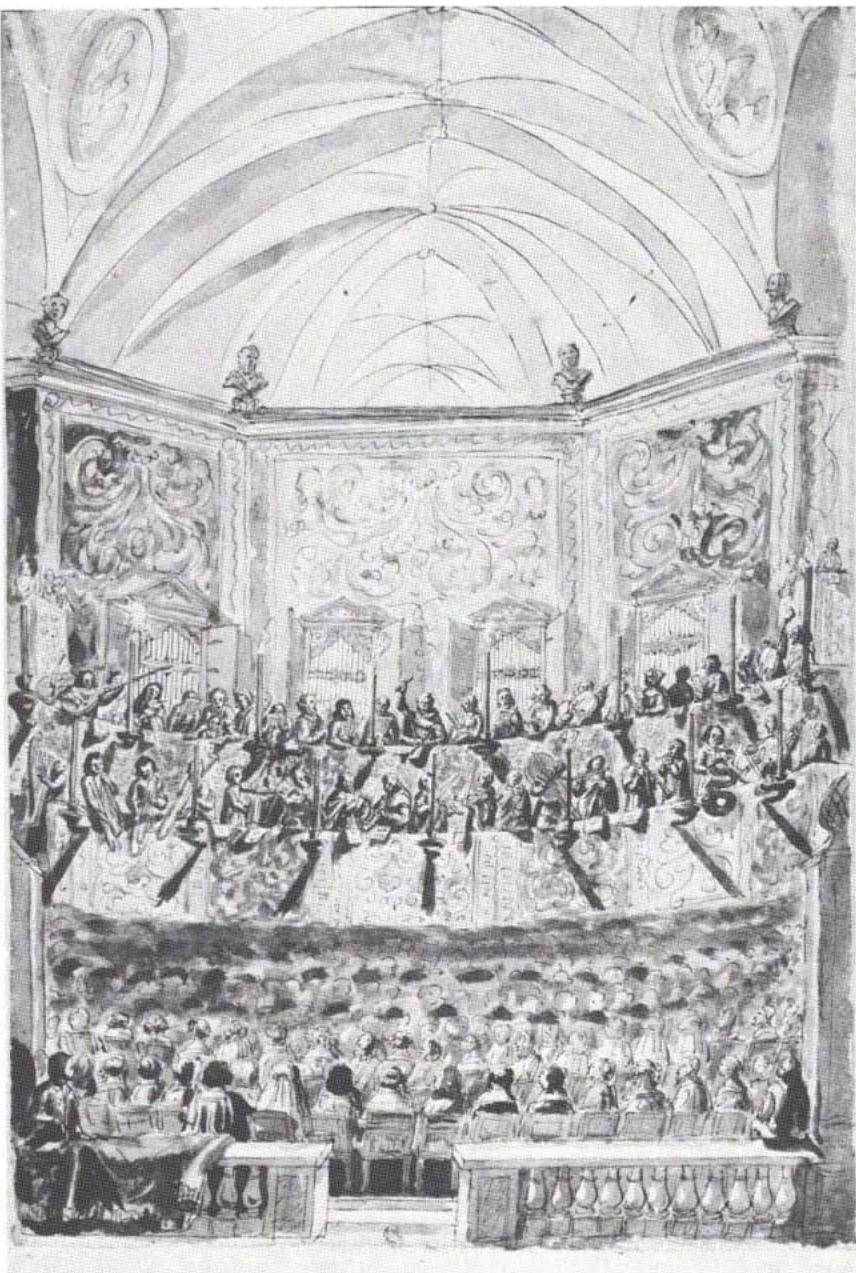
Frescobaldi’s resolution ’to begin to submit my works to the judgment of the World’ was expressed in rather conservative and retrospective works. Of the nineteen madrigals in the collection, the texts so far identified include four of the Ferrarese court poet Annibale Pocaterra, two of Carlo Rinaldi, one of Horatio Ariosti (apparently first published in 1611), and five of Marino (three set as the three parts of a single madrigal). While the older authors point back to Ferrara, the number of Marino settings suggests a Roman influence, since Marino was in the service of Cardinal Pietro Aldobrandini. The style of the collection matches the amorous, pastoral character of the texts, with none of the exaggerated expressiveness of Gesualdo or the harmonic boldness and vivid pictorialism of Monteverdi.
中文讲解
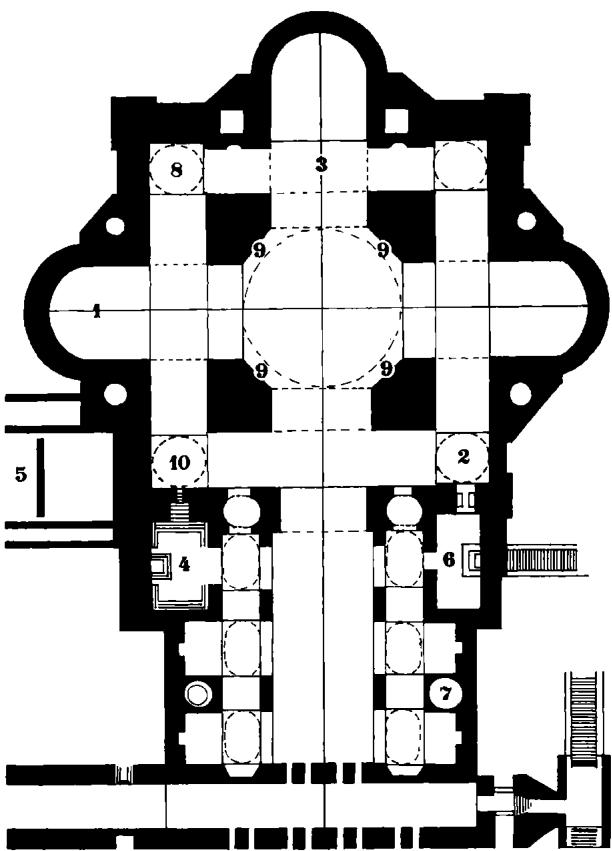
本段正面分析 Frescobaldi 的处女 madrigal 集(1611)。作者抓住 Frescobaldi 自己宣示的’将作品交付世界评判’来定位此集:所谓面向更广受众的雄心,落在音乐语言上却是保守、回顾性的——这与当时罗马/威尼斯乐坛追求的极端表现形成落差。文本来源的清点很关键:19 首 madrigal 中,4 首出自费拉拉宫廷诗人 Pocaterra,2 首 Rinaldi,1 首 Ariosti(此诗首次发表于 1611 年),5 首 Marino(其中 3 首被合并设置为同一首 madrigal 的三个部分)。这两组诗人阵营透露了 Frescobaldi 的社交地理:年长诗人引向他在费拉拉的旧渊源,而 Marino 这一现代诗坛领袖的占比则提示了罗马的影响——因为 Marino 当时正服务于枢机主教 Pietro Aldobrandini。最后一句是风格定位:集子与诗歌的’爱情—田园’基调相吻合,但既没有 Gesualdo 那种夸张表情性(不趋极端半音化),也没有 Monteverdi 的和声大胆与鲜明描画性(不刻意营造画面感)。换言之,作者把 Frescobaldi 的首部 madrigal 集放在 Gesualdo 式激进与 Monteverdi 式革新之间的中间地带,使其具有均整、温和、面向传统爱诗者的特性。
补充说明
’three parts of a single madrigal’ 是指同一首 madrigal 内部由三个独立诗节段落(通常对应三组声音或三段式结构)构成,而非’三首独立的 madrigal’。’none of the exaggerated expressiveness of Gesualdo or the harmonic boldness and vivid pictorialism of Monteverdi’ 是通过双重否定来给出风格坐标的:Gesualdo 代表极端半音化与表现主义,Monteverdi 代表第二代实践 madrigal 的写实与和声张力,Frescobaldi 此集则两端都不及。
第3段(P0003)
原文复述
Girolamo’s interest in the local musicians at Antwerp suggests that he also investigated his peers at the court of the regents in Brussels. Their cosmopolitan musical establishment included Italian, Spanish, and English as well as native musicians. At least two of these were composers and performers of the first rank. Although few of Pierre Cornet’s keyboard works survive, their size, variety, and finish establish him as the Catholic counterpart of Sweelinck. The great school of the English virginalists was represented at Brussels by Philips, who had become organist to the Archduke in 1597, sixteen years before the arrival of the better known John Bull. Philips’s rich, rather Crashaw-like style attracted a Catholic compatriot to include him in the Fitzwilliam Virginal Book, but also prompted a Continental Protestant, Sweelinck, to write variations on a Pavana Philipi. (note 25)
中文讲解
本段由 Antwerp 转向 Brussels,把 Girolamo Frescobaldi 的考察兴趣延伸到摄政宫廷(the regents,即阿尔贝特与伊莎贝拉大公夫妇)。作者点明布鲁塞尔宫廷乐团的’世界性’组成:意大利、西班牙、英国与本地(佛兰德斯)乐人并存,其中至少两位是第一流的作曲家兼演奏家。作者随即用对照式品评为两位定位:其一为 Pierre Cornet,键盘作品虽存世稀少,但以其规模、变体之多与完成度,被推为 Sweelinck 的’天主教对应者’(Catholic counterpart),即在北方天主教宫廷中扮演 Sweelinck 在加尔文宗阿姆斯特丹的地位。其二为 Peter Philips,他自 1597 年起任大公府管风琴师,比声名更著的 John Bull 早到十六年;他被放入’英国 virginalist 大传统’之中,但驻于布鲁塞尔。Philips 的’丰富、近乎 Crashaw 式’的笔触产生了双重影响:一方面其天主教同乡把他纳入《Fitzwilliam Virginal Book》(当时最重要的英国键盘曲集之一),另一方面大陆新教大师 Sweelinck 以其 Pavana Philipi 为题作变奏曲。段末的脚注 25 内容未见于本节文本,需查原文。整段是在勾勒 Frescobaldi 之外布鲁塞尔’同行’的层次:宫廷既有’南—北’的天主教/新教张力,也有’本土—国际’的并存;而 Philips 的位置正是这些张力交汇的样本。
补充说明
‘regents’ 指阿尔贝特大公与伊莎贝拉的总督/摄政身份(context:此时西属尼德兰由他们出任总督)。‘Catholic counterpart of Sweelinck’ 是修辞上的镜像:Sweelinck 在阿姆斯特丹是新教加尔文派的音乐中枢,Cornet 在布鲁塞尔是天主教宫廷的同等角色,故说’counterpart’。‘Pavana Philipi’ 是 Philips 创作的一首帕凡舞曲(Pavane),为 Sweelinck 变奏所用;段末脚注 25 内容未给出,仅作为引用标记。
脚注 / 边栏 / 图表 / 附加信息(如有)
无附加图表说明。P0001 引用 Jan Breughel 的《Hearing》(《五种感官》系列之一)作为时代音乐生活的视觉佐证,画中题识’Organista delliserenissimi Principi Alberto et Isabella’ 即是 Peter Philips 任职的明证。P0003 末尾标注的脚注 25 在本节文本中未提供具体内容,仅作为出处标记存在;其内容须查阅原文。
💡 本节核心要点
- Frescobaldi 首部 madrigal 集(19 首)以保守、回顾性的风格回应其’将作品呈于世界审视’的宣言,未走向 Gesualdo 式极端半音化或 Monteverdi 式和声—描画性。
- 诗本来源构成 Frescobaldi 的双重地理与社交归属:Pocaterra、Rinaldi 等费拉拉诗人指向其旧渊源,而五首 Marino 诗(其中三首合置为一首 madrigal 的三段)则提示罗马影响——Marino 当时服务于枢机主教 Pietro Aldobrandini。
- Jan Breughel 的《Hearing》被用作佛兰德斯豪门音乐生活的视觉证据;画中桌面上的 Peter Philips 六声部 madrigal 分谱本与’Organista delliserenissimi Principi Alberto et Isabella’ 题识相互印证,确立 Philips 在大公府中的核心地位。
- 布鲁塞尔摄政宫廷是世界性的音乐聚合体,囊括意大利、西班牙、英国与本地乐师,其中至少 Pierre Cornet 与 Peter Philips 为第一流。
- Cornet 以键存作品之规模、变体与完成度而被称为 Sweelinck 的’天主教对应者’;Philips 自 1597 年任大公府管风琴师,先于 John Bull 十六年。
- Philips 的’Crashaw 式’丰富笔触产生跨教派影响:被收入《Fitzwilliam Virginal Book》,并促成 Sweelinck 写作 Pavana Philipi 变奏曲。
🔑 关键术语
- madrigal à 6:六声部 madrigal;‘à 6’ 表示六声部的织体配置,对应六本分谱本(每声部一本)。
- part-books:分谱本,即每位演唱/演奏者各持一本、仅含单一声部的印刷或手抄乐谱,是 16—17 世纪声乐与合奏音乐的主要载体。
- two-manual Flemish harpsichord:具有两层键盘的佛兰德斯式羽管(或拨弦)键琴,通常配有不同音栓组合,便于在同一乐器上获得音色对比与织体层次。
- virginalists / Fitzwilliam Virginal Book:virginalists 指英国晚期伊丽莎白与雅各宾时期以 virginal(方形键琴)创作的键盘乐派;Fitzwilliam Virginal Book 是该传统最重要的曲集之一,主要由 Francis Tregian 抄录,汇集了 Byrd、Bull、Gibbons、Philips 等人的作品。
- Catholic counterpart of Sweelinck:Sweelinck 是阿姆斯特丹加尔文宗新教乐派的中枢;本节以’Catholic counterpart’(天主教对应者)指 Pierre Cornet,强调他在布鲁塞尔宫廷中扮演与之同等的键盘乐权威与教学枢纽角色,但属天主教阵营。
- Pavana Philipi:Philips 创作的一首帕凡舞曲(Pavane),Sweelinck 据此谱写变奏曲;在本节中作为跨教派影响的物证。
- nuncio / Cardinal Pietro Aldobrandini:nuncio 指罗马教廷派驻外国宫廷的教廷大使;Aldobrandini 为教皇克莱门特八世之侄、枢机主教,Marino 彼时即受其庇护,二者关系解释了 Frescobaldi madrigal 文本中偏向 Marino 的罗马倾向。
S1.2 [描述性拆分] Question of Sweelinck’s Influence and Antwerp Sojourn
第1段(P0004)
原文复述
It is sometimes assumed that Frescobaldi himself was significantly influenced by Sweelinck. The young Girolamo may have journeyed to Amsterdam, like Philips in 1593, to hear the older master. On the other hand, Frescobaldi’s obligations in Brussels and the shortness of his stay in Flanders—less than a year—cast doubt on this assumption, and it is known that Sweelinck never left Amsterdam for more than a few days at a time during this period. Superbi’s phrase, “Then he was brought to Flanders, where he made himself talked of for many years,” suggests that Girolamo was already regarded as a finished musician. In any case, the elements in Frescobaldi’s style that most closely resemble Sweelinck’s writing, such as his contrapuntal virtuosity and his rigor in the treatment of musical material, are the products of Girolamo’s Ferrarese training and are already evident in the fantasias, which (at least in part) antedate his journey to Flanders. Moreover, nothing could be further from the ruthless consistency (and occasional monotony) of Sweelinck’s figural writing than the nervous and ever-changing patterns of Frescobaldi’s figuration.
中文讲解
本段集中处理一个具体的史学问题:Frescobaldi 的风格究竟是否受到 Sweelinck 的影响。作者不是单纯陈述结论,而是用多重证据层层拆解这一常见假设:
第一层是可行性证据。Frescobaldi 在法兰德斯停留不到一年,且在布鲁塞尔另有事务;而同时期 Sweelinck 从未离开阿姆斯特丹超过几天。即使 Frescobaldi 想专程前往阿姆斯特丹,时间、地理与双方日程都使这种接触的可能性被削弱。作者还以 Philips 在 1593 年赴阿姆斯特丹听 Sweelinck 演奏为参照,说明这种旅行并非不可能——但 Frescobaldi 并不处于同样的条件。
第二层是同时期见证。Superbi 的描述把年轻的 Girolamo 描述为已经成名的成熟乐师(“made himself talked of for many years”),这暗示他去法兰德斯时风格早已定型,而非待在那里学艺。
第三层是风格溯源。被认为最像 Sweelinck 的两点——对位技巧与处理音乐素材的严谨——作者将其归入费拉拉训练的产物,并以《幻想曲》(fantasias)作为时间证据:这些作品至少部分写作于法兰德斯之行之前,因此 Sweelinck 不可能是其来源。
第四层是风格的反差。Sweelinck 的声部进行被描述为"无情的一致性(甚至偶有单调)",而 Frescobaldi 的音型化(figuration)则是"神经质般不断变化"——二者并非程度之差,而是美学原则之别。
合在一起,这一段并不只是说"Frescobaldi 没有受 Sweelinck 影响",而是建立一个更精细的论断:Frescobaldi 之所以在某些表面特征上让人联想到 Sweelinck,是因为两人共享某些十六世纪意大利北部对位传统的训练语汇;而真正构成 Frescobaldi 独特性的东西——多变、紧张、即兴般的音型推进——恰恰是 Sweelinck 所不具备的。
补充说明
本段提及的 Superbi 与 Philips(1593)以及《幻想曲》(fantasias)、费拉拉训练(Ferrarese training),均是本段内部出现的概念,可在原文中直接定位;脚注 26、27 用以支撑"Sweelinck 影响说"的常见来源以及 Superbi 的引文,但脚注的具体内容未在本任务输入中出现,故此处不作外部补全。
第2段(P0005)
原文复述
Girolamo’s statement that he went to Antwerp to see the city is the only interest he ever expressed in his surroundings. It must have been well worth seeing. An English visitor in 1616 described it as a city exceeding “any I ever saw any where else, for bewtie and the uniformity of buildings, heith and largeness of streets, and strength and fairness of the rampars.” Despite its irreversible decline as a commercial center, Antwerp still had a flourishing cultural life, about to enter its Indian summer with Rubens’s return from Italy late in 1608. In addition to Pierre Phalèse and his circle, who gave Frescobaldi’s madrigals so flattering a welcome, Antwerp offered another inducement to the visiting musician: the harpsichords of the Ruckers family, which were known throughout Europe and exported as far as Peru. The Ruckers made instruments in a variety of shapes, sizes, and dispositions greater than that of contemporary Italian instruments, and their rich, diffuse sound must have been a surprise to a player accustomed to the sinewy clarity of Italian harpsichords. Indeed, the Flemish harpsichord that Guido Bentivoglio sent to Cardinal Borghese became a nine days’ wonder in Rome.
中文讲解
本段把叙述焦点从 Sweelinck 这个可能师承对象,转到 Antwerp 这个城市本身,回答"Frescobaldi 去法兰德斯究竟得到了什么"这一问题。论证线索如下:
一、史料上的反差。Frescobaldi 本人对周遭环境唯一表达过的兴趣,是说自己去 Antwerp 是为了"看这座城市"。这意味着传世文献并没有留下他对当地音乐生活的具体记述——这与前一段否认 Sweelinck 影响是一致的:他在 Antwerp 没有留下"拜师学艺"的痕迹。
二、城市魅力的文学佐证。作者通过 1616 年一位英国访客的原文引述(注意保留原始拼写:bewtie/heith/rampars),从建筑、街道、城墙三个维度塑造 Antwerp 的视觉形象。这种保留拼写的处理具有年代感,提醒读者这是一段真实的历史文献而非转述。
三、文化时间的定位。Antwerp 作为商业中心已不可逆地衰落,但其文化生活正进入"Indian summer"——这一比喻在英文中指暮年的再度繁盛。具体标志是 Rubens 在 1608 年末从意大利回到 Antwerp,因此 Frescobaldi 抵达的时间(约 1607)正逢这一转折前夕。
四、对音乐家的双重吸引力。除了 Pierre Phalèse 及其圈子对 Frescobaldi 牧歌集的热烈欢迎外,Antwerp 还提供另一重诱惑——Ruckers 家族的大键琴。作者强调两点:其形制、尺寸、配置的多样性远超同时代意大利乐器;其声音特征是"rich, diffuse"(丰厚、弥散),与意大利乐器的"sinewy clarity"(筋骨分明的清晰)形成对比。这一对比不仅描述了乐器,也暗含一种音色美学的对照——这是 Sweelinck 一段未曾触及的角度。
五、跨地域传播的旁证。Bentivoglio 把一台弗兰德大键琴送给 Borghese 枢机,竟在罗马引发九日的惊叹。这一轶事既证实了 Ruckers 琴在意大利的稀有性,也呼应了前文"丰厚弥散 vs 筋骨清晰"的声音差异——对意大利听众而言,弗兰德琴确实是一种异质的声响。
整体而言,本段通过城市、音乐圈、乐器三层,把 Frescobaldi 在法兰德斯的收获从"师承 Sweelinck"这一可能假设,扩展为更宽的文化与物质经验。
补充说明
引文中保留了 1616 年英国访客的原拼写(bewtie、heith、rampars),属于文献转录而非印刷错误,可在原文中直接定位;Ruckers 家族、Rubens 1608 年自意大利返 Antwerp、Pierre Phalèse 圈子、Bentivoglio 与 Borghese 枢机均出现在本段中;脚注 28、29 对应 Antwerp 城市描述与弗兰德琴入罗马两处引文,具体出处未在本任务输入中出现,故不作外部补全。
脚注 / 边栏 / 图表 / 附加信息(如有)
本小节正文中包含四处脚注编号(26、27、28、29):26 标注对 Sweelinck 影响 Frescobaldi 之假设的常见来源;27 标注 Superbi 关于"在法兰德斯多年被人谈论"的引文出处;28 标注 1616 年英国访客对 Antwerp 的描述;29 标注 Bentivoglio 送 Borghese 枢机弗兰德琴一事。其脚注具体内容未在当前任务输入中给出,故仅作脚注定位,不补充外部信息。此外,本小节保留了一段 1616 年英文文献的原文拼写(bewtie/heith/rampars),属史料呈现,无附图或表格。
💡 本节核心要点
- 作者并不否认 Frescobaldi 与 Sweelinck 之间在表面技法上有相似之处,但通过时间证据(《幻想曲》早于法兰德斯之行)、地理证据(双方都难以会面)、风格溯源(对位技巧来自费拉拉训练)三层论证,把相似性归入共享的北部意大利传统,而非 Sweelinck 的直接影响。
- 作者在 Sweelinck 与 Frescobaldi 之间建立明确的美学对立:Sweelinck 是"无情的一致性甚至单调",Frescobaldi 是"神经质般不断变化"——这一定性既是风格的,也是方法论的,暗示 Frescobaldi 的关键贡献在于音型化的弹性与即兴感。
- Frescobaldi 自己对 Antwerp 的唯一陈述停留在"看城市",这是本节用以推断其与 Sweelinck 没有发生师承关系的史料依据之一。
- Antwerp 在 Frescobaldi 抵达时虽然商业已衰落,但文化生活正进入以 Rubens 归国为标志的"Indian summer",Ruckers 家族的大键琴则提供了与意大利乐器截然不同的丰厚弥散音色,构成对 Frescobaldi 潜在但未明言的器乐启发。
- Bentivoglio 将弗兰德琴送至罗马一事为音色对比提供了跨地域的旁证,间接支持"Antwerp 对音乐家有独特吸引力"这一论断。
🔑 关键术语
- Sweelinck:本节中的 Sweelinck 是一位年长的荷兰键盘音乐家,作者以其为参照系,论证 Frescobaldi 风格的真正来源并非受其影响,而是另有师承;其风格被定性为"ruthless consistency(and occasional monotony)"。
- Ferrarese training:指 Frescobaldi 在费拉拉所接受的音乐训练;本节用以解释其对位技巧与处理音乐素材的严谨性之来源,是反驳 Sweelinck 影响说的关键证据。
- Fantasias:本节指 Frescobaldi 早年的对位性键盘作品;其(至少部分)写作时间早于法兰德斯之行,因此被用作 Sweelinck 非其风格来源的内部时间证据。
- Figuration / figural writing:指音乐中的音型化写作,即装饰性、对位性的短小旋律片段的展开模式;本节以此为支点对比 Sweelinck 与 Frescobaldi 的根本差异。
- Ruckers:Antwerp 的著名大键琴制作家族;本节强调其乐器在形制多样性与音色(rich, diffuse sound)上均与意大利乐器形成对比,是 Frescobaldi 此行可能遇到的物质文化资源。
- Indian summer:本节中用以比喻 Antwerp 在商业衰落之后即将迎来的文化繁盛期,具体标志为 Rubens 在 1608 年末自意大利返回 Antwerp。
- Pierre Phalèse and his circle:本节中指 Antwerp 当地对 Frescobaldi 牧歌集表示热烈欢迎的音乐出版与演奏圈子;与 Ruckers 大键琴并列为该城市吸引音乐家的两大要素。
S1.3 [描述性拆分] Conclusion of the Flemish Stay and Recall to Italy
第1段(P0006)
原文复述
Girolamo’s visit to Antwerp probably concluded his stay in Flanders. (The assertion that he became organist at Malines and remained there for several years is unfounded.) The conclusion of the dedication to the Madrigali suggests that Frescobaldi’s service with Guido was only part of his general obligation to the Bentivoglio family. The head of the family, Enzo, was about to take up the post of Ferrarese ambassador at Rome and apparently summoned Frescobaldi to enter his service. On 9 August 1608 Guido wrote to his brother, “I will be happy that Frescobaldi come to Rome with Your Lordship for the taste you show for having him in your house.” (Not only did Enzo have prior claim, but Guido was hard-pressed for money to feed the “tante bocche” of his household.)
中文讲解
本段结束弗拉芒时期,开启罗马篇章。核心信息有四层:其一,安特卫普之行很可能标志着Girolamo在弗兰德斯的停留结束,所谓他在梅赫伦任管风琴师并任职数年的说法没有根据;其二,《Madrigali》献辞的结尾暗示Frescobaldi对Guido Bentivoglio的效忠其实属于他对整个Bentivoglio家族义务的一部分;其三,家族首领Enzo即将赴任费拉拉驻罗马的大使,因此召唤Frescobaldi转入其个人麾下;其四,1608年8月9日Guido写给兄弟Enzo的信表明他不仅乐见此事,甚至明确表示欢迎Frescobaldi跟随Enzo同往罗马,括号中的注释又补出Guido本身的财政窘境——他要供养家中的"tante bocche"(众多张口),无力继续留用Frescobaldi。所以Frescobaldi的离开是家族内部权力交接、经济压力与个人召唤共同作用的结果。
补充说明
tante bocche(众多张口)指Guido家中众多需供养的人口,是直接援引自Guido原信的意大利语短语。括号中的考据性注释提示读者作者已对早期学界关于Malines任职的不可靠说法进行了批驳。
第2段(P0007)
原文复述
Frescobaldi’s first surviving personal letters date from this trip back to
中文讲解
这是一个跨页断句,文字延续至下页。它为读者标注:以下P0008所述Frescobaldi书信的语境正是这次从弗兰德斯返回意大利的旅途。也就是说,Frescobaldi目前存世最早的一批私人信件,写作时间正始于他本次回程途中(1608年由弗兰德斯返回意大利)。单独这一句意义不大,但它是P0008导引,必读才能理解Frescobaldi对Enzo态度的史料依据。
第3段(P0008)
原文复述
Italy and already display the self-willed irresponsibility that was to characterize his relations with Enzo Bentivoglio. By late June, Frescobaldi had reached Milan, where he lodged in the monastery of Sant’ Ambrogio. Instead of coming directly to Enzo in Ferrara as he had promised, Girolamo remained in Milan “to try my fortune in various parts, and also to have the opportunity of making myself known.” On 29 July he was still there, reiterating to Enzo his desire “to make myself known,” which now included the publication of a work—the Fantasie issued by the firm of Tini and Lomazzo—“to fulfill the opinion of these musicians [and] . . . to give them a worthy sign of my ability.” He assured Enzo that he was “making every effort to have them hurry to print this work of mine, and I will immediately be in Ferrara to execute the command of Your Most Illustrious Lordship.” (When the Fantasie in fact appeared is uncertain, since the dedication is dated 8 November 1608 from Ferrara, by which time Girolamo had been in Rome for over a week.)
中文讲解
本段承P0007所述书信,揭示Frescobaldi归途中的性格特征及与Enzo关系的基调:自我中心、不负责任。具体内容有四:其一,到六月下旬他已抵达米兰,寄宿在Sant’Ambrogio修道院,而没有按承诺直接去费拉拉见Enzo;其二,他向Enzo解释滞留在米兰是"试试运气"并"让自己被人知道";其三,七月29日他还在米兰,重申"让人认识自己"的愿望,并把在Tini和Lomazzo书坊出版的《幻想曲》视为实现此愿的具体手段,他希望以此向米兰音乐家们展示自己的能力;其四,他向Enzo保证将督促尽快付印,并立刻赶赴费拉拉效忠。但括号里的考据透露一个矛盾:献辞日期为1608年11月8日,落款已是费拉拉,但那时Girolamo实际已在罗马超过一周了。因此他写给Enzo的承诺与最终成书时间之间存在不一致,提示读者去关注他言行的落差。
补充说明
Sant’Ambrogio修道院是米兰著名的本笃会修道院,兼有招待过往要人的传统;Frescobaldi寄宿于此说明他具备相应的社会身份。Tini与Lomazzo是当时米兰的音乐出版商。
第4段(P0009)
原文复述
The reputation Frescobaldi established in these first publications and the patronage of the Bentivoglio brought him the opportunity that was to determine his future career. On 21 July 1608 the Chapter of St. Peter’s in Rome elected Frescobaldi to succeed Ercole Pasquini as organist of the Cappella Giulia. He was now provided with a regular income, a forum for performance and composition, and a secure position in the musical life of Rome.
中文讲解
本段交代Frescobaldi一生最重要的转机:赢得罗马圣彼得大教堂Cappella Giulia管风琴师之职。逻辑链条是:早先出版的《幻想曲》所建立的名声 + Bentivoglio家族的庇护 → 1608年7月21日圣彼得大教堂的议事司铎们(Chapter)选举他接替Ercole Pasquini出任Cappella Giulia管风琴师。这一任命意味着三件事同时落地:稳定的收入、演出与创作的舞台、在罗马音乐生活中的稳固地位。作者用"was to determine his future career"点出此职位的决定性意义——事实上Frescobaldi余生的主要身份即由此奠定。
补充说明
Cappella Giulia(朱利安礼拜合唱团)由教皇尤利乌斯二世设立,与教皇私人礼拜用的Cappella Pontificia(或称Sistina)相区别,详见下文。
第5段(P0010)
原文复述
Rome, 1608–1614
中文讲解
这是大节标题,正式开启"罗马,1608–1614"这一叙事单元。它告诉读者接下来要叙述Frescobaldi从进入Cappella Giulia到1615年为止这段时间的罗马生活,涵盖他与教廷、Bentivoglio家族以及未来配偶的多重关系。
第6段(P0011)
原文复述
From the Recercari of 1615, Frescobaldi’s publications describe him as “Organist of St. Peter’s in Rome.” In fact, he was attached to only one of the two musical organizations that functioned in the basilica. The first of these, the Cappella Pontificia (Cappella di Nostro Signore, Cappella Sistina), was the pope’s private musica, which performed when the pope himself was present at a function. It employed only adult males—falsettists, later castrati, for the higher parts—without instruments, not even the organ. The Cappella Giulia (so called from its original foundation by Julius II), on the other hand, was tied to the service of the basilica and churches under its jurisdiction and functioned under the immediate supervision of the Chapter of St. Peter’s and the less direct authority of the Archpriest of the basilica.
中文讲解
本段澄清一个看似简单的头衔:Frescobaldi的"Organist of St. Peter’s"究竟意味着什么。圣彼得大教堂实际有两个并行的音乐机构,必须分开理解。其一,Cappella Pontificia(即"教皇礼拜合唱团"或称Cappella Sistina),是教皇本人的私人musica,只在教皇亲临礼仪时奏乐,只用成年男性——高声部由假声男高音(后来是阉伶)担任——纯人声无伴奏,连管风琴都不用;其二,Cappella Giulia(“朱利安礼拜合唱团”,得名于教皇尤利乌斯二世创建时),服务于大教堂及其辖下各教堂,直接受圣彼得议事司铎会监督,并接受大教堂Archpriest的间接领导。Frescobaldi隶属于Cappella Giulia,由此可见他在教廷音乐体系中处于哪一位置:他既不是教皇私人礼拜团成员,也不是Vatican最高礼仪的固定参与者,而是在大教堂常规礼拜服务中任管风琴师。
补充说明
Archpriest(大教堂总铎)是圣彼得大教堂的高级神职头衔;Cappella Sistina即西斯廷礼拜合唱团,至今仍以演唱教皇选举结果的著名场景闻名。
第7段(P0012)
原文复述
The composition of the Cappella Giulia in 1608 still followed the stipulations of Sixtus V’s bull of 1589. The choir consisted of four basses, four tenors, four contraltos (castrati or falsettists), and six boy sopranos. These were directed by Francesco Soriano, a former pupil of Palestrina and a member of the Congregation of Santa Cecilia, who received fifteen scudi a month. The adult singers were paid seven scudi, and the organist of the Cappella received six scudi monthly.
中文讲解
本段以1589年西斯笃五世的教皇诏书为依据,把Frescobaldi就任时的Cappella Giulia的人员编制与薪酬具体化:四个低音、四个男高音、四个女低音(阉伶或假声男高音)、六个童声女高音,指挥为Palestrina的前弟子、Cecilia修会成员的Francesco Soriano,月薪15 scudi;成年歌手月薪7 scudi;管风琴师月薪6 scudi。由此可推出两点:其一,Frescobaldi的薪资低于合唱团普通歌手;其二,整体编制是典型的反宗教改革时代的保守罗马教会礼拜编制,与威尼斯圣马可那种强调器乐与独唱的现代派形成对照(后文将展开)。
补充说明
Congregation of Santa Cecilia是罗马音乐家行会组织,下文会详细讨论;Sixtus V的1589年诏书是当时罗马教堂音乐规范的关键文献。
第8段(P0013)
原文复述
Girolamo’s appointment as organist of the Cappella Giulia is surprising in that the Chapter had no chance to interview the candidate. On 19 May 1608 they had dismissed Ercole Pasquini “for just cause” (presumably insanity), but he apparently continued to serve until the end of the month. He was replaced temporarily by Alessandro Costantini, who had been organist of Santa Maria in Trastevere in 1602. On 21 July the Chapter voted on the two candidates for the vacant post, Costantini and
中文讲解
本段揭示Frescobaldi任命中一个反常之处:议事司铎会(Chapter)几乎没有机会对候选人进行面试。时间线如下:1608年5月19日,Ercole Pasquini被以"正当理由"解职(作者推测可能是精神失常),但他实际服务到月底;之后由Alessandro Costantini临时顶替,此人1602年曾任Santa Maria in Trastevere的管风琴师;7月21日Chapter就Costantini与Frescobaldi两位候选人进行投票。叙述在投票时中断,为P0014的揭晓结果留下悬念。这一"无面试"细节的功能是引出下一段对Bentivoglio家族操控选举的揭示:正因为缺乏常规面试流程,外部势力的介入才有可能。
补充说明
Ercole Pasquini是16世纪末罗马著名管风琴师,曾服务于多位教皇,其晚年精神健康恶化属于历史疑案。
第9段(P0014)
原文复述
Frescobaldi. Costantini received ten favorable votes, but Frescobaldi was elected with twelve positive votes and two negative ones.
中文讲解
本段接续P0013的投票揭晓:Costantini得到10张赞成票,但Frescobaldi以12张赞成票、2张反对票胜出。这一结果的特殊意义在于:相对接近的票数差距暗示选举并非一边倒,Frescobaldi的胜出有赖于某一派势力的集中支持——这正是下一段要揭示的Bentivoglio家族介入选举的伏笔。
第10段(P0015)
原文复述
Letters recently discovered in the Bentivoglio archive in Ferrara reveal that the election was engineered by the Bentivoglio, and that from the first Frescobaldi treated the conditions of the post with carelessness. The pivotal role of the Bentivoglio in Girolamo’s election is apparent in a letter to Enzo from Mons. Ottavio Estense Tassoni, a Ferrarese noble and member of the Chapter of the basilica, dated from Rome, 6 August 1608: “I have so much more pleasure in having promoted M. Girolamo Frescobaldi for the post of organist here at St. Peter’s as I see that I have done a thing pleasing to Your Most Illustrious Lordship.” As another correspondent noted, by securing Girolamo’s election Enzo intended to make him available for Enzo’s own service in Rome: “I rejoice with him that with this opportunity he may also continue his service with Your Most Illustrious house, and particularly with the person and under the protection of Your Most Illustrious Lordship.”
中文讲解
本段把P0014的胜选转化为具体政治事件。新近在费拉拉Bentivoglio档案中发现的书信揭示两层信息:其一,选举由Bentivoglio家族操纵;其二,Frescobaldi从一开始就对任职条件漫不经心。Bentivoglio的关键作用通过两封信展示:第一封是费拉拉贵族、圣彼得议事司铎会成员Ottavio Estense Tassoni于1608年8月6日从罗马写给Enzo的信,自承"为推举Frescobaldi获得此职而深感欣喜,因我做了让阁下高兴的事";第二封出自另一位通信者,他指出Enzo扶植Girolamo的真正目的是让他在罗马继续为Enzo个人服务。两封信合起来说明:Bentivoglio花钱出力并不是单纯赞助一位艺术家,而是借此机会把一位本家族出身的乐师固定在罗马,同时为Enzo的外交驻地营造一支可用的musica。
补充说明
Ottavio Estense Tassoni的姓氏"Estense"暗示他与埃斯特家族(Este)有亲缘关系;本章后文多次出现Tassoni的角色,是Enzo在罗马的得力联络人。
第11段(P0016)
原文复述
The election was confirmed by the Chapter and accepted by Frescobaldi. He was asked to write a letter of acknowledgment, as both of Enzo’s correspondents had suggested, to the Chapter and to travel to Rome with Enzo, or at least to be there in time for Enzo’s arrival as Ferrarese envoy. Girolamo made no move to fulfill either condition. He stayed on in Milan, seeing the Fantasie through the press, although he also may have been ill and fearful of the Roman malaria. (Tassoni advised, “It will be well that he stay there until he is restored, since wishing to make him come now would be to put him in peril of his life.”) As late as October, Tassoni was still reminding Frescobaldi of the need to satisfy the canons of the basilica and to reach Rome by the time of Enzo’s arrival. To a Milanese envoy of Enzo, Girolamo declared flatly that he did not wish to leave Milan, despite “his word given to you and to me, not one time but several, to come to Rome with Your Most Illustrious Lordship.”
中文讲解
本段展示Frescobaldi刚获任命便开始回避义务:他既不按Enzo两位通信者的建议向Chapter写致谢信,也没有按约定与Enzo同来罗马或至少在Enzo到达前赶到。滞留在米兰的两层理由:一是继续监督《幻想曲》的印刷,二是可能生病并害怕罗马的疟疾(括号中Tassoni的建议即此意)。即便如此,到10月Tassoni仍在提醒他必须满足大教堂神长们的期待,并赶在Enzo抵达前到任;面对Enzo派来的米兰使者,Frescobaldi直率地表示不愿离开米兰,尽管他曾多次承诺同赴罗马。本段功能是刻画Frescobaldi性格中的倔强与对承诺的轻慢,同时埋下他与Bentivoglio家族长期摩擦的开端。
补充说明
罗马在16—17世纪的疟疾高发是史实,夏季尤其严重;Fantasie书稿至迟到秋季仍在付印过程之中。
第12段(P0017)
原文复述
Finally, Enzo sent one Bernardo Bizzone to meet his reluctant servant in Florence: “I went as far as Siena, whence . . . I had to turn back, and the evening of the vigil of All Saints [31 October] I was again at Rome where with the greatest pleasure and happiness I found our Frescobaldi at my home, safe, sound, and pleased, who arrived here on the 29th.” Girolamo, once arrived, lost no time in taking up his post. The traditional account of his debut is that of Libanori, who asserted that “since the news had spread of this stupendous and marvelous Musician, and miraculous organist, the first time, they say, that [he played] he had more than thirty thousand hearers and the oldest and most famous organists were astonished and not a few touched by envy.” Bizzone’s own description shows that the attendance was due less to the unheralded arrival of the new organist than to the celebration of two important feasts, All Saints (1 November) and All Souls (2 November): “The vigil of All Saints [he] took possession of the organ of S. Pietro and also played the two following feasts with great satisfaction and commendation of the Sig.ri Canons and of other virtuosi of the profession.”
中文讲解
本段讲述Frescobaldi终于抵罗马并上任的过程,及对其首演的两种叙述之比较。Enzo派Bernardo Bizzone远赴佛罗伦萨迎接这位不情愿的仆人,Bizzone在锡耶纳止步后折回罗马,于10月31日诸圣节前夕到达,并在29日(按其回忆应早于31日两天)已见Frescobaldi安全抵达Enzo家中。一到任,Frescobaldi即迅速就职。关于首演的盛况,Libanori的传统描述充满传奇色彩:传言他首演即吸引三万听众,老一辈著名管风琴师惊叹且不乏嫉妒;然而Bizzone自己的记述表明,所谓盛况其实源于诸圣节(11月1日)与万灵节(11月2日)两大重要节日同时到来,教堂本就需要盛大的音乐,而Frescobaldi于节前夜"接管了圣彼得管风琴"并连续演奏了两台弥撒,获得了议事司铎们与同行virtuosi的赞许。作者借此段要说明:传奇叙述与原始档案之间存在张力,传奇有夸大,而档案则更冷静地反映了实情。
补充说明
Libanori是费拉拉编年史家,其夸张式记载反映了18世纪地方史家对Frescobaldi的崇敬氛围;Bernardo Bizzone是Enzo家仆,其亲历信是难得的第一手资料。
第13段(P0018)
原文复述
Frescobaldi’s association with St. Peter’s lasted for the rest of his life. During those thirty-five years the building we know today largely came into existence. In 1608 a modern observer would have recognized only the east end of the church, the great piers, and the dome. The apse lacked the monumental statues in the pillows, the papal tombs, a permanent high altar, the baldacchino and confessio, and the Chair of Peter. The rest of the church was a construction site in which the Constantinian nave was still being pulled down as the new façade was being built, a scene of dust, confusion, and noise. In 1611, at the height of this activity, over eight hundred men were employed, and they sometimes worked through the night by torchlight.
中文讲解
本段勾勒Frescobaldi任职时的物理环境:他在圣彼得大教堂工作长达35年,而他任职初期该教堂尚处于大规模重建之中。1608年时观察者能看到的只有东端、巨柱与穹顶,半圆形后殿中还没有那些著名雕像、教皇陵寝、永久高坛、Bernini的baldacchino(青铜华盖)、confessio(圣徒墓前祈祷处)以及"圣彼得之座";教堂其余部分仍是工地,君士坦丁时代的旧中殿正在拆除,新立面正在施工,尘土飞扬。1611年高峰时有800余工人,有时甚至挑灯夜战。这一段为后续讨论音乐与建筑的相互关系提供空间背景——Frescobaldi最初服务的圣彼得,并不是今日所见的那个完成品,而是工地中一个部分启用的过渡形态。
补充说明
baldacchino(华盖)由Bernini于1624—1633年完成;confessio是主祭坛下的圣徒陵墓祈祷区;Chair of Peter(圣彼得之座)是Bernini设计的镀金青铜圣物龛。
第14段(P0019)
原文复述
Notwithstanding, these first services at which Frescobaldi performed were celebrated with ceremonial and musical grandeur, since Paul V, who officiated, were knowledgeable and exacting in both areas. The singers—the Cappella Giulia supplemented by the Cappella Pontificia—were placed on temporary wooden platforms, and Frescobaldi presided not at one of the basilica’s two large stationary organs but at a smaller portable instrument. In a polyphonic mass the organist’s contribution was more limited than in an alternatim chant-mass. The All Souls’ mass, essentially a Requiem, essentially a Requiem, would have offered even less opportunity for display.
中文讲解
本段承接P0018描述的工地环境,反衬出礼仪的庄严与精致:因为主持礼仪的Paul V教皇对礼仪和音乐皆要求严格而内行,所以Frescobaldi参与的最初几次礼拜在动工中的大教堂中仍极尽宏伟之能事。合唱团由Cappella Giulia加上Cappella Pontificia共同组成,被安置在临时搭建的木质台架上;Frescobaldi不是在大教堂的两台固定大管风琴之一上演奏,而是使用一台较小的便携管风琴。作者又补充了礼仪音乐类型上的差异:在复调弥撒中管风琴的发挥空间比"交替齐唱弥撒"(alternatim chant-mass,由唱诗班与管风琴轮流演唱/演奏)更小;万灵节(追思已亡)的弥撒本质上是一场安魂曲(Requiem),管风琴的展示机会更少。这说明Frescobaldi的管风琴才华在最初几次重要礼仪中被压缩在较小的发挥空间内,所谓"首演万人空巷"的传说显然忽略了礼仪类型本身的限制。
补充说明
alternatim(交替)弥撒是罗马天主教传统中唱诗班与管风琴/乐器轮流执行经文部分的古老形式;Requiem即追思弥撒,其音乐规约通常避免炫技性的器乐段落。
第15段(P0020)
原文复述
In general, until Bernini’s creation of the coordinated axial ensemble of the crossing in the 1630s, use of the immense space of St. Peter’s was remarkably fluid, as witness the constant bills for moving the organ and for erecting and dismantling the platforms for the singers. The movable organ was regularly situated near the altar of Sts. Simon and Jude in the left-hand transept, later transformed into a temporary canons’ chapel, but was moved, as occasion demanded, to the Cappella Gregoriana, the tribune, the choir, the sacristy, the chapels of the Sacrament, the Crucifix, the Column, and the niches in the piers (see fig. 5).
中文讲解
本段说明大教堂的礼仪空间具有高度流动性,直到1630年代Bernini把十字耳堂设计成轴心对称的整体格局之前都是如此。证据是常年存在的搬运管风琴与搭建/拆除歌咏台架的账单。可移动的管风琴通常安放在左耳堂的圣Simon与Jude祭坛旁(该处后来改为临时的议事司铎小堂),但根据礼仪需要会被移至多个场所:Gregorian礼拜堂、tribune(半圆形后殿高台)、choir(唱诗班席位)、sacristy(圣器室)、圣体小堂、十字小堂、圆柱小堂,以及柱间的壁龛。结尾指向图5,让读者对照图示理解这些流动空间。本段为下文的"两台固定管风琴"介绍做铺垫。
补充说明
图5即下文P0022所引图注,详列大教堂十个音乐表演位置;Cappella Gregoriana以教宗Gregory XIII命名。
第16段(P0021)
原文复述
Other services employed the two stationary organs of the basilica. The older of these had been commissioned by Alexander VI Borgia in 1496 and at the time of Frescobaldi’s installation was placed part-way down the right-hand side of the nave. With the destruction of the old nave it was removed in 1609 to the Cappella Clementina, the northwest chapel (in liturgical orientation, since the church actually faces west) of Michelangelo’s basilica, over the present sacristy door. Possibly at Frescobaldi’s instigation, it was also restored by the organ builder and tuner Armodio Maccioni. The second organ, whose façade is now preserved in the Chapel of the Sacrament, was built in 1580 and placed above the stair by the Cappella Gregoriana, the corresponding chapel on the southwest side of the basilica.
中文讲解
本段介绍大教堂的两台固定管风琴,作为P0020所述可移动管风琴的对照。其一较老者由教皇Alexander VI Borgia于1496年订制,Frescobaldi入职时位于旧中殿右侧靠下位置;随着旧中殿拆除,1609年它被移至Cappella Clementina(即米开朗琪罗设计的巴西利卡西北侧礼拜堂,按礼仪朝向则因其实际朝西而位于"东北"),位于今圣器室门上方;可能正是在Frescobaldi的倡议下,这台管风琴由制琴师兼调律师Armodio Maccioni进行了修复。其二即第二台管风琴建于1580年,原置于Gregorian礼拜堂(巴西利卡西南礼拜堂)旁的阶梯上方;其外饰现保存于圣体礼拜堂。两台管风琴各有来历与空间位置,作者提示固定与可移动乐器共同构成了Frescobaldi工作的物质条件。
补充说明
Alexander VI Borgia即臭名昭著的波吉亚教皇Roderigo Borgia;Armodio Maccioni是当时罗马著名的管风琴制琴师与维护技师。
第17段(P0022)
原文复述
中文讲解
此为图5的占位符及图注。图中标注圣彼得大教堂十处音乐表演位置:(1) 圣Simon与Jude礼拜堂;(2) Gregorian礼拜堂;(3) 半圆形后殿高台(tribune);(4) 唱诗班席位(choir);(5) 圣器室;(6) 圣体礼拜堂;(7) 十字礼拜堂;(8) 圆柱礼拜堂;(9) 柱间壁龛;(10) Clementina礼拜堂。原图数据已被省略,需查看原书图像才能获得具体的平面位置细节。这张图与P0020所述流动的礼仪空间直接对应。
第18段(P0023)
原文复述
The busy schedule of the Cappella Giulia included not only performance of the mass and offices, as well as votive offices, in St. Peter’s, but also other celebrations in churches under the jurisdiction of the Chapter throughout the City. Of the feasts kept in the basilica during this first period of Frescobaldi’s tenure, two received particular musical elaboration: the feast of Sts. Peter and Paul (29 June) and the commemoration of the dedication of the original basilica in 326 A.D. (18 November). For these the singers of the Cappella Giulia were augmented by fifteen to twenty hired musicians and divided into three or four choirs placed on special platforms (see fig. 6). Frescobaldi accompanied the first choir on the portable organ; the other choirs were accompanied by hired organists on small organs rented for the occasion. Among Girolamo’s colleagues at the organs we find his predecessor Alessandro Costantini, Francesco Anerio, and Prospero Santini. Trombones hired from Castel Sant’Angelo probably doubled the bass line of each choir, while wind players from the Campidoglio, a violin, two cornetts, and unspecified instruments doubled other parts or played obbligati. Similar forces were employed for occasional celebrations, notably the canonization of Santa Francesca Romana in 1608 and the long-awaited canonization of Carlo Borromeo in 1610.
中文讲解
本段勾勒Cappella Giulia在Frescobaldi任期早期的繁忙日程与音乐规格。其一,日常服务涵盖圣彼得大教堂内的弥撒、日课经及还愿日课,并在整个罗马城受Chapter管辖的各教堂执行仪式;其二,两个最重要的庆典——圣Peter与圣Paul节(6月29日)以及326年君士坦丁巴西利卡奉献纪念(11月18日)——会得到特别的音乐扩张:Cappella Giulia歌手被增补15至20名外聘乐手,组成三至四个合唱团,分布在特设台架上;其三,Frescobaldi在便携管风琴上为第一合唱团伴奏,其余合唱团由临时聘请的管风琴师在小管风琴上伴奏,同事包括其前任Alessandro Costantini、Francesco Anerio与Prospero Santini;其四,Castel Sant’Angelo雇佣的长号声部可能为每个合唱团加倍低音线,Campidoglio来的管乐手(其中包括一支小提琴、两支短号及其他未指明的乐器)为其他声部加倍或演奏obbligato(独立声部);其五,类似的编制也用于1608年Santa Francesca Romana封圣与1610年Carlo Borromeo封圣等偶发庆典。这段让读者直观理解Frescobaldi所参与的"多合唱团大编制"圣乐庆典的规模与人员构成。
补充说明
votive offices(还愿日课)指为某特定意图所举行的非节日性日课;Campidoglio即罗马七丘之首Capitoline Hill;Castel Sant’Angelo是教皇宫廷兼军事要塞,其乐队是当时罗马的专业长号重镇。
第19段(P0024)
原文复述
Not all of this repertory can be identified from the surviving musical archive of the Cappella Giulia. Indeed, this contains no mass- or motet-settings for more than three choirs (usually three four-part choirs, but in one case three six-part ensembles). The nucleus of the collection consists of chant books and of polyphonic works by Palestrina, which provided settings for the proper and ordinary of both the mass and offices. The continuing use of Palestrina’s music at St. Peter’s is evident in the late dates of some of the manuscript copies. In medium these settings range from simple four-part works like the hymns copied part in 1582 and part in 1619, through Magnificats, Lamentations, and masses (some copied in 1607) for five and六 voices, to motets and offertories for two and three four-part choirs. The most grandiose of these works is a manuscript mass on Tu es Petrus for the feast of St. Peter attributed to Palestrina, in which the three six-part choirs seem to epitomize in music the monumental conception of the basilica and the text which the whole building proclaims: “Thou art Peter, and upon this Rock will I build my Church.”
中文讲解
本段交代当时可复原的实际音乐曲目与现存档案之间的落差。三个观察:其一,Cappella Giulia现存的乐谱档案中并没有超过三合唱团规模的弥撒或经文歌配置(通常是三个四声部合唱团,仅一例为三个六声部合唱团),这暗示多合唱团大编制的礼仪虽然执行了,但所用乐谱并未(或部分)保存下来;其二,档案的核心是Palestrina的复调作品与单旋律的唱本,提供弥撒与日课中专用经文(proper)与常规经文(ordinary)的配置;其三,Palestrina的曲目在圣彼得被持续使用,证据是许多手抄本都标注了很晚的抄写日期。本段还细数了声部规模:从1582年与1619年抄写的简单四声部赞美歌,到1607年抄的五声部与六声部Magnificat、哀歌、弥撒,再到两至三个四声部合唱团的经文歌与奉献曲。最宏伟的一件是归于Palestrina的《Tu es Petrus弥撒》,为圣Peter节而作,三个六声部合唱团在音乐上呼应了教堂建筑的纪念性与文本"你是彼得,我要把我的教会建造在你这块磐石上"。作者借此强调:尽管执行的是多合唱团大礼仪,但保守的Palestrina复调传统仍是其音乐根基。
补充说明
Magnificat即圣母玛利亚的尊主颂(Lc 1:46–55),是晚祷核心经文;Tu es Petrus(Mt 16:18)是天主教神学核心经文之一,常被用于圣Peter节;Lamentations是圣周所用的耶利米哀歌。
第20段(P0025)
原文复述
Later additions to the repertory of the Cappella Giulia were frequently the work of the maestri di cappella under whom Frescobaldi served, notably Francesco Soriano (maestro 1603–1620). About the time of Girolamo’s entrance into the Cappella, Soriano published a collection of masses for four to six voices, dedicated to Paul V and culminating appropriately in an eight-part Missa in Papae Marcelli. This was supplemented by a collection of Psalmi et Mottecta containing settings of the office and mass propers, as well as texts of special importance for the basilica, published in 1616 with a dedication to Cardinal Scipione Borghese. Newer currents in sacred music are represented by the three volumes of Antiphonae issued in 1613 by Giovanni Francesco Anerio, one of Frescobaldi’s supplementary organists. These works, antiphons and canticles for vespers and compline throughout the whole year, are remarkable not only for their comprehensiveness but also for their medium: not choral polyphony but the few-voice concerto for two to four solo独唱 voices and continuo.
中文讲解
本段继续丰富Cappella Giulia的曲目库,说明三种晚期补充。Frescobaldi任职时期任maestro di cappella的Francesco Soriano(任职1603—1620)出版了四至六声部的弥撒集,献给Paul V,并以八声部Missa in Papae Marcelli为压卷之作,呼应其师Palestrina之名作;后又出版《Psalmi et Mottecta》(1616),献给枢机Scipione Borghese,涵盖日课与弥撒专用经文以及与教堂相关的特别经文。更新的风格则体现在Giovanni Francesco Anerio(亦为Frescobaldi的副管风琴师之一)1613年出版的三卷Antiphonae,其内容是全年晚祷与夜祷的对经与圣歌,声部规模从合唱复调转向2至4个独唱声部与数字低音(continuo)的"少声部协奏体"(concerto)。作者借此呈现Frescobaldi任职期间,Cappella Giulia的曲目从Palestrina式复调为主,逐步接纳新的协奏风格,但仍以保守为主线。
补充说明
Antiphonae(对经集)是礼仪中应答式唱诵的经文汇编;concerto此处指"少声部协奏体",是17世纪初兴起的独唱加通奏低音的新风格,与后文"concertato"概念相对应。
第21段(P0026)
原文复述
中文讲解
此为图6的占位符与图注,标注由P. P. Sevin所绘/雕的Santa Maria del Popolo音乐会场景图。原作图像数据已省略,读者需对照原图查看。这张图与P0023所述圣彼得大教堂多合唱团庆典设置同属一组可视化材料,但具体是Santa Maria del Popolo而非圣彼得大教堂的礼仪场景。
第22段(P0027)
原文复述
At the time of Frescobaldi’s appointment, then, the musical repertory of the Cappella Giulia was conventional and retrospective, firmly rooted in the work of Palestrina and his followers and characterized by such practices as the chanting of psalms in falsobordone, a conservative solution disdained by the musicians of St. Mark’s in Venice, the most advanced center of liturgical composition. Although newer styles and media did infiltrate the repertory of the Cappella Giulia in the second decade of the century, the stile antico was unswervingly maintained by the other group that performed in St. Peter’s, the Cappella Sistina. The accounts of their performances in 1616 reveal a repertory still built around Palestrina and his contemporaries, and as late as 1683 Monteverdi’s stile antico mass of 1610 was copied out for the Cappella without the brilliant concertato of its companion vesper-setting.
中文讲解
本段对Cappella Giulia的音乐风貌作整体定性:Frescobaldi入职时,Giulia的曲目是传统、回顾性的,根植于Palestrina及其追随者,特色之一便是用falsobordone吟唱诗篇——一种保守做法,被当时最先进的礼仪音乐中心、威尼斯圣马可的乐师们所不屑。尽管17世纪第二个十年新风格和新型态确已渗入Cappella Giulia,但在圣彼得大教堂执行礼拜的另一团体Cappella Sistina则毫不动摇地坚守stile antico(古风格)。作者援引证据:1616年Sistina的演出账目显示其曲目仍围绕Palestrina及其同时代人;甚至迟至1683年,Monteverdi 1610年stile antico弥撒仍被抄入Cappella使用,但删去了同年出版的辉煌的concertato(协奏体)晚祷曲集。本段功能是给Frescobaldi所处的罗马教廷音乐生态一个清晰定位:身处保守与革新的张力之中,他的键盘作品因此具有双向性。
补充说明
falsobordone是一种简化、节奏相近的诗篇吟唱法;stile antico(古风格)指Palestrina式的无伴奏复调;stile nuovo/concertato(新风格/协奏体)即Anerio等作曲家所代表的独唱加通奏低音体裁。
第23段(P0028)
原文复述
The publication of Frescobaldi’s “prime fatiche,” the twelve fantasias dedicated to Francesco Borghese, apparently coincided with Girolamo’s appointment to the Cappella Giulia. These works, with their rigorous contrapuntal logic and their double organization by number of subjects and number of modal finales, are perhaps the most cerebral of Frescobaldi’s compositions. (Indeed, they seem almost a direct refutation of Antegnati’s accusation in L’arte organica, published in the same year as the Fantasie, that “certain so-called modern Organists” despise the serious works of learned composers in favor of their own “improvised fantasies.”) On the evidence of the dedication, it seems to have been Girolamo’s custom to accumulate materials for a publication over a period of time. His next printed collections, the ricercars and first book of toccatas of 1615, thus probably show his development in the first seven years of his appointment at St. Peter’s. If the musical character and requirements of the basilica seem reflected in the contrapuntal artifice of the ricercars, the brilliance of the toccatas—specifically designated for the世俗的 harpsichord rather than the liturgical organ—the brilliance of the toccatas—specifically designated for the世俗的 harpsichord rather than the liturgical organ—points to Frescobaldi’s other Roman post, his service in the household of Enzo Bentivoglio.
中文讲解
本段把Frescobaldi的创作与他的双重职务联系起来。“prime fatiche”(首次心血之作)是十二首幻想曲,献给Francesco Borghese,似乎与Frescobaldi被任命为Cappella Giulia管风琴师同期。其音乐特征是严格的复调逻辑与"主题数/调式终曲数"的双重组织,被作者评为Frescobaldi最具"脑力"的作品。括号中提示:这种风格几乎是对Antegnati《L’arte organica》(与《幻想曲》同年出版)中指责的正面反驳——Antegnati批评某些所谓"现代管风琴师"蔑视学者的严肃作品,沉迷于自家"即兴幻想曲"。从献辞推测,Frescobaldi习惯长时段积累作品;因此下一批印刷品——1615年的ricercars与第一册toccatas——很可能反映了他在圣彼得任职头七年的发展。逻辑链是:ricercars的复调机巧对应大教堂的礼仪需求;toccatas的光彩则专门标记为"世俗的harpsichord(羽管键琴)“而非礼仪管风琴,指向他的另一罗马职务——在Enzo Bentivoglio府上服务。本段从而把Frescobaldi的双重身份(教廷礼拜乐师+贵族府邸器乐师)投影到他的双重音乐风格(复调严谨+炫技性键盘)上。
补充说明
ricercar与fantasia是同源词,前者更强调主题模仿与严密对位,后者更自由;L’arte organica是Costanzo Antegnati的管风琴教学著作。
第24段(P0029)
原文复述
Enzo clearly conceived his musical establishment as a necessary part of the state he was obliged to maintain as Ferrarese ambassador in Rome, like his residence in Palazzo Sacchetti. In composition it recalled the concerto delle dame, comprising a “little ensemble” (consertino) of “two skilled ladies,” Lucia and Lucrezia, augmented in February 1609 by a female harpist from Naples who received six scudi a month in addition to other perquisites. Besides Frescobaldi, the other musicians associated with Enzo’s consortino included a certain Angiola and possibly the lutenist Alessandro Piccinini, who at any rate composed music for the “Napolitana.” On the evidence of other Roman musical establishments (notably that of the melomane Cardinal Montalto), the repertory of a noble musica was heavily influenced by Florentine monody and works such as Luzzaschi’s Madrigali of 1601, marked by simplicity of texture, alternation of free and rhythmic passages, and vocal diminutions.
中文讲解
本段勾勒Enzo Bentivoglio在罗马的musica建制。其基本判断是:Enzo把音乐机构视为其作为费拉拉大使身份所必须维持的"门面"之一,与他在Palazzo Sacchetti的府邸一样。这一musica让人联想到concerto delle dame(女声合奏团),由"两位技艺娴熟的女士"Lucia与Lucrezia组成一个小合奏团(consertino),并于1609年2月新增一位来自那不勒斯的女竖琴师,月薪6 scudi加各种津贴。除Frescobaldi外,与Enzo的consertino相关的乐师还包括一位名叫Angiola的女子,以及可能为"那不勒斯女歌手"写过曲目的琉特演奏家Alessandro Piccinini。从其他罗马贵族音乐机构(尤其是酷爱音乐的枢机Montalto的musica)来看,贵族musica的曲目深受佛罗伦萨单音独唱风格与Luzzaschi 1601年《Madrigali》等作品影响,其特色为织体简洁、自由段落与节奏段落交替、以及声乐花腔(vocal diminutions)。本段功能是确立Enzo的musica建制与贵族音乐趣味的语境,为Frescobaldi日后在此处的教学活动做铺垫。
补充说明
concerto delle dame是1590年代费拉拉宫廷著名的女声三重唱,对全欧洲的音乐品味影响深远;Luzzaschi的1601年Madrigali即《Madrigali… per cantare et sonare a uno, e doi, e tre soprani》,是近代独唱加通奏低音曲目的里程碑。
第25段(P0030)
原文复述
A musica functioned not only as a performing ensemble but also as a milieu for training its younger members. In 1615 Enzo acquired a boy soprano, Baldassare, with vocal problems and an insufficient musical background. An unspecified Nanino taught him every morning for two hours, one of singing and one of improvised counterpoint, composition, and harpsichord playing. Every afternoon he went to Frescobaldi for a harpsichord lesson. The Cavalier Cesare Marotta made Baldassare sing for him three or four times a day and composed pieces to teach to Baldassare. Marotta’s wife, Cardinal Montalto’s famous singer Ippolita, taught the boy to play the guitar.
中文讲解
本段揭示musica不仅是演出团体,也是培养年轻成员的训练环境。例子是1615年Enzo收的一名童声高音Baldassare,他有嗓音问题且音乐基础薄弱。每天上午由一位未具名的Nanino教他两小时:一小时声乐,一小时即兴对位、作曲与羽管键琴演奏;每天下午则由Frescobaldi教他羽管键琴。Cavalier Cesare Marotta每天让他唱三、四次并为他作曲来教学;Marotta的妻子——枢机Montalto名下的名歌手Ippolita——则教他弹吉他。这一组人物关系清楚展示了Enzo的musica具有声乐、器乐、作曲训练三位一体的综合教学网络。
补充说明
Nanino家族是罗马音乐世家,Bernardino Nanino是Palestrina的著名弟子,此处未具名的Nanino可能是其亲属;Ippolita Recupito Marotta在后来的章节中再次出现。
第26段(P0031)
原文复述
The progress of the consortino, partly under Frescobaldi’s tutelage in performance and counterpoint, is described in letters written during the summer of 1609 from Enzo’s household in Rome to Enzo at Ferrara: “M. Girolamo is now teaching the Neapolitan, and they expect to learn and Lucia learns from Oratietto very well, so that when Your Most Illustrious Lordship comes here these young Girls may be able to sing the notes securely; Lucia will not sing them because Your Lordship knows she has a thick skull . . . Signora Lucretia will sing the words securely because she knew a bit from madame Angiola; I don’t get mixed up in the matter because m. Girolamo is teaching her.”
中文讲解
本段以1609年夏从Enzo罗马府邸写给在费拉拉的Enzo的一封信为材料,呈现consertino的训练进展。信中告知:Frescobaldi正在教那位那不勒斯女歌手,大家都有所期待;Lucia师从Oratietto学得很好,等到Enzo返回罗马时这些年轻女子就能稳稳地唱音;唯独Lucia例外,因为她"头笨”(thick skull,脑子不灵);Lucretia能稳稳地唱词是因为她先前从madame Angiola那里学过一点;写信人自称不介入此事,因为是Frescobaldi在教她。本段让读者通过通信视角具体感受教学氛围的细节与各人学习状态,也第一次以"厚颅"等亲昵描述刻画Lucia的个性。
补充说明
Oratietto是Enzo府邸的声乐教师;thick skull直译"厚颅",是信中对Lucia记性不好的俏皮讽刺。
第27段(P0032)
原文复述
The Madame Angiola of Cosimo Bandini’s letter may be identified as Angiola Zanibelli, a young woman who had originally entered the service of the Bentivoglio as a weaver or embroiderer. She may have been the focus of a previous betrothal with Frescobaldi. In 1606 she began her vocal training, and by 1608 she was sufficiently accomplished to be invited to Mantua, where she may have sung the title role in Marco da Gagliano’s La Dafne. Bentivoglio intended to bring her to Rome with him, but she demurred at teaching and suggested that the young girl Enzo proposed to engage study with her teacher. From a letter of Bandini it is apparent that Enzo’s ladies, like the Ferrarese dame, were expected to play as well as sing: “To me it does not seem that the musical establishment makes as much progress as it did when you were here; and the cause is this, that when you were here all three played together, but since Your Most Illustrious Lordship left they have not played but once only, and Your Lordship can judge whether playing with others is the true fundamental.”
中文讲解
本段进一步刻画Angiola的身份及其与Frescobaldi未来纠葛的伏笔。Cosimo Bandini信中的Madame Angiola可认定为Angiola Zanibelli,最初以纺织/刺绣身份进入Bentivoglio服务;1606年开始声乐训练,1608年技艺成熟到被邀至曼图亚,可能在Gagliano的《La Dafne》中担任主角。Bentivoglio想把她带回罗马,但她不愿从教并建议Enzo新拟录用的那位年轻女孩去跟她的老师学。Bandini的另一封信揭示出:Enzo府中女士如同费拉拉贵妇一样需兼能演奏与演唱;信中抱怨Enzo离府后三位女子很少合奏,因为"合奏才是真正的根本"。本段功能有二:一方面进一步丰满consertino的人物与教学环境;另一方面第一次提及Angiola与Frescobaldi之间即将发生的感情纠葛。
补充说明
La Dafne是Marco da Gagliano与Jacopo Corsi合作的早期歌剧(1608),是佛罗伦萨歌剧传统的早期里程碑;“playing with others is the true fundamental"是合奏训练之关键。
第28段(P0033)
原文复述
A letter of Frescobaldi to Enzo Bentivoglio, dated from Rome, 1 July 1609, discloses the undercurrents seething within Bentivoglio’s household. Girolamo professed himself “most disgusted, having heard a certain rumor about me in the house of Your Most Illustrious Lordship about the teaching of these young ladies of yours, and having also seen from their behavior that they suspect me.” He promised to acquaint Enzo with the facts of the case, resolving not to associate with them, and finally asking his release from Bentivoglio’s service. The situation is clarified in another—fragmentary—letter to Enzo, in which Girolamo again complained of the rumors about him and promised to marry Angiola—now revealed as their focus—with the hope of remedying his poverty by obtaining a better position for her uncle.
中文讲解
本段由Frescobaldi亲笔信揭示Enzo府内暗涌的紧张关系。1609年7月1日,Girolamo在信中自称"极其不快”,原因是府里传出关于他"教这些年轻女士"的流言,且他从她们的行为中感受到怀疑;他承诺将向Enzo说明事实,决定不再与她们来往,并最终请求解除在Bentivoglio府中的服务。另一封残简进一步澄清局势:Girolamo再次抱怨谣言,并承诺迎娶Angiola——其用意是借此给她叔父谋取更好的职位以缓解自家贫困。本段把教学关系、流言蜚语、个人感情、雇佣关系四条线索拧在一起,预示接下来Frescobaldi与Bentivoglio家族之间日趋紧张的关系。
补充说明
本段信中Frescobaldi对Angiola叔父的安排,是为新兴贵族家庭寻找庇护位置的典型操作。
第29段(P0034)
原文复述
The existence of quite another marriage proposed by the Bentivoglio for Frescobaldi is revealed in a letter of 31 July 1609 from Giulio Caccini in Florence to Enzo Bentivoglio in Rome: “As I already replied to Your Most Illustrious Lordship on the matter of the marriage which you proposed for my daughter with that young Ferrarese now Organist there at St. Peter’s these Serene Highnesses do not wish to deprive themselves of this subject [the daughter], although they are content, that I find her a Husband, who is a virtuoso, and of her profession so that they will give the salary to both . . . She will have a dowry of one thousand scudi, and I believe that between the two the provision will be at least twenty-five scudi a month . . . in a service of little duty and less trouble.” Enzo had apparently planned not only to settle Frescobaldi’s matrimonial future, but also to acquire a superb singer—presumably Settimia Caccini, since Francesca was already结婚 and Dianora was not yet ten—for his musica; but in the event he was checkmated by the Medici counterproposal. Unwilling to lose Frescobaldi, Enzo increased the pressure to force him to marry Angiola. Ippolito Fiorini, the former maestro di cappella of Alfonso II, went as an intermediary to Girolamo’s father:
中文讲解
本段揭示Enzo Bentivoglio曾为Frescobaldi另谋婚姻的尝试。证据是1609年7月31日Giulio Caccini从佛罗伦萨写给Enzo的信:Caccini说美第奇宫廷不愿意失去他女儿(虽可以另嫁夫婿),如果女儿嫁给一位同行virtuoso,他们愿意让两人同领俸禄;她将有一千scudi嫁妆,两人的"配给"每月至少25 scudi,且服务轻省。Enzo原本不仅想安定Frescobaldi的婚事,更想借此为musica网罗一名顶级歌手——很可能是Settimia Caccini,因为Francesca已婚而Dianora当时还不满十岁——但遭到美第奇的反提议而出于下风。Enzo不愿失去Frescobaldi,于是加强压力强令他娶Angiola。前Alfonso二世宫廷maestro di cappella的Ippolito Fiorini受Enzo之托,充当中间人前往Frescobaldi父亲处说项。本段在叙事上为后续父与子围绕婚事的推拉埋伏笔。
补充说明
Settimia Caccini是Giulio Caccini的女儿,也是当时著名的歌手与作曲家;Ippolito Fiorini是Alfonso II d’Este宫廷最后一位maestro di cappella。
第30段(P0035)
原文复述
I have spoken with [Filippo] Frescobaldi and showed him the letter that his son wrote to Your Most Illustrious Lordship, from which he is half dead; I urged him to write on this matter, and he answered me that he had done it this morning and that he did not wish to write more until Saturday, and growing warm in the service of Your Most Illustrious Lordship he tells me that he does not know what to do and that he leaves thinking and the care of the matter to his son to correct the fault that he has committed in the manner that will appear best to him, feeling regret and great affliction for Your Most Illustrious Lordship’s vexation, which would not have happened had his son informed him before he came to the point of promising and betrothing that young woman; now that he has gone so much further and ruled himself by his own whims let him find a remedy since he himself does not want to think about it any more.
中文讲解
本段是Ippolito Fiorini向Enzo汇报与Girolamo父亲Filippo Frescobaldi谈话内容的转述。Fiorini已向Filippo出示Girolamo写给Enzo的信(信让父亲"半死"般震惊),催促Filippo写信表态;Filippo说自己今早已写,且不愿再写直到周六;他动情地说自己不知道该怎么办,把思考与操持此事全权交给儿子,让儿子用最合适的方式"弥补过错",并对Enzo的烦恼深表遗憾,认为若Girolamo事先告知父亲就不至于走到许婚和订婚的地步;既然儿子已经走得更远、按自己的性子行事,就让他自己找解方,父亲不再多想。这段文字生动刻画了Filippo的两难:一方面不愿开罪Enzo(Girolamo的庇护人兼未婚妻的雇主),另一方面不愿替儿子收拾残局,最终选择把决定权推回给Girolamo。这是一种含蓄的"父子对立"——儿子冲动订婚,父亲事后消极抵抗。
第31段(P0036)
原文复述
This suggests that Girolamo had consummated his betrothal with Angiola. The verbal smoke screen thrown up by his father seems to temper an aversion for the marriage with the fear of offending Enzo, Angiola’s employer and Girolamo’s patron. Filippo’s real feelings are revealed in a letter of 29 August 1609: “Girolamo of the spinet is saying that he does not wish to marry Anzolla because his father has written him that he will give his curse to both of them . . . I went to find him in Capranica [? illegible, but Piazza Capranica is in the vicinity of Sant’Eustachio, where Frescobaldi lodged] and made great threats; he does not know what to answer but that he thought that Anzolla had a larger dowry and that her family were better. I gave him this answer and said that Your Lordship would have spoken to his father.”
中文讲解
本段暗示Girolamo与Angiola之间的订婚实际上已经实质性完成(“consummated his betrothal"可作此理解)。父亲的措辞是烟雾弹,试图在反对这门婚事与害怕得罪Enzo之间折衷。Filippo的真实立场由1609年8月29日的信件揭露:“羽管键琴家Girolamo说不愿娶Anzolla,因为父亲写信给他说要诅咒他们两个”;通信人去找了住在Capranica([原稿有疑,Piazza Capranica在Sant’Eustachio教堂附近,正是Frescobaldi寄宿之处])的Girolamo并施以严厉威胁,Girolamo无以对答,只能辩称原以为Anzolla嫁妆更多、家世更好;通信人转达了Enzo将与其父对话的口信。本段由此揭示:Frescobaldi的退缩理由其实集中在Angiola的实际嫁妆与家世,并暗示了父亲公开宣称诅咒而私下难以启齿的双重立场。
补充说明
Capranica / Piazza Capranica在罗马城中心,靠近Frescobaldi所住教区;“of the spinet”(羽管键琴家)是当时对Girolamo的俗称。
第32段(P0037)
原文复述
The Bentivoglio were resolved to make an honest woman of Angiola, either by the provision of one thousand scudi as dowry, or by coercion verging on the criminal. Indeed, their anxiety has aroused the suspicion that they were using Girolamo to alleviate a scandal involving one of the family, perhaps Caterina Martinengo Bentivoglio’s younger brother. Pressure was placed both on Girolamo and Filippo: “Let Your Lordship speak to him and threaten him soundly, and induce him to consent that Girolamo marry her, and let Your Lordship promise grave things and make him write him, because otherwise we will have great trouble with this fool because we are at Rome and I cannot take him by force and make him marry her . . . I cannot威胁 him . . . [Let] Your Lordship convince also his father to write him that he is content because otherwise we will have vexations.”
中文讲解
本段揭示Bentivoglio家族决心让Angiola"成为体面的妻子”,不惜以一千scudi作嫁妆或近乎犯罪式的胁迫。作者并点出一个微妙的推测:他们的焦虑或许暗示他们借Frescobaldi之手掩盖一桩涉及家族成员的丑闻,可能是Caterina Martinengo Bentivoglio之弟的丑闻。压力同时施加于父子两人:信中向Enzo建议直接找Girolamo严厉威胁,说服他答应娶Angiola,并代为许诺重大好处让Enzo亲自写信;否则将面对这位"蠢货"制造的麻烦——因为Enzo本人在罗马,无法用强逼他娶妻;又建议Enzo说服Filippo写信表示同意,否则父子二人都会制造困扰。本段首次引出家族丑闻的推测,并凸显Frescobaldi在权力关系中的弱势:Enzo既是庇护人又是Angiola的雇主,处于近乎胁迫的强压之下。
补充说明
Caterina Martinengo Bentivoglio是Enzo之妻,本段中的"younger brother"可能指Bentivoglio家族中与丑闻相关的男性成员;具体的丑闻内容并未在文本中明示。
第33段(P0038)
原文复述
The disorder that this scandal caused in Bentivoglio’s household in Rome breaks out in an almost incoherent letter from Caterina to her husband:
中文讲解
本段是一个过渡句,预告下一段将引用Enzo之妻Caterina写给Enzo的一封几乎语无伦次的信,揭示丑闻在Bentivoglio罗马府中所造成的混乱。
第34段(P0039)
原文复述
My Lord: Your Lordship is not right to tell me that I become angry over small matters since there is nothing I can desire more than keeping your things in this absence of yours which is so long, and seeing myself bereft and not knowing the cause if it, I am afraid . . . I do not know what Your Lordship wishes me to do about this musica of yours, there being no other masters than Oratietto. I am not a maestra and cannot teach music. It has got us into trouble through your sig.r Girolamo who has put everything into confusion and then quit. Your Lordship should not complain of me, but rather of him who so tied up the mess that if Your Lordship believed me it would have been remedied and at this time the ensemble would be in good condition; but in this fashion he has taught no one but Angiola, but not music but other, merrier things, which I promise you I believe he knows backwards and forwards.
中文讲解
本段是Caterina致Enzo的信,语气几近失控。信中要点:其一,Caterina抗辩说自己并非小题大做,她唯一所愿是Enzo离家期间能照看好家业,但无所适从,茫然恐惧;其二,她不知Enzo希望她如何处理musica的事,因为除Oratietto之外已无其他教师,而她自己又不是maestra,无法教音乐;其三,祸端来自Girolamo先生——他把一切都搅乱然后撒手不管;其四,Caterina暗示:若Enzo早信她,事情本可挽回,consortino本可处于良好状态;其五,最关键的一句指控:Frescobaldi"不教别的,只教Angiola,而且教的不是音乐,是别的更嬉戏的事,我向你保证他对这些事倒背如流"。这封信的语气几乎把Frescobaldi所教之事明确为风流韵事,反映Caterina对musica失控的焦灼,以及她与Girolamo之间尖锐的矛盾。
补充说明
“backwards and forwards"是当时英语中"倒背如流"的常见表达;Caterina的焦虑显示家族女主人在musica管理与人事任命上的实际话语权。
第35段(P0040)
原文复述
The Bentivoglio continued their pressure, and Girolamo continued to refuse, citing to Enzo and Enzo’s emissaries the misrepresentation of his proposed bride:
中文讲解
本段是承上启下的过渡,告知读者:尽管Bentivoglio家族持续施压,Frescobaldi依然拒绝,理由指向他向Enzo及其使者所提出的对未婚妻身份被歪曲的指控。下一段(P0041)将直接引用Frescobaldi方面关于此事的长信。
第36段(P0041)
原文复述
I spoke to m. Girolamo on Sunday morning at the order of the s.r Cavaliere [Enzo’s brother] and the sig.ra Marchesa giving him the letter of Your Most Illustrious Lordship, since previously I had not been able to find him anywhere, and proposing to him all those considerations for which I thought to be able to persuade him to take Angiola for his wife in conformity with the promise made first to God and then to Your Most Illustrious Lordship and to these gentlemen. I found him more stubborn than ever; and because he told me that his father was not content, I showed him a letter where Your Most Illustrious Lordship wrote the s.r Cavaliere that his Father had given his word to Your Most Illustrious Lordship that he must be content with it, and must write so to him, but he answered me that his father had not written to him in this vein, but had written him that he wanted to know nothing more about it, and that if he did wrong the loss would be his, and finally he said to me that since the s.ra Marchesa had promised him that Anzola was born of honest parents, and finding her otherwise as to her mother and sisters; that he did not intend to be bound to keep his promise, if this proviso were not observed, telling me also further that he had written his opinion to Your Most Illustrious Lordship and to s.r Goretti, and that he was awaiting an answer. The s.ra Marchesa says it is not true that she had promised him anything, and adds that he made the promise freely without asking anything else, whence I have not failed to point out to the said m.
中文讲解
本段是某位Enzo使者(可能是Calcetto之类)向Enzo汇报与Frescobaldi会面经过的长信。关键点:其一,使者奉Enzo之兄Cavaliere与侯爵夫人之命于周日早晨会见Frescobaldi,递交Enzo的信,并晓以大义希望他履行对"先对上帝、后对Enzo及诸位先生"的承诺迎娶Angiola;其二,Girolamo比以往更顽固;其三,他以父亲不满为由,使者出示Enzo致Cavaliere的信,信中称父亲已口头承诺"应当满意”,须亲笔通知儿子,但Girolamo反驳父亲来信并非如此,反而说"不想再过问此事,他若做错,损失由他自负";其四,关键指控:侯爵夫人曾许诺Anzola出身清白之家,但Girolamo发现她母亲与姐妹并非如此,所以不愿履行承诺;其五,侯爵夫人又否认曾作任何许诺,辩称他是自愿许诺未提任何条件;其六,使者表示自己仍尽力开导Girolamo。本段的功能是把婚约争议归结为双方的"承诺—谎言"对立:Frescobaldi方强调女方家世被误传,女方家族则否认有此许诺。
补充说明
“sig.ra Marchesa"即Enzo之妻Caterina Martinengo Bentivoglio;“s.r Goretti"是Enzo府中的联系人。
第37段(P0042)
原文复述
Girolamo the harm which could befall him, whence it behooves him to consider well, since he seems unwilling to do otherwise about it.
中文讲解
本段是P0041信件的结尾残句,意为:使者已向Girolamo点明他可能招致的损害,劝他好好考虑,因为Girolamo似乎不愿就此事另行其是。文字本身简短,但在结构上收束了那段冗长的对抗性叙述,显示Enzo方面以警告而非妥协作为最终姿态。
第38段(P0043)
原文复述
The day before Calcetto’s visit, Frescobaldi had stated his position at length to Enzo:
中文讲解
这是过渡句,告知读者:在Calcetto拜访的前一天,Frescobaldi已亲自向Enzo详尽陈述了自己的立场。下一段P0044即Frescobaldi信件的全文。
补充说明
Calcetto是Enzo家中的代理人,前段中出面与Frescobaldi交涉的中介人。
第39段(P0044)
原文复述
I believe that Your Most Illustrious Lordship will have received another letter from me, and with the present one I come to salute you and tell you at length what to my mind is involved in taking Angiola. I say to Your Most Illustrious Lordship that I have revered and esteemed the honor of Your Most Illustrious Lordship as much as my own life, that if I had not done so I believe that you would have seen signs of the results, if I had carried affection to evil or good ends. Your Most Illustrious Lordship knows that I asked to be released for this reason, then it happened that moved by compassion for her as well as that you promised me a thousand scudi as dowry I let myself be induced to do this, to betrothe her, begging Your Most Illustrious Lordship and the signora marchesa that this not be spoken of until at the coming of Your Most Illustrious Lordship to Rome we would have spoken of everything. Accordingly, if the signora marchesa knew that what I had done was done for compassion of her and that this was not a reasoned action, at least she ought to have told me about her [Angiola’s] family, that they were of such reputation, which if she had done it I would have been content, but she told me the complete opposite of what I supposed, that this woman was of a quality appropriate to my honor. I tell Your Most Illustrious Lordship that after I learned this not only from my father but also from others that I would no longer bring myself to look at her let alone take her. I only beg Your Most Illustrious Lordship to take me as in truth for your true servant that I have always been to your house [and deign canceled] and to compose this matter for the best of one and the other parties and to consider only God.
中文讲解
本段是Frescobaldi亲笔向Enzo陈述立场的信件全文。逻辑清晰、措辞恭敬但坚定:其一,他强调自己一向把Enzo的荣誉看得如同自己的生命;其二,他解释订婚的原因:本就曾请求解除这种关系,后因同情Angiola并受Enzo许以千scudi嫁妆的诱惑才答应订婚,且订婚时曾请求Enzo与侯爵夫人暂不外传,待Enzo来罗马时再从容商议;其三,指控关键点:侯爵夫人理应知道他此举出于怜悯并非理性决定,至少应当如实告知Angiola家世,但他却被告知的与事实完全相反——侯爵夫人告诉他Angiola门第配得上他的荣誉;其四,他表示事后从父亲及他人处得知真相后,已无法再面对Angiola,更遑论娶她;其五,最后请求Enzo把他视为府中真正忠仆,公正调解此事,“只为上帝着想”(“to consider only God”)。信中语气既服软又强硬,把责任推回到Enzo家族对其家世的隐瞒上。
补充说明
Frescobaldi信中"deign canceled"显示原文此处有涂改痕迹,可见他在发出前的犹豫。
第40段(P0045)
原文复述
In the end, the determination of Girolamo and his father prevailed. The controversy apparently alienated Frescobaldi from the service of the Bentivoglio, and there is no further mention of his teaching the household musicians until 1612. Despite Girolamo’s absence (or perhaps because of it), Enzo’s musical ensemble rapidly improved, so that by the end of 1609 it was regularly visited by Cardinal Montalto and his singer, the famous Ippolita Recupito. The Neapolitan eventually married “that young man who comes here to play the harpsichord,” the composer Domenico Visconti, lending further prestige to the consortino.
中文讲解
本段是这场婚约争议的结局交代。三层信息:其一,最终Girolamo与父亲的坚决态度获胜,婚事作罢;其二,这一纠纷使Frescobaldi疏远了与Bentivoglio府的关系,关于他教府中乐师的记载直至1612年才再度出现;其三,讽刺的是,Frescobaldi的缺席(或因缺席而产生的刺激)反而促使consortino的质量快速提升,到1609年底Montalto枢机及其名歌手Ippolita Recupito已开始定期访问;其四,那位那不勒斯女歌手最终嫁给了"来这里弹羽管键琴的年轻人”——作曲家Domenico Visconti——为consertino增添了更多声望。本段在叙事上既展示Frescobaldi倔强反抗的代价,也说明Enzo的musica在他离开后依然兴盛并获得了新的社会认可。
补充说明
Ippolita Recupito Marotta是17世纪初罗马最著名的女低音歌手;Domenico Visconti日后因在P0046所述的"Gironimo丑行"相关通信中出现而再次进入本书。
第41段(P0046)
原文复述
A series of letters from Visconti to Enzo Bentivoglio beginning in November 1611 appears at first glance to concern Frescobaldi in an all-too-familiar role. The writer is involved in a conspiracy to conceal the birth of an illegitimate child fathered by “Gironimo.” The details of the case, however, show that the culprit was not Frescobaldi. However, under the date 2 June 1612, the parish register of San Lorenzo in Lucina records the baptism of “Francesco the son of Girolamo Frescobaldi Ferrarese and Ursula born at Rome the daughter of Giovanni Travaglini, Milanese . . . Born the 29th day of the preceding month.” This time there was no escape feasible, although the union of Girolamo and Orsola was not regularized until the following year. On 18 February 1613 they were married in the sacristy of the bride’s parish church, Santa Maria in Via, with only two friars of the parish as witnesses. This secrecy was probably prompted by the fact that Orsola was already pregnant with a second child, born 22 July 1613 and appropriately named Maddalena. The first of the Frescobaldi children to achieve the respectability of legitimate birth and a godparent other than a midwife was Domenico, born 8 November 1614 and held at the font of the Basilica of the Holy Twelve Apostles by Cardinal Ginnasi himself, the titular cardinal of the church.
中文讲解
本段讲述了Frescobaldi最终的婚配及子女情况。首先澄清一个误会:1611年11月起Visconti写给Enzo的信中谈到一起掩盖非婚生子出生的阴谋,“Gironimo"被怀疑为生父,看似Frescobaldi又陷入类似丑闻,但细查细节可证实"Gironimo"并非Frescobaldi本人。然后转向真正的婚事:1612年6月2日San Lorenzo in Lucina教区登记了Francesco的洗礼,父亲是"Girolamo Frescobaldi Ferrarese”,母亲是"Ursula,罗马人,米兰人Giovanni Travaglini之女”,出生日期为前一个月29日。这次Frescobaldi无法脱身;他和Orsola直到次年(1613年2月18日)才在Santa Maria in Via新娘所属教堂的圣器室补办婚礼,仅两位本堂修士作证;秘密结婚的原因是Orsola已怀第二胎(Maddalena,1613年7月22日出生)。夫妻之合法性、寻得教父教母的体面,直到1614年11月8日儿子Domenico在十二圣徒大殿受洗才真正确立——洗礼的代父是教堂的titular枢机Ginnasi本人。本段的功能是从一段表面相似的"Gironimo"事件出发,澄清真伪,并完成Frescobaldi与Orsola del Pino正式家庭建立的叙事。
补充说明
San Lorenzo in Lucina是罗马城内的古老教区教堂;Santa Maria in Via也是罗马城内教堂;Cardinal Ginnasi即Vincenzo Ginnasi,圣十二使徒大殿(Basilica dei Santi XII Apostoli)的titular枢机。
第42段(P0047)
原文复述
Little is known of Orsola del Pino (as she is usually called) by comparison with Girolamo’s prospective brides. She was reputed to be better educated than her husband, and she brought as her dowry her family’s house on Piazza Colonna, where the young couple went to live.
中文讲解
本段简要交代Frescobaldi最终选择的妻子Orsola del Pino的基本情况。与Angiola、Caccini之女等被拟议的未婚妻相比,关于Orsola的资料相当少,但有两点明确:其一,她被公认为比Girolamo受过更好的教育;其二,她带来的嫁妆是Piazza Colonna上自家的一栋房子——新婚夫妻即在此安家。这两点结合起来揭示:Orsola出身罗马中产阶级以上家庭,受过较好教育,并以不动产作为嫁妆,提供了罗马生活的物质基础。
补充说明
Piazza Colonna是罗马市中心靠近Corso大街的广场,是当时贵族宅邸聚集之地。
第43段(P0048)
原文复述
His new responsibilities may have prompted Frescobaldi to a rapprochement with his former patrons. By the spring of 1612 Girolamo was again employed to teach the performers of Enzo Bentivoglio’s household, in company with other musicians: Arrigo Vilardi, “the Hunchback,” a singing teacher and perhaps composer; Ippolito Machiavelli, a musician connected with the household of Francesco Borghese; and the Cavalier Cesare Marotta, a composer employed by Prince Peretti and Cardinal Montalto. The principal student of these teachers was now a certain Francesca, for whom a harpsichord was rented “because it suits her voice.” “S.re Girollimo has given her lessons a few times because he is taking a purge but he told me that he has finished the purge and will give her a lesson every day.” Despite his promises, Girolamo continued to neglect his duties, and Vilardi took over Francesca’s instruction on the harpsichord: “S.r Girolimo came here but now he does not come here at all, with all that I have been to see him many times and told him that he is wrong to treat Your Most Illustrious Lordship in this way. He always promises me to do well but the poor man is half crazy, as it seems to me. The Dwarf is satisfactory to the Cavaliere and teaches her to play the Harpsichord so that we have little need of Girolimo.” By the end of July 1613 Frescobaldi’s break with his first patrons was complete.
中文讲解
本段讲述Frescobaldi在建立家庭后与Bentivoglio家族重新接触但最终彻底决裂的历程。新的家庭责任可能促使他主动与旧日庇护人修复关系。到1612年春,Girolamo再次被雇来教Enzo府邸的乐师,与其他几位教师并肩:驼背的声乐教师(或许也是作曲家)Arrigo Vilardi;与Francesco Borghese府相关的Ippolito Machiavelli;服务于Prince Peretti与枢机Montalto的作曲家Cavalier Cesare Marotta。主要学生是一位名为Francesca的女子,为了"配合她的声音"特地租用了一架羽管键琴。Frescobaldi借口正在服泻药暂缓授课,承诺泻药疗程结束后每日给她上课,但随后又长期不来;最终Vilardi接手了Francesca的羽管键琴教学。通信者向Enzo抱怨"那可怜人似乎半疯了",并提到府里的侏儒教Francesca弹琴已经够用,“几乎用不着Girolamo了”。到1613年7月底,Frescobaldi与第一代庇护人的关系最终彻底断绝。本段功能是:以具体的教学失败案例,刻画Frescobaldi反复无常的工作作风,并以侏儒替代管风琴师的笔触增加戏剧性,最终定格在1613年这一断绝点上。
补充说明
Cavalier是当时对贵族或宫廷官员的尊称;Francesco Borghese即教皇Paul V的侄子和枢机,是当时罗马教廷的权势人物。
第44段(P0049)
原文复述
Despite the insinuation of mental instability, Frescobaldi may have had more cogent motives for his cavalier treatment of the Bentivoglio family. By 1615, according to his dedication of the Recercari, Girolamo was enrolled “among the present servants” of Cardinal Pietro Aldobrandini. Since Girolamo’s associate Costantini wrote in 1622 that Frescobaldi had been in the service of the Cardinal for ten years, this would place his enlistment between 1610, the date of Aldobrandini’s return from Ravenna, and 1613, the period of Girolamo’s estrangement from the Bentivoglio. Further, there was already a vacancy in the Cardinal’s musica since “Filippo [Piccinini] dal liuto” had taken service with the Duke of Savoy, along with the poet Marino.
中文讲解
本段为Frescobaldi对Bentivoglio家族的轻慢态度提出更理性的解释——他已有更显赫的新庇护人。证据:1615年《Recercari》的献辞中,Girolamo自称是枢机Pietro Aldobrandini的"现任仆从之一";其同僚Costantini于1622年记载Frescobaldi已在枢机府服务十年,由此推算Girolamo入府时间应在1610年(枢机从Ravenna返回罗马)至1613年(Girolamo与Bentivoglio疏远)之间。更进一步,Pietro枢机的musica中已出现空缺,因为琉特演奏家Filippo Piccinini连同诗人Marino已被萨伏依公爵延揽。本段功能是揭示Frescobaldi与Bentivoglio疏远的真正原因:并非精神失常,而是他找到了更重要的庇护关系——罗马最有势力的枢机之一Aldobrandini,并填补了该家族musica的空缺。
补充说明
Cardinal Pietro Aldobrandini是教皇Clement VIII的侄子,出身罗马最显赫家族之一;诗人Marino即Giambattista Marino,文艺复兴晚期最重要的诗人之一。
第45段(P0050)
原文复述
Girolamo was first mentioned as a servant of Cardinal Pietro in a letter dated 1 November 1614 stating that he had an unspecified salary from the Cardinal. Few details of his employment survive in the Aldobrandini papers, since servants of Frescobaldi’s rank were named only in the lower reaches of the household accounts—bills (giustificazioni), payment orders (mandati), lists of those who received salaries and provisions (salariati, companatici)—while most of the surviving records of Cardinal Pietro’s household are libri mastri generali, registers in which such items are entered only as lump sums. (A fire in the cardinal’s household and the tangled history of the Aldobrandini inheritance may account for the disappearance of other documents.)
中文讲解
本段解释为何Frescobaldi在Aldobrandini府的服役记录如此稀少。GI首次明确被提及是1614年11月1日的一封信,称他从枢机处获得一笔未明确数额的薪水。但Frescobaldi这种等级的仆从只在家庭账目的"低层"出现——账目分三类:开支票据(giustificazioni)、付款指令(mandati)、工资与配给领取人名册(salariati、companatici);而枢机府保存至今的档案主要是libri mastri generali(总账簿),其中相关条目只以总额出现。括号补充:火灾与Aldobrandini遗产的复杂历史可能解释了其他文献的遗失。本段功能是交代史料局限的客观原因。
补充说明
giustificazioni(开支票据)、mandati(付款指令)、salariati/companatici(领薪与领配给者名册)、libri mastri generali(总账)均为意大利贵族家庭档案的常见类别。
第46段(P0051)
原文复述
A list of fifty-four members of the Cardinal’s household who remained in Rome at his departure for Ravenna in December 1620 includes “D. Gironimo Organista.” Frescobaldi’s service was therefore apparently limited to the cardinal’s Roman residences: the palace on the Corso (now, greatly altered, Palazzo Doria) and the garden-villa at Monte Magnanapoli. Although Costantini says Girolamo was not required to follow the Cardinal to the Villa Belvedere at Frascati, on 18 June 1620 Frescobaldi was paid 24.21 scudi for seven musicians “who went to the Villa at Frascati on the occasion of the Banquet given to the Cardinal of Savoy, for the music sung by them and 3 scudi given to a Maestro who tuned the harpsichord.” (The guest of honor, Maurizio of Savoy, was a noted music lover and patron of Michel Angelo Rossi.) Again in September 1621 Frescobaldi was paid to tip five musicians who had performed at the last banquet; thus he must have remained in the service of the family after the death of Cardinal Pietro in February 1621.
中文讲解
本段勾画Frescobaldi在Aldobrandini府服务的具体范围。证据与推论如下:其一,1620年12月枢机赴Ravenna时留守罗马的54名仆从名单中包括"D. Gironimo Organista";由此推论Frescobaldi的服务限于枢机的罗马住所——Corso大街上的府邸(即今大幅改建过的Palazzo Doria)和Monte Magnanapoli的花园别墅;其二,Costantini称Girolamo不必随枢机到Frascati的Villa Belvedere,但1620年6月18日Girolamo领到24.21 scudi以支付7名赴Frascati为枢机萨伏依款待枢机宴会上歌唱的乐师,外加3 scudi的调律师酬金(括号指出Maurizio of Savoy本人是知名音乐爱好者与Michel Angelo Rossi’s庇护人);其三,1621年9月,Girolamo再次领到赏金分给5位最近一次宴会上表演的乐师,由此推知枢机Pietro于1621年2月去世后,Frescobaldi仍服务于该家族。本段功能是确认Frescobaldi的庇护关系跨越了枢机的死亡,并参与Aldobrandini家在罗马与Frascati的多场重要礼仪音乐活动。
补充说明
Maurizio of Savoy即卡里尼亚诺亲王Maurizio,是当时重要的业余音乐家,也是Rossi的庇护人;Monte Magnanapoli是罗马Monte Citorio附近的一座花园别墅。
第47段(P0052)
原文复述
FRESCOBALDI’S LIFE
中文讲解
此为节标题(位于第18页),标记一个独立的章节起始。其作用是把全书的"Frescobaldi的生平"作为一个更高层次的章节单元提出,下文将围绕罗马生活的多个面向继续展开。
第48段(P0053)
原文复述
On the surface these years testify to Girolamo’s increasing Romanization: his commitment to the post at St. Peter’s, his difficulties with his father, his repudiation of his Ferrarese patrons in favor of one of the most powerful Roman cardinals, and his marriage to a native-born Roman. But it is perhaps a sign of the instability of his character that he was about to entertain seriously a proposal that would have meant cutting all professional ties with Rome.
中文讲解
本段是一个衔接性总结。表层证据显示Frescobaldi正在日益"罗马化":坚守圣彼得大教堂的职位、与父亲关系紧张、抛弃费拉拉旧庇护人而转向罗马最有势力的枢机之一、迎娶罗马本地女子。但接下来"他即将认真考虑一个意味着切断所有罗马职业关系的提议"则暗示其性格中的不稳定性——他不会真正满足于任何一种生活。这一句同时是预告:下一节将叙述曼图亚之行。
第49段(P0054)
原文复述
Mantua, 1614–1615
中文讲解
这是一个新大节的标题,正式开启"曼图亚,1614—1615"叙事单元。它对应Frescobaldi受曼图亚公爵Ferdinando Gonzaga之邀短暂赴任的插曲。
第50段(P0055)
原文复述
In October 1614 Frescobaldi was approached by an agent of Ferdinando Gonzaga, Cardinal-Duke of Mantua. The Duke’s emissary was Paolo Facconi, a pensioned bass-singer in the papal chapel and one of the occasional musicians hired by the Cappella Giulia, who was employed to secure Roman musicians for the Mantuan court. The Duke’s proposals, as transmitted by Facconi, were sufficiently enticing that by the following February Frescobaldi was willing to travel to Mantua. His reception, however, was so cold that he returned immediately to Rome, not to be tempted away from the organ of St. Peter’s again for thirteen years. The narrative of this插曲 unrolls from a correspondence preserved in the Archivio di Stato at Mantua: Facconi’s letters to the Cardinal-Duke or to his secretary, Giovanni Magni, supplemented by three letters from Frescobaldi himself and by documents in the Gonzaga archive.
中文讲解
本段开宗明义介绍曼图亚事件的轮廓。1614年10月,Frescobaldi受到曼图亚枢机公爵Ferdinando Gonzaga的代理人Paolo Facconi接触。Facconi是教皇礼拜合唱团领取年金的男低音歌手,也是Cappella Giulia偶尔雇佣的乐师之一,专为曼图亚宫廷物色罗马乐师。公爵的提议通过Facconi传达十分诱人,到次年2月Frescobaldi已愿意亲赴曼图亚。然而他在曼图亚受到的接待如此冷淡,以至于立即返回罗马,并在之后13年不再被引诱离开圣彼得管风琴。整段插曲的史料依据是Mantua国家档案馆保存的书信——Facconi写给枢机公爵或秘书Giovanni Magni的信,加上Frescobaldi本人的三封信和Gonzaga档案中的文件。本段功能是交代曼图亚事件的史料来源与基本框架。
补充说明
Cardinal-Duke指兼任枢机与公爵头衔的Ferdinando Gonzaga;Giovanni Magni是Gonzaga府负责音乐事务的秘书。
第51段(P0056)
原文复述
The initiative seems to have been Ferdinando’s. In the dedication of his first book of toccatas to the Duke (dated 22 December 1614) Girolamo stated that he had played forFerdinando in Rome and that the young prelate had “deigned to prompt me to the practice of these works with frequent commands, and to show that this style of mine was not unacceptable.” Since the collection marks Girolamo’s first printed departure from strict contrapuntal genres into the freer world of the toccata and the variation-set, some external prompting is not unlikely, and Ferdinando’s history supports Frescobaldi’s ascription.
中文讲解
本段解释曼图亚之行的主动性来自公爵Ferdinando。证据来自第一册《toccatas》的献辞(日期1614年12月22日):Frescobaldi说曾在罗马为Ferdinando演奏,年轻枢机曾"屈尊督促我练习这些作品,以表明我的风格并非不可接受"。由于这批作品标志着Frescobaldi首次从严格的复调体裁转向更自由的toccata与变奏曲集,故确有外部推动的可能;Ferdinando的生平和音乐兴趣也支持Frescobaldi的说法。本段功能是把即将到来的曼图亚之行与Frescobaldi出版第一部《Toccate》之间建立因果联系。
补充说明
Ferdinando Gonzaga(1587—1626)是Vincenzo Gonzaga的次子,原本被安排进入教会任枢机,后因兄长Francesco早逝于1612年继任曼图亚公爵。
第52段(P0057)
原文复述
As even Giambattista Doni grudgingly admitted, Ferdinando was a “prince more than moderately informed about music.” He was born in 1587 to Monteverdi’s patron, Vincenzo Gonzaga, and as a younger son was destined for the Church. He accepted the post of protector for Marco da Gagliano’s Accademia degli Elevati in Florence, and Gagliano’s La Dafne was said to have been given its premiere in 1608 to celebrate Ferdinando’s cardinalate. Ferdinando was himself a composer and submitted his works to Gagliano and other专业人士 for comment and correction. According to Gagliano, three of the strongest arias in La Dafne were in fact the work of Ferdinando. By 1610 the young Cardinal was well enough known that the singer Ippolita Recupito Marotta, an intimate of the Bentivoglio musical circle, could complain to Monteverdi that “if the Lord Cardinal Gonzaga thought as highly of me as you say, he would have favored me with some lovely aria of his, so that I could sing it.” In 1612 the unexpected death of his elder brother Francesco forced Ferdinando to leave Rome to leave Rome and take over the government of Mantua.
中文讲解
本段刻画曼图亚公爵Ferdinando其人:连苛刻的Giambattista Doni也承认他是"对音乐所知中上以上的亲王"。生平要点:1587年生于Monteverdi的庇护人Vincenzo Gonzaga家中;作为次子,原本预定进入教会;接受佛罗伦萨Gagliano的Accademia degli Elevati的庇护人职位;1608年Gagliano的La Dafne据传首演即为庆祝其枢机任命;他本人是作曲家,将作品提交给Gagliano等专业音乐家批改;Gagliano声称La Dafne中最有力的三首咏叹调其实出自Ferdinando之手;1610年其音乐名声已显著,Bentivoglio音乐圈名歌手Ippolita Recupito Marotta甚至向Monteverdi抱怨"如果Gonzaga枢机像您说的那样看重我,他早该送我一支美妙的咏叹调让我唱了";1612年其兄Francesco猝逝,迫使他离开罗马返回曼图亚接管政权。本段功能是把Ferdinando塑造为一位兼具赞助人身份与作曲家身份、对Frescobaldi音乐怀有真诚兴趣的贵族,是曼图亚提议的合理性背景。
补充说明
Accademia degli Elevati是佛罗伦萨重要的音乐学术社团;Giambattista Doni是当时最博学但也最刻薄的佛罗伦萨音乐理论家。
第53段(P0058)
原文复述
The musical establishment that the young dukes had inherited from Vincenzo Gonzaga was one of the richest in Europe. At this period it consisted of a maestro di cappella; two composers; about fourteen singers, including Adriana Basile and her two daughters, Lorenzo Sances, and Francesco Rasi; a string ensemble in which Salomone Rossi played; an organist; a harpsichordist; and two guitarists. Under Monteverdi’s direction the Mantuan musica had presented a series of dazzling performances: L’Orfeo, the Ballo delle ingrate, L’Arianna, as well as regular chamber音乐会. The publication in Venice of Monteverdi’s first five madrigal books, the Scherzi, and the 1610 mass and vespers demonstrated Mantua’s importance as a center of both sacred and secular music to a wider public. For reasons which have never been clarified, Francesco Gonzaga dismissed Claudio and Giulio Cesare Monteverdi shortly after his accession in 1612, replacing Monteverdi as maestro di cappella with the mediocre Santi Orlandi, whom he had preempted from Ferdinando’s service in Rome. By the time of Ferdinando’s negotiations with Frescobaldi, Monteverdi was firmly established in Venice as maestro di cappella of St. Mark’s. Frescobaldi, as a keyboard player and instrumental composer, would not have been a direct replacement for Monteverdi (with whom the Mantuan court was still in touch), but his appointment would have restored some of the luster lost by Monteverdi’s departure and enhanced the preparations for Ferdinando’s wedding with Camilla Fàa. To this end the new Duke instructed Facconi to sound out Girolamo about exchanging his Roman career for service in Mantua.
中文讲解
本段勾勒曼图亚宫廷musica在Ferdinando时代的状态。其一,年轻的Gonzaga公爵们从其父Vincenzo处继承的音乐机构是欧洲最富丽者之一:一位maestro di cappella、两位作曲家、约14位歌手(包括Adriana Basile与其两女、Lorenzo Sances、Francesco Rasi)、弦乐合奏团(内有Salomone Rossi)、管风琴师、羽管键琴师、两位吉他手。其二,Monteverdi曾在此musica主持下完成了一系列辉煌演出:《L’Orfeo》《Ballo delle ingrate》《L’Arianna》及常规室内音乐会;他在威尼斯出版的五册《Madrigali》《Scherzi》与1610年弥撒及晚祷,使曼图亚的声誉广为人知。其三,1612年Francesco即位后不久即解雇了Claudio及Giulio Cesare Monteverdi(原因不明),以平庸的Santi Orlandi顶替Monteverdi的maestro di cappella之位,而此人本是从Ferdinando在罗马的府中抢来。其四,到Ferdinando与Frescobaldi谈判时,Monteverdi已在威尼斯稳固担任圣马可maestro di cappella。其五,Frescobaldi作为键盘演奏家与器乐作曲家,并非Monteverdi的直接替身(曼图亚宫廷仍与Monteverdi保持联系),但他的任命可重振Monteverdi离去所损失的光彩,并为Ferdinando与Camilla Fàa的婚礼增色。基于以上理由,新公爵命Facconi试探Frescobaldi是否愿以罗马之职交换曼图亚之职。本段功能是说明曼图亚音乐机构在Frescobaldi谈判前的辉煌、衰落与重建需求。
补充说明
Adriana Basile与其女Leonora与 Caterina是蒙特威尔第《Orfeo》中音乐的名伶;Salomone Rossi是犹太裔宫廷作曲家;Camilla Fàa是Ferdinando的配偶,出身于皮埃蒙特贵族家庭。
第54段(P0059)
原文复述
Facconi’s first letter to the Duke confirms Girolamo’s interest in the proposal and strikes the keynote of the negotiations—Frescobaldi’s new consciousness of his own worth and his unwillingness to leave the organ of St. Peter’s and Rome without a post of equal importance and equivalent compensation: “I found sig. Hieronimo very disposed, who in addition to the organ of San Pietro and the provision from Aldobrandino earns 25 scudi a month. He answered me that having to leave here he will come more willingly to serve Your Highness than any other亲王; but in conclusion he does not wish to leave Rome even for an extraordinary salary, although he will decide when he will be given an equivalent living. And it must be in the form of property and his own, since he plans and wishes to establish himself.” In order to accomplish this, Girolamo also demanded a house for himself and his heirs in perpetuity, as Luzzaschi had received from Alfonso II. From Facconi’s figures it can be calculated that Frescobaldi received seventy-two scudi a year from St. Peter’s, three hundred scudi a year from patrons and his “many students,” and an undisclosed amount from Cardinal Aldobrandini. Girolamo’s preoccupation with at least matching this annual income in Mantua is explained by the notorious financial irresponsibility of the Gonzaga family. Eight years after his dismissal Monteverdi still declared bitterly that he “would rather go begging than return to such indignity.”
中文讲解
本段通过Facconi致公爵的第一封信确立整场谈判的基调——Frescobaldi对自己价值的全新自觉。Facconi报告称Girolamo虽有心,但除圣彼得管风琴与Aldobrandini的供给外月入25 scudi;他愿意服务公爵,但前提是获得相当的"生计",且应以可继承的不动产形式,以利其安身立命。Frescobaldi还要求按Luzzaschi从Alfonso II处所得的先例,为本人及继承人提供永久性宅邸。从Facconi提供的数字可推算:圣彼得年薪72 scudi、庇护人与"众多学生"年收入300 scudi、Aldobrandini枢机处的数额不明。Frescobaldi对曼图亚必须达到同等年收入的执念,由Gonzaga家族臭名昭著的财务不负责任所解释——Monteverdi被解雇8年后仍苦涩宣称"宁可乞讨也不愿再回那受辱之地"。本段功能是把谈判焦点明示为"等价补偿",并以Monteverdi的旧怨作历史背书。
补充说明
Alfonso II d’Este是费拉拉末代公爵;Luzzaschi在Alfonso宫廷的任职条件是后世艺术家议价的参照。
第55段(P0060)
原文复述
Acting on Facconi’s financial report, the Duke made Frescobaldi an offer of six hundred scudi a year. Girolamo communicated his acceptance, with the provisos that the real estate be his to bequeath and that his salary begin the day he left Rome. He further requested a house “large enough for himself and his family and his father,” the loan of furnishings and utensils for two years, three portions of bread and wine a day for four months after his arrival, and an advance of three hundred scudi to cover his financial obligations. Here, for the first time, we hear of the Toccate: “And because the aforesaid has already begun to print a work on copper, which will cost him 500 scudi, he does not wish to leave Rome until the aforesaid work is printed which I think he intends to dedicate to Your Highness.”
中文讲解
本段展示曼图亚方面根据Facconi的财务报告向Frescobaldi开出具体条件的全过程。公爵先报以年薪600 scudi。Girolamo表示接受,但附带以下条件:其一,所给不动产须可遗赠;其二,薪水从他离开罗马那一天起算;其三,再要求一所"足够容纳他本人、家属及父亲"的宅邸、两年内借用家具器皿、抵曼图亚后四个月内每日三份面包与酒、以及预支300 scudi以偿清财务义务。此段也是首次提及《Toccate》:“由于此人已开始用铜版印刷一部作品,将耗资500 scudi,他不愿在该作品付印之前离开罗马,我以为他打算把它献给殿下。“本段功能是:明确双方在薪酬、不动产、迁徙安排、印刷成本上的具体要求,为下一阶段Facconi开始围绕"接待是否妥善"进行沟通埋下伏笔。
补充说明
印刷用铜版(copper plates)比木刻版更昂贵、精细,是当时乐谱出版的最高规格。
第56段(P0061)
原文复述
The next matter to be settled was that of Frescobaldi’s reception in Mantua. Knowing both Girolamo and the Gonzaga court, Facconi wrote to the Duke’s secretary: “Let me advise Your Lordship that it is not sufficient that our master have the good intention that his foreign servants be well treated and well lodged; it is also necessary that the undertaking be in the charge of some amiable and zealous person and that he put this good will into practice. By this I mean that when this organist comes, as he will, he be recommended to someone who will treat him well, so that he has no opportunity for dissatisfaction . . . (3 December 1614).” Ten days later Facconi wrote to the Duke, suggesting that Frescobaldi’s contract be drawn up in Mantua “as a spur to hasten his arrival” and relaying Girolamo’s request that three hundred scudi be advanced him in Rome “in respect of the great expense he has for the printing.” On the same day Frescobaldi wrote to the Duke, reaffirming his obligation and promising to come to Mantua as soon as he had finished the feasts of Christmas and the Epiphany at St. Peter’s.
中文讲解
本段聚焦曼图亚接待安排问题。Facconi熟知Girolamo与Gonzaga双方,因此致信公爵秘书,提示仅有善意不够,还须有专人热情而积极地负责接待;他于1614年12月3日写道,要确保Frescobaldi抵达后有人照应、“无由不满”。十天后Facconi又致信公爵,建议把合同在曼图亚定稿以促使Frescobaldi动身,并转达他请求在罗马预支300 scudi"应付印刷的巨大开支”。同一天Frescobaldi亲笔致信公爵,再次确认义务,并承诺在圣彼得大教堂的圣诞与主显节庆期结束后即赴曼图亚。本段功能是:在协议接近敲定时,提出"接待"这一关键问题,并显示双方对尽快启动赴任的共同期待。
补充说明
Epiphany即主显节(1月6日),是圣诞庆期的结束。
第57段(P0062)
原文复述
A letter from Facconi to Magni, dated 17 January 1615, shows some perplexity about the real attitude of the Mantuan court:
中文讲解
这是一个过渡段,预告下一段P0063将引用Facconi于1615年1月17日写给Magni的信,其中透露出Facconi对曼图亚宫廷真实态度的困惑。
第58段(P0063)
原文复述
These words which Your Lordship writes in your last letter; I do not know what they mean, that is about the matter of the organist and they are these: Concerning the organist, His Highness will pay him what his ability deserves; and from the others he will also receive courtesy; whence Your Lordship can encourage him, and confide to him that he is well esteemed and treated. Will Your Lordship kindly favor me with a bit of gloss, since I do not understand these words well; if perhaps Your Lordship might not wish to imply that one has eaten the bread of repentance, or perhaps that this was a courtly dismissal—or better [a dismissal] alla Mantovana; if it were I beg Your Lordship kindly to inform me and the world of the pretext, so that both sides are satisfied: since the poor man is already well started; and immediately this work of his is printed, which he has dedicated to His Highness, he wants to come to Mantua to present it personally.
中文讲解
本段是Facconi 1615年1月17日致Magni的信,表达了Facconi对曼图亚宫廷真实态度的不解。他转述Magni来函中的措辞:“关于管风琴师,殿下会按其才能付酬;其他方面亦将受到礼遇;因此阁下可鼓励他并告知他被看重、受款待”。但Facconi坦言自己难以理解这些套话,怀疑是否暗示"吃了忏悔的面包”(即遭冷落/失宠)、或"宫廷式的解约"、甚至"曼图亚式的打发"。他请求Magni明示此中玄机,因为Frescobaldi已准备就绪,只要作品一付印(已献给殿下)即打算亲赴曼图亚呈献。本段揭示Facconi已隐约察觉曼图亚方面的敷衍,并把"礼貌但空洞"的话语翻译为艺术家会感到的侮辱。
补充说明
“吃了忏悔的面包”(“bread of repentance”)是当时形容失宠或遭冷遇的隐喻。
第59段(P0064)
原文复述
Despite the date of the engraved dedication—Rome, 22 December 1614—the Toccate was not issued until early in 1615. The three hundred scudi promised by the Duke as a loan to pay the expenses of the printing and other obligations arrived only in late January or early February, and the actual remittance amounted to less than half the promised sum:
中文讲解
这是过渡句,交代两条时间矛盾的事实:虽然铜版印刷的献辞日期写的是1614年12月22日罗马,《Toccate》实际到1615年初才出版;公爵承诺借给Frescobaldi 300 scudi以支付印刷等开销的款项到1月底/2月初才送达,且实付不足所许的一半。下一段P0065即具体援引Facconi对此事的抱怨。
第60段(P0065)
原文复述
When sig. Frescobaldi asked for the loan of three hundred scudi from His Highness he made this request because without this sum he could not honorably leave Rome, with the expenses of the printing and other family matters as they are. And as soon as I showed him the letter that His Highness was pleased to do him the favor of the loan, then he accommodated his creditors and all the parties concerned with this allotment. And I, in virtue of the Duke’s letter, submitted, promising him what was written from Mantua. Now that he has seen that there are only one hundred forty-three and a half scudi in this remittance, and that they are not sufficient to his needs, he does not wish to leave, adducing that he has given his word to satisfy everyone and put his affairs in order before leaving Rome. But if His Highness will favor him with the remainder, without fail he will immediately set out . . . (7 February 1615).
中文讲解
本段是Facconi于1615年2月7日的信,详细汇报预支款的兑现情况。Frescobaldi因印刷开销与家庭事务向公爵请求借款300 scudi以体面离开罗马;在看到公爵允诺借函后,Frescobaldi立即据此结清所有相关债权人;Facconi也按公爵来函承诺了相应数额。然而当Frescobaldi发现汇款实际只有143.5 scudi、不敷所需,他便不肯动身,理由是他曾承诺在离开罗马前先清偿一切、整饬家务;如果公爵把余数补齐,他立即启程,绝无迟误。本段功能:揭示实际汇款与承诺之间的差额是触发Frescobaldi滞留罗马的直接原因,并凸显他对信守"先清账再出发"的执拗坚持。
第61段(P0066)
原文复述
A week later, Facconi summarized his promises and advice in a letter to the Duke written at Frescobaldi’s departure. He reminded the Duke that Girolamo had left Rome contingent upon written assurances, paying his own expenses since he had not yet received the money for his trip. Facconi recommended that Ferdinando’s new virtuoso be well lodged and that he and his family be granted tangible signs of the Duke’s favor, concluding ominously, “I expect that his arrival will give a bit of displeasure to certain of Your Highness’ virtuosi.” This letter marked the end of the negotiations. Frescobaldi set out in February, as confirmed by the records of the Cappella Giulia, which show that his salary for January and February was paid to Francesco Soriano.
中文讲解
本段叙述Facconi在Frescobaldi启程前夕致公爵的总结性信件及其内容。Facconi提醒公爵:Girolamo是凭着书面保证才离罗马的,旅费还自掏腰包,因为钱尚未到手;他建议新virtuoso抵达后应被妥善安置,他和家人应得到公爵恩惠的实际标志;并在结尾预示"他的到来会让殿下的某些virtuosi略感不快",暗示曼图亚宫中既得利益者可能排外。信后谈判正式结束。Frescobaldi于2月启程,由Cappella Giulia的记录佐证:他1月与2月的薪水都付给了maestro di cappella Francesco Soriano(即由他人代理)。本段功能:把Facconi的预判(宫廷反应)与Cappella Giulia的财务旁证结合起来,确认Frescobaldi启程赴曼图亚的时间。
第62段(P0067)
原文复述
Girolamo’s journey to Mantua coincided with a brief period of tranquillity in the recent history of the duchy. At his untimely death, Ferdinando’s brother had left an infant daughter as his only heir. The child’s maternal grandfather, Carlo Emanuele I of Savoy, used her as a pretext to annex Monferrato and to open war on other Mantuan territory. During the brief peace negotiated by the Treaty of Asti (December 1614 through spring 1615), Ferdinando not only engaged Frescobaldi but also attempted to obtain a dramatic work from Monteverdi.
中文讲解
本段交代Frescobaldi赴曼图亚期间的外部政治环境。Ferdinando的兄长Francesco猝逝后留下一名女婴为唯一继承人,孩子的外祖父Carlo Emanuele I of Savoy以此为借口兼并Monferrato并对曼图亚其他领地开战;在Asti条约(1614年12月至1615年春)所确立的短暂和平期间,Ferdinando不仅聘用了Frescobaldi,还试图请Monteverdi创作一部戏剧作品。本段功能是揭示曼图亚宫廷正值内外重压之下的脆弱和平期,艺术赞助只是政治运作的附属品。
补充说明
Treaty of Asti(1614年12月至1615年春)是Gonzaga-Savoy之间短促的停战协定;Monferrato位于皮埃蒙特与伦巴第之间,是Gonzaga家族争议领地。
第63段(P0068)
原文复述
The political climate of Mantua was not the only aspect of the Gonzaga court unsettling to the seventeenth-century (as to the modern) visitor. The great sullen mass of “that immense necropolis, which is now the ex-Ducal Palace of Mantua” brooded over an expanse of malarial lagoon, and the city was notorious as one of the unhealthiest in Italy. Mantuan art of the late Renaissance was marked by an element of distortion and disproportion that is still disturbing. To move from Mantegna’s serene frescoes in the Camera degli sposi, for example, to the vast empty halls of the ducal palace with their immense gilded ceilings is to experience a disorientation that becomes nightmarish when one plunges into the gloomy, claustrophobic labyrinth at the heart of the palace, a suite of miniature rooms intended for the court dwarfs. (Piave and Verdi’s change of venue for Rigoletto, while historically inaccurate and politically dictated, is psychologically acute.) While the great disasters of Mantua—the sale of the Gonzaga collection in 1627–1628 and the sack of the city in 1630—were still to come, the signs of decay were already visible.
中文讲解
本段以文学笔触描绘曼图亚城市与公爵宫殿给17世纪以及现代访客带来的不安感。一是自然环境:那座"巨大的阴沉的陵墓——即今日之曼图亚前公爵宫殿"俯瞰着一片疟疾肆行的泻湖,城市是意大利最声名狼藉的不健康之地。二是艺术氛围:文艺复兴晚期的曼图亚艺术有扭曲与失衡的特征;从Mantegna在Camera degli sposi的宁静壁画,到公爵宫殿空旷大厅与镀金天花板的对比,再到宫殿中心为宫廷侏儒所设的阴沉逼仄的小房间迷宫,让人感到迷失与噩梦般的压抑(括号中提示Piave与Verdi把《Rigoletto》的场景从宫廷迁到河边,历史上不准确、政治上有所考量,心理上却恰到好处)。三是历史预兆:曼图亚的大灾难——Gonzaca收藏的1627—1628年变卖及1630年的城市之劫——虽然尚未到来,但衰败迹象已经可见。本段功能是以环境描写渲染Frescobaldi即将面对的精神压力,与Facconi的预感互为印证。
补充说明
Camera degli sposi是曼图亚公爵宫殿中Mantegna所绘著名湿壁画所在房间;Piave与Verdi的《弄臣》原作背景本在曼图亚宫廷。
第64段(P0069)
原文复述
Whatever Frescobaldi’s expectations of the Mantuan court, there is no question about his reception there. As far away as Rome, Facconi understood that Girolamo was “very displeased,” and he could not resist a bit of self-justification:
中文讲解
本段是一个过渡句,说明无论Frescobaldi对曼图亚宫廷的预期如何,他在当地的接待确实不善——连远在罗马的Facconi都察觉到Girolamo"极为不快",并忍不住为自己辩白。下一段P0070即Facconi自我辩护的具体内容。
第65段(P0070)
原文复述
If Your Lordship will remember, before Frescobaldi came I foresaw this whole event and told you of it, because I know both the court of Mantua and his character of an inept man outside his own house . . . Before he left here I told him that it had fortunately turned out that everything that had been promised him would be fulfilled as soon as he arrived. Now that he has arrived, I seem to understand that, from the four words that the Most Serene addressed him that first day, no one else has bothered to look at him. Let Your Lordship consider in what a state and in what misery a pilgrim must find himself, who has come at breakneck speed in the dead of winter among so much snow and mud. [14 March 1615].
中文讲解
本段是Facconi于1615年3月14日的自辩信。关键内容:其一,Facconi提醒对方:在Frescobaldi来之前他就预见整个局面并曾提醒,因为他既了解曼图亚宫廷也了解Frescobaldi"在自己家以外是个笨拙的人";其二,Frescobaldi离开罗马前Facconi曾说所许诺之事到了曼图亚就会"幸运地"实现;其三,但Frescobaldi到了之后似乎感到自从最尊贵的殿下第一天对他说的那几句话后,再无人过问;其四,Facconi请求对方想想:一个旅人在隆冬大雪与泥泞中冒险赶来,会处于何等凄凉的境况。本段功能是用Facconi的视角生动呈现Frescobaldi所遭遇的实际冷遇,并把Facconi定位为预见此事的先知。
补充说明
“Most Serene"是对Gonzaga家族作为君公的正式称谓(“Serenissimo”);“pilgrim"暗示Frescobaldi在异乡的孤独无助。
第66段(P0071)
原文复述
The Mantuan court apparently made some effort to remedy Frescobaldi’s grievances, but not in time to prevent his return to his family in Rome. Girolamo did not write to the Duke again until 5月16日, when he politely evaded a second attempt to lure him to Mantua: “Then, as to coming this summer with my family, I begged your Serene Highness about the difficulty of dispatching my wife and coming in good天气. Even more so now, when it would be much worse in the heat with a five-months’ old baby. I regret not being single, so that I might show myself ready for the commands of your Serene Highness.”
中文讲解
本段交代曼图亚宫廷事后虽有补救,但为时已晚,未能阻止Frescobaldi返回罗马与家人团聚。Girolamo直到5月16日才再次致信公爵,礼貌地回绝了公爵第二次招请:关于夏季携家眷前往曼图亚一事,他恳请殿下考虑遣送妻子的困难以及选择好天气的必要性;现在更是如此——在酷暑中带着五个月大的婴儿出行更是糟糕。他甚至表示"遗憾自己不是单身,否则定会随传随到,听凭殿下差遣”。本段功能是通过Frescobaldi本人的措辞,把拒绝以家庭牵挂为包装得体表达出来,与前段Facconi对公爵的诉苦互为对照。
补充说明
“five-months’ old baby"指向1614年11月出生的儿子Domenico。
第67段(P0072)
原文复述
Despite the expense of publishing the Toccate and the unhappy journey to Mantua, the venture was not a total loss for Girolamo: on 5 September he wrote to the Duke acknowledging the gift of three hundred scudi. A few days later Facconi died, and with him the Mantuan project. Girolamo’s reasons for not returning to Mantua were sufficient: the problems of breaking up his Roman household, the danger of travel in hot weather with an infant child. But beyond the devious courtesies of Frescobaldi’s letters to the Duke one senses the hurt pride of a man who is both socially inept and a genius, and who has been snubbed.
中文讲解
本段是曼图亚插曲的尾声。尽管印刷《Toccate》的花费与不顺的旅程让Frescobaldi损失不小,但此行并非一无所获:9月5日他致信公爵,承认收到300 scudi的赠礼。Facconi几日后去世,曼图亚之议随之中止。Frescobaldi不复赴曼图亚的理由是充分的:解散罗马家庭的难题、炎热天气下携婴儿旅行的危险;但在Frescobaldi致公爵信中那种机巧而客套的措辞背后,作者敏锐地觉察到一位"社交笨拙却才华横溢的天才所受到的侮辱与受伤的自尊”。本段功能是为曼图亚事件作结,并为下一段论《Toccate》的出版史铺垫。
第68段(P0073)
原文复述
The subsequent history of the Toccate, the one tangible product of the Mantuan venture and Girolamo’s most important work so far, is complex. The original edition, dated 1614 in the dedication and 1615 on the title page, was almost immediately superseded by an enlarged version that retained the dedication, its date, and the date of the first title page and added “1616” to the expanded advice to the reader. Frescobaldi enlarged the variations on the Romanesca, the Ruggiero, and La Monica, and added four correnti and a set of variations on the Folia. In November 1615 Ferdinando Gonzaga resigned his cardinalate by laying his red hat at the feet of Paul V. On Epiphany Day he was installed as Duke in the cathedral of Mantua. Thus the perfected version of the work that he had in more than one sense inspired coincided with the enthronement of the last great Gonzaga duke of Mantua.
中文讲解
本段梳理《Toccate》一书的复杂出版史及其与曼图亚事件的关系。原始版本:献辞署1614年,扉页署1615年;几乎立刻被扩充版取代——保留原献辞、其日期及第一扉页日期,新增的"致读者"部分署"1616”。扩充之处:扩大了Romanesca、Ruggiero、La Monica的变奏;新增四首correnti(库朗特舞曲)与一组Folia变奏。历史性巧合:1615年11月Ferdinando Gonzaga把枢机红帽放在Paul V脚下,辞去枢机职位;主显节当天他在曼图亚主教座堂正式就任公爵——成为Gonzaga家族最后一位伟大的曼图亚公爵。因此,这部由他在多个意义上所启发的作品的完成版,恰与这位公爵的登位相重合。本段功能:把《Toccate》的扩充史与Gonzaga家族的命运并置,赋予音乐史以政治史的象征意义。
补充说明
Romanesca、Ruggiero、La Monica、Folia是16—17世纪常见的固定低音模式(basso ostinato),广泛用于变奏创作;correnti即当时的库朗特舞曲。
第69段(P0074)
原文复述
Rome, 1615–1628
中文讲解
本句为新大节标题,正式开启"罗马,1615—1628"叙事单元。这是Frescobaldi在曼图亚之挫败后回归罗马、度过13年高产期的篇章。
第70段(P0075)
原文复述
The providential failure of Frescobaldi’s Mantuan venture bound him more firmly than ever to Rome. He returned there probably in April 1615 and did not leave again until late in 1628. The election to the papacy of Urban VIII Barberini (fig. 7) in 1623 shaped the history of the City for those years. Consequences of his reign—the longest of the century—were felt everywhere. A new artist, Gian Lorenzo Bernini, was given virtually unlimited control over the artistic program not only of St. Peter’s but of all Rome. The outside of the basilica was completed, and at the pope’s urging the crucial decisions were made for the central complex of the interior. The elevation of the Barberini clan along with Urban provided a new and seemingly inexhaustible source of artistic patronage that supported established artists, such as Carlo Maderno, and fostered younger ones, notably Bernini, Pietro da Cortona, and Andrea Sacchi. Urban and his family commissioned not only churches and palaces, with their decorations and furnishings, but more ephemeral if no less significant projects as well—jousts, religious spectacles, and above all opera. Frescobaldi entered the service of the Barberini only after his return from Florence in 1634, but the mounting artistic excitement of Roman life is mirrored in the number and quality of his publications between 1615 and 1628, the most productive period of his career: the reworking of the first book of toccatas, collections of ricercars and canzonas, capriccios, a second book of toccatas, two volumes of small sacred concertos, and a set of ensemble canzonas.
中文讲解
本段开启Frescobaldi 1615—1628年罗马生活阶段的全景式介绍。曼图亚之行的"天意般的失败"反而把他牢牢绑在罗马。他约于1615年4月回到罗马,直到1628年末才离开。其间罗马最重要的政治与艺术事件是1623年Urban VIII Barberini当选教皇,他是17世纪在位最久的教皇,对罗马的影响无处不在:让Bernini几乎无限地控制圣彼得乃至整个罗马的艺术项目;教堂外观完工,室内中央布局的关键决策在教皇敦促下作出;Barberini家族平步青云带来取之不尽的赞助,养活Carlo Maderno等老艺术家,也催生Bernini、Pietro da Cortona、Andrea Sacchi等新人;Urban及其家族委托的项目涵盖教堂宫殿的修缮装饰,乃至比武、宗教景观、更重要的是歌剧等"短暂但同样重要"的演出。Frescobaldi直到1634年自佛罗伦萨归来后才进入Barberini家族服务,但其1615—1628年的出版数量与质量——重订的《第一册toccatas》、ricercars与canzonas、capriccios、《第二册toccatas》、两册小型sacred concertos以及一组合奏canzonas——映射了罗马艺术氛围的日益高涨,也代表其创作生涯的最高峰。本段功能是为这一长达13年的罗马章节作铺垫,定调其政治—艺术语境与Frescobaldi的产出节奏。
补充说明
Urban VIII在位1623—1644年,是17世纪在位最久的教皇;Gian Lorenzo Bernini是其首席艺术家;Carlo Maderno是圣彼得立面建筑师。
第71段(P0076)
原文复述
The only authenticated portraits of Frescobaldi date from these years and substantiate the impression of an artist in his prime. The original of these (see frontispiece) seems to be a drawing in black chalk (retouched for engraving) by Claude Mellan, a French artist and engraver active in Rome between 1624 and 1637. It shows a man of physical distinction with a large
中文讲解
本段介绍Frescobaldi现存唯一可信的肖像画——它们都创作于这一时期,印证了艺术家正处于创作巅峰的印象。最早的一幅(即本书卷首插图)似为法国艺术家兼版画家Claude Mellan所作的黑粉笔素描(后为版画制作加以修整),Mellan于1624—1637年间活跃于罗马。肖像显示一位气宇不凡的男士,拥有显著的鹰钩鼻与含蓄神情。本段在此中断,下文P0079将完成肖像描写。
补充说明
Claude Mellan是17世纪法国著名版画家,其代表作包括著名的《基督圣容》版画。
第72段(P0077)
原文复述
VRBANVS VIII BARBERINVS PONT·MAX·
中文讲解
此为图7的拉丁文铭文题首——“URBAN VIII BARBERINI, PONTIFEX MAXIMUS”(“至高教皇乌尔班八世·巴贝里尼”)。这是Urban VIII官方肖像雕刻图的标准铭文首行,为图像的版本属性提供标识,文字本身无情节内容。
补充说明
Pontifex Maximus(最高大祭司/教皇)原为古罗马首席祭司头衔,自基督教化后由教皇沿用。
第73段(P0078)
原文复述
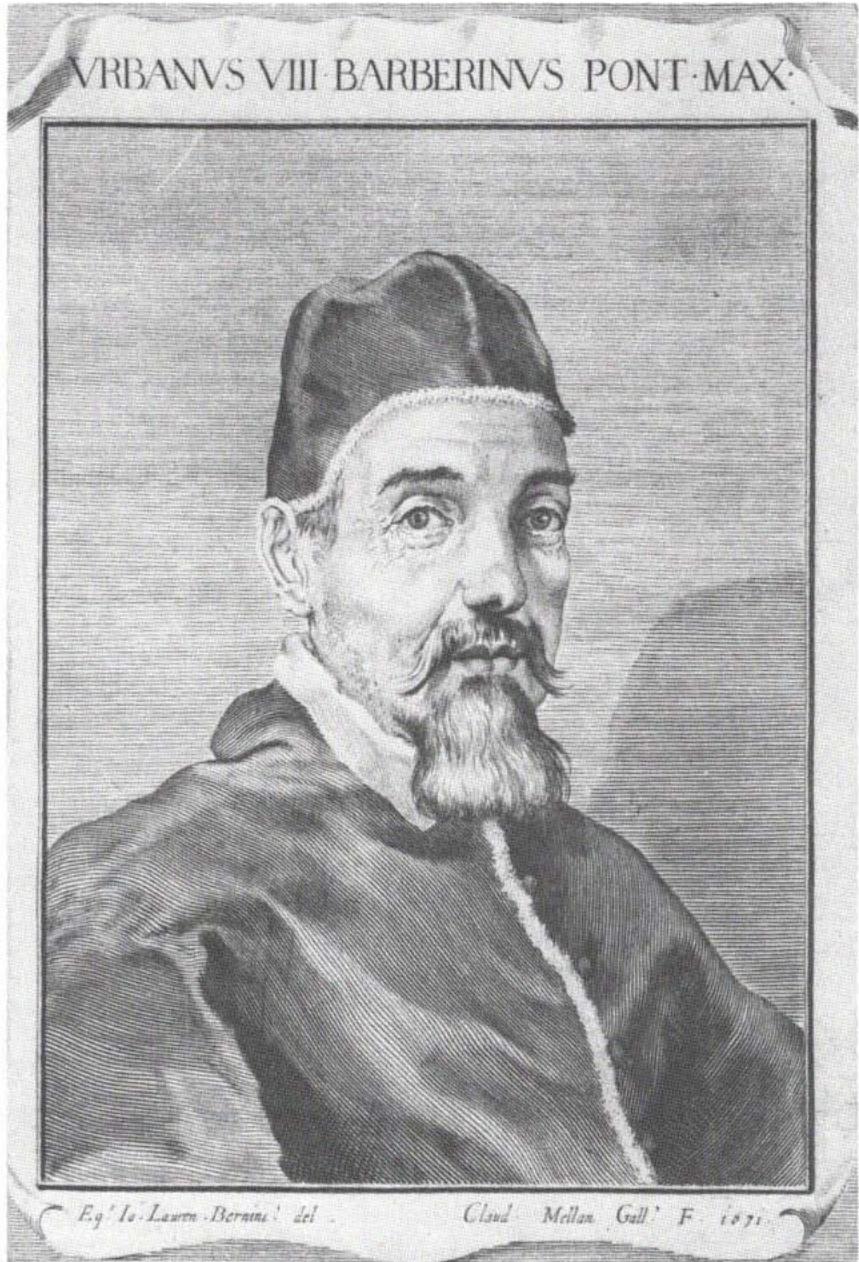
中文讲解
此为图7的占位符与图注。标注为Urban VIII Barberini的肖像,原作者Gian Lorenzo Bernini,雕版者Mellan。原始图像数据已省略,需查阅原书图像。该图作为本章插图,与P0075所述Urban VIII时代相配合。
第74段(P0079)
原文复述
aquiline nose, heavy-lidded eyes, a rather haggard face, tousled dark hair, a wide sensitive mouth, and an alertly posed head. He is dressed soberly in a dark doublet with a plain white collar. Two engravings—both reversed—seem to stem from this original. The crude and uninformative likeness that appeared in the second book of toccatas of 1627 is attributed to “F. Io. Salianus Augustinianus”(Jean Saillant) and was engraved by “Christianus Sas.” Mellan’s own engraving, an altogether finer piece of work, modifies his original drawing by softening the prominence of the nose and the angularity of the face and by deemphasizing the generous mouth (figs. 8, 9). Both of Mellan’s portraits are “speaking” likenesses in which we are confronted with a strong and perhaps not wholly sympathetic personality. The inscriptions around the frames of both engravings give the subject’s age as thirty-six, which would date them as 1619—eight years before the publication of the toccatas, and five years before Mellan’s arrival in Rome. A later inscription on the drawing later inscription on the drawing names Girolamo as musician to the Grand Duke of Tuscany, a post he did not occupy until 1628. It is most likely that the Mellan drawing was made soon after 1624. (It is possible that a hitherto unidentified caricature by Bernini—see fig. 10—records Girolamo’s appearance in his later years.)
中文讲解
本段是肖像描述的完成部分,刻画Frescobaldi面部特征(显著的鹰钩鼻、深重的眼帘、略显憔悴的脸、蓬乱的深色头发、宽阔而敏感的嘴、姿态警觉的头部)、衣着(深色紧身上衣与素白领),并讨论衍生版画。其一,源自Mellan原图的两幅版画均为反向复制:1627年《第二册toccatas》中出现的那幅粗陋而失神的肖像归于"F. Io. Salianus Augustinianus"(即Jean Saillant),雕版者署"Christianus Sas."。其二,Mellan自己的雕版则更为精细,柔化了鼻子的突出感和面部的棱角,弱化了宽阔的嘴——两幅雕版画(图8、图9)都是"会说话"的肖像,让观者面对一个强烈但可能并不完全讨喜的个性。其三,两幅版画周围的铭文都标明主角年龄为36岁,按此推算应是1619年——比《toccatas》出版早8年,比Mellan到罗马早5年。素描上的更晚期铭文称Girolamo为托斯卡纳大公宫廷乐师,但他直到1628年才获此职。因此最可能是Mellan素描作于1624年之后不久。括号补充:Bernini可能作过一幅Frescobaldi晚年的讽刺画(见图10)但尚待识别。本段功能是把肖像史与Frescobaldi生平各阶段对应起来,并展示视觉史料本身的复杂性。
补充说明
Jean Saillant是当时法国奥古斯丁修会的版画家;Christianus Sas即版画署名惯例下的雕刻师;“speaking” likenesses指"形神兼备"的肖像。
第75段(P0080)
原文复述
There are other evidences of Frescobaldi’s growing celebrity. In 1620 Agostino Superbi included Girolamo among the “illustrious Men of the City of Ferrara” in his Apparato: “At present there still lives to the honor of his native city Girolamo Frescobaldi, a man of splendid talent and elevated spirit. He distinguished himself not only in music and in composition, but especially on the organ, so that he acquired a name and reputation, and belongs to the most eminent and distinguished . . . now however he resides in Rome as organist in St. Peter’s, and possesses such ability that at present he must be numbered among the first organists of our time. Many of his works exist, which were printed some in Flanders, some in Milan and Rome; in addition many Madrigals and innumerable Church works, circulated in manuscript.” By 1624 Frescobaldi’s skill as a teacher was acknowledged in print by Cesare Crivellati, whose son Domenico, thanks to Girolamo’s diligence, had progressed “not badly” in singing and harpsichord playing.
中文讲解
本段提供Frescobaldi 1615—1628年间名声日隆的两条独立证据。其一,1620年Agostino Superbi的《Apparato》将Girolamo列入"费拉拉城杰出人物",赞其才华与精神皆出类拔萃,不仅在作曲、更在管风琴演奏上获得名声,应被列入当代最杰出之列;作品在弗兰德斯、米兰与罗马出版,外加大量手抄流传的牧歌与教会作品。其二,到1624年Cesare Crivellati在印刷品中正式承认Frescobaldi的教学能力,称其子Domenico在Girolamo的指导下声乐与羽管键琴"进步不小"。本段功能是从外部文献和印刷物两个维度证实Frescobaldi的声望。
补充说明
Agostino Superbi是17世纪意大利传记作家;Cesare Crivellati是当时作家兼作曲家Cesare Crivellati非一人,此处指他的子嗣学习经历;“Apparato"是当时费拉拉地方志性质的汇编。
第76段(P0081)
原文复述
The little surviving evidence of Frescobaldi’s private life in these years shows that circumstances and his own choice continued to weaken his ties with Ferrara and to consolidate his establishment in Rome. In November 1615 his sister Giulia was engaged to marry, and by a notary act executed in Rome Girolamo ceded to her his share of the family house in Ferrara as part of her dowry. From a notary act of July 1619 we learn that Girolamo’s strongest remaining link with his native city had been broken: his half-sister, Vittoria, is called the daughter of “the late Filippo Frescobaldi.” Girolamo’s own family continued to increase. A fourth child, Stefano, born in 1616 or 1617, and the last child, Caterina, arrived in September 1619 and was baptized in San Marco near Palazzo Venezia, with the Inquisitor of Malta as godfather. Frescobaldi returned from Mantua to his wife’s house in Piazza Colonna, where they remained until May 1618, when Girolamo’s patron Cardinal Pietro Aldobrandini bought the property for 689.27 scudi as part of a campaign to increase his holdings across the piazza from his palace on the Corso. The Frescobaldi family then moved to a house behind the Cardinal’s palace in Via Santo Stefano del Cacco (so called from a statue of the god Anubis found there and mistaken for a macacco or baboon). According to a parish census of 1625, Girolamo’s household included his wife, his children Stefano, Domenico, Caterina, and Francesco, his mother-in-law, his sister-in-law, and five lodgers, among them two Polish students, a German, and a lute player named Gaspare Rota. An account of 1627–1628 adds his wife’s uncle, Ludovico, who had accompanied him to Mantua.
中文讲解
本段以具体档案数据呈现Frescobaldi私人生活的物质细节:与费拉拉的关系被进一步切断,在罗马的根基愈加稳固。证据如下:其一,1615年11月其妹Giulia订婚,罗马的一份公证文书显示Girolamo把费拉拉家宅中自己那份作为Giulia嫁妆的一部分让渡出去;其二,1619年7月的公证文书透露Vittoria被称作"已故Filippo Frescobaldi之女”,标志其父已逝、与费拉拉最强的纽带断裂;其三,家庭人口继续扩大:第四个孩子Stefano生于1616或1617年,最小的孩子Caterina于1619年9月在Palazzo Venezia附近的San Marco教堂受洗,代父是马耳他骑士团宗教法庭大法官;其四,从曼图亚归来后,Frescobaldi住在妻子位于Piazza Colonna的娘家屋中,直到1618年5月庇护人枢机Pietro Aldobrandini以689.27 scudi买下那处房产(是其扩张对面Corso府邸行动的一部分);Frescobaldi一家随后搬到枢机府邸背后的Via Santo Stefano del Cacco一栋房子(街名源自此地曾发现一尊误认作狒狒的Anubis神像);其五,1625年教区人口普查显示其家庭成员:妻、子Stefano/Domenico/Caterina/Francesco、岳母、妻妹、五名寄宿者(包括两名波兰学生、一名德国人、琉特演奏家Gaspare Rota);其六,1627—1628年的账目还显示妻子之叔Ludovico也是家中成员,他曾陪Frescobaldi赴曼图亚。本段功能是用生活细节支撑"在罗马生根"的主题。
补充说明
Inquisitor of Malta即马耳他骑士团宗教法庭大法官;Macacco是当时对狒狒的俗称;Via Santo Stefano del Cacco即因误认Anubis神像为macacco(macacco→Cacco)而得名。
第77段(P0082)
原文复述
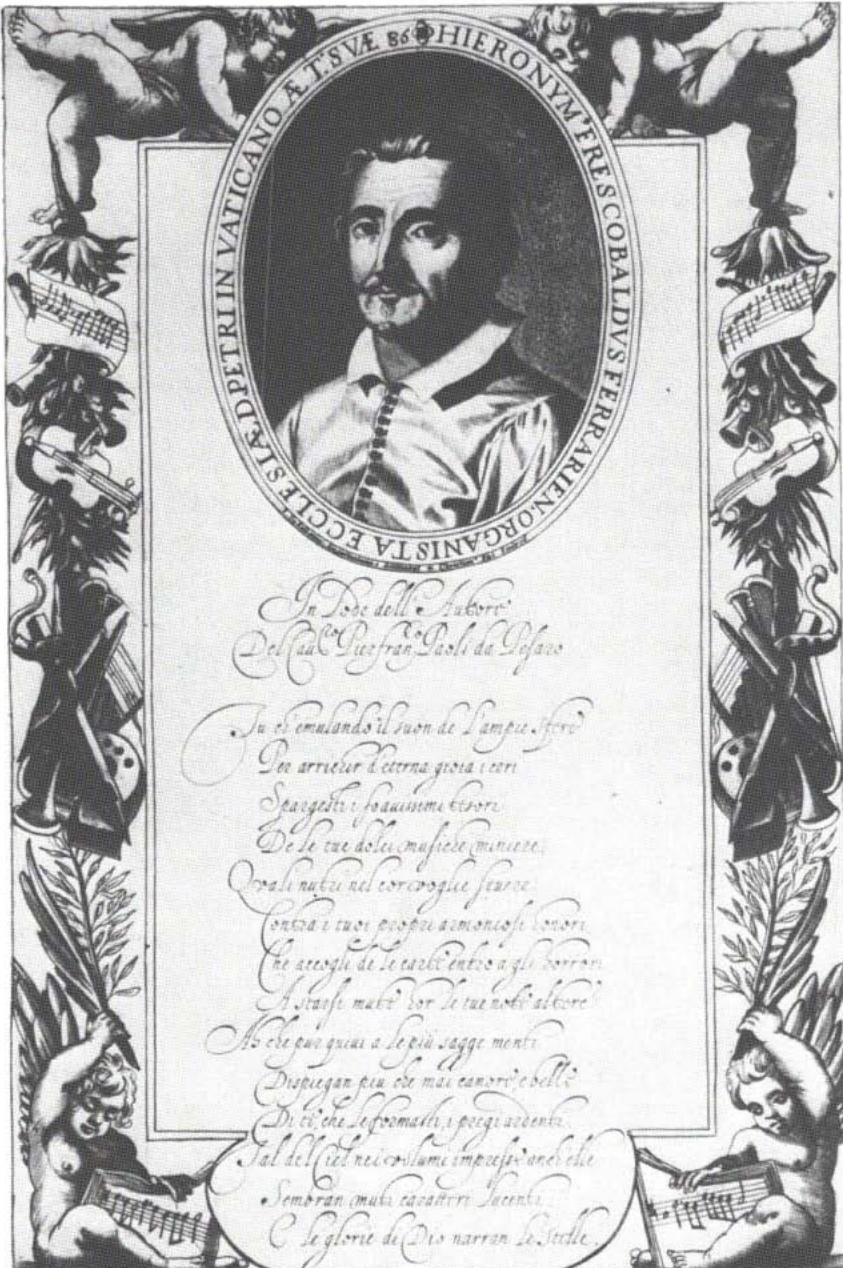
中文讲解
此为图8占位符与图注。原图由Jean Saillant所作Frescobaldi肖像,由Christianus Sas雕版,原始图像数据已省略,需对照原书查看。这是P0079所述1627年版《第二册toccatas》中出现的肖像。
第78段(P0083)
原文复述
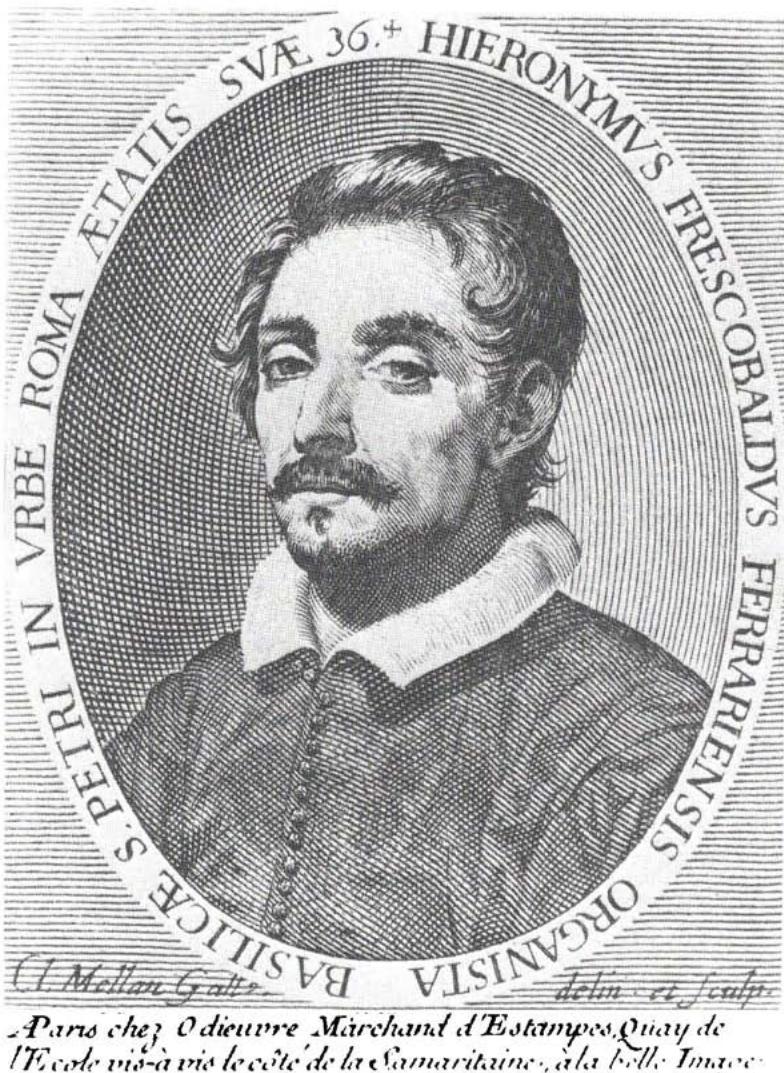
中文讲解
此为图9占位符与图注。Mellan据其黑粉笔素描所作的Frescobaldi雕版像,原始图像数据已省略,需对照原书查看。是P0079中描述的更为精细的"说话式"肖像。
第79段(P0084)
原文复述
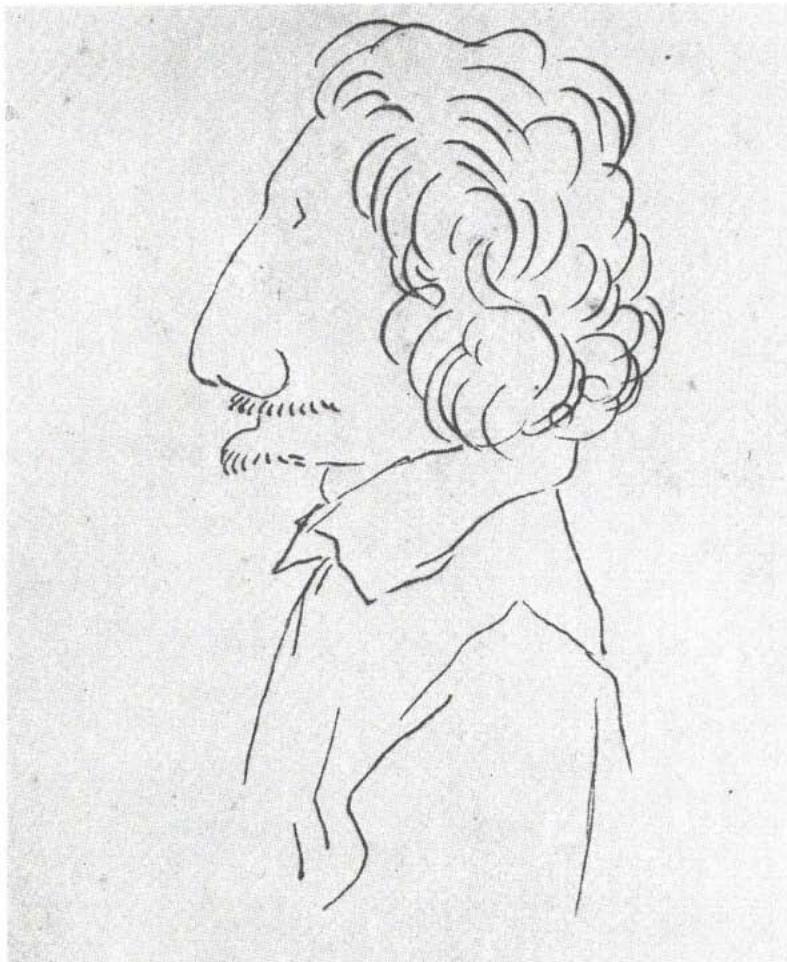
中文讲解
此为图10占位符与图注。被推测为Bernini所作的Frescobaldi晚年讽刺肖像,约1640—1645年间。问号标示此归属尚有争议;原始图像数据已省略,需对照原书查看。
第80段(P0085)
原文复述
The responsibilities of this large household must have impelled Frescobaldi to earn as much as possible. Throughout this period he performed his duties at the Vatican regularly, but this brought in only seventy-two scudi a year. Although he had given up his many students and his post with Cardinal Aldobrandini to go to Mantua, he resumed these on his return to Rome and even accepted as a pupil a boy soprano from Enzo Bentivoglio’s musica. His duties, as we have seen, included providing performers for the banquets at the Cardinal’s villa in Frascati (fig. 11). It is pleasant to imagine Girolamo and his singers at the Villa Aldobrandini, their own music counterpointed by that of the water-stairs, whose torrent “rushes, cascades, hurls, jumps, dances, retreats and advances, seethes and a thousand other things” (Agucchi, 1611), or enjoying the splendid views of the Apennines, the Campagna and distant Rome, and the sea. Girolamo also performed for other patrons. Musical academies were held once or twice a week in the Roman palace of Cardinal Alessandro d’Este, and in September 1619 one of his household officials wrote to the Cardinal: “Last Thursday there were many skilled people here, and among them were Messers Catelani and Innocentio sent by Cardinal Borghese to see and play the harpsichord that Your Most Illustrious Lordship sent, which in truth is a divine thing and amazes all who hear it. In Rome there is no one who can play it save for Girolamo Frescobaldi of Ferrara, organist of St. Peter’s and pupil of Luzzaschi, and even Frescobaldi does not do it except with great preparation.”
中文讲解
本段展开Frescobaldi在罗马的繁忙工作与多元收入来源。其一,家庭负担推动他尽量多挣钱:圣彼得年薪仅72 scudi,远不足用。其二,赴曼图亚前他曾放弃众多学生和Aldobrandini府的职务,回来后两者都恢复,还接收了Enzo Bentivoglio府中一名童声高音为徒。其三,正如P0051所述,他还为枢机Frascati别墅的宴会提供演奏者(见图11),那里Agucchi 1611年所描述的水阶梯"奔涌、倾泻、跳跃、舞蹈、退进与推进、翻腾,及其他千般姿态"的音乐化声响,可与他和歌手们的音乐形成听觉上的对位;他还可欣赏亚平宁山脉、坎帕尼亚大平原与远方罗马及海洋的壮丽景色。其四,他还为其他庇护人演奏:枢机Alessandro d’Este的罗马府邸每周举办一至两次音乐学会,1619年9月其府中官员写信给枢机称上周四有Cardinal Borghese派来的Catelani与Innocentio等人试听并弹奏枢机送来的羽管键琴,赞其"神圣、令听者惊叹",全罗马只有费拉拉的Girolamo Frescobaldi(圣彼得管风琴师、Luzzaschi弟子)能弹,且需"充分准备"。本段功能是把Frescobaldi多重谋生渠道与跨庇护人的工作网一并呈现。
补充说明
Agucchi即Giovanni Battista Agucchi,1611年描述Villa Aldobrandini水景的著名段落出自他给Aldobrandini枢机的信;Alessandro d’Este是Modena的埃斯特家族代表;“Catelani"与"Innocentio"是被派来的两位乐师。
第81段(P0086)
原文复述
In 1620 Girolamo took on another post, that of organist of Santa Maria (now Santo Spirito) in Sassia. The church and its adjacent hospital are situated in Borgo Santo Spirito, a few streets from the Vatican and near the site of Luca Antonio Soldi’s shop, where the 1624 Capricci were printed. The church is a large, oratoriolike building without transepts, richly frescoed and decorated. It still retains the façades of two sixteenth-century organs, a large instrument in a balcony halfway down the south side of the nave and a smaller one in the apse北侧 of the apse, corresponding to a cantoria on the opposite side.
中文讲解
本段介绍Frescobaldi 1620年获得的另一职位——Santa Maria(现称Santo Spirito)in Sassia的管风琴师。该教堂及其附属医院位于Borgo Santo Spirito,离梵蒂冈仅几条街,并与Luca Antonio Soldi印书铺邻近——后者正是1624年《Capricci》的印刷处。教堂本体是一座大型、布道厅式的无耳堂建筑,墙面上有华丽湿壁画与装饰。教堂至今仍保留着两台16世纪管风琴的外饰:南侧中殿中段回廊的大型乐器,以及位于半圆形后殿北侧的较小乐器,对应另一侧的唱诗班阳台。本段功能是介绍Frescobaldi的副业职位与教堂的物质环境。
补充说明
Santa Maria in Sassia是罗马古老教堂,今称Santo Spirito in Sassia;Borgo Santo Spirito是梵蒂冈北面通往圣天使堡的小区;Luca Antonio Soldi是当时罗马著名印刷商。
第82段(P0087)
原文复述
Girolamo became organist of Santa Maria in Sassia in June 1620 and continued until mid-March of the following year. Like Ercole Pasquini, who also had served there, he was paid three scudi rather than the normal twenty-five giuli (sc. 2.50) per month. It is difficult to understand how he reconciled the post with his duties at St. Peter’s, since at Santa Maria he was required to play mass and vespers for all feasts, as well as the Litany of the Madonna every Saturday and matins at Easter. In addition, the organist was expected to play the organ of the hospital for the patients and to teach the choirboys to play the harpsichord. Presumably some accommodation had been made with St. Peter’s, since musicians from the basilica performed regularly at Santa Maria in Sassia. Frescobaldi himself returned from August through December of 1626 and at Pentecost of 1628 performed四 services with four singers from the basilica under the direction of Paolo Agostino, maestro di cappella of the Cappella Giulia.
中文讲解
本段讲述Frescobaldi在Santa Maria in Sassia的具体任期与职责冲突。任职时间:1620年6月至次年3月中旬。薪酬:每月3 scudi(不同于常规的25 giuli约2.50 scudi),与前任Pasquini一样偏低。职责:必须在所有节日演奏弥撒与晚祷,每周六唱圣母连祷,复活节演奏晨课;还需为医院病人演奏医院管风琴,并教唱诗班童歌者弹羽管键琴。如何与圣彼得大教堂的本职调和是个谜——可能由于教堂间有安排,因为圣彼得的乐师经常在Santa Maria in Sassia执行礼拜。证据:Frescobaldi本人于1626年8月至12月再度赴任;1628年圣灵降临节,他与Cappella Giulia的maestro di cappella Paolo Agostino带领的四位歌手一起在该教堂执行了四台礼仪。本段功能是把Frescobaldi第二职位的具体工作条件与其本职工作调和的可能性都记录下来。
补充说明
Litany of the Madonna即圣母连祷(Litany of Loreto),是每周六的固定敬礼;giuli是罗马常用的货币单位(1 giulo = 约0.1 scudi)。
第83段(P0088)
原文复述
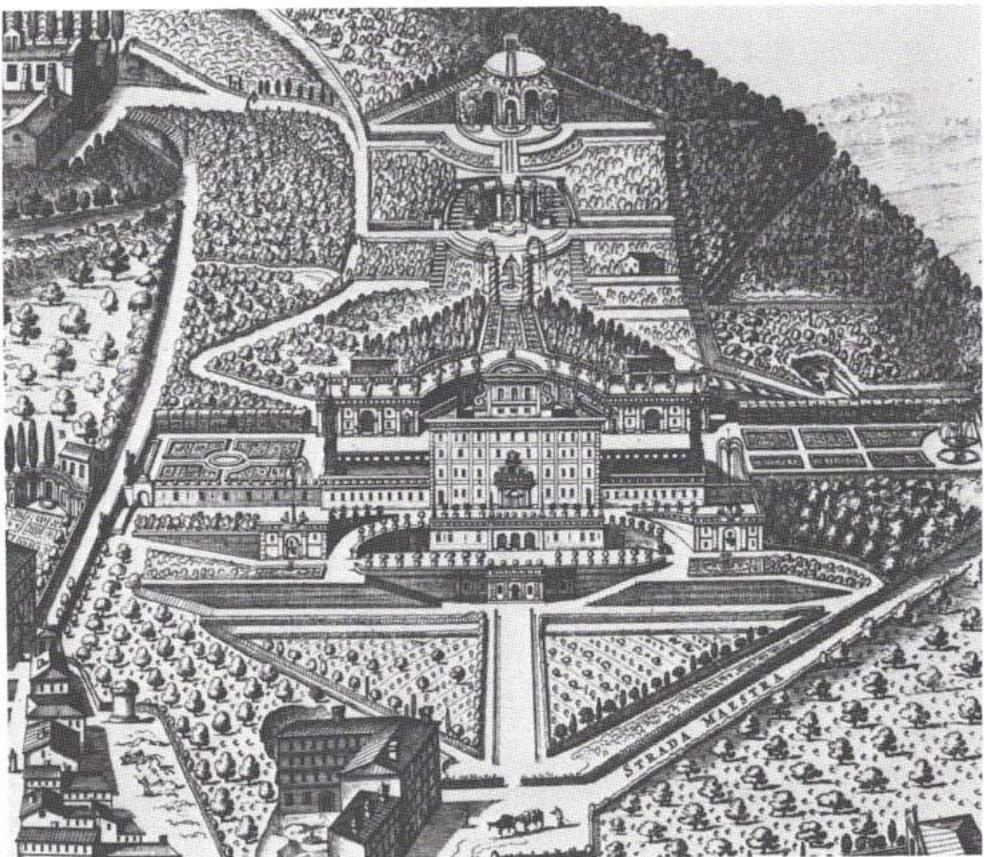
中文讲解
此为图11的占位符与图注。Villa Aldobrandini at Frascati的雕版图,雕版者Matthaüs Greuter,原始图像数据已省略,需对照原书查看。该图为P0085所述水阶梯与景观的视觉参照。
补充说明
Matthäus Greuter是17世纪初活跃于罗马的德裔版画家。
第84段(P0089)
原文复述
ROME, 1615–1628
中文讲解
这是一个页眉式的小节标识,重复"罗马,1615—1628"以提示读者当前所在章节。其版式功能为分节提示,本身不含叙事信息。
第85段(P0090)
原文复述
The financial records of San Luigi de’ Francesi, the French national church in Rome, show that “Sr. Gironimo organista di S. Pietro” served as one of two extra organists for the church’s patronal festival, 25 August, in 1625 and 1627, at a salary of two scudi. He probably also accepted other such casual employment as a member of the pool of available Roman church musicians.
中文讲解
本段补充Frescobaldi的其他临时工作:罗马法国国家教堂San Luigi de’ Francesi的财务记录显示,“圣彼得管风琴师Gironimo先生"于1625年与1627年8月25日教堂主保节庆中担任两位额外管风琴师之一,每次薪酬2 scudi。作者推测他还接受其他类似的临时聘约,因为他是当时罗马教会乐师"人才库"中的核心人物之一。本段功能是把Frescobaldi多渠道收入的具体实例记录下来。
补充说明
San Luigi de’ Francesi是罗马法国侨民的民族教堂,今以Caravaggio的《马太蒙召》等画作闻名。
第86段(P0091)
原文复述
Frescobaldi’s attempts to increase his income must be viewed against the steadily rising prices that marked the last years of the pontificate of Paul V and the economic crises under his successor. In January 1621 Paul V died unexpectedly. The Bolognese Cardinal Ludovisi was easily elected and took the name Gregory XV. His election ended the enmity between the Aldobrandini and the ruling papal family, although Girolamo’s patron Pietro died too soon afterward to enjoy the amnesty. By the winter of 1621 there was a famine in the City, following by flooding of the Tiber, and in March 1622 there began a plague that lasted a year (and may have taken Girolamo’s second child, Maddalena). Gregory tried to offset these disasters by splendid public ceremonies, most notably the canonization in March 1622 of the great heroes of the Counter-Reformation—Ignatius Loyola, Francis Xavier, Teresa of Avila, and Philip Neri—and the triumph of the Madonna della Vittoria the following May. Nonetheless, when Gregory XV died in July 1623 the diarist Gigli observed that the Romans had been more wearied by twenty-nine months of Gregory than by nearly sixteen years of Paul. The ensuing conclave consequently developed into a pitched battle between the Borghese and Ludovisi factions, prolonging the period of sede vacante to four weeks. Finally the summer heat and the threat of malaria compelled the cardinals to a decision, and on 5 August they elected the fifty-six-year-old Cardinal Maffeo Barberini, who took the name Urban VIII.
中文讲解
本段把Frescobaldi的财务压力放入宏观的罗马社会经济背景中。Paul V晚年物价不断上涨;其继任者治下则遭遇经济危机。1621年1月Paul V猝逝,Bolognese枢机Ludovisi顺利当选为Gregory XV;其当选结束了Aldobrandini家族与统治家族(Borghese)的对立,但Frescobaldi的庇护人Pietro Aldobrandini不久辞世,未能享受到和解的成果。1621年冬罗马发生饥荒,继之以台伯河泛滥;1622年3月起长达一年的瘟疫爆发,可能夺去Frescobaldi的次女Maddalena。Gregory试图以盛大公祭对抗灾难,1622年3月封圣反宗教改革四大英雄(依纳爵·罗耀拉、方济各·沙勿略、大德兰、斐理伯·乃立),同年5月举行Madonna della Vittoria庆典。但当1623年7月Gregory去世时,日记家Gigli记下罗马人经过29个月的Gregory反而比Paul十六年还感到疲倦。随后举行的conclave陷入Borghese与Ludovisi两派的激烈对峙,sede vacante延至四周;最终在暑热与疟疾威胁下,枢机们于8月5日选举56岁的Maffeo Barberini为Urban VIII。本段功能是为Frescobaldi财务困境提供政治—经济—社会的宏观背景,并以Urban VIII当选作为下一节的过渡。
补充说明
sede vacante(“空座期”)是教皇去世与新教皇当选之间的过渡期;Gigli即Giuseppe Gigli,是当时罗马著名日记家。
第87段(P0092)
原文复述
Urban was the youngest of the candidates. In person he was handsome and dignified (except for a tendency toward fits of rage), with a cultivated intellect displayed in the composition of Latin verse, set by Kapsberger and Domenico Mazzocchi. How did the election of this amiable prelate inaugurate the golden age of seventeenth-century Rome? First, Urban’s reign coincided with a remarkable flowering of artistic talent as well as with the high point of papal finances. Second, he did not so much change the traditional forms of patronage as exercise them with a logic—principally through the appointment of Bernini as chief artistic consultant—and on a scale previously unprecedented. Third, his own efforts during the first part of his reign, which centered on St. Peter’s and large public enterprises, were increasingly supplemented by the patronage of his gifted nephews, more concerned with the family产业 and with public spectacles. Even Paul V Borghese could quip that his brother’s new palace was “too big a cage for such a bird,” but the Barberini ambition was limitless. Where previous popes had generally vested access to themselves in one cardinal-nephew, Urban raised to the purple two of his nephews, Francesco and Antonio, and a brother, another Antonio. His other brother, Carlo, was named General of the Church, and his remaining nephew, Carlo’s son Taddeo, was made Prince of Palestrina and Prince Prefect of Rome and was grafted on to the older Roman nobility by marriage to Anna Colonna. Previous popes had generally concentrated their efforts on a single religious foundation, but Urban commissioned a family chapel in Sant’Andrea della Valle, contributed to his brother’s foundation of Santa Maria della Concezione, and completed St. Peter’s as his principal monument. In addition to the papal residences at the Quirinal and the Vatican, the Barberini palaces eventually included Urban’s original house in the Via de’ Giubbonari, the palace at Palestrina, Francesco’s Palazzo della Cancelleria, Palazzo Rusticucci near the Vatican, and the great new family palace at the Quattro Fontane, the work of Maderno, Bernini, and Pietro da Cortona.
中文讲解
本段详细刻画Urban VIII其人及其如何开启17世纪罗马的"黄金时代”。其一,Urban是当时最年轻的候选人,相貌堂堂、举止庄重(除偶有怒气爆发外),智力深邃,他创作的拉丁诗由Kapsberger和Domenico Mazzocchi谱曲。其二,问题:为什么他的当选能开创罗马黄金时代?回答三:他的在位恰逢艺术才俊辈出与教廷财政巅峰;他并未改变传统的赞助形式,而是以逻辑与前所未有的规模运用它们,主要标志是任命Bernini为首席艺术顾问;他在位前期以圣彼得大教堂与大型公共工程为重点,后期则逐步由其才华横溢的子侄们——更关心家族产业与公开表演——的赞助补充。其三,连Paul V Borghese都曾打趣说兄弟的新宫"对这鸟来说笼子太大”,但Barberini家族的野心无止境。以往教皇通常通过一位枢机侄获得与本人的接触渠道,Urban则将两位侄子Francesco与Antonio以及一位兄弟(也叫Antonio)升为枢机;另一兄弟Carlo被任命为教廷将军(General of the Church);Carlo之子Taddeo被封为Palestrina亲王与罗马亲王总督,并通过迎娶Anna Colonna与旧罗马贵族结亲。以往教皇一般集中精力于一处宗教基金会,Urban则在Sant’Andrea della Valle委托家族礼拜堂、为兄弟的Santa Maria della Concezione基金出力,并将完成圣彼得大教堂作为主要纪念碑。除Quirinal与梵蒂冈教皇宫廷外,Barberini宫殿还包括Urban在Via de’ Giubbonari的旧宅、Palestrina行宫、Francesco的Palazzo della Cancelleria、Palazzo Rusticucci(近梵蒂冈)、以及Quattro Fontane的新家族大宫殿——后者由Maderno、Bernini与Pietro da Cortona共同建造。本段功能是详细勾勒Frescobaldi回归罗马后将身处的文化政治氛围。
补充说明
Kapsberger即Giovanni Girolamo Kapsberger,罗马著名作曲家与琉特演奏家;Domenico Mazzocchi是其同时代作曲家;Quattro Fontane即"四喷泉"街口,是罗马贵族宫殿聚集地之一。
第88段(P0093)
原文复述
Under Urban’s aegis the Cappella Giulia began to reflect the growing taste for splendid polychoral church music. As early as 1616 the Gesù had presented under Anerio’s direction a mass sung by “all the Singers of Rome” divided into eight choirs and placed in the balconies above the chapels of the church. While not on this scale, the two principal musical celebrations of the Cappella Giulia, the feasts of St. Peter and the Dedication, regularly included extra singers (twenty-six by 1622), two and three assistant organists, and assistant conductors for the choirs. The first great solemnity of Urban’s reign was the celebration of the Holy Year of 1625, beginning with the unsealing of the Porta Santa of St. Peter’s on Christmas Eve of 1624. On 25 March 1625 Urban canonized St. Elizabeth of Portugal in a ceremony whose decorations by Bernini included the first project for the baldacchino, the bronze for which was already being removed from the Pantheon.
中文讲解
本段展示Urban VIII任内Cappella Giulia礼仪音乐规模的提升。其一,1616年Gesù教堂已在Anerio指挥下呈现过由"全罗马歌手"组成的八个合唱团弥撒,分列教堂礼拜堂上方阳台;虽然Cappella Giulia没有达到这个规模,但其两大庆典(圣Peter节与教堂奉献节)则定期扩大编制——到1622年增补至26名歌手、两至三名助理管风琴师以及合唱指挥。其二,Urban任内第一场盛大庆典是1625年圣年,1624年圣诞夜以开启圣彼得大教堂的Porta Santa为开端;1625年3月25日Urban封圣葡萄牙的伊丽莎白,其仪式装饰由Bernini负责,包括baldacchino的初步设计——其青铜已从万神殿中取出。本段功能是把Frescobaldi实际参与的音乐活动的物理与组织背景勾勒清楚,并展示Urban教皇时期艺术与礼仪的协同扩张。
补充说明
Polychoral(多合唱团)音乐是17世纪初罗马礼仪音乐的典型特征;Porta Santa(圣门)是四扇圣年专用的礼仪大门之一;Pantheon的青铜在教皇Urban时期被部分熔化用于铸造baldacchino。
第89段(P0094)
原文复述
In 1626 Vincenzo Ugolini, maestro of the Cappella Giulia, was dismissed and succeeded by Paolo Agostino, a noted contrapuntist. Agostino’s first year of office included an event of enormous significance. In 1626 the feast of the Dedication on 18 November was celebrated not merely as the commemoration of the Constantinian basilica but as the formal consecration of its successor by the Pope: the culmination of a project that had indirectly precipitated the Protestant Reformation and had involved the greatest意大利艺术家与 papal patrons for well over a century. No account of the occasion describes the music in detail, but it cannot have been less splendid than the music for the anniversary of the Dedication the following year, with four choirs and instruments.
中文讲解
本段记录Cappella Giulia的关键人事与礼仪里程碑。其一,1626年maestro Vincenzo Ugolini被解职,由著名对位作曲家Paolo Agostino接替。其二,Agostino上任第一年发生了一件意义深远的事:1626年11月18日的奉献节庆典不只是对君士坦丁巴西利卡的纪念,更是由教皇亲自正式祝圣其继承者(米开朗琪罗设计的新圣彼得大教堂)——这是一个间接引发了宗教改革、并牵动意大利最伟大艺术家与教皇赞助人超过一个世纪的项目的高潮。其三,目前没有关于这次礼仪音乐的详细记载,但其辉煌程度不可能低于次年(1627年)奉献周年庆——四个合唱团加乐器的配置。本段功能是把圣彼得大教堂历史落成的高光时刻与Frescobaldi的工作场景关联起来。
补充说明
Vincenzo Ugolini是著名作曲家与理论家,其弟子包括Carissimi;Paolo Agostino则是巴洛克时期对位法权威。
第90段(P0095)
原文复述
The largest of these polychoral performances during the first years of Urban’s reign, the music for the feast of Sts. Peter and Paul in June 1628, was also Frescobaldi’s last important public appearance before his removal to Florence. At second vespers of the feast Agostino produced a work for no less than twelve choirs, in honor of the twelve Apostles. Girolamo presided at the organ amid Rome’s most distinguished musicians. The castrato and composer Cavalier Loreto Vittori appeared among the three sopranos, while Stefano Landi contributed his services and those of eight additional singers; the contraltos numbered twenty, the tenors nineteen, and the basses seventeen. The accompanying instruments included five cornetts, seven violins, a contralto viola, two tenor viole, a contralto di violino, six trombones, a violone, and a bassoon. The twelve Apostolic choirs were conducted by musicians from the papal court, maestri in the service of Roman churches and cardinals’ households (including Domenico Mazzocchi andNicolò Borbone, the publisher of Frescobaldi’s两册 toccatas), and Agostino himself. The roster of organists, headed by “Sig.re Girolamo,” similarly included musicians from the most important churches of the City: Girolamo’s predecessor, Costantini, and the organists of the Chiesa Nuova, the Araceli, Santa Maria in Trastevere, the Minerva, and Santo Spirito. This gathering of musicians also represented the three focuses of Roman church music: St. Peter’s, the Congregazione di Santa Cecilia, and the Oratorio.
中文讲解
本段详细记述1628年6月圣Peter与圣Paul节庆典——Urban在位初期最大型的多合唱团演出,也是Frescobaldi赴佛罗伦萨前最后一次重要的公开演出。其一,在节日的第二晚祷中,Agostino制作了一部以十二使徒为主题的十二个合唱团作品;Girolamo在最杰出的罗马乐师中间主持管风琴。其二,歌唱阵容包括:著名阉伶作曲家Cavaliere Loreto Vittori(三位女高音之一)、Stefano Landi(携八名歌手参加);女低音20人、男高音19人、男低音17人。乐器包括:五支短号、七把小提琴、一把中音viola、两把次中音viola、一把中音violin、六支长号、一把violone(低音维奥尔琴)、一支巴松管。其三,十二个使徒合唱团由教廷、各罗马教堂、枢机府中服务的maestri指挥(包括Domenico Mazzocchi、Frescobaldi两册toccatas的出版人Nicolò Borbone及Agostino本人)。管风琴师名单以"Sig.re Girolamo"为首,加上Costantini(其前任)及罗马最重要教堂(Chiesa Nuova、Ara celi、Santa Maria in Trastevere、Minerva、Santo Spirito)的管风琴师。这一乐师群体同时代表罗马教会音乐的三大中心:圣彼得、Cecilia修会与Oratorio。本段功能是把Frescobaldi在罗马生涯的高光演出与三大音乐机构的关系具体定格。
补充说明
Nicolò Borbone是当时罗马著名出版商,曾出版Frescobaldi两册toccatas;Loreto Vittori是著名阉伶歌手兼作曲家;violone是低音维奥尔琴,是现代低音提琴的前身之一。
第91段(P0096)
原文复述
Girolamo’s close association with the members of Santa Cecilia renders somewhat academic the question of his own membership. In any case, his publications during these years link him publicly with the composers of the Congregazione precisely at a time when its activities affected every
中文讲解
本段是P0095至P0098的过渡,承接1628年庆典所点出的三大焦点(圣彼得、Cecilia修会、Oratorio)。作者指出:Frescobaldi与Cecilia修会成员关系紧密,是否正式加入该修会已属学究问题;但他此时期的出版物明确把他与修会作曲家群体联系起来,恰逢修会的活动对每位罗马乐师都产生影响。本段在此中断,下段P0097将展开对Cecilia修会重组与所获/所失特权的描述。
补充说明
Congregazione di Santa Cecilia是罗马教会音乐家行会组织,1620年代由Orazio Griffi重组,详见下段。
第92段(P0097)
原文复述
Roman musician. In the early 1620s the Congregation was reorganized under Orazio Griffi, master of the papal chapel after 1623 and a priest closely associated with the Oratorian运动. Once established in the little church of San Paolino in Piazza Colonna, in the spring of 1624 the Congregation petitioned Urban VIII for what amounted to control of the musical life of Rome: the right to censor all musical publications, license schools of music, and oversee the membership of choirs. In November 1624 Urban granted Santa Cecilia supervision of musical publication and the right to license those who wished to open schools of music. When the Congregation attempted to exercise these特权, however, the outcry from the papal musicians was such that two years later Urban revoked the privileges.
中文讲解
本段叙述Cecilia修会1620年代初的重组及其对罗马音乐生活的影响。其一,1620年代初修会在Orazio Griffi(1623年后任教皇礼拜堂master,与Oratorian运动密切相关)主持下重组。其二,修会在Piazza Colonna的San Paolino小教堂站稳脚跟后,1624年春天向Urban VIII请愿要求控制罗马的音乐生活——审查所有音乐出版、为音乐学校发照、监督合唱团成员资格。其三,1624年11月Urban授予Cecilia修会监督音乐出版与为音乐学校发照的权利;然而当修会试图行使这些特权时,教皇乐师们群起反对,两年后Urban撤销了这些特权。本段功能是把Frescobaldi所处行业的制度背景讲清:作曲家与音乐家团体的政治博弈直接影响他的创作与出版。
补充说明
Orazio Griffi是教皇礼拜堂的maestro,也是Oratorian神父;Oratorio运动源于Filippo Neri创立的在罗马各教堂举行的非正式祈祷与音乐聚会;Piazza Colonna正是Frescobaldi岳父家的所在地。
第93段(P0098)
原文复述
The alliance between the Congregation of Santa Cecilia, the Oratorian运动, and the musicians associated with the Cappella Giulia is apparent in the sacred collections issued during these years. Frescobaldi published small sacred concertos in four anthologies: the Selectae Cantiones (1616), the Scelta di motetti (1618) of Alessandro Costantini’s brother Fabio, the Lilia Campi of Giovanni Battista Robletti (1621), who printed Girolamo’s Canzoni of 1628, and the Sacri affetti (1625) published by Luca Antonio Soldi, the printer of the Capricci. The contents of Costantini’s collections seem directly associated with the Oratorio del Crocifisso, and virtually every composer in all four books was associated with both Santa Cecilia and St. Peter’s; at least nine of them performed in the 1628 vespers of Sts. Peter and Paul.
中文讲解
本段揭示Cecilia修会、Oratorian运动与Cappella Giulia乐师之间三位一体的联盟,并落实在具体出版项目上。Frescobaldi的小型sacred concertos发表在四部文集中:1616年的Selectae Cantiones;1618年Alessandro Costantini之兄Fabio所编的Scelta di motetti;1621年Giovanni Battista Robletti所编的Lilia Campi(此人后来出版Frescobaldi的1628年Canzoni);以及1625年由《Capricci》印刷商Luca Antonio Soldi出版的Sacri affetti。Costantini文集的内容直接与Oratorio del Crocifisso相关;四本书中的几乎每一位作曲家都与Cecilia修会和圣彼得相关联;其中至少九位在1628年圣Peter与圣Paul节晚祷中登台。本段功能是把Frescobaldi参与的sacred concertos出版网络与教廷/修会/Oratorio的政治-宗教脉络统一起来。
补充说明
Oratorio del Crocifisso是罗马最古老的Oratorio聚会之一;Sacred concertos即小规模sacred concerto,介于giovanni Gabrieli式大合唱团与新协奏体之间的过渡体裁。
第94段(P0099)
原文复述
The collections of secular music issued in the years between Girolamo’s return to Rome and his departure for Florence in 1628 display equal vitality, together with a greater variety of expression. Fabio Costantini published two volumes of secular works, the Ghirlandetta amorosa of 1621 and the Aurata Cintia of 1622, to which Frescobaldi contributed as well as to Robletti’s Giardino musicale (1621). A number of secular prints issued from the Florentine court, under the rule of the melomane Grand Duke Cosimo II. The publications of the Florentines Gagliano, Brunelli, Vitali, and Lorenzo Allegri were overshadowed, however, by the works of Monteverdi that appeared during these years. The epoch-making fifth book of madrigals continued to be reprinted; Book VI appeared in 1614 and Book VII in 1619, the latter followed by at least four reprints.
中文讲解
本段叙述Frescobaldi归罗马到赴佛罗伦萨期间世俗音乐出版的繁荣。Fabio Costantini出版了两部世俗作品集:1621年的Ghirlandetta amorosa与1622年的Aurata Cintia,Frescobaldi皆有贡献;他还为Robletti 1621年的Giardino musicale投稿。佛罗伦萨宫廷在醉心音乐的Cosimo II治下也出版了若干世俗作品——Gagliano、Brunelli、Vitali、Lorenzo Allegri的作品在Monteverdi的出版光芒下相形失色。划时代的第五册牧歌集仍不断再版;第六册出现于1614年,第七册出现于1619年,后者至少重印四次。本段功能:把罗马与佛罗伦萨两大世俗音乐出版中心并列,凸显Monteverdi作为时代坐标的地位,同时也暗示Frescobaldi作为sacred concertos与键盘作品的关键参与者所身处的世俗音乐潮流。
补充说明
Cosimo II de’ Medici在位1609—1621年,是美第奇家族中著名的音乐爱好者。
第95段(P0100)
原文复述
The musical flowering of this period is equally apparent in prints of solo and ensemble instrumental music, the area of Girolamo’s principal activity. The most important solo keyboard collections issued include Trabaci’s second book of ricercars (1615), Cifra’s two books of ricercars and canzonas (1619) (of which the first was modeled on Frescobaldi’s Recercari et canzoni), and Picchi’s Intavolatura di balli (1621). In 1623 Girolamo’s former associate in the Bentivoglio musica, Alessandro Piccinini, published his Intavolatura di liuto. Even more important was the first wave of collections for instrumental ensemble, which included publications by Kapsberger, Giovanni Gabrieli, Salomone Rossi, Carlo Farina, and Biagio Marini.
中文讲解
本段突出当时器乐独奏与合奏出版的繁荣——这正是Frescobaldi的主要活动领域。最重要的键盘独奏集包括:Trabaci 1615年第二册ricercars;Cifra 1619年两册ricercars与canzonas(其中第一册即模仿Frescobaldi的《Recercari et canzoni》);Picchi 1621年Intavolatura di balli。1623年Frescobaldi在Bentivoglio府的旧同事Alessandro Piccinini出版其Intavolatura di liuto(琉特曲集)。更具重要性的是首波器乐合奏集,包括Kapsberger、Giovanni Gabrieli、Salomone Rossi、Carlo Farina、Biagio Marini的出版。本段功能是确立Frescobaldi键盘作品在同时代独奏文献中的核心地位(Cifra直接受其影响),并说明器乐合奏出版的兴起也正逢其创作活跃期。
补充说明
Giovanni Gabrieli是威尼斯圣马可的管风琴家与合奏音乐的奠基人;Trabaci、Cifra、Picchi是那不勒斯和威尼斯键盘乐派的代表人物。
第96段(P0101)
原文复述
A rapid survey of the music produced during this period, then, shows significant productions in the fields of church music, secular vocal music, opera, the area of Girolamo’s principal activity. The most important solo keyboard collections issued include Trabaci’s second book of ricercars (1615), Cifra’s two books of ricercars and canzonas (1619) (of which the first was modeled on Frescobaldi’s Recercari et canzoni), and Picchi’s Intavolatura di balli (1621). In 1623 Girolamo’s former associate in the Bentivoglio musica, Alessandro Piccinini, published his Intavolatura di liuto. Even more important was the first wave of collections for instrumental ensemble, which included publications by Kapsberger, Giovanni Gabrieli, Salomone Rossi, Carlo Farina, and Biagio Marini.
中文讲解
本段是P0100的延续与扩展。首先总结:1615—1628年间的音乐生产覆盖了教会音乐、世俗声乐、歌剧、独奏与合奏器乐等所有领域;唯独歌剧一项Frescobaldi未出版作品。他进入sacred concertos领域的过程较为渐进:从为Costantini等人的文集中投稿单首作品开始;第一部完整的sacred concertos集已失传,1627年才出版Liber Secundus Diversarum Modulationum(共32首1—4声部motet加continuo),可能用于圣彼得大教堂演出,献给大教堂Archpriest枢机Scipione Borghese。括号补充:Frescobaldi在佛罗伦萨出版的两部世俗声乐集也是在文集中先行发表单首作品后才集结成册的。本段功能是总览Frescobaldi在罗马时期的创作覆盖面,并指出sacred concertos这一体裁的渐进发展路径。
补充说明
Liber Secundus Diversarum Modulationum是Frescobaldi唯一幸存的sacred concertos专集;Cardinal Scipione Borghese即Paul V的侄子,长期担任圣彼得大教堂的Archpriest。
第97段(P0102)
原文复述
Frescobaldi’s major productions during this period, however, were instrumental works: the second version of the first book of toccatas (1615–1616), the ricercars and canzonas dedicated to Cardinal Aldobrandini (1615), the capriccios (1624), the second book of toccatas (1627), and a volume of canzonas for one to four instruments and continuo (1628).
中文讲解
本段列举Frescobaldi 1615—1628年间最重要的器乐出版:1615—1616年间第一册toccatas的扩充版;1615年献给Aldobrandini枢机的ricercars与canzonas;1624年的capriccios;1627年第二册toccatas;1628年一至四件乐器加continuo的canzonas专集。这一清单凸显键盘作品与他唯一的器乐合奏集是这一时期的核心。
补充说明
continuo即basso continuo(通奏低音),是巴洛克音乐即数字低音实践的基础。
第98段(P0103)
原文复述
In the same year Girolamo’s pupil Bartolomeo Grassi, organist of Santa Maria in Aquiro near Piazza Colonna, published the canzonas in open score, together with three additional works. Grassi’s extensive introduction to his edition shows that by 1628 Frescobaldi’s music, especially the two books of toccatas, was considered fundamental for the keyboard player, as it was to remain for decades: “I therefore advise every student, that he provide himself with all the works of Signor Girolamo, beginning from the first book of Toccatas in Copper, & following the second now published with infinite expectation of all who profess this art, not being less worthy than the first, indeed fuller of diversity of works, as well for the Organ, as for the Harpsichord, & every keyboard player having these two books containing Toccatas, Galanteries, & responses necessary for all the needs of the Church, may deem himself content.” The canzonas were recommended for “liveliness, and sprightly imitative motives . . . gravity and learning,” while the capriccios and ricercars supplied seriousness of style. These last works were so popular, Grassi states, that it had been necessary to reprint them three times.
中文讲解
本段借Frescobaldi弟子Bartolomeo Grassi(Santa Maria in Aquiro管风琴师,Piazza Colonna附近)1628年所出版的开放总谱canzonas版之序言,揭示当时Frescobaldi在键盘音乐界被视为根本性权威。Grassi告诫每位学生要收集Frescobaldi的全部作品,从铜版印刷的《第一册toccatas》开始,继以刚出版、被所有本行人士翘首以待的《第二册toccatas》——它不逊于第一册,且作品更为多样,兼顾管风琴与羽管键琴;拥有这两册toccatas、galanteries(华丽小品)与必要的应答曲(responses),即可满足教会一切所需。canzonas被推荐为"活泼、机敏的模仿动机……庄重而博学";capriccios与ricercars则提供风格的严肃性。Grassi还指出后者极受欢迎,已重印三次。本段功能:以弟子序言实证Frescobaldi作品的"经典化"地位,并展示他对教学传统的影响。
补充说明
open score(开放总谱)即把对位各声部并列排版,区别于当时键盘曲常见的partitura格式;Galant一词在17世纪初指华丽、装饰性的音乐风格。
第99段(P0104)
原文复述
Grassi’s concluding paragraph raises an issue that still haunts Frescobaldi scholarship: “Signor Girolamo has made an infinite number of other volumes, & constantly goes on shaping new ones, because he is as eminent in composition as in improvisation, as Rome constantly sees, he does marvelous things; but the effort, & expense of Printing does not permit them to appear.” That these survived Girolamo’s death is attested by a Nota dellì musei, librerie, galerie di Roma of 1664: “In the Frescobaldi household there are Compositions in Harpsichord tablature written by hand, and not printed by the famous Girolamo Frescobaldi father of Gio: Domenico Beneficed cleric of S. Pietro.” The fate of these manuscript volumes is unknown, but their existence is of central importance in evaluating the large number of works attributed to Frescobaldi in manuscript sources.
中文讲解
本段提出Frescobaldi研究的核心遗留问题。Grassi序言末段写道:Frescobaldi创作了无数其他作品并不断新作,他在作曲与即兴两途同样卓越,罗马不断见证其精彩;但印刷所耗精力与费用使它们无法面世。1664年的一份《罗马博物馆、图书馆、画廊清单》记载:“Frescobaldi家中有著名Girolamo Frescobaldi(圣彼得受俸神父Gio: Domenico之父)手抄、未刊的羽管键琴tablature谱乐谱”。这些手抄本下落不明,但其存在对于评估手稿中归于Frescobaldi的海量作品的归属至关重要。本段功能是揭示大量归名Frescobaldi的手稿实际身份仍未确定,对后世研究构成持续挑战。
补充说明
Gio: Domenico即Frescobaldi之子Domenico,后在圣彼得获得受俸神职(benefice);“Nota"是当时罗马文化资产登记簿。
第100段(P0105)
原文复述
Grassi’s assertions about the popularity of Girolamo’s collections are confirmed by an examination of their publishing history between 1615 and 1628. The most complex is that of the first book of toccatas, issued in three versions and at least five printings in those years. For the 1628 version a new title page was engraved, the inapplicable dedication to Ferdinando Gonzaga from the 1615 and 1616 versions was deleted, and the portrait of Girolamo first published in the second book of toccatas was added.
中文讲解
本段以出版史验证Grassi所言Frescobaldi作品的受欢迎程度。最复杂者为第一册toccatas,在1615—1628年间有三种版本、至少五次印刷。1628年版新刻扉页,删除了1615与1616年版中不再适用的对Ferdinando Gonzaga的献辞,并加上了首次出现于第二册toccatas的Frescobaldi肖像。本段功能是从印刷次数的角度实证作品影响力,并把Ferdinando Gonzaga献辞的删除与曼图亚之挫败的历史事件相呼应。
第101段(P0106)
原文复述
Unlike the two books of toccatas, which were engraved on copper plates, the other two collections were printed in open score (keyboard partitura) from movable type, a less expensive if less elegant process. The Recercari et canzoni, comprising ten ricercars and five canzonas, was first issued in 1615 and reprinted in 1618. In 1624 Girolamo published his twelve capriccios on various subjects, recalling both in the dedication and in a letter to the dedicatee, Alfonso d’Este, Prince of Modena, his Ferrarese background and his studies with Luzzaschi. (The dedication was opportune, since Monteverdi noted in a letter of 2 March 1624 that the Prince of Modena was beginning to take an interest in music.) In 1626 the Capricci (minus the variation-capriccio on “Or che noi rimena”) was combined with the Recercari, without the dedication of either collection, and the double volume was reissued in 1628, both times by Vincenti of Venice—Girolamo’s first非罗马 publication since 1608.
中文讲解
本段介绍Frescobaldi在罗马出版的其他两部键盘曲集的形式与传播。其一,与两册toccatas用铜版刻制不同,《Recercari et canzoni》与《Capricci》采用活字版开放总谱(keyboard partitura)印刷——更经济但不够精致。其二,《Recercari et canzoni》(10首ricercars + 5首canzonas)首版1615年,1618年再版。其三,1624年出版的12首capriccios在献辞与致献辞人Modena亲王Alfonso d’Este的信中都回顾了他作为费拉拉人与Luzzaschi弟子的身份(括号提示这次献辞很合时宜,因为Monteverdi在1624年3月2日的信中提到Modena亲王开始对音乐产生兴趣)。其四,1626年《Capricci》(去除"Or che noi rimena"的变奏capriccio)与《Recercari》合并,去掉各自的献辞,1628年再次重印——两次都由威尼斯Vincenti出版——这是Frescobaldi自1608年以来首次非罗马的出版。本段功能是把Frescobaldi 1615—1628年间的出版格局与印刷工艺、与曼图亚贵族网络的牵连、与罗马之外的市场联系起来。
补充说明
“Or che noi rimena"是Monteverdi的著名牧歌集中的固定低音模式(也可作为变奏主题);Vincenti是当时威尼斯最重要的音乐出版商之一。
第102段(P0107)
原文复述
The last new keyboard print Frescobaldi brought out before leaving Rome was the second volume of toccatas, apparently issued by Nicolò Borbone, like its predecessor. This lavish production, with its handsome title page, an engraved portrait of Frescobaldi, and the inevitable laudatory sonnet, formed with the first book a compendium for the keyboard player, as Grassi noted. Perhaps modeled on the keyboard collections issued by the Neapolitans Trabaci and Mayone, it contains music for both harpsichord and organ (two pedal toccatas, two Elevation toccatas, hymns, and Magnificats for liturgical use), and ranges in genre from the toccata and canzona to lighter variation sets, dances, and the traditional gesture of an intabulated Arcadelt madrigal (Ancidetemi pur, also set by Mayone in his 1603 Diversi capricci and by Trabaci—for harp—in his second book of ricercars of 1615).
中文讲解
本段介绍Frescobaldi离罗马前最后一部新键盘印刷品——第二册toccatas。其一,该册由Nicolò Borbone出版,与第一册一致;装帧奢华,有精美扉页、Frescobaldi雕版肖像及应景的赞美十四行诗;与第一册合为键盘演奏者的综合教材,正如Grassi所指。其二,体裁与曲目可能受那不勒斯Trabaci与Mayone键盘集影响:兼顾羽管键琴与管风琴(两首带踏板toccatas、两首圣体升高toccatas、礼仪用的赞美歌与Magnificats);风格范围从toccata与canzona到轻巧的变奏曲、舞曲,以及传统的intabulated Arcadelt牧歌(Ancidetemi pur,Mayone曾于1603年《Diversi capricci》、Trabaci曾于1615年第二册ricercars中为竖琴设置)。本段功能是把第二册toccatas的综合性、奢华性以及与那不勒斯传统的关联完整呈现。
补充说明
Elevation toccata即圣体升高礼仪中所奏的管风琴曲;intabulation指把声乐曲改编为器乐谱;Ancidetemi pur是Arcadelt著名牧歌,曾被改编无数次。
第103段(P0108)
原文复述
This splendid volume is dedicated to Monsignor Luigi Gallo, Bishop of Ancona and Nuncio to Savoy, the nephew of a dean of the College of Cardinals who had accompanied Clement VIII to Ferrara in 1598. Alone of Girolamo’s dedicatees, Gallo was a practicing musician and perhaps Girolamo’s pupil: “Having no longer been able to deny so many, who for a long time have been begging me to publish the present recent efforts of mine, I did not wish to let them appear with any other protection than that of Your Most Illustrious Lordship for the long-standing service I have with you, since the time of the Most Illustrious Cardinal your Uncle: as also since you, in addition to many other talents of yours, are so richly adorned with this of playing the Harpsichord.” The contents of the volume, according to Girolamo, represent a “new manner” characterized by “the novelty of the artifice with which they are loomed and woven” and to which the qualities of Gallo’s playing are particularly suited—“grace, ease, variety of measure, and elegance.”
中文讲解
本段聚焦第二册toccatas的献辞对象——Ancona主教、萨伏依教廷使节Monsignor Luigi Gallo。Gallo是一位枢机院长(即枢机团dean)的侄子,曾陪同Clement八世1598年赴费拉拉。他是Frescobaldi所有献辞对象中唯一真正演奏音乐、并可能是Girolamo学生的人。Frescobaldi献辞中写道:“既然长期以来众多人士恳求出版我近期的新作,我已无法拒绝;而我愿意在您最尊贵阁下的庇护下出版它们,因为自您那位最尊贵枢机叔父的时代起,我与您便有长期的交往;况且您除了诸多才华之外,又以羽管键琴演奏技艺如此丰富。“Frescobaldi又称此卷代表一种"新风格”,其特征为"织体与构造的新颖技巧”,与Gallo演奏的品质——“优雅、自在、节拍变化与雅致”——特别契合。本段功能是说明Frescobaldi这部里程碑式作品的艺术自我定位及其与受献者的音乐亲缘关系。
补充说明
Monsignor是当时对高级教士的尊称;“Dean of the College of Cardinals"是枢机团的首长;“new manner"这一措辞在西方音乐史中常用于标识风格转折。
第104段(P0109)
原文复述
The genesis of one of these publications is described in a series of letters written between October 1623 and July 1625 by Francesco Toscani in Rome to his brother-in-law, the musician Francesco Nigetti, in Florence. Toscani had been requested to send Frescobaldi’s latest productions to Nigetti but found that Girolamo had printed nothing new except “four madrigals to sing with the organ, without playing, which he says is not a good thing to send out” (probably the four secular works which appeared in anthologies in 1621–1622), but that he was putting in order a book to be printed in Venice, “since these publishers here abide by a strict price.” Only the two printings of the combined Recercari-Capricci volume were in fact issued in Venice, and Toscani cannot be referring to this collection, since he states in February 1624 that Frescobaldi “says that within 10 days it will be in order,” although in the event it was at the last folio in April and still incomplete in mid-May. Over a year later, Toscani went to see Girolamo, who told him that the book was finished “but he could not give it to me at present.” Toscani finally obtained the volume with considerable effort, “since he is a man so long drawn-out in handling his affairs as you could not imagine.” “This week I have been there every day. I had to stay at his house for two solid hours waiting for him to recorrect it, as you see, for the printer has made some mistakes, but they are corrected.” The volume arrived safely in Florence and was so successful that Toscani offered to buy further copies for Nigetti’s friends.
中文讲解
本段借助Francesco Toscani(罗马)写给妹夫、佛罗伦萨音乐家Francesco Nigetti的信(1623年10月至1625年7月),描述Frescobaldi一本新键盘曲集的出版过程。Toscani被托寄送Frescobaldi最新作品给Nigetti,但他发现Girolamo除四首"与管风琴同唱的牧歌、不用键盘"之外没印过新东西(这大概就是1621—1622年出现在文集中的四首世俗作品),而正在准备一本在威尼斯印的书,理由是"罗马的出版商要价太死”。但事实上只有Recercari-Capricci合订本是威尼斯出版的,因此Toscani指的应另有所指;Toscani在1624年2月转述Frescobaldi说"10天内可整理完毕”,但实际到4月才完成最后一张对开页、5月中旬仍未彻底完工。一年多后,Toscani去见Girolamo,Girolamo说书已"完成"但"暂时拿不出来”。Toscani最终费了大力气才拿到此卷,“因为他处理事务拖沓得你难以想象”。他写道"这周我每天都去他家,足足等了两个小时等他校正错误,因为印刷商出了错,他要再纠正”。卷子最终安全抵佛罗伦萨并大受欢迎,Toscani主动提出为Nigetti的朋友们代购更多副本。本段功能:呈现Frescobaldi作为艺术家在出版实践中的拖延、挑剔与最终作品的成功传播。
补充说明
“book to be printed in Venice"按其叙述时间判断应是Recercari-Capricci合订本或第二册toccatas;Toscani与Nigetti的通信在1620年代佛罗伦萨音乐生活中是珍贵的史料。
第105段(P0110)
原文复述
The history of this anonymous volume and Grassi’s account of Frescobaldi’s career show Girolamo’s reputation as a keyboard virtuoso, improviser, and composer at the height of his powers. His post at the Vatican and his additional income, together with powerful patronage, enabled him between 1615 and 1628 to publish works in every genre except opera, some of them splendid and expensive productions like the two books of toccatas. Grassi and Gallo testify to the ability and admiration of his学生和 patrons, and the frequent reprinting of his work is evidence of his widening influence. Toscani’s letters show that already by 1625 Frescobaldi’s works were being disseminated in Florence. Girolamo was not in the service of the Barberini family, the ultimate accolade of a Roman artist, and was still receptive to outside offers from a court where, as in佛罗伦萨, his work was known and esteemed.
中文讲解
本段是对Frescobaldi 1615—1628年罗马生活全貌的总结。匿名印刷史与Grassi的记述共同显示:Frescobaldi作为键盘virtuoso、即兴家与作曲家正处于声望巅峰。梵蒂冈的职位、额外收入、加上强力的庇护人,使他在1615—1628年间得以在歌剧以外的所有体裁出版作品,其中包括两册toccatas这般辉煌而昂贵的制作。Grassi与Gallo的证词展示了学生与庇护人对其才华与赞誉;频繁的再版是其影响力扩大的明证。Toscani的信件表明到1625年Frescobaldi作品已在佛罗伦萨流传。Girolamo尚未进入Barberini家族服务——这在罗马艺术家生涯中被视为最高荣誉——但他仍对来自外部宫廷(如佛罗伦萨)的邀请持开放态度,因为那里的音乐圈已熟知并尊重他的作品。本段功能是为Frescobaldi离开罗马赴佛罗伦萨做铺垫。
补充说明
“ultimate accolade of a Roman artist"指进入Barberini家族服务是罗马艺术家的最高荣典。
第106段(P0111)
原文复述
Florence, 1628–1634
中文讲解
本句是新大节标题,正式开启"佛罗伦萨,1628—1634"叙事单元。它预告Frescobaldi从罗马到托斯卡纳宫廷的六年生活。
第107段(P0112)
原文复述
By 1628, according to Libanori, Frescobaldi had become “tired of remaining in Rome.” He was forty-five years old and had been organist of the Cappella Giulia for twenty years. He had published much of his important work and was acknowledged as the leading Italian virtuoso and composer of键盘 music. In 1628 Adriano Banchieri included Frescobaldi in his Lettere armoniche, along with Artusi, Diruta, Guami, and Monteverdi, praising Frescobaldi’s “tasteggiamento soave,” and about the same time Marchese Vincenzo Giustiniani (one of the most perceptive collectors and patrons of art in seventeenth-century Rome) declared, “For Organ and Harpsichord Geronimo Frescobaldi of Ferrara carries off all the honors, both in his skill and in the agility of his hands.” Girolamo’s growing reputation outside Italy is apparent in the 1629 keyboard manuscript of Regina Clara Im Hoff, which includes a “Couranta Frescobaldi” from the 1627 Toccate, transcribed in German keyboard tablature.
中文讲解
本段交代Frescobaldi赴佛罗伦萨时的总体地位。Libanori记述到1628年Frescobaldi已"厌倦留在罗马”:他当时45岁,已任Cappella Giulia管风琴师20年,已出版大部分重要作品,被公认为意大利首屈一指的键盘virtuoso与作曲家。证据:1628年Adriano Banchieri的《Lettere armoniche》把Frescobaldi与Artusi、Diruta、Guami、Monteverdi并列,赞其"tasteggiamento soave”(“和雅的触键”);几乎同时Marquess Vincenzo Giustiniani(17世纪罗马最有眼光的收藏家与赞助人之一)宣称"论管风琴与羽管键琴,费拉拉的Geronimo Frescobaldi以其技巧与手的灵巧独占所有荣誉"。Frescobaldi在意大利之外的声誉也在增长:1629年Regina Clara Im Hoff的键盘手稿收入一首来自1627年《Toccate》的"Couranta Frescobaldi",以德国键盘tablature转写。本段功能是用同时代证人把Frescobaldi的声誉确定下来,并以此解释佛罗伦萨宫廷为何欲招募他。
补充说明
tasteggiamento soave(和雅的触键)是当时对Frescobaldi触键风格的常见评价;Regina Clara Im Hoff是17世纪德国贵族女性音乐爱好者;Lettere armoniche是Banchieri的著名音乐论文信札集。
第108段(P0113)
原文复述
Frescobaldi’s income seems to have been sufficient to support a large family living a relatively settled life, and the precocious literary talent of his son Domenico, which was to lead to a comfortable benefice at St. Peter’s, promised a secure future for the family. Girolamo’s commitment to this Roman career was not, however, proof against offers of financial advantage and artistic recognition. But after the failure of the Mantuan project, such offers had to be firmer and more attractive. By 1628 comparatively few Italian宫廷 could provide the necessary financial and artistic cachet—principally, Venice and Florence.
中文讲解
本段分析Frescobaldi去留的经济与艺术动机。其一,从收入看,他在罗马足以供养大家庭,过相对安定的生活;长子Domenico早慧的文学才华预示他日后能在圣彼得获得一份舒适的受俸神职,家族前景已有保障。其二,Girolamo对罗马事业的承诺并不能抵御外部的财政与艺术认可的诱惑;但经过曼图亚失败后,类似的邀请必须更坚实、更有吸引力。其三,到1628年能够提供所需财政与艺术声望的意大利宫廷已经所剩无几——主要是威尼斯与佛罗伦萨。本段功能是为赴佛罗伦萨之行提供理性动机分析。
补充说明
benefice(受俸神职)是天主教会中带固定收入的神职职位。
第109段(P0114)
原文复述
There is no record of Girolamo’s preliminary negotiations with the Florentine court. The grand Duke of Tuscany, the seventeen-year-old Ferdinando II, passed through Rome incognito to meet Urban VIII in March 1628, and he may have encountered Frescobaldi at St. Peter’s or at one of the splendid entertainments in his honor by the Aldobrandini. The banquet “with entertainment of music and song” given at the villa in Frascati, for example, was precisely the kind of occasion for which Girolamo was employed to find singers and presumably to perform with them. The dedication of the 1628 Canzoni, Frescobaldi’s only collection of instrumental ensemble music, to the Grand Duke was apparently intended to seal the contract with Ferdinando in the same manner as the dedication of Toccate I to the Duke of Mantua. The Chapter of St. Peter’s, meeting on 22 November 1628, gave Girolamo permission “to leave the City at the pleasure of the Chapter,” and six days later he drew his salary for the rest of the year and departed, not to return to the basilica for six years.
中文讲解
本段叙述Frescobaldi与佛罗伦萨宫廷协商的过程。其一,关于初步谈判没有留下记录。托斯卡纳大公、年仅17岁的Ferdinando II于1628年3月化名经过罗马会见Urban VIII,可能在圣彼得或Aldobrandini家族为其举办的盛大宴会上与Frescobaldi相遇,例如Frascati别墅的"音乐歌唱娱乐"宴会正是Girolamo负责招募歌手并可能亲自演奏的场合。其二,1628年《Canzoni》——Frescobaldi唯一的器乐合奏集——献给大公,显然意图像《Toccate I》献给曼图亚公爵那样以献辞落实合同。其三,1628年11月22日圣彼得Chapter开会,授予Girolamo"自由离城"许可;六天后他领取了当年余下时间的薪水并启程,直到六年后才重返大教堂。本段功能是用具体档案数据把赴佛罗伦萨之行定为有意识的合同落实过程。
补充说明
incognito(匿名旅行)是当时贵族旅行的常见方式;“Canzoni"是Frescobaldi唯一的纯器乐合奏集,献给Ferdinando II即落实合同的信号。
第110段(P0115)
原文复述
The Florence to which Frescobaldi came presented a dramatic contrast with the artistic and intellectual activity of Rome. Architecturally, the city was a perfected achievement; newer trends in the visual arts were imported from outside Florence, as in the case of Pietro da Cortona. Florence indeed produced—and valued—Galileo Galilei, the greatest scientist of the century, but otherwise the spirit of historical and philological inquiry that had led the Camerata to the creation of opera was now employed in the trifling pastime of attempting to express Galilean cosmography in verse based on classical mythology. In music, the almost painful intensity of early opera, even La Dafne of Marco da Gagliano, had relapsed into the pretty diversions of the older intermedio, typified in Gagliano’s La Flora of 1628. The Florence of the seventeenth century is best sought in Pisa, which has escaped the nineteenth-century incursion of genteel Anglo-American romantics and the invasion of twentieth-century tourism. Its situation and architectural vocabulary are those of Girolamo’s Florence, and it is similarly underpopulated, beautiful, and lifeless.
中文讲解
本段以文学化笔触对比佛罗伦萨与罗马的氛围。佛罗伦萨在建筑上已是"完成态"成就;视觉艺术的新趋势须从外部输入(Pietro da Cortona即为典型)。城市虽孕育并珍视Galileo Galilei这位世纪最伟大的科学家,但曾经孕育歌剧的Camerata那种历史与语文学研究精神,如今已被用于"用古典神话诗体表达Galileo宇宙学"这种琐碎消遣。在音乐上,早期歌剧(甚至Gagliano的La Dafne)那种令人揪心的强度已经退回到intermedio(幕间剧)的轻松娱乐,典型代表是Gagliano 1628年的《La Flora》。作者进一步表示:17世纪的佛罗伦萨实际上要去比萨才能找到——比萨既未受19世纪英美浪漫派游客入侵,也没受20世纪旅游业侵蚀;其地势与建筑语言正是Girolamo所见的佛罗伦萨,且同样人口稀少、美丽而沉寂。本段功能是描绘Frescobaldi将进入的佛罗伦萨的文化氛围,与罗马形成鲜明对照。
补充说明
Camerata是16世纪末佛罗伦萨的学术圈子(包含Vincenzo Galilei、Giovanni Bardi等),被认为发明了歌剧;intermedio是16—17世纪意大利宫廷戏剧的幕间娱乐节目。
第111段(P0116)
原文复述
The daily life of the Tuscan court is recorded in pitiless detail in letters, diaries, and administrative and financial records. Like most十七世纪 courts it was peripatetic. While Florence remained the administrative center, the Grand Duke regularly visited Pisa(其Santo Stefano骑士团所在地)、Livorno、Pistoia、Siena,在Impruneta狩猎,并享受各处Medici别墅的乡野情趣。在大公的寡妇母亲与祖母影响下——两位以极度虔诚闻名的女性——宫廷日常生活由教会的礼仪年历主导,只有少数佛罗伦萨特有的添加,如6月主保圣John Baptist的狂欢节庆典。这一年历被国事访问、王室诞生、婚丧嫁娶、自然灾害等事件所变化——这些在17世纪编年史中占了很大篇幅。
中文讲解
本段描绘托斯卡纳宫廷的日常生活节奏:游动、虔诚、礼仪化。史料来源:信件、日记、行政与财务记录。宫廷生活的几个特点:其一,作为17世纪宫廷典型,宫廷是游动的——虽然佛罗伦萨是行政中心,大公仍定期巡视Pisa(Santo Stefano骑士团总部所在地)、Livorno、Pistoia与Siena,在Impruneta打猎,并在各处Medici别墅中享受田园。其二,在大公的寡妇母亲与祖母的影响下(两位以极度虔诚著称),宫廷日常由教会礼仪年历支配,只有少数佛罗伦萨特例,如6月主保圣John Baptist的嘉年华。其三,这种年历还伴随国事访问、皇室诞婚丧亡、自然灾害等事件——后者在17世纪编年史中占了大量篇幅。本段功能是为Frescobaldi在佛罗伦萨所将经历的宫廷文化氛围勾勒基本框架。
补充说明
Santo Stefano骑士团是托斯卡纳大公国特有的骑士勋章组织,总部在Pisa;圣John Baptist节是佛罗伦萨城的主保庆典,6月24日。
第112段(P0117)
原文复述
The musical establishment that Frescobaldi joined had been formed by Ferdinando I and assumed particular prominence during the last years of Cosimo II (d. 1621), when the ailing Grand Duke heard music in his chambers nearly every day and rewarded the performers with lavish gifts. The musica, under the general supervision of Ferdinando Saracinelli, Balí of Volterra, was composed of four groups: “singers and players for chapel or chamber or stage or other needs; women maintained for the same purposes; string players [sonatori di viola a braccio] for dances and entertainments or for meals, who are called the ensemble of the franzesi; and wind players, called the ensemble of the franciosini, who also play at table.” The chapel-music contained three male sopranos, one male alto, three tenors, and one bass, plus five women, two lutes, two theorboes, keyboard, and a harp. The concerto di ballo consisted of five string players; the franciosini numbered ten performers on loud wind instruments such as cornetts, shawms, and sackbuts. Marco da Gagliano, the leading Florentine composer, served as maestro di cappella at court and at the Medici church of San Lorenzo. His colleagues in the musica included his brother Giovanni Battista, a theorbist, the virtuoso singers Vittoria Archilei and Settimia Caccini Ghivizzani(可能曾是Girolamo的未婚妻候选人), and the lutenist Lorenzo Allegri. The famous trumpeter Girolamo Fantini also served in Ferdinando’s household, and his name is linked with Frescobaldi’s by Mersenne: “[Bourdelorius Medicus of Rome] says that he has heard from Girolamo Fantini, the most excellent trumpet player in all Italy, that he is able to play all the notes on his trumpet, and that he has played them with the organ of Cardinal Borghese, on which Girolamo Frescobaldi, organist of the Duke of Etruria and of the church of St. Peter’s in Rome, played very skillfully.” As was customary, additional musicians were hired from other courts to supplement the resident musica on important occasions such as the production of La Flora for the Medici-Farnese wedding of 1628, and traveling musicians regularly visited Florence to perform for the court.
中文讲解
本段详尽描绘Frescobaldi所加入的佛罗伦萨宫廷musica组织。其一,建制渊源:由Ferdinando I创立,在Cosimo II晚年(卒于1621)尤其显赫——病弱的大公几乎每天在寝殿听音乐,并以丰厚礼物奖励乐师。其二,组织结构:由Ferdinando Saracinelli(Volterra的Balí爵)总监督,分四组:(1)礼拜堂、内室、舞台或其他需要的歌手与乐手;(2)为同样目的而供养的女乐手;(3)弦乐手(sonatori di viola a braccio),为舞蹈、娱乐、餐桌演奏,称为"franzesi合奏团”;(4)管乐手,称为"franciosini合奏团",亦在餐桌演奏。其三,礼拜堂音乐编制:三男高音、一男中音、三男低音、一男低音(合计歌唱八人)、五女歌手、两把琉特、两把theorbo、键盘、竖琴;concerto di ballo由五位弦乐手组成;franciosini为十名强声管乐手(短号、唢呐、长号)。其四,核心人物:佛罗伦萨首席作曲家Marco da Gagliano任宫廷与San Lorenzo礼拜堂的maestro di cappella;其同僚包括兄弟Giovanni Battista(theorbist)、名歌手Vittoria Archilei与Settimia Caccini Ghivizzani(可能是Girolamo的昔日未婚妻候选人之一)、琉特演奏家Lorenzo Allegri;著名小号手Girolamo Fantini也服务于Ferdinando府,Mersenne引用"罗马Bourdelorius Medicus"称Fantini为意大利最卓越的小号手,能演奏所有音符,曾与Borghese枢机府管风琴手Frescobaldi(“托斯卡纳公爵乐师兼罗马圣彼得管风琴师”)合奏。其五,惯例:重要场合会从其他宫廷额外聘人补充resident musica,例如1628年Medici-Farnese婚礼上演La Flora时即如此;巡回乐师也经常到佛罗伦萨演出。本段功能是详尽刻画Frescobaldi的雇主与工作环境。
补充说明
Balí是耶路撒冷圣约翰骑士团在地中海地区的特定头衔;franciosini、franzesi合奏团是当时佛罗伦萨宫廷的特色编制。
第113段(P0118)
原文复述
No evidence exists defining Frescobaldi’s duties in this musical organization. He is described as “Organista del Serenissimo Granduca di Toscana” on the title page of his Arie musicali, published in Florence in 1630. A summary of account-rolls lists him simply as “musico” at a salary of 25 scudi a month, confirmed by an account book for 1631–1632, while in 1633 he is described as “maestro di cappella” with an increased stipend of 29 scudi per month. Whatever the precise nature of his employment, Girolamo at 300 to 348 scudi per annum was the highest paid musician on the salary rolls, where the normal figure is 120 scudi a year. Although below a dignitary such as the Secretary of State, the Balí Cioli, Frescobaldi ranked with the court sculptor Pietro Tacca, an artist of international声誉.
中文讲解
本段记述Frescobaldi在佛罗伦萨宫廷musica中的头衔与薪酬变化。其一,无直接文件界定其职责。其二,他在1630年于佛罗伦萨出版的《Arie musicali》扉页上自署"Organista del Serenissimo Granduca di Toscana"(托斯卡纳最尊贵大公的管风琴师)。其三,账目汇总把他仅列为"musico",月薪25 scudi;1631—1632年的账本证实此数;到1633年他被列为"maestro di cappella",月薪升至29 scudi。其四,无论具体职务如何,他年薪300至348 scudi是全宫廷musica薪资之冠(常规为120 scudi/年);虽不及国务秘书、Balí Cioli等显贵,但与享誉国际的宫廷雕塑家Pietro Tacca同级。本段功能是把Frescobaldi的宫廷地位量化。
补充说明
Pietro Tacca是佛罗伦萨著名雕塑家,Pisa的广场上有其Prato dei Miracoli的纪念雕塑;“Serenissimo"是大公的正式尊称。
第114段(P0119)
原文复述
The details of Girolamo’s activity are as sparse as the records of its compensation. He may not even have spent the whole period in Florence. He certainly visited威尼斯, since he was entrusted there with a mosaic portrait to deliver to the Grand Duke. Curiously neither Frescobaldi nor his family appears in a minutely detailed census of Florence taken in 1632. From the meager evidence available, Girolamo was expected to participate in the performances of the court musica as organist and harpsichordist and to compose vocal chamber music. Outside the court, on at least one occasion he directed and perhaps composed music for an extraordinary religious celebration, served as organist of the Baptistery (San Giovanni) for at least a year, and instructed a number of pupils. (He is also named as organist of Santa Croce and San Lorenzo, but this is not substantiated by the surviving records of those churches.) The evidence for these varied活动 is best considered in the larger context of Florentine music during Frescobaldi’s stay.
中文讲解
本段说明Frescobaldi在佛罗伦萨具体活动的史料稀缺。其一,他未必整个时期都在佛罗伦萨——他肯定去过威尼斯,因为曾受托在那里把一幅马赛克肖像送交大公。其二,奇怪的是1632年佛罗伦萨那份详尽的人口普查中Frescobaldi及其家人均未出现。其三,依据现有零星证据,Girolamo预期的工作包括以管风琴师与羽管键琴师身份参加宫廷musica演出,并创作声乐室内乐。其四,宫廷之外,他至少有一次在大型宗教庆典中指挥并可能作曲;至少一年担任洗礼堂(San Giovanni)的管风琴师;并指导了若干学生。其五,他也被指名为Santa Croce与San Lorenzo的管风琴师,但两教堂的现存档案并未证实。其六,这些零散活动的证据最好结合Frescobaldi居留期间佛罗伦萨音乐生活的大背景来理解。本段功能是提醒读者Frescobaldi具体行迹的史料局限。
补充说明
San Giovanni即佛罗伦萨主教堂旁的八角形洗礼堂,是该城最古老的礼拜场所之一。
第115段(P0120)
原文复述
The string and wind bands provided music for court dancing and banquets, and the chamber musicians performed in private for more select audiences. Such occasions were frequent, but Girolamo’s participation is mentioned only once, during the visit of M. de Béthune, French ambassador to the Holy See, in 1630. On 29 May the franciosini提供 dinner music, after which “everyone retired to the chamber of the Most Serene Archduchess, and stayed to hear the castrato Domenichino and Padre Onorato(一位男高音) sing and to hear Frescobaldi play.” Girolamo’s Arie, published the same year, probably reflects his association with the court singers.
中文讲解
本段说明佛罗伦萨宫廷的演出分工:弦乐与管乐合奏团负责宫廷舞蹈与宴会音乐;室内乐乐师为更精选的听众作私人演出。这类场合频繁,但Frescobaldi的参与仅有一次被明确提及——1630年法国驻圣座大使M. de Béthune访问期间。5月29日,franciosini为晚宴提供音乐,随后"众人退至最尊贵的Archduchess的内室,聆听阉伶Domenichino与男高音Padre Onorato演唱,并听Frescobaldi演奏”。同年出版的《Arie》很可能反映了Frescobaldi与宫廷歌手的合作关系。本段功能是用唯一具体例证说明Frescobaldi在宫廷演出中的实际地位。
补充说明
Archduchess(女大公)指托斯卡纳大公的夫人;M. de Béthune是当时法国驻教廷大使;franciosini是为宫廷宴饮提供强声管乐的合奏团。
第116段(P0121)
原文复述
In April 1629 Urban VIII initiated months of festivities in Rome and Florence by canonizing the Florentine Carmelite Andrea Corsini (1301–1374), Bishop of Fiesole. The Corsini, among the wealthiest of Florentine noble families, provided lavish celebrations in Rome and underwrote similar spectacles for Florence: processions, fireworks, an elaborate临时 façade for the Carmine, where the saint’s body was displayed (fig. 12). The inaugural procession began at the Duomo and wound its way with the saint’s banner across the river to the Carmine, the sound of trumpets alternating with the voices of the combined musicians of the cathedral and of the Grand Duke, more than sixty singers under the direction of Marco da Gagliano. The mass was sung by four choirs, and throughout the octave of the feast, music for two choir was performed, “most beautiful, since it had been entrusted to Signor Girolamo Frescobaldi, the celebrated musician of the Most Serene Grand Duke.” Gagliano may have directed the vocal music while Frescobaldi presided at the richly decorated organ of the Carmine. The provision of music for the entire octave necessitated a considerable repertory for which a number of Gagliano’s works would have been appropriate. Girolamo may also have contributed, since a manuscript in St. John Lateran in Rome contains two masses for double choir attributed to Frescobaldi, one on the Aria di Fiorenza or Ballo del Granduca, the most Florentine of all tunes.
中文讲解
本段描述Frescobaldi在佛罗伦萨主持的一场重要宗教庆典。1629年4月,Urban VIII将佛罗伦萨加尔默罗会会士、Fiesole主教Andrea Corsini(1301—1374)封圣,由此开启了罗马与佛罗伦萨长达数月的庆典。富裕的Corsini家族在罗马主办豪华庆典,并为佛罗伦萨赞助同样盛大的场面:游行、烟火、Carmine教堂的临时立面(圣髑展示处,见图12)。游行从Duomo出发,举着圣旗穿越河流到达Carmine,号角声与Duomo及大公宫廷联合的60余名歌手的歌声交替响起,由Marco da Gagliano指挥。弥撒由四合唱团演唱;整个节日的八日庆期内持续演唱二合唱团音乐,“极其优美,因为已委托给最尊贵大公的著名乐师Girolamo Frescobaldi先生”。Gagliano可能指挥声乐,Frescobaldi则主持装饰华丽的Carmine管风琴。整个庆期所需的曲目很大,需要Gagliano的若干作品配合;Girolamo可能也有贡献——罗马圣约翰拉特兰教堂的一份手稿中存有归名Frescobaldi的两首双合唱团弥撒,其中一首采用Aria di Fiorenza或Ballo del Granduca——“最具佛罗伦萨风味的旋律”。本段功能是提供Frescobaldi在佛罗伦萨的著名公开演出之一的具体档案描述。
补充说明
octave of the feast即节日的八日庆期;Aria di Fiorenza / Ballo del Granduca是16世纪佛罗伦萨著名舞曲,Monteverdi曾为之写变奏。
第117段(P0122)
原文复述
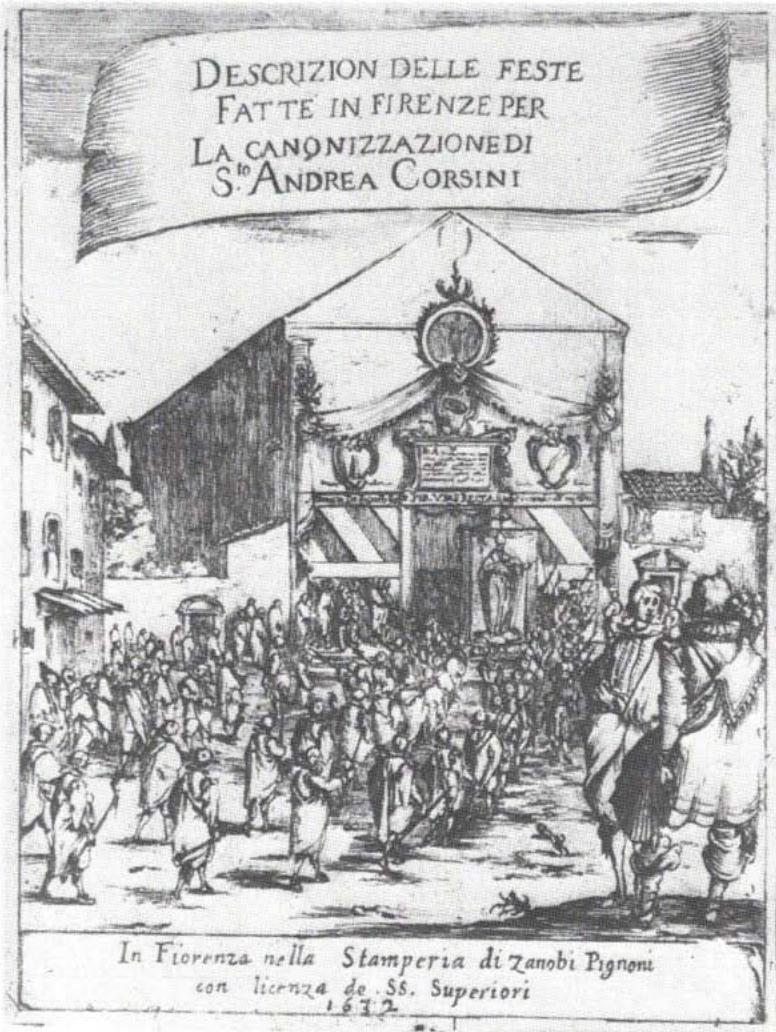
中文讲解
此为图12的占位符与图注。Stefano della Bella所作版画,描绘为Sant’Andrea Corsini封圣而装饰的Carmine教堂,原始图像数据已省略,需对照原书查看。该图与P0121所述庆典场景直接对应。
补充说明
Stefano della Bella是17世纪佛罗伦萨著名版画家。
第118段(P0123)
原文复述
The archive of the guild of the Calimala, which administered the “Temple and Oratorio of San Giovanni,” the Baptistery, shows that in 1630 Frescobaldi took on a previously unsuspected responsibility. “15 October 1630 . . . since by the death of Pierantonio di Pagolo Parigi the place of organist of the oratorio of San Giovanni was vacant . . . they chose and deputed the said Messer Girolamo Frescobaldi for one year organist of San Giovanni in place of Parigi.”
中文讲解
本段揭示Frescobaldi在佛罗伦萨的一项先前未被注意的职责。Calimala同业公会(管理"圣约翰殿及祈祷所"即洗礼堂)的档案显示:1630年10月15日,由于Pierantonio di Pagolo Parigi去世,San Giovanni祈祷所的管风琴师职位出现空缺;公会"选择并委派上述Messer Girolamo Frescobaldi继任Parigi,任期一年"。本段功能是为Frescobaldi在佛罗伦萨的教区音乐职责补一笔实际记录。
补充说明
Calimala同业公会是佛罗伦萨最古老的中世纪行会之一;“Temple and Oratorio of San Giovanni"即佛罗伦萨主教堂旁的八角形洗礼堂及其附属祈祷室。
第119段(P0124)
原文复述
Francesco Nigetti’s interest in Frescobaldi, whetted by the volume sent him by his brother-in-law Toscani, led Nigetti to study with Girolamo soon after the latter’s arrival in Florence. The twenty-one-year-old Nigetti had previously studied organ and composition with Gagliano and spent 1629 working with Frescobaldi at the organs of Santa Felicità and San Lorenzo, an education that resulted in his appointment as organist and maestro di cappella of the cathedral at Prato. (There is a tradition that Girolamo had a hand in designing the new organ of that教堂.) Despite the insistence of the Florentine theorist Giovanni Battista Doni that Frescobaldi was ignorant of the subtleties of ancient musical theory, Nigetti’s later invention of an omnicordo may derive in part from the lore of the arcicembalo transmitted from Luzzaschi through Frescobaldi. The instrument on which Girolamo played at the palace of Cardinal d’Este in 1619 was clearly no ordinary harpsichord, since Frescobaldi was the only musician in Rome who能弹 it, and that only “with great preparation.” Such instruments were known also at the Florentine court.
中文讲解
本段叙述Frescobaldi在佛罗伦萨的教学活动及其与佛罗伦萨音乐理论传统的关联。其一,Francesco Nigetti因妹夫Toscani寄来的Frescobaldi作品而激起兴趣,Frescobaldi抵达佛罗伦萨不久后Nigetti便随他学习。其二,Nigetti当时21岁,先前已在Gagliano门下学管风琴与作曲,1629年他与Frescobaldi在Santa Felicità与San Lorenzo的管风琴旁共事,这段教育最终促成他被任命为Prato主教座堂的管风琴师与maestro di cappella(还有传说Girolamo曾参与设计该教堂的新管风琴)。其三,尽管佛罗伦萨理论家Giovanni Battista Doni坚持认为Frescobaldi不懂古代音乐理论的微妙之处,Nigetti后来发明的omnicordo可能部分源于经Frescobaldi传递、自Luzzaschi而来的arcicembalo知识。其四,1619年Frescobaldi在枢机d’Este宫中演奏的那件乐器显然不是普通羽管键琴,因为罗马只有他能弹它,而且还得"作充分准备”。这种特殊乐器在佛罗伦萨宫廷也有使用。本段功能是:把Frescobaldi与佛罗伦萨音乐文化之间深层的技术传承——从Luzzaschi的arcicembalo到Frescobaldi的特殊键盘,再到Nigetti的omnicordo——联系起来。
补充说明
arcicembalo是Luzzaschi发明、可演奏微分音的特殊羽管键琴;omnicordo是Nigetti发明、可演奏更复杂微分音的特殊键盘乐器;Prato是托斯卡纳城市,距佛罗伦萨不远。
第120段(P0125)
原文复述
Girolamo’s teaching was perpetuated in Tuscany by a number of other pupils as well. Bernardo Roncagli served the Signoria of Lucca as maestro di cappella, Filippo Bandini became “organist in several churches of Florence,” and the Pistoiese Valerio Spada was first organist of the Duomo in Florence from 1645 until his death in in 1649. In the preface to his Partitura di cembalo, et organo of 1652, Don Scipione Giovanni, organist of the Mont’Oliveto in Florence, recalled that Frescobaldi had furnished the Florentine musician and mathematician Alberto del Vivaio with manuscript works for training children in music and sight-reading. In 1640 Vivaio wrote Nigetti asking to borrow “the first book of the Toccate of Frescobaldi in the first printing of which I spoke yesterday morning to Your Lordship.” Don Scipione himself repeated Girolamo’s instructions from the second version of Toccate I almost verbatim in the preface to his Intavolatura of 1650. About 1659, when Don Severo Bonini was writing up his Discorsi e regole, there was still active in Florence a talented Roman woman, Lucia Coppi, who had studied with Frescobaldi. Girolamo’s influence was extended to a second generation of Florentine musicians through Nigetti, who had his own pupil Giovanni Maria Casini memorize all of Frescobaldi’s music in the course of Casini’s studies in 1674–1680.
中文讲解
本段列举Frescobaldi在佛罗伦萨的教学遗产,影响跨越数代人。其一,直接学生:Bernardo Roncagli(卢卡Signoria的maestro di cappella)、Filippo Bandini(“佛罗伦萨数教堂的管风琴师”)、皮斯托亚人Valerio Spada(1645—1649年佛罗伦萨Duomo首席管风琴师)。其二,间接传承:1652年Don Scipione Giovanni(佛罗伦萨Mont’Oliveto管风琴师)的《Partitura di cembalo, et organo》序言回忆,Frescobaldi曾向佛罗伦萨音乐家兼数学家Alberto del Vivaio提供手抄作品用于训练儿童的音乐与视唱;1640年Vivaio写信给Nigetti请借"Frescobaldi第一册toccatas的初版,我昨天上午向阁下提过"。其三,1650年Don Scipione自己的Intavolatura序言几乎逐字引用了Girolamo关于《第二版Toccate I》的演奏指导。其四,约1659年Don Severo Bonini在撰写《Discorsi e regole》时,佛罗伦萨仍有一位才华横溢的罗马女子Lucia Coppi活跃乐坛,她曾师从Frescobaldi。其五,Frescobaldi的影响力通过Nigetti延伸到第二代佛罗伦萨乐师——Nigetti自己的学生Giovanni Maria Casini在1674—1680年的学习过程中被要求背下Frescobaldi的所有作品。本段功能是把Frescobaldi的教学影响力具体化为多个传承链条。
补充说明
Lucca、Prato、Pistoia是托斯卡纳主要城市;Signoria是卢卡的市政当局;omnicordo设计、Luzzaschi的arcicembalo等专门乐器在17—18世纪意大利键盘乐器史上占有特殊位置。
第121段(P0126)
原文复述
Most of Girolamo’s documented activity in Florence occurred before 1630, the year of the great plague, the male contagioso that by June had advanced as far down the peninsula as Bologna. Florence was cut off from the outside世界, and those of the inhabitants who were not ill themselves or tending the sick flocked to the churches to avert further disaster. The Grand Duke distributed 150,000 scudi in 1631 alone and made his daily round of the stricken city on foot, as he had allowed his horses and carriages to be requisitioned. The economic life of Florence came to a complete halt for six months of 1631 and again for four months in 1633; the total of the victims has been estimated at seven thousand, more than one-tenth of the population. Under such circumstances musical performances were infrequent, except for an opera during the lull in the plague early in 1633. When the disease broke out again that spring, as a last resort the miraculous image of the Madonna from Impruneta was carried into Florence; “from her Coming the Illness began to recede,” and within six weeks it was over. Ferdinando showed his gratitude by presenting the church in Impruneta with a silver altar-frontal, on which he is still to be seen kneeling before the Madonna, and set about trying to rebuild the Tuscan economy.
中文讲解
本段概述佛罗伦萨在Frescobaldi居留期间遭遇的灾难:1630年大瘟疫。其一,Frescobaldi有记录的活动大多发生在1630年之前;该年六月前后被称为"male contagioso"的瘟疫已经蔓延到Bologna一带的半岛。其二,佛罗伦萨与外界隔绝,未染病或未照顾病人者涌向教堂祈求免灾。其三,大公在1631年一年中发放150,000 scudi赈灾,并亲自徒步巡视疫城,因为他允许马匹与车辆被征用。其四,佛罗伦萨经济在1631年停摆六个月,1633年再停四个月;死亡总数估计为7000人,超过人口的十分之一。其五,这种环境下音乐演出极少,仅1633年初瘟疫间歇期上演过一部歌剧。其六,瘟疫于该春再起时,作为最后手段从Impruneta迎请圣母神像入城;“自圣母到来,疫情开始消退”,六周内疫情结束。Ferdinando以向Impruneta教堂献银祭坛前饰(其上他仍可见跪于圣母前)表达感激,并着手重建托斯卡纳经济。本段功能是把Frescobaldi所身处佛罗伦萨的瘟疫灾难完整呈现。
补充说明
male contagioso是当时对瘟疫的称呼;Impruneta位于佛罗伦萨南郊,其Madonna圣像被视为城市守护者。
第122段(P0127)
原文复述
During these same years Florence was subjected to another form of attack as well: the trial of its most distinguished citizen, Galileo Galilei, by the Inquisition. The prosecution of Galileo showed the meanest side of Urban VIII’s character, since it was pressed because the pope believed that Galileo had caricatured him as Simplicio in the Dialogue on the Great World Systems. Galileo was summoned to Rome late in 1632 and tried in April 1633 by a commission that included Cardinal Francesco Barberini and Galileo’s former student Cardinal Guido Bentivoglio as Supreme Inquisitor General—neither of them unsympathetic to the great scientist. On 22 June 1633 the七十-year-old Galileo, clad in the white habit of a penitent, knelt in the hall of Santa Maria sopra Minerva and abjured his errors and heresies, the victim of a campaign of intellectual enmity, forged evidence, and the injured pride of Urban VIII.
中文讲解
本段把佛罗伦萨所受的另一打击——对Galileo Galilei的宗教审判——叙述完整。其一,Galileo是佛罗伦萨最杰出的公民,受到宗教裁判所审判。其二,Galileo的受审暴露了Urban VIII性格中最卑劣的一面,因为教皇确信Galileo在《关于两大世界体系的对话》中把他讽刺为"Simplicio"。其三,Galileo于1632年末被召至罗马,1633年4月由包括枢机Francesco Barberini与Galileo的前学生、最高宗教法庭大法官枢机Guido Bentivoglio的委员会审判——两人对这位伟大的科学家并非不同情。其四,1633年6月22日,70岁的Galileo身穿忏悔者白袍,在Santa Maria sopra Minerva大厅跪下,放弃其"谬误与异端",成为一场理智敌意、伪造证据、Urban VIII受伤自尊所共同造成的迫害的受害者。本段功能是把佛罗伦萨的智识耻辱事件并入Frescobaldi所经历的地方历史。
补充说明
Simplicio是Galileo《对话》中代表传统地心说的虚构人物;Santa Maria sopra Minerva是罗马的多明我会教堂与修道院,是宗教裁判所举行公开忏悔仪式的传统场所。
第123段(P0128)
原文复述
Although they antedate the plague and the trial of Galileo, Frescobaldi’s Arie musicali (issued by Galileo’s publisher, Giovanni Battista Landini) sometimes breathe the same spirit. Along with light, dancelike works, the collection contains “spiritual sonnets” that evoke the perfervid religiosity of seventeenth-century Florence. The first of the two Arie volumes is dedicated to the Grand Duke (the presentation copy still exists in the Biblioteca Nazionale in Florence), the second to Roberto Obizzi, the Grand Duke’s Master of the Horse, perhaps in compliment to Obizzi’s elevation to the marquisate of Orciano in April 1630. Obizzi was a Paduan noble from a distinguished and intellectual Ferrarese family, and in his dedicatory letter Frescobaldi alluded once again—for the last time—to his own Ferrarese birth and training.
中文讲解
本段评介Frescobaldi在佛罗伦萨出版的《Arie musicali》。其一,作品虽然早于瘟疫与Galileo审判,但有时也流露出同样的时代精神;该集由Galileo的出版商Giovanni Battista Landini发行,除轻巧舞曲作品外还包含"spiritual sonnets",呼应17世纪佛罗伦萨炽热的宗教热忱。其二,第一册献给大公(呈献本至今仍在佛罗伦萨国家图书馆);第二册献给大公的马厩总管Roberto Obizzi——可能是为恭维Obizzi于1630年4月被擢升为Orciano侯爵。Obizzi是帕多瓦贵族出身于杰出的费拉拉世家;Frescobaldi在第二册献辞中最后一次提到自己的费拉拉出身与训练。本段功能是把《Arie》的精神氛围、出版者网络与Frescobaldi的费拉拉身份回忆联系起来。
补充说明
Roberto Obizzi是当时意大利著名贵族音乐爱好者;Biblioteca Nazionale Centrale di Firenze是意大利最重要的国家图书馆之一;Landini是佛罗伦萨最重要的人文书籍与音乐出版商。
第124段(P0129)
原文复述
The content of the two books of arias, however, is an indication that Frescobaldi had traveled far from the musical tradition of Ferrara. The collection contains strophic arias and through-composed madrigals (itself a Florentine distinction), but its most striking feature is the inclusion of eleven works in stile recitativo, a style that Frescobaldi had avoided previously. The importance of these settings is further emphasized by their placement at the head of each book. This is all the more surprising because pure recitative was beginning to lose its popularity, even in the city of its origin. The Arie was in fact the only collection including monodies to be published in Florence between 1619 and 1635, and when the Florentine composers took up the genre again they cultivated a markedly lighter and less declamatory style. The inclusion of settings based on the Romanesca and Ruggiero seems to echo a Roman vogue of about 1615, followed by Monteverdi in the Romanesca variations in his第七册 madrigals of 1619. The Arie also contains settings of more recent basses, the Passacagli and Ciaccona. The presence among the texts in the Arie of a lettera amorosa and a partenza amorosa (both texts set by Giovanni Valentini in his Musiche a due of 1622) also points to the influence of Monteverdi’s第七册. The attempt to discern other possible stylistic influences through concordances is unrewarding. Only eight texts from the Arie are so far identified: two by Della Casa (1590), one by Desiderio Cavalcabo (1590), one by Marino, two by Girolamo Preti (1614), and two by Francesco Balducci (1630), author of two oratorio librettos, a version of one of which was set by Carissimi. Frescobaldi does not seem to have relied on the usual Florentine authors of poesia per musica. (Indeed, if we are to believe Doni, Girolamo’s文学 culture was so sketchy that his wife had to explain the more difficult words in the texts he set.) At least one text, “Degnati, o gran Fernando,” as well as the dedicatory sonnet, “Signor, c’ora fra gl’ostri,” must have been written to order and perhaps represent early efforts of Domenico Frescobaldi, of whom there survives a volume of Latin poetry and epigrams written about 1632–1634.
中文讲解
本段深入分析《Arie》两册的内容与Frescobaldi创作倾向的转变。其一,两册内容显示Frescobaldi已远离开费拉拉音乐传统——收有分节歌式arias与通谱体madrigals(这种区分本身是佛罗伦萨特色)。其二,最显著的特征是收入11首stile recitativo(宣叙风格)作品——这是Frescobaldi此前回避的体裁;它们被置于每册之首,更凸显其重要性。其三,令人惊讶的是,纯宣叙风格当时在发源地佛罗伦萨已经开始失去吸引力,《Arie》其实是1619—1635年间佛罗伦萨唯一出版的单声部monody集;当佛罗伦萨作曲家再次拾起该体裁时,所培育的风格明显更轻盈、更少宣叙性。其四,以Romanesca和Ruggiero为基础的设置似乎呼应1615年左右罗马的风潮——Monteverdi在1619年的第七册madrigals中的Romanesca变奏即继承此风;《Arie》也包含更新近的低音模式,如Passacagli与Ciaccona。其五,《Arie》中出现的lettera amorosa和partenza amorosa文本(均被Giovanni Valentini在1622年《Musiche a due》中设置)也指向Monteverdi第七册的影响。其六,从文本比对很难确定其他可能风格影响——目前仅识别出八首文本:两首Della Casa(1590)、一首Desiderio Cavalcabo(1590)、一首Marino、两首Girolamo Preti(1614)、两首Francesco Balducci(1630,其中一位是Carissimi所设oratorio台本作者)。Frescobaldi似乎并未依赖佛罗伦萨常用的poesia per musica作者。其七,按Doni所言Girolamo文学素养薄弱,他所设文本中较难的词需要由妻子解释。括号信息:至少一首文本"Degnati, o gran Fernando"以及献辞十四行诗"Signor, c’ora fra gl’ostri"应是约稿作品,可能代表其子Domenico Frescobaldi的早期诗作——后者存有约1632—1634年的拉丁诗与短诗集。本段功能:把《Arie》作为Frescobaldi偏离费拉拉传统、吸收佛罗伦萨宣叙体裁的标志,并揭示其与Monteverdi传统的传承关系。
补充说明
stile recitativo即宣叙风格,是早期歌剧的核心声乐体裁;Romanesca、Ruggiero、Passacagli、Ciaccona是当时广泛使用的固定低音模式。
第125段(P0130)
原文复述
In the general context of Frescobaldi’s work, the Arie, his one Florentine production, seems an anomaly occasioned by the predominance of vocal music at the Tuscan court and a lingering local tradition of stile recitativo. And yet this same insistence on affective declamation is fundamental to Frescobaldi’s art as a keyboard composer, although there it is balanced by his remarkable contrapuntal sense. The classic expression of this fusion is Girolamo’s Fiori musicali, the collection of three organ masses and相关作品 published the year after the composer’s return from Florence. It is tempting to regard this volume of instrumental、contrapuntal、and for the most part liturgical music as the counterpart or even the reaction to Frescobaldi’s Florentine experience as embodied in the Arie.
中文讲解
本段对Frescobaldi佛罗伦萨时期唯一出版物《Arie》进行总体定位与展望。整体看,《Arie》是Frescobaldi唯一一次在佛罗伦萨的创作,看似反常——其原因在于托斯卡纳宫廷以声乐为主以及当地stile recitativo传统的余韵。然而,对情感性宣叙的执著其实是Frescobaldi作为键盘作曲家艺术的根本,只是在键盘作品中它由他对位的非凡直觉所平衡。这种融合的经典表达是Girolamo的《Fiori musicali》——三首管风琴弥撒及相关作品,出版于他从佛罗伦萨返回后一年。我们很容易把这部以器乐、对位、且多为礼仪音乐为内容的作品视为Frescobaldi佛罗伦萨经验的对应面,甚至是对《Arie》所代表的声乐体验的反动。本段功能是把《Arie》放入Frescobaldi整体创作轨迹,预告下一阶段《Fiori musicali》将以对位器乐回应宣叙声乐。
补充说明
Fiori musicali出版于1635年,是Frescobaldi晚期最重要的管风琴弥撒集。
第126段(P0131)
原文复述
By 1634 Florence had little to offer Girolamo. Its intellectual achievement had been humiliated in the person of Galileo, its population was decimated, and the Grand Duke’s opportunities for patronage were exhausted by the virtual破产 of the state. More important, Frescobaldi had been offered the ultimate prize of a Roman artist: the Barberini summoned him back to the City to enter their service.
中文讲解
本段总结Frescobaldi离开佛罗伦萨的原因。1634年佛罗伦萨对Girolamo来说已经所剩无几:智识成就在Galileo身上受辱,人口大量死亡,大公的赞助机会因国家近乎破产而耗尽。更重要的是,Frescobaldi已被许以罗马艺术家的最高奖赏——Barberini家族召唤他回城,进入其服务。本段功能是为佛罗伦萨章节画上句号,并预告Frescobaldi职业生涯的最终阶段——回到罗马,进入Barberini家族服务。
补充说明
Barberini家族在Urban VIII在位时期(1623—1644)是罗马最重要的艺术赞助者。
脚注 / 边栏 / 图表 / 附加信息(如有)
本节包含以下附加材料:(1) 章节标题如"# Rome, 1608–1614"、"# Mantua, 1614–1615"、"# Florence, 1628–1634"、"## FRESCOBALDI’S LIFE",标识不同时段与主题单元;(2) 图5至图12的多幅插图占位符,分别展示圣彼得音乐演出位置(fig. 5)、Santa Maria del Popolo音乐会(fig. 6)、Urban VIII肖像(fig. 7)、Frescobaldi三幅肖像(figs. 8, 9, 10)、Villa Aldobrandini at Frascati(fig. 11)、封圣盛典中的Carmine教堂(fig. 12),均为正文中视觉证据的补充;(3) 大量脚注编号(如⁴,¹⁰,²⁰等)提供原始档案与一手文献的出处,是作者主张所赖以建立的史料基础。本节脚注涉及圣彼得Chapter记录、Bentivoglio档案、Gonzaca档案、Cappella Giulia账目、Calimala同业公会档案等多种第一手资料。
💡 本节核心要点
- Frescobaldi的罗马任命(1608)由Bentivoglio家族操控,并伴随着他对任职条件的长期懈怠与多次失信,奠定其性格中"自我中心"的基调。
- 他在Cappella Giulia任职期间所面对的音乐环境是Palestrina式复调传统占主导,但受新协奏体逐步渗透的双重格局;这与其键盘作品同时呈现"复调严谨"与"炫技性"的双重特征相吻合。
- Frescobaldi与Enzo Bentivoglio的关系经历了教学合作—订婚风波—决裂的全过程,并以他最终娶罗马女子Orsola del Pino建立家庭、在精神与家庭层面脱离费拉拉而告终。
- 曼图亚事件(1614—1615)凸显了Frescobaldi对自己艺术价值的自觉意识及对不平等接待的敏感反应,公爵Ferdinando Gonzaga的提议因曼图亚宫廷的实际冷淡而失败,导致他13年内不再离开罗马。
- 1615—1628年是Frescobaldi创作的黄金期,其间他发表了《Recercari》《Capricci》《第二册Toccatas》《Canzoni》等核心作品,并在Cappella Giulia的多合唱团礼仪中担任首席管风琴师,确立其作为时代权威的地位。
- 佛罗伦萨阶段(1628—1634)以《Arie musicali》为唯一新作,反映他远离费拉拉传统、转而吸收佛罗伦萨宣叙风格的倾向;这一阶段的瘟疫、Galileo受审与托斯卡纳财政破产构成其离开的背景,而Barberini家族的召唤则把他召回罗马进入艺术家生涯的最高荣典。
🔑 关键术语
- Cappella Giulia:圣彼得大教堂的音乐机构之一,得名于教皇尤利乌斯二世,与教皇私人礼拜团Cappella Pontificia/Sistina相区别。它服务于大教堂及受Chapter管辖的各教堂礼拜,Frescobaldi自1608年起任其管风琴师直至去世。
- Cappella Pontificia (Cappella Sistina):教皇私人礼拜合唱团,仅在教皇亲临礼仪时演奏,只用成年男性(后期含阉伶),纯人声无伴奏,连管风琴都不用。
- stile antico:Palestrina式无伴奏复调风格,是17世纪罗马教廷保守传统的核心,在Cappella Giulia与Cappella Sistina的曲目中长期保持。
- stile recitativo:宣叙风格,起源于佛罗伦萨Camerata,为早期歌剧与monody的核心声乐体裁;Frescobaldi在佛罗伦萨时期才首次大规模采用。
- toccata:17世纪初兴起的键盘体裁,比严格复调的ricercar/canzona更自由、富于炫技性;Frescobaldi两册Toccatas标志着该体裁的经典化。
- ricercar / canzona:源自16世纪模仿手法的复调体裁,与toccata共同构成Frescobaldi键盘作品的两大主轴;前者强调主题对位的严密,后者更具节奏感与合奏倾向。
- falsobordone:一种简化、节奏相近的诗篇吟唱法,是罗马教廷保守做法的代表,被威尼斯圣马可的先进乐师所不屑。
- alternatim:弥撒或日课中唱诗班与管风琴(或其他乐器)轮流执行经文部分的古老形式;管风琴家在alternatim中比polyphonic mass有更大的发挥空间。
- concerto delle dame:1590年代费拉拉宫廷著名的女声三重唱,对全欧洲贵族音乐趣味影响深远;Enzo Bentivoglio在罗马的consertino是其模式延续。
- consertino:“小合奏团"之意,指Enzo Bentivoglio府中的小型女声与器乐合奏单位。
- Liber Secundus Diversarum Modulationum:Frescobaldi 1627年出版的sacred concertos集,包含32首1—4声部motet与continuo,是其唯一幸存的sacred concertos专集。
- Arie musicali:Frescobaldi在佛罗伦萨于1630年出版的世俗声乐集,是其佛罗伦萨阶段的唯一新作,标志着他吸收stile recitativo等佛罗伦萨体裁的转变。
- Fiori musicali:Frescobaldi 1635年出版的三首管风琴弥撒集,与其佛罗伦萨时期的《Arie musicali》形成"复调严谨—情感宣叙"的对照。
- Baldacchino:圣彼得大教堂主祭坛上的青铜华盖,由Bernini设计,1624—1633年完成;其青铜部分取自万神殿。
- Arcicembalo / omnicordo:Luzzaschi与Nigetti先后发明的特殊键盘乐器,可演奏微分音;显示Frescobaldi及其弟子所掌握的非常规键盘知识。