目录
C001 Formalization of Time-Span Reduction
- S001 [描述性拆分] 7.1 Time-Span Segmentation
- 页码:1-2
- S002 [描述性拆分] Segmentation Rule 2: Formalizing Augmented and Regular Time-Spans
- 页码:2-2
- S003 [描述性拆分] Justifying Augmented Time-Spans with the Anacrusis of “O Haupt”
- 页码:2-5
- S004 [描述性拆分] Complex Upbeats and Idiom-Specific Variation in Segmentation
- 页码:5-6
- S005 The Reduction Hypothesis and the Tree Notation
- 页码:7-8
- S006 [描述性拆分] Fusion as a Head-Selection Process
- 页码:8-9
- S007 [描述性拆分] Transformation as a Head-Selection Process
- 页码:10-10
- S008 [描述性拆分] Cadential Retention as a Head-Selection Process
- 页码:10-13
- S009 Final Statement of Time-Span Reduction Well-Formedness Rules
- 页码:13-14
- S010 [描述性拆分] 7.3 Preference Rules Within Phrases
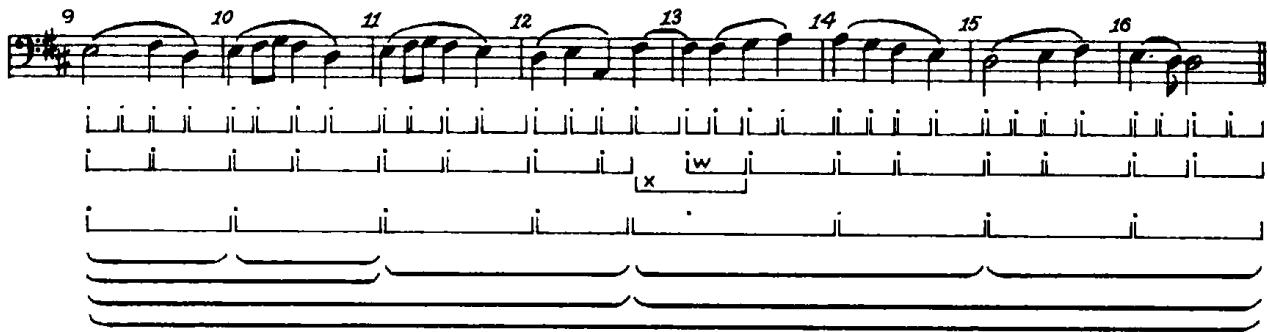
- 页码:14-17
- S011 [描述性拆分] TSRPR 1–3: Local Influences of Meter, Harmony, and Register
- 页码:17-18
- S012 [描述性拆分] TSRPR 4–6: Nonlocal Pitch, Metrical, and Prolongational Influences
- 页码:18-22
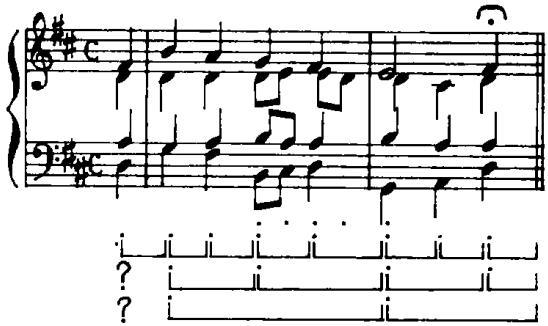
- S013 [描述性拆分] 7.4 Structural Accents of Groups
- 页码:22-26
- S014 [描述性拆分] TSRPR 9 and Asymmetrical Reductions: Beethoven’s First Symphony
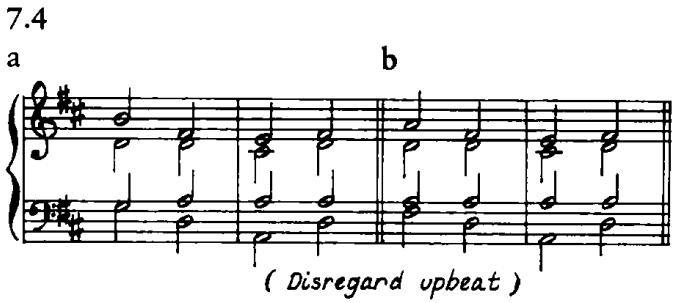
- 页码:26-32
- S015 [描述性拆分] 7.5 Concluding Remarks
- 页码:33-33
S001 [描述性拆分] 7.1 Time-Span Segmentation
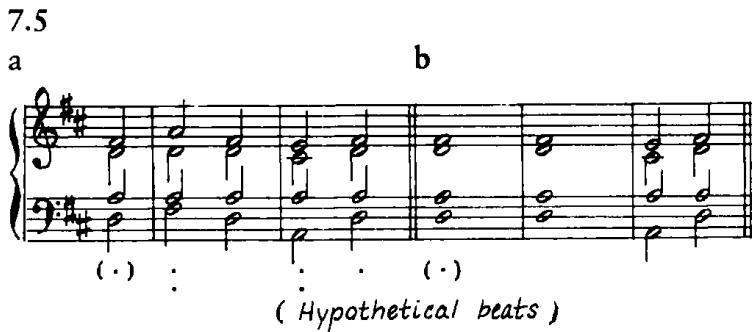
第1段(P0001)
原文复述
Formalization of Time-Span Reduction
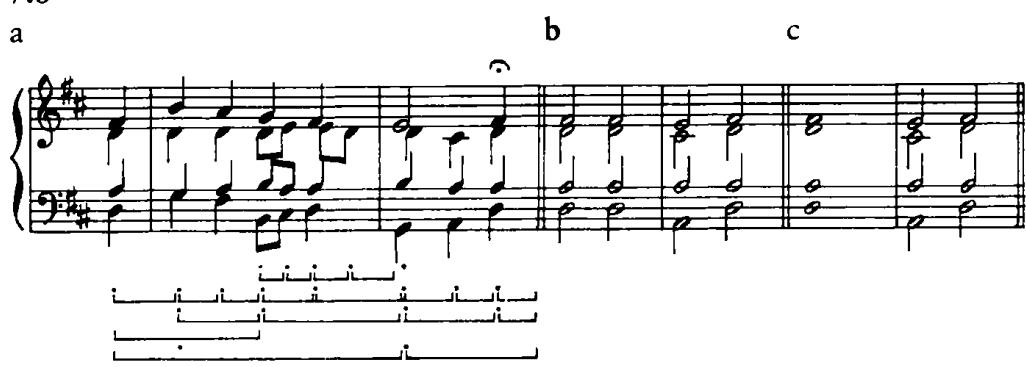
中文讲解
这是7.1小节的标题,表明本节的任务是把第6章中以直觉方式讨论的“时值缩减”转化为一套形式化的定义与规则。标题中的 Formalization 提示读者:作者将给出精确陈述(well-formedness rules 与 preference rules),而不是停留在描述性论述。
补充说明
本节属于第7章的开端;标题用 Markdown 的 # 表示层级,可视为一级或二级标题,仅起标识与论题开启作用。
第2段(P0002)
原文复述
In formalizing the time-span reduction, we begin by defining the time-span structure—the segmentation of a piece into rhythmic units within which relative structural importance of pitch-events can be determined. Then, as in previous chapters, we take up in turn well-formedness rules and preference rules.
中文讲解
本段预告全节展开顺序:先定义“时值结构”(time-span structure),即把乐曲切分成若干节奏单元,从而能在每个单元内部比较音高事件的相对结构重要性;接着才依次进入 well-formedness rules(合格性规则)与 preference rules(偏好规则)。作者用 “as in previous chapters” 说明这一“定义—合格性—偏好”的三段式是与前几章保持一致的方法论模板,因此读者可以预期熟悉的论证节奏。其教学要点是:时值缩减本质上要在每个节奏单元内对事件做层级化比较,因此切分(segmentation)必须先于比较与缩减。
第3段(P0003)
原文复述
We begin by defining the term time-span in terms of metrical structure: A time-span is an interval of time beginning at a beat of the metrical structure and extending up to, but not including, another beat.
中文讲解
本段给出 time-span 的最小定义:它是一个时间区间,从节拍结构的某一拍开始,到(但不包含)另一拍为止。关键词是 “beginning at a beat” 与 “up to, but not including”——这意味着时值严格落在拍点之间,且右端开区间,强调一个时值不能同时充当另一个时值的起点。其教学意义在于把“时值”锚定在节拍结构上,避免其漂浮于纯粹的时间连续体;只有如此,后续“单位内比较音高事件重要性”才有确定的边界。
补充说明
本节是 7.1,6.1 提供了直觉背景,本段则把直觉压缩为最简形式定义。
第4段(P0004)
原文复述
This is the minimal condition on time-spans. $^{1}$ It must be developed further in order to establish the time-span segmentation of a piece.
中文讲解
作者明确承认上段定义只是“最小条件”,尚不足以确定整首曲子的时值切分;脚注 $^{1}$ 提示此最小条件还有进一步限制或例外,留待后续段落或附注澄清。其逻辑在于:定义一个区间只是切分的第一步;真正完成“整首曲子被穷尽地、层层地切分”还需要更多规则(即 Segmentation Rule 与 well-formedness rules)。
补充说明
脚注 $^{1}$ 的具体内容本段未给出,作用是标示该最小条件附有进一步说明,读者应留意后续或页面底部的注释文本。
第5段(P0005)
原文复述
Section 6.1 discussed the intuitions behind time-span segmentation. At relatively large levels, we argued that the group is the unit of segmentation:
中文讲解
本段起承接作用,呼应第6.1节的直觉讨论,并指出在大尺度层级上,“组”(group)就是切分单位。这是从“最小条件”迈向具体切分规则的第一步:先确立高层级以组为单位。其功能是为下一条 Segmentation Rule 1 做铺垫。
第6段(P0006)
原文复述
Segmentation Rule 1 Every group in a piece is a time-span in the time-span segmentation of the piece.
中文讲解
这是本章第一条正式切分规则,断言:乐曲中的每一个 group 同时也是一个 time-span。理解时注意它是一条“全称陈述”(Every group … is a time-span …),意味着高层切分与组结构一一对应。此规则将“组”这一在6.1节以直觉方式引入的概念形式化地纳入时值切分体系,因此大尺度上不会产生“既是时值又非时值”的含糊地带。
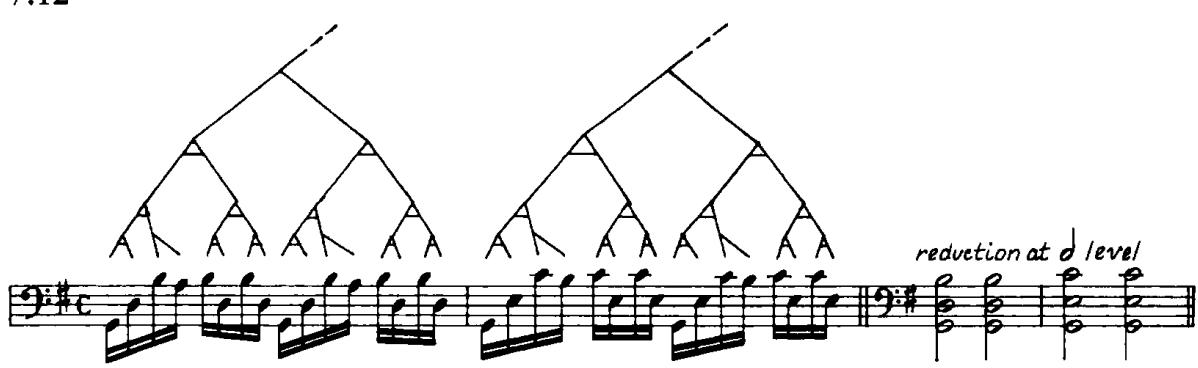
补充说明
本规则是后续讨论“穷尽切分”与“重叠”时所依据的基准。
第7段(P0007)
原文复述
Because, for purposes of deriving a time-span reduction, a piece must be exhaustively segmented into time-spans at every level, it is necessary to guarantee that no such grouping structure as 7.1 arises. The gaps between groups would constitute domains not subject to time-span reduction.
中文讲解
本段说明引入更严格切分要求的原因:要得到时值缩减,必须使乐曲在每一层级都被穷尽切分为时值;若出现示例 7.1 所示情形——组与组之间留有“间隙”(gaps)——则这些间隙将不属于任何时值,从而无法进入缩减流程。论证的关键在于“穷尽性”:缩减理论不能容忍任何遗漏,因此作者必须排除此类结构。其与 Segmentation Rule 1 的关系是:规则 1 已保证每个 group 是时值,但仅此不足以保证“无间隙”,于是需要进一步规则。
补充说明
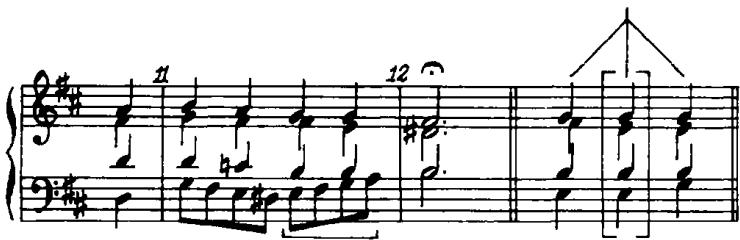
本段提到的“7.1”即紧随其后的图示编号。
第8段(P0008)
原文复述
7.1
中文讲解
这是示例或图示编号 “7.1”,置于 P0007 所描述的“组之间存在间隙”的图示之上,标示该图属于第7章第1个示例。版面功能为标记图像/图示序号,便于正文交叉引用。
补充说明
需查看原图才能确认图中具体图形;本输入未提供图像细节,故不作进一步推测。
第9段(P0009)
原文复述
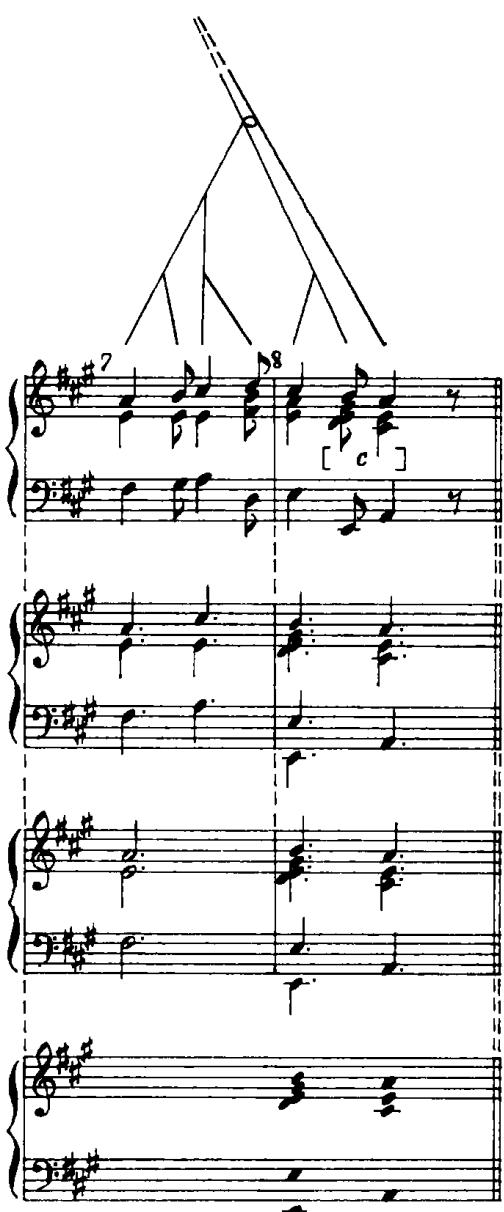
gap gap
中文讲解
此为图示 7.1 内部的标注:两个 “gap” 分别对应 P0007 中所述“组与组之间的间隙”,用以直观呈现若不满足穷尽切分时出现的两个未被覆盖的时间区域。它们是图像内的标签而非正文论述。
第10段(P0010)
原文复述
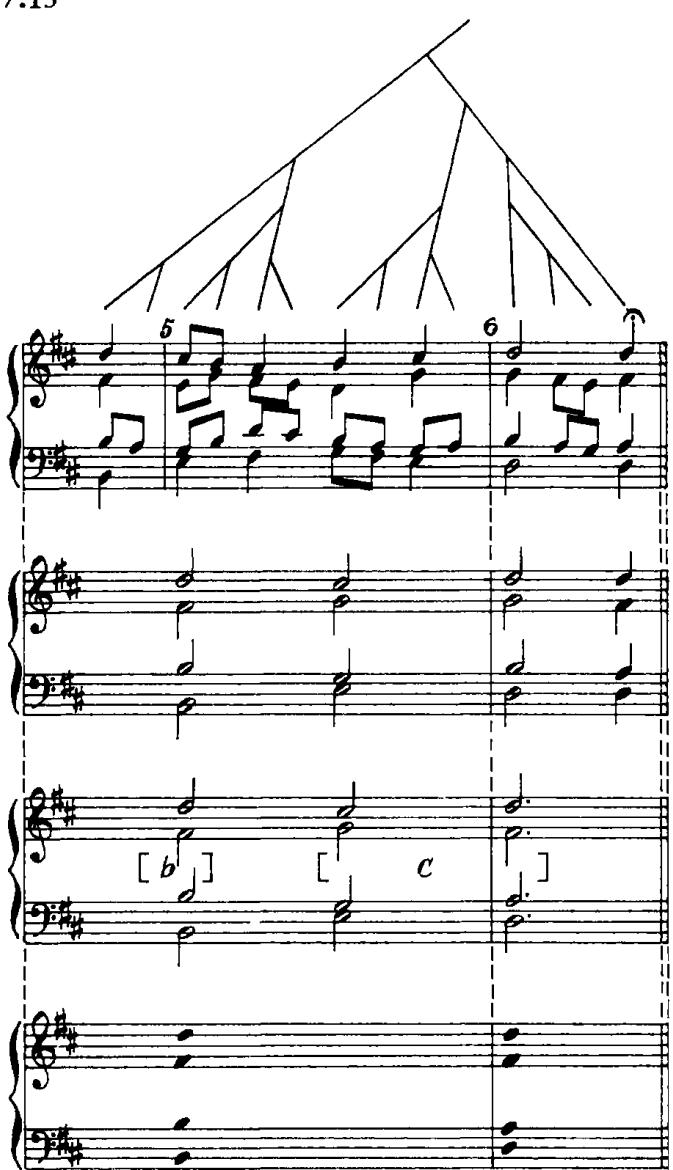
7.1 Time-Span Segmentation
中文讲解
这是图示 7.1 的标题“Time-Span Segmentation”,标明该图所说明的概念正是本章核心主题——时值切分。其作用是在版面上提示读者:所看到的图形是关于时值切分结构的示意,与正文中对“组、间隙、穷尽切分”的讨论直接相关。
第11段(P0011)
原文复述
The need to prevent such situations is one of the motivations for grouping well-formedness rule 5 (“If a group $G_{1}$ contains a smaller group $G_{2}$ , $G_{1}$ must be exhaustively partitioned into smaller groups”).
中文讲解
本段把“杜绝组间间隙”这一需要,与分组合格性规则 5(grouping well-formedness rule 5)联系起来。该规则要求:若大组 $G_1$ 内含小组 $G_2$,则 $G_1$ 必须被这些小组穷尽地划分。其直观意义是“禁止在大组内部留下不属于任何小组的空白”,从而间接保证不会出现示例 7.1 中的间隙。理解时应注意:这条规则原本属于分组理论,作者在此指出它同时也是时值切分能否进行的必要条件——两个理论模块在此汇合。
补充说明
$G_1$ 与 $G_2$ 是分组理论中的标准记法,分别表示外层与内层组。
第12段(P0012)
原文复述
Though we will encounter no grouping overlaps until near the end of this chapter, their effect on time-span segmentation is best described here. Essentially, we want to say that an overlapped event has a function in both groups of which it is a member. We can most simply express this in the theory by stipulating that the time-span segmentation and reduction are based on underlying group structure rather than the musical surface. In this way the overlapped event will correspond to two events in time-span reduction, one in the left group and one in the right.
中文讲解
本段提前讨论本章后段才会出现但此处必须说明的概念——“重叠”(overlap)。作者承认本章正文目前尚不接触重叠事件,但因其对时值切分有重要影响,故在此先行交代。核心主张是:一个被两个组共享的事件同时承担两个功能,因此最简洁的处理是:让时值切分与缩减建立在“底层组结构”(underlying group structure)之上,而非乐曲表面(musical surface)。这样一来,重叠事件在时值缩减中会对应两次出现——左侧组一次、右侧组一次,从而在形式上避免“一事件二义性”带来的歧义。理解要点是:作者选择“底层结构优先”这条建模原则,是为了使表面上的复杂重叠在理论内部被干净地拆解为两次独立事件。
补充说明
本段提到的“本章后段”指 7 章较后位置对重叠的讨论,本节仅做预告性说明。
脚注 / 边栏 / 图表 / 附加信息(如有)
本节附加材料包括:(1) 脚注标记 $^{1}$(P0004),提示时值最小条件附有进一步说明,本节正文未展开其内容;(2) 示例编号与图示 7.1(P0008、P0009、P0010),用以直观呈现“组间间隙”这一需要被禁止的结构,其作用在于支持 P0007 的论证并与 P0011 引出的 grouping well-formedness rule 5 形成对应;(3) 公式记号 $G_1$、$G_2$(P0011),是分组理论中表示外层与内层组的标准符号,本节内仅出现一次。
💡 本节核心要点
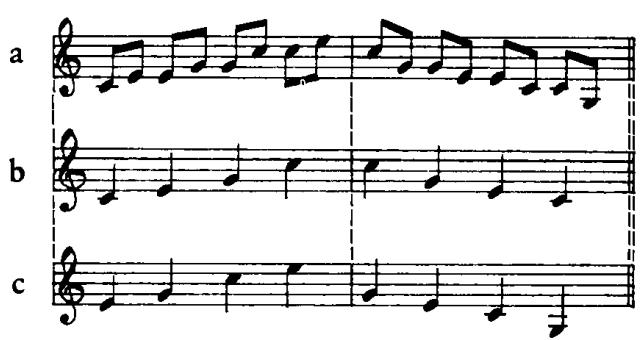
- 本节的任务是把第6章直觉性的时值缩减转写为形式定义与规则,沿用“定义—合格性—偏好”的三段式结构。
- 时值的最小定义锚定于节拍结构:从一拍开始,到(不包含)另一拍,强调右端开区间。
- Segmentation Rule 1 把“组”形式化为时值:大尺度层级上每一组即一时值。
- 时值缩减要求乐曲在每一层级被穷尽切分,因此必须排除示例 7.1 中“组间间隙”的结构。
- grouping well-formedness rule 5 通过要求大组被小组穷尽划分,间接保证不出现间隙,连接分组理论与时值切分。
- 为处理重叠事件,时值切分与缩减建立在底层组结构而非音乐表面上,使同一事件在缩减中对应两次出现。
🔑 关键术语
- time-span:时值;本节定义为从节拍结构中某拍开始、到(不包含)另一拍的时间区间,是时值缩减所作用的基本单位。
- time-span structure / time-span segmentation:时值结构 / 时值切分;指把乐曲切分为若干相互嵌套的时值,使每个时值内部可对音高事件做相对重要性比较。
- group:组;本节在高层级上被规定为一种时值,由 Segmentation Rule 1 与 6.1 节的直觉讨论共同确立其切分地位。
- Segmentation Rule 1:切分规则 1;断言乐曲中每一个 group 都是时值切分中的一个 time-span,是高层切分的形式化基石。
- well-formedness rules / preference rules:合格性规则 / 偏好规则;本节预告将依次给出的两类规则,前者界定可接受的切分结构,后者进一步选择优选切分。
- grouping well-formedness rule 5:分组合格性规则 5;要求若大组 $G_1$ 含小组 $G_2$,则 $G_1$ 必须被这些小组穷尽划分,本节指出它是防止组间间隙从而保证时值穷尽切分的关键。
- overlap / overlapped event:重叠 / 重叠事件;指同时属于两个组的事件,本节通过把切分与缩减建立在“底层组结构”上,使重叠事件在时值缩减中对应为左右各一次出现。
- underlying group structure vs. musical surface:底层组结构相对于音乐表面;本节明确时值切分与缩减以前者为依据,以避免表面重叠导致的语义歧义。
S002 [描述性拆分] Segmentation Rule 2: Formalizing Augmented and Regular Time-Spans
第1段(P0013)
原文复述
Section 6.1 also argued that time-span segmentation is determined by metrical structure at small levels and by the interaction of metrical and grouping structure at intermediate levels. It was shown there that when meter and grouping are out of phase, metrically determined time-spans cross over grouping boundaries. Such crossing would violate the requirement for the time-span segmentation to form a strict hierarchy in the sense of section 2.1. We proposed to solve this problem by appealing to the distinction between afterbeats and upbeats. An afterbeat forms a rhythmic unit with the preceding strong beat. An upbeat (a weak beat such that a grouping boundary intervenes between it and the preceding strong beat) forms a rhythmic unit with the following strong beat.
中文讲解
本段是整个小节的前提和动机说明。第一层意思交代了理论的来路:第6.1节已经主张,时间跨度的切分在小层级上由节拍结构单独决定,而在中间层级上由节拍结构与分组结构的交互决定。第二层意思点出本节要解决的问题:当节拍与分组不同步(out of phase)时,单纯按节拍切出的时间跨度会跨过分组边界,而第2.1节曾要求时间跨度切分必须形成严格层级(strict hierarchy),不允许跨度相互跨越——这两者之间产生了矛盾。第三层意思是解题思路:引入"后拍(afterbeat)“与"上拍(upbeat)“的区分。后拍与它前面那个强拍合为一个节奏单位;上拍则是这样一种弱拍——在它和前面那个强拍之间恰好有一个分组边界——它不与前一个强拍组合,而是与后一个强拍组合。这一区分是后文规则2c的理论基础:因为上拍的存在,所以当某个强拍前面出现了分组边界时,可以把从该边界到原本节奏单位末端的那一段单独算作一个"增强时间跨度”,从而既保留节拍驱动的跨度,又不违反严格层级的约束。
补充说明
本段中提及的第6.1节、第2.1节以及afterbeat/upbeat的区分均为本节作者此前论述的内容,本节只是引用结论,不再重新论证。
第2段(P0014)
原文复述
We formalize these considerations as follows.
中文讲解
这是一个承上启下的过渡句,宣布接下来要把前文(包括第6.1节的论述以及afterbeat/upbeat的区分)用形式化规则表达出来。形式化意味着从自然语言论述转向条件式(if-then)定义,从而能精确预测每个节拍对应的跨度。
第3段(P0015)
原文复述
Segmentation Rule 2 In underlying grouping structure,
中文讲解
这是规则标题。“Segmentation Rule 2"表明这是一组形式化规则中的第二条;“In underlying grouping structure"是规则的应用前提——即规则只在深层的(或者说本源的)分组结构之上操作,不直接处理表层变形。这个限定很重要:分组结构在音乐表层可能被切分、延长等表面操作打乱,但规则只关心底层分组。
第4段(P0016)
原文复述
a. each beat B of the smallest metrical level determines a time-span T_B extending from B up to but not including the next beat of the smallest level,
中文讲解
这是规则2a,定义最小节拍层级上每个节拍的时间跨度。关键要点:“extending from B up to but not including the next beat of the smallest level”——区间从当前节拍B开始,到同层级下一个节拍为止,但不包括那下一个节拍本身。这是音乐时序分析的常见惯例:每个事件归属于它开始那一刻所在的时间跨度,而不是下一个时间跨度的起点。这条规则为更高层级的时间跨度提供了"原子”——后续层级的跨度都是这些最小跨度的并集。
第5段(P0017)
原文复述
b. each beat B of metrical level L_i determines a regular time-span T_B, which is the union (or sum) of the time-spans of all beats of level L_{i-1} (the next smaller level) from B up to but not including
中文讲解
这是规则2b的开头,定义"常规时间跨度(regular time-span)"。核心逻辑:较大层级L_i的节拍B所对应的时间跨度,等于比它小一级的L_{i-1}层级上若干个节拍的跨度的并集。“from B up to but not including"这一短语在此处尚未结束——它引出接下来两个终止条件中的一个。术语"regular"与下文规则2c中的"augmented”(增强)相对应:只要不遇到分组边界的打断,跨度就按节拍结构正常扩展,称为"常规”。
第6段(P0018)
原文复述
(i) the next beat B’ of level L_i or
中文讲解
这是规则2b终止条件的第一个分支:当遇到同一层级L_i的下一个节拍B’时,常规时间跨度就停止增长。也就是说,L_i层级的节拍B所跨越的范围,原则上恰好是它与同层下一个节拍B’之间的部分——跨度边界由节拍结构本身确定。这是节拍驱动切分的基础形式。
第7段(P0019)
原文复述
(ii) a group boundary, whichever comes sooner, and
中文讲解
这是规则2b的第二个分支,也规定了整个2b条件句的取舍原则:“以先到者为准(whichever comes sooner)"。含义是:常规时间跨度在扩展时,可能在下一次遇到L_i层节拍B’之前就先碰到分组边界;遇到边界即停止。换言之,分组边界对节拍驱动切分有截断作用——只要分组结构先于下一个同层节拍出现,它就决定了跨度的实际终点。这正是本规则处理"节拍与分组交互"的核心机制。
第8段(P0020)
原文复述
c. if a group boundary G intervenes between B and the preceding beat of the same level, B determines an augmented time-span T_B’, which is the interval from G to the end of the regular time-span T_B.
中文讲解
这是规则2c,定义"增强时间跨度(augmented time-span)",其作用是承接第6.1节中后拍与上拍的区分。条件:当前节拍B与同层前一个节拍之间存在一个分组边界G。在该条件下,B不只对应一个常规跨度,还额外地拥有一个增强跨度T_B’,它从该分组边界G开始,延伸到B的常规跨度T_B的末端为止。直观意义:那个落在分组边界之后、本属于"上拍"的弱节拍,其节奏功能被绑定到下一个强拍B身上;为了在时间跨度层级中保留这份节奏单位,作者把它单独作为一个增强跨度列出来,从而既满足严格层级的要求(不再让节拍跨度跨过分组边界),又保留了对上拍-下拍节奏关系的描述。
补充说明
T_B’中的撇号(prime)在数学记法中通常表示与T_B相关但不同的对象;本规则中两者分别代表"常规"与"增强"两种时间跨度。
第9段(P0021)
原文复述
Segmentation Rule 2 produces the time-span segmentation shown in 7.2 for the relevant portion of the finale theme of Beethoven’s Ninth Symphony.
中文讲解
本段交代规则的应用实例:贝多芬第九交响曲终曲乐章的相关片断(详见原书例7.2)。它表明上述三条子规则并非抽象规定,而是有具体乐谱分析作为依据——读者可以对照原书图7.2来检验规则2a、2b、2c各自的产出是否与分析吻合。“relevant portion"提示例7.2只覆盖该主题的一个相关片段,而非整首作品。
补充说明
本节并未在文字中给出例7.2的具体内容,仅作为分析样例的指引。
第10段(P0022)
原文复述
In measure 13, the first beat of the half-note level determines two time-spans, marked w and x. The regular time-span w is assigned by rule 2b; the augmented time-span x, which includes the upbeat from measure 12, is assigned by rule 2c.
中文讲解
本段是对规则应用的具体说明,以贝多芬第九交响曲终曲第13小节为例。第13小节第一个半音层级的节拍同时产生两个时间跨度w和x。w是"常规"的,由规则2b生成;x是"增强"的,由规则2c生成,并且它向前延伸,把第12小节里的那个上拍(upbeat)也囊括进来。教学要点:w与x都对应同一个节拍B,但形态不同——w反映纯粹的节拍切分,x反映分组结构介入后的调整。这正是规则2c存在的意义:通过增加一个增强跨度,把上拍与其后续强拍绑为同一节奏单位,同时又让常规跨度w保持节拍切分的纯净性。
补充说明
w与x是例7.2图示中对两个时间跨度的标记,本节正文未给出图示本身。
脚注 / 边栏 / 图表 / 附加信息(如有)
本小节包含一处对原书图示的指引(例7.2,关于贝多芬第九交响曲终曲主题),但小节正文本身不包含图示内容、脚注或边栏文字,因此除该指引外无其他附加材料。
💡 本节核心要点
- 第6.1节的核心结论被作为本节起点:时间跨度切分在小层级由节拍结构决定,在中间层级由节拍与分组的交互决定。
- 节拍与分组不同步时,单纯按节拍切分会跨过分组边界,从而违反第2.1节要求的严格层级;本节用afterbeat/upbeat区分来解决这一矛盾。
- 上拍(upbeat)定义为与前一个强拍之间被分组边界隔开的弱拍,它在节奏功能上归属于其后的强拍。
- 规则2a提供最小层级的原子时间跨度:从节拍B到同层下一个节拍但不包括后者。
- 规则2b定义常规时间跨度:在L_i层级,从B沿L_{i-1}层级跨度并集向外扩展,直到下一个L_i层级节拍或分组边界,以先到者为准。
- 规则2c定义增强时间跨度:当B与同层前一节拍之间存在分组边界G时,B额外产生一个从G延伸到T_B末端的增强跨度T_B’,以容纳上拍节奏单位。
- 贝多芬第九交响曲终曲第13小节的例子展示同一节拍同时对应常规跨度w与增强跨度x,分别由2b和2c生成。
🔑 关键术语
- time-span segmentation:时间跨度切分,指把一段音乐按节拍与分组结构划分为层级化的时间区间;在本节中是规则2的对象。
- regular time-span (T_B):常规时间跨度,由规则2b生成,按节拍驱动扩展,遇到同层下一节拍或分组边界(以先到者为准)即停止。
- augmented time-span (T_B’):增强时间跨度,由规则2c生成;当前节拍B与同层前一节拍之间被分组边界隔开时,从该分组边界延伸到T_B末端,用以承载上拍所归属的节奏单位。
- out of phase:节拍与分组不同步;此时按节拍切分的时间跨度会跨过分组边界,触发本节所要解决的理论问题。
- afterbeat:后拍,与前一个强拍合为同一节奏单位的节拍;与上拍相对,不引发规则2c的增强跨度。
- upbeat:上拍,定义为与前一个强拍之间被分组边界隔开的弱拍;它在节奏上归属于其后的强拍,触发规则2c生成增强时间跨度。
- smallest metrical level:最小节拍层级,是规则2a中时间跨度切分的起始层级;更高级别的跨度由其下层跨度的并集构成。
- group boundary:分组边界,规则2b中对常规跨度具有截断作用,规则2c中触发增强跨度生成。
- strict hierarchy (in the sense of section 2.1):严格层级,指第2.1节规定的时间跨度切分结构不允许跨度相互跨越;这是规则2c必须满足的约束。
S003 [描述性拆分] Justifying Augmented Time-Spans with the Anacrusis of “O Haupt”
第1段(P0023)
原文复述
Formalization of Time-Span Reduction
中文讲解
这是一个小节标题,原文为英文 “Formalization of Time-Span Reduction”(时值缩减的形式化)。它在原文中起两个作用:首先表明本节承接上一节对时值缩减规则的形式化讨论;其次将本小节定位为对前述规则在实际谱例中的检验与辩护,特别是使用巴赫《O Haupt》第一乐句的弱起小节作为例子来论证为何需要"扩展时值”(augmented time-span)。
补充说明
标题本身不包含新主张,但提示读者本节将在形式规则与具体分析之间来回校验。
第2段(P0024)
原文复述
中文讲解
此处为第3页的图(乐谱)占位符,对应文本未被直接引用,但根据上下文,它应是与规则 2b 相关的谱例,用来直观展示在第12小节与第13小节边界处 why-beat 群组导致半音符级时值被截断的具体情形。由于图像被省略,需查看原图才能确认具体音符与时值标记。
补充说明
无额外补充(图像不可见)。
第3段(P0025)
原文复述
Notice that the whole-note level time-span in measure 13 automatically incorporates the upbeat, because of the way rule 2b defines it: it is the union of all half-note level time-spans determined by the half-note level beats of measure 13—including the augmented time-span x. On the other hand, the whole-note level time-span corresponding to measure 12 is only three quarters long, because one half-note level time-span within it has been truncated by the group boundary.
中文讲解
本段关键在于说明规则 2b 的两个直接后果:
- 因为第13小节的全音符级时值是该小节所有半音符级时值的并集(其中包含了一个扩展时值 x),所以该全音符级时值"自动地"吸收了弱起的内容;
- 与之对照,第12小节对应的全音符级时值却只有四分之三的长度,因为其中一个半音符级时值被 why-beat 群组边界所截断。 作者通过这个对比显示:规则 2b 对非边界小节(13)与边界小节(12)的处理是非对称的——前者自动包含扩展时值,后者因群组截断而缩短。这正是接下来要论证的"扩展时值"方案的内在逻辑。
补充说明
本段中"augmented time-span x"指前文已经定义过的、在弱起前补充的扩展时值;“rule 2b"指前文给出的时值划分规则的具体条目。
第4段(P0026)
原文复述
As additional justification for this solution to the interaction of grouping and metrical structures in time-span segmentation, consider the first phrase of Bach’s “O Haupt” in 7.3. To what time-span does the quarter-note anacrusis belong at the larger levels of time-span segmentation?
中文讲解
本段起承上启下作用:把前面那条规则层面的论证转入到一个具体的、可直觉检验的音乐实例——巴赫受难曲中《O Haupt voll Blut und Wunden》第一乐句(示例 7.3)。作者明确提出分析问题:在一拍以上的更大层级时值划分中,这个四分音符的弱起到底属于哪个时值?这一问题的提出,意在显示把弱起排除在更大时值之外会带来的分析困难。
补充说明
“O Haupt"即巴赫《马太受难曲》中著名的圣咏《O Haupt voll Blut und Wunden》(以"O sacred head, now wounded"为人所知的旋律)。“anacrusis"指乐句开始于拍号界线之前的弱起。
第5段(P0027)
原文复述
7.3
中文讲解
这是示例编号 7.3 的标签行,本身没有论述内容,仅作为下文对巴赫《O Haupt》第一乐句谱例的索引。
第6段(P0028)
原文复述
中文讲解
此处为第3页的第二张图(乐谱)占位符,应展示巴赫《O Haupt》第一乐句的原始谱例(示例 7.3),包含弱起小节及其后续数小节。图像内容被省略,需查看原图才能确认具体音高、节奏与和声。
补充说明
无额外补充(图像不可见)。
第7段(P0029)
原文复述
One possibility is that the anacrusis belongs to no time-spans at larger levels; it is disregarded at larger levels of time-span segmentation. However, this would result in either 7.4a or 7.4b as the half-note level reduction of 7.3.
中文讲解
本段提出第一种、看似最自然的处理方案:让弱起在更大层级时值划分中"消失”——即弱起不属于任何更大级的时值,仅在最小节奏层面存在。其结果将得到示例 7.4a 或 7.4b 中的某一种作为半音符级缩减。作者这样表述,意在表明此方案虽然规则上简单,但其在音乐直觉上是否合理尚待检验(实际上即将被否定)。“either … or …“暗示可能有两种不同的缩减结果,但作者尚未区分这两者的差异,而是一并作为该方案的代表。
补充说明
“anacrusis"在音乐学中泛指乐句开头的弱起或上拍;在本节中具体指四分音符长度的弱起。
第8段(P0030)
原文复述
中文讲解
此处为第4页的图(乐谱)占位符,应展示示例 7.4a 或 7.4b,即上一段所述"弱起在更大层级被忽略"这一方案下所得到的半音符级缩减图。需查看原图才能确认两种方案的具体差异。
补充说明
无额外补充(图像不可见)。
第9段(P0031)
原文复述
Chapter 7
中文讲解
这是第4页的页眉文字"Chapter 7”,本身不构成论点,仅为版式标识。
第10段(P0032)
原文复述
Neither of these is intuitively adequate, since they do not express the structural importance of the tonic chord on the upbeat; they claim that at this level the piece is heard as not beginning on a root-position tonic.
中文讲解
本段对前段 7.4a 与 7.4b 两种方案给出明确的否定判断:两者都"在直觉上不充分”。其理由是:弱起上的主和弦在听感与结构上具有根本的重要性,而这两个缩减方案都未能表达这一点——它们实际说的是"在这个层级上,这首作品听起来并不是以原位主和弦开始的”。 这里的论证策略是:规则的简洁性不应以牺牲对听众听觉结构的忠实表达为代价。当一项规则在简单性方面的优点以丢失结构性重要事件为代价时,它就失去了分析的合理性。
补充说明
“root-position tonic”(原位主和弦)指根音在下的主和弦;其结构重要性在于传统调性音乐中乐句通常以原位主和弦开始并确立调性。
第11段(P0033)
原文复述
To capture the importance of the initial tonic, the anacrusis must be included in some half-note level time-span. One solution is to posit, before the upbeat, a hypothetical beat at the half-note level, within whose time-span the anacrusis could be included. Example 7.5a shows the resulting reduction; the hypothetical beat is enclosed in parentheses.
中文讲解
针对前一方案的问题,本段提出第二种修补方案:在弱起之前"假设性地"安放一个半音符级拍点,使弱起得以被纳入该假设性时值之内。示例 7.5a 即是该方案的缩减结果,其中假设性拍点以括号包裹以示区别。 此方案承认了"弱起必须在某一更大层级时值之中"这一前提,但解决问题的方式是"在拍号之外补一个拍点”——这是作者即将转向批判的对象。
补充说明
“hypothetical beat”(假设性拍点)是一种为修复结构而虚构的拍点;用括号标记表明它纯粹是分析工具,不对应任何实际演奏中的拍子。
第12段(P0034)
原文复述
中文讲解
此处为第4页的图(乐谱)占位符,应展示示例 7.5a,即在半音符级增加一个括号标记的假设性拍点后所得到的缩减图。需查看原图才能确认括号标记的具体位置以及缩减中保留哪些和弦。
补充说明
无额外补充(图像不可见)。
第13段(P0035)
原文复述
This is better than 7.4a or 7.4b, in that the importance of the initial tonic is expressed. But in order to retain the tonic at the next step of reduction, the whole-note level, we must posit a hypothetical beat at this level too—three quarter-notes before the actual beginning of the piece, as in 7.5b. (In the third measure of 7.5b, the entire cadence is retained, following the discussion in section 6.4.) The hypothetical beats in 7.5, unlike the extra structure we have posited in grouping overlaps and elisions and in metrical deletions, do not express any musical intuition; they are only there to provide a time-span for the structurally important anacrusis to occupy.
中文讲解
本段分三层论证:
- 先肯定 7.5a 相比 7.4a/7.4b 的进步——它确实表达了初始主和弦的重要性;
- 接着指出问题:要把这一主和弦保留到下一级(whole-note level)的缩减,又必须在全音符级也补一个假设性拍点(位置在实际作品开始前三个四分音符),如 7.5b 所示;
- 最重要的判断是:这种假设性拍点不同于前面已经使用过的若干"额外结构”——例如群组重叠与省略(grouping overlaps and elisions)、节拍删除(metrical deletions)等——那些额外结构对应着可听得到的音乐直觉,而 7.5 中的假设性拍点纯粹是为结构需要而虚构的,无任何可听到的音乐内容支撑。 括号中关于 7.5b 第三小节保留全终止的说明,指明采用了第6.4节中讨论过的处理方式。 这一段的功能是:承认方案 7.5 解决了问题,但仍存在概念上的不优雅——它需要不断加括号、加假设性拍点,这与作者更倾向的"扩展时值"方案形成对比。
补充说明
“grouping overlaps and elisions"与"metrical deletions"是作者在前文已定义过的合法分析操作,分别对应群组结构与节拍结构中可被听到的重叠或省略;它们的合法性与 7.5 中的假设性拍点不同。“section 6.4"指第六章第4节对终止保留问题的讨论。
第14段(P0036)
原文复述
In the solution we have adopted, expressed in segmentation rule 2, the upbeat belongs to an augmented time-span determined by the first beat at the half-note level, as shown in 7.6a. Since the upbeat is structurally more important than the other events in this time-span, the half-note-level reduction is 7.6b.
中文讲解
本段提出本节最终采信的方案——即"扩展时值"方案。规则 2 不在弱起之前补加假设性拍点,而是规定:弱起属于一个由半音符级第一个真实拍点所决定的"扩展时值”(augmented time-span),示例 7.6a 正是这种时值划分。由于该扩展时值中弱起比其余事件在结构上更重要,因此半音符级缩减(7.6b)将保留弱起所对应的事件。 这一表述的关键在于:扩展时值是真实拍点向后延伸而非凭空补拍,这与 7.5 方案有本质区别。
补充说明
“augmented time-span”(扩展时值)指由分割规则所承认的、比常规时值更长(包含前一个弱起部分)的时值单元;它对应分割规则 2 中对前一拍点的延伸定义。
第15段(P0037)
原文复述
中文讲解
此处为第4页的图(乐谱)占位符,应展示示例 7.6a 与 7.6b,分别对应前段所述的"扩展时值"划分及其半音符级缩减。需查看原图才能确认弱起与第一个真实拍点构成的扩展时值如何在图上呈现。
补充说明
无额外补充(图像不可见)。
第16段(P0038)
原文复述
Formalization of Time-Span Reduction
中文讲解
这是重复出现的小节标题"Formalization of Time-Span Reduction”,功能与 P0023 相同,可能因排版分页而重复出现。
第17段(P0039)
原文复述
Note that the upbeat has disappeared from the rhythmic representation at this level, as in 7.4, but the structural importance of the upbeat has been expressed, as in 7.5. The reduction from 7.6b to the whole-note level is then 7.6c, a root-position tonic followed by a full cadence.
中文讲解
本段对本节方案作总结性评估,并把论证推到全音符级:
- 在 7.6 这一方案的全音符级缩减中,弱起在节奏层面的呈现消失(与 7.4 方案表面相似),但其结构重要性已被更早一级的缩减所表达(与 7.5 方案的优点一致);
- 从 7.6b 到全音符级还得到 7.6c:保留一个原位主和弦后接一个完整终止。 这意味着:作者宣称的最终方案同时吸取了 7.4(节奏上简洁)与 7.5(结构上忠实)两种方案的优点,避免了 7.4 丢失结构重要性的问题,也避免了 7.5 引入凭空假设拍点的不优雅。 “full cadence”(完整终止)指下属功能和弦到主和弦的典型终止进行,其保留遵循第6.4节的讨论。
补充说明
“full cadence”(完整终止)通常指 V 到 I 的终止式;“root-position tonic”(原位主和弦)指根音为低音的主和弦。
脚注 / 边栏 / 图表 / 附加信息(如有)
本小节包含多张乐谱图示(7.3、7.4a、7.4b、7.5a、7.5b、7.6a、7.6b、7.6c),均为分析论证的必要支撑;它们因图像嵌入被省略,需查阅原图。第4页页眉"Chapter 7"为版面标识。第6.4节被引用以说明 7.5b 第三小节中完整终止的保留依据。
💡 本节核心要点
- 作者论证规则 2b 使第13小节的全音符级时值自动吸收弱起,而第12小节则因群组截断而缩短——这是接下来案例论证的微观基础。
- 案例分析从巴赫《O Haupt》第一乐句的弱起问题切入:若弱起在更大层级时值中"消失”(方案 7.4a/7.4b),会丢失初始主和弦的结构重要性。
- 修补方案(7.5a/7.5b)通过在弱起前假设性补拍来解决问题,但这些假设性拍点缺乏可听到的音乐直觉支撑,因而分析上不优雅。
- 最终采信的方案(7.6a/7.6b/7.6c)以"扩展时值"取代"假设性拍点”:弱起归属由第一个真实拍点决定的扩展时值,从而既保持了节奏层面的简洁,又表达了弱起的结构重要性。
- 本节论证的核心策略是:通过对比三种方案的得失——纯忽略、假设补拍、扩展时值——来为规则 2b 中关于弱起与扩展时值的具体规定提供音乐直觉上的辩护。
🔑 关键术语
- augmented time-span (扩展时值):由分割规则允许的、比常规时值更长的时值单元;其作用是容纳结构上重要但落在拍号界限之外的弱起事件。在本节中它是 7.6 方案的核心概念。
- anacrusis (弱起/上拍):乐句在拍号或小节线之前开头的部分。在巴赫《O Haupt》第一乐句中表现为一个四分音符长度的弱起。
- hypothetical beat (假设性拍点):为分析需要而虚构的、不对应任何实际演奏中的拍点。在 7.5 方案中以括号标记,被作者批评为缺乏可听音乐直觉支撑。
- rule 2b (规则 2b):时值分割规则 2 的具体条目,规定全音符级时值是相应小节所有半音符级时值的并集;该规则使第13小节的全音符级时值自动包含弱起所在的扩展时值。
- full cadence (完整终止):下属功能到主功能的终止进行;在 7.6c 的全音符级缩减中被保留,依据第6.4节的讨论。
- root-position tonic (原位主和弦):根音位于低音的主和弦;其作为乐句开头的结构重要性是全节论证的焦点。
S004 [描述性拆分] Complex Upbeats and Idiom-Specific Variation in Segmentation
第1段(P0040)
原文复述
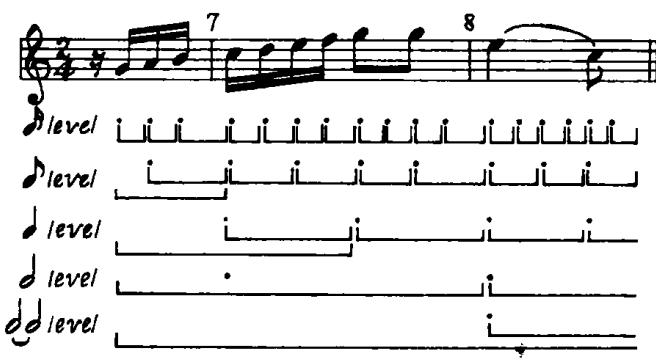
Example 7.7 illustrates the application of segmentation rule 2 to a more complex example, specifically measures 6 through 8 of the finale of Beethoven’s First Symphony.
中文讲解
本段为节内核心例证7.7作引子:要展示的是把分割规则2应用到一个更复杂的实例上——贝多芬第一交响曲末乐章的第6—8小节。‘更复杂的实例’这一措辞提示前面已用过的例子较为单纯,本例意在检验规则2在更繁难的材料中是否仍能成立;选用交响曲末乐章这种大型体裁中层次密集的段落,意味着接下来要处理古典调性音乐中弱起套弱起的典型难题。
第2段(P0041)
原文复述
[Image / musical-score placeholder on page 5; the embedded image data is omitted, but the position and the surrounding caption context are preserved.]
中文讲解
这是第5页上的一张图示或乐谱占位符,原图内容已省略。依据上下文判断,该图对应例7.7,用于展示贝多芬第一交响曲末乐章第6—8小节在时间跨度分割下的具体分组结构,需查看原图才能看到三个层级上规则时间跨度与扩展时间跨度的具体位置。
第3段(P0042)
原文复述
This passage is strongly out of phase, since the strongest beat, marked by the entrance of the accompaniment, falls at the beginning of measure 8. Moreover, the anacrusis is triply embedded. The first sixteenth is an anacrusis to the second two at the eighth-note level; the first three sixteenths form an anacrusis to the downbeat of measure 7 at the quarter-note level; and the first three sixteenths plus all of measure 7 form an anacrusis to the downbeat of measure 8 at the two-measure level. This triple embedding is reflected in the time-span segmentation by the presence of three levels at which both a regular and an augmented time-span exist. It is an important test of our theory of rhythm that it can express this upbeat-within-upbeat intuition by elaboration of the technique used to describe ordinary upbeats.
中文讲解
本段是本节论证的重心,集中解释例7.7为何能成为节奏理论的’重要检验’。‘Out of phase’(相位错位)说明本片段节拍最强点(由伴奏进入标记的小节8开头)与节奏组的强位错开,因而出现明显的弱起(anacrusis)。作者进一步指出这里的弱起是三重嵌套的:第一层——第1个十六分音符作为后两个十六分音符的弱起(八分音符层级);第二层——前三个十六分音符整体作为第7小节正拍的弱起(四分音符层级);第三层——前三个十六分音符加整个第7小节作为第8小节正拍的弱起(两小节层级)。这种’弱起中之弱起’要求时间跨度分割在三个层级上都同时存在’规则时间跨度’与’扩展时间跨度’:前者对应一般的弱—强关系,后者是为容纳额外材料以保留弱—强方向感而设立的变体。该段最终宣称:理论若能通过对一般弱起描述手段的细化(elaboration)来表达’弱起中还有弱起’的听觉直觉,就通过了节奏理论的关键测试。这就把本节的具体例证上升为对理论表达能力的总体检验。
补充说明
‘规则时间跨度’与’扩展时间跨度’在本段中首次同时出现在三个层级,作者借此说明同一对概念能够跨层级复用,从而使理论在结构上保持统一。
第4段(P0043)
原文复述
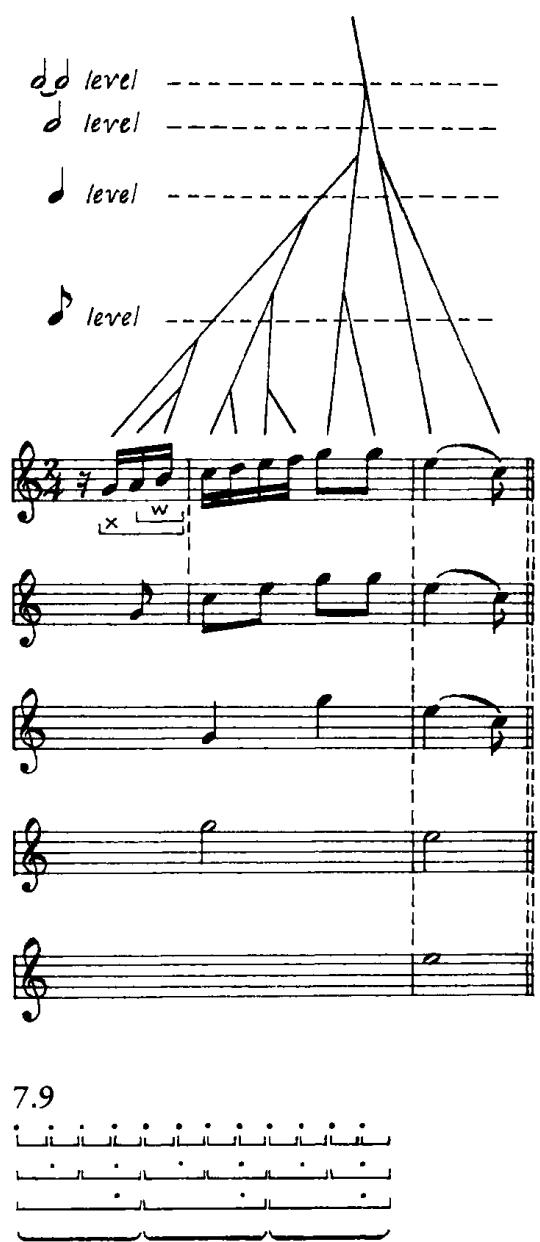
The time-span segmentation in 7.7 gives rise to the time-span reduction in 7.8, given in tree form and in secondary notation. The inclusion of the initial G in the first augmented time-span of the eighth-note level makes it possible for this note to be the most important event at the beginning of this level and the next while still giving the reduction a rhythmically satisfying form. (Footnote 2)
中文讲解
本段把分割的结果推进到归约层面:例7.7的时间跨度分割生成了例7.8的时间跨度归约,并以树形图和次级标记(secondary notation,即线性带括号的标记)两种方式呈现。关键的归约动作是把开头的G纳入八分音符层级的第一个’扩展时间跨度’中;这样一来,G既能在本层级又能在上一层级担任最重要的起始事件,同时整个归约仍保持’节奏上令人满意’的形态。换言之,作者通过这一具体安排说明:把一个弱起音纳入扩展时间跨度,既不破坏理论的形式要求,也不损害听感上的结构合理性。本段末尾标有脚注2,但本节文本中不含该脚注的正文。
补充说明
本段末尾的脚注编号在本节范围内无对应正文,故仅可确认存在该脚注而无法核实其内容。
第5段(P0044)
原文复述
A final comment on the segmentation rules: we surmise that they are universal, except for one interesting idiom-specific variation. In classical tonal music, the strong beat of a regular time-span falls at the beginning. This seems to be the normal case across idioms. However, in the gamelan idiom described in Becker and Becker 1979, it appears that the strong beat is at the end of each subgroup. The typical grouping, metrical, and subgrouping organization of this music is shown in 7.9.
中文讲解
本段把分割规则的普遍性作为一个收尾性的论断提出:作者推测这些规则基本是普遍的,但存在一处有趣的’风格特异性变体’。在古典调性音乐中,规则时间跨度的强拍位于起始处;作者认为这在多种风格中是常态。但在Becker and Becker 1979所描述的加美兰(gamelan)风格中,强拍似乎落在每个次级分组的末尾。这一对照很关键:它既划出了规则的可适用边界(古典音乐是默认情况),又承认了对其他风格的开放性。例7.9被预告将展示该风格的典型音群、节拍与次级分组组织,构成本节最后一处引向实例的窗口。
补充说明
‘风格特异性变体’一词提示规则的普遍性是有保留的;本节只提示加美兰一处例外,不展开其他风格。
第6段(P0045)
原文复述
Chapter 7
中文讲解
这是第5页顶部的页眉文字,仅显示’Chapter 7’,属于版面标识而非正文论证。
第7段(P0046)
原文复述
[Image / musical-score placeholder for Example 7.8 on page 6; the embedded image data is omitted, but the position and the surrounding caption context are preserved.]
中文讲解
这是第6页上对应例7.8的图示或乐谱占位符,原图内容已省略。结合P0043可知,这里呈现的是例7.7的时间跨度归约结果,分别用树形图与次级标记两种方式展示,需查看原图方可观察到G被纳入扩展时间跨度后形成的具体结构关系。
第8段(P0047)
原文复述
In order to produce this segmentation, it suffices to change condition b of segmentation rule 2 to include in T_B the preceding rather than the following time-span of the next smaller level. The possibility of such a mirror reversal of the usual situation will be of particular interest when time-span reduction is compared with phonological theory in section 12.3.
中文讲解
本段为加美兰变体提出形式上的实现方式:只需把分割规则2中的条件b改为:在T_B中纳入下一更小层级的’前一个’而非’后一个’时间跨度。在古典调性音乐中,规则2默认纳入’后一个’(即弱起引导后续强拍的方向),而加美兰需要的是镜像版本——让强拍落在末尾,因而要纳入’前一个’时间跨度。作者把这种改造称为’mirror reversal of the usual situation’,并预告:这种镜像反转将在第12.3节把时间跨度归约与音系理论进行比较时再次显现意义。换言之,本段既给出了加美兰例子的形式处理,又埋下了与音系理论类比的伏笔,体现出节内论证与全章总体走向的衔接。
补充说明
T_B是规则2中用以容纳节拍点B所在时间跨度的符号;‘前一个/后一个’指相对于B所在层级而言,在更小层级上的方向选择。
第9段(P0048)
原文复述
Given the rules for segmentation of the musical surface into time-spans, we now turn to a formal description of the possible time-span trees.
中文讲解
本段是承上启下的过渡句:分割规则已给出,下一步是从经验性规则进入形式化阶段,转向对’可能的时间跨度树’给出形式描述。它把读者从分解决策的层面引向结构层面的抽象处理,为下一节标题作了语义铺垫。
第10段(P0049)
原文复述
Formalization of Time-Span Reduction
中文讲解
这是下一节的小节标题,宣告本节之后转入’时间跨度归约的形式化’。它标志着论述从规则的描述与例外(加美兰变体)转入对归约树本身的形式刻画,开启新的论题。
脚注 / 边栏 / 图表 / 附加信息(如有)
本节范围内有两处图像或乐谱占位符(P0041对应例7.7,P0046对应例7.8),它们在正文中被反复引用,是论证不可省略的视觉材料,需对照原图阅读。P0043末尾带有脚注编号'2’,但本节文本不包含该脚注的正文内容,因此只能确认存在此脚注而无法在本节内核实其具体论述。例7.9(P0044提及)展示加美兰音乐的典型音群、节拍与次级分组组织,但本节未给出其图示。
💡 本节核心要点
- 例7.7把分割规则2应用于贝多芬第一交响曲末乐章第6—8小节,是一段相位错位且弱起三重嵌套的复杂材料,构成本节的检验性实例。
- 三重嵌套体现在三个层级:十六分音符层(前1对后2)、四分音符层(前3个十六分音符对小节7)、两小节层(前3个十六分音符加整个小节7对小节8),对应分割中三对’规则时间跨度与扩展时间跨度’同时存在。
- 例7.8以树形与次级标记两种方式呈现分割产生的归约;把开头的G纳入八分音符层级的扩展时间跨度,使其在两层中都担任最重要起始事件,并保持归约在节奏上的合理性。
- 分割规则被作者推测为普遍适用,但承认存在一处风格特异性变体:在Becker and Becker 1979所描述的加美兰风格中,规则时间跨度的强拍落在次级分组末尾而非起始处。
- 该加美兰变体可通过将分割规则2的条件b改为纳入下一更小层级的’前一个’时间跨度来实现,这种’mirror reversal’将在12.3节与音系理论的比较中再次成为关键。
- 本节在交代完分割规则与变体后,以一句过渡把话题引向下一节——时间跨度归约的形式化。
🔑 关键术语
- out of phase:节拍最强点(如本例小节8开头由伴奏进入标记的拍点)与节奏组强位错开的状态;本节用以说明本片段需要用弱起而非正拍引导来解释。
- triply embedded anacrusis:三层嵌套的弱起结构:弱起之中还有弱起;本节在十六分音符、四分音符、两小节三个层级上同时出现弱—强方向,是规则2的关键测试情境。
- regular time-span / augmented time-span:在同一层级中并存的两类时间跨度:前者对应通常的弱—强关系,后者为容纳额外材料以保留弱—强方向感而设立的扩展形式;本节在三个层级上同时出现这两种时间跨度。
- time-span reduction:由分割生成的、显示各事件结构重要性的归约结果;在例7.8中以树形和次级标记两种方式呈现。
- idiom-specific variation:分割规则在不同音乐风格下的局部例外;本节仅举出加美兰一处,即强拍落在次级分组末尾。
- mirror reversal:把通常情况下T_B纳入’后一个’更小层级时间跨度的做法,改为纳入’前一个’更小层级时间跨度,从而在形式上产生加美兰式的强拍落在末尾的分割。
S005 The Reduction Hypothesis and the Tree Notation
第1段(P0050)
原文复述
The Reduction Hypothesis and the Tree Notation
中文讲解
本段是第7章第2节的标题,全文为英文:’## The Reduction Hypothesis and the Tree Notation’,即’归约假设与树形标记法’。这一小节标题点明两大主题:一是归约假设(Reduction Hypothesis),二是用来表示归约结构的树形标记法(tree notation)。它开启的论题是:如何在前两章所建立的概念基础上,正式给出时间跨度归约(time-span reduction)的良构规则(well-formedness rules),并借助树形标记法把全曲所有层次上的归约结构清晰呈现出来。
第2段(P0051)
原文复述
Chapters 5 and 6 have developed many of the ideas we need to state the well-formedness rules for time-span reduction. The most basic is that every time-span has a most important event, or head, selected from the pitch-events in it; the other pitch-events are said to be subordinate to the head.
中文讲解
作者指出,前两章(第5章和第6章)已经为陈述时间跨度归约的良构规则提供了多数所需观念,其中最基本的一条是:每一个时间跨度都有一个最重要的事件,称为该时间跨度的’头’(head),它从该跨度所包含的音高事件中选出;跨度内的其他音高事件相对于这个头而言都是’附属的’(subordinate)。也就是说,‘头/附属’这一对关系是整个归约理论的基石——任何时间跨度在结构上都不是平摊的事件序列,而是有一个被凸显出来的核心事件,其他事件围绕它组织。
第3段(P0052)
原文复述
Chapter 5 also presented what we called the Strong Reduction Hypothesis, namely that all the pitch-events of a piece can be organized into a single structure by hierarchical relationships of subordination. It is essential to this hypothesis that the relationship of subordination be transitive; that is, if pitch-event x is subordinate to pitch-event y, and y is subordinate to z, then x is subordinate to z. More intuitively, if a particular event is the structurally most important event of some large time-span, then it must also be the structurally most important event of all smaller time-spans to which it belongs. Were this not the case, a strictly ordered hierarchy would be impossible; for example, an event could be subordinate to itself.
中文讲解
作者在此正式提出第5章已经讨论过的’强归约假设’(Strong Reduction Hypothesis):一首乐曲中的所有音高事件能够通过附属关系(subordination)的层级组织,整合到同一个结构之中。该假设的关键前提是附属关系具有’传递性’(transitivity)——即若 x 附属于 y,y 附属于 z,则 x 也附属于 z。直观地说:如果某事件是某一大跨度的结构上最重要的事件,那么它也必须是它所属的所有较小跨度的结构上最重要的事件。作者警告:如果这一点不成立,严格有序的层级结构就不可能存在,因为会出现诸如’一个事件附属于它自身’这样的悖论。所以传递性既不是装饰性要求,也不是数学上的洁癖,而是确保层级关系不出现自指、矛盾和循环的根本条件。
第4段(P0053)
原文复述
In turn, the transitivity of subordination enables us to represent all levels of time-span reduction of a piece perspicariously in the tree notation introduced in chapter 5. Each pitch-event in the piece is connected to a branch of the tree; each branch but the longest terminates on another branch. Termination of a branch b₁ on another branch b₂ signifies that there is a step of time-span reduction in which the pitch-event e₁ connected to b₁ is eliminated in favor of the pitch-event e₂ connected to b₂. In this situation we will say that e₁ is directly subordinate to e₂. In addition, because of the transitivity of subordination, e₁ is subordinate to all the pitch-events to which e₂ is subordinate; these can be found by tracing upward in the tree to the termination of branch b₂ on another branch b₃, and so on to the top of the tree.
中文讲解
本段把抽象的传递性假设转化为具体的可视化工具——第5章引入的树形标记法。其逻辑是:正因为附属关系具有传递性,我们才能把一首乐曲所有层次的时间跨度归约以一种清晰(perspicacious)的方式呈现出来。具体的对应方式是:乐曲中的每一个音高事件与树的一条分支相连;除最长分支之外,每条分支都终止于另一条分支之上。一条分支 b₁ 终止于分支 b₂ 上,意味着存在一步时间跨度归约——与 b₁ 相连的事件 e₁ 在归约中被消除,而与 b₂ 相连的事件 e₂ 被保留下来作为更高层跨度的头;此时 e₁ ‘直接附属’于 e₂。进而,因为传递性,e₁ 同时也附属于 e₂ 所附属的所有事件,而后者可以通过沿树向上追溯——看 b₂ 终止于哪条分支 b₃,再向上直到树顶——依次找到。这一段揭示了树形标记法的双重功能:它既是结构的图示,也是’传递性’这一形式条件的几何体现。
第5段(P0054)
原文复述
Thus the tree notation is possible only if subordination is transitive. If the Strong Reduction Hypothesis turns out to be false, the notation for reduction will have to be modified accordingly. On the other hand, we find it difficult to envision a theory lacking the Strong Reduction Hypothesis that would be both sufficiently rich and sufficiently constrained to constitute a plausible account of musical cognition.
中文讲解
本段进一步强调上一段的逻辑关系:树形标记法的成立以附属关系的传递性为前提,因此反过来——如果强归约假设被证伪,那么用于表示归约的标记法就必须相应修改。从理论策略上看,作者坦率地表达了对强归约假设的偏好:他们很难想象一种既足够丰富(能解释众多音乐现象)、又足够受约束(能避免任意解释)的音乐认知理论,会是在抛弃强归约假设之后还能成立的。换言之,传递性的层级结构在他们看来是构造可运作的音乐认知理论的必要条件。这是一个带有作者态度的论断——既是论证,也是为接下来规则陈述所做的辩护。
第6段(P0055)
原文复述
We sum up this discussion by giving a preliminary statement of the well-formedness rules. One definition will make the rules clearer. We will say that a time-span Tᵢ immediately contains another time-span Tⱼ if Tᵢ contains Tⱼ and if there is no time-span Tₖ such that Tᵢ contains Tₖ and Tₖ contains Tⱼ. Informally, Tᵢ immediately contains Tⱼ when Tⱼ is exactly one level smaller than Tᵢ.
中文讲解
本段进入规则陈述前的准备工作,引入一个关键定义:‘直接包含’(immediately contains)。形式定义是:若时间跨度 Tᵢ 包含 Tⱼ,并且在 Tᵢ 与 Tⱼ 之间不存在另一个时间跨度 Tₖ 使得 Tᵢ 包含 Tₖ 且 Tₖ 包含 Tⱼ,则称 Tᵢ ‘直接包含’ Tⱼ。直观地说,就是 Tⱼ 恰好比 Tᵢ 小一级。这一步定义的必要性在于:接下来要给出的良构规则只关心跨越一层的父子关系,而不是任意层次的祖孙关系。定义’直接包含’就是为了让规则的适用范围精确、可操作,避免含糊地谈论’某一跨度内的跨度’。
第7段(P0056)
原文复述
Time-Span Reduction Well-Formedness Rules (preliminary version) TSRWFR 1 For every time-span T, there is an event e that is the head of T; all other events in T are subordinate to e.
中文讲解
这是良构规则的标题与第一条(TSRWFR 1)。标题标明这是’时间跨度归约良构规则(初步版本)’。规则1的内容是:对于每一个时间跨度 T,存在一个事件 e,作为 T 的头;T 中的所有其他事件都附属于此 e。这条规则把 P0051 提出的’头/附属’基本观念形式化为强制约束:不是每个时间跨度’可以’有头,而是’必须’有且只有一个头,其余事件一律附属。这为后面规则2和规则3奠定基础——它们将说明头如何被选取。
第8段(P0057)
原文复述
7.2 Time-Span Reduction Well-Formedness Rules
中文讲解
这是版面元素——位于第7页的页眉/边栏标识,提示读者当前小节是第7章第2节,主题为’时间跨度归约良构规则’。它并不承载新论点,只是定位读者所在的位置,并提示其与上下节的归属关系。
第9段(P0058)
原文复述
Chapter 7
中文讲解
这是版面上的章节标识(页眉),表明当前所在为第7章。它仅起导航作用,不引入新的概念或论证。
第10段(P0059)
原文复述
TSRWFR 2 If T does not contain any other time-spans (that is, if T is at the smallest level of time-spans), e is whatever event occurs in T.
中文讲解
规则2处理的是边界情形:当时间跨度 T 不再包含任何其他时间跨度,即 T 处于时间跨度的最小层级时,e 就是 T 中出现的那个事件。这条规则的意义在于设定’递归的基底’(base case)——最小跨度的头不需要经过任何选择过程,里面有哪个事件,哪个事件就自动成为头。它使整个递归式的规则体系能够从最底层逐级向上构造。
第11段(P0060)
原文复述
TSRWFR 3 If T contains other time-spans, let T₁,…,Tₙ be the (regular or augmented) time-spans immediately contained in T, and let e₁,…,eₙ be their respective heads. Then the head of T is one of the events e₁,…,eₙ.
中文讲解
规则3处理递归情形:若时间跨度 T 包含其他时间跨度,则设 T₁,…,Tₙ 为 T 所直接包含的时间跨度(可以是常规的或增广的),e₁,…,eₙ 分别为它们各自的头,那么 T 的头必须是 e₁,…,eₙ 中的某一个。关键点有三:第一,候选头只来自下一级跨度的头,而不必考虑下一级中其他被消除的事件;第二,候选范围是 T 直接包含的跨度,而不是任意层级的后代;第三,‘规则’只要求头’是其中之一’,具体选择由其他机制(例如音乐认知中的突显性、节拍位置、和声等因素)决定,规则本身并不指定。这与 P0055 中’直接包含’的定义严密呼应。
第12段(P0061)
原文复述
Observe how the Strong Reduction Hypothesis is incorporated into these rules. First, the segmentation rules guarantee that a piece is exhaustively segmented into time-spans, arranged hierarchically from the smallest metrical level up to the level of grouping encompassing the entire piece. Second, each time-span has a head, chosen from the heads of those time-spans it immediately contains. This method of choice guarantees that each level of reduction can be constructed from the next smaller level and does not have to refer to events eliminated at earlier stages of reduction. Hence these rules create a class of unified hierarchical structures for the entire piece.
中文讲解
本段回扣强归约假设,说明三条规则是如何具体实现该假设的。其逻辑分两层:第一,分割规则(segmentation rules)保证一首乐曲被穷尽地分割为若干时间跨度,并按层级组织起来,从最小的节拍层级一直到涵盖全曲的分组层级;第二,每一时间跨度的头只能从它所直接包含的下一级跨度的头中选出。这种选取方式的关键意义在于:每一级归约都可以从下一更小的层级构造出来,而不需要回头参考已经在早期归约中被消除的事件。这正好对应 P0052 中所说的传递性——上一层级的头必然也是其下属各层的头,因此不存在需要’逆溯’的情况。由此,三条规则共同为整首乐曲生成了一类统一的层级结构。这段是本节的形式论证收束:从强归约假设出发,经过传递性和’直接包含’定义,最终落地到可操作的良构规则集。
第13段(P0062)
原文复述
The rules just stated deal only with cases of reduction in which the head of a time-span is a single event chosen from among the events in that time-span. Let us call this situation ordinary reduction. Though the majority of situations produce ordinary reduction, three other sorts of heads can also appear, resulting from reductional processes which we will call fusion, transformation, and cadential retention. We take them up in turn, before incorporating them into a final statement of the well-formedness rules later in this section.
中文讲解
本段在初步版本规则之上进一步做范围说明:到目前为止的规则只处理一种归约情形——一个时间跨度的头是从该跨度内事件中选出的’单一事件’,作者称之为’常规归约’(ordinary reduction)。尽管大多数情形都属于常规归约,但还存在三种其他类型的头,源自三种归约过程:‘融合’(fusion)、‘变换’(transformation)、‘收束保留’(cadential retention)。作者预告:这三类将依次讨论,并在本节稍后整合进良构规则的最终表述中。这段的功能是为下一阶段的内容做预告和划界——告诉读者初步规则并非终点,还需扩展,但这种扩展不是否定已有规则,而是在它基础上增添新的头生成机制。
脚注 / 边栏 / 图表 / 附加信息(如有)
本小节中的附加材料主要是版面元素:P0057 是页眉/边栏标识(‘7.2 Time-Span Reduction Well-Formedness Rules’),用于标示当前所在小节与页码定位;P0058 是章节标识(‘Chapter 7’),提示读者所处章节。这些版面元素不包含新的论证内容,仅起导航作用。此外,P0056 中带编号的规则’TSRWFR 1’以及后续 P0059、P0060 中的’TSRWFR 2’与’TSRWFR 3’构成一个具有递归结构的规则集,三条规则在 P0061 中被作者明确解读为强归约假设的具体实现方式。
💡 本节核心要点
- 时间跨度归约的核心观念是:每个时间跨度都有一个从其音高事件中选出的’头’,其余事件为附属;附属关系必须具有传递性,这是强归约假设的形式核心。
- 树形标记法的成立以附属关系的传递性为前提:一条分支终止于另一条之上表示一步归约中被消除事件向保留事件的转化;通过传递性,向上的整条路径自动建立了多层级的附属关系。
- ‘直接包含’的定义把规则的作用域精确限定在跨越一层的父子关系之间,使良构规则的可操作性得以保证。
- 三条良构规则(TSRWFR 1–3)形成一个递归结构:基底情形(最小跨度的头即所含事件)与递归情形(上一级跨度的头取自其直接包含的下一级跨度的头),从而保证每一层归约可从下一层构造,无需回溯已被消除的事件。
- 初步规则只覆盖’常规归约’——头为单一事件的选取;本节稍后还将引入融合、变换、收束保留这三类非常规归约过程,并据此给出良构规则的最终版本。
- 作者明确表达了对强归约假设的理论偏好:缺乏该假设的替代理论难以同时兼顾解释力与约束力。
🔑 关键术语
- Time-span (时间跨度):本节中作为归约基本单位的时间区间,由分割规则将乐曲层层切分而成,结构上呈层级嵌套,是良构规则直接作用的对象。
- Head (头):每个时间跨度从其音高事件中选出的’最重要事件’,是附属关系中被附属的对象;规则1强制每个时间跨度必须唯一地拥有一个头。
- Subordination (附属关系):音高事件之间相对头而言的从属关系;强归约假设要求该关系具有传递性,从而保证严格有序的层级结构。
- Strong Reduction Hypothesis (强归约假设):主张一首乐曲中的所有音高事件能够通过传递性的附属关系整合为单一的层级结构;其在本节中被具体实现为良构规则1–3。
- Tree notation (树形标记法):用树状分支图形表示时间跨度归约结构的方法:每条分支对应一个音高事件,分支终止于另一分支之上即代表一步归约中事件的消除;其可行性以传递性为前提。
- Immediately contains (直接包含):时间跨度之间跨越恰好一层的包含关系,用于精确界定良构规则3中候选头来源的范围。
- Ordinary reduction (常规归约):时间跨度的头为单一事件的归约情形,是初步良构规则所覆盖的对象;与之相对的是融合、变换、收束保留三类非常规归约,将在后续讨论。
S006 [描述性拆分] Fusion as a Head-Selection Process
第1段(P0063)
原文复述
Fusion
中文讲解
这是本节的小节标题,标志着正式引入 “fusion”(融合)这一新操作。它区别于前文讨论的"普通单事件选择",将作为时值跨度归约中的第二种头部选择关系。
第2段(P0064)
原文复述
This process can be exemplified by 7.10, a passage from the prelude of the first Bach Cello Suite.
中文讲解
作者宣布将用一个具体的音乐片段——例 7.10,取自巴赫第一首大提琴组曲的前奏曲——来示例刚刚引入的融合过程。句中 “this process” 指上一段所定义的融合操作;“7.10” 是贯穿本节的例题编号。
第3段(P0065)
原文复述
7.10
中文讲解
这是上一句所提到的那段音乐片段的题图标签(例 7.10)。双 “##” 表明它是比一级标题更低一级的例题小标题,而非新的章节开头。
第4段(P0066)
原文复述

中文讲解
此处为第 8 页上例 7.10 的乐谱或图示占位符。由于内嵌图像数据未给出,具体音高、节奏与谱号信息无法从本输入中重建;需查阅原图以看到作者描述的"上升的八分音符线条"与"持续低音 D"。
补充说明
需查看原图(图 7.10 的具体音高与节奏信息未在 task_input 中提供)。
第5段(P0067)
原文复述
A reduction at the eighth-note level should obviously show the existence of the rising line, but it should also reflect awareness of the pedal D. Similarly, in an Alberti bass, the reduction should represent the fact that one hears a single chord spread out over a time-span. If the rules for selecting the head of a time-span were to allow only the selection of a single event in a time-span, we would not be able to represent such intuitions in a time-span reduction. Accordingly we will introduce another possible relation between the head of a time-span and the events within it: the head may be the fusion of the events into a single event; or, conversely, the surface events may be an arpeggiation of the head.
中文讲解
本段是引入融合概念的核心论证。作者指出两种仅靠"单事件选择"无法表达的听感直觉:(1)在巴赫前奏曲中,八分音符层面的归约必须同时呈现一条上升的旋律线和持续的低音 D——两者只能择一就会丢信息;(2)在阿尔贝蒂低音中,听者感受到的是一个和弦在时间上的展开,而非一串独立的音。作者由此推出:时值跨度与其内部事件之间需要第二种关系,即头部可以是多个事件融合而成的单一事件;等价地,表面事件也可被看作该头部的"琶音展开"。这是本节的概念支点。
第6段(P0068)
原文复述
Formalization of Time-Span Reduction
中文讲解
这是本节内的一个子标题,标志着从概念动因(为何需要融合)转入形式化记号(融合如何在树形图中表示并受何种规则约束)。紧随其后的段落将引入横杠记法。
第7段(P0069)
原文复述
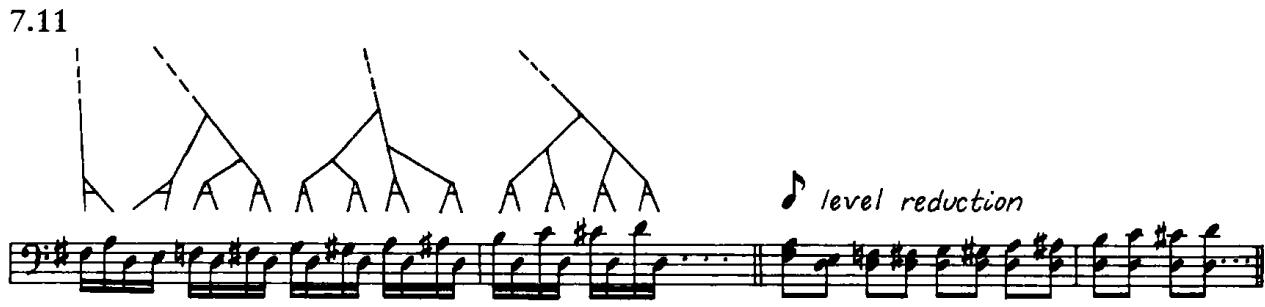
We will represent the fusion of two events in the tree by joining their branches with a crossbar. Example 7.11 illustrates the reduction of 7.10 by fusion, giving the lower branches of the resulting tree.
中文讲解
作者把抽象概念落到具体记号:当两个事件被融合时,在时值跨度树形图中将它们所在的分支用一根横杠(crossbar)连接起来。例 7.11(文中仅提及,尚未见图)即是应用此横杠融合操作后得到的、例 7.10 归约树的下层分支。本段将概念转化为可直接绘制的树形图约定。
第8段(P0070)
原文复述
中文讲解
此处为源文本中标记为 “7.12” 的图示占位符;内嵌图像数据未给出。结合上下文:P0069 预告了例 7.11(展示例 7.10 下层分支的融合树),P0071 紧接着描述例 7.12(同一乐章开头,含多层融合)。该位置的图示在原文中印有的标签是 “7.12”,但其具体归属(是 7.11 的树、7.12 的树,还是其他图)本节上下文未提供进一步证据,故此处不作归属断言,需查阅原图确认。
补充说明
需查看原图。原文此处图片的标记为 “7.12”;task_input 未给出足以确定它对应例 7.11 还是例 7.12 的额外信息,因此本讲解不作进一步归属判断。
第9段(P0071)
原文复述
Example 7.12 is the beginning of the same movement; its tree contains multiple levels of fusion, showing that each half-measure is heard as the arpeggiation of a chord. (The dissonant neighbor tones are eliminated by ordinary reduction at the eighth-note level.) 3
中文讲解
例 7.12 把融合操作推广到多层:每一小节的一半都被听成单个和弦的琶音展开,因此树形图中同时在多个层级上施加横杠融合。而在八分音符层面,不协和的邻音则交由普通的单事件选择来处理,而非融合。句末的上标 “3” 表示此处引有一脚注(其具体内容未在 task_input 中给出)。
补充说明
上标 “3” 对应的脚注正文未在 task_input 中出现,仅保留为参考文献标记。
第10段(P0072)
原文复述
中文讲解
此处为第 9 页上的图示或乐谱占位符,位于例 7.12 的描述与"局部性条件"讨论之间。内嵌图像数据未给出;其究竟对应例 7.12 的树形图、乐谱片段还是其他相关图示,需查阅原图确认。
补充说明
需查看原图。
第11段(P0073)
原文复述
Fusion, unlike ordinary reduction, is limited to relatively local levels. Although one may hear long-range arpeggiation of a chord, one does not fuse the elements into a single chord heard over the entire interval of time. The proper delimitation appears to be that events cannot be fused if they are separated by a group boundary. This “locality” condition is provisionally incorporated into the well-formedness rules below. Its effect is shown in the reduction in 7.12: each pair of half-measures is not fused into a single event at the whole-note level; rather, the second half-measure is treated as a repetition of the first that is eliminated by ordinary reduction. This follows from the locality condition, because each half-measure forms a group.
中文讲解
本段为融合操作引入关键约束——“局部性"条件。虽然听者可能感受到跨越大段时值的远距琶音,但融合作为树形构建操作被限制在未被组界(group boundary)分隔的事件之间。在例 7.12 中,两个半小节各自构成一个组,因此在全音符层级上不会被融合为一个事件;相反,第二半小节被视为对第一半小节的重复,由普通的归约操作来消除。本段由此显示融合与普通归约遵循不同原则:融合要求局部紧邻,普通归约则可处理组级别的重复。作者将该约束标为"暂时的”(provisionally),意味着它虽已被纳入下面的良构规则,但后续仍可能调整。
第12段(P0074)
原文复述
Fusion in time-span reduction corresponds to the perceptual phenomenon of “auditory stream segregation,” where one hears two voices instead of a single oscillating one (Bregman and Campbell 1971). The fact that auditory stream segregation is not confined to musical inputs suggests that time-span reduction has some connection to nonmusical auditory perception. We see two opposing ways in which such a connection could be made. An extremely restrictive account would claim that auditory stream segregation is an independent phenomenon that happens to have an effect on musical perception just at this point. By contrast, an extremely comprehensive account would claim that the rules of time-span reduction are completely subsumed by more general principles of auditory perception, and thus that the rule resulting in fusion in the Bach suite is just a special case of the principle of auditory stream segregation. We suspect that the truth lies between these two extremes—that the rules of time-span reduction are in part determined by general properties of auditory perception, but that there is a certain degree of specialization for musical cognition. Section 12.3 discusses this issue further, presenting evidence from linguistics bearing on the cognitive generality of rules for time-span reduction.
中文讲解
本段把音乐理论中的"融合"操作与一个经典心理物理学现象——“听觉流分离”(auditory stream segregation,Bregman and Campbell 1971)——联系起来:在该现象中,听者把一串交替出现的音听成两条独立的流,而非一条振荡的单线。作者随后提出关于时值跨度归约与一般听觉感知关系的两种极端立场:(1)“限制性"立场把流分离视为独立现象,仅在此处偶然影响音乐感知;(2)“综合性"立场则主张时值跨度归约规则完全被一般听觉原理所涵盖,因而巴赫组曲中的融合规则只是流分离原理的一个特例。作者自己的立场居中:时值跨度归约部分由一般听觉感知特性决定,但也对音乐认知有专门化的适配。本段以对第 12.3 节的前向引用作结,该节将援引语言学证据回到这一议题;这是本节中唯一一处暗示后续论证将引入语言学材料的线索。
第13段(P0075)
原文复述
Chapter 7
中文讲解
这是页眉或页脚中显示的章节标识,表明当前页属于第 7 章;不含论证内容。
脚注 / 边栏 / 图表 / 附加信息(如有)
- 脚注:P0071 中以 “^3” 引出的脚注正文未在 task_input 中给出,仅保留为标注。
- 图示:例 7.10(巴赫《大提琴组曲第一首》前奏曲片段,P0066 占位符);例 7.11(应用横杠融合后的归约树,P0069 仅文字提及,未见图示占位符);例 7.12(同一乐章开头,含多层融合,P0070 处有标为 “7.12” 的图示占位符;P0072 处另有第 9 页图示占位符)。所有图示的内嵌图像数据均已省略。
- 文献引用:Bregman and Campbell 1971,引自 P0074,用以支撑"听觉流分离"与时值跨度归约融合操作的对应关系。
- 前向引用:第 12.3 节(P0074 末尾预告),将借助语言学证据讨论时值跨度归约规则的认知普遍性。
💡 本节核心要点
- 融合是时值跨度归约中头部与其内部事件之间的第二种关系:当头部由多个事件融合而成时,表面事件可视作该头部的琶音展开。
- 本节通过两个听感直觉引入该操作:巴赫《大提琴组曲第一首》前奏曲中需同时呈现上升八分音符线条与持续低音 D,以及阿尔贝蒂低音中听者感知到的"一个和弦在时间上的展开”——两者都无法用单事件选择表达。
- 在树形记号中,融合由横杠(crossbar)连接被融合的分支来表示;例 7.11 即以此方式呈现例 7.10 下层分支的归约,例 7.12 进一步展示横杠融合在多层同时生效。
- 普通归约与融合遵循不同原则:普通归约在八分音符层面消除不协和邻音并可处理组级别重复;融合则受"局部性"条件约束,禁止跨越组界。
- “局部性"条件被暂时纳入后续良构规则;在例 7.12 中,两个半小节各自成组,因此在全音符层级不被融合,而是由普通归约视为重复而消除。
- 融合对应听觉流分离(Bregman and Campbell 1971);作者采取居中立场——时值跨度归约部分由一般听觉感知特性决定,又对音乐认知有专门化适配,第 12.3 节将以语言学证据进一步讨论。
🔑 关键术语
- Fusion(融合):时值跨度归约中头部与内部事件之间的一种关系:多个表面事件被听成一个复合的单一事件(头部),等价地看作该头部的琶音展开。是本节引入的第二种头部选择关系,区别于只选单一事件的普通归约。
- Arpeggiation of the head(头部的琶音展开):对融合关系的等价描述:表面事件被理解为单一头部(融合后的事件)在一个时值跨度内的分解呈现,如阿尔贝蒂低音或例 7.12 中每半小节被听成单一和弦的琶音。
- Crossbar(横杠):时值跨度树形图中的记号装置,用于把被融合的两个分支在视觉上连接起来,以标示融合关系。
- Ordinary reduction(普通归约):时值跨度归约的标准程序:在同一层级的事件中只选一个事件作为头部,其余事件被消除(如例 7.12 中八分音符层级的邻音消除,以及半小节被视为重复后的消除)。
- Locality condition(局部性条件):对融合的约束:被组界分隔的事件不能被融合;融合只能发生在未被组界分隔的事件之间。该条件在本节中被"暂时"纳入下文给出的良构规则。
- Group boundary(组界):音乐中的结构划分单位。局部性条件禁止融合跨越组界,因此每一对各自成组的半小节不会被融合,而是作为重复由普通归约消除。
- Pedal D(持续低音 D):例 7.10(巴赫前奏曲)中需要被归约同时呈现的持续音 D。它与上升的八分音符线条一起,构成作者论证融合必要性的关键听感依据之一。
- Alberti bass(阿尔贝蒂低音):作者援引的另一类典型听感直觉:在低–高–中–高这种分解和弦伴奏型中,听者感知到的是一个和弦在时间上的展开,而非一串独立音;与例 7.10 共同支持融合操作的引入。
- Eighth-note level(八分音符层级):例 7.10 与 7.12 中归约操作的特定层级:在此层级上应同时呈现上升旋律线与持续低音 D(例 7.10),并消除不协和邻音(例 7.12)。
- Auditory stream segregation(听觉流分离):由 Bregman and Campbell 1971 提出的心理物理学现象:当一串交替音出现时,听者可将其知觉为两条独立的声音流,而非一条振荡的单线。在本节中被作者对应为音乐归约中的融合操作,并据以讨论时值跨度归约与一般听觉感知的认知关系。
S007 [描述性拆分] Transformation as a Head-Selection Process
第1段(P0076)
原文复述
Transformation
中文讲解
这是一个二级小节标题,用 Markdown 写法标出 “Transformation”(转化)一词,开启本节所要讨论的主题。结合 section_title “Transformation as a Head-Selection Process” 可知,作者将在此节中把"转化"作为节拍群(time-span)头部选取的一种特殊过程来加以刻画,与前文的 fusion(融合)形成对照。
补充说明
本标题与 section_title 共同构成小节的论题入口:Transformation 在本节中被定义为一种头部选取(head-selection)的过程,而不仅仅是结构层级上的合并。
第2段(P0077)
原文复述
A process somewhat rarer than fusion occurs in 7.13a, part of the Bach chorale “O Haupt.”
中文讲解
作者开门见山地指出,存在一种比 fusion(融合)出现频率更低的过程,并预告它将出现在示例 7.13a 中,该示例取自巴赫圣咏《O Haupt voll Blut und Wunden》。用"somewhat rarer than fusion"这种相对比较而非绝对陈述的方式,引出本节的核心操作——transformation(转化),从而在结构层级上提示读者:它属于 fusion 之外、却与 fusion 同类的局部层级现象。
补充说明
“O Haupt” 是 Bach 的著名圣咏,作者借同一首曲子引出新的局部结构现象,与前文 fusion 案例形成连续的分析素材。
第3段(P0078)
原文复述
7.13
中文讲解
这是示例编号 7.13 的题头,用于标识紧随其后的乐谱片段(7.13a 与 7.13b)。单独的题头本身不承载论证内容,其功能仅在于把后续两个子例(a 与 b)捆绑在同一编号下,提示读者把它们视为一组对照材料。
第4段(P0079)
原文复述
[Image or musical-score placeholder for page 10: an embedded illustration omitted from text; its position in the layout and its figure caption are retained.]
中文讲解
此处为页面 10 上的图像或乐谱占位符,原文以内嵌图像形式呈现,已在文本中被省略;保留其版面位置与图注以便核对原始材料。由于本占位符对应示例 7.13 的乐谱,建议查看原书插图以确认方括号区间内两个表层事件的音高、节奏以及推断的 E 小调主和弦结构,文字层面的论证需结合图形才能完整理解。
第5段(P0080)
原文复述
Within the bracketed time-span, neither of the two surface pitch-events is heard as the structurally more important, as ordinary reduction would require. Rather, as suggested in section 6.6, the head of this time-span is a hypothetical root-position E minor chord, composed out of mutually consonant fragments of the two surface events in the time-span.
中文讲解
本段提出本节最关键的分析观察:在方括号所划定的时间跨段(time-span)内,两个表层音高事件(surface pitch-events)都无法被听辨为结构上更重要的一方,这与常规简化(ordinary reduction)的要求——即在两个竞争事件中识别出结构性占优的那一个——相抵触。因此作者援引 6.6 节,主张该 time-span 的头部(head)并非表层中的任何一者,而是一个假设性的、根音在下的 E 小调和弦;这一假设和弦由该 time-span 内两个表层事件中"互相协和”(mutually consonant)的片段组合而成。这一论述的关键在于:transformation 不是把两者合并成一个真实听到的和弦,而是构建一个由听者从材料中推断出的虚拟和弦来充当结构头部。
补充说明
与 6.6 节形成照应——作者用 “as suggested in section 6.6” 把本节的具体案例与更早提出的理论原则联系起来;该处所指的应是关于假设性结构头部如何由表层材料构成的说明。“mutually consonant fragments” 是 transformation 在材料上的判据:只有当两个表层事件之间存在可共享的协和音程时,构造假设和弦才在听感上合理。
第6段(P0081)
原文复述
Example 7.13b illustrates the representation we adopt. The hypothetical chord is inserted in brackets into the musical surface, between the two events out of which it is constructed; the tree represents both actual events as directly subordinate to the hypothetical one. In this situation we will call the head of the time-span a transformation of the events within the time-span. $^{4}$
中文讲解
本段一方面给出了示例 7.13b 的图示约定,另一方面给出术语定义。图示上,假设和弦被插入在方括号中、置于构成它的两个表层事件之间;树形图(tree)则把两个真实事件都直接挂在该假设和弦之下,使假设和弦成为父节点。在这一表示下,作者正式命名:当 time-span 的头部由这样构造的假设和弦充当时,就称该头部为该 time-span 内诸事件的 transformation(转化)。末尾的上标 4 指向脚注,提示此处还附带技术性或限定性说明(详见脚注内容)。本段之作用是把上段的观察凝固为可重复使用的术语与图形约定,为后续规则化(如 P0082 中的良构规则限制)做好铺垫。
补充说明
7.13a 与 7.13b 是同一编号下的两个子例:a 给出原始乐谱片段,b 给出经作者选定的结构表示;两者并列意在表明这是一种分析选择而非唯一解。“directly subordinate to the hypothetical one” 的树形安排使 transformation 与 fusion 在图示上区分开来——fusion 通常表现为真实事件的合并,而 transformation 则在两者之上再插入一个假设层级。
第7段(P0082)
原文复述
Like fusion, transformation occurs only at quite local levels of reduction. Again, we provisionally incorporate a restriction into the well-formedness rule to express this fact.
中文讲解
本段把 transformation 的适用范围明确限定在非常局部的简化层级(local levels of reduction),与 fusion 相同。换言之,transformation 不能被用来在高结构层级上构造头部;它只在局部 time-span 内起作用。为了把这一观察纳入形式体系,作者用"we provisionally incorporate”(我们暂时性地加入)这一措辞,把这一限制附加到原有的 well-formedness rule(良构规则)上,并用"provisionally"提示该限制具有暂行性质,可能在后续讨论中重新审视或调整。本段在论证链上的功能是把刚刚定义的过程嵌回总体理论框架:transformation 既是一个新的结构操作,也受到现有规则的制约。
补充说明
“provisionally” 一词是作者留给后续讨论的口子:局部性限制在此被作为良构规则的附加条款先纳入,但作者并未声称这是最终定论,为后续可能的修订保留了余地。
脚注 / 边栏 / 图表 / 附加信息(如有)
本节出现的附加材料包括示例 7.13(含 7.13a 乐谱与 7.13b 结构图示)以及与 transformation 定义相联的上标脚注 4。其中 7.13a 来自 Bach 圣咏《O Haupt voll Blut und Wunden》,7.13b 是作者所采用的结构表示,二者构成"原始材料—分析表示"的对照;脚注 4 对术语定义提供了技术性补充说明。
💡 本节核心要点
- Transformation 是一种比 fusion 更为罕见的头部选取过程,作者以 Bach 圣咏《O Haupt》中的示例 7.13 为切入材料。
- 其典型情境是:在某 time-span 内两个表层事件均无法被听辨为结构上更重要者,常规简化无法直接归属。
- 该 time-span 的头部由一个假设的根音位置和弦充当,该和弦由两个表层事件中互相协和的片段组合而成;该假设和弦被插入方括号中,树形图把两个真实事件直接挂在它之下。
- 作者正式定义:当一个 time-span 的头部以这种方式构造时,就称之为该 time-span 内诸事件的 transformation。
- 与 fusion 相同,transformation 只在非常局部的简化层级上发生;作者把这一限制以临时性方式纳入 well-formedness rule。
- 作者使用 “provisionally” 一词,提示对 transformation 的限制只是当前阶段的方案,可能在后续讨论中调整。
🔑 关键术语
- Transformation:在本节中指:time-span 的头部由一个假设和弦充当,而该假设和弦由该 time-span 内两个表层事件中互相协和的片段组合而成;与之对应的头部被称为该 time-span 内诸事件的 transformation。
- Head-selection process:指在 time-span 的结构简化中如何挑选头部(head)的过程;fusion 与 transformation 都是这类过程,但选择头部的依据不同——fusion 通过识别表层事件中的结构性占优者,transformation 通过构造假设和弦充当头部。
- Fusion:前文已定义的结构过程,与 transformation 同属局部层级现象但出现频率更高;本节以 “somewhat rarer than fusion” 把 transformation 定位为 fusion 之外但同类的局部过程。
- Hypothetical root-position chord:在听感上推断而非真实出现的、根音在下的和弦;在 transformation 中充当 time-span 的头部,由表层事件中互相协和的片段拼合而成。
- Mutually consonant fragments:两个表层事件中彼此协和、可被共享并组合到同一假设和弦中的音程片段;它是判断一个 time-span 是否适用 transformation 的关键材料条件。
- Well-formedness rule (provisionally extended):良构规则;作者临时性地把"transformation 只在局部简化层级上发生"这一限制附加于其上,并使用 “provisionally” 标明其为暂行条款。
- Time-span:节拍群结构中的基本单位;本节讨论的核心对象是其中的头部如何被选取或构造。
- Local levels of reduction:结构简化中较低的层级;fusion 与 transformation 均被限定于此,说明这类过程不参与高层级结构的构造。
S008 [描述性拆分] Cadential Retention as a Head-Selection Process
第1段(P0083)
原文复述
Cadential Retention
中文讲解
本段是二级小节标题"Cadential Retention"(终止式保留)。它把作者第七章下半部分的小题锁在"如何把终止式整体地保留在时间跨度简化树里"这一论题上,承接第6.3与6.4节对终止式简化难题的观察,正式进入对简化规则的扩充。
第2段(P0084)
原文复述
Sections 6.3 and 6.4 noted that in one specific situation more than a single event must be retained at a single step of time-span reduction: when a full or deceptive cadence occurs, both the dominant and its resolution to I or vi have to be kept for the resulting reduction to remain musically intelligible. This two-event pair behaves like a grammatical unit. To make such a reduction well formed, the rule that selects the head of a time-span has to be enriched so that a sequence of events that forms a cadence is allowed to count as the head.
中文讲解
本段提出小节的核心主张:现行时间跨度简化规则只允许"单事件头部",但终止式天然包含两个事件(属音及其解决),必须把这一对整体当作"复合头部"。作者因此宣告"头部选择规则"将被扩充——这正是小节后半部分(特别是P0095的概括规则)的伏笔。读者要把握的逻辑链是:观察(第6章)→ 现象(双事件必须共存)→ 规则修改(允许多事件头部)。
第3段(P0085)
原文复述
Formalization of Time-Span Reduction
中文讲解
这是一级标题"Formalization of Time-Span Reduction"(时间跨度简化的形式化)作为栏外版式出现,在第10页与P0084并列,起篇章标识作用,表明后面的内容属于第七章大节的形式化部分。
第4段(P0086)
原文复述
For convenience, we will call the last event of a cadence the final and the element preceding it the penult. In a full cadence the penult is V and the final is I; in a deceptive cadence the penult is V and the final is vi; in a half cadence there is no penult and the final is V. ⁵
中文讲解
本段为后续讨论统一术语:终止式中最后的事件称为 final(末音),倒数第二的事件称为 penult(次末音)。作者随即把这一对术语套到三种终止式上:完全终止 V→I、骗终止 V→vi、半终止则"无 penult、final 为 V"。要注意半终止被作者特意归为"只有 final、无 penult",因此它不属于本节"双事件头部"规则的适用范围。尾注⁵引用了更细的讨论,原文未给出脚注具体内容。
补充说明
本段含脚注标记⁵,但当前 source_paragraphs 未提供该脚注的具体文本,仅能确认存在此引用;其指向内容待原文核对。
第5段(P0087)
原文复述
Section 6.4 discussed various details of reductions involving cadences. It suffices here to elaborate a few technical points. Example 7.14 illustrates the retention of the cadence in measures 7–8 of Mozart’s K. 331. The full cadence, labeled [c], is retained in reducing to the measure level.
中文讲解
本段从一般讨论转入具体例子。它声明本节只补充几个技术点,而把"终止式保留"的实证交给 Example 7.14(莫扎特 K. 331 第7–8小节的完全终止,标记为 [c])。读者应记住:完全终止在化简到"小节层"时整体保留。
第6段(P0088)
原文复述
7.14
中文讲解
这是 Example 7.14 的编号标记,作为版面上的小标题出现,标识紧随其后的乐谱图。
第7段(P0089)
原文复述
中文讲解
此为 Example 7.14 的乐谱与简化树图占位符,位于第11页。由于内嵌图像数据被省略,需查看原书原图以核对具体声部进行、拍号、附点四分音符层的化简结果以及"蛋形"连接符(egg shape)等细节。
补充说明
无额外补充;图示内容(包括第8小节开头 $\frac{6}{4}$ 与 V 的关系、以及"egg shape"的具体画法)需参见原书插图。
第8段(P0090)
原文复述
Chapter 7
中文讲解
页眉"Chapter 7",标识当前章节为第七章,无独立学术含义。
第9段(P0091)
原文复述
Example 7.14 represents the retention of a feminine cadence. In reducing to the dotted-quarter level, the $\frac{6}{4}$ at the beginning of measure 8 is eliminated in favor of the V. Hence in the tree the $\frac{6}{4}$ is connected by an ordinary branch to the V. In reducing to the measure level, because of the metrical structure of a feminine cadence, the penult and the final occupy a single time-span. Thus the cadence can be retained simply by refraining from eliminating the penult. Finally, in the next step of reduction, the head of measure 7 is subordinate to the entire cadence, so it is attached in the tree to both elements of the cadence with a small “egg shape.”
中文讲解
本段逐层说明 Example 7.14(阴性终止)的三步化简处理:
- 附点四分音符层:第8小节开头的 $\frac{6}{4}$ 和弦被消除、归并到 V 上,因此 $\frac{6}{4}$ 通过普通分支连向 V;
- 小节层:由于阴性终止的节拍结构,penult 与 final 共占一个时间跨度(time-span),作者的处理方法是"不消除 penult"——换言之,规则允许"保留 penult"以维持音乐合理性;
- 下一层简化:第7小节的头部从属于整个终止式,因此在树中用"蛋形"连接符同时接到终止式的两个元素上,体现"一对儿整体当头部"的新规则。 读者要抓住的论证点:阴性终止天然使 penult 与 final 落入同一时间跨度,所以只要"保留 penult"即可让终止式整体存活,这正是 P0084 所宣称规则扩充的最小可行例子。
补充说明
无额外补充;“egg shape”(蛋形连接符)的具体画法须参看原书插图。
第10段(P0092)
原文复述
The retention of a masculine cadence raises a slightly more difficult problem. Example 7.15 shows some steps in reducing measures 5–6 of “O Haupt.” Reduction to the half-note level proceeds as usual. At the whole-note level, the head of measure 6 is obviously the D-major chord on the third beat; the appoggiatura covering the first and second beats is eliminated. However, in measure 5 there is a conflict. The B-minor chord in the first half, originating as an anacrusis in the surface, is the structural beginning for the phrase, but the chord in the second half of the measure is the dominant (vii⁶) of the cadence. Neither can be eliminated at the whole-note level without losing the musical sense. In order to resolve this conflict, we permit the B-minor chord to be the head of measure 5, but let measure 6 “borrow” the head of the second half of measure 5 for the sake of retaining the cadence. In this way, both halves of measure 5 are retained at the whole-note level.
中文讲解
本段讨论阳性终止(masculine cadence)带来的更棘手问题。以"O Haupt"第5–6小节为例,作者演示了在全音符层出现的两难:
- 第6小节头部显然是第三拍的 D 大调,先行音构成的跨小节装饰被消除,过程正常;
- 第5小节出现冲突:前半小节的 b 小调源自表层弱起、是乐句结构性起点;后半小节则是终止式的属功能和弦 vii⁶。两者都不可被消除,否则丧失音乐意义。 作者给出的解决方案是:让 b 小调作为第5小节的"自身头部",但允许第6小节"借用"第5小节后半的属音头部,以便把终止式整体保留下来。这样第5小节的两半都在全音符层得以保留。 理解本段的关键:阳性终止不像阴性终止那样把 penult 与 final 自然放进同一时间跨度,因此需要一种"跨小节借用头部"的机制;这正是 P0095 概括规则中"penult 从前面那个时间跨度借来"的具体出处。
第11段(P0093)
原文复述
中文讲解
此为 Example 7.15 的乐谱与简化树图占位符,位于第12页。由于图像数据省略,具体声部走向、属音"借用"如何在树结构中体现、以及与下一小节头部的关系,需查原书原图。
补充说明
无额外补充;图中"borrowed head"(借用头部)的具体表示需参见原书。
第12段(P0094)
原文复述
Formalization of Time-Span Reduction
中文讲解
页眉"Formalization of Time-Span Reduction"(时间跨度简化的形式化),属版面标识,无独立学术含义。
第13段(P0095)
原文复述
The general solution to the reduction of cadences, therefore, is to permit the retention of a dominant penult just in case it is the head of a time-span immediately preceding the time-span headed by the final. In a feminine cadence the penult will fall in a larger time-span with the final, but in a masculine cadence the penult will be “borrowed” from a preceding time-span.
中文讲解
本段把小节先前的例子上升为一条总规则:终止式的化简允许保留一个属功能 penult,但前提是"它恰是 final 所领时间跨度的紧邻前一个时间跨度的头部"。规则一拆为二:
- 阴性终止:penult 与 final 因节拍结构本就处于同一更大时间跨度内;
- 阳性终止:penult 必须从紧邻的前一时间跨度"借用"作为头部。 这是 P0084 所宣告"头部选择规则的扩充"的最终形式化版本,把阴性、阳性两种情况用同一条条件统一起来。
第14段(P0096)
原文复述
Example 7.15 also shows how a cadence is reduced out when it is directly subordinate to another event. The essential intuition is that the penult is heard most saliently in relation to its final. Thus when the cadence is about to be eliminated there is a preliminary step in which the penult is reduced out in favor of the final, followed by the ordinary reduction of the final itself. This special case of reduction must be incorporated into the time-span reduction well-formedness rules in order to “undo” the effects of retaining two elements at once.
中文讲解
本段处理"反向问题":当终止式被进一步从属于一个更高层事件、即将被化简掉时,应当如何操作。作者依据的直觉是"penult 在听感上主要依附于 final",因此正确顺序是:先做"预备步骤"把 penult 消除掉并入 final,再按常规把 final 整体化简。作者明确说这条特殊规则必须被写进时间跨度简化的良态规则中,用以"撤销"前面"双事件头部"保留所产生的副作用。读者要意识到:单纯允许保留两个事件还不够,还必须配套定义这种"先拆 penult、再化 final"的消除步骤,否则规则体系内部会不一致。
第15段(P0097)
原文复述
Though the subordination of the dominant to the final is uncontroversial in the case of a full cadence, one might question whether it is appropriate for a deceptive cadence, where the final is harmonically less stable than the penult. Since less stable events are in general subordinate to more stable ones (see section 7.3), one might want to reverse the dependency of the cadential elements here. However, such a reversal would lose the intuition that the vi of the deceptive cadence is perceived as the rhythmic goal of the phrase. We propose instead that the structural difference between full and deceptive cadences appears only in prolongational reduction, where conditions of pitch stability and connection override rhythmic considerations. Thus the musical character of a deceptive cadence arises from the disparity between its rhythmic and harmonic endings. (See section 9.4 for further discussion.)
中文讲解
本段处理一个潜在反驳:把属音 penult 从属于 vi 作为 final,对骗终止来说成不成立?因为 vi 在和声稳定性上反而弱于 V,按 7.3 节"弱稳定事件从属于强稳定事件"的原则,似乎应把依赖关系反转。但作者反对这一反转:那样会丢掉"vi 被听成乐句节奏终点"的听感直觉。作者的折中方案是:在节拍化简(rhythmic/time-span)层面,penult 仍从属于 final,规则保持统一;而在延长化简(prolongational reduction)层面,音高稳定性与连接条件可以压倒节拍考虑,从而把骗终止与完全终止区分开来。骗终止的"音乐性格"由此被解释为"节奏终点"与"和声终点"之间的错位。结尾引用 9.4 节作为后续讨论的指向。
脚注 / 边栏 / 图表 / 附加信息(如有)
本小节含两处未在 source_paragraphs 中给出完整内容的版面要素:(1) P0086 末尾的脚注标记⁵,脚注正文未提供;(2) P0089 与 P0093 的两张图像/乐谱占位符,分别对应 Example 7.14(莫扎特 K. 331 第7–8小节的阴性终止简化)与 Example 7.15(“O Haupt"第5–6小节的阳性终止简化),其内部细节(包括 $\frac{6}{4}$、vii⁶、egg shape 连接符与"borrowed head"的具体画法)须参看原书插图。版面方面,P0085、P0090、P0094 三处为章节或页眉标识,分别为"Formalization of Time-Span Reduction”、“Chapter 7”、“Formalization of Time-Span Reduction”,不承载独立论证内容。
💡 本节核心要点
- 终止式(无论完全还是骗终止)在时间跨度简化中必须把属音与解决两事件整体保留,这种"双事件头部"需要扩充现行头部选择规则。
- 作者统一了"final"(终止式最后事件)与"penult"(倒数第二事件)两术语,并依此区分完全终止、骗终止与半终止三种情况(半终止无 penult,不属本规则范围)。
- 阴性终止因节拍结构使 penult 与 final 共占同一时间跨度,只需"保留 penult"即可让终止式整体存活,简化树上以"egg shape"连接符体现。
- 阳性终止不能自然共享时间跨度,需要让下一个时间跨度"借用"紧邻前一时间跨度的属音头部,使终止式两事件均保留在全音符层。
- 反向操作同样必须形式化:当终止式从属于更高层事件被化简掉时,应先消除 penult 并入 final、再常规化简 final,以撤销"双事件头部"的副作用。
- 骗终止的属→vi 依赖关系在节拍层保留为"penult 从属于 final",而其与完全终止的结构差异只在延长化简层通过音高稳定性与连接条件体现,因此骗终止的音乐性格源于节奏终点与和声终点的不一致。
🔑 关键术语
- cadential retention:终止式保留:本节核心论题,指在时间跨度简化过程中把构成终止式的两个事件(penult 与 final)作为一个整体单位予以保留,而不是按常规只保留单一头部。
- final:末音:终止式中最后的事件。完全终止对应 I,骗终止对应 vi,半终止对应 V(且无 penult)。
- penult:次末音:终止式中位于 final 之前的事件。完全终止与骗终止的 penult 均为 V;半终止无 penult。
- feminine cadence:阴性终止:节拍结构使 penult 与 final 占据同一时间跨度的终止式;其简化只需"保留 penult",终止式作为整体单元存活于简化树。
- masculine cadence:阳性终止:节拍结构使 penult 与 final 不在同一时间跨度的终止式;其简化需要让紧邻的下一个时间跨度"借用"前一时间跨度的属音头部,以保留终止式两事件。
- deceptive cadence:骗终止:终止式末音为 vi 而非 I 的情况;节拍层仍按"penult 从属于 final"处理,其与完全终止的结构差异要到延长化简层、通过音高稳定性与连接条件来体现。
- head-selection process:头部选择过程:时间跨度简化中决定哪个事件作为某时间跨度的"头部"的规则机制。本节扩充该机制,使终止式的双事件序列也可作为头部。
- borrowed head:借用头部:阳性终止简化中的关键操作——允许后一时间跨度把前一时间跨度的属音事件借来当头部,从而使终止式两事件在更高一层得以整体保留。
- egg shape:蛋形连接符:在简化树中用以表示某节点同时从属于终止式两个元素(penult 与 final)的连接符号,是"复合头部"规则的可视化体现。
S009 Final Statement of Time-Span Reduction Well-Formedness Rules
第1段(P0098)
原文复述
Final Statement of Time-Span Reduction Well-Formedness Rules
中文讲解
这是第13页上方的二级小节标题,全文为英文,用作本节的题目。它标志着作者对时间跨度缩减(time-span reduction)形式良构规则(well-formedness rules,简称WFR)的最终陈述——即把前文陆续展开的规则以编号形式集中、收敛地列出。这一标题开启了下面 TSRWFR 1 至 TSRWFR 4 的正式陈述,因此其功能是宣告:本节从动机的讨论转入规则的定式化。
第2段(P0099)
原文复述
TSRWFR 1 For every time-span T, there is an event e (or a sequence of events e₁e₂) that is the head of T.
中文讲解
本条是时间跨度缩减形式良构规则的第一条,简写为 TSRWFR 1。它规定:对每一个时间跨度 T,都存在一个事件 e,或一个长度为二的事件序列 e₁e₂,作为 T 的头(head)。这条规则属于存在性条件,保证每一个时间跨度都有可以承担“头”这一角色的对象;它本身不规定 e 应该是什么,只规定不能为空。
第3段(P0100)
原文复述
TSRWFR 2 If T does not contain any other time-span (that is, if T is at the smallest level of time-spans), then e is whatever event occurs in T.
中文讲解
TSRWFR 2 处理最小层级的时间跨度:当 T 不再包含其他更小的时间跨度,即处于时间跨度的最小级别时,T 的头 e 就取 T 内出现的那个事件(“whatever event occurs in T”)。这是最平凡的情形,不需要任何缩减,因为没有更小的子跨度可以从其中挑选头。作者用括号中的同位语“that is, if T is at the smallest level of time-spans”进一步明确了“does not contain any other time-span”的含义,把“包含”限定为时间跨度的层属包含。
第4段(P0101)
原文复述
Chapter 7
中文讲解
“Chapter 7”出现在第13页末尾,是页面的版式标记,表明其后内容属于第 7 章。它不是论证性文字,因此本栏只需说明其版面属性即可。
第5段(P0102)
原文复述
TSRWFR 3 If T contains other time-spans, let T₁,…,Tₙ be the (regular or augmented) time-spans immediately contained in T and let e₁,…,eₙ be their respective heads. Then:
中文讲解
TSRWFR 3 处理复合情形:当 T 内部还包含其他时间跨度时,设 T₁,…,Tₙ 为 T 紧邻包含的(regular 或 augmented)时间跨度,e₁,…,eₙ 为它们各自的头。下文以 a、b、c、d 四款列出四种可选方式,因此本条只是前提设定,引入符号 T₁,…,Tₙ 与 e₁,…,eₙ,规定“immediately contained”即层级紧邻的子跨度,并且接受“regular 或 augmented”两类子跨度。
第6段(P0103)
原文复述
a. (Ordinary Reduction) The head of T may be one of the events e₁,…,eₙ.
中文讲解
TSRWFR 3a 给出第一种选择——普通缩减(Ordinary Reduction):T 的头可以是 e₁,…,eₙ 中的某一个事件。这是最直接的情形:复合时间跨度的头直接由其某个紧邻子跨度的头承担,而不附加任何额外的音乐关系。
第7段(P0104)
原文复述
b. (Fusion) If e₁,…,eₙ are not separated by a group boundary (“locality” condition), the head of T may be the superimposition of two or more of e₁,…,eₙ.
中文讲解
TSRWFR 3b 给出融合(Fusion):当 e₁,…,eₙ 之间没有被组边界(group boundary)所隔开——作者称之为“局部性”(locality)条件——T 的头可以是 e₁,…,eₙ 中两个或更多事件的叠合(superimposition)。换言之,只有当若干子跨度的头在同一个局部时间窗内、未被组边界划开时,才能把这些事件合并为一个复合的头;这条条件防止跨越组边界的远距离事件被错误地叠合在一起。
第8段(P0105)
原文复述
c. (Transformation) If e₁,…,eₙ are not separated by a group boundary, the head of T may be some mutually consonant combination of pitches chosen out of e₁,…,eₙ.
中文讲解
TSRWFR 3c 给出变换(Transformation):同样要求 e₁,…,eₙ 之间没有组边界,但允许 T 的头是“从中选出的若干音高所形成的互相协和(mutually consonant)的组合”。变换与融合的差别在于:融合叠合的是事件本身,变换则是在所选事件的音高之间重新组合,但必须互相协和。该规则的“局部性”前提与 3b 一致,但其对象是音高(pitches)而非事件整体。
第9段(P0106)
原文复述
d. (Cadential Retention) The head of T may be a cadence whose final is eₙ (the head of Tₙ, the last time-span immediately contained in T) and whose penult, if there is one, is the head of a time-span immediately preceding Tₙ, though not necessarily at the same level.
中文讲解
TSRWFR 3d 给出终止式保留(Cadential Retention):T 的头可以是一个终止式(cadence),其终音(final)为 eₙ,即 T 的最后一个紧邻子跨度 Tₙ 的头;如果该终止式有次终音(penult),则该次终音须为紧邻地出现在 Tₙ 之前的时间跨度的头,但该前驱时间跨度不必与 Tₙ 处于同一层级(though not necessarily at the same level)。这条规则把终止式作为一种特殊的“头”形式固定下来,并通过对 eₙ 与其前驱头的关系来限定终止式的内部结构。
第10段(P0107)
原文复述
TSRWFR 4 If a two-element cadence is directly subordinate to the head e of a time-span T, the final is directly subordinate to e and the penult is directly subordinate to the final.
中文讲解
TSRWFR 4 规定:当一个二元素终止式直接隶属于时间跨度 T 的头 e 时,其终音(final)直接隶属于 e,而其次终音(penult)则直接隶属于终音本身。它刻画了终止式在缩减层级中的隶属关系:终止式整体作为头 e 的直接下属,其内部又形成 final ← penult 与 e ← final 的两层直接从属链。这一规则保证了终止式作为头出现时,其内部结构与“从属”关系的一致性。
第11段(P0108)
原文复述
The two segmentation rules plus TSRWFRs 1–4 are now sufficiently rich to express the class of time-span reductions that we have motivated. However, as was the case with the grouping and metrical components, the definition of a set of possible structures is insufficient. How is the theory to choose the head of a time-span from among the heads of the immediately contained time-spans? This question is addressed by the time-span reduction preference rules.
中文讲解
作者在此作出阶段性总结:两条切分规则(two segmentation rules)与 TSRWFR 1–4 已经足以表达此前所讨论的那一类时间跨度缩减。但作者随即指出——正如在分组(grouping)和节拍(metrical)两个分量上发生过的那样——仅给出可能结构的集合是“不够的”(insufficient)。理论还需要回答:当 T 紧邻包含若干子跨度时,如何在它们各自的头之间作出选择?作者把这一问题交给“时间跨度缩减优先规则”(time-span reduction preference rules)。也就是说,本段标志着从良构规则(什么是合法的结构)转向优先规则(在合法结构中如何取舍)的过渡。
第12段(P0109)
原文复述
The principles for selecting the head of a time-span fall into three categories. Local rules attend exclusively to the rhythmic structure and pitch content of the events within the time-span itself. Nonlocal rules bring into play the pitch content of other time-spans (essentially considerations of voice-leading and parallelism). Structural accent rules involve articulation of group boundaries. This section deals with the first two types; section 7.4 discusses the third.
中文讲解
本段引出三类用于挑选时间跨度头的原则。第一类是局部规则(local rules),只关注该时间跨度内部事件的节奏结构与音高内容。第二类是非局部规则(nonlocal rules),把其他时间跨度的音高内容也纳入考虑,本质上涉及声部进行(voice-leading)与平行关系。第三类是结构重音规则(structural accent rules),与组边界的划分有关。本节只讨论前两类;第三类留到 7.4 节再讨论。这是对接下来小节内容的预告与分类。
第13段(P0110)
原文复述
An initial caveat: We will not specify what factors motivate the choice of fusion or transformation rather than ordinary reduction in a time-span. Nonetheless, we will not hesitate to use fusion and transformation in our analyses where they are intuitively appropriate.
中文讲解
作者以一个“事先说明”(initial caveat)交代一个方法论限制:本理论不会给出系统化的判据来说明“在一个时间跨度中,究竟是什么因素导致选用融合或变换,而不是普通缩减”;换言之,3b 与 3c 的触发条件是开放的,没有形式规则加以约束。但作者同时声明:当融合与变换在直观上明显合适时,他们在分析中会毫不犹豫地使用它们。这条说明把形式良构规则所能给出的范围,与理论所容忍的实践自由度之间的边界划清。
脚注 / 边栏 / 图表 / 附加信息(如有)
本节不包含独立的脚注、图表或边栏材料。P0101“Chapter 7”为版式标记,属于章节归属信息,不是论证性内容。
💡 本节核心要点
- TSRWFR 1 是存在性条件:每个时间跨度都有一个事件或二事件序列作为其头。
- TSRWFR 2 把最小层级时间跨度的头直接取为其中所发生的事件,作为平凡情形。
- TSRWFR 3 为复合时间跨度列出四种可选头:普通缩减、融合、变换与终止式保留,后三者各自附加“局部性”或终止式结构的额外条件。
- TSRWFR 4 规定二元素终止式在缩减层级中的隶属链:终止式整体隶属于头 e,其内部终音隶属于 e、次终音隶属于终音。
- TSRWFR 1–4 加上两条切分规则给出了合法缩减结构的完整范围,但仍未指明在多个可能头中如何取舍,因此必须引入时间跨度缩减优先规则。
- 本节将优先规则分为局部、非局部与结构重音三类,并明确本节只讨论前两类,结构重音留至 7.4 节。
- 作者承认不会形式化融合/变换与普通缩减之间的选择判据,但在分析中仍可在直觉合适时使用它们。
🔑 关键术语
- TSRWFR:Time-Span Reduction Well-Formedness Rule 的缩写,即时间跨度缩减的形式良构规则,本节以 TSRWFR 1–4 的形式集中陈述。
- head (of a time-span):时间跨度的头,指在缩减过程中由该跨度所代表的关键事件(或二事件序列),本节规则的所有内容都围绕如何为每个时间跨度指定其 head 展开。
- immediately contained time-span:紧邻包含的子时间跨度,即层级上紧邻 T 之下的那些子跨度 T₁,…,Tₙ;TSRWFR 3 的所有选项都以这些子跨度的头为基础。
- Ordinary Reduction:TSRWFR 3a 规定的最直接情形:T 的头直接取为其某个紧邻子跨度的头 eᵢ,不附加任何音乐关系。
- Fusion:TSRWFR 3b:若 e₁,…,eₙ 不被组边界隔开(“局部性”条件),T 的头可以是其中两个或多个事件的叠合(superimposition)。
- Transformation:TSRWFR 3c:在与 Fusion 相同的局部性条件下,T 的头可以是取自 e₁,…,eₙ 中若干音高的、互相协和(mutually consonant)的组合。
- Cadential Retention:TSRWFR 3d:T 的头可以是一个终止式,其终音为最后一个紧邻子跨度的头 eₙ,次终音则为紧邻 Tₙ 之前的某一时间跨度的头(不必同层级)。
- two-element cadence:由终音与次终音两个元素构成的终止式,TSRWFR 4 规定其在缩减层级中分别与头 e 形成 e←final←penult 的两层直接隶属。
- local rules:挑选时间跨度头时只考察该跨度内部事件的节奏结构与音高内容的一类优先规则,本节将讨论之。
- nonlocal rules:挑选时间跨度头时把其他时间跨度的音高内容也纳入考虑的一类优先规则,本质涉及声部进行与平行关系。
- structural accent rules:与组边界划分相关的挑选规则,作者明确将之放到 7.4 节讨论,本节不涉及。
- group boundary:组边界,用于划分音乐分组的界限;它在 TSRWFR 3b、3c 中作为“局部性”条件出现,决定融合或变换是否被允许。
S010 [描述性拆分] 7.3 Preference Rules Within Phrases
第1段(P0111)
原文复述
Local Influences
中文讲解
This is a subsection heading introducing the topic of “Local Influences” within the larger section 7.3 on “Preference Rules Within Phrases.” It signals that the following paragraphs will discuss local factors (metrical position, harmonic stability, registral placement) that influence the choice of head for a time-span during reduction. The heading frames the discussion that follows as one about preferences operating at smaller, phrase-internal levels, as distinct from the higher-level structural rules to be introduced later.
第2段(P0112)
原文复述
Consider the reduction of example 7.16a at the quarter-note level.
中文讲解
This sentence directs the reader’s attention to example 7.16a, asking them to imagine its reduction at the quarter-note level. Its function is to set up the comparison in P0116 by inviting the reader to actually perform the reduction and weigh alternative possible heads. The phrase “at the quarter-note level” is significant: it specifies the temporal scale at which the forthcoming preference rule (TSRPR 1) operates, namely within phrases at the level of beats, not yet at the level of whole phrases.
第3段(P0113)
原文复述
7.3 Preference Rules Within Phrases
中文讲解
This is the section heading 7.3, titled “Preference Rules Within Phrases.” It announces that the subsection will catalog local preference rules (TSRPRs) that govern how a time-span analyst selects the head note of a time-span within a phrase. The word “Within” distinguishes these intra-phrase rules from phrase-level or higher-level structural rules that govern longer spans.
第4段(P0114)
原文复述
Formalization of Time-Span Reduction
中文讲解
This is the running header for Chapter 7, “Formalization of Time-Span Reduction.” It is not substantive content but a recurring page header identifying the chapter. It confirms that the rules about to be stated (TSRPR 1, 2, 3) belong to the formal apparatus of time-span reduction.
第5段(P0115)
原文复述
中文讲解
This is a placeholder for a musical example (example 7.16) located on page 15 of the source text. The example shows the passage being reduced at the quarter-note level, presenting two possible heads (7.16b and 7.16c) for comparison. The actual notation cannot be reconstructed here; readers must consult the original figure to see which pitches fall on which beats and how the two alternatives differ in head placement.
补充说明
需查看原图:example 7.16 提供 P0116 所讨论的 7.16b 与 7.16c 两个对照版本。
第6段(P0116)
原文复述
Of the two choices presented below it, 7.16b is intuitively the more natural. Because the heads in 7.16b fall on beats at the quarter-note level and those in 7.16c fall on beats only at the eighth-note level, this example suggests the following preference rule:
中文讲解
This paragraph grounds the first preference rule in a concrete musical judgment. The author claims that 7.16b “feels more natural” than 7.16c, and explains why: in 7.16b the heads align with quarter-note beats (stronger metrical positions), whereas in 7.16c they align only with eighth-note beats. The point is that intuition about naturalness tracks metrical alignment of the heads. This sets up TSRPR 1 as an empirically motivated principle derived from listener perception rather than imposed arbitrarily.
第7段(P0117)
原文复述
TSRPR 1 (Metrical Position) Of the possible choices for head of a time-span T, prefer a choice that is in a relatively strong metrical position.
中文讲解
This is the formal statement of the first Time-Span Reduction Preference Rule, TSRPR 1, named “Metrical Position.” It tells the analyst: when several notes are candidates for head of a given time-span T, choose the one that lies on a relatively strong beat. The qualifier “relatively” is important: the rule is comparative, not absolute—it does not demand that the head be on the strongest possible beat, only that it outrank competing candidates. This is the rule that examples 7.16b/c motivate.
第8段(P0118)
原文复述
A second principle involves pitch stability. Section 6.2 discussed the treatment of local dissonances: an ordinary passing or neighboring tone is subordinate to the preceding note, whereas a suspension or appoggiatura is subordinate to its resolution. The principle behind these choices is that a consonant vertical configuration must be chosen as head in preference to a dissonant one, regardless of metrical weight. In the case of a passing tone, which falls in weak metrical position, this choice reinforces the preference of TSRPR 1 for strong metrical position. By contrast, an appoggiatura is in strong metrical position and its resolution is in a weak position; the resulting conflict between harmonic and rhythmic principles is what creates the expressive force of the appoggiatura. This principle filters out most of the absolute dissonances in a musical surface within one or two stages of reduction. But an extension of the principle to include relative degrees of consonance and dissonance allows it to operate at larger levels, and expands its application at smaller ones.
中文讲解
This paragraph introduces the second local factor: harmonic (pitch) stability. It links the new rule back to Section 6.2’s treatment of local dissonances—passing tones and neighbor tones being subordinated to their consonances, while suspensions and appoggiaturas are subordinated to their resolutions. The general principle is that consonance outranks dissonance for head choice, regardless of metric strength. The author then highlights how this can cooperate or conflict with TSRPR 1: with a passing tone (weak metric position, dissonant) both rules agree; with an appoggiatura (strong metric position, dissonant, resolving to weak position) the two rules conflict, and this conflict is what gives the appoggiatura its expressive tension. Finally, the author notes that the consonance principle can be extended from “absolute” consonance/dissonance to relative degrees, allowing it to operate at multiple structural levels.
第9段(P0119)
原文复述
If we are to state this principle fully, the theory must include a definition of the relative degrees of consonance and dissonance of all possible vertical configurations. These are well known from traditional theory and will simply be assumed here. It only needs to be pointed out that there are two distinct measures of vertical consonance and dissonance. The first is the intrinsic consonance of the pitch-event itself. According to this criterion, major and minor triads in root position are the most stable, followed by their first inversions. The second inversion is dissonant, because of the fourth between the bass and another part; likewise, seventh chords are dissonant and require resolution. But, in addition, a pitch-event has a stability relative to the local tonic, measured essentially in terms of closeness on the circle of fifths, with additional points of stability defined through the diatonic collection and relative and parallel major-minor relationships. (See sections 9.4 and 11.5 for further discussion.)
中文讲解
This paragraph clarifies what “consonance/dissonance” means for the new rule by distinguishing two independent measures. The first is intrinsic consonance of the sonority itself: root-position major/minor triads are most stable, first inversions less stable, second inversions dissonant (because of the 4th above the bass), and seventh chords dissonant. The second is relational stability—how close the sonority is to the local tonic—measured primarily by proximity on the circle of fifths, with additional stability points from diatonic, relative-major/minor, and parallel-major/minor relationships. The author takes the first measure as known from traditional theory and assumes it; the relational measure will be elaborated later in sections 9.4 and 11.5. This dual measure is what makes TSRPR 2 more nuanced than a simple “consonance wins” rule.
第10段(P0120)
原文复述
Chapter 7
中文讲解
This is the page running header for Chapter 7. It is not substantive content; it merely marks the page’s location within the chapter on “Formalization of Time-Span Reduction.”
第11段(P0121)
原文复述
These two measures of relative stability interact in what is by now the expected fashion. For example, a root-position V chord is intrinsically more stable than a I $^{6}$ , but the latter is closer to the tonic. Hence a choice between these two is less highly determined than a choice between, say, a I and a V $^{6}$ , where the two kinds of stability reinforce each other. The preference rule can therefore be stated as follows:
中文讲解
This paragraph explains how the two measures of stability combine and what their combination implies for determinacy. When the two measures agree (e.g., I vs. V⁶: I is intrinsically more consonant AND closer to the tonic), the choice is highly determined—either rule alone would point to the same head. When they conflict (e.g., root-position V vs. I⁶: V is intrinsically more consonant, but I⁶ is closer to tonic), the choice is less determined—the analyst must weigh which factor matters more in context. The author presents the I⁶/V-root conflict as a paradigm of underdetermined choice, to motivate the formal statement of TSRPR 2 as a two-pronged criterion.
第12段(P0122)
原文复述
TSRPR 2 (Local Harmony) Of the possible choices for head of a time-span T, prefer a choice that is
中文讲解
This is the formal statement of TSRPR 2, named “Local Harmony.” Like TSRPR 1, it governs head choice for a time-span T, but now the criterion is harmonic rather than metrical. The rule is given in two parts, which follow in P0123 and P0124.
第13段(P0123)
原文复述
a. relatively intrinsically consonant,
中文讲解
This is part (a) of TSRPR 2: prefer the candidate that is more intrinsically consonant (i.e., the more consonant sonority in itself, as defined in P0119—root-position triads over first inversions, etc.).
第14段(P0124)
原文复述
b. relatively closely related to the local tonic.
中文讲解
This is part (b) of TSRPR 2: prefer the candidate that is more closely related to the local tonic, where “closely related” is measured by proximity on the circle of fifths plus diatonic and major-minor relational stability (as defined in P0119). Together, (a) and (b) constitute the full harmonic preference rule.
第15段(P0125)
原文复述
Example 7.17, the opening of “O Haupt,” illustrates TSRPR 2 in some detail. In the stages of reduction given, TSRPR 1 is consistently overruled. In the first half of measure 1, the IV and the I $^{6}$ are approximately in balance with respect to the factors of TSRPR 2, but voice-leading considerations favor the I $^{6}$ . In the augmented time-span, the anacrusis I is chosen as head over the I $^{6}$ by TSRPR 2a. At the third beat of measure 1, the IV $^{6}$ and the V ${5}^{6}$ are again approximately in balance with respect to TSRPR 2, so voice-leading considerations come into play, choosing the dominant chord as head. At the fourth beat, the consonance in the second eighth is a clear choice by TSRPR 2. In combining the third and fourth beats of measure 1 into a time-span, the I (despite its weaker metrical position) is harmonically more stable than the V ${5}^{6}$ with respect to both criteria in TSRPR 2. Finally, in the first half of measure 2, the V on the second beat is both intrinsically more stable and closer to the tonic than the ii $_{5}^{6}$ on the first beat.
中文讲解
This paragraph demonstrates TSRPR 2 in action on a real piece—the opening of the chorale “O Haupt voll Blut und Wunden” (likely the Bach harmonization). The example is important precisely because it shows that TSRPR 1 (metrical position) is repeatedly overridden: harmonic stability outranks metric placement. The author walks through several decision points: in m. 1 beat 1, IV vs. I⁶ are harmonically balanced so voice-leading tips the choice; in the augmented time-span the anacrusis I wins over I⁶ by intrinsic consonance (TSRPR 2a); at m. 1 beat 3, IV⁶ vs. V⁵₆ are again harmonically balanced so voice-leading picks V⁵₆; at beat 4, the second-eighth consonance wins clearly by TSRPR 2; when combining beats 3 and 4, the I (metrically weaker) is preferred over V⁵₆ because it is harmonically more stable on both criteria; finally in m. 2 beat 1, V beats ii⁵₆ on both criteria. The example thus shows that TSRPR 2 routinely overrides TSRPR 1, illustrating that harmonic logic can outweigh metric logic.
第16段(P0126)
原文复述
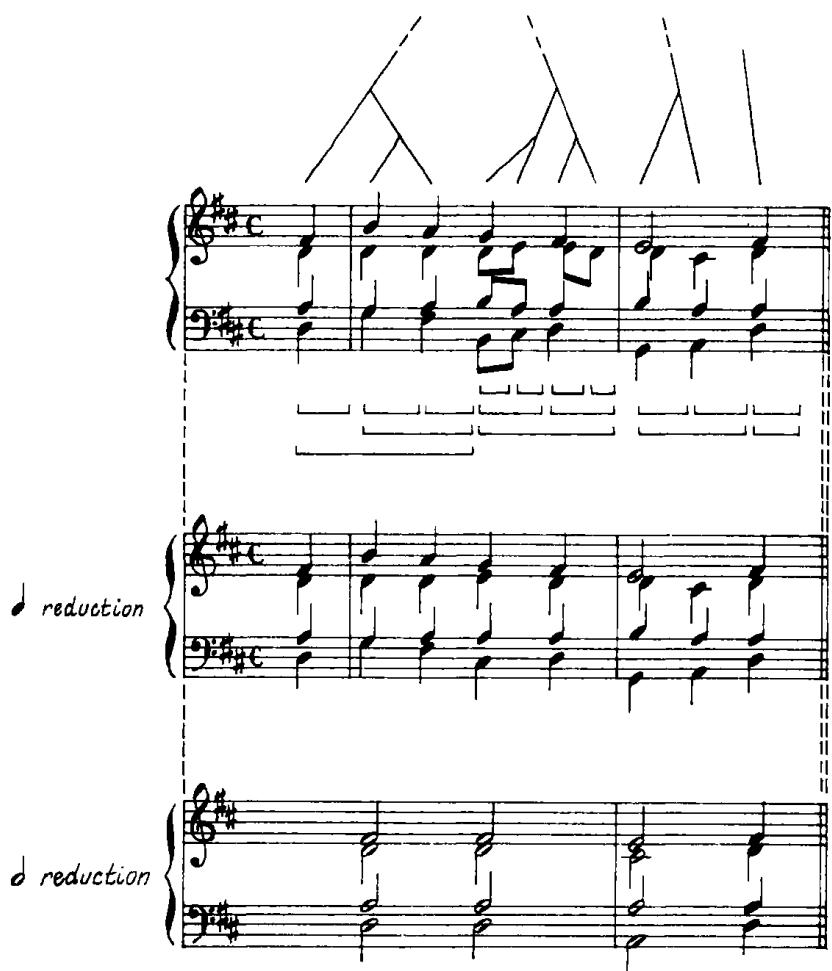
中文讲解
This is a placeholder for example 7.17 on page 16, the chorale opening “O Haupt” whose reduction is discussed in P0125. The musical notation cannot be reconstructed here; the reader must consult the original score to see the harmonic motion and voice-leading relationships the author describes.
补充说明
需查看原图:example 7.17 即 “O Haupt” 开头片段的逐级缩减图,对应 P0125 的逐拍分析。
第17段(P0127)
原文复述
Formalization of Time-Span Reduction
中文讲解
This is the running header for Chapter 7, “Formalization of Time-Span Reduction.” It marks the page within Chapter 7 and is not substantive content.
第18段(P0128)
原文复述
In addition to the two local TSRPRs discussed so far, a third and somewhat weaker principle can be stated as follows:
中文讲解
This sentence introduces the third and final local preference rule (TSRPR 3). The author flags it as “somewhat weaker,” signaling to the reader that it has lower priority than TSRPRs 1 and 2 and will rarely decide a choice on its own. The phrase “discussed so far” confirms that this is a continuing catalog of local rules within Section 7.3.
第19段(P0129)
原文复述
TSRPR 3 (Registrar Extremes) Of the possible choices for head of a time-span T, weakly prefer a choice that has a. a higher melodic pitch b. a lower bass pitch.
中文讲解
This is the formal statement of TSRPR 3, named “Registrar Extremes” (note: the source text uses “Registrar,” which appears to be a typo or non-standard spelling of “Register”). The rule weakly prefers: (a) the candidate with the higher top melodic pitch, and (b) the candidate with the lower bass pitch. The word “weakly” indicates it is a tie-breaker, not a primary determinant. The intuition is that registral extremes—a higher soprano line or a deeper bass line—are more salient and thus more likely to carry structural weight.
第20段(P0130)
原文复述
In practice, this consideration rarely has a decisive effect unless the harmony and the metrical position are otherwise identical, but it may have a supplementary reinforcing or weakening influence.
中文讲解
This paragraph qualifies TSRPR 3 by limiting its scope. It applies only when TSRPR 1 and TSRPR 2 leave the candidates tied (same metrical strength, same harmonic stability). Outside of such ties it does not override the stronger rules; within ties, or near-ties, it can tip the balance. The phrases “reinforcing or weakening” indicate that TSRPR 3 can also modulate the strength of a head choice already made by the stronger rules, without itself being decisive.
脚注 / 边栏 / 图表 / 附加信息(如有)
本节包含两处图像/乐谱占位符(P0115 对应第 15 页 example 7.16,P0126 对应第 16 页 example 7.17)和若干版面元素(小节标题 P0111、节标题 P0113、章标题 P0114/P0120/P0127)。example 7.16 提供 7.16b 与 7.16c 两种缩减对比,用以导出 TSRPR 1(节拍位置);example 7.17 是巴赫众赞歌 “O Haupt” 开头的逐级缩减,用以逐拍演示 TSRPR 2 如何在多处以和声稳定性推翻 TSRPR 1 的节拍判断。本节无脚注。
💡 本节核心要点
- 本节提出三条 time-span 缩减的局部偏好规则:TSRPR 1(节拍位置)、TSRPR 2(局部和声)、TSRPR 3(音区极值)。
- TSRPR 1 要求时间跨度的 head 落在相对较强的节拍位置,由 example 7.16 中 7.16b 比 7.16c 听起来更自然的经验观察所支持。
- TSRPR 2 由两条标准组成——内在协和度(a)与对局部主音的关系远近(b)——两者一致时选择高度确定,冲突时选择较低度确定,作者以根位 V 与 I⁶ 的对照说明此点。
- example 7.17(“O Haupt” 开头)演示 TSRPR 2 在多处以和声稳定性压过 TSRPR 1 的节拍判断,证明局部和声规则的优先级高于节拍规则。
- TSRPR 3 偏好高音区旋律与低音区贝斯作为 head,但作者明确其为最弱规则,仅在 TSRPR 1 与 TSRPR 2 平手或近似时起辅助的强化或弱化作用。
- 本节为节拍位置与和声稳定性之间可能产生的冲突(如倚音的情况)提供了理论定位:冲突即表现性张力的来源。
🔑 关键术语
- TSRPR (Time-Span Reduction Preference Rule):时间跨度缩减偏好规则:在同一时间跨度的若干候选 head 之间,按特定标准择优的形式化规则。本节提出三条:TSRPR 1(节拍位置)、TSRPR 2(局部和声)、TSRPR 3(音区极值)。
- head (of a time-span):时间跨度的 head:在该时间跨度结构树中作为上层结构支点的音,是缩减过程中保留下来的较高级别音符。
- TSRPR 1: Metrical Position:局部偏好规则之一:候选 head 中,落在相对较强节拍位置者优先。
- TSRPR 2: Local Harmony:局部偏好规则之一,含两条子标准——(a) 内在协和度较高者优先;(b) 与局部主音关系较近者优先。
- intrinsic consonance:音程事件本身的内在协和度:根位三和弦最稳定,第一转位次之,第二转位与七和弦被视为不协和。
- relational stability (closeness to local tonic):音程事件相对于局部主音的稳定程度,主要以五度圈距离衡量,并以自然音阶集合、关系大小调与同主音大小调关系作为补充稳定点。
- TSRPR 3: Registrar Extremes:局部偏好规则之一,弱规则:偏好高音旋律与低音贝斯。仅在 TSRPR 1 与 TSRPR 2 接近平手时起辅助作用。原文 “Registrar” 应为 “Register” 的拼写。
- overrule:在多条规则发生冲突时,优先级更高的规则压倒优先级较低的规则的决定。本节 example 7.17 演示 TSRPR 2 多次压倒 TSRPR 1。
- appoggiatura:倚音:落在强拍的不协和音,向弱拍协和音解决;其表现性来自节拍强度与和声稳定性的冲突。
S011 [描述性拆分] TSRPR 1–3: Local Influences of Meter, Harmony, and Register
第1段(P0131)
原文复述
Example 7.18 illustrates cases where TSRPR 3a affects judgments.
中文讲解
本段是过渡句,引出谱例 7.18。TSRPR 3a 是关于“高音位置优先”的时距缩减值规则(Time-Span Reduction Preference Rule 3a),它规定在同等条件下,音高较高的声部事件在时距缩减值中会被判定为更重要的事件。作者用 7.18 系列例子来说明:即使某事件处于较弱的节拍位置,只要它音高更高,仍可能被感知为结构上更突出。
补充说明
本段本身只是举例预告,不包含独立的论证信息;其全部教学意义在于把读者的注意力引向 P0133–P0134 的具体分析。
第2段(P0132)
原文复述
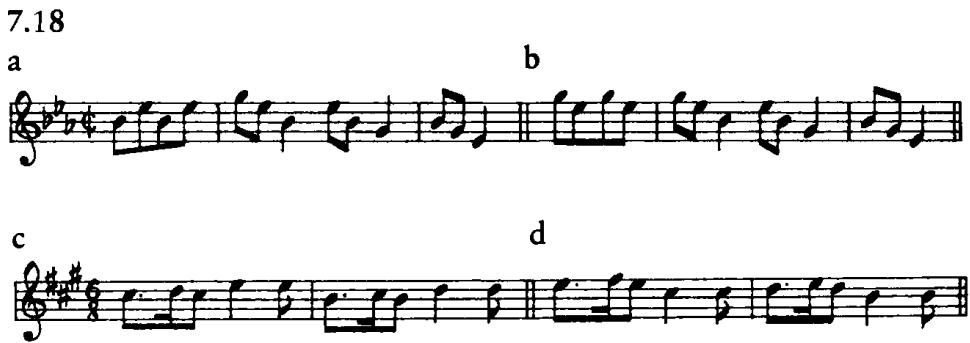
中文讲解
这是第 17 页上的图示或乐谱占位符,对应谱例 7.18 的四个对比子例 7.18a–7.18d。读者需查看原图才能看到具体的音符、和声与节奏细节;但从 P0133–P0134 的叙述可以推知,7.18a 与 7.18b 是同一片段的两种不同音高配置(贝多芬《管乐八重奏》终曲),用以比较高音与低音哪个更被感知为主要事件;7.18c 与 7.18d 是同一片段的两种音高配置(莫扎特 K. 331),用以检验申克分析的合理性。
补充说明
因嵌入图像数据已省略,无法核实谱例的具体调号、拍号、音区与和声,仅能依据上下文叙述推断其教学意图。
第3段(P0133)
原文复述
In 7.18a, from the finale of Beethoven’s Wind Octet, op. 103, one tends to hear the $E_b$ of the anacrusis as more prominent, despite its weaker metrical position. That this is due to its higher pitch is clear from comparison with 7.18b, where the G is heard as primary.
中文讲解
本段讨论贝多芬《管乐八重奏》op. 103 终曲中的 7.18a。即使弱起(anacrusis)中的降 E 处于节拍上的弱势位置,听者仍倾向于把它感知为更突出的事件。作者指出:通过与 7.18b(同一片段但换用 G 音)对比,就能确认这一突出感来自“音高较高”这一因素——当高音被换成低音(7.18b 中的 G)时,听者就会把 G 感知为主要事件。
这段论证的逻辑结构是“对照实验”:只改变音高,保留节拍、和声等其余条件,从而把音高变量孤立出来,证明 TSRPR 3a(高音优先)在该片段中确实主导了听者的结构判断。
补充说明
本段中的 “anacrusis” 指弱起或上拍;“metrical position” 指的是该事件在小节内的节拍强弱位置(如正拍为强,弱起或第二拍为弱)。两者与“pitch prominence”形成对比,是 TSRPR 1(节拍优先)与 TSRPR 3a(高音优先)之间发生冲突时的典型情境。
第4段(P0134)
原文复述
Example 7.18c returns to Mozart’s K. 331. Schenker (1925) analyzes the E in the second half of the first measure as the structurally most important event in spite of its relatively weak metrical position. The plausibility of this judgment is due to the higher pitch of the E. If the pitches were changed to those of 7.18d it would be implausible to choose the event in weaker metrical position, because it is now lower. Thus, although we disagree with Schenker here (because of the bass and the metrical structure), his analysis does receive support from TSRPR 3a. (See section 10.4 for further discussion of Schenker’s alternative.)
中文讲解
本段承接 P0133 的对照论证,把它应用到莫扎特 K. 331 上,并借由与申克(Schenker, 1925)的分析对照来说明 TSRPR 3a 的解释力。具体推理分三层:
第一,申克把 K. 331 第一小节后半拍的 E 判为结构上最重要的事件,尽管该事件处于相对弱的节拍位置。
第二,作者认为这个判断“听起来似乎合理”,其原因在于 E 音高较高,符合 TSRPR 3a 的预期。
第三,作者通过反事实(counterfactual)方式加固这一判断:如果把音高换成 7.18d(把 E 改成更低音),那么选择弱节拍位置的事件就不再合理,因为它现在既弱拍又低音。
但作者也明确表态:整体上他们不同意申克的分析,因为低音与节拍结构另有支持另一种结构判断的因素;只是从 TSRPR 3a 这一条规则来看,申克的分析获得了部分支持。作者把进一步的讨论指向第 10.4 节。
这一段的教学意义在于示范:如何把一个看似“主观”的结构判断拆分成多条 TSRPR 的合取,并展示规则之间既可能相互支持(如本段高音与申克结论一致)也可能相互冲突(低音、节拍结构与申克结论相反)。
补充说明
本段提到的“Schenker (1925)”是该分析的理论出处,作者并未在本段引用具体的页码或段落,仅给出年份;本节其他段落也没有对此作进一步说明。所引“section 10.4 for further discussion of Schenker’s alternative”提示读者:申克在 K. 331 上还有另一种替代性结构分析,相关的详细讨论将在第 10 章第 4 节展开,但本节不展开。
第5段(P0135)
原文复述
Chapter 7
中文讲解
这是第 7 章的页眉/页脚版面标记,用于在装订版式中提示当前所在章节。它本身不承载任何论证信息,仅起版面定位作用。
第6段(P0136)
原文复述
For cases where relatively low pitch of the bass has an influence, consider 7.19.
中文讲解
本段是过渡句,引出谱例 7.19。P0131–P0134 关注的是 TSRPR 3a(高音优先)对结构判断的影响;本段及随后 P0139–P0140 则把镜头切到低音:TSRPR 3b(即低音位置优先,与 3a 方向相反)。当低音声部的音高相对较低时,它也会影响结构判断,作者用 7.19 来演示这一点。
补充说明
TSRPR 3a 与 3b 的关系是本段的关键:3a 主张高音事件优先被选为更重要事件,3b 则主张低音事件在特定条件下(如低音区更显著)也被赋予更高重要性;本节后半部分集中演示 3b。
第7段(P0137)
原文复述
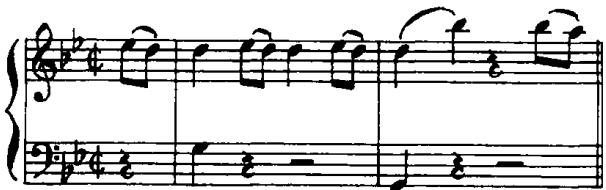
中文讲解
这是第 18 页上的图示或乐谱占位符之一,对应谱例 7.19 的某一部分(很可能包括 7.19a 或其局部片段)。读者需查看原图才能看到具体的低音声部线条与和声配置。
补充说明
因图像数据省略,无法核实该谱例的具体乐器编制、调号与节拍;仅能从 P0139 的叙述判断它与莫扎特 g 小调交响曲开头主题以及低音 G 的位置相关。
第8段(P0138)
原文复述
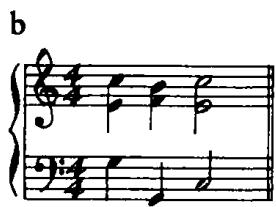
中文讲解
这是第 18 页上的第二个图示或乐谱占位符,对应谱例 7.19 的另一部分(很可能为 7.19b,即 I⁶₄–V 终止式与低八度下行的例子)。读者需查看原图才能核对具体的声部进行、和声标记与节拍位置。
补充说明
与 P0137 一样,受限于图像省略,无法核实细节;只能结合 P0140 的描述推断其教学用途是展示低音声部在节拍与和声交互中的作用。
第9段(P0139)
原文复述
Example 7.19a, from the Mozart G Minor Symphony, brings back an issue raised in section 4.3. There we argued that the low G in the bass reinforces the choice of metrical structure, because it is more important than the high G in the time-span reduction. TSRPR 3b brings about the desired distinction in importance. (If the high and low bass notes were exchanged in 7.19a, metrical perceptions would be affected.)
中文讲解
本段把第 4.3 节已经讨论过的话题重新拉回到 TSRPR 体系中,并以莫扎特 g 小调交响曲开头的 7.19a 为例进行回顾性说明。论证要点有三:
第一,第 4.3 节已经论证过:在 7.19a 中,低音区的 G 比高音区的 G 在时距缩减值中更重要,因此低 G 的出现会强化某个特定的节拍结构选择。
第二,本节给出的解释机制是 TSRPR 3b:音区更低的事件在时距缩减值中倾向于被判定为更重要。
第三,作者用括号中的反事实再次加固论点:如果把 7.19a 中的低 G 与高 G 互换,听者的节拍感知就会改变。也就是说,TSRPR 3b 在该例中并非可有可无,而是承担了区分两种 G 的“重要性差异”的角色。
补充说明
本段明确把当下分析与第 4.3 节挂钩,构成节内/章间的回环:第 4.3 节是用具体音乐片段论证“低 G 强化节拍选择”,本节则进一步给出这条经验性观察背后的规则化理由(TSRPR 3b)。括号中的反事实句式与 P0134 对 7.18c/d 的反事实分析在修辞上一致。
第10段(P0140)
原文复述
Example 7.19b illustrates an octave drop of the bass beneath a $I_{4}^{6}-V$ progression in a cadence. In the first half of the measure, the $V^{7}$ on the second beat is chosen over the $I_{4}^{6}$ by TSRPR 2a. However, the progression would be somewhat weaker if the low G in the bass were on the first rather than the second beat. This suggests that the low G on the second beat helps the $V^{7}$ overcome the strong metrical position of the $I_{4}^{6}$ . In fact, the bass line in 7.19b is a cliché of tonal music, but an upward leap of an octave rarely occurs. The reinforcing interaction of TSRPRs 2a and 3b, overriding TSRPR 1, demonstrates a principled basis for this disparity.
中文讲解
本段是本节论证的高潮,集中演示多条 TSRPR 在同一片段中如何相互作用并相互竞争。需要分四层理解:
第一,谱例情境:7.19b 是一个终止式中的 I⁶₄–V 进行,低音声部出现低八度下行。在小节前半部,第二拍上是 V⁷,第一拍上是 I⁶₄。
第二,按 TSRPR 2a(通常情况下选择更重要的和声事件作为时距缩减值中的被选事件),V⁷ 被选为更重要事件,因此胜出 I⁶₄。
第三,作者提出反事实:如果低 G 落在第一拍而非第二拍,那么这一进行的“说服力”就会减弱。这说明低 G 落在第二拍,对 V⁷ 在节拍上原本并不占优的情况起到了“助推”作用——它帮助 V⁷ 克服了 I⁶₄ 在正拍(强节拍位置)上的天然优势。
第四,作者把这个观察上升为一般化结论:7.19b 中的低音声部是调性音乐中常见的程式化进行(cliché),但“低音声部向上跳一个八度”却几乎不会出现。这一不对称现象的根源,正在于 TSRPR 2a(和声重要性)与 TSRPR 3b(低音区优先)的协同作用压倒了 TSRPR 1(节拍优先):低音八度下行配合 V⁷ 在弱拍上,反而比“高音八度上行配合 V⁷ 在弱拍上”更具结构意义,因此作曲家在传统终止式中稳定地偏好前者、避免后者,并不是任意的风格习惯,而是 TSRPR 之间相互作用的结果。
本段的教学重点是说明:单一规则不足以解释音乐判断,必须把多条规则放在一起看它们是相互加强还是相互抵消;并由此为一种常见的低音程式化进行提供“原则性的”依据。
补充说明
本段所涉及的 TSRPR 编号与本节前半段规则编号的对应关系:TSRPR 1 = 节拍位置优先;TSRPR 2a = 和声重要性优先(更重要的和声事件优先被选);TSRPR 3a = 高音位置优先;TSRPR 3b = 低音位置优先。I⁶₄(又称 cadential six-four)是终止四六和弦,V⁷ 是属七和弦,两者在终止式中的常规进行是 I⁶₄–V。
脚注 / 边栏 / 图表 / 附加信息(如有)
本节末尾包含两条交叉引用:P0134 指向第 10.4 节“申克的替代性分析”,提示该替代方案在第 7 章不展开;P0139 指向第 4.3 节,把当下分析与早期论述构成回环。谱例 7.18 与 7.19 共有六个子例(7.18a–d, 7.19a–b),但因内嵌图像数据被省略,本节仅能依靠叙述文字复原其教学用途,具体的音高、和声与节拍细节需查阅原图核对。
💡 本节核心要点
- TSRPR 3a(高音优先)解释了为何弱节拍位置上的高音事件仍可能被听者判为更重要:贝多芬 op. 103 终曲 7.18a 与莫扎特 K. 331 的 7.18c 即此例。
- 对照实验(同一片段仅改变音高)和反事实(如果换成更低的音,判断将不再合理)是本节论证 TSRPR 3a 的两种修辞策略。
- TSRPR 3b(低音优先)解释了为何低音区的低 G 在莫扎特 g 小调交响曲 7.19a 中比高 G 更有结构意义,从而强化特定的节拍选择。
- 在终止式 7.19b 中,TSRPR 2a(和声重要性)与 TSRPR 3b(低音优先)相互加强、共同压倒 TSRPR 1(节拍优先),从而解释了为何低音声部的八度下行远多于八度上行这一调性音乐程式化现象。
- 作者对申克关于 K. 331 的分析采取部分接受、部分拒绝的态度:接受的部分基于 TSRPR 3a,拒绝的部分基于低音与节拍结构。
- 本节示范了多条 TSRPR 在同一片段中既可能相互支持(如 2a 与 3b)也可能相互冲突(如 3a 与节拍结构),结构判断需要的是规则之间的合取与权衡,而非单条规则的孤立应用。
🔑 关键术语
- TSRPR 1:节拍位置优先规则:在时距缩减值中,处于较强节拍位置的事件倾向于被判定为更重要事件。本节在 7.19b 中被 TSRPR 2a 与 3b 的协同作用所压倒。
- TSRPR 2a:和声重要性优先规则:更重要的和声事件倾向于在时距缩减值中被选为更重要事件。本节在 7.19b 中用于说明 V⁷ 在 I⁶₄–V 中胜出。
- TSRPR 3a:高音位置优先规则:相对较高音高的事件倾向于在时距缩减值中被判定为更重要。本节通过贝多芬 op. 103 与莫扎特 K. 331 两例加以演示。
- TSRPR 3b:低音位置优先规则:相对较低音高的事件倾向于在时距缩减值中被判定为更重要。本节通过莫扎特 g 小调交响曲 7.19a 与终止式 7.19b 加以演示。
- anacrusis:弱起或上拍,指小节正拍之前的起音;本节 7.18a 中弱起上的降 E 即处于节拍弱势位置。
- I₄⁶–V:终止四六和弦到属和弦的进行,是调性音乐终止式中的常见和声程式;本节 7.19b 即此情境。
- cadential six-four (I₄⁶):终止四六和弦,本节 7.19b 第一拍的和声事件;它占据正拍优势,但被 V⁷ 在 TSRPR 2a/3b 协同下超越。
- time-span reduction:时距缩减值,一种把音乐事件按结构重要性分层的层级化缩合表示;TSRPR 各条规则都作用于如何在缩合中挑选“更重要”的事件。
- cliché of tonal music:调性音乐中程式化、被频繁复用的写作模式;本节 7.19b 中低音声部的八度下行即被作者归为此类,并用 TSRPR 2a 与 3b 的协同作用解释其出现频率。
S012 [描述性拆分] TSRPR 4–6: Nonlocal Pitch, Metrical, and Prolongational Influences
第1段(P0141)
原文复述
Nonlocal Pitch Influences
中文讲解
本段为本节标题,开启对“非局部音高影响”这一论题的讨论。所谓“非局部”,是指下文 TSRPR 4–6 所涉及的因素超出单一 time-span 的内部范围,需要参照 time-span 之外的材料。
第2段(P0142)
原文复述
Time-span reduction preference rules 1–3 describe factors internal to a time-span that affect the choice of its head. We now turn to influences that involve material outside of the time-span as well. In general it is difficult to separate these principles, because of their constant interaction with local principles and with each other, so our motivation for them will be more suggestive than rigorous.
中文讲解
本段是从 TSRPR 1–3 过渡到 TSRPR 4–6 的关键转折。1–3 考察的是 time-span 内部的局部因素——和声稳定性、节拍位置、本身的稳定性;4–6 则引入 time-span 之外的材料,包括相邻 time-span 的节奏、和声关系。作者坦诚地指出,这些原则与局部原则相互交织,难以严格分离,因此本节的论证倾向于“提示性”而非“严格性”,这预示着后续可能需要对规则进行修订或合并。
第3段(P0143)
原文复述
The first of these principles is the inevitable rule of parallelism. For example, consider again the opening of K. 331 (7.18c). Suppose someone were, for whatever reason, to adopt the analysis in which the quarter-note E in the first measure is the structurally most important event. Then, because of the parallelism of the first two measures, it would be absurd not to take the D rather than the B as most important in the second measure. More elaborate examples could be cited, but this simple case seems sufficient to make the point.
中文讲解
本段引出第一个非局部原则——平行(parallelism)。作者用莫扎特 K.331 第一乐章开头(已在例 7.18c 中出现)做反向假设:若有人以某种理由认定第一小节的四分音符 E 是最重要的结构事件,那么由于前两小节彼此平行,第二小节“荒唐地”只能选 D 而不是 B 作为最重要事件。这里的强论证方式是“荒唐性反证”:若违反平行,听者会立刻感到不可接受。作者承认还有更复杂的例子,但坚持简单例子即足以说明平行原则的力量。
第4段(P0144)
原文复述
Formalization of Time-Span Reduction
中文讲解
本段是跨页的版心页眉,标识本章主题“时值缩减的形式化”,不构成论证内容。
第5段(P0145)
原文复述
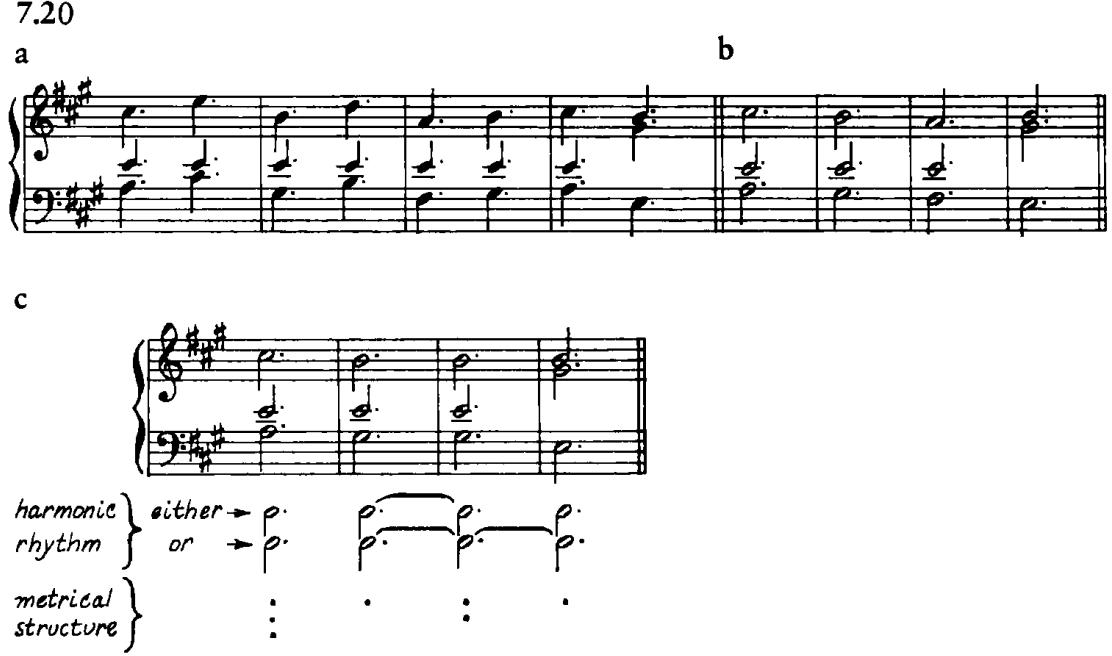
中文讲解
本段为图 7.20 的占位符,位置在 TSRPR 4 之后、K.331 头四小节在点四分音符层级之上的进一步减缩图示的引出处。需查看原图以了解 7.20a 的基础层级,以及 7.20b(采用 vi7)与 7.20c(采用 V6)两种备选。
第6段(P0146)
原文复述
TSRPR 4 (Parallelism) If two or more time-spans can be construed as motivically and/or rhythmically parallel, preferably assign them parallel heads.
中文讲解
这是 TSRPR 4(平行)的正式陈述。它要求:当两个或更多 time-span 在动机或节奏上可被理解为平行时,应优先为它们指派平行的 head。术语“preferably”和“can be construed”保留了判断空间:是否构成平行、是否需要严格保持 head 的平行,仍依赖分析者的判断。
第7段(P0147)
原文复述
We next examine a point in K. 331 that appears to be a counterexample to the interaction of preference rules proposed so far. At the next level, however, the intuitively most important event in the third measure is the “vi $^{7}$” rather than the V $^{6}$; that is, the reduction from 7.20a should be 7.20b rather than 7.20c.
中文讲解
本段引出对前述规则交互的“反例”。前四小节在点四分音符层级的减缩一直顺畅(7.20a),但在此之上的下一层级,第三小节直觉上最重要的不是更稳定的 V6,而是不稳定的 vi7。换言之,在 7.20a 之上应进一步减缩为 7.20b,而非 7.20c。这一选择违反“和声稳定性总应覆盖节拍位置”的既有假设,因此成为需要新规则解释的真正难题。
第8段(P0148)
原文复述
In all other cases we have seen up to this point, harmonic stability has been sufficient to override metrical position. Yet in this case the highly unstable chord in strong metrical position has managed to override the more stable chord in weak metrical position. This suggests that one or more additional preference rules must apply here, adding strength to the analysis in 7.20b.
中文讲解
本段点明反例的真正“反常性”:在我们之前见过的所有情形中,和声稳定性足以覆盖节拍位置(即更稳定但节拍弱的事件胜出);但此处相反——位于强节拍的高度不稳定和弦(vi7)反而压过了弱节拍上更稳定的和弦(V6)。作者推断这一反例背后一定有一条或几条我们尚未给出的额外规则在起作用,从而支持 7.20b 的选择。
第9段(P0149)
原文复述
We discern two principles at work in this example, having to do with harmonic rhythm and linear bass motion. Consider first harmonic rhythm. In 7.20b the harmony changes in every measure, whereas in 7.20c it does not change in the third measure and it only changes by inversion in the fourth. In other words, the harmonic rhythm in 7.20c is syncopated with respect to the metrical structure. If the difference in harmonic rhythm is significant in choosing 7.20b over 7.20c—as we believe it is—we might state a preference rule such as “Prefer a time-span reduction with harmonic changes on relatively strong beats.” $^{6}$
中文讲解
本段从 7.20b vs 7.20c 的抉择中辨析出两条原理:和声节奏(harmonic rhythm)与线性低音进行(linear bass motion)。先看和声节奏:7.20b 中每小节和声都变化,7.20c 则第三小节不变、第四小节仅以转位变化。因此 7.20c 的和声节奏相对于小节节拍结构形成切分。作者据此提出初步的偏好规则:“优先选择让和声变化落在相对强拍上的时值缩减”,并以脚注 6 标注。这一表述还比较粗略,是否保留取决于后文的理论打磨。
第10段(P0150)
原文复述
Chapter 7
中文讲解
本段是页眉“Chapter 7”,仅作版面标识,不构成论证内容。
第11段(P0151)
原文复述
But this formulation can be improved if we recall that there is a metrical preference rule (MPR 5f) that addresses the effect of harmonic rhythm on metrical structure: “Prefer a metrical structure in which relatively strong beats are associated with the inception of relatively long durations of harmony in time-span reduction.” If the time-span reduction of 7.20a were 7.20c, MPR 5f would create pressure for placing the strongest beat of the passage at the beginning of the second measure, conflicting with other metrical evidence. By contrast, reduction 7.20b creates no such pressure, because all the harmonies are of equal length.
中文讲解
本段对上一段的初步规则进行理论改进。关键洞见是:节拍偏好规则 MPR 5f 已包含“和声节奏影响节拍结构”的主张——它偏好“相对强拍与较长和声持续时长起点对齐”的节拍结构。若 7.20c 成立,则 MPR 5f 会迫使整段最强拍落在第二小节开头,与其他节拍证据冲突;7.20b 则因所有和声等长而不产生这种压力。换言之,作者不是另起炉灶添加新原则,而是把和声节奏对时值缩减的影响,解释为“时值缩减对节拍结构的已知影响”的反向运用。
第12段(P0152)
原文复述
This suggests that the choice of 7.20b is influenced by the fact that it permits a less highly conflicted metrical analysis. In other words, in addition to a metrical preference rule that considers metrical effects on time-span reduction, there is a time-span reduction preference rule that considers time-span effects on metrical structure:
中文讲解
本段给出本节论证的核心思想。7.20b 被选,是因为它能得到一个冲突更少的节拍分析。除了已有的“考虑节拍对时值缩减影响的节拍偏好规则”之外,现在还需要一条“考虑时值缩减对节拍结构影响的时值缩减偏好规则”。这一表述起到承前启后的作用:既指出 TSRPR 5 的存在必要性,又预告其形式。
第13段(P0153)
原文复述
TSRPR 5 (Metrical Stability) In choosing the head of a time-span T, prefer a choice that results in more stable choice of metrical structure.
中文讲解
这是 TSRPR 5(节拍稳定性)的正式陈述。它要求:在选择 time-span T 的 head 时,优先选择那种能让 metrical structure 选择更稳定的那一方案。所谓“更稳定”,由其他节拍规则共同决定;这里只是把“时值缩减不要制造节拍冲突”作为一条独立原则。
第14段(P0154)
原文复述
Though the reasoning that leads to TSRPR 5 is less direct than that involved in the preliminary formulation above, we find TSRPR 5 a more theoretically satisfying proposal, in that it claims that harmonic rhythm affects time-span reduction not according to an arbitrary additional principle but by means of the effect that time-span reduction is independently known to have on metrical structure. TSRPR 5 therefore creates one of the pressures that helps the strong metrical position of the “vi7” override its harmonic instability.
中文讲解
本段为 TSRPR 5 给出理论正当性说明。相比上一段的初步表述(直接说“和声变化落在强拍上”)较为曲折,TSRPR 5 更具理论美感:它并不诉诸一个任意新增的和声节奏原则,而是援引“时值缩减对节拍结构的已知影响”这一既成关系。由此,TSRPR 5 提供了压力之一,使处于强节拍位置的和声不稳定 vi7 得以压过弱节拍位置的和声稳定 V6。
第15段(P0155)
原文复述
The second factor involved in the choice of 7.20b is the stepwise motion of the bass that emerges in 7.20b but not in 7.20c. Similar linear factors were used implicitly in the reduction of “O Haupt” in 7.17. For instance, in the first half of the first measure, there is a choice between a IV on the first beat and a I $^{6}$ on the second. Example 7.21 presents the two possibilities.
中文讲解
本段引出 7.20b 胜出的第二条因素:低音的级进进行。在 7.20b 中存在而在 7.20c 中不存在的低音级进,使 7.20b 听起来更连贯。作者指出,同样的线性因素在 7.17(巴赫《O Haupt》圣咏)减缩中也被隐含使用——第一小节前半在第一拍 IV 和第二拍 I6 之间存在选择,并预告例 7.21 将展示两种可能。
第16段(P0156)
原文复述
7.21
中文讲解
本段是例 7.21 的小节标题,开启《O Haupt》第一小节前半两种减缩方式的对比。
第17段(P0157)
原文复述
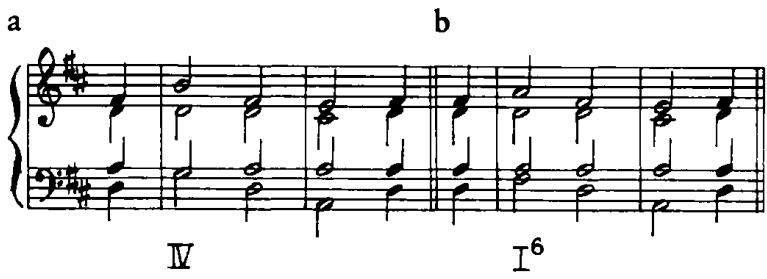
中文讲解
本段为第 20 页例 7.21 的乐谱或减缩示例占位符,需查看原图以比较 7.21a(首选 IV)与 7.21b(首选 I6)两种减缩在低音线性与和声进行上的差异。
第18段(P0158)
原文复述
Formalization of Time-Span Reduction
中文讲解
本段是跨页页眉“Formalization of Time-Span Reduction”,不作论证内容。
第19段(P0159)
原文复述
The I $^{6}$ presents a more stable melodic line, since it represents an unfolding of the tonic chord. The influence of linear connection in both 7.20 and 7.21 can be stated as TSRPR 6a:
中文讲解
本段先把 I6 在 7.21 中胜出的理由讲清:I6 代表主和弦的展开(unfolding),其旋律线更稳定。再将 7.20 与 7.21 中共同的线性连接影响,提炼为 TSRPR 6a 的初步表述。
第20段(P0160)
原文复述
TSRPR 6a (Linear Stability, preliminary version) In choosing the head of a time-span T, prefer a choice that results in more stable linear connections with events in adjacent time-spans.
中文讲解
这是 TSRPR 6a(线性稳定性,初步版)的正式陈述。它要求:在选择 time-span T 的 head 时,优先选择那种能让 T 与相邻 time-span 事件之间形成更稳定线性连接的方案。注意“adjacent time-spans”明确说明作用范围是与 T 紧邻的上下层 span。
第21段(P0161)
原文复述
The analysis of “O Haupt” in 7.17 also made implicit use of a second nonlocal influence. In the third quarter of the first measure there is a choice between a IV $^{6}$ on the first eighth and a V ${5}^{6}$ on the second. Since the IV $^{6}$ is in strong metrical position and is intrinsically more consonant, the principles discussed so far would seem to favor it. But compare the two choices within the context of the reduction, in example 7.22. Example 7.22a has the IV $^{6}$ and 7.22b the V ${5}^{6}$, marked by asterisks.
中文讲解
本段引入第二类非局部影响——和声进行的稳定性。以《O Haupt》第一小节第三四分音符处、IV6 与 V56 之间的选择为例:按既有规则,IV6 处于强拍且本身更协和,理应胜出;但作者让我们把两种选择放进完整减缩(例 7.22)中比较,7.22a 选 IV6,7.22b 选 V56,两者用星号标出。即将揭示:直观上 7.22b 更佳。
第22段(P0162)
原文复述
7.22
中文讲解
本段是例 7.22 的小节标题,显示《O Haupt》第一小节后半两种减缩的对比。
第23段(P0163)
原文复述
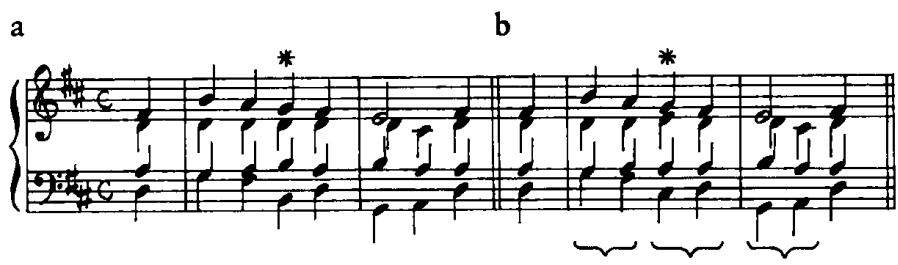
中文讲解
本段为第 21 页例 7.22 的乐谱或减缩示例占位符,需查看原图以比较 7.22a(IV6)与 7.22b(V56)两种减缩在下一层级和声进行上的差异。
第24段(P0164)
原文复述
Example 7.22b is intuitively preferable, despite the apparent predictions of the rules mentioned above. What favors it? TSRPR 6a might select it because of the stepwise motion of the bass from the third to the fourth beat, and TSRPR 4 (parallelism) might pick out the parallelism between this stepwise bass motion and that in the first halves of the first and second measures (marked by braces in 7.22b). However, a further consideration is the greater stability of the V $_{5}^{6}$-I progression in 7.22b over the IV $^{6}$-I in 7.22a. This suggests TSRPR 6b:
中文讲解
本段详解 7.22b 胜出的多重理由:(1) TSRPR 6a 因为第三拍到第四拍的低音级进而支持 7.22b;(2) TSRPR 4 平行识别出此处低音级进与第一、二小节前半的低音级进平行(图中以大括号标出);(3) 更重要的考虑是 7.22b 中 V56–I 的进行比 7.22a 中 IV6–I 更稳定,这引导出 TSRPR 6b(和声进行稳定性)。
第25段(P0165)
原文复述
TSRPR 6b (Harmonic Progression, preliminary version) In choosing the head of a time-span T, prefer a choice that results in more stable harmonic connections with events in adjacent time-spans.
中文讲解
这是 TSRPR 6b(和声进行稳定性,初步版)的正式陈述。它要求:在选择 time-span T 的 head 时,优先选择那种能让 T 与相邻 time-span 事件之间形成更稳定和声连接的方案。需注意它与 6a 的关系:6a 关心线性,6b 关心和声。
第26段(P0166)
原文复述
We have left unspecified in TSRPRs 6a and 6b what constitutes a relatively stable linear or harmonic connection. To provide this information, the relative stability of various connections could be stipulated directly within the statement of the preference rules. But there is an alternative. Looking ahead to chapters 8 and 9, two primary factors affect the choice of prolongational reduction: time-span importance and stability of connection among events. Now if the events that are important in time-span reduction also form stable linear and harmonic connections, a highly reinforced choice of prolongational reduction is possible. On the other hand, if the time-span reduction does not follow the strongest possible connection, the choice of prolongational reduction will be conflicted. It seems conceivable, therefore, that the influence of linear and especially harmonic connection on time-span reduction should not be stated directly in the TSRPRs, but rather it arises through the effect of time-span reduction on the stability of the prolongational reduction. This solution can be expressed in the theory by replacing TSRPRs 6a and 6b with the following rule:
中文讲解
本段是本节一个重要的理论转折。前面 6a、6b 中“相对稳定的线性或和声连接”尚未定义。一种做法是直接在规则里规定各种连接的稳定程度,另一种做法是前瞻第 8、9 章:prolongational reduction(延长缩减)的选择由两个主要因素决定——time-span 的重要性,以及事件之间连接的稳定性。若时值缩减中的重要事件同时也形成稳定的线性与和声连接,延长缩减会得到高度强化;若时值缩减未跟随最强的连接,延长缩减的选择就会冲突。据此,作者设想:线性、特别是和声连接对时值缩减的影响,不应被直接写入 TSRPR,而应通过“时值缩减影响延长缩减稳定性”来体现。具体的理论操作,就是用一条新规则代替 6a 与 6b。
第27段(P0167)
原文复述
Chapter 7
中文讲解
本段是页眉“Chapter 7”,仅作版面标识。
第28段(P0168)
原文复述
TSRPR 6 (Prolongational Stability) In choosing the head of a time-span T, prefer a choice that results in more stable choice of prolongational reduction.
中文讲解
这是 TSRPR 6(延长稳定性)的正式陈述。它要求:在选择 time-span T 的 head 时,优先选择那种能让 prolongational reduction 选择更稳定的方案。它以一条规则取代了 6a 与 6b 两条,把线性与和声连接的影响统一收纳到“延长缩减稳定性”这一更高层的概念之下。
第29段(P0169)
原文复述
Note the similarity between this and TSRPR 5. These rules encode the interdependence of the different components of musical cognition on each other. It is the feedback among the various components that makes it so difficult to isolate these principles.
中文讲解
本段是关于 TSRPR 5 与 TSRPR 6 的形式类比与认识论提示。两条规则结构相同:都要求选择那种能让其他缩减层(节拍或延长层)更稳定的 head。它们编码了音乐认知不同组成部分之间的相互依赖;正是这种反馈,使得这些原则难以独立剥离。
第30段(P0170)
原文复述
TSRPR 6 is crucially involved in the choice of fusion or transformation rather than ordinary reduction for a time-span. For example, in the Bach Cello Suite quoted in 7.10–7.12, fusion is plausible in part because it results in a consistent multivoiced texture that follows principles of good voice leading and harmonic progression. (In addition, fusion is favored by relatively great distance between the two lines and by relatively rapid alternation between them; these factors are intuitively relevant, but we have for the moment not formalized them.) Similarly, in the passage from “O Haupt” quoted in 7.13, transformation is necessary because neither of the choices available through ordinary reduction produces a good progression in the next level of reduction. Thus, although we have no complete account of how fusion and transformation are chosen, TSRPR 6 provides a starting point for such a study.
中文讲解
本段把 TSRPR 6 的应用范围扩展到 fusion(融合)与 transformation(变形)的抉择,而不只是普通 reduction。融合在巴赫无伴奏大提琴组曲(7.10–7.12)中被采用,部分因为它产出一致的复调织体,符合良好声部进行与和声进行原则;作者附带指出,融合还受益于两线距离较大以及两线快速交替,但这些因素尚未形式化。变形在《O Haupt》(7.13)中被采用,是因为普通减缩提供的两种选择都无法在下一层级减缩中产生良好进行。综上,作者承认尚未完成对融合与变形的完整说明,但 TSRPR 6 是研究的起点。
脚注 / 边栏 / 图表 / 附加信息(如有)
本节中的脚注 6 仅作为初步“和声变化落在强拍上”之偏好规则的引用标记,正文未给出脚注内容,故不能据此补充额外信息。例 7.20、7.21、7.22 三处以占位符呈现的图示需结合原书查看,分别展示 K.331 头四小节在点四分音符之上 vi7 vs V6 两种减缩、《O Haupt》第一小节前半 IV vs I6 两种减缩、以及同一圣咏第一小节后半 IV6 vs V56 两种减缩。
💡 本节核心要点
- TSRPR 4(平行)确立了第一条非局部音高影响:动机或节奏上可平行的 time-span 应优先指派平行的 head。
- K.331 反例揭示既有规则不足以解释“强拍上不稳定的 vi7 胜过弱拍上稳定的 V6”,由此需要新的非局部原则。
- TSRPR 5(节拍稳定性)通过援引 MPR 5f 关于和声节奏对节拍结构的影响,把“和声节奏对时值缩减的作用”转化为“时值缩减对节拍结构的反向作用”,无需引入任意的和声节奏原则。
- 另一类非局部影响是线性与和声进行的稳定性,最初以 TSRPR 6a、6b 初步表述。
- 由于“稳定连接”难以在 TSRPR 内部直接定义,作者引入对延长缩减稳定性的依赖,用 TSRPR 6(延长稳定性)取代 6a 与 6b,把线性与和声连接的影响统一收纳到更高层结构中。
- TSRPR 5 与 TSRPR 6 在形式上平行,皆要求选择能减少其他缩减层冲突的 head,从而体现音乐认知各组成之间的反馈与相互依赖;TSRPR 6 还是解释融合与变形抉择的起点,但完整说明尚未给出。
🔑 关键术语
- TSRPR 4 (Parallelism):第 4 条时值缩减偏好规则:动机或节奏上可平行的多个 time-span,应优先指派平行的 head。
- TSRPR 5 (Metrical Stability):第 5 条时值缩减偏好规则:选择 time-span 的 head 时,优先选择能让节拍结构选择更稳定的方案;其理论依据是时值缩减对节拍结构的已知影响。
- TSRPR 6a (Linear Stability, preliminary version):第 6a 条最初表述的时值缩减偏好规则:优先选择能让 T 与相邻 time-span 事件之间形成更稳定线性连接的方案。
- TSRPR 6b (Harmonic Progression, preliminary version):第 6b 条最初表述的时值缩减偏好规则:优先选择能让 T 与相邻 time-span 事件之间形成更稳定和声连接的方案。
- TSRPR 6 (Prolongational Stability):第 6 条最终形态的时值缩减偏好规则:选择 time-span 的 head 时,优先选择能让延长缩减选择更稳定的方案;它取代 6a 与 6b,把线性与和声连接的影响统一收纳到延长缩减稳定性之下。
- MPR 5f:已给出的节拍偏好规则之一,主张“相对强拍宜与时值缩减中较长和声持续时长起点对齐”,是 TSRPR 5 的理论支撑。
- Harmonic rhythm (和声节奏):和声变化相对于小节节拍结构的疏密或切分关系;7.20b 每小节换和声而 7.20c 不变或仅以转位变化,是支持 TSRPR 5 的关键证据。
- Prolongational reduction (延长缩减):在时值缩减之上的下一层级结构,由第 8、9 章详述;其选择受 time-span 重要性和事件间连接稳定性双重影响,是 TSRPR 6 的理论依托。
- Fusion 与 Transformation:两类超出普通 reduction 的 time-span 处理方式:fusion 指两条或多条线条在同一层级中被融合为一个统一织体;transformation 指普通减缩无法产生良好下一级进行时,需改变上一层结构。两者在本节末尾被指出与 TSRPR 6 紧密相关。
S013 [描述性拆分] 7.4 Structural Accents of Groups
第1段(P0171)
原文复述
Retention of Cadences
中文讲解
P0171 是二级标题 “Retention of Cadences”(终止式的保留)。它开启了本节第一个子论题:前面的 TSRPR 1 与 TSRPR 2 在处理终止式时存在两类不足,因而需要新增一条专门关于终止式的偏好规则 TSRPR 7。该标题既承前——回顾 6.3 节讨论过的稳定性规则与半终止之间的张力——又启后——为下一段列举两条具体错误作铺垫。
第2段(P0172)
原文复述
The preference rules stated so far make two errors in their treatment of cadences. First, the rules provide no way to choose a two-element cadence as head of a time-span, since they all deal with ordinary reduction. Second, as pointed out in section 6.3, the rules of rhythmic and harmonic stability (TSRPRs 1 and 2) often lead to incorrect choices where half cadences are involved. For example, in measure 4 of K. 331 (see 7.20a), the rules so far say unequivocally that the I rather than the cadential V should be chosen as head for the measure. Both of these failings of the rules motivate an additional preference rule:
中文讲解
本段指出已提出的若干偏好规则在处理终止式时存在两类错误。其一:现有规则都处理常规缩减,因此无法把一个两音终止式选作时间跨度的 head(即时间跨度的结构首音);其二:正如 6.3 节所言,节拍稳定性规则(TSRPR 1)与和声稳定性规则(TSRPR 2)在涉及半终止时常常给出错误选择,并以 K. 331 第 4 小节(参见图 7.20a)为例——若仅依前述规则,会明确地选出 I 而非终止式的 V 作为该小节的 head。两类错误共同说明:必须再补充一条专门处理终止式的偏好规则。本段承接上一节 7.3 末尾对 head 选择机制的讨论,又通过具体反例(K. 331 第 4 小节)说明问题不是边缘现象,而是普遍情形,从而为 TSRPR 7 的引入做铺垫。
补充说明
K. 331 指莫扎特《A 小调钢琴奏鸣曲》K. 331,其第 4 小节在该主题中是一个半终止位置。“7.20a” 是书内图例编号,文字版无法核对其谱例细节。
第3段(P0173)
原文复述
TSRPR 7 (Cadential Retention, preliminary form) Of the possible choices for head of a time-span T, strongly prefer an event or pair of events that forms a cadence.
中文讲解
本段是 TSRPR 7 的初步表述(preliminary form):对于时间跨度 T 的 head 候选,若其中有事件或事件对构成终止式,则“强优先”选择该事件或事件对。关键词 “strongly” 表示该规则的优先级足以压倒前面规则的力量组合——这是 P0176 进一步说明的内容。“preliminary form” 一词提示读者:这条规则的精确条件将在本节随后通过 cadenced group 概念加以限定。
补充说明
TSRPR 即 Time-Span Reduction Preference Rule 的缩写,本节将新增第 7 条与第 8 条。
第4段(P0174)
原文复述
7.4 Structural Accents of Groups
中文讲解
P0174 是三级节标题 “7.4 Structural Accents of Groups”(乐群的结构重音)。它将本节主题从“终止式的保留”扩展到更一般的“乐群结构重音”——既包括群组结束处的终止式(c),也包括群组起始处的结构首音(b)。该标题预示:P0171–P0173 处理的是结构重音中的“尾部”,P0191 之后将处理“头部”。
第5段(P0175)
原文复述
Formalization of Time-Span Reduction
中文讲解
P0175 是章节页眉(running header),内容为 “Formalization of Time-Span Reduction”,表示当前所在章节。该条目仅承担版面定位功能,不引入新的论述。
第6段(P0176)
原文复述
The term “strongly” in this rule is meant to indicate that this preference rule is sufficient to override the powerful combination of harmonic and metrical strength, as in measure 4 of K. 331.
中文讲解
本段对 TSRPR 7 中 “strongly” 一词作明确说明:所谓强优先,意味着该规则足以压倒和声稳定性与节拍稳定性联合起来的力量。K. 331 第 4 小节正是这种“联合力量反而会选错”的典型情境:稳定规则会倾向 I,而 TSRPR 7 必须压倒它去选终止式 V。这一段把 P0172 中的反例与 P0173 中的规则措辞在力度上对接起来:不是“有时”压倒,而是“足以”压倒。
第7段(P0177)
原文复述
To state TSRPR 7 more carefully, we must work out the conditions under which an event or a pair of events in some level of time-span reduction functions as a cadence. First, the correct harmonic sequence must be present for a full, half, or deceptive cadence. Second, the final element must actually mark the end of a group. For example, in measures 9–12 of the Chopin A Major Prelude (7.23), the sequence V–I cannot be heard as a cadence because of the V/ii following the I in the group. $^{7}$
中文讲解
本段着手将 TSRPR 7 形式化为两条充要条件。第一条:必须存在正格(V–I)、半终止(半终止型 V 解决到 I)或阻碍终止(V 解决到 vi)的正确和声进行。第二条:进行中的最后音必须真正标志着一个乐群的结束。作者举肖邦《A 大调前奏曲》第 9–12 小节(图 7.23)作反例:在该四小节群组中,V–I 之后紧接 V/ii,所以那个 I 不被听作终止——它没有“结束”该群组。该例说明,仅有和声进行本身还不够,必须还要满足终止点恰好落在群组边界上这一全局条件。脚注 7 提示该例的具体出处或延伸讨论。
补充说明
本段末尾的 “$^{7}$” 是指向脚注 7 的上标标记,意味着存在与该反例相关的补充说明或文献提示,但本任务输入未提供该脚注正文。 肖邦《A 大调前奏曲》(Op. 28 No. 7)是常见的曲式分析教学范例。
第8段(P0178)
原文复述
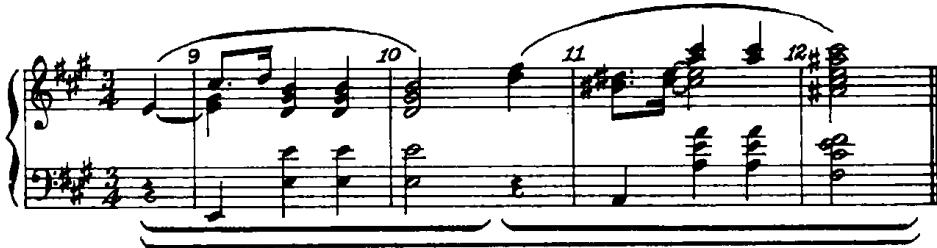
中文讲解
P0178 是第 23 页某图像或乐谱的占位符。从上下文判断,它对应 P0177 所引的图 7.23(肖邦《A 大调前奏曲》第 9–12 小节),用以直观展示该段中“V–I 后接 V/ii 因此不被听作终止”的情形。由于内嵌图像数据已省略,具体的谱例细节需查阅原书图 7.23。
补充说明
占位符提示原图位于第 23 页,与 P0177 的论述配套。
第9段(P0179)
原文复述
To refine this requirement, we observe that intuitively a cadence must be a cadence of something; a group that consisted only of the articulation of its ending would be unsatisfying. For instance, measures 1–8 of the same prelude (7.24) consists of two V–I progressions. (For convenience, the reduction in 7.24 simplifies the voice leading to the essential soprano and bass lines.) The first of the V–I progressions, since it completely occupies the first four-measure group, is not really heard as a cadence. Therefore, only the V or the I may be retained at the next level. By contrast, the V–I progression in measures 5–8 is a cadence for the entire eight-measure group, and therefore should be retained as a whole in the reduction. As a result, the reduction at the four-measure level contains either the V or the I of the first group followed by the cadence. (The piece is genuinely ambiguous here between the reduction in 7.24 and that with an initial I instead. For a number of reasons, including parallelism with the second half, we find that the choice of V yields a more stable analysis overall. This piece is discussed further in section 9.6.)
中文讲解
本段进一步限定 “终止式” 概念:直觉上,终止式必须“为某物”的终止——若一个乐群只剩下其结束点的刻画而无对应的内容承载,那样的终止并不令人满足。作者以肖邦《A 大调前奏曲》第 1–8 小节(图 7.24)为例:这两段四小节各包含一个 V–I 进行,但功能不同。第一个 V–I 占据了整个四小节群组,并因此“不被真正听作终止”——它只是该群组内部的过程,并非更高一层群组的结尾;故在下一层缩减中只能保留 V 或 I 中的一个。第二个 V–I(第 5–8 小节)则同时是这四小节群组的终止,也是整个八小节群组的终止,因此应作为整体被保留。结果是:四小节层级的缩减呈现为“第一群组的 V 或 I 加上终止式”。作者随后坦承这一选择存在真正的歧义(V 还是 I 作为第一群组的结构首音),并以“与后半的平行”等理由说明选 V 在整体上更稳定。该段一方面强化了 P0177 的“终止点必须落在群组边界”这一全局条件,另一方面通过对“同一和声进行在不同层级有不同功能”的剖析,引出下一段的“cadenced group”概念。
补充说明
图 7.24 是肖邦《A 大调前奏曲》第 1–8 小节的时跨缩减谱例,内嵌图像已省略。 “9.6 节” 指本书第 9 章第 6 节,本任务输入未给出该节内容。
第10段(P0180)
原文复述
We can make the intuition about the first four measures of 7.24 more precise by introducing the notion of a cadenced group: a group that at some level of reduction reduces to two elements, the second of which is a cadence. The first of these elements is the structural beginning of the group, and the cadence is the structural ending. In section 6.3 we labeled these with the notations $[b]$ and $[c]$ , followed by a subscript to indicate for which groups they were structural accents.
中文讲解
本段将 P0179 的直觉形式化为“cadenced group(有终止的群组)”概念:凡在某一缩减层级上缩减为两元素、且第二元素为终止式的群组,即为 cadenced group。其中第一个元素为该群组的结构起始(structural beginning),终止式为结构结束(structural ending)。这种“两元素”层级的存在,恰恰是 P0172 中“现有规则无法将两元素终止式选作 head”这一不足的正面回应——因为两元素 cadenced group 的出现意味着 head 的选择本身就是终止式本身。作者提示:6.3 节已为这两类结构重音引入过记号 [b] 与 [c],其下标指示该重音是哪一个群组的结构重音。
补充说明
[b] 与 [c] 是来自 6.3 节的既有记号系统,分别对应 “structural beginning” 与 “structural cadence”,下标标记群组归属。
第11段(P0181)
原文复述
Cadenced groups are to be contrasted with lower-level groups, which do not contain bs and cs. The smallest levels of cadenced groups correspond rather closely to the traditional notion of musical phrase.
中文讲解
本段将 cadenced group 与较低层级的群组作对照:较低层级群组不含 b 与 c 重音,因而不是 cadenced group。换言之,b、c 这类结构重音只在某一较高层级“浮现”,而较低层级只承载普通的拍点与和声稳定过程。此外,作者指出 cadenced group 的最小层级与传统“乐句”(phrase)概念相当接近——这为理论概念与既有分析术语之间搭了一座桥梁,提示读者可以把 cadenced group 视作对传统乐句的形式化重述。
补充说明
传统 phrase(乐句)分析常以终止式为标志,与本节 cadenced group 在最小层级上重合。
第12段(P0182)
原文复述
Chapter 7
中文讲解
P0182 是页眉 “Chapter 7”,仅表明当前位于第 7 章,无独立论证内容。
第13段(P0183)
原文复述
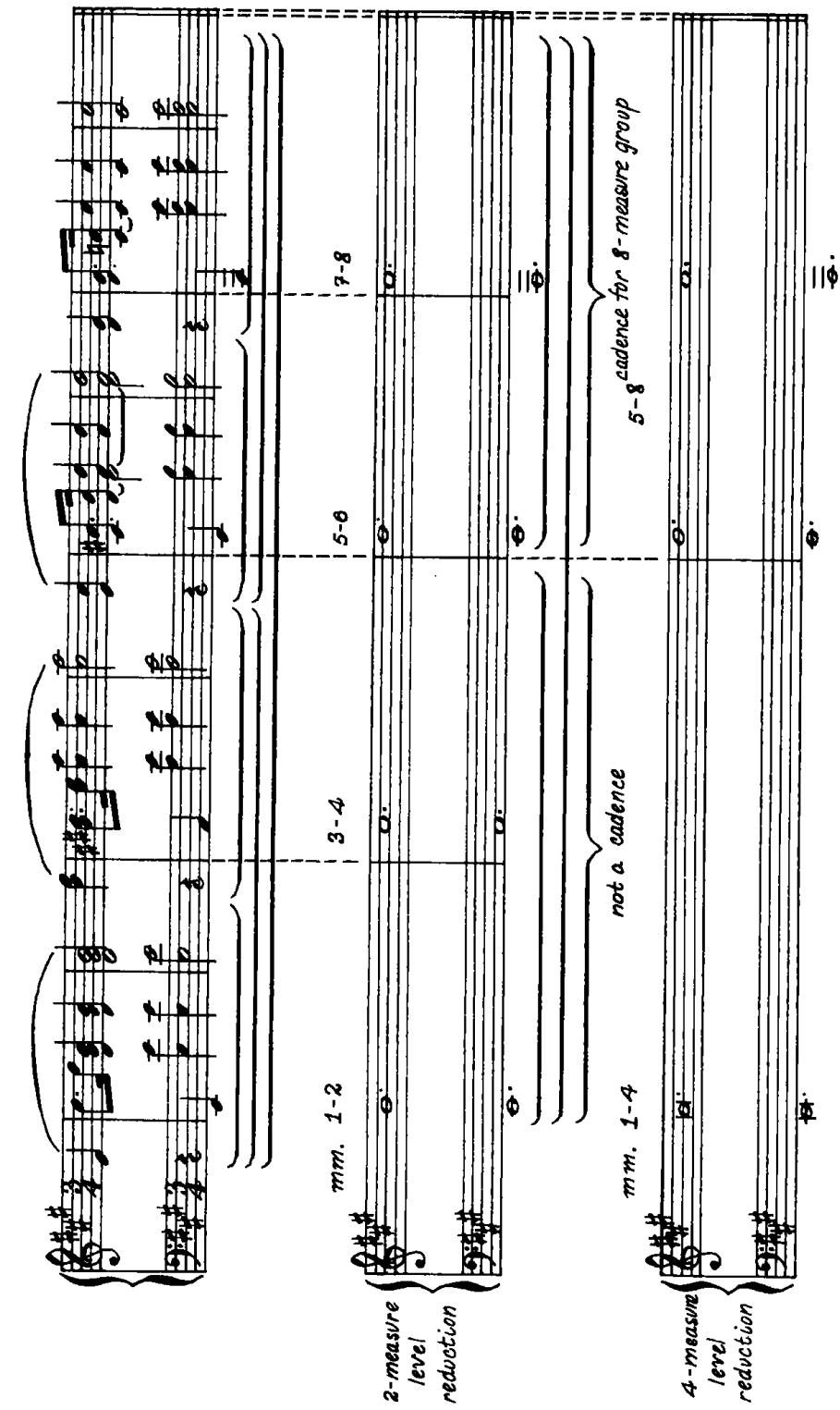
中文讲解
P0183 是图 7.24 的占位符,对应肖邦《A 大调前奏曲》第 1–8 小节的缩减谱例,与 P0179–P0180 的论述配套。该图具体展示 V–I 进行如何在四小节层级被处理,并在八小节层级被识别为 cadenced group。由于内嵌图像省略,谱面细节需查原书。
第14段(P0184)
原文复述
Formalization of Time-Span Reduction
中文讲解
P0184 是章节页眉 “Formalization of Time-Span Reduction”,承担版面定位功能,无独立论述。
第15段(P0185)
原文复述
Returning to the refinement of TSRPR 7, we can now stipulate that a progression counts as a cadence only if it functions as structural ending for a group. More precisely, there must be a cadenced group G that has a reductional level consisting of one other event (the b) followed by the progression in question. If such a level does not exist in the reduction, an apparent cadential progression (such as the first V–I in 7.24) does not perform the function of articulating a group ending. This condition is global, in that it depends on the outcome of higher-level analysis.
中文讲解
本段回到对 TSRPR 7 的精确化。借助 P0180 的 cadenced group 概念,作者给出严格判定:仅当一个进行充当某群组的 structural ending 时,它才“算”终止式。形式上,必须存在某个 cadenced group G,其缩减层级由“一个其他事件(即 b)+”该进行”构成;若不存在这样的层级,即便和声进行表面上是 V–I(如 7.24 中第一个 V–I),它也不执行“标记群组结束”的功能。作者特别强调:该条件是“全局的”(global),即其判定依赖于更高层级分析的结果——一个和声进行能否成为终止,取决于它在群组层级中的位置,而非仅取决于和声本身。
补充说明
P0185 标志 TSRPR 7 从“局部”条件(仅看和声与拍点)升级为“全局”条件(取决于群组层级),这是本节论证的关键转向。
第16段(P0186)
原文复述
These considerations can be summed up in a final statement of the preference rule for cadences:
中文讲解
本段是过渡句:P0177–P0185 累积起来的多项考虑将被浓缩为 TSRPR 7 的“最终表述”(final statement),即 P0187 中的三条条件。
第17段(P0187)
原文复述
TSRPR 7 (Cadential Retention) If the following conditions obtain in a time-span T, then label the progression as a cadence and strongly prefer to choose it as head:
中文讲解
本段为 TSRPR 7 的最终版本引入总括句:若 P0188–P0190 的三条条件在时间跨度 T 内同时满足,则将该进行标为终止式,并“强优先”选其作为 head。版本从此前的 preliminary form(P0173)升级为附条件的 final statement,体现了从“直觉规则”到“形式规则”的转变。
补充说明
TSRPR 7 的最终版本编号与初步版本一致,仅措辞由“强优先”移至条件全部满足之后才生效,体现分层判定。
第18段(P0188)
原文复述
i. There is an event or sequence of two events $(e_{1})e_{2}$ forming the progression for a full, half, or deceptive cadence.
中文讲解
P0188 为 TSRPR 7 的条件 i:和声条件——必须存在一个事件或两个事件 $(e_{1})e_{2}$,构成正格终止、半终止或阻碍终止的进行。该条件对应 P0177 的第一条要求,确保 head 候选背后有合法的终止式和声骨架。符号 $(e_{1})e_{2}$ 表示第一音可选为括号内事件(即半终止情况下仅为一个 V 音,无解决),第二音则必出现。
补充说明
括号记号 $(e_{1})$ 沿用作者此前对缩减层级的表示:括号内元素在该层级被吸收或删除。
第19段(P0189)
原文复述
ii. The last element of this progression is at the end of T or is prolonged to the end of T.
中文讲解
P0189 为 TSRPR 7 的条件 ii:终止式的最后一个音必须位于 T 的末尾,或被延长到 T 的末尾。该条件对应 P0177 的第二条——终止必须真正落在群组边界上。它既允许“尾音即终止点”的情形,也允许“尾音是终止音并被群组结束处延长所支持”的情形。
补充说明
“prolonged to the end of T” 暗含 sustain / 解决音持续至群组末尾的含义,与本书的延音(prolongation)概念一致。
第20段(P0190)
原文复述
iii. There is a larger group G containing T for which the progression can function as a structural ending.
中文讲解
P0190 为 TSRPR 7 的条件 iii:必须存在包含 T 的更大群组 G,使得该进行能充当 G 的 structural ending。这正是 P0185 所强调的“全局条件”:单凭 T 内部的和声与结束位置还不够,必须能在更高群组层级中识别出该进行作为终止。换言之,终止式的认定取决于它能否在更大尺度上被听到——这一条件把时间跨度的 head 选择嵌入到群组层级关系之中。
第21段(P0191)
原文复述
Retention of Structural Beginnings
中文讲解
P0191 是二级标题 “Retention of Structural Beginnings”(结构起始的保留)。它开启本节第二个子论题:从 P0171 起的终止式(c)讨论转入对结构起始(b)的对称讨论。该标题提示,结构起始与结构终止虽功能对称,却因“开头没有公式化进行”而需要不同的规则形式。
第22段(P0192)
原文复述
The articulation of structural beginnings of groups is in part symmetrical to the use of cadences at the ends of groups. But since there are no formulaic progressions to mark the beginnings of groups, a preference rule for structural beginnings need contain no condition analogous to condition i of the cadence rule. Moreover, though the resolution of a cadence must be prolonged to the end of its group, a structural beginning may be preceded by contrasting material.
中文讲解
本段指出:乐群结构起始的刻画与终止式的使用在功能上部分对称,但两者存在两点关键差异。其一:起始没有像 V–I 那样公式化的进行可资标识,所以 TSRPR 8 不需要类似 TSRPR 7 条件 i 的“和声骨架”条件。其二:终止式的解决必须被延长至群组末尾(TSRPR 7 条件 ii),而结构起始之前可以有对比性的材料——即“前导”不必受相似约束。两点差异决定了 TSRPR 8 与 TSRPR 7 形式上的不对称。
补充说明
本段为 TSRPR 8 的设计提供根据:起始规则的“缺省条件”不是疏忽,而是源于起始与终止在和声标记上的不对称。
第23段(P0193)
原文复述
However, groups in which the structural beginning is not near the actual beginning are felt as distinctly less stable. There seems to be a preference for the structural beginning to be near the beginning:
中文讲解
本段陈述经验事实:当结构起始远离乐群实际起点时,听感上明显更不稳定。换言之,存在一种使结构起始靠近群组开头的偏好。该陈述为 TSRPR 8 的提出提供经验依据——它不是先验规定,而是对听感倾向的形式化。句末冒号引出下段的正式规则。
第24段(P0194)
原文复述
TSRPR 8 (Structural Beginning) If, for a time-span T, there is a larger group G containing T for which the head of T can function as structural beginning, then prefer as head of T an event relatively close to the beginning of T (and hence to the beginning of G as well).
中文讲解
本段给出 TSRPR 8 的正式表述:若时间跨度 T 的 head 可作为包含 T 的更大群组 G 的结构起始,则偏好选一个相对靠近 T 开头的事件作为 T 的 head——这也意味着它同时靠近 G 的开头。该规则的结构与 TSRPR 7 高度平行:两者都以“存在包含 T 的更大群组 G”为先决条件,再在 T 的范围内择优。但 TSRPR 8 缺省了“和声骨架条件”与“延长条件”,仅保留“靠近群组开头”这一距离条件。
补充说明
TSRPR 8 与 TSRPR 7 的共同点——“存在更大群组 G”——构成两条规则作为“自上而下”规则的核心。
第25段(P0195)
原文复述
Note the parallelism between the condition in this rule and condition iii of the cadence rule above. They are both “top-down” conditions, concerning the function of the chosen event within the larger structure of the piece. It is these two rules that embody the importance of structural beginnings and endings of groups within the present theory of musical grammar.
中文讲解
本段点明 TSRPR 8 与 TSRPR 7 条件 iii 的平行关系:二者都属“自上而下”(top-down)的条件,所关心的是所选事件在作品更大结构中的功能。作者由此将这两条规则升格为“本理论中体现乐群结构起始与终止之重要性的”核心规则——它们把音乐语法对结构起止的关切形式化为 head 选择的判定条件。
补充说明
“top-down” 强调 head 选择依赖全局结构,而非仅看局部和声或拍点。
第26段(P0196)
原文复述
Examples To make the operation of TSRPRs 7 and 8 clearer, let us work through the larger levels of reduction for some examples. We begin with a case where pitch stability plays a minimal role, so that TSRPRs 7 and 8 operate freely. Then we turn to a case where pitch stability conflicts with TSRPR 8 to create an asymmetrical large-scale tree.
中文讲解
本段为“Examples”小节的引言,预告本节将通过逐层剖析示例来说明 TSRPR 7 与 TSRPR 8 的运作方式。作者分两种情境展开:一是音高稳定性作用较弱、TSRPR 7/8 自由主导的情形;二是音高稳定性与 TSRPR 8 冲突,导致大尺度缩减树呈非对称的情形。两类情境的安排意在既展示规则之“正常”应用,又展示规则之间的张力如何被解决。
第27段(P0197)
原文复述
Chapter 7
中文讲解
P0197 是页眉 “Chapter 7”,仅承担版面定位,无独立论述。
第28段(P0198)
原文复述
Example 7.25 gives the reduction of the last six measures of the Mozart K. 331 theme, from the measure level up. In measures 16 and 18, the full cadences satisfy conditions i and ii of TSRPR 7. The cadence in measure 16 forms the structural ending for the group consisting of measures 13–16, and that in measure 18 forms the ending for groups 17–18, 13–18, 9–18, and the entire theme. Thus all the conditions of TSRPR 7 are met, and both cadences are retained in level f.
中文讲解
本段进入示例 7.25:莫扎特 K. 331 主题末六小节(第 13–18 小节)从小节层级向上的缩减。第 16 与第 18 小节均为正格终止,分别满足 TSRPR 7 的条件 i 与 ii。其中第 16 小节的终止充当第 13–16 小节群组的 structural ending;第 18 小节的终止则同时充当第 17–18、第 13–18、第 9–18 乃至整个主题的 ending——意味着两个终止同时满足 TSRPR 7 的全部条件,因而在 f 层级都被保留。该段以具体尺度展示了 TSRPR 7 的“终止可嵌套于多个更高群组”这一特性。
补充说明
“level f” 指该图例中标记为 f 的缩减层级,是从最低小节层级向上的某一中间层级。 “9–18” 与 “entire theme” 指包含更广范围的群组划分,本任务输入未给出 9–18 之前的内容。
第29段(P0199)
原文复述
Level e of 7.25 shows the heads of all the two-measure groups. We will examine them in order. In group 13–14, TSRPR 2 (harmonic stability) favors the I in measure 13 over the V $^{6}$ in measure 14. Since the event selected here will be the b for groups 13–16 and 13–18, TSRPR 8 also favors the I, the earlier of the two events. In group 15–16, the cadence is chosen because of its stability as well as its function as the c for group 13–16. In group 17–18, the head of the group will not form a b for a larger group, as required by the condition of TSRPR 8; hence TSRPR 8 does not apply here. On the other hand, the cadence does form the c for a number of larger groups, so TSRPR .7 applies to retain it.
中文讲解
本段逐组考察 7.25 的 e 层级——两小节群组的 head 选择。第 13–14 小节组中,TSRPR 2(和声稳定性)倾向选第 13 小节的 I 而非第 14 小节的 V6;又因该事件将充当第 13–16 与第 13–18 两群组的 b,TSRPR 8 也支持选更靠前的 I——两条规则同向,结论稳定。第 15–16 小节组中,终止式既具稳定性又是第 13–16 群组的 c,故被选中。第 17–18 小节组中,该组 head 不充当任何更大群组的 b,TSRPR 8 不适用;而终止式充当多个更大群组的 c,TSRPR 7 适用——故终止式被保留。该段是 P0194 与 P0187 规则在实际分析中协同或分离的微观示范。
补充说明
V$^{6}$ 指三和弦的第一转位(“六和弦”),V$^{6}$–I 是常见的弱进行,与 V–I 正格终止在稳定性上不同。 “TSRPR .7” 应理解为 TSRPR 7 的笔误或排版小差异。
第30段(P0200)
原文复述
Level d of 7.25 shows the selection of head for the four-measure group 13–16. The first and last chords of this time-span in line e are essentially identical, so TSRPR 2 does not choose between them. Moreover, the time-span is large enough that metrical considerations no longer play a role. Thus the choice is determined only by TSRPRs 7 and 8. The head of this time-span will form the b of the larger group 13–18, so the condition of TSRPR 8 is met, favoring the earlier I. Since there is no larger group for which the head of this time-span will function as a c, condition iii of TSRPR 7 is not met, and this rule does not apply. Hence the cadence is reduced out.
中文讲解
本段分析 7.25 的 d 层级——四小节群组 13–16 的 head 选择。在 e 层级上,该时间跨度的首尾两和弦基本相同,TSRPR 2 无法判定;且时间跨度足够大,节拍因素不再起作用。因此选择完全取决于 TSRPR 7 与 8。该时间跨度的 head 将作为更大群组 13–18 的 b,TSRPR 8 适用并支持更早的 I;该 head 又不充当任何更大群组的 c,TSRPR 7 条件 iii 不满足、不适用。因此终止式被缩减掉,仅留 I 作为 head。该段是 TSRPR 7 与 TSRPR 8 在判定上“彼此独立”的典型示范——同一时间跨度的 head 选择由 8 决定,而 7 缺席。
第31段(P0201)
原文复述
In level c, that of the head of the entire six-measure group, we find that the head of this time-span will function as the c for the second half of the theme. Hence condition iii of TSRPR 7 is met and the condition of TSRPR 8 is not. As a result, the cadence is selected as head.
中文讲解
本段分析 7.25 的 c 层级——整个六小节群组的 head。该时间跨度的 head 将充当主题后半部分的 c,TSRPR 7 条件 iii 满足;同时该 head 不充当任何更大群组的 b,TSRPR 8 不适用。结果终止式被选为 head。该段与 P0200 形成对照:在 d 层级终止式被“排除”(因不充当 c),而在 c 层级终止式被“选中”(因充当更大群组的 c),从而印证同一终止式在不同尺度下扮演不同角色。
第32段(P0202)
原文复述
Example 7.26 represents the largest levels of the entire theme (as in 6.20). Levels c and d are the same as levels c and d in 7.25. The derivation of this analysis is straightforward, given what we have already seen in 7.25. There are no conflicts from other TSRPRs; thus, whenever a particular time-span falls at the beginning of a larger group, TSRPR 8 applies and the first event in the time-span is chosen. Similarly, whenever a time-span falls at the end of a larger group, TSRPR 7 applies and the cadence is chosen. The result is the symmetrical tree in 7.26.
中文讲解
本段引入示例 7.26,即整个主题最大层级的缩减(与 6.20 对应)。其中 c、d 两层与 7.25 的 c、d 相同。其推导相对直接——无其他 TSRPR 与之冲突:凡某时间跨度位于更大群组之首者,TSRPR 8 适用并选首事件;凡某时间跨度位于更大群组之末者,TSRPR 7 适用并选终止式。结果 7.26 呈现一棵对称的缩减树。该段用本主题的全局尺度展示了 P0196 所预告的第一种情境——TSRPR 7 与 8 自由主导,缩减树保持对称。
补充说明
6.20 指本书第 6 章的示例 7.20 或图 7.20,本任务输入未给出该编号对应的具体内容。 “对称缩减树” 指 head 选择在两端规则作用下呈现左右对称的二叉树形结构。
第33段(P0203)
原文复述
The reduction from level b to level a constitutes a special case. Assume for the moment that these eighteen measures are the entire piece, so there are no further levels of reduction. Then neither event of level b will be a b or a c for a larger group. This means that neither condition iii of TSRPR 7 nor the condition of TSRPR 8 is met. There are two consequences: first, there is no way to retain both elements of the cadence, since only TSRPR 7 would permit this; second, the choice between the first and last events is determined only on the basis of harmonic and melodic stability. In the present case the ending is favored, but this might not be so in every case. It may be desirable to add a special rule to deal with the highest level of reduction:
中文讲解
本段处理 b 层级到 a 层级的缩减——这是边界情形。假设这 18 小节就是全曲,则不存在更高层级的缩减,b 层级的两个事件均不充当任何更大群组的 b 或 c。于是 TSRPR 7 条件 iii 与 TSRPR 8 的条件均不满足。后果有二:一是终止式无法以整体形式保留(只有 TSRPR 7 允许保留终止式的两元素,但此处 TSRPR 7 不适用);二是首尾事件的选择只能诉诸和声与旋律稳定性。本例中尾事件胜出,但作者强调这并非普遍规律——并预告可能需补充一条专门处理最高层级缩减的“特殊规则”。该段既揭示当前规则系统在最高层级留下的空缺,也为下一节埋下伏笔。
补充说明
句末冒号引出下一段(不在本节范围内)的特殊规则讨论。
脚注 / 边栏 / 图表 / 附加信息(如有)
本节涉及的脚注:P0177 末尾的脚注 7 与肖邦《A 大调前奏曲》第 9–12 小节反例相关,但本任务输入未提供该脚注正文。 本节涉及的图像/乐谱占位符:P0178(图 7.23,肖邦《A 大调前奏曲》第 9–12 小节谱例);P0183(图 7.24,肖邦《A 大调前奏曲》第 1–8 小节缩减谱例);原文中提及但未给出占位符的还有图 7.20a(K. 331 第 4 小节)、图 7.25(K. 331 末六小节缩减)、图 7.26(K. 331 主题整体最大层级缩减)。所有内嵌图像数据均已省略,需查阅原书核对谱面细节。 页眉条目:P0175、P0184 为 “Formalization of Time-Span Reduction”;P0182、P0197 为 “Chapter 7”,均承担版面定位功能。
💡 本节核心要点
- 前述 TSRPR 1/2 在终止式处理上存在两类错误:无法以两元素终止式作 head,以及在涉及半终止时常给出错误选择,故需新增 TSRPR 7。
- TSRPR 7 的初步形式要求 “强优先”选终止式作 head;其最终形式附加三条条件——存在正确的正格/半/阻碍终止和声、终止音位于或被延长至 T 末尾、存在更大群组 G 使该进行充当其 structural ending。
- Cadenced group 是本节关键新概念:在某缩减层级上缩减为两元素且第二元素为终止式的群组,对应传统意义上的乐句;其结构重音记号为 [b] 与 [c],下标标注群组归属。
- TSRPR 7 的条件 iii 是 “全局的”(global),其判定依赖更高层级分析结果——同一和声进行在不同群组层级中可担任或不担任终止功能(如肖邦前奏曲第 1–4 小节的 V–I)。
- TSRPR 8 与 TSRPR 7 在形式上对称但更简洁:无和声骨架条件(因起始无公式化进行),且仅含 “靠近群组开头”这一距离条件;二者共享 “存在更大群组 G”这一自上而下的前提,是本书音乐语法中结构起止的形式化体现。
- 在 K. 331 示例 7.25/7.26 中,TSRPR 7 与 8 在不同层级独立或协同运作:d 层级由 TSRPR 8 决定,c 层级由 TSRPR 7 决定,最终生成一棵对称的缩减树;但 b→a 层级的最高边界情形暴露规则空缺,需另设特殊规则。
🔑 关键术语
- cadenced group:本节核心新概念。在某缩减层级上缩减为两元素、且第二元素为终止式的乐群;其两元素分别为该群组的 structural beginning 与 structural ending,最小层级与传统 phrase 概念接近。
- [b] / [c]:来自 6.3 节的记号,分别标记 cadenced group 的结构起始(structural beginning)与结构终止(structural cadence);下标指示该重音所归属的群组。
- TSRPR 7 (Cadential Retention):终止式保留规则。其最终形式要求三条条件同时满足:正确的正格/半/阻碍终止和声、终止音位于或被延长至 T 末尾、存在更大群组 G 使该进行充当其 structural ending。条件 iii 为全局条件。
- TSRPR 8 (Structural Beginning):结构起始保留规则。形式上与 TSRPR 7 的条件 iii 平行:以 “存在更大群组 G 使 head 充当其 structural beginning” 为前提,要求所选事件相对靠近 T 的开头。无类似条件 i 的和声骨架条件,亦无类似条件 ii 的延长条件。
- top-down condition:TSRPR 7 条件 iii 与 TSRPR 8 共享的判定形式——head 选择依赖其在更大群组结构中的功能,而非仅依赖局部和声或拍点。本书视其为音乐语法中结构起止重要性的形式化体现。
- global condition:判定结果取决于更高层级分析是否给出相应群组结构的条件;TSRPR 7 条件 iii 即典型例子。
S014 [描述性拆分] TSRPR 9 and Asymmetrical Reductions: Beethoven’s First Symphony
第1段(P0204)
原文复述
Formalization of Time-Span Reduction
中文讲解
这是第7章的页眉/运行标题,表明本章主题为「时值缩减的形式化」。在排版上属于重复出现的版式元素,并不是新的论述内容,但在结构上提示了读者:即将进入的内容仍在第7章关于时值缩减规则(TSRPR)的形式化讨论之中。
补充说明
页眉性内容;与该书第7章其它页的运行标题一致,无独立论点。
第2段(P0205)
原文复述
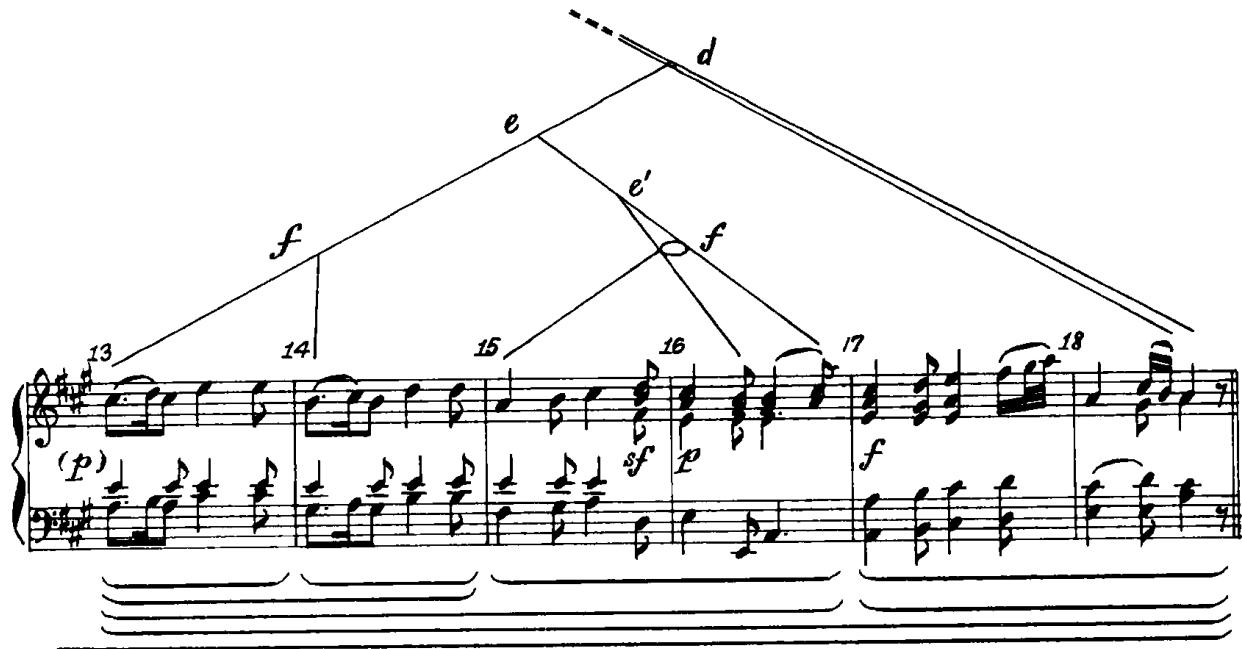
中文讲解
第27页上的图像/乐谱占位符。由于内嵌图像数据已省略,具体音符、和声或图示无法辨认;本任务只能确认其在版面中的位置(第27页),不能据此推断其内容。在原文论述中,此处通常对应贝多芬《第一交响曲》引子段(Example 7.27)的乐谱,供后续缩减分析使用。
补充说明
需查看原图方可获得具体谱例内容;本节分析直接依赖该谱例的第1小节及其后续小节。
第3段(P0206)
原文复述
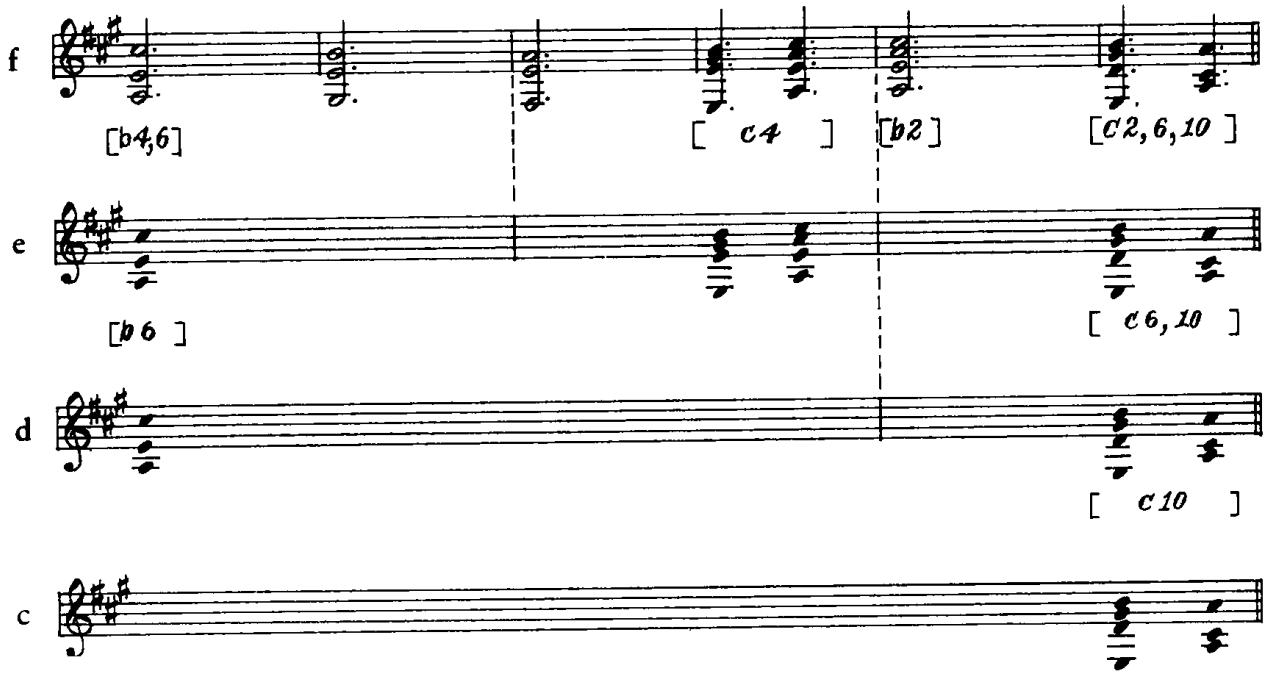
中文讲解
第27页上的另一图像/乐谱占位符。数据已省略,无法得知具体内容;推测可能为同一示例的另一部分(如缩减图 7.28 或辅助谱例)。其确切功能需查阅原图。
补充说明
位置在第27页;与 P0205 同页出现,可能为同一示例的延续或对应缩减图。
第4段(P0207)
原文复述
Chapter 7
中文讲解
第7章的章号标记(页眉),属于版面信息。它表明读者目前仍处于第7章内部,并为即将讨论的规则和分析案例提供上下文。
补充说明
页眉;与 P0213、P0223、P0225、P0232 等同为章节运行标记。
第5段(P0208)
原文复述
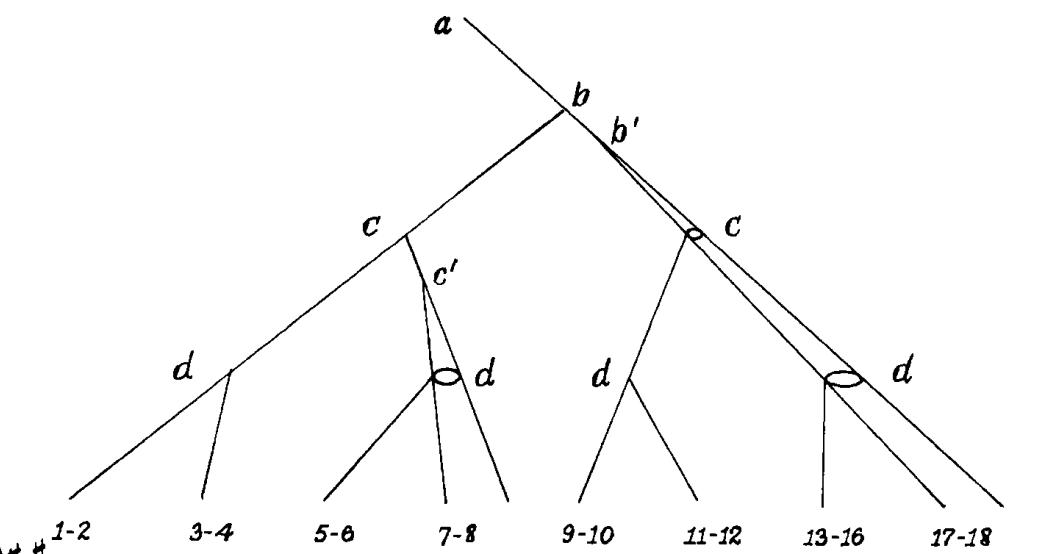
中文讲解
第28页的图像/乐谱占位符,图题标记为「7.26」。因图像数据被省略,无法判读其细节;按编号顺序判断,它是本章的某个先前示例(Example 7.26),可能用于与贝多芬《第一交响曲》引子作对照,但具体内容需查看原图。
补充说明
编号 7.26 表明它属于第7章的谱例序列;本章讨论贝多芬《第一交响曲》时主要引用 7.27(乐谱)与 7.28(缩减图)。
第6段(P0209)
原文复述

中文讲解
第28页的图像/乐谱占位符。数据省略,仅能确认其版面位置。该页同时容纳 P0208–P0212 多个图像占位符,结合后续 P0216 中提及的 7.27(贝多芬《第一交响曲》引子的乐谱),此处很可能包含该谱例的图像。
补充说明
需查看原图;按章节编号惯例,7.27 应出现在第28页。
第7段(P0210)
原文复述

中文讲解
第28页的图像/乐谱占位符。数据省略;其性质(乐谱还是缩减图)与具体内容不可判读,可能与 7.27 或 7.28 相关。
补充说明
位置在第28页;具体内容须查阅原图。
第8段(P0211)
原文复述

中文讲解
第28页的图像/乐谱占位符。数据省略,无法确认其内容。在贝多芬《第一交响曲》的分析中,本节主要依赖乐谱 7.27 与缩减图 7.28,因此该占位符至少其中之一可能对应这两幅图。
补充说明
需查看原图;图像数据不可定位,故不能由本任务推断具体细节。
第9段(P0212)
原文复述

中文讲解
第28页的图像/乐谱占位符。数据省略;与 P0209–P0211 同页,但各占位符之间的具体分配无法判定。
补充说明
需查看原图。
第10段(P0213)
原文复述
Formalization of Time-Span Reduction
中文讲解
运行标题再次出现,标识当前页面属于第7章「时值缩减的形式化」。这是版式信息,不引入新论点,但表明接下来的 TSRPR 9 仍属该章规则集的一部分。
补充说明
页眉。
第11段(P0214)
原文复述
TSRPR 9 In choosing the head of a piece, prefer the structural ending to the structural beginning.
中文讲解
本段正式提出时值缩减优先规则 9(TSRPR 9):在为整首作品选择「头音」(head)时,宁可选取结构性结束,而非结构性开始。该规则的形式条件是:在整首作品(最顶层的时值跨度)的「头」与「尾」(c)之间的取舍中,规则 9 把天平倾向「尾」一侧。其直观意义将在下一段展开。
补充说明
TSRPR 是 Time-Span Reduction Preference Rules 的缩写;head 指在更高一层代表某一时间跨度的单一事件,structural beginning/ending 分别指低层 b(头)与 c(尾)在更高结构中的对应位置。
第12段(P0215)
原文复述
Behind this rule lies the intuition that tonal pieces are fundamentally goal-oriented.
中文讲解
本段解释 TSRPR 9 的理据:调性音乐具有强烈的「目标取向」——音乐过程被视为朝向终止式的趋近。因此,对一首作品而言,其结构性终点(cadence 处的 c)在结构层级上通常比起点更为重要;只有当一段材料最终导向结束音时,它才真正具有结构意义。这一直觉与本节随后贝多芬《第一交响曲》引子的分析直接对应——该引子的「真正开头」其实是其终止处。
补充说明
「goal-oriented」是调性音乐分析中的常见观念,本节用它来支撑 TSRPR 9 在全局尺度上的优先性。
第13段(P0216)
原文复述
We next examine a passage where the large-scale reduction is not symmetrical: the introduction of Beethoven’s First Symphony (7.27). It has often been noted that, although the symphony is in C, its first measure appears superficially to be a cadence in F. The time-span reduction will show how, as a consequence of this unusual beginning, the entire passage functions as a sequence of structural anacruses to the beginning of the allegro in measure 13.
中文讲解
本段引出本节的核心案例——贝多芬《第一交响曲》引子。作者明确点出三个关键事实:(1) 这是一段大尺度缩减呈非对称形态的段落;(2) 整首交响曲在 C 大调,但其引子第 1 小节表面上看像 F 调的终止;(3) 时值缩减将表明:由于这种不寻常的起点,整段引子构成了一连串「结构性弱起」(structural anacruses),最终指向第 13 小节快板主题真正的开始。这里出现的「structural anacrusis」概念——即表层看似起点的事件在结构上实为弱起——是本节要论证的核心现象。
补充说明
Example 7.27 为引子乐谱;第 13 小节为快板主题开始处;「structural anacrusis」即结构层上的弱起,意味着该事件虽在时间上较早出现,但结构上从属于其后的事件。
第14段(P0217)
原文复述
Before discussing the reduction in 7.28, we must make two comments on the grouping. First, the largest subdivision of the passage sets off the first $3^{1/2}$ measures from the rest, as a sort of preintroduction consisting only of wind chords supported by pizzicato; in the rest of the introduction the melodic line is dominated by the violins. Second, the grouping contains three overlaps. As argued in section 7.1, time-span reduction is based on the underlying grouping structure, so that an overlapped event can be assigned different functions in the two groups to which it belongs. The overlapped event corresponds to two events in time-span reduction, one in the left group and one in the right. This dual function appears in 7.28 in measures 8 and 13 (the overlap in measure 10 has already been reduced out).
中文讲解
本段为后续缩减图(7.28)做了两项分组结构上的预备说明。第一点:最高层的二分把前 3½ 小节与剩余部分分开,前者被称为「前引子」(preintroduction),仅由铜管/木管和弦加拨弦伴奏组成,而剩余部分则由小提琴主导旋律。第二点:该分组包含三处重叠(overlap)。作者援引 7.1 节:时值缩减建立在底层分组结构上,重叠事件在两侧的组中可承担不同功能,因此在缩减图中对应两个事件。这一双重功能在 7.28 中出现在第 8 小节和第 13 小节;第 10 小节的重叠已经被缩减消除,因此不再出现。这一段的关键意义在于:分析者必须先理解分组中的重叠机制,才能正确读懂 7.28 中的双重事件。
补充说明
7.1 节是本书此前关于分组与时值缩减关系的基础论述;preintroduction 是本节专门为前 3½ 小节起的名称。
第15段(P0218)
原文复述
Example 7.28 is the reduction of 7.27 from approximately the measure level to the level of the whole passage. Measures 7 and 10 still contain more than one event in level e because they are broken by group boundaries. We have placed a double bar after the “preintroduction” as a visual aid.
中文讲解
本段介绍 Example 7.28 的范围与形式:它把 7.27 从大致小节层级向上缩减到整段引子的整体层级。其中两个细节值得注意——(1) 第 7 小节和第 10 小节在层级 e 上仍含多个事件,因为它们被组边界打断,无法合并为单一事件;(2) 作者在「前引子」之后画了双竖线作为视觉提示,但该双竖线并不具有独立结构含义。这一说明为读者正确解读 7.28 提供了地图。
补充说明
level e 是本段最低的缩减层,对应小节附近的事件;双竖线仅作版式标记。
第16段(P0219)
原文复述
With the exception of measure 1, to which we will return shortly, the reduction from the musical surface to level e is relatively straightforward and requires no comment. The reduction of group 5–13 proceeds down to level c according to principles familiar from previous examples, leading to an approximately symmetrical tree in which beginnings and endings of cadenced groups are of greatest importance. In reducing this group to level b the final cadence is most important, since it is the c for the entire introduction.
中文讲解
本段对缩减过程的常规部分给出概述:除第 1 小节外,由表层到层级 e 的缩减都较为直接,无需赘述。第 5–13 小节那一组继续向下缩减到层级 c 时,采用的是先前示例中已熟悉的原则,形成一棵大致对称的缩减树,其中带有终止的组的「头」与「尾」具有最大权重。再缩减到层级 b 时,由于引子的终止相当于整段引子的 c,故这一终止最为重要。作者在此区分了「常规」部分(5–13)与「前引子」部分(1–4)所遵循的不同的缩减逻辑,为后面关于前引子的详细讨论做好铺垫。
补充说明
层级 b/c/d/e 反映从大尺度到小尺度的缩减梯度;「symmetrical tree」是时值缩减中头尾平衡、缩减相对均匀的理想形态。
第17段(P0220)
原文复述
Chapter 7
中文讲解
第7章的章号页眉,纯属版式提示,不引入新论点。
补充说明
页眉。
第18段(P0221)
原文复述
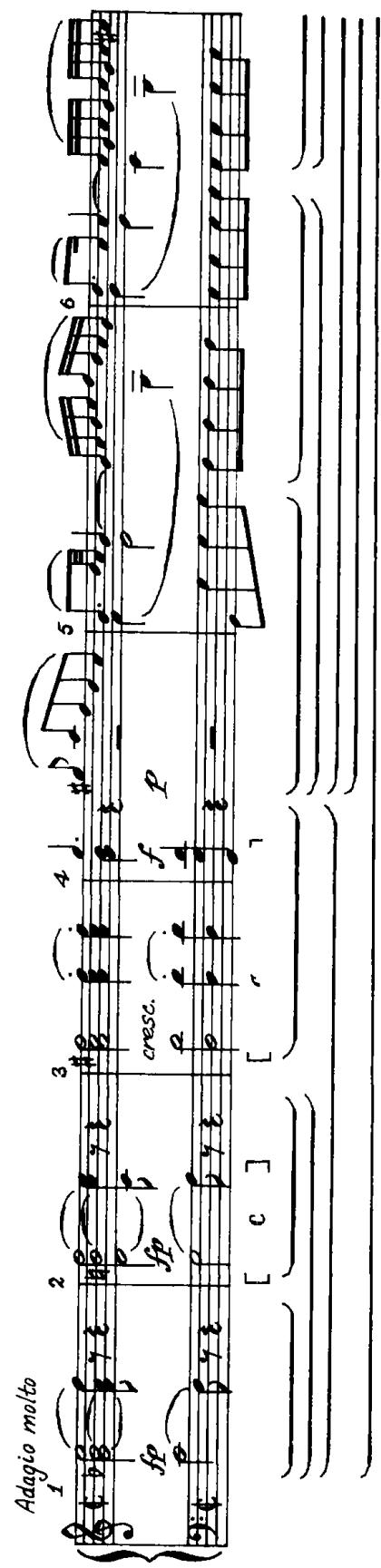
中文讲解
第30页的图像/乐谱占位符。数据已省略;该图应为 Example 7.28 缩减图的一部分或延续(缩减图通常横跨多页),但具体细节需查阅原图。
补充说明
需查看原图。
第19段(P0222)
原文复述
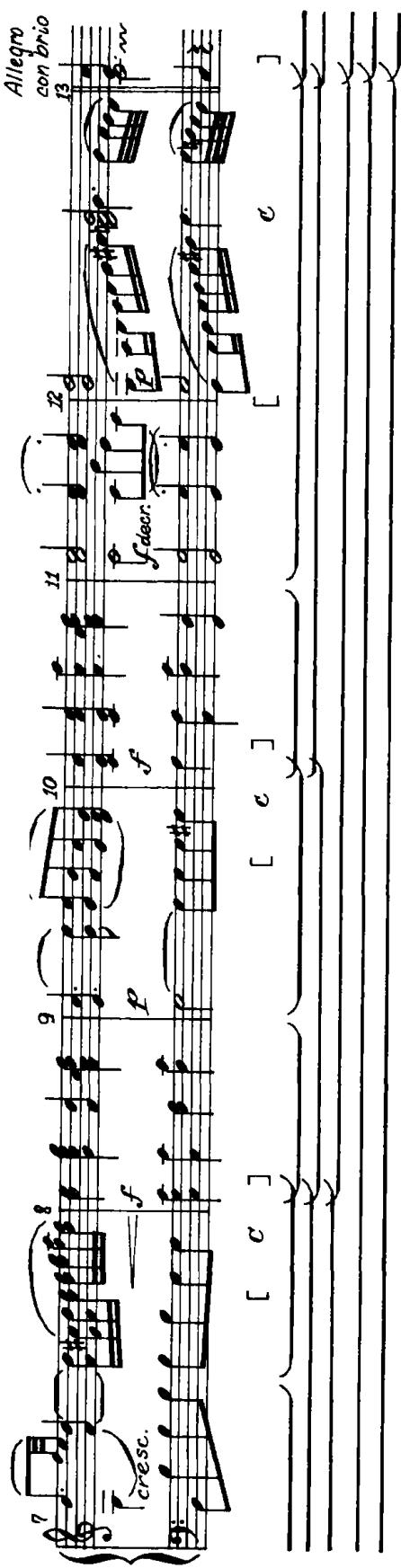
中文讲解
第30页的另一图像/乐谱占位符。数据已省略;其内容不可判读。
补充说明
需查看原图;可能为缩减图 7.28 的延续。
第20段(P0223)
原文复述
Formalization of Time-Span Reduction
中文讲解
第30页上的运行标题,再次标识本章主题。本段为版式信息,无独立论点。
补充说明
页眉。
第21段(P0224)
原文复述
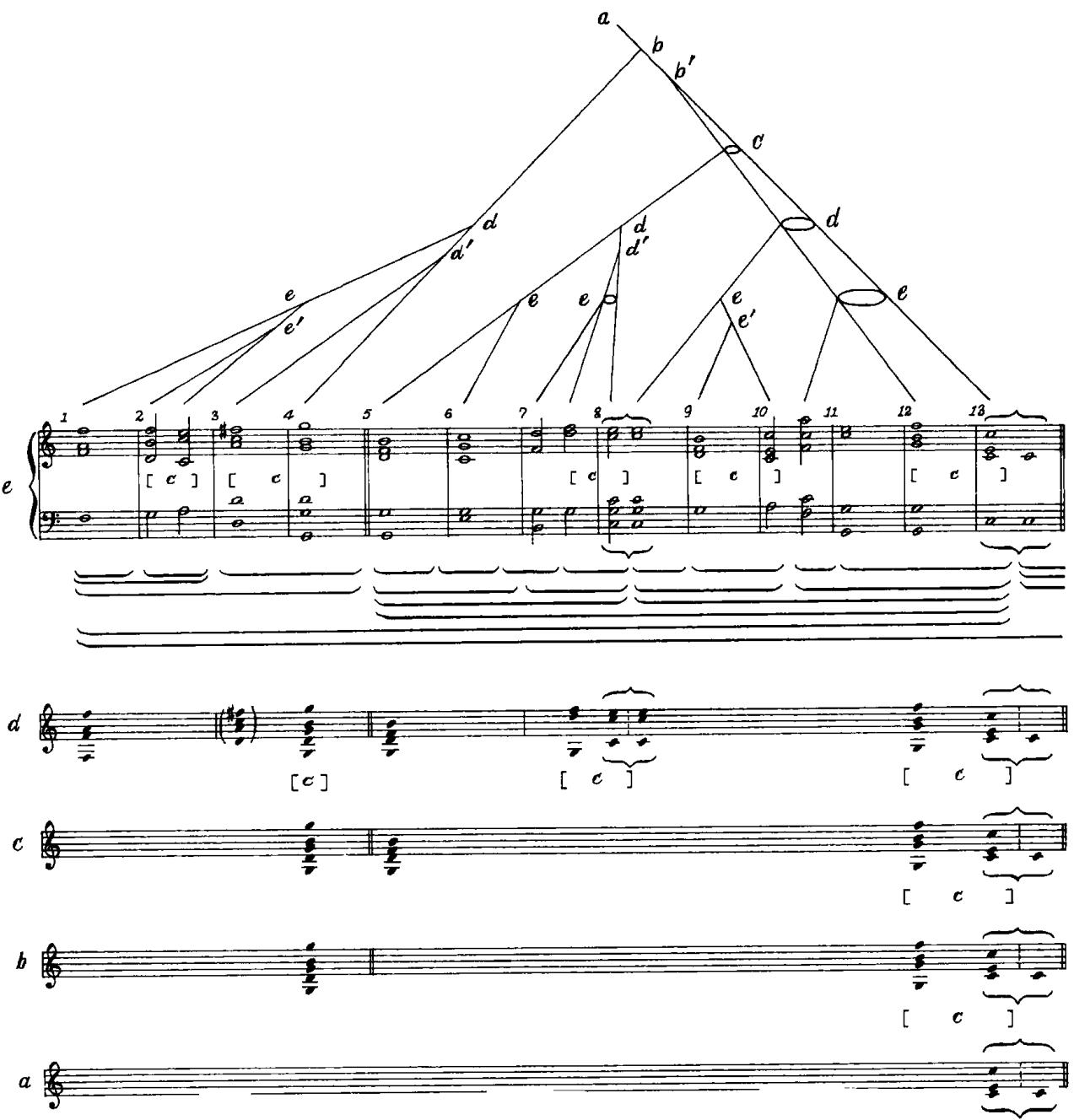
中文讲解
第31页的图像/乐谱占位符。数据已省略;按本章布局推测,它可能为 Example 7.28 的延续部分。
补充说明
需查看原图。
第22段(P0225)
原文复述
Chapter 7
中文讲解
第7章的章号页眉,纯属版式标记。
补充说明
页眉。
第23段(P0226)
原文复述
The reduction of the preintroduction, however, follows different lines. First, return to the reduction of measure 1. Though measure 1 contains the correct sequence of chords to form a cadence, it is not the c for any larger group; so, as in measures 1–2 of the Chopin prelude in 7.24, the cadence cannot be retained as a whole. The head of the measure will form the b of group 1–2; thus TSRPR 8 applies, creating a preference for the first chord, a V $^{7}$ /IV, as head. But this chord is less stable than the IV following it, on grounds of both intrinsic consonance (TSRPR 2) and harmonic connection to the next time-span (TSRPR 6). The combination of these two factors accounts for the choice of the IV in level e of 7.28.
中文讲解
本段详细展开前引子缩减的第一步——第 1 小节的缩减。关键推理链如下:(1) 第 1 小节虽然和弦进行正确、足以构成一个 cadence,但它并非任何更大组的 c(终点),所以 cadence 不能作为整体被保留(呼应 7.24 中肖邦前奏曲第 1–2 小节的情形);(2) 第 1 小节的「头」将作为组 1–2 的 b,因此 TSRPR 8(选最稳定的音/和弦为头)适用,本来会倾向于选第一个和弦 V⁷/IV;(3) 然而 V⁷/IV 在「内在协和性」上不及随后的 IV(TSRPR 2),同时在「与下一时值跨度的和声连接」上也不及 IV(TSRPR 6);(4) 这两个因素叠加,使层级 e 上最终选择的是 IV 而非 V⁷/IV。这一段示范了规则之间的相互冲突——TSRPR 8 倾向于选开头,而 TSRPR 2 与 TSRPR 6 把选择推向 IV。
补充说明
TSRPR 2:选内在更协和者;TSRPR 6:选与下一时值跨度连接更稳者;TSRPR 7:与「c 角色保留」相关;TSRPR 8:在时值跨度内选最稳者为头;7.24 为肖邦前奏曲缩减示例。
第24段(P0227)
原文复述
Next consider the reduction of the preintroduction from level e to level d. The head of group 1–2 will form a b for group 1–4, so TSRPR 8 applies, choosing the IV in measure 1 over the deceptive cadence in measure 2. In addition, the IV is harmonically more stable than the vi, reinforcing this choice. In group 3–4 the V is chosen as head, on all possible grounds.
中文讲解
本段处理前引子由层级 e 到层级 d 的缩减。逻辑分两层:其一,组 1–2 的「头」将作为组 1–4(前引子整体)的 b,故 TSRPR 8 适用,选择第 1 小节的 IV 而非第 2 小节的阻碍终止(vi)。IV 还在和声稳定性上明显优于 vi,进一步加强此选择。其二,组 3–4 的头则毫无争议地选择了 V——在所有可能的标准上都满足。值得注意的是,作者再次展示了「结构性开头」(IV)被选中作为 b 的过程,与上一段相比,这次 TSRPR 2 和 TSRPR 6 的冲突没有发生,结果干净。
补充说明
「deceptive cadence」即阻碍终止,此处指第 2 小节终止于 vi 而非预期的 I;TSRPR 8 在此没有遭遇反向因素。
第25段(P0228)
原文复述
In reducing from level d to level c, we first note that the head of group 1–4 will function as the b for the entire introduction; hence TSRPR 8 favors the IV chord. Moreover, since the head of this group will not form the c for a larger group, there is no pressure from TSRPR 7 to retain the V in a cadential role. On the other hand, the V is in a stronger metrical position and harmonically closer to the tonic, and it forms a more stable progression with the V $^{7}$ following it in measure 5. These three factors appear to override TSRPR 8. Hence, as in the reduction of measure 1, the final event rather than the initial event is chosen as head.
中文讲解
本段处理由层级 d 到层级 c 的缩减,呈现出本节最关键的一次规则反转。组 1–4 的「头」将担任整段引子的 b,按 TSRPR 8 应选 IV。同时由于该「头」不会成为更大组的 c,TSRPR 7 也没有压力要把 V 保留为 cadential 角色。然而反方出现三项更强因素:(1) V 处于更强的拍位上;(2) V 在和声上更接近主音;(3) V 与第 5 小节随后的 V⁷ 形成更稳定的进行。三者合力压倒 TSRPR 8,结果如同第 1 小节的缩减一样,最终选取的是「末事件」(V)而非「首事件」(IV)作为头。这一步对最终论证至关重要——它显示在前引子向引子整体过渡时,TSRPR 8 的「首选开头」倾向在贝多芬此处被压倒,为后续层级 b→a 的进一步反转埋下伏笔。
补充说明
TSRPR 7 涉及当某事件充当更大组的 c 时优先保留终止角色;本段中 TSRPR 8 与其他因素的冲突是本节论证的核心机制。
第26段(P0229)
原文复述
Finally, in reducing from level b to level a—finding the head of the entire introduction—we confront exactly the same situation: the V chord representing the preintroduction is less stable than the I representing the cadence of the entire passage. Thus, despite the fact that TSRPR 8 would prefer the V, the I is chosen as head.
中文讲解
本段完成顶层缩减:由层级 b 到层级 a,即确定整段引子的「头」。情况与上一段完全相同——代表前引子的 V 在稳定性上不如代表整段终止的 I,因此尽管 TSRPR 8 偏好 V,最终选取的是 I。这是缩减过程的最后一击:表层上看似是「前引子开头」的 V⁷/IV,从一开始就被判定为一系列结构性弱起中最外层的一个弱起,其所「弱起」的对象是引子末尾的 I,而非引子开头。
补充说明
层级 a 为整首作品/段落的最高结构层;此处选择 I 为头,意味着真正的结构起点是终止处的 I。
第27段(P0230)
原文复述
In the reduction as a whole, the picture emerges of a series of beginnings that turn out to be not structural beginnings but structural anacruses: first the initial V $^{7}$ /IV, then its resolution, then the V at the end of the preintroduction. The “real” beginning of the piece—the event to which all that precedes is subordinate—is the final I of the introduction, which overlaps with the first event of the allegro. This characteristic of the passage is revealed by the predominance of left branching in the tree.
中文讲解
本段是整个分析的小结,画龙点睛地揭示贝多芬《第一交响曲》引子的结构真相:它由一系列「看似开端、实为弱起」的事件串接而成——先是最初的 V⁷/IV,再是其解决 IV,然后是前引子末尾的 V。真正的「结构性开头」,即所有先前事件从属的那个事件,是引子最末的 I,并与快板主题的第 1 个事件在第 13 小节发生重叠。作者特别指出,这一特征在缩减树上表现为「左分支占主导」(predominance of left branching)——左分支意味着更高层的「头」对应于较低层中位置更靠后的事件,正是结构性弱起的图示。
补充说明
左分支(left branching):在缩减树中,若高层节点由低层靠后的事件充当,则该分支向左延伸;这一形态是「结构性弱起」的视觉特征。
第28段(P0231)
原文复述
The introduction to Beethoven’s Second Symphony presents an interesting contrast to the analysis just developed, in spite of their similar large-scale grouping structures. Because its first event is a tonic, there is never a harmonic reason to select anything else as the $b$ , as there is in 7.28. Hence TSRPR 8 consistently is reinforced by harmonic factors and can select the initial I as the $b$ of all the cadenced groups it belongs to. As a result, this introduction lacks the embedded structural anacruses found in the First Symphony.
中文讲解
本段以贝多芬《第二交响曲》的引子作为反例,对照前面对《第一交响曲》引子的分析。两段引子在大尺度分组结构上相似,但因《第二》的首个事件即主音(tonic),在和声上没有任何理由选取别的事件作为 b——这一点与 7.28 中《第一》引子反复需要在「首事件 vs. 末事件」之间权衡形成鲜明对比。因此 TSRPR 8 在《第二》中始终与和声因素相互加强,能够一致地把初始的 I 选作所有 cadenced 组的 b。其结果:《第二》引子没有出现《第一》引子中那种「内嵌结构性弱起」的层叠现象。这一对比强有力地证明了 TSRPR 8 的效果取决于与起点的和声关系:起点为主音时「首选开头」与和声稳定同向;起点为不稳定功能(如 V⁷/IV)时则会发生冲突。
补充说明
本节通过反例显示:TSRPR 8 与「起点的稳定性」是协同还是冲突,取决于作品开头的和弦性质;《第二》引子因开篇即主音而稳定地选「首事件」为头。
第29段(P0232)
原文复述
Formalization of Time-Span Reduction
中文讲解
最后一行的运行标题,结束本节。版式提示:本节所有讨论仍属于第7章「时值缩减的形式化」这一更大框架。
补充说明
页眉。
脚注 / 边栏 / 图表 / 附加信息(如有)
本节包含若干脚注、图表与边栏型版面元素:
- 页眉「Formalization of Time-Span Reduction」(P0204、P0213、P0223、P0232)反复出现,标识本节属第7章关于 TSRPR 的形式化讨论;
- 章号页眉「Chapter 7」(P0207、P0220、P0225)属版面提示;
- 第27、28、30、31页上有多处图像/乐谱占位符(P0205、P0206、P0208–P0212、P0221、P0222、P0224),其内容被省略;可定位的事实是 Example 7.26(第28页图题标记)、Example 7.27(贝多芬《第一交响曲》引子乐谱)、Example 7.28(相应的时值缩减图,跨第29–31页)。
- 正文中明确出现 TSRPR 2、TSRPR 6、TSRPR 7、TSRPR 8 与本节首次提出的 TSRPR 9;以及「structural anacrusis」「left branching」「preintroduction」「overlap」「cadenced group」等关键术语。
- 无独立脚注(footnote)出现;前述规则编号(TSRPR x)以正文方式陈述。
💡 本节核心要点
- TSRPR 9 的核心陈述:当为整首作品选择头音时,优先选择结构性结束而非结构性开始;其理据是调性音乐具有目标取向性。
- 贝多芬《第一交响曲》引子是一段大尺度缩减非对称的案例:其第 1 小节表面像 F 调的 cadence,但整段引子在结构上是第 13 小节快板主题的一系列 structural anacruses。
- 分组结构是缩减的前提:最高层把前 3½ 小节(前引子,仅铜管/木管和弦+拨弦)与剩余部分(小提琴主导旋律)分开;分组内的三处重叠(overlap)使得重叠事件在 7.28 中作为双重事件出现(第 8、13 小节,第 10 小节已缩减去除)。
- 除第 1 小节外,从表层到层级 e 的缩减是直接的;第 5–13 小节那一组按熟悉原则缩减到层级 c,呈大致对称的树,再到层级 b 时由终止作为 c 控制。
- 前引子的缩减呈现「规则反转」:层级 e 上选 IV 而非 V⁷/IV(TSRPR 2 与 TSRPR 6 压倒 TSRPR 8);层级 d→c 时因 V 在拍位、和声稳定度及与下一 V⁷ 的连接上更强,再次压倒 TSRPR 8 而选末事件;层级 b→a 时代表前引子的 V 不如代表终止的 I 稳定,仍选 I 为头。
- 整段缩减揭示:V⁷/IV → IV → V 一连串表层「开端」实为指向引子末尾 I 的 structural anacruses;这一现象在缩减树中表现为左分支占主导。
- 与贝多芬《第二交响曲》引子的反例对照:因后者开篇即主音,TSRPR 8 与和声稳定度同向,故一致选取初始 I 为各 cadenced 组的 b,缺乏内嵌的结构性弱起——证明 TSRPR 8 的效果高度依赖于起点事件的和声性质。
🔑 关键术语
- TSRPR 9:时值缩减优先规则 9:在为整首作品选择头音时,宁选结构性结束而非结构性开始。本节首次提出。其理据是调性音乐的目标取向性。
- Structural anacrusis(结构性弱起):在结构层级上,某事件虽在时间上先出现,却从属于其后某事件;即表层看似起点的和弦实为高层结构中的弱起。本节用来描述贝多芬《第一交响曲》引子中 V⁷/IV、IV、V 一连串「开端」的真实结构地位。
- Asymmetrical reduction(非对称缩减):缩减树中头尾不对称、左分支占主导的形态;与本节案例贝多芬《第一交响曲》引子相对应。
- Left branching(左分支):缩减树中高层头音对应于低层靠后事件的形态。在贝多芬《第一》引子的 7.28 中「predominance of left branching」是其结构性弱起现象的图示。
- Preintroduction(前引子):本节对贝多芬《第一交响曲》引子中前 3½ 小节所起的名称,仅由铜管/木管和弦加拨弦伴奏构成,与剩余由小提琴主导旋律的引子部分相对。
- Overlap(重叠):分组结构中一个事件同属于左右两个组的情形。重叠事件在时值缩减中对应两个事件,可在不同组中承担不同功能(参见 7.1 节)。本节中第 8、13 小节为重叠事件的体现。
- TSRPR 2 / 6 / 7 / 8:TSRPR 2:选内在更协和者;TSRPR 6:选与下一时值跨度连接更稳者;TSRPR 7:若某事件充当更大组的 c 则优先保留其 cadential 角色;TSRPR 8:在时值跨度内选最稳者为头。本节中 TSRPR 2、6 推选 IV 压倒 TSRPR 8 对 V⁷/IV 的偏好;TSRPR 7 在层级 d→c 时不构成压力。
- Cadenced group:带有终止的组;其 b(头)与 c(尾)通常在缩减中具有最大权重。本节用来说明《第二交响曲》引子中各 cadenced 组的头均选初始 I。
S015 [描述性拆分] 7.5 Concluding Remarks
第1段(P0233)
原文复述
This completes the discussion of the time-span reduction preference rules, which take into account local rhythmic considerations (TSRPR 1), local harmonic considerations (TSRPR 2), local pitch extremes (TSRPR 3), parallelism (TSRPR 4), metrical and prolongational stability across time-spans (TSRPRs 5 and 6), the presence of cadences (TSRPR 7), the importance of early structural beginnings (TSRPR 8), and the overall structure of the piece (TSRPR 9).
中文讲解
这是本章对九条 TSRPR(time-span reduction preference rules,时值缩减优先规则)的总结性回顾。作者按照作用层级把它们归为三类:一类是处理局部细节的(TSRPR 1—4:节奏、和声、极值音、平行结构);一类是处理跨时值结构稳定性的(TSRPR 5—6:节拍与延展稳定性);一类是处理全局结构信号的(TSRPR 7—9:终止式、开头结构重要性、整体结构)。这段话本身不引入新规则,它的功能是替读者把九条规则收拢成一个清单,确认七章主体论述到此结束。理解它时应注意:每条规则对应的是「在不同音乐事件之间作取舍时倾向于选谁作 head(结构头部)」的一条偏好,不是单独的音乐陈述,所以这里的「take into account」意味着每条规则都在 head 选择过程中提供一个打分依据。
补充说明
本段中 TSRPR 是本书自创的缩写,全称 time-span reduction preference rules,即「时值缩减优先规则」。规则编号在本章前文中已有定义,本段仅作汇总索引,因此无需逐条重述其内容。
第2段(P0234)
原文复述
This chapter has gone a long way toward providing a principled account of what the experienced listener must know in order to sense the relative structural importance of events in a musical surface. In particular, the rules of time-span reduction provide the crucial link between local rhythmic and pitch detail and the notions of structural accent crucial to any theory of large-scale musical structure.
中文讲解
本段是作者对整章学术贡献的评价。第一句声称本章为「有经验的听者如何感知音乐表层事件相对结构重要性」提供了一套有原则(principled)的解释;第二句把时值缩减规则定位为局部节奏与音高细节与大尺度结构重音之间的「关键纽带」。理解时要抓住两个词:「principled」意味着这套规则不是经验性描述,而是有明确形式依据的;而「structural accent」(结构重音)是大尺度音乐结构理论中的核心概念,作者认为只有通过时值缩减才能把局部细节连接到它。换言之,前面 P0233 罗列的九条偏好规则之所以值得花篇幅展开,正是因为它们共同构成这座桥。
补充说明
「structural accent」与「metrical accent(节拍重音)」相对,是延展与时值缩减体系中的大尺度结构概念,依赖前文建立的节拍、分组、时值三层结构才能成立。
第3段(P0235)
原文复述
We end the chapter with some speculation about musical universals. One important way in which musical idioms differ is in the principles of relative pitch stability. Here we have simply assumed the pitch principles of classical Western tonal music; the relation of these to other tonal systems will be discussed briefly in section 11.5. Insofar as the principles of pitch stability play a role in the preference rules for harmonic stability (TSRPR 2), linear progression (TSRPR 6), and retention of cadences (TSRPR 7), their influence on time-span reduction is pervasive. On the other hand, it seems possible that the preference rules themselves are universal—for example, that TSRPR 2 says to prefer harmonically stable events as head no matter how the idiom chooses to define harmonic stability.
中文讲解
本段开始对「音乐普遍性」做谨慎推测。逻辑分两层:第一层承认西方古典调性音乐的「相对音高稳定性」原则不能直接搬用到其他音乐体系,作者声明这里只是借用,后面 11.5 节会再讨论与其他调性系统的关系;第二层进一步区分「音高稳定性的具体内容」(文化相关)与「偏好规则的形式」(可能跨文化普遍)。作者给出的具体例证是:无论某种音乐如何定义「和声稳定」,TSRPR 2 都倾向于把和声稳定的事件选为 head。理解时应注意作者的措辞克制——「it seems possible」表明这是猜想而非定论,目的是把读者引向「规则形式 vs. 规则内容」的层次区分。
补充说明
本段提及的「section 11.5」属于本书第十一章的范围,本节仅作交叉引用,不展开其内容。「musical universals」在本节语境下指可能跨音乐体系成立的规则形式,而非具体音高或音阶内容。
第4段(P0236)
原文复述
There is no problem extending the segmentation rules and the well-formedness rules to any idiom that is as highly structured in both grouping and meter as classical Western tonal music. (We did, however, mention one possible variant of the segmentation rules in section 7.1, in which regular subgroups include a weak beat preceding rather than following a strong beat.) However, in an idiom where meter is largely absent, one could not necessarily build time-span structure up to the group level using meter as we have done here. Similarly, if grouping in some idiom were not as strongly hierarchical as in classical Western tonal music, time-span segmentation as we have defined it might not be highly structured enough at larger levels to permit meaningful decisions about the relative global importance of events. However, even tentative conclusions about cross-idiom variation in time-span reduction require far deeper investigation than do grouping and meter, so we hesitate to speculate further.
中文讲解
本段讨论整套理论在不同音乐体系中的可移植性,分三种情况:(1)若某音乐体系在分组与节拍上都和西方古典调性音乐同等结构化,则节拍与良构规则可以直接推广——作者顺便指出 7.1 节已提到一种分组规则的变体(规则子群可由「弱—强」顺序构成而非默认的「强—弱」);(2)若节拍基本缺失,则无法像本章那样靠节拍逐层向上建构时值结构直至群层级;(3)若分组层级性不够强,则在大尺度上的时值切分就不够结构化,难以对事件的相对全局重要性做出有意义判断。最后一句以「hesitate to speculate further」收束,明确作者不愿在没有深入研究的情况下贸然下结论。理解本段的关键是:作者区分了「节拍/分组规则」(相对可推广)与「时值缩减」(跨文化变异研究尚不足),而不是把整套理论一刀切地推广或否定。
补充说明
本段提到的「section 7.1」是本章早先讨论节拍与分组规则的小节,「regular subgroup」的「弱—强」变体在那里已有交代,本段只是回指,没有引入新规则。
第5段(P0237)
原文复述
7.5 Concluding Remarks
中文讲解
这是第 7.5 节的标题,标识本节为「结论性评述」。它开启的论题是:对前面 7.1—7.4 节讨论的时值缩减偏好规则做总结、给出整章学术定位,并谨慎地推测其在不同音乐体系中的可能普遍性与局限。理解此标题时应注意「Remarks」一词的分量——它不是新增规则,而是评估与展望。
第6段(P0238)
原文复述
Chapter 7
中文讲解
这是页眉性质的版面标识「Chapter 7」,提示当前页属于本书第七章。其作用仅为版面定位,无独立论旨。
脚注 / 边栏 / 图表 / 附加信息(如有)
本节无独立的脚注、图表、谱例或边栏;唯一附加的交叉引用指向「section 7.1」(分组规则弱—强变体)与「section 11.5」(其他调性系统中音高稳定性原则的讨论),均属作者给出的章节回指,未在本节内展开。
💡 本节核心要点
- 本章九条时值缩减优先规则(TSRPR 1—9)分别覆盖局部节奏、局部和声、局部极值音、平行结构、跨时值节拍与延展稳定性、终止式、开头结构重要性与整体结构,可按局部—跨时值—全局三个层级归类。
- 时值缩减规则的核心学术价值是把局部节奏与音高细节与大尺度结构重音(structural accent)连接起来,构成任何大尺度结构理论的关键桥梁。
- 作者明确承认本章「相对音高稳定性」原则借用自西方古典调性音乐,相关讨论将在 11.5 节展开。
- 作者推测偏好规则的形式可能跨音乐体系普遍,但具体内容(如和声稳定性的定义)随文化而异——这种「形式 vs. 内容」的分离是本节理论深化的关键。
- 理论的可推广性受节拍与分组的结构化程度制约:分组和节拍高度结构化的体系可推广规则;节拍缺失或分组层级弱的体系则难以在群及以上层级建立有意义的时值缩减判断。
- 作者以「hesitate to speculate further」收束,明确跨体系时值缩减变异的研究尚未充分,不下进一步结论。
🔑 关键术语
- TSRPR (time-span reduction preference rules):时值缩减优先规则。在时值缩减过程中对哪一事件应被选作「head(结构头部)」给出偏好依据的规则集合,本章共九条,编号 1—9,分别对应节奏、和声、极值音、平行、节拍稳定、延展稳定、终止式、开头结构重要性与整体结构等不同考量。
- structural accent:结构重音。由时值缩减体系推导出的、大尺度层级上某一事件相对突出的属性,是大尺度音乐结构理论中的核心概念;其成立依赖节拍、分组、时值三层结构及相应的优先规则。
- musical universals:音乐普遍性。本节语境下指可能跨不同音乐体系成立的形式规则,而非具体的音高或音阶内容;作者推测偏好规则的形式属于这一层次,而音高稳定性的具体定义则不属。
- pitch stability (relative):相对音高稳定性。本章假设的西方古典调性音乐原则,用以判定某音或和弦在调性语境中的稳定程度;该原则是 TSRPR 2、6、7 的内容来源,但作者承认它具有文化特定性。
- regular subgroup (variant):规则子群及其变体。本书分组规则中由「强—弱」构成的规则子群;7.1 节曾提出过一种「弱—强」变体,本节在讨论跨体系推广时回指该变体。
- well-formedness rules:良构规则。规定节拍与分组结构须满足的形式条件的规则,与「segmentation rules(切分规则)」一起构成节拍与分组体系;作者认为在分组和节拍高度结构化的体系中可直接推广。