目录
ch1 Deceptive Recapitulation in Mendelssohn: “Sehnsüchtig” and the Venetian Gondola Song
- s1 [描述性拆分] Mendelssohn’s Rhythmic Originality and the Concept of Deceptive Recapitulation
- 页码:1-1
- s2 [描述性拆分] Binary Form and the Deceptive Thematic Return in “Sehnsüchtig,” Op. 7, No. 6
- 页码:1-1
- s3 [描述性拆分] Defining Recapitulation and the Bachian Heritage
- 页码:2-2
- s4 [描述性拆分] Introduction to the Venetian Gondola Song, Op. 30, No. 6
- 页码:2-2
- s5 [描述性拆分] Phrase Structure, Hypermeter, and Composed-Out Ritenuto in the Gondola Song
- 页码:3-4
- s6 [描述性拆分] Underlying Quatrain Form and the Magic of the Deceptive Recapitulation
- 页码:4-4
- s7 [描述性拆分] Basic Length and Cadential Ambiguities in the Songs without Words
- 页码:4-5
- s8 [描述性拆分] Classic-Style Expansion in Op. 19, No. 1
- 页码:5-12
s1 [描述性拆分] Mendelssohn’s Rhythmic Originality and the Concept of Deceptive Recapitulation
第1段(P0001)
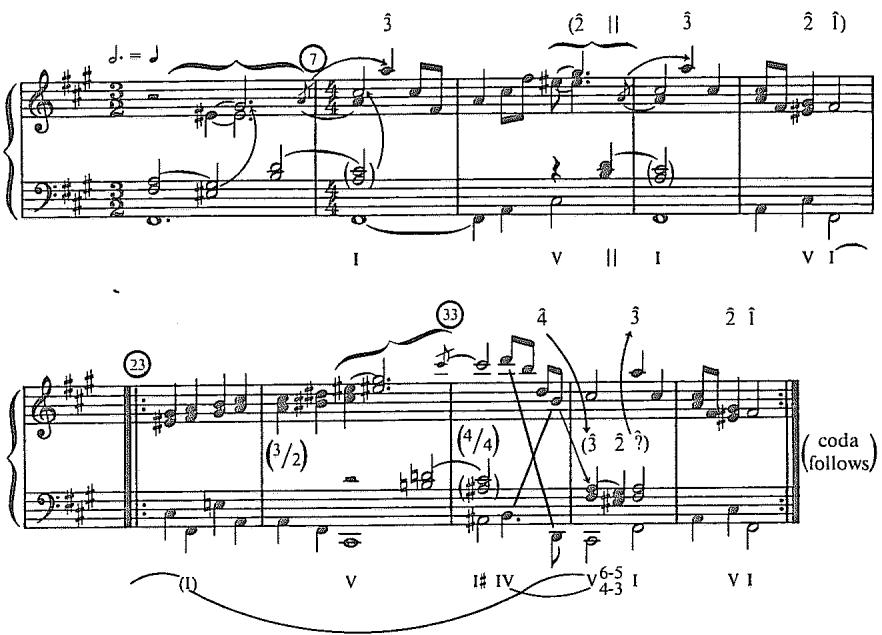
原文复述
music yesterday (if, indeed, he can feel such things at all) will now know better what a song should be, than from all the books of instruction, all the lectures, and all the examples of the present day; “and thus is life won,” as Goethe says. $^{8}$
中文讲解
本段是一段引文的尾部,带有脚注8。从内容判断,这段引文并非作者本人的话,而是作者用以开篇的引语(很可能引自某位前人对门德尔松“无词歌”的评价)。引文的核心主张是:真正教人理解“歌应该是什么样”的,不是任何教材、讲座或当代范例,而是门德尔松的音乐本身——只要听者还能感受音乐的话。结尾借歌德的话“and thus is life won”(“人生便如此赢得”)作结,暗示门德尔松那种以纯音乐表达情感的方式,在引述者看来具有关乎生命体验的分量。括号中的让步“if, indeed, he can feel such things at all”(如果他真还能感受这些的话)则暗示了一种防御性语气:考虑到当时的审美趣味或听众的麻木,门德尔松的价值可能被忽略,因此引文用一种近乎讽喻的口吻加以维护。脚注8应是对歌德引语或该引文出处的注释。它在本小节中的作用是:在进入正式论述之前,先确立一种基调——门德尔松的音乐具有超越语言教学、直接触及“歌之本质”的地位。
补充说明
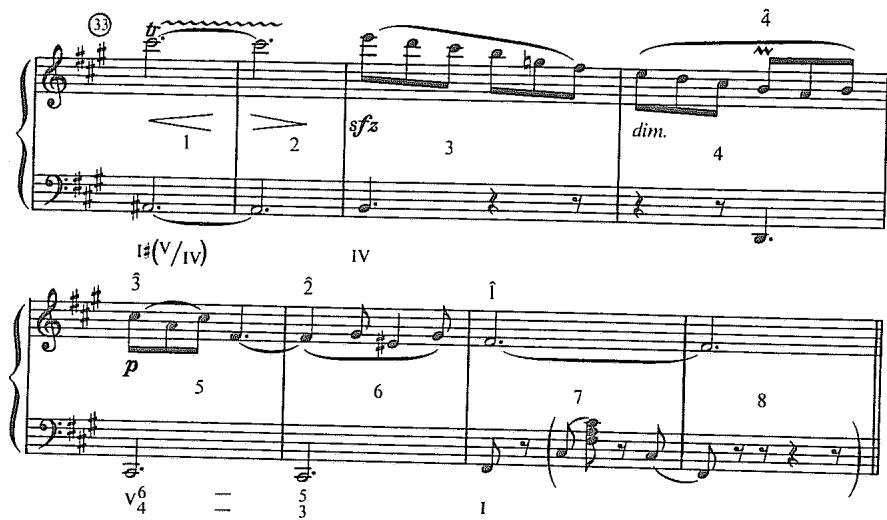
本段是某段较长引文的收尾,连字符与上下段不连贯,说明它承接的是前面被截掉的引文主体。其内部信息只有三处可定位:括号中的让步条件、否定比较结构(better…than from all the books of instruction)、以及歌德的引语“and thus is life won”。脚注编号8属于原文版面要素,作用待后续查看。
第2段(P0002)
原文复述
Although the idea of “songs without words” seems typically Romantic in its sheer figurativeness—its implication of transcending the concreteness of mere language $^{9}$ —the pieces themselves are conservative in many ways, not least in their rather simple melody-and-accompaniment textures. Chopin and Schumann were both far more original in the sonorous layout of their piano writing. It is, however, precisely in the area of phrase rhythm that Mendelssohn’s originality and mastery are most clearly manifest. Like all the best composers of character pieces, Mendelssohn managed to solve the Rhythm Problem most of the time, if not quite in every piece. Some of his solutions—quite naturally, in view of his background—hark back to 18th-century techniques; these he handles with an ease almost unique among composers of his generation. Others are peculiarly his own—or, rather, they reflect certain predilections so strong as to seem typically Mendelssohnian.
中文讲解
本段是本节论证的真正起点,承担承上启下的功能。它同时做两件事:一是限定门德尔松“无词歌”作为一种美学观念的浪漫性,二是把真正独创性的论域收窄到一个非常具体的音乐参数上。作者承认“无词歌”这个概念——暗示超越具体语言的纯音乐性——是典型的浪漫主义形象化表达(脚注9可能讨论这一点);但他随即指出,实际的音乐文本在许多方面是保守的,尤其是旋律加伴奏的织体非常简朴。这一点很重要,因为它排除了一个常见的误解:以为门德尔松的钢琴写法在音响层面也是激进的。作者用比较法把这一点钉牢:肖邦与舒曼在钢琴音响布局上远比门德尔松更有原创性。于是,门德尔松真正的原创性领域就只剩一个:phrase rhythm(乐句节奏)。作者由此引入“Rhythm Problem”(节奏问题)这一概念——即在性格小品(character pieces)中如何组织乐句,使之既符合形式又具有表现力——并声称门德尔松绝大多数时候都解决了这一问题。接着作者对解决方法进行二分:一类向18世纪技巧回溯(这与门德尔松所受的训练背景自然相关),且他在同代作曲家中以处理这类技巧的从容著称;另一类则纯属个人所有,强到足以被视为“典型的门德尔松式”。因此本段最后一句是预告:下文将分别讨论这两类解决方案,其中“属于他自己”的那一类将成为本节乃至本章的重点。
补充说明
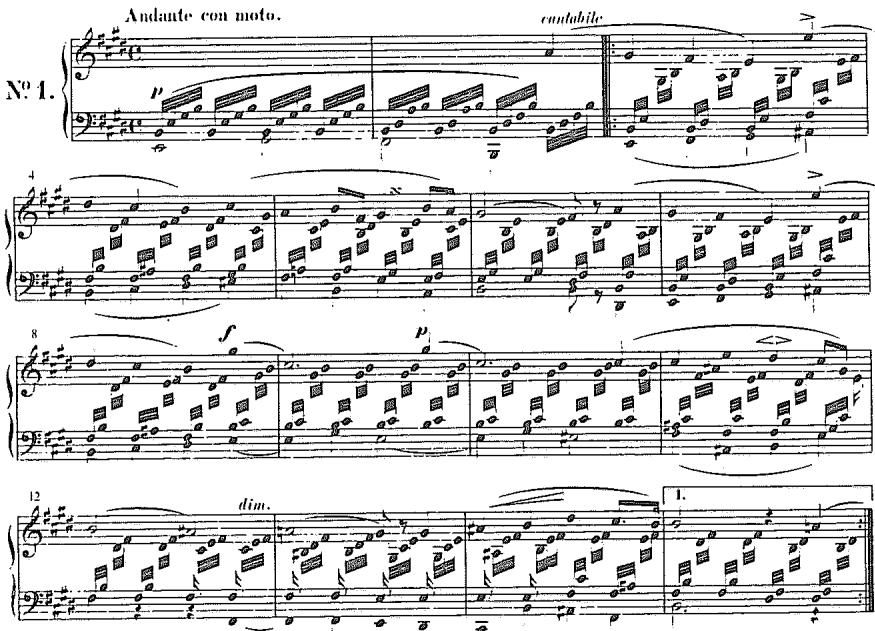
本段中三个概念需借助本段上下文界定:1)“conservative”指音乐文本层面而非美学观念层面;2)“the Rhythm Problem”是本节核心术语,应理解为性格小品中乐句长度、停顿与结构对称之间取得平衡的难题,作者没有给出更精确的学理定义,其含义在后续段落中通过具体作品才会被实例化;3)“typically Mendelssohnian”是作者为本节设定的核心风格标签。脚注9与前段脚注8同属版面要素,本段中未提供其内容。
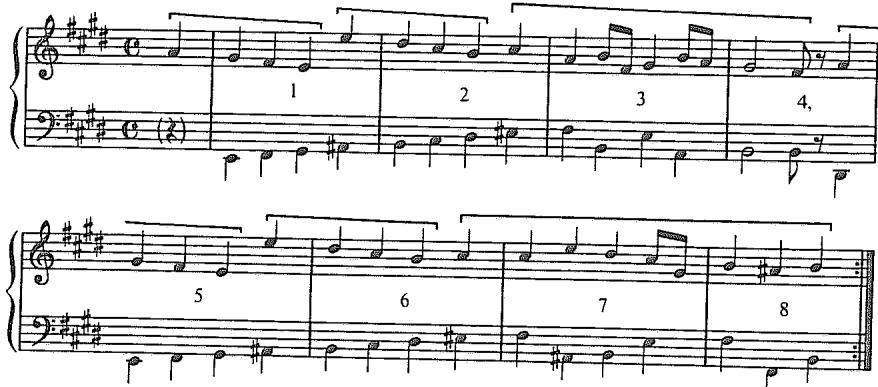
第3段(P0003)
原文复述
Two of the rhythmic techniques that Mendelssohn borrowed from the past are (1) phrase expansion and (2) the deceptive recapitulation of a principal theme. We will concentrate chiefly on the latter, for it seems clear that this is a technique that Mendelssohn learned from his beloved J. S. Bach.
中文讲解
本段是本节的论题声明段落,承担为整节定调的功能。作者开门见山指出,他从过去借鉴来的节奏技巧有两类,并以编号明确列出:(1)乐句扩展(phrase expansion),即在原有乐句结构的基础上通过加花、延续或重复将其拉长;(2)主题的“欺骗性再现”(deceptive recapitulation of a principal theme),即在应当出现主主题再现之处用别的材料或变体加以“替代”,使听者预期落空。作者随即宣布:本文将主要讨论第二项。这一选择的理由是清楚且唯一的——这种技巧明显是从他“挚爱的”J. S. 巴赫那里学来的。“beloved”一词点出门德尔松对巴赫的深厚崇敬,同时也暗示师承关系是判断技巧来源的关键证据。从论证结构看,作者先把目光收窄到第二类,再点出其巴赫来源,这就把整节的焦点安放在“门德尔松如何把巴赫的某种结构性戏法转化为浪漫主义性格小品中的修辞手段”这一问题上。读者因此明白:本节不打算面面俱到地谈门德尔松的所有节奏原创性,而是把一个可追溯、有源头、可分析的技巧作为切片,借此通向更一般的门德尔松节奏美学。
补充说明
本段中两个并列术语均在本节正文中首次出现并被编号界定,但它们都属于19世纪与20世纪音乐分析中的既有概念,作者并未给出形式定义。结合本段上下文可知:phrase expansion是乐句内部或乐句之间的延伸技术;deceptive recapitulation是把“再现”一词在更广意义上使用——不仅指奏鸣曲式中的主部回归被替换,也泛指主主题在预期位置上的“缺席式出现”。这两个概念在原文中以英文术语原样保留,进入中文讲解时通过释义方式呈现其内涵。巴赫(J. S. Bach)作为来源信息在原文中有明确表述。
脚注 / 边栏 / 图表 / 附加信息(如有)
本节附加材料包括两处脚注:脚注8附于P0001末尾,对应歌德引语“and thus is life won”的出处;脚注9附于P0002中“mere language”之后,可能讨论“无词歌”概念中“超越具体语言”之说的浪漫主义诗学背景。两处脚注在源文中均未展开,因此本节未对其内容做进一步判断。本节没有图表、谱例或边栏。
💡 本节核心要点
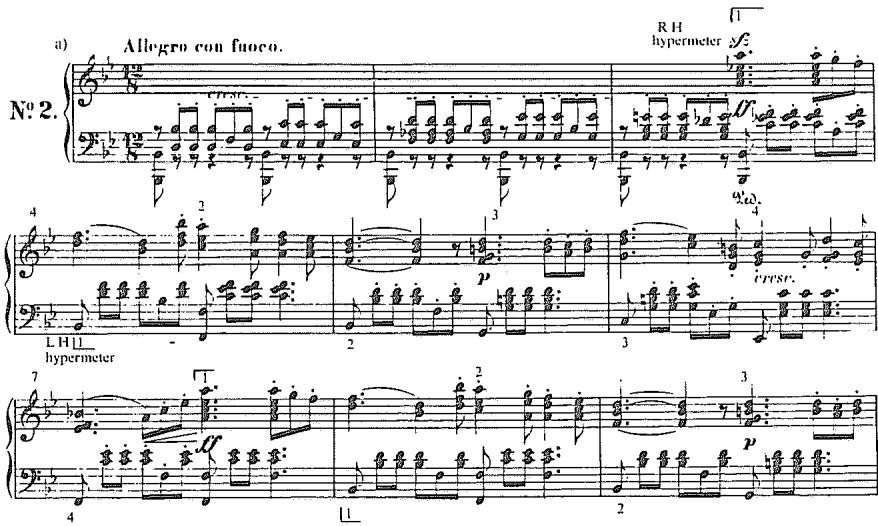
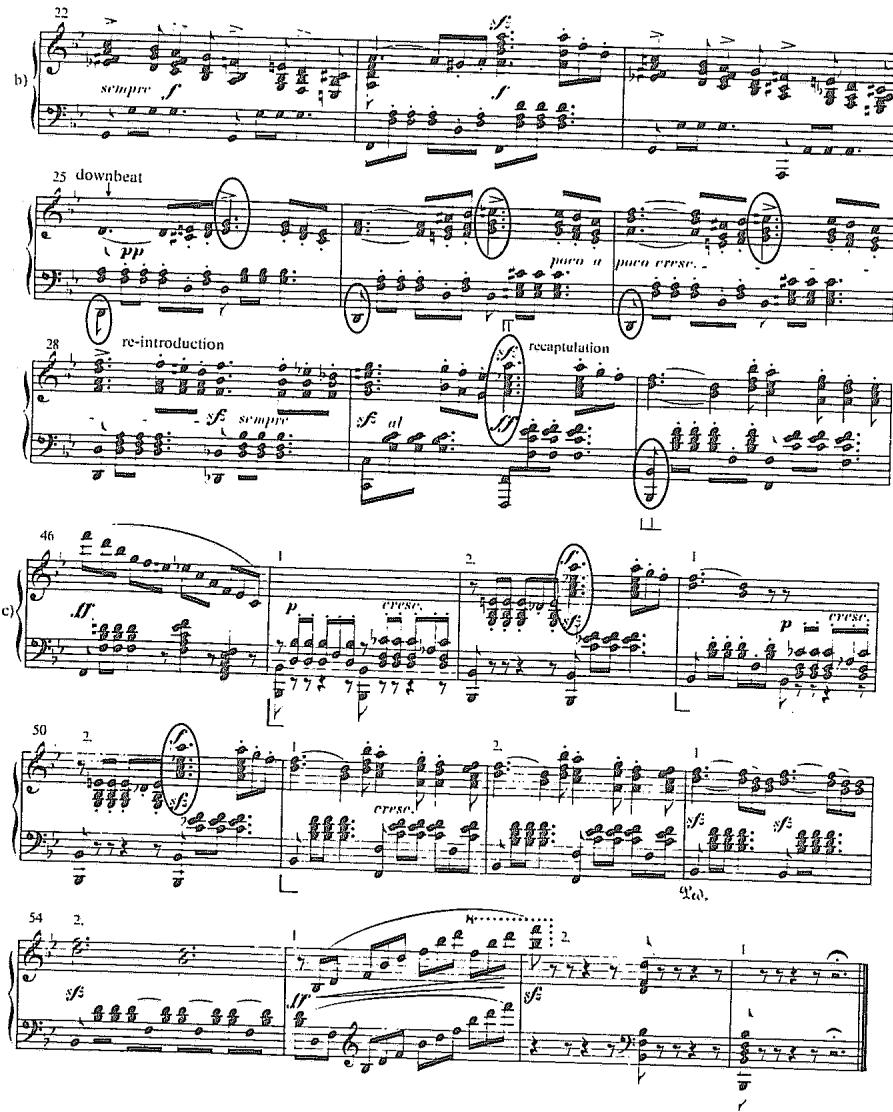
- 本节的真正论证从P0002开始:P0001只是一段带脚注的引文尾声,用以设定全章基调——门德尔松的音乐本身即“歌之范本”。
- 作者把门德尔松的“无词歌”做了观念与文本的区分:概念层面是浪漫的,织体层面是保守的;真正能体现门德尔松原创性的领域被收窄到“乐句节奏”。
- “the Rhythm Problem”(节奏问题)被确立为本节乃至本章的核心议题,特指性格小品中乐句组织如何在形式与表现之间取得平衡。
- 门德尔松的节奏解决方案被二分为两类:向18世纪技巧回溯的,以及纯属个人癖好、足以称为“典型门德尔松式”的。
- 本节明确将焦点放在两件借自过去的节奏技巧之一——“主题的欺骗性再现”——并指出其巴赫来源。
- “乐句扩展”作为另一项借自过去的技巧被列出,但被宣布略过,由此把节内的论述空间集中于“欺骗性再现”这一可追溯到巴赫的可分析对象。
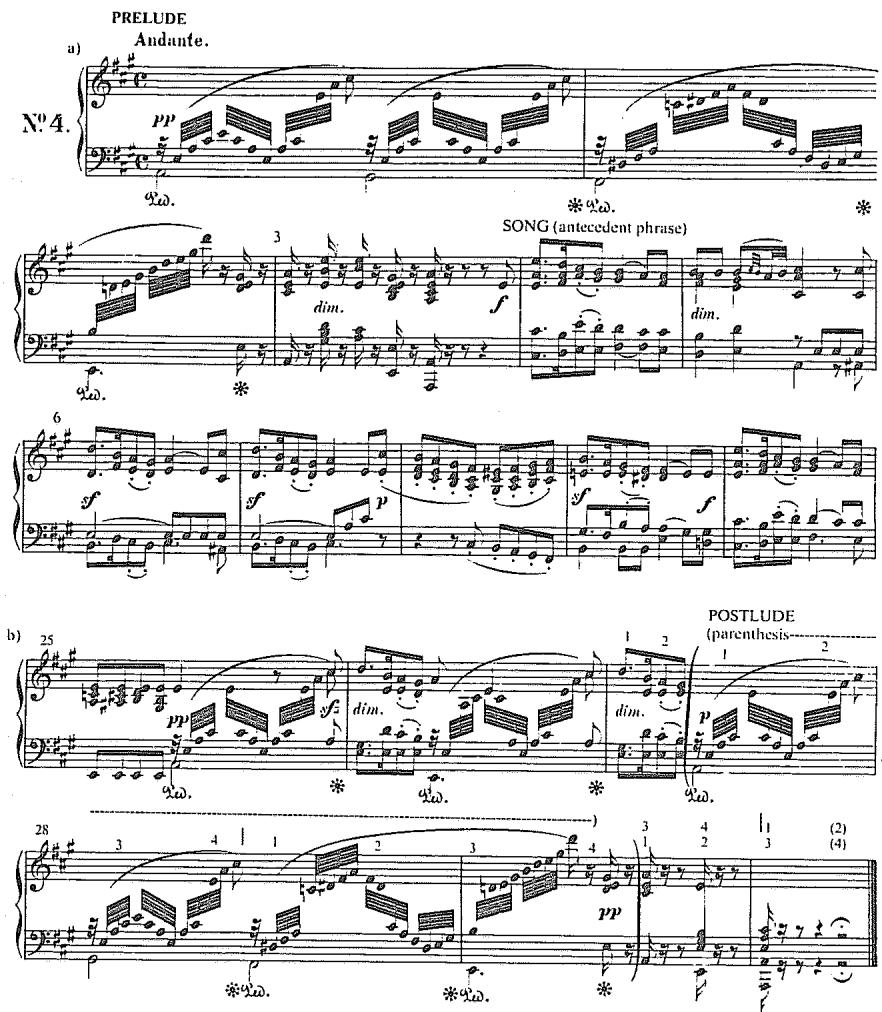
🔑 关键术语
- songs without words:门德尔松钢琴小品集《无词歌》(Lieder ohne Worte)的英文表述。本节把它拆成两个层面:作为观念是浪漫主义的形象化表达,暗示音乐可以越过具体语言;作为实际钢琴织体则是旋律加伴奏的保守布局。
- phrase rhythm:乐句节奏。本节中被作者指认为门德尔松真正原创性所在的参数,即各乐句在长度、停顿、重音与相互关系上如何被组织。它是排除掉音响布局与织体之后,剩下的、能够体现作曲家个人风格的层面。
- the Rhythm Problem:节奏问题。本节核心术语,指性格小品(character pieces)中乐句组织既要合形式又要有表现力的难题。原文未给出学理定义,但在本节中作为衡量门德尔松成就的标尺出现——作者认为他绝大多数时候都解决了这一问题。
- phrase expansion:乐句扩展。本节中作为门德尔松自过去借鉴的两项节奏技巧之一被列出,指在原有乐句结构基础上通过加花、延续或重复将其拉长的技术。本节未展开讨论。
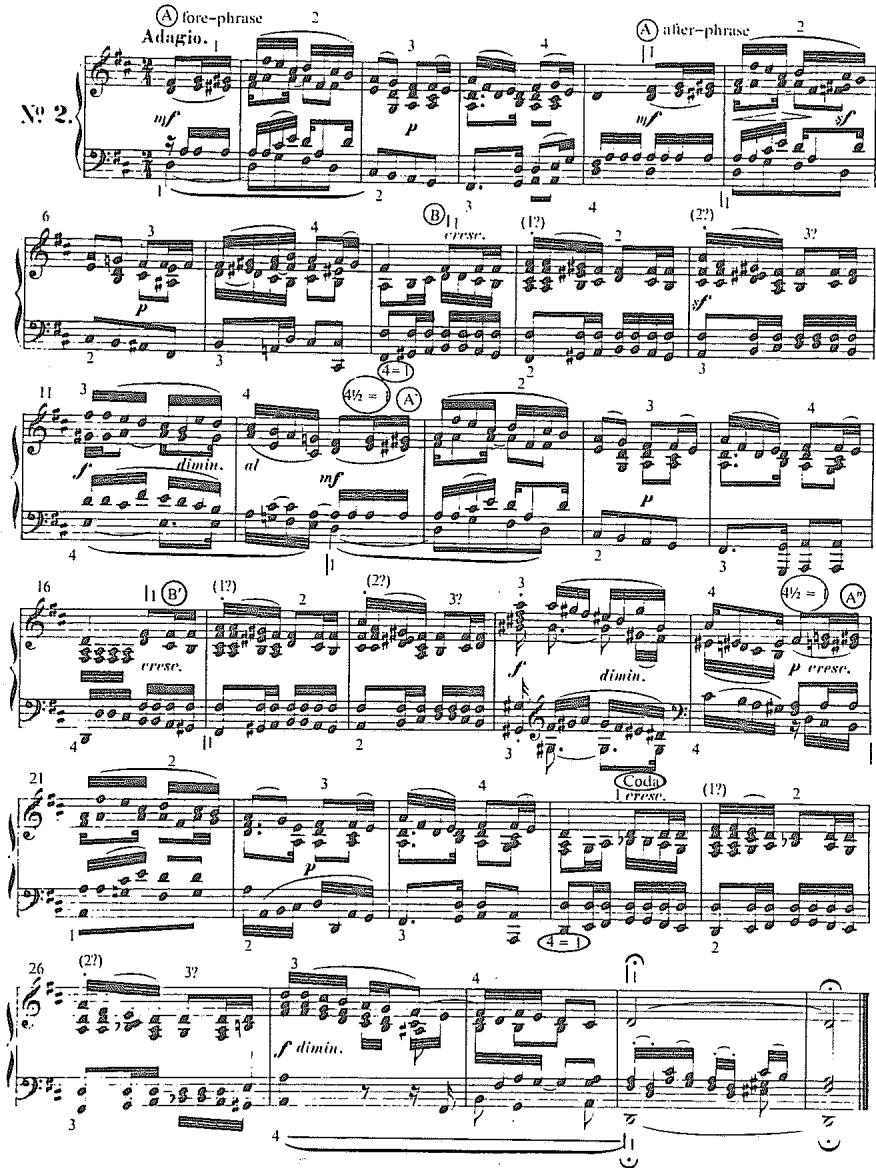
- deceptive recapitulation (of a principal theme):主题的欺骗性再现。本节核心焦点术语,指在应当出现主主题再现的位置,以别的材料或变体替代,使听者预期落空的技术。本节中作者强调它是门德尔松从 J. S. 巴赫那里学来的,并将在下文中具体分析。
- typically Mendelssohnian:作者为本节设立的风格标签,用以称呼那些并非来自18世纪传统、却强烈到足以成为门德尔松个人标识的节奏癖好。它在本节中是与“借自过去”相对立的那一类解法的统称。
s2 [描述性拆分] Binary Form and the Deceptive Thematic Return in “Sehnsüchtig,” Op. 7, No. 6
第1段(P0004)
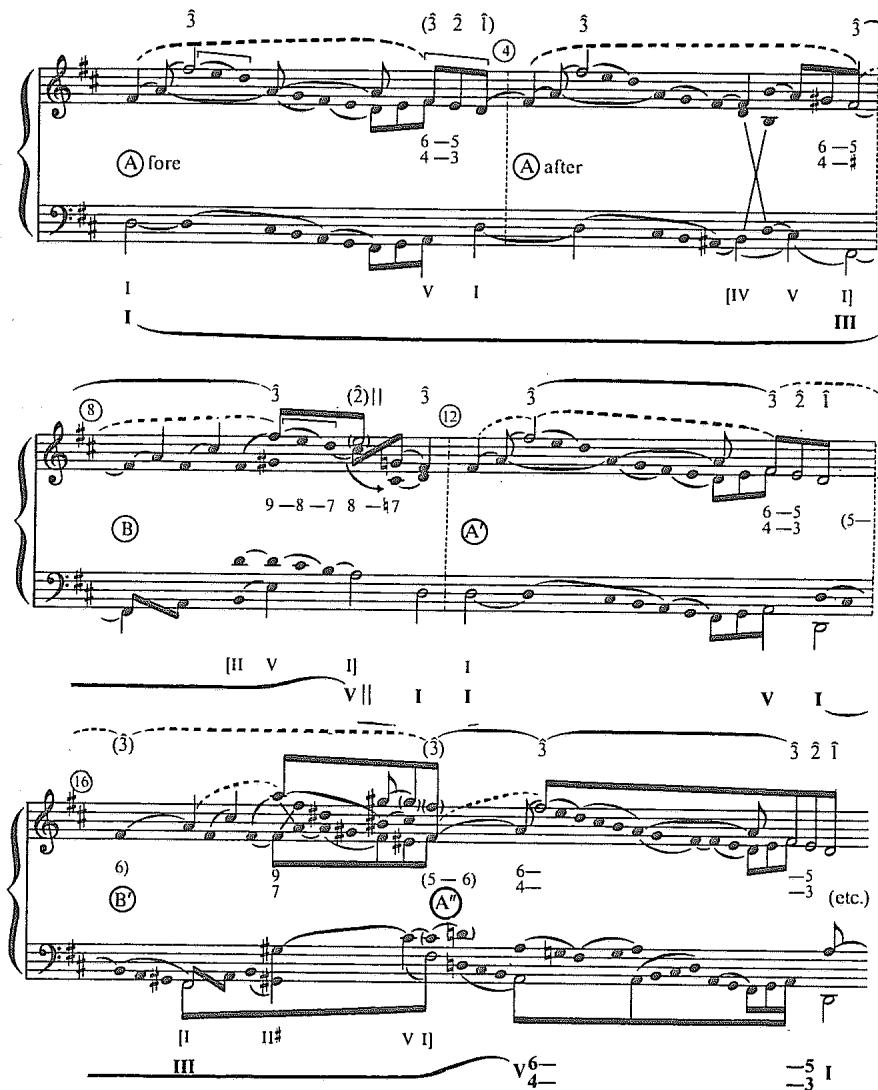
原文复述
Example 6.3 is not drawn from the Songs without Words; it is in fact the sixth piece of the Sieben Charakterstücke (Seven Character Pieces), Op. 7. The piece bears the title “Sehnsüchtig” (“Longingly”). In spite of its Romantic title and the label “character piece,” the work appears to have been modeled directly on the sarabande from Bach’s French Suite in D Minor (BWV 812), which it resembles in texture, motivic content, and rhythm—although the characteristic second-beat accent of the sarabande is much less conspicuous in Mendelssohn’s piece than in Bach’s. (Footnote 10 is attached to this claim.)
中文讲解
本段首先纠正了一个可能的误解:例6.3并非出自门德尔松最著名的《无词歌》,而是来自Op.7《七首性格小品》中的第6首,标题"Sehnsüchtig"意为"渴望"或"思念"。作者借此提示:尽管标题具有浪漫主义情调,体裁也标明为"性格小品",但音乐语言却直接取材于巴赫D小调法国组曲BWV 812中的萨拉班德舞曲,二者在织体、动机内容和节奏上都有相似之处。作者特别指出一处差异:萨拉班德舞曲典型的第二拍重音在门德尔松这里被显著弱化,这正是巴洛克与浪漫风格混合的标志—保留舞曲骨架却淡化其节奏标记。脚注10为本段关于巴赫来源的判断提供出处支持。
补充说明
本段为整节定下基调:将门德尔松置于巴赫传统的延伸线上,为下文分析其作品形式结构(与巴赫舞曲相同的二部形式)做铺垫。“character piece"与萨拉班德之间的反差是本节论证的起点—表面浪漫,骨子里古典。
第2段(P0005)
原文复述
Op. 7, No. 6 is written in a binary form very similar to that favored by Bach for many of his dance pieces. The first reprise consists of a parallel period of nine measures, cadencing in the key of the dominant. The repeat is written out. The second reprise contains two phrases of eight measures each: the first of these cadences in III (IV would have been a more typical choice for Bach); the second returns to and cadences in the tonic. (Footnote 11 is attached.)
中文讲解
本段描述作品的整体曲式结构:A段是一个九小节的平行乐段,结束在属调上(即D小调作品结束在A大调),且重复记号被写成实际反复(written out),而不是以反复记号形式留待演奏者处理。B段由两个八小节的乐句组成:第一句结束在III级(在D小调中即F大调),作者指出按巴赫的惯例这里更常用IV级;第二句回到主调并以正格终止结束。值得注意的是,作者以"类似于巴赫"作为分析起点—九小节的非对称长度、明确的属调中段终止、回到主调的收束,这些都是巴洛克舞曲二部形式的典型特征,同时"III而非IV"的选择又透出门德尔松的个性。
补充说明
“parallel period"指两个乐句以同一或相近旋律起始、并以不同的和声终止(典型为:一句半终止于属,二句正格终止于调)的结构。九小节说明两句并非等长(如8+8),而是8+9或类似非对称划分,呼应巴洛克舞曲的常见做法。
第3段(P0006)
原文复述
As in many of Bach’s two-reprise dance pieces—particularly those in which the second reprise, as here, is made up of two eight-measure phrases—there is a return to the opening motive in the final phrase, though not at its beginning. In this instance the return, at m. 31, places the motive at its original pitch level; Mendelssohn dramatizes the moment with a subito piano following an intense crescendo. Yet this thematic reminiscence is not also a return to a functional tonic harmony. The motive appears over a cadential 6/4 chord, as part of a V–I cadence that completes itself only in the final measure of the piece. Because the thematic return does not coincide with a reestablishment of the original tonic harmony, it does not constitute a true recapitulation.
中文讲解
本段是小节的核心论证。它陈述了三层事实:1) 手法上,B段最后八小节确实再现了开篇动机(巴赫舞曲中常见);2) 戏剧处理上,门德尔松用subito piano(突弱)紧接强烈渐强来突出m.31处动机回归的"时刻感”,并将动机置于原高—这暗示作者是有意为之的"伪再现”;3) 和声判断上,动机出现于终止6/4和弦之上,作为V–I进行的一部分,且该终止只有在全曲最后一小节才真正完成。因此动机的回归并不伴随主和声的原状恢复—它"看起来"像再现,“听起来"像再现,但在功能和声层面并非真正的再现。这是标题"deceptive thematic return”(欺骗性的主题回归)所指的核心现象。
补充说明
“cadential 6/4"指终止式中的6/4和弦(K6/4),其在严格对位中常被分析为V的装饰形式而非独立的I,因此其上方旋律虽"在主音之上”,和声上却仍属属功能的延续,这正是为何作者强调"functional tonic harmony"必须真正确立。“subito piano"与"intense crescendo"的并置是典型的浪漫主义修辞—通过力度反差来"标记"一个结构事件。
第4段(P0007)
原文复述
By “recapitulation” I mean a return, not necessarily simultaneous, to the motivic and harmonic situation of the first section of a piece (exclusive of any introduction), whatever the overall formal design of the piece might be. A recapitulation need not restate the entire opening section. However, if that section originally began with a tonic harmony or tonic prolongation, a true recapitulation will somehow reestablish the original harmonic state. In other words, it will reestablish the tonic harmony, not merely the tonic key. (If a piece begins away from the tonic, however, a recapitulation will probably do likewise.) (Footnote 12 is attached.)
中文讲解
本段是作者对自己所用术语"recapitulation”(再现)的精确定义,为前段判断"这不是真正的再现"提供理论依据。要点包括:1) 再现不必同时恢复动机与和声—两者可在时间上错开(“not necessarily simultaneous”);2) 再现不必复述整个第一段;但3) 关键约束:如果作品开头是主和声或主和声延续,那么真正的再现必须以某种方式重新确立"那个原来的和声状态"—即主和声本身,而非仅仅是"主调"这一调性范畴。作者用括号补充说明:如果作品原本就不从主音开始,那么再现大概也不会从主音开始—这一定义尊重了非主调开头的可能性,避免对非典型作品强加标准。脚注12为此定义提供进一步说明。
补充说明
“tonic harmony"与"tonic key"的区分是本节最关键的理论概念:前者指具体的和声状态(即主和弦的持续或出现),后者仅指调性归属。终止6/4和弦是主调中的属功能,因此即使旋律呈现主题,只要和声未确立主功能,就不构成真正的再现。
第5段(P0008)
原文复述
[Figure caption: Example 6.3. Mendelssohn: “Sehnsüchtig,” Op. 7, No. 6. The actual musical notation of the example is not reproduced in this text and must be consulted in the original source.]
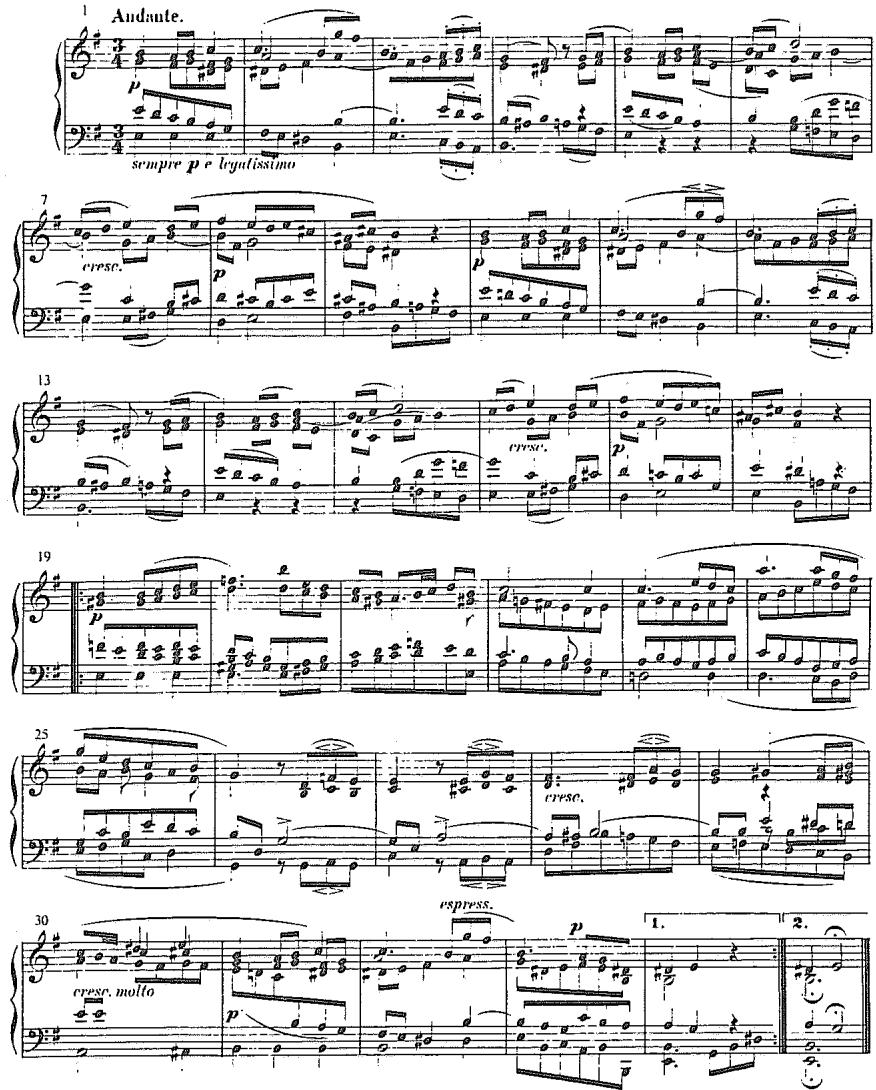
中文讲解
此条为本节讨论的核心对象—例6.3"Sehnsüchtig"Op.7 No.6—的乐谱图注位置。图片本身的音符内容在当前文本中被省略,需要查阅原书图版才能看到m.31处动机再现处的具体谱面,以及作者所分析的终止6/4和弦、subito piano与crescendo的力度标记。在阅读本文论证时,应将m.31这一关键节点与乐谱对照理解。
第6段(P0009)
原文复述
The image contains no text. The vertical line is a stylistic or background element and must be ignored according to the rules.
中文讲解
本条说明图中除乐谱内容外不存在其他文字;图中的竖线属于风格性或背景元素,依据规则应忽略不计,不视为乐谱中的小节线或结构标记。这是一条对图像读取的元说明,与音乐分析本身无直接关联。
脚注 / 边栏 / 图表 / 附加信息(如有)
本小节涉及两处脚注(10与11在P0004、P0005末尾标注,12在P0007末尾标注)。脚注10为门德尔松Op.7 No.6与巴赫BWV812萨拉班德之间渊源提供文献支持;脚注11对第一段为九小节以及终止选择的具体比较提供参考;脚注12则对作者关于"recapitulation"的定义作进一步说明或引证。本节的核心乐谱例证为Example 6.3(即"Sehnsüchtig"全文谱例),m.31是分析的关键结构位置。
💡 本节核心要点
- 例6.3出自门德尔松Op.7《七首性格小品》第6首"Sehnsüchtig”,虽具浪漫标题,形式却直接取自巴赫D小调法国组曲BWV812的萨拉班德舞曲。
- 作品采用巴洛克式的二部形式:第一部分为九小节的平行乐段,结束在属调;第二部分由两个八小节乐句组成,分别结束于III级与主调。
- 第二部分最后八小节在m.31处再现开篇动机,且以subito piano接crescendo加以戏剧化强调,听感上像再现。
- 然而再现动机出现于终止6/4和弦之上,作为V–I进行的一部分,主和声功能要到全曲最后一小节才确立,因此这次主题回归在功能和声上并非真正的再现。
- 作者将"recapitulation"严格定义为对第一部分动机与和声状态的同时或先后回归,其中关键是"主和声"本身而非仅"主调"—这是判断"伪再现"的理论标尺。
🔑 关键术语
- binary form:二部形式(AB),由两个相对独立的部分组成,常用于巴洛克舞曲。本节中门德尔松Op.7 No.6采用类似巴赫的处理:A段九小节收束于属调,B段两乐句收束于主调。
- parallel period:平行乐段,由两个起始材料相似但终止不同的乐句构成,典型为第一句半终止于属、第二句正格终止于调。本节中A段即为九小节的平行乐段。
- sarabande:萨拉班德舞曲,巴洛克组曲中的慢速三拍子舞曲,特征是第二拍上的重音。本节指出此特征在门德尔松的版本中已被弱化。
- cadential 6/4:终止6/4和弦,在严格对位中分析为V的装饰形式而非独立的I和声。因此即便其上方旋律呈现主题素材,和声上仍属属功能延续,不构成主和声的原状恢复。
- subito piano:突弱,力度术语。本节中m.31处主题再现被作者用subito piano紧接强烈渐强的处理加以戏剧化,用以标记这一"伪再现"时刻。
- recapitulation (本节定义):作者将其定义为:对第一部分动机与和声状态的回归,且若原作以主和声起始,则真正的再现必须重新确立主和声本身,而非仅仅维持主调—这是本节判断m.31处主题回归"非真正再现"的理论依据。
s3 [描述性拆分] Defining Recapitulation and the Bachian Heritage
第1段(P0010)
原文复述
Reestablishing the tonic harmony is precisely what the thematic return in Example 6.3 does not do. It is not on the tonic but, rather, still on the way to the tonic. The tonic is not reached shortly after the thematic return begins—as happens with some frequency in 19th-century music—but only at the very end. The four-measure return is thus embedded within the closing phrase in a way quite similar to the last four measures of “Wasserfahrt” (Example 6.2). Since neither those final four measures nor these constitute a separate phrase, neither should be considered a separate section of their respective forms.
中文讲解
本段的核心主张是:Example 6.3 中的主题回归并没有建立主调(tonic)和声,而是发生在通往主调的路上,直到曲终才到达主音。
承接前文对"Wasserfahrt"(Example 6.2)的分析,作者把两首作品的尾部结构做类比:两者的最后四小节都嵌入了主题回归的素材,但由于它们都不是独立的乐句,因此都不应被视为各自曲式中独立的一个"段落"。
作者特别指出这与19世纪音乐中常见的情形不同——在19世纪,主题回归后通常很快就会到达主调;但这里的主题回归直到曲终才真正落在主音上,因此打破了"主题回归=主调段落开始"的常规预期。这是用反例来强化自己论点的方式:先承认常态,再指出本曲偏离常态的特殊性。
论证意义:这一段为下一段将提出的"欺骗性再现"(deceptive recapitulation)概念做铺垫——主题回来了,但并没有真正成为再现段,因为它缺乏独立段落的形式标志(到达主调+独立乐句)。
补充说明
Example 6.2 是前文分析的 Mendelssohn 歌曲"Wasserfahrt",Example 6.3 则是本节正在分析的"Sehnsüchtig";两者的尾部四小节在本段中被作为类比对象。
第2段(P0011)
原文复述
A reduction of the bass line from m. 26 to the end will help to clarify the harmonic situation in the closing phrase of “Sehnsüchtig” (see Example 6.4).
中文讲解
这是一个简短的过渡句,作用是把读者的注意力引向下一个分析工具——Example 6.4:从第26小节到结尾的低音线简化(bass line reduction)。
所谓"低音线简化",是一种把织体中其他声部去掉、只保留(必要时合并)低音线条的分析方法,目的是让和声骨架与终止式结构显得更清楚。
本句本身没有提出新主张,但其功能在于:作者意识到单纯口述无法让读者看清"主题回归时和声还没有解决"这一点,因此需要在下一段结合 Example 6.4 给出更具体的论证。
第3段(P0012)
原文复述
Notice the specific similarity to “Wasserfahrt”: there, too, the last four measures of melody, while seemingly an independent phrase, were introduced over the 6/4 chord of a lengthy final cadence. The harmonic stability of the thematic reminiscence—in “Wasserfahrt” only one measure (m. 11) corresponds to the opening phrase—is thereby removed. (An important point: the apparent root-position tonic on the downbeat of m. 33 is not yet the resolution of the long dominant, which is prolonged throughout mm. 31–33. The notes d# and e in mm. 32–33 are taken over, quite literally, from a tenor voice; the true bass voice resumes at the second eighth note of m. 33.)
中文讲解
本段提供了"Sehnsüchtig"尾部结构与"Wasserfahrt"的具体技术类比,并补上一个关键的技术澄清。
第一层论点:两首作品的共同手法是,尾部的"旋律看似独立乐句"其实是被引入到一个长终止式的6/4和弦之上的。也就是说,旋律虽然给人以新乐句开始的听觉印象,但和声层面它仍处在前一句的终止式内部,因此"主题回忆的和声稳定性被移除"。作者特别说明:在"Wasserfahrt"中只有第11小节这一小节对应了开头乐句,其余旋律只是发生在未解决的属和声之上——这一句插注加强了类比的可比性。
第二层技术澄清(括号内),这是本段教学价值的核心:
- 第33小节强拍上看起来是主音根音位置的和弦,但这并不是那个长长的属和弦的真正解决——属音被延长贯穿了第31–33小节。
- 第32–33小节的d#和e这两个音,实际上是字面意义上从次中音声部(tenor voice)“借来"的,真正的低音声部要等到第33小节第二个八分音符才重新出现。
这一技术细节的论证意义在于:表面上看第33小节强拍像是主题回归后立刻建立的主调,但实际低音进行表明主调的稳定化要到更晚才发生。这为上一段(P0010)“主题回归没有建立主调"的论点提供了具体的和声与声部证据。
补充说明
“tenor voice”(次中音声部)在此上下文中是音乐织体中的人声声部或器乐声部之一;作者用"quite literally"强调这两个音在表面上来自其他声部,只是被暂时借用到当前的声部位置。
第4段(P0013)
原文复述
Now it should be clear what is meant by “the deceptive recapitulation of a principal theme”: a thematic motive, which initially formed the beginning of a phrase, returns in the middle of a phrase—trying but not succeeding, as it were, to appear like its old self. (Note that this concept is not equivalent to the “false recapitulation” that sometimes occurs in the development section of sonata forms.) In terms of the form, the return does not constitute a separate section. “Sehnsüchtig” remains binary, not ternary, in its form, and even the compromise term “rounded binary” should only be applied with qualification. This procedure, I repeat, is one that Mendelssohn seems to have inherited from J. S. Bach: some of the simpler examples of this technique in Bach’s keyboard suites include the sarabande from the Fifth French Suite (G Major), the polonaise and minuet from the Sixth French Suite (E Major), and the first minuet from the Fourth English Suite (F Major). ¹³
中文讲解
本段在小节中承担"收束+定位"的功能:先给出术语定义,再做出曲式判断,最后把这个手法放入音乐史的传承谱系。
第一,给出本节核心术语"主调主题的欺骗性再现”(deceptive recapitulation of a principal theme)的定义:原本作为某乐句开头的主题动机,在另一个乐句的中间位置回归,但它试图装作原本的自己,却没有成功。作者用"trying but not succeeding"这一拟人化说法,强调主题虽然"回来了”,却缺乏使它真正成为再现段的形式条件(独立乐句+主调和声)——所以是"欺骗性"的。
第二,作者专门澄清:这一概念不等于奏鸣曲式展开部中出现的"假再现"(false recapitulation)。两者虽然名字相近,但发生位置与曲式功能不同——前者是主题在一个乐句内部的局部伪装出场,后者是展开部中模仿再现段的整段段落。容易误解之处是把两者等同,本段特意划清界限。
第三,曲式判断:“Sehnsüchtig"的曲式是二段式(binary),不是三段式(ternary);即便是折中术语"带再现的二段式”(rounded binary),也只有在加限定条件下才能用——因为这里所谓的"再现"其实并不构成独立段落。这一判断直接关系到作品的体裁定位。
第四,源头归属:作者以"I repeat"提示这一主张在前文已提及但仍需强调,把该手法定位为 Mendelssohn 从 J. S. Bach 那里继承的传统,并给出 Bach 键盘组曲中相对简单的具体例子——G大调第五号法国组曲的萨拉班德、E大调第六号法国组曲的波兰舞曲与小步舞曲、F大调第四号英国组曲的第一小步舞曲——作为读者可参证的实例群。
补充说明
脚注13(¹³)位于本段末尾,是本小节中出现的附加材料标记;其具体内容未在当前提供的段落文本中出现,但根据行文位置可推断它应与作者所列 Bach 键盘组曲例子的进一步出处、谱例页码或比较说明有关,用以支持 Mendelssohn 该手法源自 Bach 的主张。
脚注 / 边栏 / 图表 / 附加信息(如有)
本小节末尾引用了脚注13(¹³),其具体内容未在提供的段落文本中出现,根据上下文判断应与作者所列 J. S. Bach 键盘组曲例子(G大调第五号法国组曲的萨拉班德、E大调第六号法国组曲的波兰舞曲与小步舞曲、F大调第四号英国组曲的第一小步舞曲)的进一步来源、谱例页码或比较说明有关,用以支持 Mendelssohn 该手法源自 Bach 的主张。除此之外,本小节多次引用外部谱例(Example 6.2 “Wasserfahrt”、Example 6.3 与 Example 6.4 “Sehnsüchtig”),这些谱例本身不在文本范围内,但本节论证完全建立在这三个谱例之上。
💡 本节核心要点
- Example 6.3 中的主题回归没有建立主调和声,而是在通往主调的路上,直到最后才落在主音——这与19世纪常见做法形成对比。
- 尾部四小节的主题回归被嵌入收束乐句内部,与"Wasserfahrt"(Example 6.2)做法类似,因此不应被视为独立的再现段。
- 低音线简化(Example 6.4)显示第33小节强拍上的主音并非真正的解决,属音延长贯穿第31–33小节,主调的稳定化要到更晚才发生。
- 由此定义"主调主题的欺骗性再现":主题动机在乐句中间回归,试图重现自身却未能做到——本节明确把它与奏鸣曲式展开部中的"假再现"区分开来。
- 曲式判断上,“Sehnsüchtig"保持二段式(binary)而非三段式,即便"rounded binary"也只能在加限定条件下使用。
- 作者主张该手法源自 J. S. Bach 的键盘组曲传统,并列举了 Bach 数首组曲中的对应例子作为佐证。
🔑 关键术语
- deceptive recapitulation of a principal theme:本节定义的核心术语,指原本作为某乐句开头的主题动机在另一个乐句的中间位置回归,形式上试图重现自身却未能成功(因缺乏独立乐句与主调和声),从而构成一种"欺骗性"的再现。
- false recapitulation:出现在奏鸣曲式展开部中、整段模仿再现段的情形;本节明确把它与"欺骗性再现"区分开来——后者是主题动机在乐句内部的局部伪装,而非整段落的再现。
- tonic / dominant harmony:主调和声(tonic)与属和声(dominant);本节判断一个主题回归是否构成真正再现段的关键和声标志是主调的建立,属音的延长则会推迟这种建立。
- binary form / rounded binary / ternary form:二段式、带再现的二段式、三段式;作者坚持本曲为二段式,因为所谓"主题回归"并未形成独立段落,即便用折中术语也要加限定。
- bass line reduction:低音线简化,指把织体中其他声部去掉、仅保留或合并低音线条的分析手法,用以揭示表面之下的和声骨架与终止式结构。
- 6/4 chord of a lengthy final cadence:在长终止式中位于主音之上、以6/4音程形式呈现的和弦;本节用它来说明尾部的"独立旋律"实际是落在未解决终止式内部,而非真正的新乐句起点。
- Bach’s keyboard suites(French Suite / English Suite 中的萨拉班德、波兰舞曲、小步舞曲):作者据以主张 Mendelssohn 这一手法传承自 Bach 的具体作品群;本节列举了 G大调第五号法国组曲的萨拉班德、E大调第六号法国组曲的波兰舞曲与小步舞曲、F大调第四号英国组曲的第一小步舞曲作为相对简单的例子。
s4 [描述性拆分] Introduction to the Venetian Gondola Song, Op. 30, No. 6
第1段(P0014)
原文复述
One might perhaps regard “Sehnsüchtig” as a derivative work, a bit of the deliberate archaism in which Mendelssohn sometimes indulged. If so, the appearance of a Bach-like rhythmic device might be attributed to the piece’s stylistic patrimony. But the same device is used, in a subtler and quite original manner, in the well-known Venetian Gondola Song in F# Minor (Op. 30, No. 6) from the second book of Songs without Words (see Example 6.5).
中文讲解
本段承担一个关键的反驳前置工作:作者预判读者可能对前文"Sehnsüchtig"中的"巴赫式节奏手法"提出一种质疑——既然门德尔松有时会刻意模仿巴赫风格,那么该手法的出现是否只是风格复古(archaism)的产物,而非原创?这种质疑的逻辑是:若作品被视为"派生性的”,其特殊手法便可归因于"风格祖传"(stylistic patrimony),不必视为作曲家的独立选择。作者用一个转折(“But”)立即封堵这条退路:同一手法也出现在《威尼斯船歌》Op. 30, No. 6(《无词歌》第二集)中,但用得更精细、更具原创性。也就是说,在门德尔松一部极为著名、风格独立的作品中重复出现这一手法,就排除了将其仅视为"巴赫模仿"的解释。本段的论证功能是为后文奠定比较基础——从《无词歌》中挑选一个大家熟悉的例子,与"Sehnsüchtig"形成平行对照,以此检验同一手法在不同语境中的运作。
补充说明
“Deliberate archaism”(刻意的风格复古)指作曲家有意识地借用早期风格;“stylistic patrimony”(风格祖传)强调手法被视为从巴赫传统继承而来,而非门德尔松自己的发明。Op. 30 是门德尔松《无词歌》第二集的编号。
第2段(P0015)
原文复述
Example 6.4. Voice-leading reduction of Mendelssohn’s Op. 7, No. 6, mm. 26–34, bass only
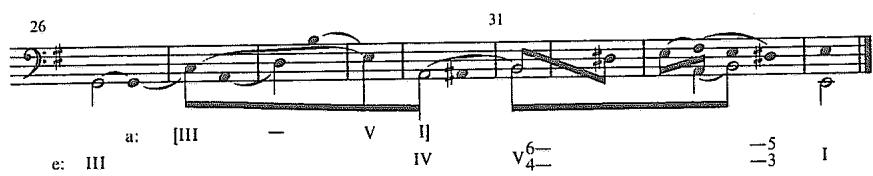
中文讲解
这是图表占位符,标注为 Example 6.4:门德尔松 Op. 7, No. 6 第 26–34 小节的声部进行缩简(voice-leading reduction),仅显示低音。从其在 P0014 与 P0016 之间的位置推断,此图应展示"Sehnsüchtig"中主题于终止六和弦之上重现的具体和声/低音进行,作为支持前段论点的视觉证据。需要查看原图以确认细节。
补充说明
声部进行缩简(voice-leading reduction)是音乐分析中保留骨架声部、剥离装饰音与重复音的技术;此处仅保留"低音"提示作者只关心低音线条中的终止式逻辑。Op. 7, No. 6 即上文讨论的"Sehnsüchtig"。
第3段(P0016)
原文复述
This piece appears to be a typical three-part song form, ABA’, with a brief introduction and a somewhat longer coda. But the way in which the principal theme returns, in m. 37, should give us pause after our examination of “Sehnsüchtig.” As in that piece, the theme reappears over a cadential 6 chord, following—as in
中文讲解
本段开始正式切入对《威尼斯船歌》Op. 30, No. 6 的分析。作者先给出一个表面观察:这首作品看似一首标准的 ABA’ 三段体歌曲形式,前有短引子,后有稍长的尾声(coda)。然而"但是"(“But”)一词立刻颠覆这一表面印象:主部主题在第 37 小节再现的方式,应当让我们在审视完"Sehnsüchtig"之后"停顿一下"(give us pause)——这意味着此处存在一个与前例相同的不寻常手法。紧接着,作者揭示这一手法的实质:主题再次出现时,正是处于一个终止六和弦(cadential 6 chord)之上,其接续方式正与"Sehnsüchtig"中相同。段落末尾"following—as in"是未完成的句子,将跨越到下一段(此处即示例图)继续。本段的论证功能是:通过对一个表面"典型"的形式进行细致审察,揭示出隐藏的、非典型的和声配置,从而与"Sehnsüchtig"构成对照,强化作者关于这一手法并非巴赫风格复古的论点。
补充说明
ABA’ 是三段体的一种标记,A’ 表示 A 段有变化的再现;“cadential 6 chord”(终止六和弦)通常指大小调中出现在属和弦之前的下属功能六和弦(一般即 I6/4 的功能替换——但此处更可能是指传统的 cadential six-four chord 之前的六和弦形式,或指 6 音附加于终止式的特殊处理,需结合 Example 6.5 才能确认其具体形态)。
第4段(P0017)
原文复述
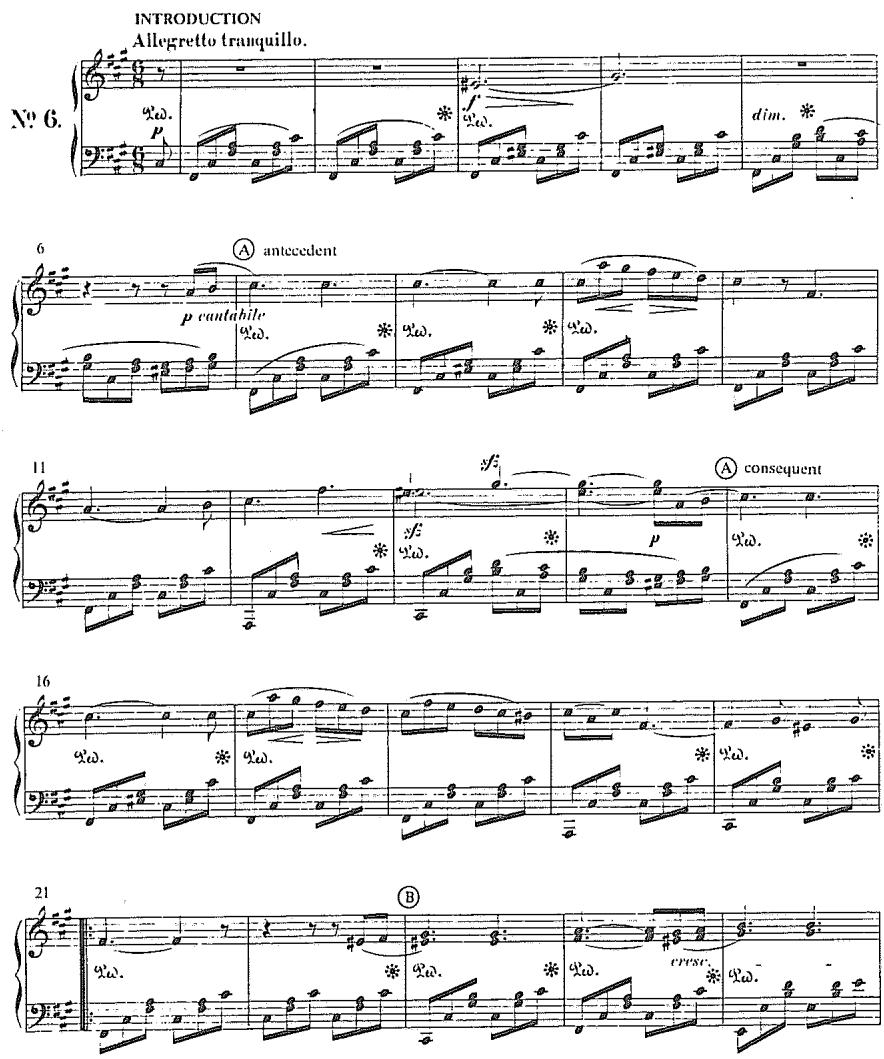
中文讲解
这是图表占位符,标注为 Example 6.5:门德尔松《无词歌》中的《威尼斯船歌》Op. 30, No. 6。结合 P0016 的描述,此图应展示该作品第 37 小节主部主题再现处的乐谱片段,使读者能够直观看到主题在终止六和弦之上重现的具体情形,并与 Example 6.4(“Sehnsüchtig"中的对应情形)形成并列对照。需要查看原图才能确认具体的终止六和弦形态与声部细节。
补充说明
图注中将作品明确归属为《无词歌》(Songs without Words),并标明升 f 小调调性,与 P0014 中的 F# Minor 一致。两幅示例图(6.4 与 6.5)构成视觉对照,是本节论证的核心证据。
脚注 / 边栏 / 图表 / 附加信息(如有)
本节包含两个示例图(Example 6.4 与 Example 6.5),分别展示"Sehnsüchtig”(Op. 7, No. 6)与《威尼斯船歌》(Op. 30, No. 6)中主题在终止六和弦之上重现的情形。Example 6.4 是声部进行缩简(仅低音),Example 6.5 则是完整乐谱。两者共同作为视觉证据,支撑作者关于该手法并非单纯巴赫风格复古的论点。P0016 末尾的句子"following—as in"未完成,跨越至 P0017 的图示后才在语义上完成。
💡 本节核心要点
- 本节通过对照《威尼斯船歌》Op. 30, No. 6 与前文的"Sehnsüchtig"(Op. 7, No. 6),反驳了将后者中的巴赫式节奏手法视为单纯风格复古的解释。
- 作者先承认《威尼斯船歌》表面是典型的 ABA’ 三段体(带引子和尾声),随即指出主部主题于第 37 小节再现时位于终止六和弦之上这一非典型细节。
- 两首作品共享"主题再现于终止六和弦之上"这一手法,但在《威尼斯船歌》中用得更精细、更具原创性,从而削弱了"巴赫模仿"的解释力。
- 两幅示例图(6.4 的声部缩简与 6.5 的完整谱例)是论证的视觉核心,使读者能够直接对照观察。
- P0016 末尾的跨段句法(“following—as in”)显示文本与谱例共同构成完整论证单位。
🔑 关键术语
- deliberate archaism:刻意的风格复古,指作曲家有意识地借用早期(尤其是巴赫时代)音乐风格的做法;本节中作者预判此说法可能成为对门德尔松手法的保守解释。
- stylistic patrimony:风格祖传,指手法被视为从某位早期作曲家(如巴赫)传统继承而来的产物,本节中作者用此概念来代表一种可能但被反驳的解释路径。
- ABA’ (three-part song form):三段体歌曲形式,A 段再现时带有变化即标记为 A’;本节中《威尼斯船歌》表面上符合这一形式。
- cadential 6 chord:终止六和弦,本节中特指主部主题再现时所倚靠的和声配置;这是作者认为打破《威尼斯船歌》表面典型性的关键细节。
- voice-leading reduction:声部进行缩简,分析中将作品剥离装饰音与重复音、保留骨架声部的技术;Example 6.4 仅保留低音以突出终止式逻辑。
- Songs without Words:《无词歌》,门德尔松所作钢琴独奏小品集;Op. 30 属第二集,其中 No. 6 为升 f 小调《威尼斯船歌》。
s5 [描述性拆分] Phrase Structure, Hypermeter, and Composed-Out Ritenuto in the Gondola Song
第1段(P0018)
原文复述
“Sehnsüchtig”—an emphatic and tonicized IV harmony. Thus the point of thematic return sounds, harmonically, like part of an authentic cadence. But in the Gondola Song the eventual appearance of the tonic harmony in m. 39 is not treated as a cadential goal; in fact, it is treated simply as the third measure of the theme’s consequent phrase (corresponding to m. 17), as if nothing unusual has happened. A perfect cadence finally arrives in m. 43, after the thematic phrase has played itself out in full (although the phrase is denied an eighth measure to correspond to m. 22). Only the bell-like c#3 is present in m. 39 to remind us of past events and to prepare the dying fall of the coda.
中文讲解
本段揭示 m. 39 处主题回归的修辞悖论。“Sehnsüchtig"段落中的 IV 和声被"主和弦化”(tonicized,即被其属和弦引入并短暂地处理为临时主和弦),使得随后 m. 39 的 I 在和声听感上像是正格终止(authentic cadence,V→I)的解决。但孟德尔松并未将 m. 39 的 I 视作终止目标,而是作为后句的第三小节(对应 m. 17),仿佛任何异乎寻常之事都未发生。真正的完全终止(perfect cadence)直至 m. 43 才姗姗来迟,此时乐句已完整地走完;然而该乐句却被剥夺了对应 m. 22 的第八小节,呈现出结构上的不对称。仅有的钟声般的 c#3 留在 m. 39,唤起对先前事件的记忆,并为尾声的渐弱下行做铺垫。
本段的功能是为后文铺垫:表面上听到的是终止解决,结构上却是一次"假"回归;c#3 既是记忆标记,也是尾声的伏笔。
第2段(P0019)
原文复述
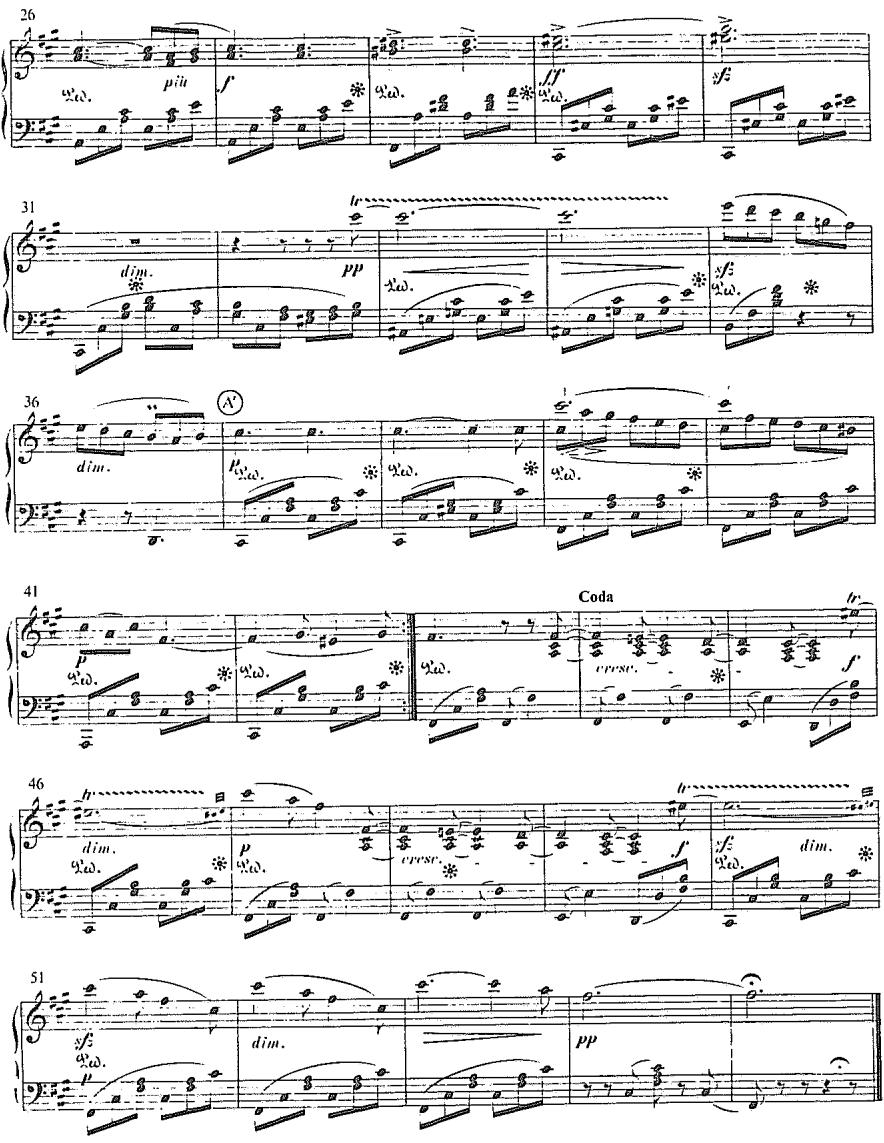
中文讲解
这是第 3 页的图像或乐谱示例占位符。原文标注"[内嵌图像数据已省略;位置与图注保留]"。从上下文(P0020 与 P0024 的描述)推断,这很可能与 Example 6.6 的时长缩减图(durational reduction)相关,可能展示引言(mm. 1–6)或作品某一片段的缩减谱面。具体的音符、和声标记、谱号或调号不可见,需查看原图。
第3段(P0020)
原文复述
A durational reduction of the Gondola Song (Example 6.6) gives a clearer overview of its metrical and phrase structures. Each measure of the piece is reduced to a single quarter-note value in the example. The hypermeter, mostly four-bar, and a few irregular measure groups are indicated by the placement of the bar lines. (Footnote 14)
中文讲解
本段引出 Example 6.6——一个"时长缩减图"(durational reduction)。这是一种分析图示手法:作品中的每小节被压缩为单一的四分音符时值,使听者能够一览式地把握其底层节拍与乐句结构。图中小节线的位置揭示了超小节(hypermeter)的划分:大多为四小节一组(即每四个小节线划出一个超小节单位),但存在若干不规则的小节组合(由异常位置的小节线标示)。脚注 14 应是对超小节概念或本图示法的来源说明。
此段为本小节提供分析工具:Example 6.6 把抽象的节拍结构可视化,是后续讨论 mm. 13–14 压缩、mm. 27–32 扩张以及外延式 ritenuto 的基础。
补充说明
“时长缩减”(durational reduction)属于 Schenker 派分析中的简化图示传统;脚注 14 的具体内容未在输入中给出。
第4段(P0021)
原文复述
The antecedent and consequent phrases of the first A section (mm. 7–22) are each eight measures long, or two hypermeasures. The last two measures of the antecedent (mm. 13–14) manage to compress the last four measures of the introduction (mm. 3–6) within the space of the half-cadential V harmony, thus preserving the four-bar hypermeter. (Without this compression, the antecedent would have been ten measures long instead of eight.) The phrase following the parallel period, aiming toward the half cadence in mm. 29–30, does precisely what the earlier antecedent phrase avoided: by incorporating a full quotation of mm. 3–6 into its half cadence, the phrase is expanded from eight measures to ten (4 + 6). Having just proved, in the antecedent, that an expansion is unnecessary under the circumstances—since the quotation of mm. 3–6 can be compressed to fit an eight-measure phrase—Mendelssohn emphasizes the very slowness of mm. 29–32 through the contrast with the recently heard compressed version. The effect created is that of a composed-out ritenuto.
中文讲解
这是本节论证最核心的一段,分析"外延式 ritenuto"(composed-out ritenuto)如何通过结构对比实现。
第一 A 段(mm. 7–22)由两个八小节乐句构成——前句与后句,各等于两个超小节。前句的后两小节(mm. 13–14)将前奏的最后四小节(mm. 3–6)压缩在半终止的 V 和声空间内,从而维持了四小节超小节格局;若不压缩,前句将是十小节而非八小节。
随后向 mm. 29–30 半终止推进的乐句(即与该平行周期相对应的乐句)做了相反的事:完整引用 mm. 3–6 而非压缩它,于是乐句从八小节扩张为十小节(4 + 6)。关键的修辞逻辑是:前句刚刚已经证明,这种引用在结构上其实可以被压缩以适应八小节——换言之,当下的扩张并非结构所必需。孟德尔松正是借助与刚刚听过的压缩版本的对比,让 mm. 29–32 的"完整"陈述听起来格外缓慢,由此产生一种"外延式渐慢"(composed-out ritenuto)的听觉效果——所谓"外延",即渐慢不是通过演奏标记 rit. 实现,而是通过作曲结构(先压缩、后完整引用)来暗示减速。
理解本段的关键:(1) 压缩与扩张是同一材料的两种处理方式;(2) 听者刚听过压缩版本,因此扩张版本显得刻意"拉长";(3) 这种结构对比取代了常规的演奏指示,构成作曲家层面的 ritenuto。
补充说明
“composed-out ritenuto”(外延式渐慢)是分析术语,指以作曲/结构手段(而非演奏符号)实现的渐慢效果,与 Schenker 派将节奏关系"外延"(Auskomponierung)于较大时间跨度的观念相联。
第5段(P0022)
原文复述
Another and more obvious effect of mm. 29–32 is that the introduction has been emphatically reintroduced. Even the six-bar length of the expanded measure group, mm. 27–32 (see the second 3/2 bar in Example 6.6) reminds us of the six-measure introduction. This means that we are led to expect a certain kind of answer to the two-note question (e♯2 – g♯2) that has just been posed, fortissimo. (Footnote 15) Since the question has taken the form of a reintroduction, the answer we expect is likely to be a return of that which was introduced originally—namely, the principal theme. But since the reintroduction appears in the same high register as the end of the principal theme’s antecedent phrase (itself an echo of the original introduction), it would be sufficient and entirely appropriate to use only the original consequent phrase (mm. 15–22) as the answer. This would additionally have the advantage of creating a nearly symmetrical structure—a quatrain form, 8 + 8 measures (antecedent + consequent) followed by 10 + 8 measures (contrasting phrase + consequent).
中文讲解
本段为 mm. 29–32 提供另一层解读:它们实际上是对前奏(introduction)的"重新引入"(reintroduction)。扩张的小节组 mm. 27–32 长达六小节(参见 Example 6.6 中第二个 3/2 小节),这与六小节长的前奏构成形式上的回响。
由此,听者被引导去期待一个对刚提出的双音"问句"(fortissimo 奏出的 e♯2 – g♯2)的"答句"。既然问句本身采用了重新引入前奏的形式,预期的答案自然应该是当初被引入之物——即主旋律主题的回归。又因为该重新引入出现在与主旋律前句结尾相同的高音区(这一高区前句本身也是原前奏的回声),故仅用原后句(mm. 15–22)作答既充分又合乎风格,而且会形成一个近乎对称的"四行诗形式"(quatrain form):8 + 8 小节(前句 + 后句)接以 10 + 8 小节(对比乐句 + 后句)。
本段的功能是为下段做铺垫:作者在此明确地搭好一个"读者期待",紧接着揭示孟德尔松的实际处理与这一期待微妙地不同。
补充说明
“quatrain form”(四行诗形式)在此是隐喻,指 8+8+10+8 的准对称四句式结构,类比诗歌的起承转合。脚注 15 的具体内容未在输入中给出。
第6段(P0023)
原文复述
The answer Mendelssohn gives us, as we know, is somewhat different. The original introduction—which started, so to speak, from the depths of the Venetian canals—pointed continually upward (see the arrows in the first two measures of Example 6.6); Mendelssohn draws similar implications from the reintroduction. The upward thrust could have led, this time, to a recapitulation of the principal theme an octave higher than its original statement. That, however, would have upset the exquisite registral balance of the piece, and it would have taken the melody out of the range of the human voice—the latter not an insignificant consideration for a song so clearly Italian in inspiration. (Footnote 16) Instead only c3, corresponding to c2 in m. 7, is heard, and the phrase mostly works its way down from there. The principal melodic tone in mm. 35–36 is B in both the higher and lower registers, its importance underscored by Mendelssohn’s pedal release in m. 35. And then follows the apparent cadence in mm. 37–39 (the overall harmonic motion in mm. 33–39 is I♯3 – IV – V – I) and the phoenix-like reemergence of the theme. As with the nearly literal quotation of the introduction in mm. 29–32, the literal return of the original melody is made to sound startlingly fresh and unexpected because of a recently past event—in this case the abortive cadence, which very nearly made a return of the theme impossible (except perhaps as a coda). (Footnote 17)
中文讲解
本段揭示孟德尔松实际给出的"答案"与前段搭起的期待之间的差异。
原前奏仿佛从"威尼斯运河深处"起,持续向上(参见 Example 6.6 前两小节的箭头);重新引入的 mm. 27–32 也暗示了类似的上行势能。因此理论上主题可在比原陈述高八度处再现。但孟德尔松没有这样做,理由有二:(1) 高八度再现会破坏整首作品精致的音区平衡;(2) 会让旋律超出人声音域——对于一首明显受意大利启发的歌曲而言,后者并非无关紧要。
实际听到的是 c3(对应 m. 7 的 c2),乐句从该音出发大体向下进行。mm. 35–36 的主要旋律音为 B,在高低两个音区同时出现,其重要性由 m. 35 的踏板释放(pedal release)所强调。接着是 mm. 37–39 的"表面终止"(apparent cadence,整体和声进行为 I♯3 – IV – V – I),以及主题"凤凰般"(phoenix-like)的重新浮现。
本段以一个修辞性悖论收束:正如 mm. 29–32 几乎字面引用前奏使其听起来新鲜一样,主旋律的字面回归之所以令人惊讶地清新与出乎意料,恰恰因为刚刚过去的"流产终止"(abortive cadence)几乎让主题的回归成为不可能——除非以尾声(coda)形式出现。
理解本段需抓住三点:(1) 上行势能与音区/音域限制的妥协;(2) c3 作为下行起点的功能;(3) 踏板释放、“流产终止”、“凤凰般重现"三者构成的戏剧化反差。
补充说明
“abortive cadence”(流产终止)指听似即将完成的终止实际未能完成,本段中指 mm. 37–39 的表面终止之后主题仍然回归。脚注 16、17 的具体内容未在输入中给出。
第7段(P0024)
原文复述
中文讲解
这是第 4 页图 Example 6.6 的占位符。图注英文为"Example 6.6. Durational reduction of Mendelssohn’s Gondola Song Op. 30, No. 6”(孟德尔松《无词歌》作品 30 第 6 首《船歌》的时长缩减图),原文标注"[内嵌图像数据已省略;位置与图注保留]"。
结合 P0020 的描述可知:图中每小节被压缩为一个四分音符时值,以小节线的位置标示超小节(多数四小节一组,少数不规则);前两小节有向上箭头标示前奏的上行趋势;某处出现第二个 3/2 小节,对应 mm. 27–32 的六小节扩张组。具体的音符、和声标记、调号等不可见,需查看原图。
脚注 / 边栏 / 图表 / 附加信息(如有)
本小节包含两处图示占位符(P0019、P0024),后者图注为 Example 6.6(孟德尔松《无词歌》Op. 30, No. 6《船歌》的时长缩减图),两处内嵌图像数据均已省略,需查看原图。文本中提及脚注 14(P0020,超小节概念来源)、脚注 15(P0022,与双音问句 e♯2–g♯2 相关)、脚注 16(P0023,与意大利灵感/人声音域的考量相关)、脚注 17(P0023,与"流产终止"使主题回归几乎成为不可能相关);脚注的完整内容未在输入中给出,仅作存在性记录。
💡 本节核心要点
- m. 39 的 I 和声在和声听感上像正格终止的解决,但孟德尔松却将其处理为后句的第三小节(对应 m. 17)而非终止目标;真正的完全终止延迟至 m. 43,且该乐句被剥夺了对应 m. 22 的第八小节,形成不对称;钟声般的 c#3 兼具记忆标记与尾声伏笔功能。
- 前奏材料(mm. 3–6)在 A 段前句(mm. 13–14)中被压缩为两小节以维持八小节前句与四小节超小节格局;同一材料在 mm. 27–32 被完整引用,使乐句扩张为 4+6=10 小节。
- 扩张版本紧接在压缩版本之后出现,结构上本可压缩却不压缩,借此与刚听过的压缩版本形成对比,产生"外延式 ritenuto"(composed-out ritenuto)——以结构手段实现而非演奏标记的渐慢效果。
- mm. 27–32 长达六小节,与六小节的前奏构成形式回响,因而承担"重新引入前奏"的功能;高区的双音问句(e♯2–g♯2,fortissimo)邀请对主旋律回归的期待;理论上原后句(mm. 15–22)作为答句足以构成近乎对称的 8+8+10+8 四行诗形式。
- 孟德尔松未让主题在高八度再现——上行势能受制于音区平衡与人声音域(意大利歌曲特性)——而是从 c3 出发大体向下进行;mm. 35–36 的 B 在高低两区同时出现,并由 m. 35 的踏板释放强调其重要性。
- mm. 37–39 的"表面终止"(I♯3–IV–V–I)几乎使主题回归成为不可能(除作为尾声外),但主旋律仍以字面回归的方式"凤凰般"重现;与 mm. 29–32 字面引用前奏同理,正是刚过去的"流产终止"使这种字面回归听起来反常地新鲜而出乎意料。
🔑 关键术语
- Tonicized IV harmony(被主和弦化的 IV 和声):指 IV 和声被其自身的属和弦(V/IV)引入并短暂地处理为临时主和弦;在本节中它使随后 m. 39 的 I 在听感上像正格终止的解决。
- Authentic / Perfect cadence(正格终止 / 完全终止):V→I 的终止进行;本节中 m. 39 的 I 在和声上听起来像此类终止,但实际被处理为非终止性的乐句内部和声。
- Hypermeter(超小节):高于小节层级的节拍组织单位;Example 6.6 中以小节线位置标示,本曲多为四小节一组,但存在 mm. 27–32 等不规则组。
- Durational reduction(时长缩减图):将作品每小节压缩为单一时值的分析图示,使底层节拍与乐句结构一目了然;本节 Example 6.6 即为此类图。
- Composed-out ritenuto(外延式渐慢):通过作曲结构(而非演奏标记 rit.)实现的渐慢效果;本节中由 mm. 13–14 的压缩与 mm. 29–32 的扩张对比产生。
- Parallel period(平行周期):前句与后句开头材料相同(或基本相同)的乐段结构;本节 A 段 mm. 7–22 即为此类,mm. 29–30 半终止对应的乐句与之对应。
- Quatrain form(四行诗形式):本节用作隐喻,指 8+8(前句+后句)+ 10+8(对比乐句+后句)这一准对称四句式结构,类比诗歌的起承转合。
- Abortive cadence(流产终止):听似即将完成、实际未完成的终止;本节中指 mm. 37–39 表面终止后主题仍能回归的语境,使该回归显得几近不可能。
- Pedal release(踏板释放):m. 35 处踏板被放开,强调 mm. 35–36 中 B 在高低两区同时出现的主要旋律地位。
s6 [描述性拆分] Underlying Quatrain Form and the Magic of the Deceptive Recapitulation
第1段(P0025)
原文复述
Also, and again like the reintroduction, the belated return of the theme expresses a phrase expansion. In other words, the symmetry that Mendelssohn avoids at the surface is present in the underlying structure. In the present instance (mm. 33–43) we can perhaps best understand the expansion in this way: because the urge to cadence is so strong in mm. 37–38, it is fairly easy to imagine an alternative version in which that urge is satisfied (see Example 6.7). This hypothetical version accomplishes two things: it restores the eight-measure phrase length basic to the piece (the ten-measure contrasting phrase having been transparently an expanded eight measures); and it fulfills the voice-leading implications of the note b¹ (4) in a relatively simple way, as opposed to the more circuitous voice leading indicated in Example 6.6 (where b¹ is continued by a and g# in the left hand). When our hypothetical version is compared to the piece itself, it becomes easier to understand why the continuation of the theme after m. 38 is so striking in its effect. The piece was “due”
中文讲解
本段的核心主张是:门德尔松主题延迟再现的那一段(mm. 33–43),其实也是一个乐句扩展(phrase expansion),表面缺失的对称在深层结构中仍然存在。
作者的论证策略值得注意:他不是直接描述门德尔松写了什么,而是构造一个"假想的版本"(hypothetical version,即 Example 6.7),让 mm. 37–38 处的强烈终止倾向得到满足,再把这个假想版本与原作对照,从而揭示出原作的选择是多么特殊。
这个假想版本同时完成两件事:①恢复作品基本的八小节乐句长度(说明十小节对比乐句实际上是一个被透明地扩展出来的八小节结构);②以更直接的方式实现 b¹(4) 这个音的声部进行含义——相比之下,原作 Example 6.6 中 b¹ 在左手里被 a 和 g# 接续,显得曲折得多。
由此,读者得以理解:原作之所以在 m. 38 之后继续主题会给人"惊艳"之感,是因为听众本已"应得"一次终止。作者用 “the piece was ‘due’” 这个未完成句,故意把结论留到下一段,由此引出关于"意外浪潮"的精彩比喻。
需注意:本段与前面讨论"reintroduction"(主题的重新引入)形成平行的论证——两次主题归来都体现"表面打破、深层对称"的逻辑。
补充说明
本段承接前文对 reintroduction 的分析,并把同一逻辑应用于 mm. 33–43 的主题延迟再现。Example 6.6 与 Example 6.7 的对照是本节论证的关键工具:前者是原作片段,后者是作者构造的假想重构(recomposition)。b¹(4) 的标注表明该音是所在小节的第四拍。
第2段(P0026)
原文复述
中文讲解
这是图示占位符。完整图注为:“Example 6.7. Recomposition of Mendelssohn’s Gondola Song Op. 30, No. 6, mm. 33–43”(例 6.7,门德尔松《船歌》Op. 30 第 6 首,mm. 33–43 的重构版本)。
该图在论证中的功能:它是作者构造的"假想八小节乐句",用以替代原作中 mm. 33–43 的十一小节扩展乐句。读者需对照原谱方能看清这一重构如何把 mm. 37–38 的终止倾向直接解决,从而把原本的扩展乐句还原为基本的八小节结构。需查看原图。
补充说明
图中旋律内容未在源文本中给出,仅由图注提供出处信息;其具体的音符、和声及终止式处理,需参考原书相应页面。
第3段(P0027)
原文复述
to reach its final cadence in m. 39 (corresponding to the seventh measure of Example 6.7), so Mendelssohn’s continuation feels like an unexpected wave carrying the listener along farther than he thought he would go. The fact that the last four measures of Example 6.7 “rhyme” so closely with the end of the original consequent phrase (mm. 19–22) only emphasizes how nearly inevitable a cadence was at this point, and how artificial the addition of the full consequent phrase here really is.
中文讲解
本段紧接上段未完成的 “the piece was ‘due’” 一句,正式给出结论:作品本应在 m. 39(即假想版本 Example 6.7 的第七小节)到达终止,门德尔松却把音乐继续向前推——于是这段延续像一股"出乎意料的浪潮",把听众带到比预期更远的地方。
“浪潮"这一比喻非常关键:它揭示了分析的对象不仅是结构,更是结构带来的聆听体验。表面上看似常规的"主题再现”,在深层却成为一种惊人之举。
本段进一步用"押韵"(rhyme)一词说明 Example 6.7 末四小节与原作 mm. 19–22(最初的应答乐句结尾)之间高度相似。这种相似并不是偶然,它表明 m. 37–38 附近的终止冲动几乎不可避免;而原作硬是加上完整的应答乐句,因此这种"加上"本身是人为的(artificial)——也就是说,是作曲家刻意选择的产物,而非自然延伸。
阅读时需把握:作者用 “rhyme” 而非 “identical”,意在说明两者在节奏轮廓与终止式方向上相似,但具体细节仍有差异(这正是"扩展"发生的空间)。
补充说明
“the original consequent phrase” 指作品开头处八小节基本乐句结构中的应答乐句(mm. 19–22 即其结束区域)。“押韵”(rhyme)的具体所指——节奏型、音型轮廓、低音声部走向——需对照原谱确认,作者未在本节文本中逐一列举。
第4段(P0028)
原文复述
Example 6.7 may be regarded as the eight-measure basic phrase underlying the eleven-measure expanded phrase that includes the thematic return (mm. 33–43). If this analysis is accepted, it is seen that, in the underlying phrase structure of the piece, the form does not include a tonic recapitulation of the principal theme. In other words, the underlying form of the piece is not a ternary ABA but a modified quatrain of thirty-two measures (4 × 8)—modified in that the closing phrase refers to the opening period only in part.¹⁸ The tonic recapitulation is deceptive, a glorious afterthought to the main body of the piece; its chimerical quality is heightened by the high note (c#³) that covers it. (Now we can see that this covering tone is a natural outgrowth of c#² in mm. 37–38, since that tone similarly covers the 3–2 motion that is part of the implied cadence.) Thus what is seemingly the most routine moment in a conventional formal scheme, the repetition of the opening section, becomes the single most magical moment in the piece—the climax of compositional artifice.
中文讲解
本段是本节论证的高潮与收束。
作者把 Example 6.7 提升为"底层基本乐句",并把它与 mm. 33–43 的十一小节扩展乐句之间建立对应关系。一旦接受这一分析,深层结构中的结论就极具颠覆性:作品并不真正包含一个主调再现,其底层形式不是三段体 ABA,而是一个三十二小节(4×8)的"被修改过的四句体"(modified quatrain)——之所以"被修改",是因为终止乐句只部分地呼应开头的乐段。
由此,所谓"主调再现"其实是一个错觉(deceptive),是"加在主体之后的辉煌补笔"(a glorious afterthought)。其"虚幻"(chimerical)特质被 c#³ 这一高音所强化——这个音"遮盖"(cover)了再现的真实效果。作者用括号插注说明:c#³ 是 mm. 37–38 中 c#² 的自然延伸;c#² 之所以存在,也正因为它遮盖了"蕴含的终止式中所含的 3–2 进行"。也就是说,两个 c#(分别在两层结构上)都在做同一件事——用外部的旋律高点掩盖结构上的真正落点。
最后一句极具修辞力量:在常规曲式方案中最平常的环节——开头的重复——恰恰成为整首作品最具魔力的瞬间,是"作曲之人工巧妙(compositional artifice)的高潮"。作者把分析转为审美判断:表面打破常规的对称,反而成就了作品最深层的艺术效果。
对读者的启示:“再现"的判定不能只看主调是否回归,必须看乐句层级是否真正闭合;本节通过"假想重构"方法揭示了表层结构之下的另一种真实。
补充说明
脚注 18 在原文中以小角标形式出现,但本节所提供文本未包含其具体内容,仅提示读者该修改型四句体的论述有进一步来源依据。“3–2 motion” 在传统功能和声中通常指音级 3̂ 到 2̂ 的进行,本句中指蕴含于 mm. 37–38 处终止式之中的旋律动作;具体它由哪个声部承担,原文未明列,需参看谱例。
脚注 / 边栏 / 图表 / 附加信息(如有)
本节包含一处图像占位符(Example 6.7,对应 P0026),其图注完整保留;图像内具体的旋律、和声与终止细节须查阅原书相应插图。P0028 中以小角标引出脚注 18,但脚注正文未在当前输入的源段落中出现,因此本节汇总中无法复述其内容,仅按要求标注其引用位置。
💡 本节核心要点
- 主题在 mm. 33–43 的延迟再现,与前面的 reintroduction 一样,是乐句扩展;表面缺失的对称实存于深层结构。
- 作者用"假想重构”(Example 6.7)作为分析工具:将该假想版本(直接解决 mm. 37–38 终止冲动的八小节乐句)与原作对照,揭示原作选择"推迟终止并延续主题"的代价与效果。
- 深层结构是 4×8=32 小节的"修改型四句体",而非 ABA 三段体;终止乐句仅部分呼应开头的乐段,因此并不构成真正的再现。
- 所谓"主调再现"其实是一个欺骗性的事后添加(deceptive, glorious afterthought),其"虚幻感"被两个 c#(c#² 在 mm. 37–38,c#³ 在再现之上)从两层结构上一致地"覆盖"。
- 在常规曲式中最平常的"开头重复"环节,由此成为整首作品最具魔力的瞬间——是作曲之人工作为的高潮。
🔑 关键术语
- phrase expansion:乐句扩展——本节核心术语,指表层乐句超出其基本长度的现象;本节论证 mm. 33–43 的十一小节是基本八小节的扩展。
- cadence / urge to cadence:终止式 / 终止冲动——本节用 “urge to cadence” 强调 mm. 37–38 处本应解决的强烈收束感;Example 6.7 即让此冲动得到满足。
- voice-leading:声部进行——指单个音在和声与旋律上的接续关系;本节讨论 b¹(4) 这一音如何被不同地解决。
- consequent phrase:应答乐句——与 antecedent(起句)相对的乐段第二乐句;mm. 19–22 即原应答乐句结尾。
- ternary ABA:三段体 ABA——本节明确否认此曲底层为此形式,是对比性术语。
- modified quatrain (4 × 8):修改型四句体——本节提出的本曲真实底层形式:32 小节由四个八小节乐句构成,终止乐句仅部分呼应开头。
- deceptive recapitulation:欺骗性再现——本节的关键命题:表层看似的主调再现,实际上深层并不构成真正的再现,是"事后的辉煌补笔"。
- covering tone:覆盖音——指一个高音把结构上的真正落点遮蔽起来;本节中 c#³ 覆盖了再现,c#² 覆盖了 mm. 37–38 中的 3–2 进行。
- 3–2 motion:音级 3̂ 到 2̂ 的进行——本节指蕴含于 mm. 37–38 处终止式之中的旋律动作,被 c#² 所遮盖。
- compositional artifice:作曲之人工巧妙——本节最终用以指认该曲最高成就的术语:把最常规的形式环节改造成最具魔力的瞬间。
s7 [描述性拆分] Basic Length and Cadential Ambiguities in the Songs without Words
第1段(P0029)
原文复述
In Chapter 4 we introduced the concept of a composition’s basic length, which we defined as the total length of all basic phrases in the piece. When we reduce the expanded phrases in the Venetian Gondola Song, we see that there are four basic phrases of eight measures each—the two phrases of the opening parallel period, the contrasting phrase minus its expansion, and the closing phrase given in Example 6.7.
中文讲解
本段承接第4章提出的"基本长度"概念,并将其应用到《威尼斯船歌》的分析中。“基本长度"被定义为作品中所有基本乐句的总长度——也就是去掉扩展后所剩的骨架尺度。分析操作是一种"还原”:先把作品中带扩展的完整文本看作整体,再剥离扩展部分,只保留结构性骨架,从而显出作品最根本的比例关系。经此还原,作者指出《威尼斯船歌》共有四个基本乐句,每个八小节:(1)(2) 开头的平行乐段包含前句与后句两个乐句;(3) 对比乐句去除其扩展;(4) 终止乐句,见谱例6.7。这四个乐句相加即是P0030将给出的32小节基本长度。本段奠定本节论证的度量基础:用基本长度来衡量作品,并以此识别哪些是真正承载结构的乐句,哪些属于装饰性扩展。
补充说明
本段与P0030的数字互相对应:4个基本乐句×8小节=32小节基本长度。
第2段(P0030)
原文复述
(The introduction and coda are naturally excluded; so is the repetition of mm. 21–42. All of these excluded sections represent external expansions of the underlying form.) The basic length of the piece is thus thirty-two measures.
中文讲解
本段是P0029的补注,把不属于基本结构的部分——引子、尾声、第21–42小节的重复——明确排除出去,并给它们一个统一名称:“外部扩展”(external expansions)。也就是说,凡是不在四句基本乐句骨架之内的段落,一律被视为对底层结构的外部附加,而非基本乐句内部的延长。这样,《威尼斯船歌》的基本长度被精确锁定为32小节。本段虽然短小,却承担方法论上的关键一步:把"内部扩展"与"外部扩展"区分开。前者是基本乐句之内的延长,后者是基本乐句之外的附加。判断一个小节属于哪一类,是后续讨论终止暧昧性与扩展手法的前提。
第3段(P0031)
原文复述
There are many recapitulations in the Songs without Words that, while not deceptive in the sense defined above, are introduced by some ingenious and unexpected rhythmic device. Often the device used is a metrical reinterpretation, which, as we know, always occurs in conjunction with an overlap in the phrase (or subphrase) structure. Notable examples include: the recapitulation at m. 24 of Op. 38, No.2 (an eighth bar is reinterpreted as a first bar—compare m. 48, where there is no reinterpretation); the recapitulation at m. 19 of Op. 102, No. 1, again involving a cadential 6/4 chord but arising through phrase overlap (the recapitulation overlaps the half cadence of the middle section); and—one of the greatest of all the songs—Op. 62, No. 1, with its recapitulation (involving overlap) at m. 22.
中文讲解
本段转入讨论《无词歌》中一类特殊的再现方式:它们虽然不构成前文定义的"欺骗性"再现,却通过"出人意料的节奏手法"被引入。最常见的具体手法是"节拍重释"(metrical reinterpretation),而节拍重释又总是与乐句(或子句)结构上的叠合(overlap)相伴出现。这是本节方法论上的关键命题:节拍错位与句法叠合在本系列作品中是同步发生的现象。作者随后给出三个例证:
- Op. 38 No. 2,第24小节再现——把本应作为第八小节(一句之末)的小节"重释"为新一句的第一小节,作者提示可对比第48小节同位置,那里没有发生重释;
- Op. 102 No. 1,第19小节再现——再次涉及终止四六和弦(cadential 6/4 chord),但这次是通过乐句叠合实现的,再现与中段的半终止相叠合;
- Op. 62 No. 1,第22小节再现——作者将其誉为"所有无词歌中最伟大的一首之一",其再现同样通过叠合实现。 本段的论证意义在于:揭示《无词歌》中存在一种"非欺骗、却巧思"的再现手法,它既不破坏调性回归,也不靠主题材料欺骗听者,而是凭借节奏与句法的微妙错位,给听者带来出乎意料的新鲜感。
补充说明
“deceptive in the sense defined above"指前文已界定的欺骗性再现;“cadential 6/4 chord”(终止四六和弦)在本段作为再现处的和声标志之一出现,但本段未展开其和声功能。
第4段(P0032)
原文复述
Example 6.8, the opening period of one of the earliest of the Songs without Words (Op. 19, No. 1), shows an expansion that is recognizably Classic in inspiration. The unexpected chromatic descent in mm. 12–13 is like a brief “purple patch” (though not involving a remote tonicization) before the cadence of the parallel period.
中文讲解
本段引入第二个具体作品:Op. 19 No. 1 的开篇乐段(谱例6.8)。作者指出这是《无词歌》中最早的一批作品之一,其扩展手法"明显带有古典时期的灵感”。具体的扩展发生在第12–13小节:一个意外的半音下行。作者借用修辞学术语"purple patch"(紫色补丁,指文采过盛的短小片段)来形容它,强调这一下行色彩鲜明但篇幅短小,且没有涉及远关系调性化(remote tonicization),因此仍是古典语汇内的装饰,而非浪漫派那种调性剧烈游移的扩展。本段的论证价值是与前一段Op. 102、Op. 38等的扩展相区别:古典式扩展幅度小、远关系调性缺席,更像是句法骨架之内的一次点缀;而前段所论"节拍重释+叠合"式再现则更接近浪漫派的巧思。换言之,本节在分析中其实区分了两种不同的扩展来源——古典性的局部染色与浪漫性的句法/节奏错位——并以Op. 19 No. 1为前者代表。
补充说明
“purple patch"原为文学批评术语,借用形容乐句中色彩突出的小片段;“tonicization"指对非本调主音的暂时强调,“remote tonicization"强调所涉调性离本调较远。
第5段(P0033)
原文复述
Going by the general rule that an antecedent phrase implies a consequent of equal length—any other length being understood as an expansion or contraction—we arrive at Example 6.9 as the basic (unexpanded) version of Example 6.8.
中文讲解
本段陈述分析者所依据的一条一般规则:前句(antecedent)暗示一个等长的后句(consequent);如果实际后句长度与之不符,则被理解为扩展(expansion)或缩减(contraction)。这是古典句法的默认预期——前句与后句的长度对等是"基线”,不等长则需要解释。基于这条规则,分析者将谱例6.8(即P0032讨论的Op. 19 No. 1开篇乐段)“还原"为谱例6.9所示的基本(未扩展)版本。本段的论证价值在于示范一种普遍的分析策略:先识别前句,再假设后句应与之等长,最后把两者之间的差异归为扩展或缩减。这与P0029对《威尼斯船歌》的还原操作是同一种思路——从可见的、可能含扩展的音乐文本出发,反推其理想骨架。也正因为这一骨架是"假设等长"得到的,P0032才能进一步追问实际作品在哪里、怎样偏离了等长,从而识别出第12–13小节这一古典式扩展。
补充说明
“contraction"与"expansion"在本段对称使用,统指对"前句=后句"等长规则的偏离。
脚注 / 边栏 / 图表 / 附加信息(如有)
本节涉及的图/谱例共三个:谱例6.7(《威尼斯船歌》的终止乐句)、谱例6.8(Op. 19 No. 1 的开篇乐段,含扩展)、谱例6.9(Op. 19 No. 1 经还原后的基本未扩展版本)。谱例6.7承担"展示终止乐句以完成P0029的清单"的功能;谱例6.8与6.9配对,前者展示实际文本(含扩展),后者展示还原后的理想骨架,二者共同支撑P0032与P0033关于"古典式扩展"的论证。本节未提供脚注。
💡 本节核心要点
- 基本长度定义为"所有基本乐句的总长度”,是去掉扩展后的骨架度量;
- 《威尼斯船歌》的基本长度为32小节,由四个八小节乐句构成;引子、尾声、第21–42小节的重复被归为外部扩展而非内部延长;
- 《无词歌》中许多再现虽不构成欺骗性再现,却通过节拍重释与乐句叠合引入,节拍重释与句法叠合在本系列作品中总是相伴发生;
- Op. 38 No. 2(第24小节)、Op. 102 No. 1(第19小节)、Op. 62 No. 1(第22小节)是此类再现手法的代表性实例;
- Op. 19 No. 1 的扩展带有古典语汇特征,第12–13小节的半音下行被喻为短暂的"紫色补丁”,篇幅短小且未涉远关系调性化;
- 分析者依据"前句暗示等长后句"的规则,把谱例6.8还原为谱例6.9所示的基本未扩展版本,这是识别与解释扩展的前提。
🔑 关键术语
- basic length:基本长度,指一首作品中所有基本乐句相加的总小节数,是衡量作品骨架比例的尺度。
- basic phrase:基本乐句,未经过内部扩展或缩减的最小结构性乐句单位。
- external expansion:外部扩展,指引子、尾声、重复等加在基本结构之外的附加段落,区别于基本乐句内部的扩展。
- parallel period:平行乐段,由前句与后句组成的两句结构;本节用于指称《威尼斯船歌》开头两句与Op. 19 No. 1开篇两句。
- metrical reinterpretation:节拍重释,听者原本预期的小节位置被重新解释为新的节拍起点,造成节拍错位。
- phrase overlap:乐句叠合,前后两个乐句在结构上互相穿插而非首尾相接,常与节拍重释共同出现。
- cadential 6/4 chord:终止四六和弦,出现在终止处、由下属音于低音上方的四度与六度构成的和弦;本节作为再现处再现标志之一出现。
- purple patch:紫色补丁,借自修辞学,指文采或色彩特别突出、相对短暂的片段;本节用以形容Op. 19 No. 1第12–13小节的半音下行。
- antecedent / consequent:前句与后句,乐段的基本对偶单位;本节预设二者等长,不等长则归为扩展或缩减。
- tonicization:调性化,对非本调主音的暂时强调;“remote tonicization"指所涉调性离本调较远的调性化,本节用以界定Op. 19 No. 1第12–13小节所涉调性化的范围。
s8 [描述性拆分] Classic-Style Expansion in Op. 19, No. 1
第1段(P0034)
原文复述
[Example 6.8 image placeholder] Mendelssohn: Song without Words Op. 19, No. 1 (beginning).
中文讲解
这是谱例6.8的图像占位符,呈现门德尔松《无词歌》Op. 19 No. 1 开头的乐谱图像。其功能是为后文对该曲调性、节拍与节奏的精细分析提供视觉参照。由于图像内容不可见,正文段落引用此图作为比较与分析的基础。读者需查阅原版谱例。
补充说明
该图位于P0036所讨论的子乐句分组结构分析之前,作为分析对象;后文例6.9则是同一段落的简化重构(仅旋律与低音)。
第2段(P0035)
原文复述
[Example 6.9 image placeholder] Recomposition of Mendelssohn’s Op. 19, No. 1 (beginning), melody and bass only.
中文讲解
这是谱例6.9的图像占位符,展示对门德尔松Op. 19 No. 1 开头的"重构”——仅保留旋律与低音两条骨架线条。它与例6.8形成对照,帮助读者剥离装饰性声部,专注于骨架层面的乐句结构。此谱例是P0036理论分析的视觉依据。
补充说明
例6.9的"重构"性质意味着它抽取了原谱最核心的两条线,便于展示子乐句的1+1+2模式与终止式扩展。
第3段(P0036)
原文复述
Another factor in the construction of Example 6.9 is the grouping of subphrases. The upbeat groupings of the antecedent show the familiar “sentence” pattern 1 + 1 + 2 in terms of length (in bars). In the consequent, the upbeat to m. 11 seems to provide the beginning of the two-measure subphrase that is expected after the one-measure subphrases of mm. 7 and 8. (This is true of the bass as well as the melody: note the identical ascent of a ninth, E–f♯, in mm. 1–3 and 5–7 of Example 6.9, and compare with the score.) The two-measure subphrase should end with a cadence, and that cadence is duly begun in m. 12 with the cadential 6/4. But the natural acceleration to the cadence is subverted by the use in m. 12 of the half-note melodic rhythm of m. 6 (compare the last bar of Example 6.9). Seemingly motivated by the half-step descent b♭¹–a♯¹, the descent continues in m. 13, leading through a descending bass line back to V of B major and finally to a successful cadence. In this analysis, mm. 9–10—the echoed falling fifth—are heard as a parenthetical interpolation, retarding the progression of e to e♯ in the bass and prolonging c♯² in the melody. Measures 12–15 are heard as an expansion, also basically parenthetical, of the final bar of Example 6.9.
中文讲解
本段继续Op. 19 No. 1 的分析,焦点转向子乐句(subphrase)的组合方式。前半句(antecedent)以1+1+2小节的"句式"结构呈现,符合典型的古典句法。后半句(consequent)则从第11小节的弱起开始,预期接续一个两小节的子乐句。低音与旋律都表现出相同结构(例6.9 第1–3、5–7小节中的九度上行E–f♯就是证据)。
但第12小节应当以终止式收束时,门德尔松却通过借用第6小节的半音符节奏减缓了向终止的自然加速。b♭¹至a♯¹的半音下行引向第13小节,再经下行低音回到B大调的属音并成功终止。第9–10小节被理解为"插入性插段”,推迟了低音从e到e♯的进行,延长了旋律中的c♯²。第12–15小节则被看作例6.9最末小节的"扩展”,本质上也是插入性的。
这一段揭示:门德尔松通过"插入"与"扩展"两种手段,让原本简单的句式结构变得错综复杂,而这些复杂化又以古典句法为骨架。其分析逻辑是:先识别骨架,再用插入与扩展来解释偏离。
补充说明
所谓"句式"(sentence)指1+1+2小节长度的乐句结构;“插入性插段”(parenthetical interpolation)和"扩展"(expansion)是Schenkerian分析中用以解释表面偏离骨架的术语。第19号脚注涉及此处对e–e♯低音进行的延长解读。
第4段(P0037)
原文复述
The most original of Mendelssohn’s rhythmic practices in the Songs without Words is a technique, used most often in compound meters, in which two different patterns of the same meter are placed in conflict with each other. For example, one 4/4 metrical pattern may begin on the first beat of every 4/4 measure (thus in agreement with the notated meter), while another, conflicting 4/4 pattern begins on the third beat of each measure. The latter pattern is obviously at odds with the notated meter, but it is perceived nonetheless; indeed, it is often more strongly perceived than the pattern conforming to the notated meter. The two metrical patterns may occur either successively or simultaneously. The phenomenon as a whole will be referred to here as a technique of conflicting downbeats.
中文讲解
本段引入本节的核心概念——“冲突重音技法”(conflicting downbeats)。作者声称这是门德尔松在《无词歌》中最具原创性的节奏手法,主要出现在复合拍子中。其原理是:两个相同的拍号(例如4/4)被组织成两种相互冲突的节拍模式——一种与记谱拍号一致,另一种则从记谱小节的第三拍开始。
关键论断是:与记谱拍号"相悖"的拍子模式仍然能被听者感知,且"往往比符合记谱拍号的模式被感知得更为强烈"。两种模式可以依次出现(successively)或同时出现(simultaneously)。作者将这一整体现象命名为"冲突重音技法"。
这一术语奠定了后文所有分析的框架。从Op. 62 No. 2、Op. 38 No. 4到Op. 102 No. 2,作者都将用此概念解释门德尔松的节奏戏剧。
补充说明
“复合拍子”(compound meter)指每拍自然划分为三等分的拍号,如6/8、12/8;与之相对的"简单拍子"(simple meter)则是每拍二等分,如2/4、4/4。这是节拍理论中的基本区分。
第5段(P0038)
原文复述
This technique of Mendelssohn’s has recently been described in some detail by Carl Schachter in a beautiful analysis of the Song in G Minor, Op. 102, No. 4.
中文讲解
本段指明理论出处:Carl Schachter 在分析《无词歌》Op. 102 No. 4(G小调)时,已对此技法作过详细且被作者称赞为"美丽"的阐述。这为后文引用Schachter的分析做铺垫,并说明本节所讨论的技法并非作者首创。
值得注意的是,作者用"beautiful"修饰Schachter的分析,这不仅是礼节性赞誉,也暗示该分析的内在说服力或音乐敏感性——在音乐学论文中,“beautiful"常意味着分析既严谨又具审美判断力。
补充说明
Carl Schachter 是20世纪中后期Schenkerian学派的核心学者之一;其Op. 102 No. 4的分析通常被视为现代节拍分析的范例。原文此处的脚注20指向Schachter的发表文献。
第6段(P0039)
原文复述
However, Schachter does not mention the frequency with which the technique appears in the Songs without Words. In fact, fully sixteen of the pieces—one-third of the total—make use of it. In many of these pieces, the metrical conflict is in effect virtually throughout.
中文讲解
本段补足Schachter分析所忽略的一面:技法的"出现频率”。作者指出,《无词歌》全集共48首,其中"整整十六首"——即三分之一——运用了冲突重音技法;且在许多作品中,节拍冲突"实际上贯穿全曲"。
“fully"与"virtually throughout"的措辞强调:这不是偶发的装饰性手段,而是门德尔松节奏风格的核心特征。作者借此将Schachter的个案分析升格为整体风格的系统归纳。
补充说明
脚注21涉及对十六首作品的具体统计或其分布年代的补充信息,本段未展开。“virtually throughout"应理解为"几乎贯穿全曲”,而非"完全每一小节”。
第7段(P0040)
原文复述
Furthermore, conflicting downbeats are not restricted to the Songs without Words; they are a hallmark of Mendelssohn’s style. In Free Composition Schenker cites a rather subtle example, the closing theme (mm. 181 ff.) from the first movement of Symphony No. 3 (“Scotch”). A more striking example is the slow movement of the Symphony No. 4 (“Italian”). In this remarkable movement, the themes beginning at m. 35 and m. 45 first appear in conflict with the notated 4/4 meter, with perceived downbeats on the third beats of the notated measures. The latter theme is recapitulated (m. 75) in agreement with the notated meter, while the former—which returns at m. 86—begins as before, shifting to the notated meter only at m. 92.
中文讲解
本段将讨论从《无词歌》扩展到门德尔松的器乐作品,证明冲突重音是其整体风格的标志(hallmark)。两个例证分别是:
- 较精妙的例证:Schenker 在《Free Composition》中所引第三交响曲(“苏格兰”)第一乐章结束主题(mm. 181起)。
- 较显著的例证:第四交响曲(“意大利”)慢乐章。其中第35与45小节开始的主题先与记谱4/4拍相冲突(听感重音在第三拍);再现时(第75小节起)第二个主题回到与记谱拍号一致,而第一个主题(第86小节起)保持冲突状态,直到第92小节才转入记谱拍号。
“subtle"与"more striking"的对比暗示分析难度的差异:前者需要仔细辨听,后者冲突明显。慢乐章作为"remarkable"之作,说明这一技法并非仅属装饰性,而是可以构筑整乐章的戏剧张力。
补充说明
脚注22指向Schenker《Free Composition》(《自由作曲》)中对第三交响曲的讨论。本段虽未明示,但表明Schenker已注意到该技法,门德尔松风格被纳入Schenker学派的论述框架。
第8段(P0041)
原文复述
As Schachter’s analysis of Op. 102, No. 4, demonstrates, metrical conflict, in the form of conflicting downbeats, can serve as a ruling idea for an entire piece. As both that example and the “Italian” Symphony suggest, the conflict is usually resolved in favor of the notated meter. Several further examples from the Songs without Words will illustrate other aspects of Mendelssohn’s technique.
中文讲解
本段作出两项归纳:
- 节拍冲突可以作为"统摄整曲的主导意念”(ruling idea)——即不仅仅作为局部手段,而是作品结构的核心。
- 冲突通常以"有利于记谱拍号"的方式解决(resolved in favor of the notated meter)。这意味着虽然冲突重音可被强烈感知,但最终的"归属"仍回到记谱节拍。
“ruling idea"是借用Hepokoski / Darcy 等学者讨论奏鸣曲式时的术语,作者将其移植到节奏层面。第二个观察暗示一种"论辩—解决"的修辞结构,与古典奏鸣式的调性解决有审美呼应。
最后一句预示下文将展开多首《无词歌》的具体分析。
补充说明
此处"ruling idea"的用法与19世纪德国音乐学传统(如A. B. Marx)相关,本段继承了"主导动机"式的概念框架,将其用于节拍层面。
第9段(P0042)
原文复述
Conflicting downbeats occur most often in those songs that begin with an introduction. The introduction, which may be very brief, generally establishes the notated meter. The principal melody, when it enters, then inaugurates a conflicting metrical pattern, which the accompanying voices may or may not follow. Several shifts between the two patterns may ensue, generally leading to a final resolution of the conflict. Op. 102, No. 4, follows this general plan; but so, for example, does Op. 62, No. 2 (see Example 6.10).
中文讲解
本段勾勒出一项典型模式:拥有"引子—主旋律"结构的《无词歌》最常出现冲突重音。引子(无论多简短)建立记谱拍号;主旋律进入时引入冲突拍号;伴奏声部可跟可不跟;之后两种拍号可多次交替,最终回到记谱拍号。
“generally"与"may or may not"等措辞保留变体空间。Op. 102 No. 4是此通则的范本;Op. 62 No. 2是即将分析的例证。
该模式的功能意义:引子作为"背景设定”,主旋律的进入成为"事件”,冲突是这一事件的戏剧化展开;最终的回归则形成闭合。
补充说明
例6.10将作为Op. 62 No. 2的具体分析依据,参见P0043–P0047。这一"引子建立—主旋律冲突"的模式与奏鸣式呈示部的"主部主题—副部主题"结构有概念上的对应关系。
第10段(P0043)
原文复述
[Example 6.10 image placeholder] Mendelssohn: Song without Words Op. 62, No. 2. a. mm. 1–9 b. mm. 22–30 c. mm. 46–57.
中文讲解
谱例6.10的图像占位符,展示Op. 62 No. 2 的三段关键片段:a. 第1–9小节(呈示),b. 第22–30小节(再现前的过渡),c. 第46–57小节(尾声)。这是P0045–P0047分析对象的视觉支撑。
补充说明
由于图像数据被省略,需查阅原版谱例才能核对节拍记号、力度标记及超节拍分析。
第11段(P0044)
原文复述
[Example 6.10, continued image placeholder]
中文讲解
谱例6.10的延续图像占位符,承接P0043。其内容仍是Op. 62 No. 2 的乐谱片段;具体小节范围与图注在P0043已说明。
第12段(P0045)
原文复述
Example 6.10 shows the three principal entrances of the theme of the piece, a three-part form (ABA’)—the beginning, the recapitulation (with preceding retransition), and the coda. The brief introduction does not establish the 12/8 meter very strongly; each notated half-measure seems almost equally weighted, while the crescendo and the ascending line give an upbeat feeling to the entire passage. Nevertheless, the fortissimo entrance of the theme after only five half-measures sounds metrically disruptive, since a quintuple pattern would seem most unlikely as a metrical ordering in this style. The sforzando on the theme’s first note is Mendelssohn’s typical way of initiating and highlighting a metrical conflict.
中文讲解
本段介绍Op. 62 No. 2 的整体结构与节拍机制。三部形式(ABA’)对应三个主题进入:开头、再现(含过渡)、尾声。12/8拍子下,简短的引子未明确建立记谱拍号——半小节(half-measure)几乎等重,加上渐强与上行的旋律线,营造出整体"弱起"感。
主题在仅五个半小节后以fortissimo进入,造成节拍上的"扰动"。作者指出:“五拍子模式"在此风格中几无可能,因此这种扰动必然来自节拍冲突,而非拍号本身。主题首音的sforzando(sf)是门德尔松"发起并突出节拍冲突"的典型手法。
“typical"一词暗示:sf不仅是力度强调,更是节拍事件的"信号”。这与浪漫主义将sf作为修辞手段的用法一致。
补充说明
脚注23涉及引子节拍性质的进一步说明,可能提示记谱节拍被节拍重音"模糊"的具体证据。“half-measure"在12/8拍下指四个八分音符的半节单位。
第13段(P0046)
原文复述
The conflicting downbeats are indicated in Example 6.10a through the hypermetrical analysis; both of the conflicting metrical patterns express duple (two- and four-bar) hypermeter. (An expansion within the consequent phrase begins in the middle of m. 9.) The downbeats indicated for the left hand are relatively weakly perceived compared to those for the right hand, but the notated meter occasionally comes to the fore, as in the final cadence of the middle section (Example 6.10b). In m. 25, the D minor chord—the cadential goal—is clearly a downbeat in both hands because of the preparation provided by mm. 22 and 24. (The sf in m. 23 represents the last gasp, for now, of the conflicting meter.) But Mendelssohn’s accents in mm. 25–27 begin to re-insinuate the metrical conflict; note, however, how the alternation of D and d in the bass continues to support the notated meter. Measures 28–29, with their accents on every half-measure (plus the continuing crescendo), seem to recreate the rhythmic situation of the introduction, so that the return of the theme in m. 29—with its conflicting meter—again disrupts the metrical pattern. (This time the notated meter has been established rather more firmly than it had been in the introduction.) As is frequently the case in the recapitulation sections of ABA forms, this return omits the original antecedent phrase and consists only of an expanded consequent—expanded much farther, however, than in the first A section.
中文讲解
本段细致描述Op. 62 No. 2 的节拍运作。例6.10a的超节拍分析揭示:冲突的两种拍号都表达双拍子(两小节与四小节)超节拍。第9小节中段起是后乐句的扩展。
左手声部的重音比右手"感知较弱”,但记谱拍号偶尔占优——中段终止(例6.10b,第25小节)的d小调和弦因第22、24小节的预备而成为双手的明确重音。第23小节的sf是冲突拍号"暂时的最后喘息”。第25–27小节的重音又开始暗示节拍冲突,但D与d在低音的交替继续支持记谱拍号。
第28–29小节重音落于每一半小节,配合渐强,重现引子的节奏情境。第29小节主题再现,以冲突拍号再次扰动节拍模式——但此次记谱拍号的根基已更稳固。
再现部省略了原前乐句,只保留扩展的后乐句,且扩展程度远超第一A段。“as is frequently the case"表明这是ABA形式的常见做法,并非Op. 62 No. 2 的特例。
“last gasp, for now"与"rather more firmly"等措辞暗示节拍解决的渐进性:冲突并未一次性消失,而是逐步让位。
补充说明
“hypermeter"指跨小节的节拍组织;“antecedent"与"consequent"指句法的前后两半。ABA’形式的再现部省略前乐句是19世纪钢琴小品常见做法。
第14段(P0047)
原文复述
Example 6.10c begins with the final cadence of the recapitulation (mm. 46–47). Once again the cadence adheres to the notated meter; the full left-hand chords on the last three beats of m. 46 represent a march-like confirmation of the notated measure. In mm. 47–49 the original introduction is shortened by a full measure, and only the incipit of the theme is heard. Thus, when the introductory gesture is begun again in m. 49, neither the notated meter nor the two-bar hypermeter has been lost; the first note of the theme is heard, more clearly than ever before, as an upbeat. (See the hypermetrical analysis in Example 6.10c.) Even the more complete statement of the theme beginning in m. 50 only briefly casts doubt on the notated meter, although it is abetted in this by the left hand: the octaves on B♭ and F, in contrast to the single notes (B♭), support the accents of the conflicting meter. In m. 53, however, the notated meter takes over unambiguously and prevails to the end.
中文讲解
本段分析Op. 62 No. 2 的尾声。例6.10c从再现部的终止(mm. 46–47)开始,终止再次遵循记谱拍号——第46小节最后三拍的左手全和弦是"进行曲式"的拍号确认。
第47–49小节把原引子缩短一整小节,只听到主题的"起句”(incipit)。因此第49小节引子姿态再次出现时,记谱拍号与两小节超节拍均未丢失;主题首音比此前任何时候都更清晰地被听为弱起。
第50小节主题较完整的陈述"短暂地"质疑记谱拍号,左手以八度B♭与F(对比单音B♭)支持冲突重音。但第53小节起,记谱拍号"明确无误地"接管直至结束。
“march-like confirmation”、“more clearly than ever before"等措辞凸显尾声的功能:彻底"清算"早前的冲突,让记谱拍号成为最终秩序。
补充说明
“incipit"指主题的"起首片段”,并非完整陈述;“hypermetrical analysis"指跨小节重音的标注分析。
第15段(P0048)
原文复述
A special kind of introductory passage in the Songs without Words is one that is repeated more or less literally at the end of the piece, thus forming a frame for the song itself. Mendelssohn uses this framing device for some of the songs that are especially vocal in style; the framing passage is obviously meant to evoke an accompanimental prelude and postlude to an actual song. Although these pieces tend to be relatively simple, some of them use the technique of conflicting downbeats. One such is the earliest of the songs for which the actual date of composition is known, Op. 19, No. 4 (1829).
中文讲解
本段引入一类特殊的引子——“框式引子”(framing device):引子在曲末基本原样重复,从而在结构上形成对歌曲本身的"框架”。门德尔松将此手法用于"风格上尤为歌唱化"的歌曲;这一框架显然旨在唤起对实际歌曲的"伴奏式前奏与尾声”。
此类作品虽"相对简单”,但部分仍使用冲突重音技法。最早一例是有确切创作年代记载的Op. 19 No. 4(1829)。
“more or less literally"意味着重复并非绝对精确;“obviously meant to evoke"提示这一手法的"声乐联想"意图——借钢琴独奏模仿"人声+伴奏"的歌曲体裁。
把"框式结构"与"冲突重音"关联起来意味着:即便在较为"古典"的简单小品中,门德尔松仍融入节拍的张力。
补充说明
Op. 19 No. 4的1829年是门德尔松开始系统创作《无词歌》系列的早期年份之一;此处将其作为有确切年代记载的"最早"作品,暗示作者对作品年代的考据较为详尽。
第16段(P0049)
原文复述
Another framed song is Op. 38, No. 4. The beginning and end of this piece are shown in Example 6.11 in order to illustrate a relatively unsuccessful use of conflicting downbeats.
中文讲解
本段引出另一首框式歌曲Op. 38 No. 4,用于说明"相对不成功"的冲突重音运用。“relatively unsuccessful"是关键的批评性判断——本节并非一味赞扬,而是会分析门德尔松技法失败之处。
例6.11将展示该曲的开头与结尾,以对照框式结构内的节拍变化。
补充说明
“框式结构"的分析将聚焦于尾部引子——即所谓"postlude”——如何与节拍冲突互动。
第17段(P0050)
原文复述
The chief rhythmic peculiarity of Op. 38, No. 4, is its consistent division into six-measure phrases (not counting the frame). All of these, but particularly the last two—mm. 16–21 and 22–27—can probably be regarded as expanded four-measure phrases. There is no hint of conflicting downbeats in the body of the song, despite some accented third beats (for example, the durational or agogic accents in mm. 4–7). Only the postlude, mm. 27–30, really conflicts with the notated meter, beginning on the third beat of m. 27 rather than on a downbeat as before (m. 1). This metrical shift is rather obviously prepared by the accompanimental figuration in mm. 25–26, which duplicates the first half-measure of the introduction. The metrical shift arises through the elision of the final tonic chord of the song (m. 27, third拍); the beginning of the postlude substitutes for this chord and forces a reinterpretation of the third拍 as a downbeat. From here to the end it is easy to hear only the shifted meter, with the result that the final chord of the piece seems to fall on the third拍 of a measure (see the lower row of metrical numbers in Example 6.11b).
中文讲解
本段分析Op. 38 No. 4 的节奏特点:除框式结构外,全曲由"六小节乐句"组成(最后两段mm. 16–21、22–27尤其可视为四小节乐句的扩展)。曲体内部并无冲突重音迹象——尽管第4–7小节有持续或时值的"第三拍重音”。
冲突仅出现在尾声(mm. 27–30):它起始于第27小节的第三拍,而非如开头那样从正拍开始。这一节拍偏移由伴奏音型(mm. 25–26 复制引子前半小节)“相当明显地"预备。其机制是:歌曲最终的tonic和弦被"省略”(elided),尾声的开始替代该和弦,迫使第三拍被重新解释为重拍。
从该点到曲末,听者容易"只听到偏移后的拍号”,于是全曲结束的和弦似乎落在小节第三拍上(参见例6.11b下排节拍编号)。
本段的论证逻辑:曲体内部无冲突—引子预备—尾声省略和弦造成强制重解释。“elision”(省略/省略连接)是Schenkerian分析的核心概念。
补充说明
“durational accents"与"agogic accents"分别指"时值重音”(长音符)与"速度/力度重音”(演奏上加重)。“elision"在此处意为"省略”——某结构功能元素被邻近事件取代。脚注24涉及此处省略性终止的分析细节。
第18段(P0051)
原文复述
[Example 6.11 image placeholder] Mendelssohn: Song without Words Op. 38, No. 4. a. mm. 1–10 b. mm. 25–30.
中文讲解
谱例6.11的图像占位符,展示Op. 38 No. 4 的开头(mm. 1–10)与尾部(mm. 25–30)。这是P0050、P0052、P0053分析对象的视觉支撑,并含两排节拍编号以展示不同的节拍解读。
补充说明
图像数据被省略,需查阅原版以核对节拍编号与终止式细节。
第19段(P0052)
原文复述
Yet there is another and potentially richer way to understand the postlude. The third拍 of m. 29 seems to provide the tonic chord that was elided two measures earlier, in precisely the spacing that was expected for it then. This tonic is preceded by a V⁷ chord on the fourth eighth of the notated measure, recalling the simple V chord on the fourth eighth of m. 27. The congruity of notated metrical positions might suggest that m. 29 is picking up where m. 27 left off. This interpretation is supported by Mendelssohn’s dynamic markings: the p of mm. 27–29 (the first two measures of the postlude) interrupts a prevailing pp before and after. Since the entire frame was originally played pp (Example 6.11a), the p marking can hardly be considered a matter of thoughtless repetition on Mendelssohn’s part. A performance sufficiently sensitive to these dynamic differentiations can successfully convey the feeling that the postlude is not only part of a frame, but is also—and more immediately—a parenthesis within the final cadence of the song. (See the upper row of metrical numbers in Example 6.11b.)
中文讲解
本段提出Op. 38 No. 4 尾声的"另一种、更丰富"理解。第29小节的第三拍可被视为"被省略两小节"的主和弦的提供——其位置与预期一致。前接V⁷和弦于记谱小节的第四个八分音符上,让人想起第27小节第四个八分音符的简单V和弦。这种节拍位置的吻合暗示:第29小节是接续第27小节而来的。
此解读得到力度标记支持:第27–29小节的p中断了前后皆为pp的主导力度。整段框式结构原以pp演奏(例6.11a),所以"p"绝非门德尔松的疏忽复制。敏感的演奏能传达:尾声不仅属于框式结构,更直接地说是"歌曲最终终止式内的插入括号”。参见例6.11b的上排节拍编号。
“potentially richer"与"thoughtless repetition"的措辞显示:作者在寻找作曲家"意图"的痕迹。力度差异成为作曲家"知道自己在做什么"的证据。
这一段与P0050的解读形成对照:P0050说"听者容易只听到偏移后的拍号”;本段则提供"另一种可能”——尾声其实是对终止式的扩展,而非独立段落。
补充说明
“parenthesis within the final cadence"将尾声重新定位为终止式内部的插入,而非框式结构的对位。V⁷到I的终止式暗示此处的和声功能仍在终止解决框架内。
第20段(P0053)
原文复述
Curiously, Mendelssohn could have facilitated this latter interpretation if he had included d¹, the dominant seventh, as part of the V chord in m. 27 (fourth eighth), as he did in m. 26 (fourth eighth). Then the linking of the two V chords, mm. 27 and 29, would have been instantly apparent to the ear. As it is, a certain ambiguity adheres to any metrical interpretation of the postlude, which may well be what the composer desired. This is not the only one of the songs to end without final resolution of its metrical ambiguities. But the fact that the metrical conflict emerges only at the end of the piece, having not been at issue before, lends a touch of arbitrariness to the final non-resolution. It is in this respect that the piece can be considered something less than a total success.
中文讲解
本段作出关键评价:门德尔松本可让第27小节第四个八分音符的V和弦包含d¹(属七音),从而使两小节后第29小节的V和弦在听觉上"瞬间相连”——但他未如此做。结果是:尾声的节拍解读必然保留一定的模糊性。
“may well be what the composer desired"暗示这种模糊是有意为之——“模糊本身"即作曲家的修辞目的。这与19世纪音乐中日益增长的"未解决"美学一致。
“However"转折句给出批评:冲突仅在曲末出现,且此前从未成为问题——这给最终的"不解决"添加了一丝"任意性”。因此此曲"在某种意义上未能取得完全成功”。
“could have facilitated"的虚拟语气至关重要:作者既指出作曲家的"遗漏”,又避免全盘否定——作曲家可能本就想要这种模糊。“arbitrariness"则成为此曲"不那么成功"的原因。
补充说明
脚注24涉及此处与其他"未解决节拍模糊"作品的联系;脚注25则是对"不甚成功"判断的进一步说明。
第21段(P0054)
原文复述
One of the latest of the Songs without Words, Op. 102, No. 2 in D Major (1845), opens without an introduction of any kind. More unusual, for a song that features conflicting downbeats, is the fact that the meter of the piece is 2/4—that is, not compound. The conflict therefore pits the two beats of each measure against each other, each claiming equal status as a downbeat. The entire piece is given in Example 6.12, with markings—mostly numbers—to indicate the hypermetrical structure of each of the outer voices. (Each of the inner voices follows one of the outer voices metrically, sometimes transferring its allegiance from the melody to the bass or vice versa.)
中文讲解
本段引入本节最详尽分析的对象——Op. 102 No. 2(D大调,1845)。三方面特征值得注意:
- 它是《无词歌》中最晚期的作品之一。
- 它"无任何引子"而直接进入主题。
- 拍号是2/4(非复合拍子)。这是"反常"的,因为冲突重音技法通常出现在复合拍子中(如前文Op. 62 No. 2 的12/8)。在2/4中,冲突发生在小节内两个四分音符之间,每个都宣称自己是正拍。
例6.12给出全曲,标注(多为数字)指示外声部的超节拍结构。内声部跟随外声部之一,有时从旋律转向低音或反之。
“equally claiming status as a downbeat"揭示冲突的根本:两拍力量均等。这与P0037"复合拍子中从第三拍开始冲突重音"的典型例子不同,此处两拍冲突的解决需要在全曲过程中逐渐发生。
补充说明
脚注26涉及Op. 102 No. 6作为风格对比的作品,可能同样具有"近乎原始"的纯净风格。“1845"是门德尔松去世前两年,标志其晚期风格。
第22段(P0055)
原文复述
Apart from the metrical conflict, the song is quite simple in its texture, its form, and even its rhythm. More than perhaps any other of the Songs without Words (with the exception of Op. 102, No. 6), this piece seems to evoke Mendelssohn’s religious style; there is a strong suggestion of organ music in the last four measures especially. “Pianistic” accompaniment figures are avoided in favor of obbligato voice leading (that is, maintenance of linear continuity within each voice), thus strengthening the generally serious and slightly archaic flavor of the piece.
中文讲解
本段勾勒Op. 102 No. 2 的整体风格——在节拍冲突之外,“织体、形式乃至节奏都相当简单”。作者认为此曲"也许比任何其他《无词歌》"(除Op. 102 No. 6外)“更能唤起门德尔松的宗教风格”;最后四小节尤其有强烈的管风琴音乐暗示。
门德尔松避免"钢琴化"的伴奏音型,转而采用"obbligato声部进行”(即每条线保持线性连贯),从而强化了全曲"严肃而略带古风"的基调。
“religious style"与"organ music”、“archaic flavor"共同将本曲定位为门德尔松晚期"精神化"倾向的代表,与早期明亮歌唱化作品形成对比。obbligato声部进行是巴洛克复调思维的延续。
补充说明
“obbligato"指"必须独立且持续运行"的声部,与"装饰性"声部相对;这与巴洛克通奏低音思维的精神相通。
第23段(P0056)
原文复述
The form of the melody is also shown in Example 6.12; it might be described as a quatrain (AABA) with varied repetition of its second half, plus a coda. The first half (AA, mm. 1–8) comprises a fore-phrase and an after-phrase, the latter modulating to III (F♯ minor). The second half (BA’, mm. 8–16) includes a contrasting phrase, moving from III to V, and an almost literal recapitulation of the original fore-phrase. These first sixteen measures constitute a complete form in themselves; with the addition of a short coda, they would make a satisfactory piece. Instead, Mendelssohn repeats the second half (BA’) with significant changes: not only is a new and greater climax achieved (m. 19), but the harmonic setting of each phrase is radically altered. The contrasting phrase (B’) now prolongs III instead of moving to V, and—as if to compensate—the final return of the principal theme (A”) prolongs V right up to the closing cadence in m. 24. (These harmonic relationships will be discussed further.) Note that, up until the coda, every phrase in the piece appears to be exactly four measures long, at least when measured by the melody. That is, the letters in Example 6.12 indicating the formal sections—each of which is also a phrase—are spaced exactly four measures apart, always beginning on the second beat of a measure divisible by 4 (mm. 4, 8, 12, and so forth).
中文讲解
本段详述Op. 102 No. 2 的曲式。旋律形式可描述为"四行诗节(quatrain,AABA)",第二半段加以变化重复,并附尾声。
- 前半段(AA,mm. 1–8):前乐句(fore-phrase)与后乐句(after-phrase),后者转向III(F♯小调)。
- 第二半段(BA’,mm. 8–16):对比乐句(B)从III走向V;A’几乎是前乐句的字面再现。
前16小节本身就构成完整曲式,加上短小尾声即"可成为满意的作品”——但门德尔松选择重复第二半段(BA’)并加以重大变化:第19小节达到新的更高潮;和声配置被"根本性"改变:B’延长III而非走向V;A"则延长V直至第24小节的最终终止。
关键观察:除尾声外,每个乐句似乎恰好四小节长。形式字母A、B、A’、A"间隔精确为四小节,且都从小节可被4整除处的第二拍开始(如mm. 4、8、12等)。
“quatrain”(四行诗节)作为形式类比呼应了P0084的核心论断:门德尔松的复杂技法最终依托最简单的对称结构。
补充说明
“fore-phrase"与"after-phrase"是Schenkerian句法术语,分别指前乐句与后乐句;“modulating to III"指从主调转入III级,即F♯小调。脚注26涉及"宗教风格"的具体含义。
第24段(P0057)
原文复述
[Example 6.12 image placeholder] Mendelssohn: Song without Words Op. 102, No. 2.
中文讲解
谱例6.12的图像占位符,展示Op. 102 No. 2 全曲。这是P0056、P0065、P0066、P0075等分析对象的视觉依据,含有字母标注(A、B、A’、A”、coda)以及超节拍编号。
补充说明
图像内容含曲式字母、超节拍数字与力度标记。需查阅原版以核对。
第25段(P0058)
原文复述
Example 6.13 is a voice-leading reduction of Op. 102, No. 2. It is offered here primarily to show the relationship between mm. 8–16 (BA’) and mm. 16–24 (B’A”). Each of these two passages involves a large-scale harmonic progression III–V–I, as part of the complete tonic arpeggiation I–III–V–I (mm. 1–16 and 16–24). But in the earlier passage the V arrives at the end of the B phrase, while in the later one V marks the final return of the A phrase (as A”). Furthermore, the former V is followed by an interruption (symbolized in Example 6.13 by the customary double vertical strokes), while the latter V is part of the closing cadence of the piece.
中文讲解
本段介绍例6.13——Op. 102 No. 2 的"声部进行缩减”(voice-leading reduction)。其主要目的是展示mm. 8–16(BA’)与mm. 16–24(B’A”)之间的关系。两段都包含大规模的和声进行III–V–I,作为完整主音琶音化I–III–V–I的一部分(mm. 1–16 与 16–24)。
但两段中V出现的位置不同:早期段落中V在B乐句末尾到达;而后期段落中V标志A乐句的最终回归(成为A")。前者的V后接"中断"(interruption,以双竖线符号表示),后者的V则是作品终止式的一部分。
“voice-leading reduction"是Schenkerian分析的核心方法:通过简化装饰音显示和声与旋律的骨架。“中断"是Schenkerian曲式分析中的关键结构事件,与"终止"形成对照。
补充说明
“voice-leading reduction”(声部进行缩减)抽取最重要的音高结构线条,简化节奏与和声细节。“interruption”(中断)是Schenkerian术语,指结构中的休止点,常对应曲式上的对比中段边界。
第26段(P0059)
原文复述
Perhaps the most striking difference, however, is between the two occurrences of the B phrase, and particularly between mm. 11–12 and mm. 19–20. The first B phrase has as its goal the V harmony in m. 12, a tonicized half cadence. The descending stepwise motion in that measure forms a lead-in between the half cadence and the beginning of the A’ phrase. The strong impression of a phrase overlap at the second beat of m. 12 is due to this lead-in, the end of which overlaps the new phrase. In fact, the overlap involves only the subphrase level, since the goal of the previous phrase—the half cadence—has already been reached at the downbeat of m. 12. But the seamlessness of the stepwise motion, combined with the continuous diminuendo, certainly minimizes the articulation of the phrase boundary. See Example 6.13: in the upper voice, the leading tone (c²) substitutes for 2̂ (e²) at the half cadence; e² is anticipated, however, on the penultimate sixteenth note of m. 11. The interruption at this point is somewhat obscured by the return of f¹ via its upper neighbor g♯¹ and by the continuous sixteenth-note motion.
中文讲解
本段对比B乐句的两次出现(mm. 11–12 与 mm. 19–20),揭示它们的关键差异。
首次B乐句的目标是第12小节的V和声——一个"主调化半终止”(tonicized half cadence)。该小节的下行级进形成"导入”(lead-in),衔接半终止与A’乐句的开头。第12小节第二拍"乐句重叠"(phrase overlap)的强烈印象即源于此导入——其尾部与新乐句重叠。
实际上,重叠仅发生在子乐句层面:前乐句的目标(半终止)已在第12小节正拍上达到。但下行级进的无缝性与持续的渐弱"最小化了乐句边界的清晰度"。
参见例6.13:上声部中,导音c²在半终止处替代2̂(e²);e²却在第11小节倒数第二个十六分音符上提前出现。中断点因f¹经过其上邻音g♯¹的回归,以及持续的十六分音符运动而"被某种程度遮蔽"。
“tonicized half cadence"是技术性术语:指V和弦被处理为某一临时主调(这里是D大调的V)的V;这使半终止听起来像短暂的"属到主"小循环。
补充说明
“lead-in"指旋律/声部进行中"提前进入下一乐句"的过渡;“anticipation"指某音提前于其结构位置出现;“subphrase"指乐句内部的次级结构单位。脚注27涉及对中断点遮蔽效果的进一步说明。
第27段(P0060)
原文复述
The end of the B’ phrase, mm. 19–20, sounds almost like a simple transposition of mm. 11–12. But the voice-leading reduction reveals how different the situation actually is. Specifically, the dominant chord of F♯ minor, on the downbeat of m. 20, is not the goal of the phrase, as was the corresponding dominant chord in m. 12. This dominant is the penultimate harmony in a large prolongation of F♯ minor (III), and it leads to an authentic cadence in that key on the second beat of m. 20. The cadence is achieved in such a way, however, that it closely resembles the lead-in eight measures earlier; only the two falling sixths in the melody (g♯²–b♯¹, c♯²–e♯¹) give any hint that something more conclusive is happening here. Even the diminuendo conspires to remove emphasis from the authentic cadence. Most critically, the sixteenth notes that enter beneath the bass f♯ in m. 20 undercut the cadence by reducing the literal sounding time of its goal harmony to a sixteenth note. (The notation 5–6 at this point in Example 6.13 indicates that the first of these sixteenth notes, d, displaces the implied fifth of the F♯ minor harmony. The actual tone c♯¹ is omitted by Mendelssohn in order to avoid a clash with this d.)
中文讲解
本段分析B’乐句的结束(mm. 19–20)。表面上它"几乎像"mm. 11–12 的简单移调,但声部缩减揭示差异:
- 第20小节正拍上的F♯小调属和弦"不是"乐句的目标(不像第12小节那个对应和弦)。它是F♯小调(III)大规模延长中的"倒数第二个和声”,通向第20小节第二拍在该调上的"正格终止”(authentic cadence)。
- 这一终止的达成方式却与八小节前的"导入"极为相似——只有旋律中的两组"下行六度”(g♯²–b♯¹、c♯²–e♯¹)暗示此处的"更为决定性”。
- 渐弱"共谋"地削弱了正格终止的强调。
- 最关键的是:第20小节低音f♯下方的十六分音符"削弱"了终止——目标和声的实际奏响时间被压缩为"一个十六分音符"。例6.13中标5–6表示第一个十六分音符d"替代"了F♯小调和声暗示的五音;c♯¹被省略以避免与d冲突。
这一段的论证非常精微:通过和声功能、声部细节、节奏压缩三层面共同说明"看似相同实则不同"。“conspires to remove emphasis"的语气暗示门德尔松的"有意为之”——终止被"隐藏"。
补充说明
“prolongation”(延长)是Schenkerian术语,指一个和声或音高在结构层面的持续。脚注27涉及此处理技术细节。“f♯小调下的属到主"是终止式在F♯小调中的正格形式。
第28段(P0061)
原文复述
[Example 6.13 image placeholder] Voice-leading reduction of Mendelssohn’s Op. 102, No. 2.
中文讲解
谱例6.13的图像占位符,展示Op. 102 No. 2 的声部进行缩减。此图是P0058–P0060、P0062–P0063分析对象的视觉支撑,含双竖线(interruption)符号、5–6标记等细节。
补充说明
图像数据被省略,需查阅原版以核对具体音高走向与标注。
第29段(P0062)
原文复述
The second beat of m. 20 carries with it an impression of phrase overlap very similar to that associated with the second beat of m. 12. But since in m. 20 the second beat is the goal of the B’ phrase, and is also the beginning of the A” phrase, a true phrase overlap exists here whereas it did not in m. 12 (where only a lead-in was involved). Even this seemingly arcane distinction needs to be qualified further: the overlap in m. 20 seems to apply only to the melody and the inner voices, not to the bass; the three sixteenth notes d–c♯–B at the end of the measure serve as a lead-in to the prolonged cadential 6/4 that dominates the A" phrase.
中文讲解
本段细致区分两种"乐句重叠"。第20小节第二拍与第12小节第二拍都带有乐句重叠的印象,但存在重要区别:
- 第20小节第二拍既是B’乐句的目标,又是A"乐句的开端——“真正的乐句重叠”。
- 第12小节第二拍仅是"导入",目标乐句已在正拍结束。
但"看似玄妙的"区分还需进一步限定:第20小节的重叠仅适用于旋律与内声部,“而非低音”。该小节末尾的三个十六分音符d–c♯–B作为"导入",通向主导A"乐句的延长型终止6/4和弦。
“seemingly arcane distinction"暗示作者意识到这一区分对一般读者而言较为微妙,但仍坚持其理论重要性。这是典型的Schenkerian分析风格——以细致的层级区分构建论证。
“cadential 6/4"即终止六四和弦,是Schenkerian延长理论的典型标志:6/4和弦被视为属七和弦的延长装饰,而非独立的和声事件。
补充说明
“cadential 6/4"在Schenkerian理论中通常被分析为V的延长,而非独立的和声——这是相对功能理论的关键差异。
第30段(P0063)
原文复述
One further note of explanation with regard to Example 6.13: The eighth-note stems that are sometimes given to the tone a¹, and to the same tone an octave lower in the coda, are meant to suggest the special role played by this inner-voice tone. Although not the primary tone in the Schenkerian sense, a¹ first appears prominently on the first拍 of m. 1 (where it is emphasized by the immediately preceding g♯¹), and it remains prominent until it is consigned to the tenor register for the coda, where it ends the piece. It is this inner-voice tone, in fact, that is transferred upward to a² for the climax in m. 19; note the correspondence between the third-progression a²–g♯²–f♯²—the last tone is first expressed as f♯¹, then transferred upward—and the similar third-progression an octave lower in mm. 7–8.
中文讲解
本段补充说明例6.13 中的一个细节:偶有八分音符符杆的a¹(在尾声中是低八度a)暗示其"内声部的特殊角色”。虽然在Schenkerian意义上a¹"不是"主要结构音,但它"显著"出现于第1小节第一拍(被前接的g♯¹强调),并持续显著,直至被安排到尾声的次中音区并结束全曲。
事实上,正是这一内声部音被上移至a²,成为第19小节高潮的一部分。注意三度进行a²–g♯²–f♯²(最后音先以f♯¹出现,再上移)的对应关系——与第7–8小节低八度的类似三度进行相呼应。
“虽然不是主要结构音但在结构中起重要作用”——这是Schenkerian分析中"内声部”(inner voice)的典型特征:协助主要结构音完成走向,但又非独立结构事件。
“transferred upward"指音高在同一结构位置从低八度"升级"到高八度,是Schenkerian分析中的"register transfer”(八度转移)现象。
补充说明
“register transfer”(八度转移)是Schenkerian术语,指同一结构音在不同段落以不同八度呈现。脚注30涉及此处的进一步技术说明。
第31段(P0064)
原文复述
One aspect of the piece not reflected in Example 6.13 is the important motivic use (“motivic” in the broadest sense) of the chromatic tones G♯ and E♯; see the opening notes, mm. 4, 5, 7, 9–10, 12 (and so forth), and m. 29. It could even be said that the emphasis given to F♯ minor in this piece grows out of the chromatic detail in its first two beats. Certainly the close juxtaposition of G♯ and E♯ in mm. 19–20 in two different keys—F♯ minor and D major—suggest a conscious compositional strategy on Mendelssohn’s part.
中文讲解
本段指出例6.13 未反映的一个方面——“动机化"运用(最广义上的"动机化”)的"半音音"G♯与E♯。参见开头的两音、第4、5、7、9–10、12小节(等)以及第29小节。
甚至可以说:“本曲对F♯小调的强调是从前两拍的半音细节中生长出来的”。第19–20小节G♯与E♯在两个不同调(F♯小调与D大调)下的紧密并置,“显然暗示"门德尔松"有意识的作曲策略”。
这一论断的关键是:从动机的"半音细节"出发——前两拍的g♯¹与e♯¹构成的"导音—主音"小关系——逐步展开为整曲对F♯小调的强调。这是一种"微观—宏观"的演化论证。
“conscious compositional strategy"与"could even be said"的措辞谨慎:作者承认这是分析性的解读,而非作曲家明确意图的复述。
补充说明
“chromatic tones”(半音音)指自然音阶之外的升降音;“motivic"指具有动机功能的最小音乐单位,本段采用最广义。G♯与E♯在D大调中分别为导音与"半音下行的目标音”。
第32段(P0065)
原文复述
Returning to Example 6.12, we see that the melody begins in a clear-cut metrical pattern that is supported by the surface rhythms and by the composer’s dynamic markings. Each measure of this pattern begins on the second beat of a notated bar. Each two-bar hypermeasure—that is, each half of a four-bar hypermeasure—begins with the same rhythmic figure. Until m. 8, the beginning of each two-bar hypermeasure is marked by a change of dynamics. This regular metrical pattern, consistently reinforced by dynamic changes, is maintained in all of the A phrases throughout the piece. Only at the start of the A’ and A” phrases (mm. 12 and 20) is the new dynamic level reached gradually, as the goal of a diminuendo, rather than suddenly; and these (as we know) are points of either subphrase or phrase overlap.
中文讲解
本段回到例6.12 描述旋律的节拍模式。旋律起始于"清晰的节拍模式”,由表面节奏与作曲家力度标记共同支持。每个模式小节都从记谱小节的第二拍开始;每个两小节超小节(即四小节超小节的一半)以相同的节奏图示开始。第8小节前,每个两小节超小节的开始都标志有力度的变化。
这种"规则的节拍模式"在所有A乐句中都得到动态变化的强化支持。“只有"在A’与A"乐句的开始处(第12、20小节),新力度级别是作为渐弱的目标"逐渐"达到的,而非突然——而这些点(如我们所知)是子乐句或乐句重叠的位置。
本段暗示:力度模式与节拍模式是相互印证的——清晰的力度变化是节拍清晰的"听觉签名”;渐弱进入则标记了"节拍模糊点"。这一观察将在P0078得到回响——“如果去掉力度支持,冲突拍号消失”。
补充说明
“hypermeasure"指跨小节的超节拍组织单位;“surface rhythms"指作品最表层的节奏细节。力度变化作为节拍支持是作者多次强调的论点。
第33段(P0066)
原文复述
Metrical disturbances in the melody occur only in the B phrases and in the coda, itself obviously based on B material. The first hint of metrical uncertainty, however, is furnished by the bass in m. 8, where the melody’s characteristic rhythm is first heard in conformity with the notated meter. The melody’s B phrase, starting one beat later, begins to sound like a free imitation of the bass; since the latter has started first, it tends to receive the listener’s preference in the metrical conflict. The notated meter receives further reinforcement from the melodic arpeggiation shown in Example 6.13, the tones of which fall on notated downbeats. The change of metrical focus, from the shifted to the notated meter, is gradual. One bar of the四小节 hypermeasure—most likely the second—is extended to three beats as the shift takes hold. The listener’s uncertainty as to where the downbeats fall is symbolized by the question marks in mm. 9–10 of Example 6.12.
中文讲解
本段分析Op. 102 No. 2 节拍"扰动"的具体位置:仅出现在B乐句与尾声中(尾声显然基于B材料)。节拍不确定的"第一线索"由第8小节的低音给出——旋律的特征节奏首次以与记谱拍号一致的方式被听到。旋律B乐句(晚一拍开始)开始像是低音的"自由模仿”;既然低音先开始,它倾向于在节拍冲突中获得听者的偏好。
记谱拍号进一步获得旋律琶音化的加强(见例6.13),其音落于记谱正拍。从"偏移"到"记谱"拍号的焦点变化是渐进的。四小节超小节中的某小节——很可能是第二个——被扩展至三拍以容纳这一变化。听者对正拍位置的"不确定"由例6.12第9–10小节中的问号标示。
“free imitation"意味着低音与旋律并非精确模仿,而是保持节拍骨架的自由追随。“tends to receive the listener’s preference"暗示时间因素——先入为主——在节拍判断中的作用。
补充说明
“free imitation"是模仿技法的一种变体,保持核心节奏/音高特征但允许自由变化。问号(?)在分析图中通常表示节拍归属的不确定。
第34段(P0067)
原文复述
The beginning of the A’ phrase arrives, as notated, as a weak拍 (m. 12). This is reinterpreted as a downbeat, however, by analogy with the two original A phrases (mm. 1–4, 4–8). As always, the metrical reinterpretation is accompanied by an overlap—in this case, the overlap of the A’ phrase with the preceding lead-in. Thus the fourth bar of the hypermeasure just ending is effectively contracted by one beat, balancing the expansion by a beat of some earlier bar within the hypermeasure. As a result, the four-measure distance between phrase beginnings is maintained.
中文讲解
本段描述A’乐句的节拍重解释。A’乐句如记谱所示作为"弱拍"到达(第12小节),但通过与两个原A乐句(mm. 1–4、4–8)的类比,被重新解释为正拍。
节拍重解释"一如既往"地伴随重叠——本例中是A’乐句与前导导入的重叠。因此,正在结束的超小节第四小节"实际被压缩"一拍,平衡超小节内部某较早小节的"一拍扩展”。结果是乐句开始之间的"四小节距离得以维持”。
“as always"暗示:节拍重解释必然伴随乐句重叠,是本曲反复出现的模式。“contracted by one beat"与"expansion by a beat"展示了"等量压缩与扩展"的平衡——这是Schenkerian分析中"时间维度对称"的常见原则。
补充说明
“hypermeasure"内的"压缩—扩展"对偶是Schenkerian时间延长分析的核心模式——表面时间的不对称被结构上的等价所平衡。
第35段(P0068)
原文复述
The metrical conflicts of the B’ phrase and the coda are essentially similar to those of the first B phrase. The major new factor in the B’ phrase is a changed relationship with the bass: now the melody leads and the bass follows. Preparation for the metrical shift is still provided by the tones of the ascending melodic arpeggiation, and—not unimportantly—by the listener’s memory of the earlier passage. An interesting consequence of the bass’s new metrical structure is the emphasis thus given a¹ in the melody (m. 17). This tone, which is about to be transferred upward to the climax tone a², now coincides with a hypermetrical downbeat in the bass. (Compare mm. 8–11 and 16–19 in Example 6.13.) In the coda, the bass returns to its previous role as leader of the free imitation.
中文讲解
本段指出B’乐句与尾声的节拍冲突本质相似于首次B乐句。B’的新因素是"与低音的关系改变”:现在旋律引领,低音跟随。节拍偏移的预备仍由旋律上行琶音的音提供,且"并非不重要”——还来自听者对早期段落的"记忆”。
低音新节拍结构的一个有趣后果是旋律a¹(第17小节)获得强调——该音即将上移至高潮音a²,现与低音的超小节正拍重合。比较例6.13的mm. 8–11 与 16–19。尾声回到低音作为自由模仿"引领者"的先前角色。
“not unimportantly"是双重否定的委婉强调——“听者的记忆"作为节拍感知的隐性维度被纳入考量。低音与旋律角色的"反转"是本曲戏剧结构的关键:节奏领导权的易手本身成为结构事件。
补充说明
脚注31涉及旋律引领关系与早期段落的对比。“memory”(记忆)作为听者感知节拍的隐性维度,是音乐认知研究的关注点之一。
第36段(P0069)
原文复述
Although it is the notated meter that ultimately prevails in this piece (the use of B material for the coda helps ensure that), the bass—which remains broadly faithful to the notated meter—is forced several times to adjust to the metrical waywardness of the melody. These adjustments make it possible for the two outer voices to begin or end at least some of their phrases together. Aside from the metrical reinterpretations at mm. 8 and 24, which are not done to accommodate the melody, the bass’s adjustments always take the form of an expansion of the individual measure, usually to three beats but once (in the coda) to four. The first of these expansions occurs right at the beginning of the piece, where the downbeat of m. 1 is shifted back one拍 to support the first note of the melody. But the true nature of the bass’s metrical structure—and thus the basic metrical conflict of the entire piece—is “unmistakably” established in mm. 2–3. The second beat of m. 2 is the critical point: it seems impossible to hear the bass A, passing downward on the way to F¹, as a downbeat, while it seems equally impossible not to hear the melody’s f¹ as a downbeat. Once Mendelssohn fails to tie the bass note d from m. 4 to m. 5, thus sounding the hypermetrical downbeat in the bass, the competing metrical schemes are firmly in place and the metrical drama of this deceptively placid song is ready to unfold.
中文讲解
本段是Op. 102 No. 2 节拍分析的关键总结。虽然最终是记谱拍号胜出(尾声使用B材料有助于确保这一点),“大致忠实于记谱拍号的低音"仍数次被迫调整以适应旋律的"节拍任性”。这些调整使两个外声部至少能在某些乐句的开始或结束时对齐。
除第8、24小节的节拍重解释(不是为旋律所做的)外,低音的调整"总是"采取"单小节扩展"的形式——通常扩展至三拍,但在尾声中扩展至四拍一次。首次扩展出现在全曲开头:第1小节的正拍被后移一拍以支持旋律的第一音。但低音节拍结构的"真实性质”——以及全曲节拍冲突的"基本格局”——“无可置疑地"在mm. 2–3确立。第2小节第二拍是"关键点”:低音的A(向下进行到F¹)似乎不可能被听为正拍,而旋律的f¹同样似乎不可能不被听为正拍。
一旦门德尔松未把第4小节的低音d延音至第5小节——从而让低音超小节正拍发声——“竞争的节拍方案被牢固确立”,这首"看似平静"的歌曲的节拍戏剧"准备展开”。
“deceptively placid"与"drama"形成强烈反差:表面宁静,内含戏剧张力。这与P0055的"serious and slightly archaic"形成呼应。“unmistakably"的双重否定强调:mm. 2–3是诊断性小节。
补充说明
“deceptively placid”(看似平静)暗示门德尔松作品的常见反讽——表面简单,结构复杂。脚注33涉及mm. 2–3竞争节拍方案的进一步技术说明。
第37段(P0070)
原文复述
The metrical reinterpretation at m. 8 (m. 24 is similar) is forced by the phrase structure, which is itself influenced by the motivic design. That is, F♯ is clearly the cadential bass note of the A after-phrase; but the beginning of the motive to be associated with the B phrase makes F♯ simultaneously the first note of that phrase (as far as the bass is concerned). This phrase overlap leads us to reinterpret m. 8, originally a fourth bar, as the first bar of a new hypermeasure. The reinterpretation seems especially clear since m. 9 simply repeats m. 8 in the bass. To hear m. 9 as a hypermetrical downbeat would amount to hearing a syncopation at the hypermeasure level—as if the weak fourth bar were “tied” (through the repetition) to the strong first bar—and that seems unlikely.
中文讲解
本段解释第8小节节拍重解释的动因——它由乐句结构"强迫”,而乐句结构本身又受动机设计影响。F♯明确是A后乐句的低音终止音;但将与B乐句关联的动机的"开始"使F♯同时成为该乐句的第一音(就低音而言)。这一乐句重叠"导致"我们将第8小节——原本是第四小节——重解释为新超小节的第一小节。
由于第9小节仅在低音上重复第8小节,重解释"尤其清晰”。将第9小节听为超小节正拍将等于在小节层面"听到一个切分音”——仿佛弱的第四小节被"(通过重复)系连"到强的第一小节——这似乎不太可能。
“motivic design"指动机层面的组织。“tied"在引号中暗示:实际没有延音线,但通过低音重复达到类似效果。这是Schenkerian"结构等效"分析的微妙之处。
补充说明
“hypermetrical syncopation”(超小节切分)在Schenkerian分析中通常被视为不符合"自然"节拍感知,因此被拒绝。
第38段(P0071)
原文复述
The peculiar consequence of the reinterpretation at m. 8 is that m. 11 arrives as a fourth bar in the bass, while it is a third bar in the melody (see Example 6.12). This too may seem unlikely: could the new-found metrical concord between melody and bass be an illusion? Yet the metrical logic of each voice is compelling. The fourth bar of the bass hypermeasure is expanded to three beats to allow the melody time to catch up; the analogous expansion of the following first bar, in combination with the metrical reinterpretation in the melody (m. 12), then fully restores the original metrical relationship between the outer voices.
中文讲解
本段指出第8小节重解释的"奇特后果”:第11小节在低音是第四小节,而在旋律是第三小节。这"似乎也不太可能”——刚刚发现的旋律与低音的节拍一致会不会是"幻觉"?然而每个声部的节拍逻辑"皆令人信服"。低音超小节的第四小节扩展至三拍以让旋律赶上;接着第一小节类似扩展,配合第12小节旋律的节拍重解释,“完全恢复"外声部之间原有的节拍关系。
“catch up"是听觉时间维度的比喻:低音扩展为旋律赢得时间,使两者最终在结构层面"对齐”。
“illusion"与"compelling"的对照揭示:Schenkerian分析常常证明表面"不一致"实际上是深层"一致"的不同表现。这种辩证法是分析美学的重要特征。
补充说明
“metrical concord”(节拍一致)指两个声部在结构节拍上的对齐;这种对齐可能仅在"抽象的"骨架层面成立。
第39段(P0072)
原文复述
Example 6.14a is a hypothetical reconstruction of the bass in mm. 8–16, with the expanded measures reduced to normal size. Example 6.14b shows how the first phrase of this bass line—the B phrase—might be coordinated with the upper voices.
中文讲解
本段介绍例6.14——一个"假设性重构”。例6.14a将第8–16小节的低音"扩展小节压缩为正常大小”,从而消除时间扩展,恢复"骨架节拍"。例6.14b展示该低音线的首乐句(B乐句)“可能"如何与上声部协调。
“hypothetical reconstruction"意味着:这不是门德尔松原作的简化,而是分析者根据结构逻辑推断的"可能版本”。其作用是分离"扩展的表面现象"与"结构的本质节拍”。这是Schenkerian分析中常见的"逆向工程"手法。
补充说明
“hypothetical reconstruction"在Schenkerian学派中常用于证明:表面扩展可以被"压缩"为更规则的骨架形式,从而揭示作曲家的结构意图。
第40段(P0073)
原文复述
[Example 6.14 image placeholder] Recomposition of Mendelssohn’s Op. 102, No. 2. a. mm. 8–16, bass only. b. mm. 8–12 (all voices).
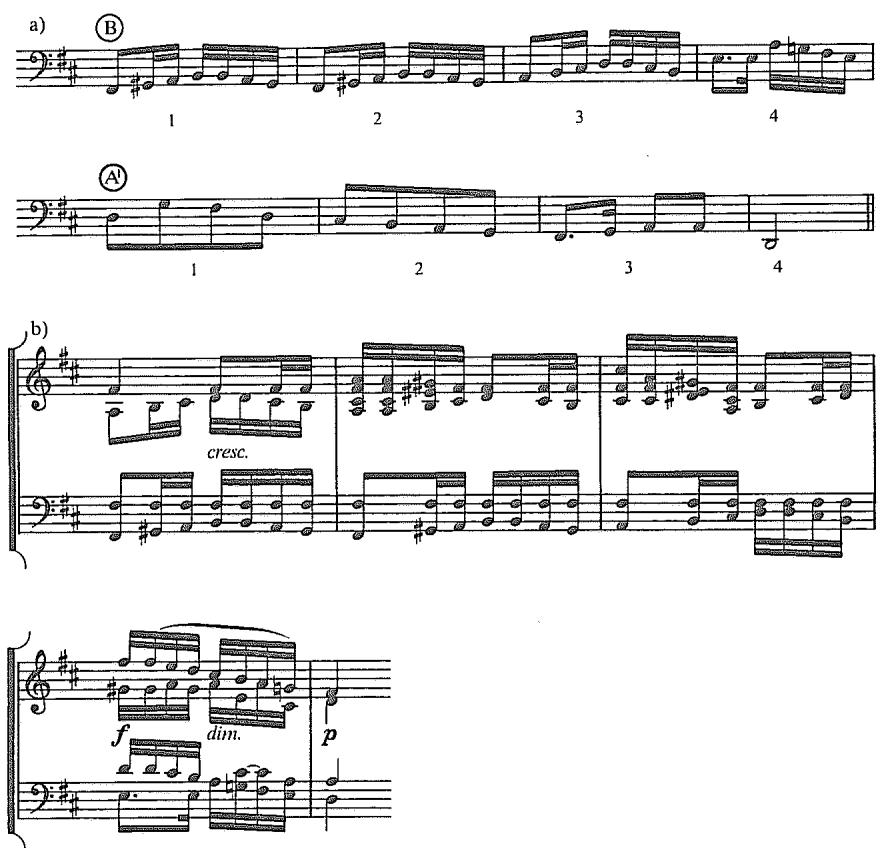
中文讲解
谱例6.14的图像占位符,展示Op. 102 No. 2 的"重构"版本:a. 第8–16小节低音;b. 第8–12小节全声部。这是P0072、P0074、P0075分析对象的视觉支撑。
补充说明
图像数据被省略,需查阅原版以核对重构后的节拍布局。
第41段(P0074)
原文复述
Note that, in this reconstruction, the A’ phrase is forced to begin on a notated downbeat.
中文讲解
本段是P0072–P0073的小结:在该重构中,A’乐句被"迫使"开始于一个记谱正拍。这意味着:当低音扩展被压缩后,旋律A’乐句自然落到记谱正拍——证明"表面上的弱拍到达"其实是低音扩展造成的视觉假象。
这一观察是P0071论断的实证支撑。
第42段(P0075)
原文复述
In the B’ phrase, the hypermetrical downbeat in the bass (m. 17) follows the hypermetrical downbeat in the melody by one beat, instead of preceding it by a beat as before (m. 8). Thus, when the metrical shift takes place in the melody, the two outer voices end up in true metrical unison for the first time (mm. 19–20). The F♯ minor cadence falls on the second beat of the fourth measure (m. 20) in both声部, but only the melody reinterprets this point as a downbeat. In the bass there is no reinterpretation: the second beat of m. 20 contains a lead-in analogous to the second beat of m. 16, and in both cases the lead-in leads to a hypermetrical downbeat (mm. 17 and 21).
中文讲解
本段分析B’乐句中低音与旋律的超小节正拍关系。第17小节低音的超小节正拍"跟随"旋律超小节正拍"一拍”——而非像第8小节那样"先于"一拍。因此,当旋律发生节拍偏移时,两外声部"首次真正"进入节拍齐一(mm. 19–20)。
F♯小调终止在两个声部都落在第四小节第二拍(第20小节),但"只有"旋律将该点重解释为正拍。低音中"没有"重解释:第20小节第二拍包含"导入"(类似于第16小节第二拍),两者都通向超小节正拍(第17与21小节)。
这一段是节拍分析精细度的极致:每个声部的正拍归属、低音与旋律的"一前一后"关系都被明确判定。“for the first time"标志结构事件——冲突的最终和解。
补充说明
“true metrical unison”(真正的节拍齐一)是分析中的关键里程碑;本曲只在mm. 19–20短暂实现这一状态。
第43段(P0076)
原文复述
After the foregoing discussion of the B phrases, the metrical analysis of the coda presents no new problems. Since there is no metrical reinterpretation in the melody in m. 28 as there was in m. 12, the fourth bar of the bass hypermeasure must be expanded to two full bars. Thus the outer voices reach their only simultaneous hypermetrical downbeat of the piece (!) at m. 29, the final resting point of both the tonal and the metrical structures.
中文讲解
本段总结尾声分析:“鉴于前述B乐句的讨论”,尾声的节拍分析"无新问题”。由于旋律在第28小节没有发生像第12小节那样的重解释,低音超小节的第四小节必须扩展至两整小节。因此两外声部在全曲"唯一"同时的超小节正拍——第29小节——实现会合!这是调性与节拍结构共同的"最终静止点"。
“only"与感叹号”(!)“凸显第29小节的重要性:它不仅是终止点,更是节拍戏剧的最终解决点。“tonal and metrical structures"的双重静止表明:节拍与调性"同构"地闭合。
“simultaneous hypermetrical downbeat”(同时的超小节正拍)作为概念在整首作品中只实现一次,这种稀缺性本身即是戏剧性。
补充说明
“最终静止点"对应Schenkerian的"终止”(final cadence)概念——结构层次上,调性与节拍的最终对齐标志作品的完成。
第44段(P0077)
原文复述
It should not escape notice that the A” phrase, beginning as it does over a cadential 6/4—that is, a dominant harmony—resembles the thematic returns in two Mendelssohn pieces discussed earlier, “Sehnsüchtig” (Example 6.3) and the Venetian Gondola Song (Example 6.5). The resemblance to “Sehnsüchtig” is especially strong: in both pieces the thematic return is accompanied by a virtual dominant pedal, and in both cases the resulting effect recalls late Baroque style in general and Bach in particular. In neither piece is the thematic return a true recapitulation, because it does not occur over a stable tonic harmony; the tonic is reached only at the end. In Op. 102, No. 2, the full cadence in III just preceding the thematic return effects a much stronger division than exists at the analogous point in “Sehnsüchtig” (m. 31). Still, the harmonic instability of the return prevents it from being quite an independent phrase. Although it contains a complete third-progression in the melody—3̂–2̂–1̂ in D major—the true starting point for this third-progression is given by the two preceding phrases, which harmonize the melodic tone F♯ with I and III respectively (see Example 6.13); strictly speaking, the melodic F♯ becomes a suspension (over V) at the downbeat of m. 21. Thus the locution “the A” phrase needs to be qualified slightly: A” is the deceptive recapitulation of an earlier phrase, in contrast to the true recapitulation in mm. 12–16 (A’); it is dependent on the preceding phrase, and ultimately on the two preceding phrases, for its harmonic completeness.
中文讲解
本段将Op. 102 No. 2 与前文讨论的两首门德尔松作品(“Sehnsüchtig"例6.3、Venetian Gondola Song例6.5)作对比。A"乐句始于终止6/4——即属和声——“类似于"前述两首的主题再现。与"Sehnsüchtig"的相似尤为强烈:两首的主题再现都伴随"虚拟属持续音”(virtual dominant pedal),效果都"令人想起晚期巴洛克风格,尤其是巴赫”。
两首中,主题再现都"不是真正的再现",因为它"不发生在稳定的tonic和声上";主音仅在终止时到达。在Op. 102 No. 2 中,主题再现前III级上的完整终止造成的"分割"强于"Sehnsüchtig"(第31小节)的相应位置。然而再现的和声不稳定性使其"不成为完全独立的乐句"。虽然旋律包含完整的三度进行(D大调3̂–2̂–1̂),但该三度进行的真正起点由前两个乐句给出——它们分别以I和III为旋律F♯配和声(见例6.13)。严格地说,旋律F♯在第21小节正拍"变为"属音上的"延留音"(suspension)。
因此,“A"乐句"这一措辞"需要略微限定:A"是早期乐句的"伪装再现”(deceptive recapitulation),不同于mm. 12–16(A’)的真正再现;它的和声完整性依赖于前乐句,并最终依赖于前两个乐句。
“virtual dominant pedal"是借用巴洛克"持续低音”(pedal point)概念——属持续音虽非真正持续音,但效果类似。“deceptive recapitulation"是作者的重要概念创造:表面像再现,但实际和声功能"伪装”——再现的"形式期待"被"和声现实"颠覆。
“true starting point"与"melodic F♯ becomes a suspension"揭示:旋律的"主音化”(F♯作为旋律起点)必须由前文和声"预先合法化"。这是Schenkerian"延长"概念的精妙应用。
补充说明
脚注34涉及与"Sehnsüchtig"巴赫风格的进一步联系。“virtual dominant pedal”(虚拟属持续音)是借用巴洛克"pedal point"概念——某音虽非字面持续,但功能等同。“deceptive recapitulation”(伪装再现)为本节关键概念创造。
第45段(P0078)
原文复述
In Schachter’s analysis of the G Minor Song, Op. 102, No. 4, the notated meter was shown to be “the” meter for the piece as a whole, despite the melody’s persistence in following a conflicting metrical pattern. The same is true of Op. 102, No. 2, although final metrical agreement is reached only at the very end of the piece. In fact, the conflicting metrical pattern in Op. 102, No. 2 is maintained artificially, as it were, by the more or less constant support of dynamic changes and surface durational patterns. If these supports are removed, the conflicting meter disappears.
中文讲解
本段作出跨作品总结,将Op. 102 No. 2 与Schachter分析的Op. 102 No. 4 进行类比。两曲的共同点是:尽管旋律持续跟随冲突的节拍模式,记谱拍号仍是"整曲的节拍"。Op. 102 No. 2 的最终节拍一致仅在曲末实现。
事实上,Op. 102 No. 2 的冲突节拍模式"可以说是人为维持的"——依靠力度变化与表面时值模式的"近乎持续"支持。如果这些支持被移除,冲突拍号"消失"。
“artificially"在此并非贬义——它揭示:节拍冲突并非"自然涌现”,而是作曲家通过多种参数"主动维持"的效果。这与P0065关于力度支持的观察形成呼应。“as it were”(姑且这么说)保留判断的谦逊。
“the"加引号的"the"暗示:在多个竞争拍号中,记谱拍号是"决定性"的那一个。
这是本节论证的高阶归纳:节拍冲突的存在依赖于作曲家的"精心设计”,而非自发的"感知现象"。
补充说明
“artificially"与"as it were"共同传达:节拍冲突是作曲家"主动设计"的结果,而非"自然涌现"的听者错觉。这一论断将门德尔松的节奏实践提升到"修辞性技艺"的层次。
第46段(P0079)
原文复述
Example 6.15a is a simple foreground reduction of the entire piece, with only minor changes made in pitch and rhythm to clarify the voice leading slightly. An alternate version of mm. 19–20 is given in Example 6.15b, simplifying the descending register transfer in the melody and emphasizing the parallelism with mm. 11–12.
中文讲解
本段介绍例6.15——一个"简单的前景缩减”(foreground reduction)。例6.15a对全曲进行缩减,仅对音高与节奏作"微小调整"以略微澄清声部进行。例6.15b给出mm. 19–20 的替代版本,简化旋律的下行八度转移,并强调与mm. 11–12 的平行关系。
“foreground reduction"在Schenkerian理论中指最接近表面的层次——仅剥离装饰音,保留基本节奏与音高轮廓。“minor changes"与"clarify the voice leading slightly"表明:此缩减不是分析重构,而是"演奏可读化"层面的简化。
例6.15b的"alternative version"为对比mm. 11–12 与 mm. 19–20 提供"剔除了八度转移"的版本,便于看出两者本质的平行关系。
补充说明
“foreground reduction"区别于"background reduction”(如例6.13);前者仅作最小简化,后者追求深层结构。
第47段(P0080)
原文复述
It is almost startling to see no trace of metrical conflict in this reduction, which after all involves only the simplest stripping away of surface embellishment and
中文讲解
本段是P0079与P0081之间的过渡说明:“几乎令人惊讶的是”——在这个缩减中看不到任何节拍冲突的痕迹,尽管它仅涉及对表面装饰"最简单的剥离"与(动态区分)。
“after all"与"almost startling"显示作者的修辞——表面看似错综复杂的节拍冲突在仅作最小简化后即"蒸发”。这一观察将引出P0083的结论。
本句在原文处中断于"and”,延续至P0083。
第48段(P0081)
原文复述
[Page 12 image placeholder]
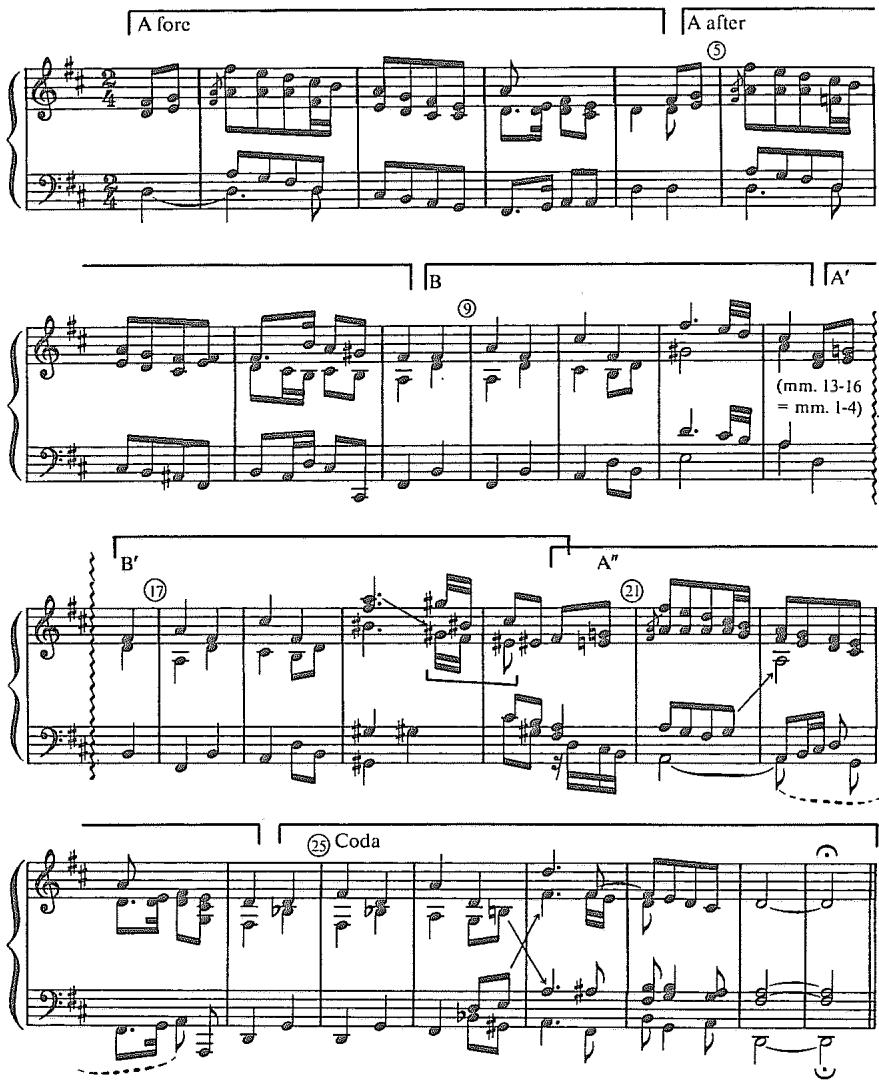
中文讲解
第12页的图像或乐谱示例占位符,位于P0080与P0082之间。需查阅原图以确认具体内容;推测为与例6.15相关的图像或版面元素。
补充说明
无额外补充(图像内容不可见)。
第49段(P0082)
原文复述
[Example 6.15, continued image placeholder]
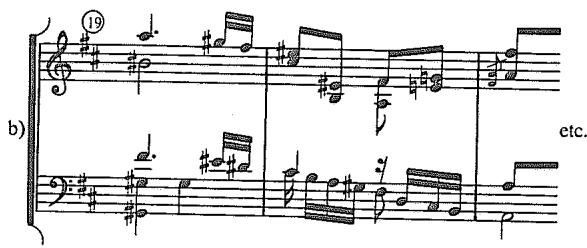
中文讲解
例6.15的延续图像占位符。与P0079、P0080、P0083共同呈现Op. 102 No. 2 的前景缩减版本。
第50段(P0083)
原文复述
dynamic differentiation. What remains is a series of four-measure phrases in a regular upbeat pattern; that is, each phrase begins with an upbeat and ends (except for the B’ phrase) on a downbeat. Each phrase begins with an upbeat and ends (except for the B’ phrase) on a downbeat. The hypermeter is four-bar throughout, with no expansions of any kind; even the metrical reinterpretations of the piece are no longer in evidence. (The repetitions at mm. 8–9 and 24–25 in the bass are now no longer striking enough to force a reinterpretation of the hypermeter.) Only the phrase overlap in m. 20 remains to give any hint of the rhythmic and metrical complexities of the piece itself.
中文讲解
本段承接P0080:经"最简单剥离表面装饰与动态区分"后,剩下的是一系列"规则弱起模式的四小节乐句”——每个乐句以弱起开始,(除B’乐句外)以正拍结束。超节拍"始终"为四小节,“无任何扩展”;本曲的节拍重解释也"不再显现"。(低音在mm. 8–9 与 24–25 的重复现在不足以"强迫"超节拍重解释。)“只有"第20小节的乐句重叠还留有本曲节奏与节拍复杂性的"暗示”。
“almost startling"与"only the phrase overlap remains"是本节最强烈的修辞——通过前景缩减的"透明化"揭示:门德尔松的复杂节拍结构在骨架层面"几乎不存在”。所有复杂性都依赖于表层的装饰、动态、节奏与声部进行的特定安排。
“regular upbeat pattern"与"no expansions of any kind"是令人震惊的对比——表面错综复杂的Op. 102 No. 2 在缩减后变成"规则的弱起四小节乐句序列”。这一发现是本节"形式—表现"辩证的高潮。
(文本中"Each phrase begins with an upbeat and ends (except for the B’ phrase) on a downbeat. The hypermeter is four-bar throughout, with no expansions of any kind"与上文重复出现,可能是OCR重复,但应理解为同一内容的强调。)
补充说明
“regular upbeat pattern”(规则弱起模式)是民歌、赞美诗等"简单形式"的典型特征——本曲在缩减后呈现这一特征。
第51段(P0084)
原文复述
As with the Venetian Gondola Song, so it is here: complex phrase and metrical structures are concealed within an unpretentious, even naive-sounding song. These structures are ultimately based on the simplest symmetries. In the Gondola Song the underlying form, once all expansions were removed, was a thirty-two-measure quatrain. In Op. 102, No. 2, the varied repetition of the B and A’ phrases (as B’ and A") suggests a similar underlying form, namely a sixteen-measure quatrain. The quatrain form, a staple of folk song and folk style, becomes a vehicle for Mendelssohn to apply his rhythmic genius.
中文讲解
本段作出本节的核心归纳:与Venetian Gondola Song一样,Op. 102 No. 2 在"朴素甚至天真"的歌曲表面下隐藏着复杂的乐句与节拍结构。这些结构"最终基于最简单的对称"。
在Gondola Song中,“一旦所有扩展被移除”,其潜在形式是"三十二小节的四行诗节"。在Op. 102 No. 2 中,B与A’乐句的变化重复(B’与A")暗示类似的潜在形式——“十六小节的四行诗节”。四行诗节形式——“民歌与民俗风格的主要载体”——成为门德尔松施展"节奏天才"的工具。
“concealed within"与"ultimately based on the simplest symmetries"揭示:复杂与简单是同一现象的两面。“rhythmic genius"并非贬义——它意味着:在最简单的形式上施加最精妙的处理。
“staple of folk song and folk style"将门德尔松的精致技法与"民歌"联系起来——这一联系贯穿整章(见P0085对Field的对比)。
补充说明
脚注35涉及与P0085中Field例子的进一步对比。“quatrain”(四行诗节)作为文学形式单位被借用为音乐形式术语。
第52段(P0085)
原文复述
The excerpt from a nocturne by Field, quoted in Example 6.1, was also a musical quatrain, and nothing so dramatically illustrates the difference between Mendelssohn and Field than their handling of this simple form. What makes Mendelssohn’s quatrains great music, and Field’s quatrain something less, is precisely Mendelssohn’s use of rhythmic artifice and its absence in Field. The use of the word “artifice” in this context may conjure up the usually pejorative word “artificial,” but no pejorative implication is intended. Quite the opposite: Field’s nocturne would have been a better piece if he had been a little more “artificial.” Even in the simplest character piece, the “natural” and artless can only go so far. Eventually the composer must apply his art to produce something distinguishable from mere folk song, or from hackwork.
中文讲解
本段是本节(也是本章)的总结性论断。Field夜曲的片段(例6.1)也是"音乐四行诗节”,“没有任何比两人对这一简单形式的处理更能戏剧化地说明门德尔松与Field的差异”。
使门德尔松的四行诗节成为"伟大音乐”、Field的四行诗节"稍逊一筹"的"恰恰是”——门德尔松对"节奏技巧"的使用与Field的"缺席"。
“artifice"一词的使用可能让人联想到通常带贬义的"artificial”,但"无意带任何贬义"。“恰恰相反”:“如果Field多一点’人为’",其夜曲本可以是更好的作品。即便在最简单的特性曲中,“自然的"与"朴素的"也只能走到某处。最终作曲家必须"施展其艺术”,以产生与"单纯的民歌"或"平庸之作"不同的东西。
“artifice"与"artificial"的对比是修辞的关键——作者主动澄清:他对门德尔松的"artifice"持肯定态度。Field的"natural"并非优点,而是"局限”。这一论断与浪漫主义"艺术高于自然"的美学呼应。
本段将章中所有细节分析归结为一项美学立场:作曲家的"艺术性”——节奏技巧、句法扩展、节拍冲突——是使简单形式升华为"伟大音乐"的关键。
补充说明
John Field是19世纪初爱尔兰作曲家、钢琴家,夜曲形式的创始人;其风格以简单、歌唱化著称。门德尔松对Field的评价复杂——既受影响又超越其"朴质"。脚注35涉及对两人四行诗节形式对比的进一步说明。
脚注 / 边栏 / 图表 / 附加信息(如有)
本节所涉及的脚注(19、20、21、22、23、24、25、26、27、28、29、30、31、32、33、34、35)依次支撑:Op. 19 No. 1 的延长解读、Schachter对Op. 102 No. 4 的分析、十六首作品的统计、Schenker的《Free Composition》引文、引子的节拍性质、Op. 38 No. 4 的省略性终止、对Op. 102 No. 6 的对比、宗教风格的进一步说明、终止点遮蔽、F♯小调终止、十六分音符节奏压缩、内声部a¹、低音与旋律引领关系、问号标注、mm. 2–3 的节拍诊断、与"Sehnsüchtig"的巴赫风格联系、quatrain形式对比。谱例6.8(Op. 19 No. 1 开头)、6.9(Op. 19 No. 1 重构)、6.10(Op. 62 No. 2 三段)、6.11(Op. 38 No. 4 头尾)、6.12(Op. 102 No. 2 全曲)、6.13(Op. 102 No. 2 声部进行缩减)、6.14(Op. 102 No. 2 重构)、6.15(Op. 102 No. 2 前景缩减)共同构成分析的视觉支撑。
💡 本节核心要点
- 门德尔松《无词歌》中最具原创性的节奏技法是"冲突重音"——同一拍号的两种节拍模式相互竞争,该模式在48首中至少16首(占三分之一)中出现,不仅是局部手段,更可作为整曲的"主导意念"。
- 典型作品模式是:引子建立记谱拍号,主旋律进入时引入冲突拍号,最终回到记谱拍号;这一论辩—解决结构与古典奏鸣式的调性逻辑有审美呼应。
- Op. 62 No. 2(12/8拍)展示冲突重音如何贯穿ABA’三部形式,并通过力度、重音、节奏模式相互印证;最终在尾声中"清算"早期冲突。
- Op. 38 No. 4 展示"框式结构"中冲突重音的相对失败:冲突仅在曲末出现,造成"任意性";门德尔松本可通过在V和弦中加入属七音让节拍联系更清晰,但他未如此做,可能正是出于对模糊性的有意追求。
- Op. 102 No. 2(D大调,2/4拍,1845)是分析最详尽的对象:四行诗节(AABA)的第二半段加以变化重复,旋律与低音形成超小节正拍的错位关系,最终仅在第29小节实现唯一的同时超小节正拍。
- 通过前景缩减(例6.15)可见:表层错综复杂的节拍冲突在仅作最小简化后即"蒸发",还原为规则的弱起四小节乐句序列——这表明所有复杂性都依赖于表面装饰、动态与声部进行的特定安排。
- 门德尔松与Field的对比揭示核心美学立场:使门德尔松的简单形式(quatrain)成为伟大音乐的是"节奏技巧"(rhythmic artifice)的精妙运用,Field的"自然"与"朴素"反而是其局限。
🔑 关键术语
- conflicting downbeats(冲突重音):本节核心概念。指同一拍号的两种节拍模式(一种与记谱拍号一致,一种从记谱小节的其他位置开始)相互竞争;冲突模式虽与记谱拍号相悖,但听者仍可感知,且可能更强烈。
- quatrain(四行诗节):本节归纳性的形式类比。指四乐句(AABA或类似)的简短对称结构,是民歌与民俗风格的主要载体;门德尔松的Op. 102 No. 2 与Gondola Song均以此为基础形式。
- interruption(中断):Schenkerian曲式术语。指结构上的休止点,常对应曲式中段的边界。在Op. 102 No. 2 中,B乐句后的V由中断标记,与最终A"再现后的V终止形成对照。
- cadential 6/4(终止六四):Schenkerian延长理论的典型标志。在Schenkerian分析中视为V的延长装饰而非独立和声事件;本节讨论A"乐句始于终止6/4如何"伪装再现"。
- deceptive recapitulation(伪装再现):本节作者的概念创造。指主题再现虽表面呈现再现特征,但因和声不稳定性(不发生于稳定的tonic)而不成为真正再现;A"是A’的"伪装"对应物,依赖前乐句的和声预备。
- register transfer(八度转移):Schenkerian术语。指同一结构音在不同段落以不同八度呈现;Op. 102 No. 2 的a¹在尾声中"升级"为a²成为高潮音,体现了结构音的"扩展性"使用。
- rhythmic artifice(节奏技巧):本节核心美学概念。指门德尔松在简单形式基础上施加的精妙节奏处理(节拍冲突、句法扩展、声部错位等);作者明确将其与贬义的"artificial"区分,视为伟大音乐的标志。