目录
1 Linear Techniques
- 1.1 [描述性拆分] Linear Techniques: Introduction
- 页码:1-1
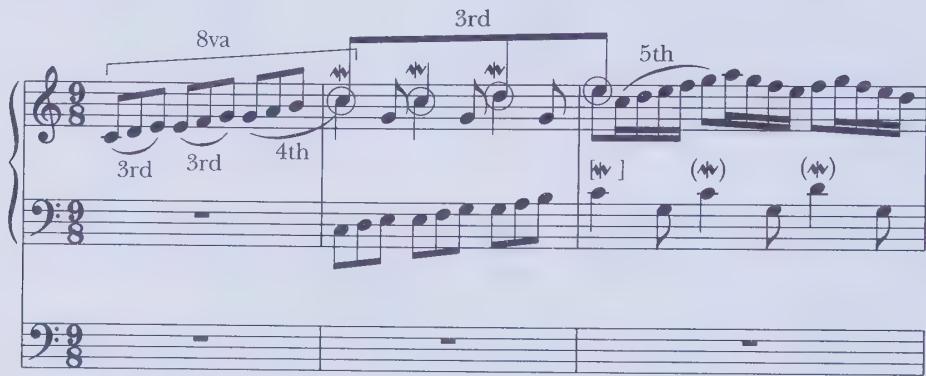
2 Linear Progressions
- 2.1 [描述性拆分] Linear Progressions: Example 4.1 (Bach, BWV 547) — Part 1
- 页码:1-2
- 2.2 [描述性拆分] Example 4.1 (Bach) — Horizontal Expansion of the Tonic Triad
- 页码:3-3
- 2.3 [描述性拆分] Example 4.2 (Mozart, K. 264): Linear Motion Between Tonic Harmonies
- 页码:4-4
- 2.4 [描述性拆分] Definition of Linear Progressions and Example 4.3
- 页码:5-5
- 2.5 [描述性拆分] Example 4.4 (Bach, Jesu, meine Freude): A Linear Progression Connecting Chords
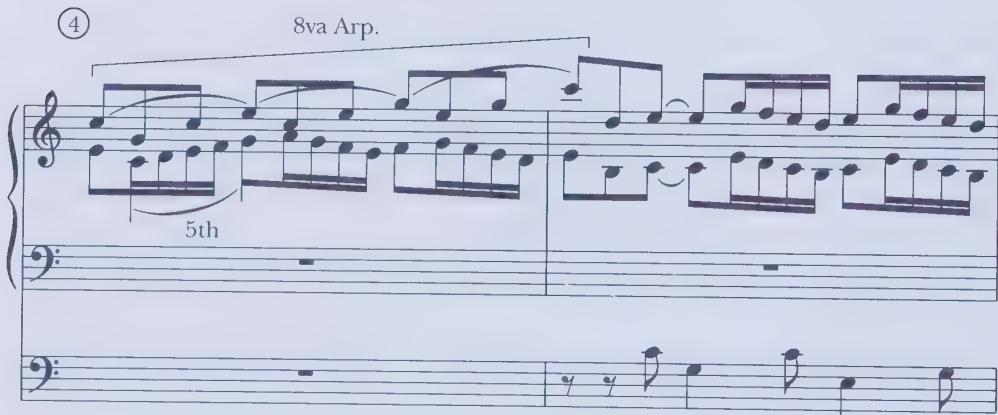
- 页码:6-7
- 2.6 [描述性拆分] Example 4.5 (Beethoven, Op. 2 No. 1, Trio): Multiple Levels of Linear Structure
- 页码:7-9
- 2.7 [描述性拆分] Example 4.6 (Clementi, Op. 36 No. 1): Register Transfer and Interval Inversion
- 页码:9-10
- 2.8 [描述性拆分] Examples 4.7 (Bach, Partita No. 6) and 4.8 (Handel, Courante): Descending Fourth Progressions
- 页码:10-11
- 2.9 [描述性拆分] Example 4.9 (Beethoven, Op. 119 No. 1): Secondary Linear Progressions
- 页码:11-12
3 Linear Intervallic Patterns
- 3.1 [描述性拆分] Linear Intervallic Patterns: Example 4.10 (Handel, Passacaille)
- 页码:12-14
- 3.2 [描述性拆分] Examples 4.11 (Handel), 4.12 (Mozart), and 4.13 (Handel): Descending-Fifth Variants
- 页码:15-17
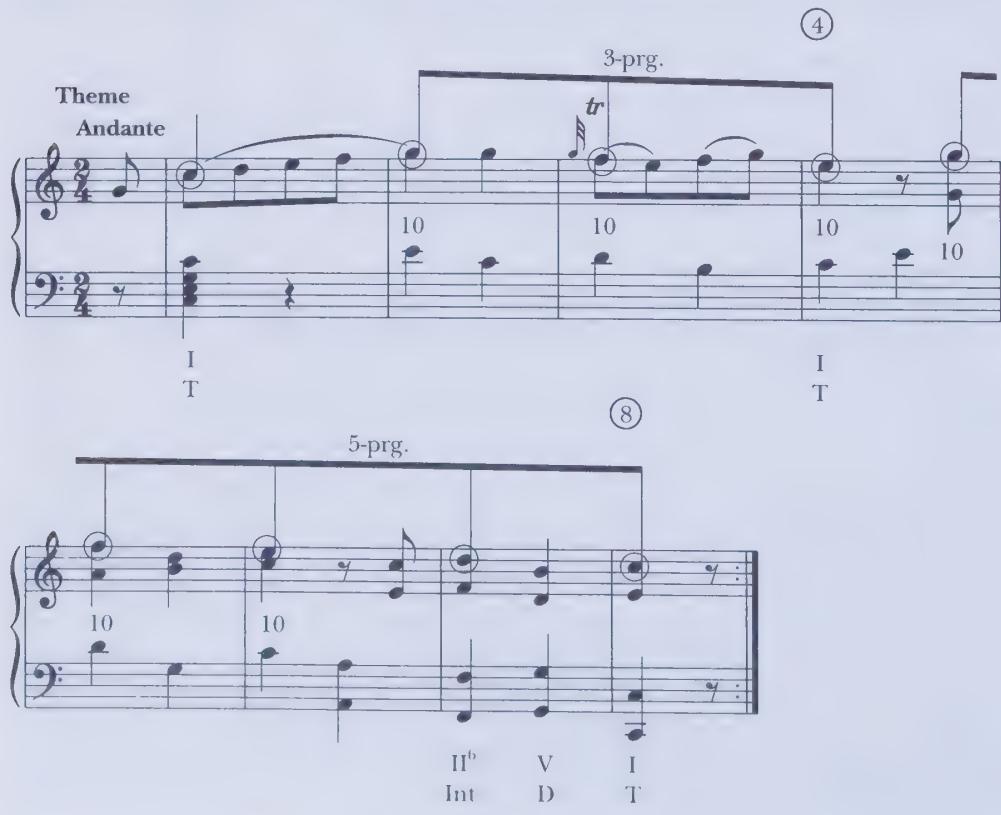
- 3.3 [描述性拆分] Examples 4.14 (Handel) and 4.15 (Dowland): 10–7 and 5–6 Patterns
- 页码:18-19
- 3.4 [描述性拆分] Examples 4.16 (Mendelssohn) and 4.17 (Beethoven, Op. 79): Chromatic and Descending 5–6
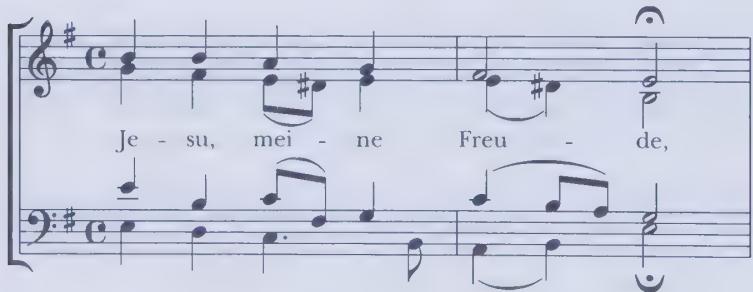
- 页码:20-21
- 3.5 [描述性拆分] Example 4.18 (Mozart, K. 283): 7–6 Suspensions in a Linear Intervallic Pattern
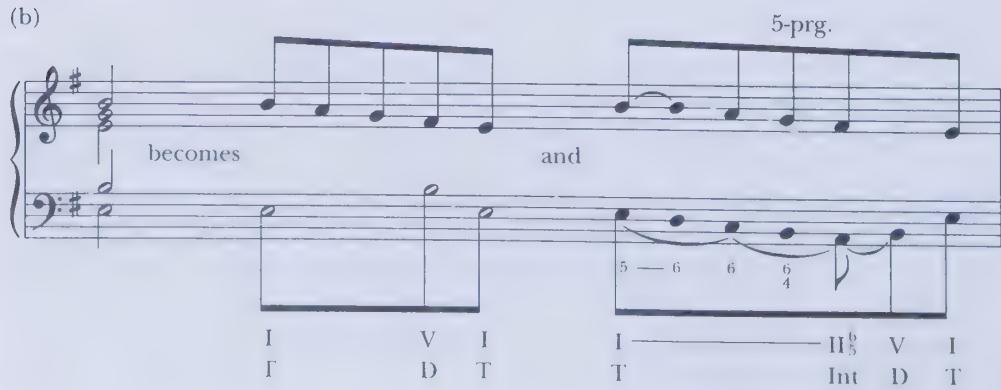
- 页码:22-23
4 The Neighbor Note
- 4.1 [描述性拆分] The Neighbor Note: Examples 4.19 (Brahms) and 4.20 (Beethoven, Moonlight)
- 页码:23-25
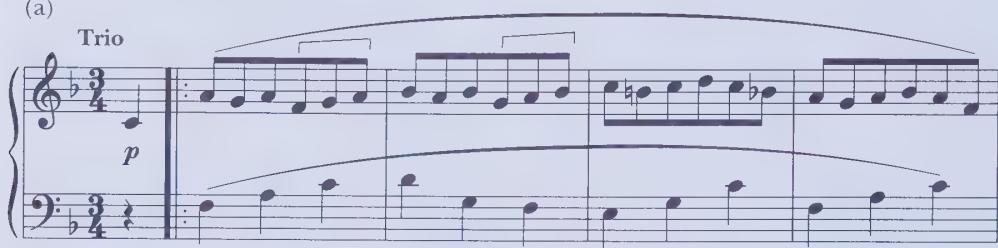
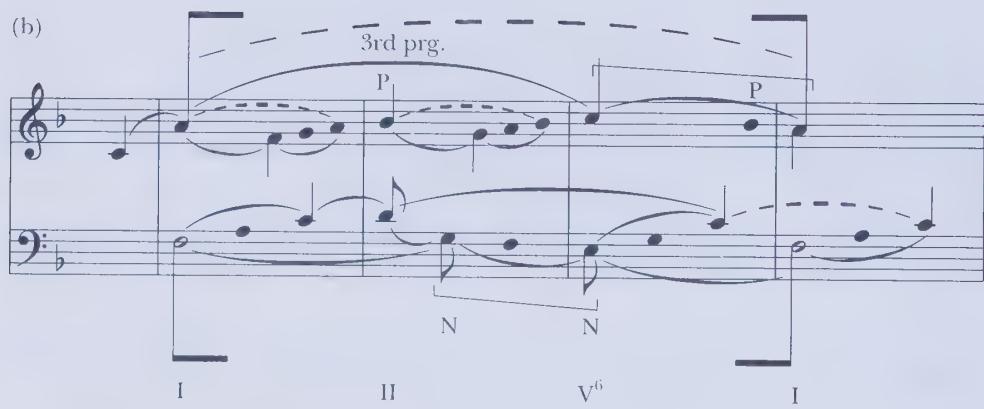
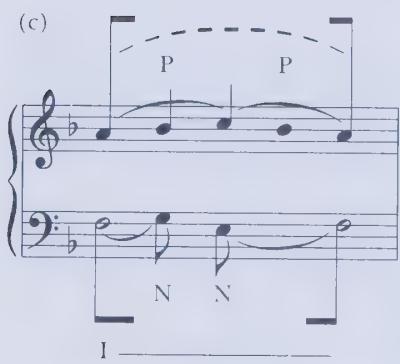
- 4.2 [描述性拆分] Examples 4.21 and 4.22: Summary of Linear Intervallic Patterns
- 页码:26-28
5 Pieces for Analysis
- 5.1 Pieces for Analysis
- 页码:29-29
6 Notes
- 6.1 [描述性拆分] Notes 1–15
- 页码:30-30
- 6.2 [描述性拆分] Notes 16–23
- 页码:31-31
1.1 [描述性拆分] Linear Techniques: Introduction
第1段(P0001)
原文复述
Linear Techniques
中文讲解
本段为标题行,使用 Markdown 一级标题语法(#)标注章节主题“线性技法”(Linear Techniques)。它本身没有展开论述,只起标示与组织作用,告诉读者接下来的内容将围绕“线性技法”这一主题展开。
补充说明
在原 PDF 中,这一行通常以较大的字体或加粗形式呈现,提示读者进入一个新的大章节。在本节(1.1)中,它标志着即将讨论“旋律与和声相互关系”这一主题的开端。
第2段(P0002)
原文复述
The melodic and harmonic dimensions of tonal music may be considered independently, yet they are closely interrelated. How do they work together? We shall begin to answer this question by considering ways in which melody may interrelate with harmony to form linear progressions.
中文讲解
作者指出,调性音乐的旋律与和声两个维度虽然可以被分开讨论,但实际上彼此紧密相关。接着以设问“它们是如何协同作用的?”引出本节目标:先考察旋律如何与和声相互关联,从而形成“线性进行”(linear progressions)。换言之,本节将聚焦旋律—和声的互动机制,而不是单独研究旋律或单独研究和声。
补充说明
“线性进行”(linear progressions)是本教材后续章节将要展开的核心概念;此处仅作为引言点题,尚未给出定义。读者可在后续小节中逐步了解其具体含义与分类。
脚注 / 边栏 / 图表 / 附加信息(如有)
本节为 1.1 节的引言性内容,不含脚注、边栏、图表或额外的附加信息块;所有论述均集中于 P0001(标题)和 P0002(引言段落)之中。
💡 本节核心要点
- 本章主题为 Linear Techniques(线性技法),由 Markdown 一级标题标示。
- 旋律与和声在调性音乐中虽可分别讨论,但实际紧密相关。
- 本节的核心问题是:旋律与和声是如何协同作用的?
- 作者将以“旋律与和声相互关联从而形成线性进行”作为切入,逐步回答上述问题。
🔑 关键术语
- Linear Techniques(线性技法):指通过强调各声部横向运动及其相互关系来组织音乐的手法,与侧重纵向同时发响的传统和声分析形成对照。
- Tonal music(调性音乐):以调性中心与和声功能关系为结构基础的音乐体系,与无调性音乐相对。
- Linear progressions(线性进行):由旋律与和声相互关联所形成的横向声部运动过程,强调声部进行的线条性而非纵向和弦功能。
- Melodic dimension / Harmonic dimension(旋律维度 / 和声维度):分析音乐的两个互补视角:旋律维度关注横向音高运动,和声维度关注纵向同时发响的和弦构成与功能关系。
2.1 [描述性拆分] Linear Progressions: Example 4.1 (Bach, BWV 547) — Part 1
第1段(P0003)
原文复述
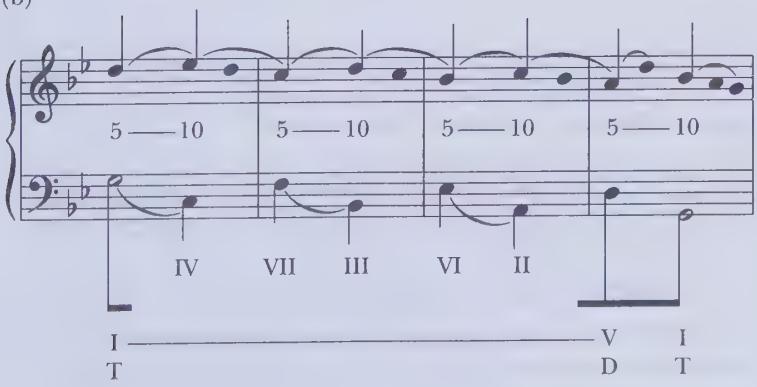
Linear Progressions
中文讲解
这是第4章下面一个小节的总标题:“线性进行”(Linear Progressions)。它引出后文对巴赫管风琴前奏曲 BWV 547 开头的线性音阶片段的分析。
补充说明
标题本身只起导航作用;它点明了本章研究对象是"以线条运动为主"的写作手法,而 BWV 547 开头的音阶是典型例子。
第2段(P0004)
原文复述
Example 4.1 shows the opening of a work by Bach, one of his grand preludes for organ. The piece begins with an ascending line in the right hand, a line that is essentially a C-major scale. The same gesture is immediately imitated by the left hand in the next bar. In fact, you will notice that most of the other lines in this brief passage are similar to the melody of the first measure: they are portions of the C-major scale that acquire a life of their own as they participate in a rhythmically animated texture that develops, by bar 5, into a three-part polyphonic fabric.
中文讲解
本段介绍例 4.1 的内容。巴赫这首管风琴大前奏曲开头,右手先奏出一条上行线,本质上是一条 C 大调音阶;第二小节左手立即模仿同一动作。事实上,这段简短乐句中的其他声部大多与第一小节的旋律相似:它们都是 C 大调音阶的片段,参与到一个节奏活跃的织体中,并在第 5 小节发展成三声部复调织体。
补充说明
作者用 “essentially a C-major scale” 一句把听觉印象与理论术语相连:上行线条虽然不是纯音阶(后文会揭示重复了三音和五音),但在整体形态上仍属音阶化进行。“acquire a life of their own” 强调线条作为独立旋律的自主性,这是线性写作思维的核心——每个声部都被视作有意义的旋律。
第3段(P0005)
原文复述
You may also notice that we refer to the scale in bar 1 as a “melody”; a scale passage can be, in many respects, one of the purest manifestations of melody. You may find it useful to recall the discussion of melodic and contrapuntal principles in Chapter 2. The scale passage has a definite beginning and end, defined by occurrences of the tonic note in different registers; most importantly, however, it proceeds entirely by step. The scale that begins this Prelude—one of the most characteristic features of the piece—is a melodically fluent line that resembles the formations we encountered in our discussion of strict counterpoint.
中文讲解
作者指出,第 1 小节的音阶之所以被称为"旋律",是因为音阶化乐句在很多方面都是旋律最纯粹的表现形式之一,并建议回顾第 2 章关于旋律与对位原则的讨论。该音阶乐句有明确的起止——由不同八度的主音界定——而且它完全以级进进行。这条开场的音阶是这首前奏曲最具代表性的特征之一,它在旋律上流畅,类似于我们在严格对位讨论中所遇到的音形。
补充说明
“purely conjunct motion”(完全级进)是西方音乐理论中对"旋律性"最经典的标准之一。提到"严格对位"是为了呼应第 2 章中关于级进形成(formations)的概念——即相邻两音之间形成的对位音程关系。
第4段(P0006)
原文复述
Consider for a moment that compositional practice, particularly during the Baroque and Classical periods, sought to establish the key definitively at the beginning of the piece. And if you sing the beginning of the prelude up to the
中文讲解
本段提醒读者思考一个历史惯例:在巴洛克与古典时期,作曲家常追求在作品开头就明确确立调性。如果把前奏曲开头唱到——(句子在此跨页中断,下一小节继续)。
补充说明
这一段虽然被截断,但功能是引导读者主动"验证"下一段的结论——唱到第二小节正拍即可体会调性已经明确。
第5段(P0007)
原文复述
Example 4.1
中文讲解
这是例 4.1 的小标题,提示下面进入谱例 4.1 的展示。
第6段(P0008)
原文复述
(a) J. S. Bach, Organ Prelude in C Major, BWV 547, bars 1–5 with foreground interpretation; (b) arpeggiation of triad
中文讲解
这是例 4.1 的图注,说明子图 (a) 为巴赫《C 大调管风琴前奏曲》BWV 547 第 1–5 小节的前景(前层)诠释;子图 (b) 为该三和弦的分解(琶音化)。
补充说明
“Foreground interpretation”(前景诠释)是指 Schenker 术语体系下被分析为最外层、最显著结构的层次;它与"background"(背景)和"middleground"(中景"相对。这里 (a) 给出的就是读者应首先听到的旋律线条本身,而 (b) 抽取出它底层的和声骨架——C 大调三和弦的分解。
第7段(P0009)
原文复述
中文讲解
子图 (a) 的图像占位符:展示巴赫 BWV 547 第 1–5 小节及其前景诠释。本文件中图像数据被省略,但位置被保留以匹配图注顺序。
补充说明
无法核对谱例细节:需手动查看原书第 2 页,确认 (a) 中右手第 1 小节音阶是否真的包含 10 个音(三音、五音重复)。
第8段(P0010)
原文复述
中文讲解
第 2 页另一处图像或乐谱示例的占位符;图像数据被省略,位置保留。
补充说明
原文未给出此占位符的标题文字,因此无法判断它对应谱例的哪一部分(如旋律/对位声部分行、装饰音标注等),需手动查看原书。
第9段(P0011)
原文复述

中文讲解
子图 (b) 的图像占位符:展示 C 大调三和弦的分解(琶音化)。图像数据被省略,位置保留。
补充说明
(b) 是分析性图示,意在让读者看出第 1 小节的"音阶"实则是 C-E-G 三个和弦音的琶音化呈现,弱拍上的二度经过音填充三度音程,从而在听觉上形成一条流畅的音阶线。
第10段(P0012)
原文复述
downbeat of bar 2, the scale passage leaves you with little doubt that the work is in C major: it needs no harmonization, no accompanying second voice; the scale passage by itself establishes the key. A closer look will reveal something more than pure melody: consider that a diatonic scale (with the first note repeated an octave higher) comprises eight pitches. Bach’s scale, on the other hand, contains ten notes. By repeating the mediant and dominant tones, Bach expands the scale and creates groups within the passage.
中文讲解
如果把前奏开头唱到第 2 小节的正拍,这条音阶乐句足以让人确信作品是 C 大调——它不需要和声进行,也不需要第二个声部伴奏,单凭音阶本身就确立了调性。然而细看之下,它又不仅仅是"纯旋律":一个八度内(首音在高八度重复)的自然音阶共 8 个音;而巴赫的这条"音阶"却包含 10 个音。他通过重复三音和属音,把原本的 8 音阶扩展为 10 音,并在乐句内部形成若干音组。
补充说明
这里揭示了"线性进行"与"和声"的内在统一:表面看是 10 音音阶,本质是 C-E-G 三和弦音的多次重复与强调,弱拍上的音只是经过音。这一观察为下一段把该片段描述为"三和弦琶音化"奠定基础。
第11段(P0013)
原文复述
This grouping leads us to hear the first, third, and fifth degrees more prominently than the others. In other words, as Example 4.1b illustrates, one can describe the passage as based on an arpeggiation of the C-major triad, with rhythmically weak passing tones filling in the intervals of the triad, thereby creating the melodically fluent scale. This passage portrays with great clarity how closely harmony and melody are interrelated.
中文讲解
由于重音分组,听者会自然把第一、三、五级音听得比其他音更突出。换言之,如例 4.1b 所示,可以把这段描述为以 C 大调三和弦的琶音为基础,弱拍上的经过音填充三和弦各音之间的音程,从而生成流畅的音阶。这一片段非常清晰地展现了和声与旋律之间多么紧密的相互关联。
补充说明
本段是本小节的核心论点:所谓的"线性"旋律并非脱离和声的纯线条,而是被和声骨架(C 大调 I 级三和弦的分解)所"型塑"。这一观点对后续 Schenker 式的简化分析以及"线性进行"作为和声现象的章节讨论都至关重要。
脚注 / 边栏 / 图表 / 附加信息(如有)
本节脚注、边栏或附加说明:原文除谱例图注 (a)/(b) 外没有脚注或边栏文本。谱例 4.1 本身需要读者手动查看原书第 2 页以核对 (a) 中 10 音音阶的三音、五音重复位置,以及 (b) 中 C 大调三和弦琶音化的具体排列。
💡 本节核心要点
- 例 4.1 展示巴赫《C 大调管风琴前奏曲》BWV 547 第 1–5 小节,是"线性进行"的典型样本。
- 开场旋律本质上是一条 C 大调音阶,左手在下一小节立即模仿。
- 音阶化乐句是旋律最纯粹的表现之一:起止由不同八度的主音界定,全程级进,呼应严格对位的音形。
- 巴洛克与古典时期作曲家惯于在作品开头就明确确立调性;本例单凭这条音阶即足以确立 C 大调。
- 看似八度内 8 音的自然音阶,巴赫通过重复三音(中音)和属音,扩展为 10 音,形成重音分组。
- 因此,第 1 小节既可视为线性音阶,也可视为 C 大调三和弦的琶音化,弱拍经过音填充三度音程——和声与旋律在此紧密互依。
🔑 关键术语
- Linear Progression:线性进行:以旋律线条的运动为主导、级进为主的写作方式,与"和声进行"相对;本节把 BWV 547 开头的音阶作为其范例。
- Foreground:前景(Schenker 分析术语):乐曲最具结构性、最显著可听到的层次;例 4.1(a) 所展示的就是这一层次。
- Strict Counterpoint:严格对位:以严格的声部进行规则(如平行五八度禁止、所有声部皆旋律化)写作的对位风格;本书第 2 章讨论过。
- Arpeggiation / Arpeggiation of a Triad:琶音化:将和弦音按时间先后依次奏出;本节把 BWV 547 第 1 小节描述为 C 大调三和弦的琶音化。
- Passing Tone:经过音:在两个和弦音之间以级进方式填充的弱拍非和弦音,本节用它解释 10 音音阶中弱拍上的填充。
- Mediant / Dominant:中音(第三级)与属音(第五级);本节指出巴赫正是重复这两个音以扩展原本 8 音的自然音阶。
- Establishing the Key:确立调性:在作品开端通过旋律、和声或调式特征让听者立即明确调号与主音,是巴洛克与古典时期的常见做法。
2.2 [描述性拆分] Example 4.1 (Bach) — Horizontal Expansion of the Tonic Triad
第1段(P0014)
原文复述
Now look beyond bar 1 of Example 4.1a. You will soon discover that the harmonic basis of the entire excerpt is the C-major tonic chord, which is being expressed and expanded through linear means. In other words, the intervals of the C-major triad (represented schematically in Example 4.1b) occur horizontally either with stepwise lines or arpeggiations (consonant skips). For instance, the top voice of bar 4 to the downbeat of bar 5 is explicitly an arpeggiation of the C-major triad. Try mentally inserting passing tones between the strong parts of successive beats and you will recognize the relationship between bars 1 and 4: the top voice of bar 4 is a “variation” of bar 1 transferred up an octave, an arpeggiation of the tonic triad minus the passing tones.
中文讲解
这一段引导学生把目光从第 1 小节扩展到谱例 4.1a 的整段乐谱,提示读者会发现整段音乐的和声基础始终是 C 大调主和弦,只是被线性手段表达和展开。作者解释,C 大调三和弦的音程(见谱例 4.1b 的示意图)在横向进行中以两种方式出现:级进进行或分解和弦(即协和跳进)。作者以第 4 小节到第 5 小节强拍的高声部为例,指出那是一个明确的 C 大调主和弦的分解。然后作者让读者在心中于各拍强音之间插入经过音,这样便能看出第 1 小节与第 4 小节之间的关系:第 4 小节的高声部其实是第 1 小节高声部移高八度后的“变体”,即去掉经过音之后剩下的主和弦分解形式。这一段说明了和声如何通过线性方式在时间中铺陈开来。
补充说明
“线性展开”(linear expansion)指把一个和弦的音程在时间上展开成旋律线条;“分解和弦”(arpeggiation)是把同时发响的音按顺序奏出;“经过音”(passing tone)是出现在两个音高之间的非和弦音,常填充级进运动。谱例 4.1a 是 Bach 前奏曲的开头,谱例 4.1b 是 C 大调三和弦的纵向示意图。
第2段(P0015)
原文复述
Now examine the top voice of bar 2. The consonant skips within each beat create disjunct motion, in contrast to the scale passage of bar 1. Yet there is a “hidden” stepwise relationship that unifies bars 1 and 2. Focus on the notes on the strong part of each beat in bar 2 to the downbeat of bar 3. You will notice that these notes form the line C–C–D–E (see the circled notes in Example 4.1a). Not only do we see another instance of a nonadjacent stepwise relationship between tones, but in this case we realize also that the upper voice from the downbeat of bar 2 to the next downbeat is an expanded repetition of the first three notes of the piece—C–D–E! This motion through the lower third of the tonic triad—C–D–E—can be said to be repeated on two different “levels,” because each occupies a different span of tonal space. Moreover, because of this relationship we perceive the opening melody to the downbeat of bar 3 as an integrated melodic gesture.
中文讲解
作者接着让我们关注第 2 小节的高声部。第 2 小节内每拍之间的协和跳进产生的是跳跃式(disjunct)运动,与第 1 小节的音阶式进行形成对比。然而,作者指出其中存在一种“隐藏的”级进关系,把第 1 小节与第 2 小节统一起来。具体方法是聚焦第 2 小节每拍的强音直到第 3 小节的强音,会发现这些音构成 C–C–D–E 这一线条(见谱例 4.1a 中加圈的音符)。这不仅再次展示了非相邻音之间的级进关系,而且揭示出第 2 小节强拍到下一强拍的高声部,是作品前三个音 C–D–E 的扩展重复!穿过主和弦下方三度音程的 C–D–E 这一运动,实际上在两个不同的“层级”上重复,因为每次所跨越的调性空间长度不同。此外,正是由于这种关系,我们才把直到第 3 小节强拍为止的开头旋律听成一个完整的、统一的乐句。
补充说明
“不连续的级进关系”(nonadjacent stepwise relationship)指虽然旋律音以跳进呈现,但若把强拍音单独抽出,则仍形成级进线条。“不同层级”指相同音程内容在不同音区或不同时间跨度上的再现,是音乐分析中常见的“嵌套”或“递归”结构。这里的脚注 1 通常与音级集合或线性分析中的“层级”概念有关,可参阅作者后续章节进一步说明。
第3段(P0016)
原文复述
This elegant beginning to Bach’s prelude concisely illustrates a fundamental principle of tonal music: melodically fluent lines, which have their own melodic identity and character, often participate in the vertical dimension of chord and harmony. That is, they may serve to expand a chord into the horizontal dimension by “linearizing” the intervals of the chord, which may then be filled in with passing tones, the basic ingredient of melodic fluency.
中文讲解
作者总结说,Bach 前奏曲这简短而精美的开头,集中体现了一个调性音乐的基本原理:具有自身旋律特征与性格的流畅线条,常常同时参与到和弦与和声的纵向维度之中。也就是说,这些旋律线条可以通过“线性化”一个和弦的音程,把该和弦在水平方向上展开,而展开所留下的缝隙又可以用经过音来填充——经过音正是构成旋律流畅性的基本要素。
补充说明
这一段是从具体作品(Bach 前奏曲)上升到一般性原理的关键过渡句,可视为本章的核心命题:旋律与和声并非两个独立的层面,而是同一调性结构在不同维度上的呈现。
第4段(P0017)
原文复述
Consider the vertical representation of the C-major triad shown in Example 4.1b. From the bottom up, the triad comprises two thirds plus a fourth. These groupings correspond to bar 1 of Bach’s prelude, where repeated notes articulate the third-third-fourth segmentation. In bar 3 (see the slur above the top voice), the motion from C up to G is not divided into a third plus a third as it is in bar 1, but appears as a continuous motion through the interval of a fifth. This motion delineates the boundary—the first and last notes—of the triad, the basic structural element of tonal music. The outer interval of a triad, however, may be expressed not only as a fifth—as in a three-note chord in close position—but also as an octave in a four-voice texture (Example 4.1b).
中文讲解
作者让我们观察谱例 4.1b 中 C 大调三和弦的纵向排列。从下往上看,该三和弦由两个三度加上一个四度构成。这种三度—三度—四度的分组正与 Bach 前奏曲第 1 小节相对应——重复音清晰地标出了三度—三度—四度的划分。而到了第 3 小节(见高声部上方的连音线),从 C 上行到 G 的运动不再像第 1 小节那样被分为一个三度加一个三度,而是作为跨越纯五度的连续运动出现。这一运动勾勒出了三和弦的“边界”——也就是该和弦的首尾两音,这是调性音乐的基本结构单位。三和弦的外围音程不仅可以表现为纯五度——即三音紧密排列的三和弦,也可以在四声部织体中表现为八度(参看谱例 4.1b)。
补充说明
“三度—三度—四度”分割对应于 C-E(三度)、E-G(三度)、G-C(四度),即 C 大调主和弦自下而上的音程结构。三音紧密排列时,最高与最低音之间为纯五度;在四声部开放排列中,这一外围音程则可扩展为八度。这是 Schenkerian 与传统和声理论都强调的“和弦外围音”思想。
第5段(P0018)
原文复述
The initial scale passage completely traverses this octave: our ears perceive both the smaller chordal intervals within the bar and the larger interval that spans the downbeats of bars 1 and 2. In general, the intervals of the triad may serve as the basis for melodic motions associated with the expansion of triads: the third, fifth, octave; fourth (as the inversion of the fifth), and sixth (as the inversion of the third).
中文讲解
开头的音阶式乐句完整地穿越了这一八度:我们的耳朵既能感知到小节内部那些较小的和弦内音程,也能感知到跨越第 1 小节与第 2 小节强拍之间的更大音程。总的来说,三和弦所包含的音程可以作为与三和弦展开相关的旋律运动的基础:三度、五度、八度,以及作为五度转位的四度,还有作为三度转位的六度。
补充说明
本段是本节最后的概括陈述,把与三和弦展开相关的旋律音程归类列出:基本音程(三度、五度、八度)与其转位(四度、六度)。这些音程构成传统和声理论中“和弦—音阶”关系的基础,在后续讨论线性写作与对位时还会反复出现。
脚注 / 边栏 / 图表 / 附加信息(如有)
本节文字位于第 3 页,讨论对象为 Bach《C 大调前奏曲》(BWV 846,选自《平均律钢琴曲集》第一册)开头的几个小节,配合谱例 4.1a(谱例片段)与谱例 4.1b(C 大调三和弦纵向示意图)使用。文中提及的脚注 1 通常与“不同层级重复”有关,但此处未给出原文脚注内容,故仅做提示。原文中关于乐谱(连音线、圈出的强拍音)的位置信息仅在谱例中可见,本讲解基于作者文字描述进行;若需精确对照音符位置,请查阅书中谱例 4.1a 与 4.1b。
💡 本节核心要点
- Bach 前奏曲开头整段乐思的和声基础是 C 大调主和弦,该和弦通过线性手段(级进与分解)被横向展开。
- 第 1 小节与第 4 小节高声部存在移高八度后的关系:第 4 小节相当于去掉经过音后的第 1 小节主和弦分解。
- 第 2 小节看似跳进,实则在强拍之间隐藏 C–C–D–E 的级进线条,与开头 C–D–E 形成不同层级上的重复,使前 3 小节成为统一的旋律陈述。
- 旋律线条可以“线性化”三和弦的音程,并通过经过音加以填充,从而同时具备旋律的流畅性与和声的纵向意义。
- C 大调主和弦可纵向拆解为三度—三度—四度的音程结构,其外围音程可表现为纯五度(三音紧密排列)或八度(四声部织体),是调性音乐的基本结构单元。
- 与三和弦展开相关的旋律音程包括:三度、五度、八度,以及作为转位的四度和六度。
🔑 关键术语
- 横向展开 / 线性展开 (horizontal / linear expansion):把和弦的纵向音程在时间维度上展开成旋律线条的过程,是本节的核心概念。
- 分解和弦 (arpeggiation):把同时发响的和弦音按顺序奏出,形成协和跳进的旋律线。
- 经过音 (passing tone):出现在两个和弦音之间、通常以级进方式填充空隙的非和弦音,是旋律流畅性的基本要素。
- 不连续的级进关系 (nonadjacent stepwise relationship):在跳进式旋律中,将强拍音单独抽出后仍可观察到级进进行的一种结构现象。
- 不同层级 (different levels):同一音程内容(如 C–D–E)出现在不同音区或不同时间跨度上的再现,体现旋律与结构的递归关系。
- 外围音程 (outer interval):三和弦最上方与最下方两音之间的距离,可表现为纯五度或八度,是调性结构的基本单位。
- 三度—三度—四度分割 (third–third–fourth segmentation):自下而上观察三和弦时,其音程被划分为两个三度加一个四度的结构,对应 Bach 前奏曲第 1 小节重复音所暗示的和声轮廓。
2.3 [描述性拆分] Example 4.2 (Mozart, K. 264): Linear Motion Between Tonic Harmonies
第1段(P0019)
原文复述
Similar instances of the linear expression of harmonic intervals are shown in Example 4.2, which presents bars 1–4 from Mozart’s setting of “Lison dormait.” The top voice from bar 1 to the downbeat of bar 2 ascends from C to G, outlining the fifth of tonic harmony in stepwise motion. In this respect the opening is similar to that of Bach’s prelude: the linearized interval of the tonic triad is expressed in immediate succession, with no elaborating tones.
中文讲解
本段将莫扎特的作品与前文巴赫前奏曲中的线性处理进行类比。作者指出,谱例4.2展示了莫扎特《睡着的丽松》前4小节中类似的和声区间线性化表达。具体而言,从第1小节到第2小节正拍,高声部从C音以级进方式上行至G音,勾勒出主和弦的五度音程。这种写法与巴赫前奏曲开头的处理方式相同:主三和弦的音程被直接线性化表达,中间没有加入任何装饰音。
补充说明
本段建立了巴赫前奏曲与莫扎特K. 264之间的类比关系,二者都采用了"主和弦音程的线性化呈现"手法,即把主三和弦的根音、三音或五音以旋律线条的方式直接呈现,而非作为同时发响的和弦出现。
Supplementary note: This paragraph establishes an analogy between Bach’s prelude and Mozart’s K. 264, both of which employ the technique of “linearized presentation of tonic-triad intervals,” where the root, third, or fifth of the tonic triad is presented as a melodic line rather than as a simultaneously sounding chord.
第2段(P0020)
原文复述
In bars 2–4 another linear motion occurs, but in a manner slightly different from the opening. As the beamed notes indicate in Example 4.2, the final note of the initial ascending motion, G, becomes the first note of a descending motion through the third G–F–E, which is elaborated by repeated and neighboring tones. Note also that the tones of this descending third receive more substantive bass support than the rapidly ascending line in bar 1. The corresponding bass tones E–D–C are highlighted through their placement on the downbeat of each bar and move in parallel tenths with the top voice, outlining the triadic interval E–C. This outer-voice motion expands tonic harmony, leading from the I⁶ of bar 2 back to root-position tonic harmony in bar 4. Finally, as if to answer the rapid
中文讲解
本段描述了第2至4小节中出现的另一种线性运动,其处理方式与开头略有不同。如谱例4.2中符尾相连的音符所示,初始上行运动的最后一个音G,成为了下行运动的起始音,该下行运动经过G–F–E的三度下行,其中通过重复音和邻音进行了装饰。作者还指出,这个下行三度的各音比起第1小节中快速的上行线条获得了更为实质性的低音支持。相应的低音E–D–C因被放置在每小节的正拍上而得到强调,并与高声部以平行十度的关系运动,勾勒出E–C的三和弦音程。这一外声部运动扩展了主和声,从第2小节的I⁶进行到第4小节的根音位置主和弦。最后,仿佛是为了回应快速的……(段落在此处中断,将与下一段衔接)
补充说明
“平行十度”(parallel tenths)是古典时期常见的对位写法,指两声部之间始终保持十度音程距离。“I⁶"表示主和弦的第一转位,即根音在上方、三音在低音位置的和弦形态。
Supplementary note: “Parallel tenths” is a common contrapuntal device in the Classical era, referring to two voices maintaining a consistent tenth interval throughout. “I⁶” denotes the first inversion of the tonic chord, where the third is in the bass.
第3段(P0021)
原文复述
Example 4.2
中文讲解
这是谱例4.2的标题,标识接下来展示的是莫扎特作品的乐谱示例。
补充说明
无额外补充。
Supplementary note: No additional supplements.
第4段(P0022)
原文复述
Mozart, Variations on “Lison dormait,” K. 264, bars 1–8 with foreground interpretation initial ascending fifth, the last part of the phrase is based on a more expansive descending fifth from G to C.
中文讲解
图注指明谱例4.2的来源为莫扎特《睡着的丽松》变奏曲K. 264的第1至8小节,并标注包含前景(foreground)诠释。最后一句陈述了乐句结构:呼应开头快速的上行五度,乐句的最后部分基于一个更为舒展的从G到C的下行五度。
补充说明
“前景诠释”(foreground interpretation)在申农分析中指的是作曲家最终呈现给听众的音符时值与节奏层面,是相对于"背景”(background,指节奏对位简化后的骨架结构)而言的概念。
Supplementary note: In Schenkerian analysis, “foreground” refers to the surface-level rhythmic and durational details presented to the listener, as opposed to the “background,” which represents the simplified contrapuntal skeleton.
第5段(P0023)
原文复述
中文讲解
此处为第4页的乐谱图像占位标记。实际的谱例内容(含音符、符尾连线、拍号等)需要手动查看原书第4页。
补充说明
需手动查看原书第4页上的谱例4.2,其中应包含莫扎特K. 264第1至8小节的乐谱以及前景诠释标记。
Supplementary note: Manual consultation of page 4 of the original text is required for Example 4.2, which should contain the score of bars 1–8 of Mozart’s K. 264 along with foreground interpretation markings.
脚注 / 边栏 / 图表 / 附加信息(如有)
谱例4.2集中展示了三种不同的线性手法:(1) 第1小节中C到G的快速上行五度,以级进方式线性化呈现主和弦的五度音程;(2) 第2至4小节中G–F–E的下行三度,通过重复音和邻音进行装饰,并由低音E–D–C在正拍以平行十度支撑,从I⁶进行到根音位置主和弦;(3) 乐句后半段从G到C的舒展下行五度,呼应开头的上行五度。
Example 4.2 collectively demonstrates three distinct linear techniques: (1) the rapid ascending fifth C–G in bar 1, which linearizes the fifth of the tonic triad in stepwise motion; (2) the descending third G–F–E in bars 2–4, elaborated by repeated and neighboring tones and supported by bass E–D–C in parallel tenths on the downbeats, progressing from I⁶ to root-position tonic; and (3) the expansive descending fifth G–C in the latter part of the phrase, answering the opening ascending fifth.
💡 本节核心要点
- 谱例4.2展示了莫扎特K. 264《睡着的丽松》变奏曲第1–8小节中的线性化和声表达
- 第1小节高声部从C级进上行至G,线性化呈现主和弦的五度音程,与巴赫前奏曲手法相似
- 第2至4小节中,G成为下行三度G–F–E的起始音,该三度通过重复音和邻音装饰
- 低音E–D–C被放置在每小节正拍,与高声部形成平行十度,从I⁶进行到根音位置主和弦
- 乐句后半段以更为舒展的从G到C的下行五度,呼应开头的上行五度
- 该谱例体现了古典时期和声区间通过线性运动而非同时发声来表达的手法
🔑 关键术语
- 线性表达 (linear expression):将和声音程转化为旋律线条的处理方式,使和弦音以时间上连续的方式呈现 / The treatment that converts harmonic intervals into melodic lines, presenting chord tones successively in time
- 主和弦的五度 (fifth of tonic harmony):主三和弦中的五度音程,即从根音到五音的音程关系 / The interval of a fifth within the tonic triad, from the root to the fifth
- I⁶ (第一转位主和弦):主和弦的第一转位形态,三音位于低音位置 / The first inversion of the tonic chord, with the third in the bass
- 平行十度 (parallel tenths):两个声部之间始终保持十度音程距离的对位运动 / Contrapuntal motion in which two voices maintain a consistent interval of a tenth
- 重复音与邻音 (repeated and neighboring tones):装饰结构旋律的辅助音,前者重复前一音,后者为相邻的上方或下方音 / Auxiliary tones that decorate a structural melody; the former repeats the preceding note, while the latter is an adjacent upper or lower note
- 前景诠释 (foreground interpretation):申农分析中作曲家最终呈现给听众的音符时值与节奏层面 / In Schenkerian analysis, the surface-level rhythmic and durational details presented to the listener
2.4 [描述性拆分] Definition of Linear Progressions and Example 4.3
第1段(P0024)
原文复述
Scalar motions such as those in Examples 4.1 and 4.2, which unfold the interval or intervals of an underlying chord, are known as linear progressions. These lines most often move within the triadic intervals of the third, fourth, fifth, sixth, and octave. Linear progressions are referred to by the interval they span (third-progression, fifth-progression) and by the direction of motion (ascending or descending). They may prolong a single chord or form a motion that connects related chords.
中文讲解
本段给出“线性进行”(linear progression)的定义:像例4.1和例4.2那样,把底层和弦的音程(或音程组合)以音阶式旋律展开的运动,称为线性进行。这类旋律线最常在三度、四度、五度、六度和八度这几种三和弦音程范围内运动。线性进行按其所跨越的音程命名(如“三度进行”“五度进行”),并按运动方向命名(上行或下行)。它们可以延伸(prolong)单个和弦,也可以形成连接相关和弦的运动。
补充说明
“Prolong”(延伸)是申克分析中至关重要的概念,指一个和弦或一个结构层级在时间维度上的延展。线性进行是实现延展的主要手段之一,将一个纵向的和弦结构转换为横向的旋律运动。
第2段(P0025)
原文复述
The linear progression is a central aspect of Schenker’s thinking. As he writes in Free Composition, “a linear progression is, above all else, the principal means . . . of creating melodic content.” Furthermore, Schenker ascribes the dynamic quality of the linear progression to the passing tone of second species counterpoint. Remember that in first species, only note-against-note consonances occur in the contrapuntal framework. In second species, the passing tone on the second beat (against a stationary cantus firmus) traverses the “space” of a melodic third on successive downbeats. Schenker was aware of the far-reaching significance of the passing tone as early as the second volume of Counterpoint, which appeared in 1922:
中文讲解
本段指出线性进行是申克理论的核心思想。申克在《自由作曲》中写道:“线性进行首先是……创造旋律内容的首要手段。”此外,申克将线性进行的动力特性归因于二类对位中的经过音。需要回顾:一类对位中,对位框架内只出现音符对音符的协和音程;二类对位中,强拍上的定旋律(cantus firmus)保持不动,第二拍上的经过音在连续强拍之间穿越一个三度音程的“空间”。申克早在1922年出版的《对位法》第二卷中就已经意识到经过音的深远意义。
补充说明
一类对位(first species)即“一音对一音”对位,每个声部一个音符对另一个声部一个音符。二类对位(second species)即“二音对一音”对位,定旋律保持一音符对一个音符,而对位声部每两个音符对一个:第一个与定旋律协和,第二个为经过音。申克在《对位法》中对经过音的分析,为他在《自由作曲》中发展线性进行理论奠定了基础。
第3段(P0026)
原文复述
Of the intervals available in strict counterpoint, the first appearance of the dissonant passing tone produces a curious intrusion of the imaginary: it consists in the covert retention, by the ear, of the consonant point of departure that accompanies the dissonant passing tone on its journey through the third-space…. The implications of this effect are of great importance: we recognize in the dissonant passing tone the only dependable—indeed the only—vehicle of melodic content.
中文讲解
本段引用申克《对位法》中的论述:在严格对位法所允许的各种音程中,不协和经过音的首次出现产生了一种奇异的“想象中的侵入”:它体现在耳朵暗中保留了协和的出发音,而这一出发音伴随着不协和经过音穿越三度空间。这种效果具有极其重要的意义:我们认识到,在不协和经过音身上,才能发现唯一可靠的——确实是唯一的——旋律内容的载体。
补充说明
这段引文的关键洞见是“协和出发音的暗中保留”:当经过音跨越三度空间时,听者的耳朵在想象中仍保留着协和的起点,从而感受到一种向目的音的动力。换言之,旋律之所以有方向感和动力,并非来自协和音本身,而是来自经过音的张力与解决。这是申克将经过音视为旋律内容之核心的理论根基。
第4段(P0027)
原文复述
Schenker uses the German word Zug, which has various meanings, most of which convey the idea of “pulling” or “drawing.” Hence the term suggests something dynamic, a motion directed toward a goal. And because the first and last tones belong either to the same harmony or to closely related ones, an inner affinity connects the first tone to the last.
中文讲解
本段解释申克使用的德文词 Zug。该词有多种含义,其中大多传达“拉动”或“牵引”的意思。因此这个词暗示某种动态的、朝向目标运动的事物。又因为线性进行的首尾两音要么属于同一和弦,要么属于紧密相关的和弦,所以首音与尾音之间存在一种内在的亲和关系。
补充说明
Zug 一词在申克理论中常被译为“进行”(progression),其语义内涵超越了简单的“序列”概念,强调一种带有目的论的动力性张力。线性进行的两端音属于同一和弦或相近和弦,因此听起来像一个统一的整体——从首音“被拉向”尾音,构成了申克分析中所谓“结构延长”的最基本单元。
第5段(P0028)
原文复述
Some characteristic types of linear progressions are illustrated in Example 4.3. In Example 4.3a, the third and the root of the tonic triad form the boundaries of a descending progression that is filled in by the dissonant passing tone D. The second progression ascends from the third to the fifth of the triad, a span of a third that is also filled in with a single passing tone. Both progressions extend, or prolong, a harmony in musical space by connecting the initial and the goal tones with stepwise motion.
中文讲解
本段介绍例4.3中所展示的几种典型线性进行。在例4.3a中,主三和弦的三音与根音构成一条下行进行的边界,并由不协和经过音 D 填充。第二条进行由三度音程上行从三音到五音,这个三度跨度也由单个经过音填充。两条进行都通过级进运动连接起始音与目标音,从而在音乐空间中延伸(或延长)一个和声。
补充说明
例4.3a 是申克线性进行的最小、最基本单元:三度音程通过一个经过音填充,整个过程“水平化”(horizontalize)了三和弦中相邻两音的纵向关系。这种“将纵向和弦音转换为横向旋律运动”的思维方式,是申克深层结构分析的基础。
第6段(P0029)
原文复述
Example 4.3c illustrates a descending progression from the fifth to the root of the triad. It therefore horizontalizes the complete triad, transforming it (with two passing tones) from a vertical configuration to a horizontal motion. We see here a broader melodic span that may be harmonized by a variety of intervening chords, as in the progression shown in the second part of the example. Always bear in mind, however, that the line ultimately represents an expression of tonic harmony, delineated in this case by the motion from the fifth of tonic harmony to the tonic note.
中文讲解
本段描述例4.3c:一条从三和弦的五音下行到根音的进行。因此它“水平化”了完整的三和弦,借助两个经过音将原本纵向配置的和弦转换为横向的旋律运动。可以看到一个更广的旋律跨度,可以由多种中间和弦作和声配置,正如该例第二部分所示。但要始终牢记:这条旋律线最终代表的是主和声的表达,在这里通过从主和声的五音到主音的运动勾勒出来。
补充说明
例4.3c 涉及一个完整的五度音程的下行线性进行,将三和弦的全部三个音(5-3-1)以级进方式在旋律上展开。由于跨度较大,中间允许插入多种和声(如属和弦或下属和弦),这展示了线性进行在更宏观结构中的延展能力。但无论中间和声如何变化,表层的旋律线最终归属于深层的单一主和声——这是申克“和声即旋律之延展”思想的核心体现。
脚注 / 边栏 / 图表 / 附加信息(如有)
本节还包含若干边栏要素:脚注2和脚注3分别注明了申克《自由作曲》(Free Composition)和《对位法》(Counterpoint)引文的出处;此外,节末提及了“补充读物”(Additional Reading),作者为Felix Salzer,著作《Structural Hearing》(Tonal Coherence in Music,纽约,1952),特别是其中的第2章,是与本章主题密切相关的扩展阅读材料。原文以“补充读物”作为该节的结尾段落,应作为附加信息予以说明。
💡 本节核心要点
- 线性进行(linear progression)是把底层和弦的音程以级进方式在旋律上展开的运动,最常见于三度、四度、五度、六度和八度范围内。
- 线性进行命名按其所跨音程与方向命名,可分为上行/下行的三度进行、五度进行等,并可延长单和弦或连接相关和弦。
- 申克将线性进行视为旋律内容的最主要载体,并将其动力性追溯至二类对位中的不协和经过音。
- 申克使用的德文词 Zug 蕴含“拉动”“牵引”之意,强调线性进行朝向目标的动态运动。
- 线性进行通过级进连接首尾音,使首音与尾音之间形成内在亲和力,从而在时间维度上延展(prolong)一个和声。
- 例4.3a展示了跨越三度音程的下行/上行线性进行,例4.3c则展示跨越五度的下行线性进行,将整个三和弦水平化。
🔑 关键术语
- Linear progression(线性进行):将底层和弦的音程以级进方式在旋律上展开的运动,按所跨音程(如三度、五度)和方向(上行、下行)命名。 / A scalar motion that unfolds the interval(s) of an underlying chord, named by the interval spanned and the direction of motion.
- Prolongation(延展/延伸):申克分析中的核心概念,指一个和弦或结构在时间维度上的延续,常通过线性进行来实现。 / A central Schenkerian concept denoting the temporal extension of a harmony or structure, typically realized through linear progressions.
- Second species counterpoint(二类对位):两音符对一音符的对位类型,对位声部以两个音符对一个定旋律音符,其中第二个常为经过音。 / A species of counterpoint in which the counterpoint voice moves at the double ratio (two notes against one), often producing passing tones on the second beat.
- Passing tone(经过音):在两个协和音之间以级进方式填充的不协和音,申克视其为旋律内容与动力的核心来源。 / A dissonance that fills in stepwise motion between two consonances; Schenker regards it as the principal source of melodic content and directed motion.
- Zug(德文,“牵引/拉动”):申克用来描述线性进行的德文词,蕴含朝向目标的动态意义。 / Schenker’s German term for linear progression, connoting a dynamic motion drawn toward a goal.
- Horizontalization(水平化):将原本纵向配置的和弦转换为横向旋律运动的过程,线性进行是其典型手段。 / The transformation of a vertical chordal configuration into horizontal melodic motion, typically via linear progressions.
- Tonic triad(主三和弦):调性音乐中以主音为根音构建的三和弦,是本节例4.3中所有线性进行所延展的和声对象。 / The triad built on the tonic pitch of a key; the harmony prolonged by all the linear progressions in Example 4.3.
2.5 [描述性拆分] Example 4.4 (Bach, Jesu, meine Freude): A Linear Progression Connecting Chords
第1段(P0030)
原文复述

中文讲解
本段为图像占位符,标注的是 Example 4.3 中的子图(a),主题为“特征性的线性进行”(Characteristic linear progressions)。由于图像内嵌数据已省略,本节讲解不能依赖图中的具体音符进行复述;图像的具体内容(如谱例、和声标记或图示)需读者手动查阅原书第 6 页 Example 4.3(a)。
第2段(P0031)
原文复述
Linear progressions can also expand the motion between two different harmonies. In Example 4.3d, the motion ascends from the fifth of tonic harmony to the third of dominant harmony. In this case G is a common tone between both chords. Also significant is that the first and last tones are both related to dominant harmony, the goal of the progression. The descending third-progression illustrated in Example 4.3e likewise elaborates the motion from one harmony to another. Here, also, the interval outlined by the linear progression (C–A) belongs to the goal of the chord progression (IV). In Example 4.4, the beginning of one of Bach’s many settings of “Jesu, meine Freude,” the bass moves through
中文讲解
本段承接前文,引入线性进行的第二种功能——扩展两个不同和声之间的运动。
首先,在 Example 4.3d 中,进行从主和弦的五度音向上进行到属和弦的三度音,而 G 音作为两个和弦的共同音被保留下来;而且首尾两音均与作为“目标”的属和弦相关联,体现了线性进行向目标和弦靠拢的特点。
其次,在 Example 4.3e 中,下行的三度进行(C–A)同样扩展了从一个和声到另一个和声的运动;该三度音程属于目标和弦 IV 的组成音,从而强化了线性进行服务于和声目标的逻辑。
最后,段落引出 Example 4.4(巴赫《Jesu, meine Freude》众赞歌前倚音段),其低音通过…(原文此处未完整,句子延续至下一段)
补充说明
本段处于 Example 4.3 与 Example 4.4 的过渡位置,作者先用 4.3d 与 4.3e 两个简短例证重申线性进行“首尾音属于目标和弦”的规则,再引出 4.4 作为该原则的完整示例。
第3段(P0032)
原文复述
Example 4.4
中文讲解
本段仅为 Example 4.4 的章节小标题,标志着对该谱例开始进行独立讨论。
第4段(P0033)
原文复述
(a) J. S. Bach, Chorale, “Jesu, meine Freude,” bars 1–2; (b) linear expression of vertical triad a fifth, linking I with II $^{6}$; in other such cases—which include the motions I–V (descending), IV–V, and II–V—the requirement is that the first and last tones should belong to both closely related chords. Furthermore, the upper voice begins with B (5) and proceeds down by step to E (1). The soprano melody thus forms a fifth-progression, a line that fills in the tonic triad (see Example 4.4b).
中文讲解
本段是 Example 4.4 的图注及简要文字说明,包含两层信息:
(1)图注:图(a)为巴赫众赞歌《Jesu, meine Freude》第 1–2 小节;图(b)为把纵向三和弦以五度关系线性化表达,连接 I 与 II⁶。
(2)规则陈述:在类似的情形中(包括下行 I–V、IV–V、II–V),线性进行要求其首音与尾音同时属于前后两个关系紧密的和弦。
(3)声部进行描述:高声部从 B(主和弦的五音)开始,并向下逐级进行到 E(主和弦的根音),形成一条五度下行进行,把 E 小调主三和弦的所有音填满(参见图 4.4b)。
补充说明
“linear expression of vertical triad a fifth”指把本来以纵向同时发响的三和弦,改写成一条五度的线性片段,揭示了三和弦内部音的连续关系。I 与 II⁶ 是关系紧密的和弦(共同音多),因此这种线性连接是作曲家常用的手法。
第5段(P0034)
原文复述
中文讲解
本段为图像占位符,对应第 6 页的某幅乐谱或示意图例。鉴于图像内嵌数据已省略,无法复述其具体内容(谱面、音符、和声标记等),需要读者直接查阅原书第 6 页。
第6段(P0035)
原文复述
中文讲解
本段同样为图像占位符,位于第 6 页,可能对应 Example 4.4(b) 的线性化图示或与之相关的谱例。图像内嵌数据已省略,具体谱面内容需读者查阅原书第 6 页。
第7段(P0036)
原文复述
Like the opening of Bach’s organ prelude in Example 4.1, the upper voice of this phrase represents an extension of tonic harmony. However its bass and harmonic structure are more complex: a succession of intervening chords connects the initial tonic to the closing tonic that marks the conclusion of the phrase. The essential harmonic structure of the phrase is shown in stages (Example 4.4b). Over the span of this two-bar phrase, the bass arpeggiates the tonic triad by moving from its root to its fifth and back again: E–B–E. The II $^{6}{5}$ chord on the downbeat of bar 2 is an intermediate harmony, and we indicate its close relationship to the dominant with an eighth-note flag. The bass motion is further elaborated with passing tones that traverse a descending fifth from I to II $^{6}{5}$. $^{4}$ In contrast to the bass motion E–A, the top-voice descending fifth B–E moves more slowly, embracing the entire phrase. Consequently, when the bass has descended a fifth to A on the downbeat of bar 2, the soprano has descended through only four tones of its descending fifth. The fourth and fifth tones (F#–E) are supported by the complete cadential progression that concludes the phrase. $^{5}$
中文讲解
本段是对 Example 4.4 的完整音乐分析,可分为以下几个要点:
-
与 Example 4.1 的对比:与巴赫管风琴前奏曲(Example 4.1)一样,本乐句的高声部代表主和弦的延伸。但低音与和声结构更复杂:在开收两端的 I 之间插入了一系列中间和弦,将起始主和弦与收束的主和弦连接起来。
-
整体和声骨架:乐句的核心和声结构在图(b) 中分阶段呈现。两小节内,低音以琶音方式勾勒主三和弦:根音 E → 五音 B → 再回到根音 E(E–B–E)。
-
中间和声:第 2 小节强拍上的 II⁶₅ 是一个中间和声,作者用一个“八分音符旗”(eighth-note flag)标记它与属和弦之间的紧密关系(即 II⁶₅ 起到属功能前准备的作用)。
-
低音的进一步装饰:低音线在 I 与 II⁶₅ 之间用经过音走了一个下行的五度(E → A),这一五度跨越被经过音细分。
-
高声部与低音的速度对比:与低音的 E–A 快速下行不同,高声部的下行五度 B–E 贯穿整段乐句,速度更慢。因此,当低音在第 2 小节强拍已下行五度到达 A 时,高声部才下行了该五度进行中的前四个音。
-
终止进行:高声部五度下行的最后两个音(F#–E)由结束乐句的完整终止进行(cadential progression)所支撑。脚注 4、5 是原书相关的补充说明。
补充说明
关于“八分音符旗”(eighth-note flag):这是原著谱例中表示 II⁶₅ 与属和弦关系紧密的图形标记,提示该中间和声并非独立的,而是为终止的属功能做预备。读者应结合 Example 4.4(b) 的图示理解该标记的位置与含义。
脚注 / 边栏 / 图表 / 附加信息(如有)
关于脚注 4 与 5:原文段尾以上标形式提到脚注 4 与脚注 5,由于本节提供的源文本片段未包含脚注的具体内容,这两个脚注很可能对低音经过音的细节以及终止进行的和声顺序作进一步说明,需查阅原书第 6–7 页脚注方能获知完整内容,建议读者自行核对。
关于图像 P0030、P0034、P0035:三处图像数据均被省略,无法在此复述具体谱面。建议结合原文段落 P0031、P0033、P0036 的文字描述来定位这些图像的功能——P0030 对应 Example 4.3(a) 的线性进行集合;P0034 与 P0035 大致对应 Example 4.4(a) 巴赫原谱与 Example 4.4(b) 线性化分析图。
与前后节的关联:本节(2.5)通过巴赫《Jesu, meine Freude》第 1–2 小节,演示了“线性进行如何连接两个不同的和声”这一核心概念——既呼应了 2.4 节关于线性进行可装饰单一和声内部的论述,又为下一节讨论更复杂的线性连接(例如跨小节的级进)做了铺垫。
💡 本节核心要点
- 线性进行不仅可以装饰单一和声,还可以扩展两个不同和声之间的运动(如 I 与 II⁶ 之间)。
- 线性进行的首尾音应同时属于前后两个关系紧密的和弦,例如 I–V、IV–V、II–V 等下行连接。
- 在 Example 4.4 中,高声部以 B → E 的下行五度填满了 E 小调主三和弦的所有音,构成一条贯穿全句的五度进行。
- 低音通过 E–B–E 的琶音勾勒主三和弦,并在第 2 小节强拍经过 II⁶₅ 中间和声抵达 A(低音下行五度 E→A 用经过音细分)。
- 高声部与低音速度不同:低音的 E–A 较快完成下行五度,而高声部的 B–E 缓慢贯穿整个两小节乐句;后两个音(F#–E)由终止进行支撑。
- II⁶₅ 与属和弦之间的紧密关系在谱例中用“八分音符旗”(eighth-note flag)标记,提示其为属功能的准备。
🔑 关键术语
- Linear progression(线性进行):一条由相邻音级构成的级进旋律线,可用来装饰单一和声内部或连接两个不同的和声。 / A stepwise melodic line used to embellish a single harmony or to connect two different harmonies.
- Common tone(共同音):同时属于前后两个和弦的音,常被保留以平滑和声连接。 / A pitch that belongs to both of two successive chords and is typically retained to smooth the harmonic connection.
- Closely related chords(紧密相关的和弦):拥有较多共同音且功能上关系密切的和弦,如 I 与 V、IV 与 V、II 与 V 等。 / Chords that share many common tones and function closely, such as I and V, IV and V, II and V.
- Descending fifth-progression(下行五度进行):一条跨越五度音程的下行旋律线;本节中指高声部 B→E 的五度下行,贯穿整段乐句。 / A melodic line spanning a descending fifth interval; here the soprano B→E that spans the entire phrase.
- II⁶₅ chord(II⁶₅ 和弦):上主音三和弦的第二转位,根音在最低上方五度位置;常作为终止中属和弦前的准备和声。 / The second inversion of the supertonic triad; commonly used as a dominant-preparation harmony in cadential progressions.
- Eighth-note flag(八分音符旗):本节谱例(Example 4.4b)中用于标记 II⁶₅ 与属和弦之间紧密关系的图形记号。 / A graphic mark used in Example 4.4(b) to indicate the close relationship between II⁶₅ and the dominant chord.
- Passing tone(经过音):出现在两个不同和弦音之间的非和弦音,用以细分并平滑声部进行;本节低音 E→A 下行五度被经过音装饰。 / A non-chord tone inserted between two chord tones to subdivide and smooth a voice-leading motion; here it embellishes the bass’s descending fifth E→A.
- Cadential progression(终止进行):结束乐句或乐段的完整和声序列,通常以属和弦准备并解决到主和弦;本节高声部最后两音 F#–E 由终止进行支撑。 / The complete harmonic sequence that closes a phrase or section, typically preparing dominant and resolving to tonic; here the soprano’s final two notes F#–E are supported by the closing cadential progression.
2.6 [描述性拆分] Example 4.5 (Beethoven, Op. 2 No. 1, Trio): Multiple Levels of Linear Structure
第1段(P0037)
原文复述
Example 4.5 presents the opening bars from the Trio of Beethoven’s Piano Sonata, Op. 2, No. 1. In Example 4.5b, various elements of graphic notation are employed: broken beams and ties indicate the retention of a single tone over a longer span, while solid slurs indicate motions among different tones. A notehead without a stem signifies a tone of lesser priority. Among stemmed notes, stem length corresponds to relative structural priority, with the longest stems showing greatest priority. Again, the letter P indicates passing function and N, neighbor function; neighbor function may also be shown with a flag.
中文讲解
本段引出 Example 4.5,该例取自贝多芬《钢琴奏鸣曲》Op. 2 No. 1 第三乐章的三声中部(Trio)开头数小节。在 Example 4.5b 的简化谱中,作者使用了多种图形化记谱符号:虚线连接的延音线(broken beams and ties)表示某个音在较长时值内被保持,而实线连线(solid slurs)则表示音与音之间的实际进行。无符干的空心符头代表次要优先级的音;带符干的音符中,符干长度对应结构优先级,最长的符干表示最高的结构优先级。字母 P 仍表示经过(passing)功能,N 表示邻音(neighbor)功能,邻音功能也可以用一个小旗号(flag)来表示。
补充说明
图形化记谱(graphic notation)是 Schenkerian 简化分析的核心呈现方式:通过符干长度、符头是否带符干、连线的虚实等手段,把谱面“立体化”,让读者一眼看出哪一层是骨架、哪一层是装饰。本节承前节 Example 4.4 之后的进一步深化。
第2段(P0038)
原文复述
If you sing the melody of the right hand, you will notice that the upper voice is a stepwise, melodically fluent line that moves up to a high point in bar 3 and back down in bar 4. As the reduction in Example 4.5b shows, another melodically fluent line lies beneath the eighth notes—A–B♭–C–B♭–A (sing this ‘hidden’ melody and you should easily perceive the relationship to the surface version). What, precisely, is the reason that leads us to distinguish this deeper ‘guiding’ line beneath the surface of the music?
中文讲解
如果用嘴哼出右手的旋律,你会注意到上方声部是一条级进、流畅的旋律线,在第 3 小节上行到最高点,并在第 4 小节下行回来。如 Example 4.5b 的简化谱所示,在八分音符表层之下还藏着另一条同样流畅的旋律线——A–B♭–C–B♭–A(请试着哼唱这条“隐藏”旋律,你应当能轻易感受到它与表层旋律之间的关系)。究竟是什么原因使我们能够区分这条位于表层之下的、更深层的“引导”(guiding)线?
补充说明
这里首次提出“guiding line”(引导线)这一关键概念,作者通过提出问题引导读者进入对低声部及整体结构的进一步考察。
第3段(P0039)
原文复述
To answer this question we will need to consider the left-hand part as well. The motions to and from the bass and tenor registers define two separate stepwise lines, the lower of which defines the harmonic structure. The F (supporting tonic harmony) on the downbeats of bars 1 and 4 is prolonged by its upper and lower neighbors G and E, which support the II and V6 chords, respectively. Thus each bar contains one principal chord, each contributing a primary bass and top-voice tone in what is essentially a note-against-note framework. Hence our analysis of the ‘guiding’ line of the upper voice is made in conjunction with a similar analysis of the bass line. Now we can determine with even greater clarity the upper-voice third progressions that lead from A to C and back again,
中文讲解
要回答这一问题,我们必须同时考察左手部分。走向与离开低音(bass)与次中音(tenor)音区的运动界定了两条独立的级进线,其中较低的一条界定了和声结构。第 1 小节与第 4 小节强拍上的 F(支持主和弦)通过其上邻音 G 与下邻音 E 得到延长,这两个邻音分别支持 II 和 V6 和弦。因此每小节包含一个主要和弦,每个和弦在本质上属于“一音对一音”(note-against-note)的框架,提供一个主要的低音音与上方声部音。所以我们对上方声部“引导”线的分析必须与对低音线的类似分析同步进行。如此,我们就能更清晰地判别上方声部从 A 走向 C、再回到 A 的三度进行。
补充说明
“note-against-note framework”(一音对一音框架)是 Schenker 分析中“骨架层”(Stimmtausch/Urlinie 与 Bassbrechung 层)的隐含比喻:每小节一个主要和声事件,配合外声部骨架音之间的进行。
第4段(P0040)
原文复述
(a)
中文讲解
这是 Example 4.5 中 (a) 子图(或子面板)的小标题,表明紧随其后展示的是原谱片段(乐谱)。
补充说明
子图标题用于区分 Example 4.5 的三个层次:(a) 原谱;(b) 分析简化;(c) 仅有外声部的简化。
第5段(P0041)
原文复述
Example 4.5
中文讲解
Example 4.5 是该例的编号标题,将整个谱例与分析简化在外统一编号为第 4.5 例。
补充说明
在教材体例中,Example 4.5 同时承担“谱例编号”与“分析对象”双重身份。
第6段(P0042)
原文复述
(a) Beethoven, Piano Sonata, Op. 2, No.1, III (Trio), bars 1–4; (b) analytical reduction; (c) outer voice reduction
中文讲解
图注说明:(a) 为贝多芬《钢琴奏鸣曲》Op. 2 No. 1 第三乐章(三声中部/Trio)的第 1–4 小节原谱;(b) 为分析简化谱(analytic reduction);(c) 为仅保留外声部的简化谱(outer-voice reduction)。
补充说明
三层展示对应三种观察粒度:原谱表层 → 加注分析层 → 极简外声骨架层,便于读者“从繁入简”把握结构。
第7段(P0043)
原文复述
中文讲解
此处为第 8 页中嵌入的图像/乐谱示意图之一(对应 Example 4.5 的某个子面板);因内嵌图像数据被省略,仅保留图注与位置。
补充说明
原书此处为乐谱图,含五线谱音符、符干图形化简化标记等;如需精确判读须参照纸质原书或高分辨率扫描件。
第8段(P0044)
原文复述
中文讲解
此处为第 8 页中嵌入的另一图像/乐谱示意图,对应 Example 4.5 的另一子面板;图像数据已省略,保留位置。
补充说明
如需判读原谱细节,请手动查看原书第 8 页 Example 4.5。
第9段(P0045)
原文复述
中文讲解
此处为第 8 页中嵌入的第三幅图像/乐谱示意图,对应 Example 4.5 的第三个子面板;图像数据已省略。
补充说明
如需判读原谱细节,请手动查看原书第 8 页 Example 4.5。
第10段(P0046)
原文复述
moving through the upper third of the F-major tonic triad; this motion prolongs A throughout bars 1–4.
中文讲解
(接上文)这条三度进行穿过 F 大调主三和弦的上方三度(即上方三度音 C),并在第 1–4 小节整段过程中持续延长 A 这个音。
补充说明
“upper third of the tonic triad”是指主三和弦中位于根音之上的第三个音(即三音),在此为 C。延长 A 的方式正是通过 A–B♭–C 与返回的进行,将 A 作为骨架音固定在 1–4 小节之上。
第11段(P0047)
原文复述
We can now identify several levels of structure in the top voice: (1) the prolongation of A, (2) the linear progressions rising to C and returning to A, and (3) the tones of figuration (neighbor notes, passing tones, and consonant skips) that further embellish these third-progressions. There are, moreover, other relationships among these levels: note the smaller third-progressions (indicated on the music) that foreshadow the larger third-progression A–B♭–C (bar 1 to the downbeat of bar 3). Also significant is the embellished A–F–A figure of bar
中文讲解
至此我们可以识别上方声部若干层次的结构:(1) 对 A 的延长;(2) 上行至 C、再回到 A 的线性进行;(3) 进一步装饰这些三度进行的装饰音(邻音、经过音以及协和跳进)。除此之外,这些层次之间还有其他关系:注意谱面上标出的较小的三度进行,它们预示(foreshadow)了从第 1 小节到第 3 小节强拍间那个较大的 A–B♭–C 三度进行。同样值得注意的是第 1 小节被装饰的 A–F–A 音型。
补充说明
这里开始显式建立“multiple levels of linear structure(线性结构的多层次)”这一标题核心议题:延长层、骨架层、装饰层彼此互映,且小尺度进行预示大尺度进行。
第12段(P0048)
原文复述
1, which is a smaller (and inverted) version of the A–C–A motion that spans the entire four-bar segment.
中文讲解
(接上文)该 A–F–A 音型是横跨整四小节的 A–C–A 大运动的较小(且倒影)的版本。
补充说明
“smaller and inverted version”揭示了动机在尺度与方向上的双重呼应:A–F–A 为先下行后上行的小弧线,A–C–A 为先上行后下行的大弧线,二者互为倒影,是 Schenker 所说的“motivic parallelism”的微观基础。
第13段(P0049)
原文复述
Finally, consider the brackets in bars 2–4 of Example 4.5b. The concluding passing motion in the upper voice ‘answers’ a similar passing motion in the bass. That is, G–F–E in the bass is followed by the more deeply embedded C–B♭–A in the upper voice, creating a concealed imitative relationship between the outer voices. This statement-answer pattern is called a motivic parallelism (these descending figures are also related to the ascending thirds F–G–A and G–A–B♭ in bars 1–2). We will see the unifying effects of parallelisms again in different contexts.
中文讲解
最后,请注意 Example 4.5b 中第 2–4 小节上的方括号(brackets)。上方声部结尾的经过进行“应答”着低音中一个相似的经过进行。即低音中的 G–F–E 之后,是嵌入得更深的上方声部 C–B♭–A,二者在外声部之间形成了隐伏的模仿关系。这种“陈述—应答”模式称为动机平行(motivic parallelism)。这些下行音型还与第 1–2 小节中的上行三度 F–G–A 和 G–A–B♭ 相关联。我们将在不同的语境中再次看到平行手法所产生的统一效果。
补充说明
motivic parallelism(动机平行)是 Schenkerian 分析与主题—动机分析结合处的关键概念:表层动机的形态在不同尺度、不同声部、不同方向上重复出现,从而产生统一性。
脚注 / 边栏 / 图表 / 附加信息(如有)
本节集中展示 Schenker 式“多层线性结构”分析的程序:(1) 通过图形化记谱(broken beams/ties、solid slurs、无符干符头、符干长度)将谱面“立体化”;(2) 在表层之下识别出“隐藏旋律”/“引导线”(guiding line),并通过低音线(bass line)的分析同时确认其合理性;(3) 在 F 大调主持续的基础上,指出每小节一个主要和弦(II 与 V6 围绕 I)所形成的“note-against-note”骨架;(4) 显式列出上方声部的三层结构——延长(A)、线性进行(A–B♭–C–B♭–A)、装饰(邻音、经过音、协和跳进);(5) 揭示尺度与方向上的微观—宏观对应(A–F–A 是 A–C–A 的小尺度倒影);(6) 以动机平行(motivic parallelism)说明外声部之间的隐伏模仿(G–F–E 应答 C–B♭–A)。例 4.5 三幅子图(a 原谱 / b 分析简化 / c 仅外声部)按粒度递减呈现,使读者得以从表层进入骨架层。原谱与乐谱图像中的图形化记号细节,如需精确判读须参照纸质原书第 8 页 Example 4.5。
💡 本节核心要点
- 本节通过 Example 4.5 演示了“图形化记谱”如何把谱面分层:虚线延音表示同一音的持续,实线弧线表示音的实际进行;符干长度与是否带符干分别对应结构优先级的高低。
- 上方声部表层之下隐藏着引导线 A–B♭–C–B♭–A;其合法性来自低音线的同时分析——F 在 1、4 小节强拍被其上下邻音 G、E 延长,分别支持 II 和 V6,每小节一个主要和弦,构成 note-against-note 框架。
- 上方声部存在三层结构:(1) 对 A 的延长;(2) 上升至 C 再回到 A 的线性三度进行;(3) 装饰该三度进行的邻音、经过音与协和跳进。
- 动机在不同尺度与方向上互为倒影:第 1 小节的 A–F–A 是横跨四小节的 A–C–A 的小尺度倒影版本。
- 外声部之间形成动机平行(motivic parallelism):低音 G–F–E 与上方声部更深嵌入的 C–B♭–A 构成“陈述—应答”式的隐伏模仿;这些下行音型也与第 1–2 小节的上行三度 F–G–A、G–A–B♭ 相关联。
🔑 关键术语
- Graphic notation(图形化记谱):在 Schenker 式分析简化谱中使用的特殊记谱方式:用虚线延音表示同音持续、用实线弧线表示音的实际进行,用无符干符头与不同长度的符干表示不同的结构优先级。
- Guiding line(引导线):位于装饰层之下、控制表层旋律走向的更深层旋律线;在本节中指隐藏在右手八分音符之下的 A–B♭–C–B♭–A。
- Note-against-note framework(一音对一音框架):Schenker 分析中骨架层的隐喻:每小节一个主要和弦事件,配以外声部主要音的一对一对应,本质上是和声节奏与线性骨架的最简化呈现。
- Tonic prolongation(主音延长 / 主和弦延长):通过邻音、经过音、装饰音等手段,使主音(或主和弦)在较长时值内得以维持;本节中 F 通过其上下邻音 G、E 在 1–4 小节内得到延长。
- Motivic parallelism(动机平行):同一动机或其变体在音乐不同尺度、不同声部或不同方向上的重复出现,从而形成“陈述—应答”式的呼应关系;本节中外声部下行经过音型 G–F–E 与 C–B♭–A 即为一例。
- Outer-voice reduction(仅外声部简化):只保留最高声部与最低声部、把内声部省去的进一步简化谱;Example 4.5c 即属此类,用来更清晰地凸显骨架层进行。
2.7 [描述性拆分] Example 4.6 (Clementi, Op. 36 No. 1): Register Transfer and Interval Inversion
第1段(P0050)
原文复述
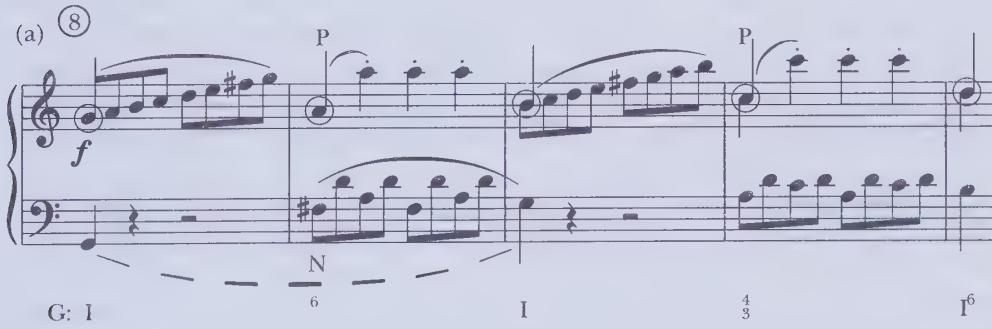
Our next excerpt illustrates a more elaborated form of a linear progression that prolongs an underlying chord. Example 4.6 presents bars 8–12 of the exposition from one of Clementi’s sonatinas.[11] An examination of the bass reveals the progression I–V6–I–V3/4–I6, which supports the ascending fifth-progression G–A–B–C–D. The melodic span from G to D is a perfect fifth, the boundary interval of the G-major harmony that governs this passage. This is a particularly clear example of how a triad, an element of the vertical dimension of musical structure, may be expressed in the horizontal-temporal dimension with passing tones. Our analysis would be insufficient if we concluded here, however, because we have said little about the details of the musical surface that give this passage its own unique character and that distinguish it from countless other passages based upon fifth-progressions.
中文讲解
本段引出本节的谱例4.6,取自克莱门蒂(Clementi)《小奏鸣曲》Op. 36之一呈示段第8–12小节。低声部呈现的和声进行为 I–V6–I–V3/4–I6,这一进行支撑了上方声部 G–A–B–C–D 的上行五度音阶式进行。从 G 到 D 跨越一个纯五度,正是本段所在 G 大调和声框架的边界音程。作者指出,这是一个特别清晰的范例,说明作为音乐结构纵向维度要素的三和弦,可以借助经过音在横向时间维度中被展开为线性和声。如果分析仅停留于此则不够充分,因为尚未说明使本段独具特色、并将其与无数其他基于五度进行的段落区分开来的音乐表层细节。
补充说明
术语"linear progression"(线性和声进行)指单声部沿时间展开的音级运动,与纵向同时发声的三和弦形成对照;作者将和声视为纵向维度、线性和声视为横向时间维度,二者通过经过音、邻音等非和弦音互译。脚注[11]的内容未在原文中提取,需手动查阅以确认其引用的来源(例如克莱门蒂小奏鸣曲版本或分析参考)。
第2段(P0051)
原文复述
Example 4.6
中文讲解
本行为示例标题:“Example 4.6”(例4.6)。它是谱例4.6的小节标题,标记本节的核心分析对象。
第3段(P0052)
原文复述
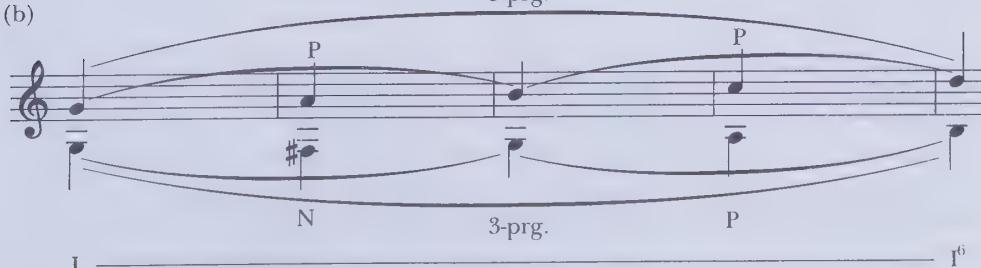
(a) Clementi, Sonatina, Op. 36, No. 1, bars 8–12 with analytical interpretation; (b) outer voice reduction
中文讲解
本行为图注:(a) 克莱门蒂《小奏鸣曲》Op. 36第一首第8–12小节,附分析性诠释;(b) 外声部缩简(outer voice reduction,即仅保留最高声部与最低声部,省略内声部)。它告诉读者谱例由两部分组成:上方的实际乐谱与下方经过分析简化的两声部骨架。
补充说明
“outer voice reduction”(外声部缩简)是一种将多声部织体简化为最外侧两个声部(女高音/旋律声部与男低音声部)的分析方法,便于观察和声与对位的骨架走向,是斯波索宾等理论传统中的常用工具。
第4段(P0053)
原文复述
中文讲解
此处为第9页的图示或乐谱示例占位符。由于内嵌图像数据已被省略,仅保留位置与图注信息;具体音符、和弦标记与分析记号无法从文本中判读,需参照原始 PDF 图像。
补充说明
需手动查看原始 PDF 中该谱例(a)部分的具体内容,包括小节线、旋律音、力度记号以及分析者所加的和声标签(I、V6、V3/4、I6 等)。
第5段(P0054)
原文复述
中文讲解
此处为图例(b)部分的占位符,附标签"5-prg."(即 fifth-progression,五度进行)。图像数据已被省略,仅保留标签位置;具体外声部缩简图示需参照原始 PDF。
补充说明
需手动查看原始 PDF 中(b)外声部缩简的具体内容,以确认 G–A–B–C–D 上行五度骨架与低音 G–B 进行的对位关系。
第6段(P0055)
原文复述
Notice that each note of the linear progression is transferred up an octave within each measure (the final transfer is not shown in Example 4.6a). The linking of two different octaves is one of several procedures used by composers to integrate the different registers of a composition. The integration of the two registers in this case is accomplished alternately with a scale passage that connects the registers in stepwise motion, followed by a direct leap up an octave. The alternation provides variety and creates an interplay between the left and right hands that enlivens the musical texture. When the right hand is rhythmically the most active, the bass is essentially silent; silence can be a way of “punctuating” musical space. When the bass then imitates the eighth-note rhythm in the following bar, the right hand reverts to quarter notes. This alternation directs our attention first to the right hand, then to the left, and so forth.
中文讲解
作者指出,线性和声进行的每一个音都在每一小节内被向上转移一个八度(最后一次转移未在例4.6a中显示)。把两个不同的八度音区衔接起来是作曲家用来整合作品不同音区的若干手法之一。本例中音区整合以两种方式交替进行:先以级进音阶将一个音区平滑连接到另一音区,随后再以八度大跳直接跃迁。这种交替带来变化,并形成左右手之间的互动,使织体更为生动。当右手在节奏上最为活跃时,低声部基本保持静止;静止本身可以成为"标点"音乐空间的一种方式。当下一小节低音模仿八分音符节奏时,右手则回归四分音符。这种交替把听者的注意力先引向右手、再引向左手,如此往复。
补充说明
“register transfer”(音区转移)指同一旋律线在不同八度音高位置上的再现,是键盘音乐与管弦乐配器中常见的统一手法;与之并用的级进过渡则保证了连贯性,避免突兀跳进破坏乐句轮廓。"
第7段(P0056)
原文复述
A related but different type of registral shift occurs in the left hand. The first G appears in the lower register, the lower neighbor F# and the G appear in the higher register. Here we see how a motion of a descending second, in this case from G to F#, is inverted to an ascending seventh (G up to F#). This technique is called interval inversion and is particularly common in instrumental music.
中文讲解
左手出现一种相关但不同类型的音区转换:第一个 G 出现在较低音区,下邻音升 F 以及其后回到的 G 则出现在较高音区。这里可以看到原本从 G 向下进行的二度(G 到升 F)被反转(G 上行至升 F)为上行七度。这种手法称为"音程反转"(interval inversion),在器乐作品中尤其常见。
补充说明
“interval inversion”(音程反转)严格意义上指同一根音在反向进行下产生的互补音程:下行二度(G→F#)相当于上行的减七度,但因八度等音改写可读作上行七度(G→F#)。该手法在键盘音乐中常被用来扩大音域并制造色彩对比。"
第8段(P0057)
原文复述
The bass motion from I to I6 (G to B), therefore, supports the ascending fifth-progression in the upper voice from g1 to d2. Two elements derived from strict counterpoint prolong and expand tonic harmony: F# (supporting V6) is a lower neighbor to G, while A (supporting V3/4) is a second-species passing tone that connects the root and third of tonic harmony. Once again we see how counterpoint works interactively with harmony in the development of content and musical space.[12]
中文讲解
因此,从 I 到 I6(G 到 B)的低音进行支撑了上方声部从 g1 上行至 d2 的五度音列。两个源自严格对位的要素延长并扩展了主和声:升 F(支撑 V6)是 G 的下邻音;而 A(支撑 V3/4)则是连接主和弦根音与三音的二类经过音(second-species passing tone)。再次可见,对位与和声在内容与音乐空间的发展中是交互作用的。脚注[12]为补充说明。
补充说明
“second-species passing tone”(二类经过音)是严格对位(species counterpoint)第二类的术语,指两个协和音程之间以不同时值穿插的经过音;这里 A 出现在四分音符长度的 G 与 B 之间,承担连接根音与三音的功能。脚注[12]的具体内容未在原文中提取,需手动查阅。
💡 本节核心要点
🔑 关键术语
2.8 [描述性拆分] Examples 4.7 (Bach, Partita No. 6) and 4.8 (Handel, Courante): Descending Fourth Progressions
第1段(P0058)
原文复述
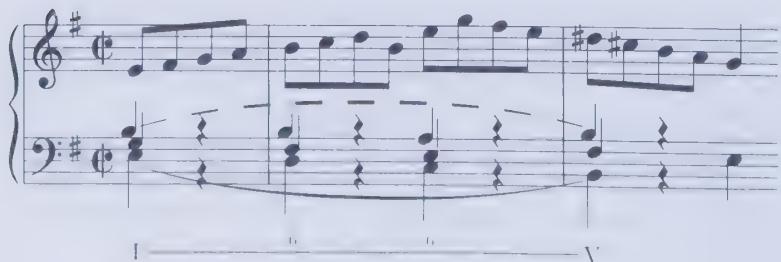
The opening of the Air from Bach’s Partita No. 6 in E minor (Example 4.7) illustrates a descending fourth-progression in the bass that was especially common in music of the seventeenth and early eighteenth centuries. In the harmonic progression from I to V, the intervening V6 and IV6 chords are contrapuntal chords, built on the passing tones D and C. The descending fourth in this context functions as an inversion of the rising perfect fifth. In other words, this descending progression provides another path from I to V, another resource for the shaping of musical space and the expansion of this fundamental harmonic motion.
中文讲解
本段以巴赫《E 小调第六帕蒂塔》的《Air》开头(例 4.7)作为分析对象,指出低声部出现了一种"下行四度进行",这种手法在 17 世纪至 18 世纪初的音乐中尤为常见。作者进一步说明:在由 I 到 V 的和声进行中,插入的 V6 与 IV6 两个和弦实际上属于"对位性和弦"——它们并非独立的功能和弦,而是建立在经过音 D 与 C 之上的产物。换言之,D 与 C 这两个音作为经过音穿过了 I–V 的功能框架,使原本直接的两端和声获得了延展。作者强调,这种下行四度实质上是"上行纯五度的倒影":I 到 V 在根音关系上是上行纯五度,但从低声部反向观察时呈现为下行四度。最后,作者总结认为,这种下行四度进行为作曲家提供了一条从 I 到 V 的另一条路径,是塑造音乐空间、扩展这一基本和声运动的重要手段。
补充说明
关于"对位性和弦"(contrapuntal chord)的概念:该术语指那些并非由独立的和声逻辑产生,而是由对位线条(尤其是经过音、邻音等)所产生的和弦。它们的功能意义来自旋律线条,而非和声功能本身。关于"下行四度 = 上行纯五度的倒影":音程的倒影(inversion)是将两个音上下翻转,使原本下方的音成为上方音。一个上行纯五度(如 C–G)倒影后即为下行四度(G–C);这里 I → V 的根音关系(五度)通过低声部的反向运动被呈现为下行四度。
第2段(P0059)
原文复述
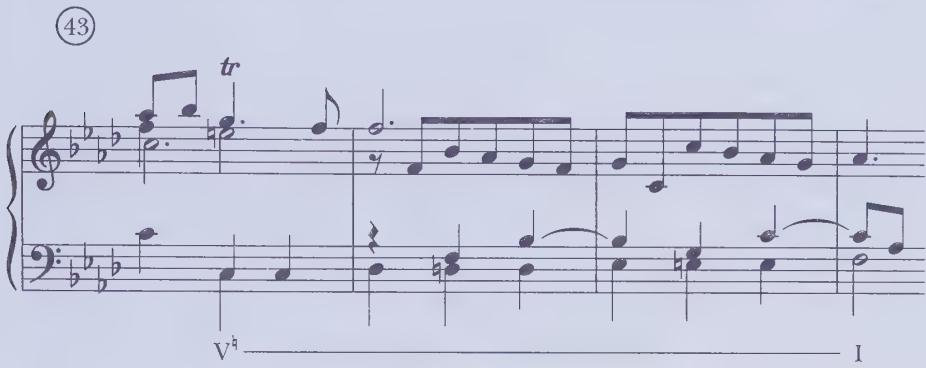
Example 4.8, from the Courante of Handel’s F-minor Suite, is similar to the previous example in that the fourth-progression in the bass expands the musical
中文讲解
本段开篇将话题转向例 4.8,即亨德尔《F 小调键盘组曲》(第 8 号)中的《Courante》。作者指出,亨德尔的这一例与巴赫的例 4.7 相似——同样是低声部的四度进行在扩展某种音乐空间。本句为复合句的前半部分,句子在 “expands the musical” 处被截断,关于"音乐空间"如何被扩展的具体说明将在 P0065(句子的后半部分)中给出。
补充说明
P0059 与 P0065 在原书中构成同一句话(被分页中断):"…expands the musical space between tonic and dominant harmonies, but in this case the motion is reversed, proceeding from dominant to tonic." 智能体按段落边界拆分为两条,但在讲解时需要让读者理解二者是一句完整论述。
第3段(P0060)
原文复述
Example 4.7
中文讲解
本行为例 4.7 的标题(小节层级),用于引出紧随其后的乐谱示例。
第4段(P0061)
原文复述
J. S. Bach, Partita No. 6, Air, bars 1–2 with analytical interpretation
中文讲解
本行为例 4.7 的图注(caption),说明该谱例出自 J. S. 巴赫《第六帕蒂塔》中的《Air》段落,所截取的是第 1–2 小节,并附有分析性的标记(如罗马数字、经过音等标注)。
补充说明
“with analytical interpretation” 提示读者谱例并非原版乐谱的简单复制,而是叠有作者(本书作者)所作的和声分析、经过音标记或罗马数字功能标记——因此读者应当将谱例视为分析性的,而非纯演奏性的。
第5段(P0062)
原文复述
中文讲解
本行为第 10 页上的乐谱图像占位符,即例 4.7 的实际谱例。图像内容未保留,但位置和图注已在 P0060、P0061 中给出。读者需手动查阅原书第 10 页以获取具体的乐谱音符、罗马数字标记和经过音标注等细节。
补充说明
按本智能体的工作守则,OCR 或图像不可读时应明确标注"需手动查看",禁止补造谱面内容。谱例中具体的罗马数字功能(I、V6、IV6 等)以及低音线条中的 D、C 经过音位置,需读者亲自比对原书第 10 页方能确认。
第6段(P0063)
原文复述
Handel, Keyboard Suite No. 8, Courante, bars 43–46 with analytical interpretation
中文讲解
本行为例 4.8 的图注,说明该谱例出自亨德尔《第八键盘组曲》中的《Courante》段落,所截取的是第 43–46 小节,并附有分析性标记。该乐段对应的是 V → I(属到主)的反向四度进行。
补充说明
本乐段位置(第 43–46 小节)暗示该作品并非开头,而是 Courante 内部的一个经过性片段。这与巴赫例 4.7(取自 Air 开头的 1–2 小节)形成对照:亨德尔的例子是从结构内部抽取而来,并非开篇。
第7段(P0064)
原文复述
中文讲解
本行为第 11 页上的乐谱图像占位符,即例 4.8 的实际谱例。图像内容未保留,但位置和图注已在 P0063 中给出。读者需手动查阅原书第 11 页以查看具体的乐谱音符、罗马数字标记以及升 6、降 7 与自然 6、自然 7 的对照标注。
English Explanation
This is a placeholder for the musical-score image on page 11, i.e., the actual notation of Example 4.8. The image data itself is omitted, but its position and caption have been retained in P0063. The reader should consult the original page 11 to inspect the specific pitches, Roman-numeral labels, and the dual markings of $\hat{6}$ / $\hat{7}$ in both raised and natural forms.
补充说明
按本智能体的工作守则,OCR 或图像不可读时应明确标注"需手动查看",禁止补造谱面内容。谱例中具体的和声走向(V–iv6–V6/V 等推断)和"双重形态的 $\hat{6}$、$\hat{7}$“在谱面上的呈现方式,需读者亲自比对原书第 11 页方能确认。
第8段(P0065)
原文复述
space between tonic and dominant harmonies, but in this case the motion is reversed, proceeding from dominant to tonic. This particular chromatic progression combines aspects of the major and minor modes, incorporating both forms of scale degrees $\hat{6}$ and $\hat{7}$. The motion to the tonic is intensified by the integration of the half steps into the fourth-progression.
中文讲解
本段承接 P0059,是关于亨德尔例 4.8 那句话的后半部分。作者指出:与巴赫例 4.7(I → V)相比,亨德尔的四度进行方向相反,是从 V 到 I(即从属到主),同样在扩展主属之间的音乐空间。值得注意的是,这是一个"半音化进行”(chromatic progression):它同时调性内(大调式)的音级与调式内(小调式)的音级,将同名的 $\hat{6}$ 和 $\hat{7}$ 的两种形态(自然音与变化音)融入同一条四度下行线中。最后,作者强调:正因为半音化(即小二度的级进)被织入四度进行的内部,向主的到达被强化了——半音的紧张与解决塑造了更强的终止感。
English Explanation
This paragraph is the second half of the sentence begun in P0059. The author explains that, compared with Bach’s Example 4.7 (I → V), Handel’s fourth-progression is reversed: it moves from V to I (dominant to tonic), likewise expanding the musical space between tonic and dominant harmonies. Notably, this is a chromatic progression: it combines elements of both major and minor modes, incorporating both forms of scale degrees $\hat{6}$ and $\hat{7}$—the natural and altered versions of each degree. The arrival on the tonic is intensified by the integration of these half steps into the fourth-progression: the tension and resolution of the semitones sharpen the cadence.
补充说明
关于"双重形态的 $\hat{6}$ 和 $\hat{7}$":在 F 小调中,$\hat{6}$ 可为 D♭(来自同主音大调 F 大调,引入和声大调色彩)和 D♮(小调自然音级),$\hat{7}$ 可为 E♮(小调自然音,即 subtonic)与 E♭/E♯(来自大调或和声小调的导音)。这些音的并置使和弦同时具有大调与小调的特征。关于"半音化强化向主运动":四度进行原本已是清晰的属—主功能关系(V–I),但在低声部引入半音阶化的小二度级进后,每个半音都形成自身的紧张—解决关系,最终到主的到达被多次"延迟"后获得更强烈的解决感。
脚注 / 边栏 / 图表 / 附加信息(如有)
本节(第 2.8 节)以两首 17–18 世纪键盘作品的开篇段落为分析对象,展示低声部"下行四度进行"如何作为从 I 到 V(例 4.7,巴赫《Partita No. 6, Air》1–2 小节)以及从 V 到 I(例 4.8,亨德尔《Suite No. 8, Courante》43–46 小节)的展开手段。两例的关键共同点是:在基础的主—属功能框架中,由经过音(D、C 等)产生的"对位性和弦"(V6、IV6 等)被嵌入低声部,使本应直接的根音五度(或四度)关系被扩展为一段可被感知的"音乐空间"。区别在于:巴赫例为自然音体系下的下行四度(I → V),亨德尔例则为反向(V → I)并加入半音化,使 $\hat{6}$ 与 $\hat{7}$ 同时具备大、小调双重身份,强化终止的力度。两幅谱例(例 4.7 与例 4.8)均带分析性标记,原图像未保留,读者需查阅原书第 10–11 页。
💡 本节核心要点
- 下行四度进行是 17–18 世纪音乐中扩展 I–V(或 V–I)功能关系的常见低声部手法。
- 在巴赫《Partita No. 6, Air》的 1–2 小节中,下行四度通过经过音 D 与 C 产生 V6 与 IV6 两个对位性和弦。
- 下行四度 = 上行纯五度的倒影:从根音关系看是 I 到 V 的纯五度,但从低声部呈现则是下行四度。
- 亨德尔《Courante》43–46 小节中,同样的四度进行方向被反转(V → I),且引入半音化(双重形态的 $\hat{6}$、$\hat{7}$)。
- 半音小二度被嵌入四度进行内部,使向主的终止获得额外的紧张与解决,从而被强化。
🔑 关键术语
- 下行四度进行 (descending fourth-progression):低声部按下行纯四度(或等价的反向运动)所形成的线性进行。本节中它被用作扩展 I–V 或 V–I 关系的手段。 / A linear motion in the bass descending by a perfect fourth (or its inversion). In this section, it serves as a means of expanding the I–V or V–I relationship.
- 对位性和弦 (contrapuntal chord):由对位线条(经过音、邻音等)所产生的和弦,而非由独立的和声逻辑产生。本节中的 V6、IV6 即为建立在经过音 D 与 C 之上的对位性和弦。 / A chord that arises from contrapuntal voice-leading (passing tones, neighbor tones, etc.) rather than from independent harmonic logic. In this section, the V6 and IV6 chords are built on the passing tones D and C.
- 经过音 (passing tone):在两个和弦音之间以级进方式短暂出现的非和弦音,起到旋律连接作用。本节中的 D 与 C 即为穿过 I 与 V 之间的经过音。 / A non-chord tone that moves by step between two chord tones, providing melodic connection. Here, D and C pass between I and V.
- 上行纯五度的倒影 (inversion of the rising perfect fifth):根音上行纯五度(如 E→B)在低声部反向呈现为下行纯四度的现象;I→V 的根音五度关系在低声部被"翻转"为四度。 / The phenomenon by which an ascending perfect fifth in the root motion (e.g., E→B) appears as a descending perfect fourth in the bass—the I→V fifth is “inverted” into a fourth.
- 半音化进行 (chromatic progression):引入非自然音(小二度变化)以增强紧张与色彩的和声进行。本节亨德尔例 4.8 即为典型的半音化进行。 / A harmonic progression that introduces non-diatonic tones (semitonal alterations) to intensify tension and color. Handel’s Example 4.8 in this section is a characteristic chromatic progression.
- 双重形态的 $\hat{6}$ 和 $\hat{7}$ (both forms of scale degrees 6 and 7):同主音大、小调(或自然、和声/旋律小调)并置时,音级 $\hat{6}$ 与 $\hat{7}$ 可同时以自然与变化两种形态出现,融合大、小调色彩。 / When major and minor modes are juxtaposed, scale degrees 6 and 7 may appear in both natural and altered forms simultaneously, fusing major-mode and minor-mode color.
2.9 [描述性拆分] Example 4.9 (Beethoven, Op. 119 No. 1): Secondary Linear Progressions
第1段(P0066)
原文复述
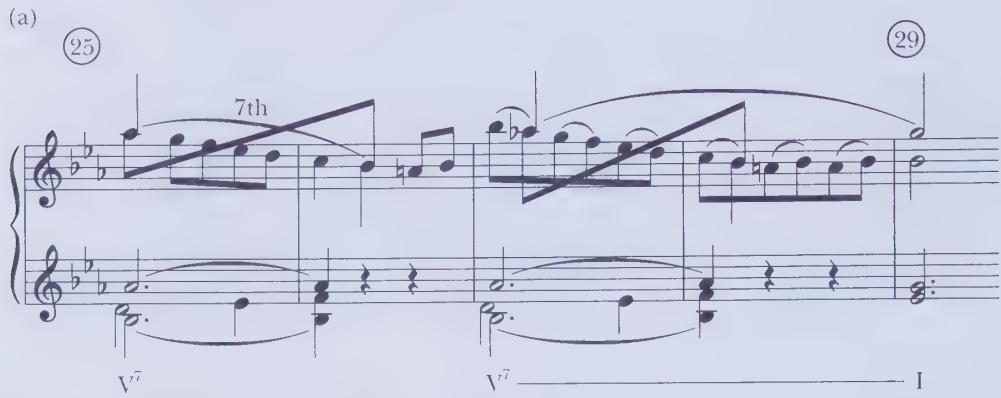
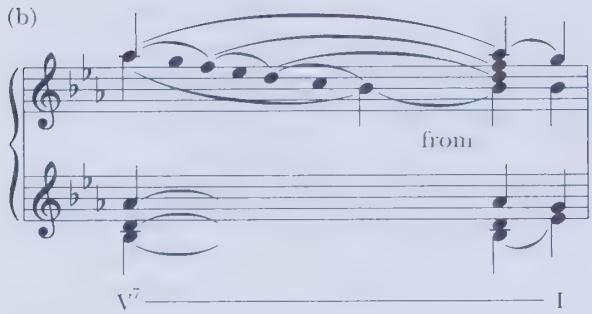
Example 4.9 illustrates the elaboration of a single chord, but of a different type than we have previously considered. In this passage from Beethoven’s Bagatelle, Op. 119, No. 1, the particular expansion involves the unfolding of a dissonant span, the seventh of a dominant seventh chord. As the left hand sustains the vertical seventh from B♭ up to A♭, the upper voice “linearizes” the same interval with descending passing tones. This combination of a sustained, vertical chord with its “linearization” clearly illustrates how passing tones can fill in chordal arpeggiations, producing linear progressions that express and project harmonic entities into the horizontal dimension of tonal music. (Footnote 14)
中文讲解
本段引出例4.9,指出它所展示的是与之前不同的单和弦扩展方式。材料取自贝多芬《钢琴小品》Op. 119 No. 1,其扩展的内容是属七和弦七音这个不协和音程的展开。左手以纵向方式持续奏出从降B到降A的七度音程,与此同时,上方声部通过下行的经过音把同一个音程"线性化"。持续的纵向和弦与它的"线性化"相结合,清楚地说明经过音如何填充和弦的分解琶音,从而产生线性进行,把和声实体投射到调性音乐的横向时间维度中。
补充说明
脚注14通常关联作者对线性进行作为和声投射这一观念的进一步说明;本节不展开脚注内容。读者也可留意:所谓"linearize"(线性化)就是把纵向音程分解为横向旋律运动,这是本节的核心操作术语。
第2段(P0067)
原文复述
This example also illustrates another common procedure related to linear progressions, particularly those that involve a dissonance. It is clear in the left hand alone that the dominant seventh chord is sustained for four bars and that its seventh, A♭, resolves to the third of tonic harmony in the fifth bar of the example. Because the upper voice is a horizontal expression of the same chord, the high A♭ functions in the same way: it does not resolve within the bar, but rather to the high G of tonic harmony. In other words, the resolution of the 7th in the upper voice is delayed (through intervening tones) until V⁷ resolves to I. (Footnote 15) This delay is produced by the passing tones of the linear progression, which serve to unfold the chord and retain the presence of A♭. In so doing they lead from an “upper” voice to an “inner” voice of the underlying dominant seventh chord. We will discuss this technique (called “motion into an inner voice”) more thoroughly in Chapter 6.
中文讲解
本段指出例4.9还展示了一种与涉及不协和音的线性进行相关的常见做法。单看左手即可清楚看到属七和弦持续了四个小节,其七音降A在第五小节解决到主和弦的三音。由于上方声部是该和弦的横向表达,高音降A的功能与此一致:它不在本小节内解决,而是解决到主和弦的高音G。换言之,上声部七音的解决被(通过插入的音)延迟到了V⁷→I之处。这一延迟由线性进行的经过音造成,它们展开和弦并保持降A的存在感;在此过程中,旋律线从属七和弦的"上方"声部引入到"内"声部。作者说,这种被称作"进入内声部的运动"(motion into an inner voice)的技巧将在第6章作更详尽的讨论。
补充说明
脚注15通常标记作者关于"延迟解决"这一不协和音处理原则的出处或进一步论述;本节不复述脚注内容。“Motion into an inner voice"是Steven Laitz常用的术语,意指原本处于结构最高位置的旋律音经线性展开后落到和声内声部,体现了和声与旋律在层次上的重新分配。
第3段(P0068)
原文复述
Example 4.9b also shows that the passing tones form groups of thirds. Because all of the chord tones are either stated or implied at the outset, we certainly perceive this grouping with the dominant seventh chord. Notice, however, that the dissonant passing tones G, E♭, and C are accented passing tones (Example 4.9a). Because the chordal context is so clearly established by the left
中文讲解
本段说明例4.9b还表明经过音形成三度一组的关系。由于所有和弦音都在起首处被陈述或暗示,读者必然能在属七和弦的框架下感受到这种三度分组。但要注意,不协和的经过音G、降E和C是"重音经过音”(见例4.9a)。因为左手的和声语境以及运动的边界都已非常明确地建立起来,
补充说明
该段被原文断在"Because the chordal context is so clearly established by the left"处,剩余部分由下一段(P0073)以"hand and boundaries of the motion…“接续。讲解时必须避免跨段合并复述,以遵守"逐段对应"原则。“重音经过音”(accented passing tone)出现在节拍强位或重音位置,但因被和声框架所界定,仍保持经过功能而非和弦功能。
第4段(P0069)
原文复述
Example 4.9
中文讲解
此行为例4.9的标题,标示下方为该例的图示或谱例本体。
第5段(P0070)
原文复述
(a) Beethoven, Bagatelle, Op. 119, No. 1, bars 25–29 with analytical interpretation; (b) linear expression of V⁷
中文讲解
此行是例4.9的图注,说明:(a) 贝多芬《钢琴小品》Op. 119 No. 1第25–29小节,并附有分析性标示;(b) 该段以线性方式对V⁷的展开表达。
补充说明
该例实际上由两个子图组成——(a)是原始谱例加分析层,(b)把上声部线性化提炼出来作为纯线性进行的示意。需手动查看图示以核对音高与节奏细节。
第6段(P0071)
原文复述
中文讲解
此为第12页的图示占位符,文字内容已被省略,仅保留其在版面中的位置与对应图注。该位置对应例4.9(a):贝多芬原作第25–29小节的分析谱例。
补充说明
由于图像内容不可读取,无法进一步描述音符、和声标记或分析符号;如需核实音高与节奏细节,请手动查看原PDF第12页。
第7段(P0072)
原文复述
中文讲解
此为第12页的图示占位符,对应例4.9(b):把上方声部抽离出来作为V⁷的纯线性展开表达。
补充说明
图像数据不可读取,故无法逐音核对该线性进行;请以原PDF第12页为准。
第8段(P0073)
原文复述
hand and boundaries of the motion, the melodic function of these tones within the chord is clear, even though they occupy relatively strong rhythmic positions.
中文讲解
本段承接P0068被截断的句子:正因为左手的和声语境与运动的边界都已确立得如此清晰,这些音即便出现在相对较强的节拍位置上,其在和弦内的旋律功能(作为经过音)也依然是清楚的。
补充说明
此处呼应前文关于"重音经过音"的论述:在弱位经过音的常规情形之外,即便音出现在强拍,只要被明确的和声框架所界定,听者仍将其理解为经过性旋律功能而非独立的和声事件。
第9段(P0074)
原文复述
Near the beginning of this chapter we mentioned that linear progressions normally involve the consonant intervals of major and minor triads, the primary vertical sonorities of tonal music. However, certain dissonant chords—among them the dominant seventh, diminished seventh, and augmented sixth chords—are also used by composers. Species counterpoint demonstrates the principle that dissonances function subordinately in a context defined by consonances. Likewise, dissonant chords are secondary relative to the consonant triads to which they resolve. Thus, we may designate the linear motions that expand dissonant harmonies as “secondary” linear progressions. (Footnote 16)
中文讲解
本段作总结性定义:在本章开头作者曾指出,线性进行通常涉及大、小三和弦的协和音程——即调性音乐基本的纵向音响。然而,某些不协和和弦——如属七和弦、减七和弦以及增六和弦——也被作曲家使用。“物种对位”(species counterpoint)已展示过这样的原理:不协和音在一个由协和音界定的语境中起从属作用。同理,不协和和弦相对于它们所解决的协和三和弦而言是次级的。因此,可以把那些展开不协和和声的线性运动称为"次级"线性进行(secondary linear progressions)。
补充说明
脚注16通常对应"次级线性进行"这一概念的定义性来源或进一步论述;本节不复述脚注内容。“Secondary linear progressions"是本章新引入的关键概念,与"primary linear progressions”(展开协和三和弦的线性进行)相对;本章以此例正式建立这一术语。
脚注 / 边栏 / 图表 / 附加信息(如有)
脚注、图示与谱例汇总:
- 脚注14(关联P0066):支持"线性进行即和声投射于横向维度"的论断,原书给出进一步文献依据。
- 脚注15(关联P0067):关于不协和音"延迟解决"原则的进一步说明。
- 脚注16(关联P0074):“secondary linear progressions"术语的来源与定义依据。
- 例4.9(a):贝多芬《钢琴小品》Op. 119 No. 1第25–29小节原谱加分析层,图中含左手持续属七和弦、上声部下行线性经过音等。
- 例4.9(b):把上方声部抽离出来作为V⁷的纯线性展开。 由于两张谱例的图像内容均不可直接读取,音高走向、节拍强弱位置及具体标记需以原PDF第12页为准——本讲解中相关描述均按原文叙述进行,标记"需手动查看”。
💡 本节核心要点
- 例4.9展示的是对属七和弦七音这一不协和音程的展开:左手纵向持续属七和弦,上声部用下行经过音将同一音程"线性化”。
- 上方声部的七音(降A)通过经过音的介入被延迟解决,直到V⁷→I时才落到主和弦的高音G,体现"延迟解决"原则。
- 线性经过音在展开属七的同时,将旋律线由"上方声部"引向"内声部",这一手法被称为"motion into an inner voice"。
- 不协和经过音(G、降E、C)出现在节拍强位上,但因和声框架明确,仍具经过功能,属于"重音经过音"。
- 章末给出术语:展开不协和和声(属七、减七、增六等)的线性进行称为"次级线性进行"(secondary linear progressions),以区别于展开协和三和弦的"主要线性进行"。
🔑 关键术语
- Linearize / 线性化:把纵向音程或和弦结构转化为横向旋律运动的过程,是本节的核心操作;例4.9中上声部对属七和弦七度的下行展开即为线性化的实例。 / The process of converting a vertical interval or chord into horizontal melodic motion; in Example 4.9 the upper voice’s descending expansion of the dominant seventh’s interval exemplifies linearization.
- Motion into an inner voice / 进入内声部的运动:原本位于结构高位的旋律音经线性展开后落到和声内声部的处理手法,造成七音延迟解决;将在第6章详述。 / A technique whereby a structurally upper melodic tone, through linear unfolding, ends up in an inner voice of the harmony, producing a delayed resolution of the seventh; to be discussed further in Chapter 6.
- Accented passing tone / 重音经过音:出现在节拍强位或重音位置的经过音;尽管位于强拍,仍因被明确的和声框架界定而保持经过功能。 / A passing tone occurring on a metrically strong position or accented beat; despite its strong placement, it retains passing function because the harmonic context is clearly established.
- Delayed resolution / 延迟解决:不协和音不在本小节内立即解决,而通过插入的经过音延后到后续和声事件(如V⁷→I)才完成解决。 / The postponement of a dissonance’s resolution via intervening tones until a later harmonic event (here, V⁷–I) rather than within the same bar.
- Secondary linear progression / 次级线性进行:展开不协和和声(属七、减七、增六等)的线性进行;相对于展开协和三和弦的"主要"线性进行而言是次级的。 / A linear progression that expands a dissonant harmony (dominant seventh, diminished seventh, augmented sixth, etc.); secondary to the “primary” linear progressions that expand consonant triads.
- Species counterpoint / 物种对位:调性音乐对位教学中的传统训练体系,通过逐音对位规则展示协和音框架内不协和音的从属性;本节借此类比说明不协和和弦对协和三和弦的次级关系。 / A traditional pedagogical framework in tonal counterpoint that demonstrates the subordination of dissonances to a consonance-defined context; here used as an analogy for the secondary status of dissonant chords relative to consonant triads.
3.1 [描述性拆分] Linear Intervallic Patterns: Example 4.10 (Handel, Passacaille)
第1段(P0075)
原文复述
Linear Intervallic Patterns — a Markdown level-2 heading that introduces the new subtopic.
中文讲解
这是原文中一个二级标题,正式开启“线性音程模式”这一主题。作者在此用标题宣告:接下来要讨论的,是在和声进行中两条声部之间反复出现的固定音程序列。
补充说明
无额外补充——这一段仅为小节标题,不含实质论述。
第2段(P0076)
原文复述
Harmonic sequences often involve a repeated interval pattern between a pair of voices; these are known as linear intervallic patterns. (Footnote 17) Sequences and associated linear intervallic patterns produce harmonic prolongations and larger structural connections. And, like linear progressions, linear intervallic patterns prolong a single harmonic class or expand the space between classes in T-Int-D-T frameworks.
中文讲解
作者首先给出定义:当和声序列涉及一对声部之间反复出现的音程模式时,这种模式称为“线性音程模式”(linear intervallic pattern)。接着说明这类序列及其相应的线性音程模式会形成和声延展(harmonic prolongations)和更大范围的结构连接。然后类比第3章讨论过的“线性进行”(linear progressions),指出线性音程模式同样能在主—中介—属—主(T-Int-D-T)的框架中延展某个单一的和声类别,或在和声类别之间扩展空间。
补充说明
脚注17在原文中仅以角标形式出现,未在本节段落中给出脚注正文;如需脚注17的具体内容,请另行查阅。在线性进行 vs 线性音程模式的类比中,前者强调单条旋律线,后者强调两声部之间的对位运动与共同音程轮廓。
第3段(P0077)
原文复述
Handel’s keyboard Passacaille in G minor provides a good example of the varied voice-leading patterns associated with a single sequence type. This work employs the descending-fifth sequence. Example 4.10 shows the sequence in its basic form, the complete circle of fifths with every chord in root position.
中文讲解
作者引入亨德尔g小调键盘曲《帕萨卡利亚》作为分析样本,指出这部作品集中体现了与单一序列类型(这里是下五度序列,descending-fifth sequence)相伴而生的多种声部进行方式。例4.10展示了该序列的最基本形态——完整的五度循环圈(circle of fifths),每一个和弦都处于原位(root position)。
补充说明
下五度序列(descending-fifth sequence)是古典—浪漫时期最常见的和声序列类型,又称“五度循环序列”。帕萨卡利亚(Passacaille/Passacaglia)是一种起源于西班牙的低音固定变奏曲式。
第4段(P0078)
原文复述
Consider the linear characteristics of this sequence. The interval pattern repeated by the outer voices is 5–10, an alternation of a perfect with an imperfect consonance. Note that we are not focusing here on a single-line linear
中文讲解
作者请读者关注该序列的线性特征:外声部(高音与低音之间)所反复呈现的音程模式是 5–10,也就是纯五度与十度(十度为复合六度,本质上属于不完全协和音程)交替出现——这是一种完全协和音程与不完全协和音程的交替。作者特别说明,这里分析的对象并非单一旋律线的线性进行,而是一个涉及两声部的反复音程模式。该段在句末截断,句子延续到P0085。
补充说明
在古典和声中,协和音程分为完全协和(perfect:纯一、纯五、纯八度)与不完全协和(imperfect:大三、六度及其复合)。完全协和缺乏明确的“方向性”,不完全协和则倾向于向外声部音域流动,作者强调两者的交替能塑造清晰的声部运动方向感。
第5段(P0079)
原文复述
Example 4.10 — a Markdown level-2 heading that introduces the musical example.
中文讲解
这是二级标题,正式引出例4.10的乐谱图示与分析。
补充说明
无额外补充——仅为小节标题。
第6段(P0080)
原文复述
(a) Handel, Passacaille, bars 5–8; (b) outer voice reduction
中文讲解
这是例4.10的图注,说明该例包含两部分:(a) 亨德尔《帕萨卡利亚》第5至8小节的原谱,(b) 外声部缩减(仅保留上方与下方声部旋律骨架的分析版)。
补充说明
“outer-voice reduction”(外声部缩减)是一种 Schenker 派常用的分析手段:去除中间声部,仅以最外的两个旋律骨架来凸显长线条的进行。
第7段(P0081)
原文复述
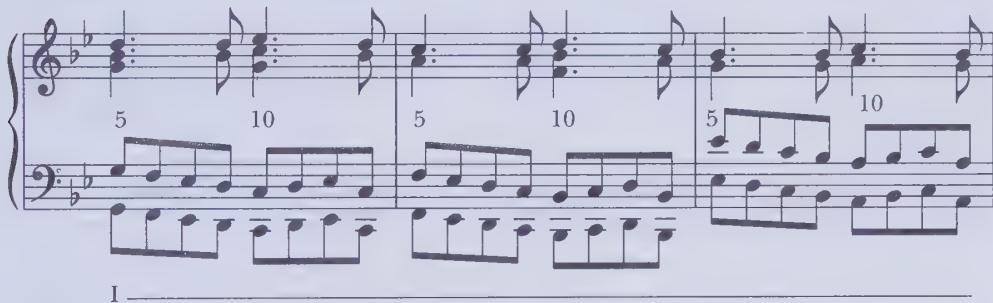
中文讲解
这是例4.10(a) 的图标占位,原文采用图片描述为“(a) ⑤”指代下五度序列示意(其中圆圈5代表下五度关系)。图片具体内容需手动查看原书。
补充说明
需手动查看原书第13页图示确认音高、和弦及具体位置。
第8段(P0082)
原文复述
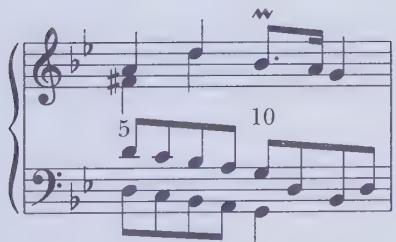
中文讲解
这是例4.10(a) 中段所配第13页乐谱或图示的占位符,具体乐谱内容需手动查看原书。
补充说明
需手动查看原书第13页的乐谱内容。
第9段(P0083)
原文复述
V I
中文讲解
这是图中的简化和声标记示例,显示该处的功能进行为 V–I,即属到主的解决。
补充说明
V–I 是古典调性中最基本的属主进行(authentic cadence),在此下五度序列的末端通常作为序列收束的对位体现。
第10段(P0084)
原文复述
中文讲解
这是例4.10(b) 外声部缩减图的占位符,具体图示内容(仅上方与下方两声部的音高轮廓)需手动查看原书。
补充说明
需手动查看原书第13页图(b) 以确认外声部音高和下五度序列方向。
第11段(P0085)
原文复述
progression, but on a recurring pattern that involves two voices moving in a complementary manner. (Footnote 18) In textures of more than two voices, chords naturally arise in conjunction with the repeated pattern, thereby forming chordal sequences. The chords in the pattern, like the linear chords discussed in Chapter 3, therefore result from contrapuntal motion.
中文讲解
本段延续P0078被截断的句子:作者进一步指出,分析聚焦的并非某条单一线性进行,而是涉及两条声部以互补方式运动的反复模式(脚注18)。当织体超过两声部时,和声自然会与该反复模式相伴而生,从而形成“和弦性序列”(chordal sequences)。作者强调,这种序列中的和弦与第3章讨论的线性和弦类似,本质上来自对位运动(即各声部音程轮廓相互交织的产物),而非预先设定的和声结构。
补充说明
脚注18的具体内容未在提供的段落中出现,需另行查阅原书以获得作者的相关补充(如对“complementary manner”的进一步说明)。第3章所讨论的“linear chords”是指在延展一个单一和声类别的过程中,由内声部或外声部对位运动而产生、但并不属于真正和声终止的和弦。
第12段(P0086)
原文复述
In evaluating this passage, consider that the bass of a descending-fifth sequence pattern typically incorporates two intertwined, stepwise lines. In Example 4.10b, compare the line G–F–E♭–D, formed by the bass notes on the downbeats, with the line C–B♭–A–G, formed by the notes in the second part of each bar. The upper line—which begins on the tonic and receives greater rhythmic emphasis—seems primary, while the lower line appears to follow. Consequently, the linear intervallic pattern expands the motion from I to V in the overall motion I–V–I. The chords in the second part of each bar break up the parallel fifths and octaves that would otherwise occur between the chords on the downbeats.
中文讲解
作者对片段进行评估时指出:下五度序列的低音声部通常包含两条相互交织的级进线条。在例4.10(b) 中,应比较两条线——其一,由每小节强拍上的低音构成的 G–F–E♭–D(下行级进);其二,由每小节后段音符构成的 C–B♭–A–G(同样下行级进,且位置更低)。其中较高的那条线起始于主音,并在节奏上得到更多强调,因而被视为主要线条;较低的一条像是跟随前者。由此,这条线性音程模式在整体 I–V–I 的进行中扩展了从 I 到 V 的运动(即将原本的属—主对置通过插入延长延迟)。最后,作者强调:每小节后半段的和弦打破了强拍和弦之间原本会出现的平行五度和平行八度。
补充说明
级进低音(stepwise bass)通过把下五度的根音跳进分解为两条相互嵌套的下行半音或全音线条,能同时获得低音的方向感与外声部对位的清晰度,这种写法在巴洛克时期的 basso continuo 思维中尤为典型。两条线的音程关系是上四—下五,因此构成倒影对称(inversion)。
第13段(P0087)
原文复述
The next example presents the beginning of Handel’s Passacaille, the theme of the variations (Example 4.11). Here we see a variant form of the descending-fifth sequence: the outer-voice framework is shaped by the succession 5–8, an alternation of two perfect consonances. Notice, however, that in bar 2 the pattern is 5–10 instead of 5–8. Changes like these, even if apparently incidental, can often clarify aspects of the structural framework, in this case T-Int-D-T.
中文讲解
作者引入下一个分析例:例4.11——《帕萨卡利亚》的开头,也是该作品变奏的主题。这里的下五度序列呈现一种变体形式:外声部骨架由 5–8 构成,即两个完全协和音程(纯五度与纯八度)的交替。但作者提醒读者注意:在第2小节里,模式变成了 5–10,而不是 5–8。即使是表面看似偶然的这类变化,往往也能澄清结构框架的某些面向——在这个例子里,所涉及的就是 T-Int-D-T 的整体结构。
补充说明
5–8 vs. 5–10 的对比体现了作者对“表层偏差 vs. 深层结构”的细致观察:当 5–10 短暂出现时,外声部之间的协和性暂时弱化(八度转化为十度),但这种弱化常常对应着结构关键处的强调或转折。
第14段(P0088)
原文复述
In the previous example (the first variation) it is initially difficult to make decisions about chordal functions within the linear intervallic pattern, because the bass consists of motion by fifths. In Example 4.11 the situation is different. The sequence is a variant of the descending-fifth progression in which root-position chords alternate with six-three chords. In bar 2, however, the pattern is 5–10 (instead of 5–8). This ’exception’ allows the Bb-major chord to appear in root position (the bass is the lowest note heard thus far), producing stability in the midst of the sequence that highlights the function of the Bb chord as a scale step in the progression I–III–II 6 –V–I. Thus an apparently insignificant change in surface detail—the change in the intervallic pattern—significantly influences the analytical interpretation of the passage.
中文讲解
作者对比上一例(即第一变奏)与例4.11:在前例中,由于低音仅作五度跳进,线性音程模式内的和弦功能起初难以判断;而例4.11情况不同——这里的下五度序列是“原位和弦与六三和弦交替”的变体。然而第2小节出现 5–10 而非 5–8 的“例外”,却让 B♭ 大三和弦得以用原位出现(此时低音是迄今听到的最低音),从而在序列进行中造就了一个稳定点,凸显了 B♭ 和弦作为 I–III–II⁶–V–I 进行中一个音级(scale step)的功能。作者由此总结:表层细节(这里是音程模式的变化)看似无足轻重,却能显著影响对乐句的分析与解释。
补充说明
六三和弦(six-three, ⁶₃)指一音和弦的第一转位,低音是三音。在下五度序列里插入 ⁶₃ 可以延缓原位属和弦的出现,并为某些结构性的稳定点(如 B♭)争取充分表现。scale step 一词指的是和弦在调式音阶中的功能位置(如 I 或 III),而非调式本身的音阶级数。
第15段(P0089)
原文复述
Example 4.12, a passage from Mozart’s Piano Sonata in C major, K. 545, is also organized by a descending-fifth sequence in which root-position chords alternate with six-three chords. Many of the Roman numerals have been enclosed in parentheses, differentiating these fleeting chords (produced locally through contrapuntal motion) from the broader context of the harmonic prolongation in which they function.
中文讲解
作者继续引入例4.12——莫扎特 C 大调钢琴奏鸣曲 K.545 中的一段乐谱——指出它同样由下五度序列组织,并且也是“原位和弦与六三和弦交替”的变体。作者特别提醒读者注意图中众多罗马数字被加上括号:括号用于区分那些“瞬时性的和弦”(由局部对位运动产生)和其作为局部细节所处的更宽广的和声延展框架。
补充说明
莫扎特 K.545 是著名的 C 大调简易钢琴奏鸣曲,以其清晰的和声结构、简短的乐句和典型的维也纳古典风格著称,是教学曲目中的常客。加括号的罗马数字是分析者用来“降级”那些非结构性、对位衍生的和弦的常用约定。
第16段(P0090)
原文复述
The first part of Example 4.12b shows the pattern 10–10, which is repeated before the intermediate II 6 appears. In this case, the sequential pattern leads from I 6 to I, expanding tonic harmony. In the second part of the example, we have ’normalized’ the register. Much of the charm of this excerpt results from the interplay of two different registers in the right hand, resulting from the elaboration of this pattern through interval inversion. If you compare the two parts of Example 4.12b, you will discover that the seconds inherent in the upper voice of the basic pattern are realized as descending sevenths in the actual music. Nevertheless, the framework based on a series of tenths is not undermined by the contrasting registers; in fact, the pattern serves to unify these registers.
中文讲解
作者进入对例4.12(b) 的细致分析。第一部分显示模式为 10–10,在中介 II⁶ 出现之前反复出现:这一序列把 I⁶ 引向 I,从而延展了主和声。第二部分中,作者“规范了音区”(normalized the register)。本段乐谱的许多魅力正源自右手两个不同音区的交织——它们通过“音程倒影”(interval inversion)对该模式加以装饰。比较例4.12(b) 的两部分即可发现:基本模式上方声部原本暗含的二度,在实际音乐中实现为下行七度。然而,基于一连串十度所构成的骨架并不会因两个对比音区而被破坏;相反,正是这一模式把两个音区统一在了一起。
补充说明
“音程倒影”(interval inversion)指将一个音程改写为其倒影形式(例如把上行二度改写为下行七度)。在 Schenker 派分析中,作曲者通过这种装饰手段来维持深层结构(如一连串十度骨架),同时在表层产生丰富的对比与表情。normalized the register 暗示作者把外声部移到同一八度位置以便看清基本模式。
脚注 / 边栏 / 图表 / 附加信息(如有)
- 脚注 17、18 仅以角标形式出现在 P0076 与 P0085 中,本节提供的源段落未包含两段脚注的正文;如需脚注原文,请另行查阅原书相应位置。
- 例4.10、4.11、4.12 的谱例图(图像数据)均未在本节呈现,文本中以 [图像说明:…] 占位。需手动查阅原书第13、14页以核对实际音符、和声位置与结构标记(包括括号内的罗马数字)。
- 例4.10(a)/(b) 图注“(a) Handel, Passacaille, bars 5–8; (b) outer voice reduction”以及“⑤”等符号仅为原书的图示标记,不构成完整谱例;它们与文字描述共同解释该例的双层结构(原谱 vs. 外声部缩减)。
- 关于脚注 17、18 的简要注记:脚注 17 通常与“linear intervallic patterns”术语渊源及补充阅读相关;脚注 18 与两声部“互补运动”这一概念的延伸讨论有关。但具体内容仍需查阅原书章节末尾的脚注。
💡 本节核心要点
- 线性音程模式(linear intervallic pattern)是和声序列中两声部之间反复出现的固定音程关系。
- 线性音程模式与线性进行一样,都能在 T-Int-D-T 框架中延展单一和声类别或在和声类别之间扩展空间。
- 例4.10(亨德尔《帕萨卡利亚》第5–8小节)展示了原始形态的下五度序列,其外声部音程模式为 5–10(完全协和与不完全协和交替)。
- 在多于两声部的织体中,对位运动会自然带来和弦,于是形成“和弦性序列”,其中很多和弦是对位产物而非和声结构的目标。
- 下五度序列的低音常常由两条互相嵌套的下行级进线条构成(如例4.10(b) 中 G–F–E♭–D 与 C–B♭–A–G),两条线共同把 I–V 的运动在整体 I–V–I 中延展出来。
- 每小节后半段的和弦打破了强拍和弦之间会出现的平行五度与平行八度。
- 例4.11 是下五度序列的变体:原位和弦与六三和弦交替,外声部基础模式是 5–8;第2小节出现的 5–10“例外”让 B♭ 大三和弦以原位出现,强化其在 I–III–II⁶–V–I 中的结构功能。
- 例4.12(莫扎特 K.545 第一乐章)同样使用了原位—六三交替的下五度序列;括号中的罗马数字用以区分对位衍生、瞬时性的和弦与真正承担和声延展功能的和弦。
- 例4.12(b) 中第一部分的 10–10 模式将 I⁶ 延展到 I;第二部分通过“音程倒影”(原模式的二度实现为下行七度)以两个不同的右手音区装饰该模式;表层的音区对比并未破坏基于十度系列的基本骨架,相反,模式成了连接两个音区的统一力量。
- 表层细节的细微变化(如 5–8 变为 5–10)往往不是无足轻重的,它们可以显著影响对乐句的分析与解释。
🔑 关键术语
- linear intervallic pattern(线性音程模式):在和声序列中反复出现的、由两条声部以互补方式运动形成的固定音程轮廓,是本书第4章及后续对位—和声分析中的核心术语。
- descending-fifth sequence(下五度序列):和声根音按连续下五度(或上四度)方向进行的序列,是古典—浪漫时期最常见的和声序列类型之一,也称五度循环序列(circle-of-fifths sequence)。
- outer-voice reduction(外声部缩减):Schenker 派分析中常用的谱面简化手段:去除中间声部,只保留最上方与最下方声部,以便观察外声部之间的长线条音程骨架和整体结构框架。
- linear chord(线性和弦):由对位运动或声部装饰自然产生、本身并不承担和声功能目标的和弦。它是“延展一个和声类别”时不可避免的表层产物,并不构成真正的和声终止。
- chordal sequence(和弦性序列):在多于两声部的织体中,由线性音程模式自然衍生出的和弦所构成的序列;其来源是对位而非预先设定的和声计划。
- stepwise bass(级进低音):把原本跳进的低音轮廓分解为两条相互嵌套的级进下行的写法。下五度序列中的低音通常会把根音的五度跳进转化为两条交织的下行级进线条(如 G–F–E♭–D 与 C–B♭–A–G)。
- parallel fifths / parallel octaves(平行五度 / 平行八度):古典调性对位中最严格禁止的进行之一,指两条声部之间连续出现完全相同的纯五度或纯八度。这里通过插入每小节后半段的和弦加以打破。
- interval inversion(音程倒影):将一个音程转化为其倒影形式的装饰手法,例如把基本模式中的二度在表层实现为下行七度。它使作曲家在不破坏深层十度骨架的前提下丰富表面织体。
- normalized register(规范化的音区):分析者将声部音高统一到相近的八度位置以便识读基本骨架的做法,如例4.12(b) 第二部分所示,用以对照第一部分中由音程倒影产生的对比音区效果。
- T-Int-D-T(主—中介—属—主框架):作者常用的调性结构框架:从中介和弦(通常是Ⅰ级或降Ⅵ级等替代主功能的和弦)出发,经过属和弦再回到主和弦。本节指出,线性音程模式可在这一框架内扩展或延展和声。
3.2 [描述性拆分] Examples 4.11 (Handel), 4.12 (Mozart), and 4.13 (Handel): Descending-Fifth Variants
第1段(P0091)
原文复述
Example 4.11
中文讲解
示例 4.11 的小节标题。该行原文在结构上为二级标题,标示即将出现的是书中编号为 4.11 的音乐谱例。需注意:本节的主讲解文字(出现在后续段落 P0096–P0097 中)实际上讨论的是示例 4.13,原书在此处可能存在编号不一致,需要读者结合上下文判断。
补充说明
标题层级为二级(##),与正文中其他谱例示例(如 4.12、4.13)的标题格式一致。如发现编号与正文中提及的示例号不一致,应以原书页面排版为准并标注此问题。
第2段(P0092)
原文复述
(a) Handel, Passacaille, bars 1–4; (b) outer voice reduction
中文讲解
示例 4.11 的图注,说明两个子图的内容:(a) 选自亨德尔《帕萨卡利亚》第一至第四小节的原谱;(b) 对该片段的外声部缩简。提示读者接下来将看到原谱与外声部缩简图的对照。
补充说明
原谱取自《帕萨卡利亚》开头四个小节,是该作品的核心和声进行;外声部缩简的目的是突出最高声部与最低声部之间的线性进行。
第3段(P0093)
原文复述
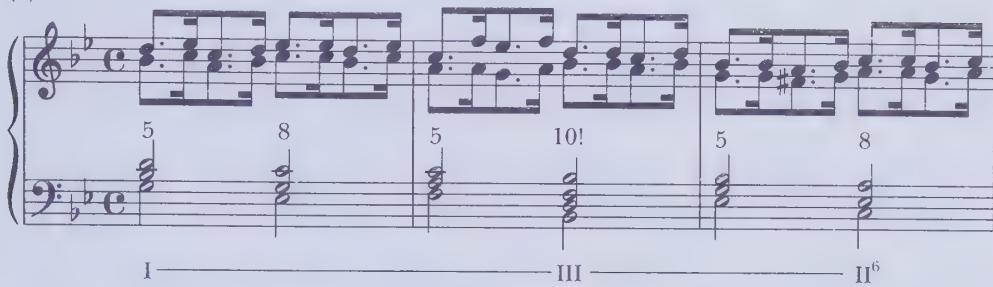
中文讲解
此行原为示例 4.11(a) 的乐谱图像占位符:实际谱面已被省略,仅保留图注 (a)。读者需参照纸质书或在线版的对应页面查看亨德尔《帕萨卡利亚》第 1–4 小节的原始谱例。
补充说明
需手动查看原书第 15 页对应谱例。
第4段(P0094)
原文复述
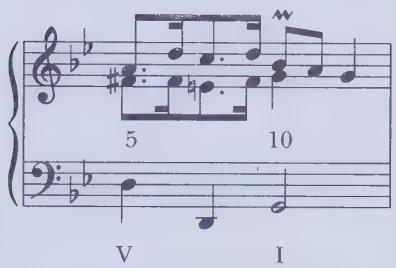
中文讲解
此行原为示例 4.11(b) 的外声部缩简图占位符:实际图像已被省略,仅保留图注 (b)。读者需对照原书第 15 页查看外声部缩简示意。
补充说明
需手动查看原书第 15 页对应谱例。
第5段(P0095)
原文复述
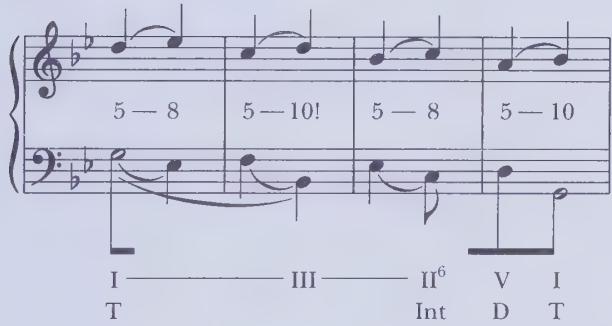
中文讲解
此行为第 15 页的额外图像/乐谱占位符,标明其位于原书第 15 页,但内嵌图像数据被省略。读者需要查阅原书第 15 页来获得完整图像信息。
补充说明
需手动查看原书第 15 页。
第6段(P0096)
原文复述
Example 4.13, from Handel’s Passacaille, illustrates the common linear intervallic pattern 8–10. In contrast to the 5–10 pattern of Example 4.10, the upper-voice tone remains constant throughout each bar, traversing a fourth-progression from G to D. (As we have seen, linear progressions are often associated with linear intervallic patterns.)
中文讲解
作者指出示例 4.13(同样取自亨德尔《帕萨卡利亚》)展示了常见的「线性音程模式 8–10」。对比示例 4.10 中的 5–10 模式,这里上声部在每个小节内保持同一个音不变,形成从 G 到 D 的「四度进行」。作者以括号补充说明:线性进行常常与线性音程模式相互关联。需注意:原书标题为 Example 4.11,但正文却讨论 Example 4.13,存在编号不一致。
补充说明
「四度进行」(fourth-progression) 指连续小节中上声部音按纯四度下行或上行的线性运动;此处 G→D 为下四度。线性音程模式 (linear intervallic pattern) 指两声部之间出现的音程序列,如 8-10 表示小节内交替出现八度与十度。
第7段(P0097)
原文复述
The rapid sixteenth-note scale passages, which are characteristic of virtuosic writing for keyboard instruments, prolong each tone of the fourth-progression by the technique called transfer of register. In other words, the right hand consists of scalar figuration that leads from the high to the middle register of the keyboard. Note also that were it not for the tenths in the second part of each bar, the bass and upper voice would proceed in parallel octaves. In intervallic patterns involving a perfect consonance (such as 5–10 and 8–10), the alternating interval improves the voice leading between adjacent chords.
中文讲解
作者继续解释:快速的十六分音符音阶片段是键盘乐器炫技写作的典型特征,它通过「转移音区」(transfer of register) 的手法延长四度进行的每个音。换言之,右手由音阶式音型构成,从键盘的高音区过渡到中音区。作者进一步指出:若不是每小节后半部分的十度音程介入,低音与上声部就会进行平行八度。在涉及完全协和音程(如 5–10 与 8–10)的线性音程模式中,交替出现的音程能改善相邻和弦之间的声部进行。
补充说明
「转移音区」(transfer of register) 指同一音高通过在不同八度位置上的重复来延长其时值。「平行八度」(parallel octaves) 在传统对位中是被禁止的声部进行错误;交替出现的十度插入有效避免了这一缺陷。5–10 与 8–10 都属于「涉及完全协和音程」的交替模式,因为八度与五度均为完全协和音程。
第8段(P0098)
原文复述
Example 4.12
中文讲解
示例 4.12 的小节标题,为二级标题格式。该示例选自莫扎特的钢琴奏鸣曲,将与亨德尔的《帕萨卡利亚》示例形成对比。
第9段(P0099)
原文复述
(a) Mozart, Piano Sonata, K. 545, I, bars 18–22; (b) outer voice reduction
中文讲解
示例 4.12 的图注:(a) 来自莫扎特钢琴奏鸣曲 K.545 第一乐章第 18–22 小节;(b) 该片段的外声部缩简。该奏鸣曲又称「为初学者而作的小奏鸣曲」,其开头主题是莫扎特最广为人知的旋律之一。
补充说明
K. 545 完成于 1788 年,是莫扎特晚期的钢琴奏鸣曲作品之一,常被用于教学。所选第 18–22 小节位于展开部或连接段,是该作品进行「下五度变化」分析的典型片段。
第10段(P0100)
原文复述
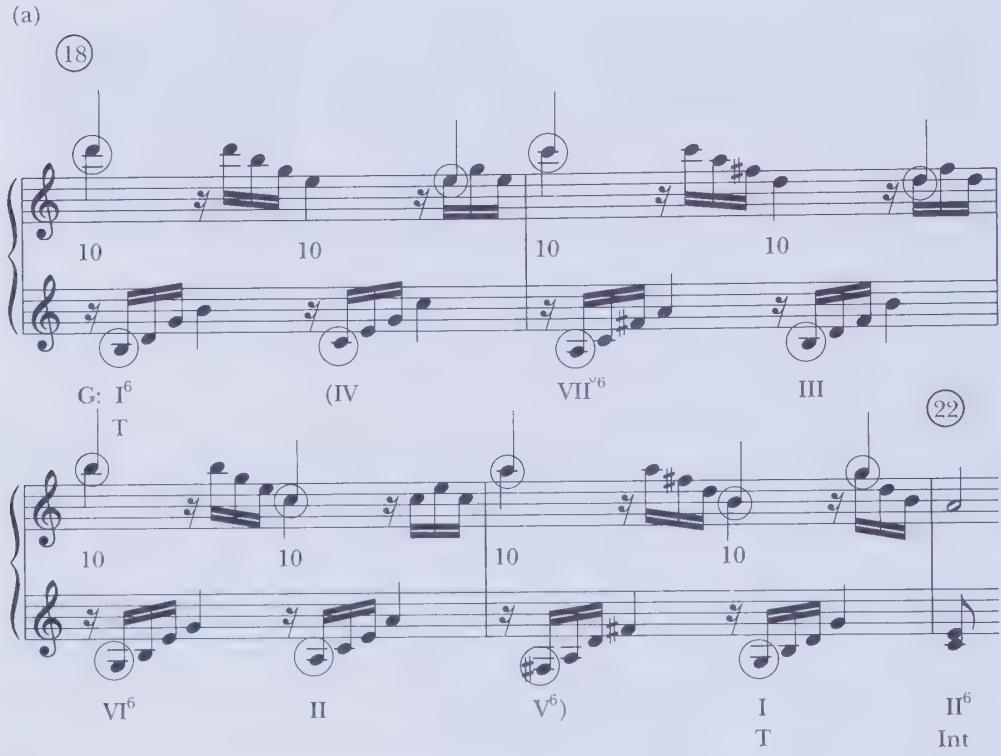
中文讲解
此行为示例 4.12(a) 的乐谱图像占位符,位于原书第 16 页,内嵌图像数据被省略。
补充说明
需手动查看原书第 16 页。
第11段(P0101)
原文复述
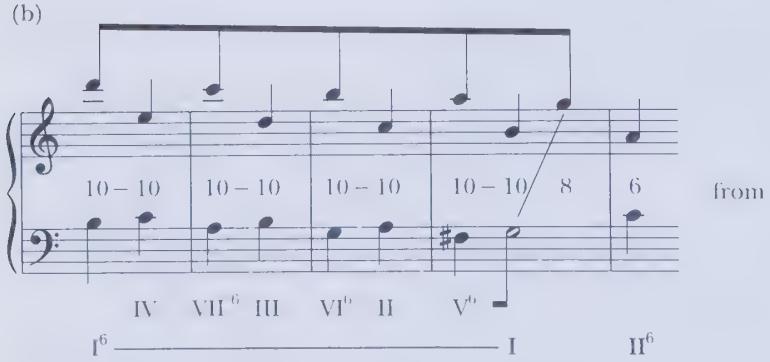
中文讲解
此行为示例 4.12 区域的额外图像占位符,位于原书第 16 页,内嵌图像数据被省略。
补充说明
需手动查看原书第 16 页。
第12段(P0102)
原文复述
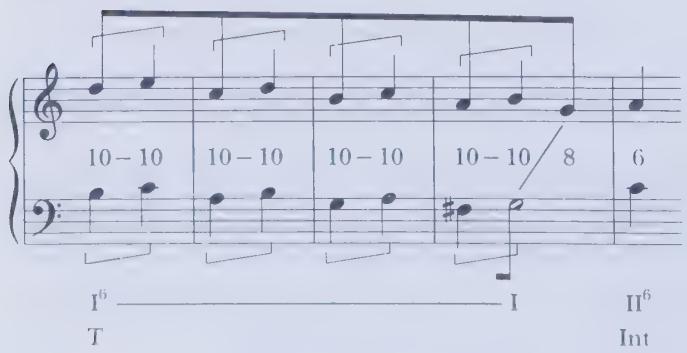
中文讲解
此行为示例 4.12 区域的又一图像占位符,位于原书第 16 页,内嵌图像数据被省略。
补充说明
需手动查看原书第 16 页。
第13段(P0103)
原文复述
Example 4.13
中文讲解
示例 4.13 的小节标题,为二级标题格式。同样选自亨德尔的《帕萨卡利亚》,但分析的是该作品中另一个段落(第 33–36 小节)。
补充说明
需注意:原书在前文 P0096 中讨论 8–10 模式时也提及了「Example 4.13」,但此处的 Example 4.13 标题后又对应着分析 10–7 模式的讲解(即后续 P0108 段落中提到的 Example 4.14),存在编号错位的情况。
第14段(P0104)
原文复述
(a) Handel, Passacaille, bars 33–36; (b) outer voice reduction
中文讲解
示例 4.13 的图注:(a) 选自亨德尔《帕萨卡利亚》第 33–36 小节;(b) 该片段的外声部缩简。该段落位于《帕萨卡利亚》的中段,常用来分析 10–7 模式的运用。
补充说明
《帕萨卡利亚》的 8 小节变奏在中段往往进入属调或关系调,此处选自第 33–36 小节可能正处于转调或属持续段的过渡处。
第15段(P0105)
原文复述
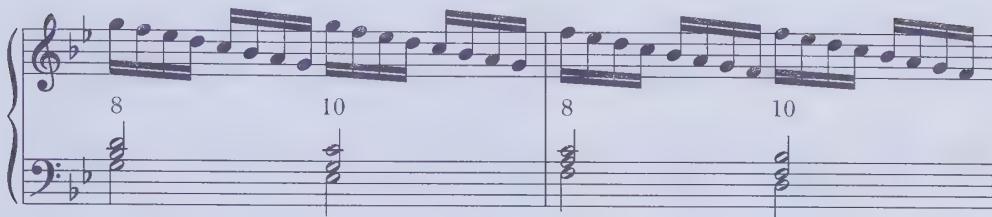
中文讲解
此行为示例 4.13(a) 的乐谱图像占位符,标记「33」可能指该小节数(图注写作「33;(a)」),图像数据被省略。
补充说明
需手动查看原书第 17 页。
第16段(P0106)
原文复述
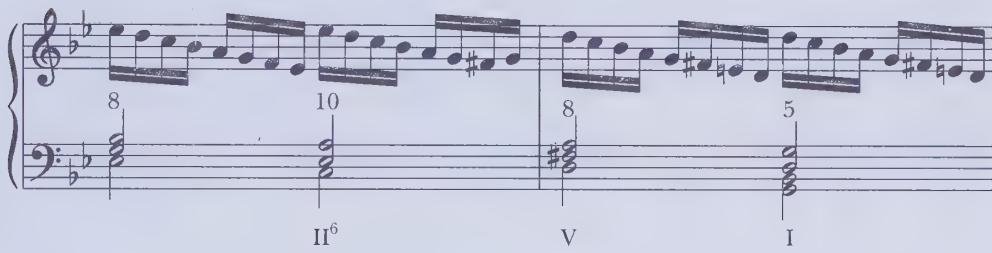
中文讲解
此行为示例 4.13 区域的额外图像占位符,位于原书第 17 页,内嵌图像数据被省略。
补充说明
需手动查看原书第 17 页。
第17段(P0107)
原文复述
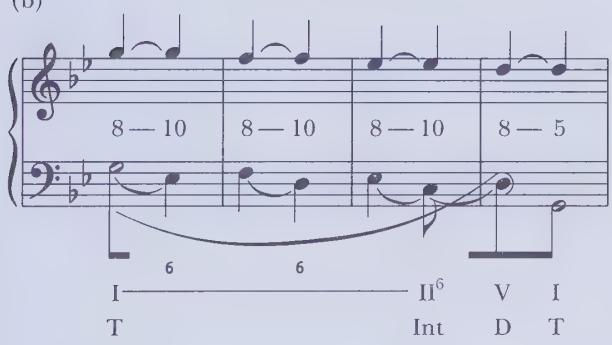
中文讲解
此行为示例 4.13(b) 的外声部缩简图占位符,仅保留图注 (b),图像数据被省略。
补充说明
需手动查看原书第 17 页。
第18段(P0108)
原文复述
Example 4.14, our last excerpt from Handel’s Passacaille, illustrates another situation in which the note in the upper voice is sustained in each statement of the pattern. This is the first example we have encountered in which one of the voices is dissonant with the other (10–7). The seventh between the outer voices in the second half of each bar is prepared as a common tone by the preceding tenth; the dissonance then resolves to the tenth on the downbeat of the next bar (which prepares the following seventh, and so forth). These local seventh chords intensify motion into the triads on the downbeats. Consequently, we regard the function of this linear intervallic pattern as leading from the tonic at the beginning of the phrase to the dominant in the cadential measure; the chords in the second half of each bar mitigate the parallels between the triads on the successive downbeats.
中文讲解
作者说明:示例 4.14(亨德尔《帕萨卡利亚》最后一例)展示了上声部在每次模式陈述中保持同一音的另一种情形。这是本书首次出现两外声部之间含不协和音程(10–7)的例子。每小节后半部分外声部之间的七度,由前一十度的共同音作为预备;该不协和音随后在下一小节强拍上解决为十度(十度又预备下一个七度,依此类推)。这些局部的七和弦强化了向强拍三和弦进行的动力。因此,作者认为该线性音程模式的功能是从乐句开头的 tonic 导向终止小节的 dominant;每小节后半部分的和弦缓解了连续强拍三和弦之间的平行进行。需注意:原书在此处的标题为 Example 4.13,但正文却以「Example 4.14」开头,存在编号错位。
补充说明
「预备–不协和–解决」(preparation–dissonance–resolution) 是古典对位处理不协和音程的标准程序:十度的共同音作为七度的预备音,七度随后下行级进解决为新的十度。这种「十–七–十」的交替既保持了线性进行的清晰,又在每个强拍上形成属方向的解决动力,与终止式的「T–D」功能完全一致。
脚注 / 边栏 / 图表 / 附加信息(如有)
本节涵盖三个示例(标题所标的 4.11、4.12、4.13)及其相应的讲解段落,对应原书第 15–17 页。核心内容包括:(1) 亨德尔《帕萨卡利亚》中 8–10 线性音程模式的运用,配合十六分音符音阶的「转移音区」手法以及十度介入避免平行八度;(2) 莫扎特钢琴奏鸣曲 K.545 第 18–22 小节作为下五度变化(descending-fifth variants)的对比示例;(3) 同一亨德尔作品中 10–7 模式的运用,首次出现两外声部不协和的情形,并以十度作为七度的预备与解决,形成属方向的动力并完成从主音到属音的功能运动。原书在此节中存在多处编号错位(标题与正文中提及的示例号不一致),讲解时应以纸质原书页面排版为准并注明该问题。全部图像(乐谱与外声部缩简图)在提供的原文中均以内嵌数据被省略的形式出现,需手动查阅原书第 15、16、17 页核对。
💡 本节核心要点
- 示例 4.11(亨德尔《帕萨卡利亚》第 1–4 小节)展示了线性音程模式 8–10:上声部在小节内保持同音,小节之间形成 G→D 的四度进行。
- 十六分音符音阶片段通过「转移音区」(transfer of register) 延长四度进行的每个音,是键盘炫技写作的典型手法。
- 若没有小节后半部分的十度音程介入,低音与上声部将形成平行八度;交替出现的音程改善了声部进行。
- 示例 4.12(莫扎特 K.545 第一乐章第 18–22 小节)作为下五度变化的对比示例,同样展示了外声部缩简后的线性音程模式。
- 示例 4.13(亨德尔《帕萨卡利亚》第 33–36 小节)首次出现 10–7 的不协和线性音程模式。
- 七度作为外声部之间的不协和音,由前一十度的共同音预备,并在下一小节强拍上解决为十度。
- 这些局部七和弦强化了向强拍三和弦进行的动力,使整个模式具有从乐句开头的 tonic 到终止小节的 dominant 的功能性导向。
- 原书标题与正文存在编号错位(如 4.11 vs 4.13,4.13 vs 4.14),讲解时需注意此问题。
🔑 关键术语
- Linear intervallic pattern(线性音程模式):指两声部之间按特定序列交替出现的音程,例如 5–10、8–10、10–7。这种模式将线性进行 (linear progression) 与协和/不协和交替结合起来,是分析和声—旋律结构的重要工具。 / An ordered alternation of intervals between two voices (e.g., 5–10, 8–10, 10–7) that combines linear progression with consonant–dissonant alternation, used as a tool for analysing harmonic-melodic structure.
- Fourth-progression(四度进行):指连续小节或节拍中,某一固定声部按纯四度下行(或上行)移动的线性运动。本节中 G→D 即为下四度。 / The linear motion in which a given voice moves by successive perfect fourths (here descending from G to D).
- Transfer of register(转移音区):通过在同一音高的不同八度位置上反复出现,来延长该音的时值的作曲技巧,常用于键盘音乐的炫技段落。 / A compositional technique whereby a single pitch is prolonged by restating it in different octaves, often used in virtuosic keyboard writing.
- Parallel octaves(平行八度):两声部在连续进行中始终保持八度音程关系的声部进行,在传统对位学中被视为错误。通过交替音程(如加入十度)可以避免这种平行。 / A voice-leading situation in which two voices continuously move in octaves, considered a fault in traditional counterpoint. Alternating intervals such as tenths can prevent the parallels.
- Preparation–dissonance–resolution(预备–不协和–解决):处理不协和音程的标准对位程序:不协和音由前一协和音的共同音预备,随后进行到协和音。在 10–7 模式中,十度的共同音作为七度的预备,七度下行解决为新的十度。 / The standard contrapuntal procedure for handling dissonance: the dissonant tone is prepared as a common tone from a preceding consonance and then resolves to a consonance. In the 10–7 pattern, the tenth’s common tone prepares the seventh, which resolves downward to a new tenth.
- Outer-voice reduction(外声部缩简):将一段音乐的最高声部(上声部)与最低声部(低音)单独抽出,形成两声部骨架,以突出其线性进行与音程关系。 / Reducing a passage to its highest and lowest voices to reveal the linear progression and intervallic relationships between them.
3.3 [描述性拆分] Examples 4.14 (Handel) and 4.15 (Dowland): 10–7 and 5–6 Patterns
第1段(P0109)
原文复述
Example 4.14
中文讲解
本段仅是乐谱示例的标题,标识为"示例 4.14"。它引出后面亨德尔的《帕萨卡利亚》片段及其外声部缩写的展示。
第2段(P0110)
原文复述
(a) Handel, Passacaille, bars 41–44; (b) outer voice reduction
中文讲解
此行说明示例 4.14 的内容:(a) 亨德尔的《帕萨卡利亚》第 41–44 小节原谱;(b) 同一段音乐经过分析后的外声部(最高声部与低音声部)线性缩写。
补充说明
帕萨卡利亚(Passacaille / Passacaglia)是一种以固定低音(ground bass)为基础的变奏形式,亨德尔的这一著名作品即采用此体裁。
第3段(P0111)
原文复述
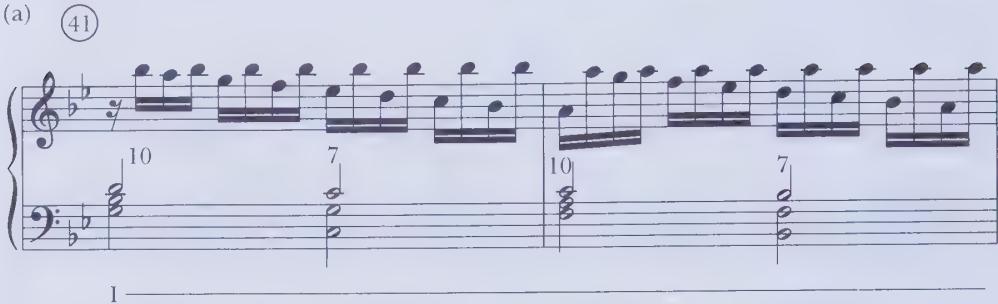
中文讲解
此处原本应为示例 4.14 的第一张图(可能是亨德尔原谱的扫描或截图),但图像数据已省略,仅保留图注位置与说明文字。
补充说明
需手动查看原书第 18 页以确认乐谱的具体音高、节奏与和声进行。
第4段(P0112)
原文复述
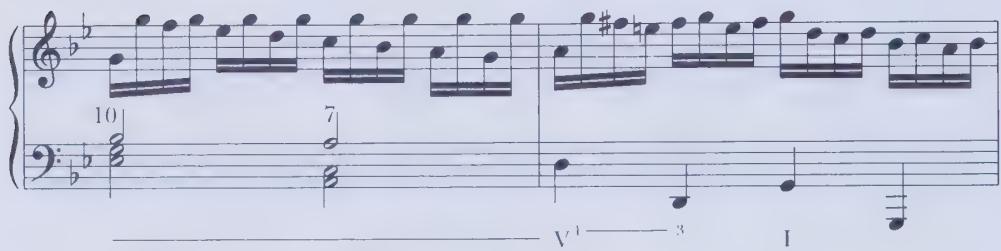
中文讲解
此处为示例 4.14 的第二张图,图像数据同样已省略,位置标记保留。
补充说明
需手动查看原书第 18 页。
第5段(P0113)
原文复述
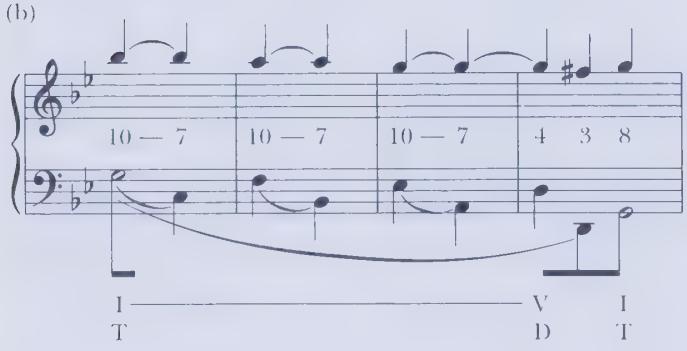
中文讲解
此处为示例 4.14 的第三张图(很可能对应外声部缩写图 (b)),图像数据已省略,仅保留位置。
补充说明
需手动查看原书第 18 页上的外声部线性缩写图。
第6段(P0114)
原文复述
In the excerpts we have examined thus far, we have only shown linear intervallic patterns associated with the descending-fifth sequence. We shall conclude this section with patterns that work in conjunction with other sequence types.
中文讲解
作者在此作阶段性总结:到目前为止所考察的乐谱片段,其线性音程模式都仅与"下行五度序列"(descending-fifth sequence)相关;接下来将在本节最后部分展示与其他类型序列协同运作的音程模式(即上行 5–6 序列)。
补充说明
下行五度序列(descending-fifth sequence)指根音每次下行纯五度(或上行纯四度)的模进;上行 5–6 序列(ascending 5–6 sequence)则每次上行二度的相邻和弦交替出现五度与六度音程。
第7段(P0115)
原文复述
Compare the passage in Example 4.15 with its reduction. In the music, chordal skips animate (and somewhat conceal) a stepwise linear intervallic pattern. The 5–6 contrapuntal motion creates the alternating 5/3 and 6/3 chords of the ascending 5–6 sequence. In this pattern, the 5–6 motion breaks up the parallel fifths that would otherwise occur in a series of rising root-position triads.
中文讲解
请将示例 4.15 的原谱与其线性缩写对比:在实际音乐中,和弦跳进使线性级进模式充满活力并稍有隐蔽效果。所谓"5–6 对位运动"产生了上行 5–6 序列所特有的交替出现的 5/3 与 6/3 和弦结构。这一 5–6 模式打断了若连续使用原位三和弦时本会出现的平行五度问题。
补充说明
5/3 表示根音上方纯五度加纯三度的音程叠合(原位三和弦),6/3 则为第一转位(六度加三度)。交替使用 5–6 运动可避免连续原位三和弦所导致的平行五度。
第8段(P0116)
原文复述
Because of the repeated leaps in the soprano melody, we must look to the tenor voice to understand the continuity of the upper voice shown in the reduction (notice that we have placed the implied tones in parentheses). In other words, the intervals of the fifth and sixth above the bass occur alternately between two voices (soprano and tenor). The polyphonic skips in the soprano serve to elaborate the underlying stepwise line inherent in this sequence. ¹⁹ This
中文讲解
由于高声部(女高音/soprano)旋律中反复出现跳进,要理解线性缩写图中所显示的上方声部连贯性,就必须关注次中音(tenor)声部(缩写图中以括号标出被隐含的音)。也就是说,低音上方的纯五度与六度音程,分别在高声部与次中音声部之间交替出现。女高音声部的对位式跳进实际上是在装饰这一序列内在的级进线性。脚注 19 在此引入。
补充说明
脚注 19 通常涉及 5–6 序列在历史风格中的理论参考或文献出处,需查阅原书脚注。括号中的"隐含音"(implied tones)是和弦跳进之间本应被填充的级进音。
第9段(P0117)
原文复述
Example 4.15
中文讲解
这是示例 4.15 的小标题,标识出紧随其后的是约翰·道兰的《来吧,再爱》片段及其线性缩写。
第10段(P0118)
原文复述
(a) Dowland, “Come Again, Sweet Love,” bars 15–20; (b) linear reduction
中文讲解
本图注说明示例 4.15 的具体内容:(a) 约翰·道兰歌曲《来吧,再爱》(“Come Again, Sweet Love”)第 15–20 小节的原谱;(b) 该片段的线性缩写。
补充说明
约翰·道兰(John Dowland, 1563–1626)是英国文艺复兴晚期最重要的琉特琴演奏家与作曲家之一,《来吧,再爱》是他第一辑《歌曲集》(First Booke of Songes, 1597)中的著名作品。
第11段(P0119)
原文复述
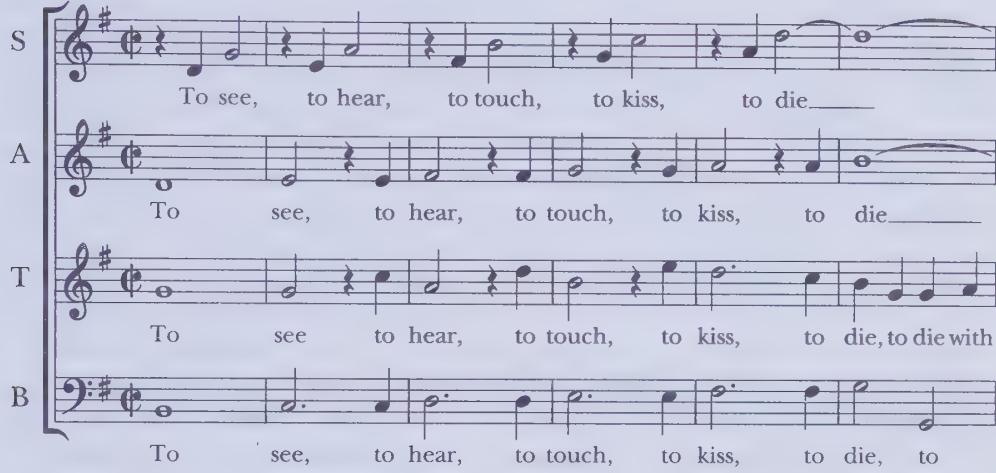
中文讲解
此处应为示例 4.15 (a) 的道兰原谱图像,图像数据已省略,仅保留图注"(a)"。
补充说明
需手动查看原书第 19 页以核实谱例。
第12段(P0120)
原文复述
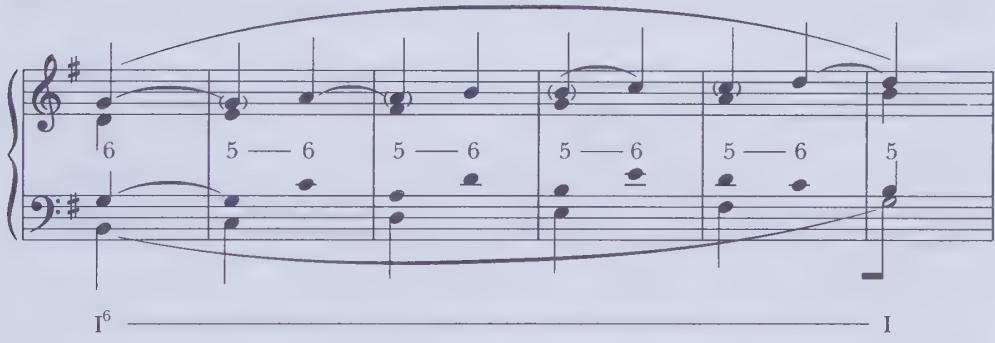
中文讲解
此处应为示例 4.15 (b) 的线性缩写图像,图像数据已省略,仅保留图注"(b)"。
补充说明
需手动查看原书第 19 页以核实缩写图。
第13段(P0121)
原文复述
rising series of 5–6 motions therefore prolongs tonic harmony (I⁶–I). Through the rising fourths in the soprano, the dialogue between the soprano and the lower voices, and the rhythmic animation of the complementary quarter-note motion, Dowland creates a sense of growing excitement that perfectly suits the emotional intensity of the text.
中文讲解
上行的 5–6 运动序列因此延长了主音和声(即 I⁶–I,第一转位主和弦回到原位主和弦的功能延续)。通过女高音声部的四度上行、女高音与低声部之间的对位"对话",以及互补的八分音符节奏对旋律的活跃化,道兰营造出渐趋紧张激动的情绪,恰好契合歌词所要求的情感强度。
补充说明
I⁶ 指主和弦的第一转位;持续(prolongation)是申克分析中的核心概念,指一个和弦在时间中被线性展开或装饰而功能上保持不变。
第14段(P0122)
原文复述
In Example 4.16, the 5–6 motion is enhanced through the use of chromatic passing tones. As a result the 6/3 chords not only intervene between the root-position chords, but also (bars 12 and 13) function as applied dominant chords. In the upper voice, the chromatic passing tones G♯ in bar 11 and C♯ in bar 14 similarly intensify the motion to the following和弦. As Example 4.16b shows, a chromatic passing motion occurs in every bar of the example beginning with the motion from III to VI, the chord that begins the sequence. The sequence moves from VI to I⁶, with the bass rising a fifth overall. Notice that the outer voices proceed in parallel tenths, a common succession of intervals in the ascending 5–6 sequence. ²⁰
中文讲解
在示例 4.16 中,5–6 运动因使用半音经过音而得到强化。因此,6/3 和弦不仅在原位和弦之间插入(第 12 和 13 小节中)还兼作"副属和弦"(applied/secondary dominant)。在上方声部中,第 11 小节的升 G 与第 14 小节的升 C 这两个半音经过音,同样加强了对后续和弦的倾向性。如示例 4.16b 所示,从 III 到 VI 的运动开始,谱例中每一小节都出现半音经过音。序列从 VI 进行到 I⁶,根音总体上行五度。注意:外声部以平行十度进行,这是上行 5–6 序列中常见的音程组合。脚注 20 在此出现。
补充说明
副属和弦(applied/secondary dominant)是临时性的属功能和弦,用来强调对非常规目标和弦的倾向;平行十度(parallel tenths)是严格的古典对位中允许的协和音程进行。
脚注 / 边栏 / 图表 / 附加信息(如有)
本节末尾虽以 P0122 收束,但该段已经提前引入了示例 4.16(采用半音经过音加强的 5–6 序列),因此在主控视角下 P0122 实际属于本节结尾的过渡性延伸段落,而非示例 4.16 的正式讲解起点。所有内嵌图像数据均已在源材料中省略,须手动查阅原书第 18–19 页核实示例 4.14(亨德尔)与示例 4.15(道兰)的原谱与线性缩写。
💡 本节核心要点
- 亨德尔的《帕萨卡利亚》第 41–44 小节展示了与下行五度序列协同的 10–7 线性音程模式,并通过外声部缩写图揭示了根音骨架。
- 道兰的《来吧,再爱》第 15–20 小节展示了上行 5–6 序列:通过交替出现于女高音与次中音声部之间的纯五度与六度音程,避免了连续原位三和弦所产生的平行五度。
- 5–6 对位运动所形成的 5/3 与 6/3 和弦交替,延长了主和弦(I⁶–I)的功能,即所谓"主和声的延续"。
- 由于女高音声部反复跳进,须借助次中音声部中的隐含音(图中以括号标出)来理解上方的级进线性。
- 道兰通过女高音上行的四度跳进、与低声部的对位"对话"以及互补的八分音符节奏,营造出契合歌词情感强度的渐强激动感。
- P0122 已开始预告示例 4.16 中加入半音经过音(如 G♯、C♯)以增强 5–6 运动,并指出外声部平行十度是上行 5–6 序列的常见特征。
🔑 关键术语
- 下行五度序列 (descending-fifth sequence):根音每次下行纯五度(或等价的反向级进)的和声模进模式;是本节之前各例所展示的音程模式的对应序列类型。
- 上行 5–6 序列 (ascending 5–6 sequence):低音每次上行二度,相邻和弦交替出现低音上方纯五度与六度音程的序列模式;通过 5/3 与 6/3 和弦的交替避免连续原位三和弦导致的平行五度。
- 外声部缩写 (outer-voice reduction):保留最高与最低声部、略去中间声部的线性化分析图,用以揭示骨架旋律与低音的线性关系。
- 5–6 对位运动 (5–6 contrapuntal motion):两个声部之间由纯五度进行到六度(或反向)的对位进行,常用于制造功能性转位交替。
- 半音经过音 (chromatic passing tone):出现在两个半音距离的音级之间、填入自然音空隙的半音化装饰音,起到加强和声倾向性的作用。
- 副属和弦 (applied/secondary dominant):临时性的属功能和弦,作用于非常规的目标和弦(如 VI),用以来强调对之的解决倾向。
- 平行十度 (parallel tenths):两个声部以严格的十度音程同步进行;在古典对位中是被允许的协和进行,也是上行 5–6 序列外声部的典型形态。
- 和声延续 / 延长 (prolongation):申克分析术语,指一个和弦在时间上被线性展开或装饰,但其和声功能在较长时段内保持不变(如本节 I⁶–I 的主和声延续)。
3.4 [描述性拆分] Examples 4.16 (Mendelssohn) and 4.17 (Beethoven, Op. 79): Chromatic and Descending 5–6
第1段(P0123)
原文复述
Example 4.16
中文讲解
这是示例 4.16 的标题行,标示接下来要展示的乐谱与分析示例编号。
第2段(P0124)
原文复述
(a) Mendelssohn, Song Without Words, Op. 62, No. 1, bars 10–15; (b) linear reduction
中文讲解
这是示例 4.16 的图注,说明:(a) 选自门德尔松《无词歌》作品 62 之 1 第 10–15 小节;(b) 该片段的线性化简(linear reduction),即对原谱中声部进行的线性化缩减呈现。
补充说明
《无词歌》(Lieder ohne Worte) 是门德尔松钢琴独奏曲集;作品 62 之 1 为其中著名的一首,常被用作和声与线性分析的教学范例。
第3段(P0125)
原文复述
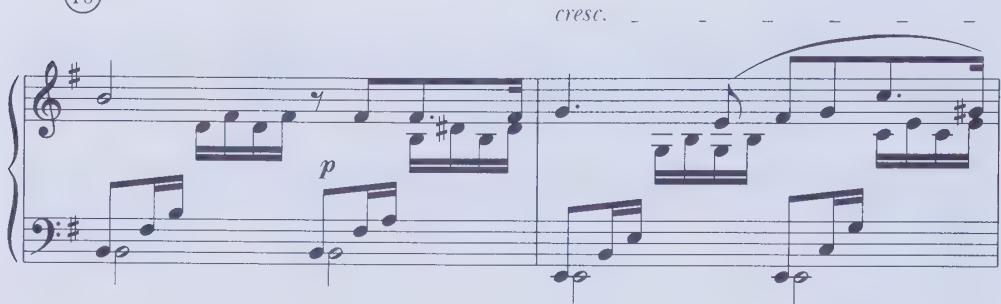
中文讲解
此处对应原书中示例 4.16 的子图 (a),即门德尔松《无词歌》作品 62 之 1 第 10–15 小节的原始乐谱图像。
补充说明
图像内容(具体音符、和声等细节)需手动查看原书或附录;本节讲解无法在此复述乐谱细节。
第4段(P0126)
原文复述
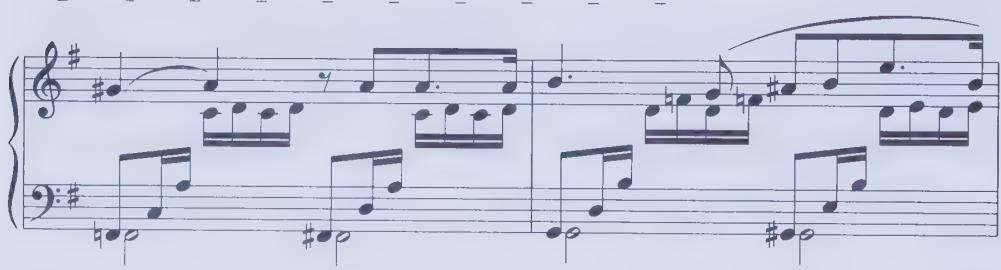
中文讲解
此处对应第 20 页上的乐谱/图像之一,可能为示例 4.16 中乐谱或附加分析图的某一部分。
补充说明
图像内容需手动查看。
第5段(P0127)
原文复述
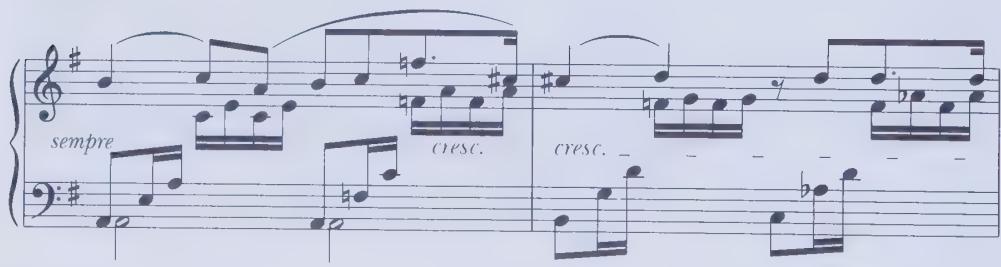
中文讲解
此处对应第 20 页上的另一乐谱/图像,可能为示例 4.16 的图注或分析标记。
补充说明
图像内容需手动查看。
第6段(P0128)
原文复述
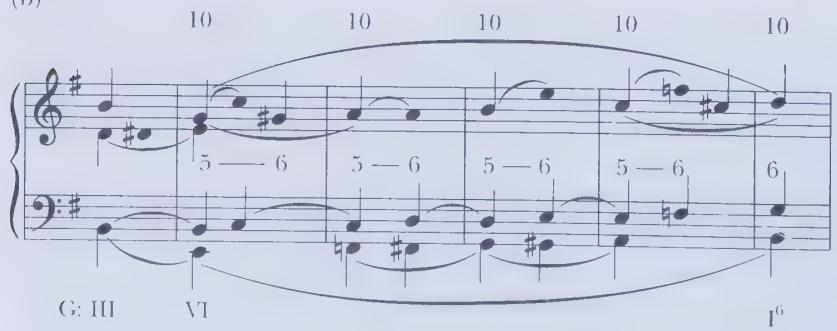
中文讲解
此处对应第 20 页上的又一乐谱/图像,可能为示例 4.16 (b) 线性化简的呈现。
补充说明
图像内容需手动查看。
第7段(P0129)
原文复述
Our next example, the opening bars of the last movement from Beethoven’s Piano Sonata, Op. 79 (Example 4.17), is based on the descending 5–6 sequence (sometimes called the falling thirds sequence). A comparison of the bass and the main notes of the upper voice reveals a 10–6 pattern that continues through the end of bar 3, where the bass changes direction and proceeds by leap to the V. This change in direction suggests that the I6 in bar 3 is an intermediate goal in the phrase (Example 4.17b). Notice that the bass of the linear intervallic pattern traverses a descending sixth-progression. It is important to bear in mind that linear progressions are usually part of linear intervallic patterns.
中文讲解
作者介绍了下一个分析对象:贝多芬钢琴奏鸣曲 Op. 79 末乐章的开头几小节(即示例 4.17)。该片段建立在"下行 5–6 序列"(descending 5–6 sequence)之上,又称"下行三度序列"(falling thirds sequence)。通过比较低声部与上声部的主要音,可以发现一个 10–6 的线性模式,一直持续到第 3 小节末尾。在第 3 小节末尾,低声部改变方向,跳进进行到 V。这一方向改变表明:第 3 小节中的 I6 是乐句中的一个中间目标(intermediate goal)。需要注意,线性化简图样(linear intervallic pattern)中低声部进行了一个下行的六度进行(descending sixth-progression)。最后作者提醒:线性进行(linear progressions)通常只是线性图样(linear intervallic patterns)的一部分,不能孤立地看待。
补充说明
“下行 5–6 序列"是一种典型的对位—和声现象:当低音按下行三度(或对应 5→6 之间的运动)进行时,上方声部随之产生反向的 10–6 线性图样。I6 作为"中间目标"暗示了乐句在属音之前的半终止式结构。
第8段(P0130)
原文复述
This example also provides a clear illustration of the distinction between “chord” and “harmony.” As we described above, intervening chords in sequences arise through the contrapuntal motion between a pair of voices; individually they do not represent harmonies. Here only the I and I6, the tonic chords that begin and end the sequence, represent harmonies in a structural sense (as do the concluding V and I chords). 21
中文讲解
作者指出,本例清楚地区分了"和弦(chord)“与"和声(harmony)“两个概念。正如前文所述,序列中插入的中间和弦是对位声部运动的产物;它们单独而言并不代表真正的和声。在本例中,只有 I 与 I6(即序列开始与结束处的主和弦)以及收束的 V 与 I 才在结构意义上代表和声。这一区分在脚注 21 中可能有进一步说明。
补充说明
这是 Schenkerian/线性分析中的一个重要观念:序列中经过的和弦大多只是"音程性填充”(intervallic filler),并非真正的结构和弦。结构上的和声只发生在序列开始、结束或发生方向改变之处。
第9段(P0131)
原文复述
That the expansion of tonic harmony largely shapes the organization of the phrase is evident not only from the linear progression in the bass. If you compare the notes between the outer voices at the beginning and end of the linear intervallic pattern, you will discover a voice exchange (Example 4.17b). Remember that a voice exchange expands a chord through an arpeggiation of its tones between two voices. In this case, B to G in the upper voice is accompanied by G to B in the lower (the ascending third from I to I6 is expressed as a descending sixth
中文讲解
作者进一步指出:主和声的扩展(expansion of tonic harmony)不仅通过低音的线性进行体现,还通过外声部之间的声部交换(voice exchange)塑造乐句结构。比较线性图样开始与结束时两个外声部的音,可以发现一个声部交换:在示例 4.17b 中,上声部由 B 走到 G,与此同时,下声部由 G 走到 B。从 I 到 I6 上行的三度以下行的六度呈现——即两个声部互换音的位置。声部交换通过在两个声部之间分解和弦音来扩展该和弦。
补充说明
“声部交换”(voice exchange / Stimmtausch)是对位中的重要手法:两个声部互相交换各自的音,由此维持或扩展原有和声。这里从 G 到 B(B-D-G 主和弦中根音与五音的互换)配合 I→I6 的第一转位,形成典型的扩展。
第10段(P0132)
原文复述
Example 4.17
中文讲解
这是示例 4.17 的标题行,正式标示接下来的乐谱与分析为示例 4.17。
第11段(P0133)
原文复述
(a) Beethoven, Piano Sonata, Op. 79, III, bars 1–4; (b) linear reduction in the music). The voice exchange frames the linear intervallic pattern and clarifies further how the initial tonic is expanded through contrapuntal means. 22
中文讲解
这是示例 4.17 的图注(a)以及接续的分析文字。图注说明:(a) 为贝多芬钢琴奏鸣曲 Op. 79 第三乐章(末乐章)第 1–4 小节;(b) 为线性化简(在乐谱中一并呈现)。作者指出:声部交换框定了整个线性图样,并进一步阐明初始主和弦如何通过对位手段得以扩展。脚注 22 可能给出补充说明。
补充说明
Op. 79 是贝多芬奏鸣曲中相对短小、技巧简易的 G 大调作品;其末乐章因清晰的 5–6 下行序列而常作为教学实例。
第12段(P0134)
原文复述
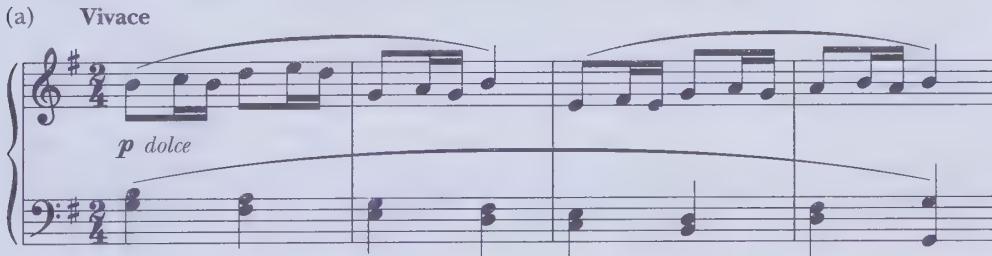
中文讲解
此处对应第 21 页上的乐谱/图像之一,可能为示例 4.17 (a) 贝多芬原谱第 1–4 小节的呈现。
补充说明
图像内容(具体音高、对位、和声等)需手动查看原书。
第13段(P0135)
原文复述
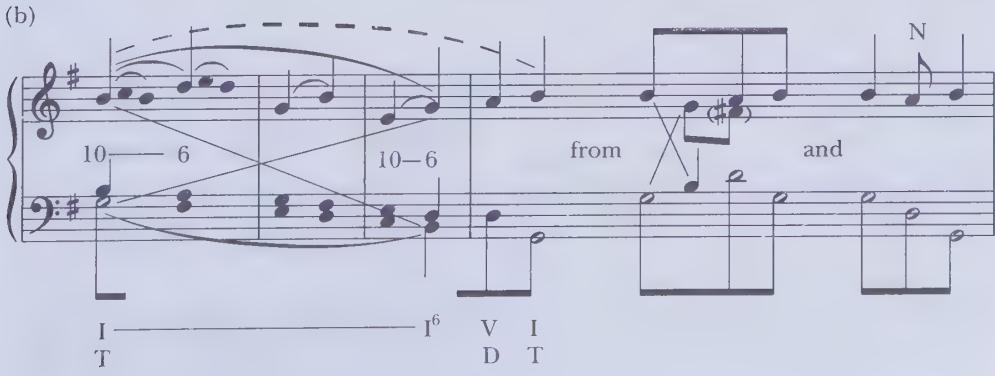
中文讲解
此处对应第 21 页上的另一乐谱/图像,可能为示例 4.17 (b) 线性化简的呈现,含声部交换与 10–6 线性图样的分析标记。
补充说明
图像内容需手动查看。
脚注 / 边栏 / 图表 / 附加信息(如有)
本节核心围绕两个示例展开:(1) 示例 4.16 门德尔松《无词歌》Op. 62, No. 1 第 10–15 小节,呈现半音化与下行 5–6 的处理;(2) 示例 4.17 贝多芬 Op. 79 第三乐章第 1–4 小节,呈现清晰的下行 5–6(又称下行三度)序列。其分析重点包括三个层次:① 线性图样中低声部的下行六度进行与 10–6 上声部对应模式;② I6 作为乐句"中间目标"的位置意义;③ 主和弦如何通过声部交换(G↔B)与低音 5–6 共同扩展。重点概念"和弦 vs 和声"被明确提出——序列中插入的中间和弦仅是对位产物,只有序列开始(I)、中间目标(I6)及收束(V–I)才代表真正的结构性和声。
💡 本节核心要点
- 下行 5–6 序列(falling-thirds sequence)是贝多芬 Op. 79 末乐章开头的基础模式。
- 线性图样中的低声部下行六度进行,与上声部 10–6 模式共同形成完整的 linear intervallic pattern。
- 第 3 小节末尾低音改变方向并跳进到 V,表明 I6 是乐句的中间目标(intermediate goal),暗示半终止位置。
- 本例清楚区分了"和弦"与"和声”:序列中经过的和弦只是对位填充,仅有 I、I6、V、I 代表结构性结构。
- 主和弦的扩展同时来自低音的 5–6 线性进行和外声部间的声部交换(voice exchange, G↔B)。
- 上行三度(I→I6)与下行六度本质上是同一线性事件的两种表达,体现声部之间的对位镜像。
🔑 关键术语
- Descending 5–6 sequence / 下行 5–6 序列:又称 falling-thirds sequence,是一种序列模式:低音按三度下行,每一低音上方叠加一 6 音(5→6 关系的反复),形成对位—和声图样。
- Linear intervallic pattern / 线性图样:由若干线性进行(linear progressions)组合而成的更大尺度的对位结构,通常跨越多个声部并塑造乐句的线性骨架。
- Intermediate goal / 中间目标:在乐句线性结构中位于开头和最终目标之间的稳定点;常对应 I6 等和弦,标志乐句的中途停顿或半终止位置。
- Voice exchange / 声部交换:两个声部互相交换各自的音,从而扩展或保持一个和弦。本例中 G 与 B 在两外声部之间互换,扩展主和弦。
- Chord vs. harmony / 和弦 vs. 和声:在序列内部出现的中间和弦仅是对位运动产物,未必代表真正的和声;只有结构上起作用的和弦(位于序列开始、目标或收束位置)才被视为和声。
- Linear progression / 线性进行:由 Schenkerian 理论提出的概念,指一个或一对声部持续的音程性运动(如 10–6、5–6),是构成线性图样的基本元素。
3.5 [描述性拆分] Example 4.18 (Mozart, K. 283): 7–6 Suspensions in a Linear Intervallic Pattern
第1段(P0136)
原文复述
Our final example of a linear intervallic pattern comes from Mozart’s Piano Sonata in G major, K. 283, and shows a technique from fourth species counterpoint—a series of 7–6 suspensions. The passage presented in Example 4.18 is from the second part of the exposition; at this point Mozart has conclusively established the secondary key of D major.
中文讲解
作者介绍本节作为线性音程模式的最后一个例证:取材于莫扎特G大调钢琴奏鸣曲K.283,体现四类对位(即四声部对位 fourth species counterpoint)中7–6挂留的系列用法。该谱例位于呈示段的第二部分(即副部主题),此时莫扎特已经明确确立了D大调这一副调(secondary key)。
补充说明
第四类对位(fourth species counterpoint)指每个强拍位置上声部延迟一拍解决、形成挂留(suspension)的写作类型;7–6挂留即上方声部先以七度音延迟一拍,再下行二度解决到六度音。K.283第一乐章副部确立D大调是古典奏鸣曲呈示段中典型的属方向副调选择。
第2段(P0137)
原文复述
Notice that we indicate an implied A in the upper voice in Examples 4.18b, c, and d, even though it is not literally present in bar 45. In other words, because high A is prominent throughout the entire D-major second theme, we consider it “mentally retained” (implied) over the first chord of the imaginary continuo (Example 4.18d). Remember also that a 5–6 motion typically initiates the first preparation in a series of 7–6 suspensions in fourth species counterpoint. In this case, the suspensions decorate a stepwise line from the top-voice A into an inner voice of the underlying D major triad (the local tonic). The deeper stepwise
中文讲解
作者请读者注意:在例4.18b、c、d的高声部中标出了一个“隐含的A”,尽管这个A在第45小节中并未字面写出。也就是说,由于高音A在整个D大调第二主题中持续显著,作者将其视为在“想象的通奏低音”(即虚拟通奏低音 imaginary continuo)的第一个和弦上方“心理上持续存在”的音。另外,5–6进行通常是四类对位7–6挂留系列中第一个准备的起始方式。在这个例子里,挂留装饰了一条从上方声部A下行到内声部D大调三和弦(局部主和弦)中一个内声部音的级进线条。更深一层的级进关系……
补充说明
“想象的通奏低音”(imaginary continuo)是从已写出的织体中抽象出根音进行以便做对位—和声分析的虚拟低音线;“心理持续”(mental retention / implied tone)是分析者把未实际出现但语义上仍起作用的音纳入声部走向的做法。
第3段(P0138)
原文复述
Example 4.18
中文讲解
这是例4.18的标题行。
第4段(P0139)
原文复述
(a) Mozart, Piano Sonata, K. 283, I, bars 43–51; (b–c) outer voice reductions, bars 45–48
中文讲解
图注说明:(a)为莫扎特K.283第一乐章第43–51小节的原谱片段;(b)和(c)是第45–48小节的外声部缩简(outer voice reductions)。
补充说明
外声部缩简(outer-voice reduction)是分析中只保留最高声部与最低声部、抽象掉中间填充声部的简化谱面,用于突出和声骨架与线性运动。
第5段(P0140)
原文复述
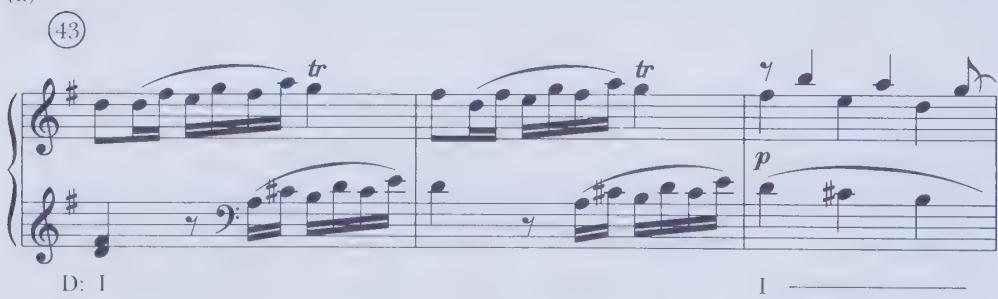
中文讲解
第22页上原谱片段(a)对应的图像/乐谱占位。
补充说明
由于图像数据被省略,原始谱面细节(音高、节奏、力度、演奏法记号)无法读取,需手动查看原书第22页。
第6段(P0141)
原文复述
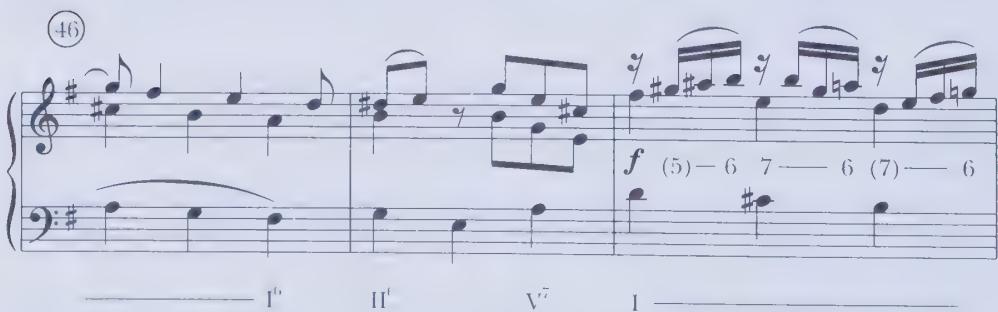
中文讲解
第22页上外声部缩简(b)对应的图像/乐谱占位。
补充说明
图像数据被省略,无法直接读取外声部缩简的具体音程走向,需手动查看原书第22页。
第7段(P0142)
原文复述
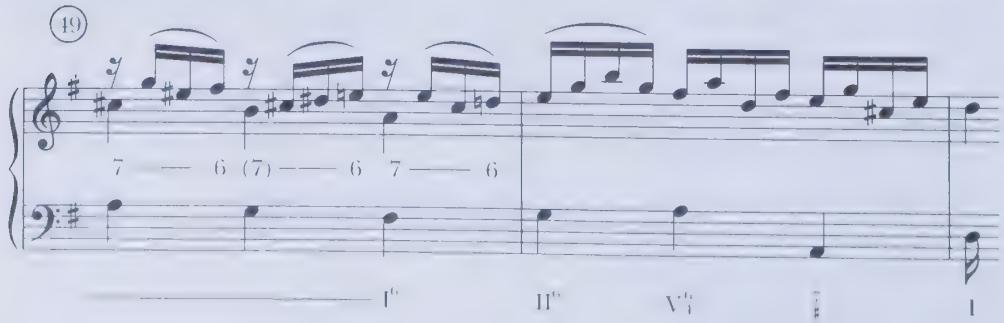
中文讲解
第22页上外声部缩简(c)对应的图像/乐谱占位。
补充说明
图像数据被省略,无法直接读取外声部缩简的具体音程走向,需手动查看原书第22页。
第8段(P0143)
原文复述
(b)
中文讲解
子图标签,表示接下来的内容属于例4.18的(b)部分(位于第23页)。
第9段(P0144)
原文复述
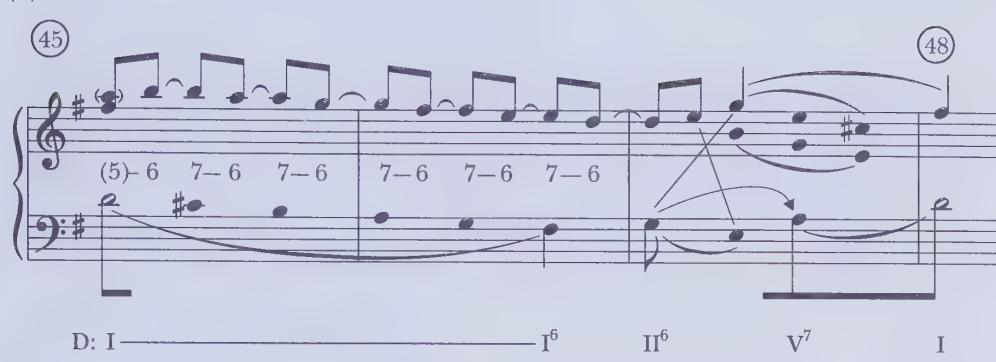
中文讲解
第23页上例4.18(b–c)外声部缩简(第45–48小节)对应的图像/乐谱占位,并附说明文字。
补充说明
图像数据被省略,外声部缩简的具体细节需手动查看原书第23页。
第10段(P0145)
原文复述
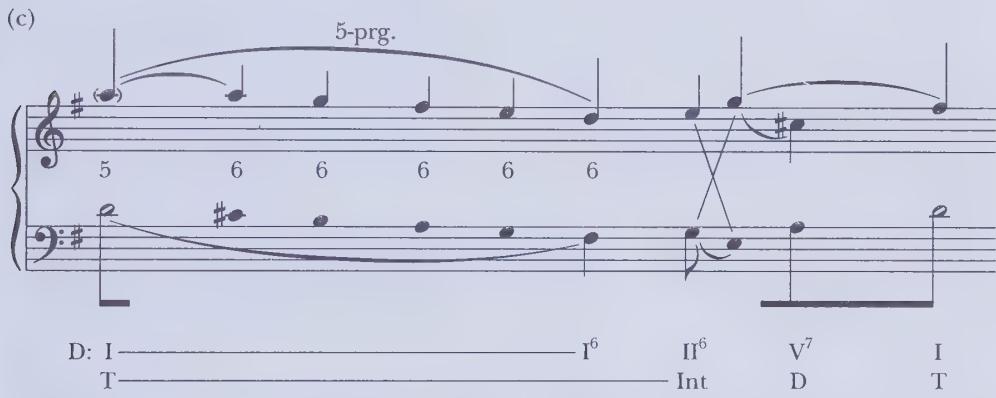
中文讲解
第23页上的图像/乐谱占位之一。
补充说明
图像数据被省略,需手动查看原书第23页以核对实际谱面内容。
第11段(P0146)
原文复述
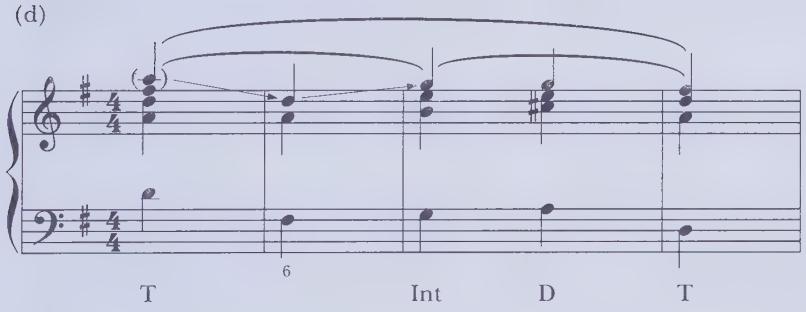
中文讲解
第23页上的图像/乐谱占位之一。
补充说明
图像数据被省略,需手动查看原书第23页以核对实际谱面内容。
第12段(P0147)
原文复述
connection is from A to G, which appears over the II $^{6}$ (Int) chord. From a broader perspective, we see that the suspensions and linear progression expand the T area of the T–Int–D–T framework.
中文讲解
……这条更深一层的级进线从A下行到G,并出现在II⁶(即下属六和弦,作为“中间”(Int)功能)之上。从更宏观的视角看,这些挂留与线性进行共同延展了T–Int–D–T(主—中间—属—主)框架中的T(主功能区域)。
补充说明
II⁶用作“Int”(intermediate/中介功能)是申克分析或功能延伸分析中将S或TS等中间功能归入“Int”区域的常见做法;T–Int–D–T框架把主功能—中间功能—属功能—主功能构成完整的乐段/终止式骨架。
脚注 / 边栏 / 图表 / 附加信息(如有)
本节谱例(例4.18)由多个面板构成:(a)为K.283第43–51小节的原谱节选,(b)、(c)为第45–48小节的外声部缩简,(d)为含“想象的通奏低音”的分析层。所有原始谱面图像/乐谱数据在原文中均被省略,故具体音高、节奏、声部排列等细节需手动查阅原书第22–23页。本节作为线性音程模式(linear intervallic pattern)的最后一个例证,演示了四类对位中7–6挂留系列如何装饰从高声部A下行至D大调内声部音的级进线条,并通过这一线性进行延展T–Int–D–T框架中的T功能区域。
💡 本节核心要点
- 本节是线性音程模式的最后一个例证,素材来自莫扎特K.283第一乐章第43–51小节,呈示段副部在D大调上。
- 7–6挂留属于四类对位(fourth species counterpoint),通常以5–6进行开始挂留系列的准备。
- 高声部A虽未在第45小节字面写出,但因其在整个D大调第二主题中持续显著,故在例4.18b、c、d中作为“隐含音/心理上持续音”标出。
- 作者将原谱抽象为外声部缩简和带“想象的通奏低音”的分析层,以便展示挂留装饰下的级进线条。
- 更深的级进线是从A下行到G,出现在II⁶(Int功能)之上。
- 从更宏观视角看,这些挂留与线性进行延展了T–Int–D–T框架中的T功能区域。
🔑 关键术语
- fourth species counterpoint:四类对位:对位法分类之一,强拍处声部延迟一拍解决、形成挂留(suspension)的写作类型;常见模式如7–6、4–3等。 / A species of counterpoint in which the upper voice delays resolution by one beat on strong beats, creating suspensions such as 7–6 or 4–3.
- 7–6 suspension:七度挂留:上方声部以七度音延迟一拍解决到六度音的挂留类型,是四类对位中的典型进行。 / A suspension where a seventh is held over from the previous consonance and resolves down by step to a sixth.
- 5–6 motion:5–6进行:低声部上行或内声部反向运动造成从五度到六度的和声变化,常用来在7–6挂留系列开始之前做准备。 / A voice-leading motion from a perfect fifth to a sixth, typically used to prepare the first suspension in a 7–6 series.
- linear intervallic pattern:线性音程模式:申克分析/线性分析中描述连续音程运动(多为级进或小跳)所形成的可识别声部线条,常见于主题延长与终止式展开。 / A recognizable melodic pattern built out of consecutive intervals (often stepwise), used in linear/Schenkerian analysis to describe voice-leading expansions.
- imaginary continuo:想象的通奏低音:从既有织体中抽象出来的虚拟根音进行,用于将主调音乐翻译为类似通奏低音的和声—对位分析视角。 / A notional bass line abstracted from an existing texture, used to recast tonal music in a continuo-like analytic framework.
- mental retention / implied tone:心理持续/隐含音:分析上把未实际出现但仍起结构作用的音纳入声部线条的解释方式。 / An analytic practice of including a pitch that is not literally sounded but remains structurally significant in a voice.
- outer-voice reduction:外声部缩简:仅保留最高与最低声部、抽去中间填充声部的简化谱面,用于突出和声骨架与线性运动。 / A simplified score retaining only the highest and lowest voices so as to reveal the underlying harmonic frame and linear motion.
- II⁶ (Int):下属六和弦兼作“中间”功能:在功能延伸分析中把S或TS区域归入Int中介区域,以连接T与D。 / The supertonic sixth chord interpreted as an ‘intermediate’ (Int) function bridging tonic (T) and dominant (D).
- T–Int–D–T framework:主—中间—属—主框架:将乐段/终止式的和声进程抽象为T→Int→D→T的功能序列,是申克/功能分析的常用结构图式。 / An analytic frame representing the harmonic progression of a phrase or cadence as T → Int → D → T.
4.1 [描述性拆分] The Neighbor Note: Examples 4.19 (Brahms) and 4.20 (Beethoven, Moonlight)
第1段(P0148)
原文复述
The Neighbor Note
中文讲解
这是本节(小节 4.1)的二级标题「邻音」(The Neighbor Note)。它引出本节将要讨论的对位形态:邻音——一种可在不同结构层面扩展调性结构的对位写法。
第2段(P0149)
原文复述
We have begun to discover ways in which harmony and counterpoint interact in the formation of linear progressions and intervallic patterns. In this final section we explore briefly another type of contrapuntal formation that may serve to expand tonal structure on various levels: the neighbor note. Schenker, of course, was not the first to write about neighbor notes, but he was the first to recognize their full significance at different levels of tonal structure; consequently, he gave them special attention in his work. Neighbor notes can serve many purposes in tonal music: for now, we will consider two representative examples.
中文讲解
本段开篇回顾前文:我们已经发现和声与对位在形成线性进行和音程模式时相互作用的方式。作为本章最后一节,本文将简要探讨另一种可在不同结构层面扩展调性结构的对位形态——邻音。申克尔当然不是第一个论述邻音的人,但他第一个认识到邻音在不同调性结构层面上的全部意义,因此在著作中给予了特殊关注。邻音在调性音乐中可承担多种功能;本文将先考察两个有代表性的例子。
补充说明
关于申克尔:海因里希·申克尔(Heinrich Schenker, 1868–1935)是奥地利音乐理论家,其核心著作《自由作曲》(Free Composition, 1935)与《和声学》(Harmony, 1906)系统阐明调性音乐的「背景—中景—前景」三层级模型。在该模型中,邻音可以出现在任何层级,起到装饰、延长或填充的作用。
第3段(P0150)
原文复述
In the opening bars of Brahms’s Waltz in A♭, Op. 39, No. 15 (Example 4.19), tonic harmony is prolonged throughout the phrase and supports C as the main tone in the upper voice in bars 1, 2, and 4. Although A♭ also occurs in the bass on the downbeat of bar 3, the chord in that bar is a neighboring ⁶⁄₄, which supports D♭ in the upper voice as a neighbor to C.
中文讲解
本段分析例 4.19——勃拉姆斯《降 A 大调圆舞曲》Op. 39 第 15 首的开头数小节。全乐句中主和弦持续延长,并在第 1、2、4 小节的上方声部支持主音 C 作为主要音级。虽然降 A 也出现在第 3 小节正拍的低声部,但该小节的和弦是一个邻音性的四六和弦(neighboring ⁶⁄₄),其作用是在上方声部支持降 D,作为对 C 的邻音。
补充说明
关于「邻音六四」(neighboring ⁶⁄₄):在申克尔体系与许多传统和声论述中,四六和弦通常不具独立终止功能,而是上下方主音之间邻音或经过运动的和声化结果。此处的四六和弦并不解决到属和弦,而是用来装饰并延长主和弦。
第4段(P0151)
原文复述
Pay special attention to bar 3: the upper neighbor D♭ does not resolve to C on the second beat. This C is a passing tone within the line D♭–C–B♭, a motion that sustains the neighbor D♭ for the duration of the bar (the D♭ in the bass and tenor on beat 2 helps to confirm this point). The resolution of D♭ to C occurs across the bar, and corresponds with the restatement of root-position tonic harmony. Thus scale degree 3̂ is prolonged in the upper voice by the tone succession C–D♭–C. The different functions of c² in bars 3 and 4 provide further clarification that repeated tones may embody different meanings.
中文讲解
请特别关注第 3 小节:上邻音降 D 并未在第二拍解决到 C。这个 C 是线条 D♭–C–B♭ 中的一个经过音,这一运动使邻音降 D 持续了整小节(第二拍低声部与次中声部的降 D 也证实了这一点)。降 D 到 C 的解决跨越整小节,与根音位置主和弦的再次陈述相对应。因此,上方声部通过 C–D♭–C 这一音级序列延长了三级音(3̂)。第三、四小节中 c² 的不同功能进一步说明:相同的重复音可承载不同的结构意义。
补充说明
「repeated tones may embody different meanings」是申克尔分析的关键观察:表面相同的音在不同的结构位置或和声语境下,可能代表完全不同的结构功能(延长、经过、邻音、终止等)。c² 在第 3 小节是邻音延长中的「目标-解决」环节,而在第 4 小节则是根音位置主和弦的主音。
第5段(P0152)
原文复述
Example 4.20 shows another instance of the prolonging function of a neighbor note; here, it occurs within a linear progression in the first movement of Beethoven’s “Moonlight” Sonata. After four bars of introduction, the main part of the movement begins. As the reduction shows, the upper voice traverses a third-progression, G♯–F♯–E, which is supported by the harmonic progression from I to III. This third-progression is elaborated and expanded by A, the upper neighbor to G♯.
中文讲解
例 4.20 展示了邻音延长功能的另一例:它出现在贝多芬《月光》奏鸣曲第一乐章的一个线性进行之中。引子四小节过后,乐章的主要部分开始。如缩谱所示,上方声部走了一个三度进行 G♯–F♯–E,由 I 到 III 的和声进行所支持。这一三度进行被 A——G♯ 的上邻音——所修饰、扩展。
补充说明
《月光奏鸣曲》Op. 27 No. 2 第一乐章为升 c 小调、12/8 拍、极慢板(Adagio sostenuto),以分解三和弦的持续低音闻名。其后段(第 5 小节起)的 C♯ 大三和弦上行引出主要主题,本段分析即针对该处。
第6段(P0153)
原文复述
You will see in the reduction that we interpret the A as an incomplete upper neighbor (IN). In other words, it relates as a neighbor only to the first G♯. The second G♯ is supported by the cadential six-four of the cadence and therefore is an accented passing tone that resolves to F♯, the second tone of the linear progression (the sixth and fourth of a cadential six-four usually enter either as suspensions or accented passing tones). The elaboration of a linear progression with an incomplete upper neighbor figure is very common in tonal music. Incidentally, you will notice that we have represented the neighbor note in the reduction with an eighth-note flag, a notation commonly used in Schenkerian graphs to indicate neighbor notes; the bass tones of intermediate harmonies are also indicated in this manner.²³
中文讲解
请注意缩谱中我们将这个 A 解释为「不完整上邻音」(IN, incomplete upper neighbor)。换言之,它只作为第一个 G♯ 的邻音。第二个 G♯ 由终止处的终止四六和弦所支持,因此是一个重音经过音,解决到 F♯——即线性进行的第二个音(终止四六和弦的六音与四音通常以挂留或重音经过音的方式进入)。用不完整上邻音来修饰线性进行,在调性音乐中非常常见。顺便指出,在缩谱中我们用八分音符符尾来表示邻音;这是申克尔图式中表示邻音的常用记法,中间和声的低声部也用同样方式标示。[脚注 23]
补充说明
「不完整上邻音」(IN)指邻音出现后其目标音未在同一节点上出现,而是通过别的途径(如终止四六和弦的支持)离开,因此邻音-本音的「解决」被省略或延迟。脚注 23 通常对应参考书目中的申克尔记谱法说明,可在原书该页脚注查阅具体出处。
第7段(P0154)
原文复述
Example 4.19
中文讲解
这是「例 4.19」的二级标题,标识紧随其后的乐谱示例。
第8段(P0155)
原文复述
Brahms, Waltz, Op. 39, No. 15, bars 1–4
中文讲解
此为例 4.19 的图注:作品出处为勃拉姆斯《圆舞曲》Op. 39 第 15 首,分析范围为第 1–4 小节。
补充说明
Op. 39 是勃拉姆斯于 1865 年出版的钢琴四手联弹圆舞曲集(共 16 首),其中部分也常以独奏形式演奏。第 15 首为降 A 大调、三拍子。
第9段(P0156)
原文复述
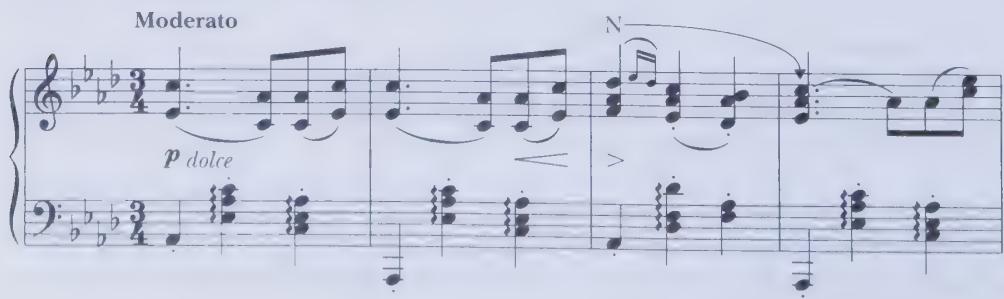
中文讲解
此处为原书第 24 页的图像/乐谱示例——例 4.19 的实际谱例。原始图像数据未在此保留,建议读者查阅纸质原书或电子版第 24 页以查看完整乐谱与和弦标记。
补充说明
需手动查看原书第 24 页例 4.19 的乐谱与缩谱。
第10段(P0157)
原文复述
Example 4.20
中文讲解
此为「例 4.20」的标题,标识紧随其后的乐谱与缩谱。
第11段(P0158)
原文复述
(a) Beethoven, Piano Sonata, Op. 27, No. 2, I, bars 5–9; (b) linear reduction
中文讲解
此为例 4.20 的图注:(a) 贝多芬《钢琴奏鸣曲》Op. 27 第 2 首第一乐章第 5–9 小节;(b) 其线性缩谱。
补充说明
Op. 27 包含两首奏鸣曲,均冠以「准奏鸣曲」(Quasi una Sonata)之名,第 2 首即著名的「月光」。其第一乐章为升 c 小调、12/8 拍。
第12段(P0159)
原文复述
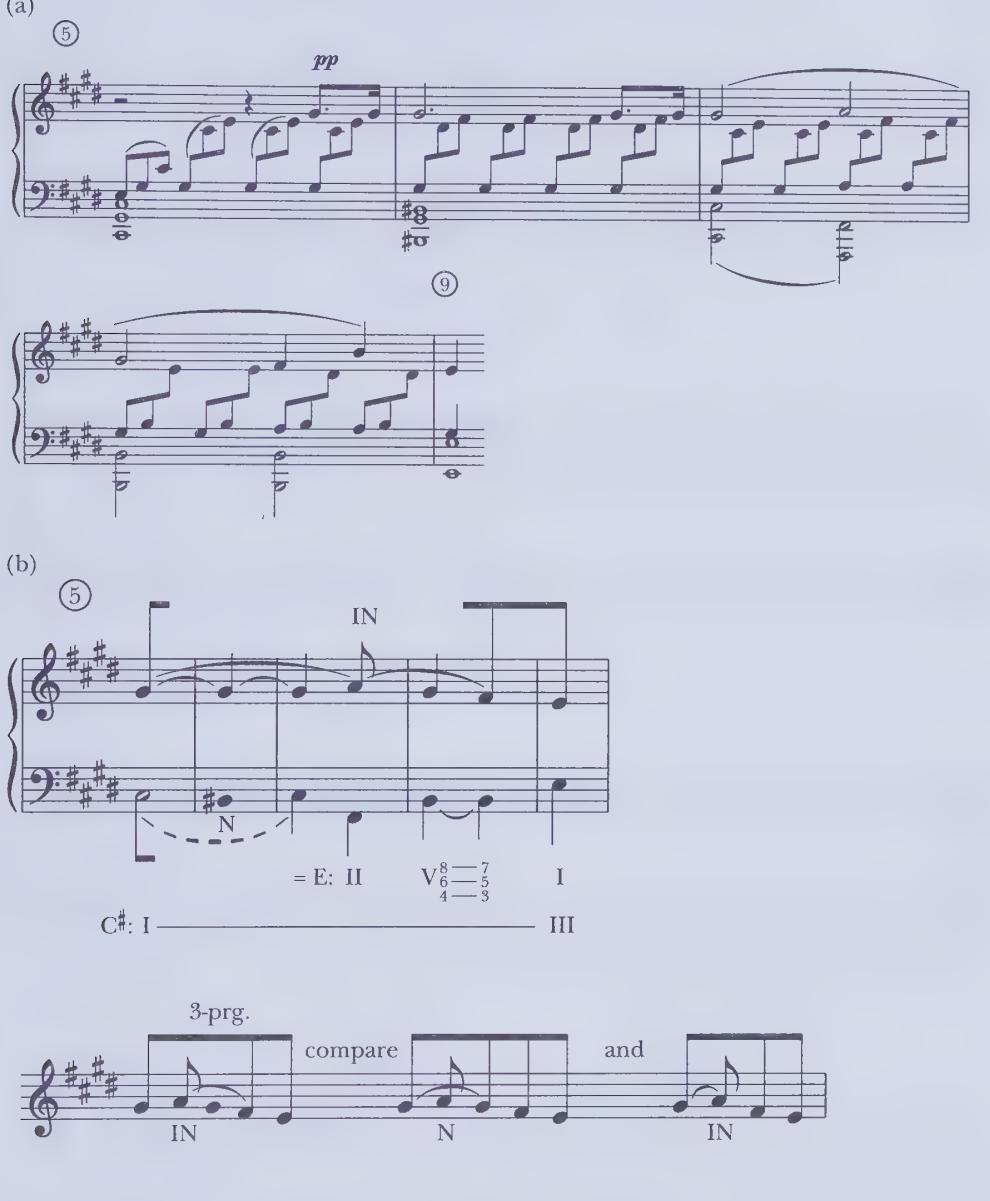
中文讲解
此处为原书第 25 页的图像——例 4.20 的实际谱例与线性缩谱(含 (a) 原谱与 (b) 缩谱两部分)。原图数据未在此保留,建议查阅原书第 25 页以查看完整内容。
补充说明
需手动查看原书第 25 页例 4.20 (a)(b) 的乐谱与缩谱。
第13段(P0160)
原文复述
Examples 4.21 and 4.22 show common linear intervallic patterns. These summaries are not exhaustive and do not represent every possible type of sequence, but they provide an overview of important possibilities and how these patterns function in T-Int-D-T frameworks. In general, linear intervallic patterns expand and create breadth within a single harmony—such as I moving to I⁶—or bridge the gap between two related harmonies—such as I moving to IV, II⁶, or II⁶₅. The examples depict descending and ascending patterns, which correspond
中文讲解
本段提到例 4.21 和 4.22 展示了常见的线性音程模式。这些总结虽非穷尽,也未涵盖所有可能的序列类型,但给出了重要可能性的概览,以及这些模式如何在 T–Int–D–T 框架中运作。一般而言,线性音程模式可在单一和声内部扩展(如 I 进行到 I⁶),也可在两个相关和声之间架桥(如 I 进行到 IV、II⁶ 或 II⁶₅)。这些示例呈现了上行与下行两种模式,对应(句子在此被截断,可能跨入下一个小节)。
补充说明
本段在锚点边界处被截断——句末「which correspond」后应接续下句,其内容很可能属于下一小节(如 4.2 关于线性音程模式总结的展开)。
脚注 / 边栏 / 图表 / 附加信息(如有)
本节(小节 4.1)以「邻音」为核心概念,通过两首经典作品——勃拉姆斯《降 A 大调圆舞曲》Op. 39 No. 15 与贝多芬《月光奏鸣曲》第一乐章——展示邻音在调性结构延长与线性进行扩展中的作用。文中引入了「邻音六四」(neighboring ⁶⁄₄)、「不完整上邻音」(IN)、「重音经过音」、「终止四六和弦」等专业术语,并提示读者注意申克尔图式中用以标示邻音的八分音符符尾记法。两个谱例与缩谱须查阅原书第 24–25 页。本节末尾出现前瞻性文字,提及例 4.21 与 4.22 将总结常见的线性音程模式及其在 T–Int–D–T 框架中的作用,该部分将在下一小节继续展开。
💡 本节核心要点
- 邻音(neighbor note)是一种可在不同结构层面扩展调性结构的对位形态,申克尔首先充分认识到其多层意义。
- 例 4.19(勃拉姆斯《圆舞曲》Op. 39 No. 15):主和弦通过邻音六四延长,上方声部以 C–D♭–C 延长三级音;D♭ 与 C 的「解决」跨越整小节,且中间的 C 是 D♭–C–B♭ 中的经过音。
- 例 4.20(贝多芬《月光奏鸣曲》第一乐章):上声部走 G♯–F♯–E 的三度进行,由 I–III 支持,并被不完整上邻音 A 所修饰;第二个 G♯ 是终止四六和弦支持下的重音经过音。
- 相同的重复音(如 c²)在不同小节可承担不同结构功能:邻音延长环节 vs. 根音位置主和弦主音。
- 申克尔图式中常用八分音符符尾标示邻音与中间和声的低声部。
- 本节末尾前瞻性提示:例 4.21 与 4.22 将总结常见的线性音程模式及其在 T–Int–D–T 框架中的作用(将在下一小节继续展开)。
🔑 关键术语
- 邻音 / Neighbor note:某一和声内或两个和声之间,相邻音级对主要音的装饰性偏离。分为上邻音与下邻音,可出现在调性结构的多个层级。
- 邻音六四 / Neighboring ⁶⁄₄:出现在上下主音之间、用以装饰并延长主和弦的四六和弦;本身不具独立功能,而是邻音运动和声化的结果。
- 不完整上邻音 / Incomplete upper neighbor (IN):邻音出现后未在同位置解决回本音,而通过其他途径(如终止四六和弦)离开,形成「不完整」的邻音形态。
- 重音经过音 / Accented passing tone:出现在强拍上而非弱拍上的经过音,常由终止四六和弦或挂留的支持下产生。
- 终止四六和弦 / Cadential six-four:属和弦之前的装饰性四六和弦,其六音与四音通常以挂留或重音经过音方式进入。
- 线性进行 / Linear progression:在申克尔体系中,指若干和声支持下的上方声部(或低声部)的音级运动,可呈现三度进行、五度进行等模式。
- 三级音 / Scale degree 3̂:大调或小调音阶的第三级,标记为 3̂(caret 3)。
- 申克尔图式 / Schenkerian graph:申克尔分析中用以表示调性音乐背景—中景—前景结构的层级化图形,常以八分音符符尾标示邻音。
4.2 [描述性拆分] Examples 4.21 and 4.22: Summary of Linear Intervallic Patterns
第1段(P0161)
原文复述
Example 4.21
中文讲解
本段仅为标题行,标示本节第一个示例的编号为 4.21。
补充说明
标题行起导航作用,无实质内容。
第2段(P0162)
原文复述
Descending linear intervallic patterns: (a–d) root movement by descending fifth (includes 6/3 variant); (e–g) descending 5–6 pattern (includes root-position variant)
中文讲解
本段说明 Example 4.21 收录的是下行线性音程模式(descending linear intervallic patterns),共分两组:
- (a–d):按下行五度进行的根音进行(root movement by descending fifth),其中包含一个 6/3 变体(6/3 variant);
- (e–g):下行 5–6 模式(descending 5–6 pattern),其中包含一个根音位置(root-position)的变体。
补充说明
“5–6”与“6/3”是低音数字记号(figured bass),描述外声部间的音程进行;“根音进行”指和弦根音之间的级进行关系。
第3段(P0163)
原文复述
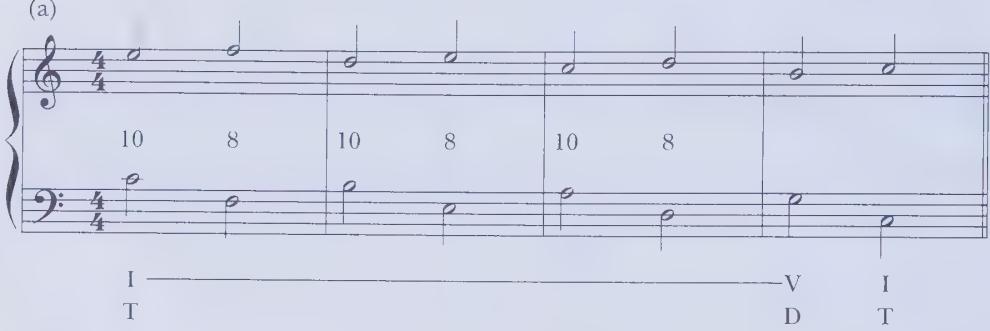
中文讲解
本段为图注位置,对应第 26 页的一幅乐谱或图示(推测为 Example 4.21 的 (a) 小例:下行五度根音进行的原型)。由于内嵌图像数据已省略,无法在此描述其具体音符内容。
补充说明
需手动查看第 26 页乐谱以确认 (a) 例的具体声部进行与数字标记。
第4段(P0164)
原文复述
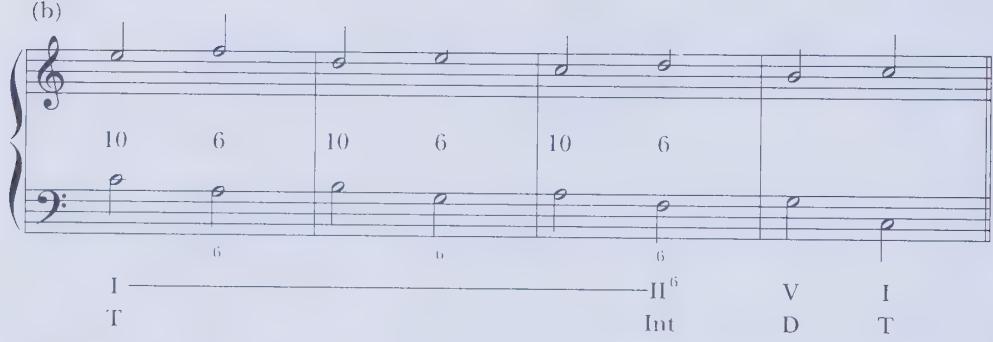
中文讲解
本段为图注位置,对应第 26 页的另一幅乐谱或图示(推测为 Example 4.21 的 (b) 小例:下行五度根音进行的变体之一)。内嵌图像数据已省略,无法描述其内容。
补充说明
需手动查看第 26 页以确认 (b) 例的细节。
第5段(P0165)
原文复述
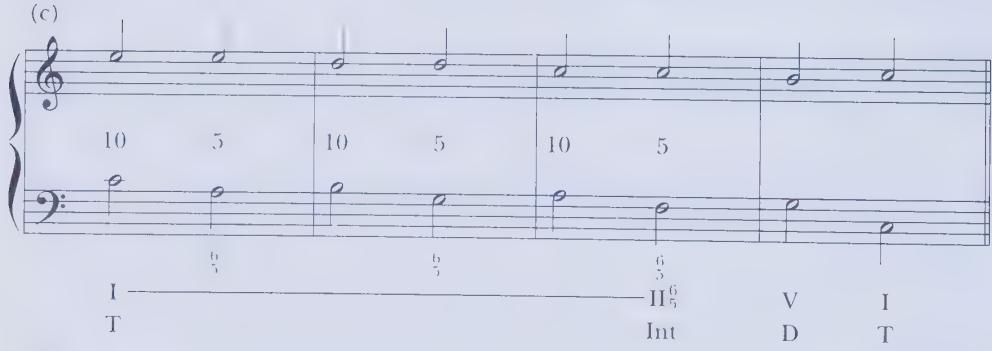
中文讲解
本段为图注位置,对应第 26 页的又一幅乐谱或图示(推测为 Example 4.21 的 (c) 小例)。内嵌图像数据已省略,无法描述其内容。
补充说明
需手动查看第 26 页以确认 (c) 例的细节。
第6段(P0166)
原文复述
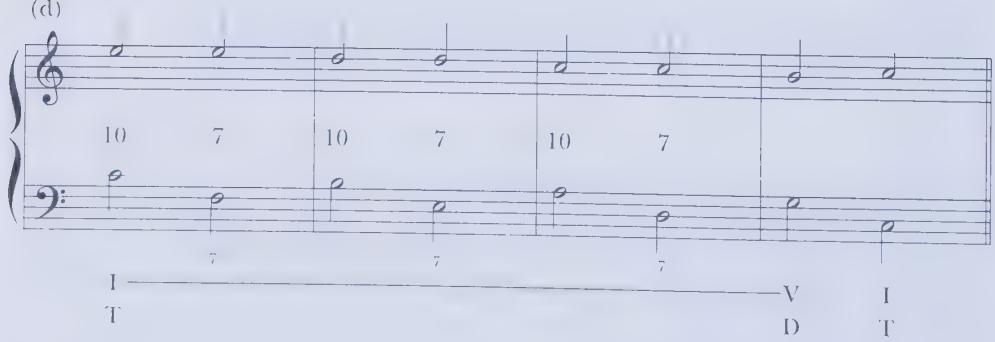
中文讲解
本段为图注位置,对应第 26 页的最后一幅乐谱或图示(推测为 Example 4.21 的 (d) 小例,即下行五度根音进行的 6/3 变体)。内嵌图像数据已省略,无法描述其内容。
补充说明
6/3 变体指外声部呈六度与三度反向进行以替代纯五度根音进行的典型形态;需手动查看图以确认。
第7段(P0167)
原文复述
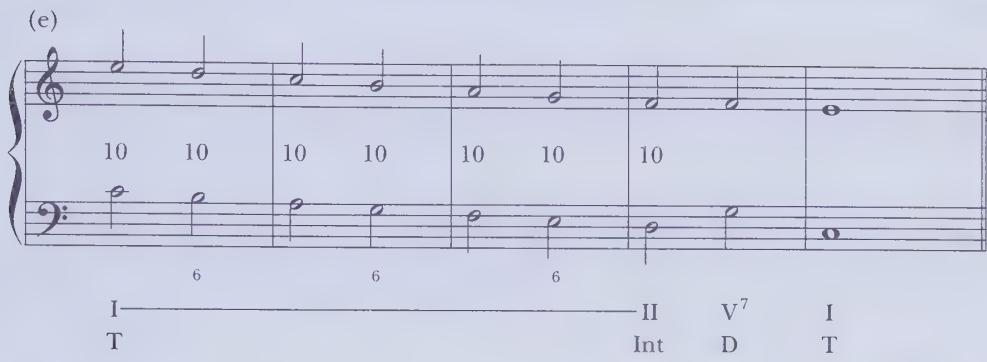
中文讲解
本段为图注位置,对应第 27 页的一幅乐谱或图示(推测为 Example 4.21 的 (e) 小例:下行 5–6 模式的原型)。内嵌图像数据已省略。
补充说明
“下行 5–6”模式指外声部在低音数字记号上从 5 进行到 6 的连续下行序进;需手动查看图。
第8段(P0168)
原文复述
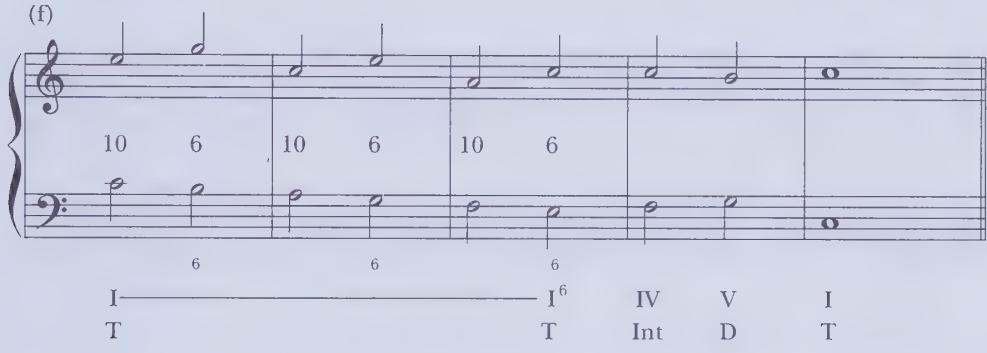
中文讲解
本段为图注位置,对应第 27 页的另一幅乐谱或图示(推测为 Example 4.21 的 (f) 小例:下行 5–6 模式的变体)。内嵌图像数据已省略。
补充说明
需手动查看第 27 页以确认 (f) 例的细节。
第9段(P0169)
原文复述
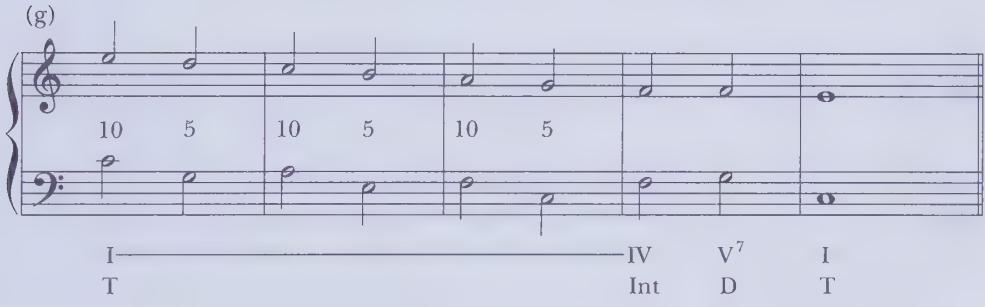
中文讲解
本段为图注位置,对应第 27 页的最后一幅乐谱或图示(推测为 Example 4.21 的 (g) 小例:下行 5–6 模式的根音位置变体)。内嵌图像数据已省略。
补充说明
“根音位置变体”指和弦以根音位置而非第一转位出现,从而改变数字记号;需手动查看图。
第10段(P0170)
原文复述
to the following sequences: descending fifth, descending 5–6, and ascending 5–6 (each sequence type comprises a model and a variant).
中文讲解
本段为承接上文的不完整句子(句首的 to 表明前文应有 begin or lead 等动词)。其含义为:上述示例对应以下三种序列类型——下行五度序列(descending fifth)、下行 5–6 序列(descending 5–6)、以及上行 5–6 序列(ascending 5–6);每种序列类型都由一个原型(model)和一个变体(variant)组成。
补充说明
这是 Example 4.21 与 4.22 之间的过渡说明;句首的“to”属原文编辑遗留,与 P0162 标题及下方段落形成完整语义。
第11段(P0171)
原文复述
We show each intervallic (outer-voice) pattern with numbers between the staves. Roman numerals designate structural harmonies; figured-bass symbols, where applicable, specify the sonorities of the imaginary continuo. Bear in mind that any of the upper voices (soprano, alto, and tenor) may appear in the “soprano” position; a reordering results in a different linear intervallic pattern than those shown. The type of harmonic sequence, however, as well as the succession of figured bass symbols remain constant. Notice also that the patterns are diatonic. Chromatic sequences and linear intervallic patterns can generally be considered transformations of diatonic models.
中文讲解
本段集中说明上述两类示例的阅读与诠释方法,分五点:
- 外声部音程标记:每个外声部(outer-voice)音程模式用谱表之间的数字(数字低音)来标示。
- 罗马数字的功能:罗马数字指示结构性的和声进行;数字低音记号(figured bass)在适用处标明虚拟通奏低音(imaginary continuo)所对应的和声音响。
- 上声部顺序可变:上方三个声部(女高音 Soprano、女低音 Alto、男高音 Tenor)中的任何一个都可出现在所谓的“女高音”(即最高)声部位置;重新排列会导致与示例所呈现的线性音程模式不同的形态。
- 和声序列类型恒定:尽管线性音程模式因声部排列而变,和声序列的类型以及数字低音的级进顺序仍保持不变。
- 模式的调性属性与扩展:所示模式均为调性内的(diatonic)。半音序列(chromatic sequences)与相应的线性音程模式,通常可视为调性模式的变形(transformations)。
补充说明
“imaginary continuo”指为分析便利而假想的数字低音实现;“outer-voice pattern”即两外声部之间的音程连续形态。半音序列作为调性模式的变形,是 18–19 世纪和声实践(如模进、变化模进)的核心分析视角。
第12段(P0172)
原文复述
Example 4.22
中文讲解
本段为标题行,标示本节第二个示例的编号为 4.22。
补充说明
无实质内容。
第13段(P0173)
原文复述
Ascending linear intervallic patterns: (a–d) ascending 5–6 pattern (includes root-position variant)
中文讲解
本段说明 Example 4.22 收录的是上行线性音程模式(ascending linear intervallic patterns),共分 (a–d) 四例:均为上行 5–6 模式(ascending 5–6 pattern),其中包含一个根音位置(root-position)的变体。
补充说明
上行 5–6 模式指外声部在数字低音上从 5 进行到 6 的连续上行序进;与下行 5–6 互为方向倒影。
第14段(P0174)
原文复述
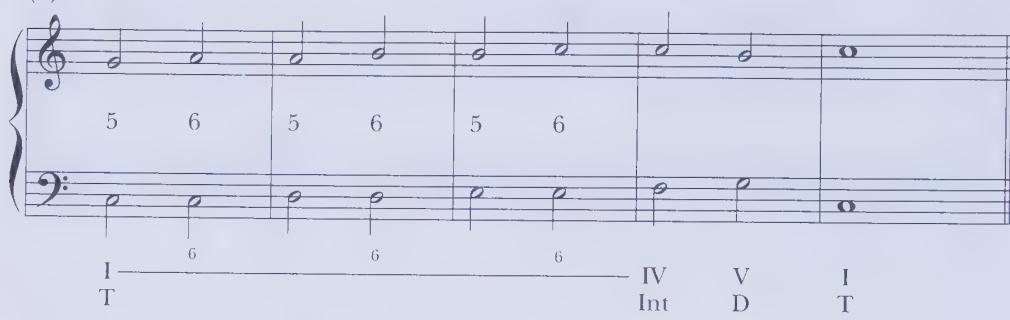
中文讲解
本段为图注位置,对应第 28 页 (a) 例:上行 5–6 模式的原型乐谱或图示。内嵌图像数据已省略。
补充说明
需手动查看第 28 页 (a) 例以确认具体声部进行。
第15段(P0175)
原文复述
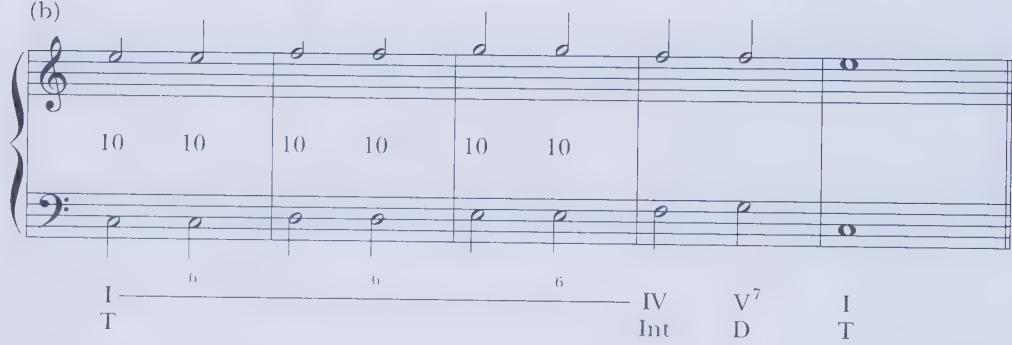
中文讲解
本段为图注位置,对应第 28 页 (b) 例:上行 5–6 模式的变体之一。内嵌图像数据已省略。
补充说明
需手动查看第 28 页 (b) 例以确认细节。
第16段(P0176)
原文复述
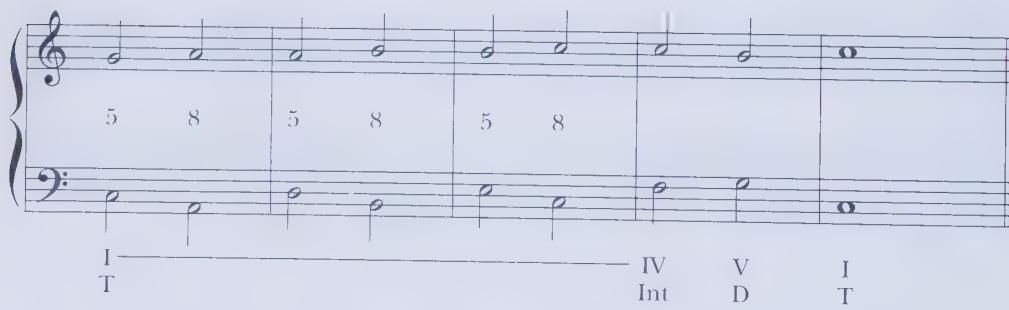
中文讲解
本段为图注位置,对应第 28 页 (c) 例:上行 5–6 模式的又一变体。内嵌图像数据已省略。
补充说明
需手动查看第 28 页 (c) 例以确认细节。
第17段(P0177)
原文复述
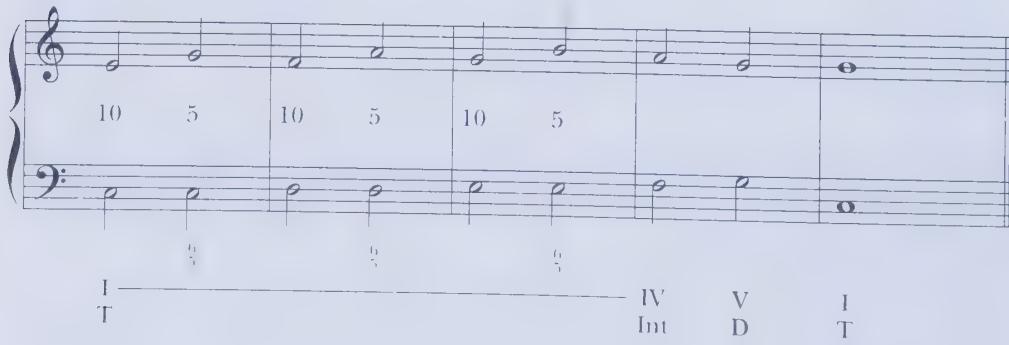
中文讲解
本段为图注位置,对应第 28 页 (d) 例:上行 5–6 模式的根音位置变体。内嵌图像数据已省略。
补充说明
“根音位置变体”指以原位三和弦取代第一转位,使数字记号由 6 变为 5(再回 5–6 的循环);需手动查看图。
脚注 / 边栏 / 图表 / 附加信息(如有)
本节全部乐谱/图像(Example 4.21 的 a–g 共 7 例,Example 4.22 的 a–d 共 4 例,以及若干段落中的图注位置)皆因内嵌数据被省略而无法在本节逐一转写。各小例的具体声部、数字低音与罗马数字均需读者手动查阅原书第 26–28 页对应图示以确认。原书用“数字置于谱表之间”标注外声部音程(outer-voice pattern),并以罗马数字标识结构性和声,以数字低音标注虚拟通奏低音;上方三声部的任何重新排列都会产生不同的线性音程模式,但和声序列类型与数字低音级进保持不变;所示模式皆为调性(diatonic)形式,半音模式则可视为调性原型的变形。
💡 本节核心要点
- Example 4.21 集中展示下行线性音程模式:a–d 为下行五度根音进行(含 6/3 变体),e–g 为下行 5–6 模式(含根音位置变体)。
- Example 4.22 展示上行线性音程模式:a–d 均为上行 5–6 模式(含根音位置变体)。
- 每个序列类型由一个原型(model)与一个变体(variant)组成。
- 外声部音程用谱表之间的数字(数字低音)标记,结构性进行用罗马数字标注,虚拟通奏低音的和声音响用数字低音补充说明。
- 上三声部中任何一声部都可置于最高位置,重新排列即形成不同的线性音程模式,但和声序列类型与数字低音级进顺序保持不变。
- 所示模式均为调性(diatonic)模式;半音序列与半音线性音程模式通常可视为调性原型的变形。
🔑 关键术语
- Linear intervallic pattern(线性音程模式):指两外声部(通常为女高音与低音)之间的连续音程形态,用数字低音记号(如 5–6、6/3)标示,是模进与序列分析的核心单元。 / The continuous intervallic shape between the two outer voices, notated with figured-bass numerals (e.g., 5–6, 6/3), central to sequence and sequential analysis.
- Figured bass(数字低音):在低音下方或谱表之间标注的数字与符号(如 5、6、6/3),用来指示上方各音与低音之间的音程,以推演和声音响。 / Numbers and symbols (e.g., 5, 6, 6/3) placed below the bass to indicate the intervals above it, used to realize the harmony.
- Roman numerals(罗马数字):在功能和声分析中用来标示调内各和弦级数(如 I、ii、V),指示结构性的和声进行。 / Capital and lowercase Roman numerals (e.g., I, ii, V) denoting chord scale degrees in tonal-harmonic analysis.
- Descending fifth / Ascending 5–6(下行五度 / 上行 5–6):两类典型和声序列类型:前者根音连续下行五度,后者外声部呈 5 上行至 6 的连续音程级进,构成所谓“模进式”或“帕纳”之类传统模式。 / Two classic sequence types: the first moves roots by descending fifths; the second produces an ascending 5-to-6 outer-voice succession.
- 6/3 variant(6/3 变体):将外声部典型五度进行改为六度–三度反向进行的变体形态,用于避开平行五度或取得特定的线性效果。 / A variant in which the typical fifth-progression between outer voices is replaced by a sixth–third contrary motion.
- Root-position variant(根音位置变体):同一序列类型中以原位三和弦取代第一转位的变体;相应的数字低音记号随之由 6 变为 5,但和声序列类型仍保持。 / A variant of the same sequence type in which root-position triads replace first-inversion ones, changing the figured-bass numerals (6 → 5) while the sequence type stays the same.
- Imaginary continuo(虚拟通奏低音):为分析便利而假想的数字低音实现,可补足例示中未实际写出但和声上隐含的低音线条与和声音响。 / A hypothesized figured-bass realization supplied for analysis to fill in implied bass motion and harmony.
- Diatonic vs. chromatic(调性 vs. 半音):调性模式完全使用调内自然音级,半音模式则引入变化音;后者在分析上常被视为前者的变形。 / Diatonic patterns use only the notes of the prevailing scale; chromatic patterns introduce altered tones and are typically analyzed as transformations of diatonic models.
5.1 Pieces for Analysis
第1段(P0178)
原文复述
Pieces for Analysis
中文讲解
本节标题为「用于分析的乐段」。这是一个列出待分析曲目清单的小节标题,作者将本章后续内容用于引导读者对具体音乐片段进行分析。
第2段(P0179)
原文复述
Note: These passages may contain linear progressions, linear intervallic patterns, or both.
中文讲解
编者提示:以下所列乐段中可能含有「线性进行」(linear progressions)、「线性音程模式」(linear intervallic patterns),或同时兼有两者。
补充说明
作者借此提示学生:分析时既要注意和声进行,也要留意旋律或声部之间形成的线性音程关系。
第3段(P0180)
原文复述
- Bach, Chorale No. 244, bars 1–2 (linear progression)
中文讲解
第 1 题:巴赫,众赞歌第 244 首,第 1–2 小节(含线性进行)。
补充说明
众赞歌是巴赫声乐作品中的核心体裁,常以四部和声写作,适合用来观察根音进行与线性声部运动。
第4段(P0181)
原文复述
- Bach, Prelude in B major (Well-Tempered Clavier I), bars 1–2 (linear progression)
中文讲解
第 2 题:巴赫,《平均律键盘曲集》第一册 B 大调前奏曲,第 1–2 小节(含线性进行)。
补充说明
B 大调前奏曲以连绵分解和弦开场,是研究线性低音与持续声部的经典素材。
第5段(P0182)
原文复述
- Mozart, Rondo in A minor, K. 511, bars 1–5 (linear progression)
中文讲解
第 3 题:莫扎特,A 小调回旋曲,K. 511,第 1–5 小节(含线性进行)。
补充说明
K. 511 是一首简洁而忧郁的钢琴独奏回旋曲,A 小调中蕴含着丰富的和声色彩。
第6段(P0183)
原文复述
- Schumann, Album for the Young, Op. 68, “Trällerliedchen,” bars 1–8 (linear progression)
中文讲解
第 4 题:舒曼,《少年曲集》作品 68,「小曲」(Trällerliedchen),第 1–8 小节(含线性进行)。
补充说明
《少年曲集》共 43 首钢琴小曲,“Trällerliedchen” 意为「哼唱的小歌」,旋律活泼。
第7段(P0184)
原文复述
- Bach, Prelude in D major, (Well-Tempered Clavier I), bars 1–3 (linear progression)
中文讲解
第 5 题:巴赫,《平均律键盘曲集》第一册 D 大调前奏曲,第 1–3 小节(含线性进行)。
补充说明
D 大调前奏曲以分散和弦构成的均匀十六分音符织体著称,是研究线性低音运动的范例。
第8段(P0185)
原文复述
- Mozart, Piano Sonata, K. 284, III, Variation 7, bars 1–4 (linear progression)
中文讲解
第 6 题:莫扎特,钢琴奏鸣曲 K. 284,第三乐章变奏 7,第 1–4 小节(含线性进行)。
补充说明
K. 284(题献给玛丽·安托瓦内特)的第三乐章是著名的主题与变奏。
第9段(P0186)
原文复述
- Schubert, Die Winterreise, No. 10, “Rast,” bars 6–10 (linear progression)
中文讲解
第 7 题:舒伯特,《冬之旅》第 10 首「休憩」(Rast),第 6–10 小节(含线性进行)。
补充说明
《冬之旅》是舒伯特联篇歌曲集,「休憩」描写旅人在路标下短暂歇息的场景。
第10段(P0187)
原文复述
- Brahms, Waltz, Op. 39, No. 5, bars 1–8 (linear progression)
中文讲解
第 8 题:勃拉姆斯,圆舞曲作品 39 之 5,第 1–8 小节(含线性进行)。
补充说明
作品 39 共含 16 首钢琴圆舞曲,是勃拉姆斯对舒伯特与维也纳舞曲传统的致敬。
第11段(P0188)
原文复述
- Chopin, Prelude in E major, Op. 28, No. 9, bars 9–12 (linear progression)
中文讲解
第 9 题:肖邦,《E 大调前奏曲》作品 28 之 9,第 9–12 小节(含线性进行)。
补充说明
作品 28 共 24 首前奏曲,涵盖全部大小调;E 大调前奏曲以持续的左手伴奏著称。
第12段(P0189)
原文复述
- Beethoven, Piano Sonata, Op. 10, No. 2, I, bars 1–12 (bass linear progression)
中文讲解
第 10 题:贝多芬,钢琴奏鸣曲作品 10 之 2,第一乐章,第 1–12 小节(含低音线性进行)。
补充说明
这是贝多芬早期奏鸣曲之一;本片段特别标注了「bass linear progression」,提示分析重点在低音声部。
第13段(P0190)
原文复述
- Bach, Partita No. 1 in B b major, Praeludium, bars 1–3 (linear progression)
中文讲解
第 11 题:巴赫,《降 B 大调第一帕蒂塔》前奏曲,第 1–3 小节(含线性进行)。
补充说明
《第一帕蒂塔》前奏曲是巴赫最常被演奏的作品之一,以分解和弦的快速音型闻名。
第14段(P0191)
原文复述
- Handel, Keyboard Suite No. 8 in F minor, Praeludium, bars 1–8 (linear progression)
中文讲解
第 12 题:亨德尔,《F 小调第八键盘组曲》前奏曲,第 1–8 小节(含线性进行)。
补充说明
亨德尔的键盘组曲延续了巴洛克键盘音乐传统,F 小调前奏曲具有强烈的悲剧色彩。
第15段(P0192)
原文复述
- Mozart, Piano Sonata, K. 545, I, bars 63–66 (linear progression and intervallic pattern)
中文讲解
第 13 题:莫扎特,钢琴奏鸣曲 K. 545,第一乐章,第 63–66 小节(兼含线性进行与音程模式)。
补充说明
K. 545 因其简洁易弹而有「为初学者而作的简易奏鸣曲」之别名,但其和声构思仍属典范。
第16段(P0193)
原文复述
- Beethoven, Piano Sonata, Op. 28, Rondo, bars 17–28 (linear progression and intervallic pattern)
中文讲解
第 14 题:贝多芬,钢琴奏鸣曲作品 28,回旋乐章,第 17–28 小节(兼含线性进行与音程模式)。
补充说明
作品 28 别称「田园奏鸣曲」,末乐章为带主题的优雅回旋曲。
第17段(P0194)
原文复述
- Mozart, Piano Sonata, K. 533/494, III, bars 95–98 (linear progression and intervallic pattern)
中文讲解
第 15 题:莫扎特,钢琴奏鸣曲 K. 533/494,第三乐章,第 95–98 小节(兼含线性进行与音程模式)。
补充说明
K. 533 与 K. 494 的组合是莫扎特晚期的复杂作品之一,第三乐章的展开部常被单独研究。
第18段(P0195)
原文复述
- Chopin, Etude in Db major, Op. 25, No. 9, bars 1–4 (linear progression and intervallic pattern)
中文讲解
第 16 题:肖邦,《降 D 大调练习曲》作品 25 之 9,第 1–4 小节(兼含线性进行与音程模式)。
补充说明
作品 25 之 9 俗称「蝴蝶练习曲」,以轻盈的双音快速交替织体闻名。
第19段(P0196)
原文复述
- Bach, Little Fugue in A minor for organ, BWV 559, bars 13–25 and 35—end (linear intervallic pattern: two forms)
中文讲解
第 17 题:巴赫,《A 小调小赋格》管风琴曲,BWV 559,第 13–25 小节及第 35 小节至曲末(含线性音程模式:两种形态)。
补充说明
BWV 559 的真伪曾有争议,但作为赋格教学素材仍被广泛使用;本片段特别标明音程模式以「两种形态」出现。
第20段(P0197)
原文复述
- Beethoven, Piano Sonata, Op. 53 (“Waldstein”), I, bars 1–13 (linear progression and intervallic pattern)
中文讲解
第 18 题:贝多芬,钢琴奏鸣曲作品 53(「华尔斯坦」),第一乐章,第 1–13 小节(兼含线性进行与音程模式)。
补充说明
「华尔斯坦奏鸣曲」题献给华尔斯坦伯爵,开场以分解和弦三连音的奔腾音响为标志。
第21段(P0198)
原文复述
- Bach, Prelude in E minor (Well-Tempered Clavier I), bars 1–9 (linear progression and intervallic pattern)
中文讲解
第 19 题:巴赫,《平均律键盘曲集》第一册 E 小调前奏曲,第 1–9 小节(兼含线性进行与音程模式)。
补充说明
E 小调前奏曲以单声部音阶动机的不断上行展开,是线性对位思维的代表作。
第22段(P0199)
原文复述
- Corelli, Trio Sonata, Op. 1, No. 4, Allegro, bars 16–20
中文讲解
第 20 题:科雷利,三重奏鸣曲作品 1 之 4,快板乐章,第 16–20 小节。
补充说明
Corelli 是巴洛克室内乐与奏鸣曲体裁的奠基者之一;本片段未在原文中标示分析重点类型,留待分析者自行判断。
第23段(P0200)
原文复述
- Handel, Keyboard Suite No. 8 in F minor, Courante, bars 7–11
中文讲解
第 21 题:亨德尔,《F 小调第八键盘组曲》库朗特舞曲,第 7–11 小节。
补充说明
Courante 是巴洛克组曲中常见的舞曲乐章之一;本片段同样未在原文标注具体的线性进行或音程模式类型。
第24段(P0201)
原文复述
- Mozart, Piano Sonata, K. 310, I, bars 22–31 (linear intervallic pattern)
中文讲解
第 22 题:莫扎特,钢琴奏鸣曲 K. 310,第一乐章,第 22–31 小节(含线性音程模式)。
补充说明
K. 310 是莫扎特少数几首小调钢琴奏鸣曲之一,A 小调中充满戏剧性。
第25段(P0202)
原文复述
- Bach, French Suite in E major, Gavotte, bars 1–4 (linear intervallic pattern)
中文讲解
第 23 题:巴赫,《E 大调法国组曲》加沃特舞曲,第 1–4 小节(含线性音程模式)。
补充说明
加沃特是法国组曲中典型的舞曲乐章,常以轻盈的拍点起拍。
第26段(P0203)
原文复述
- Corelli, Trio Sonata, Op. 2, No. 11, Allemande, bars 16–18 (linear intervallic pattern)
中文讲解
第 24 题:科雷利,三重奏鸣曲作品 2 之 11,阿勒曼德舞曲,第 16–18 小节(含线性音程模式)。
补充说明
阿勒曼德源自德国舞曲,是巴洛克组曲常见的起首乐章,本片段以线性音程模式为主要分析对象。
脚注 / 边栏 / 图表 / 附加信息(如有)
本节无脚注、边栏、图例或附录表格;全部内容由标题、一条编者说明与 24 条带编号的曲目清单构成。第 20、21 题未在原文标注分析类别,其余题目分别在括号中注明「linear progression」「bass linear progression」「linear intervallic pattern」或「linear progression and intervallic pattern」。
💡 本节核心要点
- 本节提供 24 个用于分析的音乐片段清单,覆盖巴洛克、古典与浪漫时期。
- 所有曲目均明确给出作曲家、作品编号及具体小节号,便于在谱例中精确定位。
- 每个片段在括号中标明所含分析要素:线性进行、低音线性进行、线性音程模式或兼而有之。
- 个别片段(如 Corelli Op. 1 No. 4 与 Handel Courante)未标注具体分析类别,留给分析者自行判断。
- 编者提示表明所列乐段可能含线性进行、线性音程模式,或二者兼有,提示读者采取开放的分析视角。
🔑 关键术语
- linear progression:线性进行——指声部以旋律化方式从一个音移动到另一个音而形成连贯的线条运动,常与和声根音进行相对应。 / Linear progression: stepwise or melodic voice-leading motion that creates a continuous line, often contrasted with simple harmonic root motion.
- linear intervallic pattern:线性音程模式——指多个声部之间在时间序列中重复出现的特定音程关系,构成可识别的旋律化模式。 / Linear intervallic pattern: a recurring intervallic relationship between voices unfolding over time, forming an identifiable melodic pattern.
- bass linear progression:低音线性进行——特指低音声部呈线性展开的进行,强调低音旋律线条的独立意义。 / Bass linear progression: linear motion specifically in the bass voice, emphasizing the melodic independence of the lowest line.
- Well-Tempered Clavier (平均律键盘曲集):巴赫为两架键盘乐器所作的两卷曲集,每卷 24 首前奏曲与赋格,遍及全部大小调。 / Bach’s two books of preludes and fugues for keyboard, each covering all 24 major and minor keys.
- Praeludium(前奏曲):巴洛克时期置于组曲或赋格之前即兴风格的开篇乐章。 / A free, often improvisatory opening movement preceding a fugue or suite in the Baroque era.
6.1 [描述性拆分] Notes 1–15
第1段(P0204)
原文复述
Notes
中文讲解
该小节的标题。原文以 Markdown 一级标题的形式标注本章为「注释」(Notes)。这是第30页上针对前文分析例证所附的编号注释 1 至 15 的整体起始标记。
第2段(P0205)
原文复述
- It is as if the music in bar 2 and the first part of bar 3 is an outgrowth of bar 1. This compositional technique is called a “hidden” repetition, and it is a procedure that can unify various spans of music; we will frequently see its influence in other contexts later in this book.
中文讲解
第 2 小节和第 3 小节前一部分的音乐仿佛是从第 1 小节生长出来的。这种作曲技法被称为「隐藏的」重复(hidden repetition),它是一种可以把不同长度的音乐片段统一起来的手法;在本书后面的其它语境中我们会经常看到它的影响。
补充说明
「隐藏重复」是申克分析中常用的统一手法,表面上并不呈现完全相同的旋律重复,而是通过潜在的结构延伸把后续段落与起句联系起来。
第3段(P0206)
原文复述
- Free Composition, p. 73.
中文讲解
参考文献引注:见申克《自由作曲》第 73 页。
补充说明
这是指 Heinrich Schenker, Free Composition (Der freie Satz),是申克理论体系中关于自由写作与隐藏重复讨论的核心文献。
第4段(P0207)
原文复述
- Counterpoint, II, pp. 57–58.
中文讲解
参考文献引注:见申克《对位法》第二卷第 57–58 页。
补充说明
Schenker, Counterpoint(《对位法》,共两卷)是申克关于对位技法系统论述的著作,本注提示相关讨论在该处。
第5段(P0208)
原文复述
- The intervening tones support chords that are referred to as passing (or contrapuntal) chords because they are based on passing tones. The series of chords expands the motion from I to II₅⁶ (between T and Int).
中文讲解
这些介于结构音之间的音支持着一些和弦,这些和弦被称为经过和弦(passing chords)或对位和弦(contrapuntal chords),因为它们建立在经过音之上。这一系列和弦扩展了从 I 到 II₅⁶(位于主音 T 与下属 Int 之间)的进行。
补充说明
在申克体系中,II₅⁶ 是连接主音 T 与下属 Int 的关键结构和弦;经过和弦在此通过经过音扩展了 I–II₅⁶ 的连接运动。
第6段(P0209)
原文复述
- The shape and pace of the soprano line, which is of course a preexisting chorale melody harmonized by Bach, is somewhat related to the text (though to a limited extent since the same melody is used to sing different stanzas of the chorale text). Notice that special and expressive emphasis is given to the word “Jesu” with the repeated B in the soprano, and to the word “Freude” with the change to half notes; in the second verse the word “lange” is similarly emphasized.
中文讲解
女高音声部的旋律形态与节奏,当然是巴赫所和声的、原本就存在的圣咏旋律,与歌词有一定关系(但程度有限,因为同一旋律用于演唱圣咏文本的不同诗节)。请注意:女高音上重复的 B 音给「Jesu」一词以特殊且富有表现力的强调;改为二分音符的写法强调了「Freude」一词;在第二段诗节中,「lange」一词也以类似方式获得强调。
补充说明
巴赫圣咏中常通过旋律重复、节奏变化或音高重复来配合关键歌词,体现出音乐与文本之间的局部表现性对应。
第7段(P0210)
原文复述
- Schenker, in his own analyses, often uses a broken tie to show the association of a single tone prolonged by intervening pitches. (If the pitch is simply repeated or tied, you may use an unbroken tie in your graphs.) Bear in mind also that a broken tie may be used to connect a chromatically altered pitch, such as in a broader motion from C to C♯.
中文讲解
申克在他自己的分析中,经常使用「断开的延音连线」(broken tie)来表示一个单音被若干插入音延长后的关联。(若音高只是重复或用延音线连接,则在你的图式中可以使用不断的延音线。)还要注意,断开的延音线也可用于连接一个变化半音的音高,例如在从 C 到 C♯ 的更广阔运动中。
补充说明
「断开的延音线」(broken tie)是申克图式中区别于普通延音线的特殊记号:它表达一个结构音虽然被其他音插入,但仍属同一结构层次的延续,对半音化延伸尤为重要。
第8段(P0211)
原文复述
- For a more complete discussion of the principal graphic symbols, see the Appendix.
中文讲解
关于主要图形符号的更完整讨论,请参阅附录。
补充说明
这是指本书末尾的「附录」,集中说明申克分析图式中各类符号(如延音线、断开的延音线、方括号等)的含义。
第9段(P0212)
原文复述
- In examining the upper voice, it seems sufficient to observe simply that the tones A, B♭, and C receive structural emphasis through metric placement in bars 1–3, since they occur on the downbeats of the bars. Their prominence, however, also depends on the way each is sustained through each measure. Consider the upper voice of bar 1. The A is decorated by its lower neighbor, followed by a consonant skip to F, the root of tonic harmony, in the inner “alto” voice (which doubles the bass at this point); a stepwise motion then leads back to A. Exactly the same process occurs in conjunction with B♭ in the next bar.
中文讲解
在审视上方声部时,只需注意到 A、B♭ 和 C 三个音由于节拍位置而获得结构强调——它们出现在各小节的强拍上。然而,它们之所以突出,也取决于每个音在各自小节中如何被延长。看第 1 小节的上方声部:A 被其下方的邻音装饰,随后在内层「中音」声部(此时与低音声部构成八度重复)中跳进到主和弦根音 F,最后以级进回到 A。完全相同的过程发生在下一小节与 B♭ 相联之处。
补充说明
本注展示申克分析中「结构音—装饰音—返回结构音」的标准三步过程:邻音装饰 → 协和跳进 → 级进回归,是上方声部延展结构音的常见模式。
第10段(P0213)
原文复述
- Two additional points about the example merit brief comment. First, notice in Example 4.5b that the initial B♭ in bar 2 is stemmed, but the B♭ in bar 3 is not (both are passing tones). This nuance of graphic notation reflects the fact that the first B♭ receives independent chordal support, whereas the second B♭ “passes quickly” from the C, within the V⁶ chord, to the A in the next bar.
中文讲解
关于该例还有两点值得简短评论。第一,请注意在例 4.5b 中,第 2 小节开头的 B♭ 带符干,而第 3 小节的 B♭ 不带符干(两者均为经过音)。这一图形记法的细微差别反映了以下事实:第一个 B♭ 获得独立的和弦支持,而第二个 B♭ 则在 V⁶ 和弦内由 C「快速经过」到下一小节的 A。
补充说明
符干的有无是申克图式中区分「获得和弦支持的经过音」与「快速掠过、无独立和弦支撑的经过音」的重要标记,体现出图形记法对结构层次的精确表达。
第11段(P0214)
原文复述
- In graphic notation, square brackets are generally used to indicate parallelisms. For a more thorough discussion of motivic parallelisms, see Burkhart, “Schenker’s ‘Motivic Parallelisms.’”
中文讲解
在图形记法中,方括号(square brackets)通常用来表示「平行结构」(parallelisms)。关于动机平行的更详尽讨论,请参阅 Burkhart 的文章《申克的「动机平行」》。
补充说明
方括号在申克图式中是标记「动机平行」的标准记号,提示读者注意不同片段间在结构或动机上的相似关系。
第12段(P0215)
原文复述
- All movements of this little sonata are brief, hence the name “Sonatina.” Our example begins in the dominant area of the exposition.
中文讲解
这首小奏鸣曲的各个乐章都很短小,因此得名「小奏鸣曲」(Sonatina)。本例从呈示段的属调区域开始。
补充说明
「Sonatina」意为「小奏鸣曲」,通常各乐章较短、结构较简单;本例起始于呈示段中通常首先出现的属调区域(即主调的上五度区域)。
第13段(P0216)
原文复述
- The tonality of this movement is C major. Bars 6–8 modulate to G, the key of the dominant. In terms of the overall tonality, bars 8–12 represent an expansion of V (as a Stufe).
中文讲解
本乐章的调性为 C 大调。第 6–8 小节转调到属调 G。从整体调性看,第 8–12 小节代表了 V 级(作为一个 Stufe,即调性级别)的扩展。
补充说明
「Stufe」(调性级别)是申克体系中表示「作为调中心、和声功能级」的概念,区别于单纯的和弦或音级。V 作为 Stufe 的扩展意味着该片段维持属功能区域并展开其内部结构。
第14段(P0217)
原文复述
- In Baroque style, bass motions through a descending fourth were frequently associated with sadness and mourning—especially when filled in with chromatic passing tones. See Ellen Rosand’s landmark article, “The Descending Tetrachord: An Emblem of Lament,” The Musical Quarterly, Vol. LXV, No. 3 (July, 1979), pp. 346–59.
中文讲解
在巴洛克风格中,低音下行四度常与悲伤和哀悼相关联——尤其是当中以半音经过音填充时。请参阅 Ellen Rosand 的标志性文章《下行四音列:哀悼的象征》,载《音乐季刊》第 65 卷第 3 期(1979 年 7 月),第 346–359 页。
补充说明
「下行四音列」(descending tetrachord)作为巴洛克哀悼音乐的典型音型,是该时期音乐修辞学(topos)研究中的重要母题。
第15段(P0218)
原文复述
- Notice that, in the third bar of the example, the seventh A♭ is ornamented by the tone B♭ above. The seventh of a seventh chord is often decorated in this manner.
中文讲解
请注意,在该例的第 3 小节,七音 A♭ 由其上方的 B♭ 装饰。七和弦的七音常以这种方式被装饰。
补充说明
七和弦的七音属于不协和音,倾向于下行解决;装饰音常出现在其上方构成邻音装饰(如 B♭–A♭ 的邻音关系),并随后通过解决完成和声进行。
第16段(P0219)
原文复述
- Notice the A♭–G motion that occurs in both the “soprano” and the “tenor” strands of voice leading. This is a characteristic feature of keyboard writing analogous to instrumental doubling in concerted music, where apparent parallel octaves are formed through doublings of a single voice-leading strand.
中文讲解
请注意 A♭–G 的运动同时出现在「女高」和「男低」两条声部进行线索中。这是键盘写作中的一种典型特征,类似于协奏音乐中的乐器重复——即通过对同一声部线索的重复,形成表面上的平行八度。
补充说明
在键盘音乐中,单一声部线索常被八度重复,造成表面上的「平行八度」,但实际只属于同一条结构线;这是申克图式中解释平行八度合法性的常见依据。
脚注 / 边栏 / 图表 / 附加信息(如有)
本节为针对前文(特别是第 4 章中关于 Bach 圣咏与奏鸣曲示例)所附的编号注释 1 至 15。每条注释都对前文分析中的某一细节加以解释、补充文献出处或阐明图形记法的细节。涵盖的核心主题包括:隐藏重复(hidden repetition)、经过和弦、断开的延音线与方括号等图形符号、结构音与装饰音的关系、巴赫圣咏旋律与文本的对应、下行四音列的哀悼修辞、以及键盘写作中的八度重复现象。
💡 本节核心要点
- 隐藏重复(hidden repetition)是统一不同长度音乐段落的重要作曲技法,详见 Schenker《Free Composition》。
- 经过和弦(passing/contrapuntal chords)由经过音支持,扩展了 I 到 II₅⁶ 的结构运动。
- 申克图式中,断开的延音线用于表示被插入音延长的结构音,亦可用于连接半音化进行;方括号用于标记动机平行。
- 上方声部的结构音(如 A、B♭、C)通过节拍位置与延长方式获得结构强调,邻音装饰—协和跳进—级进回归是典型延展模式。
- 巴洛克音乐中,下行四音列的低音进行(尤其是含半音经过音时)常与哀悼情感相联系(Ellen Rosand 的经典研究)。
- 七和弦的七音常由其上方邻音装饰;键盘写作中平行八度常源于同一结构线索的八度重复,而非真正的对位违规。
🔑 关键术语
- 隐藏重复 (hidden repetition):表面不呈现完全相同的旋律重复,而是通过结构延伸把后续段落与起句联系起来,是申克体系中常用的统一不同音乐长度的作曲手法。 / A compositional technique in which subsequent music seems to grow out of an opening gesture, used by Schenker to unify various spans of music.
- 经过和弦 (passing/contrapuntal chords):建立在经过音之上的和弦,扩展结构和弦之间的连接运动,如 I 到 II₅⁶ 之间的扩展。 / Chords based on passing tones that expand structural harmonic motions between two structural harmonies.
- 断开的延音线 (broken tie):申克图式中的特殊记号,用于表示一个结构音被插入音延长;也用于标记半音化结构音(如 C 到 C♯)的延续。 / A Schenkerian graphic device showing that a structural tone is prolonged through intervening pitches, including chromatic alterations.
- 动机平行 (motivic parallelism):不同音乐片段在结构或动机层面呈现相似关系的现象;在申克图式中以方括号标示。 / Similarity in structure or motive between different passages, marked by square brackets in Schenkerian graphs.
- 下行四音列 (descending tetrachord):巴洛克音乐中低音下行四度的典型进行,常以半音经过音填充,并与哀悼、悲伤的情感相联系。 / A characteristic descending fourth in the bass, often filled chromatically and associated with mourning in Baroque style.
- Stufe(调性级别):申克体系中表示「作为调中心、和声功能级」的概念;V 作为 Stufe 表示属功能作为调中心的扩展。 / A Schenkerian concept denoting a harmonic function functioning as a tonal level, e.g., V as a Stufe.
- Sonatina(小奏鸣曲):篇幅较短、结构较简化的奏鸣曲形式;本节示例从其呈示段的属调区域开始。 / A short, simpler form of the sonata; the example begins in the dominant area of its exposition.
6.2 [描述性拆分] Notes 16–23
第1段(P0220)
原文复述
- Our purpose is not to introduce new terminology or a class of linear techniques, but to make the point that some linear progressions span a dissonance that ultimately must resolve. In Example 4.9, for instance, the four bars of expanded dominant seventh harmony function in a way exactly analogous to a simple V^7–I progression. In this case, the entire passage embodies tension that is released when the seventh resolves to the third of the tonic triad. Thus dissonance is not exclusively a local event, but may influence broader spans of music. This observation has far-reaching ramifications for tonal structure and musical form, ramifications we will see in greater detail when we begin to examine prolonged harmony and counterpoint in larger contexts.
中文讲解
本注释说明前文讨论线性进行的目的并非引入新术语或新的线性技巧类别,而是要强调一个观点:某些线性进行所跨越的不协和音最终必须解决。以例4.9为例,其中四小节的扩展属七和弦的运作方式与简单的V^7–I进行完全类似;该段落整体体现了七音解决到主三和弦的三音时所释放的张力。因此不协和并不只是局部现象,它可能影响更宽广的乐段。这一观察对调性结构与曲式有深远的影响,相关内容将在后续讨论延长和声与对位时更详细地展开。
补充说明
本注释呼应了申克分析中“扩展的”属七和弦作为线性现象的核心观点:原本在传统和声中应作为局部不协和解决的属七音,可以成为跨越多小节的线性张力结构,为后续讨论延长层次上的不协和处理做铺垫。
第2段(P0221)
原文复述
- The term linear intervallic pattern was coined by Allen Forte and elaborated as a linear technique by Forte and Gilbert in Introduction to Schenkerian Analysis, p. 83ff.
中文讲解
本注释交代“线性音程模式”(linear intervallic pattern)这一术语由Allen Forte首创,并由Forte与Gilbert在《Introduction to Schenkerian Analysis》(《申克分析导论》)第83页及之后作为线性技巧加以详述。
第3段(P0222)
原文复述
- Linear progressions and intervallic patterns, however, are not mutually exclusive concepts. Linear intervallic patterns usually involve a linear progression in one or both of the voices.
中文讲解
本注释指出,线性进行与音程模式这两个概念并不相互排斥。线性音程模式通常在一声部或两声部中包含线性进行的成分。
第4段(P0223)
原文复述
- Notice that a 5/3 chord does not occur on the downbeat of bar 19. (Dowland avoids the diminished VII chord that would otherwise occur in an accented metrical position.) Nevertheless, the continuity of the line has been so strongly established that we may understand a C in the upper voice, even though it does not appear in the tenor (C, of course, is literally present in the previous bar).
中文讲解
本注释提醒读者注意第19小节强拍上并未出现5/3位置的和弦;Dowland刻意避开了通常会出现在强拍上的减七级和弦。尽管如此,由于线性延续性已经被非常牢固地建立起来,我们仍可以认为上声部中存在C音,即使C并未真正出现在男高音声部(C当然在上一小节是实际出现的)。
补充说明
此注释涉及申克分析中“隐含声部”(implied voice)的概念:当线性逻辑强于字面记谱时,分析者可在结构层面理解未实际书写的音。同时也说明作曲家通过规避强拍上的减七和弦来控制不协和的出现位置。
第5段(P0224)
原文复述
- Although the sequence does connect VI with I^6, it does so only from a limited perspective—considering only the literal succession of adjacent chords from bars 11–15. In Chapter 10, we will discover how this sequence functions over a broader span, as part of the structural harmonic framework of the entire piece.
中文讲解
本注释指出,虽然这一模进序列确实将VI与I^6连接起来,但这只是从较狭窄的视角——即仅观察第11至15小节相邻和弦的字面衔接——得出的结论。在第10章中我们将会看到,这一序列在更宽广的跨度中如何作为整首作品结构性和声框架的一部分而运作。
补充说明
此注释体现了申克分析中层次观念:同一序列在前景(局部邻接的和弦进行)与中景/背景(结构性延长)层面具有不同的功能意义。第10章将涉及结构性延长和声的分析。
第6段(P0225)
原文复述
- Remember that “chords” and “harmonies” are not mutually exclusive. The I and I^6 chords are harmonic in the sense that they both represent the broader tonic scale step and define the boundaries of its prolongational span. The intervening triads are clearly only chords because of their passing function.
中文讲解
本注释提醒读者,“和弦”(chords)与“和声”(harmonies)这两个概念并不相互排斥。I和I^6之所以是“和声”,是因为它们都代表更广层面的主音级,并界定其延长跨度的边界;而夹在中间的各三和弦由于只起经过作用,因而仅是“和弦”而非“和声”。
补充说明
此处的术语区分对应申克分析中“结构性”和声(structural harmonies)与“装饰性”和弦(chordal embellishments)的层次差别:只有处于延长结构边界上的和弦才具有真正的和声功能。
第7段(P0226)
原文复述
- The beginning and the end of a voice exchange are not necessarily of equal structural status. As the second part of Example 4.17b shows, the tones of the first interval of the pattern, B over G, move into the inner voices of the tonic over the course of its prolongation. The structural upper and lower voices are resumed with the attainment of dominant harmony. Thus the broader structural connections, as shown in the last part of Example 4.17b, are B–A–B in the upper voice (a neighbor figure) over I–V–I in the bass.
中文讲解
本注释指出,声部交换(voice exchange)的开始与结束在结构地位上未必等同。以例4.17b第二部分所示,模式中第一组音程(即B在G之上)的两个音在主和弦的延长过程中会转入内声部。当属和弦出现时,原本结构性的上方与下方声部才会得以恢复。因此例4.17b最后部分显示的更广结构连接为:上声部B–A–B(一个邻音音型),下方的低音则呈现I–V–I。
补充说明
此注释展示了申克分析中将前景的声部交换还原为背景结构的过程:表层的声部交叉只是装饰性的邻音运动,最终要在属和弦处恢复真正的结构骨架(上方的3-2-3邻音与下方的I-V-I和声进行)。
第8段(P0227)
原文复述
- The neighbor in the figure 3-4-3-2-1 does not always function as an incomplete neighbor. In some of his examples, Schenker shows that 3 returns as a structural tone, which means that the upper neighbor is complete. The subtleties of the incomplete neighbor, however, are not fully explored by Schenker. As a general rule of thumb, you may consider the second 3 a passing tone if 4 is supported by a prominent intermediate harmony (the following 3 is then passing). Because similar formations can have different meanings in different contexts, even this observation is open to exceptions.
中文讲解
本注释指出,在3-4-3-2-1这一音型中的邻音未必总是作为“不完全邻音”起作用。申克在其某些例证中表明,第二个3可以作为结构音回归,这就意味着上邻音是“完全的”。然而申克并未充分探讨不完全邻音的细微差别。作为一条经验法则:如果4得到一个显著的中间和声支撑,则第二个3可视为经过音(随后的3则是真正的回归)。但由于相似的音型在不同的上下文中可能具有不同的含义,即便这一观察也存在例外。
补充说明
此注释揭示了申克对邻音音型分析的复杂性:3-4-3中的第二个3可能是不完全邻音(先现音式倚音解决回3)、经过音或真正的结构回归,需根据和声支撑来判断。这一区分体现了申克理论中“装饰型”与“结构型”之间的细致层级。
脚注 / 边栏 / 图表 / 附加信息(如有)
本节(注释16–23)属于教材脚注/尾注性质,全部为第4章主文中若干例证与论点的延伸说明。注释16为方法论总结,指出线性进行可承载跨越多小节的不协和张力;注释17、18为术语溯源,澄清“线性进行”与“线性音程模式”的关系;注释19为对Dowland作品中具体音型(第19小节)的诠释补充;注释20–22将前文例4.17b的声部交换放在更广的延长结构中重新定位,并预告第10章将讨论整首作品的结构和声框架;注释23讨论邻音音型3-4-3-2-1的多种可能解读,涉及申克本人对不完全邻音的处理。所有注释共同服务于第4章的总体论点:线性现象必须放在多层次的延长结构中加以理解。
💡 本节核心要点
- 线性进行可以承载跨越多小节的不协和张力,不协和的解决不必局限于局部。
- “线性音程模式”(linear intervallic pattern)由Allen Forte首创,Forte与Gilbert在《Introduction to Schenkerian Analysis》第83页及之后加以详述。
- 线性进行与线性音程模式并非互斥;后者通常包含前者。
- 当线性延续足够稳固时,分析者可在结构层面接受未实际书写的音(如Dowland第19小节的C)。
- 同一序列在前景(局部相邻和弦)与背景(结构性延长)层面具有不同意义,相关讨论将在第10章展开。
- “和声”(harmonies)与“和弦”(chords)的区分取决于是否承担延长结构的边界功能。
- 声部交换的开始与结束在结构地位上未必等同,前景中的声部交叉可在属和弦处恢复真正的结构骨架。
- 3-4-3-2-1中的第二个3可能是不完全邻音、经过音或结构回归,需依据和声支撑与上下文来判断。
🔑 关键术语
- Linear intervallic pattern(线性音程模式):由Allen Forte提出的术语,指一种涉及特定音程组合的线性模式,由Forte与Gilbert在《Introduction to Schenkerian Analysis》中作为线性技巧加以详述。 / A term coined by Allen Forte denoting a linear pattern based on specific intervallic configurations, elaborated as a linear technique by Forte and Gilbert in Introduction to Schenkerian Analysis.
- Linear progression(线性进行):声部以连续音程运动形成的旋律线条,可承载跨越多小节的不协和张力并最终解决。 / A voice-leading configuration in which successive intervals form a melodic line that can span and ultimately resolve dissonance across multiple bars.
- Expanded dominant seventh harmony(扩展的属七和声):原本作为局部不协和解决的属七和弦被拉长,跨越多小节成为线性张力结构,其七音最终解决到主三和弦的三音。 / A dominant seventh chord that is stretched over multiple bars so that its dissonant seventh becomes a linear tension resolving to the third of the tonic triad.
- Voice exchange(声部交换):两个声部相互交换位置的线性手法;其起点与终点在结构地位上未必等同,需在延长结构中重新定位。 / A linear technique in which two voices exchange their registral positions; the beginning and end of such an exchange need not be of equal structural weight.
- Incomplete neighbor / Complete neighbor(不完全邻音 / 完全邻音):在3-4-3音型中,若第二个3仅为倚音式解决则为不完全邻音;若4得到显著中间和声支撑而第二个3真正回归为结构音,则上邻音为完全的。 / In the figure 3-4-3, the upper neighbor is incomplete when the second 3 functions as an appoggiatura-style resolution and complete when 4 is supported by a prominent harmony and 3 returns as a structural tone.
- Passing tone(经过音):在3-4-3-2-1音型中,若4由显著的中间和声支撑,则第二个3可视为经过音,其后真正回归的3才是结构性音。 / A non-chord tone that connects two structurally important pitches; in the figure 3-4-3-2-1, when 4 is supported by an intermediate harmony, the second 3 may be heard as a passing tone.
- Prolongation(延长):申克分析的核心概念之一,指一个结构性和声通过装饰性事件在时间上的展开;本节中用以区分“和声”与“和弦”。 / A central Schenkerian concept denoting the temporal unfolding of a structural harmony through embellishing events; used here to distinguish “harmonies” from mere “chords.”
- Harmonic vs. chordal function(和声功能 vs. 和弦功能):延长结构边界上的和弦承担真正的和声功能(代表结构音级),而仅起经过作用的三和弦只是装饰性的“和弦”。 / Chords that define the boundaries of a prolongational span carry true harmonic function (representing structural scale degrees), whereas purely passing triads are merely “chords” in the local sense.