目录
ch9 Binary Forms
- 9.1 [描述性拆分] Binary Forms: Introduction
- 页码:1-1
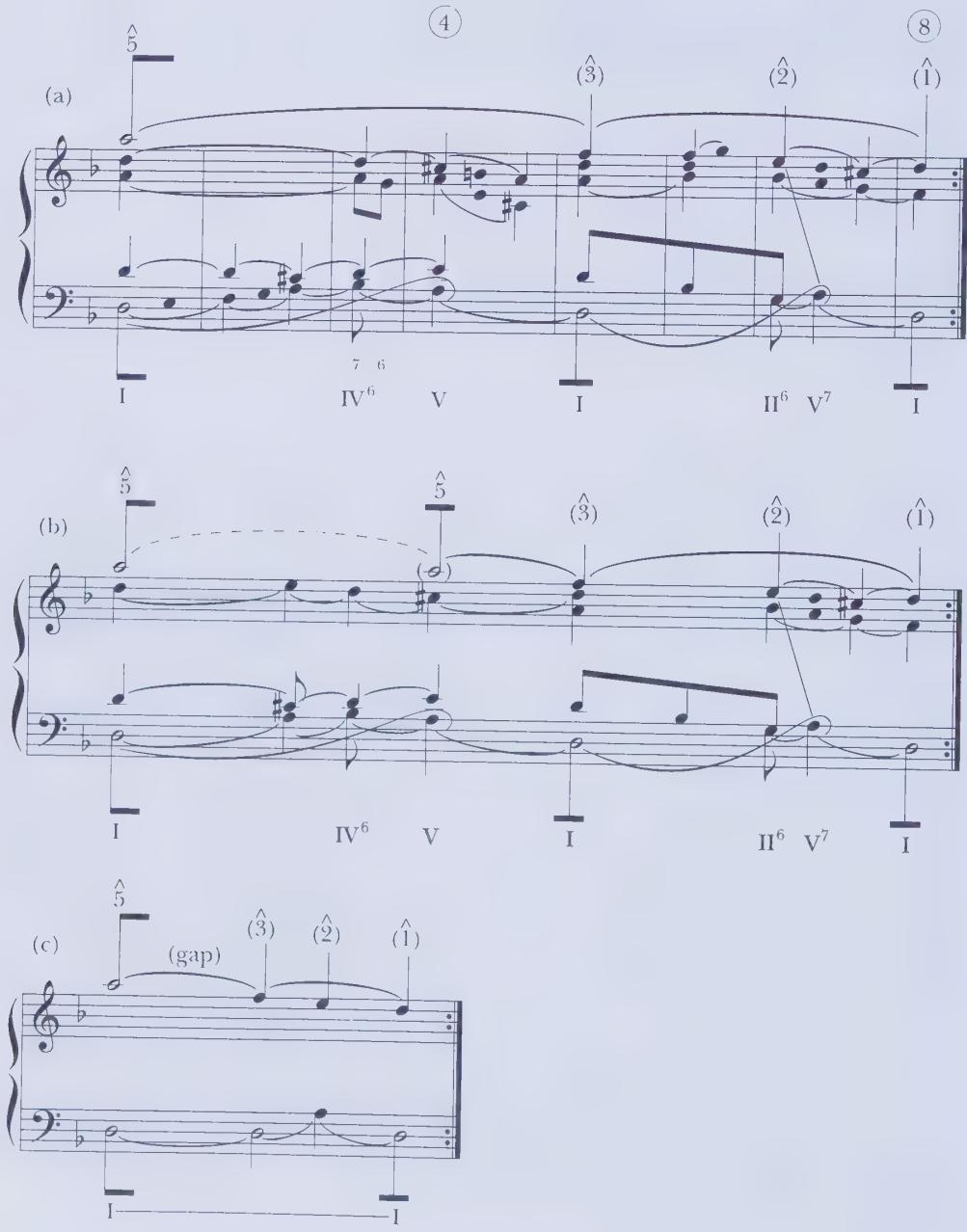
- 9.2 Handel, Suite No. 5 in D minor, HWV 436, Menuetto
- 页码:1-5
- 9.3 Bach, “Little” Prelude in C Major, BWV 933, Menuetto
- 页码:6-9
- 9.4 [描述性拆分] Corelli, Violin Sonata, Op. 5, No. 10, Gavotte
- 页码:9-12
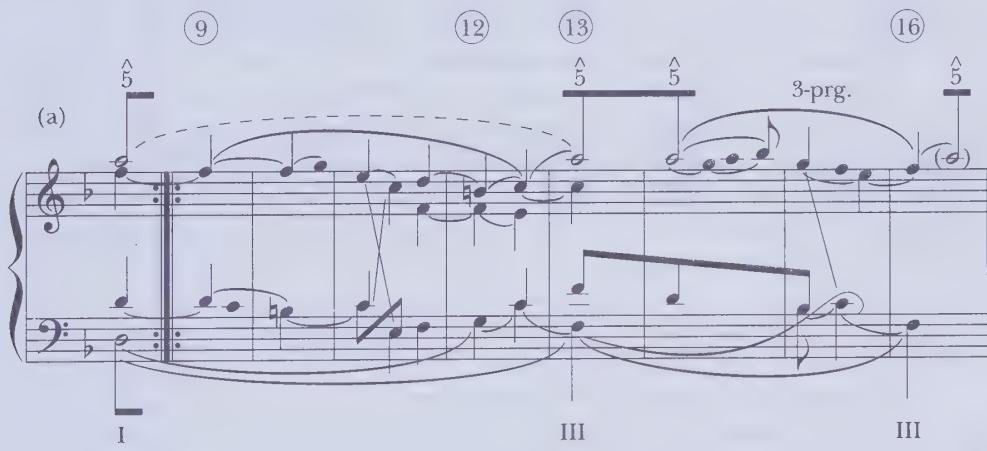
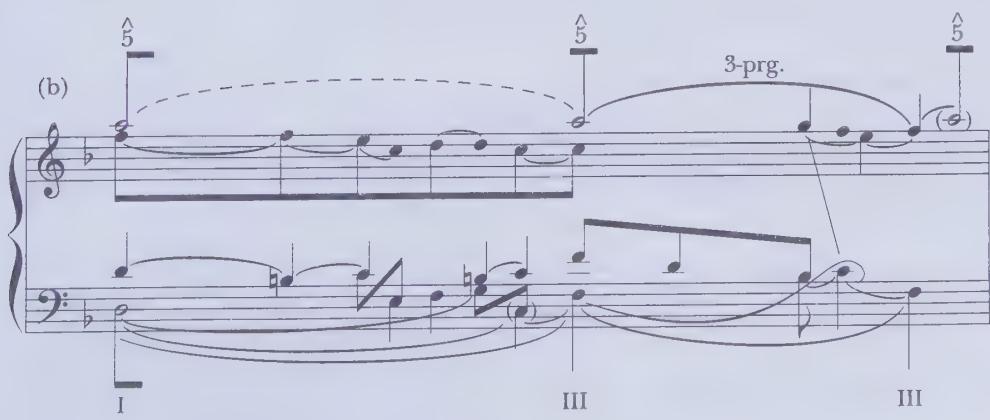
- 9.5 Bach, Flute Sonata No. 1, BWV 1033, Minuet 1
- 页码:12-15
- 9.6 Haydn, Piano Sonata, Hob. XVI/43, Minuet 2
- 页码:16-20
- 9.7 Mozart, Symphony No. 35, K. 385, Trio
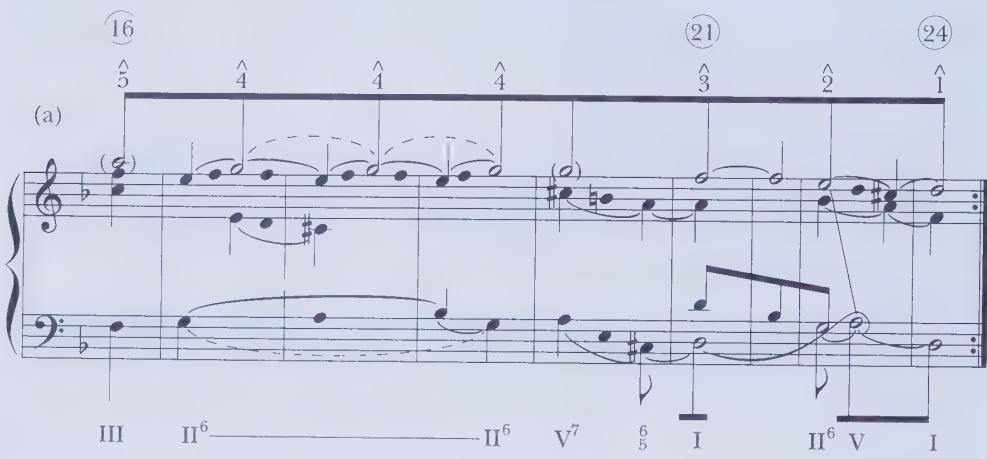
- 页码:20-24
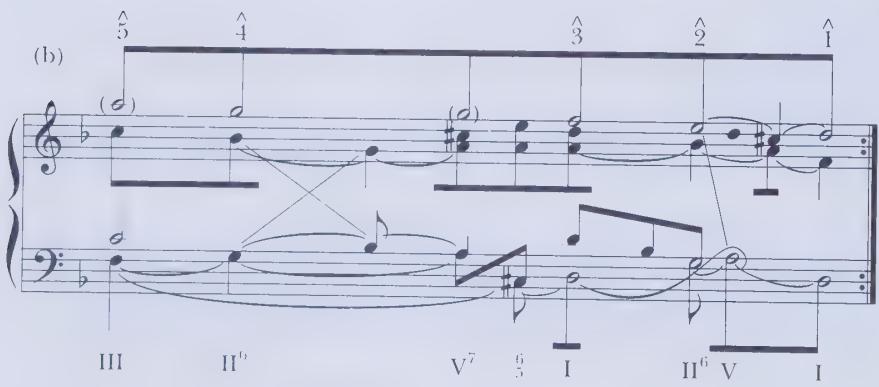
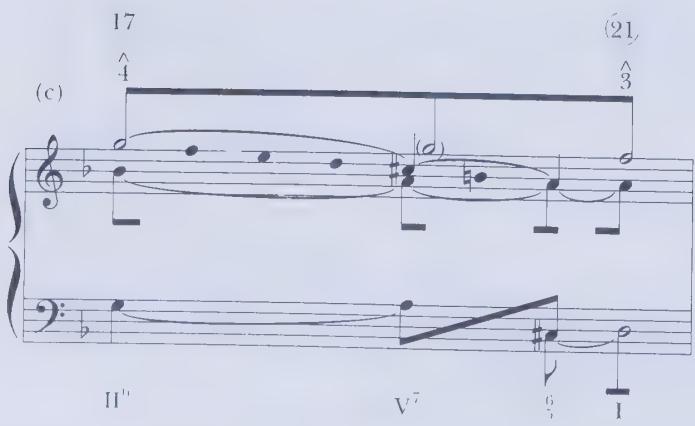
- 9.8 Auxiliary Cadences
- 页码:24-26
- 9.9 [描述性拆分] Pieces for Analysis and Notes
- 页码:27-28
9.1 [描述性拆分] Binary Forms: Introduction
第1段(P0001)
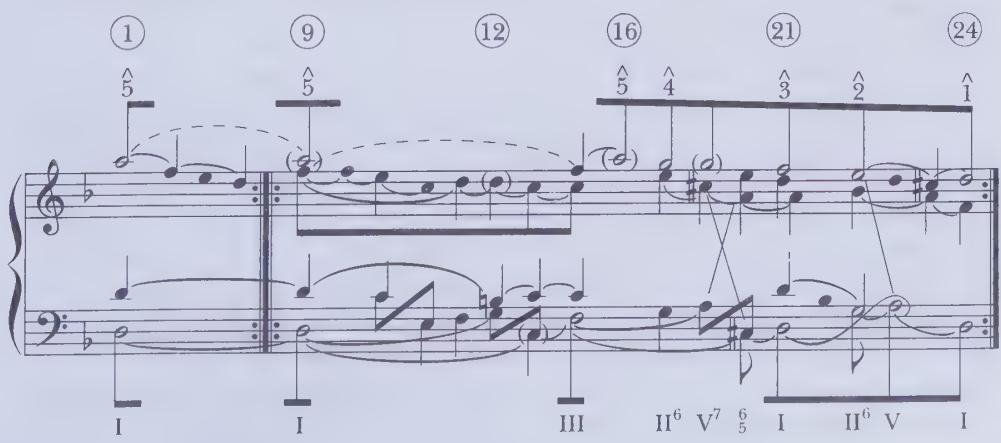
原文复述
Binary Forms
中文讲解
这是第九章第1节的标题,仅由"Binary Forms(二部曲式)“这一短语构成。它的功能是宣告本节即将讨论的核心对象——以两个部分为基本结构的曲式。标题本身没有论断,但它为后续段落设定了一个范围:作者将在此介绍二部曲式的概念、类型(简单型与回旋型)以及与之相关的体裁和理论问题。
第2段(P0002)
原文复述
Sectional divisions can arise in various ways in a composition. In Chapter 8 we examined works that are undivided in both form and structure. More often than not, however, tonal compositions may divide into two or more formal sections. Pieces in two parts are traditionally referred to as binary forms and are further designated as simple or rounded, distinguished primarily by characteristics of thematic design (AB in contrast to ABA). These conventional labels refer to basic “ground plans” occurring frequently throughout the tonal literature. Specific genres—dance movements from Baroque suites and Classical minuets and trios—are associated with binary forms and reflect accepted stylistic conventions.
中文讲解
本段是本章的导论,承担两件事:界定二部曲式这一研究对象,并交代它在本套书论证链中的位置。
首先,作者承接第8章的话题。第8章讨论的是在曲式(form)和结构(structure)两个层面都不可分割的作品;本段随即指出,更常见的情况是调性作品会在曲式上分成两个或更多段落,从而引出本章的论题。
其次,作者给二部曲式(binary form)下了一个传统定义:由两部分构成的曲式,并按主题设计特点进一步分为两类——简单二部曲式(simple binary,对应 AB)与回旋二部曲式(rounded binary,对应 ABA)。这里的"AB"与"ABA"并不是说作品里只有两个或三个主题字母那样的骨架,而是指音乐材料在两段之间的组织方式:第一段呈现新材料,第二段在简单二部曲式中是另一段新材料,在回旋二部曲式中则回到第一段材料。
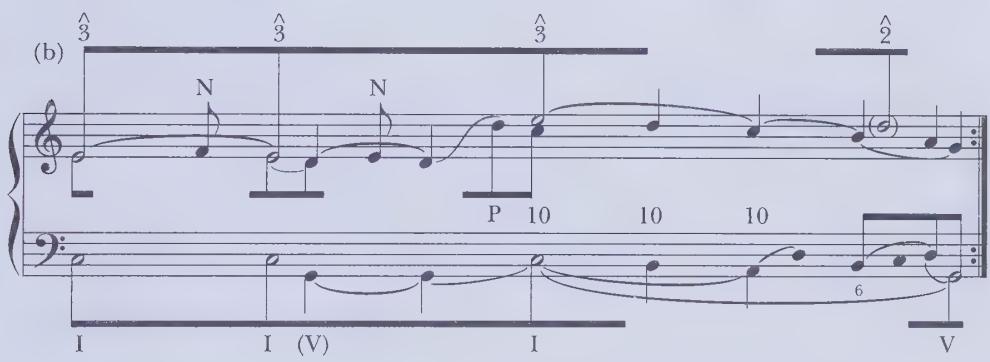
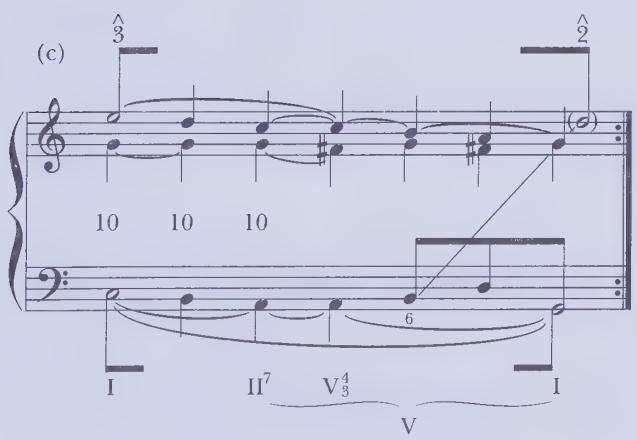
第三,作者强调这些标签只是"基本图式”(ground plans),它们在调性音乐文献中频繁出现,但并不规定作品的全部细节。
第四,作者列举了与二部曲式密切相关的体裁:巴洛克组曲中的舞曲乐章,以及古典时期的小步舞曲与三重奏中段(minuets and trios)。这些体裁本身就是规范风格传统的载体,因此二部曲式并非一个抽象分类,而是与特定历史体裁相绑定。
补充说明
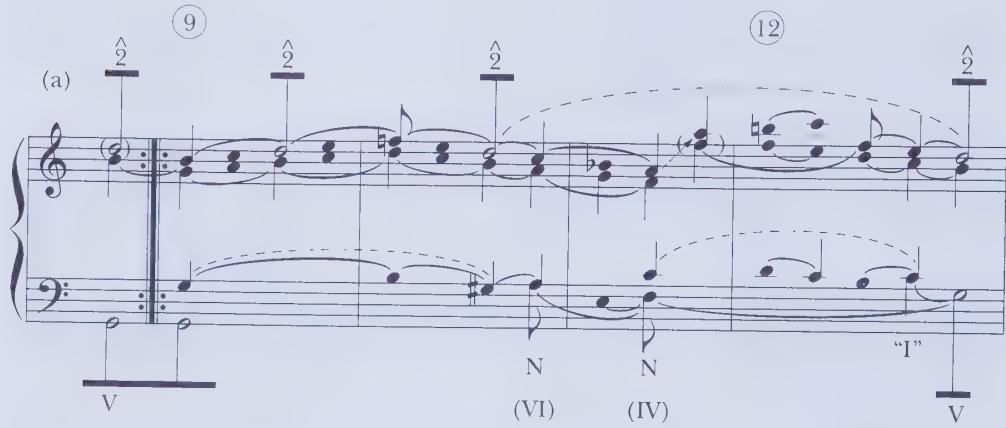
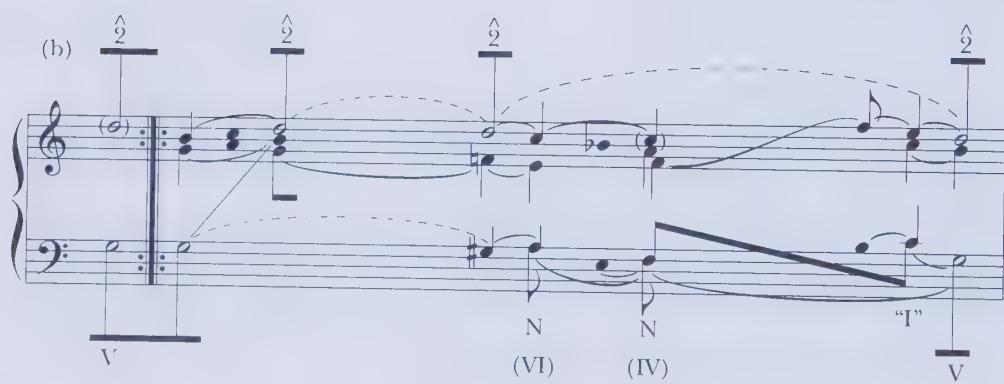
本段与第8章构成对比性铺垫:第8章关注的是"无分割"的作品,本章转向更典型的、“有分割"的调性作品,因此二部曲式的引入既是对前章的延续,也是论域的扩展。AB 与 ABA 的对比是理解本章后文的关键线索。
第3段(P0003)
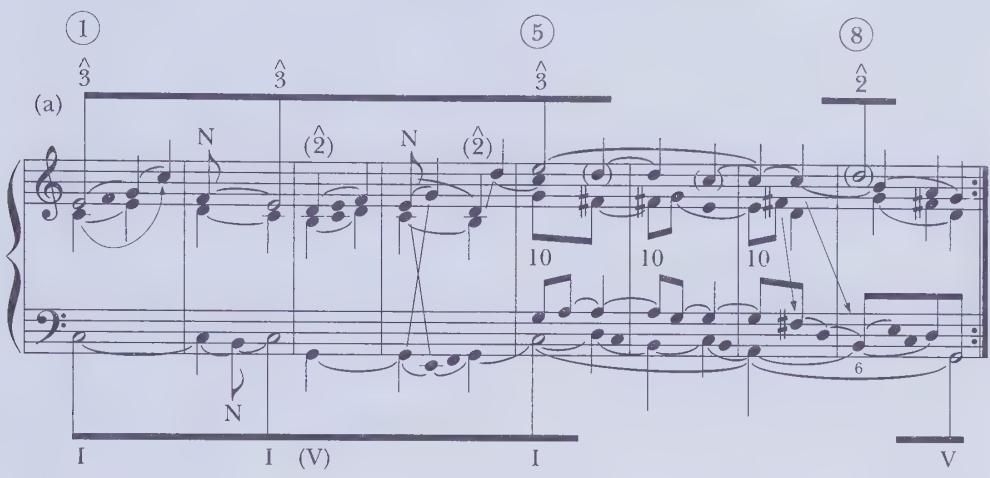
原文复述
We begin with so-called simple binary forms, because their underlying tonal structures are undivided; we continue and conclude with four movements based on interrupted structures. As we shall see, binary forms may indeed develop within two-part structures, while certain additional elaborations may lead to a formal pattern with ternary characteristics. To help explain such apparently contrasting observations, we will also comment on the form of a piece in relation to Schenker’s ideas of structure outlined previously.
中文讲解
本段预告了本章的写作顺序与分析视角,是阅读后续具体谱例前必须理解的"路线图”。
关于顺序:作者声明先讨论"简单二部曲式",理由是其底层调性结构是连续的、不中断的(undivided);最后再讨论四个基于"中断结构"(interrupted structures)的乐章。这里隐含着一个关键区分——曲式上的两部分(two-part form)和结构上的两分(two-part structure)并不总是吻合,简单二部曲式之所以作为出发点,正是因为它的形式二分与结构连续这一组合最直观。
关于现象:作者提示读者将会遇到两类看似矛盾的观察:其一,二部曲式确实可以在两部分的曲式框架内发展;其二,若再加入某些展开性写法(elaborations),形式上又会显现出三段性(ternary)的特征。也就是说,“两段"与"三段"不是非此即彼的标签,而是同一作品在不同写作层次上可能呈现的不同面貌。
关于理论工具:作者声明会借助此前已介绍过的 Schenker(申克尔)关于"结构”(structure)的观念来解释这些矛盾。Schenker 的分析法把作品区分为前景的曲式事件与深层的结构延展,这正好可以帮助读者理解:为什么同一个作品在曲式上像二部,在结构上却可能显现出三部的延伸。
补充说明
“中断结构”(interrupted structure)在 Schenker 理论中特指一个本应到达终止式的进行在半途被打断而转向另一调性区域,最终才回到原调的形态,是与"连续结构"(uninterrupted structure)相对的概念。本段虽未给出定义,但作为术语将在后续出现。
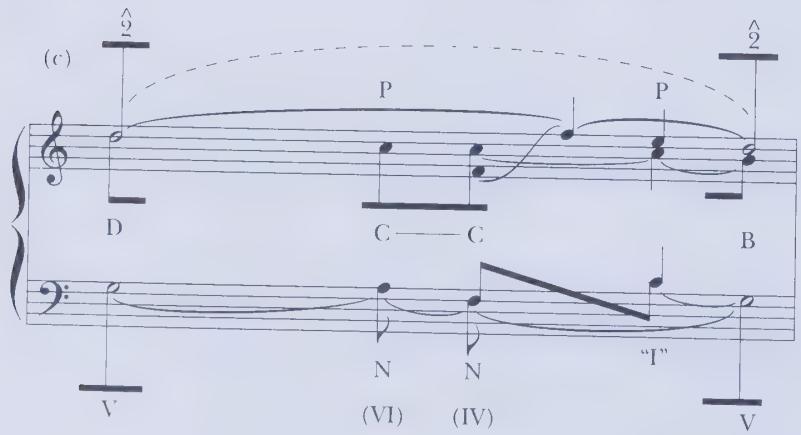
第4段(P0004)
原文复述
In our view, form and structure are distinct aspects of compositions, though they are inextricably related and arise through similar musical processes. Moreover, as we have suggested, although structural divisions and formal articulations frequently coincide, they often do not. Such diversity of compositional possibilities testifies to the richness and complexity of music and to the flexibility of the tonal system itself.
中文讲解
本段是作者立场的明确声明,奠定了整章乃至整套书分析曲式的基本姿态。
核心命题:曲式(form)与结构(structure)是作品的"两个不同方面",但二者并非彼此独立——它们通过相似的音乐过程产生,并且常常相互牵连(inextricably related)。这意味着,作者既不把曲式当作结构的同义词,也不让二者彻底脱钩。
进一步推论:尽管结构上的划分与曲式上的分段常常重合,但"常常"不等于"总是"。作者提醒读者留意那些曲式分段与结构分段错位的作品——这种错位正是后续讨论二部曲式如何在结构层面延伸、或被中断的伏笔。
收束:作者将这种多样性上升到对音乐本身的评价——它展现了音乐的丰富与复杂,也展示了调性系统自身的灵活性。这一句不仅结束导论,也为读者预设了一种开放的分析态度:遇到表层曲式标签与深层结构不一致时,应视为调性思维张力的体现,而非分类的失败。
补充说明
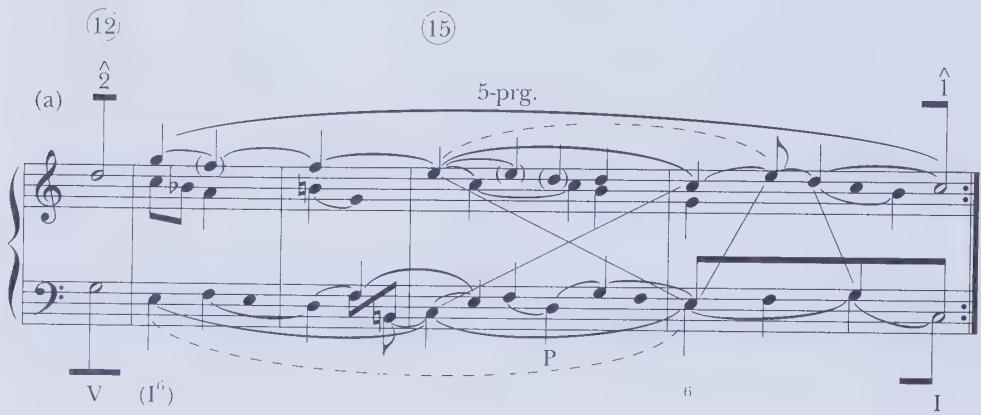
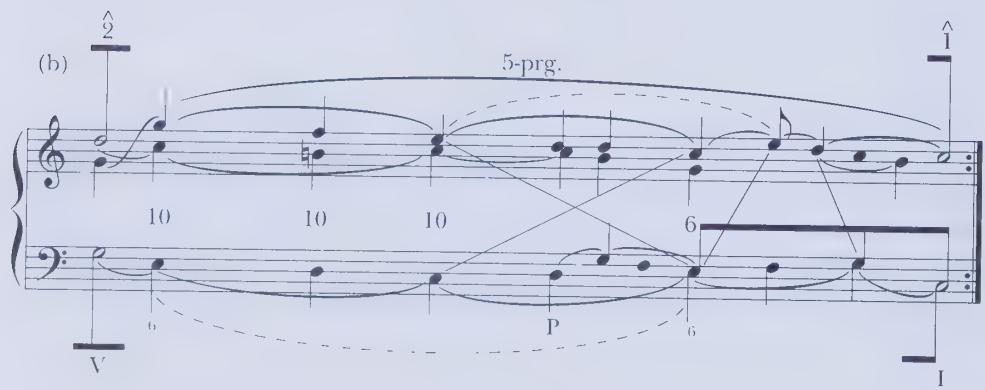
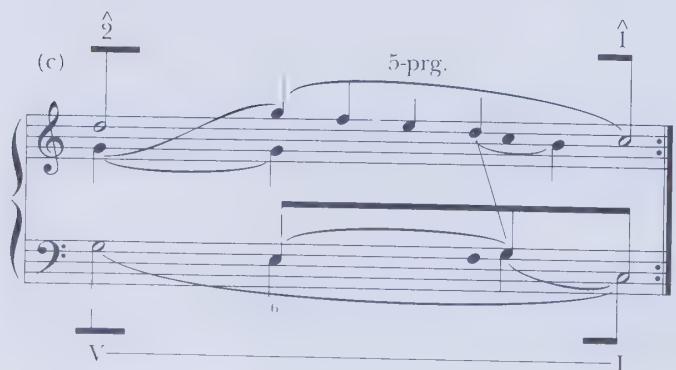
本段与 P0003 的预告呼应:P0003 预告"会援引 Schenker 的结构观念",P0004 则从一般原则上说明 form 与 structure 为何需要被分开讨论——前者为后者的运用提供理论前提。
脚注 / 边栏 / 图表 / 附加信息(如有)
本节为第九章 1 节,篇幅短小,不含脚注、图表、边栏或谱例。所有材料均来自正文四段:标题一段,导论三段。无额外附加内容。
💡 本节核心要点
- 二部曲式(binary form)指由两个曲式段落构成的作品,按主题组织方式区分为简单型(AB)与回旋型(ABA)。
- 这些 AB/ABA 标签只是反复出现的"基本图式",并与巴洛克组曲舞曲、古典小步舞曲及三重奏中段等特定体裁相联系。
- 本章的写作路径:先讨论底层调性结构连续不断的简单二部曲式,再讨论基于中断结构的乐章。
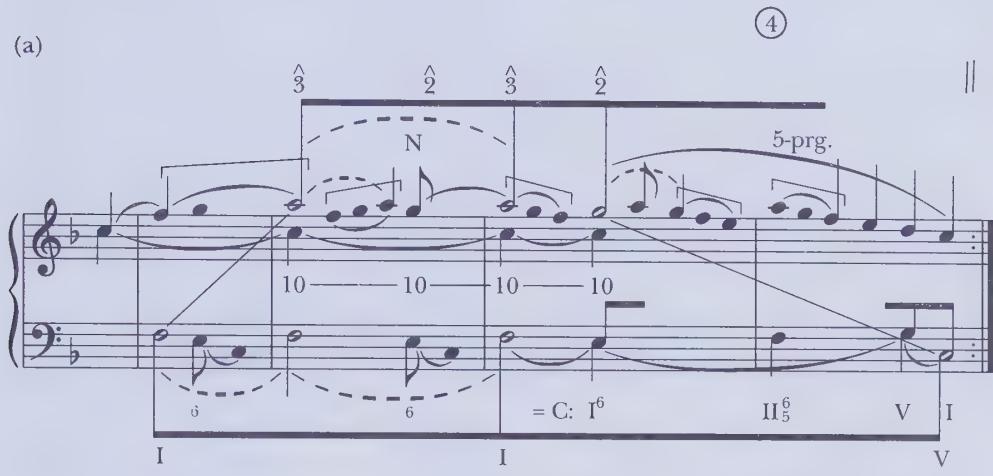
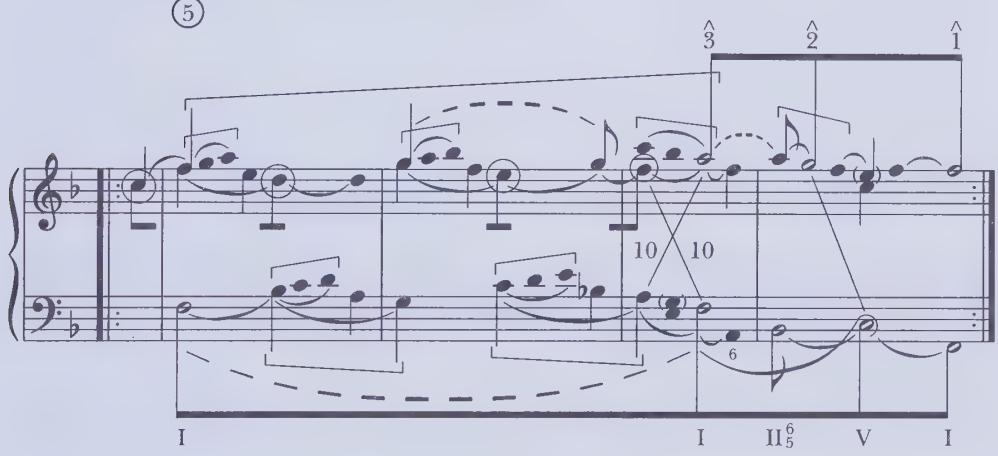
- 二部曲式在展开写法加强时可能显现出三段性特征,因此曲式层面的二分与结构层面的延展并不一定对应。
- 作者将借此前已介绍的 Schenker 结构观念来协调曲式与结构之间的不一致。
- 作者的基本立场:曲式与结构是作品的两个相关但不同的方面,二者的重合是常态而非必然,这种多样性正体现调性系统的灵活性。
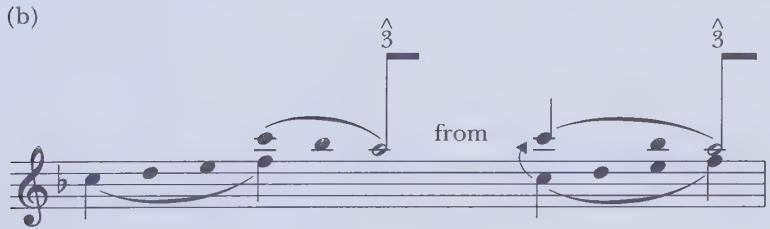
🔑 关键术语
- Binary form(二部曲式):由两个曲式段落构成的曲式类型,是本章的总论题;通常按主题设计进一步区分为简单二部曲式(AB)与回旋二部曲式(ABA)。
- Simple binary(简单二部曲式):两段各自呈现不同音乐材料的二部曲式(AB),其底层调性结构通常是连续不断的,因而在本章中作为讨论起点。
- Rounded binary(回旋二部曲式):第二段回到第一段材料的二部曲式(ABA),与简单二部曲式相对,是本章将要涉及的另一基本图式。
- Ground plan(基本图式):对作品中反复出现的曲式骨架的概括性标签,如 AB、ABA;只勾勒大轮廓,不规定作品的所有细节。
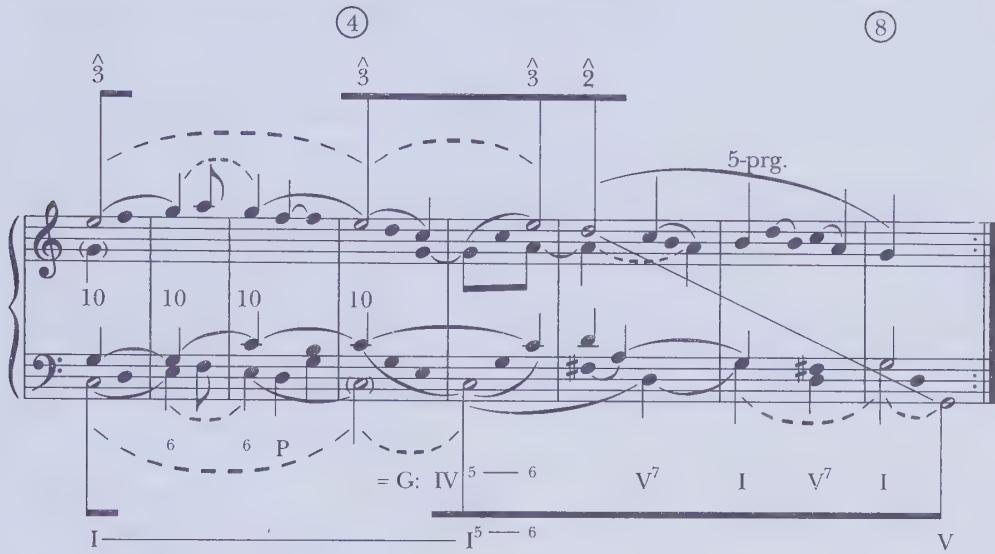
- Form(曲式):作品在段落层面对主题材料的组织与划分,是本套书与"结构"并列使用的两个分析范畴之一。
- Structure(结构):在 Schenker 理论框架下指作品深层的和声与对位延展过程,是与曲式并立但不完全重合的分析维度。
- Interrupted structure(中断结构):原本应到达终止式的进行在半途被打断而转入其他调性区域、最终再回归的 Schenker 式结构形态,与连续结构相对,是本章末尾四首分析对象的结构基础。
- Tonal system(调性系统):本套书的整体语境:以大小调功能体系为基础的音乐语言;本节把作品的多样性最终归因于该系统的灵活性。
9.2 Handel, Suite No. 5 in D minor, HWV 436, Menuetto
第1段(P0005)
原文复述
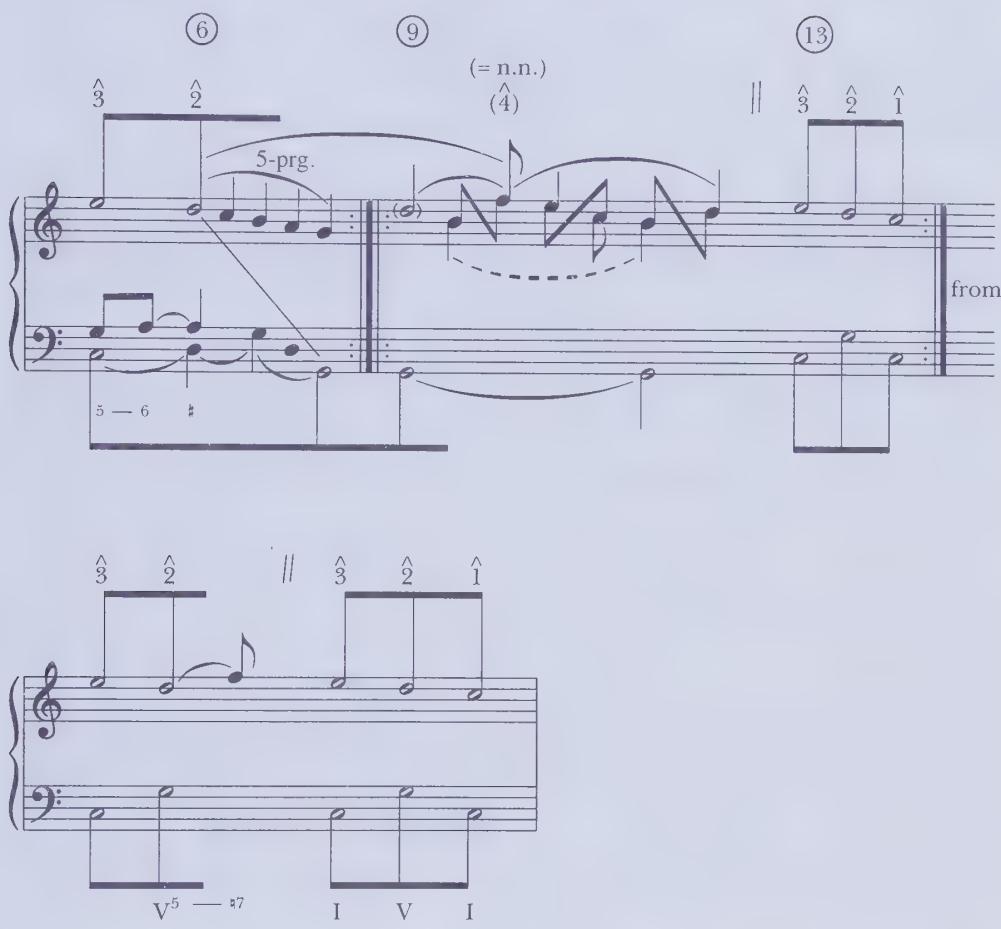
Handel, Suite No. 5 in D minor, HWV 436, Menuetto
中文讲解
本段是小节标题,标识本节所要分析的作品:亨德尔的《d小调第5组曲,HWV 436》中的小步舞曲(Menuetto)。HWV 是亨德尔作品目录编号(Händel-Werke-Verzeichnis)。标题的功能在于宣告本节的分析对象是巴洛克时期键盘组曲的一个具体乐章,并以之作为引入申克式(Schenkerian)中景分析的第一例。
第2段(P0006)
原文复述
Our first composition, a Menuetto from a keyboard suite by Handel, is a minor-mode, simple binary form based on a middleground tonal plan common to
中文讲解
本句宣告本节分析对象的两项核心属性:其一,它是一首小调(minor-mode)的简单二段体(simple binary form);其二,它的结构建立在一种中景(middleground)的调性布局之上。“common to” 表明这种调性布局在相关文献中具有典型性,提示读者这是一份带有范例性质的分析。本段开宗明义,把后续讨论锁定在小调简单二段体+中景调性骨架这一框架内。
补充说明
句末以 “common to” 收尾,下段(P0007 的 “## Example 9.1”)通过图示承接 “common to” 所引出的典型性论述。
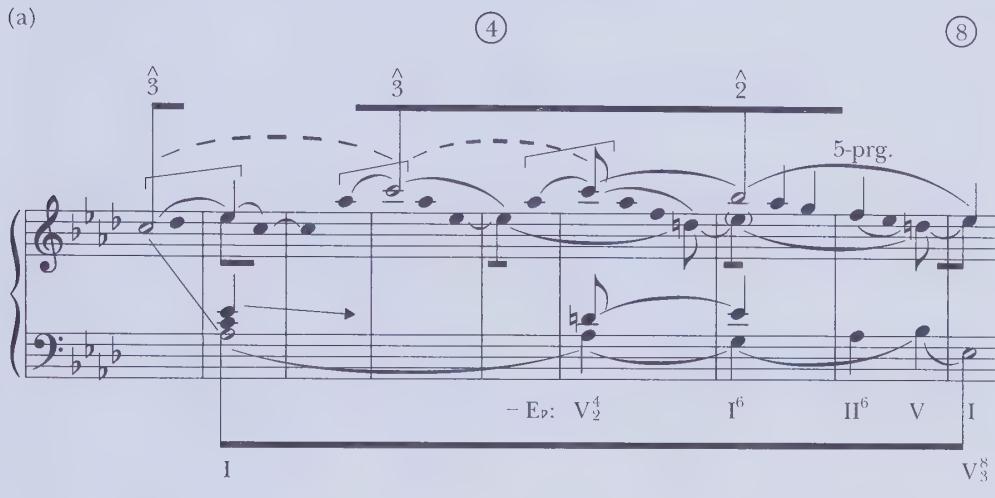
第3段(P0007)
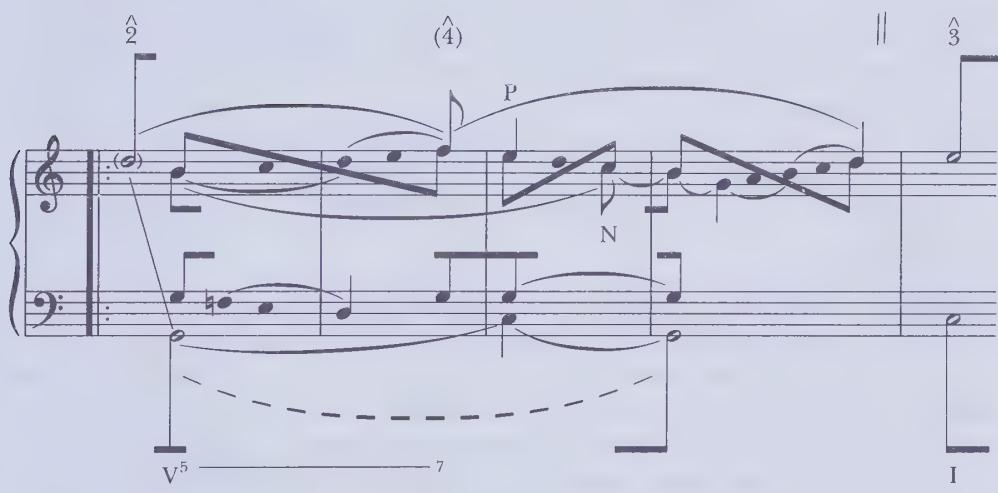
原文复述
Example 9.1
中文讲解
本段是图示 9.1 的小标题,承担版面导航功能。它标志着本节第一个分析性图例的开始,提示读者接下来将看到与前面所述中景调性计划相对应的具体图示化呈现。
第4段(P0008)
原文复述
Handel, Harpsichord Suite in D minor, Menuetto, bars 1–8: (a) foreground and (b–c) middleground reductions
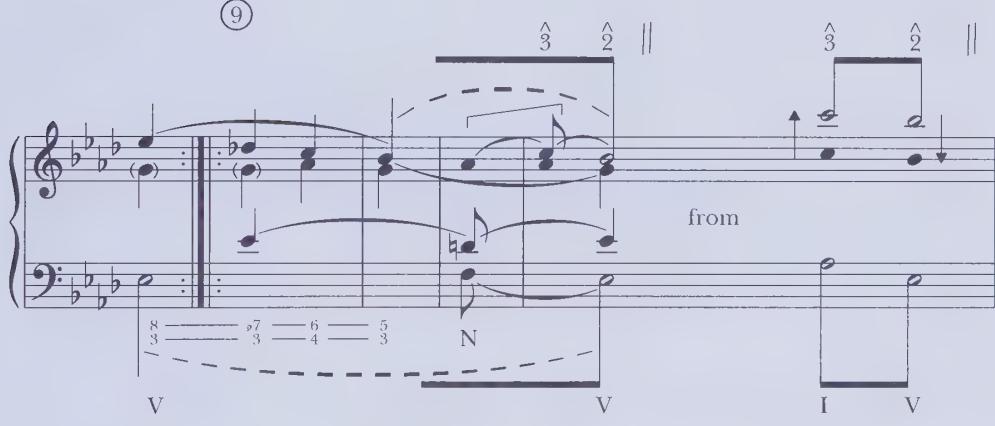
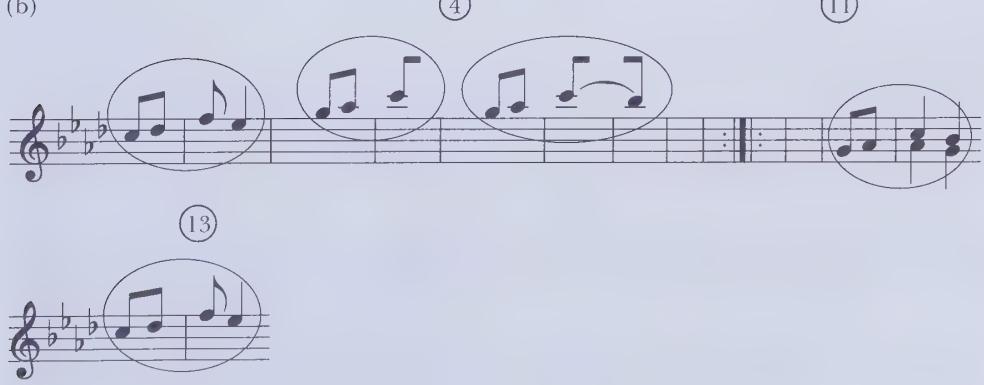
中文讲解
本段是图示 9.1 的图注。它表明图 9.1 包含三个层次的声部进行图:a 层为前景(foreground)的实际呈现;b 层与 c 层为不同深度的中景(middleground)缩约(reduction)。分析的时段为该小步舞曲的前 8 小节,亦即二段体中 A 段的全部内容。这一时段选择本身就暗示:作者认为理解 A 段的关键在于把握它如何从前景逐渐退减到中景的延长结构。
第5段(P0009)
原文复述
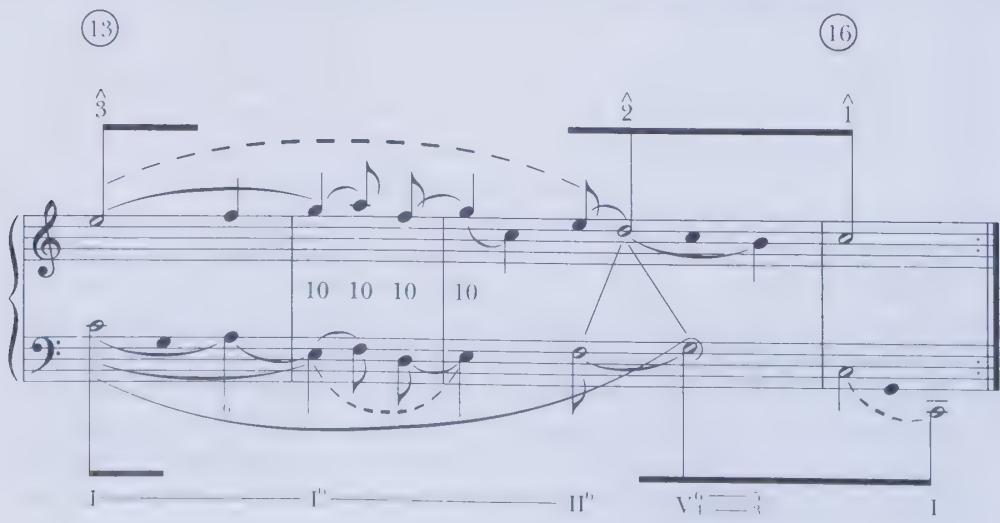
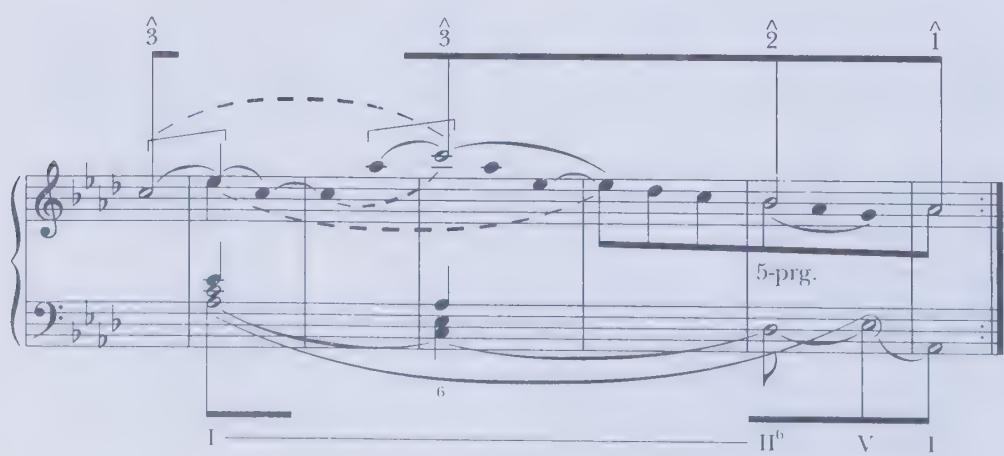
中文讲解
本段为第 2 页的图像/乐谱示例占位符,原书在此处嵌入了与图注 P0008 对应的实际图示。该占位符仅标记图像在版面上的位置与所属图例编号,具体声部进行线条、和声标记与音符位置须查阅原书图 9.1 才能确认。
补充说明
需查阅原图 9.1 以确认前景音高连线与中景骨架音的具体排列。
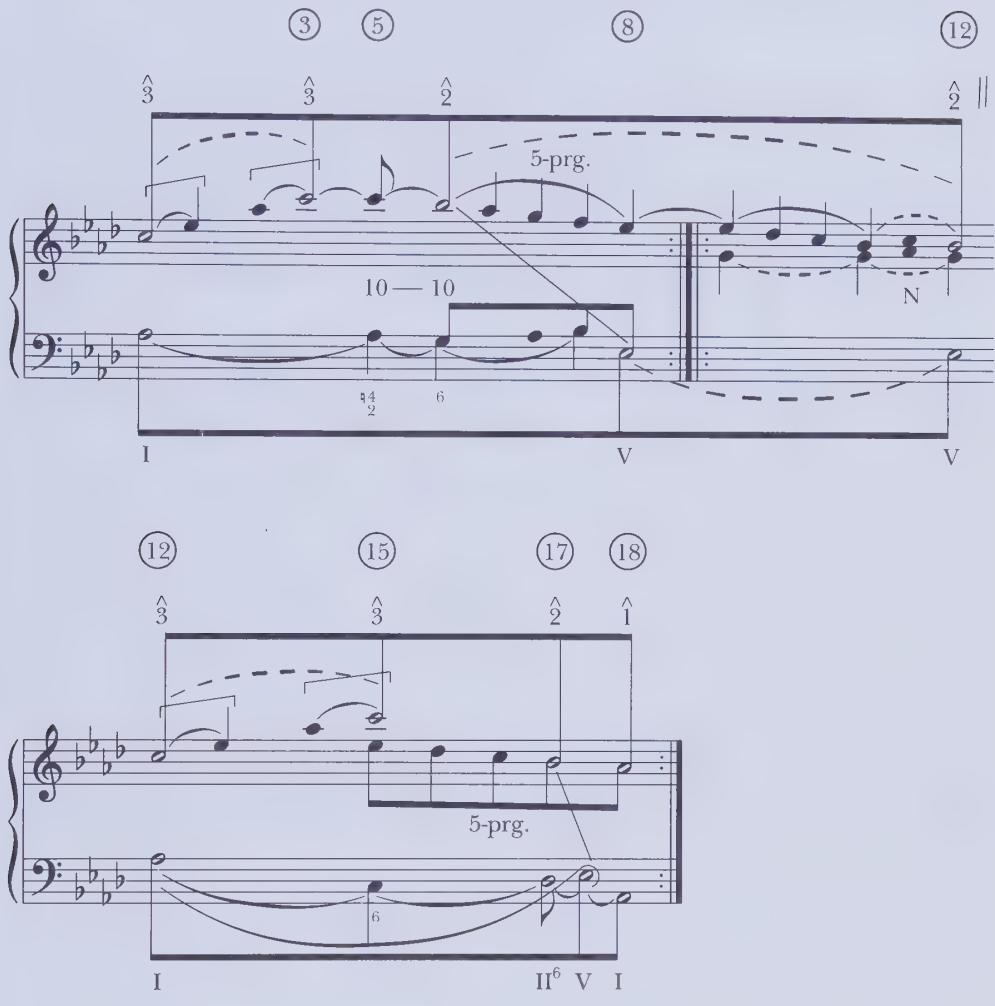
第6段(P0010)
原文复述
many pieces in the literature. Example 9.1 presents a voice-leading graph of bars 1–8.
中文讲解
本句承接 P0006 的 “common to”:在中景调性计划上"典型于文献中众多作品"之后,作者具体说明图 9.1 的功能是呈现一份声部进行图(voice-leading graph),覆盖前 8 小节。这里作者把图示与文字主张对接:图 9.1 既是分析工具,也是该"典型中景计划"的实证。读者由此被引导以声部进行的眼光去阅读该段。
第7段(P0011)
原文复述
Before studying the graphs and reading our commentary, examine the entire piece, noting themes, cadences, and the secondary key areas. The right hand at the beginning sounds a motto theme reminiscent of “trumpet tunes” in the
中文讲解
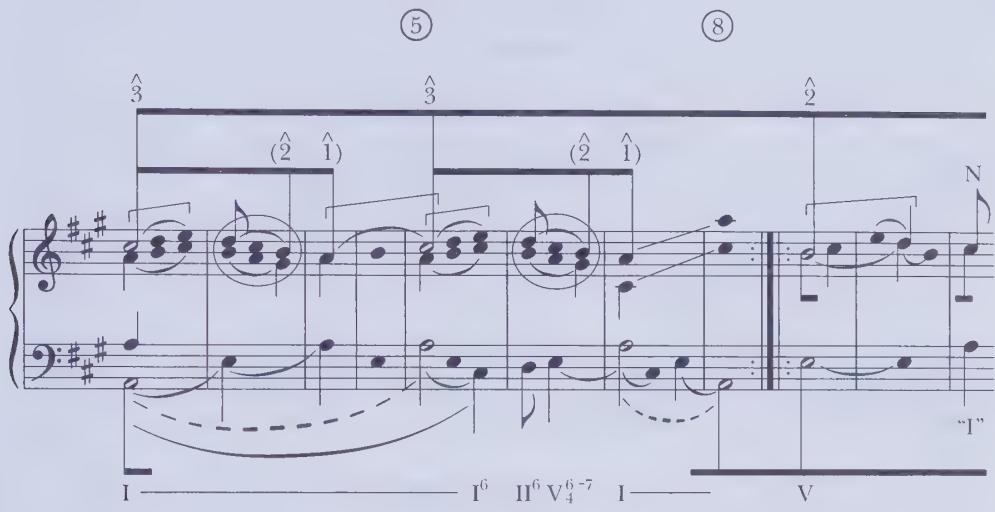
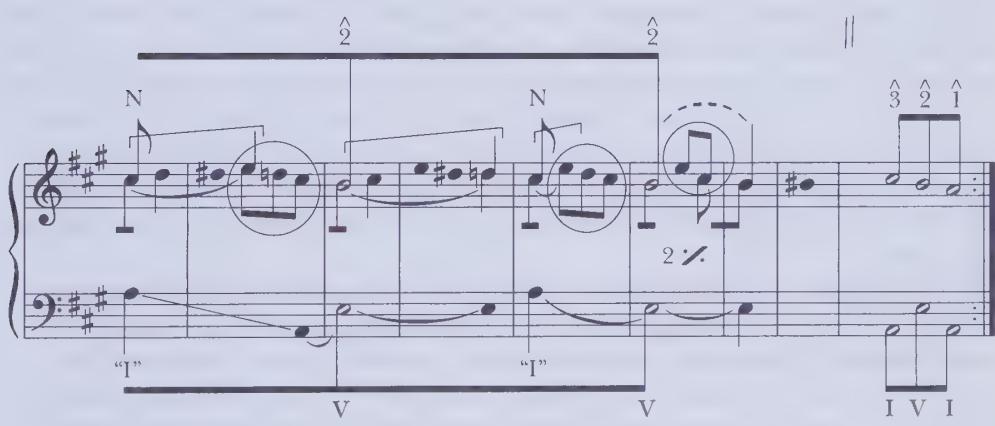
本段是一段方法学提示:作者要求读者在细看声部进行图与文字注释之前,先独立聆听/视奏全曲,关注主题、终止式以及副调区域。这是申克式分析教学中常见的"先听后析"步骤,目的是让读者带着对整体轮廓的直觉印象再去对照图示。其后转入对作品的初步描述:开篇右手奏出一个让人联想到巴洛克"trumpet tunes"(小号曲调)的座右铭主题(motto theme)。注意句子在 “in the” 处中断,下段继续。
补充说明
“trumpet tunes” 是巴洛克时期一种模仿小号号角音型的键盘/器乐短曲体裁;此处用以类比 Menuetto 开篇的同音反复节奏动机。
第8段(P0012)
原文复述
Baroque period. This motto recurs in bars 5–6, 9–10, and 13–14 (at the original pitch level) and again in bars 21–22. Such thematic repetitions are common in Baroque binary forms. In terms of the harmonic plan, the first section (bars 1–8) is in the tonic, which is destabilized after the double bar by B♭ in the bass (bar 10). An authentic cadence establishes F major (III) in bars 15–16, followed by a motion II⁶–V that reestablishes I in bar 21. The concluding passage leads the tonic to the structural close.
中文讲解
本段完成 P0011 未尽的句子,并交代两件事实:(一)主题方面——该 motto 在 5–6、9–10、13–14(原始音高水平)、21–22 小节反复出现,作者将之概括为"巴洛克二段体中常见的主题重复";(二)和声方面——A 段(1–8)停留在主调;过 double bar 后,低音声部在第 10 小节出现 B♭,使调性失稳;15–16 小节以正格终止确立 F 大调(III,即关系大调);其后 II⁶–V 的进行在第 21 小节重新确立主调(I),收束段引向结构终止(structural close)。
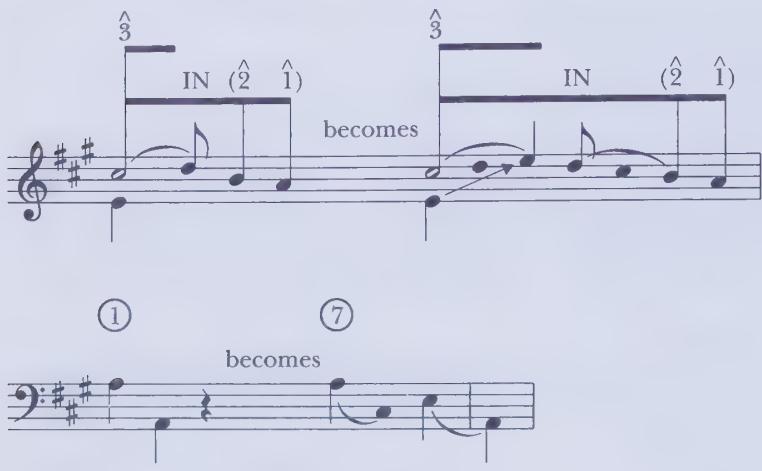
这段的功能是为后续的中景图示提供一个可验证的表层时间线:主题重复的固定模式 + III 的临时确立 + 主调的回归与结构性收束。读者由此知道:图 9.1–9.4 之所以重要,是因为它们要把这一表层时间线提升为统一的延长与对位结构。
补充说明
“B♭ in the bass” 是过 double bar 后用以弱化 d 小调主音位置的关键音,它对应 P0013 中所讨论的调性失稳;“III” 在小调中即关系大调,d 小调的 III 是 F 大调,这是 P0026 中"小调向中音大调离调"主题的预兆。
第9段(P0013)
原文复述
Example 9.1 reveals a prolongation of tonic harmony and the primary tone 5̂, which is sustained through bars 1–8 by lower-level motions in the upper voice. You may notice that we show a² moving to f² at the beginning of the second phrase. Scale degree 4̂ (g²) is absent, meaning that a “gap” occurs in the path of the line from a² to d² in bar 8. We will see compensation for scale degree 4̂ in a later passage.
中文讲解
本段是图 9.1 的实质性解读。作者指出图 9.1 揭示了主和声与主音 5̂(d 小调中的 a)的延长(prolongation):在 1–8 小节中,上方声部通过较低层级的运动维持着 5̂ 作为主要音。具体地,作者示意第二乐句开头的 a² 下行至 f²(5̂→3̂),而通往第 8 小节 d²(1̂)所必经的 4̂(g²)则在表层被跳过,由此形成一个"缺口"(gap)。这一缺口在巴洛克表层非常常见,但在申克式深层结构里必须被"补偿"——作者预告这一补偿将在后文(实际为图 9.3 的段落)出现。
段落在论证链上的作用:把 A 段(1–8 小节)的中景描述为一个以 5̂ 为顶点的延长单位,并埋下"4̂ 缺失→4̂ 补偿"的全曲伏笔。
补充说明
“prolongation” 是申克分析的核心概念,指一个和声或音高在表层之上被持续维持;“primary tone” 即 Urlinie(基础线)起音;本段所说的"gap"指 5̂→1̂ 之间跳过 4̂ 的表层现象。
第10段(P0014)
原文复述
Example 9.2 depicts bars 9–16 from the second section of the binary form. As mentioned, the tonal motion moves away from D minor; a cadence in C major (bars 11–12) leads to a passage in F major (bars 13–16), supporting a
中文讲解
本段引出图 9.2。它说明图 9.2 处理 9–16 小节,即二段体 B 段的前半,调性离开 d 小调:C 大调在 11–12 小节形成终止,然后引出 13–16 小节的 F 大调段落。句子以 “supporting a” 收尾,下段承接。这一段把 B 段开头描述为"调性迁徙"的关键节点:先以 C 大调为过渡中介,最终落到 F 大调(III)作为临时调中心,这正与 P0012 中"III 在 15–16 被确立"的论断相印证。
补充说明
句末 “supporting a” 在 P0024 中由 “recollection of the motto” 承接;阅读时应将 P0014 与 P0024 视为同一句被版面切分后的两半。
第11段(P0015)
原文复述
Example 9.2
中文讲解
本段是图示 9.2 的小标题,标记此处开始进入对 B 段前半(9–16 小节)的图示化分析。
第12段(P0016)
原文复述
Handel, Harpsichord Suite in D minor, Menuetto, bars 9–16: (a) foreground and (b) middleground reductions
中文讲解
本段是图 9.2 的图注。它说明图 9.2 仅含两层缩约:a 前景与 b 中景;相较于图 9.1 的三层(a/b/c),说明作者认为此处的结构深度足以用两层呈现,或此处不需要额外的二次中景层。
第13段(P0017)
原文复述
中文讲解
本段为第 3 页的图像/乐谱示例占位符,对应图 9.2 的前景层(a)。具体音高连线、终止式标记及声部归属须查阅原图。
补充说明
需查看原图 9.2a。
第14段(P0018)
原文复述
中文讲解
本段为第 3 页的图像/乐谱示例占位符,对应图 9.2 的中景层(b)。它与 P0017 共同构成图 9.2 的完整图示。
补充说明
需查看原图 9.2b。
第15段(P0019)
原文复述
Example 9.3
中文讲解
本段是图示 9.3 的小标题,标志着对 17–24 小节(即 B 段后半与收束)的图示分析开始。
第16段(P0020)
原文复述
Handel, Harpsichord Suite in D minor, Menuetto, bars 17–24: (a) foreground and (b) middleground reductions; (c) retention of 4̂
中文讲解
本段是图 9.3 的图注。它说明图 9.3 含三层:a 前景、b 中景、c 4̂ 的保留(retention of 4̂)。c 层是本图特有——它专门用来呈现 P0013 中所预告的"4̂ 的补偿"。注意作者用 “retention”(保留/持续)而非"insertion"(插入)或"compensation"(补偿),暗示作者把 4̂ 视为已经在表层被听到(5–6、9–10、13–14 反复的 motto 暗示出 4̂ 倾向),中景只是把它形成为一个正式的、有准备的音级。
补充说明
图 9.3c 与 P0025 中的"preparation and retention of 4̂"叙述直接对应。
第17段(P0021)
原文复述
中文讲解
本段为第 4 页的图像/乐谱示例占位符,对应图 9.3 的前景层(a)。
补充说明
需查看原图 9.3a。
第18段(P0022)
原文复述
中文讲解
本段为第 4 页的图像/乐谱示例占位符,对应图 9.3 的中景层(b)。
补充说明
需查看原图 9.3b。
第19段(P0023)
原文复述
中文讲解
本段为第 4 页的图像/乐谱示例占位符,对应图 9.3 的 c 层(4̂ 的保留)。这一层是 P0013 中"4̂ 的缺口"在全曲后段的最终补偿。
补充说明
需查看原图 9.3c。
第20段(P0024)
原文复述
recollection of the motto at its original pitch level. In the upper voice, f² (bar 9) initiates a locally independent strand we interpret as residing in an inner voice; this interpretation is highlighted by the resumption of a² in bars 13–14, which clearly relates to the primary tone 5 in bars 1–2. Example 9.3 shows the final passage and the descent of the Urlinie.
中文讲解
本段是 P0014 末句 “supporting a” 的补全:在 13–16 小节 F 大调段落之上方承载的是 motto 在原始音高水平上的再现(recollection)。
随后作者对 9–14 小节的上方声部作申克式声部层级判断:f²(第 9 小节)开启了一个"局部独立"的旋律线,它在中景意义上应被读作内声部(inner voice),而不是主要声部;其依据是第 13–14 小节重新出现的 a² 明确呼应了 1–2 小节的主音 5̂,因此把 f² 解释为内声部才不致与 a² 的主干地位冲突。
本段最后一句预告图 9.3 的功能:呈现最后段落以及 Urlinie 的下行——即从主音 5̂ 逐步下行到 1̂ 的完整呈现。
补充说明
“Urlinie” 即基础线(fundamental line),申克体系中贯穿全曲的下行五度音列;本段所提"the descent of the Urlinie"与 P0025 中的 2̂–1̂ 收束对应。
第21段(P0025)
原文复述
In bar 17 the harmonic motion from III moves back to D minor through a local II⁶–V⁷–V⁶₅–I harmonic pattern; notice that we read an implied seventh in bar 20. From a broader perspective, we interpret II⁶ and V⁷ (bars 17–20) as supporting 4̂ of the Urlinie. We noted earlier the “gap” in the upper voice between 5̂ and the inner-voice 3̂ over the prolonged tonic of the A section. Now consider the emphasis of (and compensation for) scale degree 4̂, which is stated three times, with associated rising and falling thirds. The synopsis in Example 9.3c shows the preparation and retention of 4̂ through a stepwise motion into an inner voice—from g² to an “alto” a¹ (a linearization of V⁷). After g² moves to f² over a broader span, the Urlinie completes its descent (2̂–1̂) over the perfect authentic cadence.
中文讲解
本段是全节论证的枢纽段落,承担了多重任务:
- 表层和声描述:第 17 小节起 III(F 大调)通过 II⁶–V⁷–V⁶₅–I 的局部模式回到 d 小调;作者特意提醒读者在第 20 小节应"读出"一个隐含的七音。
- 中景层级判断:17–20 小节的 II⁶ 和 V⁷ 被解释为支撑 Urlinie 的 4̂,而不是孤立的装饰和声。这是把局部和声进行重新归位于"全曲下行线"的关键一步。
- 兑现 P0013 的伏笔:明确指出 A 段上声部中 5̂ 与内声部 3̂ 之间存在 4̂ 的"缺口",而在 B 段后部,4̂ 不仅被强调,而且出现了三次(伴随三度的上下行)——这是一种"补偿"。
- 具体补偿机制(对应图 9.3c):g² 经由级进下到内声部"alto" a¹(即 V⁷ 的线性化呈现);之后 g² 在更广的时距内下行至 f²;Urlinie 在完满正格终止(PAC)之上完成 2̂–1̂ 的下行收束。
这段在论证链中的作用是:把 A 段中"未完成的 4̂"与 B 段后部"被准备、被保留、被补偿的 4̂"统一为同一条 Urlinie 的连续段落;同时给出 Urlinie 的收束形态(2̂–1̂),从而在第 24 小节完成全曲的基础线下行。
补充说明
“V⁶₅” 即 V 的第一转位;“PAC”(perfect authentic cadence)即完满正格终止,根音位置的主和弦上方接根音位置的属和弦,且最高声部为 1̂;“implied seventh"指作者建议把第 20 小节读作含七音的属七和弦而非简单的属和弦。
第22段(P0026)
原文复述
Now consider the two bass motions in this minor-mode piece (Example 9.4). The first (bars 1–21) includes a prominent III that is expanded into a temporary key area. You may remember that modulation to the median is common in the minor mode, because the leading tone of III occurs naturally as 2̂ of the tonic scale (no chromatic alteration is necessary). The motion I–III–V–I, with an intermediate II, II⁶, or IV, is consequently a structural plan you will encounter frequently in minor-mode movements.
中文讲解
本段引出图 9.4,转入对低音声部运动的总结。作者指出本曲有两段低音声部运动,第一段(1–21 小节)包含一个被扩展为临时调区的 III。其后转入理论阐释:在小调中,向中音大调(III)的离调之所以常见,是因为 III 的导音恰好等于主调的 2̂,无需任何半音变化即可自然成立。这一现象使 I–III–V–I 的结构布局(中间可能插入 II、II⁶ 或 IV)成为小调乐章中"会反复遇到"的典型结构计划。
本段的功能是把本曲的具体和声计划提升为小调体裁中的一般规律。
补充说明
在 d 小调中,III = F 大调;其导音为 E,而 E 恰好就是 d 小调自然音阶的 2̂(自然小调),故无需升号即可成立。这一现象只在自然小调或和声小调下行时成立;若使用旋律小调上行(升 C 与升 F),则需另作处理。
第23段(P0027)
原文复述
We have begun to consider traditional notions of form in light of Schenker’s ideas on tonal structure. This piece is labeled a simple binary form because the opening is not recapitulated (not, at least, in a literal fashion) near the conclusion of the B section. The primary division of the form occurs in bars 7–8 with the perfect authentic cadence in the home key. Schenker’s perspective also considers that the Urlinie is undivided in its “journey” from the primary tone 5 to scale-degree 1 in bar 24. In this regard, the structure resembles Bach’s C-major Prelude, discussed in Chapter 8. Handel’s composition, however, is much more
中文讲解
本段把形式分析、主题分析与申克式调性结构分析三股线索汇集在一起:
- 形式标签:之所以称为"简单二段体”,是因为 B 段结束处并未(至少未以字面方式)再现 A 段开头材料。
- 形式关键分割点:出现在 7–8 小节的完满正格终止——这是传统曲式意义上的"主要分割"。
- 申克视角:从 Urlinie 的角度看,全曲只有一条未被分割的下行线(5̂ → 1̂,止于第 24 小节),因此调性结构呈现为单一连续过程。
- 与第 8 章 Bach C 大调前奏曲类比:两者都呈现"单一线性过程"的中景特征。
- 转折:“Handel’s composition, however, is much more”——句子被切断,引出下段对差异性的阐明。
本段的关键在于同时承认"传统曲式"与"申克中景"两套看问题的视角,并指出在"单一连续 Urlinie"这一深层特征上本曲与 Bach 的前奏曲相似。
补充说明
“recapitulation”(再现)指主题材料在曲式后部按原样或变形重现;本曲因缺乏严格意义上的再现而被归为"simple binary"而非 sonata form。
第24段(P0028)
原文复述
Example 9.4
中文讲解
本段是图示 9.4 的小标题,标记此处进入对全曲结构性总图(structural synopsis)的图示化总结。
第25段(P0029)
原文复述
Handel, Harpsichord Suite in D minor, Menuetto, structural synopsis differentiated at lower structural levels, meaning that aspects of design—working interactively with but somewhat independently of the structure—articulate the form into two parts (AB). Among the most prominent of these are the strong tonicization of III, the repeated sections (which underscore but do not actually produce the binary form), and the regular four-bar groups of measures. Consideration of the relationships among thematic design, formal plan, and tonal structure can reveal significant insights into the compositional process.
中文讲解
本段承接 P0027 的"much more",阐明亨德尔这首 Menuetto 与 Bach 前奏曲的关键差异:在更低的结构层级上,本曲呈现更丰富的分化。具体而言:调性骨架虽是单一的 Urlinie,但表层设计——尤其是对 III 的强力主调化(tonicization)、motto 主题的重复、以及规则的 4 小节一组——独立地、且与深层结构交互地,把整曲刻画成 AB 两段。
最后一句把这一观察升格为方法论命题:同时考虑主题设计、曲式计划与调性结构三者之间的关系,可以揭示出有意义的作曲过程洞见。
本段的功能是为本节作结:把申克式"单一连续结构"与传统"二段体形式"之间的关系定位为"结构上统一、设计上分化",从而示范了一种把两种分析视角融合的解读方式。
补充说明
“tonicization” 指对非主调功能和弦的临时主化(通常通过属七和弦实现);此处指 F 大调被强烈地作为临时主调处理。
第26段(P0030)
原文复述
中文讲解
本段为第 5 页的图像/乐谱示例占位符,对应图 9.4 的结构性总图。该图综合呈现全曲两条低音声部运动以及 Urlinie 的下行全貌,是本节所有图示中层级最高、跨度最广的一张。具体骨架音的分布、Urlinie 各音级的位置以及 I–III–V–I 的调性布局须查阅原图。
补充说明
需查看原图 9.4。
脚注 / 边栏 / 图表 / 附加信息(如有)
本节包含 4 个编号图例(Example 9.1–9.4)。图 9.1 覆盖 1–8 小节,分前景与中景(双层中景 b、c);图 9.2 覆盖 9–16 小节,含前景与中景;图 9.3 覆盖 17–24 小节,含前景、中景以及专门的 4̂ 保留层(c);图 9.4 为全曲结构性总图,呈现两条低音声部运动。原文未见脚注;图注承担了说明层级、时段与图层的功能。无其他附加材料。
💡 本节核心要点
- 本曲被界定为小调简单二段体(simple binary form),其结构基础是一种在文献中"典型"的中景调性计划(I–III–V–I)。
- A 段(1–8 小节)呈现以主音 5̂ 为顶点的延长结构;上声部从 a² 到 d² 的过程中缺失 4̂(g²),留下"缺口"。
- B 段开头(9–16 小节)通过 C 大调过渡到 F 大调(III);表层承载 motto 在原始音高水平上的再现;f²(bar 9)被判定为局部独立的内声部,a²(bars 13–14)则重申主音 5̂ 的核心地位。
- B 段后半(17–24 小节)以 II⁶–V⁷–V⁶₅–I 回到主调;作者把 II⁶ 与 V⁷ 读作支撑 Urlinie 的 4̂,从而兑现 A 段的 4̂ 缺口:4̂ 经由 g² 级进下行至内声部 a¹(V⁷ 的线性化)而被"准备并保留"。
- 在 24 小节的完满正格终止上,Urlinie 完成 5̂–4̂–3̂–2̂–1̂ 的连续下行;全曲 Urlinie 不被分割,这是其与 Bach C 大调前奏曲共享的深层结构特征。
- 本曲的"二段体形式"并不由深层 Urlinie 直接产生,而是由表层设计——尤其是对 III 的强力主调化、motto 的重复、规则的 4 小节乐句——与单一连续结构交互作用而成,体现了主题、曲式与调性结构三者的协同关系。
🔑 关键术语
- simple binary form:简单二段体:B 段结尾并不(至少不严格地)再现 A 段开头材料的二段结构;本曲即属此类,与奏鸣曲式那种带再现部的二段体不同。
- middleground:中景:在申克分析中指介于前景(实际谱面)与背景(基础结构)之间的层级,是把表层细节归约到骨干和声与线性进行的关键层面。
- Urlinie:基础线:贯穿全曲的下行五度音列(本曲为 5̂–4̂–3̂–2̂–1̂),是申克体系中表达调性结构的核心线条。
- primary tone (5̂):主音/起始音:在本曲中即 a,Urlinie 的起点;A 段中以延长方式维持。
- prolongation:延长:指一个和声或音高在表层之上被持续维持的结构状态;本曲 1–8 小节被解读为主和声与 5̂ 的延长。
- structural close:结构性终止:在申克体系中指 Urlinie 完成 2̂–1̂ 下行并配以完满正格终止的全曲收束点;本曲出现在第 24 小节。
- motto theme:座右铭主题:在本曲中指开篇那个模仿巴洛克"trumpet tune"的短小音型,在 5–6、9–10、13–14、21–22 小节多次反复。
- tonicization:临时主化:把非主调和弦(这里是 F 大调/III)通过属七和弦临时当作主调处理;本曲对 III 的强力主调化是把 AB 两段刻画为对比部分的关键表层力量之一。
- Bass motion / I–III–V–I:本曲被划分为两条低音声部运动;第一条(1–21 小节)包含被扩展为临时调区的 III。I–III–V–I 在小调中典型,因 III 的导音等于主调 2̂ 而无需半音变化。
- voice-leading graph:声部进行图:以图示方式呈现声部进行、和声功能与延长时间的图表,是申克分析的标准呈现工具,对应本节 Example 9.1–9.4。
9.3 Bach, “Little” Prelude in C Major, BWV 933, Menuetto
第1段(P0031)
原文复述
Bach, “Little” Prelude in C Major, BWV 933, Menuetto
中文讲解
本段是9.3节的标题,标示本节将分析的作品:巴赫《C大调小前奏曲》BWV 933的梅吕埃舞曲(Menuetto)部分。该曲属于巴赫为初学者所作的《小前奏曲》的其中一首,梅吕埃舞曲体裁源自法国的宫廷舞曲,巴赫以对位化的方式将其转化为带有赋格风格的键盘小品。
第2段(P0032)
原文复述
Our next example, from Bach’s “Little” Prelude in C major, is in the major mode and is also based on an undivided structure. The middleground plan is typical of many movements by Bach and Handel, in that 2 and V are prolonged well into the second section, with the resolution of V occurring in a structural sense only at the conclusion of the movement. What may cause difficulty in analysis is interpreting the return of a tonic area—sometimes extending over the span of several bars—before the final cadence. Some of our discussion focuses on these structural issues.
中文讲解
作者开宗明义指出:本例为大调,并且整体结构是“未分割的”(undivided),即全曲由一个单一的Ursatz贯穿,没有中断(interruption)将其劈成两半。中景层面上,^2̂与属和弦V被延续到第二部分中相当靠后的位置,属音在结构意义上要一直延续到乐章结束才解决到主音。这种处理方式在巴赫与亨德尔的作品中相当典型。
分析的难点在于:在终止式之前出现的主音区域(tonic area)——有时绵延数小节——该如何解释。如果仅看表面音响,会以为乐曲已经回到主调,但实际上这段主音是从属于更深一层的属音延留的。本节的讨论将聚焦于这些结构层级问题。
第3段(P0033)
原文复述
Example 9.5 presents a voice-leading graph of bars 1–8 of the Prelude. Our analysis from bar 1 to the downbeat of bar 5 should present no problems for the reader. The following passage to the cadence in bar 8, however, is more involved. An examination of the downbeats of bars 5–7 reveals a series of parallel tenths between the outer voices, which signals the presence of a linear motion (Example 9.5a); analyzing its continuation should clarify the cadential pattern in the final bar.
中文讲解
作者介绍例9.5为前八小节的声部进行图。从第1小节到第5小节正拍的分析对读者而言不会有问题;真正复杂的是第5小节到第8小节终止式这一段。
分析的关键是:第5—7小节正拍之间,外声部形成一系列平行十度(parallel tenths)。十度是一种协和的平行音程,在申克体系中常被解读为线性运动(linear motion)的标志——上声部与下声部各自以三度音程的平行进行来延伸一个和声框架。第5—7小节的平行十度预告了更深层的线性进行;继续分析到第8小节,就能看清终止式的真正结构含义。
作者将分析重点放在外声部的线性对位关系上,而不是简单的和声级进,体现申克分析法以“线条”而非“和弦”为骨干的基本立场。
第4段(P0034)
原文复述
The primary tone 3 moves into the two-line octave over tonic harmony in bar 5, where it forms with the bass the initial tenth of the linear intervallic pattern. From this point, the upper voice unfolds a sixth at the foreground—from e² to g¹ in bars 5–8. At a deeper level, we read scale degree 2 as the governing tone over V in bar 8; consequently, the foreground sixth represents motion into an inner voice that prolongs a deeper level 3–2 over I–V.
中文讲解
作者在此阐明第5—8小节的具体声部逻辑:Ursatz中的^3̂在第5小节以高八度e²呈现于主和弦之上,与低音声部形成该线性十度的“起始音”。表层上,上声部展开一个六度音程——从e²下行到g¹(第5—8小节)。
但更深一层来看:第8小节属和弦上的“支配音”(governing tone)是^2̂(即d²,其作为属音上的音阶二级)。于是表层那个e²—g¹的六度,本质上是从Ursatz骨干音^3̂(e²)下移进入一个内声部位置,该内声部支撑着更深一层的3—2进行——这层3—2跨越I到V的延留。换言之,^3̂并非真在第8小节消失,它只是“退入”内声部,继续承担结构任务。
这段讲解示范了申克分析中“层次内缩”(Zusammenziehen)的观念:表层貌似结束的运动,其实是深层结构在低一级的重演。
第5段(P0035)
原文复述
Notice also that we read a connection in the bass from low A in bar 7 to the “new” tonic G in bar 8. The progression I⁶-V-I (an auxiliary cadence in G major) strengthens the impression of a modulation at the double bar; we interpret the cadential pattern, however, as belonging to a lower level. In Bach’s music, broader contrapuntal motions sometimes “override” local harmonic leaps. Examine the imaginary continuo representation in Example 9.5c to clarify the underlying linear bass motion from I to V.
中文讲解
作者进一步揭示另一条易被误读的现象:第7小节低音A下行到第8小节“新的”主音G。表面上这构成了一个G大调的I⁶—V—I进行(一个G大调的辅助终止式),容易让人以为乐曲在反复线(double bar)处转调到G大调。
但作者拒绝这一表层听感,主张此终止式属于较低结构层级的运动。在巴赫的音乐中,更广阔的对位进行有时会“覆盖”(override)局部的和声跳进。作者引导读者参考例9.5c中所虚构的通奏低音声部(continuo representation),以理解底层从I到V的真实低音线性运动。
这段话点出了一个反复出现于本章的论题:当表层和声似乎已经完成终止时,深层结构可能仍在延续一个未解决的和声。读者需借助通奏低音或线性低音图,跨越局部阻碍音的干扰,才能把握真正的低音线。
第6段(P0036)
原文复述
In some examples of prolonged dominants, the retention of V is immediate and quite perceptible. In many cases, however, subsidiary motions temporarily displace the dominant tone, meaning that it is not always literally present. Such motions require our ears to interpret other bass tones in relation to the mentally retained V. Example 9.6 illustrates one common possibility.
中文讲解
作者提出延留属音(prolonged V)的两种情形:在某些例子里,属音自始至终明确地响着,听感直接;但更常见的是,一些次级运动(subsidiary motions)会暂时“替代”属音,使其并非字面上持续出现。读者必须学会将那些“插入”的低音放在“心目中持续着的属音”(mentally retained V)的框架下来理解。
这一段是为接下来例9.6所做的理论铺垫:例9.6将展示一种具体的“看似离题、实则不离”情形——属音在物理上被邻音与经过音暂时置换,但其结构地位从未动摇。
第7段(P0037)
原文复述
Example 9.6 shows that G♯ is a chromatic passing tone between G and A (VI), the upper neighbor to V. The bass then moves to the lower neighbor F
中文讲解
作者开始描述例9.6中的具体进行:升G(G♯)是G与A之间的半音经过音,而A为VI和弦的根音——亦即属音的上邻音。接下来低音继续下移到下邻音F。
此段是描述性的、技术性陈述,是为下一段(在第8页例9.6图示之后)将“邻音图式—半音经过—下邻音”连接起来的整体论述做铺垫。读者应理解为:在G(属音)周围,先经过升G上邻音,再下移至F下邻音,这些都服务于持续在场的属音G。
第8段(P0038)
原文复述
Example 9.5
中文讲解
此为图示9.5的标题行,标明该图用于分析前奏曲第1—8小节。
第9段(P0039)
原文复述
Bach, “Little” Prelude in C major, BWV 933, bars 1–8: (a) foreground and (b–c) middleground reductions
中文讲解
这是例9.5的图注,说明图示内容为巴赫《C大调小前奏曲》BWV 933第1—8小节,分别给出(a)前景声部进行、(b)和(c)中景缩简。中景图通常会省略装饰性音,保留结构性的声部与和声骨干。
第10段(P0040)
原文复述
中文讲解
此为第7页的图像/乐谱占位符,对应例9.5(a)前景图示的位置。其内容为第1—8小节完整的表层声部进行。原图细节需参阅纸质或扫描版教材。
补充说明
原图中可见的谱例内容需查看原图方可确认,本解析无法核对其具体音符。
第11段(P0041)
原文复述
中文讲解
此为第7页的第二处图像占位符,对应例9.5(b)中景缩简图。读者应将其与(a)对照,留意外声部的精简情况。
补充说明
原图细节需查看原图方可确认。
第12段(P0042)
原文复述
中文讲解
此为第7页的第三处图像占位符,对应例9.5(c)中景缩简的第二版本,根据正文第P0035段提示应展示“虚构的通奏低音声部”,用以揭示从I到V的底层低音线性运动。
补充说明
原图细节需查看原图方可确认。
第13段(P0043)
原文复述
Example 9.6
中文讲解
此为图示9.6的标题行,标注此例将分析第9—12小节。
第14段(P0044)
原文复述
Bach, “Little” Prelude in C major, bars 9–12: (a) foreground and (b–c) middleground reductions
中文讲解
这是例9.6的图注,标明分析对象为第9—12小节,分为(a)前景声部与(b—c)中景缩简图。这一段对应本节关于“延留属音如何被邻音图式支撑”的核心例证。
第15段(P0045)
原文复述
中文讲解
此为第8页的第一处图像占位符,对应例9.6(a)前景声部进行图。读者应观察升G经过、A的上邻、F的下邻等具体音形。
补充说明
原图细节需查看原图方可确认。
第16段(P0046)
原文复述
中文讲解
此为第8页的第二处图像占位符,对应例9.6(b)中景缩简图。
补充说明
原图细节需查看原图方可确认。
第17段(P0047)
原文复述
中文讲解
此为第8页的第三处图像占位符,对应例9.6(c)中景缩简图,根据正文P0050段的描述应展示d²—c²—b¹的下行三度线条与^2̂的从上方“跨越式进入”关系。
补充说明
原图细节需查看原图方可确认。
第18段(P0048)
原文复述
(IV) before V returns in bar 12. Notice that we interpret the C-major triad in bar 12 as a chord built on the upper fifth of the local IV. We will discover that this “apparent” tonic embodies a contrapuntal (not a harmonic) function because of the role it plays in supporting a tone in the upper voice.
中文讲解
作者延续第7段对低音进行的描述,指出低音由下邻音F(即IV和弦)继续运动,直到V在第12小节重新出现。
接下来是本节最精妙的论断之一:第12小节的C大三和弦,并非真正的结构主音,而应被解读为本地IV和弦的上五度音上所构建的三和弦——换言之,它是“对位”的产物,而非和声层级的归属。这种“表观主音”(apparent tonic)之所以被解释为对位性的,是因为它的作用在于支撑上声部某个音,而非承担结构主音的句法功能。
这正是申克分析法“相对结构”(structural relativity)的具体体现:一个和弦究竟算主音、属音还是下属音,不能仅看其字面根音,而要看它在哪个层级、支撑哪条线性进行。
第19段(P0049)
原文复述
In short, the dominant is prolonged in bars 9–12 through an upper- and lower-neighbor figure G–A–F–G, a pattern idiomatic to third species counterpoint. Schenker’s notion of a “mentally retained tone” compels us to hear through motions that may temporarily displace the prolonged harmony. In this case, you might think of the bass G, to use Schenker’s metaphor, as a silent “cantus firmus” tone that governs a deeper structural level.
中文讲解
作者以总结性的语言给出本段的中心论点:第9—12小节中,属音G通过G—A—F—G这一上下邻音图式得到延续。该图式是三声部对位(third species counterpoint)中的典型写法。
接下来引入申克的关键概念——“心目中持续存在的音”(mentally retained tone)。其含义是:当表面声部短暂地“离开”结构音时,听者/分析者必须在脑中保留该音作为参照。作者借用申克的比喻,将低音G视为一个“静默的定旋律”(silent cantus firmus),支配着更深结构层级的运动。
这一比喻既凸显了该属音的恒定地位(即便物理上被邻音替换),又暗示其与文艺复兴定旋律体裁的精神关联——一个持续的旋律骨架贯穿于不断变化的对位织体之中。
第20段(P0050)
原文复述
When a structural V is prolonged across a formal boundary, the prolongation of scale degree 2̂ often results from simple neighbor motions, reaching over patterns, or linear progressions belonging to the underlying V. As the bass prolongs V, d² moves a third into an inner voice b¹ (Example 9.6c). You will notice that the “apparent” tonic in bar 12 (the upper fifth of IV) supports e² as a passing tone in a line from f², which comes from the inner voice of the preceding F-major chord. Thus a lower-level line approaches 2̂ of the Urlinie from above (through a reaching-over motion) as the prolonging third-progression line d²-c²-b¹ reaches its conclusion (Example 9.6c).
中文讲解
作者给出具体的写作规律:当一个结构的V跨越形式分界被延续时,Ursatz中的^2̂往往通过简单的邻音、跨越式进行(reaching over),或属于V本身的线性进行来得到延长。
接着落到本例的细节:低音延续V的同时,上声部的d²以三度下行进入内声部位置b¹(即例9.6c中展示的d²—c²—b¹线条)。读者应注意,第12小节那个“表观主音”(作为IV的上五度)所支撑的e²,实际上是一条从f²下行的经过音——f²来自前一小节F大调的内声部。于是构成了一条下层线性进行:从上方以跨越式(reaching-over)运动接近Ursatz的^2̂,与此同时d²—c²—b¹的下行三度线条也在走向其终结音。
这一段是“多重线性运动并行”的精妙示例:两条不同的线条在不同层级上各自行进,并在大致相同的时刻到达各自的终结,从而造成“属音延续”、“上邻—下邻图式”、“三度下行线性进行”等多种申克概念的同步发生。
第21段(P0051)
原文复述
Example 9.7 shows our interpretation of the concluding passage (which parallels bars 5–8 of the A section). At first glance it appears that Bach returns to C major, and at the surface of the music this is certainly the case. Examples 9.7b and c, however, show that I⁶ in bar 13 is not a structural tonic, but the beginning of a lower-level motion that anticipates the tonic of the Ursatz. In other words, the passage from bar 13 unfolds within the continued prolongation of V, which resolves to I—at the first level of the middleground—only at the final cadence.
中文讲解
作者引入例9.7,分析结论段落(与A段第5—8小节平行)。表层听感上,巴赫似乎回到了C大调,这的确是音乐表面的事实。然而例9.7(b)与(c)揭示:第13小节的I⁶并非结构主音,而是某个下层运动的起点——该运动预先暗示了Ursatz的主音(^1̂)。换言之,第13小节起的段落仍处于对V的延续之中,直到最终终止式,V才在中景的第一层级上解决到I。
这一段集中体现了本节的方法论主张:“听感”层面的主调回归,并不能自动确立结构地位。结构主音只出现于真正的终止位置;任何更早出现的主音区域,要么是“中景层级”的真实结构事件,要么(如同本例)只是更下层运动的起点。读者必须始终在多个结构层级之间穿梭,才能避免被表层和声所误导。
第22段(P0052)
原文复述
The middleground tonal plan just described is common in B sections of binary forms in which V is strongly established at the double bar and in which the principle of interruption does not divide the fundamental structure. Although each piece should be evaluated on a case-by-case basis, we can suggest that such returning tonic areas often function within a prolonged V that resolves to structural I only at the final cadence. This observation does not hold for all situations, but it does often best account for the relationships that characterize the composing-out of a single harmony (in this case, the tonic) at different structural levels.
中文讲解
作者在收束段落总结方法论:上述中景调性布局在二段曲式B段中颇为常见——前提是V在反复线(double bar)处被强烈建立,并且中断原则(interruption)并未将基本结构一分为二。
虽然每首作品都需要具体分析,但作者概括出一个一般性观察:那些“回到主调”的段落,常常实际上是从属于被延续的V,最终终止式才是结构上V—I的解决时刻。这一观察并非放之四海而皆准,但在多数情形下,它最能解释“同一和声(在当前例中是主音I)在不同结构层级上的展开”(composing-out of a single harmony at different structural levels)。
收束段既给出可推广的分析原则,又保留了具体的判断余地,体现了申克学派严谨的“相对主义”态度:理论是工具,作品是检验。
脚注 / 边栏 / 图表 / 附加信息(如有)
本节包含两幅谱例(Example 9.5与Example 9.6),其图注与图像占位符位于正文段落之间。例9.5图注说明该图覆盖第1—8小节,分(a)前景与(b—c)中景;例9.6图注说明其覆盖第9—12小节,分(a)前景与(b—c)中景。第三幅谱例(Example 9.7,仅在P0051段被提及,未在段落列表中独立出现)分析的是结尾段,与A段第5—8小节平行。脚注方面,本节段落未提供可定位的脚注信息。
💡 本节核心要点
- 本曲为C大调,整体结构为未分割(undivided),即全曲由一个贯穿的Ursatz构成,属音延续至曲终才解决到主音。
- 分析的难点在于:终止前出现的“主音区域”究竟是真主音,还是从属于被延续的属音;表层听感不能作为判断结构层级的依据。
- 第1—8小节中,外声部以平行十度呈现一个线性进行,^3̂(e²)在第5小节进入高八度,随后下行六度到g¹;表层六度实为更深层3—2进行中^3̂退入内声部的表现。
- 第7—8小节的I⁶—V—I进行(表观上像G大调的辅助终止)应被理解为低层级的运动,更广阔的对位进行“覆盖”局部的和声跳进。
- 延留属音常被邻音、半音经过、跨越式等次级运动所暂时替换,读者需借助申克“心目中持续存在的音”(mentally retained tone)的概念来辨识其结构恒定性。
- 第9—12小节的属音通过G—A—F—G邻音图式(第三对位物种的典型写法)得到延续;第12小节那个C大三和弦是IV的上五度所构建的对位性“表观主音”,并非真正的结构主音。
- B段回到C大调的段落仍处于被延续的V之中,直到最终终止式V才在第一中景层级上解决到I——这是二段曲式中B段常见的布局。
- 同一和声(此处为主音I)可被展开于不同结构层级,是申克体系“单音延展”理念的核心体现。
🔑 关键术语
- undivided structure(未分割结构):指全曲由一个完整的Ursatz贯穿,中断(interruption)并未将基本结构一分为二。其典型表现为属音被延续到乐章结束。
- Ursatz(基本结构):申克体系中的最深层线性结构,由^3̂—^2̂—^1̂的Urlinie与Bassbrechung I—V—I(或I—V—I的某形式)共同构成,是其他所有层级的来源。
- Urlinie(旋律线):背景层级的骨干旋律,本节特指^3̂—^2̂—^1̂的大调下行三音列。
- interruption(中断):申克体系中将Ursatz一分为二的句法事件,发生在^2̂到^1̂之间。本曲因属音延续至曲终,未发生真正意义上的中断。
- parallel tenths(平行十度):外声部之间持续的十度协和进行,是申克体系中线性运动(linear motion)的标志之一。
- governing tone(支配音):某一结构层级上、在属和弦上稳定停留的音阶音(如第8小节属音上的^2̂),用以将该属和弦从局部和声中提升为结构事件。
- linear motion(线性运动):由协和音程(如十度)持续平行进行所构成的声部对位运动,是申克分析法中识别延留结构的主要依据。
- mentally retained tone(心目中持续存在的音):申克提出的听觉—认知概念,指表层上虽被邻音、经过音暂时替换,但听者/分析者必须在脑中保留的结构音。
- composing-out(展开/作曲化展开):将一个单一和声在更长的时值中通过次级事件加以延展与丰富的过程,是申克分析的关键方法论概念。
- apparent tonic(表观主音):表面看似主和弦,但结构上属于对位性产物(如本例第12小节作为IV的上五度),其真正功能是支撑上声部某一线性进行。
- cantus firmus(定旋律):文艺复兴对位体裁中的预存旋律,用作整个对位结构的骨架。本节借以比喻恒定在场但“静默”的低音G。
- reaching over(跨越式进行):线性进行中由上方音跨过中间音落到目标音的进行方式,本节中指f²跨越e²落到d²(^2̂)的方式。
- double bar(反复线):曲式中的分界标记,此处特指二段曲式中A段与B段的分界,V通常在该处被强烈建立。
9.4 [描述性拆分] Corelli, Violin Sonata, Op. 5, No. 10, Gavotte
第1段(P0053)
原文复述
The two binary forms just discussed are based on one-part (undivided) fundamental structures. As mentioned previously, however, two-part forms may also develop within a structure whose Urlinie is divided through an interruption. As it turns out, in our next example, a Gavotte by Corelli, the “point of interruption” aligns exactly with the division of the form in bar 8 (produced by the
中文讲解
本段承接上文对两段式二部曲式(binary form)的讨论,并推进到一种新的情况:作者指出,此前讨论的两个二部曲式都建立在“一段式(不分段)的基础结构(one-part fundamental structure)”之上,即 Urlinie 是未经中断(interruption)的一气呵成式下行。但作者随即指出,按照前面的讨论,二段式也可以出现在 Urlinie 被中断(interrupted)的基础结构内部——也就是说,作品的“二段”形式划分与基础结构内部的“中断点”可以产生对应关系。接着,作者引出本节的核心分析对象——科雷利(Corelli)的加沃特舞曲(Gavotte),并预告一个关键观察:这首作品里 Urlinie 的“中断点”恰好与作品在第 8 小节处的形式划分相对应,而这一中断点是 V 的调性化(tonicization of V)造成的。该段文字在末尾被截断(“produced by the”),跨越到下一页继续。
第2段(P0054)
原文复述
Corelli, Violin Sonata, Op. 5, No. 10, Gavotte
中文讲解
此条目为谱例标题行,标明本节分析的作品为科雷利《小提琴奏鸣曲》作品 5 第十首中的加沃特舞曲。它以作品标识形式锚定本节后续所有分析与图示所对应的对象。
第3段(P0055)
原文复述
Example 9.7
中文讲解
此条目为“Example 9.7”的小节标题行,标识紧随其后的是教材中的第 9.7 号示例。
第4段(P0056)
原文复述
Bach, “Little” Prelude in C major, bars 13–16: (a) foreground and (b–c) middleground reductions
中文讲解
此条目是 Example 9.7 的图注,说明所展示的是巴赫 C 大调“小”前奏曲(“Little” Prelude)第 13–16 小节的声部缩减图:(a) 为前景(foreground),(b–c) 为两个中层(middleground)级别的缩减。该图注与 P0055 的标号共同指明本示例内容;其与本节科雷利加沃特小节的正文讨论之间并无直接文字关联,而是页面上相邻出现的另一个教学示例。
第5段(P0057)
原文复述
中文讲解
此条目为第 10 页的图像或乐谱占位符,具体内容因图像数据已省略而不可见。可确定的位置信息是:它位于 P0056(Example 9.7 图注)之后,应承载 Example 9.7 的具体乐谱或声部图示内容。需查看原图方可获得细节。
第6段(P0058)
原文复述
中文讲解
此条目为第 10 页上另一处图像或乐谱占位符。依据 P0056 的图注说明,该图很可能对应 Example 9.7 的 (a) 前景缩减或其中某个中层缩减图。图像细节需查看原图。
第7段(P0059)
原文复述
中文讲解
此条目为第 10 页上第三处图像或乐谱占位符。根据 P0056 图注,本图应承载 Example 9.7 的 (b) 或 (c) 中层缩减图。图像细节需查看原图。
第8段(P0060)
原文复述
tonicization of V). Hence, in this piece we can say that the articulation of form and structure coincide. Example 9.8 presents an analysis of Corelli’s brief composition.
中文讲解
本段承接 P0053 被截断的部分,完成“produced by the tonicization of V”这一关键说明:科雷利加沃特 Urlinie 中断点之所以与第 8 小节的形式划分对齐,是因为 V 的调性化(短暂转向属调)造成的结构断裂。作者据此给出一个明确的论断——“在这首作品中,形式的划分(articulation of form)与结构的划分(articulation of structure)相一致(coincide)”,即曲式段落与 Schenkerian 基础结构的中断点形成一一对应,这是本节的核心论点之一。接着,作者预告 Example 9.8 将给出针对这首短小作品的完整分析。
第9段(P0061)
原文复述
You will notice that many third-motions characterize the musical fabric of this Gavotte. In the final bar, the bracketed tones A–G–F echo the earlier third-motions, but do not constitute an integral linear progression of a third: particu-
中文讲解
本段起,作者开始对科雷利加沃特的表层材料进行具体观察。作者指出,这首加沃特的织体(musical fabric)以大量“三度运动(third-motions)”为特征;而在最后一小节中,被方括号(bracket)框出的 A–G–F 三个音虽然呼应了前文中多次出现的“三度运动”音型,但并不构成结构意义上的“‘三度’线性进行(an integral linear progression of a third)”。这意味着,作者在表层(foreground)所看到的“动机反复”并不直接等同于结构层(Urlinie)上的线性进行,二者之间存在“结构性 / 非结构性”之分。段末文字被截断(“particu-”),将于 P0066 续接。
第10段(P0062)
原文复述
Example 9.8
中文讲解
此条目为“Example 9.8”的小节标题行,标识紧随其后的是本节用于分析科雷利加沃特的核心谱例。
第11段(P0063)
原文复述
Corelli, Violin Sonata Op. 5, No. 10, Gavotte: (a) foreground reduction; (b) foreground reduction, bars 5–7
中文讲解
此条目为 Example 9.8 的图注,说明所展示的是科雷利《Violin Sonata》Op. 5 No. 10 加沃特舞曲的两个前景缩减图:(a) 完整作品的前景缩减;(b) 仅针对第 5–7 小节的前景缩减。作者将正文分析重点建立在 (a) 的整体视图与 (b) 的局部放大之上。
第12段(P0064)
原文复述
中文讲解
此条目为第 11 页上的图像或乐谱占位符。依据 P0063 图注,此图应对应 Example 9.8(a),即科雷利加沃特完整前景缩减图,包含圆圈标注的 C–D–E–F 上行线、方括号标注的 A–G–F 终止动机以及初始 A 段的上行动机。图像细节需查看原图。
第13段(P0065)
原文复述
中文讲解
此条目为第 11 页上另一处图像或乐谱占位符(标识为“⑤”)。依据 P0063 图注,此图应对应 Example 9.8(b),即第 5–7 小节的前景缩减图,用于放大展示 B 段开头的展开与主音 3̂ 的延迟出现。图像细节需查看原图。
第14段(P0066)
原文复述
larly when a motive is repeated frequently in a work, such “nonstructural” motivic repetitions provide coherence. Particularly when a motive is repeated frequently in a work, such “nonstructural” motivic repetitions provide coherence. One certainly perceives these tones as a unit, but the A, over a broader span, is a brief restatement of the primary tone and, at the surface, functions as an appoggiatura to G (structural $\hat{2}$) over II $_{5}^{6}$. Because a continuo player would realize the second beat as a C-major triad, confirming that G is still active as structural $\hat{2}$, we interpret the F on the second part of beat 2 as an anticipation of structural $\hat{1}$.
中文讲解
本段承接 P0061 末尾的论述,给出一个一般性原则:当一个动机在作品中反复出现时,这种“非结构性(nonstructural)”的动机重复虽然并不构成 Urlinie 意义上的线性进行,但依旧在听觉层面提供统一性(coherence)。接着,作者将该原则应用于具体音型:最后小节方括号中的 A–G–F 虽在听感上成为一个整体,但就较大尺度看,A 只是“主音(primary tone)”的短暂重新陈述,A 在表层上是 G 的倚音(appoggiatura),而 G 才是结构 2̂,其和声背景为 II₅⁶。作者进一步指出,由于通奏低音(continuo)演奏者会按 C 大调三和弦实现第二拍——也就是说 G 作为结构 2̂ 仍然有效——因此第 2 拍后半的 F 应被解读为结构性 1̂ 的先现音(anticipation)。这一分析同时体现了本节的核心方法:表层动机(倚音、动机反复)并不等同于结构音,其归属必须在较大尺度上结合和声背景与通奏低音实现来判断。
第15段(P0067)
原文复述
Now consider the conclusion of the first section and the development of the second. In bars 3–4 an auxiliary cadence supports a fifth-progression from structural $\hat{2}$ of the first branch. Even though the fundamental structure is divided by an interruption, at the surface the $c^{2}$ of bar 4 is restated as the anacrusis to the B section. Tracing the voice leading, you will discover the line C–D–E–F in the intertwined thirds of the violin part (these tones are circled in Example 9.8a). In bar 7, another line, C–B $^{b}$–A, overlaps the conclusion of the fourth-progression and reestablishes the primary tone $\hat{3}$. Finally, notice a striking recomposition of bars 1–2: the soprano ascent F–G–A is an enlarged form of the initial ascent from the A section (shown by the bracket in the example).
中文讲解
本段将分析转向第一段结尾与第二段开头的发展。第 3–4 小节处出现一个辅助终止(auxiliary cadence),它支持了第一分支(first branch)上结构 2̂ 的一个五度进行(fifth-progression)。尽管基础结构在中断处被一分为二,但在表层上,第 4 小节的 c² 被再次陈述为 B 段开始的弱起(anacrusis),这正是 Urlinie 中断与曲式二段划分“重合”所留下的表层痕迹——同一音在结构上完成中断下行,在表层上又充当新材料起点的弱起。作者指引读者追踪声部进行:小提琴声部以三度交织的方式形成一条 C–D–E–F 上行线(这些音在 Example 9.8a 中被圆圈标出)。在第 7 小节,另有 C–B♭–A 一条线,与四度进行的结尾重叠,并重新确立主音 3̂。最后,作者指出第 1–2 小节的一种“再创作(recomposition)”:B 段开头的高音部上行 F–G–A 是 A 段初始上行的扩大形式(图中以方括号标出),即 B 段以放大再现的方式呼应 A 段开头。整段把“中断—形式划分—弱起材料—主题再创作”四个层级的呼应串联起来。
第16段(P0068)
原文复述
Example 9.8b shows how two strands of the polyphonically conceived violin part are realized consecutively, through unfolding. Consider also that from a deeper perspective one must understand the primary tone $\hat{3}$ as being literally delayed, but conceptually present from the beginning of the B section in bar 5. In a graph of the middleground, the analyst would indicate—with a diagonal line—the deeper relationship between F in the bass (bar 5) and A in the top voice (bar 7). Hence in both sections of this Gavotte the outer voices of the deep structure unfold “out of phase” at levels close to the surface. The tensions that arise between structural levels account in part for the dynamic, goal-oriented nature of tonal music.
中文讲解
本段在 Example 9.8b 的帮助下,将视角拉向中层(middleground)的展开(unfolding)逻辑:作者指出,小提琴声部以复调思维(polyphonically conceived)构思的两条平行层在表层是先后被实现(“realized consecutively”)的——这正是声部展开(unfolding)的概念。然后作者给出本节最深层的一个观察:主音 3̂ 在时间上是被“延迟(literally delayed)”出现的,但结构上(“conceptually”)从 B 段开始(第 5 小节)就已经存在。分析者在中层图中会用一条斜线(diagonal line)来标示第 5 小节低音 F 与第 7 小节高音 A 之间的深层关系。由此作者作出一个概括性论断:本加沃特两个段落中,深层结构的外声部(outer voices)在接近表层的层级上以“错相位(out of phase)”的方式展开;不同结构层级之间产生的张力(tensions)正是调性音乐具有动感与目标性(dynamic, goal-oriented)特征的部分原因。这一句将本节的具体分析上升为对调性音乐本体论的一般性陈述。
脚注 / 边栏 / 图表 / 附加信息(如有)
本节非正文内容包括:Example 9.7(巴赫 C 大调“小”前奏曲第 13–16 小节前景与中层缩减图,标注含占位符 P0055–P0059)以及 Example 9.8(科雷利加沃特的前景缩减图与第 5–7 小节的前景缩减图,标注含占位符 P0062–P0065)。Example 9.7 与本节正文讨论并非直接对应,而 Example 9.8 则是本节所有结构分析(中断点对应、动机与结构音的区分、C–D–E–F 上行线、C–B♭–A 重叠线、F–G–A 再创作、深层斜线)的图示载体。段中无独立脚注。
💡 本节核心要点
- 本节的核心论点是:科雷利加沃特的 Urlinie 中断点恰好与二段式在第 8 小节的形式划分重合——这一形式与结构的“同行”是 V 的调性化造成的。
- 作者区分了表层动机的“三度运动”与 Urlinie 意义上的线性进行:最后小节 A–G–F 在听感上是统一的动机单位,但 A 实际上只是结构主音的短暂重述,在表层起倚音作用,而 G 才是结构 2̂,F 才是结构 1̂ 的先现音。
- 作者反复强调“动机反复 ≠ 结构进行”,用以说明“nonstructural motivic repetitions”即便不构成 Urlinie 也能提供统一性。
- 作者用 C–D–E–F 与 C–B♭–A 两条声部层线来揭示 B 段内部的复调展开,并指出 F–G–A 是 A 段开头动机的扩大化再创作。
- 作者提出“主音 3̂ 字面上延迟出现、概念上从 B 段开始就已存在”,并用中层斜线将第 5 小节低音 F 与第 7 小节高音 A 联系起来,体现“外声部展开 out of phase”的原则。
- 本节最终将上述分析与对调性音乐的整体性结论挂钩:不同结构层级之间的张力是调性音乐动感与目标性的部分来源。
🔑 关键术语
- Urlinie / fundamental structure:Schenker 体系中的“基础线 / 基础结构”。本节区分“一段式(undivided)”与“被中断(interrupted)”两种,是判断二段式是否与结构中断点重合的关键概念。
- interruption:Urlinie 在中间被切分为两支的下行方式(一般是 3̂–2̂/1̂–7̂–1̂)。本节用它解释科雷利加沃特为什么是二段式而又“结构中断”。
- tonicization of V:对属音 V 的短暂调性化。本节指出,正因这一点,使得作品的曲式分段落在第 8 小节与 Urlinie 中断点对齐。
- third-motion:加沃特中反复出现的“三度运动”动机。本节用它提示表层材料与结构线之间的差异——表层的三度音型并不等同于结构性的三度进行。
- nonstructural motivic repetition:不构成 Urlinie 但在听觉上提供统一感的动机重复。终止处 A–G–F 是其典型例子。
- appoggiatura:倚音,指在不协和音上以装饰性方式“倚向”协和音的表层处理。本节中 A 被视为结构 2̂ 上方的倚音。
- structural $\hat{2}$ / $\hat{1}$ / $\hat{3}$:分别在 Schenker 图中代表结构 2 音、1 音、3 音。本节中 G 为结构 2̂、F 为结构 1̂ 的先现音、A 为结构主音(与 3̂ 相关)。
- II₅⁶:二级五六和弦。本节中作为 G(结构 2̂)所在之和声背景,支撑 A 作为倚音的解释。
- auxiliary cadence:辅助终止。作者用其指第 3–4 小节支持结构 2̂ 五度进行的表层终止性片段。
- anacrusis:弱起。本节中第 4 小节 c² 在表层上既是中断下行终点又是 B 段的弱起,体现“形式与结构重合”的表层表现。
- unfolding:声部展开,通过将原本同时发出的音按顺序前后排列实现。本节用 Example 9.8b 展示 B 段中两条三度层如何被先后实现。
- out of phase:错相位,指深层外声部在接近表层的层级上以错开的方式展开;本节用于概括本加沃特两段共有的结构特征。
9.5 Bach, Flute Sonata No. 1, BWV 1033, Minuet 1
第1段(P0069)
原文复述
Bach, Flute Sonata No. 1, BWV 1033, Minuet 1
中文讲解
本段是小节标题,标示出第九章第5小节将要分析的作品:巴赫《C大调第一首长笛奏鸣曲》BWV 1033 的第一首小步舞曲。该小节以这首作品为实例,展开关于“回旋二部曲式(rounded binary)形式与申克式深层结构之间相位错位(out-of-phase)”这一主题。标题确立了本节的分析对象与理论语境。
第2段(P0070)
原文复述
The first Minuet from Bach’s C-major Flute Sonata is the first rounded binary we examine, the designation signifying that initial thematic material is “recapitulated” (in this piece, the reprise is abbreviated) toward the conclusion of the B section. From Schenker’s structural perspective, the piece develops within an interrupted Urlinie; the beginning of the second branch corresponds to the beginning of the reprise (review the discussion of interruption and the two “branches” in Chapter 5). After we discuss some of the Minuet’s salient features, we will comment on the out-of-phase quality that often characterizes form and structure in these very common formal patterns. Example 9.9 is a graphic analysis of the first and beginning of the second formal sections (the graph includes the primary tone and structural harmony at the beginning of the reprise, which begins, as mentioned, after the interruption).
中文讲解
本段为本节开篇,为整段分析定下三个关键框架。第一,回旋二部曲式(rounded binary):B 段末尾“再现”开题材料(在本曲中该再现被缩短),这是本节首次以此曲式作为分析对象。第二,申克结构视角:全曲在一条被中断的 Urlinie(基础线)内展开,第一“分支”终止于中断点,第二“分支”起始于再现部开端;这一概念已在第 5 章讨论,应予回顾。第三,作者预告后面将评论这些常见曲式中“形式与结构之间的相位错位(out-of-phase quality)”,而范例 9.9 是第一形式段及其向第二形式段过渡处的图示分析,包括再现开端的主音与结构性和声。
由此可知,本段同时承担“概念预告”与“分析框架建构”的功能:它先标明曲式类别与申克深层结构类型,再指明本节论证方向——形式分段与申克结构弧线并不齐头并进,而是存在错位,这正是本节最核心的论点。
第3段(P0071)
原文复述
We interpret e² as the primary tone of a 3̂-line, even though the line ascends to g² before returning to e² in bar 4. Such an interpretation always depends upon the particular characteristics of a piece. Here, the tonic prolongation in bars 1–4 is framed by root-position tonic chords where E ( 3̂ ) is the principal top-voice tone. As Example 9.9 indicates, tonic harmony is prolonged by a series of parallel tenths. In the course of this contrapuntal motion, g² appears supported by I⁶ in bars 2 and 3. Because g² is supported by I⁶, and both occur within a series of parallel tenths that prolong a root-position tonic chord, the fundamental structure begins with I and 3̂.
中文讲解
本段论证开篇四小节的深层结构为何被读作一条由 e²(音级 3̂)支持的主调延长线,虽然表面旋律先升至 g² 再回落至 e²。作者强调,“将 e² 视为主音(primary tone)”的诠释必须依赖本曲自身的特性来确立:第 1–4 小节的属调延长被两个根位主三和弦框定,其最高声部的主干音恰为 E(音级 3̂)。
作者进一步指出关键的对位依据——范例 9.9 中,主和声是通过“一连串平行十度”加以延长的。在这一对位运动中,g² 由 I⁶(三级音在低声部)支撑出现于第 2、3 小节。因为 g² 上承 I⁶,并处于延长根位主和弦的平行十度链条之中,所以深层结构是以 I 和 3̂ 起始的。
本段的推理逻辑可拆为:表层升 g² 的“干扰”不足以推翻 3̂ 为主音;真正使 3̂ 立得住的是双重证据——主和弦框式结构与平行十度延长模式。这正是申克分析的典型论证方式:不否认表层升音的存在,而是用支撑它的和声与对位框架来论证表层现象如何与深层选择相协调。
补充说明
本段中“主音(primary tone)”在申克体系中指基础线某一支点声部中最重要、最高结构等级的音;此处即指 3̂ 线的支撑音 e²。
第4段(P0072)
原文复述
J. S. Bach, Flute Sonata No. 1, Minuet 1, bars 1–12: foreground reduction
中文讲解
本段为范例 9.9 的图注,标明其内容是巴赫《第一长笛奏鸣曲第一小步舞曲》第 1–12 小节的“前景缩简(foreground reduction)”。它告诉读者:所附的图示并非原谱复写,而是申克式的表层缩减图,呈现的是经过分析者简化后的旋律—和声骨架,用于支撑前两段关于 3̂ 线与平行十度的论证。
第5段(P0073)
原文复述
中文讲解
本段为占位符,提示第 13 页存在一幅图示或乐谱示例,对应范例 9.9 的前景缩减图(图注见 P0072)。原图内嵌数据已省略,需查看原书以获取完整乐谱与分析标记。读者应将其与 P0071 的论证结合阅读,以视觉化方式把握平行十度链与 3̂ 主音框架。
第6段(P0074)
原文复述
中文讲解
本段为第 13 页的占位符,似乎是图内嵌的编号或附加标注(“⑨;12”)。其完整内涵需查看原书方能确认,无法根据现有文字判断其具体所指。
第7段(P0075)
原文复述
In bar 5 the tonic is destabilized through a 5–6 motion, which initiates the modulation to the dominant: I ⁵⁻⁶ becomes IV ⁵⁻⁶ in G major. Two cadential bass motions in bars 6–8 establish the dominant and support a fifth-progression from structural 2̂ in the upper voice (structural 2̂ appears in the keyboard part, not the flute). The secondary fifth-progression prolongs 2̂ of the background tonic as it delineates a pattern of the fundamental structure in the “new” key (= G: 5̂–4̂–3̂–2̂–1̂ ). Notice also that scale degree 2̂ of the fundamental line appears before the perfect authentic cadence in the dominant (the actual cadence appears at the conclusion of the prolonging secondary fifth-progression).
中文讲解
本段处理第一分支中段(第 5–8 小节)的深层结构。读者须理解三个关键点:
第一,调性转变如何启动。第 5 小节通过 5–6 运动(低音上行半音)使主调失稳,I ⁵⁻⁶ 变为 IV ⁵⁻⁶,从而开启向 G 大调属方向的转调。
第二,第二级五度进行在键盘声部。第 6–8 小节中两轮终止低音运动确立了属功能,并支持一个由结构 2̂ 发出的五度进行——重要的是,此处的结构 2̂ 并非在长笛声部,而是在键盘声部上方。这提醒读者:申克“主音”与“结构音”的识别必须跨声部综合观察,不能只盯独奏旋律。
第三,“次级五度进行”的双重身份。这一被延长的 2̂ 实际上同时描绘了“新调”(G 大调)中基础结构的完整模式 5̂–4̂–3̂–2̂–1̂。它既是后台主调的延长,又是 G 大调内的完整下行。同时,作者特别提醒:基础线上的 2̂ 在属调的完整终止之前就已出现,真正的完满终止发生在该次级五度进行的末尾。
本段论证的功能在于:通过对第 5–8 小节的分析,建立起“次级结构”与后台主调延长之间的双重归属,从而为下一段讨论第一分支中断后的属延长做好准备。
补充说明
本段提到“次级五度进行(secondary fifth-progression)”,即在一个更高级别的延长单元内部,对一个新调上完整五度进行的完整呈现。
第8段(P0076)
原文复述
The dominant of the interrupted first branch is prolonged after the double bar, but notice that it does not remain a triad. Beginning in bar 9, the upper voice reverses direction and ascends (forming an association with the upper voice in bars 1–2) and introduces the seventh of the dominant seventh chord in bar 10. As we mentioned in the introduction to Part 2, the transformation of the “interrupting” dominant, V ⁵⁻⁷ , is a common means by which a separate middle section develops within a two-part structure.
中文讲解
本段考察双小节线(double bar,即第一分支中断点)之后的音乐。它的论证有两条线索:
第一线索,关于表层运动。自第 9 小节起,上声部反向进行并上行——与第 1–2 小节的上声部形成关联,从而在时间上“回声”了开头的材料;至第 10 小节,它引入了属七和弦的七音,使本已延长的属功能从单纯的三和弦变为属七和弦(V⁵⁻⁷)。
第二线索,关于结构含义。作者援引第二部分导言中的论述:把“中断性的属和弦”转化为 V⁵⁻⁷,是“双部结构内部出现独立中段”的常见手段之一。换言之,光是第一分支的延伸本身就把属和弦扩展成属七,使这段属延长突破了一般和声进行的长度,从而在结构上撑起了独立的“中段”空间。
由此,作者为后续讨论形式与结构的相位错位埋下伏笔:曲式中段的独立出现,可以归结为深层结构层面 V → V⁵⁻⁷ 的扩展。
第9段(P0077)
原文复述
Example 9.10 shows the return of opening material at the conclusion of the Minuet, a truncated and slightly varied recomposition of the A section. The motion to the cadence (from I⁶) is changed to accommodate the close of the structure in the tonic. The example shows that we regard e² in the figuration of bar 15 as a middleground suspension (a seventh decorating II⁶), a fleeting recollection of the primary tone 3̂ from the beginning of the second branch (bar 13).
中文讲解
本段讨论再现部(范例 9.10),揭示其形式与结构两方面的特殊性。
形式上,再现部是对 A 段材料的“缩短且略作变化的重构”,并非原样重复。关键调整在于终止运动:原本向属调的完满终止被改为从 I⁶ 走向主调的终止,以使整个结构在主调上收束。
结构上,第 15 小节装饰中的 e² 被识别为“中景的挂留”——具体而言,它是 II⁆ 上方作为七音装饰的延留音,而这一 e² 也是第二分支(再现部)开端(13 小节)主音 3̂ 的“短暂回声”。
本段同时呈现了申克分析的双向洞察:表层作出形式上的变体(缩短、终止式调整),以适应整体结构的收束需要;表层中的某一点音高则向读者提示其与第二分支起点的深层联系——这正是后文将要分析的对象。
补充说明
本段中“主音(primary tone)”在再现部(第二分支)开端指音级 3̂。
第10段(P0078)
原文复述
In Example 9.11 we show the essential background and middleground features of this Minuet. Consider first the designation =n.n. (“equals neighbor note”), which Schenker uses to indicate that scale degree 4̂, the seventh of V⁷, appears to be an upper neighbor to the primary tone 3̂ of the second branch. He explains that the apparent neighbor is the result of a passing tone—originating in an inner voice—that is transferred upward one or more octaves to a higher register. We also point out that at levels close to the background, the voice leading of the first branch does not extend beyond the interruption. At levels closer to the surface, however, surface figuration may form a link to the beginning of the second branch.
中文讲解
本段聚焦范例 9.11(结构纲要)中两个要点:
第一,关于“=n.n.”(equals neighbor note,等邻音)。作者解释:音级 4̂ 即 V⁷ 的七音,看似是第二分支主音 3̂ 的上方邻音;但申克认为,这种“邻音表象”其实是内声部中的一个经过音被向上转移一个或多个八度到达高声区的结果。换言之,4̂ 在表层看似装饰 3̂,但真正的结构来源是更深处某条经过运动的“提升”。这是典型的申克“源出于更深层动机”分析手法。
第二,关于层次间的不同延伸方向。在接近后台的层级上,第一分支的声部进行不会延伸到中断点之后;而在更接近表层的层级上,表层装饰音反而可在结构上跨越中断、与第二分支起点形成衔接。
由此引出一个深层认识:结构层次的“不同深度”对“跨越中断”的容纳力不同——浅层可以桥接,深层不行。这一观察为后面论证“形式与结构的相位错位”提供了层次差异上的理论支撑。
第11段(P0079)
原文复述
Example 9.10
中文讲解
本段为范例 9.10 的标题,开启对该图的定位指引。结合 P0080 的图注可知,范例 9.10 是巴赫《第一长笛奏鸣曲第一小步舞曲》第 13–16 小节的前景缩减,展示再现段对开题材料的缩短重构。
第12段(P0080)
原文复述
J. S. Bach, Flute Sonata No. 1, Minuet 1, bars 13–16: foreground reduction
中文讲解
本段为范例 9.10 的图注,标明其内容为该小步舞曲第 13–16 小节的前景缩减。它直接服务于 P0077 关于再现部形态的论述:缩短重构的 A 段材料、终止运动从 I⁆ 向主调收束、第 15 小节 e² 作为中景挂留对应第二分支起点的 3̂ 主音。
第13段(P0081)
原文复述
中文讲解
本段为第 14 页的占位符,对应范例 9.10 的前景缩减图(图注见 P0080)。原图内容已省略,需查看原书以获取完整的缩减谱与作者的标注。读者应结合 P0077 与 P0080 阅读此图。
第14段(P0082)
原文复述
Example 9.11
中文讲解
本段为范例 9.11 的标题。结合 P0083 的图注可知,该图意在提炼该小步舞曲“关键的背景与中景特征”,是 P0078 中“=n.n.”解读与层次延伸差异讨论的视觉化载体。
第15段(P0083)
原文复述
J. S. Bach, Flute Sonata No. 1, Minuet 1: structural synopsis
中文讲解
本段为范例 9.11 的图注,标明其内容为该小步舞曲的“结构纲要(structural synopsis)”,即从背景到中景层级的结构概要。其作用是将前述各段散布的申克式观察(中断 Urlinie、3̂ 主音、第二分支 V⁷ 转化、表层桥接、=n.n. 的来源等)汇聚为一张完整的层级图。
第16段(P0084)
原文复述
中文讲解
本段为第 15 页的占位符,对应范例 9.11 的结构纲要图(图注见 P0083)。原图内容已省略,需查看原书以获取背景与中景的层级标注。该图是支撑 P0085、P0086 进一步理论讨论的关键图示。
第17段(P0085)
原文复述
Now consider the broader implications of the prolongation of dominant harmony after the double bar. As we have seen, the process of transforming V of the first branch into V⁷ (occurring very near to or just before the interruption) is one of several fundamental elaborations Schenker mentions that may underlie a separate formal section. In other words, he would say that the extension of the first branch produces a separate middle section, and, consequently, he would ascribe ternary characteristics to this type of divided structure. ¹
中文讲解
本段把前面关于 V → V⁵⁻⁷ 的具体观察升华为理论命题:申克将“中断属向 V⁵⁻⁷ 的转化”视为若干可能支撑独立中段的“基本展开手法”之一;因此,第一分支的延伸本身就在结构上“制造”了一段独立中段,从而使这种被二分的形式实质上具备了三分(三段式)的结构特征。这一步是从“本曲的现象”跳跃到“曲式类别识别”的关键论断。本段末尾带有一个脚注标记¹,为进一步说明提供补充。
补充说明
本段末尾的脚注编号¹指向该书为本节预留的尾注,用以补充相关说明;本任务输入未给出该脚注的正文。
第18段(P0086)
原文复述
More significant than differences in labeling are the ramifications for what may be considered the interaction of formal and structural “rhythms” in such compositions. The first part of the structure (the first branch of the interruption) coincides with bars 1–12 and thus overarches the initial formal division, produced in bar 8 by the perfect cadence and underscored by the repeat sign. Coincidence between form and structure recurs after the interruption, where the second part of the structure aligns with the third formal section. Such out-of-phase qualities contribute to the dynamic impetus of tonal compositions. Indeed, the plan just discussed, as we shall discover, forms the basis for more extended rounded binary forms as well as the vast majority of major-mode sonata forms in the eighteenth and early nineteenth centuries.
中文讲解
本段是本节结论,把全节的微观观察汇总为对调性音乐具有普遍意义的论断。
第一,关于“形式与结构的节奏”:比起命名上的差异,更重要的是两者“节奏”的相互作用——即形式分段(小节标线、反复记号、完满终止)与申克结构弧线(中断的两条分支)相互错位的现象。
第二,具体印证。第一部分的结构(第一分支)覆盖第 1–12 小节,因而跨越了第 8 小节由完满终止和反复记号所标示的初始形式分段;中断之后,第二部分的结构与第三形式段又重新对齐。换言之,开头一段错位、中间错位、结尾重新重合。
第三,关于这一现象的意义。作者直陈:这种相位错位为调性音乐提供了“动态推力(dynamic impetus)”,并预告——这一结构方案还将作为更大型回旋二部曲式乃至 18 世纪与 19 世纪初绝大多数大调奏鸣曲式的基础。这是本节中理论意义最重的论断:把一首小步舞曲的特例,升格为整个调性音乐大型曲式普遍原理的胚型。
脚注 / 边栏 / 图表 / 附加信息(如有)
本节包含多幅图示与一个脚注标记:
- 范例 9.9(P0072–P0074,包括两个图像占位符):第 1–12 小节前景缩减,支撑对 3̂ 主音、平行十度与中断 Urlinie 的论证。
- 范例 9.10 标题与图注(P0079–P0081,包括图像占位符):再现段第 13–16 小节前景缩减,支撑缩短重构与中景挂留的解读。
- 范例 9.11 标题与图注(P0082–P0084,包括图像占位符):完整结构纲要,支撑 =n.n. 标记与不同层级延伸差异的讨论。
- P0085 末尾的脚注 ¹ 在本任务输入中未给出正文,仅作为占位编号。
💡 本节核心要点
- 本曲是申克意义上回旋二部曲式的首个实例,其深层结构为一条被中断的 Urlinie,第一分支终止于中断点,再现部开端即第二分支起点。
- 开篇四小节的主调延长被读作由 e²(音级 3̂)支持的 3̂ 线,其依据是框式根位主和弦与维持属调的平行十度链,而非表层升至 g²。
- 第 5 小节的 5–6 运动启动向 G 大调的转调,第 6–8 小节中键盘声部出现结构 2̂,并承载一个描绘 G 大调 5̂–1̂ 模式的次级五度进行。
- 第一分支后属和弦被扩展为 V⁵⁻⁷,这一转化为独立中段提供了和声空间,是“双部结构出现独立中段”的常见结构手法之一。
- 再现段对 A 段进行缩短且略有变化的重组,并以 I⁆ 起始的终止式调整使结构在主调上收束。
- 范例 9.11 中“=n.n.”标记揭示:表面看似装饰 3̂ 的 4̂ 实际是内声部经过音被向上转移至高声区;且深层第一分支止于中断点,只有较浅层级才跨越中断与第二分支桥接。
- 本节最高层论点:形式分段(反复记号、完满终止)与申克结构弧线常呈相位错位,正是这种错位为调性音乐提供动态推力,并成为更大规模回旋二部曲式与多数大调奏鸣曲式的结构基础。
🔑 关键术语
- 回旋二部曲式(rounded binary):指二部曲式中 B 段末尾以缩短或完整的方式再现 A 段开题材料的曲式;本节以此作为分析对象。
- 中断的 Urlinie(interrupted Urlinie):申克基础线被中断于 3̂ 而非下行至 1̂ 的结构类型;分第一分支(至 3̂)与第二分支(自 3̂ 起向 1̂)两段。
- 主音/原始音(primary tone):申克基础线某一支点声部中结构等级最高的音;本曲第一分支的主音为音级 3̂(e²),第二分支起点的主音同为音级 3̂。
- 平行十度(parallel tenths):本曲第 1–4 小节中维持属调的纵向进行手段;在平行十度链中 g² 由 I⁶ 支撑,论证深层应起始于 I 与 3̂。
- 5–6 运动(5–6 motion):低声部上行半音导致的和声进行;本曲第 5 小节由 I ⁵⁻⁶ 经此运动变为 IV ⁵⁻⁶,从而启动向 G 大调的转调。
- 次级五度进行(secondary fifth-progression):在主调延长内部,对新调上完整 5̂–4̂–3̂–2̂–1̂ 模式的呈现;本曲第 6–8 小节键盘声部结构 2̂ 即此类进行。
- V ⁵⁻⁷ 中断转化(transformation of interrupting dominant):将中断点处的属三和弦扩展为 V⁷,被作者称为“使双部结构内部出现独立中段”的常见结构手法。
- =n.n.(equals neighbor note,等邻音):申克用以标记表面看似邻音而实为内声部经过音被上移若干八度而成的高声部音;本曲中即指看似装饰 3̂ 的 4̂。
- 相位错位(out-of-phase quality):指形式分段边界(终止、反复)与申克结构弧线(中断分支)不重合,从而为调性音乐提供动态推力的现象。
9.6 Haydn, Piano Sonata, Hob. XVI/43, Minuet 2
第1段(P0087)
原文复述
Haydn, Piano Sonata, Hob. XVI/43, Minuet 2
中文讲解
这是本节的小节标题,标明了分析对象:海顿《钢琴奏鸣曲》Hob. XVI/43 的第二小步舞曲。该小节以这一作品为例,深入讨论古典时期作品中带有三段性特征的两段式结构,并涉及基本线、调性转移以及 Schenker 理论中的若干概念(如 obligatory register、auxiliary cadence 等)。
第2段(P0088)
原文复述
Our next example, also a two-part structure with ternary characteristics, is representative of the Classical repertoire. Example 9.12 illustrates bars 1–12—the first branch of an interrupted structure—from the second Minuet of Haydn’s Piano Sonata, Hob. XVI/43. We consider first the harmonic structure before turning our attention to details of the upper voice.
中文讲解
本段总领本节分析对象与展开顺序。作者指出海顿这首小步舞曲同样是带有三段性特征的二段式结构,属于古典主义时期的典型作品。谱例 9.12 展示了该作品中第 1–12 小节——即“中断结构”的第一支(first branch)。作者宣布将先分析其和声结构,再转向上方声部的细节。这一顺序与后面 P0099–P0111 逐步推进到再现、整体综合以及调性移调的讨论顺序相一致。
第3段(P0089)
原文复述
As the graph shows, tonic harmony is sustained throughout bars 1–4; in bar 5, the D♭ in the “tenor” voice signals the destabilization of the tonic and the emergence of E♭ major (V), which is tonicized in bars 6–8. Notice that we connect the bass notes of the opening tonic chord and the seventh chord in bar 5 with a slur, indicating that they are related through the common bass tone A♭. In other words, even though the D♭ begins to destabilize the tonic, the broader influence of tonic harmony also extends to and includes elements of the chromatic chord. In bars 6–8 the dominant of the first branch is tonicized with the progression (in E♭) I⁶–II⁶–V–I. After we have discussed some aspects of the upper voice, we will return to this passage and put the modulatory progression into a broader perspective.
中文讲解
本段详细解释第 1–8 小节的和声结构。重点有四:其一,主和弦(T)在第 1–4 小节持续;其二,第 5 小节“次中音”声部中的 D♭ 触发主和弦的不稳定,并使降 E 大调(属方向)作为 V 在第 6–8 小节得到确立;其三,作者用一个连音弧将第 1 小节主和弦的低音与第 5 小节七和弦的低音连接,因为它们共享 A♭ 这一共同低音,从而说明即便 D♭ 已经引发偏离,主和弦的更广泛影响仍延伸至该变化和弦之中;其四,第 6–8 小节中以 E♭ 的 I⁶–II⁶–V–I 进行属方向的巩固。最后一句预告:讨论完上方声部后,将再次回到此段,把这一转调进行纳入更宏观的视角——这正是 P0111 末尾讨论“auxiliary cadence”的伏笔。
第4段(P0090)
原文复述
Following the double bar, the left hand ascends into the higher register of the alto and tenor voices, articulating the sectional division through registral contrast. When F appears in the lower octave (bar 11), the structural bass register is reestablished just before the interruption. Example 9.12a clarifies the broader connections of the bass in bars 8–12: the dominant note is prolonged with the upper neighbor figure E♭–F–E♭.
中文讲解
本段关注第 8 小节之后到中断点(第 12 小节前后)之间的低音与声部配置。作者指出:在双小节线之后,左手攀升到中音与次中音声部更高的音区,通过音区对比来标记分句的划分;当第 11 小节 F 出现在低八度时,结构性的低音音区在中断点之前被重新建立。谱例 9.12a 进一步说明第 8–12 小节低音的更宏观联系:属音通过上邻音音型 E♭–F–E♭ 而获得延长。这一观察为后面的“auxiliary cadence”与基本线由高到低回到原音区提供了准备。
第5段(P0091)
原文复述
The upper voice is characterized by consonant skips and linear progressions at different structural levels, figuration that acquires motivic significance and integrates the musical fabric of the Minuet. Considering the opening eight bars as four two-bar groups, notice first the foreground ascending thirds (indicated by brackets) that serve as upbeats to three of the four two-measure groups. On a higher structural level, the primary tone 3̂ is transferred from the two- to the three-line octave.² In the higher register, the primary tone c³ recurs in bar 5 as a consonant suspension (at a deeper level) over the dissonant 1/2 we have identified as an outgrowth of the prolonged tonic. The primary tone 3̂ then moves to 2̂ (bar 6) which is prolonged as a structural tone of the fundamental line by a lower-level fifth-progression that descends into an inner voice.
中文讲解
本段转向上方声部的分析。作者首先总述:上方声部以协和跳进和不同结构层次的线性进行为特征,这些音型获得动机意义,并整合了整首小步舞曲的音乐织体。接着以两个二分小节为单位观察第 1–8 小节:表层上,每组都有上行的三度(由方括号标出)作为其中三组的“弱起”。在更高的结构层面上,主要音 3̂ 从小字二组被转移到小字三组。作者标注脚注 ² 指向相关延伸说明(脚注原文未在本任务输入中提供)。在更高的音区,c³ 于第 5 小节再次出现,作为协和音挂留(在更深层次上)置于上一段所说的“不协和 1/2”(即由主和弦延长所产生的变化)之上。此后,主要音 3̂ 走向 2̂(第 6 小节),2̂ 作为基本线的结构音被一个较低层次的五度进行向下引入到内声部而延长。
补充说明
脚注 ²、³、⁴、⁵、⁶、⁷ 的具体文字未包含在当前任务输入的 source_paragraphs 中,因此只能确认正文中标记了这些脚注号;其内容需要参见原书或图注以核实。
第6段(P0092)
原文复述
In Example 9.12a the motivic brackets indicate third-motions that recur in bars 1–12. In Example 9.12b the circles show motives associated with these thirds: in the anacrusis and bar 1, the motive involves a step, a leap to an appoggiatura, followed by a descending second. In other words, the third from C to E♭—an interval from the underlying主和弦—becomes a four-note motive with an appoggiatura: C–D♭–F–E♭. In several other places a step followed by a
中文讲解
本段进一步说明谱例 9.12a 与 9.12b 的标记方式:方括号标示第 1–12 小节反复出现的三度进行;圆圈标示与这些三度相关的动机。弱起与第 1 小节中的动机由“级进—跳至倚音—下二度”构成,即把来自基础主和弦的三度 C–E♭ 扩展为四音动机 C–D♭–F–E♭。本段在原文中以“a step followed by a”结束,应理解为“随后在其他几处地方,类似地由级进后接……”的未完句子,承接 P0098 的继续讨论。
补充说明
本段在原文末尾为未完成句,需结合 P0098 的开头“rising third appears prominently”阅读。
第7段(P0093)
原文复述
Example 9.12
中文讲解
这是谱例 9.12 的标题行,位于第 17 页。该谱例是本节的核心乐谱图示,集中呈现第 1–12 小节的前景缩减与动机细节。
第8段(P0094)
原文复述
Haydn, Piano Sonata, Hob. XVI/43, Minuet 2, bars 1–12: (a) foreground reduction; (b) motivic detail
中文讲解
此为谱例 9.12 的图注,说明该谱例展示海顿《钢琴奏鸣曲》Hob. XVI/43 第二小步舞曲第 1–12 小节;其中 (a) 部分为前景缩减,(b) 部分为动机细节。
第9段(P0095)
原文复述
中文讲解
这是位于第 17 页的乐谱/图像占位符。根据其上下文(P0094 图注与 P0096、P0097 等同页占位符)可以确认它属于谱例 9.12 的整体谱面区域。具体音符、和弦、括号与圆圈标记需查看原图才能确认。
补充说明
原图未在任务输入中呈现,故无法核对其细节。
第10段(P0096)
原文复述
中文讲解
这是位于第 17 页的小型图像占位符(标识 ⑨)。根据其在 P0094–P0097 之间的位置,可能对应谱例 9.12 中某个标记编号或小图。需查看原图以确认其具体内容。
补充说明
占位符的具体含义需参照原书版面,本任务输入未提供可核实的细节。
第11段(P0097)
原文复述
中文讲解
这是位于第 17 页的另一占位符,其文字信息提示包含 “(b)”、“④” 与 “11”,应与谱例 9.12 的 (b) 部分(即动机细节,参见 P0094)以及某处小节 11 的标记相关。具体图形内容需查看原图。
补充说明
占位符中的 “(b)”、“④”、“11” 字样提示该图与谱例 9.12b 及第 11 小节有关;其它不可见细节无法在任务输入中核实。
第12段(P0098)
原文复述
rising third appears prominently in the musical fabric. Notice that in some cases the first note of the figure does not belong to the underlying chord; we refer to these as nonstructural motives.³
中文讲解
本段承接 P0092 未完的句子,补充说明:在另外一些地方,“级进后接上行的三度”会在音乐织体中显著出现。作者同时提醒:有些情况下,动机音型的第一个音并不属于当时的和声(即属于装饰性、非结构性动机),作者把这类动机称为“非结构性动机” (nonstructural motives),并以脚注 ³ 指向相关说明(脚注具体内容未在本任务输入中给出)。
补充说明
脚注 ³ 的具体内容未在任务输入中提供。
第13段(P0099)
原文复述
The last circled figure in Example 9.12b actually belongs to the beginning of the reprise (bars 12–13). We show it here because it follows immediately from the similar figure that concludes the first branch in bars 11–12. This procedure of unification is known as linkage technique: “A new phrase takes as its initial idea the end of the immediately preceding one and then continues independently, either within the same formal unit or to initiate a new section.“⁴ This type of motivic repetition can be a compelling means by which composers achieve musical cohesion. Following the double bar, the foreground top-voice line continues to descend from e♭² to b♭¹; the latter tone is prolonged by motion into an inner voice and by its upper neighbor C. Consequently the motion through an octave from b♭² to b♭¹ prolongs 2̂ from bar 6, and transfers it to the lower register in which the Minuet begins.
中文讲解
本段完成上方声部分析并引入“连接技术” (linkage technique) 这一概念。首先,作者澄清谱例 9.12b 中最后一处被圈出的动机其实属于再现部(第 12–13 小节),之所以画在此处,是因为它紧接第一支第 11–12 小节末尾的类似动机而出现。接下来作者引用并以脚注 ⁴ 给出“连接技术”的定义:新的乐句以紧邻前一句的末尾作为起始动机,再独立发展,或在原结构单元内延续,或开启新的段落。作者强调,这种动机重复是作曲家获得音乐凝聚力的有力手段。在音乐分析上:双小节线之后,前景顶层声部从 e♭² 继续下行至 b♭¹;b♭¹ 通过进入内声部的运动及其上方邻音 C 而延长。因此从 b♭² 到 b♭¹ 的八度进行延长了自第 6 小节以来的结构音 2̂,并将其转移回到小步舞曲起始的低音区,为再现做好准备。
补充说明
脚注 ⁴ 的具体内容未在任务输入中提供;本段引用了“linkage technique”的标准定义,原文出处需要另行核对原书。
第14段(P0100)
原文复述
Example 9.13 is a graph of the reprise, the abbreviated return of the opening that concludes the second formal section of the piece. Following our discussion of the first part of the Minuet, the structure and motivic detail of this passage should be clear. Two points are of interest. First, the principal difference in harmonic structure between bars 1–8 and 13–18 occurs in bar 15: because no modulation will occur in this section, I⁶ in the tonic replaces the I⁶ in E♭ major (bar 6) of the first part of the Minuet. Otherwise, the progression leading to the final cadence (I⁶–II⁶–V–I) is a transposed version of that in bars 6–8. Second, notice that e♭² plays an important role in this section, just as it does in bars 1–8. Instead of participating in a neighbor figure, however, this tone now initiates the fifth-progression E♭–A♭ that corresponds to the fifth B♭–E♭ before the double bar. As the graph indicates, the line is on a lower structural level than the descent of the fundamental line from 3̂.
中文讲解
本段讨论再现部(谱例 9.13,第 13–18 小节)。作者强调这是“作品第二形式部分的结尾,对开头的压缩式再现”。基于前文对第一部分的讨论,其结构与动机细节应已可理解。作者提出两个要点:第一,第 1–8 与 13–18 小节之间和声上的主要差异出现在第 15 小节——因为再现部不再转调,主调上的 I⁶ 取代了第一部分第 6 小节中降 E 大调的 I⁶;除此以外,通向最终终止的进行(I⁶–II⁶–V–I)是第 6–8 小节的“移位版本”。第二,e♭² 在再现部中同样重要;与第一部分中以邻音形式出现不同,e♭² 现在作为五度进行 E♭–A♭ 的起点,对应于双小节线前的 B♭–E♭。图示表明,该线条处于比基本线 3̂ 下行更低的结构层次上。
补充说明
脚注 ⁵ 出现在 “descent of the fundamental line from 3̂.” 处,但脚注具体内容未在本任务输入中提供。
第15段(P0101)
原文复述
Example 9.13
中文讲解
这是位于第 18 页的谱例 9.13 标题行;该谱例呈现再现部(第 13–18 小节)的前景缩减。
第16段(P0102)
原文复述
Haydn, Piano Sonata, Hob. XVI/43, Minuet 2, bars 13–18: foreground reduction
中文讲解
此为谱例 9.13 的图注:海顿《钢琴奏鸣曲》Hob. XVI/43 第二小步舞曲,第 13–18 小节的前景缩减。
第17段(P0103)
原文复述
中文讲解
此为第 18 页的图像占位符,文字标识包含 “13;15;18”,提示与第 13、15、18 小节相关的标记或数字。结合上下文(P0101–P0102 的谱例图注),可以推断它属于谱例 9.13 范围内的某一图示。具体图形细节需查看原图。
补充说明
占位符中的 “13;15;18” 数字与再现部小节相关;其它视觉信息无法在任务输入中核实。
第18段(P0104)
原文复述
中文讲解
此为第 19 页的乐谱/图像占位符。结合上下文(P0105–P0107 的谱例 9.14 图注与讨论),可以确认该图对应“结构性概览”谱例 9.14 的谱面区域。具体的音符、线条与层次标记需查看原图。
补充说明
原图未在任务输入中呈现,故无法核对其细节。
第19段(P0105)
原文复述
Example 9.14
中文讲解
这是位于第 19 页的谱例 9.14 标题行;该谱例是对整首小步舞曲的结构性概览(structural synopsis)。
第20段(P0106)
原文复述
Haydn, Piano Sonata, Hob. XVI/43, Minuet 2: structural synopsis
中文讲解
此为谱例 9.14 的图注:海顿《钢琴奏鸣曲》Hob. XVI/43 第二小步舞曲的结构性概览。
第21段(P0107)
原文复述
Refer to Example 9.14 as we summarize some key issues of this piece. We have seen that the primary tone 3̂ is first heard as c² in the opening bars. It is then transferred to the three-line octave (bar 3) before leading to structural 2̂ in this higher register (bar 6). Haydn subsequently transfers structural 2̂ down an octave to the original register of the piece, three bars before the point of interruption in bar 12. Although the higher register of bar 3 is recalled in the final phrase (bar 15), all of the tones of the fundamental line in the second branch appear in the lower register (c²–b♭¹–a♭¹).
中文讲解
本段对全曲的关键问题作综合性总结。请参照谱例 9.14。作者梳理主要音 3̂ 与 2̂ 在音区上的运动轨迹:3̂ 在开篇以 c² 出现,随后在第 3 小节转移到小字三组,并在该高区引导出结构性的 2̂(第 6 小节);接着海顿在中断点(第 12 小节)前三小节处把结构性 2̂ 下移一个八度,回到作品原本的音区。尽管第 15 小节的最终乐句再次唤起第 3 小节的高音区印象,但第二支中基本线的所有音(c²–b♭¹–a♭¹)实际都出现在低音区。这一音区从高到低再回到原位的运动,是为 P0108–P0110 引入 Schenker “obligatory register” 概念做的具体铺垫。
第22段(P0108)
原文复述
In Free Composition, Schenker defined an aspect of tonal composition that he referred to as the principle of obligatory register. His definition is revealing of the manner in which he thought about the unity of tonal music:
中文讲解
本段引入 Schenker 在《自由作曲》(Free Composition)中所定义的“obligatory register”(必然音区 / 必然音域)原则,并指出其定义揭示了 Schenker 思考调性音乐统一性的方式。下面 P0109 的引文即为这一原则的原文定义。
补充说明
脚注 ⁶ 在 P0109 的引文中出现;脚注具体内容未在本任务输入中提供。
第23段(P0109)
原文复述
No matter how far the composing-out [of the structure] may depart from its basic register in ascending or descending linear progressions, arpeggiations, or couplings, it nevertheless retains an urge to return to that register. Such departure and return creates content, displays the instrument, and lends coherence to the whole…. In the upper voice it is usually the register of the first tone of the fundamental line which is later confirmed as the true register.⁶
中文讲解
本段为 Schenker 关于“必然音区”的引文。其核心思想可拆为两层:其一,无论展开(即结构的外延写作)如何在线性进行的上下行、分解琶音或耦合中偏离基本音区,音乐始终保有“回到该音区”的内在冲动,这种“偏离—回归”创造了内容、展示了乐器、并赋予整体连贯性;其二,在上方声部中,通常以基本线第一个音所在的音区作为最终被确证为“真正的音区”。换言之,作品的真正音区由基本线起音所在的音区决定,作品的展开可以暂时离开,但终须回归。
补充说明
脚注 ⁶ 的具体内容未在任务输入中提供;引文出处为 Schenker《Free Composition》。
第24段(P0110)
原文复述
Schenker’s concept of obligatory register clarifies and illuminates the structural importance of register in this piece. At the beginning of the Minuet, Haydn composes an interplay of contrasting registers through the initial statements of 3̂ and 2̂ of the fundamental line in contrasting registers (see Example 9.14). In this manner he utilizes the registral resources of the piano. Finally, the final phrase brings all the tones of the fundamental line in the lower register, a compositional strategy that draws together the structural associations of bars 1–12.
中文讲解
本段把 Schenker 的“必然音区”理论应用于海顿这首小步舞曲:其一,开头处基本线 3̂ 与 2̂ 在相互对照的音区中先后出现,海顿以此“对比音区的交织”展示了钢琴的音区资源;其二,最后的乐句将基本线的所有音都安排在低音区,这种策略呼应并整合了第 1–12 小节的全部结构关联——即在经历了高区对比与中途回归之后,最终在基本线起音所在的真正音区上得到确认,从而印证了“必然音区”原则。
第25段(P0111)
原文复述
The final issue we consider in the discussion of this piece is the modulation associated with the expansion of 2̂ over V within the first branch. If you review the harmonic progression in bars 6–8 and the upper voice it supports, you will discover an Ursatz pattern in E♭ major with incomplete harmonic support: 5̂–4̂–3̂–2̂–1̂ unfolds over I⁶–II⁶–V–I. We are, of course, familiar with lower-level replications of fundamental structures from Chapter 7; the examples there are complete structures in the tonic within one or more phrases. The situation in Haydn’s Minuet is different from the examples in Chapter 7 for two reasons. First, the transferred Ursatz pattern establishes a key other than the tonic. Schenker referred to this compositional technique as “the transference of the forms [or ‘patterns’] of the fundamental structure to individual harmonies.“⁷ Second, as we mentioned, the pattern is incomplete because the harmonic progression in the dominant does not begin with an E♭-major chord in root position. This incomplete form of the fundamental structure represents an auxiliary cadence. We elaborate the concept more completely as a theoretical issue later in the chapter.
中文讲解
本段提出本节要讨论的最后一个问题:在第一支中与 2̂ 在 V 上的扩展相关的转调。若重看第 6–8 小节的和声进行及其所支撑的上方声部,可发现一个“不完整和声支撑”的降 E 大调 Ursatz 模式:5̂–4̂–3̂–2̂–1̂ 展开于 I⁶–II⁶–V–I 之上。作者指出读者从第 7 章已经熟悉低层级的基本结构复制(replication),那里的例子都是在一个或多个乐句内部、在主调中的完整结构。海顿此处的情形与之不同,原因有二:第一,此处被转移的 Ursatz 模式确立了主调以外的调,Schenker 把这种作曲技法称为“将基本结构的形式(或模式)转移到个别和声上”(脚注 ⁷);第二,正如前文所说,这一模式并不完整,因为属方向的和声进行并非以根位置的降 E 大调开始。这种“不完整的基本结构”即所谓辅助终止(auxiliary cadence)。作者最后预告:本章稍后将更完整地把这一概念作为理论问题展开。
补充说明
脚注 ⁷ 的具体内容未在本任务输入中提供;引文术语 “auxiliary cadence” 与 “transference of the forms/patterns of the fundamental structure” 的来源需参见原书相关章节。
脚注 / 边栏 / 图表 / 附加信息(如有)
本节所涉及的脚注 ²、³、⁴、⁵、⁶、⁷ 在原文中以肩标形式出现,但脚注的具体内容未包含在当前任务输入的 source_paragraphs 中;因此本节只能依据正文引用核对概念,无法复述脚注全文。谱例 9.12、9.13、9.14 的图像实体在任务输入中以占位符形式给出,本节的分析叙述与谱例图注均可定位,但具体音符与图形细节需查看原图。
💡 本节核心要点
- 本节以海顿《钢琴奏鸣曲》Hob. XVI/43 第二小步舞曲为例,分析一种带三段性特征的二段式结构:前支(第 1–12 小节)以中断结构展开,并包含向属方向(降 E 大调)的转调;后支(再现,第 13–18 小节)为压缩式再现。
- 第 1–4 小节主和弦稳定持续,第 5 小节通过 D♭ 触发主调的不稳定,使 V(降 E 大调)在第 6–8 小节以 I⁶–II⁶–V–I 得到巩固;低音通过共享 A♭ 将开篇主和弦与第 5 小节七和弦联系起来。
- 上方声部以协和跳进与多层次的线性进行为特征;主要音 3̂(c²)从小字二组转移至小字三组,进而引导出高区的结构性 2̂;再现部末尾再将 2̂ 下移回原音区,使基本线所有音在低音区得到确认。
- 动机层:C–E♭ 的三度被扩展为带倚音的四音动机 C–D♭–F–E♭;部分动机首音不属于当时和声,作者称之为非结构性动机。海顿运用“linkage technique”(连接技术)使再现动机直接承接前支末尾动机,以达成统一。
- Schenker 的“obligatory register”(必然音区)原则解释了海顿在开篇通过 3̂、2̂ 的高低音区对比展示钢琴资源,并在最终乐句把基本线所有音安排在真正音区(基本线起音所在音区)的结构意义。
- 第 6–8 小节实际上是基本线 5̂–4̂–3̂–2̂–1̂ 在 I⁶–II⁶–V–I 之上的转移与不完整呈现:Ursatz 模式被转移到主调之外的调(Schenker 称为“基本结构的形式向个别和声的转移”),其不完整形式即“auxiliary cadence”(辅助终止),作者预告本章稍后将作为理论问题作进一步展开。
🔑 关键术语
- interrupted structure(中断结构):一种结构方式,在前一支未结束时被双小节线等手段“中断”,由后一支承接或发展。本节中海顿前支即第 1–12 小节被双小节线分隔,体现这种结构。
- tonicization(属方向的调性化):在原本的主调范围内,临时将一个非主调的和声(这里是降 E 大调)作为局部调性加以明确。文中第 6–8 小节在 I⁶–II⁶–V–I 的进行中即是如此。
- primary tone / fundamental line(主要音 / 基本线):Schenker 理论中由 3̂、2̂、1̂ 等结构音在最深层次组成的线性下行骨架。本节中主要音 3̂ 从 c² 转移到 c³,再引导出 2̂ 并在再现部下移回 b♭¹。
- transfer(转移):指基本结构的形式/线条被“转移”到非主调的和声上。文中降 E 大调中 5̂–4̂–3̂–2̂–1̂ 的展开即是一次“转移的 Ursatz 模式”。
- auxiliary cadence(辅助终止):基本结构在属方向的不完整呈现,区别于完整的转调终止。本节中第 6–8 小节因属方向的和声不以根位置开始,故称为辅助终止。
- obligatory register(必然音区):Schenker 在《Free Composition》中提出,指作品展开虽然可以暂时离开基本线起音所在的音区,但终须回归该音区;在上方声部中,该音区由基本线第一个音的音区决定。本节中海顿在再现部把所有基本线音安排在低区,是对这一原则的具体体现。
- linkage technique(连接技术):一种动机统一手法:新的乐句以紧邻前一句末尾的动机作为起始动机再独立展开。文中再现部首小节(第 12–13 小节)的动机直接承接第一支第 11–12 小节末尾的动机,即属此法。
- nonstructural motive(非结构性动机):动机音型中首音不属于当时基础和声的动机,属于装饰性、不进入结构层次的动机。本节中 P0098 提到此类动机,以与“结构性动机”相区分。
- Ursatz pattern(基本结构模式 / 基本线模式):Schenker 理论中最深层次的线性下行模式 3̂–2̂–1̂(或更广的 5̂–4̂–3̂–2̂–1̂)。文中降 E 大调中 5̂–4̂–3̂–2̂–1̂ 展开于 I⁶–II⁶–V–I 之上,即为低层级的 Ursatz 模式,但因和声支撑不完整而被视为辅助终止。
9.7 Mozart, Symphony No. 35, K. 385, Trio
第1段(P0112)
原文复述
Section heading: Mozart, Symphony No. 35, K. 385, Trio.
中文讲解
这是第9章第7节的小节标题,宣告本节将以莫扎特《第35号交响曲》(K. 385, “哈夫纳”) 第三乐章的Trio作为分析对象。
第2段(P0113)
原文复述
The Trio from Mozart’s Symphony No. 35 (“Haffner”) presents us with another rounded binary form, though with a somewhat different structure than that of Haydn’s Minuet. Example 9.15 presents a graphic analysis of bars 1–20. (footnote 8) The Trio is written in the style of an Austrian Ländler, which is a folk dance in moderately slow 3/4 time. It is not surprising, therefore, that the Trio often alternates between tonic and dominant harmonies in a lilting, relaxed manner, and that the entire first section of this binary form (before the double bar) remains in the tonic.
中文讲解
本段为分析对象定位:莫扎特《哈夫纳交响曲》第三乐章的Trio。
关键信息有四点:
- 体裁:圆对称二部曲式(rounded binary form),即B段末尾再现A段材料;这与第9章前面已经分析过的海顿小步舞曲同属一类,但作者特意指出"结构略不同”。
- 风格体裁:模仿奥地利Ländler(兰德勒)——一种中等慢速的3/4拍民间舞曲。
- 和声特征:由民间舞曲风格决定,Trio 频繁在主(I)与属(V)和弦之间轻快地交替;这种简单使得整个A段(双纵线之前)始终停留在主调领域。
- 与海顿小步舞曲的比较伏笔于"结构略不同”,后文(第P0126段)将真正展开:海顿的属持续发生在A段内部,而莫扎特的属持续发生在B段内部,因此莫扎特需要更复杂的论证。
因此本段是分析对象与方法的两条楔入点:风格/体裁决定了音乐表面的特征——而这些特征(轻快的主属交替、简朴的3/4节拍)既是分析的入口也是分析的难点。
第3段(P0114)
原文复述
Another characteristic of folk music can be recognized in the Trio’s rhythmic regularity. It is easy to hear the opening eight bars in terms of two four-measure groups (bars 1–4, 5–8) as well as in terms of four two-measure segments. We shall see that a disturbance in this symmetry helps us to make certain analytical decisions about the structure in the second part.
中文讲解
本段聚焦节拍的规律性,这也是民间舞曲的本质特征。
两个叠合的层次需要区分:
- 4+4(两个4小节乐句):构成标准的8小节乐段。
- 2+2+2+2(四个2小节动机):构成乐段内部的细分单位。
两者同时成立体现的正是民间舞曲的对称与方整。“a disturbance in this symmetry” 是关键伏笔:作者预告,第二部分会破坏这种对称(一个小节或被截短、或被延展),而这正是用来判别结构层次——例如确定属和声持续到底延伸多少小节、终止型落在何处——的论据之一。后文P0131段会回到这一伏笔,说明bars 13–16的截短与bars 16–21的扩展恰恰证明了"延长的结构属和声"自第9小节一直延续到第20小节。
补充说明
本段承续P0113,强调Ländler风格的节拍规律——方整、循环、可以多重等分;这一规律性也是P0129–P0130段所谓"理性框架"判断B段结构的依据。
第4段(P0115)
原文复述
The graph indicates the prevalence of ascending and descending thirds in the upper voice of bars 1–8: the ascending thirds are indicated by motivic brack-
中文讲解
本句在"brack-“处断行,是被夹注(小节编号标记P0116–P0119:图9.15的标题、说明、图片占位符)所打断。
从可见内容可知:作者即将指出,示例9.15的前台缩谱在第1–8小节的上方声部用"动机括号"标出上升三度、用"圆圈"标出下降三度。完整的句子将在P0120段以"ets, and the descending thirds are circled"衔接回来。
读者应注意到:这种夹注式排版(图表说明插入正文中之间)是分析性教材的典型做法——它把"图注"与"图的解读"分开陈述。
补充说明
句意要回到P0120段合并阅读。
第5段(P0116)
原文复述
Heading: Example 9.15
中文讲解
示例9.15的标题。
第6段(P0117)
原文复述
Caption: Mozart, Symphony No. 35, K. 385, III (Trio): foreground reduction
中文讲解
示例9.15的图注,说明这是莫扎特《第35号交响曲》第三乐章(Trio)的前台缩谱(foreground reduction)。“前台"是申克分析术语,指最接近表层的结构层。
补充说明
与示例9.17(P0134段的"middleground summary”)相对——后者是中景缩谱,颗粒度更粗。两者形成表层→中景→背景的层级缩约序列。
第7段(P0118)
原文复述
Image placeholder on page 21: the foreground-reduction graph of Example 9.15, bars 1–28.
中文讲解
此处为图9.15的图形位置,原图因OCR未嵌入而仅以占位符呈现。读者需要查看原图以理解具体缩谱符号(小节数、上方声部的动机括号与圆圈)。
补充说明
需查看原图。
第8段(P0119)
原文复述
Image placeholder on page 21: continuation/caption for Example 9.15, indicating measure numbers [11; 16; 20; 21–28].
中文讲解
此处继续承接示例9.15的图示,列出图中标注的关键小节位置:第11、16、20小节以及第21–28小节(即再现段,与A段相同)。
补充说明
小节号提示读者图9.15中B段开始(9)、属延长主导区(11、12、15)、动机紧缩(16–18)、终止接再现(20–21)的关键节点。
第9段(P0120)
原文复述
ets, and the descending thirds are circled. This interval is so pervasive in the musical fabric that it becomes the primary motivic feature of the Trio. In the first bar primary tone 3̂ is expanded by a rising third, which is answered by a falling third in bar 2. You may wonder why scale-degree 3̂ is indicated as the primary tone rather than 5̂. One reason is the overall melodic continuity, including the large-scale C#–B–A descent in bars 1–3 (defined partly through the harmonic rhythm) and the motion A–B–C# in bars 3–5. This motion from the inner voice, leading 1̂ to 3̂, resembles an initial ascent, and strongly emphasizes C# as the melodic beginning of the second four-bar group.
中文讲解
本段接续P0115被截断的句子,完整论述三度动机与"主要音"的判定。
四点关键:
- 三度作为主导动机:上升三度用"动机括号”、下降三度用"圆圈"标记,这种标记密集意味着三度是Trio的主题性音程。
- 主要音为 3̂ 而非 5̂:第1小节,从主要音 3̂(C#,因为Trio是A大调,所以3̂=C#)向上三度扩展,第2小节用下降三度应答。
- 选 3̂ 的理由:旋律的连贯性——bars 1–3出现C#–B–A的大幅度下行(部分由和声节奏界定),bars 3–5再以A–B–C#动作自下方声部1̂–3̂,“仿佛一个起始上行”,因此把C#明确成第二乐句(第5–8小节)旋律起点的逻辑先兆。
- 这里的"主要音"指申克理论中最关键的结构音:3̂(C#)将作为A段乃至整个乐章延展的依据。读者需要把它和一般意义的"主音或属音"区分开来——在三拍子Ländler这种较少依赖V-I而较多依赖I-V交替的音乐中,3̂位置往往比1̂或5̂更能统筹上方声部。
补充说明
本段正文中"C#–B–A descent"与"A–B–C# motion"的对称是分析判定的核心论据:这两条轮廓加在一起把C#从环境音升级为结构性3̂。
第10段(P0121)
原文复述
Example 9.16 shows how scale-degree 5̂ serves in the elaboration of the underlying 3̂–2̂–1̂ motion in bars 1–3. The E is superposed above the primary tone C#, creating a consonant skip in the upper voice (C#–E) that is filled in
中文讲解
本段引入示例9.16来补充讲解:在第1–3小节中,5̂(E)服务于底层3̂–2̂–1̂的下行(从C#降到B再到A)。E加在主要音C#之上构成协和跳进C#–E,这个协和跳进随后由一个经过音填入。
句子在"filled in"处再次被夹注(P0122–P0124,示例9.16的标题/图注/图片)截断,“with a passing tone"将在P0125段衔接回来。
读者的关键收获:申克分析的核心信条之一是所谓的"层层下移”(Tonvorstellung,各结构层有自己的"属到主"模式)。本段揭示的正是前台到中景的关系:表面层C#–E的协和跳进,背后是3̂–2̂–1̂的下行结构;而E作为填充材料,本质上是为下行服务的乐器性声音(figuration)。
补充说明
承P0120段:既然C#被定为3̂,那么C#–E的协和跳进就不是装饰型装饰,而是以5̂支撑3̂的"副结构”。
第11段(P0122)
原文复述
Heading: Example 9.16
中文讲解
示例9.16的标题。
第12段(P0123)
原文复述
Caption: Mozart, Symphony No. 35, K. 385, III (Trio), bars 1–8: surface and foreground motivic detail
中文讲解
示例9.16的图注:分析范围为bars 1–8,对比表层与前台两层的动机细节。这是与示例9.15(bars 1–28的前台缩谱)配套的更细颗粒度的局部图。
补充说明
图9.15是整段的前台缩谱,图9.16是8小节局部对照,两者形成"广角 vs 特写"的关系。
第13段(P0124)
原文复述
Image placeholder on page 22: the surface/foreground motivic-detail sketch of Example 9.16 (bars 1–8).
中文讲解
此处为图9.16的图形位置,原图因OCR未嵌入而以占位符呈现;展示Trio第1–8小节的表层声部进行与前台缩谱并列。
补充说明
需查看原图。
第14段(P0125)
原文复述
with a passing tone. In a broader sense, the primary tone C#2 leads to its neighbor D2 (bar 2), which descends a third to 2̂. (The neighbor is an incomplete neighbor, because the second C# is a passing tone, not a stable recurrence of 3̂.) This is a good example of tones of figuration that reside at different structural levels. The principal embellishing tone is the upper neighbor D2 in bar 2. On the surface level, this upper neighbor is approached from above, following a consonant skip that decorates the primary tone C#. The second part of the example shows that the cadence is an elaboration of the initial octave leap in the bass. (footnote 9)
中文讲解
本段接续P0121被截断的句子,详细展开示例9.16所揭示的结构层次。
要点:
- “不完全的邻音”:C#2(第1小节的主要音)下行至D2(第2小节上半)——这是上邻音;然后再次下行落到B(2̂)。第二次C#本应作为"邻音回到主音的重复”,但在Trio中它被改写为经过音,因而无法稳固回到3̂,所以称为"不完全邻音"。这是申克分析中典型的"邻音音型"变体。
- 不同结构层的装饰:表层上邻音D2被C#→E的协和跳进"从上接近",但前台缩谱把D2视为主要的3̂–2̂–1̂下行中的装饰音。同一音在不同层承担不同结构功能,是"装饰音分散在不同结构层"的范例。
- 终止作为八度跳进的延展:图9.16的第二部分显示终止(低音C#到A的八度下行)正是开篇那同一八度跳进(C#下行到A)的"延展式陈述"。这是申克"终止即回返"的概念——终止并不是新事件,而是开场材料的再现。
- 脚注9:作者把这里的分析结果引向更深的解释层,但我们只有标记,未见脚注文本。
补充说明
脚注9标记位于本段末尾,但原文未提供脚注文本。
第15段(P0126)
原文复述
We now return to Example 9.15 and discuss the beginning of the B section of the form (bars 9–20). In Haydn’s Minuet, structural 2̂ over V appeared before the double bar. The technique of interruption also divides the fundamental structure in Mozart’s Trio, but the appearance of 2̂ over V coincides with the beginning of the second formal section. It is also notable that the bass and harmonic structure preceding the return of the opening material in the Trio are slightly more complex than in the corresponding passage of the Minuet. The bass retains its principal register, and more harmonic activity occurs with motions to chords other than the prolonged dominant harmony (bars 11–12 and 15).
中文讲解
本段转入B段(bars 9–20)的分析,并与海顿小步舞曲进行关键性对比。
关键论点有三个:
- “中断"技法的位移:在两首作品中,作者都使用"中断(interruption)“将基础结构切成两个分支。但海顿的属延长"领先"了双纵线——在A段内部就完成属到2̂在V上的陈述;莫扎特的Trio的属延长则"恰好与B段开始同步”——2̂在V上落入处与B段起始相重合,因此没有先行的属延长。
- 终止前复杂度的差异:莫扎特Trio在返回呈示型材料之前的低音与和声比海顿更复杂——低音未离开其基本音区,且bars 11–12和15发生了向非属和弦的运动,即看似出现了主和弦。
- 由此提出本节的核心难题:表面看似的主和弦(I)究竟是不是结构性主和弦?这在看似简单实则模糊的Ländler风格中特别难判别,预示P0128、P0129段的多义性讨论。
补充说明
“中断(interruption)“是申克的核心结构概念之一:指基础结构原本要奔向主音,却被属长持续与2̂上的局部解决"截断"为两支;它在小步舞曲与 Trio中的作用点是本章重要的比较点。
第16段(P0127)
原文复述
Example 9.15 shows the continuation of ascending and descending thirds that characterize bars 1–8 of the Trio. As we have seen, motivic connections can integrate not only different levels of structure, but also different sections of a composition. One particularly striking motivic relationship occurs in bars 16–18. The descending third E–C# is stated in a dotted rhythm on beat 3 of each bar (compare the graph and the music); these figures are contracted forms of the descending motives from bars 12 and 15 (Example 9.15). In each case the C# is a neighbor (approached from above) to the main tone B (2̂). Hence the upper voice of bars 16–18 summarizes, in contracted form, the deeper neighbor figure (B–C#–B) that unfolds twice over the span of the dominant prolongation after the double bar.
中文讲解
本段把A段(bars 1–8)的三度动机延续到B段,并论证B段内部是同一动机的紧缩与延展,而不仅是新材料。
三步推理:
- bars 1–8确立的三度动机(升+降)继续延伸进B段——动机不是段落边界,它整合了不同结构层与不同段落。
- bars 16–18出现了特别触目的关系:每小节第3拍上以附点节奏出现下降三度E–C#。这是bars 12和15出现的下降动机的紧缩形式(从原本2小节位置浓缩到一拍内)。
- 在每一例中,C#都是从上方接近结构主音B(2̂)的邻音。换言之,bars 16–18的上方声部以浓缩形式概括了横跨属持续后两轮陈述的更深层的"B–C#–B邻音图形”。
教学重点:这是申克"动机对位(motivic counterpoint)“原则——同一动机在不同时间尺度上重复,使得"深层结构在表层被反复宣示”。读者应注意到这一论证的双重意义:第一,它是技术性动机整合;第二,它实质性支持了P0131段即将提出的"整段B段是属延长"的结构判读。
第17段(P0128)
原文复述
Example 9.15 also indicates that we interpret the A-major triads in the B section not as structural representations of tonic harmony, but as “apparent” tonics—chords that in this context support upper neighbors (C#) to structural 2̂. In other words, because the C#s function contrapuntally in the upper voice, the supporting chords are also contrapuntal in function, even though they are in root position.
中文讲解
本段给出作者的解决路径:bars 11–12、15出现的A大调和弦不应被当作结构性主和弦,而是"表面的主和弦(apparent tonic)"。理由是:在上方声部,C#是对结构主音B(2̂)的邻音;从对位角度看(不是从和声角度看),C#存在决定了其下方和弦也承担对位功能——即使该和弦处于原位(root position)。
“对位功能和声"是申克理论的关键术语,意为"在真正的结构性属持续中暂时穿插、未真正走入主领域的和弦”。这一观点把读者已习惯的"原位I = 主和弦"的常识打破——告诉我们必须看声部进行,而非只看和弦标记。
由此隐含了一个判断标准:当和弦承担对位角色时,本质上仍属于属持续系统;只有承担真正结构性主功能的I才被纳入"主领域”。本段为P0129–P0131的多义性讨论与最终判断提供理论框架。
补充说明
“apparent tonic"与"structural tonic"的区分是申克分析中常见的做法,特别适用于节奏均匀、和声词汇有限的简单舞曲风格。
第18段(P0129)
原文复述
You may wonder whether it is possible to interpret the tonic chords in bars 11–12 and 15 as structural; that is, could 3̂ over I recur after the double bar, with structural 2̂ (over V) of the first branch of the structure occurring in bar 16? Such an interpretation is, in fact, plausible. Chords in tonal music may often be interpreted in more than one way. Analysts must continually make decisions about aspects of a passage or piece based on the available criteria. This often means considering two (or more) analytical “paths,” each of which might be possible.
中文讲解
本段明确处理另一种可能的解读:bars 11–12、15的主和弦是否可以视为结构主和弦——亦即3̂在I上再现、结构2̂(V上)出现在bar 16?作者承认这是"完全可能的解读”。
要点:
- 坦承歧义:作者不像许多教科书的"虚假结论"那样立即给出唯一答案,而是承认调性音乐经常允许多于一种的合理解读。
- “分析路径(analytical paths)“概念:每次判断都需要在可能的解释之间进行权衡,使用"已有判据"而不是证明定理。这与形式逻辑或数学证明不同——分析的对象是历史性音乐作品,没有自动判别器。
- 谦逊的方法论表态:分析师不是依据"定理"得出"答案”,而是在多重读法之间做有根据的选择。
第19段(P0130)
原文复述
The difficulty in analyzing this passage arises from the simple, folklike character of this Trio, with its frequent alternation of root-position I and V chords. This limited harmonic vocabulary results in a relatively undifferentiated harmonic structure in which alternative readings can arise. On the other hand, the folklike dance character of the Trio provides a clear metrical framework in which rhythmic features can be evaluated. While there is no absolute relationship between meter and harmony, rhythmic features can nevertheless contribute a great deal to the analysis as a whole.
中文讲解
本段是方法论的论断:阐明之所以有P0129段的多义性是因为Trio自身特点所决定。
两点互相对应:
- 难处:民间舞曲的简单风格(频繁的原位I–V交替)造成和声词汇贫乏、和声结构缺乏分层,因而多重解读就成为可能。
- 出路:尽管缺乏和声层级,民间的舞曲性格提供了清晰的节拍框架,可以利用节拍/节奏特征作为判别依据(例如:哪个小节重拍位置承载V,哪个位置承担"缩减的"或"延展的"乐句)。
- 重要保留:作者强调"节拍与和声之间没有绝对关系”——节奏只能"为整体分析"作出贡献,不能单独证明结论。这就避免把节拍论证当成节奏决定论。
补充说明
本段与P0114段的"节拍规律性"形成呼应:节奏规律既是分析起点,又是判别依据。
第20段(P0131)
原文复述
As in bars 1–8, it is possible to hear the beginning of the passage after the double bar in two- and four-bar groups. Consider for a moment the first subphrase (bars 9–12) as a four-bar unit: 2̂ and V appear in the position of greatest metrical stress in the first bar of the group (bar 9). (footnote 10) A second subphrase begins similarly in bars 13–14, but is reduced from four bars to three because only one bar of tonic harmony appears (bar 15). A final subphrase (bars 16–21) compensates for this truncation through phrase extension: a single chromatic passing tone adds a fifth bar (bar 20). Thus dominant harmony occurs in the first (strong) bar of each group, a feature we use to substantiate our interpretation that a prolonged structural dominant underlies bars 9–20. In this explanation, the tonic chords function contrapuntally—supporting neighbor notes—within the dominant prolongation.
中文讲解
本段是本节的结构论证核心:用节拍层的证据支持"bars 9–20都是结构性属延长下的内容”。
论证路径:
- 第一子乐句(bars 9–12, 4小节):2̂在V上出现在结构最重音位置——bar 9。
- 第二子乐句(bars 13–15,本应4小节却只有3小节):原应有两小节主和弦,但只出现了一小节(bar 15)——缩减了一小节。
- 第三子乐句(bars 16–20):用乐句延长补偿前面的"截短"——通过一个半音经过音(bar 20)将原本4小节扩成5小节。
- 关键规律:每个乐句的第一(强)小节都出现属和声。这就为"bars 9–20整体都在属延长之下"提供了节拍层的论证——属和声不只出现在一个位置,而是横跨所有"乐句起拍"。
- 因此bars 11–12和15的主和弦听起来虽然在原位,却是"对位功能":它们支持邻音,自身属于属延长的内部事件,不构成结构性主和弦。
教学意义:这是申克分析法中"用小节结构论证中景属延长"的典型范本。学生应注意作者并不是用节拍决定和声,而是用节拍所提供的对称/破坏来"匹配"和声判读——这是从材料证据到结构结论的论证闭环。
补充说明
脚注10标记出现于本段,但原文未给出脚注文本。
第21段(P0132)
原文复述
Example 9.17 is a middleground summary of the Trio. Only the essential voice leading is shown; most repetitions of the rhythmic groups have been omitted. Because the concluding reprise (bars 21–28) is identical to the section before the double bar, we show only the structural tones of the second branch. Compare this graph to the middleground synopses shown in Examples 9.11 and 9.14, noting in each case how the prolongation of dominant harmony (within the first branch) relates to the beginning of the second formal section. In Chapter 12 we will review and summarize the various relationships between tonal structure and binary formal patterns.
中文讲解
本段把分析对象升一档——中景(middleground)层缩谱。
要点:
- 仅保留"必要的声部进行",节拍重复群被略去;这是申克"层级缩约"的标准做法。
- 终止再现段bars 21–28与双纵线前相同的部分,故中景图只显示第二分支的结构音(即可省去重复的A段陈述)。
- 比较图9.11和9.14:作者邀请读者把本中景缩谱与本章之前那些例子(小步舞曲分析中的相应缩谱)放在一起,注意一个共有的模式——“第一分支内的属延长如何与第二形式段的开始发生关系”。这是一个跨例子的形式/结构耦合关系。
- 前向指代:作者预告——第12章会综述"调性结构与二部曲式模式之间的关系"。这暗示本节的双延长度与属延长范围的讨论,并非M ozart Trio 的特殊安排,而是曲式反复出现的通用法则的一部分。
补充说明
图9.17作为中景缩谱,是图9.15(前台)与背景之间的中间步骤;与第12章的横向综述对应。
第22段(P0133)
原文复述
Heading: Example 9.17
中文讲解
示例9.17的标题。
第23段(P0134)
原文复述
Caption: Mozart, Symphony No. 35, K. 385, III (Trio): middleground summary
中文讲解
示例9.17的图注:莫扎特《第35号交响曲》第三乐章(Trio)的中景缩谱。该图与示例9.15(前台缩谱)形成"前台→中景"两级缩约。
第24段(P0135)
原文复述
Image placeholder on page 24: the middleground summary graph of Example 9.17, showing essential voice leading of bars 9–20 (the B section of the Trio).
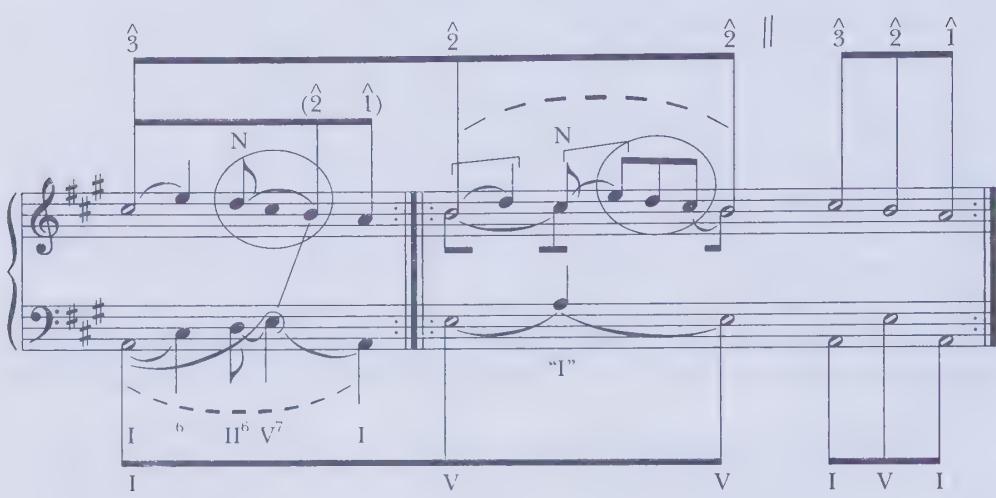
中文讲解
此处为图9.17的中景缩谱图形位置,原图因OCR未嵌入而以占位符呈现。读者需要查看原图以理解中景的结构音进行(双纵线后bars 9–20中的属延长与对位性主和弦)。
补充说明
需查看原图。
脚注 / 边栏 / 图表 / 附加信息(如有)
本节涉及的图表与材料:
- 示例9.15(P0116–P0119):莫扎特《第35号交响曲》第三乐章(Trio) bars 1–28 的前台缩谱图,原图在第21页,仅以占位符提供。
- 示例9.16(P0122–P0124):同一作品 bars 1–8 的表层与前台动机细节对照图,原图在第22页,仅以占位符提供。
- 示例9.17(P0133–P0135):同一作品的中景缩谱图,原图在第24页,仅以占位符提供。
- 脚注标记:P0113 末尾的脚注 8、P0125 末尾的脚注 9、P0131 中的脚注 10——三个脚注的正文文本未在提供的段落中出现,本输出中未能引述其内容。
- 前向指代:P0132 提到"第12章将综述调性结构与二部曲式模式之间的关系",是本节论证向后延伸的钩子。
💡 本节核心要点
- Trio 是圆对称二部曲式,但与海顿小步舞曲不同:海顿的"中断"使属延长落在A段内部,而莫扎特的"中断"使属延长与B段开始重合,因此属延长的范围与结构判定成为本节的核心难点。
- Ländler 风格决定音乐表面的两个特征:节拍规律(4+4 同时也是 2+2+2+2)与和声简洁(I 与 V 频繁交替),这两个特征既是分析入口也是分析障碍。
- 三度动机(升与降)从 bars 1–8 贯穿到 bars 16–18;bars 16–18 的下降三度 E–C# 是 bars 12 与 15 下降动机的紧缩形式,且 C# 始终作为结构 2̂(B)的上方邻音出现。
- Trio 的 3̂(C#)而非 5̂ 是结构性主要音,理由来自 bars 1–3 的 C#–B–A 下行与 bars 3–5 的 A–B–C# 上行共同强调 C# 作为第二乐句起点。
- bars 11–12、15 表面是主和弦,但作者通过节拍分析与动机对位论证其为"对位功能的主和弦"——支持 C# 作为 2̂ 的邻音,本身仍属属延长之内的对位事件,不构成结构性主领域。
- 节拍分析提供了判别结构层次的另一条论据:bars 9–12 是 4 小节单位,bars 13–15 缩减为 3 小节,bars 16–20 通过半音经过音延展为 5 小节;每个乐句的首小节(即节拍最重位)都出现属和声,因此支持 bars 9–20 整体属于一个延长的结构性属和声。
🔑 关键术语
- rounded binary form / 圆对称二部曲式:二部曲式中第二段末尾再现第一段主题材料的曲式。Trio 即属此类,与海顿小步舞曲同属一类但结构差异由本节加以阐明。
- Ländler:奥地利中等慢速 3/4 拍民间舞曲。本节以此来解释 Trio 风格的轻快主属交替与节拍规律。
- primary tone (主要音):申克理论中一个结构层上起统领作用的音。本节里 bars 1–8 的主要音是 3̂(C#)而非 5̂(E)。
- scale-degree with hat (3̂ / 5̂ / 1̂ / 2̂):用 hat 标记音级(而非具体音名),表示该音在特定调性内充当何种结构功能。本节中 3̂ 与 5̂ 的选择产生不同分析结构。
- upper neighbor / incomplete neighbor (上邻音 / 不完全邻音):上邻音指从主音上行一个音级再下行回归的装饰;不完全邻音指回归时未真正回到主音(如本节 bar 2,第二次 C# 是经过音而非稳固的 3̂)。
- consonant skip (协和跳进):两个旋律音之间跳过大于二度的音程(如本节 C#–E)。本节中协和跳进成为填充装饰基础结构音的方式。
- passing tone (经过音):在两个旋律音之间以级进填充的弱结构装饰音。本节中 bar 2 的第二次 C# 是经过音,导致邻音"不完全"。
- tones of figuration at different structural levels (不同结构层的装饰音):申克分析的基本概念:同一音在不同结构层中扮演不同功能。本节中 D2 在表层是从上方接近的上邻音,在前台是 3̂–2̂–1̂ 下行中的装饰。
- interruption (中断):申克结构中基础结构被局部"截断"为两支的过程。本节中海顿与莫扎特都用此技巧,但属延长的落点不同。
- structural dominant / 结构性属:在更长时值上维持的属功能,区别于表面的属和弦。本节的核心结论是 bars 9–20 是一个延长的结构性属和声。
- apparent tonic / 表面的主和弦:表面处于原位 I、但不承担结构性主功能的和弦。本节中 bars 11–12 和 15 的 A 大调被归入此类。
- contrapuntal function (对位功能):和弦的"对位功能"指其作用是支持对位性邻音而非构成和声性主属关系。本节中表面 I 之所以仍属属延长系统,正是因为承担对位功能。
- foreground / middleground reduction (前台 / 中景缩谱):申克层级缩约概念。本节示例9.15是前台缩谱,示例9.17是中景缩谱。
- phrase extension (乐句延长):为补偿前乐句截短而在后乐句多加一个或更多小节。本节中 bars 16–20 由 4 小节扩展为 5 小节,即补偿 bars 13–15 的 3 小节缩减。
9.8 Auxiliary Cadences
第1段(P0136)
原文复述
Auxiliary Cadences
中文讲解
本段是第9.8节的标题“辅助终止”(Auxiliary Cadences),用于开启一个新论题:终止式不仅可以由根位主和弦开始,还可以在中间插入其他和弦形成“X–V–I”的进行,作者将在本节中介绍这一概念在申克分析中的意义。
第2段(P0137)
原文复述
We have previously referred to the concept of the auxiliary cadence. Schenker discusses this technique in Free Composition, though his explanation is brief. This discussion is not intended to be an exhaustive treatment of this subject, but a general explanation that sheds additional light on examples that we have analyzed in this book.
中文讲解
本段是全节的导言,交代三件事:第一,作者在前文已经多次提及“辅助终止”;第二,申克在《自由作曲》中确实讨论过它,但论述简短;第三,本节的目的不是穷尽式地处理这一概念,而是以一种概括性的解释为书中已分析过的例子提供进一步说明。这一限定非常重要:作者自觉地把讨论定位为“补充性说明”,而非系统综述,因此读者应把本节视为对前文例子的回溯与深化,而非新的独立理论。
补充说明
Schenker的《Free Composition》指的是Heinrich Schenker, Free Composition (Der freie Satz),1935年著作,是本节所引申克观点的原始出处。
第3段(P0138)
原文复述
You will frequently encounter harmonic progressions in the midst of compositions that do not begin with a root-position tonic chord. The simplest pattern is V–I, though an intermediate chord will often precede the V; we can represent this possibility generally as X–V–I, with “X” representing II, III, IV, VI or I^{6} (I^{6} is often similar in function to III). A very clear instance of an auxiliary cadence occurs in Schubert’s “Wandrers Nachtlied”: VI–V–I (review Examples 8.6 and 8.7).
中文讲解
本段给出辅助终止的形式定义。核心观察是:作品内部常见的和声进行并不总是从根位主和弦开始;最简单的范式是V–I,但更典型的情形是在V之前插入一个“中间和弦”,由此得到一般化的模型X–V–I。这里的X可以是II、III、IV、VI,也可以是I的第一转位(I^6),因为作者指出I^6在功能上常常与III相近。最后以舒伯特《流浪者夜歌》中的VI–V–I作为清晰实例,并提示读者可对照第8章的例8.6和例8.7。这是用具体曲目印证一般规则:辅助终止指的是“在新的主和弦以根位真正出现之前,先由一个非根位和弦引出V再引向I”的进行模式。
补充说明
作者提示例8.6和例8.7出自本书第8章,说明“辅助终止”的概念在前文已有铺垫,本节是回溯与展开。
第4段(P0139)
原文复述
If you take a moment to examine Figure 110, a–e, in Free Composition, you will see the basic patterns for auxiliary cadences and discover that they are essentially incomplete bass arpeggiations.^{11} Example 9.18 reproduces Figures 110,d and 110,d3. The first shows how III–V–I arpeggiates and hence defines the “tonal space” represented by the concluding triad in root position. The second shows a piece in which an auxiliary cadence serves as the underlying structure for an entire composition, Brahms’s Intermezzo in A minor, Op. 118, No. 1.^{12}
中文讲解
本段把辅助终止与一个非常具体的申克式图式联系起来:辅助终止本质上就是“不完整的低音琶音”(incomplete bass arpeggiation)。申克在《自由作曲》的图110(a–e)中展示了其基本样式,例9.18则重制了其中的110,d和110,d3。第一个图说明III–V–I如何通过琶音来“界定”结束三和弦所代表的调性空间;第二个图则是整首作品以辅助终止作为深层结构的实例——勃拉姆斯《a小调间奏曲》Op.118 No.1。理解这里的要点是:辅助终止不是表面的和声装饰,而是申克意义上的“结构单位”,即从背景层决定调性边界的低音琶音片段。
补充说明
脚注11和12分别对应图110的引用和勃拉姆斯作品的出处;这些脚注属于原始文献标注,本节additional_information中将统一汇总其作用。
第5段(P0140)
原文复述
Auxiliary cadences more typically occur at lower structural levels and are related to Schenker’s discovery that forms or replicas of the fundamental structure are often transferred to levels below the background. This is reflected in the heading of the section in Free Composition in which auxiliary cadences are
中文讲解
本段把辅助终止放置在申克理论的一个更宏观的发现中:基本结构(Ursatz)的形式或复制品常常被“转移”到背景层以下的层次。辅助终止正是这种转移的典型代表,因此它更常出现在中景甚至前景层,而非背景本身。本段以一句未完成的话结束,引出下一页申克原书中小节标题的引用,以印证“转移”这一概念。需要注意的是,“转移”(transference)一词是申克专门用来描述Ursatz结构形式被下移到下属层次的理论术语,是理解本节的关键。
补充说明
“fundamental structure”即“Ursatz”,是申克分析中的最深结构,由三音下行音阶和I–V–I三和弦构成。
第6段(P0141)
原文复述
Example 9.18
中文讲解
本段是例9.18的标题,标示接下来的图示内容。该例用于展示辅助终止的两种功能:作为低音琶音片段的抽象模式,以及作为整首作品底层结构的实例。
第7段(P0142)
原文复述
Brahms, Intermezzo, Op. 118, No. 1: basic pattern and auxiliary cadence as fundamental structure
中文讲解
本段是例9.18的图注,说明例9.18包含两部分:勃拉姆斯《a小调间奏曲》Op.118 No.1中的基本模式(basic pattern)以及作为基本结构的辅助终止(auxiliary cadence as fundamental structure)。这意味着该例同时承担“抽象模式展示”和“完整作品实例分析”两种教学功能,提示读者对照两者即可看到辅助终止如何从图式变成贯穿全曲的结构。
第8段(P0143)
原文复述
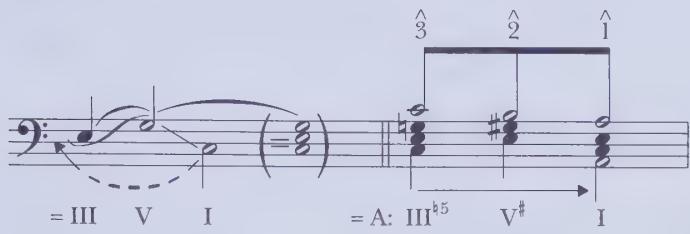
中文讲解
本段是例9.18的图像占位符,位置在第25页,对应图注P0142。由于原始图像数据已被省略,具体谱例线条和申克图式需查看原书第25页插图才能确认;本节讲解的功能(展示辅助终止的基本模式及在勃拉姆斯作品中的完整结构应用)以图注和正文为依据。
第9段(P0144)
原文复述
discussed: “Incomplete Transference of the Forms of the Fundamental Structure; Auxiliary Cadences."^{13} And because transferred forms of the Ursatz are often applied to scale steps other than the tonic, auxiliary cadences may be considered agents of modulation.
中文讲解
本段完成前文未完的句子,引用了申克在《自由作曲》中讨论辅助终止那一节的小节标题——“基本结构形式的不完全转移;辅助终止”。这个标题把“转移”与“辅助终止”两个概念直接绑定。接着作者指出一个重要的实践推论:因为Ursatz的转移形式经常被应用到主音以外的音级(例如属音、下属音等),辅助终止可以被视为转调的“代理人”(agents of modulation)。换言之,每当一首作品从一个调性区域过渡到另一个调性区域,那个过渡性的X–V–I进行就是辅助终止在起作用,其结果就是转调。
补充说明
脚注13对应申克《自由作曲》中相关小节标题的引用,属于原始出处标注。
第10段(P0145)
原文复述
As we mentioned, the harmonic progression of the transferred form may begin with an intermediate chord or with an inversion (I^{6}) of the “new” tonic. According to Schenker, “The transition from harmony to harmony is made smoother by the omission of the I, the first tone of the bass arpeggiation [of the transferred form].”^{14} Refer now to Example 9.19, which is a structural analysis of Haydn’s A♭-major Minuet, analyzed in Example 9.12.
中文讲解
本段展开辅助终止的细节。两种可能:第一,转移形式的和声进行可以从一个“中间和弦”开始;第二,也可以直接从新主和弦的第一转位I^6开始,而不是根位I。申克的引文解释了为什么这种省略是合理的:省略掉低音琶音的第一个音(即新调性的根位主和弦),可以让和声之间的过渡更为平滑。随后作者引入例9.19——海顿♭A大调小步舞曲的结构分析(作品曾作为例9.12被分析过)。本段的功能是为接下来的细致分析做铺垫,并把抽象规则与具体作品挂钩。
补充说明
例9.12的海顿小步舞曲分析位于本章前部,本节分析是其结构层次的进一步深入;脚注14对应申克原话的出处标注。
第11段(P0146)
原文复述
In level a we see the essence of the progression that leads from A♭ to E♭. The initial I of the fundamental structure is related to V_{2}^{4} of the dominant (the C in the upper voice is a suspension of the primary tone 3). In other words, the A♭ in the bass continues, at a higher structural level, the influence of the tonic as the tones above the bass begin to express, at a lower level, the scale system of the emerging dominant (D♮, altered \hat{4}, signals the destabilization of A♭). The subsequent harmonic progression and the fifth-progression, an offshoot of structural \hat{2}, establish the emerging key area of E♭ major. The auxiliary cadence concludes with a V–I motion in the bass.^{15}
中文讲解
本段是例9.19层次a的详细分析,揭示从♭A大调到♭E大调过渡的核心机制。关键点有四:第一,背景层的初始I(♭A大调主和弦)在新的结构层次上与属调的V_{2}^{4}(即♭E大调属七和弦的第二转位)发生关联;第二,上方声部中的C是“主要音3”(主调中的音阶第3级)的延留,这是申克式分析中识别“结构借用”的标志;第三,♭A的持续低音在更深层次仍维系着主调的影响,但上方声部已经开始勾勒新调(属调)的音阶系统;D♮作为♭A大调的♯4(变化音级),预示主调开始失稳;第四,随后的和声进行与源自结构音\hat{2}的五度进行,共同建立了新兴的♭E大调调域,最后辅助终止以V–I的低音运动收束。简言之,这一段讲的是“同一个低音持续时,上方和声已经悄悄转向新调”。
补充说明
脚注15标注辅助终止收束处V–I低音运动的申克式意义,属于分析细节的来源标注。
第12段(P0147)
原文复述
In Example 9.19 we use special details of graphing to convey precisely the relationships and subtle meaning in Schenker’s description of auxiliary cadences. Schenker would say that the voice leading that defines E♭ is “closed off” from what precedes; the chords of the auxiliary cadence “point ahead” to the forthcoming root-position I. Schenker makes the comment that “the space up to its actual entrance [of the new root-position tonic] belongs conceptually to the preceding harmony [in this case, to the initial tonic]. In a sense, the territory of the previous harmony provides a base for the preparation of the following one.”^{16} Bear in mind that the “closing off” of the voice leading pertains to the middle-ground and does not preclude a link at a lower structural level, such as the V_{2}^{4} shown in Example 9.19.
中文讲解
本段把焦点从“和声结果”转向“图式语言”和“申克原意”。作者指出例9.19使用了特殊的图式细节来精确传达申克描述中那些微妙的含义。核心概念是“封闭”(closed off)——指向新调(♭E)的那条声部进行线在视觉与分析上被“封闭起来”,仿佛它不再与前文直接相连;辅助终止的和声则“指向未来”的根位I。申克的原话解释了空间概念:在新的根位主和弦真正进入之前,其空间在概念上仍属于前一个和声(即最初的♭A主和弦);前一个和声的“领土”为下一个和声作准备。但作者给出了一个关键限定:所谓“封闭”仅适用于中景层,并不排除在更低的结构层次上仍存在连接,比如例9.19中显示的V_{2}^{4}就是一个低层次的连接实例。这一限定避免了读者把“封闭”误读为“完全无关联”。
补充说明
脚注16对应申克引文出处;需要区分“middle-ground的封闭”与“更低层次的连接”是理解本节的重点之一。
第13段(P0148)
原文复述
In Example 9.19b, we use upward beamed stems in the bass to show that the chords of the auxiliary cadence relate to the forthcoming I in E♭; notice the incomplete bass arpeggiation of the dominant triad, G–B♭–E♭, revealed by this notation. To indicate the harmonic progression of the middleground, we
中文讲解
本段开始讲解例9.19b的图式设计。向上辐合的符干(upward beamed stems)用来标记那些属于辅助终止并指向未来♭E大调根位I的和声;通过这种标记,可以读出属三和弦G–B♭–E♭的不完整低音琶音——这正是辅助终止作为“低音琶音片段”的图式证据。随后作者说明:中景的和声进行用另一种图式元素表示(即“向下辐合的符干”,在下一段具体说明)。本段的功能是介绍图式符号与音乐结构之间的对应关系,强调“看图”就是“看结构”。
第14段(P0149)
原文复述
Example 9.19
中文讲解
本段是例9.19的标题,标示接下来要讨论的是海顿《钢琴奏鸣曲》Hob. XVI/43小步舞曲2的结构分析(含两个层次a与b)。
第15段(P0150)
原文复述
Haydn, Piano Sonata, Hob. XVI/43, Minuet 2: structural analyses
中文讲解
本段是例9.19的图注,明确分析对象是海顿《钢琴奏鸣曲》Hob. XVI/43第二乐章小步舞曲的结构分析,并提示该例包含多重结构层次(structural analyses,用复数)。结合前文,这里至少包括:层次a——从♭A到♭E过渡的中景分析;层次b——展示辅助终止与中景和声进行图式的对照。
第16段(P0151)
原文复述
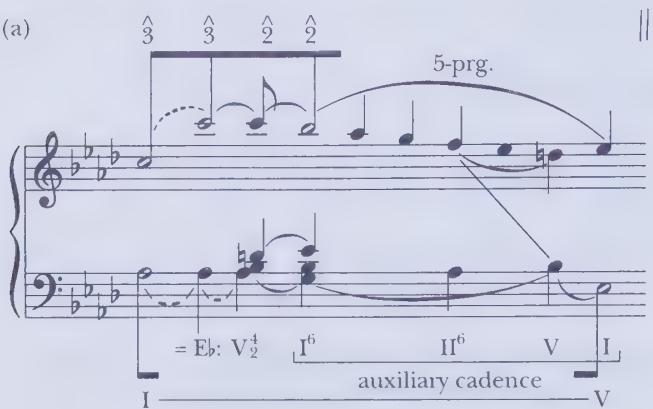
中文讲解
本段是例9.19的第一幅图(位于第26页)的图像占位符。由于图像数据省略,具体图形细节需查阅原书;根据图注和正文,可知它用于展示海顿小步舞曲从♭A大调到♭E大调的结构分析层次a,是“封闭”与“空间归属”概念的具体图示载体。
第17段(P0152)
原文复述
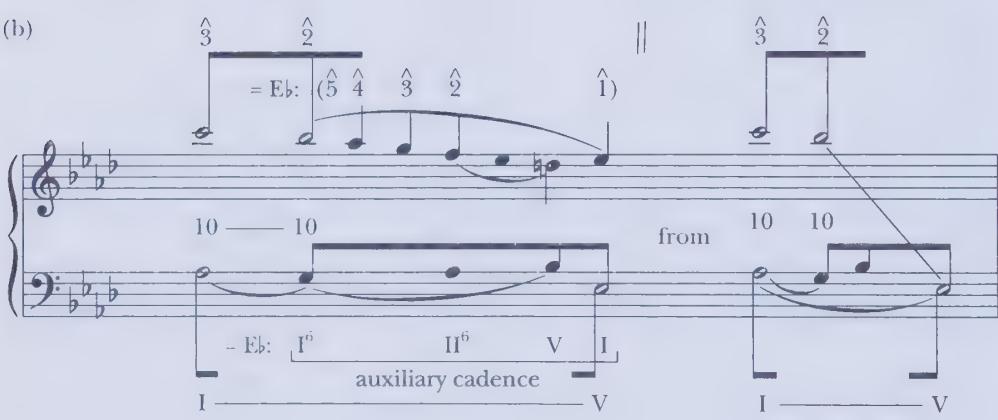
中文讲解
本段是例9.19的第二幅图(位于第26页)的图像占位符,与上一幅属于同一例9.19的第二部分。结合P0148和P0153,应为层次b:用向上辐合符干标记辅助终止的低音琶音G–B♭–E♭,用向下辐合符干标记中景和声I–V的低音运动。具体细节需查看原图。
第18段(P0153)
原文复述
downward beamed stems connecting half notes (I–V) in the bass. This shows that the scale system of E♭ is gradually developing at a lower level. But when viewed from the middleground, the dominant arrives in a structural sense only at the completion of the auxiliary cadence. This is what Schenker means when he says that the “space” of the emerging new key (defined by the auxiliary cadence) belongs conceptually to the preceding harmony. The progression in E♭ develops in the foreground under the influence of the initial structural tonic, because that is the last structural harmony we have heard. The tonic, therefore, remains active at a deeper level until the authentic cadence has established the root of the dominant.
中文讲解
本段完成对例9.19b图式符号的解读,并把这些图式回到申克的“空间”概念。向下辐合的符干连接低音中的二分音符(I–V),用以显示♭E的音阶系统在更低层次上逐渐成形;但从“中景”视角看,属和弦在结构意义上要等到辅助终止完成后才真正“抵达”。这正是申克所说“新调的空间在概念上属于前一个和声”的含义:在前景中,♭E的进行在初始结构性主和弦的影响下展开,因为主和弦仍是听者最后听到的结构和声;因此主调在更深层次上一直保持活性,直到正格终止真正确立了属调之根。换句话说,辅助终止期间新调是被“孕育”而非被“宣告”。
第19段(P0154)
原文复述
In his Prelude, Bach moves away from the tonic and prolongs the dominant until bar 12. In order to conclude the piece, Bach must, in a manner of speaking, “modulate” back to the tonic (as is the case with most tonal forms). In Examples 9.7a and b, we see that the reestablishment of the tonic occurs similarly to auxiliary cadences that lead away from the tonic and define secondary key areas. The tonic area begins with I^{6} and develops within the “sphere” of the prolonged dominant until the final cadence establishes the concluding structural tonic (at the middleground): I^{6}–V–I. The auxiliary cadence “in the tonic” (which Schenker does not discuss in Free Composition) is not uncommon in pieces in which a return of tonic harmony emerges at a lower level; in such cases the tonic does not initiate the second branch of an interrupted fundamental structure.
中文讲解
本段把辅助终止的讨论从“离调”扩展到“回归主调”的对称情形。巴赫前奏曲一直延展属调直到第12小节,为了结束全曲,必须(以某种说法)“转调”回主调——这是大多数调性体裁共有的特征。例9.7a、b显示,主调的重新建立方式与“离开主调、定义次级调域”的辅助终止是同构的:主调区域以I^6开始,在被延展的属调的“势力范围”内发展,直到终止确立中景的结构性主和弦——也就是I^6–V–I。作者由此提出一个补充概念:“在主调内的辅助终止”(auxiliary cadence in the tonic),并明确指出这是申克在《自由作曲》中未讨论的情形。其特征是:主调回归从低层次浮现,它并不启动一个“被中断的基本结构”的第二分支。理解这一点有助于区分真正的中断终止与表面相似的回归段落。
补充说明
例9.7a、b对应的巴赫前奏曲分析位于本章前部,构成与本节分析的对照。
脚注 / 边栏 / 图表 / 附加信息(如有)
本节脚注与图表汇总如下:脚注11对应申克《自由作曲》图110(a–e),用于说明辅助终止的基本模式及其作为“不完整低音琶音”的本质;脚注12标注勃拉姆斯《a小调间奏曲》Op.118 No.1作为辅助终止作为整首作品基本结构的实例;脚注13引用申克《自由作曲》中讨论辅助终止的小节标题“基本结构形式的不完全转移;辅助终止”,用以印证“转移”概念与辅助终止的直接关联;脚注14为申克关于“省略I以使和声过渡更平滑”的原话出处;脚注15标注辅助终止收束处V–I低音运动的申克式意义;脚注16为申克关于“新调的空间在概念上属于前一个和声”的原话出处。图表方面,例9.18(P0141–P0143,第25页)重制申克图110,d与110,d3,分别展示III–V–I如何通过琶音界定调性空间,以及勃拉姆斯作品如何以辅助终止作为整首作品的基本结构;例9.19(P0149–P0152,第26页)包含两幅图示,分别对应层次a(♭A大调向♭E大调过渡的中景分析,体现“封闭”与“空间归属”)和层次b(用向上辐合符干展示属三和弦G–B♭–E♭的不完整低音琶音,用向下辐合符干展示中景I–V低音运动)。这些脚注与图表共同支撑本节的两条主线——抽象规则与具体作品/层次分析的对应。
💡 本节核心要点
- 辅助终止的形式定义:X–V–I,其中X可以是II、III、IV、VI或I^6;其本质是“新调根位主和弦之前的不完整低音琶音”。
- 辅助终止是申克“基本结构形式转移”的具体体现:Ursatz的复制品被下移到中景或前景层,因此辅助终止更常出现于背景层以下的结构层次,并可作为转调的“代理人”。
- 申克关于“空间归属”的核心洞见:在新调根位主和弦真正进入之前,其在概念上仍属于前一个和声;前一个和声的“领土”为下一个和声作准备。
- “封闭”(closed off)仅适用于中景层,并不排除更低层次的连接(如海顿例中的V_{2}^{4}),因此不能把辅助终止误读为完全切断联系。
- 图式语言的功能:向上辐合符干标记辅助终止内部的低音琶音(G–B♭–E♭),向下辐合符干标记中景的和声进行(I–V),二者共同体现“辅助终止期间新调被孕育而非被宣告”。
- “在主调内的辅助终止”是本节补充提出的概念——主调回归以I^6–V–I实现,且不启动被中断基本结构的第二分支;这超出了申克《自由作曲》的讨论范围。
🔑 关键术语
- Auxiliary cadence(辅助终止):指以X–V–I(X为II、III、IV、VI或I^6)形式出现、且新调根位主和弦之前省略I的终止进行;在申克理论中对应“不完整的低音琶音”,是Ursatz转移至下属层次的典型实例。
- Fundamental structure / Ursatz(基本结构):申克分析中的最深层结构,由三音下行音阶与I–V–I三和弦构成;其形式或复制品被“转移”到下属层次时,往往表现为辅助终止。
- Incomplete bass arpeggiation(不完整的低音琶音):申克用来描述辅助终止结构本质的术语;指低音仅琶音化新调属三和弦的若干音,而非完整三和弦的琶音(如例9.19b中G–B♭–E♭)。
- Transference(转移):申克术语,指Ursatz或其片段的结构形式被下移到背景层以下的结构层次;申克在《自由作曲》中以“基本结构形式的不完全转移;辅助终止”作为相关小节标题。
- Closed off / “封闭”:申克用来描述辅助终止中新调声部进行线在视觉与分析上与前文区隔开的现象;作者强调此“封闭”仅适用于中景,不排除低层次的连接。
- V_{2}^{4}:属七和弦的第二转位;在本节中作为辅助终止期间连接新调与旧调的低层次标志(如海顿例中出现在♭A持续低音之上)。
- Primary tone(主要音):申克指背景层结构性的延长音级;本节中C作为主调音阶第3级(\hat{3})的主要音,以延留形式出现在海顿例的V_{2}^{4}上方声部。
- Auxiliary cadence in the tonic(在主调内的辅助终止):本节补充提出的概念,指主调回归以I^6–V–I在中景实现、且主调从低层次浮现的情形;超出申克《自由作曲》的讨论范围,且不启动被中断基本结构的第二分支。
9.9 [描述性拆分] Pieces for Analysis and Notes
第1段(P0155)
原文复述
Pieces for Analysis
中文讲解
这是一个二级小节标题,标示接下来的内容是供学生进行申克式分析所用的乐曲清单。标题在功能上把乐曲列表与正文论证分开,表明作者把分析练习材料独立成节,便于读者按编号取用。
第2段(P0156)
原文复述
- Chopin, Prelude in G major, Op. 28 (two-part period structure)
中文讲解
清单第 1 条:肖邦《G 大调前奏曲》,作品 28,括号注明其结构为二部乐段(two-part period structure)。括号中的结构提示告诉读者应从乐段结构角度切入分析。
第3段(P0157)
原文复述
- Chopin, Prelude in E minor, Op. 28 (two-part period structure)
中文讲解
清单第 2 条:肖邦《e 小调前奏曲》,作品 28,结构同样标注为二部乐段。与第 1 条并列,二者共同为读者提供对比同一作品集中两种调性(关系大小调)下的二部乐段实例。
第4段(P0158)
原文复述
- Mozart, Variations on “La belle Française,” K. 353, Theme
中文讲解
清单第 3 条:莫扎特《“美丽的法兰西姑娘”主题变奏曲》,K. 353,分析对象为该作品的 Theme(主题)。括号未给出结构限定,意味着分析的重点放在主题本身,而非变奏展开。
第5段(P0159)
原文复述
- Jeremiah Clarke, Trumpet Voluntary (“Prince of Denmark’s March”)
中文讲解
清单第 4 条:杰里米亚·克拉克《号角自愿》(又名《丹麦亲王进行曲》)。作品仅列出曲名及俗称,未限定分析子段(主题或全曲),说明该曲整体可作为分析对象。
第6段(P0160)
原文复述
- Haydn, Six Easy Variations in C major, Hob. XVII/5, Theme
中文讲解
清单第 5 条:海顿《C 大调六首简易变奏曲》,霍伯肯编号 XVII/5,分析对象为 Theme(主题)。与第 3 条莫扎特主题变奏曲形成体裁上的呼应,便于读者比较两位作曲家主题的写作方式。
第7段(P0161)
原文复述
- Beethoven, Bagatelle in C major, Op. 32, No. 2
中文讲解
清单第 6 条:贝多芬《C 大调随想曲》,作品 32 之 2。该条目仅给出作品号,未限定分析子段(段落或全曲)。
第8段(P0162)
原文复述
- Mozart, Variations on a Minuet by Duport, K. 573, Theme; Variations 1 and 2
中文讲解
清单第 7 条:莫扎特《杜波尔小步主题变奏曲》,K. 573,分析对象为主题以及变奏 1、变奏 2。明确包含变奏意味着读者不仅要观察主题本身,还要追踪主题材料在变奏中的延伸方式。
第9段(P0163)
原文复述
- Haydn, String Quartet, Op. 3, No. 3, Minuet
中文讲解
清单第 8 条:海顿《弦乐四重奏》作品 3 之 3,分析对象为其中的小步舞曲乐章。该条目把分析限定到特定乐章,与其他未限定子段的乐曲条目形成对比。
第10段(P0164)
原文复述
- Schubert, Schwanengesang, No. 9, “Ihr Bild”
中文讲解
清单第 9 条:舒伯特《天鹅之歌》第 9 首《她的肖像》。该条目提示读者关注艺术歌曲中的声乐旋律与伴奏结构关系。
第11段(P0165)
原文复述
- Schubert, Winterreise, No. 7, “Auf dem Flusse”
中文讲解
清单第 10 条:舒伯特《冬之旅》第 7 首《在河上》。与第 9 条共同提供同一作曲家两部声乐套曲中的曲目,便于对比不同作品中声乐与钢琴的处理。
第12段(P0166)
原文复述
- Schubert, Moment Musical in A $^{b}$ major, Op. 94, No. 6
中文讲解
清单第 11 条:舒伯特《音乐瞬间》降 A 大调,作品 94 之 6。该条目以钢琴小品的形式收尾乐曲清单,提示钢琴体裁中短小结构也可作为申克分析对象。
第13段(P0167)
原文复述
Notes
中文讲解
这是一个二级小节标题,标示接下来的内容是针对第 9 章正文段落的一系列补充性脚注(编号 1 至 16)。这些注释提供术语解释、补充图例说明,以及对个别理论观点的进一步澄清。
第14段(P0168)
原文复述
- Remember that the half cadence occurs on beat 1 of bar 12. The other five eighth notes constitute a lead-in to the reprise. Consider also another perspective on the nature of interruption. At a level just below the background, the interruption after $\hat{2}$ represents a break in the voice leading. Levels closer to the surface, however, can build a bridge over that break, more or less like two separate phrases that are connected at the surface by a linking passage (which is usually an upbeat).
中文讲解
注释 1 首先提醒读者:半终止出现在第 12 小节第 1 拍,其余五个八分音符构成进入 reprise(再现)的导引。这里 reprise 是申克分析中的专门术语,指中断结构(interrupted structure)中的回应段/再现段;不要把它简单理解为一般意义上的“重复”或“邀请”。其后,作者对中断(interruption)提出另一个观察角度:在背景层级稍下之处,$\hat{2}$ 之后的中断表现为声部进行的断裂;但在更靠近表面的层级上,可以通过连接段(通常是上行的弱起)把两段原本分开的乐句在表层衔接起来。这一区分旨在说明:中断的“断裂”属于深层结构,而在表层听感中作曲家可以用连接材料加以掩饰。
补充说明
注释中“reprise(再现)”是申克理论中的特定概念,指中断结构中的后半段(即应句/再现段),与一般曲式术语中的“再现部”含义不同;本注释专指中断结构内的 reprise。
第15段(P0169)
原文复述
- The graph indicates that we regard the initial $c^2$ as the primary tone 3, an interpretation that is not obvious at first glance but develops retrospectively. C in the two-line octave first appears in a weak metrical position, but returns in a stronger position on the downbeat of bar 2. The subsequent octave transfer to $c^3$ confirms that C is in fact the main top-voice tone supported by the prolonged tonic harmony.
中文讲解
注释 2 解释图表为何将开头的 c² 视为主音上方三度音(即基本结构的 $\hat{3}$)。作者承认这种解读在乍看之下并不明显,它需要“回溯性”地建立:c 首次以两线八度的 c² 出现,处于弱拍节拍位置;接着在第 2 小节强拍上以更强的节拍位置再现 c²;随后的八度转移至 c³,最终确认 C 才是真正由被延长的主和弦所支撑的高声部主音。这一段说明申克分析中关于“哪一音是 $\hat{3}$”的判断不是凭第一印象得出,而是通过后续的八度重复与节拍加强回溯确认。
第16段(P0170)
原文复述
- Very often the first and last pitches of a motive define an interval of the underlying harmony, but this is not a requirement for a tone succession to become a motive. (Some have objected to this notion, but no requirement exists in Schenkerian analysis that all elements in a composition be interpreted as part of the structure.) Rhythmic and registral characteristics, for example, may lead the ear to perceive a group of tones as a motive, even though it does not completely “fit” within the underlying harmony. We refer to these as nonstructural motives because they exist somewhat independently of the underlying voice-leading structure.
中文讲解
注释 3 阐明动机与其下方和声之间的关系:动机首尾音常常勾勒出下方和声的音程,但作者明确指出,这不是动机成立的必要条件。作者承认有人对这一观点提出过反对,但申克分析并不要求作品中所有元素都必须被解释为结构的组成部分。节奏与音区特征同样能让听者把一组音感知为动机,即便这组音并不完全“嵌进”底层和声。作者把这类动机称为“非结构动机”(nonstructural motives),因为它们在一定程度上独立于底层的声部进行结构而存在。这一注释提醒读者:在申克分析中,动机不一定等同于结构延伸,它可以独立于结构起作用。
第17段(P0171)
原文复述
- Jonas, Introduction, p. 7–8.
中文讲解
注释 4 是一则简短的文献指引,指向 Jonas 所著《Introduction》第 7–8 页,为正文的相关论述提供支持性出处。
补充说明
该条目仅为页码指引,未给出更多上下文。
第18段(P0172)
原文复述
- Bear in mind that both fifth-progressions serve to expand the higher-ranking tones of the fundamental line: the first $(B^{b}-E^{b})$ elaborates and thus prolongs structural $\hat{2}$ of the first branch; the second $(E^{b}-A^{b})$ participates in the composing-out of the descent of the fundamental line $(\hat{3}-\hat{1})$ that occurs in the second branch of the interrupted fundamental structure.
中文讲解
注释 5 提醒读者注意两段五度进行(fifth-progressions)各自承担的展开功能。第一段 $(B^{b}-E^{b})$ 装饰并因而延长了第一分支的结构 $\hat{2}$;第二段 $(E^{b}-A^{b})$ 则参与了对中断基本结构第二分支中基本线 $\hat{3}-\hat{1}$ 下行的 composing-out(作曲式展开)。作者通过这一区分说明:同一类低音声部进行(fifth-progression)在不同分支中所支撑的层次功能并不相同。
第19段(P0173)
原文复述
- Free Composition, p. 107.
中文讲解
注释 6 给出 Schenker《Free Composition》第 107 页的文献指引,为正文相关论述提供来源。
补充说明
该条目仅为页码指引。
第20段(P0174)
原文复述
- Free Composition, pp. 87–88.
中文讲解
注释 7 给出 Schenker《Free Composition》第 87–88 页的文献指引,为正文论述提供来源。
补充说明
该条目仅为页码指引。
第21段(P0175)
原文复述
- Examples 9.15 and 9.17 also show only the structural tones of the second branch (the reprise) of the Minuet.
中文讲解
注释 8 指出:图例 9.15 与 9.17 也只显示小步舞曲第二分支(即 reprise/再现段)的结构音。这提示读者在阅读这两张图时,应注意它们展示的是被压缩后的结构骨架,而非完整的声部进行。
第22段(P0176)
原文复述
- You will notice that the section concludes with a perfect authentic cadence, with $\hat{2}-\hat{1}$ occurring over V $^{7}$ -I. The final A section (bars 21–28) is identical to the first and concludes in exactly the same fashion. Since this is the case, it is reasonable to wonder why an Urlinie descent does not take place in the first A section as well as the last. In purely melodic terms, the descents are the same. However the meaning of an Urlinie descent goes beyond the melodic descent itself. When the Urlinie reaches the tonic, the dynamic forward motion of the structure of the section or work under consideration is fulfilled. While a prolongation or coda may follow, the Urlinie descent by definition signifies the completion of the main structure. Parallel earlier descents, therefore, do not have the same meaning for the section or piece as a whole. In addition, closure after a single phrase (or section) is not as definitive as closure after a contrasting section and return.
中文讲解
注释 9 引导读者注意:该段以完满的正格终止结束,$\hat{2}-\hat{1}$ 出现在 V⁷–I 之上;最后一个 A 段(第 21–28 小节)与第一个 A 段完全相同,结束方式也一致。由此产生一个自然的疑问:为什么 Urlinie 下行只出现在最后一个 A 段,而不是两个 A 段?作者回答:在纯旋律层面,两次下行相同;但 Urlinie 下行的意义超出了旋律本身——当 Urlinie 抵达主音时,作品主要结构的动态前进即告完成,即使之后还有延长或尾声,Urlinie 下行本身即标志着主要结构的完结。因此,前面平行的下行对本段或全曲而言并不具备同样的“完结”意义。此外,仅一个乐句(或一个段)后的终止,不像经历过对比段并再现后那样具有决定性的收束力。这一注释阐明:Urlinie 在曲式中的位置决定其结构意义,而非旋律表面上的相同。
第23段(P0177)
原文复述
- We are regarding the four-bar unit as analogous to a four-beat measure (like $\frac{4}{4}$ ), with the first bar strongest, the third bar next strongest and the second and fourth bars weak. Such a unit is referred to as a hypermeasure, a term introduced by Edward T. Cone in Musical Form and Musical Performance.
中文讲解
注释 10 把四小节单位类比为四拍小节(如 $\frac{4}{4}$):第一小节最强,第三小节次强,第二与第四小节较弱。这种四小节单位称为 hypermeasure(超小节),该术语由 Edward T. Cone 在《Musical Form and Musical Performance》中提出。本注释为读者提供一个理解四小节节拍层级结构的模型。
第24段(P0178)
原文复述
- It might appear in his discussion and initial diagrams in Free Composition (Figure 110) that Schenker believes the first chord of an auxiliary cadence should not be the tonic defined by the cadence (regardless of position). However, a I $^{6}$ as a beginning chord would satisfy the notion of an incomplete bass arpeggiation (the first tone of the “complete” bass arpeggiation in this case still does not appear). The patterns in Figure 14 of Free Composition explicitly show that I $^{6}$ and III can function similarly as first elaborations of the bass arpeggiation. Hence, Figures 110, c and d could read I $^{6}$ -V-I.
中文讲解
注释 11 看似挑出 Schenker 在《Free Composition》(图 110)论述中可能给人留下的印象:辅助终止(auxiliary cadence)的第一个和弦不应是该终止所定义的主和弦(不论处于何种位置)。作者接着反驳这一印象:把 I⁶ 作为起始和弦就符合“不完整低音分解”这一概念(因为“完整”的低音分解中的第一个音在此仍未出现)。《Free Composition》图 14 中的图式已明确显示 I⁶ 与 III 可以同样充当低音分解的首次展开。因此,图 110 之 c 与 d 可以理解为 I⁶–V–I。这一注释旨在澄清读者对辅助终止起始和弦的常见误解。
第25段(P0179)
原文复述
- This possibility represents an advanced aspect of Schenkerian theory. For the purposes of our discussion, it is sufficient to point out that the tonal system is very flexible, even in some of the ways in which the fundamental structure may appear. See Carl Schachter’s discussion of Chopin’s E-minor Prelude, Op. 28, No. 4, in “The Triad as Place and Action,” pp. 150–53.
中文讲解
注释 12 标明此处所讨论的可能性属于申克理论中较深一层的内容;对当前讨论而言,只需指出调性系统具有相当的灵活性,即便在基本结构可能呈现的方式上也是如此。作者进一步指引读者参考 Carl Schachter 在《“The Triad as Place and Action”》第 150–153 页对肖邦《e 小调前奏曲》作品 28 之 4 的讨论。本注释既限定讨论深度,又提供深入阅读的方向。
第26段(P0180)
原文复述
- Free Composition, p. 88. We initially saw complete forms of the fundamental structure in Chapter 5, where we introduced the characteristics of the fundamental structure in terms of a single phrase closed in the tonic; in Chapter 8, we examined antecedent/consequent constructions (a musical period) in the tonic. And in Chapter 10, in Beethoven’s G-minor Bagatelle, we will examine a self-contained B section defined by a replica of a fundamental structure in E $^{b}$ major.
中文讲解
注释 13 给出来源页码(《Free Composition》第 88 页),并对本教材内已出现或将出现的基本结构形式做回顾性梳理:第 5 章首次以单一主终止乐句介绍基本结构的特征;第 8 章在主调范围内考察了前句/应句结构(即乐段);第 10 章将在贝多芬《g 小调随想曲》中考察一个由降 E 大调基本结构复制所定义的、自成单元的 B 段。本注释把当前论及的基本结构放置于全书的递进序列中。
第27段(P0181)
原文复述
- Free Composition, p. 88. The phrase “the transition from harmony to harmony” does not refer to the chords of the auxiliary cadence. Schenker is referring here to the transition from one tonicized scale step to another—in conventional terms, from one key area to another.
中文讲解
注释 14 对原文“the transition from harmony to harmony”作术语上的澄清:它并非指辅助终止中的各个和弦,而是指从一个被主音化的音级到另一个被主音化的音级之间的转换——按传统术语即一个调域到另一调域之间的转换。本注释提醒读者在阅读 Schenker 时不要把“和声到和声”误解为单纯的和弦进行。
第28段(P0182)
原文复述
- We indicate the beginning of the auxiliary cadence with the I $^{6}$ in E $^{b}$ , not with the V ${2}^{4}$ . Although the V ${2}^{4}$ can be heard retrospectively as the very beginning of the area in E $^{b}$ , it is also, as indicated by the broken slur, an outgrowth of the initial tonic. Strictly speaking, therefore, the auxiliary cadence begins with the I $^{6}$ . Another reason to consider is that the Ursatz pattern (the fifth-progression, the bass ascending toward V) begins in this case with the I $^{6}$ . (Bear in mind, however, that the influence or “outgrowth” of the initial tonic may be absent.)
中文讲解
注释 15 说明作者在图中以降 E 大调的 I⁶(而非 V₂⁴)标示辅助终止的起点。虽然 V₂⁴ 可以被回溯地听成降 E 调域的最开端,但根据图中虚线连线,它同时也是初始主调的延伸(outgrowth)。严格地说,辅助终止从 I⁶ 开始。另一项支持理由是:Ursatz 模式(即基本结构模式,体现为朝向 V 的低音声部上行五度进行)在该例中正是从 I⁶ 起步。作者同时提醒读者:起始主调的“延伸”影响并非在所有情况下都存在,应视具体作品而定。本注释厘清辅助终止起点的图示约定及其理论依据。
补充说明
原文将 Ursatz pattern 解释为“the fifth-progression, the bass ascending toward V”,即朝向 V 的低音声部上行五度进行;讲解中将其对应为“朝向 V 的低音声部上行五度进行”,与原文术语一致。
第29段(P0183)
原文复述
- Schenker’s text also reads: “The voice-leading is ‘closed off’ from what precedes it: that is, the IV, III, and II are related only to the forthcoming I; they point only to it.” Free Composition, p. 88.
中文讲解
注释 16 引用 Schenker 原文:“The voice-leading is ‘closed off’ from what precedes it: that is, the IV, III, and II are related only to the forthcoming I; they point only to it.” 出处:《Free Composition》第 88 页。这段引文强调辅助终止中的声部进行与其前文“隔绝”:IV、III、II 仅与即将到来的 I 发生关系,仅指向 I。本注释通过直接引用进一步坐实前几条关于辅助终止之独立性、自含性的论述。
脚注 / 边栏 / 图表 / 附加信息(如有)
本节由两个功能区块构成:上半(P0155–P0166)为乐曲分析清单(Pieces for Analysis),共 11 首作品,覆盖肖邦、莫扎特、海顿、贝多芬、舒伯特及 Jeremiah Clarke,体裁涉及前奏曲、变奏曲、随想曲、弦乐四重奏乐章、艺术歌曲及钢琴小品;其中部分条目以括号注明结构类型(two-part period structure)或限定分析对象(Theme、Minuet、特定声乐曲目)。下半(P0167–P0183)为按数字编号的注释(Notes 1–16),其作用是补充术语(reprise、hypermeasure、nonstructural motives)、澄清对申克论述的常见误解(辅助终止的起始和弦、Ursatz 模式含义)、提供文献指引(Jonas《Introduction》p. 7–8;《Free Composition》p. 88、107、pp. 87–88;Schachter《The Triad as Place and Action》pp. 150–53;Cone《Musical Form and Musical Performance》)、并对部分图例的展示范围作说明(图 9.15、9.17、图 110、图 14)。
💡 本节核心要点
- 本节上半为乐曲分析清单,下半为针对第 9 章正文的 16 条补充注释,两部分各自承担“练什么”与“怎么读”的功能。
- 乐曲清单在编排上有意识地把前奏曲、变奏曲主题、艺术歌曲、弦乐四重奏乐章等不同体裁并列,使读者可在多种体裁上实践乐段与中断结构的申克分析。
- 注释 1 与注释 8 共同提示“reprise”是申克中断结构中具有专门含义的术语,读者不应将其等同于普通意义上的“重复”。
- 注释 3 明确提出“非结构动机”(nonstructural motives)概念,强调动机不必完全嵌入底层和声,这与申克理论的常见误读形成对照。
- 注释 9、注释 15、注释 16 围绕中断结构与辅助终止,阐释 Urlinie 下行的结构意义及辅助终止的声部进行独立性。
- 注释 10 引入 Cone 提出的 hypermeasure 概念,为四小节单位提供节拍层级模型。
🔑 关键术语
- reprise:申克分析中的专门术语,指中断结构(interrupted structure)中的第二分支(即应句/再现段),而不是泛指曲式中的再现部。
- interruption(中断):申克理论中的结构类型,指在 $\hat{2}$ 之后发生声部进行的断裂,从而把一个基本结构分成两个分支。
- nonstructural motive(非结构动机):一组因节奏或音区特征而被听者识别为动机、但不必然嵌入底层和声与声部进行的音组;它独立于结构存在。
- Urlinie(下行基本线):申克基本结构中高声部从 $\hat{3}$(或 $\hat{5}$、$\hat{8}$)下行到 $\hat{1}$ 的线性进行;其抵达主音标志着主要结构的完成。
- auxiliary cadence(辅助终止):申克理论中用于从初始主调过渡到新调域的终止构造;其声部进行与前文“隔绝”,IV、III、II 仅指向即将来临的 I。
- Ursatz pattern:基本结构模式,在文中具体体现为朝向 V 的低音声部上行五度进行(fifth-progression, the bass ascending toward V)。
- hypermeasure(超小节):由 Edward T. Cone 提出的术语,将四小节单位类比为四拍小节,使节拍强弱层级延伸到小节之上。
- composing-out:申克术语,指把高层结构通过低层结构加以展开、延伸的过程。