目录
ch11 Sonata Principle
- 11.1 [描述性拆分] Introduction to the Sonata Principle
- 页码:1-1
- 11.2 [描述性拆分] Clementi, Sonatina, Op. 36, No. 1, I: Exposition (bars 1–15)
- 页码:2-4
- 11.3 [描述性拆分] Clementi, Sonatina: Development Section (bars 16–23)
- 页码:4-5
- 11.4 [描述性拆分] Clementi, Sonatina: Recapitulation and Structural Synopsis
- 页码:5-8
- 11.5 [描述性拆分] Mozart, Symphony No. 35 (“Haffner”), K. 385, II: Overview
- 页码:8-8
- 11.6 [描述性拆分] Exposition: Mapping and First Theme (bars 1–12)
- 页码:9-9
- 11.7 [描述性拆分] Exposition: Transition Section and Hypermeasure Expansion (bars 11–17)
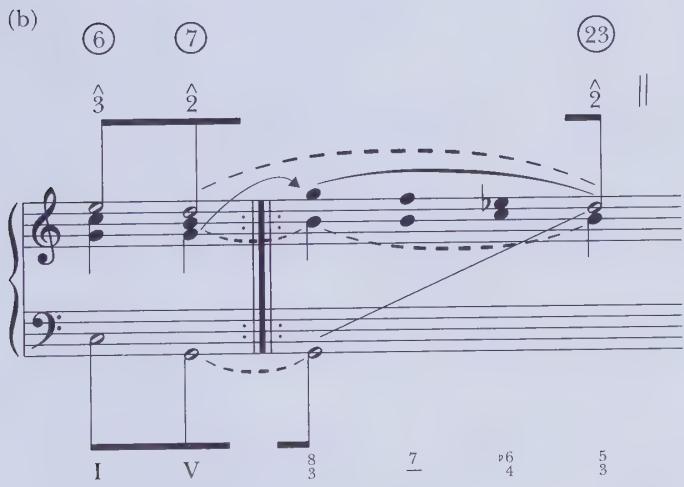
- 页码:9-10
- 11.8 [描述性拆分] Exposition: Second Theme Analysis (bars 18–35)
- 页码:11-13
- 11.9 [描述性拆分] Exposition: Second-Theme Structural Overview and Tonic Prolongation
- 页码:14-15
- 11.10 [描述性拆分] Development Section (bars 36–49)
- 页码:15-17
- 11.11 Recapitulation (bars 50–84)
- 页码:18-18
- 11.12 [描述性拆分] Mozart, Piano Sonata, K. 457, I: Introduction and Exposition Overview (bars 1–19)
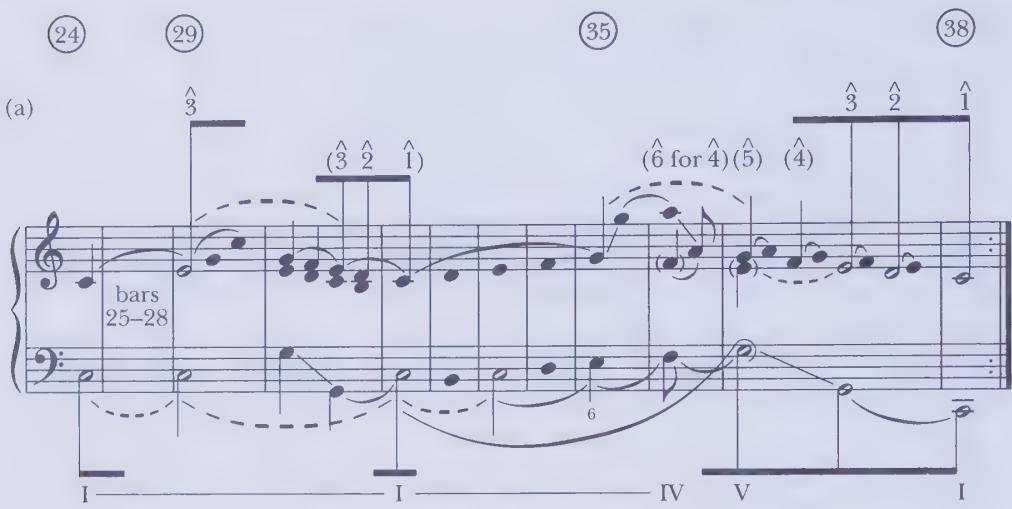
- 页码:18-19
- 11.13 [描述性拆分] Exposition: Transition as Thematic Deception (bars 19–35)
- 页码:19-20
- 11.14 [描述性拆分] Exposition: Second Theme and Harmonic Structure (bars 34–59)
- 页码:21-22
- 11.15 [描述性拆分] Exposition: Second Theme, Alto Line, and Closing Section (bars 36–71)
- 页码:23-28
- 11.16 [描述性拆分] Development: Overview and Upper-Voice Line (bars 71–99)
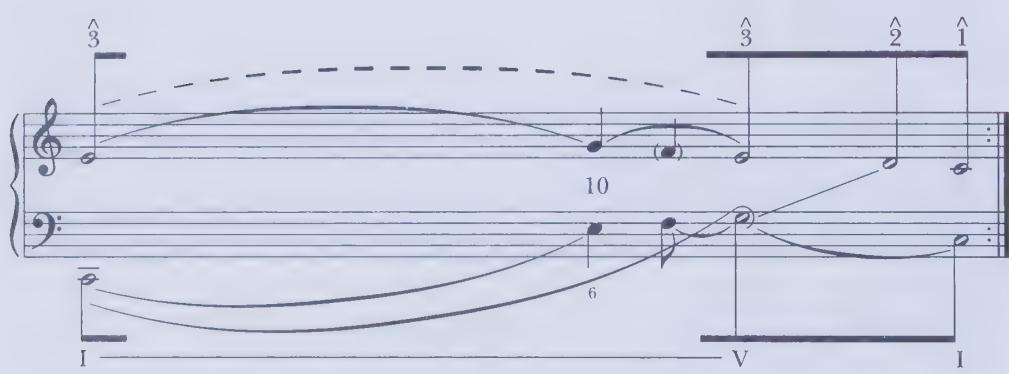
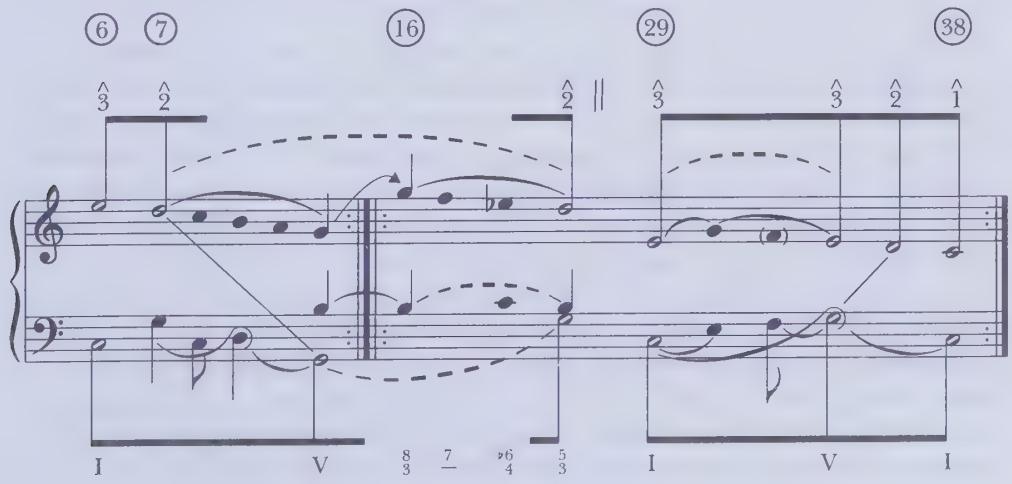
- 页码:28-31
- 11.17 [描述性拆分] Exposition and Development: Middleground Synopsis
- 页码:31-31
- 11.18 [描述性拆分] Recapitulation: Transition with Augmented-Sixth Deception (bars 118–129)
- 页码:32-34
- 11.19 [描述性拆分] Recapitulation: Second Theme, Cadential Descents, and Coda (bars 139–185)
- 页码:34-38
- 11.20 [描述性拆分] Conclusion: Sonata Principle and Pieces for Analysis
- 页码:38-41
- 11.21 Notes
- 页码:41-43
11.1 [描述性拆分] Introduction to the Sonata Principle
第1段(P0001)
原文复述
Sonata Principle
中文讲解
这是章节标题。原文中的井号(#)代表一级标题的版式标记。该标题引出全章的核心论题——奏鸣原则(sonata principle),并预示后续段落将围绕这一概念的界定、特征识别和实例分析展开。作为标题,其功能是结构性的而非论证性的:它框定了本章所使用的术语体系(特别是 ‘sonata principle’ 与 ‘sonata form’ 的取舍),并向读者表明本节是进入正文的入口。
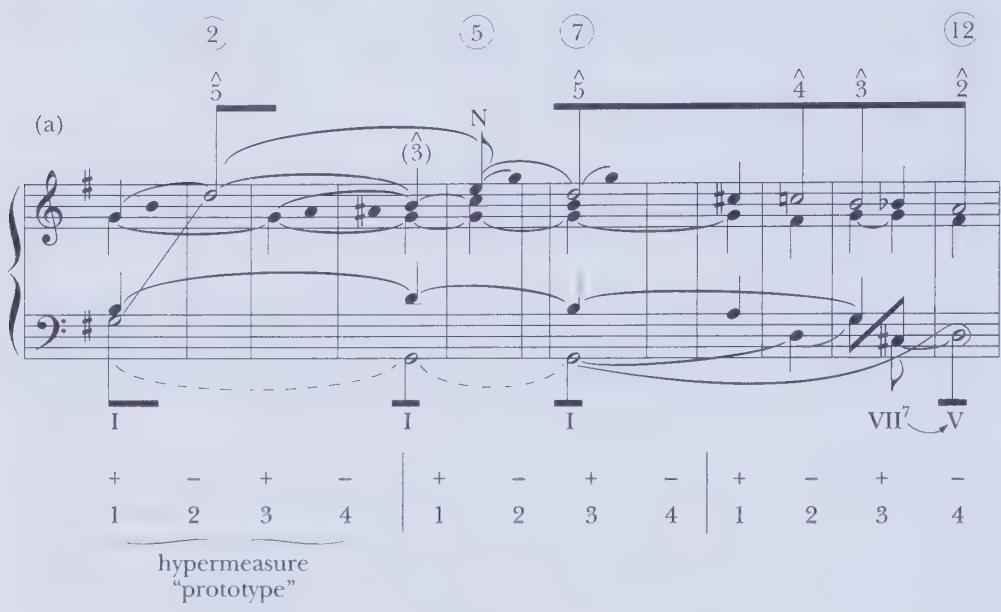
第2段(P0002)
原文复述
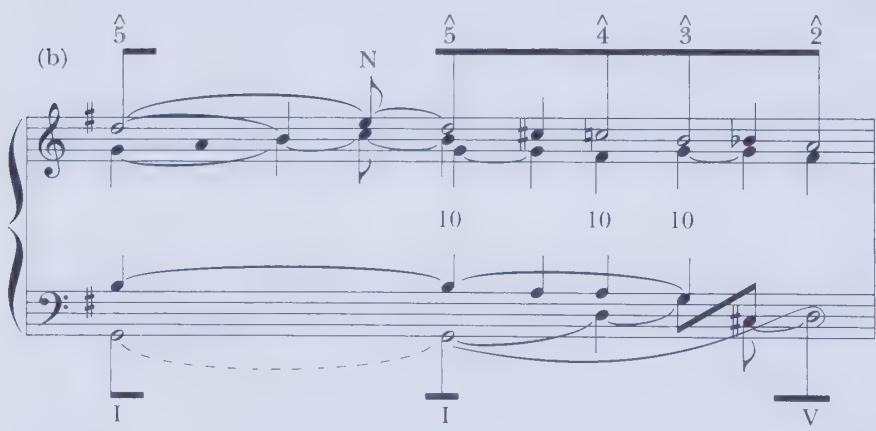
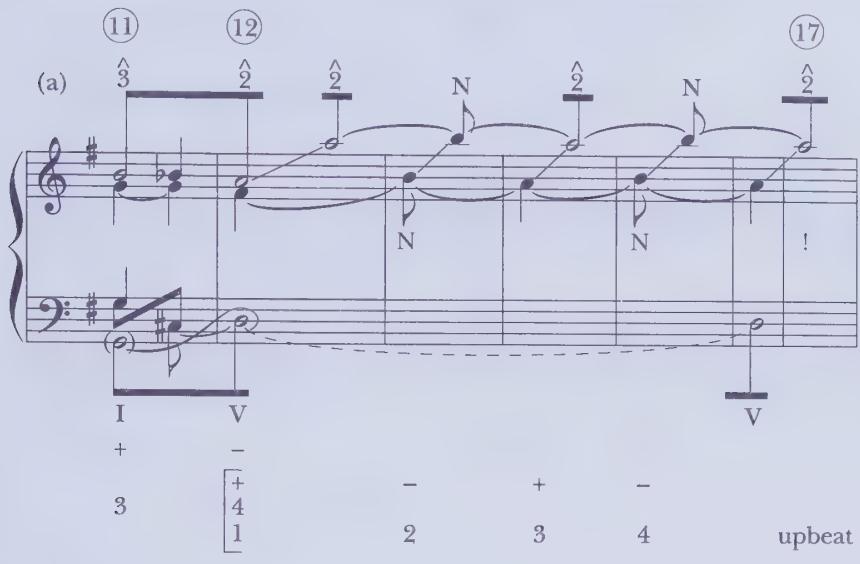
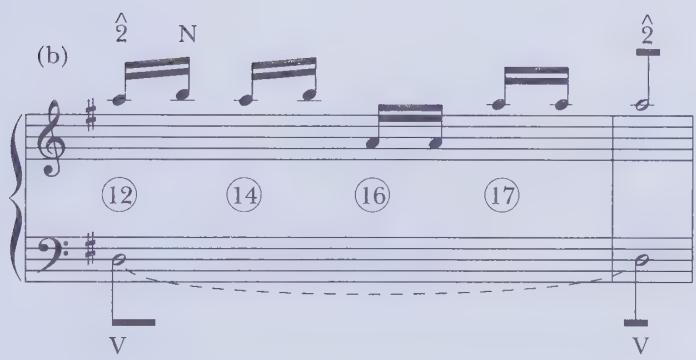
The sonata principle is one of the most complex tonal compositional procedures. It went through various stages of development from the early eighteenth to the late nineteenth century, and composers during this period created an extraordinarily rich and diverse repertory. Often referred to as a standard formal type, it resists attempts to formulate descriptive generalizations, which can oversimplify rather than accurately represent its multifaceted character. (It is for this reason that we prefer the term sonata principle to the more standard “sonata form.”) However, certain fundamental characteristics can be identified that distinguish sonata movements from other types such as rondo, rounded binary, and ternary compositions. In this chapter we limit our discussion to compositions from the high Classical period, a watershed in the development of the sonata. Even so, bear in mind that we consider only representative examples; composers of the Classical period treated the sonata principle with great flexibility. A comprehensive study of this vast topic would require the scope of several books, not that of a single chapter. The characteristics we explore here, however, will provide a foundation for further study of sonata movements from the eighteenth and nineteenth centuries. ¹
中文讲解
本段是全章的纲领性段落,同时完成三件事:定义术语、限定范围、声明方法论。需要逐层拆解。
第一,主张与位阶:作者把奏鸣原则定位为’最复杂的调性作曲程序之一’(one of the most complex tonal compositional procedures)。注意 ‘one of the most’ 是带保留的最高级——肯定其复杂地位,但同时承认存在其他可比较的复杂程序,不是独一性判断。
第二,历史范围与多样性:奏鸣原则的发展跨度被划定为’十八世纪初至十九世纪末’,并强调这一时期产生了’极其丰富且多元的曲目’(extraordinarily rich and diverse repertory)。‘丰富’强调数量,‘多元’强调差异——这种双重修饰正是为后面为何难以概括埋下伏笔。
第三,核心术语立场:奏鸣原则’常被称为一种标准的曲式类型’(a standard formal type),但’抵制描述性概括的尝试,因为后者会过度简化而无法准确呈现其多面特征’。括号内的句子直接揭示作者的方法论取舍——正因如此,他们宁可使用 ‘sonata principle’ 而非更通行的 ‘sonata form’。这不是文字游戏,而是理论主张:‘principle’ 强调可运作的原理与作曲家所享有的灵活性,而 ‘form’ 暗示可套用的固定模板。把这句话放进括号而非脚注,说明作者认为这一立场需要在正文层面直接被读者看见。
第四,与其他类型的区别:作者承认可以识别出’某些根本特征’(certain fundamental characteristics)使奏鸣乐章区别于回旋曲(rondo)、对称二段式(rounded binary)和三段式(ternary compositions)。‘certain’ 与 ‘fundamental’ 并置是有意为之——既肯定存在可识别的特征(否则无法区分),又限定其数量与稳定性(不是穷尽性的规则清单)。这一句也暗含一个前提:读者须已熟悉这些对照曲式,否则区分无所附着。
第五,时间聚焦与’分水岭’定位:作者把讨论’限定于’(limit…to)‘古典盛期’(high Classical period),并称之为奏鸣发展的’分水岭’(watershed)。‘watershed’ 一词意味着这是转折点或决定性阶段,而非单纯的早期阶段——它之所以被选中,是因为后续特征正是在此定型。
第六,灵活性的双重限定:尽管聚焦于古典盛期,作者立刻提醒,即使在此时期’作曲家以极大的灵活性’(great flexibility)处理奏鸣原则,并且本章所举仅为’代表性’(representative)范例。这两层限定同时存在:作曲家本人手法不僵化,本章举例也不求穷尽。读者据此不应把本章描述当作普适规则。
第七,章节的自我定位:作者坦承’全面的研究需要数本书的篇幅,而非一章’(would require the scope of several books, not that of a single chapter),但本章所探讨的特征’将为进一步学习十八、十九世纪的奏鸣乐章奠定基础’(will provide a foundation)。这是教材体的谦逊修辞,同时表明本章是导论而非定论——为后续可能的延伸留下空间。
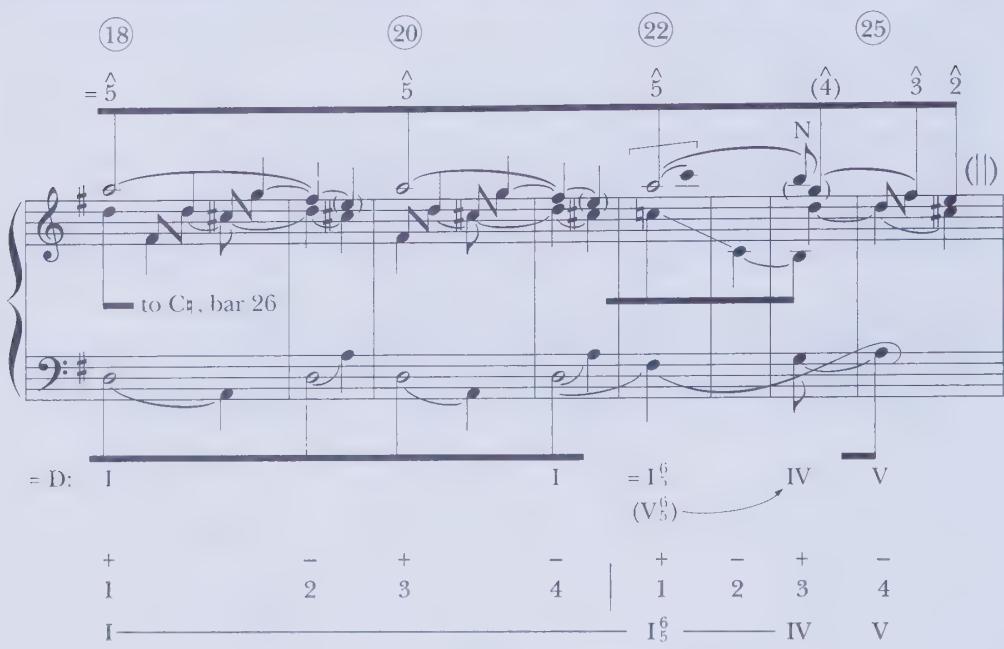
综合而言,本段的所有限定词(‘one of the most’、‘various’、‘often’、‘resists’、‘certain’、’limit’、’even so’、‘only’、‘representative’)共同构成一套谨慎语,提醒读者:奏鸣原则既复杂又有规则可循,既要描述又不能过度简化。
补充说明
原文末尾的上标 ‘¹’ 标示存在一条脚注,但该脚注的具体内容不在本节输入范围内,故此处仅作记录、不展开其内容。
第3段(P0003)
原文复述
Our first example is a movement from one of Clementi’s sonatinas. As the title suggests, this piece is a “little” sonata, displaying on a smaller scale many of the features associated with longer and more complex sonata movements. The second and third examples of this chapter are drawn from the works of Mozart and are typical of the Classical sonata in terms of breadth and complexity. In accordance with the focus of this book we will concentrate on the structure of each work, but will do so in the context of its form and style.
中文讲解
本段交代了本章的例证选择与观察视角,需从两个层次理解。
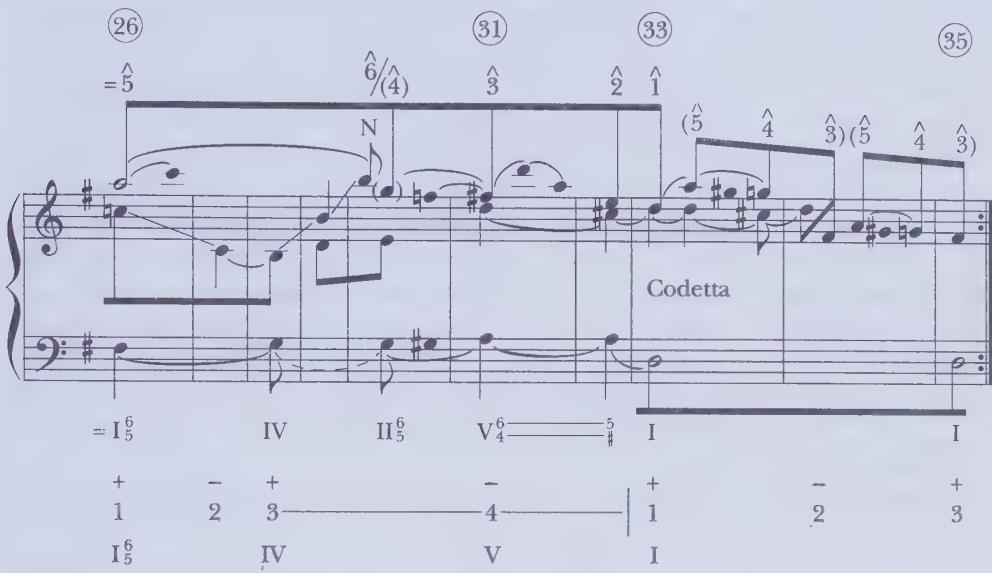
第一,例证安排体现教学递进:第一个例子取自克莱门蒂的’小奏鸣曲’(sonatina)。作者直接点明 ‘sonatina’ 即 ’little sonata’,并在 ‘小尺度’(smaller scale)上展现’更长、更复杂的奏鸣乐章的许多特征’。这是一种典型的教材策略——先用一个简化样本,让读者在不受细节干扰的情况下识别关键结构特征;再用完整样本去验证这些特征在标准规模上如何体现。两类样本的功能不同:克莱门蒂是’入门放大镜’,莫扎特才是’参照基准’。
第二,分析视角的内部区分:作者说’依据本书的重点’(in accordance with the focus of this book),将’集中于每部作品的结构’(concentrate on the structure of each work),‘但在形式与风格的语境中’(in the context of its form and style)进行讨论。这里 ‘structure’ 与 ‘form and style’ 并不是同义重复。‘结构’指的是作品内部的具体组织(如乐句划分、和声进行、声部关系);‘形式与风格’则是更宏观的语境,涵盖体裁惯例和风格特征。‘集中于……但在……语境中’这一句式意味着分析的重心落在结构上,但解释时必须不断回到形式与风格的框架中加以理解。
本段为后续的具体分析预设了三个抓手:用何例、按何顺序、循何视角。读者据此预期:先看简化样本,再看标准样本;先聚焦结构,再放入形式与风格的语境。
第4段(P0004)
原文复述
Sonata movements can easily span hundreds of measures, and we will not discuss all aspects of each piece or graphically illustrate all details of harmony and voice leading. Therefore, we sometimes present graphs that focus primarily on the harmony and voice leading of middleground levels. You should have no
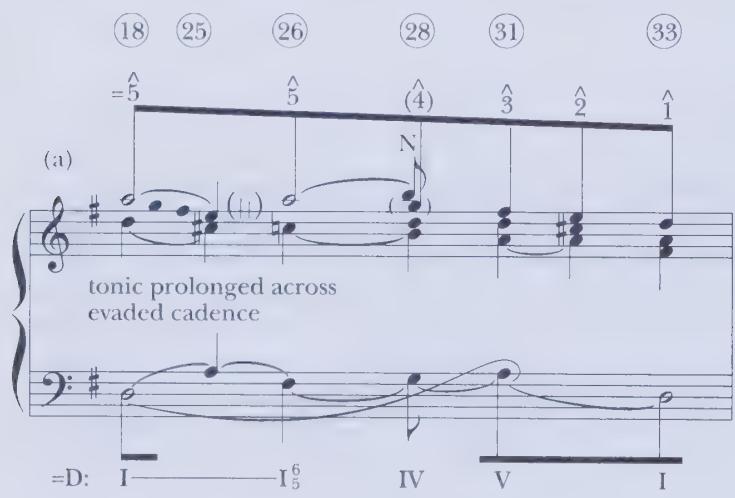
中文讲解
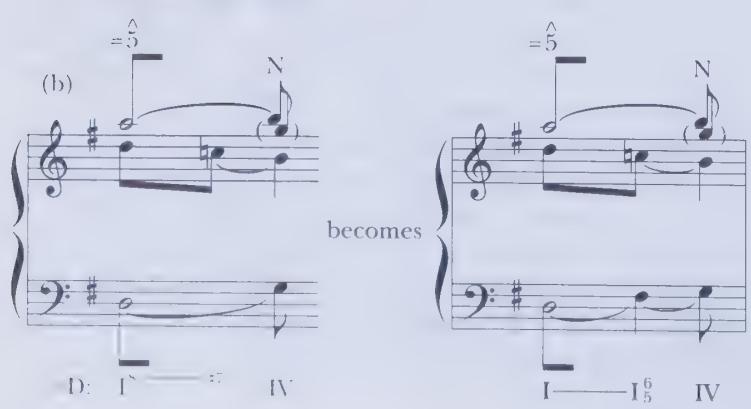
本段在该节边界内未完成,最后一句在 ‘You should have no’ 处戛然而止,完整含义有待下节续接。即便如此,作者已交代三点关键信息。
第一,规模认知:奏鸣乐章’很容易跨越数百小节’(can easily span hundreds of measures)。这是对其物理规模的客观陈述,作用是为下一句的取舍提供合理性——既然篇幅庞大,逐细节展示既不可能也无必要。
第二,方法取舍的明确声明:作者宣称’不会讨论每首作品的方方面面’(will not discuss all aspects of each piece),也不会’用图示呈现和声与声部进行的所有细节’(graphically illustrate all details of harmony and voice leading)。两个 ‘all’ 并列,强调这种省略是方法论上的主动选择,而非疏漏。读者据此应预期:分析是有侧重的。
第三,分析工具的层级预告:作者说明将’有时呈现主要聚焦于中景层面(middleground levels)和声与声部进行的图示’。‘中景’是结构层级中的中间层——相对于可听到的所有细节(前景层面)与作品最基本的结构骨架(背景层面)而言,它保留了足以显示和声与声部进行逻辑的简化呈现。这一术语是阅读后续图示的钥匙:读者若不理解中景的含义,就无从判断图示省略了什么、保留了什么、为何这样选择。
本段主要功能是为读者设定期望——分析不会穷尽一切,图示也只截取特定层级。由于该段在本节边界内未完成,‘You should have no’ 之后的内容须在下节方可得知。
脚注 / 边栏 / 图表 / 附加信息(如有)
本节内出现的附加材料仅为段落 P0002 末尾的脚注引用标记 ‘¹’,该脚注的具体内容不在当前小节输入范围内,故仅作标注、不展开。本节无图表、无边栏、无乐谱占位符。
💡 本节核心要点
- 奏鸣原则被作者定位为’最复杂的调性作曲程序之一’,作者明确反对对其作描述性的过度简化概括
- 作者主动选择 ‘sonata principle’ 而非更通行的 ‘sonata form’,强调其作为运作原理的灵活性而非可套用的固定模板
- 本章将讨论范围限定于’古典盛期’这一奏鸣发展的’分水岭’,并提醒读者:即便在该时期内,作曲家处理奏鸣原则仍具有高度灵活性
- 作者按教学递进安排例证:先以克莱门蒂的小奏鸣曲作为入门样本(小尺度呈现关键特征),再以莫扎特作品作为古典奏鸣的典型代表
- 分析视角聚焦于作品的’结构’,但始终置于’形式与风格’的语境之中加以讨论
- 由于奏鸣乐章篇幅庞大,作者明确采取取舍策略:呈现以中景层级的和声与声部进行为主的图示,而非穷尽一切细节
🔑 关键术语
- sonata principle(奏鸣原则):作者刻意选用的术语,用以取代更通行的 ‘sonata form’(奏鸣曲式),强调奏鸣是一组可运作的作曲原理与程序,而非可套用的固定模板;该术语本身即体现了作者反对过度简化概括的方法论立场
- sonata form(奏鸣曲式):原文中作为对比术语出现的更通行名称;作者因该词易导向把奏鸣当作固定模板来理解而避免使用
- high Classical period(古典盛期):本章讨论的时间聚焦范围,作者称之为奏鸣发展的 ‘watershed’(分水岭);‘盛期’ 强调这是该时期的高峰阶段,决定性特征在此定型
- rounded binary(对称二段式):原文中作为奏鸣乐章的对照曲式之一出现,提示读者:奏鸣原则的讨论将建立在与其他曲式类型的区分之上
- sonatina(小奏鸣曲):原文中作为第一个分析对象出现,是 ‘sonata’ 的指小形式(’little’ sonata);在’小尺度’上展现较长奏鸣乐章的结构特征,在本章中充当教学法的入门样本
- middleground(中景):原文中与图示分析直接相关的层级概念,指介于所有可听细节与作品最基本结构骨架之间的中间结构层;本章图示主要聚焦于该层级的和声与声部进行,读者据此理解图示省略与保留的范围
11.2 [描述性拆分] Clementi, Sonatina, Op. 36, No. 1, I: Exposition (bars 1–15)
第1段(P0005)
原文复述
Example 11.1
中文讲解
这是 Example 11.1 的小节标题,位于 page 2 上方,承担开启一个示范性 Schenker 式缩简图的功能。它本身不包含分析内容,只是为随后出现的图注(P0006)、图(P0007)以及分析段落(P0008–P0014)提供视觉与逻辑上的起点。
第2段(P0006)
原文复述
Clementi, Sonatina, Op. 36, No. 1, I, bars 1–15: (a) foreground and (b) middleground reductions
中文讲解
这是 Example 11.1 的图注,标明所分析的曲目为 Clementi《Sonatina, Op. 36, No. 1》第一乐章 bars 1–15,并说明图中包含两层 Schenker 式缩简:(a) 前景缩简 与 (b) 中景缩简。图注本身是元信息层,提示读者要把两层图配合乐谱一起读。
第3段(P0007)
原文复述
中文讲解
这是 page 2 上的图像占位符,原书的内嵌图数据已省略,仅保留位置与图注信息。结合 P0006 的图注,此处承载的应是 Example 11.1 的前景缩简图(foreground reduction, (a)),是后续分析段 P0010、P0011 反复引用的对象。读者须查阅原书方能见到具体图形与音符标注。
补充说明
无额外补充;图中具体符号与音名属于不可见细节,本节不予猜测。
第4段(P0008)
原文复述
trouble understanding the detail of passages we show only in middleground form; time spent studying the graphs in conjunction with the music will reinforce your understanding of principles presented in earlier chapters.
中文讲解
这是承接上一页的一个句子片段,作者借此向读者提出方法论建议:对于仅以中景形式呈现的段落,若感到把握细节有困难,应将缩简图与原谱并置研读;这种图—谱对照方式有助于巩固前几章已讲过的原则。它本身不分析 Clementi 曲例,而是为接下来的图像与音乐分析做心理与学习策略上的铺垫。
补充说明
本段起始为小写 “trouble”,可见它是上一页一句话的延续,完整句意大致为 “If you have trouble understanding the detail of passages we show only in middleground form, time spent studying the graphs in conjunction with the music will reinforce your understanding of principles presented in earlier chapters."——但本节输入并未提供该完整原句,故仅按现有片段处理。
第5段(P0009)
原文复述
Clementi, Sonatina, Op. 36, No. 1, I
中文讲解
这是位于 Example 11.1 之下的子标题,明确标出被分析的曲目、曲目号、乐章编号与乐章次序。它将一般性的 “Example 11.1” 标题与即将展开的逐段分析衔接起来,起到题目—正文之间的分隔作用。
第6段(P0010)
原文复述
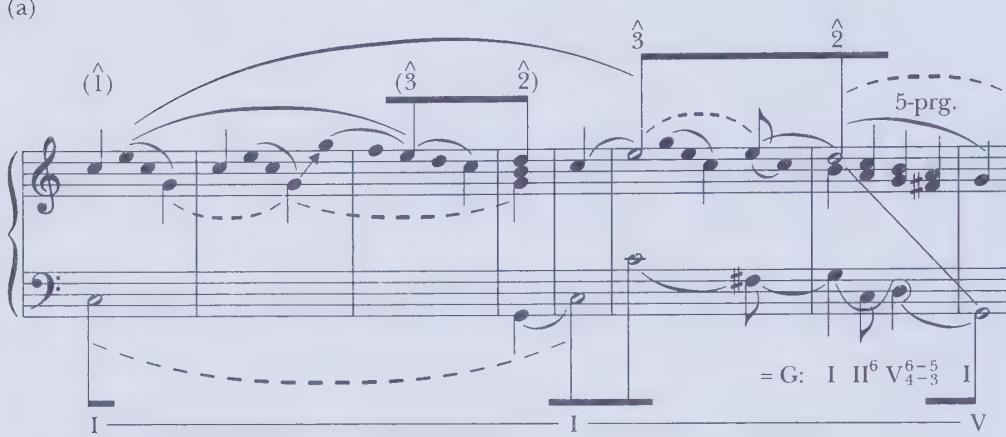
Example 11.1 presents a voice-leading graph of bars 1–15. Notice that we interpret a $\hat{3}-\hat{2}$ motion in the first phrase, but one that is stated rather indirectly in the diminution of bars 3–4. The primary tone $\hat{3}$ emerges most definitively in the subsequent phrase, on the downbeat of bar 6. In this same bar we also begin to hear harmonic motion away from the tonic toward the key of the dominant: $#$ 4 (F#) in the bass is a prominent indicator that a modulation is beginning. In bars 7–8 the emergence of the dominant key is complete: the local upper voice descent $\hat{5}-\hat{4}-\hat{3}-\hat{2}-\hat{1}$, in conjunction with an authentic cadence in the key of G, confirms the modulation.
中文讲解
本段逐句讲解 bars 1–15 的声部进行图,递进地揭示四个观察点:
- 第一乐句里存在 $\hat{3}-\hat{2}$ 的进行,但它在 bars 3–4 的细分(diminution)中被相当含蓄地陈述;
- 主音 $\hat{3}$ 直到下一乐句 bar 6 的正拍才以最确定的形式浮现;
- 同一小节(bar 6)的低音出现升四级 $#\hat{4}$(F#),这是离调开始朝属方向(G 大调)运动的显著征兆;
- bars 7–8 中,本地上声部完成 $\hat{5}-\hat{4}-\hat{3}-\hat{2}-\hat{1}$ 的下行,并配合 G 大调的正格终止,调性的转调由此被确认。
教学意义:作者通过这条线索告诉读者,主音的出现位置与调性确立位置并不重合——主音在 bar 6 落地,而调性的转调则在 bars 7–8 才完成;因此分析时必须分辨 “结构性主音浮出” 与 “新调结构性确立” 两种不同事件。
补充说明
本段中 “primary tone” 指作为某段结构锚点的核心结构音,本节取 $\hat{3}$;“diminution” 指前景通过更细的节奏与旋律活动来延长单一结构音的展开手法;F# 作为低音升四级,是离调开始的标准信号音。
第7段(P0011)
原文复述
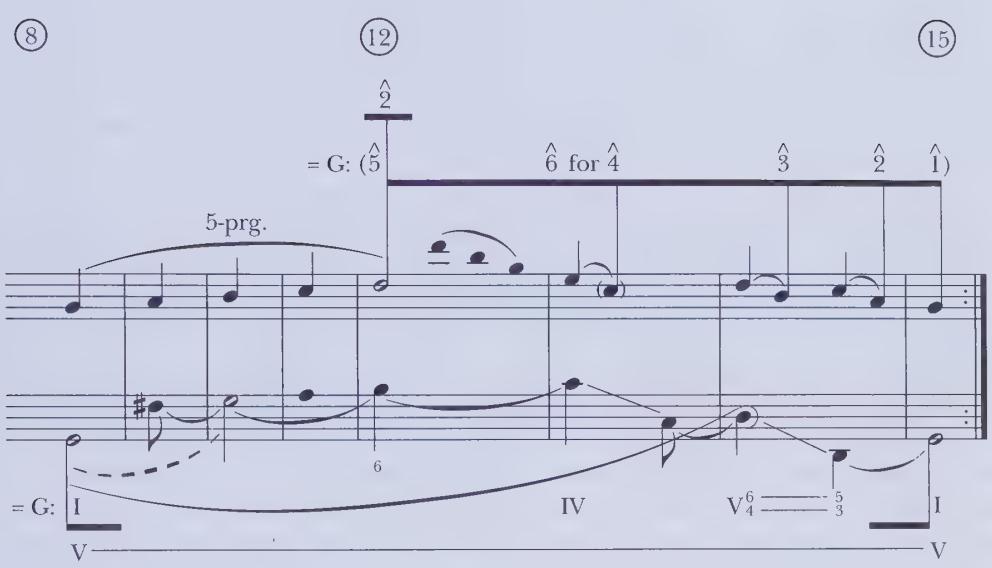
As you know, this first section (bars 1–15) is commonly referred to as the exposition of the movement, the essence of which is the juxtaposition of two key areas. You are also probably familiar with other terms such as first theme and second theme (or second group) used to describe the subordinate key area. Schenker’s perspective, however, led him to understand an exposition in terms of the processes of composing-out (Auskomponierung), involving linear progressions and structural bass motions. $^{2}$ In our sonatina he would describe the first part of the exposition in terms of the establishment and prolongation of the primary tone structural cadence (bars 12–15) in which the upper voice is more elaborated than in bars 7–8. (Notice in Example 11.1b that the covering neighbor tone E in bar 13 substitutes for C in the descent, a common procedure in descents from 5.)
中文讲解
本段把常见的曲式术语(呈示段、第一主题、第二主题/第二组)与 Schenker 的分析视角加以对照,核心论点如下:
- 呈示段的本质是 “两个调区的并置”(传统说法),但 Schenker 将其理解为 展开式写作(Auskomponierung)——即通过线性进行(linear progressions)与结构低音运动(structural bass motions)把背景展开到前景;
- 在本首小奏鸣曲中,呈示段前半的 Schenker 式描述是:对主音($\hat{3}$)的建立与延长,构成 bars 12–15 的结构终止(structural cadence);
- 与 bars 7–8 相比,bars 12–15 的上声部更细化(more elaborated);
- 在 Example 11.1b 中可以看到一个细节:bar 13 用作覆盖邻音(covering neighbor tone)的 E 替代了从 $\hat{5}$ 下行中本应出现的 C,作者明确指出这是 $\hat{5}$ 下行中常见的一种做法。
教学意义:这一段把 “主题—主题” 的曲式语言替换为 “主音 + 结构终止 + 转移型展开” 的 Schenker 语言,并指认了 $\hat{5}$ 下行被覆盖邻音填补的典型手法,作为读者自己在分析其他呈示段时可借鉴的细节模板。
句中 $^{2}$ 为脚注引用,指向关于 Auskomponierung 概念的进一步说明。
补充说明
Auskomponierung(构成外化 / 展开式写作)是 Schenker 理论的核心方法概念,指把和声与线性的背景结构通过前景材料逐步实现出来;“linear progression”(线性进行)指上声部的级进声部运动;“structural bass motion”(结构低音运动)指支持上声部的大尺度低音琶音;“covering neighbor tone”(覆盖邻音)是 $\hat{5}$ 下行展开中插入以填补第三度空隙的邻音。
第8段(P0012)
原文复述
中文讲解
这是 page 3 上的图像占位符,原书内嵌图数据已省略。结合上下文(本节 P0006 已声明 (a) 前景、(b) 中景两层缩简;page 2 上已放置 (a)),此处承载的应为 Example 11.1 的 中景缩简图(middleground reduction, (b))。具体图形、符头与标注属不可见细节,读者须查阅原书。
第9段(P0013)
原文复述
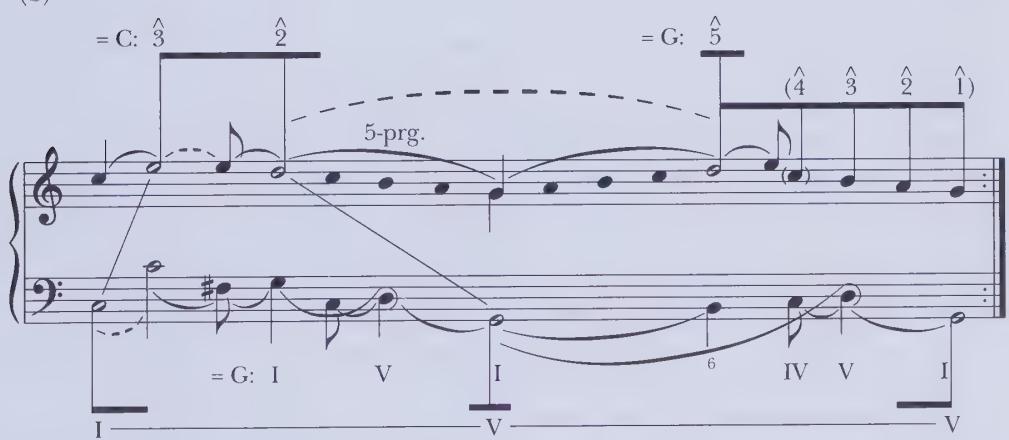
The second key area arises from the dominant scale step of the structural bass arpeggiation. The way in which the musical content of the second key area develops is through an Ursatz form transferred to a lower level. As Example 11.1 shows, 5-4-3-2-1 in the key of G over a complete harmonic progression (at the foreground) prolongs the higher-level structural 2 over V in C major (2 in C=5 in G). Notice that we depict the arrival of the structural dominant in the bass (with an open notehead) in bar 8. Although a root-position tonic in G appears in bar 7, the modulation is still emerging. Only at the cadence is the secondary key area established conclusively. The upper voice then regains d² via an ascending fifth-progression; the exposition concludes with a
中文讲解
本段由两部分构成:(1) page 3 上的一张图像占位符(结合上下文应为例 11.1b 的中景缩简图),其 OCR 结果把图中数字与小节号(如 “(b)"、“12”、“15”、“3 over tonic harmony”)与周围正文混在一起;(2) 紧随其后的分析正文,承接 P0011 的 Schenker 视角,把第二调区与更高层次的结构联系起来,论点层层推进:
- 第二调区来自结构低音琶音中的属音级音(即 C 大调结构低音的 $\hat{5}$ = G 大调的 $\hat{1}$);
- 第二调区的内容以一种 “转移型 Ursatz”(Ursatz form transferred to a lower level)展开——也就是说,基本结构被下放到下属层次并以新调重述;
- 例 11.1 显示:前景层面 G 大调中的 5–4–3–2–1,承载着一整套和声进行,在更高层次上延长了 C 大调中 “$\hat{2}$ over V” 这一结构——其等价关系是 $\hat{2}$ in C = $\hat{5}$ in G;
- 图中 bar 8 的结构属音以空心符头(open notehead)标出,作为结构性到达的标记;
- 即便 bar 7 已出现根位 G 主和弦,调性转调仍处于 “emerging”(浮现中),要到终止处才被最终确立;
- 上声部之后通过一个上行五度进行(ascending fifth-progression)重新取得 d²,呈示段继续(句子未完,结尾 “the exposition concludes with a” 留作悬念,自然衔接到 P0014)。
教学意义:本段示范了 Schenker 分析中最关键的一项判断力——区分表层调性事件(bar 7 的根位 G 主和弦)与结构层面调性的确立(终止处);同时把 “转移型 Ursatz” 这一概念具体化为 C 调 $\hat{2}$ 与 G 调 $\hat{5}$ 之间的层级等式。
补充说明
“Ursatz” 指 Schenker 理论中的基本结构(典型形式为 $\hat{3}-\hat{2}-\hat{1}$ over I–V–I);“transferred Ursatz” 指基本结构被转移到较低层次并在新调中重述;d² 为亥姆霍茨音高记号,指小字二组的 d;Schenker 图中用空心符头(open notehead)标记结构到达或延长节点是常见记谱法。
第10段(P0014)
原文复述
The technique of prolonging structural $\hat{2}$ (in the exposition) with subordinate fifth-progressions occurs in a great many sonata movements, but it is by no means the only possible way to prolong $\hat{2}$ over V. The most important points for the analyst to bear in mind are: (1) that the first part of a Classical sonata exposition establishes the primary tone and initial tonic of the structure; (2) that the second part always involves the composing-out of a subordinate key (typically V in major or III in minor) through bass and upper-voice motions in that key (usually involving a transferred form of the Ursatz). The particular nature of the Ursatz form will vary, however, using any number of the techniques we have explored previously. Analysis will reveal how the basic principles elaborated here are uniquely realized in each case.
中文讲解
本段是本节的小结,作用是把 Clementi 案例所展现的具体手法抽象为可移植的分析原则,分为两层:
第一层——技术层面的警告:用 “下级五度进行”(subordinate fifth-progressions)延长结构 $\hat{2}$ 是古典奏鸣曲呈示段中很常见的做法,但绝非唯一手段;分析者不应把这种技术当成普遍法则。
第二层——两条分析者须牢记的核心要点:(1) 古典奏鸣曲呈示段的前半部分建立结构的主音与起始主调;(2) 后半部分总是通过下属调区(大调中典型为 V、小调中典型为 III)的低音与上声部运动来展开该下属调(通常涉及一种 Ursatz 的转移形态)。
第三层——保留弹性:Ursatz 的具体形态可以变化,前几章探讨过的多种技术都可能被调用;每一首作品都会以独特的方式实现这些基本原理,分析的目的就是揭示这些独特实现。
教学意义:作者通过这段总结从单一作品跃升到方法论,提醒读者:基本原理有限,但具体实现无限,分析的任务是揭示每首作品的独特实现方式。
补充说明
小调呈示段下属调典型为 III(本关系大调),这一并置在本节作为通用原则列出,但不展开小调示例。
脚注 / 边栏 / 图表 / 附加信息(如有)
本节的附加材料集中于 Example 11.1 的两张 Schenker 式缩简图:page 2 上的前景缩简((a))与 page 3 上的中景缩简((b))。两图的内嵌图像数据均已省略,读者须参阅原书方可看到具体图形、符头与音名标注;可从 P0010–P0013 的描述中确认图中标注涉及小节号 12、15、bar 8,以及结构音 $\hat{3}$、$\hat{2}$、F#、C、E 等具体音,并以空心符头在 bar 8 处标记结构属音的到达。P0011 中以 $^{2}$ 标记的脚注引用指向关于 Auskomponierung 概念的进一步说明,但该脚注正文未包含在本节输入之中,故不予展开。除此之外,本节无其他脚注、边栏或独立图表。
💡 本节核心要点
- 呈示段(bars 1–15)的本质在传统曲式语言中是 “两个调区的并置”,但在 Schenker 视角下是一种 展开式写作(Auskomponierung)过程:前半段建立主音($\hat{3}$)并延长其结构终止(bars 12–15),后半段通过一种 转移型 Ursatz 在下属调(G 大调)中展开其内容。
- $\hat{3}-\hat{2}$ 的进行在 bars 3–4 的细分中以含蓄形式陈述,结构主音 $\hat{3}$ 直到 bar 6 正拍才以最确定的形式浮现;bar 6 低音中 F#($#\hat{4}$)是转调开始的显著征兆,转调在 bars 7–8 由 $\hat{5}-\hat{4}-\hat{3}-\hat{2}-\hat{1}$ 的上声部下行配合 G 大调正格终止而确立。
- bars 12–15 的上声部比 bars 7–8 更细化;在 Example 11.1b 中可看到 bar 13 的覆盖邻音 E 替代了从 $\hat{5}$ 下行中本应出现的 C——这是 $\hat{5}$ 下行展开时常见的手法。
- 第二调区由结构低音琶音的属音级音产生,并通过转移型 Ursatz 发展:前景中 G 大调的 5–4–3–2–1 延长了更高层次 C 大调中的结构 $\hat{2}$ over V($\hat{2}$ in C = $\hat{5}$ in G);结构属音在低音中的到达以空心符头在 bar 8 处标记。
- 分析者须区分表层转调事件(bar 7 已出现根位 G 主和弦)与结构性调性确立(要到终止处才完成);Ursatz 的具体形态可变,但两条原则不变——呈示段前半建立主音与起始主调,后半以转移型 Ursatz 展开下属调区(大调典型 V、小调典型 III)。
🔑 关键术语
- Auskomponierung(展开式写作 / composing-out):Schenker 理论中的核心方法概念,指把和声与线性的背景结构通过前景材料逐步实现出来。在本节中,特指呈示段的两段分别通过线性进行与结构低音运动来延长各自的结构音与和声区域的过程。
- Primary tone(主音 / 结构主音):作为某段音乐结构锚点的核心结构音。本节 bars 1–15 中取 $\hat{3}$,它在 bar 6 正拍上才以最清晰的形式浮现。
- Transferred Ursatz(转移型 Ursatz):将基本结构(典型形式 $\hat{3}-\hat{2}-\hat{1}$ over I–V–I)以较低层次在新调中重述的手法。本节中 G 大调前景的 5–4–3–2–1 即为这种转移形态,其作用是延长更高层次 C 大调中的结构 $\hat{2}$ over V。
- Structural cadence(结构终止):标志某大段落结束的大尺度终止事件。本节呈示段前半(bars 12–15)被描述为对主音($\hat{3}$)的建立与延长,构成一次结构终止,其上声部比 bars 7–8 更细化。
- Covering neighbor tone(覆盖邻音):插在下行三度之间以填补音程的邻音。本节 Example 11.1b 中 bar 13 的 E 替代了从 $\hat{5}$ 下行中本应出现的 C,作者明确把它指认为 $\hat{5}$ 下行展开中常见的一种做法。
- Diminution(细分 / 缩减):前景中将一个结构音通过更密集的节奏与旋律活动加以延长的展开手法。本节 bars 3–4 中的 $\hat{3}-\hat{2}$ 正是以细分形式被含蓄陈述的例子,而非以独立结构事件出现。
11.3 [描述性拆分] Clementi, Sonatina: Development Section (bars 16–23)
第1段(P0015)
原文复述
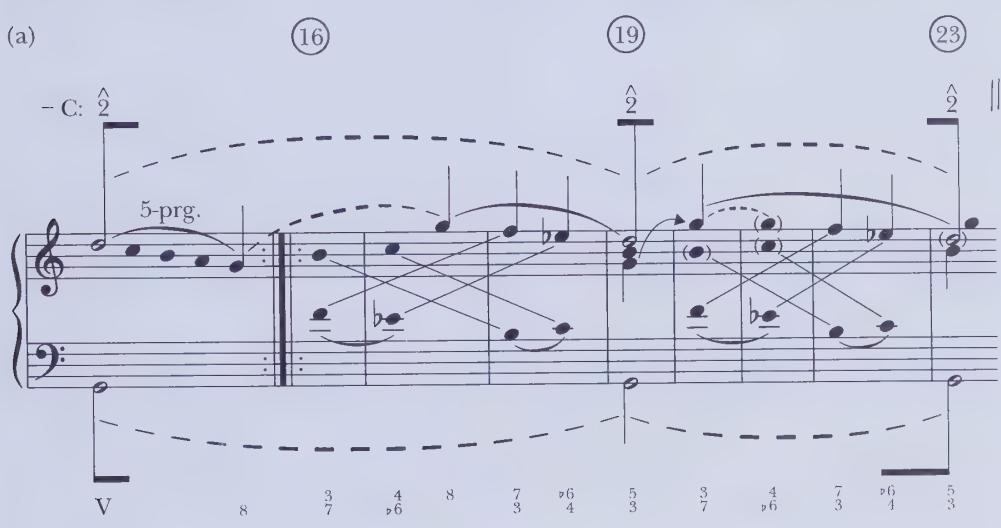
The next part (bars 16–23) is the development section of this movement; we will begin by examining the lower voice and harmonic structure (Example 11.2). As the graph shows, the first notes of the written lower voice are to be understood as a “tenor” line above an implied G bass note, the root of the dominant established before the double bar. In bar 19, the G is reinstated and remains throughout the rest of the section. Notice that the tenor line in bars 16–19, F–E♭–B♯–C, is repeated in the second four-bar segment as well. At this point a brief link (a descending fifth) ushers in the next section (bar 23, beats 3–4).
中文讲解
本段宣告进入展开部(16–23小节),并先从低音声部与和声结构入手做分析。需要把握以下几点:
- 谱面上写出的"低音声部”,其实并不真正承担低音功能。它的前几个音应被理解为 G(属音)这个隐含低音之上的次中音(tenor)线条——G 是双重小节线前确立的属音根音。
- 到了第 19 小节,G 才被显性地重新确立为低音,并延续到本段结束。这就把 16–19 与 20–23 分成了两段:前者低音缺位、靠 tenor 与和声暗示 G;后者 G 实在地在场。
- 两条四小节段落是平行结构:16–19 的 tenor 线条 F–E♭–B♯–C 在 20–23 中重复出现,构成了展开部最核心的材料守恒。
- 第 23 小节第 3–4 拍的下行五度是一个短暂的连接(link),把展开部导向下一段落(再现部)。
注意文中标有脚注 3,提示 G 作为属音根音的来源是由双重小节线前的属和弦确立的;这一脚注强化了"低音由和声记忆延续"的论证。
补充说明
脚注 3 标注于"the root of the dominant established before the double bar”,说明该 G 来自双重小节线之前的属和弦,因此本段一开始的 G 只是被和声记忆延续,而非谱面低音。
第2段(P0016)
原文复述
Let us now consider the upper voice, which begins on b♭¹, the third of dominant harmony (bar 16), and proceeds upward in a double voice exchange with the apparent bass. Before the voice exchange unfolds completely, G is superposed from an inner voice to the two-line octave (bar 17). As you may recall, voice exchanges often involve outer and inner voices. In this case, the second part of the voice exchange involves the upper voice (F–E♭). We therefore hear a motion G–F–E♭–D that leads to and emphasizes structural 2̂; the rhythm of this four-bar segment would also suggest that d² is the goal of the line from G. As Example 11.2a shows, bars 20–23 are structurally identical to bars 16–19, including not only the tenor but also the soprano. Therefore bars 20–23 may be regarded as a recomposition (or variation) of the previous four-bar segment.
中文讲解
本段把视角转到上方声部,与 P0015 的低音/和声观察形成对位。需要讲清四点:
- 上声部起始音是 b♭¹——属三和弦的第三音,由此出发向上运动,与"表面上的低音"形成声部交换(voice exchange)。也就是说,原本在低音区的音型被搬到高音区,低音的功能位置其实由内声部接管。
- 声部交换尚未完全展开时,G 已经从内声部叠加到两线八度的位置(第 17 小节)。这一叠加使 G–F–E♭–D 这一线条在听感上变得外露、可辨。
- 这条线 G–F–E♭–D 走向并强调了结构性的 2̂(即 d²);同时,本段的节奏安排也暗示 d² 是自 G 出发的线条的目标。两项证据(旋律走向与节奏落点)相互支持 2̂ 的结构地位。
- Example 11.2a 显示 20–23 小节不仅与 16–19 共享 tenor,也在 soprano 上完全相同,因此 20–23 应被视作前四小节的"再作曲"(recomposition)或变奏,而非新材料。
声部交换的"内外声部参与"是申克分析的常见手法,本例用它解释了为何一个 G 音既出现在低音又出现在高音,结构意义却只有一个。
补充说明
“声部交换"指两个声部互相交换原本属于自己的音;本例中表层低音被搬到高音,原低音由内声部 G 接替,因此听感上看到 G 同时处于两线八度。
第3段(P0017)
原文复述
One point requiring clarification is that scale degree 2̂ is understood only through implication in bar 23, while in bar 19 (the corresponding measure) it is stated explicitly. At the end of development sections, it is common to find scale degree 5̂ occurring prominently in the upper voice, highlighting the dominant of the main key. In bar 23 the g² substitutes for d², and is melodically related to the previous occurrences of 5̂ in bars 17 and 20–21.
中文讲解
本段聚焦于 19 小节与 23 小节这两个"对应小节"之间的关键差异,以及由此引出的展开部写作惯例。需把握:
- 2̂(d²)在两个对应位置上的呈现方式不同:第 19 小节是显性的(stated explicitly),第 23 小节只能通过暗示来理解(implied)。这呼应了 P0015–P0016 关于 16–19 和 20–23 是结构平行但非完全等同的判断——后者对 2̂ 的处理更含蓄。
- 展开部末尾的常见写作惯例是让 5̂ 在上方声部显著出现,以强调主调的属音。第 23 小节的 g² 充当了这一角色。
- g² 同时也与 17、20–21 小节中出现的 5̂ 保持旋律上的联系,因此即便它"代替"了本应到来的 d²,仍然延续了属音在上方声部的强调功能。
简言之,作者用这条细节说明:展开部的两次四小节看似重复,实际在结构性目标音的处理上做了精心的明/暗分工。
补充说明
“structural scale degree"指 Urlinie 上的结构音级;本节中 2̂ 和 5̂ 都是结构性音级,前者是结构线的第二音,后者既是属根又是结构线第三音(此处作用为强调主调属)。
第4段(P0018)
原文复述
In Free Composition, the role of the development section is described in a manner that corresponds to what we have seen in Clementi’s sonatina: it serves to “complete the motion to 2̂/V (or in some way to expand that point [in the structure]).” Example 11.2b illustrates that this development section expands 2̂/V which was achieved at the end of the exposition. It is important to remember that Schenker thought of sonata principle (and form in general) in terms of the composing-out of the structure. Compositional elements such as modulations and thematic development, important considerations in any analysis,
中文讲解
本段将 Clementi 的具体分析上升到申克的理论框架,是本节论证的枢纽。需讲清三层:
- 引文出处与含义:《自由作曲》(Free Composition)把展开部定义为"完成向 2̂/V 的运动,或以某种方式扩展该结构点”。这一定义正好对应本节对 16–23 小节的观察——展开部承接呈示部末尾已经抵达的 2̂/V,并把它扩展为更长的表层陈述。
- Example 11.2b 的功能:中景缩减图直观显示,呈示部结束的 2̂/V 在展开部中被进一步展开(expanded)。中景层面是抽象结构与表层细节之间的桥梁,本节借此让读者"看见"扩展是怎样发生的。
- 理论定位:申克把奏鸣原则乃至一切曲式都理解为"结构的展开”(composing-out)。因此,转调、主题展开这些通常被单独讨论的作曲手段,在申克体系中其实是同一深层结构的不同表层投影。这是作者提醒读者:分析展开部时,不应把转调和主题变化当作孤立现象,而应追问它们共同展开的是哪个结构点。
本段句子在末尾被"important considerations in any analysis,“截断,是为承接 P0023 的延续句。
补充说明
“composing-out”(结构的展开)是申克体系的核心观念:音乐表层(前景)的所有细节都是对深层骨架(背景/中景)的展开,奏鸣曲式中的转调与主题发展也不例外。
第5段(P0019)
原文复述
Example 11.2
中文讲解
这是 Example 11.2 的标题行,引出对 Clementi 展开部(16–23 小节)的图示化分析。它标志着本节从纯文字描述切换到图示(前景与中景缩减)的视觉论证。
第6段(P0020)
原文复述
Clementi, Sonatina, Op. 36, No. 1, I, bars 16–23: (a) foreground and (b) middleground reductions
中文讲解
这是 Example 11.2 的图注。说明图示内容是 Clementi《Sonatina Op. 36 No. 1》第一乐章 16–23 小节的两种缩减:(a) 前景缩减(保留表层细节)与 (b) 中景缩减(去除装饰,揭示结构骨架)。二者并置正是申克分析的标准做法,用于让读者同时看到表层陈述与它们共同展开的中景结构。
补充说明
“前景”(foreground / Vordergrund)与"中景”(middleground / Mittelgrund)均为申克分析中的层次概念,前景指最表层的实际音符,中景介于前景与背景(Ursatz)之间。
第7段(P0021)
原文复述
中文讲解
这是 Example 11.2(a) 的前景缩减图/乐谱占位符,位于图注正下方。原图未提供,读者需查阅原书第 5 页以确认具体音符排列与谱面细节;本节文字讨论的声部交叉、F–E♭–B♯–C tenor 线条、G 的叠加等都应在此图上被直观看到。
补充说明
原图省略,仅保留位置与图注;建议阅读原书获取完整谱例。
第8段(P0022)
原文复述
中文讲解
这是 Example 11.2(b) 的中景缩减图占位符,与 (a) 并列放置。它把 16–23 小节抽象为更少的结构音与和声,使 G–F–E♭–D 这一线条、tenor 重复、以及 2̂/V 的扩展在中景层面上一目了然。同样需查阅原图确认。
补充说明
原图省略,仅保留位置与图注;中景图通常用更少的音级与更简洁的和声标记呈现结构。
第9段(P0023)
原文复述
are understood as related aspects of the structure. In this relatively simple and brief development section, for example, the line G–F–E♭–D is an elaboration of 2̂ (the second note of the Urlinie) and of V (the second note in the bass arpeggiation of the Ursatz).
中文讲解
本段是 P0018 末尾被截断句子的延续,并给出本节最终的总结性论断。需要讲清两点:
- 句法补全:P0018 以 “important considerations in any analysis,” 结尾,本段以 “are understood as related aspects of the structure” 接续,整句意思是——转调和主题展开这些在传统分析中常被分开讨论的作曲手段,应被理解为结构内部相关的方面(aspects of the structure)。
- 核心论断:在这段简短展开部中,表层线条 G–F–E♭–D 同时承担了 Urlinie(结构线)第二音 2̂ 的展开,以及 Ursatz(基础结构)低音分解中第二音 V 的展开。也就是说,同一表层进行是两条基础结构线(高音线 Urlinie 与低音线 Bass arpeggiation)共同的展开,这正是"composing-out"理念的最直接体现:前景的每一条线都源自背景骨架的某一部分。
作者用这一句把前面所有观察(声部交换、tenor 重复、2̂ 的明/暗出现)收束为一个统一论点:展开部所做的事情,是把呈示部已达成的结构点(2̂/V)以新的表层方式继续"写出来"。
补充说明
Ursatz 由 Urlinie(结构线)与 Bass arpeggiation(低音分解)共同构成;本段明确指出 G–F–E♭–D 这一表层进行同时属于两条基础线的展开。
脚注 / 边栏 / 图表 / 附加信息(如有)
本节含一处显式脚注引用(P0015 中的脚注 3),说明展开部一开始的 G 来自双重小节线之前已确立的属和弦根音,因此低音声部的延续性由和声记忆承担,而非谱面显性低音。节内含 Example 11.2,包含前景与中景两幅缩减图,图注与正文相辅相成:正文负责论证"展开部完成并扩展 2̂/V",图示负责把该论断直观化。中景图 (b) 是本节申克论证的关键视觉支撑。
💡 本节核心要点
- 16–23 小节被界定为展开部,其核心材料是 tenor 线条 F–E♭–B♯–C 在 16–19 与 20–23 两段中的重复,构成结构守恒。
- 表层"低音声部"实为 G 之上的 tenor 线条;G 在 bar 19 被重新确立后贯穿剩余小节,使展开部分为低音隐含与低音显在两段。
- 上声部通过声部交换与表面低音形成 G–F–E♭–D 的表层线条,该线条同时强调结构性的 2̂(d²),并由节奏落点支持。
- 19 小节与 23 小节虽结构对应,对 2̂ 的处理不同:前者显性,后者仅暗示;23 小节的 g² 替代 d²,承担展开部末尾强调主调属音(5̂)的惯例功能。
- 依据《自由作曲》,展开部的作用是"完成向 2̂/V 的运动或扩展该结构点";Clementi 的展开部正是在呈示部已达成 2̂/V 的基础上进行扩展。
- G–F–E♭–D 这一表层进行同时是 Urlinie 第二音(2̂)与 Ursatz 低音分解第二音(V)的共同展开,体现申克"composing-out"的核心观念。
🔑 关键术语
- Voice exchange(声部交换):本节中指原本在低音声部的音型与上声部互相交换位置,造成 G 同时出现在低音与高音两线八度,从而让 G–F–E♭–D 这一表层线条变得可听。
- Tenor line(次中音线条):本节特指 16–19 与 20–23 小节中写作在低音声部、实际位于隐含 G 之上方的 F–E♭–B♯–C 旋律线条,是展开部的核心材料。
- Structural scale degree 2̂(结构音级 2̂):Urlinie 上的第二音级;在本节中即 d²,是 G–F–E♭–D 这一表层线条的目标音,也是 2̂/V 这一结构点的核心音。
- Composing-out(结构的展开):申克体系核心观念,认为前景的所有细节都是对深层结构(Ursatz)的展开;本节用它解释为什么转调与主题展开不是孤立现象,而是结构内部的相关方面。
- Urlinie / Ursatz(结构线 / 基础结构):申克理论中音乐最深层骨架,由高音的结构线(Urlinie)与低音的分解(bass arpeggiation)共同组成 Ursatz;本节中 G–F–E♭–D 同时是 Urlinie 第二音 2̂ 与低音分解第二音 V 的展开。
- Foreground / Middleground reduction(前景 / 中景缩减):申克分析的层级图示;前景保留表层细节,中景去除装饰音以揭示结构线条;Example 11.2a 与 11.2b 即分别对应这两个层次。
- Development section / sonata principle(展开部 / 奏鸣原则):本节讨论的对象段落及其曲式语境;在申克看来,奏鸣原则本质上是把同一深层结构以不同方式"composing-out"。
11.4 [描述性拆分] Clementi, Sonatina: Recapitulation and Structural Synopsis
第1段(P0024)
原文复述
Earlier in this chapter we stated that the essence of a Classical sonata exposition is the juxtaposition of two key areas. Another general observation about sonata principle is that, before the movement closes, the two areas must be reconciled in the realm of the tonic. In other words, the material associated with the secondary key area will be recapitulated in the tonic.
中文讲解
本段正式开启对再现部(recapitulation)的讨论。它先回扣本章前述的奏鸣原则核心——呈示部中两个调性区域的并置——然后提出奏鸣原则的第二个总体观察:在乐章结束之前,两个调性区域必须在主调(tonic)领域内被重新调和。也就是说,附属调区域原本在属调或关系调中的材料,将在再现部回到主调上演奏。这一观察为整节定下基调:再现部不是对呈示部的简单重复,而是一种必须满足主调回归这一和声条件的“改写后的重复”。读者应带着这个目的去理解后续作者对克莱门蒂奏鸣曲第24–38小节所做的每项处理。
补充说明
“juxtaposition of two key areas”是本章前文已经建立的奏鸣原则定义;“reconciled in the realm of the tonic”是其逻辑后果,两者构成本段两个并列的“general observation”。
第2段(P0025)
原文复述
Example 11.3 presents the harmonic structure and voice leading of the recapitulation (bars 24–38), most of which requires no comment. It is important, however, to consider those passages that represent compositional modifications.
中文讲解
本段把读者的注意力引向例11.3,该例给出克莱门蒂奏鸣曲第24–38小节(即整个再现部)的和声结构与声部进行图。作者先承认证据大多无需解释(“most of which requires no comment”),随后立即指明真正值得花笔墨讨论的对象:作者为适应主调回归而做出的“作曲上的改动”(compositional modifications)。这等于提前告诉读者:本节的分析重心不是再现部的常规与呈示部平行之处,而是两者之间的差异——因为正是这些差异体现了奏鸣原则中转调的技术难题。
第3段(P0026)
原文复述
Example 11.3
中文讲解
此行是例11.3的图表标题/小节标题,本身没有论证内容。它的作用是分隔并标记接下来要出现的图示,提醒读者从正文叙述切换到谱例/缩谱阅读。
第4段(P0027)
原文复述
Clementi, Sonatina, Op. 36, No. 1, I, bars 24–38: (a) foreground and (b) middleground reductions
中文讲解
这是例11.3的图注,交代了谱例的来源与覆盖范围:Clementi《奏鸣曲》Op. 36之No. 1第一乐章,第24–38小节;包含两层缩谱——(a)前景(foreground)和(b)中景(middleground)缩谱。该图注让读者立刻明白此后的讨论将在一对前景/中景对照中进行:前景关注具体声部进行与和声事件,中景关注贯穿全乐章的结构线条。
第5段(P0028)
原文复述
中文讲解
此处为图像占位符,定位对应例11.3(b)中景缩谱(图注中明确为(b)层级)。原文图像数据已省略,读者需对照原书扫描页方可看到具体的结构骨架线条。此处占位符仅起到版面锚点的作用,使正文叙述与图示对齐。
补充说明
因图像数据缺失,无法对(b)层线条的细节作任何超出原文的描述。
第6段(P0029)
原文复述
中文讲解
此为同一例11.3中的另一图像占位符(很可能对应前景(a)层或整页示例的另一部分),出现在第6页的版面位置。由于原始图像数据已被省略,仅能依据图注“foreground and middleground reductions”推断它呈现的是第24–38小节的声部细节或复合图示。具体音高、和声标记须查阅原图。
第7段(P0030)
原文复述
Because one of the functions of a recapitulation is to reinstate and affirm tonic harmony, changes will normally occur when composers transpose modulatory (transition) sections and thematic material associated with the second key area. Particularly in longer and more complex sonata movements, the recapitulation will often reveal the full range of a composer’s skill and ingenuity: it can be quite a challenge to write a section that both parallels the exposition and satisfies the harmonic conditions of a recapitulation.
中文讲解
本段从功能层面解释再现部为何需要改动:再现的核心功能之一是“恢复并肯定主调和声”,因而对原呈示部里那些带调性转移(modulatory)性质的段落——尤其是转调的连接段(transition)和附属调区的主题材料——必须通过移调(transpose)来改写,使其在新语境下属主调。此外,作者特别强调:在更长大、更复杂的奏鸣乐章中,再现部往往成为作曲家技艺与巧思的集中体现,因为作曲家要同时完成两件互相牵制的事——在表面上保持与呈示部的平行(parallel),又在调性上满足再现部“必须结束在主调”的硬性条件(harmonic conditions of a recapitulation)。这是一个写作层面真实存在的张力,值得读者体会:再现部既不能完全照搬,否则调性失衡;又不能脱离与呈示部的对应,否则形式感丧失。作者给出的“克莱门蒂短小简练”这一前提,正是为说明在这样的短小作品中,这种张力被压缩到了最低限度。
补充说明
本段的“parallel / satisfy the harmonic conditions”对仗关系,是理解整个奏鸣原则写作传统的关键张力;其逻辑在P0031、P0039中被进一步具体落实。
第8段(P0031)
原文复述
Transposition, therefore, is the essential harmonic procedure of a recapitulation. Because this sonatina is so brief, and the sections so concise, the recapitulation does not involve extensive modification. Except for the change of register of the beginning (bars 24ff.), most of the recomposition simply involves transposing the second tonal area down a perfect fifth. One aspect in particular, however, should be considered. Recall that, in the exposition, a fifth-progression (D–G) delineates the secondary key area of G major (bars 7–8). From a structural perspective, this line prolongs 2 of the Urlinie. In the recapitulation, the same line can be expected in the tonic, thereby maintaining a parallel relationship between exposition and recapitulation. Bear in mind, however, that the specific manner in which the fifth is interpreted in a recapitulation may differ from piece to piece; each case must be evaluated on its own terms.
中文讲解
本段把前述一般原理落实到克莱门蒂的具体作品。先给结论:移调(transposition)是再现部的本质性(essential)和声手法;不过由于这首小奏鸣曲体量短小、各段落紧凑,再现部仅做了有限改动——除开头(第24小节起)的八度/音区(register)变化外,主要就是把第二调性区域下移纯五度(down a perfect fifth)重述。作者由此带出一个细微而重要的观察:呈示部中下行五度线条D–G(第7–8小节)勾勒了G大调属调区域,从结构上看它延长(prolongs)了Urlinie的第二级音;在再现部中,按对位逻辑,同一条五度线条理应出现在主调上,从而保持呈示部—再现部的平行关系。末句的提醒则提示读者:五度线条在再现部中的具体“诠释方式”(interpretation)随作品而异,每次分析都需具体对待。这恰好为下一段P0032对克莱门蒂具体诠释做铺垫。
补充说明
本段涉及的术语“Urlinie”“fifth-progression”“prolong”等是申克分析(Schenkerian analysis)的核心概念;作者在此用以说明“从结构上看”再现部中五度线条的功能。
第9段(P0032)
原文复述
In our Clementi example, we can see the tonic versions of the fifth (both descending and ascending) beginning in bar 30 and continuing to the end of the movement. Since the context is different from that of the exposition, how can we interpret their meaning from our structural perspective? As Example 11.3b in particular illustrates, the fifths from g¹ elaborate—at a lower level and by a motion from above—the tones of the Urlinie.
中文讲解
本段回到克莱门蒂本身作答。从第30小节起一直延伸到乐章末,出现了上行与下行的两种五度线条的“主调版本”(tonic versions of the fifth)。问题随之浮现:上下文已不同于呈示部(呈示部里五度线条描写的是G大调的属区域,再现部里它回到了主调),那么该如何从结构角度诠释它们?作者随后以例11.3(b)所示中景为依据给出回答:这些从g¹(译者注:小字一组g)出发的五度进行,是在更低的结构层次(at a lower level)并通过“从上方”(by a motion from above)的方式,对Urlinie的各音进行装饰与展开(elaborate)。换言之,再现部中的五度线条并非真正的新材料,而是用一种主调语境下的“从上方”的局部线条,对Urlinie的功能做更细腻的实现。“motion from above”是申克分析中典型的局部(lower-level)线条走向方式,提示读者去关注从上方解决到结构音的进行方式。
补充说明
“motion from above”是申克局部线条装饰的常见方式之一,可理解为“局部线条先从目标音的上方音开始,随后下行使目标音得到诠释”,与“motion from below”相对;但其完整定义需以原书为基础,此处不另行补充。
第10段(P0033)
原文复述
Example 11.4 presents a middleground synopsis of the structure of Clementi’s movement, which we will use to draw some broad observations about sonata principle. You should have no trouble recognizing the two branches of an interrupted fundamental structure, which we saw as the basis for antecedent/consequent pairs in Chapter 5 and as the essential structural principle for some of the longer compositions in Chapters 9 and 10. The relationship between form and structure that is characteristic of sonata principle also frequently occurs in rounded binary forms. The interruption divides the structure into two parts, yet three sections emerge within this articulation of the structure (in the sonata: exposition, development, recapitulation). We can now compare certain aspects of sonata principle, as described in conventional formal terms, with Schenker’s view that the sonata is closely linked to the principle of interruption.
中文讲解
本段从克莱门蒂单曲细节跳出来,提出更具普遍性的奏鸣原则结构图景。例11.4给出整乐章的中景结构缩谱,作者将用它引出一系列概括性的奏鸣原则观察。读者应立刻辨认出申克式的“中断型基础结构”(interrupted fundamental structure)的两个分支——这种结构在前文第5章曾作为乐句“前句—后句”(antecedent/consequent)对偶的依据,在第9、10章也曾作为较长大作品的关键结构原则出现。也就是说,作者在提醒:呈示部—发展部—再现部三段式,在结构层面其实是一棵中断型结构的两个分支所展开的。第二句将形式(form)与结构(structure)的关联进一步指向“回旋二段式”(rounded binary form),提示读者奏鸣原则与回旋二段式共享同一种形式—结构关系。接着作者点出关键张力所在:中断(interruption)将结构一分为二,而形式上却生出三段(呈示/发展/再现)。这种“形式三分 vs. 结构二分”的错位,正是奏鸣原则的深层特征。最后一句正式立起本节后半部分的目标:把“传统形式语汇”对奏鸣原则的描述,与申克“奏鸣与中断原则紧密相连”这一结构观点进行对照。这是一段过渡性但承上启下的表述。
第11段(P0034)
原文复述
The first tonal region embodies the establishment and prolongation of the primary tone and tonic harmony, the first step in the composing-out of the structure. In many movements this section will be highlighted by a distinct first theme. This tonal area, however, need not involve extensive breadth. The listener naturally expects tonic harmony at the beginning of a composition
中文讲解
本段开始按结构顺序逐一介绍奏鸣原则三段。第一调性区域(first tonal region)的功能是“建立并延长主音与主调和声”,这是整体结构外化(composing-out)的第一步。在多数乐章里,这一区域会因一个特征鲜明的主题(first theme)而被人耳识别出来;但作者紧接着强调一个看似平淡却重要的限定:第一调性区域不一定占有很大的篇幅。原因在于听者天然期待乐章开篇出现主调和声——也就是说,调性的“建立”只需一个被听者接受为稳定的瞬间便已达成,不一定要靠长篇陈展。在克莱门蒂这首作品中,这正对应了引子里短小的主调陈述。作者借“naturally expects”一句把听知觉引入申克式结构论证,使读者理解:结构功能的成立,并不完全依赖音乐材料的体量。
补充说明
本段最后一句未结束(句末没有句号,且语义被示例标题切分),是稿件层面的排版结果;中文讲解已按其完整含义补足理解。
第12段(P0035)
原文复述
Example 11.4
中文讲解
此行为例11.4的图表/小节标题,本身不包含论证内容。它将本节从对奏鸣原则一般规律的叙述引导到具体的结构缩谱图示。
第13段(P0036)
原文复述
Clementi, Sonatina, Op. 36, No. 1, I: middleground synopsis (particularly in the Classical period), and even a brief passage will be sufficient to establish the home key.
中文讲解
这一行的前半段是例11.4的图注:Clementi《奏鸣曲》Op. 36之No. 1第一乐章的中景结构缩谱。括号后的部分“(particularly in the Classical period), and even a brief passage will be sufficient to establish the home key.”在原文版式中与图注排在同一行,但语义上实为前一段P0034论点的延续:尤其在古典时期,即便非常短小的段落,也足以确立主调。从中文讲解上,需把这两层信息分开认识——前半是图注,后半是对前段“naturally expects tonic harmony at the beginning of a composition”的收束。读者可由此将P0034与该句合并理解:第一调性区域的时长虽可极短,但其主调建立的功能必须在听者耳中成立。
补充说明
图注与正文在同一行的版式合并,是输入材料的客观情况,本讲解严格按原文版式忠实复述,未做合并或删减。
第14段(P0037)
原文复述
中文讲解
此为图像占位符,对应例11.4中景结构缩谱图,出现在第7页版面位置。由于原始图像数据已被省略,无法看到具体的中景线条(包括中断型基础结构的两条分支、各分支上的Urlinie与Bassbrechung层级结构等)。读者须查阅原书扫描页方可核对作者援引的结构线条;本讲解不对图中不可见细节作任何猜测。
第15段(P0038)
原文复述
The second part of an exposition (in the major mode) is typically associated with the second step in the structural bass arpeggiation: the motion to (and prolongation of) V, often in conjunction with 2 of the Urlinie. As Example 11.4 illustrates, the expansion of this part of the structure very often (but not always) is accomplished in the upper voice through a subordinate fifth-progression. This progression prolongs 2 and articulates the motivic and thematic content of the second tonal area, beginning with the second theme. In longer compositions this part of the exposition may be extensively developed and articulated into additional sections and subsections (such as more “second themes,” closing material, codetta, and so forth). Schenker’s approach provides us with the means to comprehend the unity of these sections by associating them with an element of the fundamental structure.
中文讲解
本段对照P0034,讨论呈示部的第二部分。在大调中,第二部分通常对应于结构性低音分解(structural bass arpeggiation)中的第二步:向V的进行并对V加以延长,且常伴随Urlinie的第二级音(2̂)。作者接着用“very often (but not always)”给出一个重要的限定:这一步的展开在上方声部通常(但并非总是)通过一个下属级别的五度进行(subordinate fifth-progression)来实现——它延长2̂并承载第二调性区域(自第二主题起)的动机与主题内容。换言之,第二调性区域在表层听感上是“另一个调上的新材料”,在结构上则是同一Urlinie的2̂在更高局部的线条装饰。在更长大的作品中,这一片段会进一步展开为多重次级段落(更多的“第二主题”、结束段、coda段等);申克方法的价值正在于此:即便材料看似纷繁,仍可通过将其绑回基础结构的某个要素来保持对作品统一性的把握。作者借此把奏鸣原则与申克对“统一性”的诠释对接起来,为下一段对发展部与再现部的讨论提供方法论支撑。
补充说明
“structural bass arpeggiation”和“Urlinie”是申克分析三层次模型(背景—中景—前景)中的两条主线。本段把它们与传统的“第二主题”角色对应起来,是申克方法与曲式学对话的核心示例。
第16段(P0039)
原文复述
As illustrated in Example 11.4, the development section arises within the first branch of the interrupted structure and results from the expansion of the dominant established before the double bar. (Works in minor, however, and some in major, may employ a different structural plan.) The continued prolongation of V, however, is achieved through ways that are different from the motions that tonicize the dominant before the double bar; consequently, we tend to hear the development as a separate section. 5 Finally, the recapitulation consists of the unfolding of the second branch, which completes the structure. Notice that it does so in a lower register, so that Schenker’s principle of obligatory register does not obtain in this movement. However, the higher register of the first branch is partially recovered in bars 31–36 (Example 11.3), a change from the preceding phrase that reinforces the definitive nature of the final descent.
中文讲解
本段以例11.4为依据,把发展部和再现部对应到中断型结构的具体分支上。发展部诞生于被中断结构的第一分支内,是对double bar之前所建立之属音(the dominant)的进一步展开(括号中作者加一限定:小调作品以及部分大调作品可能采用不同的结构方案)。但这里有一个决定性的区分——尽管发展部仍延续对属的延长(continued prolongation of V),所采用的具体方式与double bar之前那些主调化属音的进行方式不同;正因这种手法上的差异,听者才会把发展部感知为独立的段落。上标的“5”指向上文脚注,作者提示小调或其他情况下使用的不同结构方案其细节见脚注,但脚注正文并未出现在本段输入中,故此处不另行补充说明。紧接着再现部的位置被指明:再现部对应于被中断结构的第二分支的展开,从而“完成”整体结构。作者并提示一个值得注意的细节:再现部在更低的音区中实现,因此申克“音区强制原则”(obligatory register)在该乐章中并不严格成立;不过,第一分支的较高音区在第31–36小节(例11.3)被“部分恢复”(partially recovered),这一与前乐句的差异强化了最终下行Urlinie下行的终结性。这是一条兼具形式与和声双重含义的关键观察。
补充说明
“Schenker’s principle of obligatory register”是申克分析对结构线条返回特定音区的预设,在克莱门蒂此例中作者明确说它“does not obtain”。括号中关于“works in minor, however, and some in major”的提示,以及脚注5的具体内容,原文在本任务输入中并未提供,故不作转述。
第17段(P0040)
原文复述
This leads us to a view of sonata principle in which a three-part form develops within a two-part structure, a perspective that enables us to understand many of the interrelationships of this rich compositional procedure.
中文讲解
本段以总结性的一句收束本节。这是从P0033–P0039逐步展开后升华出的奏鸣原则总体图景:三段式的形式外观(呈示/发展/再现)是从两段式的中断型基础结构中衍生而来——“三分形式生于二分结构”。这一视角的价值在于:它能够把奏鸣原则内部那些看似散乱、彼此独立的表层现象,统一回到同一结构骨架下加以理解。也正因为如此,作者说它有助于读者把握这种“rich compositional procedure”内部诸多的互相关联。本句同时呼应了P0024关于“reconcile in the tonic”的功能性观察——两个调性区域先在呈示部并置,再通过再现部在主调里被统一;而背后支撑这一统一性的,正是中断型结构的两条分支。整节到此完成由“和声功能→再现部改写→整体结构对照→综合视角”的论证闭环。
脚注 / 边栏 / 图表 / 附加信息(如有)
本节涉及两处非正文版面元素。其一为两块谱例/结构缩谱图占位符(P0028、P0029,对应例11.3的(a)与(b)缩谱;P0037,对应例11.4中景结构缩谱),其图像数据在输入中已被省略,图注与正文互相对应但不可见细节须查阅原书。其二为P0039正文中的脚注引用“5”——指向原书的一个脚注条目,但其具体内容未包含在本任务输入内,故不另行补充。其章节框架所表现出的核心论证是:先以“和声功能必须一致”说明再现部为何改写,再以具体克莱门蒂作品落实之,随后拉升至对奏鸣原则“形式三分而结构二分”的概括性理解。
💡 本节核心要点
- 奏鸣原则的第二条总体观察:呈示部中并置的两个调性区域必须在主调领域内被重新调和,再现部承担了这一调和任务。
- 移调(transposition)是再现部满足主调回归这一和声条件的本质性手法;在克莱门蒂这样短小的作品中,再现部除起始处音区变动外,主要把第二调性区域下移纯五度重述。
- 呈示部的D–G五度线条在结构上延长Urlinie的2̂;再现部中应在主调上以平行的方式重申此线条,但具体的局部诠释(如下行或上行的五度进行)随作品而异。
- 奏鸣原则的形式外观是三分(呈示—发展—再现),其深层结构却是申克式的中断型基础结构(两分支)。第二调性区域的发展与再现,分别对应中断结构第一分支的展开与第二分支的展开。
- 发展部仍属中断结构第一分支内部对属的延长,但所采用的进行方式与double bar前的主调化手法不同,因此听感上被识别为独立段落;再现部则完成第二分支,并在克莱门蒂此例中以更低音区实现,故申克“音区强制原则”在此不严格成立,但第31–36小节部分恢复了第一分支的较高音区,强化了Urlinie最终下行的终结性。
🔑 关键术语
- Recapitulation(再现部):奏鸣原则中第三个主要段落,功能是在主调领域重新陈述呈示部中第二调性区域的材料,从而实现“两个调性区域在主调内的统一”。
- Transposition(移调):再现部最常用的和声改写手法:将原本在属调/关系调上的转调段落或主题材料整体移至主调,使再现部满足“必须结束在主调”的和声条件,同时保留与呈示部的形式平行。
- Urlinie / structural bass arpeggiation(基础线条 / 结构性低音分解):申克分析中两条贯穿全曲的主线:Urlinie是上方声部由3̂下行为1̂的结构下行线条,structural bass arpeggiation是其下方的结构性低音分解。两者共同构成乐曲的“背景结构”。
- Subordinate fifth-progression(下属级别的五度进行):在中景或前景的局部层次上以五度下行或上行的方式装饰Urlinie中的一个目标音(如2̂),是申克分析中表述“局部线条如何对结构线条加以展开”的常见方式。
- Interrupted fundamental structure(中断型基础结构):申克理论中的一种基础结构类型:完整的Urlinie在中途被属和弦中断,形成两条分支;其形式外观在奏鸣中体现为呈示—发展—再现的三分式。
- Obligatory register(音区强制原则):申克认为背景层次的Urlinie下行线条应返回其起始音区;克莱门蒂此例中再现部在较低音区实现,故作者明确指出此原则在此乐章“does not obtain”(不成立)。
- Tonic / V(大调主音 / 属音):本节中“establishment and prolongation of the primary tone and tonic harmony”对应主调建立,“motion to (and prolongation of) V”对应属调的延长;再现部的核心和声任务即把所有V的延长最终收束于主调上的Urlinie下行完成。
- Rounded binary form(回旋二段式):与奏鸣原则共享“形式—结构”关系的另一种曲式,作者借此提示读者:本节关于奏鸣的论述也适用于对回旋二段式的结构理解。
11.5 [描述性拆分] Mozart, Symphony No. 35 (“Haffner”), K. 385, II: Overview
第1段(P0041)
原文复述
Section heading: “Mozart, Symphony No. 35 (“Haffner”), K. 385, II.” The heading marks the beginning of a new analytical case study focused on the second movement of Mozart’s Symphony No. 35 in A major (“Haffner”), K. 385.
中文讲解
本段是本小节的标题,宣布接下来的分析对象从前面的小节切换到莫扎特《第三十五交响曲》(“哈夫纳”),K. 385 的第二乐章。标题的写法把作品名、调号无关信息省略、作品号 K. 385 以及“II”(第二乐章)一并标出,让读者一眼看出这是一段独立的个案分析,而不是对前面作品的延续。在阅读层面,这相当于作者为下一段做的“题图”:告诉读者接下来的论证将以莫扎特这部作品为例,展开关于慢板乐章奏鸣曲式的分析。
第2段(P0042)
原文复述
The next composition under discussion is the Andante from Mozart’s “Haffner” Symphony, which is cast in slow-movement sonata form. In Free Composition, Schenker analyzes several passages and, in one graph, presents a reading of the Urlinie that differs from the interpretation set out in this section.⁶ That difference does not significantly alter our understanding of the diminutions of the fundamental structure, although it does carry implications for how we view the general tonal pattern at the first level of the middleground.
中文讲解
本段为整个小节定下基调,并提前交代一项关键的学术立场。第一,它点明分析对象是《哈夫纳交响曲》的行板(Andante),并明确这一乐章采用“慢板乐章奏鸣曲式”(slow-movement sonata form)——这是奏鸣曲式的一个亚类,通常省略呈示部中的展开、以歌唱性主题为主,与快速乐章的奏鸣曲式在结构重量和主题处理上有所不同。读者据此可以把后续对和声、终止式、调性布局的讨论放在“慢板”这一框架里理解。
第二,作者主动承认与申克(Schenker)的《自由作曲》(Free Composition)在 Urlinie 的具体读法上存在分歧。这里需要解释几个概念:Urlinie(基础线 / 根音旋律线)指从主音经若干邻音下行到主音的结构旋律,是申克分析中最高层次的线性结构;“基础结构的 dimunition”(diminutions of the fundamental structure,即基础结构的细分 / 装饰化)指对高层结构逐层添加经过音、装饰音、节奏细分等所得到的具体表层形态;“中景的第一层”(first level of the middleground)则是介于背景(Urlinie 与 Bassbrechung)和前景之间的最近一层中景,主要呈现调性区域与基本终止式轮廓。作者说,这一分歧并不改变对“基础结构的细分”如何展开的整体理解——也就是说,两种 Urlinie 读法在更细的装饰层面听起来效果差不多;但它确实影响对“中景第一层一般调性样式”的判断——即从大尺度看,调性区域如何布局、终止式的骨架是否一致。这种主动声明分歧、再限定其影响范围的处理,让读者既知道本节与申克原文的异同,也知道哪些结论是稳妥的、哪些结论需要保留余地。
补充说明
脚注 6 在正文中被引用,但脚注的完整内容不在本段 source_paragraphs 之中,因此本段不展开其具体内容;其作用将在 additional_information 中说明。
第3段(P0043)
原文复述
Schenker likewise offers illuminating insights into the rhythmic structure of the exposition.⁷ Although his work is best known in general for its focus on the interrelations of harmony and counterpoint, Schenker had a great deal to say about rhythm; a substantial body of recent scholarship illuminates and amplifies his ideas in this domain.⁸ The present analysis, which is based in part on Schenker’s work, takes up some aspects of the movement’s rhythmic structure.
中文讲解
本段把读者的注意力从和声—对位层面转向节奏层面,并交代作者自身的分析方法来源。
第一,申克在《自由作曲》中对呈示部(exposition)的节奏结构提出了富有启发性的观察。所谓“呈示部的节奏结构”,指的是在奏鸣曲式呈示部中,主部主题、连接段、副部主题等不同段落之间在节奏型、节拍重音、动机长度上如何呼应、对比与组织——这与一般把节奏视为“表面装饰”的看法不同,申克把它视为深层结构的一个组成维度。
第二,作者特别强调:申克的工作虽然以“和声与对位之间的相互关系”著称,但他对节奏同样有大量论述;近年学界对这些节奏论述进行了系统的阐发和扩展。这是一个重要的提醒——避免读者把申克学派误读为“只关心音级进行、不关心节奏”的理论流派,从而为后面讨论节奏结构提供合法性。
第三,作者说明本节的分析部分建立在申克的工作之上,并会涉及该乐章节奏结构的若干方面。这意味着后文既有申克式的解读,也包含作者自己的延伸;理解本节的整体论证,需要把“申克的节奏观察 + 作者的当代延伸”这两层同时记在心上。
综合来看,本段的功能是为接下来的节奏讨论预先“铺路”:既告诉读者节奏是本节的分析重点之一,也告诉读者这一讨论并非作者凭空提出,而是有申克原文与近期学术研究作为支撑。
补充说明
脚注 7 与脚注 8 在正文中被引用,但其完整内容不在本段 source_paragraphs 之中,因此本段不展开其具体内容;其作用将在 additional_information 中说明。
💡 本节核心要点
🔑 关键术语
11.6 [描述性拆分] Exposition: Mapping and First Theme (bars 1–12)
第1段(P0044)
原文复述
Exposition (bars 1–35)
中文讲解
这是一个二级小节标题,标示出接下来要讨论的段落范围是呈示段(Exposition),覆盖第 1 小节至第 35 小节。呈示段是奏鸣曲式(sonata form)中的第一个主要部分,通常由主部主题、连接段、副部主题和结束段构成;这一范围对应后面 P0045–P0049 所列出的"映射"大纲。
第2段(P0045)
原文复述
In analyzing longer pieces, we suggest beginning by “mapping” the form in traditional terms, a strategy that will help you to maintain your bearings as you discover the ways in which different parts of the structure correspond to the sections of a sonata movement. Following is an outline of the exposition:
中文讲解
本段提出方法论建议:在分析较长的作品时,应先用传统曲式术语"绘制地图",即先勾勒出作品各部分与传统奏鸣曲式段落之间的对应关系。这种先做框架的做法能够在后续深入分析时保持方位感,避免迷失在细节之中。随后作者承诺将给出一份呈示段的大纲。段落中的"mapping"和"maintain your bearings"是核心策略表达:先把整体轮廓定下来,再做层次性分析。
第3段(P0046)
原文复述
First theme: bars 1–12 (downbeat)
中文讲解
这是呈示段大纲的第一条:主部第一主题从第 1 小节开始,到第 12 小节的强拍(downbeat)处结束。括号中的"downbeat"明确标出结束位置位于第 12 小节的第一拍,而不是小节末尾,这与后文 P0050 中所讨论的 $\hat{2}$ 落在 V 上的和声位置形成对应。
第4段(P0047)
原文复述
Transition section: bars 12–16
中文讲解
这是大纲的第二条:连接段(Transition)从第 12 小节延伸至第 16 小节。连接段在奏鸣曲式中通常承担从主部主题调性向副部主题调性过渡的功能,其长度、织体与和声策略常常决定整个呈示段的张力曲线。第 12 小节这个起点与第一主题的结束位置重合,说明作者采用了一种"衔接式"划分:前一段的下拍位置即后一段的起点。
第5段(P0048)
原文复述
Second theme: bars 17–33 (downbeat)
中文讲解
这是大纲的第三条:副部第二主题从第 17 小节开始,到第 33 小节的强拍处结束。这一段的篇幅明显长于第一主题(横跨约 16 个小节),且起点位于连接段结束后的小节。这一长度差异在后面的 Schenkerian 分析中可能对应更复杂的内层结构或多次和声延展。
第6段(P0049)
原文复述
Closing section: bars 33–35
中文讲解
这是大纲的最后一条:结束段(Closing section)从第 33 小节持续到第 35 小节。结束段在奏鸣曲式中通常用来巩固副部主题的调性、并为主调再现或发展段的进入做收束准备。短短三小节的结束段表明此处采用的是紧凑的收束方式,而非大幅延展。
第7段(P0050)
原文复述
Example 11.5 illustrates Mozart’s first theme (bars 1–12). We show a brief arpeggiation to $\hat{5}$, the first tone of the $Urlinie$, followed by a lower-level ascent to $\hat{3}$ (motion from an inner voice). At a deeper level, the primary tone $d^{2}$ relates to the upper neighbor $e^{2}$ in bar 5; after moving back to $\hat{5}$, the line descends chromatically to $\hat{2}$ over V in bar 12. Interestingly, in Free Composition Schenker considers $\hat{3}$ the first tone of the $Urlinie$, a reading that implies an initial ascent $g^{1}-a^{1}-b^{1}$ in bars 3–4. In this interpretation $e^{2}$ remains an upper neighbor to $d^{2}$, but these tones are part of a lower-level line transferred above the $Urlinie$ through superposition. Our reading, on the other hand, gives greater structural weight to the descent from $\hat{5}$, which is accentuated through chromatic passing tones.
中文讲解
本段集中讲解 Example 11.5 中 Mozart 第一主题(第 1–12 小节)的 Schenkerian 深层结构,并提出一种与 Schenker 在《Free Composition》中不同的诠释。
作者的读法包含三个层次:
- 外层 Urlinie 的起点:一个简短的琶音上行到 $\hat{5}$,将其确立为 Urlinie 的第一个音。
- 较低层次的进行:在 $\hat{5}$ 之后,一个较低层次的上行到达 $\hat{3}$,并标明这次 $\hat{3}$ 的到达来自内声部的运动,而非主旋律线本身。
- 最深结构层:基本音 $d^{2}$ 与第 5 小节中的上邻音 $e^{2}$ 构成邻音关系;返回 $\hat{5}$ 之后,旋律线在第 12 小节通过半音经过音下行到 V 上的 $\hat{2}$。
随后作者引出 Schenker 在《Free Composition》中的另一种读法:Schenker 将 $\hat{3}$ 视为 Urlinie 的第一个音,这意味着第 3–4 小节存在一次从 $g^{1}$ 经 $a^{1}$ 上行到 $b^{1}$ 的初始上行。在此读法下,$e^{2}$ 仍然是 $d^{2}$ 的上邻音,但这两个音被划归为通过"叠加"(superposition)转移到 Urlinie 之上的一个较低层次线条。
作者的读法与 Schenker 的读法区别在于:作者把 $\hat{5}$ 视为 Urlinie 的开端,因此从 $\hat{5}$ 开始的、由半音经过音强化(accentuated through chromatic passing tones)的下行被赋予更大的结构重量;而 Schenker 的读法则把 $\hat{3}$ 作为起点,把上行 $g^{1}-a^{1}-b^{1}$ 视为骨干运动。
这一对比的实际意义在于:$\hat{5}$ vs. $\hat{3}$ 作为 Urlinie 起点的选择,会直接决定后续分析的骨架走向——是强调下行半音经过,还是强调最初的上行线条。
补充说明
本段中所有 $\hat{n}$ 表示音级数(scale degree),上标数字为八度音区。Urlinie 指 Schenker 理论中的"基础线",是从背景层贯穿到前景层的结构性旋律线;$\hat{5}$ 与 $\hat{3}$ 的选择决定 Urlinie 起点的不同读法。Superposition(叠加)指较低层次的线条被放在较高层次线条之上同时发声,这是 Schenker 解释多声部结构如何由单一骨干线条生成的重要机制。
第8段(P0051)
原文复述
Beneath the graph we indicate a regular grouping of measures in the first theme: $4+4+4$. Each group is a hypermeasure, a larger rhythmic unit displaying an alternation of strong and weak measures similar to patterns of strong and weak beats within measures. $^{9}$ In this case, the first hypermeasure (bars 1–4) unfolds as strong/weak, strong/weak (shown with + and – in Example 11.5). Later we discover how a modification of a hypermeasure relates to the expansion of tonal space.
中文讲解
本段说明第一主题的节拍结构。在图示下方,作者标示出第一主题中规整的 $4+4+4$ 小节分组,每一组都是一个 hypermeasure(超小节)。
Hypermeasure 是一个比单个小节更大的节拍单位,其内部遵循与小节内强拍/弱拍交替相似的"强小节/弱小节"交替规律。也就是说,hypermeasure 实际上是把小节内的节拍层级向上延伸了一级:原本是小节内的强拍/弱拍模式,现在应用到小节与"小节组"之间。
以第一超小节(第 1–4 小节)为例,作者将其展开为"强/弱,强/弱",并在 Example 11.5 中用 + 和 – 标记这种强弱交替。
最后作者预告:在后续分析中,会揭示 hypermeasure 的"变体"(modification)如何与调性空间的扩展(expansion of tonal space)相关。这一句是关键的伏笔:它告诉读者,节拍层级的改变不是孤立的节奏现象,而是和声与调性扩张在节拍层面的镜像。
脚注 9 在此处出现,标记在"hypermeasure"定义之后,应属于对 hypermeasure 概念的支持性或来源性说明。
补充说明
$4+4+4$ 表示三组各含四小节的分组,每组构成一个 hypermeasure。Hypermeasure 一词在本节中将小节内的强弱模式类比延伸到小节组层级,为后续讨论 hypermeasure 的"变体"如何伴随调性扩张提供了节拍-和声的对应框架。脚注 9 的具体内容本段未展开。
脚注 / 边栏 / 图表 / 附加信息(如有)
P0051 中出现脚注标记 $^{9}$,位于 hypermeasure 定义之后,应为该术语的概念来源或进一步说明(脚注具体内容未在 P0044–P0051 中展开)。本节引用 Example 11.5 作为 Mozart 第一主题(第 1–12 小节)的图示依据,该谱例包含旋律的层次化图示(graph)以及强弱标记(+ 与 –),但本段未对其中的具体音符记号进一步描述,需查看原图。
💡 本节核心要点
- 分析较长作品时应先以传统曲式术语"绘制地图",以建立方位感,再进入深层结构分析。
- 呈示段的大纲为:第一主题(bars 1–12,downbeat)→ 连接段(bars 12–16)→ 第二主题(bars 17–33,downbeat)→ 结束段(bars 33–35)。
- 对第一主题的 Schenkerian 读法可有两种:作者以 $\hat{5}$ 为 Urlinie 起点,强调半音经过音强化的下行;Schenker 在《Free Composition》中以 $\hat{3}$ 为 Urlinie 起点,强调 $g^{1}-a^{1}-b^{1}$ 的初始上行,$e^{2}$ 则作为通过 superposition 置于 Urlinie 之上的低层次线条。
- 第一主题呈 $4+4+4$ 的 hypermeasure 结构,每组内部呈现"强小节/弱小节"交替,与小节内的强弱拍模式形成类比。
- Hypermeasure 的变体与调性空间的扩张相关,这一对应关系将在后续分析中展开。
🔑 关键术语
- Exposition:呈示段,奏鸣曲式中呈现主部与副部主题、调性布局及基本乐思的段落;本节中覆盖 bars 1–35。
- Mapping:分析时先以传统曲式术语勾勒作品整体框架的方法,使后续深层分析保持方位感。
- Urlinie:Schenker 理论中的"基础线",从背景到前景贯穿全曲的结构性旋律线;其起点音的选择(如 $\hat{5}$ 或 $\hat{3}$)直接决定分析骨架。
- Superposition:叠加,Schenker 分析中较低层次的线条被置于较高层次线条之上同时呈现的机制,用以解释多声部结构如何由单一骨干线条生成。
- Hypermeasure:超小节,将小节内的强/弱拍模式延伸到小节组层级而形成的更大节拍单位;本节第一主题中表现为 $4+4+4$ 的三组,每组内部呈"强/弱,强/弱"。
- Scale degree $\hat{n}$:音级数 $\hat{5}$、$\hat{3}$、$\hat{2}$ 等表示调内的级数,本节用于标记 Urlinie 与和声结构中的关键位置。
- Downbeat:小节的第一拍,本节用于标明第一主题与第二主题结束于 bars 12 和 bars 33 的强拍位置,提示结构边界落在强拍上。
11.7 [描述性拆分] Exposition: Transition Section and Hypermeasure Expansion (bars 11–17)
第1段(P0052)
原文复述
Example 11.6a is a sketch of the transition section (bar 11 is included for context). Our analysis shows that upper neighbor motions prolong 2̂ of the Urlinie (achieved in bar 12 over V) using the technique of coupling. Be sure to consider (in the score) the increased rhythmic activity of the violins, which distinguishes this passage from the first theme.
中文讲解
本段开门见山地交代本节的分析对象:例 11.6a 是呈示段中连接段(transition section)的缩略图,并把第 11 小节也纳入图中作为上下文。作者提出两个关键观察——第一,上方邻音运动通过“耦合”(Kopplung/coupling)技法延长了 Urlinie 中的 2̂,而 2̂ 是在第 12 小节、于 V 和声上达成的;第二,小提琴声部在此处出现了比第一主题更活跃的节奏律动,这正是连接段在织体上区别于第一主题的一个标志。讲解时需要点明:所谓“耦合”是指同一旋律线在两个不同的八度同时进行的技法,此处用以把 2̂ 带到高声部,从而在前景层面造成邻音装饰、在中景/背景层面却维持 2̂ 继续延长的逻辑;作者要求读者直接看谱,是为了突出连接段在节奏密度上的骤增,这是仅靠缩略图无法传达的信息。
补充说明
本段中“2̂ 之上方的邻音”即指旋律上高于 2̂ 的音(如 3̂)作为装饰回到 2̂;Urlinie 中的 2̂ 本应在背景层稳定地延续,邻音和耦合是前景/中景层面延长它的手段。原文未给出该旋律的音高细节,故此处仅作概念性提示。
第2段(P0053)
原文复述
The rhythmic diagram in Example 11.6a indicates that bar 12 is the concluding bar of a hypermeasure and simultaneously the first bar of an expansion (Dehnung). As Schenker describes the situation, the last measure (bar 12) is “expanded by a play of neighboring notes. This is combined with an octave coupling that serves to bring [2̂] into the higher octave.” To understand rhythmic expansion, it is helpful to consider the concept of a metric prototype. For Schenker, “an expansion follows from one or more measures of a metric prototype…. Despite the fact that prototype and derivation follow one another in direct succession, their relationship can be recognized only from the middleground and background.”
中文讲解
本段引入本节最核心的概念——“节拍扩张”(Dehnung / expansion)。作者用节奏图说明一个看似矛盾的事实:第 12 小节在节奏结构上同时承担两种功能——它是一个超小节(hypermeasure)的结束小节,又是下一段扩张的第一个小节。换言之,第 12 小节既“收拢”前面的四小节超小节,又“开启”后续不规则的长度。Schenker 原话揭示了扩张得以发生的方式:邻音的“游戏”(Wechselspiel)把最后小节拉长,同时八度耦合把 2̂ 推向高声部。为了让读者理解扩张现象,作者进一步引入“节拍原型”(metric prototype)的概念:扩张来自对一个或多个原型小节的延伸;尽管原型与其衍生的扩张在时间上紧接出现,但二者之间的派生关系只有在“中景”和“背景”层才能被识别出来。教学中需要点明:原型是“常规”的、规则长度的节奏单元(如四小节一组的方整性),扩张则是用邻音等手段“撑大”某小节而造成的非常规长度;这种非常规长度本身不会被前景的节拍表层立刻揭示,必须退到中景、背景层才能看出原型和扩张之间的从属关系。
补充说明
原文所引 Schenker 的两处话分别出自不同文献:第一次出现在脚注 10 之下,第二次出现在脚注 11 之下;本节输入段落中没有给出这两个脚注的完整文字,但保留了上标编号。读者需知道 Dehnung 与“metric prototype”在本节中互为前提:没有原型就无所谓扩张,没有扩张也就无法显示原型的存在。
第3段(P0054)
原文复述
In Mozart’s exposition, the first theme establishes the prototype as a four-bar unit from the outset. In a sense, the later expansion creates a “disturbance”
中文讲解
本段将抽象的扩张概念落到莫扎特这首奏鸣曲式作品的具体结构上:第一主题从一开始就确立了一个“四小节为一单位”的节拍原型。这个原型不是作者外加的解读框架,而是第一主题自身在前景层面就已经让听者感知到的方整节奏规则。紧接着作者抛出一个被截断的判断——“后来的扩张制造了一种‘扰动’(disturbance)”,这句话在原文此处被图像打断,但其完整含义将在 P0058 中续接。本段的教学要点是:原型是“常态”,扩张是“偏离常态”,因而扩张必然会让听者感到节奏上的一点“晃动”。这与第 12 小节同时充当“超小节结尾”和“扩张起点”这一定位直接相关——正因为扩张打破了原本应当开始的下一个超小节(参 P0058),原型才被打乱。
补充说明
本段文字在原书中被随后的图像分隔,未完结的引号在 P0058 中以“in the otherwise regular rhythmic structure…”续上;故 P0054 与 P0058 实际上属于同一句的上下两半。
第4段(P0055)
原文复述
Example 11.5
中文讲解
这是一处章节中的小标题,用来开启“例 11.5”这一图例块。它本身不含论证内容,仅作为版面标识,把紧随其后的图与说明文字纳入“例 11.5”这一编号之下。
第5段(P0056)
原文复述
Mozart, Symphony No. 35 (“Haffner”), K. 385, II, first theme: (a) foreground and (b) middleground reductions
中文讲解
这是例 11.5 的图注,说明图中所展示的对象:莫扎特《第 35 交响曲(哈夫纳)》K. 385 第二乐章的第一主题,并区分了 (a) 前景缩约(foreground reduction)和 (b) 中景缩约(middleground reduction)。这正是上一节用来建立“四小节节拍原型”的那一段材料,因此本图与本节正在分析的“扩张”形成对照——图中的原型是“规整的”,而后文讨论的连接段则是“被扩张打乱”的。
补充说明
前景与中景缩约的区分属于 Schenkerian 分析的基本层级:前景保留全部装饰音与节奏细节,中景则将装饰性事件删去,显露和声—旋律的骨干;本节对“节拍扩张”之所以只能在中景、背景中被识别,正是因为前景看不出原型与扩张的派生关系。
第6段(P0057)
原文复述
中文讲解
此处为图像占位符,位于第 10 页上“例 11.5”标题与图注之后,应是例 11.5 本身的乐谱或缩约图。由于内嵌图像数据已在输入中省略,本讲解无法描述谱面细节,只能确认其位置:它紧接在 P0056 的图注之后,承担“直观呈现第一主题在前景与中景的两种缩约”的功能。读者需参阅原书第 10 页方可看到具体音符与缩约图。
第7段(P0058)
原文复述
…in the otherwise regular rhythmic structure because another hypermeasure (at the same level) does not begin in bar 13. Example 11.6b shows a hypothetical measure Mozart might have used to lead directly into bar 18, the beginning of another hypermeasure and the second theme. His rhythmic expansion of bar 12, however, permits the shift of register and the “play of neighbor notes” about which Schenker comments. Notice also in the score that the first violins play a solo, which underscores the function of bar 17 as an upbeat to the second theme.
中文讲解
本段补全了 P0054 中被截断的判断。所谓“扰动”,是指第 13 小节本应开始“同一层级”的下一个超小节,却没有发生——节奏规则序列在这里被打断,而这正是第 12 小节发生扩张的结果。作者接着通过一个反事实设定来凸显扩张的功能:例 11.6b 给出一个“莫扎特本可以使用”的假设小节,设想用它直接进入第 18 小节(第二个主题与新超小节的起点);但莫扎特实际上选择了扩张第 12 小节,这种扩张反过来“允许”了两件事——一是声部音区的转移(因为邻音装饰把旋律线带向了高音区,呼应 P0052 中耦合把 2̂ 送到高八度),二是 Schenker 所说的“邻音游戏”。最后作者提示读者注意第一小提琴在第 17 小节独奏的事实:第 17 小节因此被理解为“通往第二主题的上拍(upbeat)”,其在结构上的功能便由这段独奏得以强调。教学中要让学生抓住一个看似矛盾的现象——本应方整的四小节原型被扩张打乱,但这种“打乱”并非任意:它服务于让声部跳到高区、并为第 17、18 小节进入第二主题做节奏上的铺垫。因此这里的“扰动”其实是更高层结构目标的产物。
补充说明
原文 P0058 的开头部分实为 P0054 末句的延续(“creates a ‘disturbance’ in the otherwise regular rhythmic structure…”),因图像占位而在此处被切分;阅读时应将两段合并理解。原文中“first violins play a solo”中的上标 2 似为脚注引用,但输入中未提供对应脚注内容,故此处仅按正文意义讲解其作用。
脚注 / 边栏 / 图表 / 附加信息(如有)
本节段落中包含三处带编号的脚注引用:上标 10(Schenker 关于“邻音游戏”与“八度耦合”把 2̂ 带至高八度的引文)、上标 11(关于“节拍原型”与扩张关系的引文)、上标 12(关于例 11.6b 假想小节的来源/依据)。这些脚注的具体内容未包含在本次输入的段落中,因此本节汇总仅记录其位置与作用:脚注 10、11 起到提供 Schenker 原文权威依据的作用,脚注 12 标识假想对照例 11.6b 的出处。此外,例 11.5(P0055–P0057)作为独立的图例,呈现第一主题的前景与中景两种缩约,与本节对“连接段扩张”的分析形成“原型 vs. 扩张”的对照;例 11.6a 与 11.6b 则是本节分析的核心图示。
💡 本节核心要点
- 第 12 小节在节奏结构上具有双重身份:它是一个超小节的结束,又是扩张(Dehnung)的起点。
- 扩张由“邻音游戏”与“八度耦合”两种手段共同实现,二者既支撑了 Urlinie 中 2̂ 的延长,又把 2̂ 推入高声部。
- 第一主题从一开始就确立了“四小节”为单位的节拍原型;没有这个原型,就无法在更高结构层识别出后来第 12 小节所发生的扩张。
- 扩张造成“扰动”:第 13 小节本应开启同层级的下一个超小节,但因扩张而未发生;这种扰动使连接段在织体上明显区别于第一主题(小提琴节奏活动骤增)。
- 扩张并非任意打乱节拍,而是为两个目标服务:一是声部音区的转移,二是把第 17 小节塑造为通往第二主题(第 18 小节起)的上拍。
- 原型与扩张之间的派生关系只能在“中景”和“背景”层才看得出来——这是理解本节分析层级(前景/中景/背景)的一个关键例证。
🔑 关键术语
- Urlinie:Schenker 理论中的“基本线”,由背景层的一个下行音阶构成;本节涉及的 2̂ 即 Urlinie 中的二级音,在连接段通过邻音与耦合在前景/中景层被延长。
- Kopplung / coupling(耦合):将同一条旋律线在两个八度同时陈述的技法;本节中用于把 Urlinie 的 2̂ 带到高声部,从而与高声部的邻音装饰协同制造扩张效果。
- Dehnung / expansion(扩张):用邻音等手段把原本节拍原型中的小节“拉长”,造成节奏上的非常规长度;本节中第 12 小节即是扩张的发生点。
- Hypermeasure(超小节):由若干小节(通常为四小节)构成的高一级节拍单位;本节用它来定位原型与扩张的节奏层级。
- Metric prototype(节拍原型):扩张所参照的常规、规则长度的节拍单位;本节中由第一主题确立为“四小节”。原型与扩张在前景中直接相邻,但其派生关系只有在中景、背景层才能被识别。
- Middleground / Background(中景 / 背景):Schenker 分析的层级;背景为最简化的和声—旋律骨架,中景为中间层级的缩约;本节强调节拍扩张的识别必须退到中景、背景层。
- Upper neighbor motion(上方邻音运动):旋律向上方邻音短暂偏离后回到原音的运动;本节中用以在前景层装饰 Urlinie 的 2̂,并构成扩张的“邻音游戏”。
- Upbeat(上拍 / 弱起):为下一个结构重音作准备的弱拍或弱小节;本节中第 17 小节被解读为通往第二主题(自第 18 小节起)的上拍。
11.8 [描述性拆分] Exposition: Second Theme Analysis (bars 18–35)
第1段(P0059)
原文复述
Mozart, Symphony No. 35 (“Haffner”), K. 385, II, transition section: structural analysis
中文讲解
P0059 是一行类似小节标题或图注性质的文字,原文以英文给出,标识为 Mozart《第35号交响曲(“哈夫纳”)》K.385 第二乐章、过渡段(transition section)的结构分析。本节 (11.8) 的标题为「Exposition: Second Theme Analysis (bars 18–35)」,但 P0059 的措辞指向上一节 11.7 讨论的「过渡段」;其在版面中的位置恰在本节页面 (Page 11) 的起始锚点处,因此更可能是上一节残留的小节/图注标记,而非本节正文新的论点。从论证链上看,本节的真正起点是 P0062 对 Example 11.7 的直接讨论。教学上提示读者:在阅读 Page 11 时应识别这段标签与下文讨论主题(second theme)之间的措辞差异,以确认它属于上一节 Example 11.6(过渡段图示)的延续,而非当前副主题分析小节的开端。
补充说明
本节标题为「Exposition: Second Theme Analysis (bars 18–35)」,与 P0059 中「transition section: structural analysis」的措辞不一致,是识别 P0059 版面功能的关键线索。
第2段(P0060)
原文复述
中文讲解
Page 11 上的第一个乐谱/图像占位符,原文仅保留占位说明而未提供可读取的音乐文本。从位置判断,它出现在 P0059(标题性文字)之后、Example 11.7 的直接讨论(P0062)之前,应属承接 P0059 标识的图像(很可能对应前文 Example 11.6 或其延续图示)。由于图像数据已省略,本节讲解不能依据该图进行具体音乐论断;需查看原图以确认其作用。
第3段(P0061)
原文复述
中文讲解
Page 11 上的第二个乐谱/图像占位符,与 P0060 紧邻。两者共同构成 Page 11 起始的两个图示区域,可能仍承接上一节 Example 11.6 的内容(与 P0059 的「transition section」标签相对应),其具体内容(谱例、对位图、和声结构图)需查看原图确认。在 P0062 即将展开的副主题分析之前,这两个占位符承担承接与铺垫作用,而非引入本节新论据。
第4段(P0062)
原文复述
Example 11.7 illustrates the tonal structure of the second theme to bar 25. Bear in mind that $a^{2}$ is both $\hat{2}$ of the Urlinie in G major and (at a lower level) the beginning of a line from $\hat{5}$ in D major. In other words, the second theme delineates the upper voice of a transferred Ursatz pattern, a technique we have encountered in previous examples. We now consider how Mozart composes out the tonal space of D major, which prolongs structural V of the Ursatz.
中文讲解
本段是 11.8 节论证的真正起点,引入 Example 11.7 作为分析对象并将前文与本节的视角明确分层。关键概念是「同一个音 a² 在不同层级上担任不同功能」:在大层级上,它是 G 大调 Urlinie 的 $\hat{2}$(大结构的下行目标);而在下属层级上,它是 D 大调中一条从 $\hat{5}$ 开始的旋律线的起点。作者由此把副主题定性为「被转移的 Ursatz 的上层」(transferred Ursatz pattern),这呼应了前几例(Schenker 章节中已经出现过)中已展示的移调/转移手法。接着,作者把注意力收束到本节的核心——D 大调内部的调性空间如何被「作曲性地展开」(composes out),而该 D 大调又延长了整体 Ursatz 的结构性 V。教学上需提示:理解本段的关键是「两层 Urlinie 同时运作」这一 Schenker 思维,以及结构性 V 的延长如何在副主题阶段为大终止做铺垫。
补充说明
「transferred Ursatz pattern」承接前文(11.7 之前的章节)已出现的同种技术,可参照前几例以加深理解;此处原文以「a technique we have encountered in previous examples」明确提示其惯常出现。
第5段(P0063)
原文复述
We have learned that an Urlinie embodies a tendency to descend by step. Yet composers found ways to elaborate a melodic framework with detours and surprises that deceive our expectations and in so doing expand tonal space. $^{13}$ Mozart creates a conflict between the surface and foreground levels in his second theme. The first violins sustain a $^{2}$ in a constant rhythm that resembles the ticking of a clock. The upper voice, in fact, appears static from bar 17 through the first part of bar 22. Example 11.7, however, shows several “attempts” at a
中文讲解
本段建立了本节最关键的分析支点——表层与前景之间的张力。逻辑链如下:Schenker 理论中 Urlinie 体现的是「倾向于按级下行」的根本趋势(a tendency to descend by step),但作曲家会用迂回、意外来延展调性空间(脚注 13 涉及此类手法渊源)。Mozart 在副主题里制造了「表层 vs. 前景」的冲突:第一小提琴以类似钟摆的均匀节奏持续 a²,使上层声部在小节 17 至小节 22 前半段表面上看起来是静止的;与此同时,Example 11.7 在前景层面显示了几次「试探性的下行」(attempts at a descent)。本段为读者设置了一种阅读副主题的明确方式:不能只听表层重复,而要在看似静态的 a² 持续之下,寻找前景中真正的下行动作。这是 P0067 中具体的级进下行音型的预热。教学上要强调「表面静止」与「前景进行」并存的分析方法,以及「attempts」(试探)一词暗示的下行尚未完成。
补充说明
脚注 13 涉及作曲家以迂回延展 Urlinie 的做法,原文未给出脚注具体内容。
第6段(P0064)
原文复述
Example 11.7
中文讲解
P0064 是 Example 11.7 的编号标签,单独成段,标明接下来要展示的谱例编号为 11.7,作为读者对所引图例的导航。它本身不携带论证内容,但其位置紧接在 P0063 之后,将上一段提出的「attempts at a descent」论断与下方谱例直接挂钩,使论证由口头陈述过渡到图示证据。
第7段(P0065)
原文复述
Mozart, Symphony No. 35 (“Haffner”), K. 385, II, second theme, bars 18–25
中文讲解
这是 Example 11.7 的完整标题,标识该谱例对应 Mozart《第35号交响曲(“哈夫纳”)》K.385 第二乐章的副主题,小节 18 至 25。标题中「bars 18–25」划定了本例所覆盖的音乐段落,正好对应 P0062–P0067 所讨论的副主题第一阶段。它明确了分析对象的作品位置与时间范围,使前文的理论论证与具体乐谱直接对应。教学上提示:example 标题中的小节范围是阅读 Schenker 式图示分析时最重要的「坐标信息」。
第8段(P0066)
原文复述
中文讲解
Page 12 上的第一个乐谱/图像占位符,承载 Example 11.7 的实际图示内容。读者需要查看原图以确认 a² 的持续、内声下行音型以及和声骨架的具体标记方式。在本节的论证链中,该图是 P0062–P0067 反复引用「Example 11.7 shows……」所依据的图示证据。
第9段(P0067)
原文复述
descent (a $^{2}$ -g $^{2}$ -f $^{2}$ -e $^{2}$ ), motions into inner voices produced by a combination of the first violins with the polyphonic “alto” played by the second violins.
中文讲解
P0067 实际上是 P0063 的句末延续——原句为「Example 11.7, however, shows several ‘attempts’ at a descent (a²–g²–f²–e²), motions into inner voices produced by …」。由于排版将该长句断开,这里仅保留后段。它揭示了「attempts at a descent」的具体内容:一条 a²–g²–f²–e² 的级进下行的「试探音型」。同时指出这些下行并非由第一小提琴单独完成,而是通过「第一小提琴」与「第二小提琴所奏的对位性中音部(polyphonic ‘alto’)」的结合,被分散到内声部。这就把表层 a² 的「钟摆式静止」与前景下行的真实发生位置(内声部)区分开来:表面上层声部不动,但内部在对位运动中完成了 Urlinie 的尝试性下行。教学上要点:理解「试探性下行」的方法是把表层与对位层分开听、看。
补充说明
「polyphonic ‘alto’」在本段中指由第二小提琴承担的对位性中音声部,原文用引号标示其为非传统的内声角色。
第10段(P0068)
原文复述
Bar 22 signals a turning point in the phrase. The bass, played in a forte dynamic, takes over the pulsating rhythm and settles on F#. We label the chord in bar 22 both as I ${5}^{6}$ (in D) and as V ${5}^{6}$ of IV, which signals motion away from the tonic. As the graph illustrates, the harmonic motion continues to V, which does not resolve to I. Instead, the motion breaks off and returns to I $_{5}^{6}$ in bar 26. In Example 11.7, we use an interruption sign in parentheses to indicate this quasi-interruption (our discussion of Example 7.29 describes a similar situation). $^{14}$ A conflict between upward and downward tendencies results from the way in which Mozart composes out the top voice: he pushes the line upward even as we expect the line to descend at a point of cadential arrival. As the bass achieves V, however, the upper voice suddenly leaps down (bar 25), in effect “joining” the Urlinie of this passage.
中文讲解
P0068 是本节最长的论证段落,揭示副主题中两类相反倾向的冲突及其解决方式。逻辑链如下:(1) 小节 22 是乐句的转折点——以 forte 力度的低音声部接过脉动节奏,并落在 F# 上;(2) 该和弦被双重标记为 D 大调的 I⁶₅ 与 IV 的 V⁶₅,这种双重身份(双重功能标签)标示出离开主调的运动方向;(3) 图示(graph)显示和声进行继续走向 V,但 V 并未解决到 I,而是在小节 26 截断并回到 I⁶₅;(4) 作者用括号中的打断符号表示这种「类中断(quasi-interruption)」,并与第 7 章 Example 7.29 的类似情形相呼应(脚注 14);(5) Mozart 让上层声部在 cadential 应当下行的时刻反而被推动向上,制造「上行—下行」的矛盾;(6) 当低音声部终于抵达 V 时,上层声部却突然向下跳进(小节 25),由此「加入」本段真正的 Urlinie。教学要点:双重和弦标记、quasi-interruption,以及「上层向上推、低声向下落」的对位式解决,是本段理解的三大关键。
补充说明
脚注 14 将本段的 quasi-interruption 与 Example 7.29 的同类处理作了关联,原文未给脚注具体内容。
第11段(P0069)
原文复述
Example 11.7 illustrates another remarkable aspect of this compositional strategy. The upward motion beginning in bar 22 allows the decoration of $a^{2}$ by its upper neighbor $b^{2}$ (through a reaching-over motion), the identical motive of the transition section (compare Example 11.6a). In other words, the upward motion of the surface line, which is striving against the downward pull of the second theme’s Urlinie, supports an expanded recollection of a unifying element of the exposition.
中文讲解
P0069 把戏剧性的「上行 vs. 下行」冲突转化为动机层面的统一性。具体地:自小节 22 开始的上行,使 a² 被其上方邻音 b² 通过「reaching-over(跨越式)」动机加以装饰;而这个 b² 的动机正是过渡段(与 Example 11.6a 比较)中已经出现过的同一动机。由此一石二鸟——表面上的上行虽然与副主题 Urlinie 的下行引力对抗,却在动机层面支持了对全曲呈示段统一要素的「扩展性回忆」。教学要点:本段是「统一性论证」的范例,即表面的矛盾并不破坏全曲的连贯,而是通过动机再现把不同段落黏合在一起。读者需记住 Example 11.6a 中已经出现过的 b² 跨越动机,以便在本处接住这条呼应链。
补充说明
「reaching-over motion」是本节对到达上方邻音之特定进行的称谓,仅在装饰 a² 的上下文中使用;其与 Example 11.6a 中过渡段动机的同一关系,是本段统一性论证的核心。
第12段(P0070)
原文复述
Example 11.8 shows the remainder of the second theme and the descent of the lower-level Urlinie. Mozart’s pacing is different in this second approach to the structural close of the exposition. By comparing the grouping of measures in Ex-
中文讲解
P0070 是过渡段,简短地引出 Example 11.8。它说明 Example 11.8 涵盖副主题的余下部分以及「较低层级 Urlinie」的下行;同时预告 Mozart 在「通往结构性终止」这一段中的节奏安排与第一段(小节 22–25)不同,比较两图的小节分组即可见分晓。该句在小节分组「Ex-」处被截断,需到 P0073 续读。教学上提醒读者:Schenker 分析常常依赖前后两段同一结构的「不同速度」,并以此作为乐句扩展的证据。
第13段(P0071)
原文复述
Mozart, Symphony No. 35 (“Haffner”), K. 385, II, second theme, bars 26–35
中文讲解
Example 11.8 的完整标题,标识谱例覆盖小节 26 至 35 的副主题后半段。它与 P0065 的标题(bars 18–25)形成对称划分——Example 11.7 与 11.8 分别对应副主题的两个阶段,前者强调 transferred Ursatz 的开端与上行冲突,后者则展示真正的下行终止。教学上提示:标题行的小节范围是阅读分析段落时定位乐谱的最重要线索。
第14段(P0072)
原文复述
中文讲解
Page 13 的乐谱/图像占位符,承载 Example 11.8 的实际图示内容,涉及小节 26–35。该图是 P0073、P0074 论证(关于从 I⁶₅ 到终止的扩展、$\hat{6}$ 代 $\hat{4}$ 技巧等)所依据的图示证据;具体细节需查看原图。
第15段(P0073)
原文复述
amples 11.7 and 11.8, you will discover that the motion from $I_{5}^{6}$ to the cadence spans eight bars, in contrast to four in bars 22–25. This is another example of phrase expansion: the IV and V chords occupy one bar each in the first approach and $3+2$ bars in the second. Mozart consequently intensifies our expectation for closure in the second theme not only through an evaded cadence, but also through a slowing of the harmonic rhythm that expands the four-bar prototype.
中文讲解
P0073 接续 P0070,在「Ex-」处补完「Examples 11.7 and 11.8」,并提出本节的量化论证。对比两图的小节分组可见:从 I⁶₅ 到终止之间,第一阶段(小节 22–25)只占 4 小节,而第二阶段占 8 小节——这是乐句扩展(phrase expansion)的典型案例。具体地,IV 与 V 在第一次尝试中各占 1 小节(与其它小节一起构成 4),在第二次尝试中改为 3+2 小节,构成 8 小节。Mozart 因此强化了听众对终止的期待——其手段不止于回避终止(evaded cadence),还在于放慢和声节奏(slowing of the harmonic rhythm),从而使 4 小节原型得到扩展。教学要点:乐句扩展是 18 世纪器乐作品常见的延宕方式,可借助 IV/V 拉长、音数增加、和声节奏放慢三个维度完成。
补充说明
本段中「phrase expansion」是本节集中讨论的概念,呼应前文 P0068 quasi-interruption 的延宕策略。
第16段(P0074)
原文复述
We have mentioned the relationship between the upward-moving surface line and the Urlinie of the second theme. After achieving an even higher climax in bar 30 (d $^{3}$ ), Mozart leaps down into the concluding tones $\hat{3}-\hat{2}-\hat{1}$ . At a deeper level, we show scale degree $\hat{5}$ moving to its upper neighbor $\hat{6}$ (bar 30) before the structural descent at the cadence. Notice also that we follow Schenker in indicating scale degree $\hat{4}$ in parentheses. $^{15}$ Although g $^{2}$ is present in the figuration of bar 29, we agree with his interpretation that the upper neighbor b $^{2}$ is the prominent upper-voice tone until V enters in bar 31. This is a good instance of what is sometimes referred to as the " $\hat{6}$ for $\hat{4}$ " technique. $^{16}$ Very often scale degree $\hat{6}$ , as an incomplete neighbor to $\hat{5}$ , may occur with or even substitute for scale degree $\hat{4}$ . The downward pull of the line, in conjunction with the harmonic support of $\hat{6}$ , is sufficient to imply the presence of $\hat{4}$ .
中文讲解
P0074 是 11.8 节最后一段实质性论证,把「上行—下行」冲突的最终解决与 Schenker 的「$\hat{6}$ 代 $\hat{4}$」原则并置讲授。论证链如下:(1) 回顾前文:表层上行线与副主题 Urlinie 之间存在张力;(2) 小节 30 达到更高的顶点 d³,Mozart 由此突然跳下,进入终止的 $\hat{3}$–$\hat{2}$–$\hat{1}$;(3) 在更深一层上,作者以 $\hat{5}$ 走向其上方邻音 $\hat{6}$(小节 30)的方式标示出终止前的准备;(4) 与 Schenker 一致,作者用括号显示 $\hat{4}$(脚注 15),即虽然小节 29 的音型化中确有 g²,但直到小节 31 V 进入之前,最显著的上层声部音是 b²($\hat{6}$);(5) 这就是「$\hat{6}$ 代 $\hat{4}$」技巧(脚注 16)的实例——作为 $\hat{5}$ 的不完全邻音,$\hat{6}$ 可以独立出现甚至替代 $\hat{4}$;(6) 只要下行趋势加上 $\hat{6}$ 的和声支持,就已经足够暗示 $\hat{4}$ 的存在。教学要点:括号记号仅表示「隐含但不实际出现」;读者应据此学会在谱面化音型中辨认被替代的层级音。
补充说明
脚注 15 涉及 Schenker 关于括号内 $\hat{4}$ 的解读惯例;脚注 16 定义「$\hat{6}$ 代 $\hat{4}$」技术。两者的具体内容原文未给。
第17段(P0075)
原文复述
A brief codetta follows the closure of the main line (bars 33–35). Notice that the passage is not merely a concluding gesture but is motivically related to previous parts of the exposition. As Mozart recalls the two prominent registers of the upper voice, he retraces part of the line ( $\hat{5}-\hat{4}-\hat{3}$ ) that appears in the initial motions at the beginning of the second theme (Example 11.7, bars 18–21). The codetta, therefore, is a disguised reminiscence of part of the second theme, which occurs after the completed structural motions of the exposition.
中文讲解
P0075 收束 11.8 节,讨论副主题结束后的短小尾声(codetta,小节 33–35)。本段提醒读者:尾声不仅是结束式(concluding gesture),而且与呈示段其他部分存在动机关系。具体地,Mozart 在尾声中让上层声部重拾两个显著的音区,并回顾了副主题开头的片段性线条 $\hat{5}$–$\hat{4}$–$\hat{3}$(参 Example 11.7,小节 18–21)。因此,尾声被定性为「对副主题某部分的伪装式回顾(disguised reminiscence)」,它出现在呈示段结构性运动都已完成之后,把第二主题的某些材料以回顾方式贴在尾部,从而巩固全段统一性。教学要点:作为收束段的尾声同时承担「回顾—统一」双重功能;这是分析古典奏鸣曲式尾声时常见的关键观察。
脚注 / 边栏 / 图表 / 附加信息(如有)
本节 (11.8) 共含 17 个 paragraph_id (P0059–P0075)。其中脚注引用有 4 处:脚注 13(P0063,关于作曲家以迂回、意外延展 Urlinie 的手法传统)、脚注 14(P0068,把本段 quasi-interruption 与 Example 7.29 作比较)、脚注 15(P0074,关于 Schenker 用括号标示 $\hat{4}$ 的惯例)、脚注 16(P0074,定义「$\hat{6}$ 代 $\hat{4}$」技巧)。这四条脚注均未在 source_paragraphs 中给出完整内容,仅以编号被引用;它们在原文中分别承担支持性说明、术语定义以及与前节案例的对照功能。图表方面,本节核心图示包括 Page 12 上的 Example 11.7(P0066,对应小节 18–25)与 Page 13 上的 Example 11.8(P0072,对应小节 26–35)。Page 11 上还有两个图示占位符(P0060、P0061),从位置与 P0059 标题措辞判断,可能承接前文 Example 11.6(过渡段)的内容而非本节新论据。所有上述图像的内部细节因内嵌数据省略而无法读取,需查看原图以确认 a² 的持续、内声下行动机、$\hat{6}$ 代 $\hat{4}$ 以及尾声材料回响等结构细节。
💡 本节核心要点
- 副主题中的 a² 同时承担 G 大调 Urlinie 的 $\hat{2}$(大层级)和 D 大调内 $\hat{5}$ 起点的下属层级功能,构成 transferred Ursatz 的上层;整个副主题因此延长了整体 Ursatz 的结构性 V。
- 表层第一小提琴以钟摆式节奏持续 a²,使上层声部表面静止;但由第一小提琴与第二小提琴合成的对位中音部在前景层面进行级进下行(a²–g²–f²–e²);表层与前景的分裂是本段戏剧性张力的根源。
- 小节 22–25 之间发生双重冲突——上层跨越至 b²(reaching-over 动机,呼应 Example 11.6a)以反对 Urlinie 的下行、低音声部奔向 V 而不解决到 I;quasi-interruption(脚注 14 引向 Example 7.29)是「上行 vs. 下行」矛盾的顶点。
- Example 11.7(小节 18–25,4 小节原型)与 Example 11.8(小节 26–35,扩展为 8 小节)通过 IV/V 时值的 1+1 vs. 3+2 对比,构成乐句扩展;和声节奏放慢与回避终止共同强化听众对 closure 的期待。
- 终止前 $\hat{5}$ 经 $\hat{6}$(b²)作不完全邻音再现 Schenker 的「$\hat{6}$ 代 $\hat{4}$」技巧——括号内 $\hat{4}$ 并不真正出现,但被下行倾向与 $\hat{6}$ 的和声支持所暗示。
- 小节 33–35 的尾声通过对副主题开头 $\hat{5}$–$\hat{4}$–$\hat{3}$ 片段的动机回响,把副主题以伪装式回顾重新嵌入呈示段尾部,承担统一而非纯结句功能。
🔑 关键术语
- Urlinie(旋律线):Schenker 理论中由顶层音按级下行构成的结构性线;本节用它来解释副主题中真正发生的「前景下行」与表层 a² 静止之间的差异。
- Ursatz(基本结构):Urlinie 与 Basslinie 共同组成的最深层结构;本节说副主题的上层声部勾勒出「被转移的 Ursatz」的上层(transferred Ursatz pattern)。
- composing out(作曲性展开):在前景/中景中把背景结构以对位、和声等手段具体化的过程;本节用它指 Mozart 在副主题中如何展开 D 大调调性空间。
- reaching-over motion(跨越式进行):到达上方邻音的特定旋律进行;本节中 a² 经 reaching-over 到达 b²,恰好复用过渡段 (Example 11.6a) 的同一动机。
- quasi-interruption(类中断):表面接近终止但实际未解决即回转的和声中断;本节由 Example 11.7 括号内打断符号标出,并以脚注 14 与 Example 7.29 形成对照。
- phrase expansion(乐句扩展):通过延长某些和弦或小节把原型拉长的技术;本节 Example 11.8 以 8 小节(IV/V 占 3+2)扩展 11.7 的 4 小节(1+1)原型。
- 「$\hat{6}$ 代 $\hat{4}$」技巧:用 $\hat{6}$(作为 $\hat{5}$ 的不完全邻音)替代或暗示 $\hat{4}$ 的下行进行;本节小节 30 的 b² 是典型例子,$\hat{4}$ 仅在括号中隐含出现。
- codetta(尾声):副主题结束后的短小收束段;本节指出其兼具动机回顾功能,将 $\hat{5}$–$\hat{4}$–$\hat{3}$ 片段回响于呈示段尾部。
11.9 [描述性拆分] Exposition: Second-Theme Structural Overview and Tonic Prolongation
第1段(P0076)
原文复述
Example 11.9 illustrates two significant aspects of the exposition. Example 11.9a is an overview of the second theme, an abbreviated voice-leading graph that illustrates the primary characteristics of the passage. Notice the secondary fifth-progression from 2̂ (= 5̂ in D major), a transferred Urlinie pattern that delineates the second theme. Also shown are the prominent upper neighbor b2̂ (with the 6̂-for-4̂ technique) and the I5^6 that serves in bars 22 and 26 as V5^6 of IV. We have shown the inner voice as D moving to C to clarify the inner-voice transformation of I into I5^6.
中文讲解
本段开启了对呈示段两个重要方面的图示化讲解。作者把 Example 11.9 拆分为 (a) 概述图与 (b) 细节图两个部分,本段先讲 (a)。所谓“缩略的声部进行图”(abbreviated voice-leading graph) 指把第二主题中最具结构性意义的线条简化画出,让读者一眼看到骨干,而不会被装饰音遮蔽。
本段揭示了三项关键内容:① 一条“次级的五度进行”从 2̂ 出发,因 D 大调中 2̂ 等同于 V 级的 5̂,所以这是一条被移调的 Urlinie 模式,用来勾勒第二主题;② 一个突出的上邻音 b2̂,配合“6̂ 代替 4̂”的对位技法,这是装饰声部的常见做法;③ 那个 I5^6 实际上在第 22 和 26 小节承担了 IV 的 V5^6 的功能,也就是说同一和弦在前景中像主功能,在中景中像 IV 的属功能,这正是延长主和弦区内部转化的典型表现。
最后一句解释了为什么图示要把内声部画成 D→C:为了直观展示 I 如何通过加入六度音而转变为 I5^6,从而让读者把握内声部的走向。这是为下一段 (b) 的细部分析做铺垫。
补充说明
术语对应:本段的“transferred Urlinie”指原本在主调上从 5̂ 下行的 Urlinie,在这里从 2̂ 起始,等价于 V 级上的 Urlinie;上邻音“6̂-for-4̂”是装饰性对位技法,即用 6̂ 替代 4̂ 作为经过或邻音。
第2段(P0077)
原文复述
Example 11.9b shows the transformation in greater detail. The first pattern portrays a tonic becoming V7 of IV (an applied dominant) through the addition of a passing seventh. The second pattern indicates that the bass moves against the alto, resulting in a V5^6 of IV (this technique of two moving voices originates in combined species counterpoint). We refer to this chord as the boundary of a pro-
中文讲解
本段接续 (a) 的概览,开始在 (b) 中给出更细致的转化过程,作者把它分为两步(即两个“pattern”)。
第一个 pattern 解释了 I 如何通过加入一个“经过七音”(passing seventh) 而被改造成 IV 的 V7——这是一个“应用属和弦”(applied dominant)。这里的关键在于七音本质上是一个经过音,但它的加入让主和弦瞬间获得了指向 IV 的属功能,从而把一个本属于主延长内部的和弦解释为外延的转调动力。
第二个 pattern 进一步说明低音与 alto 两条声部反向进行,结果产生了 IV 的 V5^6。作者特别指出这种“两个声部同时运动”的写法源自“对位法物种的结合”(combined species counterpoint),也就是说两条声部各自以某种独立的旋律逻辑运动,结合后自然产生了六和弦式的属七和弦。
段末把这一和弦称为一个“延长跨度的边界”(boundary of a prolongational span) 的开端,但因换页而中断于“pro-”一词,需与 P0082 衔接阅读。
补充说明
术语对应:“应用属和弦”(applied dominant / secondary dominant) 指临时引向非主调功能和弦的属和弦;“passing seventh”指为解决到根音而走的经过式七音;“combined species counterpoint”指把两种不同节奏形态的对位声部线合并使用的技术。
第3段(P0078)
原文复述
Example 11.9
中文讲解
这是 Example 11.9 的图题标题,本身不承载实质论述,仅在版面上标志着接下来是 Example 11.9 的图示区域。结合上下文,该图例承载 (a) 中景缩略与 (b) 主延长跨度的具体乐谱或声部进行图两项内容。
第4段(P0079)
原文复述
Mozart, Symphony No. 35 (“Haffner”), K. 385, II, second theme: (a) middleground reduction and (b) tonic prolongational span
中文讲解
这是 Example 11.9 的图注,标明所分析的对象是莫扎特《第 35 交响曲“哈夫纳”》(K. 385) 第二乐章的第二主题。图注进一步区分了图的两部分内容:(a) 是中景缩略 (middleground reduction),对应 P0076 提到的声部进行概览;(b) 是主延长跨度 (tonic prolongational span),对应 P0077–P0082 所讨论的细节转化过程。读者由此可以预先知道图示所要展示的层次。
补充说明
术语对应:“middleground reduction”即 Schenker 体系中“中景缩略”,是介于前景 (foreground) 与背景 (background/Urlinie) 之间的简化层次;“tonic prolongational span”指主和弦的延长区域,本例特指第二主题开头在主持续上的延伸。
第5段(P0080)
原文复述
中文讲解
这是第 14 页上的第一处图像占位符,对应 Example 11.9 的图示区。根据上下文与图注,本图最可能承载 Example 11.9a 的中景缩略声部进行图——即 P0076 所描述的“次级五度进行从 2̂ (= 5̂ in D major)”、上邻音 b2̂、以及 I 与 I5^6 的内声部转化。由于内嵌图像数据已省略,需查看原图才能确认记谱细节。
补充说明
无法在不查看原图的前提下补充具体小节数对应的音型位置;仅可确认其服务于“第二主题中景缩略”这一图示目的。
第6段(P0081)
原文复述
中文讲解
这是第 14 页上的第二处图像占位符,位于 P0080 之后,最可能承载 Example 11.9b 的内容——即 P0077 与 P0082 所讨论的“主延长跨度”细节,包括 I 通过加入经过七音转化为 IV 的 V7、以及低音与 alto 反向进行得到 IV 的 V5^6 的两个 pattern。同理,需查看原图以核实记谱细节与具体小节位置。
补充说明
两处图像占位符共同构成 Example 11.9 的图组;P0080 偏概览,P0081 偏细化;二者前后排列与正文 (a)→(b) 的顺序一致。
第7段(P0082)
原文复述
longational span because at a deeper level it belongs to the initial tonic and represents the concluding sonority of the tonic area (Stufe). Notice also that it occurs in the first measure of a four-bar unit (a “hypermetrical downbeat”). We will examine the notion of a prolongational span in greater detail in Chapter 12.
中文讲解
本段接续 P0077 中被换页打断的句子,把“boundary of a prolongational span”这一概念补完。作者解释:之所以把 IV 的 V5^6 视为主延长跨度的边界,是因为在更深的结构层次上,这个和弦仍归属于最初的主和弦,它标志着主功能区域 (Stufe) 的结束音。也就是说,表层的离调 (到 IV) 在深层仍是被主和弦“吸收”的一个内部边界。
接着,作者提示这一边界出现在四小节单位的第一小节,即所谓“超节拍强拍”(hypermetrical downbeat) 上。这意味着该和弦并非随意出现,而是与曲式/节奏的宏观分层同步——它在四小节组开始处出现,使听感上成为新的结构单元的起点。
最后一句是章节预告:延长跨度 (prolongational span) 的完整概念将在第 12 章展开,本节只是先在这里埋下这个术语,并指出它在本例中具体的边界位置。
补充说明
术语对应:“Stufe”在 Schenker 体系中指调性层级 (scale-step / functional level),与“延长”相对;“hypermetrical downbeat”指超出小节层级、由多小节组成的韵律单元的强拍位置,通常对应四小节乐句的起始。
脚注 / 边栏 / 图表 / 附加信息(如有)
本节中的附加材料集中在 Example 11.9:(1) P0078 提供图题“Example 11.9”;(2) P0079 为图注,标明分析对象为莫扎特《哈夫纳交响曲》K. 385 第二乐章第二主题,并区分图 (a) 中景缩略与图 (b) 主延长跨度;(3) P0080 与 P0081 为两处图像占位符,对应图 (a) 与图 (b) 的具体记谱,需查看原图以确认细节。这些附加材料的作用是支撑正文所讨论的两个图示层次,并为后续 P0077/P0082 关于延长跨度边界的论述提供直观依据。
💡 本节核心要点
- Example 11.9 分两部分:(a) 第二主题的中景缩略声部进行图,(b) 主延长跨度的细化图,二者由同一例 (莫扎特 K. 385 II) 支撑。
- 在 D 大调中,第二主题的 Urlinie 从 2̂ (= 5̂) 起始,是一条被移调的下行五度进行,并配合 6̂ 代替 4̂ 的上邻音装饰。
- 主和弦 (I) 通过加入经过七音而成为 IV 的 V7 (应用属和弦),再经低音与 alto 反向运动生成 IV 的 V5^6;后者即主延长跨度的边界。
- I5^6 在前景像主功能,在中景却承担 IV 的 V5^6 功能,体现了 Schenker 体系中“一和弦多解释”的层次观。
- 该边界和弦位于四小节超节拍单位的首拍 (hypermetrical downbeat),因此结构上标志着主功能区 (Stufe) 的结束与新单元的开始。
- 延长跨度 (prolongational span) 的系统讨论将留至第 12 章,本节只是先提出这一术语并给出其在本例中的具体位置。
🔑 关键术语
- transferred Urlinie:从非 5̂ 音级起始的下行五度线条;在本例中第二主题从 2̂ 起始,等价于 V 级上的 Urlinie,用于勾勒第二主题的整体走向。
- 6̂-for-4̂ technique:用 6̂ 替代 4̂ 作为经过或邻音的对位装饰手法,在本例中配合上邻音 b2̂ 出现。
- applied dominant (应用属和弦):临时指向非主功能和弦的属七和弦;本例中 I 通过加入经过七音变成 IV 的 V7。
- passing seventh (经过七音):以经过音性质出现的七音;本例中它使原本的主和弦获得属功能色彩。
- combined species counterpoint:把不同节奏形态的对位声部线合并使用,使两条声部各自独立运动而共同构成和声结果;本例中低音与 alto 反向运动即由此而来。
- prolongational span (延长跨度):一个调性功能区域在更深的结构层次上被一个单一和弦 (多为 Tonic) 所吸收的范围;其边界常表现为该区域结尾处的转位属和弦。
- Stufe:Schenker 体系中的调性层级/功能层级概念,对应调性区域本身;本例中指被 IV 的 V5^6 所收束的主功能区域。
- hypermetrical downbeat:超出小节层级的、由多小节构成的韵律单元的强拍位置;本例中即四小节单位的第一小节。
- middleground reduction (中景缩略):Schenker 分析中介于前景与背景之间的简化层次,本节 Example 11.9a 即此种缩略。
11.10 [描述性拆分] Development Section (bars 36–49)
第1段(P0083)
原文复述
Development (bars 36–49)
中文讲解
这是本小节的总标题,标示接下来进入莫扎特《第35号(哈夫纳)交响曲》K. 385 第二乐章发展部的分析,所涉范围为 bars 36–49。作者预告将把发展部分为 bars 36–42 与 bars 42–49 两部分讨论,并配合 Example 11.10 的谱例图示。该标题的功能是把读者从呈示部/副题的语境切换到对发展部这一居中段落的和声—结构考察。
第2段(P0084)
原文复述
Development sections in sonata forms often involve an intermingling of secondary key areas with various themes and motives (usually derived from the exposition). In keeping with the simple, folklike character of the movement, Mozart’s development is brief and does not depart harmonically from the dominant (D major) or work out themes in complex ways. Yet like more complex development sections, it does prolong V through a process that transforms the key of the dominant (established in the exposition) into the V⁷ chord that ushers in the return of the tonic at the beginning of the recapitulation. For ease of discussion we discuss the development in two parts, bars 36–42 and bars 42–49 (Example 11.10).
中文讲解
本段给出发展部的两点总体判断。第一,一般奏鸣曲式的发展部会把副调区域与多种主题动机(多源自呈示部)交织展开;但本曲的发展部短小、不偏离呈示部所确立的属调(D 大调)、也不对主题作复杂展开,这呼应了全乐章"简朴、民歌风"的整体性格。第二,尽管如此,它仍承担奏鸣曲发展部的典型功能——通过对属持续音 V 的延长,把呈示部确立的"属调"通过 V⁷ 的形式转化为引出再现部主调的属和弦。为方便讨论,作者将 bars 36–42 与 bars 42–49 作为两段分别讨论,并参看 Example 11.10。这一划分在听觉上对应着"下行延续"与"上行引出"两种材料,在和声上对应着"延长 V"与"形成 V⁷"两个步骤。
补充说明
例 11.10 的具体谱面见 P0087、P0088 两幅图示。
第3段(P0085)
原文复述
Example 11.10
中文讲解
这是 Example 11.10 的标题行,提示接下来出现的是发展部 bars 36–49 的谱例图示。
第4段(P0086)
原文复述
Mozart, Symphony No. 35 (“Haffner”), K. 385, II, development section
中文讲解
这是 Example 11.10 的图注,标明所选谱例为莫扎特《第35号(哈夫纳)交响曲》K. 385 第二乐章的发展部,与本节分析范围(bars 36–49)一致。
第5段(P0087)
原文复述
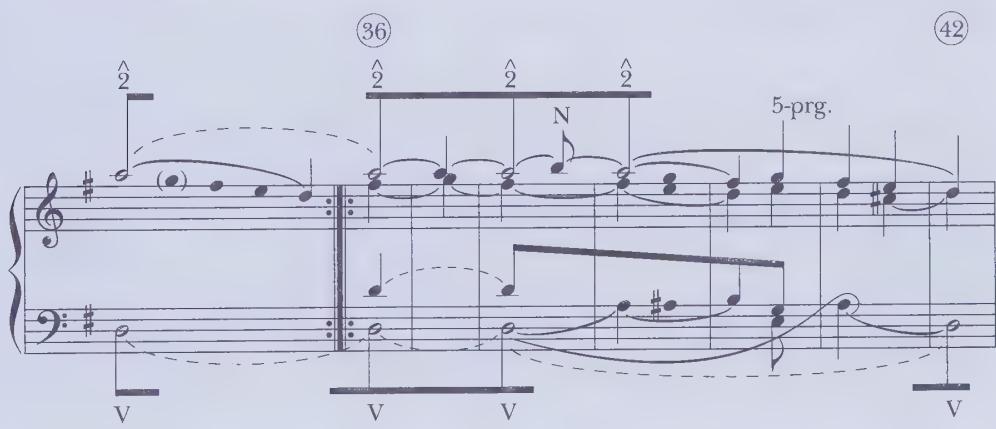
中文讲解
第15页上的乐谱/图像占位符,对应 Example 11.10 的前半部分。从上下文可确认其用途是辅助读者按谱核对 bars 36–42 与 bars 42–49 的发展部进行;具体音符、声部与和声标记需查阅原书方可得知,本讲解不作无法核实的猜测。
补充说明
图注信息见 P0086。
第6段(P0088)
原文复述
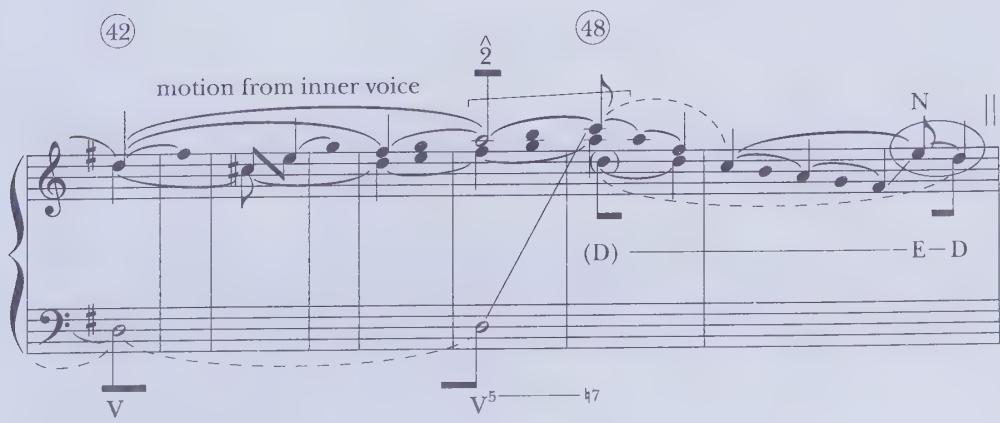
中文讲解
第15页上的第二幅乐谱/图像占位符,仍属 Example 11.10 的范畴,与 P0087 共同构成发展部谱例图像。其与上下文可确认的关系是:配合 P0084–P0090 的分析,让读者能在谱面上跟随 bars 36–42 的下行 a²→d² 与 bars 42 起的新节奏型上行;细节需查原书。
补充说明
图注信息见 P0086。
第7段(P0089)
原文复述
Of particular interest is the descending line that leads from a² to d² (bars 36–42). In a sense Mozart retraces the path of the second theme, even including the upper neighbor B in its original two-line register of the transition section and second theme. In the development, however, the implied g² of the lower-level Urlinie from 2̂ (=5 in D major) is stated prominently, in effect compensating for the “incomplete” motion through a fifth before the double bar.
中文讲解
本段聚焦 bars 36–42 中一条从 a² 下行到 d² 的旋律线。作者的论点是:莫扎特在此"重走"了第二主题的路径——上邻音 B 也仍保持在过渡段与第二主题中"两线谱表高音区"的原始位置,因此听感上与发展部之外的副题材料相呼应。但这一下行并非简单重复:在发展部中,原本在下层 Urlinie 中、自 2̂(即 D 大调中的 5)出发应隐含的 g² 被显化到外声部,从而补偿了呈示部里那次"未完成"的纯五度下行(在双纵线前被打断)。换言之,呈示部中 2̂ 没有真正落到 1̂,而发展部通过把 2̂ 下层音显化出来,弥补了那次未竟的下行;这是为什么 bars 36–42 的下行既是回顾,又是补全。
补充说明
上邻音 B 的"原始两线谱表高音区"与第二主题的具体音位需参看呈示部段落;当前输入未提供相关小节谱例细节,不作外部补足。
第8段(P0090)
原文复述
Bar 42 marks a juncture in the development section. The first violins play a new rhythmic pattern as the top voice changes direction and begins to ascend. Our analysis interprets the rising line as motion from an inner voice that reestablishes structural 2̂ and extends to the highpoint c³, which becomes the seventh of V. At this point the key of the dominant is transformed into the V⁷ chord that prepares the beginning of the recapitulation. The bars that follow comprise a short link that not only extends the V⁷ but also recalls the upper neighbor motive at its original register and pitch level. Example 11.11a is a structural synopsis of the development section, illustrating that the upper line, at the surface and foreground, is motion into and from an inner voice that prolongs 2̂ of the Urlinie.
中文讲解
本段指出第42小节是发展部的关键转折:第一小提琴换上新节奏型,最高声部反转方向开始上行。作者的解释路径是——这条上行线其实源自一个内声部,它重新确立结构音 2̂,并向上延伸至本段高点 c³;而 c³ 同时充当 V 的七音,由此实现"属调→V⁷"的和声转化,为再现部回到主调做好准备。第42小节之后的几小节形成一个短"连接(link)",承担双重任务:延长 V⁷,同时在原始音区与原始音高上回顾上邻音 B 动机。Example 11.11a 是发展部的结构纲要图示,其要点是:表层与前景上听到的上行—回落运动,实质上是"进出内声部"——外声部的旋律其实是内声部被推到前景的结果;而这一切都以延长 Urlinie 的 2̂ 为结构支撑。换言之,发展部短短十几小节里同时完成了两件事:在表面上引入新节奏与新方向,在深层继续支撑 2̂ 的延长并把它推向 V⁷ 的七音。
补充说明
Example 11.11a 的具体图示见 P0093、P0094,需结合谱例才能直观看到表层上声部与深层内声部之间的层级关系。
第9段(P0091)
原文复述
Example 11.11
中文讲解
这是 Example 11.11 的标题行,提示接下来是该例的两幅图示(结构纲要 + 属延长)。
第10段(P0092)
原文复述
Mozart, Symphony No. 35 (“Haffner”), K. 385, II, development section: (a) structural synopsis; (b) prolongation of V
中文讲解
这是 Example 11.11 的图注,说明该例分两部分:(a) 发展部的结构纲要(对应 P0090 关于"内声部延长 2̂、上行至 c³"的叙述);(b) 属音的延长图示(对应 P0095–P0096 关于属调和声转化的讨论)。
第11段(P0093)
原文复述
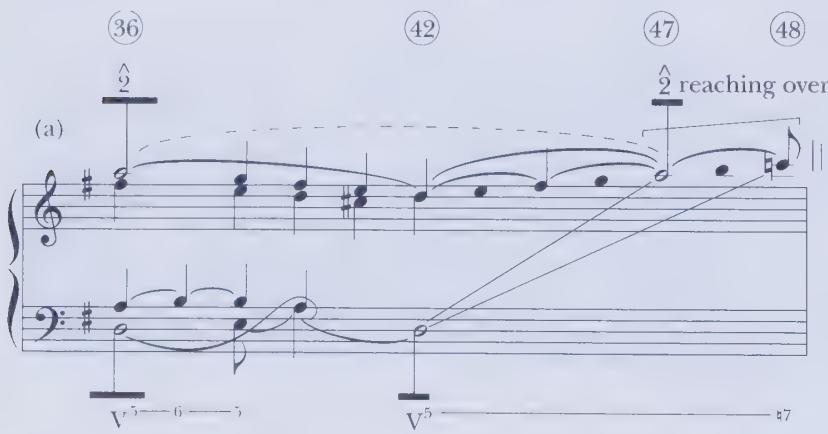
中文讲解
第16页上的乐谱/图像占位符,对应 Example 11.11a(发展部结构纲要)。从上下文可确认其用途是呈现"表层上声部—内声部—深层 2̂"之间的层级与运动关系;具体图示需查阅原书。
补充说明
图注见 P0092。
第12段(P0094)
原文复述
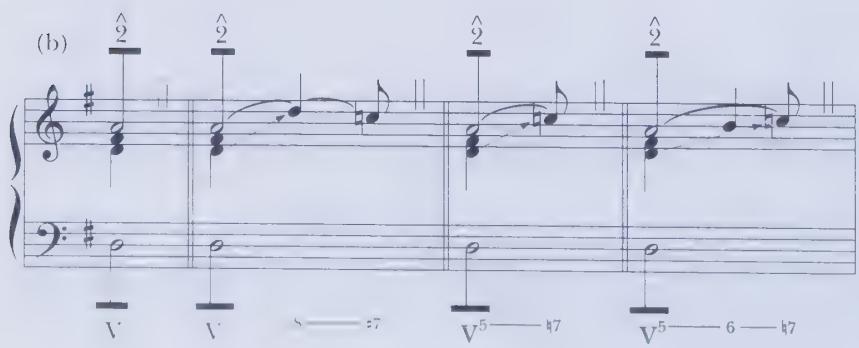
中文讲解
第16页上的第二幅乐谱/图像占位符,对应 Example 11.11b(属延长图示)。其作用是支撑 P0095–P0096 中关于"2̂ 落于 V 之上、内声部叠加引入 4̂、#4̂ 还原"的逐步分析;细节需查原书。
补充说明
图注见 P0092。
第13段(P0095)
原文复述
Example 11.11b shows the harmonic transformation of the dominant that occurs in many major-mode sonata movements. ¹⁷ Scale degree 2̂ over V is the point at which the motions of the Ursatz are interrupted. In the second stage of the example, an inner voice of the dominant triad is superposed above 2̂ and introduces 4̂ as a passing tone; remember that #4̂, introduced in the exposition, must be restored to its natural form so that the recapitulation may begin in the tonic.
中文讲解
本段借助 Example 11.11b 解释"属调的和声转化"——这一现象在大调奏鸣曲中很典型。其核心逻辑是:Ursatz 的旋律下行动作在 V 之上的 2̂ 处被打断(即 2̂ 没有按预期解决到 1̂,因为属方向调自身就悬在 V 上)。在图的第二阶段,属三和弦的一个内声部被"叠加"到 2̂ 之上,并引入 4̂ 作为经过音。这里有一个关键限制必须牢记:呈示部中曾被升高为 #4̂ 的音,必须在再现部开始之前还原为自然 4̂,否则再现部将无法在主调的自然音阶上确立。这是"#4̂ → 4̂"这一微小变动在再现部调性回归中所起的根本性作用。
补充说明
脚注 17 标记于本段第一句,提示该和声转化模式在同类作品中普遍存在;脚注具体内容未在当前 task_input 中给出,不作外部补足。
第14段(P0096)
原文复述
In the third and fourth stages, only scale degree 4̂ is transferred through superposition, but it conceptually retains the function of a passing tone. ¹⁸ In Mozart’s exposition, the process is further elaborated with a passing tone (V⁵–⁶–⁷). A remarkable aspect of the tonal system is that a simple harmonic transformation (such as V⁵–⁷) may serve as the basis of entire sections.
中文讲解
在图的第三、第四阶段,只有音级 4̂ 通过"叠加(superposition)“被保留下来,但它在概念上仍扮演经过音的角色——也就是说,它是从 2̂ 走向 5̂ 这条线路上一个连接元素。莫扎特在呈示部中还以 V⁵–⁶–⁷ 的方式把这一经过过程进一步装饰化,把"属—下属—属七"的色彩嵌入主调段落。本段最后给出一个具有理论意义的观察:调性体系的一个非凡之处在于,像 V⁵–⁷ 或 V⁵–⁶–⁷ 这样简单的和声转化,足以作为整个连接段落(即 bars 42–49 这种短短几个小节)的结构基础。换言之,再现部到来之前的这一小段虽不长,却承载了完整的和声—旋律转化——从属调到 V⁷,再到主调回归。
补充说明
脚注 18 标记于本段中段,关于 4̂ 在叠加中"概念上仍为经过音"的进一步说明;脚注具体内容未在当前 task_input 中给出,不作外部补足。
第15段(P0097)
原文复述
Example 11.12
中文讲解
这是 Example 11.12 的标题行,提示接下来出现的是再现部的相关谱例。
第16段(P0098)
原文复述
Mozart, Symphony No. 35 (“Haffner”), K. 385, II, recapitulation, bars 66–82: (a) foreground reduction; (b) structural synopsis
中文讲解
这是 Example 11.12 的图注,标明所选谱例为 K. 385 第二乐章再现部 bars 66–82,分为 (a) 前景缩减 与 (b) 结构纲要 两部分。该例虽置于本节(发展部)末尾,但属于对再现部的预览,可与本节关于”#4̂ 必须还原以使再现部得以在主调开始"的论点相呼应——即读者可在此对照再现部中主题与和声如何回到主调。
补充说明
该例与本节发展部论证的具体衔接方式,原文此处未展开,本节不补外部内容。
第17段(P0099)
原文复述
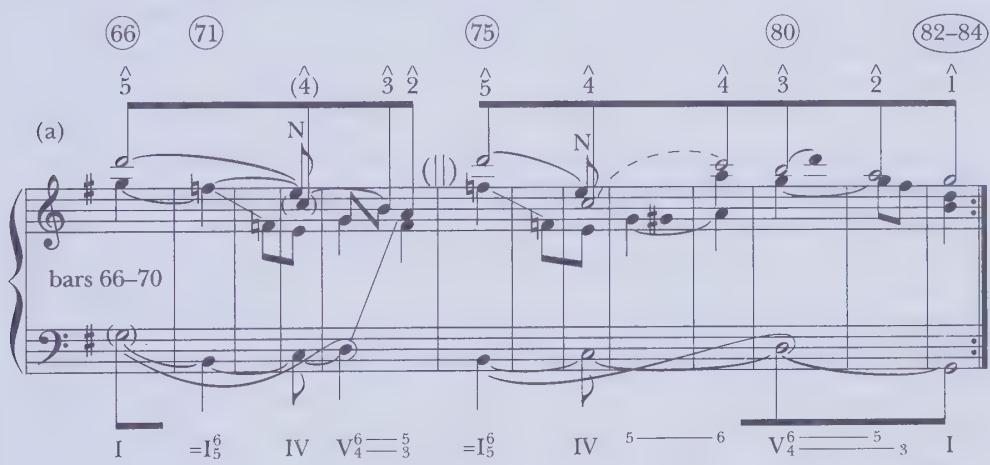
中文讲解
第17页上的乐谱/图像占位符,对应 Example 11.12a(再现部 bars 66–82 的前景缩减)。从上下文可确认其用途是展示再现部主题在表层的进行;具体音符与和声标记需查阅原书。
补充说明
图注见 P0098。
第18段(P0100)
原文复述
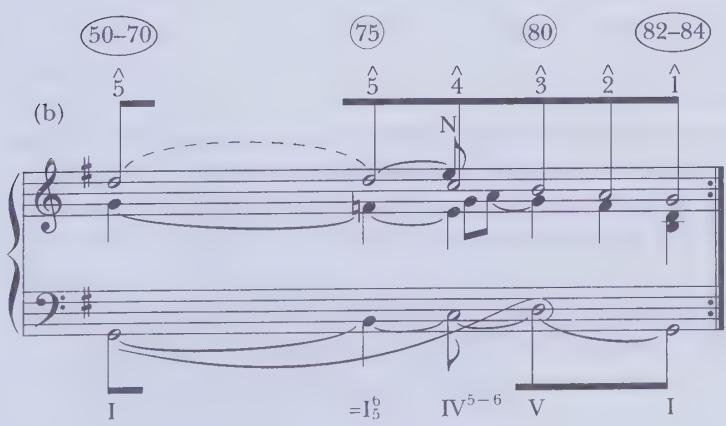
中文讲解
第17页上的第二幅乐谱/图像占位符,对应 Example 11.12b(再现部 bars 66–82 的结构纲要)。其作用与 P0099 配合,共同呈现再现部从表层前景到深层结构的层级关系,支撑"#4̂ 已还原、主调得以确立"的论断;细节需查原书。
补充说明
图注见 P0098。
脚注 / 边栏 / 图表 / 附加信息(如有)
本节包含的附加材料有:Example 11.10(第15页,发展部谱例,配套图注见 P0086,对应 P0087–P0088 两幅图);Example 11.11a(第16页,发展部结构纲要,配套图注见 P0092,对应 P0093);Example 11.11b(第16页,属延长/和声转化图示,对应 P0094);Example 11.12(第17页,再现部 bars 66–82 的前景缩减与结构纲要,配套图注见 P0098,对应 P0099–P0100 两幅图);两处脚注标记 ¹⁷ 与 ¹⁸(分别位于 P0095 第一句、P0096 中段,脚注具体内容未在当前 task_input 中提供,不作外部补足)。这些图示与脚注共同支撑了本节两个核心论点:(1) 发展部表层上声部的"下行—上行"实质是进出内声部、延长 Urlinie 2̂ 的过程;(2) 从属调到 V⁷ 这一极简和声转化(V⁵–⁷、V⁵–⁶–⁷)足以支撑整个过渡段落,并要求把 #4̂ 还原为 4̂ 以便再现部回归主调。
💡 本节核心要点
- 本曲发展部虽短小且不展开副调或主题,但仍承担奏鸣曲发展部的典型功能——通过对 V 的延长,把呈示部确立的属调转化为 V⁷,以引出再现部主调。
- bars 36–42 的下行 a²→d² 既"重走"了第二主题的路径(包括上邻音 B 的高音区位置),又把下层 Urlinie 自 2̂ 隐含的 g² 显化到外声部,从而补偿呈示部里那次在双纵线前被打断的纯五度下行。
- 第42小节是发展部的转折点:第一小提琴换节奏型并反转方向,最高声部开始上行;c³ 同时是本段高点与 V 的七音,由此完成"属调→V⁷"的和声转化。
- bars 42–49 形成一个短连接(link),既延长 V⁷,又在原始音区/音高上回顾上邻音 B 动机——是从属到主过渡的精密准备。
- Ursatz 的运动在 V 之上的 2̂ 处被打断;属三和弦的一个内声部被叠加到 2̂ 之上并引入 4̂ 作为经过音;呈示部中被升高的 #4̂ 必须在再现部前还原为 4̂,再现部方能在主调自然音阶上开始。
- V⁵–⁷ 或 V⁵–⁶–⁷ 这类极简和声转化足以支撑整个连接段落——这是调性体系的一个非凡之处,也是本节最重要的理论观察。
🔑 关键术语
- Development (发展部):奏鸣曲式的中间段落,通常处理副调区域与派生主题;本节特指 K. 385 第二乐章的 bars 36–49。
- Recapitulation (再现部):奏鸣曲式中主题回到主调的部分;本节末尾的例 11.12 即为再现部 bars 66–82 的谱例预览。
- Urlinie / Ursatz:Schenkerian 分析中最深层(背景层)的旋律下行动作及其和声支架;本节中核心是自 2̂ 出发的下行动作,并在 2̂ 处被 V 之上的位置打断。
- Superposition (叠加):把一个内声部放在已有的结构音之上以形成新的表层声部;本节中用于解释 V 之上 2̂ 处引入 4̂ 作为经过音的过程。
- Upper neighbor motive (上邻音动机):在第二主题与本节连接段中均出现的 B 这一上邻音装饰动机;其在发展部中的回顾保持在原始音区与音高。
- Dominant / V⁷ (属 / 属七和弦):本曲呈示部确立的属方向调为 D 大调;发展部通过对 V 的延长与 V⁷ 的形成,准备再现部回到主调。
- #4̂ vs. 4̂ (升四级与还原四级):呈示部中曾被升高的 #4̂ 必须在再现部之前还原为自然 4̂,否则再现部无法在主调自然音阶上确立——这是本节论证再现部调性回归的关键限制。
11.11 Recapitulation (bars 50–84)
第1段(P0101)
原文复述
Recapitulation (bars 50–84)
中文讲解
这是一个小节标题,标示出本节讨论的是该乐章中的再现部,对应小节范围为第50至84小节。再现部是奏鸣曲式(sonata form)的第三大段落,紧接呈示部(exposition)与展开部(development)之后,其核心功能是将呈示部的主题材料作调性回归的复述——尤其是副部主题从属调回到主调。本小节聚焦的正是再现部中副部主题的调性处理及其结构意义。
第2段(P0102)
原文复述
The recapitulation of the movement is virtually identical to the exposition up to the entry of the second theme, which now recurs in the tonic. Readers should refer back to Example 11.5 to analyze the first portion of the recapitulation without difficulty. Example 11.12 supplies an opening bar that captures the initial segment of the second theme (bars 66–70) and the continuation extending to the structural close of the movement.
中文讲解
本段宣告了再现部与呈示部之间的基本关系:除副部主题外,再现部的前段在结构上几乎等同于呈示部。作者因此引导读者直接参看例11.5(呈示部的分析范例)来处理再现部前段,以避免重复教学。真正的结构差异出现在副部主题——它在再现部中回到主调(tonic)而非呈示部中的属调(dominant),这正是奏鸣曲式调性布局的关键所在。例11.12则展示了副部主题的开端(第66至70小节)以及通向乐章结构终止的延续段。本段的功能在于定位:先排除相似部分,再把读者注意力集中到副部主题的调性回归及其后续结构上。
补充说明
副部主题由属调回到主调是奏鸣曲式调性规范的体现;本节所谓“与你读到的呈示部基本相同”,指的是主部主题及连接段等材料按原样再现,仅副部主题调整调性。
第3段(P0103)
原文复述
Upon brief reflection, the second theme exhibits only minor changes in the recapitulation. The upper voice, for instance, does not span as wide a range as its counterpart did in the exposition. The second theme has been transposed down a fifth into the tonic; by restricting the upward melodic motion, Mozart preserves d³ as the theme’s climax (bar 80), establishing a clear association with the corresponding climax of the exposition (Example 11.8, bar 31).
中文讲解
本段深入揭示再现部副部主题看似微小、实则关键的变化。第一点是音域收窄——上方声部在再现部中的活动范围小于呈示部。第二点解释其原因:副部主题被下移五度进入主调(从属调回到主调本身即下五度关系),但莫扎特通过限制上行的幅度,使 d³ 仍然作为主题的最高点(第80小节)而得到保留。这个保留具有重要的结构意义:呈示部副部主题的高潮是 d³(例11.8,第31小节),再现部又让同一音高 d³ 充当高潮,由此在两个不同段落之间形成一个具体的、可被听辨(及分析)的结构共鸣点。换言之,调性虽然改变了,但结构骨架的某一关键节点(高潮音)保持不变,这正是奏鸣曲式在变化中保持统一的方式之一。
补充说明
所谓“transposed down a fifth into the tonic”,指的是副部主题整体被移入主调领域;然而莫扎特并未机械地整体下移五度,而是通过收窄上方声部的音域使 d³ 高潮音得以保持,从而在调性回归的同时保留结构骨架的关键音。
第4段(P0104)
原文复述
The descending line of the second theme in the recapitulation now embodies the Urlinie of the entire movement. Because the second theme has been transposed into the tonic, the upper neighbor figure a²–b² from the exposition is transformed into d³–e²; the upper neighbor now appears in a lower register, which highlights d³ as the fifth note of the Urlinie (as shown in Example 11.12a). The motivic relationship that binds the first and second themes together is now explicitly realized at the same pitch level. Example 11.12b offers a synopsis of the recapitulation, with registers normalized so that the structural motions and prolongations of the section can be made visible.¹⁹
中文讲解
本段是全节的分析结论,把再现部副部主题的下行线提升到整个乐章结构的层面:副部主题的下行旋律此刻即代表整个乐章的 Urlinie(基本结构线)。Urlinie 是申克分析(Schenkerian analysis)中的核心概念,指乐曲最深层、最具结构性意义的那条下行旋律骨干线。
为了使副部主题的下行能够承担这一全曲性的 Urlinie 角色,必须让它的高点音 d³ 同时作为 Urlinie 中的“5”。作者解释了实现这一点的具体方式:由于副部主题转入主调,原来在呈示部中作为上邻音音型(upper neighbor figure)的 a²–b² 在再现部中变为 d³–e²——上邻音现在出现在更低的音区,而 d³ 由此被突出为 Urlinie 中的第5音(如例11.12a 所示)。
更重要的是,这一调整实现了奏鸣曲式的深层统一:第一主题与第二主题之间原本就存在动机联系(motivic relationship),在呈示部中它们或许处于不同音区或以变形方式呈现,但在再现部中由于副部主题回到主调并把结构高潮锚定在 d³,这一动机关系现在被显性地(explicitly)落实在同一音高层面。换言之,呈示部中隐含的动机纽带,在再现部中终于以同一音高的形式显现出来。
例11.12b 给出的“寄存器归一化”(registers normalized)的浓缩图(synopsis),把不同音区的结构动作与延展(prolongations)以归一化的方式呈现,使读者能越过表层音区差异,看到底层的结构进行。文末的上标19提示存在脚注,但本段文字未给出该脚注的具体内容。
补充说明
Urlinie 与“5 of the Urlinie”:前者指乐曲深层的下行结构线,后者指该结构线中的第5音(即结构高点,在申克分析中常对应起始音或 Kopfton)。例11.12a 与 11.12b 分别从细节和全局两个层面图示这一结构关系;脚注19的具体内容未在本节源段落中出现,无法进一步转述。
脚注 / 边栏 / 图表 / 附加信息(如有)
本节文本引用了若干谱例编号:例11.5用于呈示部(及再现部前段)的参照分析;例11.8展示呈示部副部主题高潮(第31小节);例11.12整体涵盖再现部副部主题开端(第66–70小节)及其向结构终止的延续,其中11.12a具体突出 d³ 作为 Urlinie 之“5”的位置,11.12b则以寄存器归一化的浓缩图呈现再现部的结构动作与延展。文末标注的上标19提示存在一个脚注,但本节提供的源段落未包含该脚注的具体内容,故不予转述。
💡 本节核心要点
- 再现部在副部主题进入之前与呈示部几乎一致,副部主题则在再现部中回归主调,这是奏鸣曲式调性规范的关键体现。
- 莫扎特通过收窄上方声部的音域并限制上行,使 d³ 在再现部副部主题(第80小节)中仍担任高潮音,与呈示部高潮(第31小节)形成跨段落的结构共鸣。
- 再现部副部主题的下行旋律线因此承担起整首乐章的 Urlinie(基本结构线),d³ 则被明确为该 Urlinie 中的第5音(结构高点)。
- 原本在呈示部中以 a²–b² 形式出现的上邻音音型,在再现部变为 d³–e²,上邻音落入更低音区,从而把结构重心进一步凝缩到 d³ 之上。
- 第一主题与第二主题之间的动机联系,在再现部中第一次被显性地落实在同一音高层面,由此实现奏鸣曲式所追求的深层统一。
- 例11.12b 的寄存器归一化浓缩图,使读者得以越过表层音区差异,看到再现部中底层结构动作与延展的全貌。
🔑 关键术语
- Recapitulation(再现部):奏鸣曲式的第三大段落,将呈示部主题材料以副部主题回到主调的方式复述;本节聚焦其在小节50–84范围内的结构处理。
- Exposition(呈示部):奏鸣曲式首段,呈示主部与副部等主题材料,副部通常置于属调;本节将之作为再现部比较的基准。
- Tonic(主调):乐曲的主调;副部主题在呈示部中位于属调,在再现部中回到主调,是本节讨论的调性回归核心。
- Urlinie(基本结构线):申克分析术语,指乐曲最深层、最具结构性的下行旋律骨干线;本节中再现部副部主题的下行线被认定承载了整个乐章的 Urlinie。
- Upper neighbor figure(上邻音音型):由主音与其上方邻音构成的短旋律型;在本节中由呈示部的 a²–b² 在再现部变为 d³–e²,是副部主题结构位置调整的关键。
- Climax(结构高潮):段落或乐曲中的结构最高点;本节中 d³ 同时充当呈示部与再现部副部主题的高潮,构成两段之间的结构共鸣点。
11.12 [描述性拆分] Mozart, Piano Sonata, K. 457, I: Introduction and Exposition Overview (bars 1–19)
第1段(P0105)
原文复述
Mozart, Piano Sonata, K. 457, I
中文讲解
此条目为小节标题,以二级标题形式标注所分析的作品——莫扎特《钢琴奏鸣曲》K. 457 第一乐章。它开启本节的分析对象,并为后续段落标明讨论语境:一部 c 小调钢琴奏鸣曲的第一乐章。
第2段(P0106)
原文复述
Throughout this book we have recommended different strategies for analysis. Each composition is unique, with its own individual characteristics; sometimes the particular features of a piece may be so striking as to suggest a path for analysis. In this extraordinary sonata movement, the motives and elaborations of the upper voice, particularly of the primary tone, immediately engage one’s attention and offer a good point of departure. Our discussion of the structure and form will also consider those aspects that are characteristic of the minor mode.
中文讲解
本段是分析章节的引言,作者在此交代方法论与切入路径。要点包括:(1) 全书主张对不同作品采用不同分析方法,因为每部作品都各有特点;(2) 当一部作品的特征足够突出时,它自身就能提示分析路径——本乐章即属此类;(3) 作者选择的切入点是上声部的主题动机与对主音(primary tone)的展开,因为它们最先吸引注意力;(4) 本节在讨论结构与曲式时,还会特别关注小调(minor mode)所具有的特殊表现。承接上文的方法论总结,本段宣告本乐章的具体路径——从主音相关的动机展开入手,并兼顾小调特征。这一宣告为下文从力度、音区、和声动机三层面展开分析做了铺垫。
第3段(P0107)
原文复述
Exposition (bars 1–74)
中文讲解
此条目为小节内的二级标题,标示呈示段的起讫范围为第 1–74 小节。它把呈示段作为独立的分析单元,与下文对力度、音区、和声与动机的讨论对应。
第4段(P0108)
原文复述
Before considering aspects of harmony and voice leading, take a few minutes to examine Mozart’s use of dynamics and, in particular, of register. The sonic resources of the piano are not as great as those of the orchestra, yet Mozart achieves orchestral qualities through the juxtaposition and isolation of different registers. In bars 1–4, for example, both hands open up a “registral space” from great C in the bass to G and Ab in the two-line octave of the upper voice. In bars 3–4, the left hand abandons the lower register, only to rejoin it in bar 5. We shall see that the alternation of registers serves a structural function throughout the exposition, highlighting important points of harmonic and melodic arrival.
中文讲解
本段在进入和声与声部进行讨论之前,要求读者先观察莫扎特对力度(dynamics)尤其是音区(register)的运用。要点:(1) 虽然钢琴的音响资源不及管弦乐队,莫扎特却通过不同音区的并置与孤立取得近似管弦乐的效果;(2) 第 1–4 小节双手自下而上展开一个从低音大字组 C 一直延伸到两线小字组 G 与 Ab 的“音区空间”(registral space);(3) 第 3–4 小节左手离开低音区,至第 5 小节才重新加入;(4) 音区交替在整段呈示段中具有结构功能,能突出和声与旋律的到达点。本段在论证链上的作用是:在主音与动机分析之前,先建立一个“音区本身即为结构要素”的视角,使读者理解为何后续的声部进行图会显示这种上声部突出、低声部收放的特征。需要注意“registral space”并非随便的比喻,而是作者用来描述低音与高声部之间被刻意拉开距离的具体音响空间。
补充说明
“great C”即大字组 C(钢琴上最低一组八度的 C),是本乐章主音所在音区;“two-line octave”即两线八度(小字二组),是高声部旋律所在音区。两者之间的距离就是所谓“registral space”的物理基础。
第5段(P0109)
原文复述
We now turn our attention to the harmonic and motivic structure of the exposition. As a first step, listen to or play through the entire section, noting the salience of G in the upper voice: it appears prominently (through various techniques) in bars 3, 8, 9, 11, 14, 16, 23, and 41, which leads us to make the initial assumption that 5 is the primary tone of the Urlinie.
中文讲解
本段从音区转入和声与动机的分析,方法是先通读整个呈示段,统计 G 音在上声部出现的显著位置:第 3、8、9、11、14、16、23、41 小节。基于这种“突出性”,作者提出初始假设:在 c 小调的 Urlinie(基本线)中,主音(primary tone)是 5̂(即 G)。这是 Schenker ian 分析的典型步骤——先从表层的频率与突出性推断深层结构音。承接 P0108 中关于上声部突出的观察,本段把它从“音区”现象转化为和声结构假设;为 P0110 中关于动机围绕 5̂ 展开的论证铺路。需要注意的是此处使用了“initial assumption”,意味着这一假设会在接下来的图示对比中被验证或修正。
补充说明
在 c 小调中,5̂ 即音级 G;Urlinie 指 Schenker 分析中的基本线,从主音下行至主音,本段的初始假设是 5̂ 为 Urlinie 的起点。
第6段(P0110)
原文复述
In Example 11.13, which presents a voice-leading graph of bars 1–19 (the first theme), we can see at least two prominent motives associated with 5̂. The first is the tone succession G–Ab–G, a seminal neighbor figure that elaborates the primary tone and occurs at various levels throughout this movement. Note that the resolution (in the same register) of Ab in bar 4 is delayed until bar 8; the delayed resolution is the result of the interplay of registers mentioned above. The second motive is a chromatically descending fourth from G to D, which occurs first in bars 9–11 in the alto register. Through inversion of the counterpoint in the right hand, the fourth is shifted to the higher register in bars 11–13, where it prolongs 5̂ through motion into the inner voice. A careful comparison of graphs a and b of Example 11.13 reveals these motives as well as the harmonic structure and the local fifth-progression that serves to bring the first theme to a close while retaining the presence of 5̂ at a deeper level of structure.
中文讲解
本段以例 11.13(第 1–19 小节,即第一主题的声部进行图)为依据,揭示围绕 5̂(G)的两个核心动机。第一个动机是 G–Ab–G 的邻音进行,被视为本乐章“种子性”的邻音形态,在不同结构层次反复出现;其中第 4 小节的 Ab 在同音区内的解决被推迟到第 8 小节,这一推迟正是 P0108 所述“音区交替”作用的结果。第二个动机是从 G 半音下行四度至 D:它先在第 9–11 小节的中音区出现,随后通过右手对位的转位(inversion of the counterpoint)在第 11–13 小节上移到较高音区,并以进入内声部的方式延续 5̂。最后,作者提示对比例 11.13 中的图 a 与图 b,可以看到这些动机、和声结构、以及把第一主题推向收束的局部五度进行——而在更深结构层面,5̂ 始终保持存在。本段的关键价值是把动机观察(音高反复出现)与声部进行图(结构性陈述)直接对应起来,让读者理解:表层动机是深层主音保持的具体手段;同时通过“推迟解决”这一现象,把音区分析与动机分析联结成一个统一的解释。
补充说明
“inversion of the counterpoint”指在保留基本音程关系的前提下改变声部高低位置的对位手法;“local fifth-progression”指局部的五度关系进行,是 Schenker 分析中常见的结构性进行之一。
第7段(P0111)
原文复述
Example 11.14 represents the end of the first theme, which through a phrase overlap simultaneously becomes the beginning of the transition. Reflecting the large analytical perspective necessary with complete movements, the graph shows that the primary tone g² remains active as the primary tone 5̂, shown in parentheses over the local 1̂ in C minor. A comparison of levels in Example 11.14 shows how quickly the upper neighbor Ab is reestablished over a dominant seventh chord on Bb, which destabilizes the tonic and initiates the motion to the secondary key. The upper neighbor ab² is transferred to ab¹ and resolves to g¹ in bar 23.
中文讲解
本段以例 11.14 关注第一主题的结束及其与过渡段的重叠。要点:(1) 第一主题的结尾通过乐句重叠(phrase overlap)同时成为过渡段的开始,体现完整乐章分析所需的大尺度视角;(2) 在 c 小调的局部 1̂ 之上,g² 以括号形式保留为 5̂ 的“主音”——这说明即使在主音暂时让位于 1̂ 的局部,主音仍在更深层面持续活动;(3) 在 Bb 上的属七和弦之上,上邻音 Ab 很快被重新建立,这一不稳定性瓦解了主调并启动向副调的运动;(4) 上邻音 ab² 转移到 ab¹,并在第 23 小节解决到 g¹。本段展示了“主音贯穿 + 局部不稳定”如何制造动力:表层的属七和弦为过渡作准备,深层的主音则始终稳定。这种“表层转向、深层保持”的张力,是理解本乐章过渡段如何同时闭合第一主题又开启新材料的关键。
补充说明
“phrase overlap”指两个乐句或段落边界重合,前段未结束即已开始后段;“parentheses”表示该音在图中以括号呈现,意味着它在局部并不实有,但在更深的结构层面仍然发挥主音功能。
第8段(P0112)
原文复述
Mozart’s love for opera and his mastery as an opera composer are reflected in the dramatic qualities of many of his instrumental compositions. Not only does this aspect of his work manifest itself in the quasi-orchestral uses of register in this piano sonata, but also in the character of certain themes and sections. In bar 23, we apparently hear a new theme in Eb. Because tonal stability usually follows a transition section, we are likely to interpret this section as the beginning of the second theme, at least at first. Like one of Mozart’s operatic characters wearing a disguise, however, this theme turns out to be something different than we initially supposed. First of all, bars 23–30 seem much too short, compositionally out of balance, for a second theme in a movement of this breadth. Further, as early as bar 27, the theme begins to dissolve, quickly leading us back to a Bb major harmony that is prolonged for six bars—and with a stronger feeling of dominant preparation than that of bars 21–22. In retrospect, we realize that Mozart, in a spirit reminiscent of Haydn, has deceived us: what we initially thought to be the second theme is in fact a thematic transition.
中文讲解
本段把分析视角从声部进行扩展到风格与体裁层面,论证莫扎特歌剧倾向如何渗透到器乐创作中。要点:(1) 莫扎特对歌剧的热爱与精通体现在其器乐曲的戏剧性上,本钢琴奏鸣曲不仅在音区使用上呈“准管弦乐”效果,也在主题与段落的“性格”上呈现戏剧性;(2) 在第 23 小节,听者似乎听到 Eb 上的一个新主题,由于“调性稳定通常紧接过渡段”这种习惯期待,初始判断会认为这是第二主题的开始;(3) 然而作者论证这一判断是错误的:第一,第 23–30 小节对于一部如此规模的乐章而言作为第二主题过短,结构上失衡;第二,第 27 小节起主题即开始瓦解,迅速回到 Bb 大调和声并持续六小节,且其属准备比第 21–22 小节更强;(4) 综上,回溯起来,这段所谓“第二主题”实为主题性的过渡——莫扎特以近似海顿的诙谐精神“欺骗”了听者的期待。本段的论证价值在于把音乐分析(动机与和声)与体裁美学(歌剧式伪装与戏剧性)结合起来,揭示本乐章呈示段结构安排中“表层听感—深层逻辑”之间的张力:听感上像第二主题,结构上却是过渡段,这是作者用以衔接 P0109–P0111 的动机分析、并为后续真正第二主题分析作铺垫的关键转捩点。
补充说明
“Haydn”在此作为对比与致敬对象,海顿的诙谐曲(surprise)与“调性骗局”是古典时期常见的修辞;本段中“in a spirit reminiscent of Haydn”即指这种以出人意料方式重组听者预期的做法。脚注 20(在 P0110 中提到)应在本小节汇总中加以说明。
脚注 / 边栏 / 图表 / 附加信息(如有)
本小节中正文段落 P0110 末尾带有脚注标号 20,文中未呈现脚注内容本身;脚注内容由脚注栏或书末注释提供,对正文主张(如“半音下行四度动机首次出现于第 9–11 小节的中音区”)起来源/旁证作用。小节还引用了两幅图示——例 11.13(第 1–19 小节声部进行图,含图 a 与图 b 的对照)与例 11.14(第一主题结束兼过渡开始的声部进行图),读者需参阅原书图示才能完整理解图中各层次与括号标记。两幅图示共同支撑了本节关于“5̂ 作为主音”“G–Ab–G 邻音动机”“半音下行四度动机”“主音在更深结构中持续保持”等核心论点。
💡 本节核心要点
- 本节以莫扎特《钢琴奏鸣曲》K. 457 第一乐章为分析对象,切入点选定为上声部的主音(G / 5̂)及其相关动机展开。
- 在进入和声与声部进行讨论前,作者先强调力度与音区(尤其是音区交替)在本乐章中具有结构功能,并提出“准管弦乐”的钢琴表现手法。
- 通过对 G 在第 3、8、9、11、14、16、23、41 等小节显著出现的频率统计,作者初步假设 5̂ 是 Urlinie 的主音。
- 例 11.13 显示第一主题中至少有两个围绕 5̂ 的核心动机:种子性的 G–Ab–G 邻音进行,以及半音下行四度 G–D;后一动机通过右手对位的转位从低音区移至高音区。
- 例 11.14 揭示第一主题通过乐句重叠同时成为过渡段的开始,主音 g² 在 c 小调局部 1̂ 之上以括号保留,深层结构上 5̂ 始终活动;Bb 上的属七和弦使主调失稳并启动向副调的运动。
- 作者以歌剧式“伪装”与海顿式的“调性骗局”类比第 23 小节起的 Eb 新主题:尽管听感上像第二主题,但其篇幅过短、很快瓦解并回到更强的属准备,因此实质上是“主题性的过渡”。
🔑 关键术语
- Urlinie:Schenker 分析中的“基本线”,指从主音下行至主音的骨干音进行;本节中初始假设 5̂ 为其起点。
- primary tone (主音 / primary tone):Schenker 术语中 Urlinie 的起始音;本乐章中对应音级 G(5̂),在更深结构中持续保持,即使局部让位于 1̂。
- registral space (音区空间):本节中指第 1–4 小节双手从大字组 C 至小字二组 G 与 Ab 之间所展开的音区跨度,是莫扎特用以营造“准管弦乐”效果并产生结构功能的手段。
- phrase overlap (乐句重叠):前段未结束即开始后段的衔接方式;本节中表现为第一主题的结束同时成为过渡段的开始。
- neighbor figure (邻音进行):在本节中特指 G–Ab–G 的种子性邻音形态,是围绕主音 5̂ 展开并贯穿全乐章的核心动机之一。
- inversion of the counterpoint (对位转位):保留基本音程关系而改变声部位置的手法;本节中表现为半音下行四度动机从中音区转至较高音区,以延续 5̂。
- local fifth-progression (局部五度进行):本节中指把第一主题推向收束的结构性进行,深层仍保留 5̂ 的存在。
11.13 [描述性拆分] Exposition: Transition as Thematic Deception (bars 19–35)
第1段(P0113)
原文复述
Example 11.14 illustrates the harmonic context in which this “tonal deception” occurs. At the surface and foreground of the music, the thematic transition
中文讲解
本段是一个未完成的句子,起着承上启下的桥梁作用。它告诉我们:接下来要通过例11.14来展示这种"调性欺骗"发生的和声背景。所谓"调性欺骗",指的是在表面/前景层面听感上属于某一调性区域(例如降E大调),但在更深层的结构上却是从主功能内部派生出来的。本句的末尾"the thematic transition"未完,下句紧接着补充说明了该过渡在表面上听起来是在降E大调。该段的作用是把读者的注意力从前面已讨论的主题动机层面,导向本节所关注的核心——调性区域在表层与深层之间的不一致。
补充说明
术语"tonal deception"(调性欺骗)在斯洛宁斯基(Schoenberg)等人的申克分析语境中常指:表层听感所呈现的调中心与深层结构调中心不一致。本节以此为出发点,论证过渡段落表面虽像降E大调,实则仍是c小调主功能的延伸。无额外补充。
第2段(P0114)
原文复述
(a)
中文讲解
这是图表中的子标签"(a)",对应例11.13中前景(foreground)缩谱的部分。该标签本身只是一个版面标识,提示读者此处所示为多层缩谱(前景/中景)中的第一层。
第3段(P0115)
原文复述
Example 11.13
中文讲解
这是节内的一个小标题,标识下面的图表为"例11.13"。它开启了关于莫扎特钢琴奏鸣曲K.457第一乐章第一主题(1–19小节)的图示内容,提示读者:此例展示的是前文已分析过的主题材料的图示缩谱,作为本节讨论过渡段落(bars 19–35)时的对照基础。
第4段(P0116)
原文复述
Mozart, Piano Sonata, K. 457, I, first theme, bars 1–19: (a) foreground and (b) middle-ground reductions
中文讲解
这是例11.13的图注,明确说明:图示对象为莫扎特钢琴奏鸣曲K.457第一乐章第一主题,第1–19小节;图示包含两层——(a)前景缩谱与(b)中景缩谱。该图注的功能是让读者明白:接下来的图示是对前文已讨论主题的申克式多层缩谱呈现,使本节对过渡段的分析建立在对第一主题已有结构理解的基础之上。
补充说明
术语foreground reduction(前景缩谱)/ middle-ground reduction(中景缩谱):申克分析中将实际音乐表层不断简化、剥离装饰音后得到的结构骨架,前景保留较多细节,中景进一步简化以显示主要结构线。无额外补充。
第5段(P0117)
原文复述
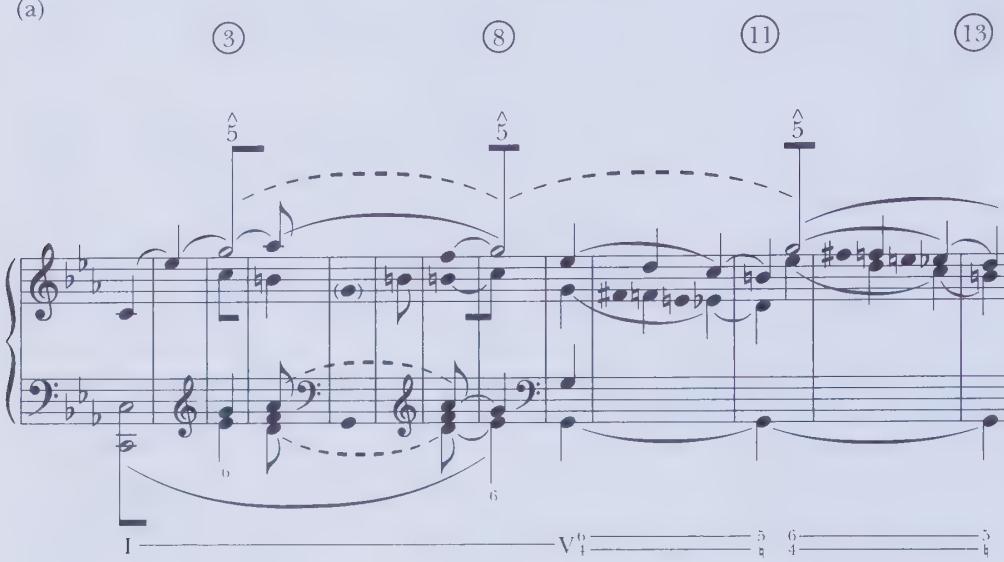
中文讲解
此处为第20页的图像或乐谱占位符,对应例11.13的实际图示内容(原图已省略)。按上下文可知,该图展示了莫扎特K.457第一主题第1–19小节的前景与中景缩谱。由于图像细节不可见,本讲解不臆测具体音符;分析中涉及的和声、动机与声部进行应结合正文叙述与例11.14来理解。
补充说明
需查看原图。
第6段(P0118)
原文复述
is certainly heard in $E^{b}$ major. At a deeper level of structure, however, we regard the $E^{b}$ -major region as emerging from the upper third of the initial structural tonic. $^{21}$ Following this local excursion into $E^{b}$ , the bass descends by step back to C before $B^{b}$ , supporting V of III, is achieved in bar 30.
中文讲解
本段承担了对"调性欺骗"的核心论证。作者指出:表层听感上,过渡段落清楚地落在降E大调;但在更深层的结构上,降E大调区域其实被理解为从c小调主和弦的上方三度音(即降E音,作为结构主音c音上方的三度)派生出来的局部离调。这一"局部偏离降E"之后,低音声部以级进方式从降E回到C再到达降B,在第30小节形成了对III(降E大调)的属和弦(V of III = 降B大调)。也就是说,表面听起来是去到一个新调(降E大调),但深层结构仍属c小调主功能域的延伸,这就是所谓"调性欺骗"的具体机制。脚注21提示读者:该理论的延伸来源可参见相关的脚注说明。
补充说明
术语"upper third of the initial structural tonic"(结构主音的上方三度):在申克分析中,主和弦可被理解为由根音(c)、三音(降E)和五音(g)构成的整体结构;降E作为主和弦的上方三度音,其区域(降E大调)被视为从主和弦内部"分裂"出来,而非独立的新调性。术语"V of III":指对III级(即降E大调)的属和弦,此处为降B大调。无额外补充。
第7段(P0119)
原文复述
Example 11.14c illustrates the broader voice leading of this passage. The Eb-major transition, represented in the graph as a triad, helps to transform the initial I into a $^{6}_{3}$ chord (C–Eb–A $^{4}$ ) before V of III appears (the 5–6 motion avoids the parallels inherent in the progression from I to V of III). The influence of tonic harmony thus extends through bar 29, just before the dominant of the second key area. Notice how much more emphasis is given to this statement of Bb harmony than to the similar chord in bar 21.
中文讲解
本段从声部进行(voice leading)的角度具体说明"调性欺骗"是怎样实现的。例11.14c展示了这段过渡的宏大声部进行:降E大调过渡被图示为一个三和弦,它的作用是把c小调的主和弦(I = c-降E-g)转化为一个六三和弦(6/3 和弦,即C–降E–A4/4在此处指低音A位置上方的A音),这个六三和弦充当一个过渡性的和弦;随后出现V of III(降B大调)。其中5–6的线性进行(即低音从G上行到A)避免了直接由I进行到V of III时可能产生的平行五度等不良声部关系。因此,主功能和声的影响实际上延伸至第29小节——恰好在第二调性区域(降B大调)的属和弦出现之前。作者特别提醒读者注意:第30小节中降B和声的出现比第21小节中类似和弦得到了更强有力的强调,这进一步说明30小节的降B是真正的结构属音,而非临时的经过或装饰。
补充说明
术语"6/3 chord"(六三和弦):即第一转位三和弦,低音为三音,此处C–降E–A4,A在低音位置上方,它通过低音A与原和弦低音G构成5–6线性进行。术语"5–6 motion":低音或内声部由五度音程上行到六度音程的线性运动,是申克分析中常见的避免平行进行的手段。无额外补充。
第8段(P0120)
原文复述
Now that we have a broader understanding of the harmonic context, we can turn our attention to the upper voice. Example 11.14 illustrates that G (5) is prolonged and decorated by the upper neighbor $A^b$ (bar 24), just as it is in the first theme. But, in the new tonal context of the transition section, it is composed-out differently. Instead of proceeding directly to $A^b$ , G first moves to $B^b$ , which decorates the upper neighbor $A^b$ from above, a reaching-over figure that will itself become motivic. $^{22}$ Thus, the seminal motive G- $A^b$ -G from the opening phrase of the sonata returns in a new guise, as a varied motivic repetition, that apparently represents a new theme.
中文讲解
本段将论证从和声层面转向高声部(上声部)的旋律层面。读者应注意其论证结构:先确定和声大背景(前段已完成),再细察上声部。例11.14显示:G(主和弦的五音,即5)被延持并由上方邻音降A(bar 24)装饰——这与第一主题中对G的装饰方式完全一致,说明动机G–降A–G贯穿了第一主题与过渡段。但本段的"新意"在于:在过渡段的新调性背景下,这一动机经历了不同的"展开式"(composed-out)处理——G不再直接上行到降A,而是先上行到降B,由降B从上方再装饰下方的降A。这种"越过"(reaching-over)的音型本身成为新的动机素材(脚注22)。因此,奏鸣曲开篇的种子动机G–降A–G以"伪装"的形式回归,作为"有变化的动机重复",表面听上去像是一个新主题——这就是上一节标题所说的"主题欺骗"(thematic deception)的具体表现:表面上呈现为一个新主题,实则是旧主题的变形。
补充说明
术语"composed out"(展开式 / 延展):申克体系中的术语,指将一个单一和声或音高延持展开为更长的旋律-和声过程,使原始结构在时间中获得具体形态。术语"reaching-over figure"(越过音型):指旋律音先越过目标音、到达其上方再返回的装饰方式,使动机在表层听起来有更大幅度、也由此获得新的独立意义。无额外补充。
第9段(P0121)
原文复述
We mentioned that this theme quickly begins to dissolve in bar 27, one reason why the deception becomes apparent as the bass leads emphatically back to the B $^{b}$ -major harmony. In the upper voice, as shown in Example 11.14b, the principal line from bar 27 essentially consists of the line G-A $^{b}$ -B $^{b}$ . The B $^{b}$ is then transferred to the two-line octave, where it leads to A $^{b}$ before the second theme enters in bar 36. Although not shown in Example 11.14, the $A^b$ resolves to G in the sixth bar of the second theme. Therefore, the $G-B^b-A^b-G$ motion also spans the end of the transition and the beginning of the second theme, but the $a^{b^2}$ in 35 is best interpreted as a passing tone (rather than a neighbor as before). This is an instance of a motivic repetition in which the tones are interpreted in slightly different ways.
中文讲解
本段揭示主题"伪装的暴露"过程以及动机材料如何跨越过渡与第二主题之间的边界。论证要点有四层:
- 主题在第27小节开始快速瓦解(dissolve),与此同时,低音声部明确地回到降B大调和声——降B大调的功能性回归暴露出前述的"调性/主题欺骗"只是表面现象。
- 在上声部,例11.14b显示:第27小节起的主要线条本质上是G–降A–降B;降B随后被转移到两线八度(two-line octave,即较高的八度音区),并在第二主题于第36小节进入前回到降A。
- 例11.14虽未显示,但降A在第二主题的第六小节才解决到G。
- 由此得出结构性结论:G–降B–降A–G的线性运动横跨了过渡段的结尾与第二主题的开头;但第35小节中的降A2(a^{b^2})应被理解为经过音(passing tone),而非之前意义上的邻音(neighbor)。
最后一句是方法论的关键说明:同一个动机音组,在不同语境下可以被分析为不同的功能(如邻音 vs. 经过音)。这是动机重复中常见的现象——音高不变,但功能与意义在不同结构位置发生细微变化。
在全节论证链中,本段既承上(呼应调性欺骗的暴露)又启下(连接第二主题),完成了从过渡段到第二主题的桥梁性分析。
补充说明
术语"two-line octave"(两线八度):在音乐记谱中指较高八度的谱表位置,此处指降B被移到较高的音区以衔接第二主题。术语"passing tone"(经过音)与"neighbor"(邻音):经过音出现在两个不同音高之间的级进运动中,承担连接作用;邻音则装饰并返回同一音高。本段说明:同一降A音在过渡段中作邻音,在第35小节中作经过音,功能改变源于其结构位置与上下文的差异。无额外补充。
脚注 / 边栏 / 图表 / 附加信息(如有)
本节含有两处脚注引用(段落P0118与P0120末尾的脚注21、22),原文未提供脚注的具体内容,故仅能确认其存在并提示读者:脚注21与"结构主音的上方三度"这一理论延伸相关,脚注22与"越过音型成为动机素材"这一观点相关。节内包含两个图示——例11.13(莫扎特K.457第一主题1–19小节的前景与中景缩谱)和例11.14(过渡段19–35小节的多层缩谱,含前景、中景、宏观声部进行),但因原始嵌入图像已省略,具体音符与图示细节需查看原书。
💡 本节核心要点
- 所谓"调性欺骗"指过渡段在表层听感上像降E大调,但在更深层结构上降E大调被理解为从c小调结构主和弦的上方三度派生出来的局部离调,主功能的影响延伸至第29小节。
- 从声部进行看,降E三和弦通过将c小调I转化为6/3和弦(低音G–A的5–6运动),避免了直接到V of III可能产生的平行进行,从而在结构上保持了主功能的延续。
- 高声部中G(5)仍然被上方邻音降A装饰,但新的"展开式"处理使G先上行到降B,再由降B从上方装饰降A,构成"越过音型",使开篇的G–降A–G种子动机以变体形式出现,表面上像一个新主题——这就是"主题欺骗"。
- 主题在第27小节开始瓦解,同时低音声部明确回归降B大调,揭示前述听觉的调性与主题印象其实只是结构主功能的延伸。
- G–降B–降A–G的线性运动横跨过渡段结尾与第二主题开头,但同一个降A在过渡段中作邻音、在第35小节中作经过音,体现了同一动机音在不同结构位置中的功能再解释。
🔑 关键术语
- tonal deception(调性欺骗):指表层听感所呈现的调中心与深层结构调中心不一致的现象。在本节中,过渡段表面上听感在降E大调,但深层结构上降E大调被理解为c小调结构主和声内部上方三度音的延伸,主功能影响延续至第29小节。
- thematic deception(主题欺骗):指原本已出现过的动机材料以变形(varied motivic repetition)方式重新出现,表面上听感像是一个新主题,但实质上仍是种子动机的展开式重复。在本节中,G–降A–G动机以G–降B–降A–G的形式回归。
- upper third of the initial structural tonic(结构主音的上方三度):申克分析中把主和弦视为含有根音、三音、五音的整体结构;上方三度音(c小调中即降E)所建立的区域被视为从主和弦内部派生,而非独立的新调性区域。
- V of III(对III级的属和弦):指对降E大调(III级)的属和弦——降B大调。在本节中降B大调在第30小节首次真正确立为第二调性区域的属音。
- composed out(展开式):申克术语,指将一个单一的和声或音高延持展开为更长的旋律–和声过程,使结构在时间中获得具体形态。例如本节中G被延持并由降B、降A等逐层装饰展开。
- reaching-over figure(越过音型):旋律音先越过目标音、到达其上方再返回的装饰方式。在本节中G先上行到降B再回到降A,使动机在表层听起来具有更大跳幅,并由此获得新的独立意义而成为动机素材。
- passing tone vs. neighbor(经过音 与 邻音):经过音出现在两个不同音高之间的级进运动中,承担连接作用;邻音则装饰并返回同一音高。本节中第35小节的降A2应作经过音而非邻音,体现了同一音在不同结构位置中的功能再解释。
- 5–6 motion(5–6线性进行):低音或内声部由五度音程上行到六度音程的线性运动,是申克分析中常见的避免平行进行、维持声部独立性的手段。在本节中低音G上行到A形成5–6,使I到V of III的进行避免平行。
11.14 [描述性拆分] Exposition: Second Theme and Harmonic Structure (bars 34–59)
第1段(P0122)
原文复述
[Figure caption/label on page 21: “(b)”. The accompanying image data is omitted; only the label and position are preserved.]
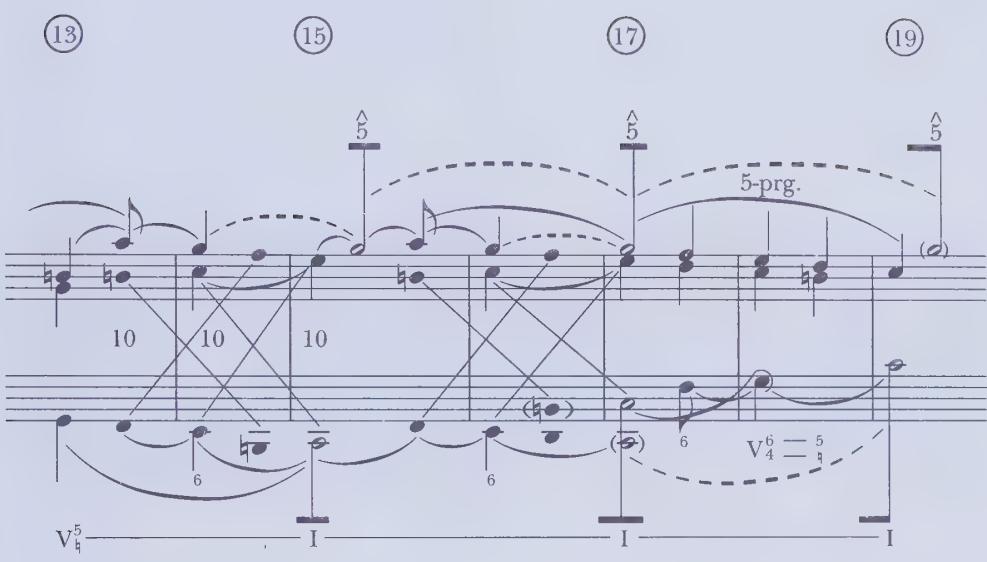
中文讲解
这是第21页上一幅图示的子标签"(b)",表明此处属于图(b)。由于图像数据被省略,无法确认其具体内容;只能依据位置知道它出现在与本节(第11.14节,描述性拆分:副部主题与和声结构,34–59小节)相关的图组之中。在原文中,"(b)“与前后的”(a)""(c)“等子图共同构成对莫扎特《钢琴奏鸣曲》K.457第一乐章呈示段过渡部分(第19–35小节)的中景(middle-ground)缩约分析图组。讲解时只需指出其版面子图归属,不必猜测不可见的图形细节。
补充说明
无额外补充;图像内容不在task_input可定位范围内。
第2段(P0123)
原文复述
[Image placeholder on page 21 bearing the in-figure measure references “13; 17; 19; 15”. The embedded image data is omitted; only the position and these labels are preserved.]
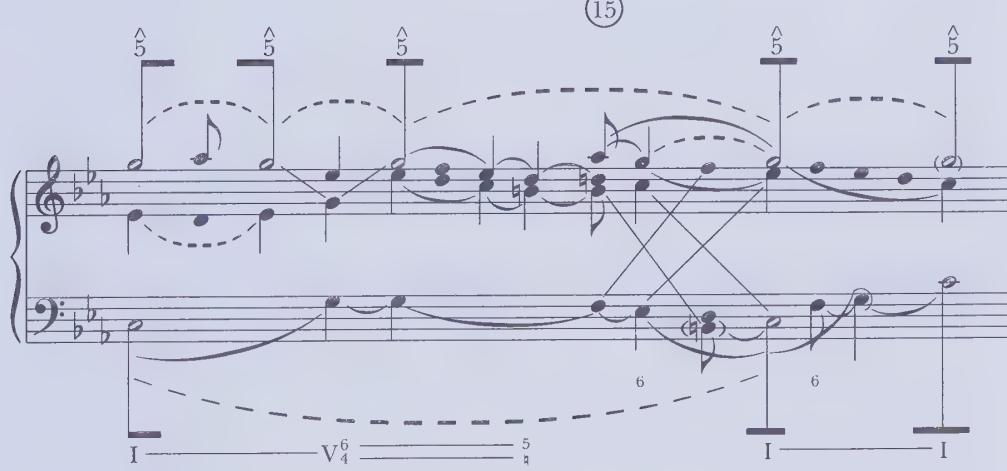
中文讲解
这是第21页上另一处图像占位符,图中以数字形式标出第13、17、19、15小节等关键位置。这些数字表明该谱例在视觉上针对莫扎特K.457第一乐章过渡段(第19–35小节)中的若干小节做了标注。由于图像本身被省略,无法看到具体音符走向,只能确认该图承担"在过渡段中以特定小节为锚点进行分析"的功能。读者需要参照原图来理解作者在这些小节上所标记的具体声部进行或和声事件。
补充说明
无额外补充;具体小节内的声部细节需查看原图。
第3段(P0124)
原文复述
Example 11.15a shows the end of the transition and the second theme in E♭ major, which concludes in bar 59. The first part of the section, bars 36–41, is rather straightforward; the upper voice (in a voice exchange with the bass) rises
中文讲解
本段开启了第11.14节对副部主题(第34–59小节)的描述性拆分。它首先交代两个结构性事实:第一,谱例11.15a呈现的是过渡段的尾部加上副部主题,二者以降E大调陈述,并在第59小节结束;第二,第36–41小节属于这段陈述的前半部分,是相对"直接"的写作。“直接"在这里的含义是:上声部与低声部形成"声部交换”(voice exchange,即两声部互换旋律材料,常见于古典时期的对位化过渡),使上声部逐步上行。本句在"rises"处中断,由P0131承接。讲清本段需要把握三个层次:调性(降E大调)、区段定位(第36–41小节位于副部前半)、以及对位手段(声部交换导致上声部上行)。
补充说明
“声部交换(voice exchange)“是本段的关键技术概念:在同调和声框架下,两声部先后以相同的音程轮廓反向(或同向)陈述,从而形成对位化的旋律延续。这一术语在本节中的作用是把上声部的上行解释为低声部旋律的镜像,而非孤立的旋律走向。
第4段(P0125)
原文复述
[Image placeholder on page 22: a musical example. The embedded image data is omitted; only the page location and presence of the example are preserved.]

中文讲解
这是第22页上的一处乐谱占位符。由于图像被省略,无法直接读出谱例细节;只能依据上下文判断它属于谱例11.15(或与之相邻的图组),用以呈现莫扎特K.457第一乐章副部主题(第34–59小节)的实际谱面形态。读者需要参照原图以核对作者在正文中所讨论的具体声部进行、clef变换和高低音区交替。
补充说明
无额外补充;谱例具体音符内容需查看原图。
第5段(P0126)
原文复述
(a)
中文讲解
这是第22页上谱例组中的子标签”(a)",用以区分同一图组中的前景缩约与中景缩约。它表明紧随其后的乐谱或图示属于”(a)“部分,通常对应前景(foreground)层面。在本节语境中,"(a)“与后面P0128所述的"foreground and (b–c) middle-ground reductions"的划分一致——(a)为前景,(b)、(c)为中景。
补充说明
无额外补充;子标签的功能由其所在的图组结构决定。
第6段(P0127)
原文复述
Example 11.14
中文讲解
这是谱例编号小标题"Example 11.14”,用于在版面上将该谱例标识为第11章中的第14号例题。它与本节讨论的副部主题(第34–59小节)不同——谱例11.14指向的是莫扎特K.457第一乐章的过渡段(第19–35小节),其图注见P0128。该小标题的修辞功能是把后续的乐谱与图注在视觉上锁定为一个独立的分析对象,以便作者把它与谱例11.15(副部主题)进行对比。
补充说明
无额外补充;谱例编号本身不引入新的分析主张。
第7段(P0128)
原文复述
Mozart, Piano Sonata, K. 457, I, transition, bars 19–35: (a) foreground and (b–c) middle-ground reductions
中文讲解
这是谱例11.14的图注,完整信息为:作品——莫扎特《钢琴奏鸣曲》K.457;乐章——第一乐章;段落——过渡段(transition);小节范围——第19–35小节;缩约层次——(a)前景(foreground),(b–c)中景(middle-ground)。它告诉读者本谱例同时给出三个层次的缩约分析:前景是实际的谱面陈述,中景则是把前景中的装饰性细节省略后显露出来的结构骨架。“reduction”(缩约)是申克分析(Schenkerian analysis)的核心操作:通过层层省略次要声部进行,揭示作品背后的和声—线性结构。在本节论证中,作者借助这种多层次缩约来说明过渡段如何为副部主题(第34–59小节)的到来做准备。
补充说明
“前景/中景(foreground/middle-ground)“是申克分析中的层级术语:前景为谱面所记的全部事件,中景为去掉部分装饰音后显露的中间结构,背景(background,本节未直接呈现)则为最深层的基本结构。本节使用这些层次来逐级说明旋律与和声的骨架。
第8段(P0129)
原文复述
[Image placeholder on page 22: a musical example. The embedded image data is omitted; only the page location and presence of the example are preserved.]
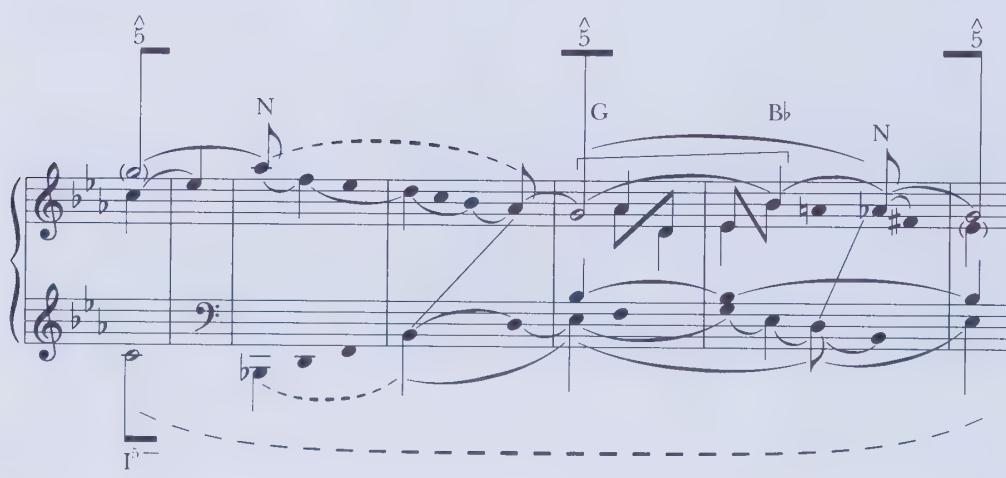
中文讲解
这是第22页上紧随谱例11.14图注的另一处乐谱占位符。依据图注(P0128),它应属于谱例11.14中前景、中景缩约之一的实际图示。具体是前景还是中景需要查看原图确认;图像本身被省略,无法核实。讲清本占位符的作用需要读者参照P0128的图注来判断:它对应图注中所说的”(a) foreground"或”(b–c) middle-ground reductions"中的某一个图。
补充说明
无额外补充;具体属于哪一缩约层需查看原图。
第9段(P0130)
原文复述
[Image placeholder on page 22: a musical example. The embedded image data is omitted; only the page location and presence of the example are preserved.]
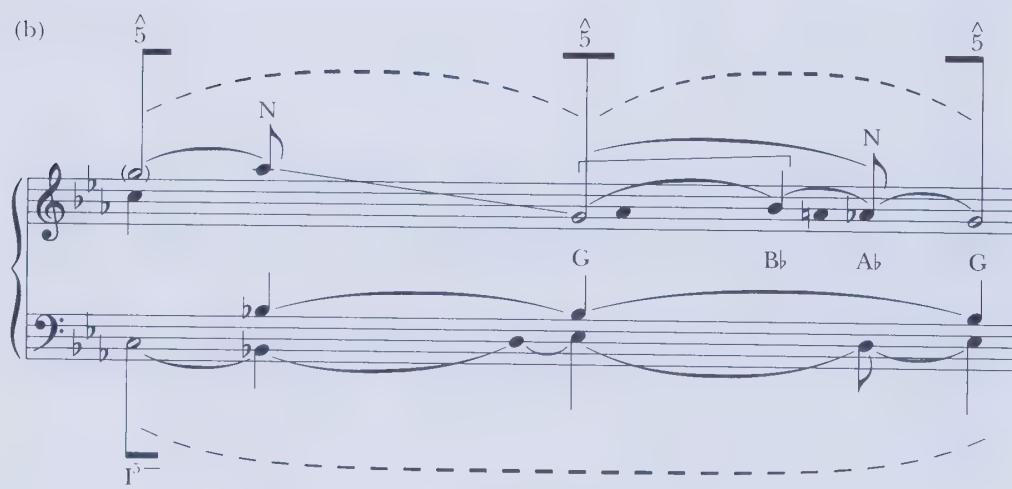
中文讲解
这是第22页上的第三处乐谱占位符,与P0129共同构成谱例11.14的多层次缩约图组。依据图注(P0128)的”(b–c) middle-ground reductions”,本图很可能对应中景缩约中的(b)或(c)子图;但具体归属无法仅凭task_input核实。读者需要参照原图来确认它展示的是哪一层缩约以及所标注的具体小节。
补充说明
无额外补充;图像内容不在task_input可定位范围内。
第10段(P0131)
原文复述
to reestablish the primary tone 5 (3 in E♭ major) in bar 41. Notice the clef changes and alternation of registers that punctuate this ascent, suggesting a dialogue of high and low instruments in orchestral style. This passage also recalls the opening theme, where a similar technique delays the resolution of the upper neighbor A♭ in the higher register (bar 4 to bar 8). Hence the motivic A♭ established in the opening bars of the movement again decorates the primary tone G, in a different tonal context and over a longer span of the upper voice.
中文讲解
本段承接P0124(该句在"the upper voice…rises"处中断),把第36–41小节的上声部上行解释为:抵达主音5(在降E大调中即音级3,对应降E大调的主音♭E)于第41小节。具体讲解包含三层:
第一,“primary tone 5 (3 in E♭ major)“采用申克分析的记谱习惯——用数字标号指示音级功能。“5"指基本结构中主音的位置(Urlinie的起点),括号内"3 in E♭ major"则在降E大调的具体调性中给出对应的音级数与音名(即♭E)。作者用这种"功能标号+调内音级"的双重写法,使读者既能理解结构功能又能落到具体音。
第二,“clef changes and alternation of registers”——作者请读者注意谱面上的谱号变换与高低音区交替,它们像标点一样划分上行的进程,并暗示这是钢琴写作中模拟管弦乐队"高低声部对话"的笔法。
第三,“recalls the opening theme”——作者把第36–41小节与呈示段开头的第4–8小节做主题—动机呼应:两处都使用上邻音♭A对主音G的延迟解决,只是这一次主音G在新的调性(降E大调)背景下被装饰,而且上声部的时值跨度更长。这一呼应的分析意义是:副部虽然调性转移、长度拉长,但其核心动机—装饰关系与主部一致,体现了古典奏鸣曲中"主题材料的变形贯穿”。
本段在小节整体论证中的作用是:以具体的声部进行(声部交换→上声部上行→抵达主音)和动机的跨段落呼应,证明副部主题前半段虽然表面上"straightforward”,却通过清晰的线性逻辑与对主部主题的回应,承担着结构性收束过渡、确立新调的双重任务。
补充说明
“Urlinie"虽未在本段字面出现,但"primary tone 5"的概念属于Urlinie(旋律线)的起点;这是申克分析的标准术语。本节以此为背景框架说明副部主题如何围绕主音展开。“upper neighbor”(上邻音)指的是以半音或全音高于目标音的音,本段中的♭A是G的上邻音;“resolution of the upper neighbor"即上邻音最终解决到目标音G。“register”(音区)指音高大致所处的低、中、高位置;“alternation of registers"即高低音区的来回切换,是本段所述"对话感"的关键来源。
第11段(P0132)
原文复述
Our examination of Clementi’s Sonatina revealed that the second theme composes out structural 2 of the Urlinie. By contrast, in the minor-mode context
中文讲解
本段把视野从莫扎特拉到克莱门蒂的《小奏鸣曲》(Sonatina):作者指出,先前对克莱门蒂的分析显示其副部主题是Urlinie结构音2的展开(“composes out structural 2 of the Urlinie”——即副部主题围绕Urlinie的第二个结构音展开,通过延长、重复、内部展开等手法将其呈现为一个完整的主题段落)。紧接着用"By contrast”(与之相反/相比之下)作转折,引出"in the minor-mode context”(在小调语境下)的对比陈述——但本句在task_input中尚未给出下文,需等待后续段落补充完整。作者在此立起的对照点是:小调语境下副部主题的展开方式与克莱门蒂大调中的做法不同,这种差异将成为本节(甚至后续小节)论证的枢纽。理解本句需要把握"composes out”(展开/铺陈)这一申克术语:它指把一个结构音在时间上放大为可听的主题段落,是申克分析中"长度比例缩减"的逆过程。
补充说明
“composes out”(展开/铺陈)是申克分析中的核心过程,指将背景层的单一音在前景中转化为一段具有内部节奏、和声与旋律的主题性陈述。与之相反的过程是"reduce”(缩约),即把前景细节压缩回更深的结构层。本节前后两种过程都隐含其中。
脚注 / 边栏 / 图表 / 附加信息(如有)
本节中的非正文材料全部为图示与谱例占位符,共九处(P0122、P0123、P0125、P0129、P0130为图像/乐谱占位符;P0126为子标签"(a)";P0127为小标题"Example 11.14";P0128为谱例11.14的完整图注)。它们的功能可分两类:(1)谱例11.14(P0125–P0130以及P0129、P0130的占位图)对应莫扎特K.457第一乐章过渡段(第19–35小节)的前景与中景缩约,为本节副部主题(第34–59小节)的讨论提供前段背景;(2)P0122、P0123位于第21页,承接更前面的论述,为第11.14节的描述性拆分提供图示支撑。本节正文未出现脚注。
💡 本节核心要点
- 副部主题(第34–59小节)以降E大调陈述,至第59小节结束;其前半段(第36–41小节)通过声部交换使上声部上行,最终在第41小节抵达主音5(降E大调中的音级3,即♭E)。
- 作者请读者关注谱面上的谱号变换与音区交替,它们像标点一样划分上行的进程,并暗示管弦乐队式的高低声部对话。
- 副部主题前半段的写法与呈示段开头的第4–8小节形成主题—动机呼应:两处都用上邻音♭A装饰主音G的延迟解决,但后者发生于新调性(降E大调)背景中,且上声部时值跨度更长。
- 本节以克莱门蒂《小奏鸣曲》的副部主题作为对照——克莱门蒂的副部主题是对Urlinie结构音2的展开;作者以"By contrast"为转折,准备引出小调语境下的不同处理方式(具体结论由后续段落给出)。
- 全节综合运用了申克分析的核心手段:声部交换、上邻音延迟解决、Urlinie结构音的展开以及前景/中景缩约,以揭示副部主题在调性与动机层面的双重结构性。
🔑 关键术语
- voice exchange(声部交换):同调性框架下,两声部以相同的音程轮廓先后(或反向)陈述相同的旋律材料,从而形成对位化的延续。本节中表现为:上声部的上行是低声部旋律的镜像,使上声部在第36–41小节逐步升至主音5。
- primary tone 5 / 3 in E♭ major:申克分析的音级标号。“5"指Urlinie的起点主音的功能位置;括号内"3 in E♭ major"给出该功能在降E大调中的具体音级(3,即♭E)。这种"功能标号+调内音级"的双重写法在本节中用以同时表达结构功能与具体音高。
- upper neighbor(上邻音):高于目标音半音或全音的音。本节中♭A是G的上邻音;“resolution of the upper neighbor"即上邻音延迟后解决到目标音G。第4–8小节与第36–41小节都使用这一装饰手法,但所处的调性背景与时值跨度不同。
- register(音区)/ alternation of registers(音区交替):音高大致所处的低、中、高位置。谱面上谱号(clef)的变换与不同音区的来回切换,使上声部的上行进程像管弦乐队的高低声部对话。这是本节所述"对话感"的来源。
- composes out(展开/铺陈):申克分析中的过程:把背景层的单一结构音在前景中放大为一段具有内部节奏、和声与旋律的主题性陈述。本节中克莱门蒂的副部主题即被描述为对Urlinie结构音2的展开;本节副部主题则以"composes out"的相反方式(即强调上邻音装饰与跨段落动机呼应)被处理。
- foreground / middle-ground(前景/中景):申克分析的层级。“前景"为谱面所记的全部事件;“中景"为去掉部分装饰音后显露的中间结构。本节谱例11.14同时给出前景(a)与中景(b–c)缩约,用以揭示过渡段的线性—和声骨架。
11.15 [描述性拆分] Exposition: Second Theme, Alto Line, and Closing Section (bars 36–71)
第1段(P0133)
原文复述
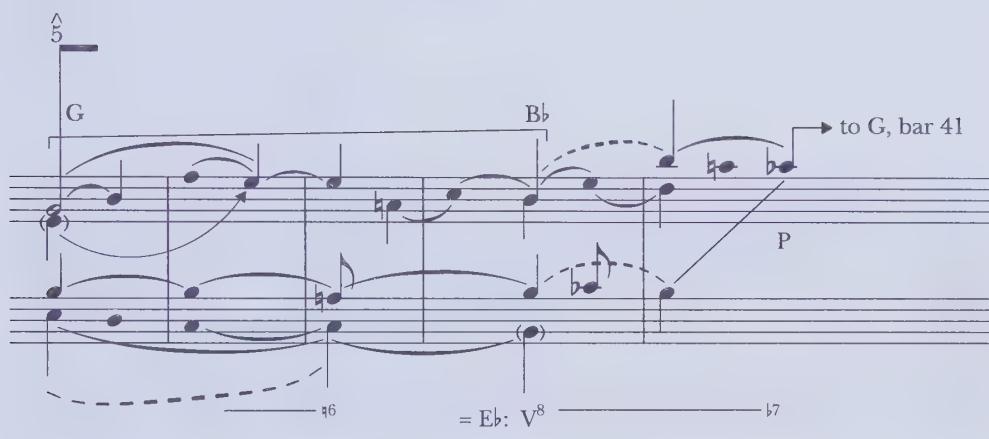
中文讲解
这是页面上的一处图像占位符,原图标注为"36;27”,提示其与第36小节至第27小节之间的谱例片段相关(也可能指第27页或第27小节位置的图示,具体需查看原图)。本节为第二主题与结束段落的分析图像区,需结合后续Example 11.15才能完整理解。
补充说明
图像数据未提供,仅保留位置与图注信息;其内容需参看原版插图。
第2段(P0134)
原文复述
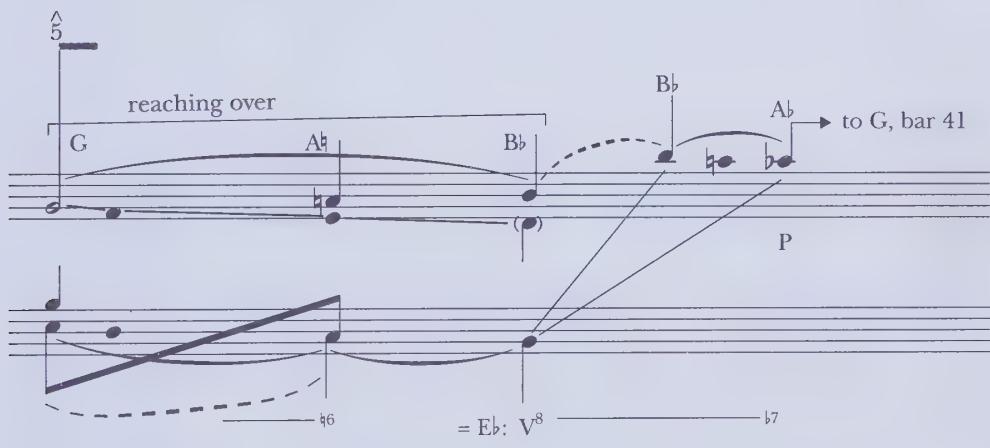
中文讲解
这是Example 11.15中的子图标注”(c)",即第三层级的中景缩减图(middleground reduction)。它与同一图例中的(a)前景与(b)中景缩减相并列,用于展示莫扎特奏鸣曲第二主题(bars 34–59)的不同结构层次。
第3段(P0135)
原文复述
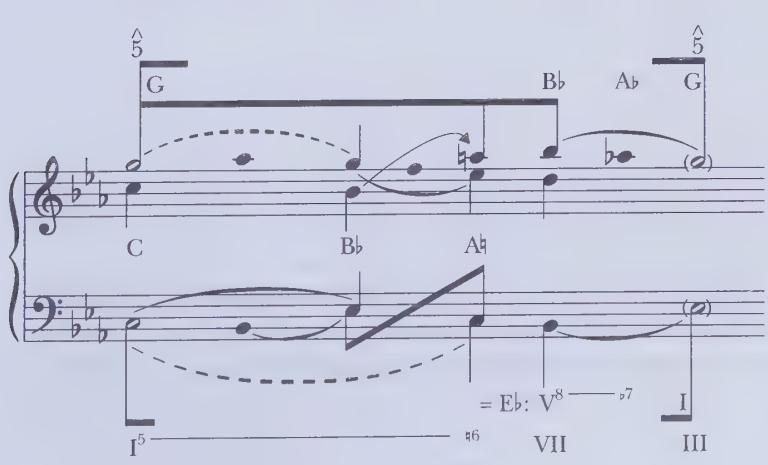
中文讲解
这是第23页上的一处乐谱或图像示例占位符,紧接上方的子图标注,处于Example 11.15图组的上方位置。该示例承接前文对呈示段第一主题的分析,开始进入第二主题(bars 36–71)的图示区域。
补充说明
需查看原图以确认具体谱例内容。
第4段(P0136)
原文复述
Example 11.15
中文讲解
Example 11.15的标题。它作为本节的核心图例,承载第二主题的中景缩减图。
第5段(P0137)
原文复述
Mozart, Piano Sonata, K. 457, I, second theme, bars 34–59: (a) foreground and (b–c) mid-dleground reductions
中文讲解
图例11.15的图注:选自莫扎特《钢琴奏鸣曲》K.457第一乐章第二主题,第34–59小节,包含(a)前景图与(b–c)中景缩减图。注意小节范围标为bars 34–59,与正文讨论bars 36–71的边界略有出入——这说明图例的覆盖范围略宽于本节文字重点讨论的范围。
补充说明
图注中"mid-dleground"出现了换行连字符(mid- / dleground),原文排版中拆为两行。
第6段(P0138)
原文复述
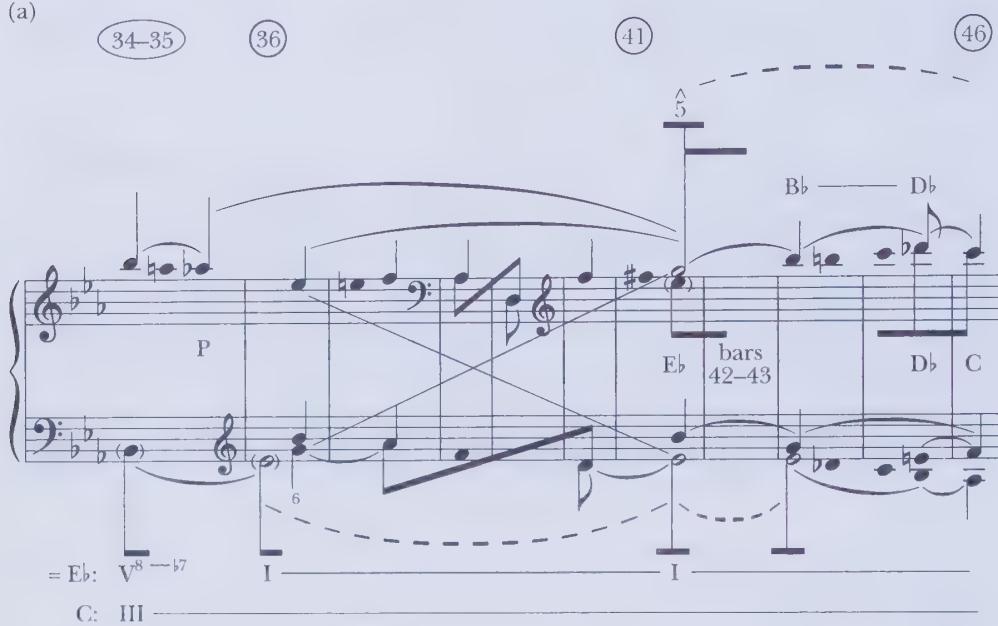
中文讲解
子图标注”(a)",即Example 11.15中的前景图(foreground),与图注中的(a)对应。它是第二主题bars 34–59的实际谱面呈现(前景层),用于与(b)和(c)两个中景缩减层进行对照。
第7段(P0139)
原文复述
of Mozart’s sonata, the primary tone 5 (which is common to both tonic and mediant harmonies) is still active through the beginning of the second theme. The Urlinie begins its descent in the mediant key, representing the second step in the large-scale bass arpeggiation I–III–V. In such cases, 5–4–3 of the Urlinie is composed out as 3–2–1 in the mediant. We begin with an examination of the harmonic structure of bars 41–59 and then consider the upper voice.
中文讲解
承接上一段(关于第一主题结尾与第二主题开头的过渡),本段说明:在莫扎特的这首奏鸣曲中,主音5(属于主和弦与中音和弦的共同音)一直延伸到第二主题开始处仍保持活跃。上声部旋律线(Urlinie,即"基础线”)在中音调上开始下行,标志着低音大分解和弦I–III–V中的第二步。在此类情况下,旋律线的5–4–3被"展开"为中音调上的3–2–1。换言之,旋律线在第二主题的局部层级以中音为主音重新陈述。然后作者宣布论述计划:先考察bars 41–59的和声结构,再讨论上声部。这一顺序——先低音和中景和声,后高音——是Schenkerian分析的标准做法。
第8段(P0140)
原文复述
If the Urlinie descent from 5 to 3 happened too quickly, it would leave the second theme sounding too short for the proportions of the movement. And, as we have seen, much of the compositional interest lies in the ways in which a structure is composed out. Consequently, Mozart uses a kind of delaying tactic, one that extends the second theme. He leads the tonic of bars 36–41 to a II6 (bar 46), suggesting the imminent arrival of an authentic cadence. The II6, however, is followed by a deceptive cadence in bars 47–48, which delays closure in the median key. The motion is repeated, now concluding on a very strong and extended II6 (bar 51). Because the repetition of the tonic in bar 49 is a merely local event in the context of the section as a whole, the overall motion is best understood as a broad bass arpeggiation from the beginning of the second theme: in Eb, I–VI–II6 (Example 11.15b).
中文讲解
本段论证莫扎特如何"拖延"Urlinie的下行,以保持第二主题的长度比例。如果旋律线5到3下行得太快,第二主题就会显得相对于全乐章过短。由于"结构展开"(composed out)是作曲趣味所在,莫扎特于是采用拖延策略:他让bars 36–41的主和弦走向II6(bar 46),暗示即将出现正格终止;然而II6之后却是bars 47–48的阻碍终止(deceptive cadence),延后了中音调上的收束。该进行被重复一次,这次落在更强且更长的II6(bar 51)上。由于bar 49的主和弦重复只是局部事件,从全段来看,整体进行最好理解为自第二主题起始的宽幅低音分解:在降E大调上为I–VI–II6(Example 11.15b)。注意:VI在此是II6的等和弦——在降E大调中VI就是降G小三和弦,等同于II6。这是Schenkerian理论中典型的"阻碍终止→拖延策略"案例。
第9段(P0141)
原文复述
Notice also the character and prominence of the II6, which leads to the structural cadence and conclusion of the second theme in bars 58–59. It is prolonged from bars 51–56 through cadenzalike figuration similar to bravura passages in concerto cadenzas. With the bass structure clarified, we can now describe the voice-leading strands that elaborate the descent of the Urlinie from
中文讲解
继续讨论II6在结构中的重要地位:II6引出bars 58–59的结构终止与第二主题结尾;它通过bars 51–56的华彩式(cadenza-like)音型化被延长,这种写法类似协奏曲华彩乐段的炫技段落。在低音结构得以澄清之后,作者转入下一个话题:描述展开Urlinie下行(从5到3)的声部进行线条。本段以"from"结尾,是跨段未完成句,下一段P0143会续写"5 to 3"。
第10段(P0142)
原文复述
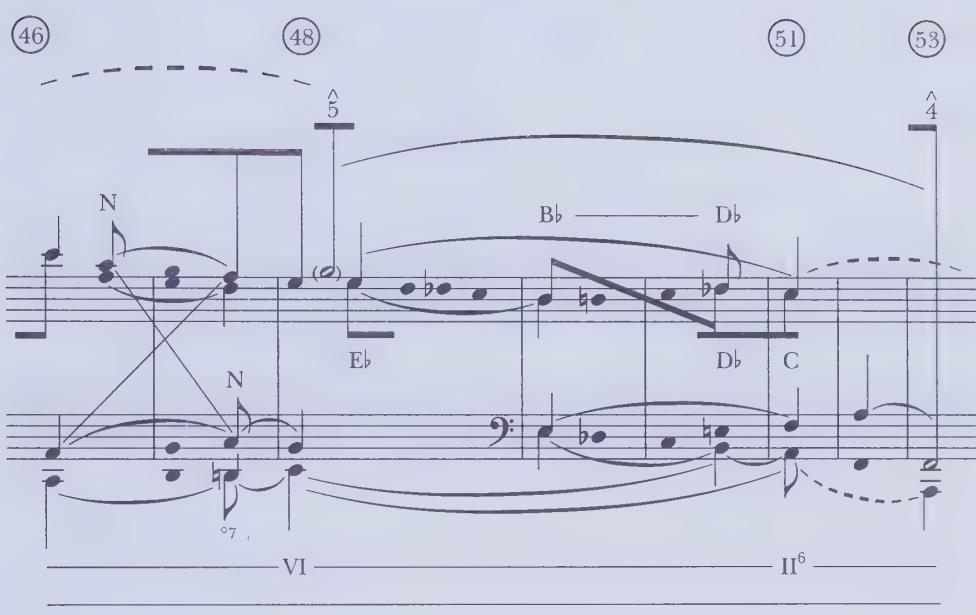
中文讲解
第25页的乐谱或图像占位符。它位于P0141与P0143之间,正对应P0141末尾"现在描述…Urlinie从5到3下行"所引出的上声部分析。该图很可能就是Example 11.15a的前景图谱,用以展示高音旋律线与内声部的具体走向。
补充说明
需查看原图以确认。
第11段(P0143)
原文复述
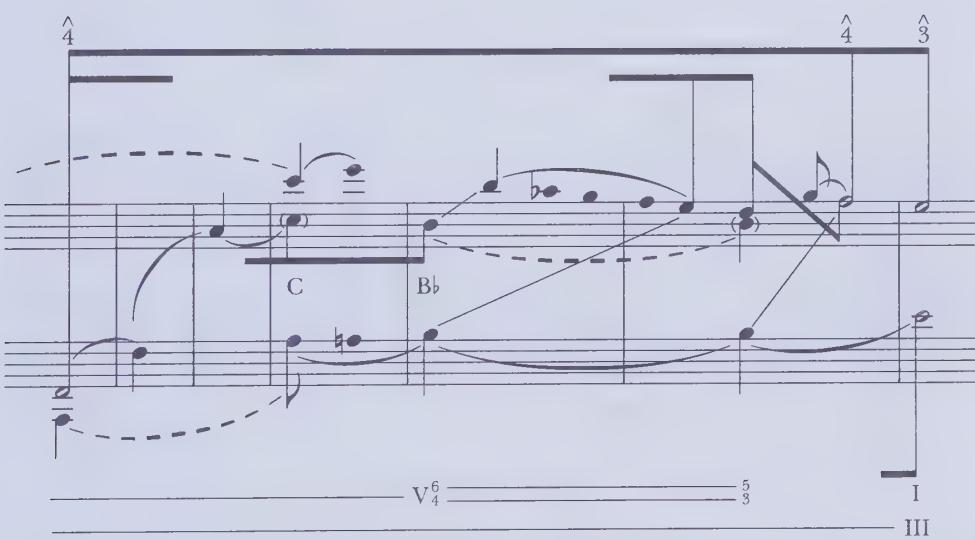
中文讲解
承接P0141,本段描述Urlinie从5到3的上声部展开:顶部声部从bar 36的降E上行到bar 41的G,并在bars 44–45形成从降B到降D的高点运动(Example 11.15a)。降D到C的解决是"邻音动机"(neighbor motive)的新陈述,比之前的音区更高。对照Example 11.15的a层与b层,可以发现这个降B–降D运动其实是叠置在主音5之上的内声部线条。这一观察在bars 49–50得到印证——同一动作在那里重复出现。本段以"produced by the"未完结束,跨段接P0147的"delaying effect of the deceptive cadence",即该重复由阻碍终止的拖延效应所产生。
补充说明
原文段首包含图像占位符标注"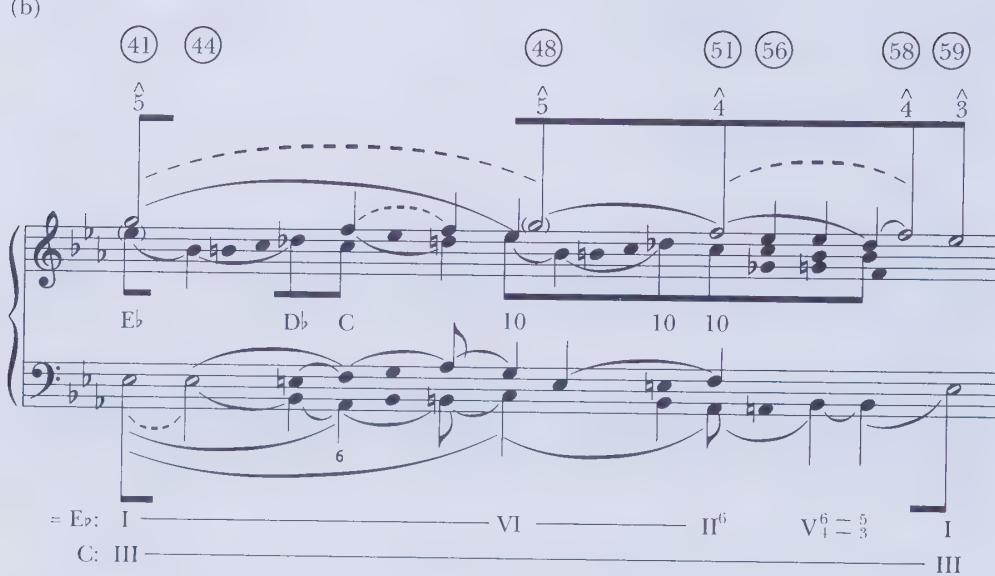
中文讲解
第26页的乐谱或图像占位符。它与子图标注"(b)“配合出现,应是Example 11.15b的中景缩减图谱,展示从降B到降D的内声部线条如何被叠置在主音5之上。
补充说明
需查看原图以确认。
第14段(P0146)
原文复述
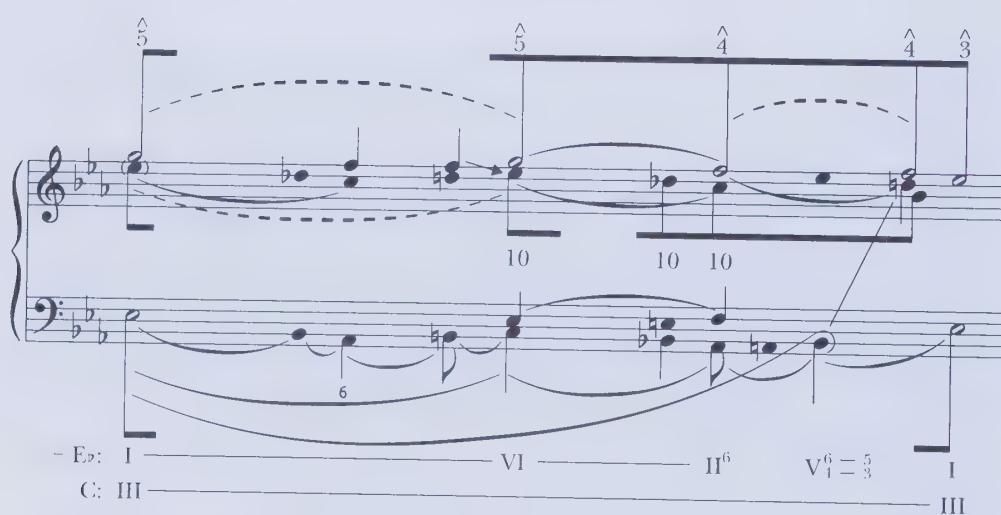
中文讲解
第26页的另一处乐谱或图像占位符,紧邻P0145,可能对应Example 11.15c(即第三层中景缩减)或者同一示例的续页部分,用于继续说明邻音动机重复与alto线的延伸。
补充说明
需查看原图以确认。
第15段(P0147)
原文复述
delaying effect of the deceptive cadence) occurs in the lower register, beneath the primary tone g2 (which remains conceptually present). Level b in particular shows that the two motions from Bb to Db serve locally to elaborate a broader “alto” line, which is more easily understood if one considers the eb2 implied beneath the primary tone 5 in bar 41.
中文讲解
承接P0143未完成句:本段完成"重复动作由阻碍终止的拖延效应所产生"的说明。该重复在低八度出现,位于主音g2(概念上仍存在)之下。b层尤其显示,两个从降B到降D的运动在局部上展开为更宽的"中音声部线”(alto line);若考虑bar 41中主音5之下所蕴含的降e2,这条alto线就更易理解。即:bar 41的eb2作为结构音3(属中音和弦的根音),与两个Bb–Db上行运动结合,构成一条从中音5下行到3(在中音调上即为1)的隐伏alto线。
第16段(P0148)
原文复述
Example 11.16a shows the voice-leading structure of the closing section to bar 71. 23 As we have seen, closing sections confirm the secondary key area, often through repeated cadential patterns. In Mozart’s sonata, the emphasis of eb2 (3) over III throughout this section is easily recognized, both in the music and in
中文讲解
本段开始讨论结束段(closing section)。Example 11.16a展示了直至bar 71的结束段声部进行结构,并标有脚注23(脚注本身未在本页展示)。回顾前述:结束段通常通过重复的终止式确认副调区域。在莫扎特的奏鸣曲中,降e2(即结构音3,作为中音III和弦的根音)在整个结束段被强调,无论在听觉上还是在图示中都一目了然。本段以"both in the music and in"未完结束,跨段接P0153的"the graph. Yet this closing section also involves…"。
补充说明
脚注23的具体内容未在所提供段落中出现,仅标注上标编号。
第17段(P0149)
原文复述
(a)
中文讲解
子图标注"(a)",即Example 11.16中的第一个图。它与图注中的(a)对应,展示结束段bars 59–71的声部进行结构。
第18段(P0150)
原文复述
Example 11.16
中文讲解
Example 11.16的标题,作为本节结束段分析的核心图例。
第19段(P0151)
原文复述
Mozart, Piano Sonata, K. 457, I: comparison of (a) bars 59–71 and (b) bars 41–59
中文讲解
图例11.16的图注:选自莫扎特K.457第一乐章,对比(a) bars 59–71的结束段与(b) bars 41–59的第二主题部分。这一图例的设计意图明确——通过并置两段,让读者比较其声部进行的相似性,揭示动机材料的回顾与统一。
第20段(P0152)
原文复述
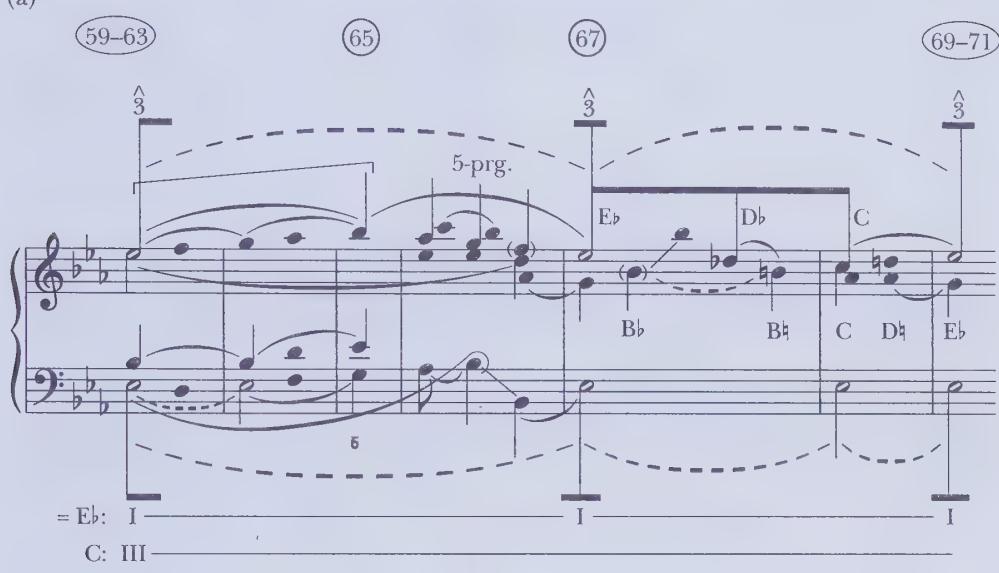
中文讲解
第27页的乐谱或图像占位符。它位于Example 11.16图组中,对应结束段(a)与第二主题(b)的并置对比图。
补充说明
需查看原图以确认。
第21段(P0153)
原文复述
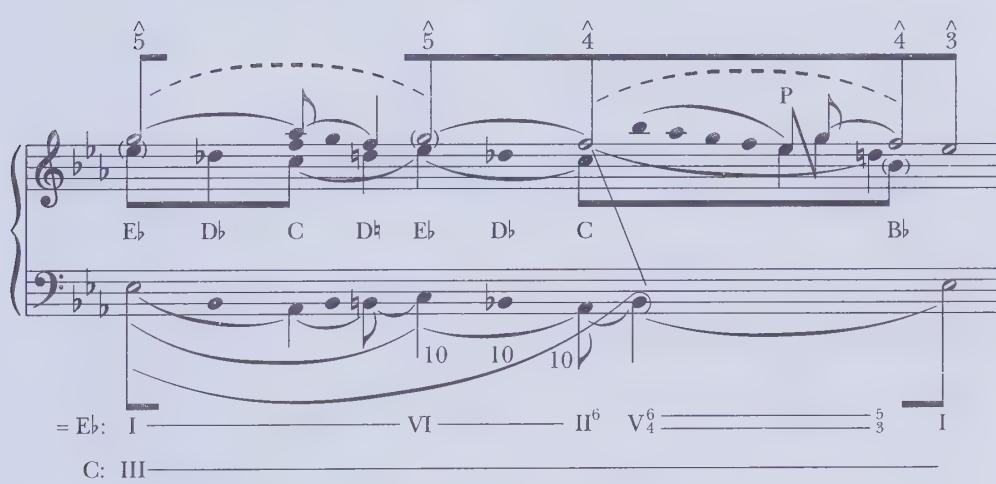
中文讲解
承接P0148未完句:本段说明结束段不仅通过终止式巩固副调,还包含对先前动机材料的回顾(正因如此,作者在第二层提供了第二主题部分片段的额外缩减)。具体地,请注意bars 59–61与63–65中自降E到降B的上行五度(高音部)——它以逆行形式回顾了bars 57–58终止处的同一条线(在同音区!),还回顾了bars 42–43低音声部中的五度(图中未显示),并标有脚注24。更微妙的是从bar 67正拍开始的回顾:第一个来自降e2(结构音3),第二个来自降b1——本段以"from bb1,“未完结束,跨段接P0157的"the fifth of the median harmony understood through implication…",即降b1是中音和弦的五音,通过隐含关系被理解。
补充说明
脚注24的具体内容未在所提供段落中出现,仅标注上标编号。
第22段(P0154)
原文复述
Example 11.17
中文讲解
Example 11.17的标题,作为下一节(展开段,bars 71–99)分析的核心图例。本节虽然标题涉及bars 36–71的结束段,但Example 11.17的图例标题已在页面底部出现,预示下一节将进入展开段的讨论。
第23段(P0155)
原文复述
Mozart, Piano Sonata, K. 457, I, development, bars 71–99: (a) foreground and (b) middle-ground reductions
中文讲解
图例11.17的图注:选自莫扎特K.457第一乐章展开段,bars 71–99,包含(a)前景与(b)中景缩减图。这是下一节(展开段)的开头图例,本节末尾出现是为下一节作过渡。
第24段(P0156)
原文复述
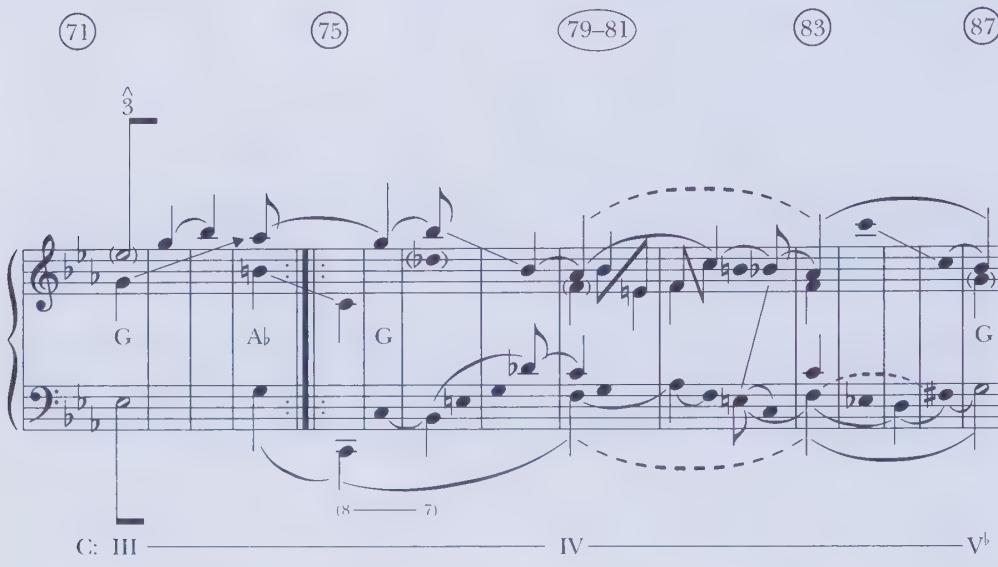
中文讲解
第28页的乐谱或图像占位符,对应Example 11.17中的展开段图组。
补充说明
需查看原图以确认。
第25段(P0157)
原文复述
the fifth of the median harmony understood through implication (it appears literally in the higher register on beat 2).
中文讲解
承接P0153未完句:本段完成对bar 67第二个回顾(来自降b1)的解释——降b1是中音和弦的五音,通过隐含关系(即作为结构内涵)被理解,“它在第二拍以高八度音区字面出现”。也就是说,降b1作为结构音在声部进行中体现为隐含的五音关系,但其字面音响则在高八度(即第二拍)的位置出现。这一处理揭示了Schenkerian分析中"结构音与表层音不必一一对应"的核心观念。
第26段(P0158)
原文复述
Example 11.16b presents another graph of part of the second theme (bars 41–59). We repeat this passage so that you may easily compare it to the structure of the closing section depicted in Example 11.16a. Notice the similar voice-leading strands, the repetitions of which serve to unify the passages. In the closing bars of the exposition, therefore, Mozart summarizes previously heard motivic strands in a continuing interplay of registers, an aspect of this movement established from its very beginning.
中文讲解
本节收束段:Example 11.16b给出第二主题bars 41–59的另一图示,作者之所以重复这一段,是为了便于与Example 11.16a所示的结束段结构作比较。请注意两段之间相似的声部进行线条——它们的重复起到了统一两段的作用。因此,在呈示段结束的几小节中,莫扎特以音区之间持续的相互作用来总结此前听到的动机线条,而"音区互动"这一特质自该乐章一开始就已确立。这一总结把本节的核心论点(结束段既巩固副调又回顾先前动机)提升到乐章整体特征的层面。
脚注 / 边栏 / 图表 / 附加信息(如有)
本节涉及Example 11.15、11.16、11.17三个图例。Example 11.15覆盖第二主题bars 34–59的(a)前景与(b–c)中景缩减,是本节论证低音拖延策略与alto线的核心图。Example 11.16以(a) bars 59–71结束段与(b) bars 41–59第二主题的并置对比,揭示动机回顾与声部进行的统一。Example 11.17是下一节展开段(bars 71–99)的图例,仅在本节末尾出现作过渡。脚注23与24在所提供段落中仅标注上标编号,具体内容未出现,需查阅原书页脚。
💡 本节核心要点
- Urlinie的5–4–3在中音调上被"展开"为3–2–1,主音5作为共同音延续到第二主题开头。
- 莫扎特通过II6–阻碍终止–II6的拖延策略扩展第二主题,其整体低音结构为降E大调的I–VI–II6(即II6与VI为等和弦关系)。
- 高音部从降E上行到G,高点为bars 44–45降B到降D的内声部运动,叠置在主音5之上,构成更宽的"alto线”,其结构内涵可追溯到bar 41主音5之下隐含的降e2(结构音3)。
- 结束段通过重复终止式与对先前动机材料的回顾(特别是自降E到降B的上行五度以降行形式呼应bars 57–58和42–43)来巩固副调。
- Example 11.16a与11.16b的并置比较证明,结束段与第二主题具有相似的声部进行线条,音区之间的持续相互作用是本乐章自始至终的核心统一手法。
🔑 关键术语
- Urlinie:德语术语,指"基础线",Schenkerian分析中代表作品最深层的旋律骨架,通常由3、5、8等结构音构成的下行线条。在本节中,第二主题的Urlinie从中音调的5开始下行,即5–4–3(或在中音调上展开为3–2–1)。
- primary tone:指贯穿作品始终、作为共同音维持的结构音。在本节中,主音5既属于主和弦(Eb)也属于中音和弦(Gb),因此能持续延伸到第二主题开始处。
- composed out:Schenkerian术语,指把一个抽象的结构在表层通过延长、重复、动机化等方式展开、铺陈为可听的音乐。本节中5–4–3被"展开"为中音调上的3–2–1即为一例。
- deceptive cadence:阻碍终止,常为V–VI的进行。在本节bars 47–48与紧随的重复中,II6之后出现阻碍终止,用以拖延中音调上的收束,构成莫扎特的"拖延策略"。
- alto line:中音声部线,指位于高音旋律与低音之间的内声部线条。本节中由两个Bb–Db上行运动所局部展开的更宽线条,被认为是一条结构性alto线,需借助bar 41主音5之下隐含的降e2才能理解。
- neighbor motive:邻音动机,指某音被其上下邻音装饰的短小动机。本节中降D解决到C被识别为先前已经出现过的邻音动机的"新陈述",但音区更高,出现在bars 44–45。
- bass arpeggiation:低音分解和弦,指深层结构中以分解方式呈现的和声骨架。本节中第二主题整体被理解为在降E大调上I–VI–II6的宽幅低音分解,其中II6与VI为等和弦关系。
11.16 [描述性拆分] Development: Overview and Upper-Voice Line (bars 71–99)
第1段(P0159)
原文复述
Development (bars 75–99)
中文讲解
这是一个小节标题。根据锚点信息,本小节标题所标范围是 bars 75–99(虽然其内部讨论同时回溯至 bar 71 的呈示部末段以及 bar 93、bars 98–99 等具体位置)。它开启的论题是:在 C 小调奏鸣曲式呈示部已经终止之后,进入发展部之后大规模基础结构与上声部线条如何运作。换句话说,本节讨论的是基础结构第一分支(Urlinie 第一分支)的被中断结构之延续、属持续之上的结构 2̂,以及低音与上声部如何在发展部中展开并最终走到被中断点。
第2段(P0160)
原文复述
In our analysis of Clementi’s Sonatina, we saw that the development section prolongs structural $\hat{2}$ over V of the structure. In minor-mode compositions, the second key area is typically the median. From a structural perspective, if the Urlinie begins on $\hat{5}$, it usually descends to $\hat{3}$ at the end of the exposition. In the development section the bass arpeggiation of the first branch of the interrupted structure will continue from III at the end of the exposition to V at the end of the development. In the upper voice, structural $\hat{3}$ will descend to $\hat{2}$ over V. $^{25}$
中文讲解
本段为发展部的整体理论预设做铺垫,浓缩了本节论证的骨架,含有四条关键前提:
- 呈示部末与发展部的功能对位:在克莱门蒂的小奏鸣曲中,发展部把"结构 2̂ 持续在结构的 V 之上"加以延长——也就是说,结构 2̂ 必须维持,但低音此时处于 V 而不是 I,形成"结构对位"的张力。
- 小调第二调区的常规:小调作品中,第二调区(second key area)通常是中音(III,即相对大调)。这一惯例影响呈示部末端低音的归属:本曲呈示部以 III 收束而非以属音收束。
- Urlinie 的音域与终点:若 Urlinie 自 5̂ 起,通常下行至呈示部末的 3̂(这是 Schenker 所谓小调 5̂ 线呈示部段落的标准终止)。
- 发展部的低音分解与上声部行为:被中断结构第一分支的低音分解,自呈示部末的 III 一直延续到发展部末的 V;与之平行,上声部则把结构 3̂ 下行至结构 2̂,并落在 V 之上。
本段用脚注 25 标记这个"3̂ 下行至 2̂"的核心陈述,提示读者该结论将贯穿后续所有图例与文字论证。它实际上把读者锁定在中断结构(interrupted structure)框架内阅读发展部,并为后续讨论具体的 5–6 序列、经过 IV 与 minor V 抵达 V 作了理论预告。
补充说明
脚注 25 标记的是关于"Urlinie 自 3̂ 降至 2̂"这一陈述本身的文献依据或延伸说明;本节正文中并未给出脚注内容,但读者应留意这一关键断言是本节所有图示分析的目标性结论。
第3段(P0161)
原文复述
Example 11.17a includes the final bars of the exposition for perspective. In bar 71 we can clearly hear $\hat{3}$ over III, the active elements of the fundamental structure. Bear in mind, however, that due to the convention of repeating the exposition, the final bars of the exposition have a dual nature. They must serve both as a retransition back to the tonic at the beginning of the movement and as a transition into the development. Consequently, this passage moves quickly to a
中文讲解
本段引出图 11.17a 并解释呈示部末段(自 bar 71 起)的双重功能。
首先,bar 71 是确认基础结构"活跃元素"——结构 3̂ 位于 III 之上——最清晰的听觉位置,这是整段论证的出发点。
然而,作者强调了一个重要的解释性限定:因为奏鸣曲式要重复呈示部,所以呈示部的最后若干小节同时承担两种功能:既要把音乐带回主调以便重新演奏呈示部,又要作为通向发展部的过渡。因此,这段音乐会以"快速运动"的方式滑向下一个和声——即下一段所要揭示的 V⁹ in C minor(关于此和弦的描述在 P0164 完整给出)。这种"双重功能"在分析上造成困难:同样的乐汇既是回归又是离调,作者因此提示读者必须把呈示部末视作一个"双重性"段落,否则将错估其结构归属。
本段在论证链上的作用是:先把读者安置在 bar 71 的结构状态(3̂/III),再预告该位置将通过一个具有动机意义的 V⁹ 进入发展部。
第4段(P0162)
原文复述
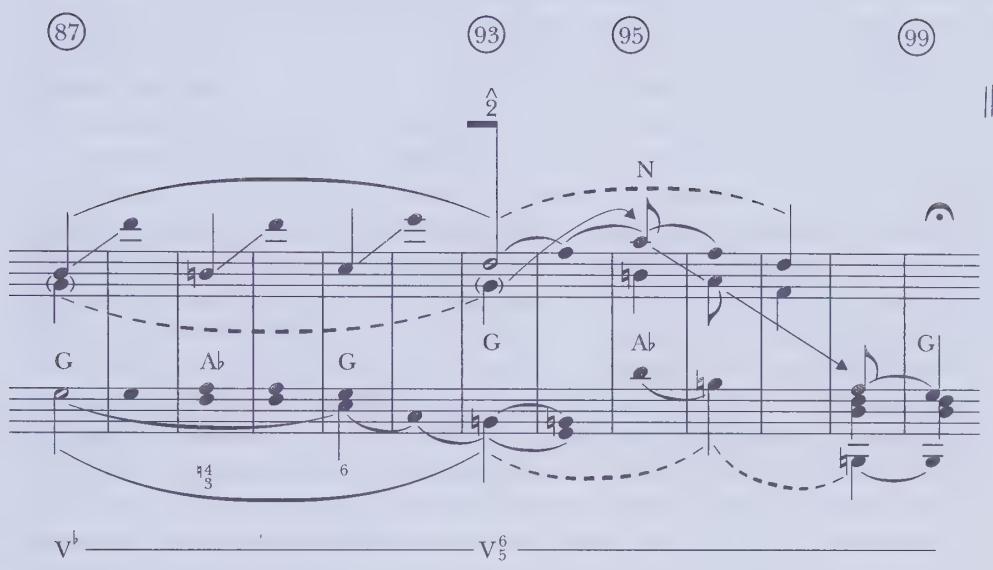
中文讲解
这是图 11.17 内部的 (b) 子图占位符。结合 P0167、P0170、P0172 等后续段落对 Example 11.17b 的反复引用可知,(b) 子图是把发展部广域低音与上声部运动置于结构层面的简化图(reduction graph)。它所呈现的是中景(middleground)层级的对位骨架,与 (a) 子图(即 P0163 所示)展示的前景乐谱形成对照。需查看原图以确认五度/六度序列、各和声位置以及具体的低音记谱。
第5段(P0163)
原文复述
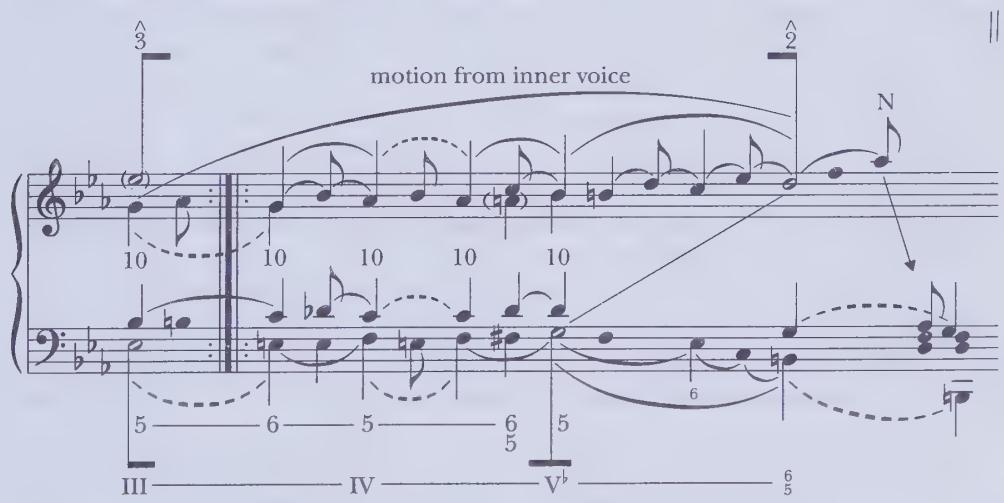
中文讲解
这是 Example 11.17a 的乐谱或图示占位符,位于第 29 页。结合上下文可知,该图示对应 P0161 中提到的"呈示部末段至发展部开端"的乐谱与对应图,可能包含 bar 71 的 3̂/III、bar 75 附近的 V⁹ in C minor、bars 79 起 IV(主题再现)以及 bars 85–87 的 G minor 等关键和声位置,并以根音位置写出前景。需查看原图以核对具体小节标注、和声标记与声部细节。
第6段(P0164)
原文复述
$V^{9}$ in C minor, a chord that recalls the motivic upper neighbor $A^{b}$ in the two-line octave (the register in which $A^{b}$ has appeared numerous times).
中文讲解
承接 P0161 末句(该段以"Consequently, this passage moves quickly to a"结尾,未给出宾语),本段补全该宾语:呈示部末段快速滑向的目标是 C 小调的 V⁹ 和弦。
此处作者特别强调 V⁹ 的动机含义:它包含动机性的上方邻音 A♭,且 A♭ 出现在"两线八度"(two-line octave)这一特定音区之中——而 A♭ 在全曲中曾多次出现于此音区,因此 V⁹ 的出现并非偶然,而是对 A♭ 这一动机的回响。
本段在论证链上的作用是:把呈示部末段那个"快速到达"的和声识别为 C 小调的 V⁹,并把它的内部音与全曲反复出现的 A♭ 动机联系起来,从而为下一段 V⁹ → C 大调和声(伪装的主调)作铺垫。
第7段(P0165)
原文复述
When the $V^{9}$ chord then leads into the development, it again takes us to C harmony. But another unexpected transformation occurs: unlike the beginning of the movement, we hear C-major harmony. As the development progresses, we realize that this is not a real tonic at all, but an applied V of IV that is transformed into an applied VII $^{07}$ of IV before F minor appears in bar 79. The subdominant is strongly articulated by the return of the theme from the thematic transition (bars (23–26); hence we can consider the arrival of IV as a waypoint in the harmonic plan of the development section. In the upper voice, the $A^{b}$ of the $V^{9}$ resolves across the double bar to G (bar 76), which then leads to $A^{b}$ over the IV in bar 79. After we examine completely the large-scale bass motion, we will return to the upper voice and discover how it functions in the composing-out of the fundamental structure.
中文讲解
本段是发展部开始阶段的和声与上声部事件的关键说明,含三层信息:
- C 大调乃伪装主调:V⁹ 之后再次出现 C 和声,但此时是 C 大三和弦而非全曲开始时的 C 小三和弦。这一意外的色彩变换是表象——经过对后续和声的考察,作者揭示它并非真正的主调,而是 IV 的应用属和弦(applied V of IV),随后再变形为 IV 的应用 VII°⁷,并在 bar 79 抵达 F 小调(即 IV)。换言之,开头的 C 大调是中音 III 的延续,它经由一个 5–6 上行序列被改写为 IV 之前的导音化和弦。
- IV 是发展部和声计划的中途路标(waypoint):IV 的到来通过主题材料(bars 23–26 主题转换中的主题再现)得到强烈强调,因此 IV 在本发展部的和声布局中扮演结构性"中途站"的功能——既非终点,也非路过。
- 上声部的动机延续:V⁹ 中的 A♭ 在双小节线后下行解决到 G(bar 76),再经过若干运动抵达 bar 79 IV 之上的 A♭。这一运动为后续"上声部与低音同步上行"的 5–6 序列铺设起点。最后一句承诺:在大尺度低音被完整考察后,将回到上声部并揭示其在基础结构"composing-out"(展开化)中的功能。
本段与 P0160 所建立的理论预设对接:III→IV 这一段正是 P0160 所说"低音分解自 III 到 V"的中段一站,伪装主调的解读保证了对中断结构框架的忠实。
第8段(P0166)
原文复述
As Example 11.17a illustrates, the subdominant is prolonged for five bars. (Because bars 81–82 are a varied repetition of bars 79–80, they are represented by the same two bars in the graph.) In the music you will see that, during this prolongation, the melodic design of the right hand changes from the theme of the transition to the arpeggio of the first theme. In bars 85–87, G minor is preceded and established by its own applied V $^{7}$ chord. G minor is another important reference point, signaled as such not by a change in melodic design (since the arpeggio of the first theme continues), but by a change in direction of the bass. The bass now begins to descend by step, reaching B $^{4}$ in bar 93, which is repeated in bar 96 and, finally, in bars 98–99, where it concludes the development section. Notice the register at this point: the left hand recalls the low register of previous points of articulation, such as the opening of the movement, the preparation of the thematic transition (bar 21), and the beginning of the development section.
中文讲解
本段描述发展部中段 IV 与 G minor 两个关键参考点的具体实现方式,含以下几个观察要点:
- IV 的延续长度与图示简化:IV 自 bar 79 起被延长达五个小节;bars 81–82 是 bars 79–80 的变奏重复,因此在图 11.17 中只用同一组两小节代表,避免冗余。
- 右手旋律设计的层叠变化:在 IV 延续期间,旋律设计从"主题转换中的主题"过渡到"第一主题的琶音"。这是一种材料层面的转接,标志发展部内部从主题转换材料向呈示部第一主题材料的回归。
- G minor 的到达方式:bars 85–87 的 G minor 由其自身的应用 V⁷ 引导并确立。与 IV 不同,G minor 的"参考点身份"不是通过旋律设计的转换来体现(因为琶音继续),而是通过低音方向的转折来体现——这是本段最重要的分析观察:重要的和声路标可以用不同维度(旋律、和声、低音方向)来"标记"。
- 低音的下行路径:低音自此开始逐步下行,抵达 bar 93 的 B♭4,并在 bar 96 重复,最终在 bars 98–99 结束发展部。
- 左手音区的回响:bars 98–99 的左手回到"低位音区",与全曲若干之前的"结构性节点"(movement 开头、主题转换的准备 bar 21、发展部开端)共用同一音区。这一"低区回响"是该作品统一性的重要来源。
本段在论证链上承上(IV 路标)启下(minor V 与低音下行),为 P0167 的大尺度低音图示提供现象层证据。
第9段(P0167)
原文复述
Example 11.17b puts the broad bass and upper-voice motions into structural perspective. Recall that the IV and minor V, the primary reference points in bars 79 and 87, are each preceded by applied leading-tone chords. The reduction shows that these chords are elaborations of an ascending 5–6 sequence. Consequently, the C-major harmony at the beginning of the development section is, as we mentioned above, not a real tonic but a continuation of III; the 5–6 motion above a chromatic bass transforms the median into the applied V and VII $^{67}$ chords of the forthcoming IV.
中文讲解
本段引入图 11.17b 的结构简化视角,把发展部广域低音与上声部运动"压缩"到中景层面,从而把现象层的"伪主调"谜团解开。核心论证如下:
- 应用导音和弦与 5–6 序列:bars 79 的 IV 与 bar 87 的 minor V 之前都有应用导音和弦(applied leading-tone chords)。简化图揭示这些应用和弦其实是从一个上行 5–6 序列延伸出来的装饰性事件。
- 伪装主调的真相:因此,P0165 中提到的"C 大调和声并非真正主调"在此得到图示证明——它是中音 III 的延续,5–6 序列在一条半音化低音之上运动,把 III 改写为即将到来的 IV 的应用 V 与 VII°⁶⁷。
- 结构观点的转换:从图 11.17a(前景/根音位置)到图 11.17b(中景/对位化)的视角切换是本段教学意义的核心:同一段音乐可以同时被读作"根音进行"和"对位进行",本节即将讨论的"添加根音"(P0169)正是连接这两种读法的桥梁。
本段在论证链上的作用是:把 P0160 的理论预设、P0165 的伪装主调解释、P0166 的现象描述全部纳入一个统一的简化图框架,为接下来 P0168 与 P0169 的对位过程分析铺平道路。
第10段(P0168)
原文复述
Exactly the same contrapuntal process transforms IV into the applied $\frac{6}{5}$ of minor V. Thus we see a chromatically ascending bass that leads from III to V: E♭-E♭-F-F♯-G. If you take a moment to review the first part of Example 11.15a, you will see that this chromatic tone succession—from E♭ to G♭—is the beginning of the exposition’s second theme! The recomposition of this line serves to unify different sections of this movement at different structural levels. From bar 87 the minor V is transformed into the $V_{5}^{6}$ (a major-minor seventh chord) of the home tonic. Notice also the decorating diminished seventh chord in bars 95–98 (played very softly in bar 98), which recalls the motivic G-A♭-G as the development section closes.
中文讲解
本段揭示了发展部低音的完整半音上行并指出该线条在全曲中的统一性作用,含四层信息:
- 同一对位过程的复制:与把 III 转为 IV 的应用和弦完全相同的对位过程,把 IV 转为 minor V 的应用 $\frac{6}{5}$。换言之,从 III 到 V 的整个低音路径都是同一 5–6 上行序列的不同局部应用。
- 半音化上行低音的具体内容:自 III 至 V,低音以 E♭–E♭–F–F♯–G 半音化上行,把读者引向 minor V。
- 跨结构层次的材料统一:作者邀请读者回顾 Example 11.15a 的第一部分,将会发现这段半音化上行(E♭ 至 G♭)正是呈示部第二主题的开头。这种"线条的再创作"(recomposition of this line)使同一材料在不同结构层次上把发展部与呈示部第二主题统一起来——这是 Schenkerian 分析中典型的"远关系统一性"。
- minor V → 主 V 的转换:自 bar 87 起,minor V 被改写为主调的 $V_{5}^{6}$(大-小七和弦,即 minor V 的根音位置变体或主调属和弦的 $\frac{5}{6}$ 位置)。
- 装饰性减七与动机回响:bars 95–98 的装饰性减七和弦(bar 98 演奏得极轻)回响动机 G–A♭–G,为发展部收束提供动机层面的句号。
本段是 P0167 论证的扩展与图示支持:通过指出低音半音化上行 = 第二主题开头的材料身份,作者把"对位过程"从一个抽象图示转化为与全曲材料史挂钩的具体观察。
第11段(P0169)
原文复述
In Example 11.17b, the chords in bars 75 and 85 are expressed in $\frac{6}{3}$ and $\frac{6}{5}$ position, respectively, even though they appear in root position in the foreground of the music (compare to Example 11.17a). In essence, a deeper contrapuntal progression (III–IV–V with chromatic passing tones) underlies a disjunct bass line at the foreground. This technique is an instance of what Schenker refers to as the addition of a root. In Free Composition, he says, “Voice-leading may also arrive at roots by actually adding [inner-voice] tones that are implicit in the context, that is, by placing then underneath the lowest voice.” $^{26}$ (“Lowest voice” here means the middleground bass shown in Example 11.17b.) In many cases, the root-position chords produce a cadential effect (V–I); in this passage, IV and minor V are emphasized through this technique.
中文讲解
本段引入 Schenker 的"添加根音"(addition of a root)技法来解释图 11.17a 与 11.17b 之间的表层矛盾,是本节最关键的理论深化:
- 图表与乐谱的差异:在简化图 11.17b 中,bar 75 的和弦写作 $\frac{6}{3}$ 位置、bar 85 的和弦写作 $\frac{6}{5}$ 位置;而在前景乐谱 11.17a 中,它们以根音位置出现。这一形式差异不应被读作分析错误,而是 Schenker 重要技法的体现。
- 对位进程与前景的脱节:在更深层,III–IV–V(带半音经过音)的连续对位进行支持着前景那条看似跳跃的低音线。这种"深层平滑 / 表层跳进"正是添加根音技法的功能。
- Schenker 的原话引用:作者直接引用《Free Composition》中关于添加根音的描述:“Voice-leading may also arrive at roots by actually adding [inner-voice] tones that are implicit in the context, that is, by placing them underneath the lowest voice.” 这里"lowest voice"在作者语境中特指 11.17b 中所示的中景低音,而非字面意义上的最低声部。
- 功能效果:添加根音技法的常见功能是制造终止感(V–I);本段特别指出,在本段音乐中,IV 与 minor V 是通过此技法得到强调的——也就是说,“根音位置"作为一种分析性的"前景装置"被叠加在中景对位之上,以突出路标和声。
本段在论证链上的作用是:提供图 11.17b 的合法性,解释为何读者会发现图示与前景不同,并用 Schenker 自己的术语来命名这一差异。
补充说明
脚注 26 在正文中以角标出现,标记的是 Schenker《Free Composition》中关于"添加根音"技法的原话出处;脚注本身的内容即正文引用的那段话,进一步佐证该技法在 Schenker 理论体系中的合法性。
第12段(P0170)
原文复述
We left the upper voice at the point where $A^{b}$ is established over IV in bar 79. Example 11.17b illustrates that as the bass rises in the 5–6 sequence, the upper voice does as well. Hence the upper voice moves from G (at the beginning of the development) to $B^{b}$ (over the minor V) through the technique of reaching over; the pattern in this case is the leap of an ascending third followed by a descending step. As the bass changes direction and descends to the $V_{5}^{6}$, the upper voice continues its ascent, arriving at $d^{2}$ in bar 93, followed by the superposed inner-voice tones F and $A^{b}$.
中文讲解
本段把视线从低音转回上声部,兑现 P0165 末句"待大尺度低音考察完后再回到上声部"的承诺。核心内容:
- 上声部与低音的同步上升:图 11.17b 揭示,当低音在 5–6 序列中上升时,上声部同样上升。这是一种典型的对位耦合——两个外声部以不同节奏、不同方向共同勾勒一个统一的对位过程。
- “跨过”(reaching over)技法的应用:上声部从发展部开头的 G 出发,抵达 minor V 之上的 B♭,其方式是"上行三度跳进接下行级进”——即跨越(reaching over)模式。这种"先跳后级进"使上声部能够在和声变更的间隙中保持线条连贯。
- 低音转降、上声部继续升:低音在 minor V 之后转向下行(向 $V_{5}^{6}$),但上声部继续上行,抵达 bar 93 的 d²;其后叠加内声部音 F 与 A♭。这一"反方向运动"是发展部接近终点时制造张力的关键手段:低音回到主属,上声部却仍在攀升,形成 P0171 所要详述的线性进行。
本段建立了上声部"以升代降"的逆向运动,是 P0171 把 d² 识别为结构目标的前置铺垫。
第13段(P0171)
原文复述
We identify $d^{2}$ as a structural goal—the conclusion of a linear progression, for two reasons. First, beginning in bar 87, the upper voice consists rhythmically of two-bar units, corresponding to the span of the arpeggios in the right hand. In other words, the downbeats of bars 87, 89, 91, and 93 define the final part of the stepwise foreground ascent of the upper voice: B♭–B♯–C–D. Second, following bar 94, a change in design occurs: the triplet figuration ends, highlighting bars 93–94 as the final two-bar unit and, consequently, pointing to $d^{2}$ as the goal of the ascent. The reduction shows that we interpret this tone as structural $\hat{2}$, following which are local, prolonging motions that, in a grand sweep downward, summarize the important registers of the movement and recall the upper neighbor Ab.
中文讲解
本段是本节论证的高潮:把 bar 93 的 d² 识别为结构 2̂——也就是发展部结束时上声部的最终结构性到达点。作者给出两个互为补强的理由:
- 节奏与旋律设计的双重论据:自 bar 87 起,上声部由两小节为一个节奏单元,恰好对应右手琶音的跨度。换言之,bars 87、89、91、93 的强拍界定了上声部前景级进上行的最后一段:B♭–B♯–C–D。
- 设计变化的突显作用:bar 94 之后,三连音音型结束,造成"design 突变"——bars 93–94 因此被高亮为最后一个两小节单元,使 d² 凸显为上行的终点。
- 简化图与后续延伸:简化图把 d² 解读为结构 2̂。在它之后是若干局部的、持续性的运动(prolonging motions),它们以一个"宏大下行扫掠"概括全曲重要音区,并再次回响动机性上方邻音 A♭。
教学上,本段示范了 Schenkerian 分析中"前景证据(节奏、设计)→ 中景结构目标 → 后续延伸"的标准三步推理;同时它落实了 P0160 提出的"上声部自 3̂ 下行至 2̂"的理论预设的具体位置:d² 即 2̂。
注意"d²"中的上标 2 是八度标记(second line octave),与 P0164 的"two-line octave"是同一记谱体系。
第14段(P0172)
原文复述
Example 11.17b summarizes the function of the middleground line that spans the development section, from G over III (bars 71ff.) to D near the end of the development (bar 93). This is motion from an inner voice that, at a lower structural level, connects $\hat{3}$ over III at the end of the exposition with $\hat{2}$ over V at the conclusion of the development section. In other words, this line serves to expand the tonal space between $\hat{3}$ and $\hat{2}$, and to lead the fundamental line (of the first branch) to the point of interruption.
中文讲解
本段是全节的总结收束,把图 11.17b 中所示的中景线条的功能明确化:
- 线条的起点与终点:从发展部起点的 III 之上的 G(即呈示部末 bar 71 的位置)一直到发展部末 bar 93 附近的 D(即结构 2̂ d²)。
- 线条的真正结构身份:这个从 G 到 D 的运动,在更低的结构层次上连接的是"呈示部末的 3̂/III"与"发展部末的 2̂/V"。换言之,本节详尽讨论的所有半音化上行、低音路径与上声部行为,在结构上都服务于一个单一任务——把 3̂ 与 2̂ 之间的调性空间"撑开",并把基础线(第一分支)引向被中断点。
- 回扣本节标题"上声部线条":本节小节标题为"Development: Overview and Upper-Voice Line (bars 71–99)",本段正是对这一标题的兑现——上声部线条的功能不是装饰性的,而是结构性的展开(composing-out)手段。
读到这里,读者应能在脑中复原一个完整的 Schenkerian 画面:C 小调呈示部以 3̂/III 收束 → 进入发展部后,伪装主调的 C 大三和弦其实是 III 的延续 → 经 5–6 序列变形为 IV(bar 79)→ minor V(bar 87)→ 主调 $V_{5}^{6}$(bars 98–99 收束),同时上声部从中景的 G 经过 B♭、B♯、C 抵达结构 2̂ d²,把第一分支的基础线引向被中断点。
脚注 / 边栏 / 图表 / 附加信息(如有)
本节含有两处脚注标记:脚注 25(P0160 中标记)位于对"Urlinie 自 3̂ 降至 2̂"核心断言的角标位置;脚注 26(P0169 中标记)位于直接引用 Schenker《Free Composition》中关于"添加根音"技法的原话处,是该技法在 Schenker 理论体系中合法性的文献依据。本节还涉及两个图示编号——Example 11.17a 与 Example 11.17b;二者是同一发展段落的双重呈现:(a) 为前景乐谱/根音位置记谱,(b) 为中景简化图(reduction graph)。此外,P0164、P0171 中两次出现"two-line octave" / “d²"的上标 2 标记,是 Schenker 记谱体系中区分八度音区的标准方式,全文应统一理解。
💡 本节核心要点
- 发展部在 Schenkerian 框架内是"被中断结构第一分支"的延续:低音分解自呈示部末的 III 半音上行至发展部末的 V,低音路径 E♭–E♭–F–F♯–G 与上声部 G–B♭–B♯–C–D 共同构成 5–6 上行序列的对位耦合。
- 发展部开头的"C 大调和声"并非真正主调,而是 III 经 5–6 序列改写为 IV 之应用 V 与 VII°⁷ 的伪装形态;真正主调出现在再现部,本节不应误读此处的 C 大三和弦为功能性主调。
- IV 与 minor V 是发展部两个核心参考点:IV 通过主题材料回归(bars 23–26 主题转换中的主题再现)被强调,minor V 则通过低音方向转折(由上行转下行)被强调,二者共同标志"5–6 序列"的两个目标。
- Schenker 的"添加根音”(addition of a root)技法解释了图 11.17a 的根音位置前景与图 11.17b 的 6/3、6/5 位置简化之间的差异:中景的 III–IV–V 对位进程通过把隐含的内声部音置于"低音之下",从而在前景形成跳进的根音进行。
- 上声部自发展部开头的 G 经过"跨过"(上行三度跳接下行级进)抵达 minor V 之上的 B♭,并继续上升至 bar 93 的 d²——这正是 P0160 所预设的"结构 2̂"位置;d² 的结构性身份由两小节节奏单元的级进上行(B♭–B♯–C–D)以及 bar 94 之后三连音结束的设计突变双重确认。
- 本节分析的最终结构目的,是把第一分支基础线由 3̂/III 引向 2̂/V 的被中断点,发展部的中景线条(G→D)即是这一连接的具体展开形态。
🔑 关键术语
- structural $\hat{2}$ over V:结构 2̂ 持续在结构的 V 之上;这是中断结构(interrupted structure)的典型状态,即基础线先在属持续上下行至 2̂,再被打断而非解决到 1̂。本节分析发展部的核心结构目标即此状态。
- Urlinie / fundamental line:Schenker 理论中的基础线,指结构降序的旋律线;在小调 5̂ 线作品中,呈示部段落由 5̂ 下行至 3̂,发展部段落由 3̂ 续下行至 2̂。
- interrupted structure / first branch:被中断结构的第一分支;指基础线在属持续上中断(而非解决到主音)。本节发展部即此结构之延续。
- bass arpeggiation:低音分解和弦,即 III–V 之间的功能性分解(在本节具体化为 E♭–E♭–F–F♯–G 的半音化上行),是 Schenker 理论中低音骨架的一种写法。
- median (III):中音;小调第二调区的常规落点。在 C 小调中即 E♭ 大调(自然中音形式)或本节开头所出现的 E♭-和声之上的伪装形态。
- applied V / applied VII°⁷:应用属和弦与应用减七和弦,即非主功能区域的临时导音化和弦。本节用其解释伪装主调 C 大三和弦实际为 IV 的应用属与应用减七。
- ascending 5–6 sequence:上行 5–6 序列;本节用以解释 III→IV→V 的低音半音上行与上声部平行上升的对位过程,是发展部低音骨架的中景写法。
- reaching over:“跨过"技法;上声部以"上行三度跳进接下行级进"模式跨越和声边界、保持线条连贯,在本节中具体实现 G 到 B♭ 的过渡。
- addition of a root:添加根音技法;Schenker 在《Free Composition》中提出,指通过添加隐含的内声部音至"最低声部之下”,使前景形成根音位置和弦。本节用以说明 11.17a 与 11.17b 的差异。
- two-line octave:两线八度;Schenker 八度记谱系统中第二线的音区。上标 2(如 d²、b♭²)表示该音位于此音区;本节中动机性 A♭ 多出现于此音区。
- waypoint:中途路标;本节用以称呼 IV 在发展部和声计划中的功能——它不是终点,但被强烈地结构性标记。
11.17 [描述性拆分] Exposition and Development: Middleground Synopsis
第1段(P0173)
原文复述
Example 11.18 illustrates some of the large-scale features we have discussed to this point. We see here an exposition in which the primary tone $\hat{5}$ is pro-
中文讲解
本段是Example 11.18的引导句,提示读者即将通过具体谱例回顾前文已讨论的大尺度特征。句中“the primary tone $\hat{5}$ is pro-”在原文里被页面换行拆断,词尾“longed”出现在下一段,作者用“prolong”刻画呈示部中主音级$\hat{5}$被长时间维持的状态。“large-scale features”指本节前文铺垫的中景(middleground)层级的和声—旋律关系,这里将以莫扎特奏鸣曲为载体集中演示。
补充说明
“$\hat{5}$”为音级记谱法中的第五级(属音),本节以加帽数字表示结构性音级;本段在末尾因排版换行而被截断,与P0175首行的“longed”拼合成“prolonged”,这是页面分栏造成的换行,不影响句子结构。
第2段(P0174)
原文复述
Example 11.18
中文讲解
这是Example 11.18的标题行。原文中以两个井号标记(Markdown二级标题格式),表明其后紧接的谱例与分析属于一个统一的编号示例。该示例用于以莫扎特奏鸣曲为载体,把呈示部与展开部的中景骨架图示化呈现给读者。
第3段(P0175)
原文复述
Mozart, Piano Sonata, K. 457, I: middleground synopsis of exposition and development longed in the first theme before it descends to $\hat{3}$ in the median region of the second theme. During the course of the development section, structural $\hat{3}$ descends to $\hat{2}$ as the bass arpeggiation continues from III, through a passing IV, to the V at the point of interruption. This upper-voice motion is common in the minor mode and is different from many major-mode movements, where scale degree $\hat{2}$, the goal of the first branch, is reached in the exposition. Also bear in mind that the progression III–IV–V occurs frequently in the development sections of minor-mode compositions; it represents a continuation of the structural bass motion from the end of the exposition to the dominant of the first branch. In the major mode, the development section, on the other hand, typically prolongs the V. $^{27}$
中文讲解
本段文字由两部分组成:开头是Example 11.18的图注——Mozart, Piano Sonata, K. 457, I: middleground synopsis of exposition and development(莫扎特钢琴奏鸣曲K. 457,第一乐章:呈示部与展开部的中景概览),紧接着是连写正文,其首词“longed”接续P0173末尾的“pro-”,合成“prolonged”。
讲解要点:
- 呈示部的上声部走向:第一主题内$\hat{5}$被prolong(长时间延续),随后在第二主题的中音区(median region)下行为$\hat{3}$。这是“小调”框架下呈示部常见的上声部轮廓。
- 展开部的低音与上声部联动:低音通过琶音从III经过一个经过性的IV,到达中断点(interruption)处的V;与此同时,上声部结构性$\hat{3}$下行至$\hat{2}$。作者强调,这一上声部$\hat{3}$→$\hat{2}$的进行是minor mode(小调)所常见。
- 与典型大调奏鸣曲的对比:在许多major-mode(大调)作品中,$\hat{2}$作为第一分支(first branch)的目标音,常常在呈示部中就已经达到;而本小调例子中$\hat{2}$要等到展开部才到达,因此大、小调呈示—展开的整体路径并不相同。
- III–IV–V低音序进的功能:作者提醒读者,III–IV–V出现在小调展开部中频率很高,其作用是把呈示部末尾的低音运动“接续”至第一分支的属音(dominant of the first branch)。
- 大调展开部的常规做法:作为对比,作者点出大调的展开部“typically prolongs the V”,即通常把属音延长作为组织中心。
- 脚注27:尾标的上标“27”指向页底的脚注,对“major-mode展开部通常prolong V”这一断言提供出处或限定。
综上,本段以K. 457第一乐章为典型样本,把“呈示部上声部$\hat{5}$→$\hat{3}$、展开部上声部$\hat{3}$→$\hat{2}$伴随低音III–IV–V”这一整套小调中景骨架显性地呈现出来,并与大调模式作明确对照。
补充说明
段落首句“Mozart, Piano Sonata, K. 457, I: middleground synopsis of exposition and development”充当Example 11.18的图题/曲目标注,紧接的“longed”与P0173末尾的“pro-”共同构成“prolonged”,属页面换行造成的词形跨段拼接。术语提示:first branch指奏鸣曲式结构中第一分支(即主调—属调区域),interruption指展开部末了因受阻而停在非主音终止处的关键节点,III、IV、V此处为罗马数字级数标记(小调语境下)。
第4段(P0176)
原文复述
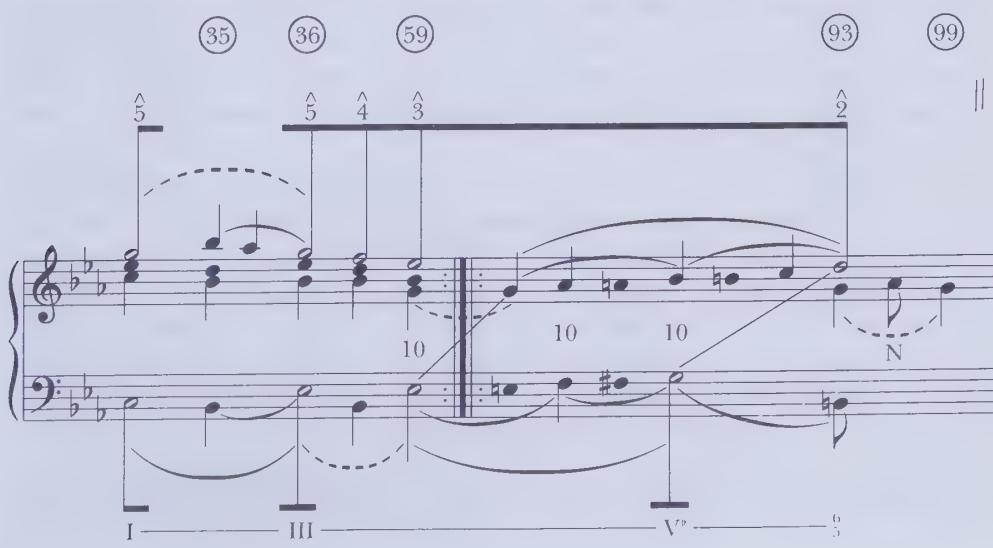
中文讲解
这是第31页上的一张图(或乐谱)占位符,对应Example 11.18。它位于P0175的文字分析之后,用以把前文论述的“莫扎特K. 457第一乐章呈示部与展开部的中景骨架”直观地呈现给读者:应包含主音$\hat{5}$在第一主题的延续、第二主题中音区的$\hat{3}$,以及展开部中低音从III经IV到V、上声部从$\hat{3}$下到$\hat{2}$的进行。受输入限制,图像本身的内容与具体图形符号无法核实,须查看原书对应页面方能完整获得。
脚注 / 边栏 / 图表 / 附加信息(如有)
本节包含Example 11.18(图注:Mozart, Piano Sonata, K. 457, I: middleground synopsis of exposition and development)以及P0176处的一张图/谱例占位符;正文中标注了脚注27,位于“typically prolongs the V”一句末尾,应为大调展开部延长属音这一惯例提供支持或限定性来源。
💡 本节核心要点
- Example 11.18以莫扎特K. 457第一乐章为实例,把呈示部与展开部的中景骨架可视化,与前文讨论的“大尺度特征”相对应。
- 呈示部上声部呈$\hat{5}$→$\hat{3}$的轮廓:第一主题延续主音$\hat{5}$,第二主题落在中音区的$\hat{3}$。
- 展开部低音以III–IV–V的琶音进行推进,到达interruption处的V,上声部相应地从结构性$\hat{3}$下行至$\hat{2}$。
- $\hat{3}$→$\hat{2}$的上声部进行在小调作品中很常见,与之对比,许多大调奏鸣曲在呈示部中就已经达到第一分支的目标音$\hat{2}$。
- III–IV–V这一低音序进是小调展开部的常见模式,其功能是把呈示部末尾的低音运动接续到第一分支的属音。
- 大调展开部则通常以延长V(prolongs the V)作为组织中心,与小调的中景路径形成对照。
🔑 关键术语
- primary tone $\hat{5}$:结构性音级标记$\hat{5}$,即属音;在本节K. 457例子中于呈示部第一主题内被长时间延续(prolong)。
- median region / $\hat{3}$:中音区及其音级标记$\hat{3}$;在K. 457呈示部中作为第二主题区域的和声—旋律中心。
- first branch:奏鸣曲式结构中“第一分支”,即主调区域(或与属调对应的第一分支区域);其结构性目标音在本例中被讨论为$\hat{2}$。
- interruption:展开部末尾受阻于非主音终止的关键节点,本例中断于V。
- III–IV–V (bass arpeggiation):小调展开部中常见的低音琶音序进;IV在此处被作者描述为经过性的(passing)。
- prolongation of V:对属音的延长;作者指出这是大调展开部的典型组织方式,与小调的中景骨架形成对比。
- middleground synopsis:中景层级的结构概览图,分析单位介于整体曲式与表层细节之间,本节以此视角展示K. 457的呈示与展开。
11.18 [描述性拆分] Recapitulation: Transition with Augmented-Sixth Deception (bars 118–129)
第1段(P0177)
原文复述
Recapitulation (bars 100–185)
中文讲解
这是一个二级小节标题,标识作品分析进入了再现部(recapitulation),涉及小节范围为 100–185。它将本节的工作明确限定在莫扎特 K.457 第一乐章再现部的讨论中。
第2段(P0178)
原文复述
The recapitulation of the first theme, bars 100–117, is identical to the corresponding passage in the exposition. Consequently we will proceed directly to some features of the transition. We recommend that you examine the details of its voice leading on your own; these are illustrated in Example 11.19.
中文讲解
作者声明再现部中第一主题的呈现(bars 100–117)与呈示部对应段落完全一致,因此本节跳过对这部分主题的重复讨论,直接进入连接段(transition)的若干特征分析。作者建议读者自行分析其声部进行(voice leading)的细节,并提示 Example 11.19 已给出对应的图示。本句的功能是交代叙述范围的转移:从第一主题切到连接段。
补充说明
作者所谓“identity”指的是材料、节奏、和声进行的高度一致,而非逐音相同;具体细节差异仍需对照 Example 11.19 自行验证。
第3段(P0179)
原文复述
Notice that the transition section is substantially abbreviated by comparison to that of the exposition. That is, what we have labeled the “thematic transition” of the exposition (bars 23–30) is not recapitulated. Its omission here underscores its transitory quality, providing more analytical evidence that on first hearing it was a deception and not the authentic second theme.
中文讲解
作者指出再现部中的连接段比呈示部短得多:呈示部中被作者称为“主题性连接段”(thematic transition,bars 23–30)的段落并未在再现部中重复再现。作者认为这种省略反过来说明该段落本质上只是过渡性的(transitory),从而为它在前一次呈示时其实是个“骗局”而非真正的第二主题提供了进一步的分析证据。这是基于“作曲家不重复非结构性材料”的反向推断。
补充说明
所谓“deception”,指的是在呈示部中此段落曾让人误以为是第二主题的开始,但实际上它并未真正承担第二主题的功能;再现部中的省略则进一步暴露了它的“假主题”身份。
第4段(P0180)
原文复述
Mozart, however, now misleads us in a different way. We have noted that, in the recapitulations of many Classical sonata movements, the transition section is reworked to prepare the presentation of the second theme in the tonic. Mozart’s recomposed transition retains some of its modulatory character, but here it apparently begins to lead to the remote key of D $^{b}$ major. It is as if Mozart becomes “lost,” in a manner reminiscent of some of the improvisatory passages in his keyboard fantasies. Yet we soon realize that we have been deceived once again, for the progression quickly corrects itself and leads to V of C minor in bar 126.
中文讲解
作者描述莫扎特使用了另一种“误导”手法:在典型的古典奏鸣曲再现部中,连接段通常会被改写以准备主调上的第二主题出现。本曲中莫扎特虽然保留了转调特征,但故意让连接段看似将走向 D♭ 大调这一远关系调,作者形容这是莫扎特仿佛“迷失了方向”,类似其键盘幻想曲中即兴段落的笔法。但随后进展迅速“纠正”自己,在 bar 126 导向 c 小调的属和弦(V of C minor)。作者借此说明再现部的连接段在功能上完成了与呈示部相同的转调准备,但具体过程更具迷惑性。
补充说明
“D♭ major”作为 c 小调中的远关系调,其与 c 小调的色彩反差极大,正是这种远距关系使“迷失”的修辞具有可感性;读者需要结合 Example 11.19 的图示确认 D♭ 大调的暗示究竟出现在何处。
第5段(P0181)
原文复述
As the reductions of Example 11.19 illustrate, Mozart is playing on the dual nature of the German augmented sixth chord. On the one hand, the chord could lead to a major key (paralleling the original transition section) if it functions as a dominant seventh chord (of the Neapolitan). On the other hand, functioning as an augmented sixth chord in the tonic, its resolution yields a recollection, in the bass, of the A $^{b}$ -G motive from the very beginning of the movement. The motivic reference and the need to affirm the tonic overwhelm the dreamlike possibility of leading to a tonal context as remote as D $^{b}$ major. The chord resolves to V of C minor, after which the transition section continues as it did in the exposition. $^{28}$
中文讲解
作者揭示“误导”的技术根源:Example 11.19 的简化图显示莫扎特利用了德国增六和弦(German augmented sixth)的双重功能。一方面,该和弦若被视为“那波里和弦的属七和弦”,就会导向一个大调,从而呼应原呈示部连接段的走向。另一方面,若被视为在主调中发挥作用的增六和弦,则其解决会在低音再现乐章开头的 A♭–G 动机。最终“动机呼应 + 确立主调”的需要压倒了通往 D♭ 大调这种遥远调性的梦境式可能;该和弦解决到 c 小调的 V,之后连接段继续按呈示部的方式进行。脚注 28 应提供具体和声分析或文献参考。
补充说明
“German augmented sixth”在 c 小调中通常构建在降六级音上(A♭),含有降三级(E♭)、降七级(F)、根音 A♭ 和升四级(G),故其解决到 V(G 大和弦)时会在低音形成 A♭–G 的半音下行,这正对应乐章开头的 A♭–G 动机。读者可对照 Example 11.19 的低音线进行确认。
第6段(P0182)
原文复述
Our examination of the second theme begins with an important consideration. In major-mode movements in which the second group is in the dominant, the transposition in the recapitulation can be literal, involving a change of register but not of mode. In minor-mode movements, however, the interval of transposition is the down a minor third, from the major median to the minor tonic; because of the different arrangement of whole and half steps in the major
中文讲解
作者为分析第二主题提出一个前提性观察:大调乐章中若第二主题群在属调上,再现时只需机械移调(可改八度位置但不改调式)。但在小调乐章中,再现部的转调是“下移小三度”,即从中关系大调移回小调主调;这是因为大调和小调中全音与半音的排列不同。本句的末尾以“the major”中断,逻辑延续到下一段(涉及小调中“直接移调”只能在主大调环境成立)。这一段为后文莫扎特必须改写第二主题的解释埋下伏笔。
补充说明
“median”指中关系调(mediant),例如 c 小调的中关系大调为 E♭ 大调;这是功能上与 c 小调共享若干共同音但调号差异较大的调。
第7段(P0183)
原文复述
Example 11.19
中文讲解
图示编号标题,用于标识 Example 11.19。本例展示再现部中连接段的两种简化形态。
第8段(P0184)
原文复述
Mozart, Piano Sonata, K. 457, I, transition section in recapitulation, bars 118–129: (a) foreground and (b) middleground reductions
中文讲解
Example 11.19 的完整图注:莫扎特钢琴奏鸣曲 K.457 第一乐章再现部中连接段(bars 118–129)的两种层次图示——(a) 前景(foreground)与 (b) 中景(middleground)简化。它提示读者先在前景中看到声部细节,再在中景简化中理解其结构性的和声运动。
补充说明
“foreground / middleground reduction”是申克分析(Schenkerian analysis)术语,前景为音符级表层,中景为去除装饰音后的结构骨架。
第9段(P0185)
原文复述
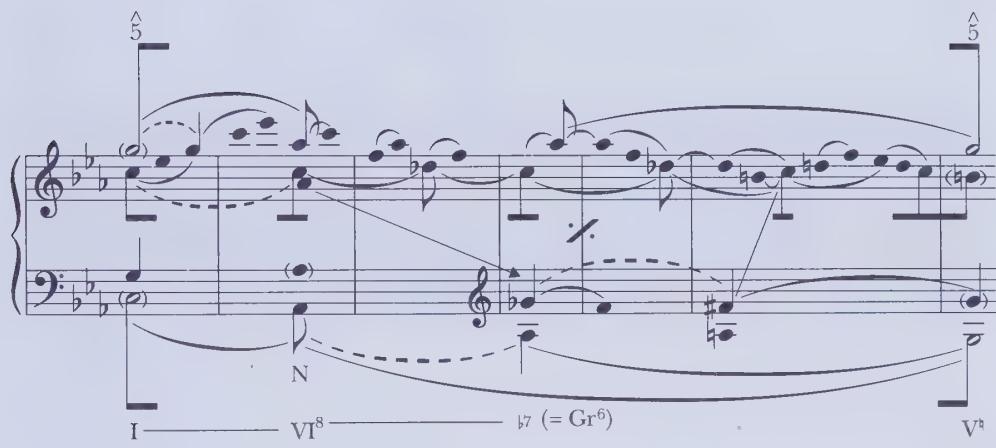
中文讲解
图示 (a) 的图像占位符:内容为 K.457 第一乐章再现部连接段(自 bar 118 起)的前景图示。由于图像数据被省略,读者需查阅原书以确认具体的音高、和弦、谱表细节。
第10段(P0186)
原文复述
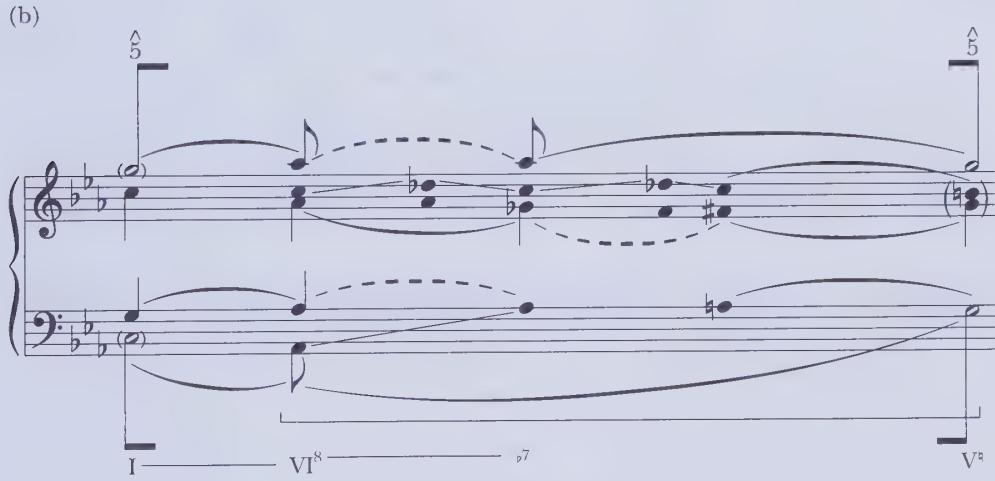
中文讲解
图示 (b) 的图像占位符:内容为同一段落(bars 118–129)的中景简化图示。读者需查阅原图以理解该段在结构骨架上的和声进行,特别关注增六和弦的位置与解决。
第11段(P0187)
原文复述
and minor modes, direct transposition is generally possible only if the second group is recapitulated in the tonic major. Composers, therefore, often make adjustments in the recapitulation of the second theme in the minor-mode environment of the recapitulation. $^{29}$
中文讲解
承接 P0182:由于大小调音阶排列不同,直接(字面)移调一般只能在“主大调”环境下成立;因此在小调主调环境的再现部中,作曲家常常需要对第二主题做出调整。这一原则直接为下文莫扎特改写第二主题提供理论根据。脚注 29 应给出该原则的参考文献或谱例来源。
补充说明
所谓“tonic major”即主音上方的大三度关系大调(parallel major),与“主小调”共享主音但调式不同;小调中直接将属调材料原样移回,常常会落到属大调或其他非主调环境,故必须改写。
第12段(P0188)
原文复述
If you return briefly to Example 11.15a and compare it to Example 11.20, you will discover the modifications Mozart makes in the second theme of the recapitulation. In the exposition, the theme spans a major third, beginning on $\mathbf{e}^{\mathbf{b}^2}$ and ascending chromatically to $\mathrm{g}^2$ (structural 5). In the recapitulation, Mozart recomposes the theme to span a perfect fifth, an adjustment that retains $\mathrm{g}^2$ as the
中文讲解
作者引导读者回到 Example 11.15a 与 Example 11.20 进行比较,揭示莫扎特在再现部第二主题中所做的修改。在呈示部中,主题跨越大三度,从 e♭² 上行半音地到达 g²(即结构 5)。在再现部中,莫扎特将主题改写为跨越纯五度,但仍保留 g² 作为线条的目标音(即结构 5)。这种“跨度加大、目标音不变”的处理正体现了为适应小调主调环境而做出的移调与结构重塑。
补充说明
“structural 5”即申克分析中基础结构层(Urlinie)的第五音,是 melodic line 的高点;保持其位置是结构稳定的关键。读者应直接对照 Example 11.15a 与 Example 11.20 的前景图确认 e♭²→g² 的半音进行。
第13段(P0189)
原文复述
Example 11.20
中文讲解
图示编号标题,用于标识 Example 11.20。本例展示再现部中第二主题的两种简化形态。
第14段(P0190)
原文复述
Mozart, Piano Sonata, K. 457, I, second theme of recapitulation, bars 130–139: (a) foreground and (b) middleground reductions
中文讲解
Example 11.20 的完整图注:莫扎特钢琴奏鸣曲 K.457 第一乐章再现部中第二主题(bars 130–139)的两种层次图示——(a) 前景与 (b) 中景简化。它与 Example 11.15a 对应,用于揭示主题在再现部被改写后的实际形态。
第15段(P0191)
原文复述
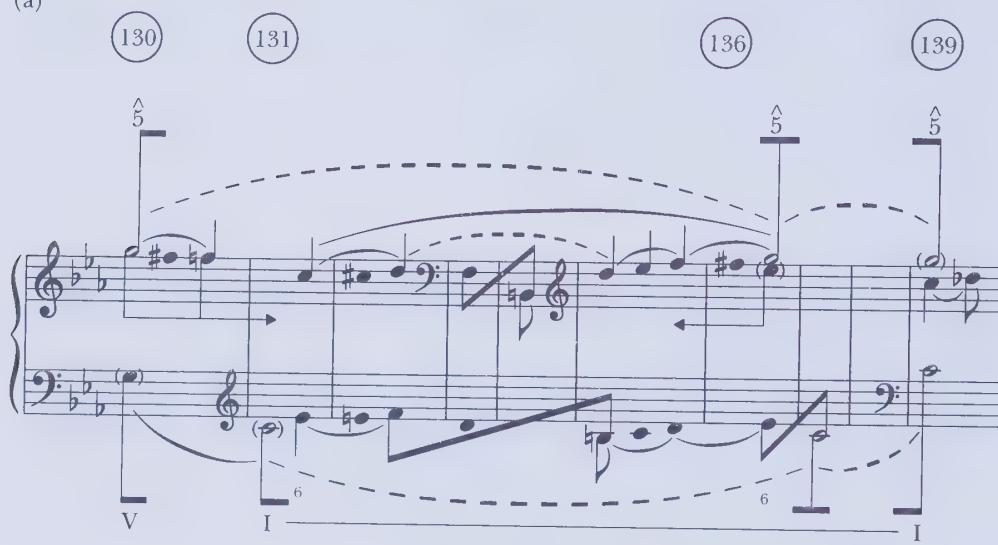
中文讲解
图示 (a) 的图像占位符:内容为 K.457 第一乐章再现部第二主题(bars 130–139)的前景图示。读者需查阅原图以确认具体音符与和声配置,特别注意主题起始音的改动以及跨越纯五度的线条。
第16段(P0192)
原文复述
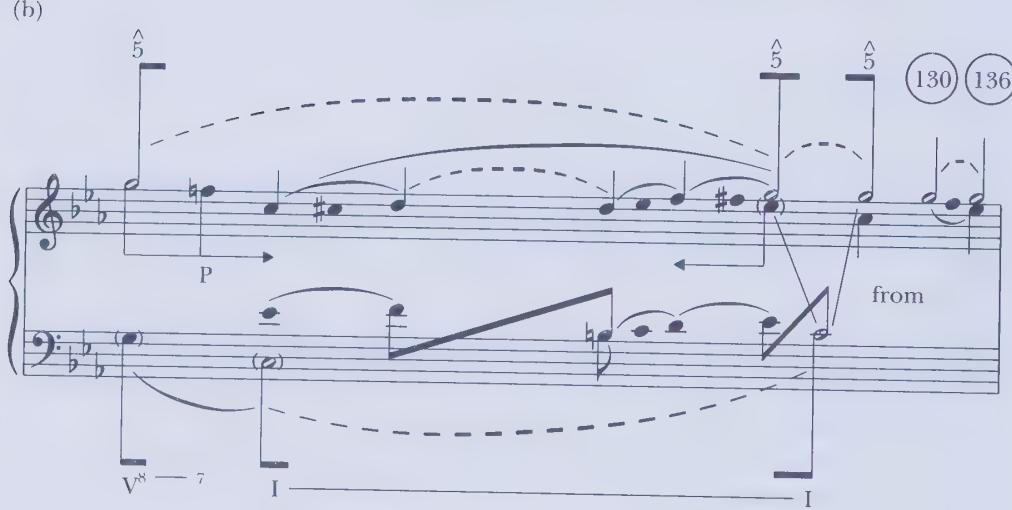
中文讲解
图示 (b) 的图像占位符:内容为同一段落(bars 130–139)的中景简化图示,用于揭示主题在结构骨架上如何维持 g² 为目标音,并最终下行至主音的封闭进行。
第17段(P0193)
原文复述
goal of the line. Once again the second theme leads to structural 5, which will descend completely to closure in the remaining part of the second theme.
中文讲解
承接 P0188:本句说明改写后的第二主题仍然以 g²(结构 5)作为线条的目标,随后将在第二主题的后续部分中完整地下行至结构 1(即主音)以实现终止。作者借此强调:尽管跨越音程从大三度扩展到纯五度,莫扎特仍然维持了“到达结构 5 → 完全下行闭合”的核心结构逻辑,使再现部的第二主题在功能上等价于呈示部。
补充说明
“descent completely to closure”即 Urlinie 的 5–4–3–2–1 全下行;这种“完全下行”在古典奏鸣曲再现部中是建立调性归属感的关键手法。
脚注 / 边栏 / 图表 / 附加信息(如有)
本节涉及两处脚注(footnote 28 与 footnote 29)和两个图示(Example 11.19、Example 11.20)。脚注 28 出现在 P0181 末尾,承接对“再现部连接段继续按呈示部进行”的具体引用或文献说明;脚注 29 出现在 P0187 末尾,承接“小调再现部中需对第二主题作调整”这一原则的来源或补充例证。Example 11.19(P0183–P0186)展示再现部连接段(bars 118–129)的前景与中景,是本节论证“增六和弦双重功能导致 D♭ 大调骗局”的核心视觉证据;Example 11.20(P0189–P0192)展示再现部第二主题(bars 130–139)的前景与中景,是本节论证“主题跨度由大三度扩展到纯五度、目标音 g² 不变”的核心视觉证据。两例前后对照 Example 11.15a,共同支撑本节“呈示—再现对比”分析框架。
💡 本节核心要点
- 再现部中第一主题(bars 100–117)与呈示部完全一致,因此本节聚焦于连接段与第二主题的差异。
- 呈示部中的“主题性连接段”(bars 23–30)在再现部中被省略,从反向证明其在结构上仅为过渡性的“骗局”,并非真正的第二主题。
- 再现部连接段通过德国增六和弦的双重功能,短暂制造向 D♭ 大调远关系调偏移的幻觉,但其最终通过 A♭–G 动机呼应与“必须确立主调”的需求,在 bar 126 解决到 c 小调的 V。
- 再现部连接段在 bar 126 之后与呈示部走向一致,体现了“表面迷惑、结构稳定”的双重写作策略。
- 小调奏鸣曲再现部因大小调音阶排列差异,简单的字面移调通常无法实现,因此作曲家必须改写第二主题。
- 莫扎特将再现部第二主题的跨度从大三度(e♭²→g²)扩展为纯五度,但仍保留 g² 为结构 5 的目标音,从而在表面上扩张、内部维持 Urlinie 5→1 的完整下行闭合。
🔑 关键术语
- thematic transition:作者用于指称呈示部 bars 23–30 的段落。该段落在初次呈示时被听成第二主题的开始,但其“主题性”实为假象;在再现部中并未被重复,反向证明其仅为过渡性材料。
- German augmented sixth chord:德国增六和弦。在本曲 c 小调中通常构建于降六级(A♭)上,含降三级、降七级、根音与升四级;其双重功能既可被听作“那波里和弦的属七”(从而导向大调),也可作为主调内的增六和弦(其解决在低音形成 A♭–G 动机)。这是本节“骗局”得以成立的和声学基础。
- Neapolitan (chord):那波里和弦,即降二级大三和弦(♭II)。在本曲 c 小调中即 D♭ 大三和弦;作者指出增六和弦若被听成那波里的属七,就可能导向 D♭ 大调。
- structural 5 / Urlinie:申克分析中基础结构线(Urlinie)的第五音,是旋律线条的最高点;保留结构 5 在再现部第二主题中的位置,是维持作品结构同一性的关键。本节中 g² 即为该结构 5。
- middleground reduction:申克分析术语,指去除装饰性表层后呈现出的中间结构骨架。本节 Example 11.19(b) 与 Example 11.20(b) 即中景简化图,用于揭示增六和弦的位置以及 Urlinie 的整体走向。
- tonic major / parallel major:主音上方大三度的大调,即关系大小调中的大调(如 c 小调的 E♭ 大调);是“小调中可直接移调而不需改写”的唯一环境,亦是本节讨论再现部第二主题移调问题时必须区分的关键概念。
11.19 [描述性拆分] Recapitulation: Second Theme, Cadential Descents, and Coda (bars 139–185)
第1段(P0194)
原文复述
In the concluding bars of the second theme (bars 139–156), the fundamental line of the structure twice leads to 1̂ and closure. To clarify the details of each descent, as well as the continuing adjustments Mozart makes in the recomposed second theme, we have provided two graphs for this passage, which we ask you to study on your own (Examples 11.21 and 11.22). Bear in mind that we have abbreviated certain repeated passages and normalized register to indicate the function of superposed inner-voice lines. In Example 11.21, for instance, only
中文讲解
本段开启本小节的核心观察:主题再现部第二主题的结束段(第 139–156 小节)中,结构性的基本下行线(Urlinie)先后两次下行至 1̂ 并形成收束。作者为此专门提供 11.21 与 11.22 两张图示,并将 Mozart 在重写后的第二主题中所做的调整与两次下行的细节作为研读对象。作者特别提醒:图中省略了某些重复段落,并对音区作了规整化处理,目的是让叠加的内声部线条的功能能够清晰呈现。本段末尾的 ‘only’ 在原书中跨越图例 P0195–P0198,由下一段续写为 ‘only the lower octave of the right hand is shown’。这是本节最重要的预告:下文不是单纯复述两次下行,而是要论证它们之间的差异——即第一次下行(第 142–145 小节附近)只是中间和声上的’过渡性’终止,而第二次下行(第 156 小节)才是结构上的真正终点。
补充说明
本句末尾 ‘only’ 与 P0199 首句在原书排版中是一个被图例截断的连续句;读者阅读时需要将两段拼接,才能完整理解 11.21 图中音区的简化原则。
第2段(P0195)
原文复述
Example 11.21
中文讲解
示例编号标题 11.21,标明接下来的图示对应本节第一张分析图。其功能是为 P0194 所预告的’两条下行中的第一条’(第 139–145 小节)提供可对照的乐谱与中景缩减。
第3段(P0196)
原文复述
Mozart, Piano Sonata, K. 457, I, second theme of recapitulation, bars 139–145: (a) foreground and (b) middleground reductions
中文讲解
图 11.21 的说明文字:作品为 Mozart《钢琴奏鸣曲》K.457 第一乐章,分析对象是再现部第二主题的第 139–145 小节。图分为 (a) 前景(原始谱面)与 (b) 中景缩减两层。这是 Schenkerian 分析的典型图示方式——让读者同时看到作曲家实际写出的表面形态与被抽象出来的声部进行骨架。
第4段(P0197)
原文复述
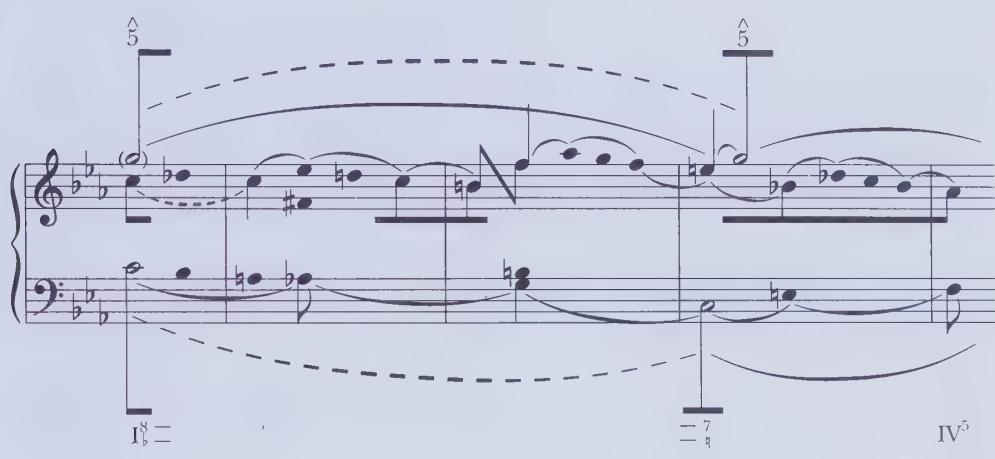
中文讲解
图 11.21(a) 前景图的位置占位符,标注覆盖的关键小节为 139、141、142。内嵌图像数据未保留,请查阅原书图示以观察右手高声部、下方八度重复以及内部声部的具体音符走向。
补充说明
需查看原图以核对具体音符、节奏与声部叠加方式。
第5段(P0198)
原文复述
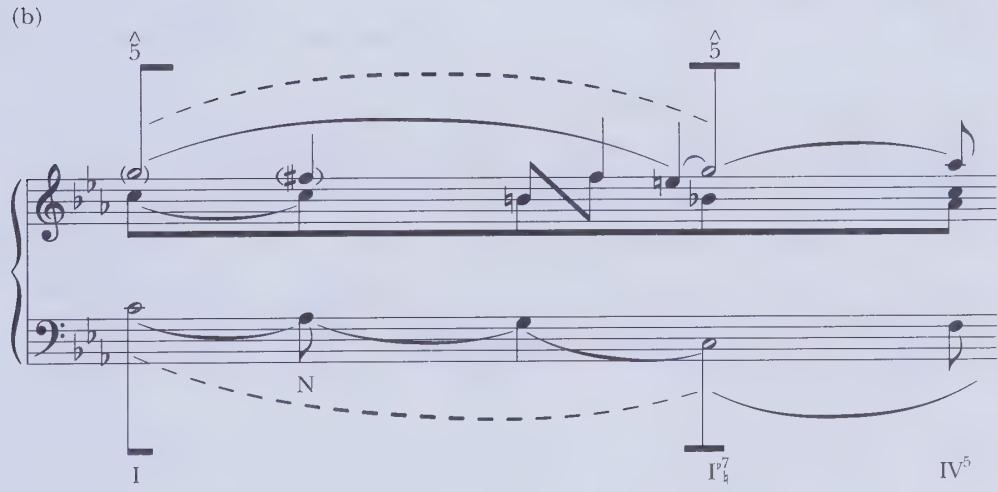
中文讲解
图 11.21(b) 中景缩减图的位置占位符。缩减图省略了装饰与重复,保留声部进行的骨架,便于看清结构下行线、内声部的邻音进行与终止和声的实质。内嵌图像数据未保留,请查阅原书图示。
补充说明
需查看原图以确认中景层级上 5̂、4̂、A♭ 与终止 IV/ii6 的声部配置。
第6段(P0199)
原文复述
the lower octave of the right hand is shown for the climactic passage of bars 139–141. As in the exposition, this line elaborates and prolongs the descent of the structural upper voice.
中文讲解
本段接续 P0194 末尾的 ‘only’,解释 11.21 图中为何仅显示出右手低八度:在第 139–141 小节的高潮段落中,这条低八度线条才是分析者关心的对象——它对结构上声部(即基本下行线所体现的最高骨架声部)的下行作了具体的装饰与延长。与呈示部相应段落相同的处理方式,表明 Mozart 在再现部并未改变这一内声部写法,它依然是结构性下行的’装饰层’。读者应体会:图示的简化不是为了简化分析,而是要把真正承担结构功能的’中间层’声部凸显出来。
第7段(P0200)
原文复述
Also notable is a significant difference between the two descents that occur in the latter part of the second theme. In bar 143 of the first descent, the intermediate harmony of the bass progression is transformed from a IV to a II6 through a 5–6 shift, a common transformation of subdominant harmony at a cadence (Example 11.21). In the upper voice, the primary tone 5̂ (last stated in bar 136 and touched upon in bar 142) moves again to A♭, which now functions as an incomplete neighbor, moving to 4̂ over the intermediate harmony.30
中文讲解
本段是本节第一个真正的分析论证:两条下行并非简单重复,而是存在关键差异。第一次下行(第 142–143 小节附近)的低音进行中,原本应是 IV 的下属和弦通过 ‘5–6 移位’ 改写为 II6。这是终止式处对下属和声最常见的转位处理——本质上仍为下属功能,但通过低音上行二度避免与 V 之间的反向五度,并为上方声部让出空间。在上声部,主音 5̂(最后一次明确出现于第 136 小节,第 142 小节仅作一触即离的暗示)再次走向 A♭,但这次 A♭ 并不像呈示部中那样构成完整邻音,而是作为’不完整邻音’——它打断了原本回到 5̂ 的路径,转而向下走向 4̂,并落到了那个被改写后的 II6 上方。这里的脚注 30 用于补充说明这一不完整邻音的动机来源或延续性;其正文内容本任务输入未提供。读者应注意:正是这种邻音运动被’打断’的特征,使第一次下行比第二次下行更具开放性与装饰性。
补充说明
脚注 30 在此段被引用,但脚注正文未包含在当前任务输入中;其性质(来源、限定或旁证)无法在当前段落中确定。
第8段(P0201)
原文复述
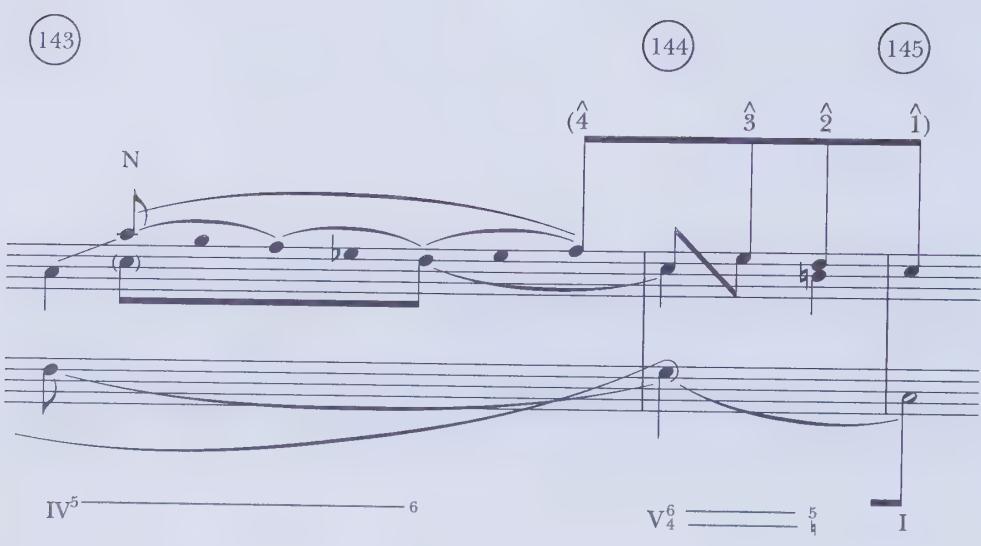
中文讲解
第 36 页图像占位符。内嵌图像数据未保留,请查阅原书图示以核对与本段正文对应的谱面细节(结合 P0200 的声部分析,疑为 11.21 图的延续或放大片段)。
补充说明
需查看原图。
第9段(P0202)
原文复述
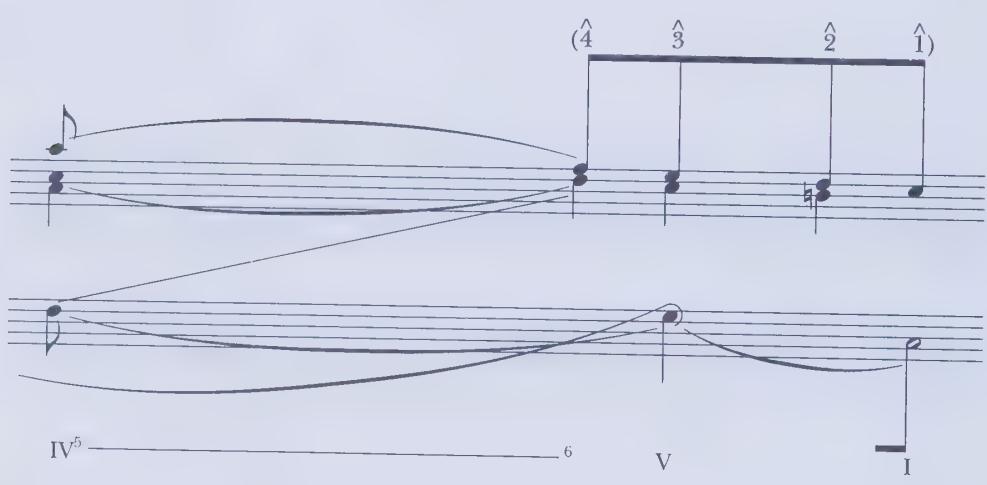
中文讲解
第 36 页第二处图像占位符。内嵌图像数据未保留,请查阅原书图示。
补充说明
需查看原图。
第10段(P0203)
原文复述
In the descent of the Urlinie (Example 11.22), we hear again the bravura, cadenzalike passage from the exposition that highlights and expands the intermediate harmony of the structural cadence. As the example illustrates, the incomplete neighbor A♭ appears once more over the subdominant chord and, through a passage that sweeps through three octaves, is transferred to the two-line octave in bar 153, the register in which it appears so prominently throughout the movement. In bar 156, the upper voice leads to structural 1̂.
中文讲解
本段转入对’真正结构性’那条下行的论述,并以 11.22 图作为图示依据。这里的下行重新使用了呈示部中那段炫技的、近似华彩的乐句——它的功能是放大并突出结构终止处的’中间和声’(即到达 1̂ 之前那个 IV 或 ii6)。在声部细节上,那个不完整邻音 A♭ 再次出现在下属和声之上,并通过一段跨越三个八度的旋律运动,最终在第 153 小节被’安置’到小字二组的音区——这个音区是 A♭ 在整个乐章中最显眼的位置。第 156 小节,上声部终于落到结构性的 1̂。读者应体会:此处下行比第一次下行更’完整’、更’结构性’的关键,不在于它是否同样使用 A♭,而在于 A♭ 通过跨越三个八度的炫技段落被’塑造成’一个具有段落收束意义的到达,并被最终安放在全曲最具代表性的高音区。
补充说明
’two-line octave’ 指小字二组(c′–b′′′ 的中央区间,即钢琴高音区的中段),是 A♭ 全曲最显著出现的音区;跨越三个八度的运动使 A♭ 从极高音区下沉至此,形成听感上的’重心落定’。
第11段(P0204)
原文复述
You will notice that we give structural priority to the descent concluding in bar 156, using open noteheads in Example 11.22 to signify the descent of the fundamental line. The reason for this interpretation lies in the way the intermediate harmony is worked out in bars 149–153. The change of design to triplet
中文讲解
本段提出一个关键的方法论决定:分析者把第 156 小节的下行视为真正的结构性下行,并用空心符头(open noteheads)在 11.22 图中显式标出。这一’结构优先’判定的依据落在第 149–153 小节对中间和声的处理方式——即从原本的均匀十六分音符流动改为三连音织体。三连音不仅是节奏变化,更意味着作曲家对该处和声的’展开方式’做了重新设计,把更多材料、更长时值、更多声部资源投入到这个中间和声上。本段末尾 ‘The change of design to triplet’ 被图例 P0205–P0208 截断,由 P0209 续写为 ‘figuration and the sweeping motion…’。这是分析者典型的 Schenker 式判定逻辑:当一个’结构性事件’被作曲家以额外的材料资源(更厚的织体、更多的音区、更长的展开)来’展开式展开’时,它就在结构层级上压倒了其他类似事件。
补充说明
空心符头是 Schenker 分析图中表示’结构性骨干音’(即 Urlinie 与 Bassbrechung 上真正承担结构功能的音级)的标准记号;实心符头则为装饰性的前景音。
第12段(P0205)
原文复述
Mozart, Piano Sonata, K. 457, I, second theme of recapitulation, bars 145–156: (a) foreground and (b) middleground reductions
中文讲解
图 11.22 的说明文字:作品同前,分析对象是再现部第二主题的第 145–156 小节。图分 (a) 前景与 (b) 中景缩减两层。其位置紧接 P0204 的分析,意在把’第二次下行’的全部细节与 11.21 的’第一次下行’作并置比较。
第13段(P0206)
原文复述
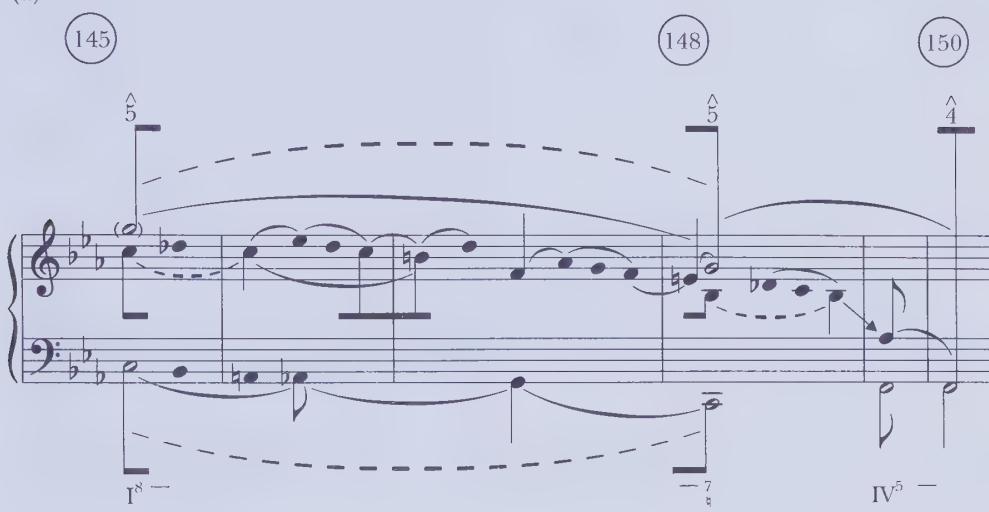
中文讲解
图 11.22(a) 前景图位置占位符。内嵌图像数据未保留,请查阅原书图示以观察第 145–156 小节的三连音织体、跨八度音区运动以及右手低八度的具体处理。
补充说明
需查看原图。
第14段(P0207)
原文复述
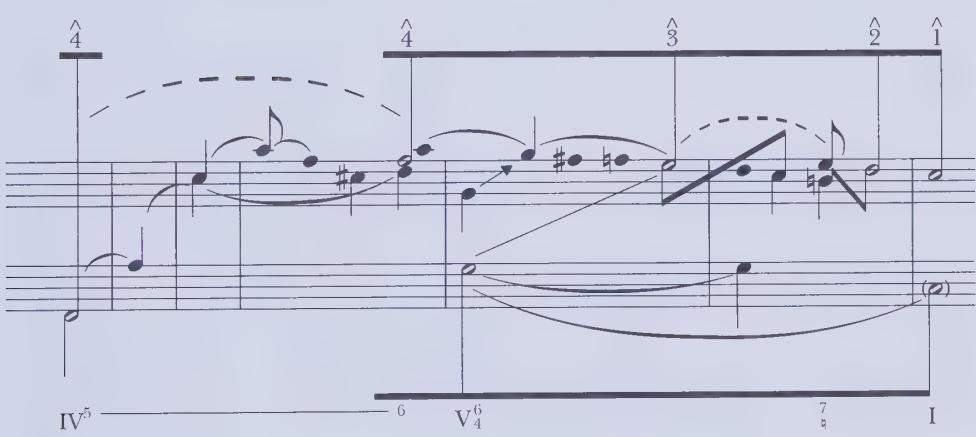
中文讲解
图 11.22(b) 中景缩减图位置占位符,标注关键小节 150、153、156。内嵌图像数据未保留,请查阅原书图示,特别注意 A♭ 在第 153 小节到达小字二组、第 156 小节到达 1̂ 的声部配置以及空心符头标记。
补充说明
需查看原图。
第15段(P0208)
原文复述
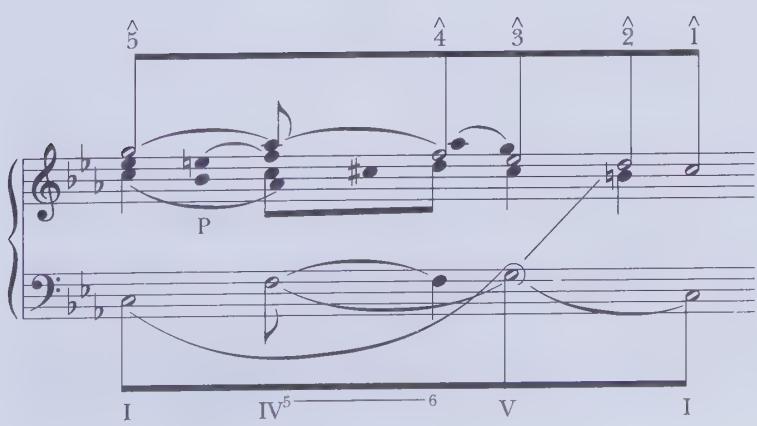
中文讲解
第 145–156 小节范围的整体图示占位符(疑为 11.22 的另一图示层或附加说明图)。内嵌图像数据未保留,请查阅原书图示。
补充说明
需查看原图。
第16段(P0209)
原文复述
figuration and the sweeping motion that summarizes the various registers of the composition produce a drive to the cadence more forceful than the similar passage in bars 142–145. The second perfect authentic cadence is more conclusive and represents the definitive completion of the structural upper voice.
中文讲解
本段接续 P0204 末尾的 ‘The change of design to triplet’,给出该变化的最终分析判断:三连音化的音型加上贯穿全曲多个音区的’席卷式’运动,使这次终止的力度比第 142–145 小节那段表面上相似的乐段更强劲。因此,第 156 小节出现的第二个完全终止(perfect authentic cadence, PAC)才是真正具有结论性的终止,它标志着结构上声部(即 Urlinie 所体现的最高骨架声部)的最终完成。读者应理解:Schenker 框架下,‘结构性终止’与’前景中的终止’并非同一概念——前景中可以有多次 V-I,但其中只有被作曲家以’展开式’材料资源强化过的那一次才承担真正的结构功能。这一判定在本节中具有方法论示范意义:分析者用’材料的展开强度’而非’音高或和声的表面特征’来决定哪一次下行才是骨架。
补充说明
perfect authentic cadence(完全终止/正格终止)指 V-I 进行,两个和弦均为原位,且主音位于最高声部;与之相对的是半终止(half cadence, 结束于 V)和不完全终止(imperfect authentic cadence, 主音不在最高声部或 V 非原位)。
第17段(P0210)
原文复述
The closing section of the recapitulation (bars 156–176) is very similar to the corresponding section of the exposition, differing only in some details. Example 11.23, an abbreviated voice-leading graph, illustrates some points of interest and the essential structure of the coda that follows in bars 168–185. One point of interest is the descending fifth-progression from G to C, which retraces the path of the fundamental line and contains a recollection of the upper neighbor A♭ resolving to G (bar 163).31
中文讲解
本段开启本节对再现部结尾与尾声的讨论:第 156–176 小节的结束段与呈示部相应段落大致相同,仅在细节上有所区别。11.23 图(一份缩减的声部进行图)展示了若干值得关注之点以及紧随其后的尾声(第 168–185 小节)的基本结构。其中一个值得关注的点是从 G 到 C 的下行五度进程——它重走了基本结构线的路径,并在第 163 小节保留了 A♭ 这一上邻音解决到 G 的回忆动机。这里的脚注 31 应是对这一邻音动机或下行五度进程的来源/对比说明,脚注正文未在当前任务输入中提供。读者应注意:‘重走基本结构线的路径’在尾声语境中具有双重功能——既是对全曲骨架的回顾性收束,也是尾声作为’主导动机总结’的体现。
补充说明
脚注 31 在此段被引用,但脚注正文未包含在当前任务输入中;其性质(来源、限定或旁证)无法在当前段落中确定。
第18段(P0211)
原文复述
The inclusion of a coda is optional in the Classical sonata. Here, the V9 of bar 167 has a dual function similar to that in the final bar of the exposition: it leads into a repetition of the development and recapitulation and, the second time, leads into a coda. You will notice in the graph that we show a lower-level descent from 3̂, beginning from e♭3 (bar 170). We regard this local emphasis on E♭ as the recollection of previous motions to e♭2 (sometimes in conjunction with the third C–E♭): compare bars 17, 20, and 61–62 in the exposition; bars 85 and 92 in the development section; bars 116, 119, and (especially) 140 in the recapitulation. Mozart’s periodic motions to this tone create a unifying association in the highest register of the movement.
中文讲解
本段是本节理论含量最高的一段之一。它首先给出体裁背景:古典奏鸣曲式中尾声的加入是可选的(不是必须的)。本曲的尾声由第 167 小节的 V9 引出——这个 V9 与呈示部末小节中的属和弦一样具有’双重功能’:当乐章被反复演奏时,它导向发展部与再现部的重复;而真正奏到这里时,它导向尾声。图中标出一条自 e♭3(第 170 小节)开始的 3̂ 下层下行。作者认为这是对全曲反复出现的 e♭2(有时与 C–E♭ 三度结合)进行的回忆——可在呈示部第 17、20、61–62 小节,发展部第 85、92 小节,再现部第 116、119 小节(尤其是第 140 小节)中找到对应。Mozart 对这个音的周期性到达在最高音区形成了一种贯穿全曲的统一联想。读者应体会:这种’特定音高的多次重现’不是孤立的细节,而是作曲家精心设计的跨乐章统一手段——它让尾声承担的不只是’结束’,更是’对全曲最高音区行为的回顾与定格’。
补充说明
’third C–E♭’ 指从 C 上行三度到 E♭ 的音程关系;‘unifying association’ 指跨段落、跨乐章出现的同一音高对听感产生的统一印象,是 Schenker 框架下’动机统一性’(motivic unity)的扩展形式。
第19段(P0212)
原文复述
In addition to summarizing motivic features, the function of many codas is to affirm the tonic of the recapitulation through repeated cadential motions, which is certainly the case here: multiple bass arpeggiations (eventually doubled in the right hand) connect the tonic with cadential dominants. Finally, as shown in the final bars of the graph, Mozart brings his stormy movement to a close with one final recollection of the fundamental line from 5̂ to 1̂, played very softly in a low register over I–V–I in the bass.
中文讲解
本段补充尾声的功能层次:除了动机特征的总结外,许多尾声的核心功能是通过反复的终止式运动来’确认’再现部的主调,本曲正是如此——多次的低音分解(最终在右手作八度重复)把主音与终止式中的属音连接起来。最后,如图中最末小节所示,Mozart 用非常轻的力度、在低音声部 I–V–I 的和声背景下,以’基本结构线 5̂→1̂ 的最后一次重现’为这场’风暴般’的乐章收束。这是一段极具表现力的结尾安排:与第 156 小节那强烈的完全终止形成鲜明对比,最后的 5̂→1̂ 不是以爆发性的方式,而是以极弱、低音区的’回声’方式呈现,给整首充满戏剧性的乐章留出一个’安静地离去’的姿态。读者应体会:尾声同时承担三种功能——动机回顾、调性确认、对基本结构线的最后回响——而这最后一次回响在表情上构成了对’主导动机’的最高层级回归。
补充说明
‘bass arpeggiation’ 指把主调或属调三和弦的组成音依次分解奏出,是 18 世纪主调音乐中常见的低音写法;‘doubled in the right hand’ 指同样的分解最终在右手作八度叠合,使终止式运动具有越来越强的力度与织体厚度。
第20段(P0213)
原文复述
Example 11.24 presents a synopsis of the structure of this minor-mode movement. As in the previous major-mode movements, the fundamental structure is divided into two parts, yet three formal sections emerge in the composing-out of its two branches. A significant difference exists, however, between the major- and minor-mode schemes. In the major mode, 2̂ over V (the goal of the first branch) is often established in the second part of the exposition (the second tonal area) and is then prolonged through the development. One might, in fact, associate the techniques of prolongation themselves with the formation of the development section. In minor-mode compositions that move from I to III in the exposition, the median scale step provides continued support for the primary tone (both 5̂ and 3̂ are possibilities); 2̂ over V in this situation then occurs at the end of the development, representing a continuation of the bass arpeggiation of the first branch. In both contexts, the composing-out of the second branch and ultimate completion of the fundamental structure corresponds with the recapitulation.
中文讲解
本段是本节乃至本乐章分析的总结性段落,由 11.24 全曲结构概览图作为支撑。它把本曲(小调)放在与之前大调奏鸣曲式作品的比较框架中:基本结构仍分为两部分,但其两个分支的’展开’(composing-out)产生了三个正式的段落(即呈示部、发展部、再现部)。真正的洞见是大调与小调奏鸣曲式方案之间的结构性差异。在大调中,第一分支的目标——2̂ over V(即属和弦上的二级音)——通常在呈示部的第二部分(第二调性区域)确立,并随后在发展部中被’延长’;可以说,延长技术本身就构成了发展部的形成机制。而在小调(呈示部中由 I 走向 III)中,中音级(3̂)持续支撑着主音(主音可以是 5̂ 也可以是 3̂);于是 2̂ over V 在这种情况下要到发展部末尾才出现,它代表的是第一分支低音分解的延续。无论大调还是小调,第二分支的展开以及基本结构的最终完成,都对应于再现部。读者应抓住的关键是:发展部在大调与小调奏鸣曲式中承担不同功能——前者主要负责延长 2̂ over V(即对第一分支目标的’展开式延长’),后者则主要负责把低音分解从 I–III 继续推进到 V(即第一分支本身的延续)。这是一个在 Schenker 框架中具有普遍意义的区分:调式不同,发展部的’展开内容’也不同。
补充说明
‘first branch’/‘second branch’ 指 Urlinie 与 Bassbrechung 各自的两段式划分:基本结构上行/下行分为两段,第一分支到达中间目标(如 2̂ over V),第二分支到达最终目标(1̂ over I)。‘composing-out’ 指作曲家把抽象的结构层级’展开’为前景中可听的事件序列。
脚注 / 边栏 / 图表 / 附加信息(如有)
本节涉及多处脚注引用:脚注 30 在 P0200 末尾被引用(关于不完整邻音 A♭ 的动机延续性),脚注 31 在 P0210 末尾被引用(关于第 163 小节 A♭ 解决到 G 的来源或对比说明);这两条脚注的正文内容均未包含在当前任务输入中,因此其性质(来源、限定或旁证)无法在本节内确定。涉及的图示包括 11.21(前景与中景缩减,bars 139–145)、11.22(前景与中景缩减,bars 145–156,空心符头标示 Urlinie)、11.23(声部进行缩减图,覆盖结束段与尾声结构)、11.24(全曲结构概览图)。所有内嵌图像数据均未保留,位置与图注已尽量保留;图像内容(如具体音高、和弦标记、声部叠加、节奏细节、空心符头的具体位置)需查阅原书方可核对。
💡 本节核心要点
- 再现部第二主题结束段中,结构性的基本下行线先后两次到达 1̂,但只有第二次(结束于第 156 小节)才被赋予真正的结构优先地位,分析者用空心符头在 11.22 图中显式标出
- 第一次下行(第 142–145 小节附近)的关键改写:通过 5–6 移位,终止处的下属和声从 IV 转化为 II6,上声部 5̂ 经 A♭ 这一不完整邻音下行到 4̂——这次下行更接近装饰性而非结构性
- 第二次下行的关键改写:第 149–153 小节改用三连音织体,并加入跨越三个八度的’席卷式’运动,把 A♭ 安放在全曲最具代表性的高音区(小字二组),由此产生的终止驱动力远强于第一次下行
- A♭ 作为不完整邻音反复出现,跨越三个八度,是本乐章贯穿再现部第二主题乃至尾声的核心统一形象
- 尾声承担三重功能:以 V9 的双重功能引入尾声,通过反复的低音分解(最终右手作八度重复)确认主调,以 5̂→1̂ 的最后一次重现(极弱、低音区、I–V–I)为乐章的’风暴’收束
- 本节最后给出大调与小调奏鸣曲式方案的结构性差异:大调中 2̂ over V 在呈示部第二调性区域确立并由发展部延长;小调(呈示部由 I 走向 III)中 2̂ over V 在发展部末尾才出现,作为第一分支低音分解的延续;两种情况下第二分支的展开与基本结构的最终完成都对应再现部
🔑 关键术语
- Fundamental line (Urlinie / 基本结构线):Schenker 理论中由主音(5̂ 或 3̂)向下行至 1̂ 的旋律结构线,是奏鸣曲式中最高层级的旋律骨架。本节中分别出现于第 142–145 小节(第一次)与第 153–156 小节(第二次)的下行均属此类,但只有第二次被认定为真正的结构性下行。
- Incomplete neighbor (不完整邻音):邻音运动被中断、未能返回原音的装饰形态。本节中 A♭ 作为不完整邻音出现:原本应回到 5̂,却转向 4̂ 并落到了 ii6 之上,正是这一’被打断’的特征使第一次下行更具装饰性。
- 5–6 shift (5–6 移位):低音上行二度使 5 度音程变为 6 度音程的声部进行手法,是终止式处对下属和声(IV→ii6)的常见转位处理,本节在第 143 小节的中止处使用。
- Intermediate harmony (中间和声):在结构性终止式中支持结构性音级到达的和弦(即到达 1̂ 之前那个 IV/ii6)。本节中两次下行都有中间和声,但第二次下行对中间和声的’展开’(三连音、跨八度)使其获得真正的结构功能。
- Perfect authentic cadence (完全终止 / PAC):原位 V-I 进行,且主音位于最高声部的终止式。第 156 小节的 PAC 被作者认定为’更具结论性’,标志结构上声部的最终完成。
- Recapitulation (再现部):奏鸣曲式中再现呈示部主题材料的部分;本节第 139–176 小节属再现部第二主题与结束段。
- Coda (尾声):奏鸣曲式中再现部之后可选的结束部分。本曲的尾声为第 168–185 小节,由第 167 小节的 V9 引入,承担动机总结、调性确认与基本结构线最后一次重现的功能。
- Middleground reduction (中景缩减):Schenker 分析图中保留声部进行骨架、省略装饰音的中景层级图示;本节中 11.21(b)、11.22(b) 均属此类,便于看清结构性下行与中间和声的实质。
- Open noteheads (空心符头):Schenker 图示中标记’结构性骨干音’的标准记号;本节中 11.22 图用空心符头显式标出第 153–156 小节的下行,以表达对这一次下行的’结构优先’判定。
- Bass arpeggiation (低音分解):把主调或属调三和弦的组成音依次分解奏出的低音写法;本节尾声中的多次低音分解(最终右手作八度叠合)承担着反复确认主调的终止式功能。
11.20 [描述性拆分] Conclusion: Sonata Principle and Pieces for Analysis
第1段(P0214)
原文复述
The sonata movements we have examined are three-part forms developing within two-part, interrupted structures; consequently they share—on much larger scales—the basic plan underlying rounded binary forms. For Schenker (at least in Free Composition), the technique of interruption is inextricably linked to
中文讲解
本段是结论段的开篇,提出一个总览性的判断:本书所考察的奏鸣曲乐章都是在两部分的、带中断(interruption)结构之中展开的三部分形式;因此它们在更大的规模上与回旋二部曲式(rounded binary form)共享基本方案。所谓“两部分中断结构”是指呈示部内部由属调半终止划分出前后两段,加上展开—再现所形成的三部分运动就在这“两部分”框架内展开。回旋二部曲式与奏鸣曲式都属于中断结构的层级,只是奏鸣曲式将这一基本方案放大到了更长的篇幅。作者随后引入申克的立场:在他看来,中断技巧(interruption)与奏鸣原则(sonata procedure)密不可分。本句在原文中并未完结,而是跨越到下一页脚注32处继续——因此段尾以“inextricably linked to”截断。这一断句是由版式造成的,并非作者意图上的悬置。
补充说明
“rounded binary form”(回旋二部曲式)指第一部分结束后第二部分在结尾处再现第一部分主题材料的曲式,奏鸣曲式被作者视作其放大型态;“interruption”(中断)在申克体系中特指主调被属调所打断、随后又回到主调的过程,是与属音延长直接相关的结构事件。本段继续到下一页时,原文中包含脚注32,引用了申克《自由作曲》中的原话(见P0219)。
第2段(P0215)
原文复述
Example 11.23
中文讲解
这是“例 11.23”的小节标题,标识其后紧接的内容是本书为Mozart K.457第一乐章提供的一份前景缩减图(foreground reduction)。该标题本身不包含论述性内容,仅起版式标识的作用,将随后的图像与说明文字归入同一例证。
第3段(P0216)
原文复述
Mozart, Piano Sonata, K. 457, I, closing section and coda, bars 156–185: foreground reduction
中文讲解
这是例 11.23 的完整图注,说明其后图像的内容是Mozart《钢琴奏鸣曲》K.457 第一乐章的结束段与尾声(第 156–185 小节)的前景缩减。该图注把图例定位到具体作品、具体乐章、具体段落、具体小节区间和具体分析层级(前景),使读者能够将图形与原文谱例对应起来。
补充说明
“foreground reduction”(前景缩减)指在最表层细节上保留音高与节奏信息、但省略装饰性延音的图形,常用于显示结构骨架在乐章最后若干小节如何被实现。本图与紧随其后的K.457中景结构图(P0220)相互呼应,一为前景、一为中景。
第4段(P0217)
原文复述
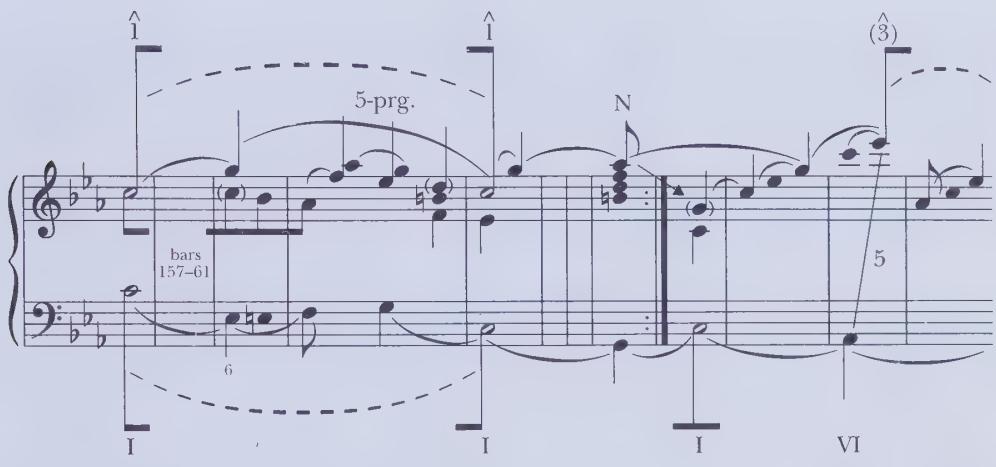
中文讲解
这是例 11.23 的第一个图位占位符,位于第 39 页,对应图注所描述的“Mozart K.457 第一乐章结束段与尾声的前景缩减”。由于内嵌图像数据在文本中已被省略,读者需查阅原书第 39 页的图像来查看具体的音高与节奏图形。
第5段(P0218)
原文复述
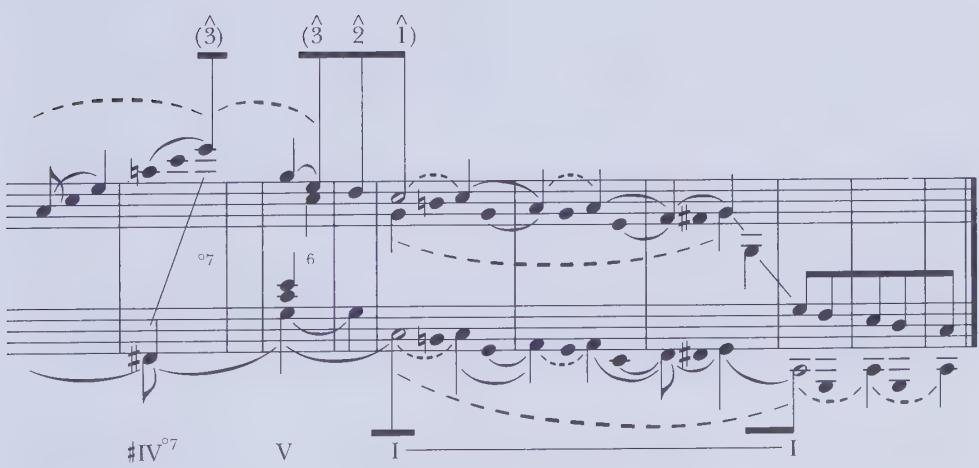
中文讲解
这是例 11.23 的第二个图位占位符,与 P0217 一同构成该图例的两栏图示。位置与图注保留说明这里应当是与图注所述前景缩减相关的另一个图形版面(如跨页或分栏的延续图)。读者需查看原书以获取实际内容。
第6段(P0219)
原文复述
the general concept of sonata procedure, a view evident in the following statement: “Only the prolongation of a division (interruption) gives rise to sonata form.“32 As we have noted, however, Schenker’s chapter on form is preliminary, and his observations should be interpreted not as comprehensive but, instead, as suggestive. Certainly, interrupted structures, with a divisive dominant underlying the second part of the exposition (in the major mode), are quite common, perhaps even usual, in the repertory of the high Classical period. But Beethoven and Brahms, among others, wrote three-part movements in which a
中文讲解
本段接续 P0214 的断句,说明申克(在《自由作曲》中)把中断技巧与奏鸣原则视为紧密关联的,并引用了申克的原话作为佐证——“只有对划分(中断)的延长才产生奏鸣曲式”(Only the prolongation of a division (interruption) gives rise to sonata form.),该引文为脚注32所在位置。紧接着作者对申克这一章给出审慎的限定:申克关于形式的论述是初步的(preliminary),其观察应被理解为提示性(suggestive)的而非穷尽性的(comprehensive)。随后作者回到经验事实:带有中断的结构——即在呈示部第二部分(大调)下有分裂属音(divisive dominant)——在高古典时期作品中十分常见,甚至可以说是惯常的(perhaps even usual)。但作为反例,作者指出 Beethoven 和 Brahms 等作曲家也写出了三部分乐章,其中分裂属音(a divisive V)直到展开部后期、甚至尾声才出现,有时甚至并不出现中断。段落末尾同样跨越到下一页继续。
补充说明
“divisive dominant”(分裂属音)指在中断处、划分前后两部分的那个作为结构支柱的属功能和弦;它在 P0221 中被简写为 divisive V。“preliminary”是作者用以形容申克形式章的限定词,提示读者不应将申克原话当作绝对定义,而应作为具有启发意义的观察。
第7段(P0220)
原文复述
Mozart, Piano Sonata, K. 457, I: middleground synopsis of form and structure
中文讲解
这是位于第 40 页的图注,标识其后的图示为 Mozart K.457 第一乐章的“中景”形式与结构纲要(middleground synopsis of form and structure)。它与第 39 页的前景缩减图(P0216–P0218)配对——前景图呈现结束段与尾声的具体实现,中景图则呈现整首乐章的结构骨架,使读者可以在两个抽象层级之间互相参照。
补充说明
“middleground synopsis”指介于表层(前景)和深层(背景/Urlinie)之间的结构层,重点展示基本结构线在乐章中段尺度上的延展方式。
第8段(P0221)
原文复述
divisive V appears later in the development, or even in the coda, sometimes without an interruption. Once again, we are reminded that formal patterns are related to factors that go beyond the basic elaborations of the structure.
中文讲解
本段接续 P0219 的句尾,把刚才开启的反例补完:在 Beethoven 和 Brahms 等人的三部分乐章中,分裂属音(divisive V)出现的位置可能推迟到展开部较后处,甚至只在尾声才出现;在某些作品中甚至完全不出现中断。这一补充对申克原话构成了实际的限定——奏鸣原则不必以中断为必要条件。段末作者再次提醒:曲式模式与超出“结构基本延展”范围之外的其他因素有关(formal patterns are related to factors that go beyond the basic elaborations of the structure),提示读者不要把曲式理解成单纯从结构延展自动派生的产物。
补充说明
“beyond the basic elaborations of the structure”呼应本书一贯立场:曲式不能仅从 Schenker 意义上的结构延展推演出来,还要考虑主题材料、性格、体裁、演奏惯例等多重因素。本句与作者在前文各处所作的“曲式不止于结构”这一论断保持一致。
第9段(P0222)
原文复述
With their great variety and marvelous detail, the three sonata movements presented in this chapter may serve as an introduction to this extraordinarily rich compositional genre. In a sense, we have come full circle with our analysis of Mozart’s great movement, the last in this introduction to the analysis of tonal music using Schenker’s approach. For as we urge you to approach each sonata movement on its own terms, we reiterate our conviction—the guiding philosophy of this book—that analysis must begin with consideration of the individuality of musical compositions, with those characteristics that make each work unique. For example, when one begins to ponder the significance of the $A^b$ in bar 4 of Mozart’s sonata, and then discovers its relationship to the structure and to other aspects of the composition, then one will stand at deeper and richer musical understanding.
中文讲解
本段是结论段的核心主张段落,先回顾全章:用以举例的三首奏鸣曲乐章变化丰富、细节精妙,可以作为进入这一异常丰富的作曲体裁的入门。接着作者点出“回到起点”的叙事——Mozart K.457 也是本书以申克方法介绍调性音乐分析的“终曲”。由此引出本书的指导哲学:分析必须从作品的个体性(individuality of musical compositions)出发,以使每一部作品独树一帜的那些特征为起点;同样地,读者也应就每一首奏鸣曲乐章本身来理解它(on its own terms)。作者用一个具体例子加以说明:当我们去追问 Mozart 这首奏鸣曲第 4 小节中的降 A 音($A^b$)的意义,并发现它与整首作品的结构以及其他方面的关系时,分析就站到了更深、更丰富的音乐理解的门槛之上。降 A 音的细节功能在此被用来印证“从个体性出发”这一抽象主张的实践价值。
补充说明
“come full circle”指全书以 Mozart 作品始(贯穿各章),又以 Mozart 作品终的结构安排,构成首尾呼应。Mozart K.457 第四小节降 A 音的作用属于该作品的具体细节,本段并未展开其结构意义,只是用它作为“关注个体细节如何融入整体”的范例;其与该曲中调性、降六级音作用以及和声关系的具体对应需要查阅原书相应章节,本节不另行补充。
第10段(P0223)
原文复述
Pieces for Analysis
中文讲解
这是“Pieces for Analysis”(分析曲目)的小节标题,标识随后列出的 13 首作品为供读者自行运用本书方法进行练习的分析材料。该标题不包含论述性内容,仅起版式分隔作用,将正文论述与曲目清单分离开来。
第11段(P0224)
原文复述
- Kuhlau, Sonatina, Op. 55, No. 1, I
中文讲解
分析曲目清单第 1 条:Kuhlau《奏鸣曲(小奏鸣曲)》,Op. 55 第 1 首,第一乐章。该作品属于较浅易的入门级奏鸣曲写作,常被作为钢琴教学中的早期奏鸣曲式训练材料,其篇幅与和声规模均适合初学申克分析者练习。
补充说明
Friedrich Kuhlau(1786–1832)为德裔丹麦作曲家,作品编号与体裁信息本节未提供外部背景;本条目只保留曲目识别信息。
第12段(P0225)
原文复述
- Clementi, Sonatina, Op. 36, No. 2, I
中文讲解
分析曲目清单第 2 条:Clementi《奏鸣曲(小奏鸣曲)》,Op. 36 第 2 首,第一乐章。该作品篇幅与难度均略高于 Kuhlau 入门小奏鸣曲,但仍以教学用途为主,适合作为从教学曲目过渡到正式奏鸣曲作品的桥梁。
补充说明
Muzio Clementi(1752–1832)的编号体系是本节给出的唯一信息,其余背景不在补充范围内。
第13段(P0226)
原文复述
- Haydn, Piano Sonata, Hob. XVI/35, II
中文讲解
分析曲目清单第 3 条:Haydn《钢琴奏鸣曲》,Hoboken 编号 XVI/35,第二乐章。选定为第二乐章,意味着分析对象不是常见的第一乐章奏鸣曲式,而是慢乐章,提示读者分析的对象扩展到非“快板奏鸣曲式”的其他乐章类型。
补充说明
Hoboken XVI 是 Haydn 键盘作品的标准编号(Anthony van Hoboken 编目体系),本节以此作为曲目识别依据。
第14段(P0227)
原文复述
- Mozart, Piano Sonata, K. 331, II (Menuetto)
中文讲解
分析曲目清单第 4 条:Mozart《钢琴奏鸣曲》K. 331,第二乐章(小步舞曲,Menuetto)。该乐章为带三声中部的小步舞曲,因此训练重点落在三部曲式及小步舞曲体裁的特征上,而非通常意义上的快板奏鸣曲式。
第15段(P0228)
原文复述
- Scarlatti, Sonata in C major, K. 159, L. 104
中文讲解
分析曲目清单第 5 条:Scarlatti《C 大调奏鸣曲》,Kirkpatrick 编号 K. 159(Longo 编号 L. 104)。该作品属于巴洛克晚期/古典早期单乐章键盘奏鸣曲传统,与维也纳古典奏鸣曲式在结构上有所不同,意在让读者把学到的分析方法应用到前古典时期的单乐章奏鸣曲中。
补充说明
Domenico Scarlatti(1685–1757)作品同时使用 Kirkpatrick(K)与 Longo(L)两套编号体系,本节同时列出两套编号以方便检索。
第16段(P0229)
原文复述
- Mozart, Piano Sonata, K. 330, I
中文讲解
分析曲目清单第 6 条:Mozart《钢琴奏鸣曲》K. 330,第一乐章。Mozart 早期成熟奏鸣曲的典型代表之一,篇幅、主题对比与和声张力均较为均衡,是分析维也纳古典奏鸣曲式结构的常用范本。
第17段(P0230)
原文复述
- Mozart, Piano Sonata, K. 310, I
中文讲解
分析曲目清单第 7 条:Mozart《钢琴奏鸣曲》K. 310(a 小调),第一乐章。该乐章是 Mozart 少数小调奏鸣曲之一,其表现性与调性色彩与同章其他大调作品形成对比,使分析者有机会把分析方法运用于小调奏鸣曲式中。
补充说明
本节未提供 K.310 调性说明,此处仅依据通行的 Mozart 奏鸣曲编号习惯保留原条目信息。
第18段(P0231)
原文复述
- Mozart, Symphony No. 41 (“Jupiter”), K. 551, II (exposition)
中文讲解
分析曲目清单第 8 条:Mozart《第 41 交响曲》(“朱庇特”),K. 551,第二乐章,仅限呈示部(exposition)。选自交响曲的慢乐章、且只要求分析呈示部,意在让读者把奏鸣曲式分析技术从钢琴文献扩展到管弦乐文献,并练习在较大尺度上辨认呈示部结构。
补充说明
“Jupiter”为该交响曲的常用别称,本节原文同时给出该别称;呈示部被特别指明,意味着后续的展开部与再现部不纳入本次分析作业。
第19段(P0232)
原文复述
- Mozart, Piano Sonata, K. 333, I (exposition)
中文讲解
分析曲目清单第 9 条:Mozart《钢琴奏鸣曲》K. 333,第一乐章,仅限呈示部。与 P0231 类似,作者只要求分析呈示部,以训练对大规模呈示部结构内部分区的判读能力。
第20段(P0233)
原文复述
- Beethoven, Piano Sonata, Op. 53 (“Waldstein”), I (exposition)
中文讲解
分析曲目清单第 10 条:Beethoven《钢琴奏鸣曲》Op. 53(“瓦尔德施泰因”),第一乐章,仅限呈示部。该作品是 Beethoven 成熟时期扩展型奏鸣曲式的标志性作品,呈示部内部具有多重主题与调性布局,适合用来检验分析者对大型呈示部的把握能力。
补充说明
“Waldstein”为该奏鸣曲的常用别称,本节原文同时给出该别称以方便识别。
第21段(P0234)
原文复述
- Beethoven, Piano Sonata, Op. 10, No. 1, I (complete movement)
中文讲解
分析曲目清单第 11 条:Beethoven《钢琴奏鸣曲》Op. 10 第 1 首,第一乐章,全乐章(complete movement)。与前两条只要求呈示部不同,此处要求分析整首乐章,意在让读者面对完整的奏鸣曲式——包括展开部与再现部。
第22段(P0235)
原文复述
- Beethoven, Piano Sonata, Op. 31, No. 2, I (complete movement)
中文讲解
分析曲目清单第 12 条:Beethoven《钢琴奏鸣曲》Op. 31 第 2 首,第一乐章,全乐章。该作品与 P0234 同样要求整乐章分析,是 Beethoven 中期奏鸣曲写作的代表性作品之一。
第23段(P0236)
原文复述
- Beethoven, Piano Sonata, Op. 81a (“Les Adieux”), I (complete movement)
中文讲解
分析曲目清单第 13 条:Beethoven《钢琴奏鸣曲》Op. 81a(“告别”),第一乐章,全乐章。作为 Beethoven 后期奏鸣曲作品之一,“告别”奏鸣曲在内容表达与结构上极具个性,要求全乐章分析意在让读者把申克方法与对作品个体性的关注结合起来,从而呼应作者在 P0222 提出的核心主张。
补充说明
“Les Adieux”(告别)为该奏鸣曲的法文标题别称,与德文“Das Lebewohl”相对应,本节原文给出法文别称。
脚注 / 边栏 / 图表 / 附加信息(如有)
本小节包含的附加材料为:例 11.23(Mozart K.457 第一乐章结束段与尾声的前景缩减图,位于第 39 页,跨 P0217–P0218 两栏)和与之配对的 K.457 第一乐章中景结构纲要图(图注见 P0220,位于第 40 页)。两图分别从前景和中景两个层级展示 K.457 第一乐章的结构骨架,与 P0222 中关于“回到起点”的叙事相呼应,作为全章分析对象的收束性视觉总结。P0219 中以脚注 32 引用申克《自由作曲》中关于奏鸣曲式与中断关系的原话(“Only the prolongation of a division (interruption) gives rise to sonata form.”),该引文为作者限定申克立场的核心证据来源。曲目清单(P0224–P0236)按由浅入深、由钢琴到交响乐、由呈示部到全乐章的顺序编排,呼应了 P0222 提出的“从个体性出发”这一方法论立场。
💡 本节核心要点
- 奏鸣曲式被作者界定为在“两部分中断结构”内部展开的“三部分形式”,与回旋二部曲式共享基本方案,只是规模更大。
- 申克把中断技巧视为奏鸣原则的根源(“Only the prolongation of a division gives rise to sonata form.”),但作者把这一论断明确限定为“提示性”而非穷尽性。
- 中断结构和分裂属音在高古典时期作品里很常见,但 Beethoven、Brahms 等作曲家的三部分乐章中分裂属音可推迟到展开部甚至尾声出现,有时甚至没有中断;曲式不能简单还原为结构延展的自动结果。
- 全章以 Mozart K.457 收束,呼应本书以 Mozart 开始、以 Mozart 结束的首尾呼应的整体结构,并以 K.457 第 4 小节降 A 音的细节为范例,提出分析应从作品的个体性与具体细节出发。
- 分析曲目清单由教学性的小奏鸣曲(Kuhlau、Clementi)逐步过渡到 Haydn、Mozart、Scarlatti 的成熟奏鸣曲,再扩展到 Mozart 交响曲和 Beethoven 三首奏鸣曲,作业要求从“仅限呈示部”逐步过渡到“完整乐章”,对应训练层级的递进。
🔑 关键术语
- interruption(中断):申克体系中主调被属调打断、随后又回到主调的结构事件,是与属音延长直接相关的现象;本节中作者把申克的“中断—奏鸣原则”关联作为讨论起点,但同时指出它并非奏鸣曲式的必要条件。
- divisive dominant / divisive V(分裂属音):在中断处作为结构支柱的属功能和弦;作者指出在高古典时期它常出现于呈示部第二部分下方,但在 Beethoven、Brahms 的乐章中可推迟到展开部甚至尾声出现。
- rounded binary form(回旋二部曲式):第二部分在结尾处再现第一部分主题材料的二部曲式;本节把奏鸣曲式视作其在大规模上的扩展形态。
- foreground reduction / middleground synopsis(前景缩减 / 中景结构纲要):申克分析中的两个层级:前景缩减保留表层细节而省略装饰,中景纲要展示基本结构线在中尺度上的延展;本节用 K.457 的这两份图作为收束性视觉总结。
- three-part form / two-part interrupted structure(三部分形式 / 两部分中断结构):本节对奏鸣曲式核心结构特征的总括表述:三部分的奏鸣乐章(呈示—展开—再现)在两部分的、带中断的框架内展开,区分这两个层级是理解奏鸣原则的关键。
11.21 Notes
第1段(P0237)
原文复述
Notes
中文讲解
本小节标题。表示以下内容是对正文中各处论述的脚注(notes),按数字编号排列,承接第11章正文中出现的引文、图表、术语和分析判断,逐一给出出处、限定或延伸说明。
第2段(P0238)
原文复述
- For more information about the sonata, see Charles Rosen’s landmark studies The Classical Style and Sonata Forms. See also William S. Newman’s three-volume survey, The Sonata in the Baroque Era, The Sonata in the Classic Era, The Sonata Since Beethoven; various works by Donald Francis Tovey, especially A Companion to Beethoven’s Pianoforte Sonatas; Schenker’s study “On Organicism in Sonata Form,” The Masterwork in Music: A Yearbook, Vol. II, pp. 31–54; and James Hepokoski and Warren Darcy, Elements of Sonata Theory.
中文讲解
本脚注开列了一份关于奏鸣曲(sonata)的延伸阅读书目,分别涵盖五个方向:Rosen 的两部经典著作提供了古典风格通论与奏鸣曲式的体系化讨论;Newman 的三卷本覆盖了巴洛克、古典与贝多芬之后三个时期的奏鸣曲历史;Tovey 的著作(尤其是贝多芬钢琴奏鸣曲评注)侧重于具体作品的鉴赏与分析;Schenker 的《On Organicism in Sonata Form》则从“有机体”角度讨论奏鸣曲式,与本书采用的 Schenker 派分析视角直接呼应;最后 Hepokoski 与 Darcy 的《Elements of Sonata Theory》代表当代的奏鸣曲理论综合研究。本脚注为读者提供从历史、风格、理论与作品评注四种角度深入奏鸣曲的入口。
补充说明
本条所列均为外部文献,作为延伸阅读,本身不属于本节正文的论据;其作用是补充正文中关于奏鸣曲式讨论的学术谱系。
第3段(P0239)
原文复述
- Schenker believed that terms such as first theme, second theme, etc., do not adequately express the nature of the sonata principle. For one thing, sonata movements are often too variable. You will discover that this tiny movement really has no second theme (but proceeds directly to a closing theme), even though it does exhibit the expected modulatory plan. Other movements do not have a closing theme, while others have only one principal theme (often in Haydn). Although we will consider the significance of thematic relationships (and will refer to themes in our discussions), in this chapter we will focus on the techniques associated with large-scale harmonic plans and the composing-out of the structure. We believe this provides for a flexible approach to what is perhaps the most varied and flexible of all tonal compositional procedures.
中文讲解
本脚注交代了全书在奏鸣曲分析上的方法论取舍。Schenker 认为“第一主题、第二主题”这样的标签不能充分表达奏鸣原则(sonata principle)的实质,因为奏鸣曲乐章在主题数量、是否有结束主题、是否仅有单一主要主题(Haydn 常见)等诸多方面变化太大。本章所分析的这首小规模乐章即为例证:它并无第二主题,直接进入结束主题,却仍遵循预期的转调方案。作者承认主题关系本身具有重要意义,因此行文中仍会使用主题术语,但本章的分析重心放在大规模和声方案(large-scale harmonic plans)与结构的“延展写出”(composing-out)技巧上。这种取舍被作者视为对“所有调性作曲程序中最多变、最灵活的一种”——奏鸣曲——采取灵活方法的体现。
补充说明
“composing-out”出自 Schenker 的术语 Auskomponierung,指在表层把一个深层结构用音乐材料逐步展开、延伸成可听的时间过程;这是理解本节和声图示与正文分析的关键概念。
第4段(P0240)
原文复述
- The figured-bass symbols are to be understood only in relation to G, the root of the dominant, which is continually active at a deeper level throughout this brief section. The surface chord progression could carry its own set of symbols, such as $\frac{4}{2}-\frac{6}{3}$ for bars 16–17, which would be somewhat misleading from a broader, structural perspective. In other words, one should understand the succession of chords at the surface as occurring over a pedal G, which is sometimes not sounding. Schenker referred to such a higher-level note as a “silent” cantus-firmus tone.
中文讲解
本脚注针对正文中的数字低音(figured-bass)符号给出阅读指引:这些数字只能相对于 G 来理解——G 是属音的根音,在该段落深层结构中持续活跃。表面上看,第16–17小节的和弦进行可以另写一套数字(如 4/2–6/3),但从更宏观的结构视角看,这种标记会有误导。作者要求读者把表层一连串和弦理解为发生在一个 G 持续音之上,尽管该 G 有时并不实际发声。Schenker 把这种虽未实际出现却存在于较高结构层次的音称为“静默的”固定旋律音(silent cantus-firmus tone)。这一脚注揭示了本节和声分析的基本立场:以持续音为锚点来组织表层和声,避免被数字低音的局部暗示所误导。
补充说明
“silent” cantus-firmus tone 是 Schenker 用来描述深层结构中未实际发声却功能上活跃的音;与“实际奏出的”持续音(pedal)形成对照。
第5段(P0241)
原文复述
- Free Composition, pp. 136–37. In the minor mode, as we shall see, the development section very often continues the motion to the structural $\frac{2}{v}$ .
中文讲解
本脚注引用 Schenker《Free Composition》第136–37页作为正文论述的来源,并补充一个关于小调的限定:在小调中,呈示部经常并未完成到结构性的 2̂/V,呈示部与展开部之间原本中断的位置有时会被“拖延”到展开部内才完成。作者提示读者在后文将看到这一点。
补充说明
“2̂/V”指属调上的 2 音(Schenker 图式中上声部的第二音级),此处“$\frac{2}{v}$”即上声部下行到属调 2̂;结构性含义在于它对应 Urlinie 中第一分支结束于 2̂ 的中断型结构。
第6段(P0242)
原文复述
- In other words, we hear an end to the exposition (highlighted by the repeat signs) and a beginning of the development; this juncture is often highlighted by the return of the first theme (transposed) at the commencement of the development. Bear in mind, however, that both sections arise within the first branch of the interrupted structure.
中文讲解
本脚注澄清正文读者可能产生的误解:从听感上,呈示部以反复记号结束、展开部开始(常以第一主题的移调再现作为标志),看似是两个清晰段落的对接;但在 Schenker 式深层结构上,呈示部与展开部都同属中断型结构(interrupted structure)的“第一分支”。换言之,听觉上的段落分界与结构上的层级归属并不一一对应,这一脚注提醒读者不要把表层分段与深层分支混淆。
补充说明
“interrupted structure”是 Schenker 奏鸣曲式中“中断”型的 Urlinie 走向:上声部从 5̂ 下行到 2̂ 后中断,再以 5̂–4̂–3̂–2̂–1̂ 在第二分支完成基本线下行。
第7段(P0243)
原文复述
- Free Composition, Figures 124/5b, 128/2d, and 148/1 and associated commentary.
中文讲解
本脚注仅为文献出处:指向 Schenker《Free Composition》中的图 124/5b、128/2d 与 148/1 以及相关正文论述,作为正文图示与分析判断的依据。无进一步阐发。
第8段(P0244)
原文复述
- Free Composition, Figure 148/1 and pp. 124–25.
中文讲解
本脚注同样是文献出处,指向《Free Composition》图 148/1 与第 124–25 页,对应正文的中断型结构图示与论述。无进一步阐发。
第9段(P0245)
原文复述
- Consult the Selected Bibliography concerning studies on rhythm by William Rothstein and Carl Schachter.
中文讲解
本脚注把读者引向参考书目中关于节奏(rhythm)的研究,特别是 William Rothstein 与 Carl Schachter 的相关著作,为正文中涉及节拍与节奏的讨论提供延伸阅读线索。
补充说明
Rothstein 与 Schachter 均为 Schenker 派学者;本节以下脚注 9 即直接引用 Rothstein 的《Phrase Rhythm in Tonal Music》。
第10段(P0246)
原文复述
- See William Rothstein’s discussion in Phrase Rhythm in Tonal Music (New York: Schirmer Books, 1989), pp. 8–9.
中文讲解
本脚注给出 Rothstein《Phrase Rhythm in Tonal Music》(纽约:Schirmer Books,1989)第 8–9 页的具体页码,为正文关于乐句节奏(phrase rhythm)的论述提供直接出处。
补充说明
出版信息(出版社、年份)见脚注原文,已悉数保留。
第11段(P0247)
原文复述
- Free Composition, p. 124.
中文讲解
本脚注为单纯文献出处:指向《Free Composition》第 124 页,对应正文关于四小节乐句群(4-measure group)的论述。
第12段(P0248)
原文复述
- Free Composition, p. 124. Schenker does not use the term hypermeasure, referring instead to a “4-measure group.” He also says that the expansion occurs at the conclusion of the second unit. He is not including bars 1–4, as we are in our discussion.
中文讲解
本脚注解释了正文与 Schenker 原著在术语和分析层面上的两点细微差异:(1)Schenker 不使用“超小节”(hypermeasure)一词,而称之为“4-measure group”(四小节组);(2)Schenker 认为扩展发生在第二单位的结束处,而本书作者的讨论从第 1–4 小节开始便把扩展纳入,涵盖范围更广。这两点澄清了作者与 Schenker 在相同结构现象上命名的差别与起算范围的不同,避免读者误以为二者分析完全一致。
补充说明
“hypermeasure”(超小节)由 Edwin Evans 在 Schenker 思想基础上提出,意指由若干小节组成的更高层次的节拍单位;本节正文使用的是这一术语。
第13段(P0249)
原文复述
- The second part of Example 11.6 is an abstract way of illustrating the neighbor motions of bars 12–15, and the upbeat nature of bar 17, in a single, unexpanded hypermeasure; it is not, strictly speaking, a durational reduction. We are indebted to William Rothstein for suggestions about this example.
中文讲解
本脚注对例 11.6 第二部分的性质作出限定:它是用一种抽象方式,将第 12–15 小节的邻音进行以及第 17 小节的弱起性质压缩到一个未扩展的超小节中加以展示,严格来说并不是“时值缩减”(durational reduction)。脚注末尾致谢 Rothstein 对该例示提出的建议。这一限定防止读者把图示误读为 Schenker 式严格的层级缩短图,而应理解为对邻音与弱起节奏关系的概念性图解。
补充说明
“durational reduction”是 Schenker 图式中通过延长符逐层将前景缩短为中景、背景的方法;本例明确不属于此类。
第14段(P0250)
原文复述
- Our metaphorical language is a paraphrase of Schenker’s: “It [music] may simulate expectation, preparation, surprise, disappointment, patience, impatience, and humor.” See Free Composition, p. 5.
中文讲解
本脚注交代正文中所使用“期待”“失望”等拟人化措辞的来源:是对 Schenker 在《Free Composition》第 5 页中所写“音乐可以模拟期待、准备、惊讶、失望、耐心、不耐烦和幽默”一句的改写。它提示读者,作者所用的心理学/叙事性比喻其实来自 Schenker 本人,从而为这种叙述风格提供文本依据。
第15段(P0251)
原文复述
- What we show is not an interruption as described by Schenker. The line descends to 2 and breaks off but returns to the middle of the phrase, not the beginning as in a pure interruption.
中文讲解
本脚注对正文图示与 Schenker 经典定义作出重要区分:图中所呈现的不是 Schenker 意义上的纯粹“中断”(interruption)。线条下行至 2̂ 并中断,但回到乐句中间而非乐句开头——Schenker 的“纯粹中断”要求线条在中断之后从乐句起始重新开始。这种细微差别决定了本图不能直接套用 Schenker 对中断的标签,但保留了中断的上行/下行结构轮廓。
补充说明
Schenker 的“中断”标准形式:上声部从 5̂ 下行至 2̂,第二分支重新从 5̂ 起始以 5̂–4̂–3̂–2̂–1̂ 完成基本线。本例因“回到乐句中间”而偏离此严格模式。
第16段(P0252)
原文复述
- Free Composition, Figure 148/1.
中文讲解
本脚注为单纯文献出处:指向《Free Composition》图 148/1,对应正文关于中断型结构的图示。
第17段(P0253)
原文复述
- This term is not Schenker’s, but is one we encountered in private conservations with Charles Burkhart.
中文讲解
本脚注交代正文中所用术语的来源:该词并非 Schenker 本人所用,而是作者在与 Charles Burkhart 的私下交流中获得的。这一说明把分析语汇的来源归于当代 Schenker 学派的另一位学者,避免读者误以为术语出自 Schenker 体系本身。
补充说明
“private conservations”(私下交流)在脚注原文中如此呈现,是脚注作者对术语来源的诚实说明;具体术语名称未在本脚注中单独列出,应回到正文查阅。
第18段(P0254)
原文复述
- See Figure 23 in Free Composition. This situation is also possible in minor-mode sonata movements in which the primary motion of the exposition is to the minor V. Schenker describes this pattern in relation to Urlinie lines that begin on $\hat{3}$; the characteristics of this harmonic transformation, however, can also apply to lines that begin on $\hat{5}$, as here.
中文讲解
本脚注把正文中的和声转换模式追溯到《Free Composition》图 23,并补充说明其适用范围:Schenker 在讨论该模式时以从 3̂ 起的基本线为范例,但本节分析对象是从 5̂ 起的基本线。作者认为这种和声转换的特征同样适用于 5̂ 起的基本线,因此扩展了 Schenker 原本讨论的适用范围。脚注同时点明:小调奏鸣曲中呈示部向小属调(minor V)运动时也可出现类似情形。
补充说明
“Urlinie”指 Schenker 体系中代表基本线下行的上声部旋律线;起始音级(3̂ 或 5̂)的不同决定了基本线类型。
第19段(P0255)
原文复述
- Example 11.11b is derived from Figure 23 of Free Composition, which applies to $\hat{3}$ lines; the same transformation of the dominant may also occur in $\hat{5}$ lines. In an Urlinie from $\hat{3}$ therefore, scale degree $\hat{4}$ (the seventh of V $^{7}$ ) resembles and acts like a neighbor to the primary tone $\hat{3}$ of the second branch, though it derives from a passing motion. The only upper-voice lines in an interruption scheme are $\hat{5}-\hat{4}-\hat{3}-\hat{2}|\hat{5}-\hat{4}-\hat{3}-\hat{2}-\hat{1}$ (or $\hat{3}-\hat{2}|\hat{3}-\hat{2}-\hat{1}$ ) at the first level of the middleground, with the $\hat{2}$ of the first branch directed toward the $\hat{1}$ of the second branch. Subsequent elaborations, as in Example 11.11b, do not alter the functions of any of these tones. In other words, the interruption resides only at the first level of the middleground, which is not active during the composed-out link (for instance, V $^{5-7}$ ) that connects the two branches.
中文讲解
本脚注对例 11.11b 与 Schenker 图 23 的关系作了细致的结构性说明:(1)图 23 原本针对 3̂ 线,作者把它推广到 5̂ 线;(2)在 3̂ 起的基本线中,4̂(即 V7 的七音)虽然源自经过音进行,功能上却表现得像第二分支起始音 3̂ 的邻音;(3)作者明确列出中断型结构在中景第一层唯一可能的上声部线条:5̂–4̂–3̂–2̂ | 5̂–4̂–3̂–2̂–1̂(或 3̂–2̂ | 3̂–2̂–1̂),其中第一分支的 2̂ 指向第二分支的 1̂;(4)后续的装饰(如例 11.11b 中所示)不改变任何音的功能;(5)因此中断只发生在中景第一层,而在连接两分支的“延展写出环节”(如 V5–7 这种经过性属和弦)中,该第一层并不活跃。这一脚注把中断型结构的功能层级关系讲得非常清楚,是理解正文中“中断”与“延展写出”区别的关键。
补充说明
“V5–7”指属七和弦的 5–7 两个音,即 5̂ 与 7̂ 的局部进行;它作为连接两分支的延展写出环节,并不参与第一层的中断结构。
第20段(P0256)
原文复述
- Because the primary tone $\hat{5}$ appears initially as $d^2$ and Mozart emphasizes structural $\hat{2}$ with a trill ( $a^1$ in bar 81), we read the obligatory register as that shown in Example 11.12b.
中文讲解
本脚注解释例 11.12b 中“必须音区”(obligatory register)的判定依据:Mozart 在该乐章中让基本线起始的 5̂ 首次出现于 d²(小字二组的 D),又在第 81 小节用 a¹(小字一组 A)上的颤音强调结构性 2̂。基于这两点,作者把图中的必须音区读作例 11.12b 所示的样子。此处涉及 Schenker 派“必须音区”概念——基本线下行只在某特定音区内发生才有说服力。
补充说明
“obligatory register”是 Schenker 派分析中关于基本线音区选择的概念:基本线下行的音必须在合理音区内出现,否则分析不可信;d² 与 a¹ 的具体出现为图示中的音区选择提供了证据。
第21段(P0257)
原文复述
- The fourth is subdivided into a third plus a step. This interpretation is based on the $\frac{6}{4}$ resolving to the $\frac{5}{3}$ over V.
中文讲解
本脚注交代正文中对某一四度音程的细分依据:该四度被分解为一个大三度加上一级小二度(即“上行三度再下行小二度”之类的进行),其判断依据是 V 上的 6/4 解决到 5/3 这一典型进行——即挂留性质的 4̂ 通过邻音或解决进入 3̂ 的声部进行。这种解释与 V 上 6/4 → 5/3 的标准声部进行相吻合。
补充说明
V 上的 6/4 → 5/3 是传统和声中典型的“经过性”或“挂留性”六四和弦解决方式;本节以此声部进行为据解读四度的内部构成。
第22段(P0258)
原文复述
- See Aldwell, Schachter, and Cadwallader, pp. 289–90 for a discussion of chords built on the upper third and fifth of triads. The difference here is that the chord built on the upper third of the tonic is expanded locally into a brief key area.
中文讲解
本脚注为正文涉及“在主音上方三度上构和弦”这一现象提供延伸阅读出处:参看 Aldwell、Schachter 与 Cadwallader 合著的第 289–90 页。脚注同时补充本例的特殊性:通常这只是局部和弦,而本例中建立在主音上方三度上的和弦被扩展为一个短暂的调性区域(key area),即“近关系调”——例如 C 小调中的 E♭ 大调。这种“局部短暂调性”是奏鸣曲中处理主音上方三度关系(如 III 级调性)时常见的手段。
补充说明
“上主音上方三度”即主音的 III 级关系,在 C 小调中为 E♭ 大调;这是小调奏鸣曲呈示部中常见的副调区域。
第23段(P0259)
原文复述
- As we show in the example with a bracket, G reaches over to $B^{b}$ , which falls to the neighbor $A^{b}$ . As we have discussed before, the technique of reaching over often involves multiple figures that decorate the tones in a rising line or arpeggiation: an ascending third followed by a descending second is one such pattern. Nonetheless, it is common to find a single step or leap decorated by a motion from above.
中文讲解
本脚注解释正文中“跨越”(reaching over)技巧的具体表现:如图所示,G 跨越到 B♭,然后下行到作为邻音的 A♭。作者指出,“跨越”技巧通常涉及多重装饰形式——既可装饰上行线条或分解琶音中的音(如上行三度接下行二度这种“跳进—回返”模式),也可装饰单一音程或级进中的单个音(通过上方进入的邻音加以装饰)。这说明“跨越”在表面形态上具有多样性,但其结构功能一致。
补充说明
“reaching over”是 Schenker 派分析中描述低声部或内声部跨过上方音以形成“越过—回落”模式的概念;本例中 G → B♭ → A♭ 即典型的“跨过邻音”模式。
第24段(P0260)
原文复述
- The graph basically shows the second occurrence of the phrase in the closing section, bars 63–67 (bar 59 “equals” bar 63).
中文讲解
本脚注说明正文中图示所对应的具体乐句位置:图主要展示的是结束段(closing section)中第二次出现的乐句,即第 63–67 小节,其中第 59 小节在结构上“等于”(“equals”)第 63 小节。作者用“equals”这一表述标明两小节在基本线下行结构上功能相同,引导读者对照阅读。
补充说明
“bar 59 equals bar 63”是 Schenker 派图示中用“=”连接两小节的记谱习惯,表示两者在结构层级上功能等同。
第25段(P0261)
原文复述
- Example 11.16a shows only one of the two rising fifths. The special bar numbering, shown as 59–63, indicates the repetition in a concise fashion.
中文讲解
本脚注对例 11.16a 的图示范围作出说明:该例仅展示两处上行五度中的第一处;图中所标的“59–63”这种特殊小节编号是把第二次重复以简洁方式纳入编号,从而在一例中兼顾两处的对应关系。这是分析图示惯例上节省空间的处理方式。
补充说明
在 Schenker 图式中,连续重复的乐句常用压缩小节编号(如 59–63)一次画完,以避免重复绘制相同的线条。
第26段(P0262)
原文复述
- Not as frequently encountered, but a very important possibility, is the situation in which the harmonic progression of the exposition moves from I to minor V (as in Beethoven’s Piano Sonata, Op. 31, No. 2, “Tempest,” I). Here the structural function of the development section is to transform the key of the minor V into the major dominant chord of the home tonic. This procedure represents a prolonged V and is similar in this respect to the function of major-mode development sections.
中文讲解
本脚注补充一种不太常见但极重要的小调奏鸣曲情况:呈示部的和声进行从 I 走向小属调(minor V),即主调小调但副调为同名小调上的属和弦(如 C 小调中呈示部以 g 小调结束)。这种处理以贝多芬《钢琴奏鸣曲》Op. 31 No. 2(“暴风雨”)第一乐章为代表。其结构性后果是:展开部承担的功能变为把“小 V”转化为“主调的大属和弦”(C 小调中即转为 G 大三和弦)——这一过程相当于一个被延长的属准备(prolonged V)。作者指出,这种展开部的功能与同名大调奏鸣曲的展开部在“延长属准备”这一性质上相通。
补充说明
本例中“minor V”指小调奏鸣曲呈示部以同名小调的属和弦作为副调结束,是奏鸣曲式小调处理的特例之一。
第27段(P0263)
原文复述
- Free Composition, p. 90. Ernst Oster adds in a footnote, “In this process, then, as original $^{6}{3}$ , $^{5}{5}$ , [sic; perhaps Oster means $^{6}{5}$ ] or even a $^{6}{4}$ position that results from voice leading is transformed into a root position.”
中文讲解
本脚注引用 Schenker《Free Composition》第 90 页,并在其后附加 Ernst Oster 在同一页脚注中的补充说明:在该过程中,原位为 6/3、5/5(原文如此;Oster 注 sic,可能实指 6/5)或甚至由声部进行产生的 6/4 位置最终被转化为原位(root position)。这说明某些和声转换过程会把表面非原位的属和弦通过声部进行最终“修正”为原位和弦。脚注完整保留了 Oster 原文及其“[sic; perhaps Oster means 6/5]”的注释,说明作者意识到 Oster 原稿可能有误。
补充说明
“5/5”在此显然是排版或抄录错误,作者以“[sic]”加猜测的方式标明并保留原文;这反映了本节对文献引用的严谨态度。
第28段(P0264)
原文复述
- Similar structural bass motions appear in the first movements of Beethoven’s Piano Sonatas Op. 2, No. 1, and Op. 13 (“Pathetique”). The first is analyzed by Schenker in Tonwille II, pp. 25–48 and supplement. Chromatic passing tones often intensify each step in the progression III–IV–V. In the first movement of Op. 13, the median E $^{b}$ concludes the exposition, as in Mozart’s C-minor Sonata; Beethoven’s development section, however, begins in E minor. In this case, the chromatic passing tone between III and IV (E $^{h}$ ) is emphasized through tonicization.
中文讲解
本脚注为正文所讨论的 III–IV–V 低音进行模式提供两个贝多芬早期奏鸣曲的对比案例:(1)Op. 2 No. 1——Schenker 自己在《Tonwille II》第 25–48 页及其附录中分析过;(2)Op. 13(“悲怆”)第一乐章——其呈示部以 E♭(中音)结束,与 Mozart C 小调奏鸣曲一致,但其展开部以 E 小调开始,使得 III 与 IV 之间的半音经过音 E♮(在 C 小调中为 4̂ 的半音化)通过属调化(tonicization)得到强调。脚注表明:在 III–IV–V 的进行中,色彩性半音常用于强化每一级,而贝多芬则进一步通过属调化来突出这一过程。
补充说明
“Tonwille II”是 Schenker 在 1922–24 年出版的学术年刊,登载他的分析论文;本节脚注把它作为 Op. 2 No. 1 的权威 Schenker 派分析来源。
第29段(P0265)
原文复述
- This momentary excursion makes the eventual return of the tonic sound almost like a newly established goal, even though C minor has been in effect since the beginning of the recapitulation. In other words, Mozart has recomposed the transition to sound as if it may modulate, even though it quickly leads back to tonic harmony. Remember, in purely functional terms, there is no need for a modulating transition section in a recapitulation; for purposes of symmetry, composers often found ingenious ways of “modulating” to the tonic of the second theme.
中文讲解
本脚注解释正文中关于再现部“过渡段”的有趣现象:Mozart 在 C 小调奏鸣曲的再现部中让过渡段短暂离开主调,仿佛又要转调,但其实迅速回到主调。这一临时离调让主调的最终回归听起来像是一个“新建的目标”(newly established goal),尽管 C 小调实际上自再现部开头就一直在场。作者的解读是:Mozart 通过重新谱写过渡段,使其听起来“像是要转调”——在功能上,再现部本不需要转调的过渡段;但出于对称性考虑,作曲家经常想出巧妙的办法让再现部的过渡段“假装转调”到第二主题的主调,从而维持呈示部与再现部之间在体感和结构上的对应。
第30段(P0266)
原文复述
Consider also the deflection of the bass from $A^{b}$ to $A^{q}$ before resolving to G. In combination with $D^{q}$ (passing) in the right hand, $A^{q}$ dispels the “dream” of $D^{b}$ major even before V of C minor arrives.
中文讲解
本段延续上一脚注,进一步解释 Mozart 如何在再现部过渡段中“破坏”假转调的预期:低声部从 A♭ 偏向 A♮(自然 A),再解决到 G。结合右手经过音 D♮,这一 A♮ 在真正的 C 小调 V 属和弦到达之前,就已经打破了听者对 D♭ 大调(♭VI)的预期。这里作者用“dream”(梦境)一词,呼应前面用过的 Schenker 拟人化比喻(脚注 13),把短暂离调比为转调幻觉。
补充说明
“deflection of the bass”是 Schenker 派分析中对低声部临时偏离预期方向而后再回归的描述;本例中 A♭ → A♮ → G 即为此类声部进行。
第31段(P0267)
原文复述
- Eric Wen (“A Disguised Reminiscence”) has written on the differences between sonataform movements in major and those in minor (including the first movement of K. 457). The discovery of the ways in which composers deal with this compositional issue is a fascinating aspect of the analysis of sonata movements. Beethoven, for example, in the first movement of his Piano Sonata, Op. 2, No. 1, composes the second theme of the exposition (in the median) with a good deal of modal mixture (elements belonging to A $^{b}$ minor are incorporated into the theme). Consequently, in the recapitulation, very little modification is necessary; the theme is transposed rather literally from the mediant to the tonic minor.
中文讲解
本脚注为正文关于大小调奏鸣曲差异的讨论提供延伸阅读(Eric Wen 的《A Disguised Reminiscence》,含对 K. 457 第一乐章的分析),并以贝多芬 Op. 2 No. 1 第一乐章作为对比范例:在该乐章中,第二主题出现在中音调上(a♭ 大调),作曲家大量使用了调式混合(modal mixture)——把 A♭ 小调的元素融入主题。其结果是,在再现部中仅需把主题从中音移调到主调小调(从 a♭ 大调移至 c 小调),改动极小,因为主题在呈示部时本就具备小调色彩。这一案例说明作曲家如何通过调式混合预先“准备”再现部的处理难度,从而在小调奏鸣曲中实现主题再现的便利。
补充说明
“modal mixture”(调式混合)指在同一调性中借用同主音平行调的和声材料;本例中 a♭ 大调主题融入了 a♭ 小调的元素。
第32段(P0268)
原文复述
- From a broader perspective the descent in Example 11.21 is motion to an inner voice. For this reason we have indicated $\hat{4} -\hat{3} -\hat{2} -\hat{1}$ in parentheses. The actual descent of the Urlinie occurs in the following passage.
中文讲解
本脚注对例 11.21 中所标的下行线作出层级澄清:从更宏观视角看,该例所显示的下行其实是向下声部/内声部进行的运动,并非基本线本身的下行;因此作者用括号标出 4̂–3̂–2̂–1̂,以表明这是较低层级、较局部的下行。真正属于 Urlinie(基本线)的下行发生在此例之后的乐段。括号的使用在 Schenker 图式中通常表示“属较低层级”或“局部下行”,与无括号的基本线相区别。
补充说明
在 Schenker 图式中,括号常用于标示“在内声部或较低结构层发生的下行”,区别于上声部主导的 Urlinie 下行。
第33段(P0269)
原文复述
Note also the absence of a deceptive cadence in the second group. The VI of bar 48 becomes, here, a perfect authentic cadence (bar 145), so that there are two complete fifth-descents. Closure is thus emphasized.
中文讲解
本段继续脚注 30,说明正文中第二组主题部分的和声特征:原本在第 48 小节以 VI 出现的和弦,在再现部对应位置(第 145 小节)被改写为完全正格终止(PAC),而不再是呈示部中可能存在的“阻碍终止”(deceptive cadence)。结果是该乐段中出现了两处完整的五度下行——基本线在两个位置都完成 5̂–1̂ 的下行。脚注强调,这一处理强化了终止的封闭性(closure)。
补充说明
“deceptive cadence”(阻碍终止)即 V–VI 的进行,本节讨论的小调奏鸣曲中呈示部原本可能存在 V–VI,但再现部中 V 直接到 I。
第34段(P0270)
原文复述
- Codas and codalike passages often contain such lower-level descents. Review Example 11.16a to see how the similar descent works in the codetta of the exposition.
中文讲解
本脚注归纳一般规律:尾声(coda)及类尾声段落常常包含此类较低层级的五度下行;提示读者回顾例 11.16a,看看类似的五度下行如何在呈示部的小尾声(codetta)中工作。这一脚注把脚注 30–31 的具体观察推广到奏鸣曲尾声处理的普遍现象。
补充说明
“codetta”在 Schenker 派术语中指呈示部中位于第二主题之后、结束全段的小尾声,与再现部后的“coda”(尾声)相区别。
第35段(P0271)
原文复述
- Free Composition, p. 134.
中文讲解
本脚注为单纯文献出处:指向 Schenker《Free Composition》第 134 页,对应正文关于中断型结构在尾声中的处理或相关讨论。
脚注 / 边栏 / 图表 / 附加信息(如有)
本节(第11.21节)为第11章的“Notes”部分,共 32 条脚注加 1 个小节标题,跨第 41–43 页。其中脚注按性质可分为四类:(1)文献出处类——脚注 1、3(含 Schenker 引用)、6、7、8、9、10、15、17、21、26、27、32 提供书目或具体页码/图号;(2)术语与方法论说明类——脚注 2、11、12、13、16、20 解释 Schenker 派术语(如“composing-out”、“hypermeasure”、“reaching over”、“obligatory register”)的用法与本书的处理方式;(3)结构性补充说明类——脚注 4、5、14、18、19、22、23、24、25、28、29、30、31 对正文图示与分析判断作出层级、功能或比较性的限定(如与 Schenker 原义的偏离、5̂ 线 vs. 3̂ 线的推广、贝多芬和 Mozart 的对比案例、调式混合等);(4)公式与谱例说明类——脚注 12、19、23、24 解释图中数字低音、必须音区、压缩小节编号等惯例。本节没有独立的图表或图像,其作用完全围绕第 11 章正文展开,为正文中密集出现的 Schenker 派图示、术语和分析判断提供必要的文献与方法论支撑。
💡 本节核心要点
- 脚注 2 表明全章在奏鸣曲分析上倾向 Schenker 派的“和声方案+结构延展写出”方法,而非单纯以主题标签组织讨论,这是理解全章基调的关键。
- 脚注 3、11、12、13、14、20、22 等条目共同澄清本书与 Schenker 原著在术语(hypermeasure vs. 4-measure group、obligatory register、reaching over)、起算范围和图示性质上的细微差别,使读者不会误把本书图示当作 Schenker 严格的层级缩短图。
- 脚注 4、5、17、18、25、28、29 集中讨论小调奏鸣曲的特殊问题:呈示部是否完成到 2̂/V、再现部过渡段的“假转调”、调式混合预适配等,构成全章小调奏鸣曲分析的延伸语境。
- 脚注 26、27、28、29 多次把 Mozart K. 457 与 Beethoven Op. 2/1、Op. 13、Op. 31/2 进行对照,揭示小调奏鸣曲中处理 III–IV–V、minor V、modal mixture 等共同问题的不同作曲策略。
- 脚注 30、31 把具体图示(例 11.21、11.16a)置于“尾声常含较低层级五度下行”的通则之下,体现作者在个案分析与一般规律之间的双向衔接。
- 脚注 16 诚实交代某个术语并非 Schenker 本人所有,而是源于作者与 Charles Burkhart 的私下交流,反映全节在术语来源标注上的严谨态度。
🔑 关键术语
- composing-out (Auskomponierung):Schenker 派核心概念,指把一个深层和声结构用表层音乐材料逐步展开、铺陈成可听的时间过程;本章以“延展写出”作为奏鸣曲分析的核心方法。
- interrupted structure (中断型结构):Schenker 奏鸣曲式中 Urlinie 的标准走向之一:上声部从 5̂ 下行至 2̂ 后中断,再以 5̂–4̂–3̂–2̂–1̂ 在第二分支完成基本线;中断仅发生于中景第一层。
- silent cantus-firmus tone:Schenker 用语,指深层结构中虽未实际发声、却在功能上活跃的持续音;本节脚注 3 要求读者把表层和弦理解为发生在 G 这一“静默”持续音之上。
- hypermeasure:由多个小节组成的更高层节拍单位;Schenker 本人称之为“4-measure group”,本书使用此术语。
- obligatory register:Schenker 派关于基本线音区选择的概念——基本线下行的音必须在合理音区内出现,否则分析不可信;本节例 11.12b 的音区选择由 d² 与 a¹ 的实际出现所决定。
- reaching over:低声部或内声部跨过上方音以形成“越过—回落”模式(如 G→B♭→A♭)的声部进行技巧,常用于装饰级进或分解琶音中的单一音或音程。
- modal mixture:在同一调性中借用同主音平行调的和声材料;贝多芬 Op. 2 No. 1 第二主题(a♭ 大调)融入 a♭ 小调元素,使再现部中的主题移调几乎无需改动。
- tonicization:对非主音和弦进行临时的属—主进行以强调其作为“临时主音”的功能;脚注 27 指出贝多芬 Op. 13 第一乐章中 III–IV 之间的 E♮ 通过属调化得到强调。