目录
CH1 Fantasia Terminology and Repertory Classifications
- CH1.S1 [描述性拆分] Fantasia Title Designations by the Vihuelists
- 页码:1-2
- CH1.S2 [描述性拆分] Earlier Classifications by Pujol and Ward
- 页码:2-4
- CH1.S3 Comparative Method
- 页码:6-6
- CH1.S4 [描述性拆分] Concept and Idiom as Analytical Parameters
- 页码:7-8
- CH1.S5 [描述性拆分] Statistical Methodology and Scoring Reliability
- 页码:8-9
- CH1.S6 The Parameters
- 页码:9-9
- CH1.S7 [描述性拆分] 1. Concept
- 页码:9-11
- CH1.S8 [描述性拆分] Concept Categories: Clarifications and Scoring
- 页码:11-17
- CH1.S9 2. Idiom
- 页码:17-18
- CH1.S10 [描述性拆分] Idiom Categories: Density, Homophony and Figuration
- 页码:18-20
- CH1.S11 [描述性拆分] Idiom Categories: Accompanied Melody through Effectiveness
- 页码:20-22
- CH1.S12 [描述性拆分] Summary Tables
- 页码:23-24
- CH1.S13 [描述性拆分] Table Headings: Mode, Voices, Difficulty, Tuning and Tempo
- 页码:24-26
CH2 Luis Milán
- CH2.S1 [描述性拆分] Character and Style of Milán’s Fantasias
- 页码:27-29
- CH2.S2 [描述性拆分] El Maestro: Didactic Structure and Compositional Origins
- 页码:30-32
- CH2.S3 Fantasia types
- 页码:33-37
- CH2.S4 Mode
- 页码:38-38
- CH2.S5 [描述性拆分] Voices
- 页码:39-39
- CH2.S6 Tuning
- 页码:39-39
- CH2.S7 [描述性拆分] Mensuration and Metric Practice in the Fantasias
- 页码:40-44
- CH2.S8 Length
- 页码:45-45
- CH2.S9 Stylistic Forces
- 页码:45-48
- CH2.S10 Improvisation
- 页码:48-50
CH1.S1 [描述性拆分] Fantasia Title Designations by the Vihuelists
第1段(P0001)
原文复述
including many by Milán, composed using a transposed mode. This was often explained by vihuelists as placing the work ‘on another part’ of the vihuela’s fingerboard to that customarily used for the given mode. Such shifts resulted in the modal final being located on a different string and fret, and was regarded by them as a change of término. More specific appendages are given by Narváez and Daza. Works in mode 1 transposed to a G final are designated by both as Fantasia..por Gsolreut. A similar transposition by Daza to an A final of a mode 4 piece is titled Fantasia..por Alamire.
中文讲解
本段是本小节的总论,提出维韦拉演奏家在曲名上反映调式移位的做法。许多作品(包括米兰所作)使用了"移位调式"(transposed mode),演奏家自己把这种做法解释为:将作品放到维韦拉指板上与该调式通常所用位置"不同的另一段"(on another part)。这种位置上的移动使得调式最终音落在不同的弦和品上,演奏家将这一变化本身视为 término(终点/终止位置)的改变。纳瓦埃斯(Narváez)和达萨(Daza)则给出了更具体的附加名称:两者都将移位到 G 终音的第一调式作品命名为 Fantasia ..por Gsolreut;达萨还把一首第四调式作品移位到 A 终音后命名为 Fantasia ..por Alamire。这里 Gsolreut 和 Alamire 都是中世纪—文艺复兴时期用唱名法(solmisation)指代特定音高的传统写法,Gsolreut 指 G 音,Alamire 指 A 音;加在曲名之后即明确标示出该曲的移位终点音。
补充说明
Gsolreut 与 Alamire 同属六音唱名序列(ut/re/mi/fa/sol/la)的变体命名法(hexachordal solmisation),用来指代固定音高,附加于曲名末端即标示该幻想像所在的位置(即 término)。
第2段(P0002)
原文复述
Fantasia suelta is the title given by Valderrábano to his non-parody works, irrespective of their style differences. It designates works ‘free’ of borrowed material.
中文讲解
本段引入 Valderrábano(巴尔德拉瓦诺)使用的术语 Fantasia suelta。suelta 意为"松开的、解放的",因此这个名字用于指称他那些不使用借用材料(即非仿写、非借用既有旋律)的作品。值得注意的是,作者强调"不论风格差异如何",也就是说 suelta 是一个按"是否借用既有材料"来分类的标准,而不是按风格或技巧难度来区分——这与下一段 Pisador 的命名逻辑形成对照。
第3段(P0003)
原文复述
Fantasia llana, meaning ‘plain fantasia’, is used by
中文讲解
本段开头引入术语 Fantasia llana,llana 即西班牙语中"平的、平易的"之意,在这里用以修饰 fantasia,意为"平易的幻想曲"。这一称谓还没有交代使用者和所指,因原文行末断行,使用者将在下一段(P0004)中以 Pisador 的名义出现。
第4段(P0004)
原文复述
Pisador to signify a simple, technically easy work.
中文讲解
承接前一段,说明 Fantasia llana 一词由 Pisador(皮萨多尔)使用,用以指明那些结构简单、技巧上并不复杂的作品。这里的重点在于:与 Valderrábano 的 suelta 着眼于"是否有借用材料"不同,Pisador 的 llana 着眼于"演奏难度与素材的简易性"。也就是说,本小节在罗列这些命名时,实际上同时呈现了维韦拉演奏家用以分类幻想曲的多重标准:调式/移位(Milán、Narváez、Daza)、材料来源(Valderrábano)、技术难度(Pisador)。
第5段(P0005)
原文复述
Fantasia de passos de contado is the title of one
中文讲解
本段引出 Mudarra(穆达拉)用过的一个更具体的曲名 Fantasia de passos de contado。passos de contado 是西班牙语,意为"按拍步伐的动作/有计数的步法",是一种具有特定节奏—织体特征的素材名称。这一长名的功能不只是描述风格,更像是点出该幻想曲中通篇或显著使用某种"计数步法"式的织体。原文断行意味着 Mudarra 的具体作品名单将在后续段落中给出。
第6段(P0006)
原文复述
work by Mudarra. Venegas de Henestrosa makes
中文讲解
承上句,指出 Fantasia de passos de contado 这一曲名归属于 Mudarra 的一首作品。同时引入另一位作者 Venegas de Henestrosa(韦内加斯·德·埃内斯特罗萨),他将"提及"(makes reference)一种与 Mudarra 这首幻想曲相类似的织体,作为论述维韦拉 redoble 技法时的对比参照。
第7段(P0007)
原文复述
reference to a similar texture to that of Mudarra’s
中文讲解
进一步说明 Venegas de Henestrosa 的论述方式:他所提及的不是同一首作品,而是与 Mudarra 那首幻想曲"织体相似"(a similar texture)的内容。texture(织体)一词暗示他在讨论 redoble 技法时,把 Mudarra 的作品作为该类织体的代表例证——即把一首曲名带有描述性的幻想曲当作特定技法/织体的范本。
第8段(P0008)
原文复述
fantasia in his discussion of redoble technique of
中文讲解
明确指出 Venegas de Henestrosa 提及 Mudarra 幻想曲的具体语境:他是在讨论维韦拉 redoble 技法时提到这种相似织体的。redoble 是维韦拉演奏中一种在两根弦上快速交替的技法或装饰,相当于颤音/双弦滚奏,因此这一讨论本身就关心音乐织体的具体形态,与 Mudarra 那首幻想曲的织体形成呼应。
第9段(P0009)
原文复述
the vihuela:
中文讲解
本段以冒号收束前半句,预示在 P0010 等段落中要引出 Venegas de Henestrosa 论述 redoble 时的具体引文或片段。冒号之后将出现与 passos de contado 相关的具体说法。
第10段(P0010)
原文复述
fingers de contado. $^{37}$
中文讲解
这是上方冒号引导出的引文片段:“fingers de contado”(按拍的手指/计数式运指)。句末的上标 37 表示这条引文带有第 37 号脚注。该片段一方面是 Venegas de Henestrosa 在论述 redoble 技法时所用术语,另一方面也是通向本节最后一段(P0011–P0013)关于 passos de contado 含义的桥梁:作曲家/演奏家用手指按拍所形成的"计数步法",正与曲名中 passos de contado 的含义相呼应。
第11段(P0011)
原文复述
It can be assumed that passos de contado are
中文讲解
进入本小节最后一段,作者用"可以推测"(It can be assumed)这一谨慎表述,从前面所引的 fingers de contado 出发,反向推断 Mudarra 曲名 Fantasia de passos de contado 中 passos de contado 所指为何。语气上的保留(“can be assumed”)说明作者并未见到直接定义,而是基于 Venegas de Henestrosa 的并行说法作出推断。
第12段(P0012)
原文复述
melodies or motives in quick time values moving
中文讲解
承接前一段,推断 passos de contado 指"以短时值快速运动的旋律或动机"。也就是说,这是一种节奏上轻快、由若干短动机或短旋律单位构成的材料,与"计步式"按拍运指的描绘十分吻合。
第13段(P0013)
原文复述
above a cantus firmus.
中文讲解
最后一段补全推断:这种快速短促的旋律或动机,是"在定旋律(cantus firmus)之上"运动的。综合 P0011–P0013,作者将 Mudarra 的 Fantasia de passos de contado 解读为:把若干短时值、节奏快速的旋律或动机叠加于一条定旋律之上的织体。因此这一曲名实际上同时描述了体裁(fantasia)、所采用的素材类型(passos de contado)以及它们的织体位置(定旋律之上)。
脚注 / 边栏 / 图表 / 附加信息(如有)
P0010 末尾标注的上标 37,对应原书第 37 号脚注。该脚注应位于本页或对页,内容应为 Venegas de Henestrosa 关于 vihuela redoble 技法的一段引文出处说明;本节正文中并未展开该脚注的实质内容,故其在本小节论证中的功能仅为文献来源标注,不影响正文推论。
💡 本节核心要点
- 维韦拉演奏家在"幻想曲"(fantasia)大类下,依据多种标准对其作品命名:调式移位(如 Milán、Narváez、Daza)、是否借用既有材料(Valderrábano 的 suelta)、技术简易程度(Pisador 的 llana)以及织体特征(Mudarra 的 passos de contado)。
- 调式移位在维韦拉演奏家眼中不仅是音高上的换位,更对应指板上"另一段"位置,其终点音落在不同的弦与品上,他们把这一变化称为 término 的改变。
- Narváez 与 Daza 通过在曲名后附加 Gsolreut(G 音)或 Alamire(A 音)等唱名,明示该幻想曲属于何种移位以及终点音位置。
- Mudarra 的 Fantasia de passos de contado 一名与 Venegas de Henestrosa 论述 redoble 技法时所提及的"fingers de contado"形成对应,提示这是一种以快速短旋律/动机在定旋律之上运动的特定织体。
- 作者在最后一段使用"可以推测"的措辞,说明对 passos de contado 含义的判断并非来自直接定义,而是从 Venegas de Henestrosa 的并行描述中反推而出。
🔑 关键术语
- transposed mode:移位调式。指把某一调式整体移高或移低,使其终点音落在另一音高上。维韦拉演奏家将这种变化视作指板上位置的改变与 término 的改变。
- término:在本节中指调式移位后终点音所对应的位置,被维韦拉演奏家视为一种作曲/演奏上的正式分类依据。
- Fantasia:本节讨论的核心体裁。维韦拉演奏家的"幻想曲"内部依据不同标准细分为多种命名。
- Fantasia suelta:Valderrábano 使用的命名,suelta 意为"自由的",指那些不借用既有材料的非仿写作品,与风格差异无关。
- Fantasia llana:Pisador 使用的命名,llana 意为"平易的",指那些结构简单、技巧上不复杂的作品。
- Fantasia de passos de contado:Mudarra 一首作品的曲名。passos de contado 指以快速短时值运动的旋律或动机,被作者推测为置于定旋律之上运动的织体。
- Gsolreut:用六音唱名法指代 G 音的写法,附加于曲名后表示该幻想像以 G 为终点音(即第一调式移位到 G 终音)。
- Alamire:用六音唱名法指代 A 音的写法,Daza 用以标示第四调式移位到 A 终音的幻想曲。
- redoble:维韦拉演奏技法,本节中 Venegas de Henestrosa 在论述该技法时提及与 Mudarra 幻想曲相似的织体。
- cantus firmus:定旋律。作者推测 Mudarra 的 passos de contado 是一类在定旋律之上以快速短旋律/动机运动的织体。
- fingers de contado:Venegas de Henestrosa 论述 redoble 时所用术语,意为"按拍/计数式运指",与 passos de contado 在织体含义上构成呼应。
CH1.S2 [描述性拆分] Earlier Classifications by Pujol and Ward
第1段(P0014)
原文复述
Several scholars have attempted classifications
中文讲解
本段引出本节的综述性质:多位学者曾尝试为幻想曲曲目(fantasia repertory)建立分类体系。这是为下文逐一回顾 Pujol、Ward 等前人分类方案所做的铺垫。
第2段(P0015)
原文复述
of the fantasia repertory. The most simplistic have
中文讲解
承接前句,明确被分类的对象是"幻想曲曲目";并以 most simplistic 一词转向对某些早期分类的评价立场——本节作者倾向于把它们看作过于简单的初步尝试。
第3段(P0016)
原文复述
been made by Pujol in relation to the works of
中文讲解
指出被认为"最简单"的分类由 Pujol 提出,且其分类针对特定作曲家作品。这把读者的注意力先聚焦到 Pujol 的方案上,下文即将具体展开。
第4段(P0017)
原文复述
Narváez and Valderrábano, each of whose fantasias he
中文讲解
交代谢这两位对象——16 世纪西班牙维韦拉琴作曲家 Narváez 与 Valderrábano;句中 “he” 即前回出现的 Pujol。Pujol 对每位作曲家的幻想曲各分两类,下句即引出 Narváez 部分。
补充说明
本节中 Narváez 与 Valderrábano 均属维韦拉琴作曲家,相关曲集名(如 Delphín、Silva de sirenas)见于下文。
第5段(P0018)
原文复述
divides into two categories. Narváez’s fantasias
中文讲解
完成上句:Pujol 把每位作曲家的幻想曲各分两类;随后转入关于 Narváez 部分的具体叙述,与下一段相连。
第6段(P0019)
原文复述
are divided according to whether they are long and
中文讲解
揭示 Pujol 对 Narváez 幻想曲的判据是长度与复杂程度的对比;这是典型的体量性而非风格性分类。
第7段(P0020)
原文复述
involved, or short and simple, thus merely
中文讲解
补出二分类的另一半:短而单纯。句中 “merely” 暗含作者对这一二分法是否具有真正音乐学价值的怀疑,为下文批评铺垫。
第8段(P0021)
原文复述
highlighting the order in which the Delphín is
中文讲解
指出 Pujol 的分类实质只是照搬《Delphín》(指 Narváez 所编印的琴谱册)原有的作品编排顺序。这一句表明作者批评的切入点:分类没有揭示任何音乐本身的新信息。
补充说明
Delphín 在本节上下文中指 Narváez 的曲集;本节未直接给出完整书名,不作补充。
第9段(P0022)
原文复述
organized: Narváez divided the works on the same
中文讲解
进一步说这种二分编排本就源自 Narváez 自己而非 Pujol 所创,故把它称作"分类"实为名不副实。这一句把对 Pujol 的批评推到顶点。
第10段(P0023)
原文复述
basis. Pujol, in his edition of Silva de sirenas,
中文讲解
转向 Pujol 第二项工作:他在编辑《Silva de sirenas》(又译《塞壬之森》——Valderrábano 的曲集之一)对其中幻想曲所做的分类。
补充说明
Silva de sirenas 是 Pujol 编辑出版的维韦拉琴曲集,本节下文明确将其与 Valderrábano 联系。
第11段(P0024)
原文复述
divided the works according to whether they were
中文讲解
引出 Pujol 在《Silva de sirenas》中分类的判据:亦是"是 A 还是 B"的二分。
第12段(P0025)
原文复述
parodies or completely original, that is,
中文讲解
二分内容:借用既有素材的"parody"与完全原创的新作。下句接着给出对应的西班牙文术语。
第13段(P0026)
原文复述
acomposturadas or sueltas.
中文讲解
列出对应的西班牙术语 acomposturadas(改写他人复调之作)与 sueltas(独立新作)。Pujol 的核心判据在于作品的新创程度而非其内部作曲手法,这是与下文 Ward 分类的关键区别。
第14段(P0027)
原文复述
Ward classified the repertory for the purpose
中文讲解
由 Pujol 过渡到本节要重点介绍的另一位学者 Ward;其分类服务于其整体研究目标。
第15段(P0028)
原文复述
of his study under three broad categories: parody
中文讲解
Ward 把整个曲目分为三大类,先列出第一类:parody(戏拟式幻想曲)。
第16段(P0029)
原文复述
fantasias, monothematic fantasias and polythematic
中文讲解
补全三大类:单主题(monothematic)与多主题(polythematic)。下文即将说明每一类对应的作曲基础。
第17段(P0030)
原文复述
fantasias. Each type represents works constructed
中文讲解
总括地说明三类各自依据不同的作曲原则(“constructed upon different principles”),亦即 Ward 的分类具有真正的音乐学意义。
第18段(P0031)
原文复述
upon different principles, on borrowed polyphonic
中文讲解
指出 parody 类的作曲基础:借用他人的复调素材(borrowed polyphonic material)。
第19段(P0032)
原文复述
material, cantus firmus themes, and imitative
中文讲解
指明第二类(单主题)以固定歌调(cantus firmus)主题为基础。下一句再补上第三类。
第20段(P0033)
原文复述
polyphony. These three types undoubtedly constitute
中文讲解
第三类(多主题)以模仿式复调(imitative polyphony)为基础;随即承认这三类毫无疑问是曲目中最大的几个群体,为肯定其合理性作铺垫。
第21段(P0034)
原文复述
the largest groups within the repertory, but the
中文讲解
在肯定之余用 “but” 转折引出局限:此三类虽涵盖大量作品,但仍不能覆盖全部。
第22段(P0035)
原文复述
categories must be stretched beyond reasonable
中文讲解
点明 Ward 分类的局限:要把某些非常规作品容纳进去,必须把分类边界"拉伸得超出合理范围"。这其实是为下文(如本书采用更细化的分类)做引子。
第23段(P0036)
原文复述
$^{37}$ Libro de Cifra Nueva, fol.8v, reprinted in Anglés, La Música en la Corte de Carlos V, Vol.1, p.160.
中文讲解
脚注 37,标的是文献出处:转引自《Libro de Cifra Nueva》fol.8v,并指出同一内容被 Anglés 重印于《La Música en la Corte de Carlos V》第一卷第 160 页。其在正文中应是为某项论述(按上下文极可能是关于分类或某类作品的前提性引述)提供原始来源。
补充说明
本节正文中未见该脚注挂注处的实际位置,依排版惯例应紧接上文。
第24段(P0037)
原文复述
limits in order comfortably to accommodate some of
中文讲解
承接前句,说明"拉伸边界"是为了一并安顿一些非常规(less conventional)的作品,意图不动声色地承认 Ward 三类在全面性上的欠缺。
第25段(P0038)
原文复述
the less conventional works. They thus highlight
中文讲解
结论是:Ward 三类实际只能凸显主流倾向(central tendencies),下一句点出这一点。
第26段(P0039)
原文复述
central tendencies rather than attempt to be totally
中文讲解
直接说明 Ward 分类的定位:用于"凸显主流倾向",而非追求穷尽式(totally comprehensive)覆盖。
第27段(P0040)
原文复述
comprehensive. Ward also made another
中文讲解
在三类之外,Ward 还提出另一套并行方案,由此节下文展开。
第28段(P0041)
原文复述
categorization along chronological lines to give a
中文讲解
指出 Ward 第二套方案按时间线索(chronological)组织,目的同样是为后续陈述服务。
第29段(P0042)
原文复述
succinct overview of the evolution of the fantasia
中文讲解
此套时间分类的功能很明确:提供幻想曲历史演变的简明概观(succinct overview),配合对 Ward 实用性研究价值的肯定。
第30段(P0043)
原文复述
within a broad international context. His appraisal
中文讲解
这种概观建立在广阔的国际语境之上,反映 Ward 视野不局限于个别作曲家或地区。下一句对其评价作出总判断。
第31段(P0044)
原文复述
remains unchallenged:
中文讲解
“Ward 的评价至今未受挑战”——这是一个相当强的判断;冒号用来引出下文直接引用 Ward 的原话作为证据。
第32段(P0045)
原文复述
Two types of categorization are used in this study. In the first, works are classified according to central tendency. In the tables of each vihuelist’s fantasias given in subsequent chapters, works are classified according to the predominant style or method of composition. Table 1.1 provides a view of the breakdown of the repertory. Polythematic imitative fantasias (ImP) account for sixty percent of all vihuela fantasias. They are
中文讲解
此为引自 Ward 的原文(直引),说明其研究使用两种分类:一是按"主流倾向"分类;二是后续章节中各维韦拉琴家作品的对照表按"主导风格或作曲手法"分类。Table 1.1 给曲目分布的全貌,并明确一个核心数字:多主题模仿型幻想曲(ImP)占全部维韦拉幻想曲的 60%。这一比例既支撑 ImP 为典型类型这一论断,也与上文那些批评分类"过于简化"形成对照——Ward 的方案有量化根据。
补充说明
本段为引文起始,原文并未在此结束(依 P0046/P0048 脚注及 P0047 续写可推知)。
第33段(P0046)
原文复述
$^{38}$ Ward V, p.247.
中文讲解
脚注 38,标明引文来自 Ward 论著系列第 V 卷第 247 页。这是为本段直接引用提供出处。
第34段(P0047)
原文复述
the works which most closely resemble the motet style of imitative point writing. Most of the mono-thematic imitative fantasias (I mM) are in a similar style but use only one theme, often given at the beginning of the piece as solmization syllables. The ostinato fantasias (Ost) also use a given cantus firmus, which is subjected to different treatment than in the former group. The parody fantasias (Par) are those built upon borrowed polyphony, usually motets or mass movements, although three of the examples are parodies of lute ricercars. The musical style of these works is predominantly that of polythematic imitation. In all but one case, some allusion to the name or author of the borrowed work is supplied by the composer. A small proportion of the repertory is dedicated to through-composed polyphony with no use of imitation or other devices to unite the independent lines (nIm). A number of works alternate this non-imitative style with passages of imitation (nIm+Im). Writing of predominantly idiomatic instrumental inspiration (Id) based on scales, sequences, chords, and contrapuntal networks gives rise to another group of compositions. Other works combine significant passages in both the idiomatic and imitative styles (Id+Im), while others distribute the idiomatic and non-imitative styles in equal proportion (Id+nIm).
中文讲解
承接前段继续引用 Ward 的原文,逐一定义表 1.1 中的各缩写类型及其判据: · ImP(多主题模仿)近似经文歌式模仿对位; · ImM(单主题模仿)只用单一主题,常以唱名音节在曲首呈现; · Ost(固定音型)亦使用固定歌调,但处理方式与上一类不同; · Par(戏拟)通常以经文歌或弥撒乐章为基础,少数仿自琉特 ricercar,并几乎都会含有所借用曲的曲名或作者署名暗示; · nIm 为通篇复调但不依赖模仿或其他统一手段; · nIm+Im 交替使用非模仿与模仿段落; · Id 强调器乐化思维(音阶、序列、和弦、对位网络); · Id+Im、Id+nIm 则把器乐化与模仿或非模仿型风格并置或等量混合。 这段引语把 Ward 的分类几乎全部展开,使读者得以一目了然地看到他这套标记体系的全貌。
第35段(P0048)
原文复述
$^{39}$ Narváez, Fantasia 1. See p.130.
中文讲解
脚注 39,举 Narváez《Fantasia 1》为例(参见本书第 130 页)。它为前段"除一例之外,皆由作曲家含蓄指明被借用曲之曲名或作者"这一判断提供具体例证。
脚注 / 边栏 / 图表 / 附加信息(如有)
本节出现的脚注 3 处(第 37、38、39 号)均为文献来源类脚注,未对正文命题作出限定或反驳:脚注 37 标引《Libro de Cifra Nueva》fol.8v 同时指向 Anglés《La Música en la Corte de Carlos V》第一卷第 160 页的重印本;脚注 38 直接注明 Ward 第 V 卷第 247 页为本段直引所在;脚注 39 以 Narváez《Fantasia 1》(本书第 130 页)支撑"作曲家几乎都会暗示所借用曲作者"的论断。无图表占位符。
💡 本节核心要点
- Pujol 针对 Narváez 与 Valderrábano 各分两类的方案被作者批评为过简:Narváez 部分只是照搬《Delphín》中原有编排,Valderrábano 部分仅以 parody 与 original(即 acomposturadas/sueltas)作判据。
- Ward 的三分类——parody、monothematic、polythematic——分别对应"借用复调素材"“固定歌调(cantus firmus)“与"模仿式复调"三种作曲原则,是较为深入的前期研究。
- Ward 三分类的局限:要把全部作品都涵盖进来,分类边界须被拉伸;其功能在于凸显主流倾向,而不以穷尽为念。
- Ward 还作过另一套按时序与国际视野考察的分类;作者认为他的整体评价"至今未受挑战”。
- 本章将采用两套分类:先按主流倾向归类,再在后续各章的曲集表中按主导风格或作曲手法归类;表 1.1 给出全部维韦拉幻想曲的组成比例,其中多主题模仿型(ImP)占 60%。
- 表 1.1 的类型缩写体系包括 ImP、ImM、Ost、Par、nIm、nIm+Im、Id、Id+Im、Id+nIm,覆盖从纯模仿、纯器乐化到各类混合的全部作品。
🔑 关键术语
- Fantasia repertory:本节所讨论的对象——以维韦拉琴为主的幻想曲曲目体系,是 16 世纪西班牙键盘/拨弦乐器音乐中的一类核心曲种。
- Delphín:在本段上下文中指 Narváez 编印的维韦拉琴曲集,Pujol 的所谓"分类"只是照搬了其中既有的长/短二分编排,并非真正的音乐学分类。
- Silva de sirenas:由 Pujol 编辑的维韦拉琴曲集,其中收入了 Valderrábano 的幻想曲,是 Pujol 另一套二分法(parody vs. original)所依据的曲源。
- acomposturadas / sueltas:Pujol 在《Silva de sirenas》中使用的西班牙文术语,分别指借既有复调素材改写之作(parody)与完全独立新作;是本节二元判据的标准称谓。
- cantus firmus:固定歌调,即事先给定的旋律主题;本节中 Ward 将"采用固定歌调主题"作为单主题类幻想曲的作曲基础。
- Polythematic imitative / Monothematic imitative (ImP / ImM):Ward 体系中的两大模仿型亚类:ImP 使用多个主题、风格上接近经文歌式模仿对位;ImM 仅用单一主题,常以唱名音节置于曲首。
- Parody fantasia (Par):以借用他人复调(通常为经文歌或弥撒乐章,偶有琉特 ricercar)为基础改写而成的幻想曲;Ward 体系中的一类,且作曲者常常含蓄地暗示被借用曲的曲名或作者。
- nIm / nIm+Im / Id / Id+Im / Id+nIm:Ward 体系中除 ImP、ImM、Ost、Par 之外用来覆盖其余作品的若干类型:nIm 通篇非模仿型对位,nIm+Im 在二者之间交替;Id 突出器乐化语汇,Id+Im 和 Id+nIm 将器乐化与模仿或非模仿型并置或等比混合。
CH1.S3 Comparative Method
第1段(P0049)
原文复述
Comparative Method
中文讲解
本节的小标题’比较法’。它标志着进入本书第一章中讨论’第二套分类体系’的段落——前文应当已经介绍过第一种分类方式(可能是一般性的风格或体裁分类)。作者在此预告接下来将描述一种基于统计与坐标图的量化比较工具。标题暗示本节不是历史叙事,而是方法论说明,目的是告诉读者本书如何把各首幻想曲放到同一框架下相互比较。
补充说明
本节属于第一章总论中的方法论介绍部分,与前文介绍的第一套分类方法并列。
第2段(P0050)
原文复述
The second system of classification designed
中文讲解
句首片段,延续上一节的过渡。‘为本研究设计的第二套分类体系’(The second system of classification designed)——‘第二’一词很重要,提示本节介绍的是与前文并列的另一套而非唯一的方法;‘designed for this study’(专门为本研究设计)则暗示作者对既有分类并不满意,因此另立新标,具有方法论自觉的意味。
第3段(P0051)
原文复述
for this study uses a statistical process to convert
中文讲解
紧接上句,说明该第二分类体系采用’统计学流程’(a statistical process)来’转化’(convert)所收集的数据。‘统计’一词是关键词,意味着方法的量化、客观性质,与纯描述性、印象式的音乐学分类形成对照。‘convert’(转化)暗示分类不是直接读取数据,而是把数据加工成另一种可比较的形式。
第4段(P0052)
原文复述
collected data on each fantasia into a pair of
中文讲解
进一步说明统计学流程的功能:把’针对每一首幻想曲所收集到的数据’(collected data on each fantasia)转化为’一对……’(a pair of)。’each’很重要——意味着数据是逐首作品采集的,颗粒度精细到单首作品层面,而不是按作曲家或时期聚合。‘一对’则暗示最终产物只有两个数字,即下文坐标图上的二维定位。
第5段(P0053)
原文复述
numerals that can be expressed on a co-ordinate
中文讲解
揭示’一对’的具体所指:‘数字’(numerals),并且这些数字可以在’坐标图’(co-ordinate graph)上呈现。换言之,每首幻想曲最终对应于图上的一个点。该方法的可视化形式由此确定。
第6段(P0054)
原文复述
graph. The axes of the graph represent the
中文讲解
图(graph)的形式正式确立之后,转入对两条坐标轴的定义:‘图的轴代表……’(The axes of the graph represent the)——具体内容在下句揭晓。这里起到承上启下的作用:既确认图是基本呈现形式,又为轴意义的说明作铺垫。
第7段(P0055)
原文复述
intellectual and pragmatic elements which are
中文讲解
本方法的核心定义:两条轴分别代表’智识/理性元素’(intellectual elements)与’实用/实践元素’(pragmatic elements)。这两个范畴描述幻想曲内部可能共存、程度不同的两类倾向——一类偏向作曲构思、对位等抽象思维;另一类偏向演奏实用、舞曲化、可被实际使用的层面。具体内涵在本节内未作进一步展开。
补充说明
本节本身未对’intellectual’与’pragmatic’作进一步定义,具体内涵须结合后文对各首作品的描述来体会。
第8段(P0056)
原文复述
combined in all fantasias. These two parameters
中文讲解
为前文两轴补上一个关键前提:智识与实用并非可有可无,而是’在所有幻想曲中皆以不同程度结合’(combined in all fantasias)。这是分类轴有效性的根本前提——若某些幻想曲缺少某一维度,则无法被定位;作者在此明确否认这种可能。然后用’这两个参数’(these two parameters)指代前文两个维度,‘参数’一词再次突出其可量化地位。
第9段(P0057)
原文复述
offer a common denominator; the fundamental criteria
中文讲解
揭示这两个参数的方法论功能:它们提供’公分母’(common denominator),即’最基本的比较准则’(the fundamental criteria of comparison)。这是一个比喻:本来幻想曲之间风格各异、难以直接并列,这两个参数提供一种统一度量,使任何作品都可以被纳入同一比较框架。
补充说明
‘common denominator’ 借自算术概念(分母),此处比喻把不同质的对象置于同一可比较的维度上。
第10段(P0058)
原文复述
of comparison. The system of graphs shows the
中文讲解
完成’比较的最基本准则’这句话的收尾。紧接着转入作者对图示系统能力的评价:‘图示系统显示出……’(The system of graphs shows the)——下一句揭晓具体内容,这是作者对方法有效性的核心论断。
第11段(P0059)
原文复述
differences between individual works far more subtly
中文讲解
本节最关键的方法论论断之一:图示系统能够’比任何其他方法都更微妙地显示出个别作品之间的差异’(shows the differences between individual works far more subtly than any other method)。‘far more subtly’是非常强的比较级——作者声称此法在揭示作品细微差异方面优于所有其他方法,这是一个需要后文图示接受检验的强主张。
第12段(P0060)
原文复述
than any other method, even though it is primarily
中文讲解
完成上面那个比较句(比任何方法都更微妙),并立即以’even though’(即使/尽管)引出让步从句,主动降低主张的强度:本系统’主要是’(primarily)被提供作为——什么?这里只是让步从句的引导,正式答案在下句揭晓。‘primarily’一词很重要,作者主动承认图示并非万能,而是有其主要定位。
第13段(P0061)
原文复述
offered as a means of summarizing a much larger body
中文讲解
揭晓让步从句的内容:本系统’主要是作为概括大量信息的一种手段而被提供’(offered as a means of summarizing a much larger body of information)。作者主动澄清:图示并非取代原始数据,而是后者的’概括工具’。这一点很重要——它意味着坐标图展示的是压缩后的视图,完整证据仍在原始数据表(下一句给出章节范围)。
第14段(P0062)
原文复述
of information. The raw data also provides a wealth
中文讲解
完成’大量信息’这一宾语,并自然过渡:‘原始数据本身也提供丰富的信息’(The raw data also provides a wealth of information)。这里的’also’很重要——既要看图,也要看原表,两条信息渠道并行不悖。‘wealth’(丰富)是修辞性用语,突出原始数据自有的、独立于图示之外的价值。
第15段(P0063)
原文复述
of information and is included in tabular form in
中文讲解
承接上句,具体说明这些’丰富信息’以’表格形式’(in tabular form)被纳入;下一句给出具体的章节范围。这一片段的作用是把抽象的’丰富信息’落实为具体的’表格’载体形态。
第16段(P0064)
原文复述
Chapters 2 to 10. Comparison of the graphs of each
中文讲解
给出章节定位:原始数据以表格形式见’第2至第10章’(Chapters 2 to 10)。跨度之大提示本书主体部分几乎都依赖这套数据表支撑。然后转入对图本身功能的论断:每位维韦尔琴演奏家的幻想曲的图之间进行’比较’(Comparison of the graphs of each)——意味着图按作曲家分组。
补充说明
‘Chapters 2 to 10’ 跨度如此之大,提示本书主体部分按多位维韦尔琴演奏家分别展开讨论;第一章本身则是方法论与总览,本身不展示这些数据表。
第17段(P0065)
原文复述
vihuelist’s fantasias readily demonstrates the
中文讲解
继续上一句:比较每位维韦尔琴演奏家(vihuelist)的幻想曲图,可以’轻易地/一目了然地’(readily)展示出——展示什么?此处的’readily’是关键修饰语——作者声称这种历史发展是不证自明地呈现于图之间的,无需繁复论证。这是一种’可视化优于文字叙事’的隐含论断:复杂的演变过程,通过图上点的位置变化就足以揭示。
补充说明
‘vihuelist’ 是 vihuela 一词加上表示人的后缀,意为该乐器的演奏家或作曲家;该乐器在本书研究中的地位本节未单独交代。
第18段(P0066)
原文复述
historical development of the genre. It attempts to
中文讲解
完成上句,揭示’readily demonstrates’的具体内容:’(图之间的比较)展示出该体裁的历史发展’(demonstrates the historical development of the genre)。这是把比较图与历史叙事挂钩的关键句:本研究的量化方法不仅用于分类,还意在说明该体裁随时间的演变。‘genre’(体裁)指’fantasia’(幻想曲)这一音乐形式。然后’它试图……’(It attempts to)开启下一目的说明。
补充说明
‘genre’ 在此处指’幻想曲’(fantasia)这一音乐体裁。
第19段(P0067)
原文复述
resolve what Ward noted as:
中文讲解
‘它试图解决Ward所注意到的某个问题’(It attempts to resolve what Ward noted as:)。这是一句过渡,把本研究的比较法与既有学术史(Ward的研究)对接:作者声称自己的方法可以回应Ward所提出的某项观察或难题。’noted as:‘之后接的是直接引语,所以本句本身只是铺垫与连接,真正内容由下一句开始的引文给出。
补充说明
此处出现的’Ward’未给出全名,需要结合参考文献或后文方能确定其身份;本节本身未作交代。
第20段(P0068)
原文复述
The notion of the fantasia as an instrumental
中文讲解
进入Ward的引文(直接引语)。‘将幻想曲视为器乐化的经文歌’(The notion of the fantasia as an instrumental motet)这一观念包含两个想法——下一句揭晓。‘instrumental motet’是关键概念:把原本为声乐而作的’motet’(经文歌)概念移植到器乐曲,这是该幻想曲体裁自我理解的一个重要侧面,也是作者引出本研究的学术语境。
第21段(P0069)
原文复述
motet embodies two ideas. ‘Motet’ alludes to the
中文讲解
继续Ward引文:这一观念’包含两个想法’(embodies two ideas)。‘motet’一词’暗示’(alludes to)——暗示什么?此处再次截断,下句给出第一个被暗示的内容。这是定义性陈述:作者(Ward)正在说明,‘motet’在此并非字面意义,而是被用作隐喻或类比,指向幻想曲中具备的某些与经文歌共通的过程。
第22段(P0070)
原文复述
inclusion in the fantasia of certain processes and
中文讲解
继续Ward引文,揭示第一个’暗示’的内容:‘motet’暗指’幻想曲中包含某些……过程’(inclusion in the fantasia of certain processes and)——本句在’and’处被脚注打断。第二个被’包含’的具体对象在本节内暂未呈现,完整内容应在脚注之后的引文或脚注本身之中。读者需借助完整引文或更广的上下文方能把握全貌。
补充说明
引文在’and’之后被本节截断;第二个被’包含’的具体内容本节未呈现。
第23段(P0071)
原文复述
40Ward V, p.237.
中文讲解
这是一条脚注的内容(脚注编号40,出处:Ward的第五卷第237页)。它为前面Ward的直接引语提供学术出处,作者借此把比较法的功能与既有学术史(Ward的研究)挂钩,并为读者提供回查线索。‘V’指Ward多卷本研究中的第五卷。本节正文未交代Ward的全名或身份。
补充说明
‘V’ 应理解为 Ward 著作的卷次编号(Volume V);脚注未在本节内给出更多说明。
脚注 / 边栏 / 图表 / 附加信息(如有)
本节唯一的附加材料是脚注40(‘Ward V, p.237.’),为前文Ward的直接引语提供学术出处。该引文出现在P0067—P0070,并在’and’之后被本节截断,完整引文需查阅原书第237页。本节没有图示或表格本身的展示,只有方法论说明;真正的坐标图与数据表散见第2至第10章(后者按维韦尔琴演奏家逐家陈列)。
💡 本节核心要点
- 本节介绍本书采用的第二套分类体系:基于统计的’比较法’,区别于前文(已介绍过的)第一套描述性分类。
- 该方法的核心流程是把每首幻想曲采集的数据转化为成对的数字,标在以’智识’与’实用’为两轴的坐标图上;这两维被定位为’所有幻想曲共有的公分母’,使跨作品比较成为可能。
- 作者既主张图示’比任何其他方法都更微妙地揭示个别作品差异’,也主动澄清它’主要是大量信息的概括工具’——原始数据以表格形式置于第2至第10章。
- 按作曲家分组的图之间相互比较,作者声称能’轻易地’展示幻想曲这一体裁的历史发展,即把量化方法与历史叙事挂钩。
- 本节最后把比较法与Ward的既有学术史对接:作者宣称该方法可以解决Ward所指出的问题,即把幻想曲视为’器乐化的经文歌’(instrumental motet)这一观念所蕴含的两个想法;但本节只引出第一层暗示即被截断。
- 脚注40提供Ward引文的卷次与页码出处,但本节未给出Ward的全名、身份或该引文的完整内容。
🔑 关键术语
- comparative method:本节标题所指的’比较法’,即本书的第二套分类系统——以统计手段把每首幻想曲量化为坐标图上的点,再按组(每位维韦尔琴演奏家)相互比较。它在本书中与前文已介绍过的描述性分类并列,用于揭示个别作品的差异与体裁的历史发展。
- co-ordinate graph:坐标图,本方法的可视化形式;两轴分别代表智识与实用两个维度,每首幻想曲对应图上一个点,点的位置同时显示其在该两维度上的强弱。
- intellectual elements:‘智识/理性元素’,坐标图的一条轴,对应幻想曲中偏向作曲构思、对位结构等抽象、理性化的一面;本节未对其具体内涵作进一步定义。
- pragmatic elements:‘实用/实践元素’,坐标图的另一条轴,对应幻想曲中偏向演奏用途、舞曲化、社会功能等实际使用的一面;本节亦未单独定义。
- common denominator:‘公分母’,作者用以描述两个参数提供的统一比较准则的比喻;意指把风格各异的幻想曲放到同一可比较维度上,使跨作品的对比成为可能。
- vihuelist:‘维韦尔琴演奏家/作曲家’,由 vihuela 一词加表示人的后缀构成;本研究中幻想曲数据的主要归属对象,坐标图按每位 vihuelist 分组展示。
- instrumental motet:‘器乐化的经文歌’,Ward提出的概念,用以解释幻想曲的体裁属性:把原本为声乐而作的’motet’概念移植到器乐曲上,认为幻想曲中包含与经文歌共通的某些过程;本节只引出该观念的第一层暗示即被脚注截断。
CH1.S4 [描述性拆分] Concept and Idiom as Analytical Parameters
第1段(P0072)
原文复述
compositional techniques stemming from the vocal
中文讲解
源自声乐的作曲技法——本段开篇的延续片段,前文已界定"器乐性经文歌”(instrumental motet),此处承接说明fantasia所沿用的作曲技法根植于以经文歌为代表的声乐曲目库,由此奠定Concept(概念)一词的来源基础。
第2段(P0073)
原文复述
repertory typified by the motet. The ‘instrumental’
中文讲解
以经文歌为典型代表的曲目库。“器乐性的”——完成"声乐传统"的具体所指(经文歌),并紧接着引入"instrumental"这一限定词,开启下一句对其分析功能的讨论。
第3段(P0074)
原文复述
qualification gives recognition to the fact that
中文讲解
这一限定词承认了以下事实——指出"instrumental"一词的功能:它承认存在其他同样在塑造音乐的力量(暗指乐器自身的因素),而不只是承认声乐传统的传承。
第4段(P0075)
原文复述
there are other forces also helping to shape the
中文讲解
即同样在塑造音乐的其他力量——强调除了声乐传统的作曲技法之外,还存在其他影响音乐形成的因素,指向乐器的物理与表现特性,与Idiom(惯用语)的引入呼应。
第5段(P0076)
原文复述
music, derived from the instrument on which it is
中文讲解
这些力量源自其演奏所用的乐器——明确这些"其他力量"的来源:演奏乐器自身的特性,是本句"instrumental"限定词所要承认的对象。
第6段(P0077)
原文复述
performed. A change of function is also caused when
中文讲解
被演奏。功能的转变同样发生在以下情形:当——完成上一句关于乐器来源的说明,并引出对"功能转变"的讨论:当一首经文歌从声乐移植到器乐时,其功能会发生改变。
第7段(P0078)
原文复述
a motet is transferred from voices to an instrument:
中文讲解
一首经文歌从人声移植到乐器时——具体说明"功能转变"发生的场景:经文歌被器乐化演奏的情形。
第8段(P0079)
原文复述
without text the music is taken to a further level
中文讲解
没有了文本,音乐被提升到一个更高的抽象层次——解释为何功能会转变:脱离歌词后,音乐变得更加抽象、纯粹,不再承载语义内容。
第9段(P0080)
原文复述
of abstraction. While this may influence a work’s
中文讲解
的抽象层次。虽然这种抽象化可能会影响作品的——承认功能转变对作品结构可能产生影响,引出下一句的关键限定,“may"一词保留了不确定性。
第10段(P0081)
原文复述
structure, it need not alter its stylistic
中文讲解
结构,但它未必会改变其风格上的——给出关键限定:去文本化虽然可能影响结构,但不必改变风格特征;“need not"明确否定了必然性。
第11段(P0082)
原文复述
characteristics, so it has not been considered a
中文讲解
特征,因此它在本研究中并未被视为一个——从上述限定推出研究方法论上的取舍:因为去文本化未必改变风格,所以本研究不把它当作重要变量。
第12段(P0083)
原文复述
significant factor in the present context. The task
中文讲解
重要因素。本研究的任务——完成上述论证的结论(去文本化非重要因素),并引出对研究任务的明确表述。
第13段(P0084)
原文复述
of this study is to assess how each of the 219 works
中文讲解
是评估219部作品各自在何种程度上——明确研究对象与任务:评估219部fantasias符合"器乐性经文歌"概念的程度。
第14段(P0085)
原文复述
conforms to the central notion of the instrumental
中文讲解
符合"器乐性经文歌"这一核心概念——揭示评估的核心标准:instrumental motet这一概念是判断的尺度。
第15段(P0086)
原文复述
motet, to assess the variability within those
中文讲解
,评估这些参数内部的变异性——任务扩展:除了判断是否符合,还要评估各作品在这些参数上的变化幅度。
第16段(P0087)
原文复述
parameters and to see if any patterns emerge from
中文讲解
,并观察其中是否能浮现出某种模式——进一步延伸研究目的:寻找变异性背后是否有规律可循。
第17段(P0088)
原文复述
which valid generalizations can be drawn.
中文讲解
从而能够得出有效的概括——收束本段:研究的最终目标是基于这些模式得出有意义的整体性结论,而非仅做个体描述。
第18段(P0089)
原文复述
‘Concept’ and ‘Idiom’ serve as terms to
中文讲解
“概念”(Concept)与"惯用语”(Idiom)作为术语,用于——本节第二段开篇,引入两个分析术语,用以剖析"器乐性经文歌"的内涵;二者均加引号标明为术语性概念。
第19段(P0090)
原文复述
represent the ideas delineated by the ‘instrumental
中文讲解
代表"器乐性的——说明这两个术语所指代的内容:由"器乐性经文歌"这一描述所勾画出的观念。
第20段(P0091)
原文复述
motet’ description of the fantasia. As intellectual
中文讲解
经文歌’对fantasia的描述所蕴含的观念。作为智识性的——明确这两个术语的对象(fantasia的"器乐性经文歌"描述),并引出对两者性质的双重定性:既是intellectual,又是pragmatic。
第21段(P0092)
原文复述
and pragmatic forces, they are separate and
中文讲解
与实践性的力量,两者既彼此分离又——揭示Concept与Idiom的双重身份,并指出二者既独立又关联,为下文的"interdependent"作铺垫。
第22段(P0093)
原文复述
interdependent. ‘Concept’ represents the vocally
中文讲解
相互依存。“概念"代表源自声乐的——给出Concept的具体定义:fantasia中那些源自声乐传统的观念与过程。
第23段(P0094)
原文复述
derived ideas and processes found in fantasias.
中文讲解
、在fantasias中所能找到的观念与过程——完成Concept的定义:fantasia中所有源自声乐传统的作曲思维与手法,包括旋律、对位、结构原则等。
第24段(P0095)
原文复述
‘Idiom’ represents the instrumental resources
中文讲解
“惯用语"代表体现于其中的器乐资源——给出Idiom的具体定义:fantasia中所承载的乐器自身表现资源。
第25段(P0096)
原文复述
embodied in them. The two forces are not
中文讲解
。这两种力量并非——完成Idiom的定义,并开启下一句关于二者关系的关键论述。
第26段(P0097)
原文复述
polarities. The composer’s creative decisions do
中文讲解
对立的极点。作曲家的创作决策并不——否定一种简单化的理解:Concept与Idiom不是非此即彼的对立两极。
第27段(P0098)
原文复述
not involve a choice between concept and idiom which
中文讲解
涉及在概念与惯用语之间做出取舍,从而——继续阐释:作曲并非在二者之间选边站。
第28段(P0099)
原文复述
requires him to compromise and adopt a position
中文讲解
迫使他折衷并采取某个——否定"折衷”(compromise)模型:作曲不是为求得平衡而牺牲某一端。
第29段(P0100)
原文复述
along a single scale. Rather, his creative action
中文讲解
单一标尺上的某个位置。相反,其创作行为——引出作者自己的正面主张:作曲不是沿单一维度取舍,而是另一种运作方式;“Rather"标志转折。
第30段(P0101)
原文复述
results in a work which is idiomatic, because it can
中文讲解
产生出一部既是惯用性的(因为它能够——提出核心论点:作品同时是idiomatic的(即符合乐器特性)与conceptual的(即源自外部观念)。
第31段(P0102)
原文复述
be accommodated on the instrument, and is
中文讲解
在乐器上被容纳/可行),并且同时——解释"idiomatic"的理由:作品能在乐器上演奏,照顾到乐器的物理限制与演奏可行性。
第32段(P0103)
原文复述
simultaneously derived from an external conceptual
中文讲解
源自一个外部的观念性的——解释"conceptual"的一面:作品同时来自某种外部观念(声乐传统),“external"强调观念源自器乐之外的领域。
第33段(P0104)
原文复述
idea. The idiomatic possibilities of the instrument
中文讲解
观念。乐器的惯用可能性反过来可以——完成上述双重性质的论述,并引出乐器对Concept的反向影响。
第34段(P0105)
原文复述
can influence the concept in two ways. On the one
中文讲解
以两种方式影响概念。一方面,它们——提出乐器特性对概念的反作用存在两种途径,第一种先讲。
第35段(P0106)
原文复述
hand they may act as a shackle which restricts the
中文讲解
可能作为一种束缚,限制——第一种途径:乐器特性可能成为限制概念自由发挥的"枷锁”(shackle),比喻色彩鲜明。
第36段(P0107)
原文复述
free wandering of fancy and sets some kind of limit
中文讲解
幻想的自由驰骋,并对概念设定某种界限——阐明"束缚"的具体表现:限制fantasia(标题本身即含"fantasy/幻想"之意)的自由展开;“some kind of limit"用模糊量词避免绝对化。
第37段(P0108)
原文复述
on the concept, or they may provide an inspiration
中文讲解
;或者,它们也可能提供一种来自乐器资源内部的——引出第二种途径:乐器特性非但不是束缚,反而能激发灵感。
第38段(P0109)
原文复述
from within the instrument’s resources which will
中文讲解
灵感,从而能够——明确灵感的来源:乐器自身的资源(音色、技法、演奏法等)。
第39段(P0110)
原文复述
generate music of a completely different order.
中文讲解
生成出完全不同层级的音乐——强调这种乐器所激发的音乐可能具有全新的特质,超出声乐传统的范畴;“completely different order"突出其新颖性。
第40段(P0111)
原文复述
Each fantasia is a unique marriage of these two
中文讲解
每一部fantasia都是这两种力量独特的结合——以总结性比喻收束本段:每部fantasia都是Concept与Idiom的"独特婚姻”(unique marriage)。
第41段(P0112)
原文复述
forces.
中文讲解
力量——完成句子,强化"独特婚姻"的比喻:两者的结合在每部作品中都独一无二,为后续章节的具体分析确立方法论框架。
脚注 / 边栏 / 图表 / 附加信息(如有)
本节为纯论述性文字,未包含脚注、图表或边栏等附加材料。
💡 本节核心要点
- 本节承接前文对"器乐性经文歌"的界定,进一步说明去文本化未必改变风格特征,因而本研究不将其视为重要变量,并将研究任务限定为评估219部fantasias在核心概念下的符合度、参数变异性及可归纳的模式。
- 引入Concept(概念)与Idiom(惯用语)作为分析fantasia的双重维度:前者对应源自声乐传统的作曲观念与过程(智识性力量),后者对应乐器自身的表现资源(实践性力量);二者既独立又相互依存。
- 明确否定Concept与Idiom作为对立两极(polarities)的理解,否定作曲家在二者之间折衷取舍的单标尺模型。
- 提出核心正面主张:作曲行为同时产生一部既idiomatic(适应乐器)又conceptual(源自外部观念)的作品,二者并非取舍关系而是并存关系。
- 阐明乐器对Concept的反作用存在两种相反途径:作为束缚(shackle)限制幻想的自由驰骋,或作为内部资源激发灵感从而生成完全不同层级的音乐。
- 以"每部fantasia都是Concept与Idiom的独特婚姻"作结,为后续各章对个别作品的具体分析提供统一的方法论框架。
🔑 关键术语
- Concept(概念):指fantasia中源自声乐传统(以经文歌为代表)的作曲观念与过程,对应本节所谓"intellectual force”(智识性力量)的一面,是分析fantasia时用以捕捉其声乐来源的术语。
- Idiom(惯用语):指fantasia中所承载的乐器自身表现资源,对应本节所谓"pragmatic force”(实践性力量)的一面,是分析fantasia时用以捕捉其器乐属性的术语。
- Instrumental motet(器乐性经文歌):本研究的核心理论概念,描述fantasia作为声乐经文歌被器乐化演奏时所具有的属性;既是Concept(声乐传统的延续)也是Idiom(乐器资源的承载)。
- Fantasia(幻想曲/奇想曲):本研究的对象体裁,共计219部作品;其名称本身暗示"幻想”,与文中"free wandering of fancy"形成语义呼应。
- Abstraction(抽象化):指经文歌去文本化后音乐所达到的更高层次——脱离语义内容后变得更为纯粹,本研究认为此一变化未必改变风格特征,故不视为重要变量。
CH1.S5 [描述性拆分] Statistical Methodology and Scoring Reliability
第1段(P0113)
原文复述
The assessment of each parameter of each work
中文讲解
对每部作品的每一个参数进行评估——这是本节开篇的核心名词短语,作为主语引出整段方法论说明。它明确指出研究方法是逐参数、逐作品的细粒度评估,与作者对fantasia作为器乐经文歌的预设立念相结合,构成本节论证的起点。承接前文关于研究目的的讨论,此句进入"如何评估"的具体说明阶段。
第2段(P0114)
原文复述
establishes the degree to which it conforms to a
中文讲解
……确定其在多大程度上符合某个…… 此处承接主语,引出评估的双重目的:一是判定"符合度”(the degree to which),即作品在所考察维度上接近预设立念的程度;二是为比较方法奠定依据。“degree"一词关键,提示评估产出的是连续的程度判断,而非简单的二元分类。
第3段(P0115)
原文复述
preconceived notion of the fantasia as an
中文讲解
……作者预先设定的"幻想曲作为器乐经文歌"这一观念…… 此处揭示评估的参照框架:作者对fantasia体裁的预设立念。“preconceived notion"是至关重要的限定词——作者坦承这是先于具体作品而存在的立念,而非从作品中归纳出的中立描述。这一坦诚告诉读者,所有评估都是相对于预设框架而言的。
第4段(P0116)
原文复述
instrumental motet, and forms the basis of the
中文讲解
……的器乐经文歌,并构成本研究…… “instrumental motet"是作者类比fantasia的核心概念——经文歌本为声乐体裁,此处被类比为器乐形式。作者以此立念作为评估坐标。“and forms the basis of the"开启第二层并列:评估同时也是比较方法的基础。
第5段(P0117)
原文复述
comparative method developed for this study.
中文讲解
……的比较方法的基础。 此处句号结束第一句,概括性地提出两项主张:(1) 评估用于判定作品符合预设立念的程度;(2) 该评估构成比较方法的基础。
第6段(P0118)
原文复述
The following discussion explains the methodology.
中文讲解
以下讨论将解释这一方法论。 承上启下的过渡句,明确本节接下来将具体说明方法论的内容。它为读者标记了论证的展开方向。
第7段(P0119)
原文复述
The investigation has been conducted as a statistical
中文讲解
本研究以统计学的形式开展。 第二段开篇,揭示研究的方法论属性——“统计学研究”(statistical study)。这是一个关键定性,意味着作者将音乐学问题转化为可量化、可比较的数据处理。
第8段(P0120)
原文复述
study, primarily aimed at presenting results in
中文讲解
……的研究,主要目的是以简洁的图表形式呈现结果。 明确研究的目标形态:以"concise diagrammatic form"为输出形式。这意味着结果将以图表为主,文字论述为辅。“primarily"一词提示图表化是主要目标。
第9段(P0121)
原文复述
concise diagrammatic form.
中文讲解
……简洁的图表形式呈现结果。 句号结束第一句。“diagrammatic form"暗示读者将看到可视化呈现(条形图、雷达图或其他统计图示)。
第10段(P0122)
原文复述
A statistical approach provides consistent, systematically applicable
中文讲解
统计方法提供一致的、系统适用的…… 阐述统计方法的两大优势:“一致的”(consistent)——评估标准在不同作品中保持稳定;“系统适用的”(systematically applicable)——可系统地套用于全部曲目。两者共同支撑跨作品的可比性。
第11段(P0123)
原文复述
criteria and necessitates the clear definition of
中文讲解
……标准,并要求清晰界定…… 进一步说明统计方法的双重作用:既输出标准,又反过来要求"清晰界定"所有元素。这体现了科学方法的核心逻辑——概念的明确化先于量化处理。
第12段(P0124)
原文复述
all elements.
中文讲解
……所有元素。 句号结束上一句。从方法论的"必要性"论述转入"设计考量”:作者接下来讨论简洁性与可操作性。
第13段(P0125)
原文复述
The simplicity and manageability of the system has also been considered in its design,
中文讲解
在系统设计时,简洁性与可操作性也被纳入考虑。 承接上句,说明"简洁性与可操作性"是作者在设计时主动权衡的因素,体现了方法论上的工程意识。
第14段(P0126)
原文复述
and an awareness of the dangers of becoming
中文讲解
……同时,对沦为过于简化…… 紧接转折:对某种危险的警觉。“dangers of becoming simplistic”——作者意识到过度简化的风险。这显示其方法论上的审慎态度:追求简洁但不流于简陋。
第15段(P0127)
原文复述
simplistic has been maintained.
中文讲解
……的危险保持警觉。 句号结束一句。完整意思是:作者一直保持着对沦为过于简化的危险的警觉。“Considerable"开启下一句,预示作者将讨论方法形成过程中的大量实验。
第16段(P0128)
原文复述
Considerable experimentation preceded the adoption of the system
中文讲解
在最终选定的评分系统被采用之前,已经进行了大量实验。 揭示方法形成过程:“大量实验”(considerable experimentation)在先,“采用”(adoption)在后。这是研究规范性的体现——方案并非凭空而定,而是经过反复试验。
第17段(P0129)
原文复述
finally chosen.
中文讲解
……才最终被采用。 句号结束一句。“A far more elaborate system"开启对比,为说明当前系统合理性做铺垫。“far more elaborate"是关键比较——作者将描述一个被弃用的、更复杂的方案。
第18段(P0130)
原文复述
A far more elaborate system of greater mathematical complexity was extensively
中文讲解
一个远为精细、数学复杂度更高的系统曾被广泛…… 描述被弃用方案的特征:“数学复杂度更高”(greater mathematical complexity)。作者明确点出该方案的复杂属性,与当前简洁方案形成对照。
第19段(P0131)
原文复述
tested and over half the repertory assessed by it
中文讲解
……测试,并且用它评估了半数以上的曲目。 说明测试规模:超过一半曲目曾被此精细系统评估。这是一个相当大的样本量,表明弃用是基于充分实践的判断,而非理论上的否定。
第20段(P0132)
原文复述
before it was rejected.
中文讲解
……然后才被否决。 句号结束一句。“before it was rejected"说明弃用发生在大量测试之后。“The consistency in results"开启新论证,引出关键的可靠性证据。
第21段(P0133)
原文复述
The consistency in results between that system and the one used here is an
中文讲解
该被弃用系统与本研究所用系统的结果之间的一致性是…… 关键论证出现:两套系统的结果具有"一致性”(consistency)。这是重要的效度证据——如果两套差异显著的方法得出相同结论,则当前方法的结果更可信。
第22段(P0134)
原文复述
encouraging sign of the reliability of the less
中文讲解
……令人鼓舞的标志,表明更简洁的…… 一致性被定性为"令人鼓舞的”(encouraging)“可靠性的标志”(sign of the reliability)。这是作者为当前方法的可靠性提供的间接但有力的证据。
第23段(P0135)
原文复述
elaborate method.
中文讲解
……的方法的可靠性的标志。 句号结束第二段。完整论证链:当前方法更简洁 → 曾测试更复杂方法 → 两者结果一致 → 故当前方法可靠。这是一个简洁但完整的效度论证。
第24段(P0136)
原文复述
Concept and Idiom have been assessed separately
中文讲解
“概念"与"语汇"两个参数在每部作品中分别评估。 第三段开篇,揭示评估的两个核心参数:“Concept”(概念)与"Idiom”(语汇)。两者首字母大写,表明是作者设定的正式专业术语。“separately"强调二者独立打分,互不干扰。
补充说明
此处的"Concept"与"Idiom"是作者设定的两个评分维度的正式名称,使用首字母大写以示其作为方法论专门术语的地位;具体所指需结合后续章节对各自元素的说明。
第25段(P0137)
原文复述
in each work.
中文讲解
……在每部作品中分别评估。 句号结束上句。“The elements which comprise each"开启新句,将论述构成每个参数的各个元素。
第26段(P0138)
原文复述
The elements which comprise each parameter have been delineated.
中文讲解
构成每个参数的元素已被清晰地划分出来。 “delineated"一词关键:元素是事先定义好的、有明确边界的,而非模糊的感受性描述。这延续前文"necessitates the clear definition of all elements"的论述。
第27段(P0139)
原文复述
The presence and relative importance of each element in each work has
中文讲解
每个元素在每部作品中的存在与相对重要性…… 评估的双重维度:不仅记录"是否存在”(presence),还评估"相对重要性”(relative importance)。后者是量化的关键步骤——区分有/无之外还要区分程度。
第28段(P0140)
原文复述
been measured and converted to a numerical value,
中文讲解
……已被测量并转化为数值。 量化的核心动作:“测量”(measured)+ “转化为数值”(converted to a numerical value)。这是将音乐学判断数学化的关键转换,使主观评估获得客观形式。
第29段(P0141)
原文复述
which can then be plotted and used on a comparative
中文讲解
……该数值随后可被绘制,并用于比较的…… 数值的双重用途:“可被绘制”(plotted,呼应开篇"diagrammatic form”)与"用于比较”(used on a comparative basis)。
第30段(P0142)
原文复述
basis.
中文讲解
……比较的基础上使用。 句号结束上句。“The maximum possible aggregate for each"开启新信息——最高分的设置说明。
第31段(P0143)
原文复述
The maximum possible aggregate for each parameter is 100, the total therefore can be
中文讲解
每个参数的最大可能总分为100,因此总分可以…… 关键数字披露:每个参数最高100分。这为百分制评分奠定基础,使数据呈现更直观。
第32段(P0144)
原文复述
regarded as a percentage score.
中文讲解
……视为百分比分数。 句号结束上句。“Even if artificial"开启重要限定——作者坦承评分是"人为设定的”(artificial),显示方法论上的诚实性。
第33段(P0145)
原文复述
Even if artificial, it is a consistent comparative measure and the
中文讲解
即使是人为设定的,它仍是一致的比较工具,而读者…… 紧接着的转折限定:虽为人为设定,但作为"一致的比较工具”(consistent comparative measure)仍有价值。这是方法论的关键限定——分数的价值在相对比较,而非绝对评判。
第34段(P0146)
原文复述
reader is discouraged from misinterpreting the
中文讲解
……而读者应避免误将这些统计…… 直接告诫读者:“应避免误将……"(discouraged from misinterpreting)。这是对读者使用数据的预先指导,体现作者的方法论自觉。
第35段(P0147)
原文复述
statistics in any absolute sense.
中文讲解
……数据作绝对化的理解。 句号结束一句。“in any absolute sense"明确禁用范畴——不能将分数视为绝对评价。“The task is to"开启新句,说明研究的真正任务。
第36段(P0148)
原文复述
The task is to demonstrate clearly the similarities, differences,
中文讲解
本研究的任务是清晰地展示…… 研究的真正任务浮现:“清晰地展示”(demonstrate clearly)三类内容——相似(similarities)、差异(differences)、以及……(待续)。
第37段(P0149)
原文复述
and general trends within a diverse repertory.
中文讲解
……以及总体趋势,曲目库本身是一个多元的曲目库。 段尾与全节收束。“diverse repertory"提示研究对象本身的多元性,方法的任务正是从中提炼结构:相似、差异、趋势三类内容。
脚注 / 边栏 / 图表 / 附加信息(如有)
本节为纯文字方法论说明,未包含脚注、图表、表格、边栏或图像占位符。文中也未出现公式或专门的可视化元素说明,所有论证以文字形式呈现。
💡 本节核心要点
- 评估以"幻想曲作为器乐经文歌”(instrumental motet)为预设立念,对每部作品的各项参数逐一衡量其符合度,并以此构成比较方法的基础。
- 方法论采用统计学路径,目标是以简洁的图表形式呈现结果;其优势在于提供一致且系统适用的标准,并要求清晰界定所有元素。
- 设计过程中权衡了简洁性与过度简化两种风险;最终采用的相对简洁方案,是经过大量实验后确定的。
- 一套数学复杂度更高的方案曾被测试,覆盖半数以上曲目;两套系统在结果上的一致性,构成当前方法可靠性的关键效度证据。
- 评估分为"Concept”(概念)与"Idiom”(语汇)两个独立参数;元素被预先界定,其存在与相对重要性被转化为数值。
- 每个参数最高100分,使总分具有百分比性质;作者明确告诫读者勿将分数作绝对化解读,研究的真正任务是清晰展示曲目库中的相似、差异与总体趋势。
🔑 关键术语
- parameter(参数):本研究中特指"Concept”(概念)与"Idiom”(语汇)两个独立评分维度;评估以参数为单位逐项打分,每个参数最高100分。
- instrumental motet(器乐经文歌):作者将幻想曲类比为经文歌但采用器乐形式的核心立念;是评估的参照框架,原文称之为"preconceived notion”。
- comparative method(比较方法):基于逐参数评估构建的作品间比较体系;是本研究方法论的核心,所有跨作品结论都建立在该方法之上。
- consistency(一致性):两套评分系统在半数以上曲目上的结果吻合度;是当前方法可靠性的关键效度证据,原文称之为"encouraging sign of the reliability”。
- aggregate(总分):每个参数最高100分的累计得分;可视为百分比分数(percentage score),用于跨作品的相对比较。
- diagrammatic form(图表形式):研究结果的呈现方式;与开篇"concise diagrammatic form"呼应,强调输出的可视化属性而非纯文字论述。
CH1.S6 The Parameters
第1段(P0150)
原文复述
The Parameters
中文讲解
这是一个二级标题,原文为英文“## The Parameters”,直译为“参数”。它开启了一个新小节,预示本节将围绕若干“参数”(parameters)展开论述。标题使用复数形式“Parameters”,暗示将逐一列出多个参数,而非只讨论单一概念。结合下一段紧随其后的编号小标题“1. Concept”,可以确认本节采用“总标题+编号子目”的结构,先以“The Parameters”作为容纳全部条目的总框架,再分别编号介绍各个参数。中文释义:本节的总标题——“参数”。
第2段(P0151)
原文复述
1. Concept
中文讲解
这是一个二级标题,原文为英文“## 1. Concept”,直译为“1. 概念”。它以编号“1.”开头,表明这是上一段标题“The Parameters”之下被编号列举的第一项内容,本项的具体名称是“Concept”(概念)。从结构上看,这个编号暗示本节将依次列出多个参数条目,“概念”是其中第一项,后续应有诸如“2.”等编号小节接续。中文释义:本节的第一个参数名称为“概念”。
💡 本节核心要点
- 本节总标题为“The Parameters”,表明本节的内容是围绕多个被称作“参数”的条目展开。
- 本节采用总标题+编号子目的结构,先给出统领性标题,再逐一以编号方式介绍各项。
- 编号“1.”开头的子标题表明“Concept”是本节列入的第一项参数。
- 子标题“Concept”的英文原词是“概念”,提示该参数讨论的概念议题。
- 由于本节边界止于该子标题,正文释义将在下一条目中给出,本节当前仅呈现标题骨架。
🔑 关键术语
- Parameters:本节总标题用词,原文为复数形式,泛指本节将逐一列出讨论的若干条目;在本节标题层面仅承担框架性作用,尚无内嵌定义。
- Concept:本节编号“1.”条目名称,原文英文,意为“概念”;作为本节列出的第一项参数,其具体内涵需待对应正文展开。
CH1.S7 [描述性拆分] 1. Concept
第1段(P0152)
原文复述
Assessment of the Concept parameter is based on
中文讲解
This opening fragment names the parameter under discussion — the “Concept” parameter — and begins to specify what its assessment rests on. The capitalisation of “Concept” marks it as a technical term within the author’s assessment framework (one of several dimensions established in Chapter 1 for analysing the fantasias). The sentence is grammatically incomplete here and continues in the next fragment, but the construction “is based on” already signals that the assessment is grounded in something concrete and identifiable rather than in a subjective impression.
第2段(P0153)
原文复述
an examination of the compositional processes of
中文讲解
This fragment supplies the object of the assessment basis. The first element is “an examination of the compositional processes.” The author’s choice of the verb “examination” commits the framework to a procedural, observable criterion rather than to a holistic aesthetic judgement. “Compositional process” here means the technique by which the composer combines and organises voices — imitation, cantus firmus treatment, equal-voice writing, and so on. The sentence continues in the next fragment, where the second element of the assessment basis (“the resultant textures”) will be added.
第3段(P0154)
原文复述
each work and the resultant textures. Five broad
中文讲解
Closes the opening sentence by adding the second element (“the resultant textures”) and noting that the examination is performed “of each work” individually. The pairing “compositional processes … and the resultant textures” makes the two-sided structure of the assessment explicit: both how the texture is constructed and the audible surface it produces are examined. The period ends the introductory sentence, and a new sentence begins with “Five broad textural categories” — announcing that the literature yields five general families of texture.
第4段(P0155)
原文复述
textural categories have been found in the
中文讲解
Continues the new sentence. The author attributes the five categories not to personal invention but to “the literature” — that is, to the body of prior musicological writing on Renaissance polyphonic textures. This is an appeal to scholarly authority: the categorisation scheme is anchored to existing work rather than presented as arbitrary. The fragment ends just before the noun that the preposition “in the” introduces.
第5段(P0156)
原文复述
literature: imitative textures; non-imitative
中文讲解
Closes the phrase “in the literature:” — the colon introduces the enumerated list — and gives the first item, “imitative textures,” plus the opening of the second, “non-imitative.” Imitative textures are those in which one voice enters and is echoed by another using the same or related melodic material. The use of a colon plus semicolon-separated items signals that this is a canonical, well-established typology that has crystallised in the scholarship.
第6段(P0157)
原文复述
textures with each voice given equal status;
中文讲解
Completes the label of the second base category. The full name is “non-imitative textures with each voice given equal status.” Equal status means none of the voices is texturally privileged — each operates as an independent melodic line without imitating the others, but no single voice stands out above the rest. This is the principle of free equal-voiced polyphony, where each line carries equivalent melodic weight.
第7段(P0158)
原文复述
textures involving a cantus firmus; textures with
中文讲解
Introduces the third base category — “textures involving a cantus firmus” — and opens the fourth. A cantus firmus (“fixed song”) is a pre-existing melody, usually in longer note values, around which other voices are composed. Its placement as a separate broad category at this point is significant: cantus firmus technique is treated as a textural principle in its own right, distinct from both imitation and equal-voiced polyphony. The semicolon then begins the description of the fourth category, which continues in the next fragment.
第8段(P0159)
原文复述
one voice more prominent than, and accompanied by
中文讲解
Continues the description of the fourth category: a texture in which a single voice is given greater prominence and is supported by accompanying voices. This category captures textures where one line clearly dominates audibly while the others play a subordinate, supporting role — the conceptual opposite of the equal-voiced category just described. The fragment ends mid-phrase; the description continues with “the others” in the next line.
第9段(P0160)
原文复述
the others; and textures where a single voice is
中文讲解
Closes the fourth category (“accompanied by the others”) and introduces the fifth: “textures where a single voice is” — to be completed in the next fragment as “presented alone.” The “and” before this last item marks it as the final entry in the list. This fifth category is the monophonic option: textures in which only one line sounds, with no accompaniment of any kind.
第10段(P0161)
原文复述
presented alone. Each phrase of each fantasia has
中文讲解
Completes the fifth category description (“textures where a single voice is presented alone”) and then transitions to a new sentence describing the analytical procedure. The repeated “each” (“Each phrase of each fantasia”) makes the granularity of the analysis explicit: it is not a coarse judgement per work but a phrase-by-phrase classification. Every phrase of every fantasia in the corpus will be assigned to one of the five categories.
第11段(P0162)
原文复述
been examined to assess to which of these categories
中文讲解
Continues the procedure sentence. Each phrase has been examined to determine its category membership. The construction “to which of these categories it may be said to belong” — to be completed in the next fragment — is carefully softened. The hedge “may be said to belong” signals that phrase-level assignment is rarely unambiguous: a phrase can show features of more than one category, and the assignment necessarily involves judgement.
第12段(P0163)
原文复述
it may be said to belong. The last three categories
中文讲解
Closes the methodology sentence with the careful phrase “it may be said to belong” — language that openly acknowledges the inherent fuzziness of phrase-level categorisation. A new sentence then begins: “The last three categories …” These are the cantus firmus category (third), the accompanied category (fourth), and the unaccompanied single-voice category (fifth). The first two are excluded from further subdivision; these three can each be split in two.
第13段(P0164)
原文复述
can each be divided into two, according to the way
中文讲解
Continues the new sentence: the last three categories can each be split in two. The criterion for the split is “according to the way in which the composer has organized his material within them” — a phrase that continues across the next two fragments. The choice to subdivide only these three categories makes structural sense: the imitative and equal-voiced categories are already defined entirely by their compositional process, so there is no further orthogonal axis along which to split them.
第14段(P0165)
原文复述
in which the composer has organized his material
中文讲解
Completes the criterion phrase begun in P0164: “the way in which the composer has organized his material.” The wording deliberately foregrounds compositional process — what the composer does — rather than sonic surface. Subdivision, in other words, is governed by how the writing is constructed, not by what it sounds like to a listener.
第15段(P0166)
原文复述
within them. Division of the cantus firmus category
中文讲解
Closes the previous sentence (“within them”) and opens a new one specifying the first of the three subdivisions. The text now zooms in on the cantus firmus category and explains the criterion by which it is split into two.
第16段(P0167)
原文复述
depends on whether the other voices of the texture
中文讲解
Identifies the criterion for the cantus firmus split: the behaviour of the voices surrounding the cantus firmus. The privileged line (the cantus itself) is not what governs the subdivision — it is what the supporting voices do that decides the sub-category. The criterion continues in the next fragment.
第17段(P0168)
原文复述
are presented in rhythmic values similar to the
中文讲解
Continues the criterion: the surrounding voices are presented either in rhythmic values similar to the cantus firmus or in shorter values. The binary choice between “similar” and “shorter” is what splits the category. The fragment ends mid-phrase; the disjunct alternative (“or in shorter values”) appears next.
第18段(P0169)
原文复述
cantus firmus, or in shorter values. In both the
中文讲解
Closes the cantus firmus subdivision criterion: similar values versus shorter values. This is the rhythmic axis along which the category divides — slow-moving, broadly homorhythmic textures where the supporting voices match the cantus’s pace versus faster, livelier textures where the surrounding voices move more quickly than the cantus. The new sentence then begins a parallel construction: “In both the …” — preparing to specify the subdivision rule for the next two categories (accompanied and unaccompanied melodic textures).
第19段(P0170)
原文复述
accompanied and unaccompanied melodic textures,
中文讲解
Names the next two categories to be discussed as a pair: the “accompanied” melodic texture (one prominent voice with supporting voices) and the “unaccompanied” melodic texture (a single voice alone). The phrasing “accompanied and unaccompanied” signals that these two categories share an identical subdivision rule, which is to be specified in the following fragments.
第20段(P0171)
原文复述
subdivision is according to whether or not material
中文讲解
States that, for both melodic-texture categories, the subdivision criterion concerns “whether or not material is organized” in a particular way. The construction “whether or not” signals a binary split — the answer will be either yes or no.
第21段(P0172)
原文复述
is organized with sequential repetition. Thus,
中文讲解
Completes the criterion: “subdivision is according to whether or not material is organized with sequential repetition.” A sequence is a passage in which a melodic pattern is restated at successively higher or lower pitch levels. The presence or absence of sequential repetition is therefore the binary axis along which both melodic-texture categories are split. “Thus” closes the description of the rule and announces the consequence: with the subdivisions established, the total count can now be stated.
第22段(P0173)
原文复述
eight textural categories have been defined and
中文讲解
Announces the result of the subdivision scheme: eight textural categories in total. The arithmetic is now visible to the reader: the two unsplit categories (imitative and non-imitative equal-voiced) contribute 2, and the three split categories (cantus firmus, accompanied, unaccompanied) contribute 2 each, for a total of 2 + 2 + 2 + 2 = 8. “Have been defined” indicates these eight categories are now fixed and will serve as the analytic grid for the corpus.
第23段(P0174)
原文复述
ranked according to their conformity to vocal prin-
中文讲解
Introduces the evaluative dimension: the eight categories are not merely listed but “ranked.” The ranking criterion is “their conformity to vocal principles” — a phrase split across fragments by the hyphen “prin-” (to be completed as “principles”). This identifies the standard of judgement: textures closer to vocal writing rank higher; textures that depart from vocal norms rank lower. The ranking converts the categorisation from a neutral typology into an evaluative scale.
第24段(P0175)
原文复述
ciples. They are given in Table 1.2 with the
中文讲解
Completes the word “principles” and locates the presentation of the eight categories in Table 1.2. The author points the reader to a concrete reference where the categories and presumably their scores are tabulated. The phrase “with the maximum score possible for each category in any work” — to be completed in the next fragment — specifies what additional information the table contains.
第25段(P0176)
原文复述
maximum score possible for each category in any
中文讲解
Specifies the second piece of information Table 1.2 contains: for each of the eight categories, the highest score that any single work’s phrase can receive when classed in that category. The table is therefore not just a list of categories but a scoring key: each category has an associated score ceiling, making the ranking operational by allowing a categorisation to be converted into a numeric value for the Concept parameter.
第26段(P0177)
原文复述
work.
中文讲解
Closes the table-description sentence: “the maximum score possible for each category in any work.” The single word “work” ends the sentence and the introductory exposition of the categorisation scheme. The author has now set up the eight categories, justified their ranking, and pointed to where the scoring key can be found.
第27段(P0178)
原文复述
Both the imitative and non-imitative equal-
中文讲解
Begins a new paragraph. The author returns to the first two of the five base categories — imitative textures and non-imitative equal-voiced textures — to provide additional characterisation. The hyphen on “equal-” indicates the word continues as “equal-voiced” in the next fragment.
第28段(P0179)
原文复述
voiced categories are defined solely by the process
中文讲解
Completes the noun phrase — “the imitative and non-imitative equal-voiced categories” — and states the central claim: both are “defined solely by the process used in composition.” Process here means the technique that produces the texture (imitation in one case; free equal-voice writing in the other). The word “solely” rules out any further distinguishing criterion and explains why these two categories were not subdivided: there is no other orthogonal axis to split them along.
第29段(P0180)
原文复述
used in composition. Both are derived from vocal
中文讲解
Closes the sentence about definition and opens a new claim: both categories derive from vocal practice. This anchors the categories historically — these are not abstract compositional schemes but techniques rooted in (or continuous with) vocal polyphonic writing, presumably the sacred vocal repertory that provided the conceptual ground for sixteenth-century instrumental composition.
第30段(P0181)
原文复述
practice, but of the two, imitation is more
中文讲解
Completes the derivation claim (both categories come from vocal practice) but introduces a ranking between them: imitation is the more fundamental of the pair. The “but” marks a contrast within their shared derivation: even though both are vocal-derived, one is treated as primary and the other as secondary.
第31段(P0182)
原文复述
fundamental to sixteenth-century composition.
中文讲解
Finishes the sentence by specifying the period: imitation is “more fundamental to sixteenth-century composition.” This reflects the standard musicological view that imitation is the defining textural principle of Renaissance polyphony, with equal-voiced non-imitative writing understood as a less characteristic alternative. The author’s assessment scheme therefore ranks imitative textures above non-imitative equal-voiced ones.
第32段(P0183)
原文复述
The subdivision of the cantus firmus category
中文讲解
Opens a new paragraph. The author now turns specifically to the cantus firmus subdivision and prepares to justify why this particular split is significant. The sentence continues across the following fragments.
第33段(P0184)
原文复述
is an important one. Cantus firmus with homophony
中文讲解
Asserts the importance of the cantus firmus subdivision (“is an important one”) and begins describing the first of its two sub-categories: “Cantus firmus with homophony.” Homophony here means all voices move in essentially the same rhythm, so the texture is block-chordal against the cantus rather than polyphonic.
第34段(P0185)
原文复述
or accompanied by parts moving at a similar speed
中文讲解
Gives an alternative description of the same first sub-category: cantus firmus accompanied by parts that move at a similar speed to the cantus. The two characterisations — “homophony” and “parts moving at a similar speed” — are presented as equivalent ways of describing the same sub-category. This sub-category captures textures where the surrounding voices match the cantus’s pace.
第35段(P0186)
原文复述
identifies with the use of a paraphrased cantus
中文讲解
Specifies the historical source of this sub-category. “Identifies with” means “corresponds to” or “is equivalent to” the technique of the paraphrased cantus firmus: the borrowed melody remains recognisably present but is ornamented, surrounded by voices that move in parallel with it.
第36段(P0187)
原文复述
firmus in the mass or motet. The use of shorter,
中文讲解
Closes the historical attribution for the first sub-category — paraphrased cantus firmus in the mass or motet — and opens the description of the second sub-category: textures using “shorter, more lively note values” above the cantus firmus. The author is presenting two historically distinct lineages — sacred polyphonic practice on one hand, dance music on the other — as the basis for the binary split in the assessment scheme.
第37段(P0188)
原文复述
more lively note values above the cantus firmus
中文讲解
Completes the description of the second sub-category: shorter, more lively values above the cantus firmus. This is the rhythmic counterpart of the previous sub-category — the upper voices move more quickly than the cantus, which itself remains slow. The cantus functions as a stable structural foundation while the upper voices provide melodic animation above it.
第38段(P0189)
原文复述
derives more immediately from the repertory of
中文讲解
Specifies the historical source of the second sub-category. The phrase “derives more immediately” is precise: implicitly, more immediately than the previous sub-category did. The phrase implies a tighter, less mediated connection to its source, and that source is the repertory of ensemble dance music.
第39段(P0190)
原文复述
ensemble dance music, especially that associated with
中文讲解
Names the dance-music repertory more specifically: “that associated with” a particular dance. The fragment ends mid-phrase; the name of the dance appears in the next fragment.
第40段(P0191)
原文复述
CATEGORIES OF COMPOSITIONAL PROCEDURE
中文讲解
This entry is a section heading rather than body text. The double “##” markers indicate a markdown-level subheading within the chapter. The title “CATEGORIES OF COMPOSITIONAL PROCEDURE” announces that the section to follow will present the eight categories formally — most likely as a list or table with further characterisation. Structurally, this heading pivots from the methodology and historical justification just given into the formal exposition of the categories.
第41段(P0192)
原文复述
the basse dance. The concern here is with the forms of cantus firmus technique. Pre-existence of the melodies used is immaterial. In the fantasia literature, the textures which have been categorized as cantus firmus include those resembling cantus firmus dance textures, and those involving ostinato themes, except when the ostinato is treated imitatively.
中文讲解
This long fragment combines several claims. First, it completes the previous sentence: the dance associated with the lively-note-values sub-category is the basse dance. Then it makes three further points. (a) The analytical concern is with the “forms of cantus firmus technique” — i.e. the compositional approach, not the melodic material. (b) The pre-existence of the melodies is immaterial: whether the cantus is borrowed from a chant or dance source does not affect the categorisation, only the technique used matters. (c) In the fantasia literature specifically, the cantus firmus category covers both textures resembling dance cantus firmus writing and textures built on ostinato themes — with one important exception: when an ostinato is treated imitatively, the texture is reassigned to the imitative category rather than the cantus firmus category. This final exclusion reinforces the principle stated earlier — that imitation is the more fundamental textural principle — by removing from the cantus firmus category any ostinato passage that uses imitation.
脚注 / 边栏 / 图表 / 附加信息(如有)
The only non-body element within the section is the heading at P0191, “CATEGORIES OF COMPOSITIONAL PROCEDURE,” which pivots from the methodology and historical justification just laid out into the formal exposition of the categories (most likely realised through Table 1.2 referenced earlier in the section). Table 1.2 itself is cited in P0175–P0177 as the place where the eight categories and their maximum per-category scores are tabulated, but the table lies outside this section. No footnotes appear within the section.
💡 本节核心要点
- Assessment of the Concept parameter rests on two complementary observables: the compositional processes used in each work and the textures that result from them.
- Five broad textural categories are drawn from prior literature: imitative textures; non-imitative textures with each voice given equal status; textures involving a cantus firmus; accompanied melodic textures (one voice more prominent, supported by the others); and textures where a single voice is presented alone.
- Only the last three of these five categories are subdivided, yielding eight categories in total: the imitative and equal-voiced categories are defined solely by their compositional process and admit no further split.
- The cantus firmus category splits by whether the surrounding voices use rhythmic values similar to the cantus firmus or shorter, more lively values; both melodic-texture categories split by the presence or absence of sequential repetition.
- The eight categories are ranked by their conformity to vocal principles, and Table 1.2 gives the maximum score possible for each category in any work, turning the ranking into an operational scoring key.
- Imitative and equal-voiced textures share a derivation from vocal practice, but imitation is treated as the more fundamental principle of sixteenth-century composition; the cantus firmus subdivision is historically grounded, with same-speed / paraphrased accompaniment relating to mass and motet practice, and shorter upper-voice values relating to ensemble dance music, especially the basse dance.
🔑 关键术语
- Concept parameter:The assessment dimension introduced at the opening of the section; its evaluation is grounded in the compositional processes used in each work and in the textures those processes produce.
- Imitative texture:A texture in which one voice enters and is echoed by another using the same or related melodic material; treated as the first of the five broad textural categories.
- Non-imitative equal-voiced texture:A texture in which voices move independently without imitation but none is texturally privileged; treated as the second of the five broad textural categories.
- Cantus firmus texture:A texture built around a pre-existing or borrowed melody, typically in longer note values, supported by other voices; treated as the third broad textural category and subdivided in two within the assessment scheme.
- Accompanied melodic texture:A texture in which one voice stands out melodically while the remaining voices provide subordinate support; treated as the fourth broad textural category.
- Unaccompanied single-voice texture:A monophonic texture with only one sounding line and no supporting voices; treated as the fifth broad textural category.
- Sequential repetition:A passage in which a melodic pattern is restated at successive pitch levels; used here as the subdivision criterion for both the accompanied and unaccompanied melodic-texture categories.
- Vocal principles:The standard by which the eight textural categories are ranked; categories closer to vocal writing are assigned higher maximum scores in Table 1.2.
- Paraphrased cantus firmus:A cantus firmus technique in which the borrowed melody remains recognisably present but is ornamented and surrounded by voices moving in parallel with it; the sub-category identified with mass and motet practice.
- Ostinato theme:A short melodic pattern repeated continuously; classed within the cantus firmus category in the assessment scheme except when it is treated imitatively, in which case it is reassigned to the imitative category.
CH1.S8 [描述性拆分] Concept Categories: Clarifications and Scoring
第1段(P0193)
原文复述
The method of division of the accompanied melodic textures into sequential or free treatment needs no explanation. The means by which categories 5 and 6 are differentiated from the imitative, and equal-voiced, non-imitative textures of categories 1 and 2 does need clarification, however. The accompanied textures distinguish themselves by having the predominant musical interest concentrated in one voice. In cases where a phrase or motive is reiterated as an ascending or descending stepwise sequence, there is no difficulty. A more ambiguous type of texture is particularly prominent in the music of Milán, although not exclusive to him. It is derived from the imitative ideal, but presented in a modified form. A polyphonic complex, a complete textural unit, is restated at different pitch levels to give the effect of imitation. The uppermost voice is a theme or motive undergoing quasi-imitative treatment, cradled in a texture whose relationship to it is unchanged in the transposed repetitions. Because it represents a significant modification of the imitative technique, this type of texture has been classified as sequential accompanied melody. Another ambiguity, again most commonly found in the music of Milán, and usually at the beginning of a work, also needs clarification. Imitative pairs consisting of dissimilar themes, where the second voice-pair is repeated an octave above or below the first pair, have been classified as imitative rather than sequential repetition because of their similarity to opening vocal textures. An instance of this is found at the opening of Fantasia 28 by Milán.41
中文讲解
本段是对前文六类织体分类边界的澄清。作者首先承认把"伴随旋律织体"二分为"序列式"与"自由式"的做法无需解释,但类别5和6(即序列伴随旋律与自由伴随旋律)如何与类别1(模仿性)和类别2(非模仿性等声部)划清界限,则需要专门说明。区分的关键标准是"主要音乐兴趣是否集中于一个声部”:当一个乐思以级进上行或下行的方式重复出现时,伴随关系是显然的。真正棘手的是米兰作品中特别突出的一类——它源于模仿理想,但以"移调重复"的方式呈现:整个多声复合体在不同音高上整体反复,从而模拟出模仿的效果;最上面的声部是主题,承载近似的模仿处理,而其下的织体在移调中保持与主题的关系不变。这种"序列式伴随旋律"之所以被单列,是因为它对真正模仿技法做了显著改造。另一类易混情形出现在作品开头:两个声部对各自承担不同主题,第二对声部在第一对的上方或下方八度重复——由于这种织体与声乐开篇织体相似,作者将其归入"模仿"而非"序列重复”,并以米兰《幻想曲28》开头为实例加以佐证。本段通过澄清边界和给出米兰式的反例,使整个分类方案具有可操作性和内在一致性。
补充说明
本段末尾上标"41"对应后续P0210的脚注,引用了Schrade M第217页和Jacobs M第170页,作为米兰《幻想曲28》开头八度重复处理这一分类判断的来源支撑。
第2段(P0194)
原文复述
The distinction between free accompanied melody
中文讲解
此句为跨段引文的第一片,引入对类别6(自由伴随旋律)与另一类别之间区分的讨论。
第3段(P0195)
原文复述
(Category 6), and the cantus firmus texture with
中文讲解
此处指出所要讨论的另一类别是带有较短时值的固定旋律(cantus firmus)织体,即类别4。括号说明类别6为"自由伴随旋律”。
补充说明
cantus firmus为拉丁语术语,指一条预先存在的长音符旋律线,其他声部围绕它编织。
第4段(P0196)
原文复述
shorter note values (Category 4) also warrants
中文讲解
承接上片,说明类别4的特征是固定旋律以较短的音符时值出现,类别6与类别4的区分确实值得进一步澄清。
第5段(P0197)
原文复述
clarification. Given passages have been adjudged as
中文讲解
引出分类的操作规则:给定段落被裁定归属时所依据的具体判定条件。
第6段(P0198)
原文复述
belonging to the cantus firmus category if the
中文讲解
开始陈述归入固定旋律类别(类别4)的充分条件。
第7段(P0199)
原文复述
prominent melody is either above an acknowledged
中文讲解
第一个条件:突出的旋律位于一个公认的固定旋律(ostinato主题)之上。
第8段(P0200)
原文复述
ostinato theme or is predominantly written in note
中文讲解
继续第一个条件:或者突出的旋律本身以下面将说明的时值特征写成。
补充说明
ostinato在此等同于固定旋律主题。
第9段(P0201)
原文复述
values at least four times smaller than the
中文讲解
规定第二个条件中的时值比例:突出旋律的音符时值至少比伴随声部小四倍。
第10段(P0202)
原文复述
accompanying voice. Otherwise, the texture has been
中文讲解
给出排除性条款:若不满足前述任一条件,则该织体被归入伴随旋律类别(即类别6)。
第11段(P0203)
原文复述
regarded as accompanied melody.
中文讲解
总结上述区分规则:不符合固定旋律判据的织体一律视为伴随旋律。此规则明确地把类别4与类别6之间的边界封闭起来。
补充说明
P0194–P0203原本属于同一段落,PDF抽取将其切分为多片;合在一起构成完整的判据规则。
第12段(P0204)
原文复述
The instances of unaccompanied single voices
中文讲解
本片引入另一类边缘情形:单声部无伴奏的实例,并暗示其数量较少。
第13段(P0205)
原文复述
are relatively infrequent. Their classification
中文讲解
明确说明无伴奏单声部在曲目中出现频率相对较低,但其分类仍需要规则。
第14段(P0206)
原文复述
into sequential or free is based purely on the
中文讲解
说明分类所依据的唯一判据:有无动机的重复。
第15段(P0207)
原文复述
presence or absence of repeated motives or melodic
中文讲解
进一步明确判据所指的"重复"对象:动机或旋律单元的反复出现。
第16段(P0208)
原文复述
cells.
中文讲解
结束规则说明:旋律单元(cell)若反复出现则归为序列式,否则归为自由式。这一极简规则适用于无伴奏单声部这种最不易受织体定义困扰的情形。
补充说明
P0204–P0208合起来构成关于无伴奏单声部如何二分的完整段落。
第17段(P0209)
原文复述
Numerical scores on the Concept parameter are calculated from the proportion of each fantasia that falls into the categories described above. The maximum score for each category is determined according to its relationship to motet-like vocal procedures. Categories with higher scores show a closer relationship. Each category has been subdivided into between three and seven centile ranks. The ranks are used to record the approximate percentage of a given fantasia falling into the categories defined. Categories, ranks and scores are given in Table 1.3.
中文讲解
本段转向"如何打分"的说明。在前述分类基础上,Concept(概念)参数的数值分数由每首幻想曲落入各织体类别的时间比例换算而来。每类的最高分依据该类与经文歌式声乐手法的接近程度来定——越接近,分数越高。每个类别又被进一步切分为3到7个百分位区间(centile ranks),用以记录该幻想曲在某类别中所占的近似百分比。具体类别、区间和分数详见表1.3。这一段是方法论从"分类"过渡到"赋分"的枢纽:分类只回答"是什么”,赋分才使后续的统计比较成为可能。
补充说明
motet(经文歌)是文艺复兴时期一种以复调模仿手法为核心的多声部声乐体裁,本段以它作为"接近度"的参照标杆。
第18段(P0210)
原文复述
41 Schrade M, p.217; Jacobs M, p.170.
中文讲解
这是与P0193末尾上标"41"对应的脚注,引证了米兰《幻想曲28》开头八度重复处理这一例子的两处文献来源——Schrade的M类参考文献第217页,以及Jacobs的M类参考文献第170页。其作用是为前文的分类判断提供外部来源支撑。
补充说明
此处仅列文献位置,未给出书名全称;本节文本未提供更详细的版本信息。
第19段(P0211)
原文复述
Tables giving the ranking of each work are
中文讲解
本片起开启关于排列表与具体算分过程的说明:每一作品的排名表将与后续的讨论同时呈现。
第20段(P0212)
原文复述
included in the discussion of each vihuelist’s
中文讲解
说明排名表的安插位置:随每一位维乌埃拉琴家(vihuelist)作品的讨论一起出现。
补充说明
vihuelist指演奏维乌埃拉琴(vihuela,西班牙文艺复兴时期的六弦拨弦乐器)的作曲家或演奏者。
第21段(P0213)
原文复述
fantasias. Examples of the method of score
中文讲解
进一步说明在每位维乌埃拉琴家的幻想曲讨论中将附有具体算分方法的实例。
第22段(P0214)
原文复述
calculation are given in Example 1.1, which
中文讲解
引出算分实例:具体算分方法的例子见例1.1。
第23段(P0215)
原文复述
represents a cross-section of styles. In any given
中文讲解
说明例1.1的功能定位——它代表一组风格横截面(即同时涵盖多种风格的样本)。
第24段(P0216)
原文复述
fantasia, the number of semibreve units composed in
中文讲解
开始描述具体算分步骤的第一步:计算每首幻想曲中按已定义类别风格写成的全音符(semibreve)单位数量。
补充说明
semibreve是现代全音符的旧称,此处作为统一的"时间计量单位"来使用。
第25段(P0217)
原文复述
the styles of the defined categories is calculated.
中文讲解
承接上片:算出每一已定义类别下该幻想曲所占的全音符单位数量。
第26段(P0218)
原文复述
These figures are then converted to percentage
中文讲解
第二步:将上述数字转换为百分比数字。
第27段(P0219)
原文复述
figures representing the proportion of the work in
中文讲解
说明百分比的含义:代表该作品在某一类别中所占的时长比例。
第28段(P0220)
原文复述
each category. The percentage figures are then
中文讲解
第三步:百分比将进入下一步处理。
第29段(P0221)
原文复述
placed within their respective ranks. The scores
中文讲解
第三步的具体操作:把百分比对应放入各自的百分位区间(rank)中,并据此查找对应的分数。
第30段(P0222)
原文复述
corresponding to each rank are summed to give a
中文讲解
第四步的过渡:把各区间对应的分数相加。
第31段(P0223)
原文复述
total Concept score.
中文讲解
得出最终指标:累加后的总分即为该作品的Concept(概念)总分。P0211–P0223合起来描述了"全音符单位计数→百分比→区间查表→加总"的完整算分流程。
第32段(P0224)
原文复述
In a small number of cases, numerical scores
中文讲解
本片起说明规则的一种例外情况:在少数案例中数值分数被人工修改过。
第33段(P0225)
原文复述
have been modified in order to reflect more
中文讲解
说明修改的目的:使分数更贴切地反映作品的实际特征。
第34段(P0226)
原文复述
adequately the true character of a work. This is to
中文讲解
进一步说明修改意图:弥补排序统计可能带来的失真。
第35段(P0227)
原文复述
rectify one of the common distortions possible with
中文讲解
承接:这是为了纠正排序统计常见的失真之一。
第36段(P0228)
原文复述
ranked statistics, but the compromise has been
中文讲解
表明作者态度:这一妥协被视为可接受。
第37段(P0229)
原文复述
considered justifiable due to the other advantages
中文讲解
给出妥协成立的理由:分类—排序体系有其他方面的优势,使其总体上仍然合理。
第38段(P0230)
原文复述
of a fast and manageable system. Score modification
中文讲解
明确其他优势的内容:速度快且便于操作。同时引出对修改情形的具体描述。
第39段(P0231)
原文复述
has occurred when the score in the most prominent
中文讲解
陈述修改发生的第一种情形:当某一作品中最重要的类别得分刚好处在某一区间的边界之外。
第40段(P0232)
原文复述
category has fallen just outside a rank which would
中文讲解
继续第一种情形:该得分如果归入另一区间,本来能更好地反映该作品的特征。
第41段(P0233)
原文复述
more adequately reflect that work, or where a
中文讲解
引出第二种情形:在两个次要类别中出现类似的临界情况。
第42段(P0234)
原文复述
similar situation has arisen in two lesser
中文讲解
继续第二种情形:两个非主导类别中也出现类似的临界落点。
补充说明
lesser categories指相对次要的类别(即对作品总体风格贡献较小的类别)。
第43段(P0235)
原文复述
categories. Scores have been both increased and
中文讲解
说明修改方向:分数既可上调也可下调。
第44段(P0236)
原文复述
reduced. For example, in Fantasia 12 by Daza, the
中文讲解
以下举例说明上调的情形:以达萨(Daza)《幻想曲12》为例。
第45段(P0237)
原文复述
percentage score in category 1 was 78, and in
中文讲解
给出该例的具体数据:类别1的百分比为78。
第46段(P0238)
原文复述
Category 2 was 22, just below the maximum of 79 and
中文讲解
补充类别2的百分比为22,并指出两个数字均略低于各自区间上限79和24。
第47段(P0239)
原文复述
24 possible in their respective ranks. In this case
中文讲解
点明这一微差所触发的结果:本例的得分被判定为贴近实际分数。
第48段(P0240)
原文复述
the total score was arbitrarily increased by ten.
中文讲解
说明最终操作:该作品的总分被任意地(arbitrarily)上调10分。这体现了人工干预的尺度——固定为整数10而非按比例调整。
补充说明
P0224–P0240合起来构成关于"人工修改"原则、上调案例(达萨《幻想曲12》)的完整说明。
第49段(P0241)
原文复述
Similarly, in Fantasia 13 by Fuenllana, percentage scores of 70 and 25 were recorded in Categories 1 and 2. In both cases, these were the minimum scores in the particular ranks, so the total score was consequently reduced by ten to reflect the work more accurately. In instances where Concept score totals have been modified, the unmodified scores for each category have been used to construct the tables of Polyphonic Procedure (Concept) in each subsequent chapter. The tables thus show true centile readings.
中文讲解
本段给出与上调案例对称的下调案例:富恩利亚纳(Fuenllana)《幻想曲13》在类别1和类别2上的百分比分别为70和25,均刚好处于相应区间的下限,因此总分被相应地下调10分,以更准确地反映该作品的特征。最后一段关键说明:在Concept总分被修改过的案例中,各章节后续的"Polyphonic Procedure (Concept)“表格仍然使用未经修改的原始类别得分——即"真百分位读数”,而修改后的总分仅用于作品间的排序比较。换言之,“修改过的总分"与"未修改的百分位表"分工:前者是排序工具,后者是描述工具。这一处理方式同时维护了统计可比性与描述真实性,是本方法论中少有的非自动步骤之一。
脚注 / 边栏 / 图表 / 附加信息(如有)
本节包含一处脚注(P0210,上标41),引用了Schrade M第217页和Jacobs M第170页,作为米兰《幻想曲28》开头八度重复处理这一分类判断的文献来源。此外,本节还预设了表1.3(Categories, ranks and scores)、例1.1(Example 1.1,算分方法的风格横截面实例)以及后续各章的"Polyphonic Procedure (Concept)“表格,但这些图、表的具体内容并未出现在本节文本中。
💡 本节核心要点
- 本节的核心功能是对前文六类织体分类中易混边界进行澄清,包括类别4/6(自由伴随旋律与较短时值的固定旋律织体)、类别5/6与类别1/2(伴随旋律与模仿/等声部非模仿织体)以及米兰作品中特有的两类边界情形。
- 分类操作的核心判据是"音乐兴趣是否集中于一个声部”,以及"突出旋律是否位于公认的固定旋律之上或其时值是否比伴随声部小至少四倍”。
- 打分机制建立在"全音符单位计数→百分比→百分位区间→区间对应分值加总"的流程之上,最高分依据该类别与经文歌式声乐手法的接近程度确定。
- 方法论中包含一种受控的人工修改:当分数贴近区间边界且不能准确反映作品特征时,分数可上下调整,幅度固定为10分;但表格中仍保留未修改的原始百分位数据以保证描述真实性。
- 本节的澄清使整个分类—打分方案既具有内部一致性,又为后续针对每位维乌埃拉琴家作品的统计分析提供可操作的工具。
🔑 关键术语
- semibreve:中世纪至早期现代音乐中的全音符时值单位;在本节被用作统一的"时间计量单位"来统计每首幻想曲在每个织体类别下所占的长度。
- centile ranks:百分位区间;本方案将每个类别再细分为3到7个百分位区间,以记录作品在某一类别中所占时长的近似百分比。
- cantus firmus:预先存在的固定旋律声部,作为其他声部围绕展开的支柱;在本节中,类别4的判定需要突出旋律位于这一声部之上或自身以更短时值写成。
- motet-like vocal procedures:与经文歌体裁相近的声乐写作手法;本方案中Concept分数的高低即依据该类别与此类手法的接近程度来确定。
- sequential accompanied melody:序列式伴随旋律,类别5;源于模仿理想但以"多声复合体整体在不同音高上反复"的方式呈现,本节特别指出米兰音乐中此类手法尤为突出。
- polyphonic complex:多声复合体,指作为一个整体单元被反复移调的完整织体;这一概念是定义"序列式伴随旋律"的形式基础。
- Polyphonic Procedure (Concept):后续章节中的表格标题,记录每首作品在六类织体下的未修改百分位读数;与"经修改的总Concept分"分工,前者负责描述,后者负责排序比较。
CH1.S9 2. Idiom
第1段(P0242)
原文复述
2. Idiom
中文讲解
本行为第二章的小节标题,编号为 “2.",标题为 Idiom(此处指 vihuela 演奏语汇,即乐器本身的惯用手法与音色特征在幻想曲中的体现程度)。它开启了继 Concept(构思)之后的第二个分析参数。在第一章所建立的分析框架下,Idiom 与 Concept 并列,用来评估每首 vihuela 幻想曲的风格特质。本节将依次给出 Idiom 的定义、判断时所依据的三项原则、为评分而设计的七个具体类别,以及分数合并与加权的规则。
第2段(P0243)
原文复述
Idiom has been defined as representing the idiosyncratic instrumental resources available for use in the fantasia. The Idiom parameter is a measure of the extent to which the particular nature of the vihuela is an active agent in determining the musical style of a fantasia. Several factors combine to produce an assessment. This involves determining the degree to which the style of a work is generated by idiomatic resources, and the extent to which a work fashioned by non-idiomatic ideas may have idiomatic textures incorporated into it. The mindfulness of the composer to the task of performing the work also deserves consideration.
中文讲解
本段给出 Idiom 参数的工作定义,并交代评估它时需要同时考虑的几个维度。中心主张是:Idiom 衡量的是"vihuela 这种乐器的特性在多大程度上主动参与塑造了一首幻想曲的音乐风格”,也就是该乐器独有的可用资源(idiomatic resources)在作品中所占的分量。作者把评估拆成三条互相纠缠的考虑:第一,作品的风格在多大程度上由这些惯用手法生成;第二,当作曲家以非惯用构思(非 idiomatic ideas)写作时,其中是否仍然被嵌入了惯用织体;第三,作曲者对自己将来要亲自演奏此曲这件事有多在意,即对演奏可行性的关切。三条原则合起来构成了下一段所说"基于三项原则设计出七个类别"的依据。读者需注意,Idiom 在这里并不是"是否动听或是否炫技"的评价,而是一个可量化的分析维度,它关注乐器对风格的主动塑造力。
第3段(P0244)
原文复述
To assess the Idiom parameter, seven categories based on these three principles have been devised:
中文讲解
本句起承上启下作用:前一段提出 Idiom 的定义和评估所依据的"三项原则",本句宣布作者据此设计出七个评分类别(seven categories)。它本身只是一个引出列表的总起句,具体七个类别由 P0245–P0251 的列表项给出。
第4段(P0245)
原文复述
textural density
中文讲解
列表中的第一项:织体密度(textural density)。指作品主调织体的稀疏与密集程度,例如一首曲子主要是两声部、三声部还是四声部的对位。
第5段(P0246)
原文复述
homophony
中文讲解
列表中的第二项:同音齐奏 / 主调织体(homophony)。指作品是否包含主调风格的齐奏段落或主调化片断。
第6段(P0247)
原文复述
figuration
中文讲解
列表中的第三项:音型化 / 走句(figuration)。指作品是否以及多大程度上运用了分解性、装饰性的固定音型作为演奏语汇的载体。
第7段(P0248)
原文复述
accompanied melody
中文讲解
列表中的第四项:带伴奏的旋律(accompanied melody)。指一条主要旋律加上伴奏声部的写法,在 vihuela 幻想曲中即"高音外声部唱旋律,下方声部作和声填充"这种典型语汇。
第8段(P0249)
原文复述
arpeggiation
中文讲解
列表中的第五项:琶音化(arpeggiation)。指把和弦音按上下方向次第拨响,使之成为贯穿全曲或某段落的织体手段。这是 vihuela 最具代表性的惯用手法之一。
第9段(P0250)
原文复述
ease of execution
中文讲解
列表中的第六项:演奏难易度(ease of execution)。它评估一首幻想曲实际被 vihuela 演奏者上手时的容易或困难程度,对应前段中提到的"作曲家对亲自演奏的关切"。
第10段(P0251)
原文复述
idiomatic effectiveness
中文讲解
列表中的第七项,也是最后一项:惯用手法的有效性(idiomatic effectiveness)。它是一个综合判断,衡量作品在多大程度上是由真正属于 vihuela 的写作方式所塑造、抬升的。
第11段(P0252)
原文复述
The first category measures the predominant texture of each fantasia: whether it is mostly in two, three or four voices. Four of the categories measure the incidence of specific idiomatic textures or devices in the works: homophony, figuration, accompanied melody and arpeggiation. The ease with which a fantasia may be performed is assessed, while the final category estimates the idiomatic effectiveness of each work; that is, the extent to which the work is shaped or enhanced by specifically idiomatic devices.
中文讲解
本段对上文的七个类别做功能分组,使读者一眼看清三原则如何对应七个类别。第 1 类(织体密度)单独评估主调织体的声部数(两、三或四声部);中间四类(homophony、figuration、accompanied melody、arpeggiation)分别考察某一种具体的"惯用织体或语汇"在作品里出现的频次;第 6 类(演奏难易)评估上手演奏的难易;第 7 类(idiomatic effectiveness)则是汇总意义上的"惯用有效性"——即整首作品有多倚靠 vihuela 特有的手法来定型和增色。
结构上,七类 = 1 + 4 + 1 + 1:开头一类描述主调织体,中间四类并行列举四种典型惯用手法,倒数第二类评估演奏可行性,最后一类做整体效果判断。之所以中间要塞进四类,是因为 Idiom 不像 Concept 那样可以用一个线性维度包打天下——vihuela 的演奏语汇是若干相对独立的手段,需要逐项核计。
第12段(P0253)
原文复述
Like the system used for the Concept parameter,
中文讲解
本行是后续长段落的第一片断,开头用 “Like…” 提示:本节 Idiom 的评分系统在结构上与前文 Concept 的系统相似,从而把两组参数在形式上对仗起来。原文文本在排版上虽被切分,但与 P0254–P0263 同属一段。
第13段(P0254)
原文复述
the categories of the Idiom parameter have been
中文讲解
续 P0253:陈述 Idiom 的各评分类别也被进一步细分。本片段仅是句子中部,逻辑主体是"类别被细分"。
第14段(P0255)
原文复述
subdivided into smaller classes. Unlike the Concept
中文讲解
续 P0254:完成"已被细分为更小的级差(smaller classes)“的陈述;随即用 “Unlike the Concept” 引出与 Concept 的差异——这是全段论证的关键转折点。
第15段(P0256)
原文复述
parameter, however, the Idiom categories are not
中文讲解
续 P0255:陈述差异的第一部分:Idiom 的各类别并不像 Concept 那样是互斥的(not mutually exclusive)。这是后文评分逻辑不同的根本原因。
第16段(P0257)
原文复述
mutually exclusive, so the scoring rationale is
中文讲解
续 P0256:句尾 “, so the scoring rationale is” 表示前一句是后一句的原因:因为不互斥,所以评分逻辑就与 Concept 那种互斥式累加不同。
第17段(P0258)
原文复述
different. In this case, the maximum aggregate
中文讲解
续 P0257:承接上句完成 “不同(different)” 的判断,并以 “In this case” 引出 Idiom 自己的评分规则;新一句开头为"最大合计分数(maximum aggregate)",留待下句给出数值。
第18段(P0259)
原文复述
score of 100 is the total of the maximum score
中文讲解
续 P0258:明确 Idiom 参数的总分上限为 100,这 100 分由各分类的最大得分相加得到,与 Concept 系统的总分上限保持一致以便不同参数间互相对照。
第19段(P0260)
原文复述
possible in each category. The relative weightings
中文讲解
续 P0259:完成 “100 是各类最大得分之和” 的表述,转入下句主题——各类别的相对权重(relative weightings)。
第20段(P0261)
原文复述
have been empirically determined to produce the most
中文讲解
续 P0260:说明各类别的相对权重是凭经验(empirically determined)反复调整得来的,目的是让评分结果尽量一致、平衡。这是一种方法学上的自陈,强调评分规则的来源是经验而非纯理论推演。
第21段(P0262)
原文复述
consistent and balanced results. Table 1.4 gives
中文讲解
续 P0261:补全"最一致、最平衡(consistent and balanced)“的结果描述,引出承载具体数据的表格——Table 1.4。
第22段(P0263)
原文复述
the ranks and scores of each category.
中文讲解
本段(连同 P0253–P0262)以半句话收尾:Table 1.4 给出的是每个类别的排名与得分。这样,整段论证形成闭环:先说 Idiom 类别被细分,再说类别不互斥导致评分逻辑不同,再给出总分上限 100 和权重确定的依据,最后把具体数字归于 Table 1.4,本节文字就此结束。
补充说明
本小节明确提到一张承载关键数据的"Table 1.4”,但其内容未出现在 P0242–P0263 范围内;如需各类别的权重与排名,应查阅原书 Table 1.4。
脚注 / 边栏 / 图表 / 附加信息(如有)
本节除正文外只附加了一项外延材料——Table 1.4(位于第 18 页)。它承载的功能是:本节正文只是从原则上说明 Idiom 评分体系的结构(七个类别、不互斥、总分 100、相对权重依经验确定),而每一类别具体分配多少最大分、各类别之间的相对权重即排名,则由 Table 1.4 给出。Table 1.4 在本节论证链中的位置相当于 Concept 节中 Table 1.2 / 1.3 的对应物:它把抽象的原则转为可对照、可核对的数字。没有此表,正文所言之权重与排名仅为方法学承诺;有了此表,整套评分系统才具备可重复性。
💡 本节核心要点
- Idiom 是用于评估 vihuela 幻想曲的第二个分析参数,其核心问题是"乐器的特性在多大程度上主动塑造了作品风格”。
- 评估 Idiom 依据三项互相纠缠的原则:作品风格由惯用手法生成的程度、非惯用构思中嵌入惯用织体的程度,以及作曲家对亲自演奏该曲的关切。
- 为操作化该参数,作者把三项原则细化为七个评分类别:织体密度、同音齐奏、音型化、带伴奏的旋律、琶音化、演奏难易度、惯用有效性。
- 七类在功能上构成 1 + 4 + 1 + 1 的结构:首类刻画主调织体,中四类分别核计四种具体惯用手法,第六类评估演奏可行性,最末一类做整体惯用效果判断。
- Idiom 的七个类别不像 Concept 那样互斥,因此评分逻辑由"互斥式累加"改为"各类加权求和",且总分上限同样设为 100。
- 各类别的相对权重由经验调整确定,目标是得到最一致、最平衡的结果;具体的类目排名与最大得分见 Table 1.4。
🔑 关键术语
- Idiom (演奏语汇/风格语汇):本节分析参数之一,指 vihuela 这种乐器独有的可用演奏资源。它在本节中作为可量化的分析维度被使用:评估 vihuela 的特性在多大程度上主动塑造了一首幻想曲的音乐风格。
- idiomatic resources (惯用手法资源):指 vihuela 乐器典型且具表现力的写作与演奏手段,例如琶音化、装饰音型、带伴奏的旋律等。本节以此资源是否进入作品风格,作为 Idiom 打分的实质依据。
- Concept (构思):前文介绍过的第一个分析参数。本节多处把 Idiom 与 Concept 对照:两者总分上限均为 100,但 Idiom 类别不互斥,评分逻辑因此与 Concept 不同。
- textural density (织体密度):七类评分项的第一项,衡量作品主调织体是二声部、三声部还是四声部。
- arpeggiation (琶音化):七类评分项之一,指把和弦音连续拨响作为贯穿织体的手段,是 vihuela 幻想曲最具代表性的惯用手法之一。
- accompanied melody (带伴奏的旋律):七类评分项之一,指一条主要旋律由下方声部作和声支撑的写法,对应 vihuela 常用的"高音奏旋律、低音填充"语汇。
- idiomatic effectiveness (惯用有效性):七类评分项的最后一项,是综合判断:衡量作品在多大程度上被真正属于 vihuela 的写作手法所塑造或增色。
- mutually exclusive (互斥):原指类别之间互不重叠。本节用以说明 Idiom 的七类可以同时出现在一部作品中,与 Concept 的互斥累加逻辑形成对照。
- Table 1.4:本节正文末尾点名的表格,承载七个类别各自的排名与最大得分,是 Idiom 评分系统中具体数值与权重的来源。
CH1.S10 [描述性拆分] Idiom Categories: Density, Homophony and Figuration
第1段(P0264)
原文复述
Thin textures are easier to execute on a
中文讲解
本段是一段论述的开头片段,与下一段在句法上连续:完整句子为"Thin textures are easier to execute on a plucked instrument…"(稀疏的织体在弹拨乐器上更易演奏)。这里提出了密度分类的基本物理依据——弹拨乐器(vihuela 一类)受指法限制,更适合声部少的织体。这是为后面"两声部作品比三、四声部作品得分更高"所做的因果铺垫。
第2段(P0265)
原文复述
plucked instrument, so works predominantly in two
中文讲解
接续前一段:完整的从句为"on a plucked instrument, so works predominantly in two voices…"。关键词"plucked instrument"(弹拨乐器)指 vihuela 等弦乐器;“predominantly in two"引出分类结论——以两声部为主的作品在密度评分上更有优势。本句以"so"引出因果关系,把乐器的物理特性与评分规则直接挂钩。
第3段(P0266)
原文复述
voices score higher than three- and four-voice
中文讲解
承接上句:完整表述为"works predominantly in two voices score higher than three- and four-voice works”。即两声部作品得分高于三声部、四声部作品。这一评分逻辑体现了乐器性能对作曲选择的反作用:越易在弹拨乐器上演奏的稀薄织体,反而获得越高的"器乐化"分数。
第4段(P0267)
原文复述
works. In each case at least fifty percent of a
中文讲解
句号标志着上一句结束,并开启新的限制条件:“In each case at least fifty percent of a fantasia must be written in the textural density under which it is classed."(每一种情形下,一首幻想曲至少百分之五十须以其被归类的织体密度写成)。本段引入分类的量化门槛——50%。它意味着评分不是按"出现过两声部段落"来记,而是要看该密度是否占作品的主导篇幅。
第5段(P0268)
原文复述
fantasia must be written in the textural density
中文讲解
继续限定条件的陈述:作品的织体密度必须达到被分类所要求的水平。“textural density"即声部数量与和声饱满度的组合,是分类的核心指标。读者应注意:作者并非要求作品100%为某一密度,而是规定一个最低比例(结合下段为50%)。
第6段(P0269)
原文复述
under which it is classed. Because this is
中文讲解
结束上句,并以下一从句"Because this is sometimes not the case"引出例外情形。“this"指代前文50%门槛的严格规定;作者承认实际作品并不总是满足该条件,由此过渡到第四等级的设立。
第7段(P0270)
原文复述
sometimes not the case, a fourth rank has been
中文讲解
给出方法论的补救:因为部分作品未达50%门槛,作者增设了第四个等级(fourth rank)。这是一种务实做法——与其让这类作品失去分数归属,不如为它们另立一类。
第8段(P0271)
原文复述
included for works of great textural variability.
中文讲解
明确第四等级的归属对象:“works of great textural variability”(织体变化幅度大的作品)。换言之,作品若在声部密度上频繁变化而非固定于某一级,则归入此新增的最高类别。这反映了分类体系对真实作品的弹性考量。
第9段(P0272)
原文复述
Works falling into this class are invariably of a
中文讲解
陈述第四等级作品的共同特征:“Works falling into this class are invariably of a highly idiomatic nature”(归入此类的作品毫无例外都是高度器乐化的)。“invariably"一词语气强烈,强调这一观察无反例。这把分类现象与作者关心的核心命题——器乐性(idiomatic nature)——连接起来。
第10段(P0273)
原文复述
highly idiomatic nature, like Milán’s fantasias de
中文讲解
举出代表性作曲家与作品:米兰(Milán)的"fantasias de consonancias y redobles”。这是西班牙文艺复兴 vihuela 音乐中专门运用和声音程与快速反复技巧的幻想曲体裁,正是织体多变、器乐性强的范例。例子从抽象规则落到具体曲目。
第11段(P0274)
原文复述
consonancias y redobles. It is thus the highest
中文讲解
说明这种多变织体类作品在评分中的地位:“the highest scoring of the four ranks”——它是四个等级中得分最高的一档。这一设置具有方法论意味:作者把"器乐性最强"对应于"得分最高”,使评分标准与研究主旨对齐。
第12段(P0275)
原文复述
scoring of the four ranks. It appears that writing
中文讲解
过渡到对这一现象的解释:“It appears that writing in this manner was considered by the vihuelists to be…"(vihuela 作曲家们似乎认为以这种方式写作是……)。“It appears"提示作者是基于观察的推测而非引文,读者应将其理解为作者对作曲家意图的合理推断。
第13段(P0276)
原文复述
in this manner was considered by the vihuelists to
中文讲解
延续推测的句法结构:vihuela 作曲家们"认为以这种方式写作是……"。“vihuelists"指 16 世纪西班牙演奏与创作 vihuela 的音乐家群体,是本段历史主体的具体所指。
第14段(P0277)
原文复述
be more an extension of instrumental than vocal
中文讲解
给出作者的推测性结论:“more an extension of instrumental than vocal style”(更属于器乐风格的延伸而非声乐风格)。这正是整段论述的核心命题——通过密度变化所体现的高度器乐化写法,表明 vihuela 作曲家自觉地把乐器演奏逻辑放在首位。
第15段(P0278)
原文复述
style.
中文讲解
结束句法,呼应前段的命题。整段论述至此完成:先以弹拨乐器的物理限制说明两声部得高分;再以50%门槛与第四等级的方法学补救说明分类的弹性;最后以米兰的作品为例,论证织体多变的最高等级正是"器乐多于声乐"这一美学意识的体现。
第16段(P0279)
原文复述
Category 2 measures the amount of chordal
中文讲解
开启对第二个描述性类别的说明:“Category 2 measures the amount of chordal writing in any work”(第二类衡量任何作品中主调和声式写作的数量)。“chordal writing"指和弦式(柱式和声)织体,即多个声部同时奏出同一节奏的音。这一维度关注的是块状和声的出现频率。
第17段(P0280)
原文复述
writing in any work. Works with at least twenty
中文讲解
给出第二类的量化阈值:“at least twenty percent of their length taken up with homophonic writing”(主调式写法至少占全曲长度的20%)。即衡量的是作品在何种程度上以柱式和声为主。
第18段(P0281)
原文复述
percent of their length taken up with homophonic
中文讲解
明确"主调写法”(homophonic writing)作为类别的核心。它与上文 chordal writing 同义,指各声部节奏统一的和弦式织体。作者以此为统计口径来给作品打分。
第19段(P0282)
原文复述
writing receive the maximum score; smaller amounts
中文讲解
评分规则:达到 20% 阈值即获满分;“smaller amounts receive fewer points”(比例较小则得分较少)。这是典型的连续评分制——比例与得分正向相关,使作品之间形成梯度而非二元划分。
第20段(P0283)
原文复述
receive fewer points. In Category 3, figuration is
中文讲解
承接上句规则,并引出第三类:“In Category 3, figuration is regarded as being music written in one voice with…"(在第三类中,“华丽走句"被理解为用一个声部写成的、其音符时值……的音乐)。“figuration"在此特指快速音符构成的装饰性或炫技性线条,是器乐化写作的典型手法之一。
第21段(P0284)
原文复述
regarded as being music written in one voice with
中文讲解
延续 figuration 的形式定义:它必须是单声部写法。这一限定排除了多声部之间齐奏式的快速音符,把"华丽走句"严格定位在线条化的快速音群中。
第22段(P0285)
原文复述
note values at least four times smaller than the
中文讲解
给出 figuration 的节奏量化条件:“note values at least four times smaller than the value representing the pulse of the music”(音符时值至少比代表音乐脉动的时值小四倍)。即走句的最小音符须等于或快于脉动时值的四分之一。作者用数学比例替代模糊术语,让"走句"成为可客观测量的对象。
第23段(P0286)
原文复述
value representing the pulse of the music. In most
中文讲解
结束节奏定义,并过渡到该定义在实际曲目中的体现:“In most cases, figuration is written in corcheas”(多数情况下,走句以 corcheas 写出)。“pulse of the music"即节拍的基本单位(通常为四分音符一拍),与之相比小四倍即通常对应八分音符。
第24段(P0287)
原文复述
cases, figuration is written in corcheas ( ♦ ).
中文讲解
指出 figuration 最常见的具体音符:西班牙语术语 “corcheas”(八分音符),后括号内的菱形音符符号 ♦ 是其图形标记。该术语保留原文西班牙语,说明作者面对的曲谱与作曲家使用同一西班牙语词汇。读者应理解此处 corchea 即英文 eighth note / quaver。
补充说明
“corchea"是西班牙语对八分音符(quaver)的称呼;本段原文中保留该术语以贴近 16 世纪西班牙 vihuela 谱面用词;括号内的 ♦ 音符记号在该上下文中代表八分音符节奏值。
第25段(P0288)
原文复述
Figural textures may either be accompanied or
中文讲解
说明 figural texture(走句织体)可以"有伴奏或无伴奏"两种方式存在。这意味着 figuration 既能出现在带和声背景的独奏走句段落中,也能独立成段,不必然依赖伴奏。这一陈述避免读者把 figuration 误认为必须依附于和声。
第26段(P0289)
原文复述
unaccompanied. In terms of the repertory,
中文讲解
结束上句对 figuration 形态的说明,并过渡到评分阈值:“In terms of the repertory, figuration occupying ten percent of a work is considered a significant amount”(就本曲库而言,走句占作品 10% 即被视为显著数量)。这反映出现存 vihuela 曲目中走句比例的实际分布,10% 即已属较高。
第27段(P0290)
原文复述
figuration occupying ten percent of a work is
中文讲解
给出第三类的量化门槛:figural 段落须占全曲 10% 方被视作"显著”。这比第二类主调写法的 20% 阈值更低,体现了作者对走句——这一更为突出的器乐化要素——的更宽容计入标准。
第28段(P0291)
原文复述
considered a significant amount and thus obtains the
中文讲解
评分结果:达到 10% 即获本类满分。“thus” 一词强调比例阈值与得分之间的直接因果关系。读者应注意:与第二类相似,本类也采用连续比例下的阈值式评分——10% 是上限,而低于 10% 的作品是否得分文中未明示。
第29段(P0292)
原文复述
maximum score for the category.
中文讲解
结束第三类的说明。本段与前一段共同确立 figuration 类别:定义(单声部、时值为脉动四分之一或更小、八分音符为主、可有可无伴奏)+ 阈值(10%)+ 评分(达到即满分)。整段至此完成对三个描述性类别的逐一说明,为下一阶段的统计与比较奠定方法基础。
脚注 / 边栏 / 图表 / 附加信息(如有)
本小节为对前述评分体系三类描述性维度的定义性说明,未引述额外脚注、图表、谱例或边栏。所有量化阈值(density 50%、homophony 20%、figuration 10%)以及 figuration 的形式定义均在正文给出。
💡 本节核心要点
- 本节阐述用以测量 vihuela 幻想曲"器乐性"的三个描述性类别:织体密度(textural density)、主调式写法(homophonic / chordal writing)、华丽走句(figuration)。
- 密度类按声部数量划分等级:两声部作品高于三、四声部作品;要求作品至少 50% 的篇幅符合其被归类的密度。
- 因部分作品无法满足 50% 门槛,作者增设第四等级,专收织体变化大的作品——以米兰的 fantasias de consonancias y redobles 为代表,并定为四档中得分最高者。
- 主调写法类的评分阈值为 20%,达到即满分,比例越少得分越低,评分呈连续梯度。
- 走句类在形式上被严格界定为:单声部、音符时值至少为脉动时值的四分之一;最常见为 corcheas(八分音符);可有伴奏或无伴奏。
- 走句类的阈值仅为 10%,反映出在本曲库中走句的相对稀少与器乐化意义,10% 即被视为显著并获本类满分。
- 三个类别的总体设计使评分体系与作者的核心命题一致:高度器乐化的写法(多变织体、密集主调和声、显著的快速走句)获得更高分数,暗示 vihuela 作曲家把器乐逻辑置于声乐逻辑之上。
🔑 关键术语
- Textural density:织体密度,指作品以多少个同步声部为基本形态;本节按两声部、三声部、四声部等划分等级,是"类别 1"的衡量对象。
- Homophonic / chordal writing:主调式或柱式和声写法,指多声部以同一节奏奏出和弦;本节作为"类别 2"的衡量对象,阈值 20%,达到即获本类满分。
- Figuration:华丽走句,指单声部内以快速音符(通常为脉动时值的四分之一或更小,多数情况下为八分音符 corchea)构成的装饰性或炫技性线条;本节作为"类别 3"的衡量对象,阈值 10%,达到即获本类满分。
- Corchea (♦):西班牙语术语,指八分音符(quaver / eighth note);本节原文中保留此术语以贴近 16 世纪 vihuela 曲谱的西班牙语用词,括号中的 ♦ 为其音符图示。
- Fantasías de consonancias y redobles:米兰(Milán)所作的一类 vihuela 幻想曲,以密集的和声音程与快速反复音型为特征;本节被引为第四等级(织体多变)作品的代表范例。
- Pulse of the music:音乐的脉动时值,即节拍的基本单位;本节被用作衡量 figuration 节奏速度的参照——走句音符时值须至少为脉动时值的四分之一。
CH1.S11 [描述性拆分] Idiom Categories: Accompanied Melody through Effectiveness
第1段(P0293)
原文复述
Accompanied melody (Category 4) is defined in the same way as for the Concept parameter: a texture with all voices moving at a similar speed, but with melodic interest concentrated in one of the voices. The other voices generally provide a subservient harmonic background. The proportion of a fantasia constituting a high use of this textural type is twenty percent.
中文讲解
本段界定"Idiom"参数中的第4类——伴随旋律(Accompanied melody)。作者明确指出,它沿用此前介绍 Concept 参数时给出的同一定义:所有声部以相近速度运动,但旋律兴趣集中于其中一个声部,其余声部一般只提供从属的和声背景。作者还给出量化阈值:当一首幻想曲中该织体的占比达到 20% 时,即视为对这类织体的高频使用。这一段使第4类的操作方式与 Concept 参数的相应类别保持一致,从而让两套评分体系之间具有可比性。
第2段(P0294)
原文复述
Accompanied melody (Category 4) is defined in the same way as for the Concept parameter: a texture with all voices moving at a similar speed, but with melodic interest concentrated in one of the voices. The other voices generally provide a subservient harmonic background. The proportion of a fantasia constituting a high use of this textural type is twenty percent.
中文讲解
见 P0293 的中文讲解。
第3段(P0295)
原文复述
Accompanied melody (Category 4) is defined in the same way as for the Concept parameter: a texture with all voices moving at a similar speed, but with melodic interest concentrated in one of the voices. The other voices generally provide a subservient harmonic background. The proportion of a fantasia constituting a high use of this textural type is twenty percent.
中文讲解
见 P0293 的中文讲解。
第4段(P0296)
原文复述
Accompanied melody (Category 4) is defined in the same way as for the Concept parameter: a texture with all voices moving at a similar speed, but with melodic interest concentrated in one of the voices. The other voices generally provide a subservient harmonic background. The proportion of a fantasia constituting a high use of this textural type is twenty percent.
中文讲解
见 P0293 的中文讲解。
第5段(P0297)
原文复述
Accompanied melody (Category 4) is defined in the same way as for the Concept parameter: a texture with all voices moving at a similar speed, but with melodic interest concentrated in one of the voices. The other voices generally provide a subservient harmonic background. The proportion of a fantasia constituting a high use of this textural type is twenty percent.
中文讲解
见 P0293 的中文讲解。
第6段(P0298)
原文复述
Accompanied melody (Category 4) is defined in the same way as for the Concept parameter: a texture with all voices moving at a similar speed, but with melodic interest concentrated in one of the voices. The other voices generally provide a subservient harmonic background. The proportion of a fantasia constituting a high use of this textural type is twenty percent.
中文讲解
见 P0293 的中文讲解。
第7段(P0299)
原文复述
Accompanied melody (Category 4) is defined in the same way as for the Concept parameter: a texture with all voices moving at a similar speed, but with melodic interest concentrated in one of the voices. The other voices generally provide a subservient harmonic background. The proportion of a fantasia constituting a high use of this textural type is twenty percent.
中文讲解
见 P0293 的中文讲解。
第8段(P0300)
原文复述
Accompanied melody (Category 4) is defined in the same way as for the Concept parameter: a texture with all voices moving at a similar speed, but with melodic interest concentrated in one of the voices. The other voices generally provide a subservient harmonic background. The proportion of a fantasia constituting a high use of this textural type is twenty percent.
中文讲解
见 P0293 的中文讲解。
第9段(P0301)
原文复述
Very few vihuela fantasias make use of the idiomatic device of arpeggiation. They are so infrequent that no ranks are needed within Category 5.
中文讲解
本段讨论第5类——琶音(arpeggiation)。作者说明在维韦拉幻想曲的实际曲目中,琶音这种乐器性手法使用得极少,少到无须像其他类别那样再设等级。这一处理是出于曲目的实际状况而非理论偏好:若强行分级,分级将缺乏足够样本支撑。
第10段(P0302)
原文复述
Very few vihuela fantasias make use of the idiomatic device of arpeggiation. They are so infrequent that no ranks are needed within Category 5.
中文讲解
见 P0301 的中文讲解。
第11段(P0303)
原文复述
Very few vihuela fantasias make use of the idiomatic device of arpeggiation. They are so infrequent that no ranks are needed within Category 5.
中文讲解
见 P0301 的中文讲解。
第12段(P0304)
原文复述
Very few vihuela fantasias make use of the idiomatic device of arpeggiation. They are so infrequent that no ranks are needed within Category 5.
中文讲解
见 P0301 的中文讲解。
第13段(P0305)
原文复述
Category 6 measures the ease of execution of a work and is subdivided into four ranks. Rank a) is reserved for works of the greatest technical simplicity, while rank b) is for works which fall well under the hand but not with the same ease. Works of moderate difficulty, the typical fantasia, are classed as rank c). Rank d) is for works exacting greater than average technical demands.
中文讲解
本段进入第6类——演奏难易度(ease of execution),分四级:a) 技术最简单;b) 在手下相当顺手但不及 a) 那样轻松;c) 中等难度,作者明确称之为"典型的幻想曲”;d) 技术要求高于平均水平。理解的关键在于:作者将 c) 设定为整条尺度的常态基准,更易和更难的作品分别向 a)、d) 两端分布。这一定级把作品的演奏难度与维韦拉曲目的整体水平直接挂钩。
第14段(P0306)
原文复述
Category 6 measures the ease of execution of a work and is subdivided into four ranks. Rank a) is reserved for works of the greatest technical simplicity, while rank b) is for works which fall well under the hand but not with the same ease. Works of moderate difficulty, the typical fantasia, are classed as rank c). Rank d) is for works exacting greater than average technical demands.
中文讲解
见 P0305 的中文讲解。
第15段(P0307)
原文复述
Category 6 measures the ease of execution of a work and is subdivided into four ranks. Rank a) is reserved for works of the greatest technical simplicity, while rank b) is for works which fall well under the hand but not with the same ease. Works of moderate difficulty, the typical fantasia, are classed as rank c). Rank d) is for works exacting greater than average technical demands.
中文讲解
见 P0305 的中文讲解。
第16段(P0308)
原文复述
Category 6 measures the ease of execution of a work and is subdivided into four ranks. Rank a) is reserved for works of the greatest technical simplicity, while rank b) is for works which fall well under the hand but not with the same ease. Works of moderate difficulty, the typical fantasia, are classed as rank c). Rank d) is for works exacting greater than average technical demands.
中文讲解
见 P0305 的中文讲解。
第17段(P0309)
原文复述
Category 6 measures the ease of execution of a work and is subdivided into four ranks. Rank a) is reserved for works of the greatest technical simplicity, while rank b) is for works which fall well under the hand but not with the same ease. Works of moderate difficulty, the typical fantasia, are classed as rank c). Rank d) is for works exacting greater than average technical demands.
中文讲解
见 P0305 的中文讲解。
第18段(P0310)
原文复述
Category 6 measures the ease of execution of a work and is subdivided into four ranks. Rank a) is reserved for works of the greatest technical simplicity, while rank b) is for works which fall well under the hand but not with the same ease. Works of moderate difficulty, the typical fantasia, are classed as rank c). Rank d) is for works exacting greater than average technical demands.
中文讲解
见 P0305 的中文讲解。
第19段(P0311)
原文复述
Category 6 measures the ease of execution of a work and is subdivided into four ranks. Rank a) is reserved for works of the greatest technical simplicity, while rank b) is for works which fall well under the hand but not with the same ease. Works of moderate difficulty, the typical fantasia, are classed as rank c). Rank d) is for works exacting greater than average technical demands.
中文讲解
见 P0305 的中文讲解。
第20段(P0312)
原文复述
Category 6 measures the ease of execution of a work and is subdivided into four ranks. Rank a) is reserved for works of the greatest technical simplicity, while rank b) is for works which fall well under the hand but not with the same ease. Works of moderate difficulty, the typical fantasia, are classed as rank c). Rank d) is for works exacting greater than average technical demands.
中文讲解
见 P0305 的中文讲解。
第21段(P0313)
原文复述
Idiomatic effectiveness, the quality measured in Category 7, is an estimate of the general effect of idiomatic thinking on each work. Works classed in rank a) are those whose essential conception is idiomatic, and whose musical style is predominantly generated by inherent instrumental ideas. Works of predominantly vocal or polyphonic conception, made more varied or interesting through the inclusion of specific idiomatic devices, or even only by a keen sensitivity on the composer’s part to the idiosyncrasies of the instrument, have been classed in rank b), although some exceptionally effective works have been included in rank a). Rank c) includes works of average type; those basically cast in the polyphonic mould, without special attraction from an idiomatic viewpoint, but obviously created with a workable understanding of instrumental limitations. Works included in rank d) are those of poor idiomatic effectiveness. In most cases these are works whose conceptual ideas are not adequately realizable on the vihuela, either becoming technically unmanageable or made bland by over-exploitation of the instrument’s resources. Musically, they are the least effective works of all.
中文讲解
本段定义第7类——乐器化有效性(idiomatic effectiveness),衡量乐器化思维对作品整体效果的影响,分四级:a) 核心构思本身即乐器化,音乐风格主要由乐器自身固有的语汇所生成;b) 构思以声乐或复调为主,但通过加入特定的乐器化手法、或仅凭作曲家对乐器特性的敏感而变得更丰富,作者注明某些特别有效的此类作品会被提升到 a);c) 平均水平——以复调模式写成,无显著的乐器化吸引力,但显然在维韦拉的局限之内写得通;d) 乐器化效果差——多数情形下是构思无法在维韦拉上实现,要么技术无法驾驭,要么因过度开发乐器资源而变得平淡;这是"所有作品中音乐效果最差"的一类。理解重点:a 与 b 是达到乐器化效果的两条不同路径——前者从构思端就以乐器为本,后者从声乐/复调端出发再加乐器化润色;c 是"够用但不突出”;d 则是乐器化失败的具体表现(技术上失控或资源被掏空)。
第22段(P0314)
原文复述
Idiomatic effectiveness, the quality measured in Category 7, is an estimate of the general effect of idiomatic thinking on each work. Works classed in rank a) are those whose essential conception is idiomatic, and whose musical style is predominantly generated by inherent instrumental ideas. Works of predominantly vocal or polyphonic conception, made more varied or interesting through the inclusion of specific idiomatic devices, or even only by a keen sensitivity on the composer’s part to the idiosyncrasies of the instrument, have been classed in rank b), although some exceptionally effective works have been included in rank a). Rank c) includes works of average type; those basically cast in the polyphonic mould, without special attraction from an idiomatic viewpoint, but obviously created with a workable understanding of instrumental limitations. Works included in rank d) are those of poor idiomatic effectiveness. In most cases these are works whose conceptual ideas are not adequately realizable on the vihuela, either becoming technically unmanageable or made bland by over-exploitation of the instrument’s resources. Musically, they are the least effective works of all.
中文讲解
见 P0313 的中文讲解。
第23段(P0315)
原文复述
Idiomatic effectiveness, the quality measured in Category 7, is an estimate of the general effect of idiomatic thinking on each work. Works classed in rank a) are those whose essential conception is idiomatic, and whose musical style is predominantly generated by inherent instrumental ideas. Works of predominantly vocal or polyphonic conception, made more varied or interesting through the inclusion of specific idiomatic devices, or even only by a keen sensitivity on the composer’s part to the idiosyncrasies of the instrument, have been classed in rank b), although some exceptionally effective works have been included in rank a). Rank c) includes works of average type; those basically cast in the polyphonic mould, without special attraction from an idiomatic viewpoint, but obviously created with a workable understanding of instrumental limitations. Works included in rank d) are those of poor idiomatic effectiveness. In most cases these are works whose conceptual ideas are not adequately realizable on the vihuela, either becoming technically unmanageable or made bland by over-exploitation of the instrument’s resources. Musically, they are the least effective works of all.
中文讲解
见 P0313 的中文讲解。
第24段(P0316)
原文复述
Idiomatic effectiveness, the quality measured in Category 7, is an estimate of the general effect of idiomatic thinking on each work. Works classed in rank a) are those whose essential conception is idiomatic, and whose musical style is predominantly generated by inherent instrumental ideas. Works of predominantly vocal or polyphonic conception, made more varied or interesting through the inclusion of specific idiomatic devices, or even only by a keen sensitivity on the composer’s part to the idiosyncrasies of the instrument, have been classed in rank b), although some exceptionally effective works have been included in rank a). Rank c) includes works of average type; those basically cast in the polyphonic mould, without special attraction from an idiomatic viewpoint, but obviously created with a workable understanding of instrumental limitations. Works included in rank d) are those of poor idiomatic effectiveness. In most cases these are works whose conceptual ideas are not adequately realizable on the vihuela, either becoming technically unmanageable or made bland by over-exploitation of the instrument’s resources. Musically, they are the least effective works of all.
中文讲解
见 P0313 的中文讲解。
第25段(P0317)
原文复述
Idiomatic effectiveness, the quality measured in Category 7, is an estimate of the general effect of idiomatic thinking on each work. Works classed in rank a) are those whose essential conception is idiomatic, and whose musical style is predominantly generated by inherent instrumental ideas. Works of predominantly vocal or polyphonic conception, made more varied or interesting through the inclusion of specific idiomatic devices, or even only by a keen sensitivity on the composer’s part to the idiosyncrasies of the instrument, have been classed in rank b), although some exceptionally effective works have been included in rank a). Rank c) includes works of average type; those basically cast in the polyphonic mould, without special attraction from an idiomatic viewpoint, but obviously created with a workable understanding of instrumental limitations. Works included in rank d) are those of poor idiomatic effectiveness. In most cases these are works whose conceptual ideas are not adequately realizable on the vihuela, either becoming technically unmanageable or made bland by over-exploitation of the instrument’s resources. Musically, they are the least effective works of all.
中文讲解
见 P0313 的中文讲解。
第26段(P0318)
原文复述
Idiomatic effectiveness, the quality measured in Category 7, is an estimate of the general effect of idiomatic thinking on each work. Works classed in rank a) are those whose essential conception is idiomatic, and whose musical style is predominantly generated by inherent instrumental ideas. Works of predominantly vocal or polyphonic conception, made more varied or interesting through the inclusion of specific idiomatic devices, or even only by a keen sensitivity on the composer’s part to the idiosyncrasies of the instrument, have been classed in rank b), although some exceptionally effective works have been included in rank a). Rank c) includes works of average type; those basically cast in the polyphonic mould, without special attraction from an idiomatic viewpoint, but obviously created with a workable understanding of instrumental limitations. Works included in rank d) are those of poor idiomatic effectiveness. In most cases these are works whose conceptual ideas are not adequately realizable on the vihuela, either becoming technically unmanageable or made bland by over-exploitation of the instrument’s resources. Musically, they are the least effective works of all.
中文讲解
见 P0313 的中文讲解。
第27段(P0319)
原文复述
Idiomatic effectiveness, the quality measured in Category 7, is an estimate of the general effect of idiomatic thinking on each work. Works classed in rank a) are those whose essential conception is idiomatic, and whose musical style is predominantly generated by inherent instrumental ideas. Works of predominantly vocal or polyphonic conception, made more varied or interesting through the inclusion of specific idiomatic devices, or even only by a keen sensitivity on the composer’s part to the idiosyncrasies of the instrument, have been classed in rank b), although some exceptionally effective works have been included in rank a). Rank c) includes works of average type; those basically cast in the polyphonic mould, without special attraction from an idiomatic viewpoint, but obviously created with a workable understanding of instrumental limitations. Works included in rank d) are those of poor idiomatic effectiveness. In most cases these are works whose conceptual ideas are not adequately realizable on the vihuela, either becoming technically unmanageable or made bland by over-exploitation of the instrument’s resources. Musically, they are the least effective works of all.
中文讲解
见 P0313 的中文讲解。
第28段(P0320)
原文复述
Idiomatic effectiveness, the quality measured in Category 7, is an estimate of the general effect of idiomatic thinking on each work. Works classed in rank a) are those whose essential conception is idiomatic, and whose musical style is predominantly generated by inherent instrumental ideas. Works of predominantly vocal or polyphonic conception, made more varied or interesting through the inclusion of specific idiomatic devices, or even only by a keen sensitivity on the composer’s part to the idiosyncrasies of the instrument, have been classed in rank b), although some exceptionally effective works have been included in rank a). Rank c) includes works of average type; those basically cast in the polyphonic mould, without special attraction from an idiomatic viewpoint, but obviously created with a workable understanding of instrumental limitations. Works included in rank d) are those of poor idiomatic effectiveness. In most cases these are works whose conceptual ideas are not adequately realizable on the vihuela, either becoming technically unmanageable or made bland by over-exploitation of the instrument’s resources. Musically, they are the least effective works of all.
中文讲解
见 P0313 的中文讲解。
第29段(P0321)
原文复述
Idiomatic effectiveness, the quality measured in Category 7, is an estimate of the general effect of idiomatic thinking on each work. Works classed in rank a) are those whose essential conception is idiomatic, and whose musical style is predominantly generated by inherent instrumental ideas. Works of predominantly vocal or polyphonic conception, made more varied or interesting through the inclusion of specific idiomatic devices, or even only by a keen sensitivity on the composer’s part to the idiosyncrasies of the instrument, have been classed in rank b), although some exceptionally effective works have been included in rank a). Rank c) includes works of average type; those basically cast in the polyphonic mould, without special attraction from an idiomatic viewpoint, but obviously created with a workable understanding of instrumental limitations. Works included in rank d) are those of poor idiomatic effectiveness. In most cases these are works whose conceptual ideas are not adequately realizable on the vihuela, either becoming technically unmanageable or made bland by over-exploitation of the instrument’s resources. Musically, they are the least effective works of all.
中文讲解
见 P0313 的中文讲解。
第30段(P0322)
原文复述
Idiomatic effectiveness, the quality measured in Category 7, is an estimate of the general effect of idiomatic thinking on each work. Works classed in rank a) are those whose essential conception is idiomatic, and whose musical style is predominantly generated by inherent instrumental ideas. Works of predominantly vocal or polyphonic conception, made more varied or interesting through the inclusion of specific idiomatic devices, or even only by a keen sensitivity on the composer’s part to the idiosyncrasies of the instrument, have been classed in rank b), although some exceptionally effective works have been included in rank a). Rank c) includes works of average type; those basically cast in the polyphonic mould, without special attraction from an idiomatic viewpoint, but obviously created with a workable understanding of instrumental limitations. Works included in rank d) are those of poor idiomatic effectiveness. In most cases these are works whose conceptual ideas are not adequately realizable on the vihuela, either becoming technically unmanageable or made bland by over-exploitation of the instrument’s resources. Musically, they are the least effective works of all.
中文讲解
见 P0313 的中文讲解。
第31段(P0323)
原文复述
Idiomatic effectiveness, the quality measured in Category 7, is an estimate of the general effect of idiomatic thinking on each work. Works classed in rank a) are those whose essential conception is idiomatic, and whose musical style is predominantly generated by inherent instrumental ideas. Works of predominantly vocal or polyphonic conception, made more varied or interesting through the inclusion of specific idiomatic devices, or even only by a keen sensitivity on the composer’s part to the idiosyncrasies of the instrument, have been classed in rank b), although some exceptionally effective works have been included in rank a). Rank c) includes works of average type; those basically cast in the polyphonic mould, without special attraction from an idiomatic viewpoint, but obviously created with a workable understanding of instrumental limitations. Works included in rank d) are those of poor idiomatic effectiveness. In most cases these are works whose conceptual ideas are not adequately realizable on the vihuela, either becoming technically unmanageable or made bland by over-exploitation of the instrument’s resources. Musically, they are the least effective works of all.
中文讲解
见 P0313 的中文讲解。
第32段(P0324)
原文复述
Idiomatic effectiveness, the quality measured in Category 7, is an estimate of the general effect of idiomatic thinking on each work. Works classed in rank a) are those whose essential conception is idiomatic, and whose musical style is predominantly generated by inherent instrumental ideas. Works of predominantly vocal or polyphonic conception, made more varied or interesting through the inclusion of specific idiomatic devices, or even only by a keen sensitivity on the composer’s part to the idiosyncrasies of the instrument, have been classed in rank b), although some exceptionally effective works have been included in rank a). Rank c) includes works of average type; those basically cast in the polyphonic mould, without special attraction from an idiomatic viewpoint, but obviously created with a workable understanding of instrumental limitations. Works included in rank d) are those of poor idiomatic effectiveness. In most cases these are works whose conceptual ideas are not adequately realizable on the vihuela, either becoming technically unmanageable or made bland by over-exploitation of the instrument’s resources. Musically, they are the least effective works of all.
中文讲解
见 P0313 的中文讲解。
第33段(P0325)
原文复述
Idiomatic effectiveness, the quality measured in Category 7, is an estimate of the general effect of idiomatic thinking on each work. Works classed in rank a) are those whose essential conception is idiomatic, and whose musical style is predominantly generated by inherent instrumental ideas. Works of predominantly vocal or polyphonic conception, made more varied or interesting through the inclusion of specific idiomatic devices, or even only by a keen sensitivity on the composer’s part to the idiosyncrasies of the instrument, have been classed in rank b), although some exceptionally effective works have been included in rank a). Rank c) includes works of average type; those basically cast in the polyphonic mould, without special attraction from an idiomatic viewpoint, but obviously created with a workable understanding of instrumental limitations. Works included in rank d) are those of poor idiomatic effectiveness. In most cases these are works whose conceptual ideas are not adequately realizable on the vihuela, either becoming technically unmanageable or made bland by over-exploitation of the instrument’s resources. Musically, they are the least effective works of all.
中文讲解
见 P0313 的中文讲解。
第34段(P0326)
原文复述
Idiomatic effectiveness, the quality measured in Category 7, is an estimate of the general effect of idiomatic thinking on each work. Works classed in rank a) are those whose essential conception is idiomatic, and whose musical style is predominantly generated by inherent instrumental ideas. Works of predominantly vocal or polyphonic conception, made more varied or interesting through the inclusion of specific idiomatic devices, or even only by a keen sensitivity on the composer’s part to the idiosyncrasies of the instrument, have been classed in rank b), although some exceptionally effective works have been included in rank a). Rank c) includes works of average type; those basically cast in the polyphonic mould, without special attraction from an idiomatic viewpoint, but obviously created with a workable understanding of instrumental limitations. Works included in rank d) are those of poor idiomatic effectiveness. In most cases these are works whose conceptual ideas are not adequately realizable on the vihuela, either becoming technically unmanageable or made bland by over-exploitation of the instrument’s resources. Musically, they are the least effective works of all.
中文讲解
见 P0313 的中文讲解。
第35段(P0327)
原文复述
Idiomatic effectiveness, the quality measured in Category 7, is an estimate of the general effect of idiomatic thinking on each work. Works classed in rank a) are those whose essential conception is idiomatic, and whose musical style is predominantly generated by inherent instrumental ideas. Works of predominantly vocal or polyphonic conception, made more varied or interesting through the inclusion of specific idiomatic devices, or even only by a keen sensitivity on the composer’s part to the idiosyncrasies of the instrument, have been classed in rank b), although some exceptionally effective works have been included in rank a). Rank c) includes works of average type; those basically cast in the polyphonic mould, without special attraction from an idiomatic viewpoint, but obviously created with a workable understanding of instrumental limitations. Works included in rank d) are those of poor idiomatic effectiveness. In most cases these are works whose conceptual ideas are not adequately realizable on the vihuela, either becoming technically unmanageable or made bland by over-exploitation of the instrument’s resources. Musically, they are the least effective works of all.
中文讲解
见 P0313 的中文讲解。
第36段(P0328)
原文复述
Idiomatic effectiveness, the quality measured in Category 7, is an estimate of the general effect of idiomatic thinking on each work. Works classed in rank a) are those whose essential conception is idiomatic, and whose musical style is predominantly generated by inherent instrumental ideas. Works of predominantly vocal or polyphonic conception, made more varied or interesting through the inclusion of specific idiomatic devices, or even only by a keen sensitivity on the composer’s part to the idiosyncrasies of the instrument, have been classed in rank b), although some exceptionally effective works have been included in rank a). Rank c) includes works of average type; those basically cast in the polyphonic mould, without special attraction from an idiomatic viewpoint, but obviously created with a workable understanding of instrumental limitations. Works included in rank d) are those of poor idiomatic effectiveness. In most cases these are works whose conceptual ideas are not adequately realizable on the vihuela, either becoming technically unmanageable or made bland by over-exploitation of the instrument’s resources. Musically, they are the least effective works of all.
中文讲解
见 P0313 的中文讲解。
第37段(P0329)
原文复述
Idiomatic effectiveness, the quality measured in Category 7, is an estimate of the general effect of idiomatic thinking on each work. Works classed in rank a) are those whose essential conception is idiomatic, and whose musical style is predominantly generated by inherent instrumental ideas. Works of predominantly vocal or polyphonic conception, made more varied or interesting through the inclusion of specific idiomatic devices, or even only by a keen sensitivity on the composer’s part to the idiosyncrasies of the instrument, have been classed in rank b), although some exceptionally effective works have been included in rank a). Rank c) includes works of average type; those basically cast in the polyphonic mould, without special attraction from an idiomatic viewpoint, but obviously created with a workable understanding of instrumental limitations. Works included in rank d) are those of poor idiomatic effectiveness. In most cases these are works whose conceptual ideas are not adequately realizable on the vihuela, either becoming technically unmanageable or made bland by over-exploitation of the instrument’s resources. Musically, they are the least effective works of all.
中文讲解
见 P0313 的中文讲解。
第38段(P0330)
原文复述
Idiomatic effectiveness, the quality measured in Category 7, is an estimate of the general effect of idiomatic thinking on each work. Works classed in rank a) are those whose essential conception is idiomatic, and whose musical style is predominantly generated by inherent instrumental ideas. Works of predominantly vocal or polyphonic conception, made more varied or interesting through the inclusion of specific idiomatic devices, or even only by a keen sensitivity on the composer’s part to the idiosyncrasies of the instrument, have been classed in rank b), although some exceptionally effective works have been included in rank a). Rank c) includes works of average type; those basically cast in the polyphonic mould, without special attraction from an idiomatic viewpoint, but obviously created with a workable understanding of instrumental limitations. Works included in rank d) are those of poor idiomatic effectiveness. In most cases these are works whose conceptual ideas are not adequately realizable on the vihuela, either becoming technically unmanageable or made bland by over-exploitation of the instrument’s resources. Musically, they are the least effective works of all.
中文讲解
见 P0313 的中文讲解。
第39段(P0331)
原文复述
Idiomatic effectiveness, the quality measured in Category 7, is an estimate of the general effect of idiomatic thinking on each work. Works classed in rank a) are those whose essential conception is idiomatic, and whose musical style is predominantly generated by inherent instrumental ideas. Works of predominantly vocal or polyphonic conception, made more varied or interesting through the inclusion of specific idiomatic devices, or even only by a keen sensitivity on the composer’s part to the idiosyncrasies of the instrument, have been classed in rank b), although some exceptionally effective works have been included in rank a). Rank c) includes works of average type; those basically cast in the polyphonic mould, without special attraction from an idiomatic viewpoint, but obviously created with a workable understanding of instrumental limitations. Works included in rank d) are those of poor idiomatic effectiveness. In most cases these are works whose conceptual ideas are not adequately realizable on the vihuela, either becoming technically unmanageable or made bland by over-exploitation of the instrument’s resources. Musically, they are the least effective works of all.
中文讲解
见 P0313 的中文讲解。
第40段(P0332)
原文复述
Idiomatic effectiveness, the quality measured in Category 7, is an estimate of the general effect of idiomatic thinking on each work. Works classed in rank a) are those whose essential conception is idiomatic, and whose musical style is predominantly generated by inherent instrumental ideas. Works of predominantly vocal or polyphonic conception, made more varied or interesting through the inclusion of specific idiomatic devices, or even only by a keen sensitivity on the composer’s part to the idiosyncrasies of the instrument, have been classed in rank b), although some exceptionally effective works have been included in rank a). Rank c) includes works of average type; those basically cast in the polyphonic mould, without special attraction from an idiomatic viewpoint, but obviously created with a workable understanding of instrumental limitations. Works included in rank d) are those of poor idiomatic effectiveness. In most cases these are works whose conceptual ideas are not adequately realizable on the vihuela, either becoming technically unmanageable or made bland by over-exploitation of the instrument’s resources. Musically, they are the least effective works of all.
中文讲解
见 P0313 的中文讲解。
第41段(P0333)
原文复述
Idiomatic effectiveness, the quality measured in Category 7, is an estimate of the general effect of idiomatic thinking on each work. Works classed in rank a) are those whose essential conception is idiomatic, and whose musical style is predominantly generated by inherent instrumental ideas. Works of predominantly vocal or polyphonic conception, made more varied or interesting through the inclusion of specific idiomatic devices, or even only by a keen sensitivity on the composer’s part to the idiosyncrasies of the instrument, have been classed in rank b), although some exceptionally effective works have been included in rank a). Rank c) includes works of average type; those basically cast in the polyphonic mould, without special attraction from an idiomatic viewpoint, but obviously created with a workable understanding of instrumental limitations. Works included in rank d) are those of poor idiomatic effectiveness. In most cases these are works whose conceptual ideas are not adequately realizable on the vihuela, either becoming technically unmanageable or made bland by over-exploitation of the instrument’s resources. Musically, they are the least effective works of all.
中文讲解
见 P0313 的中文讲解。
第42段(P0334)
原文复述
Idiomatic effectiveness, the quality measured in Category 7, is an estimate of the general effect of idiomatic thinking on each work. Works classed in rank a) are those whose essential conception is idiomatic, and whose musical style is predominantly generated by inherent instrumental ideas. Works of predominantly vocal or polyphonic conception, made more varied or interesting through the inclusion of specific idiomatic devices, or even only by a keen sensitivity on the composer’s part to the idiosyncrasies of the instrument, have been classed in rank b), although some exceptionally effective works have been included in rank a). Rank c) includes works of average type; those basically cast in the polyphonic mould, without special attraction from an idiomatic viewpoint, but obviously created with a workable understanding of instrumental limitations. Works included in rank d) are those of poor idiomatic effectiveness. In most cases these are works whose conceptual ideas are not adequately realizable on the vihuela, either becoming technically unmanageable or made bland by over-exploitation of the instrument’s resources. Musically, they are the least effective works of all.
中文讲解
见 P0313 的中文讲解。
第43段(P0335)
原文复述
Idiomatic effectiveness, the quality measured in Category 7, is an estimate of the general effect of idiomatic thinking on each work. Works classed in rank a) are those whose essential conception is idiomatic, and whose musical style is predominantly generated by inherent instrumental ideas. Works of predominantly vocal or polyphonic conception, made more varied or interesting through the inclusion of specific idiomatic devices, or even only by a keen sensitivity on the composer’s part to the idiosyncrasies of the instrument, have been classed in rank b), although some exceptionally effective works have been included in rank a). Rank c) includes works of average type; those basically cast in the polyphonic mould, without special attraction from an idiomatic viewpoint, but obviously created with a workable understanding of instrumental limitations. Works included in rank d) are those of poor idiomatic effectiveness. In most cases these are works whose conceptual ideas are not adequately realizable on the vihuela, either becoming technically unmanageable or made bland by over-exploitation of the instrument’s resources. Musically, they are the least effective works of all.
中文讲解
见 P0313 的中文讲解。
第44段(P0336)
原文复述
Idiomatic effectiveness, the quality measured in Category 7, is an estimate of the general effect of idiomatic thinking on each work. Works classed in rank a) are those whose essential conception is idiomatic, and whose musical style is predominantly generated by inherent instrumental ideas. Works of predominantly vocal or polyphonic conception, made more varied or interesting through the inclusion of specific idiomatic devices, or even only by a keen sensitivity on the composer’s part to the idiosyncrasies of the instrument, have been classed in rank b), although some exceptionally effective works have been included in rank a). Rank c) includes works of average type; those basically cast in the polyphonic mould, without special attraction from an idiomatic viewpoint, but obviously created with a workable understanding of instrumental limitations. Works included in rank d) are those of poor idiomatic effectiveness. In most cases these are works whose conceptual ideas are not adequately realizable on the vihuela, either becoming technically unmanageable or made bland by over-exploitation of the instrument’s resources. Musically, they are the least effective works of all.
中文讲解
见 P0313 的中文讲解。
第45段(P0337)
原文复述
Idiomatic effectiveness, the quality measured in Category 7, is an estimate of the general effect of idiomatic thinking on each work. Works classed in rank a) are those whose essential conception is idiomatic, and whose musical style is predominantly generated by inherent instrumental ideas. Works of predominantly vocal or polyphonic conception, made more varied or interesting through the inclusion of specific idiomatic devices, or even only by a keen sensitivity on the composer’s part to the idiosyncrasies of the instrument, have been classed in rank b), although some exceptionally effective works have been included in rank a). Rank c) includes works of average type; those basically cast in the polyphonic mould, without special attraction from an idiomatic viewpoint, but obviously created with a workable understanding of instrumental limitations. Works included in rank d) are those of poor idiomatic effectiveness. In most cases these are works whose conceptual ideas are not adequately realizable on the vihuela, either becoming technically unmanageable or made bland by over-exploitation of the instrument’s resources. Musically, they are the least effective works of all.
中文讲解
见 P0313 的中文讲解。
第46段(P0338)
原文复述
For any given fantasia, the score on the Idiom scale is the sum of the scores pertaining to the relevant rank of each category. In Categories 1 to 4, this requires an arithmetical calculation of the proportion of each the work falling into the given category. Categories 6 and 7 unavoidably require a subjective assessment where reliability depends on the consistency of the assessor. Tables of Textural Types in subsequent chapters present the ranking and scoring of each vihuelist’s works. Table 1.5 presents the Idiom calculations of the four fantasias whose Concept scores were examined in Example 1.1. The rank assigned to each fantasia in each category is shown, together with the score in parentheses.
中文讲解
本段说明 Idiom 量表的计分方法。每首幻想曲在该量表上的得分 = 各类别相关等级得分的总和。第1—4类需要按作品在该类别织体中的占比进行算术计算;第6、7类不可避免地依赖主观判断,其可信度取决于评估者的一致性。作者随后把读者引向两类表格资源:后续章节中按作曲家分列的 Tables of Textural Types(呈现每首作品的等级与得分),以及 Table 1.5,专门展示 Example 1.1 中讨论过的四首幻想曲的 Idiom 计算结果。表格的呈现方式是:在每一类别下同时给出等级,并以括号标出对应分数。
补充说明
Table 1.5 与 Example 1.1 在本节中作为示例互参;Table 1.5 的具体数值需查看原表。
第47段(P0339)
原文复述
For any given fantasia, the score on the Idiom scale is the sum of the scores pertaining to the relevant rank of each category. In Categories 1 to 4, this requires an arithmetical calculation of the proportion of each the work falling into the given category. Categories 6 and 7 unavoidably require a subjective assessment where reliability depends on the consistency of the assessor. Tables of Textural Types in subsequent chapters present the ranking and scoring of each vihuelist’s works. Table 1.5 presents the Idiom calculations of the four fantasias whose Concept scores were examined in Example 1.1. The rank assigned to each fantasia in each category is shown, together with the score in parentheses.
中文讲解
见 P0338 的中文讲解。
第48段(P0340)
原文复述
For any given fantasia, the score on the Idiom scale is the sum of the scores pertaining to the relevant rank of each category. In Categories 1 to 4, this requires an arithmetical calculation of the proportion of each the work falling into the given category. Categories 6 and 7 unavoidably require a subjective assessment where reliability depends on the consistency of the assessor. Tables of Textural Types in subsequent chapters present the ranking and scoring of each vihuelist’s works. Table 1.5 presents the Idiom calculations of the four fantasias whose Concept scores were examined in Example 1.1. The rank assigned to each fantasia in each category is shown, together with the score in parentheses.
中文讲解
见 P0338 的中文讲解。
第49段(P0341)
原文复述
For any given fantasia, the score on the Idiom scale is the sum of the scores pertaining to the relevant rank of each category. In Categories 1 to 4, this requires an arithmetical calculation of the proportion of each the work falling into the given category. Categories 6 and 7 unavoidably require a subjective assessment where reliability depends on the consistency of the assessor. Tables of Textural Types in subsequent chapters present the ranking and scoring of each vihuelist’s works. Table 1.5 presents the Idiom calculations of the four fantasias whose Concept scores were examined in Example 1.1. The rank assigned to each fantasia in each category is shown, together with the score in parentheses.
中文讲解
见 P0338 的中文讲解。
第50段(P0342)
原文复述
For any given fantasia, the score on the Idiom scale is the sum of the scores pertaining to the relevant rank of each category. In Categories 1 to 4, this requires an arithmetical calculation of the proportion of each the work falling into the given category. Categories 6 and 7 unavoidably require a subjective assessment where reliability depends on the consistency of the assessor. Tables of Textural Types in subsequent chapters present the ranking and scoring of each vihuelist’s works. Table 1.5 presents the Idiom calculations of the four fantasias whose Concept scores were examined in Example 1.1. The rank assigned to each fantasia in each category is shown, together with the score in parentheses.
中文讲解
见 P0338 的中文讲解。
第51段(P0343)
原文复述
For any given fantasia, the score on the Idiom scale is the sum of the scores pertaining to the relevant rank of each category. In Categories 1 to 4, this requires an arithmetical calculation of the proportion of each the work falling into the given category. Categories 6 and 7 unavoidably require a subjective assessment where reliability depends on the consistency of the assessor. Tables of Textural Types in subsequent chapters present the ranking and scoring of each vihuelist’s works. Table 1.5 presents the Idiom calculations of the four fantasias whose Concept scores were examined in Example 1.1. The rank assigned to each fantasia in each category is shown, together with the score in parentheses.
中文讲解
见 P0338 的中文讲解。
第52段(P0344)
原文复述
For any given fantasia, the score on the Idiom scale is the sum of the scores pertaining to the relevant rank of each category. In Categories 1 to 4, this requires an arithmetical calculation of the proportion of each the work falling into the given category. Categories 6 and 7 unavoidably require a subjective assessment where reliability depends on the consistency of the assessor. Tables of Textural Types in subsequent chapters present the ranking and scoring of each vihuelist’s works. Table 1.5 presents the Idiom calculations of the four fantasias whose Concept scores were examined in Example 1.1. The rank assigned to each fantasia in each category is shown, together with the score in parentheses.
中文讲解
见 P0338 的中文讲解。
第53段(P0345)
原文复述
For any given fantasia, the score on the Idiom scale is the sum of the scores pertaining to the relevant rank of each category. In Categories 1 to 4, this requires an arithmetical calculation of the proportion of each the work falling into the given category. Categories 6 and 7 unavoidably require a subjective assessment where reliability depends on the consistency of the assessor. Tables of Textural Types in subsequent chapters present the ranking and scoring of each vihuelist’s works. Table 1.5 presents the Idiom calculations of the four fantasias whose Concept scores were examined in Example 1.1. The rank assigned to each fantasia in each category is shown, together with the score in parentheses.
中文讲解
见 P0338 的中文讲解。
第54段(P0346)
原文复述
For any given fantasia, the score on the Idiom scale is the sum of the scores pertaining to the relevant rank of each category. In Categories 1 to 4, this requires an arithmetical calculation of the proportion of each the work falling into the given category. Categories 6 and 7 unavoidably require a subjective assessment where reliability depends on the consistency of the assessor. Tables of Textural Types in subsequent chapters present the ranking and scoring of each vihuelist’s works. Table 1.5 presents the Idiom calculations of the four fantasias whose Concept scores were examined in Example 1.1. The rank assigned to each fantasia in each category is shown, together with the score in parentheses.
中文讲解
见 P0338 的中文讲解。
第55段(P0347)
原文复述
For any given fantasia, the score on the Idiom scale is the sum of the scores pertaining to the relevant rank of each category. In Categories 1 to 4, this requires an arithmetical calculation of the proportion of each the work falling into the given category. Categories 6 and 7 unavoidably require a subjective assessment where reliability depends on the consistency of the assessor. Tables of Textural Types in subsequent chapters present the ranking and scoring of each vihuelist’s works. Table 1.5 presents the Idiom calculations of the four fantasias whose Concept scores were examined in Example 1.1. The rank assigned to each fantasia in each category is shown, together with the score in parentheses.
中文讲解
见 P0338 的中文讲解。
第56段(P0348)
原文复述
For any given fantasia, the score on the Idiom scale is the sum of the scores pertaining to the relevant rank of each category. In Categories 1 to 4, this requires an arithmetical calculation of the proportion of each the work falling into the given category. Categories 6 and 7 unavoidably require a subjective assessment where reliability depends on the consistency of the assessor. Tables of Textural Types in subsequent chapters present the ranking and scoring of each vihuelist’s works. Table 1.5 presents the Idiom calculations of the four fantasias whose Concept scores were examined in Example 1.1. The rank assigned to each fantasia in each category is shown, together with the score in parentheses.
中文讲解
见 P0338 的中文讲解。
第57段(P0349)
原文复述
For any given fantasia, the score on the Idiom scale is the sum of the scores pertaining to the relevant rank of each category. In Categories 1 to 4, this requires an arithmetical calculation of the proportion of each the work falling into the given category. Categories 6 and 7 unavoidably require a subjective assessment where reliability depends on the consistency of the assessor. Tables of Textural Types in subsequent chapters present the ranking and scoring of each vihuelist’s works. Table 1.5 presents the Idiom calculations of the four fantasias whose Concept scores were examined in Example 1.1. The rank assigned to each fantasia in each category is shown, together with the score in parentheses.
中文讲解
见 P0338 的中文讲解。
第58段(P0350)
原文复述
For any given fantasia, the score on the Idiom scale is the sum of the scores pertaining to the relevant rank of each category. In Categories 1 to 4, this requires an arithmetical calculation of the proportion of each the work falling into the given category. Categories 6 and 7 unavoidably require a subjective assessment where reliability depends on the consistency of the assessor. Tables of Textural Types in subsequent chapters present the ranking and scoring of each vihuelist’s works. Table 1.5 presents the Idiom calculations of the four fantasias whose Example 1.1 fantasias whose Concept scores were examined in Example 1.1. The rank assigned to each fantasia in each category is shown, together with the score in parentheses.
中文讲解
见 P0338 的中文讲解。
第59段(P0351)
原文复述
For any given fantasia, the score on the Idiom scale is the sum of the scores pertaining to the relevant rank of each category. In Categories 1 to 4, this requires an arithmetical calculation of the proportion of each the work falling into the given category. Categories 6 and 7 unavoidably require a subjective assessment where reliability depends on the consistency of the assessor. Tables of Textural Types in subsequent chapters present the ranking and scoring of each vihuelist’s works. Table 1.5 presents the Idiom calculations of the four fantasias whose Concept scores were examined in Example 1.1. The rank assigned to each fantasia in each category is shown, together with the score in parentheses.
中文讲解
见 P0338 的中文讲解。
第60段(P0352)
原文复述
For any given fantasia, the score on the Idiom scale is the sum of the scores pertaining to the relevant rank of each category. In Categories 1 to 4, this requires an arithmetical calculation of the proportion of each the work falling into the given category. Categories 6 and 7 unavoidably require a subjective assessment where reliability depends on the consistency of the assessor. Tables of Textural Types in subsequent chapters present the ranking and scoring of each vihuelist’s works. Table 1.5 presents the Idiom calculations of the four fantasias whose Concept scores were examined in Example 1.1. The rank assigned to each fantasia in each category is shown, together with the score in parentheses.
中文讲解
见 P0338 的中文讲解。
脚注 / 边栏 / 图表 / 附加信息(如有)
本节末尾两段指向两处附录性资料:(1) 后续章节中的 Tables of Textural Types,按维韦拉作曲家分列其作品的等级与得分;(2) Table 1.5,专门给出 Example 1.1 中讨论过的四首幻想曲的 Idiom 量表计算结果。两表均采用同一约定:每一类别下同时呈现等级,并在括号中标出对应分数。Table 1.5 的具体数值需查看原表。
💡 本节核心要点
- 第4类(伴随旋律)直接复用 Concept 参数中伴随旋律的定义,并以 20% 的占比作为"高频使用"的量化阈值,与 Concept 评分保持可比。
- 第5类(琶音)在维韦拉幻想曲中极少出现,作者据此省略该类内的等级划分,体现以曲目事实为先的方法论取舍。
- 第6类(演奏难易度)分 a–d 四级,c) 被锚定为"典型幻想曲"的中等难度基准,a)、b) 偏易,d) 偏难。
- 第7类(乐器化有效性)分四级:a) 构思本身即乐器化;b) 以声乐/复调构思为主、由乐器化手法或对乐器的敏感加以丰富(个别特别有效者上调至 a);c) 复调型而无特殊乐器化吸引力但写得通;d) 构思无法在维韦拉上实现,技术失控或资源被掏空,音乐效果最差。
- Idiom 量表得分为各类别相关等级得分之和;第1–4类基于作品占比进行算术计算,第6、7类不可避免地依赖主观判断,其可靠性系于评估者的一致性。
- 具体计算结果将在 Table 1.5(对应 Example 1.1 中的四首幻想曲)以及后续章节的 Tables of Textural Types 中以"等级 + 括号内分数"的形式呈现。
🔑 关键术语
- Accompanied melody (Category 4):Idiom 参数第4类织体;定义与 Concept 参数一致:所有声部以相近速度运动,旋律兴趣集中于其中一个声部,其余声部提供从属和声背景;占作品 20% 视为高频使用。
- Arpeggiation (Category 5):Idiom 参数第5类,指琶音式演奏;因在维韦拉幻想曲中极为罕见,作者在该类内不再设等级。
- Ease of execution (Category 6):Idiom 参数第6类,衡量作品的演奏难易度;分四级:a) 技术最简单;b) 顺手但不及 a) 轻松;c) 中等难度(典型幻想曲);d) 技术要求高于平均。
- Idiomatic effectiveness (Category 7):Idiom 参数第7类,衡量乐器化思维对作品整体效果的影响;分四级:a) 构思本身即乐器化;b) 声乐/复调构思加乐器化润色;c) 复调型、写得通但无特殊吸引力;d) 构思在维韦拉上难以实现,音乐效果最差。
- Idiom scale:作者为本章提出的乐器化维度评分量表;一首幻想曲的 Idiom 得分为其各相关类别等级得分之和;第1–4类按比例算术计算,第6、7类依赖主观判断。
- Vihuela:维韦拉,十六世纪西班牙常用的拨弦乐器,是本章研究对象——幻想曲的主要载体;其音域与演奏局限直接影响 Idiom 各等级的判定。
- Textural Types:织体类型,本节中既指概念上的织体分类(伴随旋律、琶音等),也指后续章节中按作曲家排列、列出每首作品等级与得分的 Tables of Textural Types。
- Polyphonic mould:复调写作模式;在本节中用以描述第7类 c) 等级的作品——以复调方式写成、缺乏乐器化吸引力但具备对乐器局限的基本认识。
CH1.S12 [描述性拆分] Summary Tables
第1段(P0353)
原文复述
Summary Tables
中文讲解
本段是该小节的标题,仅起到标识作用。它告诉读者:第一章此后的内容不再是叙事性讨论,而是对第2至第9章中表格栏目含义与缩写规则的系统说明,相当于一份"使用说明"或"图例”。读者在此处应预期:下文将逐条解释各列表头(Fantasia、Work、Folio、Title、Type等)的含义与缩写约定,以便后续章节中表格能被正确读懂。
第2段(P0354)
原文复述
The first table included in Chapters 2 to 9 provides a survey of each vihuelist’s fantasias and gives pertinent information about some of their characteristics. The nature of that information, its manner of presentation, and the abbreviations used are given here for reference, according to the column headings in the tables:
中文讲解
本段是全节的引言,交代了三件事:1) 第2至第9章各章开头的第一张表格,是对每位维韦拉琴作曲家(vihuelist)fantasia作品的概览,并提供其若干特征信息;2) 该小节的作用是参照性地说明这些信息的性质、呈现方式以及所采用的缩写;3) 解释的顺序按照表格中各列的表头(column headings)依次展开。值得注意的是"first table"这一限定——意味着后续章节可能还有别的表格,但本节只解释各章首张表格。
第3段(P0355)
原文复述
Fantasia. Each vihuelist’s fantasias are numbered consecutively, in the order in which they appear in each source. Fantasias are referred to by these numbers throughout the thesis, to accord with the numberings used in the modern scholarly editions of the music.
中文讲解
本段解释第一列表头"Fantasia”。该列的作用是:为每位维韦拉琴作曲家的所有fantasia作品,按其在原始文献(source)中出现的先后顺序连续编号。这种编号贯穿整篇论文使用,目的是与现代学术版(modern scholarly editions)的乐谱编号保持一致,便于读者在论文引用与权威版本之间相互对照。这是一种"以作曲家为单位、依原书顺序"的编号方式,而非全局统一编号。
第4段(P0356)
原文复述
Work. Each fantasia is also numbered according to the consecutive order of the works in each of the sources. These numbers accord with those used by Brown in Instrumental Music and permit easy cross-reference.
中文讲解
本段解释第二列表头"Work”。该列提供了另一种编号:依据原始文献中所有作品的整体连续顺序对每一首fantasia重新编号,而非仅限于fantasia本身。这一编号系统与Brown在《Instrumental Music》一书中所用的编号一致,其功能是方便跨文献、跨章节的快速交叉引用(cross-reference)。与"Fantasia"列的作曲家内编号相比,“Work"列提供的是"源内全局编号”,两者维度不同但互相补足。
第5段(P0357)
原文复述
Folio. The folio number of the original source is
中文讲解
本段开始解释第三列表头"Folio”,句子在页末未完,下一句承接。此列的用途是记录每首fantasia在原始文献中的对开页(folio)号码,以便定位作品的物理位置。
第6段(P0358)
原文复述
given, showing where each fantasia is located.
中文讲解
本段是上一段"Folio"说明的延续,补全了句子:“The folio number of the original source is given, showing where each fantasia is located.“意思是给出原始文献中的对开页码,标明每首fantasia所在位置。这使得研究者能够从表格迅速回到原始抄本核对版面细节。
第7段(P0359)
原文复述
Title. The title of each work is given as it
中文讲解
本段开始解释第四列表头"Title”,句子跨段未完,下段承接。该列显示每首作品的标题,原则上依据作品开头的rubric(手抄本中常用红色或其他颜色书写的题署)原文呈现。
第8段(P0360)
原文复述
appears in the rubric at the beginning of the
中文讲解
承接上一段,说明标题来源:作品开头的rubric(题署)原文。这一规范确保了标题信息具有版本学意义上的权威性,而非后人推测。
第9段(P0361)
原文复述
piece. They are abbreviated to show salient
中文讲解
承接上文,指出rubric中的标题在表格中被缩写(abbreviated),目的是突出其显著信息(salient information)。这是表格编排的惯例——完整标题往往较长,而表格需要简洁。
第10段(P0362)
原文复述
information and to permit identification.
中文讲解
继续说明标题缩写的原因有二:1) 突出最关键的识别信息;2) 便于辨认作品身份。也就是说,缩写并非随意的,而是服务于"既能压缩篇幅,又能保持可识别性"的双重目的。
第11段(P0363)
原文复述
Information shown in parentheses is drawn from
中文讲解
本段开始一条新规则:标题中显示在括号里的信息,其来源另有出处。它告诉读者:表格中若出现括号文字,需要区别于rubric原文本身。
第12段(P0364)
原文复述
the table of contents, or from elsewhere in the
中文讲解
承接上段,说明括号内信息的可能来源:原始文献的目录(table of contents),或文献中其它位置的信息。也就是说,括号内容是研究者从同一部抄本内部其它地方补充而来的二手题署信息,而非rubric的直接转录。
第13段(P0365)
原文复述
Type. Each fantasia is classified according to the
中文讲解
本段开始解释最后一列表头"Type”。该列的作用是对每首fantasia进行分类,分类依据是小节前面(即Table 1.1)所定义的范畴系统。句子跨段未完。
第14段(P0366)
原文复述
categories defined earlier and shown in Table
中文讲解
承接上段,说明分类范畴在Table 1.1中已列出。这意味着本小节(CH1.S12)实质上是Table 1.1分类系统的缩写索引——论文第一章早先已建立分类框架,本节将其转化为表格列内的缩写符号。
第15段(P0367)
原文复述
1.1. The following abbreviations are used:
中文讲解
收束"Type"列的总述,正式宣告下文将逐条列出所使用的缩写。读者可预期接下来是分类缩写清单。
第16段(P0368)
原文复述
ImP - polythematic, imitative
中文讲解
第一条缩写:ImP 代表"polythematic, imitative”,即多主题、模仿对位的fantasia。它是fantasia类型系统中较为复杂的一类,特征是作品含有多个不同主题,并以模仿对位手法加以展开。
第17段(P0369)
原文复述
ImM - monothematic, imitative
中文讲解
第二条缩写:ImM 代表"monothematic, imitative”,即单主题、模仿对位的fantasia。与ImP相比,它只围绕一个核心主题进行模仿展开,结构更为统一紧凑。
第18段(P0370)
原文复述
Ost - ostinato
中文讲解
第三条缩写:Ost 代表"ostinato”,即以固定反复音型(ostinato)为核心的fantasia。这类作品的结构驱动力来自反复出现的固定音型,而非主题模仿。
第19段(P0371)
原文复述
Par - parody. An asterisk denotes
中文讲解
第四条缩写:Par 代表"parody",即借用已有素材(通常是其它作品的旋律或结构)进行再创作的fantasia。句子未完,星号(asterisk)的含义留待下段说明。
第20段(P0372)
原文复述
that the parody model has been
中文讲解
承接上段,说明星号标记的具体所指:被借用的原作(parody model)已被成功识别。这是一种"确认程度"的标注,反映了文献研究的深度。
第21段(P0373)
原文复述
identified, thus: Par*.
中文讲解
收束Par的说明,并以"Par*“作为带星号标记的具体书写形式示例。也就是说,当某首fantasia属于parody类,且其借用的原作已经查明,表格中就写作"Par*";若未查明,则仅写作"Par”。这一符号约定为读者快速判断研究可靠度提供了视觉线索。
第22段(P0374)
原文复述
nIm - non-imitative
中文讲解
第五条缩写:nIm 代表"non-imitative",即非模仿性的fantasia。这一类型不以模仿对位为主要手法,可能包括自由展开、点描性写作或其它非模仿性结构。它在概念上与ImP和ImM形成对照。
第23段(P0375)
原文复述
Id - idiomatic
中文讲解
第六条缩写,也是清单的最后一条:Id 代表"idiomatic",即利用维韦拉琴本身特有的演奏性能与音响特征而创作的fantasia。这类作品注重乐器自身的表现力,结构手法可能简单也可能复杂,但共同点在于"为乐器而写"。Id 与nIm 概念上有交叉但侧重点不同:nIm强调非模仿性,Id强调乐器本体性。
脚注 / 边栏 / 图表 / 附加信息(如有)
本小节整体属于"图例/参照说明"性质,不含独立的脚注、表格或图像。但其中提到Table 1.1作为分类范畴的来源,这是全节内部对前文表格的跨引用——本节(CH1.S12)相当于Table 1.1在第2至第9章各章首张表格中的"缩写投影"。
💡 本节核心要点
- 本节是第2至第9章各章首张概览表的栏目说明,按照表格列头(Fantasia、Work、Folio、Title、Type)逐条解释。
- Fantasia列以作曲家为单位、按原书顺序编号,与现代学术版乐谱编号一致;Work列以单部文献为单位、按全部作品的连续顺序编号,与Brown《Instrumental Music》一致,两者提供互补的索引维度。
- Folio列提供原始抄本对开页码,用于物理定位;Title列采用rubric原文的缩写形式,括号内补充信息来自同部抄本的目录或其它位置,需与rubric原文区分。
- Type列采用Table 1.1的分类系统,并约定六种缩写:ImP(多主题模仿)、ImM(单主题模仿)、Ost(固定音型)、Par(借用素材,星号Par*表示原作已识别)、nIm(非模仿)、Id(器乐本体性)。
- Par*星号约定是研究确认程度的可视化标记,使读者能迅速判断某首parody类fantasia的原作是否已被查明。
- 全节的核心功能是建立一套跨章节统一、可在论文与现代学术版之间相互对照的表格索引与分类缩写体系。
🔑 关键术语
- Fantasia:在本节中既是维韦拉琴作品的一类体裁,也是表格列头之一。其编号方式为:每位vihuelist的fantasia依原书出现顺序连续编号,并与现代学术版乐谱的编号保持一致。
- vihuelist:维韦拉琴作曲家/演奏家。表中所有fantasia均按vihuelist分组进行编号与分类。
- rubric:手抄本中以红字或其它醒目字体书写的题署,位于作品开头。在Title列中,rubric原文是标题的首要来源。
- folio:对开页码。Folio列给出每首fantasia在原始抄本中的对开页位置。
- ImP / ImM / Ost / Par / nIm / Id:Type列所用的六种分类缩写,依次代表:多主题模仿、单主题模仿、固定音型、借用素材(星号表示原作已识别)、非模仿、器乐本体性。
- parody:在此指借用其它已有作品(parody model)的旋律或结构进行再创作的fantasia。星号Par*表示该原作已被学者查明。
CH1.S13 [描述性拆分] Table Headings: Mode, Voices, Difficulty, Tuning and Tempo
第1段(P0376)
原文复述
Mode. The mode of each work is given as indicated
中文讲解
本行开启"Mode(调式)“小节,呈现该栏填写规则的首句片段:‘每个作品的调式按所示给出’。这是分类标题句式,下文将完整展开调式信息的两种来源——作曲家标示与作者本人推断。
第2段(P0377)
原文复述
by the composer except where it is shown in
中文讲解
续P0376,补全主句条件:‘由作曲家标示,除非另以括号形式标出’。这里点出唯一例外情形——若调式以括号标注,则来源并非作曲家明示。
第3段(P0378)
原文复述
parentheses, in which case it has been
中文讲解
续P0377,引出括号情形的归属:‘in which case it has been’——此种情况下,调式由……所确定。
第4段(P0379)
原文复述
determined by the present writer.
中文讲解
P0376–P0379合读:‘Mode. 每个作品的调式按所示给出,除非另以括号形式标出,此情况下由本文作者本人判定。‘关键术语’present writer’即本书撰写者本人。括号内的调式意味着作者在缺乏作曲家明示时,依据作品的音程关系与终止音位置推断所属教会调式。本节由此确立"括号=作者推断"这一贯穿全章的记号约定。
补充说明
本约定在随后Tuning栏再次出现,括号用法一致。
第5段(P0380)
原文复述
Voices. The number of voices used in each work is
中文讲解
本行开启"Voices(声部数)“小节,首句片段:‘每部作品使用的声部数给出’。在vihuela复调音乐中,声部数(通常二至四)反映作品织体厚度,是表格中的重要分类维度。
第6段(P0381)
原文复述
given. The occasional thickening of a chord or
中文讲解
续P0380完成首句(‘given.’)后转入限定句:‘偶尔的和弦或……加厚’。开始限定:并非所有形式上的’多声’都计入声部数。
第7段(P0382)
原文复述
cadence is not taken as meaning the addition of
中文讲解
续P0381:‘终止式的加厚不被视为……的增加’。
第8段(P0383)
原文复述
voices.
中文讲解
P0380–P0383合读:‘Voices. 每部作品使用的声部数均给出。偶尔的和弦或终止式的加厚不视为声部数的增加。‘作者此处的限定是编目原则:织体上短暂的和声增厚(如经过性的六和弦、终止式中六度重叠等)属于和声处理,而非真正的独立声部;声部统计只看作品整体稳定织体的声部数。
第9段(P0384)
原文复述
Difficulty. The performance difficulty of the
中文讲解
本行开启"Difficulty(演奏难度)“小节,首句片段:‘幻想曲的演奏难度在……情况下给出’。
第10段(P0385)
原文复述
fantasias is given where this is specified by
中文讲解
续P0384:‘幻想曲的演奏难度在作曲家标示时给出’——即非作曲家明示则该栏留空。
第11段(P0386)
原文复述
the composer. Works are shown in the tables as
中文讲解
完成限定句后转入表格呈现:’the composer. 作品在表格中分为……’。
第12段(P0387)
原文复述
easy (E), moderate (M), or difficult (D). Only
中文讲解
给出三档难度简码:E=易,M=中等,D=难。该字段仅在作曲家标示时使用。
第13段(P0388)
原文复述
Valderrábano uses three grades of difficulty.
中文讲解
关键限定:只有Valderrábano的曲目采用三档难度。其余vihuelist的分级不同。
第14段(P0389)
原文复述
The works of Pisador, Fuenllana and Daza are
中文讲解
承上:‘Pisador、Fuenllana与Daza的作品……’——开始说明其他vihuelist的难度字段取值。
第15段(P0390)
原文复述
designated as either easy or difficult.
中文讲解
P0384–P0390合读:‘Difficulty. 幻想曲的演奏难度仅在作曲家标示时给出。作品在表格中分为易(E)、中等(M)、难(D)三档。只有Valderrábano使用三档难度;Pisador、Fuenllana与Daza的作品则只分为易或难两档。‘作者借此说明:表中’难度’栏的取值完全取决于作曲家本人提供的标记;只有Valderrábano原书就给出三档,其他三位只给两档,因此表中其他作曲家的作品不会出现M。
第16段(P0391)
原文复述
Tuning. Vihuela tuning is described in the sources
中文讲解
本行开启"Tuning(调弦法)“小节,首句片段:‘vihuela调弦法在原始资料中通过……描述’。
第17段(P0392)
原文复述
by the intervals between the courses of
中文讲解
续P0391:‘by the intervals between the courses of’——通过各组弦之间的音程描述。
第18段(P0393)
原文复述
strings: ascending 4th-4th-major 3rd-4th-4th.
中文讲解
给出vihuela的标准调弦:从低音弦到高音弦依次为纯四度—纯四度—大三度—纯四度—纯四度。即六根(或六组)弦的标准音程关系。这是16世纪vihuela的典型调弦描述方式。
第19段(P0394)
原文复述
From Bermudo’s lengthy discussion, it is clear
中文讲解
过渡句:‘从Bermudo的长篇讨论可见……’。Bermudo即文中所述提供vihuela调弦详尽论述的作者。
补充说明
脚注42(见P0408)注明Bermudo讨论所出的具体页码。
第20段(P0395)
原文复述
that the tunings described by him and given in
中文讲解
续P0394:‘他所论述的、以及vihuela书目曲目标题中所列的调弦……’。
第21段(P0396)
原文复述
the rubrics of the pieces in the vihuela books
中文讲解
‘rubrics of the pieces’指曲目正文前的标题性说明(rubric),其中常包含调弦与速度等指示。
补充说明
rubric一词在本节特指曲目正文前的标题说明文字。
第22段(P0397)
原文复述
are purely theoretical: no correlation existed
中文讲解
作者提出关键判断:这些调弦’纯粹是理论的’——与实际音响音高之间不存在对应关系。冒号后开始解释此断言。
补充说明
此句是本节论证核心转折点。
第23段(P0398)
原文复述
in practice between the sounding pitch of the
中文讲解
续:‘实践中,乐器的实际音响音高(sounding pitch)与……之间’。
第24段(P0399)
原文复述
instrument and the theoretically determined
中文讲解
续:’……以及理论确定的……之间’。
第25段(P0400)
原文复述
‘imaginary tunings’. $^{42}$ These tunings are those
中文讲解
完成长句并出注:“这些所谓的’想象的调弦’(imaginary tunings)$^{42}$。这些调弦正是……"。‘imaginary tunings’是作者为vihuela曲目标题中所列调弦所起的概念名称——它们并非真实的物理音高,而是为每首作品单独设定的’理论音高位置’,用于指位与记谱。
补充说明
脚注42为原典出处标记,详见P0408。
第26段(P0401)
原文复述
in which music was envisaged and intabulated,
中文讲解
续:‘音乐被设想与改编(intabulated)所依据的调弦’。intabulation指将原本为其他乐器或声乐所用的音乐改编为vihuela谱。
补充说明
intabulation即’改编谱’,intabulator即从事改编之人。
第27段(P0402)
原文复述
and in which it is best transcribed in modern
中文讲解
续:‘也是在现代版本中最好据以转写的调弦’。即现代编辑者转写时也应使用此’想象调弦’作为参考音高。
第28段(P0403)
原文复述
editions. $^{43}$
中文讲解
P0391–P0403合读:‘Tuning. vihuela调弦在原始资料中通过各组弦间的音程描述:自低至高为四度—四度—大三度—四度—四度。从Bermudo的长篇讨论可清楚看出,他所讨论的、vihuela书目曲目标题中所列的调弦皆属纯粹理论——实践上乐器的实际音响与理论上的"想象的调弦"之间并不存在对应关系。$^{42}$这些调弦正是音乐在被设想与改编(intabulation)时所依据、也是在现代编辑中最好据以转写的调弦。$^{43}$‘本段是全节论证最关键的部分:作者论证vihuela曲目标题中的’调弦’其实是理论工具,是intabulator为作品在指板上选定’想象音高’的方法,并非真实物理调弦。
补充说明
脚注43指向’Ward V’pp. 37–53作进一步参考。
第29段(P0404)
原文复述
According to this flexible system, the
中文讲解
新句开端:‘依据此灵活体系,……’。flexible system指上文所说的’想象调弦’框架。
第30段(P0405)
原文复述
final of any mode could be located at any place
中文讲解
续:‘任意调式的final(终止音)皆可位于……任何位置’。教会调式以final为特征音,本句强调该体系允许final游移。
第31段(P0406)
原文复述
of the vihuela’s fingerboard, the mode then
中文讲解
续:‘指板的任何位置,然后该调式……’
第32段(P0407)
原文复述
mapped out along it, and the imaginary tuning
中文讲解
续:’……沿指板铺展开(mapped out),调式被映射到指板上,而想象调弦则由……’
第33段(P0408)
原文复述
$^{42}$ Declaración, fols. 90 $^{v}$ -96; 102-10.
中文讲解
脚注42正文:‘Declaración, fols. 90v–96; 102–10’。指Bermudo的《Declaración》第90v–96页与102–110页(即第90页背面至96页正面、第102页至110页)。
补充说明
本脚注为来源脚注,注明前段关于’调弦为纯理论’判断所引之原典页码。
第34段(P0409)
原文复述
$^{43}$ More detailed information is given in Ward V, pp. 37-53.
中文讲解
脚注43正文:‘更详细的信息见Ward V, pp. 37–53’。指引读者参阅’Ward V’第37–53页以获取更深论述。
补充说明
本脚注为指引性参考脚注,提示读者参阅更详细研究。
第35段(P0410)
原文复述
identified by the theoretical pitch of the open
中文讲解
续P0407:‘由开放最低弦的理论音高加以标识’。
第36段(P0411)
原文复述
lowest course. It was essentially an
中文讲解
续:’……最低course。它本质上是一种……’。course指vihuela上一组同音弦(多为双弦),最低course即指板最粗最低一组。
第37段(P0412)
原文复述
intabulator’s device, a means of finding the
中文讲解
续:‘intabulator的工具,是为作品找到……的手段’。intabulator即从事音乐改编(intabulation)之人。
第38段(P0413)
原文复述
.
中文讲解
原文中孤立的句点;从上下文判断为排版或OCR分行的脱漏标记,紧接P0414。
补充说明
此行疑为上一句末的句号被误分行;按上下文应并入P0412之末。
第39段(P0414)
原文复述
most idiomatic way of arranging music to suit
中文讲解
续P0412:’the most idiomatic way of arranging music to suit’——‘将音乐改编得最契合该乐器的最地道方式’。
第40段(P0415)
原文复述
the instrument. These imaginary tunings apply
中文讲解
P0404–P0415合读:‘依据此灵活体系,任意调式的final皆可位于vihuela指板任何位置;该调式沿指板铺展开,而想象调弦则由开放最低弦的理论音高加以标识。它本质上是一种intabulator的工具,是为作品找到最适合该乐器的编排方式之手段。这些想象调弦适用于……’。该段在解释’想象调弦’作为intabulation工具的本质:它允许intabulator把每首作品放置到指板上最便于演奏的’理论音高位置’,从而获得最契合vihuela指法的谱面安排。
第41段(P0416)
原文复述
to all the vihuela books except Milán’s El
中文讲解
续:‘所有vihuela书目皆适用想象调弦,但Milán的《El Maestro》除外……’
第42段(P0417)
原文复述
Maestro which appears to use A-tuning
中文讲解
续:’《Maestro》似通篇使用A-tuning’。A-tuning即开放最低course理论音高定为A的调弦法。
第43段(P0418)
原文复述
throughout. The use of these tunings for
中文讲解
续:’……通篇使用A调弦。这些调弦法用于……’
第44段(P0419)
原文复述
fantasias by all vihuelists except Milán
中文讲解
续:’……所有vihuelist的fantasias中,除Milán外皆使用这些想象调弦……’
第45段(P0420)
原文复述
suggests that the fantasia may also have been,
中文讲解
推论开始:’……这暗示fantasia在某些情形下可能也曾是……’。作者在此提出关键猜想——fantasia谱面上的’想象调弦’标记,可能暗示该作品原非为vihuela直接所作。
补充说明
本句是本节第二个推论高潮。
第46段(P0421)
原文复述
in some instances, an intabulation of music not
中文讲解
续:’……在某些情形下,对那些非直接为vihuela所作音乐的intabulation(改编)’
第47段(P0422)
原文复述
composed directly onto the vihuela.
中文讲解
P0416–P0422合读:‘These imaginary tunings apply to all the vihuela books except Milán’s El Maestro which appears to use A-tuning throughout. The use of these tunings for fantasias by all vihuelists except Milán suggests that the fantasia may also have been, in some instances, an intabulation of music not composed directly onto the vihuela.‘即:除Milán外,所有vihuelist的fantasias都使用了想象调弦——这暗示部分fantasia原本可能并非为vihuela直接作曲,而是来自其他作品的intabulation。本段是全节推论高潮。
第48段(P0423)
原文复述
The theoretical tuning of each fantasia is
中文讲解
转入表格规则说明:‘每首fantasia的理论调弦法在表中按以下标准给出……’
第49段(P0424)
原文复述
given in the tables according to these
中文讲解
续:’……以上述标准给出’
第50段(P0425)
原文复述
criteria, expressed as the pitch of the open
中文讲解
续:’……以开放最低弦的音高表示’
第51段(P0426)
原文复述
lowest course. The tuning is given in
中文讲解
续:’……最低course。以括号形式给出,条件是……’
第52段(P0427)
原文复述
parentheses if it is not specified in the
中文讲解
续:’……若原始资料未标明……’
第53段(P0428)
原文复述
source and has been deduced by the writer.
中文讲解
P0423–P0428合读:‘The theoretical tuning of each fantasia is given in the tables according to these criteria, expressed as the pitch of the open lowest course. The tuning is given in parentheses if it is not specified in the source and has been deduced by the writer.‘作者承袭Mode栏同样约定:括号内调弦表示非作曲家明示、由作者本人推断所得;无括号则代表作曲家原本所标。该规则使读者一望可知表中调弦是’原标’还是’作者补’。
补充说明
括号约定与Mode栏一致:括号=作者推断。
第54段(P0429)
原文复述
Tempo. Tempo is tabulated only where it is
中文讲解
开启"Tempo(速度)“小节,首句:‘速度仅在原始资料标明的情况下登录表中’。
第55段(P0430)
原文复述
indicated in the sources. Milán gives a verbal
中文讲解
续:’……资料标明时登录。Milán使用文字指示……’
第56段(P0431)
原文复述
indication of tempo, while Narváez, Mudarra,
中文讲解
续:’……速度的文字指示,而Narváez、Mudarra……’
第57段(P0432)
原文复述
and Valderrábano make use of mensuration signs
中文讲解
续:’……与Valderrábano则使用拍号符号(mensuration signs)’。mensuration signs是文艺复兴记谱法中表示拍子与速度变化的符号系统。
第58段(P0433)
原文复述
for this purpose. In the tables, tempo is
中文讲解
续:’……为此目的。在表中,速度……’
第59段(P0434)
原文复述
indicated as either fast (F), moderate (M), or
中文讲解
续:’……用快(F)、中(M)……’
第60段(P0435)
原文复述
slow (S).
中文讲解
P0429–P0435合读:‘Tempo. Tempo is tabulated only where it is indicated in the sources. Milán gives a verbal indication of tempo, while Narváez, Mudarra, and Valderrábano make use of mensuration signs for this purpose. In the tables, tempo is indicated as either fast (F), moderate (M), or slow (S).‘作者对’速度’栏的处理体现两个原则:(1)只登录作曲家明示的速度,无明示即留空;(2)各vihuelist的速度标示方式不同——Milán用文字,其他三人用mensuration signs;表格统一折算为F/M/S三档。
第61段(P0436)
原文复述
Length. The length of each fantasia is expressed in
中文讲解
本行开启"Length(长度)“小节,首句片段:‘每首fantasia的长度以……表示’。Length栏提供作品时值规模的量化指标。
第62段(P0437)
原文复述
terms of the number of semibreve compases which
中文讲解
续:’……以semibreve compases的数量表示’。semibreve是文艺复兴记谱法中对应全音符的时值单位;compás(pl. compases)则是节拍组/小节单位。两者合用表示’以全音符小节计的长度’。
第63段(P0438)
原文复述
it comprises.
中文讲解
完成句:‘Length. 每首fantasia的长度以其所含的semibreve compases数量表示。‘这是表格中最量化的字段,让读者得以横向比较各fantasia的规模。
脚注 / 边栏 / 图表 / 附加信息(如有)
本节含两条脚注:脚注42(Declaración, fols. 90v–96; 102–10)指向Bermudo论vihuela调弦为’纯理论’的原始文献出处;脚注43(Ward V, pp. 37–53)为指引性参考,引导读者查阅更深论述。表格所用简码规则:Mode与Tuning两栏中,无括号者代表作曲家原标,括号内者代表作者推断;Voices栏为数字;Difficulty栏为E/M/D,仅Valderrábano使用三档,Pisador、Fuenllana与Daza只用二档;Tempo栏统一折算为F/M/S;Length栏以semibreve compases数表示。
💡 本节核心要点
- 本节是目录性引言,系统交代后文表格中六列(Mode, Voices, Difficulty, Tuning, Tempo, Length)的取值规则与来源标记。
- “括号"是该节贯穿的核心约定:括号内字段代表作者推断而非作曲家明示,此规则同时适用于Mode与Tuning两栏。
- vihuela所谓"调弦"实际上是intabulator为每首作品设定的"想象调弦”(imaginary tunings),并非真实物理音高——这是本节论证的关键判断。
- 想象调弦允许任意调式的final置于指板任何位置,是为每首作品寻找最契合该乐器指法的intabulation方式。
- 除Milán《El Maestro》(通篇使用A-tuning)外,所有vihuelist的fantasias皆使用想象调弦——此事实支持作者推论:部分fantasia原非为vihuela直接作曲,而是intabulation作品。
- 各作曲家在源中提供的演奏信息详略不一:Difficulty仅当作曲家标示时给出;Tempo方面Milán用文字,Narváez、Mudarra、Valderrábano用mensuration signs;最终表格统一折算为标准代码。
🔑 关键术语
- Mode(调式):教会调式(church mode),vihuela曲目所属的调式体系;表格中以调式名标示,括号内为作者推断而非作曲家明示。
- Voices(声部数):vihuela复调作品中织体稳定声部的数量;短暂的和弦加厚与终止式增厚不计入声部数。
- Difficulty(难度):演奏难度等级;表格代码为E(易)、M(中等)、D(难),仅Valderrábano使用三档,Pisador、Fuenllana与Daza只用二档。
- vihuela(维韦拉琴):16世纪西班牙弹拨乐器,本节讨论的所有曲目均为其文献。
- course(组弦):vihuela上一组同音弦(多为双弦或更多);最低course即指板最粗最低一组,标准调弦自低至高为四度—四度—大三度—四度—四度。
- imaginary tuning(想象调弦):vihuela书目曲目标题中所标"调弦”,实为intabulator为该作品设定的理论音高位置,与实际音响无对应;是本节论证的核心概念。
- intabulation(改编谱):将其他来源(声乐或其他乐器)音乐改编为特定乐器演奏谱的行为;intabulator即从事此种改编的人。
- final(终止音):教会调式的特征音;在想象调弦体系中可位于指板任意位置,是该体系灵活性的核心。
- rubric(题记/标题说明):曲目正文前的标题性文字说明,常含调弦与速度指示。
- mensuration signs(拍号/时值符号):文艺复兴记谱法中表示拍子与速度变化的符号系统;Narváez、Mudarra、Valderrábano以此标示速度,区别于Milán的文字指示。
- semibreve(全音符):文艺复兴记谱中的基本时值单位,对应后世的whole note。
- compás(小节/节拍组):文艺复兴音乐中的节拍单位,与semibreve结合给出’全音符小节数’这一量化长度指标。
CH2.S1 [描述性拆分] Character and Style of Milán’s Fantasias
第1段(P0439)
原文复述
CHAPTER 2
中文讲解
本章标题,标示进入第二章。该章将围绕Luis Milán的维韦拉幻想曲展开论述。’##‘为排版层面的章节标记,功能上开启新一章。
第2段(P0440)
原文复述
LUIS MILAN
中文讲解
本章副标题/主标题,点出全章的核心人物Luis Milán。它与上一行’## CHAPTER 2’配合,构成’第二章:Luis Milán’的章节结构,提示本章是围绕该作曲家的专章讨论。
第3段(P0441)
原文复述
The fantasias of Luis Milán are works of strong
中文讲解
本节开篇的断行片段,与下文P0442合并构成完整句子:‘The fantasias of Luis Milán are works of strong character.’。作者第一句话即断言米兰州幻想曲具有强烈的’character’(性格/特质),并以此作为本节总论的核心判语。该句的修辞重心落在’strong character’,不是温柔诗意,而是性格鲜明。
第4段(P0442)
原文复述
character. Vital and extroverted, their charm is
中文讲解
续前句,完成’works of strong character’短语,并以’Vital and extroverted’(充满活力、外向)补足对’character’的描述。’their charm is’是悬置的表语,留待下句P0443补全。‘Vital’与’extroverted’提示作者认为米兰州幻想曲的情感色彩是外向而热烈的,而非内向沉思。
第5段(P0443)
原文复述
immediate and irresistible. They are the work of an
中文讲解
本片段补全’charm is immediate and irresistible’,形容作品魅力直击人心、无可抵挡。‘immediate’强调无需准备即可被吸引,‘irresistible’强调难以抗拒。其后’They are the work of an’引出对作者身份的描述(下句P0444接’intelligent Valencian courtier’),完成从’作品效果’到’创作者身份’的过渡。
第6段(P0444)
原文复述
intelligent Valencian courtier, a cultured
中文讲解
揭示米兰州社会身份:巴伦西亚宫廷中聪慧的廷臣,‘cultured Renaissance gentleman’于下一行P0445补全。把创作者描述为’cultured Renaissance gentleman’(有教养的文艺复兴绅士)是把米兰州放在文艺复兴人文语境中——他是受过完整教养的业余艺术家,而非职业乐师;其作品气质因此可以同时解释为’廷臣式’与’人文式’。
第7段(P0445)
原文复述
Renaissance gentleman. In style, Milán’s fantasias
中文讲解
结束对作者身份的描述,并把焦点从’who wrote them’(谁写的)转入’in style, Milán’s fantasias are unique’(就风格而言,米兰的幻想曲独树一帜)。‘In style’是一个修辞重置,提示读者下面的论述将聚焦’风格’而非’生平’。
第8段(P0446)
原文复述
are unique. They are readily distinguishable from
中文讲解
强调米兰州风格的辨识度:他的幻想曲’可轻易区分于’其他维韦拉或琉特作曲家的作品。‘readily distinguishable’暗示存在可识别的体貌特征(体裁标记、织体偏好、调式选择等),是后文具体技术描述的伏笔。
第9段(P0447)
原文复述
the works of any other composer of vihuela or lute
中文讲解
限定比较对象:‘维韦拉或琉特作曲家’。这一限定告诉读者,作者所谓’独特’是放在同类乐器音乐(vihuela/lute family)的语境中评估,而非泛泛比较所有16世纪器乐作品。
第10段(P0448)
原文复述
music. As the earliest known vihuela music, they
中文讲解
从’风格独特’转入’历史地位’:作为’目前已知最早的维韦拉音乐’,米兰州作品’show a style which had already attained maturity’(下一行P0449补全)。这是作者的关键立场——已知最早不等于风格原始,反而源头即成熟。
第11段(P0449)
原文复述
show a style which had already attained maturity.
中文讲解
断言米兰州维韦拉音乐源头已呈成熟风格。该判断对后续讨论有方法论意义:作者不必把米兰视为’学步者’,可以直接讨论其完成态风格,并把它放在与同时期更晚作曲家平等比较的位置上。
第12段(P0450)
原文复述
They reflect Milán’s strong personality and,
中文讲解
把成熟风格归因于两点:米兰州特立独行的个性,以及’possibly’(下一行P0451补出)巴伦西亚宫廷相对隔绝的音乐环境。‘and,‘的逗号暗示作者并列了两个原因,前者确定、后者仅为推测。
第13段(P0451)
原文复述
possibly, the relative musical isolation of the
中文讲解
‘possibly’是重要限定词——作者并未把’隔绝’视为定论,仅作为可能成因。这与作者把’个性’作为定论、把’环境’作为或然因的态度相符,显示其在因果解释上的克制:不可考据者不强行结论。
第14段(P0452)
原文复述
Valencian court. Ward describes Milán’s position in
中文讲解
完成’isolation of the Valencian court’短语,并开始引用Ward的研究来定位米兰州在器乐史中的位置。下一行起的引文是Ward的核心比喻:米兰是’a bridge’。本句为学术引述的铺垫,提示下面的话不是作者本人判断,而是学界既有评价。
第15段(P0453)
原文复述
the history of instrumental music as “a bridge
中文讲解
引出Ward的比喻:米兰州在器乐史中的位置被形容为’a bridge’(一座桥梁)。这一比喻同时具备’结构’与’方向’:桥的两端分别指向不同风格,下文P0454–P0457即说明两端的具体所指。
第16段(P0454)
原文复述
between the improvisatory style of the Petrucci and
中文讲解
桥的一端是Petrucci和Attaingnant鲁特琴家的’improvisatory style’(即兴风格)。Petrucci与Attaingnant是16世纪初欧洲主要的乐谱出版人,他们的出版物以琉特曲为主,体现即兴演奏传统的轻量记谱思路。
第17段(P0455)
原文复述
Attaingnant lutenists and the technically more
中文讲解
续前句,把’Petrucci and Attaingnant lutenists’作为桥梁一端的代表群体,并准备过渡到桥的另一端:’technically more mature style of the Francesco da Milano generation’。
第18段(P0456)
原文复述
mature style of the Francesco da Milano
中文讲解
桥的另一端:Francesco da Milano一代’technically more mature style’(技术上更成熟的风格)。该家族的Francesco da Milano是16世纪上半叶欧洲器乐写作的代表人物之一,其作品以高度发展的对位技术著称。
第19段(P0457)
原文复述
generation.“1
中文讲解
结束Ward的引文(脚注1指向Ward V, p.247)。‘generation’指代Francesco da Milano所属的琉特作曲家群。把米兰州放在’即兴期—成熟期’的过渡点上,是本节历史定位的总结句:米兰州作品既保有即兴性又朝向技术成熟。
补充说明
见脚注1(P0462)。
第20段(P0458)
原文复述
Simplicity and directness characterize Milán’s
中文讲解
新主题句,把焦点从’历史定位’切换到’具体风格描述’:‘Simplicity and directness’(简洁与直率)是米兰州幻想曲的两个核心特征。下一行P0459补全主语’fantasias’,与前文强调的’强烈个性’形成有意味的并置——个性强烈却表达直率。
第21段(P0459)
原文复述
fantasias. They are built from short episodes, each
中文讲解
解释’Simplicity’的来源:作品由’short episodes’(短小段落)拼接而成,每段围绕单一材料展开。’episodes’一词提示作品的构造方式是’段落拼接’,是后续讨论形式结构时反复使用的关键术语。
第22段(P0460)
原文复述
usually revolving around a single theme, texture or
中文讲解
‘usually’是重要限定——并非每段都严格围绕单一要素;段落的中心可以是’单一主题、单一织体或单一理念’。下一行P0461补全’idea’并给出完整说明。‘usually’显示出作者对概括性陈述的自我克制:他不主张绝对规则,只描述主要倾向。
第23段(P0461)
原文复述
idea. Simple materials provide the basis for each episode: short melodic motives reiterated by means of imitation or sequence, free polyphonic complexes, homophony, scale passages, for other idiomatic devices. The outer formal shape of each fantasia is thus determined by the nature and number of component episodes. The fantasias are conglomerates sometimes bonded together only by the dynamic impetus of the music, but often aided by more readily discernible technical means of cohesion. Some appear wayward or haphazard while others display a tightly integrated design. The ability to link sections or episodes based on disparate ideas into convincing associations is one of the principal triumphs of Milán’s style. He achieves this by continually different means. Diversity prevails at all levels in his fantasias.
中文讲解
本节最长的一段,对上一句的’single theme, texture or idea’做完整补全,并展开米兰州构造逻辑的全部要旨:(1)每段所用’简单材料’包括——经模仿或模进重复的短小旋律动机、自由对位织体(free polyphonic complexes)、主调织体(homophony)、音阶经过句及其他器乐化手法;(2)整体曲式由这些段落的’性质与数量’决定——‘材料决定形态’;(3)作品是’conglomerates’(聚合体),段落之间有时只靠音乐的’dynamic impetus’(动力势头)黏合,或借更明显的技法达成统一;(4)部分作品看似’wayward or haphazard’(任性或杂乱),另一些则结构紧密;(5)把异质段落联成有说服力的整体,是米兰州风格的主要成就之一;(6)他用’continually different means’(持续变换的手法)达成此点;(7)‘Diversity prevails at all levels’——多样性贯穿作品各个层面。值得注意的是,前文强调的’Simplicity and directness’与这里的’conglomerates / wayward / haphazard / diversity’形成耐人寻味的张力:材料极简,但组合方式多样而不刻板,正是米兰州风格’简而多变’的核心。
第24段(P0462)
原文复述
$^{1}$ Ward V, p.247.
中文讲解
脚注1,标明P0453–P0457中Ward关于米兰’bridge’比喻的出处:Ward著作第V卷第247页。该脚注属于来源型脚注,为正文中他人观点的引述提供文献凭证。
第25段(P0463)
原文复述
Luis Milán was probably born in the first decade of the sixteenth century, and sufficient information about his life has survived to gain some impression of his character. Trend’s biographical study paints his portrait as a flamboyant courtier, a celebrity at the Valencian court of Germaine de Foix. $^{2}$ This image is certainly consistent with his music. Ward’s biographical study casts doubt on Milán’s often quoted associations with the Portuguese court. $^{3}$ Nothing is known of Milán’s life after the publication of his book El Cortesano (1561) which “provides an attractive picture of the social and cultural ambience of the Valencia court.“4
中文讲解
本段提供米兰州生平轮廓,为前两段风格评价补足历史背景。要点:(1)‘probably born in the first decade of the sixteenth century’——出生年代仅为推断;(2)Trend的传记把他描绘为Germaine de Foix(巴伦西亚总督夫人)宫廷中的’flamboyant courtier’(浮华廷臣)与社交名流;(3)作者紧接着主张’This image is certainly consistent with his music’——把生平形象与作品风格直接挂钩;(4)但Ward的研究对常被引用的米兰州—葡萄牙宫廷关联提出怀疑,提示常见说法未必可靠;(5)1561年El Cortesano出版后米兰州生平’Nothing is known’——构成史料断点。该段为下一段进入《El Maestro》做了铺垫。
补充说明
见脚注2(P0464)、脚注3(P0465)、脚注4(P0467)。
第26段(P0464)
原文复述
$^{2}$ J.B. Trend, Luis Milán and the Vihuelistas (Humphrey Milford: O.U.P., 1925).
中文讲解
脚注2,Trend传记研究的完整出版信息:J.B. Trend著《Luis Milán and the Vihuelistas》,由Humphrey Milford/牛津大学出版社1925年出版。该脚注支撑正文中米兰州’flamboyant courtier’形象的来源。
第27段(P0465)
原文复述
$^{3}$ Ward V, pp.371-75.
中文讲解
脚注3,Ward著作第V卷第371–375页,对应正文关于Ward怀疑米兰州与葡萄牙宫廷联系一说。该脚注为正文中的修正性判断提供文献凭证。
第28段(P0466)
原文复述
The Libro de Musica de vihuela de mano Intitulado El Maestro, published in Valencia in 1536, contains forty fantasias and four tentos by Milán, as well as six pavanas and numerous villancicos, romances and sonetos for voice accompanied by vihuela. In naming his book ’the Teacher’, Milán advertised the fact that it was a didactic work as well as an anthology of original pieces. In this respect, he set a trend emulated in all subsequent vihuela books. The didactic purpose is confirmed in the words of the title page where Milán states that in the book “…is found the same style and order [of music] that a teacher would give to a beginning student, showing him from the beginning, in an orderly manner, all the things of which he may be ignorant, so that he may understand the present work, giving him, at whatever level he might be, music that fits his hands.” Milán follows a systematic approach by placing the works in El Maestro in order of increasing difficulty. He also adopts a parallel layout for both of the two libros which comprise the work. Twenty-two fantasias are included in the first libro, while eighteen fantasias and the four tentos make up the twenty-two abstract works of the libro segundo. In each libro, works of the imitative kind begin and end the group, with fantasías and in a more idiomatic style and tentos placed between. In each libro each of the two types of works proceed once through the cycle of modes. The arrangement of the works is shown in Example 2.1.
中文讲解
本段集中介绍《El Maestro》(《教师》),是本节从’风格描述’过渡到’曲集结构’的转折段。要点:(1)出版地Valencia,时间1536年,是米兰州最主要的作品载体;(2)全书含40首fantasia、4首tento、6首pavana,以及大量villancicos、romances、sonetos(人声配维韦拉)——既含器乐也含声乐;(3)书名’El Maestro’直白宣告其教学性质:它既是原创曲集,也是教材;(4)这一’曲集+教程’的范式为后世所有维韦拉曲集所效仿;(5)扉页引文确认教学意图:内容安排仿照老师向初学者传授的次序,由浅入深,照顾不同水平;(6)全书两’libros’采用平行结构:第一册22首fantasia,第二册18首fantasia加4首tento(共22首’抽象作品’——即非歌曲类);(7)每册内,模仿性作品置于首尾,中段是更器乐化的fantasías与tentos;(8)每类作品各按’cycle of modes’(调式循环)走完一遍;(9)具体布局参见’Example 2.1’图例。该段为本节及后续章节提供曲集结构的纲要。
第29段(P0467)
原文复述
$^{4}$ Charles Jacobs, “Milán, Luis de”, New Grove, 1980.
中文讲解
脚注4,Charles Jacobs所撰’Milán, Luis de’条目,载于《新格罗夫音乐与音乐家辞典》(New Grove)1980年版。该脚注支撑P0463末尾引文’provides an attractive picture of the social and cultural ambience of the Valencia court’,说明El Cortesano一书对认识巴伦西亚宫廷文化氛围的价值。
脚注 / 边栏 / 图表 / 附加信息(如有)
本节共含4条脚注(脚注1–4),分别出自Ward著作第V卷、J.B. Trend的1925年传记、以及Charles Jacobs的《新格罗夫》1980年版条目,作用均为正文中人物评价或引文的来源凭证。此外正文末尾提及’Example 2.1’,即图例2.1,标示《El Maestro》作品编排的具体布局示意,需查看原书插图才能获得详细图示信息;本节未含其他图表、边栏或附录材料。
💡 本节核心要点
- 米兰州幻想曲具有强烈个性与’vital and extroverted’的气质,作者身份是聪慧的巴伦西亚廷臣与文艺复兴式绅士。
- 在维韦拉与琉特音乐史中,Ward把米兰州定位为’a bridge’——连接Petrucci/Attaingnant鲁特琴家的即兴风格与Francesco da Milano一代的技术成熟风格。
- 米兰州风格核心是’simplicity and directness’:材料简洁、段落短小,但段落之间通过’持续变换的手法’联为整体,‘多样性’贯穿作品各个层面。
- 米兰州生平主要依据Trend与Ward的研究拼合,1561年El Cortesano之后的人生不详;其浮华廷臣形象与其音乐风格被作者直接对应。
- 1536年出版的《El Maestro》既是曲集也是教材,开创了后世维韦拉曲集’曲集+教程’的双重体例。
- 《El Maestro》分两册,采用平行结构,按难度递增、模仿性作品居首尾、每类作品走完一次’调式循环’的逻辑编排。
🔑 关键术语
- 维韦拉(vihuela):16世纪西班牙的弹拨乐器,米兰州作品的主要载体,与琉特属同类乐器家族但形制与文化语境不同;本节多次出现于比较与历史定位中。
- 琉特(lute):16世纪欧洲另一主要弹拨乐器;本节中与维韦拉并列作为比较对象,Petrucci、Attaingnant、Francesco da Milano均为琉特传统人物。
- 幻想曲(fantasia):以器乐即兴/自由展开为本质的体裁;本节即以此为分析对象,是米兰州作品数量最多、风格最鲜明的类型。
- tento:源自tentar(触碰、试探)的器乐短曲,节奏较为鲜明;本节作为与fantasia并列出现的’抽象作品’类别。
- pavana:三拍子慢速宫廷舞曲;本节列出是为说明《El Maestro》兼含舞蹈曲与抽象器乐曲。
- villancicos / romances / sonetos:西班牙世俗歌曲与诗歌体裁;本节列出是为说明《El Maestro》兼含人声配维韦拉的作品。
- El Maestro(《教师》):米兰1536年于Valencia出版的维韦拉曲集;书名直白标示其教学功能,是本节后半部分集中讨论的对象。
- El Cortesano(《廷臣》):米兰1561年出版的作品,是本节提及的米兰州生平最后可考事实。
- cycle of modes(调式循环):16世纪音乐实践中的概念,指作品按教会调式顺序排列;本节用来说明《El Maestro》两册内部的编排逻辑。
- Germaine de Foix(福克斯的日耳曼):16世纪初巴伦西亚总督夫人,米兰州活跃其中的宫廷主人,是Trend研究中’flamboyant courtier’形象的语境。
- improvisatory style(即兴风格):Ward用于描述Petrucci/Attaingnant鲁特琴家一端的术语,提示记谱与演奏的轻量化、即兴性。
- technically more mature style(技术上更成熟的风格):Ward用于描述Francesco da Milano一代的术语,提示对位与织体的发展程度——米兰被定位为介于其与即兴风格之间的桥梁。
CH2.S2 [描述性拆分] El Maestro: Didactic Structure and Compositional Origins
第1段(P0468)
原文复述
Figure marker for Example 2.1: ‘Organization of the fantasias in El Maestro.’ The embedded image data has been omitted; the position and caption are retained.
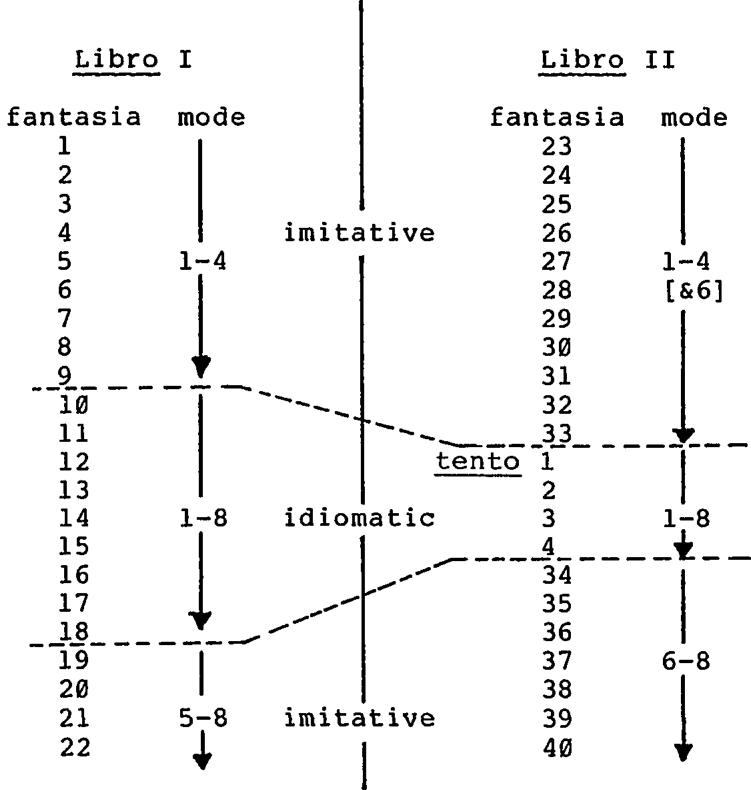
中文讲解
这是图2.1的位置标记,标题为El Maestro中fantasias的组织结构。由于图本身数据被省略,无法看到具体内容,但可推测它按顺序呈现了各首fantasia的位置、所在分册或其他编排特征,作为本节论述El Maestro曲集结构的视觉辅助。
补充说明
图片内容不可见,无法补充具体细节。
第2段(P0469)
原文复述
It is impossible to determine the extent to which Milán composed works specifically for inclusion in El Maestro, or selected fantasias from among those he had already composed. As the order of fantasias is so logical, and his style so dependent on improvisatory formulae, it is quite likely that the fantasias preserved are notated representatives of a largely improvisatory tradition. This is, in fact, suggested by Milán in the dedication of El Maestro which he describes as ‘a book comprising many works which I had taken from the vihuela and written down.’ In addition to its musical contents, El Maestro is prefaced by a Declaración where Milán explains necessary preliminaries: selecting strings for the instrument, tuning, an explanation of the contents of his primer libro, and a defence of his work. Each work in El Maestro is also preceded by a rubric in which Milán identifies the mode of the piece, verbally indicates the desired performance tempo, and adds other remarks which he feels may be pertinent to the understanding or execution of the work. He always couches his remarks in familiar and friendly language, as a teacher speaking to a student. Translations of these are given by Jacobs, and the comments pertaining to the fantasias have been incorporated in the following sections of this chapter. At the end of El Maestro, Milán added a brief exposition of the eight melodic modes and the characteristics by which they are recognized.
中文讲解
本段是这一小节的核心段落,集中说明El Maestro的成书性质与教学结构。要点包括:(1)作者承认我们无法确定Milán是专为该书创作fantasias,还是从他已有的作品中挑选;(2)由于fantasias的排列逻辑严密,且Milán的风格严重依赖improvisatory formulae(即兴公式),保存下来的fantasias很可能是一个以即兴为主的传统的记谱代表;(3)Milán在献词中亲自暗示了这一点——他形容此书为"一本由我从维韦拉琴上取出并写下的众多作品所构成的书”;(4)除乐曲外,El Maestro前面有Declaración,涵盖选弦、调弦、primer libro内容简介与自我辩护;(5)每首作品前都有rubric(题注),Milán在其中指明调式、口头说明期望的演奏速度,并补充他认为对理解或演奏有用的其他评论;(6)他的措辞始终如同教师对学生说话般亲切;(7)Jacobs提供了这些题注的英译,本章后续小节将fantasias的相关评论纳入其中;(8)书末Milán还加入了八种旋律调式的简短说明及其识别特征。理解此段的关键:作者提出了一个对全书fantasias的根本定位——它们不是封闭的、专为出版的成品,而是即兴传统的文字化代表。这一观点直接影响后文如何分析fantasias的音乐特征。Declaración+题注+末尾调式说明,构成一个三段式的教学框架,每段都有明确的教学功能。
第3段(P0470)
原文复述
Footnote 5. Fol. Aiii: “..un libro hecho de muchas obras: que de la vihuela tenía sacadas y escritas..”
中文讲解
本脚注给出正文所引献词短语的西班牙语原文:“一本由我从维韦拉琴上取出并写下的众多作品所构成的书”。关键动词"sacadas”(取出、抽出)与"escritas”(写下的)配合,强调这些作品是从演奏中抽取、再转化为书面记谱的过程,正是支持正文中"fantasias可能是即兴传统的记谱代表"这一推断的核心文献证据。
第4段(P0471)
原文复述
Footnote 6. Fols. Aiii^v - Bi, translated in Jacobs M, pp. 11-23.
中文讲解
本脚注指明Declaración的位置与英译来源:位于Fols. Aiii^v至Bi(即正文前的说明书部分),英译见Jacobs M第11至23页。这一脚注仅为文献位置说明,对正文"Declaración涵盖选弦、调弦、内容简介与自我辩护"这一陈述起支持作用。
第5段(P0472)
原文复述
Footnote 7. Jacobs M, pp. 295-313.
中文讲解
本脚注说明题注(rubrics)的英译出处:见Jacobs M第295至313页。这些译文正是本章后文小节中纳入的fantasias相关评论来源。
第6段(P0473)
原文复述
Footnote 8. Fol. [Rv]^v, translated in Jacobs M, pp. 25-26.
中文讲解
本脚注指明书末关于八种旋律调式的简短说明所在位置:Fol. [Rv]^v,英译见Jacobs M第25至26页。这是对正文"书末Milán加入八种调式说明及其识别特征"陈述的位置与翻译来源脚注。
第7段(P0474)
原文复述
…libros is worthy of quotation. The libro primero is introduced on fol. [A]vi:
中文讲解
本段是过渡句,承接前文(前一页论述两个libros的内容值得引用),引出对primer libro(第一册)原文的直接引用,其出处为fol. [A]vi。中括号[A]表示该folio位于A分册之首。这一引文展示Milán自己如何描述第一册的教学安排。
第8段(P0475)
原文复述
Contents of this first book. Eight cuadernos make up this first book. The first is of the rationale [intelligencia] of the said book, and instructions [on playing]. The second and third cuadernos [gatherings B and C], give you easy music in diverse modes, suitable for the hands of a beginner. The fourth and fifth cuadernos [gatherings D and E], give you music with various redobles to be played dedillo and dos dedos, having more respect for the taner de gala [style], than to much [other] music or metre [compás]. The sixth and seventh cuadernos [gatherings F and G] give you music somewhat more difficult, and of more hands [i.e. more difficult to play], with some redobles. The eighth and last cuaderno [gathering H] gives you music in order to sing and play villancicos and Italian things.
中文讲解
本段是Milán对第一册内容的自述,揭示了El Maestro清晰的分级教学结构。八卷分册的安排依次为:
- 第一卷(intelligencia):书本的理论基础与演奏说明;
- 第二、三卷(B、C):给初学者的、各种调式下的简易乐曲;
- 第四、五卷(D、E):含各种redobles的乐曲,dedillo(单指)和dos dedos(双指)演奏,重视taner de gala(华丽的演奏风格),胜过大量乐曲或严格的compás(节拍);
- 第六、七卷(F、G):更难的乐曲,“需要更多手”(即更难演奏),含一些redobles;
- 第八卷(H):用于歌唱与演奏villancicos与意大利风格作品。
中括号内为现代编辑对西班牙术语的解释。Milán的措辞"give you"“suitable for the hands of a beginner"极具师对生谈话的口吻,印证前文P0469所述"亲切友好的教师语言”。整体上,El Maestro第一册呈现一个由理论到简易乐曲、由简单到华丽、再到更难与歌唱伴奏的渐进式教学阶梯。
第9段(P0476)
原文复述
Milán introduces the second libro by summarizing his
中文讲解
本段是过渡句的前半部分,说明Milán在介绍第二册时,先总结自己对第一册的描述,然后再补充新的内容。下句将继续完成这一说明。
第10段(P0477)
原文复述
description of the first and adding the following on fol. Hiii^v:
中文讲解
本段补完上一句,指示新引文的出处:fol. Hiii^v,即第一册末尾分册H之后的页面。这与前文P0474中引文出自fol. [A]vi(首卷分册之前)形成首尾呼应:第二册的引言紧接第一册的描述之后出现。
第11段(P0478)
原文复述
From here onwards begins the second libro with the same order which the previous libro had, giving you music by way of fantasias with their rules and annotations; giving you in this second book the same order of music which I offered to you in the table of contents of the previous book, except that the previous music was easier, and this which follows [is] more difficult.
中文讲解
本段是Milán对第二册的引言原文。要点:(1)第二册保持与第一册相同的顺序;(2)但形式上以fantasias及其rules(规则)和annotations(注释)呈现;(3)两册结构平行,只是难度递增——第一册的音乐较容易,第二册的更难。这意味着第二册的fantasias并不是脱离第一册的独立体,而是第一册教学阶梯的高级延续,对应"更难的音乐”。Milán在此明确承认两册是同一条教学线的两个层次。这一陈述对理解后文对fantasias的分析至关重要:它们不是孤立的作品,而是教学体系中的高级环节。
第12段(P0479)
原文复述
Table 2.1 presents a summary of the fantasias and some of their features.
中文讲解
本段是衔接句,将论述引向Table 2.1——一张对fantasias及其部分特征的汇总表。该表本身未在文本中展开,但其作用是让读者能一目了然地看到所有fantasias的编排与各自属性。
补充说明
表格内容未在文本中显示。
第13段(P0480)
原文复述
Footnote 9. These are the alphabetically numbered gatherings according to which El Maestro is bound. The foliation of the gatherings is the only page reference system used in it. Table 2.1 identifies which fantasias are found in each cuaderno.
中文讲解
本脚注说明两件事:(1)前文出现的A、B、C……H等字母,是指El Maestro装订时各分册(gatherings/cuadernos)的字母顺序编号,而页码标记(foliation)正是基于这些分册进行的——这是该书唯一的引文定位系统;(2)Table 2.1具体指明各fantasia位于哪一卷分册。读者理解此书全部引文之所以形如"Fol. Aiii^v"“Fol. Hiii^v”,原因即在于El Maestro采用分册装订而非现代页码系统。
脚注 / 边栏 / 图表 / 附加信息(如有)
本小节包含以下附加材料:(1)Example 2.1(P0468位置)——El Maestro中fantasias的组织结构图,图像内容省略;(2)Table 2.1(P0479提及)——fantasias及其部分特征的汇总表,文本未展开;(3)脚注5(P0470)——El Maestro献词的西班牙语原文,关键短语"de la vihuela tenía sacadas y escritas"为正文"即兴传统记谱化"论断提供文献证据;(4)脚注6-8(P0471-P0473)——分别给出Declaración、题注、书末八调式说明三部分的位置与Jacobs M英译页码;(5)脚注9(P0480)——解释El Maestro以字母分册编号作为唯一引文定位系统的装订结构。
💡 本节核心要点
- El Maestro中的fantasias很可能是以即兴为主的传统的记谱代表,而非专为出版而作;Milán献词中的措辞"从维韦拉琴上取出并写下"支持这一推断
- El Maestro具有清晰的三段式教学结构:开头Declaración(说明)→ 各曲前的rubric(题注)→ 末尾八种旋律调式说明
- 每首作品的题注包含调式识别、口头速度指示与其他教学评论,措辞始终是教师对学生讲话的口吻
- 第一册由八个cuadernos(分册)组成,从理论与演奏说明出发,按难度递进:简易乐曲→redobles与gala风格乐曲→更难乐曲→villancicos与意大利风格作品的演唱与演奏
- 第二册沿用第一册的教学顺序,但形式升级为fantasias及其规则与注释,难度整体高于第一册相应部分
- 全书的引文定位采用基于字母分册的foliation系统(Fol. Aiii^v、Hiii^v等),是El Maestro唯一的页码引用方式
🔑 关键术语
- fantasía:一种以即兴性为特征的音乐体裁。在本节中,El Maestro所收的fantasias被认为是即兴传统的文字化代表,而非专为出版而作。
- vihuela:西班牙文艺复兴时期的拨弦乐器,El Maestro即为vihuela的曲目集与教学书。
- Declaración:El Maestro开头的说明性前言,由Milán撰写,内容涵盖选弦、调弦、primer libro内容介绍与对作品的自我辩护。
- rubric:置于作品之前的题注。Milán在rubric中指明调式、口头说明演奏速度,并补充教学性评论,使用亲切的教师口吻。
- cuaderno:即英文gathering,指装订中的分册。El Maestro第一册由A至H共八个分册构成,按教学顺序排列。
- intelligencia:西班牙语,意为"理解"或"原理”。在第一册第一卷中,指书本的理论基础与演奏说明部分。
- redoble:一种装饰性演奏手法,出现在第一册第四、五卷中。
- dedillo / dos dedos:西班牙语,分别指"用一指(演奏)“和"用二指(演奏)"。指Milán所教的vihuela指法运用方式。
- taner de gala:西班牙语,“gala风格演奏”,指华丽、装饰性强的演奏风格,在第一册第四、五卷中受到重视。
- compás:西班牙语,指节拍或拍子。Milán在描述第四、五卷时,强调该部分重gala风格胜过多乐曲或严格的compás。
- villancicos:西班牙语歌曲体裁,常用于节庆或圣诞。El Maestro第一册最后一卷(H)专用于villancicos与意大利风格作品的歌唱与演奏。
- foliation(分册式页码):El Maestro的引文定位系统,基于字母编号的分册进行页码标记(如Fol. Aiii^v、Hiii^v),是该书唯一的引文引用方式。
CH2.S3 Fantasia types
第1段(P0481)
原文复述
Section heading reading ‘MILAN: SUMMARY OF FANTASIAS’, serving as a chapter or running-head title that introduces a survey of Milán’s fantasia compositions.
中文讲解
这是位于第33页的本章总标题(亦兼作页眉),用全大写英文标记,标识本节内容为对米兰(Milán)幻想曲作品的总体概览。它为本节定下基调:即对米兰幻想曲进行系统性的介绍、分类与特征分析,是后续小节(‘Fantasia types’)的总框架。
第2段(P0482)
原文复述
Subsection heading reading ‘Fantasia types’, which opens the typological discussion of Milán’s fantasias.
中文讲解
本节内部的二级小标题,开启对米兰幻想曲类型学(typology)的讨论。在篇章结构上,‘MILAN: SUMMARY OF FANTASIAS’是总章标题,‘Fantasia types’则点明本小节将聚焦于’分类’这一论题——即米兰如何把所有幻想曲划分为不同类别。
第3段(P0483)
原文复述
The author states that Milán divides his fantasias into two categories.
中文讲解
作者在此提出本节的核心论点:米兰把其幻想曲分为两类。这一二分法是本节所有论述的起点。读者由此预期后文将围绕两类的名称、范围、特征与相互关系展开。
第4段(P0484)
原文复述
The two categories are distinguished primarily by the specification of a different performance practice rather than by any title or genre label.
中文讲解
作者点明分类依据:演奏实践(performance practice),而非乐曲的标题或体裁名。‘primarily’(主要地)这一限定暗示虽然演奏方式是最显著的区分标志,但其他特征(如下文将提及的调式、教学功能等)也可能存在差异。这一做法符合16世纪音乐文献的常见思路——通过演奏指示来隐含体裁归属,而非使用显性标签。
第5段(P0485)
原文复述
No particular name is attached to the first category, the thirty-one fantasias that constitute the largest group.
中文讲解
作者指出第一大类的显著特点:尽管它是数量最多的一组(三十一首),米兰并未给它专属的名字。这与第二大类具有专属术语(‘arte de tañer de gala’)形成鲜明对照——大类无名、小类有专属标签。读者由此可推断第一大类在米兰眼中是’基本型’或’默认型’,是无须特别命名的常规组别。
第6段(P0486)
原文复述
These thirty-one fantasias collectively make up the largest group within the fantasia repertoire.
中文讲解
重申上一句的体量事实:三十一首构成最大的一组。从数量上看,米兰的幻想曲主体属于这一无名类。这一统计上的’主体地位’意味着,第一类的特征描述最具代表性。
第7段(P0487)
原文复述
These thirty-one pieces are characterized as works which call for a uniform manner of playing.
中文讲解
过渡句:把上文的’无名’与下文的具体演奏要求相连接。结构上引出P0488的关键引文——‘with a steady beat, without changing tempo’,这是该类作品的标志性演奏指示。
第8段(P0488)
原文复述
These works are to be played ‘all with a steady beat, without changing tempo’—a quotation from Milán’s own performance instruction.
中文讲解
原文引述米兰对该类幻想曲的演奏指示:‘all with a steady beat, without changing tempo’(通篇保持稳定节拍,不变更速度)。这是上一段’演奏实践’区分的具体内容。‘steady beat’意味着这些幻想曲不能自由伸缩节拍,而需维持均匀节律。这与后文第二类允许变速度(和声用慢拍、减缩用快拍)形成对照,是本节最重要的分类标志。脚注10将在后文提供该引文的西班牙原文出处。
第9段(P0489)
原文复述
These thirty-one works are identified by their numerical position in the collection: Fantasias 1 through 9 and 19 through 40.
中文讲解
作者给出第一类的具体编号范围:1-9加上19-40。注意中间空缺的10-18属于另一类(第二类共9首),加上4首Tento。这一编号提示了米兰在《El Maestro》中的曲目布局——前9首与第19首之后归于’稳定节拍’组,中间10-18属于’festive playing’组。
第10段(P0490)
原文复述
These works are described as Milán’s polythematic imitative fantasias.
中文讲解
作者为第一类幻想曲贴上学理标签:‘polythematic imitative fantasias’(多主题、模仿风格幻想曲)。‘polythematic’指多重主题或主题段落,‘imitative’指模仿对位——即同一动机在不同声部相继出现。这一标签暗示第一类作品的共有技术特征:使用多个主题段和模仿对位手法。
第11段(P0491)
原文复述
Within this first category, Milán’s fantasias display notable variety in their manner of construction.
中文讲解
作者承认组内差异:第一类内部并非单一形态,而是组装方式(how they are assembled)多变。这意味着虽然所有第一类作品的演奏规则一致(稳定节拍),但其乐思组合策略彼此不同。读者不应期待一种统一的’第一类曲式’。
第12段(P0492)
原文复述
The variety of the first group is most evident in the way its individual pieces are assembled.
中文讲解
延续P0491的论述:变化体现在’assembled’(组装、组合)方式上,即各首作品如何把材料段落拼接成整体。这与’材料本身’(components)的统一性形成对比。
第13段(P0493)
原文复述
Despite this surface variety, the underlying components used in these fantasias all derive from a common stock.
中文讲解
作者提出一个重要的统一性主张:尽管组装方式多样,但材料本身(components,即主题、动机、和弦语汇等)来自共同来源(‘common font’,共享的音乐素材库)。这暗示第一类作品的多样性只是拼接策略的差异,而非音乐素材的差异——米兰有一个共享的素材库,每首作品从中选取不同组合。
第14段(P0494)
原文复述
Fantasia 22 stands out as an exceptional case within the first category.
中文讲解
作者标记第22首为组内例外(Exceptional)。这一句话打破读者刚刚建立的’第一类相对统一’印象,为下一段介绍其戏拟性质作铺垫。
第15段(P0495)
原文复述
Fantasia 22 is identified as Milán’s sole example of parody within the fantasia genre.
中文讲解
指出第22首例外的具体性质:parody(戏拟)。16世纪音乐术语中,‘parody’指借用既有旋律、和声或结构框架来创作新作品,原本是弥撒体裁的常见手法。米兰把它移植到幻想曲中,是其分类体系内的特殊性。脚注11提示具体实例见本书例2.31。
第16段(P0496)
原文复述
The parody in Fantasia 22 is specifically a parody of one of Milán’s own pavanas (pavanes).
中文讲解
进一步说明戏拟的对象:米兰自己的某首帕凡舞曲(pavana)。即米兰借用自己先前作品中的素材来创作新幻想曲——这是自戏拟(self-parody),而非引用他人作品。这一事实使Fantasia 22在米兰作品中更为特殊:它把同一作曲家两首独立作品联系起来。
第17段(P0497)
原文复述
The second category is introduced and identified by its numbering: Fantasias 10 through 18, together with the four Tentos.
中文讲解
作者正式引入第二大类。其编号正好夹在第一类的1-9与19-40之间,外加4首Tento。数量共13首(9首幻想曲+4首Tento),少于第一类的31首。从编号布局看,米兰将’festive playing’作品放在第一册的中段,作为承上启下的特殊单元。
第18段(P0498)
原文复述
Milán himself offers a particular characterization of these works.
中文讲解
过渡句,引出下句米兰对这些作品的专属定性描述。
第19段(P0499)
原文复述
He describes them as fantasias which exhibit the ‘arte de tañer de gala’—literally, the art of festive playing.
中文讲解
米兰为这些作品提供专属术语:‘arte de tañer de gala’(节庆演奏艺术)。‘gala’原指华服、庆典场合,转义为辉煌、炫耀的演奏风格。这与第一类(无名、稳定节拍)形成鲜明对比——第二大类有专属名字,且强调华丽、节庆的演奏氛围,而非静态的规范。脚注12指引该术语的原文出处见Fantasia 18 rubric。
第20段(P0500)
原文复述
The English gloss ’the art of festive playing’ is offered as a translation of the Spanish ‘arte de tañer de gala’.
中文讲解
作者提供英文对译’the art of festive playing’,帮助英语读者理解’tañer de gala’。注意原文’tañer’是’tocar’(演奏)的古用法,‘gala’有节庆、华美之意。‘festive playing’这一译法强调了演奏风格上的节庆、欢愉意味。
第21段(P0501)
原文复述
Milán explains these works in greater detail within the rubric (i.e., the prefatory instruction) attached to Fantasia 10.
中文讲解
作者指出,下一段的引文来源是Fantasia 10的rubric(曲前说明文字)。‘Rubric’源自拉丁文rubrica(红色),指印刷书页上以红色或特殊字体印出的乐曲标题或演奏说明。该句话为P0505的长引文(Fantasia 10 rubric原文)作铺垫。
第22段(P0502)
原文复述
Footnote 10. Source: the rubric to Fantasia 19, fol. F[i]. The original Spanish reads: ’toda a un ygual compas sin hazer mutacion’.
中文讲解
脚注10为正文P0488的引文提供来源标注:Fantasia 19的rubric,位于fol. F[i](F面第一页)。所引西班牙原文’toda a un ygual compas sin hazer mutacion’意为’通篇保持统一的节拍,不作速度变化’,是米兰本人对该类幻想曲演奏规则的原文表述。该脚注使学术论断(关于第一类的演奏实践)具有第一手原典依据。
第23段(P0503)
原文复述
Footnote 11. Cross-reference directing the reader to Example 2.31, located later in the chapter.
中文讲解
脚注11指引读者参见本书例2.31,即Fantasia 22的曲谱实例。该脚注为正文P0495-P0496关于’parody’的具体说明提供视觉证据(读者可查阅该曲谱直观看到戏拟手法)。‘Ex.2.31’是书内编号体系的乐谱例示(Example)。
第24段(P0504)
原文复述
Footnote 12. Cross-reference directing the reader to the rubric of Fantasia 18, located at fol. [Ev]v.
中文讲解
脚注12指引读者参见Fantasia 18的rubric,位于fol. [Ev]v(E面背面)。这是’tañer de gala’(gala演奏艺术)术语的原文出处,参见正文P0499的引文。该脚注确保作者对术语的引用具有可核查性。
第25段(P0505)
原文复述
A bilingual passage quoted from the rubric to Fantasia 10 (fol. D[i]). The Spanish fragment, slightly truncated at its opening, reads: ‘apriessa. Y parar de tañer en cada coronada vnpoco. Esta es la musica que…tiene mas respecto a tañer de gala que de mucha musica nicompas.’ The author’s English translation, given in square brackets, reads: ‘The fantasias of these present fourth and fifth gatherings which we now enter reveal a music which is like experimenting on the vihuela with chords mixed with scales, commonly called dedillo. To play them with their natural air, you are to proceed in this manner: all the chords are to be played with a slow beat, and all the diminutions with a quick beat, and pause a little at each fermata. This is music which… has more respect for playing de gala than much music, or for [an equal] beat.’
中文讲解
这是米兰《El Maestro》中Fantasia 10 rubric的原文(西班牙语)与作者英译,是第二大类演奏法的权威说明。读者由此获得五大要点:(1) 这些作品以’和声混合音阶’(consonancias y redobles)为主,dedillo(手指弹拨)是常用技巧;(2) 演奏上需双速并用:和声段落用慢速拍(compas lento),减缩(redobles/diminutions)用快速拍(compas apriessa);(3) 每个’coronada’(终止式/华彩点)需短暂停顿;(4) 美学定位:‘gala’(节庆辉煌)多于’mucha musica’(音乐内容繁复)或’compas’(统一节拍);(5) 与第一类’稳定节拍’形成对照——米兰在此为第二大类赋予变速度特征。该rubric是P0499-P0500所提’arte de tañer de gala’的具体化定义。脚注13指向页码fol. D[i]。
补充说明
coronada(终止式/休止点);dedillo(手指依次拨弦的弹奏技法);consonancias(和声性乐段);redobles(减缩/快速花指乐段)。
第26段(P0506)
原文复述
Milán explicitly clarifies that, in his own view, there is no stylistic difference between the consonancias y redobles fantasias and the tentos.
中文讲解
作者揭示米兰本人的归类逻辑:consonancias y redobles(和声与减缩)幻想曲与tento(试奏曲)在风格上被米兰视为同一类。这与P0497将它们归入同一大类一致。读者由此理解,第二大类并非’幻想曲+独立体裁tento’的组合,而是米兰眼中’同一风格的双重命名’——tento是fantasia的延伸形式。
第27段(P0507)
原文复述
When introducing the tentos, Milán himself characterizes them as ‘similar to the music of the fourth and fifth quadernos of the first libro’, and reminds the reader that the air and metre in which they are to be played have already been explained there.
中文讲解
作者引述米兰在tento部分的自述:tento与第一册(libro 1)第四、第五quaderno(章节)中的音乐相似,且演奏规则(‘air and metre’,即风格与节律)他已在彼处说明。‘quaderno’是米兰对《El Maestro》每册内部乐章分组的称呼,相当于英文的’gatherings’。这意味着tento并非全新体裁,而是fantasia的延伸或变体——米兰将读者引向先前段落作为演奏指南。脚注14给出该引文所在页码fol. Miv v。
第28段(P0508)
原文复述
The author synthesizes the distinction between the two categories. The distinct performance tempos and the greater emphasis on idiomatically based textures are the defining features of the second, idiomatic fantasia category. However, the frequent interpolation of imitative passages in the gala group unifies the two categories and minimizes the apparent contrast. Beyond style, a difference of purpose also separates them: the gala fantasias and tentos serve additionally as technical studies intended to develop dexterity (soltura de dedos). The works of the first libro include explicit instructions on right-hand plucking technique in their rubrics. As a sign of their technically oriented construction, Milán significantly widens the melodic range of the top voice, leading to frequent use of the tono mixto (the mixed mode, where authentic and plagal ranges are combined); Fantasia 13 is the sole work in the gala style that remains in a regular (unmixed) mode.
中文讲解
这是本节综合论述的核心段落,作者为第二大类贴上正式学理标签:‘idiomatic fantasia category’(器乐化幻想曲类),并归纳其多重区分性特征:(1) 演奏速度的双速并用(与第一类的单一稳定节拍对比);(2) 强调idiomatically based textures(基于维韦拉琴器乐语法的织体);(3) 目标功能:教学练习,培养soltura de dedos(手指灵巧度);(4) rubrics中包含明确的右手拨弦指示;(5) 高声部音域扩展,导致tono mixto(混合调式,即合并正调式authentic与副调式plagal的音域)的频繁使用,作者特别注明Fantasia 13是该类中唯一保持’regular mode’(常规调式,未混合)的例外。但作者同时指出,第一大统一因素——模仿段落的频繁插入——使两类的差异有所弱化。这意味着分类并非截然二分,而是连续光谱。脚注16(此段末尾未编号引用)可参考。
第29段(P0509)
原文复述
Footnote 13. Source citation: fol. D[i]—the first recto of gathering D, which identifies the location of the Fantasia 10 rubric quoted in the preceding passage.
中文讲解
脚注13为P0505所引Fantasia 10 rubric提供精确页码定位:D面第一页(recto即正面,verso即背面)。这是学术引注的格式要求,使读者能直接查证原典。
第30段(P0510)
原文复述
Footnote 14. Source citation: fol. M[iv]v—the verso of the fourth leaf of gathering M, indicating the location of Milán’s self-referential remark about the tentos.
中文讲解
脚注14为P0507所引述米兰关于tento的自述提供页码定位:M面第四叶的背面。该脚注让读者可回到原典查证米兰’first libro’的’fourth and fifth quadernos’指代,确认演奏规则最早出现在哪几页。
第31段(P0511)
原文复述
Footnote 15. Source citation: fol. N[i]—the first recto of gathering N, identifying the location of the second tento’s rubric.
中文讲解
脚注15为P0507末尾所述’second tento’的rubric提供页码定位:N面第一页。该脚注是脚注14所提tento章节的进一步具体化,指向第二首tento的rubric文字。
脚注 / 边栏 / 图表 / 附加信息(如有)
本节包含6个脚注(10-15)和一处直接引文:脚注10(P0502)来源标注,为正文’played with a steady beat’引文提供Fantasia 19 rubric的西班牙原文出处;脚注11(P0503)交叉参考,指向例2.31(Fantasia 22的曲谱实例);脚注12(P0504)来源标注,指出’tañer de gala’术语的Fantasia 18 rubric出处;脚注13(P0509)来源标注,标识Fantasia 10 rubric所在页D[i];脚注14(P0510)来源标注,标识米兰自述tento演奏说明所在页Mivv;脚注15(P0511)来源标注,标识第二首tento rubric所在页N[i]。直接引文(P0505)为Fantasia 10 rubric的西班牙原文与英译,提供第二大类演奏指示(双速并用、和声与减缩、coronada处停顿)的原文证据。本节无图无表,仅有交叉参考指向别处的乐谱例2.31。
💡 本节核心要点
- 米兰将其幻想曲分为两大类,区分依据是’演奏实践’(performance practice),而非乐曲的体裁名称或外在标签。
- 第一类包含31首(编号1-9与19-40),是数量最大的无名类,要求’all with a steady beat, without changing tempo’(sin hazer mutación),即保持稳定节拍、不变速;其学理标签为’多主题模仿幻想曲’(polythematic imitative fantasias)。
- 第一类在组装方式上多样,但材料来自共同素材库;Fantasia 22是该类唯一的戏拟(parody)作品,其戏拟对象是米兰自己的一首帕凡舞曲。
- 第二类包含Fantasias 10-18加4首Tento(共13首),被米兰称为’arte de tañer de gala’(节庆演奏艺术);其特征为双速并用(和声用慢拍、减缩用快拍)、强调器乐化织体(consonancias y redobles)、每个coronada处停顿。
- 米兰本人将consonancias y redobles幻想曲与tento视为同一风格;tento是第一册第四、第五quaderno同类作品的延伸。
- 第二类还承担教学功能(培养soltura de dedos,即手指灵巧),rubrics含右手拨弦指示,并因高声部音域扩展而频繁使用tono mixto(Fantasia 13除外,该曲是该类中唯一保持regular mode的作品)。
🔑 关键术语
- Milán (米兰):本节所讨论的西班牙文艺复兴时期作曲家,其《El Maestro》中的幻想曲是本节分类与特征分析的对象(按原文未提供生平信息,仅作为作品归属的指示)。
- Fantasia (幻想曲):16世纪器乐体裁;本节中米兰的幻想曲被分为两类,分类依据是演奏实践。
- arte de tañer de gala (节庆演奏艺术):米兰为第二大类幻想曲(Fantasias 10-18与四首Tento)提供的专属术语,作者英译为’the art of festive playing’,强调其辉煌、节庆的演奏风格。
- consonancias y redobles (和声与减缩):第二大类的标志性织体:和声性段落(consonancias)与快速音阶式减缩(redobles/diminuciones)混合使用,常以dedillo(手指弹拨)演奏。
- tono mixto (混合调式):合并正调式(authentic,高音域)与副调式(plagal,低音域)的复合调式,是第二大类器乐化作品因高声部音域扩展而频繁使用的调式结构。
- soltura de dedos (手指灵巧):第二大类幻想曲与tento作为教学练习所追求的目标——演奏者手指的灵活与熟练程度,也是这些作品被附加的教学功能。
- quaderno (章节):米兰对《El Maestro》每册内部乐章分组的称呼,相当于英文’gatherings’,如’第四、第五quaderno’指代每册的中段乐章集合。
- parody (戏拟):借用既有旋律、和声或结构框架创作新作品的技法;本节中Fantasia 22是米兰在幻想曲体裁内的唯一戏拟实例,其戏拟对象是米兰自己的一首帕凡舞曲(pavana)。
CH2.S4 Mode
第1段(P0512)
原文复述
Mode
中文讲解
本段为第二章第四节的小节标题,原文标记为 ‘## Mode’(调式)。它开启本节议题:分析《El Maestro》这套曲集在调式层面的分布特征——包括整体调式布局的均衡程度、各调式族群与个别调式的偏好,以及混合调式(mixed modes)这一特殊情况。作为唯一的小节标题,它承担着为正文 P0513 的统计性论述与脚注 P0514 的限定性补充提供论证框架的功能。
第2段(P0513)
原文复述
The didactic organization of El Maestro results in an equal distribution of modes, shown below. Of the four modal genuses, there is a slight preference for the protus group. Modes 1 and 6 are the most preferred individual modes. An unusually high number of works are in mixed modes as a consequence of Milán’s idiomatic orientation. Of the twenty-three works in the tono mixto the four combinations occur with similar frequency.
中文讲解
本段是本节的核心论点段,提出关于《El Maestro》调式布局的四层断言,须按层次理解:
第一层——‘教学性编排决定均衡分布’:didactic organization(教学性编排)意指《El Maestro》作为教学曲集而非纯创作集,其结构服从教学需要;这一编排逻辑带来了 equal distribution of modes(调式的均匀分布)的结果。作者并预告一个分布图示位于下文(shown below),本节文字应与该图示配合阅读。
第二层——‘族群的轻微偏好’:四个 modal genuses(调式族群)之中,protus group(protus 族群)受到略多于其他三组的偏好。这是相对微弱的倾向——原文用的限定词是 slight(轻微)——并未压倒均衡分布的整体框架。
第三层——‘个别调式的明确偏好’:与上一层的’族群轻微偏好’不同,在个体调式层面,Mode 1(第一调式)与 Mode 6(第六调式)成为最被偏好的两个调式。这里要特别注意:作者把’族群偏好’与’个别调式偏好’分两句陈述,暗示二者并不完全同步——若按通常的对应关系 Mode 6 与 protus 族群并不重合(原文未在本节内明示族群归属),则个别调式的偏好不能被简单还原为族群偏好的累加。
第四层——‘混合调式的异常高频’:unusually high number of works are in mixed modes(数量异常多的作品属于混合调式)。作者把这一现象归因于 Milán’s idiomatic orientation(米兰的惯用演奏取向),即他的音乐语言天然倾向于在不同调式之间流动,而非把每首曲子锁死在单一调式里。具体数据为 23 首 tono mixto(混合调式)作品,其中四种可能的组合出现频率大致相当(similar frequency),说明混合调式是米兰稳定的风格印记,而非个别作品的偶然处理。
整体而言,本段把’均衡(教学需求)‘与’偏好(个人风格)’、‘族群’与’个别调式’、‘单一调式’与’混合调式’这三组对照关系作为本节论证骨架,为读者理解后续逐曲分析提供宏观坐标。
补充说明
本段内部可直接定位的术语关系:‘four modal genuses’ 与 ‘protus group’——后者是前四个之中的一个;’twenty-three works in the tono mixto’ 与 ‘four combinations occur with similar frequency’——后句是对前句数据的进一步刻画。文中未明确说明 protus 族群包含哪些个别调式,也未解释为何 Mode 1 与 Mode 6 同时成为偏好——这些均属于本节以外的理论背景,本节不予补写。
第3段(P0514)
原文复述
$^{16}$ Fantasias 10 and 11, although signified by Milan as being in regular modes, show themselves to use mixed modes.
中文讲解
本段为脚注 16,针对正文 P0513 中’mixed modes 数量异常高’这一断言作出限定与延伸。脚注指出:Fantasias 第 10 与第 11 两首,虽然在米兰自己’标注’(signified)的层面属于 regular modes(正规调式),但作品在’实际呈现’(show themselves)时却表现出混合调式特征。
这对正文 P0513 的论证起三方面作用: (1)支持:把第 10、11 首纳入混合调式阵营,会进一步推高’mixed modes’的统计比例,使正文’unusually high number’的判断更加成立; (2)限定:提醒读者,作者的’标注’(signified)与作品的’实际调式行为’(show themselves)并不总是一致,分析时不能盲从米兰自己的分类标签; (3)方法论提示:暗示在统计 23 首 tono mixto 时,应当以作品自身的证据为准,而非仅依赖曲集中的标注——这正是本节论证可靠性的一个隐含支柱。
综上,脚注既加固了正文的总体判断,也暴露了米兰本人在调式归类上的不稳定性,从而把混合调式从’特征’提升为《El Maestro》的’结构性风格’。
脚注 / 边栏 / 图表 / 附加信息(如有)
本节包含一条脚注(第 16 号,段落 P0514),对正文 P0513 中’mixed modes 数量异常高’的判断起支持与限定作用,并暗示了米兰自己调式标注与作品实际调式行为之间的差异。本节未呈现具体图表,但 P0513 中出现’shown below’,提示在该页或其后续版面位置附有展示调式分布的图示或表格,读者需查阅原页面方能获得完整数据。
💡 本节核心要点
- 《El Maestro》整体呈现调式的均衡分布,这一均衡源自曲集作为教学曲集的’教学性编排’(didactic organization),而非作曲家自发的创作选择。
- 在四个调式族群中,protus 族群受到轻微偏好;个别调式层面,Mode 1 与 Mode 6 出现频率最高,二者可能分属不同族群(原文未明示具体对应),因此族群偏好与个别调式偏好不能简单等同。
- 混合调式(tono mixto)作品数量异常地高,共 23 首;其四种可能组合出现频率大致相当,源于米兰的’惯用演奏取向’(idiomatic orientation),是其稳定的风格印记。
- 脚注 16 进一步指出,Fantasias 第 10、11 两首虽被米兰自己标注为正规调式,实际却呈现混合调式特征,因此混合调式的实际比例可能高于正文统计。
- 本节建立了’教学均衡 vs. 个人风格’、‘族群 vs. 个别调式’、‘单一 vs. 混合调式’三组对照,作为后续分析的宏观框架。
🔑 关键术语
- didactic organization:教学性编排。指《El Maestro》作为鲁特琴教学曲集,其整体结构服从教学需要。在本节中用于解释为什么曲集呈现’equal distribution of modes’。
- modal genus(复数 genera):调式族群。本节提及的术语,原文指出共有四个调式族群,但未在本节内对各族群作出定义或成员列举。
- protus:protus 族群。本节指出它是四个调式族群之一,受到略多于其他三组的轻微偏好(slight preference)。原文未说明该族群包含哪些个别调式。
- tono mixto / mixed mode:混合调式。指作品同时具有或在不同段落使用多种调式特征。本节统计《El Maestro》中有 23 首此类作品,并指出四种可能组合出现频率大致相当。
- idiomatic orientation:惯用演奏取向。指米兰在创作与演奏中天然倾向于以特定方式处理音乐的风格倾向。本节将其作为’mixed modes 数量异常高’的直接成因。
- signified … regular modes:‘被标注为正规调式’。脚注 16 用’signified’(被标示)与’show themselves’(自身实际呈现)构成对比,强调米兰对作品的调式标注与作品的实际调式行为可能不一致。
CH2.S5 [描述性拆分] Voices
第1段(P0515)
原文复述
Tritus Mode 5 - 1
中文讲解
本条为页面中一个乐谱图示或图例标签的OCR片段,文字内容为 “Tritus Mode 5 - 1”。Tritus 在此处是音乐理论中的术语,源自拉丁文,指代一种调式分类(在中古调式或扩展调式体系中常出现 Tritus/Tritus Authenticus 等称呼)。该片段原文未给出完整谱例或上下文说明,因此仅可从字面确认:它将 “Tritus”、“Mode 5” 与数字 “1” 并列出现。由于源材料仅提供了这一行OCR文本,无法判断数字 1 代表声部数量、终止类型还是其他参数;应回到原书查看实际谱例与对应图注。
第2段(P0516)
原文复述
$$ \text { Modes } 5 & 6 - 4 $$
中文讲解
本条以LaTeX数学/排版格式呈现,文字为 “Modes 5 & 6 - 4”。该片段同样来自乐谱或图示的OCR转录,意指 Mode 5 与 Mode 6 之后或对应数字 4。结合本节主题 Voices(声部),数字 4 极可能表示 “四个声部” 的配置。然而,原文并未直接给出文字解释,因此其确切含义需通过查看原始图例与上下文来确认。本段在讲解中不应补造超出原文字面含义的解读。
第3段(P0517)
原文复述
10
中文讲解
本条仅包含数字 “10”。从上下文看,这很可能是一个图(figure)或谱例编号,例如 “Figure 10” 或 “Example 10” 的残片;也可能是页码、栏号或其他版面标记。由于原输入没有提供任何说明文字,无法从本条独立确认其指代对象,须参照原书前后版面与图注确认。
第4段(P0518)
原文复述
$$ \text { Mode } \quad 8 \quad - \cdot 2 $$
中文讲解
本条以LaTeX格式呈现,文字为 “Mode 8 - ·2”,其中 “·” 为间隔点。该片段应理解为 Mode 8 关联到数字 2(间隔点为排版/OCR特征,不构成新信息)。结合本节 “Voices” 的主题以及 P0516 中的 “Modes 5 & 6 - 4” 结构,P0518 中的 “- 2” 可能意指 Mode 8 段落采用两个声部的织体;同样,原文未给出文字定义,仅可作图示OCR处理。
第5段(P0519)
原文复述
$$ \text { Modes } 7 & 8 - 6 $$
中文讲解
本条以LaTeX格式呈现,文字为 “Modes 7 & 8 - 6”。与 P0516 的 “Modes 5 & 6 - 4” 在结构上相似:列出两个 Mode(这里是 7 与 8),其后接数字 6。从行文格式推测,数字 6 可能代表这些 Mode 中某项与数字 6 相关的参数(如声部数、调式终止数、谱例编号等),但具体含义需在原书相应图例与图注中查证。本讲解不得超出原文片段所能直接定位的信息。
第6段(P0520)
原文复述
Voices
中文讲解
本条为一个独立的小节标题 “Voices”(声部 / 声部织体)。它标示出本节随后段落将围绕 “Voices” 这一议题展开,即讨论作品中声部数量与织体配置的分类与统计。该标题在版面与论证上起承上启下的作用:上承前文可能涉及调式或终止的讨论,下启 P0521 对幻想曲(fantasias)声部织体的具体描述。
第7段(P0521)
原文复述
Four-voiced textures are used in all but the first twelve fantasias. Of these, nos.7, 8, 10, 11, 12 are predominantly in three voices with some passages adding a fourth voice. Fantasias 4 and 5 have an implied fourth voice added at cadences, but no substantial use of four-voiced polyphony.
中文讲解
本段是本节 “Voices” 的核心论述,描述了幻想曲(fantasias)中的织体(texture)与声部(voices)使用情况。
- 中心主张:四声部织体(four-voiced textures)是本组作品的主流,但并非所有作品都采用;具体分布呈现出明显的作品编号差异。
- 总体范围:除前十二首外的所有幻想曲都使用了四声部织体(“all but the first twelve fantasias”)。也就是说,在 1 至 12 号作品中没有四声部织体,从 13 号起进入四声部织体的常态。
- 例外说明:在前十二首中,第 7、8、10、11、12 号以三声部为主(“predominantly in three voices”),仅在某些段落添加一个第四声部(“with some passages adding a fourth voice”)。因此 “前十二首不用四声部” 是一个总体判断,而内部仍有四声部的偶尔出现,只是并未形成稳定的四声部织体。
- 进一步限定:第 4 号与第 5 号幻想曲在终止(cadences)处暗示性地加入第四声部(“implied fourth voice added at cadences”),但并不存在实质性的四声部复调(“no substantial use of four-voiced polyphony”)。所谓 “暗示性第四声部”,是指在终止位置听者或分析者可推断出第四声部的存在,但作曲并未真正写成完整的四声部对位。
- 论证意义:本段通过 “总体规则—例外—进一步例外” 的结构,把作品集合划分为两类:采用实质性四声部复调的多数作品,以及前十二首中三声部为主、终止处偶现第四声部的少数作品。这种分层刻画为后续可能涉及调式、终止或对位写作的讨论提供了织体背景。
- 易误解之处:需注意 “all but the first twelve” 中的 “but” 是 “除……之外”,不是 “但是”;“predominantly in three voices” 并不意味着完全没有第四声部,而只是说三声部为主、四声部为辅;“implied fourth voice” 不等于 “完全写成第四声部”,作者强调后者并未发生。
补充说明
本段中 “implied fourth voice” 与 “substantial use of four-voiced polyphony” 的对照,是理解作者分类标准的关键:前者仅在结构位置(如终止)可被推断,后者则要求实际写出持续性的四声部对位。这一区分仅由本段文字直接给出,不引入外部文献或术语史。
脚注 / 边栏 / 图表 / 附加信息(如有)
本节附有若干乐谱或图示的OCR片段(P0515–P0519),其确切含义与编号体系须结合原书相应图注与谱例确认;P0517 的 “10” 疑为图/例编号残片。P0520 为小节标题,P0521 为该标题下的唯一正文段落,承担本节 “Voices” 的全部论述。
💡 本节核心要点
- 四声部织体适用于除前十二首之外的全部幻想曲,是本组作品的主要织体形态。
- 前十二首中,第 7、8、10、11、12 号以三声部为主,仅在部分段落加入第四声部,并非完全排除四声部。
- 第 4 号与第 5 号在终止处存在暗示性的第四声部,但作者明确指出并未出现实质性的四声部复调写作。
- “implied fourth voice” 与 “substantial four-voiced polyphony” 的区分构成本段分类标准的关键。
- 本节通过 “总体规则—例外—进一步例外” 的层级,把作品集合在织体上分为两类:实质性四声部复调组,以及以三声部为主、四声部为辅的少数作品组。
🔑 关键术语
- Four-voiced texture:四声部织体,指同时由四个独立声部构成的复调织体;本节中作为除前十二首之外幻想曲的主导织体。
- Three voices:三声部,指由三个独立声部构成的织体;在本节中用于描述第 7、8、10、11、12 号幻想曲的主导配置。
- Implied fourth voice:暗示性第四声部,指在终止等结构位置听者或分析者可推断出第四声部的存在,但作曲家并未实际写成完整的第四声部;本节中用于说明第 4、5 号幻想曲的情况。
- Substantial four-voiced polyphony:实质性的四声部复调,指作品中持续且完整地写出四声部对位;本节中用于与 “implied fourth voice” 形成区分,第 4、5 号被认为并未具备此种写法。
- Cadence:终止,本节中指 “implied fourth voice added at cadences” 的结构位置,即在终止处加入暗示性第四声部。
- Fantasias (nos.4, 5, 7, 8, 10, 11, 12):本节讨论的幻想曲编号集合;除前十二首外的作品普遍采用四声部织体,而 4、5 号在终止处加入暗示性第四声部,7、8、10、11、12 号以三声部为主。
CH2.S6 Tuning
第1段(P0522)
原文复述
Tuning
中文讲解
本段为章节小标题「Tuning(调弦/定弦)」。它开启了围绕 vihuela 调弦方式展开的论述,是下文 P0523 主题(Milán 的 El Maestro 如何调弦,以及由此带来的调式与移调问题)的引入标识,本身不承载实质论证内容。
第2段(P0523)
原文复述
Milán gives no indication of vihuela pitch. The tuning instructions in El Maestro only specify the interval between courses of strings. The transcriptions of both Schrade and Jacobs confirm that Milán apparently thought of an instrument in A-tuning, also preferred by early sixteenth-century Italian lutenists. He is the only vihuelist to think of his instrument in a fixed pitch. A-tuning places most of the fantasias either in their proper modes or transposes them a fourth, according to common sixteenth-century practice. Exceptions to this occur in Fantasias 38 and 39 because of what Milán explains as the similarity of the tritus and tetrardus modes, and in Fantasias 27–30 where modes 3 and 4 are transposed a minor third higher. Milán excuses these seeming irregularities in terms of the idiomatic suitability of those términos. ¹⁷
中文讲解
本段集中论述 Milan 在《El Maestro》中对 vihuela 调弦的处理方式及其后果,可分为三层。
第一层指出 Milan 没有给出 vihuela 的绝对音高,《El Maestro》中的调弦说明仅规定了相邻弦组之间的音程关系,并不指明具体音名。这一信息上的缺失由后世的两个转写版本(Schrade 与 Jacobs)补足:两者一致表明,Milan 实际上预设的乐器为「A 调定弦」,即按 A 音为最高音组来思考这件乐器。作者进一步说明,这种偏好也见于十六世纪初意大利琉特琴演奏者的实践之中,并且在当时所有 vihuela 谱写者中,只有 Milan 一人把乐器视为具有固定音高的乐器——这一点是本段的核心判断,因为它把 Milan 与其他 vihuelist 区分开来。
第二层论述这种 A 调定弦的实际后果:在十六世纪常见的实践下,A 调定弦使大多数幻想曲(fantasías)要么处于其本来的调式,要么上移四度作移调处理。换言之,A 调定弦与多数作品的调式布局是吻合的,移调四度也被视为常规做法。
第三层承认例外。其一是 Fantasias 38 和 39,Milan 本人给出的理由是 tritus 调式与 tetrardus 调式相互之间具有相似性(因此两者之间的区分在这种情境下被弱化);其二是 Fantasias 27–30,其中调式 3 与调式 4 被上移小三度处理。Milan 用那些 términos 的「习用适宜性」(idiomatic suitability)来为这些看似偏离常规的现象辩护——也就是说,对乐器而言,这些特定音区在指法与音响上最为顺手,因此即便牺牲了调式与定弦之间通常的对应关系,也仍然合理。段末的脚注 17 标记这些解释的进一步出处,但脚注正文未在此节输入中提供。
补充说明
本段内部概念关系:A 调定弦是理解后文所有移调讨论的前提;tritus 与 tetrardus 作为米兰给出的解释依据,与 Fantasias 27–30 中由 términos 习用适宜性所做出的辩护,是两类不同性质的「例外理由」,前者基于调式之间的相似性,后者基于乐器音区的指法适宜性。脚注 17 的具体内容未在本次输入中给出,因此其细节不予补充。
脚注 / 边栏 / 图表 / 附加信息(如有)
本节末尾含有脚注标记 ¹⁷,但脚注正文未包含在本次提供的 source_paragraphs 中,故仅在此处记录其存在,不补写脚注内容。
💡 本节核心要点
- Milan 在《El Maestro》中并未标明 vihuela 的绝对音高,调弦说明只规定弦组之间的音程关系。
- 经 Schrade 与 Jacobs 转写确认,Milan 实际预设的是 A 调定弦,这一偏好与十六世纪初意大利琉特琴家一致。
- 在所有 vihuelist 中,只有 Milan 把乐器视为具有固定音高的乐器。
- A 调定弦使多数幻想曲处于本调式或按十六世纪常规上移四度。
- Fantasias 38 与 39 是例外,Milan 以 tritus 与 tetrardus 调式的相似性作为解释。
- Fantasias 27–30 中调式 3、4 被上移小三度,Milan 以那些 términos 的习用适宜性为这些看似不规则之处辩护。
🔑 关键术语
- A-tuning (A 调定弦):本节中指 Milan 在《El Maestro》里隐含设定的 vihuela 最高弦组音高为 A 的调弦方式;该设定决定了后续幻想曲与各调式之间的对应或移调关系。
- courses of strings (弦组):vihuela/琉特琴上同时发声的一组同音弦;本节指出 Milan 的调弦说明只规定弦组之间的音程,而不给出绝对音高。
- tritus / tetrardus:本节用作 Milan 对 Fantasias 38、39 例外情况的解释依据,指这两个调式在听感或结构上具有相似性;具体属于哪两个模态编号需结合上下文判定,本节输入未进一步界定。
- términos:本节中为未译的西文术语,与「idiomatic suitability(习用适宜性)」连用,指 Milan 用来解释 Fantasias 27–30 移调安排的依据,即这些幻想曲所在的音区或弦位对 vihuela 而言最为顺手。
- fixed pitch (固定音高):本节用来把 Milan 与其他 vihuelist 区分开的关键属性,即 Milan 预设 vihuela 拥有绝对音高参照,而其他谱写者并未做此预设。
CH2.S7 [描述性拆分] Mensuration and Metric Practice in the Fantasias
第1段(P0524)
原文复述
Milan’s tablature employs three mensural signs:
中文讲解
本段是一句未完成的句子片段,开宗明义地宣告米兰(Luis de Milán)的吉他数字谱采用三种有量记号(mensural signs)。该句需与 P0525、P0526 拼合才能构成完整陈述;它引出后两段对各记号的具体点名,并在 P0527 给出每种记号对应的实际节拍数值。本段作为本小节论证的逻辑起点,先以一句话圈出接下来的讨论对象。
第2段(P0525)
原文复述
$\mathcal{C}, \mathcal{C}3, \text{ and } \mathcal{C}.$ A fourth mensuration is indicated by
中文讲解
本段承接 P0524,把三种有量记号逐一写出:依次为 $\mathcal{C}$(C 形有量记号,性质上对应不完全时值与不完全小切分,即每 breve 含两个 semibreve、每个 semibreve 含两个 minim)、$\mathcal{C}3$(同一基本记号后跟数字 3 的比例性符号)、$\mathcal{C}.$(同一记号后跟随一个句号的形式)。随后引出第四种 mensuration,但本段并未在该处结束,文字延伸到 P0526。
补充说明
原文中各记号以 LaTeX 数学模式呈现,本节复述保留相应数学形态以便与谱例对照。$\mathcal{C}.$ 中句号是位于数学模式内的字面字符,其表示意涵(是否为 mensural 体系中的’dot’形式,抑或为 OCR 排版痕迹)从原文字面无法判定。
第3段(P0526)
原文复述
verbal description rather than by symbol. $^{20}$ None of
中文讲解
本段补完 P0525 中未结束的句子:第四种 mensuration 是以文字描述(verbal description)而非以专门符号(symbol)标示,并以脚注 20 指向注释。本段以 ‘None of’ 开启另一句;该句的剩余部分(即’Milán’s fantasias is wholly in triple metre…’)须延伸到 P0527 才完整。本段起承上启下的衔接作用。
补充说明
脚注 20 的实际内容不在本节 source_paragraphs 范围内。
第4段(P0527)
原文复述
Milán’s fantasias is wholly in triple metre, but eleven include sections which interrupt the tempus imperfectum cum prolatione imperfecta which generally prevails. Milán’s normal binary tablature bar [compas] has the value of one semibrevis and is indicated by $\varnothing$ when it follows an episode in triple metre. Binary signatures are not otherwise indicated in the tablature. Mensuration of $\varnothing 3$ has bars of three semibreves, and each bar of $\mathfrak{c}$ is occupied by three minimae. Example 2.2 shows the combination of signs used in the fantasias with metrical changes.
中文讲解
本段是本小节的实质内容,把 P0524–P0526 开列的有量记号逐一落到具体数值。其要点:(1) 米兰的幻想曲通用拍号为 tempus imperfectum cum prolatione imperfecta(不完全时值与不完全小切分);没有整首三拍的作品,但有 11 首夹有打断该主拍的段落。(2) 二元(binary)小节 [compas] 默认等于一个 semibrevis 的时值;只在紧随三拍段落之后,才用 $\varnothing$ 显式标出该二元小节,二元记号在其它场合不再标注。(3) $\varnothing 3$ 的 mensuration 下,每小节容纳三个 semibreves。(4) $\mathfrak{c}$ 记号下,每小节容纳三个 minimae。结尾预告谱例 2.2 将展示这些记号在含拍号变化的幻想曲中的实际组合。
补充说明
谱例 2.2 的实际乐谱页位于 p.41–42 之间,其谱面占位符未出现在本节 source_paragraphs 中。
第5段(P0528)
原文复述
Jacobs concluded from his investigation that:
中文讲解
本段是一句引导句,仅以冒号宣告下文为 Jacobs 调查所得结论的引文。它自身不包含结论内容,只起衔接作用,把 P0529 与本节作者随后的论述连接起来。
第6段(P0529)
原文复述
applied to the semibreve, the other to the minim. Example 2.3 shows how Milán was able to divide his tactus into the relationships that modern signatures express as 2/4, 3/4, and 6/8.
中文讲解
本段是 P0528 所引 Jacobs 结论的尾部片段。从残句’… applied to the semibreve, the other to the minim’可推断 Jacobs 结论的核心:旧的比例系统实际上分两个层级施加——一者作用于 semibreve、一者作用于 minim——从而允许 tactus(基本拍/脉搏)在两个层级同时按二/三比例细分;谱例 2.3 即展示米兰如何把 tactus 切分成现代拍号语言中的 2/4、3/4 与 6/8 三种关系。本句承担了把旧式比例系统语言与现代拍号语言衔接的关键过渡:作者由此可以使用现代拍号概念来描述米兰实际使用的拍号组合。
补充说明
P0528 与 P0529 之间缺失的 Jacobs 引文主体不在本节 source_paragraphs 范围内;本节无法补写其具体措辞。
第7段(P0530)
原文复述
Ex.2.3, Milán, Proportional mensurations.
中文讲解
本段为谱例 2.3 的图注(caption),标示其内容为米兰《El Maestro》中关于’比例性有量拍号’(Proportional mensurations)的音乐片段。该图注与 P0529 末尾提到的 Example 2.3 在版面上对应,共同构成文字-图谱的配对。
第8段(P0531)
原文复述
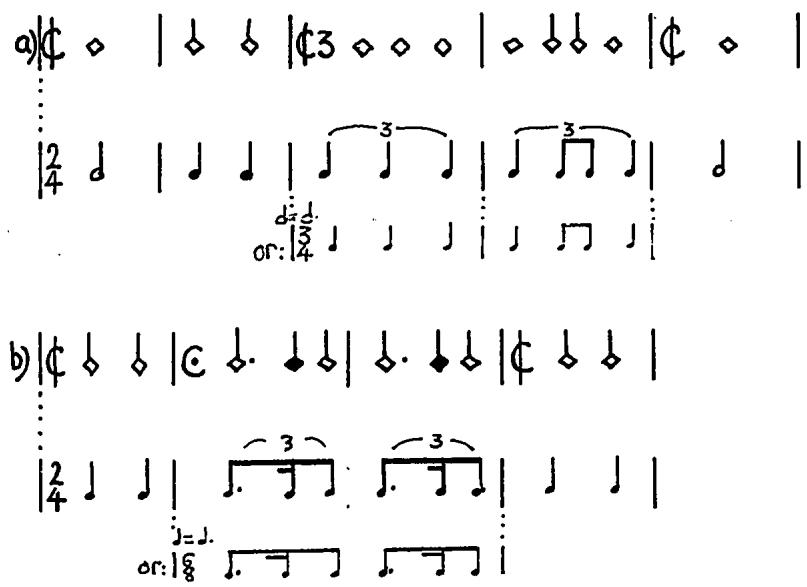
中文讲解
本段为谱例 2.3 在第 43 页的图像占位符。原始内容是乐谱片段,用以具体展示米兰在比例性有量拍号之下把 tactus 切分为 2/4、3/4 与 6/8 三种关系的实际操作。占位符内文字注明’位置与图注保留’,确认图注 P0530 即为此谱例的题注。原始图像数据未内嵌,具体谱面细节须对照原书第 43 页。
第9段(P0532)
原文复述
The changes which the old proportional system underwent in the early sixteenth century preclude proof of these assertions solely on theoretical grounds. No universal consistency is found in the practical application of proportional principles at this time. The opening pages of Jacobs’ Tempo Notation relate the variety of usages and interpretations of these symbols to the Spanish context. Textural and rhythmic criteria provide supporting circumstantial evidence to the argument.
中文讲解
本段是方法论性的自陈,承担本节论证的’许可证’职能。它依次交代三件事:第一,16 世纪早期旧比例系统已经历明显变化(changes),因此本类断言无法仅凭理论推断(solely on theoretical grounds)得到确证;第二,同一时期比例原则的实际应用存在高度不一致(no universal consistency);第三,作者援引 Jacobs《Tempo Notation》一书开篇,把这一时期符号使用与解读的多样性放回西班牙语境加以审视。最后做出方法论宣告:在这种境况下,需要以织体(textural)和节奏(rhythmic)层面的标准作为本节论证的旁证(supporting circumstantial evidence)。由此 P0533 与 P0534 的织体、节奏与小节数推论被预先赋予合法性。
补充说明
本段所引 Jacobs《Tempo Notation》的具体开篇内容不在本节 source_paragraphs 中。
第10段(P0533)
原文复述
Passages in @ are of much lighter texture than those in ∅3. Compases of ∅3 frequently contain two chords each of three or four voices, with one moving part. Passages in © have fewer voices, one moving part, and chords most frequently placed at two bar intervals. The lighter textures of © appear designed for faster performance than those in ∅3.
中文讲解
本段以织体差异在两类记号之间建立对比,作为 P0532 所许可的’织体旁证’的首批具体材料。’@’(OCR 字符显示)所标段落织体明显轻于 Ø3 段落;Ø3 小节通常承载两套和弦(两组),每组由三或四声部构成,并配一个流动声部(moving part)。’©’(OCR 字符显示)段落声部更少、仅一个流动声部、和弦往往每隔两个小节才出现一次;其轻盈的织体被设计为演奏速度快于 Ø3。两相对照,作者以织体差异间接推断演奏速度差异。
补充说明
原文中 ‘@’ 与 ‘©’ 是 OCR 对常规有量记号的字符呈现。结合 P0534 描述更轻盈、节奏更稀、运行更快的 $\mathbb{C}$ 段落,可推测 ‘@’/’©’ 与 $\mathbb{C}$ 同属轻盈/快速一类的有量记号;其具体对应形式需查看原书印刷体。
第11段(P0534)
原文复述
Greater rhythmic variety occurs in $\varnothing 3$ passages than those in $\mathbb{C}$ . The rhythm $\downarrow \downarrow \downarrow$ is used in 86 percent of the total $\mathbb{C}$ bars in El Maestro. Whereas Milán uses $\varnothing 3$ as a metrical structure for polyphonic composition, the passages of $\mathbb{C}$ use the above rhythmic cell as a fixed unit of melodic construction, with the first notes of several statements forming a melodic outline. $^{24}$ This is again indicative of faster performance of $\mathbb{C}$ . The number of bars in the passages of $\mathbb{C}$ also suggests the faster performance speed. Two compases of $\mathbb{C}$ are required to make one tactus unit of $\mathbb{C}$ . Five of the seven $\mathbb{C}$ passages in Milán’s fantasias have an even number of bars, creating no disruption to the tactus. One of the exceptional passages is in a fantasia de consonancias y redobles, no.15, where strict proportion is irrelevant. A passage of twenty-one bars of $\mathbb{C}$ divides into seven triple units (b.93-113). $^{25}$ The second exception is a seven-bar passage in Fantasia 19 where a single $\mathbb{C}$ bar forms an irregular unit with the final $\mathbb{C}$ bar before three paired bars (b.107-15). $^{26}$ This is the only passage in Milán’s works where @ is introduced in continuous polyphony rather than with a sectional division.
中文讲解
本段是 P0532 方法论许可下的具体推论,可分三层。第一层节奏对比:$\varnothing 3$ 段的节奏多样性显著高于 $\mathbb{C}$ 段;El Maestro 全集中所有 $\mathbb{C}$ 小节里,节奏单元 $\downarrow \downarrow \downarrow$ 出现在 86%。在使用方式上,Ø3 被米兰用作多声对位(polyphonic composition)的拍号结构,$\mathbb{C}$ 段则把该三连音节奏单元作为旋律建构的固定单位——连续多次陈述时其首次落点的首音即勾勒出旋律轮廓(脚注 24 给出例证位置),这再次指示 $\mathbb{C}$ 演奏更快。第二层与小节数相关的速度判断:两个 $\mathbb{C}$ compas 等于一个 $\mathbb{C}$ 的 tactus 单元(原文中两符号相同,应为印刷/OCR 异常,逻辑上应指两个 $\mathbb{C}$ compas 等于一个 Ø3 的 tactus 单元)。第三层小节数的规律性:米兰幻想曲的七段 $\mathbb{C}$ 中有五段小节数为偶数,故与 tactus 不冲突;余下两段例外。第一例外为 Fantasia 第 15 号,副题 ‘fantasia de consonancias y redobles’,其中 21 小节的 $\mathbb{C}$ 段落可整齐分为七个三拍单元(b.93–113),因曲式自由而严格比例无关紧要(参 Schrade M, p.77);第二例外为 Fantasia 19 的七小节段落,其中一个 $\mathbb{C}$ 小节与最后一个 $\mathbb{C}$ 小节在前三组双小节之前构成不规则单元(b.107–15);后者同时也是米兰全集中唯一在连续对位中——而非作为分节中断——引入 @ 的段落。
补充说明
脚注 26(位于本段末 b.107–15 之后)的内容不在本节 source_paragraphs 范围内;本段中’两个 $\mathbb{C}$ compas 等于 $\mathbb{C}$ 的一个 tactus 单元’的第二处符号疑为印刷异常。
第12段(P0535)
原文复述
$^{24}$ See, for example, Fantasia 19, b.109-14, 126-31.
中文讲解
本段为脚注 24。它给 P0534 中’$\mathbb{C}$ 段落以 $\downarrow \downarrow \downarrow$ 节奏单元的多次首音构成旋律轮廓’这一陈述提供具体的乐谱位置:Fantasia 19,b.109–14 与 b.126–31。其对正文的作用为支撑性的具体例证。
第13段(P0536)
原文复述
$^{25}$ Schrade M, p.77.
中文讲解
本段为脚注 25。引 Schrade M 著作第 77 页作为 P0534 关于'21 小节的 $\mathbb{C}$ 段落可整齐分为七个三拍单元’(位于 b.93–113)的文献来源。该脚注属出处性质。
补充说明
Schrade M 的具体身份与著作内容不在本节 source_paragraphs 范围内;本节不予展开。
脚注 / 边栏 / 图表 / 附加信息(如有)
本节涉及的附加材料清单:(a) 谱例 2.2 在 P0527 末尾被提及,应位于 p.41–42 之间,但其谱面占位符未出现于本节 source_paragraphs;(b) 谱例 2.3 在 p.43,由图注 P0530 与乐谱占位符 P0531 共同构成;(c) 脚注 20 在 P0526 被引用、脚注 24 在 P0534 文中与 P0535 本身相对应、脚注 25 在 P0534 文中与 P0536 本身相对应、脚注 26 仅在 P0534 末尾被引用;脚注 24(P0535)与脚注 25(P0536)的实文本在本节,脚注 20 与 26 的实文本不在本节。本节所引文献:Jacobs《Tempo Notation》(讨论符号使用与西班牙语境的多样性)、Schrade M 第 77 页(讨论三拍单元划分)。
💡 本节核心要点
- 米兰的吉他数字谱使用三种有量记号,外加一种以文字而非符号描述的第四种;通用记号对应 tempus imperfectum cum prolatione imperfecta,没有任何幻想曲是通篇三拍。
- 二元 compas 默认等于一个 semibrevis 的时值;Ø3 表示每小节容纳三个 semibreves;$\mathfrak{c}$ 表示每小节容纳三个 minimae。共有 11 首幻想曲夹有打断主拍的三拍段。
- Jacobs 调查的结论指出旧比例系统可在 semibreve 与 minim 两个层级同时施加,从而把 tactus 切分成现代记谱语言中的 2/4、3/4 与 6/8(如谱例 2.3 所示)。
- 由于 16 世纪早期比例系统的变动及同时期缺乏普遍一致性,纯理论不足以确证;作者援引 Jacobs《Tempo Notation》并以织体与节奏层面的旁证支撑本节论证。
- 在织体与节奏层面,$\mathbb{C}$ 段落(共七段)声部更稀、和弦间隔更大、节奏单元 $\downarrow \downarrow \downarrow$ 占据 86% 小节、首音勾勒旋律轮廓,因而演奏速度高于 Ø3。
- 七段 $\mathbb{C}$ 段落有五段小节数为偶数故与 tactus 不冲突;两段例外分别为 Fantasia 第 15 号(21 小节分为七个三拍单元)与 Fantasia 19(七小节不规则单元),后者也是米兰全集中唯一在连续对位中而非作为分节中断引入 @ 的段落。
🔑 关键术语
- 有量记号(mensural signs):用于标示节拍与音符时长比例关系的符号。本节指出米兰吉他数字谱采用三种此类记号(外加一种文字描述形式)。
- tempus imperfectum cum prolatione imperfecta:不完全时值与不完全小切分(2:2 比例)的组合,对应一拍 breve 含两个 semibreve、每个 semibreve 含两个 minim;本节被指为米兰幻想曲的通用主拍。
- semibrevis / minima:mensural 体系中两个层级的音符时长单位,分别对应现代二分音符与全音符的早期形态;本节用它们标定各记号每小节所容纳的容量。
- tactus:节拍系统的基本衡量脉搏,相当于现代的’一拍’。本节论及 tactus 与各级 compas、minima 之间的换算,并作为切分 2/4、3/4、6/8 的参照基底。
- compas:本节特指米兰吉他数字谱中的小节单位。默认二元 compas 等于一个 semibrevis;Ø3 compas 等于三个 semibreves。
- 比例性有量拍号(proportional mensurations):可在 semibreve 或 minim 层级引入的二/三比例关系,使 tactus 在两个层级同时按比例切分,从而对应现代拍号 2/4、3/4、6/8 等组合。
- fantasia de consonancias y redobles:米兰《El Maestro》第 15 号幻想曲的西班牙文副标题。本节指出该曲因曲式自由而严格比例关系被认为无关紧要。
CH2.S8 Length
第1段(P0537)
原文复述
Length
中文讲解
这是第8小节的标题"Length”(长度)。该标题表明本节要讨论的主题是El Maestro中各首幻想曲(fantasias)的篇幅长短,即以小节数(compases)衡量的乐曲长度。它开启了本节的核心论题:Milán的幻想曲并非整齐划一,而是呈现出从短到长、随书本推进而递增的篇幅梯度。
第2段(P0538)
原文复述
Consistent with Milán’s didactic intentions, the fantasias of El Maestro become longer as the book progresses. The average length of the libro primero fantasias is 118 compases, with the shortest, no.14, being only 44 compases, and the longest, no.20, comprising 214. The average length of the fantasias in the libro segundo is 195 compases with Fantasia 37 and Tento 1 providing a range of 98 to 251. The average length overall is 157 compases, making Milán’s the longest works in the repertory.
中文讲解
本段的核心主张是:El Maestro中的幻想曲其篇幅随书本推进而加长,这一变化与Milán的教学意图(didactic intentions)相符。为支撑这一主张,作者给出了三组统计数字:第一册(libro primero)幻想曲的平均长度为118小节(compases),其中最短的是第14首,仅44小节,最长的是第20首,达214小节;第二册(libro segundo)幻想曲的平均长度升至195小节,跨度由Fantasia 37的98小节到Tento 1的251小节;全书总体平均为157小节,使Milán的作品成为该曲目库(repertory)中篇幅最长的。
这里的推理逻辑是:篇幅的递增并非偶然,而是教学策略的体现——初学者先接触较短的范例,循序渐进后再处理更长的作品,因此"变长"这一事实被解释为与didactic intentions"一致”。作者用平均值与极值(小至44、大至251)两种尺度的数据共同刻画,既说明了"由短到长"的趋势,也展示了不同册册之间的内部差异。最后一句"the longest works in the repertory"则是把Milán放到同代或同期曲目库中作横向比较,凸显其在体量上的独特位置。
阅读时需注意:第一册中既有仅44小节的极短作品,也有214小节的较长作品,平均值118掩盖了内部的差异;第二册"98 to 251"的跨度同样宽泛,单凭平均值无法判断其分布是否均匀;“longest in the repertory"是相对断言,需结合上下文中的repertory范围理解。
补充说明
compás(复数compases)是西班牙语中的"小节”,用于度量乐曲长度;Fantasia 37与Tento 1是第二册中分别代表最短与最长篇幅的两个例子,与第一册中的no.14和no.20形成呼应,共同支撑"篇幅逐步增长"的论断。
脚注 / 边栏 / 图表 / 附加信息(如有)
无(本小节无脚注、图表或边栏)。
💡 本节核心要点
- El Maestro中幻想曲的篇幅随书本推进而递增,被作者解读为与Milán的教学意图相一致。
- 第一册幻想曲平均118小节,极端值由no.14的44小节到no.20的214小节。
- 第二册幻想曲平均195小节,由Fantasia 37的98小节到Tento 1的251小节。
- 全书总体平均157小节,使Milán成为该曲目库中篇幅最长的作品。
- 数据呈现方式(平均值+极值)同时揭示整体趋势与内部差异。
- 该节为后续关于教学编排或曲式结构的讨论提供了篇幅层面的量化基础。
🔑 关键术语
- compás / compases:西班牙语中的"小节”,本节用来统一度量幻想曲的篇幅长度。
- didactic intentions:教学意图,指Milán安排作品由短到长、由简入繁的目的,作者以此解释篇幅递增的原因。
- libro primero / libro segundo:El Maestro的第一册与第二册,两册之间的篇幅统计对比支撑了"篇幅逐步增长"的论断。
- repertory:曲目库,此处指与Milán同时代或同类的整体鲁特琴/维韦尔琴曲目,作者用以横向比较Milán作品的篇幅长度。
CH2.S9 Stylistic Forces
第1段(P0539)
原文复述
Stylistic Forces
中文讲解
这是第二章的二级标题(## 级别的 Markdown 标题),用以开启本节主题:‘风格生成力’(Stylistic Forces)。本节任务是对米兰(Milán)幻想曲(fantasias)的 Concept 与 Idiom 两个分析维度进行总结性评价。承接前文(S7/S8)对参数与标准的设定,本节以这些参数为依据,对米兰作品的风格归属给出整体性结论。
(源文以 ‘##’ 标记作为 H2 级别小标题,原书版面中此为小节标题。)
第2段(P0540)
原文复述
The idiomatic resources of the vihuela overwhelmingly exerted greater influence on Milán than techniques adapted from vocal polyphony. Not only is this evident in the overtly instrumental conception of his fantasias in the tañer de gala style, but also in the textural devices of his polythematic imitative works. The sections in triple metre are frequently reminiscent of instrumental dance music, even though often constructed in a quasi-imitative manner. Much of
中文讲解
本段提出本节的核心主张:维韦拉琴自身的惯用语汇(idiomatic resources)对米兰的影响,‘压倒性地’大于他从声乐复调(vocal polyphony)借鉴而来的技术。作者给出两条证据:(1) 他 tañer de gala 风格(一种炫技性、纯器乐化的弹奏风格)幻想曲具有明显的器乐化构思;(2) 即便在多主题模仿性作品(polythematic imitative works)中,织体手段也来自维韦拉传统。三拍子段落常令人联想到器乐舞曲,但写法上又带模仿外观(quasi-imitative manner)。本段末以 ‘Much of’ 收束,是为引出下一段(经脚注 26 隔开)关于所谓’模仿’究竟为何物的讨论。
补充说明
句末 ‘Much of’ 在原书排版中跨越了 P0540 / P0541(脚注 26)/ P0542 三处,构成完整句子 ‘Much of the so-called imitation in his works is, in fact, a kind of motivic repetition…’。本节内部结构体现脚注对正文的’来源’式支持。
第3段(P0541)
原文复述
Footnote 26: Schrade M, p.103.
中文讲解
本条为正文段(P0540→P0542 跨页续接的句子)的脚注 26。引用来源为 Schrade 关于维韦拉音乐研究著作第 103 页(‘Schrade M’ 即 Schrade, M 之缩写;具体书目信息需查阅原书脚注页 / 参考文献页)。该脚注为’米兰所谓模仿实际是动机重复’这一观点提供学术旁证,属于’来源/旁证’类注释,作用是支持作者修正学界常见说法(即将米兰的写法命名为’模仿’)的判断。
补充说明
本任务输入未提供 ‘Schrade M’ 完整书目信息,仅按原文复述为 ‘Schrade M, p.103.’。
第4段(P0542)
原文复述
the so-called imitation in his works is, in fact, a
中文讲解
本句承接 P0540 末尾的 ‘Much of’,形成完整主语 ‘Much of the so-called imitation in his works’(他作品中所谓的模仿)。’the so-called’(所谓的)一词已暗示作者将修正一个常见说法;预告其内容将揭示’所谓模仿’实为何物。
第5段(P0543)
原文复述
kind of motivic repetition strongly directed by
中文讲解
本句揭示米兰’所谓模仿’的实质:一种’由……强力引导的动机重复’(a kind of motivic repetition strongly directed by …)。这接近模仿的外观,但本质是动机在固定和声框架下的循环,而非声乐复调那种主题在不同声部依次陈述的真正模仿。
第6段(P0544)
原文复述
harmonic forces which exploits the characteristic
中文讲解
承接上句:这种动机重复’强力地’由和声力量(harmonic forces)所引导。‘strongly’ 强调和声结构是写作的主导逻辑,而非声部对位逻辑。’exploits the characteristic’(利用……的特征)引出下一句所要介绍的具体特征间隔:八度、四度、五度。
第7段(P0545)
原文复述
intervals of imitation, the octave, fourth and
中文讲解
本句具体指出米兰模仿序列所’利用’的特征间隔:八度、纯四度、纯五度。这三个间隔属于完全协和或最完全协和的纯音程,是文艺复兴模仿写作最常用的’起句—答句’关系音程,但本节强调在米兰这里它们服务于和声进行而非严格声部模仿。
第8段(P0546)
原文复述
fifth. This type of preferred texture has
中文讲解
完成对模仿间隔的列举(八度、四度、五度),句号结束此句。然后以 ‘This type of preferred texture’ 切换主题——米兰的偏好性织体(preferred texture)。‘preferred’ 表明这是他主动选择而非被动沿袭的写法。
第9段(P0547)
原文复述
successive voices entering without overlapping one
中文讲解
描述这种偏好性织体的声部进入方式:‘声部依次进入而不相互重叠’(successive voices entering without overlapping one another)。这与真正的声乐模仿有别——声乐模仿允许声部重叠(overlap),而米兰的写法是严格的非重叠进入。
第10段(P0548)
原文复述
another. It is more satisfactorily described as
中文讲解
完成 ‘one another’,句号结束对织体进入方式的描述。‘It is more satisfactorily described as’(更恰当的描述是……)是一个术语重新定义的语言标记——作者准备给这一类写作换一个更准确的名字。
第11段(P0549)
原文复述
imitative sequence. Imitative writing more akin to
中文讲解
本句给出新名称:‘模仿性序列’(imitative sequence)。这是作者专为米兰这种’由和声引导的、动机序列式的非严格模仿’所定的术语。新句 ‘Imitative writing more akin to’ 引出相对立的情况——与米兰常规写法不同的、更接近声乐风格的真正模仿。
第12段(P0550)
原文复述
vocal style is found in Fantasias 20, 21, and 23.
中文讲解
本句明确指出真正属于声乐化模仿写作的作品:幻想曲第 20、21、23 首。这说明米兰并非完全不采用声乐复调模仿,仅在这三首作品里有比较典型的、接近声乐风格的模仿——这种写作在其整体中属于少数。
第13段(P0551)
原文复述
Analysis of Milán’s fantasias in terms of their
中文讲解
本句开启新段落:从’概念’(Concept)与’惯用语汇’(Idiom)两个维度对米兰幻想曲进行分析,揭示其风格取向(stylistic orientation)。‘in terms of’ 表示以这两维度作为分析视角。
第14段(P0552)
原文复述
conceptual and idiomatic forces clearly indicates
中文讲解
承接前句:‘从概念和惯用语汇两维度分析,能清楚地表明其风格取向’。‘forces’(力量/动力)一词把 Concept 与 Idiom 提升为塑造风格的两种’力量’,正是本节标题 ‘Stylistic Forces’(风格生成力)的具体所指。
第15段(P0553)
原文复述
their stylistic orientation. Table 2.2 shows the
中文讲解
承接上句:‘清楚地表明其风格取向’。‘orientation’(取向/方向)一词暗示米兰的风格并不指向声乐复调而是器乐化方向。然后引出 Table 2.2,所展示的是按 Concept(概念)参数划分的作品分布。
第16段(P0554)
原文复述
distribution of his works on the Concept parameter
中文讲解
本句说明 Table 2.2 的内容:作品在 Concept(概念)参数上的分布。Concept 是前文 S8 节定义的分析维度,关注作品的构思方式(如是否模仿、有无对位、是否有伴奏旋律等)。
第17段(P0555)
原文复述
and Table 2.3 shows their components according to
中文讲解
与 Table 2.2 并列:Table 2.3 展示的是按 Idiom(惯用语汇)标准划分的作品组成。Idiom 是与 Concept 互补的分析维度,关注作品的织体密度、声部数、和声语汇等具体’语言’层面。
第18段(P0556)
原文复述
the Idiom criteria. Table 2.2 shows the consistency
中文讲解
本句句号结束 Table 2.2 与 Table 2.3 的介绍,开始转向 Table 2.2 的发现:米兰的 Concept 取向具有’一致性’(consistency),即他在构思维度上表现出清晰的统一倾向——而这种倾向正是上节结论:‘惯用语汇重于声乐模仿’。
第19段(P0557)
原文复述
of Milán’s approach to Concept. Most of the
中文讲解
续接前句:‘米兰对 Concept(概念)的处理方式具有一致性’。‘approach’ 强调他作为作曲家的整体态度是稳定的。下一句 ‘Most of the’ 引出量化结论。
第20段(P0558)
原文复述
fantasias show a low imitative content with six
中文讲解
本句给出 Table 2.2 的核心数据:大多数幻想曲的’模仿性内容’(imitative content)很低——即真正属于声乐复调意义上的模仿写作在米兰作品中所占比例小。‘with six’ 引出更极端的情况。
第21段(P0559)
原文复述
works demonstrating a complete absence of imitative
中文讲解
本句给出更突出的证据:有六首作品完全没有任何模仿性程序(complete absence of imitative procedures)。这六首是 Concept 参数上最极端的样本,证明米兰并非靠模仿性写作立足。
第22段(P0560)
原文复述
procedures. Non-imitative counterpoint accounts for
中文讲解
本句句号结束’六首完全无模仿’的论述,接着报告另一类:非模仿性的对位(Non-imitative counterpoint)——即虽然有多声部对位关系,但并不构成主题模仿的写作。‘accounts for’ 引出它所占的比例。
第23段(P0561)
原文复述
a similarly small proportion of the works.
中文讲解
本句收束:非模仿性对位在米兰作品中也只占’同样小’(similarly small)的比例。‘similarly’ 一词是关键的对比——与’低模仿内容’所占的比例相比,‘非模仿性对位’所占比例也是小的。也就是说,‘模仿’和’非模仿性对位’两种方式在米兰作品中都不是主流,进一步暗示主流应是别的什么。
第24段(P0562)
原文复述
Accompanied melody, particularly in sequential form,
中文讲解
本句揭示 Concept 参数上最常见的类别:伴奏旋律(Accompanied melody),尤其以序列形式(sequential form)出现的伴奏旋律。‘particularly in sequential form’ 暗示米兰常用的’模仿性序列’——即那种主题在序列中反复出现的标志性手法——被归入这一类进行统计。
第25段(P0563)
原文复述
makes up the largest proportion of the works.
中文讲解
本句给出关键比例:伴奏旋律构成了米兰作品中的最大比例(largest proportion)。与前两句的’低模仿内容’‘非模仿性对位占小比例’形成强烈对比——米兰作品的主流写作是’带伴奏的旋律’,而非声乐复调。
第26段(P0564)
原文复述
Milán’s imitative sequences, a highly individual
中文讲解
本句句号结束’伴奏旋律占最大比例’,转而评论米兰的’模仿性序列’(imitative sequences)——这是前段(P0542-P0549)所定义的那种’不是真正模仿而是动机序列’的标志性写法。作者强调其’高度个性化’(highly individual),即这是米兰独树一帜的笔法。
第27段(P0565)
原文复述
part of his style, have been included in this
中文讲解
承接前句:这种模仿性序列是其风格中’高度个性化’的部分,但在统计上被归入’伴奏旋律’这一类。‘have been included in this’ 的 ’this category’(这一类)即将在下一句中给出,指代 Concept 参数下的’伴奏旋律’类别。
第28段(P0566)
原文复述
category. His use of unaccompanied melody is
中文讲解
本句句号确认’模仿性序列’被归入’伴奏旋律’类别进行统计,然后引出另一项观察:米兰对无伴奏旋律(unaccompanied melody)的使用情况。这是 Concept 维度上独立于’伴奏旋律’的另一极。
第29段(P0567)
原文复述
greater than any other vihuelist and appears most
中文讲解
本句给出比较性判断:米兰对无伴奏旋律的使用多于任何其他维韦拉演奏家(vihuelist)。‘greater than any other vihuelist’ 是横向比较,证实米兰在’独奏旋律’这一维度上的独特性。
第30段(P0568)
原文复述
significantly in the idiomatic works.
中文讲解
本句完成陈述:这种无伴奏旋律的使用’最显著地’(most significantly)出现在米兰的器乐化作品(idiomatic works)中。呼应首段(P0540)‘维韦拉惯用语汇影响大于声乐’的论点——独奏旋律正是典型的器乐化写作。
第31段(P0569)
原文复述
A greater diversity of approach is reflected in
中文讲解
本句开启新段落:米兰的织体类型(textural types)表现出更大的多样性(diversity)。‘greater’ 一词暗示与上一段(Concept 的’一致性’)形成对比——尽管 Concept 取向一致,但织体上却变化多端。
第32段(P0570)
原文复述
Milán’s textural types. Nearly half his works are
中文讲解
本句给出量化数据:近一半(nearly half)米兰作品是’由高度对比的织体构成’的(built from highly contrasting textures)。这意味着米兰常在一首作品内部并置密度差异很大的段落。
第33段(P0571)
原文复述
built from highly contrasting textures. This is
中文讲解
承接上句:这些作品是’由高度对比的织体构成’的。‘highly contrasting textures’ 意味着织体在密度、声部数或节奏活动度上有强烈反差。‘This is’ 引出下一段(中间夹着 Table 2.2 表格)关于织体密度的具体数据。
第34段(P0572)
原文复述
TABLE 2.2
中文讲解
本条为表格标题 ‘TABLE 2.2’,提示此处出现按 Concept 参数(表 2.2)和/或织体类型统计的表格内容。由于源输入中未提供表格的列与行内容,需查阅原书相应页码以获取具体分布数据。该表的作用是支撑本节关于’米兰风格取向’的量化论述。
注意:本节文字中提到 Table 2.2 与 Table 2.3 两个表,但本节输入范围内仅出现 ‘TABLE 2.2’ 这一个表头。Table 2.3 的实际内容应在原书其他位置。
补充说明
无额外补充(表格具体行列内容需查阅原书第 47 页 Table 2.2)。
第35段(P0573)
原文复述
reflected in the textural density where nineteen works reveal extremes of texture. They are predominantly the works of consonancias y redobles. The works of consistent texture predominantly use three-voice textures. Four of the easy works presented early in El Maestro show a predominance of two-part writing, and only two, nos.27 and 37, are predominantly a4. Despite a strong instrumental inclination, no five or six-voice chords occur in Milán’s tablature. The possibility of writing chords which could be strummed is something which he avoids in favour of the four-voiced textures of contemporary vocal polyphony. His only gestures in this direction occur in Fantasia 16 and Tentos 2 and 3 where there are the brief passages of arpeggiation shown in the table. The fantasias show a proportionally high incidence of homophony, figuration, and accompanied melody. These three qualities are particularly characteristic of Milán’s idiomatic concern. His didactic intentions are reflected in the gradual movement towards more difficult works shown in the assessment of performance difficulty. The success with which he realizes his intentions, and creates attractive, effective works is mirrored in the scores for the final category.
中文讲解
本段是本节(CH2.S9)最长的总结性段落,从织体密度、声部数、和声织体、具体作品、教学意图和最终评估六个层面收束全节论述。
(1) 织体密度:十九首作品呈现’织体极端’(extremes of texture),主要集中在 consonancias y redobles 类。
(2) 织体一致的作品:主要以三声部织体(three-voice textures)为主,与上段’高度对比 vs. 一致’的分类对应。
(3) 二声部写作:出现在《El Maestro》开头的四首简易作品中,体现米兰循序渐进的教学安排。
(4) 四声部(a4)写作:仅第 27 和 37 首以四声部为主——这是相当有限的,考虑到米兰倾向器乐化,但四声部已属其最大织体。
(5) 五/六声部和弦:尽管米兰的器乐倾向强烈,但维韦拉谱中完全没有五或六个声部的和弦。值得注意的是他本可写扫弦和弦(chords which could be strummed),却主动避免,转而采用同时期声乐复调的四声部织体——这是风格上’维韦拉惯用语汇 > 声乐技术’的论点的反例,说明米兰并非完全器乐化,他仍受四声部声乐写作传统约束。
(6) 朝扫弦和弦方向发展的姿态:仅在《幻想曲第 16》与《Tentos 第 2、3》中出现短促的琶音段落(brief passages of arpeggiation)——这暗示他试探过更纯粹器乐化的写法但克制未用。
(7) 高发的同音齐奏(homophony)、音型化(figuration)和伴奏旋律:这三者在米兰的幻想曲中比例较高,正是其器乐化关切(idiomatic concern)的具体体现。
(8) 教学意图(didactic intentions):从演奏难度评估(performance difficulty)可看出米兰作品呈现从易到难的渐进安排,体现教材编写的教学安排。
(9) 最终评估(final category):米兰成功地实现了其意图,并创作出吸引人、有效的作品——这从’final category’(最后一类评估维度,即艺术价值评分)的高分得到反映。
本段功能:作为整个 Concept/Idiom 分析的’米兰案例总评’,得出风格倾向器乐化但仍受声乐织体限制、教学上循序渐进、艺术上达到预期效果的结论。
补充说明
本段提及的具体作品编号(Fantasias 16, 20, 21, 23, 27, 37;Tentos 2, 3)以及’early easy works presented in El Maestro’均需在原书中查阅《El Maestro》曲集目录以确认。这些编号与 P0550 提到的 Fantasias 20, 21, 23 共同构成米兰作品的内部参照体系。‘consonancias’(持续同名/空弦音作为和声基础)、‘redobles’(快速双音/交替音型)、‘a4’(a quattro,四声部)均属本节理解所需术语。
脚注 / 边栏 / 图表 / 附加信息(如有)
本节中出现的附加材料包括:
- 脚注 26(位于 P0541):‘Schrade M, p.103.’,为正文关于’米兰所谓模仿实为动机重复’的论断提供学术旁证,属于’来源/旁证’类注释。
- 表格标题 ‘TABLE 2.2’(位于 P0572):在 P0571 与 P0573 之间出现,展示米兰作品按 Concept 参数与/或织体密度的统计分布;本节文字中也提到 Table 2.3 但本节输入范围内未给出其独立表头。表格具体行列内容需查阅原书第 47 页。
- P0573 段中提及 ‘consonancias y redobles’、‘El Maestro’ 早期简易作品、‘Tentos 2 and 3’、‘Fantasia 16’ 等具体作品类别/编号,构成本节分析的数据基础,并与 P0550 提及的 Fantasias 20、21、23 形成内部交叉参照。
💡 本节核心要点
- 米兰的风格受维韦拉琴自身惯用语汇的影响远大于声乐复调技术:既体现在 tañer de gala 风格幻想曲的器乐化构思上,也体现在多主题模仿作品中的织体手段上;三拍子段落常带舞曲特征(即便以准模仿方式写成)。
- 米兰的’所谓模仿’实为’模仿性序列’(imitative sequence)——一种由和声强力引导、动机在不同序列中重复的写法,特征间隔为八度、四度、五度;声部依次进入而不重叠。真正接近声乐风格的模仿仅出现在 Fantasias 20、21、23。
- Table 2.2 显示米兰的 Concept 取向高度一致:低模仿内容为主,六首作品完全无模仿程序,非模仿性对位也只占小比例,‘伴奏旋律(尤其序列形式)‘是最大类别;无伴奏旋律的使用在所有维韦拉作曲家中最为突出。
- 米兰的织体类型比 Concept 表现出更大多样性:近一半作品由高度对比的织体构成;十九首呈现织体极端,主要为 consonancias y redobles 类;织体一致的作品以三声部为主;早期简易作品以二声部为主,仅 27 和 37 是 a4 主导。
- 尽管器乐倾向强烈,米兰从未使用五或六声部扫弦和弦,而是采用同时期声乐复调的四声部织体;仅在 Fantasia 16 和 Tentos 2、3 中出现短促琶音为’试探性姿态’。
- 同音齐奏(homophony)、音型化(figuration)和伴奏旋律是米兰器乐化关切的具体体现;其作品在演奏难度上呈现由易到难的渐进安排,体现《El Maestro》的教学意图;最终评估类别的高分表明他成功地实现了编创有效作品的目标。
🔑 关键术语
- idiomatic resources(惯用语汇):指维韦拉琴固有的音型、织体、即兴手法等器乐化语言。本节指出米兰受其影响远大于声乐复调技术。
- tañer de gala(‘盛装’演奏风格):西班牙文艺复兴时期一种炫技性、纯器乐化的弹奏风格,与仪式性的 tañer de fantasía 形成对比。米兰的 tañer de gala 风格幻想曲具有明显的器乐化构思。
- imitative sequence(模仿性序列):米兰的标志性写法——并非真正的声乐复调模仿,而是由和声引导的动机在不同序列中重复,特征间隔为八度、四度、五度;声部依次进入而不重叠。
- Concept(概念):本研究的分析维度之一,关注作品的构思方式(是否模仿、有无对位、是否有伴奏旋律、是否为无伴奏旋律等)。Table 2.2 即按此参数对米兰作品进行分布统计。
- Idiom(惯用语汇 / 语汇标准):本研究的另一分析维度,关注作品的织体密度、声部数、和声语汇等具体’语言’层面。Table 2.3 按此标准展示作品组成。
- consonancias y redobles:维韦拉特有的写作类别:consonancias 是持续奏出空弦/同名音作为和声基础,redobles 是快速双音或交替音型。米兰作品中呈织体极端的十九首多属此类。
- a4(a quattro):拉丁文缩写,意为’四个声部’。本节中指以四声部织体为主的作品,在米兰作品中仅出现在 Fantasias 27 和 37。
- polythematic imitative works(多主题模仿性作品):指包含多个主题并具有模仿手法的作品。本节指出即便在这样的作品中,米兰仍倾向于用维韦拉惯用语汇来组织织体,而非声乐复调方式。
CH2.S10 Improvisation
第1段(P0574)
原文复述
Improvisation
中文讲解
这是第二章的一个小节标题,英文写作 “Improvisation”,中文意思是"即兴/即兴演奏”。该标题开启了一个新论题:从即兴演奏的角度来理解 Milán 幻想曲的风格本质。前面的小节通常讨论过音乐织体、形式或音型等具体特征,本节则把视角提升到"这些特征背后的生成方式”——即作曲家是否依赖一套可重复调用的即兴语汇来创作。读者应当把"即兴"理解为一种风格判断的标签,而非指乐曲在演出时即席生成。
第2段(P0575)
原文复述
Milán’s fantasias reveal a pragmatic approach
中文讲解
这句话只是一个句首片段,需要与下一段(P0576)合在一起才能构成完整的主句。其承担的功能是为整段定下基调主张:Milán 的幻想曲呈现一种"实用主义”(pragmatic)的做法。这里 “pragmatic” 的含义并不是贬义的"粗糙",而是强调:Milán 不是把维韦拉琴音乐当作声乐复调的移植,而是为这件乐器量身打造、优先考虑其演奏可能性与乐器特性的创作路径。短短几词中已经预告了本节的核心论题——Milán 的风格来源在于即兴语汇的累积。
补充说明
该句在原文版面上与 P0576 同属一个自然段,但因分页或分段标记得以独立成条目;理解时必须将两句合并为一个完整论点。
第3段(P0576)
原文复述
to the vihuela and the instrumental art. This is seen in their textural clarity, their minimal reliance upon vocally based counterpoint, and prolific use of idiomatic devices. His music suggests a style based on improvisation from an accumulated stock of formulae. The improvisatory basis of Milán’s style has been discussed by Ward who likens him to the Italian
中文讲解
与上一句衔接后,整段主张为:“Milán 的幻想曲展现了对维韦拉琴及其器乐艺术的一种实用主义态度。“这种实用主义体现在三点证据上:①织体清晰(textural clarity),即每个声部线条与音型组合都易于在乐器上呈现,听感透明;②对声乐化对位(vocally based counterpoint)的依赖极低,说明他不沿用为声乐写作的复调套路;③大量使用乐器特有的音型(idiomatic devices),即专为维韦拉琴量身定制的演奏手法。由此,作者推出核心推断:Milán 的音乐风格建立在一套累积的"公式化语汇”(stock of formulae)的即兴调用之上。最后一句引入学者 Ward 的讨论,并把 Milán 与意大利某位(文本在 P0577 表格处中断)即兴风格作曲家进行类比。读者需注意,“即兴"在本节并非指演出中临场创作,而是指作曲家在积累了大量程式化材料后,以类似即兴思维的方式自由组合这些语汇进行作曲。
补充说明
P0576 在原文中以"to the vihuela…“起头,说明它与 P0575 共同构成完整一句;Ward 与意大利作曲家的类比对象在版面下一页(P0577 处为图表说明)才续接完成。
第4段(P0577)
原文复述
MILAN : TEXTURAL TYPES (IDIOM)
中文讲解
这是一处图表/表格说明标题,英文原文为大写形式 “MILAN : TEXTURAL TYPES (IDIOM)",中文意为"Milán:织体类型(乐器法音型)"。它标示一张图或一张表,主题是把 Milán 作品中所使用的"乐器法音型"按织体类型分类整理。该图表用大写英文书写,符合学术出版物中图表标题的排版惯例,提示读者此处为视觉化材料。结合上下文,本图/表的功能应当是用实例展示 P0576 所主张的"prolific use of idiomatic devices”(对乐器法音型的大量使用)以及 P0578 将要展开的"idiomatic devices"的具体分类。
补充说明
原文中此处为图或表标题而非正文段落,故条目本身简短;具体内容需查看原书第 49 页上的图或表,本转写不可见。
第5段(P0578)
原文复述
The improvisatory and spontaneous character of Milán’s music reveals itself in several ways. It is seen in the consonancias and redobles of the tañer de gala works, in the loose structures of all his fantasias, and their rapid succession of short-lived ideas. The recurrence of material, often fragmentary, in many works also appears related to improvisation. It would seem that Milán accumulated a stockpile of polyphonic complexes, themes and motives, chord progressions, cadences, as well as more abstracted formulae for processing melodic material. This stockpile, it appears, provided him with a basis for improvisatory composition. Milán’s reservoir of devices is highly individual, containing formulae which bear little resemblance to the music of any other instrumental composer. Its
中文讲解
本段是本小节论证的高潮,详细展开"即兴性"在 Milán 音乐中的多种具体表现。读者需要逐层理解:第一层是具体证据——①consonancias 与 redobles 出现在 tañer de gala 类型的作品中,consonancias 指同音反复或固定音型的反复敲击,redobles 是维韦拉琴上常见的颤音/滚奏式音型,二者皆为高度即兴化的乐器法表现;②所有幻想曲的结构都松散(loose structures),短小念头(short-lived ideas)快速接续出现,没有严密的主题发展逻辑;③材料(常常是片段化的)在多部作品中反复出现,这种"片段循环"的作曲方式正与即兴演奏者调用现成语汇的做法相似。第二层是作者的总推断:Milán 累积了一整套"语汇储备”(stockpile),包括复调组合、主题与动机、和声进行与终止式、以及更抽象的"处理旋律材料的公式”;这套储备构成了他即兴式作曲的基础。第三层是风格归属判断:Milán 的语汇库极具个性,与同时代任何其他器乐作曲家都几乎不相似,提示其来源很可能是他自身的累积而非模仿他人。最后一个 “Its” 与下一句(P0579 起首的脚注 27)之间存在版面分隔,“Its” 在此处是悬置的代词,应指代前句中提到的 reservoir of devices,意为"这一语汇库的……",其具体所指(很可能接续为"其来源"或"其规模”)在原书第 50 页后续部分给出。
补充说明
tañer de gala 是维韦拉琴音乐体裁之一,特指"庆典式/炫耀性"的演奏风格,与另一种 tañer de fantasías 并列;consonancias 与 redobles 在十六世纪西班牙器乐传统中有较固定的含义,但本段并未提供定义,故仅能依据上下文推测其属装饰性或音型反复类手法。
第6段(P0579)
原文复述
$^{27}$ Ward V, p.248.
中文讲解
这是正文第 27 号脚注,引用文献为 “Ward V, p.248”,即 Ward 所著文献的第五卷(或第五部分/第五章)第 248 页。该脚注承接上一段末尾的 “Its”——也就是说,前段关于"Milán 的语汇储备极具个性、与其他器乐作曲家几乎不相似"这一判断,其文献依据来自 Ward 的著作第 248 页。脚注的功能在此处属于文献来源/旁证,而非新主张。读者理解正文时可以放心地把脚注视为对前一句学术结论的支持性引证。
补充说明
无额外补充(脚注中的卷次信息以原文 “V” 保留,未译为数字)。
脚注 / 边栏 / 图表 / 附加信息(如有)
本节包含一处图表标题(P0577,“MILAN : TEXTURAL TYPES (IDIOM)")以及一处编号脚注(P0579,注 27,引自 Ward V, p.248)。图表位于第 49 页,承担对 P0576 所述 “prolific use of idiomatic devices” 的可视化例证功能;脚注位于第 50 页末尾,承担对 P0578 末句关于"Milán 语汇库的高度个性"这一判断的学术来源支撑。两者均不构成独立论点。
💡 本节核心要点
- 本节的总主张:Milán 幻想曲呈现一种实用主义(pragmatic)的器乐态度,其风格来源在于一套累积的即兴性公式化语汇。
- 支持这一主张的三个具体证据:织体清晰、对声乐化对位依赖低、大量使用维韦拉琴特有的乐器法音型。
- 即兴性在作品中的具体表征:consonancias 与 redobles(tañer de gala 中)、松散的结构与短促念头的快速接续、片段化材料在不同作品间的反复出现。
- Milán 拥有一套个人化的"语汇储备”(stockpile),涵盖复调组合、主题动机、和声进行、终止式以及抽象的旋律处理公式,这套储备是他即兴式作曲的来源。
- 该语汇储备具有高度个人性,几乎不与其他器乐作曲家相似,说明其形成主要来自自身累积而非模仿他人。
- Ward 的研究(见脚注 27,第 248 页)曾将 Milán 与意大利即兴风格作曲家类比,是本论题最重要的学术先行者。
🔑 关键术语
- Pragmatic approach:作者对 Milán 风格的总体定性,意为"实用主义的处理方式",强调优先考虑维韦拉琴的演奏特性与器乐本体,而非沿用声乐复调传统。
- Textural clarity:织体清晰,指 Milán 音乐中各声部线条与音型组合易于听辨、层次透明,是"实用主义"态度在听觉层面的体现。
- Vocally based counterpoint:基于声乐思维的对位写法,即为声乐作品设计的复调技术与结构原则;Milán 对其依赖极低,意味着他不为声乐逻辑所束缚。
- Idiomatic devices:乐器法音型,指专为某一乐器演奏特性而设计的音型或手法,在维韦拉琴上体现为该乐器特有的击弦、颤音、走句等。
- Stock of formulae / Stockpile / Reservoir of devices:三词同义,皆指作曲家累积的程式化语汇库;包括复调组合、主题动机、和声进行、终止式以及抽象的旋律处理公式,是即兴式作曲的素材来源。
- Improvisation (improvisatory composition):在本节中专指"以即兴思维进行的作曲",即调用累积语汇自由组合,而非演出时临场生成;与一般意义上的"即兴演奏"不同。
- Consonancias / Redobles:维韦拉琴传统中的两类音型/手法:consonancias 多指同音反复或固定音型的持续敲击,redobles 多指颤音或滚奏式装饰,二者在 tañer de gala 体裁中尤为常见。
- Tañer de gala:维韦拉琴音乐中的一种体裁,意为"庆典式/炫耀性的演奏",与 tañer de fantasías 并列;本节提及的 consonancias 与 redobles 即出现于此体裁的作品中。
- Loose structures / Short-lived ideas:松散结构与短促念头,是即兴式作曲在曲式层面的表现:缺乏严密的主题发展,念头短小且快速接续出现。