目录
ch_front Front Matter and Conference Introduction
- s0001 [描述性拆分] Title Page and Editors’ Affiliations
- 页码:1-3
- s0002 [描述性拆分] Half Title and Open Access Copyright Notice
- 页码:4-5
- s0003 [描述性拆分] Table of Contents
- 页码:7-8
- s0004 [描述性拆分] Introduction: Conference Rationale and Chapter Overview
- 页码:9-10
- s0005 [描述性拆分] Introduction: Survey of Individual Chapters and Acknowledgements
- 页码:11-14
ch01 The Rhetoric of Sweetness: Towards Ideals of Perception and Performance in Sixteenth-Century Keyboard Music
- s0101 [描述性拆分] Background — Recording History and Historiographic Gaps
- 页码:15-16
- s0102 [描述性拆分] Perspectives — Conference Context and a Renewed Research Attitude
- 页码:16-17
- s0103 [描述性拆分] Score vs Source: Re-Identifying the Blanks — Questions Posed to the Performer
- 页码:17-18
- s0104 [描述性拆分] A Matter of Taste — Renaissance Connotations of ‘Sweetness’
- 页码:19-21
- s0105 [描述性拆分] Sweetness and the Early Harpsichord — Sources, Etymology, and Methodology
- 页码:21-22
- s0106 [描述性拆分] The Sound of Sweetness — Dante, Scripture, and Augustine
- 页码:23-24
- s0107 [描述性拆分] Crafting Sweetness — Trebizond’s De suavitate dicendi
- 页码:24-26
- s0108 [描述性拆分] Applying Rhetorical Sweetness to Keyboard Performance — Questions Drawn from the Network
- 页码:26-28
- s0109 Bibliography
- 页码:28-29
ch02 Keyboard Tablatures and Imaginary Instrumental Interchange in the Sixteenth Century
- s0201 [描述性拆分] Introduction — Tablature as Source, Tablature as Spanish Practice
- 页码:30-30
- s0202 [描述性拆分] Tablatures as Tables — Definition and Etymology
- 页码:31-32
- s0203 [描述性拆分] Tablature as Score and Tool — Efficiency and Bilingual Musicians
- 页码:33-33
- s0204 [描述性拆分] Historiography — Prejudices Against Tablature
- 页码:34-34
- s0205 [描述性拆分] Tablature Types — Matrix and Fingerboard
- 页码:35-37
- s0206 [描述性拆分] Spanish Keyboard Tablatures — From Baena to Cabezón
- 页码:38-39
- s0207 [描述性拆分] Debating ‘Para Tecla, Harpa y Vihuela’ — Setting the Micro-Historical Question
- 页码:40-40
- s0208 [描述性拆分] Venegas de Henestrosa — A Universal Notation for Keyboard, Harp, and Vihuela
- 页码:41-42
- s0209 [描述性拆分] Hernando de Cabezón — A Last-Minute Subtitle for Commercial Reasons
- 页码:43-45
- s0210 Bibliography
- 页码:46-47
ch03 Hacking the System: Italian Keyboard Intavolatura and Scribal Habit
- s0301 [描述性拆分] Introduction — Conventions of Italian Intavolatura
- 页码:48-49
- s0302 [描述性拆分] Manuscript Intabulations and Moments of Rule-Breaking
- 页码:50-50
s0001 [描述性拆分] Title Page and Editors’ Affiliations
第1段(P0001)
原文复述
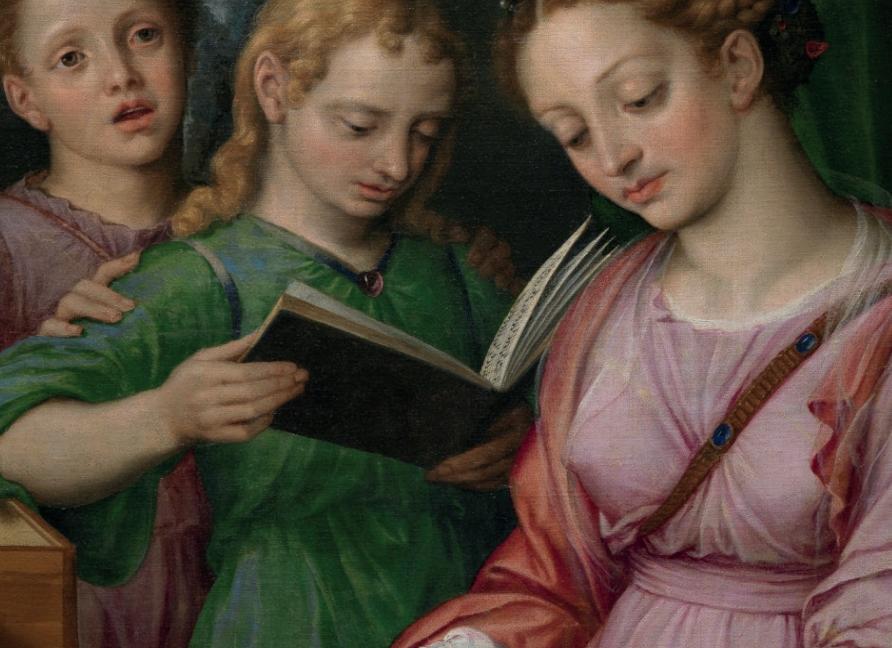
中文讲解
此段为第1页上的图像占位符,原始图片数据未在此提供。占位符明确告知读者此处原本是图像或乐谱示例,其位置与图注在版面上保留,但具体视觉内容需查看原图。
第2段(P0002)
原文复述
›Universum rei harmonicae concentum absolvunt‹
中文讲解
这是主标题的拉丁文副题,前后使用低单书名号 ›‹ 包围,是欧洲学术出版物中用于标示书名的常见排印方式。该拉丁文短语为全书的总题,直译约为「他们(演奏者)展现出宇宙和谐之音的完整共鸣」,暗示全书以“和声”与“宇宙秩序”的修辞贯穿十六世纪羽管键琴的论题。
补充说明
与P0003的英文正标题对应,共同构成书名页上的双语题名。
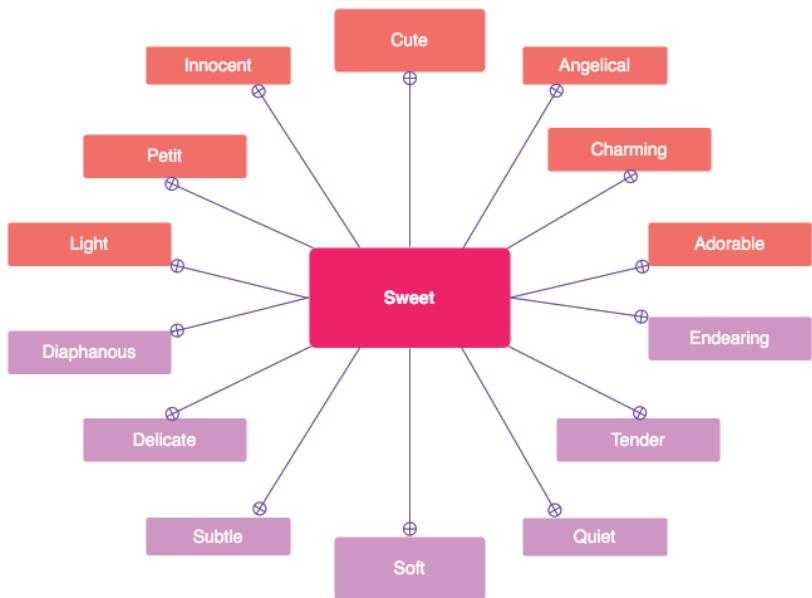
第3段(P0003)
原文复述
THE HARPSICHORD IN THE SIXTEENTH CENTURY
中文讲解
此为书名的英文正标题,直译为「十六世纪的羽管键琴」。它点明全书的研究对象(羽管键琴这一键盘乐器)与时代范围(十六世纪)。标题采用全大写排版,是封面/扉页上标识主标题的版面惯例。
补充说明
与P0002拉丁文副题并列,构成完整书名;P0009为同一标题的小写版式,多出现在重复出现书名的位置。
第4段(P0004)
原文复述
Augusta Campagne Markus Grassl
中文讲解
此段列出本书的两位编者姓名:Augusta Campagne 与 Markus Grassl。两人姓名并列,未带称谓,仅作为编辑署名出现在主标题下方。
补充说明
由下一段"eds.“进一步确认其身份为编者。
第5段(P0005)
原文复述
eds.
中文讲解
此段为编者身份的缩写,全称为 editors,中文意为「编辑」。它紧随P0004的两位姓名之后,说明二人并非作者,而是论文集的编者(即将多位作者的文章汇编成册的责任人)。
第6段(P0006)
原文复述
mwPress
中文讲解
此段为出版社名称「mwPress」,即 mdw – University of Music and Performing Arts Vienna(维也纳音乐与表演艺术大学)下属的出版社。它出现在封面底部,是出版信息的核心部分。
补充说明
该出版社与P0010、P0011中提到的两位编者所在机构同属一所大学,由此可知本书为该大学出版项目的一部分。
第7段(P0007)
原文复述
Augusta Campagne, Markus Grassl (eds.)
中文讲解
此段出现在第2页(很可能为版权页或扉页背面),将两位姓名合并书写并以「(eds.)」标示其编者身份。相较于P0004–P0005的封面版本,这里使用了更规范的学术著录格式:在姓名之间加逗号,并将身份缩写置于括号中。
补充说明
与P0004–P0005的封面署名相对照,体现同一信息在不同版面上的格式差异。
第8段(P0008)
原文复述
‘Universum rei harmonicae concentum absolvunt
中文讲解
此段为拉丁文书名的再次出现,使用前置单引号 ’ 起头(对应闭合引号可能出现在P0009之后或被省略)。它确认全书的副题在版权/著录页上被独立列出,与P0002封面上的排版形成版本对应关系。
第9段(P0009)
原文复述
The Harpsichord in the Sixteenth Century
中文讲解
此段为英文正标题的小写版式,完整词组首字母大写、其余小写。与P0003封面全大写形式相比,这里的版式更接近常规著录格式,多见于版权页或图书馆编目所引用的标题写法。
第10段(P0010)
原文复述
Augusta Campagne taught harpsichord and figured bass at the mdw – University of Music and Performing Arts in Vienna. Her main research interests are early keyboard accompaniment and harpsichord music of the long 16th century.
中文讲解
此段介绍编者之一 Augusta Campagne 的学术背景。她在维也纳的 mdw(音乐与表演艺术大学)教授羽管键琴与通奏低音;其主要研究方向为早期键盘伴奏以及「长十六世纪」(the long 16th century,指跨越文艺复兴盛期至巴洛克早期的较长时段,约 1450–1620 年间)的羽管键琴音乐。这段简介既说明她的教学身份,也点明其与本书主题(十六世纪羽管键琴)的学术契合。
补充说明
「the long 16th century」是音乐史学术语,指一个比严格日历意义上的 1500 年代更宽泛的时期框架;此术语仅在本段中出现,用以界定 Campagne 的研究范围。
第11段(P0011)
原文复述
Markus Grassl is professor at the Institute for Musicology and Performance Studies at the mdw – University of Music and Performing Arts in Vienna. His research focuses on early instrumental music, the music of the French Baroque, and the history of performance of early music in the 20th century.
中文讲解
此段介绍编者之二 Markus Grassl 的学术背景。他是维也纳音乐与表演艺术大学音乐学与表演研究学系(Institute for Musicology and Performance Studies)的教授,研究聚焦于三个方向:早期器乐、法国巴洛克音乐、以及二十世纪中早期音乐演奏实践的历史。这一简介与 P0010 中 Campagne 的简介在同页并列,共同构成「编者简介」栏目,使读者了解两位编者各自的研究侧重,进而理解本书选题的学术脉络。
补充说明
将 P0010 与 P0011 合并阅读可见:Campagne 偏重十六世纪键盘音乐的演奏实践,Grassl 偏重早期器乐与历史演奏学传统——二人研究取向互补,正与「十六世纪羽管键琴」这一跨越演奏实践与音乐史的题目相呼应。
脚注 / 边栏 / 图表 / 附加信息(如有)
本小节涵盖扉页(P0002–P0006)、版权/著录页(P0007–P0009)以及编者简介页(P0010–P0011)的全部内容。其中 P0001 为第 1 页的图像占位符,原图未在文本中给出,需查阅原书以确认其内容(可能为封面图案、徽章或乐谱装饰)。P0002–P0006 共同构成封面信息:拉丁副题、英文正标题、编者姓名、编者身份缩写及出版社名称。P0007–P0009 是同一信息在版权页的规范化复现。P0010–P0011 为两位编者的学术简介,是论文集类出版物中常见的附加材料,用于说明编者的学术资质与本书选题之间的关联。
💡 本节核心要点
- 本书题名为拉丁文副题 ›Universum rei harmonicae concentum absolvunt‹ 与英文正标题 The Harpsichord in the Sixteenth Century 的组合,明确研究对象为十六世纪羽管键琴。
- 本书由 Augusta Campagne 与 Markus Grassl 担任编者(eds.),二人均任教于维也纳音乐与表演艺术大学(mdw)。
- 出版社为 mwPress,与编者所在机构同属一所大学,提示本书为该大学出版项目。
- Campagne 的研究侧重十六世纪羽管键琴演奏与通奏低音教学,Grassl 的研究侧重早期器乐、法国巴洛克音乐及二十世纪早期音乐演奏史。
- 扉页信息在第 2 页以规范化著录格式(姓名加逗号、(eds.) 缩写、首字母大写标题)复现,便于学术引用。
🔑 关键术语
- ›…‹:低单书名号(low single guillemets),欧洲出版物中用于标示书名、文章名或篇章名的成对排印符号;本节用于包裹拉丁文副题。
- eds.:editors 的缩写,置于编者姓名后或括号中,表明其身份为论文集或合著的编者而非作者。
- the long 16th century:音乐史术语,指一个跨越约 1450 至 1620 年的较长时段,比严格的 1500–1599 年更宽,用于涵盖文艺复兴盛期至巴洛克早期的整体文化变迁;在 P0010 中用于界定 Campagne 的研究范围。
- figured bass:通奏低音(数字低音),一种在低音线条上方标注数字以指示和弦与和声的记谱与即兴伴奏体系;Campagne 在 mdw 教授该课程。
- mwPress:维也纳音乐与表演艺术大学(mdw – University of Music and Performing Arts Vienna)下属的出版社名称。
- Institute for Musicology and Performance Studies:维也纳音乐与表演艺术大学下属学系名称,Grassl 于此任教授;该系名暗示音乐学研究与历史演奏实践研究并重的学科定位。
s0002 [描述性拆分] Half Title and Open Access Copyright Notice
第1段(P0012)
原文复述
Augusta Campagne, Markus Grassl (eds.)
中文讲解
本页(半书名页)首先列出编者姓名 Augusta Campagne 与 Markus Grassl,并在其后附上 (eds.) 以表明二人是该书的编者而非作者。在出版惯例中,(eds.) 用于标识多人合作编辑的学术文集。两位编者的并列出现,提示本书是由他们共同主持编辑工作的成果。
第2段(P0013)
原文复述
‘Universum rei harmonicae
中文讲解
这是书名拉丁文部分的上行,原文以左单引号 ‘ 起头。Universum rei harmonicae 是拉丁语,字面可理解为“和谐之物的整体”。这一行作为拉丁文书名的第一行,分两行排版,第二行见 P0014。
第3段(P0014)
原文复述
concentum absolvunt’
中文讲解
这是拉丁文书名的下行,以右单引号 ’ 收尾。concentum absolvunt 可理解为“奏出和声”或“完成齐鸣”。合在一起,全句 Universum rei harmonicae concentum absolvunt 大致意为“万物奏响和谐之曲”。该引文本身带有古典学术语体,用来作为本书正式书名,呼应十六世纪音乐理论中以“宇宙和谐”为题的修辞传统。
第4段(P0015)
原文复述
The Harpsichord in the Sixteenth Century
中文讲解
这是该书的英文副标题,直译为《十六世纪的羽管键琴》。它解释了拉丁文书名的具体研究范围:本书是一部聚焦于十六世纪羽管键琴的学术著作。英文副标题让现代读者一目了然地把握主题。
第5段(P0016)
原文复述
mwPress
中文讲解
此行是出版社名称,写作 mwPress,指代维也纳音乐与表演艺术大学的出版社(mdwPress)。它出现在半书名页的底部,作为出版机构标识。
第6段(P0017)
原文复述
The authors acknowledge the financial support by the Open Access Fund of the mdw – University of Music and Performing Arts Vienna.
中文讲解
这是一段致谢声明,作者们承认其研究获得了维也纳音乐与表演艺术大学(mdw)开放获取基金(Open Access Fund)的经费资助。声明中的 Open Access Fund 表明,本书的出版遵循开放获取模式——即读者可免费在线阅读并按许可条款再利用——而资助来源则具体指向 mdw 大学的专项基金。
第7段(P0018)
原文复述

中文讲解
此处为第 5 页上的图像或乐谱占位符,原图的嵌入式数据已省略,仅保留其在版面中的位置与图注信息。读者需查看原书第 5 页才能看到实际图像。
第8段(P0019)
原文复述
universität für musik und darstellende kunst wien
中文讲解
此为德文机构名称,全小写排版,对应英文 mdw – University of Music and Performing Arts Vienna,即维也纳音乐与表演艺术大学。它通常以标志或图章形式出现在版权页上,表明出版方所属机构。
第9段(P0020)
原文复述

中文讲解
此处为第 5 页上的另一处图像或乐谱占位符,原图内嵌数据已省略,仅保留其在版面中的位置与图注信息。需查看原书第 5 页方能确认内容。
第10段(P0021)
原文复述
This work is licensed under the Creative Commons Attribution 4.0 (BY) license, which means that the text may be remixed, transformed and built upon and be copied and redistributed in any medium or format even commercially, provided credit is given to the authors. https://creativecommons.org/licenses/by/4.0/ Creative Commons license terms for re-use do not apply to any content (such as graphs, figures, photos, excerpts, etc.) not original to the Open Access publication and further permission may be required from the rights holder. The obligation to research and clear permission lies solely with the party re-using the material
中文讲解
此段声明本书采用知识共享署名 4.0(CC BY 4.0)许可协议。其核心含义有三层:第一,正文文本可在任何媒介或格式中被复制、再传播,甚至用于商业目的;第二,使用者必须署名作者;第三,对非本书原创的内容(如图、表、照片、节录等),CC BY 的再利用规则不适用,使用者需另行向权利人取得许可,且自行负责查清与取得相应授权。这一段界定的是开放获取出版中作者原创文本与非原创素材的边界。
第11段(P0022)
原文复述
First published in 2024 by mdwPress, Vienna © Augusta Campagne, Markus Grassl (eds.)
中文讲解
此行为版本与版权信息:本书于 2024 年由位于维也纳的 mdwPress 首次出版,版权归编者 Augusta Campagne 与 Markus Grassl 所有。它以 © 符号标识版权归属,并指明出版地与出版年份,是版权页的核心书目信息。
第12段(P0023)
原文复述
Cover layout: mdwPress Cover illustration: Michel Coxcie, Saint Cecilia, 1569, oil on canvas, (P001467). Madrid, Museo Nacional del Prado. © Photographic Archive Museo Nacional del Prado. https://doi.org/10.21939/harpsichord-16c PDF-ISBN: 978-3-9505619-0-6
中文讲解
此段集中列出封面制作信息和书目识别号。封面设计由 mdwPress 承担;封面插图取自 Michel Coxcie 于 1569 年创作的油画《圣则济利亚》(Saint Cecilia),原作现存于马德里普拉多国家博物馆(Museo Nacional del Prado),编号 P001467,图像版权属于普拉多国家博物馆摄影档案馆。段末给出数字对象标识符 DOI(https://doi.org/10.21939/harpsichord-16c)与 PDF 版 ISBN(978-3-9505619-0-6),便于读者定位电子版与纸本。从封面选用圣则济利亚这一音乐守护圣徒的画作,可以看出编辑有意识地将本书主题(音乐与羽管键琴)与图像传统相互呼应。
脚注 / 边栏 / 图表 / 附加信息(如有)
本节为半书名页与开放获取版权页,共含两处图像/乐谱占位符(P0018、P0020),其内嵌数据已省略,仅保留版面位置与图注位置。脚注性说明已并入正文对应段落(包括开放获取基金致谢、CC BY 4.0 许可条款、首次出版信息、封面设计归属、封面插图来源、DOI 与 PDF-ISBN)。
💡 本节核心要点
- 半书名页以拉丁文书名 Universum rei harmonicae concentum absolvunt 与英文副标题 The Harpsichord in the Sixteenth Century 并列呈现,标明编者 Augusta Campagne 与 Markus Grassl 及出版社 mwPress。
- 本书由维也纳音乐与表演艺术大学(mdw)开放获取基金资助出版,遵循开放获取模式。
- 正文采用 Creative Commons Attribution 4.0(CC BY 4.0)许可,允许在署名前提下被复制、再传播、改编乃至商业再利用,但对非原创素材(图、表、照片、节录等)不适用,使用者须自行取得权利人许可。
- 首次出版信息:2024 年由位于维也纳的 mdwPress 出版,版权归两位编者所有。
- 封面插图取自 Michel Coxcie 1569 年油画《圣则济利亚》,原作藏于马德里普拉多国家博物馆,图像版权归该馆摄影档案馆所有。
- DOI(10.21939/harpsichord-16c)与 PDF-ISBN(978-3-9505619-0-6)为本书提供永久电子定位与版本识别。
🔑 关键术语
- Universum rei harmonicae concentum absolvunt:本书拉丁文正书名,字面可理解为“万物奏响和谐之曲”,源自古典修辞,用以指代本书对十六世纪羽管键琴与音乐和谐之研究。
- Open Access Fund (mdw):维也纳音乐与表演艺术大学设立的开放获取出版资助基金,本书作者致谢的经费来源,表明本书以开放获取方式出版。
- Creative Commons Attribution 4.0 (CC BY 4.0):知识共享署名 4.0 国际许可协议;允许在署名前提下复制、传播、改编乃至商业使用本书正文文本,但对非原创素材另有约束。
- mdwPress:维也纳音乐与表演艺术大学的出版社,本书的出版方,并负责封面设计。
- DOI (Digital Object Identifier):数字对象标识符,用于永久定位电子资源;本书 DOI 为 10.21939/harpsichord-16c。
- PDF-ISBN:国际标准书号在 PDF 电子版中的对应编号,本书为 978-3-9505619-0-6,用于唯一标识电子版本。
s0003 [描述性拆分] Table of Contents
第1段(P0024)
原文复述
Contents
中文讲解
本段是一个 Markdown 二级标题,写作 “Contents”,作用是标识并开启目录板块。该标题自身不携带章节信息,仅为随后列出的全书各章编号、标题、作者与起始页码提供总框架,使读者能够从本书开头的两页快速定位每个章节的起始处。
第2段(P0025)
原文复述
1 Introduction Augusta Campagne, Markus Grassl 3 2 The Rhetoric of Sweetness Towards Ideals of Perception and Performance in Sixteenth-Century Keyboard Music Catalina Vicens 9 3 Keyboard Tablatures and Imaginary Instrumental Interchange in the Sixteenth Century John Griffiths 24 4 Hacking the System Italian Keyboard Intavolatura and Scribal Habit Ian Pritchard 42 5 Singing, Reading, Writing, Playing Practising with Tomás de Santa María August Valentin Rabe 66 6 ‘Nach seinem selbst gefallen mit der Mensur wexln’ Instances in Sixteenth-Century Keyboard Music Where Ornamentation and Changing Note Values Might Induce the Player to Vary the Beat Domen Marinčič 79 7 On the Performance Practice of Andrea Antico’s Frottole intabulate da sonare organi, libro primo (Rome, 1517) Fabio Antonio Falcone 112
中文讲解
本段是全书目录的第一部分,覆盖第 1 章至第 7 章。每条目录以"章号—标题(部分含副标题)—作者—起始页码"的格式排列:第 1 章为 Augusta Campagne 与 Markus Grassl 合写的 Introduction,始于第 3 页;第 2 至第 7 章各有特定主题与作者,Catalina Vicens(始于第 9 页)、John Griffiths(第 24 页)、Ian Pritchard(第 42 页)、August Valentin Rabe(第 66 页)、Domen Marinčič(第 79 页)、Fabio Antonio Falcone(第 112 页)依次承接。从主题看,前七章以 16 世纪键盘音乐为核心,从修辞学(“The Rhetoric of Sweetness”)、记谱与谱式流通(“Tablatures and Imaginary Instrumental Interchange”、“Italian Keyboard Intavolatura and Scribal Habit”)、练习法(“Practising with Tomás de Santa María”)、装饰与时值问题(“Ornamentation and Changing Note Values… Vary the Beat”),一直深入到对 Andrea Antico 1517 年罗马出版物 Frottole intabulate da sonare organi, libro primo 的演奏实践研究。第 6 章的德文短句 ‘Nach seinem selbst gefallen mit der Mensur wexln’ 是该章将以之切入论证的原始引语,第 7 章则直接以出版物标题为题。这些章题本身就提示出多语种(英语、德语、意大利语)与多史料形态(理论、修辞、抄本、印刷曲集)的研究取向。
补充说明
目录条目的排版样式为:编号独占一行、主标题、副标题(若有)、作者与起始页同行;多语种原始短句保留原文不予翻译,符合学术编辑规范;起始页码反映该章正文实际所在位置,与本书前页一致。
第3段(P0026)
原文复述
8 Le mani di Cecilia Hand Position and Fingering on Keyboards in Italian Iconographical Sources of the Renaissance Maria Luisa Baldassari 136 9 From Lisbon to Shewa via Goa Renaissance Keyboards in the Christian Kingdom of Sixteenth-Century Ethiopia Janie Cole 167 10 Antonio de Cabezón at the Centre of the World Repertoire, Interpretation and Meaning Andrés Cea Galán 198 11 Appendix 234
中文讲解
本段是全书目录的第二部分,覆盖第 8 至第 10 章以及第 11 项附录,跨页至本书第 8 页。第 8 章以意大利文 “Le mani di Cecilia” 为章名,配以英文副标题 “Hand Position and Fingering on Keyboards in Italian Iconographical Sources of the Renaissance”,作者 Maria Luisa Baldassari,始于第 136 页,将目光投向意大利文艺复兴图像志中键盘演奏者的手位与指法。第 9 章章名 “From Lisbon to Shewa via Goa” 以三处地名勾勒出 16 世纪基督教埃塞俄比亚王国获得文艺复兴键盘乐器的传播路线,作者 Janie Cole,始于第 167 页。第 10 章以西班牙键盘家 Antonio de Cabezón 为中心,副标题 “Repertoire, Interpretation and Meaning” 点明其论域为曲目、演绎与意义,作者 Andrés Cea Galán,始于第 198 页。第 11 项写作 “Appendix”,排在第 234 页,不署作者,对应全书末尾的附录板块。与前 7 章相比,这部分研究的对象更为多样:图像志文献、跨大洲文化传播路线与单一作曲家个案同时出场,使全书在保持"16 世纪键盘音乐"主轴的同时扩展了史料类型与地理范围。
补充说明
第 9 章章名中三个地名(里斯本 Lisbon、果阿 Goa、谢瓦 Shewa)依目录所示分别对应 16 世纪从欧洲经印度洋至非洲之角的文化通路;末项"Appendix"无作者署名,符合附录作为参考材料或图表汇总的通常做法,正文内或附录起始页应有相应说明。
脚注 / 边栏 / 图表 / 附加信息(如有)
无(本节为目录正文,未出现脚注、图表编号或边栏说明)。
💡 本节核心要点
- 全书目录共列 11 项(10 章正文加 1 项 Appendix),全部围绕 16 世纪键盘音乐这一主轴展开,且章节顺序标明本书覆盖范围跨越第 3 页到第 234 页。
- 目录条目统一采用"章号—标题—副标题(若有)—作者—起始页码"的格式,并跨越第 7 至第 8 页两页呈现。
- 章题本身即反映出多语种与跨地域的视野:意大利语(Le mani di Cecilia、Frottole intabulate da sonare organi)、德语(Nach seinem selbst gefallen mit der Mensur wexln)、西班牙语人名(Antonio de Cabezón)以及从里斯本经果阿到埃塞俄比亚的地理路线。
- 研究的史料类型非常多样:理论著作、印刷曲集、抄本谱式(intavolatura、tablatures)、练习法论著、装饰与节拍问题、图像志文献、跨大洲传播史料以及作曲家个案。
- 每章作者各为独立研究者或合作组合,体现本论文集是同一议题下的多方对话。
- 末项"Appendix"不署作者,提示其性质为参考性或汇总性的补充材料,须翻至本书末尾方可知其具体构成。
🔑 关键术语
- Intavolatura:由第 4 章副标题 “Italian Keyboard Intavolatura and Scribal Habit” 可知,是意大利语中用于指称意大利键盘音乐某一谱式或印刷谱形式的术语,本书将其与抄写习惯(scribal habit)一同讨论。
- Tablatures (Keyboard):由第 3 章章名 “Keyboard Tablatures and Imaginary Instrumental Interchange in the Sixteenth Century” 可知,指 16 世纪键盘音乐领域中与乐器间交流(instrumental interchange)相关的一类记谱谱式,是该章的专题对象。
- Mensur:由第 6 章章名 ‘mit der Mensur wexln’ 及副标题 “Ornamentation and Changing Note Values Might Induce the Player to Vary the Beat” 可知,是与音符时值变化、装饰音以及节拍变动相关的德语术语,在该章中被用作论证装饰如何诱发演奏者改变拍速的概念工具。
- Frottole intabulate da sonare organi:由第 7 章章名可知,为 Andrea Antico 于 1517 年在罗马出版的曲集全名(libro primo),本书第 7 章即以这一具体出版物的演奏实践为研究对象。
- Iconographical sources:由第 8 章副标题 “Italian Iconographical Sources of the Renaissance” 可知,指以文艺复兴时期意大利的图像(绘画、雕塑等视觉材料)作为研究依据的史料类型,本书第 8 章用其讨论键盘演奏者的手位与指法。
- Le mani di Cecilia:第 8 章的意大利文章名,字面意思为"塞西莉亚的双手”,与该章所研究的意大利文艺复兴图像志中键盘手位与指法主题相呼应;具体所指人物身份需根据该章正文进一步确认。
s0004 [描述性拆分] Introduction: Conference Rationale and Chapter Overview
第1段(P0027)
原文复述
1 Introduction
中文讲解
This is the chapter-level heading that opens the introduction to the volume. The numeral “1” and the word “Introduction” indicate that what follows is the opening chapter of the book, not a free-standing preface. Functionally, this heading signals to the reader that the text beneath it will lay out the rationale, scope and structure of the entire publication, before any topic-specific contributions begin. From the section heading alone we know nothing yet about the substance of the argument; the substance will be supplied by the chapter authors (named immediately below) and by the paragraphs that follow.
第2段(P0028)
原文复述
Augusta Campagne, Markus Grassl
中文讲解
这一行给出本章节(即整个引言部分)的作者署名:Augusta Campagne 和 Markus Grassl。它本身不承载论证内容,只是用来标明以下引言正文是由两位作者共同撰写或共同负责,并由此承担后续关于会议缘起、章节安排等说明性文字的署名责任。读者据此可以把后面所有“作者认为……”、“我们观察到……”之类的主体都还原到这两位具体编者/作者身上,而不是归属于书中的其他论文作者。
第3段(P0029)
原文复述
‘Quae dum manibus agitantur, universum rei harmonicae concentum absolvunt’ – when operated with the hands, they produce the complete sound of a harmony, i.e. of a polyphonic setting. It was with these words that Othmar Luscinius, in his Musurgia seu praxis musicae of 1536, expressed what he apparently considered to be the most striking, even defining, characteristic of stringed keyboard instruments such as the clavichord, the virginal, the clavicitherium and the clavicimbalum. As is well known, this salient feature of being a ‘strumento perfetto’ was repeatedly emphasised by Renaissance authors. It is precisely this very quality which lies at the heart of the reasons for the increasing significance of keyboard instruments in general and the harpsichord in particular during already the 15th and especially the 16th centuries. In a number of respects keyboard instruments and instrumental culture underwent a dynamic development during this period. To mention only the most important points in our context: stringed keyboard instruments in general, and the harpsichord in particular, spread throughout Europe and sometimes even beyond; this process was accompanied by regional diversification, not least in harpsichord building. Due to their capability of rendering virtually every kind of music, stringed keyboard instruments acquired manifold functions in musical and cultural life. They were played both by professionals and, increasingly, by amateurs, both as solo instruments as well as in various ensembles, especially in an accompanying role (which eventually led to the development of basso continuo and its respective precursors); they were used as a means for both improvising as well as for performing written music, be it pieces originally conceived for keyboard, or intabulations or arrangements of vocal and instrumental ensemble music. At the same time the 16th century is the period, from which we have the first substantial body of notated keyboard music.
中文讲解
本段是整个引言的理论核心。它由三组相互支撑的论述构成。
第一组:作者开门见山引用了1536年 Othmar Luscinius《Musurgia seu praxis musicae》中的拉丁文原句 ‘Quae dum manibus agitantur, universum rei harmonicae concentum absolvunt’,并给出作者自己的英译——当用双手操作时,这类乐器能够“发出完整和声的声音”,即一首复调作品所需要的全部声部。Luscinius 用这句话总结的,是羽管/击弦键盘家族(clavichord、virginal、clavicitherium、clavicimbalum)最令他(以及整个文艺复兴理论界)看重的本质特性。
第二组:作者点出文艺复兴作者反复强调的同一品质——“strumento perfetto”(完美的乐器)。换言之,键盘乐器之所以能在15世纪、尤其是16世纪的地位不断上升,根本原因就在于它能凭借一双手复现整部复调织体。换到本卷的语境里,这意味着大键琴(harpsichord)地位上升的根源不在音色或音量,而在“独力承担复调”这一功能。
第三组:作者把这一功能性优势展开为若干具体后果。原文用“仅提与本卷直接相关的重要几点”框定范围,因此下面的列举不是穷尽性目录,而是被作者刻意挑选的、与本卷主题紧密相关的几条: (a)地理上的扩张:键盘乐器与大键琴扩散到全欧洲,乃至欧洲之外; (b)制琴层面的区域分化:harpsichord building 出现了不同流派的区域特色; (c)功能多样化:因“几乎能演奏一切音乐”,键盘乐器同时承担独奏、伴奏、专业/业余、室内/合奏等多种角色;其中伴奏功能在后来直接孕育了 basso continuo 及其前身; (d)使用方式上:既用于即兴,也用于演奏写定的乐谱——既有专为键盘谱写的作品,也有把声乐或器乐合奏作品改编/移植(intabulation)而成的键盘版本; (e)曲谱层面的事实:16世纪恰好是留下第一批“成规模的键盘乐记谱文献”的时期。
这段在本小节中的论证作用是:先用一句16世纪理论家的拉丁文权威定义“键盘乐器能做什么”,再用一段历史性概述说明“为什么这种功能在15–16世纪会变成越来越重要的现象”,从而为后文提出“仍有许多研究空白、值得专门办一次会议”这一判断(见 P0031)准备好充分的前提。读者要避免的一个误解是:作者在这里并不是泛泛讲述键盘乐器的辉煌史,而是在为“专门聚焦 16 世纪 harpsichord”这件事提供理论上的合法性——正因为键盘被视作‘strumento perfetto’,所以围绕它的讨论必须同时涉及乐器学、记谱法、曲目、演奏实践等多个层面,这也预告了后文所说“议题范围极广”的判断。
补充说明
原文中的 intabulations 一词在键盘音乐语境里特指“把声乐或合奏曲逐声部改写成键盘独奏谱”的做法,是 16 世纪键盘文献的一种主要来源;与之相关,basso continuo 一词虽在原文未出现,但作者明确提到伴奏功能最终孕育了通奏低音及其“前身”,二者均属于本段的功能多样化论点。
第4段(P0030)
原文复述
1 Othmar Luscinius, Musurgia seu praxis musicae (Strasbourg: Johann Schott, 1536), 9 (vdm 215), online: https://mdz-nbn-resolving.de/details:bsb10164954 (accessed 25 July 2023).
中文讲解
这是 P0029 中所引拉丁文‘Quae dum manibus agitantur…’的来源脚注。其功能属于“出处/原始文献来源”类注释,目的是让读者可以查到引文的原始版本,而不仅仅是依赖作者转译。
注释中的关键信息包括:作者 Othmar Luscinius;作品名《Musurgia seu praxis musicae》;出版地 Strasbourg;出版者 Johann Schott;出版年份 1536;引用页码 9;括号内的 vdm 215 是该书在数字化项目中的编号;其后给出慕尼黑数字化中心(Münchener Digitalisierungszentrum, MDZ)的解析链接;最后注明 2023 年 7 月 25 日访问。
对本段正文的作用:这是对“1536 年文献中的这句拉丁文”提供权威性支撑,使作者关于“文艺复兴作者反复强调键盘乐器是完美乐器”的判断有了第一手的引证来源;它也是典型的脚注用法,即“支持/来源”型脚注,而非限定或例外说明。
补充说明
脚注中 vdm 215 是 Verzeichnis der Musikdrucke des 16. Jahrhunderts 之类的早期近代乐谱编号系统中的一种标识,便于图书馆与音乐学界跨目录定位此版本;脚注的访问日期 25 July 2023 是网络资源类引用的标准标注要素。
第5段(P0031)
原文复述
These few keywords alone indicate the broad range of issues which is involved in dealing with the harpsichord in the 16th century – issues that range from the cultural significance of keyboard instruments and keyboard playing to organology, notation, repertoire and in particular the question whether specific repertoires for the individual types of keyboard instruments can be defined. Of course, many of these questions have been addressed by scholars in recent times. Likewise, the interest of performers in stringed keyboard instruments from 1500 to 1600, as well as their repertoire and relevant aspects of performance practices, has increased considerably in recent decades. Nevertheless, it is indisputable that the subject is far from fully explored. Numerous research questions have either remained unsolved or newly emerged. In addition, much of the engagement with this music is limited to a specific repertoire and/or to individual performers and researchers within specific countries. Finally, it can be observed that despite all these endeavours, to a certain extent the keyboard music of the 16th century still appears to be somewhat overshadowed by later music: even today it is sometimes viewed not as significant in its own right, but just as a preliminary stage to the richness of baroque keyboard music; it only plays a minor role within the harpsichord and organ curricula at universities and conservatories; its performance is typically approached both aesthetically as well as technically from a point of view shaped by experience with the 17th and 18th century repertoires.
中文讲解
本段把 P0029 中列举的“关键议题”转化为“研究现状评估”,并由此推出“仍有必要专门办一次会议”的结论。
第一句是承接:仅凭 P0029 里点出的几个关键词(地理扩张、区域分化、功能多样化、即兴与记谱并存、首份成规模的键盘乐文献等),就已经可以推出,16 世纪 harpsichord 涉及的议题跨越了文化意义、organology(乐器学)、记谱法、曲目,以及一个尤其关键的问题——能否为每一种键盘乐器界定各自专属的曲目。
第二层是对现状的承认:作者并不否认学界与演奏界近年来确实投入了显著精力,音乐学者已多次处理过这些议题,演奏家对 1500–1600 年键盘乐器及其曲目、演奏实践的兴趣也在近几十年明显增长。
第三层是关键的转折:“Nevertheless” 引出本段真正的判断——尽管有这些进展,研究远未完成。许多问题仍悬而未决或新近出现;而且现有研究往往局限于某一类曲目、某几位演奏家或研究者,且多半囿于特定国家之内。
第四层是更具批判性的观察:即使有以上种种努力,16 世纪键盘音乐在当代仍然“在某种程度上被后来的音乐所遮蔽”——它常被视为通往巴洛克键盘音乐丰富性的“前奏”而非独立的研究对象;它在高校与音乐学院 harpsichord 与 organ 课程中只占边缘位置;当代演奏无论在美学还是技术层面,也仍然主要被 17、18 世纪曲目所形成的审美经验所塑造。
本段在小节中的论证作用:把“议题很多”升级为“现有研究覆盖度不足 + 边缘化的学科地位”这一双重论证,从而给下一段(P0032)发起会议的决定提供具体的、而非泛泛的合法性。读者要避免的误解是:作者并不是在抱怨学界不够努力,而是在点出一个结构性事实——研究是分散的、曲目是片面的、演奏传统是滞后于历史现实的,因此“集中、跨国、跨学科地讨论”本身就有方法论价值。
补充说明
organology 一词在本节特指对乐器本体(形制、构造、分类、演变)的研究,与 P0029 中提到的 clavichord/virginal/harpsichord 等具体乐器直接相关;“specific repertoires for the individual types of keyboard instruments”暗示作者本人意识到不同键盘乐器(如 virginal 与 harpsichord)是否拥有各自专属曲目,是一个至今仍存在分歧的研究问题。
第6段(P0032)
原文复述
These observations led to the idea of organising a conference devoted specifically to the harpsichord and its music from c. 1500 to 1600. This eventually took place at the University of Music and Performing Arts Vienna (mdw) from the 20th to 22nd of April 2021 (due to Corona-related restrictions imposed earlier this year, the event had to be held online). The primary goal was to provide a forum for exchanging experiences, insights and findings, with participants from different fields – musicologists, scholar-performers, instrument builders – in order to gain a broad as possible perspective. Accordingly, the event consisted of different formats – papers, lecture-recitals and masterclasses for the students of mdw.2 The present publication includes the majority of the papers, all having been revised by the authors for the published version.
中文讲解
本段是从“研究现状评估”过渡到“本书出版缘起”的桥梁段。它清楚交代了本书最直接的生成机制。
首先,因果连接词 “These observations” 把本段挂回到 P0031 的判断:正是因为观察到 16 世纪 harpsichord 研究存在议题广、覆盖散、被边缘化等问题,作者们才萌生了专门办一次会议的想法。会议的时间范围被明确界定为 c. 1500–1600,正好覆盖 P0029 所强调的 15 世纪后半叶到 16 世纪这一关键扩张期。
其次,会议的举办地与时间:奥地利 University of Music and Performing Arts Vienna(德语缩写 mdw),2021 年 4 月 20–22 日。括号里坦率说明了举办形式:由于当年早些时候的疫情管制(Corona-related restrictions),会议不得不在线举行——这一信息既是历史事实,也是对“为何会议虽跨国却仍能汇聚诸多学者”的解释。
再次,会议的目标与方法论:作者用一个介词短语 “with participants from different fields” 明确指出,会议有意跨越三种身份——音乐学者(musicologists)、学者型演奏家(scholar-performers)和制琴师(instrument builders)。这种“三方同台”的设计正是对 P0031 中“研究被分散于不同国家与不同人群”这一问题的直接回应。
然后,会议形式:包含论文报告(papers)、lecture-recitals(讲演式演奏,即一边讲一边演)与面向 mdw 学生的大师班(masterclasses)。lecture-recitals 这一形式尤其值得注意:它本身就是把“学术 + 演奏实践”合并呈现的典型方式,与本卷对“研究-演奏脱节”的批评相呼应。
最后一句解释本书与会议的关系:本书收录了会议论文中的“绝大多数”,且每一篇都经过作者为出版而做的修订。
本段在小节中的作用:把前两段(理论奠基 + 研究缺口)落地为一个具体的会议项目,并交代本书与该会议的直接血缘关系。读者要避免的误解是:本书并不是一次会议论文集式的被动汇编,而是作者们自己构想并主办的会议的成果——因此对会议缘起与限制(P0033)的理解,本身就是理解本书结构的关键。
补充说明
mdw 为 Universität für Musik und darstellende Kunst Wien 的常用缩写,原句已括注其英文全称;“scholar-performers” 指同时具备学术研究与演奏实践两种身份的学者,本卷中常见的对应群体是 harpsichordist-musicologist;“lecture-recital” 在西方音乐学传统里指将学术讲解与现场演奏合为一体的呈现形式。
第7段(P0033)
原文复述
It was evident from the beginning that the close connections between the harpsichord and other keyboard instruments during this period, would prompt several papers that would address various questions related to keyboard music and playing in general. Likewise, it is self-evident that a three-day conference and its report cannot cover the subject exhaustively. Nevertheless, the aim was to bring up as many diverse issues as possible, at least within the confines of exemplary case studies. Furthermore, the topic of the 16th-century harpsichord was also revisited at a further conference in Bologna in November 2023 with a special focus on Italy.
中文讲解
本段是给会议与本书“设限 + 展望”的收束段。它做了三件事。
第一,对会议内容结构的预期:作者承认,从一开始就很清楚,由于本时期 harpsichord 与其他键盘乐器之间存在紧密联系(例如共享曲目、共享演奏惯例、共享传播路径),会议中必有相当数量的论文会以“键盘音乐与键盘演奏的总体问题”作为切入角度,而不会严格只谈 harpsichord。这一句话实际上提前为读者解释了为何本卷中的论文并非全部只讨论 harpsichord 本体——它本来就是按计划包含了“键盘整体视角”的。
第二,对会议覆盖范围的坦诚限定:作者坦率承认,三天的会议及其论文集不可能穷尽这一主题;作者使用 “self-evident” 一词,强调这种不可能性并非会议组织不力,而是议题本身的规模使然。紧接着用 “Nevertheless” 转折,明确会议的真正目标是“尽可能多地提出多样化的议题”,即便只是借助案例研究(exemplary case studies)来展开。换言之,会议追求的是议题广度与方法示范性,而非系统性的百科全书式覆盖。
第三,展望:本卷虽是 2021 年维也纳会议的产物,但 16 世纪 harpsichord 这一话题在 2023 年 11 月于博洛尼亚举行的另一场会议中被再次讨论,这次会议有专门聚焦意大利的取向。这一句话一方面把本卷放回到一个正在进行的学术议程中,提示读者这不是一次性事件;另一方面也为未来可能的“按地域/国别”深入研究做了预告。
本段在小节中的论证作用:完成“会议缘起—会议实况—会议限度—后续动态”这一完整叙事链,让读者对本书的范围、边界与学术位置形成合理预期。读者要避免的误解是:以为本卷“遗漏”了某些议题——本段已说明这种不完整是有意的方法论选择,作者也通过补充 2023 年博洛尼亚会议来为未来的拓展留出空间。
补充说明
Bologna 2023 会议在本段作为“后续事件”被提及,它与本卷主题相同但范围更聚焦于意大利,作者借此把本书定位为更长的跨国合作研究脉络中的一环。
第8段(P0034)
原文复述
2 See the program in the appendix to this volume and the conference report by Augusta Campagne, in: Sounding Board 17 (Dec. 2021), 41–5, online: <https:// www.harpsichord.org.uk/sounding-board-archive/> (accessed 25 July 2023).
中文讲解
这是 P0032 中关于会议举办情况(程序与形式)那段话的脚注,编号为 2,功能属于“来源/旁证”型注释,目的是把本书对会议形式的描述与两个可查证的公开资料挂钩。
注释中包含两项指引:第一,本书附录(appendix to this volume)中收录了会议的完整 program;第二,会议本身的报告由 Augusta Campagne 撰写,发表于 Sounding Board 第 17 期(2021 年 12 月),页码 41–5;并附在线链接 harpsichord.org.uk 的 sounding-board-archive 页面,访问日期 2023 年 7 月 25 日。
对本段正文的作用:它支撑了 P0032 中关于“会议程序包含多种形式”这一描述,让感兴趣的读者既能在本卷附录中找到完整日程,也能在公开发表的会议综述里读到对该会议的回顾性介绍。这是一处“旁证 + 进一步阅读入口”型脚注。
补充说明
Sounding Board 是英国大键琴与击弦古钢琴协会(The British Harpsichord Society)的会刊名称;本卷主编 Augusta Campagne 同时被列为此份会议报告的作者,这与 P0028 中她作为引言作者之一的署名一致。
脚注 / 边栏 / 图表 / 附加信息(如有)
本小节包含两则脚注和一处对附录的指引。脚注 1(P0030)为 P0029 中拉丁文引文提供原始出版信息:Othmar Luscinius《Musurgia seu praxis musicae》(Strasbourg: Johann Schott, 1536), p. 9,并附 MDZ 数字版链接及访问日期。脚注 2(P0034)为 P0032 中关于会议形式与程序的描述提供两处可查证资料:本卷附录中的会议程序,以及 Augusta Campagne 发表于 Sounding Board 17 (Dec. 2021), pp. 41–5 的会议报告,附在线链接与访问日期。两则脚注分别承担“来源支撑”与“旁证/进一步阅读入口”的功能。除此之外,本节还提示了一处未以脚注形式出现的延伸信息——2023 年 11 月在博洛尼亚举行的另一场聚焦意大利的 16 世纪 harpsichord 会议,可视为对本书主题的后续动态说明。
💡 本节核心要点
- 16 世纪键盘乐器的核心地位源自其复调完整呈现能力——Luscinius 1536 年的拉丁文定义与文艺复兴作者反复强调的“strumento perfetto”观念共同构成本书的理论出发点。
- 15–16 世纪键盘乐器在地理、制琴、功能、使用者身份、演奏语境与曲谱留存等多个维度同时经历了显著扩张,这一扩张是本书聚焦 16 世纪 harpsichord 的历史前提。
- 尽管学界与演奏界近年来投入增加,但 16 世纪 harpsichord 研究仍存在议题分散、国别与曲目覆盖不均的问题,并且在当代学科建制与演奏传统中长期被巴洛克后期曲目所遮蔽。
- 2021 年 4 月 20–22 日在 mdw 线上举行的会议正是为了回应上述空白而设,会议刻意邀请音乐学者、学者型演奏家与制琴师共同参与,并以论文、lecture-recitals 与大师班三种形式呈现。
- 本书是上述会议的修订论文集,作者明确说明三天会议不可能穷尽议题,会议的目的在于通过案例研究展现尽可能多样化的议题。
- 16 世纪 harpsichord 这一主题在 2023 年 11 月博洛尼亚的另一场以意大利为重点的会议中得到延续,提示本书属于一个仍在进行中的跨国学术议程。
🔑 关键术语
- Musurgia seu praxis musicae:Othmar Luscinius 于 1536 年在斯特拉斯堡出版的音乐理论著作,本节引言的核心引文出处;书名意为“音乐术或音乐实践”。
- strumento perfetto:意大利文术语,意为“完美的乐器”,文艺复兴作者用以概括键盘乐器能凭一双手演奏出完整复调的能力,是本节用以解释键盘乐器地位上升的关键概念。
- clavichord / virginal / clavicitherium / clavicimbalum:Luscinius 在 1536 年原文中并列列举的四类击弦/拨弦键盘乐器;本节借此呈现 16 世纪键盘家族内部的多元性,并将其整体作为“strumento perfetto”的载体。
- intabulation:把声乐或器乐合奏作品的各声部改写成可在单一键盘乐器上演奏的独奏谱的做法,是 16 世纪键盘曲目生成的主要途径之一。
- basso continuo:巴洛克时期以数字低音为基础的通奏低音实践;本节指出键盘乐器的伴奏功能是其前身之一。
- organology:对乐器本体的形制、构造、分类与演变进行的研究;本节把它列为 16 世纪 harpsichord 研究的核心议题之一。
- mdw (Universität für Musik und darstellende Kunst Wien):维也纳音乐与表演艺术大学,2021 年线上会议的举办机构与本书附录中会议程序的所在单位。
- scholar-performers:兼具学术研究与演奏实践两种身份的学者,本节将其与音乐学者、制琴师并列为会议邀请的三大群体,以打破研究与演奏之间的脱节。
- lecture-recital:将学术讲解与现场演奏结合的会议形式,本节将其与论文、大师班并列为会议三种主要形式。
- Sounding Board:英国大键琴与击弦古钢琴协会的会刊,本节脚注 2 中登载了 2021 年维也纳会议的综述报告。
s0005 [描述性拆分] Introduction: Survey of Individual Chapters and Acknowledgements
第1段(P0035)
原文复述
In her fundamental article Catalina Vicens emphasises the need for a more comprehensive approach in order to achieve an appropriate practical realisation of sixteenth-century keyboard music. As Vicens points out, modern performances of this repertoire would fall short if they restricted themselves to merely executing precepts drawn from the realm of historically informed performance practice. Instead, it appears necessary to embed this music into a broader understanding of how it was perceived and aesthetically conceived by composers, performers and listeners during the sixteenth century. Vicens’ article proposes the concept of ‘sweetness’ as a key concept from which to launch such an investigation into the contemporary musical experience. ‘Sweetness’ represents a notion that surfaces again and again in descriptions of musical performances and in the perception of sound, and that was also specifically associated with the harpsichord. Furthermore, the concept was discussed—sometimes at length—in writings concerning rhetoric and poetics. On the basis of a reconstruction of the multifaceted meaning of ‘sweetness’, a number of questions arise that shed new light on a wide range of performance issues, including ‘classical’ aspects such as ornamentation, fingering, the shaping of tempo and so forth.
中文讲解
本段介绍全书第一篇文章,即Catalina Vicens所撰关于16世纪键盘音乐演奏的总论文。作者编者的核心判断是:仅靠“原真演奏实践”(HIP)所积累的规则清单,不足以恰当地呈现16世纪键盘音乐;还必须把作品放回当时作曲家、演奏者与听众共同塑造的审美世界中去理解。Vicens的策略是把“sweetness(甜美/甘美)”作为一个统摄性概念,因为该词一方面反复出现在16世纪对声音与演奏的描述中,并被专门与harpsichord(古键盘/拨弦键琴)关联;另一方面在当时的修辞学与诗学著作中也时常被详细讨论。复原这一概念的多元含义后,便能重新审视装饰、指法、速度塑造等“传统”演奏议题。教学上的关键提示是:Vicens并不是要给出一个针对键盘的演奏处方,而是用“甜美”作为一种方法论透镜,把技术层面与听觉/修辞/诗学层面的理解打通,这是编者将其文章安排在卷首的根本原因。
第2段(P0036)
原文复述
The following two chapters address an equally central topic whose significance for the historiography of sixteenth-century musical culture has, however, often been overlooked in earlier research: tablature and intabulation. John Griffiths’ chapter first provides a general clarification of the essential features and functions of tablature notation—which went far beyond its practical use by amateurs—and then specifically examines the tablatures used in the Iberian Peninsula. In particular, the chapter raises the question of whether the subtitle ‘for keyboard, harp, and vihuela’, found in several prints from the second half of the sixteenth century, should be taken at face value, which is the assumption made in most literature. A detailed analysis of the prefaces and the contextual information on the printing process indicates that Venegas de Henestrosa, in his Libro de cifra nueva (1557), actually aimed at a kind of ‘universal’ notation suitable for all solo instruments, and consequently presented a repertoire usable for keyboard, harp and vihuela alike. By contrast, Hernando de Cabezón’s publication of his father’s Obras de música (1578) consisted exclusively of music intended for keyboard; the subtitle was added only during the final phase of the printing process, presumably for commercial reasons.
中文讲解
本段进入第二、第三章共同的论题:tablature(数字谱/字位谱)与intabulation(将复调音乐改写为器乐形式)。编者首先指出,这个主题对16世纪音乐文化史虽极其重要,却长期被既有研究边缘化。Griffiths章的方法分两步:先以“通用”视角澄清tablature的本质与功能——它远不只是业余者使用的简易工具——再聚焦伊比利亚半岛印刷物。章末集中讨论一个问题:16世纪后半叶若干印刷曲集封面上都印着“为键盘、竖琴与维韦拉琴而作”这样的副标题,文献通常按字面意思接受之;Griffiths通过细读前言与印刷过程中的语境信息得出两个截然相反的结论:1557年Venegas de Henestrosa的《Libro de cifra nueva》确实意图为所有独奏乐器提供“通用”记谱,所收曲目也确实可同时用于键盘、竖琴与维韦拉琴;而1578年Hernando de Cabezón刊印其父(Antonio de Cabezón)的《Obras de música》则纯粹只含键盘作品,副标题是印刷末期才加上的,目的可能只在商业考量。理解本段的重点是:编者借此个案提醒读者不可轻信印刷物上的“通用副标题”,不同出版人的意图与出版流程需要独立考察,这是Griffiths章方法论的关键所在。
第3段(P0037)
原文复述
Ian Pritchard’s contribution demonstrates that a close examination of the sources can still provide new insights into the notation system of tablatures and the underlying musical thought processes. Given that the Italian intavolatura was a notation that included elements of a ‘Griffschrift’, a set of conventions can be deduced. These conventions were followed with great consistency in the intabulations of polyphonic (vocal) pieces—that is, in the translation of an original polyphonic fabric into an idiomatic keyboard texture—and appear to have operated on an unconscious or semiconscious level. Interestingly, the conventions become particularly visible in those brief instances when the scribes exceptionally deviated from them, either because of the limitations of the printing technology or in order to consciously preserve certain details of the original polyphonic structure.
中文讲解
Pritchard章是对Griffiths章的纵深推进,论旨是“认真考察原始文献依然能给tablature记谱本身及其背后的音乐思维带来新认识”。具体方法是:意大利intavolatura兼具有“Griffschrift(字母记谱)”的若干要素,因此可以从中归纳出一套写谱/转写惯例。这套惯例在将复调声乐曲改写为键盘织体时执行得相当一致,因而被推断处于“无意识或半意识”层面——也就是传统意义上的“规矩”,写谱者未必自觉说明,但处处遵守。有趣的反而是“破例之处”——因为印刷技术所限或者为了刻意保留原复调结构的某些细节,抄写者偶尔违背惯常做法,这些破例正是惯例“显形”的地方。教学提示:这是一段典型的“由正面证惯例,反向靠例外证之”的论证,读者阅读Pritchard章时只要看到“为什么这里明明可以那样写却不那样写”,通常就是在揭示一套隐藏的音乐决定。
第4段(P0038)
原文复述
Inspired by the relatively new yet markedly developing field of historically informed teaching practice, August Valentin Rabe draws attention to Tomás de Santa María’s Arte de tañer Fantasia (1565), the most informative source on how keyboard playing was taught and practised in the sixteenth century. As Rabe shows, Santa María envisaged a multilayered didactics whose main idea was to combine various ways of dealing with musical material, such as reading, studying and analysing (the structure of pieces written in mensural notation), writing, memorising, singing and playing.
中文讲解
Rabe章进入“历史上受启发的教学实践(historically informed teaching practice)”这一相对年轻却正在发展的领域。该章聚焦的“原始史料”是Tomás de Santa María的《Arte de tañer Fantasia》(1565),编者称其为16世纪键盘教学与实践中信息量最大的来源。Rabe通过细读指出,Santa María的教法是多层次、多通路并用的:阅读、研究与分析(mensural notation即定量记谱下乐曲的结构)、写作、记诵、歌唱、演奏——所有这些“处理音乐材料的方式”被刻意组合起来。其教学意涵是:16世纪的键盘教学并非后人常以为的“只会照谱弹”,而是把读、写、记、唱、奏视为一个整体训练系统。理解本段的关键在于:编者挑选Rabe章,是为了呼应第1段Vicens章“把演奏放回更广理解里”的倡议——教学实践本身也需要被还原到一个远比单一指法规格更立体的语境中。
第5段(P0039)
原文复述
With tempo and fingering, the next three chapters take up typical questions of historically informed performance practice. They also address individual aspects that have been little or not at all explored up to now, or propose new solutions based on a re-evaluation of the sources.
中文讲解
这是一段承上启下的过渡:编者宣布接下来的三章对应“tempo(速度)”与“fingering(指法)”这两个HIP(历史信息演奏实践)中的经典议题。值得注意的是,编者特别强调这些章同时具有双重任务——其一处理长期被视为“传统议题”的速度与指法,其二将触及此前很少或完全未被触及的方面,并以重新评估原始文献为基础提出新方案。这一段本身虽然没有具体观点,却在本小节的功能性上至关重要:它在理论教学语境(Rabe章)与具体演奏实践议题之间架起桥梁,向读者预告后面三章将由抽象走向具体。
第6段(P0040)
原文复述
As is well known, several authors since the late sixteenth century have discussed the need to vary the beat in the course of a performance. These tempo modifications are seen mainly as a means of expressing the text and are therefore primarily associated with vocal music. However, Domen Marinčič argues that, on the basis of criteria such as the density of ornamentation, the thematic structure, or the use of different note values in different sources of one and the same piece, varying the beat between individual sections of a composition may also have been practised in keyboard music. As several examples show, this practice seems to have been applied not only to intabulations of vocal works but also to ‘purely’ instrumental genres such as toccatas, ricercars and canzonas.
中文讲解
Domen Marinčič章处理“速度变化”这一议题。编者先陈述一个学界常识:自16世纪末起,多位作者讨论过“在演奏过程中改变拍子”的必要性;这些速度变化主要被理解为“表达文本”的手段,因此主要与声乐作品相挂钩。Marinčič的贡献是把这个想法延伸到键盘音乐:他主张,在同一首作品的不同抄本之间,装饰密度、主题结构或不同音符时值的差异,可以作为“分段落改变拍子”在键盘作品中亦曾存在的证据。Marinčič进一步指出,这种做法不仅适用于声乐作品的intabulations,也适用于toccatas、ricercars、canzonas这些“纯器乐”体裁。教学重点:本章实质上是在挑战“速度变化只属声乐”这一默认假设;其论证方式不是在文本中找“slow here/fast there”的注释,而是通过比较同一首作品在不同抄本中的记谱差异去反推演奏实践,这是历史键盘研究的典型方法论。
第7段(P0041)
原文复述
Fabio Antonio Falcone raises the question of whether the performance on the keyboard of frottole—that is, of vocal music—should take into account the text, which is then only ‘implicit’. An essential feature of the vast repertoire of frottole is the existence of stereotyped melodic models that could be, and often were, applied to numerous different texts. As a result, discrepancies between the metrical and rhythmical structure of the lyrics and that of the music respectively occurred quite often. In a vocal performance a singer could easily have counterbalanced such ‘mismatches’ by an appropriate articulation of the text, by emphasising strong syllables, or by appropriate phrasing or rhythmic shaping. As Falcone demonstrates with pieces taken from Andrea Antico’s famous collection of frottole of 1517, an analogous approach can be taken to solo keyboard performance of this repertoire.
中文讲解
Falcone章处理的是frottole(一种意大利15—16世纪的世俗声乐体裁)经改编后在键盘上演奏时是否仍要顾及“隐含的文本”这一问题。其论证起点在于frottole曲库的体裁特征:存在大量“stereotyped melodic models(程式化旋律模型)”,同一段旋律常常被套上多段不同歌词使用,于是歌词的格律/节奏与音乐的节奏结构之间经常出现错位。在声乐表演中,歌手可以靠咬字、重读强音节、分句或节奏塑形来主动“平衡”这类失配;而Falcone援引Andrea Antico 1517年的著名frottole集作为例证,主张在键盘独奏演绎这一曲目时也应采取“类声乐化”的思路——也就是说:文本虽不发出声音,但仍是塑造分句、连断与节奏轻重的重要参照。教学重点:本章是Marinčič章的逻辑延伸——既然键盘演奏已可能因“声乐来源”继承速度变化,那么对那些确实源自声乐、且与歌词关系密切的曲目(frottole),演奏者更应把歌词的潜在影响纳入诠释考量。
第8段(P0042)
原文复述
Fingering is an issue that historical performance practice has naturally been addressing for a long time. Previous research on fingering has relied primarily on information from contemporary treatises and has tended to regard iconographic sources as of only limited reliability. However, as Maria Luisa Baldassari demonstrates, a careful and thorough interpretation of pictorial sources—combined with written information and practical experimentation—can provide valuable insights into both fingering and hand position, as well as related topics such as touch, key control, the motor function of the hand and so on.
中文讲解
Baldassari章处理指法议题。编者先交代研究史:过去关于指法的研究主要依赖同时代论著(如Santa María等教学性文本),而对图像类来源(iconographic sources,即描绘演奏场景的绘画、版画等)则普遍持保留态度,认为其可靠性有限。Baldassari的工作则示范了另一条路径:对图像来源作细致而彻底的解读,并将其与文字信息以及实际演奏实验相结合,由此获得关于指法与手位的珍贵认识,还可延伸至触键、键的操控、手部的运动功能等相关议题。教学重点:本段向读者揭示图像史料的研究价值——“看似不可靠”的画作其实在补强文字史料的空白(如手型、姿态、按键方式等细节),只是需要严格的解读方法。
第9段(P0043)
原文复述
The last two articles could be grouped under the heading ‘mobility’, as they both deal with the transmission of keyboard instruments and their music, albeit in very different cases. Janie Cole uncovers the fascinating story of the early appearance of Western keyboards in Africa. In 1520, a Portuguese embassy presented a stringed keyboard instrument to the royal court in Ethiopia—the first documented instance of such an instrument being used in diplomacy. During the second half of the sixteenth century, organs, harpsichords and clavichords also played an important role in the musical practice of the Jesuit missionaries in Ethiopia. Both phenomena allow us to highlight specific cultural functions of keyboard instruments: as a means of establishing diplomatic contacts on the one hand, and as an evangelical and pedagogical tool on the other, thereby integrating the history of musical instruments into the broader context of Afro-European encounters. Andrés Cea Galán’s article focuses on one of the most famous keyboard composers of the sixteenth century, Antonio de Cabezón. During his forty years at the Spanish court, Cabezón travelled extensively, visiting almost all the major cultural centres in Central and Western Europe. On the basis of recent biographical research, Cea Galán examines Cabezón’s trans-European contacts, the possible influences that emanated from them, and points out elements in his music that seem to anticipate stylistic and compositional developments to be found in the works of later European composers.
中文讲解
编者将最后两章共同归入“mobility(流动/传播)”主题——尽管两文处理的具体情境迥异,但其共同关心的是“键盘乐器及其音乐的传播”。Janie Cole章揭示西方键盘乐器早期进入非洲的故事:1520年葡萄牙使团向埃塞俄比亚王室赠送了一件带弦键盘乐器,是键盘乐器被用于外交目的的首次有文献记载的实例;16世纪后半叶,organ、harpsichord、clavichord等亦在埃塞俄比亚的耶稣会传教士的音乐实践中扮演重要角色。两种现象共同凸显了键盘乐器的特殊文化功能——既作为建立外交联系之手段,也作为福音传播与教学工具,由此使乐器史被整合进更广的“非—欧接触”背景中。Andrés Cea Galán章则聚焦16世纪最著名的键盘作曲家之一Antonio de Cabezón。Cabezón在西班牙宫廷任职长达40年,其间多次出访,几乎走过中欧与西欧的所有主要文化中心;Cea Galán在最新传记研究的基础上考察Cabezón的跨欧交往与可能因此产生的影响,并指出其音乐中存在一些似乎预示了后来欧洲作曲家风格与作曲发展方向的要素。教学重点:“mobility”作为一个编选概念,不仅指物理上的流动(乐器被携带、宫廷出访),也指观念上的流动(影响、预示),因此这两章分别从“非—欧”与“欧—欧”两个维度把键盘音乐史嵌入到更大的文化流通网络中去理解,回应第1段Vicens“更广义理解”的要求。
第10段(P0044)
原文复述
It goes without saying that a project of this kind would not have been possible without the support and involvement of numerous institutions and individuals. We are very grateful to the University of Music and Performing Arts Vienna (mdw)—in particular the Rectorate, the Departments of Musicology and Performance Studies, and the Department of Early Music—for providing rooms and instruments and for bearing the costs of the conference as well as the publication. We also thank the many members of staff in these and other departments of the University who assisted in the organisation and running of the event, namely Alexander Flor, Martina Parapatits and Jürgen Polak (Department of Musicology and Performance Practice), Berta Gutmann and Marco Primultini (Department of Early Music), Claudia Schacher (Department of Event Management), and the staff of the Information Technology Department, who provided and operated the elaborate technical equipment necessary for taking the conference online. Our special thanks go to the students of the mdw, whose participation contributed to the success of the workshops. Finally, we wish to express our gratitude to all those who have helped us to produce this volume: Marc Brooks and Gwendolyn Toth for the translation and the editing of articles written by non-native speakers; Ivan Kitanović, Martin Rainer and Vijay Gupta for their photographs, videos and audio recordings; and the board and staff of mdwPress, in particular Max Bergmann, for their cooperation in the publishing process.
中文讲解
这是编者的致谢页,交代该书得以问世的多重支持来源:其一为机构层面——维也纳音乐与表演艺术大学(mdw),尤其是其校长办公室、音乐学与表演研究系、早期音乐系,不仅提供场地与乐器,还承担会议与出版的经费;其二为具体人员——感谢Flor、Parapatits、Polak、Gutmann、Primultini、Schacher以及IT部门员工(为线上会议提供并操作技术设备);其三为学生群体(参与workshops使之成功);其四为出版团队——Marc Brooks与Gwendolyn Toth承担非母语作者的翻译与编辑,Kitanović、Rainer、Gupta提供图像、视频与音频,Max Bergmann及mdwPress团队则在出版流程中通力合作。理解本段时只需把它视作一份完整的致谢清单,其功能不在论证而在说明本书与会议背后的合作关系网络——其中IT部门的致谢凸显线上会议的当代学术运作模式,是HIP领域一项不易被注意的实务背景。
第11段(P0045)
原文复述
Markus Grassl / Augusta Campagne, Vienna, August 2023.
中文讲解
此为编者的署名与写作地点、日期行:Markus Grassl与Augusta Campagne共同主编本书,写于2023年8月的维也纳。它表明全书成书于2021年那场维也纳会议之后约两年,与其姐妹期刊Sounding Board短文(见P0047)形成时间上的呼应。
第12段(P0046)
原文复述
Bibliography
中文讲解
此为“参考文献(Bibliography)”一节的二级标题。它出现在“前言”末尾、编者署名之后,标示着本卷随后将附的参考文献部分。该标题本身不含具体文献条目,但其位置说明:编者把对维也纳会议的简短介绍与一份可考的延伸阅读清单相衔接,让有兴趣深入某个论题(如frottole、sweetness、或Luscinius的musurgia)的读者有进一步出处的入口。
第13段(P0047)
原文复述
Augusta Campagne, Conference in Vienna; ‘The Harpsichord in the 16th century’, in: Sounding Board 17 (Dec. 2021), 41–5, https://www.harpsichord.org.uk/sounding-board-archive/.
中文讲解
这是上述参考文献清单中的一条具体条目,记录了Campagne本人为本次维也纳会议先行撰写的会议通讯:标题为《Conference in Vienna; ‘The Harpsichord in the 16th Century’》,发表于英国Harpsichord Society的会刊Sounding Board第17期(2021年12月),页码41—5,并附有网站链接。它对正文的作用是:让读者能够查到关于这场维也纳会议的原始、更简短的官方报道,由此衡量本书在会议之后所拓展出的深度。
第14段(P0048)
原文复述
Luscinius Othmar, Musurgia seu praxis musicae (Strasbourg: Johann Schott, 1536), https://mdz-nbn-resolving.de/details:bsb10164954.
中文讲解
这是参考文献清单中的第二条:Othmar Luscinius所著《Musurgia seu praxis musicae》(1536年由Johann Schott出版于斯特拉斯堡),附巴伐利亚州立图书馆数字化中心(MDZ/Bayerische Staatsbibliothek)的可访问链接。该书属于16世纪重要的音乐修辞/实践论著之一,编者将其与Campagne会议通讯一并列出,意在为读者提供一条通向16世纪“音乐—修辞—实践”文献的入口,与前言中Vicens章关于“sweetness”概念的修辞学/诗学讨论形成补证式的文献指引。
脚注 / 边栏 / 图表 / 附加信息(如有)
本小节不含图表、谱例或脚注;参考文献只列出两条,均以最低限度的方式标识来源与可访问链接。两条文献的功能截然不同:Campagne条目提供本卷会议的学术活动报道(前置来源),Luscinius条目提供16世纪修辞—音乐实践的古典文本(背景文献来源)。
💡 本节核心要点
- 全书的整体方法学立场由Vicens章奠定:用‘sweetness’这一概念把技术性的演奏议题与16世纪的整体审美/修辞/诗学语境重新联系起来,反对把HIP简化为规则清单。
- 编者把卷中文章按四个连续的方法群组织:理论性的美学/教学框架(Vicens、Rabe)→ 记谱与文献批判(Griffiths、Pritchard)→ 演奏实践议题(Marinčič、Falcone、Baldassari)→ 跨文化流动与传播(Cole、Cea Galán)。
- Griffiths章通过对印刷前言与出版流程的考察,证伪了伊比利亚半岛曲集副标题‘为键盘、竖琴与维韦拉琴而作’在每部书中都可字面接受这一常见假设。
- Marinčič与Falcone两章分别从不同角度论证:16世纪键盘演奏实践深受声乐传统的塑形——分别诉诸速度变化与对‘隐含歌词’的体认。
- Baldassari章示范如何把先前被认为可靠性有限的图像史料与文字史料、演奏实验相结合,用以重建指法与手位等动作细节。
- 致谢页与参考文献揭示本书是一项依赖机构、人员、学生、IT团队与出版合作方共同运作的会议+出版项目,时间跨度从2021年会议到2023年成书。
🔑 关键术语
- historically informed performance practice (HIP):‘历史上受启发的演奏实践’,本卷反复出现的核心方法论框架;编者借Vicens章强调,仅靠HIP所提炼的规则并不足以重现16世纪键盘音乐,还需重建更广的审美与文化语境。
- ‘sweetness’:Vicens章用以贯通16世纪键盘音乐研究的关键词;它并非单一技术术语,而是一个在音乐描述与修辞学/诗学著述中反复出现、被特别与harpsichord相关联的多义概念。
- tablature / intavolatura / intabulation:数字谱类记谱体系(以Griffiths与Pritchard两章为论域);intabulation特指把复调声乐曲改写为键盘织体的过程,Griffiths章与Pritchard章分别从印刷/出版语境与抄写惯例展开研究。
- Griffschrift:字母式记谱体系;Pritchard指出意大利intavolatura包含其要素,从中可推断一套半无意识的改写惯例。
- frottole / stereotyped melodic models:Falcone章的核心体裁与方法论支点:frottole曲库中存在大量可被套用至多段歌词的程式化旋律,由此造成文本格律与音乐节奏频繁错位,进而推出键盘演奏亦应体认‘隐含文本’的结论。
- iconographic sources:图像类来源(描绘演奏场景的绘画、版画等);Baldassari章颠覆了它们在指法研究中长期被视作可靠性有限的成见,证明其与文字、实验合用时可还原手位、触键等细节。
- mobility:编者对最后两章的归类标签,既指乐器与音乐的物理流动(如外交馈赠、宗教传播、宫廷出访),也指观念与影响的跨地域流动,凸显键盘史的多向文化接触维度。
s0101 [描述性拆分] Background — Recording History and Historiographic Gaps
第1段(P0049)
原文复述
2 The Rhetoric of Sweetness Towards Ideals of Perception and Performance in Sixteenth-Century Keyboard Music
中文讲解
这是论文第二章的章名。它把全章的核心议题凝缩在三个关键词上:‘Rhetoric of Sweetness’(关于’甜美’的修辞)、‘Ideals of Perception and Performance’(听觉感知与演奏实践的理想模型)、‘Sixteenth-Century Keyboard Music’(十六世纪键盘音乐)。也就是说,作者将从一个特定的修辞—美学范畴(‘sweetness’)切入,分别考察十六世纪键盘音乐在’如何被聆听’与’如何被演奏’两个维度上所呈现出的理想形态。标题使用’Towards’而非’Of’,暗示这是一项朝理想模型推进的研究,而不是对既有定论的简单复述。
补充说明
标题中’Rhetoric’一词提示该章采用修辞分析的方法路径;‘Sweetness’作为研究切入点的具体所指将在后续章节展开,本节仅作题面提示,无词源或人物相关信息可在此补充。
第2段(P0050)
原文复述
Catalina Vicens
中文讲解
此行为作者署名,标示第二章由Catalina Vicens撰写。
第3段(P0051)
原文复述
Background
中文讲解
此为二级小标题’Background’(背景),开启本章的’背景’部分,承前文章名之题旨,从标题论述转入研究语境的交代——即为何有必要重新审视十六世纪键盘音乐的听赏与演奏现状。
补充说明
该标题预示本节将提供支撑后文研究的问题背景与既有研究图景,为后续进入’甜美修辞’的专题分析奠定基础。
第4段(P0052)
原文复述
Since the beginning of the early music movement, Renaissance keyboard music has attracted performers and audiences. At the turn of the mid-20th century, pioneering recordings like those of Ralph Kirkpatrick with his 16th Century Harpsichord Music by Cabecon, Byrd, Gibbons, Bull, Sweelinck set the tone for a new era of historical keyboard music recordings. It was soon followed by national keyboard music anthologies such as Claude Jean Chiasson’s French Harpsichord Masters released in 1951, the organ recitals by Flor Peeters, Old English Masters, and Old Italian Masters released in 1953 and 1954 respectively and Thurston Dart’s series, Masters Of Early English Keyboard Music, recorded on the clavichord, harpsichord, and organ. By the 60s, while 18th-century music overtook the recording output produced by the developing early music movement, LPs like Gustav Leonhardt’s Englische Virginalisten recorded on a harpsichord by Johannes Ruckers (Antwerpen 1640), Giuseppe Zanaboni Bolognese’s anthology performed on the historical organs of San Petronio in Bologna (1475 and 1594), and Hubert Schoonbroodt’s Lublin Tablature’s Dances on the organ of the Basilica of Our Lady in Maastricht (1652) showed with mastery the potential of incorporating the use of antique historical keyboards into the historical performance practice discourse. In the 70s, artists like Elisabeth Chojnacka and János Sebestyén continued to unveil Polish and Hungarian Renaissance keyboard music while fostering new music for the instrument, and personalities like Colin Tilney as well as Christopher Hogwood, Trevor Pinnock, and Ton Koopman reminded their audience about the music of the virginalists while becoming pivotal figures in baroque music.
中文讲解
本段以编年方式回溯二十世纪文艺复兴键盘音乐在录音与演奏实践上的发展轨迹,分三个十年节点呈现:(1) 五十年代——以Kirkpatrick的《16世纪羽管键琴音乐》(含Cabéçon、Byrd、Gibbons、Bull、Sweelinck)为开创标志,随后有Chiasson 1951年的法国羽管键琴大师集、Peeters 1953/1954年的英国与意大利管风琴大师集、Dart的早期英国键盘音乐大师系列(覆盖古钢琴、羽管键琴、管风琴),作者用这些例子说明’国别选辑’传统;(2) 六十年代——尽管十八世纪音乐在产量上超过文艺复兴作品,Leonhardt在Ruckers 1640年安特卫普琴上的《英国维金纳琴家集》、Zanaboni Bolognese在San Petronio 1475与1594年管风琴上的选曲、Schoonbroodt在Maastricht圣母大殿1652年管风琴上演奏的《卢布林手稿》舞曲集,仍以’将古代历史乐器纳入HIP话语’的方式确立了其典范地位;(3) 七十年代——Chojnacka与Sebestyén拓展了波兰与匈牙利文艺复兴键盘曲目并兼顾新作,Colin Tilney以及Hogwood、Pinnock、Koopman则在唤起virginalist音乐的同时成为巴洛克音乐的关键人物。
本段在整节论证中的作用是建立’录音—演奏史参照系’:它不是在颂扬HIP传统,而是为下一段指出’今日Renaissance键盘音乐之声已被这一传统深度塑造’做铺垫。读者应避免把这段读作纯粹的史实罗列——作者举出每一组曲目与乐器的搭配,意在显示HIP实践者从一开始就把’演奏什么’与’用什么乐器、什么曲目编纂逻辑’绑在一起。
补充说明
段中列举的人物、专辑名、年份与乐器均为作者用以锚定录音史的具体证据;‘virginalists’在本节语境中指英国文艺复兴时期以virginal(小羽管键琴)创作的作曲家群,如Byrd、Bull、Gibbons,其作品由Kirkpatrick、Dart、Leonhardt、Tilney等人通过录音不断再经典化。
第5段(P0053)
原文复述
On the other hand, over the last half-century, Renaissance Studies has become one of the most diverse and developed fields in modern-day academia, and historical musicologists devoted to studying 16th-century sources, compositional practices, musical culture, and organology have produced an impressive output. Nevertheless, proponents of historically informed performance practice have chosen to include only a reduced scope of scholarly research and have stayed mostly impermeable to other fields of study. In this regard, we cannot underestimate the weight of the pioneering generation of 20th-century harpsichordists and organists, and that which followed, in the way we listen to and perform 16th-century keyboard music today. It is also pertinent to be reminded of how the sonic image of Renaissance keyboard music has been shaped by the implied notion that it is a repertoire that precedes, leads to, and culminates in the artistic climax of the great baroque keyboard works. Consequently, it has often been coloured by the search for achieving contrast to what is understood as a point of arrival and resulting in aesthetic decisions driven by the attempt to define that which is opposed to the baroque rather than describing what truly constitutes the Renaissance keyboard music ideal itself.
中文讲解
本段以’On the other hand’与上段构成对照——上段呈现HIP录音与演奏的繁荣,本段则揭示繁荣背后的认识论偏狭。中心主张有三层:(1) 文艺复兴研究在过去半个世纪已是当代学界最多元、最发达的领域之一,历史音乐学家在16世纪文献源、作曲实践、音乐文化与乐器学方面产出丰厚;(2) 然而HIP实践者仅吸纳了其中狭小的学术成果,且对其他学科近乎封闭;(3) 因此二十世纪开创一代古乐家及其后继者深刻塑造了今日我们聆听与演奏十六世纪键盘音乐的方式。
更关键的是第二层推论:今日Renaissance键盘音乐的’声音形象’是被’它是一部先于、导向、并终结于伟大巴洛克键盘作品艺术巅峰’这一隐含观念所塑造的;其结果是演奏中的美学决策常常以’追求与所理解的巴洛克’抵达点’之对比’为驱动力,以’定义何者与巴洛克对立’为目的,而不是正面回答’Renaissance键盘音乐自身的理想究竟是什么’。
这正是本节Background的批判性收束:通过揭示’巴洛克参照下的反向定义’这一预设,作者为本章及全书的’甜美修辞’研究铺好问题起点——只有先松动这种参照框架,才可能正面描述Renaissance键盘音乐自身的感知与演奏理想。
补充说明
段中’implied notion’(隐含观念)与’aesthetic decisions’(美学决策)是一对核心张力点:前者指未经审视的预设,后者指被该预设暗中支配的演奏选择;二者共同构成作者批判HIP传统的支点。‘organology’(乐器学)被作者特别点出,说明Renaissance Studies在器物层面已有丰厚研究,但该层面的成果未必在HIP实践中得到等比例的采纳。
💡 本节核心要点
🔑 关键术语
- early music movement:20世纪中叶兴起的、以历史演奏实践与古代乐器为标志的音乐复兴运动,是本节回溯Renaissance键盘音乐录音与演奏史的起点框架。
- virginalists:英国文艺复兴时期以virginal(小羽管键琴)创作的作曲家群(如Byrd、Bull、Gibbons等),其作品在20世纪通过Kirkpatrick、Dart、Leonhardt、Tilney等人的录音被持续再经典化。
- historically informed performance practice (HIP):以历史文献与古代乐器为依据的演奏流派;本节把它与Renaissance Studies并列对照,指出其对学术研究的吸纳范围过窄、对其他学科近乎封闭。
- Renaissance Studies:当代学界中高度多元与发达的文艺复兴研究领域,涵盖16世纪文献源、作曲实践、音乐文化与乐器学,本节将其与HIP实践的偏狭形成对照。
- organology:乐器学,研究乐器形制、构造与历史的学科;作者明确将其列入Renaissance Studies的产出维度,用以提示HIP实践中本应被更充分利用的学术资源。
- sonic image / aesthetic decisions:作者借以揭示’隐含预设如何支配演奏选择’的一对核心概念:前者指某曲目在听感上被塑造出的整体形象,后者指演奏中实际的美学取舍;二者共同指向’以对立于巴洛克为目的’的反向定义问题。
s0102 [描述性拆分] Perspectives — Conference Context and a Renewed Research Attitude
第1段(P0054)
原文复述
Section heading: ‘Perspectives’.
中文讲解
这是本节的总标题,原文写作 ‘## Perspectives’,意为「视角」或「观点」。它开启了下文的两条论题线索:根据本小节标题信息,第一条是会议背景(conference context),第二条是被作者提倡的焕然一新的研究态度(renewed research attitude)。标题本身暗示作者将从一个综合的视角切入本节,而不是单纯叙述史实。
第2段(P0055)
原文复述
The revived interest in the performance of 16th-century keyboard music on the harpsichord has developed significantly over the last decade. It has catalysed the need to find spaces for sharing information and perspectives, of which the first symposium on ‘Universum rei harmonicae concentum absolvunt: the Harpsichord in the 16th century’ organized by Augusta Campagne and Markus Grassl, held in April 2021 at The University of Music and Performing Arts Vienna, is a worthy example.
中文讲解
本段陈述一个事实并引出一个具体例证,构成全文的会议背景铺垫。事实层面:过去十年间,以羽管键琴(harpsichord)演奏 16 世纪键盘音乐的兴趣显著复苏(revived interest)。由此进一步催化的需求是:建立能够分享信息和视角的「空间」(spaces)。
作者随即以 2021 年 4 月在维也纳音乐与表演艺术大学(The University of Music and Performing Arts Vienna)举办、由 Augusta Campagne 与 Markus Grassl 组织的首届研讨会作为值得借鉴的实例;该研讨会的拉丁文主题为 ‘Universum rei harmonicae concentum absolvunt: the Harpsichord in the 16th century’。
关键解读:
- 「catalysed」强调这种学术兴趣不仅自身在发展,还进一步催化了交流平台的建立,暗示作者将兴趣视为建制化进程的原动力之一。
- 「first symposium」一语标明该领域的学术建制尚处初始阶段,本次会议因而具有标志性意义。
- 「worthy example」暗示作者以此作为后文所提倡的「renewed attitude」的具体形态之一,而非孤立的学术事件。
承接作用:本段为后文奠定基调——16 世纪键盘音乐演奏的复兴正在催生新的学术建制(symposium),而这种建制正是作者所呼唤的研究态度的具象化。
第3段(P0056)
原文复述
While baroque and classical repertoires have been at the core of the development of educational programs on historical performance practice in many European countries and across the world, 16th-century keyboard music performance has not yet been institutionalized. This offers a new set of possibilities that can be derived from a critical evaluation of the methodologies used in the teaching of baroque performance practice and a rethinking of the modes of knowledge transmission established in the last half-century. Engaging in such a process at this point of Renaissance keyboard music performance practice may help to avoid the patterns that have prevented ongoing research to dialogue with performance, and have served to establish modern ‘schools’ of historical performance rather than fostering a critical understanding of historical musical and artistic concepts.
中文讲解
本段以对比结构展开论证,是本节论证的关键转折。
前提:作者首先承认一个现实——在许多欧洲国家乃至全世界,巴洛克与古典时期的曲目一直是历史演奏实践(historical performance practice)教育项目的核心;与之形成反差的是,16 世纪键盘音乐演奏「尚未被制度化」(has not yet been institutionalized)。
机会:基于这一反差,作者提出一种方法论上的可能性(a new set of possibilities)——通过对巴洛克演奏教学中所用方法的批判性评估(a critical evaluation of the methodologies),以及对过去半个世纪形成的知识传播模式(modes of knowledge transmission)的重新思考,可以为 16 世纪键盘音乐演奏开辟新路。
功能:作者接着阐明这种评估与反思的功用——在文艺复兴键盘音乐演奏实践的当下节点展开上述过程,可能有助于规避两类既有模式(patterns):其一,阻碍持续中的研究与演奏之间形成对话(prevented ongoing research to dialogue with performance);其二,使历史演奏领域形成了现代意义上的「学派」(modern ‘schools’ of historical performance),而非真正促成对历史音乐与艺术概念的批判性理解(critical understanding)。
逻辑要点:
- 「未制度化」并非纯粹劣势,反而构成方法论上的开放空间;若 16 世纪键盘音乐演奏照搬巴洛克路径,反而会复制那些阻碍研究与演奏对话的既有模式。
- 「schools」一词被作者加上引号使用,暗含批评——它意味着一种排他性、近乎门派式的传承,而非开放性的批判理解。
- 整段的论证策略是:先承认巴洛克/古典教育的成熟,再以「尚未制度化」转化为方法论优势,最后点明批判性反思的双重功能。
第4段(P0057)
原文复述
A renewed attitude can foment the musician’s ability and curiosity by not limiting the reading of sources (often using fragmentary information) to establish exclusive performance truths, and that instead supports and encourages the continuous critical reading of diverse source types, including the wealth of research on medieval and Renaissance intellectual culture allowing to access the 16th century from a chronological perspective.¹ Just as importantly, it finally would grant the space required for acknowledging the elements of theoretical and practical research that are not quantifiable but fundamental to the musical process, which can result in a conscious and critical engagement in the process of translation and embodiment.
中文讲解
本段是「renewed attitude」这一核心主张的具体展开,由两个并列分句构成。
第一方面:这种焕然一新的态度能够激发(foment)演奏者的能力与好奇心。其方式是不把对原始文献的研读(这些研读往往只能依赖片段化的信息,fragmentary information)仅仅用来确立排他性的演奏「真理」(exclusive performance truths),而是支持并鼓励对多种类型原始文献进行持续的批判性阅读(continuous critical reading of diverse source types),包括对中世纪与文艺复兴智识文化(medieval and Renaissance intellectual culture)领域丰厚研究成果的吸收,从而从历时性视角(chronological perspective)进入 16 世纪。
第二方面:作者用「Just as importantly」与第一方面并列,强调同等重要的是,这种态度将最终为承认那些「不可量化但对音乐过程至关重要」(not quantifiable but fundamental to the musical process)的理论与实践研究要素留出所需空间(grant the space required)。这一空间可使演奏者在「翻译」与「具身化」(translation and embodiment)的过程中,进行有意识且批判性的投入(a conscious and critical engagement)。
关键概念解析:
- 「exclusive performance truths」指那种把某种演绎方式视为唯一正确答案的态度;作者明确反对。
- 「fragmentary information」指出 16 世纪留下的原始资料往往残缺不全,因此任何单一来源都不足以支撑排他性结论。
- 「translation」在表演语境中指将纸面乐谱/文本转化为声音的过程,「embodiment」指身体化的呈现;二者是演奏实践的核心环节。
- 「chronological perspective」强调不把 16 世纪当作孤立对象,而是放在从中世纪到文艺复兴的历时脉络中考察。
承接作用:本段把前文提出的「renewed attitude」落实为两件具体事情——方法上反对排他真理、资料上拓展多元来源,并预留对不可量化要素的承认空间。
补充说明
本段末尾的上标「1」对应原文中的脚注 1,但 task_input 未提供该脚注的具体文本,因此只能确认此处存在脚注引用,无法进一步说明其内容。
脚注 / 边栏 / 图表 / 附加信息(如有)
本节正文末尾(P0057)出现一处脚注编号 1(位于「from a chronological perspective」之后),task_input 中未提供该脚注的具体文本,故仅能标记其存在;除此之外本节无其他图表、边栏或图片材料。
💡 本节核心要点
- 过去十年,16 世纪羽管键琴音乐演奏的兴趣显著复苏,并进一步催生出新的学术交流空间;2021 年 4 月在维也纳举办、由 Campagne 与 Grassl 组织的首届研讨会即为代表。
- 与巴洛克和古典曲目已被广泛制度化不同,16 世纪键盘音乐演奏尚未形成稳固的学术建制;这种「未制度化」反而构成方法论上的开放可能。
- 作者倡导一种「焕然一新的态度」(renewed attitude):批判地审视巴洛克演奏教学的方法论与过去半个世纪形成的知识传播模式,避免重蹈把历史演奏固化为现代「学派」的覆辙。
- 新的研究态度要求持续阅读多种类型的原始资料,并把中世纪与文艺复兴智识文化的研究纳入视野,从历时视角进入 16 世纪,反对把片断信息固化为排他性演奏「真理」。
- 新的研究态度同样强调为那些「不可量化但对音乐过程至关重要」的研究要素保留空间,使演奏者在「翻译」与「具身化」的过程中形成有意识、批判性的投入。
🔑 关键术语
- historical performance practice:历史演奏实践,指以历史知情方式(基于原始文献、乐器考据、风格研究等)演奏早期音乐。在本节中,它是巴洛克与古典曲目教育项目的核心,但 16 世纪键盘音乐演奏尚未被纳入其制度化框架。
- institutionalized:制度化,指被纳入正式教育课程、学位项目、长期研究机构或稳定的教学传承体系。在本节中,巴洛克与古典演奏实践已制度化,而 16 世纪键盘音乐演奏尚未制度化,作者把这种「尚未」转化为方法论上的机会。
- renewed attitude:焕然一新的研究/演奏态度,是作者在本节提出的核心主张,表现为:反对把片断文献固化为排他性真理、持续批判性阅读多元原始资料、承认不可量化要素在音乐过程中的根本作用。
- modern ‘schools’ of historical performance:历史演奏领域中的现代「学派」,作者加引号以示批评。它指一种排他性、近乎门派式的传承方式,倾向于固守某种演绎风格,而非对历史音乐与艺术概念进行批判性理解。
- translation and embodiment:在表演语境中,「translation」指将纸面文本/乐谱转化为声音的过程,「embodiment」指演奏的身体化呈现。作者认为新的研究态度应使演奏者在这两个环节中进行有意识且批判性的投入。
- exclusive performance truths:排他性的演奏「真理」,指把某一种演绎方式当作唯一正确答案的态度;作者明确反对以此方式对待 16 世纪片断化的原始资料。
s0103 [描述性拆分] Score vs Source: Re-Identifying the Blanks — Questions Posed to the Performer
第1段(P0058)
原文复述
Subsection heading: ‘Score vs Source: Re-Identifying the Blanks’.
中文讲解
该小节标题用对仗结构提出本节核心议题:谱面(Score)与资源(Source)之间的落差。‘Re-Identifying the Blanks’ 这一措辞预示着作者将带着方法论自觉,重新辨认乐谱文本中虽未写出、却必须在演奏中被填补的’空白’。标题的对比意图在于:传统研究往往把’音乐资源’等同于’乐谱’,而本节要把’资源’扩展为更广义的、能支撑演奏判断的材料,并由此重新定位那些’空白点’。
第2段(P0059)
原文复述
Aesthetic understanding is only possible within a culture through the contextual references to the forms of life. To describe an ensemble of aesthetic rules means to describe a specific culture.²
中文讲解
本句为整个小节定下哲学基调。‘Aesthetic understanding is only possible within a culture’——审美理解不可能脱离文化而孤立成立;‘contextual references to the forms of life’——必须借助对’生活形式’的语境化指涉;‘To describe an ensemble of aesthetic rules means to describe a specific culture’——任何一套美学规则的总和,等同于对某一特定文化的描述。这里隐含一条作者将贯穿全文的立场:演奏规则不是中性的技术条款,而是文化身份的载体,因此研究古乐演奏不能只盯着规则条文,而要回到产生这些规则的生活世界。该句的脚注 2 把这一立场追溯到 Paulo Chagas 的论文(见 P0063),作者的论述直接依托其在分析哲学—维特根斯坦传统下对’理解’与’美学’关系的论述。
补充说明
句末的上标 ‘2’ 即指向本节脚注 P0063,引用 Paulo Chagas 关于 Wittgenstein、美学与伦理的章节,把维特根斯坦’生活形式’的概念引入音乐美学讨论。
第3段(P0060)
原文复述
Performers dealing with any repertoire conceived in the distant past, are subject to fill in information left out of the musical page. From the multiple parameters that constitute a performance, those that cannot fit on a table of rules are certainly complex to treat and intimidating to address consciously and systematically. To confront them, identifying those blank spaces is the first step.
中文讲解
本段是 P0059 哲学铺垫之后落到演奏实践的过渡段。它首先承认一个事实:面对过去遥远的曲目,乐谱本身就刻意省略了大量信息,演奏者必须替作者’填上’。进而指出,构成一次演奏的众多参数中,凡是不能被’规则表(a table of rules)‘收纳的那些维度,处理起来最为复杂,也最让演奏者不敢系统地面对。作者由此推出方法论命题:要处理这些复杂性,第一步是先承认并标定出乐谱中那些’空白点(blank spaces)’——也就是本节标题中’Re-Identifying the Blanks’所指的工作。这一段相当于把前面文化哲学层面的立场翻译成演奏实践层面的一道工序:先识别空白,再展开分析与演奏决策。
补充说明
‘musical page’(乐谱文本)与 ’table of rules’(规则表)这一对照,是后文把’乐谱’与’资源’区分开的伏笔:乐谱是记载,规则表是对演奏参数的形式化抽取,二者都不足以替代更广义的’资源’。
第4段(P0061)
原文复述
How does the performance of instrumental polyphonic music change depending on the sound source? How do we listen to the instrument, its registers, its tuning, its consonances and dissonances, and how do we make sense of them when performing a structured musical thought? How does the instrument’s nature affect an improvisation based on a historical compositional style? How did musical migration shape the composers’ and performers’ discourse and how does that affect our idea of style and ornamentation? Why would we strike the keys in one way or the other on different instruments and what are we aiming to achieve with each approach to touch? What is a specific keyboard technique, such as the use of fingering patterns, useful for, what does it really imply, allow, prevent and look for? What are we trying to achieve when adding diminution and ornamentation to a pre-existing compositional model, and how do we understand and affect the original model in the process? How do we translate text and vocal music into the keyboard and what do we search by doing so? How do we hear the voice that sings and declaims? How do we imagine the 16th-century listener?
中文讲解
本段是一连串以问号收尾的’演奏者问题清单’,把 P0060 所说的’空白’具体化为可操作的研究议题。按照问题指向的层面,可以大致归为五组:①发声体与乐器物理属性——‘sound source’、‘registers, tuning, consonances and dissonances’;②乐器特性如何反向塑造即兴——‘instrument’s nature affect an improvisation based on a historical compositional style’;③风格史与音乐迁移——‘musical migration shape the composers’ and performers’ discourse’;④触键与具体技术——‘strike the keys’, ‘fingering patterns’及其在’暗示—允许—限制—追求’四方面的含义;⑤装饰、文本—键盘转译与对'16 世纪听者’的还原想象。这一连串问句的功能并不在于逐一给出答案,而在于以清单形式演示’乐谱之外仍有这么多未知维度’,从而为后文给出’把视角切换到乐器、物质文化、修辞和美学’这一替代性方法做铺垫。整体上,本段完成的是’问题域的展示与扩张’:把’空白’从一处扩展成十处,再合拢为后文那个单一聚焦的主题词。
第5段(P0062)
原文复述
Footnote 1: A notorious example of the important efforts to draw attention to the influence of intellectual culture, political events, and ideas shaping musical composition and performance is Claude V. Palisca’s posthumous work Music and Ideas in the Sixteenth and Seventeenth Centuries, curated by Thomas J. Mathiesen (Champaign, Illinois, 2006). The second edition of Alexander Silbiger’s Keyboard Music Before 1700 (New York–London, 2004) acknowledged the need for extending musicological research into keyboard performance practice. Besides informative chapters on national keyboard music cultures that establish the value and autonomy of pre-‘700s keyboard music, in contrast to the seminal work by Willi Apel, Geschichte der Orgel- und Klaviermusik bis 1700 (Kassel, 1967), a chapter devoted to the performance was added by the editor.
中文讲解
这是脚注 1,处于页面底部,承担文献旁证与研究史定位的功能。它把 P0059—P0061 的论述放在学术史坐标中:通过列举 Palisca《Music and Ideas in the Sixteenth and Seventeenth Centuries》(2006 年版由 Mathiesen 编订)、Silbiger《Keyboard Music Before 1700》第二版 (2004)、以及 Apel 早期《Geschichte der Orgel- und Klaviermusik bis 1700》(1967),脚注指出学界两条相关努力:其一是把’智识文化、政治事件、观念’对音乐创作与演奏的影响纳入视野(Palisca 路线),其二是把键盘演奏实践本身纳入音乐学研究(Silbiger 在第二版中专门加上一章,以区别于 Apel 那种以作品为中心、不另设演奏章节的范式)。因此这一脚注对正文的支撑作用是’领域先驱与缺口提示’:它告诉读者 P0060/P0061 所提的’空白’,并不是无人注意,而是已经有重要学者在不同方向上尝试触及,作者的工作可被视作对这些方向的延续。
补充说明
脚注中所列三本书是本节文化—演奏双线论证的代表性参考文献,分别从思想史、作品史与演奏实践三个角度支撑 P0059—P0061 的论点。
第6段(P0063)
原文复述
Footnote 2: Paulo Chagas, ‘Musical Understanding: Wittgenstein, Ethics, and Aesthetics’, in: Music, Analysis, Experience: New Perspectives in Musical Semiotics, ed. Costantino Maeder and Mark Reybrouck (Leuven, 2015), 115–33, at 130.
中文讲解
这是脚注 2,提供 P0059 中 ‘Aesthetic understanding … forms of life’ 与 ‘aesthetic rules means to describe a specific culture’ 两句的学术出处,具体指向 Paulo Chagas 在 Maeder 与 Reybrouck 主编的论文集《Music, Analysis, Experience: New Perspectives in Musical Semiotics》(Leuven, 2015) 第 115–133 页、尤其第 130 页处的论述。它对本段核心主张起到的是’来源注释’作用,将作者关于’理解须经由生活形式’的哲学命题追溯到分析哲学—音乐符号学交叉领域的一次具体表述。其功能与脚注 1 的领域坐标作用形成对照:脚注 1 给出学科内部的前驱,脚注 2 给出哲学根基。
补充说明
脚注只列作者、文章、所在论文集、出版社、年份、页码,标注的重点页是 130。
第7段(P0064)
原文复述
Musical understanding cannot be reduced to the mechanical application of explicit rules: the expressive game of musical rules obeys a tradition that is mostly implicit, which determines the choices.³
中文讲解
本段继续 P0059 的哲学论调,但把论题从’美学’聚焦到’演奏中的理解’。‘cannot be reduced to the mechanical application of explicit rules’——音乐理解不能被简化为对成文规则的机械执行;’expressive game of musical rules obeys a tradition that is mostly implicit’——规则之所以能形成’表达性的游戏’,是因为背后有一套大多是隐性的传统在起作用,正是这套隐性传统决定了演奏者面对具体选择时如何取舍。该句与 P0060 前后呼应:P0060 在演奏实操层面指出那些’不能被规则表容纳的维度’,P0064 则在认识论层面说明’规则之所以容纳不了这些维度’,是因为音乐理解本就不止于规则本身。句末的上标 ‘3’ 即指向本节脚注 P0067 的 ‘Ibid.’,表明与上一脚注来源相同,因此可推断 P0064 的隐性传统论述与 P0063 关于 Wittgenstein/美学的讨论延续自同一文献。
补充说明
’expressive game’(表达性的游戏)一语配合 ‘implicit tradition’(隐性传统),形成与 P0059 中 ‘forms of life’ 相呼应的概念线索。
第8段(P0065)
原文复述
Many of these questions cannot be fully or even partially answered by looking at what we often understand as musical sources (mainly derived from musical notation or performance indications documented in historical treatises). In this article, I introduce an alternative methodology that can contribute to answering them by providing information that is explicitly open to different readings. Herewith I intend to lay out a way to address the complexity embedded in the study of 16th-century keyboard music and to encourage performers and educators to move toward a more holistic understanding of the music of the past.
中文讲解
本段从’问题清单(P0061)‘过渡到’文章方案’,起到承上启下作用。作者先以 ‘Many of these questions cannot be fully or even partially answered by looking at … musical sources’ 指出所列问题不可能在常规意义上的’音乐资源’(即由乐谱或历史论著中的演奏指示所派生的资料)里得到充分甚至部分的解答。随后宣布本文将引入’一种替代性的方法论(alternative methodology)’,其特征是’能提供那些明确对不同解读开放的信息’。这一表述实质上是对本节核心立场的程序化改写:常规资源之所以回答不了问题,是因为它们已被’固定解读’压缩,而新方法要打开的是’尚未被单一解读占满’的空间。最后一句把目标锚定在两层:①为研究 16 世纪键盘音乐的复杂性提供一条可操作的进路;②鼓励演奏者与教育者走向’对过去音乐的整体性理解(holistic understanding)’,与本节开篇的’文化—生活形式’立场一脉相承。
补充说明
’explicitly open to different readings’ 是本段方法论的关键定语:它不是’任意解读’,而是承认资料本身允许、有时甚至要求多种合理读法。
第9段(P0066)
原文复述
While this type of approach to the work with sources gives space for a variety of modern performance outputs, I chose here to focus on what, I argue, is a key concept in Renaissance keyboard music and which can shape each of the questions above and certainly many more. Drawing from writings on rhetoric, aesthetics, and material culture, I explore a term that might seem trivial to the modern ear, but that can contribute to understanding the ideals which drove artists, writers, musicians, performers, and listeners alike: ‘sweetness’.
中文讲解
本段是整节的’聚焦宣告’,把 P0061 列出的十项问题和 P0065 提出的替代方法论,收束到单一关键词 ‘sweetness’(‘甜美’/‘柔美’)上。作者首先承认前述方法论允许’多种现代演奏输出’并存,但本文不会停留在开放性本身,而是主张聚焦一个’关键概念’:在文艺复兴键盘音乐中,这个概念足以塑造上述每一条问题、甚至更多问题。其材料来源跨越三类文献——‘writings on rhetoric, aesthetics, and material culture’(修辞学、美学、物质文化)——这与 P0059 的’文化—生活形式’立场及 P0060/P0064 的’隐性传统’论述相互印证。最后明确指出:‘甜美’这一术语在现代听感中虽显得微不足道(’trivial to the modern ear’),但却能帮助我们理解驱动艺术家、作家、音乐家、演奏者与听者’共同’(‘alike’)的审美理想。这一句为本节作结的同时,也为后续正文部分标出核心命题:要让 16 世纪键盘演奏还原为一个完整的文化实践,必须把’甜美’当成一条贯通修辞、美学与物质文化的中轴来追踪。
第10段(P0067)
原文复述
Footnote 3: Ibid.
中文讲解
这是脚注 3,仅由 ‘Ibid.’(‘同上’/‘同前’)构成。其版面含义非常明确:它将 P0064 中关于’音乐理解与隐性传统’的论述延续到与 P0063 相同的来源——也就是 Paulo Chagas ‘Musical Understanding: Wittgenstein, Ethics, and Aesthetics’ 一文(第 115–133 页)所在的同一出处。因此本脚注的功能并非独立提供新文献,而是以最简方式再次确认 P0064 所依赖的论说依据,与 P0059 的脚注 2 共同支撑整段的哲学论调。
脚注 / 边栏 / 图表 / 附加信息(如有)
本节脚注共三条:脚注 1(P0062)是文献旁证脚注,介绍 Palisca、Silbiger、Apel 三项研究与本节论题的关系;脚注 2(P0063)是 P0059 的直接出处脚注,指向 Paulo Chagas 关于 Wittgenstein/美学的章节;脚注 3(P0067)为 ‘Ibid.’,把 P0064 的隐性传统论述延续到同一来源。本节不存在图表、图像或乐谱占位符。
💡 本节核心要点
- 本节以’谱面 vs 资源’为题,把问题域重置为:乐谱与规则表都不是充分的’演奏资源’,演奏者必须主动辨认被省略的’空白’。
- 哲学基调来自维特根斯坦式立场(P0059、P0064):审美理解与音乐理解都不能被化约为显性规则的机械应用,背后总有隐性传统(隐含的’生活形式’)在决定选择。
- P0060—P0061 将哲学命题落到演奏操作层:先识别空白,再以十余个具体问题清点空白所在——涵盖乐器物理、迁移史、触键、指法、装饰、文本—键盘转译、对 16 世纪听者的还原想象等。
- P0065 引入’替代方法论’——其特征是主动提供’对不同解读开放’的信息,避免被单一历史叙述锁死。
- P0066 把整节收束到关键词 ‘sweetness’:跨修辞学、美学、物质文化三类文献,论证’甜美’在现代听感中虽显琐细,却足以贯通 P0061 全部问题并塑造文艺复兴共通的审美理想。
- 脚注层面:脚注 1 给出学科史坐标(Palisca—Silbiger—Apel),脚注 2 与脚注 3 共同锁定 Chagas—Wittgenstein 的哲学来源,整节的论证由哲学奠基 + 学科史定位 + 方法论宣告 + 关键词聚焦四个环节构成。
🔑 关键术语
- forms of life(生活形式):出自分析哲学传统、被本节引申至音乐美学:审美理解只能在一套文化内部的’生活形式’中通过语境化指涉获得,描述一套美学规则即等同于描述一种特定文化。
- blank spaces(空白点):本节方法论核心:乐谱与规则表无法容纳、必须在演奏中被填补的那些演奏参数;处理这些复杂维度的第一步即识别这些空白。
- table of rules(规则表):作者用以指称把演奏参数形式化、可条文化抽取的清单式知识;本节认为它不足以承载全部演奏维度。
- expressive game of musical rules(音乐规则中的表达性游戏):本节对演奏实践的描述方式:规则并非机械条文,而是一套受隐性传统支配的’表达性游戏’,由这套传统决定具体取舍。
- holistic understanding(整体性理解):本节为演奏者与教育者提出的目标——超越单一规则条文或单一文本解释,回到对过去音乐的整体文化—演奏理解。
- ‘sweetness’(‘甜美’):本节最终聚焦的关键词:作者借助修辞学、美学与物质文化文献论证它在文艺复兴时期贯通艺术、写作、音乐与聆听各方,足以塑造开篇所列十项演奏问题。
- alternative methodology(替代性方法论):作者宣布在本文中使用的进路:以’明确对不同解读开放’的信息来补足常规乐谱与历史论著所留下的空白。
s0104 [描述性拆分] A Matter of Taste — Renaissance Connotations of ‘Sweetness’
第1段(P0068)
原文复述
A Matter of Taste
中文讲解
本小节标题为 “A Matter of Taste”,其中 “taste” 同时指向味觉意义上的"味道"与审美意义上的"品味",由此暗示下文的论证将以双关的方式展开:作者既要从感官生理层面谈"甜",又要从文艺复兴人文主义美学层面谈"好品味",最终引向对历史语境与主体位置之关系的反思。这一标题对全节起着题旨的作用。
第2段(P0069)
原文复述
The most evident way of understanding this term is in its use to describe a quality perceived by our gustatory and olfactory system as a basic taste. When applied to describe the quality of something outside of what can be identified by the sensory system as containing sugars, in its modern connotation it refers to something pleasant with the quality of something soft, charming, cute, delicate, diaphanous, light, airy, petit, subtle, tender, quiet, innocent, angelical, endearing and adorable (Fig. 1).
中文讲解
本段先从最显而易见处界定 “sweet/sweetness”——即味觉与嗅觉系统能够识别的基本味道;随后立刻把讨论扩展到非糖类事物,列出一长串现代英语中"甜"的引申义形容词。从论证逻辑上看,作者采用了"从字面到引申"的两步走策略:先承认"甜"最直白的指涉是生理味觉,再指出"甜"一旦被用来形容非糖类事物,便承载了一整套柔软的、轻微的、纯洁的感性联想。这一串形容词(soft, charming, delicate, diaphanous, light, airy, petit, subtle, tender, quiet, innocent, angelical, endearing, adorable)几乎勾勒出英语 “sweet” 在日常语境中所携带的整个感性光谱,与下一段进入文艺复兴特定历史用法时形成对照。文中明确以 “in its modern connotation” 限定本句属现代用法,配合 Fig. 1 的语义网络图,表明作者意识到现代甜味语义是多维交织而非单一指向的,因此节后讨论历史用法时必须与现代语义做清晰区分。
补充说明
脚注4与脚注5分别支撑本段对"基本味觉"和"同义词集合"的具体所指;脚注5给出 Thesaurus.com 网址与访问日期(31 July 2022)。Fig. 1 为 “Semantic network of ‘sweet’ according to the English language”,由 Catalina Vicens 制作,置于本段附近,用作该现代语义清单的视觉对应物。
第3段(P0070)
原文复述
During the late 15th and 16th centuries, the word ‘sweetness’ was used with particular frequency in written documentation that included the description of musical performance and the perception of sound quality. The ideal of a dolcezza mirabile was embedded in Baldassare Castiglione’s account of the solo performer, and Pietro Bembo’s description of Isabella d’Este’s singing with dolcezza e suavità. The marchioness of Mantua was a key figure in the development of Italian music culture during the turn of the 16th century, establishing aesthetic parameters that would be imitated and developed across the peninsula and beyond. Turning her court into an archetype of the transdisciplinary humanistic environment, she acted as a catalyser between arts and sciences, where music would be permeable to the various intellectual and aesthetic ideals in circulation.
中文讲解
本段将 “sweetness” 放入15世纪末至16世纪的意大利音乐文献语境,引入两条关键文本证据:Castiglione 《Il Cortegiano》中关于独奏表演者 “dolcezza mirabile”(非凡甜美)的理想,以及 Bembo 用 “dolcezza e suavità”(甜美与柔和)描述 Isabella d’Este 的歌唱。两位作者分别是文艺复兴人文主义时期极有影响力的批评权威,他们对甜美的赞词共同将"甜美"树立为音乐表演的审美标杆。接下来,作者把抽象的词汇落实到一个具体的人物——Isabella d’Este:曼托瓦侯爵夫人是16世纪初意大利音乐文化发展的关键人物,她所建立的审美参数在半岛乃至更广范围内被模仿并被继续发展;她的宫廷成为跨学科人文环境的典范,她本人则作为艺术与科学之间的催化剂(catalyser),使音乐能够渗透到彼时正在流通的各种智识与美学理想之中。这段叙述为后文讨论 Marchetto Cara 与 harpsichord 的"甜"设置舞台:它表明所谓"甜美"不是孤立的审美词汇,而是依托于一个特定的宫廷实践网络,并已具有向外辐射的影响力。
补充说明
脚注6与脚注7分别为本段所提 Castiglione 与 Bembo 的引文提供原始文献出处与年代定位。两位权威人物的具体生卒年见 P0073 与 P0074 脚注。
第4段(P0071)
原文复述
Our gustatory system receptors can identify five basic tastes: sweetness, saltiness, bitterness, sourness, and savoriness. I elaborate further on a phenomenological approach to the senses as related to the perception of sound in the lecture-recital given at the Conference The Musical Humanism of the Renaissance and its Legacy, convened by Jacomien Prins at the University of Warwick’s Palazzo Pesaro Papafava, Venice, 2–4 June 2016.
中文讲解
这条脚注先呼应正文中对"基本味觉"的简要说法,补充人类味觉受体可识别的五种基本味道:甜、咸、苦、酸、鲜(savoriness)——savoriness 即为本节强调的"第五种基本味"。其后作者进一步指出,他本人曾在一次 lecture-recital 上对"与声音感知相关的感官现象学路径"作了更详尽的阐述;该会议名为 “The Musical Humanism of the Renaissance and its Legacy”,由 Jacomien Prins 在华威大学的威尼斯 Palazzo Pesaro Papafava 召集,时间为 2016 年 6 月 2 至 4 日。该脚注一方面在术语上限定正文中"基本味觉"的所指,另一方面也提示:本书的"声音—味觉"跨感官研究并非孤立陈述,而是基于一次既有的学术演奏讲演活动展开,读者可循此线索向作者此前的公开论述追溯。
第5段(P0072)
原文复述
‘Synonyms of Sweet | Thesaurus.Com.’ <https://www.thesaurus.com/browse/ sweet.> (accessed 31 July 2022).
中文讲解
这是一条来源标注脚注,对应正文中用来罗列 “sweet” 现代引申义的形容词集合。脚注信息为 Thesaurus.com 上 “Synonyms of Sweet”(“甜"的同义词)词条的网络链接,访问日期标注为 2022 年 7 月 31 日。其功能是说明该形容词集合的出处依据:作者并非自行构造这些同义词,而是援引一部公开的英语同义词辞书,使其对"甜"在现代英语中含义的扩展具备可核验性。
第6段(P0073)
原文复述
In Book II, chapter XIII, Castiglione (1478–1529) refers to the ideal of the unity of song, harmony, and creative genius embodied in the solo performer, describing the courtier that sings to the self-accompaniment on the lira da braccio, ‘parmi il cantar bene a libro sicuramente e con bella maniera; ma ancor molto più il cantare alla viola, perchè tutta la dolcezza consiste quasi in un solo.’ See Baldassarre Castiglione, Opere del conte Baldessar Castiglione Il cortegiano, vol. 1 (Florence, 1854), 87.
中文讲解
此脚注为正文关于 Castiglione “dolcezza mirabile” 理想的论述提供文献支持。Castiglione 生于 1478 年,卒于 1529 年。在《Il cortegiano》(廷臣论)卷二第十三章中,他将"歌唱、和谐与创造性天才的统一"这一理想寄托于独奏表演者身上,具体描写能够自弹 lira da braccio(臂上里拉琴)并自唱的廷臣。引文为意大利原文,意为:在我看来,按谱本唱固然稳当而且风雅,但伴着 viola 唱更妙,因为几乎全部的甜美(dolcezza)都集中在这种自弹自唱之中。参考文献为 1854 年佛罗伦萨出版的《Il cortegiano》卷一第 87 页。该脚注既支撑正文对"独奏—甜美"的核心论断,又通过具体引文指出 dolcezza 在 Castiglione 笔下首先属于"自弹自唱"这一表演范式,而非泛指所有歌唱。
第7段(P0074)
原文复述
The poet Pietro Bembo (1470–1547), who was of great influence in the development of the madrigal in 16th-century Italy, praises Isabella’s singing as being of ‘such sweetness and suavity’. See John Bryan, ‘“Verie Sweete and Artificiall”: Lorenzo Costa and the Earliest Viols’, in: EM 36 (2008), 3–18, at 13. Isabella d’Este (1474–1539) herself will become an idealized figure beyond the confines of Mantua, and her influence in musical culture, composition, performance, and development of musical instruments is inestimable.
中文讲解
此脚注为正文中 Bembo 对 Isabella 歌唱的赞美提供文献依据。Bembo 生于 1470 年,卒于 1547 年,是 16 世纪意大利牧歌发展中最具影响力的诗人之一;他以 “such sweetness and suavity”(如此甜美与柔和)形容 Isabella 的歌唱。文献来源为 John Bryan 2008 年发表在《Early Music》第 36 期第 3–18 页(具体援引在第 13 页)的文章 ‘“Verie Sweete and Artificiall”: Lorenzo Costa and the Earliest Viols’。其后脚注还补充:Isabella d’Este(1474–1539)本人将在曼托瓦之外成为一个理想化的人物,她在音乐文化、作曲、演奏及乐器发展方面的影响不可估量(inestimable)。该脚注支撑了正文将 Isabella 定位为意大利音乐文化关键人物的论断,并通过指明二手文献出处为读者追踪此类历史评价提供了线索。
第8段(P0075)
原文复述
Fig. 1: Semantic network of ‘sweet’ according to the English language. Image: Catalina Vicens.
中文讲解
此为图 1 的图注与图像占位符。图 1 展示 “sweet” 一词在英语中的语义网络,由 Catalina Vicens 制作;其内嵌的图像数据已在底稿中省略,需要查阅原图来确认节点、连线及其层级。该图在功能上是 P0069 中那长串现代引申义形容词的视觉对应物——把"甜"由基本味觉扩展到感性—审美层面的多重含义以关系网络的方式直观呈现。需要查看原图。
补充说明
无额外补充;图中具体的节点与连线需查阅原版图像。
第9段(P0076)
原文复述
One of the closest composers to Isabella, Marchetto Cara (1465–1525), is widely represented in the first Italian keyboard music print, the Frottole intabulate da sonare organi published by Andrea Antico in 1517. As described by Castiglione, Cara was able to move the listener, ‘by a delectable way and bursting with feeble sweetness, he tenderizes and penetrates souls, imprinting in them sweetly a delightful passion’. While the style of the author often uses literary oxymorons, here it does so to convey a complex picture of the performer-listener’s active and passive sensory experience, where intense sweetness has the piercing ability to move and stir passions. An image familiar to those keyboardists, whose instruments’ mottos and inner-lid paintings reminded them that the act of keyboard playing was beyond a mechanic reproduction of music.
中文讲解
本段将 Isabella 的音乐圈子进一步具体化,引入 Marchetto Cara(1465–1525)——Isabella 最亲近的作曲家之一。Cara 在意大利第一本键盘乐谱印刷本——1517 年由 Andrea Antico 出版的《Frottole intabulate da sonare organi》——中被广泛收入。然后作者援引 Castiglione 对 Cara 的描述:以其令人愉悦且充满 “flebile dolcezza”(柔弱之甜美)的方式,他温柔地、刺穿般地深入灵魂,把一种令人愉悦的情感柔和地印刻在灵魂之中。这里出现文学修辞上的 oxymoron(矛盾修辞):“feeble sweetness” 表面的柔弱与实际的穿透力同时出现,作者指出 Castiglione 的文风常以此类矛盾修辞著称,而此处正是借矛盾性来传达一个复杂的画面——表演者—听者之间主动与被动的感官经验并存,强烈的甜美具有刺穿、搅动激情的力量。这种"能动性的感官经验"对键盘演奏者尤为熟悉:他们的乐器内盖与琴身上的箴言(mottos)不断提示,键盘演奏不只是机械地再现音乐。这一论述把 “sweetness” 从单纯"好听"提升到能动地渗透与雕刻听者灵魂的经验层面,并为下一段 harpsichord 之"甜"的文献考察做好了铺垫。
补充说明
脚注8(P0078)给出此段所引 Castiglione 原文及其出处页码;脚注9(P0079)指向 Pollerus 关于大键琴箴言的研究著作。
第10段(P0077)
原文复述
It is one of the first accounts that describe the sound of the harpsichord, half a century earlier, that also underlines its characteristical sweetness. ‘The harpsichord is an instrument of marvellous sweetness for making polyphonic music. It has metal strings in all its courses […] it’s percussive like the clavichord, except that it sounds sweeter and more sonorous’, writes Paulus Paulirinus in Liber viginti artium, finished c. 1463. In the description of musical instruments in this encyclopaedic work, it’s possible to identify qualities from the descriptions themselves but also from the comparison between instruments, which could challenge modern connotations (where for example the clavichord, the lute, and the harp are not described as sweet). Nevertheless, when ‘sweetness’ is read in Renaissance sources through a modern lens, it tends to lead to assumptions or even conflicting images.
中文讲解
本段在时间上往回拨约半个世纪,呈现 harpsichord(大键琴)作为最早与"标志性的甜美"挂钩的乐器之一。引文出自 Paulus Paulirinus 的百科全书式著作《Liber viginti artium》(约成书于 1463 年):大键琴是一种制作复调音乐时具有非凡甜美(marvellous sweetness)的乐器;它所有琴弦都是金属弦……它像 clavichord(击弦古钢琴)一样是拨弦发声,但声音更甜美、更洪亮(sweeter and more sonorous)。由此作者引出一个方法论上的观察:在这样的百科全书式乐器描述中,乐器的特性既可从其本身的描述中识别,也可以通过与其他乐器的对比来识别——而这种对比常常会挑战现代语感。例如在现代用法里,clavichord、lute、harp 通常并不被描述为 sweet。然而,一旦我们用现代的眼光去读文艺复兴文献中的 “sweetness”,又容易得出过多预设甚至相互矛盾的图像。该段由具体史料引向方法论警示,预示后续讨论必须审慎处理"现代读者—文艺复兴文本"之间的关系。
第11段(P0078)
原文复述
‘Ché per una via placida e piena di flebile dolcezza intenerisce e penetra le anime imprimendo in esse soavemente una dilettevole passione.’ See Baldassarre Castiglione, Opere del conte Baldessar Castiglione (see n. 6), 50.
中文讲解
本脚注提供 P0076 所引 Castiglione 句子的意大利原文及其文献出处。原文意为:因为以一种平静而充满 “flebile dolcezza”(柔弱之甜美)的方式,他温柔地刺透灵魂,把一种令人愉悦的情感柔和地印刻在灵魂之中。所引版本仍为 1854 年佛罗伦萨版《Il cortegiano》(参注 6),具体页码为第 50 页。保留意大利原文具有双重目的:一则供学界核查,二则让读者直接感受 dolcezza 在意大利语中与"placida”、“flebile”、“soavemente"等修饰词共同构成的语调与质感,而非仅通过英语 “feeble sweetness” 等中介转译。脚注直接支撑正文中关于矛盾修辞与感官能动性的论述。
第12段(P0079)
原文复述
For a comprehensive discussion and compendium of harpsichord mottos, see Heidelinde Pollerus, Tasteninstrumente als kunsthistorische Objekte. Cembalo Clavichord, Spinett, Virginal. ‘Meine Seele hört im Sehen’ (Graz/Vienna, 2018).
中文讲解
本脚注推荐读者参考 Heidelinde Pollerus 2018 年于格拉茨/维也纳出版的著作《Tasteninstrumente als kunsthistorische Objekte. Cembalo Clavichord, Spinett, Virginal. ‘Meine Seele hört im Sehen’》(键盘乐器作为艺术史对象:大键琴、击弦古钢琴、小键琴、维金纳琴.“我的灵魂在观看中聆听”),以查阅关于大键琴箴言的全面讨论与汇编资料。该脚注为 P0076 末句"键盘乐器上的箴言与内盖图画提醒演奏者键盘演奏不只是机械再现音乐"提供扩展阅读入口,使读者可由此进入关于乐器物质文化与图像—文字互文的研究脉络。
第13段(P0080)
原文复述
Suavis / suavitas and dulcis / dulcedo, dulcor, can be translated as ‘sweet’ and ‘sweetness’ in English, but are etymologically distinctive. They ‘are, however, from the earliest extant Latin literature down to late pagan and Christian Latin, broadly synonymous, being both used to express gustatory as well as other sensuous, emotional, and mental pleasures.’ In the arts, this term has been applied throughout the centuries to denote the experience of something that represents ‘good taste’. When good taste is perceived in a contemporary context, defining it proves to be challenging but often unnecessary, as it is tacitly understood by the agent and its environment. Therefore, for defining and describing the experience of something perceived as ’tasteful’ in a moment of a distant past, what was considered a pleasurable or a desired artistic experience, we need to define the environment, or the agent and its context.
中文讲解
本段是本节的方法论收束,把讨论从现代英语的语义层面推进到拉丁词源层面。作者指出:suavis / suavitas 与 dulcis / dulcedo、dulcor 在英语中都可译为 “sweet / sweetness”,但词源上是不同的词族。尽管如此,从现存最早的拉丁文学一直到晚期异教与基督教拉丁文献,两者大体同义,都被用于表达味觉以及其他感官、情感与精神上的愉悦(gustatory as well as other sensuous, emotional, and mental pleasures)。在艺术语境中,这一词汇被沿用多个世纪,用以指代某种"好品味”(good taste)的体验。在当代语境下被感知到的"好品味",定义起来常显得困难,但往往也不必要,因为它是主体(agent)与环境的互动中默认地被理解的。由此作者过渡到一项历史方法论上的判断:若要为遥远过去某一刻被感知为"有品味"的经验——彼时彼地被视为愉悦的或渴求的艺术经验——给出界定与描述,我们必须先界定其环境,或其主体及其语境。这一论断预告了下文将以一整套重建历史主体与历史环境的方式去把握文艺复兴的 “sweetness”,同时回应节首从生理味觉滑入现代语义、再入历史拉丁用法的整个论证链条。
脚注 / 边栏 / 图表 / 附加信息(如有)
本节所含附加材料如下:(1)脚注4(P0071)支持对"基本味觉"五种范围的声明,并将本研究的跨感官论证与作者 2016 年威尼斯 lecture-recital 上的现场发言联系起来;(2)脚注5(P0072)为正文中现代英语甜味形容词集合提供出处(Thesaurus.com,访问日期 31 July 2022);(3)脚注6与脚注7分别为 P0070 中 Castiglione 与 Bembo 的引文提供原始文献、生卒年及具体页码;(4)脚注8(P0078)将 P0076 所用英语译句回溯到 Castiglione 意大利原文,支撑正文中"矛盾修辞"的解释;(5)脚注9(P0079)指引至 Pollerus 关于大键琴箴言与内盖图画的扩展研究;(6)图 1(P0075)为 “Semantic network of ‘sweet’ according to the English language”,由 Catalina Vicens 制作,作为 P0069 现代英语甜味含义扩展的视觉对应物;其内嵌图像数据已省略,需查阅原图。以上脚注与图共同支撑了本节关于"甜"在文艺复兴音乐语境中既有真实史料根据、又需谨慎面对现代诠释的核心论断。
💡 本节核心要点
- 15世纪末至16世纪的意大利音乐文献高频使用"sweetness",Castiglione 与 Bembo 各自的论述是这一用语的核心文本来源。
- Isabella d’Este 及其曼托瓦宫廷为"甜美"审美标杆的实践枢纽,使该范畴在艺术与知识之间具有跨学科辐射力。
- 在 Castiglione 论 Marchetto Cara 的段落里,“feeble sweetness"等矛盾修辞揭示:甜美并非柔弱无力,而是具有主动刺透、雕刻听者灵魂的能力。
- Paulus Paulirinus 约1463年的《大键琴》描述显示,文艺复兴时期 harpsichord 已被冠以"非凡甜美”,其与 clavichord 等乐器的对比所形成的"甜"归属于今日读者已不熟悉的格局。
- 拉丁词源上 suavis / suavitas 与 dulcis / dulcedo、dulcor 是不同词族,但在拉丁文学中长期近乎同义;二者共同覆盖味觉与其他感官、情感及精神层面的愉悦。
- 用现代眼光解读文艺复兴的 “sweetness” 会带来预设乃至矛盾,因此回到历史定义"好品味"必须先界定环境与主体及其语境。
🔑 关键术语
- dolcezza mirabile:意大利语,“非凡的甜美”;Castiglione 在《Il Cortegiano》中用以形容独奏表演者所达到的极致审美境界,是本节核心审美术语。
- dolcezza e suavità:意大利语双词组合,“甜美与柔和”;Bembo 用来形容 Isabella d’Este 的歌唱,体现两种近似而不雷同的质感叠加。
- lira da braccio:文艺复兴时期由表演者自弹自唱的臂上里拉琴,被 Castiglione 用作"歌唱、和声与创造性天才统一"这一理想的物质载体。
- harpsichord:大键琴(拨弦键盘乐器);本节中作为最早与"非凡甜美"挂钩的键盘乐器之一,由 Paulus Paulirinus 约1463年的描述引入。
- clavichord:击弦古钢琴;在本节中被用作 harpsichord 的对比参照,二者在 Renaissance 描述中所获得的 sweet 评价不同。
- flebile dolcezza:意大利语,“柔弱的甜美”;本节引用 Castiglione 时出现的矛盾修辞,恰恰揭示甜美之穿透力。
- suavis / suavitas:拉丁词族,指"柔和"及其品质;与 dulcis 系并列,但词源不同,在文艺复兴批评语言中与 dolcezza 系列并行流通。
- dulcis / dulcedo, dulcor:拉丁词族,指"甜"及其品质与"甜味";与 suavis 系列并行使用,共同覆盖味觉、感官、情感与精神层面的愉悦。
- agent and its environment / 主体与环境:本节收束时提出的方法论概念,强调在定义历史"好品味"经验时,必须先界定主体所在的环境及其语境。
s0105 [描述性拆分] Sweetness and the Early Harpsichord — Sources, Etymology, and Methodology
第1段(P0081)
原文复述
Footnote 10 cites a Latin passage from Paulus de Praga (also called Paulirinus) in his Liber viginti artium (c. 1463), held in PL-Kj Codex 257, fol. 162v: ‘[C]lavisiumbalum est instrumentum mire suavitas in sinfonisando, habens cordes metallinas per omnes suos choros […] et concordat in percussione cum clavicordio, nisi quod dulcius et sonorosius sonat.’ The clause describes the clavisiumbalum as an instrument of wonderful sweetness in playing together (in sinfonisando), having metal strings across all its choirs, agreeing with the clavichord in the manner of striking, except that it sounds sweeter and more sonorous. Stanley Howell, ‘Paulus Paulirinus of Prague on Musical Instruments’, in JAMIS 5–6 (1979), 9–36, is also cited; Howell translates sonorosius as ’loudness’.
中文讲解
This footnote installs the central source anchor of the whole article: the c. 1463 definition of the harpsichord (clavisiumbalum) by Paulirinus, which explicitly couples the instrument with the quality of sweetness (suavitas, then rephrased as dulcius and sonorosius). The Latin presents three conceptual layers: (1) the harpsichord’s general sweetness in ensemble (sinfonisando); (2) its material construction (metal strings across all choirs); and (3) its differentiation from the clavichord — it is sweeter and more sonorous. The author singles out Howell’s translation of sonorosius as ’loudness’ because it signals the instability of mapping Latin sonic vocabulary onto a single English word: the cited definition stacks sweetness, sweetness-redoubled, and resonance/resounding as if they were distinguishable qualities, and Howell collapses one of them into ’loudness’. The footnote thereby opens the very tension the article will pursue — how a Latin word-cluster (suavitas / dulcius / sonorosius) can carry a bundle of overlapping acoustic and affective connotations that English ‘sweet’ does not preserve.
补充说明
PL-Kj is the standard siglum for the Kroměříž music collection (Czech Republic); fol. 162v is the verso of folio 162. The Latin term cordae metallinae (metal strings) is technically significant because it distinguishes the harpsichord from gut-strung instruments and supplies the physical correlate of the sonic vocabulary (sonorosius) used in the same sentence.
第2段(P0082)
原文复述
Footnote 11 adds that, for Paulirinus, ‘by making polyphonic resonance [instrumental music] produces sweet effusions of sounds, vibrating in the air all the way to the middle of the brain membrane.’ The note identifies polyphony as a source of sweetness, a theme particularly developed in musical references of the 15th century in connection with Neoplatonic ideals and the writings of Marsilio Ficino. The author states that this reading of sweetness will not be developed broadly in the article.
中文讲解
This footnote extends the Paulirinus testimony by inserting the body into the sonic event: the sweet sound does not merely arrive at the ear but vibrates upward through the air to the brain membrane. The author uses this somatic/Neoplatonic dimension to acknowledge that ‘sweetness’ in the 15th century was not only an acoustic descriptor but a metaphysical one, linked to Ficino’s animating harmonies in which polyphony resonates with the soul. The closing sentence — that this reading will not be developed broadly — is a deliberate scoping decision: the article will focus on sweetness in relation to harpsichord construction and performance, not on the broader Neoplatonic cosmology of sound. This explicit narrowing prevents the argument from drifting into a general history of musical sweetness and keeps the performative question central.
补充说明
The mention of Marsilio Ficino ties late-15th-century harpsichord vocabulary to the Florentine Neoplatonic circle, where music’s sweetness was theorized as the soul’s resonance with divine harmony.
第3段(P0083)
原文复述
The author thanks Crawford Young, who, in his medieval performance practice class as professor at the Schola Cantorum Basiliensis (2008), drew special attention to Paulus Paulirinus of Prague and his organological writings. Young’s observation of the seemingly clashing concepts of sweetness as a characteristic of the clavicimbalum triggered the author’s curiosity for this term. The need to investigate further the historical meaning of ‘sweetness’ was triggered by encountering it recurrently during the conference ‘Cinquecento: Ästhetik des Hörens in der Renaissance,’ convened by Matteo Nanni on 29 August 2013 at the Institute for Musicology of the University of Basel.
中文讲解
This paragraph establishes the personal and institutional genealogy of the research question. The author locates the project’s intellectual origin in two specific moments: (1) a 2008 class by Crawford Young at the Schola Cantorum Basiliensis, where Young pointed out that the concepts of ‘sweetness’ and the clavicimbalum seemed to clash; and (2) the 2013 Basel conference ‘Cinquecento: Ästhetik des Hörens in der Renaissance,’ convened by Matteo Nanni, where ‘sweetness’ surfaced repeatedly. The function is twofold: it is conventional academic acknowledgment, but it also motivates the question — why does the term ‘sweetness’ persistently recur in early harpsichord sources, and what is the conceptual friction Young noticed? This sets up the immediately following etymological clarification of suavis and dulcis.
补充说明
Clavicimbalum is a variant Italian/Latin spelling (clavicembalo / clavicymbal) referring to the harpsichord. The Schola Cantorum Basiliensis is the Swiss institution historically central to early-music performance practice.
第4段(P0084)
原文复述
See Abdool-Hack Mamoojee, ‘“Suavis” and “Dulcis”: A Study of Ciceronian Usage’, in Phoenix 35 (1981), 220–36, at 220. Mamoojee notes that the use of dulcis becomes predominant over suavis in authors such as Quintilian, Augustine, and Boethius. It is also noted that Cicero, who uses both terms extensively, prefers the use of suavitas particularly in his letters and rhetorical treatises.
中文讲解
This footnote is the etymological hinge of the section. It clarifies that Latin possessed at least two near-synonyms for English ‘sweet’ — suavis/suavitas and dulcis/dulcedo — and that classical and late-antique authors distributed them differently. Cicero favors suavitas in rhetorical and epistolary contexts, while later authors (Quintilian, Augustine, Boethius) shift toward dulcis. This matters directly because the harpsichord source cited in note 10 uses both suavitas and dulcius within a single definition. Reading through a Ciceronian lens foregrounds suavitas (a rhetorical, evocative sweetness), while reading through Augustine or Boethius foregrounds dulcis (a more affective, consolatory sweetness). The footnote thus warns the reader that the English word ‘sweet’ collapses distinctions that mattered to Latin authors — distinctions on which the article’s argument about historical harpsichord sound will turn.
补充说明
Phoenix is a classical studies journal published in Toronto. The Ciceronian distribution of suavis/dulcis will influence both medieval music theory and devotional literature, where each term carries different affective weights.
第5段(P0085)
原文复述
In order to engage with this complex task, the author proposes a transdisciplinary approach that uses the methodology of actor-network-theory to provide concrete elements that can guide the reading of musical sources and their application in performance. This comprehends building a network of historical references, in this case around the connotations and associations of the term ‘sweetness,’ which, analysed from a performative perspective, will add clarity about the historical musical agent in the interaction with its environment. In this process, the outcome will be the generation of new questions which will leave space for modern performers to search for an answer to them with an individual conscious approach, filling in the gaps of those blank spaces, while allowing for the network indicators, and therefore the questions, to keep expanding.
中文讲解
This paragraph is the methodological manifesto of the article. Faced with a concept whose semantic field sprawls across organology, rhetoric, philosophy, and bodily experience, the author imports actor-network-theory (ANT) as a way to organize the heterogeneity without privileging any single discipline. The key move is to treat ‘sweetness’ not as a fixed acoustic datum but as a node inside a network of historical references — a network whose edges connect the term to instruments, treatises, bodies, and rhetorical traditions. Analysed from a performative perspective, this network is meant to clarify the historical musical agent (the harpsichord as an actor in its environment) in its interactions out of which new performance questions can be generated. The author is explicit about the epistemic outcome: not a definitive answer to ‘what is sweetness?’, but the generation of new questions that modern performers can then address with individual, conscious approaches — filling ‘blank spaces’ rather than reconstructing a lost practice. The closing image of an ever-expanding network signals that the inquiry is intentionally open-ended, which sets the reader’s expectations for the rest of the article as a tracing rather than a definition.
补充说明
The phrase ‘historical musical agent’ here refers, in ANT terms, to the harpsichord itself as a non-human actor situated in a historical milieu of treatises, builders, listening conventions, and sonic vocabulary — not to a human performer.
第6段(P0086)
原文复述
Footnote 14 explains that the use of actor-network theory (ANT), coined by Bruno Latour and Madeleine Akrich, has been clearly explained in the application of historical musicology by Benjamin Piekut in ‘Actor-Networks in Music History: Clarifications and Critiques’, in Twentieth-Century Music 11 (2014), 191–215, and in its application on organology by Eliot Bates in ‘Actor-Network Theory and Organology’, in JAMIS 44 (2019), 41–51. While far from a perfect methodology, actor-network theory has rarely been applied systematically to historically informed performance practice research, particularly in the field of what we know today as early music. Since 2019 the author has used it as a methodological framework for the masterclasses and workshops held at the Brussels Royal Conservatory (KCB), from which the observations are expected to be published in the author’s doctoral dissertation.
中文讲解
This footnote establishes the methodological pedigree and the author’s own scholarly position. Latour and Akrich are credited as originators of ANT; Piekut and Bates are credited as the scholars who adapted it to historical musicology and to organology respectively. The author is transparent about three limitations or boundary conditions: (1) ANT is imperfect; (2) it has rarely been applied systematically to historically informed performance practice, especially in what is now called early music; and (3) the author’s own application is recent (since 2019) and tied to the KCB workshops and an in-progress doctoral dissertation. This is a credibility move: the author is not claiming to import a fully developed theoretical apparatus but is positioning the article as an early, exploratory application of ANT to a performance-oriented question. The mention of the doctoral dissertation also clarifies that the article is part of a larger research project, not a self-contained study.
补充说明
KCB (Koninklijk Conservatorium Brussel / Brussels Royal Conservatory) is the Belgian higher-education institution where the author has run masterclasses and workshops using ANT since 2019. The ‘observations expected to be published in my doctoral dissertation’ indicates that the conference and workshop material is still in the research pipeline, not yet finalized.
脚注 / 边栏 / 图表 / 附加信息(如有)
The section contains four footnotes (10, 11, 14, plus the Mamoojee note) that each carry distinct argumentative weight. Footnote 10 is the foundational Latin-text reference anchoring the whole article to Paulirinus’s c. 1463 definition of the clavisiumbalum and flagging Howell’s translation choice of sonorosius. Footnote 11 limits the article’s scope by acknowledging — but explicitly bracketing — the Neoplatonic and Ficinian register of sweetness. The Mamoojee footnote (Phoenix 35, 1981) is the etymological backbone, supplying the suavis/dulcis distinction that the harpsichord source draws on. Footnote 14 situates the methodological framework (ANT) in its wider musicological and organological literature and discloses the author’s own application at the KCB and in a doctoral dissertation. There are no figures, tables, or musical examples in this section.
💡 本节核心要点
- The article’s primary source-anchor is Paulirinus’s c. 1463 definition of the clavisiumbalum in the Liber viginti artium, which binds the harpsichord explicitly to the Latin concept of sweetness (suavitas, dulcius, sonorosius).
- Latin ‘sweetness’ is not univocal: a Ciceronian tradition prefers suavitas in rhetorical and epistolary usage, while Quintilian, Augustine, and Boethius shift toward dulcis — a distinction the English word ‘sweet’ cannot preserve.
- In the 15th century, sweetness is also a Neoplatonic / Ficinian category tied to polyphonic resonance vibrating in the body; the author acknowledges this register but explicitly scopes it out of the article.
- The author adopts actor-network-theory (ANT) as a methodology because the term ‘sweetness’ straddles organology, rhetoric, philosophy, and bodily experience, and because ANT allows these heterogeneous references to be traced as a single network.
- The epistemic goal is not to fix the meaning of ‘sweetness’ but to generate new questions, leaving modern performers space to fill the ‘blank spaces’ with conscious, individual interpretative choices.
🔑 关键术语
- clavicimbalum / clavisiumbalum:Latin/Italian term for the harpsichord; the primary instrument object of the article, defined in the c. 1463 Paulirinus source as inherently sweet-sounding.
- suavitas / dulcis / dulcius / sonorosius:Latin adjectives and noun meaning ‘sweet’ / ‘sweetness’ / ‘sweeter’ / ‘more sonorous’; the word-cluster around which the article’s central semantic inquiry is built, mapped against the English single word ‘sweet’.
- actor-network theory (ANT):A methodological framework, coined by Bruno Latour and Madeleine Akrich, that treats human and non-human actors symmetrically; here applied to the historical semantic network of ‘sweetness’.
- historical musical agent:In ANT terms, the harpsichord conceived as a non-human actor interacting with its environment (builders, treatises, listeners, sonic vocabulary).
- Neoplatonism / Ficino:15th-century philosophical framework, here invoked for the reading of polyphonic sweetness as soul-resonance; explicitly bracketed by the author as outside the article’s scope.
- historically informed performance practice:Modern performance approach grounded in historical sources and reconstructed instruments; identified in footnote 14 as a field to which ANT has rarely been systematically applied.
- Schola Cantorum Basiliensis:Swiss institution in Basel central to early-music training; site of the 2008 class by Crawford Young that triggered the author’s interest in Paulirinus.
- Brussels Royal Conservatory (KCB):Belgian institution where, since 2019, the author has run ANT-framed masterclasses and workshops, the observations from which are to appear in the author’s doctoral dissertation.
s0106 [描述性拆分] The Sound of Sweetness — Dante, Scripture, and Augustine
第1段(P0087)
原文复述
The Sound of Sweetness
中文讲解
本段是小节标题 “The Sound of Sweetness”(甜蜜之声)。它点明本节将围绕"甜蜜"(sweetness)这一概念展开,核心线索是声音、语言、感知与宗教修辞之间的关系。标题中的 “Sound” 一词既呼应了 Dante 原文里 “mi suona”(在我心中回响)这一听觉意象,也预示了 Augustine 关于 suavitas(甜蜜/柔和的修辞品质)的讨论。
第2段(P0088)
原文复述
Amor che ne la mente mi ragiona
中文讲解
这是 Dante《神曲·炼狱篇》第24歌中的一行诗句,原文为意大利语:“在我心中对我言说的爱”。它引出的是 Ciacco(此处为炼狱中的人物)对 Dante 的讲述开始时的情境。此句将"爱"(Amor)人格化为一个在心灵中说话的主体,奠定了甜蜜之声发生的场所——心灵内部,而非外部世界。
补充说明
引文出处见 P0098(脚注 15):Princeton Dante Project 标注为 Purg. Canto XXIV, line 112,但脚注中混入了 “xxiv.&LINE=52-54” 的 URL 路径信息;小节诗行内容与 Canto XXIV 一致。
第3段(P0089)
原文复述
cominciò elli allor sì dolcemente
中文讲解
原文意大利语:“他于是开始,那样甜蜜地”。“elli”(他)与前句的 Amor 对应,强调爱之人格化主体开始开口;“sì dolcemente”(如此甜蜜地)修饰其言说的方式。“甜蜜"被明确地归属于声音的质地,而非仅仅内容。
第4段(P0090)
原文复述
che la dolcezza ancor dentro mi suona.15
中文讲解
原文意大利语:“以至于那甜蜜至今仍在我内里回响”。句末的 “15” 为上标脚注编号(见 P0098)。“dolcezza”(甜蜜)由形容言说方式的 “dolcemente” 升华为一个内化、持续、回响的对象;“dentro mi suona”(在我内里回响)将听觉经验内化到心灵层面,这是后续 Augustine 关于听觉与神圣知识进入心灵论述的诗学原型。
第5段(P0091)
原文复述
– Dante Alighieri, La Divina Commedia
中文讲解
《神曲》作者归属。标明以上三行意大利语诗句出自 Dante Alighieri 的《神曲》。
第6段(P0092)
原文复述
(Love that converses with me in my mind,
中文讲解
原文为英文翻译的第一行:“在我的心灵中与我交谈的爱,"。译诗用 “converses”(交谈)译 “ragiona”(言说/论说),保留了"爱作为言说主体"的核心意象。括号表示这是意译,与原文意大利语诗句相对应。
第7段(P0093)
原文复述
he then began, so sweetly
中文讲解
英文翻译第二行:“他于是开始,那样甜蜜地”。直接对应 P0089 的 “cominciò elli allor sì dolcemente”。“so sweetly” 对应 “sì dolcemente”,把甜蜜归为说话方式本身。
第8段(P0094)
原文复述
that the sweetness sounds within me still.)
中文讲解
英文翻译第三行:“以至于那甜蜜至今仍在我内里鸣响”。“sounds within me still” 对应 “ancor dentro mi suona”,将甜蜜从短暂的言说方式转化为持续留存的内在声响。括号结束,表示引诗结束。
第9段(P0095)
原文复述
With these lines of the Divina Commedia and as a forerunner of the Renaissance, Dante pins down the definition of a new style. The sweet one. The Dolce Stil Novo puts sweetness at the forefront of literature, with a taste that goes beyond being a mere aesthetic quality, but intrinsic to a new rhetorical style. Sweetness is to be desired, is to be lived by, and is to be performed.
中文讲解
本段是本节的核心论点段。中心主张:Dante 以《神曲》诗句奠定了一种新风格——Dolce Stil Novo(温柔新体诗),并将"甜蜜"确立为该风格的核心范畴。
关键论点包括:1)Dante 是 Renaissance 的先驱;2)Dolce Stil Novo 把 “sweetness” 推到文学的最前列;3)“sweetness” 不只是审美品质,而是内嵌于一种新的修辞风格(rhetorical style)之中;4)作者用三个并列短句 “is to be desired, is to be lived by, and is to be performed” 强调甜蜜不只被动感受,而是被欲求、被实践、被演绎——这与 P0096 中 Augustine 将 suavitas 视为一种修辞手段的说法形成呼应。
承接关系:紧接 P0088–P0094 的引诗,给出作者对引诗的总体解读——甜蜜不仅是诗的描述,更是新风格的自我定义。
第10段(P0096)
原文复述
Dante draws from the biblical tradition, recalling in this passage psalm 118: ‘how sweet are your words to my taste, sweeter than honey to my mouth!’,16 where a close connection is established between taste and knowledge. Sweetness becomes not only a sensorial perception but a religious-infused moral act, where the sound of divine knowledge penetrates the heart through devoted listening. According to Artistotle, ‘the sense of touch is conducted by the flesh, and the taste by the tongue. Unlike cerebral senses vision, hearing, and smell, all of which operate out of the brain, touch and taste are both connected directly to the heart.’17 Augustine, one of the most influential authorities during the early modern period, acknowledges in his writings that suavitas is a desirable rhetorical quality, but he warns that it must be used only to flavour the ‘wholesome’ or ‘nutritious’ substance of truth or wisdom; if used to add appeal to evil or falsehood, it offers merely a ‘pernicious sweetness’. Eric Jager observes that suavitas and related words overlap in form and meaning with another family of terms that include suasio (persuasion) and suadere (to persuade). All the terms spring from the same Indo-European etymon meaning ‘sweet’.18
中文讲解
本段将"甜蜜"的概念从诗学扩展到神学、感知哲学与修辞学三个维度,是本节论证的关键转折段。
1)圣经传统:Dante 引用诗篇 118:103(脚注 16,“how sweet are your words to my taste, sweeter than honey to my mouth”),在 taste(味觉)与 knowledge(知识)之间建立关联。甜蜜从纯粹感官经验升格为浸染宗教意味的道德行为(“religious-infused moral act”)——神圣知识的声音通过虔诚的聆听进入内心。
2)Aristotle 的感知分类(脚注 17,源自 Mary Carruthers《Speculum》2006 年文章):触觉与味觉通过肉体与舌头传导,而视觉、听觉、嗅觉属于"脑感”,由大脑主导;前者直接与"心"相连。这为甜蜜提供了一种生理—隐喻双重基础:味觉之所以能承载知识,是因为它直通于心。原文将 Aristotle 拼写为 “Artistotle”,应为笔误。
3)Augustine 的修辞规范:Augustine 是早期现代最具影响力的权威之一,他承认 suavitas(甜蜜/柔和)是值得欲求的修辞品质,但警告它只能用来为"健康"或"有营养"的真理/智慧调味;若用来美化邪恶或谬误,则只剩下"有害的甜蜜”(pernicious sweetness)。这是本节最关键的伦理限定:甜蜜是中性的修辞工具,其道德价值取决于其服务的对象。
4)Eric Jager 的词源观察(脚注 18):suavitas、suasio(说服)、suadere(劝服)共享印欧语词根,意为"甜"。这意味着"甜蜜"与"说服"在西方语言中本就是同根概念,暗示甜蜜修辞天然具有劝服之力,故 Augustine 的警告尤为重要。
论证作用:把 Dante 的诗学追求锚定在圣经、古典哲学、教父修辞三个传统中,使甜蜜从一种文学趣味升级为具有道德、宗教与哲学分量的范畴。
补充说明
原文 “Artistotle” 疑为 Aristotle 的拼写错误。脚注 17 的来源是 Mary Carruthers 在《Speculum》2006 年第 81 卷发表的 ‘Sweetness’ 一文,并非 Aristotle 原文的直接引用,而是 Carruthers 对 Aristotle 感知理论的转述。
第11段(P0097)
原文复述
18 Eric Jager, The Tempter’s Voice: Language and the Fall in Medieval Literature (Ithaca, 1993), 105.
中文讲解
脚注 18:Eric Jager《诱惑者的声音:中世纪文学中的语言与堕落》(Ithaca, 1993),第 105 页。该脚注为 P0096 中关于 suavitas、suasio、suadere 共享印欧语词根"甜"这一观察提供学术出处。Eric Jager 的研究专注于中世纪文学中语言与诱惑/堕落的关系,因此与本节关于甜蜜可能被滥用为"有害的甜蜜"的论点直接相关:语言之甜既能引向善,也能引向恶。
第12段(P0098)
原文复述
15 The Princeton Dante Project (2.0) – Purg Canto II Line 112–4, https://dante.princeton.edu/cgi-bin/dante/DispPoemByTitle.pl?TITLE=Purg.&SECT=xxiv.&LINE=52-54 (accessed 17 April 2021).
中文讲解
脚注 15:Princeton Dante Project (2.0),标注为 “Purg Canto II Line 112–4”(炼狱篇第二十四歌 112–114 行),并附上 Princeton 大学 Dante 项目网站的检索链接(access 日期为 2021 年 4 月 17 日)。该脚注为 P0088–P0090 的三行意大利语诗句提供权威出处。需要注意的是,文本中将之写为 “Purg Canto II”,但实际内容属于《炼狱篇》第 XXIV 歌(第二十四歌),URL 路径中 “SECT=xxiv” 也证实了这一点;“Canto II” 中的 “II” 应为 “XXIV”(或 “24”)之误。
第13段(P0099)
原文复述
16 New International Version of Psalm 118:103. The vulgate text reads ‘quam dulcia faucibus meis eloquia tua super mel ori meo’.
中文讲解
脚注 16:引用诗篇 118:103,英译采用 New International Version(NIV);拉丁武加大本(Vulgate)原文为 “quam dulcia faucibus meis eloquia tua super mel ori meo”(你的话语在我口中何等甘美,胜过我口中的蜂蜜)。该脚注为 P0096 中 Dante 对诗篇 118 的暗引提供原文出处。武加大本是中世纪与教会传统中的权威拉丁圣经版本,Augustine 与 Dante 都以此为标准文本,因此引用武加大原文具有特殊权威性。
第14段(P0100)
原文复述
17 Mary Carruthers, ‘Sweetness’, in: Speculum 81 (2006), 999–1013.
中文讲解
脚注 17:Mary Carruthers 的文章 ‘Sweetness’(甜蜜),发表于《Speculum》(中世纪研究期刊)第 81 卷(2006 年),页 999–1013。该脚注为 P0096 中关于 Aristotle 感知分类(触觉与味觉直接与心相连,与脑感相区分)的引文提供学术来源。Carruthers 是中世纪修辞学与记忆术研究的权威学者,其文章专门讨论"甜蜜"概念,是本节关于中世纪修辞甜蜜论的核心参考文献。
第15段(P0101)
原文复述
During the classic revival taking place in Italy during the 15th and early 16th centuries, other authors of antiquity are revised, and sweetness is incorporated into the arts as a way to convey meaning. A tasteful transmission of knowledge, through rhetoric and its应用 to the other arts, will lead to a pleasurable and balanced experience of sweetness.
中文讲解
本段接续 P0096 的神学—哲学框架,将讨论推入 15、16 世纪意大利的古典复兴(classic revival)时期。核心观点:古代其他作者被重新修订,“甜蜜"被纳入艺术之中作为传达意义的方式;通过修辞学向其他艺术的延伸,知识的有品味的传递将带来一种愉悦而平衡的甜蜜体验。
关键词解读:
- “classic revival”:指 15、16 世纪意大利对希腊、罗马古典文本与修辞传统的重新发掘与模仿;
- “tasteful transmission of knowledge”:双关地既指有味道的(tasteful)、又指品味良好的(tasteful)知识传递,既呼应味觉的神学意象,又强调修辞的节制与雅致;
- “balanced experience of sweetness”:暗示对 Augustine 警告的回应——甜蜜不是放纵,而是与内容、用途、目的保持平衡的修辞体验。
论证作用:把"甜蜜"从 Dante 个案与教父传统延伸至文艺复兴的更广阔艺术实践,为后续讨论具体艺术形式(音乐、视觉艺术等)如何运用甜蜜修辞奠定历史背景。
注:原文 “its应用 to the other arts” 中 “应用” 疑为中文混入,实际应为 “its application to the other arts”。
脚注 / 边栏 / 图表 / 附加信息(如有)
本节包含四则脚注(编号 15–18),均承担来源说明功能:脚注 15(P0098)提供 Dante 诗句的 Princeton Dante Project 在线版本出处;脚注 16(P0099)提供诗篇 118:103 的 NIV 英译与武加大拉丁原文;脚注 17(P0100)提供 Mary Carruthers 在《Speculum》(2006)关于"甜蜜"的专文页码;脚注 18(P0097)提供 Eric Jager《诱惑者的声音》(1993)中关于 suavitas 词源与中世纪修辞的章节页码。脚注中两处疑为排版/录入错误:P0098 中 “Purg Canto II” 应为 “Purg Canto XXIV”;P0096 中 “Artistotle” 应为 “Aristotle”。本节正文中诗歌为意大利语原文加括号英文译诗的对照形式,诗行编号 15 对应脚注 15,诗篇引文编号 16 对应脚注 16,Aristotle 引文编号 17 对应脚注 17,Jager 词源观察编号 18 对应脚注 18。
💡 本节核心要点
- Dante 在《神曲·炼狱篇》中以"甜蜜在我内里回响”(la dolcezza ancor dentro mi suona)的诗行奠定了一种新风格——Dolce Stil Novo(温柔新体诗),将甜蜜从审美品质升格为新的修辞风格的核心。
- 甜蜜在圣经传统(诗篇 118:103)中已经将味觉与知识相连,使甜蜜成为一种宗教—道德行为,神圣知识通过虔诚聆听进入内心。
- Aristotle 的感知理论(经 Carruthers 转述)将触觉与味觉归于直接与"心"相连的感官,为味觉承载知识提供了生理—隐喻基础。
- Augustine 的关键限定:suavitas 只是修辞调味,必须服务于"健康"或"有营养"的真理;若用于美化邪恶,则沦为"有害的甜蜜"(pernicious sweetness)。
- Eric Jager 指出 suavitas、suasio(说服)、suadere(劝服)共享印欧语词根"甜",揭示甜蜜修辞与说服行为在语言结构上的天然亲缘性。
- 15–16 世纪意大利的古典复兴将甜蜜从文学延伸至其他艺术,作为有品味地传递知识的方式,理想状态是愉悦而平衡的甜蜜体验。
🔑 关键术语
- Dolce Stil Novo:意大利"温柔新体诗",13 世纪末至 14 世纪初以 Dante 为代表的意大利诗歌流派,强调以甜蜜、优雅的语言表达爱情与精神体验;本节论证该流派将 sweetness 提升为修辞风格的核心范畴。
- suavitas:拉丁语"甜蜜/柔和",中世纪修辞学中一种令人愉悦的言语品质;Augustine 视之为可欲但需要道德约束的修辞手段,必须服务真理而非谬误。
- pernicious sweetness:“有害的甜蜜”,Augustine 提出的概念,指当 suavitas 被用来美化邪恶或虚假时所呈现的修辞危险;与用于真理时的正当甜蜜形成对照。
- suasio / suadere:拉丁语"说服"与"劝服";Jager 指出它们与 suavitas 共享印欧语词根 *swād-(甜),揭示甜蜜修辞与说服行为在词源上的同源性。
- classic revival:15 至 16 世纪意大利对希腊、罗马古典文本与修辞传统的重新发掘与运用,本节将其作为甜蜜从文学向其他艺术扩展的历史背景。
- sweetness (甜蜜):本节贯穿的核心概念;在 Dante 处是诗意风格,在圣经传统中是知识与道德的感官,在 Augustine 处是受道德约束的修辞品质,在文艺复兴艺术中则是意义传达的愉悦载体。
s0107 [描述性拆分] Crafting Sweetness — Trebizond’s De suavitate dicendi
第1段(P0102)
原文复述
Crafting Sweetness:
中文讲解
本段为小节标题的第一行,标题为"Crafting Sweetness:"(“打造甜美”)。它以二级标题(##)形式出现,预示本节将围绕如何"打造"或"塑造"修辞意义上的甜美(sweetness)这一核心概念展开——“甜美"既是修辞效果,也是由多种要素组合而成的人工产物。
第2段(P0103)
原文复述
Rhetoric in Trebizond’s De suavitate dicendi
中文讲解
本段为小节标题的第二行,标题为"Rhetoric in Trebizond’s De suavitate dicendi”(“特雷比松德《论演说的甜美》中的修辞”)。与上一行合在一起构成完整小节标题,明确指出本节的分析对象是15世纪拜占庭裔人文主义者乔治·特雷比松德的拉丁文修辞学著作《论演说的甜美》(De suavitate dicendi)。
第3段(P0104)
原文复述
In the early 15th century George of Trebizond dealt with sweetness as one of the most effective rhetorical tools. The Greek rhetorician embodies the synthesis of different traditions characteristic of the Renaissance, mixing the ideas of several figures from Antiquity, including the rhetorical writings by Aristotle, Cicero, and Demosthenes. He also analyses the seven styles of Hermogenes, whose discussion of rhetorical sweetness had not yet been explored in Western Europe.
中文讲解
本段引出本节的核心人物及其思想背景。乔治·特雷比松德(George of Trebizond)是15世纪初的希腊裔修辞学家,他被视为文艺复兴时期多元传统综合的化身——这一综合体现在他把古典多位人物的修辞思想融为一体,包括亚里士多德、西塞罗、德摩斯梯尼的修辞著作。同时,他分析了赫莫杰尼斯(Hermogenes)的七种风格论。值得强调的是,特雷比松德所借鉴的赫莫杰尼斯关于修辞"甜美"(rhetorical sweetness)的讨论在彼时尚未在西欧得到深入研究(not yet been explored),这为下文论证特雷比松德作为拜占庭修辞学传入西欧之桥梁提供了关键背景。
补充说明
本段为后续段落铺设学术语境:先说明人物身份与思想来源,再点明其在西欧修辞学史上的独特位置(填补了赫莫杰尼斯传统中尚未被探讨的内容)。
第4段(P0105)
原文复述
In Trebizond’s treatise De suavitate dicendi, dedicated to Girolamo Bragadin, he introduces Byzantine rhetoric to the Latin West, writing about how to become the perfect orator through the ‘sweetness of speech’.19 According to Trebizond, sweetness is a particularly important element of performance as it will make the message persuasive not only by creating intellectual pleasure in the listeners but by pleasing synchronically all the senses. Therefore, since suavitas creates an emotional impact on the audience, the information can be absorbed easily and quickly.20
中文讲解
本段聚焦特雷比松德的著作《论演说的甜美》(De suavitate dicendi)及其论旨。该书献给吉罗拉莫·布拉加丁(Girolamo Bragadin),承担着"把拜占庭修辞学引入拉丁西方"的文化使命。书的核心命题是:演说者应通过"演说的甜美"(sweetness of speech / suavitas)成为完美的演说者。suavitas之所以重要,是因为它具有双重作用机制——不仅(not only)在听众中产生智识上的愉悦,而且(but by)“同步地”(synchronously)取悦所有感官;由于它对听众施加情感冲击,信息因此被更快、更容易地吸收。这里隐含着一种"修辞—感知—情感—认知"的因果链:感官愉悦→情感冲击→信息吸收。读者应注意:本段最后给出suavitas的核心定位,连接到P0106对suavitas构成要素的具体拆解。
补充说明
synchronously一词暗示suavitas并非先后作用于不同感官,而是对所有感官同时起作用。
第5段(P0106)
原文复述
Defining the links and constitutive elements of form and figure of speech, Trebizond creates a cloud of components and qualities that result in the sweetness of speech. One of them is artificium, which is the way and the manner in which a thought is explained in words, where ‘all the embellishments, which many people call “figures of thought”, are to be considered here. [artificium] is encompassed by an artistic rhythm that is once confined and free.‘21 Thus, the rhetoric command is achieved by the way or manner in which ideas are explained and embellished, and in how their rhythmical flow is structured. It also relies on the qualities of clarity, sincerity, and appropriateness (gravitas), elements that can be related to the composition (ideas, form, and genre) and their delivery (mode, swiftness, and character).
中文讲解
本段拆解特雷比松德"甜美"系统的具体构成要素。核心术语是 artificium——指思想被化为语言的方式与手法(“way and manner”),涵盖"许多人称之为’思想之格’(figures of thought)“的所有修饰手法,并被一种"既受约束又自由”(at once confined and free)的艺术节奏统摄。修辞的掌控力由此取决于三个维度:(1)思想被解释和修饰的方式;(2)节奏流的结构;(3)三项品质——清晰(clarity)、真诚(sincerity)、恰当(gravitas)。这三项品质又可进一步被归入两个层面:“构成”(composition)层面包括思想、形式、文类;“传达”(delivery)层面包括方式、速度、性格。读者需注意:段中"cloud of components"(一团构成要素)一词暗示特雷比松德把甜美视为一个多维网络而非单一品质,这为下文图2的可视化提供了概念依据。
第6段(P0107)
原文复述
19 See Lucia Calboli Montefusco’s ‘George of Trebizond’s “De suavitate dicendi”’, in: The Classics in the Medieval and Renaissance Classroom: The Role of Ancient Texts in the Arts Curriculum as Revealed by Surviving Manuscripts and Early Printed Books, ed. Juanita Feros Ruys, John O. Ward, and Melanie Heyworth (Turnhout 2013), 267–85. For a comprehensive biography of Trebizond, see John Monfasani’s George of Trebizond: A Biography and a Study of His Rhetoric and Logic (Leiden, 1976).
中文讲解
这是正文第19号脚注,对应P0105中关于《论演说的甜美》及其文化使命的论述。脚注提供两个文献来源:(1)Lucia Calboli Montefusco的专题文章"George of Trebizond’s ‘De suavitate dicendi’",收录于Juanita Feros Ruys、John O. Ward、Melanie Heyworth主编的论文集《古典文本在中世纪与文艺复兴课堂中》(The Classics in the Medieval and Renaissance Classroom, Turnhout 2013, pp. 267–85),考察该书在文艺复兴课程中的作用;(2)John Monfasani的专著《乔治·特雷比松德:传记及其修辞学与逻辑学研究》(George of Trebizond: A Biography and a Study of His Rhetoric and Logic, Leiden, 1976),作为全面传记。脚注对正文起文献支撑与人物背景补充作用。
第7段(P0108)
原文复述
20 Montefusco, ‘George of Trebizond’s “De suavitate dicendi”’, 271–2.
中文讲解
这是正文第20号脚注,对应P0105末段关于suavitas通过感官愉悦与情感冲击使信息更易吸收的论断。脚注指向Montefusco同篇文章的第271–272页,为该具体主张提供原始文献出处。
第8段(P0109)
原文复述
21 Ibid., 277–8.
中文讲解
这是正文第21号脚注,对应P0106中关于artificium的定义及"artistic rhythm that is once confined and free"的引文。脚注指向Montefusco同一篇文章的第277–278页,为该术语界定与引文提供文献来源。“Ibid.“指示读者此处仍援引上一脚注的同一文献。
第9段(P0110)
原文复述
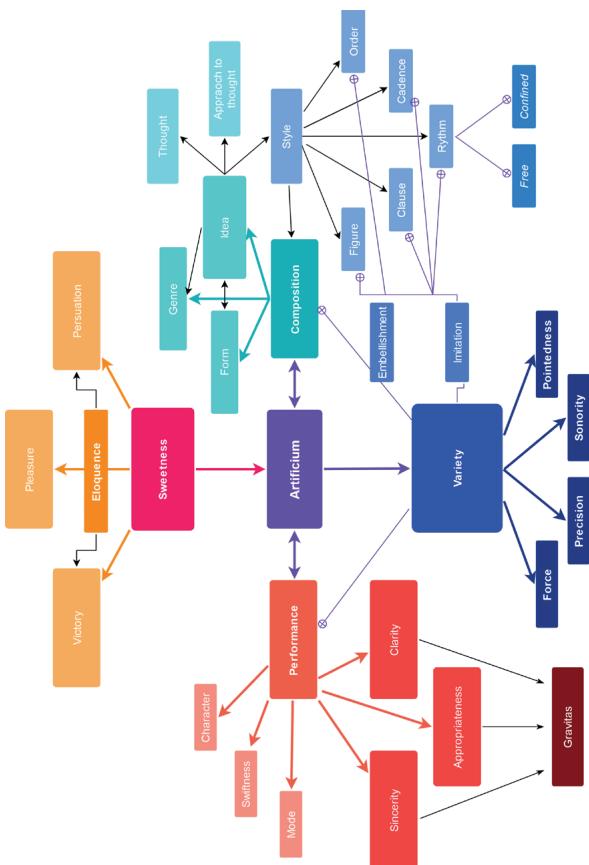
中文讲解
本段为图2的位置标记。图2标题为"Sweetness definition network after Trebizond’s De suavitate dicendi”(“特雷比松德《论演说的甜美》中的甜美定义网络”),图像由Catalina Vicens制作。该图把前文所述的artificium、variatio、gravitas、清晰、真诚、恰当、声音属性、风格等要素以节点和指向性连线(directed edges或arrows)的网络形式呈现——对应P0106提到的"构成要素之云"以及P0111–P0112各要素的可视化总结。原始图像内容需查阅原书,本段不补充不可见细节。
第10段(P0111)
原文复述
The author also points out that one of the chief means of creating sweetness is variatio: ‘variety seems to have the largest utility and sweetness not only for painters, poets, or actors but also in any field where it is appropriate, especially in the arena of the orator.‘22 Alluding to Cicero, he sustains that variation is achieved by the variety in the tones of the voice (sonority, precision, force, and pointedness), the appropriate use of thoughts and approach to the thoughts, as well as the use of styles (in the rhythmical organization of figures, clauses, and cadences). Imitation is also an essential part of the rhetorical discourse. It does not rely on copying the models, the work of the greatest masters, but taking them as models and adapting them and variating them depending on the discourse. With the right combination of all the elements of sweetness, the orator will achieve eloquence and accomplish victory.
中文讲解
本段介绍特雷比松德所论"甜美"的另一核心手段:variatio(变化/多样性)。特雷比松德引用权威观点指出,“变化不仅(not only)对画家、诗人、演员具有最大的效用与甜美,而且(but also)对任何合适的领域都适用,尤其在演说家的舞台中”。在演说实践中,variatio通过三种途径实现:(1)声音色调的多样性——包括响亮度(sonority)、精确性(precision)、力度(force)、尖锐性(pointedness)四项属性;(2)思想及其处理方式的多样恰当运用;(3)风格的多样——表现为对格(figures)、子句(clauses)、终止式(cadences)三者的节奏性组织。本段还引入"模仿”(imitatio)作为修辞话语的另一必要成分,但其含义不是(not)机械复制古典大师的作品,而是(but)把它们当作模型,根据话语情境进行适应与变化。最后得出结论:所有甜美要素的正确组合将使演说者达到 eloquence(雄辩)并赢得胜利。读者应注意:variatio与imitatio的论述与P0106的artificium相呼应——artificium侧重"思想化为语言的方式与节奏",variatio侧重"变化手段",二者共同构成甜美系统的核心机制。
第11段(P0112)
原文复述
In the diagram, the different elements described in Trebizond’s De suavitate dicendi are organized through nodes and points linked by directed edges or arrows. They leave the sace for creating new network links within the system that can expand the significance of different relationships between elements of rhetoric.
中文讲解
本段是对图2可视化方式的元描述(meta-description)。图2中的各要素通过节点(nodes)与点(points)组织,并由有向边或箭头(directed edges or arrows)连接。这种结构"留出空间"以便在系统内部创建新的网络链接,从而扩展修辞要素之间不同关系的意义。读者应注意:这段文字强调图2不是封闭的图示,而是开放网络——它允许研究者根据新的分析需要添加新的连接,这暗示作者意图将图2作为一个可扩展的分析工具,而不仅是特雷比松德体系的静态再现。
第12段(P0113)
原文复述
The elements of Trebizond’s rhetoric can also be applied to composition and performance, as the role of the orator can be mirrored and translated into the musical domain as that of the composer/performer. Thus, while Trebizond is only one of the rhetorical models that were highly influential in the Italian peninsula and the rest of Europe during the Renaissance, the application of rhetorical sweetness into the study of early 16th-century keyboard music can provide keys to the understanding of 16th-century harpsichords, their music, and their performance.
中文讲解
本段将特雷比松德的修辞体系从演说领域类比迁移到音乐领域,提出一个核心类比:演说家的角色可以被"镜像并翻译"(mirrored and translated)到音乐领域中——对应作曲家/演奏者(composer/performer)。这一类比建立了本研究的最终目的:把修辞"甜美"(sweetness)应用于早期16世纪键盘音乐研究,能够为理解16世纪大键琴(harpsichords)、其音乐及其演奏提供钥匙(keys)。但作者也限定了特雷比松德的位置——他只是(only one of)文艺复兴时期意大利半岛及欧洲其他地区众多有影响力的修辞模型之一,并非唯一来源。读者应注意:本段是本节的过渡性结论——它把抽象的修辞学论述锚定到具体的音乐研究对象上,为后续章节的分析铺设理论入口。
补充说明
本节小标题虽为Trebizond修辞理论,但本段表明作者意图以特雷比松德为修辞模型来分析音乐实践。
脚注 / 边栏 / 图表 / 附加信息(如有)
本小节包含三处脚注(编号19、20、21),均指向Lucia Calboli Montefusco在Juanita Feros Ruys、John O. Ward和Melanie Heyworth主编的论文集《古典文本在中世纪与文艺复兴课堂中》(Turnhout 2013, pp. 267–85)中的文章"George of Trebizond’s ‘De suavitate dicendi’",第19号脚注另补充John Monfasani的特雷比松德传记专著(Leiden 1976)。此外包含一幅插图(图2),由Catalina Vicens制作,标题为"特雷比松德《论演说的甜美》中的甜美定义网络",将artificium、variatio、gravitas等修辞要素以节点和有向箭头形式呈现为开放网络。
💡 本节核心要点
- 乔治·特雷比松德作为15世纪初的希腊裔修辞学家,是文艺复兴多元传统综合的化身,把亚里士多德、西塞罗、德摩斯梯尼及赫莫杰尼斯(特别是其七种风格论中关于修辞"甜美"的讨论——彼时尚未在西欧被深入研究)融为一体。
- 特雷比松德的《论演说的甜美》(De suavitate dicendi)献给吉罗拉莫·布拉加丁,承担着把拜占庭修辞学引入拉丁西方的使命,核心命题是:通过suavitas(演说的甜美)成为完美演说者。
- suavitas具有双重作用机制:不仅给听众带来智识愉悦,而且"同步地"取悦所有感官;通过情感冲击使信息更易吸收,构成"感官愉悦→情感冲击→信息吸收"的因果链。
- “甜美"由多个要素构成(artificium、variatio、gravitas、清晰、真诚、恰当、声音属性、风格等),artificium侧重思想化为语言的方式与节奏,variatio侧重变化手段,二者共同构成甜美系统的核心机制。
- imitatio(模仿)不是机械复制古典大师,而是将其作为模型并根据话语情境进行适应与变化;所有甜美要素的正确组合可使演说者达到雄辩并赢得胜利。
- 特雷比松德的修辞体系可被类比迁移到音乐领域:演说家对应作曲家/演奏者;把修辞"甜美"应用于早期16世纪键盘音乐研究,能为理解16世纪大键琴、其音乐与演奏提供关键钥匙。
🔑 关键术语
- suavitas / sweetness of speech:拉丁文suavitas(“甜美”),是特雷比松德修辞体系的核心效果。指演说通过感官愉悦和情感冲击使信息更易被听众吸收的多维品质。
- artificium:指思想被化为语言的方式与手法(way and manner),涵盖"思想之格”(figures of thought),并被一种"既受约束又自由"的艺术节奏统摄。
- variatio:“变化/多样性”,是创造suavitas的核心手段之一,通过声音色调(sonority、precision、force、pointedness)、思想处理方式、风格组织(figures、clauses、cadences)三方面的多样性实现。
- gravitas:“恰当"或"庄重”,与clarity(清晰)、sincerity(真诚)并列为修辞掌控的三项品质,关联到构成(思想、形式、文类)与传达(方式、速度、性格)两个层面。
- imitatio:“模仿”,特雷比松德将其定义为以古典大师作品为模型并根据话语情境进行适应与变化,而非机械复制。
- Hermogenes’ seven styles:赫莫杰尼斯(Hermogenes)的七种风格论,其关于修辞"甜美"的讨论在15世纪初尚未在西欧被深入研究,特雷比松德的工作具有填补空白的意义。
s0108 [描述性拆分] Applying Rhetorical Sweetness to Keyboard Performance — Questions Drawn from the Network
第1段(P0114)
原文复述
From this diagram we can extract questions such as the following ones:
中文讲解
本句是一个过渡句,承上启下:作者刚刚给出了一张由Trebizond修辞要素构成的网状图(diagram),现在宣布将从该图中提取出一系列有待探讨的问题。它的功能类似于一个分项列举的导言,提示读者接下来将看到一连串与键盘演奏相关的开放性问题,而这些问题均从修辞学的概念网络中衍生而来。
第2段(P0115)
原文复述
— What does a free and confined rhythm balance mean, how can it be applied to the overall musical structure and metrical structure, and according to which parameters does the performer alternate or fluctuate between them?
中文讲解
这是从网状图中抽取的第一个问题,关乎"自由与受限节奏的平衡"。该问题由三个层层递进的子问题组成:第一,“自由与受限节奏的平衡"究竟意味着什么;第二,这种平衡如何被应用于整体音乐结构和节拍结构;第三,演奏者根据哪些参数在二者之间交替或波动。它延续了作者前文对Trebizond修辞概念的引介,将节奏视为一种可在"自由"与"受限"两端之间调节的变量,而非单一刻度的快慢,从而把它上升到音乐结构的组织原则层面。
第3段(P0116)
原文复述
— If embellishments, as figures of thought, are meant to convey meaning, how do musical embellishments documented in 16th-century keyboard sources add significance to the musical message? How do written-out diminutions, graces, and embellished musical gestures change the rhythm of the discourse? How does the knowledge of their function within the musical discourse give us information about how and why to add embellishments where they are not written and shape our understanding of style?
中文讲解
这是关于装饰音(embellishments)的一组问题。第一层假设装饰音作为"思想的形式”(figures of thought)承担着传达意义的功能,然后追问:16世纪键盘文献中记载的装饰音如何增加音乐信息的内涵?第二层转向具体类型——写出的细化(written-out diminutions)、graces以及装饰化音乐姿态——如何改变"话语"的节奏?第三层回到演奏实践:了解装饰音在音乐话语中的功能,如何帮助演奏者知道在谱面未注明之处添加装饰并塑造风格理解?三个问题从功能→具体形式→演奏判断,逐层下推,将装饰从单纯的音响修饰重新定位为话语性的修辞构件。
第4段(P0117)
原文复述
22 Ibid., 280.
中文讲解
这是一条脚注,编号22,引用形式为"Ibid., 280",意为"同上来源,第280页"。该脚注作为版式注而非正文主张存在,功能是为前段(P0116)中关于装饰音与"figures of thought"或相关论断提供出处支持。它对正文主张起来源支撑作用,但本身并不引入新的论证。
第5段(P0118)
原文复述
— How could the importance of timbric variety change our understanding of the aesthetic of 16th-century instrument building itself? Do certain qualities of antique Renaissance keyboard types resonate with principles of sonic variety described in Trebizond?
中文讲解
本段包含两个相互呼应的子问题。第一问:音色多样性的重要性是否会反过来改变我们对16世纪乐器制造美学的理解?第二问:某些文艺复兴时期古键盘乐器的固有音质,是否与Trebizond所描述的音响多样性原则相呼应?这一问题的关键在于"反向"视角——不是把修辞原则套用于演奏,而是追问乐器本身的物理特性是否本就承载着同样的多样性美学,由此把乐器制造史、修辞学和演奏学串成一个回路。
第6段(P0119)
原文复述
— What are the technical means to create variety in the harpsichord’s sonority? Can control and variation of force in the performer’s touch help to give structure and flow to the composition?
中文讲解
本段聚焦于大键琴(harpsichord)的具体技术。两个子问题分别对应:其一,创造大键琴音响多样性的技术手段是什么;其二,演奏者通过对触键力度(force)的控制与变化,是否能为作品提供结构与流动感。值得注意的是,大键琴本身以"不可控制音量"著称,因此这里谈到的"力度变化"必然指涉更宽泛的触键方式(如articulation、时值、声部安排等)而非传统钢琴意义上的强弱。作者借此把大键琴演奏从"机械地按键"重新框定为一种可塑的、有表现力的发声行为。
第7段(P0120)
原文复述
— How can the familiarity with other closely related instruments, such as fretted Renaissance clavichords, 16th-century organs, and Renaissance plucked instruments inform about the variety of sound within a sound source’s identity?
中文讲解
本段追问演奏者对相关乐器——带fret的文艺复兴击弦古钢琴(clavichord)、16世纪管风琴以及文艺复兴拨弦乐器——的熟悉,如何帮助理解单一音源内部的声音多样性。其潜在论点是:演奏者通过接触同家族乐器,能够意识到"同一类键盘/拨弦音源"在不同触键、不同乐器上的发声差异,从而更细腻地感知并操控该乐器自身的音色身份。这是一种通过"横向比较"训练听觉敏感性的方法论。
第8段(P0121)
原文复述
What does it mean to variate in precision? Is it referred to the precision of chords (alternation between arpeggiation and synchronic chords), to the interpretation of rhythm and meter, or another performative parameter? How does this differ from variating the level of pointedness in the performance? Does this instead relate to the degrees of incisiveness of touch or rhythm as well?
中文讲解
本段围绕两个相关但应区分的概念提出问题:“精确度的变化”(variating in precision)与"尖锐性的变化"(variating pointedness)。作者先列举"精确度"可能所指的对象——和弦精度(在琶音式与同时触键和弦之间交替)、节奏与节拍的诠释,或其他演奏参数——再追问它与"尖锐性变化"之间的区别:后者是否指向触键或节奏的锐利程度。其意图在于帮助演奏者把这两个看似接近实则不同的维度拆分开来,避免笼统地用"强弱"或"快慢"来描述演奏中的所有变化。
第9段(P0122)
原文复述
— How do the variations in composition taken from a model tell us about the discourse (and its function) intended by the composer or arranger?
中文讲解
本段是一个较为简洁的问题:基于一个模型(model)所写出的变体(variations in composition),如何向演奏者揭示作曲家或改编者所意图的话语及其功能?这里的关键术语"model"指变体写作中所参照的原始乐曲或主题;通过对这些变体的分析,演奏者可以反推原作者的修辞意图。这与P0116中关于装饰传达意义的问题形成呼应——变奏本身也是一种修辞行为。
第10段(P0123)
原文复述
— How does variation in the use of a variety of modes and genera (diatonic, chromatic, and enharmonic) in a polyphonic composition develop from the search for rhetorical suavitas, and how does it influence the delivery of the musical thoughts?
中文讲解
本段把调式(modes)与"种类"(genera,即diatonic自然、chromatic变化、enharmonic四分之一音三种古代类别)在复调作品中的多样运用,与对修辞性suavitas(甜美/柔和)的追求联系起来。其问题结构是双向的:一方面,这种调式与种类的变化如何源于对修辞甜美感的追寻;另一方面,它又如何影响音乐思想的传达?作者借此将古希腊调式理论与文艺复兴复调实践连在一起,让看似抽象的"甜美"修辞理想落到具体的音高材料选择上。
第11段(P0124)
原文复述
— If imitation is not copying, how does the performance of vocal intabulation at the keyboard imitate the model and variate it?
中文讲解
本段以一个明确的定义性命题——“模仿不是复制”(imitation is not copying)——为前提,追问键盘上的声乐intabulation(即将声乐作品改编为键盘独奏)如何在演奏中既"模仿"其原本声乐模型又同时"变体"之。其内在张力在于:作为键盘演奏者,既要让听众识别出作品的声乐来源,又要利用键盘特有的表现手段(音色、装饰、织体等)对其进行再创造。这是对前文"变奏传达话语"问题的具体延伸。
第12段(P0125)
原文复述
— Which elements of the score allow choosing the mode, swiftness, and character of the piece?
中文讲解
本段追问乐谱中哪些要素允许演奏者选择作品的调式(mode)、速度(swiftness)与性格(character)。它把目光从外部修辞理论拉回到乐谱文本本身:演奏者必须依据谱面上可读到的记号(如拍号、节拍暗示、调号、速度标记、装饰音符号等)来作出诠释判断,因此演奏自由不是任意的,而是受文本证据约束的。
第13段(P0126)
原文复述
— What does it mean to perform gravitas (with sincerity, clarity, and appropriateness) today? How does the changing of performative context change all the technical elements in order to deliver a ‘speech appropriate to the listener?
中文讲解
本段将焦点由历史性研究转向当下实践。两个子问题是:其一,今天"演奏gravitas(庄重/严肃)“意味着什么,作者用括注限定其为"真诚、清晰与适度"三种品质;其二,演奏语境的变化如何改变所有技术要素,以实现"对听众合适的言说”。这里的关键转折是"今天"——即便研究对象是16世纪作品,演奏始终发生于现代语境中,作者主张演奏者必须自觉意识到这一语境差异,并相应调整技术以保持修辞的适切性(aptum)。
第14段(P0127)
原文复述
Exploring the ideals of perception and performance in 16th-century harpsichord music through other disciplines of Renaissance studies, such as Trebizond’s elements of rhetoric, it’s possible to unveil and redefine the components that form the implicit rules for the delivery of musical meaning. Doing it so from a chronological perspective, and embracing alternative methodologies for the teaching and learning of Renaissance keyboard music, can help to pose the essential performance questions that are often left untackled.
中文讲解
本段是一个小结性论断,可视为对前文众多问题的总括。它分两层:第一层主张,借由Trebizond修辞要素等其他文艺复兴学科,可以揭示并重新定义那些构成"音乐意义传达"之隐含规则的组件;第二层主张,按年代顺序进行这种研究、并采纳替代性的教学法,能帮助提出那些经常被忽视的关键演奏问题。其作用是把方法论与具体问题链缝合起来——方法(跨学科+年代视角+替代教学法)催生问题,问题反过来印证方法的有效性。
第15段(P0128)
原文复述
While we cannot quantify the changes in our own performance when setting an aesthetic and/or environmental goal, taking such path for the re-reading of historical sources containing information such as compositional styles, ornamentation, keyboard technique, fingering patterns, musical and grammatical text analysis, etc., will allow for a ‘translation’ with a more complex and refined de-codification system.
中文讲解
本段对前文方法论作出限定与扩展。限定部分:当我们设定某种美学或环境目标时,自身演奏中的变化是无法被量化的——这是一个认识论上的诚实声明,避免对"修辞演奏法"作过度科学的承诺。扩展部分:沿着这一路径重读历史原始资料(涉及作曲风格、装饰、键盘技法、指法模式、音乐与语法性的文本分析等),将提供一套更复杂、更精细的"解码系统",使演奏成为一种更高阶的"翻译"。其核心比喻"translation/de-codification"把演奏定义为对历史文本的解码行为。
第16段(P0129)
原文复述
This approach leaves room to embrace serving as a performer of today while being translators and mediators of an art of the past, grappling the fact that a performance is not deducible from the sum total of causal factors, and allowing a process of accumulating knowledge to shape musical communication. Thus, I argue, a historically informed/inspired musical embodiment process may begin.
中文讲解
本段是本节乃至全文的收束论断,可视为作者论点的明确宣言。它同时承认三重立场:第一,演奏者可以既是"当下表演者",又是"过去艺术的翻译者与中介";第二,演奏不能从所有因果因素的总和中推导出来(这是对实证主义的拒斥);第三,知识的累积过程本身塑造着音乐交流。最后以第一人称"I argue"宣告:一个"历史知情的/受历史启发的"音乐具身过程(musical embodiment process)就此可以开启。其修辞功能是把前面所有问题与方法收束为一个可被实践采纳的总命题。
脚注 / 边栏 / 图表 / 附加信息(如有)
本节包含一条页内脚注(P0117,编号22),引用形式为"Ibid., 280",为前段装饰音相关论述提供出处支持,属于来源标注而非独立主张。其余段落均为作者论述与提问,无图表或边栏。
💡 本节核心要点
- 本节的核心是围绕一张由Trebizond修辞要素构成的网状图,提出一系列尚未被充分回答的键盘演奏问题,而非给出具体答案。
- 问题覆盖六个维度:节奏的自由与受限平衡、装饰音作为思想形式的语义功能、乐器制造美学与音色多样性的双向关系、大键琴音响多样性的具体技术手段、相关乐器家族对音色身份的塑造作用,以及精确度与尖锐性两种变化维度的区分。
- 进一步的问题延伸到变奏写作与原型的关系、调式与genera的运用如何服务于修辞甜美感、声乐intabulation中"模仿而非复制"的诠释策略、乐谱要素如何支撑调式/速度/性格的选择,以及当下演奏中gravitas的实现。
- 作者在结尾作出方法论与认识论的双重声明:演奏变化不可被量化,演奏也不能从因果总和推导出来,因此一种历史知情的具身过程(historically informed/inspired musical embodiment)需要通过跨学科、年代视角与替代教学法的累积来开启。
- 整节的论证策略是"以问题代替答案"——用开放性的问题清单本身作为对既有键盘演奏教学忽视修辞维度的批评,并提出演奏者应同时作为当下表演者与历史艺术的中介翻译者。
🔑 关键术语
- Trebizond:指George Trebizond(乔治·特雷比松),15世纪人文主义学者;本节中作为修辞学要素的来源,被作者用以类比16世纪键盘演奏中的多样性与suavitas(甜美)原则。
- suavitas:拉丁文修辞术语,意为"甜美、柔和",本节中作为修辞理想的核心概念之一,作者追问调式与genera的变化如何从中发展而来。
- intabulation:将声乐作品改编为键盘乐器演奏的实践;本节中作为"模仿而非复制"问题的核心载体,键盘演奏者既要保留声乐原型的可识别性,又要加以变体。
- embellishments / diminutions / graces:16世纪键盘文献中记载的装饰音类型,包括写出的细化(written-out diminutions)和graces;本节将其作为figures of thought(思想的形式)来追问其语义功能。
- genera (diatonic, chromatic, enharmonic):古希腊调式体系中的三类音阶组织,分别对应自然、变化与四分之一音;本节中作者将其与现代调式概念区别开来,用以讨论复调作品中的修辞甜美感。
- gravitas:拉丁文,意为"庄重、严肃";作者在P0126中将其括注为"真诚、清晰、适度"三种品质,作为当下演奏者应当追求的修辞气质。
- musical embodiment process:“音乐具身过程”,作者在P0129提出的总命题,指一种历史知情/受历史启发的演奏实践方式,强调演奏作为身体化的知识累积过程而非因果推导的结果。
- model:在本节中指变奏或intabulation写作所依据的原始乐曲;通过对基于该model的变体的分析,演奏者可反推原作者的修辞意图。
s0109 Bibliography
第1段(P0130)
原文复述
Bibliography
中文讲解
这是该节的标题,以二级Markdown标题的形式出现,作用是标识其下所有内容为参考文献/书目清单。它开启的是一份按作者姓氏排列的著作与论文目录,是学术文本的标准组成部分。
第2段(P0131)
原文复述
Willi Apel, Geschichte der Orgel- und Klaviermusik bis 1700 (Kassel, 1967)
中文讲解
条目为:Willi Apel,《管风琴与键盘音乐史至1700年》(Geschichte der Orgel- und Klaviermusik bis 1700),1967年于卡塞尔出版。德文书名直译为"1700年以前的管风琴与键盘音乐史"。这是一部经典的早期键盘音乐史研究著作。
第3段(P0132)
原文复述
Eliot Bates, ‘Actor-Network Theory and Organology’, in: JAMIS 44 (2019), 41–51
中文讲解
条目为:Eliot Bates,《行动者网络理论与乐器学》(Actor-Network Theory and Organology),发表于JAMIS第44卷(2019年),第41–51页。从篇名可知该文将"行动者网络理论"(缩写ANT)这一社会科学方法论引入乐器学(organology)研究。
第4段(P0133)
原文复述
John Bryan, ‘“Verie Sweete and Artificiall”: Lorenzo Costa and the Earliest Viols’, in: EM 36 (2008), 3–18
中文讲解
条目为:John Bryan,《“极其甜美而精巧”:洛伦佐·科斯塔与最早的维奥尔琴》(Verie Sweete and Artificiall: Lorenzo Costa and the Earliest Viols),发表于EM第36卷(2008年),第3–18页。标题中"Verie Sweete and Artificiall"为早期现代英语正字法形式,对应现代英语的"very sweet and artificial/artful",与本节的核心主题"甜美"(sweetness)直接相关。
补充说明
“Verie Sweete and Artificiall"的拼写形式(-ie/-articiall)属于早期现代英语的拼写风格,保留了词的来源语言(法语/拉丁语)特征。
第5段(P0134)
原文复述
Mary Carruthers, ‘Sweetness’, in: Speculum 81 (2006), 999–1013
中文讲解
条目为:Mary Carruthers,《甜美》(Sweetness),发表于《Speculum》第81卷(2006年),第999–1013页。从标题判断这是一篇以"甜美"概念为主题的独立研究。
第6段(P0135)
原文复述
Baldassarre Castiglione, Opere del conte Baldessar Castiglione Il cortegiano, vol. 1 (Florence, 1854)
中文讲解
条目为:Baldassarre Castiglione,《巴尔达萨尔·卡斯蒂利奥内伯爵著作集·廷臣论》第1卷(Opere del conte Baldessar Castiglione Il cortegiano, vol. 1),1854年于佛罗伦萨出版。《廷臣论》(Il cortegiano)是文艺复兴时期关于廷臣礼仪与修养的经典对话录,“suavitas”(甜美/温润)是其修辞传统中的重要概念之一。
第7段(P0136)
原文复述
Paulo Chagas, ‘Musical Understanding: Wittgenstein, Ethics, and Aesthetics’, in: Music, Analysis, Experience: New Perspectives in Musical Semiotics, ed. Costantino Maeder and Mark Reybrouck (Leuven, 2015), 115–33
中文讲解
条目为:Paulo Chagas,《音乐理解:维特根斯坦、伦理学与美学》(Musical Understanding: Wittgenstein, Ethics, and Aesthetics),收录于《音乐、分析、经验:音乐符号学新视角》(Music, Analysis, Experience: New Perspectives in Musical Semiotics),由Costantino Maeder和Mark Reybrouck主编,2015年于鲁汶出版,本文位于第115–133页。
第8段(P0137)
原文复述
Antoine Hennion and Stephen Muecke, ‘From ANT to Pragmatism: A Journey with Bruno Latour at the CSI’, in: New Literary History 47 (2016), 289–308
中文讲解
条目为:Antoine Hennion与Stephen Muecke,《从行动者网络理论到实用主义:在CSI与布鲁诺·拉图尔同行》(From ANT to Pragmatism: A Journey with Bruno Latour at the CSI),发表于《新文学史》(New Literary History)第47卷(2016年),第289–308页。文题中的"ANT"即为P0132条目中提到的"行动者网络理论”(Actor-Network Theory)。
第9段(P0138)
原文复述
Stanley Howell, ‘Paulus Paulirinus of Prague on Musical Instruments’, in: JAMIS 5–6 (1979), 9–36
中文讲解
条目为:Stanley Howell,《布拉格的保卢斯·保利里努斯论乐器》(Paulus Paulirinus of Prague on Musical Instruments),发表于JAMIS第5–6卷合刊(1979年),第9–36页。作者"Paulus Paulirinus"亦作"Paulus de Praga"(参见P0145)。
第10段(P0139)
原文复述
Eric Jager, The Tempter’s Voice: Language and the Fall in Medieval Literature (Ithaca, 1993)
中文讲解
条目为:Eric Jager,《诱惑者之声:中世纪文学中的语言与堕落》(The Tempter’s Voice: Language and the Fall in Medieval Literature),1993年于纽约州伊萨卡出版。
第11段(P0140)
原文复述
Abdool-Hack Mamoojee, ‘“Suavis” and “Dulcis”: A Study of Ciceronian Usage’, in: Phoenix 35 (1981), 220–36
中文讲解
条目为:Abdool-Hack Mamoojee,《“Suavis"与"Dulcis”:西塞罗用法研究》(Suavis and Dulcis: A Study of Ciceronian Usage),发表于《Phoenix》第35卷(1981年),第220–236页。两个拉丁文形容词"suavis"与"dulcis"皆意为"甜美/甘美",该文考察西塞罗文本中这两个词的区分用法,是讨论拉丁修辞传统中"甜美"概念的常被引用之文献。
补充说明
“suavis"与"dulcis"在拉丁语中虽常被并列使用,但词源不同、语用侧重亦有差异:前者强调感觉层面的"柔和、宜人”,后者则偏向味觉"甘甜"。
第12段(P0141)
原文复述
John Monfasani, George of Trebizond: A Biography and a Study of His Rhetoric and Logic (Leiden, 1976)
中文讲解
条目为:John Monfasani,《乔治·特雷比宗:传记及其修辞与逻辑研究》(George of Trebizond: A Biography and a Study of His Rhetoric and Logic),1976年于莱顿出版。这是关于15世纪希腊裔学者G. Trapezuntios的综合性研究著作。
第13段(P0142)
原文复述
23 Antoine Hennion and Stephen Muecke, ‘From ANT to Pragmatism: A Journey with Bruno Latour at the CSI’, in: New Literary History 47 (2016), 289–308, at 294
中文讲解
该段以"23"起头,并非按字母排列的参考文献条目,而是正文中第23号脚注的引文形式(尽管被扫描录入本节范围)。它重复引用了Hennion与Muecke的文章,但末尾的"at 294"指明了具体页码(第294页),是脚注中标准的短引证格式。它与P0137对应同一文献但用途不同:P0137为完整书目信息,此处为正文页内特定页码的引用。
补充说明
正文第28页中出现脚注编号"23",将该引文纳入本书目扫描段落列表,可能是OCR抓取了包含脚注内容的版面。
第14段(P0143)
原文复述
Lucia Calboli Montefusco, ‘George of Trebizond’s “De suavitate dicendi”’, in: The Classics in the Medieval and Renaissance Classroom: The Role of Ancient Texts in the Arts Curriculum as Revealed by Surviving Manuscripts and Early Printed Books, ed. Juanita Feros Ruys, John O. Ward, and Melanie Heyworth (Turnhout 2013), 267–85
中文讲解
条目为:Lucia Calboli Montefusco,《乔治·特雷比宗的"De suavitate dicendi"》(George of Trebizond’s De suavitate dicendi),收录于《中世纪与文艺复兴课堂上的古典学:抄本与早期印本所揭示的古代文本在艺术课程中的角色》(The Classics in the Medieval and Renaissance Classroom),由Juanita Feros Ruys、John O. Ward与Melanie Heyworth主编,2013年于蒂伦豪特出版,本文位于第267–285页。本条目中"De suavitate dicendi"为拉丁文,意为"论言说的甜美"。
第15段(P0144)
原文复述
Claude V. Palisca, Music and Ideas in the Sixteenth and Seventeenth Centuries, curated by Thomas J. Mathiesen (Champaign, Illinois, 2006)
中文讲解
条目为:Claude V. Palisca,《十六与十七世纪的音乐与思想》(Music and Ideas in the Sixteenth and Seventeenth Centuries),由Thomas J. Mathiesen整理编辑,2006年于美国伊利诺伊州尚佩恩出版。“curated by"表示该书是作者身后由Mathiesen整理出版。
第16段(P0145)
原文复述
Paulus de Praga dictus Paulirinus, Liber viginti artium (c. 1463), PL-Kj Codex 257
中文讲解
条目为:Paulus de Praga dictus Paulirinus,《二十艺之书》(Liber viginti artium),约1463年成书,藏于PL-Kj Codex 257。“Paulus de Praga dictus Paulirinus"意为"布拉格的保卢斯,又称保利里努斯”;“Liber viginti artium"拉丁文直译为"二十种技艺之书”。这是直接引用的一份原始手稿,作者与P0138(Howell条目)中的"Paulus Paulirinus of Prague"为同一人。
补充说明
“PL-Kj"在此节中未作扩写说明,仅作为抄本收藏地与排架代码呈现。
第17段(P0146)
原文复述
Benjamin Piekut, ‘Actor-Networks in Music History: Clarifications and Critiques’, in: Twentieth-Century Music 11 (2014), 191–215
中文讲解
条目为:Benjamin Piekut,《音乐史中的行动者网络:澄清与批评》(Actor-Networks in Music History: Clarifications and Critiques),发表于《二十世纪音乐》(Twentieth-Century Music)第11卷(2014年),第191–215页。与P0132、P0137共同构成对行动者网络理论(ANT)在音乐研究中应用的批判性讨论组。
第18段(P0147)
原文复述
Heidelinde Pollerus, Tasteninstrumente als kunsthistorische Objekte. Cembalo, Clavichord, Spinett, Virginal. ‘Meine Seele hört im Sehen’ (Graz/Vienna, 2018)
中文讲解
条目为:Heidelinde Pollerus,《作为艺术史对象的键盘乐器:大键琴、击弦古钢琴、小键琴、维金纳琴。“我的灵魂在观看中聆听”》(Tasteninstrumente als kunsthistorische Objekte. Cembalo, Clavichord, Spinett, Virginal. Meine Seele hört im Sehen),2018年于格拉茨与维也纳出版。书名长,副标题后半"Meine Seele hört im Sehen"出自德国诗人Novalis的诗作,是从视觉艺术品中"听见"音乐这一跨感官概念的修辞表达。
第19段(P0148)
原文复述
The Princeton Dante Project (2.0), https://dante.princeton.edu/
中文讲解
条目为:《普林斯顿但丁项目》(The Princeton Dante Project),版本2.0,列出了其网址。这是一份网络数字资源而非传统出版物,作者字段为该项目机构本身。
第20段(P0149)
原文复述
Alexander Silbiger (ed.), Keyboard Music Before 1700 (New York/London, 2004)
中文讲解
条目为:Alexander Silbiger编,《1700年之前的键盘音乐》(Keyboard Music Before 1700),2004年于纽约与伦敦出版。这是一部关于早期键盘音乐的论文集(编辑性质著作),与P0131(Apel)的研究主题直接呼应。
脚注 / 边栏 / 图表 / 附加信息(如有)
本节是名为"Bibliography"的参考文献清单(section标题见P0130),跨P0131–P0149共18条正式书目条目,以及P0142一条重复引用形式的脚注条目。无图表、无边栏文字、无图片。其中P0145为手稿出处(非印刷出版物),P0148为网络资源(非印刷出版物),这两类在传统书目中以专门格式呈现。条目大体按作者姓氏字母顺序排列(Apel→Bates→Bryan→Carruthers→Castiglione→Chagas→Hennion→Howell→Jager→Mamoojee→Monfasani),但Montefusco(P0143)按字母本应在Monfasani之前出现,却置于其后,且P0142脚注条目卡在Monfasani与Montefusco之间——这是需要在排版层面解释的现象(很可能由于P0142脚注被扫描入本节扫描边界,且原书正文中Montefusco按页码顺序排在Monfasani之后,而非严格字母序)。
💡 本节核心要点
- 本节是参考文献清单(Bibliography),由二级标题标示(P0130),承载本书正文中所有引用文献的完整书目信息。
- 条目混合多种文献类型:期刊论文(如Bates、Carruthers、Howell、Mamoojee、Piekut)、专著(Apel、Jager、Monfasani、Palisca、Pollerus)、编辑论文集中的章节(Chagas、Montefusco)、早期作者著作(Castiglione、Paulus de Praga)、主编论文集(Silbiger)、网络资源(Princeton Dante Project)和手稿(Codex 257)。
- 书目揭示了正文的两条主要学术脉络:一是围绕"甜美”(sweetness/suavitas)概念在修辞史与音乐史中的研究(Carruthers、Mamoojee、Castiglione、Monfasani、Montefusco、Pollerus、Sibbiger、Apel等);二是行动者网络理论(ANT)在音乐学中的应用与批评(Bates、Hennion与Muecke、Piekut)。
- P0142为正文第23号脚注的短引证格式重复引用了Hennion与Muecke文章,并具体标注页码(at 294),表明该文献在正文中被多次使用。
- 书目中存在跨条目的相互呼应:P0132与P0146同为ANT方法论批判;P0138与P0145指向同一人物Paulus Paulirinus;P0145与P0132、P0147呼应"乐器作为研究对象"这一主题。
- 条目语种以英语为主,但包含德语(Apel、Pollerus)、拉丁语(Montefusco所引De suavitate dicendi;P0145的Liber viginti artium)、意大利语(Castiglione的Il cortegiano)以及早期现代英语(P0133标题中"Verie Sweete and Artificiall”),反映出研究主题跨语种的修辞学—音乐史性质。
🔑 关键术语
- ANT (Actor-Network Theory):行动者网络理论,一种社会科学方法论。本节中通过P0132篇名"Actor-Network Theory and Organology"直接显现,P0137与P0146篇名亦围绕它展开;书目的多个条目共同显示该方法在音乐与乐器研究中的运用及对其的批评。
- Il cortegiano:意大利文,意为"廷臣",是Baldassarre Castiglione于16世纪初所撰的文艺复兴对话录,是讨论修辞学"suavitas"传统的常被引用之出处。
- De suavitate dicendi:拉丁文篇名,意为"论言说的甜美",出自George of Trebizond。该作品是讨论拉丁修辞传统中"suavitas"概念的关键节点文献,P0143条目专门研究它。
- Liber viginti artium:拉丁文,意为"二十种技艺之书",是中世纪学者Paulus de Praga(约1463年)的著作书名,藏于PL-Kj Codex 257,是研究早期乐器的重要原始资料。
- PL-Kj Codex 257:抄本排架标识,“PL-Kj"代表抄本收藏地,“Codex 257"为具体编号;它指向中世纪手稿P0145,是Paulus de Praga著作的唯一(已知)抄本。
- Tasteninstrumente:德文术语,意为"键盘乐器”(按压式发声的琴类),出现在P0147书名中,专指大键琴、击弦古钢琴、小键琴、维金纳琴这一谱系。
- Suavis / Dulcis:拉丁文形容词,均可译为"甜美”,但词源与语用侧重不同——“suavis"关联感觉的柔和、“dulcis"关联味觉的甘甜。P0140条目专门研究二者在西塞罗文本中的用法。
- “Verie Sweete and Artificiall”:早期现代英语正字法拼写,对应现代英语"very sweet and artificial/artful”,出现在P0133文章标题中,直接呼应本节关于"sweetness"的主题。
s0201 [描述性拆分] Introduction — Tablature as Source, Tablature as Spanish Practice
第1段(P0150)
原文复述
3 Keyboard Tablatures and Imaginary Instrumental Interchange in the Sixteenth Century
中文讲解
这是全书第三章的章标题。它一次性提出本章的两个核心议题:一是16世纪键盘乐谱中的tablature(字位谱/数字谱记谱法),二是所谓的“想象性乐器互换”(Imaginary Instrumental Interchange)。标题中“Imaginary”一词是关键伏笔:它暗示tablature所声称的乐器通用性未必对应真实的演奏实践——同一份记谱可能宣称可用于键盘、竖琴、维韦拉三种乐器,但其中部分乐器组合在历史上只是“纸上兼容”,并不真正在实际演出中互换演奏。读者由此可预判本章会同时讨论tablature作为史料考据对象以及作为一种特殊的西班牙记谱惯例。
补充说明
本条为本章主标题,承担提纲挈领的功能,本身不再展开论述;标题之后紧接作者署名与正文。
第2段(P0151)
原文复述
John Griffiths
中文讲解
这是本章的作者署名。作者仅以姓名出现,未在原页注明所属机构或研究方向,所属信息留待正文与脚注披露。对读者而言,本条的价值在于标记本文以John Griffiths个人的实践者立场(而非纯史学论文)展开论述,这一点在下一段会得到印证。
第3段(P0152)
原文复述
Sources constitute one of the fundamental pillars of any kind of historical performance practice of music. Particularly for those of us who play polyphonic instruments, reading from the same pages that were used by players in the 16th century – for the purposes of the present study – draws us closer to the essence of the music we are playing, or so we believe. It obliges us to see the music as they did, and it requires us to make many of the same decisions about many aspects of performance that were faced by the musicians who created the pieces we play, or who were its original consumers. From my own perspective as a lutenist and vihuelist, it is quite surprising to see the large number of contemporary harpsichordists and organists who interpret this by playing primarily from carefully edited modern editions, written in modern notation. The contemporary lute world is the reverse: nearly all modern lutenists play from tablature, from the original notation, whether in facsimile reprint or in a modern typeset version of the original. This anomaly of notational practice is the first of the two main discussions within this essay; the other concerns that uniquely Spanish practice of the 16th century of having music ‘para tecla, harpa y vihuela’ that could supposedly be played on keyboards, harp and lute from the same notation.
中文讲解
这是本章起始段,承担多重功能:
第一,建立作者的论证前提——“史料(sources)是历史性演奏实践的根基之一”。作者把“阅读16世纪演奏家当年使用的同一页面”与“更接近音乐本质”画上等号,但随即加上“or so we believe”的限定,表明这是一种被共同体广泛接受、却未必被严格验证过的信念。这一限定为下文保留余地:当史料本身就有歧义时,“贴近原作”并不自动等同于“还原历史真实”。
第二,从一般原则落到具体观察。作者以鲁特琴/维韦拉演奏家的身份,对比两个子领域:当今大键琴家与管风琴家主要使用经过编辑的现代版本(modern notation),而鲁特琴演奏界则几乎一律沿用tablature,无论是影印本还是重新排印的原文。这一对比实际上揭示了键盘与鲁特琴两条“历史演奏”路径的方法论分裂——同样标榜“历史真实”,键盘界偏重文本重建与校订的便利,鲁特琴界则保留了指法层面的原始信息。
第三,正式预告全文的两条主线。其一即上述“记谱惯例的异常”(键盘用现代版、鲁特琴用tablature);其二是16世纪西班牙特有的“para tecla, harpa y vihuela”惯例——同一份乐谱在标题中宣告键盘、竖琴与维韦拉(或鲁特琴)通用。
注意作者使用“uniquely Spanish”与“supposedly”两个限定词:前者把这种惯例限定为西班牙所独有(区别于意大利、法国、德国的键盘-鲁特互换传统),后者则暗示这种“多乐器通用”并不总是落实于实际演出,可能仅是出版或理论层面的“想象性”兼容——这正与章标题中的“Imaginary”相呼应。
补充说明
本段引出本章两大议题:(1) 记谱惯例的异常,(2) 西班牙式的“para tecla, harpa y vihuela”。“para tecla, harpa y vihuela”为西班牙语术语,原意为“供键盘、竖琴与维韦拉之用”,在本节中作为历史术语保留,详尽解释置入正文讲解。文中“or so we believe”是作者对自身所在共同体共识的自我限定,值得读者留意——它预告了作者将在后文对“贴近原始记谱=贴近历史真实”这一等式保持反思。
第4段(P0153)
原文复述
Tablature of one kind or another was the common notational language for keyboards and other polyphonic solo instruments during the 16th century. The exact extent of the surviving repertoire of works in tablature from before 1600 has not been calculated, but I would estimate it to be in the vicinity of 20,000 works, a substantial amount of music and a repertoire that is large enough not to be ignored. In this essay I wish to discuss some of the broader vision and distilled conclusions arising from a substantial research project about tablature in the 16th century. The project was actually based on all Western tablatures prior to c. 1750 that will soon be published as a single volume of encyclopaedic proportion representing tablatures for over forty instruments.
中文讲解
本段从“记谱媒介的普遍性”切入,为整章奠定了规模与权威性的底色。
核心事实陈述:tablature(无论何种形式)是16世纪键盘与其他 polyphonic solo instrument 共用的“通用记谱语言”。这一断言本身纠正了常见误解——许多读者将tablature误认为仅属于鲁特琴或吉他家族,但作者在此明确把键盘与“其他 polyphonic solo instrument”纳入tablature的适用范围,从而与上一段关于键盘界偏用modern notation的当代现象形成时间上的对照。
数量论证:作者承认精确数字从未被计算过,但他个人估计1600年前存世的tablature曲目约为20,000首。这一估算有三个功能:(1) 为整章赋予必要性——若曲目稀少,本章便可忽略;(2) 把tablature从“少数乐种的小传统”提升为“可与同时期声乐与合奏曲目对话的大型曲目库”;(3) 为后续讨论的代表性提供边界:读者的任何结论需理解为基于一个“约两万首”的总体而非个别孤例。
方法论定位:作者把本文定位为“一个庞大研究项目的更宏观视野与凝练结论”(broader vision and distilled conclusions)。这一自我定位非常关键——读者不应把本章视为穷尽性研究,而是更大工程(即将以“百科全书式巨册”形式出版)的导览。值得注意的是该工程实际上跨越整个西方tablature传统直至约1750年,覆盖四十余种乐器——远超本章所说的“16世纪”,说明作者的研究视野是把16世纪键盘-西班牙惯例作为切入点,但分析框架是覆盖整个前古典时期的tablature史。
补充说明
本段末尾提及的“一个百科全书式巨册”将出版于其合作机构(参看下一段脚注)。文中“c. 1750”是约略写法(拉丁文circa),指“以1750年前后为下界”。读者应注意:作者在“本项目”中所考察的对象远超本章标题所示的16世纪,这一点是理解本章方法论的关键。
第5段(P0154)
原文复述
1 Based at the Centre d’Études Supérieures de la Renaissance (CESR) in Tours, the project has been conducted with David Dolata and Philippe Vendrix as co-edi-
中文讲解
这是紧接P0153末句“即将出版的百科全书式巨册”的脚注1,提供项目背景。它补充三项信息:(1) 机构所在地——法国图尔市的“文艺复兴高级研究中心”(CESR);(2) 两位合作者——David Dolata与Philippe Vendrix;(3) 他们在项目中的角色(从被切断的“co-edi-”判断,应为co-editors,即共同编辑/主编)。
这一脚注的论说功能是“来源/出处说明”(provenance),不是论证主线。它一方面印证P0153所提项目的学术重量(依托欧洲文艺复兴研究重镇CESR),另一方面也提示读者:本文并不是Griffiths一人的孤立写作,而是一项跨国合作研究的浓缩产物。
脚注正文在本页被截断(以“co-edi-”结尾),完整的内容应在下一页续出,因此本条脚注的解释只能覆盖其可见部分;未尽信息在本书后续页面。
补充说明
本条文本为脚注开始部分,于原书第30页底部被截断;其在原文中的作用是为P0153所述“即将出版的巨册”提供机构、合作者与角色的来源说明。
脚注 / 边栏 / 图表 / 附加信息(如有)
本节内容为第30页至该页中部,仅含一条脚注(编号1)的开头部分。该脚注在原书此处被截断,未列出完整合作者头衔(极可能为“co-editors”);脚注的延续部分应在本章随后的页面出现。
本节不含图表、谱例或边栏内容;除脚注1外,亦无其他附加材料。
💡 本节核心要点
- 史料(特别是原始记谱的影印或重排版本)被作者视为历史性演奏实践的根基,但其有效性是共同体信念(“or so we believe”),并非自明前提。
- 当代键盘界偏用现代校订版、当代鲁特琴界偏用tablature原谱,这一记谱惯例的分裂构成本章第一条主线。
- 16世纪西班牙独有的‘para tecla, harpa y vihuela’惯例——同一乐谱宣称键盘、竖琴、维韦拉通用——构成本章第二条主线,且其中包含“想象性”因素,不一定对应真实的多乐器演奏。
- tablature在16世纪是键盘与其他 polyphonic solo instrument 共用的记谱语言,1600年前存世曲目估计约两万首,是不可忽视的大型曲目库。
- 本章是作者一项更宏大项目的“宏观视野与凝练结论”:该项目依托法国图尔CESR,合作者为David Dolata与Philippe Vendrix,将以一卷百科全书式的规模涵盖1750年前所有西方tablature及四十余种乐器。
🔑 关键术语
- Tablature:本章反复出现的核心概念。在本书语境中,它指16世纪通用于键盘、竖琴、维韦拉、鲁特琴等 polyphonic solo instrument 的记谱体系——通常以字母、数字或符号指示指法/把位/键位,而非直接记写音高。现代用法中保留了“以手指位置代替音名”的基本原理。
- Polyphonic instruments:指能够同时奏出多条独立声部的乐器;本章中专指键盘、竖琴、维韦拉与鲁特琴等能演奏复调音乐的独奏乐器,而非通奏低音伴奏型乐器。该术语在作者笔下界定了tablature适用的乐器范围。
- ‘para tecla, harpa y vihuela’:西班牙语术语,原意为“供键盘、竖琴与维韦拉之用”。16世纪西班牙出版物中常见以此短语宣称同一曲目可供三种乐器共用。作者在标题与本章中部均强调这一惯例为西班牙所独有(uniquely Spanish),并以“supposedly”暗示其实践层面的真实可演奏性需具体考辨。
- Imaginary Instrumental Interchange:章标题核心词组。“Imaginary”指同一份tablature虽宣称可在多件乐器上演出,但这种“通用性”在历史上未必对应实际演奏——其中至少一部分属于出版者或理论家的“纸上设想”,而非真实的多乐器互换传统。
- Historical performance practice:“历史性演奏实践”。在本节中指以尽可能贴近历史语境的方式演出早期音乐,包括使用原始乐器、原始记谱与原始演奏惯例。作者以此概念作为整章讨论的立足点。
- CESR (Centre d’Études Supérieures de la Renaissance):位于法国图尔的文艺复兴高级研究中心。本章脚注1标明作者主持的tablature研究项目以此机构为依托,并列出David Dolata与Philippe Vendrix为合作者。
s0202 [描述性拆分] Tablatures as Tables — Definition and Etymology
第1段(P0155)
原文复述
Tablatures as Tables
中文讲解
这是一处Markdown格式的二级标题,作为本节标题出现。它以"Tables(表格)“这一意象统摄全节——本节的核心主张是把tablature重新理解为"被编排成表格的音乐”,而不是常见的"用字母和数字记录的音乐”。标题同时预示了后文将要做的词源学追溯(tabula→tavola→intavolatura)。
第2段(P0156)
原文复述
As a point of departure, it is necessary to go back to first principles: to define tablature and to locate it within the broad family of music notations. Most definitions of tablature describe its external features rather than offer a real definition. Tablature is most commonly described as ‘music encoded using letters and numbers’. The Oxford English Dictionary definition, in contrast, is more a description than a definition, encompassing ‘Any of various forms of musical notation, esp. one differing from staff notation’, adding that it is specifically ‘a form of notation used for stringed instruments in which lines denote the instrument’s strings and markings indicate fingering and other features […]’ but omitting to acknowledge the existence of tablatures for keyboards and numerous other instruments.2
中文讲解
中文翻译:要切入正题,必须先回到基本原则:定义tablature(符号谱/塔布拉谱),并把它置于更广义的乐谱谱系之中加以定位。绝大多数关于tablature的定义都在描述其外在特征,而非给出真正的定义。Tablature最常见的描述是"用字母和数字编码的音乐"。相比之下,《牛津英语词典》(OED)的释义更像描述而非定义,涵盖"任何不同形态的音乐记谱形式,尤其是与五线谱不同的那些记谱法",并补充说它特指"一种用于弦乐器的记谱形式,以线条表示琴弦、以标记表示指法与其他特征",却未承认键盘乐器以及众多其他乐器也存在tablature。
讲解:本段是全节的出发点,明确指出两件事——第一,主流定义(包括OED)只描述表面特征,遗漏了键盘等重要类目;第二,因此作者必须"回到第一原则"重新定义tablature。OED定义对弦乐器的偏向是一个关键缺陷:它把tablature与"弦"绑定,而实际上tablature家族涵盖键盘、拨弦、弓弦、管乐等多种形态。末尾角标"2"对应P0160的OED文献脚注。
补充说明
段末角标"2"对应P0160的OED文献脚注。
第3段(P0157)
原文复述
Limited as it is, the Oxford definition does not mention the use of letters as symbols. It is the idea of ‘playing by numbers’ that has often encouraged negative attitudes to tablature, as if it were a substitute for real notation, dismissed as simplistic, and categorised as a notation system for amateurs. This is no doubt reinforced by the widespread use of tablature for contemporary popular music, and the belief that it is designed for those who are unable to read conventional notation. Of course, none of this is true. One of the beauties of tablature is that it can be used by amateurs but, at the same time, it is a very sophisticated language that was also regularly used by professionals of the highest calibre.
中文讲解
中文翻译:OED的定义尽管有限,却没有提及以字母作为符号这一问题。“按数字演奏"这一观念长期催生对tablature的负面态度,似乎它是"真正记谱法"的替代物,被斥为简陋,被归类为业余者使用的记谱体系。tablature在当代流行音乐中的广泛使用无疑强化了这种印象,也强化了"tablature是为那些读不懂常规记谱法的人设计的"这一看法。当然,这些看法都不成立。tablature的美妙之处之一在于:业余者固然可以使用,但它同时是一种高度精密的语言,曾经常常由最高水准的专业人士使用。
讲解:本段承接P0156对OED定义的批评,进一步追究tablature被误解的两条根源:“按数字演奏"的刻板印象,以及当代流行音乐使用tablature所造成的偏见。作者用一个转折(“Of course, none of this is true”)明确推翻这些看法,并提出本节的关键命题——tablature既适用于业余者,又是专业大师级人物所用的精密语言。本段的功能是为后文重新定义tablature扫清误解障碍。
第4段(P0158)
原文复述
The closest to a meaningful definition of tablature was given in passing by Johannes Wolf just over a century ago, but has not been taken up subsequently – by him or anyone else, as far as I know. Sometimes the desire for a complex definition interferes with our clarity of vision and blinds us in a way that makes the simplest things elude. After my own particular epiphany concerning the nature of tablature, it was somewhat sobering to realise that Wolf had happened upon the same idea although he chose not to develop it further. On
中文讲解
中文翻译:迄今最接近"有意义"的tablature定义是Johannes Wolf一个多世纪以前顺带给出的,但据我所知,此后既未被他自己、也未被任何其他人接续发展。有时对复杂定义的追求反而干扰我们的视野清晰度,以某种方式遮蔽我们,使最简单的事物反而溜走。在我个人对tablature的本质有所顿悟之后,让我颇感清醒的是:Wolf偶然也触及了同一想法,只是他选择不再进一步发展。On(下一页承接)……
讲解:本段指出Johannes Wolf曾偶然给出过一个有意义的定义但未予发展,并坦承作者本人有过类似的"顿悟”(epiphany)。这种自传式叙述既建立作者与历史前辈的呼应,也为提出新定义提供合法性。段末孤立的"On"是版面跨页的产物,与P0159开头的"tors"拼合后可读作"On…tors and with the collaboration of…",可判定P0158末尾原本属于致谢名单的一部分,而非tablature论述的正文。
补充说明
段末孤立的"On"是跨页版面产物,与P0159开头"tors"合并后构成"On…tors and with the collaboration of…",可判定本段末尾原本属于前页致谢名单。
第5段(P0159)
原文复述
tors and with the collaboration of a large number of specialists: Cristina Alís Raurich, Gregorio Bevilacqua, Aurelio Bianco, Andrés Cea Galán, Stuart Cheney, Annie Coeurdevey†, Tim Crawford, Dinko Fabris, Monica Hall, Andrew Hartig, Erin Headley, Thilo Hirsch, Jeffery Kite-Powell, Nuria Llopis, Joachim Luedtke, Andreas Michel, Pietro Prosser, Jocelyn Nelson, Davide Rebuffa, Mark Rimple, John Robinson, Andreas Schlegel, Anne Smith, and Catalina Vicens.
中文讲解
中文翻译:……(指)导者们,以及一大批专家的协作:Cristina Alís Raurich、Gregorio Bevilacqua、Aurelio Bianco、Andrés Cea Galán、Stuart Cheney、Annie Coeurdevey†、Tim Crawford、Dinko Fabris、Monica Hall、Andrew Hartig、Erin Headley、Thilo Hirsch、Jeffery Kite-Powell、Nuria Llopis、Joachim Luedtke、Andreas Michel、Pietro Prosser、Jocelyn Nelson、Davide Rebuffa、Mark Rimple、John Robinson、Andreas Schlegel、Anne Smith、Catalina Vicens。
讲解:本段是承前页致谢名单的延续——它是前页致谢段在版面上跨入本节范围的结果,并非本节论述的实质内容。其功能仅在于列示协助者的姓名。Annie Coeurdevey名字后的”†"(剑号)通常标记逝者。
补充说明
“†“标记在本节中通常表示逝者,但本节文本未对其作进一步说明。
第6段(P0160)
原文复述
‘Tablature’ in: Oxford English Dictionary, https://www.oed.com (accessed 18 March 2022).
中文讲解
中文翻译:“Tablature"条,见《牛津英语词典》,https://www.oed.com(2022年3月18日访问)。
讲解:本条对应P0156末尾脚注"2"的内容,作用是为正文中的OED引文提供出处与访问日期。它属于"来源"型脚注,无须补充论证。
第7段(P0161)
原文复述
the very first page of the second volume of his Handbuch, the one devoted to tablature, Wolf remarks that:
中文讲解
中文翻译:在他《记谱学手册》(Handbuch der Notationskunde)第二卷——也就是专门论述tablature的那一卷——的卷首第一页,Wolf写道:
讲解:本句为P0162的长引文做引出。作者指出Wolf关于tablature的核心陈述出现在《手册》第二卷的开篇页,因此具有纲领性地位。“Handbuch"为德语原书名。
第8段(P0162)
原文复述
While the Greeks distinguished between vocal and instrumental notation, in the Middle Ages special types of notation for different instruments, tablatures, were also developed alongside vocal notation. The tabula was the tablet or sheet on which a piece of music was written down. Notations were created for all kinds of keyboard, plucked, string and wind instruments. Letters and numbers along with notes represented its basic elements.3
中文讲解
中文翻译:希腊人区分了声乐记谱与器乐记谱,而到了中世纪,针对不同乐器的特殊记谱形式——tablature——也与人声记谱并行发展起来。tabula是书写乐谱所用的"板"或"纸页”。为各类键盘、拨弦、弓弦与管乐器都发展出了相应的记谱法。字母、数字与音符共同构成其基本元素。
讲解:这是Wolf原话的英译文,在本节中至关重要——它把"tabula”(板/纸页)这一词源意义直接植入定义,并承认tablature适用于所有乐器类型(包括键盘、拨弦、弓弦、管乐),从而反驳了OED定义只针对弦乐器的偏狭。作者将Wolf的这段话视为"最接近有意义定义"的原型。段末角标"3"对应P0166给出的德语原文出处。
补充说明
段末角标"3"对应P0166的德语文献脚注。
第9段(P0163)
原文复述
In the process of trying to define tablature, it is easy to overlook that the real definition of tablature is embedded in the term itself, as Wolf hints. In the other main notation treatise of the last century to deal with tablature, Willi Apel also avoids a direct definition of tablature, instead offering a long explanation that can be reduced to his separation of ’ensemble music’ from ‘soloist music’, plus a further two elements: tablatures ‘are distinguished by special features such as the use of figures and letters’, in a format which involves ’the writing of several parts on one staff’ instead of many.4
中文讲解
中文翻译:在试图定义tablature的过程中,人们很容易忽略一件事实:tablature的真正定义其实就嵌入在该词本身之中——Wolf正是这样暗示的。在上一世纪另一部涉及tablature的重要记谱学论著中,Willi Apel同样避免直接定义tablature,只是给出了一段长篇说明,可以归结为他对"合奏音乐"与"独奏音乐"的区分,再加上另外两点要素:tablature"以使用数字与字母之类的特殊标记为特征”,其格式涉及"把多个声部写在一条谱表上"而非各占一条。
讲解:本段承接Wolf的"词源暗示”,并对比Willi Apel的处理方式。Apel未给出直接定义,而是把tablature描述为:以数字与字母为特征、把多声部压缩到同一条谱表上的记谱法。这一描述仍停留在"外观特征"层面,与OED类似。末尾角标"4"对应脚注P0167中Apel著作的出处。
补充说明
段末角标"4"对应P0167脚注中Apel的著作《The Notation of Polyphonic Music: 900–1600》(1942年,序言页xxii)。
第10段(P0164)
原文复述
Having considered these precedents, it is clear to me that the most concise definition of tablature is simply to consider it ‘music put into a table’. Adopted from the Italian ‘intavolatura’ that was first used as the title of Francesco Spinacino’s two books of Intabolatura de lauto published by Petrucci in 1507,5 the term was adapted into most modern European languages, apart from Spain where it was known as ‘cifra’, that is, in cipher. The Italian noun ’tavola’ has various meanings from a piece of furniture through to a mathematical table, the latter often described as a ’tabella’ in modern Italian. The resulting verb ‘intavolare’ describes the action of ordering objects rationally as a table, and the related noun ‘intavolatura’ describes objects (music) systematically arranged in a table.
中文讲解
中文翻译:考察了上述先例之后,在我看来tablature最简明的定义就是把它理解为"被编排成表格的音乐"。这一用法借自意大利语intavolatura,该词首次用作书名是Francesco Spinacino于1507年由Petrucci出版的《Intabolatura de lauto》两卷。此术语被吸收到大多数现代欧洲语言之中,唯独西班牙另用cifra,即"密码/代码"。意大利语名词tavola有多种含义,从一件家具一直到数学用表,后者现代意大利语中常称为tabella。相应动词intavolare指把对象按理性方式编排成"表",名词intavolatura则指被系统地编排成"表"的对象(即音乐)。
讲解:本段是全节的定义核心——作者正式给出自己的定义"music put into a table"。其论证路径有四步:1)考察Wolf与Apel两位前贤的尝试后,作者提出最简洁的定义;2)追溯词源到意大利语intavolatura,举Spinacino 1507年的《Intabolatura de lauto》为该词首次作书名的实例;3)说明该术语在欧洲大多数语言中被借用,唯西班牙语使用cifra(密码);4)从tavola→intavolare→intavolatura三层词族,论证intavolatura的字面含义即"被编排成表格的对象(音乐)"。由此,作者把tablature重新锚定为"表格",而非"字母与数字的集合"。段末角标"5"对应P0167的Spinacino脚注。
补充说明
段末角标"5"对应P0167脚注中Spinacino 1507年由Petrucci在威尼斯出版的《Intabolatura de lauto libro primo/secondo》(RISM 15075与15076)。
第11段(P0165)
原文复述
Tables function to condense multidimensional information. To intabulate music – to put it into a table and make a tablature – produces a multidimensional table that arranges the music of individual polyphonic lines in manner that shows how they sound together when played. A musical tablature is therefore a score. The Italian term ‘partitura’ was not invented until the following century when multiple mensural staves were placed above one another on a page in the fashion that has subsequently been known as a score. As is well known from the studies of Jessie Ann Owens and others, polyphonic music was not notated in score during the 16th century.6 Her landmark study of the compositional techniques used by composers of vocal polyphony suggested alternate means that composers may have used during the compositional process to help them in understanding how the individual voices fitted together. Her findings pointed to the possible use of score sketches on paper, but suggested the use of non-permanent means such as incising on wax tablets or writing with chalk on slates among the likely ways that composers worked. Owens flirts with the use of tablature for the notation of scores but does not explore it in depth.
中文讲解
中文翻译:表格的功能是把多维信息加以浓缩。“把音乐入表”(intabulate)——也就是把音乐放进表格里、制作一份tablature——所产生的是一张多维表格,它把各个复调声部的音乐以某种方式编排起来,让人能够看出它们合奏时的音响效果。因此,一份音乐tablature就是一份总谱(score)。意大利语术语partitura直到下一个世纪才被造出来——当时多行有量记谱谱表被上下并列放置在同一页上,这种格式后来便被称为总谱。正如Jessie Ann Owens等人的研究所揭示的那样,16世纪的复调音乐并未以总谱形式记写。Owens对声乐复调作曲家所运用的创作技法所做的开创性研究指出,作曲家在创作过程中可能采用了若干替代手段,以帮助自己把握各声部如何契合。她的发现指向在纸上画出总谱草稿的可能,但同时提出更可能的途径还包括使用"非永久性"手段——例如在蜡板上刻划、或用粉笔在石板上书写——作为作曲家的常用方式。Owens在以tablature记写总谱这一议题上有所触及,但未深入探讨。
讲解:本段是全节论证的高潮,承接P0164"音乐被编排成表格"的定义,进一步推出三个递进结论:1)intabulate音乐=生成多维表格,将各复调声部以可听合奏的方式呈现;2)故一份音乐tablature就是一份总谱(score);3)意大利语partitura直到17世纪才被发明,那时多行有量谱表上下并列放置才形成今天所说的"总谱"格式。
由此,作者把tablature置于16世纪复调记谱的语境之中——援引Jessie Ann Owens的开创性研究指出:16世纪的复调音乐并未以总谱形式记写。Owens曾猜测作曲家可能借助纸上的总谱草稿,或使用蜡板、石板粉笔等"非永久性"手段。Owens虽"flirts with"(触及但未深入)使用tablature来记写总谱的可能性,但未深究——这一未竟之处正是作者可接续推进的切入点。段末角标"6"对应Owens文献的脚注,该脚注不在本section之内。
补充说明
“following century"在此指Spinacino《Intabolatura de lauto》(1507年)所在世纪(16世纪)的下一个世纪,即17世纪。Owens的研究对象是16世纪声乐复调作曲家。段末角标"6"对应的Owens文献脚注未在本节出现,应位于后续段落。
第12段(P0166)
原文复述
3 Johannes Wolf, Handbuch der Notationskunde, 2 vols. (Leipzig, 1913–1919), ii, 1: ‘Unterschieden die Griechen zwischen einer Vokal- und einer Instrumentalnotation, so bildeten sich auch im Mittelalter neben den Gesangstonschriften besondere Arten der Aufzeichnung für verschiedene Instrumente aus, die Tabulaturen. Die tabula war die Tafel oder das Blatt, auf welchem ein Musikstück niedergeschrieben wurde. Notationen entstanden für alle Arten von Tasten-, Zupf-, Streich- und Blasinstrumenten. Buchstabe und Zahl bildeten neben der Note ihre Grundelemente.’
中文讲解
中文翻译:脚注3:Johannes Wolf,《记谱学手册》(Handbuch der Notationskunde),两卷本(莱比锡,1913–1919),第ii卷第1页:“希腊人区分了声乐与器乐记谱;而在中世纪,除人声记谱之外,针对不同乐器的特殊记谱形式——tablature——也发展起来。tabula是书写乐谱所用的板或纸页。为各类键盘、拨弦、弓弦与管乐器都发展出了相应的记谱法。字母与数字与音符并列为其基本元素。”
讲解:本脚注对应P0162英文译文的德语原文出处。功能是提供原始语言文献来源,“限定"P0162的翻译版本以Wolf德语原文为准。括号中关键词含义:Tasten-(键盘)、Zupf-(拨弦)、Streich-(弓弦)、Blasinstrumenten(管乐器)。
第13段(P0167)
原文复述
4 Willi Apel, The Notation of Polyphonic Music: 900–1600 (Cambridge, MA, 1942), xxii. 5 Francesco Spinacino, Intabolatura de lauto libro primo and Intabolatura de lauto libro secondo (Venice: Ottaviano Petrucci, 1507) (RISM 15075 and 15076).
中文讲解
中文翻译:脚注4:Willi Apel,《复调音乐的记谱:900–1600》(马萨诸塞州剑桥,1942),第xxii页。脚注5:Francesco Spinacino,《鲁特琴符号谱第一册》与《鲁特琴符号谱第二册》(威尼斯:Ottaviano Petrucci,1507)(RISM 15075与15076)。
讲解:本条合并了脚注4与5两条来源信息。脚注4支撑P0163关于Willi Apel论著的引文页码(“xxii"即序言页);脚注5支撑P0164关于Francesco Spinacino 1507年出版的《Intabolatura de lauto》两卷册——这是intavolatura首次作为书名使用的实例。
补充说明
RISM为国际音乐文献目录(Répertoire International des Sources Musicales)的缩写;编号15075与15076为这两卷册在该目录中的标准编号。
脚注 / 边栏 / 图表 / 附加信息(如有)
本节包含三处脚注与一处跨页致谢名单的延续。脚注2(P0160)属来源型脚注,标明OED词条的检索日期(2022年3月18日),支撑P0156中OED定义的引文。脚注3(P0166)属来源型脚注,给出Wolf《Handbuch der Notationskunde》第ii卷第1页的德语原文,支撑P0162中的英译引文,使读者可核对Wolf原话措辞。脚注4与5合并出现于P0167:脚注4指明Apel《The Notation of Polyphonic Music: 900–1600》的序言页xxii,支撑P0163对Apel论述的概括;脚注5指明Spinacino《Intabolatura de lauto libro primo/secondo》(威尼斯,Petrucci,1507)及RISM编号15075/15076,支撑P0164关于intavolatura首次作为书名的论断。P0165引用Owens的文献角标"6"对应的脚注不在本节范围内,应位于后续段落。此外,P0159是承前页致谢名单的延续部分(与P0158末"On"相接,构成"On…tors and with the collaboration of…"),不属于本节论述的正文内容;其中Annie Coeurdevey名字后的”†“为逝者标记。
💡 本节核心要点
- 主流定义(包括OED)只描述tablature的表面特征(字母、数字、弦线等),并非真正的定义,且OED定义局限于弦乐器,遗漏键盘等乐器类目;
- tablature被误解为业余者记谱体系,其根源在于"按数字演奏"的刻板印象以及在当代流行音乐中的广泛使用,但作者明确指出这一看法错误——tablature同时是最高水准的专业人士所用的精密语言;
- Johannes Wolf在一个世纪以前曾顺带给出最接近有意义的定义(将tablature与tabula关联,承认多种乐器类目),但未进一步发展;作者本人独立得出类似洞见;
- 作者给出的简明定义为"music put into a table”(被编排成表格的音乐),其词源依据是意大利语intavolatura(动词intavolare意为把对象按理性方式编排成表,名词intavolatura指被系统编排成表的对象即音乐),并以Spinacino 1507年的《Intabolatura de lauto》为该词首用作书名的例证;
- 作者推论:intabulate音乐=生成多维表格,将各复调声部呈现为可听合奏,故一份音乐tablature就是一份总谱(score),而意大利语partitura要到17世纪才出现;
- 援引Jessie Ann Owens的研究:16世纪复调音乐并未以总谱形式记写,作曲家可能借助纸面草稿或蜡板、石板粉笔等非永久性手段把握声部关系;Owens虽触及但未深入tablature记写总谱的可能性,作者借此表明本书填补这一空白的立场。
🔑 关键术语
- tablature:在本节中指一种音乐记谱体系。作者打破"字母与数字编码"的常见描述,回归其词源含义,把它重新定义为"被编排成表格的音乐”——即多声部信息在同一谱表/网格中被理性地排列以呈现合奏效果。
- intavolatura / intavolare / tavola / tabella:意大利语词族。tavola含义从"家具"延伸到"数学用表”,后者在现代意大利语中亦称tabella;动词intavolare意为"把对象按理性方式编排成表";名词intavolatura意为"被系统地编排成表的对象(即音乐)"。这一词族是作者重新定义tablature的语言学根据。
- cifra:西班牙语对tablature的称呼,字面意为"密码/代码"。本节以此为例说明tablature一词在欧洲大多数语言中借自意大利语intavolatura,唯独西班牙另用cifra。
- tabula:拉丁语,本义为"板、纸页",指书写乐谱的物质载体。Wolf在《Handbuch der Notationskunde》中明确指出tabula即书写音乐所用之"板或纸页",是tablature词源的核心。
- partitura:意大利语术语,指把多行有量记谱谱表上下并列放置的"总谱"格式。作者指出该词直到17世纪才被造出,因此16世纪复调音乐并不以partitura形式记写,本书则主张tablature早已承担了总谱的功能。
- score (总谱):在本节中,作者将tablature等同于score:二者都是把多声部以可读合奏方式编排在一起的呈现方式。作者由此把16世纪复调记谱的"未总谱化"问题与tablature研究连通。
- RISM:国际音乐文献目录(Répertoire International des Sources Musicales)的缩写,为音乐手稿与早期印刷谱的标准化编号体系。P0167脚注5中给出Spinacino两卷册的RISM编号15075与15076。
s0203 [描述性拆分] Tablature as Score and Tool — Efficiency and Bilingual Musicians
第1段(P0168)
原文复述
The very nature of tablature allowed music to be presented in a way that was difficult in the standard notational formats of polyphonic music, whether in choirbook format or separate part-books. There are no documented explanations of why mensural copyists did not notate their works in score, especially when considering how it would have simplified composition as well as gaining an understanding of written compositions. It can only be supposed that the reasons were connected to using materials efficiently. Writing separate parts saves parchment or paper particularly through the way that silences are notated. Tablature is even more efficient than mensural parts with a full polyphonic piece often taking less space than a single part. For players performing from the notation, this also greatly reduced the number of page turns.
中文讲解
本段围绕"谱面效率"展开论证,是小节标题中"Efficiency"的直接论证来源。作者先提出一个反常现象:定量记谱法(mensural notation)的抄写者在面对复调音乐时,本可以采用"总谱形式"(score)把所有声部并列写在一页上以方便作曲与审视,但他们几乎从不这样做;而且史料中找不到对此现象的解释。作者于是转入推测:其原因很可能与材料的节省有关。关键论证落在两点上——其一,分谱(part-books)通过特定的"休止记写方式"来标记声部沉默的时段,比起总谱中每个声部各占一行并写出长长的休止符,分谱能省下大量羊皮纸或纸张;其二,tablature(字母谱/符号谱)比定量记谱法的分谱还要节省,一片完整复调作品所占的版面,往往小于定量记谱法中任何单独一个声部的分谱。除了材料成本,作者还从"演奏者"的角度补充了第四个好处:tab谱极大减少了翻页次数,这对键盘和鲁特琴演奏者尤为关键(因为他们的双手在演奏中无法腾出翻页)。整段论证构成了一个递进式推理链:总谱不被使用→分谱因休止写法而省料→tab谱比分谱更省料→tab谱对演奏者也更便利,由此为下段引入"tab谱被当作记写总谱的工具"做了铺垫。
补充说明
本段所称"mensural notation"指15—17世纪通行的、有量化的音符时值记号体系;“choirbook format"指将各声部上下并列排版的圣歌集式谱面;“part-books"指每个声部独立成册的分谱。需要留意的是,作者的论证核心是"tab谱能当作分谱的替代品,并且兼具总谱式的整体可见性”——这一结合了分谱的紧凑与总谱的整体视野的双重优势,正是下一段要把tab谱塑造为"作曲工具"和"演奏工具"的事实基础。
第2段(P0169)
原文复述
Research into the use of tablature shows that musicians read both mensural music and tablature. With specific reference to keyboard tablatures, we have examples from Albrecht Dürer through to J. S. Bach who were practised in both formats. Dürer notated fragments of keyboard music in tablature in his sketchbooks and Bach used tablature in seven pieces in his ‘Orgelbüchlein’ to obviate page turns. With reference to lutenists, perhaps the most striking example is Palestrina who is known to have refused to send his latest compositions to his patrons until he had written them out in tablature and played them on his lute. There are many other documented cases. Examples such as these serve to show that some – perhaps many – musicians in the 16th and 17th centuries were equally at home with mensural notation and tablature. In the case of Palestrina and others like him, tablature appears to have been part of the composer’s toolkit. This implies a form of musical bilingualism that allowed musicians to use different notation forms for different purposes. In the 16th century, it appears that musicians used mensural notation for performing polyphonic vocal music, but often preferred any of the numerous keyboard and lute tablature formats for writing polyphonic scores as well as for other solo instrumental music. This practice persisted in many places throughout the 17th century as well.
中文讲解
本段从"谱面效率"推进到"音乐家如何使用tab谱”,集中论证小节标题中"Bilingual Musicians"这一概念。论证策略是先列证据、再下结论、再做功能性归纳。证据分两组:键盘音乐一侧由丢勒(Albrecht Dürer)一直延伸到J. S. 巴赫——丢勒在速写本中用tab谱记下键盘音乐片段,巴赫则在《奥尔格布赫莱因》(Orgelbüchlein)中有七首作品明确改用tab谱,目的是省去翻页;鲁特琴一侧则以帕莱斯特里纳(Palestrina)最具说服力——这位以复调声乐著称的作曲家,竟拒绝把新作送给资助人,除非他自己先把作品改写成tab谱并在鲁特琴上亲耳试奏。作者的结论是:16—17世纪有不少、可能是许多音乐家同时熟练掌握定量记谱法与tab谱两种体系;并且对帕莱斯特里纳等人而言,tab谱进入了"作曲工具箱",承担了从纸面到试听的整体审稿功能。作者由此提炼出一个核心概念——“音乐双语性”(musical bilingualism),并给出一个按用途分工的清晰图式:定量记谱法用于复调声乐的表演场合,而键盘与鲁特琴的多种tab谱体系则同时被用于记写复调总谱(解决上段提到的"如何获得整体可见性"问题)以及其他独奏器乐。这一实践不仅通行于16世纪,而且在17世纪的许多地方持续沿用。整段把上段的"为什么需要tab谱"与标题中的"as Score and Tool"统一起来:tab谱既是分谱的替代品(Score),也是作曲家的私人工具(Tool)。
补充说明
作者援引的两类例证(键盘与鲁特琴)刻意形成横向呼应:键盘一侧的巴赫用tab谱"避免翻页",与本节开篇P0168提到的"减少翻页"动机形成跨段呼应;鲁特琴一侧的帕莱斯特里纳用tab谱"演奏并审听",则把tab谱的功能从"读谱"扩展到"听验"。这正是小节副标题"as Score and Tool"中两个名词的实际所指。“Musical bilingualism"一词不应被理解为语言学意义上的双语,而是功能意义上的"双套记写—阅读能力”。
第3段(P0170)
原文复述
6 Jessie Ann Owens, Composers at Work: The Craft of Musical Composition 1450– 1600 (New York, 1997).
中文讲解
这是第6号脚注,对应正文第P0168段关于"为什么定量记谱法的抄写者不在总谱形式中记写作品"这一推测的来源标注。脚注指向Jessie Ann Owens 1997年的著作《Composers at Work: The Craft of Musical Composition 1450–1600》,该书的研究对象正是1450至1600年间作曲家如何进行创作工作,因此能够为作者关于抄写实践与材料效率之间关系的推断提供史学依据。脚注本身是一条文献来源说明,性质属于旁证/背景资料性质的参考文献。
补充说明
脚注编号6在原文中应当指向上文P0168段中"It can only be supposed that the reasons were connected to using materials efficiently"这一推测性陈述,但其定位信息并未出现在当前输入的可见脚注符号里;本注释作为可定位的文献出处,主要作用是为"抄写者不采用总谱形式"这一历史现象提供研究文献支持。
第4段(P0171)
原文复述
7 See Jean Michel Massing and Christian Meyer, ‘Autour de quelques essais musicaux inédits de Dürer’, in: Zeitschrift für Kunstgeschichte 45 (1982), 248–55, and Michael Maul and Peter Wollny, ‘Introduction’, in: J. S. Bach, Weimarer Orgeltabulatur (Kassel, 2007).
中文讲解
这是第7号脚注,对应正文P0169段中关于丢勒在速写本中以tab谱记写键盘音乐片段、以及巴赫《奥尔格布赫莱因》中七首作品改用tab谱的具体文献来源。脚注并列给出两项出处:其一为Jean Michel Massing与Christian Meyer 1982年发表于《Zeitschrift für Kunstgeschichte》第45卷的文章《Autour de quelques essais musicaux inédits de Dürer》(第248—255页),专门讨论丢勒未发表的音乐试作;其二为Michael Maul与Peter Wollny为J. S. Bach《Weimarer Orgeltabulatur》(卡塞尔,2007年)所作的导言,可作为巴赫在魏玛时期使用键盘tab谱的直接文献证据。脚注性质为对正文历史例证的史料性支撑。
第5段(P0172)
原文复述
8 John Griffiths, ‘The Lute and the Polyphonist’, in: Studi Musicali 31 (2002), 71–90.
中文讲解
这是第8号脚注,对应正文P0169段中关于帕莱斯特里纳"拒绝送出新作,直到将作品写成tab谱并在鲁特琴上演奏"这一事例的文献来源。脚注指向John Griffiths 2002年发表于《Studi Musicali》第31卷的文章《The Lute and the Polyphonist》(第71—90页),其论题正是鲁特琴与复调作曲家之间的关系,恰好可以解释为何一位以无伴奏复调闻名的作曲家会依赖鲁特琴与tab谱来审视自己的作品。脚注性质为对正文核心例证的史料性支撑。
脚注 / 边栏 / 图表 / 附加信息(如有)
本小节含有三条脚注(编号6、7、8),分别支撑正文的两项主要主张:脚注6(Owens 1997)为"定量记谱法抄写者不在总谱形式中记写作品"这一历史现象提供研究文献背景,属于史学背景性旁证;脚注7(Massing & Meyer 1982;Maul & Wollny 2007)为键盘音乐一侧的双语现象(丢勒、巴赫)提供史料;脚注8(Griffiths 2002)为鲁特琴一侧的关键例证(帕莱斯特里纳)提供史料。三条脚注整体上把正文中"音乐家同时使用定量记谱法与tab谱"的论断落到具体的学术研究上,强化了小节标题中"Bilingual Musicians"的可信度。
💡 本节核心要点
- tab谱的本质特征使其能够完成定量记谱法(合唱本或分谱格式)所难以完成的工作——以总谱式方式呈现复调音乐
- 定量记谱法抄写者不采用总谱形式的原因,最合理的推测与材料效率相关:分谱通过特殊的休止写法节省羊皮纸或纸张;tab谱比分谱更省,一部完整复调作品的tab谱所占版面往往小于定量记谱法的单个分谱;tab谱还能减少演奏中的翻页次数
- 16—17世纪存在一种"音乐双语性"——许多音乐家同时熟练掌握定量记谱法与tab谱,从丢勒到J. S. 巴赫的键盘音乐家、帕莱斯特里纳等鲁特琴演奏者均提供了例证
- tab谱在不同音乐家手中具有不同功能:在巴赫手中服务于演奏便利(避免翻页),在帕莱斯特里纳手中则成为作曲家用于审听试奏的工具,凸显了"Score and Tool"的双重身份
- 16世纪的实践图式是:定量记谱法用于复调声乐的表演,键盘与鲁特琴的tab谱用于记写复调总谱及独奏器乐;这一实践在17世纪仍于多地延续
🔑 关键术语
- tablature:在本节中指字母谱或符号谱体系(尤指键盘与鲁特琴tab谱);其本质特征是能够以总谱方式呈现复调音乐、占用版面小、减少翻页,并在本节被论证为作曲家的"工具"与演奏者的"乐谱"。
- mensural notation:定量记谱法,即15—17世纪通行的、以有量化的音符时值为基础的传统记谱体系;本节中它被用作"tab谱"的功能对照物,承担复调声乐记写与表演记谱的角色。
- choirbook format:合唱本格式,即将各声部上下并列排版的谱面;在本节中被列为复调音乐的两大标准记谱格式之一。
- part-books (separate parts):分谱格式,即每个声部独立成册的谱面;在本节中作为"总谱"的反例,被论证为通过休止写法节省材料的产物。
- musical bilingualism:“音乐双语性”,本节提出的核心概念,指16—17世纪部分音乐家能够同时熟练使用定量记谱法与tab谱,并按用途选择不同记谱体系;不是语言学意义而是功能意义上的双套记写能力。
- Orgelbüchlein:巴赫的《奥尔格布赫莱因》(小管风琴书),本节援引其作为巴赫使用tab谱以避免翻页的具体例证,其中至少七首作品采用了tab谱记写。
s0204 [描述性拆分] Historiography — Prejudices Against Tablature
第1段(P0173)
原文复述
Historiography
中文讲解
这是一个小节标题,英文原文“Historiography”意为“史学/史学方法论”。它点出本节将要处理的核心问题:tablature(符号谱/数字谱)在学术史中是如何被边缘化、这种边缘化又是如何在史学研究传统中形成的。该标题的功能是开启一段对“偏见来源”的追溯,而不是给出音乐本体上的判断。
第2段(P0174)
原文复述
The factors that have led to unsympathetic academic attitudes to tablature in modern times derive from prejudices that possibly have their roots in the 19th century when ‘playing by numbers’ became increasingly associated with popular music genres and non-symphonic instruments such as the guitar, harmonium or ocarina among others. Restoring the legitimacy of tablature and its place among Western notations requires not only that these prejudices be overcome, but also that a number of related historiographic distortions be addressed and resolved. The outcome of such revisionism will have a positive effect in musicological thinking and also, hopefully, will encourage more contemporary keyboard players to use the historical notations that pertain to their instruments. With few exceptions, modern scholarship continues to deny the centrality of tablature. Tablature repertories are ignored in many writings as if they did not exist, an insignificant marginalised subset of Renaissance music.
中文讲解
本段提出一个史观性的主张:现代学界对 tablature 的冷淡并非学术中立的结果,而是源于 19 世纪形成的偏见——当时“按数字演奏”(playing by numbers)越来越与流行音乐体裁以及吉他、风琴、口笛等“非交响化”乐器挂钩,由此被打上低等、业余的标签。作者因此提出两层任务:一是克服这些偏见本身,二是连带修正(address and resolve)一系列相关的史学扭曲(historiographic distortions)。其论证目的是双重的:一方面改善音乐学整体思维(musicological thinking),另一方面希望促使当代键盘演奏者真正使用与其乐器对应的历史记谱法。段末落到现状判断——除少数例外,现代学术继续否认 tablature 的核心地位,相关曲目在许多著作中被当作“仿佛不存在”的对象,被划入文艺复兴音乐中被边缘化的、无足轻重的一小撮。本段的关键意义在于:它把一种看似“客观”的学术忽视重新定性为历史遗留的意识形态问题,从而为后续对教科书、教材、分类方式的批判提供入口。
补充说明
“playing by numbers”在 19 世纪的语境中往往带有贬义,与自学的业余演奏、流行娱乐音乐相关;本段以此追溯 tablature 被污名化的社会根源,但具体社会史细节未在本节展开。
第3段(P0175)
原文复述
The view of tablature as having limited significance is an historiographical issue that is closely tied to the pedagogy of music history. For much of the last century, the most widely used text books used at undergraduate level at universities – at least in the English-speaking world – have portrayed Renaissance instrumental music as little more than an afterthought to the mainstream of vocal polyphony, both liturgical and secular. This is the product of a conception of music that gave priority to sources and music genres over the idea of music as a social experience in Renaissance society.9 The result is the artificial partitioning of Renaissance music into ‘vocal’ and ‘instrumental’ categories, based on sources and notation, mostly without acknowledging that there were bilingual musicians who defied these boundaries and who were both polyphonists and instrumentalists. To separate them into categories would not occur in a social history of Renaissance music based on human activity rather than compositional genres. It is important for players and scholars today to realise that these distortions will not be rectified without effort and that the responsibility is ours to ensure it happens.10
中文讲解
本段把“tablature 无足轻重”这一判断与音乐史的教学传统直接挂钩。作者限定了讨论范围:以英语世界本科层面的主流教材为主,跨越近一个世纪。这些教材的共同倾向,是把文艺复兴器乐仅仅当作主流复调声乐(无论宗教的 liturgical 还是世俗的 secular)的一种事后补充(afterthought),而非独立的核心领域。作者进而追究这一倾向的认识论根源:一种以“史料来源”和“音乐体裁”为优先的音乐观,压过了把音乐视为文艺复兴社会中的“社会经验”的观念。其直接后果是人为的二分法——以史料与记谱法为依据,把文艺复兴音乐切分为“声乐的/器乐的”两类,而无视存在许多跨越这一界限的“双语音乐家”(bilingual musicians),他们既是复调作曲家也是器乐演奏者。作者主张:若以人的活动而非体裁分类为基础来写社会史音乐学,这种二分根本不会出现。段尾以第一人称呼吁(“the responsibility is ours”)强调纠偏不会自动发生,需要当代演奏者与学者主动承担。这段是上段史学诊断的具体化:偏见通过教学与教材代际传递,要克服它必须改造分类前提本身。
补充说明
“bilingual musicians”一词在本节中指能同时运用声乐与器乐两种实践/记谱传统的音乐家;“polyphonists”特指创作或演唱复调作品的实践者,与单纯的器乐演奏者在本段论述中构成对照。
第4段(P0176)
原文复述
9 The most widely used texts of the last seventy years include Gustave Reese, Music in the Renaissance (New York, 1954); Donald J. Grout, A History of Western Music (New York, 1960) with nine subsequent editions by Claude Palisca and Peter J. Burkholder; Alec Harman and Wilfred Mellers, Man and his Music (London, 1962); Howard Mayer Brown, Music in the Renaissance (Englewood Cliffs, 1976); Richard Freedman, Music in the Renaissance (2012).
中文讲解
这是上一段正文末尾上标“9”对应的脚注。它为正文中“最广泛使用的教材”这一论断提供了具体的文献支撑:列举了过去七十年间在英语学界最具影响力的几部通史与文艺复兴音乐专著——Reese《文艺复兴音乐》(1954)、Grout《西方音乐史》(1960)及其由 Palisca、Burkholder 后续修订的九个版本、Harman 与 Mellers《人及其音乐》(1962)、Brown《文艺复兴音乐》(1976)、Freedman《文艺复兴音乐》(2012)。这些著作共同构成了正文所批评的那种“以声乐复调为主流、器乐为附庸”的教材传统的实证基础,因此这条脚注属于“来源/实证支撑”类脚注,而非限定或旁证。
补充说明
脚注所列各书均属概括性通史或教材体例,而非专题性的 tablature 研究,这与本节论点(tablature 在主流写作中长期被忽略)相互印证。
脚注 / 边栏 / 图表 / 附加信息(如有)
本节正文脚注共 1 条(编号 9),位于 P0175 末句,为正文“最广泛使用的教材”这一判断提供具体书目清单,属于来源/实证支撑类脚注;正文另在上文标有脚注 10 的呼应位置,但本节正文未出现其内容,故不在本节范围内。
💡 本节核心要点
- 现代学界对 tablature 的冷淡并非中立结论,而是 19 世纪以来“按数字演奏 = 流行/非交响乐器 = 低等”这种偏见的遗留。
- 作者提出双重任务:既克服偏见,也连带修正由此衍生的一系列史学扭曲(historiographic distortions)。
- 修正后的史学将带来两方面收益:改善整体音乐学思维,并促使当代键盘演奏者使用与其乐器匹配的历史记谱法。
- 英语世界本科教材近一个世纪以来普遍把文艺复兴器乐当作声乐复调的 afterthought,其根源是以“来源/体裁”优先于“音乐作为社会经验”的音乐观。
- 这种观念导致“声乐/器乐”的人为二分,掩盖了跨越边界、同时身为复调家与器乐演奏家的 bilingual musicians。
- 若以人的活动而非体裁为分类基准则不会出现这一二分,作者以第一人称呼吁当代演奏者与学者主动承担纠偏责任。
🔑 关键术语
- tablature:一种以数字、字母、符号指示琴键位置或指法位置为主的记谱法,在本节中特指文艺复兴键盘音乐传统中的历史记谱体系;本节论证它被现代学界长期边缘化。
- historiography / historiographical distortions:史学方法论层面的扭曲,指学界在撰写音乐史时因观念、分类与教材传统形成的系统性偏差,而非史料本身的缺失。
- polyphony / polyphonic:复调,多声部同时进行的写作与实践;本节用以代表被教材传统尊为“主流”的文艺复兴声乐艺术。
- Renaissance:文艺复兴时期,本节讨论的 tablature 曲目及其史学定位均限定于此历史范围。
- bilingual musicians:指同时活跃于声乐与器乐两种实践/记谱传统之中、跨越“声乐/器乐”分类界限的音乐家,是本节用以反驳人为二分的关键例证。
- non-symphonic instruments:19 世纪偏见语境中与 tablature 关联的乐器类型(如吉他、风琴、口笛等),在此被作者用作“被打上低等标签”这一偏见链条的实证。
- liturgical / secular polyphony:宗教礼仪用途与世俗用途的复调声乐,作者以之概括教材传统所设定的“主流”参照系。
s0205 [描述性拆分] Tablature Types — Matrix and Fingerboard
第1段(P0177)
原文复述
Tablature Types
中文讲解
这是一个小节标题,标明了本节将要展开的核心议题——对各种“塔布atura(Tablature)”类型的划分。它承前启后:前面已用 Cavazzoni 的具体例子展示了一种看起来像定量记谱的键盘塔布atura,本节则要回过头来给出更一般的类型学框架。
第2段(P0178)
原文复述
Most tablature is written using letters or numbers to represent pitch. Much 16th-century Italian keyboard music, however, was written in mensural notation on a multi-lined staff, but with all the voices combined onto the one staff, condensed into a table and thus designated by its composers as ‘intavolatura’ or ‘intabolatura’. A perfect example of this is the undated Intabvlatvra d’organo […] libro secondo by Girolamo Cavazzoni published in Venice some time after the libro primo issued in 1543. The title page leaves no doubt as to the composer’s understanding that his book was a tablature (Fig. 1), yet the notation is clearly in mensural notation on a pair of staves, divided according to the hands rather than by voices, although the correlation is very close (Fig. 2).
中文讲解
本段先勾出整体常识:大多数塔布atura 用字母或数字表示音高。接着抛出一个反例:16 世纪意大利键盘音乐虽然写的是有量记谱(mensural notation),多声部被压缩进同一张表,乐谱作者却仍称之为 ‘intavolatura’ 或 ‘intabolatura’(即“制表/装订成册”),作者用以 Cavazzoni 1543 年之后在威尼斯出版的《Intabvlatvra d’organo […] libro secondo》为例。论证关键在于:作者把 Cavazzoni 标作塔布atura 的根据来自扉页的“自称”(Fig. 1),但翻开乐谱实际看到的是一对五线谱上的有量记谱,且分谱方式按左右手而非按声部划分(Fig. 2)。本段为后文做了铺垫:只要作曲家/使用者把一本乐谱视作塔布atura,它就属于塔布atura,这说明塔布atura 的本质不在“表面符号”而在于“表格式的编排”。
补充说明
本段提到的 ‘intavolatura / intabolatura’ 与本节 P0184 中图 1 扉页图版的写法一致,是同一份 Cavazzoni 文献的拉丁化拼写。
第3段(P0179)
原文复述
It is clear from the preceding example, then, that Italian keyboard tablatures are not very different to tablatures written with numbers or letters. This is clearly how they were perceived by the musicians who created and used them. Despite the differences in their appearance, especially the symbols for indicating the pitch of notes, they were all considered to be music in table format and, hence, tablatures. In each tablature type, in notation built from numbers, letters or mensural symbols, there are many variants, whether on the basis of the instruments they served, the practices adopted in different geographical locations, or variants designed to improve earlier types or individual differences that are best described as idiosyncratic. There are many family resemblances between certain tablature types whereas others are completely different. In the course of our research, however, we were able to distil these diverse tablature types into two broad families independent of whether they use numbers, letters or mensural symbols to designate pitch. These have been denominated ‘matrix tablatures’ and ‘fingerboard tablatures’. Matrix tablatures are the oldest, and the ones that are particularly relevant to keyboard music (Fig. 3). They are the tablatures that use either numbers, letters or mensural signs to represent pitch, and that have the multiple voices written with each voice as a separate row
中文讲解
本段是本节最核心的“类型学”定义段。它先把前一段的结论推而广之:意大利键盘塔布atura 在功能上与用字母或数字的塔布atura 没有本质差别,无论用何种符号标音高,只要作曲家把它视作“表格式”的乐谱,它就算塔布atura。接着指出每大类下又有大量变体(因乐器、地理、改进、个人怪癖而生),类型之间存在“家族相似性”。本段最重要的命题是作者团队的归纳:他们把所有塔布atura 抽离掉“用什么符号标音高”这一表层差别后,归并为两大家族——“matrix tablatures”和“fingerboard tablatures”。本段只完成了一半:先给出矩阵塔布atura 的初步定义(用数字、字母或有量符号,多声部按行上下排列),并强调它们历史最古老、与键盘音乐关系最密切,下一段才完成另一半(指板塔布atura)的定义。读者应注意到:这两条定义是本节后面所有具体例子(图 3、图 4)的分类依据。
补充说明
本段提到的 Fig. 3 与本节 P0186 的图注对应,是矩阵塔布atura 的示例;Fig. 4 与 P0187 的图注对应,是指板塔布atura 的示例,两图分别承担为本段类型定义提供“具象证据”的功能。
第4段(P0180)
原文复述
10 The International Musicological Society’s study group ‘Tablature in Western Music’ was created in 2011 to promote discussion of tablature related music in the broad musicological context.
中文讲解
脚注 10 交代本节及作者团队研究的学术背景:国际音乐学学会(IMS)下设的“‘Tablature in Western Music’研究小组”成立于 2011 年,其宗旨是把塔布atura 相关音乐置于更广泛的音乐学语境中讨论。这是把作者的研究定位在某个公开学术共同体之中的“出身说明”,并不改变正文论述。
补充说明
此脚注正文中没有引用标记与其紧邻的命题,从出现位置推断,它对应的是正文 P0179 中“our research”的学术背景说明,为整章研究提供共同体归属。
第5段(P0181)
原文复述
INTABVLATVRA DORGANO, CIOE MISSE HIMNI MAGNIFICAT COMPOSTI PER HIERONIMO DEMARCANTONIODA BOLOGNADETTO D’VRBINO. LIBRO SECONDO Col priuillegiodelllluftrifimo Senato vencto,Per annlx
中文讲解
这是 Cavazzoni《Intabvlatvra d’organo […] libro secondo》扉页上拉丁文与意大利文混排文本的原样转写。其中的 ‘INTABVLATVRA DORGANO’(V 在拉丁拼写中代替 U)即是“organ tablature”之意,紧随其后注明收曲体裁(弥撒、赞美诗、Magnificat),署名为 Hieronimo de Marcantonio da Bologna detto d’Vrbi(即被称“Urbanese”的 Girolamo Cavazzoni,1543 年后于威尼斯出版),并标明拥有威尼斯元老院十年特许权。此段文字正是正文中 Fig. 1 的实际内容,它的价值就在扉页自称是“intavolatura”,但内文却是有量记谱——这与 P0178 的论述互为表里。
补充说明
此处转写与正文 Fig. 1(P0184 中图注之首)系同一实物;‘CIOE’、‘COMPOSTI PER’、‘Col priuilegio’ 等均为 16 世纪威尼斯出版业典型用语,可与本节提供的 Cavazzoni 出版地(威尼斯)与年份(1543 年之后)相互印证。
第6段(P0182)
原文复述
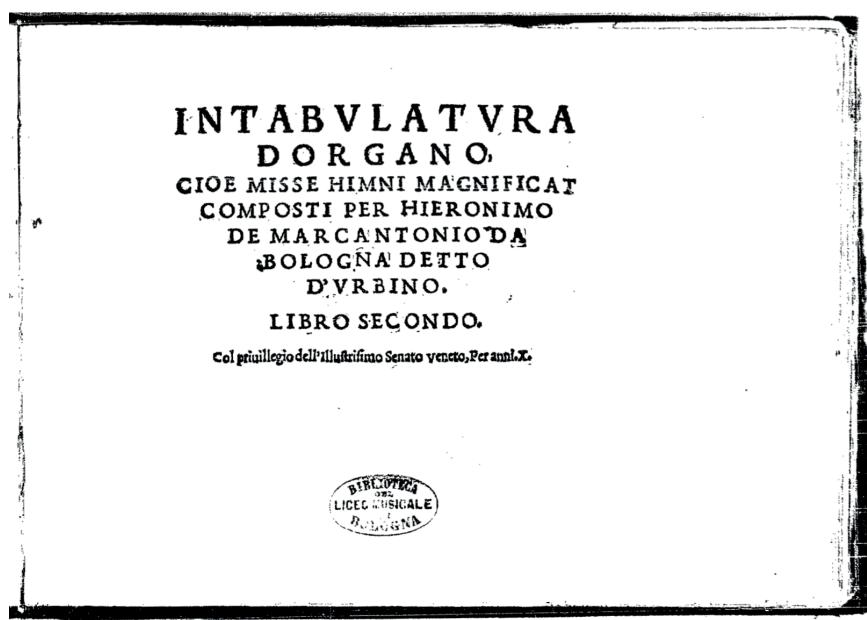
中文讲解
本页第 36 页上的一个内嵌图像/乐谱占位符。结合紧随其后的图注(图 1、图 2)可推断此处对应的是 Cavazzoni 曲集中的扉页或曲谱页之一。受输入限制无法看到实际细节,需查看原书。
第7段(P0183)
原文复述

中文讲解
本页第 36 页上的第二个内嵌图像/乐谱占位符。结合后续图注可知它对应 Cavazzoni 曲集中的扉页与乐谱起始页。需要查看原图方可确认版式细节。
第8段(P0184)
原文复述
中文讲解
本图注一次性交代两幅插图的来源与内容:图 1 为 Cavazzoni 第二册扉页(图见 P0181 转写);图 2 为同一册 fol. 1v(正面对折页的背面,即实际乐谱的起首页)。两者结合正好构成 P0178 的论据链条——“扉页说是塔布atura / 内文却是有量记谱”。
补充说明
图 1 的出版人补注 [Girolamo Scotto]、图 2 的 fol. 1v 起首页以及 after 1543 的日期,与 P0178、P0181 的描述完全一致,是同一文献的同源插图。
第9段(P0185)
原文复述
placed one above another. These tablatures appear first to have developed in the German-speaking world, even though the oldest example dating from the 14th century is preserved in England.11 In contrast, fingerboard tablatures are those in which the lines of the conventional music staff are re-envisaged as the strings of an instrument running along a fingerboard (Fig. 4). The number of lines is defined by the number of strings on the instrument, with numbers or letters to represent the places on the fingerboard where strings are stopped. This tablature seems to come from the Italian peninsula but became common throughout all Europe.
中文讲解
本段是 P0179 类型学定义的另一半。它首先补完矩阵塔布atura 的形态:多声部一行一行上下排列;并补充其历史来源——最早在德语区发展,但现存最早样本(14 世纪)藏于英国(脚注 11 指向 Robertsbridge Codex)。随即引入对照概念:指板塔布atura,其特征是把五线谱的线“重新想象”为沿指板延伸的琴弦,线的数量等于琴弦数,数字或字母则标注按弦的位置;这种塔布atura 据信起源于意大利半岛,后流传全欧。本段与 P0179 一起构成“矩阵 vs 指板”的二分法——前者关心“把多声部在二维表里排开”,后者关心“把线视作可触的弦”,二者代表两种截然不同的空间隐喻。读者应注意:作者说“年代最古老、与键盘音乐关系最密切”专指矩阵塔布atura,而指板塔布atura 与鲁特琴等拨弦乐器的图像(图 4)关系紧密。
补充说明
本段脚注编号 11 对应正文中最古老 14 世纪英国样本(即 P0188 提到的 Robertsbridge Codex);本段涉及的 Fig. 4 则与 P0187 图注的 Capirola 鲁特琴书对应。
第10段(P0186)
原文复述
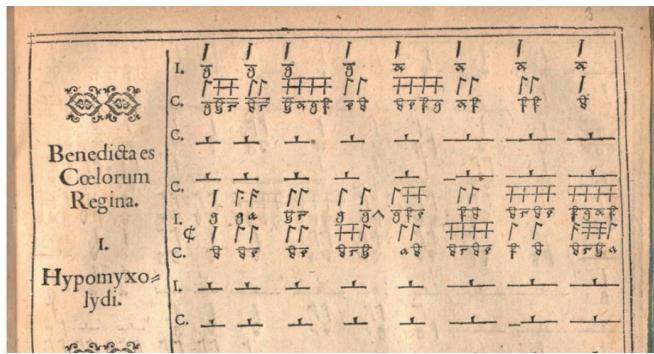
中文讲解
图 3 的图注:选自 Jacob Paix 1589 年在斯特拉斯堡出版的《Thesavrvs Motetarvm》第一件作品——Josquin des Prez《Benedicta es caelorum regina》之起首页。这是一条矩阵塔布atura 的实际样本,配合 P0179 对矩阵塔布atura“声部按行排列、用数字/字母标音”的定义,扮演“图证”角色。VD16 编号与慕尼黑数字中心链接表明这是德国出版业产物,与本段所说的矩阵塔布atura“首先在德语区发展”也吻合。
补充说明
此图实际上将矩阵塔布atura 的两大属性——多声部按行排列、用数字/字母标音——同时示例化:是 P0179、P0185 抽象定义的“图证”。
第11段(P0187)
原文复述
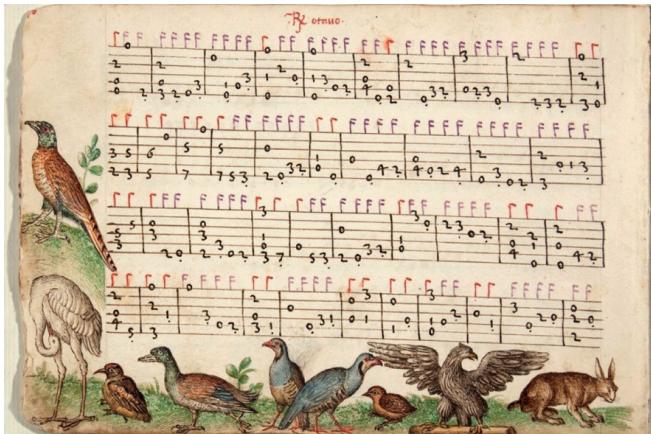
中文讲解
图 4 的图注:选自约 1517 年的《Capirola Lute Book》(美国克利夫兰 Case Western Reserve 大学藏本)第 44 对折页背面,作品是 Vincenzo Capirola 的 ‘Ricercar otavo’。这是一份典型的鲁特琴指板塔布atura——线代表弦、数字/字母代表按弦位置——与 P0185 对指板塔布atura 的定义完全呼应。它同时也是本节所说“指板塔布atura 似乎起源于意大利半岛”论断的最合适图证,因为 Capirola 来自意大利布雷西亚。
补充说明
此图为 P0185 的指板塔布atura 定义提供意大利起源的实物证据;鲁特琴乐谱的弦-按位隐喻正是图 4 的视觉基础。
第12段(P0188)
原文复述
These are included in GB-Lbl, Ms Add. 28850, known as the Robertsbridge codex.
中文讲解
脚注 11 的解释部分:作者指出 P0185 中提到的“现存最早 14 世纪塔布atura 样本”收藏在大英图书馆(GB-Lbl)Add. Ms 28850 中,俗称 Robertsbridge Codex。这条信息既支持“现存最早样本藏于英国”的论断,也为读者指认该手稿编号。
补充说明
此脚注与正文中“14th century is preserved in England”直接对应,是该陈述的唯一来源补注。
💡 本节核心要点
🔑 关键术语
s0206 [描述性拆分] Spanish Keyboard Tablatures — From Baena to Cabezón
第1段(P0189)
原文复述
Spanish Keyboard Tablatures
中文讲解
此为小节标题,原文以二级标题的形式标示出本部分将讨论的主题——西班牙键盘乐谱谱表(tablaura)。它在全文结构上起承转作用:前文已讨论了一般性的键盘谱表问题,从这里开始聚焦于伊比利亚半岛(尤其西班牙)的键盘谱表谱面形态与发展史。标题本身用复数Tablatures,暗示本节将介绍多种谱表类型,而非单一体系。
第2段(P0190)
原文复述
The second part of this essay is directed specifically to keyboard tablatures on the Iberian Peninsula, especially Spain. There is evidence of tablature use in Spain from the early 16th century. The earliest example is a fragment of fingerboard tablature, probably for vihuela, found in the endpapers of a book printed in 1513.12 The earliest keyboard tablature from the Iberian peninsula is the Arte […] pera aprender a tanger (Lisbon: Germao Galharde, 1540) by Gonzalo de Baena, written in an idiosyncratic alphabetic matrix tablature, independent of any other known tablature type. Only fairly recently rediscovered, this book is not so well known, with a first modern edition issued only in 2012.13 The best known type of Spanish tablature was the invention of Luis Venegas de Henestrosa, and used for his Libro de cifra nueva printed in Alcalá de Henares in 1557 by Juan de Brocar (Fig. 5). In the prefatory pages of the book, Venegas explains how he came to invent his tablature and expresses his desire that it should become a universal notation for all solo instruments. With improvements added by Hernando de Cabezón in his publication of the Obras de música of his late father Antonio in 1578 (Fig. 6), Venegas’ tablature became the predominant keyboard tablature used in Spain until the early 18th century. Even though Venegas’ tablature achieved considerable longevity, it is but one of numerous tablature types invented on the Iberian peninsula. These include the organ tablature proposed by Alonso Mudarra in his Tres libros de música (Sevilla: Juan de Léon, 1546), the continuous numeric tablature proposed by Bermudo in his Declaración de instrumentos (Ossuna: Juan de Léon, 1555) and then the dozen or so other Iberian tablatures revealed by Andrés Cea Galán in his doctoral dissertation of 2014.14
中文讲解
本段是全节核心,建立伊比利亚键盘谱表史的总体框架,作者通过层层限定塑造出"主流—边缘"的双重叙事:
-
范围的限定:开篇明确本部分是文章的第二部分(‘The second part of this essay’),将焦点从一般键盘谱表收窄到伊比利亚半岛,尤其西班牙——这是一种’特别关注’的论述姿态。
-
最早实物证据:作者把西班牙谱表使用史的起点定在16世纪初,并指出已知最早例证并非键盘谱表,而是一段很可能是为维韦拉琴(vihuela)记写的指板谱表残片,出现在1513年印本书的衬页上(详见脚注12)。这一细节揭示了作者所掌握的证据级别——并非键盘,而是同属’指板’族系的弦乐谱表。
-
最早键盘谱表:作者接着把伊比利亚半岛最早的键盘谱表归于巴埃纳(Gonzalo de Baena)1540年在里斯本出版的《Arte […] pera aprender a tanger》。作者用’idiosyncratic alphabetic matrix tablature’和’independent of any other known tablature type’两个限定,强调该谱表既独特又孤立——这一点很重要,它修正了读者可能持有的’西班牙谱表源自他处’的预设。该书近年才被重新发现,现代首版迟至2012年(详见脚注13),所以读者可以理解为什么它在学界认知度不高。
-
最知名的类型与作者意图:作者笔锋一转,引入’最知名’的西班牙谱表——贝内斯特罗萨(Venegas de Henestrosa)的《Libro de cifra nueva》(1557,阿尔卡拉)。这里的关键信息不只是谱表本身,还有序言中作者本人的表态:他解释了自己如何发明此谱表,并希望它能成为所有独奏乐器的’通用记谱法’(a universal notation for all solo instruments)。这一意图直接呼应后段(P0196)所述’键盘、竖琴、维韦拉’共用谱表的副标题现象。
-
卡韦松的改进与谱表寿命:卡韦松父子中,儿子埃尔南多(Hernando)在1578年出版亡父安东尼奥(Antonio,卒于1566)的《Obras de música》时对贝内斯特罗萨谱表做了改进。这一改进版的谱表由此成为西班牙键盘谱表的主流形态,使用时间从16世纪中叶一直延续到18世纪初——作者用’predominant’和’early 18th century’两个限定告诉读者此谱表的实际统治范围。
-
多元图景的修正:段末作者话锋突转,用’Even though’和’it is but one of’提出关键限定:尽管贝内斯特罗萨谱表寿命很长,它只是伊比利亚众多谱表之一。其他例证包括穆达拉(Alonso Mudarra)1546年的管风琴谱表、贝尔穆多(Bermudo)1555年的连续数字谱表,以及2014年塞阿·加兰(Cea Galán)博士论文揭示的约十二种其他伊比利亚谱表。这一限定使读者意识到:所谓’西班牙谱表传统’并非铁板一块,而是多源并存的谱表实验场域。
整体而言,本段的论证策略是’主流案例+多元背景’:先用贝内斯特罗萨—卡韦松主线确立最经典谱表,再用其他类型补充’除此之外还有许多’,为后文深入分析贝内斯特罗萨—卡韦松谱表的具体形态做铺垫。
补充说明
本段多次出现的维韦拉琴(vihuela)与键盘乐器的关联,呼应了下一段(P0196)所述’para tecla, harpa y vihuela’副标题——即谱表的跨乐器共享性。读者可据此理解本段提及的’维韦拉琴谱表残片’与键盘谱表之间的关系:尽管两者服务于不同乐器,但在伊比利亚传统中却被设想为可由同一套记谱原则承载。
第3段(P0191)
原文复述
12 It is a single staff sketch drawn on the flyleaf of a copy of Lucius Marineus Siculus, Epistolarum familiarum libri xvii (Valladolid, 1514); see Antonio Corona-Alcalde ‘The earliest vihuela tablature: a recent discovery’, in: EM 20 (1992), 594–600
中文讲解
本条为脚注12,提供P0190所提到的'1513年印本书衬页上’那段维韦拉琴谱表残片的精确来源信息。它实质上修正了正文里'1513’这一年份:实际所依据的实物是1514年由Lucius Marineus Siculus所著《Epistolarum familiarum libri xvii》(瓦利阿多利德印本)一书的某一副本的扉页(flyleaf)上所绘的单行谱表草稿。作者引用的研究文献是Antonio Corona-Alcalde发表在《EM》(Early Music)第20卷(1992年)第594–600页的文章’The earliest vihuela tablature: a recent discovery’。脚注作为正文的史料限定来源,作用是:既指明实物出处(具体书名、地点、年份),又提供进一步的学术参考文献供读者追溯。
补充说明
正文写作’book printed in 1513’,脚注引用的实物出自'1514’印本的两者差异未在本任务输入中进一步解释,读者应注意脚注给出的年份与正文年份之间存在出入,以脚注所引文献为准。
第4段(P0192)
原文复述
13 The tablature is described in Tess Knighton, ‘A newly discovered keyboard source (Gonzalo de Baenas’s Arte novamente inventada pera aprender a tanger, Lisbon, 1540): a preliminary report’, in: Plainsong and Medieval Music 5 (1996), 81–112; edited as Gonçalo de Baena, Arte para tanger (Lisboa, 1540), edition and introductory study by Tess Knighton (Lisbon, 2012). The tablature is available online: https://imslp.org/wiki/Special:ReverseLookup/216087 (accessed 23 June 2022).
中文讲解
本条为脚注13,详细列出与巴埃纳(Gonzalo de Baena)1540年里斯本版《Arte novamente inventada pera aprender a tanger》相关的三组文献与资源:第一,Tess Knighton 1996年发表于《Plainsong and Medieval Music》第5卷第81–112页的初步报告’A newly discovered keyboard source’,是该谱表的学术性介绍;第二,Tess Knighton 2012年在里斯本编辑出版的现代版本《Arte para tanger (Lisboa, 1540)》——这条信息与正文里’first modern edition issued only in 2012’直接对应;第三,提供IMSLP上的在线谱表访问链接及访问日期(2022年6月23日)。整条脚注同时承担’史料描述+现代整理+电子资源’三重功能,便于读者既追溯原始研究,又查阅现代刊本与在线材料。
补充说明
脚注中拼写’Baenas’s’(带s)和正文’Baena’略有差异,这反映了原文与脚注引文之间的人名拼写不一致,读者可视为同一人物。
第5段(P0193)
原文复述
14 Andrés Cea Galán, ‘La cifra hispana: música, tañedores e instrumentos (siglos XVI-XVIII)’, Doctoral thesis, Universidad Complutense de Madrid, 2014.
中文讲解
本条为脚注14,引用Andrés Cea Galán于2014年提交的博士论文’La cifra hispana: música, tañedores e instrumentos (siglos XVI-XVIII)’(马德里康普顿斯大学)。该论文题目的西班牙语含义是’西班牙式数字谱:音乐、演奏者与乐器(16—18世纪)’,对应正文中’十多其他伊比利亚谱表’(’the dozen or so other Iberian tablatures’)这一表述——也就是说,正文所谓的’被塞阿·加兰揭示’的众多谱表,其权威学术来源即为此论文。该脚注是对正文’多元谱表并存’论断的学术背书,把正文带过的一句话落实到具体博士论文级的研究上。
补充说明
题目中’cifra hispana’与正文提到的Venegas著作《Libro de cifra nueva》中的’cifra’是同一谱表传统下的不同称谓,可视为对’西班牙式数字谱’这一谱表体系的统一指称。
第6段(P0194)
原文复述
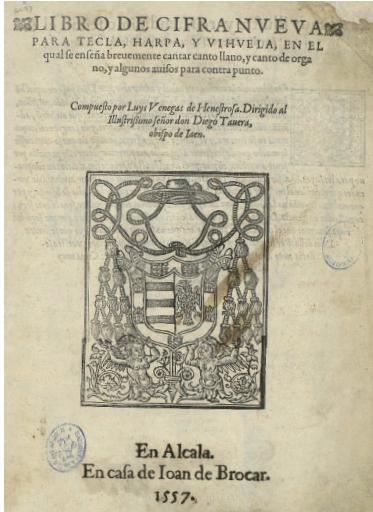
中文讲解
此为第39页上的图像或乐谱占位符。原任务输入中未给出该图像的可读细节,仅说明其位于第39页并以方括号标记’内嵌图像数据已省略’。由于缺少可定位的视觉内容,本条不应推测该图像的具体谱面形态、装饰风格或音乐片段,而应指出:它出现在论述西班牙键盘谱表具体形态的段落之间,可能与下文图5、图6的标题页形成图谱对照,或作为正文所述谱表类型的视觉例证。具体内容需查看原书第39页。
第7段(P0195)
原文复述
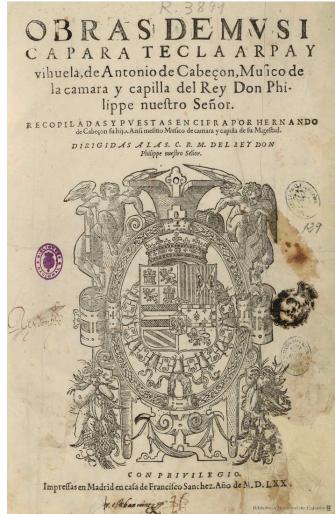
中文讲解
本条为第39页图5与图6的图注(caption),两条图像内容在任务输入中均被省略,仅保留图注文字与在线访问链接。图5说明图像内容为Venegas de Henestrosa《Libro de cifra nueva》(1557年,阿尔卡拉·德·埃纳雷斯,Juan de Brocar印刷)的标题页,并提供西班牙国家图书馆(BNE)的数字馆藏链接(访问日期:2022年6月23日)。图6说明图像内容为Hernando de Cabezón《Obras de música》(1578年马德里Francisco Sánchez印刷,RISM编号158724)的标题页,并提供RISM在线目录链接(访问日期:2022年6月24日)。这两幅标题页在正文论证中扮演双重角色:一是作为’此谱表真实存在于印本中’的视觉确证;二是为读者提供可在线查阅原始文献的入口;其中图5直接对应P0190所述’最知名西班牙谱表’,图6直接对应P0190所述’卡韦松改进版谱表’,两图共同支撑本节论证主线。
补充说明
图注中的RISM编号158724(以及purl链接中的BI/1578/24)是国际音乐文献资料库(RISM)对1578年印本的统一编目号,可作为该印本的唯一学术标识。
第8段(P0196)
原文复述
The present study, however, revolves around Venegas de Henestrosa’s Libro de cifra nueva (1557), and Hernando de Cabezón’s Obras de música (1578), a book that brought into print an anthology compiled many years earlier by Antonio de Cabezón who had died in 1566. The interesting feature of both volumes is that they are subtitled para tecla, harpa y vihuela, an indication that they are ‘for keyboard, harp and vihuela’. The sentiments of this phrase, the insinuation of a common notation and interchangeable repertory for the principal polyphonic instruments of the time, appears to be validated further when it is echoed in the title of Fray Tomás de Santa María’s keyboard treatise of 1565 titled Libro llamado Arte de tañer Fantasía, assi para Tecla, como para Vihuela, y todo instrumento, en que se pudiere tañer a tres, y a quatro vozes, y a mas. (A book called the Art of the Fantasia, equally for Keyboard as for Vihuela, and all instruments upon which one might play in three, four or more voices).15
中文讲解
本段从历史背景转入本研究的范围与论证核心,可拆解为三个层次:
-
范围的收窄:句首’however’标志转向——尽管前段(P0190)展示了众多伊比利亚谱表,但本研究的焦点仅锁定两本书:贝内斯特罗萨1557年的《Libro de cifra nueva》与卡韦松(埃尔南多)1578年的《Obras de música》。关于后者,作者补充关键史实:该书是’印刷成册’的版本,其内容是早已编纂的选集,编纂者为其父安东尼奥·德·卡韦松(卒于1566年)。‘had died in 1566’这一限定至关重要:它意味着书中曲目在出版前已积累多年,编辑工作跨越了父子两代。
-
副标题的弦外之音:作者将论证焦点从’书是谁写的’转移到’书的副标题说什么’。两本书都被标注为’para tecla, harpa y vihuela’(为键盘、竖琴、维韦拉琴而作)。作者用’an indication that they are…‘明确指出这一副标题意味着:本书并非只为某一乐器服务,而是暗示存在一套’共同记谱法’与’可互换曲目’,适用于当时主要的对位乐器(the principal polyphonic instruments of the time)。‘insinuation’(暗示)一词透露作者态度——他并未把副标题视为’确凿主张’,而是视为’出版者的言外之意’。
-
时代回响的佐证:作者进一步引用1565年托马斯·德·圣玛利亚修士(Fray Tomás de Santa María)的键盘论著《Libro llamado Arte de tañer Fantasía, assi para Tecla, como para Vihuela, y todo instrumento, en que se pudiere tañer a tres, y a quatro vozes, y a mas》(既为键盘也为维韦拉琴,以及一切可奏三、四声或更多声的乐器而作的幻想曲演奏艺术之书)的完整长标题作为旁证。括号内附有作者对西班牙语长标题的英译。’echoed in the title’这一表述将1565年圣玛利亚的’通用化’主张与1557/1578年贝内斯特罗萨—卡韦松的副标题联系起来,构建出'16世纪中叶伊比利亚音乐界普遍存在跨乐器共用记谱法与曲目’的论证。‘appears to be validated further’这一措辞表明:作者认为副标题所暗示的’共同记谱’主张,得到了独立来源(圣玛利亚)的间接支持,但语词’requires further validation’中’further’也保留了作者的审慎——他不把这一回响视为决定性证据。
整体而言,本段完成了从’谱表史’到’谱表理念’的飞跃:从’谁发明了哪种谱表’,进入到’这些谱表的发起者是否追求跨乐器通用性’这一更深层问题,为后续可能展开的谱面分析奠定概念框架。
补充说明
原文出现的西班牙语长段——‘assi para Tecla, como para Vihuela, y todo instrumento, en que se pudiere tañer a tres, y a quatro vozes, y a mas’——是16世纪西班牙语古拼写形式,‘assi’即现代西班牙语’así’,‘pudiere’为古虚拟式形式。括号内的英译是作者提供的,并非独立来源。
第9段(P0197)
原文复述
15 Tomas de Santa María, Libro llamado arte de tañer fantasía (Valladolid: Francisco Fernandez de Cordova, 1565); online: http://bdh-rd.bne.es/viewer.vm?id=0000158382&page=1 (accessed 23 June 2022).
中文讲解
本条为脚注15,提供P0196所引托马斯·德·圣玛利亚1565年论著的完整出版信息:作者全名为Tomas de Santa María,著作全称为《Libro llamado arte de tañer fantasía》(‘arte’前省略定冠词),出版地为瓦利阿多利德(Valladolid),印刷者为Francisco Fernandez de Cordova,出版年份1565。脚注同时给出西班牙国家图书馆(BNE)数字馆藏的在线访问链接(访问日期:2022年6月23日)。该脚注的功能是为P0196中作为’回响证据’的长标题提供精确出版资料与在线查阅入口,使读者能够直接核对原书目录页。
补充说明
脚注中作者拼写’Tomas’(无Th),与正文中’Fray Tomás’拼写差异保留了原文形态,读者可视为同一人物在不同语境下的拼写变体。
脚注 / 边栏 / 图表 / 附加信息(如有)
本节包含三个脚注(编号12、13、14、15——其中12至14对应P0190的三个文献支撑,15对应P0196的旁证),以及两幅图(图5、图6,对应P0195)的图注。脚注12将正文'1513年印本’这一笼统说法精确化到'1514年瓦利阿多利德印《Epistolarum familiarum libri xvii》某一副本的扉页’,并引向Corona-Alcalde 1992年的发现性论文;脚注13为巴埃纳1540年谱表提供了Tess Knighton的初步报告与现代编辑版(2012);脚注14为塞阿·加兰2014年博士论文的完整出处;脚注15为圣玛利亚1565年论著提供出版地、印刷者、年份与在线访问入口。图5与图6分别对应’最知名西班牙谱表’与’卡韦松改进版’两本核心文献的标题页,构成视觉佐证。
💡 本节核心要点
- 本节区分了’维韦拉琴指板谱表残片’(约1513/1514年)与’键盘谱表’(最早为巴埃纳1540年里斯本版)两个不同序列。
- 伊比利亚半岛存在多种独立并存的谱表体系,包括巴埃纳的字母矩阵式谱表、贝内斯特罗萨的数字谱表、穆达拉的管风琴谱表、贝尔穆多的连续数字谱表等,‘最知名’并不意味着唯一。
- 贝内斯特罗萨1557年《Libro de cifra nueva》经卡韦松1578年《Obras de música》改进后,成为西班牙键盘主流谱表,使用时间延续至18世纪初。
- 贝内斯特罗萨本人在序言中表达过将谱表推广为’所有独奏乐器通用记谱法’的愿望,这一意图在卡韦松书的副标题’para tecla, harpa y vihuela’以及圣玛利亚1565年论著长标题中得到回响,体现出16世纪中叶伊比利亚音乐界追求跨乐器共用记谱法与可互换曲目的整体氛围。
- 巴埃纳1540年谱表近年才被重新发现,现代首版迟至2012年,意味着学术界对伊比利亚早期键盘谱表的整体认识仍在持续修正中。
🔑 关键术语
- tablature:谱表,泛指以数字、字母或符号直接指示演奏动作(如指板位置、空弦等)的记谱体系,与现代通用的五线谱不同;在本节中既指维韦拉琴的指板谱表,也指键盘谱表。
- vihuela:维韦拉琴,16世纪流行于伊比利亚半岛的拨弦乐器,形制近似吉他但弦数与调弦不同;其指板谱表与键盘谱表在本节中被并置讨论,暗示伊比利亚传统中存在跨乐器的共用记谱设想。
- Libro de cifra nueva:《新数字谱之书》,贝内斯特罗萨1557年于阿尔卡拉·德·埃纳雷斯出版的西班牙键盘谱表代表作;‘cifra nueva’意为’新数字谱’,暗示与既有的数字谱体系存在区别。
- alphabetic matrix tablature:字母矩阵式谱表,巴埃纳1540年所用谱表的形态特征,作者强调其’idiosyncratic’(独特)且独立于其他已知谱表类型,是伊比利亚谱表多元图景的代表。
- continuous numeric tablature:连续数字谱表,贝尔穆多1555年《Declaración de instrumentos》中所提出的键盘谱表形态,与贝内斯特罗萨的’新数字谱’并列为另一谱表类型。
- para tecla, harpa y vihuela:西班牙语’为键盘、竖琴与维韦拉琴而作’;作为贝内斯特罗萨1557年与卡韦松1578年两本书共同的副标题,作者视其为’存在跨乐器共用记谱法与可互换曲目’的暗示性证据。
- RISM:国际音乐文献资料库Répertoire International des Sources Musicales的缩写,为音乐印本与手稿提供统一的国际编目系统;图6引用的’RISM 158724’即该书在RISM中的编号。
- IMSLP:International Music Score Library Project,国际乐谱图书馆计划,提供大量公共领域乐谱的在线访问;脚注13引用的页面即巴埃纳1540年键盘谱表的在线版本。
s0207 [描述性拆分] Debating ‘Para Tecla, Harpa y Vihuela’ — Setting the Micro-Historical Question
第1段(P0198)
原文复述
The uncritical acceptance of the phrase ‘para tecla, harpa y vihuela’ has led to the assumption that the music of these books, if not all Spanish keyboard music, is suitable for all three instruments and can be freely exchanged between them. Earlier musicological scholars accepted the phrase without question and, even if only implicitly, never questioned its accuracy. The dominant 20th-century Spanish scholar Higinio Anglés, in his 1944 edition of Venegas’ Libro, wrote, for example, that ‘our organists published music for keyboard, which could also be used for the other instruments in vogue at the time.’ This view of an interchangeable repertoire belonging to ‘our organists’ has persisted without serious interrogation. The present task is to expose the manner in which the phrase ‘para tecla, harpa y vihuela’ came into existence and how it spread, and consequently to dispel the notion of an interchangeable Spanish repertory for solo instruments. The study demonstrates how Venegas’ use of the term ‘for keyboard, harp and vihuela’ makes sense in the context of his own book, but suggests that Cabezón’s use of the same phrase was likely a hasty last-minute addition, probably for commercial reasons. In Santa María’s case, the phrasing is not the same, and the precise meaning of his wording must be carefully untangled. From the micro-history of these three books it becomes impossible to accept that the use, on two occasions, of the same phrase reflects a widespread Spanish practice of interchangeability as has often been supposed.
中文讲解
本段是全节乃至全文的问题意识起点。作者首先揭示学界既有的一种笼统前提——把出现在三部十六世纪西班牙音乐书名/序言中的短语’para tecla, harpa y vihuela’等同于西班牙键盘、竖琴与维韦拉琴曲目彼此通用的实证根据,并将这一前提追溯到二十世纪西班牙音乐学权威Higinio Anglés 1944年编辑Venegas《Libro》时写下的一段话:‘我们的管风琴师所出版的键盘音乐,亦可用于当时流行的其他乐器’。作者认为这种’通用互换曲目’的看法从未受到真正质疑,并将其作为本文要反驳的对象。作者明确宣布自己的微观史任务:从该短语在三本书中各自出现的语境出发,分别考察其来历与传播,进而否定’西班牙独奏乐器曲目可互换’的笼统结论。这里需要读者特别注意三点:(1)作者用了’if not all Spanish keyboard music’这一让步限定,承认这一假设的延伸范围甚至超出了三部书本身;(2)作者对三本书的判断并不等同——他将逐案分疏,Venegas案是’合乎其书语境’的真使用,Cabezón案很可能是’仓促的商业添加’,Santa María案的措辞则’并不相同’,需另行梳理;(3)‘micro-history’(微观史)是本节方法论的核心,它意味着不把短语作为笼统传统的证据,而当作单部书的局部史实去还原。
补充说明
本段所提到的三部书——Venegas de Henestrosa的《Libro de cifra nueva》、Hernando de Cabezón的《Obras de música》以及Tomás de Santa María的著作——正是本节及随后小节逐一进行微观史考察的对象,三书中该短语或类似措辞的具体语境将在后文分别辨析。
第2段(P0199)
原文复述
Section heading: ‘Venegas de Henestrosa and Hernando de Cabezón’. The heading announces that the discussion will turn to a paired treatment of these two figures, the editors most directly responsible for the books in which the phrase ‘para tecla, harpa y vihuela’ appears in its clearest form.
中文讲解
这是一个层级为二级的章节小标题,标志着论述从’问题意识与方法论宣告’转入对两位编纂者的个案考察。读者可以由此预期:接下来将先谈Luis Venegas de Henestrosa,再谈Hernando de Cabezón,并就两人使用’para tecla, harpa y vihuela’的语境作对比。Santa María因为措辞不同,将另作处理。
补充说明
此标题同时也是本小节论证结构的导航:作者按’先Venegas—再Cabezón—再Santa María’的顺序展开,符合本段开篇所宣告的微观史分别考察策略。
第3段(P0200)
原文复述
Luis Venegas de Henestrosa (c. 1510–1570), a musician employed by the Archbishop of Toledo from at least 1535 to 1545 and subsequently a parish priest in the town of Hontoba in Guadalajara, invented a new format of keyboard tablature and used it to compile the anthology that he accordingly titled a ‘Book of new ciphers’, adding in a very matter-of-fact way that it was ‘for keyboard, harp and vihuela’ so as to reflect its contents. The book is genuinely music ‘para tecla, harpa y vihuela’, in contrast to the later book by Hernando de Cabezón, which is not. Venegas’ years in Toledo had allowed him to move in highly cultured circles and to become familiar with the best music of his time. In contrast, his later life as a parish priest in a small rural community made him aware of the difficulty of access to good music for liturgical use. In the preface of his book, ‘Al lector’ (To the reader), he begins by explaining that he anticipated becoming the target of insults from professional musicians, because he had invented his tablature and thereby created a ‘shortcut’ enabling people of very inferior status to learn in a short time what had taken him years to achieve. Venegas knew, however, that his book would fill a void. As a church musician, he lamented the lack of competent organists for parish churches; as an organist, he lamented the lack of keyboard music in circulation. He wanted to fill this void both directly and indirectly: by offering players a useful anthology, by inventing a new simple but effective notation, and by giving players tools to expand their own repertoire. He also saw in his tablature the possibility of a universal notation usable by all instrumentalists. Even if employed in a modest position, Venegas was a man of broad perspective, perhaps an idealist if not a dreamer.
中文讲解
本段把P0198宣称的微观史方法第一次落到Venegas这一具体案例上,为后文判断其使用’para tecla, harpa y vihuela’是’符合内容’的真诚表述奠定生平与编辑动机的基础。
理解这段需要把握几条互相交织的线索:(1)作者通过拼合Venegas两段截然不同的经历——托莱多宫廷音乐家(1535–1545)与瓜达拉哈拉省Hontoba小镇的教区神父——构造出他’既深知一流音乐、又深知乡村教区音乐匮乏’的双重视角。这正是其书既能编出高水平曲集、又真正面向教区使用者的现实基础。(2)作者从序言’Al lector’中提取Venegas的自述:他预见到职业音乐家会因他’发明新记谱法、创造捷径’而攻击他,理由是这种捷径让资质远逊之人也能在短期内学到职业音乐家多年才掌握的技艺。这一段并非自夸,而显示出Venegas对自己所处的音乐等级秩序有自觉——他知道自己打破了行当边界。(3)由此出发,作者把Venegas定位为’双重填补者’:作为教会音乐家,他悲叹教区缺乏合格的管风琴师;作为管风琴师,他悲叹流通中的键盘曲目不足;他既提供曲集、又发明简易有效的记谱法、还给演奏者自行扩充曲目的工具。(4)更关键的是,Venegas在其新记谱法(cifra nueva)中看到了’一种所有乐器演奏者都能使用的通用记谱’的可能性——这一点直接呼应本节核心论题’para tecla, harpa y vihuela’,并解释了为什么在他的语境里这短语是真诚的:他的通用记谱理想本身就蕴含了跨乐器使用的设想。(5)作者最后以’有广阔视野的人,或许是个理想主义者,甚至可以说是个梦想家’评价Venegas,提示读者把他的’通用性’主张理解为有乌托邦色彩的编辑理想,而非仅仅是商业话术。(6)本段最后一句’It is genuinely music…in contrast to the later book by Hernando de Cabezón which is not’是关键的对照伏笔:作者明确预告,Cabezón的同名短语并不对应真实的曲目内容,性质将与Venegas截然不同。
补充说明
本段是P0198所提微观史论证在Venegas案例中的落实:通过编纂者生平(宫廷经历+教区经历)、序言’Al lector’中的自述、以及’通用记谱’的编辑理想三方面材料,论证Venegas的’para tecla, harpa y vihuela’是与其书目内容真正一致的表述。文中’Toledo—Hontoba’的对照、‘church musician + organist’的双重身份陈述、以及’perhaps an idealist if not a dreamer’的评语,三处是支撑这一论证的关键支点。
第4段(P0201)
原文复述
Footnote 16: Higinio Anglés, La música en la corte de Carlos V con la transcripción del ‘Libro de cifra nueva para tecla, harpa y vihuela’ (Alcalá de Henares, 1557) compilado por Luys Venegas de Henestrosa, 2 vols., Monumentos de la Música Española II, III (Barcelona, 1944; reprinted 1965), pages xi–xii.
中文讲解
本脚注为P0198正文中Anglés的那句引文(‘our organists published music for keyboard…’)提供完整书目出处。读者据此可定位到Anglés 1944年编辑的《Libro de cifra nueva》前言部分(xi–xii页),同时该版本作为’Monumentos de la Música Española’第二、三卷出版,是二十世纪西班牙音乐学界引用Venegas曲集的标准版本,也是后世反复援引’通用互换’论的最重要源头之一。
补充说明
脚注16在功能上既是文献来源标注,也是本文反驳对象的关键文献定位:作者通过指出该论断出自1944年版的前言,提示读者’互换论’其实只建立在一个编辑者的一段序言措辞上,证据基础相当单薄。
第5段(P0202)
原文复述
Footnote 17: This conclusion is not new: the author has written about it in articles in Spanish published in 2007 and 2014. This is, however, the first time the author has published on this topic in English. For the earlier studies see John Griffiths, ‘Venegas, Cabezón y las obras “para tecla, harpa y vihuela”’, in: Cinco siglos de música de tecla española – Five Centuries of Spanish Keyboard Music, ed. Luisa Morales (Garrucha, 2007), 153–68; and idem, ‘¿Fantasía o realidad? La vihuela en las Obras de Cabezón’, in: AnM 69 (2014), 193–214.
中文讲解
本脚注承担双重功能:第一,它提示读者,本文的核心结论——三本书中’para tecla, harpa y vihuela’短语不能作为西班牙乐器互换传统的证据——并非作者首次提出,他早在2007年和2014年的西班牙语文章中就已论述过;本节及所属章节是这一论题首次以英语发表。第二,它为上述两篇前作提供了完整书目信息:2007年收录于Luisa Morales主编的《Cinco siglos de música de tecla española》(西班牙文/英文双语标题);2014年发表于西班牙音乐学年刊AnM(《Anuario Musical》第69期)。两篇文章均由John Griffiths署名,与本节作者为同一人。这一脚注既交代了学术脉络,也提醒英语读者如欲追溯细节,可查阅此前的西班牙语研究。
补充说明
脚注17因此同时具备’限定论断新颖度’与’提供进一步阅读入口’两项作用:它将本文定位为作者英文学术写作中对该论题的首次系统呈现,但其论证内核已存在于作者本人的前期西班牙语文献中。
脚注 / 边栏 / 图表 / 附加信息(如有)
本小节包含两条脚注(编号16与17),分别承担不同的文献功能。脚注16为P0198中Anglés关于’通用互换’的引文提供完整书目出处(1944年《Monumentos de la Música Española》卷二、卷三前言xi–xii页),是本文主要反驳对象的关键文献定位。脚注17兼具限定与导引两重作用:一方面说明本文结论并非首次提出,而是作者2007、2014年两篇西班牙语文章的延续;另一方面为读者提供该论题前期研究的完整书目信息(Griffiths 2007载于Luisa Morales主编论文集,Griffiths 2014载于《Anuario Musical》第69期)。两脚注共同支撑P0198正文中的核心主张:把’通用互换论’的源头锁定到一部序言,并提示本文作者自身曾就此先行著述。
💡 本节核心要点
- 短语’para tecla, harpa y vihuela’长期被不加批判地接受,并被用来支撑’西班牙键盘、竖琴与维韦拉琴曲目可自由互换’这一笼统结论,其源头可追溯至Anglés 1944年编辑Venegas《Libro》前言中的一段话。
- 本节宣告以微观史方法逐一检视三本书(Venegas、Cabezón、Santa María)中该短语或近似措辞的具体语境,并据此否定’通用互换曲目’的传统判断。
- Venegas的《Libro de cifra nueva》‘真正’是’para tecla, harpa y vihuela’:他兼具托莱多宫廷音乐家与乡村教区神父的双重经历,深知高水平曲目与教区可用性之间的落差。
- Venegas以’双重填补’方式回应这一落差——既提供曲集、又发明简易有效的键盘新记谱法(cifra nueva),并赋予该记谱法以’所有乐器通用记谱’的理想主义愿景。
- 序言’Al lector’揭示了Venegas对职业音乐家’捷径攻击’的自觉预期,提示其’通用性’主张是与当时音乐等级秩序的一次正面交锋,而非单纯的商业修辞。
- 与Venegas不同,Cabezón的同名短语被作者预判为’仓促的商业添加’;Santa María的措辞则与前两者不同,其精确含义有待另案辨析——这一对照在P0200末句已被明确预告。
🔑 关键术语
- para tecla, harpa y vihuela:西班牙语短语,意为’用于键盘、竖琴与维韦拉琴’,曾出现在多部十六世纪西班牙音乐书名或序言中。本节论证其含义因编纂者与具体书目不同而各异,不能作为’西班牙乐器通用互换曲目’传统的笼统证据。
- Libro de cifra nueva:‘新记谱法之书’,Venegas de Henestrosa所编曲集的名称,副标题明示’para tecla, harpa y vihuela’;本节判定该书内容与副标题一致,是短语被’真诚使用’的典型案例。
- cifra nueva(新记谱法):Venegas发明的新型键盘记谱体系。本节将其视为两种功能的统一体:一是面向乡村教区演奏者的实用性简易记谱;二是承载Venegas’所有乐器通用记谱’之理想主义愿景的载体。
- Al lector:‘致读者’,Venegas为其《Libro de cifra nueva》所撰前言的标题。文中Venegas预告职业音乐家会因他创造’捷径’而攻击他,是理解编者立场与所处音乐等级秩序的关键材料。
- 微观史(micro-history):本节采用的方法论。主张把同一短语在不同书目中的具体使用语境、编纂者生平与出版背景作为单部书的局部史实逐一还原,而非将其视为西班牙乐器互换传统的笼统证据。
- Higinio Anglés:1944年编辑并出版Venegas《Libro》的二十世纪西班牙权威音乐学家,本节将其1944年版前言中关于’键盘音乐亦可用于其他乐器’的论断作为’不加批判接受互换论’的代表加以引用与反驳。
s0208 [描述性拆分] Venegas de Henestrosa — A Universal Notation for Keyboard, Harp, and Vihuela
第1段(P0203)
原文复述
Venegas de Henestrosa’s tablature is remarkably simple. It is a matrix tablature on a staff of a varying number of lines disposed with one line per voice, and the numerals 1-7 used to represent the natural notes of each octave, starting on F (1 = F, 2 = G, 3 = A etc). The music is barred in tactus units and there are no rhythmic symbols: the numbers are spaced so that their duration is to be intuitively intelligible. As can be seen in the following example (Fig. 7) is very easy to read.
中文讲解
本段概述了维内加斯·德·埃内斯特罗萨(Venegas de Henestrosa)谱表的总体形式特征,是本小节的展开起点。作者将其界定为"matrix tablature"(矩阵式谱表)——即一种以行为声部、列为同时发响事件的网格化记谱原则,但在维内加斯的版本中落实为一张行数可变的谱表,每行代表一个声部;其数字系统用 1–7 表示各八度内的自然音,且以 F 起始(1=F,2=G,3=A,依此类推)。乐谱以 tactus(基本拍)为单位划小节线,但不使用任何时值符号——音符的时值完全依靠数字之间的水平间距来直觉地传达。作者随即将该谱式判定为"非常易读",并以图 7 作为视觉佐证。该段在本小节论证中的作用是先勾勒形式上的"简单性",为下文分别讨论该谱式在竖琴、比韦拉琴和键盘乐器上的可推广性、其在历史上真实的接受程度、以及其在曲目移植上的局限与价值奠定起点。
补充说明
“matrix tablature"的核心特征是:纵轴对齐同时发响的音、横轴自左向右推进时间,因此每个数字的纵向位置决定其所在的声部;维内加斯的体系把这种网格原理映射到一个传统谱表上,每条线代表一个声部,行数随声部数而变。“tactus"是文艺复兴时期音乐理论中的基本拍单位,此处以之作为小节划分的基础。
第2段(P0204)
原文复述
18 The book is edited by Higinio Anglés, La música en la corte de Carlos V (see n. 16). The contents are listed in Brown 15572.
中文讲解
这是关于维内加斯《Libro de cifra nueva》的脚注 18,交代两条学术引用线索:其一,该书由西班牙音乐学家伊希尼奥·安格莱斯(Higinio Anglés)编辑,收入《La música en la corte de Carlos V》(《卡洛斯五世宫廷中的音乐》)一书,并参见前一注释 16 以获取更完整的出版信息;其二,该书的内容清单载于参考工具书 Brown 15572。本脚注的功能是为正文讨论提供来源与进一步查找线索(来源 / 旁证),并未引入新论点。
第3段(P0205)
原文复述
19 ‘Aunque por ser cosa nueua esta cifra, será agradable (muy amado lector), no dexo de temer que la gran facilidad que tiene, será causa, para que los mejores músicos la calumnien y tengan en poco, porque como ellos gastaron tanto tiempo, y passaron tanto trabajo en alcançar lo que saben, y vean que por esta vía, se ataja mucho camino : ser les ha desabrido la manera deste guisado specialmente a los que están faltos de charidad del aprouechamiento de sus próximos : lo qual, demás de ser contra la ley de Dios, es contrario a lo que ellos pretenden, que es auentajarse de los otros músicos, porque mucho más sabrá en poco tiempo con ayuda desta cifra […].’ Libro de cifra nueva, fol. 2v.
中文讲解
这是脚注 19,原文为维内加斯本人在《Libro de cifra nueva》第 2v 叶上的西文段落。大意为:尽管这种 cifra 作为新事物会讨人喜欢(“muy amado lector”),但我仍担心正因它极为简易,反而会让最优秀的乐师加以贬抑、看轻;因为他们耗费大量时间与辛劳才习得今日之技艺,一旦看到走这条路可以大幅缩短学习过程(“se ataja mucho camino”),这种"烹饪方式”(guisado)会令他们不快——尤其是那些对近人之益缺乏爱德之心的人(“faltos de charidad del aprouechamiento de sus próximos”);此种态度既违背上帝之法,也与这些乐师自我标榜的"在同行中出人头地"之目标相悖,因为凭借新 cifra 可在短时间内掌握远为丰富的曲目。 此段是维内加斯的第一手辩护:他承认简易性可能招致专业行家的敌意,但仍强调该谱法对学习者具有切实的助益。它同时为下文判断该谱式"专业接受度有限"埋下伏笔。脚注性质:对正文主张提供第一手来源,并兼为限定性旁证(说明作者本人在出版时已意识到可能的抵触)。
补充说明
“cifra"在 16 世纪西班牙音乐术语中即指"数字谱”,与"guisado”(烹饪法式)并用时,构成对既有专业音乐口味与行会惯习的隐喻性挑战;“charidad del aprouechamiento de sus próximos"借用宗教语境中的"爱德"概念来批评保守心态,是文艺复兴时期作家常用的修辞策略。
第4段(P0206)
原文复述
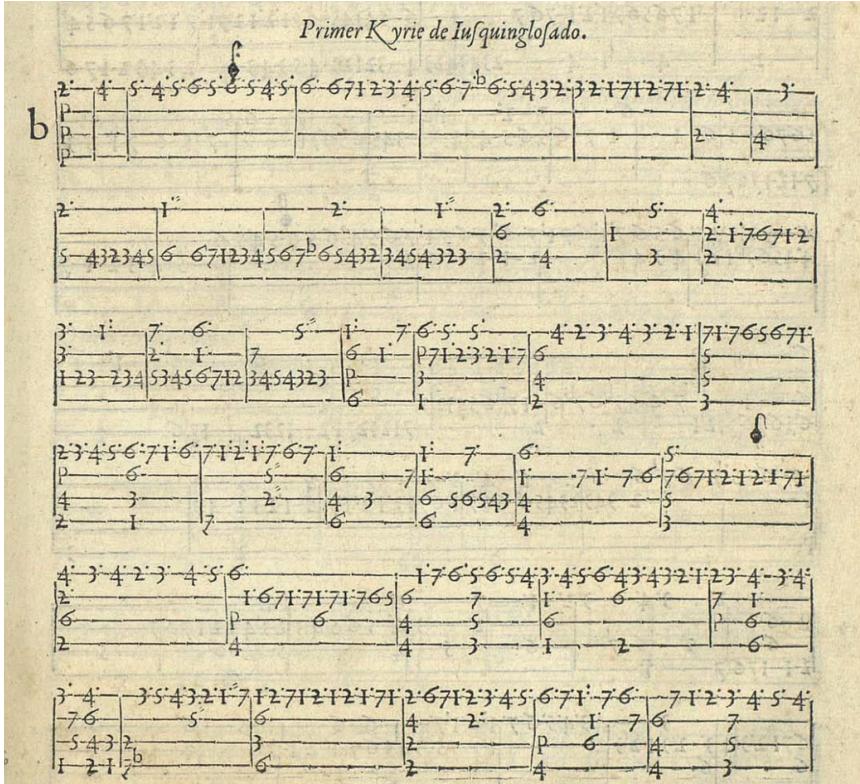
中文讲解
这是图 7 的图注与版面占位符,标识该图为帕莱罗(Palero)所作《Primer Kyrie de Josquin glosado》(“约斯堪经文《垂怜经》之第一首的华丽变奏”),出自维内加斯《Libro de cifra nueva》第 54r 叶。该图紧接上一段"该谱表非常易读"之声明,作为视觉实例出现,用以让读者直接检验维内加斯谱表的实际样貌;其位置与上下文功能均明确,但具体音符、谱表行数与排版方式需查阅原图方能确认。
第5段(P0207)
原文复述
Venegas believed that his tablature could be a universal notation for the harp and vihuela, the other polyphonic instruments in use in Spain at the time. In the prefatory texts Venegas gives guidance to harpists and vihuelists. He provides no specific text to assist harpists read the tablature given its similarity to the keyboard but provides a woodcut diagram on fol. 3 (sic = fol. 4) showing the strings of the harp and the corresponding cifras, commenting also that harpists will sometimes need to omit notes when the texture requires it. This tablature continued to be used by harpists in Spain until well into the 18th century, with the addition of fingering symbols in later sources for guidance.20
中文讲解
本段转向维内加斯谱式的"通用性"主张:维内加斯认为,他的谱表能够成为当时西班牙另两件复调乐器——竖琴(harp)与比韦拉琴(vihuela)——的通用记谱法。在序言中,他分别向竖琴与比韦拉琴演奏者提供了使用指引,但形式有别:由于该谱式与键盘谱式高度相似,他未专为竖琴演奏者撰写专门的读谱说明,而仅以第 3 叶(按:原书实为第 4 叶,故标"sic = fol. 4”——编辑者勘误)的一幅木刻图,标示出竖琴琴弦及其对应的 cifras(数字符);同时他还注释说,竖琴演奏者在织体需要时有时必须省略某些音。该谱式后来被西班牙竖琴演奏者沿用至 18 世纪较晚时期,其后版本还加入了指法符号以辅助使用(参见脚注 20)。 此段在本小节论证链中的作用是:先陈述维内加斯"通用记谱"的宣称,再指出其在序言中向两类乐器提供的不同支持(竖琴有图,比韦拉琴则无单独说明),并通过脚注 20 引出其后数百年的实际影响,从而为接下来比较"比韦拉琴是否真正接受此谱"以及"键盘才是维内加斯真正的目标受众"作铺垫。
补充说明
“sic = fol. 4"是编辑者的勘误标记,意为"原文作 fol. 3,但正确应为 fol. 4”,提示读者注意原书的页码错误。脚注 20 引用的 17 世纪末手稿将作为竖琴界长期沿用该谱式的具体例证。
第6段(P0208)
原文复述
Using Venegas’ tablature on the vihuela required some memorisation, but was not difficult, but there is no evidence to suggest that it gained acceptance among players. Of greater relevance was Venegas’ recommendation to keyboard players that they learn how to rewrite lute or vihuela tablature into his cifra nueva. He notes (using the term vihuela to mean both vihuela and lute) that, because ‘of the many eminent vihuela players, both foreign and Spanish, with different airs and ways of playing, it seemed to me that it would be good to open to keyboard and harp players the door to all the vihuela music that is printed in cipher.’ He was aware of reality: at the time his Libro de cifra nueva appeared in 1557, only twenty keyboard books had been published in Europe, in comparison to some hundred books of lute tablature. To exemplify how it was done, he transcribed twenty works by lutenist Francesco da Milano, and vihuelists Luis de Narváez, Alonso Mudarra and Enríquez de Valderrábano into his book. As John Ward showed in his incisive study of these adaptations, Venegas did not simply transcribe the works from one notation to another: he modified them in various ways to become more idiomatic keyboard pieces, sometimes in ways that today might be considered questionable.22
中文讲解
本段讨论维内加斯谱式在实际推广中的接受度差异,并交代该书最具实质意义的内容——键盘演奏者改写鲁特琴或比韦拉琴谱表的实践,构成全小节论证的高潮。首先,比韦拉琴方面虽使用门槛不高,“没有证据"表明它真正获得该群体认可;而更具影响力的是维内加斯对键盘演奏者的明确建议:学习把鲁特琴或比韦拉琴的谱表改写为他的 cifra nueva(“新谱法”)。他用"vihuela"一词兼指比韦拉琴与鲁特琴;其引语大意为:鉴于"诸多杰出的比韦拉琴演奏者——不论外邦还是西班牙——流派与风格各异,我认为向键盘与竖琴演奏者敞开所有以谱字符印行的比韦拉琴音乐之门,是一件好事。” 维内加斯对现实有清醒认识:1557 年《Libro de cifra nueva》出版时,欧洲仅约二十种键盘书出版,而鲁特琴谱表已有约一百种,悬殊近一比五。为示范改写方法,他转写了鲁特琴家弗朗切斯科·达·米兰诺(Francesco da Milano)以及比韦拉琴家路易斯·德·纳尔瓦埃斯(Luis de Narváez)、阿隆索·穆达拉(Alonso Mudarra)、恩里克斯·德·巴尔德拉瓦诺(Enríquez de Valderrábano)共二十首作品。然而约翰·沃德(John Ward)的研究表明:维内加斯并非简单地把一种记谱法转写为另一种,而是对作品作多种改动,使它们更符合键盘演奏的惯用手法,其中有些改动在今日看来或许值得商榷(参见脚注 22)。 该段的论证逻辑为:(1)声明比韦拉琴界接受度无证据;(2)转入键盘——这才是真正被重视的目标群体;(3)以"20 vs. 100"的出版数据量化鲁特琴/比韦拉琴谱表相对于键盘书的存量优势,揭示维内加斯建议改写的现实理由;(4)以具体转写曲目与约翰·沃德的批判性研究提示读者:这种"移植"实为带诠释性的键盘化改编,而非单纯的记谱转换。
补充说明
“twenty keyboard books"对"some hundred books of lute tablature"的悬殊比例(约为 1:5),是理解维内加斯真正动机的关键量化背景:1557 年时键盘演奏者对既有拨弦乐器曲目的可及性远低于鲁特琴家,因此维内加斯谱式的"破壁"价值正落在这一缺口上。约翰·沃德的研究指出维内加斯的改编带有诠释性,预示后世键盘改编实践中的若干方法论问题。
第7段(P0209)
原文复述
20 See, for example, the manuscript Barcelona, Orfeó Català, MM CV/42-R/40 (c. 1680).
中文讲解
这是脚注 20,举例说明维内加斯谱式在西班牙的长期延续:巴塞罗那 Orfeó Català 藏手稿,编号 MM CV/42-R/40,约抄写于 1680 年。该例为正文"该谱式被西班牙竖琴演奏者沿用至 18 世纪"这一历史判断提供具体旁证。
补充说明
“c. 1680"中的 “c.” 是拉丁文 circa(约)之缩写,表示抄写年代为约略估计;此例的约略时段正落在正文所谓"18 世纪较晚时期"之前,展示了维内加斯谱式从 1557 年出版至约 17 世纪末的连续使用轨迹。
脚注 / 边栏 / 图表 / 附加信息(如有)
本小节包含两条脚注(18、19)与一幅图(图 7),并于下一行另置脚注 20。脚注 18 交代《Libro de cifra nueva》的编辑者(Higinio Anglés)及内容索引(Brown 15572),属来源性脚注。脚注 19 是维内加斯本人关于新谱法可能招致专业行家批评的辩护性西文段落,属第一手来源,对正文"该谱式简易易读"之主张兼有限定意义。图 7 是帕莱罗《Primer Kyrie de Josquin glosado》的谱例,紧接上文"该谱表非常易读"之声明,作为视觉实例出现。脚注 20 举一 17 世纪末手稿(巴塞罗那 Orfeó Català,MM CV/42-R/40,约 1680 年)支持正文所述该谱式在西班牙竖琴界的长期流传,属旁证。脚注 22 引约翰·沃德对维内加斯改编曲的研究,因超出本小节页码范围未予复述,但被正文作为转写性质的关键批判性来源。
💡 本节核心要点
- 维内加斯谱式是一种"矩阵式"数字谱:以可变行数谱表每行一音、1–7 数字代表以 F 起始的自然音、无时值符号而以间距传意,并以 tactus 为小节单位,作者判定其"非常易读”。
- 维内加斯自称其谱式可作为西班牙复调乐器(键盘、竖琴、比韦拉琴)的"通用记谱”,并在序言中向竖琴、比韦拉琴演奏者分别提供了不同形式的指导(竖琴有木刻图与省略提示,比韦拉琴则无单独说明)。
- 该谱式在西班牙竖琴界长期流传——直到 18 世纪仍有使用记录(约 1680 年手稿),并在后来加入了指法符号;然而对比韦拉琴演奏者并无真正接受的证据。
- 对键盘演奏者,维内加斯更重要的贡献是建议并示范把鲁特琴/比韦拉琴谱表改写为 cifra nueva,使键盘演奏者得以接触远超当时键盘曲目的鲁特琴/比韦拉琴文献;他用"vihuela"兼指比韦拉琴与鲁特琴。
- 维内加斯清醒意识到 1557 年欧洲键盘书(约 20 种)与鲁特琴谱表(约 100 种)之间的悬殊存量,这正是他"敞开 vihuela 音乐之门"主张的客观依据。
- 约翰·沃德的研究显示维内加斯对米兰诺、纳尔瓦埃斯、穆达拉、巴尔德拉瓦诺等二十首作品的转写并非机械的记谱转换,而是带诠释性的键盘化改编,部分改动在今日看来值得商榷。
🔑 关键术语
- matrix tablature:矩阵式谱表:以行为声部、列为同时事件的网格化记谱方式。本节中指维内加斯以可变行数谱表、每行代表一个声部的形式特征。
- tactus:文艺复兴音乐理论中的基本拍单位。本节中用作维内加斯谱表的小节划分基础,决定竖线划分小节的位置。
- cifra nueva:“新谱法”:维内加斯在《Libro de cifra nueva》(1557)中提出的数字谱表系统,是本节讨论的核心记谱法。
- vihuela:比韦拉琴:16 世纪西班牙主要的拨弦乐器之一。本节中维内加斯用此词兼指比韦拉琴与鲁特琴。
- Libro de cifra nueva:《新谱法之书》:维内加斯 1557 年出版的数字谱表作品集,由 Higinio Anglés 编入《La música en la corte de Carlos V》。
- cifra:数字符:本节中指用以标示自然音的 1–7 数字;广义上即"数字谱"之西班牙语术语。
s0209 [描述性拆分] Hernando de Cabezón — A Last-Minute Subtitle for Commercial Reasons
第1段(P0210)
原文复述
Venegas’ book being subtitled ‘for keyboard, harp and vihuela’ is completely justified by its contents. The case of Cabezón is more complicated. His lengthy ‘Proemio’ ignores the harp and vihuela apart from a few passing references, and most of the music in his tablature is far too complex for harp and vihuela without substantial modification. The use of the phrase ‘for keyboard, harp or vihuela’ in the title of his book is therefore not matched to the contents: the book appears expressly to have been conceived for keyboard, as a compendium written by the greatest organist known in sixteenth-century Spain and posthumously published by his son.
中文讲解
本段通过对比建立本节的核心命题:Venegas《Libro de cifra nueva》的副标题与其内容一致——作者本人在序言中即说明是为方便键盘与竖琴演奏者使用维韦拉曲目而作;而 Cabezón 的情况却正相反。其一,长篇《Proemio》几乎不提竖琴与维韦拉,只有零星带过;其二,所收塔布拉谱乐曲在织体、力度与音域上均超出竖琴与维韦拉的常规表现力,需大幅改动方能演奏。因此 ‘para tecla, arpa y vihuela’ 这一副标题并非源自作品的实际用途,而更像是后加的标签。这本书在内容上是一部明确为键盘——尤其为管风琴——构思的曲集,由 16 世纪西班牙最重要的管风琴家编纂,并由其子身后出版。本结论为下文讨论书名变化与商业动机提供论证起点。
补充说明
‘Proemio’ 是 Hernando 在卷首为其父撰写的序言;该词与正文其他位置的 ‘prólogo’ 通用,均指卷首序文。‘16th century’ 在原文中具体指十六世纪,但因本曲集出版于 1578 年,作者描述时已使用了较含混的 ‘sixteenth-century’ 表述。
第2段(P0211)
原文复述
Hernando de Cabezón had decided to publish a manuscript of his father’s music by at least September 1575, when Philip II granted him a licence for ‘a book made by Antonio de Cabezón your father […] called Compendio de música, suitable for keyboard, harp and vihuela, and which you have arranged and put into tablature.’ No evidence survives as to the notational format Antonio de Cabezón originally used for his Compendio, but evidently it was not in tablature; it may have been in a score format such as that found in the Coimbra manuscripts. Hernando de Cabezón notated it using Venegas’ tablature, but with the addition of mensural rhythmic signs to give greater precision (Fig. 8). In May 1576 Hernando visited the printer Francisco Sánchez in Madrid to arrange the printing; he took a copy of Venegas’ book with him to show the printer what he wanted. The details are specified in the contract that Hernando signed with Francisco Sánchez on 29 May. Cabezón spelt out all the details of typography and layout closely based on Venegas’ book. He left his copy of the book with Sánchez so that he could refer to it as needed, and required him to sign it as proof that he had seen it.
中文讲解
本段以文件证据重建出版流程的关键节点,时间跨度从 1575 年 9 月到 1576 年 5 月 29 日。逻辑分四层:(1) 1575 年 9 月之前 Hernando 已决意出版父亲遗稿,并获菲利普二世颁发特许状,其中首次出现 ‘Compendio de música’ 这一书名以及 ‘para tecla, vihuela y arpa’ 的乐器适用范围——这是后文讨论的源头文件;(2) 关于 Antonio 原本的记谱格式虽无直接证据留存,但作者据科英布拉手稿推测,Antonio 可能以总谱形式记录,而非塔布拉谱;(3) Hernando 最终采用 Venegas《Libro de cifra nueva》的数字谱系统,但额外加入源自定量乐谱传统的节奏符号以提高节奏精度,这正是图 8 所展示的体例;(4) 1576 年 5 月,Hernando 携 Venegas 原书前往马德里向印刷商 Francisco Sánchez 示范,并于 5 月 29 日签订合同;合同详细规定排版与版面细节均严格参照 Venegas 原书,并要求 Sánchez 在书上加签以证明曾亲眼见过范本。该段证明:在合同签订之时,Hernando 心目中的体例范本是 Venegas 的数字塔布拉谱,而非任何通用键盘文献。
补充说明
‘Fig. 8’ 在本节末尾占位符 P0221 处呈现;‘mensural rhythmic signs’ 指的是 Hernando 在数字谱上方另加的、源自定量乐谱传统的时值与符尾记号,用以弥补纯数字谱在节奏标记上的不足。
第3段(P0212)
原文复述
«Atento a los muchos y eminentes músicos que ay de vihuela, assí estranjeros, como Españoles de differentes ayres y maneras de tañer, me pareció que sería bien abrir a los músicos de tecla y harpa la puerta de toda la música de vihuela que ay impressa de cifra en esta declaración: la qual querría que fuesse a todos tan agradable, como a mí me ha sido trabajosa; si a alguno le pareciere escura, con la vihuela que se pone abaxo, le será clara.» Libro de cifra nueva, fol. 4v.
中文讲解
脚注 21,原文照录 Venegas《Libro de cifra nueva》卷首声明(fol. 4v)的内容:鉴于维韦拉演奏家为数众多、流派各异,作者认为应借此 ‘声明’(即本表的数字译谱)为键盘与竖琴演奏者打开通往全部已印行维韦拉音乐的大门;该声明若显晦涩,可借助下方所附的维韦拉音位图加以澄清。该脚注的功能是为正文 P0210 的论点提供直接文献依据——Venegas 的副标题确实有作者本人明示的动机,是为了让非维韦拉演奏者也能利用维韦拉曲目,从而与 Cabezón 曲集副标题缺乏内容支持的情形形成对照。
补充说明
原文中 ‘assí estranjeros, como Españoles de differentes ayres’(既有外国人,也有不同流派与奏法的西班牙人)一语,反映出 16 世纪中叶维韦拉演奏传统的国际化与地域分化。
第4段(P0213)
原文复述
John Ward, ‘The Editorial Methods of Venegas de Henestrosa’, in: MD 6 (1952), 105–13.
中文讲解
脚注 22 为参考文献条目:John Ward 于 1952 年在《MD》(即《Musical Digest》)第 6 卷发表的文章《Venegas de Henestrosa 的编辑方法》,页 105–13。该条目提示读者可借助 Ward 的研究进一步了解 Venegas 的记谱与编辑选择,为正文关于 Venegas 数字谱体系可作为 Cabezón 出版范本的论断提供学术背书。
补充说明
‘MD’ 是《Musical Digest》的期刊缩写,是当时音乐学界常见的引用格式。
第5段(P0214)
原文复述
The feasibility of playing Cabezón’s music on the vihuela has been examined in detail by this writer. See Griffiths, ‘¿Fantasía o realidad?’ (see n. 17).
中文讲解
脚注 23 是一条作者自引:作者(Griffiths)本人此前已在其文章《¿Fantasía o realidad?》(参见本节注 17)中详细考察了 Cabezón 的作品是否真能在维韦拉上演奏。这一自引说明 P0210 中关于 ‘Cabezón 音乐过于复杂、不适于维韦拉’ 的判断并非随口之论,而是建立在作者已发表的专题研究之上。
补充说明
’this writer’ 即本节作者 Griffiths,其前文注 17 处所提及的 ‘¿Fantasía o realidad?’ 一文为同一问题的专题考察。
第6段(P0215)
原文复述
«[…] nos fue fecha relación diziendo que Antonio de Cabeçón vuestro padre, músico que ansí mismo fue de nuestra cámara y capilla auía hecho y ordenado, vn libro intitulado Compendio de música: el qual seruía para tecla, vihuela y arpa, y vos le auíades recopilado y puesto en cifra […].» Obras de música, fol. iiv.
中文讲解
脚注 24 转录了《Obras de música》卷首特许状(fol. iiv)的西班牙语原文:其中同样称 Antonio de Cabeçón 为先王(菲利普二世)宫廷与教堂音乐家,并记载他 ‘所作并整理了一部名为 Compendio de música 的书,适用于 tecla、vihuela 与 arpa’,且 Hernando 已将其 ‘recopilado y puesto en cifra’(整理并译为数字谱)。该官方文件即 P0211 所引 1575 年 9 月菲利普二世颁授的特许状,是后世了解出版起因的关键档案。
补充说明
原文中的 ‘cifra’ 在 16 世纪西班牙语境下专指数字塔布拉谱(cifra para tecla),即以数字标记键盘音高位置的记谱方式。
第7段(P0216)
原文复述
P-Cu MS 242 contains works by Cabezón. See Santiago Kastner, ‘Los manuscritos nºs 48 y 242 de la Biblioteca General de la Universidad de Coimbra’, in: AnM 5
中文讲解
脚注 25 的前半段:科英布拉大学综合图书馆所藏 P-Cu MS 242 抄本中包含 Cabezón 的作品;研究者可参 Santiago Kastner 在《Anuario Musical》(缩写 AnM)第 5 卷发表的文章《科英布拉大学综合图书馆第 48 与 242 号手稿》。该手稿因采用类似总谱的记谱形式,被作者援引为 Antonio 原稿可能并非数字塔布拉谱的佐证,与正文 P0211 中关于 Antonio 原本记谱格式的推测形成对照。
补充说明
此条脚注跨两段(P0216 与 P0219),因正文段落拆分而被切开,两段合在一起方为脚注 25 的完整出处。
第8段(P0217)
原文复述
In the printing contract, Hernando de Cabezón’s book is described as ‘un libro de Antonio de cauezon, su padre, de tecla y bihuela, recopilado y Puesto en cifra por el dicho hernando de cauecon’, revealing that by this date he was thinking of it as for keyboard and vihuela. No other documentation concerning the printing survives between the signing of the contract and the publication of the book in 1578. Curiously, when the book appeared in print, the title page of the Compendio de música, as Antonio had originally named it, had been changed to Obras de música without prior notice. Nowhere prior to publication is there any mention of the Libro de música, and it is only on the title page that the book is so described, together with the reference to it being for keyboard, harp and vihuela: Obras de musica para tecla arpa y vihuela. This change must have occurred at the very last moment, after the typesetting of the tablature. It was customary for books of this kind to print the main corpus first and then add the title page, table of contents, preliminary texts and errata later. In the book itself, the first page of tablature still bears the original title ‘Compendio de Música de Antonio de Cabeçon’ in large type, and throughout the entire corpus the recto side of every folio carries ‘Compendio de Musica’ as its header.
中文讲解
本段提供本节最关键的三重证据:(1) 印刷合同中的描述仅列 ’tecla y bihuela’(键盘与维韦拉),并无 arpa(竖琴),说明 Hernando 在签订合同时心目中只有键盘与维韦拉两类乐器;(2) 自合同签订至 1578 年正式出版之间没有任何中间档案留存,因此书名从 ‘Compendio de música’ 改为 ‘Obras de música’ 必然是临时作出的决定;(3) 但全本正文的每张对开页右页(recto)页眉仍保留 ‘Compendio de Musica’,且正文首页以大字印着 ‘Compendio de Música de Antonio de Cabeçon’——这意味着改名发生在正文版面(塔布拉谱主体)排定之后。结合 16 世纪此类书籍先印主体、后补扉页、目录、序言与勘误的装订惯例,作者推断:‘Obras de musica para tecla arpa y vihuela’ 这一最终扉页题名与副标题,是排版最后阶段才匆忙补加的。这与本节标题 ‘A Last-Minute Subtitle for Commercial Reasons’ 的主张直接呼应。
补充说明
‘recto’ 指对开本的正面页(右页),‘verso’ 为背面页(左页)。当时书籍装订工序分批进行的惯例,使扉页成为最容易被独立替换的部件。
第9段(P0218)
原文复述
My suspicion is that very late in the printing process, Hernando de Cabezón changed his mind about the title. There is no way of knowing who may have persuaded him, whether the printer, someone else, or even the author himself upon reflection. The title ‘Compendio de música’ has the ring of a theory treatise rather than an anthology of works to play and enjoy; in that respect ‘Obras de música’ sounds less pretentious and might have helped achieve sufficient commercial success to recuperate the cost of printing. Counter to this, however, it should be observed that in the version of the printing licence included in the book (on fol. [*2v]), the book is described as ‘vn libro intitulado Compendio de musica: el qual seruia para tecla, vihuela y arpa’, using the original title together with the added reference to ‘keyboard, harp and vihuela’. It appears that the reference to the instruments here may have been added to the printed version and may not have appeared in the original version of the licence issued in 1575. Even if this is not the case, there is no evidence that Cabezón’s book was intended for any instrument other than keyboards, especially the organ but also the clavichord. Quite simply, there was no interchangeable instrumental repertoire in sixteenth-century Spain for ‘keyboard, harp or vihuela’. Even though Hernando de Cabezón clearly wished to perpetuate the memory of his renowned father, the venture does not appear to have been a success: the details of the lawsuit initiated by Hernando in 1585 against the Madrid book dealer Blas Robles, to whom he had entrusted the sale of the books, show that there was little appetite in Spain for the music of a master who had been dead for over twenty years.
中文讲解
本段是本节论证的收束,作者阐明三点。(1) 对改名动机的合理推想:‘Compendio’ 一词带有理论著作色彩,‘Obras’ 则更平易近人、更具销售号召力,作者用 ‘My suspicion’ 与 ‘might have helped’ 表明这是推测而非定论,并坦承无从查考是谁——印刷商、他人或 Hernando 本人——促成了改动。(2) 反向证据:印本特权状(fol. [*2v])虽沿用原名 ‘Compendio de musica’,却已附上 ‘para tecla, vihuela y arpa’ 一行;这说明至少这一行副标题在印本中是后加的,原 1575 年颁授的特许状未必包含这一表述。(3) 决定性结论:即便有副标题,也没有证据表明 Cabezón 的音乐在 16 世纪西班牙存在跨键盘、竖琴与维韦拉的可互换曲库;该曲集本质上是为键盘(特别是管风琴、其次为古钢琴)而作。Hernando 1585 年起诉马德里书商 Blas Robles 追讨书款的诉讼记录,则从市场层面证明出版并未成功——死后二十余年的名家音乐在当时的西班牙并无销路。三段论证共同把 ‘para tecla, arpa y vihuela’ 解释为商业促销语,而非作品用途的真实描述。
补充说明
‘clavichord’ 在 16 世纪西班牙通常称为 ‘monacordio’ 或 ‘manicordio’,是当时与管风琴并列的键盘乐器。
第10段(P0219)
原文复述
(1950), 78–96; Gerhard Doderer, ‘Os manuscritos MM 48 e MM 242 da Biblioteca da Universidade de Coimbra e a presenca de organistas ibéricos’, in: RdM 34 no. 2 (2011), 43–62.
中文讲解
脚注 25 的后半段,接续 P0216 中断的引文:Santiago Kastner 一文见《Anuario Musical》第 5 卷(1950 年)页 78–96;并补充 Gerhard Doderer 在《Revista de Música》(缩写 RdM)第 34 卷第 2 期(2011 年)页 43–62 发表的《科英布拉大学图书馆 MM 48 与 MM 242 号手稿及伊比利亚管风琴家的存在》。两份现代学术研究共同支持正文关于 Antonio 原本可能采用类似科英布拉手稿之总谱记谱法的假设。
补充说明
‘RdM’ 是《Revista de Música》的标准缩写,‘AnM’ 为《Anuario Musical》缩写,两者均为西班牙音乐学的权威期刊。
第11段(P0220)
原文复述
Archivo Histórico de Protocolos de Madrid, tomo 412, fols. 447r–448v, repr. in Cristóbal Pérez Pastor, ‘Escrituras de concierto para imprimir libros’, in: Revista de Archivos, Bibliotecas y Museos, 3ª época, i (1897), 363–71.
中文讲解
脚注 26 是档案原件与刊本重印的双层出处:原件藏马德里历史档案馆(Archivo Histórico de Protocolos de Madrid)第 412 卷第 447r–448v 叶;该文件曾由 Cristóbal Pérez Pastor 在《Revista de Archivos, Bibliotecas y Museos》第三辑第 1 卷(1897 年)页 363–71 的文章《印刷书籍的合同文书》中全文重印。这正是 P0211 与 P0217 所引 1576 年 5 月 29 日 Hernando 与印刷商 Francisco Sánchez 签订合同的原始档案,为本节核心论断提供了最直接的文献支撑。
补充说明
‘fols. 447r–448v’ 表示该档案的对开本叶码;‘r’ 为 recto(右页),‘v’ 为 verso(左页)。
第12段(P0221)
原文复述
[Figure 8: Cabezón, Obras de música, fol. 37v. — image data omitted; position and caption retained]
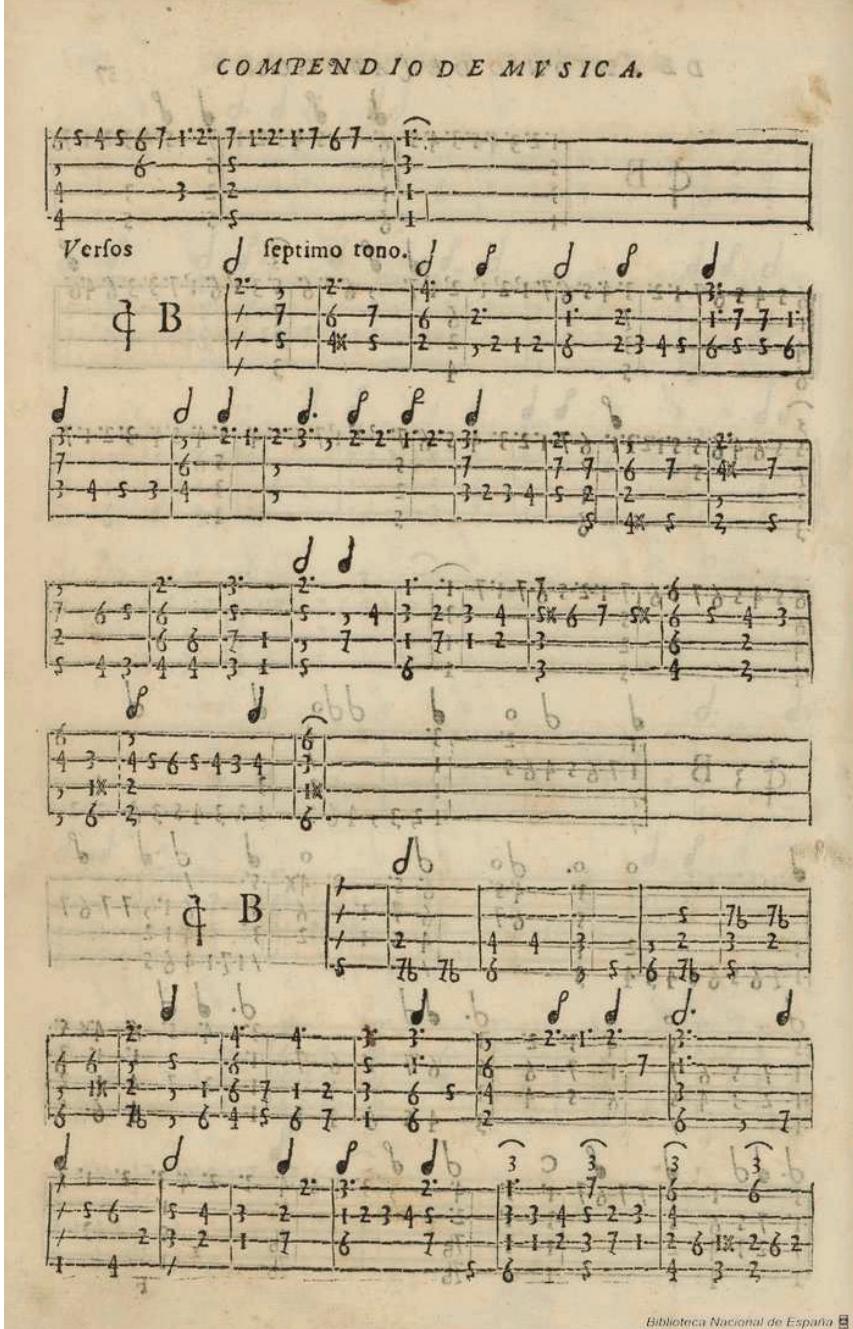
中文讲解
图 8 占位符,所示为 Cabezón《Obras de música》fol. 37v 的一页塔布拉谱。该图在 P0211 中被引用,目的是展示 Hernando 在采用 Venegas 数字谱的基础上额外加入的 ‘mensural rhythmic signs’(定量节奏符号)。原图的具体谱例细节因图像数据被省略而不可见,需查看原书方可确认。
补充说明
无额外补充;按指令仅保留位置与图注信息。
脚注 / 边栏 / 图表 / 附加信息(如有)
本节含脚注 21–26 与图 8 占位符(P0221)。脚注 21(西班牙语原文)与脚注 24(西班牙语原文)分别提供 Venegas 与 Cabezón 出版许可中的关键原文,是支撑正文主张的首要文献证据;脚注 22 指引读者参考 Ward 关于 Venegas 编辑方法的专题研究;脚注 23 为作者对自己前期工作的自引,支撑 ‘Cabezón 音乐不适于维韦拉’ 的判断;脚注 25 跨两段(P0216、P0219)给出关于科英布拉手稿的现代学术研究两条出处;脚注 26 提供 1576 年印刷合同的原始档案及其现代重印本。图 8 是本节唯一的图像资料,其功能是直观展示 Hernando 在 Venegas 数字谱基础上添加定量节奏记号的排版体例。
💡 本节核心要点
- Venegas《Libro de cifra nueva》的副标题与内容一致——序言中已说明是为了让键盘与竖琴演奏者也能使用维韦拉曲目——而 Cabezón 曲集的副标题 ‘para tecla, arpa y vihuela’ 则缺乏对应的内容支持。
- 1575 年特许状、1576 年印刷合同与 1578 年正式出版三个时间点形成证据链:合同仅列 ’tecla y vihuela’,而最终扉页却加上 ‘arpa’ 并把书名从 ‘Compendio de música’ 改为 ‘Obras de música’,可推断这两项改动均发生在印刷最后阶段。
- Hernando 在出版过程中以 Venegas 的数字塔布拉谱为体例范本,但额外加入定量节奏符号以提高节奏精度;Antonio 原本的记谱格式不详,可能像科英布拉手稿那样采用总谱形式。
- 作者提出商业解释:‘Compendio’ 像理论书名,‘Obras’ 更平易近人,更利于收回印刷成本;将 ‘arpa’ 加入副标题亦属促销式扩大受众之举。
- 作者指出 16 世纪西班牙并不存在真正跨键盘、竖琴与维韦拉的可互换曲库,曲集实为键盘(管风琴与古钢琴)作品,副标题与内容不符。
- 1585 年 Hernando 起诉马德里书商 Blas Robles 的诉讼记录显示该出版在商业上并不成功,死后二十余年的名家音乐在当时并无销路。
🔑 关键术语
- Compendio de música:Antonio de Cabezón 原稿的书名,意为 ‘音乐概要’。Hernando 在 1578 年出版前临时刻意改名为 ‘Obras de música’(‘音乐作品集’),以减弱其理论著作色彩。
- Obras de música:1578 年印本实际使用的书名,意为 ‘音乐作品集’。副标题为 ‘para tecla, arpa y vihuela’,但全书正文页眉与首页大字仍保留 ‘Compendio de Música’,证明改名发生于正文版面定版之后。
- Proemio:Hernando de Cabezón 在《Obras de música》卷首为其父所写的序言。本节强调该序言几乎不提竖琴与维韦拉,仅作数处带过,从而佐证曲集原本并非为竖琴或维韦拉而作。
- cifra / cifra nueva:16 世纪西班牙键盘音乐使用的数字塔布拉谱系统,以阿拉伯数字标记音高位置。Venegas 的《Libro de cifra nueva》即为范本,Hernando 沿用此体系并补入定量节奏记号。
- mensural rhythmic signs:源自定量乐谱(mensural notation)传统的节奏符号。Hernando 在 Venegas 数字谱基础上加入它们,使节奏标记更精确,对应图 8 所示的体例。
- tecla:西班牙语中 ‘键盘’ 的统称,在 16 世纪乐器语境下尤其指管风琴(órgano)与古钢琴(clavichord / monacordio),而非现代意义的钢琴。
s0210 Bibliography
第1段(P0222)
原文复述
Bibliography
中文讲解
本段是该小节的标题“Bibliography”(参考文献/书目)。它标志着从正文论述转向附录式的文献清单,提示读者此后将以条目形式列出作者所引用的所有一手和二手资料,不再展开论证。
第2段(P0223)
原文复述
Higinio Anglés, La música en la corte de Carlos V con la transcripción del ‘Libro de cifra nueva para tecla, harpa y vihuela’ (Alcalá de Henares, 1557) compilado por Luys Venegas de Henestrosa, 2 vols., Monumentos de la Música Española II, III (Barcelona, 1944; repr. 1965)
中文讲解
Higinio Anglés 编辑出版的《查理五世宫廷音乐》,附有 Luys Venegas de Henestrosa 1557 年于阿尔卡拉出版的《数字谱新书》(适用于键盘、竖琴和维韦拉琴)的转录,收入 Monumentos de la Música Española(西班牙音乐史料集)第 II、III 卷。这是一部兼具一手文献转录与历史研究的关键参考书,将 16 世纪西班牙最重要的键盘合集之一以现代记谱重新呈现。
第3段(P0224)
原文复述
Willi Apel, The Notation of Polyphonic Music: 900–1600 (Cambridge, MA, 1942)
中文讲解
Willi Apel 所著《复调音乐的记谱法:900–1600》,是研究中世纪与文艺复兴时期音乐记谱的经典参考工具书,涵盖从最早期的复调记谱到 1600 年前后的各种记谱体系,对理解数字谱、字母谱和符号谱的来源至关重要。
第4段(P0225)
原文复述
Gonçalo de Baena, Arte novamente inventada pera aprender a tanger (Lisbon: Germao Galharde, 1540), https://imslp.org/wiki/Special:ReverseLookup/216087
中文讲解
Gonçalo de Baena 所著《Arte novamente inventada pera aprender a tanger》(新创学习演奏之艺),1540 年由 Germão Galharde 印刷于里斯本,并附 IMSLP 数字资源链接。这是葡萄牙文艺复兴时期最重要的键盘音乐文献之一,作品以数字谱记写。
第5段(P0226)
原文复述
Gonçalo de Baena, Arte para tanger (Lisboa, 1540), edition and introductory study by Tess Knighton (Lisbon, 2012)
中文讲解
同一部 1540 年里斯本 Baena 著作的现代版本,由 Tess Knighton 编辑并撰写导论,于 2012 年在里斯本出版。这一版本是学术研究 Baena 作品集的标准现代版,提供了 Knighton 的评注与背景介绍。
第6段(P0227)
原文复述
Howard Mayer Brown, Music in the Renaissance (Englewood Cliffs, 1976)
中文讲解
Howard Mayer Brown 所著《文艺复兴时期的音乐》,1976 年出版,是英语学界关于文艺复兴音乐的经典概论性教材,常被用于勾勒时代背景与体裁分类。
第7段(P0228)
原文复述
Hernando de Cabezón, Obras de música (Madrid: Francisco Sánchez, 1578) (RISM 158724), http://purl.org/rism/BI/1578/24
中文讲解
Hernando de Cabezón 编辑其父 Antonio de Cabezón 的《音乐作品集》,1578 年由 Francisco Sánchez 在马德里印刷,附 RISM 编号 158724 及数字资源链接。这是西班牙文艺复兴键盘音乐的核心一手文献。
第8段(P0229)
原文复述
Vincenzo Capirola, ‘Ricercar otavo’, US-CN Case MS VM C. 25, The Capirola Lute Book (c. 1517), http://ricercar-old.cesr.univ-tours.fr/3-programmes/EMN/luth/pages/notice.asp?numnotice=4
中文讲解
Vincenzo Capirola《第八首里切卡尔》,取自《Capirola 鲁特琴手稿集》(约 1517 年),藏于 US-CN(华盛顿特区美国国会图书馆),编号 Case MS VM C. 25,附法国图尔大学 CESR 数字资源链接。此条目提供了一首具体作品的出处,指明其位于哪一手稿及当前可访问的电子版本。
第9段(P0230)
原文复述
Girolamo Cavazzoni, Intabvlatvra d’organo […] libro secondo (Venice [Girolamo Scotto], after 1543)
中文讲解
Girolamo Cavazzoni《管风琴改编曲集·第二卷》,由 Girolamo Scotto 于 1543 年后在威尼斯印刷,是意大利文艺复兴管风琴音乐的重要原始印本,展示了 16 世纪上半叶意大利键盘改编曲的实践。
第10段(P0231)
原文复述
Andrés Cea Galán, ‘La cifra hispana: música, tañedores e instrumentos (siglos XVI-XVIII)’, Doctoral thesis, Universidad Complutense de Madrid, 2014
中文讲解
Andrés Cea Galán 2014 年于马德里康普顿斯大学完成的博士论文《西班牙数字谱:音乐、演奏者与乐器(16–18 世纪)》,系统研究西班牙数字谱(cifra)的谱面体系、演奏者与乐器,是关于 cifra 传统最具综合性的学术专著。
第11段(P0232)
原文复述
Antonio Corona-Alcalde, ‘The earliest vihuela tablature: a recent discovery’, in: EM 20 (1992), 594–600
中文讲解
Antonio Corona-Alcalde 发表于《Early Music》(EM)第 20 卷(1992 年)、第 594–600 页的《最早的维韦拉琴谱:近期的一项发现》,报告了维韦拉琴记谱法早期实物的新发现。
第12段(P0233)
原文复述
27 Ibid., 370.
中文讲解
这是一个简短的脚注或夹注,编号 27,写作“同上,第 370 页”(Ibid. 来自拉丁文 ibidem,意为“同一处”),表明作者在此再次引用前述同一文献的第 370 页。
补充说明
此条为正文中标注的脚注/夹注形式,按版式属性处理;其指向的同一文献应能在前一条参考文献(P0232 或其前后条目)中回溯确认。
第13段(P0234)
原文复述
Gerhard Doderer, ‘Os manuscritos MM 48 e MM 242 da Biblioteca da Universidade de Coimbra e a presenca de organistas ibéricos’, in: RdM 34, no. 2 (2011), 43–62
中文讲解
Gerhard Doderer 发表于《Revista de Música》(RdM)第 34 卷第 2 期(2011 年)、第 43–62 页的《科英布拉大学图书馆 MM 48 与 MM 242 手稿及伊比利亚管风琴家的存在》,讨论两部与西班牙管风琴家相关的葡萄牙手稿。
第14段(P0235)
原文复述
Richard Freedman, Music in the Renaissance (New York, 2012)
中文讲解
Richard Freedman 所著《文艺复兴时期的音乐》,2012 年于纽约出版,是较新的英文文艺复兴音乐概论,可与 Brown 1976 年的同名著作参照阅读。
第15段(P0236)
原文复述
John Griffiths, ‘The Lute and the Polyphonist’, in: Studi Musicali 31 (2002), 71–90
中文讲解
John Griffiths 发表于《Studi Musicali》第 31 卷(2002 年)、第 71–90 页的《鲁特琴与复调作曲家》,探讨鲁特琴在 16 世纪西班牙复调音乐传播与改编中的角色。
第16段(P0237)
原文复述
John Griffiths, ‘Venegas, Cabezón y las obras “para tecla, harpa y vihuela”’, in: Cinco siglos de música de tecla española – Five Centuries of Spanish Keyboard Music, ed. Luisa Morales (Garrucha, 2007), 153–68
中文讲解
John Griffiths 收录于 Luisa Morales 主编《西班牙键盘音乐五百年》(Garrucha,2007 年)第 153–168 页的论文《Venegas、Cabezón 与“适用于键盘、竖琴和维韦拉琴”之作品》,讨论三本核心西班牙键盘文献之间的关系。
第17段(P0238)
原文复述
John Griffiths, ‘¿Fantasía o realidad? La vihuela en las Obras de Cabezón’, in: AnM 69 (2014), 193–214
中文讲解
John Griffiths 发表于《Anuario Musical》(AnM)第 69 卷(2014 年)、第 193–214 页的《幻想还是现实?维韦拉琴在 Cabezón 作品集中》,研究 Cabezón《Obras de música》合集中维韦拉琴作品的真实面貌与改编关系。
第18段(P0239)
原文复述
Donald J. Grout, A History of Western Music (New York, 1960), (with nine subsequent editions by Claude Palisca and Peter J. Burkholder)
中文讲解
Donald J. Grout 所著《西方音乐史》,初版于 1960 年纽约,后由 Claude Palisca 与 Peter J. Burkholder 续编九版,是英语世界最通行的西方音乐通史教材。
第19段(P0240)
原文复述
Alec Harman and Wilfred Mellers, Man and his Music (London, 1962)
中文讲解
Alec Harman 与 Wilfred Mellers 合著《人与他的音乐》,1962 年于伦敦出版,是 20 世纪中叶英语学界较具人文色彩的音乐通识读本。
第20段(P0241)
原文复述
Santiago Kastner, ‘Los manuscritos nºs 48 y 242 de la Biblioteca General de la Universidad de Coimbra’, in: AnM 5 (1950), 78–96
中文讲解
Santiago Kastner 发表于《Anuario Musical》第 5 卷(1950 年)、第 78–96 页的《科英布拉大学总图书馆第 48 与 242 号手稿》,是 Doderer 2011 年论文(P0234)所继承的早期奠基性研究。
第21段(P0242)
原文复述
Tess Knighton, ‘A newly discovered keyboard source (Gonzalo de Baenas’s Arte novamente inventada pera aprender a tanger, Lisbon, 1540): a preliminary report’, in: Plainsong and Medieval Music 5 (1996), 81–112
中文讲解
Tess Knighton 发表于《Plainsong and Medieval Music》第 5 卷(1996 年)、第 81–112 页的《新发现的一部键盘资料(Gonçalo de Baena《Arte novamente inventada pera aprender a tanger》,里斯本,1540):初步报告》,首次向学界报告了这部葡萄牙键盘合集的重大学术价值。
第22段(P0243)
原文复述
Jean Michel Massing and Christian Meyer, ‘Autour de quelques essais musicaux inédits de Dürer’, in: Zeitschrift für Kunstgeschichte 45 (1982), 248–55
中文讲解
Jean Michel Massing 与 Christian Meyer 发表于《Zeitschrift für Kunstgeschichte》第 45 卷(1982 年)、第 248–255 页的《关于丢勒若干未发表的音乐尝试》,讨论画家阿尔布雷希特·丢勒手稿中与音乐相关的零散材料。
第23段(P0244)
原文复述
Michael Maul and Peter Wollny, ‘Introduction’, in: J. S. Bach, Weimarer Orgeltabulatur (Kassel, 2007)
中文讲解
Michael Maul 与 Peter Wollny 为 2007 年卡塞尔出版的 J. S. Bach《魏玛管风琴曲集》撰写的《导论》,交代了巴赫早期魏玛时期管风琴作品的编订原则与资料来源。
第24段(P0245)
原文复述
Jessie Ann Owens, Composers at Work: The Craft of Musical Composition 1450–1600 (New York, 1997)
中文讲解
Jessie Ann Owens 所著《作曲家在工作:1450–1600 年的音乐创作技艺》,1997 年纽约出版,是研究文艺复兴时期作曲家实际创作过程与草稿传统的重要著作。
第25段(P0246)
原文复述
Jacob Paix, Thesavrvs Motetarvm: Newerleßner zwey vnd zweintzig herrlicher Moteten (Strasbourg: Bernhart Jobin, 1589) (VD16 ZV 26531), https://mdz-nbn-resolving.de/details:bsb00031714
中文讲解
Jacob Paix《Thesavrvs Motetarvm:二十二首精彩经文歌新编》,1589 年由 Bernhart Jobin 印刷于斯特拉斯堡,附 VD16 编号 ZV 26531 及巴伐利亚州立图书馆数字资源链接,是 16 世纪末德国经文歌印刷的实例。
第26段(P0247)
原文复述
Cristóbal Pérez Pastor, ‘Escrituras de concierto para imprimir libros’, in: Revista de Archivos, Bibliotecas y Museos, 3ª época, i (1897), 363–71
中文讲解
Cristóbal Pérez Pastor 发表于《Revista de Archivos, Bibliotecas y Museos》第三辑第 1 卷(1897 年)、第 363–371 页的《印书合同文书》,是一篇关于 16 世纪西班牙出版合同档案的古文字学/书籍史研究。
第27段(P0248)
原文复述
Gustave Reese, Music in the Renaissance (New York, 1954)
中文讲解
Gustave Reese 所著《文艺复兴时期的音乐》,1954 年纽约出版,是英语学界最早系统研究文艺复兴音乐的权威专著之一,至今仍被频繁引用。
第28段(P0249)
原文复述
Tomas de Santa María, Libro llamado arte de tañer fantasía (Valladolid: Francisco Fernandez de Cordova, 1565), http://bdh-rd.bne.es/viewer.vm?id=0000158382&page=1
中文讲解
Tomás de Santa María《称为演奏幻想曲之艺的书》,1565 年由 Francisco Fernández de Córdova 印刷于巴利亚多利德,附西班牙国家图书馆 BDH 数字资源链接。这是 16 世纪西班牙最系统阐述键盘幻想曲演奏技艺的理论著作。
第29段(P0250)
原文复述
Francesco Spinacino, Intabolatura de lauto libro primo and Intabolatura de lauto libro secondo (Venice: Ottaviano Petrucci, 1507) (RISM 15075 and 15076)
中文讲解
Francesco Spinacino《鲁特琴改编曲集·第一卷》与《第二卷》,1507 年由 Ottaviano Petrucci 印刷于威尼斯,附 RISM 编号 15075 与 15076,是音乐印刷史上最早由活字印刷的鲁特琴曲集。
第30段(P0251)
原文复述
Luis Venegas de Henestrosa, Libro de cifra nueva (Alcalá de Henares: Juan de Brocar, 1557), http://bdh-rd.bne.es/viewer.vm?id=0000039213&page=1
中文讲解
Luis Venegas de Henestrosa《数字谱新书》,1557 年由 Juan de Brocar 印刷于阿尔卡拉,附 BDH 数字资源链接。这是西班牙文艺复兴时期以数字谱(cifra)记写的最重要键盘曲集之一,汇集了 Cabezón 等作曲家的作品。
第31段(P0252)
原文复述
John Ward, ‘The Editorial Methods of Venegas de Henestrosa’, in: MD 6 (1952), 105–13
中文讲解
John Ward 发表于《Musica Disciplina》(MD)第 6 卷(1952 年)、第 105–113 页的《Venegas de Henestrosa 的编辑方法》,对 1557 年《Libro de cifra nueva》编辑策略的早期学术性分析。
第32段(P0253)
原文复述
Johannes Wolf, Handbuch der Notationskunde, 2 vols. (Leipzig, 1913–1919)
中文讲解
Johannes Wolf《记谱学手册》两卷本,1913–1919 年于莱比锡出版,是 20 世纪早期德语学界关于音乐记谱的综合性参考工具书,可与 Apel 1942 年(P0244)的英语著作互为补充。
脚注 / 边栏 / 图表 / 附加信息(如有)
本节为纯参考文献清单(Bibliography),不含正文、脚注或图表。条目 P0233 写作“27 Ibid., 370.”,是一种夹注/简短脚注形式,提示正文某处再次引用前一条文献的第 370 页。P0229(Vincenzo Capirola《Ricercar otavo》)为具体作品的出处指引,附手稿编号与电子资源链接。其余条目按作者姓氏字母顺序排列,是研究 16 世纪西班牙 cifra 数字谱、维韦拉琴、鲁特琴及键盘音乐的一手印本与现代研究文献的混合清单。
💡 本节核心要点
- 本节是一份按作者姓氏字母顺序排列的参考文献清单,涵盖一手印本/手稿与现代学术研究。
- 核心一手资料集中于 16 世纪西班牙 cifra 数字谱传统:Venegas(1557)、Cabezón《Obras》(1578)、Baena(1540)、Santa María(1565)。
- 关于 cifra 体系的现代关键研究包括 Anglés(1944)、Cea Galán(2014)、Knighton(1996, 2012)、Griffiths(2007, 2014)。
- 记谱法基础参考涵盖 Apel(1942)、Wolf(1913–1919)。
- 维韦拉琴与鲁特琴的来源与改编问题由 Corona-Alcalde(1992)、Griffiths(2002, 2014)及 Capirola、Spinacino 等一手印本代表。
- 条目 P0233 以“27 Ibid., 370.”形式延续前一条文献的引用,说明正文中存在相应脚注编号。
🔑 关键术语
- cifra(数字谱):西班牙 16 世纪键盘、竖琴与维韦拉琴所使用的一种字母/数字记谱法,用字符或数字代表音高与和弦,而非五线谱的音符符号,是本节多条一手与二手文献的研究核心。
- RISM:Répertoire International des Sources Musicales(国际音乐资料总目)的缩写,是音乐手稿与早期印本的标准编号系统,本节 P0228、P0250 等条目均使用其编号。
- VD16:Verzeichnis der im deutschen Sprachraum erschienenen Drucke des 16. Jahrhunderts(德语区 16 世纪印本总目)的缩写,为 16 世纪德语区出版物的标准编号,本节 P0246 引用之。
- Intabolatura / Intabulatura(改编曲):16 世纪术语,指将声乐或其他器乐作品改编为键盘或鲁特琴独奏谱的实践;P0230、Cavazzoni 与 P0250、Spinacino 的书名均显示这一体裁。
- Ricercar(里切卡尔):16 世纪重要的器乐曲体裁,常以模仿对位写成,是早期 fugue 的前身;P0229 引用了 Capirola 的具体一首 Ricercar。
- EM / RdM / AnM / MD:分别为《Early Music》、《Revista de Música》、《Anuario Musical》与《Musica Disciplina》的期刊缩写,本节多条论文(P0232、P0234、P0238、P0241、P0252)以这些缩写标注出处。
s0301 [描述性拆分] Introduction — Conventions of Italian Intavolatura
第1段(P0254)
原文复述
4 Hacking the System Italian Keyboard Intavolatura and Scribal Habit
中文讲解
本行为本书第4章的标题。“Hacking the System”(字面可译为"破解系统",亦含"侵入系统"之义)暗示本章的核心视角:把intavolatura视为一套可以被抄写员利用、改造甚至"破解"的规则系统;其后的"Italian Keyboard Intavolatura and Scribal Habit"(意大利键盘intavolatura与抄写习惯)点明本章的两个轴心——研究对象是意大利键盘乐谱中的intavolatura记谱,研究焦点则是抄写员在使用这套记谱时的实际习惯,特别是他们对规则的遵循与偏离。
补充说明
本段为版面中的章节标题行,本身不承载论证;它界定了本章的核心命题与切入角度。
第2段(P0255)
原文复述
Ian Pritchard
中文讲解
本行出现在该章节起始处的版面位置,相当于题署/作者署名,标明本章由Ian Pritchard撰写。
补充说明
该元素属于作者署名,并非正文论点。
第3段(P0256)
原文复述
Dedicated to the memory of Liuwe Tamminga (1953–2021)
中文讲解
这是一句献辞:作者将本章(或本书)题献给已故的Liuwe Tamminga(生卒年1953–2021),以纪念此人。献辞出现在章节开头,是学术写作常见的礼制,表明此人(按学术惯例应是与意大利键盘intavolatura研究相关的音乐家或学者)值得作者特别致敬。
补充说明
正文未提供Liuwe Tamminga的身份信息或与本主题的具体联系,仅给出姓名与生卒年。
第4段(P0257)
原文复述
Due to the fact that the notational signs used in Italian keyboard intavolatura are derived from mensural notation, the functional ‘identity’ of intavolatura as a species of tablature is grounded in notational convention – that is, the ways in which the notation ‘behaves’ on the page – rather than through the use of specific figures or signs, such as numbers or letters. The original users of intavolatura seemed to largely agree on the use of these conventions (we might call them ‘rules’),1 which diverge considerably in some ways from those of modern keyboard notation.2 In fact, the conventions align intavolatura with other figure-based tablature systems used in the Renaissance; as in these other tablatures, the notation in intavolatura was conceived on a mechanical basis, in that it prescribes the mechanical actions of the player on the keyboard rather than providing an abstract view of polyphonic structures and voice leading and the like.
中文讲解
本段是本章引论的核心命题,提出关于intavolatura本质的关键判断,可从三层理解:
第一层,区分"身份"的两条判据。作者明确指出,intavolatura作为"一种tablature"的功能身份,并不取决于它用了哪些图形符号(数字、字母等),而取决于它的符号在谱面上"如何运作"——即记谱惯例(convention)。这是一个反向直觉的论断:因为intavolatura的符号来自mensural(有量)记谱法,从表面看它与一般tablature谱(如鲁特谱用字母)差异明显,所以必须把"身份"从符号层转移到惯例层才能定义。
第二层,惯例的共识与差异。原始使用者对这些惯例大体达成共识,作者称之为"规则"(rules);这些规则与现代键盘记谱法"在某些方面分歧显著"——作者承认差异,但并不把差异等同于断裂。脚注标记1、2正是为此两层判断提供文献支撑。
第三层,谱系定位:“机械性"记谱。作者将intavolatura放在文艺复兴figure-based tablature的更大谱系中考察,认为它们概念同源——都是"机械性的”:谱面描述的是演奏者在键盘上的具体动作(按哪个键、用哪只手),而不是对位结构、声部进行这类抽象视图。这与现代五线谱传统形成对照:五线谱优先呈现声部逻辑,intavolatura优先呈现演奏动作。
这一段为整章定调:作者要研究的不是"符号是什么",而是"规则如何在谱面上运作、抄写员如何在遵循与偏离之间与这套规则互动"——这正是章题"Hacking the System"所暗示的视角。
补充说明
本段中mensural notation、polyphonic structures、voice leading、figure-based tablature均为普通音乐学词汇,可根据上下文理解;其与本章具体理论关系,参见脚注1与脚注2。
第5段(P0258)
原文复述
1 This is especially the case if we consider intavolatura as the result of a process that can in turn be described through a set of rules. This is indicated by a reading of treatises that address the various formats of tablature; for example, in a survey of instructions related to lute tablature (see Dinko Fabris, ‘Lute Tablature Instruction in Italy: A Survey of the Regole from 1507 to 1759’, in: Performance on Lute, Guitar, and Vihuela: Historical Practice and Modern Interpretation, ed. Victor Anand Coelho [Cambridge, 1997], 16–46; repr. in: Musical Theory in the Renaissance: A Library of Essays on Renaissance Music, ed. Christle Collins Judd [Burlington VT, 2013], 451–82) The same ‘rule-based’ approach is also observed in the chapter on intabulation in Hans Buchner’s Fundamentum; see Hans Buchner, Sämtliche Orgelwerke, ed. Jost Harro Schmidt, 2 vols., EdM 54/55 (Frankfurt am Main, 1974), 14–7. The classic guide to intabulating in Italian keyboard intavolatura is found in the primo libro of Girolamo Diruta’s Seconda parte del Transilvano (Venice: Giacomo Vincenti, 1609); again, for Diruta the notational format can be seen as the product of intabulating which is in turn definable as a codified process made up of a series of rules or steps 2 The degree to which Italian organ intavolatura differs from other 16th-century notations that used two staves and mensural notation, such as those used for early French, Dutch, and English keyboard music – and therefore should be considered a unique specimen of notation – does not seem to be the subject of scholarly consensus. For example, in a recently posted presentation, John Griffiths seems to consider intavolatura as part of a broad category of ‘matrix tablatures’ (as
中文讲解
本段是脚注1与脚注2的开头部分,属于学术性附注而非正文,需与P0260连读。
脚注1(对正文的支持):为正文"惯例即规则"这一判断提供历史文献依据,作者援引三类材料—— (1) Dinko Fabris对意大利鲁特谱regola(规则)的综述(1507–1759):该综述本身就以"regola"作为描述tablature的语言,证明"规则"是tablature使用者共享的描述框架; (2) Hans Buchner的Fundamentum中关于"intabulation"(把其他音乐转写为键盘谱的过程)的一章:同样以规则为基础; (3) Girolamo Diruta的Seconda parte del Transilvano(1609):被作者视为意大利键盘intavolatura intabulation的经典指南;Diruta本人即把intavolatura格式视为"由一系列规则或步骤组成的编码化过程"的产物。 由此,脚注1把"惯例=规则"从作者的个人概念建构升格为历史上使用者共同采用的描述框架。
脚注2开头(对正文的限定):限定intavolatura作为"独特记谱"这一判断。脚注2指出,16世纪其他使用两行五线谱与mensural记谱的谱——早期法国、荷兰、英国键盘音乐——与意大利organ intavolatura之间差异的程度,以及intavolatura是否应被视为独特谱种(unique specimen of notation),学界尚无共识。脚注2举John Griffiths(2021年12月9日澳大利亚音乐学学会年会报告)为例:Griffiths倾向把intavolatura归入更宽泛的"matrix tablatures"类别(与"fingerboard tablatures"相对),该类别涵盖上文提到的两行mensural谱与figure-based谱。脚注2在此被正文段落打断,剩余部分将在P0260继续。
学习要点:脚注1与脚注2共同界定了本章的两个学术前提——规则视角有历史依据(脚注1,对正文的来源/支撑),而intavolatura究竟应被视为独立谱种还是更大家族中的一员(脚注2,对正文的限定/学术对话),正是作者本章要进入的具体争论。
补充说明
脚注1中的regole为意大利语"规则"的复数;intabulation指把非键盘音乐改编为键盘谱的过程;EdM 54/55为脚注中给出的现代学术出版物系列编号。脚注2中Griffiths的"matrix tablature"概念在P0260中继续展开。
第6段(P0259)
原文复述
While intavolatura and its distinctive conventions have been established in modern scholarship, the main emphasis of this scholarship has been on printed sources.³ Interestingly enough, an examination of extant intabulations in manuscript sources reveals a broad adherence to the same conventions; this would indicate a common understanding of intavolatura as a codified and commonly-understood system, one shared between its users – composer, players, scribes, printing houses – who in turn shared the basic thought processes and procedures that informed the system. At the same time, intabulations in manuscript suggest a greater tendency to depart from the conventions; however, these departures most typically take the form of brief instances within intabulations that otherwise follow them. In fact, these brief flashes of departure only serve to highlight the common adherence to intavolatura’s conventions; the rules of intavolatura work as a sort of background force, one that works through the scribe on a seemingly unconscious or semiconscious basis, whereas the departures seem to deliberately push against that force in a conscious manner.
中文讲解
本段是引论的第二个核心段落,提出本章研究的新材料与新观察,可从四点理解:
第一,观察学术现状。intavolatura的"独特惯例"虽已被现代学术确立,但既有研究主要聚焦于印刷谱(printed sources)。这是一个明确的空白提示:手稿谱(manuscript sources)研究不足。脚注3将在P0260展开既有研究综述。
第二,手稿谱的双重发现。 (1) 总体上,手稿intabulation对同一套惯例高度遵循。这说明intavolatura是一套在用户之间达成共识的、被编码化的系统——其使用者包括作曲家、演奏者、抄写员、印刷作坊,他们共享这套系统的基本思路与操作流程。 (2) 同时,手稿中也出现了更多偏离惯例的倾向;这些偏离通常只是"短暂闪现"(brief flashes)——即整体仍然遵循惯例,只是在局部出现偏离。
第三,由双重发现得出关键论证。作者指出,这些短暂偏离恰恰证明了对惯例的普遍遵循——因为只有以惯例为默认背景,“偏离"才能被识别为"偏离”。作者由此引入一个隐喻:惯例是一种"背景力"(background force),它通过抄写员以"无意识或半意识"(unconscious or semiconscious)的方式运作;相比之下,偏离则是抄写员"有意识地"(consciously)逆反这种背景力的动作。
第四,与章题的呼应。这一论证为本章定下方法论基调:手稿研究不是为了"找例外",而是通过观察"惯例如何在抄写员无意识层面运作"与"偏离如何被有意识地制造",揭示intavolatura作为一套规则系统的真实面貌。这正与章题"Hacking the System"呼应——“hack"既包含有意识的偏离,也包含对系统底层逻辑的揭示。
补充说明
本段为正文段落,正文中只有脚注3指向后续文献;不需要额外补充。
第7段(P0260)
原文复述
opposed to ‘fingerboard tablatures’); the category of matrix tablature includes all of the aforementioned two-staff mensural tablatures in addition to figure-based tablature systems. See John Griffiths, ‘Turning the Tables: Reassessing Tablature’ (presentation, 2021 Annual Conference of the Musicological Society of Australia, December 9. 2021), 6–8. Presentation notes accessible on academia.edu: <https:// www.academia.edu/63608978/Turning_the_tables_reassessing_tablature> (accessed 1 March 2022). However, Alexander Silbiger demonstrates that the conventions of intavolatura differ substantially from those of the notation used in, for example, Elizabethan England. See Alexander Silbiger, ‘Is the Italian Keyboard “Intavolatura” a Tablature?’, in: Recercare 3 (1991), 81–103, esp. 95–7. In addition, the intabulations of the Paris-based publisher Pierre Attaingnant show some similari ties with intavolatura – such as the convention of the staves prescribing the notes to be taken by each hand (see below) – but they don’t share all of the same conventions, such as the consistent tendency to hide the voice leading of the polyphony through the omission of rests, or organizing stem direction around the vertical placement of the note on the staff. While the matter needs more comparative research to be fully resolved – unfortunately, the available modern transcription of the Attaingnant prints do not transcribe all of the notational details in an entirely accurate manner, including the distribution of notes between the two hands – I would argue that intavolatura deserves its distinction as a unique system, and for the purposes of the present article it will be treated as such. I will also argue that it shares conceptual similarities with the ‘fingerboard’ tablatures. For the available modern edition of Attaingnant’s intabulations, see Pierre Attaingnant, Transcriptions of Chansons for Keyboard, ed. Albert Seay, CMM 20 (n.p.: AIM, 1961). Italian keyboard intavolatura was the object of some scrutiny at the end of the last century; see Silbiger, ‘Is the Italian Keyboard “Intavolatura” a Tablature?’, Giuseppe Clericetti, ‘Criteri per un’edizione moderna della musica per strumenti a tastiera di Andrea Gabrieli’, in: Andrea Gabrieli e il suo tempo, ed. Francesco Degrada, Studi di musica veneta 11 (Florence, 1987), 353–86, and Paul Anthony Luke Boncella, ‘The Classical Venetian Organ Toccata (1591–1604): An Ecclesiastical Genre Shaped by Printing Technologies and Editorial Policies’, PhD thesis, Rutgers University, 1991, 122–41.
中文讲解
本段是脚注2的延续与脚注3的展开,仍属学术附注。
第一,继续脚注2中关于Griffiths的论述。Griffiths把"matrix tablature"与"fingerboard tablature"二分:前者涵盖所有两行mensural谱与figure-based谱,后者则指与具体乐器指板位置直接对应的谱(如鲁特谱)。Griffiths的立场倾向于把intavolatura视为matrix tablature大类中的一员。
第二,引入反对意见。Alexander Silbiger论证intavolatura的惯例与例如伊丽莎白时代英格兰所用记谱显著不同;因此Silbiger主张intavolatura应作为独立谱种(脚注2的限定由此具体化为学界两派之争)。
第三,借助Attaingnant作为中间案例。巴黎出版商Pierre Attaingnant的intabulation与intavolatura有相似之处(如两行谱分别对应两手),但缺乏intavolatura的若干核心惯例——例如"通过省略休止符来隐藏复调声部进行”,或"根据音符在谱面上的垂直位置来组织符干方向"。这一对照为本章后续具体讨论intavolatura惯例埋下伏笔。
第四,作者作出立场表态。虽然这一问题尚需更多比较研究才能解决(且Attaingnant现有Albert Seay的现代转写本对细节处理不够准确,如左右手音符的分配),但作者主张在本章中把intavolatura视为独立系统处理;与此同时,他也承认intavolatura在概念上与"fingerboard tablature"存在相似性——这一限定为下文的具体规则讨论预留空间。
第五,脚注3承担"既有研究综述"功能。作者点出"上一世纪末"(end of the last century)学界对意大利键盘intavolatura已有若干重要研究——Silbiger(1991)、Clericetti(关于Andrea Gabrieli键盘乐现代编辑标准的文章)、Boncella(关于古典威尼斯管风琴托卡塔受印刷技术与编辑政策塑造的博士论文)。
教学要点:脚注2+3共同勾勒出本章的学术对话位置——Griffiths的"广义matrix"立场、Silbiger的"独特谱种"立场,以及作者自己的"独立处理+概念相似性"立场。Attaingnant作为对照案例,提示读者什么是intavolatura的惯例、什么不是。
补充说明
CMM 20、Studi di musica veneta 11为脚注中给出的学术出版物系列编号;academia.edu链接为Griffiths报告的开放访问地址。无其他可补充信息。
脚注 / 边栏 / 图表 / 附加信息(如有)
本节未出现独立的图表、边栏或非脚注附录材料;本节主要由两段正文(P0257、P0259)与两条长脚注(P0258脚注1+脚注2开头、P0260脚注2延续+脚注3)构成。脚注1对正文"惯例即规则"提供历史文献支持;脚注2限定intavolatura作为"独特谱种"的判断并引入Griffiths与Silbiger两派学术立场;脚注3综述上一世纪末对意大利键盘intavolatura的研究。
💡 本节核心要点
- intavolatura的本质身份不在于其符号形状(数字/字母),而在于其符号在谱面上的运作方式——一套记谱惯例或规则。
- 这套规则与现代键盘记谱有显著分歧,但与其他文艺复兴figure-based tablature谱系概念同源,都属"机械性记谱"——描述演奏动作而非抽象声部结构。
- 既有学术研究主要聚焦于印刷谱;本章以手稿谱为新材料,发现手稿intabulation整体仍高度遵循同一套惯例,证明intavolatura是一套跨用户(作曲家、演奏者、抄写员、印刷作坊)共享的编码化系统。
- 手稿中的偏离惯例之处通常只是"短暂闪现",它们反过来证明惯例是默认背景;作者因此把惯例比作"通过抄写员无意识或半意识运作的背景力",而偏离则是对该力的有意识逆反。
- 在谱种学层面,学界尚无共识:Griffiths倾向把intavolatura归入"matrix tablature"广义类别,Silbiger主张其应作为独立谱种;Attaingnant的intabulation介于二者之间,与intavolatura部分相似但缺少核心惯例。作者立场是:为本章目的,intavolatura应被视为独立系统处理。
- 脚注1、2、3的功能分别是:支撑"规则"视角的历史依据(来源/支持)、界定intavolatura的谱种学位置与学术对话(限定/对话)、综述上一世纪末对意大利键盘intavolatura的研究。
🔑 关键术语
- intavolatura:意大利键盘记谱传统;本章界定其本质身份不在符号形状,而在符号在谱面上的运作惯例。
- mensural notation:有量记谱法;intavolatura的符号来源,但二者的"身份"判定标准不同。
- notational convention / ‘rules’:记谱惯例/规则;本章核心概念——指符号在谱面上的运作方式,而非符号本身。
- figure-based tablature:以图形/符号(而非数字字母或具体指板位置)为基础的tablature谱;intavolatura所属的更广泛文艺复兴谱系。
- matrix tablature vs. fingerboard tablature:Griffiths提出的二分:前者指符号不对应具体指板位置的tablature,后者指符号直接对应指板位置(如鲁特谱)。
- intabulation:把非键盘音乐改编为键盘谱的过程;脚注1中作为"规则化过程"的代表性例证。
- scribal habit:抄写员的书写习惯;本章聚焦手稿抄写员对intavolatura惯例的遵循与偏离,以及"惯例作为背景力"的运作机制。
s0302 [描述性拆分] Manuscript Intabulations and Moments of Rule-Breaking
第1段(P0261)
原文复述
Many of the instances of rule-breaking appear to be undertaken in order to reveal the voice leading of the model, deliberately going against the normal functioning of intavolatura in obscuring polyphony and voice leading through the action of its conventions. In other words, the intabulators ‘bend the rules’ in order to treat intavolatura like a partitura, or full score. In doing so these manuscript intabulations offer the modern reader a unique view on the processes and inner workings of intavolatura, including the intabulation process itself.
中文讲解
本段是本小节的核心论点预告。核心主张是:intavolatura(键盘记谱法)按其惯例通常会掩盖原始复调文本中的声部进行(voice leading),而这些手稿中的"破例"(rule-breaking)行为却反过来把这些声部进行暴露出来。作者用"破例"一词强调这种偏离并非错误,而是有意识的写作策略——intabulator(改编者)通过"bending the rules",把本该像简化谱那样隐藏声部关系的intavolatura,当作partitura(完整总谱)来使用。理解这一段需要把握两组对比:(1)intavolatura 与 partitura,前者面向键盘演奏而倾向简化记谱,后者面向阅读研究而保留全部声部;(2)“破例"不是消极的违规,而是积极的研究性手段。对现代读者而言,这种破例之所以珍贵,是因为它反而让原本应被掩盖的改编过程浮出水面,使我们得以观察intavolatura的内部运作机制,而不只是看到它的成品。因此本段为后文从"破例"切入研究intavolatura的惯例提供了方法论上的合法性。
补充说明
本段中的 intavolatura 与 partitura 的对照关系贯穿本小节,可视为后文分析的核心二元框架;rule-breaking 一词本节反复出现,指在 P0263 起将观察的具体记谱偏离现象。
第2段(P0262)
原文复述
***
中文讲解
此段为纯版面分隔符号(***),不承载论证内容,仅起到将本小节开头的方法论陈述(P0261)与随后进入具体例子和注释(P0263 起)的论述在视觉上分开的作用。它标志着论述从"为何要研究破例"的总体说明,过渡到"惯例本身如何被定义、并通过什么例子来观察"的实证部分。
第3段(P0263)
原文复述
The notational conventions that define intavolatura are observable in the majority of works notated in the format, but their exact functioning is most easily observable in intabulations of polyphony, as a comparison of an intabulation with its polyphonic model allows for an in-depth examination of the parallel processes of adaption, (re)composition, and notational convention. In general, the majority of extant intabulations follow them. Here is a rather typical example from the Bardini Codex, an anonymous intabulation of Rore’s chanson ‘En voz adieux’ (Ex. 1). All of intavolatura’s conventions are more or less observable here.
中文讲解
本段在 P0261 提出方法论之后,给出观察惯例的具体路径。其要点有三层:第一,intavolatura 的记谱惯例在多数按此格式记谱的作品中都可见,因此并非个例;第二,这些惯例的精确运作方式在复调作品的 intabulation(改编曲)中最为清楚,因为可以把改编曲与原本的复调模型并置比较,从而同时看到 adaption(改编)、(re)composition(再创作)和 notational convention(记谱惯例)三条平行的运作线索;第三,承前一段的"破例"框架,本段又强调现存多数改编曲实际上仍然遵循惯例——这就把"破例"与"守例"在样本中的比重说清楚了,避免读者误以为破例是常态。最后作者引入 Bardini Codex 中 Rore 的 chanson《En voz adieux》的匿名改编曲(例 1)作为"典型样本”,这恰好和后文 P0265 对该抄本中升/降号加点习惯的讨论形成衔接。脚注 4 在此处被悬置引用,指向比较模型的资料来源。
补充说明
例 1(Ex. 1)以及 Bardini Codex、Rore 的《En voz adieux》在本段被同时引入,作为后文 P0265 讨论 Bardini Codex 抄写员加注习惯的具体载体。
第4段(P0264)
原文复述
4 For more, see the first chapter of my dissertation, Ian Pritchard, ‘Keyboard Thinking: Intersections of Notation, Composition, Improvisation, and Intabulation in Sixteenth-Century Italy’, PhD thesis, University of Southern California, Los Angeles, 2018. See https://ianpritchardearlykeyboards.com/intavolatura-projects/ for an in-progress collection of comparative models for intabulations in intavolatura; Augusta Campagne’s excellent website also contains comparative models, including several by Verovio: https://www.augustacampagne.com/goodies (accessed 4 August 2023).
中文讲解
此段为正文 P0263 中脚注 4 的完整内容。它对正文起的是来源/延伸阅读(source)功能,而非论证功能。具体指向两条资料线索:第一是作者本人 Ian Pritchard 在南加州大学 2018 年的博士论文《Keyboard Thinking》第一章,提供了关于十六世纪意大利记谱、作曲、即兴与改编交叉的论述;第二是两个提供改编曲与原曲对照模型的网址——作者自己的 in-progress 项目页和 Augusta Campagne 的网站,后者还包括若干 Verovio 的对照模型,访问时间为 2023 年 8 月 4 日。对读者的意义是:如果希望亲自做"intabulation 与 polyphonic model 并置比较"这种研究,本脚注提供了现成的工具和参考。
补充说明
本脚注中 Augusta Campagne 网站的访问日期(4 August 2023)保留原样;脚注末尾提到的 Verovio 在本段仅作为网站内容的列举项出现,不构成本节论证主体。
第5段(P0265)
原文复述
The scribe’s use of accidental dots is a particularity of the Bardini Codex. As Craig Monson explains, these dots are not unusual in and of themselves; however, the scribe uses them in a way that often seems to ‘reinforce’ the accidentals already shown in the key signature. This is evident in this example; it seems implausible that the dots here are meant to indicate b-naturals, but seem to instead reinforce the flats already indicated. For more, see Craig Monson, ‘Elena Malvezzi’s Keyboard Manuscript: A New Sixteenth-Century Source’, in: EMH 9 (1990), 73–128, at 88–91.
中文讲解
本段聚焦于 Bardini Codex 抄写员在 P0263 所举 Rore《En voz adieux》改编曲(例 1)中的一处具体记谱特征:临时记号上的圆点(accidental dots)。作者援引 Craig Monson 的解释,分两层说明:第一层,圆点本身并不罕见,故其分析价值不在于"出现",而在于"用法";第二层,此抄写员的用法是去"reinforce"(强化)调号中已经标示的升降号,而不是去引入新的临时记号。作者基于例 1 进一步指出:把这些点读作 b-natural(还原 B)不合情理,更合理的解释是它们在重复强调调号中已有的降号。这一论点的功能有二——一方面展示了 Bardini Codex 的"地方性"(particularity)抄写习惯,另一方面也呼应了 P0261 关于惯例如何运作、并在例证中可被观察的核心论点。文末的 For more 句指向 Monson 1990 年 EMH 第 9 辑文章 88–91 页,属于来源性延伸阅读。
补充说明
本段末注的 Monson 文《Elena Malvezzi’s Keyboard Manuscript》页码 88–91,以及 EMH 9(1990)的卷期信息均为来源定位信息,不构成本节论证。
脚注 / 边栏 / 图表 / 附加信息(如有)
本小节包含一处装饰性分隔符(P0262,***)和两条脚注。P0264(脚注 4)悬挂于 P0263 中,提供 Pritchard 2018 年博士论文与两个含改编曲/原曲对照模型的网址作为延伸资料,作用为来源指引;P0265 末尾以 For more 句形式引出 Monson 1990 年 EMH 第 9 辑文章 88–91 页,作为 accidental dots 用法解释的来源。两者均不承担论证推进,仅提供研究资料。
💡 本节核心要点
- 本节论证起点是:intavolatura 的惯例通常掩盖原复调模型的声部进行,而手稿中"破例"的改编曲反而把这些声部进行暴露出来,使现代读者得以观察 intavolatura 的内部运作。
- 作者把"破例"定位为一种主动的方法——把 intavolatura 当作 partitura(完整总谱)来使用;这与"多数现存改编曲仍遵循惯例"的事实并存,破例是少数但具研究价值的样本。
- 观察惯例的最佳途径是把改编曲与其复调原曲并置比较,由此可同时考察 adaption、(re)composition 与 notational convention 三条平行线索。
- Bardini Codex 中 Rore《En voz adieux》的匿名改编曲(例 1)被作为"典型样本"引入,既承载对惯例的整体观察,也承载对 accidental dots 这一具体写本习惯的个案分析。
- Bardini Codex 抄写员的 accidental dots 并非引入新的临时记号,而是重复强化调号中已有的升降号;这一点由 Monson 的解释支持,并体现该抄本的地方性写本特征。
- 本节的方法论意义在于:通过"破例"反推惯例,通过并置比较观察惯例在 adaption、(re)composition 与记谱三个层面的平行运作。
🔑 关键术语
- intavolatura:本节指十六世纪意大利用于键盘(或其他弦乐器)改编曲的记谱格式惯例体系,其常规功能是简化、掩盖原复调模型中的声部进行。
- partitura:本节作为与 intavolatura 对照的概念,指保留全部声部的完整总谱;本节"破例"即指把 intavolatura 当作 partitura 来使用。
- rule-breaking:本节指手稿 intabulation 中刻意偏离 intavolatura 惯例、从而暴露原模型声部进行的有意识写法,作者将其视为研究惯例运作的入口。
- intabulation:本节指把已有复调作品改编为键盘(或其他乐器)演奏形式的过程及结果;本节强调其包含 adaption、(re)composition 与记谱惯例三条平行线索。
- Bardini Codex:本节作为承载例 1(Rore《En voz adieux》匿名改编曲)的具体手稿,其抄写员使用 accidental dots 的方式被作者单独分析。
- accidental dots:本节特指 Bardini Codex 抄写员在临时记号上加点的写法;在本例中,作者依据 Monson 的解释,认为其作用是 reinforce(强化)调号中已有的升降号,而非指示 b-natural。