目录
C1 Title Page and Front Matter (JSTOR)
- C1.S1 [描述性拆分] Article Header and JSTOR Front Matter
- 页码:1-1
C2 Improvised Embellishment in the Performance of Renaissance Polyphonic Music
- C2.S1 [描述性拆分] The Paradox of Historically Authentic Performance
- 页码:2-2
- C2.S2 [描述性拆分] Renaissance Performance Practice and the Place of Improvised Embellishment
- 页码:3-4
- C2.S3 [描述性拆分] Method of Comparison and Introduction to the Source Manuals
- 页码:5-6
- C2.S4 [描述性拆分] Ganassi and the Art of Diminution in the Fontegara (1535)
- 页码:7-8
- C2.S5 [描述性拆分] Coclicus’s Compendium musices (1552) and Ortiz’s Tratado de glosas (1553)
- 页码:9-10
- C2.S6 [描述性拆分] Finck’s Practica musica (1556) and Maffei’s Rules for Passaggi (1562)
- 页码:11-13
- C2.S7 [描述性拆分] Dalla Casa’s Il vero modo di diminuir (1584) and the End of the Renaissance Style
- 页码:14-15
- C2.S8 [描述性拆分] Scholarly Debate and the Application of Diminution in Modern Performance
- 页码:16-18
C1.S1 [描述性拆分] Article Header and JSTOR Front Matter
第1段(P0001)
原文复述
Improvised Embellishment in the Performance of Renaissance Polyphonic Music
中文讲解
这是本文的正式英文标题,原文逐字复述如下:《Improvised Embellishment in the Performance of Renaissance Polyphonic Music》(《文艺复兴复调音乐演奏中的即兴装饰》)。标题同时承担三项定位功能:第一,限定研究对象为文艺复兴时期的复调音乐(polyphonic music),而非单声部音乐或巴洛克以后的作品;第二,把研究焦点放在演奏(performance)层面,而非作曲或记谱理论本身;第三,把研究问题聚焦于即兴装饰(improvised embellishment),即演奏者在读谱演奏时即兴加入、但未必被乐谱固定记录的装饰成分。正文小节将围绕这三个限定词逐步展开。
补充说明
Polyphonic music 在本节语境中指同时有多条独立声部进行的复调织体;embellishment 强调演奏者在既有骨架之上添加装饰音或花唱的处理方式。两者结合即构成本文的论域边界。
第2段(P0002)
原文复述
Author(s): Imogene Horsley
中文讲解
原文复述:作者署名为 Imogene Horsley。该行属于 JSTOR 文献元数据头部的标准著录项,标签 “Author(s):” 是 JSTOR 模板自动生成的字段名,其后只列出一位作者,说明本文为单独署名作品,没有合著者(此处不补写任何外部生平信息)。它对本节的功能是确立文章的唯一责任人,以便后续学术引用与责任归属。
第3段(P0003)
原文复述
Source: Journal of the American Musicological Society, Spring, 1951, Vol. 4, No. 1 (Spring, 1951), pp. 3-19
中文讲解
原文复述:来源出处为《Journal of the American Musicological Society》(《美国音乐学学会会刊》),1951 年春季刊,第 4 卷第 1 期(再次标注 Spring, 1951),页码 3–19。该行属于期刊文献的核心书目信息,包含四项要素:刊物名称、出版季节与年份、卷号与期号、文章起止页。出版时间为 1951 年春季,因此本文所讨论的文艺复调演奏实践是二十世纪中叶音乐学界回望历史演奏传统的产物,并非同时代的记述。页码 3–19 说明这是会刊的开篇文章之一,位置靠前,往往具有该期领衔论文的性质。
补充说明
Journal of the American Musicological Society 通常被简称为 JAMS,是美国音乐学学会的旗舰学术期刊。
第4段(P0004)
原文复述
Published by: University of California Press on behalf of the American Musicological Society
中文讲解
原文复述:由 University of California Press(加州大学出版社)代表 American Musicological Society(美国音乐学学会)出版。该行交代出版主体与责任学会之间的委托代理关系:实际印刷、发行与版权运作由大学出版社承担,而学术内容的把关与学会品牌归属由学会持有。这一结构是战后美国学术期刊常见的出版模式,本节仅作事实记录,不引申评价。
第5段(P0005)
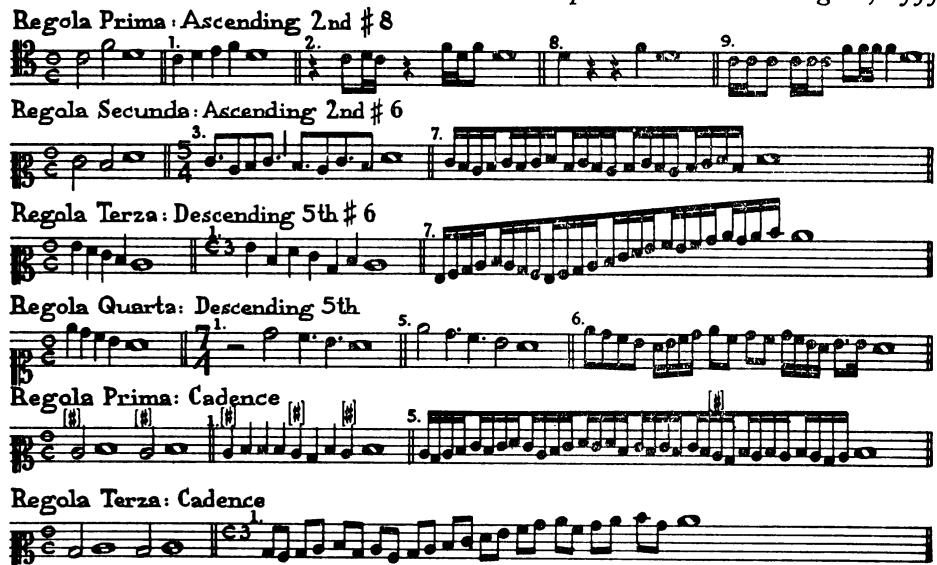
原文复述
Stable URL: https://www.jstor.org/stable/830116
中文讲解
原文复述:稳定 URL 为 https://www.jstor.org/stable/830116。该行提供文章在 JSTOR 数字档案中的永久定位地址(Stable URL),其中 “stable” 一词强调该链接不会因网站改版而失效,便于学术引用。数字串 830116 是 JSTOR 内部为该文分配的稳定 ID,可与卷期页码信息相互印证。
补充说明
Stable URL 的作用是确保读者通过同一链接在多年后仍能定位到同一篇文献。
第6段(P0006)
原文复述
REFERENCES
中文讲解
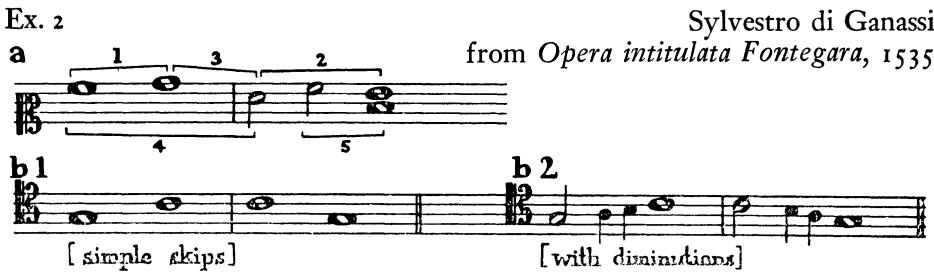
原文复述:"## REFERENCES"。这是一个 Markdown 层级的小节标题(双井号表示二级标题),在 JSTOR 网页版式样中作为参考文献区段的视觉标识,位于文章元数据区与正文之间。该标题并非文章正文章节,而是 JSTOR 平台对参考文献列表区域的导航标签。
第7段(P0007)
原文复述
Linked references are available on JSTOR for this article:
中文讲解
原文复述:本文在 JSTOR 上提供已链接的参考文献。该句告知读者:本文所引用的参考文献条目已被 JSTOR 平台建立超链接,点击后可直接跳转至 JSTOR 中相应来源页面。其功能是为读者提供引文溯源与延伸阅读的入口,但并不属于正文论述。
第8段(P0008)
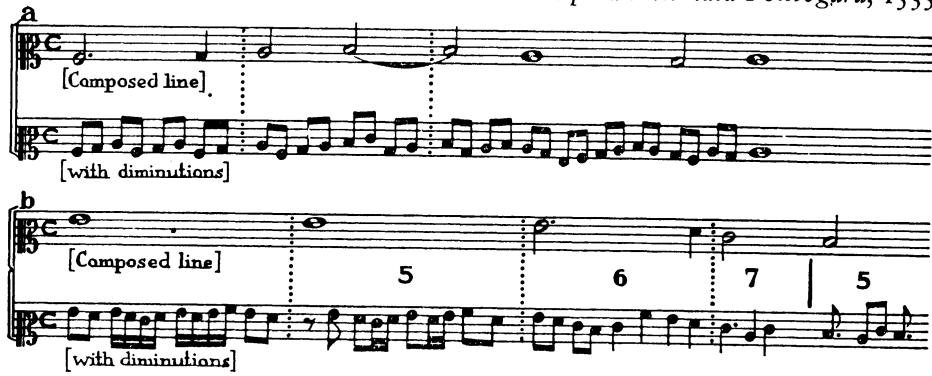
原文复述
https://www.jstor.org/stable/830116?seq=1&cid=pdf-
中文讲解
原文复述:URL 片段 https://www.jstor.org/stable/830116?seq=1&cid=pdf-。该行承接上一句"已链接参考文献",给出参考文献区段对应的具体网址片段,其中 seq=1 表示文献链接区段的定位参数,cid=pdf- 用于标识本次访问来自 PDF 下载路径。该行属于页面技术性元数据,不含学术内容。
第9段(P0009)
原文复述
reference#references_tab_contents
中文讲解
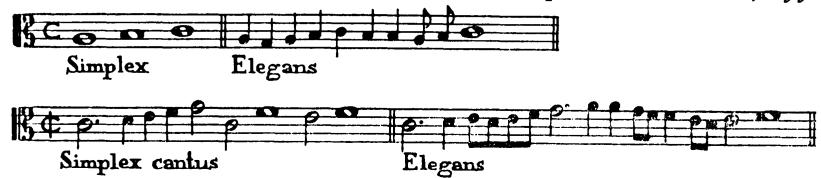
原文复述:reference#references_tab_contents。该行是上一行 URL 的锚点片段(anchor fragment),用反斜杠转义下划线,用于在 JSTOR 页面上把视口跳转到 References 选项卡(references_tab_contents)的内容区。它同样属于平台导航技术信息,不涉及文章本身的论述。
第10段(P0010)
原文复述
You may need to log in to JSTOR to access the linked references.
中文讲解
原文复述:访问这些链接参考文献可能需要先登录 JSTOR。该句是 JSTOR 平台的访问提示,说明部分参考文献全文仅对付费机构或已登录用户开放。它对读者的操作意义在于:若未登录,部分参考文献链接可能会显示登录墙。
第11段(P0011)
原文复述
JSTOR is a not-for-profit service that helps scholars, researchers, and students discover, use, and build upon a wide range of content in a trusted digital archive. We use information technology and tools to increase productivity and facilitate new forms of scholarship. For more information about JSTOR, please contact support@jstor.org.
中文讲解
原文复述:JSTOR 是一项非营利服务,旨在帮助学者、研究者与学生在一个值得信赖的数字档案中发现、使用并拓展各类内容;JSTOR 利用信息技术与工具提升研究效率并促进新的学术形式。如需更多信息,请联系 support@jstor.org。该段是 JSTOR 平台的自我介绍声明,说明其机构性质(非营利)、服务对象(学者与学生)与功能定位(数字档案+促进学术新形式)。其中所附 support@jstor.org 为平台客服邮箱,仅作联系方式,不承担学术论据作用。
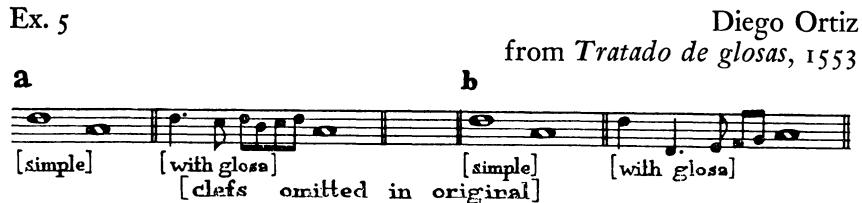
补充说明
本段是 JSTOR 的标准服务说明模板,不专属于本文。
第12段(P0012)
原文复述
Your use of the JSTOR archive indicates your acceptance of the Terms & Conditions of Use, available at https://about.jstor.org/terms
中文讲解
原文复述:使用 JSTOR 档案即表示您接受使用条款,使用条款详见 https://about.jstor.org/terms。该行属于法律提示条款,通过链接指向 JSTOR 的完整使用条款页面。它对读者的意义在于告知下载与浏览行为受该平台条款约束;它不构成本文论点的支撑。
第13段(P0013)
原文复述
J
中文讲解
原文复述:J。该项是 JSTOR 平台标志(logo)的字母部分,常与下一段 “JSTOR” 共同构成视觉标识。在 JSTOR 下载版式中,它以单独字母 “J” 出现,作为图标而非正文文字,不承载学术信息。
第14段(P0014)
原文复述
JSTOR
中文讲解
原文复述:JSTOR。该项与上一段 “J” 共同呈现 JSTOR 品牌全称,作为页面版式的署名标识出现。它不传递文章内容,仅表明本文由 JSTOR 平台提供访问。
第15段(P0015)
原文复述
American Musicological Society and University of California Press are collaborating with JSTOR to digitize, preserve and extend access to Journal of the American Musicological Society
中文讲解
原文复述:美国音乐学学会与加州大学出版社正与 JSTOR 合作,对《美国音乐学学会会刊》进行数字化、保存与访问扩展。该句交代了三方合作关系:内容方(学会与大学出版社)与平台方(JSTOR)共同维护该期刊的数字存档与长期可访问性。这呼应了 P0004 的出版说明,把出版层与数字化层的合作一并呈现。
第16段(P0016)
原文复述
This content downloaded from 140.182.176.13 on Sat, 08 Aug 2026 04:21:47 UTC All use subject to https://about.jstor.org/terms
中文讲解
原文复述:本内容下载自 IP 地址 140.182.176.13,下载时间为 2026 年 8 月 8 日(星期六)UTC 时间 04:21:47;所有使用行为受 https://about.jstor.org/terms 约束。该行属于页脚型下载水印,包含三层信息:访问来源 IP、下载时间戳、再次指向使用条款的链接。其功能是版权与访问审计,不属于正文论述。
脚注 / 边栏 / 图表 / 附加信息(如有)
本节所有非正文内容均由三组材料构成:(1)文章级书目信息 P0001–P0005,含标题、署名作者、期刊来源、出版方与稳定 URL;(2)JSTOR 参考文献导航信息 P0006–P0010,含 REFERENCES 区段标题、参考文献链接说明、对应的 URL 与锚点片段,以及登录提示;(3)JSTOR 平台声明与页脚水印 P0011–P0016,含平台自我介绍、使用条款链接、品牌字母标识、数字化合作说明与下载水印。这些材料共同提供文献定位、版权与访问控制信息,对正文论证不构成论据。
💡 本节核心要点
- 本节属于 JSTOR 平台为文章附加的前置元数据与版权页,不包含任何学术论点。
- 标题《Improvised Embellishment in the Performance of Renaissance Polyphonic Music》同时锁定了研究对象(文艺复兴复调音乐)、研究层面(演奏)与研究问题(即兴装饰)三项边界。
- 作者署名为 Imogene Horsley 一人,发表载体为 1951 年春季 JAMS 第 4 卷第 1 期第 3–19 页,由加州大学出版社代表美国音乐学学会出版。
- 稳定 URL(https://www.jstor.org/stable/830116)确立了文章在 JSTOR 数字档案中的永久访问入口。
- P0006–P0010 的 REFERENCES 区段属于 JSTOR 网页版式的参考文献导航标签,提示部分链接需登录后方可访问,不构成正文小节。
- P0011–P0016 是 JSTOR 平台的版权、条款与下载水印信息,用于访问审计与权利声明,不参与学术论证。
🔑 关键术语
- Polyphonic Music:复调音乐;本节中指文艺复兴时期多条独立声部同时进行的织体,区别于单声部或主调音乐,是本文研究的对象范围。
- Improvised Embellishment:即兴装饰;指演奏者在既有乐谱骨架之上,于读谱或记忆演奏时临时加入的装饰处理,区别于作曲家预先写定的固定装饰。
- Renaissance:文艺复兴时期;本节标题中限定研究对象的历史时段,约对应 15–16 世纪的欧洲音乐实践。
- JSTOR:一个非营利的学术数字档案平台;本节中既是文献访问入口(Stable URL 830116),也是版权与使用条款的发布方。
- Stable URL:JSTOR 为每篇文章分配的永久链接(编号 830116),用于跨时间的稳定定位与学术引用。
- Journal of the American Musicological Society (JAMS):美国音乐学学会会刊;本文的发表载体,1951 年由加州大学出版社代表学会出版。
C2.S1 [描述性拆分] The Paradox of Historically Authentic Performance
第1段(P0017)
原文复述
Improvised Embellishment in the Performance of Renaissance Polyphonic Music
中文讲解
这是文章的主标题。它把研究对象限定在两个要素上:一是文艺复兴时期的复调音乐(Renaissance Polyphonic Music),二是这类音乐在表演中的即兴装饰(Improvised Embellishment)。标题中用"in the Performance of"而非"in the Composition of",说明文章关注的不是作曲技法,而是演奏者在表演过程中即兴加入的装饰——这就为下文讨论乐谱文本与实际音响之间的差距埋下了伏笔。
第2段(P0018)
原文复述
By IMOGENE HORSLEY
中文讲解
作者署名:Imogene Horsley。这是一行简单的署名信息,标明本节内容的作者归属;它是文章开头的版面要素,本身不承载论点。
第3段(P0019)
原文复述
ONE of the paradoxes of contemporary musical study is the fact that the student by his very desire for historically authentic performance has developed habits of thought which impede his gaining a proper understanding of the music of certain past periods. His strict training in accurate adherence to the notes of a composition as written down by the composer has developed in him such a reverence for those notes that it is hard for him to add to them, or subtract from them, without a feeling of guilt. While this attitude has produced exemplary results in the performance of music written after 1750, it has also led to a complete misconception of the performance ideals of much of the music written in the Baroque and Renaissance periods.
中文讲解
本段是全节的核心论点,提出一个"悖论"(paradox):当代音乐学习者越是追求"历史上真实的演奏"(historically authentic performance),其思维习惯反而越妨碍他理解某些过去时期的音乐。作者 Horsley 指出,严格按作曲家写在纸上的音符演奏的训练,培养出学生对乐谱近乎敬畏的态度,使其在增删音符时会产生"负罪感"(a feeling of guilt)。
关键转折在于:这种态度对 1750 年之后的音乐效果卓著(exemplary results),因为那个时期之后的乐谱确实就意味着作曲家想要的最终音响;但同一套态度套用到巴洛克与文艺复兴音乐上,就造成了"完全误解"(a complete misconception)。也就是说,作者把 1750 年视为一条分水岭——此前的音乐记谱法只是表演的框架或草图,而此后的记谱才接近作曲家意图的完整记录。
因此本段为整篇文章定下了诊断与反驳的基调:现代演奏者所自认为"忠于原作"的做法,对早期音乐而言反而是失真的;纠正这种失真需要恢复对即兴装饰的承认。
第4段(P0020)
原文复述
It is becoming general knowledge that the simple appearance of much Baroque music is deceptive and that what is seen on the printed page was often merely an outline to be amplified in performance according to regularized patterns of improvised embellishment; but the fact that the music of the Renaissance was often similarly changed in performance is less frequently recognized.
中文讲解
本段把上文提出的悖论进一步具体化,明确指出乐谱"看起来简单"(simple appearance)具有欺骗性:印刷页面上的音符只是轮廓(outline),需要在表演中按照规范化的即兴装饰模式加以扩展(amplified)。这是学界对巴洛克音乐的"通识"(general knowledge)。
然而,作者用一个转折"but"指出:文艺复兴音乐在表演中也同样被改变(similarly changed in performance),但这一点较少被人承认(less frequently recognized)。这就把读者的注意力从较为人熟知的巴洛克推进一步,引向更早、更容易被忽视的文艺复兴时期。它也解释了为什么作者专写此文——因为即使在已经承认巴洛克即兴装饰的圈子里,文艺复兴的类似现象仍被低估。
第5段(P0021)
原文复述
The Renaissance has often been called the “Age of Vocal Polyphony,” but, while vocal polyphony was by far the predominant type of composition, it was not the only type of performance. These compositions were performed in numerous ways: in different combinations of melody instruments and voices; as vocal or instrumental solos accompanied by keyboard instruments or lute; as pieces transcribed for keyboard or lute; or as solos for stringed instruments in which the single line was built up of fragments from the individual voice parts. The concept of the one authentic performance did not yet exist.
中文讲解
本段先承认一个常识:文艺复兴常被称为"人声复调的时代"(Age of Vocal Polyphony),声乐复调确实是占主导地位的创作类型(predominant type of composition)。紧接着用一个"while…not…“的让步结构,把读者拉回来:声乐复调虽然主导创作,但并非唯一的表演形式。
作者列举了多种表演方式:旋律乐器与人声的各种组合、键盘或鲁特琴伴奏下的声乐或器乐独奏、为键盘或鲁特琴而作的改编曲,以及用弦乐器独奏时把各声部片段拼成单一线条的做法。这一长串列举的目的是证明:同一部作品在当时有多种合理的呈现方式,并不存在唯一的、“权威的"演奏版本。
最后一句"The concept of the one authentic performance did not yet exist"是结论性点睛:现代人追求"唯一真实演奏"的观念,在文艺复兴时期根本不存在。换言之,把单一文本当作唯一正解,本身就是时代错置(anachronism)。这一句直接呼应了首段的"悖论”。
第6段(P0022)
原文复述
Furthermore, whenever one of these compositions was performed by a soloist or group of soloists, it was not always performed simply as written but was usually made “elegant” and “ornate” by the addition of florid embellishments. The use of this technique in keyboard and lute transcriptions is well known, $^{1}$ but it is not so generally recognized that it was also the accepted practice to ornament the individual lines in solo vocal or instrumental performance of these compositions. These florid embellishments, added by each soloist to his own part, often resulted in a complete transformation of the work.
中文讲解
本段由"Furthermore"承接上文,继续论证乐谱文本不等于表演实际。它指出:每当一位或一组独奏者表演这些作品时,作品并不只是"按所写的样子"演奏,而是通常会被加入华丽的即兴装饰(florid embellishments),使作品变得"优雅”(elegant)和"华丽"(ornate)。
作者承认键盘与鲁特琴改编曲中使用这类装饰是人所共知的(well known),并用一个转折强调:但较少有人认识到,在独唱或独奏的声乐、器乐表演中,对各声部进行装饰(ornament the individual lines)也是被接受的做法(accepted practice)。这是本段的关键新论——装饰不仅是键盘改编曲的特点,也是独奏表演的常规。
最后一句点明效果:每位独奏者在自己的声部上所加的花饰,常常使作品被彻底改变(a complete transformation of the work)。也就是说,演奏者的个人装饰能重塑原作;这从另一个角度反驳了"乐谱即作品"的现代观念,为下一段进一步追溯到演奏者技艺本身做好准备。本段末尾带有上标 1,对应脚注对键盘与鲁特琴改编曲中装饰用法的文献出处。
第7段(P0023)
原文复述
If present-day training in strictly reproductive performance makes it difficult to accept the idea of such free treatment of compositions, it must be remembered that in the Renaissance period both vocal and instrumental virtuosity were still based upon skill in improvisation. An expert performer was expected to produce music as well as reproduce it. In his book published in 1553, $^{2}$ Diego Ortiz describes the three ways in
中文讲解
本段是因果回应:现代学生之所以难以接受上述"自由处理"(free treatment),是因为他们接受的是"严格复演"(strictly reproductive performance)的训练。但作者提醒读者必须记住——在文艺复兴,声乐与器乐两方面的技艺(virtuosity)都仍然奠基于即兴能力(skill in improvisation)。
接下来是这段最重要的对照句:“An expert performer was expected to produce music as well as reproduce it”。一位合格的演奏家不仅被期待"复演"现成作品,也被期待"创作"音乐。这与今天"演奏家=忠实地再现作曲家意图"的角色定义形成鲜明对比。换言之,文艺复兴演奏家的职业身份本身就内含了即兴创作的能力要求。
段末提及 1553 年出版的书,作者是 Diego Ortiz(西班牙音乐家、维奥尔琴家),书将"描述三种方式"(the three ways in……)。句末被截断,预示下一段将展开这三种方式的细节。上标 2 指向脚注,说明此书为《Tratado de glosas》(装饰法教程)第二卷,是 16 世纪关于装饰演奏最重要的原始文献之一。
补充说明
脚注 2 提示 Ortiz 的著作为 1553 年出版的《Tratado de glosas, Book II》。Ortiz 在书中系统描述了文艺复兴时期声乐、器乐表演中即兴装饰的具体做法与分类,是本节以及后续段落的核心文献来源;脚注在此的功能是来源标注(source citation),将作者的论述锚定在第一手 16 世纪文献之上。
第8段(P0024)
原文复述
$^{1}$ See Otto Kinkeldey, Orgel und Klavier in der Musik des 16. Jahrhunderts (Leipzig, 1910).
中文讲解
这是正文 P0022 末尾上标 1 所对应的脚注,原始德文标题:Otto Kinkeldey 著《16 世纪音乐中的管风琴与键盘》(Orgel und Klavier in der Musik des 16. Jahrhunderts),1910 年于莱比锡出版。它为正文"键盘与鲁特琴改编曲中使用装饰手法是众所周知的"这一说法提供文献支持(supporting source),属于来源标注类脚注,作用是把当代学界的共识溯及 Kinkeldey 这部早期音乐学专著。
补充说明
脚注给出的文献是 Kinkeldey 1910 年的德文专著,属于 20 世纪早期德语音乐学的代表性成果;本脚注在文中起来源标注作用,确认"键盘与鲁特琴改编曲中装饰手法为人所知"这一陈述在学理上的依据。
第9段(P0025)
原文复述
$^{2}$ Tratado de glosas, Book II.
中文讲解
这是正文 P0023 末尾上标 2 所对应的脚注,注明 Diego Ortiz 1553 年出版的书为《装饰法教程》(Tratado de glosas)第二卷(Book II)。这是一手来源(primary source)标注,向读者说明 Ortiz 所描述的三种装饰方式可在该书第二卷中找到;它为作者的论述提供 16 世纪同时代的权威佐证,使"文艺复兴演奏家被期望既能复演也能创作"的论点获得历史文献层面的支撑。
补充说明
脚注 2 提供的是 16 世纪西班牙演奏家 Diego Ortiz 的原始著作信息;本脚注在文中承担一手来源标注的功能,使作者援引的"三种方式"具有可查的史料依据。
第10段(P0026)
原文复述
This content downloaded from 140.182.176.13 on Sat, 08 Aug 2026 04:21:47 UTC All use subject to https://about.jstor.org/terms
中文讲解
这是 JSTOR 数字图书馆的下载与使用声明(footer notice),属于版面与版权信息:注明本文档下载自 IP 地址 140.182.176.13,下载时间为 2026 年 8 月 8 日 04:21:47 UTC,并提示使用须遵守 about.jstor.org/terms 上的条款。它不包含任何学术观点,只是版本来源与版权提示。
脚注 / 边栏 / 图表 / 附加信息(如有)
本节末尾包含两处脚注与一则 JSTOR 下载声明。
脚注 1(对应 P0022):参见 Otto Kinkeldey, Orgel und Klavier in der Musik des 16. Jahrhunderts (Leipzig, 1910)。该脚注为正文"键盘与鲁特琴改编曲中使用装饰手法是众所周知的"提供来源标注,属于支持性文献指引。
脚注 2(对应 P0023):指明 Ortiz 1553 年的著作为《Tratado de glosas》第二卷。该脚注属于一手来源标注,把正文"三种方式"的论述锚定在 16 世纪的原始文献上。
JSTOR 声明(对应 P0026):版权与下载来源信息,不构成学术内容。
💡 本节核心要点
- 现代演奏者追求"历史真实演奏"的执着,恰恰形成了理解巴洛克与文艺复兴音乐的障碍——这是本节提出的核心悖论。
- 乐谱在 1750 年前后意义不同:此前的谱面只是轮廓,需要表演中以即兴装饰补足;此后的谱面才接近作曲家完整意图。
- 文艺复兴虽被称为"人声复调的时代",但实际表演方式极为多样,不存在唯一权威的演奏版本。
- 对独唱、独奏声部进行即兴装饰,在文艺复兴是被广泛接受的做法,常使作品在表演中被彻底重塑。
- 文艺复兴演奏家的技艺基础在于即兴——“既能复演,也能创作"是其职业身份的内在要求;这与今日演奏家角色定义形成根本差异。
- Diego Ortiz 1553 年《Tratado de glosas》第二卷为即兴装饰的多种方式提供了一手史料依据。
🔑 关键术语
- historically authentic performance:历史上真实/原真演奏。指依据历史资料、原始乐器、当时演奏实践尽量还原过去音乐音响的做法。在本节中,作者指出对这一目标过于执着,反而妨碍了对巴洛克与文艺复兴音乐的理解。
- improvised embellishment:即兴装饰。演奏者在表演过程中,按照当时通行的规范模式,对乐谱线条进行临时的华丽化处理。在文艺复兴与巴洛克时期,它是受期待的表演行为,而非对作曲家的冒犯。
- florid embellishments:华丽的装饰音。在文艺复兴独唱、独奏中,演奏者为自己声部加入的繁复花饰,常使原作被大幅改写。
- Renaissance polyphony:文艺复兴复调音乐。15–16 世纪以多声部对位为核心的多声部音乐,本节强调其谱面仅是表演的框架,表演者会按惯例对其加以装饰。
- Age of Vocal Polyphony:“人声复调的时代”。对文艺复兴时期的常见称呼,作者借此指出该称呼虽描述创作主流,但不能限制表演的实际多样性。
- Diego Ortiz, Tratado de glosas (1553):西班牙音乐家 Diego Ortiz 1553 年出版的装饰法教程,第二卷集中讨论声乐与器乐表演中的即兴装饰方法,是本节援引的一手史料。
- Orgel und Klavier in der Musik des 16. Jahrhunderts (Kinkeldey, 1910):音乐学家 Kinkeldey 关于 16 世纪键盘音乐的德文专著,脚注 1 中作为支持性参考,佐证"键盘改编曲中装饰手法为人所知"这一陈述。
C2.S2 [描述性拆分] Renaissance Performance Practice and the Place of Improvised Embellishment
第1段(P0027)
原文复述
which a performer on the violone may play with the cembalo: the first is the improvisation of a fantasia by both players together; the second, the improvisation by the violone player of a melody above a plain chant played on the cembalo. Only the third and last way is to play sobre cosas compuestas—“over” a composed piece of music. Virtuoso singers as well as instrumentalists were expected to be able to improvise; ever since the practice of discantus supra librum in the 14th century, singers had been trained to improvise a counterpoint to a given melody at sight.
中文讲解
本段接续前文(Ortiz关于维奥尔琴手与羽管键琴合奏的三种方式),并补出第三种方式。前两种是双方共同即兴幻想曲,或维奥尔琴手在羽管键琴所奏的素歌之上即兴旋律;第三种才是"sobre cosas compuestas”——在既有作曲之上即兴演奏。作者由此把焦点从"合奏方式"拉到"即兴能力的普遍性":无论是声乐家还是器乐家,职业上的"virtuoso"(精湛演奏者)都被期望具备即兴能力。其历史根基可以追溯到14世纪的"discantus supra librum"(视谱即兴对位法),即歌手看到给定旋律后当场即兴创作对位声部。这说明在文艺复兴,即兴并不是少数天才的偶发行为,而是一种有训练传统的常规能力。需注意"ever since"一词把14世纪到作者所讨论的16世纪之间视为一条连续的传承线,为下文把文艺复兴即兴装饰看作"成熟技术"埋伏笔。
补充说明
sobre cosas compuestas(西语,意为"在已作曲之上")即后文反复讨论的"在既有作曲之上做即兴装饰";cembalo = harpsichord;violone = 低音维奥尔琴;plain chant = 无伴奏素歌;discantus supra librum 是中世纪后期至文艺复兴时期常见的视谱即兴对位练习。
第2段(P0028)
原文复述
From the early 16th century, manuals for teaching instrumental and vocal performance included sections on the technique of improvised embellishment as a matter of course. By diligent practice a performer acquired a vocabulary of melodic figures which could be introduced between the melodic intervals making up the individual lines of a composition. He developed a repertory of patterns, for example, which could be substituted for the skip of a third within the duration of a semibreve; and whenever he saw that interval in the melodic line he was reading, he could use one of these figures in place of the simple interval skip. This technique was applied in Ortiz’ third case—that of playing “over” a composition—since even when playing a composed piece of music the performer was not expected to reproduce the notes literally. A proficient soloist improvised embellishments upon the composed line, exhibiting his own skill. Performance was to him a creative application of his technique to a composition; the composition was the vehicle of, rather than the motive for, his performance.
中文讲解
本段说明即兴装饰是如何被"教"与"学"出来的。16世纪初起,声乐和器乐教材都把即兴装饰作为常规章节列入;演奏者通过反复练习积累一套"旋律词汇",可以在一条作曲旋律的各音程之间插入装饰型短句。作者以"用一段短花型代替一个全音符时值内的三度跳进"为例:当读到旋律中某个三度跳进时,就用储备的花型去替换原本简单的音程跳进。这一技术正是Ortiz所说的第三种情形——“在作曲之上"演奏:因为演奏一份作曲文本时,并不要求逐音照搬,熟练独奏家要在旋律线上即兴装饰以展示个人技巧。作者由此提出一个关键观念对比:表演对演奏者而言,是把个人技术"创造性运用于"一曲既有作曲;作曲文本是表演的载体(vehicle),而不是表演的目的(motive)。这一句是本节论证的枢纽——它重新定义了演奏者与作曲文本的关系:作曲不再是神圣不可改的蓝图,而是供技艺发挥的脚手架。
补充说明
“a skip of a third within the duration of a semibreve"是文艺复兴教学中典型的最小装饰单位;semibreve(whole note,全音符)是16世纪常用的基本时值单位;“vehicle … rather than … motive"是作者给出的核心隐喻,前者指承载工具,后者指目的。
第3段(P0029)
原文复述
Although this Renaissance style of improvised ornamentation has been discussed by scholars, $^{3}$ the details of the practice have never been fully described, nor has it been set apart as a practice stylistically distinct from that of the Baroque era. It was not an embryonic art from which the elaborate ornamental system of the Baroque period developed, but a mature technique adapted to the musical style to which it was applied. Just when and where this practice originated is still a matter of conjecture. $^{4}$ When the first manual teaching it was published in Italy in 1535, it was already a highly organized technique.
中文讲解
本段提出作者的两个重要判断,并对前人研究做出评估。其一,前人虽讨论过文艺复兴即兴装饰,但从未详细描述过其具体细节,也未把它与巴洛克时期的装饰实践在风格上明确区分开来。其二,作者反驳一种常见的演化论叙事:文艺复兴即兴装饰并非巴洛克繁复装饰体系的"胚胎"或前身,而是一项"成熟的技术”,专门适应它所应用的音乐风格。这一辨正非常重要——它否定了那种"由简到繁、由粗到精"的单线进步史观,主张各时期的装饰实践是各自分立、各自适配的风格现象。至于起源,作者承认"何时何地"仍属推测(脚注4),但给出硬证据:1535年意大利出版第一部教授此技术的教材时,它已经是"高度组织化的技术”。换言之,1535年可见的是结果而非起点,源头更早。“never has it been set apart"也预告了作者本人将要做的工作:在本节中把文艺复兴装饰作为独立风格加以界定。
补充说明
脚注标记 $^{3}$ 和 $^{4}$ 提示P0031将给出详细的文献综述和起源争论;1535年指Silvestro di Ganassi的著作《Opera intitulata Fontegara》出版于威尼斯。
第4段(P0030)
原文复述
Throughout the 16th century Italy was the center from which the practice radiated, and it was also firmly established in musically progressive centers in Spain and Germany. It was known but not generally accepted in France $^{5}$ during the 16th century, although in Italy it was applied as often to French chansons as to Italian madrigals. Only in 16th-century England do we find no mention of its use. As far as we know, the English madrigals and fancies for viols were performed exactly as written. $^{4}$
中文讲解
本段以地理分布勾勒16世纪即兴装饰的传播图景。其层级清晰:意大利是辐射中心;西班牙、德国的"音乐上进步的中心"中也已牢固确立;法国虽"知道"此艺术但"未被普遍接受”(脚注5提示这是少数例外);唯一的明显空白是16世纪的英格兰——没有文献提及即兴装饰用于英国音乐,凡能查到的英国牧歌与维奥尔幻想曲都是"严格照谱演奏”。一个有趣的对照是:在意大利,此装饰技术既施用于本国牧歌,也同等施用于法国尚松(chansons),即装饰技术并不受语种或国别限制。“Only in 16th-century England do we find no mention"是一个强限定句,作者用"as far as we know"留下余地(脚注4也提示这一点),承认这是基于现有证据的判断。这一地理图谱解释了为什么作者随后要把"文艺复兴即兴装饰"作为一个跨国、跨语种但技术统一的实践来讨论,也呼应P0033关于不同语言名称的论述。
补充说明
“chansons"与"madrigals"分别指16世纪法国和意大利的主要世俗声乐体裁;“fancies for viols"指英国特有的纯器乐合奏体裁fancy/fantasy;脚注 $^{5}$ 与 $^{4}$ 的内容分别在P0040与P0031给出。
第5段(P0031)
原文复述
$^{3}$ The two principal treatments are found in Max Kuhn, Die Verzierungs-Kunst in der Gesangs-Musik des 16.-17. Jahrhunderts (Leipzig, 1902) and Robert Haas, Aufführungspraxis der Musik (Leipzig, 1931). The former has a complete list of sources and a good set of musical examples; the latter, a good discussion but fewer examples. Neither covers the period in full detail. Our topic is also treated briefly in Arnold Schering, Aufführungspraxis alter Musik (Berlin, 1931) and Ernst Ferand, Die Improvisation in der Musik (Zürich, 1938). $^{4}$ Kuhn (op. cit., pp. 32ff) thinks the use of diminution originated with the contrapuntal style of the Netherlands schools and was spread by them. Schering (op. cit., pp. 120ff) considers the diminutions to be of oriental origin. Ferand thinks they are the last remnant of a vital art of improvisation. I have found hints of a similar practice in discussions of Arabian singing techniques in 9th-century Spain, but as yet have not been able to trace these to their original sources. $^{5}$ The only 16th-century mention of this art in France that I have found is in Anthoine de Bertrand’s preface to the Premier livre des Amours des Ronsard, 1578 (ed. H. Expert,
中文讲解
本段是页脚注释3、4和5的正文部分,集中处理前人研究与起源争论。脚注3列出四部核心文献:Kuhn(1902)资料齐全但偏例证,Haas(1931)讨论精到但例证较少,二者皆未完整覆盖该时期;Schering(1931)与Ferand(1938)也简略涉及。这是作者在为后文专章研究做铺垫——既然没有一项前人研究能完整描述16世纪即兴装饰,他就必须亲自综合原始资料。脚注4则呈现三种关于起源的不同假说:Kuhn认为diminution(细分法)源于尼德兰乐派对位风格并由其传播;Schering认为是"东方起源”;Ferand则视之为更古老的即兴艺术的"最后遗存”。作者坦承自己发现了9世纪西班牙阿拉伯歌唱技巧讨论中类似的实践"迹象”,但尚未能溯源——这一表态显示作者的学术诚实,也说明起源问题仍未解决。脚注5起首句指出16世纪法国唯一能找到的提及来自Anthoine de Bertrand 1578年为龙萨诗集所作的序言(余下在P0040)。这一注释链同时回应正文P0029和P0030中的脚注引用。
补充说明
脚注内出现的四位学者的著作均按"作者,著作名(出版地,年份)“格式给出原文信息;op. cit. = opere citato(前述著作);pp. 32ff / 120ff 指"从32页起"和"从120页起”;H. Expert 是20世纪初法国音乐学家Henri Expert。
第6段(P0032)
原文复述
This content downloaded from 140.182.176.13 on Sat, 08 Aug 2026 04:21:47 UTC All use subject to https://about.jstor.org/terms
中文讲解
此为JSTOR电子文献传递平台自动添加的访问声明与时间戳,属于版式信息而非正文内容。它标识了文本来源(JSTOR)、下载IP、日期时间(2026年8月8日04:21:47 UTC)以及使用条款链接。读者无需据此理解作者论证。
补充说明
此条是页面页脚/水印性质的内容,无信息解读价值。
第7段(P0033)
原文复述
The general term for this improvised embellishment in Italy was diminutio (diminution), since it was, in effect, the breaking up of longer note values into an aggregation of notes of shorter duration. In Spain the embellishments were known as glosas; in Germany and the Netherlands as coloriren; Latin treatises described the ornamented line as “ornatus,” “coloratus,” etc.; but despite the difference in names, the technique itself was uniform.
中文讲解
本段对"即兴装饰"这一实践给出术语谱系与统一性主张。意大利的通用名是diminutio(拉丁语"减少、细分"),其内涵即把较长时值的音符"打碎"成短时值音符的集合——这一术语也对应英文diminution。西班牙称为glosas(“注释、说明”);德国和尼德兰称为coloriren(“着色”);拉丁语理论著作用ornatus、coloratus等词描述"被装饰过的旋律线"。重要的是"despite the difference in names, the technique itself was uniform"——作者主张:术语虽异,技术本体一致。这一论断为后文P0034的限定(“统一不等于到处都用同一套陈词滥调”)做了铺垫,也呼应P0030地理分布:技术跨国共享,只是命名因语言而异。术语"coloratus/ornatus"共享"着色"意象,暗示装饰是把"本色"旋律"加上色彩",与"diminutio"的减缩时值思路不同——这本身说明不同文化对同一实践的描述角度不同。
补充说明
glosas 在西班牙语中本义为"注释、释义",与音乐理论中"格拉斯多"(glosado,装饰版本)同源;coloriren 即德语动词"färben"(着色)的文艺复兴形式;ornatus/coloratus 在拉丁修辞学中也有"修辞装饰"之意。
第8段(P0034)
原文复述
To say that the practice was uniform does not imply that there were commonly accepted musical clichés everywhere in use, nor that there were universally accepted conventions as to the application of the principles. Not only were there widely divergent styles of ornamental figures, but there also were disagreements both as to the desirability of their use and as to the limits of their application. Nevertheless, certain broad musical characteristics separated Renaissance usage from succeeding ornamental practices:
中文讲解
本段是为避免误读所作的必要限定。前段断言"技术统一",本段立即指出"统一"并不等于"放之四海皆准的陈词滥调",也不等于"对原则的应用存在普世公认的规则"。具体而言,作者承认存在两重分歧:其一是装饰短句本身的风格存在广泛差异;其二是关于"是否值得用装饰"以及"装饰的边界在哪里"这两个根本问题,不同时期、不同地方、不同理论家之间意见不一(这一论断为P0039进一步展开做了铺垫)。然而,紧接着用"Nevertheless"转折:尽管有这些分歧,仍有某些"宽泛的音乐特征"可以把文艺复兴的装饰实践与后来的(巴洛克)装饰实践区分开来。这一段是过渡段,作用是为P0035–P0038四条特征的列举做合法性论证——作者要解释为什么在众说纷纭中仍能提炼出若干共同特征。
补充说明
“conventions as to the application of the principles"指关于"何时何地该不该装饰"的应用规则;“succeeding ornamental practices"主要指巴洛克时期的装饰体系,作者隐含的对照对象是巴洛克。
第9段(P0035)
原文复述
- The style of embellishment was very free. Neither the forms of the ornamental figures nor their placement within the phrase was stereotyped, nor were any signs placed in the music to indicate their use. Each manual contains a number of cadential patterns, apart from the general melodic figures, but the only unifying factor in these cadences is they all embellishments of the common melodic cadence formulas of the period.
中文讲解
本条是文艺复兴装饰区别于后世的第一条特征:自由度高。具体表现为——装饰短句的形式和它们在乐句中的位置都不"定型”(即没有stereotype,没有被标准化为可复制的样板),乐谱上也不标注任何装饰符号(这与后来巴洛克及古典时期乐谱中常见的颤音、回旋号等装饰记号形成对照)。即使终止式(cadential patterns)有专门花样可学,它们与一般装饰型的统一之处仅在于:它们都装饰那个时期"共同的旋律终止公式”。换言之,连最"规范化"的终止式也是从一套共有的终止音型派生而来,而不是独立的固定模板。“Each manual contains a number of cadential patterns, apart from the general melodic figures"一句揭示了教材的内部结构:除了一般性装饰句型,还有专门的终止式装饰型,这与"教即兴装饰"的传统一致——终止式是装饰密度最高、最需要专门训练的位置。
补充说明
“cadential patterns"指终止式装饰型;“stereotyped"对应"刻板化”,与后文巴洛克装饰型趋于标准化形成对比;乐谱不标装饰符号这一观察,区别于17世纪末以后装饰记号逐渐普及的现象。
第10段(P0036)
原文复述
- The ornamental patterns, no matter how ornate they might be, always retained the balanced melodic line and smoothly flowing rhythm characteristic of the composed music of the time.
中文讲解
本条是第二条特征:无论装饰多么华丽,它必须保留原作的"平衡的旋律线"和"顺畅流动的节奏”。这是一条"上限"式约束——装饰可以加花,但不能破坏16世纪作曲音乐本身的两项基本风格属性:旋律上的对称平衡(balanced melodic line,即各乐句结构对称呼应)和节奏上的平稳流动(smoothly flowing rhythm)。换言之,再即兴的装饰,其底层节奏脉动仍须听得出原作的稳定韵律。这一条隐含着文艺复兴音乐美学的核心假设:旋律与节奏的可预测平衡比瞬间的炫技更重要。它也帮助读者理解:为何16世纪装饰花样虽多,却不会让人觉得"装饰盖过了乐曲本身”。
补充说明
“balanced melodic line"呼应文艺复兴复调中"比例—对称"的修辞美学;“smoothly flowing rhythm"与16世纪常见的二拍子流畅律动(compound duple, simple duple等)相关。
第11段(P0037)
原文复述
- Great care was taken to preserve all the important vertical consonances of the composition, no matter how free the linear and rhythmic detail might be between those consonances.
中文讲解
本条是第三条特征:对位协和的严格保留。“垂直协和”(vertical consonances)即指各声部在同一瞬间形成的协和音程关系——也就是复调音乐的和声骨架。在装饰实践中,无论线条与节奏在协和音之间多么自由,所有"重要"的协和点都必须严格保留。这一条对理解16世纪即兴装饰至关重要:它界定了"装饰自由"与"对位规则"之间的边界——装饰只能在协和音之间"自由发挥”,但绝不可改动协和音本身。这解释了为什么即兴装饰在当时不视为破坏作曲家意图:装饰是"非协和瞬间的细节添加”,而不是"协和骨架的改写"。这一规则也支持作者前段"composition is the vehicle"的论断:作曲文本的和声骨架是承载即兴装饰的结构,装饰不能动摇结构。
补充说明
“vertical consonances"对应"纵向和声"视角,与"horizontal counterpoint”(横向对位)相对;“important"一词暗示作者认识到有些协和点(如终止式、关键和声点)比经过性协和点更不可改。
第12段(P0038)
原文复述
- No difference was made between vocal and instrumental music as far as the style of embellishment figures was concerned. Writers were usually careful to state that their ornaments were equally appropriate for voice and for wind and stringed instruments.
中文讲解
本条是第四条特征:声乐与器乐使用同一套装饰风格。理论家通常会明确说明,自己给出的装饰花样对嗓音、管乐器和弦乐器同样适用。这条特征具有重要方法论意义:它意味着我们不能仅从声乐教材或仅从器乐教材去重建文艺复兴装饰实践,两类教材是相通的;这也意味着"装饰型本身"被视为一种纯技术,而非依赖发声机制的产物。作者列举声乐、管乐和弦乐三类,正是为了体现"发声机制不同但装饰规则统一”。这一条与作者随后要做的"综合各原始资料"的研究路径直接呼应:既然规则统一,他就可以打通各类文献来重建装饰实践的整体面貌。
补充说明
“wind and stringed instruments"覆盖管乐和弦乐两大器乐家族;本条也间接说明16世纪装饰教材往往声乐、器乐合编,与18世纪后两者渐分的发展不同。
第13段(P0039)
原文复述
The subject is treated in such a variety of ways by the theorists of the time, and with such diversity of styles and opinions, that it is useless to attempt to summarize them all in one brief discussion. Some writers emphasize one aspect, some another. On some questions there is complete disagreement. The details of the practice varied from time to time and from place to place, and even from performer to performer, since any really good virtuoso developed his own style of improvisation and embellishment. An attempt to synthesize these various ideas into one general statement of the practice as a whole could not but be misleading. The only way to give an accurate idea of the art of diminution in its technical details is to give a summary of each of the main sources describing it, including examples of the ornamental patterns and the instructions given for applying these to actual musical compositions.
中文讲解
本段是作者的方法论自陈。它先承认三重多样性:理论家之间风格和观点的差异、对某些问题存在完全分歧、不同时间地点不同演奏者之间装饰细节也不同——并明确归因于"任何真正出色的virtuoso都会发展出自己独特的即兴与装饰风格”。基于这一多样性,作者做出一个看似激进的方法论判断:试图把所有不同意见综合成一条"总体陈述"必然误导读者(“could not but be misleading”)。唯一可靠的呈现方式是:分别概述每一条主要原始资料,配以装饰型实例和"如何应用到具体作曲文本中"的指导。这意味着本书后面的章节将采取"逐源综述"而非"综合归纳"的写法。这一方法论立场回应了P0034中"统一不等于通用陈词滥调"的限定,也表明作者认为16世纪装饰实践在根本上是"诸种风格并存"而非"单一风格内部的小差异"。这对读者理解后续章节的展开方式极为关键。
补充说明
“a summary of each of the main sources"暗示后文将以原始教材(如Ganassi、Dalla Casa、Bassano、Conforto等)逐章展开;“could not but be misleading"的双重否定表强调。
第14段(P0040)
原文复述
Paris, 1926). De Bertrand objects to improvised ornamentation because it confuses the harmony, and makes a sad composition sound joyful.
中文讲解
本段承接P0031脚注5的中断处,补全Anthoine de Bertrand序言的出版信息(Expert编,巴黎,1926),并转述Bertrand对即兴装饰的反对理由。Bertrand反对的原因有二:其一,即兴装饰"搅乱和声”(confuses the harmony);其二,它"使悲怆的作曲听起来欢快”——即改变了作曲的情感表达。这两条理由与作者P0037中"严格保留协和"的原则和"演奏须忠实于作曲表达"的潜在期待形成微妙张力:Bertrand站在"作曲本意优先"的一边,与P0028中"composition is the vehicle"的职业演奏家立场相反。Bertrand的批评也佐证了P0030中"法国虽知此艺术但未被普遍接受"的判断——他是法国国内即出现的反对声音。
补充说明
Anthoine de Bertrand(约1530–1581)为法国龙萨(Pierre de Ronsard)诗谱曲的合集《Premier livre des Amours de Ronsard》1578年出版;Henri Expert(1862–1952)以编辑文艺复兴法国音乐闻名。
第15段(P0041)
原文复述
$^{6}$ The term division is derived from diminutio, but this in itself is no proof that improvised diminutions were used in 16th-century England.
中文讲解
本段是脚注6:英文"division"(细分)一词源自拉丁文diminutio,但作者明确指出,单凭词源并不足以证明16世纪英格兰实际使用过即兴式的diminution。这一脚注直接回应P0030中关于英格兰的论断——作者之所以说"as far as we know, English madrigals and fancies for viols were performed exactly as written",是因为他严格区分了"术语存在"和"实践存在"。这是作者的方法论自律:词源相近不等于实践相同。这一脚注的存在,也提醒读者:英式"division"(17世纪英国器乐变奏传统中的术语)与意大利式"diminutio"虽然同名,但在历史实践上不一定连贯。
补充说明
“division"在17世纪英国器乐(特别是viol consort music)中指按固定音型对一条主题进行变奏细分的技术;脚注6是为防止读者把英式division等同于意式diminutio而作的方法论辨析。
第16段(P0042)
原文复述
This content downloaded from 140.182.176.13 on Sat, 08 Aug 2026 04:21:47 UTC All use subject to https://about.jstor.org/terms
中文讲解
此为JSTOR电子文献访问声明与下载时间戳,与P0032同性质,属版式信息而非正文内容。
补充说明
此条是页面页脚/水印性质的内容,无信息解读价值。
脚注 / 边栏 / 图表 / 附加信息(如有)
本节涉及的非正文附加材料主要有两类:(1) JSTOR电子文献传递平台自动添加的访问声明与时间戳,出现于P0032与P0042,对论证无实质作用,仅为版式标识。(2) 三处脚注:脚注3(P0031)综述前人对diminution主题的研究(Kuhn 1902, Haas 1931, Schering 1931, Ferand 1938)并指明各家局限;脚注4(P0031)罗列三种起源假说(尼德兰对位派起源说、东方起源说、古老即兴艺术遗存说)并附作者对9世纪西班牙阿拉伯歌唱技巧的未证实观察;脚注5(P0031与P0040)记录法国唯一16世纪提及此艺术的Anthoine de Bertrand 1578年序言,其反对理由(混淆和声、改变情感色彩)正与作者强调的"协和保留"和"作曲为载体"的论点形成对照;脚注6(P0041)辨析英文"division"与拉丁"diminutio"的词源关系,但否认词源可证明英格兰曾实际使用过即兴diminution。这些脚注共同为正文中的核心论断(成熟性、跨地域性、英格兰例外性、法国接受度)提供文献支撑与方法论自律。
💡 本节核心要点
- 文艺复兴即兴装饰是16世纪的一项成熟技术,而非巴洛克繁复装饰的"胚胎"或前身——作者通过1535年意大利首部教材已"高度组织化"的证据反驳了演化论叙事。
- 该实践虽在意大利(diminutio)、西班牙(glosas)、德国与尼德兰(coloriren)、拉丁语区(ornatus/coloratus)有不同名称,技术本体是统一的——这是术语谱系与跨国共享的双重主张。
- 文艺复兴装饰实践在四个维度区别于后世:装饰形式与位置高度自由(无乐谱记号)、保留平衡旋律线与顺畅节奏、严格保留所有重要纵向协和、声乐与器乐使用同一套装饰型——这是作者为后续"逐源综述"所做的风格界定。
- 实践存在地理分布差异:意大利为中心并辐射至西班牙、德国;法国"知道但未普遍接受”(仅Bertrand反对声作为代表);16世纪英格兰无文献记录——这一分布图谱为术语统一性主张提供了必要的限定。
- 作者明确拒绝把多源异说的装饰实践综合为单一"通论"陈述,理由是任何真正出色的virtuoso都会发展出独有的装饰风格——这一方法论立场决定了后续章节将以"逐源综述"而非"综合归纳"的形态展开。
- 即兴装饰的本质在P0028被定位为"演奏者对作曲文本的创造性运用"——作曲是表演的载体(vehicle),而非目的(motive);这与法国Bertrand从作曲家视角出发的反对立场构成文艺复兴内部两种演奏伦理的对照。
🔑 关键术语
- diminutio / diminution:意大利和拉丁语中对文艺复兴即兴装饰的通用术语,字面意为"减少/细分",指把较长时值的音符打碎成短时值音符的集合。本节把它界定为跨语言共享的技术核心,但同时指出英语"division"虽源自此词,并不证明英格兰实际使用过这一实践。
- sobre cosas compuestas:西班牙语术语,意为"在已作曲之上",指Ortiz所列维奥尔琴手与羽管键琴合奏的三种方式中的第三种——在既有作曲之上做即兴装饰。本节论证的核心场景即此。
- discantus supra librum:中世纪后期至文艺复兴时期常见的视谱即兴对位练习,歌手看到给定旋律后当场即兴创作对位声部。作者援引此传统以说明即兴能力是有训练传统的常规能力,而非偶发行为。
- glosas / coloriren / ornatus / coloratus:分别为西班牙、德语区与拉丁语区对同一装饰实践的不同名称。glosas 意为"注释",coloriren 意为"着色",ornatus/coloratus 在拉丁修辞学中本指"修辞装饰"。术语差异不掩盖技术统一性。
- vertical consonances:复调音乐中各声部在同一瞬间形成的协和音程关系(即纵向和声骨架)。作者把"严格保留所有重要协和"列为文艺复兴装饰区别于后世的核心特征,划定了"装饰自由"与"对位规则"的边界。
- vehicle vs. motive(演奏的载体与目的):作者在P0028提出的关键隐喻:作曲文本是演奏的承载工具(vehicle),而不是演奏的目的(motive)。这一定义重新定位了演奏者与作曲的关系——作曲不再是不可改的蓝图,而是技艺发挥的脚手架。
C2.S3 [描述性拆分] Method of Comparison and Introduction to the Source Manuals
第1段(P0043)
原文复述
To give some continuity to the musical examples as well as to furnish a logical basis for comparison, I have chosen from each writer examples of embellishments made upon the intervals of the ascending second and descending fifth, as well as samples of ornamented cadences from each manual that has included them. In these examples I have given first the un-ornamented form of the interval and then one or more florid versions. Wherever possible I have selected examples in which these embellishments are applied to actual musical compositions.
中文讲解
本段是作者对其比较方法学的总交代,出现在具体讨论各理论家之前,具有纲领性意义。作者明确两点动机:一是让谱例之间有贯穿性(continuity),二是为不同作者之间的比较提供逻辑基础( logical basis for comparison )。为了实现这两个目标,作者在每位理论家著作中提取同类型的装饰样本——上行二度(ascending second)、下行五度(descending fifth)以及(凡有收录的)装饰化终止式(ornamented cadences)。这一选择背后的方法论逻辑是:装饰音的具体处理因作者风格而异,但被装饰的’骨干音程’是相同的,因此横向比较才有可能且显得公平。展示顺序也做了规定:先呈现未装饰的原形,再呈现一种或多种华丽版本(florid versions)。最后一条限定’Whenever possible’非常重要——作者表示只要可能,会优先挑选装饰应用于实际乐曲中的例子,而非脱离作品的孤立花奏片段。这意味着作者的研究定位不是抽象规则对比,而是装饰在真实音乐语境中的运用差异。
补充说明
本段为全节方法论前提,解释了为何后面所有的谱例都集中在这两类音程和终止式上,而不是任意选择其他音程。
第2段(P0044)
原文复述
The first published manual to teach the art of diminution is the Opera intitulata Fontegara by Sylvestro di Ganassi, published in Venice in 1535. The primary purpose of this book is to teach the technique of flute playing, but it contains also a detailed description of the art of diminution. After discussing the basic problems of flute playing, including tonguing, Ganassi states firmly that skill in making diminutions is as essential to a good technique as tonguing—in fact that a skill in either one without the other is utterly useless. He then defines diminution as meaning simply to vary a thing (variare la cosa over processo).
中文讲解
本段把读者引入第一本有据可考的减缩(diminution)教学手册——威尼斯1535年出版的《Fontegara》,作者为 Sylvestro di Ganassi(dal Fontego,意为’喷泉边居民’)。作者先纠正一种潜在误解:此书表面上是长笛教科书(这是其 primary purpose),但实质上同时包含了对减缩艺术的详细描述( substantial treatment ),并非附庸性章节。接着,作者引用 Ganassi 本人的核心立场:在掌握了吐音(tonguing)等基本技术后,Ganassi 坚定地认为减缩技巧与吐音一样不可或缺——掌握其一而完全不懂另一者,在他的标准里是’毫无用处’(utterly useless)。这一陈述揭示了16世纪器乐演奏实践的真实样貌:减缩并非装饰性附录,而是与基本演奏技术平起平坐的核心能力。最后,Ganassi 给出减缩的定义: ‘variare la cosa over processo’——‘对某物(或某过程)进行变化’,这是全节讨论所依据的原始定义。
补充说明
‘variare la cosa over processo’是意大利文,‘over’在文中连接两个同义表达(cosa=thing, processo=process),Ganassi 用以说明减缩的本质即对原始素材作变化处理。该定义在后续段落中作为讨论基础反复被引用。
第3段(P0045)
原文复述
Ganassi’s treatment of diminution is more intricate than that of the writers who follow him; and this, combined with the fact that he takes it for granted that this technique is an integral part of instrumental and vocal performance, would seem to indicate that it was an art thoroughly developed and taught orally before the publication of this book.
中文讲解
本段是一个推论性段落。作者观察到两个事实:其一,Ganassi 对减缩的处理比后来者更为错综复杂(more intricate);其二,Ganassi 在写作中默认(takes it for granted)减缩是器乐与声乐表演的不可分割部分,甚至不再单独论证其重要性。从这两个观察出发,作者作出历史性推断:减缩这门艺术在 Fontegara 出版之前已经经过充分发展,且主要通过口传方式教学(was thoroughly developed and taught orally)。本段对全节论证链有承前启后的作用:它解释了为什么 Ganassi 文本显得复杂——因为他不是从零编写,只是把口传传统第一次系统书面化。
第4段(P0046)
原文复述
His classification of the diminutions is very detailed, and although seemingly having little to do with the actual application of the diminutions to a composition, it does give a hint of the detail in which this art of improvised embellishment was worked out. To begin with, he finds three aspects from which to analyze every diminution: first, the individual note values it includes (minute); second, the melodic patterns used (vie); and third, the rhythmic proportions involved. In each of these aspects a diminution may be simple or composite. In Example 3a (p. 8), the diminutions are simple in minute (since they consist only of crome), simple in proportion (since the number of crome to a semibreve is constant), but composite in vie (because they are made up of different melodic motives). The diminutions in Example 3b are composite in all three ways.
中文讲解
本段揭示 Ganassi 分类体系的结构。表面上这一繁琐分类与实际乐曲应用关联不大,但作者指出它的真正价值在于:它让我们看到即兴装饰这门艺术在Ganassi 头脑中已被分析到何种精细程度——这是口传传统成熟度的间接证据。分类由三个正交维度构成:第一,minute——所包含的个别音符时值;第二,vie——所使用的旋律型态;第三,rhythmic proportions——所涉及的节奏比例关系。每个维度内部又分为 simple(单一)或 composite(复合)两档。这种三乘二的分类法在第十六世纪是相当先进的分析框架。作者用 Example 3a 作为综合分析的演示:其减缩在 minute 上是 simple(只用 crome,即八分音符,时值单一);在 proportion 上也是 simple(每全音符(semibreve)所容纳的 crome 数量恒定);但在 vie 上却是 composite(由不同的旋律动机组成)。Example 3b 则是三维度全部 composite 的对照例子。两个例子构成 simple/composite 在每一维度上的对比说明,展示分类法如何落到实处。
补充说明
crome 是意大利文,指八分音符(单数 croma);semibreve 指全音符;vie 意为’道路/路径’,在这里被 Ganassi 借用作 melody-pattern 的技术术语,意指构成减缩的旋律型态;minute 意为’小’,在这里指音符时值的具体形态,而非节拍快慢。
第5段(P0047)
原文复述
Ganassi is the only writer who uses proportions to any extent. His collection of ornamental patterns is divided into four large sections (Regola prima, Regola secunda, etc.) according to the rhythmic proportions involved. The first section has figures in the proportion of four semiminims to a semibreve; the second, five in the time of the preceding four; the third, six to the first four; and the fourth, seven to the four. He also explains how these proportions can be combined to make even more complicated relationships. In each of these sections he gives examples of patterns of ascending and descending seconds, thirds
中文讲解
本段给出 Ganassi 全书最具特色的组织框架——按节奏比例( rhythmic proportions )而非按音程或调性来组织材料。在作者考察的所有理论家中,只有 Ganassi 真正大规模使用比例系统。其材料分为四大卷(Regola prima 至 Regola quarta),各卷比例如下:Regola prima 为 4 个 semiminim 对 1 个 semibreve;Regola secunda 在同样时间内塞入 5 个(在 Regola prima 的 4 个时值内);Regola terza 塞入 6 个;Regola quarta 塞入 7 个。这四档比例代表逐步加密的减缩速度——从基础比例(4:1)逐步加速到 7:1。Ganassi 进一步解释这些比例可以相互组合,产生更复杂的关系。每卷内部都包含上、下行二度与三度等音程的减缩示范(后接 P0050 继续列出四度、五度及终止式)。此段对读者理解 Fontegara 的结构至关重要:它不是按乐曲形式编排,而是按速度/比例编排,反映出口传传统对’加速’这一维度的精细控制。
补充说明
semiminim 在 Ganassi 术语中相当于四分音符,故 Regola prima 的 4 semiminim : 1 semibreve 即 4:4 的常规四分音符细分的标准形态;后三卷则是用更快的音符填入同等时值,这是 16 世纪减缩实践的典型做法。
第6段(P0048)
原文复述
Sylvestro di Ganassi dal Fontego, Opera intitulata Fontegara La quale insegna a sonare di flauto chō tutta l’arte opportuna a esso instrumento massime il diminuire il quale sara utile ad ogni istrumento di fiato et chorde: et āchora a chi si dileta di canto (Venice, 1535; facsimile reprint, Milan, 1934). Op. cit., cap. ix.
中文讲解
本段是脚注7与脚注8的内容。脚注7给出 Fontegara 的完整拉丁/意大利混合书名,译意为’题名为Fontegara之作,内含以全部相宜之艺教授长笛吹奏之方法,尤以减缩为要,此术有益于一切吹奏及弦乐器,亦有益于嗜唱者’,出版地威尼斯,1535年,1934年米兰有影印本。脚注7为前文提到’Opera intitulata Fontegara by Sylvestro di Ganassi, published in Venice in 1535’的来源出处。脚注8标注 P0044 中 Ganassi 对减缩的定义( variare la cosa over processo)出自 cap. ix,即第九章。这两个脚注共同为前面的事实陈述提供原始文献定位。
补充说明
标题中的’chō’为 16 世纪意大利文中’onor’或’con’的简写,‘āchora’为’ancora’的简写,即现代意大利文’ancora’。书名以拉丁文起头(Opera intitulata Fontegara)而以意大利文延续,是 16 世纪威尼斯出版物的典型风格。
第7段(P0049)
原文复述
This content downloaded from 140.182.176.13 on Sat, 08 Aug 2026 04:21:47 UTC All use subject to https://about.jstor.org/terms
中文讲解
本段为页脚信息,内容是 JSTOR 数字图书馆的标准下载声明:标明下载来源 IP、下载时间(2026年8月8日 UTC)及 JSTOR 使用条款链接。属于排版/版权层面的元数据,与正文论证无直接关联。
第8段(P0050)
原文复述
fourths, and fifths on the various notes of the scale, with many different manners of embellishing each. He also includes in each section examples of the embellished unison and of several common cadence patterns together with their ornamental versions [Ex. 1].
中文讲解
本段续接 P0047 末尾的’ascending and descending seconds, thirds’,补全 Ganassi 每卷(Regola)所示范的音程清单:四度、五度,覆盖音阶各个音级,每个音程有多种不同的装饰化方式。除音程外,每卷还包含两类额外材料:其一是装饰化的齐奏/同度进行(embellished unison),其二是若干常见终止式及其装饰版本——后者尤其重要,因为终止式是减缩最常被实际应用的部位。’[Ex. 1]‘标注定将谱例1作为佐证出现。
补充说明
本段与 P0047 在原书同一行中跨页断开,‘seconds, thirds’出现在 P0047 末尾,‘fourths, and fifths’在 P0050 开头接续,内容属于同一论述。
第9段(P0051)
原文复述
Ex. 1
中文讲解
本行为谱例1的图题/编号标记,‘Ex. 1’是 Example 1 的缩写,提示此处开始呈现第一个谱例。它在版面中起分割与提示作用,使读者明白接下来的符号性内容是一项具体的音乐示例,需要参照阅读。
第10段(P0052)
原文复述
used in place of one semibreve note, it must begin and end on that note. Naturally the octave above or below any note may be substituted for it. In Example 1, the diminution on the descending fifth from Regola terza, it will be seen that both the diminutions begin on g and pass through d
中文讲解
本段(以一个跨段未完结的句子’used in place of one semibreve note’起头——它的主句在 P0055 中以 ‘If it is being’ 衔接,说明前页内容因谱例插入而在此处中断)给出减缩应用的两条规则。规则一:当一个减缩用以替代一个全音符(semibreve)时,无论其中间经过多少装饰音,减缩必须起讫于同一音。规则二:任何音都自然可以被其上或下八度替代(octave substitution)。然后作者转向谱例1的具体分析:这是来自 Regola terza(第三卷)对下行五度的减缩示范。可以看到两个减缩版本均起于 g,经过 d——即与原形骨干音保持一致。
补充说明
该段开头 ‘used in place of one semibreve note’ 是承接前文被谱例隔断的句子,其条件从句 ‘If it is being’ 出现在 P0055 开头,说明这是跨页的句法延续。
第11段(P0053)
原文复述
Sylvestro di Ganassi from Opera intitulata Fontegara, 1535
中文讲解
本段为谱例1的题注/出处说明,标明谱例取自 Ganassi 1535年的 Fontegara,起到版本与作者归属的标识作用。
第12段(P0054)
原文复述
中文讲解
本段是谱例1的图像/乐谱占位符,位于出处题注之后,正文继续分析之前。谱例的具体内容(音符、谱表、装饰记号等)需查阅原书第6页方能确认;但其位置关系已经明确:它是 P0052 提及的 ‘Example 1’ 的实际呈现,与题注 P0053、出处引用 P0048 共同构成完整谱例单位。
补充说明
本占位符提示此处应有实际的乐谱印刷内容,涉及 Ganassi Fontegara Regola terza 中的下行五度减缩谱例。详细音符内容需参考原书。
第13段(P0055)
原文复述
Ganassi also gives definite rules for the application of these diminutions to a composition. The diminutions go beat by beat and mainly from semibreve to semibreve. It will be noticed in Example 1 that the interval is named according to the interval from semibreve to semibreve, regardless of the intervening notes, and that a new melodic pattern is chosen to fill in the semibreve unit. This new pattern does not necessarily follow the outline of the melodic unit for which it is being substituted. Whatever the pattern used, however, it must begin and end on the same notes as the pattern for which it is being substituted. If it is being
中文讲解
本段是规则性段落,陈述 Ganassi 提出的减缩应用规范。其要点有四:第一,减缩的进行方式是逐拍(beat by beat),主要是全音符对全音符(semibreve to semibreve)的替换,即一拍换一个减缩;第二,音程的命名以全音符到全音符之间的距离为准,无论中间经过什么音——这是为了保持谱面标识的稳定;第三,所选用的新旋律型态不必与原旋律轮廓一致——这意味着减缩者有相当大的艺术自由度,不被原形束缚;第四,也是最关键的硬性规则:无论选用何种新型态,起讫音必须与原被替换的音型相同。这一硬约束在 P0052 已经预告,在 P0056 中将给出其声部学理由。
补充说明
脚注10(Op. cit., cap. xiii, cap. xviii-xxii)指出本段规则引自 Fontegara 第十三章及第十八至二十二章,即’应用规则’与’实例分析’两大部分。
第14段(P0056)
原文复述
before going to the c, as does the pattern for which they are being used, although the intervening notes follow very different linear patterns. This is done to make sure that the counterpoint will still be correct as composed, and that the consonances placed on the beginning of the larger time units (in this case the semi-breve) will be left intact.
中文讲解
本段续接 P0052 与 P0055,完成对谱例1下行五度减缩的分析。语义上,‘before going to the c, as does the pattern for which they are being used’ 补全了 P0052 中断的句子——两个减缩版本都起于 g,经过 d,然后走向 c(与原被装饰的型态完全一致),尽管中间经过的音在旋律线(line patterns)上可以完全不同。作者紧接着解释这一硬性约束的声部学理由:这样做的目的是确保对位(counterpoint)按作曲者的原意保持正确,即较大时间单位(此处为全音符)起点的协和音(consonances)在减缩之后仍然完整保留。换言之,虽然减缩者可以自由重写中间的音,但关键的结构节点——协和音的位置——必须原封不动,这一规则是减缩实践不能破坏对位框架的体现。
补充说明
本段开头 ‘before going to the c’ 跨越 P0052-P0055 的句法断裂,与 ‘it will be seen that both the diminutions begin on g and pass through d’ 共同构成完整句子:两个减缩都起于 g、经过 d、然后走向 c。
第15段(P0057)
原文复述
On the margin of the Regola prima section Ganassi sprinkles short musical quotations to which these diminutions can be fitted. They can be analyzed in different ways. In the one quoted in Example 2a, he finds five melodic intervals for which one of these diminutions can be substituted: 1 and 2 are ascending
中文讲解
本段揭示 Ganassi 在 Regola prima 章节页边空白(sprinkles on the margin)所加入的简短音乐引文——这些并非装饰规则本身的演示,而是教师提示学生:‘这些引文的某处可以套用本卷的减缩型态’。这些引文可以被多种方式分析(analyzed in different ways),本身就具有教学上的开放性。作者挑出 Example 2a 中的引文作为示范:Ganassi 在其中识别出五个不同的旋律音程,其中之一可以用本卷中的某个减缩替代;前两个(1 and 2)被识别为上行的——具体内容因段落在此中断而留到下一页。
补充说明
页边引用(sprinkles short musical quotations)是 Renaissance 教学手册中常见的’提示式’写作手法,与正文的系统性论述形成互补,让读者看到抽象规则如何落回到具体乐句。
第16段(P0058)
原文复述
This content downloaded from 140.182.176.13 on Sat, 08 Aug 2026 04:21:47 UTC All use subject to https://about.jstor.org/terms
中文讲解
本段为页脚信息,内容与 P0049 相同,是 JSTOR 数字图书馆的标准下载声明,标识下载来源、时间及使用条款。属于排版/版权元数据。
脚注 / 边栏 / 图表 / 附加信息(如有)
本节含两处脚注(7、8、9、10)与两处页脚下载声明。脚注7与脚注8集中于 P0048,分别给出 Fontegara 的完整书目信息(Venice 1535;Milan 1934 影印本)及 Ganassi 定义减缩所在的第九章定位(cap. ix),服务于 P0044 的史实陈述。脚注9在 P0046 与 P0047 各出现一次,均指向 Ibid., cap. ix-xii,即减缩分类与比例体系所在的章节。脚注10出现在 P0055,指 Op. cit., cap. xiii 及 cap. xviii-xxii,定位减缩应用规则及具体实例所在的章节。两处页脚(P0049、P0058)为 JSTOR 标准下载声明,不影响正文论证。谱例方面,本节呈现 Ex. 1(P0051-P0054),其题注标注出自 Ganassi Fontegara 1535,作为 P0052、P0055、P0056 共同讨论的实证支撑。
💡 本节核心要点
- 本节确立了比较方法学:以’上行二度、下行五度、装饰化终止式’三类样本为锚点,先呈现原形再呈现华丽版本,且优先选自实际乐曲,保证比较的逻辑基础与实际应用语境。
- Ganassi 的 Fontegara(威尼斯,1535)是减缩艺术第一本公开出版的教学手册,虽以长笛为名,实则赋予减缩与基本演奏技术(吐音)同等的核心地位,并将减缩定义为’variare la cosa over processo’(对素材进行变化)。
- Ganassi 处理的复杂性及其对减缩作为器乐与声乐共同基础的默认,共同支持了作者的推断:减缩艺术在 1535 之前已通过口传充分发展。
- Ganassi 的减缩分类采用三个正交维度——minute(音符时值)、vie(旋律型态)、rhythmic proportions(节奏比例)——每维度内部再分 simple/composite 两档,构成完备的分析框架。
- Ganassi 全书按比例分为四卷 Regola:Regola prima(4:1)至 Regola quarta(7:1),通过逐步加密的减缩速度展开,每卷涵盖上/下行二至五度各音级,并包含装饰化齐奏与终止式。
- 减缩应用的核心规则:逐拍进行,以全音符为单位,新旋律型态不必沿用原旋律轮廓,但必须起讫于相同的音,目的是保留大时间单位上的协和音与对位结构完整性。
- Ganassi 在 Regola prima 页边散布简短音乐引文作为应用提示,体现教学写作中’系统性规则 + 开放性实例’的双重结构。
🔑 关键术语
- Diminution:减缩/细分,16 世纪器乐与声乐实践中的即兴装饰技术,即用更细密的音符型态替代原本较长的单一音符,本节是该技术第一次系统书面化的对象。
- Fontegara:Ganassi 1535 年于威尼斯出版的《Opera intitulata Fontegara》,是第一本公开教授减缩艺术的手册,虽以长笛教学为主,实则涵盖减缩的系统分类、比例体系与应用规则。
- Crome(单数 croma):意大利文术语,指八分音符,在本节 Ganassi 分类中作为’minute’维度的一种基本时值单位出现。
- Semiminim:Ganassi 术语中的四分音符,在 Regola prima 的 4 semiminims : 1 semibreve 比例中作为标准细分单位;后三卷以此为基础逐步加密。
- Regola(复数 Regole):‘规则/章节’,Ganassi 全书按节奏比例分为四卷:Regola prima(4:1)、Regola secunda(5:4)、Regola terza(6:4)、Regola quarta(7:4)。
- Vie:意大利文’路径/方式’,在 Ganassi 分类中指减缩所使用的旋律型态,作为三维度分类之一,可为 simple 或 composite。
- Minute:‘小’,Ganassi 三维度分类的第一个维度,指减缩中所包含的个别音符时值,可为 simple(单一)或 composite(复合)。
- Variare la cosa over processo:Ganassi 对减缩的原始定义,‘对某物(或某过程)进行变化’,出现在 Fontegara 第九章,作为全节讨论所依据的原始定义。
- Simple vs. composite:Ganassi 分类在三个维度(minute, vie, proportions)上各自分出的两档:‘单一’与’复合’,用于精确描述减缩在每个维度上的复杂程度。
- Counterpoint(对位):复调音乐中独立声部组合的技术,本节中 P0056 解释 Ganassi 减缩规则的声部学理由——起讫音必须相同,是为了保留大时间单位起点的协和音,维持对位结构完整。
- Consonance(协和音):在和声学意义上稳定的音程关系,本节中指必须被保留在减缩后大时间单位(semibreve)起点的协和音,以保证对位进行不变。
C2.S4 [描述性拆分] Ganassi and the Art of Diminution in the Fontegara (1535)
第1段(P0059)
原文复述
Sylvestro di Ganassi from Opera intitulata Fontegara, 1535
中文讲解
这是本节的小标题,标示本节讨论的作者为 Sylvestro di Ganassi(西尔韦斯特罗·迪·加纳西),引文与规则均出自其 1535 年出版的著作《Opera intitulata Fontegara》(简称 Fontegara)。作为节目标题,它锁定了本节要考察的核心文本与年代框架,使读者明白后文关于装饰音、diminution(减缩花奏)以及"以 semibreve 到 semibreve 为线索"等具体方法,都直接取自该书。
第2段(P0060)
原文复述
Ex. 2
中文讲解
这是原书中"Ex. 2"(第二例)的图例标记,提示读者接下来将看到一段谱例。它的功能是引导阅读,本身不携带任何概念或论断信息。
第3段(P0061)
原文复述
中文讲解
这是 Ex. 2 在第 7 页的图位说明,原书此处实际为一段乐谱示例,因格式限制只保留位置与图注而未呈现具体音符。从上下文可推知,该谱例用于演示对不同音程(下行二度、下行四度、下行三度、下行五度等)如何分别施以 Ganassi 所给的减缩花奏模式。
补充说明
原谱面需查阅原书方能确认音程走向与节拍比例。
第4段(P0062)
原文复述
seconds; 3 is a descending fourth; 4, a descending third; and 5 a descending fifth. Needless to say, other intervals also can be found in this example.
中文讲解
该句承接上一段对 Ex. 2a 的逐项描述,逐条补完其余音程:第 3 处为下行四度,第 4 处为下行三度,第 5 处为下行五度。末句"无须赘言,此例中自然也可发现其他音程"以让步语气强调前面的列表并非穷尽,意在让读者明白 Ganassi 体系中可用的音程—装饰对应远比这里所列举的更丰富。该句的作用是完成对 Ex. 2a 音程内容的描述,并暗示其规则体系具有可扩展性。
补充说明
该句跨第 6、7 两页,是上一段讨论的延续。
第5段(P0063)
原文复述
Exceptions to the strict application of these embellishments are given. Ganassi approves of the filling in of a second, or a consonant skip, by stepwise motion, because it makes a smoother line [Ex. 2b]. In addition, any of the patterns may be altered by the use of syncopations. Ganassi comforts the performer who is afraid of making contrapuntal errors with his diminutions by the assurance that such errors will slip by unnoticed because of the speed of their passing.
中文讲解
本段明确两类对严格装饰规则的例外。其一是旋律上的:若原曲出现二度或协和跳进音程,Ganassi 允许用级进方式填补(参见 Ex. 2b),理由是这样能够使线条更为流畅平滑;其二是节奏上的:所有装饰模式都允许通过 syncopation(切分)加以变通。末句还针对演奏者的担忧给出安抚:即便在 diminution 中出现对位失误,由于音符快速掠过,听者也不会察觉。这一安慰从侧面反映出 diminution 的速度与密度之高,使表演者在心理上获得一定宽容。
第6段(P0064)
原文复述
Ganassi also gives two examples of the application of these ornaments to a composed line [Ex. 3a, b]. In this case, one takes the interval from semibreve to semibreve as the clue for finding a suitable embellishment. Having determined the interval, one should turn to the table of diminutions for this interval in the rhythmic proportion desired, and choose a suitable embellishment from those listed there. (For example, in Example 3a, the first interval from semibreve to semibreve is an ascending third; a pattern from the diminutions for the ascending third in Regola prima is chosen and substituted for the written notes.) Similarly, the other intervals making up the line are analyzed and diminutions applied, and a florid cadence pattern is substituted for that which appears in the written line.
中文讲解
本段把前文给出的装饰体系与一段实际写定的旋律线对接,明确其操作流程。表演者以 semibreve(全音符)到 semibreve 之间的音程作为索引:在表中找到该音程所对应的 diminution 条目,并在希望使用的节拍比例(rhythmic proportion)下挑选一种合适装饰,替换原谱中的对应音符。Ex. 3a 便演示了这一流程——首个 semibreve 到 semibreve 的音程为上行三度,于是从 Regola prima(第一规则)所列的上行三度 diminution 中选取一种模式进行替换。其余音程也按相同方法逐一分析、替换,原曲终止处则代之以 florid cadence pattern(华彩终止模式)。这一段是本节关于"如何把规则套用到既有乐曲"的程序说明,对理解 Ganassi 体系非常关键。
补充说明
“Regola prima"是 Ganassi 在 Fontegara 中所列若干"规则"中的第一种,每条规则对应一种节拍比例下的装饰谱例。
第7段(P0065)
原文复述
While Example 3a uses only the proportion of four semiminims to a semibreve, Example 3b includes patterns from all the proportions that Ganassi gives. It should be noted that in the fourth semibreve unit each minim has an embellishment of a different proportion, the first having seven crome to a minim and the
中文讲解
本段揭示 Ex. 3a 与 Ex. 3b 在节拍比例使用上的区别。Ex. 3a 只用了一种比例(每 semibreve 对应四个 semiminim,即 4:1),呈现单一比例下的 diminution;Ex. 3b 则综合运用了 Ganassi 所给出的全部比例。特别值得注意的是,Ex. 3b 的第四个 semibreve 单位内,每一个 minim 又各自按不同比例进行装饰——第一个 minim 按七 crome 对一 minim 的比例,第二个 minim 的比例则不同(具体见下段 P0069)。这展示了 diminution 不仅能作用于 semibreve 层级,还能嵌套作用于 minim 层级。
补充说明
crome 是 Ganassi 体系中的细分音符单位,本节中第一次出现这一术语。
第8段(P0066)
原文复述
Ex. 3
中文讲解
这是 Ex. 3(含 3a、3b 两个谱例)的图例标记,紧随其后的是该谱例的具体图面(参见 P0067)。作为版式元素,它起到引导阅读进入第三例的作用,本身不携带概念性内容。
第9段(P0067)
原文复述
中文讲解
这是 Ex. 3 在第 7 页的图位说明(对应 3a 与 3b 两段谱例),原书此处为乐谱示例,格式限制下只保留位置与图注。从上下文可知,两段谱例分别演示"单一比例 diminution"与"多比例嵌套 diminution"两种情形。需查阅原图方能确认音符细节。
补充说明
原谱面需查阅原书方能确认音高、节奏与谱号。
第10段(P0068)
原文复述
This content downloaded from 140.182.176.13 on Sat, 08 Aug 2026 04:21:47 UTC All use subject to https://about.jstor.org/terms
中文讲解
这是 JSTOR 数据库自动生成的页脚,记录下载来源 IP(140.182.176.13)、下载时间(2026 年 8 月 8 日 04:21:47 UTC)以及使用条款链接。它属于版式信息,对正文的 Ganassi 装饰论述没有任何内容贡献。
第11段(P0069)
原文复述
second, five. Ganassi has carefully divided some of his diminutions into two units of a minim each, keeping the same proportions to a minim that the whole keeps to a semibreve, so that compound proportions like this may be constructed on minims as well as on semibreves. (See Example 1, the first diminution for the ascending second from Regola secunda.) He explains, however, a more usual way of making diminutions upon notes of lesser or greater value than the semibreve. To make a diminution over a minim, a semibreve pattern is chosen and its time values halved. For making diminutions upon a breve, the time values in a semibreve pattern are doubled.
中文讲解
本段承接 P0065,先把上句未说完的"第二个 minim 的 crome 数为五"补完,然后展开 Ganassi 体系中的两项关键技术:其一是嵌套比例——部分 diminution 被刻意分为两个 minim 一组,且每个 minim 内部的比例与整体(minim 对 semibreve)的比例保持一致,从而构造出"复合比例”,使 diminution 既可建立在 semibreve 层级之上,也可建立在 minim 层级之上,并以 Ex. 1(Regola secunda 中上行二度的首条 diminution)作为回指;其二是节拍单位的转换方法——当要装饰比 semibreve 更短或更长的音符时,常规做法是:若作用于 minim,则选取一条 semibreve 模式并把所有时值减半;若作用于 breve,则把 semibreve 模式的时值加倍。这两条规则共同确保了 diminution 可在不同长度的音值上系统展开。
补充说明
Ex. 1 位于前文(第 6 页段落),此处作为"分小节组比例"操作的回指。
第12段(P0070)
原文复述
It is easy to see how these diminutions would transform a composition not only melodically but also rhythmically. Most of the diminutions completely alter the direction of the melodic pattern for which they are substituted. Ganassi’s practice of counting the interval from semibreve to semibreve and ignoring the intervening notes results in an even greater deviation from the written line than one would imagine to be possible, but by strictly keeping the beginning and the end of the interval written in the composition, the vertical consonances on the beginnings of the larger time units are kept intact.
中文讲解
本段是整节论证的小结式段落,揭示 Ganassi 式装饰的根本特征。它强调三点:第一,diminution 同时改变旋律与节奏——经过装饰后,原曲不仅轮廓走样,节拍密度也彻底改变;第二,多数装饰会完全改变原旋律方向的走势——这是因为 Ganassi 仅以 semibreve 到 semibreve 的音程为索引,对中间音全然忽略,因此替换模式可能与原旋律大相径庭,远超一般想象的偏离幅度;第三,由于装饰严格保留每个音程的起讫音(亦即各 semibreve 单位的起点音),原曲在大节拍单位起点上形成的纵向协和关系得以保全。这一段是作者对 Ganassi 做法的总体评价,也是本节论证的逻辑收束。
补充说明
“vertical consonances"指复调作品中各声部在同一点同时发声所形成的协和关系;本段说明装饰虽大幅改动旋律,但起点的不变保证了纵向协和不被破坏。
第13段(P0071)
原文复述
The rhythmic complexity of Ganassi’s ornaments—a complexity involving not only changes in proportions but also intricate rhythmic patterns within these tempo changes—is amazing, and must have required a very accurate rhythmic sense on the part of the performer. It is difficult to say whether these examples are typical of a highly complicated general practice or whether they merely reflect Ganassi’s own ingenuity in the creation of diminutions. 11 Although none of the writers who follow him use proportions (except for the triple divisions of the beat) nor any such rhythmically elaborate ornamental patterns, Ganassi’s influence must have been felt throughout the period; more than a century later the French theorist, Mersenne, mentions his book as a good source for diminutions.
中文讲解
本段评估 Ganassi 做法的两重意义:表演难度与历史影响。前半部分感叹其装饰节奏之复杂——既包括比例变化,也包括在变化之内进一步嵌套的精细节奏图样,并指出这必然要求表演者具备极其精准的节奏感;同时以开放性态度指出,无法判断这种复杂究竟是当时通行做法的高度反映,还是 Ganassi 个人创造性的表现,这一不确定性通过脚注 11 引入 Ganassi 另一著作作为旁证(详见 P0073)。后半部分转入影响评价:尽管后继作者无人沿用其比例体系(除三等分拍点之外)也无此类节奏复杂的装饰图样,Ganassi 的影响仍在整个时期发挥作用——一个多世纪后,法国理论家 Mersenne 仍援引其书作为 diminution 的良好来源。这一段把 Ganassi 定位为"影响深远但做法极端"的关键节点,为下一段过渡到 Coclicus 做了铺垫。
补充说明
脚注 11(即 P0073)对应正文末尾的上标 11,为"Ganassi 个人独创还是通行做法"提供另一文本旁证。
第14段(P0072)
原文复述
The next book discussing the art of improvised embellishment is the Compendium musices of Adrian Petit Coclicus, published in 1552. 12 In a chapter entitled De elegantia et ornatu, aut pronuntiatione in canendo, he gives a short summary of the art of coloratura ornamentation. Coclicus does not give a list of intervals with corresponding embellishments, but he does give a number of melodic phrases in simple and ornamented form. He also includes ornate versions of two two-part songs (without the simple versions) and simple and ornate versions of a fuga, 13 but he does not give any specific rules as to the application of these embellishments to composed music. His ornaments have a much simpler plan that those of Ganassi and do not deviate so greatly from the unornamented line [Ex. 4].
中文讲解
本段把讨论从 Ganassi 切换到下一位讨论即兴装饰的作者 Adrian Petit Coclicus(阿德里安·珀蒂·科克里库斯),其书《Compendium musices》出版于 1552 年。在题为《De elegantia et ornatu, aut pronuntiatione in canendo》的章节中,他对 coloratura 装饰艺术作了简短综述。但与 Ganassi 不同,Coclicus 没有给出"音程—装饰"的对应表,而是通过若干组"旋律短句"的简单版与装饰版对照来呈现装饰手法;他还提供两首二部歌曲的装饰版本(不含简单版)和一首 fuga 的简、装两版,但未给出将装饰套用到既有乐曲的具体规则。其装饰的整体设计远比 Ganassi 简单,对原旋律的偏离也小得多(参见 Ex. 4)。这段构成与 Ganassi 做法的鲜明对比,预示了装饰传统的简化走向。
补充说明
脚注 12 与 13 分别对应 P0074 与 P0075,提供 Coclicus 的完整书目与 fuga 转写来源。
第15段(P0073)
原文复述
11 Ganassi, in his Regola Rubertina (Venice, 1542; facsimile reprint, Leipzig, 1924), a manual for teaching the viola d’arco, mentions diminutions only briefly (cap. xviii). He fears that performers may avoid using them in cadences (where they are most common) because of technical difficulties, so he gives three examples in tablature showing how to make them without having to go from one string to another. The diminutions he gives here are very simple.
中文讲解
脚注 11 对应正文 P0071 末尾的上标 11,补充说明 Ganassi 本人在其另一著作《Regola Rubertina》(威尼斯,1542;莱比锡,1924 年影印再版)中亦提及 diminution。该书是一本教 viola d’arco(弓弦维奥尔琴)的教材,仅在第 18 章简要论及 diminution。Ganassi 担心表演者因技术困难而避免在终止式(最常用 diminution 之处)使用它,因此给出三例以 tab 记谱法谱写的 diminution 示范,说明如何做到在不换弦的情况下完成装饰。该处的 diminution 相当简单。这一脚注为正文"难以判断 Ganassi 做法是通行还是个人独创"提供旁证:他在另一乐器教材中给出的 diminution 反而很简化,暗示 Fontegara 的极端复杂或许反映了其个人的创造力。
补充说明
此脚注补强了 P0071 关于"个人独创还是通行做法"的不确定性。
第16段(P0074)
原文复述
12 Adriano Petit Coclicus, Compendium musices descriptum ab Adriano Petit Coclico, discipulo Josquini des Pres (Nuremberg, 1552). See also M. van Crevel, Adrianus Petit Coclico, Leben und Beziehungen eines nach Deutschland emigrierten Josquinschülers. (The Hague, 1940). Though Dr. van Crevel finds that many assertions made by Coclicus have no historical foundation, the book is nevertheless trustworthy in all important particulars, and is still one of our sources of information on the music of the period.
中文讲解
脚注 12 为 P0072 中提到的 Coclicus《Compendium musices》给出完整书目信息:全称为《Compendium musices descriptum ab Adriano Petit Coclico, discipulo Josquini des Pres》,1552 年于纽伦堡出版;并附参引文献 M. van Crevel 所著《Adrianus Petit Coclico, Leben und Beziehungen eines nach Deutschland emigrierten Josquinschülers》(海牙,1940)。脚注同时指出,van Crevel 虽认为 Coclicus 的诸多主张缺乏史实根据,但其书在所有重要事实上仍可信赖,至今仍是研究当时音乐的来源之一。
补充说明
此脚注为 Coclicus 一节提供版本依据与可信度评估。
第17段(P0075)
原文复述
13 A transcription of the first six pages of the fuga may be found in Haas, Aufführungspraxis, p. 114.
中文讲解
脚注 13 为 P0072 中提到的 fuga 提供具体转写来源:见 Haas 所著《Aufführungspraxis》第 114 页,收有该 fuga 前六页的转写。该脚注为研究者进一步考察 Coclicus 所举 fuga 的装饰处理提供了精确的文献入口。
补充说明
此脚注补强 P0072 关于 Coclicus 所举 fuga 的实证研究路径。
第18段(P0076)
原文复述
This content downloaded from 140.182.176.13 on Sat, 08 Aug 2026 04:21:47 UTC All use subject to https://about.jstor.org/terms
中文讲解
这是页 8 底部 JSTOR 平台自动添加的页脚,与 P0068 一致,标明下载 IP、时间与使用条款链接,对正文论证没有内容贡献。
脚注 / 边栏 / 图表 / 附加信息(如有)
本节涉及的附加材料包括三处脚注(11、12、13)和若干谱例占位符(Ex. 2、Ex. 3、Ex. 4)。脚注 11(见 P0073)补充 Ganassi 另一著作《Regola Rubertina》中关于 diminution 的简短论述,作用是为正文中"难以判断 Ganassi 装饰究竟是通行做法还是个人独创"的开放问题提供旁证。脚注 12(见 P0074)为 Coclicus《Compendium musices》给出完整书目,并附 van Crevel 研究,同时评估该书在重要事实上的可信度,为 Coclicus 一节提供文献基础与可靠性声明。脚注 13(见 P0075)提供 Coclicus 所举 fuga 前六页的转写来源(Haas, Aufführungspraxis, p. 114),便于读者进一步研究。Ex. 2(含 2a、2b)、Ex. 3(含 3a、3b)、Ex. 4 分别演示不同规则下的装饰应用,是本节论点的关键证据;由于原图省略,具体音符细节需查阅原书。
💡 本节核心要点
- Ganassi 在 Fontegara 中以"semibreve 到 semibreve 的音程"为索引提供对应 diminution 表,并允许以 stepwise motion 填补二度或协和跳进、用 syncopation 变通节奏两类例外。
- 节拍比例(rhythmic proportion)是该体系核心——Ex. 3a 只用单一比例,Ex. 3b 则把所有比例综合运用,并嵌套至 minim 层级形成复合比例。
- 装饰作用在不同音符长度上有通用换算规则:装饰 minim 时将 semibreve 模式时值减半;装饰 breve 时则加倍。
- 装饰对原曲的影响既剧烈又克制——旋律方向常被完全改写,节奏密度大幅增加,但 semibreve 起讫音不变,从而保持大节拍单位起点的纵向协和。
- Ganassi 做法的节奏复杂度极高、要求表演者具精准节奏感;其个人独创色彩强,但影响深远,直到一个多世纪后 Mersenne 仍援引其书。
- Coclicus(1552)作为下一位讨论者,以"旋律短句对照"取代 Ganassi 式的音程对应表,装饰更简化、偏离原旋律更小,呈现出与 Ganassi 鲜明对比的简化走向。
🔑 关键术语
- diminution:对已有旋律线以更密集音符进行装饰性展开(“减缩花奏”),是本节核心术语,指装饰性的即兴展开手法。
- semibreve / semiminim / minim / crome:从长到短依次为 semibreve(全音符)、minim、semiminim、crome,Ganassi 体系中的基本音符单位;本节以 semibreve 到 semibreve 的音程为索引单位。
- Regola prima / Regola secunda:Ganassi 在 Fontegara 中所列规则的第一条与第二条,分别对应不同节拍比例下的装饰谱例。
- rhythmic proportion:节拍比例,指一个 semibreve 被划分为若干更小音符时所采用的比例(如 4:1、7:1、5:1 等)。
- syncopation:切分,通过重音移位改变原节奏图样,是本节所述装饰规则允许的节奏变通手段。
- vertical consonances:复调中各声部同时发声所形成的纵向协和关系;本节强调装饰虽剧烈改动旋律,但 semibreve 起点音不变保证纵向协和。
- florid cadence pattern:华彩终止模式,即在终止处以更密集音符替代原本较为平稳的终止进行。
- coloratura ornamentation:花腔装饰,指旋律线上的快速跑动装饰;Coclicus 在其书中以 coloratura 为讨论对象之一。
- viola d’arco:弓弦维奥尔琴,Ganassi 另一著作 Regola Rubertina(1542)所针对的教学乐器,脚注 11 中提及。
- fuga:此处指 16 世纪该术语所涵盖的复调模仿段落,Coclicus 在《Compendium musices》中提供了简、装两版的 fuga 谱例。
C2.S5 [描述性拆分] Coclicus’s Compendium musices (1552) and Ortiz’s Tratado de glosas (1553)
第1段(P0077)
原文复述
Ex. 4
中文讲解
This is a label marking the fourth musical example (Example 4) in the running sequence of the book. It functions as a figure caption header, signaling that what follows (or what sits next to it on the page) is a notated excerpt used to illustrate the preceding discussion. By itself the label carries no propositional content; it is a navigational marker that anchors the reader’s eye to the corresponding notation.
补充说明
Example 4 belongs to the section illustrating Coclicus’s ornament practice (Compendium musices, 1552), as confirmed by the adjacent caption ‘Adrian Petit Coclicus from Compendium musices, 1552’ (P0079).
第2段(P0078)
原文复述
section of this book, which has already been mentioned, contains musical examples showing the different ways in which the violone may be played with the cembalo. The first
中文讲解
This is a sentence fragment, taken out of its surrounding context: it begins with the second half of a noun phrase (“section of this book”) and trails off at “The first”. Faithful to that condition, the restatement reproduces it verbatim. Substantively, the fragment points the reader back to a previously mentioned portion of the present book that already contains examples of how the violone may be played together with the harpsichord (cembalo), and is preparing to enumerate them — the enumeration is cut off at “The first”. The terminology matters: ‘violone’ denotes the large bass viol of the period, and ‘cembalo’ is the harpsichord; their pairing — solo melodic instrument plus chordal harmonic instrument — is exactly the ensemble situation Ortiz will later exploit (see P0096, P0099). The reader is being reminded that the book itself already documents this kind of duet before turning to fifteenth- and sixteenth-century treatises.
补充说明
The fragment presupposes a referent (the section of “this book”) that is not present in the current task input; this sentence is part of an overarching sentence that continues into adjacent matter outside this section.
第3段(P0079)
原文复述
Adrian Petit Coclicus from Compendium musices, 1552
中文讲解
This is the figure caption / source attribution for Example 4, identifying the composer and treatise from which the notated excerpt is drawn: Adrian Petit Coclicus (also written as Coclico), and his treatise Compendium musices published in 1552. In sixteenth-century musicological convention, such an attribution does double duty — it credits the composer of the ornamented line and locates it in a primary source that the reader can consult. The full form of Coclicus’s first name, ‘Adrian Petit’, is itself a small bibliographic clue: he is often referred to simply as Coclico in modern scholarship, but here the longer Latinized form is given because it appears on the title page of the 1552 print.
补充说明
No additional information beyond what is in this caption; cross-reference to the substantive discussion of Coclicus in P0081.
第4段(P0080)
原文复述
中文讲解
This is an image / music-notation placeholder on page 9, occupying the visual position of Example 4. Because the embedded image data has been stripped from the text layer, the actual notation cannot be read here; the reader is directed to the printed page to inspect the staves. From the surrounding context (caption in P0079 and discussion in P0081) we can confirm that this example illustrates ornamentation patterns in Coclicus’s treatise — specifically the kind of florid, coloratura-style vocal writing he associates with Josquin des Prez. Without the image, no further musical detail (clef, pitches, ligatures) can be inferred.
补充说明
Only the page location (page 9) and source attribution are confirmable from the present task input.
第5段(P0081)
原文复述
Coclicus claims to have been a pupil of Josquin des Prez, and prefaces his musical examples with the remark: Haec est prima clausula quam Josquinus docuit suos. He also states positively that the greatest masters of this type of florid singing come from the Netherlands, and he esteems no musician who is not a practitioner of coloratura singing. Whether or not his claims are true, his ornaments agree in style with those used in his time and his book undoubtedly had influence upon his contemporaries.
中文讲解
This paragraph establishes Coclicus’s biographical self-positioning and the credibility framework for reading his treatise. Four points are made: (1) Coclicus claims direct pedagogical lineage from Josquin des Prez — a major prestige claim, since Josquin was the most revered composer of the era. The Latin quotation “Haec est prima clausula quam Josquinus docuit suos” (“This is the first clausula that Josquin taught his pupils”) is preserved exactly; it functions as a rhetorical preface authenticating the example that follows. (2) Coclicus asserts, as a matter of positive conviction, that the supreme masters of florid (coloratura) singing are Netherlandish — a claim that dovetails with his self-positioning, since he himself is reported to have been trained in the Low Countries. (3) He goes further: he refuses to esteem any musician who does not practice coloratura. This is a normative aesthetic judgment, not a neutral observation; it tells us that for Coclicus, ornamental singing is the defining competence of a true musician. (4) The author then steps back from Coclicus’s claims with the qualifier “Whether or not his claims are true” — a crucial scholarly hedge. What matters historically is not whether Coclicus actually studied with Josquin, but that his ornamentation style agrees with the period’s general practice and that his book demonstrably influenced contemporaries. In other words, the relevance of Coclicus’s treatise is stylistic and historically attested, not biographical. This paragraph therefore serves a double function in the section’s argument: it introduces a primary source (Coclicus 1552) while simultaneously warning the reader to treat its self-representations with caution.
补充说明
The Latin phrase is left untranslated in the restatement, in keeping with the requirement to preserve the original-language wording of any quoted phrase.
第6段(P0082)
原文复述
section, like Ganassi’s Fontegara, gives examples and definite rules for the making of glosas upon a composition, and these rules are similar to those given by Ganassi.
中文讲解
This sentence fragment introduces the second section of Ortiz’s treatise by drawing a deliberate parallel to Ganassi’s Fontegara (1535). Two claims are made: (a) Ortiz’s section, like Ganassi’s earlier treatise, provides not only worked examples but also explicit, definite rules for composing glosas on a pre-existing composition; and (b) those rules are similar in spirit to Ganassi’s. The fragment begins with “section,” indicating it continues the sentence begun in P0089 (“The second”). The function within the section’s argument is to position Ortiz’s 1553 treatise as a continuation and systematic refinement of the didactic tradition that Ganassi inaugurated — not as a wholly new departure. By invoking Ganassi explicitly, the author sets up the comparisons that recur throughout the section (e.g., P0091, P0096).
补充说明
Ganassi’s Fontegara (1535) is referenced as a comparative anchor; the comparison is developed at P0091 (Ortiz’s patterns are simpler than Ganassi’s) and P0096 (Ortiz’s glosas are made on single notes, unlike Ganassi’s).
第7段(P0083)
原文复述
According to Ortiz there are three manners of making glosas, $^{15}$ the first and best of which is to make a passage beginning and ending on the note to be embellished [Ex. 5a]. The second way, which allows more freedom, does not end the ornament on the note that is embellished, but approaches the next note stepwise [Ex. 5b]. Ortiz, like Ganassi, consolingly
中文讲解
This paragraph lays out the first two of Ortiz’s three manners of making glosas. The superscript $^{15}$ marks footnote 15, which locates the source (Ortiz, op. cit., introduction to Book I — see P0092). The threefold taxonomy is itself significant: Ortiz is not merely providing models but classifying ornamentation by degree of structural integration with the underlying composition.
(1) The first and best manner: the ornamental passage both begins and ends on the note being embellished. This is the most conservative option — the structural skeleton of the composition is preserved as a sort of frame, since each ornamented note is wrapped by its own pitch. (2) The second manner: more freedom is permitted; the ornament does not have to terminate on the embellished note itself, but approaches the next note stepwise. This loosens the structural tie between ornament and underlying note, allowing the figuration to lead naturally toward the following pitch.
The paragraph ends with the word “consolingly,” which is the start of a thought that continues into P0090. From the perspective of the present paragraph, however, what the reader sees is that Ortiz — like Ganassi before him — adopts a pedagogical tone that combines technical prescription with reassurance.
The function of this paragraph is to introduce the most important analytical framework in the section: the idea that ornamentation is not monolithic but admits of graded degrees of structural fidelity to the underlying note.
补充说明
The continuation of “consolingly” appears in P0090; the third manner of making glosas is described there.
第8段(P0084)
原文复述
Ex. 5
中文讲解
Label for Example 5. Like P0077, this is purely a navigational marker; the actual notated content cannot be read from the text layer alone, but the surrounding discussion in P0083 tells us that Ex. 5 consists of two sub-examples: 5a illustrating the first manner (ornament begins and ends on the embellished note) and 5b illustrating the second manner (ornament leads stepwise into the next note).
补充说明
Sub-examples 5a and 5b are referenced within P0083’s prose; the placeholder image itself is at P0085.
第9段(P0085)
原文复述
中文讲解
Image / music-notation placeholder on page 9, occupying the position of Example 5. The notation itself is not visible in this text-layer extraction; readers must consult the printed page to see the staff, pitches, and rhythmic values. From P0083 and the figure caption (P0086–P0087) we know this example illustrates two ways of making glosas according to Ortiz.
补充说明
Page 9; source attribution given by P0086–P0087.
第10段(P0086)
原文复述
Diego Ortiz
中文讲解
Caption line attributing Example 5 to the composer Diego Ortiz. The name is given in full (Spanish form), preparing the reader for the source-line that follows in P0087. No further information is carried by this line beyond the attribution.
补充说明
None.
第11段(P0087)
原文复述
from Tratado de glosas, 1553
中文讲解
Source line identifying the treatise from which the example is taken: Diego Ortiz, Tratado de glosas sobre cláusulas y otros géneros de puntos en la música de violones, published in Rome in 1553. Together with P0086 this forms the complete caption for Example 5. The citation flags the treatise as a primary source the reader could in principle consult, and ties the notated examples to the prose taxonomy of three manners given in P0083 and P0090.
补充说明
Full bibliographic form of the citation is given in footnote 14 (P0092).
第12段(P0088)
原文复述
Throughout the whole period we find great disagreement as to which voices in a polyphonic composition may be treated with free embellishments. Coclicus, the first to discuss this question, firmly insists that the lowest voice must not be ornamented, since it is the fundamental upon which all the other parts rest.
中文讲解
This paragraph shifts from the descriptive (what ornaments look like) to the normative-theoretical (where ornaments may legitimately be applied within polyphony). Two related points are made: (1) The period as a whole is characterized by lack of consensus: theorists disagree about which voice or voices of a polyphonic texture may receive free embellishment. This is not a settled technical question in the sixteenth century. (2) Coclicus is credited as the first theorist explicitly to address the question, and his position is firm and unambiguous: the lowest voice must not be ornamented. The reason given is functional — the lowest voice is “the fundamental upon which all the other parts rest,” i.e., the structural bass that supports the entire polyphonic edifice. The logical force is important. Coclicus is not making a stylistic preference but a structural argument: ornamenting the bass would disturb the harmonic foundation, because the bass’s role is precisely to be stable and to anchor the upper voices. Free ornamentation is therefore reserved for the upper, melodically active voices, where figuration can elaborate without threatening the work’s harmonic skeleton. This paragraph thus pivots the section from the question “how to ornament” (the focus of P0081–P0087) to the question “where ornamentation is permitted” — a question that Ortiz will inherit and partially modify.
补充说明
This paragraph directly anticipates the discussion of polyphonic application at P0096 and P0099.
第13段(P0089)
原文复述
In 1553, Diego Ortiz published his Tratado de glosas. The second
中文讲解
This sentence is a transitional / framing sentence that establishes the historical datum (Ortiz’s publication, 1553) and then begins the sentence that continues in P0082 (“section, like Ganassi’s Fontegara…”). Read together, the full sentence reads: “In 1553, Diego Ortiz published his Tratado de glosas. The second section, like Ganassi’s Fontegara, gives examples and definite rules for the making of glosas upon a composition, and these rules are similar to those given by Ganassi.” Functionally, P0089 serves as the temporal anchor for Ortiz in the section’s chronology, situating the treatise two years after Coclicus’s Compendium musices and in the same general window of mid-sixteenth-century diminution treatises.
补充说明
The continuation of this sentence is at P0082.
第14段(P0090)
原文复述
$^{14}$ Diego Ortiz, Tratado de glosas sobre clausulas y otros generos de puntos en la states that any resulting errors in counterpoint will not stand out because of the swiftness of their passing. The third way he lists is to leave the composition and go by ear, a method which he considers despicable because it distorts the original.
中文讲解
This paragraph contains both the conclusion of the previous sentence (begun in P0083 with “Ortiz, like Ganassi, consolingly…”) and the description of the third of Ortiz’s three manners of making glosas. The superscript $^{14}$ at the beginning belongs to a footnote whose full text is reproduced separately at P0092; in the original printed layout it sits at the end of a nearby sentence as a citation marker. The text therefore reads in continuous prose: “Ortiz, like Ganassi, consolingly states that any resulting errors in counterpoint will not stand out because of the swiftness of their passing. The third way he lists is to leave the composition and go by ear, a method which he considers despicable because it distorts the original.”
Two new pieces of content are introduced: (1) Ortiz, like Ganassi, offers reassurance to the practitioner: if the ornament produces counterpoint errors, those errors will pass too quickly to be heard, so the performer need not worry. This is a deliberately lenient pedagogical posture — it lowers the barrier to experimentation. (2) The third manner of making glosas is then given: leaving the composition entirely and improvising “by ear.” Crucially, Ortiz explicitly condemns this method as despicable, because it distorts the original composition. This completes the taxonomy: manner 1 (begin and end on the embellished note — strict), manner 2 (stepwise approach to next note — moderate freedom), manner 3 (depart from the composition and improvise — rejected as illegitimate).
The pedagogical and aesthetic logic is clear: the more closely the ornament preserves the structural skeleton of the composition, the more acceptable it is; the more it departs into purely improvisatory freedom, the more it threatens the integrity of the original work.
补充说明
The full footnote 14 (giving the bibliographic details of Ortiz’s treatise) and footnote 15 (citing Ortiz, op. cit., introduction to Book I) are reproduced together in P0092.
第15段(P0091)
原文复述
Ortiz’ ornamental patterns are much simpler than those of Ganassi.
中文讲解
This is a comparative judgment stated as a single declarative sentence. The substantive content is straightforward — Ortiz’s ornamentation patterns are markedly simpler than Ganassi’s — but its argumentative weight is considerable. By framing it this way, the author prepares the reader for the more detailed stylistic contrasts that follow: rhythmically simpler (P0094: mostly four semiminims to a semibreve), melodically more conventional (P0094), and structurally less ambitious in span (P0096: ornamentation built on single notes rather than on whole semibreve-to-semibreve skips). This is not a value judgment — simpler is not here presented as inferior — but it is a stylistic observation that frames Ortiz’s treatise as a more pedagogically accessible, more harmonically restrained alternative to Ganassi’s virtuoso source.
补充说明
The comparison is developed across P0094 and P0096.
第16段(P0092)
原文复述
musica de violones (Rome, 1553; reprint, ed. Max Schneider, Berlin, 1913). $^{15}$ Ortiz, op. cit., introduction to Book I.
中文讲解
This is the footnote-text portion of footnote 14 (begun with the marker at P0090) plus the entirety of footnote 15. Read together, they give: — Footnote 14: Diego Ortiz, Tratado de glosas sobre cláusulas y otros géneros de puntos en la música de violones (Rome, 1553; reprint, ed. Max Schneider, Berlin, 1913). The reference identifies the place of publication (Rome), the original date (1553), and the modern reprint (Schneider’s 1913 Berlin edition, which remains a standard scholarly reference for the treatise). — Footnote 15: Ortiz, op. cit., introduction to Book I. This is the short-form citation used at P0083’s reference to “three manners of making glosas”; the prose in question is located in the introduction to Book I of the treatise. Functionally, these notes do not advance the argument but anchor the claims about Ortiz in specific, verifiable portions of a primary source. They are the apparatus by which the author supports the section’s empirical content.
补充说明
Both notes are pure bibliographic apparatus; they cite but do not interpret.
第17段(P0093)
原文复述
This content downloaded from 140.182.176.13 on Sat, 08 Aug 2026 04:21:47 UTC All use subject to https://about.jstor.org/terms
中文讲解
This is a JSTOR-style page footer recording the IP address of the downloading institution (140.182.176.13), the date and time of access (08 Aug 2026 04:21:47 UTC), and a link to JSTOR’s standard terms of use. It carries no propositional content relevant to the section’s argument; it is automated metadata appended by JSTOR’s distribution platform.
补充说明
None.
第18段(P0094)
原文复述
Except for a very few patterns with six semiminims, his glosas all use four semiminims to a semibreve. His rhythmic patterns are simple and his melodic outlines more conventional than those of Ganassi. He gives many more embellished cadences than ornamented intervals, including many variations on all the cadence formulas commonly used in his time. Although none of the theorists give any definite rules to the effect that cadences are always to be ornamented, the fact that all the manuals contain cadence patterns set off from the other ornaments would suggest that even at this date an ornamented cadence was obligatory in correct solo performance.
中文讲解
This paragraph elaborates the simplicity claim made in P0091 with three concrete observations, and then draws a subtle but important general conclusion.
(1) Rhythmic uniformities: nearly all of Ortiz’s glosas divide a semibreve into four semiminims (a consistent 4:1 ratio), with only a very few exceptions at six semiminims. The implication is that Ortiz prefers a stable, predictable rhythmic substrate. (2) Melodic conservatism: his melodic outlines are simpler and more conventional than Ganassi’s — i.e., less harmonically adventurous, more aligned with stepwise motion and standard scalar figures. (3) Heavy emphasis on cadence ornamentation: Ortiz supplies many more embellished cadences than ornamented intervals, in multiple variations on all the standard cadence formulas of his time.
From these three observations the author draws a cautious general conclusion: although no theorist explicitly states that cadences must always be ornamented, the consistent practice of setting cadence patterns apart from other ornaments in every surviving manual strongly suggests that, by the mid-sixteenth century, an ornamented cadence had become obligatory in correct solo performance. This is a deliberately inductive inference — from convergent documentary evidence to a normative practice — and it is one of the more interesting historiographical moves in the section, because it derives a performance norm from the silent agreement of multiple treatises rather than from any explicit rule.
The paragraph thus operates on two levels simultaneously: it characterizes Ortiz’s style concretely, and it uses the cadence-pattern observation to make a broader claim about Renaissance solo-performance practice.
补充说明
The terminology — semiminim, semibreve — denotes Renaissance note values: a semibreve is roughly a whole note and a semiminim roughly a sixteenth note (the values vary with the mensuration, but the ratio 4:1 or 6:1 between semibreve and semiminim is what is at issue here).
第19段(P0095)
原文复述
After the cadences, Ortiz gives several examples of seconds, thirds, fourths, and fifths, ascending and descending in breves, semibreves, and minims, as well as two scale patterns rising and falling through a fifth, with several ornamental versions of each [Ex. 6].
中文讲解
This sentence describes the order and content of the examples Ortiz supplies after the cadence formulas. The structure is deliberately pedagogical and systematic: (1) First, intervals (seconds, thirds, fourths, fifths), each treated in both ascending and descending form, each demonstrated at three note-values (breves, semibreves, minims). (2) Then two scale patterns, one rising and one falling, each spanning a fifth. (3) For each of these basic figures, multiple ornamental versions are provided.
The pedagogical logic is that the reader first learns to ornament simple intervals of various sizes and durations, then to ornament scalar fragments. The repetition of the same interval at different durations allows the student to see how rhythmic context (long note-values vs. short) shapes the available figuration. The reference to Ex. 6 ties this discussion back to the visual example on page 10 (P0097–P0100).
This passage also implicitly answers the question raised in P0088 about which structural elements may be ornamented: the explicit listing of intervals and scalar passages (rather than chords or harmonic complexes) confirms that the unit of ornamentation in Ortiz’s system is the melodic interval, not the vertical sonority.
补充说明
None.
第20段(P0096)
原文复述
Ortiz’ glosas tend to be composed of a comparatively small number of stereotyped figures. In one important particular they differ from the diminutions of Ganassi: they do not ignore intervening notes by going from semibreve to semibreve but are made upon single notes (breve, semibreve, and minim). Although the cadence formulas and glosas made upon scale passages are freer, this simplicity in the diminutions of melodic intervals would tend to make the performer hold more closely to the composed line. Ortiz gives no actual application of these ornaments to polyphonic performance. The examples given in the second book, in which the violone ornaments a line of a polyphonic composition while the composition is played complete on the cembalo, show a freer application of the tech-
中文讲解
This paragraph makes the central analytical observation distinguishing Ortiz from Ganassi, and then notes the treatise’s lack of explicit polyphonic application.
(1) Stylistic economy: Ortiz’s glosas are built from a small repertoire of stereotyped figures. The student is not asked to invent freely but to master a manageable set of stock patterns. (2) The crucial structural difference from Ganassi: Ortiz’s diminutions are made upon single notes (a single breve, semibreve, or minim), not by skipping across intervening pitches semibreve-to-semibreve. This is a meaningful contrast. Ganassi’s method treats large intervals as the unit of ornamentation, leaping across the underlying line; Ortiz’s method treats each successive note as a potential anchor for figuration. The consequence is that Ortiz’s approach forces the performer to track the composed line note-by-note rather than to skim across it. (3) Two exceptions to the general simplicity: cadence formulas and scale passages are treated more freely — i.e., the more formulaic and conventional the underlying structure, the more liberty the ornamenter is allowed. (4) Practical consequence: the simplicity of interval diminutions leads performers to adhere more closely to the composed melodic line, which produces a more conservative, less virtuosic result. (5) An important lacuna: Ortiz nowhere gives an explicit application of his ornamentation system to polyphonic performance. The theoretical treatise treats diminution as applied to a single line. (6) The paragraph ends mid-word with “tech-” (continuing into P0099), setting up the observation that the second book of the treatise does, in fact, present worked examples of ornamentation in polyphonic context — and that these examples are notably freer in practice than the strict rules of the first book would suggest.
This paragraph is the analytical pivot of the entire section: it articulates the precise stylistic difference between Ganassi and Ortiz, links that difference to a performance practice (closer adherence to the composed line), and sets up the polyphonic-application question that will be resolved in P0099.
补充说明
The word “tech-” at the end of the paragraph is a hyphenated line break; the full word is “technique” (completed in P0099).
第21段(P0097)
原文复述
Ex. 6
中文讲解
Label for Example 6, marking the third numbered musical example of the section. According to P0095, this example illustrates the ornamental versions of intervals (seconds, thirds, fourths, fifths) at various note-values and the two scale patterns rising and falling through a fifth.
补充说明
Corresponding image placeholder is at P0100.
第22段(P0098)
原文复述
Diego Ortiz
中文讲解
Caption line for Example 6, attributing the notated material to Diego Ortiz. This line, together with P0099, forms the complete caption block.
补充说明
None.
第23段(P0099)
原文复述
from Tratado de glosas, 1553 nique. $^{16}$ As Ortiz himself says, when all parts are played on the cembalo the violone can be much more free than when an ensemble of stringed instruments is performing such a composition, for the cembalo insures that the harmonies will always be complete.
中文讲解
This paragraph resolves the polyphonic-application question raised at the end of P0096. Two things happen:
(1) The hyphenated word break is completed — “tech-nique” reads as “technique” — so P0096’s truncated sentence ends here: “a freer application of the technique.”
(2) The substantive content: the second book of the treatise, in which the violone ornaments a single line of a polyphonic composition while the cembalo plays the complete polyphony, exemplifies a freer application of the ornamentation technique than the first book’s strict rules would predict.
The superscript $^{16}$ marks a footnote (whose text is not reproduced in the present task input). The reason for the increased freedom is then given in Ortiz’s own words: when the cembalo (harpsichord) plays all parts, the violone can ornament freely because the harpsichord guarantees that the harmonies will always remain complete and correct underneath the soloist’s figuration. If a bass line were itself heavily ornamented in an ensemble of stringed instruments, the harmonic skeleton could be obscured or distorted; but with the cembalo supplying the full harmony, the violone’s ornamentation cannot disrupt the polyphonic structure.
This is a passage of considerable musicological importance. It connects ornamentation practice directly to the harmonic context: the more external harmonic support (cembalo), the more soloistic freedom is permissible; the less external harmonic support (string ensemble), the more restraint is required. The principle ties back to Coclicus’s earlier observation (P0088) that the lowest voice must not be ornamented because it is the harmonic fundamental — Ortiz’s reasoning extends that principle from individual voices to ensemble contexts.
The function of this paragraph in the section is therefore both empirical (documenting what Ortiz actually does in Book II) and theoretical (drawing out the underlying logic that governs ornamental freedom in polyphonic contexts).
补充说明
Footnote 16 (the citation supporting Ortiz’s reported statement) is referenced but its text is not included in the present task input.
第24段(P0100)
原文复述
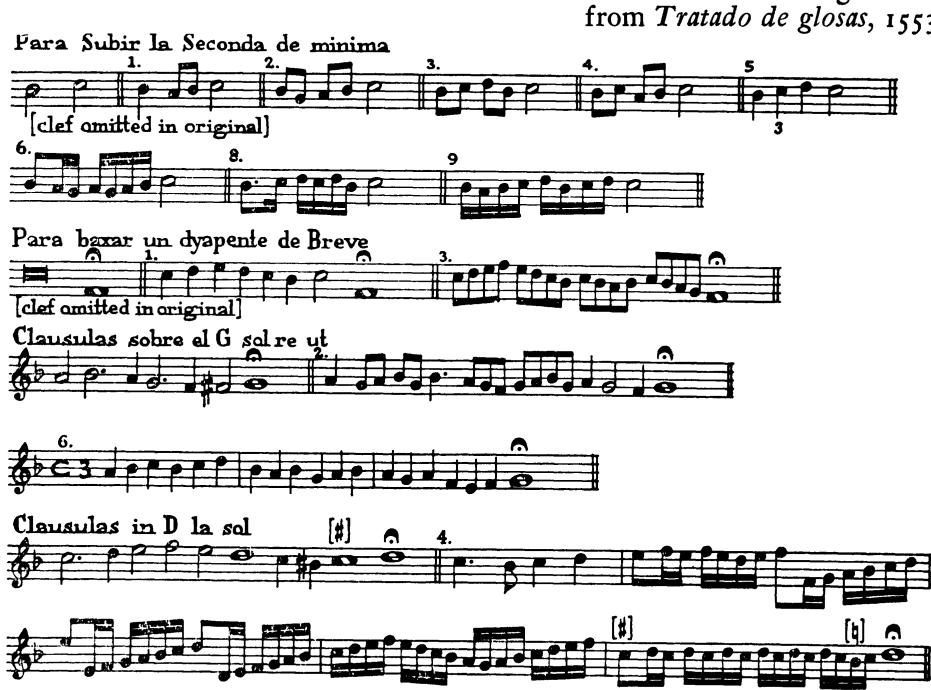
中文讲解
Image / music-notation placeholder on page 10, occupying the position of Example 6. As with the previous image placeholders, the actual notation is not visible in this text-layer extraction; readers must consult the printed page. From P0095 and the figure caption (P0097–P0099) we know this example illustrates ornamental versions of melodic intervals (seconds, thirds, fourths, fifths) at various note-values and the two scale patterns rising and falling through a fifth.
补充说明
Page 10; source attribution given by P0098–P0099.
脚注 / 边栏 / 图表 / 附加信息(如有)
The section contains three numbered musical examples (Ex. 4 in the discussion of Coclicus; Exx. 5 and 6 in the discussion of Ortiz). Ex. 5 is subdivided into 5a and 5b, illustrating respectively the first and second of Ortiz’s three manners of making glosas. Three footnotes appear: footnote 14 (full bibliographic citation for Ortiz’s Tratado de glosas, Rome 1553, with the Schneider 1913 reprint), footnote 15 (short-form citation locating the three-manner taxonomy in the introduction to Book I), and footnote 16 (referenced at P0099 but its text is not present in this task input). A JSTOR page footer (P0093) carries no substantive content. The captioned image placeholders (P0080, P0085, P0100) all lack readable notation in the text layer and require consultation of the printed page.
💡 本节核心要点
- Coclicus’s Compendium musices (1552) introduces ornament practice into the treatise tradition, claims lineage from Josquin des Prez, privileges Netherlandish coloratura, and — despite skeptical evaluation of his biographical claims — was demonstrably influential because its ornament style matches the period’s general practice.
- Ortiz’s Tratado de glosas (1553) systematizes diminution into three graded manners, ranked by structural fidelity to the underlying note: beginning and ending on the embellished note (best), stepwise approach to the next note (moderate freedom), and departure from the composition to improvise by ear (explicitly condemned as distorting).
- Ortiz’s glosas are stylistically simpler than Ganassi’s: uniform 4-semiminim-to-semibreve rhythm, conventional melodic outlines, a small stock of stereotyped figures, and ornamentation built on single notes rather than spanning across intervals semibreve-to-semibreve.
- By contrast to the strict rules of Book I, Book II of Ortiz’s treatise presents a freer application of ornamentation in polyphonic context, justified by Ortiz himself: the cembalo (harpsichord) supplies the complete harmony underneath the violone’s ornamented line, so soloistic freedom cannot damage the polyphonic structure.
- The convergent practice of setting cadence patterns apart from other ornaments in every surviving manual — although no theorist states the rule explicitly — provides inductive evidence that ornamented cadences were obligatory in correct sixteenth-century solo performance.
🔑 关键术语
- violone:Large bass viol of the sixteenth century; in Ortiz’s treatise it is the solo instrument that carries ornamentation while the cembalo supplies the harmonic foundation.
- cembalo:Harpsichord. In Ortiz’s Book II it plays the complete polyphony, which both supports the violone’s ornamentation and permits the soloist greater freedom than an ensemble of strings would allow.
- glosa / glosas:Sixteenth-century Spanish term for an ornamental variation or diminution upon a pre-existing composition. Ortiz classifies glosas into three manners by degree of structural fidelity to the underlying note.
- coloratura:Florid, rapidly-ornamented vocal writing. Coclicus esteems no musician who is not a practitioner of coloratura, signaling an aesthetic norm of the period.
- semibreve / semiminim / breve / minim:Renaissance note values in descending duration. In Ortiz’s treatise the standard diminutional ratio is four semiminims to one semibreve, with rare exceptions at six semiminims.
- clausula:Latin term used in Coclicus’s prefatory remark (‘Haec est prima clausula quam Josquinus docuit suos’); here it denotes a melodic phrase or formula that the singer treats as a unit for ornamentation.
- fundamental (lowest voice):In Coclicus’s argument (P0088) the lowest voice of a polyphonic composition is the structural harmonic foundation and must not be ornamented, because figuration there would disturb the support for all upper parts.
- cadence formula:A standard melodic-harmonic closing pattern of the period. The convergence of all surviving manuals in isolating cadence patterns as a distinct category of ornamentation is taken as evidence that ornamented cadences were obligatory in solo performance.
C2.S6 [描述性拆分] Finck’s Practica musica (1556) and Maffei’s Rules for Passaggi (1562)
第1段(P0101)
原文复述
The Practica musica of Hermann Finck contains a section entitled De arte eleganter et suaviter cantandi which discusses the technique of singing and its companion art of coloratura embellishment. Very sensibly Finck declares that in the final analysis the art of coloratura embellishment depends upon the aptitude and skill of the individual performer. He condemns those who pick up embellishments used by other performers and apply them indiscriminately to all parts of a composition.
中文讲解
本段引出Finck的《Practica musica》中专门讨论歌唱装饰艺术的小节。Finck提出了两条值得注意的立场:一是花唱装饰归根到底取决于歌手个人的能力与技巧,而非死套规则;二是反对不加辨别地把别人用的装饰搬用到作品的任何地方。这里需要理解的是,Finck强调的是个人化的、基于音乐判断的装饰观,反对机械模仿。这承接了前文Coclicus一章中关于“装饰应服务于音乐表情”的线索,并把标准从“作曲家推荐何种装饰”推进到“演唱者本身的能力”。这一立场实际上与本节后文Maffei规则过于教条、Dalla Casa倾向于模式化形成对照——Finck是较为自由、强调个人表现力的代表。
第2段(P0102)
原文复述
Ex. 7
中文讲解
这是图例编号标记,用于指代本页的谱例7。它对应的内容在P0103和后续段落中加以讨论,本身不包含实质论述。
第3段(P0103)
原文复述
Like Coclicus, Finck gives as examples only short melodic figures in simple and ornamented form, and common cadences with their florid versions. True to his convictions, he includes examples in clefs for all voices [Ex. 7]. Also included is a motet with all four voices embellished. Only the ornamented form, however, is given. The ornaments pass from voice to voice, and imitative entrances usually have similar coloratura passages. Of all the voices the bass has the fewest fast-moving ornaments, the soprano the most. There are dissonances that are not treated according to the common practice of Renaissance style, as well as parallel perfect consonances. (The latter are also present in the ornamented version of the fuga given by Coclicus.) That these are not careless
中文讲解
本段说明Finck范例的实际样貌与局限。首先,他和Coclicus一样只给出简短的旋律片段及其装饰版本,以及常见终止式与其华丽化变体,例证范围有限。其次,Finck实践了自己的“所有声部都应被装饰”的理念,谱例中为各声部都设计了不同谱号。再次,他收录了一首四声部经文歌,但只提供装饰后的版本,这让读者只能看到结果,不能比较其与原型的差异。段落进一步描述了装饰在声部之间的分配:装饰在各声部之间轮转,模仿进入处常用相似的花唱;低音部的快速装饰最少,女高声部最多。最后,作者指出装饰版本中出现了不按文艺复兴常规处理的不协和音程与平行完全协和音程,并提示后者同样出现在Coclicus的fuga装饰版本中,由此引出P0109对错误的归因讨论。
第4段(P0104)
原文复述
Hermann Finck from Practica musica, 1556
中文讲解
这是配图说明文字,标明下面谱例(Ex. 7)的来源:选自Hermann Finck 1556年的《Practica musica》。
第5段(P0105)
原文复述

中文讲解
此处为第11页的谱例或图像占位符,所显示的具体谱面内容因图像数据被省略而无法呈现,但位置与图注保留。需查看原书原图方可看到Finck所列的不同谱号声部装饰范例。
第6段(P0106)
原文复述

中文讲解
此处为第11页的第二处谱例或图像占位符,具体内容同样因图像数据被省略而无法确认。需查看原书原图方可辨识其与前例的关系及差异。
第7段(P0107)
原文复述
Although he admits that opinions differ as to which voices should be ornamented, he is of the opinion that all should be—not simultaneously, but in turn, so that the embellishments can be heard distinctly. He also warns the musician that coloratura singing in choral performances (i.e., with more than one singer to a part) will always result in mistakes, since all will not sing the embellishments in the same way.
中文讲解
本段阐明Finck关于“谁应该被装饰”的具体观点:尽管他承认关于哪些声部应装饰存在不同看法,但他倾向于所有声部都应装饰,只是必须轮流进行而非同时,以使每一个花唱都能被清楚听见。这一点实质上回应了P0101中“装饰应服务于整体表现”的立场——装饰若全部齐发,反会互相遮蔽。段末Finck又提醒:若在合唱场合(即同声部有多人演唱)使用花唱,几乎必然出错,因为同一装饰各人演唱不可能完全一致。这一警告暗示了装饰实践实际上更适合独唱或小型合奏,对后文Maffei、Dalla Casa聚焦于独唱场景具有铺垫作用。
第8段(P0108)
原文复述
[Footnote 18]: Complete examples from Ortiz may be found in Kuhn, op. cit., pp. 94-99. [Footnote 17]: Hermann Finck, Practica musica (Wittenberg, 1556). Liber quintus, De arte eleganter et suaviter cantandi (German translation with transcription of examples in Monatshefte für Musikgeschichte XI [1879], pp. 130-141, 151-164).
中文讲解
这是第11页的两条脚注,集中处理P0101中提到的Finck文本的版本与文献来源。脚注17给出Finck著作的版本信息:原版1556年于威滕贝格出版,相关章节为Liber quintus的“论优雅而甜美地歌唱”,并附带1879年《Monatshefte für Musikgeschichte》第XI卷中的德语译文与谱例转写(页码130-141、151-164)。脚注18为旁注性质,指出Ortiz的完整范例可见于Kuhn同书94-99页,对正文讨论提供扩展材料,但并非直接支撑任何具体主张。
第9段(P0109)
原文复述
errors is shown by the fact that Finck admits their presence, stating that they occur only when their avoidance would result in an awkward vocal movement.
中文讲解
本段是P0103末句(“that these are not careless errors is shown by…”)的语法延续,意在解释那些违反文艺复兴常规的不协和音程与平行完全协和音程并非粗心所致:Finck本人承认它们的存在,并说明它们只有在避开它们会使声部进行变得笨拙不自然时才会出现。因此这些“错误”实属装饰流畅性优先于对位规则的妥协,体现了“服务于人声”而非“服从对位理论”的装饰哲学。
第10段(P0110)
原文复述
Among the letters of Camillo Maffei of Solofra (1562) is a long letter to the “Illustrissimo Conte d’Alta Villa” which contains an excellent discussion of the principles of voice production, naturally including instructions for making florid embellishments upon polyphonic vocal music. For these embellishments Maffei uses the term passaggio—a term that becomes the usual designation for these added rapid scale passages in the Baroque period—but his passaggi differ not at all from the diminutions given by his contemporaries. Although the actual number of these passaggi is very small, the author gives definite rules for their application to a polyphonic vocal composition and includes a four-part madrigal with all voices ornamented to illustrate their proper use. The unornamented form of the madrigal is not given, but the placement of the passaggi can be clearly seen, as they consist mainly of crome while the basic note values of the madrigal itself are obviously the semibreve and minim [Ex. 8].
中文讲解
本段引出本节后半的主角Camillo Maffei(1562年出版的《书信集》中写给“阿尔塔维拉伯爵”的长信)。Maffei的论述涉及发声的原理,并自然延伸到如何对复调声乐作品加花装饰。他用passaggio一词命名这些装饰——这一术语后来在巴洛克时期成为“快速音阶式加花”的通用名,但本节作者特别指出,Maffei笔下的passaggi与他同时代人的diminutions并无实质区别。这一强调有助于读者理解“passaggio”与“diminution”在文艺复兴晚期其实是同义而不同名。接下来段落说明Maffei的实例虽少,却给出了具体的应用规则,并提供一首四声部牧歌的全装饰版本作为示范;未装饰的原型虽未刊出,但通过节奏对比仍能清晰判断装饰位置——passaggi主要由crome构成,牧歌本体的基本音符时值明显为semibreve和minim。
第11段(P0111)
原文复述
[Footnote 18]: Gio. Camillo Maffei da Solofra, Delle lettere del S. R. Gio. Camillo Maffei da Solofra. Libri due. Dove tra gli altri bellissimi pensieri . . . Raccolti per Don Valerio de’ Paoli da Limosano (Naples, 1562).
中文讲解
这是第11页关于Maffei的脚注,给出原书完整题名与出版信息:Gio. Camillo Maffei da Solofra,《书信集》两卷本,收录并由Don Valerio de’ Paoli da Limosano编辑,1562年于那不勒斯出版。该脚注为P0110的Maffei论述提供版本与文献来源,使读者可追溯原书。
第12段(P0112)
原文复述
This content downloaded from 140.182.176.13 on Sat, 08 Aug 2026 04:21:47 UTC All use subject to https://about.jstor.org/terms
中文讲解
这是JSTOR数字资源下载页的标准水印/版权声明,属于版式信息,不包含正文内容。
第13段(P0113)
原文复述
may be used before arriving at the cadence. In his madrigal the cadence in each voice is embellished when the voices cadence at different times [Ex. 8b].
中文讲解
本段是P0110最后一句的接续句,结合P0119(规则1)才能完整理解:passaggi主要用于终止处,也可在到达终止之前出现。Maffei示范性的牧歌中,每个声部在终止时都被装饰,但因各声部终止时间不同,装饰也因此错开出现。这一具体写法与Finck“轮流装饰以便听清”的观念形成呼应,但Maffei通过错开的终止时间本身实现了“分先后”,而非通过刻意分派装饰位置。
第14段(P0114)
原文复述
- In one madrigal not more than four or five passaggi should be used, for the ear may become satiated with too much sweetness. Again, Maffei must mean this rule to apply only to the individual voices. In his example the soprano and alto each make six passaggi, the soprano and alto each make six passaggi, the tenor four, and the bass five.
中文讲解
本段是Maffei规则2的内容:单首牧歌中不宜使用超过四到五个passaggi,因为听觉会因过度的甜美而感到饱和。原文虽未限定,但本节作者强调:Maffei必定是指“每个声部最多四至五个”,而非整首作品总共四至五个,因为其示范牧歌中女高与女低各使用六个passaggi、男高四个、男低五个,总数远超此限。这个细节说明Maffei规则是针对单个声部的密度限制,目的是防止某一声部独享过多装饰,与Finck主张各声部轮流装饰的精神一致。
第15段(P0115)
原文复述
- Passaggi should be made on the penultimate syllable of the word so that the end of the passaggio will coincide with the end of the word. This, however, is not always the case in his examples.
中文讲解
本段是Maffei规则3:passaggi应放在单词的倒数第二个音节上,使passaggio的结束与单词的结束相重合,以便歌词的清晰。但作者紧接着指出,他的示范中并不总是符合这一规则——这表明Maffei的规则带有理想化色彩,与其实际操作之间存在落差。这一落差在P0123被再次援引,作为“规则不能被绝对化”的核心证据。
第16段(P0116)
原文复述
Camillo Maffei, 1562
中文讲解
这是配图说明文字,标明此处谱例(Ex. 8)的来源:选自Camillo Maffei 1562年的著作。
第17段(P0117)
原文复述
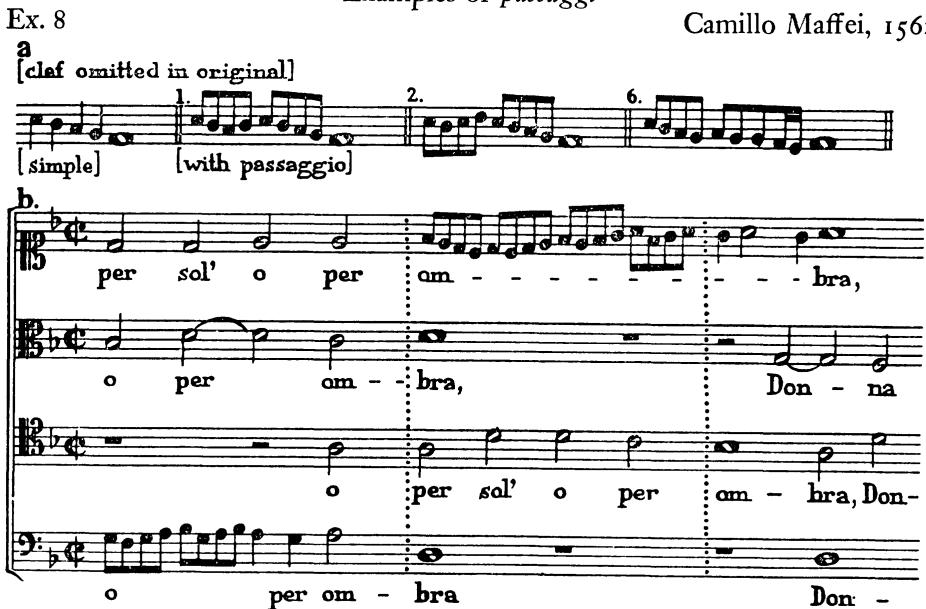
中文讲解
此处为第12页的Maffei装饰谱例占位符,图像数据被省略,需查看原书原图方可对照规则1(终止处装饰)与规则2(声部装饰密度)所示例的牧歌片段。
第18段(P0118)
原文复述
Maffei’s rules may be briefly summarized as follows:
中文讲解
本段为Maffei规则的总起句,提示读者随后将以编号方式呈现规则。由于规则1由P0119与P0113共同构成,作者在此处的引导语暗示接下来的条目按数字顺序排列。
第19段(P0119)
原文复述
- Passaggi should be used only at cadences, although some ornaments from one note to another (inserted within a definite melodic interval) may be used before arriving at the cadence. [Footnote 19]: Maffei, op. cit., pp. 58-61.
中文讲解
本段是Maffei规则1(与P0113续句构成完整句):passaggi原则上只应在终止处使用,但某些“从一个音到另一个音的装饰”(即在明确的旋律音程内插入的装饰)可在到达终止之前使用。这一规则把装饰限定在结构性位置——终止式,体现出Maffei把装饰视为对结构节点的强化,而非任意添加;规则末尾的脚注19指示原书页码58-61,是文献出处而非论证性内容。
第20段(P0120)
原文复述
- Passaggi sound best when made upon the vowel o. They are used predominantly on o in his examples, but are also found on other vowels.
中文讲解
本段是Maffei规则4:passaggi在元音“o”上效果最佳。从声乐角度看,开放圆唇元音o最有利于持续而清晰的发声,最适合长段快速音阶,因此Maffei的示范也主要使用o,但其他元音上的passaggi在示范中也可见到。这条规则揭示了文艺复兴装饰实践与歌词发音之间的密切关系:装饰不仅受乐句结构(规则1)和节奏密度(规则2)限制,也受发音生理条件约束。
第21段(P0121)
原文复述
- In an ensemble of four or five soloists the passaggi must be made by each in turn. Otherwise, the harmony ceases to be clear.
中文讲解
本段是Maffei规则5:在四到五位独唱者的合奏中,passaggi必须由各人轮流进行,否则和声清晰度将受损。这条规则与Finck的“各声部轮流装饰”主张(P0107)几乎同义,进一步印证了文艺复兴晚期装饰共识:从听觉出发,装饰需要错时进行,使每个加花都可被清楚分辨。这是从Finck的合唱警告一路延伸到Maffei的独唱合奏规则的内在逻辑。
第22段(P0122)
原文复述
This content downloaded from 140.182.176.13 on Sat, 08 Aug 2026 04:21:47 UTC All use subject to https://about.jstor.org/terms
中文讲解
这是JSTOR数字资源下载页的标准水印/版权声明,属于版式信息,不包含正文内容。
第23段(P0123)
原文复述
While these rules give an insight into some of the problems faced in embellished solo performance, they cannot be taken as absolute. Since exceptions to them occur in the author’s own examples, it is not to be expected that they would apply compositions. Each of these diminutions consists of notes of the same rhythmic denomination, and there is little variety in the melodic figures used. Instead of the long ornamented cadence patterns presented by the preceding authors, Dalla Casa gives examples of what he calls tremoli
中文讲解
本段由P0123和P0125拼接而成(中间隔有P0124图像占位符),属于同一论述的两段,需合并阅读。作者首先对Maffei的五条规则作总评:这些规则揭示了独唱装饰所面临的实际问题,但不能被绝对化;Maffei自己的示范就包含对其规则的违反,因此不能期望它们在严格的声乐合奏中普遍适用。紧接着转向本节最后一位作者Dalla Casa的实例特征:他的diminutions中的音符多为同一种节奏时值,旋律型态的变化也较少;与之前各作者偏长的装饰性终止式不同,Dalla Casa给出的是他自己所称的tremoli(即在级进上行音上反复敲击的颤音式装饰)。这一对比是本节的高潮:Maffei式规则与Dalla Casa式实例共同预示了装饰实践从“灵活的加花”向“模式化、命名化的装饰”转变——后者正是巴洛克装饰传统的萌芽。
第24段(P0124)
原文复述
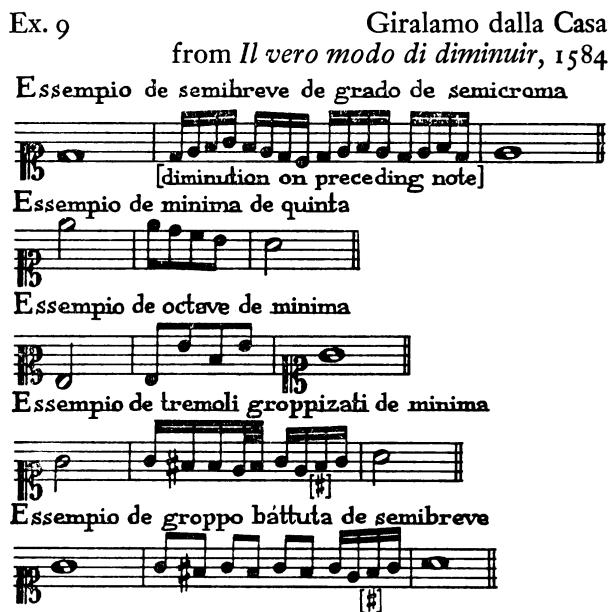
中文讲解
此处为第13页Dalla Casa相关谱例(Ex. 9)占位符,展示groppizati与groppi battute等装饰型态。具体谱面因图像数据省略,需查看原书原图。
第25段(P0125)
原文复述
strictly to vocal ensemble performance everywhere.
中文讲解
本段是P0123首句的接续,意在补充前句判断:Maffei的规则既然不能在其自身独唱示范中一贯遵循,就更不应被期望适用于“所有”声乐合奏实践。这里应理解为对Maffei规则“不能被绝对化”的进一步限定——其适用范围比Maffei自己声明的更窄。
第26段(P0126)
原文复述
In 1584, Giralamo dalla Casa published his manual entitled Il vero modo di diminuir, a book that marks the end of the purely Renaissance style of ornamentation. This manual includes a list of ornamentations of all the intervals of the scale within the time values of a semibreve and a minim. Here for the first time appear diminutions on the skips of the sixth, the seventh, and the octave, which may imply that these were becoming more common in written groppizati and groppi battute on ascending steps on both the semi-breve and the minim [Ex. 9]. This is the first suggestion we find of the stereotyping and naming of ornamental patterns, a tendency that hints at the coming Baroque practice. It is especially significant that these appear in place of the cadence patterns heretofore listed in the manuals, since 17th-century usage came to regard the groppo, from which came our modern trill, as obligatory at the cadence.
中文讲解
本段是本节的高潮与转向之作。作者指出1584年出版的Dalla Casa《Il vero modo di diminuir》标志着“纯粹文艺复兴装饰风格”的终结。理由有三:其一,书中以系统清单方式列出在semibreve与minim时值内对音阶中所有音程的装饰,呈现出体系化倾向;其二,首次出现针对六度、七度、八度跳进的diminutions,暗示这些跳进在实际作品中已日渐普遍;其三,明确出现具有专属名称的装饰型态——groppizati与groppi battute(在级进上行音上的颤动与敲击),替代了之前各手册中所列的长终止装饰。这里的逻辑关键在于:把装饰“命名化、定型化”是巴洛克实践的标志,因为巴洛克时期要求装饰服从固定模式而非个人即兴。而groppo正是后来巴洛克终止式中规定的颤音(即现代trill的来源)的雏形,因此Dalla Casa这些看似中性的术语变化,实际上预示了装饰从“可塑的加花”走向“强制的模式”。
第27段(P0127)
原文复述
Although he gives no definite rules for the application of his diminutions, Dalla Casa includes numerous examples of Italian madrigals and French chansons to which he has applied these diminutions. Compositions of well-known composers of the time, including Palestrina, de Rore, Jannequin, and Lasso, are presented with these ornamental figures added, so that by comparing them with the originals one can obtain a clear idea of the musical results of this practice.
中文讲解
本段说明Dalla Casa的实例策略。与Maffei重规则、轻实例不同,Dalla Casa不提供明确的应用规则,而是直接给出大量实例——意大利牧歌与法国尚松,作曲家涵盖Palestrina、de Rore、Jannequin与Lasso等当代名家——并在其上加上自己的装饰。通过将装饰版本与原版对照,读者可清楚看到装饰的实际音乐效果。这一“实例替代规则”的做法本身就反映了Dalla Casa的取向:装饰已不再是依规则临时生成,而是预设型的模式叠加,与前文Maffei规则被自身实例违反的尴尬形成对照。
第28段(P0128)
原文复述
[Footnote 20]: Giralamo dalla Casa, Il vero modo di diminuir, con tutte le sorte di stromenti di fiato e corde e di voce humana (Venice, 1584). 2 vols.
中文讲解
这是第13页关于Dalla Casa的脚注,给出原书完整题名:Gio. dalla Casa,《真正减缩之法,涵盖所有种类的吹奏、弦乐器及人声》(威尼斯,1584年,两卷本)。该脚注为P0126-P0127的Dalla Casa论述提供版本与文献来源。
第29段(P0129)
原文复述
This content downloaded from 140.182.176.133 on Sat, 08 Aug 2026 04:21:47 UTC All use subject to https://about.jstor.org/terms
中文讲解
这是JSTOR数字资源下载页的标准水印/版权声明,属于版式信息,不包含正文内容。
脚注 / 边栏 / 图表 / 附加信息(如有)
本节涉及的附加材料主要有三类:1) 三处JSTOR下载水印(P0112、P0122、P0129),仅属版式信息;2) 四条脚注(P0108含两条、P0111、P0119、P0128),分别给出Finck、Maffei、Dalla Casa的版本与文献信息,其中P0119脚注19除出处外还支撑规则1的论述;3) 五处图像占位符(P0105、P0106、P0117、P0124以及文字标签Ex. 7 P0102与Ex. 8b P0113、Ex. 9 P0126隐含在讨论中),分别对应Finck的不同谱号装饰例、Maffei装饰版牧歌、Dalla Casa的groppizati与groppi battute等示例,具体谱面需查原书原图。
💡 本节核心要点
- Finck的装饰立场以个人能力与判断为本,反对机械搬用他人装饰;其例证覆盖各声部但只给装饰版本,并承认装饰中违反文艺复兴对位规则的“错误”实为声部流畅性所作的妥协。
- Maffei用passaggio一词(后为巴洛克通用术语)讨论装饰,其示范与同时代人的diminutions无实质差别;他提出五条规则(限于终止/特定元音/倒数第二音节/数量上限/轮流进行),但其自身示范即违反规则,表明规则不可绝对化。
- Maffei的“轮流进行”与Finck的“各声部轮转”共同体现文艺复兴晚期装饰共识:装饰须错时进行以保听辨清晰。
- Dalla Casa(1584)的《Il vero modo di diminuir》标志着纯粹文艺复兴装饰风格的终结:装饰走向清单化、模式化与命名化(groppizati、groppi battute),并首次覆盖六、七、八度跳进。
- groppo这一被命名化的装饰后来发展为巴洛克终止式中的强制性颤音(即现代trill来源),预示了装饰从可塑加花向定型模式的转变。
- Dalla Casa以大量实例(Palestrina、de Rore、Jannequin、Lasso等名家作品)替代明确规则,与Maffei重规则轻实例的取向形成对照,体现装饰实践正从“依规则即兴”转向“预设模式叠加”。
🔑 关键术语
- Practica musica:Hermann Finck 1556年于威滕贝格出版的音乐论著,其第五卷De arte eleganter et suaviter cantandi(论优雅而甜美地歌唱)专章讨论歌唱与花唱装饰。
- De arte eleganter et suaviter cantandi:Finck《Practica musica》第五卷的小节标题,意为“论优雅而甜美地歌唱”。
- coloratura embellishment:花唱装饰,指声乐作品中对旋律作快速、华丽化处理的一种装饰实践,在本节中常与diminution、passaggio互通使用。
- diminution:“减缩”或“加花”之意,指把原音符拆分为多个较短音符从而构成快速音阶或其他华丽音型的装饰手法,是文艺复兴装饰实践的统称。
- passaggio:Camillo Maffei使用、后在巴洛克时期成为“快速音阶式加花”通用名的术语,在功能上等同于其同时代人的diminution。
- crome:六分音符(quaver)级的短音符时值,本节中指passaggi的基本节奏单位,与madrigal本身的semibreve(全音符)和minim(二分音符)形成对比,用以标识装饰位置。
- tremoli:Dalla Casa给出的装饰型态之一,指在级进上行音上反复敲击的颤音式装饰,对应后文提及的groppizati与groppi battute。
- groppizati / groppi battute:Dalla Casa《Il vero modo di diminuir》中首次出现的、有专属名称的装饰型态,分别为在级进上行音上的颤动与敲击,是巴洛克装饰模式化的开端。
- groppo:Dalla Casa笔下有专属名称的装饰型态,后发展为17世纪巴洛克终止式中强制性的颤音,亦即现代trill(颤音)的来源。
- Il vero modo di diminuir:Giralamo dalla Casa 1584年于威尼斯出版的《真正减缩之法》,涵盖各类管乐器、弦乐器与人声,被本节作者视为“纯粹文艺复兴装饰风格”的终结标志。
C2.S7 [描述性拆分] Dalla Casa’s Il vero modo di diminuir (1584) and the End of the Renaissance Style
第1段(P0130)
原文复述
Dalla Casa’s opening examples of applied ornamentation make use of crome, semicrome, treplicate (24 notes against a semibreve), and quadruplicate (biscrome); the latter two values appear here for the first time in his treatise. He casts these figures in both duple and triple subdivisions, with every ornamental figure moving evenly and in notes of the same denomination. Only at the close does he offer a few examples in which the note values are mixed, and he regards this mixed treatment as the true manner of diminution. Even in these mixed cases, however, each smaller figure is still built out of similar values. As with Maffei’s examples, the basic contours of the written lines remain clearly preserved; the ornamentation is applied in a more conspicuous way because its regular rhythm and rapid motion set it off from the composed line, which moves in slower and more varied time values. Nor are the words obscured, since the florid figures are placed mainly on the long syllables.
中文讲解
本段集中交代 Dalla Casa《Il vero modo di diminuir》(1584) 中装饰音记谱的核心规范。几个关键技术名词需要先弄清楚:crome 与 semicrome 指的是十六世纪意大利减值法中常用的短音符级(大致对应现代的八分音符与十六分音符);treplicate 指每个二全音符下写出 24 个极短音,是非常急速的细密运动;其下还有 quadruplicate(又称 biscrome),每二全音符下写出 32 个极短音。这两个等级在该手册中首次出现,标志着十六世纪末减值所能达到的最快细分。
本段主张 Dalla Casa 的典型做法是:把每个装饰音型都写成同一种时值的均匀运动(即便放在二拍子或三拍子的不同细分中也是如此);只有到例题末尾,他才示范把不同时值混合写进一个音型——而这正是他认为的“真正的减值风格”。即便如此,每一个更小的子音型内部仍然只用同一种时值,所以“混合”指的是音型之间用不同值,音型本身仍是均匀的。
第二层论证是关于装饰音与原本声部的关系:与 Maffei 一样,原本的旋律轮廓不会被装饰音吃掉,但装饰段以规则节奏和快速运动与原本声部形成对比——原本声部时值较慢、更富变化,因此装饰段显得“附加”在外面而不是融入内部。最后强调歌词依然清晰,因为华丽音型只放在长音节上,因此不会发生“为炫技而牺牲可懂度”的问题。
在本节论证链上,本段的功能是为后面的“风格终结”判断作铺垫:Dalla Casa 的同值均匀运动 + 长音节落点是典型文艺复兴末期减值法的成熟形式,但末尾已出现“混合时值”的萌芽,这正是后文要接续的发展苗头。
补充说明
treplicate(每个二全音符 24 音)与 quadruplicate/biscrome 在本节是首次被引入的细分级别,作者特别标注“for the first time in his manual”,这暗示 Dalla Casa 的细分速度比此前 Maffei 等人更快,也使得“每个小音型内部仍用同值”这一规则越发难以维持——这正是 P0134–P0135 提出的“风格终结”的内在技术原因之一。
第2段(P0131)
原文复述
Although the bulk of Dalla Casa’s diminution examples treat soprano parts, his treatise also contains a version of Cipriano de Rore’s Alla dolc’ ombra in which every voice is ornamented in turn. As with Maffei, Dalla Casa does not discuss the appropriateness of ornamenting all the voices but treats the practice as so self-evident that he offers a sample without any further explanation. A side-by-side comparison of the original with Dalla Casa’s ornamented version shows how greatly the overall character of the composition was altered in this kind of solo performance [Ex. 10].
中文讲解
本段的关键信息是:Dalla Casa 在以女高音为主要装饰对象之外,专门收录了一首 Rore 的《Alla dolc’ ombra》,并把每个声部依次都加上装饰音。这是“全声部装饰”的完整案例。
作者借此想说明的第二点是:Dalla Casa 像 Maffei 一样,对“是否所有声部都该装饰”这件事不作任何理论讨论,直接当作理所当然的实践惯例给出范例。这种处理方式本身就是史料层面的重要信号——十六世纪末意大利音乐家已经把“多声部整体装饰”视为默认的 solo performance(独唱/独奏化演出)做法,无需在理论手册中论证其合理性。
第三个要点是“比较”的功能:把原作与装饰版本并置[Ex. 10],读者可以直观看到“solo performance”如何使一首原本是多声部合唱的 madrigal 在听感上发生根本性的变化——既包括节奏密度、织体厚度,也包括结构可闻度。这就把抽象的“装饰改变作品”主张落到具体的谱例对照上。
第3段(P0132)
原文复述
[Embedded figure: an example relating to the madrigal Alla dolc’ ombra; the image data has been omitted, with caption and position retained in the original.]
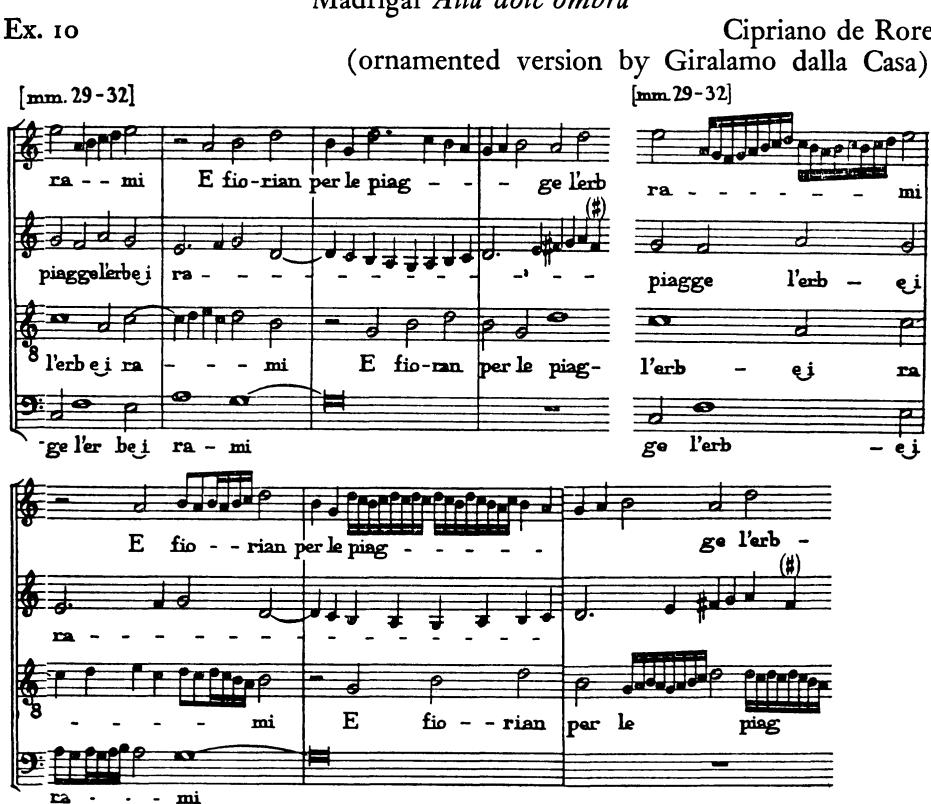
中文讲解
这是原文中插入的图示占位符,对应的是 P0131 末尾提到的 Ex. 10,内容应为 Rore《Alla dolc’ ombra》原作片段与 Dalla Casa 装饰版本的对照谱例。由于内嵌图像数据已被省略,本节只能借助正文中已经转写的现象描述来理解这段谱例的功能:它服务于“比较原作与装饰版本后整体效果如何改变”这一论证。读者若需查看具体音符层面的对照,需参照原 PDF。
在论证链上,这个图示与 P0131 的“compare”主张、P0133 的“voices take turns”描写互为支撑——文字描述与谱例对照共同让读者接受“装饰音显著改变原作听感”这一结论。
补充说明
无额外补充;谱面细节需查阅原图。
第4段(P0133)
原文复述
In this presentation of the madrigal, the ornamental figures typically belong to a single voice at a time; while the different voices do not imitate one another’s ornaments exactly, the successive embellishments in successive voices share enough rhythmic and melodic similarity to give the whole a sense of balance and unity. Such solo performance must have required great ensemble skill together with a ready imagination and improvisatory ability. An interesting feature of the example (which cannot be reproduced in full here for lack of space) is that whenever a section of the composition is repeated in the written version, the performers repeat it with different ornaments. At this period, as in later Baroque opera, the disguising—rather than the highlighting—of a composition’s structural elements was regarded as the mark of a subtle and sophisticated performance.
中文讲解
本段对 Ex. 10 的实际表演方式作了三层具体描写,应当分别理解:
第一层是“装饰音型在声部间轮流,但并不严格模仿”。作者强调各声部装饰音之间只有“节奏与旋律上的相似性”,足以让整首 madrigal 在装饰化独唱化演出中仍保有平衡与统一感。这里的逻辑是:solo performance 虽然把合唱曲变成了轮流炫技,但听众仍能“认出”作品——装饰并非杂乱无章。
第二层是对“重复段用不同装饰”的观察。这是一个非常具体的表演实践:当原本 madrigal 在写作上重复一段时,表演者在独唱化版本中会用不同的装饰音重复它。这样做的目的是让重复段落不至于让听众觉得单调——同时这种做法暗示表演者被期待每次重复都能即兴出新花样。
第三层是审美原则的提炼。作者明确把“disguising the structural elements”——“遮蔽作品的曲式结构”——视为本时期(并连及 later Baroque opera)所谓的“subtle and sophisticated performance”的标志。换言之:好的演奏不是把作曲家的结构点暴露给听众,而是要把它们藏起来。这一立场与后来“作曲家意图主导演奏”的观念形成对比,也直接呼应 P0135 末尾“作曲而非演奏家技能决定装饰”这一新原则。
最后还要注意“facile imagination and improvisatory skill”与“great cleverness in ensemble work”的并列:solo performance 既要求个人即兴能力,也要求合奏协调——这说明十六世纪末的 solo practice 仍带有即兴、合奏两重特征,与后来巴洛克独奏艺术中“表演者炫技为主、合奏为辅”的格局不同。
第5段(P0134)
原文复述
In these diminutions by Dalla Casa we encounter the close of the purely Renaissance manner of ornamentation. Even though there was no abrupt shift from Renaissance to Baroque style in the practice of improvised ornamentation during the years 1580 to 1630—a span that Manfred Bukofzer labels as the early [the remainder of the sentence is completed in the next paragraph].
中文讲解
本段在论证结构上是过渡段,承载两个主张:
第一,Dalla Casa 的减值作品标志着“纯粹文艺复兴装饰风格的终结”。这是从 P0130–P0133 对作品内部观察上升到风格史判断的关键一句。
第二,作者否认“突变论”:1580 到 1630 这五十年间,文艺复兴风格并未在一夜之间被巴洛克风格取代。作者引用 Manfred Bukofzer 的术语,把这一段时间标为“early Baroque period”,但句子的补语(“Baroque period”)延至 P0135 才完整出现。
因此本段在结构上承前(P0130–P0133 的作品观察)与启后(P0135 的风格转型列举)——读者必须把两段合在一起,才能读到 Bukofzer 完整的时期命名。
补充说明
本段句尾在“early”处断开,补语“early Baroque period”在 P0135 开头才完整出现,跨段句法是本节排版上的一个细节,读者理解时需将两段合并阅读。
第6段(P0135)
原文复述
…[continuation]…Baroque period, the entire technique was gradually transformed. Manuals teaching the old style, manuals teaching the new style, and manuals offering a mixture of the two were all in use simultaneously. In the new ornamental style, emotional expression was stressed; vocal and instrumental practices were separated; and short ornamental patterns were introduced to highlight particular notes within a phrase and intensify their emotional effect. The florid figures (passaggi) that had served to spin out a line were retained, but they took on a new musical character in keeping with the new compositional style. The rhythms became jerky and discontinuous, and the consonances no longer fell where they had been written but were often replaced by a dissonance on the strong part of the beat. Finally, the tempo and emotional content of the composition, rather than the performer’s skill, were expected to determine which ornaments were used.
中文讲解
本段是本节论证的核心,作者以并列的五个特征刻画“新装饰风格”的实质,需要逐条读懂:
第一,渐变而非断裂:旧式手册、新式手册、混合式手册在 1580–1630 年间同时流通。这意味着风格转型是渐进的“共存—竞争—替代”,而不是“宣告新范式后旧范式消失”。
第二,价值取向的转变:旧式装饰偏向技术炫耀,新式装饰(与巴洛克整体美学一致)转向“emotional expression”——情感表达成为首要目标。
第三,声乐与器乐实践的分离。旧式减值法是声乐为先、器乐为后的统一传统,新风格下两者各自发展出独立的装饰语法。
第四,引入“短装饰型”(short ornamental patterns):它们的功能不再是“拉长一条线”(spin out a line),而是“强调某一音并放大其情感效果”。这与第一条价值取向的转变直接对应。
第五,passaggi(长串华丽音型)被保留下来,但其内部“musical character”被重塑:节奏变得“jerky and discontinuous”——跳跃、断续;同时和声逻辑被改写:原本写定的协和音不再准时出现,强拍上常常被不协和音代替。这一点是全段技术性最强的判断,需要一点和声知识才能体会其含义:在传统对位写作中,协和音应按作曲家的安排落在拍点上;新式装饰反过来——即便原谱上是协和音,强拍上装饰后的实际音响却可能是不协和的。
第六,权力关系的翻转:“作曲的速度与情感内容,而非表演者的技能”,决定该用何种装饰。这一句是整段最重要的判断:装饰音从“表演者的炫技工具”变成“作曲意图的实现手段”,这与第二、第三、第五条是一体多面。
把这五点合起来,本段实际上给出了“巴洛克装饰风格”的操作性定义:情感导向、声器分离、短装饰功能化、passaggi 节奏碎化、强拍不协和化、装饰受制于作曲意图。读者接下来在 P0136 会看到这套定义被进一步具体化为意大利术语 gorgia。
第7段(P0136)
原文复述
The vocal application of this new ornamental practice became known in Italy as gorgia, and it found its first expression in the Italian monodic style. Although this new type takes precedence in Baroque music, the passaggi—being the continuation of the older principle of diminution—survive in the improvised cadenzas and in the free improvised embellishments of all Baroque solo work, both instrumental and vocal.
中文讲解
本段有两件事:第一是命名,第二是承认延续。
命名层面:作者把 P0135 描述的“新装饰风格”在声乐中的具体形态命名为 gorgia(意大利语“喉咙”之意,引申为花唱/装饰唱法),并指出它最早出现在 Italian monodic style——也就是单声部主调声乐体裁(以 continuo 伴奏的独唱),这是歌剧与单声部康塔塔等新体裁兴起的语境。
延续层面:尽管新风格在巴洛克音乐中占主导,作者明确指出 passaggi——旧式减值的延续物——仍然存活在所有巴洛克独奏艺术(声乐与器乐)的即兴华彩段与自由即兴装饰中。换言之,文艺复兴的减值原则并没有被完全替换,而是被改造后吸收进新的体裁语境。
本段与本节标题“End of the Renaissance Style”形成关键呼应:标题说“终结”,本段说“延续”——读者需要把这两者一并接收:Dalla Casa 时代标志着纯粹文艺复兴装饰模式的“终结”,但其核心 passaggi 技术却被巴洛克独奏艺术(尤其是即兴 cadenza)所继承。这是一个典型的“风格转型 = 断裂 + 延续”双重过程。
第8段(P0137)
原文复述
- The original is taken from the Smith College Archives edition of the Madrigals of Cipriano de Rore for 3 and 4 voices, edited by Gertrude Parker Smith (Northampton, Mass., 1945).
中文讲解
这是脚注 21,对应 P0131 末尾“the original”的出处。它告诉读者:P0131–P0133 拿来与 Dalla Casa 装饰版本做对比的那首 Rore 原曲,所采用的是 Smith College Archives 出版的 Gertrude Parker Smith 编辑的 Rore 三声部与四声部 madrigal 集(1945 年 Northampton, Mass.)。该脚注的功能是为对比提供版本依据,使读者能够查核原作版本。
第9段(P0138)
原文复述
- Manfred F. Bukofzer, Music in the Baroque Era (New York, 1947), p. 17. 23. An interesting example of this technique applied to polyphonic music is G. M. Bovicelli’s arrangement of the upper voice of a madrigal by Palestrina, quoted in Kuhn, op. cit., pp. 122–125. 24. Putnam C. Aldrich, ‘Bach’s Technique of Transcription and Improvised Ornamentation,’ The Musical Quarterly XXXV (1949), pp. 26–35.
中文讲解
这是脚注 22–24 的集合,对应 P0134–P0136 的几处关键主张:
脚注 22 指向 Bukofzer《Music in the Baroque Era》(1947) 第 17 页,是 P0134 中“early Baroque period (1580–1630)”这一时期命名与“渐变而非突变”主张的来源依据。
脚注 23 给出 P0135 中“强拍上出现不协和音”的补充案例:Bovicelli 对 Palestrina madrigal 最高声部的装饰化改编(被 Kuhn 在该书第 122–125 页引述)。它的功能是用一个具体的对位作品案例来支持抽象的“新风格强拍上出现不协和音”主张。
脚注 24 指向 Aldrich 在《The Musical Quarterly》1949 年第 XXXV 卷 26–35 页所写的关于巴赫改编与即兴装饰的文章。其作用是为 P0136 中“passaggi 仍存活于巴洛克独奏”提供更晚期的佐证——巴赫的转写与即兴装饰实践,是 passaggi 传统在巴洛克成熟阶段的延续痕迹。
三条脚注合起来的功能是:从时期命名(22)、到具体作品例证(23)、到后期延续证据(24),为 P0134–P0136 的风格史叙事搭建文献脚手架。
第10段(P0139)
原文复述
This content downloaded from 140.182.176.13 on Sat, 08 Aug 2026 04:21:47 UTC. All use subject to https://about.jstor.org/terms.
中文讲解
这是 JSTOR 数据库自动附加的标准使用条款页脚(下载时间戳 + 平台使用条款链接),并非作者学术内容的一部分。它的版面属性是版权与平台声明;在阅读本节时应忽略其学术含义,仅作为来源识别信息。
脚注 / 边栏 / 图表 / 附加信息(如有)
本节除正文段落外,还包括一项图像占位符(P0132,对应 Ex. 10,即 Rore《Alla dolc’ ombra》原作与 Dalla Casa 装饰版本的对照谱例;图像数据已省略,需查阅原图);以及三组脚注——P0137(fn 21,Rore 原作编辑版来源);P0138(fn 22–24,分别支撑 Bukofzer 时期命名、Bovicelli/ Palestrina 强拍不协和案例、Aldrich 关于巴赫即兴装饰的论述)。这些附加材料共同支撑 P0131–P0136 的论证:谱例提供直观对照,脚注提供版本依据与具体作品佐证。
💡 本节核心要点
- Dalla Casa 的典型减值仍是“同值均匀运动 + 长音节落点 + 保留原本旋律轮廓”,但他首次在手册中引入 treplicate(24 音/二全音符)与 quadruplicate/biscrome,使细分速度达到新的极限,同时在末尾示范混合时值,并把这视为“真正的减值风格”——这两点是本节观察到的“文艺复兴末期”成熟形态。
- Dalla Casa 收录的 Rore《Alla dolc’ ombra》装饰版展示了“全声部轮流装饰”的 solo practice:各声部装饰音相似而不雷同,重复段落每次用不同装饰;这种实践默认地被作者接受,无需理论辩护,标志着“solo performance”对原作听感的根本性改造。
- 作者借 Bukofzer 把 1580–1630 标为“early Baroque period”,但强调这是一个“渐变而非突变”的过程:旧式、新式与混合式手册同时流通,新风格以“情感表达”为首要价值,声乐与器乐实践分离,passaggi 被保留但节奏与和声逻辑被重塑(强拍上甚至出现不协和音),装饰的选择从由“表演者技能”决定转为由“作曲的速度与情感内容”决定。
- 新装饰风格的声乐形态在意大利被命名为 gorgia,最早出现在 monodic style 中;与此同时,旧式的 passaggi 仍然存活于所有巴洛克独奏艺术(声乐与器乐)的即兴 cadenza 与自由装饰里——风格终结不意味着技术传统的断裂。
- 本节标题“End of the Renaissance Style”与正文“passaggi 仍延续”之间形成重要张力:所谓“终结”是指纯粹文艺复兴装饰模式这一历史形态的结束,而非减值技术本身的消失。
🔑 关键术语
- crome / semicrome / treplicate / quadruplicate (biscrome):十六世纪意大利减值记谱体系中的细分音符等级;treplicate 指每个二全音符下写出 24 个音,quadruplicate(biscrome)则更快。本节指出 treplicate 与 quadruplicate 在 Dalla Casa 手册中首次出现。
- diminution:十六世纪意大利的减值装饰实践,即在原本声部上以更快、更细密的同值音符型“展开”旋律线条,是本节贯穿始终的核心传统。
- passaggi:长串华丽音型,原用于“spin out a line”(拉长一条线);在巴洛克新风格中被保留但节奏与和声逻辑被重塑,且作为旧式减值的延续体仍存活于巴洛克独奏的即兴 cadenza 与自由装饰中。
- gorgia:意大利语术语,指新装饰风格在声乐中的具体形态,最早出现于 monodic style。
- monodic style:意大利单声部主调声乐体裁(通常带 continuo 伴奏),是 gorgia 最早出现的语境,也是歌剧与单声部康塔塔等新体裁兴起的土壤。
- Bukofzer’s early Baroque period (1580–1630):Manfred Bukofzer 在《Music in the Baroque Era》(1947) 中提出的时期划分,本节借助该框架来描述文艺复兴到巴洛克装饰风格的渐变过渡。
- solo performance:本节特指把原本的多声部合唱曲(madrigal)改造为“声部轮流装饰”的独唱/独奏化演出,Dalla Casa 的 Rore 例即是其典型样本。
- strong beat 上的不协和音:新风格装饰后的实际音响特征:原本作曲写定的协和音不再准时出现,强拍上常被不协和音取代,是节奏碎化(jerky, discontinuous)之外的另一项标志性技术特征。
C2.S8 [描述性拆分] Scholarly Debate and the Application of Diminution in Modern Performance
第1段(P0140)
原文复述
Although when taken in chronological order these sources seem to show a more or less direct line of evolution, it is dangerous to place them within any definite pattern of development. It must be remembered that these very few manuals were published for public consumption, while perhaps every great virtuoso and teacher had his own type of ornamentation and method of teaching. Also, older manuals were used along with the more recent ones. The one vital point, so seldom recognized, is the fact that in these discussions of the art of improvised embellishment each author takes it for granted that an understanding of this technique is essential for any type of respectable performance; it is probable that many of these manuals were intended to instruct the amateur musician in this art, which was an integral part of the professional’s technique.
中文讲解
本段是一个重要的方法论提示,作者在为前文按时间顺序罗列理论家观点之后,立刻提醒读者:不要把这些教材误读成一条清晰的进化直线。理由有三:第一,已存的教材只是面向公众出版的小部分,几乎每位伟大的演奏家和教师都有自己的装饰方法和教学法;第二,旧教材与新教材在实践中是并用的;第三——也是最关键、却最常被忽视的一点——所有这些作者都默认,懂得即兴装饰是任何体面演奏的前提,因此这些手册很可能是为了让业余音乐家也能掌握本属专业演奏家核心技术的这门艺术。作者用这一段限定了前面所有历史陈述的有效性,为接下来的现代应用讨论设下审慎的基调。
补充说明
段中"respectable performance"指当时社会语境中具备专业水准的演出;与"amateur"对照使用,提示装饰技艺在16世纪是区分专业与业余的标志之一。
第2段(P0141)
原文复述
There is disagreement among musical scholars today as to whether or not it is necessary to apply diminutions to a performance of Renaissance music to make it authentic. There can be no question but that throughout the Renaissance they were applied in all parts in instrumental and vocal solo performance, and that virtuoso performers both used them and taught their use. Ganassi and Dalla Casa were both town musicians of note in Venice, and their duties included playing instrumental arrangements of vocal compositions as well as instructing those citizens who desired to learn instrumental techniques. Ortiz was maestro de capilla to the Duke of Alba, the Viceroy of Naples. Their insistence that an understanding of diminutions was an essential part of technique sprang from practical professional experience.
中文讲解
本段切入本节的核心议题:当代音乐学者在"演奏文艺复兴音乐时是否必须加入减缩装饰才算本真"这一问题上存在分歧。作者随后给出一个他看来无可争辩的历史事实——减缩装饰在文艺复兴时期的器乐和声乐独奏的各个声部中都被普遍应用,演奏大师们既使用也教授它。Ganassi和Dalla Casa是威尼斯著名的市政乐师,他们的职务包括把声乐作品改编成器乐曲以及指导市民学习器乐;Ortiz是阿尔巴公爵——那不勒斯总督——的教堂乐长。作者援引这三位权威,目的是说明他们主张"减缩装饰是技术不可或缺的一部分"并非空谈,而是源自第一手的职业经验。这一段构成了支持"应当应用减缩装饰"立场的一组证人证据。
补充说明
文中三人的身份(town musicians, maestro de capilla)用以说明他们关于装饰的论断都带有实践权威;Ganassi、Dalla Casa、Ortiz在前文已被详尽讨论,此处仅以职业身份再次强调其言论的权威性。
第3段(P0142)
原文复述
On the other hand, Zarlino, who was a contemporary of Dalla Casa in Venice, disapproved of those who added anything to a composition when they performed it. Vicentino, another outstanding 16th-century theorist, approves of diminutions only when used in compositions of more than four parts—since the fifth part can fill in any harmony note which the diminution might pass by too quickly—or when the parts are played as written on instruments and the diminutions made only by the singers. He also warns against the use of diminutions in sad music such as lamentations, because their fast movement destroys the mood of the music by making it sound happy.
中文讲解
本段提供与P0141对立的反方证据,说明即使在同一时代,理论家们也并非一致支持无限制的装饰。Zarlino作为Dalla Casa在威尼斯的同代人,根本反对演奏者在表演时对原作添加任何东西。Vicentino则给出有条件的认可:他只在两种情况下赞成减缩装饰——一是作品超过四声部(第五声部可以补足减缩装饰快速掠过时跳过的和声音),二是当器乐按原谱演奏、而减缩装饰仅由歌唱者加入。他还警告不要在哀歌之类的悲伤音乐中使用减缩装饰,因为其快速的音符运动会让音乐听起来欢快,从而破坏情绪。这一段展现了16世纪理论界对装饰使用的争议远早于现代学者之争。
补充说明
Vicentino提出的"fifth part"条件说明了16世纪复调思维中和声完整性的顾虑:减缩装饰可能让某些和声音一闪而过,需要更多声部来"兜住”。这种顾虑是后来严格记谱、限制即兴的逻辑伏笔。
第4段(P0143)
原文复述
Finck and Coclicus were both composers and teachers, and both approved heartily of coloratura performance of compositions. Zacconi, writing later in the century, admits that many composers avoid having their works performed by coloratura performers because they prefer to hear what they themselves have written. Dr. Alfred Einstein states that “the more the madrigal becomes expressive in detail, the more this mechanical ornamentation becomes destructive.” Certainly it is true that as composers became more concerned with the subjective expression shown in their works they were more careful to write in all the details, thereby leaving less freedom to the performer. It was not until late in the 18th century, however, that all authority was taken from the performer and placed in the hands of the composer.
中文讲解
本段进一步展开装饰使用上的时代分歧。Finck和Coclicus这两位作曲家兼教师都热情支持花唱式的演奏。世纪末的Zacconi则承认一个事实——许多作曲家不愿让花唱歌手来表演自己的作品,因为他们更想听到自己写下的东西。Alfred Einstein的引言精炼地概括了这种趋势:当马德里加尔的细节越来越富于表现性时,那种机械式的装饰就具有破坏性。作者由此引出一个总的历史趋势:作曲家越关心主观表达,就越倾向于把一切细节都写进乐谱,从而留给演奏者的自由就越少;但作者也明确指出,把演奏者手中所有权威完全转交给作曲家,要到18世纪末才完成——也就是说,文艺复兴时期演奏者仍保留相当的即兴空间。本段为现代本真演奏的讨论提供了一条贯穿整个16至18世纪的长时段趋势线索。
补充说明
Zacconi的证词来自作曲家内部的抱怨,与Vicentino对悲伤音乐的警告、Zarlino的根本反对一起,构成了"理论家/作曲家端"对装饰扩张的不满。三类证词分别代表不同侧面:理论原则(Zarlino)、技术条件(Vicentino)、职业情感(Zacconi)。
第5段(P0144)
原文复述
$^{25}$ Carl Gustav Anthon, Music and Musicians in Northern Italy during the Sixteenth Century (Harvard University Dissertation, 1943; unpublished), pp. 237-240.
中文讲解
这是第25号脚注,引用了Carl Gustav Anthon 1943年的哈佛大学未出版博士论文《16世纪北意大利的音乐与音乐家》第237-240页。
补充说明
此条用以支持正文关于Ganassi和Dalla Casa作为威尼斯市政乐师的具体职责描述,属于历史背景的一手学术来源。
第6段(P0145)
原文复述
$^{26}$ Gioseffo Zarlino, Le istitutioni harmoniche (Venice, 1558), Lib. III, p. 46. $^{27}$ Nicola Vicentino, L’antica musica ridotta alla moderna prattica (Rome, 1555), cap. xxxii; cf. also note 5, supra. $^{28}$ F. P. Ludovico Zacconi, Prattica di musica (Venice, 1594), p. 61. $^{29}$ Dr. Alfred Einstein in a letter to the author, Jan. 22, 1950.
中文讲解
这是第26-29号脚注的合集:第26条引Zarlino《和声体系》(威尼斯,1558年)第3卷第46页;第27条引Vicentino《古今音乐实践》(罗马,1555年)第32章,并参见前文注释5;第28条引Zacconi《音乐实践》(威尼斯,1594年)第61页;第29条出自Einstein博士1950年1月22日致作者的一封信。
补充说明
四则出处对应正文中四位理论家/作曲家的具体观点,是正文论断的原始文献支撑;其中Einstein信件属私人通信,性质上属于学者个人意见。
第7段(P0146)
原文复述
This content downloaded from 140.182.176.13 on Sat, 08 Aug 2026 04:21:47 UTC All use subject to https://about.jstor.org/terms
中文讲解
这是JSTOR平台的下载声明与使用条款提示,属于期刊电子访问的版面包围栏,并非正文内容。
补充说明
版面属性:JSTOR电子下载页的页脚声明,提示下载时间戳、IP地址及使用条款。
第8段(P0147)
原文复述
Whether the embellished forms of these compositions violated the composers’ ideals or not, improvised embellishment was definitely a part of Renaissance performance practice. As such, it should be included in our present-day performances of Renaissance music, $^{30}$ and should be included also in courses presenting Renaissance music. On the other hand, a performance without ornaments could not be considered incorrect—especially when, as is usually the case today, more than one person performs on one part.
中文讲解
本段转入作者本人的立场陈述。无论装饰化版本是否违背了作曲家的理想,即兴装饰都无可置疑地是文艺复兴演奏实践的一部分。基于这一历史事实,作者主张两件事:第一,在今天的文艺复兴音乐演出中应当加入装饰;第二,相关教学课程也应涵盖这一内容。但作者随即给出限定——一场没有装饰的演出也不能算是错的,特别是像今天常见的那样由多人同唱一个声部时。这是一种温和而务实的折中立场:作者既不主张死守"本真必须装饰"的强硬路线,也不放弃把装饰纳入演奏与教学的建议。
补充说明
“more than one person performs on one part"提示在合唱情境中由多人分担一个声部时,各人自行即兴装饰会产生节奏与和声上的不一致,这正是作者认可无装饰演出现实的具体技术原因。
第9段(P0148)
原文复述
An instrumental performance of a motet or a madrigal with diminutions applied to the individual lines would give a good indication of the beginnings of instrumental chamber music. I feel that the diminutions are especially applicable to instrumental music in modern performance, because instrumentalists are, on the whole, better able than vocalists to cope with the technical difficulties. Few singers today, especially altos and basses, are capable of singing these 16th-century florid embellishments. A vocal performance, however, in which one or two soloists sang embellished lines while the chorus sang the other parts as written would be effective, and in keeping with 16th-century practice.
中文讲解
本段给出具体的现代应用方案。首先,作者提议用器乐形式把经文歌或马德里加尔的每个声部都加上减缩装饰演奏,因为这能很好地预示器乐室内乐的开端。其次,作者从技术可行性角度论证:器乐演奏者总体上比声乐演唱者更胜任这些技术困难,今天能唱好16世纪华丽装饰的歌手极少,特别是女低音和男低音声部。最后,作者又为声乐演出提出一种兼顾本真与可操作性的折中方案——由一两位独唱者演唱装饰化声部,合唱队其余声部按原谱演唱——并指出这正符合16世纪的实践。本段把作者的方法论从原则层面落到具体演出排布上。
补充说明
“altos and basses"在16世纪花唱装饰中的局限反映出该时期装饰主要针对人声高声区书写;作者将独唱/合唱分工视为历史实践的回响而非权宜之计。
第10段(P0149)
原文复述
In view of the great variety of opinions held even by teachers of the art, it is difficult to say to just what degree these diminutions should be applied when they are used. Dr. Alfred Einstein is of the opinion that the teaching manuals show an exaggerated use of them, $^{31}$ and this may well be true. It seems to me that there can be no doubt that cadences were always embellished when ornamentation was used. There really can be no sure rule as to the use of ornamentation, for freedom和variety are two of the main characteristics of 16th-century improvised embellishment. From the many attempts made by theorists to curb their use, it is evident that diminutions were often too freely used by performers.
中文讲解
本段讨论"装饰应用的程度"问题。作者承认连这门艺术的教学者们之间也意见纷纭,难以裁定具体应施加多少减缩装饰。他援引Einstein的观点——教材中所展示的用法偏于夸张——并表示这很可能属实。在谨慎之中作者给出两个相对确定的判断:其一,凡使用装饰之处,收束的终止式几乎必然被装饰化;其二,不存在绝对可靠的装饰使用规则,因为自由和多样性正是16世纪即兴装饰的两大特征。段末,作者从理论家们屡次试图抑制装饰使用这一反向证据,推断出演奏者实际使用装饰时常常过于自由。本段一方面承认不确定性,另一方面把"自由与多样"作为该艺术的内在本质确定下来。
补充说明
从理论家屡次"试图抑制"反向推断实际使用过于自由——这一推理方法在音乐史写作中常被用于弥合书面规范与口头实践之间的鸿沟。
第11段(P0150)
原文复述
A properly controlled use of diminutions does give a sense of beauty to a line—not, it is true, a beauty of subjective expression, but an objective sort of beauty produced by the accumulation of florid and ornate melodic movement. Equally important with the aesthetic effect is the historical significance of this art in the development of musical style. Melodic motives common in the style of the whole Baroque era are found in these improvised embellishments long before they appear in written compositions. The sudden changes from slow to fast note values which these ornaments bring about in the course of a melodic line foreshadow the discontinuous rhythm that is a special characteristic of early Baroque compositions. The freer dissonance treatment found in these diminutions no doubt made composers aware of new musical possibilities. It is only through the study of these ornamentation manuals that we can become aware of the technical skills possessed by these 16th-century performers, for little of the polyphonic music which comes down to us in written form gives any hint of what the virtuosi of this period were capable of doing.
中文讲解
本段是本节最具雄心的论断之一,从美学和史学两个层面同时为减缩装饰的研究价值辩护。美学的层面:恰到好处的减缩装饰为旋律线增添一种客观之美——不是主观情感之美,而是由华丽密集的旋律运动累积而成之美。史学的层面——作者强调其同等重要:第一,整个巴洛克时期通行的旋律动机在书面作品中尚未出现之前,已先在这些即兴装饰中现身;第二,装饰中慢音符与快音符的突然切换预示了早期巴洛克作品特有的断续节奏;第三,装饰中更自由的不协和音处理无疑让作曲家意识到新的音乐可能性。最后作者点出一个认识论的关键:留存至今的书面复调音乐几乎无法让我们看到这些演奏家真正具备的技术水准,只有研读这些装饰教材才能做到。这段话把装饰研究从演奏实践领域扩展到了音乐风格史的源头之一。
补充说明
作者把减缩装饰同时定位为:美学对象、风格史先兆、技术档案。这一三重定位回应了P0140中提出的警告——教材不能被简单视为"进化线”——同时又把教材抬升为不可替代的历史文献。
第12段(P0151)
原文复述
This content downloaded from 140.182.176.13 on Sat, 08 Aug 2026 04:21:47 UTC All use subject to https://about.jstor.org/terms
中文讲解
这是JSTOR平台的下载声明与使用条款提示,属于期刊电子访问的版面包围栏,并非正文内容。
补充说明
版面属性:JSTOR电子下载页的页脚声明,与P0146同。
第13段(P0152)
原文复述
$^{80}$ For an excellent discussion of modern performance of Renaissance music, see Manfred F. Bukofzer, “On the Performance of Renaissance Music,” Proceedings of the Music Teachers National Association, series 36 (1941), pp. 225-235.
中文讲解
这是第30号脚注,推荐参阅Manfred F. Bukofzer在《全美音乐教师协会会刊》第36辑(1941年)第225-235页发表的《论文艺复兴音乐的演奏》一文,作为讨论文艺复兴音乐现代演奏的优质参考文献。
补充说明
该脚注为P0147中"应当纳入现代演奏"的立场提供外部权威支持,把作者的实践建议与当时正在成形的"本真演奏"学术话语联系起来。
第14段(P0153)
原文复述
$^{81}$ Dr. Alfred Einstein, in the letter referred to above (note 29).
中文讲解
这是第31号脚注,再次指明其依据为第29号脚注所引的Einstein博士致作者的信件。
补充说明
此处为对P0149中Einstein观点的出处回引;脚注31与脚注29构成互文链路,提示Einstein在信件中既表达了关于教材夸张使用的判断,也是作者私人请教的对象之一。
第15段(P0154)
原文复述
Last, and perhaps most important, these manuals helped the average musician to develop a composition technique—a skill in making variations upon a given melodic line. For not only did the performer learn the ornaments and apply them by improvisation in performance, but also the less skilled players and singers prepared their parts in advance, writing out the diminutions and cadences and practicing them before trying them in public. Consciously or unconsciously, such a practice, based on varying the ways in which a specific melodic interval can be embellished, leads to an awareness of the elements of which a melodic line is constructed and a technical skill in creating an ornate line from a few simple melodic skips. And any art that develops a sense of musical construction along with a technique for producing that construction cannot but be important in the development of musical style itself.
中文讲解
本段是全文论述的收束点之一,作者提出可能是最重要的一点:这些教材帮助普通音乐家发展出作曲技术——即在给定旋律线上进行变奏的能力。论据链分两步:第一步描述事实——演奏者既在演出中即兴应用装饰,水平较低的乐手则会事先写下减缩和终止式并私下练习;第二步推论——无论自觉与否,这种"对特定旋律音程以不同方式加以装饰"的实践,会让人意识到旋律线的构成要素,并训练出从简单跳进中生发出华丽线条的技术。最后作者归结为:任何同时发展出音乐构造感及其实现技艺的艺术,必然在音乐风格本身的演化中举足轻重。这段话把装饰艺术的意义从演出层面再扩展到了作曲风格演化的层面。
补充说明
段中"composing technique by varying a given melodic line"这一提法,预示了后来被音乐史称为"变奏思维"或"分解旋律"的写作方法;作者通过强调"普通音乐家"也参与其中,暗示装饰训练是一种普及性的作曲入门。
第16段(P0155)
原文复述
Cambridge, Massachusetts
中文讲解
这是作者所属机构的所在地信息,标注其工作地点为美国马萨诸塞州剑桥市。
补充说明
版面属性:论文署名/机构所在地脚注;剑桥市为哈佛大学所在地,与第25号脚注中所引Harvard dissertation相呼应。
第17段(P0156)
原文复述
This content downloaded from 140.182.176.13 on Sat, 08 Aug 2026 04:21:47 UTC All use subject to https://about.jstor.org/terms
中文讲解
这是JSTOR平台的下载声明与使用条款提示,属于期刊电子访问的版面包围栏,并非正文内容。
补充说明
版面属性:JSTOR电子下载页的页脚声明,与P0146、P0151同。
脚注 / 边栏 / 图表 / 附加信息(如有)
本节共含四条脚注(编号25-31,其中26-29合并于P0145,30、31分立于P0152、P0153)。脚注25为未出版的哈佛博士论文,用以支撑Ganassi与Dalla Casa作为威尼斯市政乐师的具体职责;脚注26-28分别给出Zarlino、Vicentino、Zacconi三部16世纪原始文献的具体页码/章节,为本节中三人的反方与有条件立场提供原始出处;脚注29为Einstein 1950年1月22日致作者私人信件,作为现代学者意见的非正式来源;脚注30推介Bukofzer 1941年的本真演奏专论,为作者主张"现代演出应纳入装饰"提供外部权威支撑;脚注31回指脚注29,形成Einstein观点的双重互参。三处JSTOR版面包围栏(P0146、P0151、P0156)非正文内容,仅为电子访问标识。
💡 本节核心要点
- 本节的主线是:当代学者虽在"是否必须装饰才算本真"上分歧,但作者主张以温和务实的折中立场把装饰纳入现代演奏与教学。
- 作者通过正反两组证人构建历史现场:Ganassi、Dalla Casa、Ortiz、Finck、Coclicus基于职业经验支持装饰;而Zarlino根本反对、Vicentino附加条件、Zacconi转述作曲家的不满、Einstein指出夸张问题。
- 作者给出可操作的应用方案:器乐演出最适合装饰化处理;声乐则可采用独唱装饰化声部加合唱原谱声部的混合形式;装饰化的终止式几乎是唯一可以确定的规则。
- 作者从美学、风格史和认识论三个层面提升装饰研究的价值:装饰累积出客观之美、预示巴洛克动机与断续节奏、其不协和音处理启发了作曲家的新可能;书面乐谱无法呈现的演奏技术只有通过装饰教材才能被还原。
- 作者最终把装饰艺术提升为作曲技术的训练场:装饰训练让普通音乐家意识到旋律的构成要素并发展出变奏能力,因而在音乐风格本身的演化中具有关键意义。
🔑 关键术语
- diminution:16世纪即兴装饰技艺之一,指在已有旋律上以更短时值的音符进行细分与装饰;本节把它从演奏实践范畴扩展为音乐风格演化的源头之一。
- coloratura:花唱式的声乐/器乐装饰化演奏;本节中与diminution近义,指16世纪即兴装饰在演出中的实施方式,并因作曲家的不满而成为争议焦点。
- maestro de capilla:教堂乐长,西班牙语宫廷/教堂音乐机构的最高音乐职务;Ortiz以此身份代表职业权威发声,强调装饰是专业技术的组成部分。
- town musician (Stadtpfeifer):市政乐师;Ganassi与Dalla Casa以此身份承担演奏与教学双重职责,他们的装饰主张来源于日常职业实践。
- cadence:终止式;本节中作者唯一敢断言"凡用装饰则必被装饰化"的对象,是装饰化规则中的最低确定性。
- authentic performance:本真演奏;当代音乐学者就"是否必须应用减缩装饰才算本真"存在分歧,作者拒绝强硬立场而采取折中方案。