目录
ch1 Matters of Kind
- ch1.1 [描述性拆分] Fugue as genre versus form
- 页码:1-1
- ch1.2 [描述性拆分] The nineteenth-century shift from genre to form and the abuse of fugue
- 页码:2-2
- ch1.3 [描述性拆分] Koch’s genre-based account versus Marx’s form-based pedagogy
- 页码:3-3
- ch1.4 [描述性拆分] Koch on distinguishing genres and the consequences of collapsing genre into form
- 页码:4-4
- ch1.5 [描述性拆分] Defining genre through use, value, and generic repertoire
- 页码:5-5
- ch1.6 [描述性拆分] Fugue as genre in Bach’s time and its subgenres
- 页码:6-6
- ch1.7 [描述性拆分] Mattheson’s program for analyzing fugues and classifying subgenres
- 页码:7-7
- ch1.8 [描述性拆分] Craft over style: how subgenres are determined in Bach
- 页码:8-8
- ch1.9 [描述性拆分] Mapping Mattheson’s subgenres onto WTC I and the question of generic value
- 页码:9-10
- ch1.10 [描述性拆分] Hybrid mixed fugues and the insufficiency of the exposition as a guide to subgenre
- 页码:10-11
- ch1.11 [描述性拆分] The F major and G major fugues as a contrasting dance pair
- 页码:12-13
- ch1.12 [描述性拆分] Deceptive fugal expositions: the D minor fugue as counterfugue
- 页码:13-14
- ch1.13 [描述性拆分] Subtle distinctions among simple fugues: the A major and D major fugues
- 页码:15-15
- ch1.14 [描述性拆分] The C major fugue as the strict opening of WTC I
- 页码:16-16
- ch1.15 [描述性拆分] Canonic research, complete and incomplete devices, and the logic of surprise
- 页码:17-18
- ch1.16 [描述性拆分] Competing devices and the fugue as a research notebook of handicraft
- 页码:19-19
- ch1.17 [描述性拆分] Disposed inventions, free voices, and the relation between research and completed work
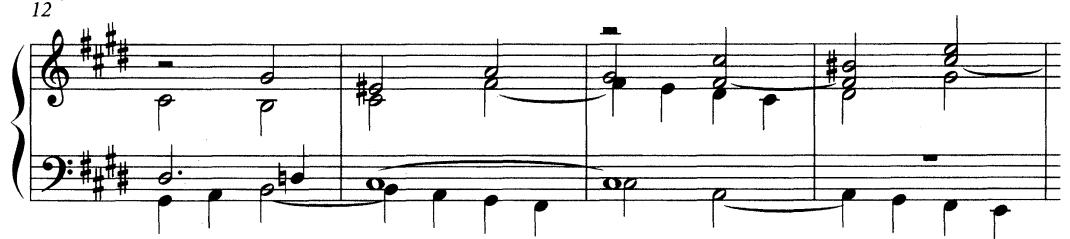
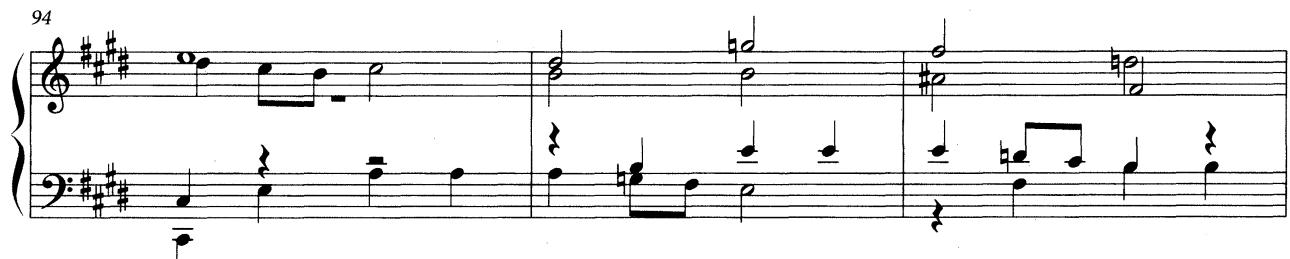
- 页码:20-20
- ch1.18 [描述性拆分] The F# minor fugue: hidden inventions in contrary motion
- 页码:21-21
- ch1.19 [描述性拆分] Inverted subjects, paradigmatic logic, and the concealed hybrid subgenre of the F# minor fugue
- 页码:22-23
- ch1.20 [描述性拆分] Arcane combinations, time, and the rhetoric of invention in the F# minor fugue
- 页码:24-24
- ch1.21 [描述性拆分] Ramifications for musical time and the limits of the genre-as-form metaphor
- 页码:25-25
- ch1.22 [描述性拆分] The Art of Fugue as ordered by hierarchical values of contrapuntal complexity
- 页码:26-26
- ch1.23 [描述性拆分] Thematic transformation in Contrapuncti 1–4 and Bach’s standards for good fugue
- 页码:27-27
- ch1.24 [描述性拆分] The concluding simple fugue and Contrapunctus 6 in stile francese
- 页码:28-28
- ch1.25 [描述性拆分] Contrapuncti 6, 8, and 11: style, artifice, and the role of free voices
- 页码:29-29
- ch1.26 [描述性拆分] Mirror fugues, the B-A-C-H autogram, and the unfinished final fugue
- 页码:30-30
- ch1.27 [描述性拆分] Was the final fugue actually complete? Manuscript evidence reconsidered
- 页码:31-33
- ch1.28 [描述性拆分] Why Bach never concluded the Art of Fugue
- 页码:33-34
ch2 Figments of the Organicist Imagination
- ch2.1 [描述性拆分] Schenker’s analysis of the C minor fugue and the question of compositional intention
- 页码:35-35
ch1.1 [描述性拆分] Fugue as genre versus form
第1段(P0001)
原文复述
This paragraph is solely the section heading ‘Matters of Kind.’ Functioning as a chapter or section title, it announces that the following discussion will address questions of musical ‘kind’—that is, of genre or type—as opposed to questions of musical ‘form.’ The use of the word ‘Kind’ (instead of ‘Form’) in the title prefigures the chapter’s central terminological argument.
中文讲解
这是本章的小节标题,原文为 ‘Matters of Kind’(直译可作「关乎种类的事」)。作者在此刻意使用 ‘kind’(种类、类型)而非 ‘form’(形式、形式结构),以此点出本章将要处理的核心议题:音乐应当按「何种类型(kind)」分类,还是按「何种形式(form)」来理解。‘Kind’ 在此使用的是其分类学含义,相当于德文传统术语 Gattung(种类、品类),即后世所谓的「音乐体裁」。标题本身就暗示,作者将把「形式」与「体裁」拆开,重新把音乐体裁(gattung)作为分类单位来讨论。这呼应了本章下文的主张:应当把赋格理解成体裁(genre),而非形式(form)。
第2段(P0002)
原文复述
It has become a commonplace assertion that, unlike a minuet or a sonata, a fugue is not a form; instead it is something else: a style, a texture, or perhaps only a technique. In this chapter, the author argues, on the contrary, that a fugue is a genre, which means that to understand a fugue by Bach one must first know what kind of fugue it is. This formulation may appear confusing, because the word ‘form’ is often used as a synonym for ‘genre’ or ‘kind.’ In fact, however, ‘form’ is more properly understood as a metaphor for genre. Since the time of the Greeks, people have borrowed the more concrete concept of form or shape in order to characterize the more abstract distinctions in kind. It therefore seems entirely natural to speak of the ‘forms of Baroque dance music’ when in fact we are signifying genres such as the allemande, the courante, and the gigue. In this usage, ‘form’ carries no implication about the length or external plan of these kinds of music. It is a harmless metaphor—though one with striking implications for the analysis of music.
中文讲解
本段奠定了全章(也是全书的)核心命题:赋格是一种体裁(genre),而不是一种形式(form)。
作者的论证分四步展开:
第一步是援引「常识」并加以翻转。他指出,当代音乐论述中已经普遍承认——小步舞曲、奏鸣曲是「形式」,而赋格却不是;赋格被归类为「风格」、「织体」甚至仅仅是「技法」。作者并不接受这种说法,反而主张赋格是一种体裁,要理解巴赫的某首赋格,必须先弄清它是「哪一种赋格」(what kind of fugue it is)。这一句已经把全章的研究方向说死:分析的重心应放在分类学(taxonomy),而非结构图式(schematic layout)。
第二步是解释为什么这种说法看上去令人困惑。在日常英文中,「form」常常被当作「genre」或「kind」的同义词使用。作者要做的,是把这两个术语拆开。
第三步是给出关键的语义学解释:「form」其实是一个借自「形/状」(shape)的比喻,用来谈论更抽象的「种类」区分。这一借用可以追溯到古希腊——人们用更具体的「形」概念去把握较抽象的「类」概念。所以当我们说「巴洛克舞曲的形式(forms of Baroque dance music)」时,真正指认的是「阿勒芒德、库朗特、吉格」等体裁(genres)。
第四步是给出一个极其重要的限定:在这种传统用法中,「form」完全不涉及篇幅,也不涉及「外部结构计划」(external plan)。它仅是一个分类标签。
最后一句「无害的比喻,却对比分析具有惊人含义」是过渡——作者先承认这一比喻是无害的,紧接着在下一段揭示它在 19 世纪发生语义畸变之后产生的「惊人含义」,为下文的批评铺垫。
本段在本章论证中的作用是定义战场:通过区分「genre」与「form」两套术语,作者为后文反驳现代「赋格不是形式」之说奠定概念基础。
补充说明
本段中 ’external plan’(外部计划、外部方案)是一个关键技术词,指向后来 19 世纪赋予 ‘form’ 的含义——即乐章各部分(呈示—发展—再现、二段重复等)的宏观图式。本段末尾的「无害比喻,惊人含义」一句是修辞上的钩子,把读者引向下一段的语义史叙述。
第3段(P0003)
原文复述
The relation between ‘genre’ and ‘form’ changed radically during the nineteenth century. Under the influence of new ideas about large-scale musical structure, especially in the writings of Adolph Bernhard Marx, ‘form’ became especially identified with the idea of an external plan. Perhaps because the metaphor of ‘genre as form’ was already so deeply rooted in ordinary language, pedagogues and listeners—and even some composers—became easily convinced that the essence of a musical genre lay in its abstract schematic arrangement, its ‘form.’ What no one seems to have noticed is that this semantic shift turned traditional genre theory on its head. Instead of considering the schematic layout as one feature of a kind of music, writers on music began to view musical kinds as ancillary manifestations of larger forms. Where two distinct genres such as allemandes and courantes had traditionally shared the feature of two repeated sections, both genres now became mere examples of binary form (or ’the two-part Liedform,’ as Marx dubbed it). The same shift in meaning reduced the first movements of sonatas and symphonies to examples of sonata form, notwithstanding the many differences which the two genres display.
中文讲解
本段追溯「体裁」与「形式」关系的 19 世纪语义转折,是上一段「惊人含义」的具体展开。
作者首先指出,19 世纪在阿道夫·伯恩哈德·马克思(Adolph Bernhard Marx, 1795—1866)的影响下,「形式」一词越来越等同于「外部结构计划」(external plan)——即乐章各部分的图式化安排。马克思是德国音乐理论家,其著作(如《贝多芬降 B 大调钢琴奏鸣曲的形式》,1854 年首次系统化奏鸣曲式分析)将「形式」重新定义为抽象结构模板。
接下来是作者的核心诊断:因为「体裁即形式」(genre as form)这一比喻早已深深嵌入日常语言,理论家、教师、听众甚至作曲家都轻易相信:一种音乐体裁的本质就在于其抽象的图式安排——即它的「形式」。
最关键的一句是「What no one seems to have noticed is that this semantic shift turned traditional genre theory on its head」(似乎无人注意到,这一语义转折把传统体裁理论彻底颠倒了过来)。作者揭示了颠倒的两端:
— 旧观点(传统体裁理论):图式安排(schematic layout)只是某种音乐「类」(kind)所具有的诸多特征之一。例如,阿勒芒德和库朗特「恰好」都包含两段重复结构,这是两种体裁之间共享的特征,但它们各自仍是独立的体裁。
— 新观点(19 世纪之后):音乐体裁沦为更大「形式」的附属表现(ancillary manifestations)。阿勒芒德和库朗特不再是两种体裁,而只是「二段体(binary form)」的两个例子;奏鸣曲与交响曲的第一乐章也不再是两种独立的体裁,而是「奏鸣曲式(sonata form)」的两种应用。
作者特别用「notwithstanding the host of differences which the two genres display」(尽管两种体裁之间存在大量差异)这一让步状语提醒读者:奏鸣曲与交响曲其实在体裁层面差异极大,但「奏鸣曲式」这一抽象形式把它们强行归为同一类。
这一段对理解全章至关重要。它解释了为什么当代人会说赋格「不是形式」——因为在 19 世纪之后的图式化框架下,确实很难把赋格压缩进任何单一结构模板,于是赋格被改称为风格、织体或技法。作者将通过恢复旧的「genre」概念,把赋格重新放回体裁(gattung)的位置上,从而为本章命题铺路。
补充说明
Marx 在德语音乐学传统中使用的 ‘Liedform’ 直译为「歌曲形式」,但 Marx 实际用它来指称巴洛克舞曲中典型的 ||:A:||:B:|| 二段重复结构,因此被译为 ’two-part Liedform’(二段歌曲形式)。本段用 Marx 的术语作为例子,说明一旦用抽象图式取代体裁概念,具体的舞曲种类(如阿勒芒德与库朗特)便失去了独立性。
第4段(P0004)
原文复述
Bibliographic citation reading: ‘Dreyfus, Laurence. Bach and the Patterns of Invention. E-book, Cambridge, Mass.: Harvard University Press, 1996, https://hdl.handle.net/2027/heb05561.0001.001. Downloaded on behalf of Indiana University, Bloomington.’
中文讲解
这是一条书目引用脚注(source line / 版面来源说明),提供本章正文的来源信息:作者为 Laurence Dreyfus(劳伦斯·德雷福斯),书名为 Bach and the Patterns of Invention(《巴赫与发明模式》),电子版由哈佛大学出版社于 1996 年出版,访问途径为 HathiTrust 数字图书馆(handle 网址),下载使用方为印第安纳大学伯明顿分校。该脚注属于学术出版的标准来源说明,本身不包含正文主张,仅说明本章文字的来源与版本。
脚注 / 边栏 / 图表 / 附加信息(如有)
本节包含一条书目引用脚注(P0004),提供本章正文的版本来源:Dreyfus, Laurence, Bach and the Patterns of Invention, e-book (Cambridge, MA: Harvard University Press, 1996),通过 HathiTrust 平台、由印第安纳大学伯明顿分校下载。该脚注仅承担来源标注功能,不影响正文论证。
💡 本节核心要点
- 全章核心命题:赋格是一种体裁(genre),而不是一种形式(form);理解巴赫的赋格必须先弄清它属于哪一种(what kind of fugue)。
- 关键术语区分:‘form’(形式)在传统用法中仅是 ‘genre’/‘kind’(体裁/种类)的比喻性同义词,起自古希腊用具体「形」概念谈论抽象「类」概念的习惯,并不指涉篇幅或外部结构计划。
- 19 世纪的语义转折:在阿道夫·伯恩哈德·马克思(Adolph Bernhard Marx)的影响下,‘form’ 被重新等同于「外部结构计划」,由此把传统体裁理论彻底颠倒——图式安排不再是一种音乐「类」的特征之一,反过来成了本体,音乐种类沦为抽象图式的附属例证。
- 颠倒的两个后果:阿勒芒德与库朗特从两种独立体裁被还原为「二段体(binary form / two-part Liedform)」的两个例子;奏鸣曲与交响曲的第一乐章虽然体裁差异极大,却被一并归入「奏鸣曲式(sonata form)」的实例。
- 由此解释「赋格不是形式」之说:一旦以图式化形式为衡量标准,赋格确实无法归入任何单一结构模板,于是被改称为风格、织体或技法。作者将借由恢复旧的 genre 概念,把赋格重新置回体裁的位置。
- 本节为全书分析框架奠基:作者对 ‘genre’ 与 ‘form’ 的区分将贯穿后续对巴赫赋格分类的具体讨论。
🔑 关键术语
- Genre (Gattung / kind):「体裁」或「种类」。在本节中指音乐按风格、惯例、语境进行的分类,例如阿勒芒德、库朗特、吉格、赋格等。作者主张赋格是一种体裁,分析时应首先识别它「属于哪一种」。
- Form (as metaphor for genre):「形式」一词的传统比喻性用法,作为 genre / kind 的同义词,自古希腊沿用下来,仅指种类分类,不涉及篇幅或外部结构计划。
- Form (as external plan):「形式」一词的 19 世纪用法,等同于乐章的宏观结构图式(如奏鸣曲式、二段体)。在本节中,作者批评这一用法把传统体裁理论颠倒了过来。
- Adolph Bernhard Marx:德国 19 世纪音乐理论家(1795—1866),其著作将「形式」与「外部结构计划」等同,是奏鸣曲式系统化分析的代表人物。本节将他视为体裁理论被颠倒的关键推动者。
- Binary form / two-part Liedform:「二段体」/ 马克思所谓的「二段歌曲形式」(||:A:||:B:|| 结构)。本节中作为例子说明:一旦以此图式取代具体体裁名称,阿勒芒德与库朗特便从两种独立体裁沦为同一「形式」的两个例子。
- Sonata form:「奏鸣曲式」,即呈示—发展—再现的图式化结构。本节指出,在 19 世纪用法下,奏鸣曲与交响曲的第一乐章都被归入此形式,即便二者作为体裁存在大量差异。
ch1.2 [描述性拆分] The nineteenth-century shift from genre to form and the abuse of fugue
第1段(P0005)
原文复述
In the end, it was those who treated genre as subordinate to form who struggled to determine how a fugue—particularly a fugue by Bach—ought to be classified. Every fugue does open its initial exposition with predictable procedures, namely the alternation of the subject and answer (the dux and comes) at the fifth; but the musical events that follow do not unfold according to a prearranged plan in the way that, for instance, the exposition of a sonata form is followed by its development and recapitulation. Confronted with what looked like a chaotic sequence of “happenings” within the “form” of a fugue, scholars found it reasonable to remove the fugue from the canon of basic musical forms. The fugue was accordingly demoted to the status of a style, a texture, or a technique—an interpretation that is not merely anachronistic but also overlooks a range of meanings that illuminate history, meanings that a more conventional notion of genre would have made visible. It is only in the nineteenth-century academic fugue and its offshoots that the concept of form has continued to matter for understanding the fugue, because pedagogues have long sought a mechanical model that orders student composition according to the sequence of musical events. Ebenezer Prout (1891) had already branded as absurd a “distinguished theorist” who regarded Bach as “not a good model because he allows himself too many exceptions,” as well as another who maintained that “there is not a single correctly written fugue among Bach’s ‘Forty-Eight.’“¹ Yet under the influence of Prout and others, Bach’s fugues ended up supplying the fundamental models for student composition, with those of the Well-Tempered Clavier receiving particular attention. This chapter accordingly aims to propose ways of understanding Bach’s fugues against the backdrop of what was expected of the fugal genre. To do so, however, it is useful first to revive a broad concept of musical genre that has been obscured since A. B. Marx’s time by the distortions of the Formenlehre. Put slightly differently, to reach a historical understanding of the fugue as a genre requires suspending—at least temporarily—the conventional metaphor that “a genre is a form.”
中文讲解
本段是整章问题的总纲:十九世纪以"形式”(form)取代"体裁”(genre)的概念框架,导致赋格在分类上被边缘化,其历史含义也被遮蔽。论证按四个层次展开。第一层是技术上的不对等:奏鸣曲式有预设的呈示段—展开部—再现部,而赋格只在开头的呈示段具有可预测的程序(主题 dux 与答句 comes 在五度上交替),其后的事件并无预定计划。这种结构差异使十九世纪的理论家觉得赋格内部是一团"事件"的"混沌",从而将其逐出"基本曲式"之列,降格为风格、织体或技法。作者认为这一降格有双重错误——一是时代倒错(用后来的曲式观念衡量更早的实践),二是压抑了只有借助体裁视角才能读出的历史含义。
第二层引出学院派赋格的悖论:赋格虽已在理论话语中被降级,但在十九世纪的学院派赋格及其延伸中,“形式"概念反而被强化,因为教师需要一套可机械套用、按事件顺序排列的模板来教学生写作。Prout 1891 年对两类理论家的嘲讽(一类指责巴赫"例外太多”,另一类宣称《四十八首》中没有一首写得正确)就是这一机械理想的极端表达。耐人寻味的反讽是:尽管 Prout 等人批判巴赫的"不规范",巴赫的赋格(尤其《平均律键盘曲集》)反而被奉为学生写作的根本范本。
第三层是本章的方法论立场:要在体裁(genre)背景中理解巴赫的赋格,必须先把被 A. B. Marx 以来 Formenlehre 遮蔽的体裁概念恢复出来。第四层以一句口号式重述收束:“a genre is a form"这一隐喻只是约定俗成的比喻,要理解作为体裁的赋格,就必须暂时悬置它。这一收束句同时为下一段对比 Koch 与 Marx 的术语史做了铺垫。
补充说明
段中脚注编号 ¹ 指向 Prout 关于巴赫《四十八首》的具体出处,正文未给出脚注正文。dux / comes、Formenlehre、Well-Tempered Clavier 等术语在本节中既是技术名词也是论证支点。
第2段(P0006)
原文复述
To show what was lost through the nineteenth-century semantic shift, it is helpful to set A. B. Marx’s Lehre von der musikalischen Composition—volume 2 (Leipzig, 1838) and volume 3 (Leipzig, 1842, 1845)—against Heinrich Christoph Koch’s Versuch einer Anleitung zur Composition, volume 3 (Leipzig, 1793). Both treatises belong to the mainstream pedagogical tradition in which the study of elementary musical units such as the phrase and period leads on to an architectonic treatment of ever larger structures. However, whereas Koch’s path leads him to the “arrangement of short compositions” such as gavottes and bourrées and at last to “larger compositions” such as recitatives, arias, choruses, overtures, symphonies, and sonatas, Marx reaches the summit of his pedagogy with extended discussions of what he calls the “artistic forms” (die Kunstformen)—the Liedform (binary or ternary form), the Sonatenform, and the like. It is only after laying down the abstract schematic plans for these artistic forms that Marx turns to specific kinds of actual music, which, significantly, he labels “the applied forms” (die angewandten Formen). (Marx’s ideas were foreshadowed in important respects by earlier nineteenth-century writers such as Jérome-Joseph de Momigny and Anton Reich. Yet the vocabulary those theorists coined for their categories of forms—la seconde partie d’un grand morceau or la grande coupe binaire—did not encroach upon the terminology of genre as Marx’s did, for Marx’s nomenclature of Liedform, Rondoform, and Sonatenform silently annexed the semantic territory of the traditional systems of genres and thereby suppressed their meaning.)
中文讲解
本段通过 Koch(1793)与 Marx(1838/1842/45)两本作曲教科书的对比,为上一段提出的"形式取代体裁"提供了具体的历史证据。
共同的出发点被先承认下来:两书都遵循德国作曲教学的主流路径——从乐句、乐段等小单位逐步上升至更大结构的"建筑式"处理。差异出现在路径的终点。Koch 的终点仍然是体裁名称:底层有加沃特、小步舞这类短小舞曲体裁,顶层则有宣叙调、咏叹调、合唱、序曲、交响曲、奏鸣曲等"大型体裁”。即便讨论到大型作品,Koch 也始终停留在传统音乐种类的语汇里。
马克思则不同:他把教学的最高点放在了"艺术形式"(Kunstformen)——Liedform、Sonatenform 等抽象的曲式图式上。这些不是体裁,而是可跨体裁套用的结构模板。具体的音乐作品要到抽象图式建立之后才被处理,并被命名为"应用形式"(angewandten Formen)。这一命名本身就是立论:作品只是形式的"应用",体裁的独立性被取消了。
括号内的注释追溯了马克思的先驱——Momigny 与 Anton Reich——但区分了他们与马克思的关键差别:这些早期理论家虽然也提出了形式范畴(la seconde partie d’un grand morceau、la grande coupe binaire),但这些法语术语与体裁术语并行不悖;而马克思的德语命名(Liedform、Rondoform、Sonatenform)则寄生性地占用了传统体裁词(Lied、Rondo、Sonata),掏空其体裁含义,填入形式图式,从而悄悄压制了体裁体系。由此,“a genre is a form"这一隐喻在 Marx 那里获得了术语上的实现,本段也就解释了上一段所说的 Formenlehre “concealed” 体裁的具体机制。
补充说明
段中各出版地与年份(Leipzig, 1793;Leipzig, 1838/1842/45)以及法、德技术语汇均为作者论证的一部分,用以同时确认两位作者同属德语教学传统、又区别其术语立场。“arrangement of short compositions”、“larger compositions”、“artistic forms”、“applied forms"均为 Koch 与 Marx 自创/惯用的范畴标签的引语。
第3段(P0007)
原文复述
136 Bach and the Patterns of Invention Dreyfus, Laurence. Bach and the Patterns of Invention. E-book, Cambridge, Mass.: Harvard University Press, 1996, https://hdl.handle.net/2027/heb05561.0001.001. Downloaded on behalf of Indiana University, Bloomington
中文讲解
这不是正文段落,而是页眉与书目引用信息的合并。首行"136 Bach and the Patterns of Invention"中,“136"为电子书页码,“Bach and the Patterns of Invention"为该页的运行页眉。其余三行构成本书的完整书目引用:作者为 Laurence Dreyfus,标题为《Bach and the Patterns of Invention》,出版形式为 E-book,由 Harvard University Press 于 1996 年在 Cambridge, Massachusetts 出版,标识符为 https://hdl.handle.net/2027/heb05561.0001.001,末行说明下载由 Indiana University, Bloomington 代为完成。该信息仅用于标识文本来源与访问渠道,在论证上没有功能。
💡 本节核心要点
🔑 关键术语
- Genre(体裁):按历史惯例归类的音乐类型,如加沃特、小步舞、咏叹调、赋格等;本节中与抽象曲式图式(form)相对,主张恢复其作为分析范畴的独立性。
- Formenlehre(曲式学):以 A. B. Marx 为代表的十九世纪德国音乐形式理论体系;在本节中被指为自 Marx 以来遮蔽传统体裁概念的根源。
- Fugue(赋格):本节要重新作为体裁而非曲式来分析的对象;其开篇呈示段(dux 与 comes 在五度上交替)之外不存在预定展开—再现计划。
- Dux 与 Comes(主句与答句):赋格呈示段中两个对位声部轮流陈述的主题及其在属调上的应和;二者以五度关系交替出现,是赋格开篇唯一具有"可预测程序"的环节。
- Exposition(呈示段):在赋格中指 dux 与 comes 交替呈现的开篇段落;在奏鸣曲式中则指其后的展开部与再现部都按预定计划展开——本节以奏鸣曲式作为"有预定计划的曲式"的对照。
- Sonatenform(奏鸣曲式):与赋格形成对照的曲式范例:呈示段—展开部—再现部三段式结构更接近预定计划;本节以它说明十九世纪理论家眼中"何为真正的形式”。
- Kunstformen / angewandte Formen(艺术形式/应用形式):马克思《作曲教本》中的关键二分:前者指 Liedform、Sonatenform 等抽象曲式图式,后者指具体作品;该命名将体裁降为形式的"应用”。
- Liedform / Rondoform / Sonatenform:马克思用以命名曲式图式的三个代表例;其命名策略将既有体裁术语(Lied、Rondo、Sonata)掏空,换以形式图式意义,从而悄悄压制传统体裁体系。
- Academic fugue(学院派赋格):十九世纪教学传统中以机械顺序模型规范学生写作的赋格;与巴赫的自由赋格形成对照,是本节中"形式概念仍在赋格中发挥作用"的唯一领域。
- Well-Tempered Clavier(《平均律键盘曲集》):巴赫为调律完备的键盘所作的两卷前奏曲与赋格集;在本节中被指为学院派赋格教学最被推崇的根本范本。
- Prout, Ebenezer(普劳特):十九世纪末音乐理论家;本节引其 1891 年言论,嘲讽那些以巴赫"例外过多"或”《四十八首》中无一首正确"为由否定巴赫为模范的理论家。
- “a genre is a form”(体裁即形式):本节要暂时悬置的关键隐喻;作者主张它是十九世纪 Formenlehre 的产物,遮蔽了体裁作为历史性范畴的独立意义。
ch1.3 [描述性拆分] Koch’s genre-based account versus Marx’s form-based pedagogy
第1段(P0008)
原文复述
Consider music such as the march. Koch writes in his Versuch that “the march, which properly pertains to military music, has the aim of facilitating a complete equality of steps. This genre has also been taken up in larger works of art, particularly the opera, where it is used for processions; in this case, the march always maintains the character of the sublime and splendid. [It] requires a grave tempo in duple time and a very clear and uninterrupted meter. Reprises are as unnecessary in it as are a definite number of measures. Even the rhythmic ratio of sections need not necessarily be even-numbered.” Although Koch spends a good deal of time with the external arrangement of musical pieces elsewhere in his treatise, his description of the march begins by relating the character, affect, and occasion of the genre. He then considers the formal plan of the genre: as long as its meter is continuous and clear, the march, he says, does not have one. Yet Koch accords the same importance to marches, which lack a formal plan, as he does to gavottes or minuets, which regularly fall into two sections. His concerns are those of genre, within which the formal plan plays an important but dispensable role, depending on the kind of musical piece.
中文讲解
本段以行进步伐音乐(march)为例,引出 Koch 在《Versuch》中对这一体裁的处理方式。Koch 的原文有两层信息:其一,行进曲虽然本源是军事音乐,但其“完全统一步伐”的实用目的并未遮蔽它在歌剧等大型作品中保留“崇高而辉煌”的性格特征;其二,技术上它只需“庄严的 duple 拍子、清晰而不中断的拍号”,因此既不需要反复(reprises),也不要求固定的小节数,连段落的节奏比例都不必为偶数。
更重要的是本段的论述核心:尽管 Koch 在书中许多地方都讨论曲式的外部布局,但对行进曲的描述却首先从其性格、情感(affect)和使用场合入手,然后再谈它的“formal plan”,并明确指出行进曲根本没有一个固定的 formal plan,只要有连续而清晰的拍号即可。这里作者特意把行进曲(缺乏 formal plan)与加沃特、小步舞曲(常呈两段式)并置,强调 Koch 对二者给予同等的重要性。
由此得出结论:在 Koch 的理论结构中,genre(体裁)才是核心范畴,formal plan 虽然重要,却是在体裁之内起作用,而且根据体裁的不同,可以是“可缺省”的。这一安排与下面 P0009 即将呈现的 Marx 的处理形成对照,因此本段的功能是为对比建立 Koch 那一端的立场。
补充说明
“Versuch”指 Koch 的《Versuch einer Anleitung zur Composition》(1782–93),是 18 世纪后期德国重要的作曲理论教材之一。“reprises”是 Koch/这一时期曲式理论中的术语,指主要段落(特别是第一段)的重复出现;“duple time”指每小节两拍或四拍的拍子类型。本段中 Koch 关于行进曲引文与结论性论述的关联:作者并非将 Koch 的整段引文当作技术规则来推广,而是用其中的细节说明 Koch 在描述体裁时先性格后形式的写作顺序。
第2段(P0009)
原文复述
Consider next Marx’s discussion of the Liedform—from which he derives the binary form. For Marx, the Liedform is a category embracing all pieces of music that have only one main idea, and is not in the least a generalization abstracted from empirical songs. When Marx later enumerates the musical genres, it is in order to tell us to which forms they belong: thus we learn that minuets and scherzos are mostly in Liedform, a statement that could not have been uttered before the nineteenth century. Marx, too, discusses the march as a musical piece essentially determined by its character, but because it is a mere applied form, he sees its genre as a kind of superficial outer trapping. This is clear not only from his belated mention of the genres only after the forms, but from his statements that a form can either be used for “pure artistic purposes” (presumably as an autonomous instrumental work) or for “extraneous purposes” (fremde Zwecke) as in the case of a march or a dance. A musical work inhabiting a truly artistic sphere, it would appear, is therefore one free of the taint of functionality, an assumption that minimizes the palpably “functional” nature of the piano sonata for the educated German middle classes of the nineteenth century. Even more interestingly, Marx advises beginners to study symphonies—not sonatas—in order to begin learning sonata form. In symphonies, he says, “the basic forms are simpler and more easily distinguishable.” Clearly it is form that determines musical type: empirical kinds of music—symphonies and sonatas—are merely variations on the same theme.
中文讲解
本段呈现 Marx 那一端的处理,正好与 P0008 的 Koch 形成对比。作者选择从 Marx 提出的 “Liedform”(歌谣形式)入手,因为他正是从 Liedform 推导出奏鸣曲式所必需的“二段形式”(binary form)。这里的关键澄清是:在 Marx 的体系中,Liedform 不是对经验歌曲的归纳概括,而是一个涵盖所有“只有一个主要乐思”的作品的范畴——也就是说,这是一个先于经验、决定经验如何分类的概念框架。
由此引出 Marx 真正的体系安排:当他在书中列举体裁(genres)时,列举的目的是为了告诉我们这些体裁各自属于哪一种形式——比如小步舞曲、诙谐曲大多属于 Liedform。作者特意指出“这是十九世纪之前不可能被说出来的陈述”,因为在此之前并不存在这样一种以形式范畴先行地规定体裁的理论语言。
接下来再次以行进曲作为对照。Marx 同样承认行进曲由其“character”所决定,但与 Koch 的处理相反——他认为行进曲只是“被应用的形式”(mere applied form),其体裁属性只是“肤浅的外在装饰”。依据有两个:1)他在书中先讲形式、后才讲到体裁(belated mention),这本身说明体裁处于附属地位;2)他明确区分了“纯粹的(pure artistic purposes)”与“外来的(extraneous purposes / fremde Zwecke)”两种用法,并把行进曲、舞蹈音乐归入后者。
本段还包含一段具有反讽意味的观察:在 Marx 看来,真正处于“艺术领域”的作品必须摆脱“功能性”(functionality)的污染。但作者指出,十九世纪德国中产阶级钢琴奏鸣曲事实上承载着明确的社交功能(如家庭室内乐演奏),Marx 这种自律的艺术观实际上遮蔽了奏鸣曲在历史经验层面的“功能本质”。最后作者给出更具戏剧性的例子:Marx 建议初学者应通过学习交响曲而非奏鸣曲来学习奏鸣曲式,因为交响曲中“基本形式更简单、更易辨认”。结论用一句话点明整个论证的核心——形式决定音乐的类型,经验上的体裁区分(如交响曲与奏鸣曲)只是同一主题下的变体。
综合来看,本段把 Koch “genre 优先、formal plan 可缺省”与 Marx “form 决定 type、genre 仅作附属标记”之间的对立推向极致,为后文“Dreyfus 在 Koch 路径下重新审视 Bach”的工作铺垫。
补充说明
“Liedform”在 Marx 的术语中不等同于日常意义的“歌曲形式”,它是哲学性范畴,外延可覆盖全部只含一个主要乐思的作品;“fremde Zwecke”是 Marx《Die Lehre von der musikalischen Komposition》中的德文术语,意为“外来的目的”。作者对 Marx 的批评基于其文本中两处证据:先形式后体裁的论述顺序,以及“pure artistic purposes / fremde Zwecke”的二分法。
第3段(P0010)
原文复述
Dreyfus, Laurence. Bach and the Patterns of Invention. E-book, Cambridge, Mass.: Harvard University Press, 1996, https://hdl.handle.net/2027/heb05561.0001.001. Downloaded on behalf of Indiana University, Bloomington.
中文讲解
此条为版面上的书目引用/页脚性质条目,给出来源信息:作者 Laurence Dreyfus,书名 Bach and the Patterns of Invention,1996 年由 Harvard University Press 出版,E-book 版本,并通过印第安纳大学布卢明顿分校的代理下载,附有 HathiTrust 数字资源的永久链接。它表明本章乃至本书的材料来源正出自该书的电子版,是作者用以核对 Koch、Marx 引文以及 Bach 实际作品分析的底本。它对正文的论证关系是“资料来源”,而非内容论证。
第4段(P0011)
原文复述
Matters of Kind
中文讲解
此为版面中的章节标题(或分章小标题),英文原意为“关于‘种类’的问题”。它开启了下一节对音乐作品如何按“kind/type”分类,以及 Koch 与 Marx 在分类原则上之差异的系统讨论,标志着从对比个案(Koch vs. Marx 的具体处理)过渡到更宏观的“kinds”理论问题。
脚注 / 边栏 / 图表 / 附加信息(如有)
本小节包含一处非正文条目 P0010:它是 Harvard University Press 1996 年 E-book 版 Bach and the Patterns of Invention 的版本/下载信息,作者署名为 Laurence Dreyfus,由印第安纳大学布卢明顿分校代理下载,链接为 HathiTrust 平台的 handle.net 标识。它属于来源/页脚性质的元信息,承担的功能是标明本章乃至全书所引 Koch、Marx 以及 Bach 作品分析的原始资料来源;与正文所比较的“genre vs. form”论证无直接内容关系。另一非正文条目 P0011 是下一节的标题“Matters of Kind”,提示本节之后将转入对“kinds(种类)”这一理论问题的专门讨论。本小节正文段落 P0008、P0009 中的上标数字(2、3、4、5)属于脚注编号,其具体脚注内容不在本节范围之内。
💡 本节核心要点
- Koch 以 genre(体裁)为优先范畴:他对行进步伐的描述先从性格、情感和使用场合入手,再谈形式,认为 formal plan 重要但可缺省。
- Koch 因此把没有固定 formal plan 的行进曲与具有两段式 formal plan 的加沃特、小步舞曲放在同等地位,体裁而非形式决定其理论的着眼点。
- Marx 以 form(形式)为优先范畴:他的 Liedform 不是对经验歌曲的归纳,而是先于经验、能涵盖“只有一个主要乐思”所有作品的范畴框架。
- Marx 因此在做体系安排时先讲形式、后提到体裁,并把行进曲、舞蹈音乐归入 fremde Zwecke(外来的用途),视体裁为形式的“外在装饰”。
- Marx 暗含的价值判断——真正艺术性的作品必须摆脱“功能性”——遮蔽了十九世纪德国中产阶级钢琴奏鸣曲实际上承载的功能本质。
- 两人最鲜明的差异体现在教学建议:Marx 主张通过交响曲而非奏鸣曲学习奏鸣曲形式,因为在他那里形式先于体裁,体裁只是同一主题下的变体。
🔑 关键术语
- genre:在本节中指 Koch 体系中的核心分类范畴(如 march、gavotte、minuet)。Koch 的 genre 以性格、情感、使用场合为基础,formal plan 是其内部可缺省的要素。
- formal plan:在 Koch 体系中指段落结构、反复、固定小节数等曲式层面的安排;Koch 把其定位为 genre 之内的可变要素,因此行进曲虽无 formal plan 仍属同等重要的体裁。
- Liedform:Marx 体系中的形式范畴,覆盖所有“只有一个主要乐思”的作品,并非对经验歌曲的归纳;它是奏鸣曲式赖以推导出 binary form 的基础。
- fremde Zwecke:Marx 用以指称行进曲、舞曲等“外来的(extraneous)”功能目的,与“纯粹的(pure artistic purposes)”自律艺术用途相对;在此划分中,genre 仅作为形式的附属标记出现。
- Liedform / binary form / sonata form 的等级关系:在 Marx 的体系里,Liedform 是更为基础的范畴,从中推导出 binary form,再由 binary form 等推导出奏鸣曲式;这一推导链条正是 Marx“形式决定类型”立场的具体技术依据。
- Matters of Kind:下一节的标题,提示论证从此处的“genre vs. form”对比推进到对音乐作品如何按种类分类的更宏观理论讨论。
ch1.4 [描述性拆分] Koch on distinguishing genres and the consequences of collapsing genre into form
第1段(P0012)
原文复述
How different this is from Koch, who sees his primary task as detailing the distinguishing features between genres. For example, the public nature of a symphony requires “force and energy” (Kraft und Ausdruck), while the more intimate monologue of the sonata “presents the most subtle nuances of feeling. In short, the feelings must be presented and modified differently in a sonata and symphony.” It is not that Koch neglects external form: far from it. Instead, he sees form as one important feature of a genre. But he would surely find the collapse of genre into form nonsensical. This is clear from statements like the following: “But as similar to one another as the forms of the sonata and the symphony may be in the number of periods and course of modulations, as different, conversely, is the inner nature of the melody in the two.” This is the kind of statement which, since the nineteenth century, musical analysis has commonly repressed.
中文讲解
本段的核心主张是:Koch 把区分体裁(genre)之间的差异视为首要任务,而不是把体裁还原为形式(form)。通过交响曲(公开、要求“力量与表现”,即 Kraft und Ausdruck)与奏鸣曲(私密、更细腻的情感表达)的对比,Koch 指出即使二者外部形式相似,其内部情感的表达方式必须不同。Koch 并不忽视外部形式,只是认为形式是体裁诸多特征之一;将体裁直接等同于形式,在他看来是荒谬的——因为相似的句段数量与调性布局之下,旋律的“内在性质”可以截然不同。关键概念是:体裁 ≠ 形式,形式只是体裁的众多特征之一。作者用 Koch 的话作为典型样本,指出这种强调体裁内在差异的态度,是自十九世纪以来被音乐分析“压制”的声音。本段在论证链中的作用是与前文(暗示 Marx 路线)形成对照,为后文批评“将体裁并入形式”的后果做铺垫。容易误解之处在于:作者并非主张 Koch 完全不关心形式,而是反对形式被提升为体裁定义的核心标准。
补充说明
Kraft und Ausdruck 为 Koch 原著中的德文术语,作者保留原文并附英译,说明这是体裁审美特征的一部分。两个引文分别标有脚注 6、7,对应 Koch 著作中关于交响曲/奏鸣曲区别的论述,作用是支持 Koch 立场,而非作背景介绍。
第2段(P0013)
原文复述
The reversal of priority between genre and form has had enormous consequences for the history and analysis of music since the nineteenth century. For though we still tacitly perceive a plethora of techniques and values that distinguish a Brahms sonata from a Brahms symphony, we spend a great deal of Marx-influenced time tracing processes in both that illustrate a unitary notion of sonata form. Another emblem of the post-Marx era is the history of binary form, which recounts how a simple organism grew into a sophisticated sonata. The anachronism is that binary form did not exist before the nineteenth century created it. That many eighteenth-century dance genres shared a two-part design and a similar harmonic plan is not in any doubt. But no one who lived in the eighteenth century thought it useful to organize kinds of musical works on the basis of mere external form. This would be as foolish as ignoring the difference between apples and oranges. The idea, then, that the external form of the dances transformed itself into a sonata movement is the kind of naive organic growth that we generally exclude from persuasive historical narratives, that is, from those in which people are the principal actors. This is not to say that the harmonic organization of dances did not help later composers to write symphonies, keyboard sonatas, and string quartets. But to write a history of these receptions requires that one take account of how people made use of past traditions to produce novel genres and styles.
中文讲解
本段指出十九世纪以来把“形式”凌驾于“体裁”之上所产生的巨大后果。具体表现有二:第一,我们在分析中默认接受一个统一的“奏鸣曲式”概念,去追踪 Brahms 奏鸣曲与交响曲中类似的过程,却对二者间的体裁差异“只可意会”;第二,所谓“二部形式”演化成奏鸣曲的有机成长叙事,是一种时代倒错——二部形式作为概念本身就是十九世纪的产物,尽管十八世纪的舞曲确实共享二部结构与和声布局,当时却没有人仅凭外部形式来给音乐作品分类。作者用“苹果与橘子”的比喻强调:把外部形式当作体裁分类的唯一依据,就像忽略苹果和橘子的本质区别一样荒谬。这种把舞曲外部形式描述为“自我转化为”奏鸣曲乐章的做法,是一种天真的有机成长论,与“以人为行动主体”的可信历史叙事相悖。但作者也承认:舞曲的和声组织确实为后来作曲家写作交响曲、键盘奏鸣曲和弦乐四重奏提供了帮助;只是写接受史时必须关注人们如何利用过去传统来创造新的体裁与风格。本段承接 P0012 对 Koch 立场的引述,正式展开对“形式优先”范式的批判,并区分了“形式确实被利用”与“形式决定体裁”两件事的差别。
补充说明
脚注 8、9 分别指向关于二部形式概念史的文献以及关于历史叙事中“有机成长”比喻的讨论,用于支撑作者对时代倒错与有机论的批评。Brahms 的奏鸣曲与交响曲被并置作为一个反例,说明体裁差异即使在最熟悉的作品中也常被分析范式所抹平。
第3段(P0014)
原文复述
The reasons for Marx’s own rejection of traditional genre theory are quite understandable. As Brigitte Moyer has shown, Marx sought a pedagogically effective method of teaching music to musically unlettered students at the University of Berlin, a method that worked systematically forward from the simple to the complex. This pedagogy was also developed within the context of a widespread attack on prescriptive notions of genre in nineteenth-century high culture—both Richard Wagner and Benedetto Croce come to mind here— as well as an aesthetic prejudice in favor of seemingly new and fluid genres and their hybrids. But the question remains whether the notion of genre died out merely because it came under attack. In other words, people do not stop drawing basic distinctions between musical kinds just because a new method in music theory organizes them according to similar external plans. To argue this point is a little like arguing that once we have met up with a mule, we stop telling the difference between horses and donkeys. It will not do to cite the traditional rigidity or the faulty logic of the old classification schemes as a reason to ignore the intuitive assumption that people always make genre distinctions.
中文讲解
本段为 Marx 抛弃传统体裁理论的做法进行“同情的理解”,同时并不因此放过其后果。作者承认 Marx 的初衷具有合理性:据 Brigitte Moyer 的研究,Marx 在柏林大学为缺乏音乐训练的学子寻求一种“从简单到复杂”的系统教学法;这种教学法又与十九世纪高雅文化中对规定性体裁观念的普遍攻击(Wagner 与 Croce 即代表人物),以及对“看似新颖、流动的体裁及其混合体”的美学偏好相呼应。但作者的反驳随之而来:体裁观念的式微,是否仅仅因为它受到攻击?换言之,人们并不会因为出现了一种按外部相似布局来组织音乐的新方法,就停止对音乐种类做出基本区分。作者用“骡子”的类比说明:见到骡子(杂交产物)并不妨碍我们继续区分马与驴;同样,传统分类的僵硬或逻辑缺陷,也不构成忽略“人们始终在做体裁区分”这一直觉性事实的理由。本段的作用是显示作者并非全盘否定 Marx 的教学动因,而是论证:教学法动因不能成为取消体裁本体论地位的充足理由,从而为后文坚持体裁分析合法性做铺垫。容易误解之处在于:“理解”并不等于“认同”,作者用“quite understandable”来设置一个被立即翻转的让步结构。
补充说明
脚注 10 指向 Brigitte Moyer 关于 Marx 教学法的研究,是本段历史背景的唯一外部依据。Wagner 与 Croce 在此被并列为“攻击规定性体裁观念”的代表,作者提醒读者十九世纪体裁危机的思想背景并不限于音乐理论内部。
第4段(P0015)
原文复述
138 Bach and the Patterns of Invention Dreyfus, Laurence. Bach and the Patterns of Invention. E-book, Cambridge, Mass.: Harvard University Press, 1996, https://hdl.handle.net/2027/heb05561.0001.001. Downloaded on behalf of Indiana University, Bloomington
中文讲解
本段属于版权与来源说明页:上行为页码与书名“Bach and the Patterns of Invention”,下行至结尾为该电子书的版本与下载信息(哈佛大学出版社 1996 年版,下载机构为印第安纳大学伯明顿分校),并附有 HathiTrust 数字资源链接。其作用是表明正文出自 Laurence Dreyfus 该书第 138 页的电子版,属于版本与来源标识,不参与论证。
补充说明
本段为元数据,无内容性补充。
脚注 / 边栏 / 图表 / 附加信息(如有)
本小节含有四项脚注(编号 6、7、8、9、10),分别支持 Koch 关于体裁区分的引文、Koch 关于旋律“内在性质”的引文、二部形式概念史、以及 Marx 教学法的二手研究;脚注均为作者论证提供来源或例证,而非提供与正文主张无关的旁注。本小节不含图表、谱例或边栏。P0015 为书页来源与下载元数据,对正文论证无内容性作用。
💡 本节核心要点
- Koch 把区分体裁视为首要任务,主张形式只是体裁诸特征之一,体裁不可被还原为形式。
- 自十九世纪起音乐分析普遍“压制”了 Koch 那种对体裁内在差异的强调,转而以“奏鸣曲式”等统一形式概念主导分析。
- “二部形式演化为奏鸣曲”的有机成长叙事是一种时代倒错,因为“二部形式”本身就是十九世纪的概念产物。
- 人们始终在做体裁区分这一直觉事实,不会因为出现了按外部相似性组织作品的新方法而消失;传统分类的僵硬也不能成为放弃体裁区分的理由。
- Marx 抛弃体裁理论有其合理的教学法动因与时代思想背景,但这并不足以证明体裁范畴本身应当被取消。
- 写接受史时,必须关注作曲家如何利用过去传统来创造新体裁与新风格,而非把外部形式的连续性误读为体裁的自我演化。
🔑 关键术语
- genre (体裁):在本节中指音乐作品的种类范畴,由公开性/亲密性、内在情感表达方式、形式特征等多重因素共同界定;作者强调体裁不能被还原为形式。
- form (形式):在本节中指乐曲的外部结构布局(如句段数量、调性布局、二部/三部等),是 Koch 所承认的体裁特征之一,但被作者批评为自十九世纪以来被过度提升为体裁定义的核心。
- Kraft und Ausdruck (力量与表现):Koch 原著中的德文术语,指交响曲作为公开体裁所要求的审美特征,与奏鸣曲作为“亲密独白”所要求的细腻情感形成对照。
- binary form (二部形式):在本节中被作者称为十九世纪的概念产物;尽管十八世纪许多舞曲确实共享二部结构与和声布局,但当时并不存在以此为依据的体裁分类。
- sonata form (奏鸣曲式):本节中被作者视为“形式优先”范式的代表概念,指十九世纪以来分析中通用的、统一的奏鸣曲结构图式,被认为掩盖了奏鸣曲与交响曲等不同体裁之间的内在差异。
- Marx-influenced analysis (受 Marx 影响之分析):指自 Marx 以来在教学中按“从简单到复杂”系统展开、以形式共性组织作品的分析传统;作者认为它在体裁问题上产生了一系列认识偏差。
ch1.5 [描述性拆分] Defining genre through use, value, and generic repertoire
第1段(P0016)
原文复述
What is meant by a genre? Without offering a supra-historical definition, genre can best be understood as referring to the categories by which people (at any historical moment) slice up kinds of experiences and think about them as discrete objects. In practice, people nearly always name musical genres with nouns. They say: this is an aria, a sonata, a fugue, a minuet, a motet, and so on. Rather than deriving from a purely logical system, this somewhat loose notion of genre is useful because it depends primarily on the people who use it. This is why, then, in traditional accounts of musical kinds, values and affective sense were often mentioned first. And if these values are not to be brushed aside, external form must be seen as a feature of genre rather than an empty vessel into which genre is poured. Many other things besides form play a crucial if often implicit role in our ideas about a particular musical genre: gross size, appropriate style in which a genre is clothed, typical opening and closing moves, attitude, occasion, the nature of the ensemble for which a work is composed, typical representational subjects or their absence, typical melodic characters, harmonic vocabulary, contrapuntal devices, even the task of the listeners and performers. Another important issue is what the genre is worth vis-à-vis other genres. These features all amount to what Alastair Fowler has called the generic repertoire. While it would be convenient to the historian to be able to write a grammar of a particular genre, in practice not every slot in the repertoire needs to be filled. Indeed, it is advantageous not to impose a set of eternally valid criteria for a genre, but rather simply to ask whether people treat it as one. Genre is therefore a somewhat intuitive notion at the same time that it makes a great deal of common sense.
中文讲解
本段是全节核心的理论铺垫,集中回答“什么叫genre(体裁)”。作者的论证分四步推进:
第一步给出操作性而非超历史的定义——体裁是人们在任何一个历史时刻用来切割经验、并将之当作离散对象来思考的范畴。作者刻意回避给出一个跨越历史的永恒定义,强调体裁本质上是使用者的产物,而不是从某个逻辑系统推演出来的分类法。人们实际命名音乐体裁时几乎总用名词(aria、sonata、fugue、minuet、motet等),这一点既是观察事实,也是后面“体裁依赖使用者”这一观点的引子。
第二步回应传统音乐学中“价值与情感意义优先”的做法。在关于音乐种类的传统叙述里,价值和情感意味往往被首先提及;作者赞同这一传统,并由此推出一个重要区分:外部形式应被看作体裁的一个特征(feature),而不是一个可以往里倒体裁内容的“空容器”。换言之,形式不能脱离价值与情感而独立存在。
第三步用Alastair Fowler的“generic repertoire(体裁储备)”概念把上述观点系统化。除形式之外,还有大量常常隐而不显的因素参与了我们对某一音乐体裁的认知:整体规模、合适的风格外衣、典型开端与收束动作、态度、场合、为之创作的合奏类型、典型再现主题或其缺席、典型旋律性格、和声词汇、对位手法,乃至听众与演奏者的任务。另外一个重要维度是该体裁相对于其他体裁的“价值/地位”(what the genre is worth vis-à-vis other genres),即体裁之间的等级与评价关系。所有这些加在一起,就是Fowler所说的generic repertoire。
第四步处理方法论上的克制:作者承认如果能为某体裁写出“语法”对历史学家很方便,但实际研究中并非每一个储备位都需要被填满;与其强加一套永恒有效的判据,不如问“人们是否把它当作一个体裁”。因此,体裁是一个既有些凭直觉、又有很强常识性(common sense)的概念。
理解本段的关键是把握作者对“形式中心论”的纠正:体裁不是先有形式再注入情感与价值,而是形式、价值、惯例、使用者共同体共同构成的一个松散但可识别的整体。这为下一段以fugue为例说明“形式视角与体裁视角的冲突”做好了理论铺垫。
补充说明
本段脚注11、12、13指向“supra-historical definition”的限定来源、人们用名词命名体裁的语言学观察,以及Alastair Fowler“generic repertoire”概念的出处;这些脚注在原文后续脚注列表中给出,本节正文未展开,因此本栏不补写具体文献信息。
第2段(P0017)
原文复述
The example of fugue is a telling one because it has suffered historically from those who abused it as a form as well as from those who neglected it as a genre. The abuse is easily seen in the nineteenth-century tradition of a fugal “pastiche,” while the neglect of fugue can be seen in a broad range of musicological writings which caution us to consider fugue as a style or texture rather than as a genre. It will come as no surprise, for example, that A. B. Marx postulated an “ideal basic form of the fugue” in three parts, which, he confesses, “has possibly never quite been completely realized in any one (fugue) thus far composed.” As for generic neglect, Roger Bullivant’s New Grove article on fugue, for example, relates that Bach’s fugues in particular are “so diverse in structure as to defy classification.” Somehow “the term fugue does not apply to a form, as does, for instance, a minuet,” as Alfred Mann puts it. “It denotes something structurally less concrete,” he continues, subscribing to the Marxian view that structure is identified primarily with the order of musical events. Or, as Carl Dahlhaus states: “It is doubtful whether the fugue represents a genre . . . [since] it is exclusively determined . . . by rules of thematic expositions and counterpoint and is connected neither to a formal scheme nor to a medium [Besetzung] or function. As a genre it is therefore ‘underdetermined.’”
中文讲解
本段用fugue(赋格)作为案例,演示上一段抽象定义的现实针对性:fugue在音乐学传统中同时遭遇两种相反的扭曲——被人滥用为一种“形式”,又被人忽视其体裁身份。
第一种扭曲是“作为形式的滥用”。19世纪盛行的fugal pastiche(赋格拼贴/仿作)是把赋格当作可以套用的形式框架来填充,结果往往只剩外壳而无体裁所要求的价值与情感。
第二种扭曲是“作为体裁的忽视”。大量音乐学写作倾向于把fugue说成一种style或texture(风格或织体),而不是genre。作者依次援引四位作者来说明这一倾向:A. B. Marx一方面提出fugue的“理想基本形式”由三部分构成,自己却承认这一理想形式“可能从未在任何一首已作曲中完全实现过”——这等于承认所谓基本形式是规范性虚构;Roger Bullivant在《新格罗夫》条目中称巴赫的赋格“在结构上如此多样以至于无法分类”;Alfred Mann明确说“fugue这一术语不像minuet那样指一种形式”,它“指称结构上更不具体的东西”,并认同Marx把结构等同于“音乐事件顺序”的立场;Carl Dahlhaus则更彻底地指出fugue是否算作体裁值得怀疑,因为它“仅仅由主题呈示与对位的规则决定,既不绑定某个形式图式,也不绑定某种编制(Besetzung)或功能,作为体裁它是‘未被充分决定的’(underdetermined)”。
四位作者按时间顺序排列,立场从“fugue是有理想形式的”逐渐滑向“fugue根本不是体裁”。作者的言下之意是:他们的共同错误正在于把形式结构当作判别体裁的充分乃至唯一标准;一旦用上一段提出的generic repertoire去看fugue(其规模、风格、典型开端与收束、合奏、听者与演奏者的任务等),fugue完全可以被理解为一个体裁。
因此本段的论证功能是用一个反例(fugue被形式主义音乐学边缘化)来反衬作者自己的体裁观:体裁不能被还原为形式,也不能因为缺乏固定形式就被宣布“算不得体裁”。
补充说明
本段脚注14、15、16、17分别对应Marx、Bullivant、Mann、Dahlhaus四处直接引文的出处;脚注17中[Besetzung]为德文术语“编制/乐器配置”,作者以方括号标注以提示原文德语语境。除原文中明确出现的作者、术语与引文外,本栏不补充任何外部信息。
第3段(P0018)
原文复述
Dreyfus, Laurence. Bach and the Patterns of Invention. E-book, Cambridge, Mass.: Harvard University Press, 1996, https://hdl.handle.net/2027/heb05561.0001.001. Downloaded on behalf of Indiana University, Bloomington
中文讲解
这是一条独立的文献著录条目,列出了Laurence Dreyfus的著作Bach and the Patterns of Invention的版本信息:电子版,由哈佛大学出版社1996年出版,并附有HathiTrust数字资源库的永久链接(hdl.handle.net/2027/heb05561.0001.001),注明下载者为印第安纳大学布卢明顿分校。
就其在版面中的功能而言,它位于第5页底部的脚注/参考文献区,与本节正文中讨论fugue、Marx与Mann的脚注系列相呼应——Dreyfus一书正是关于巴赫赋格创作模式的重要研究,常被用作赋格讨论的二手参考。从叙述逻辑看,它属于支持/旁证类附加材料,而不是为正文章节提供新的论据。
补充说明
无额外补充。该条目仅为文献著录,本身不引入新的论证。
第4段(P0019)
原文复述
Matters of Kind
中文讲解
这是位于第5页的章节运行页眉(running header),仅显示章节标题“ Matters of Kind”。它属于版面标识元素,不承担论证功能,仅提示读者当前所在的章节名称。
脚注 / 边栏 / 图表 / 附加信息(如有)
本节涉及的附加材料包括:正文中三处脚注(11、12、13,对应P0016关于体裁定义、名词命名与Alastair Fowler generic repertoire的出处)以及四处直接引文的脚注(14—17,对应P0017中Marx、Bullivant、Mann、Dahlhaus的引文)。此外P0018是一条独立的文献著录条目,列出了Laurence Dreyfus《Bach and the Patterns of Invention》电子版的出版与下载信息,作为赋格研究背景的旁证。P0019为章节运行页眉。所有附加材料的功能均为支持或限定正文论证,未引入新的论据线索。
💡 本节核心要点
- 体裁不是超历史的逻辑分类,而是使用者在特定历史时刻用以切割经验并将其当作离散对象来思考的范畴,因此体裁从根本上依赖“人们是否把它当作体裁”。
- 外部形式应被看作体裁的一个特征而非可以倒入内容的“空容器”,体裁的价值与情感意味不能被还原为形式。
- Alastair Fowler提出的generic repertoire概括了体裁的所有构成要素:规模、风格外衣、开收束、态度、场合、合奏类型、再现主题、旋律性格、和声词汇、对位手法、听者与演奏者的任务,以及该体裁相对于其他体裁的价值/地位。
- 体裁研究的方法论原则是“软标准”:不追求为每一体裁写出完整语法,也不强加永恒判据,只需问人们是否把它当作体裁来使用。
- fugue的案例同时示范了体裁被滥用的两种相反方式:被当作可以套用的形式(19世纪fugal pastiche),以及被降格为风格或织体而非体裁(Marx、Bullivant、Mann、Dahlhaus的论述)。
- 作者用fugue反例证明:以形式结构作为判别体裁的充要标准必然失败;用generic repertoire去重新审视,才能恢复fugue作为体裁的合法性。
🔑 关键术语
- genre(体裁):在本节中指使用者共同体用以划分经验并以名词命名的音乐类别,其合法性取决于人们是否把它当作一个体裁来使用,而非由形式结构单独决定。
- generic repertoire(体裁储备):借用自Alastair Fowler,指构成一个体裁的所有要素总和,除形式外还包括规模、风格、典型开收束、态度、场合、合奏、再现主题、旋律性格、和声、对位以及听者与演奏者的任务等,是作者衡量体裁的核心理论工具。
- fugue(赋格):本节中作为案例出现的音乐种类;作者用它说明仅以形式或对位规则去界定体裁会导致“形式滥用”与“体裁忽视”两种相反错误,从而论证以generic repertoire定义体裁的必要性。
- Besetzung:Dahlhaus引文中以方括号标注的德文术语,意为“编制/乐器配置”,指作品为之写作的合奏或声部配置;Dahlhaus借此说明fugue不绑定特定编制,因此“作为体裁是未被充分决定的”。
ch1.6 [描述性拆分] Fugue as genre in Bach’s time and its subgenres
第1段(P0020)
原文复述
The problem in all of these formulations is the old confusion introduced by A. B. Marx, which exploits the old metaphor of ‘genre as form’ and then defines form as a set of predictably repeated events. The problem is dissolved, however, once one invokes a more inclusive notion of genre. In the sense I have used to describe it, fugues (by the time of Bach) and minuets are both genres, judging by how people understood them. This is not to claim that fugue had always been a genre: historically it was an imitative technique (as in the tradition represented by Zarlino) that eventually became identified with a discrete piece of music. Yet this history is not the unfolding of an idealist category called ‘fugue’; it is rather the history of how people—composers, critics, theorists, players, and listeners—began to think of a kind of music called fugue. In Bach’s time, it is fair to say, everyone treated fugue as a genre, and indeed named it as one of the most valuable musical objects in their storehouse. In so doing, writers alluded to an experience with fugue that transcends by far the narrow dictates of traditional Formenlehre. Other revealing issues, moreover, come to the fore as soon as one thinks of fugue in terms of genre: the relation between fugue and its neighboring genres, its value to contemporaries, the more restricted subgenres of fugue and the hybrids of each, the conventional styles in which fugues are clothed, the task of composers and listeners in fugue, and of course the formal devices or inventions appropriate to various fugal kinds.
中文讲解
本段是本小节的理论起点,承担着从旧定义框架转向新讨论框架的关键任务。
中心主张:A. B. Marx 式的’体裁即形式’定义过窄,无法容纳巴赫时代人们对赋格的真实理解,因此必须采用一种更包容的、以人们如何识别和谈论某类音乐为标准的体裁概念。
承接关系:‘所有这些表述’中的’这些’指向前文已经提出的若干关于赋格的定义;本段对它们作统一的批判性回应,并为下一段(P0021)的具体定义确立概念基础。
关键概念辨析:(1) ‘体裁即形式’是 Marx 借用的旧隐喻,把’形式’等同于’可预测的重复事件’,这是传统 Formenlehre 的典型思路;(2) 作者的替代方案:体裁不是抽象的理想范畴,而是作曲家、批评家、理论家、演奏者、听众共同识别并命名的’一类音乐’;(3) 历史次序:赋格先是一种模仿技术(扎利诺所代表的传统),后来才演变为与一首独立乐曲对应的体裁;这是一段关于人们思维方式变化的历史,而非某种抽象范畴的自我展开。
论证意义:把’体裁’从结构模板还原为社会-认知事实,才能解释为何巴赫时代所有人都把赋格当作体裁来看待,并赋予它高于其他类型的价值。
容易误解之处:作者并未主张赋格’从来就是体裁’——他明确否定了这种说法;他强调的是巴赫时代这一特定历史时刻。下段(Niedt 的例子)将进一步印证这一历史定位的稳定性。
补充说明
Formenlehre 在原文中以 ’traditional Formenlehre’ 出现,作者用 ’narrow dictates’ 形容其局限性;A. B. Marx 是本段唯一被点名的相关理论家,原文指他引入 ‘genre as form’ 的隐喻并把形式定义为 ‘predictably repeated events’;Zarlino 仅作为’赋格最初属于模仿技术’的代表人物被引用。本段不涉及这些人物的年代或其他外部信息。
第2段(P0021)
原文复述
To call a fugue a genre in Bach’s day means, therefore, to name a piece of music of middling length, which is often composed for a solo keyboard, a choir, or an orchestral ensemble, any of which are capable of projecting the imitative ‘flight’ of at least one theme throughout a polyphonic texture. One recognizes a fugue chiefly through its opening moves, which project one solo voice stating a subject which is then imitated at the upper fifth (or lower fourth) and so on until all the voices have entered. Although fugues could be either extemporized or properly composed, a relatively stable polyphonic texture is the rule for all of them, and even when the presence of voices thins down from the total number of participants, convention dictates that at least two voices remain active at all times. Given the fugue’s preoccupation with imitation and counterpoint, the style of a fugue was generally viewed as rather higher even than a serious dance piece but lower than a canon, in which strict procedures are carried out consistently. Fugues could be discrete pieces of music or joined up with such works as preludes, fantasies, toccatas, and overtures. Even ‘progressive’ writers of the early eighteenth century such as Niedt, who railed against learned counterpoint and canons as artificial eye-music which are not ‘worth the trouble and expense to waste paper and ink on,’ saw a value in fugue and taught it as appropriate chiefly to the church style. The manner of teaching (and hence understanding) fugue, significantly, was never concerned with its overall length or its sectional makeup or even with the articulation of any special harmonic points of repose. Rather, a consideration of fugue on any detailed level invariably invited a discussion of the repertoire of specific contrapuntal and combinatorial techniques that could be used to write various kinds of fugues. And as soon as one talks of multiple kinds of a piece of music, one is speaking of subgenres, with which fugues are particularly concerned. Subgenres, as it turns out, play such a crucial role in fugues—as opposed to, say, dance pieces—that one can describe any eighteenth-century fugue by reference to at least one identifiable subgrouping of the genre whose repertoire contains a restricted set of musical features.
中文讲解
承接上段确立的’巴赫时代的赋格是体裁’这一判断,本段用具体特征填充该判断,并引入’亚体裁’——这才是本节真正展开的分析单位。
中心主张:在巴赫时代称一首曲子为’赋格’,意味着它具有一组特定的、可识别的特征;而对赋格的真正讨论,不是关于其总体长度或段落布局,而是关于它所能调用的对位法与组合技巧库——由此自然引出’亚体裁’的必要性。
具体定义要素(作者给出的’赋格即体裁’的实际内容):中等长度;常为独奏键盘、合唱或管弦乐组合而作;在对位织体中投射至少一个主题的模仿’飞行’(‘flight’ 保留飞行的字面意象);识别标志为开场——‘单声部陈述主题—上方五度(answer)或下方四度被模仿—所有声部进入’;织体稳定,即便声部数减少,惯例也要求始终至少两个声部活动;风格定位:高于’严肃舞曲’但低于’卡农’;既可独立成篇,也可与前奏曲、幻想曲、托卡塔、序曲等体裁联用。
例子(Niedt)的论证作用:Niedt 是反对’学究式对位’和卡农的’进步’派代表,但他仍承认赋格的价值,并把赋格归入教会风格。这一反例的预防功能是:即便有人预期赋格受争议,作者用 Niedt 表明赋格在巴赫时代的体裁地位相当稳固——被否定的只是更严格的模仿体裁(卡农),而不是赋格。
理论关键句:从’多种赋格’(multiple kinds)到’亚体裁’(subgenres)的过渡是本段核心。舞曲类体裁内部亚体裁较少,因此体裁本身足以描述作品;但赋格内部亚体裁极其重要,以至于’任何一首18世纪的赋格都可以借助其所属的某个亚体裁来描述,该亚体裁自身包含一组受限的音乐特征’。
本节整体作用:把读者从’什么是赋格’的抽象定义,引向’赋格作为体裁必须放在亚体裁层面理解’的具体方法论,为下文展开各类亚体裁做铺垫。
补充说明
‘progressive’ 一词在原文中带引号,呈现反讽式用法:这些作者反对学究式对位,但并不否定赋格的价值。‘flight’ 一词保留其’飞行’的字面意象,强调主题在多声部中的穿梭。脚注 18 在本节文本中只被引用,具体的脚注内容不在本节输入范围内。
第3段(P0022)
原文复述
Page header and electronic-book citation block: ‘140 Bach and the Patterns of Invention’; followed by ‘Dreyfus, Laurence. Bach and the Patterns of Invention. E-book, Cambridge, Mass.: Harvard University Press, 1996, https://hdl.handle.net/2027/heb05561.0001.001. Downloaded on behalf of Indiana University, Bloomington.’
中文讲解
此段为页眉与电子版引用信息块:上半部分给出页码(140)与章节运行标题(Bach and the Patterns of Invention),下半部分为劳伦斯·德雷福斯《巴赫与发明模式》一书的电子版完整书目信息,包括出版社、出版年、永久网址以及印第安纳大学伯明顿分校的下载声明。本段不包含正文论点的延续,仅为出版元数据,用于标示本节的页面位置与文献来源。
脚注 / 边栏 / 图表 / 附加信息(如有)
本小节文本范围内包含两项附加材料:(1) P0021 末尾出现的脚注 18 引用标记,原文仅在正文中引用该脚注而本节输入未提供其具体内容,因此脚注正文无法在此处复述;(2) P0022 的页眉与电子版引用块,标示本节位于第 140 页,所属著作为 Laurence Dreyfus, Bach and the Patterns of Invention(Harvard University Press, 1996, 电子版),并注明该电子版由印第安纳大学伯明顿分校下载。
💡 本节核心要点
- 在巴赫时代,赋格被普遍承认为一种体裁——这一判定的基础是作曲家、批评家、理论家、演奏者和听众如何共同识别并谈论某类音乐,而非某种抽象的形式图式。
- A. B. Marx 式的’体裁即形式’定义(把形式等同于可预测的反复事件)过于狭窄,无法容纳赋格作为体裁的真实历史内涵;作者以’更包容的体裁概念’取而代之。
- 历史上赋格先是一种模仿技术(扎利诺所代表的传统),后来才演变为与一首独立乐曲对应的体裁;这一历史是人们思维方式的变化史,而非某种抽象范畴的展开史。
- ‘赋格即体裁’在巴赫时代的具体含义是:中等长度,常为独奏键盘、合唱或管弦乐组合而作,以模仿式’飞行’投射至少一个主题;其识别标志为开场的’单声部陈述主题—上方五度或下方四度被模仿—所有声部进入’,并以’始终至少两个声部活动’为织体底线。
- 赋格风格被定位在严肃舞曲之上、卡农之下;既可独立成篇,也可与前奏曲、幻想曲、托卡塔、序曲等联用;即使是 Niedt 这样反对学究式对位的’进步’作者,也承认赋格的价值并将其归入教会风格。
- 由于赋格内部存在多种’种类’,‘亚体裁’成为讨论赋格的关键单位——任何一首18世纪的赋格都可借助其所属的某个亚体裁来描述,该亚体裁具有一组受限的音乐特征;这与舞曲等体裁内部亚体裁较少、仅凭体裁即可描述的状况形成鲜明对比。
🔑 关键术语
- Formenlehre:德语术语,本节中以 ’traditional Formenlehre’ 出现,指以可预测的反复结构来定义曲式的理论传统;作者用 ’narrow dictates’ 形容其不足,认为它无法容纳赋格作为体裁的真实内涵。
- Genre(体裁):本节核心概念;作者使用的体裁概念不是 A. B. Marx 意义上的’体裁即形式’,而是’人们共同识别并命名的一类音乐’,以社会-认知实践而非形式图式为依据。
- Subgenre(亚体裁):体裁内部更细分的种类;在赋格中扮演关键角色——任何一首18世纪的赋格都可凭借其所属亚体裁来描述,该亚体裁具有一组受限的音乐特征;与之相对,舞曲等体裁内部亚体裁较少,仅凭体裁本身即可描述。
- Subject(主题):赋格开场所陈述的核心旋律材料,随后在上方五度(answer)或下方四度被模仿进入其他声部,直至所有声部进入为止。
- Counterpoint(对位法):将独立旋律线条结合为多声部织体的技术;本节指出,对赋格的具体讨论必然涉及’特定的’对位法与组合技巧库,而非段落布局或长度。
- A. B. Marx:本节明确指出的相关理论家,原文认为是他造成了’genre as form’隐喻的长期混淆,并把’形式’定义为’predictably repeated events’。
- Zarlino:本节作为’赋格最初是模仿技术’的传统代表被引用,原文以 ’the tradition represented by Zarlino’ 一笔带过。
- Canon(卡农):本节中作为赋格风格比较的上限——‘strict procedures are carried out consistently’的严格模仿形式;风格上被视为高于赋格。
- Niedt:本节作为’进步’派作家的代表被引用:虽反对学究式对位和卡农,但仍承认赋格的价值并将其归入教会风格。
- flight:原文保留的英文术语,指主题在多声部对位织体中穿梭、展开的动态过程;本节用以刻画赋格’投射至少一个主题’的核心特征。
ch1.7 [描述性拆分] Mattheson’s program for analyzing fugues and classifying subgenres
第1段(P0023)
原文复述
An overview of the fugues in the first book of Bach’s Well-Tempered Clavier (WTC) will help to sketch out the consequences of some of these ideas. From the vantage point of “fugue as genre,” an important avenue of research must be the reconstruction of its underlying assumptions and characteristic features. Some of these will not so much take issue with conventional interpretations as they will cast some fresh light on traditional ideas. One passing remark of Johann Mattheson’s in his Vollkommener Capellmeister is especially revealing in this connection: “Many can play a . . . fugue well,” Mattheson says, “and yet hardly know of what it consists.” Therefore, he says, one must “precisely inspect, examine and, according to the above introduction, arrive at an analysis [eine Zergliederung]” of it. For Mattheson, a central value in fugue lay in recognizing its techniques and devices, which differed from, say, the value of dance genres, treasured for their grace and charm, or of vocal genres, in which the setting of the text was paramount. Knowing what a fugue consists of therefore implies the ability to recognize its varieties or subgenres, that is, the fugal kinds that “add special, substantive features” (Fowler) to their repertoire of characteristics.
中文讲解
本段在论证结构中起到桥梁作用:从前面所讨论的若干理论观念过渡到具体的分析路径,即以巴赫《平均律键盘曲集》第一卷的赋格为观察对象,提炼其方法论后果。
核心主张是:要研究"作为体裁的赋格”(fugue as genre),关键任务是重构其底层的预设与特征性要素。这些要素不一定与传统的解释针锋相对,而是为传统观念提供新的光照。
作者援引马蒂森(Mattheson)在《完美的乐长》(Vollkommener Capellmeister)中的一段话,来说明赋格分析的根本需求:很多人能演奏好一首赋格,却几乎不知道赋格究竟由什么构成。其中的德文术语 “eine Zergliederung”(分解、解剖式的分析)暗示了一种系统拆解作品的程序。
本段的关键比较在于:马蒂森认为赋格的核心价值在于辨认其"技法与手法"(techniques and devices),这与舞蹈体裁所追求的优雅妩媚(grace and charm)以及声乐体裁中以歌词设置为首要目的截然不同。换言之,赋格的审美价值是技术性的、可被分析的对象,而不是单纯的情感或修辞价值。
由此引出一个推论:“知道赋格由什么构成"等同于能够识别其变体或子体裁(subgenres)——即在共同特征库之上"增添特殊、实质性特征”(special, substantive features,引自 Fowler)的赋格类别。作者在这里为下文讨论子体裁的分类标准预先铺设了概念框架。
补充说明
本段提及的 footnote 19 与 footnote 20 标记分别对应马蒂森语录的出处以及 Fowler 关于"种类"概念的定义性引文。Fowler 的引文暗示本节论及的"subgenre"概念来自文学体裁理论,而非音乐学内部术语;这是作者跨界借用概念的方法论标志。
第2段(P0024)
原文复述
How would one go about researching the matter of fugal subgenres? Stefan Kunze, in an article on the Well-Tempered Clavier, has argued that the subgenres should be determined on the basis of style, suggesting that the kind of fugue follows from its subject rather than from the constructive methods of composition. Viewed in this way, the WTC collection illustrates examples of the fuga pathetica, the ricercare fugue, the dance fugues, and other types. Since any musical lexicon of the period discloses a wide variety of style names for various fugues, Kunze is justified in attempting to classify Bach’s fugues on this basis. Nonetheless, this view is fundamentally problematic in that fugue, a genre utterly preoccupied with compositional techniques, is classified merely on the basis of the style indicated by the type of fugal melody that begins a particular piece.
中文讲解
本段承接 P0023 提出的"识别赋格子体裁"这一任务,转向方法论层面的问题:究竟应当依据什么标准来分类赋格的子体裁?
作者先介绍昆泽(Stefan Kunze)的立场:子体裁应当以"风格"(style)为基础来确定,也就是说,一首赋格属于哪种类型,取决于它的主题(subject),而不是作曲技法(constructive methods of composition)。按照这种视角,《平均律》中可以看到"悲怆赋格"(fuga pathetica)、“里切尔卡类赋格”(ricercare fugue)、“舞曲赋格”(dance fugues)等等具体的类型。作者承认昆泽的尝试有其合理依据,因为当时任何一部音乐辞典都列出了大量赋格的风格名称。
然而,作者随即提出批评——这一立场存在根本性问题。矛盾的焦点在于:赋格是一种"极度关注作曲技法"(utterly preoccupied with compositional techniques)的体裁,但昆ze的分类法却仅仅依据开头主题所呈现的风格来判定类别。这就好比用一篇文章的开头语气来定义其全部修辞技法——失之过简。
本段的论证功能是:通过接受部分前提(昆ze有权依据风格名称进行分类)再揭示其内在矛盾,作者为下文引入马蒂森"基于技法与子体裁双重分析"的方案制造了必要的张力。换言之,本段是"破",为下一段或下一节的"立"做铺垫。
补充说明
昆ze 主张中的关键对立是 subject(主题/开头旋律)与 constructive methods of composition(作曲技法)。subject 在这里是 melodic 类型学意义上的"风格标签",而非后来申克分析中的"动机/主题"结构。这是 18 世纪音乐修辞学中常见的体裁命名逻辑。
第3段(P0025)
原文复述
Dreyfus, Laurence. Bach and the Patterns of Invention. E-book, Cambridge, Mass.: Harvard University Press, 1996, https://hdl.handle.net/2027/heb05561.0001.001. Downloaded on behalf of Indiana University, Bloomington
中文讲解
本段为脚注或引用信息条目,标注本书的版本与来源。完整信息为:作者 Laurence Dreyfus,书名 Bach and the Patterns of Invention,载体形态为电子书(E-book),出版地 Cambridge, Mass.,出版社 Harvard University Press,出版年份 1996,可通过 handle 链接 https://hdl.handle.net/2027/heb05561.0001.001 访问。下载语境为代 Indiana University, Bloomington 的使用者下载。
这段信息在学术功能上属于来源凭证(source citation),表明作者所引用的观点与转引的术语(如 Fowler 对 subgenre 的定义)出自 Dreyfus 这一学术专著。它本身不构成论证内容,而是为前文概念性引用提供文献出处支撑。
补充说明
Dreyfus 的这本书是当代研究巴赫赋格与发明技法的代表性著作;作者在本节中引用其论述,主要是借用 Dreyfus 转述的马蒂森观点与 Fowler 的"种类"概念,作为搭建自己分类方案的中间桥梁。
第4段(P0026)
原文复述
Matters of Kind
中文讲解
“Matters of Kind” 是一个章节或小节的标题,字面含义是"关于种属的问题"或"分类之事"。它开启的新论题与本节紧扣:既然已经说明"风格分类法"(昆ze)有内在缺陷,那么接下来作者将转向一种能够同时容纳技法分析与类型识别的方案。这个标题与前文讨论的 subgenre(子体裁/种类)问题一脉相承,预示作者将以"种属辨识"(matters of kind)作为关键词展开后面的分析程序。
脚注 / 边栏 / 图表 / 附加信息(如有)
本节范围内的附加材料主要是来源脚注:footnote 19 标注马蒂森语录出处(Vollkommener Capellmeister),footnote 20 引用 Fowler 关于体裁变体"特殊、实质性特征"的定义,footnote 21 指向昆ze 关于《平均律》的文章。Dreyfus 的书目信息(P0025)作为本书本身的版本与访问凭证出现,功能是标注电子书的获取渠道(Harvard University Press, 1996; HathiTrust 链接)以及下载机构(Indiana University, Bloomington)。这些附加材料为正文的方法论论述提供文献支撑与术语界定。
💡 本节核心要点
- 作者主张以"作为体裁的赋格"为视角研究巴赫《平均律》,其首要任务是重构赋格的底层预设与特征性要素。
- 马蒂森的核心立场是:赋格的价值在于可被分析辨认的"技法与手法",这与舞蹈体裁(追求优雅妩媚)和声乐体裁(以歌词设置为先)形成对比。
- 马蒂森提出的"Zergliederung"(分解式分析)程序要求对赋格进行系统化的拆解与审视,以识别其构成要素。
- 昆ze 主张按风格/主题类型分类子体裁(悲怆赋格、里切尔卡赋格、舞曲赋格等),作者承认其有词典依据,但批评其根本缺陷:将"极度关注作曲技法"的体裁简化为单一主题风格标签,忽视了技法维度。
- 作者借由 Dreyfus 转述马蒂森与 Fowler 的术语,搭建起从"风格分类"过渡到"基于技法分析的子体裁识别"的论证桥梁,为下一小节 “Matters of Kind” 的展开做准备。
🔑 关键术语
- fugue as genre:将赋格视为一种"体裁"而非单纯的音乐形式,意味着关注其底层的修辞预设、惯例与特征性要素,而非纯粹的曲式结构。本节以此为研究视角。
- eine Zergliederung:马蒂森使用的德文术语,意为"分解"或"解剖式分析",指对赋格结构与技法进行系统性的拆解审视,是本节方法论的核心动词。
- techniques and devices:马蒂森意义上赋格的核心价值所在,即作曲技法与修辞手法;与舞蹈体裁的"优雅妩媚"和声乐体裁的"歌词设置"形成对照,强调赋格的审美价值是可被分析、可被识别的技术性内容。
- subgenre:子体裁,指在共享某体裁基本特征库的基础上增添"特殊、实质性特征"而形成的下属分类(Fowler 的定义)。本节讨论的核心问题即如何为赋格划分子体裁。
- fuga pathetica / ricercare fugue / dance fugues:昆ze 列举的《平均律》中可辨识的赋格风格类型:悲怆赋格、里切尔卡赋格(源自对位模仿体裁)、舞曲赋格;它们都是依据开头主题的风格特征命名的子体裁标签。
- Matters of Kind:本节下一标题,字面意为"种属之事",标志作者将从"风格分类"过渡到"基于技法与特征组合的体裁辨识"这一更深层的方法论讨论。
ch1.8 [描述性拆分] Craft over style: how subgenres are determined in Bach
第1段(P0027)
原文复述
Naturally, this marker of style can supply important clues about the nature of compositional invention in the fugue that follows. But in the case of Bach, style is a particularly poor indicator of genre, since, as we shall see, he takes such obvious delight in clothing a wide range of fugal techniques in a variety of stylistic garbs: sometimes the links are obvious while at other times they are utterly unexpected, even intentionally misleading. This perspective raises two interesting questions for an understanding of musical genre: (1) how should genres be differentiated within a circumscribed historical corpus? and (2) how does one know within a particular genre whether the style of the subject or the formal devices determine the subgenre? The answer to both questions returns us to the agenda first articulated in Chapter 1: in a musical culture that privileges invention over decoration, musical craft (which requires skill and forethought) always takes precedence over style (which requires taste, propriety, and refinement).
中文讲解
本段是第1.8节的纲领性段落,作者在此完成了从“风格”到“体裁判定标准”的关键转折。
首先承接前文:上一节已经确认“风格(style)”可以作为观察赋格中“作曲性构思”的线索之一,但本段立刻对这一线索做出重要限定——在巴赫的个案中,风格是一个非常不可靠的体裁指示器。原因是巴赫有意识地、带着明显的愉悦,将各式各样的赋格技法披上不同风格的外衣;有时候风格与技法的联系一目了然,有时候则完全出乎意料,甚至是刻意误导。这等于宣告:仅凭“风格标签”去推断巴赫作品的体裁归属,往往会出错。
接着提出两个具体的体裁问题:(1)在一个被明确界定的历史文献范围内(如巴赫的全部赋格),应当依据什么来区分不同的体裁?(2)在某一既定体裁内部,究竟应当由“主题的风格”还是“形式化技法(formal devices)”来决定子体裁(subgenre)?这两个问题其实是同一个核心议题的两个侧面——判别体裁的依据究竟应当落在外观层面,还是落在技术构造层面。
最后给出总答复,并回扣第1章的总论点:在那种“发明(invention)优先于装饰(decoration)”的音乐文化中,作者明确区分了两个范畴——“craft(技艺)”需要的是技能(skill)与预先筹划(forethought),而“style(风格)”需要的是品味(taste)、合宜性(propriety)与精炼(refinement);二者冲突时,技艺永远压倒风格。这一论点也是后续引入马特松(Mattheson)三分类的理论前提。
理解重点:作者并非否认风格的意义,而是说在判定体裁归属时,风格不足以作为依据;真正能稳定区分子体裁的是作曲家在构思阶段就植入作品的形式化技术安排。
补充说明
段落中提到的“agenda first articulated in Chapter 1”指第1章开篇确立的总论点:18世纪的音乐文化看重的是发明(构思能力)而非装饰性外观,本段将其应用扩展到体裁判别层面。两个编号问题的句式(how should…/how does one know…)实际上是同一条原则在不同层面的表述。
第2段(P0028)
原文复述
In the case of the early eighteenth-century fugue, this perspective is borne out by the language of Bach’s contemporaries. For example, even the enlightened Johann Mattheson advises his readers to analyze fugues, to decompose them, as it were, a method that suggests that we not merely look to the style of the subject but examine the devices characterizing the work as a whole. And this is exactly what his instructions show us how to do. There are, Mattheson tells us, three subgenres of fugue: (1) the simple fugue with one theme and without invertible counterpoint; (2) the double fugue with one or more themes treated invertibly; and (3) the counterfugue with one subject altered by contrary motion, augmentation, or diminution techniques. (Mattheson seems to include augmentation and diminution in his third category as a convenient way of restricting the number of subgenres, although he may have also wanted to point out that all three artifices tend to show up in the same kind of fugue. The recognition of additional subgenres in other fugues is of course entirely plausible.) $^{22}$
中文讲解
本段用同时代的权威理论家马特松(Johann Mattheson)来落实上一段的纲领,证明“技艺优先于风格”在18世纪赋格理论中是通行观念。
论证逻辑分两层:第一层是方法论层面。马特松建议读者去“分析赋格,将其拆解开来(decompose them)”,这一方法本身就意味着:判断赋格不能只看主题的外在风格,而要考察贯穿全曲的技术手段(devices characterizing the work as a whole)。这正是上一段第二问所要求的——以形式化技法而非主题风格决定子体裁。马特松的指导手册恰好示范了这一做法。
第二层是分类学层面。马特松把赋格划分为三个子体裁:
- 简单赋格(simple fugue):只有一个主题,且不使用可逆对位(invertible counterpoint);
- 双重赋格(double fugue):包含一个或多个主题,并使用可逆对位处理;
- 反向赋格(counterfugue):单个主题通过反向运动(contrary motion)、扩大(augmentation)或缩小(diminution)等手法加以变形。
第三类是关键:决定它能否成立的并不是主题“听起来像什么”,而是是否使用了反向、扩大、缩小这三类具体的人工技巧(artifices)。换言之,子体裁的边界是由技法种类而不是由风格种类来划定的。
括号内的作者评注揭示了马特松分类的可能动机:把扩大与缩小塞进第三类,既能压缩子体裁总数,又能暗示这三种人工手法往往在同一类赋格中共同出现。作者也承认,在其他赋格中识别更多子体裁当然是合理的。脚注22指向上述引文与论断的更详细文献来源。
理解要点:本段不是简单地“介绍马特松的分类”,而是用马特松的理论来为上一段的判断标准提供同时代的语言证据——18世纪的理论家已经在用技法(devices)而非风格(style)来切分子体裁。
补充说明
“invertible counterpoint(可逆对位)”是巴洛克对位法的核心技法之一,指把两个或多个声部之间的音程关系整体上下翻转(八度、十二度等)后仍能成立的对位形式。马特松将“可逆对位”作为双重赋格的决定性特征,与作者“技艺优先于风格”的论点高度契合。脚注22对应的是马特松著作中关于分类与赋格分析方法的出处。
第3段(P0029)
原文复述
One reason the subgenres are important is that their distinguishing features—the degree to which various artificial devices are employed—differ from most other subdivisions that occur in our own musical literature. For example, the subdivisions of fugues proceed neither from the total number of voices or themes, nor from the style of the subject. The language Mattheson attaches to the distinctions between subgenres is also very telling. “Double counterpoint and the double fugues that derive from it,” he writes, “are not only appropriate for composers who possess substantial powers of judgment by nature, who are of great, indefatigable intellect and diligence, who also deeply understand the powers of harmony . . . but are no less appropriate for certain, exceptional listeners, who have a thorough knowledge of the melodic arts, a fine taste for durable work and an otherwise well-disposed mind. There are very few of both.” $^{23}$ Mattheson’s division of fugue into simple fugues, double fugues, and counterfugues is far less important than the fact that he divulges what was surely a central value of fugue: that one weighed it according to the complexity of its devices. And although one could cite the somewhat different classification schemes from other writers such as Reinken, Fux, Scheibe, Marpurg, or Kirnberger, it is clear that all of them agree there is a great difference between fugues that involve invertible counterpoint and those that do not. The reason for this was plain to contemporaries. Since double counterpoint required greater planning in the initial invention of ideas, it received higher marks on the scale of fugal values.
中文讲解
本段解释“子体裁为何重要”,并通过马特松的修辞和其他理论家的共识,进一步夯实“技艺优先于风格”这一核心论断。
首先明确子体裁的特殊性:其区分依据是“各种人工技法被使用的程度”,这与我们今天音乐文献中常见的体裁切分方式截然不同。具体而言,赋格的子体裁既不依据声部总数,也不依据主题数量,更不依据主题风格。换言之,巴洛克赋格的体裁逻辑不是“算账式”或“观感式”的,而是“工艺复杂度”式的。
接着引用马特松的具体文本来揭示其语言背后的价值判断。马特松在描述双重对位与双重赋格时,把它们与作曲家的天然判断力、巨大且不懈的智识与勤奋、对和声力量的深层理解挂钩;并暗示能真正欣赏这类作品的听者也极为罕见(“There are very few of both.”)。作者由此提炼出一个关键判断:马特松的分类名称本身(三分法)远不如他无意中泄露出的价值标准重要——他实际上是在用技法的复杂度来给赋格“称重”。
随后作者扩大证据基础:即便莱因肯(Reinken)、富克斯(Fux)、沙伊贝(Scheibe)、马普格(Marpurg)或基恩贝格尔(Kirnberger)等人提出过不完全相同的分类方案,他们无一例外都同意——使用可逆对位的赋格与不使用的赋格之间存在着巨大差异。这说明“是否包含可逆对位”这一基于技法的判别标准,是18世纪赋格美学的共识,而不只是马特松的个人意见。
最后揭示这种共识的内在原因:双重对位在构思阶段就需要更大量的预先筹划(greater planning in the initial invention of ideas),因此在赋格价值的评分表上自然获得更高分数。这恰好回扣本节开篇的论点——“craft”要求技能与预先筹划,它优先于要求品味与精炼的“style”。
理解要点:作者用本段完成了从“个别理论家(马特松)”到“同时代共识”的论证升级,并直接给出了为什么“技法复杂度”被如此看重的原因——它衡量的是构思阶段的脑力投入。
补充说明
段中列举的其他理论家(Reinken、Fux、Scheibe、Marpurg、Kimberger)均为18世纪德国/奥地利重要的音乐理论家,他们在赋格分类细则上各有差异,但在“可逆对位赋予赋格更高价值”这一深层评价上立场一致。脚注23对应的是马特松上述引文的原始出处。
第4段(P0030)
原文复述
142 Bach and the Patterns of Invention Dreyfus, Laurence. Bach and the Patterns of Invention. E-book, Cambridge, Mass.: Harvard University Press, 1996, https://hdl.handle.net/2027/heb05561.0000.001. Downloaded on behalf of Indiana University, Bloomington
中文讲解
本段为版心页眉与书目引用信息。第1行“142 Bach and the Patterns of Invention”是页码142与书名组成的页眉标识,表明本节内容出自该书第8页的排版区域(电子版页码与纸质版一致)。第2–4行是电子书版本的引用信息:作者为Laurence Dreyfus,书名为《Bach and the Patterns of Invention》,出版地为美国马萨诸塞州剑桥,出版社为Harvard University Press,出版年1996年,附有HathiTrust数字图书馆的永久链接(hdl.handle.net/2027/heb05561.0001.001),最末一行说明此电子书由印第安纳大学伯明顿分校(Indiana University, Bloomington)的用户下载。这些信息属于学术引用规范,与本节论证内容无直接关联,但为读者核实出处提供了完整书目信息。
补充说明
电子版URL中的“heb05561”是该书在HathiTrust系统中的标识号,表明这是一个经过数字化扫描的电子书版本,下载主体为印第安纳大学伯明顿分校的授权用户。
脚注 / 边栏 / 图表 / 附加信息(如有)
本节包含两个脚注(分别由上标22和23标识)。脚注22对应段落P0028中马特松关于赋格三分法及其将“扩大/缩小”归入反向赋格的讨论,作用是为马特松的原文引用与作者对其分类动机的解读提供文献来源。脚注23对应段落P0029中马特松关于双重对位与双重赋格的修辞性长引文,作用是支撑作者关于“可逆对位在18世纪赋格美学中获得更高价值评分”的核心论断。两个脚注共同的作用是为本节论证提供同时代的一手文献证据,而非旁证。
💡 本节核心要点
- 本节的核心论断是:在巴赫的赋格中,‘技艺(craft)’优先于‘风格(style)’,体裁与子体裁的判别依据应是形式化技法(devices)而非主题风格或声部/主题数量。
- 作者援引同时代理论家马特松(Mattheson)的三分法(简单赋格、双重赋格、反向赋格),证明18世纪的理论语言本身已经把技法种类(是否使用可逆对位、扩大、缩小、反向运动)作为子体裁的判别标准。
- 本节论证从个别理论家(马特松)扩展到同时代共识:莱因肯、富克斯、沙伊贝、马普格、基恩贝格尔等理论家在分类细则上各有不同,但都同意使用可逆对位的赋格价值更高。
- 马特松关于双重对位的修辞性文字(强调天然判断力、不懈的智识与勤奋、对和声的深层理解)泄露了18世纪赋格评价的核心价值尺度——以技法的复杂度给赋格‘称重’。
- 子体裁的切分逻辑区别于现代音乐文献中常见的体裁切分方式:赋格的子体裁既不依据声部总数,也不依据主题数量或主题风格,而是依据‘各种人工技法被使用的程度’。
- 双重对位之所以获得更高评价,根源在于它在构思阶段就需要更大的预先筹划(greater planning in the initial invention of ideas),这与本节开篇将craft定义为需要技能(skill)与预先筹划(forethought)的论点形成闭环。
🔑 关键术语
- craft(技艺):在本节中指作曲过程中需要技能(skill)与预先筹划(forethought)的层面;与‘风格’对立,被作者视为体裁与子体裁判别的真正依据。
- style(风格):在本节中指需要品味(taste)、合宜性(propriety)与精炼(refinement)的外观层面;作者认为在巴赫的赋格中,风格与体裁的对应关系不稳定,甚至是刻意误导。
- invertible counterpoint(可逆对位):巴洛克对位法的核心技法,指两个或多个声部之间的音程关系可整体上下翻转(如转位到十度、十二度等)后仍成立的对位形式;马特松将其作为双重赋格的决定性特征。
- simple fugue(简单赋格):马特松分类中的第一类:只有一个主题,且不使用可逆对位的赋格。
- double fugue(双重赋格):马特松分类中的第二类:包含一个或多个主题,且使用可逆对位处理的赋格;在马特松及同时代理论家眼中价值最高。
- counterfugue(反向赋格):马特松分类中的第三类:单个主题通过反向运动(contrary motion)、扩大(augmentation)或缩小(diminution)等人工手法加以变形的赋格。
- augmentation / diminution(扩大/缩小):对位法中改变主题时值的两种手法:扩大指将主题音符的时值成倍加长,缩小指将主题音符的时值成倍缩短;马特松将二者与反向运动一起归入反向赋格。
- subgenre(子体裁):在本节中指赋格这一大体裁内部、依据形式化技法的种类与复杂度所作的进一步划分;其切分依据是技法而非主题风格或声部数量。
ch1.9 [描述性拆分] Mapping Mattheson’s subgenres onto WTC I and the question of generic value
第1段(P0031)
原文复述
The author proposes arranging the works in the Well-Tempered Clavier, Book I (WTC I) according to Mattheson’s subgenres, as shown in Table 5.1. Although the defined categories resemble a strict taxonomy, the point is not to reduce the pieces to their subgenres but to highlight the background against which the individual fugues were meant to be heard. The question of generic value plays an important role here, for the greater the technique and artifice, the higher the work on the genre’s scale of values. For this reason, the author distinguishes three subtypes of double fugues according to the number of invertible themes they contain and has also considered hybrid types as mixed fugues in the last column. The author notes that a hierarchical ordering would be meaningless in evaluating, say, minuets, where technical artifice would compromise the values of a genre cherished for its elegance and grace. On the other hand, the notion of subgenres implies that one should not demand more from a fugue than is intended by its restrictive set of particular features. The Oxford professor who once advised his students not to model their examination pieces on the C minor fugue from WTC I because it lacked strettos thus failed to take into account that the work had fulfilled the basic task set by the subgenre: that is, to show off the invertible counterpoint of the three themes, in this case presenting five of the six permutations—or evolutions, as they were sometimes called by Bach’s contemporaries. The author indicates a return to the C minor fugue in Chapter 6.
中文讲解
本段为整节奠定方法论基础:按马蒂松(Mattheson)的子类型(subgenres)重新整理《平均律键盘曲集》第一册(WTC I)的作品,具体分配见表5.1。作者特别澄清——分类虽貌似严格的分类学(taxonomy),但其目的并非把作品压缩为子类型,而是为每一首赋格还原其"应被聆听"的体裁背景。这里引入贯穿本节的核心概念——“类型价值”(generic value):在同一类型内部,技术越复杂、人工越精妙,作品在价值等级上就越高。基于此,作者按可转位主题的数量把二重赋格细分为三种子类型,并把混合型归入末栏的"混合赋格"(mixed fugues)。紧接着作者以小步舞曲(minuet)作反例:小步舞曲以优雅与轻盈为贵,技术性炫技反而损害其类型价值,因此层级排序不可机械套用于所有体裁。“子类型"概念的另一面含义是:评判一首赋格时,不应要求它超越其限定特征所设定的任务。作者举了一个负面案例——某牛津教授曾以"缺少紧接模仿(strettos)“为由劝阻学生不要以WTC I的c小调赋格为范本。作者指出,该教授的失误在于没有看到这首赋格已经完成了其子类型的基本任务:以三主题展示可转位对位(invertible counterpoint),呈现出六种声部配置(permutations)中的五种;当时巴赫的同代人把这种配置称为"演变”(evolutions)。这一论证的关键在于:评判标准必须内在于子类型本身,而不是把外部规范强加于作品。段末以”(I return to the C minor fugue in Chapter 6.)“预告第6章将再次回到该曲。
补充说明
本段中"permutation"与"evolution"为同义术语,指可转位对位中由声部交换产生的不同声部组合;c小调赋格在三主题上实现了六种中的五种,说明其可转位性被极度穷尽。P0033(即注24)所引Dreyfus文献为作者关于子类型与价值判断的论述提供学术支撑。
第2段(P0032)
原文复述
Matters of Kind
中文讲解
此为小节标题。“Matters of Kind"直译为"关于种类的事项”,其中"kind"在此语境中并非"和善"之意,而是体裁/类型意义上的"种类”。该标题把论证从"为何按子类型分类"转入"如何在类型之间具体区分",引出下一段对马蒂松如何判别简单赋格、二重赋格以及二重赋格内部子类型的讨论。
第3段(P0033)
原文复述
Dreyfus, Laurence. Bach and the Patterns of Invention. E-book, Cambridge, Mass.: Harvard University Press, 1996, https://hdl.handle.net/2027/heb05561.0001.001. Downloaded on behalf of Indiana University, Bloomington.
中文讲解
本段即脚注24的完整内容,提供了P0031中相关观点的文献来源:Laurence Dreyfus 1996年由哈佛大学出版社出版的《Bach and the Patterns of Invention》电子版,URL为https://hdl.handle.net/2027/heb05561.0001.001,由印第安纳大学伯明顿分校(Indiana University, Bloomington)下载。该脚注的功能是为作者关于"类型价值"、子类型分类以及c小调赋格评判标准的论述提供学术出处。
第4段(P0034)
原文复述
Although, for Mattheson, the “exchange of the voices constitutes the essential difference between the simple and double fugue,” the distinction between double fugues with one theme and double fugues with two themes is discussed somewhat more informally. It seems that Mattheson conceives of “theme” in the sense of a well-formed melodic shape, so that if, say, in a fugal exposition one cannot demarcate a distinct countersubject (nor, perhaps, identify it as having begun) but repeatedly hears an overlap more characteristic of a stretto, the fugue is said to have only one subject. This notion is reflected, for example, in Mattheson’s advice that, in a double fugue with two subjects, the “composer choose a second theme or countertheme which goes downward, whereas the preceding subject had ascended, or the countertheme contains nothing but notes which are different in value from the preceding.” Thus, the idea of a double fugue with one subject, while unfamiliar today, has an intuitive appeal in making sense of Bach’s fugues, since it helps one to grasp the workings of a piece such as the E major fugue in WTC I, in which the composer treats the theme as one unit and yet subjects its overlaps to voice-exchanges rooted in double counterpoint. See especially passages like m. 5 in this fugue, where the material in the bass is obviously a continuation of the subject and is not to be construed as a counter-subject.
中文讲解
本段在"Matters of Kind"小标题下展开,聚焦马蒂松对二重赋格内部类型的区分方法。要点可分四层:
第一,形式判据:马蒂松把"声部交换(voice exchange)“视为简单赋格与二重赋格之间的本质差异;但同一主题的二重赋格与两个主题的二重赋格之间的进一步区分,在他那里是描述性的、非正式的。
第二,“主题"的判定标准:马蒂松将"主题"理解为"成型良好的旋律轮廓”(well-formed melodic shape)。由此推出可操作的判据——若在呈示段中既无法勾画出一个独立的对题(countersubject),也听不出其起点,而反复出现的是更接近紧接模仿(stretto)式的叠入,那么该赋格在马蒂松体系中只算作"一个主题”。这是一种以听觉可识别性为标准的判定,而非以材料数量为准。
第三,马蒂松的作曲建议:当二重赋格确实需要两个主题时,第二主题(或称countertheme)应在轮廓或节奏上与前一主题形成对比——旋律走向相反(前一个上行则后一个下行),或音符时值不同。
第四,巴赫案例的应用:“单主题二重赋格"这一今人陌生的概念,在分析巴赫E大调赋格(WTC I)时展现出直观的说服力。该曲中作曲家把主题作为一个整体来处理,但其叠入部分却服从于二重对位(double counterpoint)所要求的声部交换。具体可参看该赋格第5小节:低音的材料显然是对主题的延续,而非独立的对题。这一例证说明:借助马蒂松的分类框架,可以把表面上看似"应有一个独立对题但实则没有"的段落,解释为在二重对位中可转位处理的同一主题——这正是"单主题二重赋格"概念的分析价值所在。
补充说明
“Voice exchange”(声部交换)与"double counterpoint”(二重对位)紧密相关:后者保证声部在一定音程上转位后原对位关系仍成立,前者则是这种转位在一段音乐中的具体实现。E大调赋格第5小节之所以关键,在于它处于主题呈示结束与本应出现对题的区域之间——若按现代习惯必欲寻找独立对题则会误读,而马蒂松的"单主题二重赋格"框架承认了巴赫把主题延续本身作为可被声部交换之材料的写法。脚注25的具体内容本节输入未提供,仅知其出现于E大调赋格第5小节分析之后。
脚注 / 边栏 / 图表 / 附加信息(如有)
本节涉及两处脚注:注24(其内容即P0033)引用Laurence Dreyfus 1996年由哈佛大学出版社出版的《Bach and the Patterns of Invention》电子版(URL: https://hdl.handle.net/2027/heb05561.0001.001),由印第安纳大学伯明顿分校下载,为P0031关于子类型、“类型价值"及c小调赋格评判标准的论述提供文献支撑;注25(仅在P0034末尾标记,本节输入未包含其内容)应与E大调赋格第5小节分析相关。P0032"Matters of Kind"为本节内的子标题,标识论证从方法论说明转向具体类型区分。
💡 本节核心要点
- 本节提出按马蒂松的子类型重新组织WTC I的赋格作品,目的并非分类学式的简化,而是为单首作品提供其被聆听的体裁背景。
- “类型价值”(generic value)是贯穿本节的核心尺度:在同一类型内部,技术与人工越复杂,价值越高;但该排序不可机械套用于所有体裁——小步舞曲的艺术性恰在于其轻盈,炫技反而损害其价值。
- 评判作品必须内在于其子类型所限定的任务:牛津教授以"缺少紧接模仿"否定c小调赋格,是因为他用错了评判标准;该曲在其子类型内的基本任务是展示三主题的可转位对位。
- 马蒂松把"声部交换"视为简单赋格与二重赋格的分水岭;同一主题与两主题二重赋格之间的进一步区分则以"主题是否构成独立可识别的旋律轮廓"为听觉判据。
- “单主题二重赋格"虽为今人陌生的概念,却在分析E大调赋格时显示出直观解释力:作曲家将主题作为整体处理,但让其叠入部分服从于二重对位的声部交换(如第5小节低音即主题延续而非独立对题)。
🔑 关键术语
- Generic value(类型价值):马蒂松体系中衡量作品在某一体裁内部地位的尺度——技术与人工越复杂,作品在该体裁价值等级上越高。该尺度不可机械套用于以优雅而非炫技为贵的体裁,如小步舞曲。
- Double fugue(二重赋格):马蒂松定义为"以声部交换区别于简单赋格"的赋格类型。本节进一步细分:可含一个主题或两个主题,其区分依据是能否在听觉上识别出独立的旋律轮廓(well-formed melodic shape)。
- Invertible counterpoint / double counterpoint(可转位对位 / 二重对位):指声部整体在某一音程(八度、十五度等)上转位后,原对位关系仍然成立的对位技术。c小调赋格与E大调赋格均被作者用以展示巴赫对此技术的运用。
- Stretto(紧接模仿):赋格中对题在主题尚未结束前便进入、形成主题叠入的技法。牛津教授曾因c小调赋格缺少紧接模仿而否定它,作者则指出这并非该子类型所要求的任务。
- Evolution / permutation(演变 / 置换):巴赫同代人使用的术语,等同于permutation,指可转位对位中由声部交换产生的不同声部配置。c小调赋格在三主题上实现了六种置换中的五种。
- Countersubject(对题):赋格中伴随主题反复出现的对比性旋律线。马蒂松认为若无法在听觉上勾画出一个独立的、起点清晰的对题,而只有紧接模仿式的叠入,则该赋格在分类上只算一个主题。
- Voice exchange(声部交换):两个声部互换旋律材料的写法,是二重对位在具体音乐进行中的实现方式。马蒂松把它视为区分简单赋格与二重赋格的关键标志。
ch1.10 [描述性拆分] Hybrid mixed fugues and the insufficiency of the exposition as a guide to subgenre
第1段(P0035)
原文复述
The basic distinctions between subgenres also reveal the fascinating variety in the hybrid kinds of mixed fugue—the fuga mixta. (In Table 5.1 I have specified the combinations of subgenres by listing the constituents of the mixed fugue in brackets under the relevant basic type.) One reason the fugues in C# minor (115 measures), G major (86 measures), and A minor (87 measures) are so long is that Bach has imposed conventional tasks from more than one subgenre—processes that simply claim a greater length of time. Consider the excerpts from the C# minor fugue in Ex. 5.1. The three broad sections to which the excerpts allude signify a simple fugue at the beginning in ricercare style, a double fugue with three invertible themes in the lengthy middle section, and finally, at the end, a double fugue combining themes 1 and 3 both invertibly and canonically in a contrapuntal tour de force.
中文讲解
本段把上一节建立起的子体裁(subgenre)区分延伸到“混合赋格”(fuga mixta)这一混合类型,并指出这种混合体裁体现了子体裁分类所揭示的丰富多样性。括号中提示:表 5.1 已经以括号列出各混合赋格的子体裁组合方式,定位其基础体裁归属。本段的中心论点是:C# 小调(115 小节)、G 大调(86 小节)、A 小调(87 小节)这三首赋格之所以篇幅显著拉长,不是因为音符冗赘,而是因为巴赫在其中叠加了来自多个不同子体裁的“常规任务”(conventional tasks)—— 这些任务是各类体裁的固有规范要求,本身就需要占据更多时间。以 C# 小调赋格为例,本段勾勒出其三段式大结构的对应关系:开头是 ricercare 风格的简单赋格(simple fugue);中段篇幅较长,是包含三个可转位主题的双赋格(double fugue with three invertible themes);末段则将主题 1 与主题 3 组合,并同时以可逆对位(invertible counterpoint)和卡农(canon)方式处理,形成作者所称的“对位绝技”(contrapuntal tour de force)。因此,本段的功能是为后续举例(Ex. 5.1 的三段谱例 a/b/c)搭建结构性框架,同时也让读者看到“fuga mixta”这一术语在具体作品中的含义。
补充说明
“fuga mixta”“simple fugue”“double fugue”“ricercare style”“invertible themes/contrapuntal tour de force”等说法与上文 C# 小调部分曾讨论过的体裁区分直接呼应;本段并未引入新术语,而是把上一节的分类体系应用到了具体作品的长度问题上。需查看 Ex. 5.1 三段谱例(mm. 1–15、mm. 51–54、mm. 94–100)以核验本段所述的三段结构定位。
第2段(P0036)
原文复述
Bach’s hybrid mixed fugues also raise another issue: that the initial exposition of any fugue, while it obviously denotes the musical kind, yields insufficient information about the subgenre. That is, although the beginning of a fugue identifies the collective genre, it offers an inadequate guide to the particular kind of fugue that will follow. In the C# minor example, the astounding invention in the piece lies in its surprising modulation between subgenres, about which the exposition is silent. The B♭ minor fugue, on the other hand, also begins as a simple fugue in the same stile antico, yet remains throughout within the more modest confines of the fuga simplex. (Compare the last three measures in the B♭ minor fugue in which three statements of the comes are aborted with Ex. 5.1c from the C# minor work to highlight the striking contrast in subgenre. Entirely immodest in the B♭ minor fugue, on the other hand, are the free, five-part counterpoint and the daring chromatic voice-leading at mm. 57–59 and elsewhere. But these features are not, of course, specific to fugue, although they convey the sense of high style in the piece.)
中文讲解
本段提出本小节的核心论题:赋格的“呈示段”(exposition)在标示体裁上的局限性。逻辑分三层。第一层总论:呈示段虽然能标定一首作品的宏观体裁(collective genre),但不足以提示其后展开的子体裁(subgenre)。也就是说,开头告诉了读者“这是某种赋格”,却没有告知“这将是哪一种赋格”。第二层以 C# 小调为例:该曲惊人的发明性正体现在其内部“子体裁之间的出人意料的转调”(surprising modulation between subgenres),而呈示段对此完全沉默。第三层以 B♭ 小调赋格作对照:它同样以 stile antico(古风格)形式的简单赋格开头,却始终停留在 fuga simplex 的“较为克制的范围”之内。作者进而给出两个具体比较点:一是 B♭ 小调赋格最后三小节中三次 comes 主题被截断的写法,与 Ex. 5.1c(C# 小调作品对应位置)形成子体裁上的鲜明反差;二是承认 B♭ 小调赋格自身也有“高风格”特征—— 第 57–59 小节及别处的自由五声部对位与大胆半音声部进行—— 但作者明确指出这些并非赋格体裁所专属。因此本段的关键区分有两对:呈示段标定的“集合体裁”vs. 作品实际的“子体裁”,以及“体裁专属特征”vs. 体裁无关的高风格特征。理解本段的关键是不要把高风格复杂写法等同于混合赋格,真正的体裁判断必须看子体裁是否转换。
补充说明
“stile antico”被作者用作 C# 小调与 B♭ 小调赋格开头的共同起点,解释了为什么呈示段信息不足以预判子体裁走向—— 因为两者表面相似。B♭ 小调末段“comes 三次被截断”的写法是判断其留在 fuga simplex 内的一个标志,避免与 C# 小调末段的复合对位相混淆。
第3段(P0037)
原文复述
144 Bach and the Patterns of Invention Dreyfus, Laurence. Bach and the Patterns of Invention. E-book, Cambridge, Mass.: Harvard University Press, 1996, https://hdl.handle.net/2027/heb05561.0001.001. Downloaded on behalf of Indiana University, Bloomington
中文讲解
这是页面上的版面信息:第一行是页码 144 与书名《Bach and the Patterns of Invention》的页眉;第二行起是该书的完整电子书目著录(含作者 Laurence Dreyfus、版本“E-book”、出版地 Cambridge, Mass.、出版社 Harvard University Press、出版年 1996、电子资源标识符 https://hdl.handle.net/2027/heb05561.0001.001,以及下载来源说明“Downloaded on behalf of Indiana University, Bloomington”)。其性质为出处声明与版权标识,对正文论证不起作用。
补充说明
同一著录在 P0044 以页脚形式再次出现,两处合计一次来源声明。
第4段(P0038)
原文复述

中文讲解
第 11 页上的图像或乐谱占位符。该段位于 Ex. 5.1(C# 小调赋格谱例)之前,正文未对其另行命名;从版面位置看,应是页面布局中插图的组成部分,但缺少可识别的图题,无法仅凭本段确认其确切用途。需查看原书第 11 页以判定其内容和名称。
第5段(P0039)
原文复述

中文讲解
第 11 页上的图像或乐谱占位符,与 P0038 同处一段连续版面之中,本身没有图注或正文指代,作用不明。需查看原页确认。
第6段(P0040)
原文复述
中文讲解
第 11 页上的图像或乐谱占位符,位于 P0041 与 P0039 之间,无独立图注;可能与同页其他谱例构成一个多图组合。需查看原页确认其具体内容。
第7段(P0041)
原文复述

中文讲解
第 11 页上的图像或乐谱占位符,无独立图注;从上下文看邻近 P0043 的 Ex. 5.1 图注,应同属该页的插图布局,但具体所指不明。需查看原页确认。
第8段(P0042)
原文复述
中文讲解
第 11 页上的图像或乐谱占位符,紧邻 P0043 Ex. 5.1 图注之前,可能与 Example 5.1 的某一部分相连,但单凭占位符无法识别。需查看原页确认。
第9段(P0043)
原文复述

中文讲解
第 11 页上配有显式图注的乐谱占位符:Example 5.1,C# 小调赋格(《平均律键盘曲集》第一册第 4 首),包含三段选段—— (a) 第 1–15 小节,对应正文所说“开头 ricercare 风格的简单赋格”;(b) 第 51–54 小节,对应正文所说“包含三个可转位主题的长大中间段”;(c) 第 94–100 小节,对应正文所说“末段主题 1 与主题 3 同时以可逆对位和卡农方式结合”。这三段选段的位置正是 P0035 所述三段式大结构分别在作品前、中、后段的样本,亦为 P0036 中与 B♭ 小调赋格末段三小节“comes 三次被截断”作反差对比的依据。需查看原书原谱以核对各段主题面貌。
补充说明
“WTC I/4”是 The Well-Tempered Clavier, Book I, No. 4 的简称,本书中已经出现多次,此处不另作引申。原图占位符中的图注文本明确,因此本段的指代对象可被唯一确定。
第10段(P0044)
原文复述
Dreyfus, Laurence. Bach and the Patterns of Invention. E-book, Cambridge, Mass.: Harvard University Press, 1996, https://hdl.handle.net/2027/heb05561.0001.001. Downloaded on behalf of Indiana University, Bloomington
中文讲解
第 11 页上的页脚出处与版权信息,与 P0037 的页眉处的同一著录相互呼应,重复出现仅为电子书页面常见做法,并非新主张。其作用为来源声明,不参与正文论证。
第11段(P0045)
原文复述
Matters of Kind
中文讲解
本段内容为“Matters of Kind”,从语境和位置看,应为章节标题或运行页眉(running header),提示当前章节或邻近讨论的核心议题——“种类问题”(即体裁与子体裁之分类的讨论)。它不参与论证,只是在版面层级上起到标识主题范围的功能,不构成本节作者的具体主张。
补充说明
该标题文本与正文中讨论“kinds of fugue”的语境高度一致,但其与本节小节标题之间的关系(如属本书结构中的哪一层级)仅凭本节输入无法确定,不作进一步推断。
脚注 / 边栏 / 图表 / 附加信息(如有)
附加材料包括:1) P0037 和 P0044 出现的同一电子书目著录(页眉与页脚重复),属出处/版权声明而非正文论述,对论证无影响;2) Example 5.1(P0043)显示为含图注的乐谱插图,标题为《平均律键盘曲集》第一册第 4 首 C# 小调赋格的三段选段:(a) mm. 1–15、(b) mm. 51–54、(c) mm. 94–100,分别对应 P0035 所述作品的三段体裁位置,并为 P0036 中与 B♭ 小调赋格末段三小节所作对比提供依据;3) P0038–P0042 为页 11 上未标注的图像/乐谱占位符,从位置判断可能与 Example 5.1 的谱例布局相关,但无可识别图题,需查原书确认;4) P0045 “Matters of Kind” 为章节标题/页眉,标识主题范围。
💡 本节核心要点
- 子体裁区分被进一步延伸到混合赋格(fuga mixta),揭示同一首作品内部可叠加多种子体裁任务,正是 C#、G、A 等长赋格的篇幅来源
- C# 小调赋格呈三段式结构:ricercare 风格的简单赋格开头、含三个可转位主题的双赋格中段、主题 1 与主题 3 同时以可逆对位与卡农方式结合的双赋格末段
- 赋格的呈示段仅足以标定集体体裁,但不足以提示其后的具体子体裁,作品真正的“invention”往往体现在子体裁之间的意料之外的转调
- 以 B♭ 小调赋格作对照:它同样以 stile antico 风格的简单赋格起首,却始终停留在 fuga simplex 的范围,末段三小节三次被截断的 comes 用法与 C# 小调末段形成反差
- 高风格特征(如 B♭ 小调第 57–59 小节的自由五声部对位和大胆半音声部进行)并不专属于赋格体裁,子体裁判断不能仅凭风格华丽程度
🔑 关键术语
- fuga mixta:混合赋格,指一首赋格内部由多个子体裁任务叠加而成的混合形态,本节以 C# 小调赋格为主要例证。
- ricercare style:里切卡尔风格,一种较为严肃、模仿展开绵密的赋格或对位写作风格,本节将其作为 C# 小调赋格开头的体裁定位。
- invertible counterpoint (可逆对位):任意两声部或多个主题之间的位置可以互换而不破坏和声逻辑的处理方式,本节中 C# 小调末段的主题 1 与主题 3 即按此方式结合。
- canon / canonic writing (卡农):一个声部的主题按时间延迟在另一声部精确模仿的写法;本节中 C# 小调末段在可逆对位之外又叠加卡农,形成对位技巧的复合。
- stil antico / stile antico:古风格,文艺复兴晚期至巴洛克早期对位写作中被视为风格严肃的参照系,本节中用作 C# 小调与 B♭ 小调赋格开头的共同风格依据。
- comes:赋格中对主题(dux)在另一声部上以特定时间延迟进入的答题声部;本节中 B♭ 小调末段三次 comes 被截断,与 C# 小调末段形成对照。
- exposition (呈示段):赋格开头主题与答题依次呈现的段落;本节主张其作用仅限于标定作品的集合体裁,不足以为后续子体裁提供充分信息。
- subgenre (子体裁):本节语境中指“fuga simplex”“double fugue”等具体种类的赋格,区别于“fugue”这一集合体裁概念;作品的子体裁可能随段落而变换。
ch1.11 [描述性拆分] The F major and G major fugues as a contrasting dance pair
第1段(P0046)
原文复述
The F major and G major fugues can likewise be understood as a contrasting pair. Both represent what have been called dance fugues: the subject in the F major work recalls a passepied, while the G major signals a gigue. Yet style, as no more than a feature in the generic repertoire that gives a particular shading to the piece, fails to dictate the fugal work. In the F major fugue the style confirms the relative informality of the invention in this double fugue with two subjects—depending on how one counts—which presents only the expected rotation of voices and an invertible stretto (or better, canonic device) at the distance of a dotted half note, which, to be sure, has been worked out to combine with a good bit of the countersubject when the complex is presented in major. (See Ex. 5.2c, which also shows how the countersubject only works together with the stretto when it is above the other two parts.) In the G major fugue the style misleads us, since this mixed fugue begins as a double fugue with two themes and subsequently reveals itself both as a double counterfugue—both the subject and the countersubject occur in a complete form in intervalic inversion at m. 20—as well as a simple fugue displaying canonic counterpoint, with a slightly altered subject at m. 51 and m. 60 and with an aborted attempt at canon in inversion at m. 77. (See Ex. 5.3. The first two complexes CS/S and S_inv/CS_inv are themselves invertible at the octave. Examples of each are found at m. 38 and m. 43, respectively, though Bach avoids the beginning of S/CS, bringing in the CS only at m. 40, perhaps because the voice-leading in two parts is a bit rough in his “evolution.”) The G major fugue therefore tends to approach the C# minor fugue in degree of artifice, despite the gulf in style that separates two very different sounding pieces. What both share is an extraordinary degree of inventive work. The style of the G major fugue does not sit well with its artifices, a conflict that determines the unique complexion of the piece. This kind of conceivable disjunction between genre and style not only suggests that the style of a fugal theme is an inaccurate marker of genre: it also suggests that we are meant to understand the C# minor and G major fugues as remarkable hybrids whose fugal activity relative to their subject matter takes unexpected turns. One might therefore consider the G major fugue as a kind of Bachian play on words: instead of the usual fugal gigue found in his suites, here he has written a kind of “gigual” fugue.
中文讲解
本段以’对比对子’的框架把F大调与G大调两首赋格并置解读。第一步,先将两者归入’舞曲型赋格’(dance fugues):F大调的主题让人联想到帕塞皮埃(passepied),G大调的主题则指向吉格(gigue)。但作者随即限定了’风格’一词的分量——风格只是属’一般性曲目库’(generic repertoire)中的一层着色,它并不决定一首赋格如何展开。这一限定为下文两层相反的判断让出空间:在F大调中,风格与赋格手法的’非正式性’彼此印证;在G大调中,风格反过来成了误导。
关于F大调:这是一首含两主题的双主题赋格(作者括号提示’取决于怎么计数’,暗示主题与对题之间的界限可商榷)。它只呈现’声部正常的轮转’(expected rotation of voices)与一个附点二分音符距离的可逆密接和应(invertible stretto,更准确地说是卡农式手法)。这一密接在被以大调陈述时,已经与相当部分的对题(countersubject)合并起来。作者指引读者参阅Ex. 5.2c,并补充说明对题只有在位于其他两声部之上时才与密接搭配得起来。
关于G大调:作者称它为’混合型赋格’(mixed fugue),因为它的身份在展开过程中逐步揭示出来。它以双主题赋格起手,随后又显露出双重对位赋格(double counterfugue)的特征——主题与对题在第20小节以完整的音程倒影形式出现;同时它也展示出简单赋格的卡农对位:第51、60小节使用稍作变形的主题,第77小节是一次倒影卡农的未完成尝试。Ex. 5.3注释进一步揭示:CS/S与S_inv/CS_inv这两组复合本身可在八度上互换,分别见于第38、43小节;而巴赫在’演化’段落的处理中刻意避开了S/CS的完整起始,将对题推后到第40小节才进入,作者推测是因为两声部的声部进行略显粗糙。
由此引出本段的中心论断:G大调在’技巧含量’上接近C#小调赋格,尽管二者’听起来’差异悬殊。两者共享的是’极不寻常的创意工作量’(extraordinary degree of inventive work)。但G大调的’风格’与它的’人工技巧’(artifices)相互不适,这一冲突塑造了作品的独特面貌。
作者的总结是关键:‘属’(genre)与’风格’(style)之间可设想的脱节同时说明了两件事——其一,赋格主题的风格并非可靠的属类标志;其二,C#小调与G大调应被理解为’非凡的混合体’,其赋格活动相对于主题素材做出了出人意料的转弯。最后一个精彩的比喻收尾:G大调是一首’巴赫式的文字游戏’——套件中常见的’赋格式吉格’在此被改写成’近似吉格的赋格’(“gigual” fugue)。
本段在整章中承担的角色:通过对F大调与G大调这对’舞曲赋格’的对比,把前几节分析C#小调、F#小调所得出的’风格非可靠属类标志’的论点进一步普遍化,确立’风格 / 属类 / 技巧’三者之间可拆解的分析框架,并把’混合体’作为理解巴赫成熟赋格作品的关键观念之一。
补充说明
原文出现的术语均可在段落内部直接说明:passepied是巴洛克组曲中的快速三拍子舞曲;gigue是组曲常见的终曲舞曲;invertible stretto指可在八度或一定音程上互换的密接和应;canonic device强调其卡农性质;double counterfugue指主题与对题都作完整倒影出现;mixed fugue则指一首赋格在过程中依次展现多种赋格形态;artifice指倚重对位技法的处理方式。“Evolution"作段落名仅沿用巴赫常见的自题用法,本节中用以解释巴赫推迟CS进入的原因。
第2段(P0047)
原文复述
146 Bach and the Patterns of Invention Dreyfus, Laurence. Bach and the Patterns of Invention. E-book, Cambridge, Mass.: Harvard University Press, 1996, https://hdl.handle.net/2027/heb05561.0001.001. Downloaded on behalf of Indiana University, Bloomington
中文讲解
这是第12页上的页眉与版权页脚信息:上方标注页码'146’,并提示书名《Bach and the Patterns of Invention》;下方为完整的书目引用——作者Laurence Dreyfus,哈佛大学出版社(Harvard University Press)1996年出版的电子版,附HathiTrust数字资源链接(heb05561.0001.001),下载机构为印第安纳大学伯明顿分校(Indiana University, Bloomington)。属于典型的学术电子书版式信息,主要作用是供读者核对引用来源、版本与获取渠道,与本节正文论证无直接关系。
第3段(P0048)
原文复述
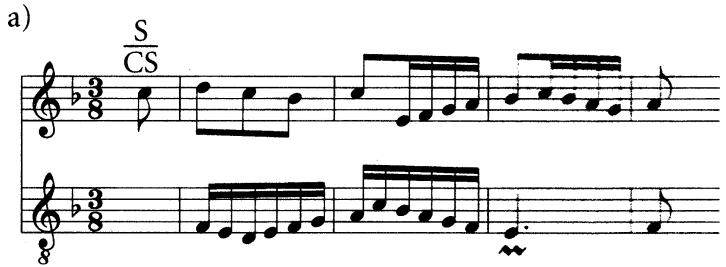
中文讲解
这是第13页上的一个图像或乐谱占位符。原文档此处嵌入的实际内容(谱例或图像)已被省略,仅保留原始位置与图注以便排版还原。具体谱例内容须查阅原书第13页方能确认。
第4段(P0049)
原文复述
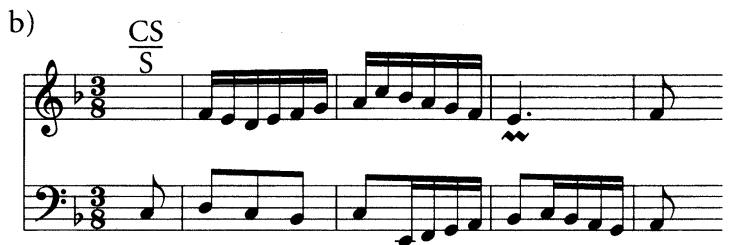
中文讲解
这是第13页上的另一个图像或乐谱占位符,原内容已省略,位置与图注保留,具体谱例细节须查阅原书。
第5段(P0050)
原文复述
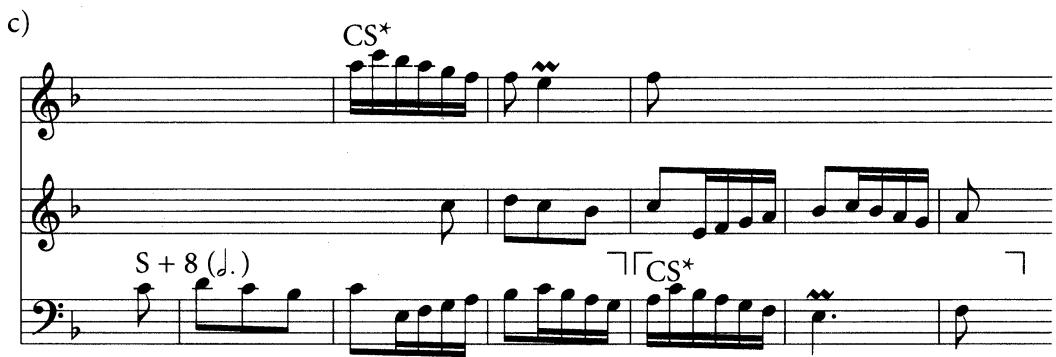
中文讲解
这是第13页上的又一个图像或乐谱占位符,原内容已省略,位置与图注保留,具体谱例细节须查阅原书。
第6段(P0051)
原文复述
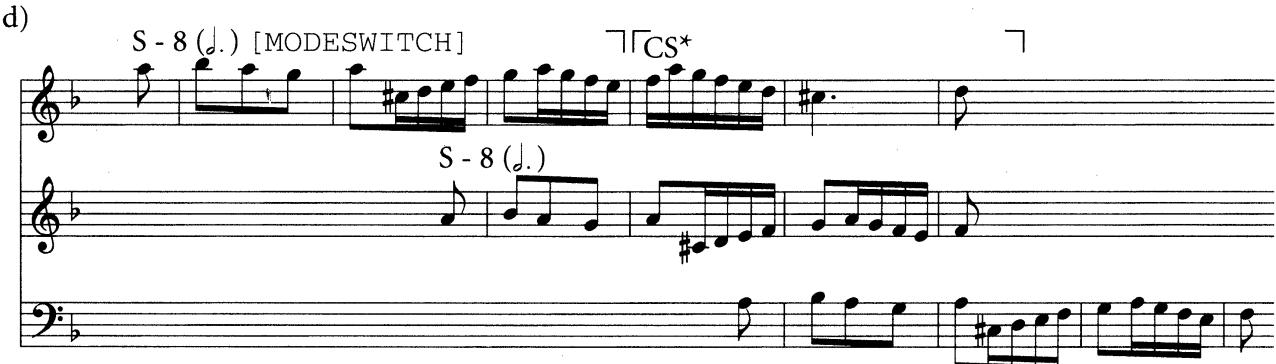
中文讲解
这是第13页谱例的图注:编号为’Example 5.2’,标题为’F major Fugue, WTC I/11’中的’赋格手法’(Fugal devices),即巴赫《平均律键盘曲集》第一册第11首F大调赋格内部的赋格手法示例。原谱例内容已省略,但位置保留——按照正文P0046的指引,5.2c展示了F大调赋格中可逆密接与对题结合的具体方式,对应段落中关于’对题只有位于其他两声部之上时才与密接配合’的判断。读者须参照原图方能逐小节核对作者关于第20、38、40、43、51、60、77等小节的具体陈述。
补充说明
WTC I/11指《平均律键盘曲集》(Das Wohltemperierte Klavier)第一册第11首;图注中保留原例编号5.2便于与正文交叉引用。其余小节位置(Ex. 5.2c、Ex. 5.3等)的具体谱例细节需查看原书。
脚注 / 边栏 / 图表 / 附加信息(如有)
本节范围内的附加材料包括:(1)第12页的页眉/页脚版权信息(P0047),标明页码146、作者Laurence Dreyfus、书名《Bach and the Patterns of Invention》、哈佛大学出版社1996年电子版及HathiTrust标识符heb05561.0001.001、印第安纳大学伯明顿分校下载,主要起出处与版本说明作用;(2)第13页的四个图像/乐谱占位符(P0048–P0051),其中P0051带有图注’Example 5.2 Fugal devices in F major Fugue, WTC I/11’,对应正文中关于F大调赋格可逆密接与对题配合方式的论述,为本节分析提供谱例佐证;其他三个占位符(P0048–P0050)的具体内容须查阅原书方能确认。
💡 本节核心要点
- F大调与G大调两首赋格可作为一对’对比性舞曲赋格’来读:前者呼应passepied,后者指向gigue。
- ‘风格’仅是属类曲目库(generic repertoire)中的一种着色,并不决定赋格如何展开——这是本节核心的方法论前提。
- F大调赋格为含两主题的双主题赋格(主题/对题的划分取决于计数方式),手法相对’非正式’:声部的正常轮转 + 附点二分音符距离的可逆密接,且在大调陈述中与对题材料合并(见Ex. 5.2c)。
- G大调赋格是’混合型’赋格:以双主题赋格起手,进而揭示出双重对位赋格(m. 20 的完整音程倒影)与卡农式简单赋格(m. 51、60 处稍变形主题,m. 77 处倒影卡农未遂)的多重身份。
- CS/S 与 S_inv/CS_inv 两组复合本身可在八度上互换(m. 38、43);巴赫在对题的处理上推迟到 m. 40 才进入 CS,是出于’演化’段落两声部声部进行的考虑。
- 本节最终论断:风格不是可靠的属类标志;C#小调与G大调同属’非凡的混合体’;G大调可视为巴赫式的’文字游戏’——一首’近似吉格’(gigual)的赋格,而非套件中常见的’赋格式吉格’。
🔑 关键术语
- dance fugue:‘舞曲型赋格’。指主题在体裁语汇上明显回响某种特定舞曲(此处为passepied与gigue)的赋格;本节以此范畴作为F大调与G大调的比较起点。
- passepied:巴洛克组曲中常见的三拍子快速舞曲。本节用以刻画F大调赋格主题的舞曲意象。
- gigue:巴洛克组曲的典型终曲舞曲,且常以赋格方式写成。本节用以刻画G大调赋格主题的舞曲意象,并构成结尾’gigual fugue’双关修辞的来源。
- generic repertoire:‘属类曲目库’。即一套与体裁相关的风格特征库;作者借此把’风格’定位为这一曲目库中的诸多特征之一,而非决定赋格展开的主导因素。
- double fugue with two subjects:‘含两主题的双主题赋格’。指从一开始即并行陈述两个独立主题的赋格;本节用以描述F大调赋格的结构类型,并指出’主题/对题’的划分取决于计数方式。
- invertible stretto / canonic device:‘可逆密接’或’卡农式手法’。指可在八度或一定音程上互换的密接和应;本节用以标定F大调附点二分音符距离的密接。
- countersubject (CS):‘对题’。主题进入后伴随主题的对位声部;本节用CS/S标记与主题同时陈述的复合。
- rotation of voices:‘声部轮转’。指赋格中主题依既定顺序在四声部间依次进入;本节称F大调赋格仅呈现’预期的’轮转。
- mixed fugue:‘混合型赋格’。指一首赋格在展开过程中依次或同时展现多种赋格类型(如双主题、双对位、卡农式等);本节用以描述G大调赋格的复合身份。
- double counterfugue:‘双重对位赋格’。指主题与对题均以完整形态作音程倒影呈现的赋格;G大调第20小节即此类陈述。
- canonic counterpoint:‘卡农式对位’。指以卡农方式处理主题的对位形态;G大调在m. 51、60以稍变形主题进行卡农化,并在m. 77尝试倒影卡农。
- intervalic inversion / S_inv, CS_inv:‘音程倒影’。即在保留时间位置与节奏的前提下把所有音程在轴上翻转;S_inv/CS_inv即主题与对题各自的倒影形态。
- artifice:‘人工技巧’。指倚重对位技法(密接、倒影、卡农等)而非单纯主题展开的处理方式;本节用以衡量G大调与C#小调赋格’技巧含量’的尺度。
- evolution:巴赫在《平均律键盘曲集》中常用于自题标段落的名称;本节特指G大调赋格中的一段,巴赫在此推迟CS到m. 40才进入,作者解释为两声部声部进行略显粗糙所致。
- “gigual” fugue:作者自造的形容性术语,谐音仿照gigue,意为’具有吉格意象但实际为赋格的混合体’;本节以之作为’风格—属类—技巧’脱节论点的修辞收束。
ch1.12 [描述性拆分] Deceptive fugal expositions: the D minor fugue as counterfugue
第1段(P0052)
原文复述
Fugal expositions may not only fail to supply an accurate indication of a subgenre; they can often prove deceptive. The exposition of the D minor fugue, for example, has a regular countersubject, suggesting that it will function as a double fugue with two themes. But, as it turns out, the two themes, while invertible, trip somewhat awkwardly over scarcely covered up parallel fifths, even though the offending notes (last beat in m. 13) are in fact only accented appoggiaturas. Significantly, at this very juncture, the fugue changes direction; one begins to recognize its subsequent activity as a counterfugue—in which the subject is worked out in contrary motion—only after the exposition has ended. As Table 5.2 shows, the second half of the piece subsequently becomes dense with canonic devices between the subject in both its rectus and inversus forms, demonstrating that, for Bach, a counterfugue is an extremely artificial subgenre which depends on unexpected and arcane combinations and not merely a simple display of a theme treated in melodic inversion.
中文讲解
本段是整个小节的核心论断段,提出两点相互配合的主张:第一,赋格呈示段可能具有误导性;第二,D小调赋格(BWV 538?或WTC II中的d小调,从文本未明示,需保持谨慎)实际上是一首反行赋格(counterfugue),而非双主题赋格。
作者以呈示段的表面特征入手:呈示段配有一个规整的对题(regular countersubject),这一形式特征通常预示着作品将以双主题赋格(double fugue)的逻辑展开。但呈示段结束时,读者必须重新调整判断。作者给出的关键线索是小节13最后一拍的两个声部出现了几乎掩盖不住的平行五度(parallel fifths),尽管构成犯规的音实际上是加了重音的倚音(accented appoggiaturas)。这一处"违规"既是作曲家的冒险,也是转折的标志:作者写道"Significantly, at this very juncture, the fugue changes direction”,意在让读者把这一瑕疵看作功能性事件,而非偶然失误。
转折之后呈示段才结束,此后乐句的活动才被识别为反行赋格——即主题以反向运动(contrary motion)的方式展开。仅在呈示段结束后,主题才被识别为旋律上可倒置的,这呼应了上一句"the two themes, while invertible"的延迟兑现。
最后,作者援引表5.2,指出乐曲后半段在主题的原形(rectus)与倒影形(inversus)之间大量使用卡农手法(canonic devices),由此得出结论:对巴赫而言,反行赋格是一种高度"人工化"的子类型,它依赖出乎意料的、隐秘(arcane)的组合,而非简单地把一个主题用旋律倒影来炫示。这个结论与开头的"deceptive"形成呼应:正是呈示段的误导使得后半段的反行展开显得更具匠心。
补充说明
本段内部已提供术语解释所需的全部要素:countersubject(对题)、appoggiatura(倚音)、rectus/inversus(原形/倒影形)、canonic devices(卡农手法)均在文中以功能方式被界定,无需补充外部信息。表5.2(Table 5.2)作为本段论据的支撑在本小节正文未复现细节,仅以引用方式出现,不在本段范围内展开。
第2段(P0053)
原文复述
Dreyfus, Laurence. Bach and the Patterns of Invention. E-book, Cambridge, Mass.: Harvard University Press, 1996, https://hdl.handle.net/2027/heb05561.0001.001. Downloaded on behalf of Indiana University, Bloomington
中文讲解
本条是页脚型出处信息(citation/footer),列明本书作者 Laurence Dreyfus、书名《Bach and the Patterns of Invention》、电子书形式、出版地 Cambridge, Mass.、出版社 Harvard University Press、年份 1996,以及电子书链接与下载机构 Indiana University, Bloomington。它为整章节页提供版权与来源标注,不构成正文主张。
第3段(P0054)
原文复述
Matters of Kind
中文讲解
本条是版面中出现的章节或栏目标题(section/header),文字为"Matters of Kind”。它开启一个新的论题区域,标题字面含义为"关于类属的问题"或"种类的问题”,呼应前文关于赋格子类型(subgenre)讨论。但在本任务提供的范围内,该标题之后并未附有正文段落,仅起到标志新议题开始的版面作用。
第4段(P0055)
原文复述
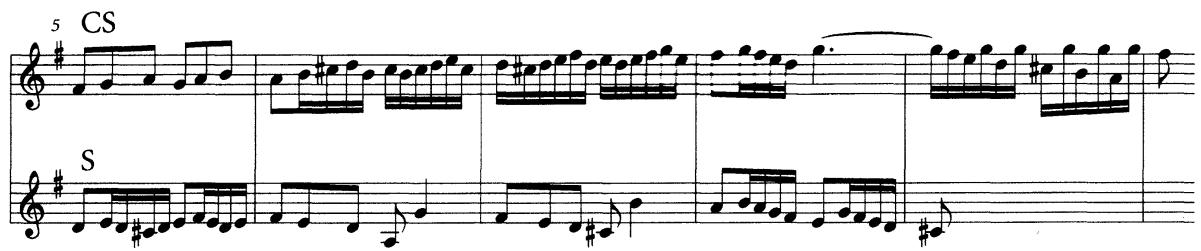
中文讲解
本条是第14页的一处图像或乐谱占位符,原内嵌数据已省略,只保留位置信息。结合上下文(小节主题为赋格呈示段与子类型欺骗性),此处很可能承载分析D小调赋格或反行赋格相关主题/对题/卡农手法的谱例,但具体谱例内容因内嵌数据未提供而无法核实。需查看原书第14页才能确认谱例主体、对位声部走向及具体小节位置。
补充说明
无额外补充;不可对未显示的谱例内容做推断。
第5段(P0056)
原文复述
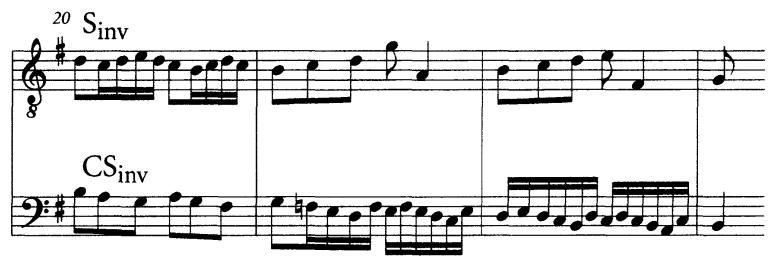
中文讲解
本条是第14页的另一处图像或乐谱占位符,原数据已省略。它位于P0055之后、P0057之前,三者可能共同构成一组并置的谱例或表格,用以配合前文P0052对D小调赋格展开过程的描述。由于本任务未提供该图注,无法确认其具体所指主题、对题或卡农段。需查看原书第14页。
补充说明
无额外补充;不可对未显示的图像做内容推断。
第6段(P0057)
原文复述
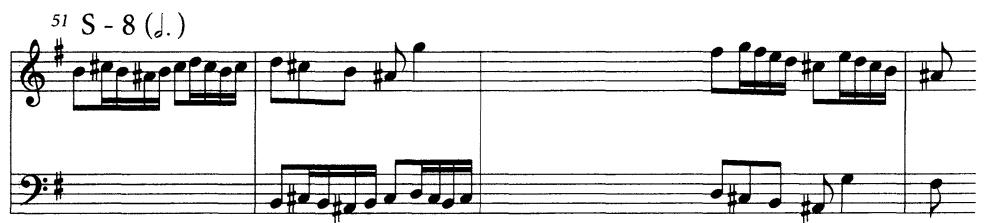
中文讲解
本条是第14页的第三处图像或乐谱占位符,原数据已省略。它紧随P0056之后,可能结束一组配图或延续对P0052所述反行赋格活动的视觉分析。当前可见信息仅为占位符与位置标注,不含可核实的谱例细节。需查看原书第14页。
补充说明
无额外补充;不可对未显示的图像做内容推断。
第7段(P0058)
原文复述
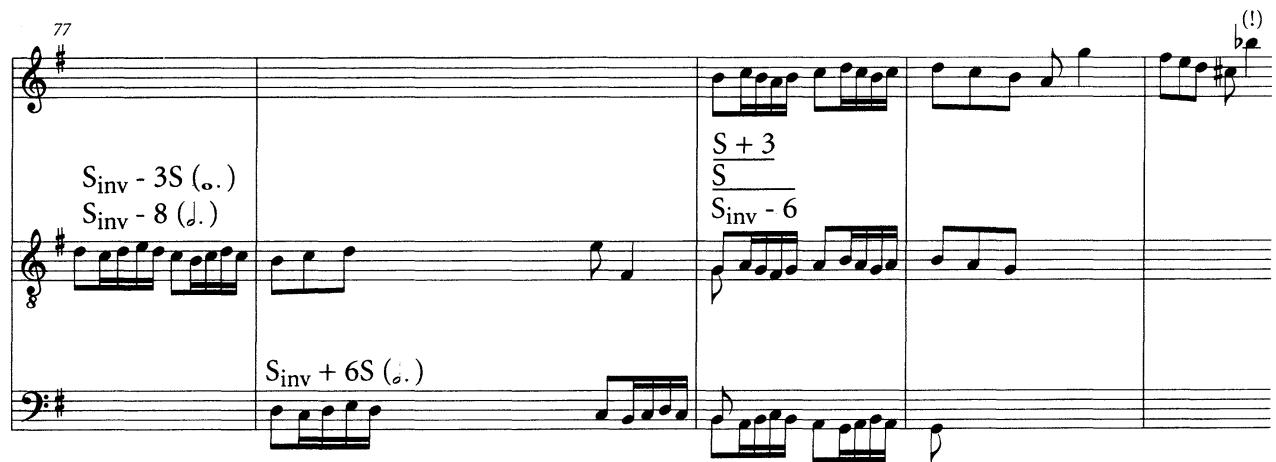
中文讲解
本条是第14页带有明确图注的乐谱占位符。图注明示其为"Example 5.3",内容为"G major Fugue, WTC I/15"(《平均律键盘曲集》第一册第15首,G大调赋格)中的"Fugal devices"(赋格手法/赋格式对位技法)。该谱例的作用是配合P0052对D小调赋格作为反行赋格案例的分析,可能用以对照展示另一首赋格中主题、倒影形与卡农手法的处理方式,作为附加例证。但具体谱例内容因内嵌数据未提供而无法在此核实主题、对题或卡农起始小节。需查看原书第14页。
补充说明
图注仅提供作品的曲目(WTC I/15,G大调赋格)与手法类目(Fugal devices),未给出具体小节号或主题首音信息,因此本段不补充推断内容。
第8段(P0059)
原文复述
Bach and the Patterns of Invention
中文讲解
本条是版面页眉文字(running header),书名《Bach and the Patterns of Invention》。它属于版面属性,不构成正文主张,仅起到在第14页顶部重复书名以便读者翻阅时定位的作用。
第9段(P0060)
原文复述
Dreyfus, Laurence. Bach and the Patterns of Invention. E-book, Cambridge, Mass.: Harvard University Press, 1996, https://hdl.handle.net/2027/heb05561.0001.001. Downloaded on behalf of Indiana University, Bloomington
中文讲解
本条与P0053内容相同,是第14页的页脚型出处信息,列明作者、书名、电子书形式、出版地、出版社、年份、电子书URL与下载机构。它再次为该页提供版权与来源标识,并非新的论证内容。
脚注 / 边栏 / 图表 / 附加信息(如有)
本小节附加材料包括:第13页页脚(P0053)与第14页页脚(P0060)重复出现的同一出处信息(作者 Laurence Dreyfus,书名《Bach and the Patterns of Invention》,Harvard University Press, 1996电子书,下载方 Indiana University, Bloomington);第14页的页眉"Bach and the Patterns of Invention"(P0059)以及栏目标题"Matters of Kind"(P0054),后者在任务所提供范围内未伴随正文段落。第14页含四幅图像/乐谱占位符(P0055–P0058),其中仅P0058附有可识别的图注"Example 5.3 Fugal devices in G major Fugue, WTC I/15",作为G大调赋格中赋格手法的补充例证;P0055–P0057的图注信息缺失,具体谱例内容需查阅原书第14页。此外,正文P0052所引用的"Table 5.2"未在本小节范围内复现,仅作为论据支撑被援引。
💡 本节核心要点
- 赋格呈示段可能具有欺骗性(deceptive),即其表面形式特征(如规整对题)可能并不预示作品最终归属的子类型。
- D小调赋格的呈示段形式上像双主题赋格,但实质是反行赋格(counterfugue):主题与对题虽可旋律倒置,在小节13末拍因倚音而产生几乎遮掩不住的平行五度,从而标志作品方向的转折。
- 作品真正的反行赋格身份只有在呈示段结束之后才被识别,后半段在主题的原形与倒影形之间密集使用卡农手法。
- 对巴赫而言,反行赋格是一种高度"人工化"(extremely artificial)的子类型,它依赖出乎意料且隐秘的(arcane)结合,而非仅靠简单地把主题进行旋律倒影来展示。
- 该案例提示读者,分析赋格子类型时应将呈示段形式特征视为可被推翻的假设,而非固定的归属依据。
🔑 关键术语
- counterfugue(反行赋格):本节核心术语:指主题在作品中以反向运动(contrary motion)方式展开的赋格子类型。文中强调对巴赫而言它不只是简单的旋律倒影炫示,而是依赖意外、隐秘结合的高度"人工化"结构。
- deceptive exposition(欺骗性呈示段):指赋格呈示段的形式特征(如规整对题)误导读者对作品子类型作出预判,本节以D小调赋格为例,展示呈示段如何看似双主题赋格、实则引向反行赋格。
- regular countersubject(规整对题):在赋格呈示段中与主题同时出现、具有独立可识别形态的对题声部。本节用它作为呈示段"看似双主题赋格"的关键形式标志。
- double fugue(双主题赋格):赋格的子类型之一,由两个独立主题(或主题与对题关系极为对等)共同构成赋格主体。本节以D小调赋格"被误判为双主题赋格"作为欺骗性呈示段的反例。
- parallel fifths(平行五度):传统对位中被视为声部进行禁忌的五度平行。本节指出小节13末拍的两声部出现几乎遮掩不住的平行五度,但其构成音实为加重音的倚音,从而把"违规"转化为结构转折的标记。
- appoggiatura(倚音):本节用此术语说明小节13末拍那两个产生平行五度的音实际上是加了重音的倚音,因此五度并非真正的、根部运动的平行,而是装饰性倚音造成的表面印象。
- rectus / inversus(原形 / 倒影形):本节用这一对术语描述主题及其旋律倒影:rectus 指主题本来的方向,inversus 指方向倒转后的版本。D小调赋格后半段在两者之间密集使用卡农手法,以落实其反行赋格身份。
- canonic devices(卡农手法):本节用以描述D小调赋格后半段主题与倒影形之间形成的卡农式进行;这是作者认定该作品为反行赋格的实质性证据,区别于"简单展示旋律倒影"。
ch1.13 [描述性拆分] Subtle distinctions among simple fugues: the A major and D major fugues
第1段(P0061)
原文复述
The basic conventions of a subgenre also help to distinguish between more subtle shades of meaning even among pieces of the same kind. Consider within WTC/I the group of simple fugues, which, upon closer inspection, appear far from uniform. In fact, they too can be meaningfully ordered according to the level of fugal difficulty. The A major fugue lies near the normative middle of the subgenre, with its even deployment of the subject in the various voices, and in its aborted attempts at contrary motion and canonic imitation. The D major fugue, on the other hand, would get a low mark on the Oxford professor’s exam, since it contains only failed canonic devices that cannot be carried through. The very grand style of the D major fugue—evoking as it does a French overture—therefore provides an excellent foil to the genuine poverty of complex fugal devices, a fact that becomes transparent once the piece is heard devoid of its grand melodic flourishes and regal dotted figures. (See the opening stripped of its “style” in Ex. 5.4.) Naturally this denuding of the piece is not meant to cast aspersions on its quality, but rather to assert that the compelling harmonic drive and imposing decorative flair with which Bach invests his invention need to compensate for the inability of the subject to sustain any specifically fugal treatment, aside (perhaps) from presenting the subject in an ARRAY of five distinct scale degrees. At the same time, the D major fugue illustrates the inflated role Bach assigns to style, so that a simple fugue avoids the realm of the banal.
中文讲解
本段的核心主张:哪怕属于同一亚类(subgenre),作品之间也存在可被识别的细微差别。WTC/I 中的"简单赋格"(simple fugues)远非铁板一块,而是可以按赋格技术难度排成一个有意义的高低序列。
承接前文:本段直接呼应 P0063 的运行标题 “Matters of Kind”——它把章首关于"类别(kind)“的总命题落实到了"同类作品内部"的颗粒度上。“Oxford professor’s exam” 是一项在前文(按章节编号应为本节之前)中已建立起来的评价标准,本段借它来给 D 大调赋格打低分,从而把抽象的难度判据具体化。
两个例子的对照: • A 大调赋格被定位为亚类的"规范中段”(normative middle)。它的两个特点——主题在各个声部中"均匀分配"(even deployment),以及"被中断的"反向运动与卡农模仿的尝试——共同说明它具备一定的对位潜力,但又未走到底。 • D 大调赋格则被推到序列低端:只有"失败的卡农手法"(failed canonic devices),无法贯彻到底。
“风格"作为反衬:本段的关键论证是 D 大调赋格的"grand style”——让人联想到法国序曲(French overture)——充当了一种 foil(陪衬/反衬),让听者只看见辉煌,看不见赋格手法的贫乏。为了让这种对照显形,作者提出一种"剥光"(denuding)的听法:把作品去掉 grand melodic flourishes 与 regal dotted figures(见 Ex. 5.4)来听,贫乏才会"变得透明"。
作者特别声明,这种剥光"不是要贬低作品质量",而是要说明:巴赫所投入的"具有说服力的和声推动力"(compelling harmonic drive)与"庄严的装饰气派"(imposing decorative flair),必须用来弥补主题在赋格层面的无能;唯一可能的例外是主题在五个不同音级上的呈示(an ARRAY of five distinct scale degrees),作者仍用"perhaps"作出限定。
收束的论旨:D 大调赋格演示了巴赫赋予"风格"以"膨胀的角色"(inflated role),结果使简单赋格这一亚类得以避免落入 banal(平庸)。
写作技巧提示:本段示范了一种分析姿态——主动区分"风格层"与"结构层"——并通过 Ex. 5.4 把这种区分直观化。它告诉读者:要评价一首赋格,必须先把装饰剥掉再判断核心对位能力。
补充说明
本段提到 Ex. 5.4(“opening stripped of its ‘style’"),但本任务输入未提供谱面,需查看原书方可确认其具体内容。“WTC/I” 即 The Well-Tempered Clavier Book I(《平均律键盘曲集》第一卷)的惯用缩写。“Oxford professor’s exam” 的具体内容在本段内未复述,按上下文应在前一节(ch1.12)已经建立起来。“ARRAY” 在原文中以全大写出现,是作者正在使用并强调的一个技术术语;本段未给出其独立定义,从上下文看与"在五个不同音级上呈示主题"相关。“French overture” 与 “regal dotted figures”(庄严的附点节奏)在巴洛克语境中是常见的搭配,但本节内未展开定义。
第2段(P0062)
原文复述
Dreyfus, Laurence. Bach and the Patterns of Invention. E-book, Cambridge, Mass.: Harvard University Press, 1996, https://hdl.handle.net/2027/heb05561.0001.001. Downloaded on behalf of Indiana University, Bloomington
中文讲解
这是一条文献脚注,完整给出本节乃至本章分析框架所依据的来源——Laurence Dreyfus 的专著《Bach and the Patterns of Invention》。条目包含作者、书名、版本形式(E-book)、出版地(Cambridge, Mass.)、出版社(Harvard University Press)、出版年份(1996)、URL 标识符,以及下载主体(Indiana University, Bloomington 的代下载)。
对正文的作用:它为前一段(P0061)以至整个小节关于"亚类常规"与"简单赋格内部差异"的分析提供了来源支持,表明本章在借用该书构建分类与风格判据。
补充说明
本脚注独立成段、未标序号,按版式判断属于未编号的来源/版权说明类脚注。URL 中的 hdl.handle.net 是 HathiTrust 数字图书馆的标识符前缀;脚注明确指明该书是 Indiana University, Bloomington 用户代为下载的副本,因此它属于版权/获取方式声明,而非正文的引用脚注。
第3段(P0063)
原文复述
Matters of Kind
中文讲解
“Matters of Kind” 是页面上出现的简短文本,按其在源段中的位置(紧接 P0061 正文与 P0062 脚注之后,位于第 15 页的收束处)判断,属于下一小节的起始标题或本页/本章的运行标题(running header)。它点明本章所关心的总主题——关于体裁/类别(“kind”)的判断——并与 P0061 末尾关于"在同一类作品内部辨别细微差别"的论题构成首尾呼应。
补充说明
“Matters of Kind” 作为标题,本身带有一语双关的意味:“kind” 既指"种类”,也可指"方式/手法";它统摄本章关于体裁惯例与作品个体之间关系的讨论。该文本在源段中以独立行出现,无页码或装饰,按版式惯例应被视作章节/小节标题,而非正文叙述。
脚注 / 边栏 / 图表 / 附加信息(如有)
本节包含一条文献/版权脚注(P0062),标明本章分析框架取自 Laurence Dreyfus《Bach and the Patterns of Invention》(Harvard University Press, 1996,HathiTrust 电子版,Indiana University, Bloomington 下载)。正文另引用了一个谱例 Ex. 5.4(“opening stripped of its ‘style’"),用以演示 D 大调赋格"剥去风格"后的状态;该谱例的具体形态需查看原书。页尾出现的 “Matters of Kind” 是本章的总标题或下一页的起始标题,作为版面元素处理。
💡 本节核心要点
- 同一亚类内部的作品可以按赋格技术难度排出有意义的高低序列;WTC/I 的 “simple fugues” 远非铁板一块。
- A 大调赋格位于该亚类的"规范中段”:主题在声部间均匀分配,并有反向运动与卡农模仿的尝试(虽被中断而未完成)。
- D 大调赋格处于低端:仅有"失败的"卡农手法,无法贯彻到底;其宏大的"法国序曲式风格"充当了对赋格贫乏的反衬(foil)。
- 作者通过 “denuding”(剥去风格)这一分析方法(Ex. 5.4)来揭示作品的底层对位能力——这是一种区分"风格层"与"赋格实质层"的方法论示范。
- D 大调赋格中"在五个不同音级上呈示主题"(an ARRAY of five distinct scale degrees)是其唯一可能构成真正赋格手法的例外,但作者以 “perhaps” 加以限定。
- 巴赫通过膨胀"风格"的角色(用具有说服力的和声推动与庄严的装饰气派)使简单赋格也能避免落入 banal(平庸),从而在该亚类内部维持作品的可听性。
🔑 关键术语
- Simple fugue(简单赋格):WTC/I 中的一类赋格,以有限的对位复杂度为标志;本节证明这一亚类内部仍有显著差异,不能一概而论。
- Subgenre conventions(亚类常规):同一大类内部共享的体裁惯例与评判标准;它们在本节中被用来在同类作品之间作进一步区分。
- Normative middle(规范中段):亚类中代表"典型/标准"例子的位置——既不极端复杂也不极端贫乏;本节中 A 大调赋格被安放在这一位置。
- French overture(法国序曲):巴洛克时期一种庄严宏大的体裁,常以慢速附点节奏的引子开头;D 大调赋格的 grand style 被描述为"让人联想到"这一体裁。
- Canonic imitation(卡农模仿):主题以严格的时间间隔在另一声部上精确模仿进入,是衡量赋格对位复杂度的关键指标之一;D 大调赋格在此项上被判为"失败"。
- Denuding(剥光):作者提出的分析方法——主动剥离作品的"风格"层(旋律装饰、附点节奏等),以便暴露底层对位结构的真实水平;本节以 Ex. 5.4 把这一姿态具体化。
- ARRAY(以全大写出现于原文):作者正在使用的一个技术术语,本段未给出独立定义;从上下文看与"在五个不同音级上呈示主题"相关,是 D 大调赋格中唯一可能构成真正赋格手法的例外。
ch1.14 [描述性拆分] The C major fugue as the strict opening of WTC I
第1段(P0064)
原文复述
The C major fugue, on the other hand, demonstrates how very strict a simple fugue can be and, for this reason, was probably chosen to open the collection. The rigors of this piece can be seen graphically in Table 5.3, which decomposes
中文讲解
本段以"on the other hand"(另一方面)起头,标志着与前文讨论的某种转向或对照——很可能暗示作者此前刚讨论过不那么严苛、或更自由的赋格写法,借此凸显C大调赋格的极端严格。
作者的核心论点有三层:
- C大调赋格展示了"a simple fugue"(简约型赋格)所能达到的最大严格度。这里的"simple"不是指容易或平庸,而是指体裁类型——相对于带间插段、加花变奏或风格化处理的复杂赋格而言,C大调是一首架构纯正的简约型赋格。
- “for this reason, was probably chosen to open the collection”——正因为这份严苛,它(很可能)被选为整部曲集的开篇。这是一种关于作品编排逻辑的推测,强调第一首曲目所要传达的信息:巴赫以最纯粹的写作规范作为全书的起点。
- 随后指引读者参看Table 5.3,把这种"rigors"(严苛的写作规则)以视觉化方式分解出来。“graphically"一词明确说明该表格的功能是把抽象的对位规则转化为可读的图示,而不是做单纯的音符罗列。
句尾的"which decomposes"未完成,提示后文会具体说明表格怎样分解这首赋格——这是本小节与后续内容衔接的钩子。
本段在全节论证中的作用是给出"为什么C大调赋格被放在开头"的问题答案,并预告视觉化分析工具(表格)的介入。
补充说明
本段承接前文对WTC I开头赋格的讨论,把论证焦点由"是什么"转入"为什么这样安排”,并以"probably"一词将其定性为合理推测而非定论。Table 5.3的编号延续前文对图表的编号逻辑,意味着本节中存在一整套按数字编号的可视化分析材料(P0065的Example 5.4即属同一系统)。
第2段(P0065)
原文复述
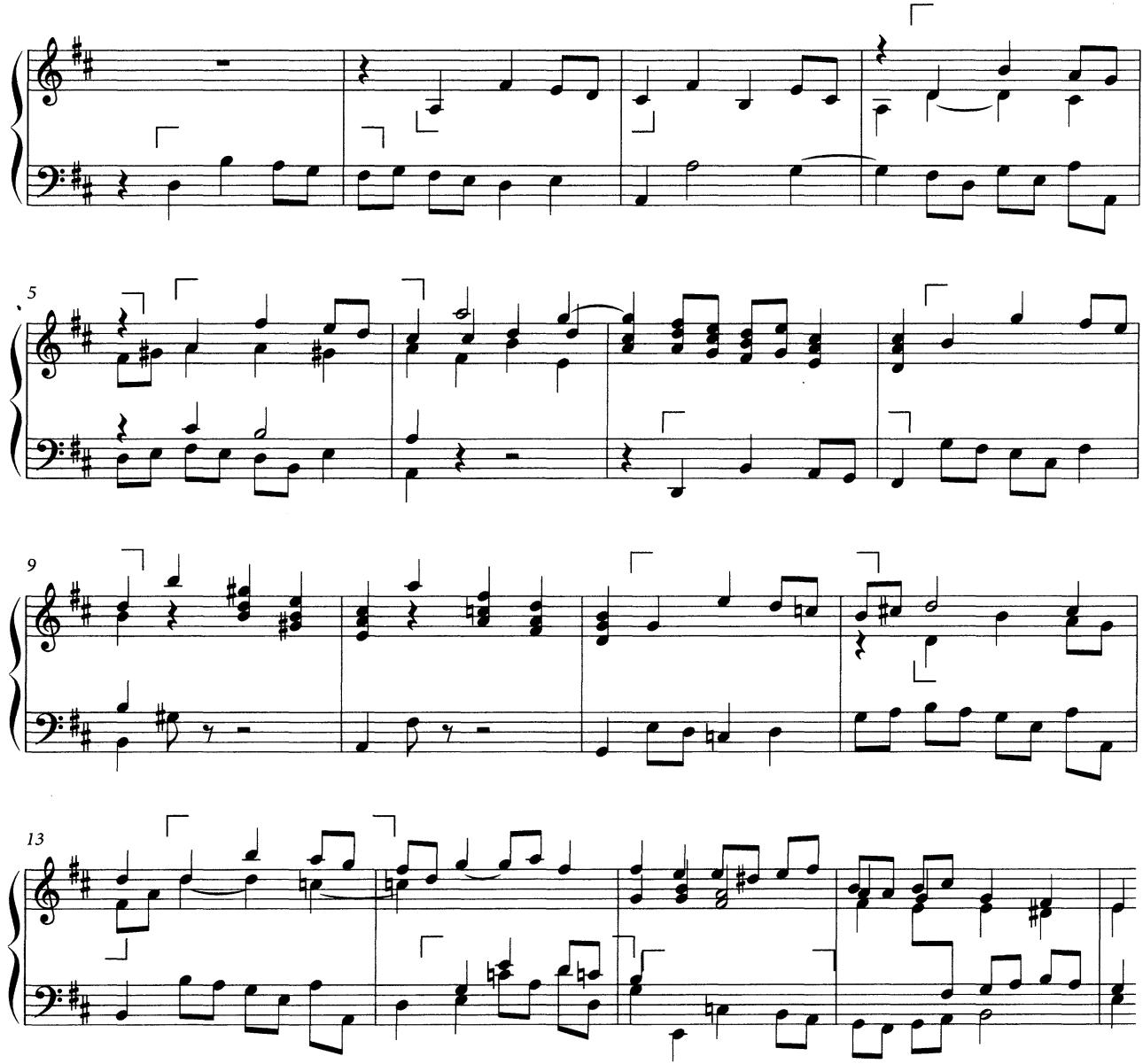
中文讲解
这是一处图像占位符,仅保留图注:“Example 5.4 D major Fugue, WTC I/5, devoid of its ‘style,’ mm. 1–17”。
图注传达了三项关键信息:
- 编号Example 5.4——属于与Table 5.3同序列的编号系统,表明它与正文论证同步推进。
- 内容指向D大调、WTC I第5首赋格,而非P0064所谈的C大调赋格。也就是说,本图例的讨论对象与P0064并不一致;它更可能是从前一页面延续下来的对比图示,用来与C大调形成参照,或者承接前文对其他赋格"剥去风格后骨架如何"的讨论。读者须意识到:C大调赋格的严苛性是通过Table 5.3来图示的,而这幅图所"去风格化"的是D大调。
- “devoid of its ‘style’"(剥去其"风格”)是关键术语——在Dreyfus的分析中,“style"通常指装饰音、回旋音、演奏法提示、风格化装饰等表层要素;剥去之后呈现的是裸露的对位骨架,专注于声部进行与和声逻辑。
- “mm. 1–17"限定了片段范围为开头17小节。
由于内嵌图像数据已省略,原谱表的实际音高、节奏与小节内容无法从本task_input中得知,仅能依据图注确认其用途——展示D大调赋格去除装饰后的对位本体。读者需查阅原图方可看到具体音符。
补充说明
图例的对象(D大调,WTC I/5)与紧邻正文(C大调)的讨论对象不同,这是本节编排上的一个提示:本小节很可能跨越多个谱例,把C大调置入与D大调的比较框架中,以显示"简约型赋格"严格度上的差异。‘style’一词在本节语境中是通过"剥去—保留"的对照方式被定义的,无需额外引入词源或学派史。
第3段(P0066)
原文复述
150 Bach and the Patterns of Invention Dreyfus, Laurence. Bach and the Patterns of Invention. E-book, Cambridge, Mass.: Harvard University Press, 1996, https://hdl.handle.net/2027/heb05561.0001.001. Downloaded on behalf of Indiana University, Bloomington
中文讲解
这是一段电子版图书的页脚/版权引用块,由两个层次组成:
第一行"150 Bach and the Patterns of Invention"是页码(150)加上版面运行标题(书名),属于常规的页面页眉/页脚排版元素,便于读者在翻页时确认所在位置与书名。
第二段则是电子版访问元数据,逐项给出:作者全名(Laurence Dreyfus)、著作题名(Bach and the Patterns of Invention)、版本形态(E-book,电子书)、出版地(Cambridge, Mass.,美国马萨诸塞州剑桥市)、出版机构(Harvard University Press,哈佛大学出版社)、出版年份(1996)、数字对象唯一标识符URL(hdl.handle.net/2027/heb05561.0001.001,Handle System持久标识符),以及下载来源说明(由Indiana University, Bloomington代为下载)。
这段引用块对正文论证无直接主张性内容,但它确认了文本的学术来源、版本性质和访问路径,属于来源旁证类信息。
补充说明
无额外补充。该段不引入新的论证主张,仅起版面定位与文献来源标识的作用。
脚注 / 边栏 / 图表 / 附加信息(如有)
本小节附录材料仅含两项:
- Table 5.3——P0064预告的可视化分解表,按"graphically"分解C大调赋格的写作严苛性;但其具体栏目内容不在当前source_paragraphs范围内,无法从本任务输入中还原。
- Example 5.4(P0065)——图例,标题为"D major Fugue, WTC I/5, devoid of its ‘style,’ mm. 1–17”;原图数据已省略,只能依据图注确认其用途为展示D大调赋格剥离"风格"后的对位骨架前17小节。
- 页脚引用块(P0066)——提供页码、书名、作者、出版机构、年份、Handle System链接及下载来源,仅作来源标识。 脚注、旁注或边栏:本小节内未出现。
💡 本节核心要点
- 本节核心主张:C大调赋格代表"简约型赋格"所能达到的最大对位严苛度,因此被作者(推断地)认定为整部WTC I的开篇曲目。
- 论证方法:作者借助编号化的可视化分析工具(Table 5.3、Example 5.4等)将抽象的对位规则转化为可读的图示,而非逐句描写音乐。
- 关键术语对——‘simple fugue’指的是体裁类型而非难度等级,与’rigor’(写作严苛度)配合使用来界定C大调的功能定位。
- P0065的图例实际指向D大调赋格(WTC I/5),与本段讨论对象不同,提示本节论证可能将C大调与D大调并置比较。
- ‘devoid of its style’(剥去风格)作为分析方法的关键操作:去除装饰、演奏法等表层要素,以暴露纯对位骨架。
- 页脚的来源引用块仅起书目识别作用,不承担论证功能。
🔑 关键术语
- simple fugue:本节中对WTC I中某类赋格的体裁界定,指架构纯正、不依赖大量间插段或风格化装饰的赋格,与’复杂型赋格’相对。‘simple’在此不指容易或平庸,而是与’rigor’(严苛度)配合,强调规则执行的纯度。
- rigor / rigors of this piece:本节中用来形容C大调赋格对位写作严苛度的核心词;不是指演奏上的严酷感觉,而是指作曲规则——声部进行、和声约束、对位配比等——被严格遵守的程度。Table 5.3正是把这种严苛"graphically"地分解出来。
- devoid of its ‘style’:在Example 5.4图注中作为分析方法的关键短语。‘style’在此并非泛指巴赫的总体风格,而是特指装饰音、回旋音、演奏法提示等可剥离的表层要素;‘devoid of’意味着图例只保留裸露的对位骨架,便于读者审视声部运动本身。
- WTC I/5:指《平均律钢琴曲集》第一册第5首(D大调)。本任务输入仅在Example 5.4图注中以缩写形式出现,其完整信息——作品号、调性、所属曲集——均来自该图注,不得由本任务输入之外的资料补全。
ch1.15 [描述性拆分] Canonic research, complete and incomplete devices, and the logic of surprise
第1段(P0067)
原文复述
the canonic structures of the piece by detailing each of the two-part fugal devices that it contains. The first entry, for example, S - 4 ( ), means that the subject enters against itself at a lower fourth after a quarter note, a device that is invertible at the octave, namely at the upper fifth. The basic counterpoint of the device is spelled out in Ex. 5.5a. What is ricercare-like in this fugue is not its style but its attempt to RESEARCH the sum total of canonic combinations of one subject played against itself. (Whereas I have previously used the function RESEARCH to refer to unexpected links between ritornello segments, I now apply it within the realm of fugue to refer to Bach’s systematic search for canonic devices.)
中文讲解
本段是本小节的核心论述入口。它首先解释了作者如何通过逐一列举作品中的二部对位卡农装置来揭示整首赋格的卡农结构,并以第一个条目 S-4()为例做了具体说明:主题在四分音符之后以低四度进入并与自身对位,而该装置在八度上可转位,即转位后表现为高五度。Ex. 5.5a 把这一装置的基本对位写法写明,便于读者直接看清它的音程关系。
随后作者提出了本段最关键的概念性主张:本首赋格之所以“像 ricercare(利切卡尔)”,并不在于风格层面,而在于它试图穷尽性地研究一个主题与自身相对时所能产生的全部卡农组合。作者借由括号内的说明,把此前用于利都奈罗段落间“出人意料联系”的 RESEARCH 功能,重新引入到赋格领域,专门指称巴赫对卡农装置的系统性搜索。这里的“穷尽”与“系统”两个限定,与 ricercare(探索、检索)一词本身的含义形成呼应,揭示出本曲与该体裁在精神上的真正共通点。
补充说明
“S-4()”是作者自创的简写标记:S 代表 subject(主题),4 代表下四度的卡农距离,括号内通常留作标记移调或转位状态;该标记与 Table 5.3 中的器件编号相互对应。术语 ricercare 指一种以主题探索和对位穷尽为特征的复调体裁,巴赫晚期的《音乐的奉献》与《赋格的艺术》常被视为其代表。
第2段(P0068)
原文复述
Table 5.3 distinguishes between complete devices, that is, fully grammatical combinations, and incomplete or only partially grammatical combinations. As the bar numbers without brackets show, the task of this strict simple fugue is to express each complete device without recourse to chromatic alterations. For example, Devices 1, 2, 3, 5, and 6 are all expressed at least once in an unaltered form. (Device 6 offers a special example of a complete device that preserves the initial mode rather than the interval.) Device 4 could have been presented without alteration but is subordinated to Device 1 in a three-voice canonic complex. The devices also relate hierarchically. The shorter the time span between imitations, the more difficult are the combinations. That is to say, the greater the overlap, the more challenging is the counterpoint. Bach therefore surely had to work out the subject while planning at least the combinations separated by quarters and half notes. At the other end of the spectrum—in imitations where the two parts overlap only briefly—the complete devices were perhaps no more than felicitous coincidences of voice-leading that occurred to Bach as he composed the piece. Concerning the formal design and affective sense in which these strettos must be heard, Johann Mattheson is quite explicit: “The nearer the voices follow on each other’s heels . . . the more unexpectedly this surprise is perceived. They sometimes appear above, sometimes in the middle, sometimes below, without being too greatly restricted as regards sequence . . . One might as well say . . . to the theme: ‘Look! You are here again; I did not consider that; I would not have sought you in this place.’” 26 Thus any attempt to discern a logical plan for the strettos misses a central expectation of the genre—that of surprise.
中文讲解
本段承接 P0067 提出的“穷尽性研究”思路,展开为三个层次。
第一层是 Table 5.3 的分类法:作者把器件区分为“完全”(语法上完全成立)与“不完全/部分语法”两类,并用不带括号的节拍数说明,本首严格的简单赋格的任务,是把每一个完全器件以不加变化音的方式呈现一次。Device 1、2、3、5、6 都至少出现一次未经改变的形态,Device 4 虽本可不加改变地出现,却在一部三声部卡农综合体中被 Device 1 所统摄,作者特别指出 Device 6 是一个特殊例子:它保留的是初始调式而非原有音程,这提示我们“完全器件”并非只以音程为衡量标准。
第二层是器件之间的等级关系:模仿间距越短、两个声部重叠越多,对位难度越大。作者据此推断,巴赫在构思主题时就必须同时筹划至少四分音符与二分音符间距的组合;而对于两声部仅短暂重叠的器件,所谓的“完全”可能只是巴赫在实际写作中遇到的“声部进行的巧合”,并非事先规划。
第三层通过马泰松(Johann Mattheson)的话把论述推向“惊讶”美学:卡农(尤其密接和应 stretto)距离越近,越能让听者感到“突然出现”的惊讶,主题可以出现在任何声部位置而不受顺序束缚,仿佛在向主题说“你又在这里了,我没想到,我也不会在那个地方找你”。作者由此得出本节的核心结论:若试图在密接和应中寻找严密的逻辑计划,就违背了该体裁对“惊讶”这一核心期待。
这一段同时起到了收束作用:前文用穷尽性研究来理解本曲的 ricercare 特征,本段则提醒读者,这种穷尽必须以“听者的惊讶”作为边界,不能滑入纯粹的机械规划论。
补充说明
马泰松(Johann Mattheson, 1681–1764)是德国音乐理论家、作曲家,其著作《完美的乐队长》(Der vollkommene Capellmeister, 1739)包含大量关于对位与情感修辞的论述,是研究巴赫时代音乐修辞学的重要文献。Device 6 保留“初始调式而非原有音程”这一说法,意味着即使实际音程被改变,只要它仍然符合 C 大调或 a 小调等初始调式的语法,仍算作完全器件。
第3段(P0069)
原文复述
Dreyfus, Laurence. Bach and the Patterns of Invention. E-book, Cambridge, Mass.: Harvard University Press, 1996, https://hdl.handle.net/2027/heb.handle.net/2027/heb05561.0001.001. Downloaded on behalf of Indiana University, Bloomington
中文讲解
本段是该电子书的版心来源标注,标明作者为 Laurence Dreyfus,书名为 Bach and the Patterns of Invention,出版方为哈佛大学出版社(1996),并附 HathiTrust 数字图书馆的链接与下载机构(印第安纳大学布卢明顿分校)。它属于电子书页眉/页脚类的版面信息,本身不构成论述内容,但说明该章文字来源与数字化的归属。
第4段(P0070)
原文复述
Matters of Kind
中文讲解
“Matters of Kind”是新一节(或下一章)的标题,意为“种类问题”或“体裁之别”。从上下文看,作者在结束对 C 大调赋格 WTC I/1 的穷尽性卡农研究讨论后,转向一个更宏观的议题:不同复调体裁(利切卡尔、赋格、创意曲等)之间的体裁界定问题。该标题开启了新的论题:如何理解这些体裁各自的“种类”归属。
第5段(P0071)
原文复述
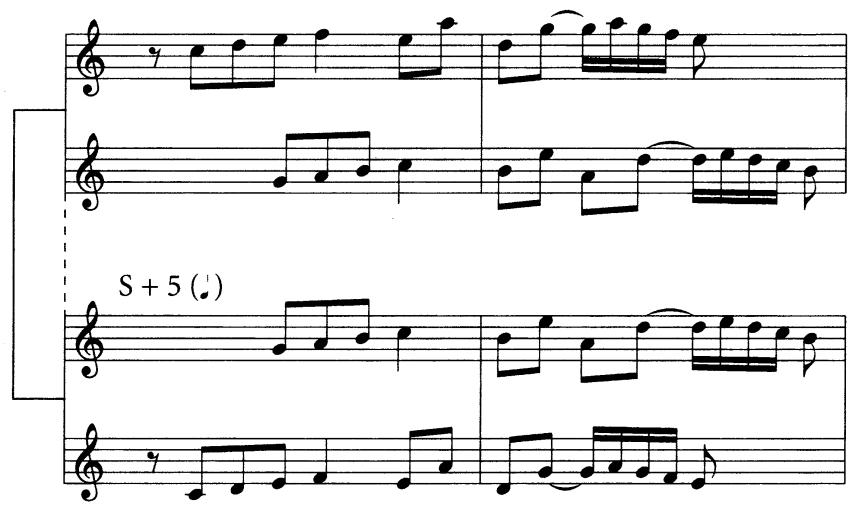
中文讲解
此处为图像占位符,所附位置标记显示图像内部含有“c);b);a)”三个由右向左排列的标签,可能是一组按反序排列的乐谱片段或图示。该图出现于新章节起始处,可能与“种类问题”所要展示的不同体裁对照有关,但因内嵌图像数据已被省略,需查阅原图方可确认其内容与用途。
补充说明
由于图像数据被省略,作者未在正文中显式提及此图所对照的体裁,故无法仅凭现有输入判断其确切功能。
第6段(P0072)
原文复述
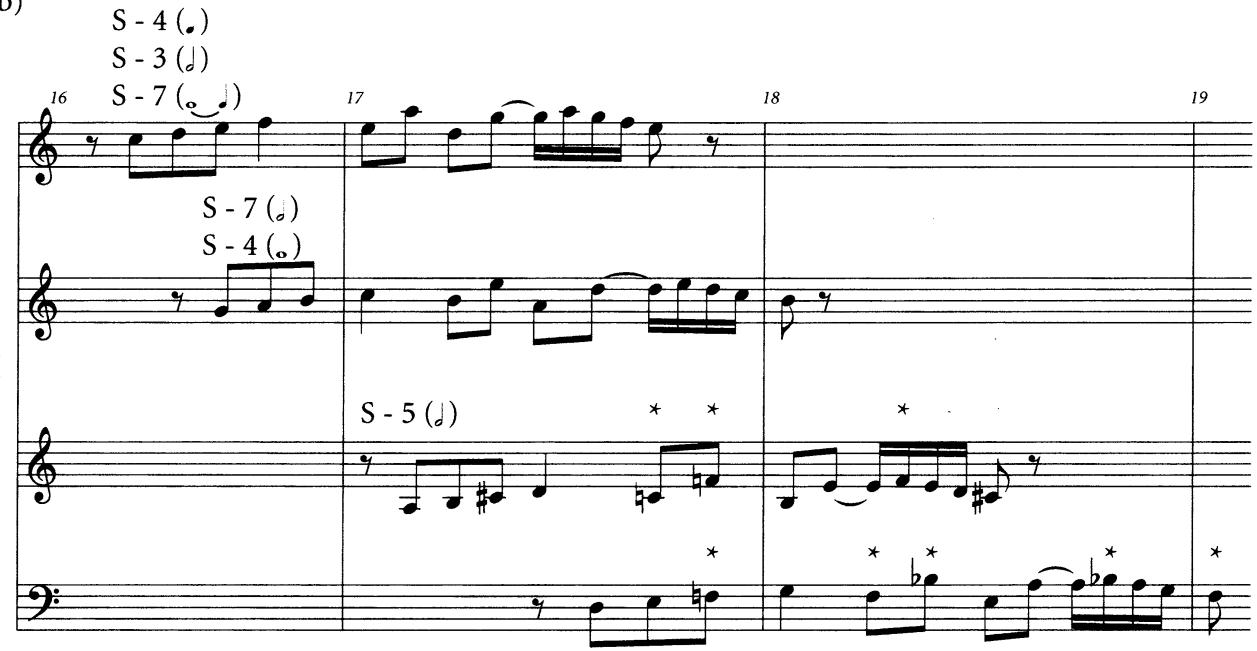
中文讲解
此处为另一处图像占位符,位于第 18 页,其原始内容为图像或乐谱示例,但内嵌数据被省略。读者需查看原书第 18 页上的对应图示才能确认其具体形态与作用。
第7段(P0073)
原文复述
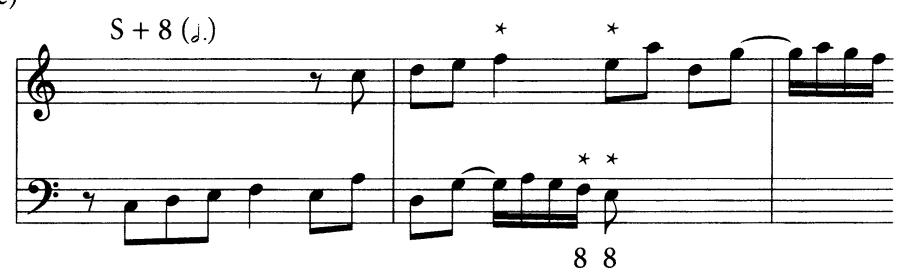
中文讲解
此处为图 5.5 的图注,明确该图标题为“Fugal devices in C major Fugue, WTC I/1”,即《平均律键盘曲集》第一册第一首 C 大调赋格中的卡农器件示意图。该图与正文中 P0067 所提到的 Ex. 5.5a(第一个器件的基本对位写法)以及 P0068 所提到的 Table 5.3(完全与不完全器件的分类)共同构成一组配套的谱例与表格,用于直观展示本节讨论的各类卡农器件及其在作品中的具体呈现。
补充说明
WTC I/1 指 Johann Sebastian Bach《平均律键盘曲集》第一册第一首,C 大调 BWV 846。
第8段(P0074)
原文复述
152 Bach and the Patterns of Invention Dreyfus, Laurence. Bach and the Patterns of Invention. E-book, Cambridge, Mass.: Harvard University Press, 1996, https://hdl.handle.net/2027/heb05561.0001.001. Downloaded on behalf of Indiana University, Bloomington
中文讲解
本段为第 18 页的页脚/版心信息,标明页码 152,并重复该书的电子版来源标注:作者 Laurence Dreyfus,书名 Bach and the Patterns of Invention,1996 年由哈佛大学出版社出版,HathiTrust 链接,以及下载机构印第安纳大学布卢明顿分校。它属于版式元数据,不参与正文论证。
脚注 / 边栏 / 图表 / 附加信息(如有)
本小节附有两个图像占位符(P0071、P0072)与一幅带图注的谱例(P0073),图 5.5 明确对应《平均律键盘曲集》第一册 C 大调赋格 WTC I/1 中的卡农器件,用以直观配合 Table 5.3 的分类以及 P0067 提到的 Ex. 5.5a。脚注 26 在 P0068 末尾出现,对应马泰松关于密接和应“惊讶”效果的引文出处,属于对正文“stretto 体裁核心期待为惊讶”这一主张的支持性文献来源。版心重复出现的电子版来源标注(P0069、P0074)说明该书为哈佛大学出版社 1996 年出版的 E-book,由印第安纳大学布卢明顿分校经 HathiTrust 下载。
💡 本节核心要点
- 本首 C 大调赋格的“利切卡尔性”不在风格,而在于巴赫对同一主题与自身相对时所能产生的全部卡农组合的穷尽性 RESEARCH。
- Table 5.3 将器件区分为“完全”(语法上完全成立)与“不完全”,本曲的任务是把每个完全器件以不加变化音的方式至少呈现一次。
- 器件之间存在难度等级:模仿间距越短、声部重叠越多,对位难度越大;巴赫在构思主题时即需筹划较紧密的组合。
- 马泰松的引文将密接和应(stretto)的美学本质界定为“惊讶”,作者由此指出,若在 stretto 中寻找严密逻辑计划,便违背了体裁自身的核心期待。
🔑 关键术语
- canonic device:卡农器件,指主题以特定音程与时间间距与自己(或另一主题)相对出现而形成的对位装置;本节通过 Table 5.3 将其分类为完全与不完全两类。
- complete device:完全器件,即在语法上完全成立的卡农组合;本曲追求在不引入变化音的前提下至少呈现一次。
- incomplete device:不完全器件,指仅部分符合卡农语法或需要变化音才能成立的组合,作者借以说明完全器件在作品中的稀缺与珍贵。
- stretto:密接和应,指主题在声部间以短时距相互追逐进入的对位手法;马泰松将其审美效果界定为“突然出现的惊讶”。
- RESEARCH:作者自创的功能性术语,本节特指巴赫在赋格内部对卡农器件所作的穷尽性、系统性搜索。
- ricercare:利切卡尔,一种以主题穷尽探索为特征的复调体裁;本节指出该赋格的“利切卡尔性”体现在研究态度而非风格上。
ch1.16 [描述性拆分] Competing devices and the fugue as a research notebook of handicraft
第1段(P0075)
原文复述
Perhaps the most telling passage in the C major fugue occurs at mm. 16–19, where a number of complete devices compete within one contrapuntal environment. (See Ex. 5.5b.) Here the reigning imitation—Device 1—occurs between soprano and alto, and the alterations in the tenor and bass accommodate the necessities of proper voice-leading. The invertibility of Devices 1 and 2, moreover, also shows off the simple fugue at its most complex: the fugue nearly turns into a double fugue with one theme save for the fact that Bach neglected a display of the complete invertibility of the combinations. The incomplete devices, moreover, usually called false strettos in our literature, might better be understood as remnants of Bach’s RESEARCH into the canonic possibilities of his subject. Consider Device 12. As Ex. 5.5c shows, the imitation culminates in unsalvageable parallel octaves. Indeed in bars 24–25, Bach uses Device 12 until the very moment when it becomes ungrammatical. The aborted devices in Bach’s fugues, in fact, can quite often be seen as rejected versions that would contain some flaw of voice-leading if they had been continued. Bach’s fugues can therefore be thought of as a kind of contrapuntal research notebook in which the composer recorded his good ideas as well as his less successful ones. No other genre could possibly afford the same candor in displaying evidence of its handicraft.
中文讲解
本段是本节的核心论断段,集中提出一个对巴赫赋格研究的重新定性。
第一,作者先以C大调赋格第16–19小节(参见Ex. 5.5b)为案例,指出在同一个对位环境中多个完整device(对位装置/模仿单元)彼此竞争。其中起主导作用的是Device 1(女高与女低之间的模仿),男高与低音则为了满足正确声部进行的需要而做相应调整。Device 1与Device 2之间的可逆性(invertibility)使这首“简单赋格”在最复杂的时刻展现出近于双重赋格的面貌,但巴赫未把这种可逆性彻底展示出来,所以它停留在了“差一点就是双重赋格”的临界状态。
第二,本段最关键的术语转换在于:传统文献中称为“false stretto”(假密接模仿)的未完成device,作者主张应理解为巴赫对其主题卡农可能性之RESEARCH(探究、试验)的残留痕迹。Device 12(Ex. 5.5c)是例证——该模仿最终陷入无法挽救的平行八度。第24–25小节尤其显示:巴赫把Device 12一直用到它变得“语法错误”的那一刻才放手。
第三,由此推论:那些被中止的device,可以被视为若继续进行就必然出现声部进行缺陷的“被舍弃的版本”。作者由此提出全段的核心比喻——巴赫的赋格可被视作一部“对位研究的笔记本”(contrapuntal research notebook),作曲家在其中既记录成功的主意,也记录不太成功的尝试。结尾一句强调:没有其他任何体裁能像赋格这样坦然地把工艺痕迹(handicraft)公开展示出来。
需要特别注意“candor in displaying evidence of its handicraft”这个表述的解读:作者并不是贬低巴赫,而是否定那种把巴赫赋格处理为“成品结果”、遮蔽探索过程的传统解读;赋格的价值恰在于它的“未完成”、“几乎失败”与“刚好可逆”这些痕迹的并存。
补充说明
本段多次以小型大写(RESEARCH)书写“research”,是作者借排版强调术语:赋格不是成品展示,而是探究过程的记录。这一书写方式贯穿本章,与“research notebook”这一比喻直接呼应。Device编号(Device 1、2、12)以及谱例编号(Ex. 5.5b、5.5c)是作者对Ex. 5.5中各模仿单元的人为标号,需对照原谱例才能完整理解,本段文本只能定位其论述逻辑。
第2段(P0076)
原文复述
Laying out the devices without the incremental layers of free counterpoint, as Bach did when he “disposed” the results of his RESEARCH (as shown in skeletal form in Ex. 5.6), reveals a great deal about the ultimate logic of the fugue as a complete piece of music as well as about the relation between fugal invention and the harmonic process within which the devices participate. Even though one must not consider the disposed inventions as an empirical stage in Bach’s compositional process, it is useful to postulate this stage as representing a kind of contrapuntal background against which the free voices were elaborated, no matter what actual order he composed them in. Heard against the completed work, moreover, the skeletal disposition exposes the daring and ingenuity of Bach’s free counterpoint as well as casting light on irritations in his voice-leading that he attempted to eliminate, perhaps ultimately without achieving an unqualified success. As is well known, canonic devices in particular can result in exceedingly dry if not downright awkward counterpoint, for the simple reason that there is a limit to how many pleasing combinations can be produced by successive recursions of a single musical line onto itself. The task of the free voices was first of all to cover up each infelicity, if not to turn it to bold advantage. To a great extent this is exactly what the free voices manage to do in the C major fugue. As seen in Ex. 5.7, the free voices in mm. 7–9 and 17–19 provide a completely unexpected harmonic environment in which to house the contrapuntal complex; indeed, some of the most compelling measures in this fugue owe their existence to this kind of elaboration, which merges seamlessly with the inventive process. The free voices also have to cope with the harmonic punctuation and provide medial and final cadences in the conventional keys, a task in which the canonic combinations do not participate, since these strettos have trouble enough coping with the treatment of dissonances and avoiding impermissible parallel fifths and octaves.
中文讲解
本段承接前段“赋格即研究笔记”的比喻,解释如何通过一种分析性的“剥离”来让那些探究痕迹重新可见。
第一层:分析动作——“disposition”(把device铺陈出来)。巴赫在创作中将研究结果“铺排”于作品中时,自由对位是逐层叠加上去的;若像Ex. 5.6那样只保留骨架、去掉自由声部,便能同时看清两件事:赋格作为完整作品的最终逻辑,以及赋格式发明(fugal invention)与其中和声过程的关系。
第二层:方法论限定。作者明确警示:这种“铺陈后的发明”不能被当作巴赫实际作曲过程中的实证阶段,而应被假设为“对位背景”,自由声部是在其之上被加工出来的——不论他实际写作顺序为何。这是一种分析性的反推,而非历史性的复原。
第三层:这种骨架与成品的并置阅读带来双重效果:(a)它揭示出巴赫自由对位的大胆与巧妙;(b)它照亮了巴赫曾试图消除、却可能最终并未彻底解决的声部进行瑕疵。这里“perhaps ultimately without achieving an unqualified success”是关键限定:作者承认巴赫的努力并不总是完全成功。
第四层:解释为何自由声部必须存在。卡农式device的本质困难在于:同一条旋律不断自我递归,可产生的悦人组合数量是有限的,因此卡农式device往往会导致极为干涩甚至笨拙的对位。自由声部的首要任务就是掩盖每一处不圆满(infelicity),甚至将其转化为有力的优势。
第五层:回到C大调赋格作具体印证。Ex. 5.7显示,第7–9小节与第17–19小节中,自由声部提供了完全出人意料的和声环境来承载这一对位复合体;该赋格中最动人的若干小节正源于此种加工,并且这种加工与发明过程无缝融合。
第六层:自由声部的另一项任务——处理和声标点并在常规调性中提供中间终止与最终终止。卡农式组合并不参与此项任务,因为这些stretto光是处理不协和、避免违规的平行五度与平行八度就已经自顾不暇了。
整段的论证结构是:“剥离法→方法论限定→双重效果→卡农device的内在局限→自由声部的两项任务→C大调赋格例证”。
补充说明
本段中“RESEARCH”与前段一样以小型大写呈现,延续同一术语策略。“disposed the results of his RESEARCH”中的disposition是该作者采用的分析术语,指把device平铺呈现、不按其在成品中错综叠加的顺序排列,以便读者观察各device的相互关系。Ex. 5.6与Ex. 5.7分别为骨架图与成品的对照图,需对照原图阅读,本段文本提供的是分析性框架而非可视细节。
第3段(P0077)
原文复述
Dreyfus, Laurence. Bach and the Patterns of Invention. E-book, Cambridge, Mass.: Harvard University Press, 1996, https://hdl.handle.net/2027/heb05561.0001.001. Downloaded on behalf of Indiana University, Bloomington.
中文讲解
本条为脚注/文献引用信息,注明作者Laurence Dreyfus的著作《Bach and the Patterns of Invention》:哈佛大学出版社1996年出版,电子书版,附有Handle System永久链接(hdl.handle.net/2027/heb05561.0001.001),下载机构为印第安纳大学伯明顿分校。此条目是对前文论述所依据的来源著作的版本说明,本身不构成论证内容;它对正文主张起“来源/出处”作用,提示读者本章论述基于该书的电子版文本。
补充说明
此条目在版面中属脚注性质,记录电子书的获取渠道与版本信息,是研究性著作常见的引用规范。
第4段(P0078)
原文复述
Matters of Kind
中文讲解
“Matters of Kind”为本段所在的版面元素,应理解为页面栏外标识(running head)或下一节标题的功能性提示:它预告下一阶段的论题将从“工艺痕迹的具体分析”转向“种类问题”(即哪些东西在赋格中属于同类、赋格与其相邻体裁的分类边界等议题)。其本身无独立论断,仅起章节过渡的版面与修辞作用。
补充说明
由于本段在原文中仅由两个英文单词组成,无法从文本内部进一步推断其与前后文的语义衔接;以上解读依据本节论题(赋格的工艺痕迹)与该短语字面含义作出,并标注为基于版面位置的推测性说明。
脚注 / 边栏 / 图表 / 附加信息(如有)
本小节内含一条脚注式文献信息(P0077),记载Dreyfus《Bach and the Patterns of Invention》电子书的版本、出版地、出版社、出版年、永久链接及下载机构,对正文论述起来源标注作用。本节还引用了三个谱例编号:Ex. 5.5b(第16–19小节多device竞争)、Ex. 5.5c(Device 12的失败案例)、Ex. 5.6(device铺陈的骨架形式)、Ex. 5.7(自由声部在第7–9与17–19小节的和声环境),均需对照原谱阅读方可获得完整论证细节。P0078“Matters of Kind”为版面过渡标识。
💡 本节核心要点
- 本节提出核心隐喻:巴赫的赋格应被理解为“对位研究的笔记本”(contrapuntal research notebook),其中既保留成功的主意,也保留不太成功的尝试;赋格的独特价值正在于它能坦然展示工艺痕迹。
- 传统称为“false stretto”的未完成device,应重新理解为巴赫对其主题卡农可能性进行探究(RESEARCH)的残留痕迹;Device 12在第24–25小节被用到“语法错误”那一刻即为例证。
- 作者提出一种分析性“剥离法”(disposition):把device平铺呈现、去除自由对位叠加层(Ex. 5.6骨架),用以同时观察赋格作为完整作品的最终逻辑以及发明与和声过程的关系。
- 作者明确限定:disposition不是巴赫实际作曲过程的实证阶段,而应被视为“对位背景”这一分析性假设。
- 卡农式device的内在局限:同一条旋律不断自我递归所能产生的悦人组合有限,因此常导致干涩甚至笨拙的对位。
- 自由声部承担两项任务:(1)掩盖device的不圆满并将其转化为优势;(2)处理和声标点,提供常规调性中的中间与最终终止。C大调赋格第7–9与17–19小节(Ex. 5.7)为前一项任务的例证。
🔑 关键术语
- contrapuntal research notebook:作者提出的核心隐喻,指巴赫的赋格如同一部对位研究笔记,其中既记录成功的主意,也保留被舍弃的、不太成功的尝试;强调赋格的独特价值在于其对工艺痕迹的坦然展示。
- RESEARCH(小型大写):作者以排版强调的术语,指巴赫在赋格中对主题卡农可能性的探究活动,与“研究笔记本”的比喻直接呼应,并非一般意义上的“研究”。
- device:本节对赋格中各模仿单元的标号单位(如Device 1、Device 2、Device 12),可理解为一个完整的模仿组合(如stretto、canon片段),是作者分析赋格结构的基本构件。
- false stretto:传统文献术语,指未完成、未真正形成严格stretto的模仿片段;作者在本节主张应改称为巴赫探究其主题卡农可能性的“残留痕迹”。
- invertibility:指device之间可互换位置或上下翻转的特性;Device 1与Device 2的可逆性使C大调赋格“差一点成为双重赋格”。
- disposition:作者使用的分析术语,指把device平铺呈现、不按成品中错综叠加的顺序排列的分析性剥离动作;产物为骨架式图示(参见Ex. 5.6)。
- free counterpoint / free voices:相对于受device(卡农式模仿规则)严格约束的声部,自由对位/自由声部指为掩盖device的不圆满、处理和声与终止而加入的、不严格遵守卡农递归规则的声部层次。
- voice-leading:声部进行,指各声部在音高与时值上的连接规则;本节多次提及“proper voice-leading”与“impermissible parallel fifths and octaves”,即正确声部进行所应避免的违规平行进行。
ch1.17 [描述性拆分] Disposed inventions, free voices, and the relation between research and completed work
第1段(P0079)
原文复述

中文讲解
本段为第20页上的一个图像或乐谱占位符。该占位符带有提示文字说明其位于第20页,并指出内嵌图像数据已被省略,仅保留位置与图注信息。由于缺乏可读取的内容,本条目无法描述图本身的视觉细节;读者需查阅原书原图才能获得具体信息。就本节标题"Disposed inventions, free voices, and the relation between research and completed work”(被处置的对位、解放的声部,以及研究与成品之间的关系)来看,这一系列图像很可能与作者在讨论对位材料的"处置"(disposition)方式相关,但具体内容需依赖原图确认。
第2段(P0080)
原文复述

中文讲解
本段为第20页上紧接着前一项的另一个图像或乐谱占位符,性质与P0079完全相同:内嵌数据被省略,仅保留位置标记。无法从占位符本身获得图注或可视化信息,需查阅原图。从该节标题推测,这一组占位符集合对应作者用以说明对位材料如何在不同声部中被安置与转化的若干图示例证。
第3段(P0081)
原文复述

中文讲解
本段为该系列中的第三个图像或乐谱占位符,与P0079、P0080格式一致。占位符文字指明其位于第20页,但未提供具体图注信息。本条目仅能说明其在版面中的位置存在,不对其视觉内容作任何推测。原书读者应在第20页相应位置查阅具体图像,以理解作者所讨论的"对位处置"或"声部解放"等概念的具体例证。
第4段(P0082)
原文复述

中文讲解
本段为该系列的第四个图像或乐谱占位符。占位符未携带任何描述性图注文字,仅说明其位于第20页。无法据占位符文本推断图像主题;具体信息需查阅原图。在本节的语境下,它属于作者用以论证"对位如何被处置"或"声部如何获得自由"的视觉材料的一部分,但其与相邻图示的具体分工与论证角色无法仅凭占位符确认。
第5段(P0083)
原文复述

中文讲解
本段为该系列的第五个图像或乐谱占位符,格式与同组的P0079—P0082一致:内嵌数据省略,仅保留位置标记。该页面上多个连续占位符的安排暗示作者在此密集地提供了若干视觉例证,但由于图注信息未被嵌入本段,无法分别说明各图的功能。读者需对照原书第20页的整体布局以判断这些图示之间的相互关系。
第6段(P0084)
原文复述

中文讲解
本段为该系列中的第六个、也是最后一个不附带独立图注文字的图像或乐谱占位符。其后紧接的是带有具体图注的P0085(Example 5.6),因此本占位符在版面上很可能与P0085共同构成一个图组,或为图组中的前导图示。具体分工与论证角色需参照原书页面确认,本条目不对其作推测性描述。
第7段(P0085)
原文复述

中文讲解
本段为一个图像或乐谱占位符,其图注文字为"Example 5.6 Skeletal inventions disposed in C major Fugue, WTC I/1"(例5.6 《平均律键盘曲集》第一卷第一首C大调赋格中被处置的骨架式对位)。该图注揭示了几项关键信息:第一,它是被编为"例5.6"的图示,说明它属于本书系统编号的例证序列中的一员;第二,图示对象为"被处置的骨架式对位"(skeletal inventions disposed),与本节标题中的"disposed inventions"(被处置的对位)直接呼应,提示读者此处展示的是对位骨架在C大调赋格作品中的具体安置方式;第三,所指作品为《平均律键盘曲集》第一卷第一首C大调赋格(WTC I/1),这是巴赫键盘作品中最常被讨论的开篇作品之一。该占位符表明原书在此以视觉方式呈现研究材料如何被安置进入成品,是本节标题中"研究与成品之间关系"的具象例证。但其具体图示内容(线条、符号、标注等)仍需查阅原图。
第8段(P0086)
原文复述
Bach and the Patterns of Invention
中文讲解
本段为第20页的页眉(running header),文字内容为本书书名"Bach and the Patterns of Invention"(《巴赫与发明模式》)。页眉属于版面装饰性元素,不承担正文论证功能,其作用在于标示当前页面所属的书籍,便于翻阅时定位章节与全书。在文本分析中,页眉通常不需要单独的解释内容;本条目仅说明其版面属性。
第9段(P0087)
原文复述
Dreyfus, Laurence. Bach and the Patterns of Invention. E-book, Cambridge, Mass.: Harvard University Press, 1996, https://hdl.handle.net/2027/heb05561.0001.001. Downloaded on behalf of Indiana University, Bloomington
中文讲解
本段为脚注或版本来源信息,记录本书的完整书目与电子访问出处。逐项复述其内容:作者为Laurence Dreyfus(劳伦斯·德雷福斯);书名为《Bach and the Patterns of Invention》;版本形式为E-book(电子书);出版地为Cambridge, Mass.(马萨诸塞州剑桥市);出版社为Harvard University Press(哈佛大学出版社);出版年份为1996年;提供有持久标识符链接 https://hdl.handle.net/2027/heb05561.0001.001;并注明该电子书系为Indiana University, Bloomington(印第安纳大学伯明顿分校)用户下载。该信息的功能在于标明本电子文本的来源出处与版本依据,属于引用性、版本性的辅助资料,而非论证性内容。它既不修正也不限定正文主张,仅作为文本来源凭证。
脚注 / 边栏 / 图表 / 附加信息(如有)
本节全部内容由版面元素构成:连续六个无独立图注的图像/乐谱占位符(P0079—P0084)、一个带有图注"Example 5.6 Skeletal inventions disposed in C major Fugue, WTC I/1"的图示占位符(P0085)、一个书名页眉(P0086)以及一条书目与电子访问来源脚注(P0087)。其中唯一可读取的实质性图注文字为P0085,其标识的"例5.6"编号与"被处置的骨架式对位"措辞直接呼应本节标题中的"disposed inventions",而其指向的具体作品《平均律键盘曲集》第一卷第一首C大调赋格(WTC I/1)则为读者提供了将抽象论述与具体乐谱实例对接的线索。页眉与脚注均不承担论证功能,仅起版面标识与版本凭证作用。所有图像与乐谱的具体可视化内容均需查阅原书原图。
💡 本节核心要点
- 本节在版面上以一连串图像/乐谱占位符为主,未承载可独立阅读的正文段落。
- 在所有占位符中,仅P0085附有可识别的图注:“Example 5.6 Skeletal inventions disposed in C major Fugue, WTC I/1”。
- P0085的图注与本节标题中的"disposed inventions"(被处置的对位)形成直接呼应,表明该图旨在展示对位骨架在具体作品中的安置方式。
- P0085将讨论对象明确指向巴赫《平均律键盘曲集》第一卷第一首C大调赋格(WTC I/1),为读者提供将抽象论述与具体作品对接的线索。
- P0086为书名页眉"Bach and the Patterns of Invention",属于版面标识,无论证功能。
- P0087为来源脚注,记录本书的作者、出版信息(Harvard University Press, 1996)、电子书链接及下载机构(Indiana University, Bloomington)。
🔑 关键术语
- Skeletal inventions(骨架式对位):在P0085图注中出现,含义需结合"inventions"与"skeletal"两词理解:指对位构思中较为简略的轮廓性材料或框架性旋律——即在对位写作过程中尚未充分展开、仅保留骨干线条或基本音型的对位构思形态。
- disposed(被处置/被安置):出现在本节标题及P0085图注中,指作者对既有对位材料加以编排、布局与分配到不同声部或不同位置的处理动作;与本节标题"Disposed inventions"直接对应。
- WTC I/1:出现在P0085图注中,为巴赫《平均律键盘曲集》第一卷第一首C大调赋格的作品标识缩写,是本图示所讨论的具体对象。
- Example 5.6:P0085的图示编号,表明该图属于本书统一编号例证序列中的第5.6号,用以标示其在全书中作为例证的位次。
ch1.18 [描述性拆分] The F# minor fugue: hidden inventions in contrary motion
第1段(P0088)
原文复述
Bach’s fugal writing can impose extraordinary cognitive demands, sometimes even requiring the listener to hear the piece outside of normal time-flow—as the F# minor fugue illustrates, where even a first hearing seems to invite a relatively static rather than dynamic mode of listening. In the first place, the fugal materials—comprising the subject and a single countersubject—display rich local contrapuntal interest yet remain virtually unchanged throughout the piece, the sole exception being the obligatory contrapuntal inversion, which is always carried out at the octave. (Bach alters the countersubject only in the final fugal complex: at m. 37 a g# replaces an f# in the alto so that a simultaneous inversion of the countersubject at the tenth may be attempted in the tenor—an attempt necessarily abandoned in the second half of m. 38; the countersubject is also modified trivially in the penultimate bar.) Moreover, as Table 5.4 indicates, the scale degrees on which each fugal complex is placed are strikingly restrictive: every fugal complex is, surprisingly, either on the tonic or on the dominant, and all of them preserve the minor mode. (Compare, for instance, Bach’s deliberate avoidance of an exposition on IV at m. 19.) The episodes likewise fail to dispel this austere impression, because several sequential units within them are repeated verbatim over the course of the fugue, even on the same scale degrees.
中文讲解
本段是本小节的核心论证,提出一个看似矛盾的现象:F# 小调赋格在听感上要求极高,甚至需要“把时间悬置”地去听,但作品整体上却呈现一种“静态”而非“动力性”的面貌。
作者通过三组并列证据支撑这一判断。第一组关于“赋格材料的稳定性”:全曲仅有一个主题(subject)和一个对题(countersubject),尽管在局部对位上极为丰富,却在整首作品中几乎原样反复,唯一的系统性变形是“对位倒影”(contrapuntal inversion),而且一律在八度上完成。换言之,巴赫刻意保持材料的同一性,只在倒影手法上做最低限度的变化。括号内的细节进一步说明这种“克制”:只有最后的赋格复合段(m. 37)才出现真正的改动——女高音声部用 g# 替代 f#,目的是让男高音声部能在十度上同步倒影对题,但这一倒影尝试在 m. 38 后半不得不中止;倒数第二小节中对题也只是做了极小的变动。这些细节共同说明,巴赫并非不能改写材料,而是有意维持其轮廓。
第二组证据针对“调式层面的限制”。表 5.4 显示,每一个赋格复合段都只出现在主音(tonic)或属音(dominant)这两个调级上,并且始终维持小调。作者特别提醒注意 m. 19 处巴赫有意避免在 IV(下属)上的呈示——这意味着本来可以通过下属调级制造调性张力的位置,巴赫选择了回避。
第三组证据延伸到插段(episodes)。即使在通常被视为赋格“动力来源”的插段中,仍有若干模进单元被原封不动地、甚至在同一调级上反复出现,因此插段并未能打破整体的静态感。
合起来看,这段话的功能是建立一个观察前提:F# 小调赋格的“表面上的繁复”与“结构上的极简”形成鲜明反差。正因为材料与调式都被压缩到极致,任何细微的对位动作——尤其是“反向运动”(contrary motion)——才会变得格外突出,从而为作者在标题中所暗示的“隐藏的创意”埋下伏笔。容易误读之处在于把“静态”理解成缺乏技巧;作者恰恰相反,强调的是在高度约束下反而对听者的认知投入提出更高要求。
补充说明
本段内部的三组证据在结构上是递进的:先谈主题/对题本身的稳定性,再谈它们所放置的调式框架,最后谈插段;三者共同收紧“静态”印象。括号中的 m. 37/m. 38 例外与 m. 19 的“避免下属”例证,分别从微观改动与宏观调性布局两个方向反衬主体论述,但都属作者限定的局部事实,不宜延伸为全曲判断。
第2段(P0089)
原文复述
[Embedded image data omitted; position and caption retained] b)
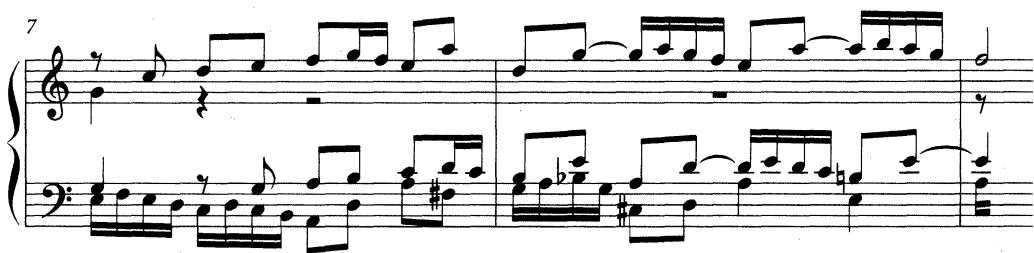
中文讲解
此处为嵌入图像的占位符,仅保留了位置标记“b)”和省略说明,作者可能在与前一幅图配对呈现谱例或表格。图像内容不可见,需查看原书方可确认。
第3段(P0090)
原文复述
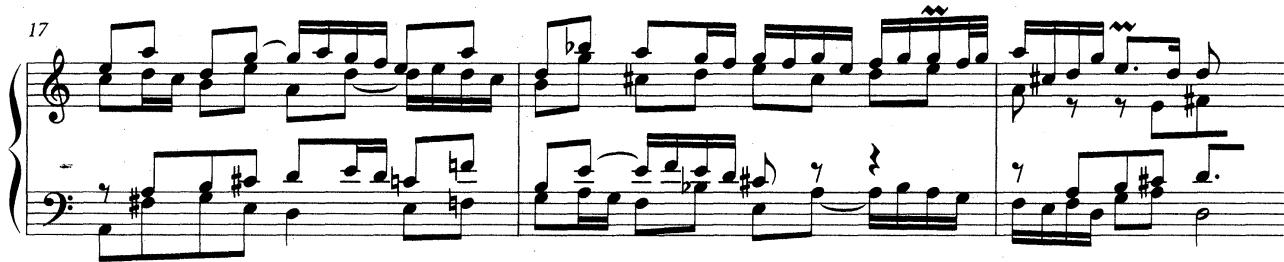
中文讲解
此处为图注“Example 5.7”,说明所引谱例出自《平均律键盘曲集》第一册第 1 首 C 大调赋格,分两部分:(a) 第 7–9 小节,(b) 第 17–19 小节。图像本体被省略,需查阅原书以获得具体音符与对位形态。该例与本节 F# 小调赋格的论述并置出现,提示作者可能借 C 大调赋格中的某片段作为对照,用以说明“反向运动”或其他对位现象在两首作品中的不同呈现方式。
补充说明
图注中标注的 mm. 7–9 与 mm. 17–19 分别对应 C 大调赋格呈示后的两处关键位置,但具体对位细节需依赖原图核证,不可凭推断补写。
第4段(P0091)
原文复述
Dreyfus, Laurence. Bach and the Patterns of Invention. E-book, Cambridge, Mass.: Harvard University Press, 1996, https://hdl.handle.net/2027/heb05561.0001.001. Downloaded on behalf of Indiana University, Bloomington
中文讲解
此段是页脚式的文献来源说明,表明本章所引内容出自 Laurence Dreyfus 所著《Bach and the Patterns of Invention》一书的电子版,由哈佛大学出版社 1996 年出版,并由印第安纳大学布卢明顿分校的用户下载。该出处对正文而言是版本与版权来源,并非论证内容的一部分。
第5段(P0092)
原文复述
Matters of Kind
中文讲解
“Matters of Kind”是页面上的栏目标题/分章标题,提示本页(或本页所属栏目)的主题为“关于分类/种类的探讨”。它属于版面标识,本身不展开论证,仅表明本节论述被纳入更大的章节脉络之中。
脚注 / 边栏 / 图表 / 附加信息(如有)
本小节附加材料包括一处被省略的图像占位符(P0089,仅留“b)”标记)、一处含完整图注的图像占位符(P0090,Example 5.7,引自《平均律键盘曲集》第一册 C 大调赋格 mm. 7–9 与 mm. 17–19),以及页脚式的文献出处说明(P0091,标明所引为 Laurence Dreyfus《Bach and the Patterns of Invention》哈佛大学出版社 1996 年电子版)。这些附加材料分别起对照谱例与版本说明的作用,本身不构成本段论证。
💡 本节核心要点
- F# 小调赋格在听感上要求极高,但整体呈现一种“去时间化”的静态而非动力性听法。
- 主题与单一对题在局部对位上丰富,但在全曲范围内几乎保持原样,唯一的系统性变形是八度上的对位倒影。
- 每一个赋格复合段都被严格限制在主音或属音调级上,并始终维持小调,m. 19 处巴赫刻意回避下属(IV)呈示。
- 插段中若干模进单元被原封不动地、甚至在同一调级上重复,进一步强化了静态印象。
- 材料与调性的高度受限,使得任何细微的对位动作(尤其是反向运动)成为本曲真正“隐藏的创意”所在,为本节标题的论点铺垫。
🔑 关键术语
- fugal materials (赋格材料):指赋格中的主题与对题等基本构成素材;本节用以强调 F# 小调赋格在材料层面的极度稳定。
- contrapuntal inversion (对位倒影):将一条旋律线沿音程轴翻转后形成的对位处理;本节说明巴赫只允许在八度上做这种倒影,且仅在 m. 37–38 一处尝试在十度上倒影并被迫中止。
- fugal complex (赋格复合段):赋格中由若干对位声部交织形成的复合结构段落;本节用以指每次主题/对题呈示并叠加形成的事件单位。
- scale degrees (调级):调式中各音的级数位置;本节指出所有赋格复合段只出现在主音(I)与属音(V)这两个调级上。
- episodes (插段):赋格中不出现完整主题而以模进、片段展开为主的过渡段落;本节强调插段在本曲中并未带来动力性,反而以模进单元的逐字重复强化静态。
- IV / subdominant (下属):调式中第四级;本节引述 m. 19 处巴赫对下属呈示的有意回避,用以反衬全曲调式范围的狭小。
ch1.19 [描述性拆分] Inverted subjects, paradigmatic logic, and the concealed hybrid subgenre of the F# minor fugue
第1段(P0093)
原文复述
Something is distinctly odd about this beautiful and haunting work, but a consideration of events in temporal succession will not, I think, do justice to its mysteries. The fugue, in fact, is hiding one of its most prominent inventions; indeed, the temporal flow and the ordering of local events make it nearly inaudible. I am referring to the two statements of the subject in m. 20 and in m. 32 that are played in contrary motion. In m. 20, the inverted subject begins on the last two quarters in the alto voice and ends in m. 23. In m. 32, Bach puts the inverted subject in the bass. Considering the unexpected reformulation of the subject in contrary motion, it makes sense that Bach worked out the melodic invertibility of the subject as part of his pre-compositional invention. This invention also had a systematic component that should be taken into account. Namely, there are two kinds of melodic inversion that produce a subject in motu contrario, an inversion that preserves interval and an inversion that preserves mode. The rough forms produced by each operation are given in Ex. 5.8. What is especially fascinating is that Bach used slightly polished versions of both kinds of contrary motion within the final piece as a demonstration, perhaps, of a felicitous compositional occurrence. (The asterisks show the points where Bach made a few chromatic alterations.) The version in Ex. 5.8a is worked out in m. 20, while the version in Ex. 5.8b is reflected in m. 32. The reason for this interest in preserving interval or mode can also be connected to the invention of the original subject in its rectus form, which doggedly preserves the intervalic content of four forms of a motive which fills a minor third (F# → G# → A, G# → A# → B, A# → B# → C#, and B → A → G#), a factor that surely accounts for the pained chromatic affect the fugal theme projects.
中文讲解
这段是本节的核心论述,开门见山指出 F# 小调赋格中藏有最显著的对位发明之一,只是时间性的陈述顺序使它几乎听不出来。作者呼吁读者不要按时间顺序去理解,而要回到“前创作发明”层面去审视。
核心事实:主题在 m. 20(高音声部,自第 3、4 拍起,止于 m. 23)和 m. 32(低音声部)以反向(contrary motion / motu contrario)出现。两个反向陈述看似偶然,却是作曲前已经精心设计好的“可逆主题”的产物。
关键区分:反向有两种系统操作——其一“保留音程”(preserves interval),对应 Ex. 5.8a/m. 20;其二“保留调式”(preserves mode),对应 Ex. 5.8b/m. 32。这两种操作在最终作品中都被稍作润色地采用,作者推测这是巴赫有意展示前创作推理过程的一个“幸运的作曲事件”。星号标示出巴赫做了若干半音变化以使反向主题在和声中可行。
更深一层动机:作者把这种对音程/调式分别保留的兴趣回溯到原主题(rectus form)的构造。原主题固执地保留一个填充小三度的动机的音程内容,并给出四种音高序列:F# → G# → A,G# → A# → B,A# → B# → C#,B → A → G#。这四种形式在音程结构上同构,因此主题本身已经潜藏了“可逆”特性;正是这种半音化的密集音程关系,造就了主题“痛苦的、带有半音色彩的表情”(pained chromatic affect)。
本段的功能是为后文作铺垫:先用反向主题这一显例说明“发明先于排布”,再由它引出 fugue 实为 fuga mixta(混合型/混合类赋格)的更大结论。
补充说明
motu contrario 是拉丁文“对向运动”之意,文中解释为 contrary motion;rectus form 相对于 invertibilis,即未经反向的原形主题。四种小三度动机序列中,A# → B# → C# 用到了升 B#(即 C 自然),这是为了在 F# 小调调域内填满小三度音程,保留与 F# → G# → A 同样的半音—全音结构,从而保证四种形态在“音程内容”上彼此等价。
第2段(P0094)
原文复述
Bach and the Patterns of Invention
中文讲解
这是页眉/栏外标题,标明当前所在章节的著作名。
第3段(P0095)
原文复述
Dreyfus, Laurence. Bach and the Patterns of Invention. E-book, Cambridge, Mass.: Harvard University Press, 1996, https://hdl.handle.net/2027/heb05561.0001.001. Downloaded on behalf of Indiana University, Bloomington
中文讲解
这是页脚/版本说明,给出本书的电子版出处:作者 Laurence Dreyfus,书名 Bach and the Patterns of Invention,1996 年由哈佛大学出版社出版,电子版通过 HathiTrust 平台(链接中的 handle 表明)获取,下载由印第安纳大学布卢明顿分校代理。该信息仅用于版本/来源溯源,与正文论证无关。
第4段(P0096)
原文复述
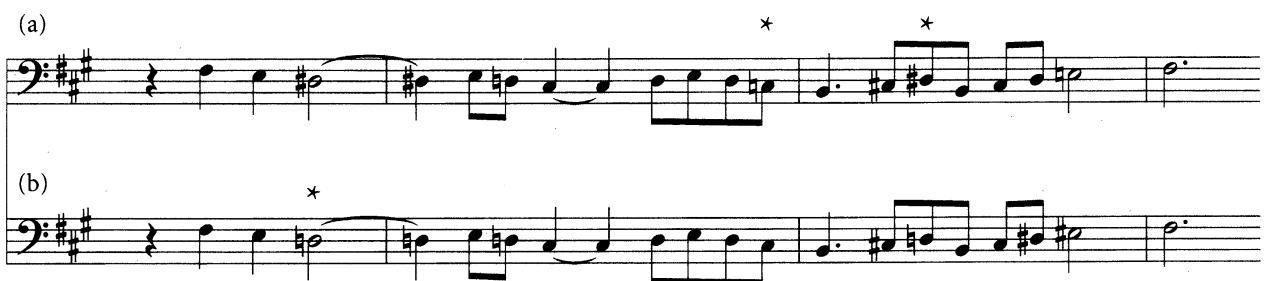
中文讲解
这是 Example 5.8 的图注占位符:标题为“《平均律键盘曲集》第一册第 14 首 F# 小调赋格主题的假想反向”。其中 (a) 为保留音程的反向,(b) 为保留调式的反向。结合上下文,m. 20 对应 Ex. 5.8a(高音声部,自第 3、4 拍起,止于 m. 23),m. 32 对应 Ex. 5.8b(低音声部)。图像具体音符细节需查阅原书。
第5段(P0097)
原文复述
Would it really matter, then, where in the disposition of the piece Bach made use of the inverted subjects? I do not think so. Considering that Bach restricted all fugal statements either to the first or fifth scale degrees, including the two contrary forms, one can argue that the particular order in which he displayed them was not of fundamental concern—that it was the number and quality of inventions that he could coax from his materials rather than their exhibited sequence that counted. For this reason, it is more compelling to hear the piece as a logical succession of paradigmatic changes rather than syntagmatic causalities: chains of metaphors rather than metonymies, as it were. For even when one can “demonstrate” some large-scale intentional sequence, as, for example, Schenker does in his analysis of the C minor fugue (to be discussed in Chapter 6), the relation between events remains essentially logical rather than successive. Naturally there is a temporal dimension at work here, as when I talk of a “logical succession,” but the time in which the logic is contemplated is divorced from the phenomenological sense of time that comes from playing through the completed piece.
中文讲解
本段承接上一段对反向主题的讨论,进一步提出一个方法论主张:作品中的陈述次序并不重要,真正重要的是“可被发掘的发明数量与质量”。作者给出两条理由。其一,巴赫将所有赋格陈述(包括两种反向主题)都限制在主音(I 级)或属音(V 级)上,这种调性层面的统一决定了顺序不是关键。其二,应将作品听作“范式变化”(paradigmatic changes)的逻辑接续,而非“句段因果”(syntagmatic causalities)的时间链。
“范式 vs 句段”与“隐喻 vs 转喻”这一对术语借自语言学(雅各布森/索绪尔传统):在组合轴(句段)上,元素按时间相邻排列,关系是邻近/因果;在选择轴(范式)上,元素按相似/替换排列,关系是隐喻/逻辑。本段是这一语言学类比在音乐分析中的明确运用:作者要读者放弃听“事件 A 导致事件 B”,转而关注“材料 X 在若干变体中的逻辑展开”。
作者以申克(Schenker)对 C 小调赋格(第 6 章将讨论)的分析为例,说明即使可以演示出某种“有意为之的大尺度序列”,事件之间的关系仍是逻辑的而非时序的。结尾区分了“逻辑被思考的时间”与“演奏作品的现象学时间”,表明前者才是分析层面所应立足的时间维度。
本段是全节的方法论枢纽,把“前创作发明 vs 后创作排布”这一对概念落实到分析操作上。
补充说明
Schenker 对 C 小调赋格的分析将在第 6 章展开,本节只作方法论预告,不复述其分析内容。paradigmatic/syntagmatic 与 metaphor/metonymy 的对应是雅各布森在语言学中提出的二元对立,本段将其直接移植到对赋格结构的理解上。
第6段(P0098)
原文复述
Consider next the shaded voice-entries of subject and countersubject that were shown in Table 5.4. Drawing on the traditions of the permutation fugue with its contiguously juggled entries, Bach distributes the two themes within the four-voice framework so that, in several subsequent fugal complexes, the countersubject—Subject 2—enters in the same voice which had just been assigned the subject—Subject 1. Yet only in m. 4 is this linkage temporally relevant, for in each successive occurrence, an episode intervenes between the relevant fugal complexes so that one does not hear the logical continuity shown by the shaded units in Table 5.4. In the larger scheme of things, moreover, the table shows how the two “concealed” inverted subjects interrupt the permutational transfer.
中文讲解
本段将视线转向 Table 5.4 中以阴影标示的主题(Subject 1)与对题(Subject 2)声部进入。作者将其放在“置换赋格”(permutation fugue)的传统中讨论:四声部框架内两主题被“相邻轮换”式地分配,逻辑上呈现为对题紧随同一声部进入主题。
但作者随即用“only in m. 4”一句划出时序与逻辑的分界:只有 m. 4 时这一衔接是听得到的;之后每次重现之间都被插段(episode)隔开,因而 Table 5.4 中阴影所呈现的“逻辑连续性”只在纸面上可见,听觉上却并不连续。这是上一段“逻辑 vs 时序”主题的具体落实。
最后一句回到本节论点:那两个被“隐藏”起来的反向主题打断了原本应可进行的置换传递(permutational transfer)。也就是说,反向陈述不是置换体系内部的一种正常移位,而是从置换逻辑中“插入”或“截断”置换链的事件,因此才需要用“concealed”一词来描述。
本段的作用是把抽象的“范式排列”落到具体的声部分配表上,并以反向主题对置换链的打断来说明:本曲的真正秘密在于置换逻辑之外的反向/对位逻辑。
补充说明
permutation fugue(置换赋格)指主题在四声部间按不同顺序进入的赋格类型,其“逻辑布局”往往体现为声部配对的系统性排列。countersubject 在本文中也被称作 Subject 2,与 Subject 1(主题)相对。
第7段(P0099)
原文复述
By investigating logical before temporal relations—to pursue invention before disposition—one can observe a clear inventive link between the hidden inverted subjects and the countersubject proper. For it is compelling that Bach would have considered, for more than a fleeting moment, a stretto of the inverted subject (or an earlier form of it) applied to the prime form of his theme. Although such a stretto is not feasible, as can be seen by imagining Ex. 5.9a and Ex. 5.9b played simultaneously—note the asterisks in Ex. 5.9b—its realization would have amounted to a stunning tour de force. The duration of four beats on the third note of the subject, which seems calculated to wait for three corresponding quarter notes in the inverted subject, argues strongly for this reading. So too does the final shape of the countersubject itself, shown in Ex. 5.9c, which Bach derived from the first half of the inverted fugal theme at the same time that he was sure to endow it with a distinct melodic profile through the diminutions in eighth notes. Another secret of the F# minor fugue, then, is that it is actually a fuga mixta or hybrid fugue. The piece begins by pretending to be a double fugue on two themes but reveals after close inspection that it is also a counterfugue, or at least aspired to be a full-fledged one in the pre-compositional invention of the work.
中文讲解
本段是本节的总结性高潮:作者把“发明先于排布”这条方法论真正落实到一个具体的、可在乐谱上推演出来的“未实现”发明上——即把反向主题(或其早期形态)与主题原形叠置的密接对位(stretto)。
作者给出三条“内证”,证明巴赫确实在前创作阶段认真考虑过这个 stretto:(1) 主题第三个音长达四拍的时值,似乎专为等待反向主题中三个对应四分音符而设;(2) Ex. 5.9c 显示对题取自反向主题的前半;(3) 在对题上又叠加了八分音符的减值(diminutions),赋予它独立的面貌。换言之,主题、对题、反向主题三者共享一套动机—音程材料,三者之间存在一个潜在的、可被逻辑推演出来的密接叠置关系。
由此作者提出本节最重要的分类学结论:F# 小调赋格实际上是 fuga mixta(混合型/杂交型赋格)。它表面上以两个主题的双赋格(double fugue)姿态出现,但经过细察可知它同时也是一首对位赋格(counterfugue,即主题与对题处处可互换的赋格),或至少在前创作发明阶段曾以“完整的对位赋格”为追求目标。换言之,作品里那两次被藏起来的反向主题,恰恰是把“双赋格”与“对位赋格”这两种本来不同的赋格类型缝合在一起的接缝。
理解要点:这里的“混合”是指类型层面的混合——双赋格(两个主题)+ 对位赋格(主题与对题的可互换性)。它解释了小节标题中“concealed hybrid subgenre”这一表述:在时序铺陈中听不到,但一旦按逻辑—发明方式考察就清晰可见。
补充说明
stretto 在此指主题(或其变形)在前一声部尚未结束时即被另一声部引入所造成的叠置;该 stretto 在本曲中并未真正实现,只存在于前创作层面。fuga mixta 与 counterfugue 两个术语共同界定了本曲的隐藏双重身份:前者指出曲式类型的混合,后者强调主题与对题之间可互换(即可同时上下颠倒)的对位属性。
第8段(P0100)
原文复述
Dreyfus, Laurence. Bach and the Patterns of Invention. E-book, Cambridge, Mass.: Harvard University Press, 1996, https://hdl.handle.net/2027/heb05561.0001.001. Downloaded on behalf of Indiana University, Bloomington
中文讲解
与 P0095 相同的页脚/版本信息重复出现。
第9段(P0101)
原文复述
Matters of Kind
中文讲解
这是下一页的章节标题“Matters of Kind”,预示下文将进入“种类/类型”层面的讨论,正与本节末尾关于 fuga mixta 的分类学结论相衔接。
脚注 / 边栏 / 图表 / 附加信息(如有)
本节涉及的附加材料包括:(1) Example 5.8 的图注(Hypothetical inversions of the subject in F# minor Fugue, WTC I/14: (a) preserves interval; (b) preserves mode.),用于直观展示“保留音程”与“保留调式”两种反向操作的具体形态,并与 m. 20、m. 32 的反向陈述对应;(2) Example 5.9a/5.9b/5.9c(仅在 P0099 中被提及而本节未给出图注),分别对应主题原形与反向主题的假想 stretto 叠置(5.9a 与 5.9b)及实际写成的对题(5.9c);(3) Table 5.4(仅在 P0098 中被提及),其阴影单元标示主题与对题在同一声部连续进入的逻辑布局;(4) 重复出现的页脚/版本说明(P0095 与 P0100 内容相同),属于电子版溯源信息,与正文论证无关;(5) 重复出现的页眉书名(P0094)属于版面要素。
💡 本节核心要点
- F# 小调赋格在前创作发明阶段便已系统地设计了主题的可逆性,体现为 m. 20(高音声部,保留音程)和 m. 32(低音声部,保留调式)两次反向陈述,但时序铺陈使这两处发明几乎听不出来。
- 反向操作分两种系统类型——保留音程与保留调式——其动机可追溯到原主题(rectus form)中四种小三度动机的同构关系,正是这种半音密集的音程构造赋予主题以“痛苦的半音色彩”。
- 理解本曲不应依赖时序因果,而应视为“范式(paradigmatic)变化”的逻辑接续:真正重要的是从同一组材料中可被发掘的发明数量与质量,而非它们被展示的顺序。
- 对照 Table 5.4 的阴影单元可见,置换赋格传统下主题与对题本应在同一声部连续进入(仅 m. 4 在听觉上可辨),但两次“隐藏的”反向陈述打断了置换链,从而显露出曲式背后的另一套逻辑。
- 作品同时是双赋格与对位赋格的混合(fuga mixta):主题第三个音四拍的时值、对题与反向主题前段的材料共享,以及为对题附加的八分音符减值,共同指向一个未被实现的“反向主题与原主题的 stretto”——这一发明在前创作阶段被认真考虑但因不可行而未真正实现,从而把本曲钉在“hybrid subgenre”这一隐藏身份上。
🔑 关键术语
- motu contrario / contrary motion:拉丁文与英文并用,指旋律在反向进行时声部间方向相反。本节中特指主题在 m. 20 与 m. 32 处的反向陈述。
- preserves interval vs preserves mode:两种系统化的反向操作:前者逐音程对位映射(保留音程内容),后者仅保留调式/调性归属而允许音程变形。本节中 m. 20 对应前者,m. 32 对应后者。
- rectus form:主题未经反向的原形(相对于 invertibilis,即反向形式)。本节指出其音程内容被四种小三度动机序列共同维持。
- paradigmatic vs syntagmatic:借自语言学的两轴概念:范式轴上元素按相似/替换关系排列(隐喻式逻辑),句段轴上元素按时序相邻排列(转喻式因果)。本节要求读者按范式轴理解 F# 小调赋格的逻辑结构。
- permutation fugue:主题在四声部间按不同顺序进入的赋格类型;Table 5.4 即展示本曲的置换布局,其中阴影单元标示同一声部连续承担主题与对题的逻辑配对。
- stretto:主题(或其变形)在前一声部尚未结束前即被另一声部引入造成的叠置。本节中讨论的是反向主题与主题原形之间未被实现的“假想 stretto”。
- fuga mixta / hybrid fugue:混合型/杂交型赋格。本节用以指称本曲同时具备双赋格(两主题)与对位赋格(主题与对题可互换)两类属性的隐藏身份。
- counterfugue:主题与对题之间具有可互换性(即全部声部都能上下颠倒演奏)的赋格。本节认为本曲在前创作阶段曾以“完整的对位赋格”为追求目标,但未完全实现于成品。
ch1.20 [描述性拆分] Arcane combinations, time, and the rhetoric of invention in the F# minor fugue
第1段(P0102)
原文复述
One might suppose that Bach was not so content merely to present inverted forms of the subject without any simultaneous contrapuntal combinations or strettos. At any rate, it is remarkable that he goes out of his way to hide his themes in contrary motion. The audibility of the second occurrence in m. 32, though placed prominently in the bass, is compromised because of its placement just after a fugal complex in the tonic. The first statement of the contrary subject—at the end of m. 20 in the alto—is even more opaque, since the voice-leading actually begins by mimicking the sequential pattern in a previous episode in m. 13, going so far as to copy even the identical scale degree. One can guess, therefore, that Bach wanted the naive listener or pupil to miss entirely that the inverted subject was present in this fugue, mistaking its presence for an episode. This is akin to mistaking an invention for an elaboration, something like confusing an authentic form of a ritornello for an episode, as we saw in Chapter 3. To suggest, on the other hand, that a fugal device—the sine qua non of the genre—imitates an episodic elaboration is to say that Bach has it all backwards, at least as far as the rhetorical notions of invention are concerned. The temporal succession of the piece, in this instance, rather than revealing the underlying sense of the piece, controverts the identity of the invention. It does this first by seeming tonally redundant and, second, by concealing thematic relationships that, by rights, should have been proclaimed openly, reminding us that Bach’s work in this genre was not designed for everyone, but for Mattheson’s “exceptional listeners who have a well-disposed mind.”
中文讲解
本段将本小节的论证推向修辞层面,集中解释作者为什么认为 Bach 在 F# 小调赋格中对逆行主题的处理是"反修辞"的修辞。
中心主张:作者认为 Bach 并非仅止于呈现主题的逆行形式——表面上看似缺少严格的对位组合与密接——而是主动把主题材料藏进逆行运动与模仿插段格式之中,从而让听者把本该识别出的对位主题误认为过场插段。
论证的层次:
- m. 32 处逆行主题的第二次进入虽然落在低声部这一显著位置,但因紧随主调上的赋格密集段,其可听性被该密集对位的"听觉残留"遮盖。这是结构位置造成的隐性化。
- m. 20 alto 的第一次进入则更为隐蔽——声部进行本身是在复刻 m. 13 那段插段的模进模式,甚至复制了完全相同的音级,作者用"identical scale degree"强调这种对插段形态的逐项模仿。这一观察把该次进入界定为"伪装成插段的主题出现"。
- 从上述两类处理综合推断,作者提出一个带有反讽意味的修辞意图假设:Bach 希望让"naive listener or pupil"(天真听者或初学者)完全错失这一逆行主题的存在。
- 接着,作者把这个特例升格为体类问题:把 invention(主题陈述)误当作 elaboration(展开插段),类同于在第 3 章讨论过的、把里托奈罗的真实形态误认为插段。这是一个跨章回扣——第 3 章处理协奏—里托奈罗体裁,本章处理赋格,但都涉及"体裁中本应被识别的核心陈述"被结构性掩盖。
- 然后作者点明这一结论的修辞分量:在赋格这种体裁里,对位技术(此处即"主题的重复呈现、组合、密接")是 sine qua non(不可或缺的核心要素);如果连这种要素都被伪装成插段,那在 invention 的修辞范畴内 Bach 就是"反过来了"——本来要揭示主题意义的时间顺序,反而否定了主题身份。
- 收尾用"先看似调性冗余、再隐瞒本该公开的主题关系"两条机制并列交代"时间顺序如何否定主题身份",并以引文收束:作品不是为所有人准备的,而是为 Mattheson 所说的"具有良好禀赋的杰出听者"准备的。这呼应了开头"goes out of his way to hide"的判断。
本段在本小节中的论证作用:将前文以音乐分析证明的"主题隐蔽化"现象,从音乐分析层面转入修辞学层面,解释为 Bach 的有意安排,并把这种安排的功能限定为"对特定听者"的有效——这是一种把分析发现转化为作品美学意图的过渡段落,使后文(关于"创造性范畴与时间")的展开获得立足点。
补充说明
本段使用的几处指代依赖本小节自身上下文即可澄清:m. 13 的插段在前文(第 1.18 与 1.19 小节)已分析其模进形态,m. 20 alto、m. 32 bass 这两次进入在前文也已确认主题身份,故此处"mimicking the sequential pattern in a previous episode"指的是声部进行的姿态在模仿前段插段,而非新引入素材。第 3 章关于"authentic ritornello"与"episode"易混淆的论述,按照本小节作者的提示是 cross-reference,本段只用了类比,不展开。
第2段(P0103)
原文复述
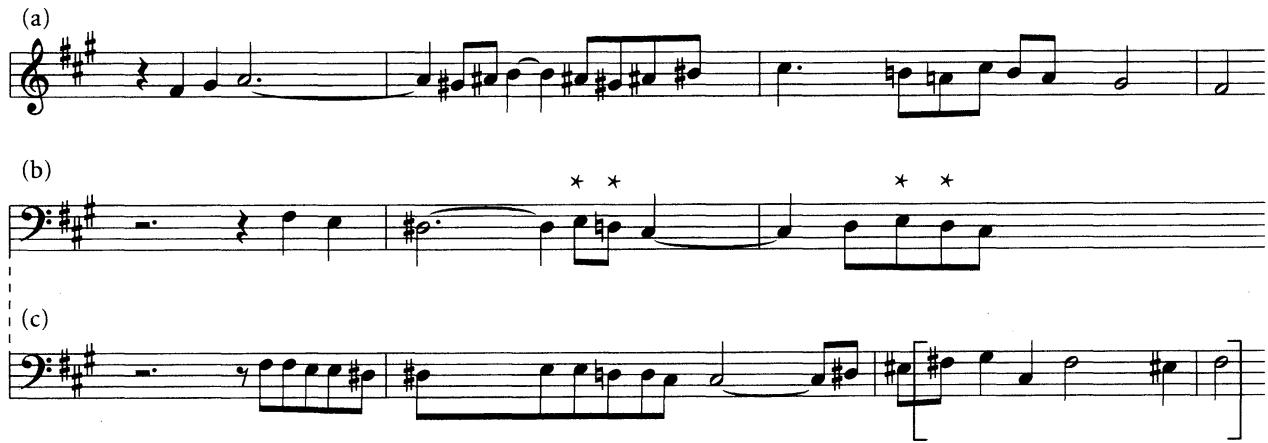
中文讲解
此处为图示占位符,按图注可知其内容是"谱例 5.9:F# 小调赋格(WTC I/14)中对题材料的设想性推演"。从本段的位置与图题判断:该谱例作用是补充上文叙事,说明作者如何从赋格中实际出现的逆行主题形态反向推导出对题材料的潜在原型;它属于本小节音乐分析论证链条中的视觉支持,提示读者需要参照原图查看具体音符与推演过程。仅凭本节文本不足以确证谱例中的具体音符、和声或小节数,需要查阅原书插图。
补充说明
无额外补充(图像细节非当前 task_input 可定位)。
第3段(P0104)
原文复述
158 Bach and the Patterns of Invention Dreyfus, Laurence. Bach and the Patterns of Invention. E-book, Cambridge, Mass.: Harvard University Press, 1996, https://hdl.handle.net/2027/heb05561.0001.001. Downloaded on behalf of Indiana University, Bloomington
中文讲解
本段是页脚与版本/出处信息:上行"158 Bach and the Patterns of Invention"是页码与书名运行页眉;下行是 Laurence Dreyfus 所著《Bach and the Patterns of Invention》的电子书版本信息——出版地为 Cambridge, Mass.,出版社为 Harvard University Press,出版年 1996,并附 HathiTrust 数字馆藏链接(https://hdl.handle.net/2027/heb05561.0001.001),由 Indiana University, Bloomington 代为下载。该页脚提示读者所用文本的版本与获取来源,对正文论证本身不起支持、限定或反驳作用。
脚注 / 边栏 / 图表 / 附加信息(如有)
本小节范围内可确认的附加材料包括:一处图示(Example 5.9,F# 小调赋格 WTC I/14 中对题的设想性推演),其作用是支撑正文中关于"主题被埋藏、对题可由逆行形态反向推得"的分析论述;一段版本与下载出处的页脚信息,提示文本版本来源(Dreyfus 1996 电子版,Indiana University 代为下载)。页眉页码 158 仅起版面定位作用。
💡 本节核心要点
- Bach 在 F# 小调赋格中并非只是技术性地陈述逆行主题,而是通过将主题伪装为插段的方式,主动削弱其作为 invention 的可识别性。
- 两次逆行进入(m. 20 alto 与 m. 32 bass)的隐蔽性分别源于:m. 20 处的声部进行复刻了 m. 13 插段的模进模式甚至同音级,m. 32 处低声部进入紧随主调上的赋格密集段而听觉上被淹没。
- 这种设计的修辞后果是把"赋格体裁的核心要素(主题呈现)“误读为非核心的展开性材料,作者将之与第 3 章里托奈罗真实形态被误认为插段的情形类比。
- 在修辞学意义上,作品的时间顺序不再揭示而是颠覆了 invention 的身份,机制有二:看似调性冗余,以及隐瞒本应公开宣告的主题关系。
- 作者由此提出 Bach 的写作对象并非所有听众,而是 Mattheson 所称的"具有良好禀赋的杰出听者”,为"非普遍化的修辞"这一主题做小结。
🔑 关键术语
- contrary subject / inverted subject(逆行主题):在本段语境中指主题以音程反向的形式再次陈述;本段强调 Bach 让该陈述在听感上被遮蔽。
- stretto(密接):赋格中将主题在更紧密的时间间距上叠加陈述的对位技术;本段被作者列为 Bach 此处"未做"的常规强对位手段之一。
- invention vs. elaboration(主题陈述 vs. 展开插段):本段核心修辞对立:invention 是应被识别的主题材料,elaboration 是用以转调的过场段落;本段论证 Bach 故意使前者具备后者的听感。
- sine qua non(不可或缺之物):本段以此指赋格体裁的核心对位运作(主题的陈述与组合),用以衡量 Bach 的反向处理在体裁内的反常程度。
- Mattheson 的"exceptional listeners who have a well-disposed mind":作者引自 Mattheson 的修辞听众概念,用以说明 Bach 此处的写作意图面向训练有素且心性相契的听者,而非普通爱好者。
- ritornello(里托奈罗):本段以之作为类比锚点,提示第 3 章中关于协奏体裁里托奈罗与插段边界模糊的论述构成本段类比的前例。
ch1.21 [描述性拆分] Ramifications for musical time and the limits of the genre-as-form metaphor
第1段(P0105)
原文复述
This particular example of the arcane ars combinatoria carries notable implications for how musical time is to be understood. Although Bach’s chosen disposition is misleading, one must suppose that at some point he wants a listener to recognize his initial lack of straightforwardness. Whether that recognition comes through analysis or through direct phenomenal experience, and at what moment it occurs, is essentially immaterial. What matters is that the nominal order in which the piece is laid out actually works against this discovery. Seen in retrospect, the limitations of the tonal field, the restrictive use of scale degrees, and the nearly static recycling of the same artifice begin to look like surface symptoms concealing covert processes that subvert the conventions of disposition. To play through the piece while entertaining even these few kinds of thoughts—and there are surely other interpretive avenues worth pursuing—is in effect to ask whether the fundamental sense of a fugue lies in the order in which it presents its materials. At the same time, however, one must freely acknowledge that hiding the inventions inside the specific elaboration of subsidiary ideas, which is what happens in the F# minor fugue, is precisely what grants the piece its characteristic shape and identity. Rather than a single unitary passage of time, then, we encounter multiple temporal dimensions that draw us back into Bach’s fugal workshop, where musical thinking and the relations between musical ideas and God-given principles of harmony exist in tension with the final nominal order in which the results appear.
中文讲解
本段把前文已经展示的"隐秘的组合术"推进一步,引向"音乐时间"这一更抽象的论题。作者的论证链可以拆成三层。
第一层是关于巴赫意图的推断:即使表面布局(disposition)具有误导性,巴赫终究希望有人发现他最初的"不坦诚"。至于是通过分析得出还是通过聆听直觉显现,作者明确表态"无关紧要",因为他真正想凸显的是下一句——“名义上的次序”(即作品按页面顺序呈现的次序)实际上与这种发现"作对"。换句话说,表面曲序天然会遮蔽底层结构。
第二层是回溯式的重新阅读:调性领域的局限、音级的节制使用、同一手法的近乎静止的反复——这些表面特征都被重新诠释为"症候",它们遮盖的是暗中拆解disposition常规的过程。读者只要在演奏过程中抱持这类想法,就已经在追问"赋格的根本意义是否存在于材料呈现的次序之中"这一根本问题。
第三层是关键的反向承认:尽管隐蔽化(把invention藏在subsidiary ideas的特定展开中)造成了与表面次序的冲突,恰恰是这种隐蔽让F#小调赋格获得了独有的形态与身份。最后的比喻尤其重要——不存在单一的、统一的"时间通道",而是许多"时间维度",它们把听者拉回巴赫的"赋格工坊"。在那里,具体的音乐思维、音乐观念与"神赋和声原则"之间的关系,和最终名义上呈现的次序之间,构成了一种张力。
本段在本小节中的作用:它把"赋格意义是否在曲序"的问题悬置起来,引出下一段关于"genre as form"隐喻局限的讨论。读者须注意:本段并不否认disposition的作用,而是主张它只是表层,还有更深的"时间"层次与covert processes并存。
补充说明
disposition在本节中专指作品各部分被安排呈现的先后次序(nominal order),与下文"genre as form"中的form形成对照:后者强调外部的、段落性的形式安排,前者则具体指乐谱上呈现给演奏者/听者的曲序。F#小调赋格在本节是具体的论证载体,但本节输入未指明它属于《平均律键盘曲集》第几册第几首,故补充中不做猜测。
第2段(P0106)
原文复述
Although it functions only as a point of departure, the technical competence of a contemporary listener is crucial for distinguishing the subgenres that articulate a set of musical values against which any given Bach fugue can be measured. Does form enter the picture here? It does, but not as an external sectional plan, nor even as a predictable ordering of events. What needs attention instead are the specifiable procedures that constitute the different subgenres, because in the case of the fugue these distinctions mattered both to the composer and to the people to whom he communicated. This is why one must keep in mind that ‘genre as form’ was, in the end, only a metaphor. The metaphor’s power—its capacity to project the shapes of generic objects before us—is easy to appreciate, yet one should remain alert to the competing meanings the metaphor tends to suppress. Thinking past the metaphor therefore brings to light other components of genre beyond the formal ones, especially those neglected by the nineteenth-century architectural model. The metaphor caused little harm before the era of Adolph Bernhard Marx, but unless it is supplemented by competing figures of speech, it risks eliminating the very people who invest musical genres with meaning.
中文讲解
本段是本小节论证的枢纽:从个案(F#小调赋格)上升到方法论批评。
第一句设定了隐含读者。“同时代人的能力"之所以"只是出发点却至关重要”,是因为只有具备这种能力的听者才能区分子类型(subgenres),而正是这些子类型构成了衡量任何一首巴赫赋格的"音乐价值坐标系"。请注意"测量"这一隐喻——它把genre的功能从"装饰/标签"转换为"标尺"。
第二组句子重新定义form在这里的含义。“形式确有作用”,但既不是外在的、段落式的图式,也不是可预测的事件排序;真正应被关注的是"可指明的程序"(specifiable procedures),它们构成了不同子类型。换言之,作者并非否认形式,而是要把"形式"从几何/建筑意义的form重定向为可执行、可辨认的程序集合。
第三层是方法论的自觉:为什么必须记住"genre as form"终究只是隐喻?作者承认这种隐喻有力量——它能把"属类对象"的形状投射在我们面前——但同时警告它会压抑隐喻之外的含义。一旦越过这个隐喻,genre的其他组成要素就会浮现,特别是那些被19世纪建筑学模型(form as architecture)所忽略的部分。在Adolph Bernhard Marx之前的时代,这种隐喻并无大碍;但一旦被Marx式的建筑学模型固化下来,如果不用其他语言图式加以补充,它就会"抹去"那些原本为genre注入意义的人——也就是作曲家和当时的听众。
本段在整节中的作用:它给出了本节的方法论立场——形式分析不足以替代genre分析;genre分析需要的是subgenre的程序性识别能力,而不是把赋格套入某种建筑式框架。这也是为什么紧接着P0107会用《赋格的艺术》作为genre-based reading的强证据。
补充说明
作者在19世纪建筑学模型这一点上特别点名Marx,提示读者:马克思式的乐式分析(Sonata form theory)是把genre与form绑定为隐喻的关键推手,使后人难以从形式之中再剥离出subgenre的程序维度。本段输入没有提供Marx的著作信息,故此处不做外部延伸。
第3段(P0107)
原文复述
Bach’s theoretically conceived Kunst der Fuge, which as is now known was begun in the early 1740s and reworked as late as autumn 1749, provides further substantial evidence that sustains and extends this genre-based reading of the Well-Tempered Clavier, since the overall ordering scheme of the set of fugues—each conspicuously titled a Contrapunctus—follows a systematic plan based on the logical properties of the various contrapuntal techniques. Without entering the debates surrounding the ideal sequence of movements in the Art of Fugue, it is worth noting how, in Bach’s final commentary on the genre, a conception of fugal ‘art’ becomes bound up with hierarchical values grounded in the increasing complexity of learned techniques. In the early version of Kunst der Fuge preserved in the autograph manuscript—a coherent plan, as Christoph Wolff has persuasively shown—Bach begins with (1) simple fugues (founded on a disinterest in invertible counterpoint), advances to (2) double fugues (including double fugues on two themes and counterfugues likewise founded on invertible counterpoint), proceeds to a group comprising (3) two canons and two double fugues on three themes (later numbers 8 and 11) whose subjects melodically invert one another, and concludes with (4) two mirror fugues, which can be understood as canonic counterfugues (since the entirety of the inversus is generated by ‘rule’ from the rectus). In the later version intended for publication—one that Bach himself never brought to completion—the revised layout (whose ultimate form must remain conjectural) likewise orders the individual pieces according to a slightly different but equally valid notion of fugal subgenres. Bach still opens with (1) the simple fugues (now increased in number from three to four), passes to (2) three counterfugues (now treated as a separate category), advances to (3) four double fugues on two or three themes (engaging invertible counterpoint at the octave, the twelfth, the tenth, and finally a hybrid combining double fugue and counterfugue), continues to (4) the mirror fugues, then (5) the four canons, and most likely ends with (6) the (incomplete) double fugue on four themes, which incorporates not only the bold insertion of Bach’s monogram (B-A-C-H, understood in German as B-A-C-B♭) but also features of melodic inversion (counterfugue) and stretto (canon), functioning as a kind of extended fugal peroration that sums up the entire collection.
中文讲解
本段是本节最长的实证段落,作用是把前一段的方法论主张落到《赋格的艺术》这一具体作品上。论证结构分为四个层次。
第一层是定位:《赋格的艺术》在1740年代初开始写作,直到1749年秋仍在修订,是"genre-based reading"的进一步强证据。每一首都被显著地命名为Contrapunctus,集合的总体排序是按对位技巧的逻辑性质系统安排的——这一点直接呼应了上一段"specifiable procedures"的方法论要求。
第二层是方法论自觉:作者明确说"不进入关于《赋格的艺术》理想曲序的争论",但仍要指出,在巴赫对genre的"最终评论"中,赋格的"艺术"概念与"基于日益复杂的学究技巧的等级化价值"紧密绑在一起。也就是说,整个曲集本身就是一篇关于genre的评论。
第三层是早期手稿版本的四组顺序,按技术复杂度递增:(1)简单赋格(以忽略可逆对位为前提);(2)二重赋格(含二主题二重赋格和同样基于可逆对位的反行赋格);(3)两首卡农与两首三主题二重赋格(后来的第8与第11首,主题互相旋律倒影);(4)两首镜像赋格,可理解为卡农式反行赋格(因为整个inversus都按"规则"从rectus产生)。作者在此标注:手稿版本是一个"coherent plan",这是Christoph Wolff已经具有说服力地论证过的事实。
第四层是出版版本的六组顺序(最终形态仍属推测):(1)简单赋格(数量从三增至四);(2)三首反行赋格(独立成组);(3)四首二或三主题二重赋格(涉及八度、十二度、十度的可逆对位,最后是一首混合性的二重赋格兼反行赋格);(4)镜像赋格;(5)四首卡农;(6)(未完成的)四主题二重赋格,其中不仅大胆嵌入了巴赫的字母签名(B-A-C-H,按德语读作B♭-A-C-B♭),还融合了旋律倒影(反行赋格)与紧接模仿(卡农)的要素,构成"整部曲集的扩展性赋格式总结段落"。
读者须特别注意三处限定:(a)出版版本是巴赫本人从未完成的,故"最终形态必然仍是推测";(b)结尾的四主题赋格是"很可能"在末尾;(c)Wolff的论证对象是"早期手稿版本"的连贯性,而非出版版本。两版顺序不同,但同样基于subgenre原则,因此是"略微不同但同样有效的"赋格子类型观念。
B-A-C-H按德语音名读为B♭-A-C-B♭这一解码,是理解末赋格"个人签名"嵌入的关键,也是它能充当genre总结段落的修辞理由:作曲家本人以最私人的符号,把genre的全部技术容量集于一身。
补充说明
原文中三个脚注标记(27、28、29)所对应的脚注正文未出现在本节source_paragraphs中;P0108是独立的电子版访问信息,而非上述任何脚注的注释内容,因此本节无法补出27、28、29号脚注的正文。读者若需脚注内容,应回到原书查阅。Contrapunctus是拉丁语,意为"对位曲",本节输入未对其作进一步解释。镜像赋格、反行赋格、可逆对位、紧接模仿、字母签名等术语均集中在本节末尾出现,故统一在terms中说明。
第4段(P0108)
原文复述
Dreyfus, Laurence. Bach and the Patterns of Invention. E-book, Cambridge, Mass.: Harvard University Press, 1996, https://hdl.handle.net/2027/heb05561.0001.001. Downloaded on behalf of Indiana University, Bloomington.
中文讲解
这是一条电子版访问信息,并非对正文中某条具体主张的脚注。它的作用是标明本节所属电子书的版本、出版地、出版年份、出版社、HathiTrust标识符以及代为下载的机构(印第安纳大学伯明顿分校)。对本节任何实质论证都没有脚注功能——它不属于作者在正文中引用的注释体系,而更像是电子书平台附带的版本/来源声明。读者在阅读时无需将其与正文主张建立支持、限定或反驳关系。
补充说明
HathiTrust的标识符格式与哈佛大学出版社1996年平装/电子版的书目一致;该条目出现在source_paragraphs中可能源于电子书元数据的截取,因此建议视为"来源/版本说明"而非内容脚注。
第5段(P0109)
原文复述
Matters of Kind
中文讲解
这是本节末尾的章节/小节标题。Matters of Kind字面意为"种类的问题"或"关乎类别的事宜",其中Kind既呼应上文反复出现的genre(种类、子类型),也带有哲学上"自然种类"(natural kinds)的潜在指向——即genre不是任意标签,而是有内在区分度(specifiable procedures)的"类"。它的标题功能是开启下一阶段的论题:把赋格这类genre放进"分类学"框架中重新审视。读者需注意:此处不作主题概括,因此本节结尾本身没有论述内容;本段的功能纯粹是版面上的过渡标记。
脚注 / 边栏 / 图表 / 附加信息(如有)
本节在P0107正文中标注了三个脚注引用(27、28、29),分别涉及《赋格的艺术》的起止修订时间、Christoph Wolff关于手稿版本连贯性的论证、以及末赋格作为"扩展性赋格式总结段落"的具体来源。然而,这三个脚注的正文并未出现在source_paragraphs中,故本节无法复述其内容;P0108属于电子书访问信息,而非上述任何脚注。读者如需查证脚注细节,应回原书核对。P0109 “Matters of Kind"为下一阶段的章节标题,承担版面前后衔接的功能。
💡 本节核心要点
- 巴赫F#小调赋格中的隐秘组合术造成了"表面disposition次序"与"底层covert processes"之间的张力,作者用"多个时间维度"取代"单一时间通道"来刻画这种张力,而非简单地否定曲序本身的作用。
- 把invention藏入subsidiary ideas的展开,恰恰是F#小调赋格获得其"独有形态与身份"的原因——隐蔽化不是缺陷,而是作品的构成性特征,与表面次序的冲突也是赋格意义的一部分。
- “Genre as form"只是隐喻:它能投射出属类对象的形状,但也压抑了其他组成要素;尤其在Adolph Bernhard Marx之后,该隐喻被固化为19世纪建筑学模型,可能抹去作曲家和当时听者这些为genre注入意义的人。
- 真正应被关注的是subgenre的"可指明的程序”(specifiable procedures),而当代听者的能力是从这一程序层面识别子类型的必要起点——这构成了衡量任何一首巴赫赋格的"音乐价值坐标系”。
- 《赋格的艺术》整部曲集本身就是巴赫对genre的"最终评论":早期手稿版按四组(简单→二重→混合→镜像)、出版版按六组(再细分至四主题综合赋格)排列,均以对位技巧的复杂度递增为内在逻辑。
- 末赋格嵌入B-A-C-H(按德语读为B♭-A-C-B♭)并综合反行赋格(旋律倒影)与紧接模仿(卡农)的要素,构成"扩展性赋格式总结段落"——它以最私人的符号把genre的全部技术容量集于一身,呼应了上一段"不要抹去为genre注入意义的人"的方法论立场。
🔑 关键术语
- Ars combinatoria:拉丁语"组合之术",本节中指巴赫赋格底层运作的隐秘组合程序;它不直接呈现于表面次序,而是通过covert processes隐蔽地拆解disposition的常规。
- Disposition:在本节中专指作品各部分被安排呈现的先后次序(即nominal order),与"form作为外在建筑式图式"形成对比。F#小调赋格表面所见的曲序即其disposition。
- Subgenre:“子类型”;本节主张genre的意义不在笼统的形式,而在subgenre这一层次。每个subgenre由"可指明的程序"(specifiable procedures)构成,是衡量具体作品的坐标系。
- Genre-as-form metaphor:“把genre当作form的隐喻”;作者主张这只是隐喻,会压抑除形式外的genre组成要素,特别在Marx之后被固化为19世纪建筑学模型,可能抹去为genre注入意义的人。
- Invertible counterpoint:“可逆对位”,指主题与对题在倒影/移位后仍保持对位有效的技术;其使用与否是本节划分子类型的标尺之一(如简单赋格被界定为"以忽略可逆对位为前提")。
- Counterfugue:“反行赋格”,以主题的旋律倒影(inversus)作为对位基础的赋格;本节中它可与二重赋格结合,也可独立成组(出版版第(2)组)。
- Mirror fugue:“镜像赋格”,整首的inversus都由"规则"从rectus生成,可被理解为一种canonic counterfugue;出现在两版的末尾段(第(4)组),代表本集中技法复杂度的较高阶段。
- Stretto:“紧接模仿”,主题在各声部以重叠方式先后进入;末赋格综合了卡农(stretto)与反行赋格(melodic inversion)两种属性。
- Peroration:“总结性段落”,本节用于描述末赋格的功能定位——作为整部曲集的"扩展性赋格式总结",把整套对位技术凝缩进一首未完成作品中。
- Monogram (B-A-C-H = B♭-A-C-B♭):巴赫的字母签名,按德语音名读作B♭-A-C-B♭;末赋格大胆嵌入这一签名,是作品充当"genre总结"的修辞根据,也呼应了作者关于"不要抹去为genre注入意义的人"的方法论立场。
- Matters of Kind:本节末尾的章节/小节标题,字面意为"种类的问题",开启下一阶段以"类"与"子类型"为框架的genre讨论;它本身不是论证,而是版面前后衔接的标记。
ch1.22 [描述性拆分] The Art of Fugue as ordered by hierarchical values of contrapuntal complexity
第1段(P0110)
原文复述
Examining these pieces from the vantage point of the kinds of fugal invention, it is striking how, within the context of a monothematic work, Bach was never concerned with providing “textbook” examples of the subgenres, which might conceivably have laid out the disposition of each piece in an exemplary and pedagogically justifiable order. Typically, he crafted instead a set of highly idiosyncratic pieces that show how very far fugal invention can be pursued in the quest for harmonic insights. It is as if Bach were rising to a challenge set by the likes of Niedt and Mattheson, who earlier in the century had inveighed against the empty artificialities of the contrapuntal masters and responded by providing examples of artifice that were turned into art, that is, music which appealed in every way to the ear as well as to the intellect. This is why the Art of Fugue pieces so often go out of their way to frustrate pedagogically-oriented definitions of fugal procedures at the same time that they assert the preternatural status of fugal procedures as a source of the most inspired inventions.
中文讲解
本段从"赋格创作手法"的角度审视《赋格的艺术》中的各首曲子,提出一个核心观察:在一部单一主题(monothematic)的作品语境里,巴赫从不追求提供各"子类型(subgenres)“的标准教科书式示范——那种可以以示范性、教学上合乎逻辑的顺序铺陈出每一曲布局的安排。相反,他通常打造的是一组高度个人化(idiosyncratic)的曲子,藉此展示赋格创作手法在追求和声洞见(harmonic insights)的道路上能够走多远。
本段承接前文对各赋格曲具体复杂度的分级比较,进而把它们纳入一个更宏大、带有音乐史意识的解释框架:作者用一句话"仿佛巴赫正是在回应一种挑战”(It is as if Bach were rising to a challenge)引入历史背景——尼德(Niedt)和马泰松(Mattheson)在18世纪早期曾痛斥对位大师笔下"空洞的人工造作"(empty artificialities of the contrapuntal masters)。作者的论点是,巴赫以自己的方式"作出回应":他提供的是把技巧变为艺术(artifice turned into art)的范例,即不仅诉诸理智、同时在每一层面都诉诸耳朵的音乐。
“诉诸耳朵”(appealed to the ear)这一短语尤为关键:它对应"非教科书式"(not “textbook”)和"个人化"(idiosyncratic),指向一种以听感中的和谐与美为最终判准,而非以教科书规则清单的可演示性为判准的作曲态度。
最后一句归纳出本段的辩证结论:《赋格的艺术》各曲之所以常常刻意"阻挠"(frustrate)以教学法为导向的对赋格程序的定义,正是因为它们同时在断言——赋格程序作为灵感创作(inspired inventions)的来源,具有一种超自然的(preternatural)地位。“超自然"一词揭示出赋格程序对巴赫而言不仅是技术,更是一种近乎神授的灵感源泉;因此任何把赋格降格为分类学条目的做法,都会同时遮蔽它作为灵感源泉的这一面。整段在全节论证中起到的作用是:为后文按对位复杂度排列的描述提供一个由它回溯的"创作哲学"根基。
补充说明
本段对 Niedt 与 Mattheson 的提及,仅以"earlier in the century"指明时间背景(18世纪早期),并交代了他们在该世纪对当时对位大师的批评观点,为理解巴赫"将人工造作转化为艺术"这一回应提供历史动因;除此之外未对二人作进一步介绍。
第2段(P0111)
原文复述
The opening fugue, Contrapunctus 1, for example, adheres to the most rigorous restrictions on the subject by insisting that the “rectus” theme be confined to the two scale degrees contained in the original statements of the dux and comes. At the same time Bach is able to demonstrate a “method” that produces an astoundingly beautiful piece of music. His conceit here can be understood as a principle of near non-repeatability, a procedure by which the free counterpoint that accompanies each statement of the subject continually furnishes a fresh contrapuntal environment for the theme, which itself appears embedded in the free counterpoint rather than having been “harmonized” by seeking out mere embellishments of triadic chords built upon the subject. In the same way, the episodes that link up the fugal statements are likewise conceived so that no one progression of voice-leading is ever heard in exactly the same form. The resulting elegant quality of progressive discourse shows how the fuga simplex lies only a hair’s breadth away from the only apparent greater freedom found in free composition.
中文讲解
本段以前一段提出的"非教科书式、个人化"创作为背景,以《赋格的艺术》第一首 Contrapunctus 1 为具体例证来落实论点。
段中提出一个形式条件:主题(subject)的"rectus"形态被严格限制在dux(先现)和comes(答句)首次呈现时仅包含的两个音级之内。这是一个相当苛刻的约束——主题的旋律骨架只能由那两个音级构成。这相当于在最严格的限制下展开。
紧接的关键概念是"近乎不可重复性”(near non-repeatability)。它被作者定义为一种程序:每一次主题陈述所伴随的自由对位(free counterpoint)都为该主题提供一种全新的对位环境(fresh contrapuntal environment)。也就是说,尽管主题材料本身高度受限,但每一次"伴随它的写作背景"都被刻意设计得独一无二。作者还通过一个对照句来说明这种关系的实质:主题"嵌入"(embedded)在自由对位之中,而不是反过来——主题(及其之上的三和弦)寻求装饰性点缀,然后被"和声化(harmonized)"。换言之,主题并不是一个静态骨架等着被三和弦与装饰音加以"装饰";主题是处在自由对位的活动关系网络之中的一个活跃成分,每一个活动关系都重新组织主题被听到的语境。
这种"近乎不可重复性"的程序不只用于主题陈述之间的自由对位,同样也用于连接各赋格陈述的插部(episodes):作者指出,每一处插部的声部进行(voice-leading progression)都不会以完全相同的形式再现。
段末以"逐步推进的话语之优雅"(elegant quality of progressive discourse)作为效果描述,落到本节的总命题上:fuga simplex(简单赋格)与表面上看起来更自由的自由作曲(free composition)之间的差距只有"一发之隔"(a hair’s breadth)。这是一个重要论断:表面上看,自由作曲似乎比严格遵循规则的简单赋格享有更大的自由;而作者则揭示——只要写作严格到产生"渐次推进的话语"这种品质,其结果在自由度上已经逼近自由作曲。形式上的严格并不等于听感上的受限,这是本段揭示的真正意味。
本段在全节中的功能,是用单独一首具体赋格去验证P0110中那一条总原则:作品既遵守严格规则,又不停留在教科书层面,而是每次陈述都焕发新的对位语境;这正是阻挠教学法导向之定义、同时又展示赋格灵感性的具体机制。
补充说明
本段引入"fuga simplex(简单赋格)“作为与"free composition(自由作曲)“相对照的两端,并指出二者自由度上仅有细微差别。这一对照是本段最核心的论断,但作者并未给出更细致的体裁分类说明;本节其余内容需要为这一论断提供更具体的曲目例证。
第3段(P0112)
原文复述
Bach and the Patterns of Invention
中文讲解
本段在版面中呈现为一行独立标题"Bach and the Patterns of Invention”,结构上起分章或分节题的作用。它引出后续将要展开的新论域——巴赫的"发明模式”。就本节而言,它标志着前面从按对位复杂度排列的视角讨论《赋格的艺术》告一段落,下文转入更一般地讨论巴赫发明性写作所形成的模式。
补充:此标题恰好与末尾的引用信息(P0113)中的书名相同,可推测它是书中某个更大的章或节的题名,本节内容即是该章节开头讨论《赋格的艺术》的一部分。
第4段(P0113)
原文复述
Dreyfus, Laurence. Bach and the Patterns of Invention. E-book, Cambridge, Mass.: Harvard University Press, 1996, https://hdl.handle.net/2027/heb05561.0001.001. Downloaded on behalf of Indiana University, Bloomington
中文讲解
本段为一份书目引用信息,按学术出版规范列出作者、书名、出版形式、出版地、出版社、出版年份、可访问的电子资源链接(hdl.handle.net),以及下载授权方(Indiana University, Bloomington)。
这一引用对正文主张起支持与限定作用:它是Dreyfus本人观点的出处——即《赋格的艺术》各曲"诉诸耳朵而非教科书分类"、Contrapunctus 1 以"近乎不可重复性"程序来组织自由对位等具体论断的来源。同时它也限定了本节论点的权威性范围:这些观察代表的是Dreyfus在1996年该书中提出的解释,而非必要的事实。
💡 本节核心要点
🔑 关键术语
- monothematic work:指单一主题贯穿全作品的作品。《赋格的艺术》即属此类:所有Contrapunctus建立在同一主题(及其变体)之上,而不像《平均律键盘曲集》每首前奏曲与赋格用各自独立的主题。
- rectus / dux / comes:rectus(“正格”)为主题的原形;dux(先现)为赋格中首先陈述主题的声部;comes(答句)为紧接着以五度(或四度)模仿dux的声部。本节以"rectus主题被限于原初dux与comes首次陈述时包含的两个音级"的形式条件,描述Contrapunctus 1的主题约束。
- free counterpoint:与主题陈述相对应的非严格模仿声部。本节强调在Contrapunctus 1中,主题是"嵌入"在自由对位之中,而非先有三和弦骨架再去"和声化"主题——这是判断该曲是否摆脱教学法导向的关键。
- fuga simplex:“简单赋格”,指只含主题陈述而无复杂的转位、增值、紧缩等扩展手法的传统赋格类型。本节将它与"free composition(自由写作)“对置,论证二者之间的自由度差距极小。
- near non-repeatability:“近乎不可重复性”——本节用以刻画Contrapunctus 1的写作原则:虽然主题材料受到严格限制,但每一次主题出现时伴随的自由对位都呈现崭新的对位语境,从而避免任何陈述被原样重复。
- artifice turned into art:“把技巧/人工造作转化为艺术”。本节用此短语概括巴赫对Niedt、Mattheson批评的回应:把对位技法从空洞的智力展示转化为既诉诸理智又诉诸耳朵的音乐。
ch1.23 [描述性拆分] Thematic transformation in Contrapuncti 1–4 and Bach’s standards for good fugue
第1段(P0114)
原文复述
Arriving on the heels of two fugues in which the theme has been subjected to increasing alterations, Contrapunctus 4 (newly composed for the proposed printed version of the Art of Fugue) takes this notion of thematic distortion one further step, a step that fundamentally compromises the triadic identity of the Art of Fugue theme. When one looks at the successive transformations of the subjects within the four simple fugues (shown in Ex. 5.10), it becomes apparent how Bach is far from demonstrating a set of limitations placed on him by strict composition—quite the contrary, he is demonstrating the extent to which degrees of freedom oblige a composer to seek ever more inventive combinations. Taken as a set, the forms of the Art of Fugue theme recall a revealing conversation between Friedrich Wilhelm Marpurg and Bach in which Bach criticized a fellow fugue writer for retaining the identical form of a subject throughout a fugue. Marpurg reports:
中文讲解
本段提出了本节的核心论点:Contrapunctus 4(为《赋格的艺术》拟议中的印刷版新写)承接了前两首对主题逐步变形的思路,并把主题扭曲推到了损害《赋格的艺术》主题原本三和弦身份的程度。所谓"三和弦身份"指主题建立于清晰分解三和弦之上的可识别音型;变形越激进,这种可识别性就越被侵蚀。
作者借此完成一个重要的视角转换:当我们把四首简单赋格中的主题变形看作一组(参见例5.10)时,看到的不是巴赫受制于严格写作的束缚,恰恰相反——自由度越大,越迫使作曲家去寻找更具创造性的组合方式。也就是说,规则并不压缩巴赫,反而把他逼向更丰富的变化。
段末引出Marpurg与巴赫的对话作为支撑:巴赫曾批评一位对位作家在一整首赋格中始终保持主题形态不变。这段引文的预告,为下一段(Marpurg的实录)做了铺垫。整段的论证结构是:先给现象(变形加剧),再给解释(自由度催生创造性),最后用历史证词(巴赫本人的评价)来支撑。
补充说明
例5.10(Ex. 5.10)在原书中以谱例汇总四首简单赋格主题的逐次变形,是本段论断得以成立的关键视觉证据,读者需对照原谱方能直观感受变形的累积效果。“简单赋格”(simple fugues)在本书中指Contrapuncti 1–4,未加入复杂主题倒影(inversion)等技法。
第2段(P0115)
原文复述
When during my stay in Leipzig I was discussing with him certain matters concerning the fugue, I myself heard him pronounce the works of an old and hard-working contrapuntist dry and wooden, and certain fugues by a more modern and no less great contrapuntist—that is in the form in which they are arranged for clavier—pedantic; the first because the composer stuck continuously to his principal subject, without any change; and the second because, at least in the fugues under discussion, he had not shown enough fire to reanimate the theme by interludes. $^{30}$
中文讲解
本段是Marpurg转述巴赫原话的引文(脚注30)。Marpurg回忆在莱比锡与巴赫讨论赋格问题时,亲耳听到巴赫评价:一位年长而勤奋的对位家的作品"干枯而木讷”(dry and wooden),因为此人始终紧贴主要主题、毫无变化;另一位更现代、同样伟大的对位家的某些为键盘而作的赋格则"学究气"(pedantic),因为在所讨论的这些赋格中,他未表现出足够的热情,用插段(interludes)来重新激活主题。
这段引文信息密度很高,可分三层:
- 时间地点:Marpurg在莱比锡居留期间;
- 两种缺陷的对照:死守主题不变 vs. 没有通过插段给主题注入活力;
- 关键词:dry and wooden、pedantic、without any change、not enough fire、reanimate the theme by interludes。其中"用插段重新激活主题"是一项具体可操作的技术指标——插段不仅用于转调或连接,更承担赋予主题新生命的功能。
值得注意的是,两种批评看似相反(一为不变,一为缺乏热情),但实际上指向同一个反面:缺乏使主题"活着"的能力。
补充说明
“对位家”(contrapuntist)指擅长严格对位写作的作曲家。“为键盘而安排”(arranged for clavier)的措辞提示批评对象包括从其他体裁移植到键盘演奏的改编曲。脚注30在原书中应给出这段引文的具体出处及页码,本节写作中以Marpurg的转述作为巴赫审美标准的间接证词。
第3段(P0116)
原文复述
What is fascinating in this account are the terms used to characterize bad fugues: “dry and wooden” in the first instance; “pedantic” in the other. Turning these terms around, one can gain some insight into Bach’s own values regarding fugue—that they must appear “fresh and lifelike” so as to aspire to “art” rather than pedantry. The organic metaphors are hardly coincidental (though they still do not approach the saturated legacy of early twentieth-century analytical organicism) and suggest that fugal invention toyed with genre expectations precisely so as to appear lifelike to the people who listened to and played the fugues.
中文讲解
本段对上一段引文进行关键性分析:作者把巴赫使用的否定性词汇(dry and wooden、pedantic)反过来,提取出巴赫的正面审美标准——赋格必须显得"清新且栩栩如生"(fresh and lifelike),以期达到"艺术"(art)而非学究气的境界。
这一"反向解读"的方法论价值在于:巴赫没有直接给出正面定义,我们只能从他批评他人的用词中间接推导出他的理想。“fresh and lifelike"因此是经由negation得到的美学原则。
作者特别指出其中的"有机隐喻”(organic metaphors)——dry/wooden、lifelike、reanimate——并非偶然,但又审慎地把它们与20世纪早期分析学中盛行的"有机主义"(organicism)传统区分开,提醒读者不要过度套用后来Schenker学派或Hindemith等人那种体系化的有机论。这种自我设限体现了作者的史学自觉:他承认巴赫时代确有有机类比的修辞资源,但避免把现代理论框架强加于18世纪实践。
段末点出真正的功能:赋格写作通过玩弄体裁惯例(genre expectations),让听者与演奏者感到音乐是"活的"。也就是说,变形不是炫技,而是为了让音乐在听感上具备生命感。
补充说明
“体裁惯例”(genre expectations)在此指当时听众和演奏者对"赋格应如何展开"的潜在预期;巴赫的变形策略部分地是为了与这些预期形成对话。
第4段(P0117)
原文复述
Dreyfus, Laurence. Bach and the Patterns of Invention. E-book, Cambridge, Mass.: Harvard University Press, 1996, https://hdl.handle.net/2027/heb05561.0001.001. Downloaded on behalf of Indiana University, Bloomington
中文讲解
本段是脚注30对应的文献出处信息:Laurence Dreyfus, Bach and the Patterns of Invention,哈佛大学出版社1996年电子书版,由密歇根大学(经Handle.Net平台托管)提供下载资源,本副本系为印第安纳大学布鲁明顿分校用户下载。
作为脚注信息,它的功能是标明Marpurg引文的转引来源:作者Dreyfus在其专著中收录并讨论了Marpurg关于巴赫的这段回忆。本节援引Marpurg—巴赫对话的权威性正建立在这一学术出版之上。该脚注属于"来源"型脚注,主要起核证和回溯作用,不参与正文论证。
补充说明
本节内容出自Dreyfus该书第5章;本脚注对应的具体页码信息在原书该页可查。Marpurg原话最早见于其著作 Fugensammlung 或相关通信/回忆录,Dreyfus在脚注中通常会进一步指明Marpurg的原始出处。
第5段(P0118)
原文复述
Matters of Kind
中文讲解
本段为下一小节的标题——“Matters of Kind”(“种类之事"或"体裁相关问题”)。它标示出论证转向一个新的论域:从四首简单赋格中主题变形的具体分析,过渡到对体裁(kind/gattung)层面问题的讨论。结合上下文可推测,下一节将涉及变形的"种类"划分、不同体裁惯例的边界,以及巴赫在《赋格的艺术》中对体裁期待的处理方式。该标题本身简短,但承担着划分章节的版面与论题双重功能。
脚注 / 边栏 / 图表 / 附加信息(如有)
本小节包含一个谱例占位(Ex. 5.10,展示四首简单赋格主题逐次变形),以及一个文献型脚注(脚注30,指向Dreyfus 1996年专著中收录的Marpurg转述巴赫原话的段落)。Ex. 5.10是本段论断得以成立的核心视觉证据;脚注30则为Marpurg—巴赫对话的引文提供权威转引来源。两者均为"支持"型附加材料,强化而非改写正文论点。
💡 本节核心要点
- Contrapunctus 4(为《赋格的艺术》印刷版新写)将主题变形推至损害其三和弦可识别身份的程度,使四首简单赋格形成一组累积变形的序列。
- 这组变形显示的并非严格写作的束缚,反而是自由度对作曲家提出的更高创造性要求:规则越少,越要主动寻找新颖组合。
- 巴赫本人曾通过Marpurg之口批评两种赋格缺陷:始终不变地紧贴主题(“dry and wooden”),以及未用插段重新激活主题(“pedantic”)。
- 从这些否定性词汇反推,可得巴赫对"好赋格"的正面标准:必须显得"fresh and lifelike",以达到"art"而非学究气。
- 其中的"有机"修辞(dry/wooden、lifelike、reanimate)虽与18世纪语境契合,但有别于20世纪分析学中的有机主义传统,作者对此作了审慎的史学区分。
- 赋格写作中玩弄体裁惯例,其目的不仅是技艺展示,更是让听者与演奏者感到音乐具备生命感。
🔑 关键术语
- Art of Fugue theme / 主题的三和弦身份:指《赋格的艺术》主主题基于分解三和弦的可识别音型特征;当变形(如Contrapunctus 4)使三和弦轮廓被侵蚀时,主题的"身份"即被改变。
- simple fugues / 简单赋格:本书中特指《赋格的艺术》前四首Contrapunctus,未涉及倒影(inversion)、增值(augmentation)等复杂主题变形技术。
- thematic distortion / 主题变形:在本节语境中指作曲家对主题音型进行有意识的改造(变奏、节奏变化、轮廓模糊等),以生成新的主题形态。
- interludes / 插段:赋格中位于主题陈述之间的段落,常承担转调、过渡或"重新激活"主题的功能;巴赫视其为使主题保持生命感的关键手段。
- dry and wooden / pedantic(与"fresh and lifelike"对照):巴赫用于批评劣等赋格的两个否定性标签:前者指死守主题不变、后者指缺乏通过插段注入热情的活力;反推之,巴赫的正面理想是"清新且栩栩如生",以达到"艺术"而非学究气。
- organic metaphors / 有机隐喻:本节讨论的dry/wooden、lifelike、reanimate等用语属于有机类比修辞;作者强调它们来自18世纪语境,不应等同于20世纪分析学(如Schenker学派)所发展的体系化有机主义。
- genre expectations / 体裁惯例:指当时听众与演奏者对"赋格应如何展开"的潜在预期;巴赫的变形策略部分地是与这些预期进行对话,借以让音乐在听感上显得"活的"。
ch1.24 [描述性拆分] The concluding simple fugue and Contrapunctus 6 in stile francese
第1段(P0119)
原文复述
Figure caption (image placeholder): “Example 5.10 Forms of subject in the Art of Fugue, Contrapuncti 1–4.” The embedded image data has been omitted; the figure’s position and caption text are preserved as they appear on page 28.
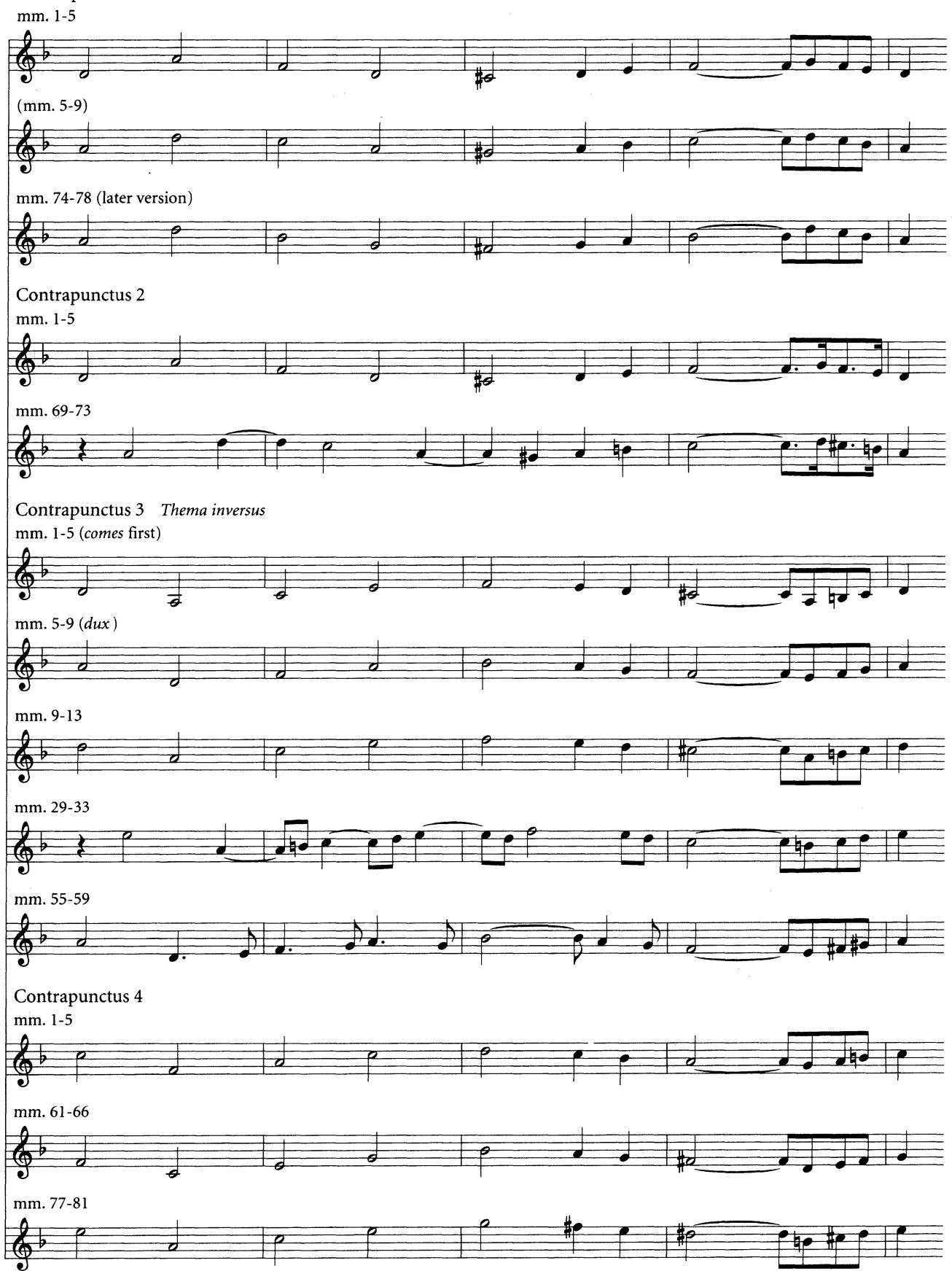
中文讲解
这是一段图注与图片占位符,标题为「Example 5.10 Forms of subject in the Art of Fugue, Contrapuncti 1–4」,意为「例 5.10 《赋格的艺术》第一至第四对位曲中主题的各种形态」。它出现在该小节正文的尾部,是正文中讨论的辅证性谱例,说明作者所论述的「主题变形/处理方式」在前四首对位曲中的具体形态。由于本任务中内嵌图片数据已被省略,无法核实图中所示音符、谱表位置、箭头或标签等细节,读者需查阅原书第 28 页上的谱例图像以获得完整信息。从小节整体论证角度看,这一图例与上文对「收束的简单赋格」以及「第六首对位曲(stile francese)」的主题处理讨论相呼应——作者以谱面证据为文字论述提供视觉支撑,让读者能够同时看到主题在多首对位曲中被变奏、转位、扩大或缩短等具体形式。
补充说明
由于图片数据不可见,无法核对谱例中具体包含哪些主题形态、是否标注了主题在不同对位曲中首次出现的次序,以及作者用以指示主题变化的箭头或符号。原文也未提供关于此图内容的进一步文字描述。
第2段(P0120)
原文复述
Bach and the Patterns of Invention
中文讲解
这一行是该书页面的页眉(running header),位于页面上方,重复显示本书的书名 Bach and the Patterns of Invention(《巴赫与发明模式》)。它本身不承载论证内容,仅起到版面识别的作用:告诉读者当前页所属的著作。它与小节论题「收束的简单赋格与第六首对位曲的 stile francese 风格」没有直接的语义关联,读者应当把它视为版式元素而非正文论点的一部分。
第3段(P0121)
原文复述
Dreyfus, Laurence. Bach and the Patterns of Invention. E-book, Cambridge, Mass.: Harvard University Press, 1996, https://hdl.handle.net/2027/heb05561.0001.001. Downloaded on behalf of Indiana University, Bloomington.
中文讲解
这是一段文献引用与电子版访问信息(bibliographic / access statement),完整复述为:作者为 Laurence Dreyfus,书名为 Bach and the Patterns of Invention,出版地为马萨诸塞州剑桥,出版社为哈佛大学出版社,出版年份为 1996 年,电子版可经由 handle 链接 https://hdl.handle.net/2027/heb05561.0001.001 获取,由印第安纳大学布卢明顿分校代为下载。它位于页面底部,属于该电子书版本的版权与使用来源说明,并非正文论证的一部分。其作用是标明前文(包括本小节所述「收束的简单赋格」与「第六首对位曲 stile francese」之讨论)的文献出处,让读者得以追溯与核对本书的电子版本。
补充说明
该信息仅作为电子书的来源与访问凭证,不包含新的论证主张;其中的 handle 链接、HathiTrust/类似数字图书馆的标识符(heb05561)以及下载主体(Indiana University, Bloomington)均按原文如实保留,未作改写。
脚注 / 边栏 / 图表 / 附加信息(如有)
本小节(第 28 页尾部)所收录的均为非正文性质的版面元素:(1)一个图注及图片占位符 Example 5.10,标注主题在《赋格的艺术》第一至第四对位曲中的各种形态,作为上文论述的谱面佐证;(2)页眉书名 Bach and the Patterns of Invention,重复显示本书标题;(3)页脚处 Laurence Dreyfus《Bach and the Patterns of Invention》电子版的出版与下载信息。这些元素不构成本节论证链的一部分,而是对该节正文论述与电子版本来源的版式补充。
💡 本节核心要点
- 本节正文已在 P0118 之前的段落中完成,本页面(P0119–P0121)不再提出新的论证主张,而是呈现图示、页眉与文献出处三类版面元素。
- 图注 Example 5.10 指向《赋格的艺术》第 1–4 首对位曲中主题的多种处理形式,为本小节关于「主题在结尾赋格与第六首对位曲中的运用」的论述提供谱例支撑;具体音符形态因图片省略而无法在本任务中核实。
- 页眉 Bach and the Patterns of Invention 是书名在每页上方的重复,属于版式而非论证内容。
- P0121 给出 Laurence Dreyfus 一书的完整电子版引用与访问信息(哈佛大学出版社,1996 年,handle 链接,由印第安纳大学布卢明顿下载),确认正文论述的文献来源。
- 读者若要理解本节真正论及的「收束的简单赋格」与「Contrapunctus 6 in stile francese」,需要回到第 28 页之前的正文段落,而不是依赖本页的图注与引用信息。
🔑 关键术语
- Art of Fugue (Die Kunst der Fuge):巴赫晚期未完成的复调作品集,由多首对位曲(Contrapunctus)组成;本节所引图注即涉及其第 1–4 首对位曲中主题的不同形态,是讨论「结尾简单赋格」与「第六首对位曲」时所处的作品语境。
- Contrapunctus (复调曲/对位曲):《赋格的艺术》中各首独立对位曲的称谓;本节论及的「Contrapunctus 6 in stile francese」即第六首以法国风格写成的对位曲,是该小节主题讨论的对象之一。
- stile francese (法国风格):巴赫与同时代德国作曲家常用的风格标签,指模仿法国宫廷与吕利风格的写法,常以舞曲节奏、附点节奏与装饰性旋律为特征;本节正文会涉及该风格在第六首对位曲中的体现。
- simple fugue (简单赋格):与「stretto fugue」「double fugue」相对的概念,指主题呈现清晰、结构相对单纯的赋格写法;本节论及的「concluding simple fugue」即《赋格的艺术》末尾回归主题的简单赋格段落。
- subject (主题):复调音乐中由各声部依次陈述的核心旋律材料;图注 Example 5.10 展示的正是这一主题在第 1–4 首对位曲中的不同形态。
ch1.25 [描述性拆分] Contrapuncti 6, 8, and 11: style, artifice, and the role of free voices
第1段(P0122)
原文复述
This attitude is very much summed up by the last trick up Bach’s sleeve in his simple fugues, according to which the subject moves out of its triadic orbit into the realm of seventh and ninth chords (for example at mm. 129–133 of Contrapunctus 4), supporting what is perhaps the most daring and moving harmonic progression within the Art of Fugue.
中文讲解
本段承接前文对“简单赋格”中主部材料的讨论,指出主部走出三和弦轨道、进入七和弦与九和弦领域,是 Bach 在简单赋格里最后的一张王牌:以 Contrapunctus 4 第 129–133 小节为例,主部在那里脱离了原本构筑在三和弦之上的稳定音高世界,进入到更不协和的纵合结构。作者认为,正是这一“出格”举动支撑起《赋格的艺术》中或许最具胆识、也最动人的和声进行。这里的“last trick up Bach’s sleeve”提示,这是一种收束性、总结性的处理——主部本身拓展了自身所能达到的和声边界。
补充说明
“triadic orbit”指主部以三和弦为基本音高框架;“realm of seventh and ninth chords”是 Bach 在主部发展中常用的强化手段,即把纵合的和弦结构(七、九和弦)作为主部素材的一部分。
第2段(P0123)
原文复述
The one fugue to contain a style label (rather than a name referring to its contrapuntal technique) is Contrapunctus 6, “in stile francese,” which alludes to the imposing dotted rhythms that characterized the French overture associated with Jean-Baptiste Lully and the Sun King, Louis XIV. The conceit in this fugue is that the musical notation in the French overture depended on a kind of diminution of rhythmic values, by which one played the little notes in shorter values than those in which they were actually written. By combining this idea of diminution with the traditional learned use of diminution, Bach ends up composing a completely anomalous and unusable French overture which literally decomposes itself into majestic gestures which proceed at incompatible speeds. The kind of majesty Bach is representing here, therefore, is one far more elevated and more complex than the mundane kind concerned merely with vain monuments to worldly glory. (The conceit of playing on two species of diminution in Contrapunctus 6 suggests that in performance one retains the conflict between the two realms and does not assimilate to the smallest rhythmic value.) Ultimately Contrapunctus 6 might also be understood as Bach’s compensation for the D major fugue in WTC I, in which, as we saw, the style of the piece covered up a paucity of fugal artifice. The French style in Contrapunctus 6, by contrast, contains far too much artifice for the style to remain intact.
中文讲解
本段集中处理《赋格的艺术》中唯一以“风格标签”而非“对位技巧命名”的赋格——Contrapunctus 6,“in stile francese”。作者先交代“法国风格”的历史指涉:与 Lully 和“太阳王”路易十四相关的法国序曲,其标志性特征是带有大附点节奏的庄严音响。接下来揭示此曲的核心“巧思”(conceit):法国序曲的记谱本来依赖一种节奏时值的“缩小”(diminution),即把小音符按比记谱时值更短的实际时值来演奏;这恰好与对位传统中作为“减值变奏”技术的 diminution 同名。Bach 把两层“缩小”合在一起写,结果造成一首彻底反常、无法使用的法国序曲——它事实上自我分解成以彼此不相容的速度推进的庄严手势。这是一种“复合性”的妙计:风格本身被其内部逻辑撑破。括号里的演奏建议由此推出:两种 diminution 的冲突应在演奏中保留下来,而不应被调和到最小的节奏单位。然后作者把阐释推向主题高度:Bach 在这里所代表的庄严并非世俗意义上的“空洞纪念碑式辉煌”,而是一种更高、更复杂的宏伟。最后,作者把 Contrapunctus 6 视为 Bach 对《平均律键盘曲集》第一册 D 大调赋格的一种“补偿”:那首作品风格有余、对位技巧不足;而 Contrapunctus 6 恰恰相反,对位技巧过多,以至于风格本身无法维持完整——两端形成镜像。
补充说明
本段提到“the D major fugue in WTC I……the style of the piece covered up a paucity of fugal artifice”,这是回指前文已论述过的《平均律键盘曲集》第一册 D 大调赋格;据此可推断本段在论证结构上形成前后对照,而非首次提出该观察。
第3段(P0124)
原文复述
The staggering achievement of the two double fugues (Nos. 8 and 11) is that Bach not only wrote two new countersubjects that combine dazzlingly with the Art of Fugue theme, but he also thought through the properties of the countersubjects in such a way that they could also combine in melodic inversion with the inverted form of the subject. This adds a new dimension to the hearing of fugue, namely that one can listen to the processes of invention in the processes of invention in one piece of music at the same time that one can contemplate another, related piece of music. This is surely why Nos. 8 and 11 were paired in the early autograph manuscript, though they were subsequently separated to frame the grouping of double fugues in the later version.
中文讲解
本段聚焦两首二重赋格——Contrapunctus 8 和 11——的“惊人成就”。作者指出两重意义上的精彩:其一,Bach 为《赋格的艺术》主题写了两条新的对题,它们能与主题光彩夺目地组合;其二,更进一步,他周密地设计了对题自身的性质,使对题还能够与“主部的倒影形式”进行旋律倒影形式的结合。也就是说,对题不仅要和正形主题配合,还要和倒影形主题配合。这种双重适配把赋格的“听”提升到新的维度:同一时间里,听者既能在一首音乐中跟踪“发明”的进程,又能同时凝思另一首相关的音乐——即正形与倒影彼此呼应,形成互文。最后,本段把这一音乐—结构上的必然关联,对接到手稿史:早期手稿把第 8 与第 11 这两首紧挨并置;后期版本则把它们分开,用以框定二重赋格的分组。此处“必定如此”(surely why)一语暗示,这种并置并非偶然排版,而是 Bach 对位逻辑的物质化体现。
补充说明
“inverted form of the subject”指主部作旋律倒影处理后所得的形式;“frame the grouping of double fugues”指在后期版本中,用第 8 首与第 11 首夹住中间的二重赋群,从而在版面上形成对称框架。
第4段(P0125)
原文复述
Discussion of fugal invention would be incomplete without addressing the key role of free voices that accompany invertible counterpoint. Contrapunctus 11 furnishes a fascinating example here. The very end of this lengthy fugue has two combinations of a three-part complex directly in succession: first in the order a-c-b with the free voice on top (mm. 174–179), and the next in the order a-b-c with the free voice in the alto (mm. 179–184). If one plays the two complexes without the free voices, the inversion is readily audible. At the same time it is noticeable how truly awkward the contrapuntal skeleton actually is. Only with the addition of the free voices do the infelicities in the counterpoint—which evoke all kinds of empty and forbidden parallels—now sound rich and natural. The marvel is that Bach manages to conceal the contrapuntal improprieties with the addition of only a single added line in each case. This technique underscores an important Bachian insight into the nature of harmony: although the fundamental ideas of consonance and dissonance are God-given, this does not mean that nature in its raw form is pleasing and acceptable. The human task is therefore to turn the raw materials of nature into art, by which one does justice to the gift to humanity of divine harmony. The achievement as well as the clear source of this fugue’s expressivity is that Bach has crafted strict fugal procedures so as to sound as unfettered as free counterpoint.
中文讲解
本段把讨论拉回到“可逆对位”中常被忽视的角色——“自由声部”。先点明:论赋格的发明,若不处理自由声部的关键作用,就不完整;随即以 Contrapunctus 11 末段作为范例。这首长大的赋格结尾处,连续出现两种“三声部综合体”的组合:一是 a-c-b 顺序,自由声部置顶(第 174–179 小节);二是 a-b-c 顺序,自由声部置于中音(第 179–184 小节)。作者通过一个“听觉实验”揭示论点:去掉自由声部,只保留这两组综合体,倒影关系清晰可闻;但与此同时,对位骨架本身的笨拙也暴露无遗——内部的瑕疵会引出种种空洞、禁忌的平行进行。只有把自由声部加回去,那些本来不妥当的对位反而听起来丰富而自然。惊人的是:Bach 每处只靠加上一条单线,就足以掩盖对位上的失当。接着,作者把这一“技法”拉升到 Bach 整体的和声观:协和与不协和的根本观念是神赐的,但“自然”的原始面貌并不天然令人愉悦。人的任务是把自然的原料转化为艺术,由此才不辜负神给人的和声天赋。最后,作者提炼出该赋格表现力的根源与成就:Bach 把严格的赋格程序“塑造得听起来如同自由对位一样无拘”——形式上的严苛与音响上的自由,在此达成奇异的合一。
补充说明
“three-part complex”指 a、b、c 三条对位线条组成的可整体参与倒影的单位;“free voice”指不属于这一综合体、可独立运动的额外声部,其功能是为骨架遮瑕并补足音乐性。
第5段(P0126)
原文复述
Dreyfus, Laurence. Bach and the Patterns of Invention. E-book, Cambridge, Mass.: Harvard University Press, 1996, https://hdl.handle.net/2027/heb05561.0001.001. Downloaded on behalf of Indiana University, Bloomington
中文讲解
这是一条完整的书目引文,用以标明本章节所依据的电子版出处:作者为 Laurence Dreyfus,书名为 Bach and the Patterns of Invention(哈佛大学出版社,1996 年版,剑桥,马萨诸塞州),并附有 HathiTrust 数字图书馆的稳定链接(hdl.handle.net/2027/heb05561.0001.001),以及“由印第安纳大学布卢明顿分校代为下载”的使用记录。它属于参考文献类材料,本身不含实质论述,但对核验页码、版本与引文来源具有支持作用。
第6段(P0127)
原文复述
Matters of Kind
中文讲解
“Matters of Kind”是紧随第 29 页内容之后出现的小节标题/分章短语。它在原文中只由这两个英文单词组成,承担开启下一论题的版面功能:从词面看,“Kind”兼有“种类、风格、性质”等多重含义,暗示下一段将讨论“风格(风格标签意义上的)/类属意义上的各种议题”。就本小节而言,它不承载实质论点,只表明论题已经切换,本节(ch1.25)到此自然结束。
脚注 / 边栏 / 图表 / 附加信息(如有)
本小节内的非正文附加材料主要包括:P0126 一条完整的书目与电子资源引文(Laurence Dreyfus, Bach and the Patterns of Invention, Harvard University Press, 1996, 含 HathiTrust 链接与印第安纳大学布卢明顿分校的下载说明),以及 P0127 的下一小节标题“Matters of Kind”。前者起来源可核验作用;后者只起承上启下、划分论题的版面功能,本身不包含可纳入本节论证链的主张。
💡 本节核心要点
- Bach 在简单赋格结尾让主部离开三和弦轨道,进入七、九和弦领域(如 Contrapunctus 4 mm. 129–133),从而支撑《赋格的艺术》中最具胆识的和声进行。
- Contrapunctus 6 (“in stile francese”) 利用法国序曲记谱中的“缩小”与对位传统中“缩小”的双关,使该曲成为一首自我分解、不可使用的法国序曲;Bach 借此表达一种超越世俗辉煌的更高庄严。
- Contrapunctus 6 与《平均律键盘曲集》第一册 D 大调赋格形成镜像对照:前者对位过多,以至于风格不能维持;后者风格过多,以至于对位不足。
- 两首二重赋格(Contrapunctus 8 与 11)的成就在于:两条新对题既能配合正形主题,又能与倒影形主题配合,从而让正/倒影同一时间被听到;这也是它们在早期手稿中紧邻并置的原因。
- 自由声部在可逆对位中承担关键“遮瑕”功能:以 Contrapunctus 11 结尾两段三声部综合体(a-c-b / a-b-c)为例,去掉自由声部,倒影清晰但骨架笨拙;加入单条自由声部,禁忌平行反而听起来自然。
- 此技法反映出 Bach 的核心和声观:协和与不协和的观念是神赐的,但自然原貌并不天然取悦于人;人的任务是把自然原料转化为艺术,从而尊重神给人的和声馈赠——严格程序因此听起来如自由对位。
🔑 关键术语
- Contrapunctus 6, in stile francese:《赋格的艺术》第六首对位曲,标题以“法国风格”标记;其音乐戏仿与法国序曲相关的庄严附点节奏,同时玩味两层“diminution(节奏缩小 / 减值变奏)”,最终令“法国风格”自身解体,承载比世俗辉煌更高的庄严意涵。
- diminution:双关术语:一指法国序曲记谱中小音符的实际演奏时值短于记谱时值的实践;二指对位传统中把时值按比例缩小的装饰变奏。Bach 在 Contrapunctus 6 中同时调用两者,造成风格不可运作。
- double fugue (Nos. 8 and 11):指《赋格的艺术》中以《赋格的艺术》主题与两条新对题组合而成的两首二重赋格(Contrapunctus 8 与 11)。其成就在于对题既能配合正形主题,也能与倒影形主题进行旋律倒影形式的结合。
- invertible counterpoint:“可逆对位”:任一纵向组合可被整体上下翻转(倒影)后仍保持音乐有效的对位技术。文中主要指 Bach 将主部倒影形与对题结合的设计。
- free voice:“自由声部”:在可逆对位综合体(此处为三声部综合体)之外、不参与倒影但独立运动的额外声部。在 Contrapunctus 11 结尾,自由声部为对位骨架“遮瑕”,使本来易触发禁忌平行的进行变得自然。
- consonance / dissonance:协和 / 不协和。本节中被表述为“神所赐”的根本观念;但作者强调,仅有观念不足以产生好音乐;人必须以艺术加工自然,才能让神的馈赠真正被听见。
ch1.26 [描述性拆分] Mirror fugues, the B-A-C-H autogram, and the unfinished final fugue
第1段(P0128)
原文复述
In the opening example of the three-part mirror fugues, Contrapunctus inversus No. 13, Bach takes yet another step in disguising his craftsmanship. On first hearing the piece resembles an ordinary three-part simple counterfugue in which both the rectus and the inversus shape of the Art of Fugue subject appear, though in elaborated forms. The composition is nevertheless conceived from the start as a contrapuntal mirror: the entire fugue—not merely an individual theme or a complex of themes—is inverted note for note, so that two superimposed versions of the complete fugue are required. Composing a fugue of this kind amounts to RESEARCH at the highest level, and one element of Bach’s conception was to deliberately evoke the far humbler textures (and with them the genre) of the Baroque trio sonata, whose aim is to make the remarkable invertibility of every musical moment sound invitingly accessible. This appealing ambition can, of course, never be fully realized: in the inversus version one hears the somewhat strange pattern of sequences in which the harmonies appear to travel in the wrong direction—precisely because, in fact, that is exactly what they are doing.
中文讲解
中心主张:在《赋格的艺术》三声部镜像赋格的开篇——第13对位曲(Contrapunctus inversus No. 13)——里,Bach把"以朴素外观掩盖深度工艺"的策略又推进了一步:整首作品都按逐音反转来构思,却要让人听到几乎像一首普通三声部对位赋格的熟悉感。
本段的论证张力体现在两层反差之中:
- 听觉外观 vs 实质构思。表面上 C.I. No. 13 像是一首"普通三声部对位赋格"——主题以正格(rectus)和倒影(inversus)两种"被精致化"的形式先后呈现。但实际上,Bach从一开始就把它当作一面"对位之镜"来设计:整首赋格都要按音高逐音反转,所以必须同时存在正、反两个叠合的版本。这把"主题单体的可反转"扩展为"整首作品的镜像"。
- 体裁意图 vs 听感结果。Bach有意借鉴巴洛克三重奏鸣曲那种更朴素、可亲近的织体,让每时每刻的严格可反转听起来像日常音乐语言;这种"以轻驭重"的野心终究无法彻底实现——inversus 版本里那段"和声看似朝错误方向走"的古怪模进,正是反转结构无法被完全遮蔽的痕迹。
“RESEARCH"一词以全大写形式出现,是刻意强调:此曲把对位写作推升为一种最高级别的学术性"研究”,而远不止是常规作曲。
本段在整节中的作用:C.I. No. 13 与下文讨论的"未完成终曲"一道,构成全节的两个极点——前者示范了 Bach 如何把工艺藏到体裁内部,后者示范了 Bach 如何把私人签名藏到素材内部;它们共同支撑"赋格的艺术"既极度精巧又极度隐秘的双重面貌。
补充说明
本段内部可直接定位的术语关系:对位镜像(contrapuntal mirror)=把整首作品当作主题,把主题的逐音反转作为另一首作品;rectus/inversus 两个主题形态是该镜像的单元;三重奏鸣曲(trio sonata)=通常由两支高音旋律+通奏低音构成的室内乐体例,是 Bach 希望"借来"的更谦虚的织体样板。“RESEARCH"大写用以凸显该作品本质上是 Bach 对位写作中最极端的实验。
第2段(P0129)
原文复述
Much has been written about Bach’s cryptic unfinished double fugue on four themes, which breaks off at the 238th measure shortly after the striking exposition of Bach’s personal signature melody—the B-A-C-H autogram—destined to be combined with the two other new themes that had already been developed earlier in the movement. J. G. Walther writes in his 1732 Lexicon that Bach had confided to him the belief that the Bach family was probably so musical because its name could be translated into music. One may conjecture that this fugue was meant to provide the culmination of the work not so much on account of its extreme difficulty as because it would crystallize Bach’s personal vision of fugue by allowing the composer to insert himself into the texture as one of the countersubjects to the Art of Fugue theme. The autogram can furthermore be read both as a tribute to the composer’s origins and as a testimony to a career that did honor to the family name. This was less blatant self-advertisement by Bach than an allusion to his place within a family that had continually devoted itself to the perfection of harmony. This final contrapunctus was in any event to be heard as mysterious, because the Art of Fugue subject was not to make its appearance until quite late in the piece, where it was to be demonstrated fitting together seamlessly with the three already-extensively-developed themes. This “glove-like” fit was only recognized in the nineteenth century, when Gustav Nottebohm, among others, observed that Bach must surely have intended to combine the three themes of the fugue with the Art of Fugue subject itself in a final contrapuntal tour de force, as Example 5.11 shows. (footnote 31)
中文讲解
中心主张:本段揭示出《赋格的艺术》终曲中 B-A-C-H 签名旋律的双重作用——它既是作曲家个人在音乐织体中的"出镜”,也是对家族传统的致敬;其"未完成"的状态直到 19 世纪才被重新解读为 Bach 有意为之的"无缝契合"。
本段的论点可拆为若干个紧密关联的层次:
- 未完成的事实。该四主题未完成对位赋格写到第 238 小节即中断,恰在 B-A-C-H 签名旋律的精彩呈示之后;这一中断点暗示签名旋律还应与早先发展出的两个新主题再度合成。
- 签名旋律的家族史根源。Bach 曾向 Walther 透露:巴赫家族之所以音乐人才辈出,或许正因为姓氏本身就能被翻译成一组音符。这意味着签名旋律不只是"作曲材料",而是 Bach 对自己家世的浓缩书写。
- 高潮定位的逻辑:这首赋格被构想为整部作品的收束之作,并非因技术最难,而因它将以最个人化的方式呈现 Bach 的赋格观——作曲家本人以"对副题(countersubject)之一"的身份嵌入到《赋格的艺术》主题旁边。
- 自我签名(autogram)的双重读法。它既是对作曲家源头的礼赞,也是对"一生以家族之名为荣"的事业的见证;这并非赤裸裸的自我宣传,而是 Bach 把自己放进一个"以和声完美为志业"的家谱中。
- 神秘感的具体来源。终曲之所以听起来奇异,是因为《赋格的艺术》主题要到接近尾声才会登场——它必须与三个已充分发展的主题严丝合缝地对接。
- “手套般的契合"直到 19 世纪才被发掘。Nottebohm 等学者观察到 Bach 显然是要把这四个主题并为一个收束性的对位奇观(contrapuntal tour de force),这一意图在例 5.11(Ex. 5.11)中被证实,从而改变了人们对"未完成"的判断。
本段在全节中承上启下:上一段谈 C.I. No. 13 把工艺"藏到体裁里”,本段则谈 B-A-C-H 把个人"藏到对副题里";两段都以不同手法演绎"谦逊外观 vs 高超技艺"的统一策略。结尾指出 19 世纪学者的重新发现,是为全节连接上更宏观的接受史。
脚注 31 在末尾标出,是正文论断 Nottebohm 这一观察的来源性注释。
补充说明
术语辨义:B-A-C-H autogram 指按德式音名体系 B♭-A-C-B♮ 排列的四个音;“对副题”(countersubject)指在赋格呈示中稳定伴随答题或答题对位的主题素材,常与主题形成对位格局;“手套般的契合”(glove-like fit)形象说明四个主题在结构上如同贴合手指的裁剪。J. G. Walther 与 Gustav Nottebohm 的生平信息在本段外部来源中无定位依据,故不展开;Ex. 5.11 的实际谱例不在本节可见,需查阅原书插页。
第3段(P0130)
原文复述
This appears as a page header line reading “164 Bach and the Patterns of Invention,” followed immediately by a printed citation block: Dreyfus, Laurence. Bach and the Patterns of Invention. E-book, Cambridge, Mass.: Harvard University Press, 1996, https://hdl.handle.net/2027/heb05561.0001.001. A line below notes that the file was “Downloaded on behalf of Indiana University, Bloomington.”
中文讲解
这一段是页面顶端的页眉书目引用区:标记当前页码为 164,附书题《Bach and the Patterns of Invention》;下方完整版次信息指出该书作者为 Laurence Dreyfus,由 Harvard University Press 1996 年于马萨诸塞州剑桥出版,是经由 HathiTrust 数字图书馆访问的电子版(对应 handle 链接 https://hdl.handle.net/2027/heb05561.0001.001),底端注明此件下载系为印第安纳大学伯明顿分校(Indiana University, Bloomington)代为进行。它本身不参与论证,只是电子版书目与下载来源的元数据。
补充说明
无额外补充(信息已在复述中完整呈现)。
脚注 / 边栏 / 图表 / 附加信息(如有)
本节所附附加材料仅一处:脚注 31(位于 P0129 末尾)。该脚注为正文关于 Nottebohm 观察到 Bach 显然意图把三主题与《赋格的艺术》主题合成对位奇观(Ex. 5.11)这一论断的来源性注释,作用是为支持 19 世纪学者的重新解读提供文献依据;此外无图表、谱例说明或边栏文本(Ex. 5.11 本体需查阅原书对应插页,本节未呈现其内容)。
💡 本节核心要点
- 《赋格的艺术》第 13 对位曲把整首作品设计为音高逐音反转的"对位镜像",却借用巴洛克三重奏鸣曲的朴素织体掩饰工艺;这种"以轻驭重"的意图无法完全达成,inversus 版本里"和声似朝错误方向走"的模进恰好暴露了镜像结构本身。
- 未完成赋格以四主题为骨架,B-A-C-H 签名旋律直至接近尾声才登场,必须与先前已发展的三个主题"手套般"无缝合成,构成 Bach 设想的最终对位奇观(contrapuntal tour de force)。
- B-A-C-H autogram 兼具双重含义:既是作曲家对自己家族源头的致敬,也是"以一生捍卫家名"的事业的见证;它被 Bach 作为"对副题之一"嵌入到《赋格的艺术》主题旁边,使整部作品的收束成为 Bach 个人赋格观的凝缩。
- 终曲之"未完成"一直被误读为遗憾,直到 19 世纪 Nottebohm 等学者重新揭示其内在契合,使 Bach 这一收束设计的真正规模得以复原(见 Ex. 5.11)。
- 本节整体论证链:第 13 对位曲展示 Bach 如何把"极致工艺"藏到体裁与织体里;未完成终曲展示 Bach 如何把"私人签名"藏到主题与对副题里;二者共同支撑《赋格的艺术》“谦逊外观承载高超技艺"的统一形象。
🔑 关键术语
- Contrapunctus inversus / mirror fugue(对位镜像赋格):指整首赋格与其音高倒影叠合,形成上下两层完整对位镜像的写法,以 C.I. No. 13 为首例;本节中用于刻画 Bach 把工艺推向极致的手法。
- Rectus & inversus(正格与倒影):赋格主题的原始音高形式与音高逐音反转形式;C.I. No. 13 同时展开两者,且把这种关系扩展到整部作品尺度。
- B-A-C-H autogram(巴赫签名旋律):由德式音名 B♭-A-C-B♮ 组成的小动机,既是作曲家的姓氏音乐化,也是 Bach 嵌入家族传统的素材;在未完成赋格中作为对副题之一出现。
- Counterfugue / 对位赋格(对位型赋格):主题既以正格也以倒影形式在声部间进行的赋格写法;C.I. No. 13 表面伪装成这种体裁,实际却是整首作品的镜像。
- Trio sonata(巴洛克三重奏鸣曲):通常由两支高音旋律加通奏低音构成的室内乐体例;Bach 在 C.I. No. 13 中刻意借此体例的透明、朴素织体,使严格的逐音反转显得平易近人。
- Glove-like fit(手套般的契合):用以形容四个主题在结构上如手套贴合手指般严丝合缝的拼接,本节借之描述《赋格的艺术》主题与三主题在终曲中应当达到的关系。
- Countersubject(对副题):在赋格呈示中与主题或答题构成对位关系的稳定伴随声部;本节中 B-A-C-H 签名旋律被设想为对副题之一,从而构成 Bach 个人在织体中的"出镜”。
- Walther’s Lexicon (1732):Johann Gottfried Walther 编纂的《音乐辞典》(Musicalisches Lexicon, 1732),本节以其中 Bach 私下对其姓氏音乐化的自述作为签名旋律家族含义的来源。
ch1.27 [描述性拆分] Was the final fugue actually complete? Manuscript evidence reconsidered
第1段(P0131)
原文复述
Many scholars now hold the view that Bach had in fact completed the final fugue, but that—because of editorial incompetence and the possible confusion of manuscript sources—the editors failed to assemble the pieces of the puzzle correctly. The supporting evidence for this view was that the manuscript source for the quadruple fugue was notated on paper whose staff lines had been faultily ruled, with the result that the bottom staves of the page were unusable. Since, so the argument runs, Bach began copying in short score on paper that was only partially usable, he must have intended to continue the copying on another sheet, most likely one on which the continuation of the piece was already complete (Figure 5.1 is cited). Christoph Wolff is quoted to this effect: “Bach interrupted the manuscript at that point because its continuation was unequivocal; the remainder had at least been sketched, complete in outline.” The author then argues that the missing-completion argument, when based on the faultily ruled page, does not really survive closer scrutiny. The page in question contains twelve staves on which Bach wrote in short score across two adjacent systems to form one “keyboard” brace. As the facsimile shows, Bach skipped one system between the two braces because of the density of the fugal counterpoint at the opening of the second brace. He thereby already occupied five of the twelve ruled staves. The only really unusable stave was the tenth system, and if he had wanted to continue copying, the page would have accommodated a further two braces of score. The misruled paper, therefore, gave no reason for Bach to have stopped copying at the precise point where he did. The text then turns to a statement by Emanuel Bach (with Agricola), in which Emanuel writes that his father’s “last illness prevented him, judging from his sketch [Entwurff], from bringing the next-to-last fugue to completion and working out the last one, which was to contain four themes and to have been afterward inverted note-for-note in all four voices.” Although it is unclear whether there were to be two final fugues or whether Emanuel mistakenly thought the sketch belonged to a subsequent fugue, it is certain that he had some material on paper in his father’s hand. Surely, the author argues, this could not have been complete or near-complete music, or Emanuel would have published it. The text also excludes without hesitation the possibility raised by others that the sketch might have served as the “join” to the incomplete page shown in the facsimile. For one thing, Emanuel was too fine a musician to have missed so obvious a connection; for another, no genuine join is possible, because the autograph torso ends with a striking solo continuation of the tenor line after the other voices have ceased. Most likely, the sketch included no more than Bach’s combination of the four voices shown in
中文讲解
本段是整节的论证核心,集中处理"末赋格是否其实已完成"这一文献学问题。论证分三层推进。
第一层解构"漏抄说":流行的观点以抄本纸张的污损为据,声称巴赫因为纸面下半部不可用而另纸抄写,认为续写部分已然写好,只因编辑疏漏未能拼合。作者通过细读影印件计数纸面格线,巴赫在十二根谱表中以两两相邻系统组成一对"键盘"花括号,仅因第二花括号起首对位密度大而空过一行。如此已占去五根谱表,真正不可用的只有第十根;其余空间足可容纳两副花括号。因此所谓"纸面迫使巴赫停下"的说法无法成立。
第二层援引小C.P.E.巴赫(与阿格里科拉合撰)的原话,注意其中关键术语 Entwurff(草稿),即晚年的疾病使巴赫未能把倒数第二首赋格写完,更未能"写出"最后一首——那本应包含四个主题,且须在四声部中作逐音转位(inversion)。作者由此推论:既然小巴赫手头确实有父亲亲笔的纸面材料,却从未出版,那它不可能是接近完整的作品,否则作为儿子又身为音乐家的他不可能放过。
第三层排除"接合说":另一种猜测认为,这草稿正是影印件中残页的接续。作者从两方面否定:一是小巴赫作为音乐家不会看不出明显的接续;二是残页末段在其它声部已止之后,仍由 tenor 声部独立作"独奏式"延伸——这种处理使任何真正的接合在音乐上不可能。
至此,论证为下一句保留悬念:本段末尾提到的"the four voices shown in",要到 P0137 才接续到 Ex. 5.11,从而把"草稿"具象化为具体的四声部综合例。整段既驳斥了误读的"完成说",又对"草稿"给出了最低限度的界定,为后面的小结埋下线索。
补充说明
本段中 Christolph Wolff 的引语带有脚注编号 32,但 32 号脚注的内容并未出现在本段输入之内,仅能确认它支持作者所引述的论点,而不能补充其具体内容。所引小巴赫原话同时是研究《赋格的艺术》最常被引用的原始史料之一,本段正是用它的限定语"judging from his sketch"来反推草稿的不完整性。“keyboard brace"和"short score"两项术语释义见本节 terms。
第2段(P0132)
原文复述
Dreyfus, Laurence. Bach and the Patterns of Invention. E-book, Cambridge, Mass.: Harvard University Press, 1996, https://hdl.handle.net/2027/heb05561.0001.001. Downloaded on behalf of Indiana University, Bloomington.
中文讲解
这是电子书版本因版权与访问控制而在页脚重复出现的出版与下载元数据,构成版面要素。其作用仅在于标明此页所属专著及下载来源,本身不参与正文论述。
第3段(P0133)
原文复述
Matters of Kind
中文讲解
这是章节小标题或段落小标题中的文字片段,作为版面分隔使用。结合上下文,其作用是把当前子论题(草稿的内容界定)与全章主题(Matters of Kind)连接起来,提示读者此处仍属该章下的子论证。不构成独立论点。
第4段(P0134)
原文复述
[第32页图像或乐谱示例—内嵌图像数据已省略;位置与图注保留]
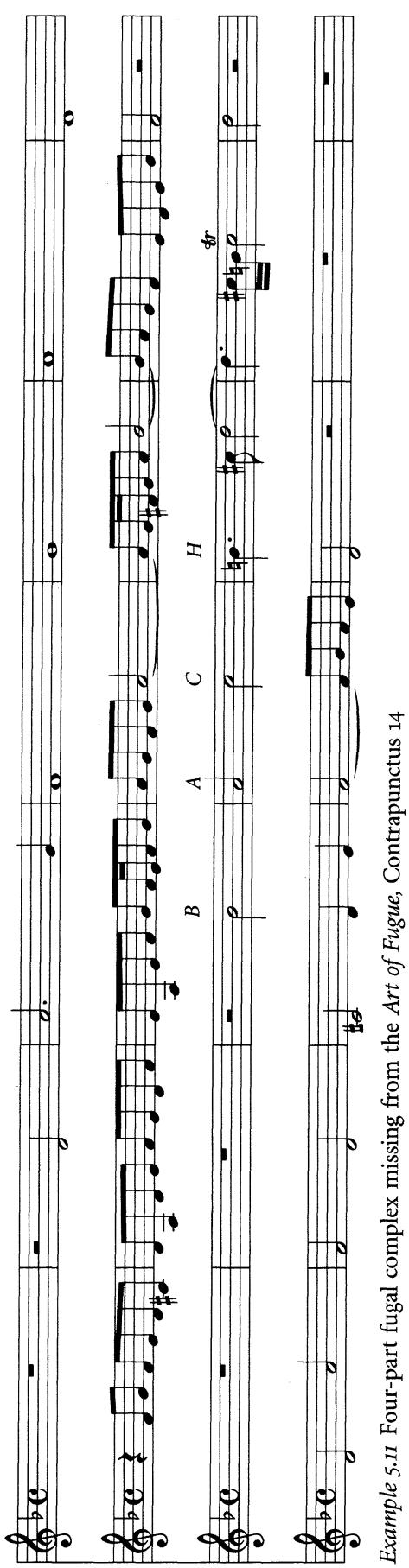
中文讲解
此条目为图像占位符,表明原书第32页某处含有一幅插图或乐谱示例,但内嵌二进制数据在本输入中未保留。结合上下文,本节论证反复引用 Figure 5.1 与一处残页的影印件,故此占位符很可能对应巴赫亲笔抄本残页中末段的对位片段,供读者直观比较"为什么这里写不进下一页"等分析。在没有实际图像内容的情况下,不应猜测细节。
补充说明
具体图像细节请查阅原书原图。
第5段(P0135)
原文复述
166 Bach and the Patterns of Invention Dreyfus, Laurence. Bach and the Patterns of Invention. E-book, Cambridge, Mass.: Harvard University Press, 1996, https://hdl.handle.net/2027/heb05561.0001.001. Downloaded on behalf of Indiana University, Bloomington.
中文讲解
这是电子书重复出现的页眉页脚组合:页码 166、书名、作者、出版信息与下载来源。除标明当前位置外,不参与正文论述。
第6段(P0136)
原文复述
Figure 5.1 Art of Fugue, end of the unfinished fugue BWV 1080/19 (autograph).
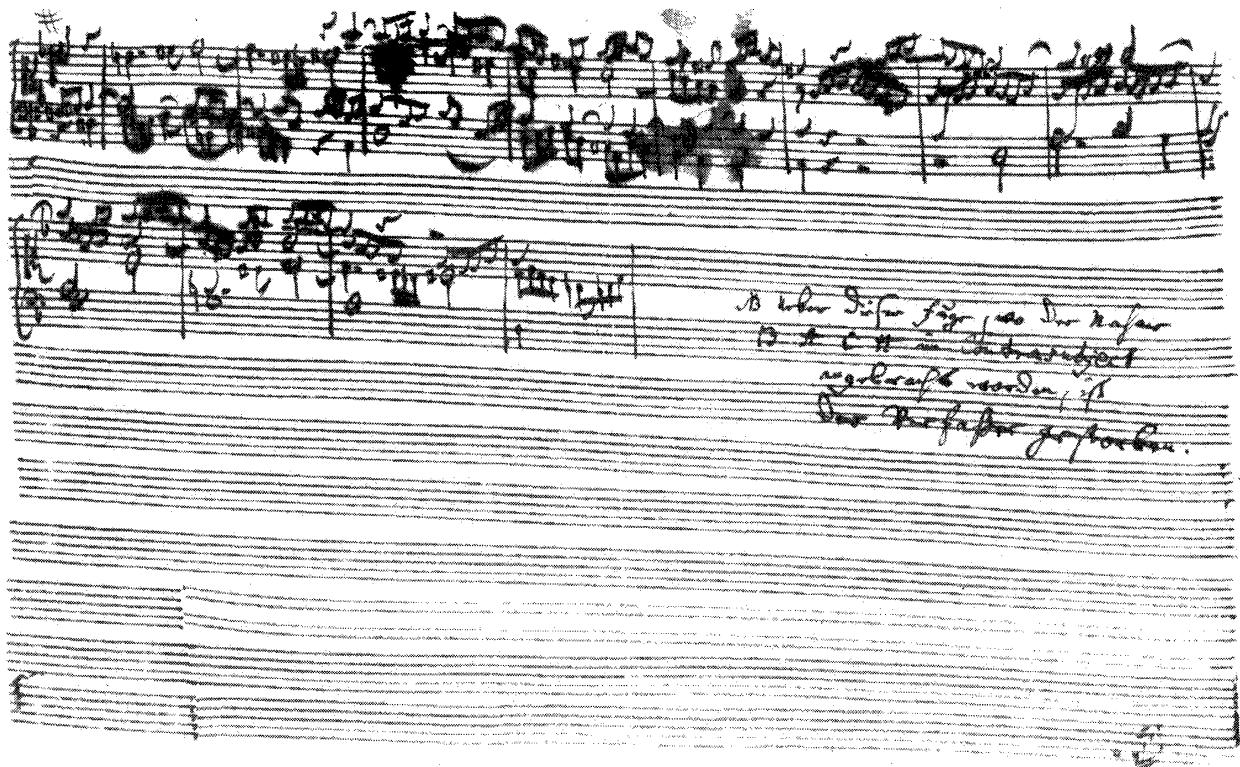
中文讲解
图注。图5.1 标为《赋格的艺术》BWV 1080 第 19 首未完成赋格的结尾片段,注明为巴赫亲笔抄本(autograph)。这一图注是 P0131 与 P0137 论述的核心实物证据:作者正是借助该残页影印件逐一计数谱表,进而否定"漏抄说”。BWV 1080 是《赋格的艺术》的标准主题目录编号;/19 表示该集中编号第 19 首赋格,也就是末赋格草稿部分。autograph 一词在音乐手稿学中特指作曲家亲笔书写,与抄本员誊抄相对。
补充说明
图注本身不展开对图内具体音符的描述;分析依赖正文 P0131 的相关论述。
第7段(P0137)
原文复述
Ex. 5.11 (perhaps with their inversions), which suggested to Bach’s heirs that this was indeed the invention at the heart of a work which Bach’s illness had prevented him from “completing and working out.”
中文讲解
本句自然接续 P0131 末尾中断的句子,完成作者对"草稿"内容的最小化界定:草稿可能仅包含 Ex. 5.11 中所示的四声部综合(或许伴随它们的转位)。这样的四声部写法本身就足以让巴赫的继承人认定:它正是这部作品的核心 invention,即核心乐思构思;而巴赫未能把它"完成并展开"成完整的末赋格,则要归因于晚年的疾病。
这一收尾有两重意义:第一,把"Entwurff"从抽象的史料记载落到具体的四声部综合例,使论点可被乐例证伪;第二,与 P0131 中"小巴赫若手头有完整乐谱必会出版"形成一致——手头的材料既能让继承人识别出核心动机,却又远不足以构成可出版的成品。整段由此完成了"草稿 = 核心四声部综合,但不是完整末赋格"的结论。
补充说明
Ex. 5.11 的具体谱例未包含在本段输入之内,因此对其内声部走向、主题顺序、转位方式均不可作超出文本的猜测。
脚注 / 边栏 / 图表 / 附加信息(如有)
本小节包含的非正文要素有以下几类。其一是 P0132 与 P0135 的电子书出版与下载元数据,由电子书阅读平台在每页重复打印,仅作版权与来源标注。P0133 “Matters of Kind” 是页面中的小节级标题碎片,承担版面分隔作用,不展开论述。P0134 是第 32 页某图像的占位符(内嵌数据缺省),从上下文判断很可能与残页影印或对位片段相关,但具体内容需查原书。P0136 为 Figure 5.1 的图注,标的是《赋格的艺术》BWV 1080/19 末赋格未完成部分的巴赫亲笔抄本结尾,这是本节论证的主要视觉证据。32 号脚注(见 Wolff 引语处)在输入中仅以编号出现,其具体内容不可见。Ex. 5.11 作为本节结论所引谱例,编号被提及但乐谱内容未随输入提供。
💡 本节核心要点
- 本节的核心问题是:巴赫末赋格是否其实已完成,作者给出的答案是否定的
- 针对流行的"漏抄说",作者通过对残页谱表逐一计数,证明纸张实际上还能容纳更多抄写空间,“纸面不可用"无法成为巴赫停笔的理由
- 小巴赫与阿格里科拉的 Entwurff(草稿)记述被作者用作反证:草稿在手却不出版,说明它并非完整或近完整的作品
- 残页末段 tenor 声部在其它声部停止后仍独立"独奏式"延续,使得任何把外部草稿当作"接续"的接合在音乐上不可能
- 草稿最可能的形态被收窄为 Ex. 5.11 中所呈现的四声部综合(可能伴随转位)——即作品的 invention 核心,而非完整末赋格
🔑 关键术语
- BWV 1080:巴赫作品主题目录编号,BWV 1080 指《赋格的艺术》(Die Kunst der Fuge);其中末赋格即编号 /19,长久以来被认为因巴赫病逝而未完成。
- Entwurff:德语词,意为"草稿/构思”;本节中小C.P.E.巴赫(与阿格里科拉)即用此词指代巴赫亲笔留下的、据信为末赋格的写作素材,是评估草稿完成度的关键史料用词。
- short score / keyboard brace:short score 是一种把多声部浓缩在少量谱表上的记谱方式;keyboard brace 是键盘音乐中用来标示哪些谱表合成一架键盘乐器演奏的花括号。本节论证正是依赖对每个花括号占用谱表数的计数得出纸张剩余容量。
- quadruple fugue:四主题赋格;本节讨论的正是这样一首应当承载四个主题、并按声部逐音转位的末赋格。
- inversion (in counterpoint):对位中的转位手法,指旋律音程方向上下颠倒;小巴赫所说的"inverted note-for-note in all four voices"即指此变换。
- autograph:作曲家亲笔书写的手稿,与抄本员誊抄相对;图5.1 残页即被标明为 autograph,是本节判断完成度的一手证据。
- invention (in this context):在 P0137 的用语中,invention 指作品的核心构思/主题组合方式;作者借此说明巴赫继承人能从草稿中识别出核心乐思,但又确认整部作品并未被"完成并展开"。
ch1.28 [描述性拆分] Why Bach never concluded the Art of Fugue
第1段(P0138)
原文复述
Given the most reliable dating for the manuscript of the final fugue torso, it becomes even more puzzling why Bach never supplied a conclusion to the engraver. On the basis of a careful study of Bach’s gradually deteriorating handwriting and the watermarks found in the relevant paper, Yoshitake Kobayashi has dated this manuscript to the period between August 1748 and October 1749. Bach’s first eye operation took place during the last days of March, 1750, and thereafter, according to the Obituary, “he could no longer use his eyes, but his whole system, which was otherwise completely healthy, was completely overthrown by the operation and by the addition of harmful medicaments and other things.” Bach died on July 28, 1750, possibly suffering from untreated diabetes. There was therefore a period of at least five months before his first operation, and possibly far longer than that, in which Bach apparently did not work on this fugue. Judging from this chronology, it seems out of the question that pressures of time prevented him from bringing the work to completion.
中文讲解
这一段先用可靠的手稿断代,再检验“时间不够”这一常见解释。Yoshitake Kobayashi根据巴赫逐渐恶化的笔迹和相关纸张上的水印,把这份手稿断代为1748年8月至1749年10月之间。这里的“至少五个月”是从手稿日期范围到1750年3月末第一次手术之间可以确定的最低间隔;“可能更长”以及“显然没有继续工作”都保留了不确定性,并不能证明他在这段时间绝对没有动笔。讣告转述说,手术后巴赫不能使用眼睛,原本完全健康的身体也被手术和有害药物等彻底摧垮;他于1750年7月28日去世,文中只说可能患有未经治疗的糖尿病。因此,作者据时间顺序判断,时间压力几乎不可能解释作品未完成;但这段证据本身并不能说明他为什么没有写完。
补充说明
“final fugue torso”指末赋格的未完成稿本;“apparently”表示这是根据时间顺序作出的判断,而不是无条件的事实。
第2段(P0139)
原文复述
One is left wondering why it was, then, that Bach delayed completing the Art of Fugue, even if it was more or less obvious to him how he wanted to proceed. Although there is no further evidence that would seem to help answer this question, it is certainly worth considering whether the composer had second thoughts about issuing a work in which his boldly embroidered family emblem was proclaimed, no matter how appropriate and well-deserved this proclamation. So even if he could easily have finished filling in the details of the final fugue, of which no one can have the slightest doubt, one can argue that Bach chose through his inaction to leave it unfinished at his death. Perhaps, then, Emanuel Bach’s mythic inscription (seen on the facsimile)—suggesting that Bach died after composing the passage where his name appeared in the countersubject—contains within it a kernel of truth: that is, that as a composer of fugues, Bach had in fact died at this very moment. Beyond the wistful sense of deprivation that any musician must feel when imagining an authentically Bachian ending to the Art of Fugue, even the Romantic melancholy attached (since the time of Novalis and Schlegel) to fragments that remain incomplete at an author’s death may not, in the end, be so far off the mark. $^{33}$ The result is that we, the fortunate inheritors of this work, are compelled to wonder at the conclusion to the final fugue at the same time that we reflect on the loss of someone so passionately dedicated to its cultivation.
中文讲解
这一段把问题从“是否有能力完成”推进到“即使有能力,是否有意留下未完成”。作者先明确说没有进一步的证据可以直接回答问题,因此家徽引发的“second thoughts”只是一种值得考虑的推测,而不是已证实的动机。即便末赋格的细节似乎很容易补足,也不能据此断言巴赫一定会完成;“one can argue”表明作者是在提出解释性的论点。Emanuel Bach关于巴赫在姓名出现在对题中之后去世的题字被作者称为带有“真实的内核”,但“perhaps”说明这是对题字意义的解读,不是对史实的直接证明。结尾又把技术上的缺失结尾提升为一种文学性的损失:人们既无法确知巴赫会如何结束作品,也必须面对一位为这部作品倾注热情的人已经离去的事实。
补充说明
“facsimile”是原文中提到的摹本或影印件,但输入没有提供图像内容;P0139末尾的 superscript 33 后接P0140的书目信息。
第3段(P0140)
原文复述
Dreyfus, Laurence. Bach and the Patterns of Invention. E-book, Cambridge, Mass.: Harvard University Press, 1996, https://hdl.handle.net/2027/heb05561.0001.001. Downloaded on behalf of Indiana University, Bloomington
中文讲解
这一段是书目和访问信息,不是对巴赫为何没有完成末赋格的新论证。它列出作者 Laurence Dreyfus、电子书版本、出版地 Cambridge, Mass.、出版者 Harvard University Press、出版年份1996、在线地址,以及“为 Indiana University, Bloomington 下载”的说明。其作用是标明相关材料或电子文本的来源与获取方式,不直接支持或否定关于巴赫动机的推测。
补充说明
该条与P0139末尾的 superscript 33 在输入顺序上相邻,可作为该标记对应的书目出处;它不包含新的音乐史主张。
第4段(P0141)
原文复述
Matters of Kind
中文讲解
这里只出现一个短标题或标题性标识“Matters of Kind”。它标示一个以该短语为名称的部分或版面标题,但没有说明“kind”具体指什么,也没有提出可以单独成立的论证,因此不能从本段补写其含义。
第5段(P0142)
原文复述
Bach and the Patterns of Invention
中文讲解
这里只出现书名“Bach and the Patterns of Invention”。这一书名式文本用于识别文本所属作品;它与P0143中重复出现的书目信息相呼应,但本身不提供关于巴赫、赋格或作品结尾的新主张。
第6段(P0143)
原文复述
Dreyfus, Laurence. Bach and the Patterns of Invention. E-book, Cambridge, Mass.: Harvard University Press, 1996, https://hdl.handle.net/2027/heb05561.0001.001. Downloaded on behalf of Indiana University, Bloomington
中文讲解
这一段再次列出 Laurence Dreyfus、Bach and the Patterns of Invention、电子书格式、出版信息、网址和下载机构。它与P0140的书目记录相同,主要作用是重复提供来源和访问元数据,而不是增加新的论证。
补充说明
这是第34页重复出现的同一条书目信息;输入未显示它对正文主张另有补充。
脚注 / 边栏 / 图表 / 附加信息(如有)
P0139末尾出现了 superscript 33,随后是P0140的文献信息;P0143在第34页重复同一书目和下载记录。输入中未见独立图表、边栏或图像内容。P0139提到了 facsimile,但没有提供该摹本或影印件的具体图像,因此有关题字形态的细节需查看原图。
💡 本节核心要点
- Yoshitake Kobayashi根据巴赫逐渐恶化的笔迹和纸张水印,将末赋格残篇断代为1748年8月至1749年10月之间。
- 巴赫于1750年3月末接受第一次眼科手术;文中转述的讣告说手术及有害药物使原本健康的身体被彻底摧垮,他于1750年7月28日去世,且可能患有未经治疗的糖尿病。
- 从手稿日期到手术至少有五个月,若实际停笔更早,间隔还可能更长,因此作者认为时间压力几乎不可能解释作品未完成。
- 由于没有进一步证据,作者只提出一种推测:巴赫可能对发表一件公开家徽的作品产生过顾虑,并可能以不行动有意留下未完成状态。
- Emanuel Bach的题字被解释为含有“真实的内核”,即巴赫作为赋格作曲家的创造力仿佛在姓名出现的那个时刻已经结束;结尾则把失去作品结尾与失去创作者结合起来。
🔑 关键术语
- Art of Fugue:本节所讨论的作品;核心问题是巴赫为何没有为末赋格提供完整的结束部分。
- final fugue torso:末赋格的未完成稿本或残篇,是手稿断代和未完成问题所指向的对象。
- chronology:把手稿断代、眼科手术和巴赫死亡的时间排列起来,用来检验时间压力是否是未完成的原因。
- second thoughts:对是否发表某部作品重新产生顾虑的可能性;原文明确说它只是值得考虑的解释,没有进一步证据。
- boldly embroidered family emblem:作品中公开出现、带有华丽装饰的家徽;作者把它作为可能引发顾虑的象征性因素,但未说明其具体图案或意义。
- Emanuel Bach’s mythic inscription:原文中称为带有传奇色彩的题字,见于 facsimile,暗示巴赫在姓名出现在对题中之后去世;其中“真实的内核”是作者的解释性判断。
- countersubject:赋格中巴赫姓名被题字所提及的声部位置,用于定位题字所说的段落。
- Romantic melancholy:作者用来理解创作者去世时作品仍未完成的文学性情绪框架;它强化失去结尾和失去创作者的感受,但不是历史证据。
ch2.1 [描述性拆分] Schenker’s analysis of the C minor fugue and the question of compositional intention
第1段(P0144)
原文复述
Figments of the Organicist Imagination
中文讲解
这是本章的总标题,原文写作 “# Figments of the Organicist Imagination”。“Organicist Imagination” 指 19 世纪以来音乐分析中常见的"有机体"思维方式,即把音乐作品类比为生命有机体,认为其形式由内在的生命力或普遍法则自然生长出来。“Figments”(虚构之物)一词带有明显的批判意味,预示本章将质疑这种有机主义想象在分析巴赫作品时是否只是分析者投射出的虚构产物。这一标题因此具有论题宣告的功能:它并非中立的研究对象介绍,而是预先标示出作者对有机主义分析立场的怀疑态度,为下文具体审视申克尔(Schenker)对《平均律键盘曲集》第一册 c 小调赋格的分析定下基调。
补充说明
原文中 “#” 为 Markdown 风格的章节标题标记,不属于标题正文内容;标题的来源语言为英文,故原样保留以作为 source_restatement。
第2段(P0145)
原文复述
In this chapter, I focus on competing ideas relating form and invention by investigating Heinrich Schenker’s analysis of the C minor fugue from the Well-Tempered Clavier, Book 1 (BWV 847). My aim here is to pursue the question of a composer’s intentions and actions within the analysis of invention: what are the ramifications of an analysis that formulates propositions that plausibly represent thoughts and actions of the composer? Although Schenkerian analysis is predicated on such organicist terms as the Tonwille or Lebensgesetze, which effectively dismiss concerns for intentionality as irrelevant, Schenker’s reading of the C minor fugue makes both congruent and conflicting analytic claims, some of which only make sense as Bach’s intentional actions while others are either historically or logically problematic.
中文讲解
本段是本章研究纲领的集中说明。作者宣布:本章通过考察申克尔对《平均律键盘曲集》第一册(BWV 847)c 小调赋格的分析,集中探讨一组关于"形式"与"发明(invention)“关系的对立观点。所谓"invention"既指赋格中的主题素材(subject、answer、countersubject 等),也指作曲家发明主题并安排其相互关系的创作行为。
作者明确把核心问题定位为:在一个分析中,如果我们提出的命题被理解为"可信地再现了作曲家的思想与行为”,会带来怎样的后果?这就把分析从纯结构描述推向了"分析是否可被读作作曲家意图叙事"的层面。
接着出现一个关键张力:申克尔的理论体系建立在 Tonwille(“调性意志”)和 Lebensgesetze(“生命法则”)等有机主义概念之上,这些概念本质上是去意图化(anti-intentionalist)的——它们把音乐的运动归因于一种类似生命力的客观法则,因而认为讨论"作曲家是否有意如此"是不必要的。然而,申克尔对 c 小调赋格的具体读解却混合出现两类主张:一类主张只有被理解为巴赫的有意行为才说得通(congruent with intentional reading),另一类则在历史或逻辑上难以成立(conflicting / problematic)。
因此本章的核心张力在于:申克尔的方法论宣称不在意图性,但其实际分析实践却不断滑向意图性叙述。作者正是在这一裂缝中展开批判性考察。
补充说明
Tonwille 与 Lebensgesetze 是申克尔理论中标志性的有机主义术语。Tonwille 直译为"调性的意志",Lebensgesetze 直译为"生命的法则",两者均借自生物学/有机体的隐喻,把音乐作品的运动比作有机体按内在法则的生长。BWV 847 即《平均律键盘曲集》第一册的 c 小调赋格,是巴赫键盘作品中最常被分析的范本之一。
第3段(P0146)
原文复述
Since, in trying to reconstruct Bach’s operating assumptions about harmony, counterpoint, and form, one should not confine his thought to ideas found in contemporary treatises, but rather should allow for insights that superseded the music theory of his day, it is worthwhile exploring the status of Schenker’s general laws to which Bach’s music supposedly submits. In particular I focus on the generative properties of Schenker’s Ursatz which spin out the “middle-ground” or harmonic scaffolding onto onto which are mapped the foreground processes of the fugue proper. Since Schenker is sensitive to the foreground manipulations of invertible counterpoint, I try to read his analysis as if it made “intentionalist” statements about “what Bach did.” The resulting propositions make the composer seem either exceedingly arbitrary or superhuman in his abilities. If large-scale form (in the Schenkerian sense) really generates the working out of inventions located right on the musical surface, then one needs plausible evidence of this. In the absence of such evidence, the reverse position—following Occam’s razor—is more compelling: that Bach first worked out his inventions—his three themes which he ordered in five permutational arrangements—and then “disposed” them in a conventional scheme of key relations. I
中文讲解
本段把上一段提出的方法论张力具体化为可操作的分析策略。
首先,作者立下一个方法论前提:重建巴赫关于和声、对位与形式的工作假设时,不能把他的思想局限于同时代的理论著作(如巴赫本人读过的对位教本),而应允许他具有超越其时代音乐理论的洞见。这一立场为下文批评申克尔把巴赫硬塞进一套(其实是 19—20 世纪之交的)“普遍法则"提供了正当性。
接下来,作者把焦点放在申克尔 Ursatz(“基本结构"或"背景层”)的"生成性”(generative properties)上——即 Ursatz 如何在中景(middle-ground)层面铺开和声支架,并进一步映射到前景(foreground)赋格的实际进程。这里的关键论断是:申克尔本人对前景中的可逆对位(invertible counterpoint)操作其实相当敏感,这恰恰暗示其分析在具体细节上不可避免地触及"作曲家的具体动作"。
基于此,作者做了一项关键的解读实验:暂时把申克尔的分析当作"关于巴赫做了什么"的意图性陈述来读。其结果令人不安——它要么让巴赫看起来在前景细节上任意武断,要么让巴赫显得像是具有超人能力的造物。两种结果都不令人满意。
由此推出全章最具实质性的替代假说:在大规模形式确实"生成"赋格前景主题发明的命题缺乏可信证据的情况下,按奥卡姆剃刀(Occam’s razor)原则,更具说服力的反向解释是:巴赫首先发明了三个主题(inventions)并将其安排在五种排列组合(permutational arrangements)之中,然后才把这些现成的主题"置入"一套常规的调性布局方案(conventional scheme of key relations)之中。
段末孤立的 “I” 应为排版延续标记(段尾连字被截断),不影响论证内容。
这一段实质上为本章后续的具体音乐分析铺设了论证框架:作者既不是简单地否定申克尔,也不是全盘接受其有机主义叙事,而是用一种"以意图性方式去读申克尔"的解读实验,揭示申克尔体系内部的内在矛盾,并以奥卡姆剃刀为标准提出更具经验节制的替代叙事。
补充说明
Ursatz 是申克尔理论中最核心的结构概念,指贯穿作品始终的基本线性进行(通常表现为 3–2–1 的下行动机骨架)。Middle-ground(中景)指从 Ursatz 派生出较长和声与旋律结构的中间层次;foreground(前景)则是作品表层的具体对位与节奏细节。Occam’s razor(奥卡姆剃刀)在此指:在缺乏充分证据支持复杂假设的情况下,应优先接受较简单的解释。“三种主题以五种排列方式组合"指向赋格中的 subject/answer/countersubject 等主题素材在多个声部之间的转位与对调安排。
第4段(P0147)
原文复述
Dreyfus, Laurence. Bach and the Patterns of Invention. E-book, Cambridge, Mass.: Harvard University Press, 1996, https://hdl.handle.net/2027/heb05561.0001.001. Downloaded on behalf of Indiana University, Bloomington
中文讲解
本段并非正文,而是电子书页脚中的出版与下载来源信息。它标识了本书的作者 Laurence Dreyfus(劳伦斯·德雷福斯)、书名 Bach and the Patterns of Invention(《巴赫与发明模式》)、出版机构 Harvard University Press、出版地 Cambridge, Mass.、出版年份 1996,以及电子书标识符(handle.net 链接),并注明该副本由印第安纳大学布卢明顿分校的用户下载。该脚注属于文献来源信息,对正文论证本身不构成主张或证据,仅用于标识版本来源与下载情境。
补充说明
此条目是电子书章节页脚的固定格式内容,提供学术引用所需的版本与访问信息;其作用在于保证引文可追溯,而非参与正文论证。
脚注 / 边栏 / 图表 / 附加信息(如有)
本小节 P0144 为章节标题,P0147 为电子书出版来源与下载方信息的页脚脚注,正文论证集中在 P0145—P0146 两段之中;除页脚中的书目与下载信息外,本节范围内未出现图例、表格或其他附加材料。
💡 本节核心要点
- 本章以申克尔对《平均律键盘曲集》第一册 c 小调赋格(BWV 847)的分析为个案,集中探讨"形式"与"发明"之间的对立观念。
- 核心追问:当分析的命题被读作"可信地再现了作曲家的思想与行为"时,会产生何种后果——即分析能否承担意图性叙事的问题。
- 申克尔体系自身存在内在矛盾:其理论预设(Tonwille、Lebensgesetze)以有机主义去意图化为前提,但具体分析又不断滑向意图性叙述。
- 作者采取"把申克尔的分析当作意图性陈述来读"的解读实验,其结果要么使巴赫显得任意武断,要么显得具有超人能力。
- 在缺乏 Ursatz 生成前景发明的可信证据时,按奥卡姆剃刀原则,更具说服力的反向解释是:巴赫先发明并以五种排列方式组合三个主题,再将其置入常规的调性布局方案中。
🔑 关键术语
- Tonwille:申克尔理论术语,直译"调性的意志”,指音乐作品中驱动调性运动的一种类似有机体意志的力量;本节中用以标识申克尔体系的有机主义、去意图化倾向。
- Lebensgesetze:直译"生命的法则",申克尔用以描述音乐作品按内在规律生长、展开的有机主义概念;与 Tonwille 共同构成申克尔分析中排斥作曲家意图讨论的理论预设。
- Ursatz:申克尔术语,指贯穿作品始终的基本线性进行(通常为 3–2–1 骨架),代表作品的"背景层";本节中讨论的关键问题之一是其"生成性"——即它是否真正生成前景中的赋格主题发明。
- invertible counterpoint (可逆对位):对位技法的一种,指两条或更多声部之间的关系经过特定音程的转位(如八度、三度、六度等)后仍可保持和声与对位的有效性;本节中作为说明申克尔对前景操作敏感的实例。
- Occam’s razor (奥卡姆剃刀):在多个竞争性假说中应优先选择更简单假设的原则;本节中作者以此为由,在缺乏 Ursatz 生成前景之证据时,主张"先有主题发明,再置入调性布局"的更简单解释。
- invention:在本节中具有双重含义:一指赋格中的主题素材(如 subject、answer、countersubject 及其变形),二指作曲家对主题进行发明并加以组织排列的创作行为;是本章与"形式"形成对立的核心概念。
- permutational arrangements:本节中指巴赫把三个主题以五种排列组合方式加以配置的做法;作者认为这种主题层面的预先安排先于调性布局方案,是其反向解释的关键证据。