目录
C1 Six The Partitas
- C1.1 [描述性拆分] Chapter Front Matter and Abstract
- 页码:1-1
- C1.2 Series of Dance Movements
- 页码:2-3
- C1.3 [描述性拆分] Partitas as Variations: B-minor Doubles and Their Performance Implications
- 页码:3-5
- C1.4 [描述性拆分] Partitas as Variations: Thoroughbass Relations Among D-minor Dances and Niedt
- 页码:6-7
- C1.5 [描述性拆分] A Lesson by J. S. Bach in Composition: Setup and Wilhelm Friedemann’s First Reprise
- 页码:7-8
- C1.6 [描述性拆分] A Lesson by J. S. Bach in Composition: Johann Sebastian’s Reworking of the Third Reprise
- 页码:9-9
- C1.7 [描述性拆分] The Dance Types: Rhythmic Variety and Performance Implications
- 页码:9-10
- C1.8 [描述性拆分] The Chaconne: Length, Design, and Bach’s Compositional Choices
- 页码:11-11
- C1.9 [描述性拆分] The Chaconne: Processes of Heightening and Compensating Intensification
- 页码:12-12
- C1.10 [描述性拆分] The Chaconne: Repeated-Note Motive, Withheld Elements, Mode Changes, and Proportions
- 页码:12-14
- C1.11 Notes
- 页码:14-14
C1.1 [描述性拆分] Chapter Front Matter and Abstract
第1段(P0001)
原文复述
CHAPTER
中文讲解
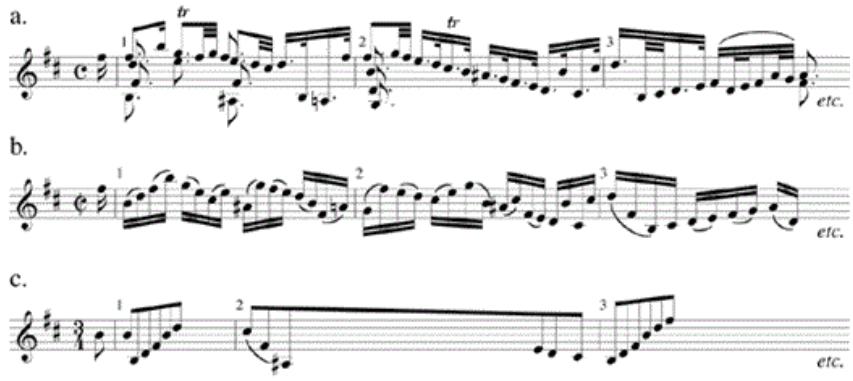
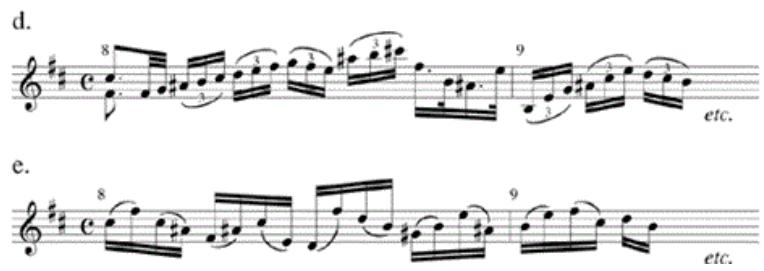
这是章节标识词,表明紧随其后的内容属于本书某一章的卷首页。
第2段(P0002)
原文复述
Six The Partitas
中文讲解
本段为第六章的正式标题,原文带有一个 Markdown 一级标题符号“#”,实际显示为“Six The Partitas”。该标题点明本章研究对象——巴赫的三首小提琴无伴奏帕蒂塔(组曲)。
补充说明
原文中“#”为版面中残留的标题符号,实际页面上呈现为加粗或大字号章节标题“六 The Partitas”。
第3段(P0003)
原文复述
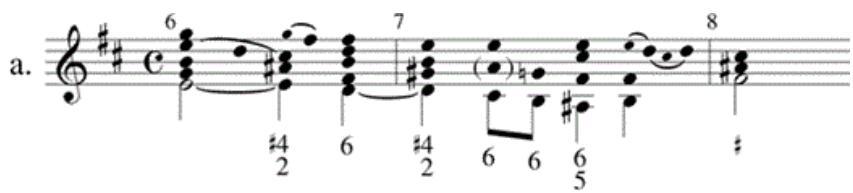
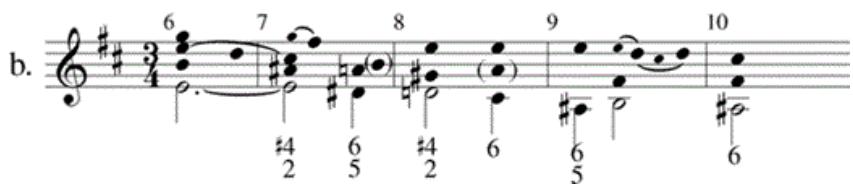
Joel Lester
中文讲解
本段列出本章作者 Joel Lester。该姓名位于章节标题下方,是按学术出版常规排列的署名行。
第4段(P0004)
原文复述
https://doi.org/10.1093/acprof:oso/9780195120974.003.06 Pages 139–156
中文讲解
本段提供本章的数字对象标识符(DOI)链接以及页码范围 139–156,标明本章在原书中的位置。DOI 前缀 acprof:oso 显示该书收录于 Oxford Scholarship Online 平台。
补充说明
页码范围表示本章正文从原书第 139 页开始、第 156 页结束。
第5段(P0005)
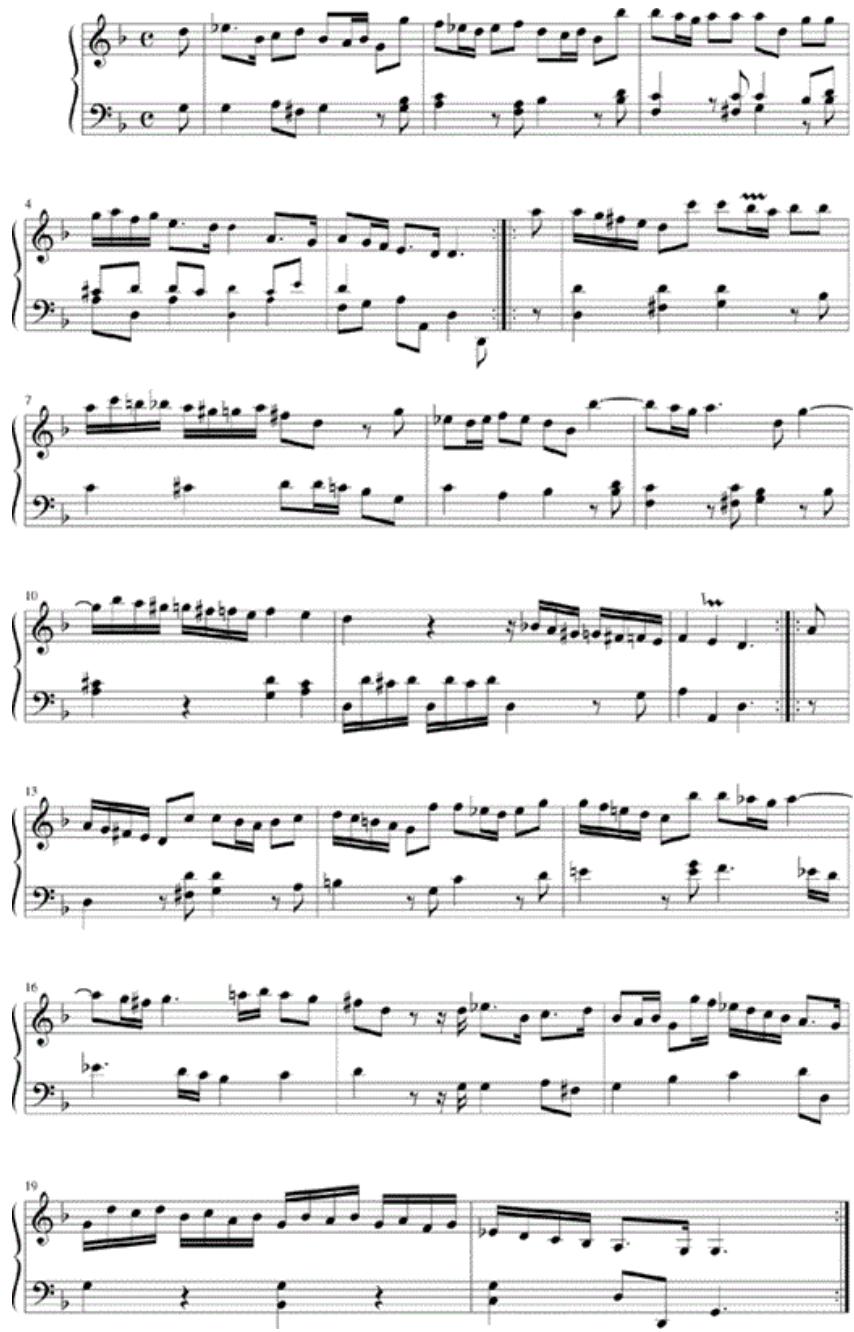
原文复述
Published: October 1999
中文讲解
本段注明出版时间为 1999 年 10 月,为读者提供本章内容的时间坐标。
第6段(P0006)
原文复述
Abstract
中文讲解
本段为“## Abstract”二级标题,用于引导下文的内容摘要部分。
补充说明
原文中“##”为版面中残留的二级标题符号。
第7段(P0007)
原文复述
A wide variety of dance movements characterize Bach’s three solo-violin partitas. All the movements, except for the Preludio of the E-major Partita and the Chaconne ending the D-minor Partita, have two reprises and, following Bach’s usual practice, fall into two parallel sections with heightening levels of activity both within each section and between the two sections. The term “partita” means a suite (a series of dances) as well as a set of variations. Different sorts of variations characterize the solo-violin partitas: the B-minor Partita follows each dance with a “double” or variation on the complete preceding movement; the various movements of the D-minor Partita are all variations over a similar thoroughbass, followed by the Chaconne (Bach’s longest set of variations).
中文讲解
这是本章摘要的第一部分,依次交代了四个核心论点:1)巴赫的三首小提琴无伴奏帕蒂塔以丰富多样的舞曲乐章为特征;2)除 E 大调帕蒂塔的前奏曲与 D 小调帕蒂塔末尾的恰空外,其余所有乐章均包含两段反复(reprises),且遵循巴赫的常规做法,由两个平行段落构成,每段内部与两段之间的活动强度(activity)逐层提升;3)术语“partita”同时具有“组曲”(一系列舞曲)和“变奏曲集”两层含义;4)两首帕蒂塔各自采用了不同的变奏策略——B 小调帕蒂塔在每首舞曲后附加“double”(对前一动机完整地变奏一次),D 小调帕蒂塔的各乐章都建立在相似的通奏低音之上,并以恰空结尾(恰空本身也是巴赫最长的变奏组合)。作者借此段为读者建立分析框架:帕蒂塔既是舞曲组曲,也是变奏体裁;其内部结构遵循两段平行、活动强度递增的写法,并通过两种不同的变奏策略展开。原文中的上标标记为版面 OCR 残留,本复述已还原为可读正文。
补充说明
“reprises”在此语境下指两段反复(da capo 式反复结构的第一段与第二段);“heightening levels of activity”指乐句和段落中织体、节奏、力度密度逐层递增的现象,这是巴洛克器乐写作的常见手法。
第8段(P0008)
原文复述
Keywords: partita, suite, variations, Chaconne, thoroughbass, parallel sections, heightening activity
中文讲解
本段列出本章的关键词:partita(帕蒂塔)、suite(组曲)、variations(变奏)、Chaconne(恰空)、thoroughbass(通奏低音)、parallel sections(平行段落)、heightening activity(活动强度递增)。这些关键词对应摘要中讨论的核心概念,便于检索系统与读者快速定位主题。
第9段(P0009)
原文复述
Subject: Musicology and Music History, Strings, Baroque Music
中文讲解
本段列出本章所属的学科分类:音乐学与音乐史、弦乐、巴洛克音乐。它将本章定位在史学与体裁研究交叉领域。
第10段(P0010)
原文复述
Collection: Oxford Scholarship Online
中文讲解
本段注明本章收录于 Oxford Scholarship Online(牛津学术在线)数据库。
第11段(P0011)
原文复述
Bach’s solo-violin cycle alternates between sonatas and series of stylized dances. Chapters 2–5 of this book study the first sonata in detail and comment on the two others, touching on a number of principles that concern the structure and aesthetics of Baroque compositions and of Bach’s own style. This chapter surveys some aspects of the three solo-violin partitas.
中文讲解
本段是摘要的第二部分,主要交代本书整体框架与本章定位:1)巴赫的小提琴无伴奏作品(cycle)在体裁上交替呈现奏鸣曲与程式化舞曲系列;2)本书第 2 至 5 章详细研究第一首奏鸣曲,并对另两首加以评论,触及巴洛克作品结构与美学以及巴赫个人风格的多项原则;3)本章(第 6 章)则转而综述三首小提琴帕蒂塔的若干方面。这段让读者明白:此前章节聚焦奏鸣曲体裁,本章则补充舞曲/帕蒂塔维度,从而完成对巴赫小提琴无伴奏作品整体的覆盖。
补充说明
“cycle”在此并非指音乐术语中的“循环”,而是指巴赫作为一个整体来创作并以 BWV 1001–1006 编号的小提琴无伴奏作品群。
第12段(P0012)
原文复述
Downloaded from academic.oup.com/book/5913/chapter/149234162 by Indiana University - Bloomington user on 12 August 2026
中文讲解
本段为页脚版权与下载信息,说明该 PDF 由学术使用者从牛津学术在线下载,注明下载日期为 2026 年 8 月 12 日,机构为 Indiana University - Bloomington,属于引用溯源信息,不参与章节论证。
脚注 / 边栏 / 图表 / 附加信息(如有)
本节为第六章的卷首页(front matter),主要包含:1)章节标题与作者署名(P0002–P0003);2)出版元数据,包括 DOI、页码范围与出版时间(P0004–P0005);3)摘要及其关键词、学科分类、收录数据库(P0006–P0010);4)一段概括全书前五章与本章关系的扩展摘要(P0011);5)学术数据库下载水印(P0012)。摘要文本(P0007、P0011)兼具章节内容预告功能,预先点明帕蒂塔的双重含义(组曲与变奏)、舞曲结构的两段平行写法以及 B 小调与 D 小调帕蒂塔各自的变奏策略。
💡 本节核心要点
- 第六章聚焦巴赫三首小提琴无伴奏帕蒂塔,是继第 2–5 章奏鸣曲分析之后对舞曲/变奏体裁的补充综述。
- “partita”一词兼具“组曲”(舞曲序列)与“变奏曲集”双重含义,构成本章分析的核心概念框架。
- 除 E 大调前奏曲与 D 小调恰空外,其余乐章均含两段反复,遵循巴赫两段平行、活动强度逐层递增的写作惯例。
- B 小调帕蒂塔采用“double”变奏策略——每首舞曲后附加对前一动机的完整变奏。
- D 小调帕蒂塔各乐章基于相似通奏低音展开,并以巴赫最长的恰空变奏组结尾。
- 巴赫的小提琴无伴奏作品整体在奏鸣曲与程式化舞曲系列之间交替,本章的设置完成对该作品群的全覆盖。
🔑 关键术语
- partita:在本节中指巴赫的小提琴无伴奏帕蒂塔,同时具有“组曲(一系列舞曲)”与“变奏曲集”两层含义,是本章的核心研究对象。
- suite:在本节中指由若干程式化舞曲按固定顺序串联而成的组曲,是 partita 的第一层含义。
- reprises:在本节中指乐章内部的反复段落;除 E 大调前奏曲与 D 小调恰空外,巴赫帕蒂塔的大部分乐章都包含两段 reprises。
- parallel sections:在本节中指乐章划分为两段平行结构,巴赫通常使每段内部与两段之间的织体活动强度逐层递增。
- heightening activity:在本节中指乐章内部及两段之间在节奏、织体、力度密度上逐层提升的活动强度,是巴洛克写作的常见修辞手法。
- double:在本节中指 B 小调帕蒂塔中紧接每首舞曲之后、对该舞曲进行整体变奏的附加段落,是 partita 作为“变奏曲集”的实现方式之一。
- thoroughbass:在本节中指 D 小调帕蒂塔各乐章共同的低音基础;该帕蒂塔的各乐章都是建立在相似通奏低音之上的变奏。
- Chaconne:在本节中指 D 小调帕蒂塔末乐章,是巴赫最长的一套变奏组合,本身也是变奏体裁的典型代表。
- stylized dances:在本节中指巴赫小提琴无伴奏作品中程式化、风格化处理的舞曲,是帕蒂塔的体裁基础。
C1.2 Series of Dance Movements
第1段(P0013)
原文复述
Series of Dance Movements
中文讲解
This paragraph is the section heading. It announces that the following discussion will turn to the “Series of Dance Movements” found in Bach’s three partitas for solo violin (BWV 1004 in D minor, BWV 1006 in E major, and BWV 1002 in B minor). After the previous section established the formal sameness of the three solo sonatas, this section opens a contrasting topic: the wide variety in the number, type, and arrangement of movements across the three partitas. As a heading, it carries no argument of its own; its function is to frame the comparison that follows.
补充说明
No additional supplement.
第2段(P0014)
原文复述
Whereas the three solo sonatas all contain four movements in the same order (a slow movement and fugue that form a prelude-fugue pair, a different sort of slow movement in some sort of parallel-section structure, and a fast finale with two reprises), the three partitas differ considerably from one another in their number and type of movements. The D-minor Partita has five movements, the E-major seven, and the B-minor eight. But these numbers do not accurately reflect the variety of these pieces. The D-minor Partita has the fewest movements yet is by far the longest because it ends with the monumental Chaconne. (Indeed, the D-minor Partita has fewer movements than any of Bach’s keyboard suites or partitas yet lasts longer than any of them.) The B-minor Partita includes the most movements yet has the fewest dance types, since four of its eight movements are “doubles” (or variations on the preceding dance).
中文讲解
This paragraph establishes the central contrast of the section: the sonatas are uniform, the partitas are not. The author lists the exact movement counts (D minor: 5; E major: 7; B minor: 8) and then warns the reader not to equate “more movements” with “greater variety.” Three points carry the argument: (1) The D-minor Partita, though shortest in count, is the longest in duration because of the monumental concluding Chaconne — and the parenthetical emphasizes that this single work outlasts every keyboard suite or partita Bach wrote. (2) The B-minor Partita, though longest in count, is the most limited in dance types because four of its eight movements are “doubles” (variations on the preceding dance) and therefore do not introduce new dance genres. (3) The numerical comparison thus understates the diversity of the E-major and the scale of the D-minor. The purpose of the paragraph is to set up the more detailed inventory that follows in the next paragraphs.
补充说明
The “doubles” mentioned here are a standard Baroque dance-suite technique in which a movement is immediately followed by a written-out variation, often ornamented or with changed rhythmic values; in the B-minor Partita these doubles attach to the Allemande, Courante, Sarabande, and Gigue. The Chaconne of BWV 1004 is a passacaglia-style set of 64 variations on a four-measure theme and alone accounts for roughly half the length of the entire partita.
第3段(P0015)
原文复述
All in all, the partitas comprise 20 movements of 11 different types: nine types of dances (two each of allemandes, bourrées, correntes, sarabandes, and minuets and one loure, gavotte, gigue, and chaconne) plus one prelude and four doubles. And in those dance types that recur, the two instances often contrast significantly with each other. The Allemande in the D-minor Partita features a variety of steady rhythms (mostly sixteenths and sixteenth-triplets, with occasional pairs of thirty-seconds), whereas the Allemande in the B-minor Partita sports a profusion of irregular rhythms. The Corrente of the B-minor Partita presents steady eighths, whereas the Corrente of the D-minor Partita is entirely in triplets and dotted rhythms. And the musettelike second minuet of the E-major Partita differs considerably from the more actively rhythmic first minuet (as with the similarly contrasting characters of the minuet pair in Bach’s B♭-major keyboard Partita, the bourrée pair in his A-minor English Suite, and the gavotte pair in his G-minor English Suite). Furthermore, dances with separate titles may actually be of the same type. The loure of the E-major Partita is very close in rhythm and character to the second bourrée of Bach’s keyboard French Suite in G Major.
中文讲解
This paragraph delivers the inventory that P0014 promised. The total is stated precisely: 20 movements of 11 different types. The author then breaks the 11 types into nine dances, one prelude, and four doubles. The recurring dance types — allemande, bourrée, courante, sarabande, minuet — each appear twice, but the author emphasizes that the two instances of the same label are deliberately contrasted. Three specific pairings illustrate the contrast: the steady D-minor Allemande vs. the rhythmically irregular B-minor Allemande; the steady-eighth B-minor Corrente vs. the entirely triplet/dotted D-minor Corrente; the musettelike second minuet of the E-major Partita vs. its rhythmically active first minuet. The minuet pair is then linked to analogous pairings in Bach’s keyboard music (B♭-major keyboard Partita, A-minor English Suite, G-minor English Suite), showing that the practice of contrasting paired dances is a recurring Bachian technique. The paragraph concludes with a counter-direction: even different titles can mask the same underlying type — the loure of the E-major Partita is rhythmically and characteristically close to the second bourrée of the G-major French Suite. The function of this paragraph is to show that Bach’s creativity operates in two directions at once: same label, different character; and different label, same character.
补充说明
“Corrente” is the Italian spelling of the courante. “Musettelike” refers to the style of a musette — a dance imitating the drone-bagpipe music popular in French court entertainments, characterized by a pedal tone beneath a simple tune. The point about the loure and the second bourrée of the G-major French Suite is that the loure, despite being named separately, functionally resembles a bourrée with a drone-like bass — illustrating Bach’s tendency to embed conventional dance types under alternative titles.
第4段(P0016)
原文复述
This varied creativity is not surprising, for it also characterizes Bach’s partitas and suites for keyboard. The six English Suites, six French Suites, and six partitas range from 6 to 10 movements each and contain nine different dance types (allemande, bourrée, courante, gavotte, gigue, minuet, passapied, polonaise, and sarabande), six different titles for introductory movements (fantasia, overture, preambulum, prelude, sinfonia, and toccata), and six other types of movements (air, aria, burlesca, capriccio, rondeau, and scherzo).
中文讲解
Having established the variety within the violin partitas, the author now generalizes the same observation to Bach’s entire keyboard-suite output. The data: 18 collections (6 English Suites + 6 French Suites + 6 keyboard Partitas) ranging from 6 to 10 movements each, drawing on nine dance types, six different titles for opening movements, and six other movement types. The implicit argument is that the violin partitas are not anomalous in their variety — they belong to a larger Bachian practice in which the dance-suite genre is treated as an open laboratory for genre and title. The function of this paragraph is to place the violin partitas within a broader stylistic context: the variety just demonstrated is a habit, not an exception.
补充说明
The 18 keyboard collections referred to are BWV 806–811 (English Suites), BWV 812–817 (French Suites), and BWV 825–830 (keyboard Partitas). The “six other types of movements” are non-dance and non-introductory genres (e.g., aria, air, burlesca) that Bach occasionally inserts into suites, demonstrating that the suite format was not strictly bound to dance genres even in its core repertoire.
第5段(P0017)
原文复述
Indeed, other than remarking that the first two dance movements in all 18 keyboard collections are an allemande and a courante, there is hardly a single assertion that applies to all. For instance, almost all end with a gigue, but the C-minor Partita ends with a capriccio (and the B-minor violin Partita ends with a bourrée and the D-minor violin Partita ends with the Chaconne). And almost all the keyboard suites and partitas contain only movements in a single key, but the second minuet in the F-major English Suite is in D minor (and the second members of pairs of dances in the English Suites — the second bourrées of the A-major and A-minor Suites, the second gavotte of the G-minor Suite, and the second passapied of the E-minor Suite — change mode). In sum, just as Bach’s Brandenburg Concertos explore the widest range of concerto types and just as his Well-Tempered Clavier explores the widest range of fugue types, Bach’s cycles of dance collections survey an immensely broad spectrum of the dances and related genres of his age.
中文讲解
This paragraph sharpens the previous argument into a thesis: the only universal rule across all 18 keyboard collections is that the first two dance movements are an allemande and a courante; beyond that, “there is hardly a single assertion that applies to all.” The author supports this by examining two conventions that are nearly but not quite binding: (a) the ending — most suites close with a gigue, but the keyboard C-minor Partita ends with a capriccio, and the B-minor and D-minor violin Partitas end with a bourrée and the Chaconne respectively; (b) the tonal unity — most suites and partitas remain in one key throughout, but the F-major English Suite places its second minuet in D minor, and the second members of several paired dances in the English Suites shift to the parallel mode (major ↔ minor). The closing sentence delivers the most ambitious claim of the section: just as the Brandenburg Concertos survey the range of the concerto genre and the Well-Tempered Clavier surveys the range of the fugue, so the dance collections survey the range of Baroque dance and dance-related genres. The function of the paragraph is to elevate the descriptive inventory into a major claim about Bach’s artistic ambition.
补充说明
The phrase “change mode” refers to a shift between a major-key suite and a minor-key second dance (or vice versa) within the same collection — here specifically from the tonic major to the tonic minor. The comparison with the Brandenburg Concertos and the Well-Tempered Clavier is meant to place the dance collections as the third member of a trilogy of genre-surveying cycles.
第6段(P0018)
原文复述
Yet amid the marvelous profusion of creative imagination in the violin partitas, some general principles do apply (at least to most movements). Leaving aside the E-major Preludio and the Chaconne, all but one of the dance movements have two reprises. (The exception is the Gavotte en rondeaux of the E-major Partita, which is, as its title indicates, a rondo with a recurring eight-measure refrain that begins and ends the movement.) Most second reprises roughly parallel the first, as in the G-minor Presto and the finales of the two other sonatas discussed in detail in Chapter 5. But some of these second reprises do feature a return to the opening music quite a bit after the double bar (such as the first minuet in the E-major Partita, where the opening of the second reprise is related to the opening of the minuet, but a literal return to the very opening appears 19 measures
中文讲解
After three paragraphs emphasizing variety, the author pivots to commonality. The claim: “some general principles do apply, at least to most movements.” The most important of these is the two-reprise structure. Setting aside the E-major Preludio and the Chaconne (because the Chaconne is a variation set and the Preludio is an introductory toccata-like movement), all but one of the dance movements consist of two reprises — i.e., they are in binary form. The single exception is the Gavotte en rondeaux of the E-major Partita, whose title (“en rondeaux”) signals a rondo: a recurring eight-measure refrain frames the movement at its beginning and end. The author then refines the rule about two reprises: most second reprises “roughly parallel” the first (the term introduced earlier for the slow movements of the sonatas); but a few second reprises depart from a strict parallel — for example, the first minuet of the E-major Partita, whose second reprise opens with material related to the opening but postpones the literal restatement of the very opening until 19 measures later (the sentence continues on the next page). The function of the paragraph is to introduce a formal principle — binary reprise structure, with the option of a ronded return — that connects the partitas back to the parallel-section concept already established for the sonatas.
补充说明
The “double bar” referenced here is the repeat sign separating the first reprise from the second in binary form. “En rondeaux” (“in rondos”) indicates a movement that alternates a recurring refrain with contrasting couplets; in Bach’s usage for this gavotte, a single eight-measure refrain returns several times. The connection to the G-minor Presto and the sonata finales foreshadows Chapter 5’s detailed discussion of binary reprise form.
第7段(P0019)
原文复述
p. 140
中文讲解
This is a page header — the running head “p. 140” indicating that the next portion of text belongs to page 140 of the printed book. It carries no argumentative content; its function is purely navigational/typographic.
补充说明
No additional supplement.
第8段(P0020)
原文复述
p. 141
中文讲解
This is a second page header — the running head “p. 141” indicating the continuation onto the next page of the printed book. Like the previous entry, it carries no argumentative content and serves only to mark the location in the original source.
补充说明
No additional supplement.
第9段(P0021)
原文复述
Downloaded from academic.oup.com/book/5913/chapter/149234162 by Indiana University - Bloomington user on 12 August 2026
中文讲解
This is a download/access footer printed by Oxford University Press’s academic platform. It records that the chapter file (chapter 149234162, book 5913) was downloaded by a user affiliated with Indiana University – Bloomington on 12 August 2026. It is bibliographic provenance metadata and carries no content relevant to the argument.
补充说明
No additional supplement.
第10段(P0022)
原文复述
later, or the Bourrée of the same partita, where the second reprise opens with a transposition of the opening, but a literal return leads to the final cadence). Thus the notions of parallel-section structure introduced in chapters 4 in connection with the G-minor Siciliana, the third movements of the other solo-violin sonatas, and related works and applied in chapters 5 to the two-reprise finales of the three violin sonatas apply to these movements.
中文讲解
This paragraph completes the sentence begun in P0018. The author offers a second example of a second reprise that departs from strict parallelism: the Bourrée of the E-major Partita, whose second reprise begins with a transposition of the opening but eventually returns literally to the opening material to close. With these two examples (first minuet and Bourrée, both from the E-major Partita), the author generalizes: the concept of parallel-section structure, introduced in Chapter 4 in connection with the G-minor Siciliana and the slow third movements of the other solo-violin sonatas, and applied in Chapter 5 to the two-reprise finales of the three violin sonatas, also applies to the dance movements of the partitas. The function of the paragraph is to bind the partitas back into the same formal vocabulary that has been developed for the sonatas, closing the section by unifying the treatment of binary reprise form across Bach’s solo violin output.
补充说明
The reference to Chapter 4 (Siciliana) and Chapter 5 (sonata finales) indicates that the parallel-section concept has already been introduced earlier in the book for the sonatas; this final paragraph retroactively extends that concept to the partitas, completing a unifying framework for all six solo works.
脚注 / 边栏 / 图表 / 附加信息(如有)
The section contains two printed page-header artifacts (“p. 140” and “p. 141”) marking the pagination in the source book, plus one Oxford Academic download/access footer recording that the chapter was retrieved on 12 August 2026 by an Indiana University – Bloomington user. None of these carries substantive argument; they are bibliographic/typographic only.
💡 本节核心要点
- The three violin partitas differ sharply from the three violin sonatas: where the sonatas share an identical four-movement order, the partitas have no shared template (D minor: 5 movements; E major: 7; B minor: 8), and their movement counts do not track their diversity or length.
- The D-minor Partita is the longest work in the corpus despite having the fewest movements, because of the closing Chaconne; the B-minor Partita, despite having the most movements, has the fewest distinct dance types because four of its eight movements are “doubles” (variations).
- Across the three partitas there are 20 movements of 11 different types; recurring dance types are deliberately contrasted between their two instances (Allemande, Corrente, minuet pair), and conversely dances under different titles can belong to the same underlying type (e.g., the loure and the G-major French Suite’s second bourrée).
- The same variety characterizes all 18 of Bach’s keyboard suites and partitas, which contain nine dance types, six different opening-movement titles, and six other movement types — confirming that genre-survey is a general Bachian practice, not a violin-partita peculiarity.
- The only universal convention across all 18 keyboard collections is that the first two dances are an allemande and a courante; even the otherwise common gigue-finale and single-key conventions are broken in specific cases.
- Despite the variety, the dance movements of the partitas share a common formal principle: most are in two-reprise (binary) form, with second reprises that generally parallel the first but occasionally defer a literal return to the opening — the same parallel-section concept applied in earlier chapters to the slow movements and finales of the solo sonatas.
🔑 关键术语
- prelude-fugue pair:In the three violin sonatas the opening slow movement is paired with a fugue so that the two function as a unit; the partitas, by contrast, do not use this pairing — they use a single Prelude (E major) or none at all (D minor and B minor).
- parallel-section structure:The technical name for binary form in which the second reprise is a varied or transposed restatement of the first; the author uses this concept across the sonatas and extends it to the dance movements of the partitas in this section.
- Chaconne:A closing movement of the D-minor Partita built as a set of 64 variations over a four-measure bass; it is so large that the entire D-minor Partita outlasts every keyboard suite and partita Bach wrote despite having only five movements.
- double:A written-out variation movement that immediately follows (and varies) a preceding dance; four of the eight movements of the B-minor Partita are doubles, which is why that partita has the most movements but the fewest distinct dance types.
- Gavotte en rondeaux:A gavotte in rondo form, used in the E-major Partita; its title signals a recurring eight-measure refrain that frames the movement, making it the only non-binary dance movement in the three partitas.
- corrente:Italian spelling of the courante; the author highlights that the B-minor Corrente uses steady eighths while the D-minor Corrente is entirely in triplets and dotted rhythms, illustrating the deliberate contrast between two instances of the same dance label.
- musettelike:Describing the character of a movement that imitates the musette — a French dance with a drone bass evoking a bagpipe; applied here to the second minuet of the E-major Partita to contrast it with its rhythmically active first minuet.
- change mode:A shift between a major key and its tonic minor within a single collection; the author notes that several second dances in the English Suites (the second bourrées of A major and A minor, the second gavotte of G minor, the second passapied of E minor) shift to the parallel mode.
C1.3 [描述性拆分] Partitas as Variations: B-minor Doubles and Their Performance Implications
第1段(P0023)
原文复述
Partitas as Variations
中文讲解
本小节标题把“partita”与“variation”并置,预告作者将从变奏关系而非仅仅舞曲排列的角度考察帕蒂塔:既讨论每支舞曲后的 Double,也讨论不同舞曲乐章及恰空之间共享的低音、和声与和声进行,并进一步分析这种关系怎样影响演奏处理。
第2段(P0024)
原文复述
The Italian term “partita”—literally meaning “little part” or “little division”—is commonly understood nowadays simply as one of the terms for a sequence of dance movements. But an older meaning of the term remained in use in Bach’s lifetime: a set of variations. Bach himself used the term in the plural for sets of² variations on chorales. There is a sense in which the entirety or part of several movements of each violin³ partita are variations of one another.
中文讲解
作者先建立 partita 一词的双重背景:现代通常把 partita 理解为一套舞曲,但巴赫时代仍可把它理解为一套变奏;巴赫本人还曾以该词的复数形式指称众赞歌变奏组。作者由此把较旧的词义用于分析命题,即每首小提琴帕蒂塔中的若干乐章,在整体或局部上可以互相构成变奏。这里的“可以”保留了推论性质:作者提出的是一种分析视角,而不是断言所有乐章处处相同。
补充说明
正文保留了脚注号2和3,但当前输入未提供相应脚注正文。
第3段(P0025)
原文复述
This is most obvious in the four pairs of movements that constitute the B-minor Partita. The four dances—the Allemande, Corrente, Sarabande, and Bourrée—are each followed by a double. (Bach also wrote doubles for both Courantes I and II in the A-major English Suite and for the Sarabande in the D-minor English Suite.) The doubles in the B-minor Partita all feature continuous rhythms (eighths, sixteenths, or triplets) and tend to follow the outer voices and harmonies of the dance they vary rather closely. They occasionally adjust the register of the bass and sometimes impart a new color to the harmony.
中文讲解
这一关系在 B 小调帕蒂塔的四组舞曲与 Double 中最清楚:Allemande、Corrente、Sarabande 和 Bourrée 之后都各有一首 Double,形成四对乐章。括号中的英国组曲例子说明这种写法并非只出现在 B 小调帕蒂塔。音乐上,Double 依靠八分音符、十六分音符或三连音形成持续流动,并大体追随原舞曲的外声部和和声;低音音区及和声色彩则可被调整。因此,Double 一方面足够接近原舞曲,可被听作其变体,另一方面又具有新的节奏、音响或和声处理。
第4段(P0026)
原文复述
Examples 6-1a and 6-1b compare the opening of the Allemande with the opening of its Double. Although the lowest line in the Double begins an octave higher than the bass of the Allemande, it still outlines a similar sequence of pitches. Both movements’ basses begin B–A♯–B. But the Allemande then descends by step B–A–G, whereas the Double (which includes the B–A–G motion) slightly alters the motion to B–F♯–G. Likewise, the top voices are quite similar, but not identical: both have an F♯ upbeat, F♯–B–G and G–F♯ in the first three beats of m. 1, and so forth. But in m. 2, the Double returns to the high G on the second beat, while the Allemande abandons that melodic register by that point. On that second beat of m. 2, the Double also spells out the harmony more completely than the Allemande, specifying that the underlying harmonic progression moves in quarter notes, not halves.
中文讲解
谱例比较说明这里的“变奏”不是原样重复,而是保留可辨认的骨架、同时改变若干具体关系。Double 的最低声部虽然高八度开始,低音仍从 B–A♯–B 出发;原舞曲随后是 B–A–G,Double 则改为 B–F♯–G。高声部在第一小节前几拍也大体相似。第二小节第二拍出现更明显的变化:Double 回到高音 G,而 Allemande 此时已经离开该音区;Double 还更完整地呈现和声,使进行按四分音符展开,而不是按较长的二分音符单位展开。由此可见,音区、音级进行和和声节奏的调整共同使 Double 区别于原舞曲。
补充说明
谱例6-1a和6-1b在本段中直接对应上述比较;具体音符关系可由本段文字定位,但演奏标记及全部谱面细节仍需查看原图。
第5段(P0027)
原文复述
Downloaded from academic.oup.com/book/5913/chapter/149234162 by Indiana University - Bloomington user on 12 August 2026
中文讲解
这是重复出现的下载来源、用户和日期页眉,只提供文档来源信息,不参与关于帕蒂塔、变奏或演奏方式的论证。
第6段(P0028)
原文复述
中文讲解
第4页此处有一个内嵌图像或乐谱占位符。输入没有保留图像数据,因此只能确认其位置和随后的图注,不能据此判断不可见的谱面或排版细节;需要查看原图。
补充说明
该占位符后紧接P0029的Example 6-1详细图注。
第7段(P0029)
原文复述
中文讲解
图注明确把 Example 6-1 分为五项:Allemande 第一至三小节、其 Double 第一至三小节、Corrente 第一至三小节,以及 Allemande 及其 Double 的第八至九小节。它们分别支撑本节前文对开篇材料和第8小节三连音过门的分析;不过各谱例的视觉细节在本输入中不可见,仍需查看原图。
补充说明
P0026已经使用(a)和(b),P0031使用(d)和(e),P0032提及(c)。
第8段(P0030)
原文复述
Such comparisons of a dance with its double offer violinists two separate performance options. They may decide that the nuances in the double are not, in fact, present in the dance itself and should not affect performance of the dance, or they may decide that the double throws light on the dance and should indeed affect its performance. Consider, for instance, m. 2 of the Allemande. How does the F♯ seventh on the downbeat resolve? As a non-harmonic tone (a 7–6 suspension) to the E on the second beat without a change of harmony? Or to that E as a member of a new harmony? According to the first option, only with the arrival of A♯ in mid-measure is there a new harmony (the dominant) worth articulating. Hearing it this way, a violinist would probably stress the dissonant F♯, relax on the resolution to E, and create a single gesture from that high F♯ through to the A♯ on the third beat. The Double interprets the harmonies and voice leading quite differently. There the second beat of m. 2 clearly outlines a C♯ half-diminished-seventh chord (ii⁷ in B minor) that resolves the preceding G-major-seventh chord (VI⁷) in a circle-of-fifths progression that leads to the dominant on the next beat (VI⁷–ii⁷–V). Transferring this reading back to the Allemande would encourage a violinist to mark the arrival on E more articulately and to ensure that the E–D–C♯ are connected as members of a single harmony—with the trill on C♯ performed so as to help this connection.
中文讲解
作者把舞蹈与 Double 的比较转化为两种彼此不同的演奏选择。第一种把第二小节正拍的 F♯视为不协和音,按7–6挂留解决到第二拍的 E,并认为中途 A♯到达时才出现值得强调的新和声——属和弦。这样演奏会突出 F♯的不协和性,在解决到 E 时放松,并把高音 F♯一路连接到第三拍 A♯。第二种选择则接受 Double 提供的和声及声部进行解释:第二拍明确构成 B 小调中的 C♯半减七和弦 ii⁷,承接 G 大七和弦 VI⁷,并沿五度循环走向下一拍的属和弦 V,即 VI⁷–ii⁷–V。若把这一解释移用于 Allemande,E 的到达应更清楚,E–D–C♯也应被听成同一和声的连接成分,C♯上的颤音应帮助维持这种联系。作者因此并未把 Double 规定为唯一答案,而是用它展示原舞曲中可能被不同理解的和声关系如何产生不同演奏。
第9段(P0031)
原文复述
Performance options that are even more divergent arise in passages where the dance itself is ambiguous. For instance, m. 8 of the Allemande (in Example 6-1d) marks the arrival on a half-cadence in B minor, followed by what most violinists play as a fairly neutral triplet melisma that at the end of the measure still outlines the same harmony. But in the Double in this measure (in Example 6-1e), a progression that includes some dissonant chords enlivens this cadential dominant. Violinists choosing to hear the chords of the Double underlying the triplets of the Allemande will play the melisma anything but neutrally. As a result, the doubles either can be regarded as separate movements or can be viewed in the same light as Bach’s keyboard arrangements of some of the solo-violin works, which add, as Bach’s pupil J. F. Agricola explained, “as much in the nature of harmony as he found necessary.”⁴
中文讲解
当舞曲本身含有歧义时,两种演奏选择会更加分化。Allemande 第8小节在 B 小调到达半终止;其后的三连音过门通常被处理得较为中性,末尾仍维持同一和声。但同一位置的 Double 含有若干不协和和弦,使这里的终止属和声更有推进力。若演奏者据此认为 Double 的和弦也隐藏在 Allemande 的三连音之下,就不能再把过门演得中性。由此,Double 既可被当成与原舞曲分开的乐章,也可被当作能够反过来照亮原舞曲和声内涵的材料。作者把这一可能性与巴赫为部分小提琴独奏作品所作的键盘改编联系起来;J. F. Agricola 所说改编会加入“他在和声性质上认为必要的东西”,支持把 Double 视为和声信息的提供者。
补充说明
正文保留了脚注号4,但当前输入未提供脚注正文;J. F. Agricola的身份及所引观点已在本段正文中说明。
第10段(P0032)
原文复述
In addition to including close variations that are labeled “doubles,” there is another sense in which many of the dance movements themselves are “partitas” or variations on one another. Consider the first two measures of the B-minor Corrente that follows the Allemande (in Example 6-1c). The melodic pitches may differ, but the
中文讲解
本段把变奏观念从正式标为 Double 的乐章进一步扩展到普通舞曲乐章:许多舞曲本身也可以在另一种意义上彼此成为“partita”或变奏。用于说明这一点的是 Allemande 之后 B 小调 Corrente 的前两小节。作者先指出两者的旋律音高可能不同,随后句子在“but the”处因跨页而中断;因此不能仅凭P0032完成其比较,必须等待P0036中的“bass line and harmonies”续文。
补充说明
P0033和P0034只是页码标记;真正接续P0032句子的是P0036,二者之间不构成论证内容。
第11段(P0033)
原文复述
p. 142
中文讲解
这是版面页码标记,不承载关于音乐结构或演奏的论断。
第12段(P0034)
原文复述
p. 143
中文讲解
这是另一个版面页码标记,与本节论证内容无关。
第13段(P0035)
原文复述
Downloaded from academic.oup.com/book/5913/chapter/149234162 by Indiana University - Bloomington user on 12 August 2026
中文讲解
这是重复出现的下载来源、用户和日期页眉,只提供文档来源信息,不参与本节的变奏与演奏论证。
第14段(P0036)
原文复述
bass line and harmonies are quite similar. Even more striking is the similarity between mm. 6–10 of the Corrente and mm. 6–8 of the Allemande, whose underlying thoroughbasses appear in Example 6-2. Both motions lead to half-cadences—the first major phrasing articulation in the movements. The underlying bass lines and harmonies are virtually identical. Similar underlying progressions link several of the movements in the D-minor Partita, as shown in Example 6-3, which focuses on the opening portion of the first reprise of each movement (and the theme of the Chaconne). The very openings of all five movements are strikingly similar in bass line, chords, and even voicings. The Allemande, Corrente, and Gigue share many parallels all the way through the motion to F major, with the faster movements (the Corrente and Gigue) adding elaborating harmonies at various points: the Corrente’s full dominant over the bass A (in m. 2) and the resolution of that dominant before returning to the G-minor-seventh chord of the Allemande; the Gigue’s use of parallel sixth chords to fill in the motion to its dominant in
中文讲解
本段接续P0032,说明 Corrente 与 Allemande 的关系并不只在旋律表面:两者旋律音高可以不同,但低音与和声相当接近。更显著的是 Corrente 第6至10小节与 Allemande 第6至8小节的比较;两段都走向半终止——各乐章中第一次重要的乐句结构划分——而其通奏低音、和声乃至低音进行几乎相同。随后作者把同一观察扩大到 D 小调帕蒂塔的多个乐章。Example 6-3 比较各乐章第一再现的开头部分,并以 Chaconne 主题作为附加对象;五个乐章的开头在低音、和弦乃至声部配置上都高度相似。Allemande、Corrente 与 Gigue 直到向 F 大调的进行中仍有许多平行,其中较快的 Corrente 和 Gigue 会在若干位置加入装饰性或展开性和声。Corrente 在第二小节低音 A 上写出完整属和弦,并在解决后回到 Allemande 的 G 小七和弦;Gigue 则以平行六和弦填充走向属和声的进行。本段最后一句在“to its dominant in”处未完,具体第4小节内容由P0037续接。
补充说明
正文提到Example 6-2和Example 6-3,但当前输入只包含Example 6-2的图注与图像占位符,没有Example 6-3的图像、图注或图注占位符。
第15段(P0037)
原文复述
m. 4, expanding the D–B♭–A bass line of the Allemande; the different expansions of the bass B♭ from m. 5 in the Allemande (mm. 7–9 in the Corrente and mm. 7–8 in the Gigue). The Sarabande takes a rather different course from the other movements after the opening progression, but it foreshadows the descending parallel sixth chords of the Gigue (circled in Example 6-3) before it goes its own way. Perhaps most striking is the manner in which the thoroughbass that underlies the Chaconne is closely related to the opening motions of the preceding movements.
中文讲解
本段首先接续P0036未完的 Gigue 分析:第四小节的平行六和弦填充了走向属和声的运动,并扩展 Allemande 的 D–B♭–A低音线条;从 Allemande 第五小节的 B♭出发,Corrente 在第7至9小节、Gigue 在第7至8小节分别作出不同展开。Sarabande 在开头的共同进行之后选择了更独立的路径,但它预示了 Gigue 中下行平行六和弦,随后才转向自己的进行。最后,Chaconne 下方通奏低音与前面各乐章开头的运动密切相关,因而作者把“变奏关系”从表面旋律或正式标为 Double 的乐对,扩展到整套作品中反复出现的低音、和声与终止骨架。
补充说明
Sarabande所预示的Gigue下行平行六和弦在原文中被说明圈于Example 6-3,但该图未包含在当前输入中,因此无法核对其圈画位置。
第16段(P0038)
原文复述
中文讲解
第5页此处有一个内嵌图像或乐谱占位符。输入没有保留图像数据,因此只能由紧随其后的图注确认图表主题,不能从占位符判断不可见内容;需要查看原图。
补充说明
该占位符后紧接P0039的Example 6-2详细图注。
第17段(P0039)
原文复述
中文讲解
Example 6-2专门呈现两段材料的通奏低音及和声轮廓:Allemande 第6至8小节,以及 Corrente 第6至10小节。它不是对全部表层旋律的罗列,而是把P0036所声称的共同低音与和声骨架视觉化;不过具体和弦、排列及任何圈画均需查看原图。
补充说明
本图与P0036中关于两段材料通奏低音、半终止及和声几乎相同的论述直接对应。
第18段(P0040)
原文复述
p. 144
中文讲解
这是版面页码标记,不参与本节论证。
第19段(P0041)
原文复述
p. 145 L
中文讲解
这是带“L”的页码标记;除原样保留该版面信息外,不对其具体含义作进一步推断。
补充说明
当前输入没有说明“L”所表示的版式类别。
第20段(P0042)
原文复述
Downloaded from academic.oup.com/book/5913/chapter/149234162 by Indiana University - Bloomington user on 12 August 2026
中文讲解
这是本小节末尾重复出现的下载来源、用户和日期页眉,仅提供文档来源信息,不属于音乐分析或演奏讨论。
脚注 / 边栏 / 图表 / 附加信息(如有)
附加材料包括三组谱例信息:Example 6-1的图注列出Allemande、其Double、Corrente及后两者的第8至9小节,供P0026、P0031和P0032引用;Example 6-2展示Allemande第6至8小节和Corrente第6至10小节的通奏低音及和声轮廓,对应P0036的比较;Example 6-3虽在P0036和P0037中被引用,但当前输入没有其图像、图注或图注占位符,圈于其中的平行六和弦无法核看。正文还保留了脚注号2、3和4,但当前任务未包含相应脚注正文。P0027、P0035及P0042是重复的下载来源、用户与日期页眉;P0033、P0034、P0040和P0041是页码标记,均不属于论证正文。
💡 本节核心要点
- partita在现代通常指一套舞曲,但巴赫时代仍可指一套变奏;巴赫也以partita的复数称呼众赞歌变奏组,因此全篇可从变奏关系理解各乐章。
- B小调帕蒂塔中,Allemande、Corrente、Sarabande和Bourrée之后各有一首Double;这些Double以连续八分音符、十六分音符或三连音流动,并大体追随原舞曲的外声部和和声。
- Allemande与其Double的开头显示,变奏可以保留共同的音高骨架和低音起点,却通过音区、局部音级进行和和声节奏产生差异;这种差异也会影响演奏。
- 第二小节存在两种和声与演奏解释:F♯可被视为7–6挂留并与A♯形成单一手势,也可因Double中的C♯半减七和弦而把E–D–C♯听成共同和声中的连接,从而更清楚地强调E。
- 第8小节的三连音过门本来可被演奏得较为中性,但Double中的不协和和弦进行可被理解为隐藏在过门之下;这使Double既可被视为独立乐章,也可被用作解释原舞曲和声的参照。
- 变奏关系不限于正式的Double:Corrente与Allemande的通奏低音及和声高度相似,D小调帕蒂塔的多个乐章共享开头和声骨架,甚至Chaconne的通奏低音也与前面乐章的开头运动密切相关。
🔑 关键术语
- partita:本节同时利用其现代含义“舞曲组”与较旧含义“一套变奏”;后一含义是分析各乐章之间变奏关系的出发点。
- double:在B小调帕蒂塔中指每支舞曲之后紧接的变奏乐章;它通常追随原舞曲的外声部和和声,却可能改变音区、节奏运动与和声色彩,也可反过来影响原舞曲的演奏理解。
- outer voices:指舞曲最外层的高声部与低声部。P0025和P0026显示,Double大体追随原舞曲的外声部,但会调整音区或具体进行。
- 7–6 suspension:P0030提出的一种演奏理解:Allemande第二小节正拍的F♯作为不协和音,以7–6挂留解决到第二拍E,而不要求在那里另起一个新和声。
- voice leading:本节用它指和弦及单音之间的连接方式;第二种演奏选择特别要求把E–D–C♯连接为同一和声的成员,并使C♯上的颤音加强这种联系。
- C♯ half-diminished-seventh chord:P0030据Double认定第二小节第二拍清楚构成B小调中的ii⁷,并把它置于VI⁷–ii⁷–V的和声进行中。
- circle of fifths:P0030用这一进行说明G大七和弦VI⁷如何经由C♯半减七和弦ii⁷走向下一拍的属和弦V。
- half cadence:指乐章在B小调属和声上的结构到达;Allemande第8小节以此划分乐句,Corrente第6至10小节与Allemande第6至8小节也都走向半终止。
- thoroughbass:指材料下方的低音与和声骨架。Example 6-2将其轮廓视觉化,Example 6-3则用于比较D小调帕蒂塔各乐章及Chaconne主题之间的底层关系。
- parallel sixth chords:Gigue用于填充向属和声进行并扩展D–B♭–A低音线条的和声手段;Sarabande在转向自身路径前预示Gigue中的下行平行六和弦。
- first reprise:Example 6-3集中比较各乐章第一再现的开头部分,以显示这些乐章在低音、和弦及声部配置上的共同起点。
- Chaconne:作者在比较D小调帕蒂塔各乐章时纳入Chaconne主题,并指出其下方通奏低音与前面乐章的开头运动关系密切。
C1.4 [描述性拆分] Partitas as Variations: Thoroughbass Relations Among D-minor Dances and Niedt
第1段(P0043)
原文复述
Despite the fact that both the similarities between dances and their doubles (illustrated in Example 6-1) and the similarities between different dances (illustrated in Example 6-2) are types of variations, there is nonetheless a fundamental difference between these two variation techniques. The doubles are strict variations, in which melody, harmony, voice leading, harmonic rhythm, and phrasing remain quite similar to the model. The similarities between dance movements noted in Examples 6-2 and 6-3, by contrast, concern primarily the underlying thoroughbass progression—these variants differ in melody, in phrasing, and in some chordal inversions or progressions. These thoroughbass similarities that relate different dances in a single partita to one another are therefore similar to the sorts of relationships within and between movements in the G-minor Sonata (discussed at some length in chapters 2–5 of this book). Such relationships help to lend an overall harmonic color to each partita, giving the sense that the various dance movements belong together with another in a larger cycle.
中文讲解
本段提出本节最核心的二分:帕蒂塔中可被称为"变奏"的相似性,其实涉及两种截然不同的变奏技术,必须先分清。
第一类——“严格变奏”(strict variation):指舞曲与其double之间的关系,特征是旋律、和声、声部进行(voice leading)、和声节奏(harmonic rhythm)和句法(phrasing)都紧贴原舞曲(model),仅作装饰化的重写;本书第6章的Example 6-1展示了这类相似。
第二类——跨舞曲的"骨架变奏":指一部帕蒂塔中不同舞曲彼此共享同一条数字低音骨架(thoroughbass progression),却允许旋律、句法,甚至一些和弦转位有所差异;Example 6-2与6-3展示了这类相似。
作者随即把第二类与本书前文的分析主线勾连起来:这种"跨乐章靠数字低音贯穿"的关系,与第2–5章分析G小调奏鸣曲各乐章之间的关系属于同一逻辑;它使每部帕蒂塔获得整体的和声色彩,让看似独立的舞曲归属到同一层更大的循环之中。
阅读本段最容易踩的坑是把所有"听起来相似"都当成同一类变奏;本段明示——表面相似并不能保证结构同构,关键是看它们是否共用同一条数字低音。
补充说明
本段提及的Example 6-1、6-2、6-3均为原书第6章中的谱例编号;其具体谱面内容需查原书,本节正文未提供,故不补。“voice leading”、“harmonic rhythm”、“phrasing"作为严格变奏的评估维度,按本节用法理解,不另作词源补充。
第2段(P0044)
原文复述
These underlying thoroughbass relationships are hardly accidental. Bach, like many of his contemporaries, believed that thoroughbass was the basis of composition. Bach’s composition pupils began by learning thoroughbass. And Bach’s favorite thoroughbass treatise was the Musicalische Handleitung (Musical Manual) by Friedrich Erhard Niedt. Niedt’s treatise first teaches how to realize a thoroughbass, then introduces dozens of patterns to elaborate any intervallic progression that might arise in a thoroughbass realization and demonstrates how to compose pieces by skillfully applying these elaborations to a thoroughbass. Niedt first takes a simple thoroughbass and composes a prelude, chaconne (!), and finale from it and then composes an entire partita of 11 dance movements from elaborations of a similar thoroughbass. Depending upon the meter and characteristic rhythms and phrase lengths of the various dances, Niedt presents the underlying thoroughbass in different ways. And depending upon the complexity, length, and tempo of the dance, Niedt shortens or lengthens the underlying thoroughbass, adds harmonies, changes chordal inversions to make cadences, and so forth. Might this portion of Niedt’s treatise have suggested to Bach the idea of composing a partita whose various movements are somewhat related by similar thoroughbases and which also includes an extended chaconne? To be sure, the dances in the D-minor Partita are somewhat more closely related to one another by their underlying thoroughbases than the dances in the two other solo-violin
中文讲解
本段把P0043观察到的"跨舞曲数字低音贯穿"现象,从"风格特征"升级为"作曲原理”,并引入一个具体的历史参照点——Friedrich Erhard Niedt。
论证可分为四层:
第一层:这种贯穿并非偶然。Bach与同时代人一样,把数字低音看作作曲的根本;他的作曲弟子也是从学数字低音开始。
第二层:摆出Bach最推崇的数字低音教材——Niedt的《Musicalische Handleitung》(Musical Manual)。Niedt的教材分三步教学:(1)先教如何"实现"(realize)一条数字低音;(2)再介绍数十种"装饰模式",用来修饰数字低音中可能出现的任何音程进行;(3)演示如何把这些模式应用到数字低音上去作曲。
第三层:举Niedt本人的两步示范作为现成范式——(a)取一条简单数字低音,先写成prelude、一首chaconne(!)和finale;(b)再用一条相近的数字低音扩展成一部含11首舞曲的帕蒂塔。这里Niedt展示了两种自变量如何改变"表层"写法:依各舞曲的拍号、特征节奏、句长不同,他以不同方式呈现同一条数字低音;再依各舞曲的复杂度、长度、速度,删减或加长该数字低音、补和声、改变和弦转位来构成终止等。
第四层:在上述示范的基础上,作者提出一个带问号的推测:是否Niedt教材的这一部分启发了Bach去构想一部"各乐章由相近数字低音贯穿、且包含一首扩展版chaconne"的帕蒂塔?并以"参与对比的另一组作品"为旁证——另一句话在"other solo-violin"处被截断,留给P0045续完。
例证的作用:举Niedt并非单纯讲历史,而是建立一个"由同一条数字低音推出整部舞曲集"的现成结构模型,使Bach在结构上可想象到那种贯穿关系。
注意:"(!)“是编辑记号,用以提示读者——此处Niedt所写的chaconne不能等同于Bach那种规模庞大、技术难度高的chaconne典范。“11 dance movements"指Niedt示例中那部帕蒂塔的舞曲数,与Bach帕蒂塔本身的舞曲数无关。
补充说明
“Musicalische Handleitung"的英译"Musical Manual”、作者全名"Friedrich Erhard Niedt"以及"11 dance movements"等具体数字均出自本段原文,不另补外部词源或历史背景。
第3段(P0045)
原文复述
partitas, which makes the D-minor Partita the ideal one to conclude with a set of variations. But without further evidence, this idea must remain purely speculative.
中文讲解
本段仅含两句话,但承担关键功能:
第一句承接P0044被截断的句子”…than the dances in the two other solo-violin partitas”,构成完整假设——D小调帕蒂塔中的舞曲彼此之间透过数字低音相互关联的程度,比另外两部小提琴独奏帕蒂塔中的舞曲更为紧密,因此它是"最适合用一组变奏来收尾"的那一部。本节推断所指的"另两部小提琴独奏帕蒂塔",按本节上文语境即指除了D小调帕蒂塔之外的两部Bach小提琴独奏帕蒂塔;具体作品编号未在本节输入中提供,不在此补出。
第二句给出限定语:“But without further evidence, this idea must remain purely speculative”——提醒读者这仅是基于风格比较的合理猜想,并非已被证实的渊源关系。这种限定正是学术论证中区分"风格解释"与"影响溯源"的边界。
结构作用:本段给P0043–P0044建立的"Niedt → Bach"影响推测划出可接受的边界,并指出哪一部帕蒂塔最适合作为检验对象。
第4段(P0046)
原文复述
p. 146 / p. 147
中文讲解
这是原书的版心页码(running page headers),分别标示书页146与147的起始位置。它仅起版面导航作用,不承载论证信息。
第5段(P0047)
原文复述
Downloaded from academic.oup.com/book/5913/chapter/149234162 by Indiana University - Bloomington user on 12 August 2026
中文讲解
这是Oxford Academic电子书的下载水印,记录此PDF系由Indiana University – Bloomington的用户于2026年8月12日从academic.oup.com/book/5913/chapter/149234162下载。属版权与下载标识信息,不构成正文内容。
第6段(P0048)
原文复述
What differentiates Bach’s dances from Niedt’s composition exercise is obvious: Bach’s compositional genius. Whereas Niedt’s dances just plod along, Bach’s dances project a shape and direction that arises from the factors discussed extensively during the analysis of the G-minor Sonata in chapters 2–5. Bach builds the sections of movements so that they heighten activity; he creates the second sections of movements so that they refer back to the opening sections, often paralleling them in order while they build upon the musical ideas.
中文讲解
本段为本节作结,把前文"数字低音贯穿"的论证升级到艺术水准上的差异。
第一句点明结论:最显著的差异就是Bach的"作曲天才"(compositional genius),Bach作品与Niedt练习之间深层的鸿沟正在于此。
第二句展开对比:Niedt的舞曲只是"按部就班地推进"(plod along),缺乏方向感;Bach的舞曲则投射出"形状与方向"(shape and direction),其根源即本书第2–5章分析G小调奏鸣曲时反复讨论的那些结构性因素。
第三句把那些因素具体化为两项可观察的手法:(1)各部分(sections)的构建使活动度层层提升(heighten activity);(2)后半部分(second sections)回指前半部分(refer back to the opening sections),并经常以平行的次序进行(paralleling them in order),同时在音乐意念上继续展开(build upon the musical ideas)。这两项正是第2–5章提炼的核心论证——“舞曲集如何成为统一体”。
结构作用:本段把本节对"数字低音贯穿"的论证上升一步——即便Bach真受了Niedt影响,最终结果能否达到艺术水准仍是关键;并再次把G小调奏鸣曲的分析用作整本书的论证底盘,由此把帕蒂塔的分析融入全书主线。
阅读要点:“compositional genius"并不是模糊的褒义评价,而是在前文已经建立起的"回指、推进、对称"三项具体手法层面上的浓缩。
补充说明
“the G-minor Sonata"按本书语境指代本书第2–5章集中分析的对象;其具体作品编号与历史信息在本节输入中未提供,故不在此补出。
脚注 / 边栏 / 图表 / 附加信息(如有)
本节末尾附两条非正文条目:(1)版心页码"p. 146 / p. 147”,仅起版面导航作用;(2)Oxford Academic下载水印(academic.oup.com/book/5913/chapter/149234162, Indiana University – Bloomington, 2026年8月12日),属电子版本版权与下载记录。除此之外,本节无脚注、表格或图说;正文所引用的Example 6-1、6-2、6-3需查原书方可对照谱面内容。
💡 本节核心要点
- 帕蒂塔中存在两类"变奏"关系——舞曲与其double之间的严格变奏,以及不同舞曲之间透过共享数字低音骨架形成的骨架变奏;二者性质根本不同。
- 跨舞曲的骨架变奏保留了旋律、句法与和弦转位的自由度,但仍以一条共同的数字低音作为统一基础,正是这种关系让各舞曲归属于同一部帕蒂塔。
- Bach及同时代人视数字低音为作曲根本,其教学从数字低音入手;Bach最推崇的数字低音教材是Friedrich Erhard Niedt的《Musicalische Handleitung》。
- Niedt教材明确示范了"由一条数字低音扩展成整部舞曲集"的现成范式——包括prelude/chaconne/finale以及含11首舞曲的帕蒂塔示例,这为Bach可能模仿该模式提供了结构上的可比对性。
- 作者推测Niedt可能启发了Bach构思"各乐章由相近数字低音贯穿且包含一首扩大版chaconne的帕蒂塔”;D小调帕蒂塔因其舞曲间数字低音关联最紧密,是检验这一猜想最自然的候选,但属"purely speculative"。
- Bach与Niedt之间的真正差距不在于是否采用数字低音贯穿,而在于作曲天才——Bach在共享数字低音的同时让每首舞曲具备明确方向、层层推进的张力以及前后段落的呼应整合,而这正是本书在第2–5章分析G小调奏鸣曲时反复提炼的因素。
🔑 关键术语
- thoroughbass:数字低音/通奏低音,以低音线加数字标记构成的和声骨架;本节指其作为贯穿全帕蒂塔的共享和声逻辑,是本节论证的核心对象。
- strict variation:严格变奏,保留模型之旋律、和声、声部进行、和声节奏与句法基本不变的变奏形式;本节特指舞曲与其double之间的关系。
- doubles:加倍,以一个既有舞曲为模型、保留其结构却加以装饰化变形的姊妹段落;本节用作严格变奏的实例。
- realization:实现/具体化,即依据低音线上的数字标记填充具体和声结构体的过程;本节指Niedt教材教学的第一步。
- elaboration:装饰/展开,即在数字低音或既定模式之上添加装饰音型与和声进行;本节指Niedt用于从一条数字低音推出整部舞曲集的关键手法。
- chaconne:恰空/夏空舞曲,以一组固定低音或固定和声模式为基础反复变奏的舞曲体裁;本节用于把Niedt教学示例中的chaconne与Bach帕蒂塔中可能存在的"扩大版chaconne"作对比。
- Niedt(Friedrich Erhard Niedt):本节被引入的唯一作曲家/理论家,按本节描述其《Musicalische Handleitung》为Bach最推崇的数字低音教材,并作为与Bach"由同一数字低音推出整部舞曲集"这一方法上的具体对比对象。
C1.5 [描述性拆分] A Lesson by J. S. Bach in Composition: Setup and Wilhelm Friedemann’s First Reprise
第1段(P0049)
原文复述
A Lesson by J. S. Bach in Composition
中文讲解
这是本节的标题。它把读者从一个抽象的写作原则的讨论(C1.4 末尾刚刚收束的“gradual and continual heightening of activity levels”等论述)带入一个具体的案例研究:J. S. Bach 给儿子 Wilhelm Friedemann 布置的一首 composition 习作。该标题的功能在于宣告,本节将以一首真实存在的、由父与子共同完成的乐曲——Allemande in G, BWV 836——作为例证,展示 C1.4 所提出的那些作曲原则如何在具体的音乐材料中运作。
第2段(P0050)
原文复述
A composition exercise that J. S. Bach gave to his son W. F. Bach sometime after 1720 illustrates just these factors, teaching us how Bach worked to incorporate disparate compositional elements into a single compositional narrative with a gradual and continual heightening of activity levels. Example 6-4 contains this exercise.
中文讲解
本段开门见山地交代了案例的两个关键事实:(1)该作品是 J. S. Bach 在 1720 年之后的某个时间点布置给幼子 Wilhelm Friedemann(W. F. Bach)的一首作曲练习;(2)本例所“阐明”的,正是上一段刚刚确立的论点——Bach 善于将表面上互不相关的作曲元素整合为一个统一的叙事,并以渐进而持续的“强度递增”来推进这条叙事。它承担着过渡功能:把前文抽象的论述(compositional elements → single narrative + gradual heightening)落到一首具体的乐曲上,并预告读者 Example 6-4 将在本节被详细分析。关键限定词“just these factors”和“teaching us how”表明作者并不只是举例,而是要把这首习作当作一面镜子,反射前文提出的那些原则是如何被实践出来的。
补充说明
本段中“disparate compositional elements”与“single compositional narrative”的对照是全节论证的轴心;后文对三段 reprise 的分析正是要逐一展示“分散元素”与“统一叙事”这两极如何在 Bach 的笔下和解。
第3段(P0051)
原文复述
[Example 6-4. J. S. Bach and W. F. Bach (?), Allemande in G (BWV 836).]
中文讲解
此处为 Example 6-4 的图注占位符。原图位于 P0050 所引述的讨论之后,正式展示了本节的核心分析对象:BWV 836(G 大调阿勒曼德舞曲),作者栏以 “J. S. Bach and W. F. Bach (?)” 标示,意味着这首作品被认定由父子二人共同完成——括号中的问号表示 W. F. Bach 的参与是推测性的。由于实际乐谱在本任务中以省略号形式给出,本节 P0053–P0058 的所有讨论都是基于这张乐谱上可以读到的小节编号(mm. 1–17、尤其是 mm. 6–7、mm. 10–11、mm. 13–17)来进行的。读者若要核对每一个细节(例如 m. 4 中缺失的拍子、m. 6 高音 C 的位置、m. 7 半音阶的长度、m. 11 左手新动机的影响等),应直接对照原图中的乐谱与本节的文字论述。
补充说明
图题中两人署名并置、以及问号的存在,已经预告了后文对“第一 reprise 由 J. S. Bach 起稿、第二 reprise 由 W. F. Bach 完成、第三 reprise 又回到 J. S. Bach(或二人合作)”的推断。
第4段(P0052)
原文复述
Downloaded from academic.oup.com/book/5913/chapter/149234162 by Indiana University - Bloomington user on 12 August 2026
中文讲解
此段是 OUP(Oxford University Press)学术平台自动添加的下载页眉,记录该 PDF 由印第安纳大学伯明顿分校的用户在 2026 年 8 月 12 日从 academic.oup.com 下载。它不承载任何与本节音乐分析有关的实质内容,仅作为版面元素存在。
第5段(P0053)
原文复述
At first, this Allemande seems to be quite a peculiar piece with three separate reprises. Most probably, J. S. Bach gave his young son Wilhelm Friedemann the first five measures to copy into his notebook (which explains, for instance, the missing beat in m. 4 in the original score). W. F. Bach then seems to have composed a second reprise (mm. 6–12), probably intending it as the conclusion of the piece. J. S. Bach probably then composed the much more satisfactory third reprise (or worked with W. F. Bach to create the third reprise) as a much more proper ending to the first reprise. As a result, we have the opening of a piece and two conclusions: one by an inexperienced pupil and then another, more proper ending, by the master.
中文讲解
本段是整个案例研究的“设定段落”,它同时回答了两个关键问题:为什么这首 Allemande 看起来有三个互不衔接的 reprise?它们分别是谁写的?作者给出了如下重构:
- mm. 1–5 是 J. S. Bach 让 Wilhelm Friedemann 誊抄进自己笔记本的“起手稿”,因此原谱 m. 4 中缺一拍——这是孩童抄谱常见的失误;
- mm. 6–12 几乎全部出自 W. F. Bach 之手,本来应该是乐曲的结论;
- mm. 13–17(第三 reprise)由 J. S. Bach 单独或与 W. F. Bach 合作完成,作为对第二回应的替换与“真正的”结束。
所以读者面对的不是一首被分段的普通作品,而是“一首作品的起头 + 两个结句”:先由学童所写、再由其师所改。这一设定是后文整段评价的根据——W. F. Bach 的第二 reprise 不是“被比较的另一首曲子”,而是“被作者亲自否定并替换的草稿”,而第三 reprise 则承载着老师对学生思路的“挽救式重写”。
关键限定词“Most probably」「seems to have」「or worked with」贯穿全段,作者刻意保持推测语气,提醒读者三段 reprise 的归属是综合笔迹、风格与乐谱不连贯性后得出的最合理假设,而非定论。
补充说明
“missing beat in m. 4”这一小细节呼应了上段“由学童誊抄”的推测;它与后文“m. 11 左手新动机使 cadence 在重复时整体错位半小节”形成有趣对照——前者是抄谱上的疏忽,后者是作曲上的错位,但都暴露出 W. F. Bach 在细节打磨上的不成熟。
第6段(P0054)
原文复述
The well-intentioned youthful enthusiasm of W. F. Bach’s second reprise (mm. 6–12), unfortunately, does not compensate for the section’s glaring compositional errors and immaturities. Wilhelm Friedemann, seeking to begin the second reprise with a bang, immediately jumps up to the highest register of his keyboard—hitting high C three times within the first two measures (and even including this high C as part of the mordent on B♭ in m. 6). He then introduces his idea of exciting music: the dramatic but utterly new chromatic scale in m. 7, which he places over a chromatically ascending bass. How better, he must have thought, to create excitement after the double bar? Unfortunately, he miscalculated the size of the interval to be filled by the chromatic scale in m. 7 and would have arrived on the F♯ a sixteenth too early had he not inserted the extraneous A at the end of the second beat. More chromatic scales appear in mm. 10 and 11, where Wilhelm Friedemann once again had to turn around at the end of the scale, because otherwise the melody would have arrived on the wrong note on the following beat.
中文讲解
本段是针对 W. F. Bach 第二 reprise 的第一轮“病理诊断”,共列举了三类不成熟的表现:
- 寄存器使用生硬:m. 6 起即跃至键盘最高区,前两小节内连击三次高音 C,甚至把它写进 B♭ 上的波音(mordent)里——这是少年人追求“开场就要炸”的典型笔法;
- 局部半音阶被当作炫技工具:m. 7 出现一段“dramatic but utterly new”的半音阶,下方配以同样半音上行的低音。问题不在半音阶本身,而在于它“全新”——既与第一 reprise 没有任何材料联系,也没有为后续乐句承担结构性任务;
- 算术错误暴露:作者细致地指出,若 W. F. Bach 不在第二拍末尾硬塞一个 A,半音阶会提前一个十六分音符到达 F♯;mm. 10–11 的半音阶同样不得不在末端掉头,否则下一拍会落在错音上。
这三处合起来说明 W. F. Bach 是在“兴奋点驱动”下写作:哪里想要“效果”,就在哪里堆效果;半音阶被用作了装饰,而非结构的一部分。作者以“he must have thought”“How better”“Unfortunately”这类内心独白式表达,把读者代入 W. F. Bach 的视角,再由作者视角揭示这些“妙招”背后的算账失误,使批评既精准又带温度。
补充说明
本段中“high C … three times within the first two measures”与“mordent on B♭ in m. 6”是同一寄存器冲动的不同表现形式;它们共同支撑后文 J. S. Bach 在第三 reprise 中“用三小节稳步上行取代瞬间跳入”的对照。
第7段(P0055)
原文复述
Further infelicities arise from the totally new figure in the left hand in m. 11, whose insertion causes the repeated cadence (mm. 10–11 and 11–12) to be shifted metrically by half a measure on its repeat. But that new left-hand figure in m. 11 is not the only new material in this reprise. Even the very first motive, the descending scale that opens m. 6, is new. To be sure, it outlines the same descending fifth A–D that ends the melody of the first reprise; but it is set with a new rhythm, register, and key and accompanied by a new left-hand rhythm in m. 6, so that any connection between the two descending A–D fifths is quite weak. Finally, amid all his care in creating new and exciting effects, Wilhelm Friedemann failed to notice that he had ended in the wrong key— his final cadence is in the dominant, rather than back in G minor!
中文讲解
本段延续 P0054 的诊断,把批评扩展到“动机复用”与“调性收束”两个更宏观的层面:
- m. 11 左手引入的“全新动机”,直接扰乱了 mm. 10–11 与 11–12 两次 cadence 之间原本应严格对齐的节拍关系,使重复时整体错位半小节——这是一个结构级错误,而非局部装饰;
- m. 6 开头的下行音阶虽然勾画了与第一 reprise 结尾相同的 A–D 五度轮廓,但作者指出它“在节奏、寄存器、调性、左手节奏上全都是新的”,因此“这种连接其实很弱”——这里的关键判断是:仅有轮廓的相似并不等于真正的动机统一;
- 最致命的一击是调性问题:W. F. Bach 的最终 cadence 落在属调,而不是回到主调 G 小调。这等同于在一首本应结束于主调的乐曲上没把门关上。
三个层次的错误层层递进:节拍错位(m. 11)→ 动机联系薄弱(m. 6)→ 调性未收束(结尾)。这恰好呼应了 C1.4 所提出的“activity levels”的反面教材:W. F. Bach 在“强度”上做了很多工作,却没有把强度引向任何结论——这正是本节标题所暗示的“incorporate disparate compositional elements into a single compositional narrative”之所以是一种技艺的原因。
补充说明
“his final cadence is in the dominant, rather than back in G minor”与后文 J. S. Bach 第三 reprise 中“directed motion toward the dominant in m. 17”形成对照:相同的和声动作,在儿子手里成了“停不下来”,在父亲手里成了“通向终止的定向运动”。
第8段(P0056)
原文复述
In sum, this second reprise is a poor conclusion to the Allemande. It flits from one new idea to another without connecting these ideas to one another or to those of the first reprise. And it retraces the tonal motion of the first reprise (I–III–I–V) instead of moving toward a conclusion. Overall, it strives for momentary effects (chromaticism, high register, and so forth) without an overall argument.
中文讲解
本段以一段压缩的“判决书”收束了对 W. F. Bach 第二 reprise 的批评,提炼出三个相互呼应的缺陷:
- 结构性缺陷:从一个“新点子”跳到下一个“新点子”,新旧之间以及与第一 reprise 之间都没有真正的联系;
- 和声走向缺陷:调性运动复刻了第一 reprise 的 I–III–I–V,但重复本身就是问题——真正的 reprise 应当“向前走”,它却把同一段路重走了一遍;
- 美学风格缺陷:全段只追求“瞬间效果”(chromaticism、high register 等),却缺乏“整体论证”。
“momentary effects … without an overall argument”是本节迄今为止最凝练的一句诊断:它把 W. F. Bach 的全部技术问题升华为一个作曲美学命题——好的写作不是“哪里好看写哪里”,而是让每一个好看都服务于一个可被追溯的论证。本句也是为下一段(即 J. S. Bach 的第三 reprise)所做的方法论铺垫:接下来读者要看到的,正是“每一个元素都为整体叙事服务”的反面示范。
补充说明
“retraces the tonal motion of the first reprise (I–III–I–V)”是一个极有信息量的判断:它把和声进行用罗马数字概括出来,告诉读者 W. F. Bach 不仅没有“走向结论”,甚至在调性层面“原地踏步”。
第9段(P0057)
原文复述
Johann Sebastian’s reworking of this material to create a proper conclusion—what appears as the third reprise—remarkably incorporates every one of young Wilhelm Friedemann’s ideas but masterfully puts each idea in its proper place, both within this reprise and within the Allemande as a whole. Consider motives. M. 13 begins with Wilhelm Friedemann’s new idea (from m. 6) but manages to relate it to both the conclusion of the first reprise and important elements from the opening of the first reprise (a) by keeping A–D in the same register as at the end of the first reprise and (b) by using the dotted-quarter/eighth-note left-hand rhythm to relate the melody and accompaniment to rhythms from mm. 1–3. In its new register, the resolution of the C–B♭ suspension in the middle of m. 13 is strongly reminiscent of the middle of m. 1, further relating the new idea to the opening of the Allemande.
中文讲解
本段是“教学示范段”的第一步,主题是动机(motives)。它的核心论断是:J. S. Bach 在第三 reprise 中“惊人地保留了 W. F. Bach 的每一个想法,但把它们各归其位”。这是一个非常重要的教学姿态——父亲没有否定儿子,他肯定了儿子的每一个素材,只调整了它们出现的位置与配器。
作者用 m. 13 作为示范,提出了三个层次的“归位”:
- 寄存器归位:m. 13 把 A–D 五度保持在与第一 reprise 结尾相同的寄存器上,从而把这个动机与第一 reprise 的末尾真正“缝合”起来;
- 节奏归位:左手使用“附点四分音符 + 八分音符”的节奏型(dotted-quarter/eighth-note),让旋律与伴奏呼应 mm. 1–3 中已经确立的节奏——W. F. Bach 的 m. 6 用了“新”的左手节奏,而 J. S. Bach 把它换成“已记”的节奏;
- 内部细节归位:m. 13 中段的 C–B♭ 挂留音解决,由于寄存器相似,听感强烈地呼应 m. 1 中段,从而把“新材料”缝回“开头”。
这三个“归位”合并起来,就是 P0056 所说的“整体论证”的具体实现:每个元素都不再是孤立的效果,而是承接另一个元素、开启下一个元素、最终通向终止。
补充说明
“C–B♭ suspension in the middle of m. 13”与“middle of m. 1”的呼应,是典型的小尺度动机统一手法;它解释了为什么 P0050 所强调的“incorporate … into a single compositional narrative”不是抽象口号,而是可以通过具体的技术手段做到的。
第10段(P0058)
原文复述
Consider next the register and the chromaticism of Wilhelm Friedemann’s mm. 6–7. Johann Sebastian’s version rises almost as high as Wilhelm Friedemann’s: to high B♭, just one step short of C. But Johann Sebastian accomplishes this not by an immediate register shift unprecedented in the piece (as Wilhelm Friedemann had done), but by a steady ascent over three measures. Wilhelm Friedemann simply inserts the chromatic scale in m. 7 as a novel exciting element; Johann Sebastian builds chromaticism into the registral ascent by proceeding around the circle of fifths, gradually adding new chromatic notes. As a result, where Wilhelm Friedemann’s chromatic scale is merely a colorful riff, Johann Sebastian’s chromaticism leads to the much more distant A♭ in an F-minor chord in m. 15—the culmination of the registral ascent and also part of the directed motion toward the dominant in m. 17 (as part of a motion through the subdominant key of C minor in mm. 14–15).
中文讲解
本段是“教学示范段”的第二步,主题是寄存器(register)与半音化(chromaticism)。它与 P0057 共同构成了对 P0054–P0056 各项“病理”的逐项回应:
- 对“瞬间高寄存器”的回应——W. F. Bach 在 m. 6 起手就把音区骤然推到 high C;J. S. Bach 的版本确实也几乎同样高(到 high B♭,只比 high C 低半音),但他用了三小节的稳步爬升替代“一瞬间跳入”,从而让高点的出现成为“累积的回报”,而不是“突兀的炫耀”;
- 对“半音阶作为独立炫技片段”的回应——W. F. Bach 把半音阶当作一段独立插入的“新鲜刺激”;J. S. Bach 则是把半音化嵌入寄存器爬升过程本身,通过围绕五度循环(circle of fifths)逐步加入新的变化音;
- 最终的功能差异——W. F. Bach 的半音阶只是“色彩性的 riff”,而 J. S. Bach 的半音化最终指向 m. 15 的 F 小调和弦中的远关系音 A♭:这一 A♭既是寄存器爬升的顶点,又是通向 m. 17 属和弦的“定向运动”的一部分(在 mm. 14–15 经过了下属调 C 小调)。
因此本段的根本命题是:同一个“半音阶”,可以写成局部炫技,也可以写成通向终止的结构性步骤;差别不在材料本身,而在材料如何被嵌入寄存器走向、和声走向与全曲终点的逻辑之中。这正是 C1.4 “gradual and continual heightening of activity levels”的最直接注脚:J. S. Bach 让强度层层抬升,而抬升的方向始终指向结论。
补充说明
“proceeding around the circle of fifths”是 J. S. Bach 处理转调的常用策略;本段借此把“半音化”与“五度循环”这两个在一般教科书中分开讲解的概念,捆绑在同一段寄存器爬升里,从而把“技术”提升为“论证”。
第11段(P0059)
原文复述
p. 148
中文讲解
此段为该页在原书中的页码标识(“p. 148”),属于版面元素,不承载任何与本节音乐分析相关的内容。
第12段(P0060)
原文复述
Downloaded from academic.oup.com/book/5913/chapter/149234162 by Indiana University - Bloomington user on 12 August 2026
中文讲解
此段是与 P0052 相同的 OUP 下载页脚,重申该 PDF 的下载来源、机构与时间。它属于版面元素,不参与本节的音乐论证。
脚注 / 边栏 / 图表 / 附加信息(如有)
本节唯一的图形材料是 P0051 处 Example 6-4 的图注,即 J. S. Bach 与 W. F. Bach(?)共同署名的 G 大调阿勒曼德舞曲 BWV 836。原图以省略号形式呈现,所有小节细节(mm. 1–17,特别是 m. 4 缺失的一拍、m. 6 高音 C 的位置、m. 7 的半音阶长度、m. 11 左手新动机、mm. 13–17 的寄存器爬升与 C 小调 / F 小调和弦运动)均需读者对照原谱核对。本节无独立脚注或边栏,文字中提到的“Example 6-4”是唯一的图示指引。
💡 本节核心要点
- 本节以 BWV 836(G 大调阿勒曼德)作为案例,演示 C1.4 提出的“把分散元素整合为单一叙事 + 持续抬升活动层级”这一抽象原则如何在实际作曲中运作。
- 这首 Allemande 由“起头 + 两个结句”构成:mm. 1–5 由 J. S. Bach 提供(W. F. Bach 抄谱时漏掉 m. 4 一拍),mm. 6–12 是 W. F. Bach 的“学生版结论”,mm. 13–17 是 J. S. Bach(或父子合作)的“教师版结论”。
- 对 W. F. Bach 第二 reprise 的批评集中在四点:瞬间跳入高区而缺乏准备、半音阶作为孤立炫技而非结构元素、m. 11 新左手动机打乱 cadence 节拍对齐、最终 cadence 停在属调而非回归 G 小调——本质是“瞬间效果堆砌,无整体论证”。
- J. S. Bach 的第三 reprise 在两项关键技术层面“挽救”了儿子的素材:动机层面通过寄存器、附点节奏与 C–B♭ 解决把 m. 13 的新材料缝回 mm. 1–3 与 mm. 5;寄存器与半音化层面用三小节稳步上行与五度循环取代瞬间跳入与孤立半音阶,使强度抬升最终通向 m. 17 的属和弦。
- 全节的根本教学命题是:同一批作曲素材,可以写成“瞬间效果堆叠”,也可以写成“通向终止的定向运动”,差别不在材料本身,而在材料如何被嵌入整体叙事;J. S. Bach 的“教学”正是让学生看到,每一处好看都应服务于整体论证。
🔑 关键术语
- reprise:在本节特指乐曲内部以双小节线划开的、带有重复或再现性质的段落(BWV 836 被重构为三个 reprise:mm. 1–5、mm. 6–12、mm. 13–17),而非一般意义上的“再现部”。它是本节分析的基本结构单位。
- chromatic scale / chromaticism:半音阶或半音化手法。本节用它来对比两种写作姿态:W. F. Bach 把半音阶当作“瞬间的炫技片段”,而 J. S. Bach 让半音化嵌入寄存器爬升,最终指向 mm. 14–15 的下属 C 小调与 m. 15 F 小调和弦中的远关系音 A♭。
- circle of fifths:五度循环。J. S. Bach 在第三 reprise 中用围绕五度循环逐步加入变化音,使半音化具有方向性,而不仅是装饰。
- register:音区。W. F. Bach 在 m. 6 一瞬间跳入键盘最高区;J. S. Bach 则通过三小节稳步上行达到几乎同样高的音区,使高音成为累积回报而非突兀炫耀。
- mordent:波音,装饰音的一种。文中指出 W. F. Bach 竟把 high C 写进 m. 6 B♭ 上的 mordent 里,作为“瞬间寄存器冲击”的极端例子。
- dotted-quarter/eighth-note rhythm:附点四分音符 + 八分音符的节奏型。J. S. Bach 在 m. 13 的左手中使用它,把新材料与第一 reprise 开头 mm. 1–3 已确立的节奏呼应起来,是动机归位的具体手段之一。
- C–B♭ suspension:C–B♭ 的挂留音解决。在 m. 13 中段,由于寄存器与 m. 1 中段相似,其听感强烈呼应乐曲开头,从而把新动机与全曲起头再次缝合。
- G minor / dominant:BWV 836 的主调 G 小调与其属调。W. F. Bach 的最终 cadence 停在属调而未回归主调,被作者判为最致命的调性失误;J. S. Bach 的版本则以“directed motion toward the dominant in m. 17”作为真正终止前的定向运动。
C1.6 [描述性拆分] A Lesson by J. S. Bach in Composition: Johann Sebastian’s Reworking of the Third Reprise
第1段(P0061)
原文复述
And consider the final cadence. Wilhelm Friedemann once again used the colorful but somewhat undirected chromatic scale in m. 10 and then basically repeated the cadence after a new left-hand figure that shifts the cadence metrically. Johann Sebastian first uses a diatonic octave scale in m. 18 as a culmination of the descending motion within the main theme and also as a means of bringing the high register of mm. 15–16 down to the principal register of the piece. He then develops a continuous sixteenth-note passage in m. 19 as an intensification of the tag to the main theme (the third beat of m. 1, recurring as the first beat in m. 18).
中文讲解
本段聚焦在终止式(cadence)的处理上,对比两位作曲家——长子威廉·弗里德曼(Wilhem Friedemann)与父亲约翰·塞巴斯蒂安(Johann Sebastian)——在终曲处的不同写法。
-
威廉·弗里德曼在第10小节再次使用了"色彩丰富但方向感不足"(colorful but somewhat undirected)的半音阶(chromatic scale),接着引入一个新的左手音型来改变终止式的节拍位置,但本质上只是把同一终止式重复了一遍。作者用"colorful but undirected"这一评价,指明该写法在情感色彩上吸引人,却缺乏结构上的内在推动力,属于外加装饰而非有机的延展。
-
约翰·塞巴斯蒂安的处理则截然不同。他在第18小节使用了自然音八度音阶(diatonic octave scale)。这个八度音阶承担两个功能:一是作为主题内部下行运动的高潮收束,二是把第15—16小节中高音区材料"拉回"乐曲的主要音区(principal register)。换言之,这一音阶同时具有局部终结(culmination)与音区回归(registral grounding)的双重意义。
-
紧接着在第19小节,他将主主题尾部的小片段(tag,即第1小节第三拍,并在第18小节中再次出现在第一拍的位置上)发展成连续的十六分音符段落,使原本短小的"主题尾巴"获得节奏密度上的强化,呈现出一种连贯的渐强式扩展(intensification)。
由此可见,作者借终止式这一结尾环节来揭示二人写作思路的根本差异:弗里德曼的做法偏向装饰性重复,约翰·塞巴斯蒂安的做法则将每个新元素都与既有主题动机挂钩,既解决音区问题,又延续动机逻辑。
补充说明
本段中出现的"the tag to the main theme (the third beat of m. 1, recurring as the first beat in m. 18)“是作者对动机呼应的精确指认:主题尾部素材以原形(第1小节第三拍)与变形再出现(第18小节第一拍),体现了典型的巴洛克主题贯穿手法(motivic continuity)。“m."、“mm.“为measure(s)/measures(s)的缩写。
第2段(P0062)
原文复述
Johann Sebastian’s ending section picks up the continually intensifying elements of the first reprise and takes them to new heights. He shows that no compositional element need be truly extraneous; any notion—chromaticism, registral shifts, and the like—can belong to a piece, if only it grows out of previous material … and if it joins in the intensifying motion within each reprise and over the piece as a whole. We may not be able to hear the conversations between Wilhelm Friedemann and Johann Sebastian as the revisions of the second reprise were worked into the third reprise. But we can read the evidence as it exists on the page. Whether he was writing a solo-violin work, a keyboard suite, a fugue, or a concerto—or whether he was teaching his young son how to put exciting compositional notions properly into a well-ordered piece of music—Johann Sebastian was always the master composer.
中文讲解
本段是本小节乃至整篇文章的结论性段落,作者由对终止式的具体对比上升到对约翰·塞巴斯蒂安创作哲学的总括。
-
第一句指出,约翰·塞巴斯蒂安的结束段(ending section)接续了第一再现部(first reprise)已经出现的"不断强化”(continually intensifying)的因素,并将其推至新高。这是作曲家把渐进式张力结构贯穿全曲的体现——每一个再现部都承载比前一再现部更密集、更具推进力的发展任务。
-
中间一句是作者提炼出的创作原则:“任何作曲素材——半音化(chromaticism)、音区转换(registral shifts)等——都不必是真正多余的元素,前提是它生长于既有材料,并参与到每一再现部乃至全曲整体的强化运动之中。” 这一陈述具有双重限定:第一是发生学限定(grows out of previous material,即动机派生关系),第二是结构功能限定(joins in the intensifying motion within each reprise and over the piece as a whole,即服务于渐进张力)。只有同时满足,新素材才被接纳为乐曲的有机组成部分。
-
第三句承认了历史研究的限度:我们无法亲耳听到威廉·弗里德曼与约翰·塞巴斯蒂安之间就第二再现部改写为第三再现部而展开的"对话”,但页面上留下的文本证据(evidence as it exists on the page)足以让读者重构这一教学/修改过程。
-
末句将视野从单一作品拓展到约翰·塞巴斯蒂安的全部创作体裁——独奏小提琴作品、键盘组曲、赋格、协奏曲——并暗示他教授幼子时也贯彻同样的创作伦理,即把"激动人心的作曲概念"恰当地安放进"秩序井然的音乐作品"之中。最后以"Johann Sebastian was always the master composer"作结,将对比分析定格在大师风范的肯定上。
值得特别留意的是本段中破折号的使用:两个长破折号所夹内容是递进式的解释说明结构,第一个破折号引出的是体裁并列(无论写何种作品),第二个破折号引出的是教学情境(无论是否在教子),二者并置强化了"大师贯穿一切情境"的总论点。
补充说明
文中"reprise"在本节语境中指乐曲的再现部(repeat section),不同于简单反复,而承担发展与累积的功能。第二再现部(second reprise)与第三再现部(third reprise)的修订关系是本节核心分析对象,暗示作曲过程中存在多轮改写而非一次性完成。
脚注 / 边栏 / 图表 / 附加信息(如有)
本小节为正文段落,未出现脚注、图表、边栏或图片占位符等附加材料。
💡 本节核心要点
- 第三再现部的终止式处理揭示了父子两位作曲家在"如何收束"上的本质差异:弗里德曼倾向于用色彩性半音化装饰并通过左手音型节拍位移来重复终止式;约翰·塞巴斯蒂安则以自然音八度音阶同时完成主题下行运动的收束和高音区材料向主要音区的回归。
- 约翰·塞巴斯蒂安在终止处进一步将主主题尾部动机发展为连续的十六分音符段落,使原本短小的"主题尾巴"获得节奏密度的强化,从而实现"强化"式收束(intensification)。
- 作者总结的约翰·塞巴斯蒂安的创作伦理是双限定原则:新素材必须生长于既有材料(动机派生),并且必须参与到每一再现部乃至全曲的渐进强化之中;这两项条件同时满足时,素材即成为作品的有机组成部分。
- 本页基于文本证据(页面上可读的音乐文本)重构父子间的修订"对话”,承认虽然无法听到原始的创作交流,但文本遗迹本身足以支撑分析判断。
- 约翰·塞巴斯蒂安的这种写作伦理贯穿其所有体裁创作——独奏小提琴作品、键盘组曲、赋格、协奏曲——并延伸到他对幼子的教学之中,因此作者将其定性为始终如一的"大师作曲家”。
🔑 关键术语
- cadence:终止式。在本节中指乐段结束时的和声与旋律收束动作,是检验作曲家收束手法的关键节点。
- chromatic scale:半音阶。弗里德曼在第10小节使用此元素,作者评价其为"色彩丰富但方向感不足",意指装饰性强但缺乏结构推动力。
- diatonic octave scale:自然音八度音阶。约翰·塞巴斯蒂安在第18小节使用,承担主题下行运动收束与高音声部回归主要音区的双重功能。
- tag (to the main theme):主主题尾部动机。第1小节第三拍作为原始形态,第18小节第一拍再次出现,构成动机呼应。
- reprise:再现部。在本节中指乐曲中重复出现的段落,但承担发展与累积功能而非简单反复。
- intensification:强化。本节反复出现的关键词,指在每一再现部及终止处,材料在节奏密度、织体复杂度或情感强度上的递增式推进。
- registral shift:音区转换。即旋律或主题在不同八度音区之间的转移,约翰·塞巴斯蒂安在第15—16小节到第18小节之间完成了一次高音区向主要音区的回落。
C1.7 [描述性拆分] The Dance Types: Rhythmic Variety and Performance Implications
第1段(P0063)
原文复述
The Dance Types
中文讲解
本段为小节标题「The Dance Types(舞曲类型)」。它开启了一个新的小节,预示作者将把焦点从舞曲的来源、风格与社会功能,转到具体曲种(allemande、sarabande、bourrée 等)在巴赫笔下呈现出什么样的节奏与表演问题,并为读者准备一段论证:曲名虽为「舞曲」,但实际作品并不真的可以按当代舞谱来演奏,这一困境贯穿整节。
第2段(P0064)
原文复述
Bach’s suites and partitas, even though they include numerous movements titled as dances, were hardly designed for dancing. The rhythms and phrasing are infinitely more complex than those of the more utilitarian dances that appear in the dancing instruction manuals of the time. As a result, it is not at all clear that the discoveries of scholars that concern the dance steps of the time give reliable advice for performing the dances in Bach’s suites.
中文讲解
本段是整节的核心断言。作者先抛出一个看似矛盾的事实:巴赫的组曲与帕蒂塔中虽有许多题为「舞曲」的乐章,但它们几乎不是为跳舞而作。接着给出原因:节奏与句法比当时舞蹈教科书中的「实用性」舞曲复杂得多。然后把这种差异转化为方法论问题:从舞蹈史研究得到的舞步复原,并不能可靠地指导今天的演奏。
这一段为整节定下基调:曲名只是名义,作品实际是键盘或独奏抽象音乐;后文将不断回到这个张力,用以挑战「按舞曲拍子跳舞」的演奏思路。
补充说明
「utilitarian dances(实用性舞曲)」指当时舞蹈手册里可实际跳的舞,与巴赫乐曲中风格化的舞曲相对。「discoveries of scholars」指舞蹈史研究者复原出来的当时舞步资料。
第3段(P0065)
原文复述
Within each dance type, Bach often adopted different procedures for individual movements. For instance, some of his allemandes feature sixteenth notes as the fastest values (such as the allemandes of the French Suite nos. 3, 4, and 6 in B Minor, E♭ Major, and E Major). But many other allemandes have occasional thirty-seconds (as in the first three English Suites), freely mix sixteenths, thirty-seconds, and sixteenth triplets (as in the English Suite no. 4 in F, the Partita no. 4 in D, and the D-minor Violin Partita), feature thirty-second notes as the predominant fast motion (as in the allemandes in the Partitas nos. 3 and 6 in A Minor and E Minor), or are predominantly in sixteenth triplets (as in the Allemande in the Partita no. 5 in G Major). And none of the keyboard allemandes approaches the rhythmic complexity of that in the B-minor Partita for Solo Violin, which freely mixes continuity in dotted eighths and pairs of thirty-seconds, sixteenth triplets, occasional groups of thirty-seconds, and even “Scotch snaps” (single thirty-seconds each followed by a dotted sixteenth). All these allemandes can hardly be performed in a single tempo or with a single affect.
中文讲解
本段用「allemande(阿勒芒德)」这一具体曲种,举证前一段的抽象判断。作者罗列了至少六种不同的节奏写法:以十六分音符为最快音、英国组曲前几首中出现的三十二分音符、英格组曲第四号与若干帕蒂塔中十六分、三十二分与十六分三连音的自由混合、第三、六号帕蒂塔中三十二分音符主导、第五号帕蒂塔几乎全用十六分三连音等。然后指出 b 小调独奏小提琴帕蒂塔的 allemande 节奏复杂度超过所有键盘作品,其中还出现了「Scotch snaps(苏格兰跳音)」——一个三十二分音符紧接一个附点十六分音符。
例子的功能并非装饰,而是把「巴赫在同曲名之下做出不同处理」具体化,并以小提琴独奏帕蒂塔的极端复杂性作为高潮。因此结论是这些 allemande「几乎不可能」用同一速度或同一种情感(affect)演奏——作者在此为演奏者提出了一个根本性难题。
读者应注意:作者用大量曲号、调性与节奏型做分类,是为了展示「曲名 ≠ 节奏特征」,从而反驳那种把舞曲当作单一风格单位的演奏观。
补充说明
「affect(情感)」在巴洛克音乐理论中指乐章所表达的统一情感状态;作者借此暗示每首 allemande 自有其 affect,故不能用统一速度。
第4段(P0066)
原文复述
A similarly wide variety of rhythms characterizes all the other dance types that recur in any significant quantity. Sarabandes, for instance, are commonly thought of as having no upbeats and a stressed second beat. Indeed, chapter 5 of this book uses the term “sarabande rhythm” to refer somewhat loosely to a stressed second beat in 3/4 meter. The Sarabande in the D-minor Partita for Solo Violin does indeed exhibit stressed second beats caused by long notes on the second beats of many measures. But the Sarabande in the B-minor Partita for Solo Violin has a stressed second beat only in the penultimate measure of each reprise (which may be more the result of a hemiola rhythm that leads to the cadence than any accented second beat supposedly characteristic of the sarabande). And while most of the 18 sarabandes in the keyboard suites and partitas do frequently stress the second beats, the Sarabande of the A-minor Partita presents an entirely different rhythmic profile, with three-eighth upbeats to virtually every phrasing unit. If an accented second beat and absence of upbeats is a defining trait of a sarabande, this movement hardly seems to merit its title.
中文讲解
本段把论证推进到 sarabande(萨拉班德),用类似的对照手法。先摆出通行说法:sarabande 通常被认为没有弱起、第二拍重音。作者承认本书第 5 章也用过「sarabande rhythm」一词来指代 3/4 拍中第二拍重音,并承认 d 小调独奏小提琴帕蒂塔的 sarabande 确实如此。但接着提出反例:b 小调独奏小提琴帕蒂塔的 sarabande 仅在每段再现的倒数第二小节有重音,可能是导向终止式的 hemiola(赫米奥拉,三对二节奏)造成的,而非「真正」的 sarabande 重音;最后又举出 a 小调帕蒂塔中的 sarabande,几乎每句都有三个八分音符的弱起,节奏面貌完全不同。
这里的论证策略是「例外颠覆定义」:如果「重第二拍、无弱起」是 sarabande 的定义特征,那 a 小调这首按其逻辑都不配叫 sarabande。作者借此继续瓦解「曲名=风格=节奏公式」的等号。
读者应注意:「hemiola」指 3:2 的跨节拍节奏关系,常出现在终止前;作者并不否定这一现象的存在,只是说它与 sarabande 的「定义」是两回事。
第5段(P0067)
原文复述
p. 150
中文讲解
页码标记「p. 150」,属于出版物的版面信息。
第6段(P0068)
原文复述
Downloaded from academic.oup.com/book/5913/chapter/149234162 by Indiana University - Bloomington user on 12 August 2026
中文讲解
页脚信息,记录该 PDF 由 academic.oup.com 上 Indiana University - Bloomington 用户于 2026 年 8 月 12 日下载,属于版本来源与版权水印性质的内容,与正文论述无关。
第7段(P0069)
原文复述
Similarly, the two bourrées in the violin partitas in B minor and E major are diametrically opposed rhythmically. The Bourrée of the E-major Partita accents many of the weak quarter beats, while the Tempo di borea of the B-minor Partita persistently accents the strong beats.
中文讲解
本段继续同一论证:以 bourrée(布雷舞曲)为例,b 小调与 E 大调两首小提琴帕蒂塔中的两首布雷节奏「截然相反」。E 大调帕蒂塔的 Bourrée 把重音放在许多弱四分拍上,而 b 小调帕蒂塔的 Tempo di borea 则持续重音在强拍上。
虽然作者在这里只给了两例,但「diametrically opposed(截然相反)」一词具有强烈论证功能:即便同名同类的两首布雷,重音位置都可能相反。这进一步强化了上几段的核心论点——曲名不能限定节奏或重音处理。
补充说明
Tempo di borea 是勃拉邦斯风格布雷(Borea)的一种写法,与 bourrée 风格上同源但命名不同,作者在此用作对照实例。
第8段(P0070)
原文复述
It is clear that studies of Bach’s dance-type movements, as informative as they may be, simply cannot answer some of the most basic questions about performance of these movements—questions of tempo and performance style.⁶
中文讲解
本段是过渡性总结:尽管学者研究巴赫的舞曲乐章提供了不少信息,却仍回答不了最根本的演奏问题——即速度与演奏风格。文末的上标「6」是一个脚注引用,指向本页(或本章)相应位置的注释。
这句话的功能是把前几段的具体例证(allemande、sarabande、bourrée 的节奏差异)凝缩成一个普遍结论:舞曲研究有用,但不够用,从而把读者引向下一段的「乐谱本身是否给出答案」的探讨。
补充说明
脚注 6 在输入中未提供具体内容;仅作为上标引用出现。
第9段(P0071)
原文复述
Meter signatures and tempo markings do not provide definitive answers either. The Allemande of the B-minor Partita carries the meter signature C, while its Double, which has the same number of measures and closely follows its model in all matters, has a meter signature ¢. Should the Double be performed at twice the speed of the Allemande? The Corrente of the same partita is in 3/4 and carries no tempo marking; its Double sports the same meter signature and once again has the same number of measures in each reprise but is labeled “presto.” In addition, as already shown in Figure 5-4 (bottom), Bach began writing the Double with the short bar lines that he used in the Corrente but then rewrote the first bar line to make it a normal one and used normal bar lines throughout the remainder of the double. Did Bach believe that the “presto” marking obviated whatever he intended by the short bar lines? And what do those short strokes denote?
中文讲解
本段论证:既然舞曲史资料不能解答演奏问题,那乐谱本身(拍号、速度标记)呢?答案同样是否定的。作者用 b 小调小提琴帕蒂塔的两个细节来说明:
第一,Allemande 标 C 拍(4/4),其 Double 标 ¢(cut time,即 2/2,演奏上常意味着速度翻倍),但两者小节数一致、写作上紧贴原版——这是否意味着 Double 一定要两倍速?作者不下结论,而把问题留给读者。
第二,Corrente 用 3/4 且无速度标记,其 Double 同样用 3/4 也无指定,但被标为「presto」;同时 Bach 最初在 Double 中用了 Corrente 的短小节线(短杠),后改为正常小节线。作者接连抛出两个疑问:presto 标记是否取代了短小节线的含义?那些短杠究竟代表什么?
「short bar lines(短小节线)」在 18 世纪德国手稿中常表示「不完全小节」或演奏上的弹性处理,作者特意把它与「presto」标记放在一起,是要说明乐谱记号本身就存在内部歧义。
论证推进的关键:从「舞曲史」到「乐谱本体」,作者逐一瓦解了演奏者可能抱有的两类「客观依据」。
补充说明
C 与 ¢ 在巴洛克手稿中分别表示 common time(4/4)与 cut time(2/2);两者速度关系通常——但不必然——为 2:1。
第10段(P0072)
原文复述
Scholars may debate these issues and await further scholarship before coming to a conclusion. But violinists must make decisions if they are to perform the works at all. Often violinists rely upon the performing traditions of earlier generations. But these performing traditions certainly do not extend back to Bach’s age. As discussed in chapter 1, Bach’s solo-violin works entered the concert repertoire of violinists only in the mid and late nineteenth century. That was an era in which the Beethovian notion of a sonata determined the aesthetics of many multi-movement works. Under the influence of such aesthetics, allemandes were viewed as analogous to first-movement sonata forms, sarabandes played the role of profound slow movements, other dances filled the position of a minuet or scherzo, and the gigue was heard as the equivalent of a fast finale.
中文讲解
本段进一步把问题从「学者是否能下结论」推到「演奏者必须现在就做选择」。作者指出:学者可以等待研究,但演奏者一旦要登台就必须做出速度与风格决定。许多人援引「早期演奏传统」,但巴赫的独奏小提琴作品直到 19 世纪中后期才进入小提琴家的音乐会曲目,其时主导多乐章作品美学的是贝多芬式的奏鸣曲思维——allemande 被等同于第一乐章奏鸣曲式,sarabande 被当作深刻的慢乐章,其他舞曲填进小步舞曲或谐谑曲位置,吉格被视为快速的终乐章。
这是一段历史化的批判:现在所见的「演奏传统」其实是 19 世纪后期的产物,不能与巴赫时代直接挂钩。这为下一段的「连续传统断裂」做了铺垫,也为最后一段提倡的「回到巴赫自身风格」蓄势。
第11段(P0073)
原文复述
It is, of course, not impossible that something like this view might have indeed been the performance tradition of the eighteenth century. But the long gap between the Baroque era in which these works were composed and the period a century or more later when they first joined the active concert repertoire precludes any sort of continuous performance tradition that connects the gestation of the works and their later performances.
中文讲解
本段是论证的关键转折——「当然不能排除 18 世纪确实存在类似的演奏观念」。但随即给出限定:从作品诞生的巴洛克时代到它们被搬上音乐会舞台的一个多世纪之后,时间跨度太长,「precludes(排除)」任何能把作品诞生期与后来演奏直接相连的连续传统。
作者的语气是谨慎的:他没有否定 18 世纪可能有「奏鸣曲式类比」的观念,但强调了历史断层的不可逾越。这样做的目的是:既避免过度肯定传统,也避免抹杀一切传统的合理性,从而为下一段自己提出的「回到巴赫自身结构」的方法留下空间。
补充说明
「gestation of the works」指作品的创作期,强调作者想划清「诞生期」与「19 世纪再发现」之间的断裂。
第12段(P0074)
原文复述
This volume is premised on the belief that delving into the structure of the solo-violin works, considering them in relation to Bach’s other compositions, and exploring them—to the extent it is possible to so do—without recourse to analytical, structural, and aesthetic notions that arose in post-Baroque eras will give violinists (and analysts and historians) new perspectives on the music. The notions of parallel-section form, of viewing thoroughbass as the primary support for the musical texture, of working with motivic ideas, and of heightening levels of activity as the primary rhetorical method seem to me the most pertinent concepts that will enable violinists to create exciting and appropriate performances. These are the common threads that typify Bach’s style in pieces as diverse as preludes, fugues, parallel-section movements, ritornello movements, and two-reprise movements.
中文讲解
本段是整节乃至整章的方法论宣言,作者借此宣告本书的前提:不依赖后巴洛克(post-Baroque)时期的分析、结构与美学概念,而是回到巴赫自身作品的内部结构,把独奏小提琴作品与他的其他作品并置来考察。
他提出了四个在他看来最具相关性的概念:(1) parallel-section form(平行段落结构,即两段对仗式布局);(2) 把 thoroughbass(通奏低音)视为音乐织体的主要支撑;(3) 以动机(motivic ideas)为工作单位;(4) 把「活动层级的逐层提升(heightening levels of activity)」作为主要的修辞手段。这些概念之所以被他视为「最具相关性」,是因为它们贯穿了巴赫多种体裁——前奏曲、赋格、平行段落乐章、里托奈罗乐章、二段再现乐章——因此可以作为共同语言来理解独奏小提琴作品。
这一节的核心张力由此得到回答:面对舞曲命名带来的演奏难题,作者的方法不是去找更多历史资料,而是转向作品自身的结构逻辑。
补充说明
「thoroughbass(通奏低音)」指巴洛克时期由数字低音支撑和声与织体的写作方式,作者视其为理解巴赫织体的关键。
第13段(P0075)
原文复述
p. 151
中文讲解
页码标记「p. 151」,属于出版物的版面信息。
第14段(P0076)
原文复述
Downloaded from academic.oup.com/book/5913/chapter/149234162 by Indiana University - Bloomington user on 12 August 2026
中文讲解
页脚信息,与 P0068 同性质,记录下载来源与时间,属于版权与版本水印性质的内容。
💡 本节核心要点
🔑 关键术语
- Double:在本节中指巴洛克组曲中紧跟原乐章之后的变体乐章,常以同一旋律骨架做节奏或织体加花;作者以 b 小调帕蒂塔的 Allemande 与 Corrente 的 Double 为例,质疑其与原型之间的拍号、速度关系。
- hemiola:本节中作者用其描述 b 小调小提琴帕蒂塔 Sarabande 中导向终止式的 3:2 跨节拍节奏,用以与「sarabande 的第二拍重音」做区别。
- Scotch snap (Scottish snap):指一个短音符紧接一个长音符(如三十二分音符后接附点十六分音符)的特殊节奏型;作者以 b 小调小提琴帕蒂塔中的出现作为节奏复杂度的极端例证。
- thoroughbass(通奏低音):巴洛克时期以低音线与和声数字支撑音乐进行的体系;本节将其列为作者提倡的、用来替代后巴洛克美学的关键概念之一。
- parallel-section form(平行段落形式):作者提出的理解巴赫结构的方法之一,指两段对仗、规模相当、彼此呼应或变奏式展开的乐章布局;作者认为它贯穿于巴赫多种体裁。
- affect (in Baroque music):巴洛克音乐修辞理论中乐章应表达的统一情感状态;作者用以说明巴赫的 allemande 各具不同 affect,因而不能套用单一速度。
- post-Baroque eras(后巴洛克时期):在本节中特指巴赫之后的古典、浪漫时期美学,包括贝多芬式的奏鸣曲思维;作者主张回避这些概念来理解巴赫独奏小提琴作品。
C1.8 [描述性拆分] The Chaconne: Length, Design, and Bach’s Compositional Choices
第1段(P0077)
原文复述
The Chaconne
中文讲解
这是本章的一个小节标题,作用是引出本节讨论的核心对象——巴赫《d小调第二无伴奏小提琴帕蒂塔》(BWV 1004)末乐章的恰空舞曲。该标题本身不包含论述内容,而是作为一个分界标志,提示读者下文将围绕恰空的篇幅、结构与巴赫的创作选择展开分析。
补充说明
本节标题对应书内章节“描述性拆分”(Descriptive Deconstruction)框架下对恰空的分析,节标题为“The Chaconne: Length, Design, and Bach’s Compositional Choices”,其中括号外主标题即本条所示。
第2段(P0078)
原文复述
It hardly needs be said here that the Chaconne has long been recognized as one of Bach’s masterpieces. As early as the first half of the nineteenth century, when Bach’s solo-violin works were still regarded primarily as “studies” (as discussed in chapter 1), Felix Mendelssohn singled out this movement for his accompaniment, quite probably to foster public performances in an age that deemed unaccompanied violin an incomplete performing medium.
中文讲解
本段确立恰空作为巴赫杰作的公认地位,并交代其早期接受史中的一个关键事件。梅纳德森(Felix Mendelssohn)独独选中这首作品为其加上钢琴伴奏,这一举动发生在十九世纪上半叶——当时巴赫的无伴奏小提琴作品主要被视为“练习曲”(参见第1章)。作者用“quite probably”表示推断,认为梅纳德森的目的在于推动公开演出,因为当时的审美认为独奏小提琴是一种“不完整的演奏媒介”,需要伴奏来支撑其艺术分量。这一历史背景为本节后续讨论恰空体量之惊人、为何以独奏小提琴承载如此庞大的篇幅埋下伏笔。
补充说明
段中“as discussed in chapter 1”提示读者该书前文已处理过巴赫无伴奏小提琴作品被作为“练习曲”看待的历史语境,本节不再展开。
第3段(P0079)
原文复述
One of the Chaconne’s signal traits is its length—most recorded performances are just under a quarter-hour. The late Baroque certainly has its share of compositions whose length is measured in hours: Handel’s Messiah, Bach’s St. Matthew Passion, and innumerable operas. But I do not know that any single individual movement in any of those works exceeds the length of the Chaconne. Bach’s other great variation cycle—the Goldberg Variations—is quite a bit longer than the Chaconne but is clearly a composite of its numerous individual movements, none of which exceeds in length the average movement in a Baroque suite or concerto.
中文讲解
本段切入恰空最显著的特质——其篇幅之大。作者指出大多数录音版本的时长“刚刚不到一刻钟”,并以此作为参照系。随即指出晚巴洛克时期的许多作品总长以小时计(如亨德尔的《弥赛亚》、巴赫的《马太受难曲》及无数歌剧),但其内部任何单一乐章的长度都不超过恰空。这一对照表明,恰空之“长”不仅在于整部作品,更在于它作为“一个乐章”的长度本身就极为罕见。接着作者又将其与巴赫另一部变奏套曲《哥德堡变奏曲》相比——《哥德堡变奏曲》总长更长,但那是“由众多独立乐章组合而成的复合体”,而其单个乐章的长度并不超过巴洛克组曲或协奏曲中的一般乐章。这段话的论证逻辑是:恰空在“单一乐章”这一维度上几乎是无与伦比的巨型作品。
补充说明
段中提及的三部对比作品(《弥赛亚》《马太受难曲》《哥德堡变奏曲》)均为巴洛克时期重要体裁——清唱剧、受难曲与键盘变奏套曲——的代表性实例,作者借此建立晚巴洛克大型作品内部“单一乐章通常不长”的隐性规律。
第4段(P0080)
原文复述
Length is worth considering because artistic expression of a certain profundity—however that may be defined—is frequently associated with an artist’s ability to capture an audience’s attention on a grandiose scale. A three-foot-high pyramid would hardly have been appropriate for the burial of the pharaohs. Novels allow writers to plumb a spectrum of issues in detail and nuance that they cannot squeeze into a short story. A miniature or a small line drawing cannot contain the range of shadings of a large canvas. During the late eighteenth and early nineteenth centuries, composers developed a number of musical forms that could support a musical argument of considerable length. In particular, sonata form, with its large-scale tonal and thematic balances and its flexible periodicities that could extend to immense proportions and contain a wide range of musical contrasts and lengthy processes of statement, development, and transformation, became a vehicle that allowed composers to make significant artistic statements in their instrumental music.
中文讲解
本段为讨论“长度”提供跨艺术的普遍性论据。首先作者承认“profundity(深刻性)”本身难以定义,但无论如何,艺术中一定深度的表达往往与艺术家“在大尺度上吸引听众注意力的能力”相关联。接着连用三个比喻:法老的陵墓不会用三英尺高的金字塔,短篇小说无法容纳小说的细节与层次,小幅素描无法呈现大幅油画的光影层次——这些例子横跨建筑、文学与绘画,说明“重大艺术主题需要相应的物理或时间尺度”。在此铺垫后,作者转向音乐史:十八世纪末至十九世纪初,作曲家发展出多种能够支撑较长音乐论述的形式,其中尤其重要的是奏鸣曲式(sonata form)。奏鸣曲式之所以能做到这一点,是因为它具备“大规模的调性与主题平衡”以及“灵活的周期性结构”,从而可以延展到巨大的规模,容纳多种音乐对比与“陈述—发展—变形”的漫长过程。这一历史背景说明:要在器乐中做出“重要的艺术陈述”,作曲家通常需要奏鸣曲式这类结构性资源。
补充说明
作者用三个跨领域比喻(建筑、文学、绘画)的目的不是装饰,而是用类比让读者直观把握“尺寸与艺术分量”之间的关系,从而为下文揭示巴赫在没有奏鸣曲式的情况下如何实现同等效果做铺垫。
第5段(P0081)
原文复述
But the Classical era’s musical structures were not available to Bach. With rare exceptions, only in the compounding of individual movements was he able to create musical architectures of great size and scope—in his passions or in the Goldberg Variations in which the overall effect results from the combination of numerous juxtaposed but separate movements. The Chaconne stands almost alone among his creations for its bold attempt to sculpt a single continuous movement of monumental proportions. If it is remarkable that he dared to write such an enormous composition for solo violin, it is perhaps even more astonishing that he boldly decided to use a compositional design that excludes one of the primary resources in a Baroque composer’s arsenal: tonal contrast—every four-measure phrase in the entire movement concludes with some sort of cadential motion that arrives on D.
中文讲解
本段是全节论证的转折与核心。首先承认古典时期的音乐结构(暗指奏鸣曲式)在巴赫时代尚未出现,巴赫能够创造出“宏大尺寸与广度”的音乐建筑,几乎只有一种途径——把众多独立乐章并置叠加——《受难曲》和《哥德堡变奏曲》都是这种“复合”逻辑的产物,整体效果来自多个独立乐章的并置。然而恰空在巴赫创作中几乎独一无二:它大胆地试图在一个“单一连续乐章”内塑造出纪念碑式的比例。紧接着,作者给出全节最具冲击力的判断——比起“为独奏小提琴写出如此庞大的作品”这一已令人瞩目之举,更令人惊叹的,是巴赫选择了一种主动排除巴洛克作曲家主要资源之一(调性对比)的设计:整首作品中,每一个四小节乐句都以某种到达D音的终止式结束。换言之,巴赫在篇幅与调性资源两方面同时自我设限:既要求一个乐章承担通常由整套作品承担的体量,又要求它在调性上保持单一。
补充说明
本段是后续分析的逻辑枢纽:它给出恰空的两条“自我设限”(篇幅巨大 + 排除调性对比),正是这两条设限使恰空获得其独特效果,下一段将立即接续此论点。
第6段(P0082)
原文复述
But these two limitations that Bach set for himself—writing a movement on this scale for solo violin and writing a movement without any large-scale tonal contrasts—are major factors in creating the effect of the Chaconne. The enormity of the music that emanates from a four-stringed soprano-register instrument played by a lone performer is a major part of the Chaconne’s effect—an aspect that Brahms surely realized when he created a piano arrangement for only the left hand. And the concentrated focus of the Chaconne grows in part from its unvarying tonality.
中文讲解
本段紧承前段,明确指出前述两条自我设限“恰恰是”塑造恰空效果的主要因素,而非缺陷。作者从两方面展开:第一,作品由一件“高音区的四弦乐器”由“一位演奏者独自”发出如此庞大的音响,这是恰空效果的重要组成部分——为说明这一点,作者援引布拉姆斯(J. Brahms)专为左手写作的钢琴改编版本作为旁证,说明后世的作曲家/改编者意识到恰空的体量感部分来自“独奏”这一媒介限制;第二,恰空那种“集中的专注感”(concentrated focus)在一定程度上来自其“始终如一的调性”(unvarying tonality)。这里的论证逻辑是“反直觉的”:通常人们会把“篇幅过长”和“缺乏调性对比”看作局限,但作者认为正是这两条限制使恰空获得了它独有的纪念碑式效果与高度集中的艺术冲击力。
补充说明
作者援引布拉姆斯左手改编版仅作为“意识到恰空独奏媒介效果”的旁证,并未在本段分析改编版的音乐本身。
第7段(P0083)
原文复述
Some sort of variation was without doubt the best option for Bach to create a piece on this scale. For variation techniques—defined broadly—underlie his entire compositional process. As the reports of his composition teaching and Niedt’s treatise inform us, all of Bach’s musical textures arise from the elaboration of a thoroughbass. And as stressed throughout this book, his compositions in all genres—preludes, fugues, two-reprise movements, other parallel-section movements, ritornello movements, and so forth—arise from varying and intensifying the musical materials that emanate from textures that themselves result from elaborations of thoroughbass progressions.
中文讲解
本段提出作者对恰空体裁选择的核心判断:在前述两条自我设限的条件下,“某种变奏手法”无疑才是巴赫创作此规模作品的最佳选择。理由是广义上的变奏技术构成了巴赫整个创作过程的底层逻辑。作者给出双重证据支撑:其一,关于巴赫作曲教学的报告与尼特(Niedt)的论著告诉我们,巴赫所有的音乐织体都源自对一个通奏低音(thoroughbass)的展开;其二,本书反复强调,巴赫在各种体裁——前奏曲、赋格、二段体乐章、其他平行段落乐章、利都奈罗乐章等等——中的作品,都产生自“对源自通奏低音展开所产生之织体所提供的音乐材料进行变化与强化”。换言之,变奏不仅是恰空的体裁属性,更是巴赫总体作曲方法论的本质特征。本段的结论隐含为:恰空之所以能以单一乐章承载如此巨大的体量,正因为巴赫的创作语言从根本上就是一种变奏语言。
补充说明
段中提及的Niedt指的是Friedrich Erhard Niedt,其《音乐指南》(Musicalische Handleitung)是十八世纪初流传的通奏低音教程;巴赫据传曾参与增补修订,是研究巴赫教学与通奏低音实践观念的重要文献。本节语境中作者仅以它作为“通奏低音是巴赫创作底层”这一观点的文献支撑。
第8段(P0084)
原文复述
p. 152
中文讲解
此为版面的页码标记(152页),非正文段落。
第9段(P0085)
原文复述
p. 153
中文讲解
此为版面的页码标记(153页),非正文段落。
第10段(P0086)
原文复述
Downloaded from academic.oup.com/book/5913/chapter/149234162 by Indiana University - Bloomington user on 12 August 2026
中文讲解
此为页面底部的下载来源水印,标明该电子文本由学术出版社Oxford Academic平台(academic.oup.com)分发,下载者机构为美国印第安纳大学伯明顿分校(Indiana University - Bloomington),下载时间为2026年8月12日。不构成正文内容。
脚注 / 边栏 / 图表 / 附加信息(如有)
本小节无脚注、图表或边栏附加材料。P0084与P0085为页码版面元素,P0086为电子版下载水印,仅用于版本溯源,均不构成论证内容。
💡 本节核心要点
- 恰空自十九世纪初即被公认为巴赫杰作;梅纳德森曾为其加钢琴伴奏以推动公开演出。
- 恰空最显著的特质是篇幅——“一个乐章”即接近一刻钟,在巴洛克大型作品中几乎无与伦比。
- 长篇艺术表达常与艺术家在大尺度上吸引听众的能力相关;古典奏鸣曲式正是后来支撑器乐大型化叙述的关键结构。
- 巴赫没有奏鸣曲式可资利用,其大型作品通常依赖多乐章并置;恰空罕见地以单一连续乐章实现纪念碑式比例。
- 巴赫在恰空中主动设置两条自我设限:独奏小提琴 + 排除大规模调性对比;这两条限制恰恰构成恰空独特效果的主要成因。
- 广义上的变奏技术是巴赫创作过程的底层逻辑——从通奏低音的展开中变化与强化材料;这使变奏体裁成为支撑恰空规模的最合理选择。
🔑 关键术语
- Chaconne(恰空):巴赫《d小调第二无伴奏小提琴帕蒂塔》BWV 1004末乐章;本节的核心讨论对象,以一组固定低音主题与四小节终止式反复为基础的变奏乐章。
- Variation(变奏):在本节中以广义理解,指巴赫通过通奏低音展开所产生之织体材料进行“变化与强化”的整体作曲方式,是恰空结构得以支撑宏大规模的方法论基础。
- Sonata form(奏鸣曲式):十八世纪末至十九世纪发展成熟的大型器乐结构,凭借调性与主题平衡与灵活的周期性,可容纳漫长的陈述—发展—变形过程;本节中作为巴赫所不具备的“大型音乐建筑”资源的对照参照。
- Thoroughbass(通奏低音):巴洛克时期以数字低音标记和声走向的实践;本节据巴赫教学报告与Niedt论著指出,巴赫所有织体均源于对通奏低音的展开。
- Tonal contrast(调性对比):巴洛克作曲家常用的“大型调性对比”资源;在恰空中被排除——每四小节乐句皆以到达D音的终止式结束,使作品调性单一。
- Ritornello(利都奈罗):段中列举的巴洛克器乐体裁之一,指反复出现的器乐段落(如协奏曲乐章中的全奏主题段落),与前奏曲、赋格、二段体等并列为巴赫变奏式创作语言所适用的体裁范例。
C1.9 [描述性拆分] The Chaconne: Processes of Heightening and Compensating Intensification
第1段(P0087)
原文复述
The Chaconne is a continuous series of variations built upon a thoroughbass and its associated chord progression. At every level, various processes generate heightened intensifications. Within the first statement of the four-measure theme, harmonic motion begins in halves and quarters but accelerates to steady quarter notes at the cadence. The melodic rhythms in this opening statement likewise accelerate, moving from the repeated opening figure (dotted quarter, eighth, quarter) to sixteenth notes. Comparable processes operate in many of the variations.
中文讲解
本段提出本节的核心论点:恰空舞曲并非“一段主题加若干互不相关的变奏”,而是一种在多个结构层级上同时运作的“持续强化”过程。所谓“at every level”是指微观层级(单次陈述内部)、中观层级(成对变奏之间)和宏观层级(多个陈述之间)。作者以四小节主题的首次陈述为例,在局部展示这一原理:和声节奏(和弦变换的速度)与旋律节奏都在向终止式推进的过程中逐渐加快,从而在一段四小节之内就完成了一次小型强化。本段最后一句“Similar processes are at work in many of the variations”预告了后文将以同样方式分析各变奏。
第2段(P0088)
原文复述
On a slightly larger scale, many of the variations appear in pairs, in which the second closely resembles the first but is intensified. For example, the opening eight measures consist of two statements of the theme. The second statement is identical to the first for three measures, but at its cadence it widens the registral span and introduces the fastest rhythms yet heard: a pair of thirty-second notes that, combined with the preceding dotted eighth, anticipate the dominant dotted rhythm of the next four variations. Those four dotted-rhythm variations themselves come in two pairs—first with the moving part primarily in the lower voices, then with a very similar melody in the top voice. The first pair remains entirely diatonic, while the second pair introduces chromaticism for the first time in the Chaconne by transforming the essential bass motion into a descending chromatic tetrachord moving from tonic to dominant. Within each of these paired phrases, the second member introduces some heightened element absent from the first: measure 16 and its upbeat extend the length and dissonance level of the rapid chordal motion found in the comparable passage at measure 12 and its upbeat; measure 23 introduces a new chromatic tone (G♯) absent from the corresponding ending of measure 19.
中文讲解
本段将观察尺度从中观层级——成对的变奏——展开。作者以开篇八小节作为微缩样本:主题陈述两次,第二次在前三小节与第一次完全相同,却在终止式处突然拓宽音域并首次引入三十二分音符。作者特别指出,三十二分音符加上之前的点八分音符这一组合,预先暗示了随后四个变奏的主导节奏型——这是恰空“预告自身未来强化”的典型写法。接着,作者把成对原则推广到随后四个变奏:先按节奏成对(点节奏),再按声部位置成对(先低音声部、后最高声部),再按调式成对(第一次全为自然音,第二次引入半音)。这里的“引入半音”是整首恰空首次出现的半音化,具体手法是把原本从主音到属音的低音进行改写为下行半音四音列。最后几句强调成对结构中“第二次相对于第一次的强化差”:m. 16 相比 m. 12、m. 23 相比 m. 19,都各自多出一个“前者不具备”的强化要素(更长的不协和和声进行、新的半音 G♯)。这是成对强化原则的具体落地。
补充说明
下行半音四音列(descending chromatic tetrachord)是巴洛克音乐中常见的从主音到属音的级进填充手法,本段中 D–C♯–C–B–B♭–A 即是其 D 小调版本;作者强调巴赫此处将其作为结构化的强化装置使用。
第3段(P0089)
原文复述
Aware that he was composing an exceptionally long series of variations, Bach carefully balanced the introduction of new elements with the relaxation of others, so that he always retained further musical elements available to intensify later. For example, during the first eight statements of the theme (mm. 1–32), the texture gradually thins from the three- and four-voiced chords characteristic of the first two statements down to the single-line writing of the eighth statement. This relaxation of textural density coincides with a gradual acceleration of rhythm, which reaches steady eighth notes only in the seventh statement and steady sixteenth notes only in the eighth statement. This same relaxation of textural density coincides with a rise in chromaticism, progressing from the largely diatonic first four statements (which contain only the notes of a D harmonic-minor scale plus a single C♮ in m. 3) through the descending chromatic tetrachord D–C♯–C–B–B♭–A in the fifth statement, the same plus G♯ in the sixth statement, and the addition of F♯ and E♭ in the eighth statement—which completes the chromatic scale. And again, this relaxation of textural density coincides with the widening of melodic span, from the tenth and ninth outlined by the melody in the first two statements to a span of just under two octaves in the eighth statement. As a result, the eighth statement (mm. 29–32) contains the fastest surface rhythm and the widest melodic span heard so far, but several other musical elements have been deliberately diminished from earlier intensities in order to set the stage for further intensifications later in the work.
中文讲解
本段是全节的概念核心。作者直接点明巴赫的作曲策略:因为恰空篇幅极长,他不能一次性耗尽所有可强化资源;因此每当引入新要素时,便同时在其他要素上“退让”,保证日后仍有可加深的余地。前八次主题陈述(mm. 1–32)被作为这一策略的范例加以剖析:织体由三、四声部和弦逐次稀化至第八次陈述的单声部线条;与此同时节奏加速、和声半音化加深、旋律音域扩展。作者对半音化进程给出逐音级的精确列举:第 5 次陈述 D–C♯–C–B–B♭–A;第 6 次加上 G♯;第 8 次再加入 F♯ 与 E♭,从而完整半音阶。这种逐一增添的写法表明巴赫把“强化”也量化到每一个具体音高上。第八次陈述呈现出一个关键悖论:在某些维度(节奏、音域)上达到当时最高强度,却在另一些维度(织体)上处于最低强度。这个悖论正是全曲得以继续强化的前提。短语“set the stage for further intensifications later”把第八次陈述定位为转折点——不是终点,而是为后续强化蓄势的发射台。
第4段(P0090)
原文复述
Such processes of compensation, in which one element advances to new intensity while others recede, continue for long stretches of the Chaconne. A few highlights: the ninth statement (mm. 33–36) slows the surface rhythm back to eighths but preserves the level of eleven different pitches (lacking only E♭) achieved in the previous statement (which had lacked only C), widens the melodic span to two octaves plus a step, and introduces the largest registral skips heard so far. The next few variations, built on steady sixteenths, gradually accumulate an ever-wider array of bowing patterns, producing a broader palette of articulations than before. And the fifteenth statement (mm. 57–60) reintroduces double-stops while remaining entirely diatonic. When continuous thirty-second notes finally appear, they are first slurred (in the seventeenth and eighteenth statements, mm. 65–72) and only later separately bowed (in the nineteenth statement, mm. 73–76) in order to supply more energy to each note.
中文讲解
本段把上一段建立的“补偿”原则进一步普遍化,并补充其在稍后段落中的具体体现。作者为这一原则命名:“processes of compensation”,即一要素推进时另一要素退让。第九次陈述(mm. 33–36)以“节奏反向运动”的方式呈现补偿:节奏由十六分音符回落至八分音符,但保留了上一陈述已经积累的十一个不同音高(仅缺 E♭),同时把音域扩展到两八度加一个音级,并首次使用最大幅度的旋律跳进。接下来的若干变奏以“运弓法多样化”作为新的强化维度——这一点颇具深意,因为运弓多样性属于小提琴演奏层面而非音高层面,显示巴赫调动了多类不同的音乐变量作为强化资源。第十五次陈述(mm. 57–60)展示另一组补偿:双音重新出现(织体加厚),代价是调式回到纯自然音。三十一分音符段落(mm. 65–76)则在“发音法”层面示范同一原理:连续的三十一分音符先以连弓出现(第 17、18 次陈述),再改为分弓(第 19 次陈述),每一步为每个音增加能量。作者的总论点是:补偿不是 mm. 1–32 中的一次性手法,而是贯穿恰空长篇的结构性作曲策略。
补充说明
对运弓方式与双音的强调源自该曲体裁——这是一首无伴奏独奏小提琴作品,因此在其他体裁中本应属于伴奏声部的演奏与织体资源,在此处皆可作为独立的强化变量使用。
第5段(P0091)
原文复述
Whereas many of the early statements come in pairs, later sections of the Chaconne operate on a much larger scale. During the major-mode statements, for example, statement 41 (mm. 161–64) casually introduces three repeated notes—an idea almost entirely absent as a prominent feature in the forty preceding statements (although it is anticipated by the repeated notes found in the melody of the first two measures of the opening two statements). In these measures (mm. 161–64), the repeated notes articulate a dominant pedal—another idea absent from the forty preceding statements. The repeated-note motive gradually crowds out all other motivi—
中文讲解
本段把分析视角进一步推远到更大的结构尺度。作者对照早期的“成对”设计与后期“单次陈述”的差异:后期单次陈述能够在历经四十次陈述的缺席之后,重新引入某些久已不用的要素。第 41 次陈述(mm. 161–64)即是一例:它看似随意地引入三个重复音,并以这些重复音支撑一个属音持续音(dominant pedal)。作者一方面指出“缺席”(这些要素在前四十次陈述中几乎完全不见),另一方面又点出“早已埋下伏笔”(开篇两次陈述的前两小节旋律中已有重复音)——这种“延迟回归 + 早期伏笔”的双重安排是恰空在宏大规模上保持统一感的关键机制。最后一句在原文中被截断(“gradually crowds out all other motivi—”),只能依现有文本理解为:作者即将描述该重复音动机如何逐渐排挤其他动机,但具体论述超出本节范围。在本节论证脉络中,本段的功能是显示:晚期作品中,单次陈述可以承担早期由成对陈述完成的戏剧性重量,强化机制已经升级到更大的尺度。
补充说明
末句“The repeated-note motive gradually crowds out all other motivi—”在原文中未完成,后续内容超出本节边界。
脚注 / 边栏 / 图表 / 附加信息(如有)
本节无脚注、图表或边栏材料。原文文本含有 OCR 转写引入的上标标记与空白字符,已在复述中按连续散文段落还原。
💡 本节核心要点
- 恰空是一组建立在固定通奏低音与和声进行上的连续变奏;其“强化”机制同时在局部(单次陈述内)、成对(两次陈述间)与宏观(多次陈述间)三个层级运作。
- 许多变奏以成对方式出现:第二次紧贴第一次,却在音域、节奏、半音化、不协和度或旋律跨度中至少推进一个维度。
- 前八次主题陈述(mm. 1–32)是“补偿原则”的集中演示:织体由三、四声部稀化至单声部的同时,节奏加速、半音化加深(直至第八次陈述完成整个半音阶)、旋律音域扩展至接近两个八度。
- 巴赫的总体作曲逻辑即“补偿”:每当某一要素到达新的强度,必有另一要素退让,以保证后续仍有可加深的余地——这是其在超长篇幅中维持张力的根本策略。
- 补偿原则贯穿恰空长程:第九次陈述以节奏减速换取音高密度与音域的扩张;其后若干变奏以运弓多样化作为新维度;第十五次陈述以双音回归换取调式回归自然音;三十一分音符先连弓后分弓逐级增加每音能量。
- 在恰空后段,强化已升级至更大尺度:单次陈述(如第 41 次,mm. 161–64)即可引入历经四十次陈述而久已缺席的要素(重复音、属音持续音),而这些要素的种子早在开篇两小节中已经埋下。
🔑 关键术语
- Chaconne(恰空):巴洛克时期的舞曲—变奏体裁,建立在反复出现的低音与和声进行之上;此处专指巴赫《D 小调第二号帕蒂塔》BWV 1004 的终乐章,为无伴奏小提琴独奏曲。
- Thoroughbass(通奏低音):巴洛克作曲技法,亦称数字低音或 continuo;以单一低音线配以数字标记暗示上方和声,恰空即以此结构作为变奏的基础。
- Statement / Variation(陈述 / 变奏):在本节语境中,四小节固定低音与和声进行的每次反复称为一次“陈述”或“变奏”;恰空全曲共 64 次陈述。
- Cadence(终止式):句尾处的和声停顿;本节中特指四小节主题的结束处,是节奏与音域发生扩张的关键位置。
- Registral span(音域跨度):一段音乐自最低音到最高音所覆盖的范围;本节把音域拓宽视为强化的一个独立维度。
- Chromatic tetrachord(半音四音列):由四个半音阶音组成的级进片段;此处特指 D–C♯–C–B–B♭–A 这一从主音到属音的下行半音填充,巴赫将其作为结构化强化手法。
- Chromaticism(半音化):使用自然音阶之外的音;本节显示巴赫在前八次陈述中逐步引入 F♯、E♭、G♯ 等音,至第八次陈述完成十二音半音阶。
- Diatonic(自然音):属于标准七声音阶的音;前四次陈述为纯自然音(仅 D 和声小调加 m. 3 的一个 C♮)。
- Double-stops(双音):小提琴上同时拉奏两根弦以发出两个音;本节将其视为织体强化资源,但第十五次陈述以双音回归换取调式回到自然音。
- Dominant pedal(属音持续音):在低声部持续或反复出现属音的写法,用以稳定或强调某段;本节指出第 41 次陈述以重复音支撑起一个属音持续音。
- Compensation(补偿):本节作者为巴赫作曲策略所起的名字:某一音乐要素推进到新强度时,另一要素退让,从而使后续强化始终保有余地。
C1.10 [描述性拆分] The Chaconne: Repeated-Note Motive, Withheld Elements, Mode Changes, and Proportions
第1段(P0092)
原文复述
Page header reading ‘p. 154’, indicating that the text following belongs to page 154 of the printed book.
中文讲解
这是版面元素,标示本节内容由原书第 154 页开始(下一段页眉则进入第 155 页)。作为对小节开头位置的标记,无需进一步释义。
第2段(P0093)
原文复述
Running footer line reading: ‘Downloaded from academic.oup.com/book/5913/chapter/149234162 by Indiana University - Bloomington user on 12 August 2026.’
中文讲解
这是 Oxford University Press 学术电子书平台上的下载标识,注明文献来自 academic.oup.com 上编号为 5913 / 149234162 的章节,并标识下载用户(Indiana University – Bloomington)与下载时间(2026 年 8 月 12 日)。本节后续还会再次出现同样的页脚。
第3段(P0094)
原文复述
The discussion continues across the next three statements, so that all voices in statement 44 (mm. 173–76) consist of nothing but repeated notes, building toward the climactic repeated-note sixteenth-note triple-stops that conclude the statement.
中文讲解
本段承接上文对反复音动机(repeated-note motive)的讨论,说明在三个相邻的陈述(statements)中所有声部都被’归零’到只剩反复音。具体落到 statement 44(173–76 小节),每个声部只奏反复音,从而蓄积能量,使该陈述末尾以反复音十六分音符三音同奏(sixteenth-note triple-stops)作为高潮收束。
关键点:作者把 statement 44 的’单声部一切只剩反复音’与末尾的三音同奏高潮并置,揭示’递减—爆发’的写作逻辑——先通过彻底简化的素材强化动机辨识度,再以叠加的多音技术瞬间将听感推向顶点。术语解释:triple-stops(三音同奏)指小提琴同时按三条弦并运弓发音的技术,对左手按弦与右手弓压都有较高要求。
补充说明
本段中的 statement 是 Bach Chaconne 中比 small section 更大的段落单位,全章按数字编号(statement 1、2 …… 44)。它通常等同于一个完整的变奏陈述,由主题材料加若干变奏手法组成。
第4段(P0095)
原文复述
The quality of motion slows down abruptly in the very next measure (m. 177). The rhythm reverts to that of the opening measures of the Chaconne, initiating the longest slow-rhythm section in the piece, and the texture thins to two voices. The element linking this music to what came before is the repeated-note motive, which has now returned to its original context in the opening measures. That original rhythm then begins its own series of heightened statements: first in double-stops, then in repeated triple-stops in m. 185, and finally in quadruple-stops in mm. 189ff. What persists across the clear-cut textural break at m. 177 is the repeated-note motive, whose development thereby becomes perhaps the most important single aspect within the major-mode variations.
中文讲解
本段聚焦 m. 177 这个转折点的双重性:
- 表面上的断裂——节奏骤慢,回到 Chaconne 开头的节奏型,进入全曲最长的慢节奏段;织体同时收缩到两声部。
- 深层上的连续——反复音动机从 m. 185 起以高度化序列回归:先二音同奏(double-stops),再三音同奏(triple-stops,m. 185),最终于 mm. 189 起进入四音同奏(quadruple-stops)。
作者的核心论断是:穿越 m. 177 处’清晰的织体断裂’,真正统一前后两部分的不是节奏或织体,而是反复音动机本身;正因为如此,‘该动机的发展或许是大调变奏段中最重要的面向’。换言之,作者认为结构并非靠渐强推进,而是靠同一动机的层层升级——这是本节对 Bach 写作逻辑最凝练的一句概括。
理解难点:表面断裂与深层统一并存,正是 Bach Chaconne 著名的’清晰分句 + 深层连贯’特征,作者把它在反复音动机上的体现当成分析的样板。
补充说明
mm. 189ff 起的反复音四音同奏是 Bach 为独奏小提琴写作的极端技术之一,要求在保持慢节奏的同时让四根弦精确发音;它是 statement 44 之后反复音动机高度化序列的顶点之一,与 P0094 中的 statement 44 共同支撑’反复音动机在大调变奏段中的核心地位’这一论断。
第5段(P0096)
原文复述
Another technique Bach employs to sustain interest throughout the Chaconne is the deliberate withholding of certain elements until late in the movement. The preceding paragraph discussed two such elements—the repeated-note motive and the use of pedals—both of which appear only well into the second half of the piece. A third such element is triplets, the first rhythmic values in the whole movement that do not ’nest’ within all the other rhythms that are present; triplets do not appear until just before the very end of the Chaconne. Harmonically, Bach reserves the first appearance of the Neapolitan chord (♭II, or an E♭ triad) until the last section of the minor-mode statements.
中文讲解
本段归纳 Bach 全曲层面的’延迟呈现’(withholding)策略,分两类介绍:
一、节奏类:
- 已在前文讨论的反复音动机与踏板音(pedals / pedal points)——都推迟到乐曲下半段才出现。
- 三连音(triplets)——首次也是全曲唯一不能被其他已有节奏’嵌套’的节奏单元。所谓’嵌套’指 16 分音符可被 2:1 地装入 8 分音符,3 连音则把一个四分音符三等分,无法被 2 的幂整除,从而打破既有节拍网格。三连音的首次出现被推迟到 Chaconne 临近结尾。
二、和声类:
- 那不勒斯和弦(Neapolitan chord,♭II 或 E♭ 大三和弦)——通常以调的下方二度的降二级大三和弦出现,作’借用和弦’,带’外来’、‘色彩化’色彩。Bach 把它的首次出现推迟到 minor-mode statements 的最后一段。
‘延迟呈现’的总体功能:不让任何一种新鲜感过早耗尽,让全曲始终保留被揭示的新元素,从而分散、延迟、并存多种张力来源,避免落入’单一维度持续递增’的简单模式。
易混点:’triplets(三连音)‘与前文 ’triple-stops(三音同奏)‘用词相似却完全不是一回事,前者是节奏术语,后者是小提琴多弦同奏技术;中译时应保留区别。
补充说明
本段中 pedal 指 pedal point / pedal tone(踏板音),即低声部长时间持续不变的和弦音,上方声部在其上方自由进行;这是巴洛克变奏曲常见的统一和延迟技术。文中所谓’不能嵌套于其他节奏’,结合上下文应理解为:三连音是 Chaconne 中第一种无法以 2 的幂倍率与既有节拍单位互约的节奏,因而产生听觉上的’分母入侵’。
第6段(P0097)
原文复述
Even while balancing intensification in some elements against reduced activity in others, and while unifying large stretches of the Chaconne with a single idea (such as the repeated-note motive during the major-mode variations), Bach plainly understood that he could not generate a single uninterrupted sequence of heightening complexity across the entire Chaconne. He therefore uses the changes of mode—first to major and then back to minor—as the primary large-scale articulations of the movement. Each modal change follows a major cadence, and each new section opens with the slower motions characteristic of the opening of the Chaconne. But once each new section is under way, the same processes of growth that operated in the first minor-mode section continue to operate.
中文讲解
本段阐述 Bach 整体叙事策略的关键转弯:作者承认 Bach 显然’明白无法只靠一段连续上升覆盖全曲’,于是采用’调式转换(mode change)‘作为宏观的最重要分句(large articulations)。具体规则:
- mode change 顺序:minor → major → 回到 minor,构成三段式全局结构。
- 每次 mode change 都跟随一个 major cadence(大调终止式)。这是 Bach 标志性的转调手法,借清晰的终止式给听众提供结构句读。
- 每个新段都以 Chaconne 开头的慢速节奏素材重新启动——为每段保留一段’重置期’。
- 一旦新段启动后,段内的增长过程(heightening)与第一段(minor-mode section)内部相同——形成’重复同一逻辑 + 重启节拍’的螺旋式递进。
作者用’large articulations’一词点明:这些是比单一陈述更宏观的结构分段手段,对全曲的分句层级起到承上启下的作用。
为什么重要:本节反复强调 Bach 不是走’逐段加压’的老套路,而是用’统一动机 + 段间重置 + 段内重复同一增长逻辑’达成既相似又递进的张力结构;这是后续’段长递减’与’黄金比例’讨论的逻辑前提。
第7段(P0098)
原文复述
Bach carefully placed the mode changes so that each successive section is briefer than the previous one, allowing the heightening intensifications within each section to unfold even faster than in those that precede it. There are 33 minor-mode statements, then 19 major-mode statements, and finally 12 minor-mode statements.
中文讲解
本段陈述 Chaconne 全曲的三个调式段长度:33 个 minor-mode statements → 19 个 major-mode statements → 12 个 minor-mode statements。
设计意图是’递减’而非’递增’——每段都比前段更短。其结果是:
- 段内高度化(heightening intensification)的节奏被压缩——既然段长变短,单位时间内推进的强度自然更高;
- 末段 12 个陈述以最集中、最短促的篇幅承载结尾,与一般’末段最长才辉煌’的预设相反——Bach 故意用短促取得最大冲击力。
这一数据为下一段 P0099 中'12:19’与'19:31’比例的论证提供了基础。
理解要点:33/19/12 的比例是 Bach 整体布局的关键数字,背后是’递减—加速’的逻辑,而不是’逐步变长—宽裕收尾’的逻辑。
补充说明
这些数字是 Bach 整曲策划思想中最清晰可数的一组指标;本节后半的’黄金比例’假设正是建立在 19 与 12、以及 31 这一虚拟计数之上的。
第8段(P0099)
原文复述
In addition, Bach may well have shaped the proportions between the sections to project ancient architectural and structural principles. The 62 variation phrases remaining after the two-phrase theme in mm. 1–8 divide exactly in half into two groups of 31: first 31 variation phrases in minor, then 31 variation phrases divided between a group of 19 major-mode variation phrases and 12 minor-mode variation phrases. The ratios among these groupings are 12:19 (the 12 concluding minor-mode variations set against the 19 major-mode variations that precede them) and 19:31 (the major-mode variation phrases set against the 31 variation phrases of the second half of the movement). These two ratios—0.631 for 12:19 and 0.613 for 19:31—are close to 0.618, the ratio known since antiquity as the Golden Section. According to this ratio the smaller part of a division (here 12, the concluding number of minor-mode variation phrases) relates to the larger part of that division (here 19, the preceding number of major-mode variation phrases) in the same proportion as the larger part relates to the whole of the section (here 31, representing the second half of the variation phrases).⁷
中文讲解
本段提出关于 Bach 是否按古希腊以来的’黄金比例(Golden Section,约 0.618)‘安排变奏比例的假说。论证步骤如下:
- 把 mm. 1–8 的两小节视为’主题(theme)’,剩下 62 个变奏陈述。
- 62 被精确等分为前半 31 + 后半 31。
- 后半 31 又分为 major-mode 的 19 与 minor-mode 的 12。
- 比较两组相邻数字:
- 12:19 ≈ 0.631
- 19:31 ≈ 0.613
- 都接近 0.618(黄金比例)。
- 黄金比例定义:较小数(m):较大数(M)= 较大数(M):总数(m+M)。本段中较小数 12 对应较大数 19,较大数 19 又对应总数 31,符合该模式。
关键限定:作者用的是’may well have shaped’(很可能如此安排),即这是假说而非定论。脚注 ⁷ 用于此处,提示存在第 7 号脚注,本节未给出脚注内容。
理解要点:这一论证既提出 Bach 的结构意图,也承认需要把数字作特定分组操作才能成立——因此 P0100 紧接一段对此进行修正与限定。
补充说明
段末’⁷’为本章第 7 号脚注的引用标记;该脚注的具体内容未出现在本节文本中,读者应参考原书脚注了解出处。
第9段(P0100)
原文复述
To be sure, one must manipulate the numbers somewhat to obtain these proportions. Only if one treats the first two statements as a ’theme’ and subtracts them from the remaining 62 ‘variations’—and only if one does not likewise subtract the last two statements of the piece as a return to that ’theme’—do the minor-mode variations in the first large section of the Chaconne last exactly as long as the major-mode plus minor-mode variations of the second large section. (Otherwise, one finds either 33 phrases in the first large section and 31 in the second, or 31 phrases after the theme in the first large section and 29 phrases in the second
中文讲解
本段是对前一段假说的方法论修正:作者承认要得出 12:19、19:31 的比例关系必须先做一些数字’操作’。具体而言:
- 必须把 mm. 1–8 的头两小节当作’主题(theme)‘并从总数中扣除,得到 62 个’变奏’。
- 必须不能把乐曲最后两小节也算作主题再现(否则总数会减少)。
- 在这种特殊的计数下,前半 31 = 后半 19 + 12,二者严格相等,于是获得接近黄金比的比例。
如果不这样操作:
- 要么前半算 33(mm. 1–8 不视为独立主题),后半算 31;
- 要么前半算 31(mm. 1–8 视为独立主题),后半算 29(最后两小节作为主题重现被扣除)。
两种自然计法都不再严格对半等分。
本段以括号结尾,括号内说明被 P0101、P0102 的页眉/页脚截断,由 P0103 续完。这是学术分析中典型的’方法透明性’——把分析所依据的计数策略讲清,避免读者误以为数字比例是天然的。
理解要点:作者没有掩饰数字是被构造出来的,这反而让’Bach 是否真的按此比例写作’的论证更可信。
补充说明
本段的备选数字(33/31 与 31/29)展示了’自然的分组’并不支持严格的对半结构;真正的分析命题是’如果一种特殊分组能产生接近黄金比的比例,那么 Bach 可能就是按这种思路布局’。
第10段(P0101)
原文复述
Page header reading ‘p. 155’, indicating that the discussion continues on page 155 of the printed book.
中文讲解
这是承接 P0100 末尾括号内容的页眉’p. 155’,表示论述进入下一页,与本节页码范围一致(pages 12–14 对应正文 pp. 154–155)。
第11段(P0102)
原文复述
Running footer line, identical to P0093: ‘Downloaded from academic.oup.com/book/5913/chapter/149234162 by Indiana University - Bloomington user on 12 August 2026.’
中文讲解
页脚,与本节开头的 P0093 重复,注明同一来源与下载信息。
第12段(P0103)
原文复述
large section prior to the closing thematic statements.) It is, of course, entirely possible that Bach conceived the movement as the opening theme followed by a 31:19:12 proportion such as discussed in this chapter. But for performers and listeners, I personally find the patterns of intensifying activity more pertinent. Exploring how those aspects of the Chaconne affect articulation, tempo, expression, affect, bow stroke, fingering, and all other nuances of violin playing and music-making will occupy many a lifetime.
中文讲解
本段接续 P0100 的括号(’large section prior to the closing thematic statements’),完成该括号后进入章节收尾。结尾分两层:
- 客观可能性——Bach 完全可能以’主题 + 31:19:12 比例’作为整首 Chaconne 的构思蓝图,本章的论证至少保留了这种可能。
- 个人立场——作者明确表态:对演奏者与听者而言,‘递增性活动模式(patterns of heightening activity)‘比精确的数学比例更具实践意义。具体的演奏层面包括 articulation(连断弓 / 发音法)、tempo(速度布局)、expression(表情)、affect(情感色彩)、bow stroke(运弓法)、fingering(指法),以及其他一切 violin playing 与 music making 的细微处理——研究这些将’足以穷尽演奏者的一生’。
这是典型的’分析—演奏’著述结尾姿态:先呈现结构假设,再把读者/演奏者真正可操作的内容(演奏实务)放在首位。
理解要点:本节整体的论证链条最终被引回到演奏行为本身——反复音动机、调式转换、黄金比例这些分析对象,最终都要服务于’弓法、指法、速度、表情’等可听可感的演奏细节。
脚注 / 边栏 / 图表 / 附加信息(如有)
本节涉及的版面元素与附加材料:
- 页眉 P0092、P0101:分别标示 p. 154、p. 155,对应原书印刷页码。
- 页脚 P0093、P0102:OUP 学术电子书平台下载标识(academic.oup.com/book/5913/chapter/149234162),下载者为 Indiana University – Bloomington 用户,时间为 2026 年 8 月 12 日。
- 脚注 P0099:段末上标 ‘⁷’ 指向本章第 7 号脚注,该脚注的具体内容未出现在本节文本中,需查原书对应位置;它对 P0099 中黄金比例的论述提供来源或限定说明。
- 图像与表格:本节无图无表。
💡 本节核心要点
- 反复音动机(repeated-note motive)是 major-mode variations 段中真正统一全段的元素——m. 177 处的节奏与织体断裂看起来是分句,深层却是同一动机的回归与层层升级(double-stops → triple-stops → quadruple-stops)。
- Bach 通过’延迟呈现’(withholding)策略维持 Chaconne 的整体新鲜感:反复音动机、踏板音、三连音、那不勒斯和弦等关键素材均被推迟到乐曲下半段或更后才出现。
- 调式转换(mode change:minor → major → 回到 minor)是 Bach 处理全曲整体结构的工具(‘primary large articulations’),每次 mode change 后跟一个 major cadence,并以 Chaconne 开头的慢速素材重启新段,段内则复用首段的增长逻辑,形成螺旋式递进。
- 段长呈递减设计:33 minor-mode → 19 major-mode → 12 minor-mode statements,段长越短则段内的高度化推进越紧凑,末段以短促而集中的篇幅承载结尾。
- 本节提出的’黄金比例假说’显示 12:19 ≈ 0.631 与 19:31 ≈ 0.613 均接近 0.618;但同时承认这一观察需要把 mm. 1–8 视为独立主题并对总数作特定扣除,否则会得到 33/31 或 31/29 的非对称结果。
- 作者最终把读者引回演奏实务:相比数学比例,对演奏者和听众更直接相关的是反复出现的递增性活动模式——发音、速度、表情、情感、运弓、指法等细节,方是 Chaconne 研究的无尽课题。
🔑 关键术语
- Repeated-note motive(反复音动机):Chaconne 中贯穿全曲的统一性音型,Bach 以越来越复杂的和声形式(二、三、四音同奏)反复呈现,被本节作者判定为 major-mode variations 中’最重要的面向’。
- Triple-stops / Quadruple-stops(三音同奏 / 四音同奏):小提琴演奏中同时按多根弦并运弓发音的技术,难度随和弦数增加。本节中 Bach 将反复音动机通过这一技术不断升级——二音 → 三音(m. 185)→ 四音(mm. 189ff)。
- Triplets(三连音):把一个四分音符三等分的节奏单元,与既有的可被 2 的幂整除的节拍网格无法’嵌套’,是 Chaconne 中第一种带来节拍冲击的节奏;Bach 把首次出现推迟到 Chaconne 末尾之前。
- Neapolitan chord(那不勒斯和弦,♭II / E♭ 大三和弦):以调的下方二度的降二级构成的借用大三和弦,带’外来’色彩;Bach 把它的首次出现推迟到 minor-mode statements 的最后一段。
- Withholding(延迟呈现 / 保留):Bach 的写作策略之一——把特定节奏、和声或动机素材推迟到乐曲后段才引入,让全曲在长时间跨度内保留’新元素揭示’的可能,避免单维度持续递增。
- Mode change(调式转换):本节特指 Chaconne 中 minor → major → minor 三大段之间的调式更替,是 Bach 处理全曲宏观结构的最重要分句手段,每次都跟随一个 major cadence。
- Large articulations(大分句 / 宏观分段):比单一陈述(statement)更高层级的结构切分手段,本节中指由 mode change 划定的三大段及其重启逻辑。
- Golden Section(黄金比例,约 0.618):小:m = m:(m+M) 的比例,自古用于建筑与艺术比例设计;本节中 12:19 ≈ 0.631 与 19:31 ≈ 0.613 均接近该值,作者推测 Bach 或按此设计变奏分布,但承认该数字关系依赖特定分组操作。
- Pedal point / Pedal tone(踏板音):低声部长时间持续不变的和弦音,上方声部在其上方自由进行;巴洛克变奏曲常见的统一与延迟技术。本节与反复音动机并列为两个被 Bach 推迟呈现的关键元素。
C1.11 Notes
第1段(P0104)
原文复述
Notes
中文讲解
本段是小节标题“Notes”的原文呈现,没有承载正文的论证内容。它在版面上作为本章(或本部分)脚注/尾注的总标题出现,标志着正文之后进入编号注释的集合。读者由此明白接下来按编号列出的各条都属于注释性质,是对正文某个具体主张、引文、术语或例子的支撑或限定,而不是新论点。
第2段(P0105)
原文复述
- Throughout this chapter, a single spelling (in standard English where possible) is used to refer to each movement type. Bach himself uses a variety of spellings, such as the French Bourrée for the Bourrée in the E-major Partita and the longer Italian phrase Tempo di Borea (tempo of a bourrée) for the Bourrée in the B-minor Partita.
中文讲解
这是本部分第 1 条注释,交代的是一种编辑体例,而非音乐学主张。作者为了避免读者在术语形式上反复被干扰,全章统一采用一种尽可能接近标准英语的拼写来指称同一种舞曲体裁。但同时以严谨的学术态度提醒:巴赫本人并未统一这些舞曲名称的拼写。注释以两个具体例子支撑这一观察——其一是 E 大调帕蒂塔中的 Bouree(法语拼写),其二是 b 小调帕蒂塔中更冗长的意大利语词组 Tempo di Borea(括号内说明其含义即“布列舞曲的速度”)。这条注释的功能是为后文各处出现的舞曲名称提供体例依据,并提醒读者原谱中真实存在的语言与拼写多样性。换言之,作者预先回应“为何同一种舞曲在不同地方写法不同”的疑问。
补充说明
巴赫帕蒂塔的舞曲标题在其手稿及早期印本中本就夹杂法语、意大利语甚至德语写法,本条注释把这种历史语境透明化,方便读者识别同一舞曲类型。
第3段(P0106)
原文复述
- This meaning probably is related semantically to the seventeenth-century English term “divisions,” which refers to ornamented variations, especially those improvised over a ground bass, as in the title of The Division-Violist; or, an Introduction to the Playing upon a Ground by Christopher Simpson (c. 1605–69) (London, 1659; facsimile ed., ed. Nathalie Dolmetsch, New York: Schirmer, 1955).
中文讲解
本条注释对正文中某个词(从语境判断是 divisions 或与之对应的概念)给出词源性的回溯。作者用 probably 一词表明这是语义上的可能关联,而非严格意义上的词源考证。注释提供三层信息:第一,十七世纪英语术语 divisions 的含义——指装饰性的变奏,特别是在固定低音之上即兴演奏的变奏;第二,提供一个标志性文献范例,即 Christopher Simpson 的《The Division-Violist; or, an Introduction to the Playing upon a Ground》(《维奥尔琴变奏演奏者;或固定低音演奏入门》),并标注作者生卒约 1605–1669、初版 1659 年于伦敦出版;第三,给出现代影印版的编辑信息——Nathalie Dolmetsch 编辑、1955 年纽约 Schirmer 出版。这条注释在教学中让读者明白:巴赫时代的某些变奏思维与十七世纪英国的 divisions 实践在“旋律细分与装饰”这一意图上是相通的,但作者并未宣称两者完全等同。
补充说明
Simpson 一书是英国十七世纪变奏演奏法的经典教程,把它与巴赫的变奏体裁在语义层面相互参照,是西方音乐学讨论 Bach 的分部变奏时常用的文献挂钩。
第4段(P0107)
原文复述
- For example, Partite sopra Christ der du bist der helle Tag (Variations on “Christ, Thou Who Art the Bright Day”), BWV 766, and Partite sopra O Gott du frommer Gott (Variations on “O God, Thou Pious God”), BWV 767.
中文讲解
本条注释以两个具体作品范例对正文中的某一类范畴作出示例性说明。两部作品均为帕蒂塔(partite,即分部变奏)形式:BWV 766,主题为众赞歌“Christ, du bist der helle Tag”(基督,你是明亮的白昼),BWV 767,主题为众赞歌“O Gott, du frommer Gott”(上帝,你是虔诚的神)。注释体例上是“外语原标题(英语意译)——作品编号”。其作用是:让读者看到一个抽象陈述(关于某种体裁或用法)立刻落到可以查证的巴赫具体作品编号上,从而兼顾了学理主张与可验证性。在整体论说中,这类编号举例是脚注支撑正文的常规做法。
补充说明
BWV 是巴赫作品编号( Bach-Werke-Verzeichnis ),是查证巴赫具体作品的标准工具。
第5段(P0108)
原文复述
- Hans David and Arthur Mendel, The Bach Reader (New York: W. W. Norton, 1945; revised ed., 1966), 447.
中文讲解
本条注释提供一条简短的文献出处信息:作者 Hans David 与 Arthur Mendel,书名《The Bach Reader》,纽约 W. W. Norton 出版社,初版 1945 年,修订版 1966 年,引用页为 447 页。该书是巴赫研究中的经典资料汇编,汇集了大量关于巴赫本人及其作品的原始文献、评论和传记性文字。注释中出现的页码 447 表明正文某处具体论点或引文出自该书第 447 页。它在章节中的功能仅是源标注,便于读者回查对应原文。
补充说明
《The Bach Reader》在巴赫研究领域长期作为标准文献集使用,1966 年的修订版扩充了内容,是研究巴赫时最常被引用的二级文献汇编之一。
第6段(P0109)
原文复述
- Complete bibliographical details appear in note 8 of chapter 2.
中文讲解
本条注释极短,仅说明正文此处涉及的一部著作或文献的完整书目信息可在第 2 章的注释 8 中查到。它体现了学术著作中常见的做法:避免在不同章节重复同一文献的完整出版信息,仅在本章中以简短提示指向最早或最完整出现该信息的位置。这种安排既节省篇幅,又保证读者可通过交叉引用获取完整文献数据。从条目顺序可以推断,第 2 章注释 8 出现的时间应早于或先于本处。
第7段(P0110)
原文复述
- The most comprehensive study is Dance and the Music of J. S. Bach by Meredith Little (Bloomington: Indiana University Press, 1991).
中文讲解
本条注释对正文某一论点给出权威研究指引:以最高级 the most comprehensive study(最全面的研究)点明 Meredith Little 的《Dance and the Music of J. S. Bach》(《巴赫作品中的舞蹈与音乐》),出版社位于 Bloomington 的印第安纳大学出版社,出版年份 1991。该注释承担两重功能:其一,承认本研究方向的标杆性二手文献;其二,把希望深入探讨巴赫舞曲问题的读者引向一份经过同行检验的系统性著作。作者此处用“最全面”一词,是带评价性的限定,意味着对其他相关研究亦存在,只是就综合性而言以 Little 一书为代表。
补充说明
Meredith Little 的这本书将巴赫器乐曲中的舞曲体裁与十八世纪实际舞蹈实践及形态联系起来,长期是该领域被引用频率最高的著作之一。
第8段(P0111)
原文复述
- Robert Cogan and Pozzi Escot pursue the matter of numerical proportions in the Chaconne in greater detail in Sonic Design (Englewood Cliffs, N.J.: Prentice Hall, 1976), 261–64.
中文讲解
本条注释为正文涉及“恰空舞曲中数字比例”这一议题的进一步讨论给出文献坐标:作者为 Robert Cogan 与 Pozzi Escot,著作《Sonic Design》(《声音设计》),出版地新泽西州 Englewood Cliffs,出版方 Prentice Hall,年份 1976 年,具体页码 261–264。注释的关键限定语是 in greater detail(更详细地),意味着正文已经简略触及恰空舞曲中的数字比例问题,此处告诉读者希望更深入探究的人可以直接翻到此书的这一段。其作用是把音乐理论中较专业的“数字比例”研究与 Cogan/Escot 的具体论述联系起来。
第9段(P0112)
原文复述
Downloaded from academic.oup.com/book/5913/chapter/149234162 by Indiana University - Bloomington user on 12 August 2026
中文讲解
这段文字并非学术正文,而是由 Oxford Academic 平台在 PDF 导出时自动加入的下载/版权水印页脚。它记录的信息包括:下载来源(academic.oup.com 上的一本书,编号 5913,以及具体章节 149234162),下载机构与用户(Indiana University - Bloomington 的某位使用者),以及下载日期(2026 年 8 月 12 日)。它不承载任何作者学术意图,仅是数字资源使用流水痕迹。在讲解上没有必要对其内容展开解释。
脚注 / 边栏 / 图表 / 附加信息(如有)
本节为正文之后的编号注释(NP0104 是“Notes”章节标题,NP0105–NP0111 为编号 1–7 的注释,NP0112 为平台自动添加的下载水印)。七条正式注释的功能各不相同:注释 1 交代全章对舞曲体裁的拼写体例,并指出巴赫原谱中存在的法语、意大利语等不同写法;注释 2 为正文中 divisions 一类概念提供十七世纪英语语境的语义回溯,并给出 Simpson《The Division-Violist》的出版史信息;注释 3 以 BWV 766、767 两部众赞歌帕蒂塔作为正文论述的实例;注释 4 标注《The Bach Reader》第 447 页这一具体出处;注释 5 采用交叉引用,把完整书目信息指向第 2 章注释 8;注释 6 以“最全面的研究”这一评价把读者引向 Meredith Little 1991 年的舞蹈与巴赫专著;注释 7 把恰空舞曲中数字比例的更深入讨论定位到 Cogan 与 Escot《Sonic Design》第 261–264 页。NP0112 是平台水印,不属于作者注释系统。
💡 本节核心要点
- 本节是编号注释功能区,其目的在于对正文的体例、术语、举例和引文提供限定与可查证线索,而非推进新论点。
- 注释 1 揭示一个写作体例与历史事实之间的张力:本章统一使用标准英语拼写,而巴赫原谱中舞曲名称在法语(Bourrée)、意大利语(Tempo di Borea)等语言间并不统一。
- 注释 2 通过十七世纪英语 divisions(固定低音上的装饰性变奏)这一概念,与正文中提到的巴赫变奏体裁在语义层面建立联系,并以 Simpson 的《The Division-Violist》(1659)作为关键文献坐标。
- 注释 3、4 共同表明作者在举例(BWV 766、BWV 767)和引文(《The Bach Reader》p. 447)层面严格遵循可查证原则,BWV 编号与页码被精确给出。
- 注释 5 体现章节间的文献信息共享策略:完整书目只在第一次出现处给出,其他位置仅作交叉引用,避免重复。
- 注释 6 与 7 将读者分别引向两个不同方向的纵深文献:Little(1991)聚焦舞曲综合研究,Cogan 与 Escot(1976)聚焦恰空舞曲的数字比例分析。
🔑 关键术语
- Bourrée / Borea:布列舞曲及其在不同语言下的名称形式。注释 1 用以说明巴赫原谱对该舞曲的不同拼写:法语 Bourrée、E 大调帕蒂塔中如此书写;意大利语 Tempo di Borea(tempo of a bourrée,布列舞曲速度)出现在 b 小调帕蒂塔中。
- divisions:十七世纪英语术语,指在固定低音(ground bass)之上即兴演奏的装饰性变奏。注释 2 把它与巴赫时代的变奏体裁在语义层面建立联系,并以 Christopher Simpson《The Division-Violist》(1659)为典型文献实例。
- Partite:意大利语“分部变奏”的意思,对应英语 variations。注释 3 中的 BWV 766 与 BWV 767 均以此形式写成,即在众赞歌旋律上的分部变奏。
- BWV:Bach-Werke-Verzeichnis 的缩写,巴赫作品的标准编号体系。注释 3 用 BWV 766、BWV 767 唯一定位两部具体作品,方便读者查证。
- ground bass:固定低音,反复出现作为变奏或装饰性即兴的基础低音线条。注释 2 中的 Simpson 一书即以此为教学对象。
- Chaconne:恰空舞曲,巴赫《d 小调第二无伴奏小提琴帕蒂塔》末乐章为代表。注释 7 引向 Cogan 与 Escot 对其内部数字比例的专门分析。