目录
C001 Front Matter and Bibliographic Information
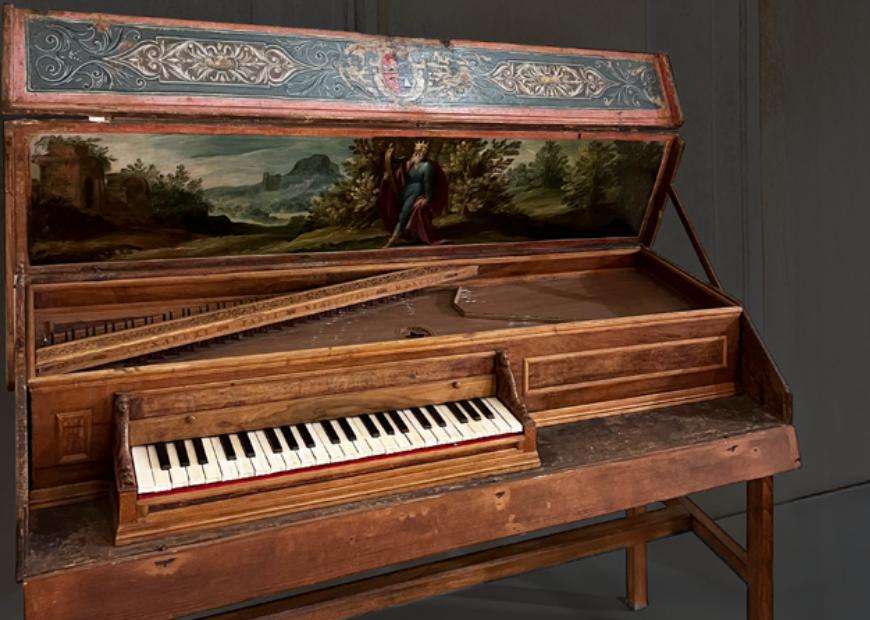
- S001 [描述性拆分] Title Page and Editors’ Affiliations
- 页码:1-2
- S002 [描述性拆分] Bibliographic Notice, License, and Production Credits
- 页码:3-5
- S003 [描述性拆分] Dedication
- 页码:7-7
- S004 [描述性拆分] Table of Contents
- 页码:9-10
C002 Introduction
- S005 [描述性拆分] Introduction: Origins and Shared Premise of the Symposia
- 页码:11-11
- S006 [描述性拆分] Introduction: Scope, State of Research, and the Bologna Focus
- 页码:12-12
- S007 [描述性拆分] Introduction: Format of the Bologna Conference and Structure of the Volume
- 页码:13-14
- S008 [描述性拆分] Part One Divider
- 页码:15-15
C003 Further Notions of Notation: Performance Practice, Composition, and Notational Formats in Neapolitan Keyboard Music ca. 1600
- S009 [描述性拆分] Trabaci’s Claim and the Performability of Neapolitan Open-Score Music
- 页码:17-17
- S010 [描述性拆分] Unidiomatic Textures and the Influence of Open-Score Notation
- 页码:18-19
- S011 [描述性拆分] Newcomb’s Notions of Notation: Complexity, Objectification, and Silent Reading
- 页码:20-20
- S012 [描述性拆分] Dual Functionality: Objectified Score and Practical Performance Indication
- 页码:21-21
- S013 [描述性拆分] Intabulation as Performance: Dual Function and Survey of Intabulations
- 页码:22-22
- S014 [描述性拆分] Tab. 2: Intabulations Not Originally in Open Score (Rore, Maschera, Padovano)
- 页码:23-24
- S015 [描述性拆分] Intabulation Conventions and Diruta’s Advice on Reworking Inner Voices
- 页码:25-26
- S016 [描述性拆分] Considerations for Present-Day Performers: Ornamentation and Intabulating Alla Mente
- 页码:27-27
- S017 [描述性拆分] Literal Intabulations and the Algorithmic Obscuring of Voice Leading
- 页码:28-29
- S018 [描述性拆分] Frescobaldi Intabulations in I-RAc Classense 545 and Fictitious Tablature Voices
- 页码:30-31
- S019 [描述性拆分] Preserving vs. Reworking Voice Leading in Frescobaldi and Bertoldo Intabulations
- 页码:32-35
- S020 [描述性拆分] Agency of Notational Format: Venetian vs. Ferrarese-Neapolitan Ricercars
- 页码:35-36
- S021 [描述性拆分] Macque’s Capriccio sopra re fa mi sol: Notational Influence in a Free Work
- 页码:37-37
- S022 [描述性拆分] Trabaci’s Capriccio sopra la, fa, sol, la and the Objectifying Power of Open Score
- 页码:39-39
- S023 [描述性拆分] Toccata Comparisons: Mayone’s Open-Score Texture vs. Anon. Trent Intabulations
- 页码:40-42
- S024 [描述性拆分] Notating the Neapolitan Madrigale Passaggiato: Surface Affinities with Intabulation
- 页码:42-43
- S025 [描述性拆分] Structural Affinities: Holistic Voice-Leading Alteration and Voice Exchange
- 页码:44-46
- S026 [描述性拆分] Sounding Objects, Improvisation, and the Macque Pedagogical Pedigree
- 页码:48-50
- S027 [描述性拆分] Notational Ironies: Intabulating the Detabulation
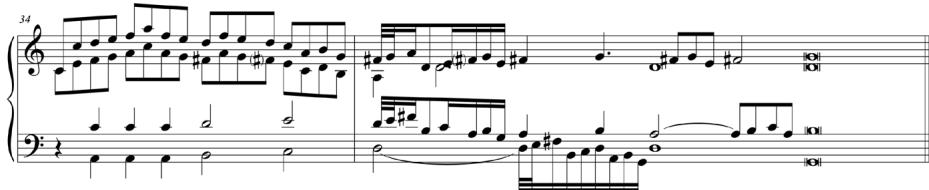
- 页码:50-50
S001 [描述性拆分] Title Page and Editors’ Affiliations
第1段(P0001)
原文复述
›Per aures ad animum‹
中文讲解
本段是层级二标题(##),位于第1页顶部,呈现拉丁文短语 ›Per aures ad animum‹,使用德式引角(‹ ›)包裹。从小节标题和后续版权页(P0007、P0008)的对应关系可判断,这是该书所属的丛书系列名。它在扉页上单独出现,先于主书名,起到标示丛书归属的作用。
补充说明
拉丁文 Per aures ad animum 字面意为「由耳入心」。本段仅作为丛书题名出现,原文未提供其解释或典故,故不补充外部词源或出处。
第2段(P0002)
原文复述
中文讲解
本段为图像占位符,位于第1页主书名与编者署名之间,紧接 P0001 的丛书名之后。从版式位置推断,该图像很可能是封面图、刊头装饰或与本书主题(16世纪意大利羽管键琴)相关的视觉元素,但其具体内容因原始数据省略而无法核实。其余栏目因此只能简短说明位置,不展开推测。
第3段(P0003)
原文复述
THE HARPSICHORD IN THE SIXTEENTH CENTURY II: ITALY
中文讲解
本段是层级二标题,位于第1页图像下方,明确给出本书的主书名《16世纪的羽管键琴 II:意大利》。书名以全大写拉丁字母呈现,强调这是一本聚焦于16世纪意大利羽管键琴音乐的学术著作;罗马数字 II 表明这是该系列的第二卷,与丛书名 ›Per aures ad animum‹ 相呼应。
第4段(P0004)
原文复述
Augusta Campagne Markus Grassl eds.
中文讲解
本段位于主书名下方,列出两位编者 Augusta Campagne 与 Markus Grassl 的姓名,末尾以小写斜体 eds.(拉丁文 editores 的缩写,意为「编者们」)标识其编者身份。它将书名与编者直接关联,标明本书为二人共同编辑的论文集或学术合集。
第5段(P0005)
原文复述
mwPress
中文讲解
本段位于扉页底部,仅一个单词 mwPress,应为出版机构名称。它独立成段,处于编者署名之后,通常表示本丛书或本书的出版方。由于原文未提供该名称的扩展说明,此处只能确认其为出版社标记。
第6段(P0006)
原文复述
Augusta Campagne, Markus Grassl (eds.)
中文讲解
本段位于第2页顶部,以「姓, 姓 (eds.)」形式复述编者信息,与扉页(P0004)相对应。这通常是版权页(imprint 页)开头的署名行,用以再次确认本书的编者归属,便于引用与图书馆著录。
第7段(P0007)
原文复述
‘Per aures ad animum
中文讲解
本段位于第2页,紧接 P0006 之下,重现丛书名 Per aures ad animum,使用单引号而非扉页的德式引角。它进一步确立本书在 ›Per aures ad animum‹ 丛书中的归属位置,是版权页对扉页书名的再次确认。
第8段(P0008)
原文复述
The Harpsichord in the Sixteenth Century II: Italy
中文讲解
本段位于第2页,以常规大小写(而非扉页的全大写)再次写出书名 The Harpsichord in the Sixteenth Century II: Italy,是版权页对书名的标准复述形式,便于检索与版本识别。
第9段(P0009)
原文复述
Augusta Campagne taught harpsichord and figured bass at the mdw – University of Music and Performing Arts in Vienna. Her main research interests are early keyboard accompaniment and harpsichord music of the long 16th century.
中文讲解
本段是编者 Augusta Campagne 的学术简介,介绍其任职机构与研究方向两个要点。第一句说明她曾在维也纳音乐与表演艺术大学(mdw)教授羽管键琴与通奏低音;第二句指出其主要研究兴趣为早期键盘伴奏与「漫长的16世纪」(the long 16th century)的羽管键琴音乐。文中 the long 16th century 是史学常见提法,泛指约1450年至1620年前后的过渡时期,与本卷聚焦16世纪意大利羽管键琴的主题相呼应。
第10段(P0010)
原文复述
Markus Grassl is professor at the Institute of Musicology and Performance Studies at the mdw – University of Music and Performing Arts in Vienna. His research focuses on early instrumental music, the music of the French Baroque, and the history of performance of early music in the 20th century.
中文讲解
本段是编者 Markus Grassl 的学术简介,同样分为机构与研究方向两部分。他任职于维也纳音乐与表演艺术大学音乐学与表演研究所,任教授;其研究聚焦三大领域:早期器乐音乐、法国巴洛克音乐,以及20世纪早期音乐演奏史。这三条线索中,前两条直接对应本卷的主题(16世纪意大利羽管键琴属于早期器乐音乐范畴),第三条则为其学术背景的延伸维度。
脚注 / 边栏 / 图表 / 附加信息(如有)
本节无脚注、图表说明或边栏文字。除 P0002 为内嵌图像占位符外,其余段落均为标题、署名或文字说明,起到标识丛书归属、书名、编者与出版方的作用。
💡 本节核心要点
- 本节属于扉页与版权页性质的版面信息,承担丛书与书名的双重标识功能。
- 丛书名为 ›Per aures ad animum‹,主书名为 The Harpsichord in the Sixteenth Century II: Italy,罗马数字 II 表明这是该系列的第二卷。
- 本书由 Augusta Campagne 与 Markus Grassl 共同编辑,出版方为 mwPress。
- 两位编者均任职于维也纳 mdw – University of Music and Performing Arts,前者为羽管键琴与通奏低音教师,后者为音乐学与表演研究所教授。
- 本卷聚焦16世纪意大利羽管键琴音乐,与编者长期关注的早期键盘音乐、早期器乐及早期音乐演奏史方向相一致。
🔑 关键术语
- Per aures ad animum:本节所示丛书系列名称,字面为拉丁文「由耳入心」,在本节中作为丛书标识反复出现。
- The Harpsichord in the Sixteenth Century II: Italy:本书主书名,标示本卷聚焦16世纪意大利羽管键琴音乐,是该系列第二卷。
- the long 16th century:史学概念,指约1450—1620年前后的较长时段,Campagne 用以框定其羽管键琴音乐研究的年代范围。
- mdw – University of Music and Performing Arts in Vienna:维也纳音乐与表演艺术大学,两位编者的共同任职机构。
- Institute of Musicology and Performance Studies:mdw 下属的音乐学与表演研究所,Markus Grassl 任教授于此。
S002 [描述性拆分] Bibliographic Notice, License, and Production Credits
第1段(P0011)
原文复述
Augusta Campagne, Markus Grassl (eds.) ‘Per aures ad animum’ The Harpsichord in the Sixteenth Century II: Italy
中文讲解
这是本卷书的题名页信息:编者为 Augusta Campagne 与 Markus Grassl,书名为《Per aures ad animum》(拉丁语,意为“经由耳而达于心”,常见于音乐修辞传统)。副标题《The Harpsichord in the Sixteenth Century II: Italy》表明这是该丛书的第二卷,聚焦于十六世纪的意大利羽管键琴。题名页先列编者、再用引号标出拉丁语主书名、随后才是英文副题,这是欧洲学术出版物常见的题名编排顺序。括号中的 (eds.) 标明两人为编者而非作者,因为这类论文集通常由多位撰稿人贡献章节,编者负责统筹与出版。
第2段(P0012)
原文复述
mwPress
中文讲解
此处显示的是出版社标识“mwPress”,即 mdwPress 的简化版面呈现形式。mdwPress 是维也纳音乐与表演艺术大学(mdw – Universität für Musik und darstellende Kunst Wien)的下属出版品牌,专门负责该校及其相关学术成果的开放获取出版。该词条紧接在主书名之下,按照图书版权页惯例,属于出版社署名行。
第3段(P0013)
原文复述
Bibliographic information published by the Deutsche Nationalbibliothek
中文讲解
这是位于版权页的小节标题,用 Markdown 二级标题格式标出,提示读者以下信息来自德国国家图书馆(Deutsche Nationalbibliothek,简称 DNB)的书目登记。其作用是告知读者:该书已被德国国家图书馆正式收录于《德国国家书目》(Deutsche Nationalbibliografie),因此具备正式的书目登记号与可被检索的官方记录。
第4段(P0014)
原文复述
The Deutsche Nationalbibliothek lists this publication in the Deutsche Nationalbibliografie; detailed bibliographic data are available in the Internet at https://dnb. dnb.de
中文讲解
原文说明两件事:第一,本书已被德国国家图书馆收录于《德国国家书目》;第二,详细的著录数据可在 https://dnb.dnb.de 查询。在德国境内出版的作品,根据《德国国家图书馆法》(Pflichtexemplargesetz)须向 DNB 缴送样本,因此这段说明是法定书目登记的固定声明,而非编辑自行声明。网址中的空格“dnb. dnb.de”是原文排版残留,实际域名应为 dnb.dnb.de。
第5段(P0015)
原文复述

中文讲解
此条为第 4 页上的图像或乐谱占位符,原文档中的内嵌图像数据已省略,仅保留位置与图注标记。在版权页的版面惯例中,该位置通常用于放置出版机构徽标(如 mdw 的标识)、资助方标志,或与本卷主题相关的视觉元素(如古代羽管键琴图像)。读者需查阅原图才能确认其具体内容。
补充说明
无额外补充(图像内容不可见,不作推测)。
第6段(P0016)
原文复述
This work is licensed under the Creative Commons Attribution 4.0 International License. For the full license terms, please visit the URL https://creativecommons.org/licenses/by/4.0/. Creative Commons license terms for re-use do not apply to any content (such as graphs, figures, photos, excerpts, etc.) not original to the Open Access publication and further permission may be required from the rights holder. The obligation to research and clear permission lies solely with the party re-using the material.
中文讲解
本段声明本书采用“知识共享署名 4.0 国际许可协议”(CC BY 4.0)发布,并给出完整条款网址。该许可允许他人在署名的前提下自由共享与改编本书内容,适用于大多数开放获取学术出版。第二句为关键例外条款:CC BY 条款不适用于非本书原创的内容,例如图表、照片、节选等;这些第三方素材可能需要另行取得权利人许可,且核实与清除许可的义务完全由再使用者承担。换言之,作者与编者为本书原创部分选择开放许可,但对第三方素材仅提供必要的版面位置,不为许可状态背书。
第7段(P0017)
原文复述
First published in 2026 by mdwPress, Vienna 2026 © Augusta Campagne, Markus Grassl (eds.)
中文讲解
这是正式的首版与版权声明:本书于 2026 年由位于维也纳的 mdwPress 首次出版,版权(©)归属于编者 Augusta Campagne 与 Markus Grassl。版权行中“2026”出现两次:前者指出版年份,后者常作为版权年份标注。版权归属为编者而非出版社,意味着文本层面的权利由编者持有,出版社仅取得出版发行权,这与开放获取出版中常见的所有权安排一致。
第8段(P0018)
原文复述
mdwPress | mdw – Universität für Musik und darstellende Kunst | Anton-von-Webern-Platz 1 | AT-1030 Wien | mdwpress@mdw.ac.at
中文讲解
这是出版社的完整联系信息:单位名称、所在大学的全称(mdw – 维也纳音乐与表演艺术大学,以奥地利作曲家 Anton von Webern 命名的地址)、街道门牌、奥地利邮政编码(AT-1030 Wien)以及联系邮箱。该大学以十二音序列作曲家安东·冯·韦伯恩命名,位于维也纳第 10 区。这段信息用于读者、图书馆员或权利人联系出版社的官方渠道。
第9段(P0019)
原文复述
Cover design: bueronardin/mdwPress Cover illustration: Alessandro Fabri, Rectangular Spinet (Naples, 1598), Tagliavini Collection, Bologna (Photo: Catalina Vicens, @Museo di San Colombano – Collezione Tagliavini, Genus Bononiae) Layout: Auer Grafik Buch Web, Vienna
中文讲解
本段列出了书籍的视觉与排版生产署名:封面设计由 bueronardin/mdwPress 负责;封面图所绘乐器为意大利制琴师 Alessandro Fabri 于 1598 年在那不勒斯制作的“矩形斯皮耐琴”(Rectangular Spinet),原器现藏于博洛尼亚的 Tagliavini 收藏馆,摄影者为 Catalina Vicens,拍摄地为圣哥伦比亚诺博物馆——塔利亚维尼藏品馆(属于 Genus Bononiae 文化机构);全书排版由维也纳的 Auer Grafik 完成。这些署名既是对设计、摄影与排版劳动的致谢,也是后续使用封面图(如在宣传或二次引用中)时所需的来源信息;其中封面的斯皮耐琴照片与正文的研究对象(十六世纪意大利羽管键琴)直接呼应。
第10段(P0020)
原文复述
https://doi.org/10.21939/harpsichord-italy-16c PDF-ISBN: 978-3-9505619-2-0
中文讲解
本段给出本书的永久数字标识符(DOI)和电子版国际标准书号(PDF-ISBN)。DOI 由前缀“10.21939”与后缀“harpsichord-italy-16c”构成,用于在网络上唯一、永久地定位本书;其前缀通常代表注册机构(即 mdwPress 或其委托的注册方),后缀则为该机构内部赋予本书的代号。PDF-ISBN(978-3-9505619-2-0)中的“978”是图书产品代码前缀,“3”代表德语区组号,后段由出版者分配。读者引用本书时使用 DOI,图书馆采编则使用 ISBN。
第11段(P0021)
原文复述
This publication received financial support from the Open Access Fund of mdw – University of Music and Performing Arts Vienna.
中文讲解
本段声明本书获得了维也纳音乐与表演艺术大学开放获取基金(Open Access Fund)的资助。开放获取基金通常用于支付文章处理费(APC)或开放出版的相关费用,从而使作者得以在无版面费障碍的情况下以开放许可发布作品。这条致谢既是经费来源的合规披露,也向读者说明本书之所以能采用 CC BY 许可并免费在线获取,背后有专项资金支持。
第12段(P0022)
原文复述
mw universität für musik und darstellende kunst wien
中文讲解
这是维也纳音乐与表演艺术大学的机构标识文字(wordmark),原文为小写德语。该标识通常与校徽图形一同出现,作为版权页或封底的机构落款,以宣示本书的所属机构。“Universität für Musik und darstellende Kunst Wien”的字面含义即“维也纳音乐与表演艺术大学”。
脚注 / 边栏 / 图表 / 附加信息(如有)
本节集中收录版权页与生产致谢类材料:包括题名与编者(P0011)、出版社标识(P0012)、德国国家图书馆书目登记说明(P0013–P0014,含具体网址 https://dnb.dnb.de)、第 4 页的图像/乐谱占位符(P0015)、CC BY 4.0 许可声明及第三方素材例外条款(P0016)、首版与版权归属(P0017)、出版社地址与联系方式(P0018)、封面设计/摄影/排版致谢(P0019)、DOI 与 PDF-ISBN(P0020)、开放获取基金致谢(P0011)、大学标识(P0022)。其中 P0015 为图像占位符,因内嵌数据已省略,无法进一步描述其具体视觉内容;其余均为可核实的出版元数据与法律声明。
💡 本节核心要点
- 本卷书名为《Per aures ad animum》,副标题表明它是“十六世纪羽管键琴”系列的第二卷,聚焦意大利,由 Augusta Campagne 与 Markus Grassl 担任编者。
- 本书由维也纳音乐与表演艺术大学下属的 mdwPress 于 2026 年首版,版权归属编者本人,并采用 CC BY 4.0 国际许可发布。
- CC BY 条款的适用有明确例外:非本书原创的图表、照片、节选等仍可能需要另行取得权利人许可,核实义务由再使用者承担。
- 本书具备完整的开放获取元数据:DOI(10.21939/harpsichord-italy-16c)、PDF-ISBN(978-3-9505619-2-0),以及德国国家图书馆的官方书目登记。
- 本书的开放获取出版由 mdw 的开放获取基金提供资金支持,使作者得以零版面费壁垒地采用 CC BY 许可。
- 封面视觉与研究主题直接呼应:封面图采用的是 1598 年 Alessandro Fabri 在那不勒斯制作的矩形斯皮耐琴,原器藏于博洛尼亚 Tagliavini 收藏馆。
🔑 关键术语
- Deutsche Nationalbibliothek (DNB):德国国家图书馆,根据德国法定缴送本制度收录本国出版物,本书已在其《Deutsche Nationalbibliografie》中登记,详细数据见 https://dnb.dnb.de。
- mdwPress:维也纳音乐与表演艺术大学(mdw)下属的开放获取出版品牌,本书的出版方与版权页联系单位。
- Creative Commons Attribution 4.0 International License (CC BY 4.0):知识共享署名 4.0 国际许可协议,允许他人在署名前提下自由共享与改编本书内容,但非本书原创素材不适用该条款。
- DOI (Digital Object Identifier):数字对象永久标识符,本书 DOI 为 10.21939/harpsichord-italy-16c,用于在网络上唯一、永久地定位本书。
- ISBN (International Standard Book Number):国际标准书号,本书的 PDF 版 ISBN 为 978-3-9505619-2-0,用于图书馆采编与出版物的唯一标识。
- Open Access Fund:维也纳音乐与表演艺术大学的开放获取基金,用于资助作者以开放许可出版,本书的开放获取即由此基金支持。
- Tagliavini Collection, Bologna:博洛尼亚的塔利亚维尼古代乐器收藏馆,本书封面所绘矩形斯皮耐琴的原器即藏于此处。
S003 [描述性拆分] Dedication
第1段(P0023)
原文复述
In memory of Edoardo Bellotti (1957–2025)
中文讲解
中文译文:谨以此纪念 Edoardo Bellotti(1957–2025)。
讲解:这句话是全书扉页或正文起始处的"献词(Dedication)",由 “In memory of”(以纪念……)引导,并标注了逝者的生卒年份。它不承担任何学术论证功能,而是作者以私人方式向已故者致意——通常是把著作献给一位对作者本人、其研究方向或本书成书过程具有重要意义的人物。括号中的 1957–2025 即逝者从出生到去世的年份跨度,是一种简洁而庄重的纪念格式。在节内论证链上,此句不提供论点;但它为本书的撰述动机提供了情感与个人背景,提示读者全书是在作者哀悼、缅怀某位特定人物的语境中完成的。理解时需注意:此处并未交代 Edoardo Bellotti 与本书主题的具体关联,相关背景属于作者个人传记信息,超出本节范围,不应在讲解中补写。
补充说明
本页(第 7 页)属于书籍前部非正文版面,“In memory of” 是英文书籍献词中常见的、专用于纪念已故者的固定句式,与献给在世者的 “To …” 或 “For …” 在功能上有所区分。
脚注 / 边栏 / 图表 / 附加信息(如有)
本小节仅含一页(p. 7)献词,正文为一句纪念性短语,无脚注、图表、边栏或其他附加材料。
💡 本节核心要点
- 该页是书籍前部的献词页,不参与学术论证。
- 献词以 “In memory of” 标识,表示所纪念的对象为已故者。
- 纪念对象为 Edoardo Bellotti,括号内给出其生卒年份 1957–2025。
- 献词为全书撰述提供了作者私人语境与情感背景。
- 本节不包含可供进一步推论的学术信息。
🔑 关键术语
- Dedication(献词):置于书籍正文之前、以简短文字向特定人物或机构致意的非正文版面。本节中的献词属于"纪念已故者"类型,由 “In memory of” 引导,功能是为全书提供作者的个人语境,而非传递学术内容。
S004 [描述性拆分] Table of Contents
第1段(P0024)
原文复述
Contents
中文讲解
本段是页面上唯一的二级标题,使用 Markdown 的二级标题语法写成 “## Contents”,对应中文即"目录"。它标示后面紧接的内容是全书的目录,并标志着本节(S004)的论题对象是整本书的结构性索引,而非任何具体学术论述。在目录型材料里,标题本身不承担论证功能,其作用仅在于把目录区与正文区分开来。
第2段(P0025)
原文复述
Introduction 11 Markus Grassl, Augusta Campagne
Papers Further Notions of Notation: Performance Practice, Composition, and Notational Formats in Neapolitan Keyboard Music ca. 1600 17 Ian Pritchard
Hacking the System II: Notational Conventions in Early Sixteenth Century Printed Italian Keyboard Intavolature 55 Augusta Campagne
The Rhetoric of Invertible Counterpoint in the Sixteenth Century: Between Keyboard Pedagogy and Performance Practice 85 Edoardo Bellotti (†)
Why Should One Build an Archicembalo? An Attempt at a Response According to Nicola Vicentino 111 Martin Kirnbauer
Alessandro Fabri and his Pupils: Protagonists of the Art of the ‘Zimbararo’ in Naples 133 Francesco Nocerino
Italian Instruments in England, and Their Adaption for Use 161 Darryryl Martin
Stringed Keyboard Instruments at the Courts of the Austrian Habsburgs in the Sixteenth Century – the ‘Italian Perspective’ 173 Markus Grassl
中文讲解
本段是目录的前半部分,列出了全书的主要结构线索:第一是导论(Introduction),由 Markus Grassl 与 Augusta Campagne 合著,置于全书最前(第 11 页);第二是论文板块(Papers)下的七篇文章,按页码升序排列。值得注意的是,论文板块的开篇之作由 Augusta Campagne 亲自撰写,而 Markus Grassl 则既是导论合著者也是第七篇论文的作者——两人显然是本卷的组织者或编辑核心。论文板块围绕 16 世纪意大利键盘音乐展开,论题涵盖那不勒斯记谱实践(Ian Pritchard,第 17 页)、早期印刷意大利键盘 intavolature 的记谱约定(Augusta Campagne,第 55 页)、可逆对位的修辞学及其与键盘教学和演奏实践的关系(Edoardo Bellotti,姓名后的 † 表示作者已故,第 85 页)、Nicola Vicentino 设计的 archicembalo 建造动机(Martin Kirnbauer,第 111 页)、那不勒斯"zimbararo"(键盘调音师/制作者)传统中的 Alessandro Fabri 及其弟子(Francesco Nocerino,第 133 页)、英国境内意大利乐器的本土化改造(Darryl Martin,注意原文写作 Darryryl,拼写如此,第 161 页),以及奥地利哈布斯堡宫廷中的意大利式弦乐键盘乐器(Markus Grassl,第 173 页)。这一板块整体呈现两条交织线索:一是 16 世纪意大利键盘音乐自身的内部技术(记谱、对位、乐器形制),二是这些技术在欧洲其他宫廷与文化语境中的流布与调适。读者通过本段即可看出,本卷实质上是一部以键盘乐器为轴心的 16 世纪意大利音乐文化专著。
补充说明
原文拼写中 Darryryl Martin 一名出现拼写重复 r,本节严格按原样保留。† 号是学界惯例,用以标记已故作者;赵磊编辑的目录中同样遵循这一惯例。archicembalo 是 Vicentino 设计的含有多个 31-音音阶的复杂键盘乐器,本段标题中以问句形式提示其存在的合理性属于历史音乐学争论的范畴。
第3段(P0026)
原文复述
Sofonisba Anguissola at the Keyboard: Performance of Transgressive Musical Knowledge and Artistic Skill 223 Jane Hatter
Appearance and Prestige: Phenomena of Keyboard Instrument Decoration in the Sixteenth Century 247 Heidelinde Pollerus
Presentations
The Merulo Toccata in Codex Vienna, Minorite Convent, 714 331 Mario Aschauer
Bassi ostinati and Ornamental Formulas in the Intabolatura nova di varie sorte de balli, Venice 1551 (I-Bc R.178), and in Similar Contemporary Sources for the Lute 349 Vania Dal Maso
A Glimpse into the World of Antonio Valente, cieco Napoletano 375 Paola Erdas
Andrea Gabrieli and the Venetian colorito 391 Sébastien Wonner
Appendix
Programme of the Symposium 401 Authors 403 Abstracts 406 Abbreviations 414 List of Figures and Examples 417 About mdwPress 434 About This Volume 434
中文讲解
本段接续 P0025,列出了全书结构的其余部分。其一,论文板块(Papers)还包含两篇跨页较大的研究:Jane Hatter 通过 Sofonisba Anguissola(一位以绘画著称的 16 世纪女性艺术家)讨论其与键盘演奏的关系,关注"越界"的音乐知识与艺术技能的展示(第 223 页);Heidelinde Pollerus 则把目光转向 16 世纪键盘乐器外观装饰所呈现的"外观与声望"现象(第 247 页)。这两篇把论域从纯粹的音乐技术扩展到了视觉文化、社会性别与器物装饰层面,使本卷的覆盖面更为立体。其二,第二个板块是 Presentations(研究报告/会议演讲稿),收录四篇带有较强原始文献考释性质的文章:Mario Aschauer 对维也纳方济各会女隐修院 714 号抄本中 Merulo 托卡塔的研究(第 331 页);Vania Dal Maso 对 1551 年威尼斯出版的《Intabolatura nova di varie sorte de balli》(博洛尼亚图书馆藏本 I-Bc R.178)中固定低音与装饰公式的考察,并将其与同时代鲁特琴文献做比较(第 349 页);Paola Erdas 描绘了那不勒斯盲人作曲家 Antonio Valente 的世界(第 375 页);Sébastien Wonner 讨论 Andrea Gabrieli 与威尼斯"colorito"(色彩性处理)传统的关系(第 391 页)。其三,最后的 Appendix(附录)依次列出:会议日程(第 401 页)、作者简介(第 403 页)、摘要(第 406 页)、缩写表(第 414 页)、图表与谱例目录(第 417 页)、出版方 mdwPress 简介(第 434 页),以及本卷自身的出版说明(第 434 页)。从本段可以看出,全书由"导论—论文—会议演讲—附录"四级结构组成,论文偏重理论/文化议题,演讲偏重一手文献考释,二者形成方法论上的互补。
补充说明
I-Bc R.178 是意大利博洛尼亚大学图书馆(I-Bc 为其国际标准图书馆代码)所藏 1551 年威尼斯印本的鲁特琴/键盘 intavolatura 曲集,本节原文已标明,无需外部补充。“colorito” 在 16 世纪威尼斯音乐修辞中相当于绘画中的色彩处理,本节标题即取此义。codex Vienna, Minorite Convent, 714 意为维也纳方济各会女隐修院所藏编号 714 的手稿。
脚注 / 边栏 / 图表 / 附加信息(如有)
本节包含一处脚注性符号 †,位于 Edoardo Bellotti 姓名之后,用以标示该作者已于生前去世后发表;这是学术出版物中标注已故作者的常见惯例。除此之外,本节无脚注、图例或边栏内容,全部条目均为目录索引。
💡 本节核心要点
- 本卷分为四大板块:导论(Introduction)、论文(Papers)、会议演讲(Presentations)与附录(Appendix),其中论文板块由 9 篇文章组成,会议演讲板块由 4 篇组成。
- 全书论域以 16 世纪意大利键盘音乐为核心,向外辐射至演奏实践、记谱法、乐器形制、声学设计、视觉装饰与跨文化传播。
- 编辑团队的核心是 Markus Grassl 与 Augusta Campagne,两人既合著导论,又各自撰写了论文板块中的核心文章。
- 论文板块偏向理论性与文化性议题(对位修辞、乐器哲学、装饰声望、艺术家跨界),会议演讲板块偏向一手文献考释(具体抄本、固定低音曲集、具体作曲家个案)。
- 附录中的摘要、缩写表与图表谱例目录说明本卷具备严谨的学术出版规范,而 mdwPress 简介与出版说明则提示该卷与维也纳音乐与表演艺术大学(mdw)的机构关联。
🔑 关键术语
- intavolatura:16 世纪意大利的键盘或鲁特琴乐曲记谱集,即将复调音乐"置于桌面"、以特定记谱法呈现的曲集,本卷多处以此为研究对象。
- archicembalo:16 世纪 Nicola Vicentino 设计的含有多个 31-音音阶的复杂键盘乐器,本卷中 Martin Kirnbauer 的论文专门讨论其建造动机。
- zimbararo:那不勒斯方言中对键盘乐器调音师/制作者的称呼,本卷 Francesco Nocerino 的论文以此为中心人物 Alessandro Fabri 展开。
- colorito:16 世纪威尼斯音乐修辞概念,借自绘画中的"色彩性处理",本卷 Sébastien Wonner 用以讨论 Andrea Gabrieli 的风格。
- cieco Napoletano:“那不勒斯的盲人”,为作曲家 Antonio Valente 的别号,本卷 Paola Erdas 的论文以此为切入点。
S005 [描述性拆分] Introduction: Origins and Shared Premise of the Symposia
第1段(P0027)
原文复述
Introduction
A level-2 heading reading ‘Introduction’, marking the start of the editorial Introduction to the present volume.
中文讲解
本段是Markdown二级标题,文字为"Introduction"(引言/绪论)。它开启的是编者所写的全卷引言部分,作用在于向读者交代本卷的来源、组织方式以及与前一次研讨会的关联,从而为随后两章独立的学术讨论提供共同语境。
补充说明
在版面位置上,它位于第11页,紧接在封面/版权页之后,是正文正式开篇的标志。
第2段(P0028)
原文复述
Markus Grassl, Augusta Campagne
中文讲解
本段以纯文本形式给出两位作者姓名:Markus Grassl(马库斯·格拉斯尔)与 Augusta Campagne(奥古斯塔·坎帕涅)。位于二级标题"Introduction"之下、首个正文段落之上,表明他们是本段引言(即本卷引言章节)的署名作者/编者。
第3段(P0029)
原文复述
The present publication documents a conference held in Bologna in October 2023, organised by the Museo San Colombano – Tagliavini Collection and the Conservatorio di Musica Giovan Battista Martini in collaboration with the Museo Internazionale e Biblioteca della Musica Bologna and the mdw – University of Music and Performing Arts Vienna. This was not the first conference dedicated to the harpsichord and its music from c. 1500 to 1600 organised by the editors of the present volume. Two years earlier, a symposium entitled ‘Universum rei harmonicae concentum absolvunt’: The Harpsichord in the Sixteenth Century, was held, which, as was to be expected, proved that the topic was not only fruitful but also far from exhausted. This, in turn, motivated the organisation of a follow-up event.
中文讲解
本段交代了本书的来源与背景。核心信息分三层:
-
本书的会议来源:本出版物记录了2023年10月在博洛尼亚召开的一次会议,该会议由 Museo San Colombano – Tagliavini Collection(圣科伦巴诺博物馆 – 塔利亚维尼收藏)与 Conservatorio di Musica Giovan Battista Martini(乔瓦尼·巴蒂斯塔·马尔蒂尼音乐学院)主办,并与 Museo Internazionale e Biblioteca della Musica Bologna(博洛尼亚国际音乐博物馆与音乐图书馆)以及 mdw – University of Music and Performing Arts Vienna(维也纳音乐与表演艺术大学)合作举办。
-
不是首次会议:本次会议并非本卷编者首次组织以"1500至1600年左右的羽管键琴及其音乐"为主题的会议;两年之前曾举行过一次以"‘Universum rei harmonicae concentum absolvunt’: The Harpsichord in the Sixteenth Century"为题的研讨会。
-
动机陈述:那次研讨会"如预期般"证明该议题不仅富有成果,而且远未穷尽,由此促使编者组织后续的本次会议。
作者用"as was to be expected"(如预期般)和"not only … but also far from exhausted"(不仅……而且远未穷尽)两个表述,既肯定了主题的学术价值,又自然过渡到"需要再办一次"的合理性论述,从而为读者理解本书是"前次会议的延伸成果"奠定基调。
补充说明
本段脚注标记"1"指向页底的脚注P0031,提供前次研讨会的在线出版物信息及完整网址。
第4段(P0030)
原文复述
Both symposia and, consequently, both publications shared several common ideas and goals. The starting point is the well-known fact that the 16th century was a period, which saw a considerable increase in the significance of keyboard instruments in general, and the harpsichord in particular. Just to recall the most important aspects of this process: Stringed keyboard instruments spread throughout Europe and sometimes even beyond; this was accompanied by a regional diversification, not least in harpsichord building; keyboard instruments took on multiple musical and cultural functions, as they were now played both by professionals and amateurs and both as solo instruments as well as in various ensembles; they were used for improvising as well as for performing written music, be it pieces originally conceived for keyboard, or intabulations of various kinds of ensemble music; and finally the 16th century is marked by the emergence of the first substantial body of notated keyboard music.
中文讲解
本段是全节最核心的一段,阐明两次研讨会(及其出版物)共享的若干前提与目标。
核心主张:16世纪是键盘乐器(尤其是羽管键琴)重要性显著增长的时期,这是"well-known fact"(众所周知的事实),也是两届研讨会的共同出发点。
支撑这一主张的五个要点(作者以"Just to recall the most important aspects"提示这是对既有认识的简要复述,而非新论断):
- 地理传播:弦鸣键盘乐器传遍欧洲,有时甚至远播海外;
- 地域多样化:伴随而来的是地域性的多样化,尤其体现在羽管键琴制作上;
- 功能多样化:键盘乐器承担了多重音乐与文化功能——既被专业演奏者也受业余爱好者演奏,既作为独奏乐器也参与各类重奏;
- 演奏方式的多样:既用于即兴演奏,也用于演奏既有乐谱(无论原本为键盘而作的作品,还是各类合奏音乐的"intabulations"——即把合奏音乐改编为键盘谱的译谱形式);
- 乐谱文献的出现:16世纪标志着第一批量可观的记谱键盘音乐的出现。
论证作用:通过把这五个公认特征作为"共享前提"摆出,作者实际是在告诉读者:本书所收录的论文,都可以从这五个维度中的某一个去切入16世纪键盘音乐的研究。整段的功能不是提出新观点,而是为后续各章搭建一个共同的认知框架,并暗示本卷的论文将围绕这些方面展开。
补充说明
本段中的脚注标记"2"对应页底脚注P0032,提示读者可参见前次出版物Introduction的第3–4页以了解更多细节。术语"intabulations"(将合奏音乐改编为键盘演奏谱的实践)在16世纪键盘音乐研究中是一个核心概念,本段通过它具体说明键盘乐器演奏内容的双重来源。
第5段(P0031)
原文复述
1 Its results have meanwhile been made available in an online-publication: ‘Universum rei harmonicae concentum absolvunt’: The Harpsichord in the Sixteenth Century, ed. Augusta Campagne and Markus Grassl (Vienna, 2024), <https://www.mdw.ac.at/mdwpress/books harpsichord/>.
中文讲解
本段是页底的脚注1,对应正文P0029中关于"两年前研讨会"的脚注标记。它向读者提供前次研讨会的完整出版信息:该研讨会的成果已经以在线出版物的形式发布,书名为《‘Universum rei harmonicae concentum absolvunt’: The Harpsichord in the Sixteenth Century》,由 Augusta Campagne 与 Markus Grassl 编辑,2024年于维也纳出版,并附有网址 https://www.mdw.ac.at/mdwpress/books harpsichord/。
此脚注的功能是来源指引:它告诉读者前次会议的成果可以查阅,避免读者误以为前次研讨会仅有口头交流而没有出版物;同时也确立了本卷与前次出版物之间的直接学术连续性。
补充说明
脚注中两位编辑姓名的排列顺序(Campagne 在前、Grassl 在后)与本卷署名顺序(Grassl 在前、Campagne 在后)相反,这是两卷之间编辑署名惯例的差异,并非错误。
第6段(P0032)
原文复述
2 Cf. in more detail: ‘Introduction’, in: ibid., 3–4.
中文讲解
本段是页底脚注2,对应正文P0030中关于"键盘乐器重要性增长"五大方面的脚注标记。其内容为:“参见更详细的论述:ibid. (即前述同一出版物) 的’Introduction’部分,第3–4页。”
“ibid.“是拉丁语 ibidem 的缩写,意为"同前”,指向前一条脚注所引用的那本书——即2024年维也纳出版的《The Harpsichord in the Sixteenth Century》。该脚注的功能是旁证/扩展阅读指引:作者承认P0030中所列出的五个方面并非原创,而是对前次出版物引言中已有论述的简要回顾,因此引导希望深入了解的读者去查阅那一具体页码。
与P0031的关系:P0031提供了那本书的完整书目信息,P0032则在不重复书名的情况下以"ibid.“指代同一本书,节约版面并保持脚注间的内部呼应。
脚注 / 边栏 / 图表 / 附加信息(如有)
本节包含两则脚注(编号1与2),均位于第11页底部:
- 脚注1(P0031)给出前次研讨会成果的完整书目及在线网址,是正文P0029所述"两年前研讨会"的来源依据。
- 脚注2(P0032)以"ibid.“形式回指同一出版物,引导读者参阅其Introduction第3–4页,以获取P0030所列五大方面的更详细论证。 两则脚注共同起到建立本卷与前次出版物之间的学术连续性的作用,并提示本节P0030中的论点是对既有共识的回顾而非新论断。
💡 本节核心要点
- 本卷源自2023年10月在博洛尼亚举办的会议,是2021年(前次)研讨会的直接后续;两次研讨会的成果分别形成两卷出版物。
- 前次研讨会的成果已经以在线出版物(2024年维也纳)的形式公开,体现本议题学术研究的延续性。
- 本卷的共享出发点是16世纪作为键盘乐器(尤其是羽管键琴)重要性显著增长的时期。
- 这一增长体现在五个方面:地理传播与跨地域扩展、地域性多样化(尤其在制琴上)、音乐与文化功能的多样化、即兴与读谱并存的演奏方式、第一批量可观的记谱键盘音乐的出现。
- P0030对五大方面的陈述是对前次出版物Introduction(第3–4页)中已有论述的回顾与浓缩,而非新的原创论断。
🔑 关键术语
- intabulations:16世纪一种常见的音乐实践:将原本为合奏(如声乐合奏、器乐合奏)写作的乐曲,改编为可供键盘乐器单独演奏的记谱形式。P0030用此术语说明键盘乐器演奏内容的双重来源之一。
- Museo San Colombano – Tagliavini Collection:圣科伦巴诺博物馆 – 塔利亚维尼收藏,博洛尼亚一处藏有早期键盘乐器(包括历史羽管键琴)的博物馆机构,是2023年博洛尼亚会议的主办方之一。
- Conservatorio di Musica Giovan Battista Martini:乔瓦尼·巴蒂斯塔·马尔蒂尼音乐学院,位于博洛尼亚,以18世纪博洛尼亚音乐学者G. B. Martini命名,是2023年会议的主办方之一。
- mdw – University of Music and Performing Arts Vienna:维也纳音乐与表演艺术大学,本卷编者所属的机构;其出版社(mdwPress)发布了前次研讨会的在线出版物。
- ibid.:拉丁语 ibidem 的缩写,意为"同前”,用于脚注或参考文献中指代刚刚提及的同一本书/同一处作作,避免重复完整书目信息。P0032用此缩写回指P0031中提到的2024年维也纳出版物。
S006 [描述性拆分] Introduction: Scope, State of Research, and the Bologna Focus
第1段(P0033)
原文复述
These few keywords alone indicate the breadth and the diversity of issues that the study of the harpsichord in the 16th century must address, ranging from the cultural role of keyboard instruments and keyboard playing to social history, organology, notation, repertoire and manifold aspects of performance practice. Furthermore, because of the close connection between the harpsichord and other keyboard instruments, questions concerning the harpsichord are often intimately related to keyboard culture, music and playing in general.
中文讲解
本段的功能是为全书框定研究范围。开头"这些关键词"是回指前文(在本节之前)所列出的关键词语,作者借此提示读者:研究16世纪羽管键琴绝不能局限于乐器本身,而必然牵涉到六大领域——键盘乐器及其演奏的文化角色、社会史、乐器学、记谱法、曲目,以及表演实践的方方面面。第二句进一步指出,由于羽管键琴与其他键盘乐器(如管风琴、击弦古钢琴等)联系紧密,关于它的研究问题往往与整个键盘文化、键盘音乐和键盘演奏不可分离。这一段为后续的论文综述和会议介绍作铺垫:正因为研究对象具有如此广度和跨学科性,才需要像本书这样汇集多方视角的论文集。
补充说明
根据本段上下文,“organology"指对乐器本身(构造、分类、历史演变)的研究;它在研究范围清单中的位置说明作者把乐器实体本身也列为独立的研究维度,而非仅仅作为曲目或演奏的载体。
第2段(P0034)
原文复述
Of course, many of the relevant topics have already been addressed by scholars and performers, whose interest in stringed keyboard instruments from 1500 to 1600 has grown considerably in recent decades. On the other hand, as mentioned above, it is indisputable, that the subject is far from being fully explored. Not only are numerous research questions still unresolved. Moreover, new questions and lines of research have emerged, not least in correspondence with current developments in musicology, which have been stimulated by fields of research such as cultural studies, global history or gender studies. As for today’s musical practice, it can be observed that, despite all recent endeavours, the keyboard music of the 16th century still appears to be somewhat overshadowed by later music. Even today it is sometimes regarded not as significant in its own right, but just as a mere prelude to the richness of Baroque keyboard music. This becomes manifest, for example, in the fact, that 16th-century keyboard music typically plays a minor role in the harpsichord and organ curricula of universities and conservatories. Similarly, its performance is often approached both aesthetically and technically from a perspective shaped by experience of the 17th and 18th century repertoires.
中文讲解
本段从三层面为本书的必要性作论证,可视为典型的"研究综述+缺口论证"段落。第一层承认先行研究:近年学者与演奏家对1500至1600年间有弦键盘乐器的兴趣显著增长。第二层用"但是"转折,指出该领域远未被穷尽——既有大量悬而未决的问题,又因文化研究、全球史、性别研究等外部学科刺激而涌现出新问题。“不仅……而且……“这一递进结构强调问题不只是补漏,而是有质的扩展。第三层将视角转向当代演奏实践:尽管学术进展不少,16世纪键盘音乐在当下仍被巴洛克音乐的光芒所掩盖,常被视为通往巴洛克丰富性的"序曲"而非独立存在;这种边缘化具体表现在音乐学院和音乐学院课程设置中16世纪曲目比重小,以及演奏家在审美和技术上仍以17、18世纪曲目经验为参照。本段的修辞作用是:通过揭示研究与实践的双重缺口,说明本卷论文集介入这一领域的正当性与迫切性。
补充说明
本段中"如上所述”(as mentioned above)暗示前文(不在本节范围内)已经提及过该领域尚待深耕的判断,本段只是再次重申并加以例证。
第3段(P0035)
原文复述
Thus, although the Vienna and the Bologna events shared several characteristics, they differed in one important respect: Whereas the Vienna conference addressed the topic in a general way, being open to papers on the harpsichord in the 16th century without the limitation in terms of thematic aspect or region, the conference in Bologna aimed to delve more specifically into a sub-area by focusing on Italy. Given the richness of the Italian keyboard culture of the Cinquecento and its impact on other European countries, this focus allowed both the discussion of aspects of more general significance and the raising of a wider spectrum of diverse issues. Accordingly, the papers dealt with questions of notation, of music theory in relation to historically informed pedagogy and performance practice, and with the reception of Italian keyboard instruments and Italian keyboard culture in other European regions. The subject of harpsichord building was addressed both in terms of music theory and musical practice and in terms of a specific local school. On the basis of iconographic sources, two papers studied keyboard playing as a means of constructing (female) identity and the phenomenon of harpsichord decoration.
中文讲解
本段是本节论证的关键转折:从"研究综述"过渡到"本书来源介绍”。其核心是一个对比——维也纳会议与博洛尼亚会议虽共享若干特征,但在主题与地域限制上区别明显:前者对16世纪羽管键琴的论文完全开放、不限主题和地域,后者则聚焦于意大利(Cinquecento,即16世纪意大利)这一子领域。作者随即给出博洛尼亚聚焦策略的合理性:由于意大利键盘文化极其丰富且影响波及整个欧洲,对意大利的深耕反而能同时讨论一般性议题并激发更广泛的多样化议题。本段后半部分以"Accordingly”(因此)引出对博洛尼亚会议论文主题的清单式罗列:记谱法、与"具历史意识的"教学法和演奏实践相关的音乐理论、意大利键盘乐器和文化在欧洲其他地区的接受情况、羽管键琴制造(同时从音乐理论与实践,以及地方流派两个角度探讨),以及基于图像史料的两篇论文——分别研究键盘演奏作为建构(女性)身份的手段,以及羽管键琴装饰现象。这份清单实际上勾勒出本书的章节布局雏形。
补充说明
段落末尾括号中的上标数字(3、4、5、6、7、8、9)对应P0036起的脚注,分别指向具体的章节作者;本节只显示了脚注3、4、5,其余脚注对应的章节在本书其他地方出现。
第4段(P0036)
原文复述
3 See the chapters by Ian Pritchard and Augusta Campagne.
中文讲解
本条是脚注3,紧附在P0035中"questions of notation"之后,作用是把关于16世纪羽管键琴记谱法的研究指向Ian Pritchard和Augusta Campagne所撰写的两个章节。其功能属于指引性脚注,为读者提供延伸阅读路径,而非补充论证或限定说明。
第5段(P0037)
原文复述
4 See the chapter by Edoardo Bellotti.
中文讲解
本条是脚注4,紧附在P0035中"music theory in relation to historically informed pedagogy and performance practice"之后,指向Edoardo Bellotti所撰章节。该章节被定位为本书中专门论述"具历史意识的教学法与演奏实践中的音乐理论"的代表文本。
第6段(P0038)
原文复述
5 See the chapters by Darrly Martin and Markus Grassl.
中文讲解
本条是脚注5,紧附在P0035中"the reception of Italian keyboard instruments and Italian keyboard culture in other European regions"之后,指向Darrly Martin与Markus Grassl合写的两章。该脚注的功能与前两条相同,均为延伸阅读指引,把博洛尼亚会议中讨论"意大利键盘文化在欧洲其他地区接受史"的论文具体定位到本书的相应章节。
脚注 / 边栏 / 图表 / 附加信息(如有)
本节包含的附加材料为三条引用性脚注(P0036、P0037、P0038),分别编号为脚注3、脚注4、脚注5。它们均属于"See…“型指引脚注,功能是把P0035中对博洛尼亚会议论文的主题概述具体化,分别指向Ian Pritchard、Augusta Campagne(记谱法)、Edoardo Bellotti(音乐理论与具历史意识的教学法/演奏实践)、Darrly Martin与Markus Grassl(意大利键盘文化在欧洲其他地区的接受情况)的章节。这些脚注本身不补充论证,只是把本节概述与本书具体章节进行对接。
💡 本节核心要点
- 16世纪羽管键琴研究是跨学科领域,涵盖文化角色、社会史、乐器学、记谱法、曲目与表演实践六大维度,且与更广义的键盘文化不可分离。
- 尽管近几十年学界兴趣显著增长,该领域仍远未被穷尽——既有大量悬而未决的问题,又因文化研究、全球史、性别研究等外部学科刺激而涌现新问题。
- 在当代演奏实践中,16世纪键盘音乐仍被巴洛克音乐的光芒所掩盖,常被视为"序曲”,其边缘化具体表现为音乐学院课程比重小以及演奏上套用巴洛克经验。
- 博洛尼亚会议与维也纳会议的关键区别在于:前者以聚焦意大利这一子领域为策略,反而兼顾了"讨论一般意义议题"与"激发出更广泛多样化议题"两重目的。
- 博洛尼亚会议论文覆盖的主题包括:记谱法、与具历史意识教学法相关的音乐理论、意大利键盘文化在欧洲其他地区的接受、羽管键琴制造(理论与实践、地方流派两个角度),以及基于图像史料的女性身份建构与乐器装饰研究。
- 本节末尾的脚注3、4、5为延伸阅读指引,把概述中的主题清单对应到本书由Pritchard、Campagne、Bellotti、Martin、Grassl等学者撰写的具体章节。
🔑 关键术语
- organology:指对乐器本身(构造、分类、历史演变)的研究;在本节中被列为16世纪羽管键琴研究的独立维度之一,与曲目、记谱法、表演实践等并列,强调乐器实体本身也是研究对象。
- Cinquecento:意大利语,指16世纪(即1500年代);在本节中用于特指16世纪意大利的键盘文化,作者强调其丰富性及对其他欧洲国家的影响,以此为博洛尼亚会议聚焦意大利的策略提供理由。
- historically informed pedagogy / performance practice:“具历史意识的教学法/演奏实践”,指依据历史证据(原始乐器、原始文献、风格理论等)来教授和演奏早期音乐的方法;本节把它与"音乐理论"并置,表明博洛尼亚会议的论文不仅讨论纯理论,也讨论如何把理论转化为教学与演奏。
- iconographic sources:图像史料,包括绘画、版画、肖像等视觉材料;本节提到两篇基于此类材料的论文,分别研究键盘演奏与(女性)身份建构的关系,以及羽管键琴的装饰现象,显示图像史料如何支撑非纯音乐学的问题。
- reception:接受史/接受研究,指考察某地音乐文化或乐器传统如何被另一文化吸收、改造和理解;本节用此术语描述"意大利键盘乐器和文化在欧洲其他地区"的传播与接受,是博洛尼亚会议论文的三大主题之一。
S007 [描述性拆分] Introduction: Format of the Bologna Conference and Structure of the Volume
第1段(P0039)
原文复述
As with the symposium in Vienna, one of the basic ideas of the Bologna conference was to provide a forum for exchange of experiences and insights from diverse perspectives, bringing together participants from different fields – musicologists, scholar-performers, performers and specialists in instrument building and restoration. Accordingly, the event again combined different formats – papers, lecture-recitals and masterclasses for students. The lecture-recitals and masterclasses in particular benefited from the fact that the Museo San Colombano – Tagliavini Collection, one of the richest and most eminent collections of early Italian keyboard instruments in the world, served as the main venue for the event.
中文讲解
本段交代博洛尼亚会议(Bologna conference)的整体定位与活动形式。作者开篇就把此次会议与之前的维也纳研讨会(Vienna symposium)并列起来,强调两者共享一个核心意图:提供一个跨领域交流经验的平台。这种"延续性"措辞暗示博洛尼亚会议并非孤立事件,而是某个持续项目(或系列会议)的第二站。
作者列举的四类参会者——音乐学家(musicologists)、学者型演奏家(scholar-performers)、演奏家(performers)以及乐器制造与修复领域的专家(specialists in instrument building and restoration)——揭示了会议的多学科属性。这不是单纯的历史音乐学会议,而是把"演奏实践"与"乐器实物证据"都纳入考量,正契合早期键盘乐器研究所需的"文献+实物+演奏"三重证据链。
在活动形式上,会议沿用了维也纳的三种格式:论文报告(papers)、讲演式演奏(lecture-recitals,即边讲边演)以及面向学生的大师班(masterclasses)。作者特别指出后两种形式受益于会议主办场地——圣科伦巴诺博物馆塔利亚维尼藏品馆(Museo San Colombano – Tagliavini Collection)。该馆被定性为"世界上最丰富、最杰出的早期意大利键盘乐器收藏之一”,这一表述为整本文集的合法性提供了核心支撑:与会者可以直接接触相关古乐器,使讲演式演奏和大师班不只是纸上谈兵,而是基于真实乐器的实践。这种"场地—形式—研究对象"三者的高度契合,是本段论证的关键所在。
补充说明
句末的脚注标号"10"指向附录中的会议日程(programme in the appendix)。原文中"specialist"应为"specialists”,“fact, that"中的多余逗号系原文排印,本处复述已按标准英语处理。scholar-performer指的是兼具学术研究与演奏能力的双重身份学者,这在早期键盘音乐研究中是常见的角色类型,本段亦是该文集所强调的方法论特色之一。
第2段(P0040)
原文复述
The present publication is structured according to the two types of contributions to the conference: Part One includes (the majority of) the scholarly papers, while Part Two consists of presentations which reflect the lecture-recitals given by scholar-performers and performers. All contributions have been revised and partially expanded by the authors for the printed version. In order to convey the content of the lecture-recitals as fully as possible, the respective chapters in this publication also include video or audio recordings of the works or groups of works that were the subject of the lecture-recitals. The publication further incorporates two papers which were not part of the Bologna conference: Augusta Campagne’s article on notation conventions in 16th century keyboard music prints, which follows up an issue raised by Ian Pritchard at the previous conference, and Heidelinde Pollerus’ study on harpsichord decoration. The latter is based on a paper presented at the 2021 Vienna Symposium, which, for several reasons, could not be published in the corresponding conference report.
中文讲解
本段解释文集的章节安排逻辑及其与会议形式之间的对应关系,核心要点有四。
第一,文集结构直接对应会议的两类贡献:第一部分(Part One)收入"大部分"学术论文(注意作者用了括号,强调这是多数而非全部),第二部分(Part Two)则收录学者型演奏家与演奏家所做的讲演式演奏内容。作者用"反映(reflect)“一词而非"等同”,暗示印刷版本对讲演式演奏进行了书面化转写,但已不局限于原始的演奏—讲解现场形式。
第二,所有章节在出版前都由作者本人"修订并部分扩充”。这一信息具有重要意义:印刷版与会议口头呈现之间存在主动的再加工,读者不应期待两者完全一致。
第三,为了弥补讲演式演奏在纸面上的天然劣势,第二部分各章还附加了"视频或音频录音",作为对作品的直接证据补充。这是该文集区别于一般会议论文集的关键技术安排——多媒体附件让读者得以听到(或看到)讲演中所讨论的演奏处理。
第四,文集特意收入了两篇并非博洛尼亚会议产出的论文,作者明确交代其来源:一是 Augusta Campagne 关于16世纪键盘乐谱印刷中记谱惯例(notation conventions)的论文,它承接了 Ian Pritchard 在前一届会议上提出的议题,这种跨会议延续确保了对该议题的讨论不断线;二是 Heidelinde Pollerus 关于羽管键琴装饰(harpsichord decoration)的研究,其原型本是2021年维也纳研讨会的报告,作者特别说明彼时"基于多种原因"未能收入对应会议报告,此处并入实际上是为该研究补上一个迟到的发表机会。整段构成了对文集内容范围的精确画界,告知读者哪部分对应什么来源。
补充说明
“lecture-recital"这种形式在键盘音乐研究中尤指学者一边讲解、一边示范演奏同一曲目,兼具学术汇报与音乐会特征;将其文字化收入论文集时,难免损失现场维度,故作者以音/视频附件作为补救。文中提到 Pritchard 所提问题的具体内容需查阅其会议报告,本节未提供,无法在此补述。
第3段(P0041)
原文复述
It goes without saying that a project like this would not have been possible without the support and participation of numerous institutions and individuals. We are very grateful to Catalina Vicens (Museo San Colombano – Tagliavini Collection) and Maria Luisa Baldassari (Conservatorio di Musica Giovan Battida Martini) for all their efforts in organising the event and in particular for the opportunity to hold the conference at their respective institutions. We would also like to thank the members of the Scientific Committee, Mario Aschauer, Frances Fitch, Massimiliano Guido, Francis Knights and Joel Speerstra, who advised on the planning of the symposium and who were responsible for selecting the proposals submitted in response to the call for papers. Our special thanks go to the students coming from Austria, Belgium, Italy, Latvia, Taiwan and the United States, whose participation made the workshops a success. Finally, we would like to express our gratitude to our partner institutions in Bologna and to the University of Music and Performing Arts Vienna for bearing the costs of the conference and of this publication, and to all those who have helped us to produce this volume: Chris Roth, Candace Smith, Gwendolyn Toth, Hugh Ward-Perkins, and Philippe Canguilhem for translating and editing the articles written by non-native speakers, and the board and staff of mdwPress, in particular Max Bergmann, Christian Keitel and Lisi Scheit, for their cooperation in the publishing process. In the final phase of preparing this volume, we received the deeply saddening news of the passing of Edoardo Bellotti. We are profoundly grateful and honoured that, despite his serious illness, Edoardo was able to share his paper with us. We dedicate this book to his memory, in recognition of the immense contribution he made to the community of scholars and performers of early keyboard music.
中文讲解
这是一段致谢辞(acknowledgments),作者按层次逐一交代对会议与文集出版作出贡献的机构与个人,并以此段本身的重量超出一般礼节性致谢——最后以对 Edoardo Bellotti 的悼念与献书(dedication)作结。
结构上可分为五个感谢层级:
- 组织层面——Catalina Vicens(圣科伦巴诺博物馆塔利亚维尼藏品馆)与 Maria Luisa Baldassari(博洛尼亚的马蒂尼音乐学院)作为意方核心组织者,提供了关键场地。
- 学术层面——学术委员会(Scientific Committee)五位成员 Mario Aschauer、Frances Fitch、Massimiliano Guido、Francis Knights 与 Joel Speerstra 负责会议的选题与方案遴选,他们的功能相当于会议的"学术把关人”。
- 教学层面——来自奥地利、比利时、意大利、拉脱维亚、台湾、美国六地的学生参与了工作坊(workshops),其国际跨度本身就是博洛尼亚会议"跨地域"性质的直接证据。
- 资助与编辑出版层面——博洛尼亚的合作机构与维也纳音乐与表演艺术大学承担了会议与出版费用;Chris Roth、Candace Smith、Gwendolyn Toth、Hugh Ward-Perkins 与 Philippe Canguilhem 负责非母语作者的翻译与编辑工作;mdwPress(维也纳音乐大学的出版社)的董事会与工作人员(特别是 Max Bergmann、Christian Keitel 与 Lisi Scheit)负责出版流程。
- 纪念层面——Edoardo Bellotti 的逝世是文集筹备最后阶段收到的"令人深感悲痛的消息",作者强调即便身患重病,他仍坚持提交论文。文集"献给其以纪念",并肯定他对早期键盘音乐研究及演奏共同体的巨大贡献。这一段不仅承担礼节功能,更通过把个人纪念与学术共同体联结起来,让本段具备了一定的人文温度与共同体意识。
阅读时需注意:Martini 音乐学院是博洛尼亚最重要的音乐学府之一(原文存在将"Giovan Battista"拼写为"Giovan Battida"的笔误,复述中已更正),而塔利亚维尼藏品馆与该学院恰好与会议场地相连,构成了博洛尼亚会议在地理与机构上的双重支撑。
补充说明
原文中"Conservatorio di Musica Giovan Battida Martini"中"Battida"是"Battista"的拼写错误,复述时已修正为正确形式"Giovan Battista Martini"。mdwPress 是维也纳音乐与表演艺术大学(Universität für Musik und darstellende Kunst Wien)的出版机构,其缩写"mdw"对应大学校名。Edoardo Bellotti 是学界知名的羽管键琴演奏家与学者,本节仅交代其逝世与本卷之献给他的事实,其具体学术贡献详见其本卷章节,本节不复述。
第4段(P0042)
原文复述
Footnote 6: See the chapter by Martin Kirnbauer.
中文讲解
本条为正文脚注6,作用是将正文论及的相关内容指向 Martin Kirnbauer 所撰写的章节,以便读者自行查阅原始论述。作为典型的"指引类脚注",它本身并不增加新论点,仅起交叉引证作用。
补充说明
无额外补充(脚注的功能与目标章节的具体内容需查阅原书相关章节)。
第5段(P0043)
原文复述
Footnote 7: See the chapter by Francesco Nocerino.
中文讲解
本条为正文脚注7,作用与上条同类,即指向 Francesco Nocerino 所撰章节,让读者延伸阅读以验证正文中的相关说法。属于纯指引性脚注,无独立论证内容。
补充说明
无额外补充(脚注的功能与目标章节的具体内容需查阅原书相关章节)。
第6段(P0044)
原文复述
Footnote 8: See the chapter by Jane Hatter.
中文讲解
本条为正文脚注8,作用为引向 Jane Hatter 的章节。指引性脚注,不在正文层面增加新信息,仅为读者提供深入阅读的入口。
补充说明
无额外补充(脚注的功能与目标章节的具体内容需查阅原书相关章节)。
第7段(P0045)
原文复述
Footnote 9: See the chapter by Heidelinde Pollerus.
中文讲解
本条为正文脚注9,指向 Heidelinde Pollerus 的章节。Pollerus 关于羽管键琴装饰的研究在本卷中获得了重新发表的机会(见 P0040 的说明),该脚注表明正文某处直接援引其结论。
补充说明
无额外补充(脚注的功能与目标章节的具体内容需查阅原书相关章节)。
第8段(P0046)
原文复述
Footnote 10: See the programme in the appendix to this volume.
中文讲解
本条为正文脚注10,引导读者参阅本卷附录中的会议日程(programme)。前一页提到博洛尼亚会议"再次结合不同格式"时已附此标号,其作用相当于把"会议究竟在何时何地、由谁主讲何种题目"的具体细节留给附录处理,使正文保持概述而不陷入日程罗列。
补充说明
无额外补充(脚注的功能与附录的具体内容需查阅原书附录)。
第9段(P0047)
原文复述
Markus Grassl / Augusta Campagne
中文讲解
此处署名表明导言的两位作者为 Markus Grassl 与 Augusta Campagne,斜杠只是并列合著者时的常见排版方式,并非另列别称。结合 P0041 末段提到的 Campagne 关于16世纪键盘乐谱印刷记谱惯例的论文,可知她既是本卷撰稿人之一,也是导言合著者之一,因此这一署名揭示了卷首编者与撰稿人在身份上的交叠。
第10段(P0048)
原文复述
Vienna, February 2026
中文讲解
本条为导言落款,显示导言撰写于维也纳,时间为2026年2月。这一时空坐标意味着导言是在维也纳方面(即 mdwPress 与维也纳音乐与表演艺术大学)完成的,与博洛尼亚会议本身(数月或更久之前召开)拉开时间差,与 P0041 中"最后的准备阶段"接到 Bellotti 逝世消息相一致,提示该导言是文集出版前夕的总结性文字。
💡 本节核心要点
🔑 关键术语
S008 [描述性拆分] Part One Divider
第1段(P0049)
原文复述
PAPERS
中文讲解
本段仅由一个词"PAPERS"构成,位于第15页。它是一个板块分节标题(Part One divider),用以开启书中名为"Papers"的第一部分。从版面角度看,这类单独成行的全大写短词通常不承担论述功能,而仅起到分章与视觉过渡的作用:它告诉读者此处为第一部开始,后续内容将围绕"Papers"(论文/文章)这一主题展开。它不包含可独立论证的主张,因此本节本身不具备需要逐句展开的论点;它的意义在于为后续小节设定主题边界。
💡 本节核心要点
- 本节是书的第一部(Part One)分节标题,内容仅由全大写的单词"PAPERS"构成。
- 该词不承担论述功能,仅起到分章和视觉过渡的作用。
- 它的存在预告了第一部的整体主题为"Papers"(论文/文章),为后续小节设定主题范围。
- 因为本节为单一标题词,不包含可逐句论证的命题,故讲解集中在其分章功能而非内容细节。
🔑 关键术语
- Part One Divider:书中用于标示第一部分起始的分节标题版式,通常以独立成行的全大写短词呈现,本身不承载论述内容,仅起分章与视觉过渡作用。
S009 [描述性拆分] Trabaci’s Claim and the Performability of Neapolitan Open-Score Music
第1段(P0050)
原文复述
Further Notions of Notation: Performance Practice, Composition, and Notational Formats in Neapolitan Keyboard Music ca. 1600
中文讲解
这是一段章节级标题(前面的"#“为版面标记,非内容文字),用于开启全书第二章或新的讨论单元。标题中"Further Notions of Notation”(关于记谱法的进一步概念)暗示本章将在前文记谱讨论的基础上继续推进;冒号之后的三个并列主题——Performance Practice(演奏实践)、Composition(作曲)、Notational Formats(记谱格式)——共同界定了本章的分析视角;地理与时间范围由"Neapolitan Keyboard Music ca. 1600"(约1600年前后的那不勒斯键盘音乐)锁定。本节所引的特拉巴基(Trabaci)1615年出版物正落在这一时空范围之内,因此本节是该章开篇的导入性段落。
第2段(P0051)
原文复述
Ian Pritchard
中文讲解
本段为作者署名,标明本章/本书的撰稿人为 Ian Pritchard。署名位于章节标题之下,按照学术著作的版面惯例,表明以下正文与脚注由该作者负责(包括后文脚注中注明的"English translation by the author"即指 Pritchard 本人完成引文英译)。
第3段(P0052)
原文复述
‘Partite artificiose sopra il Tenor de Zefiro con alcune Partite approportionate per l’Arpa, havertendo però, che se in questo presente libro stà intitolate alcune cose per l’Arpa, non per questo si soprasedisca il Cimbalo, perche il Cimbalo è Signor di tutti l’istromenti del mondo, & in lei si possono sonare ogni cosa con facilità.’
中文讲解
这是置于章节之首的意大利文题词(epigraph),原文出自特拉巴基1615年印本 Il secondo libro de ricercate, & altri varij capricci 第117页。其论证要点有三层:第一,书中虽有一些"Partite"(变奏)专门题献给竖琴(l’Arpa);第二,作者借此声明"però"(然而/不过)——这些题献并不意味着应当绕开(soprasedisca)大键琴(Cimbalo,即 harpsichord);第三,给出大前提:因为大键琴是"世界上所有乐器之主"(Signor di tutti l’istromenti del mondo),在其上"可以轻松地演奏任何东西"(si possono sonare ogni cosa con facilità)。该题词为本章核心张力的来源:作者宣称大键琴具备普遍可演奏性,下一段将用现代演奏实例对此进行反证。
补充说明
原文保留了17世纪意大利文常见的拼写形式,例如"havertendo"、“stà”、“approportionate”,以及用"&“连接句子,体现印本原文的版式特征。“Cimbalo"在意大利语中指 harpsichord(大键琴),与"Arpa”(harp,竖琴)相对。
第4段(P0053)
原文复述
(‘Partite artificiose on the tenor of Zefiro, with some variations allocated for the harp. However, that some items in this book are designated for the harp does not mean to supersede performance on the harpsichord, as the harpsichord is the Lord of all instruments of the world, and on it one can play anything with ease.’)
中文讲解
本段是前一段意大利文题词的英文译本(由作者 Ian Pritchard 自译,见脚注1)。译文将题词中三个层次逐一对应:先交代作品体裁"Partite artificiose”(精巧变奏)建立在"tenor of Zefiro"(Zefiro 的固定低音声部)之上,并说明其中一部分变奏"allocated for the harp"(分配给竖琴);随后以"However"对应原文转折连词"però",强调"designated for the harp"并不构成放弃大键琴演奏的理由;最后给出"Lord of all instruments of the world"与"anything with ease"两个核心短语,凸显特拉巴基对大键琴普遍适用性的最高级式表达。英文译本的存在使不懂意大利文的读者也能直接把握题词要点,并为本段之后的论证提供完整的可引用版本。
第5段(P0054)
原文复述
With this statement, Giovanni Maria Trabaci clearly indicates that all of the music published in his printed volume, Il secondo libro de ricercate, & altri varij capricci (Naples, 1615) should be playable – and con facilità at that – on a harpsichord. However, as many a modern performer knows, this isn’t necessarily the case. The point was dramatically illustrated in a recent YouTube performance by the Italian harpsichordist Marco Mencoboni of the Toccata prima à quattro, in which the performer uses his nose to cover a middle part that is simply not executable with two hands.2 (See Ex. 1 for some particularly treacherous excerpts.)
中文讲解
本段是本章第一个分析性段落,承担"题词—正题—反例"三段式论证结构。首先,它将题词的署名从匿名转为作曲家全名 Giovanni Maria Trabaci,并锁定出处为 Il secondo libro de ricercate, & altri varij capricci(Naples, 1615),由此把那句"con facilità"重述为对"全卷曲目皆可由大键琴演奏"的明确宣告。其次,以"However, as many a modern performer knows, this isn’t necessarily the case"一句设置转折——作者并未否认特拉巴基的原话,而是指出该声明与演奏实际之间存在落差,从而把题词从单纯引文转化为待审视的论点。最后,作者援引一则具体而生动的实例作为反证:意大利大键琴家 Marco Mencoboni 在 YouTube 上演奏《Toccata prima à quattro》(第一托卡塔,四声部)时,被迫用鼻子按住一个中间声部,因为该段"simply not executable with two hands"(两只手根本无法完成)。“nose"与"two hands"形成的反差,将书面宣称的"facilità”(轻松)与身体经验的极限戏剧性地并置;末尾括注"See Ex. 1"提示后文将以乐谱片段展示那些"particularly treacherous"(格外棘手)的段落,文末上标"2"指向脚注2的 YouTube 链接以备核查。
补充说明
“Toccata prima à quatre"按字面意为"四声部第一托卡塔”,其中的"à quattro"对应四声部织体;本段用鼻子按音的细节直接引自脚注2所链接的 Mencoboni 演奏视频,属一手观察证据。“Ex. 1"为谱例编号,本节范围内未给出具体谱例内容,需查看后续版面。
第6段(P0055)
原文复述
1 Giovanni Maria Trabaci, Il secondo libro de ricercate, & altri varij capricci (Naples: Giovanni Giacomo Carlino, 1615), facs. repr. (Florence, 1984), 117, <https://imslp.org/wiki/ Special:ReverseLookup/421259> (accessed on 17 Sept. 2024). English translation by the author.
中文讲解
这是脚注1,对应正文段(P0052/P0053)所引题词与正文段中提到的1615年印本。它提供完整的版本信息:作曲家 Giovanni Maria Trabaci;作品名 Il secondo libro de ricercate, & altri varij capricci;首版地点 Naples,出版者 Giovanni Giacomo Carlino,年份 1615;并标明作者使用的是1984年 Florence 影印重印本第117页;同时给出 IMSLP 上的可访问链接与检索访问日期(2024年9月17日)。末尾"English translation by the author"声明英文译文系作者 Pritchard 本人所译,从而为 P0053 的英译负学术责任。该脚注属于来源/出处型脚注,对正文主张起文献支撑作用。
第7段(P0056)
原文复述
2 https://www.youtube.com/watch?v=m9nRxm8SnFw (accessed on 17 July 2024).
中文讲解
这是脚注2,对应正文段中关于 Marco Mencoboni 演奏《Toccata prima à quattro》用鼻子按中间声部的具体描述。其内容仅为一条 YouTube 链接与作者访问日期(2024年7月17日),用以备读者自行核查该"戏剧性"演奏实例。该脚注属于证据/旁证型脚注:作者援引一段公开可见的演奏视频作为"大键琴并非总能轻松演奏本卷作品"的实证,让读者可以重复观看并验证"两只手无法完成"这一观察。访问日期先于脚注1的IMSLP访问日期,反映作者在研究过程中先后调取了视频与原始印本。
脚注 / 边栏 / 图表 / 附加信息(如有)
本节作为章节开篇,除正文论证外还包含两类辅助材料:(1)两条脚注——脚注1为意大利文/英文题词的版本与来源说明(Naples: Giovanni Giacomo Carlino, 1615;Florence, 1984年影印重印本第117页;IMSLP链接;英译由作者完成),脚注2为 Marco Mencoboni 演奏《Toccata prima à quattro》的 YouTube 视频链接,二者分别承担文献出处与实证旁证的功能;(2)一处图/谱例指引——正文段末尾"See Ex. 1"指向 Example 1,但该谱例位于本节版面边界之外,需查阅后续页面以查看"格外棘手"的乐谱片段。
💡 本节核心要点
- 特拉巴基1615年印本 Il secondo libro de ricercate, & altri varij capricci 的题词明确宣称:尽管部分变奏题献给竖琴,大键琴作为"世界上所有乐器之主"可以"con facilità”(轻松地)演奏书中任何曲目。
- 作者并未否定特拉巴基的原话,而是用"However, as many a modern performer knows, this isn’t necessarily the case"设置转折,指出该声明与实际演奏经验之间存在落差。
- 落差由 Marco Mencoboni 在 YouTube 上演奏《Toccata prima à quattro》时用鼻子按中间声部这一具体事例呈现,因为该段织体"simply not executable with two hands"。
- 这一"nose vs. two hands"的细节将大键琴演奏的物理极限与作者宣称的"facilità"并置,使本章从开篇便进入关于记谱格式、演奏实践与四声部开放总谱(open-score)可演奏性问题的核心。
- 脚注1(IMSLP版本)与脚注2(YouTube视频)分别为题词引文与 Mencoboni 演奏提供可核查的一手出处,构成论证的文献支撑。
🔑 关键术语
- Il secondo libro de ricercate, & altri varij capricci:特拉巴基1615年于那不勒斯出版的印本全名,本节意大利文/英文题词即出自该卷第117页,是本节核心张力的文献源头。
- Cimbalo:意大利语中对 harpsichord(大键琴)的称呼,特拉巴基在题词中称其为"Signor di tutti l’istromenti del mondo"(世界上所有乐器之主),借此主张大键琴的普遍适用性。
- con facilità:意大利语"轻松地",出现在特拉巴基题词中,用以修饰大键琴演奏任何乐器的可行性与自如程度,是作者随后用演奏实例加以质疑的关键限定。
- Toccata prima à quattro:特拉巴基的《第一托卡塔》,题中"à quattro"指四声部织体;因其声部数超出大键琴演奏者两只手的物理能力,成为本节用以揭示"facilità"声明与演奏现实之间落差的核心例证。
- Partite artificiose:意大利语"精巧变奏",指特拉巴基题词中所列的一类变奏体裁,其中部分"approportionate per l’Arpa"(分配给竖琴),但作者声明这并不排斥大键琴演奏。
- open-score music(开放总谱音乐):本节小节标题中点出的对象,即以多个独立声部写成、需由单一键盘演奏者同时实现全部声部的键盘乐写法;其物理上的不可执行性是本节所要揭示的核心问题。
S010 [描述性拆分] Unidiomatic Textures and the Influence of Open-Score Notation
第1段(P0057)
原文复述
Ex. 1a–d: Passages in early Neapolitan keyboard music that are difficult to play with two hands. The music, originally printed in open score, has been transcribed into modern keyboard notation, with stem directions reflective of the parts in the open score (e.g. the tenor is notated on the bottom staff with upward stems). a) The passage for which Mencoboni used his nose in performance: Giovanni Maria Trabaci, ‘Toccata Prima à Quattro’, mm. 32–37, transcribed from Trabaci, Il secondo libro de ricercate, & altri varij capricci (Naples, 1615), facs. repr. (Florence, 1984), 82–4.

中文讲解
这是图例 Ex. 1a 的标题与说明文字,开头一段总括式说明指出整组谱例(1a–1d)展示的是“那不勒斯早期键盘音乐中难以用双手演奏的段落”,并交代了转写原则:原本以开放总谱(open score)刊印的乐谱已被转写为现代键盘记谱,符干方向保留各声部的归属(例如男高音声部记于下方谱表,符干朝上)。1a 给出的是 Trabaci《第一首四声部托卡塔》第 32–37 小节,即据作者描述演奏者 Mencoboni 在现场不得不动用鼻子按键的那段;出处为 1615 年那不勒斯原版与 1984 年佛罗伦萨影印本第 82–84 页。在本节论证中,这组谱例是“反器乐化”(unidiomatic)织体的直接物证:作者用它来让读者“看到”前文所谓难弹段落的具体形态,从而为随后关于“为何如此”的开放总谱解释提供经验基础。
补充说明
本图例的开头句(“Passages … difficult to play with two hands”)实际属于整组谱例 1a–1d 的总图注,作者在 OCR 中将其前置到 1a 内,因此 1a 内的文字承担了双重功能:既是整组图的总说明,又是 1a 单条的出处标注。
第2段(P0058)
原文复述
b) Ascanio Mayone, ‘Canzon Francese terza’, mm. 34–35, transcribed from Mayone, Primo libro di diversi capricci per sonare (Naples: Constantino Vitale, 1603), 22–6, https://imslp.org/wiki/Special:ReverseLookup/501050 (accessed on 31 Oct. 2024).
中文讲解
图例 1b 的说明,指向 Mayone《各式随想曲第一册》中的《第三首法兰西坎佐纳》第 34–35 小节,原刊于 1603 年那不勒斯 Constantino Vitale 印本第 22–26 页,并给出 IMSLP 上的对应资源链接(2024 年 10 月 31 日访问)。这段文字的功能与 1a 相同,都是为读者提供核对来源的途径,并指明被节选的小节范围。在论证结构上,它和 1a、1c、1d 一起构成同一论点的横向佐证——即那不勒斯作曲家群体(不止 Trabaci 一人)的键盘作品都普遍出现“双手难弹”的段落,从而把这一现象定位为一种风格性而非个别作品偶发的特征。
第3段(P0059)
原文复述
c) Giovanni de Macque, ‘Partite sopra Ruggiero di Gio. Macque’, mm. 68–74, transcribed from GB-Lbl Add. 30491, fol. 4v-6v.

中文讲解
图例 1c 的说明,指向 Giovanni de Macque 的《鲁杰里奥变奏曲》第 68–74 小节,转写自大英图书馆藏 Add. 30491 手稿第 4v–6v 叶。注意此处来源与 1a、1b、1d 不同:它是手稿而非印刷本,这一细节对作者随后关于“印刷/誊抄采用开放总谱”这一论点尤其重要——因为它说明“开放总谱”这一习惯不仅出现在那不勒斯出版的印本里,也出现在抄写的乐谱中。Macque 是那不勒斯乐派的关键人物,与 Trabaci、Mayone 同属一个圈子,把他的段落列入同一组谱例,进一步强化了作者把这种反器乐化织体归因于“那不勒斯学派”而非某位作曲家的判断。
第4段(P0060)
原文复述
d) Ascanio Mayone et al., ‘Io mi son giovinetta del Ferabosco diminuito per sonare da Scipione Stella, Gio. Dom. Montella, Ascanio Mayone’, mm. 9–11, transcribed from Mayone, Secondo libro di diversi capricci per sonare (Naples: Giovanni Battista Gargano & Lucretio Nucci, 1609), 68–78, https://imslp.org/wiki/Special:ReverseLookup/462582 (accessed on 31 Oct. 2024).

中文讲解
图例 1d 的说明。曲名《Io mi son giovinetta del Ferabosco》是 Ferabosco 的原作,由 Scipione Stella、Gio. Dom. Montella 与 Ascanio Mayone 三人作键盘即兴式“减缩”(diminuito)变奏,专为键盘演奏而作;节选自 Mayone《各式随想曲第二册》1609 年那不勒斯 Gargano 与 Nucci 印本第 68–78 页第 9–11 小节,并附 IMSLP 链接。其论证作用有二:一是把“难弹”段落推广到多人合作的减缩变奏体裁,说明反器乐化并不限于托卡塔或坎佐纳某一类型;二是再次由 Mayone 提供实例,与 1b 共同暗示这种织体在 Mayone 笔下是有意为之的稳定风格选择,而非偶然失误。
补充说明
“diminuito/diminuito per sonare”指为键盘演奏而做的音型化减缩变奏,属于文艺复兴晚期常见的“减缩”实践;标题中列举的三位即兴者意味着该谱可能是某种合作性或汇编性记录,与单作曲家作品的来源性质略有不同。
第5段(P0061)
原文复述
Awkward sustained notes, which if actually held in performance make passage-work in other voices impossible to execute, are usually the primary culprits, but other elements include an overall density of texture (largely created by active inner voices that fully participate in the contrapuntal fabric), large intervals between parts that are at best awkward – or at worst impossible – to execute (unless, of course, the performer uses their nose), and dense polyphony generated through highly-elaborate passaggi and the close imitation of diminution figures. In general, the music often seems to depart from the stylistic ’norms’ of 16th-century Italian keyboard music, norms that I will identify in this article as ‘idiomatic’, as opposed to the unidiomatic style of the Neapolitans (as demonstrated in Ex. 1). These are closely linked to the experiential act of playing, what Leon Chisholm has described as ’the haptic sensation of the fingers on the keyboard’, and, of course, the broader unwritten traditions of 16th-century keyboardists in Italy. Much of this music betrays a polar attraction to the upper and lower ends of the texture – the treble and bass – and therefore foreshadows the soon-nascent Baroque style. In contrast, in the music of the Neapolitan school the middle parts (the parti di mezzo) often assume equal importance to the outer ones.
中文讲解
这是本节的核心段落,集中解释“那不勒斯乐派键盘音乐为何看起来反器乐化”。作者列举三类“罪魁”:其一,尴尬的持续音——若真的按谱保留时值,其他声部的快速走句根本无法用双手完成;其二,整体织体过密,主要由“充分参与对位织体的活跃内声部”造成;其三,声部之间跨度极大,最坏情况下只能用鼻子(呼应开头 Mencoboni 的轶事)才能按下某些音;其四,由高度复杂的“音列式”跑句(passaggi)与减缩动机(diminution figures)紧密模仿所生成的密集复调。作者据此把 16 世纪意大利键盘音乐的风格“常规”命名为 idiomatic(合器乐法的),把那不勒斯学派的风格命名为 unidiomatic(不合器乐法的),并指出这些规范紧扣“演奏的身体经验”(Chisholm 所谓的“手指在键盘上的触觉感”)以及 16 世纪意大利键盘家未成文的传统。最后提出一条更宏观的对比:那不勒斯之外的许多音乐呈现出向高、低两端——即高音与低音——的“极化”吸引力,因而预示了即将诞生的巴洛克风格;与之相反,那不勒斯学派的中声部(parti di mezzo)往往获得与外声部同等的重要性。在本节论证中,这一段的功能是“下定义、立标杆”:先把反器乐化的具体特征讲清楚,再用“idiomatic / unidiomatic”这一对术语为后续讨论提供术语坐标。
补充说明
passaggi 与 diminution figures 是文艺复兴键盘音乐中两种常见的快速音型化手法:前者指贯穿式走句,后者指把原有旋律拆细为更短时值的减缩处理;作者在这里把它们并提,意在说明密集复调既来自走句也来自模仿性的减缩动机,而非单一来源。
第6段(P0062)
原文复述
While the musical features that I just highlighted can be seen to be purely stylistic concerns, I wonder if the printing format the Neapolitans used might have also encouraged some of the difficulties in their music. Instead of using intavolatura – the most common format used for keyboard music by publishers and scribes on the Italian peninsula in the 16th and 17th centuries – Trabaci and colleagues largely published (and copied) their music in full open score. As I have argued elsewhere, the notational conventions of Italian intavolatura directly influence aspects of the music on the page; describing intabulation more broadly, Victor Coelho portrays the intabulation process as a kind of translation, analogous to literary translation. I will here argue that the open score format might have a similar translative effect, or rather an opposite one, leading composers to adopt less idiomatic textures as well as compositional styles that foreground contrapuntal complexity.
中文讲解
这段提出本节的核心假说:在那不勒斯,作品的“难度”可能并非纯风格选择,而是被他们采用的记谱格式所诱发。背景:那不勒斯作曲家们不像意大利半岛 16–17 世纪通常的惯例那样使用 intavolatura(一种键盘专用、显示具体指法与手位布局的记谱),而是“基本上”以完整的开放总谱(open score)出版和誊抄。铺垫:作者先承认自己曾在别处论证意大利 intavolatura 的记谱惯例“直接影响谱面音乐”,并援引 Coelho 把“intabulation 过程”比作文学翻译的提法。关键推进:作者声称将在本文中论证,开放总谱格式可能产生一种类似但方向相反的“翻译效应”——也就是说,它不是把多声部音乐“翻译”为双手键盘布局,而是让作曲家采纳更不合器乐法习惯的织体与更突出对位复杂性的写作风格。在小节结构上,这一段是从“描述现象”(P0061)转向“提出原因假说”的转折点;它把整节标题中标注的两个关键词——“Unidiomatic Textures”与“the Influence of Open-Score Notation”——正式勾连起来。
补充说明
intavolatura 是意大利键盘音乐的传统记谱体系,通常在两行(或多行)谱表上以带指法符号的字母/数字或简化的音位记号呈现,重在让演奏者直接读出左右手分谱;与之相对的 open score(开放总谱)则像合奏总谱一样逐声部分行排列,强调声部独立可视。本段并未给出这一对照的详细谱例,因此读者需要把它与 P0057 总图注中“originally printed in open score”一句相联系来理解其含义。
第7段(P0063)
原文复述
3 Leon Chisholm, ‘Keyboard Playing and the Mechanization of Polyphony in Italian Music, Circa 1600’, PhD diss., University of California, Berkeley, 2015, 58, https://escholarship.org/uc/item/950881g4 (accessed on 1 Nov. 2024). Many of the commonly-seen textures in 16th-century Italian keyboard music, such as those based on passaggi in one hand and accompanying chords in the other, can certainly be seen to be derived from improvisation.
中文讲解
这是正文第 3 号脚注,为 P0061 中 Leon Chisholm 所谓“手指在键盘上的触觉感”这一引述提供来源(2015 年加州大学伯克利分校博士论文第 58 页,附 eScholarship 链接,2024 年 11 月 1 日访问)。脚注后半段补充了作者自己的延伸说明:16 世纪意大利键盘音乐中常见的织体(例如“一手跑句 + 另一手伴奏和声”)很大程度上可以视为源自即兴演奏。对正文而言,这一脚注既是 P0061 中“idiomatic 规范源自演奏经验与未成文传统”的来源支撑,也暗中限定了作者对“idiomatic”的界定方式——它不是乐谱上的事实,而是从演奏实践长出来的惯例。
第8段(P0064)
原文复述
4 For a list of Italian printed sources of keyboard music in the 16th and 17th centuries, see Tab. 3.3 in Robert Floyd Judd, ‘The Use of Notational Formats at the Keyboard: A Study of Printed Sources of Keyboard Music in Spain and Italy c. 1500–1700, Selected Manuscript Sources Including Music by Claudio Merulo, and Contemporary Writings Concerning Notations’, 2 vols., PhD diss., University of Oxford, 1989, i, 89, https://www.academia.edu/attachments/50221810/download_file?st=MTcyMjY5NDI1Miw4MC4xMDkuMjM4LjIwMCwxMzcxNjE5&s=profile (accessed on 1 Nov. 2024).
中文讲解
这是正文第 4 号脚注,呼应 P0062 中作者关于“那不勒斯作曲家‘基本上’采用开放总谱而非 intavolatura”这一历史性概括。该脚注并不直接证明“那不勒斯人用开放总谱”,而是为读者指出更宏观的统计性来源——Robert Floyd Judd 1989 年牛津大学博士论文第 3.3 表,列出 16–17 世纪意大利键盘音乐的印本来源及其所用记谱格式,并附 Academia.edu 上的下载链接(2024 年 11 月 1 日访问)。它对正文主张的作用是“提供可核查的清单”:作者邀请感兴趣的读者据此自行核验“那不勒斯确为少数派”这一总体判断。
第9段(P0065)
原文复述
5 Victor Coelho and Keith Polk, Instrumentalists and Renaissance Culture, 1420–1600 (Cambridge, 2016), 217–20.
中文讲解
这是正文第 5 号脚注,为 P0062 中 Coelho 把“intabulation 过程”比作文学翻译的说法提供出处:Victor Coelho 与 Keith Polk 合著的《文艺复兴文化中的器乐演奏者,1420–1600》(剑桥大学出版社 2016 年版)第 217–220 页。该脚注对正文的功能较为单一,即为一处类比性引用提供文献定位;它暗示 Coelho 与 Polk 在那一节把 intabulation 视为一种跨越媒介的“转写”,与作者随后主张的“开放总谱也有类似、但方向相反的翻译效应”形成显性呼应。
脚注 / 边栏 / 图表 / 附加信息(如有)
本小节包含一组四幅转写谱例(Ex. 1a–1d),其原始乐谱以开放总谱形式存在,作者为说明目的将其转写为现代键盘记谱,符干方向反映原总谱声部归属;正文中另有三处脚注(编号 3、4、5),分别支撑“触觉感/即兴传统”、“意大利键盘印本记谱格式统计”与“intabulation 即翻译”三处主张。
💡 本节核心要点
- 那不勒斯学派键盘音乐呈现一系列反器乐化(unidiomatic)的特征:尴尬的持续音、过密织体、声部间过大跳程以及由 passaggi 与 diminution 紧密模仿造成的密集复调。
- 作者以 idiomatic 与 unidiomatic 之分界定本文的术语坐标:前者指 16 世纪意大利键盘音乐的常规体写,后者特指那不勒斯学派的偏离。
- 作者援引 Chisholm 的“手指在键盘上的触觉感”论证这些规范源自演奏的身体经验与未成文的键盘家传统,而非纯抽象作曲规则。
- 本节提出核心假说:那不勒斯作曲家普遍采用开放总谱(open score)而非 intavolatura 来出版与誊抄音乐,这一记谱格式本身可能“诱发”了反器乐化织体与突出对位复杂性的写作风格。
- 与同时期许多意大利键盘音乐向高、低两端极化、预示巴洛克风格的趋势相反,那不勒斯学派让中声部(parti di mezzo)获得与外声部同等重要性。
- 脚注 3、4、5 分别把“触觉/即兴”、“印本记谱格式清单”、“intabulation 即翻译”三类支撑性文献落实到具体页码与资源链接,供读者核查。
🔑 关键术语
- open score:开放总谱:像合奏总谱一样按声部分行排列的记谱格式,在本节中是与 intavolatura 相对、那不勒斯作曲家所采用的记谱方式;作者认为它可能“反向”诱发反器乐化织体。
- intavolatura:意大利键盘专用记谱体系,通常显示具体的指法与手位布局,旨在让演奏者直接读出键盘分谱;本节将其作为那不勒斯学派“未采用”的常规格式提出。
- idiomatic / unidiomatic:本文自创的一对术语:idiomatic 指 16 世纪意大利键盘音乐中符合双手演奏习惯的风格常规,unidiomatic 则特指那不勒斯学派偏离这一常规的织体特征。
- passaggi:贯穿式快速走句,是 16 世纪意大利键盘音乐常见的音型化手法之一,本节中与 diminution 并列,被视为造成密集复调的来源之一。
- diminution (figures):减缩:把原有旋律时值拆细为更短音符的装饰性处理;其高度模仿化的运用在本节中被视为反器乐化织体的重要成因。
- parti di mezzo:中声部:作者用此术语区分那不勒斯学派与同时期其他意大利键盘音乐的关键差别——前者让中声部取得与外声部同等重要性,而后者更倾向于高、低两端的极化。
- haptic sensation of the fingers on the keyboard:引自 Chisholm 的概念,指手指在键盘上的触觉与运动经验;作者借此说明 idiomatic 规范的来源是演奏实践而非抽象作曲规则。
S011 [描述性拆分] Newcomb’s Notions of Notation: Complexity, Objectification, and Silent Reading
第1段(P0066)
原文复述
A relationship between contrapuntal complexity and printed open scores around 1600 was the focus of a recent article by Anthony Newcomb. Newcomb highlights several volumes published in the decades around 1600 – including Trabaci’s 1615 Capricci – as foreshadowing a much later concept of the musical ‘work’, one in which ’the notation on the page is complete and prescriptive, representing the essence of a piece’. These scores are therefore demonstrative of a shift, both in function and in reception, from practice to object. In Newcomb’s formulation, the open-score format and the level of musical complexity aid and abet each other; the open-score format ‘stimulated the increasing complexity of contrapuntal artifice that can be read from the page […]. This complexity in turn affects the prescriptive authority of the musical elements presented in readable form by the notation on each page.’ Newcomb intertwines his argument using three threads, the first that these prints were intended for a particular mode of reception, a kind of ‘silent reading’ practiced by the part of the ‘cultural and social elite of the late 16th and early 17th centuries’, the second that the music was representative of the very height of an esoteric and highly artificioso compositional style, and the third that the prints were a remarkably early manifestation of the ‘autonomous’ musical ‘work’. This would fly in the face of normally-understood conceptions regarding the ontological status of early modern scores. Crucially, any alteration of the music would ‘destroy’ the ‘very identity of the piece’:
中文讲解
本段集中介绍 Anthony Newcomb 文章的核心论点及其论证结构,需从以下几个层面把握。
第一,论题的位置:Newcomb 关注的是 1600 年前后“对位复杂性”与“印本开放乐谱(open score)”之间的关系,并以 Trabaci 1615 年的 Capricci 等印本为代表性证据。
第二,关键概念——何谓音乐“作品”(musical work)。Newcomb 援引的“作品”概念带有三个紧密相连的属性:(a) 乐谱“完整”,(b) 乐谱“具有规定性(prescriptive)”,(c) 谱面承载着作品的“本质”。这是一种相当晚出、通常被归于 18 世纪以后的音乐观念,Newcomb 却主张它已在 1600 年前后的某些印本中初现端倪。
第三,“从实践到对象”的双重转向。作者明确这一转向同时发生在两个维度:功能上(谱面从演奏辅助转为可独立审视的对象)和接受方式上(读者不再需要乐器也能“读取”音乐)。这是理解本段结论的关键背景。
第四,核心机制——开放乐谱与复杂性之间的相互“助长”(aid and abet)。原文用“aid and abet”表明这不是单向因果,而是循环强化:开放乐谱的版面让人“能从纸面上读出”复杂对位,而这种可读出的复杂性反过来又抬升了记谱本身的规定性权威。换言之,记谱之所以能规定演奏,部分原因正在于它所记录的素材足够复杂、必须以谱面为准。
第五,三条交织的论证线索:(1) 这些印本预设了特定接受方式——晚期 16 至早期 17 世纪文化社会精英所进行的“silent reading”,即不依赖乐器、仅凭目视谱面进行的“默读”式消费;(2) 这些乐曲本身代表了某种极其精深、高度人工化(artificioso)的对位风格之巅;(3) 这些印本是“自律(autonomous)”音乐“作品”概念的一次相当早的现身。三条线索彼此缠绕,缺一不可。
第六,结论的反传统性与强主张。Newcomb 的看法与“早期近代乐谱本体论地位”的通行理解相冲突;尤其值得注意的是“任何对音乐的改动都会毁掉作品本身的同一性”这一极端表述——它暗示这些谱本已不仅仅是演奏底稿,而是作品身份本身。
本段的作用是为整节搭建 Newcomb 的论证骨架,为下文讨论 Trabaci Capricci 中“含演奏提示与规则说明”这一特殊性提供概念前提。
补充说明
本段末尾以冒号引出但未完成的句子(“any alteration … would ‘destroy’ the ‘very identity of the piece’:”),其完整内容将在下一段(推测为下一页的 P0074 及之后)展开,本节仅止于此处的命题陈述。读者需注意“aid and abet”是 Newcomb 论证机制的关键修辞,非偶然修饰。
第2段(P0067)
原文复述
Footnote 6: Although commonly known as partitura, I will use the term open score. As Campagne and Rotem point out, the term partiture – and several related terms – could refer to various species of ‘short scores’ in addition to full scores. The overlap speaks to the role for open scores for accompaniment. Augusta Campagne and Elam Rotem, Keyboard Accompaniment in Italy around 1600: Intabulations, Scores and Basso Continuo (Basel, 2022), https://forschung.schola-cantorum-basiliensis.ch/en/forschung/keyboard-accompaniment-1600.html (accessed on 21 Sept. 2024), 14.
中文讲解
这是一条术语与方法学脚注,作者在其中明确自己的用词选择及其学术依据。
第一,作者弃用更常见的 partitura,而一律采用 open score。原因并非个人偏好,而是基于 Campagne 与 Rotem 的研究:partiture 及若干相关术语在历史用法中实际上涵盖了多种“short score”(缩谱)形态,并不专指今天所理解的“full score”(总谱)。如果继续使用 partitura,读者很容易把它误读为现代意义上的完整总谱,从而抹平这种谱型在历史语境中的独特功能。
第二,open score 一词更贴合本节论证的核心特征:所有声部同时可见于同一页面上。这正是 Newcomb 所说的“silent reading”得以发生的版面条件——读者必须能在不演奏的情况下从纸面读出全部声部关系。
第三,脚注末尾点明 partitura 与“伴奏”之间的历史关联(即 short score 也常用于伴奏提示),这一“重叠”恰恰解释了为何谱型术语会变得含混。
此脚注的引文出处(Campagne & Rotem 2022, 第 14 页)将在读者评估作者论断的文献基础时提供锚点。
补充说明
该脚注对应的正文锚点位于 P0066 末尾及对“open score”这一术语的首次出现处;作者选择术语时显然兼顾了 Newcomb 的用法与近代键盘音乐研究文献的用法。
第3段(P0068)
原文复述
Footnote 7: Anthony Newcomb, ‘Notions of Notations’, in: Il saggiatore musicale 22 (2015), 5–31.
中文讲解
这是一条文献出处脚注,标明 P0066 中所介绍的核心文献:Newcomb 发表于《Il saggiatore musicale》第 22 卷(2015 年)的文章《Notions of Notations》,页码 5–31。本节对 Newcomb 论点的所有引用与转述均可回溯至这篇文章。
第4段(P0069)
原文复述
Footnote 8: Ibid., 6.
中文讲解
同前注(指 Newcomb 2015),特指第 6 页。该脚注对应 P0066 中关于“notation on the page is complete and prescriptive, representing the essence of a piece”的引文出处。
第5段(P0070)
原文复述
Footnote 9: Ibid.
中文讲解
再次引用 Newcomb 2015 同篇文章,对应 P0066 中“shift, both in function and in reception, from practice to object”这一表述的来源。
第6段(P0071)
原文复述
Footnote 10: Ibid., 11–12.
中文讲解
同前注,指 Newcomb 2015 第 11–12 页。该脚注对应 P0066 中关于开放乐谱格式“stimulated the increasing complexity of contrapuntal artifice that can be read from the page”与“this complexity in turn affects the prescriptive authority”的两段引文,是 Newcomb “aid and abet”机制论证的直接文献依据。
第7段(P0072)
原文复述
Footnote 11: This is my own framing of Newcomb’s arguments. In the introduction to his essay, Newcomb also describes three preliminary ‘steps’, premises upon which his theories are erected. These are (1) that a 16th-century concept of a musical work existed; (2) that certain works and genres became increasingly ‘composer-centered’ due to the influence of print culture; and (3) the artificioso style of the late 16th-century led to an increasing ‘prescriptive authority of notation’. See ibid., 7–8.
中文讲解
这是一条具有方法论意义的脚注,作者在其中主动澄清:前文 P0066 中所归纳的“三条线索(silent reading / artificioso style / autonomous work)”其实是作者自己的提炼,并非 Newcomb 原文中的原话。
这一澄清对评估本节论证至关重要:(a) 读者须将“新comb 的观点”与“作者对 Newcomb 的重构”区分开;(b) 作者同时提供 Newcomb 在文章导言中实际使用的“三个前提步骤”作为参照——它们是 (1) 16 世纪已经存在“音乐作品”的概念;(2) 印刷文化使某些作品与体裁日益“以作曲家为中心”;(3) 晚期 16 世纪的 artificioso 风格使记谱的规定性权威不断增强。
对比之下,作者在 P0066 中使用的三条线索与 Newcomb 的三个步骤并非简单对应,而是从另一个角度重新切分了 Newcomb 的论证:作者把“接受方式(silent reading)”、“风格特征(artificioso)”、“作品身份(autonomous work)”作为互相支撑的三股绳,而 Newcomb 自己的三个步骤则更接近按论证进程排列的“前提”。两者高度重叠但切入角度不同,这正是作者明确说明“这是我自己的框架(my own framing)”的原因。
该脚注的引文指向 Newcomb 2015 第 7–8 页(导言部分)。
补充说明
读者在使用本节时,应明确区分 Newcomb 原文中的三个“preliminary steps”(位于 Newcomb 文第 7–8 页)与作者重构的三个“threads”(位于 P0066);两者在论证中并存并互为参照。
第8段(P0073)
原文复述
Footnote 12: Interestingly, the status of the intabulation – arguably much more prescriptive than descriptive – raises similar ontological issues.
中文讲解
这是一条延伸性的评论脚注,作者指出:intabulation(键盘改编谱/移植谱)的谱面身份其实比许多其他谱型更具规定性而非描述性,从而也引发与 P0066 所讨论的同类本体论问题。
理解这条脚注需要把握两层意思。第一层是术语层:intabulation 在历史上是为键盘乐器而作的移植/改编谱,其记谱方式往往精确规定键盘家应如何弹奏原为声乐或合奏而写的作品,因此它“更可能是规定性的(prescriptive)”而非仅仅“记录性的(descriptive)”。第二层是论证层:作者用“raises similar ontological issues”(引发类似的本体论问题)将本节主线(Newcomb 论早期印本开放乐谱的本体论地位)与键盘改编谱的本体论地位暗中对接,提示读者这两类谱本在“作品身份的承载者”这一问题上具有可比性。这也为后续若讨论 intabulation 留下了伏笔。
“interestingly”一词表明作者把这条观察视为一个值得注意但暂不展开的旁注。
补充说明
intabulation 在 Newcomb 的论证框架中并未直接讨论;作者在此以旁注方式提示两类谱本在“prescriptive vs descriptive”这一光谱上的相似处境,构成对本节主线的一种延展性提示。
脚注 / 边栏 / 图表 / 附加信息(如有)
本节共含 7 条脚注(编号 6–12),按功能可分为三类:
(1) 术语与方法学脚注:第 6 号(Campagne & Rotem 2022),澄清作者为何弃用 partitura 而采用 open score,并解释 partitura / partiture 一族术语的语义重叠与伴奏语境。 (2) 纯文献引用脚注:第 7、8、9、10 号(均出自 Newcomb 2015,第 5–31 页;具体页码为 6、6、未标、11–12),分别支撑 P0066 中关于“完整且规定性记谱”、“从实践到对象的双重转向”、“开放乐谱与复杂性相互助长”的引文与论断。 (3) 作者性注释脚注:第 11 号承认 P0066 中“三条线索”的归纳是作者自己的框架,并列出 Newcomb 在导言中的三个“preliminary steps”作为对照;第 12 号以 intabulation 为例,旁注本节主线问题在更广谱本类型中具有可类比性。
总体而言,本节正文 P0066 与脚注 11 构成“论证—方法论自觉”的对照关系:正文提出三条交织的论证线索,脚注 11 提示这是作者的重构而非 Newcomb 的原始三分。读者使用本节时应将“新comb 原论点”、“Newcomb 的三个 preliminary steps”与“作者重构的三条 threads”三层并存阅读。
💡 本节核心要点
- Newcomb 的核心主张:1600 年前后的印本开放乐谱(如 Trabaci 1615 年 Capricci)预示了一种后来才被确立的音乐“作品”概念——谱面完整、规定性强、承载作品本质。
- 本节提出一个双向“助长”机制:开放乐谱的版面使复杂对位“可被从纸面读出”,而这种复杂性又反过来增强记谱本身的规定性权威。
- Newcomb 的论证由三条线索交织而成:(a) 这些印本预设了晚期 16 至早期 17 世纪文化社会精英所进行的“silent reading”;(b) 乐曲本身代表某种 artificioso 风格之巅;(c) 它们是“自律”音乐“作品”概念的一次相当早的现身。
- Newcomb 立场与早期近代乐谱本体论的通行理解相冲突,并隐含一个强主张:任何对音乐的改动都会毁掉作品本身的同一性。
- 作者在术语上选择 open score 而非 partitura,依据是 Campagne & Rotem 关于 partitura 一族术语涵盖多种 short score 的研究,从而避免现代“总谱”含义的投射。
- 作者在脚注 11 中主动声明:P0066 的“三条线索”是其自身对 Newcomb 论证的重构,而非 Newcomb 原文措辞;并补充 Newcomb 在导言中实际的三个 preliminary steps 作为参照。
🔑 关键术语
- open score:作者偏好的术语,指所有声部同时可见于同一页面的总谱式版面;选择此词是为了避开 partitura 一词在历史用法中亦指多种“short score”所带来的语义含混,并在论证层面为“silent reading”提供版面条件。
- artificioso:晚期 16 世纪一种刻意追求复杂对位与人工技巧的作曲风格;在本节中是 Newcomb 第二条论证线索的核心特征,并被作者列为 Newcomb 三个 preliminary steps 之一(规定性权威的增强)。
- silent reading:在本节中特指不依赖演奏、仅凭目视谱面而进行的“默读”式音乐接受方式,作者将之归于晚期 16 至早期 17 世纪文化与社会精英群体;它是 Newcomb 第一条论证线索所预设的接受模式。
- musical ‘work’ (音乐“作品”):Newcomb 所援引的概念,指记谱完整、具有规定性且谱面承载作品本质的音乐实体;Newcomb 主张这一观念在 1600 年前后的部分印本中已初现端倪,与传统的早期近代乐谱本体论相冲突。
- prescriptive notation (规定性记谱):记谱谱面被视为对演奏的强制规定(而非对某次演奏的记录);在本节中既是 Newcomb “aid and abet”机制的结果,也是 intabulation 等谱型同样引发的本体论问题的根源。
- intabulation:为键盘乐器所作的移植/改编谱;脚注 12 指出其谱面身份往往更具规定性而非描述性,因此与本节讨论的开放乐谱引发“类似的本体论问题”。
S012 [描述性拆分] Dual Functionality: Objectified Score and Practical Performance Indication
第1段(P0074)
原文复述
I propose as a corollary of this complexity that the pitches and rhythms of the individual voices specified in the notation of such pieces were for the time unusually fixed and prescriptive. One could not and did not vary these elements in performance by such procedures as conflation or subtractions of voices, extraction of individual voices and/or revisions of the contrapuntal complex without destroying this structure, the very identity of this piece. One would not do this to this kind of piece, any more than one would fiddle with the mechanism of a complicated time-piece in a sophisticated patron’s Kunstkammer. On the other hand, the looser and less artificioso the counterpoint, and the more flexible the attitude toward the inner parts, the more amenable other sorts of pieces would be to various performing versions.13
中文讲解
本段提出作者的一个重要推论:由于这些作品的复杂性,乐谱中标注的各声部的音高与节奏在当时是异常固定、带有规范性的。在演奏中,人们不能也不会通过合并或删减声部、抽取个别声部、或修改对位结构等方式改动这些元素,否则就会摧毁这一结构本身,也就是这件作品的身份。作者借用了收藏家 Kunstkammer(珍宝柜)中精致钟表机件的类比:没有人会去随便拨弄那样精妙的机械装置,因为那样做会毁掉它本身。反过来说,对位越松散、越不讲究人工技巧(artificioso),对内声部的态度越灵活,其他类型的作品就越适合产生不同的演奏版本。脚注13指向本推论的文献来源。这一段奠定了后续讨论的基础:复杂的开放总谱乐谱在演奏中是不可改动的。
补充说明
Kunstkammer 指文艺复兴至巴洛克时期贵族与收藏家陈列珍奇器物的橱柜或房间,其中常陈列精密钟表、自动装置等机械工艺品。作者借用此意象强调:复杂的开放总谱像这些精工器物一样,应当作为整体被保留与欣赏,而非任人拆解。artificioso 为意大利语,意为“讲究技巧的、做作的”,与自然流畅的写法相对。
第2段(P0075)
原文复述
The printed volumes that form the nucleus of Newcomb’s argument are in two genres, the madrigal and the instrumental ricercar. Ricercars were, of course, in the domain of the keyboardist, and with this we return to Trabaci’s music and its performance challenges.14 Performing Trabaci’s music would be all the more difficult if one ‘could not and did not vary these elements [i.e. the notation] in performance by such procedures as conflation or subtractions of voices, extraction of individual voices and/or revisions of the contrapuntal complex’. And logically, Newcomb’s formulation should not only apply to Trabaci’s volume and the other instrumental music in open score that he describes, but to the music of the entire post-Macque Neapolitan school – the majority of which was notated in open score – including that of Trabaci’s colleague Ascanio Mayone, that of their probable maestro Giovanni de Macque, and that of the other Neapolitan composers found in sources such as Gb-Lbl Add. 30491, all of which is notably difficult to play exactly as written.
中文讲解
本段将 Newcomb 的论点从两个核心体裁——牧歌与器乐 ricercar——延伸开来。Ricercar 属于键盘演奏者的领域,由此将讨论带回到 Trabaci 的音乐及其演奏挑战。如果 Newcomb 的公式(不可在演奏中通过合并、删减声部等方式改动记谱)成立,那么演奏 Trabaci 的作品将更为困难。作者进一步主张,从逻辑上看,这一公式不仅适用于 Trabaci 的曲集及 Newcomb 所论及的其他开放总谱器乐,也应适用于整个 Macque 之后的拿波里乐派(post-Macque Neapolitan school)的大部分以开放总谱记写的音乐,包括 Trabaci 的同事 Ascanio Mayone、他们可能的老师 Giovanni de Macque,以及诸如伦敦英国图书馆 Add. 30491 等手稿中所见其他拿波里作曲家的作品。所有这些音乐都明显难以照谱原样演奏。脚注14见后。
补充说明
Gb-Lbl Add. 30491 是伦敦英国图书馆馆藏编号的一本附加手稿(GB = 英国/Lbl = British Library/Add. = Additional Manuscripts),为该段中提到的拿波里作曲家手稿来源之一。post-Macque Neapolitan school 指受 Macque 影响或承其后的那波里作曲家圈层。
第3段(P0076)
原文复述
The unidiomatic textures and performance difficulties would therefore seem to go hand in hand with Newcomb’s ’notions of notation’: that this music was on some level not intended for performance, but to be contemplated or silently read. However, it is also of course well accepted that open scores were a common notational format used by keyboard players in the 16th and 17th centuries.15 That this is the case would imply a kind of dual functionality held by these scores: they serve as practical scores for keyboardists to play from, but they also facilitate ‘silent reading’, to ‘recognize and appreciate unusual examples of musical artifice in the notation on the page.‘16 This is made explicit by the title page of Gardano’s well-known print of Rore’s four-part madrigals ‘spartiti et accommodati’ to play on perfect instruments such as keyboards (‘sonar d’ogni sorte d’Istrumento perfetto’), which is also indicated for the study of the counterpoint (‘per Qualunque studioso di Contrapunti.’).17 This volume, which presents a collection of Rore’s madrigals without text and in open score, is indicated as an early example of the ‘objectified score’ by Newcomb.18 In addition to being evidence of this sort of ‘objectification’, however, Trabaci’s 1615 Capricci also carries clear practical performance indications.19 Many of the genres in this volume – and, for that matter, in Trabaci’s other volume of keyboard music, the Ricercate canzone francese capricci […] libro primo (1603)20 and the two volumes by his colleague Ascanio Mayone – contain music in genres with clear functional roles, most notably the ‘cento’ liturgical versets. Trabaci’s 1615 print, cited by Newcomb for its distance from performance with its famous Tavola dei passi et delle cose piu notabile (and accompanying signs in the musical text, to highlight the specific instances of complexity and cleverness), is also filled with performance indications such as allarga la battuta, precise indication for dynamics (in the harp pieces), and lengthy instructions on how to execute particular ornamental figures.
中文讲解
本段是小节标题“Dual Functionality(双重功能)”的直接来源。作者承认:非演奏性的织体和演奏困难似乎正与 Newcomb 的“记谱概念”相吻合——音乐在某种程度上并非为演奏而作,而是供凝视或默读。然而与此同时,16–17 世纪的键盘演奏者确实普遍使用开放总谱记谱。这一事实暗示这类乐谱具有双重功能:既是供键盘家演奏的实用乐谱,也便于“默读”——让读者“在谱面上识别并欣赏不寻常的音乐人工技巧”。Gardano 出版的 Rore 四声部牧歌集(spartiti et accommodati,可“用各种完美乐器奏出”,并供“任何对位研究者”使用)的扉页明确表明了这种双重用途,Newcomb 将其标为早期“物化乐谱(objectified score)”的范例。然而,Trabaci 的 1615 年《Capricci》除了呈现这种“物化”之外,也带有明确的实用演奏标记:诸如 allarga la battuta(拉宽拍子)、竖琴曲中的详细力度标记,以及针对装饰音演奏的冗长说明。该曲集也包含具有明确功能角色的体裁,最突出的是“cento”礼拜交替圣咏段落。Newcomb 引用 Trabaci 1615 曲集作为远离演奏的例证(凭借著名的 Tavola dei passi et delle cose piu notabile 及正文中突出复杂精妙段落的特殊符号),但同样的曲集也充满了实际演奏指示。脚注15–20分别为开放总谱作为键盘记谱的学术参考、Newcomb 文献、Gardano 印本出处、Newcomb 对 Rore 印本的评价、Trabaci 1615 曲集的演奏指示以及 1603 年 Ricercate canzone francese capricci 曲集。
补充说明
spartiti et accommodati 意为“分谱排列并加以改编”;sonar d’ogni sorte d’Istrumento perfetto 意为“用各种完美乐器奏出”;per Qualunque studioso di Contrapunti 意为“供任何对位研究者之用”。Tavola dei passi et delle cose piu notabile 意为“著名段落与值得注意事物的目录表”。allarga la battuta 意为“拉宽拍子”。cento 指礼拜仪式中替代正式格里高利圣咏的简短对位段落,常用作功能性的键盘音乐。
第4段(P0077)
原文复述
13 Ibid., 13.
中文讲解
本条为正文段落 P0074 的脚注 13。Ibid. 为 ibidem 之缩写,意指“出处同上”,即引自与前一注释相同的文献;具体指 Newcomb 的文章页码 13。此脚注支撑作者关于“开放总谱乐谱中音高与节奏异常固定”的推论,作为权威依据。
第5段(P0078)
原文复述
14 Trabaci’s two volumes feature a diversity of genres, but place ricercars front and center: each volume begins with a set of twelve ricercars, one for each tone.
中文讲解
本条为正文段落 P0075 的脚注 14。它说明 Trabaci 的两本曲集虽然体裁多样,却都将 ricercar 摆在最核心的位置:每本都以十二首 ricercar 开头,分别对应十二个教会调式(tone)。这意味着 ricercar 这一体裁在 Trabaci 的创作中具有开宗明义的中心地位,也支撑了正文将 ricercar 视为 Macque 之后那波里乐派代表性体裁的论述。
补充说明
此处 tone 指教会调式(church mode),共十二个。
第6段(P0079)
原文复述
15 See James Ladewig, ‘The Use of Open Score as a Solo Keyboard Notation in Italy ca. 1530– 1714’, in: Essays in Honor of John F. Ohl: A Compendium of American Musicology, ed. Enrique Alberto Arias et al. (Evanston, 2001), 75–91.
中文讲解
本条为正文段落 P0076 的脚注 15,引用 James Ladewig 关于开放总谱作为 1530 至 1714 年间意大利键盘独奏记谱之用途的论文,收于纪念 John F. Ohl 的美国音乐学论文集(由 Enrique Alberto Arias 等编辑,2001 年于埃文斯顿出版,第 75–91 页)。此文献作为权威佐证,支持正文所述“开放总谱在 16–17 世纪键盘演奏者中普遍使用”的事实,并因此支持作者关于双重功能的论点。
第7段(P0080)
原文复述
16 Newcomb, ‘Notions of Notation’ (see n. 7), 7.
中文讲解
本条为正文段落 P0076 的脚注 16,引自 Newcomb《Notions of Notation》一文第 7 页(参见注释 7)。它支撑正文引文:在谱面上“识别并欣赏不寻常的音乐人工技巧”的默读功能。该脚注在双重功能的论述中提供核心引文来源。
脚注 / 边栏 / 图表 / 附加信息(如有)
本小节附脚注 13–16(P0077–P0080):脚注 13(Ibid., 13)指向 Newcomb 文章第 13 页,支撑“乐谱中音高与节奏异常固定”之推论;脚注 14 说明 Trabaci 两本曲集均以十二首对应十二调式的 ricercar 开头;脚注 15 引用 Ladewig 关于 1530–1714 年意大利开放总谱键盘记谱用途的论文,作为“开放总谱在键盘家中普遍使用”的权威依据;脚注 16 引自 Newcomb 第 7 页,为“默读以识别与欣赏乐谱中不寻常的音乐人工技巧”的引文来源。这些脚注共同构成 Newcomb 双重功能论点的文献基础。
💡 本节核心要点
- 作者提出推论:开放总谱作品中的各声部音高与节奏在当时是异常固定且具规范性的,演奏中不可通过合并、删减声部等方式改动,否则即摧毁作品身份;这一点类比于珍宝柜中精密钟表机件不可随意拨弄。
- Newcomb 关于记谱的论点不仅适用于牧歌与器乐 ricercar,也逻辑地延伸至整个 Macque 之后的拿波里乐派——包括 Trabaci、Mayone、Macque 及 Gb-Lbl Add. 30491 等来源中的作曲家——这些音乐均明显难以照谱演奏。
- 本节核心主张为开放总谱具有“实用演奏乐谱”与“供默读与凝视的物化乐谱”之双重功能,二者并存。
- Gardano 印行的 Rore 四声部牧歌集(spartiti et accommodati,sonar d’ogni sorte d’Istrumento perfetto,per Qualunque studioso di Contrapunti)是“物化乐谱”概念的早期典型例证。
- Trabaci 1615 年《Capricci》虽被 Newcomb 援引为远离演奏的物化例证(凭借 Tavola dei passi et delle cose piu notabile 与正文特殊标记),但同一曲集亦充满 allarga la battuta、力度标记及装饰音说明等实用演奏指示,并包含具有功能角色的体裁(如 cento 礼拜交替圣咏段落)。
🔑 关键术语
- Kunstkammer:珍宝柜或奇珍陈列室,文艺复兴至巴洛克时期贵族与收藏家展示精密机械与珍玩的处所;在本节中作为类比,说明复杂的开放总谱乐谱应被视为不可轻易拆解改动的整体性人工造物。
- open score / 开放总谱:各声部分别记于独立谱表的记谱格式;在 16–17 世纪既供键盘家演奏使用,也作为供凝视、默读以识别与欣赏乐谱中音乐人工技巧的“物化”对象。
- objectified score / 物化乐谱:Newcomb 提出的概念,指那些除了作为演奏媒介之外,亦被作为欣赏“谱面上不寻常之音乐人工技巧”之对象的乐谱;Rore 的 Gardano 印本被视为早期典型。
- ricercar:以对位写作与人工技巧为特征的器乐体裁,通常用于键盘演奏;本节中它是 Trabaci 两本曲集开宗明义的中心体裁,也是 Newcomb 论点的核心体裁之一。
- post-Macque Neapolitan school:Macque 之后的拿波里乐派,包含 Trabaci、Mayone、Macque 本人及 Gb-Lbl Add. 30491 等手稿中所见作曲家;其多数音乐以开放总谱记写,明显难以照谱演奏。
- allarga la battuta:意大利语速度术语,意为“拉宽拍子”,属实用的演奏指示;Trabaci 1615 年《Capricci》中即出现该标记。
- cento:礼拜仪式中替代格里高利素歌的简短对位片段,常作功能性键盘音乐;说明 Trabaci 曲集中并非所有作品皆脱离实际使用情境。
- Tavola dei passi et delle cose piu notabile:意大利语,意为“著名段落与值得注意事物的目录表”,Trabaci 1615 年《Capricci》中以此目录配合正文中的特殊符号,标示复杂与精妙之处;常被 Newcomb 援引以说明该曲集远离演奏的功能。
S013 [描述性拆分] Intabulation as Performance: Dual Function and Survey of Intabulations
第1段(P0081)
原文复述
Intabulation as Performance
中文讲解
This is a level-2 markdown section heading. It opens a subsection that shifts the discussion of Trabaci’s prints (and analogous prints such as Gardano’s Rore madrigal print) away from their status as ‘objectified scores’ and toward their practical use as performance documents, taking keyboard intabulations as the principal evidence. The heading therefore signals that what follows will defend the ‘performance’ half of the dual-function thesis announced in the first sentence of the body paragraph.
第2段(P0082)
原文复述
It would therefore seem clear that volumes like Trabaci’s (or Gardano’s Rore madrigal print) indicated dual functions. On the one hand, they fit Newcomb’s ideal of the ‘objectified score’ around 1600; on the other hand, they also have a more practical, performance orientation. For Italian keyboard music in the 16th century, much data regarding the latter consideration can be found in the extant keyboard intabulations in organ or harpsichord intavolatura, which reflect performance practices recorded by the intabulation process itself. A handful of intabulations of works that were originally published in open score, and which meet Newcomb’s criteria of the ‘presentation of complex polyphony as a visually readable object on the page using the format of the open score’,21 are extant; these include an intabulation of one of Trabaci’s versets from the Secondo libro (Tab. 1). To partially expand upon this small list, in Tab. 2 I list intabulations of music found in printed or manuscript open scores, that date after their original publication in part-book format (for these, a direct relationship between open score and intabulation cannot be assumed).
中文讲解
本段是本节论证的核心段落,提出并支撑’双重功能’(dual functions)的中心主张。作者承认 Trabaci 的乐谱集与 Gardano 出版的 Rore 牧歌集一方面符合约 1600 年前后 Newcomb 所提出的’客观化乐谱’(objectified score)的理想——即把复调以开放总谱(open score)形式呈示为可视觉阅读的书面对象;但另一方面,作者坚持这些印刷品同时也具有一种更实际、更面向演奏(performance orientation)的功能。
论证的关键证据来源是十六世纪意大利留存下来的键盘 intavolatura(羽管键琴或管风琴改编曲)。作者的逻辑是:把原本为声乐或其他乐器所写的复调改编为键盘演奏谱这一’intabulation 过程’本身,就会把改编者的指法、声部进行、织体处理等演奏决策凝固下来;因此这类键盘改编谱成为反映演奏实践(practices)的直接物质证据,是论证’演奏取向’的实证基础。
接着作者做了一个重要且细微的方法论区分。第一类(对应 Tab. 1)是对那些’原本即以开放总谱形式出版、且符合 Newcomb 关于以开放总谱格式呈现复杂复调作为可视觉阅读对象的标准’的少数作品所做的改编;本段举出 Trabaci《第二册》(Secondo libro)中一个 verse 的改编谱作为例子,并指出其与原谱在出版形态上的同步性(synchronous),可以合理推断开放总谱与改编谱之间的直接关系。
第二类(对应 Tab. 2)范围更大,但性质可疑:它们是被改编的乐曲虽然后来出现在印刷或手抄的开放总谱中,但其原作是先以分谱(part-book)形式出版的,作者强调’改编时间晚于原作的分谱出版’,因此在这些案例中,开放总谱与改编谱之间不能假定存在直接关系。这一区分是整章的方法论关口:只有第一类能稳妥地用来证明’开放总谱被当作演奏资源使用’,第二类则只具备旁证价值。
末句’To partially expand upon this small list’显示出作者在向读者预告即将在 Tab. 2 中扩展列表,但同时用’partially’一词自我限定——他知道这份扩展是部分的、有保留的,因为方法论上的限制使第二类不能与第一类等量齐观。
补充说明
本段中’Tab. 1’和’Tab. 2’是文章中的图表(table)编号,而非可在此处复述的正文段落;其内容需查阅原文表格。段末的脚注上标 ‘21’ 指向本节之外的脚注(本输入未含其文本),作者此处引用的 Newcomb 关于’开放总谱作为可视觉阅读对象’的标准定义即出自该脚注 21。
第3段(P0083)
原文复述
17 Cipriano de Rore, Tutti i madrigali a quattro voci spartiti et accommodati […] (Venice: Angelo Gardano, 1577), see the title page, https://imslp.org/wiki/Special:ReverseLookup/111823 (accessed on 29 Sept. 2024). A companion piece of sorts, published in the same year, consists of a compilation of chansons – notably, many of which are seen commonly as lute or keyboard intabulations – also printed in open score without text. This collection is only indicated for players of perfect instruments, with no mention of the study of counterpoint. See Antonio Gardano, Musica de diversi autori (Venice: Angelo Gardano, 1577), facs. repr. (Bologna, 1971).
中文讲解
这是脚注 17,承担文献来源与对比论证的双重功能。第一部分给出 Rore《四声部牧歌全集(分谱化并改编)》1577 年 Gardano 版的版本信息与 IMSLP 检索链接及访问日期(2024 年 9 月 29 日),为主文提到的 Gardano Rore 牧歌印刷品提供文献坐实。
更具论证分量的是第二部分:作者指出去年(同年)出版的一部’姐妹篇’——Gardano 的《Musica de diversi autori》(1577),是尚松(chansons)的合集,其中许多曲子通常以琉特或键盘改编谱形式流传;该集以无歌词的开放总谱印行,且扉页上仅指明供’完美乐器’(perfect instruments)演奏者使用,未提及对位法学习之用途。通过这一对照,作者把 Rore 印刷品(可解读为兼具对位学习与演奏功能)与其同年姐妹篇(明确仅作演奏用)区分开来,从而支撑主文’dual functions’的论断:印刷品在 1577 年已经出现明确以演奏为导向、无涉对位学习的’姐妹’样态,证明’演奏取向’并非作者外加的解读,而是 1570 年代出版生态中既存的一支。
第4段(P0084)
原文复述
18 Newcomb, ‘Notions of Notation’ (see n. 7), 19.
中文讲解
这是脚注 18,是一条简洁的互引(交叉引用)式文献注:把’objectified score’(客观化乐谱)这一概念回指到本章早先的脚注 7(即 Newcomb 的’Notions of Notation’一文),并精确到第 19 页。其功能仅为来源出处(source citation),本身不引入新主张。
第5段(P0085)
原文复述
19 It is also worth noting that all four Neapolitan prints are designated ‘da sonare’, and Trabaci goes further in designating his music specifically for ‘ogni strumento; ma inspecialmente per I Cimbali, e gli organi.’
中文讲解
这是脚注 19,提供的是支撑主文’演奏取向’主张的直接证据。它指出所有四部那不勒斯印刷品(neapolitan prints)的扉页上都标有’da sonare’(供演奏)字样;Trabaci 更进一步,明示其音乐适用于’ogni strumento; ma inspecialmente per I Cimbali, e gli organi’(一切乐器,尤以羽管键琴与管风琴为主)。这段扉页语言构成主文’dual function’中’演奏取向’一面的物质证据——它直接来自印刷品自身的标题页,而非作者推断,因此与 Newcomb’客观化乐谱’的解读形成对照而非冲突。
作者用’It is also worth noting’这一限定性插入语来软化陈述语气,表示这只是补充说明而非全新论点,从而避免被误读为重复主段落的论证。
第6段(P0086)
原文复述
20 Naples: Costantino Vitale, 1603, https://imslp.org/wiki/Special:ReverseLookup/421258 (accessed on 29 Sept. 2024).
中文讲解
这是脚注 20,是一段纯粹的版本/出处信息:标识 Trabaci《第二册》(Secondo libro)的出版地、出版者(Costantino Vitale)、出版年份(1603)、IMSLP 链接及访问日期(2024 年 9 月 29 日)。其作用是为主文中提到的’Trabaci’s versets from the Secondo libro’提供书目支撑,本身不引入新论点。
脚注 / 边栏 / 图表 / 附加信息(如有)
本节正文段落为 P0081(小节标题)与 P0082(主体论证段)。页内所附脚注为 P0083–P0086,对应脚注编号 17–20。其中脚注 17(关于 Gardano 1577 年 Rore 印刷品及其同年姐妹篇《Musica de diversi autori》)兼作来源与对比性旁证,揭示同年已存在明确以’完美乐器’演奏者为对象、无涉对位学习的印刷品,支撑主段的’双重功能’主张;脚注 18 为 Newcomb’objectified score’概念的出处互引;脚注 19 以扉页’da sonare’与 Trabaci 的具体乐器说明提供演奏取向的物质证据;脚注 20 为 Trabaci《Secondo libro》(1603)的书目信息。主段正文提到的脚注 21(关于 Newcomb 对’开放总谱作为可视觉阅读对象’的定义)不在本节页内文本中。正文提到的 Tab. 1 与 Tab. 2 为文中表格,其内容需查阅原文。
💡 本节核心要点
- 本节提出’双重功能’(dual functions)中心主张:Trabaci 等印刷品既符合 Newcomb 约 1600 年前后的’客观化乐谱’理想,又具有面向演奏的实际取向。
- 支撑演奏取向主张的核心实证是十六世纪意大利存留的键盘 intavolatura;intabulation 过程本身即把改编者的演奏决策(声部进行、指法、织体)凝固下来,因此成为演奏实践的直接证据。
- 作者在方法论上严格区分两类改编谱:一类是原作本就以开放总谱形式出版、且符合 Newcomb 标准的少数作品(对应 Tab. 1,例如 Trabaci《Secondo libro》中一 verse 的改编),可合理推断开放总谱与改编谱的直接关系;另一类是原作先以分谱出版、后才出现于开放总谱的改编(对应 Tab. 2),时间错位使两者不能假定存在直接关系。
- 只有第一类(intabulations of works originally published in open score)能作为’开放总谱被当作演奏资源’的稳妥证据;第二类只具旁证价值,作者用’partially expand’一词自我限定其扩展范围。
- 印刷品扉页语言——四部那不勒斯印刷品的’da sonare’标识以及 Trabaci 明示其音乐’ogni strumento; ma inspecialmente per I Cimbali, e gli organi’(尤以羽管键琴与管风琴为主)——从物质层面印证演奏取向,与’客观化乐谱’解读并存而不冲突。
- 脚注 17 显示 1577 年同期已存在完全以演奏为导向、不提对位法学习的’姐妹’印刷品,证明’演奏取向’是当时出版生态中既存的一支,而非作者外加的解读。
🔑 关键术语
- intabulation / intavolatura:将原本为声乐或其他乐器写作的复调改编为键盘(管风琴或羽管键琴)或琉特演奏谱的过程及其成品。在本节中,作者把键盘 intavolatura 视作承载演奏决策的物质证据,因为改编过程本身就会编码指法、声部进行与织体处理等演奏信息。
- objectified score(客观化乐谱):Newcomb 在’Notions of Notation’(p. 19)中提出的概念,指约 1600 年前后以开放总谱形式将复杂复调呈现为可视觉阅读的书面对象,更多服务于凝视、阅读或对位学习,而非直接演奏。本节以此概念描述 Trabaci 等印刷品的功能之一。
- open score(开放总谱):所有声部同时排列在同一组谱表上的乐谱格式,使复调织体可作为一个整体被视觉化阅读;区别于各声部分别印于独立分册的 part-book format。本节中,开放总谱被用来支持 Newcomb 的’客观化乐谱’概念,并作为键盘改编的潜在来源。
- part-book format(分谱形式):十六世纪主流的复调印行方式,每一声部独立成册,读写时需在脑中或借由乐器组合各声部。本节中区分’intabulation 原作原本即以开放总谱出版’与’原作先以分谱出版、开放总谱为后续版本’这两类的关键依据。
- ‘da sonare’(供演奏):意大利语印刷术语,标示该印刷品供乐器演奏使用而非供对位法研习之用。本节脚注 19 指出所有四部那不勒斯印刷品扉页都带有此标识,构成’演奏取向’主张的直接扉页证据。
- perfect instruments(完美乐器):文艺复兴术语,指能够独立承担完整复调织体的乐器(如管风琴、羽管键琴、琉特),与只能演奏单线条旋律的乐器相对。脚注 17 指出 Gardano 1577 年的《Musica de diversi autori》扉页仅注明供此类乐器的演奏者使用。
- Secondo libro(《第二册》):指 Trabaci 1603 年由 Costantino Vitale 于那不勒斯出版的键盘曲集,本节以其中某 verse 的改编谱(见 Tab. 1)作为’原本即以开放总谱出版’类作品的代表案例。
S014 [描述性拆分] Tab. 2: Intabulations Not Originally in Open Score (Rore, Maschera, Padovano)
第1段(P0087)
原文复述
Tab. 2: Intabulations of pieces not originally published in open score – and, for which, therefore, a direct relationship between original source and intabulation cannot be inferred – but that also appear in later sources in open score.
中文讲解
本句是表 2 的标题与定义性说明。它点明了表 2 的入选标准:所列作品原本并非以“开放总谱”(open score)形式出版,因此其原谱与键盘/琉特改编谱(intabulation)之间无法建立直接对应关系;但这些作品后来又出现在以开放总谱形式呈现的版本中。作者用破折号插入语解释“不能推断”依据——正是因为原谱不是开放总谱。这一定义与上一张表(推测为关于“原本即开放总谱”的表)形成对照,揭示作者的论证框架:open score 是 16 世纪复调研究中至关重要的载体,而 intabulation 与其原本之间是否同谱可考,决定了二者关系能否确证。
第2段(P0088)
原文复述
Source of Intabulation: I-Fmba Ms. 967 (‘Bardini Codex’)22, fol. 81v–88r, 105r–109v
中文讲解
这是 Rore 第一组 intabulation 条目的“改编谱来源”行。I-Fmba 为佛罗伦萨 Biblioteca Marucelliana 的机构代码;MS. 967 因其前藏家 Bardini 而被称为“Bardini Codex”。上标 22 指向本节末页脚的 Monson 论文。版本号缩写需注意:fol. 81v–88r 与 105r–109v 表明该手抄本中相应作品分布在两个不连续的叶组。
补充说明
该抄本上标 22 对应下文脚注 P0092,引自 Monson 关于 Elena Malvezzi 键盘手稿的研究。
第3段(P0089)
原文复述
Cipriano de Rore
中文讲解
作曲家字段,列出 Cipriano de Rore(约 1515/16–1565),佛兰德—意大利乐派最重要的牧歌作曲家之一。本表中 Rore 出现于多组条目,分别对应不同的作品与改编谱来源。
第4段(P0090)
原文复述
Works Intabulated: ‘A la dolc’ombra’, ‘Non vide’l mondo’, ‘Un lauro mi difese’, ‘Però più ferm’ogn’hor’, ‘Selve sassi’, ‘Carita de Signore’, ‘La giustizia immortale’, ‘Amor ben mi credevo
中文讲解
本段列出 Bardini Codex 中被改编的八首 Rore 作品。这些均为四声部牧歌(madigal a 4),原文题目中的意大利语元音省略、缩写与连写(如 “dolc’ombra”、“vide’l”、“ogn’hor”)均严格按 16 世纪印刷惯例保留,是研究者核对曲名与原始印刷本的直接线索。八首作品的出现说明 Bardini Codex 对 Rore 的接受并非个案,而是较为系统的汇编。
补充说明
这些曲题应与下文 P0093 所列 Rore 1550 年四声部牧歌集《Il primo libro de madrigali a quatro voci》对核。
第5段(P0091)
原文复述
21 Newcomb, ‘Notions of Notation’ (see n. 7), 9.
中文讲解
脚注 21,引用 Newcomb 的论文《Notions of Notation》第 9 页;“see n. 7”提示第 7 号注释已给出完整书目信息,此处采用缩写形式以避免重复。
补充说明
本脚注在原文中没有可见的正文指注标记,在本表所在版位中作为支撑性引文出现。
第6段(P0092)
原文复述
22 Craig Monson, ‘Elena Malvezzi’s Keyboard Manuscript: A New Sixteenth-Century Source’, in: EMH 9 (1990), 73–128.
中文讲解
脚注 22,给出 Bardini Codex 的研究出处:Monson 发表于 EMH(Early Music History)第 9 卷(1990 年)第 73–128 页的论文。这是关于 16 世纪键盘手稿 Elena Malvezzi 的专门研究,与本表中 I-Fmba Ms. 967 的归属直接相关,为该手稿作为可靠来源提供学术支撑。
第7段(P0093)
原文复述
Original Printed Source: Rore, Il primo libro de madrigali a quatro voci (Ferrara: Giovanni D Buglhat & Antonio Hucher, 1550)
中文讲解
本段给出上述八首改编曲的原始印刷出版信息:Rore 1550 年由费拉拉 Buglhat 与 Hucher 联合出版的《四声部牧歌第一集》。这一信息对论证“原谱并非开放总谱”至关重要——1550 年的费拉拉印刷本是典型的分声部活页或分册(partbook)形式,需多方对位拼合方能获得总谱视图,因而改编者与原谱之间的直接对应难以确证。
第8段(P0094)
原文复述
Later Full Score Version: Rore, Tutti i madrigali a quattro voci (Venice, 1577) Comment: Gardano’s famous print issue of Rore’s madrigals in open score might not fulfill Newcomb’s notion of ‘complex polyphony’, but he cites it as an example of full-score being used for the study of counterpoint.23
中文讲解
本段同时提供“后出版的全本总谱版本”与作者评论。后出版版本为 1577 年威尼斯出版的《Rore 全部四声部牧歌集》。评论文字揭示本节论证的微妙之处:Gardano 1577 年的开放总谱印刷虽未必符合 Newcomb 所定义的“复杂复调”(complex polyphony)标准,但仍被 Newcomb 援引为“以全谱研习对位”的实例。因此,即使原谱与改编谱之间无法直接关联,这些作品的“后谱”仍具有研究价值。
补充说明
上标 23 对应下文脚注 P0111,引用 Newcomb 同篇论文第 9–10 页。
第9段(P0095)
原文复述
Sources of Intabulation: I-CARcc fasc. 4a, 14; I-Fl Ms. Acquisti e Doni 641, 6v–7v; D-Mbs Mus. Ms. 9437, 18v; I-TRmp [n.s.], 69v–72r; Andrea Gabrieli, Il terzo libro de ricercari (Venice: Angelo Gardano, 1596), fol. 32r-34r
中文讲解
本段为 Rore 第二组(作品 ‘Anchor che co’l partire’)的改编谱来源。所列五项来源跨越多个欧洲收藏:I-CARcc 为卡尔皮市立档案馆,I-Fl 为佛罗伦萨国立图书馆,Mus. Ms. 9437 来自慕尼黑巴伐利亚州立图书馆,I-TRmp 为特伦托市博物馆档案馆。最后一项尤为关键:‘Anchor che co’l partire’ 收录于 Andrea Gabrieli 1596 年《第三 ricercari 书》(威尼斯 Gardano 出版)fol. 32r–34r,说明该曲在 ricercari 文献中享有特殊地位,并因此得到不同形式的改编流传。
补充说明
“I-TRmp [n.s.]” 中 [n.s.] 表示未编叶号(no numbering),属于抄本编目学惯例。
第10段(P0096)
原文复述
Composer: Cipriano de Rore
中文讲解
本段标出 ‘Anchor che co’l partire’ 的作曲家为 Cipriano de Rore。该曲是其最著名、流传最广的牧歌之一,常被后世改编为器乐曲,是观察 16 世纪牧歌—器乐改编关系的核心案例。
第11段(P0097)
原文复述
Work Intabulated: ‘Anchor che co’l partire’
中文讲解
本段标示被改编作品 ‘Anchor che co’l partire’(“当我离开你时”)。这是 Rore 1547 年首版的四声部牧歌,后成为整部 16 世纪键盘、琉特及合奏改编传统中的“标准曲目”。其在多份手抄本与多部 ricercari 集中反复出现,本身即支持了本节对“作品以开放总谱形式在后世留存”的论证。
第12段(P0098)
原文复述
Original Printed Source: Rore, Il primo libro de madrigali a quatro voci (Ferrara, 1550)
中文讲解
本段给出 ‘Anchor che co’l partire’ 的原始印刷来源:与上文 P0093 同一版本,即 Rore 1550 年费拉拉《四声部牧歌第一集》。需注意,曲集同名同出版社不意味着所有作品都出于同一时间点——此集其实是 Rore 早期作品的累积汇编。
第13段(P0099)
原文复述
Later Full Score Version: Rore, Tutti i madrigali a quattro voci (Venice, 1577)
中文讲解
本段列出 ‘Anchor che co’l partire’ 的后出版全谱版本:1577 年威尼斯出版的《Rore 全部四声部牧歌集》,与上文 P0094 同。因此,‘Anchor che co’l partire’ 与上述八首作品在“原谱与后谱版本”上属于同一出版语境,但因其在改编传统中流传更广,被单独列出。
第14段(P0100)
原文复述
Source of Intabulation: I-CARcc fasc. 10
中文讲解
本段开启 Maschera 条目,标示其改编谱来源为卡尔皮市立档案馆 I-CARcc 的 fascicolo 10。fasc. 10 表明该档案以装订单元(fascicle)为基本单位,与上文 fasc. 4a、14 一致。
第15段(P0101)
原文复述
Composer: Florentio Maschera
中文讲解
本段标出作曲家为 Florentio Maschera(约 1540–1584),意大利布雷西亚人,是 16 世纪后半叶重要的器乐作曲家,尤其以 canzoni da sonare(四声部合奏坎佐纳)著称。其作品在当时的管风琴与合奏传统中享有盛誉,下文 P0105 的评论中“extremely popular”的判断即据此。
第16段(P0102)
原文复述
Works Intabulated: 17 canzonas
中文讲解
本段标示被改编作品数量:17 首坎佐纳。这是一项汇总数字,对应 Maschera 出版集中的多首作品,与下文 P0103 中的 Libro primo de canzoni da sonare 直接相关。17 首的数量表明该书几乎所有曲目都被改编过,反映其曲目集合在器乐改编市场中的整体吸引力。
第17段(P0103)
原文复述
Original Printed Source: Maschera, Libro primo de canzoni da sonare, a quattro voci (Brescia: Vincenzo Sabbio, 1584)
中文讲解
本段给出 Maschera 改编曲所对应的原谱:1584 年布雷西亚 Vincenzo Sabbio 出版的《坎佐纳集第一卷》(四声部)。该版本属 partbook 形式而非开放总谱,符合本表入选条件——即原谱并非开放总谱。该曲集于 1584 年出版后迅速传遍欧洲,是当时最流行的合奏曲目集之一。
第18段(P0104)
原文复述
Later Full Score Versions: B-Bc ms 26660; I-Bc ms 2208; US-Wc M1490.M39, https://lccn.loc.gov/2011560474
中文讲解
本段列出 Maschera 曲集在后世以开放总谱形式留存的三份手抄本/资源:B-Bc 为比利时布鲁塞尔皇家图书馆手稿 26660;I-Bc 为意大利博洛尼亚市立博物馆手稿 2208;US-Wc 为美国华盛顿国会图书馆 M1490.M39,并附 LCCN 链接,可直接访问图书馆联合目录编号 2011560474。该条目的存在即支撑表 2 标题的论点——作品虽以 partbook 印行,却在后世以开放总谱形式留下了完整对位文本。
第19段(P0105)
原文复述
Comment: Maschera’s collection – which was extremely popular – exists in no fewer than three manuscript copies in open score.24
中文讲解
本段为作者评论,对 P0104 三份总谱手抄本作强调性概括:“不少于三份”的开放总谱手抄本,证实 Maschera 曲集在 16 世纪后期被学习者当作对位教材反复抄录,与上文 Rore 1577 年 Gardano 出版同属“全谱被用于复调学习”这一现象。作者用破折号插入语“极其流行”为这一实证事实作语境补充。
补充说明
上标 24 对应下文脚注 P0112,引用 Robert Judd 编辑的 1995 年现代版本的前言。
第20段(P0106)
原文复述
Source of Intabulation: Sperindio Bertoldo, Toccate, ricercari et canzoni francese intavolate per sonar d’organo (Venice: Giacomo Vincenti, 1591), 15–9, 20–3, https://imslp.org/wiki/Special:ReverseLookup/263347 (accessed on 30 Sept. 2024)
中文讲解
本段开启 Padovano 条目,标示改编谱来源:Sperindio Bertoldo 1591 年威尼斯 Vincenti 的《托卡塔、里切卡尔与法国坎佐纳:管风琴改编谱集》。页码 15–9、20–3 表明本表中 Padovano 的两首 ricercar 改编位于该集不同段落。附 IMSLP 反向查找链接与 2024 年 9 月 30 日访问日期,是现代音乐文献学常用做法,便于读者直接核对原谱。
第21段(P0107)
原文复述
Composer: Annibale Padovano
中文讲解
本段标出作曲家 Annibale Padovano(约 1532–1575),威尼斯圣马可大教堂管风琴家,是 16 世纪威尼斯乐派 ricercar 写作的代表人物之一。其 ricercar 兼具对位严谨与即兴语汇,是后世改编与模仿的典范。
第22段(P0108)
原文复述
Works Intabulated: ‘Ricercar del Primo Tono’, ‘Ricercar del Terzo Tono’
中文讲解
本段列出被改编的两首 Padovano ricercar:分别为第一调式与第三调式。调式标注“del Primo Tono”、“del Terzo Tono”源自 16 世纪教堂调式体系(八调式),是 ricercar 文献中的常见命名方式,表明这些 ricercar 是为礼拜仪式中的特定调式功能所作。
第23段(P0109)
原文复述
Original Printed Source: Padovano, Il primo libro de ricercari a quattro voci (Venice: Antonio Gardano, 1556), https://imslp.org/wiki/Special:ReverseLookup/676174 (accessed on 30 Sept. 2024)
中文讲解
本段给出原谱信息:Padovano 1556 年由 Antonio Gardano 于威尼斯出版的《四声部里切卡尔第一集》。这是 Padovano 生前最重要的器乐出版物之一,同样以 partbook 形式印行,而非开放总谱,因而入选本表。IMSLP 链接与访问日期同样给出,便于核对。
第24段(P0110)
原文复述
Later Full Score Version: B-Bc ms 26661 Comment: Bertoldo’s two intabulations of ricercars from Padavano’s 1556 publication are truncated.
中文讲解
本段同时列出后出版全谱版本与作者评论:布鲁塞尔皇家图书馆手稿 B-Bc ms 26661 为该 ricercar 集后世留存的一份开放总谱抄本。评论指出一个重要事实——Bertoldo 在 1591 年出版的两首 Padovano ricercar 改编是“截短”的(truncated),即并未完整呈现原谱的全部对位内容。这一观察对作者的总体论证具有反例意义:在“原谱—改编谱”无法直接对应的情况下,连改编本身也可能不完整,研究者须谨慎判断改编谱的可靠性。
第25段(P0111)
原文复述
23 Newcomb, ‘Notions of Notation’ (see n. 7), 9–10.
中文讲解
脚注 23,引用 Newcomb《Notions of Notation》第 9–10 页。此处为详细页码引用(与脚注 21 仅引第 9 页略有差异),配合上文 P0094 的评论——指出 Newcomb 对 Gardano 1577 Rore 全谱版的评价及其对“complex polyphony”概念的辨析。
第26段(P0112)
原文复述
24 For an overview of the publication history as well as manuscript scores of Maschera’s print, see the preface in Florentio Maschera, Libro primo de canzoni … a quattro voci (Brescia 1584), ed. Robert Judd, Italian Instrumental Music of the Sixteenth and Early Seventeenth Centuries 9 (New York/London, 1995), xi–xvi.
中文讲解
脚注 24,给出 P0105 中“不少于三份开放总谱抄本”论断的学术出处:Judd 编辑的 Maschera 1584 年曲集现代版本(《十六与十七世纪之交意大利器乐》丛刊第 9 卷,1995 年纽约/伦敦出版)序言第 xi–xvi 页。该现代版本整合了印刷史与抄本史,是研究 Maschera 接受史的标准参考文献。
脚注 / 边栏 / 图表 / 附加信息(如有)
本节附加材料主要为四处脚注(P0091、P0092、P0111、P0112)。脚注 21 与 23 共同指向 Newcomb《Notions of Notation》一文,分别支撑表中关于“开放总谱”与“complex polyphony”概念的理论框架;脚注 22(Monson 1990)支撑 Bardini Codex 的来源可靠性;脚注 24(Judd 1995)支撑 Maschera 曲集存在多份总谱抄本的论断。表内未出现独立图表或图像,所列 IMSRP、LCCN 链接可视为“图表说明”性质的版本定位材料,便于核对原始谱例。
💡 本节核心要点
- 表 2 的入选标准极为严格:作品须以非开放总谱形式首次出版(即 partbook),且原谱与改编谱之间不能确证直接对应
- 作品必须在后世又出现于开放总谱版本中,从而为复调研究保留可分析的完整对位文本
- 表内 Rore 三组条目(共九首作品)显示其牧歌在多个欧洲抄本与 ricercari 集中反复被改编,表明 Rore 牧歌在 16 世纪后期的传播深度
- ‘Anchor che co’l partire’ 作为本表中传播最广的案例,跨越 partbook 印本、键盘抄本、ricercari 集等多重载体,成为研究牧歌—器乐改编的关键样本
- Maschera 曲集以“不少于三份开放总谱抄本”留存,揭示当时以全谱形式学习对位的实践
- Padovano/Bertoldo 一例提供了反例:Bertoldo 的改编是“截短”的,说明即便有总谱参照,改编谱本身的完整性仍须单独评估
- 脚注网络(Newcomb、Monson、Judd)构成了本表的理论、方法与史料三重支撑,分别对应复调—记谱理论、抄本研究、出版史研究
🔑 关键术语
- Intabulation:改编谱,指将多声部作品(多为合唱曲)转写为键盘或琉特等独奏器乐可演奏形式的谱面。本表中所有作品皆为 16 世纪牧歌或 ricercar 的键盘改编。
- Open score:开放总谱,将所有声部纵向排列于同一页面、便于直观研究对位的谱面形式;与 partbook(分声部册子)相对。本节论证的关键在于:原谱为 partbook、改编谱无法直接核验,但其后世留存了开放总谱版本,使对位可被研究。
- Partbook:分声部册子,每个声部单独印行或装订,是 16 世纪多声部音乐最常见的印行方式。研究时需将多册合并才能获得总谱视图。
- Complex polyphony:“复杂复调”,Newcomb 在《Notions of Notation》中提出的概念,指对位密度与独立性达到一定高度的复调织体。本表评论指出,Gardano 1577 Rore 全谱版未必达到 Newcomb 的复杂复调标准,但仍被作为对位研习样本。
- Ricercar:16 世纪重要的器乐体裁,常以模仿式对位写成,是“开放总谱复调学习”的核心载体之一。本表中 Padovano 的两首 ricercar 即属此类。
- Canzona da sonare:“供演奏的坎佐纳”,源自法国 chanson 改编传统的 16 世纪意大利器乐合奏体裁。Maschera 的曲集是此类曲目的代表。
- Bardini Codex:I-Fmba MS. 967 手稿的俗称,前藏家 Bardini;Monson 1990 研究证明其与 16 世纪 Elena Malvezzi 圈子的键盘实践相关,是 Rore 牧歌键盘改编的重要一手来源。
S015 [描述性拆分] Intabulation Conventions and Diruta’s Advice on Reworking Inner Voices
第1段(P0113)
原文复述
Intabulation in any particular format required the intabulator to follow a set of guiding notational conventions as well as specific transcriptive procedures; together, these conventions and procedures mirror the actions and traditions of keyboard performance. The notational conventions were rooted in performance practice, and the overall effect was a kind of musical-stylistic translation, from a ‘polyphonisch’ (polyphonic) idiom to a keyboardian one. The author emphasises that Italian keyboard intavolatura does not merely conceal polyphonic detail in the course of this ’translation’: the intabulation process itself often carried with it the possibility of altering the musical text, both to make the music playable on the keyboard and to allow it to sit more idiomatically on the instrument. In Italian keyboard intavolatura, these alterations — more commonly but by no means exclusively directed at the inner voices, the parti di mezzo — not only ‘resolve issues such as overly wide intervals between voices, but also create textures closer to the cinquecento stylistic norms described earlier’. The author notes that this process is clearly set out in Diruta’s well-known section on intabulation in Il Transilvano, but that it is also visible in surviving intabulations; in fact, many of those intabulations show Diruta to have been rather conservative in his stated advice. Beyond changing notes, it was equally possible — perhaps even more common — simply to delete them when necessary.
中文讲解
这一段是小节的论证中枢,它把‘intabulation(集解/译谱)’从一种简单的誊写行为提升为带有改写权的‘风格翻译’。三个层次的信息需要分清:第一,整套notational conventions与transcriptive processes是一体两面,其根基在键盘演奏实践,目标是让多声部文本‘翻译’成键盘音乐语言;第二,意大利键盘intavolatura对polyphonic detail的隐去不只是记谱简化的副产品,更是主动的文本改写权,体现在对inner voices(parti di mezzo,中声部)的调整上,这种调整既修复了过宽音程,又使织体趋近cinquecento键盘风格规范;第三,作者引入Diruta的Il Transilvano作为权威书面规则来源,但紧接着用‘多数现存intabulation显示Diruta的书面建议其实偏保守’来为后续段落铺垫一种张力——理论指导与实际改写幅度之间的落差。这段最后一句‘删除音符比改写音符更为常见’是一个容易被读者忽略的小伏笔,它指向脚注27所描述的open-score工作流以及记谱造成的虚声部(fictitious voices)问题。
补充说明
‘polyphonisch’:原文用斜体并加引号,应理解为德式拼写的‘polyphonic(多声部的)’,对应意大利语intavolatura所‘翻译’的源风格。‘parti di mezzo’即inner voices,字面意为‘中间的部分’,指intavolatura中并非最高或最低声部、但仍需被改写的中层织体。‘cinquecento’在此处沿用前文(‘described earlier’)所建立的概念,指十六世纪意大利键盘风格规范,本段不再重新定义。
第2段(P0114)
原文复述
The author observes that this tendency is perhaps most visible in what he terms ’elaborate intabulations’ — intabulations that are heavily ornamented and appear to be intended for solo performance. Elaborate intabulations involved the addition of extensive passaggi (running passages), and substantial alterations were routinely employed to accommodate them (see Example 2). Such alterations could go beyond small, local adjustments (such as eliminating a wide interval between two individual voices) and amount to outright recomposition: for instance, to support a passaggio, the remaining voices were often completely reworked into chords. Consequently, elaborate intabulations frequently ‘default’ to idiomatic keyboard textures characteristic of ‘free’ (ostensibly model-less) genres such as toccatas and dances, in which simple chordal figuration in one hand supports elaborate diminutions in the other. The overlap between these intabulations and free genres, the author argues, links the intabulation process to the broader unwritten practices of cinquecento keyboard players.
中文讲解
这一段是上一段主张的极端化推演:如果说改写内声部可以是为了‘修复音程、靠近规范’,那么elaborate intabulation就把这种改写推进到几乎等同于新创作的程度。讲解时需要让学生抓住两对概念的对应关系:其一,small momentary changes(如删除过宽音程)vs. outright recomposition(为一段passaggi把其余声部完全重做成和声块),这是程度上的递进而非性质上的差异;其二,intabulation与‘自由体裁(toccata、舞曲)’的织体合流——一只手作简单和弦化音型,另一只手作繁密减饰,正是cinquecento键盘即兴实践的典型形态。这意味着集解过程并不是孤立的抄录工艺,而是与键盘演奏者未写下的口头实践相连的入口。段末点明这一关联,正是为了把‘intabulation’放回到cinquecento整体键盘文化的语境里。
补充说明
‘passaggi’指键盘演奏/集解中加入的连续跑动音段,属于本节需要的基本术语;其密集程度一旦超过阈值,就会迫使其他声部退化为简单的和弦支撑。‘default’在此并非技术术语,而是描述elaborate intabulation在织体上‘落回’到与自由体裁相同的键盘化音型的现象。Example 2未在本节文字中复述,其内容需查看原书对应谱例。
第3段(P0115)
原文复述
Footnote 25. In a statement that has by now become somewhat legendary, Howard Mayer Brown noted that intabulations are the closest thing we possess to Renaissance audio recordings. Howard Mayer Brown, Embellishing Sixteenth-Century Music (London, 1976), p. xiii.
中文讲解
这是脚注25,对应正文‘reflect the actions and traditions of keyboard performance’。它把正文那句较为抽象的话用一句常被援引的Brown名言点透:intabulation之所以珍贵,是因为它几乎是研究文艺复兴键盘演奏唯一能‘听见历史’的途径。学生读到这一脚注时应意识到,正文之所以把notational conventions的根源放在performance practice,正是因为像Brown这样的学者已经替这一立场奠定了合法性。脚注本身不需长篇解读,但其文献史地位(‘legendary statement’)提示它在巴洛克/文艺复兴演奏研究中是高频引文。
第4段(P0116)
原文复述
Footnote 26. To be fair, Diruta does advise the student to consult Merulo’s published intabulations: ‘il quale più de ogn’altro si è affaticato in questa bell’arte d’intavolare diminuito come si vede in diverse sue Opera stampate’ (‘who more than any other has laboured in this fine art of intabulating the diminished, as can be seen in several of his printed works’). Girolamo Diruta, Seconda parte del Transilvano Dialogo diviso in quattro libri (Venice: Giacomo Vincenti, 1609), book I, chapter 10, [URL]. August Campagne notes (in private correspondence) that Merulo’s intabulations of canzonas — which carry faster-moving note negre — contain fewer diminutions than his intabulations of chansons in the Terzo libro. This observation, the author argues, echoes Diruta’s advice — and his musical examples — in that Diruta’s own intabulation of Gabrieli’s La Spiritata, with its note negre, carries no added diminution, whereas his intabulation of Mortaro’s L’Albergona, whose notes generally move more slowly, is used precisely as a test case for the addition of extensive diminution.
中文讲解
脚注26的功能是为正文‘Diruta was quite conservative in his advice, at least as stated in his text’一句提供反例校准,让读者明白‘保守’并非指Diruta不熟悉激进的集解做法,而是指他在书面建议中倾向于把最激进的版本留作示范素材、不在文本里以通则形式推荐。讲解时应引导学生注意脚注中的Italian引文原句与英文括注的对应:‘affaticato in questa bell’arte d’intavolare diminuito’字面是‘在这一美丽的减饰集解艺术中付出最多劳作’。然后脚注让Campagne(私人通信)的观察来接续——Merulo对note negre(黑音符,即时值较短、节奏较密的音符)较多的canzona集的减饰程度,显著低于其对note negre较少的chanson集的减饰程度。这恰好与Diruta自己动手编订的Gabrieli La Spiritata(note negre密)vs. Mortaro L’Albergona(音符较慢)形成平行:源材料音符越密,留给加饰的空间越窄,反之则成为加饰的试验场。这条脚注因此是正文‘intabulation是文本再创作’主张的一组实证支撑。
补充说明
‘note negre’源自意大利语,指四分音符或相应短时值符号(原书使用的具体符号体系需查原谱);本节只需理解为‘节奏较密、推进较快的音符’,与减饰(diminution)所需的‘留白’形成反向关系。
第5段(P0117)
原文复述
Footnote 27 (first half). Diruta, Seconda parte. The author states that he would be remiss not to mention Diruta’s treatment of open scores as a key step in his intabulation method: the intabulator is instructed to lay out an open score on a cartella — presumably an erasable tablet or sheet of paper — that already incorporates the two staves of the intavolatura. This layout can be observed in Diruta’s own examples (see ibid., book I, chapter 3). After the ostensible ‘preparatory’ step of extracting the individual parts from part-books onto the score, the student then intabulates from that score on to the two staves of the intavolatura. The author finds the use of open score particularly interesting because intavolatura notation obscures voice leading: it gives the highest-sounding note on a staff an upward stem and the lowest-sounding note on that staff a downward stem, even when the original parts cross, thereby producing a set of ‘fictitious’ or tablature voices. See Augusta Campagne’s article in the present volume, and Ian Pritchard, ‘Hacking
中文讲解
脚注27分两段,本段是第一段,承接正文末尾‘simply remove them when necessary’。讲解重心有四:第一,cartella是Diruta集解法中的一个预备环节——在可擦写的板或纸面上先把两行intavolatura谱表连同分散的声部组合为open score(即把分谱合并为总谱),再从这份‘prep score’正式誊入intavolatura成品;第二,作者暗示这一预备步骤通常被读Diruta的人忽视,却正是理解其后‘fictitious voices’现象的必要前提;第三,intavolatura用符干方向标记最高音与最低音,一旦原始声部发生交叉(即低声部音高跑到高声部之上),符干方向就不再反映真实声部进行,产生出并非真实演奏声部的‘虚声部’;第四,作者通过这个观察引出对Campagne文中论及scribal habit现象的呼应,并提示Pritchard的论文将进一步展开这一议题。学生要理解的是:删去一个音符或重排一个音组,对虚声部结构都会产生连锁反应,这恰恰解释了正文最后那句‘删除音符’的实操语境。
补充说明
‘cartella’在本段用来指可擦写的预备谱面,对应intabulator在最终定稿前的工作界面;其英文译为‘tablet or paper’,但具体形制需查原书与Campagne文章。‘fictitious voices’特指intavolatura因符干规则而在记谱层面‘生成’的声部,而非演奏中实际存在的声部,这是本节理解中声部改写与删除的关键概念。
第6段(P0118)
原文复述
Footnote 27 (continued, second half). …the System: Italian Keyboard Intavolatura and Scribal Habit’, in ‘Universum rei harmonicae concentum absolvunt’: The Harpsichord in the Sixteenth Century, edited by Augusta Campagne and Markus Grassl (Vienna, 2024), pp. 42–65, [URL, accessed 1 August 2024]; and Ian Pritchard, ‘Keyboard Thinking: Intersections of Notation, Composition, Improvisation and Intabulation in Sixteenth-Century Italy’, PhD dissertation, University of Southern California, 2018, [URL, accessed 1 November 2024]. The author finds it strange that Diruta does not himself describe the fictitious-voice phenomenon explicitly; yet having all parts visible in an open score would in fact facilitate the construction of such fictitious voices. It is also worth considering Gardano’s two open-score prints in this same light (see note 16), since they are ostensibly exactly the kind of ‘prep score’ described by Diruta.
中文讲解
本段是脚注27的收尾,承担两层功能:一是文献指引——给出Campagne与Pritchard两篇核心参考文献的完整出版信息与URL,供读者查阅;二是把open-score现象推广到印刷史层面。讲解时应强调这两份文献在本节论证网中的位置:Campagne文内含scribal habit(抄写习惯)对intavolatura记法的塑造,而Pritchard论文则把intabulation与作曲、即兴四条线索并置研究。逻辑关键在最后一句:Gardano的两版open-score印刷本完全符合Diruta所描述的‘prep score’,也就是说,open score并非Diruta的孤立提议,而是一个在十六世纪意大利印刷与手抄传统中已有实物的操作模板;本节正文谈中声部改写、删除音符与脚注谈open-score虚声部之间的呼应,就由此被钉死在实物证据上。
补充说明
本脚注引用之n.16具体内容不在本节文字中浮现,需查原书对应注释。URL中的MDW Press链接与Pritchard个人网站上的学位论文PDF均需以原文给出的访问日期为准理解其引用时效性。
💡 本节核心要点
🔑 关键术语
S016 [描述性拆分] Considerations for Present-Day Performers: Ornamentation and Intabulating Alla Mente
第1段(P0119)
原文复述
An Aside: Considerations of Performers in the Present-Day
中文讲解
This is a subheading (rendered as a second-level Markdown heading) that introduces a parenthetical or digressive section of the chapter. The word ‘Aside’ signals that the author is stepping momentarily away from the historical-analytical main line of argument in order to address a practical question: what should performers working today actually do when approaching this repertoire? The subheading therefore marks a deliberate shift in audience and purpose—from scholars and students of early-seventeenth-century Neapolitan music toward modern keyboard players on historical instruments. In the structure of the chapter, this aside serves to bridge the preceding historical discussion of how these prints were conceived (as open texts inviting reworking) and the broader argument about nineteenth-century notions of the musical work, by asking how that openness might be recovered in present-day performance practice.
第2段(P0120)
原文复述
Elaborate ornamentation – extreme and often avant-garde – was a hallmark of the Neapolitan style, and is certainly a factor in making the music difficult to play. A modern player performing the music might consider intabulating it, either materially on paper, or by the following the same processes spontaneously and without paper – a kind of hypothetical intavolatura alla mente.28 Following the model given by extant intabulations, intabulating this music would entail altering and reworking the counterpoint as necessary in a fairly bold manner, prioritizing the soggetti (in imitative genres) and the passaggi over the accompanying voices. ‘Reworking’ accompanying voices could entail either changing the notes to create friendlier intervals, as Diruta suggests, or omitting them entirely, as commonly seen in extant elaborate intabulations. This is challenging, however, given that one must choose which notes to keep and which to recompose or omit. One might again turn to Diruta for advice, who clearly prioritizes the fuga or subject in an imitative work, advising to preserve the fuga and alter the accompanying voices.29 In elaborate intabulations, the passaggi take precedence over the accompanying voices (or chords), echoing the hierarchy of musical elements implied by Diruta (fuga versus non-imitative material), and the intabulator would be wise to prioritize both fuge and passaggi over ‘accompanimental’ material. While I suspect that many modern performers on early keyboard instruments do indeed quietly alter the musical text when performing the music of Mayone or Trabaci – in particular, releasing sustained notes earlier than notated, which naturally decay on a plucked keyboard instrument – I would argue that they are, broadly speaking, far too conservative in their willingness to do so. Ironically, this speaks to the power of the 19th-century concepts of a musical work that Newcomb identifies these prints as foreshadowing.
中文讲解
This paragraph is the substantive content of the aside. It makes a single coordinated argument that can be unpacked in five linked moves.
First, it establishes a premise: the Neapolitan repertoire under discussion (Mayone, Trabaci) is ornamentally extreme—indeed ‘avant-garde’—and this is one reason the music is difficult to execute on the keyboard. The difficulty is not merely technical in the modern sense; it reflects a textual density that was originally meant to be opened up and simplified by an intabulator.
Second, it offers a practical proposal to the modern performer: intabulate the music, either literally by writing out a keyboard realization, or mentally by running the same compositional-process steps internally without committing them to paper. The author coins the term ‘intavolatura alla mente’ (footnoted 28) to describe this purely mental rewriting. This proposal is grounded in surviving intabulations as a model: the player is asked to do to Mayone or Trabaci what earlier intabulators did to motets and madrigals.
Third, it specifies what intabulating this music would actually involve. Counterpoint must be ‘altered and reworked … in a fairly bold manner,’ and within that reworking a hierarchy must be observed: soggetti (the melodic subjects in imitative genres) and passaggi (running passagework) take priority over accompanying voices. The author cites Diruta as theoretical authority for the idea that one may even rewrite inner voices to produce ‘friendlier intervals,’ and notes that surviving elaborate intabulations frequently go further still and simply omit accompanying voices altogether. The acknowledged difficulty lies in the performer’s burden of choice: deciding which notes to preserve, which to recompose, and which to drop.
Fourth, it generalizes the hierarchy into a principle: in imitative textures, fuga (the subject) is preserved while accompanying voices may be changed; in elaborate intabulations more broadly, passaggi outrank chords/accompanimental material. The author argues that Diruta’s fuga-versus-non-imitative-material hierarchy and the surviving-intabulation hierarchy are essentially the same hierarchy, so the intabulator should respect both fuga and passaggi above ‘accompanimental’ content.
Fifth, it pivots to a polemic. The author concedes that modern performers of Mayone or Trabaci on early keyboards do make small covert interventions—citing the specific example of releasing sustained notes earlier than written, which on a plucked instrument is acoustically natural—but argues that, ‘broadly speaking,’ they are ‘far too conservative.’ The closing sentence is the rhetorical climax: this conservatism is ironic because it inadvertently confirms the very nineteenth-century ideology of the fixed musical work that Newcomb has identified in these prints as a foreshadowing. In other words, performers who treat the printed text as inviolable are reproducing the Werktreue mindset that the chapter as a whole is at pains to historicize.
Taken together, the paragraph performs the chapter’s argument by example: just as the historical intabulator freely recast counterpoint, so the modern performer is invited—and, the author implies, intellectually obligated—to do the same. The aside is therefore not a digression from the main thesis but a performative extension of it.
补充说明
The paragraph cross-references two footnotes (28 and 29); see the additional_information field for their content. Within this section, the reader should understand that Diruta (Girolamo Diruta, author of Il Transilvano, a major late-sixteenth/early-seventeenth-century treatise on keyboard playing) is being used here as a contemporary normative source for the idea that accompanying voices are subordinate to the principal subject. Mayone and Trabaci are the two Neapolitan composers whose prints form the chapter’s primary corpus.
第3段(P0121)
原文复述
28 Thanks to Augusta Campagne for the phrase intavolatura alla mente.
中文讲解
This is footnote 28, attached to the neologism ‘intavolatura alla mente’ introduced in the preceding paragraph. Its function is purely attributional: the author credits Augusta Campagne as the source of the coinage. By placing this in a footnote rather than in the main text, the author signals that the term is not an established historical one (the historical Italian usage is simply intavolatura) but a deliberate conceptual extension coined by Campagne to describe mental, unwritten intabulation. The footnote thus confirms both the novelty of the term and its collaborative origin, while keeping the main paragraph uncluttered for the performer’s practical reading.
脚注 / 边栏 / 图表 / 附加信息(如有)
Two footnotes are anchored in this section. Footnote 28 (P0121) is an attribution to Augusta Campagne for the phrase ‘intavolatura alla mente’; it functions as a source acknowledgment rather than as evidentiary support. Footnote 29, referenced but not included in the supplied source_paragraphs, is attached to the second invocation of Diruta (‘who clearly prioritizes the fuga or subject in an imitative work’); its content is not available in the input and therefore cannot be summarized here. No figures, tables, musical examples, or sidebars appear within this section’s page range (p. 27).
💡 本节核心要点
- The Neapolitan prints of Mayone and Trabaci are textually dense and ornamentally extreme precisely because they were conceived as material to be intabulated—i.e., reworked for keyboard—and not as fixed, literal performance texts.
- The author proposes ‘intavolatura alla mente’ (a term credited to Augusta Campagne) as a modern performative equivalent of historical intabulation: running the rewriting process mentally rather than on paper.
- Intabulating this repertoire requires a hierarchy of priorities: soggetti (and fuga in imitative writing) and passaggi outrank accompanying voices, which may be recomposed for better intervals or simply omitted, following Diruta’s prescription and the practice visible in surviving elaborate intabulations.
- The core practical difficulty is selective: the performer must decide which notes to preserve, which to recompose, and which to omit—there is no neutral, text-faithful option.
- Modern early-keyboard performers do intervene in small ways (e.g., releasing sustained notes earlier on a plucked instrument), but the author judges them, broadly, far too conservative relative to what the historical model licenses.
- That modern conservatism is read as ironic evidence of the nineteenth-century ideology of the musical work—the same ideology Newcomb has identified these prints as foreshadowing—tying the performative aside back to the chapter’s central historiographical claim.
🔑 关键术语
- Intabulation / intavolatura:The historical practice of reworking a vocal or ensemble composition into a solo keyboard texture, freely altering inner voices and sometimes omitting them. The author uses the term as the operative analogy for what modern performers are being invited to do to Mayone’s and Trabaci’s already-keyboard writing.
- Intavolatura alla mente:A neologism in this section, credited by footnote 28 to Augusta Campagne. It denotes performing the intabulation process mentally and spontaneously, without writing a realized version on paper. It is the section’s central practical proposal to the modern performer.
- Soggetto / soggetti:The principal melodic subject(s) of an imitative passage. In the section’s hierarchy of priorities, soggetti are to be preserved when intabulating.
- Passaggi:Running passagework, typically virtuosic scalar or figural writing. In the section’s hierarchy, passaggi outrank accompanying voices but sit alongside fuga/soggetti at the top of what must be preserved.
- Fuga:In Diruta’s usage, cited here, fuga denotes the principal subject of an imitative composition. Diruta’s advice is to preserve the fuga while altering accompanying voices, a hierarchy the author extends to passaggi versus accompanimental chords.
- Diruta:Girolamo Diruta, author of Il Transilvano (early seventeenth century), cited in this section as the theoretical authority for subordinating accompanying voices to the principal subject and for recomposing inner voices to produce ‘friendlier intervals.’
- Newcomb (and 19th-century concept of a musical work):A reference to Anthony Newcomb’s argument that these Neapolitan prints foreshadow the later nineteenth-century notion of the autonomous musical ‘work.’ The author uses this as the ironic punchline: modern performers who treat the text as inviolable unwittingly reproduce the very ideology these prints helped to inaugurate.
S017 [描述性拆分] Literal Intabulations and the Algorithmic Obscuring of Voice Leading
第1段(P0122)
原文复述
Literal Intabulations
中文讲解
本段是 Markdown 形式的二级小节标题,标题为 “Literal Intabulations”(字面式的音位转写/对位译谱)。它开启本节的主题:在 Tab. 1 所列的、源自 Newcomb 文章所讨论之曲集作品的现存音位转写本中,有一类可称作“简单”或“字面”的音位转写本。作者将以此类字面式转写为切入点,论证即使不加入 passaggi(花唱),音位转写过程本身也会通过版面的视觉改造而遮蔽原本的对位声部进行,因此它们仍然承载着重要的方法论意义。
补充说明
该标题在原文中以 Markdown 二级标题标记,版面属性为一节起始;本节主要论证“字面式音位转写”并不等于对原谱的透明再现,转写过程本身的规约会自动改写视觉上的声部走向。
第2段(P0123)
原文复述
The intabulations listed in Tab. 1 – extant intabulations of pieces from volumes discussed in Newcomb’s article – are largely what we might call ‘simple’ or ‘literal’ intabulations, in that they transcribe their material without the addition of passaggi. They also strive to maintain the musical texts of their models.30 They therefore don’t seem particularly useful as models for the would-be intabulator of Newcomb’s open-score keyboard music, but seem to reinforce Newcomb’s notion regarding the prescriptive nature of their open-score texts – one would not be ‘allowed’ to alter these texts in intabulating or performing them. However, even in a literal intabulation the intabulation process automatically exerts a sort of translative effect. As I discussed extensively in my article for the previous volume of this series, the conventions of intavolatura, working in tandem with the intabulation process, would visually obscure voice leading automatically (I use the analogy of the algorithm in popular concepts of computing) as a byproduct of the intabulator following the conventions of the notation.31
中文讲解
本段的中心主张是:表 1 中所列的现存音位转写本多属“简单”或“字面”类型,它们既不加 passaggi(花唱式装饰变奏),又尽量保留模本的音乐文本(脚注 30),因此作为转写 Newcomb 文中开放总谱键盘音乐的示范,价值有限;但是它们恰恰印证了 Newcomb 关于开放总谱文本“规范性(prescriptive)”的论点——转写者或演奏者不被允许改动这些文本。然而即便如此,字面式转写过程本身也会自动产生一种“翻译效应”:intavolatura 这种记谱法的成文规约与转写操作共同运作,会像算法那样自动遮蔽声部进行(voice leading)。这一遮蔽并不是转写者有意为之,而是其遵守记谱规约时的附带产物。作者用“算法”这一计算机比喻来强调其自动性与规约性,这是本章的关键理论装置(脚注 31 指向作者前一篇对该比喻的展开论述)。因此本段在论证链上的作用是:先承认字面式转写在材料上忠实于模本,再揭示其在视觉/记谱层面其实并不透明,从而为下一段以 Trabaci 转写本为例的具体分析作铺垫。
补充说明
Tab. 1 是本节开头表格的简称,原文仅在此处提及,未给出详细描述;其具体内容应与脚注 32 所指的作者在线数据库相互参照。文中“算法(algorithm)”一词为比喻用法,指遵循 intavolatura 记谱规约时所自动触发的固定转换流程,并非指真正的计算机程序。
第3段(P0124)
原文复述
29 Diruta writes, ‘Nel intavolare à più di quattro, si osserva l’istesso ordine; ma si trovano le compositioni à cinque, & à sei con due Tenori, over con due Contralti, & anco con due Soprani, & due Bassi. Trà quelle parti simili, ci nascono delli unisoni, bisogna avertire di non lasciar la parte, che ha la fuga, & che la fuga si faccia intendere più, che sia possibile. Un’altro avertimento vi voglio dare; alcune volte travarete il Soprano, & il Basso tanto estremi, che non potrete arrivare nè con l’una nè con l’altra mano à far le consonanze. Quando una delle parti estreme facesse la fuga, in modo alcuno no si deve lasciare. Quando poi vi sarà accompagnamento di consonanze, potrete accomodarsi à vostro modo, pur che non lasciate l’Armonia priva di Consonanze; come per essempio: Se il Soprano sarà tanto estremo con il Basso, che non si possa arrivare a le parti di mezo, potrete fare altri accompagnamenti, & il simile farete quando le parti di mezo faranno la fuga.’ Diruta, Seconda parte (see n. 26), 10.
中文讲解
本段是脚注 29 的全部内容。脚注 29 引述了 Diruta 关于“在四声部以上作品中如何 intavolare”的成文规则。其要点为:转写五、六声部(可能含两个 Tenori、或两个 Contralti、或两个 Soprani 加两个 Bassi)时,与四声部作品遵守相同顺序;但同度(unisoni)出现时,须注意不能丢掉正在做 fuga(赋格段/模仿段)的那一声部,并应尽可能让该 fuga 被听到;另一警示是 Soprano 与 Basso 有时过于外延,双手无法同时到达以构成协和音;若外延声部在做 fuga,则无论如何不可舍弃;若仅为协和伴奏,则可自由安排,只要不使和声失去协和;例如 Soprano 与 Basso 过宽而无法兼顾中间声部时,可改用其他伴奏方式,中间声部做 fuga 时亦按相同原则处理。这段引文的作用是为正文 P0123 提供历史依据:即便作者宣称“字面式转写”会“自动”遮蔽声部进行,Diruta 的规则实际上反映出转写者必须依据规范做出主动的声部调度选择——即“不可改文本”并非“不可调度文本”。脚注出处:Diruta, Seconda parte(参见脚注 26),第 10 页。
补充说明
本段为脚注内容,需与正文 P0123 的脚注 30 区分;本脚注功能是“历史规约的支持性引用”,并非限定或修正正文主张,而是为“规范性的转写操作”提供一手史料佐证。原文中意大利语未由作者译出,说明读者应自行查阅 Diruta 原书。
第4段(P0125)
原文复述
30 Ibid. Extant intabulations in Italian keyboard intavolatura run the gamut from ‘simple’ transcriptions to elaborate solo vehicles, mirroring the distinction established by Diruta between a simple intabulation process and the more ‘advanced’ intavolature diminuite.
中文讲解
本段是脚注 30 的全部内容。它以 “Ibid.” 承接脚注 29 的出处(同为 Diruta, Seconda parte),进而阐明:意大利键盘 intavolatura 的现存音位转写本涵盖了从“简单”转写到复杂炫技独奏作品的全部谱系,这与 Diruta 自己在“简单的 intabulation 过程”与更“高级”的 intavolature diminuite(缩减/装饰式音位谱)之间所做的区分相呼应。脚注 30 对应正文 P0123 中“they also strive to maintain the musical texts of their models”的论断——即所谓“字面式”转写在历史谱系中仅是一个端点,并不代表转写活动的全部形态。
补充说明
无额外补充;脚注 30 与脚注 29 同源(Diruta, Seconda parte),起到扩展历史语境、为“字面”与“装饰”两端分类提供权威依据的作用。
第5段(P0126)
原文复述
Therefore, even if the notes are technically shared between an intabulation and a version of a piece in open score (or partbooks), the intabulation still implies an alternate polyphonic construction. This can be seen in an intabulation of one of Trabaci’s versets found in I-Nc 4832 (Ex. 3). While largely preserving the polyphony of the original verset (notwithstanding a few errors), the algorithmic processes obscure voice leading; this is largely driven by the fact that the two staves of the tablature prescribed the notes to be played by each hand, and by the fact that stem direction is dictated by a note’s vertical placement in the staff, not by virtue of belonging to a specific polyphonic voice. As the processes of intabulation overlap with the conventions that define the notational system, the voice-leading is obscured. This is clearly observable in mm. 4–6, when tracing the contour of the alto part, which migrates from the bottom staff to the top. The choice of which notes go in which staff is largely dictated by what is playable; thus, the soprano, alto, and tenor are all moved to the top staff in m. 6. The process of intabulation – here without altering any notes in the original score – can be viewed as a window upon the keyboardist’s mental image of the polyphony actively being translated.
中文讲解
本段承接 P0123 的算法式遮蔽论点,并将其推进到一个具体的实证层面。中心主张是:即使音位转写本与开放总谱(或分谱)在音符层面“技术上一致”,它仍暗示着另一种不同的复调构造;换言之,音符的同一性并不保证声部归属的同一性。证据是 I-Nc 4832 中对 Trabaci 一首 verset 的音位转写(例 3)。该转写大体保留了原 verset 的复调(除少数抄写错误外),但“算法过程”仍遮蔽了声部进行,其原因有二:(1)两行谱表规定的是左右手各自弹奏哪些音符,而非哪个对位声部;(2)符干方向由音符在谱表中的纵向位置决定,而非由其所属的对位声部决定。当转写过程与记谱系统的成文规约相重叠时,声部进行便被遮蔽。这一现象在第 4–6 小节中清晰可辨:追踪 alto 声部的轮廓可见其从下谱表迁移到上谱表;哪个音符进入哪一行谱表,主要由可弹奏性(playability)决定,因此 m. 6 中 soprano、alto、tenor 都被移到了上谱表。结论是:即便转写未改动原谱中任何音符,转写过程本身也可被视作一扇窗,借以窥见键盘演奏者在“主动翻译”这段复调时心中的对位意象。这一段是本节论证的核心证据段落,将“算法遮蔽”的抽象论断落到一个具体的声部迁移案例上,为后文进一步比较不同转写本提供了方法论上的样板。
补充说明
Ex. 3 为本节出现的谱例编号,原文未在此处展开谱面细节;其完整图版需查阅原文或脚注 32 所指的作者在线数据库。I-Nc 4832 是 Naples(拿坡里)、Conservatorio di Musica San Pietro a Majella 图书馆藏的一份手稿编号。mm. 4–6 指该例第 4 至第 6 小节,是 alto 跨谱迁移的关键位置。
第6段(P0127)
原文复述
31 Ian Pritchard, ‘Hacking the System’ (see n. 27).
中文讲解
本段是脚注 31 的全部内容,仅作文献回指:将 P0123 中“算法(algorithm)”这一概念与作者在本书前一卷中所撰 “Hacking the System” 一文(参见脚注 27)相互勾连,提示读者该比喻的系统性展开见于彼处。
补充说明
无额外补充;脚注 31 的功能是“为正文中的术语比喻提供前文出处”,并不对正文主张加以限定或修正。
第7段(P0128)
原文复述
32 For full versions of the intabulation models in this essay, please see the author’s database online: https://ianpritchardearlykeyboards.com/intavolatura-projects/.
中文讲解
本段是脚注 32 的全部内容。它交代了本文所引用的音位转写范例的完整版所在的在线资源:作者 Ian Pritchard 的个人网站上的 intavolatura 项目数据库,URL 为 https://ianpritchardearlykeyboards.com/intavolatura-projects/。脚注 32 的作用是为读者提供获取完整乐谱材料的渠道,同时与 Tab. 1、Ex. 3 等正文图表相互呼应。
补充说明
无额外补充;脚注 32 为资源性脚注,提供在线数据库链接,不承载论证功能。
脚注 / 边栏 / 图表 / 附加信息(如有)
本节附带材料包括:四个脚注(29、30、31、32)和一个谱例编号(Ex. 3)以及一个表格(Tab. 1)。脚注 29(P0124)转引 Diruta《Seconda parte》第 10 页关于四声部以上作品之 intavolare 规则的意大利语原文,为正文“规范性的转写操作”提供一手史料支持;脚注 30(P0125)以 Ibid. 同源方式补充意大利键盘 intavolatura 谱系的“简单—装饰”两端分类;脚注 31(P0127)为正文“算法”比喻回指作者前一篇 “Hacking the System”;脚注 32(P0128)提供作者在线数据库链接 https://ianpritchardearlykeyboards.com/intavolatura-projects/ ,便于读者查阅完整音位转写模型。Tab. 1 在 P0123 中作为“字面式音位转写本”的列表出现;Ex. 3 在 P0126 中作为 Trabaci verset 转写本的关键实例出现,二者具体图版需参看原文或脚注 32 所指在线资源。
💡 本节核心要点
- Tab. 1 所列现存音位转写本多为“字面式”转写:不含 passaggi,并尽量保留模本音乐文本。
- 字面式转写印证了 Newcomb 关于开放总谱文本“规范性”的论点——转写或演奏时不得改动原谱。
- 但即便不改动音符,转写过程本身的记谱规约(双谱表分工、符干由纵向位置决定等)会自动地、如“算法”般遮蔽原谱的声部进行。
- 以 I-Nc 4832 中 Trabaci verset 的转写(Ex. 3)为例:在 m. 4–6 alto 跨谱迁移,m. 6 中 soprano、alto、tenor 同被移至上谱表,证明音符归属完全由可弹奏性而非声部身份决定。
- 这种“未改音符却改换声部构造”的现象,可被视作键盘演奏者“主动翻译”复调时心理意象的一扇窗,是本节方法论的核心证据。
🔑 关键术语
- literal / simple intabulation(字面式/简单音位转写):本节核心概念之一,指不加 passaggi(花唱变奏)、尽量保留模本音乐文本的音位转写本;其在本节中的具体作用是作为“即便忠实也仍会遮蔽声部进行”这一论断的出发点。
- passaggi:在音位转写语境中指花唱式装饰或即兴加花的声部变奏;本节以“字面式转写不含 passaggi”凸显此类转写的“未装饰”性质,从而与“intavolature diminuite”形成谱系两端。
- intavolatura / 音位谱:16–17 世纪意大利常用的键盘记谱体系,以双谱表分别规定左右手所奏音符;本节指出,正是这一记谱规约本身决定了音符的“谱表归属”,而非对位声部的归属,因而自动遮蔽声部进行。
- voice leading(声部进行):复调音乐中各对位声部的水平运动及其相互关系;本节用以指代原开放总谱中的对位骨架,其在音位转写本中“被遮蔽”是本章要论证的关键现象。
- algorithmic obscuring(算法式遮蔽):作者用以描述记谱规约自动遮蔽声部进行之过程的比喻,指遵守 intavolatura 规约时所触发的机械性转换,类似计算机算法;其在本节中的功能是把“遮蔽”归因于规约而非转写者的主观意图。
- prescriptive nature of open-score texts(开放总谱文本的规范性):Newcomb 论点的核心,指开放总谱对演奏/转写者具有约束力,转写或演奏时不被允许改动文本;本节借此说明字面式转写本在历史规约上的“不可改动”属性,同时揭示这种规范并不防止声部归属在转写中被改写。
- I-Nc 4832:拿坡里 Conservatorio di Musica San Pietro a Majella 图书馆藏手稿编号;本节中作为 Trabaci verset 之字面式转写本(Ex. 3)的来源,其 m. 4–6 提供 alto 跨谱迁移的关键证据。
- intavolature diminuite:Diruta 在《Seconda parte》中与“简单 intabulation 过程”相对的概念,指更具装饰性、炫技性的缩减/装饰式音位谱;脚注 30 借此在意大利键盘转写谱系中确立“简单—装饰”两端。
S018 [描述性拆分] Frescobaldi Intabulations in I-RAc Classense 545 and Fictitious Tablature Voices
第1段(P0129)
原文复述
Two extant intabulations from Frescobaldi’s 1624 Il primo libro di capricci fatti sopra diversi soggetti, et arie in partitura held in I-RAc MS Classense 545 show similar tendencies. Example 4 shows four instances extracted from the Capriccio sopra un soggetto. The rule by which any note’s stem direction is determined by its vertical placement on the page routinely gives the false impression of alternative voices and of voice leading (creating what I call, after Alexander
中文讲解
本段是本节的论点中心。它把观察对象从前面讨论的来源切换到 I-RAc MS Classense 545 中现存的 Frescobaldi 1624 年《Il primo libro di capricci》两首 intavolatura(键盘改编谱),并指出它们显示出与前文相同的倾向。具体观察聚焦于《Capriccio sopra un soggetto》,谱例 4 提供了四个片段。
关键机制是:intavolatura 按音符在谱面上的纵向位置决定符干朝上还是朝下,这本来只是一种书写惯例,并非声部划分。但在视觉上,符干方向的规律变化会让人误以为存在另外的声部和声部进行。作者借用了 Alexander Silbiger 的术语,但此处先埋下后文将正式命名「fictitious voices」的伏笔。
注意三点:(1) intavolatura 一词在文献中常与 intabulation 互用,指把多声部作品改写为键盘谱的实践;(2) 本段的论述把表层视觉惯例与深层声部逻辑区分开来,是本节论证的关键转折;(3) 「show similar tendencies」一语把本节与前几节(Frescobaldi 早期作品或其他来源的改编)连接起来,构成累积论证。
补充说明
本段的功能是引出后续对声部误读的机制说明。所引「two extant intabulations」指 Classense 545 中的两首键盘改编谱,它们在本节中充当对照材料。
第2段(P0130)
原文复述
Silbiger’s concept of ‘fictitious rests’, fictitious voices); notes are distributed between the two staves in a way that reflects how they fall comfortably under the hand; rests and unisons are omitted (Ex. 4b, m. 54; see especially Ex. 4d).33 Without having recourse to Frescobaldi’s print with its open score format, some of the voice-leading would need to be inferred. And, although the intabulator again strives to preserve the musical text, the line between visual realignment of voice leading through fictitious tablature voices and actual alteration of the musical text is occasionally blurred.
中文讲解
本段接续 P0129 的句子,完成了 Silbiger 概念的借用,并提出本节最核心的观察。
第一层观察是「fictitious voices」的成因:键盘改编者把音符分配到两行五线谱时,依据的是「如何让手在键盘上弹奏方便」,而不是声部的归属。换言之,谱面的声部划分反映的是演奏动作的便利,而非作曲家的对位意图。这导致符干方向、上下谱表的归属共同制造出「假声部」的视觉效果。
第二层观察指出 intavolatura 中常见的两类省略:休止符(rests)和同度重复(unisons)常被删去,因为它们不产生可弹的音高。P0130 引用了 Ex. 4b 第 54 小节和 Ex. 4d 作为典型例证。这些省略意味着改编者主动塑造了文本。
第三层是方法论反思:如果研究者不参考 Frescobaldi 原版开放总谱(open score format,把每个声部分行书写的格式),就只能从键盘谱中「推断」声部进行。这为论文的方法选择——把原版与改编版并置呈现——提供了正当性。
第四层是本节的核心悖论:改编者虽然声称忠实保留原谱(preserves the musical text),但「视觉上的声部重排」(visual realignment)与「实质性的文本改动」(actual alteration)之间的边界其实是模糊的。这一句既是对前面两段的小结,也是为本节结尾「fictitious tablature voices」的命名做铺垫。
补充说明
注意 P0129 与 P0130 在原文中本是一句被强制换行的句子,因此两段的 source_restatement 必须在语义上衔接。Ex. 4b 第 54 小节与 Ex. 4d 是两个具体例证位置,需结合 P0132 的图注理解。
第3段(P0131)
原文复述
Ex. 4a–d: Anon. intabulation of Frescobaldi’s Capriccio sopra un soggetto (1624), transcribed from I-RAc MS Classense 545 (bottom staves), fol. 27r–30v. Top staves transcribed from Frescobaldi, Il primo libro di capricci […] in partitura (Rome: Luca Antonio Soldi, 1624), 69–77, <https:// www.museibologna.it/musica/viewschedatwbca/&path=/images/ripro/gaspari/_Z/Z170/> (accessed on 10 Oct. 2025).
中文讲解
这是谱例 4 的总图注。它告诉读者三件事:
(1) 谱例下方两行(bottom staves)来自 I-RAc MS Classense 545 中匿名改编者的 intavolatura,转录自 fol. 27r–30v 四张对开页——这表明《Capriccio sopra un soggetto》的改编版在抄本中占据了相当篇幅。
(2) 谱例上方两行(top staves)来自 Frescobaldi 1624 年罗马 Soldi 印本的《Il primo libro di capricci》,第 69–77 页——这是 Frescobaldi 自己以「in partitura」(开放总谱/分谱格式)刊印的版本。
(3) 提供了印本的电子访问链接和访问日期。
图注本身的方法论意义在于:它解释了谱例 4 的呈现方式——上方放印本原版、下方放抄本改编版,两两对照。这正是 P0130 中所说的「without having recourse to Frescobaldi’s print」的解药:通过直接对照,研究者不必仅凭键盘谱去推断声部进行。
补充说明
「Anon. intabulation」指抄本中未署名的改编者,作者选择不臆断其身份。「in partitura」在 17 世纪意大利出版语境中即开放总谱格式,是本节论证反复援引的参照系。
第4段(P0132)
原文复述
[Embedded image omitted; caption and position retained] a) mm. 14–15. The red box highlights the use of a tie to clarify voice leading, which is ordinarily hidden by intavolatura practice.
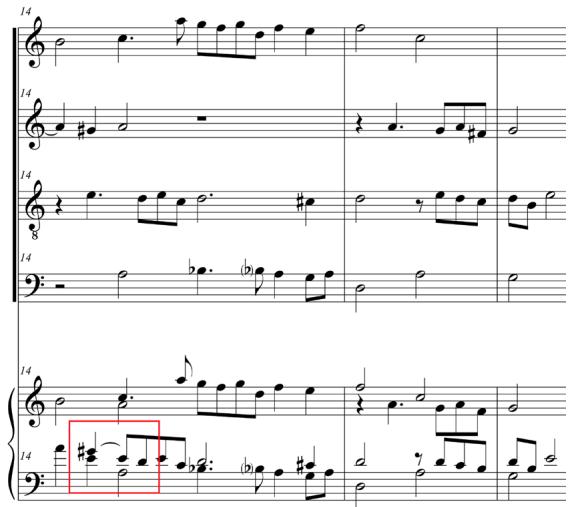
中文讲解
这是谱例 4a 的内嵌图像占位符与图注,对应原曲第 14–15 小节。
图注指明一个关键现象:红框标出的是一处「延音连线(tie)」,其作用是澄清声部进行(clarify voice leading)。在一般 intavolatura 写法中,由于符干方向受纵向位置而非声部逻辑支配,声部之间的连接常常在视觉上被切断;改编者(或抄写者)在此处用连线显式地标明某音应该延续到下一拍,从而把被 intavolatura 惯例「掩盖」的声部进行重新揭示出来。
这一细节体现了本节的核心悖论——intavolatura 视觉惯例隐藏了声部关系,而 ties 等少数符号有时反而在局部透露出真实的对位意图。换言之,fictitious voices 的现象在某些细节处被原作者(或抄写者)有意识地修正过。读者需查看原图以核对红框位置。
补充说明
图像数据被省略,仅保留位置与图注。原文提示读者「需查看原图」以理解红框标出的 tie 在上下两版谱表中的对照关系。
第5段(P0133)
原文复述
33 Silbiger describes the particular use of rests in intavolatura; these reflect the logic of the intabulation but not the logic of the underlying polyphony. He calls these ‘fictitious rests’. Through its application of stem directions and other notational elements, intavolatura oftentimes gives the impression of an alternate set of voices; I have elsewhere described these as ‘fictitious’ or tablature voices (see n. 27 above). For a full description of this phenomenon see Pritchard, ‘Hacking the System’ (see n. 27). Also see Alexander Silbiger, ‘Is the Italian Keyboard Intavolatura a Tablature?’, in: Recercare 3 (1991), 81–103.
中文讲解
这是脚注 33,承担三项功能:定义术语、给出文献引用、明确作者原创贡献。
(1) Silbiger 的「fictitious rests」:他指出 intavolatura 中的休止符并非源自底层对位(polyphony)的逻辑,而是键盘谱自身书写的逻辑——例如为了让手抬起、为了便于分谱、或为了对齐小节。换言之,这些休止是「假的」,因为它们不代表作曲家真正想要的停顿,只是改编/抄写过程的产物。
(2) 作者的延伸:从「fictitious rests」类推到「fictitious voices」——既然休止可以是假的,那么由符干方向等记谱要素制造出的「另一组声部」同样可以是假的。作者明确声明这一命名是自己「elsewhere」提出,并指引读者参见 n. 27(即作者自己的论文 Pritchard, ‘Hacking the System’)。
(3) 文献支持:作者指引读者进一步阅读 Silbiger 1991 年发表于《Recercare》第三期的论文「Is the Italian Keyboard Intavolatura a Tablature?」(意大利键盘 intavolatura 究竟是否属于 tablature?),该文对 intavolatura 的谱面逻辑做了完整讨论。
该脚注对正文的功能是「限定 + 出处」:它为正文中「fictitious voices」这一术语提供了概念史定位(始于 Silbiger 的 rests,作者扩展至 voices),并指引深入阅读。
补充说明
脚注编号 33 对应 P0130 中的上标 33。Recercare 是意大利音乐学界的重要期刊;Silbiger 是研究 17 世纪意大利键盘音乐的重要学者。
脚注 / 边栏 / 图表 / 附加信息(如有)
本节包含三项非正文附加材料: (1) 谱例 4(Ex. 4a–d)的总图注(P0131),标明上下两版谱表的来源与版本依据; (2) 谱例 4a 的内嵌图像与图注(P0132),图注指向第 14–15 小节的红框 tie,是正文论点的具体例证; (3) 脚注 33(P0133),对「fictitious rests / voices」两个核心术语进行定义性说明并给出 Silbiger 1991 与作者本人 ‘Hacking the System’(n. 27)的文献指针。 三者共同支撑了正文「fictitious tablature voices」这一中心概念的定义史与方法学正当性。
💡 本节核心要点
- 本节引入 I-RAc MS Classense 545 中 Frescobaldi《Capriccio sopra un soggetto》的两首匿名 intavolatura,作为与前文累积论证相呼应的对照材料。
- intavolatura 按音符的纵向位置决定符干方向,并按「手部便利」而非「声部归属」把音符分配到两行五线谱,由此在视觉上制造出并不存在的声部——即「fictitious tablature voices」。
- intavolatura 中常见的休止符与同度省略反映了键盘谱自身的书写逻辑,而非底层对位的真实意图;这些「假休止」的概念由 Silbiger 提出(fictitious rests),作者将其扩展为「假声部」。
- 若不参照 Frescobaldi 原版开放总谱(in partitura),研究者只能从键盘谱中推断声部进行;故本节采取原版与改编版并置呈现的方法。
- 尽管改编者声称忠实保留原谱,但「视觉上的声部重排」与「实质性的文本改动」之间的边界在 Classense 545 的案例中是模糊的,这构成本节的核心悖论。
- 脚注 33 把「fictitious」术语史交代清楚:Silbiger(1991)提出 rests,作者本人(见 n. 27)扩展至 voices;二者共同构成本节的概念基础。
🔑 关键术语
- intavolatura / intabulation:17 世纪意大利把多声部作品改写为键盘演奏谱的实践;谱面常把音符分配到两行五线谱,以「手部便利」而非声部逻辑安排符干方向与谱表归属,是本节分析的写作惯例。
- fictitious rests:Silbiger 提出的术语,指 intavolatura 中那些反映键盘谱自身书写逻辑、而非底层对位意图的休止符;本节把它作为「fictitious voices」概念的前身。
- fictitious voices / tablature voices:作者本人在 Pritchard, ‘Hacking the System’ 中提出的术语,指 intavolatura 通过符干方向等记谱要素在视觉上制造出的「另一组声部」,它们并不对应真实的作曲意图。
- open score / in partitura:每个声部分行书写的总谱格式;Frescobaldi 1624 年的印本采用此格式,与键盘改编谱形成对照,是本节方法论上的关键参照系。
- I-RAc MS Classense 545:意大利 Ravenna 市立图书馆(I-RAc)藏 Classense 545 手稿,其中保存了 Frescobaldi《Capriccio sopra un soggetto》的两首匿名 intavolatura,是本节的实物研究对象。
S019 [描述性拆分] Preserving vs. Reworking Voice Leading in Frescobaldi and Bertoldo Intabulations
第1段(P0134)
原文复述
Image caption: b) mm. 54–55. The bottom box highlights a large interval in one hand, wider than usually seen in intavolatura practice; arrows show the contour of the original voices. The upper boxes show notes removed from the tablature. (The image itself is not visible in the text; only the caption and position on p. 32 are preserved.)
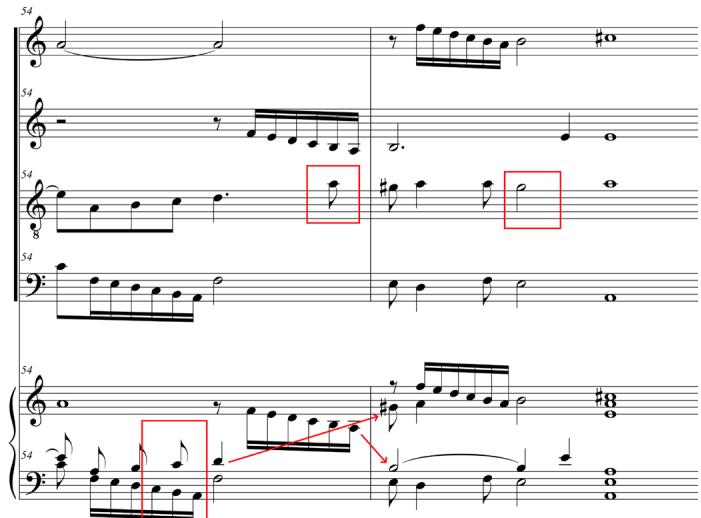
中文讲解
这是例 4b(mm. 54–55)的图注:位于第 32 页的图例本身无法查看,需参看原图以了解具体音型。据图注描述,下方的方框突出显示了一只手内出现的较大音程,作者指出这种音程跨度在 intavolatura 实践中通常不会见到;箭头标示了原始声部的轮廓走向。上方的方框则显示了从 tablature 中被移除的音。这一图例与正文 P0138 中提到的 Ex. 4b m. 54 相对应,是作者用以论证"保留原谱甚至以牺牲可弹奏性为代价"这一主张的核心谱例之一。
补充说明
本图注中的"b)“标记表明它是例 4 的 b 部分,对应正文提到的 Ex. 4b;箭头所指"原声部轮廓"与文中所述"保留声部进行"形成直接对应。
第2段(P0135)
原文复述
图像或乐谱占位符(第33页):仅保留标题"第33页图像或乐谱示例"与位置信息,原始图像数据已省略。
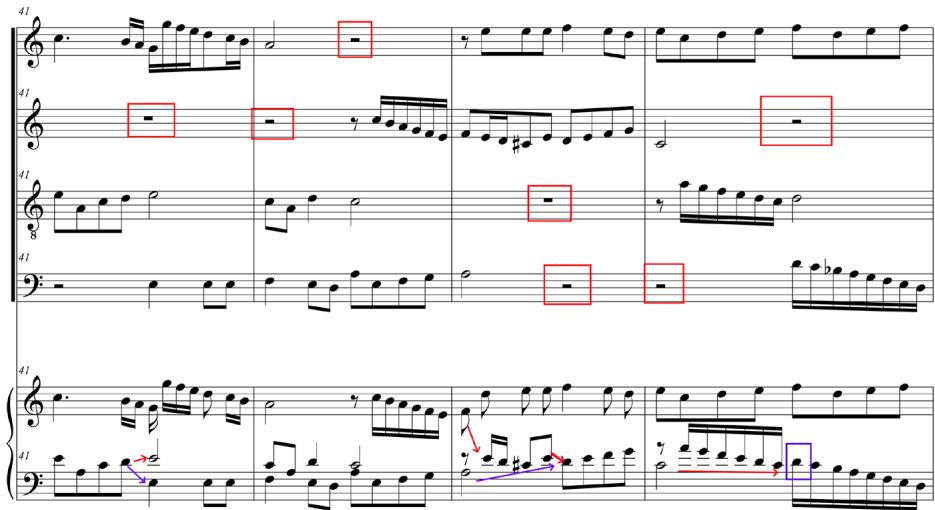
中文讲解
此为第 33 页的一处图像/乐谱占位符,原图未保留,仅标题提示其为"图像或乐谱示例”。根据上下文可推断,它应是本节讨论的某个谱例之一(很可能涉及 Ex. 4a、4c 或 4d 中的某一段),但具体内容需查看原图方可确认。
第3段(P0136)
原文复述
图像或乐谱占位符(第33页):仅保留标题"第33页图像或乐谱示例"与位置信息,原始图像数据已省略。
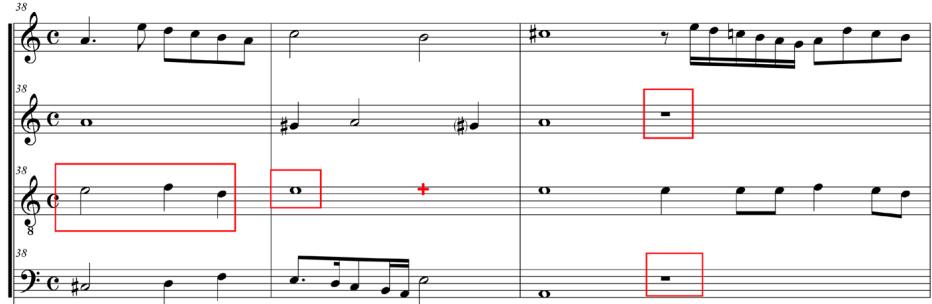
中文讲解
此为第 33 页的另一处图像/乐谱占位符,原图未保留,仅有通用标题提示其为图像或乐谱示例。结合上下文,应与本节讨论 Frescobaldi 与 Bertoldo 改编的声部进行保留/改动情况相关,但具体谱例细节需查看原图。
第4段(P0137)
原文复述
图像或乐谱占位符(第33页):仅保留标题"第33页图像或乐谱示例"与位置信息,原始图像数据已省略。

中文讲解
此为第 33 页的第三处图像/乐谱占位符,原图未保留,仅有通用标题。上下文显示,本节围绕 Frescobaldi 改编件中对声部进行的保留展开讨论,本图很可能作为谱例之一呈现文中所提的声部进行细节,但具体内容需查看原图方可确认。
第5段(P0138)
原文复述
In general, however, these intabulations largely preserve the original voice leading, pushing back against the rules of intavolatura to do so. In Ex. 4a, m. 14, a tie is added in the tenor e1, to flag the continuation of the tenor, even as the stem directions give a ‘fictitious’ impression of the voice leading. In other instances beaming is used to clarify voice leading. Sometimes the original polyphony is preserved at the expense of playability, with awkward stretches that are difficult to perform as written – see Ex. 4b, m. 54, Ex. 4c, m. 60, and Ex. 4d, m. 70. Again, the tendency to preserve Frescobaldi’s musical text would seem to amplify Newcomb’s point that the fundamental ’need’ to preserve the particularities of these texts is part of their function as musical objects. However, there is a fundamentally Janus-faced quality of intavolatura; as I explored in my previous article for this series, the fact that intavolatura uses mensural notation means that its rules can be bent to show details of voice-leading, turning intavolatura into a kind of open score.34 It is noticeable that the tendency to preserve musical text in the Frescobaldi intabulations in I-RAc MS Classense 545, which dates from the middle of the 17th century, goes against what one often sees in intabulations from the 16th century.35 In fact, in two intabulations of ricercars by Padovano (originally published in part-books) by Sperindio Bertoldo (Ex. 5; see Tab. 2), the intabulator has no qualms with allowing the intabulation process to not only obscure voice leading but to essentially rework the polyphonic fabric, altering the original text as extensively as seen in elaborate intabulations. In fact, the integrity of the subject – in a ’learned ricercar no less – is sometimes completely omitted in an effort to adapt the music for keyboard performance.36 In Ex. 5a, notes from the soggetto are removed to avoid awkward stretches, and in Ex. 5b, for diminution in the right hand.
中文讲解
这是本节的核心论证段落,提出一个看似矛盾的双重现象:改编者一方面"逆"intavolatura 规则而行,另一方面又在文本内部展示了这种保留的痕迹。
中心主张:这些 intabulation 在很大程度上保留了原始声部进行,甚至不惜对抗通常的 intavolatura 规则。作者用四个具体手法来说明"保留":(1) 在 Ex. 4a m. 14 中人为加上一条延音记号(tie)标记男高音声部(tenor)的延续,尽管符干方向造成的"假象"会让人误读声部走向;(2) 用连桁(beaming)来澄清声部进行;(3) 宁可牺牲可弹奏性——如 Ex. 4b m. 54、4c m. 60、4d m. 70 处出现的不便演奏的伸展跨度。
作者的解读:这种倾向呼应了 Newcomb 的论点,即对这些文本而言,“保留其特殊性"本身就是其作为音乐对象的功能之一。换言之,改编稿不只是为演奏而存在,它同时是被阅读、被研究的"文献”。
转折与对立:紧接着,作者指出 intavolatura 自身具有"雅努斯两面"(Janus-faced)的品质——借 mensural notation(有量记谱法)的弹性,规则可以被弯曲,让声部进行的细节得以显示,使 intavolatura 在某种意义上成为"开放总谱"。
历史对比:Classense 545 手稿定年为 17 世纪中期,其"保留"倾向与 16 世纪常见的 intabulation 实践正好相反。
反例:与之形成鲜明对比的是 Sperindio Bertoldo 对 Padovano ricercar(原作以分谱形式出版)的两首改编——改编者毫不犹豫地让改编过程不仅模糊声部进行,更从根本上重写对位织体,其改动幅度与精细的改编相当;作者特别强调"即使在’博学 ricercar’(learned ricercar)中,主题(soggetto)的完整性也会被完全省略",以迁就键盘演奏。具体而言,Ex. 5a 中为避免不便利的伸展而删除主题音,Ex. 5b 中为右手的 diminution(细分音型)而删除主题音。
因此本段呈现的是 Frescobaldi 改编的"文本保存"逻辑与 Bertoldo 改编的"键盘实用"逻辑之间的根本对立,并以前者说明 intavolatura 作为可读"开放总谱"的可能性,以后者凸显重写型改编的彻底程度。
补充说明
(1) Janus-faced 是罗马神 Janus 的双面形象比喻,作者借此说明 intavolatura 同时具备两种相反倾向:服从键盘演奏规则的简化逻辑 vs. 展示原始声部进行的"开放总谱"逻辑。(2) “soggetto” 是 ricercar/fugue 中的核心主题材料,与"learned ricercar"(博学 ricercar)共同指向严格对位写作传统,Bertoldo 在此类体裁中仍删除主题,构成反讽。(3) Ex. 5a 与 5b 的细节描述对应正文主张:删音的两类理由(避伸展、做 diminution)共同说明改编对原谱结构的实质改动。(4) 文末"the right hand"提示 Ex. 5b 的 diminution 集中在右手声部。
第6段(P0139)
原文复述
Footnote 34: Ian Pritchard, ‘Hacking the System’ (see n. 27).
中文讲解
这是正文 P0138 中句末上标"34"对应的脚注,仅给出简短文献指引——Ian Pritchard 的文章 ‘Hacking the System’,并指引读者参阅前文脚注 27。该脚注为作者前一篇系列文章,承担"参见"功能,而非补充新信息。
补充说明
无额外补充(脚注 27 的具体内容不在本节输入范围之内)。
第7段(P0140)
原文复述
Footnote 35: Silbiger estimates that the manuscript dates from 1630–1640 or later; see preface to facs. ed., Ravenna, Biblioteca comunale Classense, MS Classense 545, Alexander Silbiger, ed. and introduction (New York/London, 1987), viii. This dating is echoed by Barbara Cipollone who provides some fascinating context for the collection. See ‘The Libro di Fra Gioseff da Ravenna: A Little Light on a Seventeenth-Century Italian Keyboard Collection’, in: Interpreting Historical Keyboard Music, ed. Andrew Wooley and John Kitchen (London, 2013), 83–96.
中文讲解
此脚注对应正文 P0138 中关于"Classense 545 手稿定年为 17 世纪中期"的论断,提供文献依据:Alexander Silbiger 在 1987 年影印版(New York/London)序言第 viii 页中估计该手稿定年为 1630–1640 年或更晚。Barbara Cipollone 认同这一断代,并在其文章 ‘The Libro di Fra Gioseff da Ravenna: A Little Light on a Seventeenth-Century Italian Keyboard Collection’(收入 Andrew Wooley 与 John Kitchen 主编、2013 年伦敦出版的 Interpreting Historical Keyboard Music,第 83–96 页)中为该收藏提供了"引人入胜的背景"。该脚注的功能是来源/限定:它为正文的历史断代主张提供权威支持,并指引读者进一步阅读。
补充说明
脚注内部提示 Silbiger 的影印版是 Classense 545 这份拉文纳市政图书馆藏手稿的标准研究版本;Cipollone 文章是补充性的语境研究。
第8段(P0141)
原文复述
Footnote 36: While it is impossible to directly link the two sources, it is notable that Padovano’s ricercars appear as intabulations in Bertoldo’s print, and also in a manuscript open score (B-Bc 26661); therefore, they are listed in the second part of Tab. 2. Bertoldo’s intabulations are truncated versions of the original works; see Sperindio Bertoldo, Toccate, ricercari et canzoni francese intavolate (Venice, 1591).
中文讲解
此脚注对应正文 P0138 中 Bertoldo 改编例的句末"36",属于来源/旁证性质。它说明了以下几点:(1) 虽然无法直接将两个来源(指 Bertoldo 印刷本与 B-Bc 26661 手稿开放总谱)直接关联,但 Padovano 的 ricercar 同时以改编形式出现在 Bertoldo 的印刷本和一份手稿开放总谱中,因此被列入 Tab. 2 的第二部分;(2) Bertoldo 的改编是原作的"截短版"(truncated versions);(3) 原始文献为 Sperindio Bertoldo, Toccate, ricercari et canzoni francese intavolate(Venice, 1591)。该脚注为正文关于 Bertoldo 改动原作的论断提供文献支撑与版本说明。
补充说明
B-Bc 26661 是布鲁塞尔王家图书馆(B-Bc)编号 26661 的手稿,作为另一份承载 Padovano ricercar 的开放总谱,与 Bertoldo 印刷本形成跨载体对照。
第9段(P0142)
原文复述
Image caption: b) Bottom staves transcribed from Sperindio Bertoldo, Ricercar del Terzo Tuono, mm. 12–13, in: Bertoldo, Toccate, ricercari et canzoni francese (Venice, 1591), 20–3. Top staves transcribed from Annibale Padovano, Il primo libro de ricercari a quattro voci (Venice, 1556). (The image itself is not visible; only the caption and position on p. 35 are preserved.)
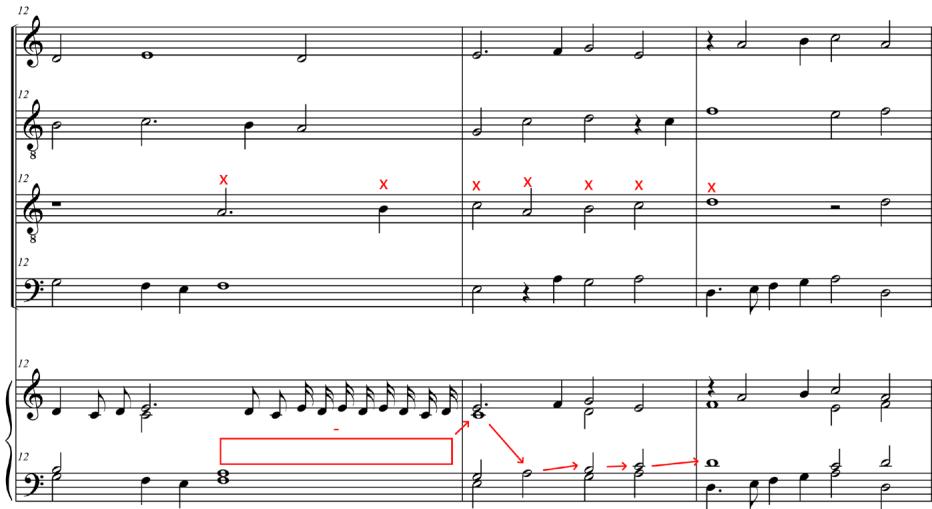
中文讲解
此为第 35 页例 5 的 b 部分图注:上方的谱行转录自 Annibale Padovano 的 Il primo libro de ricercari a quattro voci(Venice, 1556),下方的谱行转录自 Sperindio Bertoldo 的 Ricercar del Terzo Tuono, mm. 12–13,收录于 Toccate, ricercari et canzoni francese(Venice, 1591),第 20–23 页。该图本身不可见,需查看原图以对比上下两组谱行。作者在正文 P0138 中已说明 Ex. 5b 中 soggetto 音被删除以让位给右手的 diminution——本图即是为该主张提供视觉证据的关键谱例。
补充说明
图注中"Ricercar del Terzo Tuono"(“第三调式 ricercar”)表明 Padovano 的原作有调式划分,Bertoldo 选取其中第三调式进行改编。
脚注 / 边栏 / 图表 / 附加信息(如有)
本节附加材料主要包括三组: (1)图像/乐谱占位符:P0134(例 4b,p. 32)、P0135–P0137(p. 33 三处通用占位符,原图缺失)、P0142(例 5b,p. 35)。这些图例在正文中分别承担"展示 Ex. 4b m. 54 大跨度与被删音"(P0134)以及"对比 Padovano 原谱与 Bertoldo 改编(Ex. 5b)"(P0142)两类视觉论证功能;p. 33 三处占位符的具体内容无法确认,需查阅原图。 (2)脚注 34(P0139):仅作文献参见(Ian Pritchard ‘Hacking the System’,参 n. 27)。 (3)脚注 35(P0140):来源/限定类脚注,为 Classense 545 的 1630–1640 年或更晚的定年提供 Silbiger 影印版与 Cipollone 文章两个出处。 (4)脚注 36(P0141):来源/旁证类脚注,说明 Padovano ricercar 同时见於 Bertoldo 1591 印刷本与 B-Bc 26661 手稿开放总谱,并标明 Bertoldo 改编为"截短版"。
💡 本节核心要点
- I-RAc MS Classense 545 中 Frescobaldi 改编的整体倾向是保留原始声部进行,甚至不惜对抗 intavolatura 规则与牺牲键盘可弹奏性。
- 保留声部的具体手法包括:在男高音声部加延音记号以标其延续、用连桁澄清声部进行、容忍不便演奏的手部伸展(Ex. 4b m. 54、4c m. 60、4d m. 70)。
- 这种倾向呼应 Newcomb 的论点——对这些文本而言,“保留其特殊性"本身是其作为音乐对象的功能之一。
- Intavolatura 具有"两面性”:因使用有量记谱法,其规则可被弯曲以揭示声部进行细节,从而在某种意义上成为"开放总谱"。
- Classense 545(约 1630–1640 或更晚)所体现的"文本保存"倾向与 16 世纪常见的 intabulation 实践形成历史对比。
- Bertoldo 对 Padovano ricercar 的两首改编代表相反逻辑——大幅重写对位织体、截短原作,甚至在博学 ricercar 中完全删除 soggetto 音(Ex. 5a 为避伸展;Ex. 5b 为右手 diminution)。
🔑 关键术语
- intavolatura / intabulation:将原本为声乐合奏或其他乐器编制的复调音乐改编为单一键盘乐器演奏的实践与记谱传统;本节中"intavolatura"通常指改编规则与记谱形态,“intabulations"指改编成品(如 Classense 545 中的 Frescobaldi 改编件)。
- voice leading (声部进行):复调音乐中各单声部的旋律走向及其相互关系;本节讨论的核心是改编件是否、如何保留原作的声部进行。
- mensural notation (有量记谱法):用不同音符形状记录音值的记谱体系;本节中作者强调,intavolatura 采用有量记谱意味着其规则可被弹性使用,从而有潜力呈现声部细节,类同"开放总谱”。
- soggetto:意大利语,指 ricercar 或 fugue 中作为对位基础的核心主题材料;本节用以指 Bertoldo 改编中可被完全删除的对象。
- ricercar:基于主题(soggetto)展开的严格对位器乐曲体裁;“learned ricercar”(博学 ricercar)特指对位写作严谨的类型,本节用以反衬 Bertoldo 即使在此类体裁中也删除 soggetto 的做法之突出。
- diminution:以更短时值的音符装饰或拆解长音符的细化处理手法;本节 Ex. 5b 中 soggetto 音被删除即为给右手的 diminution 让路。
- part-books (分谱本):将复调音乐各声部分别印/抄为单独一册的出版形式;Padovano 的 ricercar 原以 part-books 形式出版。
- open score (开放总谱):将各声部纵向对齐显示在同一页上的总谱形式;本节用以比喻 intavolatura 在展示声部进行方面所具备的潜力。
S020 [描述性拆分] Agency of Notational Format: Venetian vs. Ferrarese-Neapolitan Ricercars
第1段(P0143)
原文复述
Newcomb’s response would surely be to argue that these ricercars, representative of the Venetian school, are less contrapuntally rigorous and artificioso than the
中文讲解
本段是跨页断句的前半段,单句以 ‘Newcomb’s response would surely be to argue’ 开头,预设了Newcomb可能给出的反驳,并在此页中断,于下一段在第36页续写为完整句。作者用 ‘would surely be’ 这种虚拟语气,实际上是在搭建对话框架:本段并不真正持有Newcomb的观点,而只是把对方的潜在立场摆出来,为后面提出反诘作铺垫。判断本段必须与下一段连读才能获得完整意义:Newcomb的反驳指向威尼斯学派里切尔卡(ricercar)在对位严谨度(contrapuntally rigorous)和 ‘artificioso’ 程度上不如费拉拉—罗马—那不勒斯学派的作品。理解时需注意 ‘artificioso’ 不是泛指 ‘艺术性的’,而是文艺复兴晚期音乐修辞中专指人为雕琢、技法炫示的写作风格,与本节论题的核心术语相关。
第2段(P0144)
原文复述
Ferrarese-Roman-Neapolitan works that are the object of his study.37 However, I am not sure if this entirely fair to the Venetians: not only do many of their works hint at the same ‘advanced’ level of artificioso composition as do the ricercars that Newcomb highlights (witness the c.f. treatment of the soggetto in the Padovano ricercar just cited), but, as Newcomb himself points out, these works come to us not in open score, but in intavolatura; in this case, the notational format has a material influence on the music style itself.38 That is, the notation has a sort of agency that we would normally consider to belong completely to the composer, imposing a direct influence on musical style. In other words, the complex and artificioso tendencies of the works he cites are that way precisely because they are in full score, not intavolatura, just as the Venetian ricercars appear to be less complex because they are in intavolatura, and not in full score.
中文讲解
本段完成了上一段未竟的句子,并提出本节的核心主张。论证分四步推进:第一,用 ‘However’ 转入作者的反驳,指出把威尼斯学派里切尔卡一律视为低度artificioso并不公平,因为许多威尼斯作品(如上文已引的Padovano里切尔卡中对soggetto的c.f.处理)同样暗示了 ‘高级’ 的artificioso水准;第二,承认Newcomb自己其实也指出威尼斯作品传世的不是open score(开放总谱/分谱写法)而是intavolatura(键盘记谱法/数字谱或符号谱),由此顺势提出第三步的关键论断——’the notational format has a material influence on the music style itself’,记谱格式本身对音乐风格具有物质性的影响;第四,将 ‘agency’(能动性/作用力)这一通常归属于作曲家的概念赋予记谱法本身,并以镜像句式收束:费拉拉—那不勒斯作品之所以显得复杂,是因为它们使用full score;威尼斯作品之所以显得简单,是因为它们使用intavolatura——差异在载体,而不一定在作曲意图。理解本段的关键在于把握 ‘agency of notation’ 这一概念:作者把记谱法从透明的中介提升为塑造风格的因素,挑战了那种把记谱视为作曲家意图忠实传声筒的常识。文中 ‘c.f.’ 即cantus firmus(定旋律),‘soggetto’(主题)也由c.f.方式展开,这是artificioso写作的标志。
第3段(P0145)
原文复述
Intavolatura and Open Scores: a Comparison of Notational Influence
中文讲解
本段是Markdown标记的二级小节标题,标题本身是教学性路标:它宣告进入一个对照性比较——把键盘音乐的两种主要记谱方式(intavolatura键盘符号谱与open score开放总谱)并置,用以揭示上一段提出的 ‘记谱格式的能动性’ 论题。这一标题把抽象命题转化为可观察的比较结构,提示读者:接下来将以具体作品的并列分析来验证 ‘记谱—风格’ 的因果关系。小节标题开启的论题是:同一时期、同一地区、同一文类的键盘音乐,因记谱格式不同而呈现不同的对位外观。
第4段(P0146)
原文复述
One can get a further sense of this ‘notational influence’ by comparing ‘free’ (that is, model-less) keyboard works in both formats. Gb-Lbl Add. 30491, a major source of Neapolitan keyboard music ca. 1600, contains a sole piece in intavolatura, Macque’s Capriccio sopra re fa mi sol; the remaining keyboard works in the manuscript are notated in open score. In mm. 16–23 of Macque’s Capriccio (Ex. 6), a thoroughly contrapuntal texture is implied, but the counterpoint is loose and not particularly well-defined; witness the disappearance of the alto part in m. 20. I would suggest that this texture has to be seen as a by-product of intavolatura and its conventions: resting voices are not given rests that would clearly indicate their contour (and continued existence), and stem directions hide the specifics of voice leading. Sustained notes tend to evaporate in a way reflective of the decay of a plucked string – see the soprano in m. 22, for example. The intabulation is an image of an improvised performance.
中文讲解
本段以一份具体的乐谱证据落实上文 ‘记谱—风格’ 因果关系,是上一段抽象命题的实证支柱。作者首先界定比较条件:选用 ‘free’(即非模仿某既有模型/model-less)的键盘作品,以排除体裁差异的干扰;接着介绍那不勒斯重要键盘手稿Gb-Lbl Add. 30491(约1600年前后),指出其中绝大部分键盘作品以open score记谱,唯独Macque的《Capriccio sopra re fa mi sol》以intavolatura记谱——这构成了在同一抄本内并置两种记谱的天然实验场域。然后聚焦于该曲第16—23小节(参Example 6):作者承认其 ‘暗示出彻底的对位织体’,但同时指出对位是松散、定义不清晰的,并举第20小节中alto声部的消失为例。最后给出关键解释——这种织体源自intavolatura的惯例本身:休止声部不写休止符来标明其轮廓与持续存在,符干方向也遮蔽了具体的声部进行(voice leading)。作者特别以第22小节高声部 ‘sustained notes tend to evaporate’(持续音趋于蒸发)为例,把这一现象类比于拨弦乐器自然衰减,结论是:整首intabulation(键盘改编/转写) ‘是即兴演奏的影像’。理解本段要注意三点:(1) 作者的论证策略是 ‘同一手稿、两种记谱’ 控制变量;(2) ’loose counterpoint’ 不是作曲家技艺不足,而是记谱惯例所造成的外观;(3) ‘image of an improvised performance’ 这一比喻揭示了intavolatura的记谱逻辑与即兴实践同构,而非追求严格的声部独立。
补充说明
本段中 ‘Gb-Lbl Add. 30491’ 是大英图书馆馆藏编号;‘Ex. 6’ 指原书第六个谱例,‘mm. 16–23’ 指该谱例中第16至23小节。这些只是位置标记,本段并未对其内容做不可核实的判断。
第5段(P0147)
原文复述
37 Newcomb writes, ‘One should note also that the less contrapuntally rigorous and artificioso ricercars of the Venetian school – those of Claudio Merulo, Andrea Gabrieli, Sperindio Bertoldo – come down to us in Italian keyboard tablature, often with substantial written out diminution, especially at cadences.’ Newcomb, ‘Notions of Notation’ (see n. 7), 17
中文讲解
本段是脚注37,承担双重功能:(1) 提供Newcomb原文的直接引文,作为作者反驳的靶子;(2) 给出该引文的精确文献出处,便于核查。引文的关键信息包括:Newcomb把威尼斯学派的Merulo、Andrea Gabrieli、Sperindio Bertoldo列为 ’less contrapuntally rigorous and artificioso’ 的代表,并把这些作品的留存形式指认为 ‘Italian keyboard tablature’,且常带有 ‘substantial written out diminution’,尤其在终止处。对理解正文而言,这段脚注起支持作用:它说明Newcomb本人其实已经注意到威尼斯作品的 ‘表观简单’ 与其intavolatura留存形式相伴——这正是作者在正文中借以建立 ‘记谱—风格’ 因果关系的逻辑支点。换言之,作者并非凭空指责Newcomb,而是基于Newcomb自己提供的事实得出进一步推论。
第6段(P0148)
原文复述
38 One might reasonably push back against my challenge to Newcomb’s characterisation of Venetian ricercars; surely the ricercars of the Ferrarese-Neapolitan school – with their use of inganni and the subtle manipulation of multiple subjects – reach the height of artificioso counterpoint. However, some Venetian ricercars show a tendency towards the extreme development of a single subject, saturating the texture with devices such as inversion stretto, diminution, and augmentation. To give two examples, see Andrea Gabrieli’s Ricercar del Primo Tono Alla Quarta alta (1595) or Annibale Padovano’s Ricercar del Sesto Tono (1556) See Andrea Gabrieli, Ricercari di Andrea Gabrieli […] libro secondo (Venice: Angelo Gardano 1595), fol. 4r–6v, https://doi.org/10.3931/e-rara-56111 (accessed on 30 Sept. 2024). Annibale Padovano, Il primo libro de ricercari a quattro voci (Venice: Antonio Gardano, 1556). For a further discussion of Trabaci’s ‘new’ manner of developing inganni, see Massimiliano Guido ‘Giovanni Maria Trabaci and the New Manner of Inganni: A Musical Mockery in the The Early Seicento Ricercar’ in: Interpreting Historical Keyboard Music, ed. Andrew Wooley and John Kitchen (London, 2013), 43–64
中文讲解
本段是脚注38,承担本节篇幅最长的功能:预先回应读者对作者立场的潜在反诘,同时提供文献支撑。其结构为 ‘承认对方有理—但补上反例—给出例证与延伸阅读’。第一层(‘One might reasonably push back…’)承认读者可以合理质疑:费拉拉—那不勒斯里切尔卡凭其inganni(音形戏法/隐藏声部进行)与多主题的精微操控,确实在artificioso对位上达到了 ‘巅峰’,这一点作者并不否认。第二层(‘However, some Venetian ricercars…’)给出反例:一些威尼斯里切尔卡虽围绕单一主题展开,但通过 ’extreme development’——倒影(inversion)、紧接模仿(stretto)、减值与增值(diminution / augmentation)——使织体饱和,证明威尼斯传统同样具备高度artificioso潜力。两个例证为Andrea Gabrieli的《Ricercar del Primo Tono Alla Quarta alta》(1595)与Annibale Padovano的《Ricercar del Sesto Tono》(1556),并附原版印本的网络检索地址与抄本信息。最后,作者用 ‘see also’ 提示Massimiliano Guido关于Trabaci ’new manner of inganni’ 的研究作为延伸参考,使本脚注同时承担文献入口功能。理解本段要抓住它的论证姿态:作者并未否认Newcomb的全部观察,而是把讨论从 ‘谁是更artificioso’ 的总体评价,转向 ‘记谱格式是否塑造了这种表观差异’ 的方法论层面。
补充说明
本段提及的 e-rara 链接与页码、出版地(Venice: Angelo Gardano / Antonio Gardano)、书名及延伸阅读文献均出自本段本身,未引入外部补充信息。
脚注 / 边栏 / 图表 / 附加信息(如有)
本小节含有两条正式脚注(37与38)和一个二级标题(‘Intavolatura and Open Scores: a Comparison of Notational Influence’)。脚注37记录了Newcomb关于威尼斯学派里切尔卡的原文引文及出处(‘Notions of Notation’, 第17页),其作用是为正文反驳提供靶子与依据;脚注38预先回应反对意见并提供延伸文献与两份威尼斯里切尔卡原版印本资料,其作用是拓宽反例证据并指引深入阅读。二级标题起到方法论路标的作用,把抽象主张 ‘记谱—风格’ 因果关系转化为在同一手稿中并置两种记谱的具体比较框架。
💡 本节核心要点
- 本节核心论题是 ‘记谱法的能动性’(agency of notation):记谱格式本身具有塑造音乐风格外观的物质作用,而非仅仅是作曲意图的中性载体。
- 作者反驳Newcomb的判断:威尼斯学派里切尔卡的表观简单并非必然反映作曲意图不足,而可能源自它们以intavolatura(键盘谱)而非open score(开放总谱)流传这一载体事实。
- 作为方法论支柱,作者选取抄本Gb-Lbl Add. 30491(约1600年那不勒斯键盘音乐)作为同一手稿内并置两种记谱的天然对照场,聚焦Macque的《Capriccio sopra re fa mi sol》第16—23小节。
- 作者的具体音乐观察:intavolatura惯例中休止声部不写休止、符干方向遮蔽声部进行、持续音趋于 ‘蒸发’,这些都使对位呈现松散、即兴化的外观。
- 作者以 ‘intabulation is an image of an improvised performance’ 总结intavolatura与即兴实践的同构性,把记谱逻辑与演奏实践联系在一起。
- 脚注38预先承认费拉拉—那不勒斯传统在inganni与多主题操控上的高度artificioso,同时举出威尼斯Padovano与A. Gabrieli里切尔卡以单一主题做极限展开作为反例,使作者立场更平衡。
🔑 关键术语
- intavolatura:键盘音乐的一种记谱方式,常见于16—17世纪的意大利,以符号、数字或字母代替具体音高,相对于以声部独立记写的开放总谱(open score)。本节中它是与open score对立的记谱类别,被作者论证为塑造里切尔卡表观风格的关键变量。
- open score / full score:开放总谱/完整总谱,即每个声部分行独立记写、各自带有独立符干与休止的记谱方式。本节中与intavolatura对照,作者论证它使对位声部的轮廓与持续性更加清晰可辨,从而呈现更高的对位严谨度外观。
- artificioso:意大利语术语,指人工化、雕琢化、技巧炫示的音乐写作风格,特指文艺复兴晚期至巴洛克早期对位写作中以人为技法展示为核心的取向。本节围绕该词展开关于威尼斯与费拉拉—那不勒斯学派里切尔卡的风格评价之争。
- ricercar (ricercare):16—17世纪一种以模仿/对位展开为核心的器乐体裁,常被认为是最早的纯器乐 ‘研究’ 形式。本节中威尼斯与费拉拉—那不勒斯两派的ricercar构成对比对象。
- soggetto / c.f. (cantus firmus):soggetto即主题/动机,c.f.即定旋律。本节提到Padovano里切尔卡对soggetto的c.f.处理,是高级artificioso写作的标志之一。
- inganni:意大利语 ‘欺骗’ 之意,指里切尔卡中通过声部交叉、音程伪装等手段制造听感错觉的技法,被脚注38列为费拉拉—那不勒斯传统的标志。
- inversion / stretto / diminution / augmentation:四种模仿展开技法:倒影(音程方向翻转)、紧接模仿(主题在声部间极短间距接续)、减值(主题时值缩短)与增值(主题时值延长)。脚注38以这四种技法论证威尼斯里切尔卡同样具备主题深度发展能力。
- agency of notation:作者在本节提出的核心概念:记谱法本身具有通常归属于作曲家的 ‘能动性’,能对音乐风格产生直接的物质性影响,而非仅仅透明地记录作曲意图。
S021 [描述性拆分] Macque’s Capriccio sopra re fa mi sol: Notational Influence in a Free Work
第1段(P0149)
原文复述

中文讲解
这是第37页上一处图像或乐谱的占位标记。由于内嵌图像数据已被省略,读者需要查阅原图以确认其具体内容。从版面位置来看,它位于本小节起始处,作为图版或示例存在的结构性标记,本身不承载可独立阅读的论说文字。
第2段(P0150)
原文复述

中文讲解
这是图注(示例6)的文字部分:作品为乔瓦尼·德·马奎(Giovanni de Macque)的《Capriccio di Gio. De Macque, sopra rè fà mi sol》,节选自第16至23小节,转写自大英图书馆手稿 Gb-LB Add 30491 第23v对开页。内嵌乐谱图像数据已省略,需查阅原书图版才能看到具体的音符、谱表与对位声部。该示例是紧接着的论证段落(段末上标39对应脚注)的核心对象——作者正是以此段为例,讨论记谱方式(intavolatura 与 open score)如何影响对位的’随意性’与复杂程度。
补充说明
Gb-LB 是大英图书馆(London, British Library)的图书馆代码惯例;‘Add 30491’ 为手稿附加编号;‘fol. 23v’ 指第23对开叶的背面(verso)。这些信息仅用于说明乐谱来源的物理位置,不构成本节的核心论点。
第3段(P0151)
原文复述
However, would the piece have had the same casualness in counterpoint if it were notated in open score? To start, the contrapuntal fabric would be cast fully in relief, each voice having its predefined physical space on the page. As we have seen, the intabulation process tends to create a hierarchy of elements that mirror the aural perception and the physical actions of performance, with the ‘primary’ voices containing elements, such as a soggetto or passaggi, that are more ‘important’ than the ‘accompanying’ voices. This is at least partly enabled by the fact that the intavolatura is a kind of open canvas – the voices are not given any sort of predefined physical space. In contrast, the predetermined space that receives each part in an open score would seem to encourage contrapuntal completeness. The notation need not capitulate to the practicalities of performance at all. I wonder if Macque might have been tempted – or rather, spurred on – to increase the complexity level if he had used open score, adding say, sustained notes to accompany a polyphonic complex (the kind that often give performers headaches today), or perhaps doubling one of the voices in thirds. In Ex. 7a, I created, following the advice of Alexander Silbiger, a detabulation of the passage in Ex. 6; in Ex. 7b, I ‘filled the gaps’ of my literal detabulation, in a speculative exercise to show how the music might have been written in open score: the evaporating long notes are left in, and I have added slight figuration to maintain a full four-voice texture (see brackets).
中文讲解
本段是本小节论证的核心,主题是记谱法本身对自由作品(free work)对位风格的影响,可拆解为以下层次:
-
问题的提出:作者以反问开场——若马奎的乐曲改用 open score(开放总谱,每个声部各自占据一行谱表、彼此空间预先固定)来记谱,其对位是否还会呈现出同样程度的’随意性(casualness)’?
-
intavolatura 的特征:键盘意指谱把多个声部压缩在同一谱表上,相当于一张’开放画布(open canvas)’——各声部没有预先设定的物理空间。其结果是自然产生层级:承载 soggetto(主题)或 passaggi(快速走句)等’重要’材料的声部被视为’主声部’,其他声部退居’伴奏’地位,这一结构对应听觉感知与演奏动作。
-
open score 的对照:与 intavolatura 不同,开放总谱为每个声部预设了固定位置,对位织体会被’完整地呈现出来(cast fully in relief)’,记谱不必迁就演奏的实际操作,从而’鼓励对位的完整性(contrapuntal completeness)’。
-
作者的推测:作者揣测马奎若用开放总谱,可能’被诱发(spurred on)‘去提高对位的复杂度,具体方式有二:一是为复调密集段落加上持续长音(这正是今日演奏者常感棘手的写法);二是把某一声部作三度叠置。
-
例证安排:作者遵循 Alexander Silbiger 的建议制作了 Ex. 7a(严格去表化,detabulation),把 Ex. 6 的段落还原为分声部形态;又以 Ex. 7b 作为’推测性练习’——在严格去表化的基础上’填补缝隙’:保留那些在原谱中已经’蒸发(evaporating)‘的长音,并补入轻微的加花(figuration,以括号标示),以维持四声部的织体密度,从而演示同一段音乐在开放总谱下’可能呈现’的写法。
本段的论证逻辑是:以反问引入→比较两种记谱法的物理空间逻辑→推断记谱形式会反向塑造作曲家的复杂度选择→以作者亲手制作的两个示例将推测具体化。这是一种’反事实推演’,旨在揭示记谱并非中立的载体,而是参与塑造音乐本身的物质条件。
补充说明
本段内关键术语互参:intavolatura 与 detabulation 互为逆向过程;soggetto 与 passaggi 在本节中被并列为’主声部’所承载的’重要’材料的典型例子。
第4段(P0152)
原文复述
Silbiger, ‘Is the Italian Keyboard Intavolatura a Tablature?’ (see n. 33), 81.
中文讲解
这是正文段末上标39所对应的脚注,引用 Alexander Silbiger 的论文《Is the Italian Keyboard Intavolatura a Tablature?》,指向第81页,并提示读者另见注释33。该脚注的功能是支撑作者在 Ex. 7a 中所采用的’去表化’方法——正文说作者’遵循 Silbiger 的建议’制作 Ex. 7a,背后的学术依据由此脚注提供。
脚注 / 边栏 / 图表 / 附加信息(如有)
本小节的非正文材料包含两个内嵌图像占位符与一个脚注。P0149 为第37页的图像/乐谱占位符;P0150 为 Ex. 6 的图注,指向马奎《Capriccio sopra rè fà mi sol》第16–23小节、转写自大英图书馆手稿 Add 30491 fol. 23v,是作者分析的核心对象;P0152 为正文段末上标39的脚注,引用 Silbiger 关于意大利键盘意指谱的论文第81页,是 Ex. 7a 去表化方法的学术依据来源。
💡 本节核心要点
- 核心反问:若用开放总谱记谱,马奎乐曲中对位的’随意性’是否仍会存在?
- intavolatura 把多个声部压缩在同谱表上,相当于’开放画布’,自然形成主声部(承载 soggetto 或 passaggi)与伴奏声部的层级;
- 开放总谱为每个声部预留物理空间,使对位织体’完整呈现’,并鼓励对位完整性与复杂度的提升;
- 记谱不仅是中立的载体,而是塑造作曲家对位选择与作品复杂度的物质条件;
- 作者据此推测:马奎若用开放总谱,可能加入持续长音或三度叠置等更复杂的对位处理;
- Ex. 7a(严格去表化)与 Ex. 7b(在去表化基础上’补缝’,恢复’蒸发’的长音并补入轻微加花以维持四声部)以具体示例展示了同一段音乐在两种记谱下的可能差异。
🔑 关键术语
- open score:开放总谱:每个声部各自占据一行谱表、彼此空间预先固定的记谱方式。本节中,作者把它与 intavolatura 对立,指出前者’鼓励对位的完整性’。
- intavolatura / intabulation:意大利键盘意指谱/表化记谱:把多个声部压缩在同一谱表上的记谱方式。本节中,作者强调其’开放画布’特性,并指出它容易形成主声部(承载 soggetto 或 passaggi)与伴奏声部的层级。
- detabulation:去表化:将意指谱还原为分声部记谱的逆向过程。本节中,作者遵循 Silbiger 的建议制作了 Ex. 7a,用以演示马奎段落被还原后的声部结构。
- soggetto:主题:在本节中作为’主声部’所承载的’重要’材料之一,与 passaggi 并列。
- passaggi:快速走句、加花段落:在本节中作为’主声部’所承载的’重要’材料之一,用以说明意指谱中层级化的来源。
S022 [描述性拆分] Trabaci’s Capriccio sopra la, fa, sol, la and the Objectifying Power of Open Score
第1段(P0153)
原文复述
A fruitful comparison can be made with Trabaci’s Capriccio sopra la, fa, sol, la from the Libro primo (1603). As noted by Silbiger, it is similar enough to Macque’s Capriccio to warrant being identified as a kind of parody. In parallel passages to the two just shown, we can see what Macque’s ‘missing’ parts might have contained (Ex. 8); notable is the tendency to consistently add material in the fourth voice in contrapuntal complexes that are essentially in three voices; in comparable moments in Macque’s Capriccio, the fourth voice often isn’t present – one gets the impression that material is added only as it is possible to play (for example, the faster-moving imitative section from mm. 16–22 remains a 3 until the soggetto enters in all voices in augmentation, after which the texture is again reduced to three voices). It must also be noted that Trabaci’s piece is considerably more difficult to perform as exactly written, precisely due to these ancillary parts.
中文讲解
本段是这一小节的核心实证段落。作者把Trabaaci 1603年《Libro primo》中的《Capriccio sopra la, fa, sol, la》与Macque的Capriccio并置比较,目的不是做风格鉴定的考据,而是借Trabaci的乐谱来"反推"Macque那些在键盘记谱中无法写下的声部究竟可能包含什么内容。Silbiger指出两首作品足够相似,可以被视作一种"parody"(仿作/借用同一对位材料的体裁关系),这一判断为作者的平行比较提供了合法性。两个关键观察由此引出:第一,Trabaci在本质上为三声部的对位织体里"坚持"补写第四声部;第二,与之相对应的Macque段落则常常没有这个第四声部。由此作者得出一个看似简单却很重要的推论——Trabaci的第四声部似乎是"能写就写"的结果(“added only as it is possible to play”),它不是一个独立的构思层,而是受制于键盘演奏可行性的副产品。紧接着的mm. 16–22例子很好地说明了这一点:快速模仿段始终保持三声部,直到soggetto以augmentation(增值)进入全声部,之后又回到三声部。也就是说,四声部并不服务于对位结构本身,而是依据能否在键盘上弹奏而被"启用"或"关闭"。最后一句补充了演奏维度:正是这些附属声部让Trabaci的版本按原谱弹奏明显更难。这暗示"按谱弹"在键盘文献里本就不是默认规范,演奏者历来有权即兴填补或省略。
补充说明
本段与前文的关系:上文刚刚展示了Macque的Capriccio并将其与一个推测的独立四声部版本(“in partitura”)对照,本段则改用Trabaci的现存四声部版本来"替代"那个推测版本,从而用实物证据代替假说。augmentation一词在dactal fugue/对位传统中指主题以原值倍数(如倍速)的时值再现,这里出现于mm. 16–22之后的入口。
第2段(P0154)
原文复述
中文讲解
这是例8a的图注,说明所引谱例的来源与记谱方式。需注意两层"翻译":(1) Trabaci原谱是以open score(开放总谱,即每个声部单独一行五线谱)印行的;(2) 本书作者为便于现代读者识读,又把它转写成现代键盘记谱(双手共用的两行大谱表),但通过"stem directions"(符干朝向)保留了原本open score中各声部分行的视觉关系。换言之,读者看到的虽然是现代键盘记谱形态,符干方向却暗藏了各声部的身份。这一转写策略与P0156的理论论证直接相关——open score的"分声部"特性是有意义的,不只是排版习惯。a) mm. 20–26对应P0153中讨论的快速模仿段落附近,可与Macque的相应段落对照阅读。
补充说明
由于内嵌图像数据被省略,无法看到谱例细节;如需确认符干方向与各声部关系,请查阅原书第39页Ex. 8a。本图注中包含的全角分号";“是原始OCR文本的标点残留,按原样保留。
第3段(P0155)
原文复述
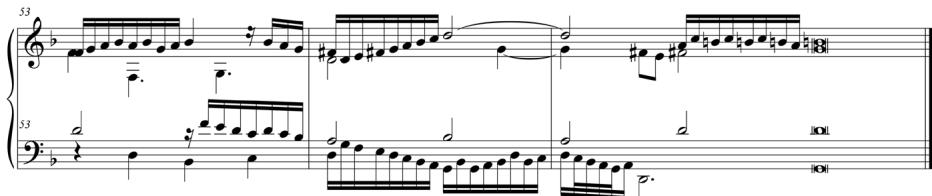
中文讲解
这是例8b的图注,仅指出对应小节位置(mm. 53–55),具体内容需查阅原图。该段落与Ex. 8a共同构成作者援引Trabaci乐谱的双重例证:前者覆盖快速模仿/对位密集的段落,后者则对应作品中声部相对较少、可以清晰观察第四声部补写情况的位置。两例并置的目的,是让读者在两种织体状态下都能看到Trabaci"补写第四声部"的一致倾向,从而印证P0153的论断。
补充说明
图像数据已被省略;需查看原图以确认小节53–55处的对位结构与声部数量。无额外补充。
第4段(P0156)
原文复述
Following the same logic as the algorithmic conversion of polyphony to intavolatura, I wonder if the open-score format can be seen to have the opposite effect, at the very least encouraging – or perhaps even ‘demanding’ – additional notational detail, therefore possessing a degree of agency over musical style in exactly the opposite way that intavolatura does. Put another way, keyboard music in open score – at least around 1600 in Italy – represented a kind of objectification of intavolatura, with a parallel set of algorithmic processes at work. This is particularly the case if we assume that works such as Trabaci’s and Macque’s were likely ‘composed’ at the keyboard as a product of improvisation. In this case, the intavolatura is a kind of tabula compositoria. To the extent that the intabulated version of Macque’s Capriccio is the res facta to the improvisation, notation in open score format would be the next step up the ladder of ‘composedness’ – or rather, the top rung.
中文讲解
本段是小节的理论收束。作者延续前文"intavolatura是一种把多声部对位"算法化"压缩到键盘单谱表记谱"的论点,把论证翻转过来:如果intavolatura是"压缩”,那么open score(开放总谱,每个声部独立一行)就是"展开"。这一翻转建立了作者全节论证的对称结构。关键术语objectification(客体化/对象化)在此有特定含义:open score使原本受制于键盘演奏的织体成为视觉上可审视、可分离、可分析的"对象",因此它至少"鼓励",甚至可以夸张地说"要求"更多的记谱细节。这与intavolatura对记谱的"压缩/省略"作用方向完全相反。随后作者引入一个关键假设:Trabaci和Macque这类作品很可能是键盘上的即兴产物"被落成了谱"。在此假设下,intavolatura扮演的是"tabula compositoria"——一块"作曲用的书写板/底稿"——它是即兴的res facta(“被做成之物”,即兴兴的成品化)。最后一段提出"composedness"的阶梯:即兴在最底,intavolatura居中,open score在最顶。注意作者特意用"ladder"和"top rung"的比喻,又加"or rather"自我修正——强调这不是一个线性"进步",而是同一过程的"凝固度"差异:记谱格式越"开放"(即每声部分立),作品就越远离即兴原始状态,越接近"完整作品"。
补充说明
tabula compositoria是作者自造的术语,可直译为"作曲板/作曲底稿",强调intavolatura承担了"把即兴内容暂时固定下来"的中介功能,与紧随其后的res facta形成对偶:res facta指已落笔的"成品",即兴则是该成品的来源;open score则是把res facta再"打散回多声部分立谱"的过程,因此是阶梯的顶端。
第5段(P0157)
原文复述
40 Alexander Silbiger, Italian Manuscript Sources of 17th Century Keyboard Music (Ann Arbor, 1980), 167.
中文讲解
这是脚注40,引用Silbiger 1980年的著作《Italian Manuscript Sources of 17th Century Keyboard Music》第167页。在正文中,该脚注支撑的是P0153开头关于Trabaci与Macque的Capriccio"足够相似,可被视为一种parody(仿作)“的判断。Silbiger是研究17世纪意大利键盘音乐手稿传承的重要学者,此书是其代表作之一;它为正文作者把两首作品并置比较提供了二手研究依据,属于支撑性引证,而非作者亲自进行的对位比对。
补充说明
该脚注仅作为引文来源出现,作者在正文中以"As noted by Silbiger"的方式将其作为权威转引,因此属于"支持/来源"类注释,而非限定或反驳。
脚注 / 边栏 / 图表 / 附加信息(如有)
本节包含一个标注为Ex. 8的复合谱例(拆分为8a与8b两个图注),图像数据被省略,图注说明了转写来源(Trabaci, Ricercate canzone francese capricci […] libro primo, Naples 1603, pp. 63–6)以及"从开放总谱转写为现代键盘记谱、但保留符干方向"的记谱策略;并有一条脚注40,引用Silbiger 1980年第167页,为Trabaci与Macque作品的parody关系提供文献支撑。
💡 本节核心要点
- Trabaci 1603年的《Capriccio sopra la, fa, sol, la》与Macque的Capriccio高度相似(Silbiger称其为parody),可作为Macque"缺失声部"的实物参照。
- Trabaci倾向于在本质为三声部的对位织体中补写第四声部,但补写服从键盘演奏可行性,而非对位结构本身的需要。
- 作者由此推论:Macque版本中"缺失"的声部很可能是即兴演奏时按需填入的内容,而不是作品固有的一部分。
- intavolatura代表一种"算法化压缩”,把多声部对位压成键盘单谱表记谱;open score则代表相反方向的"展开/客体化",迫使更多记谱细节显形。
- 在"composedness"的阶梯上,即兴在最底,intavolatura是res facta的中间形态,open score则是最远离即兴的顶端形态;这一阶梯衡量的是"凝固度",而非音乐风格的优劣。
🔑 关键术语
- open score:开放总谱,键盘音乐中将每个声部分别写在独立五线谱行上的记谱方式;与intavolatura把多声部压缩在同一键盘谱表上的做法相对。本节主张open score具有"客体化/对象化"功能,能迫使更多记谱细节被显形。
- intavolatura:16–17世纪意大利键盘音乐常用的记谱体式,将多声部对位压缩于一对大谱表中,由演奏者自行分配左右手与对位;本节把它定位为介于即兴与"完整作品"之间的中间记谱层。
- res facta:“被做成之物”,与即兴(performance)相对;本节中指即兴内容被落写成intavolatura后的成品形态。
- tabula compositoria:作者自创术语,意为"作曲底稿/书写板",强调intavolatura在即兴与开放总谱之间承担的中介性凝固作用。
- parody:在此处不是讽刺义,而是借用同一对位材料进行新作的体裁技术;Silbiger用此术语描述Trabaci与Macque两首Capriccio之间的材料继承关系。
- augmentation:对位/模仿中主题以原值倍数(多为倍速)的较长时值再现;P0153中提及Trabaci的soggetto以augmentation进入后,织体又回到三声部,用以说明第四声部并非结构必需。
- soggetto:对位作品中的主题/动机,常用于模仿、卡农或赋格段;本节指Capriccio中被增值再现的核心对位主题。
S023 [描述性拆分] Toccata Comparisons: Mayone’s Open-Score Texture vs. Anon. Trent Intabulations
第1段(P0158)
原文复述
Another comparison of works in each format is illustrative. Ex. 9a shows a passage from the Toccata terza from Ascanio Mayone’s Secondo libro di diversi capricci per sonare, published in open score, and Ex. 9b a passage from an anonymous toccata-like piece in I-TRmp [n.s.] (commonly known as the ‘Feininger’ manuscript). In the passage from the anonymous toccata, imitation of a figure (a) creates a move towards a cadence. Again, as would be expected in a work notated in intavolatura, the counterpoint is a sketch rather than fully fleshed-out. The texture thins out in m. 5, moving to an a 3 texture on the second beat, with the bass truncated on c1, evaporating on beat 4. This is presumably to facilitate the stretch between the bass and tenor on this beat, and is again an image of the physical actions (and aural reality) of performance on a plucked keyboard instrument. The passage sits easily under the hands. In contrast, the Mayone toccata (mm. 67–73), while almost identical in concept (imitation of a motive as a drive towards a cadence), has a quite different effect: wide intervals (such as seen in the last beat of m. 67 and 68) are awkward and sit unidiomatically on the keyboard, and the texture is considerably more dense overall. Conceptually, the musical kernel behind each excerpt is the same: two voices participate in an imitative complex of a motive, while the other two voices accompany this a 2 complex with accompanying contrapuntal material. However, in the anonymous toccata, this accompanying material is minimal, or even non-existent, whereas in the Mayone, it consists of long notes or ’extra’ material that moves with the same note values as the motive, creating busy and highly unidiomatic textures (see, for example, m. 73). The point is highlighted further in Ex. 9c, an excerpt from another toccata by Mayone from his Primo libro, and an anonymous Toccata piena from the Feininger manuscript; the anonymous toccata fits the stylistic ’norm’ of passaggi and chords to a tee, whereas the sustained notes in Mayone’s toccata simply get in the way in performance – but also give the piece a sense of contrapuntal completeness (and added complexity).
中文讲解
本段是小节的核心论证段,作者用两对谱例的并置来揭示记谱法格式(open score 对 intavolatura)如何塑造了作品的织体与演奏体感。需要把握三层递进:
-
概念层是相同的:两首例子的音乐内核都是「动机模仿 → 终止式」,且都是四声部中两声部作模仿主体、另两声部作对位伴随。
-
听觉/演奏层差异巨大:匿名 Trent 托卡塔因采用羽管键琴 intavolatura 记谱,作曲家(或者说抄写者)只勾勒出演奏者在键盘上真正会弹的声部——所以对位被简化为草图,m. 5 织体主动稀化到 a 3,低音在 c1 处截断、第四拍「蒸发」,目的是为了让演奏者双手够得到、把位合理。这是一种「以谱面顺应手指」的写法。
-
Mayone 用 open score 记谱(为那不勒斯学派而设计),作曲家要把四个声部都「写满」——于是 m. 67–68 出现不人声化的宽音程,整段织体密集,对位材料以长音符或与动机同节奏的「额外」材料填充,演奏上笨拙,但在谱面上实现了更完整的对位形态。Ex. 9c(Mayone Primo libro)与 Ex. 9d(匿名 Toccata piena)的对比再次重复这一模式:匿名版贴合 passaggi 与和弦交替的「惯例」;Mayone 的持续音在键盘上碍事,却换来纸面上的对位完整感。
本段在论证链中的功能:从抽象原则过渡到具体谱例,用「同一概念、不同声音/演奏现实」的反差来推进小节标题所宣告的「open-score 织体 vs. Trent intavolatura」的比较,并为下一段把问题提升到「记谱法本身具有能动性」的哲学层面做铺垫。容易误解之处:作者并非说 Mayone 写得差,而是说 open score 迫使作曲家追求对位完整,从而牺牲键盘演奏的舒适度——这是「格式→写作习惯→作品面貌」的因果链。
补充说明
段落内部要素的对应关系:P0158 中提到的 figure (a) 与 Ex. 9a–d 的实际乐谱图像相对应,但图像内容需查阅原谱;m. 5、m. 67–73、m. 73、m. 20–24 等小节号均为谱例内的具体定位。术语 a 3 / a 2 在本节指声部数量(three-voice / two-voice texture)。「Feininger manuscript」I-TRmp [n.s.] 是承载匿名 intavolatura 的关键手稿,与例 9b、9d 直接相关。
第2段(P0159)
原文复述
41 The latter is a major source for the works of Ercole Pasquini. Both intabulations share figuration with music from the Neapolitan school. The extent to which the works of Macque and Trabaci et al. constitute a distinct ‘school’, and to what extent one can speak of a broader Ferrarese-Neapolitan style, has been the subject of scholarly debate; see for example an earlier article by Newcomb, ‘Frescobaldi’s Toccatas and Their Stylistic Ancestry’, in: PRMA 111 (1984/85), 28–44.
中文讲解
这是 P0158 所引「Feininger manuscript」I-TRmp [n.s.] 的脚注 41,承担三种功能:(1) 补充手稿归属——它是 Ercole Pasquini 作品的重要来源;(2) 提示风格亲缘关系——这些 intavolatura 与那不勒斯学派共享装饰音型(figuration);(3) 标注学界争议——Macque、Trabaci 等人是否构成独立的「学派」还是更广义的「费拉拉–那不勒斯风格」,尚无定论,并给出 Newcomb 1984/85 年发表于 PRMA 111 (pp. 28–44) 的文章《Frescobaldi’s Toccatas and Their Stylistic Ancestry》作为延伸阅读。
对本节论证的作用:脚注并不推进新主张,而是为正文「匿名 Trent 托卡塔与那不勒斯共享 figuration」的隐含关联加上文献锚点,并提醒读者:在用「学派」概念解释风格时需要谨慎。这与本节末段把问题提升到「workhood」理论层面形成层次——脚注管史料与归属,正文管分析,结尾管理论意涵。
补充说明
脚注中提到的 Newcomb 文章出处只能依本输入记录为「PRMA 111 (1984/85), 28–44, ‘Frescobaldi’s Toccatas and Their Stylistic Ancestry’」;其具体论点本节未复述,故不应在本栏展开。
第3段(P0160)
原文复述

中文讲解
这是 P0158 提到的 Ex. 9a 与 Ex. 9c 的图像占位符(Mayone 的两首托卡塔谱例)。本占位符在版面顺序上先于独立图注出现,因此属于「谱例缩略/总览图」,与紧随其后的 P0161(P0161 与 Ex. 9a 对应)共同构成视觉证据。原文围绕这两段谱例做出的所有具体分析(m. 67–73 的宽音程、m. 20–24 的持续音碍手感等)都需要对照实际图像确认,本输入中图像内容已被省略,读者应回到原版查阅。
第4段(P0161)
原文复述
Ex. 9a: Ascanio Mayone, ‘Toccata terza’, mm. 67–73, transcribed from Mayone, Secondo libro di diversi capricci per sonare (Naples, 1609), facs. repr. (Florence, 1984), 99–110. The music, originally printed in open score, has been transcribed into modern keyboard notation, with stem directions once again reflective of the parts in the open score, to facilitate comparison with the works in intavolatura.
中文讲解
这是 Ex. 9a 的图注,包含三层信息:(1) 作品定位——Mayone, Toccata terza, mm. 67–73;(2) 文献来源——Mayone, Secondo libro di diversi capricci per sonare (Naples, 1609), 影印重印本 (Florence, 1984), 页码 99–110;(3) 转写说明——原本为 open score 现转写为现代键盘记谱,符干方向仍保持与原谱各声部一致,目的是便于与 intavolatura 作品并置比较。
本图注对正文论证的关键意义在于「符干方向保留原谱声部」这一处理:它使读者能在视觉上识别出四个独立声部,从而理解正文所说的「a 4 织体在键盘上不自然」的判断——如果转写时把所有声部都用键盘记谱的常规符干,就看不出「open score 强迫作曲家把四声部写满」这一现象。因此本图注本身是论证链条的一环,并非中性说明。
补充说明
图注中提到的 Naples, 1609 / Florence, 1984 两个出版/重印地与年份直接来自本输入。
第5段(P0162)
原文复述
中文讲解
这是 Ex. 9b 的图像占位符,对应 P0158 中那段匿名托卡塔的乐谱:作品无题名,mm. 4–8 出自 I-TRmp [n.s.](Feininger 手稿)fol. 45v-46r,转写自意大利键盘 intavolatura。它在论证中与 Ex. 9a 形成「同概念、不同记谱」的第一组对照——读者需要把这两份谱例并排看,才能体会作者所谓「同一模仿框架」下,intavolatura 写法在 m. 5 自动稀化织体、截断低音的「演奏友好」特征。具体音符需查阅原图。
第6段(P0163)
原文复述

中文讲解
这是第 41 页上的另一处图像占位符,性质为版面上的额外图示或乐谱示例,本节正文与脚注中均未单独说明其内容,疑为版式排版残留或与图例相邻的辅助图。由于本输入未提供关于此占位的额外文字说明,无法确定其确切功能——读者应回到原页核对。在本节论证中,它不承担独立的分析职能。
第7段(P0164)
原文复述

中文讲解
这是 Ex. 9c 的图注,对应正文提到的 Mayone Toccata prima 选段(mm. 20–24)。来源为 Mayone, Primo libro di diversi capricci per sonare (Naples, 1603), 页 39–43;同样由 open score 转写为现代键盘记谱。这是用来「第二次证明同一论点」的证据——它让作者把比较从 Toccata terza 推到 Toccata prima,从而显示 Mayone 写法中「持续音碍手感」的倾向并非孤例,而是 open score 记谱下的常态。与之配对的 Ex. 9d(见 P0165)则继续证明匿名 intavolatura 如何贴合 passaggi 与和弦的「惯例」。具体乐谱细节须查阅原图。
补充说明
图注中 Naples, 1603 为 Primo libro 的初版地与年份,来自本输入。
第8段(P0165)
原文复述
中文讲解
这是 Ex. 9d 的图像占位符,对应正文中另一首匿名 Toccata piena 的 mm. 17–20,同样出自 I-TRmp [n.s.](Feininger 手稿)fol. 11v-13r,转写自意大利键盘 intavolatura。它与 Ex. 9c 配对,构成第二组「open-score vs. intavolatura」的并置。作者用「fits the stylistic ’norm’ of passaggi and chords to a tee」来形容它——它展示了 intavolatura 写法天然贴合键盘演奏惯例的一面。乐谱细节本输入未提供,须查阅原图。
注意:P0158 正文中并未显式以编号提到「Ex. 9d」,但 P0165 图注所标的「‘Toccata piena’」与 P0158 文末提到的「an anonymous Toccata piena from the Feininger manuscript」一致,故可判定本占位符正是为那段论述提供视觉证据。
第9段(P0166)
原文复述
Again, one can interrogate the degree to which these elements are, in fact, influenced by the notational format itself. The difficult elements in the music of the Neapolitan school described earlier are encouraged (or required?) by the use of open score. Mayone’s toccata would appear on the page to be much more like the anonymous Trent toccata if it were notated in intavolatura, and the Trent toccata would have been more fully fleshed out, objectified in a way that leads to increased contrapuntal complexity, if it were written in open score. Giving a degree of agency to the notational format itself may certainly have radical implications for considerations of notions of ‘workhood’, and how these notions are theorized in music ca. 1600.
中文讲解
本段是全小节的收束,把前面三段的具体谱例比较提升到一个方法论层面的命题:记谱法本身具有「能动性」(agency)。需要把握三步推论:
-
提出反事实假设——若 Mayone 的托卡塔改用 intavolatura 记谱,它在谱面上看起来会很像匿名 Trent 托卡塔;反之,若 Trent 托卡塔改用 open score 记谱,它会被「填满」、变得对位更复杂。
-
这意味着先前描述的那不勒斯音乐中「困难」的元素(密集织体、宽音程、不贴合键盘),其实是被 open score 格式「鼓励」甚至「要求」出来的,而非纯粹出于作曲家风格偏好。作者用括号里的问号「(or required?)」显示其在因果归属上的犹豫——这是诚实的学术表态。
-
方法论后果:若承认格式有能动性,那么「作品」(work)这一概念的边界就会动摇——同一首作品换一种记谱格式就是不同的「作品」吗?这对 ca. 1600 音乐理论如何界定「workhood」具有激进含义。
本段在论证链中起双重作用:既是对前四段(Ex. 9a–d 比较)的总结,又是为后续小节(如果存在)打开一个理论问题。它把分析从「作品之间的差异」切换到「作品概念本身被记谱格式塑造」,是本节最关键的概念跳跃。理解时须注意:作者没有断言记谱格式是唯一决定因素,而是说它是一个被忽视的、独立起作用的变量。
补充说明
段落末句「notions of ‘workhood’, and how these notions are theorized in music ca. 1600」中的 ca. 1600 指约公元 1600 年前后,与本节涉及的 Mayone 1603、1609 两版作品的时代吻合。术语「workhood」在本输入中未给出定义,按上下文应理解为「什么构成一个完整的、可重复的『作品』」这一音乐学问题。
💡 本节核心要点
🔑 关键术语
- open score:开放总谱,将各声部分行列在谱面上(如声乐总谱或器乐分谱),便于阅读多声部对位但与键盘演奏的物理把位脱节,是那不勒斯键盘托卡塔(如 Mayone)常用的记谱格式。
- intavolatura:键盘专用记谱格式,按演奏者单手或双手的实际音位与把位记写,常省略对位细节,使谱面直接反映键盘动作;Trent 抄本(I-TRmp)中的匿名托卡塔即采用此格式。
- Feininger manuscript (I-TRmp [n.s.]):特伦托博物馆藏匿名键盘 intavolatura 手稿(I-TRmp 编号「n.s.」即「新编号」),是 Ercole Pasquini 作品的主要来源之一,其托卡塔片段在本节用作 intavolatura 写法的代表。
- passaggi:键盘音乐中快速的音阶式或琶音式经过段,是十六、十七世纪托卡塔等炫技体裁的典型装饰性音型;intavolatura 写法自然贴合其键盘惯例。
- workhood:音乐学中关于「什么构成一个完整的『作品』」的概念问题;本节把它与记谱格式的能动性挂钩,认为记谱选择会改变同一音乐素材作为「作品」的面貌。
- agency of notational format:作者本节的核心主张:记谱格式不是中立容器,而是主动塑造作曲家写作方式与作品织体的因素,因此必须被视为分析中的因果变量。
S024 [描述性拆分] Notating the Neapolitan Madrigale Passaggiato: Surface Affinities with Intabulation
第1段(P0167)
原文复述
Notating the Neapolitan Madrigale Passaggiato
中文讲解
本段是章节标题,不含正文论点。它的功能是为接下来的小节定调:将讨论焦点从一般的记谱法问题转入那不勒斯地区一种特定的体裁——madrigale passaggiato(即经过大量减缩/装饰处理的牧歌改编曲)的记谱方式,并预告本节将探讨这种体裁与键盘/琉特“intabulation”(以数字谱或符号谱重写多声部原作)之间在表面上的相似性。
第2段(P0168)
原文复述
These issues of notation, performance, and composition are aptly illustrated by the four madrigal arrangements in the published volumes of Trabaci and Mayone (one arrangement per volume). Although these are for all intents and purposes very similar to elaborate intabulations, they technically cannot be considered to be intabulations at all, as they are not notated in intavolatura. While this definitional quibble may seem on the surface rather semantic, the arrangements contain the same difficult tendencies in performance, and overall level of complexity, as the other works in the volumes. Trabaci’s own terminology, used on the title page of his 1603 Libro primo, ‘madrigale passeggiato’, might imply a process in which diminution was applied to each voice of the madrigal, but a closer examination reveals a process of arrangement akin to intabulation. In fact, these works can be seen as particularly exemplary of the kind of abstraction or objectification of an intabulation; ironically, their difficulty in performance once again suggests the need to intabulate them in order to perform them.
中文讲解
本段是本节论证的核心,提出一个看似悖论、实则关键的区分。
- 中心主张:Trabaci 与 Mayone 各自已出版曲集中各有一首牧歌改编曲(共四首),尽管在效果上与精细的 intabulation 几乎一样,但严格来说它们“并不是”intabulation,因为它们的记谱方式并非 intavolatura(数字谱/符号谱)。
- 表面 vs. 定义:作者承认这种区分似乎只是语义之争,但强调这些改编曲在演奏难度和总体复杂程度上,与曲集中的其他作品并无二致。
- Trabaci 自家术语与实际过程的张力:1603 年《Libro primo》扉页上的“madrigale passeggiato”字面意思容易让人以为只是把减缩(diminution)施加到牧歌的每一个声部上,但细察后,作者发现其做法更接近 intabulation 的整体编排过程。
- 关键的“反讽”:这些作品可以被视为 intabulation 抽象化/客观化的典范(也就是说,它们把原作完全转化为键盘/琉特语言、几乎不再保留可辨识的原声部线条);而它们在演奏上的高难度,又让人意识到:要让演奏者实际演奏它们,似乎“仍然需要”把它们再做一次 intabulation 化的处理。 这一悖论是本节标题“记谱问题”所引发的小高潮:体裁名称、记谱形式、实际演奏需求三者之间的错位。
补充说明
“intavolatura”是意大利语,泛指以符号、数字或字母指示指法/音位而非直接书写音高的记谱法,常见于琉特与早期键盘音乐。“madrigale passeggiato”中的 passaggi 指 16–17 世纪常见的快速装饰音群/减缩音型,passeggiato 即“被装饰过的”。本段中“abstraction or objectification of an intabulation”暗示这些作品已不是“可还原回原作”的改编,而成为独立的键盘作品本身。
第3段(P0169)
原文复述
42 Scholars do not typically draw a distinction; see, for example, Giovanni Michelini, ‘Ascanio Mayones und Girolamo Frescobaldis Ancidetemi pur’, in: ZGMTH 20/1 (2023), 91–100. Also see the discussion of the pieces in Frederick Hammond’s ’extended’ web-hosted biography of Frescobaldi: Girolamo Fresocbaldi: An Extended Biography (2023), https://girolamofrescobaldi.com/19-the-performance-of-frescobaldis-keyboard-music/ (accessed on 21 Sept. 2024).
中文讲解
这是正文 P0168 中“definitional quibble”一句所对应的脚注 42。它的功能是限定并旁证作者前面的主张:学界通常并不区分“真正的 intabulation”和“madrigale passaggiato 改编”。作者举两例佐证——Michelini 2023 年发表于 ZGMTH(《音乐理论学》Zeitschrift der Gesellschaft für Musiktheorie)的文章,以及 Hammond 在其 Frescobaldi 网络版传记中对相关曲目的讨论。脚注意味着作者提出区分,并非出于普遍共识,而是基于他对记谱形式这一特定标准的强调。
补充说明
脚注原文中 Girolamo Frescobaldi 拼写为“Fresocbaldi”,疑为原书排印误植(少一个 a),属于文献保留内容,不予修改。访问日期 21 Sept. 2024 表明该网址在当时仍可访问。
第4段(P0170)
原文复述
At the same time, that the madrigale passaggiato is fundamentally related to the intabulation (while not being an actual intabulation) is obvious, at least superficially. In Trabaci’s intabulation of Ferrabosco’s ‘Io mi son giovinetto’ in the Libro primo (1603) (Ex. 10), there are sections that strongly imply broken chords – highly idiomatic for a plucked instrument – and, generally speaking, the style of diminution is comparable to that seen in elaborate intabulations; in fact, the intabulations of Lassus’s ‘Susanne un jour’ in the Feininger manuscript, and Striggio’s ‘Nasce la pena mia’ in I-Fl Ms. Acquisti e Doni 641 contain particular diminution figures shared with pieces from the Neapolitan school. (Ex. 11 shows a characteristic diminution figure, based on a series of falling thirds.) In the Neapolitan madrigali passaggiati and in the ‘Susanne un jour’ and ‘Nasce la pena mia’ intabulations alike, not only is the ornamentation extensive, but there is a notable tendency for the diminutions to take on a life of their own, forming superstructures in which specific surface figures are subject to contrapuntal manipulation and development. This manipulation includes the use of learned contrapuntal devices such as inversion, diminution, and augmentation. In addition, all of these intabulations show the clear influence of bastarda-style ornamentation, with frequent leaps between vocal parts and ranges.
中文讲解
本段是 P0168 所提悖论的实证展开,分三层论证:
- 总论点:madrigale passaggiato 与 intabulation“基本相关”但“不是真正的 intabulation”,这一点在表面上显而易见。
- 音乐特征比对:作者列举三个例证——
- Trabaci《Libro primo》(1603) 中 Ferrabosco《Io mi son giovinetto》的 intabulation(谱例 10),其中出现强烈暗示“分解和弦”的段落,这种写法对拨弦乐器尤其地道;
- Feininger 手稿中 Lassus《Susanne un jour》的 intabulation;
- 佛罗伦萨 Acquisti e Doni 641 号手稿(编号写作 I-Fl Ms. Acquisti e Doni 641)中 Striggio《Nasce la pena mia》的 intabulation。 后两首的减缩音型与那不勒斯乐派的曲目“共享”具体模式;谱例 11 给出以连续下行三度为骨干的典型减缩音型。
- 深层结构共性:在那不勒斯 madrigali passaggiati 与上述两首 intabulations 中,装饰不仅密集,而且“取得自己的生命”,构成“superstructure(上层结构)”:表面音型被当作独立对象加以对位处理与发展,运用倒影(inversion)、减缩(diminuation)、扩大(augmentation)等“学究式”对位手法。同时这些作品都明显受 bastarda 风格装饰的影响——在多声部母本中,passaggi 经常在不同声部、不同音区之间大幅跳跃。 作者用这一组例证说明:尽管记谱形式不同,那不勒斯的改编与欧洲其他地区的精细 intabulation 在减缩风格、对位处理、bastarda 装饰影响等层面具有深层同源性。
补充说明
“Ex. 10”和“Ex. 11”指文中所附但本节文字不可见的谱例,需查阅原书方可看到具体音符。Feininger manuscript 与 I-Fl Ms. Acquisti e Doni 641 均为具体手稿收藏(前者与作曲家/画家 Feininger 相关,后者藏于佛罗伦萨某图书馆)。术语 bastarda style 指 16 世纪后期兴起的混合声部/混合音区的键盘/琉特装饰风格,下一条脚注(P0173)将给出文献佐证。
第5段(P0171)
原文复述
43 The style of diminution is very much akin to that found in the elaborate intabulations mentioned earlier, even as Trabaci’s 1615 arrangement of ‘Ancidetemi pur’ is specified as being for the harp (one must remember Trabaci’s assertion that it, along with all of the other harp music in the collection, can be performed on the harpsichord).
中文讲解
脚注 43 与正文 P0170 中“the style of diminution is comparable”一句呼应,强化“减缩风格上的亲缘关系”这一点。它同时引入一条限定信息:Trabaci 1615 年改编 Arcadelt 的《Ancidetemi pur》虽然题献给竖琴(arp),但 Trabaci 本人明确指出包括此曲在内的整组竖琴音乐均可在 harpsichord(羽管键琴)上演奏。这一限定对前文“记谱形式决定体裁归属”的论点有反向支撑作用:乐器归属同样具有弹性,进一步说明定义边界本就模糊。
第6段(P0172)
原文复述
44 See also the canzoni of Merulo, or the intabulations found in manuscripts such as I-TRmp [n.s.].
中文讲解
脚注 44 极短,仅为正文 P0170 的同主题追加旁证:可另参 Merulo(梅鲁洛,16 世纪末威尼斯管风琴家/作曲家)的 canzoni,以及藏于 I-TRmp(即特伦托某博物馆/图书馆)的未编号([n.s.] = nuovo serie 或未列编号)手稿中的 intabulations。它把论证视野从那不勒斯扩及威尼斯与北意大利传统,提示表面亲缘性并非地区孤立现象。
第7段(P0173)
原文复述
45 The use of bastarda style ornamentation – in which the passaggi migrate and often leap from part to part in a polyphonic model – are commonplace in late 16th-century keyboard intabulations. Rognoni notes that ‘questo modo di passeggiare alla Bastarda, serve per Organi, Luiti, Arpe & simili.’ Francesco Rognoni Taeggio, Selva de varii passaggi (Milan: Filippo Lomazzo, 1620), facs. ed. (Bologna, 2012), ii, 2.
中文讲解
脚注 45 对应正文 P0170 末尾关于 bastarda-style 影响的论述。它提供两类支撑:
- 历史背景:bastarda 风格装饰——即 passaggi 在多声部母本的不同声部之间迁移、跳跃——在 16 世纪晚期键盘 intabulation 中极为常见;
- 一手文献:作者引用 Francesco Rognoni Taeggio《Selva de varii passaggi》(1620 年米兰 Filippo Lomazzo 出版,2012 年博洛尼亚影印版)第二部分第二节,原文意大利语“questo modo di passeggiare alla Bastarda, serve per Organi, Luiti, Arpe & simili”直译为“这种 bastarda 式的装饰方式,适用于管风琴、琉特、竖琴及类似乐器”。 这条引文同时说明 bastarda 装饰是跨乐器的共享实践,反过来印证那不勒斯键盘改编在风格上与北意大利琉特/管风琴传统的亲缘性。
补充说明
Francesco Rognoni Taeggio 是 17 世纪初米兰的琉特演奏家与作曲家,Selva de varii passaggi 是 1620 年出版的减缩/装饰技法论文集(书名意为“各式 passaggi 之林”);此处脚注明确给出页码引用(ii, 2,即第二部分第 2 节),属于规范的学术引用体例。
脚注 / 边栏 / 图表 / 附加信息(如有)
本小节包含三项附加材料:
- 脚注 42(P0169):说明学界通常不区分 madrigale passaggiato 与 intabulation,提供 Michelini 2023 与 Hammond 2023 网络版传记两个旁证;
- 脚注 43(P0171):限定 Trabaci 1615《Ancidetemi pur》虽题献给竖琴,但作者本人允许在 harpsichord 上演奏;
- 脚注 44(P0172)与脚注 45(P0173):分别补充同主题的其他来源(Merulo canzoni、I-TRmp 手稿)以及 bastarda 风格装饰的 16 世纪晚期普遍性与 Rognoni 1620 年文献佐证。 此外,正文中提到谱例 10(Trabaci 改编 Ferrabosco《Io mi son giovinetto》之片段)与谱例 11(基于下行三度的减缩音型示范),需查阅原书方可获得具体音符细节。
💡 本节核心要点
- 记谱形式而非音乐效果,是判断 madrigale passaggiato 与 intabulation 是否同体的关键:那不勒斯的改编由于不是以 intavolatura 写成,严格意义上不算 intabulation,但在演奏难度与复杂程度上与之相当。
- Trabaci 自用的术语“madrigale passeggiato”虽字面暗示“把减缩施加到每一声部”,但作者细察后发现其实际编排过程已接近整体 intabulation,可视为 intabulation 抽象化的典范。
- P0170 通过三个例证(Trabaci 的 Ferrabosco 改编、Lassus《Susanne un jour》、Striggio《Nasce la pena mia》)证明:那不勒斯改编与欧洲其他精细 intabulation 在分解和弦、减缩风格与 bastarda 装饰影响上共享具体的减缩音型(如基于下行三度的音型)。
- 这些作品的装饰不仅是“装饰”,而是被当作独立对位对象加以处理,形成 superstructure,并使用倒影、减缩、扩大等学究式对位手法。
- 作者以一组悖论收束本节:作品越是被记成“键盘独立曲”,演奏上反而越需要再被 intabulate 化处理——记谱形式与演奏需求之间的错位,是本节对“何为 intabulation”所提出的核心反思。
🔑 关键术语
- madrigale passaggiato:那不勒斯作曲家使用的术语,见于 Trabaci 1603《Libro primo》扉页。字面理解为“被减缩/装饰过的牧歌”,作者论证其实质更接近整体 intabulation 化的改编。
- intabulation / intavolatura:广义指把多声部作品改编为键盘或琉特演奏版本的实践;狭义专指以符号谱/数字谱(intavolatura)记写的形式。本节的关键区分即建立在此狭义定义之上。
- diminution / passaggi:16–17 世纪以快速音群对原有音符进行装饰、压缩或扩展的实践;passaggi 是其中具体的快速装饰音型。本节指出在那不勒斯改编中,这类装饰被当作独立对位对象处理。
- bastarda style ornamentation:16 世纪晚期兴起的混合声部/跨音区的装饰风格,passaggi 在多声部母本中频繁跨声部、跨音区跳跃;Rognoni 1620 记载其适用于管风琴、琉特、竖琴等乐器。
- superstructure(上层结构):作者在本节引入的描述性概念,指减缩音型获得独立“生命”后形成的对位层面,在其上倒影、减缩、扩大等学究式手法得以运作。
- broken chords(分解和弦):作者用以判断某段写法为“拨弦乐器地道语汇”的依据,提示改编曲保留了对原器乐演奏习惯的想象,即使记谱已脱离数字谱形式。
S025 [描述性拆分] Structural Affinities: Holistic Voice-Leading Alteration and Voice Exchange
第1段(P0174)
原文复述

中文讲解
本段是一个谱例图注(Ex. 10),引自特拉巴奇(Giovanni Maria Trabaci)1603年于那不勒斯出版的《Ricercate canzone francese capricci […] libro primo》第117–22页,曲目为《Io mi son giovinetto》(我乃少年)的第13–14小节,主题为「分解和弦音型」(broken-chord figuration)。该图注位于第44页,作为后续谱例链的起点,引出对意大利那不勒斯作曲家键盘作品中分解和弦音型做法的关注。由于谱例本身已略去图像,读者须查阅原书方能核对音符,但引文信息(作者、曲名、小节号、出版地与年份、卷次页码)本身已可定位文献来源。
补充说明
图中说明的「broken-chord figuration」(分解和弦音型)即把纵向和弦音拆解为横向旋律进行的做法,是早期键盘音乐中常见的对位修饰手法,本节后续段落将把这一音型与intabulation(将声乐作品改编为键盘谱)过程的结构性关联做进一步论证。
第2段(P0175)
原文复述
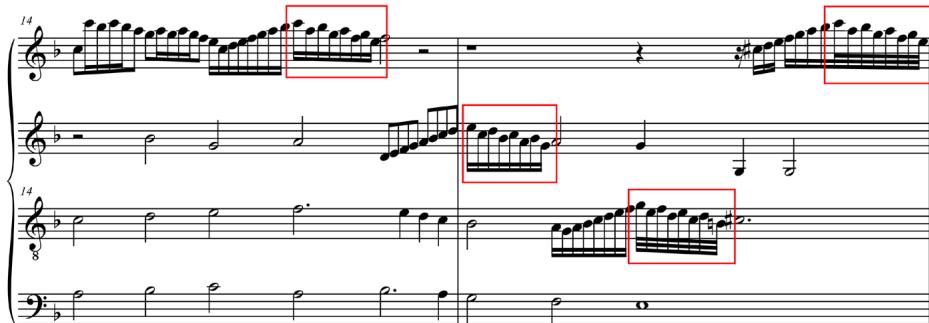
中文讲解
本段为谱例图注(Ex. 11a–c),指出一种「下三度音型」(falling-third diminution figure),在约1600年前后的意大利键盘改编曲(intabulations and arrangements)中颇为常见,并提示读者同时参看前一谱例(Ex. 10)。图注本身简练,但承担两个功能:一是与Ex. 10形成连续对比,铺垫后续对结构亲和性的讨论;二是把注意力从单个作品转向跨曲目、跨作曲家的「类型化」音型归纳。
补充说明
「diminution」在本节语境中指16–17世纪将长音符拆解为较短时值的对位/装饰手法,与本节标题中的「ornamental figure」属同一思路。「intabulation」则是把声乐或合奏曲目改写为带指法键盘谱的过程,是本节论证的核心参照系。
第3段(P0176)
原文复述

中文讲解
本段承接Ex. 11a的位置,作为其a)子项图注,引自阿斯卡尼奥·马约内(Ascanio Mayone)1603年于那不勒斯出版的《Primo libro di diversi capricci per sonare》第31–8页,曲目《Ancidetemi pur》(任凭我悲痛)第14–15小节。该图注标记为「a)」,与紧随其后的b)、c)构成一组对比谱例(11a/b/c),用以呈现「下三度音型」在多首不同曲目中的并置。
补充说明
马约内(Ascanio Mayone, 约1565–约1627/8)是与特拉巴奇同时代的那不勒斯键盘作曲家,其作品集常被作为研究那不勒斯早期键盘风格与intabulation关系的核心文献。
第4段(P0177)
原文复述

中文讲解
本段补全Ex. 11的b)、c)两项,分别出自两首佚名作品:《Nasce la pena mia》(我之痛苦由此而生)第34小节,转录自佛罗伦萨I-Fi(佛罗伦萨国立中央图书馆)藏稿Ms. Acquisti e Doni 641,第25v–28v叶;以及《Susanna》(苏珊娜)第39小节,转录自特伦托I-TRmp(新序列)藏稿,第39v–44r叶。三项并置旨在显示同一「下三度」减缩音型在不同作曲家、不同曲目、不同抄本之间反复出现,作者据此论证该音型在1600年前后的意大利intabulation语境中已形成一种「共同语汇」。
补充说明
I-FI与I-TRmp均为意大利国别代码加城市代码的标准抄本标识格式(RISM sigla),用以唯一指认抄本藏所与机构编号;本节此处引用的匿名曲目证明该音型不仅见于名家出版曲集,也见于实用抄本。
第5段(P0178)
原文复述
In addition to these superficial details, affinities with the intabulation process can be observed structurally as well. In particular, a close analysis reveals not so much a part-by-part strategy of diminution (as if one were, for example, applying diminutions to a single part), but a holistic approach in which all parts are considered at the same time. In many instances, Trabaci and Mayone employ the same sort of alteration to the voice-leading of the model as suggested by Diruta and as seen in elaborate intabulations. Often, alterations are undertaken in order to accommodate the logical contour of an ornamental figure. In Ex. 12a, the natural movement of the soprano passaggio towards f♯¹ necessitates the recomposition of the alto. In other instances, entire ornamental complexes involving multiple voices lead to the extensive reworking of the model’s polyphony, as can be seen in Ex. 12b. These moments of alteration align with Diruta’s advice to briefly alter inner voices to accommodate large intervals – and even more so with the procedures seen in elaborate intabulations.
中文讲解
本段是本小节的核心论证段,开门见山地把前几张谱例所展示的「表层相似」(superficial details)推进到「结构层面的亲缘性」(structural affinities)。作者指出,特拉巴奇与马约内对声乐母本(model)的加工并非「逐声部依次减缩」(part-by-part strategy of diminution),而是把多声部作为一个整体同时思考的「整体性方法」(holistic approach)。换言之,不是先选某一声部做减缩、再处理另一声部,而是预判装饰音型本身在多声部组合中将形成什么样的逻辑轮廓(logical contour),并据此反向调整声部进行。
文中提及两类调整:一是「容纳装饰音型逻辑轮廓」所做的对位改动,例如Ex. 12a中女高音自然地走向升f¹(f♯¹)的passaggio,这一自发的旋律运动「迫使」作曲家必须重写(recomposition)女中音声部;二是「多声装饰复合体」所带来的更大规模母本对位改写,如Ex. 12b所示,整段复调因此被重新组织。
作者把这些改动与迪鲁塔(Diruta)所主张的、为容纳大跳而短暂改动内声部的建议,以及「精细intabulation中所见的实际处理程序」做对照,得出这些改动的逻辑显然受到intavolatura(键盘改编谱)思维的强烈影响。对读者而言,本段需要把握的核心是:装饰不是后加的糖衣,而是反过来塑造母体对位结构的力量;这就是本小节标题所谓「holistic voice-leading alteration」的实际含义。
补充说明
文中Diruta指吉罗拉莫·迪鲁塔(Girolamo Diruta),其《Il Transilvano》(1593/1622)是最早系统论述键盘演奏与装饰、对位实践的意大利文献之一,常被作为早期巴洛克键盘实践的规范性参照。passaggio在16–17世纪音乐修辞中指经过性乐句/音型,常表现为音阶或分解式运动。
第6段(P0179)
原文复述

中文讲解
本段为谱例图注(Ex. 12a–b),引自特拉巴奇《Io mi son giovinetto》,出处为1603年初版那不勒斯印本的1984年佛罗伦萨影印本第63–6页。其中a)项对应前文所述的「第6–7小节」,即前段文字中提到「女高音向f♯¹移动迫使女中音重写」的具体例证位置。该图注位于第45页,与正文中对整体性声部进行改写的讨论紧密衔接。
补充说明
「facs. repr.(facsimile reprint)」表明此处引用的并非1603年原印本,而是1984年的影印再版;不同版本之间的谱面差异本身也是版本学议题,但本节并不展开。
第7段(P0180)
原文复述
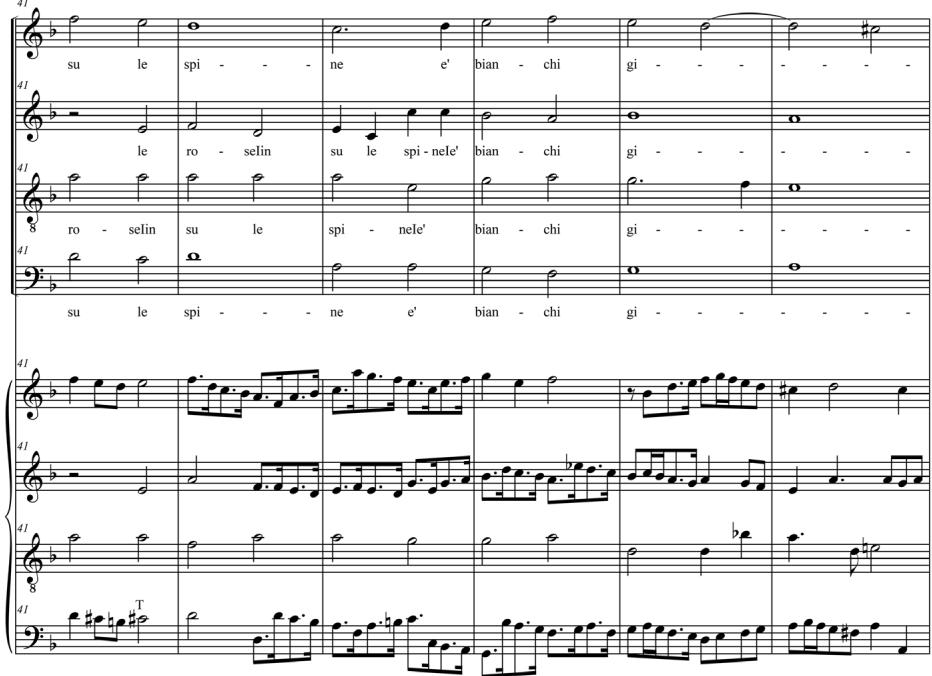
中文讲解
本段接续Ex. 12,标出b)项对应的具体小节为第41–46小节,与前段文字中「多声装饰复合体导致母本复调被大幅改写」的论述对应。b)项位置在第46页,与a)项(图注在第45页)跨页编排,提示读者两例在论证结构上分别承担不同的功能:a)展示单一声部运动触发的局部调整,b)展示多声装饰复合体驱动的整体重写。
补充说明
跨页图注在版面学上属常见做法:把同一谱例的不同段落放在同一视觉单元中处理,方便对照,但印刷时可能因版面限制而分置于相邻两页;这一编排本身不影响作者的论证逻辑。
第8段(P0181)
原文复述
In addition, the Neapolitan arrangements show instances of voice exchange that are strongly suggestive of intavolatura’s fictitious voices. In Mayone’s arrangement of ‘Ancidetemi pur’, (Ex. 13a), the tenor part in m. 6 is placed in the soprano part in the arrangement; this makes sense as it is the highest-sounding part in this instance and would, of course, be placed in the upper staff of an intavolatura (with stems pointing up if sharing the staff with the next highest voice, the alto). Interestingly enough, a similar procedure is seen in the same place in Trabaci’s arrangement of the same madrigal (Ex. 13b, m. 10); here the alto gets the material of the original tenor part (which in turn gets the material previously given to the alto part). The logic behind the voice exchanges and the alterations are both clearly influenced by intavolatura.
中文讲解
本段把论证焦点从「整体性声部进行改写」转向「声部交换」(voice exchange)现象,论证那不勒斯改编曲中的声部交换同样受intavolatura逻辑驱动。作者使用了intavolatura理论中一个关键概念——「虚构声部」(fictitious voices):在键盘改编谱中,实际演奏者并不真的演奏多个独立人声声部,那些被记成多声部的线其实都是「假设存在的」声部,它们服务于键盘演奏者双手分工与指法便利的需要。
具体例证有二。其一,马约内改编《Ancidetemi pur》的Ex. 13a中,原谱第6小节的男高音声部(tenor)被改写到高音声部(soprano)位置。作者解释其合理性:在该处男高音是实际最高的声部,因此改编时自然把它置于键盘上谱表(upper staff)的位置;如果需要与次高的女高音(alto)共用一个谱表,则通过符杆方向(stems pointing up)区分。其二,特拉巴奇改编同一首牧歌的Ex. 13b(第10小节),呈现的是一种更典型的「声部交换」:原女高音的素材给了原女中音,而原女中音的素材则转给了原男高音。作者把两次做法并列,是为了凸显:即使在声部重新分配的具体路径上两位作曲家不同,但「按intavolatura的上谱表逻辑来摆放声部」这一逻辑是相通的。
对本节读者来说,把握「声部交换并非随意,而是键盘谱书写习惯的延伸」这一论点是关键;同时也需要注意文中区分了「最强的相似」(strongly suggestive)这一限定语,作者并未宣称声部交换完全等同于intavolatura程序,而只是强调二者的亲缘性。
补充说明
文中intavolatura的「fictitious voices」是指在键盘改编谱中以多声部谱面呈现、但演奏上仅由单人或两人实际奏出的声部。这种「虚构性」使得改编者可以按键盘两手的物理分工随意重新分配原母本中的各声部位置,恰恰是声部交换在intavolatura实践中显得自然的根本原因。
脚注 / 边栏 / 图表 / 附加信息(如有)
本小节涉及的附加材料主要由六组谱例图注构成:
- Ex. 10(P0174):引自特拉巴奇《Io mi son giovinetto》第13–14小节,1603年那不勒斯印本第117–22页,主题为分解和弦音型。
- Ex. 11a–c(P0175–P0177):a)马约内《Ancidetemi pur》第14–15小节(1603年那不勒斯印本第31–8页);b)佚名《Nasce la pena mia》第34小节(佛罗伦萨I-FI Ms. Acquisti e Doni 641,第25v–28v叶);c)佚名《Susanna》第39小节(特伦托I-TRmp [n.s.],第39v–44r叶),呈现约1600年前后意大利intabulation中常见的下三度减缩音型。
- Ex. 12a–b(P0179–P0180):引自特拉巴奇《Io mi son giovinetto》,1603年初版的1984年佛罗伦萨影印本第63–6页;a)第6–7小节、b)第41–46小节,分别对应整体性声部进行改写的局部与整体两种案例。
- 此外,正文P0181处提到Ex. 13a(马约内《Ancidetemi pur》)、Ex. 13b(特拉巴奇对同一牧歌的改编,第10小节),但这两张谱例的具体图注并未出现在本小节输入的段落范围内。
这些图注共同承担两类功能:一是类型化展示(Ex. 11a–c跨曲目、跨抄本汇集同一音型),二是为正文的论证(P0178的「整体性声部进行改写」、P0181的「声部交换」)提供具体可核对的小节位置与文献出处。文中多次出现的「intabulation」「intavolatura」「fictitious voices」「Diruta」共同构成作者论证的参照系:迪鲁塔代表理论性的对位—装饰建议,而intabulation的实操程序则是作曲家实际改写母本的样板。
💡 本节核心要点
- 本小节从「表层相似」推进到「结构亲和」,主张特拉巴奇与马约内的键盘改编并非逐声部减缩,而是把多声部作为一个整体同时考量的「整体性方法」。
- 整体性方法的核心机制是:装饰音型自身的逻辑轮廓(logical contour)反向决定声部进行的改写,而非装饰后加于既有对位之上。
- 作者把这种做法与迪鲁塔关于「短暂改动内声部以容纳大跳」的建议,以及elaborate intabulation的实际程序对齐,确立intavolatura作为改写逻辑的参照系。
- 声部交换(voice exchange)现象表明:那不勒斯改编曲中的声部重排遵循的是键盘两谱表分工的「上谱表/下谱表」逻辑,而非声乐母本的原始声部布局。
- intavolatura的「虚构声部」属性使得改编者可按键盘演奏便利重新分配声部,这与作曲家的声部交换做法直接相通。
- 作者在结论性表述中保留了限定语(strongly suggestive),强调结构性亲缘但并未将声部交换与intavolatura程序等同。
🔑 关键术语
- intabulation / intavolatura:指16–17世纪将声乐或合奏作品改写为键盘(或其他弦乐器)演奏谱的过程,其谱面常以多声部形式呈现但实由一人或两人演奏,因此产生所谓「fictitious voices」(虚构声部)。本节以intavolatura的实操程序作为理解特拉巴奇、马约内键盘作品对位改写与声部交换的参照系。
- diminution:16–17世纪音乐修辞中,将长音符时值拆分为较短音符以构成装饰或经过性乐句的手法。本节论证的关键在于:特拉巴奇与马约内的减缩不是逐声部进行的,而是与所有声部同步考量。
- holistic voice-leading alteration:本小节标题用语,指在多声部改编中同时调整各声部进行以容纳装饰音型逻辑轮廓的做法;其反面是「part-by-part strategy」(逐声部依次减缩)。该术语是本节核心命题的浓缩表达。
- voice exchange:对位技法之一,两个或多个声部彼此交换音高素材,形成模仿与呼应。本节将其与intavolatura的声部摆放逻辑联系起来:声部交换之所以自然,恰恰是因为intavolatura把各声部视为可重新分配到上、下谱表的「虚构声部」。
- fictitious voices:在键盘改编谱中以多声部谱面记写、但实际仅由演奏者单手或双手分工奏出的声部。此概念是理解为何intavolatura传统允许乃至鼓励声部交换的关键。
- Diruta (Girolamo Diruta):意大利早期键盘理论家,代表作为《Il Transilvano》(1593/1622)。本节引用迪鲁塔对「为容纳大跳而短暂改动内声部」的建议,作为intabulation实操程序的理论对应物。
- passaggio:16–17世纪音乐修辞中表示经过性乐句/音型的术语,常表现为音阶或分解式运动。P0178以女高音passaggio自然向f♯¹移动为例,说明装饰音型的「自主动作」如何迫使其他声部重写。
S026 [描述性拆分] Sounding Objects, Improvisation, and the Macque Pedagogical Pedigree
第1段(P0182)
原文复述
At the same time, however, many of the difficulties in performance cited above are still observed: there are many passages that are very unidiomatic for the keyboard and almost impossible to perform as written (see Ex. 1a at the top of the article, for example). Once again, it is relevant to inquire as to whether the notational format itself can at least partly explain these aspects, with the open-score notation ‘exerting its agency’ to influence musical style. At the same time, the processes of arrangement show an obvious affinity to those seen in intabulation; it is almost as if these arrangements are the result of a detabulatory process, in which an actual ‘intabulation’—again either a real one on paper or an intavolatura alla mente—was objectified in open score. The format allows for a highly ‘rationalized’ portrayal of the virtuosic and skilled art of the intabulator/performer, including improvising passaggi and the concomitant reworking of the original voice leading.
中文讲解
这一段没有把难以演奏简单归咎于演奏者,而是把问题重新导向记谱格式。大量对键盘而言很不自然、甚至几乎无法照谱演奏的段落(文中指向Ex. 1a)使作者追问:开放总谱的记谱方式是否至少部分地影响了音乐风格。这里的“至少部分”很重要,因为作者只提出解释性可能,并未声称所有困难都由记谱造成。安排过程又与intabulation明显相似,因此作者把它描述为仿佛经历了一个detabulatory process:实际写在纸上的或intavolatura alla mente中的intabulation,被对象化为开放总谱。这样,intabulator/performer的即兴passaggi以及对原始声部进行的伴随性再处理,就不只是实际发生的演奏动作,而被“理性化”地展示出来。
补充说明
Ex. 1a在本段只是交叉引用;当前输入没有提供该图像或图注,不能据此判断其具体段落。
第2段(P0183)
原文复述
Sounding Objects and Improvisation
中文讲解
这个小标题把前段关于开放总谱、intabulation和记谱对象化的讨论,引入“发声对象”与即兴这一组核心问题。接下来的重点不再只是谱面能否记录或还原声音,而是印刷谱如何承载想象中的演奏及其技巧。
补充说明
无额外补充;这是小节标题,承担论题转换功能。
第3段(P0184)
原文复述
In my 2018 study of intavolatura, I pointed out how certain published intabulations functioned as sounding objects. 46 These sounding objects act as imagined performances; the reader could either recreate a performance by playing the intabulation, executing the ‘instructions’ to reproduce the ‘encoded’ performance, or engage with the prints, highly intricate in notational and ornamental detail and very expensive to produce, as a kind of ‘hearing with the eyes’—not at all dissimilar to the function advocated by Newcomb. 47 However, in the form of hearing with the eyes that I am proposing, the open score allows the reader to form a mental image of a virtuosic performance, not necessarily by literally recreating the performance in their head, but by forming a mental impression of it. This can be read as a kind of extreme objectification of the performance, with the patron not only appreciating the artificioso and the complex elements on the page, but also the imagined skills of the virtuoso. In elaborate intabulations, the techniques of arrangement not only highlight the intabulator as author, but they elevate his status socially and culturally, particularly in the eyes of patrons. 48 The madrigale passaggiato is, in a sense, an elaborate intabulation on steroids: not only does it show off the complexity of diminution, but it does so in a way that borrows from and evokes the kind of artificioso ricercar that are the focus in Newcomb’s article, using its open-score format to reveal detail through its clear delineation of the fictitious tablature voices and voice-leading, which are squarely in the agency of the intabulator/performer, not the original composer.
中文讲解
本段的关键扩展,是把“谱”看成一种能够承载想象中的表演对象。某些发表的intabulations之所以是sounding objects,是因为读者既可以实际弹奏它,把谱上的instructions执行成encoded performance;也可以不演奏,而是面对制作昂贵、记谱和装饰细节高度繁复的印刷品进行“用眼睛听见”的观看。作者借鉴Newcomb所说的相关功能,但作了重要限定:在自己提出的形式中,开放总谱不必让读者在脑中逐字逐句重建完整声音,而是让他们形成对virtuosic performance的心理印象。
因此,这是一种对表演的极端对象化:patron不仅欣赏纸面上的artificioso和复杂元素,也欣赏这些元素所暗示的virtuoso技能。复杂的intabulation由此同时把intabulator凸显为作者(author),并提升其社会文化地位。madrigale passaggiato则像是强化到极端的intabulation:它不仅炫耀diminution的复杂,还借用并唤起Newcomb文章所关注的artificioso ricercar;开放总谱清楚划出fictitious tablature voices和voice-leading,说明这些细节的agency属于intabulator/performer,而不是original composer。
补充说明
脚注46、47、48分别出现在本段的“sounding objects”“Newcomb”和“patrons”之后;P0185至P0186提供相关书目,P0186末尾的脚注48在P0189继续。
第4段(P0185)
原文复述
46 See Pritchard, ‘Keyboard Thinking’ (see n. 27), 224–331.
中文讲解
脚注46把P0184关于某些published intabulations作为sounding objects的说法指向Pritchard的《Keyboard Thinking》,并注明另见n. 27,页码为224–331。它提供的是文献定位;当前输入没有n. 27的内容,因此不能据此扩展演奏或intabulation的细节。
补充说明
脚注46;所列文献为Pritchard的‘Keyboard Thinking’,页码范围为224–331;n. 27未在当前输入中出现。
第5段(P0186)
原文复述
47 The term ‘hearing with the eyes’ was first coined by Cristle Collin Judd; see Judd, Reading Renaissance Music Theory: Hearing with the Eyes (Cambridge, 2000), 5. In describing his use of Judd’s conception, Newcomb writes, ‘Judd contrasts this version with “the very different visual and atemporal possibilities offered by notational representations in which [readers] could »see« relationships that they often were not capable of perceiving aurally.” It is this latter activity that I am proposing: the ability to recognize and appreciate unusual examples of musical artifice in the notation on the page.’ Newcomb, ‘Notions of Notation’ (see n. 7), 7. 48 The notion reflects a kind of self-fashioning on the part of the intabulator-performer and aligns with more recent views of patronage as described by writers such as Claudio
中文讲解
脚注47说明“hearing with the eyes”这一术语由Cristle Collin Judd提出;Newcomb引用Judd来区分视觉、非时间性的记谱可能性与听觉实际感知,并明确把自己提出的活动界定为:从纸面记谱中辨认并欣赏听觉上未必能够直接感知的异常musical artifice。因此,P0184所说的不是简单把谱看成“一幅声音图”,而是让读者从记谱关系中获得关于技巧的可欣赏印象。
脚注48则把intabulator-performer的self-fashioning与较新的patronage观联系起来;不过本条在“Claudio”处截断,P0189从其后接续。
补充说明
本条包含脚注47的Judd/Newcomb书目和脚注48的起始句;P0189是“Claudio”之后接续的内容,不是新的正文论证。
第6段(P0187)
原文复述
In fact, other aspects of the madrigali passaggiati point strongly to performance, and specifically to a culture of improvisers. For example, the focus on a relatively minor Arcadelt madrigal (‘Ancidetemi pur’) is notable. Despite its presence in a well-known and often-reprinted collection, it was not a common choice for intabulation prior to the Neapolitans. 49 Interestingly enough, an arrangement—or a set of bastarda diminutions (the music itself is no longer extant)—by Giovanni de Macque is listed on the title page of Gb-Lbl Add. 30491. As Macque was probably the teacher of both Trabaci and Mayone, is it possible that ‘Ancidetemi pur’ was used pedagogically? The use of vocal models as vehicles for keyboard improvisation was certainly common in the 16th century. In fact, the intabulation of ‘Susanne un jour’ in the Feininger manuscript, mentioned earlier, contains a rather unique feature: the final section of Lassus’s chanson spirituelle, the sequence beginning on the text ‘Que d’offenser’, is repeated a total of no less than three times, each time with completely new figuration. One gets the sense that this section was being used as practice for creating new diminutions, not dissimilar to the fragmentary harmonic patterns on the ciaccona and other bass lines that one sees in early Baroque sources. 50
中文讲解
这一段把“发声对象”进一步连接到实际表演,尤其是即兴者的文化。一个值得注意的选择是相对次要的Arcadelt madrigal《Ancidetemi pur》:尽管它出现在一本著名且经常重印的集子中,但在Neapolitans之前并不是常见的intabulation对象。题名页列出了Giovanni de Macque的arrangement,或一组bastarda diminutions(音乐本身已经不存);由于Macque可能是Trabaci和Mayone两人的老师,作者谨慎地提出它是否曾被用于教学。这里是“是否可能”式的推测,而不是已经证实的教学史。
同一段还给出了更具操作性的线索:作者明确说,16世纪把人声作品作为键盘即兴模型是常见的;Feininger manuscript中的《Susanne un jour》把Lassus chanson spirituelle最后、从“Que d’offenser”开始的段落完整重复三次,而且每次figuration都完全不同,因此让人联想到用这一段练习创造新的diminution。它与早期巴洛克ciaccona及其他bass lines上的片段性和声模式“并不相似得不同”,但这种比较仍然是一种类比和感觉,不是决定性证明。
补充说明
本段在“Neapolitans”之后有脚注标记49,在末句之后有脚注标记50;P0188只出现数字49,当前输入没有提供脚注50的说明文字。
第7段(P0188)
原文复述
49
中文讲解
P0188只有数字“49”,没有可独立复述的正文命题;按当前文本的排列,它属于脚注标记,而不是新的演奏结论。
补充说明
无额外内容;本段本身只有数字49,不能从中恢复其他脚注信息。
第8段(P0189)
原文复述
Annibaldi and Andrew dell’Antonio, which also posit a sort of self-fashioning on the part of the patrons—or at least the use of their patronage as a kind of social currency. See, for example, Andrew Dell’Antonio, Listening as Spiritual Practice in Early Modern Italy (Berkeley/Los Angeles/London, 2011). Annibaldi’s ideas unfolded over a series of articles; see, for example, ‘Frescobaldi’s Primo libro delle fantasie a quattro (1608): A Case Study on the Interplay between Commission, Production and Reception in Early Modern Music’, in: Recercare 14 (2002), 31–63. For a more recent study on authorship in 16th-century keyboard music, see Cristina Cassia, ‘Authorship in Sixteenth-Century Italian Printed Keyboard Music’, in: Studies on Authorship in Historical Keyboard Music, ed. Andrew Wooley (Abingdon/New York, 2024), 32–56.
中文讲解
这一段接续P0186脚注48末尾未完的句子,列出Claudio Annibaldi和Andrew dell’Antonio:相关讨论也把patrons的self-fashioning,或者至少把patronage作为一种social currency来考察。随后给出的Dell’Antonio《Listening as Spiritual Practice in Early Modern Italy》(Berkeley/Los Angeles/London, 2011)、Annibaldi关于《Frescobaldi’s Primo libro delle fantasie a quattro (1608)》的文章《Recercare》14(2002),31–63,以及Cassia关于16世纪意大利印刷键盘音乐作者身份、收入《Studies on Authorship in Historical Keyboard Music》、由Andrew Wooley编辑的研究(Abingdon/New York, 2024),31–56,都是为了把“编排如何同时涉及作者身份、赞助和社会文化评价”与更广泛的讨论联系起来,而不是在P0189中新增一部作品或一项独立音乐事件。
补充说明
本条从P0186的“Claudio”继续,因此可按跨段连读补足为Claudio Annibaldi;随后列出Andrew dell’Antonio、Annibaldi和Cristina Cassia的书目信息。
第9段(P0190)
原文复述
Originally appearing in Jacques Arcadelt, Il primo libro di madrigali d’Archadelt a quattro voci (Venice: Girolamo Scotto [?], 1546), the madrigal is arguably best-known as a vehicle for keyboard arrangements; in addition to Frescobaldi’s well-known intabulation (cited by Alexander Silbiger as a sort of Rosetta stone for the idea that improvising diminutions on madrigals were the key for the creation of the Frescobaldian toccata; see Alexander Silbiger ‘From Madrigal to Toccata: Frescobaldi and the seconda prattica’, in: Critica musica: Essays in honor of Paul Brainard, ed. John Knowles, Musicology 18 [Amsterdam, 1996], 403–28), an arrangement was also included in Gregorio Strozzi’s 1687 Capricci da sonare cembali et organi (Naples: Novello de Bonis, 1687). The madrigal appears as an earlier lute intabulation (Francesco Vindella, Intavolatura di liuto [Venice: Antonio Gardane, 1546], https://mdznbn-resolving.de/details:bsb00071963 [accessed on 10 Oct. 2025]), and in a parody bicinium in Adriano Banchieri’s Il principiante fanciullo (Venice: Bartolomeo Magni, 1625).
中文讲解
这一段把《Ancidetemi pur》可作为键盘编排载体这一判断放进跨版本的接受背景中。它原见于Jacques Arcadelt的《Il primo libro di madrigali d’Archadelt a quattro voci》(Venice: Girolamo Scotto [?], 1546),后来除了Frescobaldi著名的intabulation外,还被安排进Gregorio Strozzi 1687年的《Capricci da sonare cembali et organi》;此前则有Francesco Vindella的琉特intabulation,并出现在Adriano Banchieri作品中的parody bicinium。这里的“arguably best-known”保留了作者对“作为键盘编排载体”的谨慎判断。
对于Frescobaldi的intabulation,Alexander Silbiger把它比作理解一个观念的“Rosetta stone”:在madrigals上即兴diminution,被认为与Frescobaldian toccata的创造有关。这是原文引用的Silbiger解释,而不是本段另行证明的结论。出版者后的“[?]”也应保留为来源中的不确定信息。
补充说明
原文保留了Girolamo Scotto后的“[?]”、Francesco Vindella条目的链接以及访问日期10 Oct. 2025;当前输入没有提供链接页面的具体内容。
第10段(P0191)
原文复述
The specter of improvisation is also supported by the presence of strikingly similar figuration between the various arrangements; see, for example, the openings of ‘Io mi son giovinetta’ by Trabaci, and the later version Mayone and colleagues. 51 This latter arrangement—certainly one of the more unusual works in 17th-century music—features no less than three arrangers, each one taking a phrase in turn, and each turn clearly marked in the score. Each section develops strikingly diverse figuration, giving the distinct impression of a 17th-century jam session. Is it reflective of the keyboard practices of this school of Neapolitan composers ca. 1600—a glimpse into a Macque studio class? In any event, by abstracting and objectifying their art in open score, the precise details of elaboration are displayed, creating an objectified and highly rationalized image of a performance, with a clear impression of the technical processes at work.
中文讲解
本段用不同arrangements之间异常相似的figuration,以及一个多arranger轮流处理材料的特殊作品,继续支持“improvisation的幽灵/迹象”这一判断。例如,Trabaci的《Io mi son giovinetta》开头与Mayone及其同仁的后来版本之间存在显著相似性;后一作品至少有三位arranger,每人轮流处理一个phrase,而且每个turn都在谱上清楚标出。每个部分又发展出彼此很不相同的figuration,组合起来便产生了“17世纪jam session”的鲜明印象。
“这是否反映约1600年那不勒斯作曲家群体的键盘实践、是否像Macque studio class的一瞥”被作者明确写成问题,而不是已确认的历史事实。无论具体场景是什么,末句的“In any event”把结论落到开放总谱:通过抽象化和对象化,elaboration的精确细节被展示出来,表演因此变成一幅对象化且高度理性化的图像,使技术过程清晰可见。
补充说明
P0191末尾有脚注标记51,但当前任务输入没有提供脚注51的正文,因此不对其内容作补充。
脚注 / 边栏 / 图表 / 附加信息(如有)
P0182提到文章顶部的Ex. 1a,但当前输入没有提供该图像或图注;P0184、P0185、P0186对应脚注46、47、48,P0189承接P0186末尾“Claudio”处未完的脚注48。P0187含脚注标记49和50,P0188只出现数字49,P0191含脚注标记51;当前输入未提供脚注50和51的正文。P0190还保留了出版者后的“[?]”、外部链接及访问日期。除此之外,当前输入没有提供其他图表说明、表格或边栏。
💡 本节核心要点
- P0182把难以照谱演奏的现象部分归因于开放总谱的记谱能动性,并借detabulatory process说明:实际或intavolatura alla mente中的intabulation被对象化为开放总谱,使即兴passaggi和原始声部的再加工得到理性化呈现。
- P0184把某些published intabulations定义为sounding objects:它们既可以作为encoded performance的instructions被演奏,也可以作为繁复昂贵的印刷品被“hearing with the eyes”;作者强调开放总谱首先制造的是对virtuosic performance的心理印象。
- 这种对象化让patron同时看到纸面上的artificioso和想象中的virtuoso技能,因而把intabulator的作者身份与社会文化地位、patronage联系起来;madrigale passaggiato进一步把intabulation强化,并以清晰划出的fictitious tablature voices和voice-leading把agency归于intabulator/performer而非original composer。
- P0187把论证推进到即兴者和教学关系:相对次要的Arcadelt《Ancidetemi pur》在Neapolitans之前并非常用intabulation对象,而Macque可能是Trabaci和Mayone的老师,因此“是否被用于教学”只是谨慎提出的假说;16世纪用人声作品作为键盘即兴模型则是作者明确认为常见的做法。
- 《Susanne un jour》中“Que d’offenser”段落被完整重复三次、每次使用全新figuration,暗示这里可能承担生成新diminution的练习功能;它与ciaccona及其他bass lines的片段性和声模式的比较是支持性类比,而不是确定证明。
- P0191以《Io mi son giovinetta》各版本的相似figuration和多arranger的轮流结构造成“17世纪jam session”的印象;Macque studio class仍只是待回答的问题,但开放总谱确实把elaboration的技术过程对象化、理性化并清晰展示出来。
🔑 关键术语
- open score:本节中用于指把安排、虚构的表格谱声部和voice-leading清楚展开的谱面形态;它不仅承载表演,也以理性化、对象化的方式影响并展示音乐技巧。
- intabulation / intavolatura:本节讨论的谱面安排形态:P0182把它与安排过程联系起来,P0184则把某些published intabulations视为sounding objects。
- intavolatura alla mente:与纸上实际intabulation相对的“心中的”intabulation形态;P0182说这种形态也可以被对象化进开放总谱。
- detabulatory process:作者用来描述安排仿佛把真实或心中的intabulation转化为开放总谱的术语,重点在于对象化和“理性化”呈现,而非单纯把谱面记录下来。
- sounding objects:某些published intabulations作为想象中的表演对象:它们可以被演奏为encoded performance,也可以被观看为具有复杂记谱、装饰细节和物质成本的印刷谱。
- hearing with the eyes:通过视觉、非时间性的记谱关系辨认并欣赏听觉上未必直接呈现的musical artifice;在本节提出的开放总谱形式中,指形成心理印象而非在脑中完整重演声音。
- artificioso / artificioso ricercar:表示高度技巧化、精心构造的音乐艺术;madrigale passaggiato通过复杂的diminution借用并唤起Newcomb文章所关注的artificioso ricercar。
- madrigale passaggiato / madrigali passaggiati:本节讨论的madridal形式,被作者比作强化到极端的intabulation;其复杂性、diminution和开放总谱中的虚构声部共同把分析引向intabulator/performer的agency。
- diminution / bastarda diminutions:本节用来指复杂花音式或装饰性处理的音乐形态;P0184强调其复杂性,P0187提到Macque的bastarda diminutions原作已不存,P0191则以多样figuration表现即兴性。
- passaggi:P0182所说的即兴性经过段或花音式处理;开放总谱把这类处理连同对原始voice leading的再加工一并理性化地呈现出来。
- self-fashioning / patronage:intabulator-performer通过复杂安排塑造作者身份并提升社会文化地位;patronage在本节又被相关讨论描述为可能的social currency。
- Macque:Giovanni de Macque在P0187中被提出可能是Trabaci和Mayone的老师;P0191所设想的Macque studio class只是一种待检验的教学关系想象,而不是本段已经确认的事实。
- ciaccona:P0187只把它与早期巴洛克其他bass lines上的片段性和声模式作类比,用来支持新diminution可能具有练习功能的解释,并没有把两者的形态视为同一。
- Rosetta stone:P0190中Silbiger对Frescobaldi intabulation所作的解释性比喻,表示它是理解madrigal即兴diminution与Frescobaldian toccata关系的关键线索。
S027 [描述性拆分] Notational Ironies: Intabulating the Detabulation
第1段(P0192)
原文复述
Notational Ironies
中文讲解
这是一个二级标题(##),原文以 Markdown 形式的 H2 标题呈现,标题文字为 “Notational Ironies”(记谱法的反讽)。它开启本节的主题:讨论 16 世纪键盘文献中记谱方式本身所内含的悖论与反讽,特别是“intabulation”(把分谱总谱化为键盘谱)与“detabulation”(将书面谱转化为即兴展开)之间的循环关系。标题用 Ironies(反讽)一词暗示作者不打算做单纯的技术描述,而是要揭示这些记谱实践背后观念上的张力。
补充说明
该标题在原文中由 Markdown 的二级标题标记(##)渲染;版面属性上它是一个小节标题,不是正文段落。
第2段(P0193)
原文复述
I have suggested that, in approaching the performance of keyboard works in open score, a 16th-century player would have intabulated them, either literally on paper or alla mente.
中文讲解
本段是作者对本节论点的纲领性铺垫。作者回顾前文(“I have suggested”)已经提出的观点:16 世纪的演奏者在面对以开放总谱(open score)形式呈现的键盘作品时,会对它们进行 intabulation——即把它们改编为键盘可以演奏的形态。关键限定是 intabulation 可以发生在两种层面:一是 literally on paper(字面意义上,在纸面上真正地改编为键盘谱);二是 alla mente(在心中,即不在纸上书写而凭借记忆或心智完成改编)。\n\n所谓"open score"指 16 世纪常见的、把多个声部写在独立谱表上的写作方式(如四声部各占一行),需要演奏者或改编者在键盘上重新分配声部。“intabulation"是这一时期专门的术语,指将分谱或总谱改写为适应键盘演奏的独奏谱。“alla mente"是拉丁化意大利语,字面意思为“在脑中”,暗示一种即兴性、未经书面化的内部处理。\n\n本段的作用是锁定后面的反讽命题:既然 16 世纪演奏者碰到那不勒斯人的 madrigali passaggiati 时会对其进行 intabulation,那么对这类作品再实施 intabulation 是否构成一种多余的循环?这正是下一段要展开的论证。
第3段(P0194)
原文复述
Intabulating the madrigali passaggiati of the Neapolitans would be somewhat ironic, however: if improvisatory practices – and specifically those reflected by intabulation – were at the root of the creation of the madrigale passaggiato, and if the madrigale passaggiato was a result of a kind of detabulation, re-intabulating these works would be making an intabulation of a detabulation that is in turn the product of an intabulation. The irony once again speaks, I think, to the fundamentally Janus-faced nature of these scores, a quality created by but also facilitated by their notational format. They are not solely musical objects to be studied or appreciated or scripts by which to execute a performance – nor something in between – but both, capable of fulfilling two functions simultaneously. While Newcomb argues for object over performance, it is impossible to view prints such as Trabaci’s 1615 Capricci exclusively through this lens – object and performance are too intrinsically connected in this case, and the definition of ‘the work’ is too hard to determine. However, if we accept
中文讲解
本段是本节论证的核心,集中展开标题所预告的"记谱反讽”。\n\n作者先设定一个反讽情境:如果对那不勒斯人的 madrigali passaggiati(经过装饰化处理的世俗声乐曲)进行 intabulation,那么会发生一个循环:madrigale passaggiato 本身源于即兴性的实践(improvisatory practices),而 intabulation 正是这种即兴性的书面反映;madrigale passaggiato 又是一种 detabulation(将原本可能的书面谱转化为展开式、即兴式的衍生形态)的产物;于是,再对这种作品进行 intabulation,就等于"为一种 detabulation 制作 intabulation,而这种 detabulation 本身又是 intabulation 的产物”。作者通过这种绕口令般的措辞揭示一个悖论:分层、嵌套的谱面与即兴关系。\n\n随后作者明确指出,这种反讽指向这些乐谱"Janus-faced"(双面性)的本质——它们既是被研究、欣赏的音乐对象(object),也是据以演奏的脚本(scripts,performance material),并且这种双重身份恰恰由其记谱格式所塑造并被其强化。作者用排除句强调:它们不只是对象,也不只是脚本,更不是介于两者之间的中间物,而是同时具备两种功能。\n\n接着作者援引 Newcomb 的立场:Newcomb 主张将这类乐谱优先视为对象(object),而非表演蓝图(performance)。作者反驳说,对 Trabaci 1615 年的 Capricci 这种印刷物而言,不可能只通过 Newcomb 的视角去理解,因为对象与表演在此已被内在地绑定在一起,“作品”(the work)的定义本身难以裁定。\n\n段末以"However, if we accept"戛然而止,这是一个未完成的让步句,预告后文将引入一个条件性假设——大概是说:如果我们接受对象与表演不可分割这一设定,那么接下来的结论将是什么。\n\n理解要点:\n• “Janus-faced"借罗马神 Janus 比喻前后朝向相反的两张脸,强调同一文本同时承担两种互斥的身份。\n• “object over performance"是 Newcomb 的立场措辞,意为“将对象(文本本身)置于表演(实现过程)之上作为主导维度”。\n• Trabaci 1615 Capricci 是那不勒斯作曲家 Giovanni Maria Trabaci 1603/1615 年出版的《Capricci》,是"madrigali passaggiati"实践在键盘出版物中的典型代表。
补充说明
本段承接 P0193 的 intabulation/alla mente 之分,将其推入一个循环论证:intabulation → detabulation → re-intabulation。新提出的核心概念"Janus-faced nature"是本节乃至作者整篇论文的一个关键术语,指乐谱具有对象与脚本双重身份。“Newcomb"指音乐学家 Anthony Newcomb,其相关著作论及那不勒斯音乐印刷物的对象性。Trabaci 的 1615 Capricci 作为案例贯穿前后各节,是用以实例化这一反讽的具体文本。
第4段(P0195)
原文复述
50 See, for example, sources such as the Instructio nova by Spiridion a Monte Carmelo (modern edition: Spiridionis a Monte Carmelo Nova instructio pro pulsandis organis, spinettis manuchordiis etc., ed. Edoardo Bellotti, Tastature 11 [Colledara, 2003]), or V-CVbav Chig.Q IV.27.
中文讲解
这是脚注 50,功能是为正文中的某处具体主张提供文献来源支持。脚注提示读者可参看两类材料:其一为 Spiridion a Monte Carmelo 所著的《Instructio nova》(现代版由 Edoardo Bellotti 编辑,收入 Tastature 丛书第 11 卷,Colledara,2003 年出版);其二为手稿 V-CVbav Chig.Q IV.27。\n\nSpiridion a Monte Carmelo 是 17 世纪的管风琴与键盘演奏理论家,其《Instructio nova》属演奏法教学文献,教授演奏者如何在键盘上即兴处理多声部总谱——这一议题与正文讨论的 intabulation 实践直接相关。V-CVbav Chig.Q IV.27 是梵蒂冈宗座图书馆(Vatican Apostolic Library)藏 Chigi 系列手稿编号 Q IV.27,是一份与早期键盘实践相关的原始材料。\n\n脚注的标注位置和正文支持的对应关系(如指向哪一句主张)未在脚注本体中明确,需参看正文上标;从其列举的教学文献与手稿来看,它很可能支持作者关于"16 世纪演奏者会用 intabulation 或 alla mente 方式处理开放总谱"这一断言。\n\n现代版拉丁标题保留原文形式,未做英译。
第5段(P0196)
原文复述
51 Interestingly, there is also similar figuration to be found in Andrea Gabrieli’s intabulation, found in his Il terzo libro de ricercari (Venice: Angelo Gardano, 1596).
中文讲解
这是脚注 51,为正文某一具体音乐细节提供旁证。脚注指出:在 Andrea Gabrieli(安德烈亚·加布里埃利)1596 年由 Angelo Gardano 在威尼斯出版的《Il terzo libro de ricercari》(《利切卡尔第三集》)中,也存在类似的音型(figuration)。\n\n脚注的标记词"Interestingly”(值得注意的是)暗示作者想在这一点上提醒读者:原本仅在某一不勒斯或具体语境中观察到的音型或处理方式,并非孤例,而是同时期北方威尼斯乐派(Gabrieli 属威尼斯乐派)的 intabulation 实践中亦有同形痕迹。这一旁证扩展了作者论述的地理与谱系范围,使论点不仅限于那不勒斯。\n\n此处"figuration"指具体的器乐化音型(如分解、经过、装饰音型等),而非笼统的"曲式"或"风格”。它为正文提供了一个跨地域的同形参照。\n\n这段脚注属于旁证(cross-reference)功能:补强作者关于某音型存在的说法,而非引入新主张。
脚注 / 边栏 / 图表 / 附加信息(如有)
本节含有两条脚注:脚注 50(指向 P0195)列举 Spiridion a Monte Carmelo 的《Instructio nova》现代版(Bellotti 编辑,Colledara:Tastature 11,2003)以及手稿 V-CVbav Chig.Q IV.27,用以为正文关于 16 世纪键盘演奏者会 intabulate 开放总谱的论断提供教学与文献支持。脚注 51(指向 P0196)以 Andrea Gabrieli 1596 年威尼斯出版的《Il terzo libro de ricercari》中的 intabulation 为旁证,指出与本节所讨论的音型类似的形态同时存在于威尼斯乐派的语境中,扩展了论证的地域谱系。无图、无表、无来自其他附加材料。
💡 本节核心要点
- 本节的核心反讽是:madrigale passaggiato 源自即兴性的 intabulation 实践,其本身又是 detabulation 的产物;再对它进行 intabulation,等于为 detabulation 制作 intabulation,而该 detabulation 又是 intabulation 的产物。
- 这些乐谱具有 Janus-faced(双面性)的本质:它们既是供研究、欣赏的"对象”(object),也是供演奏执行的"脚本"(scripts),并且这种双重身份由其记谱格式所塑造并被其强化。
- Newcomb 主张以对象维度优先于表演维度,但作者认为对 Trabaci 1615 Capricci 这样的印刷物而言,对象与表演已不可分割,“作品"的定义难以截然判定。
- 本节进一步暗示,对早期键盘记谱的研究必须同时承认书面文本与即兴生成两端,而不是将其中一方还原为另一方。
- 脚注 50 通过 Spiridion a Monte Carmelo 的教学文献与 Chig.Q IV.27 手稿,为 16 世纪键盘演奏者处理开放总谱的实践提供文献支持;脚注 51 通过 Andrea Gabrieli 的利切卡尔 intabulation 指出类似音型同时存在于威尼斯乐派,提供跨地域旁证。
🔑 关键术语
- intabulation:16 世纪键盘音乐中将分谱或开放总谱改写为键盘独奏谱的实践;本节中作者强调它既是书面行为(literally on paper),也可以是心智行为(alla mente)。
- alla mente:拉丁化意大利语,字面意为“在脑中”,指不在纸上书写而凭记忆或心智完成改编/即兴,区别于纸面 intabulation。
- detabulation:本节中作者提出的反向概念,指将原本可能被书面化的谱面转化为即兴性、展开式形态的过程;作者认为 madrigale passaggiato 即是 detabulation 的产物。
- Janus-faced nature:借罗马双面神 Janus 比喻乐谱同时具备“对象”与“脚本”两种身份的双面性,是本节揭示的核心概念,由其记谱格式所塑造并强化。
- object over performance:Newcomb 主张的视角,表示将乐谱作为被研究、欣赏的文本对象置于优先位置,而非将其视为表演执行的脚本,作者在本节中对这一立场提出限定。
- open score:16 世纪常见的记谱格式,各声部分占独立谱表,需要演奏者或改编者在键盘上重新分配声部。
- madrigale passaggiato / madrigali passaggiati:以即兴式装饰化音型(passaggi)处理过的世俗声乐曲,是那不勒斯实践的代表,也是本节反讽论证的对象。