目录
CH1 C. P. E. Bach, Haydn, and the art of mixed feelings
- S1 [描述性拆分] Table of contents and epigraph
- 页码:1-1
- S1.1 1. Tearful times
- 页码:1-1
- S1.2 [描述性拆分] Sensibilité in France and British moral sense philosophy
- 页码:2-2
- S1.3 [描述性拆分] Limits of moral sense philosophy and Baumgarten’s aesthetics
- 页码:3-3
- S1.4 [描述性拆分] Mendelssohn on vermischte Empfindungen
- 页码:4-4
- S1.5 1.1 Beauties of Sterne
- 页码:4-5
- S1.6 1.2 The empfindsam manner
- 页码:6-6
- S1.7 [描述性拆分] Decline of Empfindsamkeit and its musical scope
- 页码:7-7
- S1.8 [描述性拆分] Manner versus style and the galant basis
- 页码:8-8
- S1.9 [描述性拆分] Disputes over the empfindsam style and its characteristics
- 页码:9-10
- S1.10 1.3 Mixed feelings
- 页码:11-11
- S1.11 [描述性拆分] 1.4 Affinity?
- 页码:12-13
- S2 2. What sonatas want
- 页码:14-14
- S2.1 2.1 Recitative
- 页码:15-17
- S2.2 [描述性拆分] Heartz’s Italian text and the Gerstenberg experiment
- 页码:18-19
- S2.3 [描述性拆分] 2.2 Who’s speaking?
- 页码:20-21
- S2.4 [描述性拆分] Authorial presence, irony, and the ‘aesthetic I’
- 页码:22-23
- S2.5 2.3 Soliloquy and preaching
- 页码:23-24
- S2.6 [描述性拆分] Haydn’s sonatas Hob. 29, 30 and 34
- 页码:25-27
- S2.7 [描述性拆分] Dramaturgy of intrusions and comparison with Bach
- 页码:28-30
- S2.8 [描述性拆分] 2.4 ‘Sprache der Empfindungen’
- 页码:30-32
- S2.9 [描述性拆分] Forkel on musical rhetoric and harmony
- 页码:33-34
- S2.10 [描述性拆分] Example 10: Bach’s Andante Wq. 55/6:ii as soliloquy
- 页码:35-36
- S3 Abstract
- 页码:37-37
- S4 Postscript (2012)
- 页码:37-37
- S5 References
- 页码:37-41
S1 [描述性拆分] Table of contents and epigraph
第1段(P0001)
原文复述
C. P. E. Bach, Haydn, and the art of mixed feelings
中文讲解
这是整章(或全文)的总标题,由井号(#)作为一级 Markdown 标题标记。它把三个要素并置在一起:C. P. E. Bach(卡尔·菲利普·埃马努埃尔·巴赫)、Haydn(海顿),以及"the art of mixed feelings"(混合情感的艺术)。从标题的措辞可以看出,作者并不是要分别叙述两位作曲家,而是要把他们放在同一个美学议题——“混合情感”——之下进行对比或关联性研究。“mixed feelings"这一短语同时呼应了后文目录中第 1.3 节的小标题,暗示它构成全章的核心概念,而 Bach 与 Haydn 则被视为这种情感美学在音乐中的代表人物。
补充说明
作为页面顶层的总标题,P0001 标定了全章的研究对象(C. P. E. Bach 与 Haydn)与研究视角(“混合情感的艺术”),后文目录将围绕这两条线索展开。
第2段(P0002)
原文复述
- Tearful times – 1.1 Beauties of Sterne–- 1.2 The empfindsam manner –
中文讲解
这是目录(table of contents)的第一行,列出第一章及其前两个小节。第一章总标题为"Tearful times”(“哭泣的时代”),点出 18 世纪中期一种以泪水、感伤、怜悯为审美标志的文学—文化氛围。1.1 节"Beauties of Sterne"指 Sterne(劳伦斯·斯特恩,《项狄传》《多情客游记》作者)笔下所谓的"美"——他那种把感伤、反讽与怪诞并置的笔法,是英国感伤主义文学的代表。1.2 节"The empfindsam manner"则把视角转向德语区的对应传统:“empfindsam”(敏感的、有细腻感情的)指 18 世纪中叶德国音乐与文学中的"敏感风格"(Empfindsamkeit)。本段中"1.2 The empfindsam manner"末尾保留了短横线,表明目录行被换行拆开,下一段将继续列出剩余小节。
补充说明
“Empfindsam"在原文中作为形容词形式出现,与后文 P0005 中的德语术语"Sprache der Empfindungen"同属 Empfindsamkeit 概念家族;本节内仅作为小标题出现。
第3段(P0003)
原文复述
1.3 Mixed feelings – 1.4 Affinity?
中文讲解
这是第一章目录的续行,接续 P0002 列出的剩余小节。1.3 节"Mixed feelings”(混合情感)与总标题中的关键词直接对应,表明作者将在这一节集中讨论"情感混合"的现象——也就是不同甚至相互矛盾的情感在同一作品或同一段落中并存的状态。1.4 节"Affinity?"(亲缘性?)以问号结尾,提示作者要追问的不是简单的相似,而是 Bach 与 Haydn 在运用这种混合情感美学时是否存在某种结构性、可被论证的"亲缘关系"。问号本身标明了该节是论证性的、开放性的,而非结论性的陈述。
第4段(P0004)
原文复述
- What sonatas want – 2.1 Recitative – 2.2 Who’s speaking?
中文讲解
这是目录中第二章的开头。第二章总标题"What sonatas want"(奏鸣曲想要什么/奏鸣曲所要求的是什么)使用拟人化措辞,把体裁本身当作有"意志"的对象来追问——暗示作者关心的不是奏鸣曲的曲式技术,而是它在 18 世纪承载了什么样的表达任务或修辞功能。2.1 节"Recitative"(宣叙调)关注奏鸣曲中模仿宣叙调—说话式语气的段落,这是 Empfindsamkeit 时期键盘作品的重要特征之一,也是把"说话—言说"维度引入器乐的关键入口。2.2 节"Who’s speaking?"(谁在说话?)进一步追问这种宣叙性段落背后"主体"的身份问题——是作曲家、演奏者、还是音乐作品本身"化身"为言说者?末尾的短横线表明目录行在版面上被换行截断,下一段将继续列出剩余条目。
第5段(P0005)
原文复述
2.3 Soliloquy and preaching – 2.4 ‘Sprache der Empfindungen’ Abstract – Postscript (2012) – References
中文讲解
本段接续 P0004,把第二章的后续小节以及章末的"附件性"内容一并列出。2.3 节"Soliloquy and preaching"(独白与布道)把奏鸣曲内部的两种"说话姿态"并列对照:独白式的内省与布道式的公开陈述,这两种姿态对应着不同的情感—修辞模式。2.4 节以德语短语’Sprache der Empfindungen’(情感的语言/感受的语言)独立成项,作为该节的关键词;它很可能既是一节小标题,也指向作者所引用的某部文献或某一概念来源。其后跟随的"Abstract"(摘要)、“Postscript (2012)"(2012 年的后记)和"References”(参考文献)属于章末的辅助材料,而非章节本身:摘要通常置于文首,此处目录把 Abstract 放在最后并加了后记与参考文献,提示这是文章(或以书章形式呈现的论文)的整体结构。“Postscript (2012)“中的年份 2012 是该后记写作或加入的年份信息。
补充说明
本段是目录最末行,兼有章节小标题与文献/附件项目;目录在此处收束。“Sprache der Empfindungen"是德语术语,原文以单引号包裹,本节内未给出定义,仅作为小标题或参照点出现。
第6段(P0006)
原文复述
Wir haben aus jenen weinerlichen Zeiten, wo jedes Herz eine Herzwassersucht haben sollte, ganze nasse Bände, worin wie vor schlechtem Wetter Phöbus in einem fort Wasser zieht, uns aber damit nur desto mehr austrocknet. Woran nun liegts? Daran, daß der Schriftsteller sein Mitleiden und nicht das fremde Leiden darstellt und durch jenes dieses malen wollte, anstatt umgekehrt.
中文讲解
这是置于章首的题词(epigraph),原文为德语,作者用上标"1"标注了一条脚注引用。题词大意为:在那些"哭泣的时代”——那时似乎每一颗心都应当患有"心积水症”——人们写出了一部又一部"潮湿的卷帙”,在其中,太阳神福玻斯(Phöbus)像在坏天气里一样不停地在画水,但结果反而让读者感到更加干涸。原因何在?在于作家所呈现的是自己的怜悯,而不是他人的苦难;他试图用前者的情感去描绘后者,而不是反过来——亦即,他应当通过呈现他人的苦难来唤起(而非展示)自己的怜悯。这段题词的功能是为全章定下批判基调:作者将反对那种以自我感伤为卖点的"哭泣时代"美学(weinerliche Zeiten),主张文学/音乐应当先呈现对象(他人的苦难),再由此唤起情感,而不是反向把作者本人的情感摆在前面。“Herzwassersucht”(心积水症)是文中一个夸张的医学隐喻——把感伤时代比作一种病态地把心脏泡在泪水里的流行疾病;“Phöbus … Wasser zieht"则是戏谑地化用太阳神驾车的古典意象,让"拉水"取代"拉日”,反讽那些用大量泪水和湿润意象堆砌作品却反而令读者情感枯竭的做法。这段题词与目录中 1 节"Tearful times"以及 2.4 节"Sprache der Empfindungen"形成互文:作者借题词明确表态,他所讨论的"混合情感"或"情感的语言",并不等同于那种"weinerlich"的感伤泛滥。
补充说明
本段末尾的上标"1"指向一条脚注引用,但该脚注的具体内容不在本小节(page 1, P0001–P0006)的文本范围内,故此处不作进一步引述。
脚注 / 边栏 / 图表 / 附加信息(如有)
本小节包含两类非正文材料:① 目录行(P0002–P0005)系统列出了全章的小节与子小节结构,起到导航与预告的作用,其中 P0005 末尾的 Abstract、Postscript (2012) 和 References 是章末辅助项目;② 题词(P0006)末尾的上标"1"为脚注引用标记,提示该德语引文有出处说明,但脚注正文不在本节范围内。
💡 本节核心要点
- 全章由两节组成:第 1 节以"哭泣的时代"为切入点,讨论 Sterne 的美感、德语 Empfindsamkeit 风格,并最终追问 Bach 与 Haydn 之间是否存在"亲缘性"(Affinity?);第 2 节则从奏鸣曲体裁内部追问其"想要"什么——宣叙性、独白、布道等修辞姿态,以及所谓的"Sprache der Empfindungen"(情感的语言)。
- 总标题"the art of mixed feelings"与 1.3 节"Mixed feelings"呼应,标明"混合情感"是贯穿全章的核心议题,Bach 与 Haydn 则被视为该议题的两个具体观察对象。
- 目录中"Affinity?“以问号形式出现,表明作者并不预设结论,而是把"亲缘性"作为一个有待论证的开放性问题提出。
- 题词(P0006)以德语批判"哭泣时代"那种以作家自身怜悯为中心的感伤美学,主张应先呈现他人之苦,再由此唤起读者情感——它为全章提供了与单纯"empfindsam"不同的批判立场。
- 题词与目录之间形成对照:第 1 节以"Tearful times"起头,似乎与题词所批评的对象同调,但题词本身的批判性预示作者会以反思而非颂扬的姿态进入这一美学传统。
- 2.4 节’Sprache der Empfindungen’作为一个独立小标题,提示这是本章在概念上需要专门讨论的关键词,亦可能对应作者所征引的某一文献或理论来源。
🔑 关键术语
- Empfindsam / Empfindsamkeit:Empfindsam 是德语形容词,“敏感的、有细腻情感的"之意;其名词形式 Empfindsamkeit 指 18 世纪中叶德国文学与音乐中以细腻情感表达、“情感语言"为标志的敏感风格。在本节中以"The empfindsam manner”(P0002)形式出现,与题词(P0006)所批评的"weinerliche Zeiten”(哭泣的时代)形成对比,是第 1 节讨论的核心美学范畴。
- mixed feelings:英文"混合的情感”。本节中既出现在总标题(P0001),又独立作为 1.3 节小标题(P0003),是全章的核心概念;指不同甚至相互矛盾的情感在同一作品或同一段落中并存、交织的状态,也是作者用以串联 Bach 与 Haydn 创作的关键视角。
- Sprache der Empfindungen:德语短语,意为"情感的语言"或"感受的语言"。在 P0005 中作为 2.4 节小标题以单引号原样保留,属于本节内需要专门讨论的关键词;它既可理解为对 Empfindsamkeit 美学原则的概括,也可能指作者所引用的某一文献或理论概念。
- Tearful times / weinerliche Zeiten:英文"哭泣的时代"对应德语"weinerliche Zeiten"。前者出现在 P0002,作为第 1 节总标题;后者出现在 P0006 题词中。两个表达指同一现象——18 世纪以泪水与感伤为审美标志的文化氛围;题词对该现象持批判立场(认为它表现为作家自我怜悯的泛滥),而 P0002 的小标题本身尚不标明态度,态度由题词与后文共同确立。
- Phöbus:希腊神话中太阳神阿波罗的别名之一。P0006 题词中戏谑地让他"不停地拉水"(Wasser zieht),化用太阳神驾车行天的古典意象,借此反讽感伤文学中大量"潮湿"、泪水化的描写反而令读者情感枯竭(“trocknet uns … aus”)。该词在本节内不需作古典学背景展开,仅作为题词修辞的一部分理解即可。
- Herzwassersucht:德语合成词,字面意为"心积水症",是一种夸张的医学—隐喻表达。P0006 题词用它形容"哭泣时代"里每一颗心都被泡在泪水中的病态流行情绪,强调该时代审美被感伤所淹没。本节内只需理解其比喻义,不必追究医学含义。
S1.1 1. Tearful times
第1段(P0007)
原文复述
Section heading: ‘1. Tearful times’
中文讲解
这是本节的总标题’Tearful times’(流泪的时代)。标题以略带反讽的口吻点出18世纪中后期德语文化中盛行的’感伤’风潮——一个为虚构人物的苦难而动容落泪的年代。该标题为整节定下基调,并引出本节核心:对术语’Empfindsamkeit’(感受性/感伤)作为时代标签的含义、特征与历史定位的辨析。
第2段(P0008)
原文复述
‘Empfindsamkeit’ is one of the terms applied to that annoying gap in schoolbook periodization, the decades between baroque and classical. It is not a label stuck on the phenomenon by some willful act of historiography; more fashion than period, the Empfindsamkeit was self-conscious and created its own label, a newly coined derivative. This precludes such confusions as we have with the scope of ‘classical’, ‘romantic’ and ‘galant’. Even after the phenomenon had passed, the name predominantly kept period connotations; unlike the near-contemporary ‘sentimental’, which has passed into everyday use, with a mostly pejorative sense. Thus, the use of ‘Empfindsamkeit’ (signifying a moral-emotional attitude) as a period characterization is contemporary; at the latest in 1778 those times were spoken of as ‘das [jetztige] Zeitalter der Empfindsamkeit’.
中文讲解
本段集中论证’Empfindsamkeit’作为时代标签的特殊地位,主要论点如下:
- 定位——作者指出该词被用来指称巴洛克与古典之间那段在教科书断代中令人困扰的’空档期’,暗示这是个长期缺乏共识的过渡阶段。
- 自指性(self-conscious)——与许多由后世史家贴上去的标签不同,Empfindsamkeit 是该文化风潮自己创造的标签(‘a newly coined derivative’),即风尚本身已具备自我意识和自我命名能力。这与’classic’、‘romantic’、‘galant’ 等被后世争议、范围不清的标签形成对比。
- 词义演变——现象消退后,词名仍主要保留其时代含义,并未像同期产生的’sentimental’那样进入日常用法并染上贬义。这使’Empfindsamkeit’保留了较纯粹的史学指代功能。
- 时代定锚——最迟在1778年,当代文献已把那段时期称作 ‘das [jetztige] Zeitalter der Empfindsamkeit’(即’〔当今的〕感伤时代’),从而为这个标签提供同时代的语用证据,而非后世追溯。
关键主张:‘Empfindsamkeit’ 不只是史家命名,而是一个自我意识强、并由当事人同时代使用的时代标签——这赋予了它特殊的可靠性,但也使它更难与日常用法(特别是贬义的 sentimental)相剥离。
补充说明
作者括注 ‘moral-emotional attitude’ 限定了 Empfindsamkeit 的语义核心不是单纯的’情感’,而是带有道德色彩的’情感态度’,这与下文 P0009–P0010 中关于同情、共感的讨论直接呼应。
第3段(P0009)
原文复述
„Ein empfindsames Herz gehört unter die geheimen Beschwerlichkeiten dieses Lebens, es leidet bey allen leidenden Gegenständen, wenn es sich außer Stand siehet allen zu helfen. Und doch möchte ich dieser Leiden ohngeachtet […] kein gleichgültig Gemüth haben. Wie viel wahres Vergnügen entbehren die kalten unempfindlichen Seelen?"
中文讲解
原文是1757年由 Luise Adelgunde Gottsched(俗称’die Gottschedin’)所写书信中的一段引文,作者把它作为’最早已知用例之一’直接呈现给读者,用以揭示’empfindsam’在18世纪中叶德语中的核心含义。
逐句要点:
- ‘Ein empfindsames Herz gehört unter die geheimen Beschwerlichkeiten dieses Lebens’——一颗感受性强的心属于人生隐秘的苦恼之一;’empfindsam’在此与’Herz’(心)绑定,是某种内在器官的特质。
- ’es leidet bey allen leidenden Gegenständen, wenn es sich außer Stand siehet allen zu helfen’——它与一切受苦的对象同苦,尤其当它明知无力帮助一切人时;这就是后文要强调的’同情/怜悯’的高度敏感性。
- ‘Und doch möchte ich dieser Leiden ohngeachtet […] kein gleichgültig Gemüth haben’——尽管如此,我仍不愿有一颗冷漠的心;这里出现了 Empfindsamkeit 的悖论式自我肯定:感伤是一种痛苦,但仍然是值得拥有的。
- ‘Wie viel wahres Vergnügen entbehren die kalten unempfindlichen Seelen?’——那些冷漠、不敏感的灵魂错过了多少’真实的快乐’;‘wahres Vergnügen’ 引出 P0010 中概括的第三个核心特征:在共苦中获得的’真实愉悦’。
这段之所以重要:作者用它说明’empfindsam’并非抽象词汇,而是同时代人自发写下的自我描述——它把感受性、爱怜、共苦和由此而来的愉悦捆在一起,构成了 Empfindsamkeit 文化最直接的时代证据。
补充说明
原文中 ‘Beschwerlichkeiten’、’leidenden Gegenständen’、‘Gemüth’、‘Seelen’ 等用词是18世纪德语’心灵—情感’语汇的典型表达;引文中的方括号 […] 表明原信此处有省略,引用者仅保留最核心的措辞。
第4段(P0010)
原文复述
‘Empfindsamkeit’ is thus: a quality ‘of the heart’; especially, a high susceptibility for pity or compassion; and though it makes one suffer, there is ’true pleasure’ in this. The stress on pity is common in this period. Once the empfindsam taste is past, and such eagerness for shared suffering has become suspect, Johann Heinrich Campe shifts the scope by defining ’empfindsam’ as ‘Fähig und geneigt zu sanften angenehmen Empfindungen, Fertigkeit besitzend, an theilnehmenden Gemüthsbewegungen Vergnügen zu empfinden’.
中文讲解
本段承接 P0009 的引文,将 Empfindsamkeit 的内涵提炼为三条互相关联的要点:
- 一种’心’(Herz)的品质——不是头脑的判断能力,而是情感器官的感受性;
- 特别表现为对怜悯/同情(Mitleid)的高度易感性——这是 Empfindsamkeit 文化最具时代标志性的特征;
- 纵然让人受苦,其中却蕴含’真实的愉悦’——这呼应 P0009 引文中 ‘wahres Vergnügen’ 的提法,构成感伤的悖论。
作者进一步指出:对怜悯/同情的强调是这一时期的普遍现象;这并非孤立的修辞,而是文化价值观的体现。
接着,作者引出对比——当’empfindsam’趣味消退、对’共苦的渴望’变得可疑时(典型如启蒙后期对过度感伤的批评),词典编纂者 Johann Heinrich Campe 重新界定’empfindsam’:‘有能力且倾向于温柔愉悦的感受,并具备在参与性情绪中获得愉悦的熟练度’。注意 Campe 的定义发生了三处微妙但重要的位移:
- 用 ‘sanfte angenehme Empfindungen’(温柔愉悦的感受)替换了 ‘mit den Leidenden leiden’(与受苦者同苦),把主色调从苦转为乐;
- 把 ’empfindsam’ 从被动的高敏感性改为主动的 ‘Fähigkeit und Geneigtheit’(能力与倾向);
- 强调 ’theilnehmende Gemüthsbewegungen’(参与性情绪)这一更可被社会接纳的伦理范畴。
因此本段不只是给出定义,而是揭示了一个语义史事件:Empfindsamkeit 时代的核心’同苦’在事后被替换为更温和的’共情愉悦’,这是该词由时代精神滑向日常褒义形容词的过渡。
补充说明
P0010 把 P0009 的感性自白升格为抽象定义,又用 Campe 的词典定义展示后世改写;三者共同构成一个从’同时代用法’到’后时代回顾’的语义演变序列。
第5段(P0011)
原文复述
Footnote 1: Jean Paul Richter: Vorschule der Ästhetik, Kleine Nachschule zur ästhetischen Vorschule, XI. Programm, § 15. URL = http://gutenberg.spiegel.de/?id=5&xid=1335&kapitel=1#gb_found]
中文讲解
页内编号为1的脚注,指向 Jean Paul Richter 的《美学先导》(Vorschule der Ästhetik)中的附录章节’美学先导之小学后课’(Kleine Nachschule zur ästhetischen Vorschule),第十一节目录(XI. Programm)第15节。脚注末尾给出电子版 URL。
该脚注在正文中对应 P0008 提及的 ‘Empfindsamkeit’ 自我命名问题——作者用 Jean Paul 的反思性论述作为该词自我意识的旁证;它承担’来源/电子文本位置’的功能。
补充说明
原脚注末尾出现一个孤立的右方括号 ‘]’,从上下文判断原文此处应为带链接的脚注,但在 OCR 或粘贴过程中前导方括号丢失;本节讲解不对链接格式做技术性补全。
第6段(P0012)
原文复述
Footnote 2: Sauder (1974) p. 229.
中文讲解
页内编号为2的脚注,指向 Sauder 于1974年出版的著作第229页。该脚注出现在 P0008 中 ‘das [jetztige] Zeitalter der Empfindsamkeit’ 这一引文之后,承担文献来源(来源类脚注)功能:它告诉读者’最迟在1778年就把当时称作’感伤时代’‘这一史实可在 Sauder (1974) 第229页查到,是作者立论的史料支撑。
补充说明
脚注只给出短引形式,未列完整出版信息;其作用以’指明出处’为主,而非’展开论据’。
第7段(P0013)
原文复述
Footnote 3: Letter by Luise Adelgunde Gottsched (‘die Gottschedin’), 1757, quoted after Sauder (1974) p. 5.
中文讲解
页内编号为3的脚注,注明 P0009 中德文引文的出处:1757年 Luise Adelgunde Gottsched(原文括号中给出别名’die Gottschedin’)的一封信,转引自 Sauder (1974) 第5页。
脚注信息承担三层作用:1)确认引文的第一手来源是 Gottschedin 本人的书信;2)标明引用者是从二手文献 Sauder (1974) 间接得到该引文(‘quoted after’,即转引);3)通过 Sauder 的引述确立该引文在 Empfindsamkeit 研究中的经典地位。该脚注使 P0009 的引文具有清晰的史料定位,也呼应了 P0008 中关于’empfindsam’最早用例出处的论断。
补充说明
原文括号内的 ‘die Gottschedin’ 是源文献中明确给出的替代称呼;本节讲解不对该称呼的命名习惯做超出原文范围的引申。
脚注 / 边栏 / 图表 / 附加信息(如有)
本节包含三条脚注(编号1–3),均承担’来源/出处’功能而非’旁证或延伸阅读’功能:脚注1为 Jean Paul Richter 美学著作的电子版位置;脚注2为时代标签引文的史料依据(Sauder 1974, p. 229);脚注3为 P0009 引文的书信出处(Sauder 1974, p. 5 转引 Gottschedin 1757)。本节未出现图表、乐谱或边栏。
💡 本节核心要点
- Empfindsamkeit 是18世纪中后期德语文化中一种自我命名的文化风潮,而不是后世史家强加的标签;这使它作为时代名称具有同时代的语用证据,最迟在1778年已被称作 ‘das [jetztige] Zeitalter der Empfindsamkeit’。
- Empfindsamkeit 的核心特征可归纳为三条:(1) 一种’心’的品质;(2) 对怜悯/同情的高度易感性;(3) 在共苦中获得的’真实愉悦’——三者共同构成该时代区别于其他时期的伦理—情感姿态。
- Empfindsamkeit 与’sentimental’ 走向不同:前者主要保留其时代指代,后者则进入日常用法并染上贬义;这印证了 Empfindsamkeit 作为自我命名标签的稳定性。
- 在 Empfindsamkeit 趣味消退后,Campe 等词典编纂者通过把定义从’同苦’转向’温柔愉悦的感受’,悄然完成了从时代精神到日常褒义的语义平滑——这是本节揭示的一个关键语义史转折。
- Gottschedin 1757年的书信引文是该词’最早已知用例之一’,它不是抽象定义,而是同时代人写下的自我描述,因而是 Empfindsamkeit 文化的第一手证据。
🔑 关键术语
- Empfindsamkeit:德语术语,本节中被界定为一种’道德—情感态度’,兼具内在心性品质、对怜悯的高度敏感以及在共苦中获得的真实愉悦;同时被用作指称巴洛克与古典之间过渡时代的名称,是18世纪德语文化自我命名的标签。
- empfindsam:Empfindsamkeit 的形容词形式;本节借1757年 Gottschedin 信中的最早已知用例之一说明其核心含义:拥有一颗易感之心、与受苦者同苦、宁可受苦也不愿冷漠、并因此获得’真实的快乐’。
- sentimental:与 Empfindsamkeit 大致同时出现的同源词;本节用作对照——它后来进入日常用法并主要带贬义,与 Empfindsamkeit 主要保留时代指代的命运相反。
- galant:本节与 ‘classical’、‘romantic’ 并列提及的另一时代标签;提及它的目的是衬托 Empfindsamkeit 因自我命名而产生的语义稳定性,而其他标签在后世使用时范围不清。
- Campe 的 ’empfindsam’ 定义:本节引用的 Johann Heinrich Campe 对 ’empfindsam’ 的词典定义:‘有能力且倾向于温柔愉悦的感受,并具备在参与性情绪中获得愉悦的熟练度’;在本节论证中,它代表 Empfindsamkeit 趣味消退后词义被温和化的关键节点。
- moral-emotional attitude:P0008 中对 Empfindsamkeit 的限定性说明,指出它不仅是一种情感,更是一种带有道德色彩的’情感态度’;这与本节对同情/怜悯的强调直接相关。
S1.2 [描述性拆分] Sensibilité in France and British moral sense philosophy
第1段(P0014)
原文复述
In France, similar sentiments were associated with the term ‘sensibilité’. Louis de Jaucourt defines the concept in the Encyclopédie as “disposition tendre & délicate de l’ame, qui la rend facile à être émue, à être touchée,” and praises it as the source of virtue:
中文讲解
本段将主题从德语词场切换到法国,把"类似的情操"(similar sentiments)与法语 sensibilité 对应起来。作者援引《百科全书》(Encyclopédie)中 Louis de Jaucourt 所写的条目,给出 sensibilité 的定义:灵魂的一种"温柔而细腻的倾向"(disposition tendre & délicate de l’ame),使人容易被触动、被感动。注意原文用的是旧式拼写(ame 而非 âme)和 & 号,须原样保留。Jaucourt 不仅定义此概念,更将它视为美德的来源(the fount of virtue),这就把 sensibilité 抬高到伦理价值的层面,为下文引出 virtu 化的赞美辞设下铺垫。
补充说明
disposition tendre & délicate de l’ame 译作"灵魂温柔细腻的倾向",émue 与 touchée 在此分别指感动与被触及,两词构成对 sensibilité 之内在感受性的双重描述。Jaucourt 的条目在《Encyclopédie》中的具体词条名未在原文给出。
第2段(P0015)
原文复述
La sensibilité d’ame, dit très-bien l’auteur des moeurs, donne une sorte de sagacité sur les choses honnêtes, & va plus loin que la pénétration de l’esprit seul. […] Les ames sensibles ont plus d’existence que les autres: les biens & les maux se multiplient à leur égard. La réflexion peut faire l’homme de probité; mais la sensibilité fait l’homme vertueux. La sensibilité est la mere de l’humanité, de la générosité; elle sert le mérite, secourt l’esprit, & entraîne la persuasion à sa suite.
中文讲解
本段整段为法文引文,是 Jaucourt 在《百科全书》中对 sensibilité 的赞美辞。需要逐句理解其论证逻辑:(1) “作者所言极是”——援引某位"道德家"(l’auteur des moeurs)的权威意见;(2) sensibilité 赋予人对"正当之事"(choses honnêtes)一种特殊的洞察力(sagacité),并且超出纯理智的洞察(pénétration de l’esprit seul);(3) 敏感的灵魂比别的灵魂拥有更多"存在"(plus d’existence),因为善恶在它们身上倍增;(4) 关键对比:“反思造就正直之人,但 sensibilité 造就美德之人”(La réflexion fait l’homme de probité;la sensibilité fait l’homme vertueux);(5) sensibilité 是人道(humanité)、慷慨(générosité)之母,是说服(persuasion)的天然伴随者。文中的核心修辞是把 sensibilité 抬高到高于纯粹理性的地位——理性只能造就有操守者,唯有感受性才能造就有德者。原文使用的是旧式拼写(ame、tres-bien、la mere)和 & 号,应保留原貌。结尾的 “5” 是脚注编号(指向 ARTFL 数据库与 Sauder 1990 的类似德语论述)。
第3段(P0016)
原文复述
And under the entry Pleurs (Métaphys.) the reader is reminded that tears do not dishonor a man: great legendary and historical heroes have shed tears, and “la sensibilité dont elles procedent est une vertu.” Going beyond self-centered sensitivity, sensibilité—Empfindsamkeit was thus linked with an openness to intimacy often described as tenderness. While this openness seems to have been inherent in empfindsam, an entry by D’Alembert on tendresse in one of the appendices to the Encyclopédie shows a shift in the conception of sensibilité, barring out the compassionate aspect.
中文讲解
本段继续在《百科全书》中寻找 sensibilité 的踪迹,这次落在 Pleurs(哭泣,标注为形而上学条)之下。论证策略是用历史与传说中英雄的流泪来为 sensibilité 正名——流泪并不丢人,反而是 virtue 的证明(“la sensibilité dont elles procedent est une vertu”)。随后本段承担了关键的过渡功能:把 sensibilité 与 Empfindsamkeit 划等号(破折号表示并列/等同关系),并把两者共同关联到一种"对亲密性的开放"(openness to intimacy),常以 tendresse(温柔/柔情)来描述。作者随即给出一个限定:empfindsam 本身似乎就内含这种温柔开放,但 D’Alembert 在《百科全书》附录里关于 tendresse 的条目,却显示 sensibilité 概念发生了偏移,把"同情/怜悯"(the compassionate aspect)排除在外。这意味着,在 Jaucourt 的定义里 sensibilité 仍含同情维度,而到 D’Alembert 的 tendresse 条目中,sensibilité 已向更内向、更亲密、不再外推同情心的方向演变。原文用"barring out the compassionate aspect"直陈这一概念收缩。
补充说明
Pleurs (Métaphys.) 是《百科全书》中以形而上学(métaphysique)分类的"哭泣"词条;Metaphys. 是 Métaphysique 的缩写。D’Alembert(达朗贝尔)是《百科全书》的主编之一。
第4段(P0017)
原文复述
Although the newly coined ’empfindsam’ (and to a lesser extent ‘sentimental’) were relatively unambiguous terms, ‘Empfindung’ and the verb ’empfinden’ are variable in their applications, relating to the equally ambiguous words ‘sensation’, ‘sentiment’, ‘impression’ and ‘feeling’, thus ranging over the physiological as well as psychological. Symptomatic of the fusion or confusion of these areas is the idea of a ‘moral sense’ which makes us behave according to principles of morality – a view that in fact models the mind on the image of the body. The cult of sensibility as virtue was supported by the ideas of what is known as ‘British moral sense philosophy’, launched in the early 18th century by Lord Shaftesbury, modified by Francis Hutcheson and David Hume, and strongly influential on German thinkers. The most stable element in this complex of ideas is the supposition that the human capacity for goodness is seated in something like intuition, and implies a common (uniform) and basically good nature of man; this intuition is either a ‘moral sense’, or a faculty of ‘benevolence’ or ‘sympathy’. Because of man’s place in the order of things, virtue and self-interest coincide: to be virtuous implies to be happy. For Shaftesbury, a neo-Platonist, this order of things was cosmic harmony; Hutcheson and Hume replaced the cosmic by a social perspective.
中文讲解
本段是整节的核心论述,需要逐层拆解。(1) 术语谱系:作者先澄清 empfindsam 与 sentimental 这两个相对清晰的术语,再点出 Empfindung 与 empfinden 这对德语名词/动词在用法上极具弹性,可对应英语的 sensation、sentiment、impression、feeling,跨越生理与心理两个层面。这是术语混乱的根源。(2) 这一混乱的典型症候(symptomatic)就是"道德感"(moral sense)观念——它使心灵按道德原则行事,实际上是以身体为模型来想象心灵(models the mind on the image of the body)。(3) 历史脉络:“感觉即美德"的崇拜得到所谓"英国道德感哲学”(British moral sense philosophy)的支撑。这一学派由 Shaftesbury 在 18 世纪初开创,经 Hutcheson 与 Hume 改造,对德国思想家有强烈影响。(4) 该学派的"最稳定内核":人的向善能力坐落于某种直觉之中,并预设人性是共通(uniform)且基本上善的;这种直觉可以是道德感,也可以是仁慈(benevolence)或同情(sympathy)的官能。(5) 关键伦理命题:因为人在万物秩序(the order of things)中的位置,美德与自利合一(coincide)——有德者即幸福者。(6) 派内分歧:Shaftesbury 作为新柏拉图主义者,把这一秩序视为宇宙和谐(cosmic harmony);Hutcheson 与 Hume 则用社会视角(social perspective)取代了宇宙视角。本段既承接前面 sensibilité 的美德化论述,又为下一节讨论 Empfindung 在德语世界中的多义性及其在音乐美学中的延伸预设哲学背景。
补充说明
新柏拉图主义(neo-Platonism)指文艺复兴以来复兴普罗提诺传统的哲学取向,强调宇宙的等级秩序与和谐。uniform 在此根据上下文应理解为"共通/一致"的人性观,与"基本上善"并列修饰 human nature。
第5段(P0018)
原文复述
Footnote 4: Wörterbuch der deutschen Sprache, 1807, quoted after Sauder (1974) p. 6.
中文讲解
本条为脚注 4,交代 P0013 中所引德文词的来源:1807 年出版的《德语词典》(Wörterbuch der deutschen Sprache),转引自 Sauder 1974 年著作第 6 页。它属于追溯词源的注释性脚注,限定正文引语的出处与权威性。
第6段(P0019)
原文复述
Footnote 5: Text published by Projet ARTFL, URL = http://portail.atilf.fr/encyclopedie/. For very similar statements by German authors, see Sauder (1990) p. 41, 43.
中文讲解
本条为脚注 5,说明 P0015 所引《百科全书》sensibilité 条目的电子文本出处为法国 ARTFL 项目(atilf.fr 的 Encyclopedie 门户)。同时指出德国作者也有非常类似的论述,参见 Sauder 1990 年第 41、43 页——这是把法国 sensibilité 美德化论述与德语世界相关论述进行对照的旁证。
补充说明
ARTFL(American and French Research on the Treasury of the French Language)是法国国家文本与词汇资源中心支持的数字化项目,文中以 atilf.fr 为门户。
第7段(P0020)
原文复述
Footnote 6: Baasner (1988) p. 320.
中文讲解
本条为脚注 6,仅以简短形式标注 P0016 中关于 D’Alembert tendresse 条目所述"sensibilité 概念偏移"的学术来源:Baasner 1988 年著作第 320 页。它属于支撑性脚注,为概念史的判断提供文献依据。
第8段(P0021)
原文复述
Footnote 7: Michael B. Gill, Lord Shaftesbury, The Stanford Encyclopedia of Philosophy (Winter 2006 Edition), Edward N. Zalta (ed.), URL = http://plato.stanford.edu/archives/win2006/entries/shaftesbury/; Alexander Broadie,
中文讲解
本条为脚注 7 的开端,列出 P0017 中关于 British moral sense philosophy 与 Shaftesbury 的参考文献:第一项为 Michael B. Gill 撰写、Edward N. Zalta 编辑的《斯坦福哲学百科全书》“Lord Shaftesbury"词条(2006 年冬季版)的网络地址;第二项以"Alexander Broadie,“开头,明显在原文中被截断,应续接 Broadie 关于 Shaftesbury 或道德感哲学的著作信息。脚注 7 的整体功能是为 British moral sense philosophy 的派别史与代表人物提供权威的二级文献出处。
补充说明
段落末尾以”,“收尾并被截断,说明本节在该页的脚注文字未完,下一页当续有 Alexander Broadie 著述的完整书目信息。
第9段(P0022)
原文复述
C. P. E. Bach, Haydn, and the art of mixed feelings © Lodewijk Muns 2008 – p. 2
中文讲解
本条是页面页脚/运行标题(running footer),标示书名《C. P. E. Bach, Haydn, and the art of mixed feelings》、版权信息(© Lodewijk Muns 2008)以及页码(p. 2)。它属于版面要素,不含论述内容。
脚注 / 边栏 / 图表 / 附加信息(如有)
本节末尾附有四条脚注(4–7)和一页页脚。脚注 4(1807 年《德语词典》转引自 Sauder 1974)追溯上一节末尾所引德文词的词源;脚注 5 给出《百科全书》电子文本出处(ARTFL/ATILF 门户)并交叉指向 Sauder 1990 中德语作者类似论述;脚注 6(Baasner 1988, p. 320)为 D’Alembert tendresse 条目所示概念偏移提供学术依据;脚注 7 为 British moral sense philosophy 与 Shaftesbury 提供斯坦福哲学百科及 Broadie 著述的参考文献(后者在原页被截断)。页脚标示书名、版权与页码,属版面要素。
💡 本节核心要点
- Jaucourt 在《百科全书》中将 sensibilité 定义为"灵魂温柔细腻的倾向”,并视其为美德之源,从而把感受性提升到伦理高度。
- Jaucourt 进一步主张:反思造就正直之人,而 sensibilité 造就美德之人——感受性高于纯理性。
- 《百科全书》Pleurs 条目以英雄的眼泪为 sensibilité 的美德化背书,把流泪视为 virtue。
- sensibilité 与 Empfindsamkeit 被对等关联,并被纳入一种以 tendresse 描述的"对亲密性的开放”;但 D’Alembert tendresse 条目已显示出排除同情维度的概念偏移。
- Empfindung/empfinden 在用法上跨越生理与心理两层,“道德感"观念正是这一概念融合的症候——以身体为模型构想心灵。
- British moral sense 哲学(Shaftesbury → Hutcheson/Hume)以直觉性向善、共通且善的人性、美德与自利合一为核心;其派内分歧在于把"秩序"置于宇宙和谐(Shaftesbury)还是社会(Hutcheson、Hume)。
🔑 关键术语
- sensibilité:法语词,本节中经 Jaucourt 定义为灵魂温柔细腻、易于被触动的倾向,被定位为美德的源泉;在 D’Alembert 的 tendresse 条目中其同情维度被削弱。
- Empfindsamkeit:德语词,本节与 sensibilité 并列使用,指一种对亲密性开放、常以 tendresse 描述的感受性;其形容词 empfindsam 被认为较为清晰。
- Empfindung / empfinden:德语名词与动词,在用法上具有弹性,可对应 sensation、sentiment、impression、feeling,跨越生理与心理两层,是本节所谓概念融合/混乱的根源。
- moral sense:“道德感”,British moral sense 哲学的核心概念,指使人按道德原则行事的直觉性官能;本节视其为以身体为模型构想心灵的概念融合症候。
- British moral sense philosophy:18 世纪英国道德感哲学,由 Shaftesbury 开创,Hutcheson 与 Hume 加以改造,对德国思想家影响深刻;其最稳定的内核是:向善能力坐落于直觉、人性共通且基本为善、美德与自利合一。
- tendresse:法语"温柔/柔情”,在本节中既被用来描述 sensibilité/Empfindsamkeit 的亲密开放性,也是 D’Alembert 标志 sensibilité 概念偏移(排除同情维度)的关键术语。
S1.3 [描述性拆分] Limits of moral sense philosophy and Baumgarten’s aesthetics
第1段(P0023)
原文复述
In retrospect the weakness of such an optimistic line of reasoning may appear obvious. The doctrine, in its several forms, rested upon a psychology, or an attempt to rationalize the irrational, for which only two ways were open – by pure reason, attempting to construct an image on the basis of words, definitions, and logic; and by informal observation, primarily introspective – which is a maze of blind alleys and mirror galleries. On the other hand, one cannot deny that intuitive sympathy, or empathy, is not only a necessity for ’the good life’ but for any kind of social life, while ‘altruism’ is a key concept in modern ethology. ‘Inner senses’ may be a literalized metaphor, but exactly by their being modelled on the physical senses it is potentially open toward empirical approaches. The weakness is of these concepts is their lack of psychological, anthropological, and sociological context. Without an account of what is universal human nature, an appeal to intuitions may easily slip into the subjective, and the happy fusion of moral virtue and pleasure can hardly stand the reproach of hedonism – as this was largely a philosophy of fireside and dinner-table, rather than stable and shed.
中文讲解
本段是对前述乐观的道德感哲学(moral sense philosophy)路径的一次回溯式反思,作者既指出其内在缺陷,也承认其仍有未被否定的价值,需要从两个层面阅读。
第一层是缺陷的诊断:作者认为道德感哲学试图为非理性的东西提供理性化的心理学基础,而它能走的路只有两条——要么靠纯理性,凭词、定义和逻辑搭建图像;要么靠主要内省式的非正式观察。但这两条路都不靠谱:前者只是概念推演,无法落到经验;后者则被作者形象地比作“盲巷与镜廊交织的迷宫”,看似无穷无尽,实则自我指涉、难以验证。这两句话实际上预告了之后小节转向经验主义美学的伏笔。
第二层是作者对道德感哲学的有限承认:作者并未全盘否定。他承认“直觉同情/移情”(intuitive sympathy, empathy)不仅是“美好生活”的必要条件,而且是一切社会生活的前提;并指出“利他”(altruism)在现代动物行为学(ethology)中仍是核心概念。这意味着,作者认为道德感哲学捕捉到了某种真实的人类经验,并非纯粹的形而上虚构。同时他承认“内在感官”(inner senses)虽是字面化的隐喻,但因为它以物理感官为模型,反而具有走向经验研究的潜在开放性。
第三层是根本缺陷的归纳:上述概念的真正弱点在于缺乏心理学、人类学与社会学的语境。如果不先说明何谓“普遍人性”,诉诸直觉就容易滑向主观任意;而把道德德性与快乐简单地熔为一炉(这是哈奇森等人道德感哲学的典型思路),又难以抵御享乐主义(hedonism)的指控。最后一句使用对比修辞——这种哲学是“炉边与餐桌的哲学”,而非“马厩与牲口棚的哲学”——点出它的弱点:它是一种仅适合上流社会客厅闲谈的伦理,无法处理更粗粝、更普遍的生存经验。这一比喻与本节主题“moral sense philosophy 的局限”直接呼应,也提示了作者之后转向 Baumgarten 经验主义美学的逻辑动因。
补充说明
句中“inner senses”是 18 世纪道德感哲学的术语,指诸如道德感(moral sense)、美感(sense of beauty)这类被设想为类比于视、听等外在感官的内在感受能力;“ethology”在此处并非现代动物行为学严格意义上的使用,作者借以说明利他概念在现代生物—行为科学中的延续;“a maze of blind alleys and mirror galleries”是自 18 世纪以来英国经验主义批评中常见的修辞,强调内省的自我镜像性不可作为可靠的认识论基础。
第2段(P0024)
原文复述
In aesthetics, ‘moral sense’ has its counterpart in ’taste’ or Geschmack. Though in the theory of musical performance and composition it often had the meaning of ‘style’ or ‘manner’, in aesthetic theory Geschmack was not the norm of an individual or group, but a universal sense of beauty. The processes which relate our inner worlds with the outer world by sensation, perception, and cognition were necessarily obscure – but this obscurity was often glossed over. Significantly, when Alexander Gottlieb Baumgarten in his Aesthetica (1750) introduces the term ‘aesthetics’ (using the Greek equivalent of ‘Empfindung’, ‘aisthesis’), he grandly disposes of any finer discriminations of general psychology. The definition of his first paragraph lumps together: “theory of the liberal arts, discipline of lower cognition, the art of thinking beautifully, art of intuitive thought”. Even by its omissions, aesthetics, as an attempt to rationalize our responses to the arts, contributed to a widening of awareness of the non-rational aspects of mental activity. On the positive side Baumgarten, in spite of his rationalist bias, contributed to a more psychologically oriented view of the appreciation of the arts, by shifting attention from a percieved ‘perfection’ in the object to a ‘perfection’ in the process of ‘sensible cognition’ (cognitio sensitiva), defined as “the complex of representations which are beneath the threshold of distinctness”. Thus logical cognition, which is distinct (deutlich), discrete, is distinguished from aesthetic cognition, which is clear (klar) and confused (verworren), according to the terminology then current – roughly corresponding, in modern and non-technical terms, to ‘conscious’ versus ‘subconscious’ or ‘intuitive’.
中文讲解
本段是本节的核心段落,承担了由“道德感的局限”过渡到“Baumgarten 的美学”这一关键转折,结构上可分为三步:概念的对应、Baumgarten 的术语创造、以及他对认知等级的重新划分。
第一步,作者指出在美学领域,“道德感”(moral sense)的对应物是“趣味”(taste)或德文 Geschmack。这里需要小心区分术语的多义性:在音乐表演与作曲理论中,Geschmack 常常指的是“风格”或“手法”,即一种实践范畴的偏好;但在美学理论中,它被设想为一种普遍的美感,而非个人或群体的规范。这一区分并非琐碎,它揭示出“taste”一词在 18 世纪同时承载着特殊实践判断与普遍审美判断两层含义,而作者显然要强调后者。
第二步是 Baumgarten 的登场。作者提示,连接内在世界与外在世界的感觉、知觉、认知过程必然是晦暗的,但这种晦暗常被掩盖。然后他援引 Baumgarten 1750 年《Aesthetica》首次创造“aesthetics”一词(用希腊语 aisthesis,对应德语 Empfindung,即“感受/感觉”)的事件,并形容 Baumgarten 以宏大的方式一举绕过了普通心理学中那些精细的区分——也就是说,他把心理学中的许多区分一并笼统化,而把焦点投向了感性认识本身。作者引用其首段定义:“自由艺术的理论 / 下级认知的学科 / 优美思维的艺术 / 直觉思维的艺术”,并列的四个项目共同显示 Baumgarten 试图同时容纳艺术论、感性认识论、修辞学和逻辑学下层几个不同层面。
第三步是本段最实质的学理贡献。Baumgarten 把审美的注意力从对象身上所感知到的“完美”(perfection)转移到“感性认识”(cognitio sensitiva)过程中的“完美”,并将后者定义为“处在清晰度阈值之下的诸表象的复合”。这一概念虽然晦涩,但在术语体系上极有结构:逻辑认知是“distinct”(deutlich,分明的)、离散的;而审美认知是“clear”(klar,明晰的)和“confused”(verworren,混乱的)。作者随即用现代非技术性语言做出对照——“有意识”对“无意识”或“直觉”。需要警惕的是:这里的 confused 并不是贬义的“糊涂”,而是技术术语,指的是尚未被分辨但仍可感知的复合表象;而 distinct 在莱布尼茨—沃尔夫学派中指的是观念被分辨到可单独指认的程度。Baumgarten 的关键贡献因此是:他把感性认识确立为一种虽不分明、却合法的认知模态,从而为后世讨论艺术的非理性、混合情感奠定了概念基础。这是本节论证链条的关键一环:在道德感哲学陷入客厅式主观之后,Baumgarten 提供了一个面向感性认知的可被理论化的领域。
补充说明
本段中“percieved ‘perfection’ in the object”原文写作“percieved”,是“perceived”的拼写变体;“deutlich / klar / verworren”是莱布尼茨—沃尔夫学派认识论的核心三分词,对应现代英语 distinct / clear / confused;本段脚注 8 与 9 的具体内容在 P0026、P0027 中给出,本段不展开。
第3段(P0025)
原文复述
Scottish Philosophy in the 18th Century, The Stanford Encyclopedia of Philosophy (Fall 2005 Edition), Edward N. Zalta (ed.), URL = http://plato.stanford.edu/archives/fall2005/entries/scottish-18th/; Sauder (1974), p. 73-85.
中文讲解
这一段是正文段(P0023)的尾注/参考文献提示,主要起到来源指引的作用。它给出两个权威性来源:一个是 Stanford Encyclopedia of Philosophy 中关于 18 世纪苏格兰哲学的词条(2005 年秋季版,由 Edward N. Zalta 主编),另一个是 Sauder 1974 年专著的第 73–85 页。该注释属于 P0023 中关于“道德感哲学”历史评价的旁证来源:前者帮助读者进一步追溯苏格兰 moral sense 学派(如哈奇森、舍夫茨伯里、休谟、斯密)的当代学术综述;后者则提示 Sauder 关于 Empfindsamkeit(敏感主义)与道德感哲学关系的具体讨论(页码 73–85)。两者在功能上属于“来源/旁证”类脚注。
第4段(P0026)
原文复述
‘Intuitive thought’: analogon rationis, rendered by Schweizer as ‘Der Vernunft analoges Denken’. Baumgarten (1750) p. 2, 3.
中文讲解
这是正文 P0024 引用 Baumgarten《Aesthetica》首段定义时的脚注 8。脚注对“直观思维”(intuitive thought)一词给出原文对应:拉丁文 analogon rationis(理性的类比物),并补注 Schweizer 德译为“Der Vernunft analoges Denken”(与理性类似的思维)。脚注末尾给出页码 Baumgarten (1750) p. 2, 3,提示读者直接到原书首两页核对。功能上属于对术语的“精确来源标注”,防止读者把“直觉思维”误解为非理性或纯感性,而是提醒其在 Baumgarten 那里仍具有“理性的类比”之意。
第5段(P0027)
原文复述
In Michael Zimmermann’s translation, Dahlhaus and Zimmermann (1984), p. 41, 43: § 14 “Das Ziel der Ästhetik ist die Vervollkommnung der Empfindungserkenntnis als solcher.” § 17 “Empfindungserkenntnis ist […] der Komplex der Vorstellungen, die unterhalb der Schwelle der Deutlichkeit liegen.” The rise of empirical psychology in connection with Empfindsamkeit is discussed by Sauder (1974) p. 106-124.
中文讲解
这是正文 P0024 的脚注 9,承担双重功能:一是给出 Baumgarten “感性认识”(Empfindungserkenntnis)定义的德文原文与译本出处:Dahlhaus 与 Zimmermann 1984 年的德译本第 41、43 页,分别对应 §14(“美学的目标在于使感性认识本身臻于完善”)与 §17(“感性认识是……处于清晰度阈值之下的表象之复合”);二是提供延伸阅读线索:Sauder (1974) 第 106–124 页讨论了与 Empfindsamkeit(敏感主义/感受主义)相联系的经验心理学的兴起。脚注对正文的功能是“来源与延伸”,一方面让 P0024 中“perfection in the process of sensible cognition”与“complex of representations beneath the threshold of distinctness”两个关键短语的德文原文可被追溯,另一方面把 Baumgarten 的概念置于更大的 18 世纪经验心理学语境中。
第6段(P0028)
原文复述
C. P. E. Bach, Haydn, and the art of mixed feelings © Lodewijk Muns 2008 – p. 3.
中文讲解
这是页眉/页脚性质的非正文内容,标识作品标题“C. P. E. Bach, Haydn, and the art of mixed feelings”、作者 Lodewijk Muns、版权年份 2008 以及页码 p. 3。它属于版面信息,不承担论证功能,读者只需理解为当前小节位于该书第 3 页即可。
脚注 / 边栏 / 图表 / 附加信息(如有)
本小节的非正文附加材料共有四条,均集中在第 3 页底部:(1) 参考文献提示(P0025),覆盖 P0023 的道德感哲学评价,指向 SEP “Scottish Philosophy in the 18th Century” 词条与 Sauder (1974) p. 73–85;(2) 脚注 8(P0026),为 P0024 中 Baumgarten“intuitive thought / analogon rationis”给出德译与原书页码;(3) 脚注 9(P0027),为 P0024 中“cognitio sensitiva”的核心定义提供 Dahlhaus–Zimmermann 德译本原文(§14 与 §17),并提示 Sauder (1974) p. 106–124 关于 Empfindsamkeit 与经验心理学关系的扩展讨论;(4) 页眉/版权与页码(P0028),标识全书与作者信息。这四条附件共同为本节 Baumgarten 美学的术语溯源提供德文与拉丁文原文坐标。
💡 本节核心要点
- 道德感哲学的局限在于其心理学基础只有两条出路——纯理性推演或非正式的内省观察——而两者都无法为“非理性的理性化”提供稳固支撑。
- 尽管如此,作者仍承认移情(empathy)、利他(altruism)与“内在感官”等概念在社会生活与现代行为科学中具有真实的解释价值。
- 道德感哲学的根本缺陷是缺乏心理学、人类学与社会学的语境支撑,因而容易滑向主观化并难以抵御享乐主义的指控,本质上是一种“炉边餐桌”哲学。
- Baumgarten 在 1750 年《Aesthetica》中以“aisthesis / Empfindung”为根创造“aesthetics”一词,把感性认识确立为独立的认知模态,从而弥补道德感哲学缺失的心理学维度。
- Baumgarten 关键的概念转移是将“完美”从对象移向“感性认识”(cognitio sensitiva)的过程,并以“处在清晰度阈值之下的表象之复合”加以定义。
- Baumgarten 在莱布尼茨—沃尔夫学派框架下区分“分明的”逻辑认知与“明晰而混乱的”审美认知,后者粗略对应现代意义上的“潜意识/直觉”,为后世讨论艺术的非理性与混合情感奠定概念基础。
🔑 关键术语
- moral sense (philosophy):18 世纪苏格兰及英国经验主义传统(如 Shaftesbury、Hutcheson、Hume、Smith)所主张的人类天生具有的道德辨识能力,作者在本节中以此为对照,凸显其在心理学基础上的内在局限。
- taste / Geschmack:本节中指美学的核心范畴,即普遍的美感能力;作者特别区分其在音乐实践中“风格/手法”的含义与在美学理论中“普遍美感”的含义。
- Empfindsamkeit:德文术语,指 18 世纪中后期的“敏感主义/感受主义”潮流,强调细腻的感受与情感反应;本节脚注提示其与经验心理学兴起的关联,是 Baumgarten 美学的历史—文化语境。
- aesthetics (aisthesis / Empfindung):Baumgarten 在 1750 年《Aesthetica》中创造的术语,词根为希腊语 aisthesis(感受),对应德语 Empfindung,标志感性认识作为一个独立研究领域的诞生。
- cognitio sensitiva / sensible cognition:Baumgarten 提出的核心概念,指“感性认识”,被定义为“处于清晰度阈值之下的表象之复合”;本节以此作为 Baumgarten 心理学转向的关键标志。
- deutlich / klar / verworren (distinct / clear / confused):莱布尼茨—沃尔夫学派认识论的三分术语:deutlich 为“分明的”(观念可分辨到逐一指认),klar 为“明晰的”(足以识别但尚未分辨),verworren 为“混乱的”(内容复合而未分化);Baumgarten 用以分别刻画逻辑认知与审美认知的层级关系。
S1.4 [描述性拆分] Mendelssohn on vermischte Empfindungen
第1段(P0029)
原文复述
This emphasis on the process of aesthetic appreciation changed views of our pleasure in the perception of the non-beautiful and the painful in works of art. Holding on to a division of sensations as being basically pleasant or unpleasant, Moses Mendelssohn put our paradoxical delight in tragedy in the category of ‘vermischte Empfindungen’. Pity was the exemplary ‘mixed emotion’, in which “bittere Tropfen” were added to “die honigsüße Schale des Vergnügens”. In words similar to those quoted above, he exclaims in the Briefe über die Empfindungen (1755):
中文讲解
本段是本节的总纲:把门德尔松定位为“审美过程转向”这一更大趋势中的代表人物。门德尔松并未放弃快感/不快感的二分法,而是把悲剧中那种“悖论式的愉悦”归入“vermischte Empfindungen”(混合情感/混合感受)这一范畴。这里关键词是“过程”:传统美学倾向于静态分类,门德尔松则强调在悲剧欣赏中,怜悯和愉悦并非互相排斥,而是作为不同层次或成分共同进入审美过程。他举怜悯(Mitleid)为典范——“bittere Tropfen”(苦滴)被添入“die honigsüße Schale des Vergnügens”(愉悦的蜜糖之壳)——这一比喻本身就说明:在审美经验中,痛苦和快乐并未抵消,而是被调和成“甜中带苦”的复合体验。本段最后一句预告接下来将引用《Empfindungen书简》(1755)中的一段原话来佐证。读者在此处需要把握两点:一是“vermischte Empfindungen”这一德文术语的保留意义(作者未译,因为它是18世纪美学的专门范畴);二是“bittere Tropfen / honigsüße Schale”这一对立式比喻所体现的“甜苦交织”结构。
补充说明
无额外补充。P0029与P0030共同构成“总论+引文”结构:先陈述门德尔松的混合情感理论,再用其1755年著作中的原话作为直接证据。
第2段(P0030)
原文复述
Welche Wollust muß sich also aus der Quelle des Mitleidens über uns ergießen! Und wie bedaurenswürdig sind diejenigen, deren Herz für dieses himmlische Gefühl verschlossen ist?
中文讲解
此为门德尔松《Empfindungen书简》(1755)中直接引用的德文原句:“那么,从同情(Mitleidens)之源向我们倾泻而下的,必是何等极乐(Wollust)!那些心灵对这种天上的感情(himmlische Gefühl)紧闭的人,又是多么可悲!”本句的功能在于以修辞性的惊叹直接证实上一段抽象的理论描述:第一句把“怜悯”说成一种强烈得近乎极乐的快感(Wollust一词比Vergnügen更强,含有感官性的沉醉之意);第二句反过来宣称,对怜悯无感的人才是真正可悲的——这把怜悯抬升为一种近乎道德-审美双重高度的“天上的感情”。结合P0029,本句可视作“bittere Tropfen in honigsüßer Schale”的具体注脚:怜悯在门德尔松笔下既痛苦又迷人,正因为它是甜中带苦的混合情感。脚注10应为该引文的版本或页码出处。
补充说明
Wollust 在18世纪德语中并不限于后世狭义的“情欲”,常指强烈的感官性快感或迷醉;himmlisch 在虔敬语境中具有道德升华意味。两者共同抬高怜悯的地位,呼应P0029中“exemplary mixed emotion”的定位。
第3段(P0031)
原文复述
In his Rhapsodie (1761) Mendelssohn brought more sophistication to the concept by distinguishing the object of pity (in the world) from the object of pleasure (in the mind). Thus, the pleasure involved is a feeling about a feeling. Translating the basic idea into modern terminology, such conflicting emotions do not exist in the same ‘frame’; because they are hierarchically differentiated, they are not really in conflict. Displeasure is directed at the suffering imagined, pleasure at the imagining. An interesting corollary, stated by Mendelssohn, is that the mind will actively seek to please itself by providing stimulation to the imagination. His concept of aesthetics emphatically involves both the mentally-intuitive and the physical:
中文讲解
本段将门德尔松的混合情感理论从1755年的直观表达推进到1761年《Rhapsodie》中的精细论证。关键的深化在于“对象的分离”:怜悯指向的对象是“世界中的苦难”,而愉悦指向的对象是“心灵中的感受”本身。于是产生的愉悦是一种“关于感受的感受”——二阶情感。作者用现代术语把它改写为“frame”(框架)理论:快感与不快感实际上分属不同的层次结构(hierarchically differentiated),所以它们并不真正在同一平面上冲突。具体而言:不快感附着于“被想象的苦难”,而快感附着于“想象活动本身”。这条区分使门德尔松能够既保留快感/不快感的二分(这与P0029中“holding on to a division”相呼应),又解释为什么悲剧中的矛盾情绪并不互相抵消。段末还提到一个由门德尔松提出的推论:心灵会主动刺激想象力以取悦自身——这一表述预示了后来康德关于“自由美”和“无利害的愉悦”的某些思路。最后一句强调门德尔松美学同时包含“精神直觉”和“身体”两个面向,这正是下面两段德文引文将要分别展开的主题。脚注11应为《Rhapsodie》的引文出处。
补充说明
本段的现代改写(“frame”)是作者自己加的解释性框架,门德尔松原文并未使用此词;这是18世纪文本经由现代概念再阐释的典型做法,读者应注意区分门德尔松的原话与作者的评价。
第4段(P0032)
原文复述
Wir würden unglücklich seyn, wenn sich alle unsre Empfindungen auf einmal zu reinen und deutlichen Vorstellungen aufheiterten. Die Schönheit beruhet, nach dem Ausspruch aller Weltweisen, in der undeutlichen Vorstellung einer Vollkommenheit: Lust und Freude, ja die stille Zufriedenheit selbst, werden in dem Körper von einer süßen Wallung des Geblüts, und von verschiedenen angenehmen Bewegungen in den Gliedmaßen begleitet, ohne welche sie uns fast gleichgültig seyn würden.
中文讲解
此段为门德尔松原文德语,论证“如果所有感觉都同时澄清为纯粹明晰的表象(reinen und deutlichen Vorstellungen),我们反倒会不幸”,由此推出美的本质:“依照所有哲人的定论,美建立在对完满性(Vollkommenheit)的模糊表象(undeutliche Vorstellung)之中”。这里使用的是莱布尼茨-沃尔夫学派的标准术语:在该体系中,“清晰的表象”属于理性认识,“模糊的表象”属于感性认识;美恰处于后者。门德尔松由此把审美与感性而非理性绑在一起,并立刻补上身体这一维度:“快乐与喜悦,甚至安静的满足本身,在身体中都伴随着血液的甜蜜涌动(süße Wallung des Geblüts)和四肢中各种愉快的运动(angenehme Bewegungen in den Gliedmaßen),没有这些,它们对我们而言几乎就无所谓。”这是对P0031中“mentally-intuitive and the physical”的身体侧的具体展开:快感不仅是心灵的判断,还必须由身体的内感受来“确认”,否则就接近漠然。这一段对理解门德尔松为何不放弃混合情感论至关重要——他不仅在情感对象上分层次,也在认识等级上保留了“模糊但真实”的审美层。
补充说明
undeutliche Vorstellung 与 deutliche Vorstellung 是莱布尼茨-沃尔夫认识论中的关键区分;门德尔松的论证依赖这一区分来为感性审美留出独立的合法位置。Wallung 原义为“沸腾、翻涌”,此处用作身体层面的隐喻,强调快感的物质性。
第5段(P0033)
原文复述
Der gütige Schöpfer hat nicht umsonst mit diesem dunkeln Gefühl einen Reitz verbunden, nicht umsonst in jede Schönheit die Fähigkeit gelegt, dieses Gefühl zu beleben. Die Vernunft allein kann kein Wesen beglücken, das nicht lauter Vernunft ist. Wir sollen fühlen, genießen, und glücklich seyn.
中文讲解
此段为门德尔松原文德语,继续从神学和人类学两方面为身体-情感维度辩护:“慈善的造物主(gütige Schöpfer)并非徒然把一种刺激/魅力(Reitz)系于这种幽暗的感情,并非徒然把唤醒这种感情的能力置入每一份美之中。单纯的理性(Vernunft)不能使一个并非纯粹理性的存在(Wesen)幸福。我们应当去感受、享受,并成为幸福的人。”本段把P0032的身体论上升为一种神学设计论:美感中“模糊感受+魅力”的结合并非缺陷,而是造物主为人类这种“非纯理性”的有限存在所特意配备的幸福机制。这一论点的修辞效果是把感性审美“自然化”甚至“神化”,从而回应莱布尼茨-沃尔夫学派理性主义对感性快感的贬低。结尾的命令句“我们应当感受、享受并幸福”把审美提升为人类学层面的本分:审美不是奢侈,而是有理性却非纯理性之存在的应有状态。脚注12应为《Rhapsodie》或其他文本的出处。
补充说明
Reitz 在18世纪德语中兼有“刺激、诱发、魅力”之意,与英文 stimulus / charm 相近;此处译为“刺激/魅力”最能涵盖门德尔松的双重含义——既是身体性的唤起,也是精神性的吸引力。
第6段(P0034)
原文复述
To feel compassion is generally considered a virtue. Few people nowadays would say they have pleasure in feeling compassion; fewer still that they seek it out (though the reality may be that many do). Stress on the pleasure of pity outside the context of fiction aestheticizes morality – it makes one an observer rather than a participant, and to the extent that one participates, one becomes an observer to one’s own soul.
中文讲解
本段是作者对门德尔松立场的批判性收束。它从一个文化史观察出发:“拥有同情”被普遍视为美德,但很少有人会说自己从同情中获得快感,更少有人会承认自己主动寻求这种快感(即便实际上许多人确实如此)。这里的转折很关键:作者把同情-快感的问题从虚构(小说、戏剧、悲剧)领域拉到“虚构之外”的现实伦理领域。一旦跳出虚构语境去强调怜悯的快感,就会出现一个他所谓的“美德育化”(aestheticizes morality)的危险:道德感受被转化为审美观照,人从“参与者”变成“旁观者”;即便仍在参与,人也成了“自己灵魂的旁观者”——即把自我当成审美对象来审视。这一句明显预示了后来黑格尔与马克思对“审美静观”脱离实践的批判方向,也呼应本节开篇(P0029)关于“审美过程的强调改变了我们对非美与痛苦之物的快感”的总体论题。读者应注意:作者并未否定门德尔松的混合情感理论本身,而是提示该理论一旦越过虚构边界进入现实道德,就会产生伦理上的副作用。
补充说明
无额外补充。本段以现代口吻写就,是作者本人的评价性结语,而非门德尔松原文;其“aestheticizes morality”的提法可视作作者为下一小节讨论悲剧快感问题所埋下的伏笔。
脚注 / 边栏 / 图表 / 附加信息(如有)
本小节涉及脚注10、11、12(对应P0030、P0031、P0033),应为门德尔松《Briefe über die Empfindungen》(1755)、《Rhapsodie》(1761)等著作的版本或页码出处,便于读者核查引文来源。本页无图表、无插图、无谱例;版面上由两段英语理论阐述夹三段德文引文组成,体现“论说-原典”互证结构。
💡 本节核心要点
- 门德尔松在《Empfindungen书简》(1755)中把悲剧悖论性的愉悦归入“vermischte Empfindungen”(混合情感),以怜悯为典范:苦滴(bittere Tropfen)被添入愉悦的蜜壳(honigsüße Schale des Vergnügens)。
- 在《Rhapsodie》(1761)中他进一步区分“怜悯的对象(在世界)”与“愉悦的对象(在心灵)”:快感是“关于感受的感受”,二者在不同 frame 中层级化,因此并不真正冲突。
- 门德尔松美学明确包含精神-直觉与身体两个层面:美感依赖于对完满性的“模糊表象”(undeutliche Vorstellung),并需要血液涌动与四肢运动的伴随,否则便近乎漠然。
- 他进而诉诸神学-人类学论证:慈善的造物主把“幽暗感情”与“刺激/魅力”(Reitz)相连,使“非纯理性的存在”得以幸福——审美感受是人类的本分而非奢侈。
- 作者在收束处提出批评:若把怜悯之快感的论述延伸到虚构之外,就会“美德育化”,使道德主体从参与者变成旁观者,乃至成为“自己灵魂的旁观者”。
🔑 关键术语
- vermischte Empfindungen:门德尔松所用的德文术语,意为“混合感受/混合情感”。本节中指同时包含快感与不快感成分的复合情感状态,尤指悲剧怜悯中“苦+甜”的统一体,是其混合情感美学的核心范畴。
- bittere Tropfen / honigsüße Schale des Vergnügens:门德尔松在P0029中保留的德文比喻,分别指“苦滴”与“愉悦的蜜糖之壳”。它形象说明:怜悯中的痛苦并未破坏愉悦,而是作为少量“苦味”被融入“甜味”之中,构成混合情感。
- Wollust:18世纪德语中比 Vergnügen 更强的快感/迷醉,常带有感官性意味。在P0030中形容怜悯带来的极乐式感受,呼应混合情感中“愉悦”成分的强度。
- Mitleid / Mitleiden:德文“同情、共感、怜悯”。在门德尔松看来,它既是道德感情,也是悲剧快感的来源;其在P0031中进一步被分为“世界中的对象”与“心灵中的对象”两个层次。
- undeutliche Vorstellung:莱布尼茨-沃尔夫学派术语,意为“模糊/不清晰的表象”。门德尔松在P0032中借之定义美:美建立在对完满性(Vollkommenheit)的模糊表象之中,这一层既属感性,也调动身体反应。
- Wallung des Geblüts / Bewegungen in den Gliedmaßen:分别为“血液的涌动/翻涌”与“四肢中的运动”。门德尔松用以指明快感的身体伴随物,是其美学中“物理层面”的具体载体;缺少它们,愉悦就近乎漠然。
- Reitz:18世纪德语,兼有“刺激、诱发、魅力”之意。P0033中指造物主系于“幽暗感情”之上的魅力/诱因,是审美-情感联结的神学-美学枢纽。
- Vernunft:理性。门德尔松用以与身体-情感维度对照:纯粹理性不能使非纯理性的存在幸福,故需审美-感性作为人类幸福的必要补充。
S1.5 1.1 Beauties of Sterne
第1段(P0035)
原文复述
1.1 Beauties of Sterne
中文讲解
小节标题。从标题可以看出,本节将聚焦于斯特恩(Sterne)作品中被后世读者挑选出的“最精彩片段”(Beauties),并以此为切入点,讨论斯特恩小说在德国被接受与再加工的过程,进而为下文讨论 C. P. E. 巴赫、海顿及“混合情感美学”提供思想史背景。
第2段(P0036)
原文复述
The gist of the teachings of the moral sense philosophers seeped into the ordinary Sunday sermon. One British parson who mollified his congregations by an appeal to benevolence or the “friendly softness” that “God interwove […] in our nature”, contributed through a novel greatly to the dissemination of the word ‘empfindsam’ in
中文讲解
本段把道德感哲学(moral sense philosophy)的核心思想——博爱(benevolence)与天主在人性中编入的“温柔友好”之情——渗入普通英国牧师主日布道的语境中。作者强调,正是这样一位借助“上帝在人本性中编织的温柔”来安抚会众的英国牧师,通过小说极大地推动了德语词“empfindsam”(感伤/敏感)在德国的传播。段末以“in”结尾,是由于版式分页所致,意脉在下一页继续承接。
补充说明
此段中的英国牧师即下一段所指的斯特恩本人;“empfindsam”作为德语感性文化关键词,将在下文成为本节论证的核心概念。
第3段(P0037)
原文复述
11 The concept of ‘framing’ used here and below is derived from Erving Goffman’s Frame Analysis (1974). 12 Briefe, Mendelssohn (1974) p. 34, 35
中文讲解
脚注11指出,本节下文所使用的“框架”(framing)概念源自欧文·戈夫曼 1974 年的《框架分析》(Frame Analysis),用以解释读者如何在不同的诠释框架下理解《感伤旅行》中的暧昧段落。脚注12引证门德尔松(Mendelssohn)1974 年版《书信集》(Briefe)第 34、35 页,为下文关于门德尔松对情感与身体感受之关系的论断提供文献来源。
补充说明
门德尔松在脚注12和P0041正文中的引述之间形成对照:脚注提供出处,正文则将其观点作为解读斯特恩“情感—身体”互文协议的依据。
第4段(P0038)
原文复述
10 Mendelssohn (1974) p. 90
中文讲解
脚注10 引用门德尔松 1974 年版本第 90 页。此条脚注对应的正文位置在 P0041 中关于门德尔松论“伴随情感的生理感受”的评论,作为该观点的文献依据。
补充说明
脚注编号10 在顺序上出现在脚注11 之前,是由于排版和跨页所致,并非编号错误。
第5段(P0039)
原文复述
C. P. E. Bach, Haydn, and the art of mixed feelings © Lodewijk Muns 2008 – p. 4
中文讲解
页脚:标明书名《C. P. E. Bach, Haydn, and the art of mixed feelings》,作者 Lodewijk Muns,2008 年版权,以及当前页码 p. 4。
补充说明
此为版面标识,无正文论述功能。
第6段(P0040)
原文复述
Germany. Yoricks empfindsame Reise was the German version (1769) of Laurence Sterne’s Sentimental Journey through Italy and France, by Mr. Yorick (1768). This, his second and last novel, was designed “to teach us to love the world and our fellow creatures better than we do - so it runs most upon those gentler passions and affections, which aid so much to it.”13 Sentimental pity may appear to the modern reader the more dubious component in a strange, ironical mixture of sentimentality and eroticism. Some contemporary readers took offence; many apparently chose to separate the innuendo from the pathetic and touching, downplaying the first or ignoring it.14 Many read selectively – choosing the ‘best bits’ supplied by magazines or a compilation like Beauties of Sterne.
中文讲解
本段续接 P0036,说明那位英国牧师即斯特恩,其德译本《约里克感伤旅行》(Yoricks empfindsame Reise, 1769)是《约里克先生感伤旅行》(Sentimental Journey, 1768)的德国译本。斯特恩这部第二部也是最后一部长篇小说,目的被作者自述为“教导我们更好地爱世界与同类”,因此着重于那些更有助于此的“温柔激情与情感”。然而,作者随即点出:对现代读者而言,感伤的怜悯(sentimental pity)在感伤情调与情色意味的奇异混合中显得尤为可疑。当时即有读者反感,也有读者将其中暗示性内容与悲悯动人的段落分离,要么淡化要么忽视;更有大量读者选择性阅读——只挑杂志或类似《Beauties of Sterne》这样的选编所提供的“最精彩片段”。本段为标题“Beauties of Sterne”提供了直接语境:选本化阅读不仅是出版现象,更是读者用以回避斯特恩文本内部矛盾的策略,由此揭示感伤主义本身在道德与修辞上的张力。
补充说明
“Beauties of Sterne”作为选本名称在标题中被再次激活,作者借此暗示:后世(包括德国读者)对斯特恩的接受往往通过“去取精华”的方式完成,而这正是本节所要拆解的接受模式。
第7段(P0041)
原文复述
Sentimentality is not a practicable attitude in real life. As overt emotionality, it can only be cultivated with a certain amount of art. Sterne’s sentimental posturing is intensely self-observant, which makes it impossible just to have a feeling – it is always an object of contemplation. Such distancing is necessarily ironic, though the irony never denies its direct object. Part of this self-observation is (in line with Mendelssohn’s remark) a constant protocol of the physical sensations concomitant with emotion. Having finished his first dinner on French shores, the sentimental traveler Yorick feels a surge of generosity, physically manifesting itself as a “suffusion” upon his cheek “a more warm and friendly to man, than what Burgundy […] could have produced.”
中文讲解
本段是本节的核心论证之一。作者开门见山断言:感伤在现实生活中并非可付诸实践的态度;作为一种外在化的情绪表现,它必须借助相当程度的艺术才能被培育出来。斯特恩的感伤姿态具有强烈的自我观察性,这意味着情感不能仅仅“被感受”,而始终成为审视对象——这种距离化必然带有反讽色彩,但反讽并不否认其直接对象(情感本身依然存在)。这种自我观察的一部分,正如门德尔松所言,是对伴随情感的身体感受做持续不断的“协议化”记录(constant protocol)。作者随后举出具体例证:约里克在法国岸边吃完第一顿饭后,慷慨之情骤然涌起,并在身体上呈现为面颊上一阵“比勃艮第酒更能对人温热友好的潮红”。这一例证的作用在于:(1) 将抽象命题落实为可感知的文本细节;(2) 展示感伤如何以身体语言进行自我书写,从而把“情感—身体”联动变成一种可被读者识别并模仿的程式,为后文讨论混合情感美学建立文学先例。
补充说明
门德尔松关于“情感伴随的身体感受”的论述,参看本节脚注10(Mendelssohn 1974, p. 90)。此处所引约里克语段的具体出处见后文脚注15。
第8段(P0042)
原文复述
When man is at peace with man, how much lighter than a feather is the heaviest of metals in his hand! he pulls out his purse, and holding it airily and uncompress’d, looks round him, as if he sought for an object to share it with—In doing this, I felt every vessel in my frame dilate— the arteries beat all chearily together, and every power which sustained life, perform’d it with so little friction, that ’twould have confounded the most physical precieuse in France: with al her materialism, she could scarce have called me a machine—
中文讲解
本段直接引述斯特恩《感伤旅行》原文,展示约里克在施舍冲动中所描述的生理—情感联动:人与人和睦相处时,最重的金属也比羽毛轻;他取出钱包,轻盈地捏着,向四周环顾,仿佛寻找一个可以分享的对象——此时他感到血脉扩张、动脉齐欢、生命的一切动力几乎毫无摩擦地运转,连法国最彻底的唯物主义贵妇(la plus physicienne)也会被弄糊涂:尽管她持彻底的唯物论,也很难再把他仅仅看作一台机器。作者引用这段文字的目的,是把斯特恩式的“情感—身体”自白式描写具体呈现给读者,从而印证 P0041 的论断:感伤自我观察伴随持续的生理感受记录;同时也可看到反讽色彩——叙述者既赞美情感之超越物理,又同时自比为“机器”,恰恰暴露出感伤主义在精神性与物质性之间的张力。
补充说明
“precieuse”(precieuse/précieuse)指法国 17 世纪沙龙中的“矫饰才女”,此处特指信奉机械唯物主义的哲学化女性形象;斯特恩借之与自己的情感—身体描写形成对照。
第9段(P0043)
原文复述
I’m confident, said I to myself, I should have overset her creed.15
中文讲解
本段为前一段引文的续句,约里克自忖:他确信自己的这段感伤体验足以“推翻”那位法国唯物主义贵妇的“信条”(creed)。在论说层面,它以一句短促的反讽收束:感性—身体的感动不仅未被唯物论收编,反而被叙述者声称能够颠覆唯物论信条。此句配合 P0042 的长引文,形成完整的“情胜于物”的微型叙事单元;同时它通过上标 15 指向本页脚注 15(Sterne 1768, p. 28; Mullan 1988, p. 16, 190–191),为读者提供原文出处与学术参考。
补充说明
脚注15 既是文献出处,也是对这段引文在整本书中的研究坐标的提示(Mullan 1988)。
第10段(P0044)
原文复述
The attack of generosity is suddenly abated by the sight of a mendicant monk, before amorous feelings toward an unknown lady traveler cause a new release of goodwill, appeasing the narrator’s anti-papist sentiments. To modern readers, the figure of Yorick, whose ‘benevolence’ is class-bound, whimsical, and largely dependent on erotic stimulation, is likely to appear a symptom of moral-social paradox and rupture, caused by the irrealism of sentimentalist ethics; a paradox which is largely conscious, and can only be sustained by irony.16 Self-conscious sensitivity implies an ‘other self which is not subject to this sensitivity. In sorrow and pain, this is a way to cope. Sterne, a sufferer from consumption since his student days, was ‘called upon’ by death several times (depicted in the famous caricature by Thomas Patch). It would seem that for this author, ironic sentimentality was the alternative to living his life as a tragedy. His more sympathetic and intelligent readers may have constructed a context which took into account both the work and the author’s life and character, continuing the play with fictional identity that Sterne had put in motion when he identified with his characters. Goethe’s verdict on Sterne as a moralist author comes close to beatification: “Yorik-Sterne war der schönste Geist, der je gewirkt hat; wer ihn liest, fühlt sich sogleich frei und schön; sein Humor ist unnachahmlich, und nicht jeder Humor befreit die Seele.” Through his instigation, the Empfindsamkeit has become “die große Epoche reinerer Menschenkenntnis, edler Duldung, zarter Liebe.”17
中文讲解
本段是全节论证的高潮,分三层展开。
第一层(文本层面):在引文段之后,慷慨之“发作”被一位托钵僧的出现所打断,紧接着对一位陌生女旅人的爱慕之情又激起新一轮善意的释放,从而平息了叙述者的反天主教情绪。这一情节被作者作为约里克形象的浓缩:其“博爱”带有阶级性、随性且高度依赖情色刺激;现代读者由此看到感伤伦理学不切实际性所造成的道德—社会悖论与裂痕,而这一悖论在文本中很大程度上是有意识的,只能由反讽来维系(参脚注16)。
第二层(作者层面):作者将斯特恩本人引入论证——斯特恩自学生时代起即患肺痨,多次被死亡“召唤”(托比亚斯·帕奇所作著名漫画即描绘此情景)。对作者而言,反讽式感伤是把生活活成悲剧之外的另一种选择;而更有同情心与智识的读者会把作品与作者生平和性格并置解读,继续斯特恩通过角色认同所启动的“虚构身份之戏”。
第三层(接受史层面):作者援引歌德对斯特恩作为道德主义作家的评价,几近“封圣”:原文为德语——“Yorik-Sterne war der schönste Geist, der je gewirkt hat; wer ihn liest, fühlt sich sogleich frei und schön; sein Humor ist unnachahmlich, und nicht jeder Humor befreit die Seele.” 在他的推动下,Empfindsamkeit 成为 “die große Epoche reinerer Menschenkenntnis, edler Duldung, zarter Liebe”(更纯粹的人的认识、高贵的宽容与温柔之爱的伟大时代)。作者借此说明:歌德作为德国感伤传统最权威的代言者,把斯特恩感伤从英国语境转化为德国 Empfindsamkeit 的精神纲领,由此为本节后续讨论“混合情感美学”奠定思想史的接受前提。
德语引文保留原文:因歌德的判断是本节论证链的关键支柱,翻译将损失其作为德国文化内部定调者的权威语气。
补充说明
Empfindsamkeit 与英文 sentimentalism 并非简单对应:前者更强调内心感受力的培育与“温柔的爱”,后者在英语语境中已带贬义;本节通过歌德的引语,把德国语境中的积极意涵突显出来。
第11段(P0045)
原文复述
13 Sermon: The case of Elijah… Cash (1986a) p. 215 and Sterne (1790) p. 276; Letter to Mrs. James, Cash (1986b) p. 316
中文讲解
脚注13 提供 P0040 引文中关于斯特恩写作目的之自述的两条文献来源:一是布道词《以利亚之事……》(The case of Elijah…),分别见 Cash 编 1986a 第 215 页与斯特恩 1790 年版第 276 页;二是致詹姆斯夫人的书信,见 Cash 编 1986b 第 316 页。该脚注确认了“自述教人爱人”这段文字确实出自斯特恩本人之口,而非后人附会。
第12段(P0046)
原文复述
14 The free German translation by J. J. C. Bode emphasized the ‘Rührseligkeit’ of the original. On this and Sterne’s influence in Germany, see Michelsen (1962) p. 68 and passim.
中文讲解
脚注14 指出:J. J. C. 博德(J. J. C. Bode)的德译本着重强化了原文的“Rührseligkeit”(易动情、催人泪下)一面。关于这一点以及斯特恩在德国的影响,可参 Michelsen 1962 年第 68 页及全书相关各处。此条脚注佐证了 P0040 中关于读者“分离暗示与悲悯”或选择性阅读的现象——博德的译本即是一种典型的“凸显悲悯、淡化反讽”的选择性加工。
补充说明
“Rührseligkeit”较“Empfindsamkeit”更强调外在的催泪效果,与原文反讽的张力形成对比,说明译介过程中感伤的呈现方式已被重塑。
第13段(P0047)
原文复述
15 Sterne (1768) p. 28; see also Mullan (1988) p. 16, 190-191.
中文讲解
脚注15 给出 P0042 与 P0043 引文的具体出处:斯特恩《感伤旅行》1768 年原版第 28 页;并参见 Mullan 1988 年第 16 页与第 190–191 页。该脚注保证读者可以回到原文情境,也提示相关学术讨论的具体位置。
补充说明
Mullan 1988 在脚注中两次出现(另见脚注16),表明其著作是研究斯特恩情感叙事与反讽策略的重要参考。
第14段(P0048)
原文复述
16 On fiction of the later Empfindsamkeit as implicit criticism of philosophy, see Mullan (1988) and Hansen (1990).
中文讲解
脚注16 为 P0044 中关于约里克形象所反映的“感伤伦理学不切实际之道德—社会悖论”这一论点提供文献支持:可参 Mullan 1988 与 Hansen 1990 关于后期 Empfindsamkeit 小说作为对哲学之隐含批评的论述。这表明作者并非孤立的解读,而是站在德国感伤小说作为哲学批评这一研究脉络之中。
补充说明
脚注16 与脚注15、14 共同构成 P0044 论证的文献底座:原文—译本—德国感伤研究三层次交错。
第15段(P0049)
原文复述
C. P. E. Bach, Haydn, and the art of mixed feelings © Lodewijk Muns 2008 – p. 5
中文讲解
页脚:标明书名《C. P. E. Bach, Haydn, and the art of mixed feelings》,作者 Lodewijk Muns,2008 年版权,以及当前页码 p. 5。
补充说明
此为版面标识,无正文论述功能。
脚注 / 边栏 / 图表 / 附加信息(如有)
本节包含六条脚注(编号10–16),分别承担以下功能:(1) 脚注10、12 引证门德尔松《书信集》1974 年版(p. 90;pp. 34, 35),为正文将斯特恩的“情感—身体”联动与门德尔松的论断关联提供出处;(2) 脚注11 标明“framing”概念源自 Goffman《Frame Analysis》(1974),为下文读者选择性阅读的框架分析提供理论依据;(3) 脚注13 给出斯特恩自述写作目的的两条文献(布道词与书信);(4) 脚注14 提示博德德译本对原文的“催泪化”加工与 Michelsen 1962 年研究,作为接受史的关键参照;(5) 脚注15 给出 P0042–P0043 引文的原文页码(Sterne 1768, p. 28)并指向 Mullan 1988;(6) 脚注16 把“约里克悖论”置于后期 Empfindsamkeit 小说作为哲学批评的研究脉络(Mullan 1988; Hansen 1990)。这些脚注共同支撑了正文从文本、反讽策略到作者生平和德国接受史的多层论证。
💡 本节核心要点
- 英国道德感哲学渗入日常布道,并通过斯特恩小说的德译本《约里克感伤旅行》(1769) 推动了 Empfindsamkeit 一词在德国的传播。
- 感伤并非日常可实践的态度;它依赖艺术化操作,呈现为对情感的自我观察,因此必然带有反讽色彩,但反讽并不否定其对象。
- 斯特恩把伴随情感的生理反应(面颊潮红、血脉扩张等)写为可读的“协议化”记录,这一文学程式呼应了门德尔松关于情感—身体联动的论断,为 18 世纪后期“混合情感美学”提供文学先例。
- 约里克的博爱带有阶级性与情色依附,其悖论由感伤伦理的不切实际性造成,只能由反讽维持;这种“自我观察”暗含一个不被同样敏感的“另一个自我”,构成应对痛苦(包括斯特恩自身的肺痨)的策略。
- 读者的选择性阅读(包括选本如《Beauties of Sterne》)以及博德译本对“催泪化”的强化,是感伤传统在传播中被重塑为单一情调模式的典型路径。
- 歌德对斯特恩近乎“封圣”的评价,把 Empfindsamkeit 界定为“更纯粹的人的认识、高贵的宽容、温柔之爱的伟大时代”,从而为下文把这种感性传统移植到 C. P. E. 巴赫与海顿的音乐美学中提供了思想史前提。
🔑 关键术语
- Empfindsamkeit / empfindsam:德语关键词,指 18 世纪中期德国兴起的“敏感性”文化,强调内在情感感受力的培育、对他人处境的同情以及“温柔的爱”。在本节中,它是英国“sentimentalism”在德国被本地化、并经由歌德被提升为美学—伦理纲领的概念载体,与英文 sentimentalism 不完全等同——后者在英语语境中常带贬义。
- moral sense philosophy:道德感哲学,以哈奇森、莎夫茨伯利等人为代表,主张人天生具有辨别善恶与感受他人情感的内在感官。本节用来说明斯特恩小说中“博爱”与“温柔”论述的哲学来源,正是这一哲学渗入主日布道后,通过小说推动了 Empfindsamkeit 在德国的传播。
- Sentimental Journey / Yoricks empfindsame Reise:斯特恩 1768 年出版的《约里克先生感伤旅行》及其 1769 年德译本,是本节论及“情感—身体联动”“选择性阅读”与德国感伤化接收的关键文本。
- Beauties of Sterne:斯特恩作品的选编本名,本节标题即由此而来;它象征着读者对原作“择其精华”的选择性接受策略,与博德译本的“催泪化”加工一起,构成感伤传统被简化的两种典型路径。
- Yorick (约里克):斯特恩小说中的叙述者—人物名,本名取自《哈姆雷特》中的弄臣,象征玩世不恭与悲悯的合一;在本节中,约里克是感伤—反讽范式的具体化身,其阶级性、随性与情色化的博爱暴露出感伤伦理的不切实际性。
- ironic sentimentality / 反讽式感伤:本节的核心概念之一,指对自身情感进行持续自我观察、并以反讽距离呈现的感伤模式;它既是感伤情绪的修辞运作方式,也是应对痛苦与死亡的替代策略(对斯特恩而言是替代“将生活活成悲剧”)。
- Mendelssohn:摩西·门德尔松(Moses Mendelssohn),德国启蒙时期哲学家;本节援引其关于“伴随情感的身体感受”的论断,作为解读斯特恩文本中情感—身体联动描写的哲学依据。
S1.6 1.2 The empfindsam manner
第1段(P0050)
原文复述
1.2 The empfindsam manner
中文讲解
这是第1.2节的小节标题。标题中的“empfindsam”来自德语 Empfindsamkeit,指18世纪中后期在德国音乐与文学中流行的“敏感风格”,强调细腻、真挚的情感表达,与英法语境中的“sensibility”传统紧密交织。该标题预示本节将围绕海顿的音乐如何与这种敏感风格发生关联展开。
第2段(P0051)
原文复述
Haydn’s ‘wit’ and ‘humor’ have been compared to that of Sterne both by contemporaries and in recent times. Apart from being entertained by his wit, one correspondent at least was morally uplifted by Haydn’s music in a similar manner as by works of Sterne – presumably sermons:
中文讲解
本段开启本节论证:作者指出,海顿的“机智”(wit)与“幽默”(humor)历来被拿来与英国作家劳伦斯·斯特恩(Laurence Sterne,《项狄传》《感伤旅行》作者)相比拟——这一比较既是同时代人的做法,也延续到当代研究。除了从机智中获得娱乐之外,至少有一位通信者宣称自己被海顿的音乐以类似于阅读斯特恩作品(作者推测也包括其布道)的方式所“道德提升”。段末冒号引出下一段引文。
补充说明
“Sterne”即 Laurence Sterne(1713–1768);“Yorick”是其笔下主角名,详见 P0052。
第3段(P0052)
原文复述
Ich kann Ihnen nicht genug sagen, welch eine reine Behaglichkeit und welch ein Wohlseyn aus Haydn’s Werken zu mir übergeht. Es ist mir ungefehr so dabey zu Muthe, als wenn ich in Yoricks Schriften lese, wonach ich allemal einen besonderen Willen habe etwas Gutes zu tun.
中文讲解
这是一段德语原文引文,回应 P0051 中“道德提升”的论断。写信者表示:海顿作品向其内心传递一种纯净的舒适感(reine Behaglichkeit)与幸福感(Wohlseyn),这种感受仿佛在阅读尤里克(Yorick,即斯特恩《感伤旅行》中的叙述者)的著作时一般,总会激起他行善的特别意愿。引文以原始德语呈现,保留旧式拼写(如 „übergeht“、„dabey“、„ungefehr“),脚注 19 注明出处为 1800 年的《普通音乐报》(AMZ)。
第4段(P0053)
原文复述
Less complacent, Jean Paul, an ardent admirer of Sterne, mentions Haydn directly after Sterne as an example of “vernichtender Humor”: a humour which defeats pomposity or the sublime (das Erhabene) through the caprice, “welche ganze Tonreihen durch eine fremde vernichtet und zwischen Pianissimo und Fortissimo, Presto und Andante wechselnd stürmt”. Though ‘wit’ is always considered an element of the style of Carl Philipp Emanuel Bach, it seems a comparison with the works of Sterne has not been made, while on the other hand his influence on Haydn has often been accepted. As to the familiarity of these composers with works of Sterne, we can only confirm that Sterne’s translator J. J. C. Bode was a Hamburg acquaintance of Bach, and that Haydn was in possession of a 1798 Viennese edition of the Sentimental Journey in English.
中文讲解
本段提供与上一段“道德提升”相反、更为批判的视角。斯特恩的热烈崇拜者让·保罗(Jean Paul)在紧接斯特恩之后引出海顿,作为“毁灭性幽默”(vernichtender Humor)的例证:这种幽默凭借奇思怪想(caprice)摧毁自负或崇高(das Erhabene)。引文以德语形容此幽默“用异质材料毁灭整段音列,并在 Pianissimo 与 Fortissimo、Presto 与 Andante 之间交替疾驰”。随后作者做出重要区分:尽管“机智”始终被视为 C. P. E. 巴赫风格的要素,却未见有人将其与斯特恩相比;而 C. P. E. 巴赫对海顿的影响则常被学界承认。至于两位作曲家对斯特恩作品的熟悉程度,作者只能确认两点事实:(1)斯特恩的德译者 J. J. C. 博德(Bode)是巴赫在汉堡的旧识;(2)海顿藏有一册 1798 年维也纳版的英文《感伤旅行》。这一段构成本节关键的实证“刹车”:把类比的修辞拉回到可核查的事实层面。
补充说明
段中 Jean Paul 即 Jean Paul Friedrich Richter(1763–1825),德国作家;《感伤旅行》即 A Sentimental Journey through France and Italy。本段德语引文注释见脚注 20。
第5段(P0054)
原文复述
Introducing the reader to Haydn’s house on the occasion of a visit in 1806, showing his library, his instruments, and comparing his parrot to Yorick’s starling, biographer Albert Christoph Dies excuses himself for reminding of the Age of Sensibility:
中文讲解
本段介绍海顿传记作者阿尔贝特·克里斯托夫·迪斯(Albert Christoph Dies)1806 年拜访海顿宅邸的场景:他带领读者参观海顿的藏书与乐器,并把海顿的鹦鹉与斯特恩笔下尤里克的椋鸟(starling)相比。段末作者以“excuses himself for reminding of the Age of Sensibility”作结,并以冒号引出随后的引文(引文本身已超出本节边界,需查看下一页)。
第6段(P0055)
原文复述
17 Goethe, Berliner Ausgabe (Berlin: Aufbau, 1960 ff.) Vol. 18 p. 594 (Maximen und Reflexionen), 350 (Lorenz Sterne).
中文讲解
脚注 17:歌德《柏林版》(Aufbau 出版社,1960 年起)第 18 卷,第 594 页(《箴言与反思》)与第 350 页(《劳伦斯·斯特恩》)。该脚注为正文所引歌德关于斯特恩的言论提供版本来源,属于文献支持性注释。
第7段(P0056)
原文复述
18 See Bonds (1991), Irving (1985). On Haydn’s wit and humor in general, the most comprehensive study is Wheelock (1992).
中文讲解
脚注 18:指出支持“海顿—斯特恩机智与幽默类比”的两项研究为 Bonds (1991) 与 Irving (1985);并指出对海顿机智与幽默的一般性研究中最为全面的当属 Wheelock (1992)。该脚注为正文比较提供学术依据。
第8段(P0057)
原文复述
19 AMZ 3 nr. 8 (19 November 1800), p. 130, quoted after Bonds (1991) p. 61
中文讲解
脚注 19:标注 P0052 的德语引文出自《普通音乐报》(Allgemeine musikalische Zeitung, AMZ)第 3 卷第 8 期(1800 年 11 月 19 日)第 130 页,转引自 Bonds (1991) 第 61 页。属于引文来源与转引路径的版本说明。
第9段(P0058)
原文复述
20 Jean Paul Richter: Vorschule der Ästhetik, § 33 (see note 1).
中文讲解
脚注 20:标注 P0053 中让·保罗“毁灭性幽默”段落出自其《美学预备学校》(Vorschule der Ästhetik)第 33 节,并指引回脚注 1 的总体说明。属于正文引文的版本与节次定位。
第10段(P0059)
原文复述
21 Hörwarthner (1997) p. 419. Also represented in Haydn’s library were Adam Smith (A theory of the moral sentiments, ed. 1793), Shaftesbury (Characteristicsks of men, manners, opinions, times, ed. 1790), Burke (A philisophical enquiry into the origin of our ideas of the sublime and beautiful, ed. 1792) and Mendelssohn by his theistic Morgenstunden oder Vorlesungen über das Daseyn Gottes (ed. 1792).
中文讲解
脚注 21:先标注 P0053 关于斯特恩熟悉程度的史实出自 Hörwarthner (1997) 第 419 页;接着列出海顿藏书中与“敏感风格/道德情感”议题相关的其他著作——亚当·斯密《道德情操论》(1793 年版)、沙夫茨伯里《人物、风俗、意见、时代之特征》(1790 年版)、伯克《关于我们崇高与美之观念起源的哲学探究》(1792 年版)、以及门德尔松带有有神论色彩的《晨课或论上帝存在之讲座》(1792 年版)。这些书目与本节所讨论的“敏感性”“崇高”等美学范畴直接呼应:尤其伯克的“崇高”与本段 Jean Paul 所用 “das Erhabene” 概念相关。
第11段(P0060)
原文复述
C. P. E. Bach, Haydn, and the art of mixed feelings © Lodewijk Muns 2008 – p. 6
中文讲解
版面属性:页脚。内容为本书标题《C. P. E. Bach, Haydn, and the art of mixed feelings》、作者 Lodewijk Muns、版权年份 2008 以及页码 p. 6。
脚注 / 边栏 / 图表 / 附加信息(如有)
本节附有五条脚注(17–21)。脚注 17 为正文涉及的“歌德—斯特恩”关系提供版本;脚注 18 列出支撑“机智与幽默”类比的 Bonds、Irving 与 Wheelock 三项研究;脚注 19 给出 P0052 德语引文的原始出处(AMZ, 1800)与转引路径;脚注 20 定位 Jean Paul “vernichtender Humor” 出处为《美学预备学校》第 33 节;脚注 21 既核实 P0053 关于斯特恩熟悉程度的史实,又补充海顿藏书中与本节议题相关的斯密、沙夫茨伯里、伯克、门德尔松四部著作,与本节所讨论的“敏感性”“崇高”范畴形成语境支持。本节未出现图表或边栏文本;P0054 末尾冒号所引德语引文位于本节边界之外,需翻阅下一页方可核对。
💡 本节核心要点
- 本节以“empfindsam manner”为题,把海顿的音乐置入18世纪“敏感性”(Sensibility)传统中加以考察,核心参照对象是劳伦斯·斯特恩。
- P0052 的通信者引文代表“海顿音乐可道德提升”这一温和、肯定的反应,构成正方陈述。
- P0053 借助让·保罗的“毁灭性幽默”概念提出反方:海顿的音乐以奇思怪想摧毁自负与崇高,其音乐效果体现为力度与速度的剧烈对比(Pianissimo/Fortissimo、Presto/Andante)。
- 作者对历史熟悉度持克制立场:C. P. E. 巴赫与斯特恩之间缺少直接比较,仅能以译者的汉德佛相识为旁证;海顿对斯特恩的接触仅以一本1798年维也纳版英文《感伤旅行》坐实。
- P0054 通过传记作者迪斯 1806 年的拜访场景,把斯特恩笔下的尤里克之鸟与海顿的鹦鹉并置,将文学—音乐“敏感性”的关联具体化为可见的家居空间细节。
- 脚注 21 所列海顿藏书(伯克论崇高、斯密论道德情操等)显示“敏感性”与“崇高”范畴在海顿阅读语境中确有交集,为本节论题提供背景支持。
🔑 关键术语
- empfindsam / Empfindsamkeit:德语“敏感的”“敏感性”。本节以此为题,标示18世纪中后期德语区音乐与文学中强调细腻、真挚情感表达的审美风格,与英法语境中的 sensibility 传统相通。
- vernichtender Humor:让·保罗所用术语,可译为“毁灭性幽默”。指凭借奇思怪想(caprice)摧毁自负或“崇高”(das Erhabene)的幽默形态,本节以此刻画海顿音乐中力度与速度的极端对比所具有的解构性力量。
- das Erhabene:德语“崇高”。本节中与“毁灭性幽默”相对:后者通过奇思怪想摧毁的对象即自负与崇高感。脚注 21 列举的海顿藏书中,伯克的《崇高与美之观念的哲学探究》即此范畴的重要哲学来源。
- Yorick:劳伦斯·斯特恩在《感伤旅行》中使用的叙述者化名,也指其《项狄传》中被提到的牧师形象。P0052 与 P0054 引用此名以建立海顿与斯特恩作品的直接对照。
- Sentimental Journey:即 Laurence Sterne, A Sentimental Journey through France and Italy(《感伤旅行》)。本节用以指明斯特恩“敏感性”传统的核心文本之一;P0053 据此确认海顿藏有 1798 年维也纳英文版。
- Pianissimo / Fortissimo, Presto / Andante:力度术语(极弱 / 极强)与速度术语(急板 / 行板)。本节在引述让·保罗时用以描述海顿音乐中“毁灭性幽默”的具体技术表现:在极端对比之间交替疾驰。
- J. J. C. Bode:斯特恩作品的德译者,本节据其与 C. P. E. 巴赫在汉堡的相识,作为 C. P. E. 巴赫可能熟悉斯特恩作品的唯一间接证据。
S1.7 [描述性拆分] Decline of Empfindsamkeit and its musical scope
第1段(P0061)
原文复述
Die Zeiten der empfindsamen Reisen, und auch alles dessen, was zu dem empfindelnden Wesen gehört, sind vorbey; sie wurden durch riesenartige Auftritte verdrängt, die gewiß auf unsere Denkungsart mächtig, vielleicht so mächtig wirkten, daß wir vor lauter Kraft- und Überspannungsgefühl bald anfangen werden, vielleicht längst angefangen haben, uns unserer Empfindsamkeit zu schämen.
中文讲解
这段是Dies (1810) 第90、91页中的一段引文(脚注22)。作者以宣告式的口吻写道:感伤旅行的时代,以及一切属于感伤做作(empfindelndes Wesen)的事物,都已经过去了;它们被某种巨型般的登场(riesenartige Auftritte)所排挤。这些登场对我们的思维方式产生了强劲的、或许极为强劲的作用,以至于我们或迟或早会开始——甚至可能早已开始——为自己的多愁善感感到羞愧。这段话一方面宣告了Empfindsamkeit作为一种文化现象在18世纪末走向衰落,另一方面也透露出作者对新一代文化风尚(暗示为‘力量’与‘过度紧张’的崇拜)取代旧时感伤之风的观察与微妙不安。文中‘empfindelnd’一词暗示了对过度感伤的轻蔑(这是德语中一个略带贬义的派生词),与后文将要讨论的‘Empfindelei’一脉相承。该段为本小节奠定了基调:Empfindsamkeit的衰落不仅是时代变迁,也伴随着对其自身的反思与羞耻感。
补充说明
原文中的‘empfindelndes Wesen’使用了动词empfindeln的现在分词形式作形容词,含有贬义,意为‘感伤做作的做派’,与Empfindelei(感伤癖、装腔作势的感伤)同根。这一语言学细节与P0062中将Empfindelei的出现追溯到1778年相互呼应。
第2段(P0062)
原文复述
The international decline of the Age of Sensibility and Empfindsamkeit is traceable since the late 1760’s by the changing context of the words ‘sentimental’ and ‘sentimentality’, and in Germany by the creation of a new derivative for what were perceived as exaggerated, overstrained attitudes: ‘Empfindelei’ (dated 1778). According to Gerhard Sauder’s overview, the German Empfindsamkeit lasted from about 1740 till 1790, with two characteristic ‘waves’. The first (1740-50) predates the term (chronologically it embraces Bach’s first two printed sonata collections, the Preußische of 1742, and the Württembergische of 1744). The second phase (1770-1790) saw the dissemination of works by Sterne, and overlapped with Sturm und Drang. Bach continued writing works for keyboard throughout the decades, and Haydn’s keyboard sonatas of the late 1760’s are considered to show a remarkable stylistic change, which possibly bears a relation to Bach and Empfindsamkeit.
中文讲解
本段把Empfindsamkeit的衰落置于更广阔的国际语境中考察。自1760年代末起,英语中‘sentimental’和‘sentimentality’两个词的语境发生改变,标志着感性时代的衰退;在德国,则出现了新的派生词‘Empfindelei’(标注时间为1778年),用以指称那些被视为夸张、过度的态度——这是从语言学角度捕捉文化态度转变的证据。接着,作者引用Gerhard Sauder的概述,将德国Empfindsamkeit的时段定位为约1740年至1790年,并划分为两个‘浪潮’:第一波(1740—1750)早于该术语本身的出现,按时间涵盖了C. P. E. Bach最初两部出版的奏鸣曲集(1742年的《普鲁士奏鸣曲集》和1744年的《符腾堡奏鸣曲集》);第二波(1770—1790)则伴随着斯特恩作品的传播,并与‘狂飙突进’运动重叠。值得注意的是,Bach在数十年间持续创作键盘作品,而Haydn在1760年代末的键盘奏鸣曲被认为显示出显著的风格变化,这种变化可能与Bach及Empfindsamkeit存在关联。本段的关键作用在于:通过语词史(Sauder、Empfindelei的1778年时间点)和音乐作品史(奏鸣曲集的出版、Haydn的风格转变)的双重证据,把衰落与音乐史坐标联系起来。
补充说明
脚注23(见P0067)指明Sauder (1974) p. 6为本段Sauder概述的出处。文中Bach的奏鸣曲集名称‘Preußische’与‘Württembergische’是西文拼写习惯下的德语形容词,意为‘普鲁士的’和‘符腾堡的’,指C. P. E. Bach早期题献给普鲁士亲王和符腾堡公爵的奏鸣曲集。
第3段(P0063)
原文复述
Sauder calls the Empfindsamkeit a ‘Tendenz’. As a trend or a ‘movement’, it embraces certain attitudes and ideas that were widespread but far from universal. Though there seems to be little doubt that Empfindsamkeit as a concept has a place in music history, the nature of the phenomenon is a matter of dispute, as can be seen in the major reference works. The MGG (Wolfgang Hirschmann) criticizes the New Grove (Daniel Heartz/Bruce Alan Brown) for pinpointing the musical Empfindsamkeit as ‘a musical aesthetic associated with north Germany during the middle of the 18th century and embodied in what was called the Empfindsamer Stil.’ The opinion of Hirschmann echoes that expressed by Georgia J. Cowart:
中文讲解
本段指出Sauder把Empfindsamkeit称作一种‘Tendenz’(倾向、趋势)。这意味着它是一种广泛传播但远未普及的态度和思想集合——作者强调‘widespread but far from universal’这一对偶,意在防止把Empfindsamkeit误认为一种整齐划一的音乐风格。尽管Empfindsamkeit作为概念在音乐史中的位置几乎无可置疑,但该现象的真正性质却是争议的所在。本段展示了这种争议的两端:在权威参考工具书中,MGG的Wolfgang Hirschmann批评New Grove(Daniel Heartz和Bruce Alan Brown)将音乐中的Empfindsamkeit钉死为‘一种与18世纪中叶北德意志相关的音乐美学,体现于所谓Empfindsamer Stil(敏感风格)’。这种定义把Empfindsamkeit等同于一种地域性的‘风格’,Hirschmann对此持反对立场,并预告下一段他将与Cowart的观点遥相呼应。本段的论证功能是:把读者的注意力从‘Empfindsamkeit是不是音乐史上一个真实存在的现象’这一问题,转向‘它究竟是一种风格、一种美学、还是一种听众反应’。
补充说明
脚注24(见P0068)标明出处:Hirschmann (1995) Sp. 1769和Heartz (2001) p. 190。‘MGG’指Die Musik in Geschichte und Gegenwart(《音乐历史与现状》),是德国最重要的音乐学百科全书;‘New Grove’指The New Grove Dictionary of Music and Musicians,是英语世界最重要的同类工具书。两者之间的张力实际上是德语学界与英语学界对Empfindsamkeit性质的不同取向的体现。
第4段(P0064)
原文复述
[…] we should realize that Empfindsamkeit, like sentiment and taste, refers more properly to the listener than to the music, to a quality that makes the cultivated person sensitive to all forms of music and the fine arts, and that it should thus contribute more to the history of musical aesthetics than to the history of musical style.
中文讲解
本段是Georgia J. Cowart (1984) 第266页的引文。核心主张是:Empfindsamkeit,与sentiment(情感)和taste(趣味)一样,更准确地指向听者而非音乐本身;它指的是一种使受过教化的人对各种音乐及美术形式变得敏感的素质,因此对它的研究应更多贡献于音乐美学史,而非音乐风格史。这段引文是Hirschmann观点的回响与延伸。它从根本上质疑了把Empfindsamkeit视为一种可被风格化、可被辨认的音乐语汇的做法。读者应注意这里的‘listener’一词:作者并未否认音乐作品可能承载感伤特质,而是认为Empfindsamkeit首先是一种文化态度和接受方式,是被培育出来的听觉敏感。这一区分对后续讨论至关重要:它意味着即使没有专属的‘Empfindsamer Stil’,Empfindsamkeit依然可以作为有效的历史范畴——只不过它的证据要在美学与接受史中寻找,而非在曲式语汇中寻找。
补充说明
脚注25(见P0069)标明出处Cowart (1984) p. 266。这段引文前的省略号‘[…]’表示原文在引用时被截去了首尾,本段只是完整引文的一部分。
第5段(P0065)
原文复述
Remarkable is the opinion that aesthetics is a matter just of listener attitudes, and should be kept apart from issues of style. Hearing Palestrina romantically may be part of romanticism, but not an important factor in music history unless linked to the creation of new music which is different in an identifiably ‘romantic’ way. Of course, there is such music, and it would be surprising if there were no music embodying empfindsam aesthetics. In order to identify such music, there has to be a chronological coincidence and aesthetic coherence with the wider cultural phenomenon. Such music, no doubt, there is, though its identification is not very well established. Bach is the paradigmatic figure, but beyond him the perspective becomes somewhat hazy; often included are the Bach pupil J. G. Müthel, his Berlin colleagues G. F. Benda and C. H. Graun, the Berlin Oden writers, all part of the North German ‘scene’.
中文讲解
本段是作者对前一段Cowart观点的评论与推进。作者首先承认Cowart把美学限定为听者态度、并要与风格问题相分离的看法本身‘remarkable’(值得注意)。然后通过一个类比来限定这一立场:以浪漫主义的方式聆听帕莱斯特里那,可以算作浪漫主义的一部分,但除非这种聆听与创造出可识别为‘浪漫主义’的新音乐相联系,否则它对音乐史而言并不重要。这一类比说明的是:仅仅是一种听法或态度不足以构成音乐史的真正材料;它必须落到音乐作品的物质存在上。作者承认确实存在体现empfindsam美学的音乐,识别它的标准有两条:一是与更广泛文化现象的时间重合,二是美学上的内在一致。Bach是典范性人物,但除他之外边界变得模糊;常被纳入的还有其弟子J. G. Müthel、他在柏林的同事G. F. Benda与C. H. Graun,以及柏林Oden(颂歌体)诗人和作家——他们都属北德意志‘场景’的组成部分。本段的关键是把‘美学—听者态度’与‘风格—作品语汇’之间的辩证关系转化为可操作的史学研究路径:必须同时满足时间重合与美学一致,才能把某些音乐标识为empfindsam。
补充说明
脚注26(未在本节列出,但本段末尾标注)对应这段论及的北德意志‘场景’。J. G. Müthel、C. H. Graun、G. F. Benda三人均为18世纪柏林乐坛的重要人物;柏林Oden文学传统(Oden指带有颂歌体格的抒情诗)将诗乐结合的实践与Empfindsamkeit的文化氛围紧密相连。文中‘empfindsam’是作者对empfindsamkeit的小写形容词化用法。
第6段(P0066)
原文复述
22 Dies (1810) p. 90, 91
中文讲解
脚注22,标明P0061的引文出自Dies (1810) 第90、91页。Dies全名为Christian Friedrich Daniel Schubart的友人August Dies,此书1810年出版于斯图加特,是关于诗人Christian Friedrich Daniel Schubart的传记,其中以时代见证者口吻记载了感伤文化在世纪末的衰退。该脚注的功能是为P0061那段德语引文提供准确的文献来源,是P0061的支撑性来源依据。
第7段(P0067)
原文复述
23 Sauder (1974) p. 6
中文讲解
脚注23,标明P0062中关于Sauder概述Empfindsamkeit时段(约1740—1790,两波浪潮)的内容出自Sauder (1974) 第6页。Sauder的全名为Gerhard Sauder,其1974年的研究是德语学界关于Empfindsamkeit的基础性著作。该脚注为本节核心的时间框架(1740—1790)和分期(1740—1750与1770—1790)提供来源依据,是P0062中历史时段划分的支撑。
第8段(P0068)
原文复述
24 Hirschmann (1995) Sp. 1769, Heartz (2001) p. 190
中文讲解
脚注24,同时给出两种权威工具书中的观点出处:MGG中Hirschmann (1995) 第1769栏,以及New Grove中Heartz (2001) 第190页。前者代表德语学界对Empfindsamkeit的界定(反对钉死为风格),后者代表英语学界的界定(视其为北德18世纪中叶的音乐美学,体现于‘Empfindsamer Stil’)。该脚注为P0063中两大工具书之间的对峙提供精确页码,是P0063学术争议展开的来源。
第9段(P0069)
原文复述
25 Cowart (1984) p. 266
中文讲解
脚注25,标明P0064中那段引文的来源:Georgia J. Cowart (1984) 第266页。Cowart的研究从美学与接受的角度理解Empfindsamkeit,强调它指向听者而非音乐本身。该脚注是P0064核心主张(Empfindsamkeit属于美学史而非风格史)的来源依据,对P0065作者本人的延伸评论也具有支撑作用。
第10段(P0070)
原文复述
C. P. E. Bach, Haydn, and the art of mixed feelings © Lodewijk Muns 2008 – p. 7
中文讲解
这是本书第七章第7页的页眉/页脚信息,标明文章标题《C. P. E. Bach, Haydn, and the art of mixed feelings》、作者Lodewijk Muns及其版权年份2008,以及当前页码为第7页。这是版面属性信息,表明本节内容位于该书第七章第7页。
脚注 / 边栏 / 图表 / 附加信息(如有)
本节包含五处脚注(编号22—26,其中26未列在source_paragraphs中,但其指向包含在P0065中):22为Dies (1810) 第90、91页,支撑P0061关于Empfindsamkeit衰落的德语引文;23为Sauder (1974) 第6页,支撑P0062的时间分期;24同时给出Hirschmann (1995) Sp. 1769与Heartz (2001) p. 190,支撑P0063中MGG与New Grove的对峙;25为Cowart (1984) p. 266,支撑P0064中Empfindsamkeit属于美学史而非风格史的核心主张。这些脚注共同构成本节在语词史、文学分期、工具书争议和接受美学四个层面的文献支撑网络。P0070为页眉/页脚,标示本书版权与页码,无额外学术信息。
💡 本节核心要点
- Empfindsamkeit的衰落既体现为时代氛围的转变(P0061中的Dies引文),也体现为语词史的标记——德语‘Empfindelei’一词出现于1778年,英语中‘sentimental’与‘sentimentality’的语境自1760年代末起发生改变(P0062)。
- Sauder将德国Empfindsamkeit定位为1740—1790年,分两波:1740—1750年(早于术语本身,包含C. P. E. Bach的两部早期奏鸣曲集)与1770—1790年(与斯特恩作品的传播及狂飙突进运动重叠)(P0062)。
- Empfindsamkeit的学术定位存在重大争议:MGG(Hirschmann)批评New Grove(Heartz/Brown)把音乐Empfindsamkeit钉死为‘北德18世纪中叶的音乐美学’与‘Empfindsamer Stil’,这是一种把现象误读为风格的简化(P0063)。
- Cowart的根本主张是:Empfindsamkeit与sentiment和taste一样,指向听者而非音乐本身,应更多贡献于音乐美学史而非音乐风格史(P0064)。
- 作者以‘浪漫主义地聆听帕莱斯特里那’的类比限定了这一立场:仅有听法不足以构成音乐史材料,必须有可识别的新音乐与之相连(P0065)。
- 识别empfindsam音乐的两条标准是时间重合与美学一致;典范人物是C. P. E. Bach,但其弟子Müthel、柏林同事Benda与Graun、柏林Oden诗人属于边界模糊的扩展圈层(P0065)。
🔑 关键术语
- Empfindsamkeit:德语文化史概念,指18世纪中叶德国(尤其北德)的一种感性化文化倾向与接受态度。本节论证其性质不应等同于一种音乐风格,而应理解为听者美学。
- Empfindelei:德语词,标注时间1778年,由Empfindsamkeit派生的贬义形式,指对感伤的过度做作与夸大态度;本节将其作为Empfindsamkeit开始被视为问题与过度的语言学标志。
- Tendenz:Sauder用以描述Empfindsamkeit的术语,意为‘倾向’或‘趋势’,强调其作为广泛但不普遍流传的态度集合,而非一种整齐划一的运动或风格。
- Empfindsamer Stil:New Grove所采用的术语,把音乐Empfindsamkeit等同于一种北德18世纪中叶的特定风格;MGG的Hirschmann对此定义持批评态度,认为它把一种美学倾向误读为风格。
- Sturm und Drang:1770—1790年间德语文学与文化运动,强调情感与个人力量的原始性;本节指出Empfindsamkeit的第二波与其在时间上重叠。
- Empfindsam aesthetics / empfindsam美学:本节使用的英语短语,对应Empfindsamkeit在音乐作品中的体现;作者强调其识别须同时满足时间重合与美学一致两条标准,并以C. P. E. Bach为典范人物。
S1.8 [描述性拆分] Manner versus style and the galant basis
第1段(P0071)
原文复述
Undoubtedly, musical Empfindsamkeit is of limited scope. Because of this limitation, there exists no empfindsam musical ‘period’, and even the notion of an empfindsam style must remain subject to qualifications; for although Bach’s works may be generally classified as ‘galant’, Empfindsamkeit seems to be expressed only in a subset of them. The neat stylistic-chronological divide proposed by Ernst Bücken in 1928 does not hold: there was no ‘Umwandlung der galanten zur neuen expressiven Musik.’ In order for musical Empfindsamkeit to be related to the literary movement—which is characterized by a moral-emotional attitude—it would seem that it must be defined, at least in part, by a specific expressive character. An expressive character, or Ausdrucksqualität, even when realized through certain consistent musical features, does not amount to a style in the grander sense, a sense that permits a wide spectrum of expression. Bound up with certain specific structural features, it may instead be called a ‘manner’—an artist may handle several ‘manners’, even within a single work. Charles Rosen is worth quoting here: ‘[…] it is a gross and common error to define a style by specifically expressive characteristics, isolating the “elegant” painting of the sixteenth century as Mannerist, calling the classical style Apollonian, the Romantic enthusiastic or morbid. Just in so far as a style is a way of using a language, musical, pictorial, or literary, is it capable of the widest range of expression, and a work by Mozart may be as morbid, as elegant, or as turbulent in its own terms as one by Chopin or Wagner.’ This, I think, needs modification: in certain periods artistic expressions are found for aspects of the human psyche that were unarticulated before, and sometimes after—and perhaps the most interesting aspect of empfindsam music is precisely that it has brought to light just such an uncharted ’niche’ of our inner lives.
中文讲解
本段的中心主张是:音乐Empfindsamkeit的范畴有限,因此它不构成一个独立的’时期’,最多只是galant风格内部的一种’manner’(手法)。它承接上一节对empfindsam风格概念的初步讨论,进一步通过’manner与style’的区分来限定Empfindsamkeit的概念边界,并反驳Ernst Bücken 1928年提出的’galant向新表达音乐的转变’这一风格-年代学切分。
关键概念与通俗含义:(1) ‘Ausdrucksqualität’(表达特质)指一种特定的表达性格,它即使具有一致的音乐特征承载,也不等于宏大意义上的’风格’;(2) ‘manner’(手法)是与特定结构特征挂钩的表达类别,一个艺术家在同一作品中可以同时使用多种手法;(3) ‘style’在Rosen的论证中相当于’使用一种语言的方式’,其本性要求能承载最广泛的表达谱系。
作者引入Rosen大段引文的作用:Rosen主张’用特定表达特征来定义风格’是一种’严重而常见的错误’,并以’将十六世纪优雅绘画归为矫饰主义、将古典风格称为阿波罗式、将浪漫主义称为热情或病态’为例,说明这种做法会把风格窄化为表达特征,反而丧失了风格作为语言方式应有的广谱承载力。
作者的修正意见:作者并非完全否定Rosen,而是补充一个限定——在某些历史时期,艺术确实为人类心灵中前所未有(且有时后无来者)的某些方面找到了表达方式,而empfindsam音乐的价值或许正在于此:它揭示了一个未被勘测过的’内在情感生态位’。
本段在小节整体论证中的作用:为接下来引入Blume的定义(将Empfindsamkeit视为galant内部对情感-表达性元素的更多强调)做概念上的铺垫——只有先确立Empfindsamkeit是’manner’而非’style’的范畴,才能合法地讨论它在galant框架内的位置与张力。
容易误解之处:(1) 不要把Rosen的引文读成’风格不应有任何表达倾向’,Rosen实际上是说’风格不应被等同于某一种表达特征’;(2) 作者对Rosen的’modification’并非否定Rosen,而是为’新情感领域的首次开拓’保留一个合法的历史地位。
补充说明
正文中保留的德文术语’Umwandlung der galanten zur neuen expressiven Musik’直译为’从华丽风格向新表达性音乐的转变’,即Bücken 1928年用以把empfindsam描述为galant之后一个新阶段的口号;本段作者否定这一叙事。‘Manner’(手法)一词在本节中与’Style’(风格)的对立,构成了后续Blume定义能被理解的语义前提。
第2段(P0072)
原文复述
The reasonable alternative then seems to be Friedrich Blume’s characterization of Empfindsamkeit as a ‘Mehrbetonung der sentimental-ausdruckshaften Elemente im galanten Stil.’ The galant style (more precisely, the ‘second galant’), which fundamentally involves a freedom or relaxation of baroque rules of counterpoint and voice leading, and is typically articulated in short phrases, may be considered the basis for the realization of empfindsam expression. On the other hand, such expression may well transcend galant ideals of the beautiful and the becoming in music: the expressive extremes that shape Bach’s freye Fantasien—and that are also present in many sonatas and rondos—cannot be reconciled with the standard galant attributes of ‘simple’, ’natural’ and ‘pleasant’. The tension that exists between galant structural features, the associated aesthetic ideal of ‘pleasantness’, and the more radical manifestations of ‘musicalischer Dichterwut’ is one angle from which Bach’s oeuvre may be analyzed.
中文讲解
本段承接上一段对’manner vs. style’的区分,提出一个具体的、可操作的替代方案:Friedrich Blume将Empfindsamkeit定义为galant风格内部对’情感-表达性元素’的’Mehrbetonung’(更多强调/加重)。这是本节给出的关键正面定义。
关键概念与通俗含义:(1) ‘second galant’(第二期华丽风格):以放松巴洛克对位与声部进行规则、典型以短句陈述为特征,是empfindsam表达得以实现的基础土壤;(2) ‘Mehrbetonung’是一个德文构词,字面意思是’更多的强调/重音’,表示在已有风格内部对某类元素的加重处理,而非替换整个风格;(3) ‘freye Fantasien’(自由幻想曲):Bach作品中表达极端的典型体裁;(4) ‘musicalischer Dichterwut’(音乐家的诗兴/狂热):指empfindsam音乐中比galant更激进、更具爆发力的表达。
作者论证的内在张力:作者一方面将galant视为empfindsam表达的基础,另一方面又指出empfindsam表达常常突破galant对’美’(the beautiful)与’得体/适宜’(the becoming)的审美理想——Bach的自由幻想曲以及许多奏鸣曲、回旋曲中所表现出的表达极端,无法与galant的’简单、自然、愉悦’三个标准属性调和。
例子所证明或暴露的内容:自由幻想曲是’galant内部无法容纳的表达’的典型例子;它证明了empfindsam既扎根于galant、又溢出于galant。这种’扎根-溢出’的双重关系正是本节标题中’描述性拆分’所要把握的层次。
本段在小节中的作用:(1) 给empfindsam一个具体的、可与前文区分讨论相容的定义;(2) 提示分析Bach作品的一个可行角度——galant结构特征、‘愉悦’审美理想与’musicalischer Dichterwut’之间的张力。
容易误解之处:‘Mehrbetonung’不等于’附属装饰’或’次要特征’,而是指’在同一风格内部被显著加强的某一组元素’——Blume的定义因此既保留了empfindsam对galant的依赖,又保留了它具有可识别特征的能力。
补充说明
保留的德文术语:‘Mehrbetonung der sentimental-ausdruckshaften Elemente im galanten Stil’(‘在galant风格中对情感-表达性元素的更多强调’)、‘freye Fantasien’(自由幻想曲)、‘musicalischer Dichterwut’(音乐家的诗兴/狂热)。‘second galant’(第二期华丽风格)作为galant内部的次级阶段被引入,用以明确empfindsam所指涉的galant的具体层面。
第3段(P0073)
原文复述
As long as it has not been established to what extent Bach’s style should be called empfindsam, it is impossible to say how composers working ‘in the manner of Bach’ contributed to Empfindsamkeit. Benda’s six sonatas of 1757 are close to those of Bach, and show empfindsam ‘symptoms’. For an extensive overview of ‘Bachists’, see Hogwood (2006).
中文讲解
这是正文段落的第26号脚注,承载的是限定与例证功能。
对正文主张的作用:在’Bach的风格在多大程度上可称为empfindsam’这一前提尚未确立之前,任何关于’以Bach方式创作的作曲家’对Empfindsamkeit贡献大小的论断都是不可靠的——这是一个限定性的’不可说’声明。
例子所证明或暴露的内容:脚注中以Benda 1757年的六首奏鸣曲作为例子。这些奏鸣曲与Bach的作品接近,并显示出empfindsam的’症状’。这里的’症状’(symptoms)与正文中’手法’(manner)一脉相承——它表明某些empfindsam特征可以作为可识别的标记出现在其他作曲家的作品中,即便’Bach是否算empfindsam’本身还有保留。
进一步参考文献:脚注指引读者参考Hogwood (2006)以获取关于’Bachists’(以Bach方式创作的作曲家群体)的广泛综述。
补充说明
Benda的1757年奏鸣曲作为empfindsam’症状’的例子,在时序上略晚于Bach主要键盘作品,因此可视为empfindsam特征向其他作曲家扩散的一个时间点。‘Bachists’一词以复数形式出现,指的是模仿Bach手法的一个作曲家群体。
第4段(P0074)
原文复述
Bücken (1928) p. 95.
中文讲解
正文第27号脚注,指向Ernst Bücken 1928年著作第95页,作为正文中’Umwandlung der galanten zur neuen expressiven Musik’(从华丽风格到新表达音乐的转变)这一观点的来源。本节作者引用该来源是为了否定其划分,而非赞同——因此该脚注在正文中承担的是’被反驳的对象的文献凭证’功能。
第5段(P0075)
原文复述
Rosen (1971) p. 21.
中文讲解
正文第28号脚注,指向Charles Rosen 1971年著作第21页,即正文中关于’风格不能由特定表达特征来定义’的大段引文的出处。该脚注为Rosen这一被作者部分接受、部分修正的核心论点提供文献凭证。
第6段(P0076)
原文复述
Quoted after Kubota (1986) p. 140, cf. Dahlhaus (1982) p. 648, Sheldon (1975) p. 260.
中文讲解
正文第29号脚注,说明Blume的’Mehrbetonung der sentimental-ausdruckshaften Elemente im galanten Stil’这一定义并非直接引自Blume原著,而是经由Kubota 1986年著作第140页转引(‘quoted after’),并参Dahlhaus 1982年著作第648页以及Sheldon 1975年著作第260页。该脚注承担的是’二手转引+多源旁证’功能:定义文本本身以Kubota为转引渠道,相关讨论则由Dahlhaus与Sheldon两处文献加以印证。
补充说明
‘quoted after’表示作者并未查阅Blume原文,而是从二手文献Kubota (1986)中转引该定义;‘cf.’(confer,参看)则提示Dahlhaus (1982)与Sheldon (1975)两处为相关讨论的旁证而非直接引文来源。
第7段(P0077)
原文复述
Cf. Schleuning (1993) p. 90.
中文讲解
正文第30号脚注,参Schleuning 1993年著作第90页,为正文中关于’Bach自由幻想曲以及许多奏鸣曲、回旋曲中的表达极端无法与galant的简单、自然、愉悦相调和’的论断提供旁证文献。该脚注承担的是’比较性支持’功能。
第8段(P0078)
原文复述
C. P. E. Bach, Haydn, and the art of mixed feelings © Lodewijk Muns 2008 – p. 8.
中文讲解
页眉/页脚性质的版面信息,包含论文标题’C. P. E. Bach, Haydn, and the art of mixed feelings’(《C. P. E. Bach、海顿与混合情感的艺术》)、作者Lodewijk Muns及2008年版权声明、当前页码8。这是版面属性,不参与本节的论证。
脚注 / 边栏 / 图表 / 附加信息(如有)
本节包含4条实质性脚注(26–29号;原文中编号27、28、29分别对应’Bücken (1928) p. 95’、‘Rosen (1971) p. 21’与Blume定义的转引/参证)以及1条’Cf.‘型脚注(30号,指向Schleuning 1993年著作第90页)。这些脚注分别为:被反驳的Bücken 1928年切分方案提供来源凭证、为Rosen关于风格不可由表达特征定义的核心引文提供出处、揭示Blume定义为经Kubota (1986)转引并参Dahlhaus (1982)与Sheldon (1975)的多源支持,以及为Bach作品表达极端与galant标准不可调和的论断提供Schleuning (1993)的旁证。本节无图表、无谱例、无方框边栏;末段为页眉版权信息,无附加版面材料。
💡 本节核心要点
- 音乐Empfindsamkeit的范畴有限,因此它不构成一个独立的’时期’,至多是galant风格内部的一种’manner’(手法)
- Bücken 1928年’从galant向新表达音乐的转变’这一风格-年代学切分在本节被否定
- Ausdrucksqualität(表达特质)即便有稳定音乐特征承载,仍不等同于宏大意义上的’style’——作者借Rosen之论把empfindsam定位为manner
- 作者对Rosen作出限定性修正:某些历史时期的艺术确实首次揭示了人类心灵中未被表达过的’生态位’,empfindsam音乐的价值正在于此
- Blume将Empfindsamkeit定义为’Mehrbetonung der sentimental-ausdruckshaften Elemente im galanten Stil’——在第二期galant内部对情感-表达性元素的更多强调
- galant结构特征与’愉悦’审美理想,同Bach自由幻想曲及许多奏鸣曲/回旋曲中所表现的’musicalischer Dichterwut’之间存在张力——这一张力是分析Bach作品的一个可行角度
🔑 关键术语
- Empfindsamkeit:德语’敏感性/情感细腻’。本节中指音乐中一种范畴有限的表达特质/手法,与文学的empfindsam运动在精神上相关但不等同;不构成独立’时期’,最多是galant内部的一种manner。
- galant style / second galant:华丽风格/第二期华丽风格。本节中被描述为:放松巴洛克对位与声部进行规则,典型以短句陈述,是empfindsam表达得以实现的基础土壤;其审美理想包括’美’、‘得体’、‘简单、自然、愉悦’。
- manner vs. style(手法与风格):本节借用Rosen的区分:‘style’是使用一种语言的方式,应能承载最广泛的表达谱系;‘manner’则与某些特定结构特征挂钩,可被艺术家在同一作品中多重使用。empfindsam在本节中被定位为manner而非style。
- Ausdrucksqualität:德语’表达特质/表达品质’。本节中指一种特定的表达性格,即使通过一致的音乐特征得到实现,仍不等同于宏大意义上的style。
- Mehrbetonung der sentimental-ausdruckshaften Elemente im galanten Stil:Blume对Empfindsamkeit的定义:‘在galant风格中对情感-表达性元素的更多强调’。‘Mehrbetonung’字面为’更多的强调/重音’,强调在已有风格内部对某类元素的加重而非替换。
- musicalischer Dichterwut:德语’音乐家的诗兴/狂热’。本节中指empfindsam音乐中比galant’愉悦’理想更激进、更具爆发力的表达表现。
- freye Fantasien:‘自由幻想曲’,Bach作品中表达极端的典型体裁。本节中作为empfindsam表达’溢出’galant’简单、自然、愉悦’标准的代表性例子。
S1.9 [描述性拆分] Disputes over the empfindsam style and its characteristics
第1段(P0079)
原文复述
Heartz offers few defining characteristics of the ’empfindsam style’, and considers it a regional dialect of galant. Hirschmann objects that this definition as a regional idiom is incompatible with Empfindsamkeit-Sensibility as an international movement:
中文讲解
本段引出关于 empfindsam 风格定位的两派对立观点。Heartz 把 empfindsam 视为 galant 的地区性方言(regional dialect),给出的定义特征很少;Hirschmann 则反对这种区域化界定,认为 empfindsam 是一种跨越国界的国际思潮(Empfindsamkeit-Sensibility),不应被压缩为某一地区的局部音乐现象。这是后续作者展开驳论的起点:先摆出对立的两种立场,再用 Hirschmann 原文引文展开。
补充说明
Heartz 的立场代表把 empfindsam 收编进 galant 大伞的倾向;Hirschmann 则坚持 empfindsam 的精神史独立性。两者的冲突构成本节的基本张力。
第2段(P0080)
原文复述
Wenn man die Empfindsamkeit als eine zentrale geistesgeschichtliche, kunst-, literarur- und musikgeschichtliche Strömung der europäischen Aufklärung begreift, dann verbietet es sich, mit dem Begriff bestimmte regional oder zeitlich begrenzte Teilphänomene der Musikgeschichte des 18. Jh. zu bezeichnen.
中文讲解
此段为 Hirschmann 反对意见的德文原文引述。原文(连同原文拼写错误 literarur-)主张:若将 Empfindsamkeit 理解为贯穿欧洲启蒙运动的精神史、艺术史、文学史与音乐史的核心潮流,那么用它指称 18 世纪音乐史中某些“地区性或时间性受限”的局部现象在概念上就自相矛盾。这段引文是本节争议的核心论据,作者接下来将对它逐条提出反驳。
补充说明
注意原文把 Empfindsamkeit 放在 geistesgeschichtlich(精神史)、kunstgeschichtlich(艺术史)、literatur-(文学史)、musikgeschichtlich(音乐史)四个层面,意在强调其跨越学科与国界的总体性。
第3段(P0081)
原文复述
To this, there are at least two obvious objections. First, it is doubtful whether Empfindsamkeit was a central part in the Enlightenment – more likely it should be considered largely peripheral; second, the Enlightenment itself is geographically and chronologically defined – otherwise it would be a pure abstraction, not a historical phenomenon. There is no reason why the Enlightenment should not manifest itself in the North of Germany in a particular musical style – if indeed Empfindsamkeit is essentially tied up with the Enlightenment. On the one hand one may speak of an ‘Aufklärung der Gefühle’, an application of reason to areas of the irrational, but on the other hand the movement channeled some of the irrationalist tendencies which have come to the foreground in Sturm und Drang and Romanticism.
中文讲解
本段是作者对 Hirschmann 的两条系统反驳。第一条是历史地位的反驳:Empfindsamkeit 并非启蒙运动的核心组成部分,而更可能是边缘现象;第二条是关于概念性质的反驳:启蒙本身在时空上都是历史地被界定的,若不承认其地理与时间边界,就会沦为纯粹的抽象。作者进而提出一个折中命题:即使 Empfindsamkeit 与启蒙相关联,也不妨碍它在北德意志以某种特定音乐风格呈现。最后,作者用 Aufklärung der Gefühle(情感的启蒙)与 Sturm und Drang、浪漫派中的非理性倾向说明 Empfindsamkeit 同时包含理性化与非理性化两个方向,因此具有内在张力。
补充说明
“Aufklärung der Gefühle”直译为“对情感的启蒙”,是 18 世纪德语文化中用以描述将理性原则应用于情感领域的概念;Sturm und Drang(狂飙突进)是 1770 年代前后德国的文学与音乐潮流,预示着浪漫主义的非理性倾向。
第4段(P0082)
原文复述
Another conception which I think mistaken is a dependency on contemporary terminology. Though in speaking about Empfindsamkeit we are applying a period term, it does not mean that in order to identify a phenomenon as such (a musical style for instance), we need a period credential. This seems the view taken by Darrell Berg, who wonders “ob der von Musikhistorikern so zuversichtlich postulierte empfindsame Stil lediglich eine Konstruktion der Musikwissenschaft des 20. Jahrhunderts ist.” But any style concept is – must be - of the time in which it is applied, not of the time it is applied to. It can only have (to quote Charles Rosen again) “a purely pragmatic definition.” The pragmatics is ours; and a concept’s legitimacy is the explanation or elucidation of otherwise incomprehensible or unrelated phenomena.
中文讲解
本段反驳另一种立场——认为 empfindsam 这一概念需要 18 世纪当时的“时代凭证”(period credential)才能成立。Berg 提出疑问:empfindsamer Stil 是不是 20 世纪音乐学的人造概念?作者反对这种思路,强调风格概念必然属于使用它的时代而非被描述的时代,因此只能具有“实用性的定义”(Rosen 语)。作者由此提出风格概念合法性的判据:能否解释或阐明原本不可理解或互不相关的现象。换言之,empfindsam 这个概念是否成立,不取决于 18 世纪是否使用过这个词,而取决于它在今天能否产生解释力。
补充说明
Rosen(1971)是 Charles Rosen 在《古典风格》(The Classical Style)中提出的方法论命题:音乐风格术语的有效性来自其当下的解释功能,而非历史原真性。这为作者质疑“时代凭证”提供了权威支持。
第5段(P0083)
原文复述
While there seems to be a sort of overall agreement on what the characteristics of empfindsam music are, at least in the field of keyboard music, the substance of this agreement is meagre. On the basis of expressive characteristics, one might suspect it to be a slow movement style, as indeed William Newman observes that “in the slow movements [of C. P. E. Bach] one is allowed enough time to digest the variegations of the empfindsam style.” Included in his examples is the Poco Adagio in F-sharp minor from Bach’s A major Sonata Wq. 55/4 (H. 186), which has some remarkable similarities (as Newman observes) to the Adagio in the same key of Mozart’s Concerto KV 488 – at the same time, not mentioned by Newman, this movement seems to project the melody line of Wq. 55/4/ii back on to the Probestück Wq. 63/4:iii (H. 73) in the same key, a Siciliano like the Mozart movement. It may be tempting to follow such tracks and hunt for unsuspected affinities between works which are stylistically remote; but ultimately they will lead at best to an a-historical ’empfindsam principle’ rather than the identification of a historical phenomenon; at no great profit. Limited to Bach’s keyboard music, Newman does offer a concise inventory of style elements, which has not been improved upon by several more recent studies. Setting off the empfindsam from the galant, he includes: a more radical fragmentation of melodic lines by rests and unevenness of rhythmic flow; Seufzer intensified by greater dissonance and wider intervals; frequency of deceptive cadences and key contrasts; enriched harmonic vocabulary; little use of Alberti and similar chordal bass figures; increased dynamic and articulatory detail; recitative and parlando passages. Generally, the terms used to characterize Bach’s personal manner, such as ‘Pausenwesen’ (Schering 1938), discontinuity, ’nonconstancy’ (Fox 1988), ‘Punktualisierung’ (Kunze 1990) all refer to related features. Carl Friedrich Cramer in his insightful 1783 review characterized the fourth collection für Kenner und Liebhaber as a
中文讲解
本段是本节核心,集中处理 empfindsam 风格的实证性特征。作者先承认存在某种“总体共识”,但立即指出共识的实质内容却很稀薄。Newman 把 empfindsam 视为慢板乐章风格,并以 C. P. E. Bach 奏鸣曲 Wq. 55/4 与 Mozart K. 488 慢板乐章在升 f 小调上的相似性为例。作者补充:Newman 未提及的是,Wq. 55/4 第二乐章的旋律线也回投到同一调性的 Wq. 63/4 第三乐章(同样为西西里舞曲风格)。作者随即警告,沿着这种相似性追踪会滑向“非历史的 empfindsam 原则”,而不是真正的历史现象识别,因而没有收益。随后引述 Newman 对 empfindsam 区别于 galant 的清单:旋律线的休止与节奏不均造成的彻底断裂、强化不协和与大跳的 Seufzer(叹息动机)、阻碍终止与调性对比的频繁出现、和声词汇的丰富、少用阿尔贝蒂低音等分解和弦伴奏、力度与连断细节的增加、宣叙与说话式段落。这些特征与德语学界所用的 Pausenwesen(休止现象)、Diskontinuität、nonconstancy、Punktualisierung 等术语所指为同一组现象。最后,作者预告 Cramer 1783 年的评论将对此给出另一视角。
补充说明
Wq. 编号为 C. P. E. Bach 作品的 Helmholtz-Wotquenne 目录编号,H. 编号为后续目录编号。Seufzer(叹息)是 18 世纪音乐修辞中的典型动机,表现为大跳与附点节奏;Siciliano(西西里舞曲)以附点八分-十六分-八分节奏型为标志。
第6段(P0084)
原文复述
31 C. F. Cramer’s term, see n. 38 below.
中文讲解
这是第 31 号脚注,仅指向 C. F. Cramer 使用的术语并提示读者参阅下方第 38 号脚注(即 Cramer 评论的出处)。它属于交叉引用类脚注,本身不提供新的论证,仅起到把正文术语与下方史料脚注链接起来的作用。
第7段(P0085)
原文复述
32 Hirschmann (1995) Sp. 1769
中文讲解
第 32 号脚注,给出正文中 Hirschmann 德文引文的来源:Hirschmann 1995 年发表的文献第 1769 栏。Sp. 是 Spalte(栏)的缩写,表明出自德语百科类或字典类条目。该脚注为正文论点提供学术出处证明。
第8段(P0086)
原文复述
33 The Enlightenment I take to be a highly diverse mixture of opinions and attitudes – covering approaches as different as rationalism and empiricism - united however in something like the endeavour to explore the limits and strenghths of human reason, unaided by religious dogma. Unfortunately, in many German outlines of literary history Aufklärung is taken simply to be a chronologically defined period, including – or even paradigmatically represented – by such an un-enlightening work as Klopstocks Messias.
中文讲解
第 33 号脚注,澄清作者对“启蒙”(Enlightenment/Aufklärung)的概念界定:它是涵盖理性主义与经验主义等多种立场的多元集合,其共同之处在于不依赖宗教教条而探索人类理性的限度与力量。作者批评德语文学史传统常常把 Aufklärung 简化为一个时间段,并把 Klopstock 的《弥赛亚》(Messias)这类宗教性浓重的作品作为代表。作者借此表明,他本节把启蒙视为有边界的、地理与时间上具体化的历史现象,反对把启蒙抽象化为无时空的精神范畴。
补充说明
Friedrich Gottlieb Klopstock(1724–1803)的《弥赛亚》(Messias, 1748–1773)是德语文学史上重要的宗教史诗。作者用其作为反例,说明某些被纳入 Aufklärung 的作品其实并不符合启蒙的理性化精神。原文保留了拼写错误 strenghths(应为 strengths)。
第9段(P0087)
原文复述
34 Berg (1990) p. 94. In what follows, she points out that remarks by J.F. Reichardt seem to imply such a concept. However, his speaking of “empfindsamen Liebeslieder” may mean no more than a character or mood.
中文讲解
第 34 号脚注,对应正文中 Berg 的德文引文及其立场。脚注说明:Berg 在书中页 94 之后指出 J. F. Reichardt 的某些言论似乎暗示了 empfindsam 这一风格概念的存在;但 Reichardt 提到的“empfindsamen Liebeslieder”(感伤的爱情歌曲)很可能只是指某种情绪或性格特征,而不是指一种音乐风格本身。这一脚注是对作者反驳 Berg 的具体依据说明。
补充说明
Johann Friedrich Reichardt(1752–1814)是德国作曲家与音乐评论家,以歌曲创作和启蒙时期音乐评论闻名。
第10段(P0088)
原文复述
35 Rosen (1971) p. 20
中文讲解
第 35 号脚注,引自 Charles Rosen 1971 年著作第 20 页,对应正文中关于风格概念只能具有“purely pragmatic definition”的引文。该脚注为作者的风格概念实用主义立场提供权威文献来源。
第11段(P0089)
原文复述
C. P. E. Bach, Haydn, and the art of mixed feelings © Lodewijk Muns 2008 – p. 9
中文讲解
这是第 9 页的页眉,标识当前页属于 Lodewijk Muns 2008 年的著作《C. P. E. Bach, Haydn, and the art of mixed feelings》第 9 页。它仅起版面定位作用,无实质内容。
第12段(P0090)
原文复述
[…] Sammlung von momentanen Einfällen, Gedanken, Capriccio’s, kurz solche freye Ausbrüche der musicalischen Dichterwut […] Das Neue so vieler oft ganz heterogenen, aber doch immer mit harmonischer Richtigkeit und Kunst zusammengewebter Gedanken, ihr Unerwartetes, und […] immerdar Überraschendes; die Kühnheit der Modulationen, der Abschweifungen und Wiedereinlenkung, die UnerschöpfIichkeit an Gängen und Wendungen, die Mannigfaltigkeit der einzelnen Figuren, aus denen das Ganze zusammengesezt ist, und dann das Brillante im Spiele der Hand […]
中文讲解
此段是 Cramer 1783 年评论德文引文的延续(开头用 […] 表示承接 P0083 末尾“characterized the fourth collection für Kenner und Liebhaber as a”)。Cramer 把《为行家与爱好者而作的第四集》形容为“瞬间灵感、思想、随想曲的汇集,简言之,是音乐诗才之狂热(musicalischen Dichterwut)的自由迸发”。他强调这些作品中新颖的、异质的思想却被和声上的准确性与艺术性编织在一起,其特点包括:意外与持久的惊奇感、大胆的转调、离题与回归、无尽的乐句与转折、组成整体的各支旋律形态的多样性,以及演奏时手上的辉煌效果。该段保留了原文的拼写特点(如 Dichterwut、Unerwartetes、UnerfchöpfIichkeit、Wiedereinlenkung、zusammengesezt 等),其中“UnerfchöpfIichkeit”使用了长 s(ſ)以及大写 I 的拼写方式。
补充说明
注意原文中“UnerfchöpfIichkeit”(无穷尽)的拼写反映了 18 世纪印刷习惯:长 s(ſ)与 f 连用,且首字母大写 I;这一形式对识别文献年代有辅助作用。
第13段(P0091)
原文复述
While the phenomena listed might be interpreted as manifestations of raging passion (“Dichterwut”), Cramer considers them “unterhaltendste Geistesbeschäftigung”, meaning an intellectual challenge, or ‘wit’. These idiosyncrasies set Bach apart from the galant style. To what extent they can constitute an empfindsam manner – related in a meaningful way to the broader movement, and present in works by other composers – remains to be seen.
中文讲解
本段对 Cramer 的引文给出作者的解读。Cramer 列出的现象虽可被解读为“狂热激情”(Dichterwut)的表现,但他本人却用“unterhaltendste Geistesbeschäftigung”(最令人愉快的精神活动)来定性,意指一种智识上的挑战或机智(wit)。这一定性与单纯情感爆发的解读形成反差。作者由此判断:这些个人化的怪癖(idiosyncrasies)使 C. P. E. Bach 有别于 galant 风格,但它们能否构成一种与更广义 Empfindsamkeit 思潮相关、并在其他作曲家作品中同样存在的 empfindsam 风格,仍有待考察。作者在此提出本节尚未解决的核心问题:将 Bach 个人特征上升为一种历史风格概念是否合理。
补充说明
“Dichterwut”直译为“诗才的狂热”,是 18 世纪德语中表示创作激情的术语;“unterhaltendste Geistesbeschäftigung”是最高级形式,意为“最引人入胜的精神活动”,带有审美理性化色彩。
第14段(P0092)
原文复述
36 Newman (1972) p. 427
中文讲解
第 36 号脚注,指向 Newman 1972 年著作第 427 页,对应正文中关于“在慢板乐章中才有时间消化 empfindsam 风格的变化”的引文。该脚注为正文论点提供 Newman 的原始出处。
第15段(P0093)
原文复述
37 Newman (1972) p. 122, 123. Newman involves also sonatas of G. F. Müthel.
中文讲解
第 37 号脚注,对应 Newman 关于 empfindsam 与 galant 风格区别的特征清单。脚注说明:Newman 在第 122、123 页给出该清单时还涉及了 G. F. Müthel 的奏鸣曲。该脚注既交代了 Newman 论述的页码位置,也提示读者 Newman 的风格清单并非仅基于 C. P. E. Bach 一人的作品。
补充说明
Georg Friedrich Müthel(约 1710–1788)是德国—巴洛克晚期与早期古典主义之间的键盘乐作曲家,曾受教于 J. S. Bach,其风格常被引为 empfindsam 的旁证。
第16段(P0094)
原文复述
38 Review in Magazin der Musik, quoted after the reprint in Poos (1993), p. 305.
中文讲解
第 38 号脚注,说明 Cramer 那段德文引文的来源:原始评论刊登于《Magazin der Musik》(音乐杂志),作者转引自 Poos 1993 年的重印本第 305 页。该脚注为 Cramer 的关键引文提供版本与页码依据。
第17段(P0095)
原文复述
39 See also Schleuning (1973) p. 190.
中文讲解
第 39 号脚注,提示读者还可参见 Schleuning 1973 年著作第 190 页。这是对正文中 Cramer 把 Bach 特征解读为“unterhaltendste Geistesbeschäftigung”(机智而非狂热)的旁证指引。
第18段(P0096)
原文复述
C. P. E. Bach, Haydn, and the art of mixed feelings © Lodewijk Muns 2008 – p. 10
中文讲解
这是第 10 页的页眉,标识当前页属于 Lodewijk Muns 2008 年的著作《C. P. E. Bach, Haydn, and the art of mixed feelings》第 10 页。仅起版面定位作用,无实质内容。
脚注 / 边栏 / 图表 / 附加信息(如有)
本节包含 9 个学术脚注(第 31–39 号),主要承担以下功能:①提供原文引文出处(Hirschmann 1995、Newman 1972、Rosen 1971、Berg 1990、Poos 1993 重印本、Schleuning 1973);②补充论证细节(如 Berg 关于 Reichardt 的补充说明、Newman 还涉及 Müthel);③澄清作者概念立场(启蒙的多元性、Klopstock《弥赛亚》的反例);④交叉引用(如第 31 号脚注链接 Cramer 术语与第 38 号脚注的来源)。本节没有图表或乐谱,但 P0083、P0090 提供了详细的音乐分析描述,可视为以文本形式呈现的“分析材料”。
💡 本节核心要点
- 关于 empfindsam 风格的定位存在两种对立:Heartz 将其视为 galant 的地方方言;Hirschmann 将其视为跨国的国际思潮,作者通过两条反驳对此作了批评性回应。
- 作者从概念层面提出 empfindsam 不需要“时代凭证”:风格概念的有效性在于其当下的解释力(Rosen 意义上的“purely pragmatic definition”),而非是否被 18 世纪当时使用过。
- 在键盘音乐领域虽存在关于 empfindsam 特征的“总体共识”,但共识的实质内容稀薄;作者借 Newman 的特征清单(Pausenwesen、Seufzer、阻碍终止、少用阿尔贝蒂低音等)说明这些特征与 C. P. E. Bach 的个人风格紧密相关。
- 作者警告:从跨作品的风格相似性(如 Wq. 55/4/ii 与 Mozart K. 488、Wq. 63/4:iii)出发只能得到非历史的“empfindsam 原则”,而无法建立真正的历史风格。
- Cramer 1783 年评论把 Bach 的特征归为“unterhaltendste Geistesbeschäftigung”(智识挑战/机智),而非单纯的激情爆发;这一解读使 Bach 区别于 galant,但能否上升为与其他作曲家共享的 empfindsam 风格仍有待论证。
🔑 关键术语
- empfindsam style:本节讨论的核心对象,一种通常与 C. P. E. Bach 相关的键盘音乐风格;作者指出现有研究虽在键盘乐领域对其特征有共识,但共识内容稀薄,且其作为历史风格概念的合法性尚有争议。
- galant:18 世纪中叶的主导风格,与 empfindsam 风格既相关又有别;Newman 的清单正是把 empfindsam 与 galant 对照来界定其特征的。
- Empfindsamkeit / Sensibility:一种欧洲启蒙时期的精神潮流;Hirschmann 将其视为国际性思潮,作者则质疑其与启蒙的核心关系,并指出它在北德意志可能以特定音乐风格呈现。
- Aufklärung der Gefühle:“对情感的启蒙”,作者用以说明 Empfindsamkeit 同时包含将理性运用于情感领域与延续非理性倾向两个方向。
- Seufzer:18 世纪音乐修辞中的“叹息动机”,表现为大跳与附点节奏;Newman 将其强化形式(大跳与不协和)列为 empfindsam 区别于 galant 的特征之一。
- Pausenwesen / Diskontinuität / nonconstancy / Punktualisierung:德语学界用以描述 C. P. E. Bach 个人风格的术语群,分别由 Schering(1938)、Fox(1988)、Kunze(1990)提出,所指为同一组断续、点状化、节奏不均的现象,与 Newman 的 empfindsam 特征清单对应。
- Dichterwut / unterhaltendste Geistesbeschäftigung:Cramer 1783 年评论中并置的两个概念:前者指“音乐诗才的狂热”,可被解读为激情;后者指“最令人愉快的精神活动”,强调智识上的机智;作者以后者作为 Cramer 真正的定性立场。
S1.10 1.3 Mixed feelings
第1段(P0097)
原文复述
1.3 Mixed feelings
中文讲解
本条为章节标题,原文以二级小标题的形式呈现“1.3 Mixed feelings”。它标示出本节将要讨论的论题:在C. P. E. 巴赫的作品中,情感与反讽、感伤与机智并不是互相排斥的两极,而是混合、并存甚至相互对峙的复杂状态。作者以此标题统摄下文对“vermischte Empfindung”(混合情感)与“感伤反讽”这一美学范畴在巴赫音乐中的具体实现方式的讨论。
第2段(P0098)
原文复述
The characteristics listed may be summarized under two general principles: what Arnold Schering has called the redende Prinzip, and Bach’s much discussed whimsicality, Laune or wit. ‘Sentimental’ elements in Bach’s works have received less attention, mostly as a special feature of such extraordinary works as Abschied von meinem Silbermannischen Clavier and Bachs Empfindungen. Sentimentality and ‘wit’ are not merely co-present, but often in the works themselves confronted with each other or mixed, in a way that invites comparison to Sterne’s sentimental irony.
中文讲解
本段是本小节的总论,作者先把前文罗列的种种特征归并为两条一般性原则:Arnold Schering 提出的“redende Prinzip”(“会说话的原则”,即音乐具有表达、言说的功能)和巴赫身上被广泛讨论的“奇思妙想”(Laune / wit,机智与怪趣)。在此之外,作者补充说学界对巴赫作品中的“感伤”(sentimental)特征关注较少,相关讨论通常集中在《Abschied von meinem Silbermannischen Clavier》以及《Bachs Empfindungen》等两部极不寻常的作品上。本段的关键论断是:感伤与“机智”并非仅仅并列出现于作品之中,而往往在作品内部彼此对峙、相互混合,其混合方式令人联想到劳伦斯·斯特恩(Laurence Sterne)笔下的“感伤式反讽”。也就是说,本节并非分别讨论“感伤”与“机智”,而是要讨论二者在同一作品内的互动机制,因此本段奠定了接下来两节例证(Rondo 与 Sonata)所要验证的理论框架。
补充说明
本节承接前文对巴赫音乐诸特征的罗列,因此句首“the characteristics listed”应理解为对前文(1.2 节或先前段落)所列特征的总括,而非本段新引入的清单。
第3段(P0099)
原文复述
Some of Bach’s themes come close to being ‘sentimental’ in a modern, trivial sense. In the Rondo in E-flat major Wq. 61/1 (H. 288) from the sixth Kenner und Liebhaber collection (Example 1), the sequential repetitiousness and predictability of the melodic outline may sound self-indulgent. A check is put on this by the fortissimo octaves – which are nothing but the severed head of the theme, which thus continues in persistent melodic transformations, carrying as it were its head loose on its shoulders. Where sentimentality is overt, it seems mixed with an irony that could be regarded a special, limiting case of vermischte Empfindung: the feeling is not just observed, it is kept in check by a second inner ‘voice’.
中文讲解
本段是本小节对“感伤与反讽共存”的第一个具体例证。开头一句先限定:当以现代的、带有贬义的“trivial sense”理解“sentimental”时,确实有些巴赫的主题接近这种感伤——此处的“trivial”与下文“ovrtly”形成对照,提示读者区分两种“sentimental”。
例证本体是《降E大调回旋曲》Wq. 61/1(H. 288),取自《行家与爱好者》系列第六卷(Example 1)。作者指出该作品旋律轮廓高度序列化的重复与可预测性,使效果近似于“自恋式”的倾泻、容易堕入感伤;然而,开头的fortissimo八度(强奏八度)对这一倾向形成了一种制衡——它们只是把主题“切割”剩下的“头颅”,主题本身则在持续不断的旋律变形中继续推进,仿佛“把头颅松松地扛在肩上”。也就是说,八度的片段化重复使“感伤”被打破,主题通过不断的变形将自己“反讽化”。
结尾句是本段的理论升华:当感伤外露时,它似乎总与反讽并置,这种混合可以被视为“vermischte Empfindung”(混合情感)的一个特殊的、极端的(limiting)情形:情感不仅被观察,而且被另一种“内心的声音”所约束、所矫正。这一表述呼应本段的总论点,并用“另一种内心的声音”隐喻了那种自我颠覆性的反讽对感伤的内在节制。
补充说明
“Kenner und Liebhaber”指 C. P. E. Bach 出版于 1779–1787 年的钢琴奏鸣曲与回旋曲集,共六卷,本段所引为第六卷;此信息可从原文“the sixth Kenner und Liebhaber collection”中直接定位。Wq. 与 H. 为两套不同的 C. P. E. Bach 作品编号体系,分别为 Wotquenne 编号与 Helm 编号。
第4段(P0100)
原文复述
Example 1: C. P. E. Bach, Rondo Wq. 61/1 (H. 288) (1786), mm 1–16 (embedded image data omitted; caption retained).
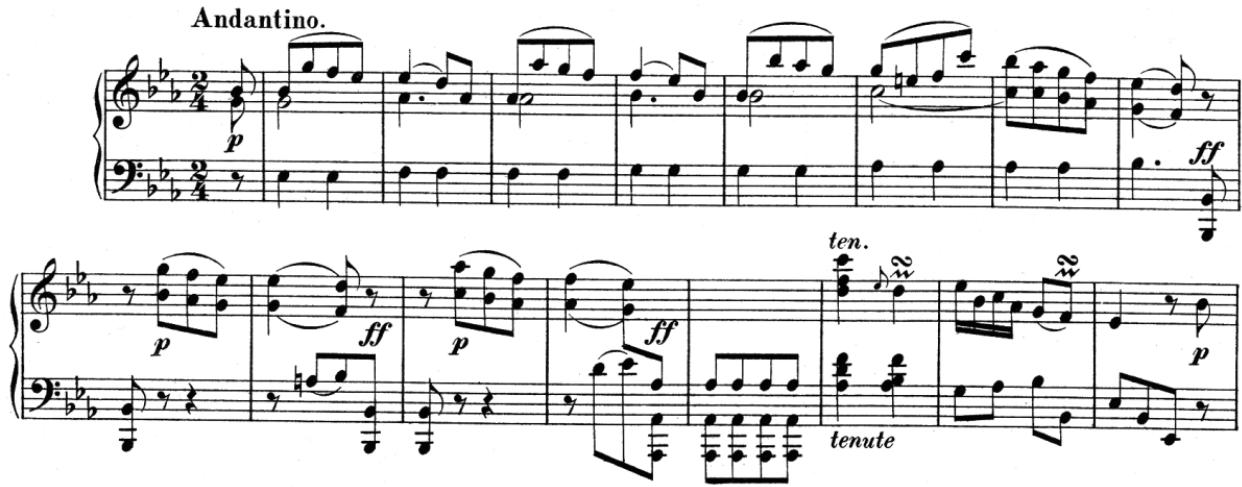
中文讲解
本条为图像/乐谱占位符,插入于 P0099 末尾对《降E大调回旋曲》的讨论之后。占位符标注此谱例是 C. P. E. 巴赫《Rondo Wq. 61/1(H. 288)》(1786)第 1–16 小节的图示,对应正文称为“Example 1”。其功能在于为读者提供上文“fortissimo 八度—切割的头颅—主题持续变形”这一论述的音乐实体;具体小节、和声与对位细节须查原图。
补充说明
因嵌入图像数据被省略,本处无法对该谱例的具体音高与节奏作进一步讲解,建议读者查阅原图以验证正文关于“fortissimo 八度”与“主题持续变形”之说。
第5段(P0101)
原文复述
There are a few instances where the tearful aspect of sensibility is almost literally represented. A Quintschrittsequenz may serve many purposes; unadorned by chromaticism it is a bland device that keeps many late baroque pieces going. As such it is at work in the first movement (Presto) of the Sonata in B-flat major Wq. 51/2 (H. 151), a highly effective and humorous imitation of a bravura aria, preceded by a short, slow and erhaben orchestral introduction. In the second movement (Adagio mesto e sostenuto), after a tense two measure build-up, which as a series of sixth chords inverts the recurring opening motive of this movement, the following downward sequence exploits the easy flow of the sequence in as faithful an image of a good cry as one could wish for (mm 18–23, Example 2). Descending sixth chords in minor are a recurrent opening motive in the works of Bach, expressing melancholy (notably in Abschied … Wq. 66 (H. 272)) – as they do in much later works such as Chopin’s Prélude op. 45.
中文讲解
本段是本小节的第二个例证,从“感伤的极端外露”切入——开篇指出,作品中几乎直接呈现“可被哭泣所表征”的敏感性。作者以乐器化的音乐修辞法(“almost literally represented”“as faithful an image of a good cry as one could wish for”)来强调:这里的“哭泣”并非修辞,而是音乐结构本身近似于一幅“好哭相”的图景。
例证分为两部分。第一部分是 Quintschrittsequenz(五度步进序列)在《降B大调奏鸣曲》Wq. 51/2(H. 151)第一乐章(Presto)中的作用,作者先在理论层面说明:该序列若不加半音化修饰,则是一种平淡的套路,可支撑大量晚期巴罗克作品。在这一奏鸣曲中,它呈现为对一首“bravura aria”(炫技性咏叹调)极有效、极幽默的模仿,乐章之前则有一短小、缓慢、带有 erhaben(崇高的)气质的管弦乐引子。第二部分进入同一奏鸣曲的第二乐章(Adagio mesto e sostenuto),乐章开始有两小节紧张的和声铺垫,以一系列六和弦呈现“倒影”形式,把本乐章循环出现的开篇动机倒置过来;随后下行序列(mm 18–23,Example 2)正是利用 Quintschrittsequenz 平顺流动的特性,将“哭泣”以近乎图像化的方式渲染出来。
最后一句把这一音型扩展到巴赫的整体实践:下行小调六和弦作为开篇动机反复出现,表达忧郁,在《Abschied …》Wq. 66(H. 272)等作品中尤为显著;并进一步指出,这一手法在远至肖邦《Prélude op. 45》等更晚作品中仍以类似方式出现。这是本节中少有的将 C. P. E. 巴赫放在一个更长时段音乐语汇演变中的笔触。
补充说明
“Quintschrittsequenz”与“Example 2”在原文中均直接出现;其中 Example 2 在本节被提及,但本任务输入未给出 Example 2 的图注,其乐谱需查看原书方能确证。“Adagio mesto e sostenuto”在原文写作“Adagio mesto e sostenuto”,为意大利文术语,本身已含“悲恸且持续”的意味。
第6段(P0102)
原文复述
40 A similar procedure is followed in the Adagio of the fantasia-like Sonata in G minor Wq. 65/17 (H 47), m. 8, where a simple element – a dotted figure – is lifted out of the sentimental theme and stressed as a ‘signal’, changing texture and expression.
中文讲解
本条为脚注 40,从属于前一段。其作用是为前文关于“把元素从情感主题中‘切割’出来、转化为反思/反讽信号”的做法提供另一个同类型实例:G 小调《奏鸣曲》Wq. 65/17(H 47)在被作者描述为“fantasia-like”即幻想曲风格的作品中,第 8 小节的 Adagio 里,一个看似简单的元素(附点节奏型)被从原本“感伤”的主题中抽取出来,并被强调为一种“信号”(signal),从而使织体与表情都发生变化。该脚注与正文 P0099 关于“fortissimo 八度—切割的头颅”这一思路在方法论上同构,因此其作用属于佐证而非来源/版本考据。
补充说明
原文脚注编号为 40,承接于 P0099 末句“a second inner ‘voice’。”之后,其作用为补充性例证,与版本编号或文献出处无涉。
第7段(P0103)
原文复述
C. P. E. Bach, Haydn, and the art of mixed feelings © Lodewijk Muns 2008 – p. 11
中文讲解
本条为页脚/页眉性质的版权与页码信息,表明本段出自《C. P. E. Bach, Haydn, and the art of mixed feelings》一文,作者 Lodewijk Muns,2008 年版权属该作者,当前为第 11 页。它对正文论证无内容上的推进,仅指示出处与页码。
脚注 / 边栏 / 图表 / 附加信息(如有)
本小节附有一条脚注(编号 40)与两幅图例(Example 1、Example 2)。
- 脚注 40(位于 P0102)承接 P0099 关于“情感被另一种声音所节制”的论述,提供《G 小调奏鸣曲 Wq. 65/17(H 47)》Adagio 第 8 小节的同类型实例,性质为佐证性补充。
- Example 1(P0100 占位符)对应 P0099 对《降E大调回旋曲 Wq. 61/1(H. 288)》(1786)第 1–16 小节的乐谱,是读者核查“fortissimo 八度—主题切割—持续变形”论述的关键证据。
- Example 2 在 P0101 中被提及(mm 18–23,《降B大调奏鸣曲》第二乐章),但本任务输入未提供其图像或图注细节;其内容须查阅原书。
- P0103 为页脚版权与页码信息,不参与论证。
💡 本节核心要点
- 作者将前文罗列的巴赫音乐特征归并为两条一般原则:Schering 的“redende Prinzip”(会说话的原则)与巴赫的“whimsicality / Laune / wit”(奇想/机智),并在此之外补充“sentimental”(感伤)这一较少被关注的维度。
- 本节核心论断是:感伤与机智并非仅仅并列出现于同一作者名下,而是常常在同一作品内部相互对峙、相互混合,由此引出与斯特恩(Sterne)“感伤反讽”的类比。
- 第一例证来自《降E大调回旋曲 Wq. 61/1(H. 288)》:fortissimo 八度把主题“切割”成只剩头颅,由此打破旋律的序列性自溺;此处被作者视为“vermischte Empfindung”(混合情感)的一种特殊、极端形态——情感被反讽性“第二声音”所节制。
- 第二例证来自《降B大调奏鸣曲 Wq. 51/2(H. 151)》的第二乐章:下行的小调六和弦序列被描述为“如同好哭的图像”,直接表征感伤;Quintschrittsequenz(五度步进序列)的“平淡套路”特征在此被转化为“哭泣”之具象。
- 作者通过下行小调六和弦把 C. P. E. 巴赫的语汇与《Abschied Wq. 66(H. 272)》乃至更晚的肖邦《Prélude op. 45》相连接,表明“感伤”这一手法具有跨时代绵延的音乐史背景。
- 脚注 40 以《G 小调奏鸣曲 Wq. 65/17(H 47)》Adagio 第 8 小节中的“附点信号”补充说明“把简单元素从感伤主题中抽出并强调”这一手法在不同作品中的复用。
🔑 关键术语
- redende Prinzip:Arnold Schering 提出的概念,本节用作统辖巴赫音乐特征的“一般原则”之一;意指音乐具有表达、言说的能力,相当于本节讨论“情感如何被呈现”的理论框架。
- Laune / wit:德语 Laune 与英语 wit 对应,作者将之作为巴赫身上“机智/怪趣”的概括,与 redende Prinzip 并列,是本节讨论“反讽如何介入感伤”的另一极。
- vermischte Empfindung:德文“混合情感”,来自 18 世纪德国美学(尤其与康德学派相关),指不同情感在同一表述中相互混合;作者将本节感伤—反讽并置视为其“特殊的、极端的”形态。
- Quintschrittsequenz:五度步进序列;一种常见的作曲套路;本节指出若不加半音化修饰则显得平淡,却可被巴赫用于“模仿咏叹调”或“表现哭泣”之不同目的。
- erhaben:德文“崇高的”;作者用以形容奏鸣曲第一乐章之前那段短小、缓慢的引子,提示其与随后“bravura”段落的反差。
- bravura aria:炫技性咏叹调;本节用作 Wq. 51/2 第一乐章的模仿对象,强调其幽默、夸张的表演性质。
- sentimental irony(Sterne):源于劳伦斯·斯特恩小说的“感伤反讽”;本节以之作为 C. P. E. 巴赫音乐中“感伤与机智并存、且相互对峙”这种混合现象的文学类比。
S1.11 [描述性拆分] 1.4 Affinity?
第1段(P0104)
原文复述
Example 2: C. P. E. Bach, Sonata Wq. 51/2:ii (H. 151) (1760), mm 19-24
中文讲解
这是本节的第二个音乐例子标注,指向 C. P. E. 巴赫的奏鸣曲:Wq. 51/2 在 Hollinrake/Heilig 编号体系中对应 H. 151,作于 1760 年,第二乐章(ii)19–24 小节。该例出现在 1.4 节讨论“亲缘性(affinity)”问题的语境中,被作者用来演示 C. P. E. 巴赫键盘作品中某些具体的体裁或结构特征——正文中提及“准即兴式爆发”(auskomponierten quasi-improvisatorischen Ausbrüche),此处第二乐章的局部片段很可能是后文要回看的佐证。
补充说明
Wq. = Wotquenne 编号系统(用于 C. P. E. 巴赫作品目录);H(H. 151)= 较早使用的 Helm/Hollinrake 编号。是同一作品的两种编号对照。
第2段(P0105)
原文复述
[1.4 Affinity? — 内嵌图像数据已省略,仅保留位置与图注]
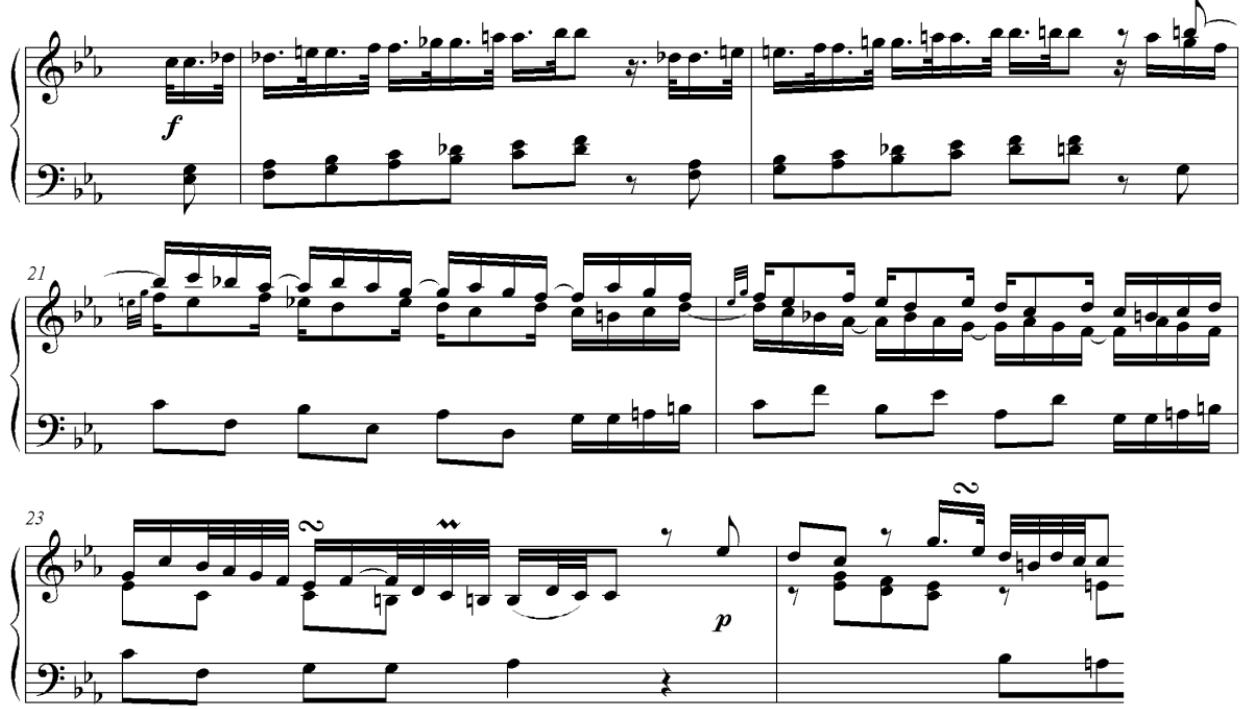
中文讲解
这是 1.4 节“Affinity?”(亲缘性?)位置的图像占位符。图像具体内容无法获知,从位置判断应为该节的视觉标题或一段示意性图示(无可读取的细节)。需要查看原图。
第3段(P0106)
原文复述
That there are similarities between the keyboard works of Bach and Haydn has been perceived since their own days.41 What most generally might invite comparison is the limited presence of Italianizing elements in the mature keyboard works of Haydn, setting him somewhat apart from the Austrian tradition. More positively, it is the manifestations of discontinuity, wit or humor in their work which has led to remarks on a shared ‘mentality’. In spite of this association, the term ’empfindsam’ seems rarely to have been applied to aspects of Haydn’s work, though it might be more obvious and better motivated than the much abused ‘Sturm und Drang’.42 That, apart from similarity or affinity (which, in sentimental terms, might have ‘come from the heart’), there has been an influence of the elder on the younger has long been assumed, with support from biographical reports since the 1780s. Ironically, this started with something like a hoax, when a reviewer in the European Magazine and London Review of October 1784, on the basis of some ‘strange passages’, concocted the story that the sonatas Hob. 21-3243 (published as op. 13 and 14) had been ’expressly composed in order to ridicule Bach of Hamburgh,’ an act of revenge for supposed negative publicity by Bach. The European review was translated in C. F. Cramer’s Magazin der Musik with critical notes by the editor and a refutation by Bach.44 The reviewer may have drawn on the strong tradition of invective in the German North against Italian Ohrengekützel. Bach’s keyboard style is built on a melodic, continuo type bass; the Italian sense of harmony and rhythm, typified by the percussive Alberti bass, which provides as it were motion without movement, seems to have produced in him feelings of revulsion.45 Where he wants an agitatedly busy rhythm with slow harmonic progression, he prefers the sometimes tedious baroque practice of repeated bass notes (one of its worst manifestations being Wq. 65/16 (H. 46), while it is used with great effect in Wq. 50/3 (H. 138)). It is maybe significant that dance music has little place in his oeuvre.
中文讲解
本段是 1.4 节的核心,层次丰富,需分层看:
① 起点:Bach(指 C. P. E. Bach)与 Haydn 键盘作品的相似性,自两人在世时代就已被感知;常被用来比较的两个支点——Haydn 成熟作品中意大利化元素的有限(这又使他略别于奥地利传统),以及两人作品中“断裂、诙谐、幽默”所暗示的“共享心态”。
② 术语纠偏:尽管两人都显示出类似的“敏感”特征,“empfindsam”一词却很少被用于 Haydn 的作品;作者认为用它来谈 Haydn 比那个被严重滥用的“Sturm und Drang”更明显、也更有理据——这是作者在为后续的“共享心态”讨论做术语上的铺垫。
③ “影响”问题史的起点:除了相似/亲缘性,还长期假设“Bach→Haydn”的影响关系,这一假定有 1780 年代以来传记资料的支撑。但作者笔锋一转指出:这一“影响”叙事起步于一次近乎恶作剧的新闻——1784 年 10 月《European Magazine and London Review》一位评论者仅凭某些“奇怪段落”,编造了 Haydn 的奏鸣曲 Hob. 21–32(当时以 op. 13 与 op. 14 出版)是“专门为了嘲讽 Hamburg 的 Bach(实即 C. P. E. Bach)”之报复性作品的说法。
④ 后续发酵:上述英伦评论被 C. F. Cramer 翻译进《Magazin der Musik》,并附编者按语及 Bach 方面的反驳。
⑤ 评论者的修辞资源:评论者可能借用了德语北方针对意大利“ohrengekützel”(耳垢式甜腻)的强烈修辞传统——这又自然地引出 Bach 本人的键盘风格:建立在旋律性通奏低音式的低声部之上,对以断奏式 Alberti 低音为代表的意大利式和声—节奏(“运动而不前进”)怀有“反胃感”。
⑥ Bach 的应对:每当 Bach 想要“忙乱的节奏 + 缓慢的和声进行”这一组合,他宁可使用重复低音(巴洛克旧习),Wq. 65/16 是这一手法被用得很糟的一例,Wq. 50/3 则是用得极为精彩的一例。最后作者提示:舞曲在 Bach 全部作品中所占分量很小,这一点或许也有意义。
功能上,本段同时完成三件事:a) 把“亲缘性/影响”这一节的论域摆到台面上;b) 把讨论的源头钉在 1784 年那次评论——告诉我们关于“影响”的早期叙述本身就有可疑之处;c) 通过 Bach 风格内部特征的描写,预告后续将以何种方式分析“准即兴式爆发”等典型姿态。
补充说明
术语补充(仅依据本节语境): • “empfindsam”= Empfindsamer Stil,“敏感风格”,C. P. E. Bach 的美学标签; • “Sturm und Drang”= “狂飙突进”,常被套用到 1770 年代音乐风格,但作者认为这是被滥用的标签; • Hob.= Hoboken 编号;Hob. 21–32 为一组奏鸣曲在 Hoboken 目录中的序号范围; • “Bach of Hamburgh”= 18 世纪英语出版物对 C. P. E. Bach 的称呼(区别于 J. S. Bach); • “Ohrengekützel”= 讥讽性地指意大利式“掏耳朵的”装饰性音乐; • “Alberti bass”= 分解和弦伴奏音型; • Wq. 65/16(H. 46)与 Wq. 50/3(H. 138)是 Bach 键盘作品的具体编号。
第4段(P0107)
原文复述
41 Overview and evaluation of sources for the Bach–Haydn connection in Leisinger (1994) and Brown (1986). On a late indirect contact through Eszterháza musicians performing in Hamburg, see Suchalla (1994) 1099–1103. An influence of Haydn on certain late works of Bach is often assumed, see e.g. Schleuning (1973) p. 251.
中文讲解
注释 41 给出关于 Bach–Haydn 联系研究的文献来源总览:Leisinger (1994) 与 Brown (1986) 是综述与评估的代表性著作;Suchalla (1994) 第 1099–1103 页讨论了 Eszterháza 乐手赴汉堡演出的“晚期间接接触”;Schleuning (1973) 第 251 页是“反向影响”(Haydn→Bach 晚期)经常被援引的一例。功能上为正文中的“影响”叙事提供文献支撑,并把 Leisinger/Schleuning/Schuchalla 等不同立场的研究者串到同一注释下,便于读者按图索骥。
第5段(P0108)
原文复述
42 But then, The Sentimental Symphonies does not look good on a CD cover. The notion of a musical Sturm und Drang has been adequately dealt with by Schleuning (2004).
中文讲解
注释 42 先以一句轻松的旁白自嘲——“感伤交响曲”在 CD 封面上并不讨喜,随即指出:“音乐中的 Sturm und Drang”这一概念,Schleuning (2004) 已经做了足够充分的处理。功能:把正文提到“滥用的‘Sturm und Drang’”加以限定,提示读者该议题已被先行研究覆盖,作者无需在此展开。
第6段(P0109)
原文复述
C. P. E. Bach, Haydn, and the art of mixed feelings © Lodewijk Muns 2008 – p. 12
中文讲解
第 12 页页眉,呈现论文标题、作者署名(© Lodewijk Muns 2008)与页码。属于版面元素。
第7段(P0110)
原文复述
Musicologists in the early 20th Century were sometimes quick in deciding on ‘influence’; the comparisons by Hermann Abert and Ernst Fritz Schmid46 were neither very interesting nor convincing, but helped to establish a tradition which almost automatically translated ‘similarity’ into ‘influence’. Bettina Wackernagel has cast doubt on these assumptions by attacking Abert’s arguments; A. Peter Brown went further in castigating earlier generations for ‘an unusual enthusiasm to find interactions among great men,’ for being ‘plagued by errors of both judgment and fact,’ for ‘regional chauvinism among non-Austrian German scholars’ and a lack of analysis.47 Reviewing biographical and bibliographical data, he declares himself an agnostic, allowing for an influence of the Versuch on changes in notation and the application of the principle of ‘varied reprise’. More recently, however, Ulrich Leisinger, on the basis of extensive research, has come to far more positive conclusions. The bibliographical evidence makes it possible or even likely that Haydn encountered the Preußische or Württembergische Sonaten around 1750. Examining the works, he finds parallels of surface detail and structure that seem to exceed the coincidental. In the presence of such more specific correspondences, a similarity of less defined features acquires more weight, including the typical interruptions of structural continuity and ‘auskomponierten quasi-improvisatorischen Ausbrüche.‘48
中文讲解
本段是关于“Bach–Haydn 影响”议题的学术史综述,按代际把研究者分成三种立场:
① 20 世纪早期一派(Abert、Schmid)仓促论断“影响”,本身论证欠缺,却形成了把“相似性”自动翻译为“影响性”的研究传统。
② 修正一派:Wackernagel 通过反驳 Abert 的论点开始质疑这一传统;Brown 则更激进,批评老一辈有“在伟人之间找出相互作用的异常热情”、“判断与事实都错漏百出”、“非奥地利的德语学者的地区沙文主义”,并缺少分析。Brown 自称不可知论者,只承认 Bach 的《Versuch》对 Haydn 记谱法和“变化再现”(varied reprise)原则的应用有影响。
③ 正向论证一派:Leisinger 基于更细致的研究得出更肯定的结论。其证据链分两层——书目层面,Haydn 大约在 1750 年前后接触到“Preußische Sonaten”或“Württembergische Sonaten”是“可能乃至或然”的;作品层面,Haydn 与 Bach 作品之间在表面细节与结构上的平行关系“超出巧合”。Leisinger 进而指出:当这些较具体的对应(结构连续性的打断与“完整写就的准即兴式爆发”)被确认后,那些本来较为模糊的特征相似也获得更大分量。
功能上,本段把“影响/相似”议题从先验论断、修正怀疑、引证争议,最终推向一种基于书目与作品实证的正向建构,为下一段作者本人立场的方法论反思做铺垫。
补充说明
术语补充(仅在本节出现): • Versuch = C. P. E. Bach 的《Versuch über die wahre Art das Clavier zu spielen》,键盘演奏论著; • “varied reprise”= 奏鸣曲式再现部中以变奏原则处理材料的写法; • Preußische Sonaten(Wq. 48)/ Württembergische Sonaten(Wq. 49)= Bach 两套“奏鸣曲”——本段引作 Haydn 接触源; • “auskomponierten quasi-improvisatorischen Ausbrüche”= 德语术语“完整写就的准即兴式爆发”,用于刻画 Bach 风格特征。
第8段(P0111)
原文复述
The notion of influence remains scientifically problematic. In few cases, we will be able to establish proof of influence – the criteria are not even clear. Where a composer unmistakably follows a model, we have a case of imitation, not influence. On the other hand, it is not clear what we know when we know that composer A has influenced composer B; it does not necessarily contribute to our understanding of the music. Haydn, in any case, was too much a master of his own development, and (in contrast to Bach, and untroubled by the stilistic North–South divide) too much open to the possibilities offered by any style or material, to leave clear marks of influence. On the other hand, contrary to a common musicological prejudice, the perception of a shared ‘mentality’ or ‘Übereinstimmung im Ausdruckswillen'49 is not beyond analysis, and such analysis may help us understand why some pieces are in interesting ways similar to or different from others.
中文讲解
本段是作者本人在该议题上的方法论自陈,分层如下:
① 概念层:“影响”一词在科学上仍成问题——我们几乎无法确立确证,标准本身也不清晰。
② 与“模仿”的区分:若一位作曲家明显跟随某模型,那只是模仿(imitation),不是影响(influence)。
③ 认识价值层:即便我们说“作曲家 A 影响了 B”,这也不必然有助于我们理解音乐——此类陈述可能止于传记叙事,并未触及作品本身。
④ 案例层(Haydn 之所以“无痕”):Haydn 过于精熟于自身发展路径,并且——与 Bach 相反,不为德语北方与意大利南方之间的风格分歧所累——向任何风格或素材的可能性敞开,因此不会留下可被指认的影响印记。
⑤ 反命题(作者真正要做的事):与常见的音乐学偏见相反,对“共享心态”或“Übereinstimmung im Ausdruckswillen”(在表达意志上的一致)的感知并非不可分析;这种分析可以帮助我们理解为何某些作品以有趣的方式彼此相似或彼此相异。
这是本节最重要的转折:从历史叙事层面的“影响/反影响”之争,转换为以作品内部姿态为对象的“表达意志”之分析。作者借此为后文的方法与示例预留接口。
补充说明
术语补充: • “stilistic North–South divide”= 德语北方风格传统与意大利化南方风格传统之间的分野(Bach 自觉受阻于此线); • “Übereinstimmung im Ausdruckswillen”= 德语术语,指“在表现/表达意志上的一致”,作者用以替代笼统的“影响”之功能。
第9段(P0112)
原文复述
43 Reference to Haydn sonatas by Hoboken number, abbreviated (Hob. = Hob. XVI).
中文讲解
注释 43 说明本论文引用 Haydn 奏鸣曲时一律使用 Hoboken 编号,缩写为 Hob.,全称即 Hob. XVI。功能是约定引用规范。
第10段(P0113)
原文复述
44 Suchalla (1994) p. 1099–1103
中文讲解
注释 44 直接给出前文提到的 Cramer 译介与反驳史实的文献出处:Suchalla (1994) 第 1099–1103 页。
第11段(P0114)
原文复述
45 Cf. the Versuch, Vol. I Einleitung §§ 9–10 and the lengthy footnote.
中文讲解
注释 45 指引读者查 C. P. E. Bach《Versuch》第一卷“Einleitung”(导言)第 9–10 节及其长篇脚注,作为正文所述“对意大利 Alberti bass 的反感”的原始文献。
第12段(P0115)
原文复述
46 Abert (1920, 1921), Schmid (1931)
中文讲解
注释 46 列出两位较早把“影响”写得空泛的学者的具体著作年代:Abert 1920 与 1921 年著作;Schmid 1931 年著作。
第13段(P0116)
原文复述
47 Brown (1986) 213
中文讲解
注释 47 指明前段引用的 Brown 论断及其更广泛的批判性评语的具体出处页码:Brown (1986) 第 213 页。
第14段(P0117)
原文复述
48 Leisinger (1994) p. 310. Substantial similarity concerns the sonatas Hob. 18, 29, 30, and 44, and Bach’s Reprisen-Sonaten Wq. 50 and Probestücke Wq. 63. On the other hand, as against Brown, the Fantasie Wq. 61.6 is not considered a source for Haydn’s Capriccio Hob. XVII:4. Reference to Leisinger’s research is surprisingly absent from Bernard Harrison’s more recent study (1997), and even from his article on Bach in Jones (2002).
中文讲解
注释 48 把正文提到的 Leisinger 主张落到具体作品上:实质性相似出现在 Haydn 的奏鸣曲 Hob. 18、29、30、44 与 Bach 的 Reprisen-Sonaten Wq. 50、Probestücke Wq. 63 之间;与 Brown 立场相反,Leisinger 并不把 Bach 的 Fantasie Wq. 61.6 视为 Haydn 的 Capriccio Hob. XVII:4 的来源。最后一句指出:尽管 Leisinger 的研究扎实,Bernard Harrison (1997) 的近期著作甚至 Jones (2002) 的 Bach 词条都令人意外地未引此文献——以此提示学界引证方面的疏漏。
补充说明
术语补充: • Reprisen-Sonaten = Wq. 50 一组“带再现部的奏鸣曲”; • Probestücke = Wq. 63 一组“试作/练习曲”——均是 Leisinger 比较中所论 Bach 作品类别。
第15段(P0118)
原文复述
C. P. E. Bach, Haydn, and the art of mixed feelings © Lodewijk Muns 2008 – p. 13
中文讲解
第 13 页页眉,呈现论文标题、作者署名(© Lodewijk Muns 2008)与页码。属于版面元素。
脚注 / 边栏 / 图表 / 附加信息(如有)
本节附有 Example 2(C. P. E. Bach, Sonata Wq. 51/2:ii, mm 19–24)与 1.4 节标题位置的可视占位符(具体图像内容未在文本中提供)。脚注 41–48 在文末呈现,主要功能为:(a)提供 Bach–Haydn 议题的主要文献来源(Leisinger 1994;Brown 1986;Suchalla 1994;Schleuning 1973 等);(b)界定核心概念术语(empfindsam、Sturm und Drang、Ohrengekützel、Alberti bass、varied reprise、Übereinstimmung im Ausdruckswillen);(c)约定引用规范(Hoboken 编号缩写);(d)给出个别主张的精确定位(Versuch Vol. I Einleitung §§ 9–10;Suchalla 1099–1103 等)。其中注释 48 同时承担“作品对应清单”与“指出学界引证疏漏”两项功能。
💡 本节核心要点
- 1.4 节的目的不是回答“有没有影响”,而是把“影响”这一概念的合法性摆到台面上重新审视:作者把关于 Bach–Haydn “影响”的早期叙事追溯到 1784 年《European Magazine and London Review》中近乎恶作剧的一篇评论,由此指出该议题的起点本身就可疑。
- 作者把这一议题的学术史切成三代立场——20 世纪上半叶的 Abert/Schmid 把“相似”自动等同于“影响”;Wackernagel 与 Brown 进行批评与怀疑,Brown 自称“不可知论”只承认《Versuch》对 Haydn 在记谱与“变化再现”上的可能影响;近年 Leisinger 基于书目与作品细节的实证,走向更为肯定的方向。
- 通过 Preußische/Württembergische Sonaten 在 1750 年前后的可能接触,以及对结构连续性之打断与“完整写就的准即兴式爆发”等姿态的实证关联,作者把论证锚定到具体体裁特征上,从而把“亲缘性”从心理隐喻变为可被分析的对象。
- C. P. E. Bach 键盘风格的核心被刻画为:以旋律性通奏低音式低声部为基础,对意大利化的 Alberti bass 抱有反感;当需要“忙乱的节奏 + 缓慢和声进行”这一组合时,转而采用重复低音(Wq. 65/16 为糟糕之例,Wq. 50/3 为精彩之例);舞曲在其全部作品中分量有限,这一点对理解其风格边界有提示意义。
- 作者本人最终采取的方法论立场是:以“Übereinstimmung im Ausdruckswillen”(表达意志上的一致)取代笼统的“影响”说,主张对“共享心态”做作品内部的分析,由此可解释为何某些作品在有趣的方式上彼此相似或相异。
🔑 关键术语
- empfindsam / Empfindsamer Stil:“敏感风格”,与 C. P. E. Bach 联系紧密的美学标签;作者指出该词很少被套到 Haydn 身上,但比被滥用的“Sturm und Drang”更具理据,是讨论 Bach–Haydn “共享心态”时更合适的术语候选。
- Sturm und Drang:“狂飙突进”,被广泛但松散地用于 1770 年代戏剧与音乐;作者认为此标签在音乐研究中已被滥用,引用 Schleuning (2004) 作为先行处理。
- Alberti bass:意大利风格的分解和弦伴奏低音型,作者用“运动而不前进”形容其节奏效果,并指出 C. P. E. Bach 对此风格抱有反感。
- Ohrengekützel:德语北方文献中讥刺意大利化装饰性音乐的贬义词,作者用以解释 1784 年评论者为何会把 Haydn 的“奇怪段落”渲染为对 C. P. E. Bach 的“嘲讽”。
- Versuch:C. P. E. Bach 关于键盘演奏的论著;Brown 仅承认它对 Haydn 在记谱与“varied reprise”原则上可能产生过影响(见注释 47 周边论述)。
- varied reprise / Reprisen-Sonaten:奏鸣曲式再现部应用变奏原则的写法;Wq. 50 一组奏鸣曲即以此为题,Leisinger 将其与 Haydn 的若干奏鸣曲对应。
- auskomponierten quasi-improvisatorischen Ausbrüche:德语术语,“完整写就的准即兴式爆发”;作者借助此概念刻画 Bach 风格中典型姿态,正是后文作者用以替代“影响”分析的“表达意志”类特征之一。
- Übereinstimmung im Ausdruckswillen:德语术语,“表达意志上的一致”;作者用其代替笼统的“shared mentality”,主张该现象可被分析,是本节方法论落点。
- stilistic North–South divide:德语北方风格传统与意大利化南方传统之间的分野;作者指出 Bach 受困于此,C. P. E. Bach 因此在风格选择上设有边界,而 Haydn 跨越此类边界,不留下可被指认的影响印记。
S2 2. What sonatas want
第1段(P0119)
原文复述
2. What sonatas want
中文讲解
本节标题"What sonatas want"(奏鸣曲想要什么)直接呼应下一段开篇那个被反复引用的反问"Sonate, que me veux tu?"。这是一个带有挑衅性的拟人化提法:它把奏鸣曲当作有意志、有要求的主体,从而把问题从"这种音乐是什么"转向"这种音乐在向听者要求什么"。本节的任务就是回答这一要求,而不是把问题作为话头一笔带过。
第2段(P0120)
原文复述
The too often (and once more!) quoted “Sonate, que me veux tu?” may have been meant as a rhetorical question; it can - and should - be answered. In fact, it is a question any intelligent listener and musician will ask any sonata attacking his or her ears, though it is not necessarily answered in words. Its reputation as a stopper may in part be explained by the very trivial consideration that while we speak about language in language, not only are we unable to paraphrase a work of music, it is hard even to make the most superficial reference to parts and passages without musical notation, technical terms or clumsy circumscriptions. The vagueness of music in speech tends to be attributed to the music itself.
中文讲解
本段开门见山地把那个常被当作挡箭牌来回避问题的反问"Sonate, que me veux tu?“重新立为必须回答的真问题。作者的论证策略分两层:第一层,区分"用语言谈论语言"和"用语言谈论音乐”——后者的困难本就在工具层面,没有乐谱、术语就只能用笨拙的迂回说法(circumscriptions);第二层,由此把关于音乐的语义模糊归因于我们语言工具的不充分,而不是音乐本身的缺陷。换句话说,本段在为整章辩护做前提铺垫:当我们说"说不出奏鸣曲在说什么"时,问题不在奏鸣曲上,而在我们的描述手段上。这一点随后将被 Sulzer 等人的文献实例所支撑。
补充说明
本段中"stopper"指使讨论戛然而止的修辞挡箭牌;“circumscriptions"指无法直呼其名时只能用笨拙的迂回说法(相当于定义性长句)。这两个词共同支撑作者"问题出在语言工具,而非音乐"这一层论证。
第3段(P0121)
原文复述
In the face of the musical evidence, it is hard to think of a more profound reason for the persistent denigration of instrumental music by most aestheticians throughout the 18th Century. As formulated in J. G. Sulzer’s lexicon, article Instrumentalmusik: this is either useless ‘Geräusch’ or practicing for ‘real’ music, that is, applied music. The shift in musical aesthetics however runs through the lexicon. The article Sonate is a forceful apology for the sonata’s legitimate demands (with the obligatory jibe to Italians and Italianizers):
中文讲解
本段以"面对音乐事实"作为过渡,引出 18 世纪美学主流贬低器乐这一历史背景,并以 J. G. Sulzer 的百科词典为典型样本。Sulzer 在"Instrumentalmusik"条目里把器乐贬为要么是无用的"Geräusch”(噪音/杂响),要么只是为"真正的"音乐(即带歌词或带应用的音乐)做的练习;同一词典却在"Sonate"条目里为奏鸣曲的合法诉求做了强力辩护,并照例对意大利人和意大利化风格加以嘲讽。作者借此指出:美学观念的转变并非发生在词典之外,而是贯穿于词典内部——同一编者对器乐同时存在贬低与辩护这两种声音。这一并列直接让下一段引文成为整章最关键的文本证据。
补充说明
“Geräusch"在 Sulzer 文中以加引号形式出现,提示这是术语性的贬称,意为不具意义的声响。“obligatory jibe"提示读者:18 世纪德语区音乐写作中对意大利风格的敲打是一种惯例而非偶然。
第4段(P0122)
原文复述
Die Möglichkeit, Charakter und Ausdruck in Sonaten zu bringen, beweisen eine Menge leichter und schwerer Klaviersonaten unseres Hamburger Bachs. Die mehresten derselben sind so sprechend, dass man nicht Töne, sondern eine verständliche Sprache zu vernehmen glaubt, die unsere Einbildung und Empfindungen in Bewegung setzt und unterhält. Es gehört unstreitig viel Genie, Wissenschaft und eine besonders leicht sängliche und harrende Empfindbarkeit dazu, solche Sonaten zu machen. Sie verlangen aber auch einen gefühlvollen Vortrag, den kein Deutsch-Italiener zu treffen im Stande ist, der aber oft von Kindern getroffen wird, die bei Zeiten an solche Sonaten gewöhnt werden.50
中文讲解
此段为 Sulzer《Allgemeine Theorie der schönen Künste》中"Sonate"条目的德语原文,需保留原文语言。译文如下,仅供教学理解:能够在奏鸣曲中呈现性格与表达的可能性,已由我们汉堡人巴赫的大量轻重钢琴奏鸣曲所证明。其中多数如此"会说话”,使人觉得听到的不是一个个音,而是一种可理解的语言,它调动并持续激发我们的想象与感受。毫无疑问,创作这样的奏鸣曲需要大量天才、学识以及一种特别轻盈流畅而又执着坚持的感受力。但它们也要求一种饱含感情的演奏——这是任何"德意混血风格"者都无法企及的,却往往被从小就被引介去熟悉此类奏鸣曲的儿童所达成。其论证作用有三层:其一,把"Hamburger Bachs”(C. P. E. 巴赫)作为奏鸣曲能够"说话"的实例,对应本节标题"奏鸣曲想要什么";其二,把器乐辩护为可理解的语言,从而正面回应 P0120 中"说不出奏鸣曲在说什么"的疑虑;其三,以"德意混血者不行,孩子却行"反衬——对奏鸣曲诉求的回应能力与风格学派无关,而与是否自小浸淫于这种音乐有关。这一句把"奏鸣曲的要求"落到演奏者/听者的训练史层面,为后文讨论"器乐在理论上迟迟未获解放"做了伏笔。
补充说明
“Hamburger Bachs"是 18 世纪对 C. P. E. 巴赫的常用称呼,区别于其父 J. S. 巴赫;“Deutsch-Italiener"指当时兼具德、意风格训练却两边都不彻底的演奏者,含贬义;尾标"50"指向本节末脚注 50,即该引文的来源。
第5段(P0123)
原文复述
The idea that music is a means of exciting and communicating feeling is repeated over and over throughout the period. How it does this, is a question unhinging the existing philosophical frameworks. Since vocal music and dance music were considered to be emotionally meaningful, it seems that with little effort one might imagine that the same or similar music without a text sung or a dance performed would not cease to be meaningful, because at the very least it would evoke song and dance in the listener’s mind. This step was only partially made – by those who like Mattheson interpreted music as ‘Klangsprache’, but the concept is by no means clear. The reason for the failure to allow instrumental music its ’emancipation’ in theory (while it was emancipated in practice) must probably be sought in the fact that a defense as indicated involved psychological notions insufficiently clarified at the time. The theory of musical expression therefore held on for a long time to a rather sterile schematism of passions or affects – an account that seemed thoroughly unsatisfactory to the romantic generations. Projecting the meaning of instrumental music (turned ‘absolute’) into the ‘metaphysical’, which in literary imagination is rather close to the ‘supernatural’, would thus provide an escape from such unanswerable questions – thereby turning the world of the mind (Welt des Geistes) into a world of spirits (Geisterwelt).
中文讲解
本段是本节论证的理论枢纽,分四步推进。第一步确立时代共识:音乐是激发和传达情感的工具,但"如何做到"这一点撼动了既有哲学框架。第二步给出最自然的推理:既然声乐与舞曲被认为有情感意义,那么剥离歌词或舞蹈动作的同种音乐至少会在听者脑中唤起歌与舞,因此不会丧失意义——这是器乐理论上"解放"最经济的一步。第三步指出该步只被部分完成:Mattheson 式的’Klangsprache’(声音语言)虽提出方向,但概念并不清晰;器乐在实践中已被解放,理论上却未能获解放,根源在于支撑这种辩护的心理观念当时未被充分澄清。第四步说明后果:表达理论长期停留在"激情/情动之贫乏图式化"中,连浪漫派世代也觉得不令人满意;于是把器乐(已成为’绝对音乐’)的意义投射到’形而上学’层面,在文学想象中这又贴近’超自然’,由此逃避无法回答的问题,最终把精神界(Welt des Geistes)变成幽灵界(Geisterwelt)。需特别注意:作者用"Geisterwelt"作结并非颂扬浪漫派,而是揭示其代价——把心理问题转化为灵异问题,并未真正回答"奏鸣曲想要什么”。
补充说明
“Klangsprache”(声音语言)出自 Mattheson;“absolute"指 19 世纪形成的"绝对音乐"概念,即不再依附于文字、舞蹈或具体功能的器乐;“Geisterwelt”(幽灵界)相对"Welt des Geistes”(精神界)一词之差,揭示了浪漫派对前代未答之问题的"以超自然置换心理"式回应。
第6段(P0124)
原文复述
49 Leisinger (1994) p. 269
中文讲解
脚注 49:内容为 Leisinger 1994 年著作第 269 页的文献指引。属于本节论证外部引证的一部分,对正文 P0120 那个反问"Sonate, que me veux tu?“的历史出处起支持/来源作用。
补充说明
本脚注仅给出文献定位,未直接出现在 P0119–P0123 正文之中;其与正文的对应关系属于外证而非内证。
第7段(P0125)
原文复述
50 Allgemeine Theorie der schönen Künste (1771), URL = http://www.textlog.de/sulzer\kuenste.html. On the authorship of the entries on music, see the article on Sulzer by Hartmut Grimm in MGG. The changed evaluation of instrumental music is no doubt due to J. A. P. Schulz.
中文讲解
脚注 50:标注 P0122 德语引文的来源为 Sulzer《Allgemeine Theorie der schönen Künste》(1771),并给出在线网址;进一步指引关于音乐类条目作者归属的研究,见 Hartmut Grimm 在 MGG 中为 Sulzer 所撰写的专条;最后指出词典中器乐评价的变化应归因于 J. A. P. Schulz。此脚注兼具三功能:标明引文出处、提示关于音乐条目作者的二手研究、解释词典内部评价转变的可能责任人。
补充说明
本脚注提示的"instrumental music evaluation shift"正对应 P0121 所述"美学观念的转变贯穿于词典内部”。
第8段(P0126)
原文复述
C. P. E. Bach, Haydn, and the art of mixed feelings © Lodewijk Muns 2008 – p. 14
中文讲解
页脚:包含书名《C. P. E. Bach, Haydn, and the art of mixed feelings》、版权年份 2008、作者 Lodewijk Muns,以及当前页码 14。属版面信息,不参与论证。
脚注 / 边栏 / 图表 / 附加信息(如有)
本节共有两条编号脚注:49(Leisinger 1994, p. 269)支撑 P0120 中"Sonate, que me veux tu?“反问的来源;50 标注 P0122 德语引文出自 Sulzer《Allgemeine Theorie der schönen Künste》(1771),并指出音乐条目作者归属可参 Hartmut Grimm 在 MGG 中撰写的 Sulzer 条目,且词典内部对器乐评价的转变应归因于 J. A. P. Schulz。本节无独立图表或边栏。
💡 本节核心要点
- “Sonate, que me veux tu?“不应被当作回避讨论的挡箭牌,而应被回答;问题之所以显得无解,主要不是因为音乐本身模糊,而是因为用语言谈论音乐天然缺少乐谱与术语支撑。
- 18 世纪主流美学长期贬低器乐,典型代表是 Sulzer 词典中"Instrumentalmusik"条目把它定性为无用的"Geräusch"或仅为"真正的"应用音乐所做的练习。
- 同一词典的"Sonate"条目却为奏鸣曲的合法诉求强力辩护,并以"Hamburger Bachs”(C. P. E. 巴赫)的钢琴奏鸣曲作为"会说话的语言"之证据,说明美学转变是贯穿词典内部而非来自外部的。
- 理论上最自然的一步——既然声乐、舞曲有情感意义,去掉歌词与舞蹈动作的同种音乐仍能在听者心中唤起歌与舞——只被 Mattheson 式的’Klangsprache’部分完成,原因是当时的心理学概念尚未澄清,器乐在理论上迟迟未能"解放”。
- 理论长期停留在"激情/情动的贫乏图式化"中,连浪漫派也深感不满;浪漫派的对策是把"绝对"器乐的意义投射到形而上学乃至超自然,把精神界(Welt des Geistes)变成幽灵界(Geisterwelt),看似超脱,实则回避了"奏鸣曲想要什么"这一原问题。
🔑 关键术语
- Sonate, que me veux tu?:本节开篇引用的著名反问。本节中作者立场是:它不应被当作话头挡箭牌(“stopper”),而应被正面回答。
- Geräusch:Sulzer 词典"Instrumentalmusik"条中对器乐的贬称,意为不具意义的声响,对立于可表达情感的应用音乐。
- Klangsprache:Mattheson 提出的概念,把音乐视为一种"声音语言”;作者指出这是器乐理论上"解放"的关键尝试,但概念本身并不清晰。
- Sterile schematism of passions or affects:作者对 18 世纪音乐表达理论的概括性批评:把情感/情动预先编码成一套图式,无法真正解释音乐如何激发与传达情感,连浪漫派也觉不满。
- Welt des Geistes / Geisterwelt:两个词仅一字母之差:前者指"精神界”,后者指"幽灵界"。作者以此揭示浪漫派把器乐意义投射到形而上学/超自然时的代价——用灵异取代心理,回避了原问题。
S2.1 2.1 Recitative
第1段(P0127)
原文复述
When Arnold Schering in 1938 undertook a reappraisal of the works of C. P. E. Bach, the main issue – and, with delay, the most influential one – was what he termed the ‘redende Prinzip’. According to Schering, just as a singer must sing, so an instrumentalist must sing and therefore produce phrases that possess grammar and syntax. This position has two consequences: first, that music (like speech) can be associated with the imagination and thus interpreted as carrying some kind of meaning; and second, that music is connected with rhetoric (Redekunst).51 The author maintains that this reasoning involves two errors. The first is the assumption that, wherever Bach uses the term ‘singing’, he is pointing to the linguistic component in vocal music; context, however, shows that Bach is referring to tone formation and to the way tones are connected.52 The second concerns the notion that instrumental music should ‘speak’: this is amply attested in North German aesthetics, and the quotation cited above may stand for many examples. But ‘Rede’, like ‘speech’, has a double meaning – it can denote the capacity of speaking (which Schering interprets as involving grammar and syntax) or the product of rhetoric (Redekunst).53 The fact that a Bach sonata speaks in some sense does not entail that it belongs to oratory. Furthermore, ‘speaking’ in the music of this period is merely one expressive mode among several; music may equally express itself through operatic, gestural or choreographic manners. When concrete examples are examined, it becomes difficult to maintain that every piece operates ‘in the speaking mode’.
中文讲解
本段是2.1节的纲领性段落,承担双重功能:一是交代Schering 1938年所提出的’redende Prinzip’(说话原则)这一核心概念及其在C. P. E. Bach研究中的地位,二是作者对该理论提出两点系统性的反驳。
Schering理论的实质是模仿歌唱语法的器乐观:器乐家应像歌唱家一样’唱’出有语法、有句法的乐句,由此把音乐和修辞学(Redekunst)联系起来,进而可以像解释语言那样解释音乐的意义。
作者的第一点反驳针对’唱’这一术语的误读:C. P. E. Bach自己在论述中提到的’singen’其实是指发音方式(tone formation)与音的连接方式(tone connection),并非指声乐作品中的语言学成分。Schering错把音乐美学术语当成了语言学命题。
第二点反驳针对’说’(Rede/speech)的多义性。‘说’既可指说话的能力(语法与句法层面),也可指修辞学的产品(Redekunst);作者区分二者,强调:即便承认一首奏鸣曲在某种意义上’说话’,也不能推出它属于’演说’(oratory)范畴。
更深一层:作者认为在当时的北德音乐美学中,‘说’只是诸多表达方式之一,歌剧化的、姿态化的、舞蹈化的表达方式并行存在,并非所有作品都处在’speaking mode’。这一限定实际上为后文关于recitative、stilo parlante的讨论划定了边界。
本段的功能是为整个小节确立问题意识:它既不否认C. P. E. Bach器乐中有’说话’特质,也不接受Schering将这种特质直接归结为recitative语言学的简化做法。这是一种’既批判又利用’的立场。
补充说明
脚注51、52、53在本段末尾被分别引出。51指向Schering 1938年著作第391页;52指向Bach 1753年第一卷第119、122页,用以佐证Bach本人所说的’singen’实指发音与音的连接方式;53指出Bonds 1991b未能区分’说’的两层含义,呼应本段第二点反驳。
第2段(P0128)
原文复述
2.1 Recitative
中文讲解
本段为第2章第1节的标题,标题为’Recitative’(宣叙调)。它开启了全节的论题:在C. P. E. Bach的器乐作品中,recitative究竟留下了什么样的形式与表达痕迹;前一段提出的’redende Prinzip’与’recitation’问题将在本节被具体化。
第3段(P0129)
原文复述
In trying to make sense of the Redende Prinzip, the author discerns two non-exclusive alternatives. The first holds that music is language-like by virtue of its musical syntax – which still remains to be defined. The second treats it as a foreground phenomenon: melody displays speech-like prosodic features. This latter interpretation appears to be what Schering actually meant.54 The theory that a stilo parlante derived from recitative was decisive in the formation of Bach’s style (and contributed to the formation of the classical style) is attractive, especially given the existence of striking recitative insertions in the instrumental works – for example the C minor Concerto Wq. 31 (H. 441), whose entire slow movement is composed as a harpsichord recitative interrupted by the orchestra. Nevertheless, two questions must be posed: to what extent is Bach’s style genuinely redend in a structural sense, rather than metaphorically in the sense that ‘it speaks to me’; and second, to what extent does this quality actually derive from recitative models? Apart from isolated remarks, no systematic investigation of the real scope of a recitative-influence appears to have been undertaken.55
中文讲解
本段是上一段理论批判之后的研究路径宣告。作者先把’redende Prinzip’拆解为两条互不排斥的解释路径:一条是结构层面的’音乐句法与语言句法同构’,另一条是前景层面的’旋律呈现说话式的韵律特征’,并指出后者才是Schering的本意。
接着,作者亮出本节的核心议题:源于recitative的stilo parlante(说话风格)究竟在多大程度上塑造了Bach的器乐风格乃至古典风格?为说明这个理论并非凭空,作者举出c小调协奏曲Wq. 31 (H. 441)慢乐章整段以羽管键琴宣叙调加乐队插入构成的极端例证,作为吸引人的支撑材料。
然而作者随即提出两条审慎的诘问:其一,‘说话式’究竟是结构性特征还是仅仅比喻性的’打动我’感受?其二,这种特质究竟在多大程度上真正来源于recitative?并指出除零星评论之外,学界尚未对此做过系统研究。
本段的功能:把上一段的’批判’转化为’问题’——既不否定recitative影响的存在,也不接受它被夸大,而是要求用结构性证据检验。本节接下来的段落正是围绕这两条诘问展开的具体分析。
补充说明
脚注54指Schering 1938年著作第394页,对应第二段中关于Schering本意的判定;脚注55指引Schleuning 1973年第74-78页与Fox 1988年第125-126页,作为目前零星讨论的索引。
第4段(P0130)
原文复述
51 Schering (1938) p. 391 (or. p. 15)
中文讲解
脚注51。出处为Schering 1938年著作第391页(原文版第15页),对应P0127中关于redende Prinzip作为Schering重估C. P. E. Bach作品核心命题的引证。它为作者反驳Schering提供原始文献定位,属于来源类脚注。
第5段(P0131)
原文复述
52 E.g. Bach (1753) p. 119, 122
中文讲解
脚注52。出处为Bach 1753年第一卷第119、122页,对应P0127中作者用以反驳Schering的关键文献证据——C. P. E. Bach本人在原文中讨论’singen’时,所指乃发声方式与音的连接方式,而非声乐中的语言成分。这是支持作者第一点反驳的限定性脚注。
补充说明
原文注中’Bd. I’指Band I(第一卷),‘p. 119, 122’指具体页码。该脚注的论证功能在于:以原典用例反证Schering的解读并非Bach原意。
第6段(P0132)
原文复述
53 A failure to keep the two concepts apart pervades Bonds (1991b).
中文讲解
脚注53。指出Bonds 1991b的著作中存在贯穿全书的混淆——未能把’说’作为说话能力与作为修辞学产品这两种含义区分开。该脚注对正文主张起旁证作用,强化作者关于’redende Prinzip’中’说’的双重含义需要被分辨的立场。
第7段(P0133)
原文复述
54 Schering (1938) p. 394 (or. p. 18)
中文讲解
脚注54。出处为Schering 1938年著作第394页(原文版第18页),对应P0129中关于Schering本意是指旋律呈现说话式韵律特征的判定。它为本节核心命题之一(‘redende Prinzip’的两种解读)提供原始页码定位。
第8段(P0134)
原文复述
C. P. E. Bach, Haydn, and the art of mixed feelings © Lodewijk Muns 2008 – p. 15
中文讲解
页眉/页脚信息。第15页,内容包含书名《C. P. E. Bach, Haydn, and the art of mixed feelings》、作者版权信息(Lodewijk Muns 2008)及页码(p. 15)。属版面标识,无需展开内容讲解。
第9段(P0135)
原文复述
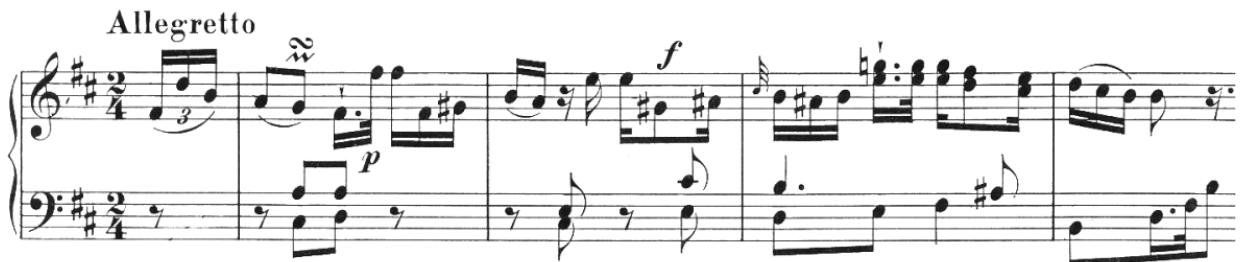
中文讲解
图例占位符(Example 3)。图注显示这是C. P. E. Bach《B小调奏鸣曲》Wq. 55/3 (H. 245)第一乐章第1-4小节,1774年作品,属于第一套’Kenner und Liebhaber’(鉴赏家与爱好者)系列。该图位于P0136音乐分析段落之前,其内容是作者讨论’旋律呈现recitative式特征’时所指的具体谱例;具体乐谱细节需参阅原图。
第10段(P0136)
原文复述
Taking a melodic line such as that of the first movement of the Sonata in B minor Wq. 55/3 (H. 245) (Example 3) – the first piece in the Kenner und Liebhaber collection – which through its fast, segmented line above a few accompanying chords displays some characteristics of recitative, the author finds it striking that the (barely singable) sentence consists of short, almost exclamatory phrases whose outline is ornamental to an underlying basic structure: a simple ascending scalar progression from f#1 on the second chord to d2 in m. 4 (itself complicated by being broken on a secondary level into an ascending fourth F#–B and a faster descending fourth that is doubled in thirds). At the harmonic level, the passage is famous for its ambiguity between B minor and D major. The melody therefore appears to proceed from error (opening with a retrospectively ‘false’ cadence) through conjecture to confirmation. That instrumental recitative or recitative-like melody may derive melodic and rhythmic contours from vocal recitative while remaining unsingable and sometimes highly ornamental – and thus far removed from a plain, secco conception of recitative – is already evident in the passage marked ‘Recitativo’ in J. S. Bach’s Fantasia Cromatica BWV 903.56 It is therefore difficult to identify passages that strike one as ‘recitativic’ by any objective criterion.
中文讲解
本段以谱例3(Wq. 55/3, H. 245第一乐章头4小节)作为第一个具体分析案例,落实P0129提出的’前景层面的韵律recitative特征’判断。
分析可分为四层。表层观察:旋律由快速、断续的线条加上少量伴奏和弦构成,呈现某些recitative特征;乐句短促、近乎感叹式,因此’几乎不可唱’(hardly singable)。
结构层:这些短句的轮廓实为装饰,其基本骨架是一条简单的上行音阶,从第二和弦的升f1上行到第4小节的d2;这一基本骨架在第二层次上又被分解为升F–B的上行四度和一个更快的、被三度重叠的下行四度。
和声层:该片段以B小调与D大调之间的调性含混著称。
叙事层:作者据此提出’从错误(开头的’假终止’)经推测走向确认’的叙事性解读,把recitative式的旋律与话语叙事结构勾连起来。
最后作者引入J. S. Bach《半音阶幻想曲》BWV 903中标注’Recitativo’的段落作为佐证:器乐recitative或类recitative旋律可以借鉴声乐recitative的轮廓与节奏,却保持’不可唱’并且高度装饰化——这与dry/secco型recitative相去甚远。由此得出本段的关键限定:仅凭主观听感判定一段为’recitativic’几乎没有客观标准,为下一段讨论韵律与语义的关系做铺垫。
补充说明
脚注56指出Schleuning 1973年强调过BWV 903这部作品对C. P. E. Bach《幻想曲》的重要性;这意味着作者用以类比的J. S. Bach片段不是随意选择,而是Bach父子美学传承中的关键节点。
第11段(P0137)
原文复述
In spoken language, prosody is influenced by emotion. This aspect is the easiest to ‘imitate’, as contemporary aesthetic writers like Sulzer/Schulz emphasise; Sulzer/Schulz advises the musician to study the tone of voice of people under the influence of various emotions, arguing that one may be able to guess the meaning even of sentences not understood.57 Prosody, however, no matter how complex, depends both on syntax and on semantics, since the two cooperate in shaping the functional relations of phrases. In the absence of semantics, the author wonders to what extent prosody resting on a purely musical ‘syntax’ can make a sentence or period ‘meaningful’. Attempts to set words to music – to music which itself imitates music set to words – may constitute interesting musicolinguistic experiments. Daniel Heartz has supplied a text for the first passage marked ‘Recitativo’ in the frequently cited second movement of the first ‘Prussian’ sonata (Wq. 48/1, H. 24, Example 4). His text consists of conventional operatic Italian lines:
中文讲解
本段是连接前文分析与下一段’配词实验’的过渡,承担两项任务。
第一,作者引入韵律学(prosody)的视角,说明在自然语言中韵律受情感影响,并且这是音乐最容易’模仿’的层面;Sulzer/Schulz的建议被援引为18世纪美学家的代表性立场——通过研究人在各种情感下的语调,演奏者甚至可以猜出听不懂的句子的含义。
第二,作者立刻限定这一类比的范围:韵律无论多么复杂,都同时依赖句法与语义;缺乏语义时,仅靠’音乐句法’支撑的韵律能否让乐句’有意义’本身就是一个开放问题。
由此引出Daniel Heartz为Wq. 48/1 (H. 24)第二乐章首段’Recitativo’所配的意大利语歌词,并把这种’为模仿’带词的’音乐再带词’的尝试称作’musicolinguistic experiment’。该例位于Example 4,将在P0142、P0145被进一步分析。
本段的功能是把’类recitative的旋律是否真有recitative式的表达’从纯美学问题,转化为可以用配词实验来检验的音乐语言学问题。
补充说明
脚注57指Sulzer 1771年《音乐中的表现》一文(参见注50),为韵律模仿情感论提供文献依据。Wq. 48/1是C. P. E. Bach六首’普鲁士’奏鸣曲的第一首,1740年作品。
第12段(P0138)
原文复述
55 Cf. Schleuning (1973) p. 74-78, Fox (1988) p. 125-126
中文讲解
脚注55。指引读者参见Schleuning 1973年第74-78页与Fox 1988年第125-126页,作为目前学界关于recitative影响范围零星讨论的代表性文献。该脚注对正文起限定性作用:暗示除这些’零星’评论外,尚无系统性研究。
第13段(P0139)
原文复述
56 The importance of this work for C. P. E. Bach’s Fantasias is highlighted by Schleuning (1973).
中文讲解
脚注56。指出Schleuning 1973年强调过J. S. Bach《半音阶幻想曲》BWV 903对C. P. E. Bach《幻想曲》的重要性。该脚注为P0136中J. S. Bach例证的选用提供支持,强调Bach家族内部的美学传承关系。
第14段(P0140)
原文复述
57 Sulzer (1771), article Ausdruck in der Musik (see note 50).
中文讲解
脚注57。出处为Sulzer 1771年《音乐中的表现》一文(参见注50)。该脚注支持作者引用Sulzer/Schulz关于研究情感下语调的劝告,对正文主张起支持作用。
第15段(P0141)
原文复述
C. P. E. Bach, Haydn, and the art of mixed feelings © Lodewijk Muns 2008 – p. 16
中文讲解
页眉/页脚信息。第16页,内容为书名、作者版权信息及页码。属版面标识。
第16段(P0142)
原文复述
Indegna! Ah perfida alma! ingrato core, m’abbandoni. Parto, e non ritorno mai. Ahime! io moro! 58
中文讲解
本段是Daniel Heartz为Wq. 48/1第二乐章首段’Recitativo’所配的意大利语歌词。大意为:‘不义!啊,背信的灵魂!忘恩的心,你抛弃了我。我将离去,永不再返。唉!我就要死去!’——典型的18世纪意大利歌剧宣叙调套语:呼语、指控、诀别、死亡预告依次出现。脚注58标示该文本来源(Heartz 2003, p. 404)。该段本身不是分析,而是P0145所讨论的’musicolinguistic experiment’的实验材料。
第17段(P0143)
原文复述
Example 4: C. P. E. Bach, Sonata Wq. 48/1:ii (H. 24) (1740), mm 1-11
中文讲解
图例标题(Example 4)。说明该谱例为C. P. E. Bach奏鸣曲Wq. 48/1 (H. 24)第二乐章第1-11小节,1740年作品。它是P0137和P0145配词实验所依据的乐谱本体,需参阅原图。
第18段(P0144)
原文复述
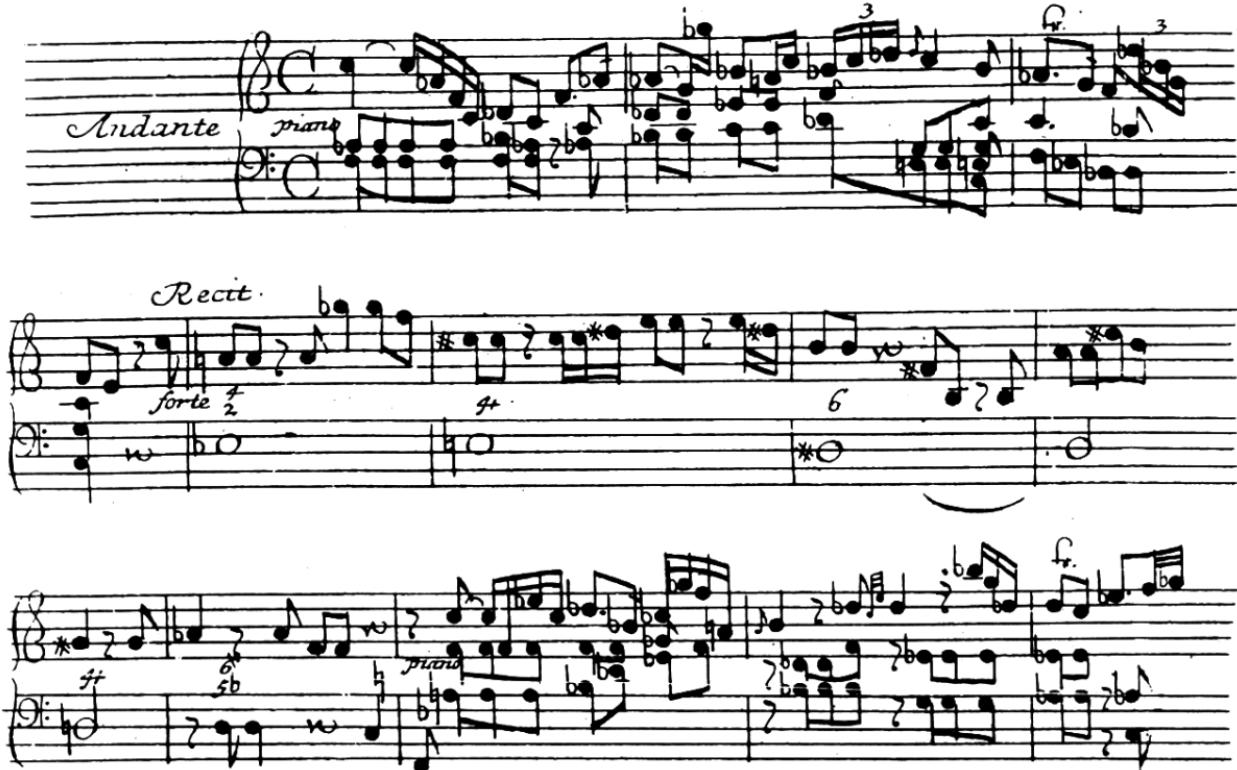
中文讲解
图例占位符(Example 4所在位置)。第17页的乐谱图像未在文本中显示具体内容,但由图注可确认其为Wq. 48/1第二乐章第1-11小节,是P0137-P0145配词实验的谱例依据;具体乐谱细节需参阅原图。
第19段(P0145)
原文复述
Heartz’s intention is simply ’to convey more of the operatic flavor.’ Indeed the recitative is operatic, and the Italian seems to fit well – though ‘alma’ does not do justice to the diminished chord, which would require something stronger than ‘perfida’, which in turn makes sense of the leap of a diminished seventh. What this seems to prove by the fact of its ‘correct fit’: given the language, the listener perceives phrase hierarchy, certain aspects of syntax, and even – through the harmonic direction of just a few chords – a remarkable explicitness of pragmatics (which some theorists will call ‘rhetoric’): exclamation (Indegna! Ah perfida alma!), conclusion (ingrato core, m’abbandoni); announcement (Parto, e non ritorno mai); aside (Ahime! – io moro!). Of course, this is stock recitative in a highly formulaic language. The author proposes to explore the margin for alternatives, to test how far the music really determines the scope of possible linguistic interpretation. Carrying the experiment one stage further, one may test against these German lines:
中文讲解
本段是本节的高潮与转折,承担对’配词实验’的批判性分析功能。
作者先承认Heartz的用意只是’传达更多歌剧味’,并指出该recitative确实具有歌剧性,意大利语也大致贴切。但他随即对’贴切’本身做出精微的批评:‘alma’无法撑住减七和弦所要求的强度,‘perfida’才勉强够分量,并使减七度跳进获得意义。
由此推出本节关键的认识论判断:给定语言后,聆听者可以感知到’短语层级’、‘句法’乃至通过几个和弦的和声走向而感知到’语用学/修辞学’的若干功能——呼语(Indegna! Ah perfida alma!)、结论(ingrato core, m’abbandoni)、宣告(Parto, e non ritorno mai)、旁白(Ahime! - io moro!)。
但作者紧接着以极重要的限定收束:这一切不过是’高度程式化语言中的程式化recitative’。换言之,Heartz的成功不证明音乐自身承载recitative结构,只证明在套语足够强的条件下,匹配变得几乎自动。
因此作者提出下一步:用德语(而不是程式化程度更高的意大利语歌剧套语)来测同样的乐段,看音乐本身在多大程度上’决定’可被语言化的范围。这一悬念留给了读者(同时也呼应P0137关于韵律对语义依赖性的疑问)。
本段的功能在于:用实验既证明了’musicolinguistic’的可能性,又揭示其边界——为下一个小节留下论证空间。
补充说明
脚注58指向Heartz 2003年第404页,是P0142意大利语歌词与P0145分析所用配词方案的原始出处。
第20段(P0146)
原文复述
58 Heartz (2003) p. 404
中文讲解
脚注58。出处为Heartz 2003年著作第404页,对应P0142和P0145中Daniel Heartz为Wq. 48/1第二乐章’Recitativo’段落所配的意大利语歌词及其分析。该脚注为正文中的配词实验提供原始文献来源。
第21段(P0147)
原文复述
C. P. E. Bach, Haydn, and the art of mixed feelings © Lodewijk Muns 2008 – p. 17
中文讲解
页眉/页脚信息。第17页,内容为书名、作者版权信息及页码。属版面标识。
脚注 / 边栏 / 图表 / 附加信息(如有)
本节附加内容包括:(1) 七个脚注——51-58,分别对应Schering 1938、C. P. E. Bach 1753、Bonds 1991b、Schleuning 1973、Fox 1988、Sulzer 1771、Heartz 2003等文献,承担原始出处与旁证功能;(2) 两个谱例——Example 3(Wq. 55/3, H. 245第一乐章mm. 1-4,1774年)作为’旋律呈现recitative式特征’的具体分析对象;Example 4(Wq. 48/1, H. 24第二乐章mm. 1-11,1740年)作为配词实验的载体;(3) Heartz所配的意大利语歌剧化歌词,作为音乐语言学实验材料。这些附加材料共同支撑本节’结构性与比喻性’双重问题的探讨。
💡 本节核心要点
- 本节的核心任务是对Schering 1938年提出的’redende Prinzip’进行批判性重估:作者承认’说’的存在,但拒绝将其等同于修辞学(Redekunst)或器乐的’语言学化’。
- 作者把’redende Prinzip’拆解为’结构性音乐句法’与’前景韵律特征’两条互不排斥的路径,并指出后者才是Schering本意;进一步用两条诘问(结构性的还是比喻性的?是否真的源自recitative?)取代笼统的接受。
- 以Wq. 55/3第一乐章为例,展示’类recitative’旋律的实质:短促、装饰、不可唱,但底层是一条从升f1到d2的上行音阶,且在B小调/D大调之间游移,由此读出’从错误到确认’的叙事结构。
- 以J. S. Bach《半音阶幻想曲》BWV 903中的’Recitativo’段为佐证,说明器乐recitative的旋律轮廓可来自声乐recitative却保持’高度装饰化’,与secco型recitative相去甚远。
- 韵律(prosody)虽依赖情感,但根本上仍受句法和语义双重塑造;缺乏语义时,仅靠音乐’句法’难以让乐句’有意义’,这为配词实验提供理论依据。
- Daniel Heartz对Wq. 48/1 ‘Recitativo’段的意大利语配词虽’贴切’,但贴切本身高度依赖程式化套语——这既证明音乐可在弱语义条件下被语言化,又揭示其边界,从而把本节论证引向下一节更严谨的对比检验。
🔑 关键术语
- redende Prinzip:Schering 1938年提出的核心概念,意为’说话原则’,指器乐应像声乐那样具有语法与句法,能像语言一样承载意义。本节中作者对该术语的合法性提出两点系统反驳。
- Redekunst:德语’修辞学/演说术’。作者强调Rede(说)有双重含义:一是说话能力(语法/句法),二是修辞学产品;本节主张不能将二者混淆。
- stilo parlante:意大利语’说话风格’,源自recitative的器乐风格,被假设为塑造C. P. E. Bach乃至古典风格的关键因素;本节对其实际影响范围提出质疑。
- Recitativo (Recitative):宣叙调。在C. P. E. Bach的器乐中表现为短促、近乎感叹式、装饰化且常常’不可唱’的乐句写作方式;本节探讨其作为风格来源的可识别边界。
- prosody:韵律学,指语调、重音、节奏等语言学特征。本节强调韵律虽受情感影响,但根本上仍依赖句法与语义——这是判断’类recitative旋律’能否’有意义’的关键。
- Redekunst / rhetoric (as pragmatic function):在本节中作为’语用学/修辞学功能’出现,作者用呼语、结论、宣告、旁白等修辞范畴解释短短几个和弦下的’语用显义度’。
- Secco recitative:干唱宣叙调,指一种’平淡、说话式’的宣叙调形态。本节用以对比:器乐的’类recitative’远非secco型,而是高度装饰、不可唱的复杂形态。
S2.2 [描述性拆分] Heartz’s Italian text and the Gerstenberg experiment
第1段(P0148)
原文复述
Auf ewig verlassen und verstoßen, alles Streben – war vergebens. Sei es denn: Ich geb’ die Hoffnung auf; es sei – zum Tode.
中文讲解
这是引自Gerstenberg为C.P.E. Bach C小调幻想曲所撰替代歌词中的一段(对应Hamlet的独白),全段以德文呈现。文本表达的是彻底绝望的心境:被遗弃、被永远放逐,所有奋斗皆成徒劳,最终以"es sei – zum Tode"(“那就以死结束吧”)作为绝望的决断。值得注意的是末尾的"es sei"——它既是绝望中的接受(“就这样吧”),又被推向极端的"zum Tode"(“以死”),形成语义上的滑落。这一句"es sei"正是下一段(P0149)所重点讨论的对象,因为它是终止前等音转换(enharmonization)的语言对应物。从"es sei"到"es sei zum Tode",语言本身的滑动恰如音乐中等音转换所引发的和声歧义。
补充说明
本段歌词中的"es sei – zum Tode"直接对应P0149段中所讨论的"verbal correlative for the enharmonization before the final cadence (’es sei …’)";P0149进一步把这段德文歌词与所谓"意大利文歌词"中的"指控性惊呼"进行对比。
第2段(P0149)
原文复述
The point is, of course, not to explain ’the meaning of the music’; the question is rather: to what extent does the music direct us to perceive certain kinds of linguistic structure? One improvement is found in the verbal correlate to the enharmonization before the final cadence (’es sei …’). Rather than directed speech, we have here a soliloquy; one may test within the movement which of the two readings fits better. The recitative is prepared in a particular way by an ‘orchestral’ introduction; within that introduction, the accusatory exclamations of the Italian text come across as too abrupt. The introduction’s melody has cantabile features, yet is hardly singable—more properly an oboe part—and assumes a complementary role to the ‘protagonist’ (which becomes especially clear in m. 9, where the minor cadence is contradicted by a continuation in major), though at the final cadence (to be improvised) the two may be imagined to join. Every performer of this piece is compelled to construct some kind of operatic interpretation along these lines.
中文讲解
这段开宗明义地提出本节的方法论立场:作者无意于解释"音乐的意义",而是要追问音乐究竟在多大程度上引导听众去感知某种特定的语言结构。这是一个细微却关键的区分——不是问音乐"说了什么",而是问音乐是否以及如何把我们推向某种"语言性"的理解。
围绕此立场,作者给出三个具体论据:
- 终止前等音转换的语言对应物。“es sei"既是独白(soliloquy)而非对白(directed speech),作者让读者自行在乐章内验证哪种读法更契合——这种开放性正是"语言结构"而非"确定意义"的体现。
- 宣叙调由"乐队式"引子特殊准备。在这引子中,意大利文歌词里那些指控性、惊呼性的句子显得过于突兀;这说明音乐自身的语汇(cantabile但不可唱的旋律)与歌词语言之间存在张力。
- 引子旋律的"互补角色”。旋律具有cantabile(歌唱性)特征却几乎不可唱——更接近双簧管的声部——扮演与"主角"互补的角色。这一点在第9小节尤其清楚:属音小调的终止被大调的延续所"否定"。但在最终终止(需即兴处理)处,引子与"主角"可能被想象为合流。
末尾的总结尤其重要:每一位演奏者都"不得不"(in the necessity to)沿着这些线索做出某种歌剧化的诠释。这里暗示演奏者的诠释行为是被作品结构本身所要求的——这不是任意的释义,而是音乐语言结构对演奏者的"指令"。
补充说明
本段提到的"es sei"直接对应P0148的德文歌词;“意大利文歌词"指的是Heartz所讨论的意大利原文文本,与Gerstenberg的德文替代文本形成对照;本段为本节确立了方法论基调,并预告了P0150-P0151关于Gerstenberg实验和Bach立场的讨论。
第3段(P0150)
原文复述
The poet Heinrich Wilhelm von Gerstenberg attempted to face similar questions by providing two alternative texts to be sung with the Fantasia in C minor Wq. 63/6:iii (H. 75), an experiment often discussed. C. F. Cramer first (in 1783) presented Gerstenberg’s text as an attempt to clarify how far one can ’empfinden’ something concrete with, e.g., a keyboard fantasia, or, as he put it, “ob auch bloße Instrumentalmusik, bey der ein Künstler nur dunkle leidenschaftliche Begriffe in seiner Seele liegen gehabt, einer Analyse in hellere bestimmtere fähig seyn sollte?” The fantasia is of course not a singable work; Cramer refers to it as a “cloud formation”. Gerstenberg’s vocal lines—monologues of Hamlet and Socrates pondering death—consist mostly of fragments of melody extracted from the original; Cramer has aptly (with some humour, and ambiguity, if not implicit criticism) described Gerstenberg’s procedure as picking up a foot here, an arm or an eye there, comparing the result to the mythical animal tragelaph. This surgical operation on the original work makes one thing very clear: that the melodic line of free fantasia is recitativic in a very extended sense. In fact, what is characteristic of this and other free fantasias of Bach is the constant ‘growth’ of melody out of broken chords, obliterating in many places any distinction of melody and harmony—an essential ambiguity which may have contributed much to the ’emancipation’ of instrumental music.
中文讲解
这段介绍了Gerstenberg的著名实验:他为C.P.E. Bach的C小调幻想曲(Wq. 63/6:iii,H. 75)撰写了两套替代歌词——分别是Hamlet和Socrates在沉思死亡时的独白。
作者首先通过Cramer 1783年的论述来定位实验的目的:检验能否在键盘幻想曲这样的纯器乐作品中"empfinden”(感受/体验)到具体的东西;能否把艺术家心中那些"dunkle leidenschaftliche Begriffe"(“模糊的、充满激情的概念”)分析为"hellere bestimmtere"(“更清晰、更确定”)的观念。Cramer把这首幻想曲比作"云朵形态"(cloud formation)——它本就不可唱。
Cramer又用幽默且带有隐含批评的方式形容Gerstenberg的工作方式:从原作里这里取一只脚、那里取一只手臂或一只眼睛,最后拼成的成品可比作神话动物tragelaph。
作者对这一"外科手术式"操作的解读是:它从反面清晰揭示了自由幻想曲的旋律线在极大延展意义上是"宣叙调式的"。Bach自由幻想曲的特征是旋律从分解和弦中不断"生长"出来,在许多地方消弭了旋律与和声之间的界线——这种本质性的暧昧(essential ambiguity)可能极大地推动了器乐的"解放"(emancipation)。
因此,Gerstenberg实验的价值不在于歌词本身写得好不好(作者在脚注中严厉批评其韵律拙劣),而在于它反向证明了:自由幻想曲的旋律本就具有宣叙调性质,且旋律/和声之间不存在硬性区分——这正是器乐"解放"的内在条件。
补充说明
本段中的"empfinden"和"dunkle leidenschaftliche Begriffe"等德文术语是Cramer原文中的关键概念,作者保留德文是为了精确传递术语;tragelaph的概念在P0152脚注60中得到进一步解释;“emancipation of instrumental music"是18世纪末器乐美学中的核心议题,本段为之提供了来自音乐本体的论据。
第4段(P0151)
原文复述
Surveying Gerstenberg’s experiment, the composer may have been reminded of the ‘honest painter’ he mentioned in a letter (1773) addressed to the same poet—a painter who naïvely wrote “Dies soll ein Vogel seyn” beneath his picture of a bird. (Had the painter written “Dies soll kein Vogel seyn”, he would have immortalized himself!) The letter is a reply to another proposal from the poet—that Bach undertake a collection of biblical-paraphrase sonatas. Bach’s response appears to convey a polite coolness. His positions on aesthetic issues are always formulated succinctly, or are implicit in practical advice. In the same letter he states that “we should not unnecessarily strive in the distance for what we have close at hand.” In declining a proposal to paraphrase existing texts as keyboard music, he upholds the view that instrumental music ought not to compete with vocal music. His Sanguineus und Melancholicus trio Wq. 161/1 (H. 79) is an exploration mainly of the pragmatic explicitness of musical sentences—‘programme notes’ that tell us when a question is asked, an objection made, etc. When he incorporated quasi-vocal recitative into his instrumental works, he purchased a measure of expressive precision at the cost of emotional authenticity; the more intimate Herzenserguß had to find less formulaic expressions, at the risk of being misunderstood.
中文讲解
这段把Gerstenberg的实验与C.P.E. Bach 1773年写给Gerstenberg的信联系起来。信中Bach提到一位"诚实的画家”——他在自己画的鸟下面天真地写上"Dies soll ein Vogel seyn"(“这应当是一只鸟”)。作者评论说,若画家写的是"Dies soll kein Vogel seyn"(“这不应当是一只鸟”),反倒能让自己不朽——这句妙语暗示了否定与超越之间的辩证关系:宣称"这是X"是笨拙的模仿,宣称"这不是X"却能揭示模仿行为的本质。
这封信是对Gerstenberg另一项提议的回复——Gerstenberg建议Bach做一套圣经释义奏鸣曲。Bach的回应礼貌而冷淡(polite coolness)。作者评价说,Bach对美学问题的立场总是措辞简洁,或者隐含在实践建议之中。同信中他表达的原则是"舍近求远实无必要"——拒绝用键盘乐去释义已有文本(那是声乐的事),坚持器乐不应与声乐竞争。
接着作者用Bach的两个作品作为佐证:
- Sanguineus und Melancholicus trio(Wq. 161/1,H. 79)——这是对"音乐句子之实用性明确性"的探索,相当于"节目说明"(programme notes),告诉我们何时提问、何时反对。
- Herzenserguß(“心灵倾泻”)——更亲密的器乐体裁,必须用更少程式化的表达,但有被误解的风险。
由此作者提炼出本段最重要的辩证论点:当Bach把准声乐的宣叙调纳入器乐作品时,他以牺牲情感真实性为代价获得了表达的精确性;而Herzenserguß这种更亲密的体裁需要较少公式化的表达,因此有被误解的风险。换言之,借鉴声乐语汇的精确性,与器乐自身的情感真实性之间存在张力——这正是Bach美学立场中尚未完全解决的困境。
补充说明
本段提到的"诚实的画家"轶事出自Bach 1773年的信;“舍近求远"原则在P0159脚注61中得到更字面的翻译;Sanguineus und Melancholicus trio和Herzenserguß两个作品分别代表Bach美学中两种不同的体裁取向。
第5段(P0152)
原文复述
59 Chrysander (1891), Helm (1972), Schleuning (1973) pp. 172-187, 218-225, Lütteken (1998) pp. 425-437, Plebuch (2006). In my view, commentators have generally been too respectful towards the poet—remaining silent on his abominable prosody (e.g., “de-er Verwe-esung na-ahe Stu-u-unde”); only Schleuning has made some justified criticism (pp. 220-221). An obvious mistake in Chrysander’s score—a missing tie in the phrase quoted on the E-flat on ’nahe’—is copied by Helm; Plebuch has the tie, but still misplaces the syllable ‘-he’. 60 Quoted after Chrysander (1891) pp. 2-4. Modern readers are more likely to think of Frankenstein’s monster. Plebuch (2006) has a very different interpretation. It seems obvious to me that the tragelaph, described as a stag with the beard of a goat, cannot have been meant as a paradigm of beauty.
中文讲解
这是合并的脚注59与脚注60。
脚注59是文献综述与作者自己的批评:作者列出讨论Gerstenberg实验的主要文献——Chrysander (1891)、Helm (1972)、Schleuning (1973)第172-187、218-225页、Lütteken (1998)第425-437页、Plebuch (2006)。作者提出自己的批评意见——评论者对Gerstenberg的诗人身份过于恭敬,对其"糟糕透顶的韵律”(abominable prosody)保持沉默。例证是"de-er Verwe-esung na-ahe Stu-u-unde"——把"Verwesung nahe Stunde"等词的音节强行拆开以凑韵律,是拙劣的诗艺。只有Schleuning做过一些有根据的批评(第220-221页)。此外作者指出Chrysander乐谱中一个明显的错误(’nahe’对应降E上的乐句缺少延音连线)被Helm原样复制;Plebuch虽然补上了连线,却把音节’-he’放错了位置。
脚注60是对Cramer的tragelaph比喻的补充:作者指出该引文出自Chrysander (1891)第2-4页,并提醒现代读者更可能联想到Frankenstein的怪物——Cramer的比喻在18世纪语境与当代语境下会产生完全不同的联想效果。Plebuch (2006)对这一比喻有完全不同的解读。作者明确表态:tragelaph被描述为"长着山羊胡子的鹿",显然不可能被当作"美的典范"——这加强了他对Gerstenberg实验的负面评价。
整个脚注的功能是双重的:一方面为P0150的论述提供文献来源,另一方面通过作者自己的批评(韵律、乐谱校对、tragelaph的解读),表明作者对Gerstenberg的诗人成就持严厉保留态度——他所看重的只是Gerstenberg实验在器乐美学上的反向启示作用。
补充说明
脚注59中提到的"nahe"对应降E上的乐句和’-he’音节错位,是文本校对细节,与P0150中Gerstenberg实验的具体歌词相对应;脚注60中提及的Frankenstein怪物联想,是与Cramer原典语境的对照。
第6段(P0153)
原文复述
C. P. E. Bach, Haydn, and the art of mixed feelings © Lodewijk Muns 2008 – p. 18
中文讲解
这是第18页的页脚/版权信息,标明该文为Lodewijk Muns 2008年的文章《C. P. E. Bach, Haydn, and the art of mixed feelings》(C.P.E. 巴赫、海顿与"复杂情感"的艺术),当前位于第18页。
第7段(P0154)
原文复述
2.2 Who’s speaking?
中文讲解
这是第2.2节的小节标题——“Who’s speaking?"(“谁在说话?")。这个看似简单的问题其实引出了器乐美学中一个根本性的本体论议题:当器乐曲"说话”(speak)时——以独白为主,偶尔对白——谁是那个说话的主体?这个"谁"不是指作曲家,而是指作品内部浮现出来的那个"声音”、“我”、speaker。本节的论证将围绕这一追问展开,把它与文学叙事学中的"叙述者"问题相互对照。
补充说明
本节与前文S2.1节(关于"说"的隐喻)形成衔接:前文已论证奏鸣曲与幻想曲可以"说话",本节则进一步追问说话者是谁,开启从"作品意义"向"作品主体"的转向。
第8段(P0155)
原文复述
If sonatas and fantasias come to speak—in monologue, less frequently in dialogue—there seem to be two broad consequences for instrumental music as ‘works of art’. First, the work appears less as an object, more as a process; form is not a scheme, but pattern resulting from activity. Second, the work acquires a psychological dimension by the presence of a speaker created in this speech, usually referred to as the ‘aesthetic I’ or ‘intelligibles Ich’.
中文讲解
这段提出了本节的核心论点。如果奏鸣曲和幻想曲可以"说话"(以独白为主,对白较少),那么对作为"艺术品"(works of art)的器乐而言,会产生两个广泛的后果。
第一个后果——本体论的转变:作品不再主要被视为静态的"对象"(object),而更多被视为"过程"(process)。形式不再是预设的图式(scheme),而是从活动中浮现出来的模式(pattern)。这是从"作品本体论"到"过程本体论"的范式转变。
第二个后果——心理维度的获得:作品通过这种"说话"而获得了一个说话者,通常被称为"审美自我"(aesthetic I)或"理智的我"(intelligibles Ich)。这两个术语都是德语美学传统中的专门术语,指作品中被创造出来却又具有主体性的那个"我"。
两个后果之间存在内在联系:一旦作品被视为过程,作品中就自然浮现出一个动态的"我";而这个"我"反过来又使"过程"概念有了具体的心理内容。这两个论点共同为后续的文学类比(P0156-P0158)和Bach案例分析奠定基础。
补充说明
“aesthetic I” / “intelligibles Ich"是德语传统美学概念;本节P0161脚注引用的November (2007)称之为"compositional persona”(创作人格),作为英文学界的对应术语。
第9段(P0156)
原文复述
The opposition of object (product) versus process conceptions in literature has been sketched by Northrop Frye. Sterne’s writing—especially in his masterwork Tristram Shandy—is (in an artful, contrived way) like talking, engaging with an imagined reader:
中文讲解
这段把文学理论中的"对象(产物)“与"过程"之对照引入器乐美学。北劳普·弗莱(Northrop Frye)曾勾勒过文学中这两种观念的对立。
作者举出劳伦斯·斯特恩(Laurence Sterne)的《项狄传》(Tristram Shandy)作为"过程文学"的典范——这部作品以一种人为的、不自然的方式(artful, contrived)像在"谈话”,与一个想象中的读者互动。
作者借此把器乐置于文学理论的对等框架中:正如《项狄传》是"过程"的文学,幻想曲和奏鸣曲也是"过程"的器乐。这种类比是为了把器乐美学问题(谁在说话?)与文学叙事学问题(叙述者是谁?)联结起来。下一段直接引用Sterne的文本作为类比基础。
补充说明
接下来P0157段将直接引用Sterne关于"写作即对话"的论述;P0162脚注引用Frye (1956) p. 145为这一对照提供原始出处。
第10段(P0157)
原文复述
“Writing, when properly managed (as you may be sure I think mine is) is but a different name for conversation: As no one, who knows what he is about in good company, would venture to talk all;—so no author, who understands the just boundaries of decorum and good breeding, would presume to think all: The truest respect which you can pay to the reader’s understanding, is to halve this matter amicably, and leave him something to imagine, in his turn, as well as yourself.”
中文讲解
这是Sterne《项狄传》中的一段直接引文。Sterne主张:写作如果做得好,不过是对话的另一名称——懂得谈话分寸的人不会滔滔不绝地说个不停,懂得礼仪的作者也不会把所有事情都替读者想清楚;对读者理解力最大的尊重,就是友好地各让一半,给读者留下想象的空间。
这段引文的功能是:从文学内部为"过程"观念提供权威背书。如果写作是对话,那么写作就是过程——它需要读者的参与才能完成。这与"对象/产物"观念形成对比:作品是放在那里被"消费"的成品。
作者借用Sterne是为了把器乐美学问题类比到文学:当器乐"说话"时,它也是在邀请听众参与一个"对话"过程——这与对象化的"作品"概念截然相反。同时,Sterne对"留白"的强调——不替读者想清楚一切——也对应了器乐演奏中即兴处理的空间(如本节提到的"final cadence to be improvised")。
补充说明
此引文出自Sterne (1760) p. 127 (Vol. II Ch. 11),见P0163脚注。
第11段(P0158)
原文复述
Of course, the one who is talking is a character created for the job, even if he carries the name of the author. The real-life author creates a persona which plays the part of narrator. Typical of ‘process’ literature is the foregrounding of the narrator as a thinking and speaking or writing person, by intrusions into the story or discourse, restricting or demolishing the idea of a story which ’tells itself’. A symptom are Sterne’s famous dashes or Gedankenstriche, which add to the apparent spontaneity and associative nature of the text. In the background stands the contemporary philosophy of mind, acknowledged by numerous references to John Locke. While ‘association of ideas’ was for Locke still an obstruction to reason, and therefore a form of ‘madness’ instead of a positive principle, it is in a sense a benign madness that reigns in Tristram Shandy, both at the level of story-telling and in the psyche of the characters—it all starts with an inopportune automated association of Tristram’s mother at the moment of his conception (the association, ironically, referring to an automaton, the family clock).
中文讲解
这段深入分析"过程文学"的特征,论点层次丰富:
- 即使叙述者顶着作者的名字(Tristram Shandy这部作品的主人公就叫Tristram),他仍是一个被创造出来的角色(persona)。真实作者与叙述者之间有一道不可化约的裂缝。这一论点对器乐美学的相关性在于:器乐中的"aesthetic I"也是被"作曲"创造出来的角色,不能等同于作曲家本人。
- “过程文学"的典型特征是把叙述者前景化(foregrounding)——他是一个思考、说话、写作的人,会闯入故事或话语之中,从而限制或摧毁"故事自己讲述自己"的观念。
- 一个具体表征是Sterne著名的破折号(Gedankenstriche),它增强了文本表面上的自发性与联想性——这与音乐中即兴处理的段落(如P0149提到的"final cadence to be improvised”)在功能上相似。
- 背景是当时的"心灵哲学"(philosophy of mind),Sterne频繁引用洛克(John Locke)。对洛克而言,“观念的联想”(association of ideas)仍是理性的障碍,是一种"疯狂"而非积极的原则。但在《项狄传》中,主宰一切的却是一种"良性的疯狂"(benign madness)——既体现在叙事层面,也体现在人物心理中。
- 一个具有反讽意味的例子:故事从Tristram受孕那一刻母亲的不合时宜的自动联想开始,那个联想所指涉的恰好是一个自动装置——家中的钟。“自动联想”(automated association)讽刺地指向了"自动装置"(automaton)。
这一段对理解器乐美学的意义在于:作者用Sterne-洛克的例子说明,“过程"作品中的叙述者既受联想机制的支配,又呈现为有意识的主体——这与器乐中的"aesthetic I"形成同构:那个"我"也是被创造的、看似自发、却又受某种内在逻辑(音乐语法)支配。
补充说明
Locke的"association of ideas"与Sterne的"benign madness"之间的对比,与P0155中提出的"aesthetic I"概念形成呼应——叙述者既是被创造的角色,又受联想机制支配,呈现为有意识的主体;这是本节从文学类比回到器乐美学的关键过渡。
第12段(P0159)
原文复述
61 More literally: “as long as we may have the more near-at-hand, we should not without necessity strive for the more distant” – “So lange wir das Nähere haben können, dürfen wir, ohne Noth das Weitere nicht suchen”, Suchalla (1994) p. 337. References to his a-typical ‘programmatic’ Sanguineus und Melancholicus trio seem to have touched a sore spot.
中文讲解
脚注61提供了P0151中Bach那句箴言的更字面翻译:“只要我们能够得到更切近的,就不应无必要地去寻求更遥远的”。作者引用德文原文"So lange wir das Nähere haben können, dürfen wir, ohne Noth das Weitere nicht suchen”,并标出来源为Suchalla (1994) p. 337。
脚注最后一句评论性的话指出:有人提及Bach那部非典型的"标题音乐"作品Sanguineus und Melancholicus trio,似乎触动了他的痛处(“touched a sore spot”)——这与正文中Bach的"polite coolness"态度形成呼应,暗示他对器乐标题化问题相当敏感。这也为正文P0151末尾关于该trio"实用性明确性"的讨论提供了情感背景。
补充说明
此脚注扩展P0151中Bach的"舍近求远"原则的字面含义,并补充了该原则背后的情感敏感性。
第13段(P0160)
原文复述
62 Dahlhaus (1967) pp. 465-6.
中文讲解
这是脚注62,仅引Dahlhaus (1967)第465-466页作为参考文献,与正文P0151末尾关于Herzenserguß"被误解的风险"的讨论相关——Carl Dahlhaus是20世纪德国音乐学的重要人物,此处被援引以支持关于器乐体裁中情感表达与程式化张力的论述。
补充说明
这是简短的文献出处脚注,作者未对其内容展开评述。
第14段(P0161)
原文复述
63 November (2007) speaks of a ‘compositional persona’ (p. 94).
中文讲解
脚注63简短指出:November (2007)在其著作第94页使用了"compositional persona"(创作人格)一词。这与正文P0155中提到的"aesthetic I"/“intelligibles Ich"是同义或近义的概念——作者在此提供一个英文学界对应的术语。
补充说明
此脚注补充P0155中的"aesthetic I"概念,提供了一个英文学界的对应术语。
第15段(P0162)
原文复述
64 Frye (1956) p. 145. In the Age of Sensibility “the sense of literature as process was brought to a peculiarly exquisite perfection by Sterne, and in lesser degree by Richardson and Boswell.”
中文讲解
脚注64给出Frye (1956) p. 145的引文:在"感性时代”(Age of Sensibility)中,“文学作为过程的感觉被Sterne以特别精致的完美呈现出来,其次则在Richardson和Boswell那里。”
这段引文为正文P0156中关于Sterne作为"过程文学"典范的判断提供了原始出处和直接引文支持。它同时暗示:“过程"文学并非孤立现象,而是18世纪后期英国"感性时代"文学潮流的一部分——这与本节讨论C.P.E. Bach所处的18世纪中后期器乐美学语境相互呼应。
补充说明
“Age of Sensibility"是Frye引文中给出的术语,指18世纪后期感性主导的英国文学时期;Sterne、Richardson、Boswell三人是该时期代表作家。
第16段(P0163)
原文复述
65 Sterne (1760) p. 127 (Vol. II Ch. 11). See also Michelsen (1962) p. 12.
中文讲解
脚注65给出P0157中所引Sterne段落的原始出处:Sterne (1760) p. 127(《项狄传》第二卷第11章)。并补充另一参考文献Michelsen (1962) p. 12,可能与Sterne文本的文学批评研究相关。
补充说明
这是文献出处脚注,与P0157中的Sterne引文相对应;Michelsen (1962)作为补充文献被援引。
第17段(P0164)
原文复述
C. P. E. Bach, Haydn, and the art of mixed feelings © Lodewijk Muns 2008 – p. 19
中文讲解
这是第19页的页脚/版权信息,与P0153相同格式,标明该文为Lodewijk Muns 2008年的文章,当前位于第19页。
脚注 / 边栏 / 图表 / 附加信息(如有)
本节末尾的脚注(编号59至65)构成了重要的附加材料层,主要功能包括:
- 脚注59综述了讨论Gerstenberg实验的主要文献(Chrysander 1891、Helm 1972、Schleuning 1973、Lütteken 1998、Plebuch 2006),并提出作者自己的批评(韵律、乐谱校对问题);
- 脚注60补充了tragelaph比喻的语境与现代联想(Frankenstein怪物),并表明作者对该比喻的负面解读立场;
- 脚注61给出Bach原话的字面翻译,并提示Sanguineus und Melancholicus trio触及了他的敏感点;
- 脚注62仅引Dahlhaus (1967)作为参考文献;
- 脚注63引November (2007)提出"compositional persona"作为aesthetic I的英文学界对应术语;
- 脚注64给出Frye关于"感性时代"文学作为过程的原始引文;
- 脚注65给出Sterne引文的精确出处并补充Michelsen (1962)。
本节无图表、乐谱或边栏等非正文材料。
💡 本节核心要点
- 本节的方法论起点不是解释"音乐的意义”,而是追问音乐在多大程度上引导听众去感知特定的语言结构——以终止前"es sei"处的等音转换为切入点,由此从音乐意义问题转向音乐如何"说话"的问题。
- Gerstenberg为Bach C小调幻想曲撰写Hamlet与Socrates的替代歌词实验,其价值不在于歌词本身(作者严厉批评其韵律拙劣),而在于它从反面揭示了自由幻想曲旋律本质上的宣叙调性质,以及旋律与和声之间界线的消弭——这是器乐"解放"的关键内在条件。
- C.P.E. Bach在1773年信中以"舍近求远实无必要"的原则,明确反对器乐模仿声乐去释义现有文本;他对器乐可以借用准声乐宣叙调持保留态度,认为这以牺牲情感真实性为代价换取表达精确性,而Herzenserguß等更亲密的体裁则需用较少程式化的表达,因而有被误解的风险。
- 当奏鸣曲与幻想曲"说话"时,作品本体论发生根本转变:从静态"对象"变为动态"过程”,形式从预设图式变为活动产生的模式;由此作品获得了一个心理维度,浮现出"审美自我"(aesthetic I / intelligibles Ich / compositional persona),即作品中被创造出来的说话主体。
- 这一器乐美学问题与文学叙事学形成同构:正如Sterne《项狄传》中的叙述者既是顶着作者名字的persona,又受联想机制支配而呈现为有意识的主体,器乐中的"aesthetic I"也是被作曲行为创造的、看似自发却受音乐语法支配的"我"。
- 过程文学的特征——叙述者的前景化、文本的自发性与联想性、读者参与的"对话"结构——为理解器乐中的过程美学提供了精确的类比框架,洛克"观念联想"哲学与Sterne"良性疯狂"之间的张力,则为器乐"说话"主体的内在逻辑提供了思想史背景。
🔑 关键术语
- enharmonization(等音转换):同音异名之间的转换;本节中与"es sei"处的语言滑动相对应——从"es sei"到"es sei zum Tode"的语义变化恰如音乐中等音转换所引发的和声歧义。
- recitativic / recitative(宣叙调式的 / 宣叙调):一种接近说话的歌唱风格;本节中指自由幻想曲旋律所具有的、在极大延展意义上的宣叙调性质——旋律从分解和弦中不断"生长"出来。
- aesthetic I / intelligibles Ich(审美自我 / 理智的我):德语美学传统中的专门术语,指器乐作品中被创造出来却又具有主体性的那个"我";November (2007) 在英语学界称之为"compositional persona"(创作人格)。
- tragelaph(半鹿半山羊):神话中的混合动物(“长着山羊胡子的鹿”);Cramer用此比喻Gerstenberg从原曲拼凑歌词的做法,作者认为它显然不可能被当作"美的典范"。
- Herzenserguß(心灵倾泻):C.P.E. Bach所使用的器乐体裁名称,强调内在情感的倾泻;与Sanguineus und Melancholicus trio形成对比——后者借用准声乐宣叙调以求"实用性明确性",前者则需用较少程式化的表达,因而有被误解的风险。
- process literature / object vs process(过程文学 / 对象与过程):Northrop Frye所勾勒的文学观念对照——作品被视为静态"对象"还是动态"过程";本节借此框架来理解器乐美学中由"说话"引发的本体论转变。
- Gedankenstriche(思想破折号):Sterne《项狄传》的标志性修辞特征,通过破折号增强文本表面上的自发性与联想性;与器乐演奏中即兴处理段落(如本节提到的"final cadence to be improvised")在功能上相似。
S2.3 [描述性拆分] 2.2 Who’s speaking?
第1段(P0165)
原文复述
The unfolding, in-process character of a literary work may thus depend on an authorial presence in the work. For the process of creating inner-work personas several terminologies are available; the author prefers to speak in terms of ‘framing’. If sonatas speak, more is happening than performer P playing a work for listener L; both construct an enclosed I which speaks from within the inner frame of the work. In various situations, different hierarchies of personas may be constructed in a recursive pattern. In practice, of course, one does not rationalize this process, and often a major attraction is to do the opposite, to let oneself be confused. Imagining Bach performing his Fantasia Wq. 63/6:iii (H. 75), a ‘frozen improvisation’, one may analyze a triple layering of ‘speaking voices’:
中文讲解
本段是’谁在说话’这一小节的总入口,作者由此引出他对器乐曲中’作者性在场’的分析框架。其核心主张是:文学作品那种’在过程中展开’的特征,可能正依赖于作品中某种作者性的存在;与此类似,奏鸣曲若被理解为’在说话’,那么所发生的事情比’演奏者P为听众L演奏作品’远为复杂——演奏者与听众共同建构起一个封闭的’我’(enclosed I),从作品的内在框架中发声。在不同的情境下,可递归地构造出不同层级的人格组合。在承认’实际演奏中并不会去理性化这种过程’的同时,作者也指出这种框架经验的一大魅力恰恰在于’反其道而行’——主动让自己被搞糊涂。接着他以 Bach 的《幻想曲》Wq. 63/6:iii(H. 75)作为’凝固即兴’的范例,引出下文将要分析的三层’说话声音’。因此本段的功能是:用’框架’一词统一人格层级理论,并以三重框架的预告把读者带入紧接其后的三个公式化例子。
补充说明
Wq. 63/6:iii 与(H. 75)是作者为 Bach 这部《幻想曲》所标的双重作品编号;作者在文中称该作为’凝固即兴’,并把它作为下文三重框架分析的实例。
第2段(P0166)
原文复述
Bach recreating [Bach creating (Wq. 63/6:iii’s inner voice) at his Silbermann clavichord].
中文讲解
这是第一层框架公式,用方括号嵌套表达三层关系。最内层是作品自身的’内在声音’(Wq. 63/6:iii’s inner voice)——即从乐曲内部生发出的、仿佛在’说话’的那个声音;中间一层是 Bach 作为作曲家在 Silbermann 古钢琴上’创造’这一声音的行为;最外层是 Bach 同时作为演奏者’再现’(recreating)他自己创作该作品的这一过程。整个公式刻画的是一个同一主体(Bach)既创作又演奏自身作品时,三层身份(演奏者—创作者—作品内在声音)同时叠合的特殊情形。这正是上一段所说的’三重层次说话声音’中最简化的形式。
补充说明
公式中明确出现’他的 Silbermann 古钢琴’,说明 Bach 是坐在自己的乐器前完成这一创作—演奏过程的。
第3段(P0167)
原文复述
If performer P plays the same piece, one may either replace the first Bach by P, or add an extra frame:
中文讲解
本句承上启下:上一段假设 Bach 同时是作品的创作者与演奏者;本句引入’如果另一位演奏者P来演奏同一首作品’这一新情形,并给出两种处理方法——要么把最外层的 Bach 替换为 P,要么在原有的三层结构之外再加一层新的框架。前者强调 P 在扮演 Bach 的角色(从而淡化历史距离),后者则强调 P 是一个独立的当代主体,他隔着一层’再现’关系来重演 Bach 当年的整个创作过程。这两种处理方式之间的差别,构成了接下来公式与讨论的方向。
第4段(P0168)
原文复述
P recreating {Bach recreating [Bach creating (Wq. 63/6:iii’s inner voice) at his Silbermann clavichord]}
中文讲解
这是 P0167 中提到的’加一层框架’后的完整公式。公式显示演奏者 P 在最外层’再现’(recreating)的是 Bach 整个’既演奏又创作’的过程,而后者又包含着作品本身的’内在声音’。三层括号嵌套({}、[Bach…]、作品内在声音)将四种身份层层包裹:当代演奏者—历史演奏者—作曲家—作品自身的’说话声音’。作者借此把’谁在说话’这一问题从单层的主体模糊化为人格递归,提示读者:任何一次演奏都不是一个单纯的’演奏者—作品’关系,而是一连串被’再现’的中介活动。
第5段(P0169)
原文复述
P may be unaware of the historic and stylistic dimensions of the piece, and think he’s simply playing ’the notes’. When on the other hand C. F. D. Schubart declares that in the act of recreation his ‘Ichheit wegschwindet’, he describes (as an aesthetic demand on the solo performer) the illusionary fusion of all the frames: the performer with the composer, who speaks directly from his work.
中文讲解
本段把上一段建立的多层框架理论与实际演奏经验对接,给出两种极端情形。其一是经验层面的’低限度’情形:演奏者 P 对乐曲的历史与风格维度毫不知情,自以为只是在’读谱奏音符’,框架结构被简化为最朴素的’演奏者—音符’关系。其二是理论层面的’理想融合’情形:Schubart 在谈到 solo 演奏者’再现’(recreation)活动时宣称其’Ichheit wegschwindet’(自我性消隐),这被作者解读为一种审美要求——所有框架在幻象中融合为一:演奏者与作曲家合而为一,仿佛作曲家从其作品中直接说话。两种情形的对照揭示了一个核心张力:在真实经验中,演奏往往处于’无意识弹音符’的极低端;而艺术上的最高要求却是’所有框架融为一体’。由此也暗示了下一段关于音乐’不连续性’所要讨论的’思想’维度。脚注 67 指向 Schubart(1806)p. 295。
补充说明
脚注 67 引自 Schubart(1806)p. 295,是支持’Schubart 关于 solo 演奏者自我性消隐’这一引文出处的文献依据。
第6段(P0170)
原文复述
As in a literary work the narrator may come to the foreground by his interrupting the flow of narrative, musical discontinuity may bring the idea of a ’thinking mind’ to the surface, inhibiting an autonomous musical discourse, an automated grammar, so to speak. Bach’s play with discontinuity has often been described, but insufficiently explained, as ‘wit’. ‘Psychologizing’ discontinuity cannot be an excuse for mere incoherence — a bad piece doesn’t become good by an ‘aesthetic I thinking that way’. Incoherence on one level must be structurally motivated or balanced on another (as the contrasts in dynamics and shape in Example 3 are ornamental to a simple basic line). This psychologizing adds an element of drama to the music. Like in the more naturalistic traditions of acting an actor’s line is the expression of a thought which must appear to have occurred before the line is spoken, in the performance of Bach’s more capricious and ‘speaking’ works the contrasts should appear to come from a thinking mind. This may add to an understanding why Bach and contemporaries routinely speak of ‘musikalische Gedanken’ instead of themes or phrases — though with a catch. In ‘speaking’ the musical works offer the ’lines’ — not the ’thoughts’, though in the absence of a concrete semantic dimension, a separation of one from the other would be futile. It leaves however the possibility that the musical ‘utterance’ is untrue or insincere, or more generally, that the utterance is not a total communication, that something is left at the back of the ‘speaker’s’ mind. Such seems to be the case in Wq. 61/1 quoted above (Example 1), and in many other works that seem to put thematic material between quotes, as one Gedanke in a complex of vermischte Gedanken, some of which may not be expressed. The idea of something not expressed, which seems to speak in the rests, is often suggested by Bach’s ‘discontinuity’. While it is (or should be) a dogma of music analysis to refrain from speculations on ‘composer’s intentions’, by assuming that such intentions are realized in the work, analysis may fail if it doesn’t account for the possibility of an authorial presence in the work, an ‘I’ that does the ‘speaking’. Such an inherent ‘intention’ may manifest itself in the cracks and breaks, where structural integrity seems in doubt. Often, such discontinuity may be interpreted as irony; the concept of irony in a musical work cannot be sustained without an authorial presence implied, as it involves reflection or comment — and thereby surface meaning and deep meaning. Whether something strikes us as just ‘odd’ or ‘profound’ largely depends on our willingness to project an authorial meaning into it. The amount of Empfindung which Bach invested in his work is stressed in similar wordings by himself and others:
中文讲解
本段是本小节论证的高潮,把’框架/说话声音’理论与具体的音乐修辞(不连续性)联系起来,并由此进一步阐明作者为何坚持’作者性在场’是分析的前提。可分若干层理解:(一)从类比出发——在文学中叙述者通过打断叙事流来到前景,音乐中的’不连续性’则把’思想中的心灵’(thinking mind)带到表层,抑制一种’自动语法’式的自律音乐话语。Bach 对不连续性的运用常被描述为’机智’(wit),但作者认为这种描述尚不充分(脚注 68 指向 Wollenberg 1988a 等参考)。(二)作者对’心理化’(psychologizing)的不连续性设定严格条件:它不能成为无连贯性的借口;一个坏作品不能因’美学之我这样想’而变好;某一层面上的不连贯必须在另一层面被结构性动机所驱动或被平衡(如 Example 3 中力度与形体的对比只是装饰于一条简单的基本线条)。(三)由此产生的不是任意,而是’戏剧性’——并因此类比于自然主义表演传统中演员的台词应当’看起来在说之前就已经在思考’,Bach 那些更为乖僻和’说话’的作品中,对比也应当仿佛来自某个正在思考的心灵。(四)这有助于解释为何 Bach 与同时代人惯于谈论’musikalische Gedanken’而非主题或乐句——但带有一个限定:音乐作品提供的是’台词’(lines)而非’思想’(thoughts);然而在缺乏具体语义维度的情况下,硬要把两者分开也无意义。(五)‘说话’的音乐因此保留了另一种可能:话语可能是’不真实’或’不真诚’的,更一般地说,并非’完全交流’——‘说话者’心中留有未说出的东西。Wq. 61/1(Example 1)以及许多把主题材料置于引号之中的作品——一个 Gedanke 出现在 vermischte Gedanken 的复合体里,其中某些甚至未被表达——都是这种情形。Bach 的’不连续性’常常暗示一种’在休止中说话’的未被表达之物。(六)由此回到分析学的方法论:禁止揣测’作曲家意图’虽是(也应是)分析学的戒律,但若假定这些意图已经实现在作品中,则分析若不能为作品中’正在说话’的’我’留出位置,就会失败——这一内在’意图’可能正是在结构完整性受到怀疑的裂缝与断裂中显现出来。(七)这种不连续性常被解读为反讽;音乐中的反讽概念无法脱离作者性在场,因为它涉及反思与评注——亦即表层意义与深层意义的并存。一段音乐让我们感到’怪异’还是’深邃’,很大程度上取决于我们是否愿意把作者性意义投射进去。最后一句作为引语铺垫,预告紧接其后的 Bach 本人关于 Empfindung 的自述。
第7段(P0171)
原文复述
Footnote 66: On Sterne and Locke see Cash (1955). The author is not convinced of Cash’s arguments against associationism, especially since his Lockean ’train of thought’ concept remains vague. It seems Sterne ignored Hume’s concept of association of ideas.
中文讲解
这是 P0165 文本的脚注 66,针对作者在文学—心理学论域中提到的’Sterne 与 Locke’的背景文献给出参考(Cash 1955),并加入作者自己的批评:作者对 Cash 反联想主义的论证并不信服,因为其中洛克的’思想流’(train of thought)概念仍然含糊;同时指出 Sterne 似乎忽略了 Hume 的’观念联想’概念。其作用是为前一段的’思想流’类比提供一个有保留的学术参照,并提醒读者该理论坐标本身仍存争议。
第8段(P0172)
原文复述
Footnote 67: Schubart (1806) p. 295.
中文讲解
这是 P0169 中 Schubart ‘Ichheit wegschwindet’ 引文出处的脚注 67,仅给出文献定位:Schubart(1806)第 295 页。其作用是为’所有框架的融合’这一审美要求提供一手文献依据。
第9段(P0173)
原文复述
Running header: ‘C. P. E. Bach, Haydn, and the art of mixed feelings © Lodewijk Muns 2008 – p. 20’
中文讲解
这是本页(第 20 页)的版心页眉,仅起到标识文章标题、作者版权与页码的作用,与正文论证无关。
第10段(P0174)
原文复述
„Ich bin gewohnt, bey allen meinen Compositionen, so gar bey blosen Instrumentalsachen, wen sie auch noch so klein sind, vielleicht mit mehrerer Empfindung zu denken, als viele andere Componisten: […]
中文讲解
这是紧接 P0170 末尾所预告的引语开篇,原始文字为德语,作者称之为 Bach 本人关于 Empfindung 的自陈。中译大意:‘我习惯于,在我所有的作品中——即便是那些仅仅为乐器而作的、再短小不过的作品——以比许多其他作曲家更多的 Empfindung 去思考:[……]’。引文中的 Empfindung 一词至关重要,正是下一段 P0176 中作者加以重新阐释的对象;这里的关键词还有’仅仅为乐器而作’(blosen Instrumentalsachen)这一限定,它直接关系到本节’纯器乐曲也能有说话人’这一论题。
补充说明
原文保留 18 世纪德语拼写(bey、so gar、wen、der mehresten 等),是历史文献的典型用字。
第11段(P0175)
原文复述
[…] daß die Ursache der überaus seltenen Stärke, die in manchem Ausdruck war, und die viele Leute mehr in Bewunderung setzte, als daß sie es recht fühlten, daß diese blos darinnen liege, daß Herr Bach vieles weit stärker und lebhafter bey der Arbeit empfunden habe, als die mehresten Menschen im Stande sind, nach zu empfinden.
中文讲解
本段是 P0174 引文的延续,仍是德语原文。中译大意:’[……]那种罕见的力量——它显现在某些表达之中,让许多人与其说真正感受到它,不如说对之赞叹——其原因仅仅在于:巴赫先生在创作时所感受的东西,远比大多数人能够事后再次感受到的更强烈、更生动。’。这段话出自他人对 Bach 的描述,强调 Bach 在创作当下所经历的 Empfindung 比一般听众事后所能’再感受’的还要强烈鲜活。作者正是要用这段材料支撑下一段的诠释:Bach 的强烈并非简单的情感夸张,而是与作品内在复杂性相关的’质’。
第12段(P0176)
原文复述
Though one may interpret such passages as pointing simply to a superlative intensity of feeling, there may be an implied argument about the quality. The expression realized by Bach in some of his works is not one that explains itself, as an extreme sentimentalism, but an intensity created by complexity.
中文讲解
本段是对前两段 Bach 与 Reichardt 两段关于 Empfindung 引语的诠释。作者明确指出两条理解路径:表层路径是把这些段落读作 Bach 的’情感强度无与伦比’,但作者认为更应关注的,是其中潜藏的关于’质’(quality)的论辩——Bach 在某些作品中所实现的表达,不能被简单地自我解释为’极端感伤主义’,而是一种’由复杂性所创造的强度’。本段因此将 Empfindung 从单纯的情感量度提升到与作品结构性复杂度相联系的审美范畴,为下文继续讨论不连续性、戏剧性与反讽提供关键概念过渡。
第13段(P0177)
原文复述
Footnote 68: E.g. Wollenberg (1988a).
中文讲解
这是 P0170 中关于’Bach 对不连续性的运用常被描述为 wit’这一主张的脚注 68,引用 Wollenberg(1988a)作为代表性参考文献。其作用是把’机智(wit)‘这一描述性术语的代表性研究指向读者。
第14段(P0178)
原文复述
Footnote 69: Bach (Letter of 1779), Reichardt (letter publ. 1774), in Suchalla (1994) p. 729, 465.
中文讲解
这是为 P0174–P0175 两段 Bach 与 Reichardt 引语提供出处的脚注 69:Bach 的信(1779 年)与 Reichardt 的信(1774 年发表),均转引自 Suchalla 编(1994)第 729 页与第 465 页。其作用是为’Bach 在创作中投入 Empfindung’的核心一手材料提供文献定位。
第15段(P0179)
原文复述
Running header: ‘C. P. E. Bach, Haydn, and the art of mixed feelings © Lodewijk Muns 2008 – p. 21’
中文讲解
这是下一页(第 21 页)的版心页眉,与 P0173 同类,仅起到标识文章标题、作者版权与页码的作用,与正文论证无关。
脚注 / 边栏 / 图表 / 附加信息(如有)
本小节包含四处附加材料:脚注 66(P0171)针对’Sterne 与 Locke’的文学—心理学背景文献(Cash 1955)作了带保留的批评性指引;脚注 67(P0172)为 P0169 中 Schubart 关于’Ichheit wegschwindet’的引文提供原始出处(Schubart 1806, p. 295);脚注 68(P0177)将’Bach 对不连续性的运用常被描述为 wit’这一流行说法指向 Wollenberg(1988a)等代表性研究;脚注 69(P0178)则同时为 P0174(P0170 引语开篇)与 P0175(他人评 Bach)两段德语引文给出文献定位(Bach 1779 年书信、Reichardt 1774 年发表的信,均见 Suchalla 1994, pp. 729, 465)。此外 P0173 与 P0179 为同一文章第 20 页与第 21 页的版心页眉,仅用于版面标识。
💡 本节核心要点
- 作者性在场与框架理论:器乐曲的’展开性’和’在说话’依赖于一个作品中能递归嵌套多重人格的’框架’结构,作者在多种术语中选定’framing’作为统称,并以 Bach《幻想曲》Wq. 63/6:iii / H. 75 的’凝固即兴’作为范例。
- 三重框架公式:同一主体 Bach 既创作又演奏时呈现’Bach 演奏 [Bach 创作(作品内在声音)]‘的三层叠合;当代演奏者 P 加入后递归出’P 演奏 {Bach 演奏 [Bach 创作(作品内在声音)]}‘的四层结构。
- 两种极端演奏情形:经验上 P 可能只知’弹音符’;审美理想上则要求’Schubart 式’自我性消隐——所有框架在幻象中融为一体,使演奏者与作曲家合而为一。
- 音乐不连续性即’思想中的心灵’的表层化:Bach 的’机智’是不连续性被不充分描述的结果;‘心理化’的不连续性不能成为无连贯性的借口,必须在另一层面被结构性动机所平衡。
- 音乐’说话’可能不真诚:musikalische Gedanken 提供的是’台词’而非’思想’,保留了’话语’不真实、不完全交流的可能;Bach 的不连续性常暗示’休止之中说话’的未被表达之物(vermischte Gedanken)。
- 反讽与 Empfindung 的重新阐释:音乐中的反讽预设作者性在场(反思—评注—表层/深层意义并存);Bach 所投入的 Empfindung 不仅是情感的强度,而是一种’由复杂性所创造的强度’。
🔑 关键术语
- Framing(框架):作者在多种描述’作品内部人格’的术语中所选定的核心术语,指作品内部多重人格(演奏者—作曲家—作品自身声音等)以递归方式构造的层级结构。在本节中用于解释器乐曲’在说话’时所产生的多层中介。
- Authorial presence(作者性在场):指作品内部隐含的、仿佛正在’说话’的’我’。本节中它是分析器乐曲修辞(不连续性、反讽、Empfindung)的前提;作者认为不承认它,分析将失败。
- Frozen improvisation(凝固即兴):作者对 Bach《幻想曲》Wq. 63/6:iii / H. 75 的描述,强调该作以即兴精神写成却以严谨谱面留存的特性。它是本节’框架理论’展开的实例化对象。
- Wq. 63/6:iii / H. 75:作者在文中为 Bach 那部被称作’凝固即兴’的《幻想曲》所给出的双重作品编号,是本节用以演示三重’说话声音’分析的具体乐例。
- Silbermann clavichord(西尔伯曼击弦古钢琴):在三重框架公式中作为 Bach’创造作品内在声音’的具体场景出现,表明 Bach 是坐在自己的该乐器前完成创作—演奏过程的。
- Musical discontinuity(音乐不连续性):在本节中被作者用来揭示作品背后’思想中的心灵’的表层化方式。Bach 对其运用常被简称为’机智’(wit),但作者认为还需以’心理化’与结构性平衡加以解释。
- Musikalische Gedanken(音乐思想):Bach 与同时代人对作品单位的惯用称呼。作者借此把’主题/乐句’的单位分析转向’思想’单位;但带有限定:音乐作品提供的是’台词’而非’思想’本身。
- Vermischte Gedanken(混杂思想):本节用以指代作品中互相混杂的多个 Gedanke 复合体,其中某些’思想’可能并未被直接表达,是 Bach’不连续性’修辞中的关键概念之一。
- Empfindung(感受/情感):本节后半部分 Bach 与 Reichardt 引语中的关键词,作者将其从单纯的情感强度重新诠释为’由作品内在复杂性所创造的强度’,与’作者性在场’理论相互呼应。
- Ichheit wegschwindet(自我性消隐):Schubart(1806)对 solo 演奏者’再现’活动的描述,作者将其读作一种审美要求:所有框架在幻象中融合,演奏者与作曲家合而为一,作曲家从其作品中直接说话。
S2.4 [描述性拆分] Authorial presence, irony, and the ‘aesthetic I’
第1段(P0180)
原文复述
Among modern commentators, Mark E. Bonds speaks of the fusion of serious and comic as an ‘ironical’ undermining of ‘aesthetic illusion’, which I consider a rather unfortunate term (in spite of its credentials) for what I have described above in different terms as the ‘framing’ of auctoriality (and by consequence reader-/listenership).70 Contrary to Bonds, as I have argued above I do think that in works of this period the music implies an ‘aesthetic I’, which of course does not have to be a narrator – there are other speaking modes than story telling – and I do not think his comparison of genre to ’narrative convention’ adds to our musical understanding. Musical genre is not an alternative to the literary narrator – it is an alternative, vaguely, to literary genre. Only a pathological listener-reader-spectator is under an “aesthetic illusion” that the literary or musical art work is not something artificial, or in a state of “willing suspension of the consciousness of [his] physical presence”.71 Involvement in the imagined action in no way replaces consciousness of one’s real being. As illustrated abve, an awareness of the physical component in one’s emotional life is very much part of period aesthetics.
中文讲解
本段集中处理作者与Bonds的术语分歧,并提出自己的一套关键概念。
-
术语之争:Bonds把"严肃—诙谐的融合"解释为对"美学幻觉"(aesthetic illusion)的"反讽性"瓦解。作者承认Bonds的术语有其学术渊源,但仍认为这一说法"相当不幸"——他在前文已用"作者性的框架化"(framing of auctoriality)描述同一现象,连带读者/听者的位置也被同步"框架化"。
-
正面主张:作者明确反对Bonds,坚持认为此时期音乐蕴含一个"美学我"(aesthetic I),并随即限定:它不必等于叙述者,因为"说话的方式"不止讲故事一种——这是反驳"音乐即叙事"的关键。
-
体裁与叙事的关系:作者不接受Bonds把"体裁"比作"叙事惯例"。他给出一个精确的类比:音乐体裁对应的不是文学中的"叙述者",而是(粗略地)文学中的"体裁"——二者属于同一范畴层级,不应跨范畴并列。
-
拒绝"美学幻觉":作者以近乎讽刺的口吻指出,只有"病态的"听者—读者—观者才会把艺术作品当成"非人工之物",或处于"自愿悬置对自己物质性在场之意识"的状态。沉入作品所想象的行动,绝不替代对自身真实存在的意识。
-
与全书主题的呼应:段末将"对自身物质性—情感性的意识"明确归入"该时期美学"(period aesthetics)的组成部分,与前文关于情感生活中物质性成分的讨论形成闭环。
理解提示:Bonds借自文学叙事学的"美学幻觉"概念,在作者看来掩盖了音乐中"美学我"主动发声、构建框架的事实,因此被弃用。
补充说明
原文"abve"为"above"的笔误,复述保留原文拼写。 段尾脚注编号70、71指向Bonds 1991a的著作,具体脚注内容见后文P0182与P0183。
第2段(P0181)
原文复述
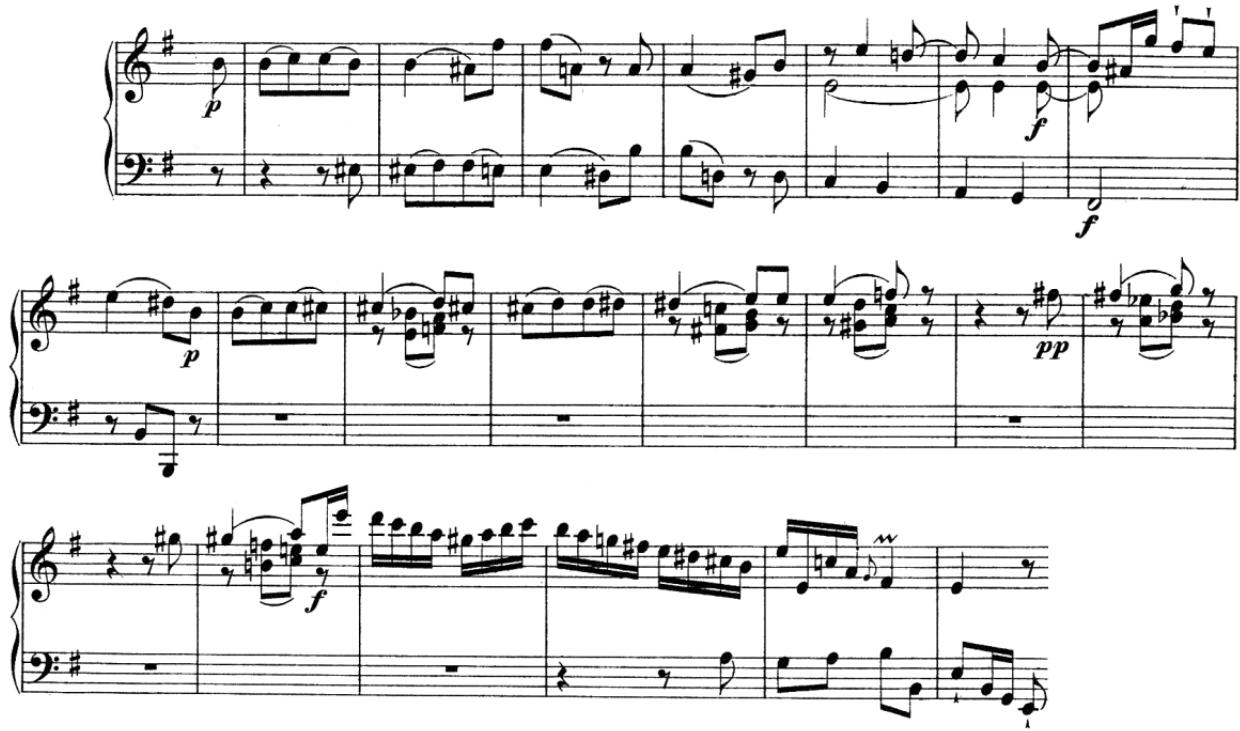
中文讲解
此为图示占位段落,对应"例5"的图注,标题文字与说明文字并列出现,正文内容截断于"acompaniment in"(续写见P0185)。
-
谱例定位:C. P. E. 巴赫《奏鸣曲》Wq. 59/6(H. 284,1784年),Allegretto段落第17—37小节。
-
音乐学定性:该作属《为行家与爱好者而作》(Kenner und Liebhaber)第五集中的C大调幻想曲,是偏离"自由幻想曲"(freye Fantasie)概念、向回旋曲靠拢的作品之一。作者用一比喻刻画其内在张力:“幻想曲与回旋曲之间的争吵”——两种体裁逻辑在作品内部相互角力。
-
第一Allegretto段落的修辞效果:由于旋律"过分可预测的模进"性质,段落趋于"过度的感伤"(excessive sentimentality);而"随意的琶音伴奏"(casual arpeggio accompaniment)则引出下文P0185所述"自由、近乎宣叙调式的、近乎即兴的演奏"姿态。
-
该段在本节论证中的作用:这一谱例是前文"美学我"与"作者性框架化"的实证支撑——作者让音乐自我暴露其体裁逻辑的内在矛盾,从而演示"美学我"如何从结构内部站出来说话。
阅读提示:图像数据未呈现,需查看原谱才能核对音乐细节;图注文字续写见P0185。
补充说明
原文"acompaniment"为"accompaniment"的拼写错误,复述保留原文拼写。 段落使用Markdown图像语法[图像说明:caption]承载图注;圆括号中的"[内嵌图像数据已省略;位置与图注保留]“为编排注记,提示图像本体未载入,故本段以图注文字而非音符本身立论。
第3段(P0182)
原文复述
70 Bonds (1991a) p. 57.
中文讲解
正文脚注70,对应P0180第一句中关于Bonds将"严肃—诙谐的融合"称为"对美学幻觉的反讽性瓦解"的论断。该脚注仅标明出处页码:Bonds 1991年发表的著作a第57页。
它是一条来源注(reference note),其功能是为正文中的术语之争提供文献坐标,不引入新主张。读者若要核对Bonds的原话与上下文,可直接查阅该页。
第4段(P0183)
原文复述
71 Bonds (1991a) p. 81. One may insist on the distinction of ‘aesthetic illusion’ from other kinds of illusion. This does not make the concept more illuminating. The abbé Dubos already wrote with lucidity against the concep of illusion as spectator’s attitude, see Réflexions critiques sur la poésie et la peinture, 1755, URL = http://visualiseur.bnf.fr/Visualiseur?Destination=Gallica&O=NUMM-88225, p. 429
中文讲解
正文脚注71,但本注并非纯文献注,而是包含作者本人的扩展评论与更早的旁证。
-
出处:仍指向Bonds 1991a第81页,对应P0180中"willing suspension of the consciousness of [his] physical presence"这一引语。
-
作者的旁注:作者允许读者坚持把"美学幻觉"与其他种类的"幻觉"区分开来,但随即判定——这种区分"并未使该概念更具启发性”。换言之,在作者看来,无论怎样精细化,“美学幻觉"这一框架本身仍遮蔽了"美学我"的结构功能。
-
更早的旁证:作者进一步把反对意见推至更早的源头——Abbé Dubos(杜博斯)在1755年《论诗与画的批评反思》中已"清晰有力地反对将’幻觉’视为观者态度的概念”。这等于说:把审美活动解释为观者进入"幻觉"的思路,在Bonds之前就已被驳斥,而非Bonds的原创洞见。
-
文献形式:脚注中给出Dubos著作的法国国家图书馆Gallica数字资源URL,可在线查阅。
理解要点:这条脚注不仅是来源注,更是论辩的一部分——它把作者对"美学幻觉"的拒斥从"我个人不喜欢"升级为"这一概念在思想史上站不住脚"。
补充说明
原文"concep"为"concept"的拼写错误,复述保留原文拼写。 脚注中出现的URL指向法国国家图书馆Gallica数字化平台上的1755年原书,供读者直接调阅Dubos的论证。
第5段(P0184)
原文复述
C. P. E. Bach, Haydn, and the art of mixed feelings © Lodewijk Muns 2008 – p. 22
中文讲解
页眉/页脚性质的非正文文字:左侧为论文标题"C. P. E. Bach, Haydn, and the art of mixed feelings",后接版权信息"© Lodewijk Muns 2008",最末为页码"p. 22"。
功能纯粹是版面识别与版权声明:让读者随时知道自己读到第几页,并提示全书版权归属与年份。本身不承载论证信息。
第6段(P0185)
原文复述
the first measures invites a free, recitativic and quasi-spontaneous performance. In the continuation (Example 5), it looses direction altogether – as if the improviser starts wondering how long one can continue a sequence in good taste – taking a break and trying one repeat more. The dramatic employment of rests is very much like that in the Sanguineus-Melancholicus trio, bringing the ‘speaking I’ obviously in the foreground. An ironic destruction (some would say ‘deconstruction’) of expressive value runs parallel with a destruction of the structural validity of clichés.
中文讲解
本段续写P0181的图注,对例5的音乐展开修辞性描述。
-
开头几小节的演奏姿态:随意的琶音伴奏"邀请"一种自由的、近乎宣叙调式的、近乎即兴的演奏——与谱面所记"过分可预测的模进"形成张力,暗示演奏者要"装作"在即兴。
-
续写中的"迷失方向":到了例5所示的续写段落,音乐完全失去方向。作者拟人化地描述:好像即兴者自己也怀疑"按审美趣味一条模进到底能撑多久"——于是"歇一口气",再尝试"再来一遍"。这是把"美学我"从作品外部移到作品内部:演奏过程本身成为作者自我暴露的对象。
-
休止符的戏剧性运用:休止符的戏剧化处理与前文讨论过的"乐观—忧郁三重奏"(Sanguineus-Melancholicus trio)十分相似,明确把"说话的我"(speaking I)推到前景。这里的"说话的我"与P0180的"美学我"互为呼应——后者是理论名称,前者是音乐修辞效果的具体呈现。
-
反讽性瓦解:作者明确把这种做法称为"反讽性瓦解"(ironic destruction),并注明有人会改用"解构"(deconstruction)。它同步发生在两个层面:表层是表现价值的瓦解(感伤的模进不再感人),深层是陈词滥调(clichés)之结构合法性的瓦解。这一双层瓦解正是"美学我"介入作品的标志——它不只在"说",而且在"拆"。
理解要点:本段是前页P0180抽象论断的具体化——“美学我"通过休止符、自我怀疑的即兴姿态、对感伤模进的戏仿现身。
补充说明
原文"looses"为"loses"的拼写错误,复述保留原文拼写。 “Sanguineus-Melancholicus trio"指作者前文讨论过的C. P. E. 巴赫某三重奏,本节对其休止符手法形成呼应。
第7段(P0186)
原文复述
Auctorial involvement is most obviously expressed in Wq. 66 (H. 272), Abschied von meinem Silbermannischen Clavier (1781), and Wq. 67 (H. 300) (1787), titled Bachs Empfindungen in the version with violin accompaniment (Wq. 80 / H. 536), a rondo and a fantasia which playfully confound frames by integrating the author into the title (thus making the author, and in the first of these his favorite instrument, a ‘character in the piece). A comparable play with the frames of author, implied author, and title is Sterne’s publication of his sermons under the title The Sermons of Mr. Yorick. Here an already deceased character in one work (Tristram Shandy), promoted to narrator of another work (Sentimental Journey), is credited with the authorship of real life non-fictional works (with a second title page correctly identifying the author and a - shamessly opportunistic - excuse in the preface).72 Sterne may be have been ironizing his persona as a clergyman or not – it is difficult to determine. A function of Sterne’s irony seems to be to raise the consciousness of our role playing, both amplifying its scope and confounding role definitions. In sociological perspective, this kind of self-publicizing through a created persona may be a consequence of increased marketing and press publicity, a development in which Bach was very much involved. Self-presentation of authors on stage was in 1767 percieved as a scandalous novelty by Lessing, who criticized Voltaire for taking curtain calls.73
中文讲解
本段把"作者性介入"从音乐分析推至文学史与18世纪文人生态,是全节的高潮。
-
两件C. P. E. 巴赫作品的特殊位置:Wq. 66《告别我的希尔伯曼键盘》(Abschied von meinem Silbermannischen Clavier,1781)与Wq. 67(1787)——后者在小提琴伴奏版本(Wq. 80/H. 536)中题为《巴赫的感触》(Bachs Empfindungen)。两首都是回旋曲与幻想曲,但在体裁之外,它们以"作者名字进入标题"的方式"嬉戏地搅乱"框架——作者本人(前者中还有他心爱的乐器)成了"作品中的角色”。这是把作者从作品外部推到作品内部的极端手法。
-
与斯特恩(Sterne)的平行:作者立刻引入文学参照——斯特恩把自己的布道文以《约里克先生的布道文》(The Sermons of Mr. Yorick)为题出版。“约里克"在《项狄传》(Tristram Shandy)中已死去,却在《感伤之旅》(Sentimental Journey)中升格为叙述者,现在又被指定为非虚构作品的作者;扉页正确署名"斯特恩”,前言中则附上一段"厚颜的机会主义"借口。两层标题页同时存在——读者被迫在两个"作者"之间来回切换。
-
斯特恩反讽的功能:作者承认很难判定斯特恩是否在反讽自己的牧师身份——但他认为反讽的功能之一是"提升我们对角色扮演的意识”,既扩大其范围又搅乱其定义。这正是其前文"美学我"理论的文学对应物。
-
社会学视角:作者进一步把这种自我营销归入18世纪的社会学语境——市场营销与新闻炒作的发展,使作者通过"被创造的人物"进行自我宣传成为可能。他明确指出"巴赫也深度卷入"这一发展。
-
1767年的旁证:莱辛(Lessing)在1767年视作者登台致意为"骇人的新事物",并批评伏尔泰(Voltaire)向观众谢幕——这从反面印证了当时对"作者亲身进入作品/表演前台"的强烈不适感,反衬出C. P. E. 巴赫与斯特恩的做法何以构成"框架游戏"。
论证链梳理:本段以C. P. E. 巴赫两部作品开题,以斯特恩作横向类比,再以莱辛/伏尔泰的反例作纵向参照,把"美学我"从纯粹的音乐分析概念扩展为18世纪跨媒介的"作者性框架化"现象。
理解要点:注意"框架"(frames)在全节被反复操作——体裁框架、署名框架、标题框架、前台/后台框架——这是本节最核心的方法论隐喻。
补充说明
原文保留若干拼写错误:“shamessly"应为"shamelessly”;“Sterne may be have been"句法上应为"Sterne may have been”;“percieved"应为"perceived”。复述均按原文保留。 脚注72、73分别对应文末关于斯特恩与莱辛—伏尔泰的文献出处,但本任务输入未给出这两条脚注的具体内容,故不展开。
脚注 / 边栏 / 图表 / 附加信息(如有)
本小节含两条正文脚注(编号70、71)与两条文末脚注(编号72、73),任务输入仅完整给出前两条。脚注70、71均引自Bonds 1991a,分别为第57页与第81页;其中脚注71并附作者本人的扩展评论,并以1755年Abbé Dubos《论诗与画的批评反思》(Gallica在线资源)作为更早的反"幻觉"论旁证。脚注72、73指向斯特恩文献与莱辛—伏尔泰资料,具体内容本任务输入未收录,故汇总中不展开。
💡 本节核心要点
- 作者明确反对Bonds以"美学幻觉"框架解释严肃—诙谐的融合,主张以"作者性的框架化"取代,并坚持此时期音乐蕴含一个"美学我",后者不必等于叙述者。
- 音乐体裁不是文学叙述者的替代,而是(粗略地)文学体裁的替代;“美学幻觉"概念本身被拒斥——沉入作品所想象的行动,绝不替代对自身真实存在的意识,而对自身物质性—情感性的意识正是该时期美学的组成部分。
- 例5(C. P. E. 巴赫Wq. 59/6的Allegretto段落)以"过分可预测的模进"造成的感伤与"装作即兴"的演奏姿态,演示"美学我"如何通过休止符的戏剧化运用与陈词滥调的结构性瓦解,从作品内部站出来。
- C. P. E. 巴赫Wq. 66与Wq. 67通过把作者名字与乐器直接写入标题,使作者本人成为"作品中的角色”,构成"作者性介入"的最显形态。
- 斯特恩的《约里克先生的布道文》在文学侧提供平行案例:把《项狄传》中已死、在《感伤之旅》中升为叙述者的虚构人物指认为真实布道文的作者,构成多重署名框架的搅乱,其反讽功能被作者概括为"提升对角色扮演的意识"。
- 作者把这种自我营销放入18世纪营销与新闻炒作兴起的社会学语境,并以莱辛1767年对伏尔泰登台谢幕的批评为反例,反衬出C. P. E. 巴赫与斯特恩所做"框架游戏"在当时的不羁性。
🔑 关键术语
- aesthetic I(美学我):作者本节的核心概念,指作品中蕴含的一个"发声主体",但不必等同于文学意义上的叙述者。它可经由体裁框架、署名框架、休止符、即兴姿态等方式现身,使听/读者意识到作品的人工性,而不陷入"美学幻觉"。
- auctoriality / framing of auctoriality(作者性 / 作者性的框架化):作者用以取代Bonds"美学幻觉"的关键术语:作品通过自身结构把"作者"作为一个被框架出来的位置向读者/听者呈现,连带读者/听者的位置也被同步框架化。C. P. E. 巴赫的Wq. 66、67与斯特恩的《约里克先生的布道文》是其典型案例。
- aesthetic illusion(美学幻觉):作者拒斥的Bonds术语,指艺术作品使观者产生"作品非人工"或"自愿悬置对自己物质性在场之意识"的幻觉状态。作者认为该概念在思想史上已被Abbé Dubos(1755)先行驳斥,且即便把它与其他"幻觉"区分开来也不更具启发性。
- freye Fantasie(自由幻想曲):18世纪键盘幻想曲的美学理想,强调即兴性与自由展开;C. P. E. 巴赫的Wq. 59/6被认为偏离此理想、向回旋曲靠拢,从而成为"幻想曲与回旋曲之争"的样本,也是"美学我"从结构内部现身的舞台。
- Kenner und Liebhaber(《为行家与爱好者而作》):C. P. E. 巴赫六卷本键盘作品集(1779—1787),Wq. 55—61;Wq. 59/6属第五卷,本节中作为"美学我"现身的关键谱例来源。
- speaking I(说话的我):在音乐修辞层面与"美学我"互为呼应的表达:休止符的戏剧化运用与即兴姿态把"说话的我"推到前景,使作品内部的"发声"行为本身成为可被听/读者识别的对象,与"乐观—忧郁三重奏"的休止符手法一脉相承。
- implied author(含蓄作者):借自文学叙事学,指作品中由种种线索暗示出的"作者形象"。本节把它与作者本人、标题三者并置为可被"嬉戏地搅乱"的多重框架,斯特恩《约里克先生的布道文》是其极致演示。
- frames / framing(框架 / 框架化):本节贯穿始终的方法论隐喻:体裁、署名、标题、前台/后台皆为可被搅乱的框架;C. P. E. 巴赫与斯特恩的案例都在演示"框架"作为操作对象而非透明背景。
S2.5 2.3 Soliloquy and preaching
第1段(P0187)
原文复述
Section heading: ‘2.3 Soliloquy and preaching.’
中文讲解
本节标题为'2.3 独白与讲道’。它向读者预告:本节将从修辞学与布道传统两条路径切入C.P.E. Bach等人的幻想曲——它们的’说话方式’不是面向听众的公开演讲,而是带独白(soliloquy)色彩的、像Sterne式讲道那样的修辞性独白。该标题是本节论证的总入口:把器乐曲的’讲话方式’与十八世纪修辞学/讲道学并置。
第2段(P0188)
原文复述
The typical mode of speaking in this and other fantasias seems to be the monologue or soliloquy; there is little sense of their being a ‘speech’ directed at an audience. More precisely, since music is written for audiences – which may consist even of a solitary player herself – they pose as soliloquies. What is known as ‘oratory’, and associated with the formal canon of rhetoric, is just one type of monologue, one that is directed at an audience. Associated with this is the ‘oratorical stance’, described by Sulzer as a delivery ‘mit Feierlichkeit’ and a certain ‘Grad der Würde, Größe und Wärme’. Sulzer shows in his articles Rede and Redekunst some uneasiness over the subject: on the one hand nothing has been contributed to the discipline since the ancients; on the other, the traditional precepts are limited in scope and apply mainly to forensic speech. Sulzer adapts the concept Beredsamkeit to the sentimental spirit: persuasion is not the unique purpose of a speech – ‘Oft sucht er bloß zu rühren, eine gewisse Leidenschaft rege zu machen oder die Gemüter bloß zu besänftigen.’ Therefore a speech need not be based mainly on declarative sentences; an important place is taken by exclamations – a predominant articulatory mode of the period. As in grammar teaching, in rhetoric no clear discrimination was made between the prescriptive and the descriptive. A consciousness that precepts were insufficient, and that good practice could not always be accomodated with the school book was growing. Diderot and D’Alembert condemned in the Discours préliminaire of the Encyclopédie school rhetoric as ‘puérilités pédantesques’, insisting that eloquence (the communication of passions, not of ideas) could not be taught. Rhetorical tradition held out better in Britain than in France or Germany; still, Sterne was doubtful of the didactic and prescriptive value of rhetoric. Besides ridiculing school rhetoric through the figure of Walter Shandy – whose ignorance of the classics is emphasized by a long list of authors he had not read, though he astonished academics ’that a man who knew not so much as the names of his tools, should be able to work after that fashion with ’em’ – Sterne had a reputation for ex tempore preaching – virtuoso pulpit oratory was a major entertainment. His style of preaching broke with rhetorical conventions:
中文讲解
本段提出本节的核心主张:幻想曲这类器乐曲的’说话方式’更接近独白(monologue/soliloquy),而不是面对听众的演讲(oratory)。作者承认音乐确有听众(甚至独奏者本人也可算作唯一听众),但他强调这些作品’摆出’的是独白姿态——这一关键判断为后文把Sterne式讲道作为类比埋下伏笔。
作者接着区分’演讲(oratory)‘与’独白’,引出Sulzer笔下的’讲演姿态(oratorical stance)’——以庄严、尊严、宏伟与热情为特征。然而作者提示讲演姿态并不足以解释一切,故转向十八世纪修辞学在’情感主义精神(sentimental spirit)‘下的重塑:Beredsamkeit(口才/雄辩)不再仅以说服为目的,常常是感动、唤起激情或平息情绪(德文引文保留)。由此,演讲不必以陈述句为主;感叹句(exclamations)在该时期是占主导的发声方式。
作者同时揭示当时语法学与修辞学的共同病灶:规范性(prescriptive)与描述性(descriptive)不分,对规则不足以及好实践与教科书之间裂痕的意识正在觉醒。Diderot与D’Alembert在《百科全书》前言(Discours préliminaire)中将学院修辞学斥为’puérilités pédantesques’,并坚持口才传递的是情感而非观念,因而不可教化。
修辞传统在英国比在法、德更顽强,但Sterne仍对其教学/规定性价值表示怀疑。作者举Walter Shandy为嘲讽学院修辞的代表——Shandy没读过古典作者名单上的任何一位,却能令人吃惊地’工作得像模像样’。最后点出Sterne在讲坛上的声誉:即兴布道(ex tempore preaching)——讲坛口才表演本身就是一种主要娱乐;他的布道风格打破了修辞常规。
本段的关键作用是为本节确立’修辞传统在十八世纪已经分裂’的语境:一端是学院化的旧修辞(讲演姿态、Tullian传统),另一端是Sterne式的反修辞(讲道作为即兴表演、打破常规)。这两端都将在下文中与C.P.E. Bach的器乐’讲话方式’对照。
补充说明
本段提及的人物(Sterne、Walter Shandy、Yorick、Diderot、D’Alembert)及《Encyclopédie》Discours préliminaire均按原文在论证中的角色(嘲讽学院修辞的代表/案例,或修辞学史上的标志性作者/文本)来理解,未补充原文之外的传记、出版或词源信息。原文’accomodated’的拼写错误按原文保留。
第3段(P0189)
原文复述
Footnote 72: Sterne (1777) p. v – ‘[…] the first will serve the bookseller’s purpose, as Yorick’s name is possibly of the two the more known; and the second will ease the minds of those who see a jest, and the danger which lurks under it, where no jest was meant.’ The second title page is absent from this edition. Footnote 73: Lessing (1982) p. 197 (Hamburgische Dramaturgie, 36. Stück). [Footnote 73 is repeated in the source text.]
中文讲解
脚注72引用Sterne(1777)第v页:Sterne解释说,‘第一个书名将服务于出版商的目的——因为在两个名字中Yorick之名可能更广为人知;第二个书名将让那些看到笑话以及藏在笑里边的危险的人放下心——尽管作者本无笑谑之意。‘并指出此版缺第二个书名页。脚注73引用Lessing(1982)第197页(《汉堡剧评》第36篇),原文中该条被重复列出——此处按原文如实复述。
脚注72对应正文的功能:揭示Sterne借Yorick讲道集的双重署名策略,‘Yorick之名为出版商所用’间接说明讲道者形象本身具有市场价值,支撑’讲坛即表演’的论断。脚注73的页码按原文保留,其在正文中如何被具体引用需结合上下文判断。
补充说明
原文中73被重复列出,本条目按原文忠实复述。
第4段(P0190)
原文复述
Footnote 74 (first part): Sulzer (1771), articles Rede and Redekunst (see note 51). At some universities rhetoric is being advertised as communication science. The idea that the growth of knowledge has been arrrested with the ancients persists even there: ‘Das System der Rhetorik ist in allen wesentlichen Zügen bereits in der Antike (Aristoteles, Cicero, Quintilian) entwickelt worden und in dieser Form bis heute Grundlage der Allgemeinen und der Angewandten Rhetorik.’ (http://www.uni-tuebingen.de/uni/nas/definition/rhetorik.htm) While the [sentence continues in a later footnote paragraph].
中文讲解
脚注74前半部分延续正文对Sulzer ‘Rede’与’Redekunst’条目的引用(参见注释51)。作者补充评论:在某些大学里修辞学正被重新包装为’传播学(communication science)’,但’自古代以来知识不再增长’的看法在这些机构里仍然延续。他引述一段来自按URL可见的Tübingen大学网站页面的德文定义:‘修辞学体系在所有主要方面已在古代(亚里士多德、西塞罗、昆体良)发展出来,并以此形式至今仍是普通修辞学与应用修辞学的基础。’
本段以未完成的’While the’一句结尾,说明该脚注的另一半将在P0196中续完。脚注74的功能是为正文对Sulzer的引述提供精确文献定位,并把作者对’修辞学自古代以来停滞’这一论断的当代相关评论纳入正文论证脉络。
补充说明
原文’has been arrrested’的拼写错误与URL均按原文保留。
第5段(P0191)
原文复述
Page header: ‘C. P. E. Bach, Haydn, and the art of mixed feelings © Lodewijk Muns 2008 – p. 23’
中文讲解
这是第23页的页眉/页脚外缘文字。它给出书名《C. P. E. Bach, Haydn, and the art of mixed feelings》、作者(Lodewijk Muns)、版权年份(2008)以及页码(23)。它是版面信息而非正文论点。
第6段(P0192)
原文复述
‘Instead of the typical perorations and recapitulations, they found the most abrupt openings they had ever seen. […] Sterne’s devices were taken from secular literature and drama: resting, often paradoxical opening statements, digressions, character sketches, dialogues, tableaux - devices which lend themselves weIl to a preacher who regards the pulpit as a stage.76’
中文讲解
本段紧接P0188末尾关于Sterne布道风格’打破修辞常规’的句子,是其直接续写。作者引述(带 […] 省略标记):‘他们发现……取代典型总结(perorations)与复述(recapitulations)的,是他们见过的最突兀的开头。Sterne的修辞手段取自世俗文学与戏剧:停顿、常常显得悖谬的开场白、离题、人物速写、对话、tableau(场面化场景)——这些手法特别适合把讲坛当作舞台的布道者。’
本段落实了P0188所提’Sterne打破了修辞常规’的命题:他所用的不是学院修辞的’总结—复述’结构,而是戏剧化、文学化的舞台修辞。这是后文把器乐’讲话方式’类比于布道的关键中介:‘停顿—悖谬开场—离题—人物—场面’五件套,恰与幻想曲中频繁的主题跳跃、对照、留白等手法高度呼应。
省略号 […] 表明作者只截取了他需要的部分;被截掉的句子出自Sterne (1760) p. 79(第一卷第19章),详见脚注76。原文’weIl’(l误作I)的拼写错误按原文保留。
补充说明
P0192承接自P0188末句’His style of preaching broke with rhetorical conventions:’,是同一引文/论述链的延续。
第7段(P0193)
原文复述
The religious sermon must have been for a wide audience the most familiar area of application of rhetoric. Much of the rhetorical art of the sermon is the art of extended talk with just one thing to say; musically: to keep a movement going with only one Empfindung which is expressed in the theme or Hauptsatz. Sulzer’s article under this heading makes the problem quite clear:
中文讲解
本段是本节的中心转折。作者提出:对绝大多数听众而言,宗教布道(sermon)就是他们最熟悉的修辞应用场域。布道修辞的核心技艺是’用冗长的言说讲一件单一的事(the art of extended talk with just one thing to say)’。作者立刻把这一观察平移到音乐:在一部乐章中持续维持一种由主题或Hauptsatz(主句/主部主题)所表达的Empfindung(情感)。Sulzer关于Hauptsatz的条目恰好把这一难题讲得很清楚——下一段(P0194)将直接引述该条目。
本段提出了本节最具方法论意义的一句对应:‘讲道 = 持续讲一件事;音乐 = 持续一种情感’。这一对应使得Sterne式讲道成为器乐’讲话方式’最自然的修辞学模型——也使得’如何让单一Hauptsatz支撑整部乐章’成为一个真正像布道一样需要修辞技巧的问题。
补充说明
本段作为P0194德文引文(P0194为Sulzer ‘Hauptsatz’条目)的引导句,作用是预先点明引文将回答的问题。
第8段(P0194)
原文复述
Wenn also ein Tonstück nichts anderes zur Absicht hätte als eine Empfindung bestimmt an den Tag zu legen, so wäre ein solcher kurzer Satz, wenn er glücklich ausgedacht wäre, dazu hinlänglich. Aber dieses ist nicht die Absicht der Musik; sie soll dienen den Zuhörer eine Zeitlang in demselben Gemütszustande zu unterhalten.
中文讲解
本段是Sulzer(1771)‘Hauptsatz’条目的德语引文(文献出处见脚注77)。中文大意:‘如果一部乐曲(Tonstück)的目的不过是要把一种Empfindung(情感)确定地呈现出来,那么一个构思得当的简短乐句(ein solcher kurzer Satz)便足以胜任。然而这并不是音乐的目的;音乐应当让听众在同一Gemütszustand(心境/情感状态)中持续一段时间。’
Sulzer在此处明确指出’Hauptsatz难题’的两层:(1)若仅为表达一种情感,简短乐句足够;(2)但音乐实际上要维持听者在同一种情感状态里停留——这要求音乐家找到某种方式去延长、维持Hauptsatz所引发的Empfindung。这正是P0193所铺垫’Hauptsatz延展难题’的原始文献表述,也是后文评价C.P.E. Bach’非连续性’处理方式是否成功的衡量标准。
注意Sulzer区分了Empfindung(被Hauptsatz一次性、确定地’呈现’的情感)与Gemütszustand(听者被持续’维持’于其中的心境)——前者是表达对象,后者是维持对象。这一区分是后文P0195讨论’何以持续’的关键术语根据。
补充说明
德文引文按原文保留;脚注77标注的来源为Sulzer(1771)‘Hauptsatz’条目。
第9段(P0195)
原文复述
In fact, some of Bach’s sonatas (and many romantic sonatas) tend to exhaust themselves with the Hauptsatz, and to continue by means of a mechanical process. From a formal viewpoint, his discontinuity can be seen as an attempt to keep his discourse alive by unmediated motivic-thematic contrast rather than large scale harmonic process.
中文讲解
本段回到C.P.E. Bach的器乐实际处理。作者观察到:Bach的一些奏鸣曲(以及许多浪漫派奏鸣曲)往往在Hauptsatz上耗尽材料,然后靠某种机械式过程继续推进。从形式角度看,C.P.E. Bach作品的’非连续性(discontinuity)‘可被理解为:他并不依靠大规模和声进程来维持话语,而是通过直接的、未经中介的动机—主题对比(unmediated motivic-thematic contrast)来让话语保持活力。
这正是P0193—P0194所铺垫’Hauptsatz延展难题’在C.P.E. Bach那里的具体解法之一。作者提出两种对照策略:(A)依赖大型和声进程(浪漫派的典型路径);(B)以不连贯本身作为维持手段(C.P.E. Bach的路径)。本段也是对’讲演姿态(oratorical stance)‘之不适用的实证呼应——C.P.E. Bach选择的主题跳跃与对比,恰恰与Sulzer所定义的’庄严—尊严—宏伟’的讲演姿态相反。
补充说明
本段’Bach’与’his’根据章节标题与上下文指C.P.E. Bach。
第10段(P0196)
原文复述
Footnote 74 (second half, completing the sentence begun in P0190): ‘[oratorical stance] provides in my view poor inspiration to a musical performer, the arrest of sciencific progress with Quintilian must be disheartening to a scientist.’
中文讲解
本段是脚注74的后半部分,接续P0190中的’While the’一句。作者在此以’in my view’明示这是其本人观点:‘讲演姿态(oratorical stance)‘在他看来对音乐演奏者来说是糟糕的灵感来源;如果科学自昆体良以来就被冻结(arrested)不再进步,那对一位科学家而言也必然是令人沮丧的。
此句的作用是:把上文Sulzer条目中’修辞学自古代以来未再前进’的事实,落到音乐演奏者与科学家身上——明确指出不能把’讲演姿态’作为表演的理想模型,也不应把’修辞学的古代完成’等同于科学的当代停滞。这是脚注内部作者编辑性评论,与P0188的’讲演姿态’概念、P0190的’修辞学自古代已确定’引文构成一处作者立场的明确表态。原文’sciencific’的拼写错误按原文保留。
补充说明
本段以’in my view’标记作者本人观点,与脚注其他引用句区分;它是P0190未完成句的续写。
第11段(P0197)
原文复述
Footnote 75: Cash (1986a) p. 50.
中文讲解
脚注75为简短文献条目,指向Cash(1986a)第50页。该脚注对应正文中提及Sterne对修辞学的怀疑这一具体论点,是支持性引用。
第12段(P0198)
原文复述
Footnote 76: Sterne (1760) p. 79 (Vol. I Ch. 19), Cash (1986b) p. 40-1.
中文讲解
脚注76给出P0192中Sterne布道风格引文的来源:Sterne(1760)第79页(第一卷第19章)以及Cash(1986b)第40-41页。两项共同支撑’Sterne的修辞手段取自世俗文学与戏剧’这一论断。
第13段(P0199)
原文复述
Footnote 77: Sulzer (1771), article Hauptsatz (see note 50).
中文讲解
脚注77指向Sulzer(1771)‘Hauptsatz’条目(参见注释50),对应P0194中的德语引文,是’Hauptsatz难题’的原始文献来源。
第14段(P0200)
原文复述
Page header: ‘C. P. E. Bach, Haydn, and the art of mixed feelings © Lodewijk Muns 2008 – p. 24’
中文讲解
第24页的页眉/页脚外缘文字,给出书名《C. P. E. Bach, Haydn, and the art of mixed feelings》、作者(Lodewijk Muns)、版权年份(2008)以及页码(24)。仅是版面信息。
脚注 / 边栏 / 图表 / 附加信息(如有)
本节中的脚注承担三类功能:(1)支撑正文中的Sulzer引文——脚注74(指向Sulzer辞书’Rede’与’Redekunst’条目)与脚注77(指向同一辞书的’Hauptsatz’条目);(2)支撑Sterne相关引文与论述——脚注72(Sterne (1777) 关于双书名/署名Yorick的前言)、脚注75(Cash (1986a) p. 50,对应Sterne对修辞学价值的怀疑)、脚注76(Sterne (1760) 第一卷第19章加Cash (1986b) p. 40-1,对应P0192关于Sterne修辞手段的引文);(3)支撑Lessing相关引文——脚注73指向《汉堡剧评》第36篇(Lessing (1982) p. 197)。脚注74篇幅较长,由两段组成(P0190与P0196),中间被正文段落隔开,并在P0196回到作者本人评论(‘in my view …’),完成P0190未完成的’While the’一句。
💡 本节核心要点
- 幻想曲这类器乐曲的’说话方式’更接近独白(soliloquy),而不是面对听众的演讲(oratory),因此讲演姿态并非其自然模式。
- 十八世纪修辞学正在被情感主义精神重塑:Beredsamkeit不再以说服为唯一目的,感叹句成为主导发声方式;学院修辞在法、德受挫,但在英国较为顽强。
- Sterne既是学院修辞的嘲讽者(通过Walter Shandy这一形象——‘不知工具之名却能工作’),又是讲坛即兴口才(ex tempore preaching)的代表;其布道手段取自世俗文学与戏剧,把讲坛当作舞台。
- 对一般听众而言,宗教布道是最熟悉的修辞应用领域;其技艺核心是’用冗长的言说讲一件单一的事’,在音乐中对应’用单一Hauptsatz维持一种Empfindung’。
- Sulzer的Hauptsatz条目指出:若仅为表达一种情感,简短乐句便够;但音乐目的是让听者在同一情感状态(Gemütszustand)里停留一段时间,这构成Hauptsatz的延展难题。
- C.P.E. Bach的一些奏鸣曲在Hauptsatz上耗尽材料后靠机械过程延续;其作品的非连续性可被理解为以不经中介的动机—主题对比代替大规模和声进程来维持话语活力。
🔑 关键术语
- Soliloquy(独白):本节中指幻想曲类器乐曲的’说话方式’——并非面对听众的演讲,而是摆出独白姿态的言说;这是本节区别于’oratory’的基本出发点。
- Oratorical stance(讲演姿态):Sulzer在’Rede’与’Redekunst’条目中描述的修辞性演讲姿态,以Feierlichkeit(庄严)与Würde/Größe/Wärme(尊严/宏伟/热情)为特征;作者在脚注74(P0196)中明确认为它对音乐演奏者并非良好的灵感来源。
- Beredsamkeit(修辞性口才/雄辩):在Sulzer笔下被改造为情感主义精神下的概念,不再仅以说服为目的,而常常是感动、唤起激情或平息情绪;这是本节理解十八世纪修辞学转向的关键术语。
- Empfindung(情感):本节中指由Hauptsatz所表达、需要在乐章中被持续维持的情感内容;Sulzer在’Hauptsatz’条目中区分’表达一种Empfindung’与’让听者停留在同一Gemütszustand中’,前者是呈现对象,后者是维持对象。
- Hauptsatz(主句/主部主题):Sulzer辞书中指乐曲中能确定呈现一种Empfindung的乐句;本节围绕其延展难题展开,并把’如何让单一Hauptsatz支撑整部乐章’类比于布道’用冗长言说讲一件事’的修辞技艺。
- Ex tempore preaching(即兴布道):Sterne所擅长的、布道者不依赖事先写定讲稿的讲坛口才;本节把它作为’讲道即表演’的核心例证,并把Sterne的修辞手段(停顿、悖谬开场、离题、人物速写、对话、场面)作为C.P.E. Bach非连续性器乐话语方式的类比来源。
S2.6 [描述性拆分] Haydn’s sonatas Hob. 29, 30 and 34
第1段(P0201)
原文复述
The question what sonatas want, is not to be answered with a standard approach – one difficulty contemporaries had in theorizing about instrumental music was the inapplicability of any one simple answer. ‘Speaking’, a sonata could in principle emulate any kind of discourse; but then, many sonatas don’t speak – and are not less meaningful. Alternative literary modes of ‘speaking’ are dramatic monologue, lyrical poetry, and philosophical soliloquy – a genre which since antiquity has produced some of the most prominent ‘process literature’, by authors including Augustine, Pascal, Descartes, and Sterne’s favorite Montaigne. All these forms are un-rhetorical by not being openly directed at an audience. The musical solo performer, then, has within the spectrum of these alternatives several optional roles to adopt and will have to decide in which ‘mode’ the sonata ‘speaks’. A performer who commences Haydn’s sonata Hob. 29 in F major (Example 6) in the ‘oratorical stance’ may become the victim of the composer’s Laune, when in m. 21 he gets stuck on a repeated G, keeps stuttering for two measures more, to break free with a rather desparate flourish on the diminished chord – and carry on smiling in C major.
中文讲解
本段承接小节开头对"奏鸣曲想要什么"的总问题,提出一个方法论上的关键判断:任何单一标准答案都不足以回应它,因为器乐音乐的本质就在于它能模仿任何话语类型(“speaking”),同时又有很多奏鸣曲根本不"开口说话",却同样具有意义。因此作者引入一组文学参照——戏剧独白、抒情诗、哲学自语——尤其是哲学自语这种"过程文学"(process literature)的传统,从奥古斯丁、帕斯卡、笛卡尔到蒙田(斯特恩所偏爱者),作为奏鸣曲"说话方式"的替代隐喻。关键在于这些文学形式都是"非修辞性"的,即不直接面向听众;这与奏鸣曲独奏者的处境完全对应——演奏者必须在多种可选角色中自行决定本曲以何种"模式"说话。落到海顿《Hob. 29》F大调第一乐章上,作者用"oratorical stance"(雄辩姿态)作为反面教材:第21小节处,海顿让旋律卡在一个重复的G上结巴两小节,随后才以减七和弦上急促的华丽句"脱身",并转入C大调继续微笑。若演奏者误以"宏大演讲"的方式进入,就会被作曲家的Laune(情绪怪念)反噬。本段的功能是:为后面讨论Hob. 30与Hob. 34中的"插入性中间乐章"提供分析框架——把奏鸣曲看作具有自我戏剧张力的独白体,而非朝向听众的修辞表演。
补充说明
术语"Laune"在德语中带有"怪念头、突发奇想、情绪性变化"的含义,比英语whim更具人格化色彩;此处暗示作曲家的不可预测乐思转折。“Hob. 29"即Hoboken分类XVI:29,是海顿键盘奏鸣曲的编号体系之一。“desparate"为原文拼写,疑为"desperate"之OCR讹误,已照原原文复述。
第2段(P0202)
原文复述
Example 6: Haydn, Sonata Hob. XVI:29:I (1774), mm 21-26 of Bach’s, doubling the number of bars, it is unlikely that Haydn knew this manuscript sonata.
中文讲解
这是图例6的题注。海顿《钢琴奏鸣曲Hob. XVI:29》第一乐章作于1774年;图示片断为第21至26小节。其后"of Bach’s, doubling the number of bars, it is unlikely that Haydn knew this manuscript sonata"一句是直接从原书页面复制下来的零散OCR文字(属于插图附近的版面遗留物),并非作者做出的完整命题,读者不应将其视为完整陈述。需查阅原图谱例方可看到具体的旋律走向。
第3段(P0203)
原文复述
[Embedded image data omitted; position and caption preserved] The first movement (Allegro) of Haydn’s Sonata Hob. 30 in A major is dramatically brought to a stop just before the end by what I will call for lack of a musicological term the ta-dá signal - one of those pervasive musical clichés that seem never to have got a name, a favorite also of Bach’s (as in the sonata Wq. 65/17). It announces a short recitativic formula, followed by a drawn-out arioso which serves as an open-ended middle movement. The way the transition is (on the basis of sequential harmony) melodically unified is remarkable: three ‘kinds of music’, the motoric hustle-and-bustle, the short recitative insert, and the subsequent sentimental cantilena follow a scalar outline over the main melody notes just exceeding an octave (mm 162-170: D-C#-B-A-G#-F#-E-D-C#). The cantilena (mm 165-183) is one of the more likely instances of Bach influence; the sequence it includes (mm 175-180) is one of the most sentimental moments in Haydn (Example 7).
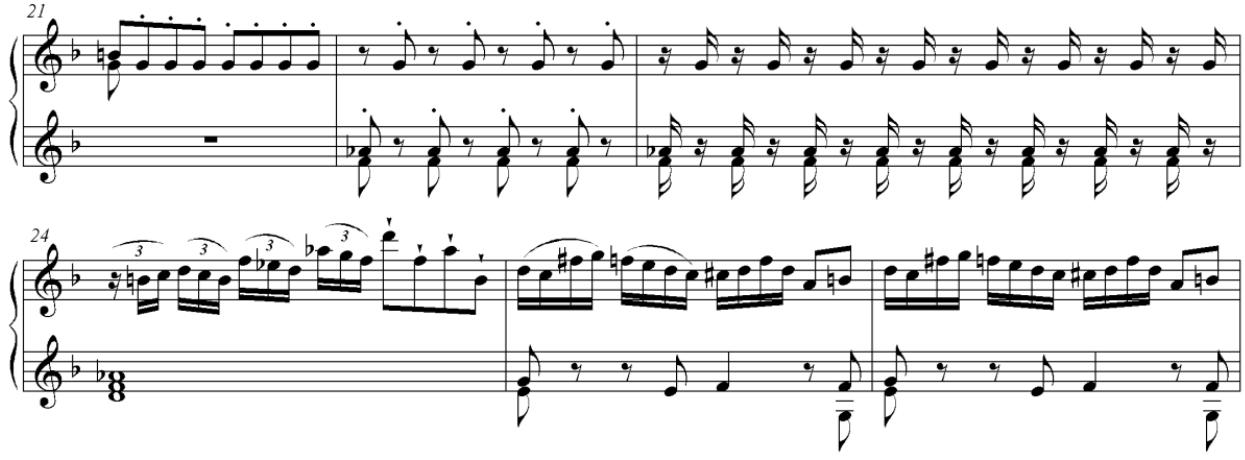
中文讲解
这一段是关于图例7的图说文字(含正文中标有的脚注78与脚注79的指引,原文以小角标标注,此处略去角标)。海顿《奏鸣曲Hob. 30》A大调第一乐章(快板)在临近结尾处被戏剧性地截断,作者为这种音乐现象临时造了一个非音乐学的术语:“ta-dá signal”(ta-dá 信号)——一种几乎从未获得正式名称却普遍存在的音乐套话,也是C. P. E. 巴赫所常用的手法(参奏鸣曲Wq. 65/17,亦见脚注40)。这个信号先引出一段简短的"宣叙调式"公式,紧接着是一段拉长的"咏叹调式"段落,作为开放式(无明确结束)的中间乐章。作者认为过渡的统一方式(基于序列和声)值得注意:三种"音乐类型”——动力性的奔忙、宣叙调插入、以及随后的感伤如歌旋律——沿着一条略超过八度的音阶轮廓展开(第162-170小节:D-C#-B-A-G#-F#-E-D-C#)。第165-183小节的如歌旋律段被作者视为海顿受巴赫影响较为可能出现的段落之一(参Leisinger 1994,第301-4页);其中第175-180小节所形成的模进,是海顿作品中最具感伤意味的片段之一。需查阅原图谱例7才能比对三种"音乐类型"的实际音型。
补充说明
脚注78与脚注79已在P0204、P0205中独立复述,本段不再重复。“ta-dá"作为拟声词,模仿短—长两拍的强调式停顿,与话语修辞中的"小结—提示"相当。
第4段(P0204)
原文复述
Footnote 78: Cf. note 40.
中文讲解
这是脚注78,仅为"参见脚注40"的简略指引。它把图说中提到的"巴赫《奏鸣曲Wq. 65/17》中同样的ta-dá信号"指向早先的脚注40,意味着读者欲详查应回溯第40号脚注,此处无新增信息。脚注起交叉索引作用,无独立主张。
第5段(P0205)
原文复述
Footnote 79: Leisinger (1994) p. 301-4.
中文讲解
这是脚注79,简短给出文献来源:Leisinger 1994年著作第301至304页。它为图说中关于"cantilena段(第165-183小节)属海顿受巴赫影响之较可能段落"以及"其中第175-180小节为海顿最感伤的模进之一"的论断提供外部文献出处,属于支持性的脚注,而非限定或反驳。
第6段(P0206)
原文复述
Page header: C. P. E. Bach, Haydn, and the art of mixed feelings © Lodewijk Muns 2008 – p. 25.
中文讲解
这是第25页的页眉(版面标识)。内容重复著作名《C. P. E. 巴赫、海顿与混杂情感的艺术》、作者Lodewijk Muns、版权年份2008以及当前页码25。仅作版面定位用途,不承载新的论述。
第7段(P0207)
原文复述
[Embedded image data omitted; position and caption preserved] On a half cadence follow a Minuet theme and variations, the simplicity of which acquires by this preparation a transcendental quality which might be lacking otherwise. The uprooting of continuity by the transitional movement may add to the significance of a quasi-quotation of the arioso-interlude in Variation 6: where the ‘aesthetic I’ has made itself manifest, resemblance becomes reminiscence. Variation 2 (Example 8a), with both voices of the theme in the left hand, brings out a similarity of the theme to the A minor middle movement of Bach’s Sonata in A major Wq. 65/32 (H. 135) (Example 8b), which has the same device in mm 51-52. Bach’s movement, headed Andante con tenerezza, is a sarabande alternating ornamented statements of the eight measure theme with modulating transformations and a statement in the major mode. While the phrase structure of Haydn’s theme looks like an amplification
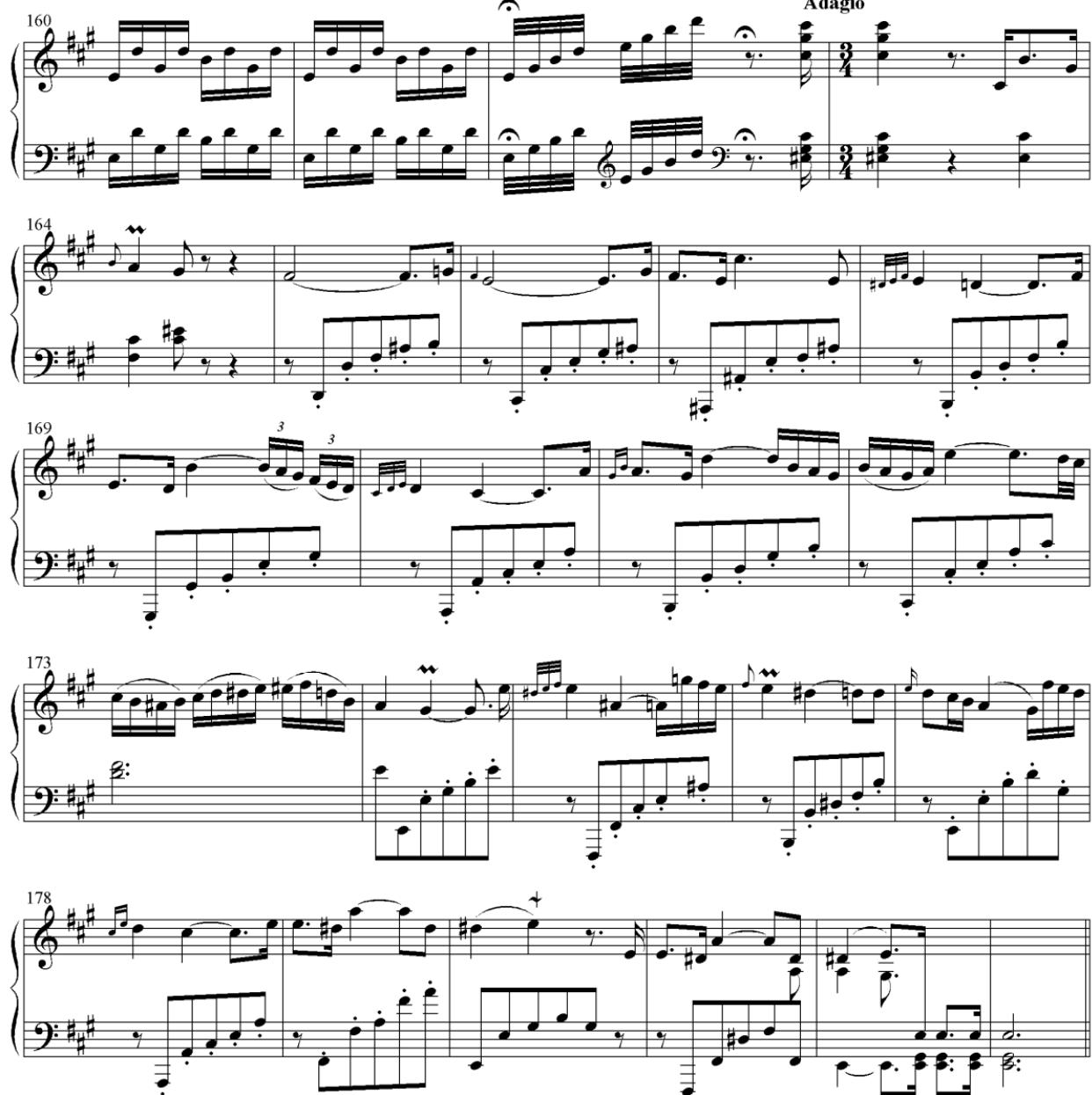
中文讲解
这是与图例8a、8b相配套的图说描述性文字。前段叙述海顿《Hob. 30》A大调奏鸣曲第三乐章的位置关系:在半终止之后紧接小步舞曲主题与变奏;由于前述"中间乐章"造成连续性的断裂,这一简单的小步舞曲由此获得一种"超越性”(transcendental)的特质——否则未必具备这种分量。作者在此提出一个关键概念:当"美学自我”(aesthetic I)已经在前文中显现过,再出现的相似就不再只是"类似",而是"追忆"(reminiscence)——所以Variation 6中对"咏叹调间插段"的近似引用具有特殊的引文意义。然后作者聚焦Variation 2(图例8a):主题的两条旋律声部都被压缩在左手上,由此暴露出它与C. P. E. 巴赫《A大调奏鸣曲Wq. 65/32 / H. 135》A小调中间乐章(图例8b)的相似——后者在第51-52小节采用了同样的"双手合奏压缩为左手"手法。巴赫该乐章题作"富有柔情的行板"(Andante con tenerezza),是一首萨拉班德,交替使用装饰性的八小节主题陈述、移调变形、以及大调陈述。最后一句"While the phrase structure of Haydn’s theme looks like an amplification"为版面残留、句子未完,应视为延续至下页的过渡。需查原图谱例8a、8b对照两段左手织体。
补充说明
“aesthetic I"在此指奏鸣曲整体叙事中那个被反复自我指涉的"美学主体”——即前文已自我显现的"我";其再次显现就把"形似"升级为"追忆"。“quasi-quotation"在音乐分析中通常指近似引用而非直接引用,与具有文化身份记忆功能的引文相对应。“transcendental"在此并非哲学意义上的"先验”,而是"超越性的、超出常规分量"之意。
第8段(P0208)
原文复述
Page header: C. P. E. Bach, Haydn, and the art of mixed feelings © Lodewijk Muns 2008 – p. 26.
中文讲解
这是第26页的页眉(版面标识)。内容为著作名、版权信息和当前页码26,无新论述。
第9段(P0209)
原文复述
Example 8a: Haydn, Sonata Hob. XVI:30:ii, mm 33-38;Var.ⅡI

中文讲解
这是图例8a的题注:海顿《钢琴奏鸣曲Hob. XVI:30》第三乐章(ii),第33-38小节,对应变奏II。题注仅指明曲例出处与小节范围,不含独立主张。需查原图比对Variation 2的左手双声部织体。题注中"Var.ⅡI"为原文OCR痕迹(实际应为"Var. II”)。
第10段(P0210)
原文复述
Example 8b: C. P. E. Bach, Sonata Wq. 65/32:ii (H. 135) (1758 or later), mm 51-54

中文讲解
这是图例8b的题注:C. P. E. 巴赫《奏鸣曲Wq. 65/32 / H. 135》第二乐章,作于1758年或之后,第51-54小节。题注仅指明曲例出处与小节范围,与图例8a并列用于对比海顿左手双声部手法与巴赫类似手法的渊源关系。
补充说明
Wq. 65/32 与 H. 135 是同一作品的两种编号体系:Wq. 为Wotquenne主题目录编号(专用于C. P. E. 巴赫作品编目),此处并列的"H. 135"并非海顿的Hoboken编号(因Hoboken仅编海顿),而是早期学界也曾用过的Heckmann式编号或类似习惯——同一作品因编目传统不同而获双重编号标识。
第11段(P0211)
原文复述
Looking back on the first movement of Haydn’s sonata, and wondering whether there is a specific motivation to be found for the unusual transitory middle movement, we cannot draw a parallel to very similar intrusions in Bach’s Sonatas in A Wq. 55/4 (H. 186) or in B-flat Wq. 51/2 (H. 151). The first is a quasi-symphonic galloping Allegro, which is halted on the cadence, to prepare with a ta-dá signal for the Poco Adagio in F-sharp minor (which reminds so strongly of KV 488). In Wq. 51/2 the ‘intrusion’ is more fully motivated by the overall dramaturgy – the previous movement sounding like a clavier-adaptation of a bravura aria, preceded by a truncated slow introduction, which after its pp final cadence is re-asserted (Adagio mesto e sostenuto) to lead into the following movement in E-flat. Haydn’s dramaturgy and sense of overall form are very different; if the intrusion is ‘motivated’, it is by the management of flow and stasis: flow in the long sequences of mm 26-37 and mm 79-96, stasis in the subsequent key confirmation areas. The recitative thus breaks stasis at a point of arrival, which after the extraordinarily expressive sequence might sound unsatisfacty.
中文讲解
本段以"回望"的方式回到Hob. 30第一乐章,试图解释为何要插入这个异常的"过渡性中间乐章"。作者首先做反向操作:尝试用C. P. E. 巴赫奏鸣曲中两类高度相似的"插入"作为参照,但都不能直接套用到海顿上——A大调Wq. 55/4(H. 186)使用ta-dá信号,把准交响性的急驰快板停在终止处,引入升F小调的Poco Adagio(让人联想到KV 488);降B大调Wq. 51/2(H. 151)则以整体戏剧逻辑来"撑起"插入——前一乐章像一架羽管键琴改编的炫技咏叹调,前面有一段被截短的慢速引子,在pp力度终止后又被重新声张(Adagio mesto e sostenuto),导入降E大调下一乐章。这两个巴赫例子的逻辑(音乐类型落差、戏剧逻辑铺垫)都和海顿不同。作者于是正面提出海顿自己的"动力原则":如果这一插入是"有动机的",那动因是"流动与停滞的管理"——第26-37小节、第79-96小节的长序列形成流动;其后的调性确认区段形成停滞。宣叙调因此打破"到达点上"的停滞;然而这一打破发生在一段极富表现力的模进之后,效果可能让人感到不满足。换言之,海顿的插入既不是模仿巴赫的"音乐类型反差",也不是巴赫的"戏剧逻辑铺垫",而是"流动—停滞"二元节奏中用来松解过分静态的到达点的修辞手段——它本身具有说服力,但也可能让听者觉得突兀。
补充说明
“KV 488"为莫扎特作品编号(Köchel Verzeichnis 488),即《降E大调钢琴协奏曲K. 488》;作者用其升F小调柔板段落(第二乐章)作为听感联想,并非主张渊源。“mesto e sostenuto"为意大利语,意为"悲怆而绵延”。“unsatisfacty"为原文拼写,疑为"unsatisfactory"之OCR讹误。脚注78与脚注79所对应的角标在原文中分别标于P0203图说之中,已在P0204、P0205中独立处理。
第12段(P0212)
原文复述
The Adagio of Haydn’s Sonata Hob. 34 in E minor has a transitional conclusion similar to the beginning of that of Sonata Hob. 30. This exquisitely lyrical movement, considered by H. C. Robbins Landon an uninspiring finger exercise, is one of those that feel like a choreography for the hands, giving us a sense of the composer at his instrument, approaching the keyboard with utmost relaxation, shaping the melody with arm and hand rather than finger play, creating smooth quasi-vocal lines by portamenti, picking out bass notes by a gentle movement of the arm. The eight measure Hauptsatz of this sonata form (Example 9a) has the very common stop-stop-go-shape (T-D, D-T, cadence). Its continuation slips seemlessly into concerto style, after the cadential trill in m. 17 sliding back into the intimacy of a very Bach-ish cadence in the low register (Example 9b). The sequential development section starts with a statement on the dominant of the parallel key, that is, the tonic key of the first movement, quoting (in m. 22) m. 8 of that movement. The second concertante cadence at the end of the movement – a deceptive cadence - is followed by a ta-dá signal announcing a varied restatement of the cadential motive of m. 22 and concluding on the dominant of E minor (Example 9c).
中文讲解
本段转入讨论海顿《Hob. 34》E小调奏鸣曲的第二乐章——柔板。作者首先在结构层面做了一个并列观察:Hob. 34柔板的"过渡性结尾"与Hob. 30柔板的"开头"在手法上类似,由此把两首奏鸣曲的中间乐章联结起来。进而作者给出一个看似挑衅、实为修辞性反差的判断:这一精致抒情的乐章,曾被权威海顿研究者H. C. Robbins Landon视为"并不激励人心的指法练习”。作者随后用一段具身化描述为这段音乐"正名”——它读起来像一段手的舞蹈,让人体感到作曲家本人在键盘前以极度放松的状态用整条手臂、手腕而非手指来塑造旋律,通过滑音(portamenti)勾勒出几近人声的平滑线条,再以柔缓的手臂动作挑出低音。其分析按奏鸣曲式(sonata form)展开:八小节Hauptsatz(图例9a)呈现典型的"停—停—行"(T-D, D-T, cadence)结构;其延续自然地滑入协奏曲风格,第17小节终止颤音之后又滑回低音区一段"极具巴赫气质"的亲密终止(图例9b)。展开部以平行调(关系大调)的属音——即第一乐章的主调——开始,在第22小节引用了第一乐章的第8小节。乐章末的第二次"协奏式"终止(一个伪终止)之后接以ta-dá信号,预告第22小节终止动机的变化再现,并以E小调属音收束(图例9c)。本段的关键论点在于:(1) Hob. 34柔板的具身性(手—臂—键盘的物理姿态)本身就是理解其"抒情性"的途径;(2) 表面平凡的指法织体下藏着对协奏曲风格的暗用与跨乐章引用,呼应了Hob. 30中间乐章那种"修辞—抒情"并置的手法。
补充说明
“Hauptsatz"为德语,意为"主句/主部”,是奏鸣曲式分析术语,指主部主题。“T-D"指"主—属"功能进行;此处用T-D, D-T, cadence描述"停—停—行"的句法骨架。“portamenti"原指声乐或弦乐中的滑音,此处借用于键盘乐,描述近似滑奏的连音处理。“seemlessly"为原文拼写,疑为"seamlessly"之OCR讹误。脚注80所对应的角标"80"在原文位于正文段P0212之中,已在P0213中独立处理。
第13段(P0213)
原文复述
Footnote 80: “[…] the Adagio is rather empty and the intricate figurations are suitable to the pupil’s fingers but hardly calculated to awaken his enthusiasm.” Landon (1978) p. 584
中文讲解
这是脚注80,引用H. C. Robbins Landon 1978年著作第584页:"……这一柔板相当空洞,复杂的音型只适合学生的指法,却难以激起他的热情。“这是对Hob. 34柔板的否定性评价,作者在正文中(P0212)以"considered by H. C. Robbins Landon an uninspiring finger exercise"的措辞转述,旋即以具身化分析与跨乐章引用的论证加以反驳。脚注起限定作用——它并非赞同,而是被作者用作"被反驳的常规观点”。
第14段(P0214)
原文复述
Page header: C. P. E. Bach, Haydn, and the art of mixed feelings © Lodewijk Muns 2008 – p. 27.
中文讲解
这是第27页的页眉(版面标识)。内容为著作名、版权信息和当前页码27,无新论述。
脚注 / 边栏 / 图表 / 附加信息(如有)
本小节包含三类非正文内容:(1) 脚注78(P0204),交叉索引,指向脚注40,对应图说中关于巴赫Wq. 65/17中ta-dá信号的提及,起关联作用。(2) 脚注79(P0205),文献出处,指向Leisinger 1994,第301-4页,对图说中"cantilena段为受巴赫影响"的判断提供文献支持。(3) 脚注80(P0213),文献引述,引用Landon 1978年第584页对Hob. 34柔板的否定性评价,起被反驳对象的限定作用。此外本节包含若干被省略的嵌入图像谱例——图例6(P0202,对应Hob. 29 mm 21-26)、图例7(P0203,对应Hob. 30第一乐章mm 162-183)、图例8a/8b(P0209/P0210,对应Hob. 30变奏II与巴赫Wq. 65/32中间乐章的左手双声部对比)、图例9a/9b/9c(P0212,对应Hob. 34柔板的主句、终止、伪终止后ta-dá)。这些谱例承担"作者所论之音响实体"的角色,缺图则论证悬空;尤其图例7(三种"音乐类型"沿音阶轮廓统一)与图例8a/8b(海顿与巴赫左手双声部的相似)是小节论证链的关键视觉支撑。
💡 本节核心要点
- 奏鸣曲"说话方式"并非单一:作者反对以任何一种"标准答案"回应"奏鸣曲想要什么”,代之以文学的独白、抒情诗、哲学自语三种非修辞性模式作为可替代隐喻,演奏者需自行决定曲作以何种"模式"发声。
- 三首海顿奏鸣曲(Hob. 29、Hob. 30、Hob. 34)共同展示"插入性中间乐章"的修辞功能:Hob. 29以卡顿的G打破"雄辩姿态”,Hob. 30以ta-dá信号插入宣叙调—咏叹调作为"开放式中间乐章”,Hob. 34以伪终止后的ta-dá信号预告终止动机的变化再现。
- 海顿的"插入"逻辑与C. P. E. 巴赫不同:巴赫的类似插入或基于音乐类型落差(Wq. 55/4),或基于整体戏剧逻辑(Wq. 51/2);海顿的Hob. 30插入则服务于"流动—停滞"二元节奏管理——打破到达点的静态,但效果可能令人不满足。
- 跨乐章引用与"追忆"机制:在Hob. 30变奏6中,“咏叹调间插段"的近似引用因"美学自我"已先显现,从"形似"上升为"追忆”;Hob. 34柔板在第22小节直接引用第一乐章第8小节,使抒情乐章承载整体奏鸣曲的自反结构。
- “ta-dá信号"作为无名套话的命名权问题:作者承认这一普遍存在的修辞性停顿没有现成的音乐学名称,自行造名以填补术语空缺,揭示音乐分析对常见手法的"术语贫乏”。
- 对权威评价的反驳:Hob. 34柔板被Landon贬为"指法练习",作者通过具身化(手—臂—键盘的物理姿态)与跨乐章引用的双重论证,将其重塑为精致抒情的协奏风格乐章。
🔑 关键术语
- Ta-dá signal:作者自造的临时术语,指一种音乐中普遍存在的修辞性停顿/信号(“ta-dá”),用来预告后续段落的进入;在C. P. E. 巴赫与海顿作品中均频繁出现,但缺乏现成的音乐学命名;本节图说中正式引入此名,并贯穿Hob. 30与Hob. 34的分析。
- Laune:德语词,意为"怪念头、突发的情绪或奇想",比英语whim更具人格化色彩;在P0201中特指作曲家让演奏者的"雄辩姿态"在m. 21处遭反噬的不可预测乐思。
- Hauptsatz:德语奏鸣曲式术语,意为"主句/主部",指主部主题;在P0212中用于指Hob. 34柔板的八小节主句,并配合T-D, D-T, cadence描述其"停—停—行"结构。
- Aesthetic I(美学自我):作者在前文提出的术语,指奏鸣曲整体中自我指涉、自我显现的"我";其再次出现使"相似"上升为"追忆";在P0207图说中用于解释Hob. 30变奏6对前段"咏叹调间插段"的近似引用的特殊意义。
- Process literature(过程文学):指自古代以来以内心独白、自我反思为形式特征的文学传统(如奥古斯丁、帕斯卡、笛卡尔、蒙田),在P0201中作为奏鸣曲"非修辞性说话"模式的文学类比。
- Sonata form(奏鸣曲式):本节中既用于Hob. 34柔板(八小节主句、展开部、再现部)的形式分析,也通过"流动—停滞"概念在P0211中被作者重塑为一种戏剧性过程,用以解释"插入性中间乐章"在海顿整体形式中的功能。
S2.7 [描述性拆分] Dramaturgy of intrusions and comparison with Bach
第1段(P0215)
原文复述

中文讲解
该条目为第28页上的图像或乐谱占位符,原始数据未嵌入文本流中,仅保留位置与图注。需查看原书第28页以确认其具体内容。从所在段落顺序判断,它出现在第28页顶部,与本节关于"侵入的戏剧性"及海顿与巴赫比较的论证并行,但本文输入不包含其可读信息,故讲解仅能定位版面位置。
补充说明
占位符紧接第28页正文区,与后述Example 9b及其他谱例共同构成图示论证材料;具体图像内容需查阅原书。
第2段(P0216)
原文复述

中文讲解
该条目为标记为"Example 9b"的乐谱占位符,对应海顿《钢琴奏鸣曲》Hob. XVI:34 第二乐章的第16–22小节。本节将这些小节作为关键谱例来支撑关于"innocentemente"演奏方式与性格指示的讨论,以及第二乐章慢板主题动机在末乐章中被变形的论证。具体音型与和声需查阅原书第28页上的乐谱。
补充说明
该谱例标注为"Example 9b",是本章谱例编号系统的一部分;其在输入段落中的位置表明它与后续段落P0219中的主题变形讨论直接对应。
第3段(P0217)
原文复述

中文讲解
该条目为第28页上的另一图像或乐谱占位符,未保留可见内容。它位于Example 9b之后,正文分析段落P0219之前,从版面顺序看属于本节论证所配的谱例或图表系列的一部分。需查看原书第28页确认其确切内容。
第4段(P0218)
原文复述

中文讲解
该条目为第28页上的又一图像或乐谱占位符,紧邻正文段落P0219之前出现。由于原文输入未嵌入可读数据,其在本节论证中的具体作用(例如是否展示了Adagio主题的下行七度、Piccolo divertimento的乐谱,或其他材料)需查阅原书第28页确认。
第5段(P0219)
原文复述
The Vivace molto seems to compensate for the North-German character of the second movement by letting an Alberti bass run most of the time. Its character indication innocentemente however is unusual in the Viennese tradition and likely to have been adopted from Bach.81 As a performance direction, it probably warns us to make the melody not too expressive and keep the accompaniment light. As a character indication, after its semi-operatic preparation this sudden ingénu mood seems one of posturing rather than true nature. The contrast between both movements is bridged by hidden detail: the bare melodic outline of mm 1-4 of the second movement, scale notes 1-7-2-3, is copied in the Vivace by the notes around the barlines (e2–d2–f2–g2); the descending seventh of the second half of the Adagio theme (mm 9-10: G–A on a progression I6-II6, echoed by the fifth D–G on the cadence) is varied on sequential harmonies in mm 9-18 of the Vivace (D–E, C–D, B–E). This finale has a variation form which alternates a minor antecedent and a major consequent. The same form is found in the finale of Sonata Hob. 44 and in the emotionally profound ‘Piccolo divertimento’ in F minor Hob. XVII:6, and the
中文讲解
本段是本节的核心分析段落,承接上一节关于第二乐章的"北德"特征,展开关于末乐章Vivace molto的戏剧性论证。其核心主张有四层:
-
风格对冲:Vivace molto通过贯穿全曲的阿尔贝蒂低音(Alberti bass),抵消了第二乐章那种北德乐派的内省色彩,使整体回归维也纳传统。
-
“innocentemente"的双重解读:作者指出这一性格指示在维也纳传统中极为罕见,最可能借自巴赫(脚注81)。它有两层含义——作为演奏指示,它告诫演奏者旋律不要过于夸张、伴奏保持轻盈;作为性格指示,在第二乐章半歌剧化(semi-operatic)准备之后,这种突如其来的"天真"情绪更像是装腔作势(posturing),而非真正自然的天真。换言之,所谓的"无辜"是被精心建构的修辞姿态。
-
隐藏的乐思连贯:作者用两条具体的对位证据证明两个乐章并非简单对立。其一,第二乐章mm 1-4的旋律轮廓(音阶1-7-2-3)在Vivace中以小节线周围的音e2–d#2–f#2–g2复现;其二,Adagio主题后半(mm 9-10)的下行二度G–A(在I6-II6进行上,并被终止式中的D–G五度回应)在Vivace mm 9-18中通过序进和声变形为D–E、C–D#、B–E两组。
-
变奏曲式及其源头:末乐章采用小调先导句+大调应答句交替的变奏形式,这一形式同样出现在Hob. 44的末乐章和情感深刻的F小调"Piccolo divertimento”(Hob. XVII:6)中。段末以"and the"未完结尾,下一段继续追述此形式可能的来源。
例子功能:作者用阿尔贝蒂低音和"innocentemente"两个例子说明海顿如何在维也纳表面风格之下保留北德深度;用主题变形和变奏曲式说明表面对比之下的连贯性。这段也是本节标题"侵入的戏剧性"的关键——维也纳语汇作为一种"侵入",并非简单的风格切换,而是伪装下的延续。
补充说明
Alberti bass(阿尔贝蒂低音)指左手以分解和弦型反复的低音织体,是18世纪维也纳古典风格(尤其海顿、海顿之前及同时期作品)的典型伴奏方式。脚注81(见P0220)将标注Leisinger 1994年文献中关于此术语来源的具体页码。“Semi-operatic preparation"承接前文对第二乐章前奏的描述。
第6段(P0220)
原文复述
81 Leisinger (1994) p. 316
中文讲解
本条为正文P0219中"innocentemente likely to have been adopted from Bach"一处的脚注81,引用Leisinger 1994年著作第316页,作为该性格指示源自巴赫传统的来源支撑。
补充说明
脚注功能:为正文关于"innocentemente"借自巴赫的判断提供文献依据,属支持性来源(source citation)。输入中未给出Leisinger 1994年著作全名,作者仅可在前文确认其作为引用文献存在。
第7段(P0221)
原文复述
C. P. E. Bach, Haydn, and the art of mixed feelings © Lodewijk Muns 2008 – p. 28
中文讲解
本条为第28页的页眉(running header),标明书名《C. P. E. Bach, Haydn, and the art of mixed feelings》、作者Lodewijk Muns及版权年份2008,并指明当前页码为第28页。属于版面信息,不构成正文论证。
补充说明
页眉属版面元数据,无补充说明。
第8段(P0222)
原文复述
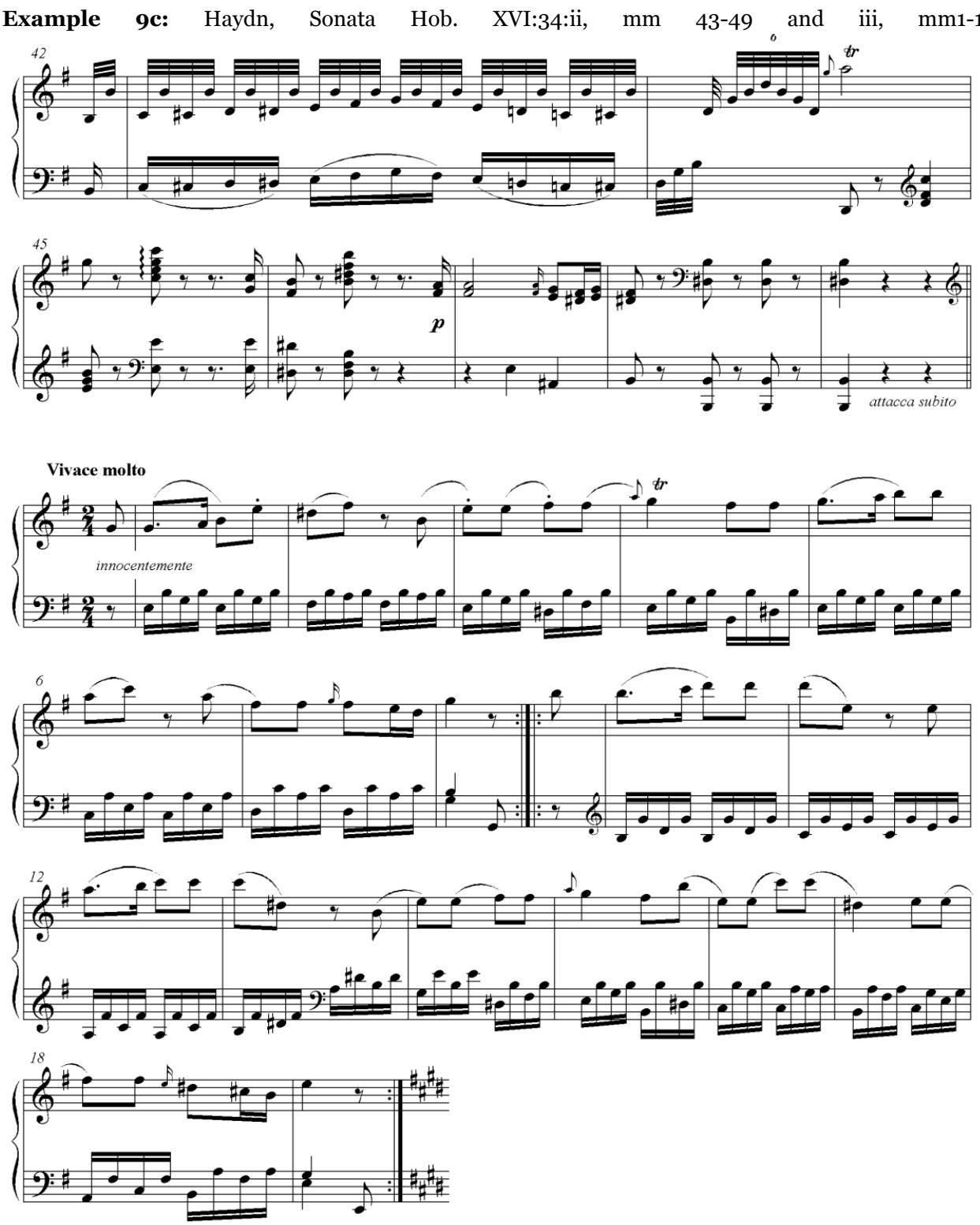
中文讲解
本条为第29页的页眉占位符,包含书名、作者、版权信息及页码(p. 29),但原始版面以图像形式承载,因此被替换为占位符。属于版面元数据,不构成正文论证。
补充说明
页眉占位符属版面元数据,无补充说明。
第9段(P0223)
原文复述
source for the procedure is very likely to be Bach’s one-movement Sonata in C minor Wq. 50/6 (H. 140).82 Though expressive content and keyboard technique in this sonata (Hob. 34) may be said to be close to empfindsam attitudes, it would be wrong to say that it is in the ‘empfindsam manner’; structurally, its harmonic and melodic phrases are too long and regular. More representative of Empfindsamkeit in Haydn are the sonatas in C minor Hob. 2083, E-flat major Hob. 38, G minor Hob. 44, and C major Hob. 48. The expressive contents of these sonatas seems however more straightforward. It is the ambiguity of ‘public’ and ‘private’ attitudes in the Adagio, the dubious innocence of the Vivace, this all preceded by the stormy Presto with its quasi-improvisatory (but thematic) arpeggios in the development section, which show an expressive complexity comparable to that of Bach.84
中文讲解
本段是本节的收束段落,承接P0219末尾未完的句子,完成对Hob. XVI:34末乐章变奏形式来源的追溯,并最终将全曲与巴赫的"表达复杂度"进行对比。
-
形式来源的认定:上段提到的小调先导+大调应答的变奏形式,其程序源头很可能是巴赫的C小调单乐章奏鸣曲Wq. 50/6(H. 140,脚注82)。这是本节对海顿"侵入"语汇之深层来源的具体指认。
-
对"empfindsam manner"标签的限定:作者做了一个关键区分——Hob. 34(Hob. XVI:34的简称)的表情内容和键盘技法或许接近empfindsamer Stil(情感风格)的态度,但不可以称其为"empfindsam manner”,因为其结构上(和声与旋律乐句)过于长大与规则。这一限定非常重要:empfindsam不仅指情感表达方式,还指短小、不规整、突发性的句法结构,海顿此曲的结构特征更接近古典规范。
-
海顿更典型的Empfindsamkeit作品:作者列举C小调Hob. 20、降E大调Hob. 38、G小调Hob. 44、C大调Hob. 48作为海顿中更代表情感风格的奏鸣曲(脚注83)。但这些作品的表情内容"更为直白"(more straightforward)。这与本曲Hob. XVI:34的"混合"特质形成对比。
-
全节核心结论:使本曲具有可比于巴赫之表达复杂度的,不是任何单一乐章的纯粹empfindsam特征,而是三者的复合——Adagio中"公开"与"私密"态度的暧昧、“innocente"之天真的可疑(参P0219)、以及前奏曲Presto中暴风雨般的发展段插入了准即兴性(quasi-improvisatory)但仍属主题的琶音。“准即兴但仍主题化"这一悖论修辞本身就是本节"侵入的戏剧性"的精髓。
论证位置:作为S2.7小节末段,本段把本节关于Hob. XVI:34三乐章戏剧性的讨论与更广义的海顿-巴赫情感风格关系并置收束,给出"复杂度可比巴赫"的结论性判断(脚注84)。
例子功能:作者用"准即兴但主题化"的琶音这一例子,把"侵入”(看似偏离结构的即兴片段)依然归属到主题逻辑之内的辩证关系说清楚;这正是本节标题"Dramaturgy of intrusions"的题中应有之义。
补充说明
empfindsamer Stil(情感风格/Empfindung)是18世纪中叶北德乐派(尤其C. P. E. Bach)的风格范畴,强调短句、突然转调、情感对比与即兴性,与海顿的古典-维也纳规范句法形成对比。Wq. 50/6即C. P. E. Bach的C小调奏鸣曲,作品编号Wq. 50/6(亦作H. 140)。Hob. 34指Hob. XVI:34,本曲在本节及上文的简称。脚注82、83、84的具体文献信息在本节文本中未展开,需查阅原书。
脚注 / 边栏 / 图表 / 附加信息(如有)
本节涉及的脚注有三条(P0220为脚注81,P0223提及脚注82、83、84),均集中在本节论证的关键判断处:脚注81支撑"innocentemente借自巴赫"的说法(Leisinger 1994 p. 316);脚注82支持小调先导-大调应答变奏形式源于巴赫Wq. 50/6;脚注83对应列举的更典型Empfindsamkeit海顿奏鸣曲;脚注84对应末段"复杂度可比巴赫"的总判断。本节包含多个乐谱或图像占位符(P0215–P0218及P0222),其中P0216明确为Example 9b,对应Hob. XVI:34第二乐章mm 16–22,与正文主题变形与性格指示讨论直接对应;其余占位符的具体内容需查阅原书。
💡 本节核心要点
- Vivace molto通过持续的阿尔贝蒂低音,对冲了第二乐章的北德深度,重新引入维也纳表面风格。
- “innocentemente"被解读为双层修辞:作为演奏指示要求旋律克制、伴奏轻盈;作为性格指示则是前乐章半歌剧化准备之后的一次"装天真"姿态,最可能借自巴赫传统。
- 两个乐章的对比并非真正对立:Adagio mm 1-4的旋律轮廓(1-7-2-3)在Vivace小节线周围以e2–d#2–f#2–g2复现;Adagio主题后半的下行二度(G–A)则在Vivace mm 9–18中以序进和声变形(D–E、C–D#、B–E)。
- 末乐章的小调先导-大调应答变奏形式,亦见于Hob. 44及Hob. XVII:6(F小调Piccolo divertimento),其源头很可能是巴赫的C小调奏鸣曲Wq. 50/6(H. 140)。
- Hob. XVI:34虽表情与技法近empfindsamer Stil,但结构过于长大与规则,不可径直归入"empfindsam manner”;更典型的海顿Empfindsamkeit奏鸣曲是Hob. 20、38、44、48,但它们的情感表达更为直白。
- 本曲真正可比巴赫的表达复杂度,来自Adagio的公私暧昧、Vivace的天真可疑、以及Presto发展段中"准即兴但仍主题化"的琶音三重组合——这正是"侵入的戏剧性"的本质。
🔑 关键术语
- Alberti bass:阿尔贝蒂低音;18世纪维也纳古典风格中左手分解和弦型的伴奏织体。本节中作为维也纳表面风格的标志,用以对冲第二乐章的北德深度。
- innocentemente:意大利文"天真地”;本节中作为双重符号——演奏指示(要求旋律克制、伴奏轻盈)与性格指示(在半歌剧化准备之后被解读为修辞性的"装天真",被认为借自巴赫传统)。
- empfindsamer Stil / Empfindsamkeit:情感风格;18世纪北德乐派的风格范畴,强调短句、突变与即兴性的情感表达。本节用以区分Hob. XVI:34(接近但不真正属于empfindsam manner)与Hob. 20、38、44、48等更典型的海顿情感风格奏鸣曲。
- Wq. 50/6 (H. 140):C. P. E. Bach的C小调单乐章奏鸣曲;本节指认为Hob. XVI:34末乐章小调先导-大调应答变奏形式的最可能来源。
- Dramaturgy of intrusions:侵入的戏剧性;本节标题,指看似偏离主题/结构逻辑的片段(如准即兴琶音、innocente性格切换、维也纳表面风格对北德深度的"覆盖")仍然属于主题与修辞逻辑之内的辩证张力。
- I6-II6:第一转位到第二转位的和声进行;本节用以标记Adagio主题后半(mm 9-10)下行二度G–A所处的和声框架,并指出终止式中D–G的五度回应。
- Piccolo divertimento (Hob. XVII:6):F小调"小嬉游曲";本节中作为另一处出现小调先导-大调应答变奏形式的例子,形容其情感"profound"(深刻)。
S2.8 [描述性拆分] 2.4 ‘Sprache der Empfindungen’
第1段(P0224)
原文复述
2.4 ‘Sprache der Empfindungen’
中文讲解
这是第二章的第四个小节标题。德文短语“Sprache der Empfindungen”直译为“情感的语言”或“感受的语言”。该标题揭示了本节将要讨论的核心议题:十八世纪后期出现的一种把音乐视为“情感语言”的理论——它比前一节讨论的“表层韵律说话”观念更为深层,也更具争议性。作者将在本节中梳理这一理论的主要形态(Sulzer、Forkel、Bach 的 Versuch),并展示围绕“情感单一性 vs. 混合性”的论争。
第2段(P0225)
原文复述
Structurally deeper, and more problematic, than the conception of music as ‘speaking’ by surface prosodic features is the doctrine of a ’language of emotions’. This is different from the traditional idea that the ‘movement’ perceived in music would express, represent or excite emotion or Gemüthsbewegung. The motion–emotion equation combines very well with the baroque Affektenlehre. In the Empfindsamkeit a new element is coming into play, which significantly changes musical aesthetics in the direction of a process-oriented conception, in which the musical-emotional motion itself is considered dynamic, changeable. Sulzer, who stresses that no formulas can be given for specific expressions, proposes that the composer should collect expressive phrases, vary them and see how the expression changes with variation; more importantly, he pleads for transitions of tempo and rhythm (Bewegung) which should express changes in emotional expression.⁸⁵ As practiced by Bach in his works, and prescribed in the Versuch, the musician should not just communicate emotions, but may alternate them in quick succession: „Kaum, daß er einen stillt, so erregt er einen andern, folglich wechselt er beständig mit Leidenschaften ab.“⁸⁶ For many theorists, this was still a difficult issue. Johann Jakob Engel, not an old man (a generation younger than Bach) wrote in 1780:
中文讲解
本段确立了本小节的核心议题:音乐的“情感语言”理论。作者首先把它与上一节讨论的“表层韵律说话”概念区分开来,指出它“更深入也更成问题”。关键区分有三层:(1) 不同于传统的“运动—情感等式”(motion–emotion equation),后者把音乐的“运动”(Bewegung)看作情感的代表或激发,并天然契合巴洛克的 Affektenlehre(情感学说);(2) 在 Empfindsamkeit(敏感风格)时期出现的新元素使音乐美学转向“过程化”理解,即把音乐—情感运动本身视为动态可变的;(3) Sulzer 拒绝为特定情感提供固定程式,主张作曲家收集表情乐汇、加以变奏,并通过速度与节奏的过渡(Bewegung)来表达情感的变化。段末引用 C. P. E. Bach《Versuch》名言,说明“音乐家不应只是传达情感,还可以快速交替情感”,并以 Engel’s 1780 年著作作为引出下一段德文引文的过渡。
这段在论证上的作用是:先把“情感语言”定位为“运动—情感等式”之上的更深层理论,再通过 Sulzer 与 Bach 的引述建立“情感可交替”的正面立场,为接下来展示围绕这一立场的反对意见(Engel、Lessing 等)做铺垫。
补充说明
本段中 Affektenlehre(情感学说)是巴洛克时期用固定程式(如特定调性、节奏型)对应特定情感的教条体系;Empfindsamkeit(敏感风格)是 1740s–1770s 间流行于柏林等地的强调情感细腻变化的美学潮流。“Gemüthsbewegung”“Bewegung”“Leidenschaften”三个德文词在原文中分别对应心理—情感运动、节奏—运动、激情,作者的英文行文刻意保留这些德文术语以维持概念精度。
第3段(P0226)
原文复述
„Setzen sie, daß das schönste accompagnirte Recitativ eines Hasse ohne die Singstimme, oder noch besser vielleicht, daß ein Bendaisches Duodram ohne die Rollen, bloß vom Orchester ausgeführt werde; was würden Sie in dem besten, mit dem feinsten Geschmak und der richtigsten Beurtheilung geschriebenen Stücke zu hören glauben? Ganz gewiß die wilden Phantasieen eines Fieberkranken. Warum das aber? Offenbar, weil die Folge von Ideen oder Begebenheiten, aus welcher allein die Folge der Empfindungen konnte begriffen werden, aus dem Ganzen weggenommen worden. ⁸⁷
中文讲解
这是 Johann Jakob Engel 1780 年论著中的德文原文。作者在引文前提出假设:若让 Hasse(德国巴洛克晚期歌剧作曲家)最美的伴奏宣叙调脱离人声,或更甚者,把 Benda 的“Duodrama”(一种带伴奏的戏剧独白体裁)去掉角色仅由乐队演奏,听者会从这“写得最精致、判断最准确”的作品中听到什么?Engel 的回答是:发烧病人的狂野幻想。原因在于:能让人理解情感序列的观念或事件序列,已从整体中被抽走。
这段引文的论证力量在于:它揭示了脱离语境的纯器乐表现可能陷入“无意义的情感堆砌”——没有前后事件的支撑,乐曲中并置的悲喜只能像谵妄一样令人费解。这正是本节随后要讨论的“情感混合”论争的反方立场:单一可辨认的情感序列才可理解。
补充说明
Engel 引文中的 Hasse 指 Johann Adolf Hasse(1699–1783),Benda 指 Jiří Antonín Benda(1722–1795),二者在原文与脚注中均未作解释,读者需通过脚注 87(Ottenberg 1984)核对出处。Duodrama 是 Benda 创新的体裁,每一角色由一位歌者与一位演奏者共同表演,介于歌剧与器乐戏剧之间。
第4段(P0227)
原文复述
82 Leisinger (1994) p. 290, Sisman (1993) p. 153
中文讲解
脚注 82,提示前文某一论点的文献出处指向 Leisinger 1994 年著作第 290 页与 Sisman 1993 年著作第 153 页。
补充说明
此脚注内容仅含文献指引,无可补充。
第5段(P0228)
原文复述
83 Rosen calls the first movement of this sonata “the finest example we have of a style often labelled Empfindsamkeit or ‘sensibility’” (sleeve notes entitled Three Sturm-und-Drang Sonatas or Three ‘Romantic’ Sonatas” for the recording CBS 61112).
中文讲解
脚注 83,引用 Charles Rosen 对该奏鸣曲第一乐章的评语,称它是“我们所拥有的 Empfindsamkeit 或‘敏感性’风格的最佳范例”。出处是 CBS 唱片 61112 的唱片说明,标题为《Three Sturm-und-Drang Sonatas or Three ‘Romantic’ Sonatas》。
第6段(P0229)
原文复述
84 ‘Ironic distance’ in some works of Haydn is discussed in November (2007).
中文讲解
脚注 84,提示关于 Haydn 某些作品中“反讽距离”(ironic distance)问题的讨论可参 November 2007 年文献。
第7段(P0230)
原文复述
85 Sulzer (1771), article Melodie - Ausdruck (see note 50).
中文讲解
脚注 85,标明前文所引 Sulzer 论述出自 1771 年百科条目“Melodie – Ausdruck”(旋律—表情),并指示参见前文注释 50。
第8段(P0231)
原文复述
86 Bach (1753) Bd. I p. 122
中文讲解
脚注 86,标明前文所引 C. P. E. Bach 文字出自 1753 年《Versuch über die wahre Art das Clavier zu spielen》第一卷第 122 页。
第9段(P0232)
原文复述
87 Über die musikalische Malerey, quoted after Ottenberg (1984) p. 297.
中文讲解
脚注 87,标明前段 Engel 引文转引自 Ottenberg 1984 年著作第 297 页,原作出自 Engel 的《Über die musikalische Malerey》(论音乐描绘)。
第10段(P0233)
原文复述
C. P. E. Bach, Haydn, and the art of mixed feelings © Lodewijk Muns 2008 – p. 30
中文讲解
页眉,标注书名《C. P. E. Bach, Haydn, and the art of mixed feelings》、作者 Lodewijk Muns、版权年份 2008,以及当前页码 p. 30。
第11段(P0234)
原文复述
From this he deduces the demand that a sonata or symphony contain no more than one Leydenschaft, which may ‘branch’ (ausbeugen) into various Empfindungen (presupposing a clear differentiation between the two). This was many years after Lessing (in Critique nr. 27 of the Hamburgische Dramaturgie, 1767) had launched his notorious phrase of the ‘musical monster’: „Eine Symphonie, die in ihren verschiednen Sätzen verschiedne, sich widersprechende Leidenschaften ausdrückt, ist ein musikalisches Ungeheuer […]“⁸⁸ No doubt this strong word has contributed to the Zitierfreude of historians; in the context of Lessing’s argument the statement looses much of its force. In brief, the argument runs like this: music must be unambiguous in its ‘affective’ content; however, within one movement the composer can realize contrasts („Es sei, daß er es in einem Stücke, von der erforderlichen Länge, eben so wohl tun könne“), but from one movement to another, a sharp contrast would be an unpleasant shock. The licence to shock is the poet’s exclusively, because words may provide a post facto rationalization. Lacking such rationalization, music leaves us with unmediated and incomprehensible contrast. Gerstenberg has contradicted this judgment privately (1768) à propos the (later so-called) ‘Hamletfantasia’ discussed above; publicly, C. F. Cramer in 1783 pronounced the fantasia Wq. 58/6 in E-flat „das förmliche Dementi“ of the unitary-affect-dogma.⁸⁹ They could have used Lessing’s own words. Lessing allows both transitions and mixtures of affective content; in fact, his discussion of the music which occasioned the article, J. F. Agricola’s music for Voltaire’s Semiramis, might pass for a manifesto defending programme music. With strong approval, he finds in the three-movement Anfangssymphonie mixed contents characterized as: „ernsthaft; manchmal gar wild und stürmisch; […] Zärtlichkeit, Reue, Gewissensangst, Unterwerfung […]“. Movement 2 evokes „dunkle und mitleidige Klagen;“ and in the third „vermischen sich die beweglichen Tonwendungen mit stolzen […]“. Since the author also demands that an overture do no more but indicate „den allgemeinen Ton des Stücks […], und nicht stärker, nicht bestimmter, als ihn ungefähr der Titel angibt,“ we must wonder – the title being Semiramis – how much is ‘in a name’!
中文讲解
本段是本节论证最密集的一节,集中处理“情感单一性 vs. 混合性”的论争。
首先,承接上一段 Engel 的引文,作者指出 Engel 由此推导出“一部奏鸣曲或交响曲不应包含多于一种 Leidenschaft(激情/主导情感)”,而后者可以“分支”(ausbeugen)出各种 Empfindungen(感受)——这一区分预设了 Leidenschaft 与 Empfindungen 是不同层次的概念。
接着引入 Lessing 在 1767 年《汉堡剧评》第 27 期提出的著名命题:一首交响曲若在不同乐章中表达相互矛盾的激情,就是“音乐怪物”(musikalisches Ungeheuer)。作者提醒读者:这句话之所以被史家反复引用(Zitierfreude),恰恰脱离了上下文。Lessing 完整论证的意思是:音乐必须在“情感内容”上不模糊;在同一乐章内部作曲家可以制造对比,但从一乐章到另一乐章若出现尖锐反差则是“令人不快的冲击”。这种“冲击”的特权只属于诗人,因为文字可以事后给出理性化说明;缺乏这种说明的纯音乐只剩无中介、不可理解的对比。
作者随后指出:Gerstenberg 1768 年在私下反对过这一判断(针对前文讨论的“哈姆雷特幻想曲”),C. F. Cramer 1783 年公开把降 E 大调幻想曲 Wq. 58/6 称为“单一情感教条的形式否定”(das förmliche Dementi)。但作者认为,他们其实可以直接征引 Lessing 本人——因为 Lessing 同样允许“情感内容的过渡与混合”。他甚至在评论 J. F. Agricola 为伏尔泰《Semiramis》所作音乐时,赞美其中三乐章“开场交响曲”混合了“严肃乃至狂暴”“温柔、悔恨、良心不安、屈服”等内容;第二乐章“阴暗同情的哀诉”,第三乐章“可动听的乐句与高傲的乐句混合”。
最后作者设问:Lessing 同时要求序曲只能暗示“作品的一般情调,不应比剧名提示得更强烈”,那么仅凭剧名 Semiramis,读者究竟能从音乐中“听出”多少?——以“名”所能“立”的份量究竟几何?这一句的修辞作用是把 Lessing 表面上的“情感单一性”立场与其实际评论中频繁允许多重情感的实践之间的张力推到读者面前。
补充说明
Wq. 58/6 指 C. P. E. Bach 作品目录(Wotquenne catalogue)中第 58 号第 6 首,即降 E 大调幻想曲,是 Empfindsamkeit 时期键盘幻想曲的代表作。Leidenschaft 与 Empfindungen 在十八世纪德语美学中并非同义词:Leidenschaft 通常指“激情”,即较为强烈、整体性的情感状态;Empfindung 指更为细致、可在乐章内部并置的“感受”。
第12段(P0235)
原文复述
When Johann Nikolaus Forkel sketched in the introduction to his Allgemeine Geschichte der Musik a theory of music as ’language of the emotions’, the element of ‘motion’ was given only marginal significance. He concieved of music as independent of language but an essentially parallel phenomenon, being „eine allgemeine Sprache der Empfindungen […] deren Umfang eben so groß ist und seyn kann, als der Umfang einer ausgebildeten Ideen-Sprache.“⁹⁰ The linguistic features of music mainly reside in syntax, manifested in Periodologie. Taking Forkel’s main point seriously – that musical syntax is (in some sense) like linguistic syntax – one has to admit that there are many obvious flaws in his account. In large part, these flow from the presuppositions that constitute the framework of his theory. First, what we may call his historicism: the idea that the music of his days is what music has come to be and ought to be, that music has ‘realized itself’, like language (though through an incommensurably longer process!). Second, the idea that what music is, must be explained by its origin, this being the common origin of music and language in emotion (probably deriving this from Herder’s Abhandlung über den Ursprung der Sprache, 1772). In this theory of expressive origin, an insight into the psychological dimension and the process of signification is conspicuously lacking.
中文讲解
本段把论域从“情感单一性”之争转向 Forkel 提出的另一种“情感语言”理论。Forkel 在《Allgemeine Geschichte der Musik》导言中草拟了一种音乐“情感语言”说,但其中的“运动”(motion)元素只居边缘位置。他把音乐设想为一种独立于语言、与语言基本平行的现象,是“一种普遍的情感语言,其范围与一种成熟观念语言的范围一样大”。音乐的“语言性”特征主要在于句法,体现在 Periodologie(句段结构学)之中。
作者随即以批判姿态指出:若认真对待 Forkel 的核心主张(音乐句法在某种意义上类似语言句法),就会发现其论述有许多明显缺陷。这些缺陷主要来自构成他理论框架的两条预设:
- “历史主义”(historicism):他那个时代的音乐即是音乐“应然”与“已然”的实现,音乐像语言一样“自我实现”(只是经历了不可比地更漫长的过程)。
- “起源解释”:音乐的本质必须由其起源来解释,而音乐与语言的共同起源是情感(很可能源自 Herder 1772 年《论语言的起源》)。
作者最后判定:在这种“表达起源论”(expressive origin)中,对心理学维度与“指意过程”的洞见是显著缺失的——这正是 Forkel 理论的薄弱环节。
本段的论证功能:先介绍 Forkel 学说的正面内容,再指出其预设的两大问题,为下一段引入 Forkel 的“逻辑”(Logik)概念及其与和声的关系作铺垫。
补充说明
Periodologie 是十八世纪德国音乐理论中专指“句段结构学”的术语,研究乐句、乐段(Periode)的结构与扩展规则。Forkel 的关键定义“eine allgemeine Sprache der Empfindungen”出现在脚注 90 所标的 Forkel 1788 第 19 页。
第13段(P0236)
原文复述
88 Lessing (1982) p. 155
中文讲解
脚注 88,标明前文所引 Lessing“音乐怪物”句出自 Lessing 1982 年版本(文集)第 155 页。
第14段(P0237)
原文复述
89 Gerstenberg: letter to Chr. F. Nicolai, 27 April 1768 (Suchalla 1994) p. 144-145; Cramer: ref. note 37, p. 307.
中文讲解
脚注 89,标明 Gerstenberg 1768 年 4 月 27 日致 Nicolai 的书信(收入 Suchalla 1994 年编辑本第 144–145 页)以及 C. F. Cramer 的评论(参前文注释 37,第 307 页)。
第15段(P0238)
原文复述
90 Forkel (1788) p. 19
中文讲解
脚注 90,标明前文 Forkel 的“普遍情感语言”定义引自 Forkel 1788 年著作第 19 页。
第16段(P0239)
原文复述
C. P. E. Bach, Haydn, and the art of mixed feelings © Lodewijk Muns 2008 – p. 31
中文讲解
页眉,标注书名、作者 Lodewijk Muns、版权年份 2008,当前页码 p. 31。
第17段(P0240)
原文复述
A key concept in Forkel’s quasi-linguistic theory of music is Logik, defined as innere Bedeutung (§ 74), which corresponds to harmony. Harmony determines (bestimmt) a potentially tonally ambigous melody in a way that makes it a „real truth to perception“ („für die Empfindung eine wirkliche Wahrheit“ §§ 20, 38). This is not easy to interpret, especially on the basis of the harmonic theory of the time. While Dahlhaus rightly points out that the proposed analogy of harmony and logic is inflated („Überinterpretation“)⁹¹ and imprecise, Forkel was not embroidering on metaphor.
中文讲解
本段进入 Forkel “准语言学”音乐理论中的核心概念:Logik(逻辑)。它被定义为“内在意义”(innere Bedeutung,§ 74),对应于和声。Forkel 主张:和声“决定”了一个潜在调性上含混的旋律,使它成为“感觉中的真实真理”(für die Empfindung eine wirkliche Wahrheit,§§ 20, 38)。
作者承认这一概念在当时的和声理论基础上并不容易解释,并指出 Dahlhaus 已经正确地指出 Forkel 把和声与逻辑相类比是“过度阐释”(Überinterpretation)且不精确。但作者紧接着为一个关键的反判断辩护:Forkel 并不是在编织隐喻——即他不是把“逻辑”当作形象化的修辞来装饰和声,而是以一个可被进一步理论化的实质范畴来界定和声。
这段的功能是为下一段引入“musikalische Gedanken”(音乐思想)作概念准备:和声作为“内在意义”即是一种“逻辑”层级的结构,它使旋律从“含混的所指”变成“可被感知的真”。
补充说明
§ 与 §§ 是 Forkel 原著的节号。§ 74 是 Logik 的定义处,§§ 20, 38 是和声“决定”旋律命题所在。Dahlhaus(1985)p. 678 见脚注 91。
第18段(P0241)
原文复述
The basis for the conception of music as ’language’ is the idea that music expresses musical Gedanken, units of undetermined extension with some definite expressive content. Widespread use of the term coincides roughly with the period of Empfindsamkeit, especially around the ‘Berliner Schule’⁹²; for Bach it is an ordinary, often applied notion:
中文讲解
本段是过渡段,说明把音乐视为“语言”这一观念的基础是“音乐表达音乐思想”(musikalische Gedanken)这一概念:Gedanke 是一种扩展长度不固定、但具有确定表情内容的单位。这一术语的广泛使用大致与 Empfindsamkeit 时期(尤其“柏林学派”Berliner Schule 周围)同时;对 C. P. E. Bach 而言,它是日常、经常被使用的概念。段末引出下一段 Bach《Versuch》的具体引文。
这段在论证上的作用:从 Forkel 的“准语言学”框架过渡到具体作曲家的实践语汇,确立“音乐思想”这一概念在 Empfindsamkeit 时期的话语地位。
补充说明
“Berliner Schule”(柏林学派)指以 C. P. E. Bach 为核心、活跃于 1740s–1770s 柏林宫廷的一群作曲家与理论家;脚注 92 标注 Leisinger 1999 年文献。
第19段(P0242)
原文复述
„Worinn aber besteht der gute Vortrag? in nichts anderm als der Fertigkeit, musikalische Gedancken nach ihrem wahren Inhalte und Affeckt singend oder spielend dem Gehöre empfindlich zu machen. Man kan durch die Verschiedenheit desselben einerley Gedancken dem Ohre so veränderlich machen, daß man kaum mehr empfindet, daß es einerley Gedancken gewesen sind.⁹³
中文讲解
这是 C. P. E. Bach 在《Versuch》中关于“好的演奏”(guter Vortrag)的德文原文。
核心论点为:好的演奏不过是这样一种能力——把“音乐思想”(musikalische Gedanken)按照其真正内涵与情感(Inhalt und Affeckt)通过歌唱或演奏“使耳朵能感受得到”(dem Gehöre empfindlich zu machen)。演奏者甚至可以“通过对同一思想的多种不同处理方式”,使听者几乎不再感到它们是同一思想——即同一 Gedanke 可被多种表述、变体演绎,呈现出丰富的表情差异。
这段引文的关键意义在于:Gedanke 在 Bach 笔下既是“内容”又是“情感”,演奏的主要任务是把这个“思想—情感”单位以让听觉“感受到”的方式实现;同时,同一 Gedanke 可有不同“说法”,引出了下一段关于 Gedanke 与“命题内容”之类比的讨论。
补充说明
脚注 93 标明出处为 Bach 1753 年《Versuch》第一卷第 117 页。
第20段(P0243)
原文复述
Gedanke would thus liken the fixed element in a musical unit – the ’notes’, or rather what they directly represent – to the propositional content of a sentence, which remains the same, while in music performance may appear to change the ‘formulation’. No features of a musical Gedanke could make it ’true’; instead, it may be said to be well-formed or ‘making sense’. Dahlhaus interprets this by distinguishing harmonic progression as ‘grammar’ from the underlying ’logic’ of fifth-relations, as different ’layers’ in the hierarchy of harmonic phenomena.⁹⁴ Since harmony is in Forkel’s thought a category of grammar as well as ’logic’, this might be the most sensible explanation. If it is true that in the recitative quoted above (Example 4) the words „Es sei – zum Tode“ express (by turning around, as it where, the meaning of „Hoffnung“) better the enharmonic change of G-sharp to A-flat, which effects a turn back toward F minor, harmonic relations as ‘inner meaning’ can be correlated with aspects of linguistic meaning. The vindication of harmony (contra Rousseau) received Bach’s special embrace in his review of Forkel’s Geschichte. It is harmony which has effected the emancipation of music from its subserviance to poetry and dance:
中文讲解
本段是本节理论建构的收束段落,意在把 Bach 笔下的 Gedanke 与语言哲学中的“命题”相类比,并借此为 Forkel 的“和声—逻辑”命题提供解释路径。
作者首先指出:Gedanke 因此可类比于一个音乐单位中的“固定元素”——即“音符”或更准确地说“它们直接代表的东西”——就像一个句子的命题内容(propositional content),它在不同的“措辞”下保持不变;而在音乐中,演奏可使同一思想“听起来”是不同的“陈述”。
接着,作者承认音乐 Gedanke 没有任何特征能使其为“真”,只能说它是“合式的”(well-formed)或“讲得通”(making sense)。Dahlhaus 的解释路径是:把和声进行作为“语法”,而把作为其基础的“五度关系逻辑”作为另一层次——它们是和声现象层级结构中的不同层。既然和声在 Forkel 思想中既是“语法”也是“逻辑”范畴,那么这个区分可能是对 Forkel 看似过度阐释的最合理解释。
随后,作者通过一个具体例证(例 4 宣叙调中“es sei – zum Tode”——它“翻转”了“Hoffnung”的含义)说明:通过 G♯ 到 A♭ 的等音变化(这种变化引导和声回到 f 小调),和声关系作为“内在意义”可与语言意义的某些层面相对应。
最后,作者指出:Bach 在其评论 Forkel《Geschichte》的文章中“特别拥抱”了对和声的这种辩护(针对 Rousseau 的贬抑);正是和声使音乐从对诗歌和舞蹈的从属地位中解放出来。
本段的功能:(1) 把上段的 Gedanke 概念与命题—措辞类比对接;(2) 通过 Dahlhaus 的层级解释,替 Forkel 的“和声—逻辑”命题提供合理化解读;(3) 借一个具体宣叙调例证说明和声如何承担“内在意义”;(4) 把本节主题引向“和声是音乐艺术独立性的关键”这一更大结论——这正是 C. P. E. Bach 自己在 Forkel 评论中所要确立的立场。
补充说明
例 4 是前文(不在本小节边界内)已引过的 C. P. E. Bach 宣叙调例子;本节作者回溯该例以说明和声的“等音转调”可承载“意义反转”。“五度关系逻辑”指以五度循环为基础的和声功能关系,Dahlhaus 1989 年著作第 91 页(脚注 94)专门讨论这一区分。
第21段(P0244)
原文复述
91 Dahlhaus (1985) p. 678
中文讲解
脚注 91,标明前文 Dahlhaus 关于 Forkel 和声—逻辑类比属于“Überinterpretation”(过度阐释)的论断出自 Dahlhaus 1985 年著作第 678 页。
第22段(P0245)
原文复述
92 Leisinger (1999)
中文讲解
脚注 92,提示前文提到的“Berliner Schule”讨论可参 Leisinger 1999 年文献。
第23段(P0246)
原文复述
93 Bach (1753) Bd. I p. 117
中文讲解
脚注 93,标明前段 Bach 关于“好的演奏”的德文引文出自 Bach 1753 年《Versuch》第一卷第 117 页。
第24段(P0247)
原文复述
94 Dahlhaus (1989) p. 91
中文讲解
脚注 94,标明前文 Dahlhaus 关于“和声进行为语法 / 五度关系为逻辑”之层级区分的讨论出自 Dahlhaus 1989 年著作第 91 页。
第25段(P0248)
原文复述
C. P. E. Bach, Haydn, and the art of mixed feelings © Lodewijk Muns 2008 – p. 32
中文讲解
页眉,标注书名、作者 Lodewijk Muns、版权年份 2008,当前页码 p. 32。
💡 本节核心要点
🔑 关键术语
S2.9 [描述性拆分] Forkel on musical rhetoric and harmony
第1段(P0249)
原文复述
Ohne Harmonie, die keinem alten Volke bekannt war, konnte sie unmöglich aus eigenen Kräften wirken, sondern mußte sich eben aus Mangel eigener zusammenhängender Ausdrücke an Poesie, Tanz, u.s.f. so fest anschmiegen, daß sie uns fast stets nur in dieser Gesellschaft erscheint.
中文讲解
这一段以德文引文形式出现,论点是:和谐(Harmonie)既然对古代各民族都是未知的,它就不可能凭借自身力量独立发挥作用;正是由于缺乏自身连贯的表达手段,它只能紧紧依附于诗歌、舞蹈等等,以至于我们在几乎所有情况下都只在这种伴随关系中见到它。这段话为本节 Forkel 论点的展开做铺垫:和谐在古代尚不存在,所以音乐若要诉诸表达,必须借助外部语言与肢体艺术;而到了 Forkel 所谓现代音乐可以自足的时代,音乐修辞学才有了真正抽象出来的可能。脚注 95 标记了该引文的 Suchalla (1994) 出处。
第2段(P0250)
原文复述
In Forkel’s system rhetoric is the art of combining musical sentences or Gedanken (§§ 29, 68, 73). In this, he departs from the traditional Figurenlehre which was the heart of earlier theories of musical rhetoric. His emphasis on harmony reflects a changed way of harmonic thinking which took away the raison d’être of Figurenlehre – as a system designed to explain exceptions to rules of counterpoint. Since he departs from traditional concepts of musical rhetoric, he considers this a discipline hardly known (§ 69). He absolves Mattheson from shortcomings in his earlier rhetorical theory, on the basis of a lack of sophistication of the music of his time:
中文讲解
本段是整节的理论核心:作者概括 Forkel 的体系——在 Forkel 那里,修辞学成为把音乐乐句或「Gedanken」(思想/乐思)组合起来的艺术(参 Forkel 原书 §§ 29, 68, 73)。作者指出 Forkel 因此与传统的 Figurenlehre(音形学/修辞格学)分道扬镳;Figurenlehre 原本是早期音乐修辞学的中心,专门用来解释对位规则的例外。Forkel 之所以扬弃它,是因为他的和声观念已经改变——Figurenlehre 赖以存在的理由(即对位规则的例外)消失了。同时,由于偏离了传统的音乐修辞概念,Forkel 把这一学科视为几乎无人知晓(参 § 69)。他还基于同时期音乐不够成熟这一前提,为 Mattheson 早期修辞理论的不足做了开脱,引出下一段的 Forkel 原话。脚注 96 说明此处判断依据 Dahlhaus (1985) 第 690 页,同时补充 Forkel 还有第二种更宽泛的修辞观:包括体裁(Schreibarten)、演奏与批评在内的"混合体"。
补充说明
本段中的关键概念 Figurenlehre、Gedanken、Schreibarten 均为 Forkel 体系内的术语,其作用已在正文中说明;其文献出处见脚注 P0255。
第3段(P0251)
原文复述
[…] zu seiner Zeit […] war die Musik noch nicht von der Beschaffenheit, daß sich eine Zusammenhängende musikalische Rhetorik aus ihr hätte abstrahiren lassen. Es fehlte ihr nicht nur Feinheit und Geschmack, sondern auch vorzüglich derjenige Zusammenhang ihrer Theile, der sie theils durch die Entwickelung der Gedanken auseinander, theils durch die Einheit des Styls u.s.f. erst zu einer förmlichen Empfindungsrede machte.
中文讲解
这是 Forkel 原书的引文(出处见脚注 97,Forkel 1788 第 37 页)。Forkel 替 Mattheson 开脱:在 Mattheson 那个时代,音乐尚未具备某种品质,使人们可以从中抽象出一种连贯的音乐修辞学。它所缺乏的不仅是精细与品味,尤其还缺少各部分之间的那种内在联系——那种既通过乐思的展开把它们彼此分开、又通过风格的统一等把它们组织起来、从而使其成为正式"Empfindungsrede"(情感演说)的内在联系。换言之,Forkel 主张:要谈修辞,前提是音乐本身已经发展到既有乐思展开又有风格统一的程度,而 Mattheson 时代尚未到达这一步。这为下一段对 J. S. Bach 的"反讽式"评价埋下伏笔。
补充说明
Empfindungsrede 直译为"情感演说",在本节上下文中指一种以情感表达为目的、具备展开与统一结构的成篇音乐陈述。
第4段(P0252)
原文复述
Since Mattheson’s days were those of J. S. Bach, this paragraph is surpising – the implication being that the ’language’ of J. S. Bach, “der größte musikalische Dichter und der größte musikalische Deklamator, den es je gegeben hat, und den es wahrscheinlich geben wird” – lacked sophistication for a fully developed musical rhetoric!
中文讲解
本段揭示一个悖论:既然 Mattheson 在世时正是 J. S. Bach 的时代,那么按 Forkel 的逻辑,J. S. Bach 的音乐就被暗中判定为尚不具备发展出完整音乐修辞学的成熟度。作者惊讶地指出这层意味,并原样引用 Forkel(出处见脚注 98,Forkel 1802 第 96 页)对 J. S. Bach 那段鼎鼎大名的赞辞——「有史以来,或许也将永有的最伟大的音乐诗人和最伟大的音乐朗诵者」。于是形成尖锐的反讽:Forkel 一方面把 J. S. Bach 推到无以复加的顶峰,另一方面却认为 Bach 的语言并不够成熟到能支撑他所要建立的连贯音乐修辞学。这一悖论本身就揭示了 Forkel 体系的内在张力,也是作者随后用 Bach 自己的作品 Wq. 55/6 来回应 Forkel 这一缺口的过渡。
第5段(P0253)
原文复述
A keyboard approach somewhat similar to that of the Adagio of Haydn’s Sonata Hob. 34 is (for all the structural differences) found in the G minor Andante of Bach’s Sonata Wq. 55/6 (H. 187) in G major (Example 10). Set between a fantasia-character first movement, which starting from the interrupted chord sequence in the first measure seems to articulate indecision with intermittent bouts of frenzy, and a finale which celebrates confidence, this movement has a fantasia-character, with irregular melodic phrases, fast, often surprising harmonic moves, and constantly changing rhythmic relations of bass and top voice. There are however regularities and motivic relations to balance, in which elements which seem to lack thematic definition in themselves – a vague introductory line, an enharmonic ‘pun’ and a sequence – acquire thematic significance. The overall harmonic outline is clear: arrival at the parallel major in m. 10, followed by a move to the more remote F minor (m. 15), re-arrival at the tonic in m. 17. The first harmonized tonic area (mm. 2-5) is realized as a Quintschrittsequenz which returns at the ‘reprise’ of m. 17, this time in augmentation with right hand triplet passages borrowed from m. 15. The continuation of these triplets in the left hand (mm. 21) produces a quasi-duplicate of the unharmonized and metrically free introductory line. This introduction had by a quite unusual asymmetry of repeated segments a somewhat dizzying effect; the unpredictable strokes in mm 19-22 contribute to a similar disorientation. The arrival of this passage at the c♭ bass note (m. 22) parallels that at the emphatic g♯⁻¹ in the introduction, which is likely to be heard as the a♮¹ of the neapolitan chord (the implied harmonic outline of the introduction is I – II6) before it resolves ’the wrong way’. This g♯⁻¹ thus acquires structural significance, ‘reincarnating’ in m. 22 as the c♭ that prepares for the secondary dominant harmony which leads to the tonic arrival in m. 25. The Quintschrittsequenz has a second reprise, pausing before hitting the A♮ in the bass (m. 26), another reminder of the false a♮¹ of the introduction; this time we hear a real Neapolitan, which acquires its cadential resolution in the next measure – a deceptive cadence, which is followed by arpeggios imitating those which in m. 9 had signalled the confident arrival in B-flat. At the cadential resolution, the outward gesture of the arpeggio, with a reminder of m. 16, turns inward again. These rapid changes of outwardness and inwardness, the bridging of conflicting expressions even within a phrase, are no doubt the most remarkable aspect of this intense musical soliloquy, which ranges from the deeply melancholic cadence of the introduction to the dramatic highpoint in m. 16, where a slur binds the end of one line, a recitativic diminished fifth in the high register, to the cadential thirds in the middle register. Harmony functions in this discourse as a ’logic’ by offering not just syntactic integrity, but creating functional relations between phrases with enough sophistication to articulate not merely a sequence of emotional states, but ambiguity, inner contradiction and irony.
中文讲解
本段是整节最长的实例分析,作者用 C. P. E. Bach G 大调奏鸣曲 Wq. 55/6 (H. 187) 的 g 小调 Andante(例 10)来回应前几段建立的 Forkel 悖论——即 Forkel 否认 J. S. Bach 的语言成熟到足以支撑连贯的音乐修辞学,而作者则要用具体的作品分析显示:和声完全可以承担一种富于"逻辑"的修辞功能。具体而言,作者的论点和分析要点如下:(1) 与 Haydn 奏鸣曲 Hob. 34 的 Adagio 在键盘手法上有相似之处,尽管结构不同——这是把 Bach 与本节前几段讨论的 Haydn 传统联系起来。(2) 该乐章处于一首"幻想曲性格"的首乐章(从第一小节中断式和弦进行出发,呈现犹豫与间歇性的狂躁)与一首庆祝自信的末乐章之间,因此本乐章自身也带有幻想曲性格:旋律乐句不规则、和声进行快速且出其不意、低音与上声部之间的节奏关系不断变化。(3) 然而仍有规律可寻:一些初看缺乏主题定义的因素——一段含糊的引子线条、一个等音"双关"、一个模进——在之后获得主题意义。和声轮廓清晰:第 10 小节到达平行大调,第 15 小节转入较远的 f 小调,第 17 小节再次回到主调。(4) 第一次主调的和声化区域(mm. 2–5)实现为 Quintschrittsequenz(五度进行模进),在第 17 小节"再现"时以扩大时值出现,并借入第 15 小节的右手三连音。第 21 小节左手继续这些三连音,产生与无和声化、自由节拍的引子线条近乎重复的形态。(5) 引子通过重复片段的不寻常不对称制造眩晕效果;第 19–22 小节难以预料的重音加强了同样的迷失感。第 22 小节到达 c♭ 音,与引子中强调的 g♯⁻¹ 平行——后者可被听成那不勒斯六和弦的 a♮¹(引子的隐含和声轮廓是 I–II6),然后"错向"解决。这个 g♯⁻¹ 因此获得结构意义,在第 22 小节"转世"为 c♭,准备属功能引向第 25 小节的主调到达。(6) Quintschrittsequenz 第二次再现,在到达 A♮ 之前停顿(第 26 小节),再次提示引子中"虚假的 a♮¹";此处听到了真正的拿波里六和弦,并在下一小节获得终止式解决——一个伪终止,随后接以琶音,模仿第 9 小节中宣告"自信地"抵达降 B 调的琶音。在终止式解决处,琶音外扩的姿态(呼应第 16 小节)再次向内收拢。(7) 外向与内向的迅速切换、同一乐句内部冲突性表达的并置,是这场"音乐独白"最值得注意之处:从引子深沉的忧郁终止,到第 16 小节戏剧性高点——一条连线把高声部宣叙性的减五度,与中声部终止式三度绑在一起。(8) 结论句把全段回扣到 Forkel 论题:和声在本段中扮演一种"逻辑",它不仅提供句法上的完整,更在乐句之间建立足够精细的功能关系,使表达的不只是情绪状态的序列,更包括歧义、内在矛盾与反讽。这恰好补足了 Forkel 所谓"Zusammenhang"(内在联系)所欠缺的那种修辞学维度。
补充说明
本段保留了所有原本以德文/意大利文形式出现的乐理术语:Quintschrittsequenz(五度进行模进)、Neapolitan(那不勒斯六和弦)、recitativic(宣叙性)等;乐曲编号 Wq. 55/6 / H. 187 与 Haydn Hob. 34 的对照关系是本节内部论点的支撑。
第6段(P0254)
原文复述
95 Suchalla (1994) p. 1249
中文讲解
脚注 95:出处标注——Suchalla (1994) 第 1249 页,指向 P0249 那段关于"和谐对古人为未知"的德文引文。该脚注只起文献溯源作用,不改变正文论点。
第7段(P0255)
原文复述
96 Dahlhaus (1985) p. 690. Forkel however entertains a second, much wider conception of rhetoric; in this, it is a compositum mixtum including also genre (Schreibarten), performance and criticism.
中文讲解
脚注 96:标注 P0250 中关于 Figurenlehre 与 Forkel 和声观判断的来源为 Dahlhaus (1985) 第 690 页;同时补充说明 Forkel 还持第二种、更宽泛的修辞学概念,把体裁(Schreibarten,即"写作样式")、演奏与批评都纳入其中,构成一个 compositum mixtum(混合集合体)。这一补充限定了 P0250 的概括:Forkel 的修辞学并非只有"组合乐思"这一条路径。
补充说明
compositum mixtum 与 Schreibarten 是 Forkel 体系术语,前者意为混合体,后者指不同体裁或风格类别。
第8段(P0256)
原文复述
97 Forkel (1788) p. 37
中文讲解
脚注 97:出处标注——Forkel (1788) 第 37 页,对应 P0251 的德文引文,Forkel 在此说明 Mattheson 时代的音乐尚不足以抽象出连贯的音乐修辞学。
第9段(P0257)
原文复述
98 Forkel (1802) p. 96
中文讲解
脚注 98:出处标注——Forkel (1802) 第 96 页,对应 P0252 中那鼎鼎大名的引文「最伟大的音乐诗人和最伟大的音乐朗诵者……」,用于揭示作者所谓 Forkel 对 J. S. Bach 评价的内在反讽。
第10段(P0258)
原文复述
C. P. E. Bach, Haydn, and the art of mixed feelings © Lodewijk Muns 2008 – p. 33
中文讲解
页眉:标明本文标题《C. P. E. Bach, Haydn, and the art of mixed feelings》、作者 Lodewijk Muns、2008 年版权以及当前页码 33。
第11段(P0259)
原文复述
99 One of Bach’s as yet apparently uncatalogued stock figures, interpreted by Gerstenberg in the Fantasia Wq. 63/6 with appropriate morbidity (though bad prosody, cf. note 60) as ‘der Verwesung nahe Stunde’. A more frequently occurring and highly typical cadence uses the flattened seventh note of the scale, e.g. Wq. 50/2: (H 137) m. 22, and with curious ambiguity in the first Largo of Wq. 67 (H 300).
中文讲解
脚注 99:承接 P0253 中"引子的深沉忧郁终止"一句,补充两点。第一,这是 Bach 尚未被编目归档的某种"套式终止"之一,Gerstenberg 在幻想曲 Wq. 63/6 中以"der Verwesung nahe Stunde"(“濒临腐朽的时刻”)加以诠释——诠释本身虽"病态感"恰切,但"韵律不佳",可参脚注 60。第二,更常见且极具代表性的做法是使用降七级音,例如 Wq. 50/2 (H 137) 第 22 小节;而 Wq. 67 (H 300) 第一首 Largo 中则表现出一种"耐人寻味的歧义"。该脚注对正文 P0253 起到类型化对照与互证作用。
补充说明
Gerstenberg 对 Wq. 63/6 的诠释与本节论点呼应:和声逻辑能够承载忧郁、死亡等强烈情感内容;该细节仅作为脚注内的旁证。
第12段(P0260)
原文复述
C. P. E. Bach, Haydn, and the art of mixed feelings © Lodewijk Muns 2008 – p. 34
中文讲解
页眉:与 P0258 相同,仅页码变为 34,标示版面的下一页开始。
脚注 / 边栏 / 图表 / 附加信息(如有)
本节附加材料包括 4 条脚注(95–99)和 2 条页眉:(1) 脚注 95、97、98 为引文/判断的文献出处(Suchalla 1994, Forkel 1788, Forkel 1802);(2) 脚注 96 既给出 Dahlhaus 1985 的出处,又补充 Forkel 第二种更宽泛的修辞学概念(含体裁、演奏、批评);(3) 脚注 99 围绕 P0253 中"引子的深沉忧郁终止"展开互证,指出 Bach 的某套式终止在 Gerstenberg 对 Wq. 63/6 的诠释中获得"病态感"诠释,并补充了另一类使用降七级音的典型终止(Wq. 50/2 第 22 小节;Wq. 67 第一首 Largo),为正文关于"和声作为修辞逻辑"的论点提供类型学旁证;(4) 页眉 P0258、P0260 仅为版面信息,无内容功能。
💡 本节核心要点
- Forkel 把音乐修辞学重新定义为"组合乐思(Gedanken)的艺术",从而脱离以 Figurenlehre 为中心的传统音乐修辞学。
- Forkel 对和声的强调消解了 Figurenlehre 的存在理由:旧体系是为解释对位规则之例外而设,新和声观念下不再需要。
- Forkel 为 Mattheson 早期修辞理论的不足开脱,理由是其时代音乐尚缺 Feinheit(精细)、Geschmack(品味)与 Zusammenhängender Zusammenhang(各部分之间的内在联系)。
- 由此 Forkel 形成一个内在反讽:他把 J. S. Bach 称为"最伟大的音乐诗人与朗诵者",却又暗示其语言尚未成熟到能支撑连贯的音乐修辞学。
- 作者以 C. P. E. Bach《奏鸣曲 Wq. 55/6 (H. 187)》g 小调 Andante 为例,展示和声如何承担一种"修辞逻辑"——不仅保证句法完整,更能在乐句间建立功能性关系,承载歧义、内在矛盾与反讽。
- 该分析同时与 Haydn 奏鸣曲 Hob. 34 的 Adagio 形成对照,把 Bach 的键盘语汇纳入本节及全书关于"mixed feelings"的核心论题。
🔑 关键术语
- Figurenlehre:音形学/修辞格学;早期音乐修辞学的核心,通过"音形"(Figuren)解释对位规则的例外。Forkel 的新和声观念使其不再必要。
- Gedanken:Forkel 体系中"乐思/思想"之意;修辞学被定义为把音乐乐句(Gedanken)组合起来的艺术。
- Schreibarten:德文"写作样式/体裁";在 Forkel 的第二种宽泛修辞观中,与体裁、演奏、批评一起纳入修辞学范围(compositum mixtum)。
- Empfindungsrede:Forkel 用语,“情感演说”;指通过乐思展开与风格统一而成为正式成篇、表达情感的音乐陈述。
- Quintschrittsequenz:德文"五度进行模进";P0253 中 Bach Wq. 55/6 Andante 第 2-5 小节主调区域以该模进实现,并在第 17 小节以扩大时值再现。
- Neapolitan (那不勒斯六和弦):本节核心和声语汇;P0253 引子隐含和声轮廓 I–II6 中以 g♯⁻¹ 暗示其 a♮¹,在第 22 小节"转世"为 c♭ 准备属和弦,并在第 26 小节以真正的拿波里和弦再现。
S2.10 [描述性拆分] Example 10: Bach’s Andante Wq. 55/6:ii as soliloquy
第1段(P0261)
原文复述
Example 10: C. P. E. Bach, Sonata Wq. 55/6:ii (H. 187) (1765) (continued on next page) Andante

中文讲解
这是第35页上一个编号为"Example 10"的乐谱示例图注。原文逐项给出作品信息"C. P. E. Bach, Sonata Wq. 55/6:ii (H. 187) (1765)",即C. P. E.巴赫奏鸣曲Wq. 55/6的第二乐章,并列写出另一参考编号H. 187,年份标注为1765;图注末尾另起速度术语"Andante",并附说明"continued on next page",表明乐谱示例跨页。P0261本身仅承载这些标识性信息;本小节标题将这一乐章作为"soliloquy(独白)“描述范畴的讨论对象,但该范畴划分属于section_title而非P0261原文。
第2段(P0262)
原文复述

中文讲解
这是第35页上的一个图像/乐谱占位符。替代文本标识为"第35页图像或乐谱示例”,实际图像数据已省略。结合其在版面中的位置,它属于Example 10乐谱在第35页呈现的一部分,但具体音符、和声、力度等不可见细节无法从当前输入中确认,需查看原图。
第3段(P0263)
原文复述

中文讲解
这是第35页上紧随P0262之后的又一个图像/乐谱占位符,替代文本同为"第35页图像或乐谱示例"。它仍是Example 10跨页乐谱在该页的继续部分,具体谱面内容无法从占位符确认,需查看原图。
第4段(P0264)
原文复述

中文讲解
这是第35页上的第三个图像/乐谱占位符,替代文本同为"第35页图像或乐谱示例"。它延续Example 10跨页乐谱在该页的版面包围,谱面细节需查看原图。
第5段(P0265)
原文复述

中文讲解
这是第35页上第四个、也是最后一个图像/乐谱占位符,替代文本同为"第35页图像或乐谱示例"。它完成该页Example 10乐谱的版面包围,至于它是否为该页乐谱的末尾、抑或紧接下一片段无法从占位符确认,需查看原图。
第6段(P0266)
原文复述
C. P. E. Bach, Haydn, and the art of mixed feelings © Lodewijk Muns 2008 – p. 35

中文讲解
这是第35页的页脚/版权标识,包含书名"C. P. E. Bach, Haydn, and the art of mixed feelings"、著作权人Lodewijk Muns及年份2008,以及页码p. 35。该段属于版面识别信息,不含分析性内容。
第7段(P0267)
原文复述

中文讲解
这是第36页上的第一个图像/乐谱占位符,替代文本标识为"第36页图像或乐谱示例"。由于Example 10图注注明"continued on next page",此占位符位于跨页乐谱的第36页起始位置,但具体谱面细节无法从占位符确认,需查看原图。
第8段(P0268)
原文复述

中文讲解
这是第36页上的第二个图像/乐谱占位符,替代文本同为"第36页图像或乐谱示例"。它延续Example 10跨页乐谱在第36页的呈现,谱面细节需查看原图。
第9段(P0269)
原文复述

中文讲解
这是第36页上的第三个图像/乐谱占位符,替代文本同为"第36页图像或乐谱示例",仍属于Example 10跨页乐谱的一部分,谱面细节需查看原图。
第10段(P0270)
原文复述

中文讲解
这是第36页上的第四个图像/乐谱占位符,替代文本同为"第36页图像或乐谱示例",是Example 10跨页乐谱在第36页的继续部分,谱面细节需查看原图。
第11段(P0271)
原文复述

中文讲解
这是第36页上第五个、也是最后一个图像/乐谱占位符,替代文本同为"第36页图像或乐谱示例"。它应结束该页Example 10乐谱的版面呈现,是否即为该例的末尾则无法从占位符确认,需查看原图。
第12段(P0272)
原文复述
C. P. E. Bach, Haydn, and the art of mixed feelings © Lodewijk Muns 2008 – p. 36
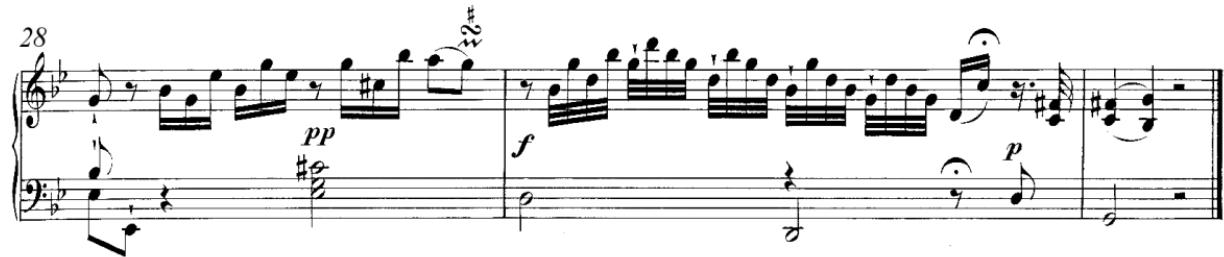
中文讲解
这是第36页的页脚/版权标识,包含书名"C. P. E. Bach, Haydn, and the art of mixed feelings"、著作权人Lodewijk Muns及年份2008,以及页码p. 36。该段为版面识别信息,不含分析性内容。
脚注 / 边栏 / 图表 / 附加信息(如有)
本节正文段落除P0261为乐谱示例图注外,其余段落均为图像/乐谱占位符(P0262–P0265、P0267–P0271)与页脚/版权标识(P0266、P0272)。P0266与P0272页脚载有书名、作者、版权年份及页码。无独立脚注、边栏或图注以外的附加文字材料。
💡 本节核心要点
- 本节主体为一个编号Example 10的乐谱示例,跨第35与第36两页呈现。
- 该示例对应C. P. E.巴赫奏鸣曲Wq. 55/6的第二乐章,图注中并列给出参考编号H. 187,年份标注1765,速度为Andante。
- 图注明示"continued on next page",与版面上第35页4个占位符加第36页5个占位符的分布相吻合。
- 本小节标题将该乐章作为"soliloquy(独白)“这一描述性范畴的讨论对象,但该范畴划分仅出现在section_title而非P0261原文中。
- 除P0261图注外,本节其余段落均为图像占位符或页脚版面信息,不含分析性文字。
🔑 关键术语
- Wq. 55/6:原图注中为奏鸣曲给出的作品编号标识之一,与H. 187并列;本节理解仅需知道它是图注中该奏鸣曲的参考标记。
- H. 187:原图注中与Wq. 55/6并列的另一参考编号;本节不展开两种编号的归属与对应关系。
- Andante:速度术语,指行进般的中等慢速;图注中以此标示Wq. 55/6第二乐章的速度。
- ii:小写拉丁数字2,在奏鸣曲语境中通常指第二乐章;图注中用以标示Wq. 55/6的第二乐章。
- soliloquy:原意为戏剧中角色独自面向观众的讲话;本节标题将其作为描述性范畴用于讨论该乐章,但本节正文段落仅含图注、占位符与页脚,未给出该范畴的文本定义。
S3 Abstract
第1段(P0273)
原文复述
Abstract
中文讲解
本段是该节的标题“Abstract”(摘要),用于开启并标示本节的论题范围。摘要本身不承载论证内容,其作用是以高度压缩的方式预告下文将要涉及的核心议题:对音乐中“Empfindsamkeit”(情感/敏感性)这一概念的界定、其在器乐语言问题中的位置,以及与同时代文学现象的关联。该标题以英文“Abstract”呈现,提示这是一篇学术性章节(或论文摘要),按学术惯例将关键命题集中呈现给读者。
第2段(P0274)
原文复述
The concept of ‘Empfindsamkeit’ in music has been insufficiently defined. An attempt to establish the scope of the musical Empfindsamkeit has to take into account the moral-emotional aspects of the international movement of ‘sensibility’. Moses Mendelssohn’s concept of ‘vermischte Empfindungen’, which he developed around the central empfindsam concept of ‘pity’, articulates an awareness of greater complexity of emotional states in aesthetic context. Such complexity is expressed in some of the keyboard works of Carl Philipp Emanuel Bach and of Joseph Haydn. The question of an influence of Bach on Haydn (which has already been established with reasonable security) is for our musical comprehension less important than that of perceived affinity or ‘kinship’ in expressive content, which should not be considered outside the province of analysis.
中文讲解
本段是摘要的核心论证段落,提出并界定了文章的研究对象。作者开宗明义地指出,音乐中的“Empfindsamkeit”(情感/敏感性)这一概念在既有研究中尚缺乏充分的定义;因此,文章的首要任务是为这个概念划定范围。在划定时作者特别强调,不能只从纯音乐技术或风格层面着手,必须将其放回到十八世纪跨国界的“sensibility”(情感主义)这一道德–情感运动的语境中去理解——这意味着音乐中的Empfindsamkeit不只是音响现象,而是一整套伦理与情感的态度。
为了给这个概念提供可操作的学理支撑,作者引入了Moses Mendelssohn(摩西·门德尔松)提出的“vermischte Empfindungen”(混合感受/复合情感)。门德尔松围绕“pity(怜悯)”这一empfindsam传统中最具伦理色彩的概念,发展出“混合情感”的范畴,其学理意义在于:审美情境中的情感状态远比单一情绪更为复杂,往往是怜悯、忧伤、愉悦等彼此交织的复合体。换言之,作者借助门德尔松的术语,把Empfindsamkeit由“单纯伤感”重新概念化为“对复合情感的自觉意识”。
接着作者把这种复合情感的自觉落实到具体作品上:C.P.E. Bach(卡尔·菲利普·埃马努埃尔·巴赫)与Joseph Haydn(约瑟夫·海顿)的部分键盘作品中,体现了上述复杂情感状态。这就把抽象概念锚定到了可分析的音乐文本。
段末是全段最具方法论意味的一句:作者区分了“影响(influence)”与“感知上的亲缘性(perceived affinity or kinship)”两个范畴。Bach对Hayton的具体影响虽已得到较为可靠的史实确认,但作者认为,对我们的音乐理解而言,更重要的不是这种影响史,而是二者之间在“表达内容(expressive content)”上的亲缘关系或家族相似性。作者随后明确指出,这种亲缘关系不应被视为分析领域之外的东西——也就是说,分析者有责任将这种“表达上的亲缘性”作为分析对象来处理,而不是将其归入不可言说的印象式评论。
综合来看,本段既划定了研究对象的概念边界(Empfindsamkeit = 跨国sensibility运动中的道德–情感维度,以“混合情感”为核心),又通过具体作曲家(C.P.E. Bach、Haydn)将其落到音乐分析层面,并提出了全文的方法论纲领:分析的重点应在“表达亲缘性”而非“历史影响”。
补充说明
本段内部关系:Moses Mendelssohn的“vermischte Empfindungen”是支撑“greater complexity of emotional states”这一核心命题的关键术语;C.P.E. Bach和Haydn的键盘作品则是该命题在音乐作品层面的实例化;“kinship in expressive content”一句为下文P0275进一步讨论器乐“说话性”提供方法论入口。
第3段(P0275)
原文复述
The empfindsam manner, as exemplified by Carl Philipp Emanuel Bach, has been crucially involved in the ’emancipation’ of instrumental music. A factor in this is the analogy between music and language, which has often been vaguely described as ‘das redende Prinzip’. This may involve: 1. Surface prosodic features, evident in instrumental recitative, which goes far beyond being an imitation of vocal recitative; 2. A non-metaphorical structural analogy of music and language, which by J. N. Forkel (and often since) has been wrongly considered to be not a historical condition of the late 18th Century, but the essence of music. As an artificial, culturally bound feature of music it has to be taken seriously, though the scope and value of this analogy are still insufficiently understood.
中文讲解
本段把研究焦点从“情感内容”推进到“器乐自身的地位”问题。作者开篇即提出:以C.P.E. Bach为典型代表的empfindsam风格,在器乐音乐的“解放(emancipation)”过程中扮演了关键角色。所谓“解放”,是指器乐摆脱对歌词、舞蹈或礼仪功能的依附,获得作为独立艺术门类的合法性。
推动这一解放的核心机制之一是“音乐与语言的类比”。作者指出,这一类比在传统讨论中常被含混地称为“das redende Prinzip”(“会说话的原则”,即器乐如语言般具有表达意义的能力)。作者特别用“vaguely described”一词来提示:既有讨论过于模糊,缺乏对类比实际所指的层次区分。
为澄清这一类比,作者将其拆解为两个层次:
-
表层韵律特征(surface prosodic features)。这类特征最明显地体现在器乐宣叙调(instrumental recitative)中。作者强调,器乐宣叙调绝不仅仅是声乐宣叙调的模仿或移植,而是远远超出了这一层次——也就是说,器乐内部已经发展出独立的、能与语言表达功能比肩的韵律结构。
-
非隐喻性的结构性类比(non-metaphorical structural analogy of music and language)。这是更深一层的类比:音乐与语言之间在结构层面存在可对应的关系。作者在此插入了一个批判性的史观判断:自J. N. Forkel(福克尔,J. S. Bach的早期传记作者)以来,这种类比常被错误地当作音乐的“本质(essence)”来主张,而非仅是十八世纪晚期的一个历史条件(historical condition)。作者的立场是:音乐–语言类比是人工的(artificial)、文化上受制约的(culturally bound)特征,必须认真对待(因为它确实在十八世纪晚期的创作中发挥作用),但不能把它普遍化为音乐的永恒本质。
段末作者承认,尽管有此立场,这一类比的范围(scope)与价值(value)至今仍未得到充分理解。这是一种诚实的知识边界声明,也提示读者:下文将围绕这个尚未完成的议题展开具体讨论。
综上,本段在摘要的论证链中承担双重功能:一方面把Empfindsamkeit与“器乐解放”这一十八世纪美学大叙事挂钩,另一方面通过区分“表层韵律”与“结构性类比”两个层次、并对Forkel式的本质化立场提出批评,为全文的音乐分析建立了方法论框架。
补充说明
段中两条编号要点为作者本人对“das redende Prinzip”所指内容的层级化拆解;“J. N. Forkel”是十八世纪末重要的音乐著述家与J. S. Bach的早期传记作者,其立场在文中被作者明确标记为需要纠正的对象,但Forkel的具体著作名称未在本段出现,故补充栏不另作展开。
第4段(P0276)
原文复述
The works of Laurence Sterne, often associated with Haydn, are discussed in order to elucidate some of the literary aspects of Empfindsamkeit.
中文讲解
本段以预告性语言提示文章将进一步引入文学维度:Laurence Sterne(劳伦斯·斯特恩,十八世纪英国感伤主义小说代表,《项狄传》《感伤旅行》的作者)的作品之所以被纳入讨论,是因为它们常被研究者与Haydn相联系——也就是说,在既有研究中,Hayton的音乐与Sterne的小说被并置阅读,二者被视为同一情感主义(Empfindsamkeit)潮流在不同艺术门类中的表现。
作者写这一句的功能并不是展开文学分析,而是预告:在音乐分析之外,本研究还将借助Sterne的文本来说明Empfindsamkeit在文学层面上的若干特征,从而呈现这一概念在不同媒介中的共通结构。换言之,这一节奠定了全文章跨艺术门类(音乐–文学)对照的合法性,也为读者解释了为什么一部看似以音乐为中心的论文会讨论一位小说家。
本段作为摘要的最末句,篇幅极短,却完成了从“音乐内部”(Empfindsamkeit → C.P.E. Bach / Haydn → 器乐解放)向“音乐–文学关系”的转向。
补充说明
本段中Laurence Sterne与Haydn的“often associated”是作者对既有研究语境的简略概括,Sterne的具体作品名称在本段未出现,故补充栏不另作展开。
脚注 / 边栏 / 图表 / 附加信息(如有)
本节为论文的Abstract(摘要),位于第37页。节内未出现脚注、图表、谱例或边栏文本。其内部附加信息仅为:1) 一处分级编号(“1. … 2. …”),用于将“das redende Prinzip”拆分为两个层次;2) 多处用单引号标示的术语(‘Empfindsamkeit’, ‘sensibility’, ‘vermischte Empfindungen’, ‘pity’, ’emancipation’, ‘das redende Prinzip’, ‘kinship’),提示这些是文章讨论的关键概念或行话。摘要末尾一句预告了正文将进一步讨论Laurence Sterne与Haydn在文学层面的关联。
💡 本节核心要点
- 音乐中的’Empfindsamkeit’至今缺乏充分定义,必须将其置于十八世纪跨国’sensibility’运动的道德–情感语境中加以界定。
- Moses Mendelssohn的’vermischte Empfindungen’(以’pity’为核心)提供了一把理论钥匙:审美情感并非单一情绪,而是自觉到的复合情感状态。
- 这种复合情感在C.P.E. Bach与Haydn的键盘作品中有具体体现;分析的重点应在’表达上的亲缘性’而非’历史影响’的考据。
- C.P.E. Bach的empfindsam风格是器乐获得’解放’(独立于声乐与礼仪功能)的关键力量,其机制是音乐–语言类比,即含混所谓的’das redende Prinzip’。
- 音乐–语言类比须分层处理:表层韵律特征(器乐宣叙调远超模仿声乐)与深层结构性类比;后者是十八世纪晚期的人工、文化性历史条件,Forkel以来被误当作音乐本质,必须纠正。
- Empfindsamkeit的研究须跨出音乐内部,与Laurence Sterne等文学家的作品并置,以呈现这一情感潮流在不同艺术门类中的共通结构。
🔑 关键术语
- Empfindsamkeit:德语术语,本节中指十八世纪音乐(尤指C.P.E. Bach与Haydn部分键盘作品)中以’复合情感’为核心的敏感性风格;在文中既是研究对象,也是与同时代国际’sensibility’运动相挂钩的概念。
- vermischte Empfindungen:Moses Mendelssohn提出的概念,指审美情境中的’混合/复合情感’。在本节中作为Empfindsamkeit的理论支点,用来论证情感状态本身具有’greater complexity’。
- das redende Prinzip:德语术语,意为’会说话的原则’。在本节中指对’音乐如语言般具有表达意义’这一类比的含混通称;作者将其拆分为表层韵律与深层结构两类,并批判了Forkel以来将其本质化的做法。
- pity:‘怜悯’。在本节中作为empfindsam传统中具有伦理色彩的核心概念,是Mendelssohn发展’vermischte Empfindungen’所围绕的枢纽性情感。
- emancipation (of instrumental music):‘器乐的解放’。在本节中指器乐摆脱对歌词、舞蹈、礼仪等外部功能的依附,获得独立艺术合法性的过程;作者认为empfindsam风格是促成此解放的关键力量。
- perceived affinity / kinship in expressive content:‘表达内容上的感知亲缘性’。作者在本节提出的方法论核心概念:相比考据Bach对Haydn的实际影响,分析更应聚焦于二者作品在情感表达层面的家族相似性,并主张这种亲缘性属于分析的对象。
S4 Postscript (2012)
第1段(P0277)
原文复述
Postscript (2012)
中文讲解
本段是层级标题,标示“Postscript (2012)”,即“2012年所写的跋/后记”。作为小节的起始,它开启的是作者于2012年补充撰写的一节文字,通常用于对正文早先出版后所出现的新材料、新研究或术语史作追加说明。在本书的版面结构中,这一标题独立占行,说明作者刻意将后续内容与原书正文区分开来,作为晚近补充而非原始论述的一部分。
第2段(P0278)
原文复述
Footnote 99 refers to “apparently uncatalogued stock figures”. A comprehensive overview of such figures is given by Robert O. Gjerdingen in Music in the Galant Style (2007); the “highly typical cadence” had been previously discussed by Charles L. Cudworth (1949), and has been dubbed ‘the Cudworth’ by Gjerdingen.
中文讲解
本段是一条脚注内容,交代正文注99所提到的“apparently uncatalogued stock figures”(显然尚未被编目整理的程式化音型)的学术出处与命名史。其要点有三:第一,作者承认这类程式化音型在传统研究中被忽视,尚未形成系统目录;第二,Robert O. Gjerdingen 于2007年出版的 Music in the Galant Style 一书对此作了综合性的整理与概述,是读者查阅此类音型的权威参考;第三,这其中一种被作者称为“highly typical cadence”(极具典型性的终止式)的音型,其实最早由 Charles L. Cudworth 在1949年的研究中讨论过;Gjerdingen 后来以 Cudworth 的姓氏命名这一终止式,即‘the Cudworth’,以纪念前人的发现。
在论证意义上,这条脚注承担着学术诚信与术语溯源的功能:作者一方面指引读者去查阅 Gjerdingen 的综合研究以了解相关音型全貌,另一方面又明确点出自己所用名称的真正首创者,避免将命名权误归于 Gjerdingen。这体现了作者在术语史上的细致态度,也暗示本书与 Gjerdingen 的 galant style 研究存在直接对话关系。
补充说明
本段中“Footnote 99”是指向正文中第99号脚注的延伸说明,属于脚注内部对脚注的补充(meta-footnote),并非独立的学术声明。
脚注 / 边栏 / 图表 / 附加信息(如有)
本节正文仅有标题与一条脚注内容两段。P0278 实质上是作者为正文注99所补充的参考文献与术语命名说明,属于“脚注中的脚注”,用于澄清“apparently uncatalogued stock figures”的出处指向 Gjerdingen (2007) 的 Music in the Galant Style,并将“highly typical cadence”的命名权追溯至 Cudworth (1949)。该段在论证上的作用是为术语使用提供学术史依据,避免读者误以为相关概念或名称系作者原创。
💡 本节核心要点
- 本节作为2012年后记,专门补充与原书正文相关的术语史与参考文献信息。
- 作者承认正文所提到的“apparently uncatalogued stock figures”尚未形成完整目录,但已由 Gjerdingen (2007) 的 Music in the Galant Style 作了综合概述。
- “highly typical cadence”这一极具典型性的终止式早在1949年便由 Cudworth 讨论过。
- Gjerdingen 后来将这一终止式命名为‘the Cudworth’,作者在此明确这一命名史,以正术语归属。
- 本节体现了作者严谨的学术态度:通过脚注中的脚注形式,澄清自己所用概念的真正出处与命名者。
🔑 关键术语
- apparently uncatalogued stock figures:指显然尚未被系统编目整理的程式化音乐音型/公式化旋律片段;本节指出其综合概述见 Gjerdingen, Music in the Galant Style (2007)。
- highly typical cadence:一种“极具典型性的终止式”,最早由 Cudworth (1949) 讨论,后被 Gjerdingen 命名为‘the Cudworth’。
- the Cudworth:Gjerdingen 为纪念 Cudworth 对该典型终止式的早期研究而赋予的非正式名称,本节明确该命名归属于 Gjerdingen。
- Music in the Galant Style (2007):Robert O. Gjerdingen 于2007年出版的著作,是本节所提“apparently uncatalogued stock figures”的综合参考文献。
S5 References
第1段(P0279)
原文复述
References
中文讲解
这是全书主体正文之后的"参考文献"主标题,标志着从论证书写阶段转入文献索引阶段。整节将列出作者所引用的全部学术文献和原始乐谱版本,以支撑前文围绕C. P. E. Bach、Haydn以及Empfindsamkeit美学关系的论证。
第2段(P0280)
原文复述
Internet references in the footnotes. After the author’s name year of first publication, where applicable.
中文讲解
这是一条编辑体例说明,告知读者:脚注中的网络文献与作者正名同行;在适用的情况下,姓名之后给出的年份是首次出版年。它界定了本节书目所采用的两条统一格式——网络文献归入脚注而非列于末尾,首次出版年优先于所用版本年份——这是18世纪文献研究中常见的做法,因为许多作者依赖的是后世的再版。
第3段(P0281)
原文复述
ABERT, Hermann (1921). J. Haydn’s klaviersonaten. ZfMW III 1921 p. 535-552
中文讲解
德国音乐学家 Hermann Abert 1921年发表于《音乐学季刊》(Zeitschrift für Musikwissenschaft, 第三卷, 1921) 第535-552页的论文《J. Haydn的钢琴奏鸣曲》。Abert 是20世纪初最重要的海顿研究者之一,本篇是其关于Haydn键盘奏鸣曲的专题文章,对后来讨论Haydn钢琴作品风格的学者影响深远。
第4段(P0282)
原文复述
ABERT, Hermann (1920). J. Haydn’s klavierwerke. ZfMW II 1920 p. 553-573
中文讲解
Abert 1920年发表于《音乐学季刊》(Zeitschrift für Musikwissenschaft, 第二卷, 1920) 第553-573页的《J. Haydn的钢琴作品》,是1921年奏鸣曲专文的姊妹篇,两者构成对Haydn键盘作品最早的系统性学术考察。
第5段(P0283)
原文复述
BAASNER, Frank (1988). Der Begriff “sensibilité” im 18. Jahrhundert: Aufstieg und Niedergang eines Ideals. Heidelberg, Winter
中文讲解
Frank Baasner 1988年由海德堡 Winter 出版社出版的《18世纪的"sensibilité"概念:一种理想的兴起与衰落》。该书以法语词 sensibilité 为切入点,追索该术语在18世纪德语文化圈的译介与变化,为本书讨论 Empfindsamkeit 概念提供了语义史的背景。
第6段(P0284)
原文复述
BACH, Carl Philipp Emanuel (1753). Versuch über die wahre Art, das Clavier zu spielen. Erster und zweiter Teil. Faksimile-Nachdruck. Leipzig, Breitkopf & Härtel 1978
中文讲解
C. P. E. Bach 1753年首版的《论键盘乐器演奏的真正艺术》第一、二卷;本条所引为 Breitkopf & Härtel 于1978年在莱比锡发行的影印重印本。该著作是18世纪最重要的键盘演奏法文献,其中关于 Empfindsamkeit 演奏风格的章节是研究"empfindsamer Stil"的第一手文本依据。
第7段(P0285)
原文复述
C. P. E. Bach, Haydn, and the art of mixed feelings © Lodewijk Muns 2008 – p. 37
中文讲解
这是出现在每页页脚的版面标识行(running footer):书名《C. P. E. Bach, Haydn, and the art of mixed feelings》、版权人 Lodewijk Muns 2008、本次出现的页码 p. 37。它是排版属性而非正文内容。
第8段(P0286)
原文复述
BAUMGARTEN, Alexander Gottlieb (1750). Theoretische Ästhetik: die grundlegenden Abschnitte aus der “Aesthetica” (1750/58): Lateinisch-Deutsch. Übers. und hrsg. von Hans Rudolf Schweizer. Hamburg, Meiner 1983
中文讲解
Baumgarten 1750年起首版的《美学》(Aesthetica) 主要章节拉-德对照译本,由 Hans Rudolf Schweizer 翻译并编辑,汉堡 Meiner 出版社1983年出版。Baumgarten 是"美学"一词的发明者,本书是讨论18世纪感性论美学的起点。
第9段(P0287)
原文复述
BERG, Darrell M. (1990). C. Ph. E. Bach und die “empfindsame Weise”. in Marx 1990 p. 93-105
中文讲解
Darrell M. Berg 1990年发表于 Marx 1990 编辑文集第93-105页的《C. P. E. Bach与"empfindsame Weise”》。该文是关于 Bach “敏感风格"的代表性英文学术论文之一。
第10段(P0288)
原文复述
BONDS, Mark Evan (1991a). Haydn, Laurence Sterne, and the origins of musical irony. JAMS XLI 1991 p. 57-91.
中文讲解
Mark Evan Bonds 1991年发表于《美国音乐学会会刊》(Journal of the American Musicological Society) 第41卷第57-91页的《Haydn、Laurence Sterne与音乐反讽的起源》。该文是 Music–Sterne 跨学科比较研究领域引用率极高的奠基之作。
第11段(P0289)
原文复述
BONDS, Mark Evan (1991b). Wordless rhetoric: musical form and the metaphor of the oration. Cambridge, Mass. [etc.], Harvard University Press
中文讲解
Bonds 同年由哈佛大学出版社出版的专著《无言的修辞:音乐形式与演说隐喻》,研究音乐结构与18世纪修辞学之间的隐喻关系,是讨论"redendes Prinzip"不可或缺的理论资源。
第12段(P0290)
原文复述
BROWN, A. Peter (1986). Joseph Haydn’s keyboard music: Sources and style. Bloomington, Indiana University Press
中文讲解
A. Peter Brown 1986年由印第安纳大学出版社出版的《Joseph Haydn的键盘音乐:来源与风格》,是关于 Haydn 键盘作品的史料与风格研究的英文学术专著。
第13段(P0291)
原文复述
BÜCKEN, Ernst (1928). Die Musik des Rokokos und der Klassik. 2. Aufl. Wiesbaden, Athenaion 1979
中文讲解
Ernst Bücken 1928年初版的《洛可可与古典时期的音乐》,本条所引为1979年雅典(Athenaion)出版社在威斯巴登发行的第二版。该书属于20世纪上半叶德语音乐断代史系列的常见读本。
第14段(P0292)
原文复述
CASH, Arthur H. (1955). The Lockean psychology of Tristram Shandy. ELH Vol. 22 No. 2 Jun., 1955 p. 125-135
中文讲解
Arthur H. Cash 1955年6月发表于《英语文学史》(ELH) 第22卷第2期第125-135页的《〈项狄传〉中的洛克式心理学》。该文是英语学界关于 Sterne 与洛克经验主义关联的早期讨论之一。
第15段(P0293)
原文复述
CASH, Arthur H. (1986a). Laurence Sterne: The early & middle years. London [etc.], Routledge 1992
中文讲解
Arthur H. Cash 1986年首版、1992年由 Routledge 出版的《Laurence Sterne:早期与中期》,为 Sterne 传记两卷本中的第一卷,覆盖作家创作生涯的前半段。
第16段(P0294)
原文复述
CASH, Arthur H. (1986b). Laurence Sterne: The later years. London [etc.], Routledge 1992
中文讲解
Cash Sterne 传记的第二卷,1986年首版、1992年由 Routledge 出版,对应作家创作生涯的后半段。两卷合为目前最完整的 Sterne 学术传记。
第17段(P0295)
原文复述
CHRYSANDER, Friedrich (1891). Eine Klavier-Phantasie von Karl Philipp Emanuel Bach mit nachträglich von Gerstenberg eingefügten Gesangsmelodien zu zwei verschiedenen Texten. Vierteljahrsschrift für Musikwissenschaft VII 1891 p. 1-25
中文讲解
Friedrich Chrysander 1891年发表于《音乐学季刊》(Vierteljahrsschrift für Musikwissenschaft) 第7卷第1-25页的论文,讨论 C. P. E. Bach 一首由 Gerstenberg 后来补入两套不同歌词的钢琴幻想曲。该文是 Gerstenberg–Bach 文本-音乐互动研究的早期学术源头。
第18段(P0296)
原文复述
CLARK, Caryl (2005) (ed.). The Cambridge companion to Haydn. Cambridge [etc.], Cambridge University Press
中文讲解
Caryl Clark 主编、剑桥大学出版社2005年出版的《剑桥 Haydn 指南》,是英语学界最常用的 Haydn 综合研究参考书,由多位学者分章撰写。
第19段(P0297)
原文复述
CLARK, Stephen L. (1988) (ed.). C. P. E. Bach studies. Oxford, Clarendon Press
中文讲解
Stephen L. Clark 主编、牛津 Clarendon 出版社1988年出版的《C. P. E. Bach 研究》,是英语学界第一部以 C. P. E. Bach 为主题的论文集,对后继的 C. P. E. Bach 学术有奠基作用。
第20段(P0298)
原文复述
COWART, Georgia J. (1984). Sense and Sensibility in Eighteenth-Century musical thought. Acta Musicologica Vol. 56 Fasc. 2. 1984 p. 251-266
中文讲解
Georgia J. Cowart 1984年发表于《音乐学报》(Acta Musicologica) 第56卷第2辑第251-266页的《18世纪音乐思想中的感官与感性》。该文是英语学界把"sensibility"概念系统引入音乐史讨论的代表性论文。
第21段(P0299)
原文复述
DAHLHAUS, Carl (1967). Musikästhetik. Allgemeine Theorie der Musik I = Gesammelte Schriften in 10 Bänden Band 1. Laaber, Laaber 2000
中文讲解
Carl Dahlhaus 1967年初版的《音乐美学》(《音乐一般理论》卷一)。本条所引为 Laaber 出版社2000年发行的《Dahlhaus 十卷本文集》卷一的版本。该书是20世纪后半叶德语音乐美学的标志性著作。
第22段(P0300)
原文复述
DAHLHAUS, Carl (1982). Europäische Musikgeschichte im Zeitalter der Wiener Klassik. Alte Musik: Musiktheorie des 17. Jahrhundert – 18 Jahrhundert = Gesammelte Schriften in 10 Bänden Band 3. Laaber, Laaber 2001
中文讲解
Dahlhaus 1982年初版的《维也纳古典时期欧洲音乐史》,收录于 Laaber 2001年《文集》卷三。这一卷覆盖17至18世纪的音乐理论与音乐史。
第23段(P0301)
原文复述
DAHLHAUS, Carl (1984) und Michael Zimmermann (hrsg.). Musik, zur Sprache gebracht: musikästhetische Texte aus 3 Jahrhunderten. München, Deutscher Taschenbuch-Verlag
中文讲解
Dahlhaus 与 Michael Zimmermann 合编、慕尼黑 Deutscher Taschenbuch 出版社1984年出版的《诉诸语言的音乐:三个世纪的音乐美学文本》,是18至20世纪音乐美学文选类常用读本。
第24段(P0302)
原文复述
DAHLHAUS, Carl (1985). Einleitung zu: Die Musik des 18. Jahrhunderts. Alte Musik: Musiktheorie des 17. Jahrhundert – 18 Jahrhundert = Gesammelte Schriften in 10 Bänden Band 3. Laaber, Laaber 2001
中文讲解
Dahlhaus 1985年撰写的《18世纪音乐》导言,亦收入 Laaber 2001年《文集》卷三。该导言概述了18世纪德语音乐史的整体分期与术语框架。
第25段(P0303)
原文复述
DAHLHAUS, Carl (1989). Die Musiktheorie im 18. und 19. Jahrhundert. Zweiter Teil: Deutschland. Hrsg. von Ruth E. Müller. Darmstadt, Wissenschaftliche Buchgesellschaft
中文讲解
Dahlhaus 1989年(由 Ruth E. Müller 编辑) 出版的《18、19世纪的音乐理论,第二部分:德国》。该书是德语区音乐理论断代史的标准参考。
第26段(P0304)
原文复述
DIES, Albert Christoph (1810). Biographische Nachrichten von Joseph Haydn. Wien, Camesianische Buchhandlung
中文讲解
Albert Christoph Dies 1810年在维也纳 Camesianische 书店出版的《Joseph Haydn 传记见闻》。Dies 是 Haydn 的直接交往圈成员,其回忆录是 Haydn 早期生平最常被引用的18世纪末原始史料之一。
第27段(P0305)
原文复述
FORKEL, Johann Nikolaus (1788). Allgemeine Geschichte der Musik. Hrsg. und mit einer Einführung (deutsch/englisch) von Claudia Maria Knispel. Laaber, Laaber 2005
中文讲解
Forkel 1788年首版的《音乐通史》,本条所引为 Laaber 出版社2005年由 Claudia Maria Knispel 编辑并撰写德-英双语导言的重印本。Forkel 是德国早期音乐史学的奠基人。
第28段(P0306)
原文复述
FORKEL, Johann Nikolaus (1802). Über Johann Sebastian Bachs Leben, Kunst und Kunstwerke. Leipzig, Hoffmeister und Kühnel
中文讲解
Forkel 1802年在莱比锡 Hoffmeister und Kühnel 出版的《论J. S. Bach的生平、艺术与作品》。该书是第一部 J. S. Bach 传记,也是后世 Bach 研究的起点之一。
第29段(P0307)
原文复述
Fox, Pamela (1988). The stylistic anomalies of C. P. E. Bach’s nonconstancy. in Clark (1988) p. 295-314
中文讲解
Pamela Fox 1988年发表在 Clark (1988) 文集第295-314页的《C. P. E. Bach"非恒定性"的风格异常》。该文聚焦 Bach 风格中违反常规的修辞现象,对理解其"奇异幻想"与情感突变具有参考价值。
补充说明
需注意此处页码295-314与下方Wollenberg条目页码一致,可能为书目转录中原文献的页码有误;原著正文若引用时应核对原始页面。
第30段(P0308)
原文复述
FRYE, Northrop (1956). Towards defining an Age of Sensibility. ELH Vol. 23 No. 2 p. 144-152
中文讲解
北美文学批评家 Northrop Frye 1956年发表于《英语文学史》23卷2期第144-152页的《走向界定一个"感性时代”》。该文是英语学界对18世纪中后期"感伤主义"文学史命名问题的纲领性讨论。
第31段(P0309)
原文复述
HANSEN, Klaus P. (1990). Neue Literatur zur Empfindsamkeit? Deutsche Vierteljahrsschrift für Literaturwissenschaft und Geistesgeschichte 64:3 p.514-528
中文讲解
Klaus P. Hansen 1990年发表于《德语文学史与思想史季刊》64卷3期第514-528页的《论 Empfindsamkeit 的新文献》。该文是德语学界对1980年代末至90年代初 Empfindsamkeit 研究的综述。
第32段(P0310)
原文复述
HARRISON, Bernard (1997). Haydn’s keyboard music: studies in performance practice. Oxford, Clarendon Press
中文讲解
Bernard Harrison 1997年由 Clarendon 出版社出版的《Haydn的键盘音乐:演奏实践研究》,是 Haydn 钢琴作品演奏实践的英文学术专著。
第33段(P0311)
原文复述
HAYDN, Joseph (1965). Gesammelte Briefe und Aufzeichnungen; unter Benützung der Quellensammlung von H.C. Robbins Landon hrsg. und erl. von Dénes Bartha. Kassel [etc.], Bärenreiter
中文讲解
Haydn 的《书信与记录全集》(1965),由 H. C. Robbins Landon 提供的原始资料汇集、由 Dénes Bartha 编辑并注释,卡塞尔 Bärenreiter 出版。该书是研究 Haydn 生平思想最重要的原典资料。
第34段(P0312)
原文复述
HEARTZ, Daniel (2001) and Bruce Alan Brown. Empfindsamkeit. NG
中文讲解
Daniel Heartz 与 Bruce Alan Brown 2001年为《新格罗夫音乐与音乐家辞典》(NG) 撰写的"Empfindsamkeit"词条。该词条概述了 Empfindsamkeit 概念在音乐中的来源、流变与表现。
第35段(P0313)
原文复述
HEARTZ, Daniel (2003). Music in European capitals: the galant style 1720-1780. New York [etc.], Norton
中文讲解
Daniel Heartz 2003年由 Norton 出版的《欧洲各国都城的音乐:1720-1780年的华丽风格》。该书是关于华丽风格(Galant)形成期的多国别断代史,是本节讨论 Empfindsamkeit 与 Galant 关系的关键背景读物。
第36段(P0314)
原文复述
HELM, Eugene (1972). The “Hamlet” Fantasy and the literary element in C. P. E. Bach’s music. MQ Vol. 58/2 p. 277-296
中文讲解
Eugene Helm 1972年发表于《音乐季刊》58卷2期第277-296页的《“哈姆雷特"幻想曲与C. P. E. Bach音乐中的文学因素》。该文讨论 C. P. E. Bach 著名的 c 小调幻想曲与文学(尤其是Shakespeare《哈姆雷特》独白)之间的关联。
第37段(P0315)
原文复述
HIRSCHMANN, Wolfgang (1995). Empfindsamkeit. MGG Sachteil 2
中文讲解
Wolfgang Hirschmann 1995年为《音乐学新辞典》(MGG) 实体卷2撰写的"Empfindsamkeit"词条。该词条与上文Heartz/Brown 2001年的新格罗夫词条共同构成音乐学界对 Empfindsamkeit 词条释义的标准参考。
第38段(P0316)
原文复述
HÖRWARTHNER, Maria (1997). Joseph Haydn’s library: An attempt at a literary-historical reconstruction. in Sisman (1997) p. 395-461
中文讲解
Maria Hörwarthner 1997年发表在 Sisman (1997) 文集第395-461页的《Joseph Haydn的藏书:一次文学史重构尝试》。该文尝试根据 Hayter 遗嘱等线索重建 Haydn 个人图书馆文学类藏书,是 Haydn 文学阅读史的关键文献。
第39段(P0317)
原文复述
HOGWOOD, Christopher (2006). “Our old great favorite”: Burney, Bach, and the Bachists. in Richards (2006) p. 221-264
中文讲解
指挥家兼学者 Christopher Hogwood 2006年发表在 Richards (2006) 文集第221-264页的《“我们的老伟大宠儿”:Burney、Bach 与巴赫主义者》。该文从 Burney 视角论述英语世界对 C. P. E. Bach、J. S. Bach 父子接受的差异。
第40段(P0318)
原文复述
IRVING, H. (1985). Haydn und Laurence Sterne: Similarities in Eighteenth-Century literary und musical wit. Current Musicology 40 p. 34-49
中文讲解
H. Irving 1985年发表于《当代音乐学》(Current Musicology) 第40期第34-49页的《Haydn 与 Laurence Sterne:18世纪文学与音乐机智的相似性》。该文是讨论 Haydn 与 Sterne 之间机智/反讽修辞的早期专论。
第41段(P0319)
原文复述
JONES, David Wyn (2002) (ed.). Haydn. Oxford, Oxford University Press
中文讲解
David Wyn Jones 2002年主编、牛津大学出版社出版的《Haydn》论文集,是英语学界重要的 Haydn 综合研究读本。
第42段(P0320)
原文复述
KUBOTA, Keiichi (1986). Über die musikalische Empfindsamkeit. Mf 39 p. 139-148
中文讲解
Kubota Keiichi (久保田慶一) 1986年发表于《音乐学论坛》(Die Musikforschung) 第39卷第139-148页的德文论文《关于音乐 Empfindsamkeit》。该文以德语从东方学者视角讨论音乐 Empfindsamkeit 概念。
第43段(P0321)
原文复述
KUNZE, Stefan (1990). Carl Philipp Emanuel Bach – Zeit und Werk. in Marx (1990) p. 15-38
中文讲解
Stefan Kunze 1990年发表于 Marx (1990) 文集第15-38页的《Carl Philipp Emanuel Bach——时代与作品》。该文系统勾勒了 C. P. E. Bach 的时代背景与作品分布。
第44段(P0322)
原文复述
LANDON, H. C. Robbins (1978). Haydn at Eszterháza: 1766-1790. Haydn: chronicle and works Vol. 2. Bloomington [etc.], Indiana University Press
中文讲解
H. C. Robbins Landon 1978年由印第安纳大学出版社出版的《Haydn 在艾斯特哈萨:1766-1790》(《Haydn编年与作品》卷二)。该书是 Landon 五卷本 Haydn 巨著的核心卷次之一。
第45段(P0323)
原文复述
LEISINGER, Ulrich (1990). Was sind musikalische Gedanken? Archiv für Musikwissenschaft 47. Jahrg. H. 2. p. 103-119.
中文讲解
Ulrich Leisinger 1990年发表于《音乐学档案》(Archiv für Musikwissenschaft) 第47年第2期第103-119页的《何谓"音乐思想”?》。该文讨论了18世纪音乐文献中"Gedanken"一词的含义及其语义史。
第46段(P0324)
原文复述
LEISINGER, Ulrich (1994). Joseph Haydn und die Entwicklung des klassischen Klavierstils bis ca. 1785. Laaber, Laaber
中文讲解
Ulrich Leisinger 1994年由 Laaber 出版的《Joseph Haydn 与约1785年前的古典钢琴风格发展》。该书是讨论 Haydn 早中期钢琴风格演变的核心专著。
第47段(P0325)
原文复述
LESSING, Gotthold Ephraim (1982). Werke in drei Bänden: Zweiter Band. München [etc.], Hanser
中文讲解
Lessing 1982年由 Hanser 在慕尼黑等城市出版的三卷本《文集》第二卷。Lessing 是德国启蒙时期的关键文学批评家,本卷收入《汉堡剧评》等美学文本,对理解 Empfindsamkeit 之文学源流有支撑作用。
第48段(P0326)
原文复述
LÜTTEKEN, Laurenz (1998). Das Monologische als Denkform in der Musik zwischen 1760 und 1785. Tübingen, Niemeyer
中文讲解
Laurenz Lütteken 1998年由图宾根 Niemeyer 出版的《1760至1785年间音乐中作为思维形式的"独白体"》。该书讨论 C. P. E. Bach 自由幻想曲及其追随者所运用的"独白"美学,与本节对Empfindsamkeit作曲家内心独白的论述直接相关。
第49段(P0327)
原文复述
MARX, Hans Joachim (1990) (hrsg.). Carl Philipp Emanuel Bach und die europäische Musikkultur des mittleren 18. Jahrhunderts: Bericht über das internationale Symposium der Joachim-Jungius-Gesellschaft der Wissenschaften Hamburg, 29. September - 2. Oktober 1988. Göttingen, Vandenhoeck und Ruprecht
中文讲解
Hans Joachim Marx 主编、1990年由 Vandenhoeck und Ruprecht 在哥廷根出版的会议论文集《Carl Philipp Emanuel Bach 与18世纪中叶的欧洲音乐文化》,汇集1988年汉堡 Joachim-Jungius 学会国际研讨会的报告。本书作者多次引用该文集的篇目。
第50段(P0328)
原文复述
MENDELSSOHN, Moses (1974). Ästhetische Schriften in Auswahl. hrsg. von Otto F. Best. Darmstadt, Wissenschaftliche Buchgesellschaft
中文讲解
Moses Mendelssohn 1974年由 Otto F. Best 编辑并由达姆施塔特 Wissenschaftliche Buchgesellschaft 出版的《美学文选》。Mendelssohn 是德国启蒙时期 Leibniz–Wolff 哲学派美学的代表,其论"混乱的可领悟关系"等讨论对理解 Empfindsamkeit 的哲学基础有帮助。
第51段(P0329)
原文复述
MICHELSEN, Peter (1962). Laurence Sterne und der deutsche Roman des achtzehnten Jahrhunderts. Göttingen, Vandenhoeck & Ruprecht
中文讲解
Peter Michelsen 1962年由 Vandenhoeck & Ruprecht 在哥廷根出版的《Laurence Sterne 与18世纪德国长篇小说》。该书是德语学界关于 Sterne 在德国接受史的经典研究。
第52段(P0330)
原文复述
C. P. E. Bach, Haydn, and the art of mixed feelings © Lodewijk Muns 2008 – p. 39
中文讲解
页脚版面标识行:书名、版权人 Lodewijk Muns 2008、页码 p. 39。属于排版属性而非正文内容。
第53段(P0331)
原文复述
MULLAN, John (1988). Sentiment and sociability: the language of feeling in the eighteenth century. Oxford, Clarendon Press
中文讲解
John Mullan 1988年由 Clarendon 出版社出版的《感伤与社交:18世纪的情感语言》。该书讨论18世纪英语文化中 sentiment 一词及其与社交场域的关系,为讨论 Sterne 的"sentimental"修辞提供了文化史背景。
第54段(P0332)
原文复述
NEWMAN, William S. (1963). The sonata in the classic era. 2nd ed. New York, Norton
中文讲解
William S. Newman 1963年由 Norton 在纽约出版的《古典时期的奏鸣曲》第二版。该书是英语学界讨论古典奏鸣曲曲式的标准教科书。
第55段(P0333)
原文复述
NOVEMBER, Nancy (2007). Haydn’s melancholy voice: lost dialectics in his late chamber music and English songs. Eighteenth-Century Music 4/1 p. 71-106
中文讲解
Nancy November 2007年发表于《18世纪音乐》(Eighteenth-Century Music) 第4卷第1期第71-106页的《Haydn的忧郁之声:其晚期室内乐与英语歌曲中失落的辩证法》。该文讨论 Haydn 晚期作品中"忧郁"情感的辩证结构。
第56段(P0334)
原文复述
OTTENBERG, Hans-Günter (1984) (hrsg.). Der critische Musicus an der Spree: Berliner Musikschrifttum von 1748 bis 1799. Leipzig, Reclam
中文讲解
Hans-Günter Ottenberg 1984年主编、莱比锡 Reclam 出版的《施普雷河畔的批评音乐家:1748-1799年的柏林音乐文献》。该书汇集了柏林地区启蒙时期最重要的德语音乐批评文献。
第57段(P0335)
原文复述
OTTENBERG, Hans-Günter. Carl Philipp Emanuel Bach. Leipzig, Reclam
中文讲解
Ottenberg 在莱比锡 Reclam 出版的《Carl Philipp Emanuel Bach》。该书是 Reclam"作曲家"系列中 C. P. E. Bach 的普及性学术小传。
第58段(P0336)
原文复述
PLEBUCH, Tobias (2006). Dark fantasies and the dawn of the self: Gerstenberg’s monologues for C.P.E. Bach’s C minor Fantasia. Richards (2006) p. 25-66
中文讲解
Tobias Plebuch 2006年发表在 Richards (2006) 文集第25-66页的《黑色幻想曲与自我的曙光:Gerstenberg 为 C. P. E. Bach c 小调幻想曲所做的独白》。该文讨论 Gerstenberg 为 Bach c 小调幻想曲所撰写的两套独白台词,是联系 Bach 音乐与早期浪漫派"自我"叙事的重要桥梁文献。
第59段(P0337)
原文复述
POOS, Heinrich (1993) (hrsg.). Carl Philipp Emanuel Bach: Beiträge zu Leben und Werk. Mainz [etc.], Schott
中文讲解
Heinrich Poos 1993年主编、美因茨 Schott 出版的《Carl Philipp Emanuel Bach:生平与作品研究》。该论文集汇集德语学界对 C. P. E. Bach 生平与作品的多篇专题研究。
第60段(P0338)
原文复述
RICHARDS, Annette (2001). The free fantasia and the musical picturesque. Cambridge, Cambridge University Press
中文讲解
Annette Richards 2001年由剑桥大学出版社出版的《自由幻想曲与音乐如画性》。该书聚焦18世纪自由幻想曲体裁与"如画"美学概念的关系,是本节 C. P. E. Bach c 小调幻想曲讨论最直接的理论基础之一。
第61段(P0339)
原文复述
RICHARDS, Annette (2006) (ed.). C. P. E. Bach studies. Cambridge [etc.], Cambridge University Press
中文讲解
Annette Richards 2006年主编、剑桥大学出版社出版的《C. P. E. Bach 研究》。该论文集为 Stephen L. Clark 1988年之后新一代 C. P. E. Bach 研究的代表,其多篇文章被本节引用。
第62段(P0340)
原文复述
ROSEN, Charles (1971). The Classical Style: Haydn, Mozart, Beethoven. London, Faber and Faber
中文讲解
Charles Rosen 1971年由 Faber and Faber 在伦敦出版的《古典风格:Haydn、Mozart、Beethoven》。该书是20世纪英语学界讨论维也纳古典风格最具影响力的通论著作。
第63段(P0341)
原文复述
SAUDER, Gerhard (1974). Empfindsamkeit. Bd. 1: Voraussetzungen und Elemente. Stuttgart, Metzler
中文讲解
Gerhard Sauder 1974年由斯图加特 Metzler 出版的《Empfindsamkeit,第一卷:前提与要素》。该书是德语学界 Empfindsamkeit 文学批评的代表性专题研究,多卷本中的第一卷聚焦"前提与要素"。
第64段(P0342)
原文复述
SAUDER, Gerhard (1990). Die empfindsamen Tendenzen in der Musikkultur nach 1750. in Marx (1988) p. 41-63
中文讲解
Gerhard Sauder 1990年发表于 Marx 编辑文集(此处年标作1988,应以集内载文所示会议年份1988为准,而书籍出版年份为1990)第41-63页的《1750年后音乐文化中的感性倾向》。该文是把文学范畴的 Empfindsamkeit 与音乐现象加以贯通的代表作。
补充说明
原书目中所标 Marx (1988) 与正文注释中常引用 Marx (1990) 系同一文集(1988年会议、1990年出版),本节书目与正文在年份上有时会相互混用,需凭上下文判断所引为同一出版物。
第65段(P0343)
原文复述
SCHERING, Arnold (1938). Carl Philipp Emanuel Bach und das “redende Prinzip” in der Musik. in Poos (1993)
中文讲解
Arnold Schering 1938年初版的《Carl Philipp Emanuel Bach 与音乐中的"言说原则"》。本条所引版本出自 Poos 1993年文集中的再刊文本。Schering 把 Bach 的音乐纳入"言说/修辞原则"加以解释,对理解 Bach 幻想曲中的"内心独白"有奠基性作用。
第66段(P0344)
原文复述
SCHLEUNING, Peter (1973). Die freie Fantasie: ein Beitrag zur Erforschung der klassischen Klaviermusik. Göppingen, Kümmerle
中文讲解
Peter Schleuning 1973年由 Kümmerle 在格平根出版的《自由幻想曲:古典钢琴音乐研究之一》。该书是德语学界讨论18世纪自由幻想曲体裁的早期专著。
第67段(P0345)
原文复述
SCHLEUNING, Peter (1984). Das 18. Jahrhundert: der Bürger erhebt sich. Reinbek bei Hamburg, Rowohlt
中文讲解
Peter Schleuning 1984年由汉堡 Rowohlt 出版的《18世纪:市民阶层的崛起》。该书是 Rowohlt"音乐史"普及丛书中讨论18世纪音乐社会史的一卷。
第68段(P0346)
原文复述
SCHLEUNING, Peter (2004). Sturm und Drang in der Musik – Sturm im Wasserglas oder Drang der Forschung? in Siegmund (2004)
中文讲解
Peter Schleuning 2004年发表于 Siegmund 2004年文集的《音乐中的"狂飙与突进"——杯中风暴抑或研究之冲力?》。该文以问题性视角讨论音乐 Sturm und Drang 现象是否成立。
第69段(P0347)
原文复述
SCHMID, Ernst Fritz (1931). Joseph Haydn und Carl Philipp Emanuel Bach. in ZfMw XIV 1931/32 p. 299-313
中文讲解
Ernst Fritz Schmid 1931/32年发表于《音乐学季刊》14卷第299-313页的《Joseph Haydn 与 Carl Philipp Emanuel Bach》。该文是德语学界最早专门讨论 Haydn–C. P. E. Bach 师承/风格关联的论文之一。
第70段(P0348)
原文复述
SCHUBART, Christian Friedrich Daniel (1806). Ideen zu einer Ästhetik der Tonkunst. hrsg. von Ludwig Schubart. Wien, J. V. Degen
中文讲解
Christian Friedrich Daniel Schubart 1806年(由其子 Ludwig Schubart 编辑) 在维也纳 J. V. Degen 出版的《音乐艺术美学思想录》。该书是德语区晚期启蒙/前浪漫派音乐美学的代表文本。
第71段(P0349)
原文复述
SHELDON, David A. (1975). The Galant Style Revisited and Re-Evaluated. Acta musicologica XLVII p. 240-270
中文讲解
David A. Sheldon 1975年发表于《音乐学报》47卷第240-270页的《华丽风格之再探与重估》。该文对 Galant 概念进行了重新评估,是与 Heartz 巨著配套讨论 Galant 风格不可绕过的英语学术论文。
第72段(P0350)
原文复述
SIEGMUND, Bert (2004) (hrsg.). Sturm und Drang in Literatur und Musik. XXIX. Internationale Wissenschaftliche Arbeitstagung Michaelstein, 11. bis 13. Mai 2001. Michaelstein, Stiftung Kloster Michaelstein. Dößel, Stekovics
中文讲解
Bert Siegmund 2004年主编、Stekovics 在 Dößel 出版的《文学与音乐中的"狂飙与突进"》,汇集2001年5月在 Michaelstein 举办的第29届国际学术会议论文。该书涉及音乐 Sturm und Drang 现象的多个案例。
第73段(P0351)
原文复述
SISMAN, Elaine R. (1993). Haydn and the classical variation. Cambridge, MA. [etc.], Harvard University Press
中文讲解
Elaine R. Sisman 1993年由哈佛大学出版社出版的《Haydn 与古典变奏曲》。该书讨论 Haydn 变奏曲及18世纪变奏手法的专著。
第74段(P0352)
原文复述
SISMAN, Elaine R. (1997) (ed.). Haydn and his world. Princeton NJ., Princeton University Press
中文讲解
Sisman 1997年主编、Princeton University Press 出版的《Haydn 及其世界》,是英语学界重要的 Haydn 文化史论文集。
第75段(P0353)
原文复述
SOMFAI, László (1995). The keyboard sonatas of Joseph Haydn: instruments and performance practice, genres, and styles. Chicago [etc.], University of Chicago Press
中文讲解
László Somfai 1995年由芝加哥大学出版社出版的《Joseph Haydn的键盘奏鸣曲:乐器、演奏实践、体裁与风格》。该书是 Haydn 钢琴奏鸣曲研究最重要的现代专著之一。
第76段(P0354)
原文复述
C. P. E. Bach, Haydn, and the art of mixed feelings © Lodewijk Muns 2008 – p. 40
中文讲解
页脚版面标识行:书名、版权人 Lodewijk Muns 2008、页码 p. 40。属于排版属性而非正文内容。
第77段(P0355)
原文复述
STERNE, Laurence (1760). The Life and Opinions of Tristram Shandy, Gentleman. Harmondsworth [etc.], Penguin 1978
中文讲解
Laurence Sterne 1760年首版、Penguin 1978年发行的《绅士特里斯舛·项狄的生平与见解》。本条所引为 Penguin 经典重印本,是讨论 Sterne 反讽/感伤修辞的核心文本。
第78段(P0356)
原文复述
STERNE, Laurence (1768). A Sentimental Journey through France and Italy, by Mr. Yorick. Harmondsworth [etc.], Penguin 1981
中文讲解
Sterne 1768年首版、Penguin 1981年发行的《约里克先生感伤旅行记》。“Sentimental"一词的标题使用是英语文学情感修辞的关键文本,对英语文化中 sentiment 词的传播有决定性意义。
第79段(P0357)
原文复述
STERNE, Laurence (1777). The Sermons Of Mr. Yorick. Vol. I. A New Edition. London, J. Dodsley
中文讲解
Sterne 1777年由伦敦 J. Dodsley 出版的新版《约里克先生的布道词》第一卷。Sterne 的布道词与其小说一样呈现情感与反讽的张力,是讨论 Sterne 思想面貌所不可绕过的文本。
第80段(P0358)
原文复述
STERNE, Laurence (1790). The beauties of Sterne, including many of his letters and sermons, all his pathetic tales, humorous descriptions, and most distinguished observations on life, selected for the heart of sensibility. 11th Ed. London, G. Kearlsy
中文讲解
Sterne 作品选(1790年第11版)《Sterne 之精华:含众多书简与布道词、全部哀婉故事、幽默描写与关于人生的最杰出观察,为感性之心所辑》,由伦敦 G. Kearlsy 出版。该书可视为18世纪末英国 Sterne 接受史中"感性化"阅读模式的史料样本。
第81段(P0359)
原文复述
SUCHALLA, Ernst (1994) (hrsg.). Carl Philipp Emanuel Bach: Briefe und Dokumente: kritische Gesamtausgabe. Göttingen, Vandenhoeck & Ruprecht
中文讲解
Ernst Suchalla 1994年编辑、Vandenhoeck & Ruprecht 在哥廷根出版的《Carl Philipp Emanuel Bach:书信与文件,批判性全集》。该书是 C. P. E. Bach 原典文献的现代学术整理版。
第82段(P0360)
原文复述
WACKERNAGEL, Bettina. Joseph Haydns frühe Klaviersonaten. Ihre Beziehungen zur Klaviermusik um die Mitte des 18. Jahrhunderts. Tutzing, Schneider 1975
中文讲解
Bettina Wackernagel 在图青 Schneider 出版社1975年出版的《Joseph Haydn的早期钢琴奏鸣曲:其与18世纪中叶钢琴音乐的关系》。该书是德语学界讨论 Haydn 早期奏鸣曲与同时代键盘音乐背景的经典专论。
第83段(P0361)
原文复述
WHEELOCK, Gretchen A. (1992). Haydn’s Ingenious Jesting with Art: Contexts of Musical Wit and Humor. New York, Schirmer 1992
中文讲解
Gretchen A. Wheelock 1992年由 Schirmer 在纽约出版的《Haydn 与艺术机智谐谑:音乐机智与幽默的语境》。该书讨论 Haydn 音乐中的机智与幽默,对理解 Sterne–Haydn 主题下的反讽/诙谐维度尤其重要。
第84段(P0362)
原文复述
WOLLENBERG, Susan (1988). A New Look at C.P.E. Bach’s Musical Jokes. in Clark (1988) p. 295-314
中文讲解
Susan Wollenberg 1988年发表在 Clark (1988) 文集第295-314页的《C. P. E. Bach 音乐玩笑之新观察》。该文聚焦 Bach 音乐中的诙谐/戏谑手法,是讨论 Empfindsamkeit 与机智修辞交叉点的代表性论文。
补充说明
与上文 Fox (1988) 出现同一段页码(295-314),二人论文应位于 Clark (1988) 文集中的同一页区间,属该书相邻论文分摊页码所致,并非转录错误。
第85段(P0363)
原文复述
Musical sources
中文讲解
二级小标题"乐谱资料”,开启参考文献节中的第二大部分,区别于前文一般论著——其下将集中列出本节正文谱例所引用的 C. P. E. Bach 与 J. Haydn 作品各版本。
第86段(P0364)
原文复述
CARL PHILIPP EMANUEL BACH:
中文讲解
三级小标题,标示以下条目均为 C. P. E. Bach 作品的现代学术版本。随后的 (A)–(E) 五个版本代号贯穿全书举例,统一调用以避免每次重复出版信息。
第87段(P0365)
原文复述
(A) The complete works. Series I: Keyboard music. General ed.: Darrell M. Berg. Los Altos CA, The Packard Humanities Institute 2005-
中文讲解
版本 (A):C. P. E. Bach 全集,第一系列:键盘音乐。由 Darrell M. Berg 任总主编,洛杉矶 Packard Humanities Institute 于2005年起陆续出版。该版是 C. P. E. Bach 现代版本校订水平的代表,但因属长期进行中项目,本书作者在引用时指出所举例尚未收入。
第88段(P0366)
原文复述
(B) The collected works for solo keyboard. Ed. with introd. by Darrell Berg. New York [etc.], Garland 1985
中文讲解
版本 (B):键盘独奏作品集,Darrell Berg 编辑并撰写导论,纽约 Garland 出版社1985年出版。该版收录 C. P. E. Bach 键盘独奏作品并附首版影印,是本书谱例引用的基础版本之一。
第89段(P0367)
原文复述
(C) Carl Philipp Emanuel Bach Edition = Carl Philipp Emanuel Bach Ausgabe. Series I Solo keyboard music. Gen. ed.: Rachel W. Wade; co-ord. ed.: E. Eugene Helm. Oxford [etc.], Oxford University Press, Music Department 1989-
中文讲解
版本 (C):C. P. E. Bach 版本/卡尔·菲利普·埃马努埃尔·巴赫旧版,第一系列:键盘独奏音乐。总主编 Rachel W. Wade,编辑协调 E. Eugene Helm,牛津大学出版社音乐部 1989年起出版。该版本在本书谱例 Ex. 8b 中被用作依据版本之一。
第90段(P0368)
原文复述
(D) Sämtliche Klavierwerke. Hrsg. von Miklos Spanyi. Budapest, Könemann Music cop. 1999-
中文讲解
版本 (D):C. P. E. Bach 全钢琴作品,Miklos Spanyi 编辑,布达佩斯 Könemann Music 1999年起出版。该版以历史键盘乐器演奏实践为编辑依据,本书 Ex. 2 中的"首版"即取自此处。
第91段(P0369)
原文复述
(E) Die sechs Sammlungen von Sonaten, Freien Fantasien und Rondos für Kenner und Liebhaber. [Hrsg. von Carl Krebs]. Leipzig, Breitkopf & Härtel s.a.
中文讲解
版本 (E):C. P. E. Bach 面向"鉴赏者与爱好者"的奏鸣曲、自由幻想曲与回旋曲六卷本合集,由 Carl Krebs 编辑,莱比锡 Breitkopf & Härtel 出版(出版年代不详,标识为 s.a.)。该版基本依循(B)所收首版,是本书 Ex. 1、3、5、10 的底本。
第92段(P0370)
原文复述
Exx. 1, 3, 5, 10 are reproduced from (E), which closely follows the first editions reproduced in (B) (f-mark relocated to top voice in Ex. 3 and restored in Ex. 10 m. 23); Ex. 2 after (D) (first version) and the facsimile in (B); Ex. 4 reproduces the first edition in (B); Ex. 8b after (C). The pieces quoted were not yet available in (A).
中文讲解
这是作者给出的谱例来源与底本差异说明:例 1、3、5、10 来自版本 (E) (其依循 (B) 所收首版;其中 Ex. 3 的力度记号被移至最高声部、Ex. 10 第 23 小节恢复了原 f 标记);例 2 综合采用(D) (首版) 与 (B) 中的影印;例 4 直接采用 (B) 中的首版;例 8b 据 (C)。所引作品当时尚不及收入 (A) 的进行中全集。这条说明一方面节省了正文对各谱例底本的反复交代,另一方面把编辑细微差异列为对读者负责的提示。
第93段(P0371)
原文复述
JOSEPH HAYDN:
中文讲解
三级小标题,标示以下条目属于 J. Haydn 作品的版本。是继 C. P. E. Bach 乐谱资料后的第二组乐谱引用,对应书中讨论 Haydn 钢琴奏鸣曲谱例时的底本依据。
第94段(P0372)
原文复述
Werke. Reihe XVIII: Klaviersonaten. Hrsg. von Georg Feder. München, Henle 1966, 1970
中文讲解
Haydn《作品集》第XVIII系列:钢琴奏鸣曲,Georg Feder 编辑,慕尼黑 Henle 出版社1966、1970年出版。该 Henle 版是英语/国际学界引用最广的 Haydn 钢琴奏鸣曲标准版本,本书 Ex. 6、7、8a、9 均以此版为底本。
第95段(P0373)
原文复述
Exx. 6, 7, 8a, 9 after this edition without some of the bracketed editorial additions.
中文讲解
编辑说明:例 6、7、8a、9 来自上述 Henle 版 Haydn 钢琴奏鸣曲,但去除了部分以方括号标注的编辑添加记号。这一简短说明告诉读者,本书引用的谱例并不照搬 Henle 版本的全部编辑标记,以保持与原作首版的更大一致性。
第96段(P0374)
原文复述
C. P. E. Bach, Haydn, and the art of mixed feelings © Lodewijk Muns 2008 – p. 41
中文讲解
页脚版面标识行:书名、版权人 Lodewijk Muns 2008、本页码 p. 41。属于排版属性而非正文内容;同时也标记了整本 References 节的终止。
脚注 / 边栏 / 图表 / 附加信息(如有)
本节内含两组排版性附加材料:①出现在每页页脚的版权/页码标识行(P0285、P0306、P0330、P0354、P0374),其功能是版权声明与分页定位,均未承载论点。②在乐谱来源部分,作者特意以 (A)–(E) 五个版本代号代替冗长的版本信息,每条例外的谱例差异(Ex. 3 的力度记号位置、Ex. 10 第 23 小节还原 f 标记等)在 P0370 与 P0373 中集中说明,是音乐学论文谱例引用规范中的常见做法。Footnotes 仅出现于注释 P0280(网络文献标注体例)与正文互见的提示,无独立脚注内容。
💡 本节核心要点
- 本节参考文献以三组对照方式展开:作曲家专论(C. P. E. Bach 与 Haydn 研究)、美学-文学语境(Empfindsamkeit、Galant、Sturm und Drang、Subjektivität)、跨学科参照(Sterne 及其德语-英语接受史),呈现本书的交叉学科方法。
- 18世纪德语美学的经典资源(Baumgarten、Lessing、Mendelssohn、Schubart)与康德之前的感性论脉络同时在场,构成讨论 ’empfindsamer Stil’ 的概念基础。
- Haydn–Sterne 机智/反讽议题有 Bonds 1991a、Irving 1985、Wheelock 1992 三条互补路径,分别从反讽起源、机智相似性、幽默语境入手。
- 乐谱版本的选择具有清晰的方法论意识:作者不取当时尚未完工的 Packard 全集 (A),而优先使用 (E)–(B) 与 (D)–(B) 的组合以及 Haydn Henle XVIII 系列,兼顾首版可追溯性与现代编辑清晰度。
- 编辑性谱例说明(P0370、P0373)明确告知读者:谱例中的某些差异(Ex. 3 的力度记号、Ex. 10 的 f 标记、Ex. 6-9 中被省略的方括号编辑记号)属于作者基于文本考据作出的取舍,而非底本原貌。
- Sterne 同时被引用为 1760/1768/1777/1790 等多个版本,表明本书论证倚重英语感伤主义文本及其历史接受形态的双重考察。
🔑 关键术语
- Empfindsamkeit:18世纪中后期德语美学的核心概念,指对内心情感的细腻感知与外显;本节书目为其文学(Schmidt、Sauder、Hirschmann、Frye)与音乐(Dahlhaus、Kunze、Sisman、Richards)两条研究脉络同时奠基。
- Galant:约1720-1780年间欧洲音乐通行的"华丽"风格,强调清晰、对称、便于鉴赏;本节通过Heartz 2003、Sheldon 1975确立其与 Empfindsamkeit 的并置与张力。
- empfindsamer Stil:“敏感风格”,C. P. E. Bach 在《钢琴演奏真诠》中归纳的演奏-作曲风格,以突发对比、犹豫、感叹为标志;本节 Berg 1990 即以此术语为题。
- redendes Prinzip:“言说原则”,源自 Arnold Schering,指音乐结构模仿语言修辞的倾向;本节 Schering 1938 与 Bonds 1991b 共同构成其当代学术基础。
- freie Fantasie:“自由幻想曲”,18世纪后半叶兴起的键盘体裁,依赖即兴式自由展开;本节 Richards 2001、Schleuning 1973 为其体裁史核心参考。