目录
CH00 Front Matter
- S001 [描述性拆分] Title Page and Approval Committee
- 页码:1-1
- S002 [描述性拆分] Approval Page and Copyright
- 页码:2-3
CH01 Acknowledgements and Table of Contents
- S003 Acknowledgements
- 页码:4-4
- S004 Contents
- 页码:5-6
- S005 Figures
- 页码:7-7
CH02 Abstract
- S006 Abstract
- 页码:8-9
CH03 Chapter 1. Introduction
- S007 Introduction
- 页码:10-10
- S008 [描述性拆分] Genre Definition, Historical Survey, and Rhetorical Thesis
- 页码:11-12
CH04 Purpose, Methodology, and Need for the Study
- S009 Purpose and Methodology of the Study
- 页码:14-14
- S010 [描述性拆分] Need for the Study
- 页码:14-16
CH05 Limitations of the Study
- S011 Limitations of the Study
- 页码:18-18
CH06 Related Literature
- S012 [描述性拆分] Foundational Scholarship on the Passacaglia Genre
- 页码:19-19
- S013 [描述性拆分] Musical Historicism and Nineteenth-Century Passacaglia Scholarship
- 页码:20-22
- S014 [描述性拆分] Modern Surveys of Music and Rhetoric
- 页码:23-23
- S015 [描述性拆分] Primary Rhetoric, Secondary Rhetoric, and Analytical Method
- 页码:24-26
- S016 [描述性拆分] Twentieth-Century Reconsiderations of Musical Rhetoric
- 页码:26-28
CH07 Chapter 2. The History and Evolution of the Passacaglia
- S017 Introduction
- 页码:29-29
- S018 Origins of the Passacaglia
- 页码:29-31
- S019 [描述性拆分] Codification in Italy and Migration to France, England, and Germany
- 页码:32-34
- S020 [描述性拆分] Buxtehude, Bach, and the Baroque Apex of the Passacaglia
- 页码:35-37
- S021 [描述性拆分] The Passacaglia’s Hiatus and the Rise of Sectional Variations
- 页码:37-38
- S022 [描述性拆分] Revival of the Passacaglia in the Nineteenth Century
- 页码:38-39
- S023 The Passacaglia in the Twentieth Century
- 页码:40-44
- S024 [描述性拆分] Twentieth-Century Experimentalism and Dramatic Uses
- 页码:44-46
- S025 Definitions and Theoretical Descriptions of the Passacaglia
- 页码:46-50
- S026 Conclusion
- 页码:50-50
S001 [描述性拆分] Title Page and Approval Committee
第1段(P0001)
原文复述
UNIVERSITY OF OKLAHOMA
中文讲解
这是论文封面最上方的机构署名,标明该学位论文由俄克拉荷马大学授予。它是封面层级中的最高机构标识,决定了论文的归属院校和学术体制。
第2段(P0002)
原文复述
GRADUATE COLLEGE
中文讲解
研究生院(Graduate College)紧接大学名称之下,表明该学位论文是在研究生院体制下提交与审批的。它在封面层级中起承上启下的作用:上承大学,下接具体学位与作者信息。
第3段(P0003)
原文复述
PRIMARY RHETORIC AND THE STRUCTURE OF A PASSACAGLIA
中文讲解
这是论文的正标题——《主要修辞与帕萨卡利亚的结构》。从标题本身可读出两个并列的研究对象:一是“主要修辞”(primary rhetoric),二是“帕萨卡利亚”(passacaglia,一种音乐体裁)。两个对象之间用 and 连接,暗示作者将围绕帕萨卡利亚这种音乐形式中的修辞结构展开分析。标题以全大写居中形式呈现,是封面层级的视觉焦点。
补充说明
“passacaglia”作为外来音乐术语,标题中保留原文拼写,未作翻译。
第4段(P0004)
原文复述
A DOCUMENT SUBMITTED TO THE GRADUATE FACULTY in partial fulfillment of the requirements for the Degree of DOCTOR OF MUSICAL ARTS
中文讲解
这是提交声明,置于标题之下、作者署名之上,说明本文的提交对象(研究生院全体教师)、提交性质(作为取得学位的部分条件而非全部条件),以及所申请的具体学位名称——音乐艺术博士(Doctor of Musical Arts,简称 DMA)。它把封面信息从“标题”过渡到“作者”,完成学位申请性质的形式说明。
第5段(P0005)
原文复述
By
中文讲解
“By”是一个介词,单独成行,作用是把上文的提交声明与下一行的作者姓名连接起来,相当于中文“作者:”。它在封面上承担语法衔接功能,本身不承载实质信息。
第6段(P0006)
原文复述
SAMUEL R. BACKMAN Norman, Oklahoma 2020
中文讲解
这一行汇聚了三项信息:作者姓名(SAMUEL R. BACKMAN)、完成地点(Norman, Oklahoma,即俄克拉荷马大学所在地诺曼市)、以及完成年份(2020)。三者共同确认论文作者、地理位置和时间,是封面信息层级的最末项,完成了从“机构—学院—标题—学位—作者—地点/时间”的完整封面序列。
补充说明
Norman 是俄克拉荷马大学主校区所在地,本段中作为完成地点出现,与 P0001 的机构名称相呼应。
脚注 / 边栏 / 图表 / 附加信息(如有)
本小节标题为“Title Page and Approval Committee”(描述性拆分),但所提供的源段落仅涵盖论文封面(Title Page)的全部要素,并未包含答辩委员会(Approval Committee)的签名页或审批信息。因此本节实际讲解内容限于封面六行文字,approval committee 相关内容在当前输入范围内不存在可定位的文本。封面本身无脚注、图表或边栏。
💡 本节核心要点
- 封面层级由上至下依次为:大学名称、研究生院、论文标题、提交声明与学位名称、作者及地点年份。
- 论文正标题《PRIMARY RHETORIC AND THE STRUCTURE OF A PASSACAGLIA》揭示了本文围绕帕萨卡利亚这一音乐体裁中的修辞结构展开研究。
- 提交声明明确本文属于“部分满足”(partial fulfillment)音乐艺术博士学位(DMA)要求的正式学位论文。
- 作者署名行同时给出完成地点(Norman, Oklahoma)和年份(2020),与上方机构名称(University of Oklahoma)形成地理与时间上的对应。
- 本节实际输入仅包含封面六项,未涉及任何答辩委员会成员信息。
🔑 关键术语
- passacaglia:源自欧洲的复调音乐体裁,常以低声部的固定低音主题(ground bass)为基础进行变奏;本文以此为研究对象,保留原文拼写,未作中文翻译。
- primary rhetoric:中文可译作“主要修辞”,在本文标题中与 passacaglia 并列出现,暗示作者从修辞学角度分析帕萨卡利亚的写作与组织方式。
- Doctor of Musical Arts (DMA):音乐艺术博士,美国高校授予的音乐类最高专业学位之一;本文属该学位的 partial fulfillment 文件。
- Graduate College:研究生院,负责审议和授予研究生学位的院级单位,介于大学名称与具体学位论文之间。
S002 [描述性拆分] Approval Page and Copyright
第1段(P0007)
原文复述
PRIMARY RHETORIC AND THE STRUCTURE OF A PASSACAGLIA
中文讲解
本行是该论文的正式标题,英文原文为 “Primary Rhetoric and the Structure of a Passacaglia”,可译为《主要修辞与帕萨卡里亚曲式的结构》。从标题可推断论文讨论的核心问题有二:一是"修辞(rhetoric)“作为概念如何被运用于音乐分析,二是"帕萨卡里亚(passacaglia)“这一具体音乐体裁(或曲式)内部的结构特征。标题由名词性短语组成,没有出现系动词或介词性修饰语,属于典型的学术论文命名风格——以并列的两个研究对象界定论文范围。在审批页/版权页上,原样重复全文标题,是为了让批准委员会成员和后续读者将版权信息明确关联到该具体题目。
第2段(P0008)
原文复述
A DOCUMENT APPROVED FOR THE SCHOOL OF MUSIC
中文讲解
原文以 Markdown 一级标题标记(#)开头,文字为 “A DOCUMENT APPROVED FOR THE SCHOOL OF MUSIC”,可译为「本校音乐系(School of Music)已批准之文件」。该句宣告本文已经过音乐学院正式审核并获通过,是审批页(approval page)的标准开篇措辞。在论文体制中,审批页用于证明作者已按学位授予单位要求完成论文答辩或审查的全部手续,其作用类似于一份机构认可声明;“APPROVED” 一词表明审批结果为通过,而非有条件接受或驳回。
第3段(P0009)
原文复述
BY A COMMITTEE CONSISTING OF
中文讲解
原文以 Markdown 一级标题标记(#)开头,文字为 “BY A COMMITTEE CONSISTING OF”,可译为「由下列成员组成的委员会(批准)」。此句承接 P0008 的"APPROVED FOR THE SCHOOL OF MUSIC”,引出下文列出的具体审批委员名单,是审批页从"机构认可"过渡到"个人署名"的连接句。注意句法上使用主动语态省略(“approved … by a committee consisting of”),实际批准动作的发出者即下文逐行列出的委员。
第4段(P0010)
原文复述
Dr. John Schwandt, Chair
中文讲解
原文 “Dr. John Schwandt, Chair” 可译为「John Schwandt 博士,主席」。此行指明论文答辩/审批委员会的主席(Chair)身份,由其牵头主持该论文的审查与签字流程。在审批页惯例中,主席通常排在委员名单首位,以表明其首要责任。标题 “Dr.” 表示该委员拥有博士学位,符合音乐学院学术委员会成员通常须具备的最高学位资格。
第5段(P0011)
原文复述
Dr. Joyce Coleman
中文讲解
原文 “Dr. Joyce Coleman” 可译为「Joyce Coleman 博士」。此行是审批委员会成员之一,与前一行主席共同签署审批声明。审批页上的简单列名仅承担"机构认证"功能,不提供该委员所属院系、研究方向或具体职务——这些信息在多数高校论文中通常置于序言(front matter)的另一独立名单或个人简历页,故本行无更多信息可释。
第6段(P0012)
原文复述
Dr. Eugene Enrico
中文讲解
原文 “Dr. Eugene Enrico” 可译为「Eugene Enrico 博士」。此行为审批委员会成员署名之一。需注意此处"Dr.” 头衔同样仅表示其博士学位持有者身份,并不暗示其论文领域专业归属。在审批页上,每位委员的名字独立成行、平等排列,象征其对论文审批结果承担同等的签字责任。
第7段(P0013)
原文复述
Dr. Jennifer Saltzstein
中文讲解
原文 “Dr. Jennifer Saltzstein” 可译为「Jennifer Saltzstein 博士」。此行同样为审批委员会成员署名之一。在美国高校的论文审批页中,委员会通常由主席加上若干位来自相关学科或跨学科的教师组成,以体现同行评审的多元性。Saltzstein 这一署名仅表明此人作为已签字委员完成了对本文的审批流程。
第8段(P0014)
原文复述
Dr. Jeffrey Swinkin
中文讲解
原文 “Dr. Jeffrey Swinkin” 可译为「Jeffrey Swinkin 博士」。此行为审批委员会成员署名的最后一位,结束委员会名单。结合 P0010 至 P0014 共列出一位主席与四位委员,组成五人委员会,符合美国多数高校音乐博士学位论文审批委员会的常见规模(具体规章随校而异,此处仅依据原文列名数量作形式描述)。
第9段(P0015)
原文复述
© Copyright by SAMUEL RAY BACKMAN 2020
中文讲解
原文 “© Copyright by SAMUEL RAY BACKMAN 2020” 可译为「版权所有 © Samuel Ray Backman,2020」。此行宣告论文的版权归属与年份:作者为 Samuel Ray Backman,版权起始年份为 2020 年。版权符号 © 在美国属于通知性标记(notice of copyright),根据《伯尔尼公约》及美国法律,作品自创作完成起即自动获得版权保护,© 标记主要起告知公众并保留权利的作用。年份 2020 通常对应论文定稿、答辩或正式提交的年份。审批页与版权页相连出现,意味着该作品在获得机构审批的同时,作者亦在主张其人身权与财产权。
第10段(P0016)
原文复述
All Rights Reserved.
中文讲解
原文 “All Rights Reserved.” 可译为「保留所有权利」。此句为标准版权声明的结尾用语,强调作者保留对本文的全部著作权——包括复制、发行、改编、公开展示等专有权,未经作者许可他人不得擅自行使这些权利。在美国加入《伯尔尼公约》之后,“All Rights Reserved” 已非法律上强制要求的措辞,但因其简练明确,仍被广泛用作版权页的收尾句,从而与 P0015 的版权归属声明共同形成完整的版权通知。
脚注 / 边栏 / 图表 / 附加信息(如有)
本节(即审批页与版权页)所含附加材料全部为正文中的署名与法律声明:① P0008–P0014 构成审批委员会签字块,由一句开篇声明与五位委员姓名组成;② P0015–P0016 构成版权声明块,包含版权符号 ©、作者姓名、年份与"All Rights Reserved" 结尾语。两块共同实现审批页与版权页的制度功能——前者证明学位授予单位(School of Music)经委员会审核已认可本文;后者声明作者对其作品的全部著作权。没有图表、边栏或脚注。
💡 本节核心要点
- 本节由两个制度性板块组成:审批声明(P0008–P0014)与版权声明(P0015–P0016),两者承担完全不同的功能,不可混淆。
- 审批委员会由一位主席(Chair, John Schwandt)与四位委员共五人组成,名单按主席优先的顺序排列,这是美国高校论文审批页的标准体例。
- 审批页只列姓名与"Dr." 头衔,不提供委员所属院系或研究方向——这些细节属于其他前置页面,本节不涉及。
- 版权页以 © 符号、作者姓名 “SAMUEL RAY BACKMAN”、年份 “2020” 三要素确认作者对论文的全部著作权,并以 “All Rights Reserved” 强调保留所有权利。
- 审批与版权在同一节内前后衔接,体现了"机构认可"与"作者权利主张"在博士论文正式出版流程中同时完成的惯例。
🔑 关键术语
- Passacaglia:一种源于巴洛克时期的音乐体裁/曲式,特点是在固定低音之上进行变奏;本节标题表明论文将以此曲式为分析对象。
- Primary Rhetoric:原文标题中的关键词组,指论文欲探讨的"主要修辞"层面(具体理论含义须结合正文,本节仅表明其作为研究主题之一出现)。
- Approval Page(审批页):美国高校论文前置部分的标准组件,列示答辩/审批委员会成员及其签字,证明论文已获学位授予单位认可。
- © / Copyright:版权符号与"版权所有"通知,告知公众作品受著作权法保护;与 “All Rights Reserved” 共同构成完整版权声明。
- All Rights Reserved:版权页收尾惯用语,强调作者保留一切著作权(复制、发行、改编、公开展示等),未经许可他人不得行使。
S003 Acknowledgements
第1段(P0017)
原文复述
Section heading rendered as a Markdown level-2 heading: “## ACKNOWLEDGEMENTS”.
中文讲解
本段是论文中的二级小节标题「致谢」。它标志着作者从正式论述转入对在其学术与创作过程中提供帮助之人表达谢意的部分;标题以Markdown的"##“标记呈现,说明这是原稿中独立的一节。在学位论文中,致谢章节通常用于梳理作者在选题、研究、写作与生活层面所获得的支援,因此本标题为后续P0018至P0023的人物致谢段落定下了引介性的功能。
第2段(P0018)
原文复述
I wish to express my most sincere thanks to the following people.
中文讲解
原文:「我希望向以下人士表达我最诚挚的感谢。」这是致谢主体的开场白,作者以最郑重的方式(“most sincere thanks”)预告其将逐一列举对其工作有所帮助的个人与群体。它的功能是过渡:从标题(P0017)转入具体名单,并以"to the following people"一语引导读者预期其后按一定顺序出现的人名清单。
第3段(P0019)
原文复述
Dr. John Schwandt has broadened my perspective surrounding the pipe organ as a mechanism, as well as my understanding of its history and repertoire.
中文讲解
原文提到John Schwandt博士从两个层面对作者产生了影响:一是把管风琴作为一种机械装置(“as a mechanism”),拓展了作者的视角;二是深化了作者对管风琴历史与曲目(“history and repertoire”)的理解。作者将Schwandt置于名单之首,并以"broadened my perspective"强调其影响是视野上的扩展,而非单纯的技艺传授,暗示Schwandt兼具技术性与音乐史性的双重贡献。
第4段(P0020)
原文复述
Dr. Damin Spritzer, whose superb musicianship, laudable organ literature courses, and generous and congenial spirit allowed me to flourish during my studies. Furthermore her counsel was invaluable in creation of the present document.
中文讲解
原文致谢Damin Spritzer博士,分两个层面:第一是求学期间的成长,源自她出色的演奏技艺(“superb musicianship”)、值得称道的管风琴文献课程(“laudable organ literature courses”)以及慷慨友善的精神(“generous and congenial spirit”),用"flourish"表明作者在该阶段学业得以蓬勃发展;第二是本篇文档的具体写作——“Furthermore"一词将话题从整体学习过渡到本文的形成,她的建议(“counsel”)被作者评价为"invaluable”(无价的)。人称代词"her"暗示Spritzer为女性。
第5段(P0021)
原文复述
My committee members, Dr. Jennifer Saltzstein, Dr. Jeffrey Swinkin, Dr. Eugene Enrico, and Dr. Joyce Coleman, who selflessly devoted themselves to providing insightful, constructive, and timely feedback. I am honored to have had the opportunity to work with such fine scholars. Their invaluable insights had a profoundly positive impact on the quality, content, and focus of this document.
中文讲解
原文一段集中致谢答辩委员会的四位成员——Jennifer Saltzstein、Jeffrey Swinkin、Eugene Enrico、Joyce Coleman。作者用"selflessly devoted themselves”(无私地投入)形容他们的付出,并以三个并列形容词"insightful, constructive, and timely"(富有见地、富有建设性、及时)刻画其反馈的特征。第二个句子以"I am honored"表达作者能与如此优秀的学者共事的荣幸;第三个句子则把四位成员的"invaluable insights"与本文的"quality, content, and focus"三个维度直接关联,说明其反馈并非泛泛之论,而是对文章本体产生了实质性的正面影响。
第6段(P0022)
原文复述
My friends, family, and colleagues, who provided practical counsel and moral support throughout my years of study. My parents and sisters have been a robust and wonderful support system to me through all phases of life, and I am particularly grateful to my wife, Jessica, for her gracious support and patience.
中文讲解
原文致谢对象从学术合作者扩展到私人关系网络,分三层:第一层是"friends, family, and colleagues",作者用"practical counsel"(实际建议)与"moral support"(精神支持)两词概括其整个求学阶段的支援;第二层聚焦家人,把"parents and sisters"称作"a robust and wonderful support system",并把这一支持系统的时间范围扩展到"all phases of life",而非仅限于求学;第三层单独点名妻子Jessica,用"particularly grateful"强调对她的特别感谢,并具体提到她的"gracious support and patience"——既感谢支持,也感谢等待。这一段与前一段(P0021)的学术致谢形成对照,提示读者论文完成同时也是一段生活过程的成果。
第7段(P0023)
原文复述
Ad Majorem Dei gloriam.
中文讲解
原文为拉丁语短句"Ad Majorem Dei gloriam",按字面可译为「为了上帝更大的光荣」。它以独立成行的方式出现在致谢末尾,与前文的人名列举不同,属于格言式的总结性收束语。该短句的功能是为整篇论文——也是为作者漫长的学业——赋予一个超越个人成就的价值指向,把致谢从对人的感谢进一步升华到对某种更宏大秩序的奉献;正因如此,作者以此句作为整个致谢章节的压轴。
补充说明
本段为拉丁语格言,原文未注明其特定语境或出处;本节其余信息均无该格言的补充说明。
脚注 / 边栏 / 图表 / 附加信息(如有)
本节全部内容均位于第4页,标题、致谢正文与收束格言之间无脚注、图表或图像等附加材料。
💡 本节核心要点
- 致谢章节按"导师/教师—委员会成员—家人与朋友—格言收束"的层次递进展开,结构呈由近及远、由学术到私人的同心圆。
- Schwandt的影响侧重于将管风琴视为机械装置并扩展其历史与曲目视野;Spritzer的影响同时覆盖演奏示范、文献课程与本文写作的具体建议,二者角色不同。
- 委员会四位成员的反馈被作者具体刻画为"insightful, constructive, and timely",并被直接归因于本文"quality, content, and focus"的提升,说明致谢并非客套而是对论文修改过程的回顾。
- 私人致谢将家人的支持范围扩展到"all phases of life",并将妻子Jessica单独点名,体现作者在学业与生活关系中的自觉。
- 末尾拉丁格言"Ad Majorem Dei gloriam"起到价值升华与形式收束的双重作用,使整节致谢在私人感谢之上叠加了一层超越性的意涵。
🔑 关键术语
- Acknowledgements(致谢):学位论文或专著中独立的一节,用于作者公开感谢在研究、写作与生活过程中给予帮助的个人与机构;本节即承担此功能,按人物类别依次致谢。
- pipe organ as a mechanism(管风琴作为一种机械装置):本节中作者借Schwandt的影响所形成的视角:将管风琴不仅视为乐器或音乐作品载体,还视为由风箱、音管、音栓等构成的机械系统。
- committee members(委员会成员):在本节中专指学位答辩委员会的四位教师(Saltzstein、Swinkin、Enrico、Coleman),其职责为对论文提供反馈与把关。
- Ad Majorem Dei gloriam:拉丁语短句,字面意为「为了上帝更大的光荣」;在本节中作为收束语出现,赋予致谢以超越个人成就的指向。
S004 Contents
第1段(P0024)
原文复述
CONTENTS
中文讲解
本段是论文目录部分的小节标题标识。它由 Markdown 的二级标题标记 “##” 与 “CONTENTS”(目录)二字组成,本身不含正文内容,其作用是:在书页上以醒目的标题形式宣告此处开始的版面属于"目录"部分。该标识对应正文体系中的"目录"功能页,是读者用于检索章节起始页码的导航区域。本标识开启了紧随其后的、由章节条目与页码组成的目录列表。
第2段(P0025)
原文复述
FIGURES……vii ABSTRACT……viii Chapter 1. INTRODUCTION……1 Purpose and Methodology of the Study……5 Need for the Study……5 Limitations of the Study……9 Related Literature……10 Chapter 2. THE HISTORY AND EVOLUTION OF THE PASSACAGLIA…20 Introduction……20 Origins of the Passacaglia……20 The Passacaglia’s Hiatus and the Rise of Sectional Variations..28 The Revival of the Passacaglia in the Nineteenth Century….29 The Passacaglia in the Twentieth Century….31 Definitions and Theoretical Descriptions of the Passacaglia….37 Conclusion……41 Chapter 3. PRIMARY RHETORIC AND CONSIDERATIONS OF FORM IN BACH’S PASSACAGLIA……42 Introduction……42 Rhetoric from Antiquity through the Middle Ages….43 The Renaissance, Rhetoric and Music……46 Rhetoric and the Development of Secunda prattica……47 The Reformation and Musica Poetica……49
中文讲解
本段是论文目录的前半部分,列出了正文前页及前三个章的章节条目与对应起始页码。结构上分为三层:前置部分(FIGURES 插图清单,第 vii 页;ABSTRACT 摘要,第 viii 页)、Chapter 1 绪论(第 1 页,含研究目的与方法、研究必要性、研究局限、相关文献四个子节)、Chapter 2 帕萨卡利亚的历史与演变(第 20 页,含导言、起源、中断与段落变奏的兴起、19 世纪复兴、20 世纪、定义与理论描述、结论等子节)、Chapter 3 巴赫 C 小调帕萨卡利亚中的主要修辞与形式考量(第 42 页,含导言、从古代至中世纪的修辞、文艺复兴、修辞与音乐、修辞与第二实践的发展、宗教改革与音乐诗学等子节,开篇至第 49 页)。
作者通过这一目录展示了整篇论文的"两层布局":第二、第三章分别承担"历史—理论背景"与"具体作品分析"两种功能,层次非常清楚。从子节标题的命名可以看出,第二章以历史时期为单位组织材料(起源—中断—复兴—20 世纪),第三章则从修辞学发展史的角度切入(古代—文艺复兴—第二实践—宗教改革)。两章的子节密度差异(第二章用时期划分,第三章用概念划分)也暗示了后文论证重心的不同:第三章将明显承担更细致的分析工作。
补充说明
无额外补充(本段内容为目录条目的复述,无超出条目本身的外部信息需要补充)。
第3段(P0026)
原文复述
Musica Poetica and the Gravitation Toward Secondary Rhetoric….53 A Case for Primary Rhetoric….54 Primary Rhetoric and the Passacaglia….58 Inventio and the Ostinato of Bach’s Passacaglia in C Minor….59 Elaboratio: Understanding the Dynamic of Development in the Variations….63 Group 1: Exordium….68 Group 2: Narratio….72 Group 3: Probatio….74 Group 4: Dispositio….75 Group 5 and 6: Conclusio….76 A Defense of the Rhetorical Interpretation….77 Chapter 4. CONCLUSION….79 BIBLIOGRAPHY….81
中文讲解
本段是论文目录的延续,从 Chapter 3 的 “Musica Poetica and the Gravitation Toward Secondary Rhetoric”(第 53 页)开始,到 “BIBLIOGRAPHY”(第 81 页)结束,构成第三章后半部分、第四章及参考文献的条目。
这一段目录最值得注意的是第三章后半部分的组织方式:它从修辞学概念(音乐诗学与次级修辞的偏向、为初级修辞立论、初级修辞与帕萨卡利亚)转入具体的作曲技术分析(Inventio 与巴赫 C 小调帕萨卡利亚的固定低音、Elaboratio 与变奏发展的动力),再按修辞术的五段式结构,将巴赫的变奏分组对应 Exordium、Narratio、Probatio、Dispositio、Conclusio 五种修辞功能(Group 1 至 Group 5 and 6)。最后以 “A Defense of the Rhetorical Interpretation”(修辞解读的辩护,第 77 页)收束第三章,Chapter 4 “CONCLUSION”(结论,第 79 页)紧随其后,最后是 BIBLIOGRAPHY(参考文献,第 81 页)。
这一条目布局揭示了作者的核心论证方法:将巴赫作品的变奏逐一对应到古典修辞术的功能模块(inventio、elaboratio、五段式演说结构),并以专门的小节为这一解读路径做理论辩护。“Group 5 and 6: Conclusio” 将最后两组并入同一修辞功能,说明这两组变奏在论证功能上被视为整体,而前四组则各自承担独立的修辞作用。读者由此可在阅读正文之前就预见到作者的论证骨架。
脚注 / 边栏 / 图表 / 附加信息(如有)
本节内容本身即目录条目,无额外附加材料(脚注、图表说明、边栏等)。目录条目中出现的 FIGURES、ABSTRACT 提示正文前还有插图清单页与摘要页;BIBLIOGRAPHY 表明论文以参考文献列表结尾(页码 81)。
💡 本节核心要点
- 本节是论文的目录页(第 5–6 页),由章节标题与起始页码组成,本身不构成论述内容。
- 论文主体由四章组成:Chapter 1 绪论、Chapter 2 帕萨卡利亚的历史与演变、Chapter 3 巴赫 C 小调帕萨卡利亚中的主要修辞与形式考量、Chapter 4 结论。
- 第二章按历史时期组织(起源、中断与复兴、19 世纪、20 世纪、定义与理论描述),承担背景叙述功能。
- 第三章按修辞学—音乐诗学—具体作品分析的逻辑递进组织,是论文的核心分析章节。
- 第三章后半部分以修辞学五段演说结构(Exordium、Narratio、Probatio、Dispositio、Conclusio)将巴赫变奏分组对应,并设有专门的 “A Defense of the Rhetorical Interpretation” 小节为解读路径辩护。
🔑 关键术语
- Passacaglia:一种以固定低音(ostinato)为基础、通过不断变奏展开的音乐形式,是本论文研究的核心对象;Chapter 2 追溯其历史演变,Chapter 3 集中分析巴赫的 C 小调帕萨卡利亚。
- Secunda prattica:出现在 Chapter 3 子节标题 “Rhetoric and the Development of Secunda prattica” 中,指 17 世纪初意大利音乐中强调音乐表现力高于对位规则的"第二实践",与本论文对修辞与音乐关系的讨论密切相关。
- Musica Poetica:字面意为"音乐诗学",出现在第三章多个子节标题中,指受古典修辞学影响的音乐创作理论与方法,是本论文用以分析巴赫作品的概念框架之一。
- Inventio:古典修辞学五部中的第一部,意为"构思/发现论据";在目录中对应 “Inventio and the Ostinato of Bach’s Passacaglia in C Minor”,被用于讨论巴赫固定低音主题的构思。
- Elaboratio:古典修辞学中扩展与详述论述的方法;目录中以 “Elaboratio: Understanding the Dynamic of Development in the Variations” 出现,用于分析变奏中"展开的动力"。
- Exordium / Narratio / Probatio / Dispositio / Conclusio:分别为古典修辞学演说五段式结构的开场、陈述、证明、布局、结论五部分;在目录中以 Group 1–6 与巴赫 C 小调帕萨卡利亚各组变奏一一对应,是本论文的核心解读框架。
S005 Figures
第1段(P0027)
原文复述
FIGURES
中文讲解
本段为章节标题"FIGURES"(图表/谱例目录),是论文前部常见的版面功能元素,作用是开启一个总览全文所有插图、谱例与分析示意图的索引列表。该标题在版面上以二级标题样式出现,提示读者接下来的内容是一份按编号顺序排列的图表清单,每条记录给出编号、作品或图表标题、以及所在页码,便于读者在正文中检索对照。该标题本身不包含论证主张,只承担导航与目录功能。
第2段(P0028)
原文复述
2.1 Mozart, Sonata 11 (K. 331), mvt. 1….28 2.2 Stravinsky, Septet, Mvt. II, Passacaglia, ms. 1-8….33 2.3 Webern Passacaglia for Orchestra, Op. 1, ms. 1-9….34 2.4 Willan, Passacaglia and Fugue No. 2….35 2.5 Schoenberg, Pierrot Lunaire, Op. 21, No. 8, “Nacht.”….35 3.1 Harmonic Implications of Ground Bass of Bach’s Passacaglia….60 3.2 Melodic Analysis of Ostinato….61 3.3 A Formal Overview of the Passacaglia….66 3.4 Dubitatio, ms. 8-10….69 3.5 Reharmonization, ms. 16-18….70 3.6 Figura Corta….71 3.7 Altered Ground Bass of Variation 6….71 3.8 Altered Ground Bass of Variation 10….73
中文讲解
本段是论文的图表目录正文,由两条带编号的清单构成。第一组编号 2.1–2.5 共 5 条,均隶属于第二章,集中列举与帕萨卡里亚相关的具体作品谱例:包括莫扎特《第 11 首奏鸣曲》K. 331 第一乐章(页 28)、斯特拉文斯基《七重奏》第二乐章帕萨卡里亚第 1–8 小节(页 33)、韦伯恩《为管弦乐而作的帕萨卡里亚》Op. 1 第 1–9 小节(页 34)、威兰《第二帕萨卡里亚与赋格》(页 35),以及勋伯格《月光下的彼埃罗》Op. 21 第 8 首《夜》(页 35)。这些谱例横跨古典时期至 20 世纪早期,提示第二章承担的是背景资料与同类体裁比照的功能。第二组编号 3.1–3.8 共 8 条,全部隶属于第三章,主题聚焦于巴赫《c 小调帕萨卡里亚与赋格》的分析:依次为"固定低音的和声含义"(页 60)、“固定音型的旋律分析”(页 61)、“帕萨卡里亚的整体形式概览”(页 66)、“犹豫(dubitatio)第 8–10 小节”(页 69)、“重新和声化第 16–18 小节”(页 70)、“短小音型(figura corta)"(页 71)、“变奏 6 的变化固定低音”(页 71)、“变奏 10 的变化固定低音”(页 73)。这组编号清晰呈现了从和声、旋律、形式、修辞性段落、和声改写、装饰音型到变奏差异的递进式分析路径,揭示出第三章是论文的核心分析章节。每条记录的格式统一为"章号.序号 作品/图表名 …. 页码”,其中的"ms.“为 measures(小节)的缩写,“mvt.“为 movement(乐章),“Op.“为 Opus(作品号),用以精确定位谱例在原谱中的起止位置。
补充说明
谱例编号中的页码(28、33–35、60–73)暗示第二章篇幅约为第 28–35 页区间,第三章篇幅约为第 60–73 页区间,第二章与第三章之间存在间隔,说明前部还有非图表章节(例如文献综述或方法说明)。
脚注 / 边栏 / 图表 / 附加信息(如有)
本小节即整本论文的图表总目录,本身不再另含脚注或边栏。所有条目均按"章号.序号—标题—页码"格式排列,谱例来源同时涵盖已出版作品(标注作曲家与作品编号)与作者自制的分析图表(标注分析概念)。
💡 本节核心要点
- 图表目录按章节分两组编排:第二章为同类作品谱例比照,第三章为巴赫《帕萨卡里亚》的专题分析示意图。
- 第二章谱例覆盖莫扎特、斯特拉文斯基、韦伯恩、威兰、勋伯格五位不同时期作曲家,体现帕萨卡里亚体裁的历时广度。
- 第三章谱例围绕和声含义、旋律、形式、修辞段落(dubitatio)、重新和声化、装饰音型(figura corta)与固定低音变化逐层展开,呈现系统的分析步骤。
- “ms."(measures)、“mvt."(movement)、“Op."(Opus)等缩写用于精确指明谱例在原谱中的位置,体现学术规范。
- 该目录的功能是为读者提供正文与图例之间的快速检索通道,本身不引入新主张。
🔑 关键术语
- Passacaglia:帕萨卡里亚,一种基于固定低音(ground bass)反复并在此之上进行一系列变奏的器乐体裁;本论文以此体裁为核心分析对象。
- Ground Bass:固定低音 / 主题低音,帕萨卡里亚结构的核心,指在整首作品或变奏组中反复出现的低音旋律线;第三章多个图例(3.1、3.7、3.8)直接围绕它展开。
- Ostinato:固定音型 / 顽固音型,与 ground bass 概念紧密相关;在 3.2 “Melodic Analysis of Ostinato” 中作为分析对象出现。
- Dubitatio:拉丁文"犹豫”,原为修辞学概念,在音乐分析中常指特定段落所引发的悬疑、停顿或和声迟疑效果;图 3.4 标注于第 8–10 小节。
- Figura Corta:拉丁文"短小音型”,指节奏短促的装饰性旋律片段;图 3.6 单独列出此概念,作为分析巴赫变奏中的修辞元素之一。
- Reharmonization:重新和声化,指在同一旋律或低音之上配置不同于原先的和声进行;图 3.5 标注于第 16–18 小节,分析巴赫对固定低音所作的和声改写。
- ms.:measures(小节)的缩写,谱例目录中用以定位乐谱片段的起止位置,如"ms. 1-8"表示自第 1 小节起至第 8 小节止。
S006 Abstract
第1段(P0029)
原文复述
ABSTRACT
中文讲解
本段为文档中的二级标题“ABSTRACT”,即论文的“摘要”部分。它标示了接下来两个段落的论域:作者对音乐修辞学的整体主张、研究对象的设定以及方法论选择。摘要的功能在于向读者预告全文的核心论题——把修辞学原则应用于音乐作品的分析,以巴赫《c小调帕萨卡利亚》BWV 582 为例,因此这里不需要再展开实质内容,仅需指出其作为版面标识符的意义。
第2段(P0030)
原文复述
The art of the musician is much like that of the orator. Both are charged with the delivery of a sonic medium over the unfolding course of time. Furthermore, both the orator and musician must be attentive to disposition of their audience if they are to communicate effectively. Since the genesis of the discipline of rhetoric in Sicily in 5th Century BC, the musician has been invoked as a model for the rhetorician. Over time, musical theorists and composers extoled the rhetorical methods of such figures as Cicero and Quintilian, regarding them as a model for creating music. This interest in rhetoric among musicians of the German Baroque culminated in a movement known as musica poetica. Simultaneous with the development of musica poetica was the emergence of a musical genre known as the passacaglia, which is a series of variations founded upon an ostinato in the bass. While this genre started out as an improvised folk tradition, it was quickly cultivated into a refined musical genre. Unlike many musical genres or forms, the passacaglia is not formally marked by contrasting sections such as a ritornello and episode. Rather, it is defined by the unwavering presence of a single melodic idea in a single key. As such, this genre holds the dangerous possibility of monotony. However, I argue that a skilled composer, equipped with a keen sense of proportion and the tools of oratory rhetoric, can produce a highly engaging composition in this genre. In applying the principles of rhetoric to music, it is important to distinguish between primary rhetoric, which concerns itself with the structure of a persuasive discourse, and secondary rhetoric, which is oriented toward small-
中文讲解
本段是摘要的主体,可拆为五个层次来理解。
第一层(类比前提):作者先把音乐家与演说家并置——两者的共同点不是技艺门类,而是“随时间展开的声学媒介的传达”,并都必须关注听众的接受状态。这一类比是全文论证的根基:只要音乐与演说共享“时间—声学—说服”三要素,把修辞学理论移植到音乐分析在原理上就是合法的。
第二层(历史回溯):作者将修辞学的源头定位在西西里,公元前5世纪,并指出“音乐家被借用作修辞家的典范”。这里的用词是“invoked as a model for the rhetorician”,意味着音乐与修辞的相互借鉴由来已久,并非作者的首创。随后进一步说明,音乐理论家与作曲家反过来又把西塞罗、昆体良等修辞学家的方法尊为作曲的楷模。
第三层(音乐修辞学的成熟节点):这种相互借鉴在德国巴洛克时期凝结为一场自觉的运动,即 musica poetica(“诗性音乐”)。作者把它作为历史锚点,暗示后续讨论的“音乐—修辞”关系并非凭空构建,而是有学派传统的。
第四层(研究对象 passacaglia 的界定):作者紧接着引入与 musica poetica 同步兴起的体裁——帕萨卡利亚(passacaglia)。它被定义为“在低音固定旋律之上展开的一系列变奏”,最初是即兴的民间传统,后来被提升为精炼的艺术体裁。关键特征随之被强调:与许多依赖对比段落(如利都奈罗与插段)的体裁不同,帕萨卡利亚不靠形式上的对比推动,而是靠“单一调性中单一旋律意念的持续在场”来界定。这一特征带来一个内在风险——“单调的可能性”。这一句不是修辞夸张,而是后文论证的真正动因:作者要在一种结构上极易陷入单调的体裁里,证明修辞学工具能够产生“高度的感染力”。
第五层(方法论二分):作者预告其论证的关键区分——primary rhetoric(关注说服性话语的结构)与 secondary rhetoric(关注小尺度的诗意姿态或辞格)。这一区分将在后段继续展开。
段末的“small-”未完,属于跨段接续,需与 P0031 合读才能看到完整定义。整段的论证任务是:建立类比合法性 → 给出历史依据 → 锁定研究对象并指出其分析难点 → 提出方法论框架。
补充说明
原文以“small-”结束,与下一段相接,是英文摘要常见的词末留尾跨段排版现象,不构成独立主张;本节内的专有名词(如 musica poetica、Cicero、Quintilian、Sicily、ritornello、ostinato)在 key_points 与 terms 中集中解释,此处不重复展开。
第3段(P0031)
原文复述
scale poetic gestures or figures of speech. I argue that a fruitful application of rhetorical principles to music should be focused on primary rhetoric and that subsequent considerations of secondary rhetoric are of interest only insofar as they contribute to the broader narrative of primary rhetoric. Bach’s Passacaglia in C Minor, BWV 582, serves as an apt exemplar for musico-rhetorical analysis. In this document, I propose an analysis that divides the work into separate, composite sections that correspond to Quintilian’s five-part structure for an oration.
中文讲解
本段承接 P0030 的“small-”开头,将方法论二分补完,并落到具体的分析方案上。
首先,作者给出 secondary rhetoric 的完整定义:“小尺度的诗意姿态或辞格”——即传统意义上 figures of speech 那一层的修辞单位。接着亮出立场:把修辞学原则运用于音乐时,应当以 primary rhetoric 为主要着力点;secondary rhetoric 只有在它服务于 primary rhetoric 的整体叙事时才有意义。这句话的作用在于排定分析层级——作者不愿意把研究拆散成零散的“辞格清单”,而是要先把作品的大结构对应到一篇演说的大结构上,再用局部辞格去充实这个大结构。
其次,作者点明“范例”——巴赫《c小调帕萨卡利亚》BWV 582。选这首作品不是随机的:它正是一首以低音固定旋律为基础、长达数十变奏、且没有任何对比段落作形式分界的帕萨卡利亚,正是 P0030 所说“危险的单调可能性”最极端的版本,因而也是检验“修辞学能否让单旋律意念维持说服力”这一论题的最佳样本。
最后,作者预告其分析方案:把全曲划分为若干独立但可复合的段落,使它们对应昆体良(Quintilian)所提出的演说五段结构。所谓“五段结构”在此起到方法论框架的作用——读者尚未读到正文,已经知道作者要把一首纯器乐曲映射到一篇演说稿的章节秩序上,由此体会“音乐即演说”这一核心类比如何被贯彻到具体段落划分。
整段的功能:闭合摘要的方法论预告,把研究对象(BWV 582)、分析层级(先 primary、后 secondary)与结构框架(昆体良五段)三件事打包交代,为正文展开铺设路线图。
补充说明
昆体良的五段演说结构在古典修辞学中一般对应于 exordium(开场)、narration(叙述)、argumentation(论证)、digression/amplification(旁逸或铺陈)与 peroration(结语)五个组成部分;本摘要未列出拉丁术语,正文应会逐一给出,此处仅作阅读预期。
脚注 / 边栏 / 图表 / 附加信息(如有)
本节为论文 Abstract,由二级标题 P0029 与正文 P0030、P0031 三段构成;P0030 与 P0031 之间存在跨段连写(结尾“small-”与开头“scale poetic gestures”),属于摘要末尾的连续排版,无脚注、图表或边栏附加材料。
💡 本节核心要点
- 作者把研究建立在一个根本类比上:音乐家与演说家共享‘随时间展开的声学传达’以及‘对听众状态的敏感’,因此把修辞学理论移植到音乐分析是原理上合法的。
- 修辞学与音乐的相互借鉴有久远历史:西西里公元前5世纪、修辞家被音乐家援引为典范、音乐家又以 Cicero、Quintilian 为作曲楷模,并在德国巴洛克汇流为 musica poetica 运动。
- 研究对象 passacaglia 被界定为‘低音固定旋律之上的一系列变奏’,其核心特征是单一调性中单一旋律意念的持续在场,而非 ritornello/episode 那样的对比性段落形式。
- 这一体裁内含‘单调的危险’,正是作者要论证的真正问题:一位具备分寸感(sense of proportion)并掌握演说修辞工具的作曲家,能在该体裁内创作出高度引人入胜的作品。
- 方法论上,作者区分 primary rhetoric(说服性话语的宏观结构)与 secondary rhetoric(小尺度的辞格),并主张分析应以 primary rhetoric 为主,secondary rhetoric 只在服务于宏观叙事时才有意义。
- 具体方案是:把 Bach《c小调帕萨卡利亚》BWV 582 划分为与 Quintilian 五段演说结构相对应的复合段落,从而以一篇演说的章节秩序去重构一首纯器乐曲的整体布局。
🔑 关键术语
- musica poetica:德国巴洛克时期把音乐创作类比于修辞学与诗学的自觉运动,主张作曲家应像演说家或诗人一样谋篇布局;本节中它是音乐借鉴修辞学走向体系化的历史节点,也是作者把 BWV 582 视为‘修辞性作品’合法性的来源。
- passacaglia:一种以低音固定旋律(ostinato)为基础、其上叠置一系列变奏的体裁;在本节中它被界定为‘不被 ritornello/episode 等对比段落形式所标记,而由单一旋律意念的持续在场所界定’,是作者检验修辞学能否克服单调危险的核心样本。
- ostinato:贯穿全曲不断反复的固定旋律或固定低音模式;在帕萨卡利亚中,它通常位于低音声部,构成整个变奏链的不变底座,是该体裁‘单一意念持续在场’这一形式特征的物质载体。
- ritornello 与 episode:巴洛克器乐曲中典型的对比性结构单位:ritornello 为反复出现的主题段落,episode 为插入的对比性段落;作者用它们的缺席来说明 passacaglia 的形式驱动方式不同——它不靠‘主题—对比’的循环,而靠持续变奏。
- primary rhetoric:在本节中被作者界定为‘关注说服性话语之宏观结构的修辞学层面’,对应一篇演说的整体谋篇(如昆体良五段结构);作者主张音乐修辞分析应以这一层为骨架。
- secondary rhetoric:在本节中被作者界定为‘关注小尺度诗意姿态或 figures of speech 的修辞学层面’,相当于局部辞格;作者把它的地位限定为‘只有在服务于 primary rhetoric 的整体叙事时才有意义’。
- Quintilian 的五段演说结构:古典修辞学家昆体良在《演说术原理》中所确立的一篇演说的标准五段划分(开场、叙述、论证、铺陈/旁逸、结语);在本节中它被作者作为分析 BWV 582 整体布局的对应框架,使整首帕萨卡利亚能够被读作一篇‘器乐演说’。
- BWV 582:巴赫的《c小调帕萨卡利亚》BWV 582,本节中被作者选作音乐—修辞分析的核心范例,因为它在固定低音之上展开 20 余次变奏且无 ritornello/episode 形式,是检验‘修辞学能否克服 passacaglia 内禀的单调危险’最极端、也最具说服力的样本。
S007 Introduction
第1段(P0032)
原文复述
CHAPTER 1
中文讲解
这是该章的章号标题,在版面上起到将第一部分与之前内容隔开、标记新章节起始的作用,本身不承载论证内容,仅指示读者已进入正文章节范围。本节 Introduction 即位于此章之内,因此这里的“第一章”界定了后续引言所属的更大结构层级。
第2段(P0033)
原文复述
Introduction
中文讲解
这是章内的小节标题,标示本节内容为整本书(或本章)的引言部分,其作用是向读者交代研究对象、研究问题与切入角度,因此后续段落将围绕作者如何引入 passacaglia 这一主题展开。
第3段(P0034)
原文复述
“Heraclitus, then, says that all things subsist in a yielding condition, and that nothing abides; and assimilating things to the flowing of a river, he say, that you cannot merge yourself twice in the same stream. 1 —Plato, The Cratylus, 4th Century BC”
中文讲解
本段是一段引语,引用的是柏拉图对话录《克拉底鲁篇》中对赫拉克利特观点的转述。其核心主张是:万物皆处于流变之中,没有任何东西能够保持恒定;赫拉克利特以河水作比,指出人不可能两次踏入同一条河流。脚注编号 1 提示本段引语附有来源注释。
作者之所以在全书开篇就引用这一古典哲学命题,是为后文论述 passacaglia 的音乐美学特征预设一个哲学框架。赫拉克利特的“变与不变”这一辩证命题,正是作者理解 passacaglia 之“固定主题 + 持续变化”这一形式本质的核心隐喻。读者要理解这一节的关键,不能仅把它视为一段修辞性引言,而应把握它为后文音乐分析提供的概念基底。
补充说明
原文中 “4th Century BC” 表示引语来源的时代是公元前 4 世纪,即柏拉图活动的古典希腊时期;这是版面对“4th Century BC”的排版处理,原文字面表述不变。“Heraclitus” 与 “Plato, The Cratylus” 是专有名词与作品名,应保留原文。
第4段(P0035)
原文复述
While certain genres and forms, such as the rondo or sonata, are characterized by the establishment, departure, and return of specific themes and tonalities, the passacaglia is characterized by a complete absence of such a sequence of events. In writing a passacaglia, the composer is faced with the substantial challenge of maintaining the interest of the listener in the midst of tonal and thematic stasis. In order to create a passacaglia that maintains the interest of its listener and has a discernible architectural shape, the composer must counteract the tonal and thematic stasis by cannily crafting other musical parameters.
中文讲解
本段是引言部分的第一段实质性论述,承担“提出研究问题、界定对象特征”的功能。其核心主张分三层:
第一,作者先以对比方式确立 passacaglia 的形式坐标——回旋曲(rondo)和奏鸣曲(sonata)这类体裁的标志是“主题的呈示—离开—回归”以及调性的对应布局;而 passacaglia 则完全不依赖这种“呈示—偏离—回归”的事件序列。这里作者用 “complete absence of such a sequence of events” 来强调这种差异是结构性的、而非程度性的。
第二,由此引出作曲家所面对的核心难题:在调性与主题双重静止(stasis)的条件下,如何持续吸引听众的注意力。换言之,passacaglia 并不自带戏剧张力,作曲家必须“自力更生”。
第三,给出解决方向:作曲家必须通过"精明地(cannily)“塑造其他音乐参数——即节奏、音色、力度、织体等——来抵消(counteract)调性与主题的静止,从而让作品既维持听众兴趣,又具有可辨认的整体建筑形态(discernible architectural shape)。
作者此处使用的"cannily crafting"带有方法论暗示:它不只是被动地“填充”静止,而是要求作曲家具有主动的、对参数进行精微设计的能力。这一句话其实为整本书(也为本章)的分析任务埋下伏笔——读者后续将看到作者逐一检视作曲家如何在节奏、织体、音色、力度等参数上做文章。
补充说明
本段中 “stasis” 与 “discernible architectural shape” 是本节论证中的关键概念,前者指主题与调性层面不发生传统意义上的发展或转换,后者强调即便在静止条件下作品仍需具有可被识别的整体结构骨架;二者将在 P0036 中被进一步讨论。
第5段(P0036)
原文复述
At first glance, it may seem as though the passacaglia is characterized only by its limitations. However, the monothematic nature of the passacaglia allows an opportunity for prolonged thematic development that cannot easily be achieved in other musical forms. While other genres derive their interest from thematic and tonal contrasts, the passacaglia creates interest through a subtle, perpetual, and kaleidoscopic shift in musical parameters such as rhythm, texture, timbre, and dynamics while a single, persistent ostinato continues inexorably as time unfolds. Heraclitus’ analogy of the river, cited above in the words of Plato, is apropos of the passacaglia. In the same way that a river follows a fixed and charted course, a passacaglia adheres to a fixed melodic idea—and, in most cases, a fixed tonality—for the entirety of its duration. However, like Heraclitus’ river, the passacaglia is also characterized by perpetual fluctuation and relentless motion. Its very being is a paradoxical amalgam of stasis and motion.
中文讲解
本段是本节论证的高潮段落,其功能是把前面 P0034 的哲学引语与 P0035 的形式分析正式勾连起来,并通过“悖论”这一概念确立 passacaglia 的美学身份。
作者先以 “At first glance…However…” 的转折句式修正读者的直觉印象:表面上看 passacaglia 似乎只是被其“限制”所定义(无调性对比、无主题对比),但其实它的“单主题性(monothematic nature)”恰恰提供了其他体裁难以实现的"持续性主题展开(prolonged thematic development)“的可能性。这里蕴含一个重要的形式美学观点:其他体裁的兴趣来自主题与调性的对比,而 passacaglia 的兴趣来自对其他音乐参数(节奏、织体、音色、力度)的精微、持续、万花筒式的(kaleidoscopic)变化;与此同时,一个单一的、持续的固定低音(ostinato)在时间中不可阻挡地延续。“subtle, perpetual, and kaleidoscopic” 三词并置,是作者对这种参数变化的整体美学定性——它不是剧烈的,而是细腻的、持续的、不断换面的。
随后,作者将 P0034 中的赫拉克利特河流之喻正式收拢到音乐论述中:河流沿着固定而既定的河道流动,正如 passacaglia 始终依附于一个固定的核心旋律——并且在大多数情况下也依附于一个固定的调性——贯穿作品始终;但同时,河流本身又永远处于波动与奔涌之中,正如 passacaglia 在固定主题之上保持着永不停歇的流动。
作者最终用一句话把整个段落压向核心命题:“Its very being is a paradoxical amalgam of stasis and motion."(它的存在本身就是静止与运动的悖论式融合。)这一句既是 passacaglia 的形式定义,也是本节乃至本书美学的总纲——读者在后面章节中所看到的节奏、织体、音色、力度分析,都应被理解为对这个悖论的具体回应。
理解本段时需注意:作者并未把 passacaglia 与其他体裁对立为“高低”之分,而是强调二者属于不同的审美逻辑;这是该领域研究中的一个常见立场,也是阅读本书后续案例分析时的关键背景。
补充说明
本段中 “ostinato”(意大利语,意为“固执的”)在本节中专指那条贯穿全曲的固定旋律—固定低音线;它在不同作曲家的实践中可长可短、可低声部可高声部,但功能一致,即提供作者所说的“stasis”。“monothematic” 与 “kaleidoscopic” 是本节关键词:前者限定主题数量为一,后者形容围绕这一主题的参数变化具有不断折射、不断换面的视觉化色彩——这一比喻暗示作者把听 passacaglia 的过程类比为观看万花筒。
第6段(P0037)
原文复述
1 Plato, The Cratylus, Phædo, Parmenides and Timæus of Plato, trans. Thomas Taylor,
中文讲解
本段是 P0034 引语后的脚注起始部分,提供该引语的文献来源信息:出自柏拉图的《克拉底鲁篇》(The Cratylus),与《斐多篇》(Phædo)、《巴门尼德篇》(Parmenides)、《蒂迈欧篇》(Timæus)合为一卷,由 Thomas Taylor 翻译。
脚注的功能是“来源标注”,它并不对正文主张进行限定、支持或反驳,而仅指明引语出处,使读者可以进一步查证。但需提醒读者注意:本段脚注内容在原书中并未完全给出(文本以逗号结尾,后续出版信息缺失),因此其完整书目信息在当前输入中不可见;本节精讲只能就本段已出现的内容进行说明。
补充说明
“Phædo” / “Parmenides” / “Timæus” 中的 “æ” 是古英语/拉丁化拼写,是 18—19 世纪 Thomas Taylor 英译柏拉图作品集惯用的拼写形式,与现代通行拼写 “Phaedo / Parmenides / Timaeus” 等价;这是版面对历史译本名称的保留,不影响对文本含义的理解。
脚注 / 边栏 / 图表 / 附加信息(如有)
本节页脚区域包含一处附注注释(对应 P0037),用以标注 P0034 中柏拉图引语的文献来源(Plato, The Cratylus, Phædo, Parmenides and Timæus of Plato, trans. Thomas Taylor),属于来源型脚注;除此之外,本页无图表、乐谱或边栏内容。
💡 本节核心要点
- passacaglia 在结构上区别于回旋曲、奏鸣曲等体裁,其特征不是“呈示—偏离—回归”,而是对这种事件序列的完全缺失。
- passacaglia 作曲家面临的核心难题,是在调性与主题双重静止的条件下维持听众兴趣并塑造可辨认的整体建筑形态。
- passacaglia 的兴趣来源不是主题与调性的对比,而是对节奏、织体、音色、力度等参数进行细腻、持续、万花筒式的变化,同时让单一固定的 ostinato 贯穿全曲。
- 赫拉克利特关于“万物皆流”的河流之喻,被作者确立为理解 passacaglia 的核心哲学框架:固定主题对应固定河道,永不停歇的参数变化对应永不停歇的河水。
- 本节最终将 passacaglia 定义为“静止与运动的悖论式融合(a paradoxical amalgam of stasis and motion)”,这一命题也是后续章节展开节奏、织体、音色、力度分析的论证基础。
🔑 关键术语
- passacaglia:本节研究的核心音乐体裁,其结构特征为:在固定的(通常是低音声部的)ostinato 之上进行持续的变奏与展开;本节强调它“完全缺乏回旋/奏鸣式的主题—回归结构”,并以“静止与运动的悖论式融合”作为其形式美学定义。
- ostinato:在本节中专指贯穿 passacaglia 全曲的那条固定旋律线(多为低音),它提供作者所说的“stasis”,是其他一切参数变化的参照基底。
- stasis:在本节中指 passacaglia 在调性与主题层面所呈现的“静止”状态,是作曲家必须通过其他参数加以抵消的形式事实,也是 passacaglia 与其他体裁相区别的主要特征。
- monothematic:指 passacaglia 只拥有一个核心主题/固定旋律的形式属性;作者认为这一“限制”反而提供了其他体裁难以实现的“持续性主题展开”空间。
- Heraclitus / 赫拉克利特之河:本节开篇通过柏拉图转述的赫拉克利特哲学命题(“人不可能两次踏入同一条河流”)所引入的核心隐喻,作者用以类比 passacaglia 中“固定河道 / 流动河水”的形式悖论。
- kaleidoscopic:形容 passacaglia 中其他音乐参数(节奏、织体、音色、力度)的变化方式:细腻、持续、不断换面,犹如万花筒中图案的不断折射重组。
S008 [描述性拆分] Genre Definition, Historical Survey, and Rhetorical Thesis
第1段(P0038)
原文复述
The passacaglia can be defined as a variation set founded upon a ground bass or melodic ostinato. As a general principle, works in this genre are in triple time, in a minor mode, and of a serious or austere nature. However, the passacaglia was not always characterized by such gravitas. The passacaglia had its origins in seventeenth century Spanish folk tradition, where it was a vivacious, improvised ritornello or vamp, generally played in major keys. Italian composers such as Frescobaldi and Monteverdi soon adapted this improvisatory idiom and recast it in written form. Shortly thereafter, the passacaglia made its way to France and Germany, and composers began to produce works of substantial length and intricacy.
中文讲解
本段为全文对passacaglia体裁的奠基性定义与历史溯源,分四层推进。第一句以功能特征给出体裁本质——建立在固定低音(ground bass)或旋律固定音型(ostinato)之上的变奏集;第二句以’As a general principle’为限定语,罗列常见风格倾向:三拍子、小调、严肃或简朴。但紧接着用’However’转折,提示这些’庄重’特征并非该体裁的固有本性,而是历史演化的结果。随后追溯源头:17世纪西班牙民间传统中,passacaglia本是活泼、即兴的ritornello或vamp,且’generally played in major keys’——‘generally’一词保留了原始形态的统计倾向而非绝对规律。再写意大利作曲家Frescobaldi与Monteverdi将即兴语汇书面化(‘recast it in written form’),随后传入法国与德国,篇幅与复杂程度同步增长。本段的核心不是孤立的定义,而是建立一个’当下定义—原始形态—书面化—跨地域传播’的演化框架,为后文讨论’修辞隐喻’提供体裁史底色;‘gravitas’与’vivacious’的对照也暗示了体裁美学可塑性的论题。
补充说明
本段末尾的角标2、3、4分别对应脚注P0040+P0041(Silbiger《Grove Music Online》词条,提供开篇定义与一般原则)、P0042(Ibid.)以及P0043(Silbiger论Frescobaldi再创作的章节)。
第2段(P0039)
原文复述
The passacaglia’s metamorphosis from an improvisatory folk idiom to a sophisticated art form in the seventeenth century was quite fast. However, the genre’s decline in the second half of the eighteenth century was equally rapid. As the characteristic gallant style of the Classical Era gained prominence, sectional variation forms became prevalent, but continuous variations such as the passacaglia and chaconne languished. This shift did not mark end of the genre’s lifespan, but rather a brief suspension. During the nineteenth century, figures such as Mendelssohn and Brahms took an active interest in the forms and genres of the Baroque Era. By the last quarter of the nineteenth century, figures such as Brahms, Rheinberger, and Reger began to produce continuous variation-based works. This trend continued into the twentieth century, and Leon Stein notes that the quantity of passacaglias produced in the twentieth century far exceeds that of the entire Baroque Era.
中文讲解
本段勾画passacaglia体裁史的’U形’轨迹:17世纪由民间即兴形态迅速上升为成熟艺术形式,速度很快;但18世纪后半叶在古典时期嘉兰特风格(gallant style)兴起、分段式变奏(sectional variation forms)占据主流的双重挤压下,连续变奏(continuous variations,含passacaglia与chaconne)陷入沉寂。作者用’brief suspension’而非’end’定性这次衰退,提示读者它是一次中断而非终结。19世纪门德尔松、勃拉姆斯率先对巴洛克形式产生兴趣;至该世纪最后二十五年,勃拉姆斯、Rheinberger与Reger开始直接创作连续变奏作品,复兴正式成形。进入20世纪后趋势延续,Leon Stein指出其作品数量已远超整个巴洛克时期的总和。本段的关键论证是把passacaglia定位为’具有周期兴衰但内核不变’的体裁——这与P0044中’ostinato持久,周边元素变化’的论点形成呼应。容易误解之处:’languished’并非消失,而是相对式微。
补充说明
末尾数据’quantity of passacaglias produced in the twentieth century far exceeds that of the entire Baroque Era’的来源为脚注5(P0046),即Leon Stein 1959年的《Music & Letters》文章。
第3段(P0040)
原文复述
² Alexander Silbiger, “Passacaglia,” Grove Music Online, accessed June 19, 2019, https://www-oxfordmusiconline-
中文讲解
这是脚注2的开头部分,注明本段开篇体裁定义与’一般原则’(三拍子、小调、庄重)一句的权威来源:Alexander Silbiger为《Grove Music Online》中’Passacaglia’词条的作者,访问日期为2019年6月19日,URL在此处断行。脚注2为本段最核心的体裁定义提供学术依据。
补充说明
URL在P0041续完。
第4段(P0041)
原文复述
com.ezproxy.lib.ou.edu/grovemusic/view/10.1093/gmo/9781561592630.001.0001/omo-9781561592630-e-0000021024.
中文讲解
脚注2的URL续行,与P0040合为完整的可访问链接,指向俄克拉荷马大学图书馆代理服务器下的Grove Music Online条目。该脚注的URL中包含DOI式标识符,定位到’omo-9781561592630-e-0000021024’。
第5段(P0042)
原文复述
³ Ibid.
中文讲解
脚注3,‘Ibid.’(意为’同上’),表明紧接其后的主张同样引自脚注2所列的Silbiger《Grove Music Online》‘Passacaglia’词条。这是一种节省版面的学术惯例,提示读者其权威性来源与脚注2一致。
第6段(P0043)
原文复述
Alexander Silbiger, “On Frescobaldi’s Recreation of the Ciaccona and the Passacaglia,” in The Keyboard in Baroque Europe, ed. Christopher Hogwood (Cambridge: Cambridge University Press, 2003), 7.
中文讲解
脚注4,为本段关于Frescobaldi与Monteverdi将即兴passacaglia书面化的主张提供更专门的学术来源:Alexander Silbiger撰写的章节《On Frescobaldi’s Recreation of the Ciaccona and the Passacaglia》,收录于Christopher Hogwood主编的论文集《The Keyboard in Baroque Europe》(剑桥大学出版社,2003年)第7页。相比脚注2的通识性词条,此处聚焦于意大利早期键盘传统中对恰空与passacaglia的’再创造’过程,是对正文具体史实的限定性来源。
第7段(P0044)
原文复述
From the early seventeenth century until the present, the passacaglia has shown itself to be remarkably adaptable. Though the basic premise of the passacaglia as a seamless set of variations upon a single ostinato has been consistent, this principle has been subject to many different manifestations over the centuries. In each period of its existence, passacaglias have embodied contemporaneous aesthetic characteristics. The historical development and evolution of the genre as a whole parallels the construction of individual representative works. In both cases, a single ostinato persists and surrounding elements are modified and varied as time unfolds.
中文讲解
本段是本节乃至全文论证的枢纽,提出一个核心类比:体裁史的演化逻辑与单部作品内部的构造逻辑’平行’(parallels)。前半段归纳passacaglia跨三个世纪的’适应性’(adaptability):‘基本前提’——以单一ostinato为基础的无缝变奏集——保持’一致’(consistent),但其’实现方式’(manifestations)则随时代不断变化,且每一时期都承载当时的美学特征。后半段是关键推理跳跃:作者把’整个体裁的演化’与’单首作品的内部构造’作类比——两者都呈现’ostinato不变,周围要素随时间变化’的同一模式。这一类比为下一段(P0045)提出’修辞隐喻’分析工具埋下伏笔:因为既然体裁整体演化与单曲构造同构,那么用以理解单首passacaglia结构的修辞策略,同样适用于把握体裁史的脉络。‘seamless set of variations’一词提示读者:与分段变奏不同,passacaglia各变奏之间没有明显断裂,正是这种’无缝’让修辞分析成为可能。
第8段(P0045)
原文复述
Although the passacaglia, unlike many other musical genres, has no implicit formal demands or division into composite sections (i.e. episodes, ritornelli, exposition, etc.), I argue in this document that we can endeavor to understand the architecture of a given passacaglia by means of a rhetorical metaphor. I will present a history of the passacaglia as a genre, as well as a history of the rhetoric and its symbiotic relationship with the music. Finally, I will use Bach’s Passacaglia in C Minor as an exemplar.
中文讲解
本段明确亮出全文的修辞性论题(rhetorical thesis)。先以’Although’让步指出passacaglia的体裁特殊性:与其他多数音乐体裁不同,它没有’隐含的形式要求’或’复合段落划分’(如episode、ritornello、exposition等),换言之它缺乏可被直接套用的曲式模板。在此前提下,作者主张通过’修辞隐喻’(rhetorical metaphor)来把握passacaglia的’建筑学’(architecture)。‘rhetorical metaphor’是全文的核心方法论术语,意指借用修辞学的术语结构(如exordium、propositio、argumentatio等)来描述音乐段落的功能。‘I argue’一词表明立场由作者本人主张而非现成共识。最后,作者预告全文的三条论证路径:(1)passacaglia体裁史;(2)修辞学史及其与音乐的’共生关系’(symbiotic relationship);(3)以巴赫《C小调Passacaglia》为’范例’(exemplar)进行具体应用。读者应注意:’endeavor to understand’措辞谨慎,提示修辞分析是’努力’理解而非穷尽性解释。
第9段(P0046)
原文复述
⁵ Leon Stein, “The Passacaglia in the Twentieth Century,” Music & Letters 40, no. 2 (April 1959): 150.
中文讲解
脚注5,为P0039末尾关于'20世纪passacaglia作品数量远超整个巴洛克时期’的统计性主张提供来源:Leon Stein发表于《Music & Letters》第40卷第2期(1959年4月)第150页的文章《The Passacaglia in the Twentieth Century》。该脚注是支持P0039中具体量化论断的旁证来源。
脚注 / 边栏 / 图表 / 附加信息(如有)
本节共包含五个角标/脚注条目:脚注2(P0040+P0041)为Silbiger《Grove Music Online》中’Passacaglia’词条的访问信息,支持P0038开篇的体裁定义;脚注3(P0042)以Ibid.形式复用同一来源,支持P0038中关于三拍子、小调、庄重的’一般原则’陈述;脚注4(P0043)为Silbiger讨论Frescobaldi再创作恰空与passacaglia的章节,支持P0038中关于意大利作曲家将即兴语汇书面化的具体史实;脚注5(P0046)为Leon Stein发表于《Music & Letters》(1959)的文章,支持P0039末尾关于20世纪passacaglia产量超越巴洛克时期的量化论断。所有脚注均为来源类脚注,无限定、注释或旁注功能。本节无图表、谱例或边栏内容。
💡 本节核心要点
- passacaglia的体裁本质是’以单一ostinato为基础的无缝变奏集’,其常见风格特征(三拍子、小调、庄重)并非与生俱来,而是历史演化的产物。
- 体裁史呈U形轨迹:17世纪由西班牙民间活泼即兴形态,经意大利书面化与法国/德国的复杂化迅速上升为艺术体裁;18世纪后半因嘉兰特风格与分段变奏的兴起而式微;19世纪由门德尔松、勃拉姆斯、Rheinberger、Reger等人复兴;20世纪作品数量已超整个巴洛克时期。
- passacaglia在数百年间表现出极强的适应性——ostinato核心不变,周围要素随时代美学持续变化。
- 全文关键类比:体裁整体的演化逻辑与单部作品的内部构造逻辑平行——两者均体现’ostinato持久,周围要素变化’的同一模式。
- 由于passacaglia缺乏隐含的形式分段,作者主张以’修辞隐喻’作为分析其建筑结构的工具,并以此串联体裁史、修辞史与巴赫《C小调Passacaglia》的个案研究。
🔑 关键术语
- passacaglia:本文研究对象:以固定低音或旋律固定音型(ostinato)为基础的连续变奏体裁;本节指出其常见风格特征(三拍子、小调、庄重)系历史演化结果,而非原始本性。
- ground bass / ostinato:贯穿全曲反复出现的低音线条(ground bass)或旋律片段(melodic ostinato),是passacaglia体裁的根本结构基础;其’持续不变’与’周围要素变化’的对比是全文论证核心。
- continuous variation:连续变奏,各变奏之间无明显段落分隔,与’sectional variation’(分段变奏)相对;本节指出passacaglia与chaconne在18世纪后半叶因分段变奏兴起而式微。
- gallant style:嘉兰特风格,18世纪古典时期占主导的轻松优雅风格;本节以其兴起解释passacaglia在18世纪后半叶式微的外部美学原因。
- rhetorical metaphor:修辞隐喻,本文核心方法论术语;指借用修辞学的术语结构(如exordium、propositio等)来描述passacaglia的’建筑学’,用以弥补该体裁缺乏隐含形式分段的分析空白。
- seamless set of variations:无缝变奏集,强调passacaglia各变奏之间无明显断裂;这种’无缝’特征使其特别适合以连续的修辞结构而非离散的曲式段落来加以分析。
S009 Purpose and Methodology of the Study
第1段(P0047)
原文复述
Purpose and Methodology of the Study
中文讲解
这是一级章节标题,宣告本文进入对研究目的与方法论的集中陈述。在此之前,作者应已完成研究主题(帕萨卡里亚)的引入与问题铺垫;自此以下,作者将向读者交代自己打算做什么、为什么这样做、以及将通过怎样的分析程序来推进论证。该标题在论文结构中承担着从背景导引转向研究方案的功能。
第2段(P0048)
原文复述
This study endeavors to give an account of the means that composers used to create a discernible sense of shape. In this context, shape is not created by the departure and return of particular tonalities or themes. Rather, it is created through treatment of such musical parameters as rhythm, texture, range, and dynamics. This study will offer a formal analysis and musicological account of three passacaglias by three different composers.
中文讲解
本段是全文研究目的与方法论的核心宣示,包含三层信息。第一层是研究对象:作曲家如何塑造音乐作品“可以被辨识的整体形状”(a discernible sense of shape),这是典型的音乐形式分析课题。第二层是关键的限定与排除:作者明确指出本文所说的“shape”并不来自调性或主题的离返,而是来自节奏、音色/织体、音域、力度等参数的处理。这一界定极为重要——它把研究与传统的曲式学(如奏鸣曲式的调性布局分析)和主题变形分析区分开来,表明作者关心的是非调性、非主题性的形式来源。第三层是研究方法与材料的收束:作者将进行“正式分析”(formal analysis)与“音乐学论述”(musicological account)双轨结合,选取三位不同作曲家各自的一首帕萨卡里亚作为研究对象。读者由此可推知:研究将同时给出可量化的形式参数分析与历史-风格层面的音乐学阐释,且案例数有限(仅三首),因而属于深度的个案比较,而非大样本统计。
补充说明
“formal analysis”在音乐学中通常指对作品结构参数(节奏、织体、音域、力度、和声进行等)进行系统化、可图示化的形式分析;“musicological account”则强调将作品置于历史与风格语境中的叙事性论述。二者并用意味着本研究兼具结构实证与文化阐释两层取向。
第3段(P0049)
原文复述
Chapter 2 will explore the broad development of the passacaglia as a genre, beginning with its improvisatory origins in the Spanish folk tradition and continuing through the present age. This part of the study will also explore the influence of oratory rhetoric on the music of the Baroque Era in general, and on the passacaglia genre in particular. The structural formulae for classical orations will serve as a tool for analyzing large form in continuous variation works, using J.S. Bach’s colossal Passacaglia in C minor, BWV 582 as a case study.
中文讲解
本段是第二章研究路线的预告,呈现“历史脉络+修辞学工具”的双重方法论设计。其一,作者将追溯帕萨卡里亚从西班牙民间即兴传统一路发展到当代的体裁史,呈现其作为体裁的宏观演变。其二,作者引入“古典雄辩术的结构程式”(structural formulae for classical orations)作为分析工具——这是巴洛克修辞学在音乐形式分析中的经典应用路径(源于Bukofzer、Unger等学者的传统),将帕萨卡里亚这类“连续变奏作品”(continuous variation works)的大型曲式与古典演讲术的引论-叙述-论证-结论等程式相对照。其三,作者预告将巴赫《c小调帕萨卡里亚》BWV 582 作为这一修辞学分析法的案例研究——选这首作品具有典型意义:它是巴洛克键盘音乐中体量最为庞大、结构最为复杂的帕萨卡里亚之一,能充分展示作者所援引的分析工具的解释力。综合来看,本段既为后续章节的体裁史研究(Bach以外的另两首作品也将在历史脉络中被定位)铺设背景,也提前说明了形式分析所采用的具体技术路径。
补充说明
“continuous variation works”指连续变奏体裁,即低音或固定主题持续反复,而上方声部持续变化的曲式类型,帕萨卡里亚与恰空均属此类。BWV 582是巴赫作品目录编号(巴赫主题目录,Bach-Werke-Verzeichnis)的标准引用方式。
脚注 / 边栏 / 图表 / 附加信息(如有)
本小节作为章节开篇,主体为方法论宣告,不含脚注、图表或边栏注释,因此无附加材料需要汇总。
💡 本节核心要点
- 本研究的核心问题是作曲家如何塑造音乐作品的“可辨识形状”。
- 作者对“shape”作了明确的排除性界定:它不依赖调性或主题的离返,而来自节奏、织体、音域、力度等参数的处理。
- 研究采用“正式分析+音乐学论述”双轨方法,聚焦于三位作曲家各自一首帕萨卡里亚的深度个案比较。
- 第二章将先勾勒帕萨卡里亚从西班牙民间即兴传统至当代的体裁发展史,作为后续分析的历史背景。
- 作者借用古典雄辩术的结构程式作为分析大型连续变奏曲式的工具,体现巴洛克修辞学音乐分析的传统。
- 巴赫《c小调帕萨卡里亚》BWV 582被选为该修辞学分析法的核心案例,以其庞大的体量与复杂的结构来检验工具的解释力。
🔑 关键术语
- passacaglia:帕萨卡里亚,一种基于固定低音或固定旋律持续反复、上方声部不断变奏的体裁,与恰空(chaconne)同属连续变奏家族;本研究中既是研究对象,也是方法论的试金石。
- shape:在本研究中特指音乐作品整体的可辨识形式感,作者将其限定为非调性、非主题性的来源,主要由节奏、织体、音域、力度等参数处理产生。
- formal analysis:正式分析,对作品结构参数进行系统、可图示化的音乐学分析技术,是本研究的实证层面。
- musicological account:音乐学论述,将作品置于历史与风格语境中的叙事性解释,与正式分析互补。
- structural formulae for classical orations:古典雄辩术的结构程式(如引论、叙述、论证、结论、尾声等部分),被作者借用为分析巴洛克连续变奏作品大型曲式的修辞学工具。
- continuous variation works:连续变奏作品,指主题或固定低音持续反复、上方声部不断变化的曲式类型,帕萨卡里亚与恰空均属此类。
- BWV 582:巴赫作品目录(Bach-Werke-Verzeichnis)编号,指巴赫《c小调帕萨卡里亚》,为本研究中修辞学分析法的代表性案例。
S010 [描述性拆分] Need for the Study
第1段(P0050)
原文复述
Need for the Study
中文讲解
这是本节的标题「Need for the Study」(研究的必要性),标志着论证从背景进入一个新阶段:作者将系统阐述本论文为何值得开展。它承接前文对研究对象(passacaglia,帕萨卡里亚)的基本界定,进而开启对研究空白、研究意义与方法合法性的说明。标题本身就是论题——作者意在表明:现有关于帕萨卡里亚的学术研究在历史叙述、美学转变和形式分析三个维度上都存在不足,因此有必要开展本研究。该标题兼具结构与论证功能,提示读者随后的段落将围绕「必要性」逐项展开。
第2段(P0051)
原文复述
The demand for this study is threefold. The first justification for this study stems from the need to provide an historical account of the evolution of the passacaglia. The second comes from a need to account for the aesthetic shifts between the cultivation of the Passacaglia in the Baroque and its revival in the late nineteenth century. The third—and perhaps most pressing—reason for this study stems from the need to provide a formal explanation of a genre that is not inherently defined by form.
中文讲解
本段开门见山提出研究的三大需求。其一:提供帕萨卡里亚演化的历史叙述;其二:解释该体裁从巴洛克时期到19世纪晚期复兴之间的美学变迁;其三——作者用破折号与「perhaps most pressing」加以强调——为一种「本质上不由形式定义」的体裁提供形式解释。作者刻意把第三点标为「最为迫切」,提示读者:本研究最具原创性的贡献将落在形式分析层面,而非历史叙述或美学梳理。这是一个由「铺垫」向「核心」递进的论证结构:历史与美学是必要的前提,而形式分析才是本研究真正的学术着力点。读者亦应注意作者用「The Passacaglia」(大写)与「the passacaglia」(小写)的细微区别:大写强调作为体裁整体的帕萨卡里亚在巴洛克的「栽培」(cultivation),小写则指演化过程中具体形式特征。
第3段(P0052)
原文复述
Though a good deal has been written about the passacaglia as it developed in the Baroque, very little has been done to connect individual passacaglias into the broader cultural fabric in which they were composed. Some texts consider the broad history of the passacaglia from a purely technical standpoint, and others provide anecdotal information about a specific, individual passacaglia or its composer. Because the passacaglia genre is not as prominent as the symphony, sonata, or lied, it has attracted less scholarly attention by comparison. Furthermore, most of the literature written on the post-Baroque passacaglia focuses on individual works rather than on the genre as a whole.
中文讲解
本段是对P0051第一项需求(历史叙述)的文献综述式支撑。作者承认巴洛克帕萨卡里亚已有相当数量的研究,但指出两个关键空白:一是缺少将个别作品「嵌入更广阔文化语境」(broader cultural fabric)的综合叙述;二是现有研究要么「纯粹技术化」(purely technical standpoint),要么「轶事性」(anecdotal),缺少兼具文化广度与分析深度的中观研究。作者用交响曲、奏鸣曲、艺术歌曲(Lied)作对比,解释帕萨卡里亚学界关注度低的原因——并非作品本身不具价值,而是体裁地位的差异;最后用「Furthermore」递进,强调后巴洛克文献聚焦个别作品而非体裁整体。作者并非否定既有研究,而是通过划定其边界来确立本研究的差异化定位:既要超越纯技术视角,又要超越个案叙述,同时覆盖巴洛克之后被忽视的体裁整体。
第4段(P0053)
原文复述
While some hallmark Baroque genres—such as the fugue—continued to be produced occasionally following the death of J.S. Bach, the passacaglia vanished for a century following the Baroque. During this time, the societal function of music inevitably shifted, and there developed a keen tension between tradition and progress, as well as one between influence and originality. The passacaglia as a genre bears a strong connotation of musical traditionalism, and nineteenth century works in this idiom frequently invoke their Baroque predecessors. As such, this document will seek to explore the ways in which the adaptation of the passacaglia into a different historical context effected its associations and function.
中文讲解
本段回应P0051的第二项需求(解释美学转变)。作者以赋格(fugue)作反衬:即便在巴赫去世后,赋格仍偶尔被创作,而帕萨卡里亚却消失了整整一个世纪。这段空白期带来了两重张力:「传统 vs. 进步」与「影响 vs. 原创」。作者的关键判断是:帕萨卡里亚这一体裁本身「强烈暗示音乐传统主义」(strong connotation of musical traditionalism),19世纪复兴之作频繁「召唤其巴洛克前辈」(invoke their Baroque predecessors)。因此本研究的核心追问是:当帕萨卡里亚被移植到新的历史语境时,其「联想意义与社会功能」(associations and function)如何被重塑?读者应注意:作者用「adaptation…into a different historical context」这一短语,明确把研究对象从纯音乐技术问题扩展到文化挪用与功能转变的问题,这正是后文采用修辞学视角的逻辑铺垫。
第5段(P0054)
原文复述
Finally, this study is warranted by the fact that the passacaglia is not defined by a macrocosmic form. While genres such as the sonata are characterized by a prescribed interchange of thematic material and tonal centers, the passacaglia is characterized by its perpetual adherence to a fixed ostinato and,
中文讲解
本段开始进入P0051中「最为迫切」的第三项需求——形式分析的必要性。「Finally」一词标志着论证抵达核心。作者提出关键对比:奏鸣曲等体裁具有「宏观形式」(macrocosmic form),即有预设的主题材料与调性中心的交替(prescribed interchange of thematic material and tonal centers);而帕萨卡里亚却靠「持续依附于一个固定固定低音」(perpetual adherence to a fixed ostinato)来界定自身。句子以逗号而非句号结尾,说明形式说明尚未完成,将由P0056续写。读者应理解「macrocosmic form」与「fixed ostinato」之间的对立:前者预设的是整体结构框架(如呈示—展开—再现),后者预设的是一个反复出现的最小结构单元——这正是后文论证修辞学适用性的形式基础,因为缺乏宏观形式恰恰意味着需要一种「外来的」宏观组织原则来填补空缺。
第6段(P0055)
原文复述
Finally, this approach has practical implications for performers.
中文讲解
这是一句独立成段的过渡句,使用「Finally」将论证从「为何要做」转向「做了之后对谁有益」。它提示读者:接下来将引入一个面向实践(演奏者)的应用维度。该句以「this approach」指代作者即将提出的修辞学分析方法,以「practical implications」预示该方法的实用价值。它本身不构成论证主体,而是段落之间的转折标记,为P0057展开演奏者层面的具体论述做铺垫。
第7段(P0056)
原文复述
in most cases, a fixed tonal center. Because the passacaglia developed when rhetoric was a prominent academic discipline, it is fitting to use rhetoric as a lens to understand the broad structure of a passacaglia. Authors such as Mark Evan Bonds have detailed the influence of rhetoric on the sonata, and figures such as George Butler and Daniel Harrison have done the same with the fugue. However, no author has attempted to apply these developments to the passacaglia. Because the passacaglia has no prescribed tonal and thematic schemata, it would benefit greatly from an application of rhetorical principles as a tool for formal analysis.
中文讲解
本段承接P0054,完整给出帕萨卡里亚的形式特征:「固定固定低音」加上「在大多数情况下的固定调性中心」(in most cases, a fixed tonal center)。这与奏鸣曲的预设主题—调性框架形成对比,揭示了帕萨卡里亚形式分析的真正困难:它没有现成的「调性与主题图式」(tonal and thematic schemata)。作者由此提出本研究的方法论:用修辞学作为分析透镜。其理由有二——历史层面:帕萨卡里亚兴起时修辞学正是显学,因此两者形式上有亲缘性;学术空白层面:Bonds 已将修辞学应用于奏鸣曲,Butler 与 Harrison 已将其应用于赋格,却无人尝试把它用到帕萨卡里亚上。读者应注意最后一句的措辞:「would benefit greatly from an application of rhetorical principles as a tool for formal analysis」——它把修辞学定位为「形式分析的工具」(tool for formal analysis)而非简单的诠释手段,这是本研究方法论的核心定位。
第8段(P0057)
原文复述
Passacaglias present massive interpretive challenges to the performer on account of their length, complexity, frequent technical difficulty, and monothematic scheme. There is a substantial threat of monotony or boredom on behalf of the performer and audience alike. The classical structure of an oration—often posed in a six-part format—allows the performer and interpreter a means to divide the passacaglia into composite parts, each fulfilling a specific function in the whole discourse. If the interpreter can internalize and subsequently communicate an understanding of the relationship between composite parts, they are more likely to keep the stimulated interest of the audience in a manner that an ancient Greek or Roman orator was supposed to.
中文讲解
本段回应P0055所预告的「演奏者意义」,是修辞学方法实用价值的第一层证明。作者首先列出帕萨卡里亚对演奏者的四大挑战:长度、复杂性、技术难度、单一主题结构(monothematic scheme)。这些特征合在一起造成「单调与乏味」的实质威胁,对演奏者与听众双方皆然。作者给出的解决方案是:引入古典演说结构——通常是六部分格式(six-part format)——把整首帕萨卡里亚切分为具有不同功能的「组成部分」(composite parts)。最后一句是关键:演奏者若能「内化并传达」(internalize and subsequently communicate)这些部分之间的关系,就能像古希腊罗马演说家那样维持听众的兴趣。读者应注意:「six-part format」是修辞学中经典演说结构的术语(如 exordium、narratio、propositio、argumentatio、refutatio、peroratio 等六段式),作者将其作为形式分析的骨架;而「an ancient Greek or Roman orator」这个类比把音乐的「说服听众」功能与古典修辞学的「说服听众」功能等同起来,构成了本研究方法合法性的修辞性论证。
第9段(P0058)
原文复述
Having discussed the benefits that a rhetorical interpretation of the passacaglia can have for the performer, let us turn our attention to the assets that this method can provide for the teacher. Engaging with a passacaglia presents a substantial challenge to even the most seasoned of students. As such, the teacher must enable the student to internalize and understand a work that is both monumental in scope and lacking in structural modulation schemes or thematic shifts. While the metaphor of rhetoric is but one of many tools for understanding the shape of a passacaglia, it is particularly effective. An oration, like a piece of music, was both written and performed, and communicated orally over a given span of time. The teacher who can impart to students a narrative understanding of the passacaglia’s structure will give them the tools with which to render a convincing performance.
中文讲解
本段接续P0057,从「演奏者」转向「教师」的受益层面。开头用「Having discussed…let us turn our attention to…」明确标记论证对象的转换。作者承认,即便是最资深的学生(the most seasoned of students),面对帕萨卡里亚「范围宏大却缺乏结构变化与主题转换」(monumental in scope and lacking in structural modulation schemes or thematic shifts)的特征时也会感到棘手——这一句回应了P0054–P0056对帕萨卡里亚形式特征的分析。作者随后对修辞学方法做出一段节制性的辩护:「修辞只是众多工具之一,但它特别有效」(particularly effective)。其有效性来自一个类比:演说与音乐一样,都具有「既被书写又被表演、在时间中口头传达」(both written and performed, and communicated orally over a given span of time)的双重性。最后得出结论:教师若能让学生获得「叙事性」(narrative)的结构理解,就能赋予他们实现「令人信服的演奏」(convincing performance)的工具。读者应注意:「narrative understanding」一词暗示修辞学方法的核心不是技术分析,而是叙事结构——这与作者把帕萨卡里亚类比为演说、把听众类比为「被说服者」的整体思路一致。
脚注 / 边栏 / 图表 / 附加信息(如有)
本节未出现脚注、图表或边栏附加材料。所有内容均位于正文段落中(页码 14–16)。
💡 本节核心要点
- 研究必要性由三大需求构成:历史演化叙述、巴洛克与19世纪复兴之间的美学转变解释,以及对一种「本质上不由形式定义」的体裁进行形式分析;其中第三点被作者标记为「最为迫切」。
- 既有文献存在双重空白:一是缺少将个别帕萨卡里亚嵌入更广阔文化语境的研究,二是后巴洛克文献聚焦个别作品而非体裁整体;本研究以此确立差异化定位。
- 帕萨卡里亚在巴洛克之后消失了一个世纪,承载了强烈的「音乐传统主义」内涵;19世纪复兴之作频繁「召唤」其巴洛克前辈,其被移植到新语境后的联想意义与社会功能转变是本研究的核心追问。
- 帕萨卡里亚缺乏奏鸣曲式的「宏观形式」(macrocosmic form),其形式特征为固定低音(ostinato)加上通常固定的调性中心,没有预设的调性与主题图式,这构成了传统形式分析的困难。
- 作者提出以修辞学作为形式分析工具:Mark Evan Bonds 已将其用于奏鸣曲,George Butler 与 Daniel Harrison 已将其用于赋格,但尚无人将其应用于帕萨卡里亚,本研究由此填补方法论空白。
- 修辞学方法具有双重实用价值:对演奏者而言,古典演说的六部分格式可将其切分为具有不同功能的组成部分,以对抗单调与乏味;对教师而言,演说与音乐同为「书写—表演—口头传达」的叙事形式,能赋予学生实现「令人信服演奏」的工具。
🔑 关键术语
- passacaglia:一种基于固定低音(ostinato)反复而构建的音乐体裁,起源于巴洛克时期,在19世纪晚期得到复兴;本节与本研究的核心对象。
- macrocosmic form:「宏观形式」,指奏鸣曲式那样具有整体预设结构(如主题材料的对比与调性中心交替)的体裁形式;与帕萨卡里亚依赖的「固定低音」这一微观结构单元形成对照,是本节确立形式分析困难的核心术语。
- ostinato:固定低音或固定旋律型,即在音乐作品中反复出现的音型;帕萨卡里亚正是依赖于此而非整体框架获得形式身份。
- rhetoric (as analytical lens):在本研究中,修辞学被借用为分析长篇、单一主题音乐作品整体结构的工具,其古典演说的六部分格式被类比为帕萨卡里亚的组成部分划分依据,作者将其定位为「形式分析的工具」而非单纯的诠释手段。
- six-part oration format:古典演说常见的六段式结构(如 exordium、narratio、propositio 等),作者将其作为分析骨架,用以将帕萨卡里亚切分为具有不同修辞功能的组成部分,从而对抗单一主题带来的单调感。
- monothematic scheme:「单一主题方案」,即全曲围绕同一主题材料构建,缺乏主题转换与结构变化;正是帕萨卡里亚对演奏者和学生造成挑战、并使修辞学介入具有必要性的关键形式特征。
S011 Limitations of the Study
第1段(P0059)
原文复述
Limitations of the Study
中文讲解
本条为二级标题,开启论文的"研究局限(Limitations of the Study)“小节。它向读者预告:接下来将以三段分别交代本研究在题材范围、分析方法与文献语言三个方面的自我设限。读者据此可以预判后续讨论不会覆盖哪些问题,并理解作者是有意识地将这些议题排除在外,而非偶然遗漏。这种结构在学位论文中具有惯例性的学术功能。
第2段(P0060)
原文复述
When writing on the genre of the passacaglia, it is a common temptation to discuss its relationship to the closely related chaconne. Baroque composers often employed the terms “chaconne” and “passacaglia” interchangeably, and modern attempts at delineation have not resulted in an explanation that is satisfying or precise. Though the differentiation between the chaconne and passacaglia is a topic that demands further probing, it is beyond the scope of this study to do so. It must be noted, however, that works bearing the title “chaconne” will be mentioned in this study, provided they exhibit the characteristic features of a passacaglia.
中文讲解
本段指出研究的第一重局限:chaconne 与 passacaglia 之间的体裁(genre)边界问题。
作者承认这是一项极富诱惑力的议题——巴洛克(Baroque)作曲家经常将"chaconne"与"passacaglia"两个术语互换使用,而现代学界所作的体裁划分尝试至今未能给出令人满意且精确的解释。作者将这一辨析明确排除于本研究范围之外,但同时划定了一条折中原则:凡是题名为"chaconne”、但具备 passacaglia 特征(characteristic features)的作品,本研究仍会将其纳入讨论。
这一处理有两层意义:其一,作者公开承认了一个尚未解决的学术争议,避免在文中假装可以一劳永逸地划清二者;其二,作者以作品所展现的"音乐特征"而非作品所贴的"标题"作为纳入判据,体现了以音乐本体为准的体裁观。这对后续讨论的样本选择具有直接影响——读者不应期待本研究提供 chaconne 与 passacaglia 的类型学区分,而应将其理解为:研究在操作层面把二者视为可由特征识别的同类体裁对象。
补充说明
本段的核心主张得到脚注 6(见 P0063)的文献支撑:脚注引用 Handel 1969 年博士论文第 9 页,为"现代划分尝试至今未能给出令人满意且精确的解释"提供溯源依据。
第3段(P0061)
原文复述
Another limitation of this study applies to the manner in which the musico-rhetorical metaphor will be applied. This discussion of rhetoric will focus primarily on considerations of large-scale form and shape rather than on minute musical figures or gestures. Individual, granular musical figurae will be considered only insofar as they contribute to an architectural understanding of the work under examination.
中文讲解
本段交代研究的第二重局限:musico-rhetorical metaphor(音乐—修辞隐喻)的应用方式被限定于大型曲式与整体造型层面,而非局部的音乐修辞格。
“musico-rhetorical metaphor"指借用语言修辞(rhetoric)的概念框架来分析音乐作品的做法。本段明确将这一做法"applied"的范围限定在"large-scale form and shape”(大型曲式与整体造型),而排除"minute musical figures or gestures”(细小的音乐修辞格或音乐姿态)。换言之,作者关注的是作品的宏观结构与修辞结构之间的类比,而非局部短句或动机层面的修辞装饰。
作者以"architectural understanding”(建筑式的理解)一词界定这种宏观取向——“architectural"在此对照前文"large-scale form and shape”,意指把作品视作一个具有整体造型与结构逻辑的整体来把握,而非拆解为局部修辞格。个体化、颗粒化的"figurae"只有在它们服务于这种建筑式理解时才会被纳入讨论。读者据此可以预期:本研究的修辞分析将是"自上而下"地由整体结构入手,而非"自下而上"地由小修辞格累积而成。
补充说明
“figurae"是"figura"的复数形式,为修辞学术语;文中以"minute musical figures or gestures"加以释义,指音乐作品中的局部修辞性处理。“architectural"一词在此是比喻用法,强调从整体结构而非细节装饰出发理解作品。
第4段(P0062)
原文复述
Finally, this document will only survey sources written in English, or available in English translations.
中文讲解
本段以"Finally"引出第三重、也是最后一重局限:本文(this document)仅调查(survey)以英文撰写、或已有英译本(English translations)的文献。
这一限定意味着:凡非英文撰写的原始文献——除非已被译为英文——均不在本研究引用范围之内。作者将语言能力的边界公开声明为方法上的自觉设限,这本身就是一种学术诚信的体现:与其勉强处理自己无法直接阅读的原文,不如明确告知读者文献覆盖的范围。
读者据此应注意:本研究的文献基础限于英语学界(含英译本),其他语言学术传统下的相关研究若未被译介,则不会进入本研究的对话。这可能在术语选择、案例采纳与理论参照上影响研究的广度,是英文学界研究欧洲音乐体裁时一项常见的、值得读者警觉的边界。
第5段(P0063)
原文复述
6 Darrell Dale Handel, “The Contemporary Passacaglia” (PhD diss., University of Rochester, Eastman School of Music, 1969), 9.
中文讲解
本条为脚注 6(上标 6),引用 Darrell Dale Handel 1969 年于罗切斯特大学伊士曼音乐学院(University of Rochester, Eastman School of Music)完成的博士论文《The Contemporary Passacaglia》第 9 页。
该脚注在正文中位于 P0060 段"现代的划分尝试至今未能给出令人满意且精确的解释"一句附近,承担的是"来源性脚注"的功能——为该论断提供可追溯的原始文献依据,让感兴趣的读者可以回到 Handel 论文第 9 页核对作者所引述的具体语境。论文题目"The Contemporary Passacaglia"显示该博士论文专题研究 passacaglia,因此其中关于该体裁的术语史与体裁辨析论述具有参考价值。
补充说明
脚注以页码"9"收尾,意味着 Handel 论文第 9 页承载了关于 chaconne 与 passacaglia 术语混用与现代划分困难的论述,是 P0060 核心主张的文献支点。
脚注 / 边栏 / 图表 / 附加信息(如有)
本节唯一的非正文材料是 P0063(脚注 6),引用 Darrell Dale Handel 1969 年博士论文《The Contemporary Passacaglia》第 9 页。其作用为来源性脚注,为 P0060 中关于 chaconne 与 passacaglia 术语在巴洛克时期互换使用、以及现代划分尝试未能令人满意的论断提供文献溯源;本节无图表、边栏或其他附加材料。
💡 本节核心要点
- 作者明确将 chaconne 与 passacaglia 的体裁区分排除于本研究范围之外,但以作品的音乐特征(而非题名)作为纳入讨论的判据。
- 本研究中的 musico-rhetorical metaphor 仅应用于大型曲式与整体造型层面,局部的 musical figurae 只在它们服务于整体建筑式理解时才被纳入。
- 本研究仅调查以英文撰写或有英译本的文献,读者据此可以判断其文献基础的覆盖范围与可能的边界。
- 三项局限(题材范围、分析层次、文献语言)共同界定本研究的自我设限,体现学术诚信与对自身方法论边界的自觉声明。
- 脚注 6 引用 Handel 1969 为术语史论述提供文献来源,使核心主张具备可追溯性。
🔑 关键术语
- passacaglia:巴洛克时期的音乐体裁(genre)之一;本研究中作为核心对象,其与 chaconne 的边界被有意搁置。
- chaconne:与 passacaglia 紧密相关的巴洛克体裁;巴洛克作曲家常将两术语互换使用。本研究不辨析二者,但会纳入题名为 chaconne 而具备 passacaglia 特征的作品。
- musico-rhetorical metaphor:借用语言修辞(rhetoric)的概念框架来分析音乐作品的做法;本研究中特指应用于大型曲式层面的类比,而非局部修辞格层面。
- musical figurae(musical figures or gestures):修辞学术语 figura(复数 figurae)在音乐中的对应物;文中以"minute musical figures or gestures"加以说明,指作品中的局部修辞性处理。本研究中仅在服务于整体"建筑式理解"时才被讨论。
- large-scale form and shape / architectural understanding:指作品作为整体的曲式构造与造型逻辑;“architectural"在此对照"large-scale form and shape”,强调从整体结构而非细节装饰出发理解作品。
S012 [描述性拆分] Foundational Scholarship on the Passacaglia Genre
第1段(P0064)
原文复述
Related Literature
中文讲解
这是页面顶部的 Markdown 二级标题,标志本页进入"相关文献"综述板块。在学位论文或专著里,这类标题通常用于在主体讨论之前,先系统交代作者所借鉴、对话或站在其上的既有研究。本节作者将借此引出 Walker、Silbiger、Handel 等围绕帕萨卡利亚这一体裁的关键文献,并交代自己与这些文献的关系(继承、扩展或方法借用)。
第2段(P0065)
原文复述
In researching the development and evolution of a given genre, it is first necessary to understand it historically, beginning at the earliest point possible. Thomas Walker offers a glimpse into the passacaglia’s genesis in a 1968 article entitled “Ciaccona and Passacaglia: Remarks on Their Origin and Early History.” Walker’s work accounts for the beginnings of the two genres as improvisatory Spanish folk traditions.⁷ The next phase of the passacaglia’s history has been documented in detail by Alexander Silbiger. In an article entitled “On Frescobaldi’s Recreation of the Ciaccona and the Passacaglia,” Silbiger provides a narrative of the process by which the passacaglia transitioned from an oral folk tradition to a written form of high art. In another article, Silbiger accounts for the subsequent adaptation of the genre by French and German composers.
中文讲解
本段提出研究体裁发展史的方法论原则:要追溯一个体裁的演化,必须尽可能从最早的历史阶段开始考察。随后分两步介绍早期研究。第一步:Thomas Walker 在 1968 年发表的《Ciaccona and Passacaglia: Remarks on Their Origin and Early History》一文,呈现了恰空与帕萨卡利亚两类体裁最初的源头——西班牙即兴民间传统。第二步:Alexander Silbiger 的研究覆盖了帕萨卡利亚随后的历史阶段。在《On Frescobaldi’s Recreation of the Ciaccona and the Passacaglia》中,Silbiger 叙述了帕萨卡利亚如何从口头民间传统转变为书写形式的高雅艺术;他的另一篇文章则记录了该体裁被法国与德国作曲家进一步吸收改造的过程。
理解这段的关键在于把握作者搭建的"时间链”:Walker = 起源(口头/民间),Silbiger = 书面化与跨地域传播,二者共同构成了作者所要借鉴的早期史叙述。
补充说明
本段两处提到的 Silbiger 文章分别对应脚注 8 与脚注 9;脚注 8 给出的是其关于 Frescobaldi 改造恰空与帕萨卡利亚一文的简短出处,脚注 9 给出的是另一篇关于该体裁由 Frescobaldi 至 Couperin 之间成对关系与歧义的详尽引文。
第3段(P0066)
原文复述
Though the works of authors such as Walker and Silbiger offer vivid detail around the birth and early development of the genre, the scope of their scholarship is limited to a specific timeframe. A dissertation by Darrell D. Handel entitled “The Contemporary Passacaglia” provides a thorough comprehensive history. Though this work’s title indicates its primary focus on the passacaglias of the twentieth century, the author provides a thorough history of the genre’s development based on primary source material from various eras. Handel’s work compares and contrasts definitions of the passacaglia both from Baroque authors such as Johann Gottfried Walther, Johann Mattheson and Heinrich Koch, as well as from Romantic figures such as Hugo Riemann and Vincent d’Indy.¹¹ Though Handel’s historical overview of the genre is unquestionably an asset to this study, his work is particularly germane on account of the many tools offered for analyzing continuous variation works. More specifically, Handel examines the ways in which the interaction of various musical parameters affects the macrocosmic form of the work. I intend to adapt Handel’s analytical tools and apply them to a rhetorical hermeneutic of analysis.
中文讲解
本段在承接 P0065 的基础上,把目光从"早期史"延伸到"贯穿性历史与方法工具”。作者承认 Walker 与 Silbiger 在体裁诞生及早期发展方面提供了生动的细节,但客观指出他们研究的覆盖范围受限于某一具体时段;为了获得贯通各时代的历史叙述,作者转向 Darrell D. Handel 的博士论文《The Contemporary Passacaglia》。
虽然论文标题暗示其主要关注二十世纪的帕萨卡利亚,但 Handel 实际上基于不同时期的一手资料给出了相当完整的体裁发展史,并在巴洛克理论家 Johann Gottfried Walther、Johann Mattheson、Heinrich Koch 与浪漫主义理论家 Hugo Riemann、Vincent d’Indy 之间对帕萨卡利亚的定义做了对照。
本段最关键的转向在最后两句:Handel 的真正价值不仅是史料的广度,更在于他提出了一整套分析"连续变奏"作品(continuous variation)的工具,特别是考察多重音乐参数如何相互作用以塑造作品的宏观结构形式(macrocosmic form)。作者明确宣告将借用 Handel 的分析工具,并将其应用于一种"修辞性释义学”(rhetorical hermeneutic)的分析框架。
理解这一段要分清两层理由:Handel 的"历史概述"是辅助,其"分析方法"才是被作者直接搬用的核心。
补充说明
本段正文引用的 Handel 著作对应脚注 10(Baroque 与 Romantic 理论家部分对应脚注 11)。脚注 10 在原文中把论文标题写作 “The Contemporary Passacagalia”,与正文中的 “The Contemporary Passacaglia” 在拼写上不一致,应理解为排印差异,不影响对作者原意的判断。
第4段(P0067)
原文复述
⁷ Thomas Walker, “Ciaccona and Passacaglia: Remarks on Their Origin and Early History,” Journal of the American Musicological Society 21, no. 3 (October 1968): 300-20.
中文讲解
脚注 7 是对正文 P0065 中 Walker 文章的完整书目信息:作者 Thomas Walker,篇名 “Ciaccona and Passacaglia: Remarks on Their Origin and Early History”,发表于《美国音乐学会会刊》(Journal of the American Musicological Society)第 21 卷第 3 期,1968 年 10 月,页码 300–20。该脚注承担的是来源标注功能,为作者关于"Walker 叙述了恰空与帕萨卡利亚起源于西班牙即兴民间传统"这一主张提供可查证的学术出处。
第5段(P0068)
原文复述
⁸ Silbiger, “On Frescobaldi’s Recreation of the Ciaccona and the Passacaglia.”
中文讲解
脚注 8 对应正文 P0065 中 Silbiger 那篇叙述"帕萨卡利亚由口头民间传统转为书面高雅艺术"的文章,只给出简短出处形式(作者、篇名),未列期刊与年份。它的功能是标识引用,使读者可在脚注 9 等相邻条目中找到更完整的版本信息。
第6段(P0069)
原文复述
⁹ Alexander Silbiger, “Passacaglia and Ciaccona: Genre Pairing and Ambiguity from Frescobaldi to Couperin,” Journal of Seventeenth-Century Music 2, no. 1 (1996), http://www.sscm-jscm.org/v2/no1/silbiger.html.
中文讲解
脚注 9 给出 Silbiger 另一篇关于法国、德国作曲家接受与改造这一体裁的文章的完整出处:篇名 “Passacaglia and Ciaccona: Genre Pairing and Ambiguity from Frescobaldi to Couperin”,发表于《十七世纪音乐杂志》(Journal of Seventeenth-Century Music)第 2 卷第 1 期,1996 年,并附有在线网址。该脚注的作用是为作者所转述的"法国与德国作曲家对体裁的改造"提供来源;篇名本身也提示出 Silbiger 关注的是两体裁之间的"配对关系"与体裁归属的"歧义”。
第7段(P0070)
原文复述
¹⁰ Handel, “The Contemporary Passacagalia.”
中文讲解
脚注 10 是对正文 P0066 中 Handel 博士论文的简短出处条目,篇名在原文中写作 “The Contemporary Passacagalia”,与正文所引的 “The Contemporary Passacaglia” 在拼写上略有出入,应理解为同一文献。该脚注的功能是为作者关于 Handel 提供了贯穿帕萨卡利亚发展史与分析工具的核心主张提供来源指引。
脚注 / 边栏 / 图表 / 附加信息(如有)
本节附注集中于 P0067–P0070 四个脚注:脚注 7 给出 Walker 1968 年文章的完整期刊出处;脚注 8 以简略形式指向 Silbiger 关于 Frescobaldi 改造恰空与帕萨卡利亚的文章;脚注 9 给出 Silbiger 1996 年关于体裁配对与歧义文章的完整电子版出处;脚注 10 简短指向 Handel 的博士论文。脚注 8 与 9 共同支撑 P0065 中关于 Silbiger 的两段叙述,脚注 10 支撑 P0066 中关于 Handel 的核心主张。
💡 本节核心要点
- 作者将研究方法论基础定为:研究体裁演化必须从最早阶段开始历史考察。
- 早期研究由 Walker(1968)覆盖起源阶段——西班牙即兴民间传统,并由 Silbiger 覆盖书面化阶段与跨地域(法、德)接受阶段。
- 作者承认上述早期研究虽细节生动,但覆盖时段有限,故转向 Handel 的博士论文以获得贯通各时代的整体史叙述。
- Handel 的真正贡献不仅是历史概述,更在于提出一套针对"连续变奏"作品的分析工具,考察多重参数如何共同塑造作品的宏观结构。
- 作者宣告将借用 Handel 的分析工具,并将其应用于"修辞性释义学"的分析框架,由此把自己的工作与既有研究在方法层接续起来。
- 本节通过"起源 → 书面化 → 跨地域改造 → 贯通史 + 分析方法"四步文献梳理,为后文具体分析帕萨卡利亚作品奠定方法论与史料基础。
🔑 关键术语
- Passacaglia:帕萨卡利亚,本节所研究的核心体裁,指一种基于固定低音或固定和声进行反复并在其上作连续变奏的器乐/声乐形式。
- Ciaccona:恰空,意大利语形式,在本节中与 passacaglia 并提,指同源于西班牙民间、并与帕萨卡利亚长期成对讨论的体裁;Silbiger 的研究特别强调两者之间的"配对与歧义”。
- Continuous variation:连续变奏,本节 Handel 所指的分析对象类别,指在固定低音或固定和声框架之上持续不断进行变形的作品类型,与集中变奏(concentrated variation)相对。
- Macrocosmic form:宏观结构形式,Handel 分析框架中的关键概念,指由多重音乐参数(如和声、节奏、对位、织体、调性等)的相互作用所共同塑成的作品整体结构,与"微观"层面的局部事件相对。
- Rhetorical hermeneutic:修辞性释义学,本节作者拟采用的分析路径,意在把音乐作品视为带有修辞结构与说服意图的文本进行解释;这是作者用来补足 Handel 所未覆盖之解释层面的方法扩展。
S013 [描述性拆分] Musical Historicism and Nineteenth-Century Passacaglia Scholarship
第1段(P0071)
原文复述
In researching the development and later resurgence of the passacaglia as a genre, it is crucial to account for musical historicism as a movement. Carl Dahlhaus’ treatment of historicism in Nineteenth Century Music provides a sound philosophical framework for the movement as a whole. Dahlhaus proffers an aesthetic theory that depicts musical historicism not as a retrogressive nostalgia, but as a stimulus for new creation:
中文讲解
本段是本节的命题性起首句:研究 passacaglia 体裁的发展与后来复兴,必须把"音乐历史主义"作为一种思潮来考察。作者援引 Carl Dahlhaus 的《Nineteenth-Century Music》作为整体哲学框架,并预先概括 Dahlhaus 的美学立场——历史主义并非倒退的怀旧,而是新创作的刺激。这一命题为后文将 Brahms、Reger 作为个案讨论、并进一步引入历史主义如何作用于 passacaglia 体裁的论证,提供理论锚点。注意原文使用 “proffers”(提出)而非 “argues”,并以 “not…but…” 的修辞明确划出 Dahlhaus 立场的反命题(怀旧)与正命题(创作动力)。
第2段(P0072)
原文复述
“Musical historicism, whether of the nineteenth or the twentieth century, has always been a paradox. Any attempt to reach historical understanding of the evolutionary stage it had attained in the nineteenth century, rather than treating it simply as the prehistory of our own time, will have to do more than trace the slow growth of historical thought and performance from their rudimentary beginnings: it will also have to do justice to the resistance that historicism encountered.“¹²
中文讲解
本段是 P0071 末尾预告的 Dahlhaus 直接引文,须按原文逐句保留。引文的关键论点有二:(1)音乐历史主义无论在十九世纪还是二十世纪,“始终是一种悖论(paradox)";(2)真正达到对十九世纪历史主义之"演化阶段"的历史理解,不能仅把它当作"我们自身时代的前史"来对待,而必须同时做两件事——既追溯历史思维与历史性演释从其萌芽的缓慢生长,“也要公正对待历史主义所遭遇的抵抗(resistance)"。作者随后将以此"悖论"作为分析 Brahms 与 Reger 的关键概念。引文中 “rather than treating it simply as the prehistory of our own time” 与 “have to do justice to the resistance” 是理解 Dahlhaus 立场的两个核心否定/肯定结构,不可遗漏。
补充说明
此段尾部的上标 12 对应 P0075 的脚注,即 Dahlhaus 著作第 320 页。
第3段(P0073)
原文复述
Dahlhaus rightly framed musical historicism as a paradox and the paradoxical nature of this movement only becomes more apparent when studying figures such as Brahms and Reger, both of whom are remembered as individuals that esteemed tradition on the one hand, and progress on the other.¹³ In an article entitled “Brahms and the Historical Sublime,” Michael Vaillancourt treats musical historicism within the framework of a broader preservationist movement in nineteenth century German culture.¹⁴ Peter Burkholder accounts for Brahms as a musical conservator within this movement in an article entitled “Brahms and Twentieth Century Classical Music.“¹⁵ Here, he notes the influence of composers such as Eccard, Schütz, and Palestrina upon the creative output of Brahms.¹⁶ The influence of earlier composers on Brahms is not merely a result of stylistic imitation, but an incorporation of carefully researched aesthetic principles. In an article entitled “The Musical Rhetoric of the Baroque on the Example of Johannes Brahms’ Psalm XIII Op. 27,” Miłosz Bazelak gives an account of Brahms as an early music scholar and specialist who devoted substantial study to treatises by Baroque theorists such as Johann Gottfried Walther, Johann Philipp Kirnberger, Johann Joseph Fux, and Johann Mattheson.¹⁷
中文讲解
本段将 P0072 引出的"悖论"框架落到具体人物上:Brahms 与 Reger 都既是传统的推崇者又是进步的追求者,因此成为历史主义悖论的典型样本。作者随即用三篇文献支撑 Brahms 案例:(1)Vaillancourt 将 Brahms 放入十九世纪德国更宏观的"保护主义(preservationist)“运动中讨论;(2)Burkholder 把 Brahms 视作历史主义运动中的"音乐守护者(musical conservator)",并指出 Eccard、Schütz、Palestrina 对 Brahms 创作的影响;(3)作者进一步强调,Brahms 对前人的继承不是风格模仿,而是对经过严谨研究的美学原则的吸收,并由 Bazelak 以 Brahms 作为研究 Baroque 修辞的学者(研究 Walther、Kirnberger、Fux、Mattheson 等人的理论著作)为佐证。这一段的功能是为后文 Reger 案例做铺垫,并以"保护+研究+吸收"三层递进来刻画历史主义作曲家的工作方式。
补充说明
本段包含上标 13、14、15、16、17,分别对应 P0077–P0081 的脚注。
第4段(P0074)
原文复述
¹¹ Ibid, 2, 40.
中文讲解
脚注 11,仅以 “Ibid” 指代同一来源,注明页码为 2 与 40。本节正文未在此处直接援引该脚注所支撑的句子,按版面顺序它应承接本节前一处对相同著作的引述,属于前文注释的延伸页码指示,不引入新主张。
补充说明
仅作为页码补充。
第5段(P0075)
原文复述
¹² Carl Dahlhaus, Nineteenth-Century Music, trans. J. Bradford Robinson (Berkeley: University of California Press, 1989), 320.
中文讲解
脚注 12,给出 P0072 引文的完整出版信息:Carl Dahlhaus, Nineteenth-Century Music,由 J. Bradford Robinson 翻译,Berkeley: University of California Press, 1989, p. 320。这是本节首次正式标注 Dahlhaus 的引文来源。
第6段(P0076)
原文复述
While Brahms’ role as a musical historian and cultural preservationist elicited mixed reactions from his contemporaries, Reger’s emulation of past composers elicited downright ostracism.¹⁸ Antonius Bittmann offers an extensive and comprehensive treatment of Reger’s historicist leanings in a dissertation entitled “Negotiating Past and Present: Max Reger and Fin-de-Siècle Modernisms.“¹⁹ The author gives a detailed account of the oft-maligned influence of Bach and Brahms upon the music of Reger. Additionally, Bittmann discusses contemporary influences of the fin-de-siècle ethos that shaped modernist elements in Reger’s music.
中文讲解
本段把焦点从 Brahms 切换到 Reger,并通过对比强化上一段的"悖论"主题:Brahms 作为史学型作曲家获得的是"褒贬不一(mixed reactions)“的回应,而 Reger 对前人的效仿则招致"彻底的排斥(downright ostracism)"。本段引出 Antonius Bittmann 的博士论文 “Negotiating Past and Present: Max Reger and Fin-de-Siècle Modernisms”,作为 Reger 历史主义倾向的详尽论述。论文一方面追溯 Bach 与 Brahms 对 Reger 常被诟病的影响,另一方面讨论塑造 Reger 音乐中现代主义元素的"世纪末(fin-de-siècle)精神"的当代影响——把历史主义与现代主义并置考察,这正是 P0073 所铺垫的悖论结构在 Reger 身上的体现。
补充说明
本段包含上标 18、19,分别对应 P0084 中的两条脚注。
第7段(P0077)
原文复述
¹³ Nicole Grimes, “The Schoenberg/Brahms Critical Tradition Reconsidered,” Music Analysis 31, no. 2 (July 2012): 127.
中文讲解
脚注 13,给出支持 P0073 关于 Brahms 同时推崇传统与进步这一陈述的来源:Nicole Grimes, “The Schoenberg/Brahms Critical Tradition Reconsidered,” Music Analysis 第 31 卷第 2 期(2012 年 7 月),第 127 页。
第8段(P0078)
原文复述
¹⁴ Michael Vaillancourt, “Brahms and the Historical Sublime,” International Review of the Aesthetics and Sociology of Music 46, no. 1 (June 2015): 73-94.
中文讲解
脚注 14,给出 P0073 所提 Vaillancourt 文章的完整出处:Michael Vaillancourt, “Brahms and the Historical Sublime,” International Review of the Aesthetics and Sociology of Music 第 46 卷第 1 期(2015 年 6 月),第 73–94 页。
第9段(P0079)
原文复述
¹⁵ J. Peter Burkholder, “Brahms and Twentieth-Century Classical Music,” 19th-Century Music 8, no. 1 (July 1984): 75-83.
中文讲解
脚注 15,给出 Burkholder 文章的完整出处:J. Peter Burkholder, “Brahms and Twentieth-Century Classical Music,” 19th-Century Music 第 8 卷第 1 期(1984 年 7 月),第 75–83 页。
第10段(P0080)
原文复述
¹⁶ Ibid., 78.
中文讲解
脚注 16,“Ibid.” 指代 Burkholder 同篇文章,此处特指第 78 页,对应 P0073 中关于 Eccard、Schütz、Palestrina 影响 Brahms 的具体陈述。
第11段(P0081)
原文复述
¹⁷ Miłosz Bazelak, “The Musical Rhetoric of the Baroque on the Example of Johannes Brahms’ Psalm XIII Op. 27,” Kwartalnik Młodych Muzykológow UJ Vol. 38, no 4 (2018): 41–45.
中文讲解
脚注 17,给出 P0073 所提 Bazelak 文章的完整出处:Miłosz Bazelak, “The Musical Rhetoric of the Baroque on the Example of Johannes Brahms’ Psalm XIII Op. 27,” Kwartalnik Młodych Muzykológow UJ 第 38 卷第 4 期(2018 年),第 41–45 页。该出处支撑正文关于 Brahms 作为早期音乐学者钻研 Baroque 理论家著作的描述。
第12段(P0082)
原文复述
Walter Frisch treats the dichotomous relationship between historicism and modernism in the music of Reger.²⁰ His article, “Reger’s Bach and Historicist Modernism,” focuses heavily on the nineteenth-century reception and understanding of the music of J.S. Bach, using Reger’s Organ Suite No. 1, Op. 16 as a case study. While the revival of continuous variation forms is not the focus of his article per se, it provides an illuminating description of the way in which specific variation-based works of the Baroque influenced the compositional processes of both Reger and Brahms.
中文讲解
本段引入 Walter Frisch 的 “Reger’s Bach and Historicist Modernism”,将 Reger 案例再做一层推进:Frisch 处理 Reger 身上"历史主义与现代主义之间的二分关系(dichotomous relationship)",重点考察十九世纪对 J.S. Bach 音乐的接受与理解,并以 Reger 的 Op. 16 管风琴组曲为案例。作者承认 Frisch 的文章 “per se” 并非聚焦连续变奏形式(continuous variation forms,即 passacaglia/chaconne 所属的体裁家族)的复兴,但其叙述却"具有启发性(illuminating)“地说明了巴洛克时期具体的变奏作品如何影响 Reger 与 Brahms 的作曲过程。这一限定(“不是 per se 的重点……但是提供了说明”)很重要:作者是借助 Frisch 的旁证来支撑本研究的体裁论证,而不是声称 Frisch 本身就在论述 passacaglia 的复兴。
补充说明
本段包含上标 20,对应 P0085 的脚注。
第13段(P0083)
原文复述
The present study seeks to establish an historical framework of the evolution and development of the passacaglia genre, and the nineteenth century movement of musical historicism is a crucial component. However, this study also seeks to understand the means composers used to create a sense of architectonic shape when composing passacaglias. Because the genre developed in an era when rhetoric was a salient influence on music, it is crucial to examine the discipline of rhetoric both as an end in itself and as a stimulus for musical composition.
中文讲解
本段是本节向下一节过渡的总结段,明确本研究的两条并行线索:(1)建立 passacaglia 体裁演变与发展的历史框架,而十九世纪音乐历史主义是其中的关键构成——这一线索刚刚由本节完成;(2)理解作曲家在创作 passacaglia 时用以营造"建筑式整体形态(architectonic shape)“的手段。作者进一步预告,由于 passacaglia 诞生于修辞学对音乐具有显著影响的时代,必须把修辞学这一学科既作为目的本身(“an end in itself”),又作为作曲的刺激(“a stimulus for musical composition”)来考察。“However” 一词标志两线索的并列与第二线索的引出,预示下一节将进入关于修辞学的讨论。
第14段(P0084)
原文复述
18 Antonius Bittmann, “Negotiating Past and Present: Max Reger and Fin-De-Siècle Modernisms” (PhD diss., University of Rochester, Eastman School of Music, 2001), 36. 19 Ibid.
中文讲解
脚注 18 给出 P0076 所援引 Bittmann 博士论文的完整出处:Antonius Bittmann, “Negotiating Past and Present: Max Reger and Fin-De-Siècle Modernisms,” PhD diss., University of Rochester, Eastman School of Music, 2001, p. 36。脚注 19 以 “Ibid.” 继续指同一来源,未给出单独页码,按版面位置应对应 P0076 第二句关于 Bach/Brahms 影响及世纪末精神塑造 Reger 现代主义元素的论述。
第15段(P0085)
原文复述
²⁰ Walter Frisch, “Reger’s Bach and Historicist Modernism,” 19th-Century Music 25, no. 2-3 (November 2001): 303.
中文讲解
脚注 20,给出 P0082 所引 Frisch 文章的完整出处:Walter Frisch, “Reger’s Bach and Historicist Modernism,” 19th-Century Music 第 25 卷第 2–3 期(2001 年 11 月),第 303 页。
脚注 / 边栏 / 图表 / 附加信息(如有)
本节包含编号 11–20 共 10 条脚注。脚注 11(Ibid, 2, 40)承接前文同源引述的页码;脚注 12(Dahlhaus, 320)支撑 P0072 的 Dahlhaus 直接引文,是本节核心概念的权威来源;脚注 13(Grimes, 2012)支撑 Brahms 同时推崇传统与进步的双重特征;脚注 14(Vaillancourt, 2015)与脚注 15(Burkholder, 1984)共同支撑 Brahms 作为保护主义运动中的"音乐守护者”;脚注 16(Ibid., 78)细化 Burkholder 文章中关于 Eccard、Schütz、Palestrina 影响的页码;脚注 17(Bazelak, 2018)支撑 Brahms 作为早期音乐学者钻研 Baroque 理论家的描述;脚注 18(Bittmann 博士论文,2001, p. 36)与脚注 19(Ibid.)支撑 P0076 关于 Reger 受到 Bach/Brahms 影响及世纪末精神塑造现代主义元素的论述;脚注 20(Frisch, 2001, p. 303)支撑 P0082 关于 Frisch 文章的描述。这些脚注共同为本节历史主义思潮的论证提供文献支撑,但脚注 11 与脚注 19 都因 “Ibid” 形式而未独立提供新信息。
💡 本节核心要点
- 本节命题:要研究 passacaglia 体裁的发展与复兴,必须把音乐历史主义作为一种思潮加以考量,Dahlhaus 的《Nineteenth-Century Music》提供哲学框架。
- Dahlhaus 把音乐历史主义定性为"始终是悖论”,并强调真正的历史理解必须同时兼顾"历史思维与演释的缓慢生长"与"历史主义所遭遇的抵抗”。
- Brahms 与 Reger 是这一悖论的典型样本:两人均同时推崇传统与进步,因而被作者作为案例展开。
- 对 Brahms 的文献梳理(Vaillancourt、Burkholder、Bazelak)将其刻画为保护主义运动中的"音乐守护者"和早期音乐学者,对前人的继承是经严谨研究的美学原则吸收而非风格模仿。
- 对 Reger 的文献梳理(Bittmann、Frisch)强调其历史主义招致彻底排斥,并显示其音乐同时承载 Bach/Brahms 的影响与世纪末精神的现代主义元素——历史主义与现代主义在 Reger 身上形成二分关系。
- 本节结尾明确研究的双重目标:建立 passacaglia 体裁演变的历史框架(已由本节推进),并理解作曲家营造"建筑式整体形态(architectonic shape)“的手段,预示下一节将进入对修辞学作为目的与作曲刺激的讨论。
🔑 关键术语
- Musical historicism:音乐历史主义。本节核心概念,指作曲家通过研习前人美学原则并将其吸收到新作中的思潮;按 Dahlhaus 框架,它并非倒退的怀旧,而是新创作的刺激,同时又始终是悖论。
- Passacaglia:帕萨卡利亚。本研究的核心体裁,属连续变奏形式(continuous variation forms)家族;本节论证其发展必须放在十九世纪音乐历史主义的语境中理解。
- Continuous variation forms:连续变奏形式。passacaglia 与 chaconne 所属的体裁家族。Frisch 文章虽非专门讨论该家族的复兴,但描述了巴洛克变奏作品如何影响 Reger 与 Brahms 的作曲过程,为本研究的体裁论证提供旁证。
- Paradox of historicism:历史主义的悖论。Dahlhaus 提出的概念:历史主义同时是怀旧(向后看)与创新(向前看)的张力。本节以 Brahms 与 Reger 作为悖论的典型样本加以展开。
- Musical conservator:音乐守护者。Burkholder 用来刻画 Brahms 在十九世纪德国保护主义运动中角色的术语,强调 Brahms 对前人美学原则的保存与吸收。
- Fin-de-siècle:世纪末。Bittmann 论文中讨论的塑造 Reger 现代主义元素的当代精神。它与 Reger 身上的历史主义倾向并置,构成 P0082 所说"二分关系"的一端。
- Architectonic shape:建筑式整体形态。P0083 提出的本研究第二条线索的核心概念,指作曲家在创作 passacaglia 时用以塑造大型整体结构的手段,区别于历史框架这一第一条线索。
S014 [描述性拆分] Modern Surveys of Music and Rhetoric
第1段(P0086)
原文复述
I will rely on more recent studies of musical rhetoric by Patrick McCreless, Claude Palisca, George Buelow, Blake Wilson, and Peter Hoyt to inform my readings of primary source material from the Baroque. McCreless’ “Music and Rhetoric” serves as a suitable point of departure, as it presents a broad historical overview of rhetoric as a discipline, beginning with its ancient roots, and ending at the dawn of the nineteenth century. McCreless presents rhetoric as the “original metalanguage of discourse in the West.” He argues that it is particularly well-disposed for musical application on the grounds that oration, like music, is a structured unfolding of sound in time. He further argues that rhetoric and music alike require a carefully planned composition and a convincing, well-executed delivery or performance.
中文讲解
本段交代了作者使用的现代二手研究资源,并解释了为何选择 McCreless 作为切入点。作者列出了五位研究音乐修辞的现代学者——Patrick McCreless、Claude Palisca、George Buelow、Blake Wilson、Peter Hoyt——表明后续对巴洛克一手文献的解读将以这些学者的研究作为参照。McCreless 的《Music and Rhetoric》一文被选作出发点,原因有二:第一,它提供了从古代到十九世纪初的修辞学全景;第二,他将修辞定位为西方话语的“原始元语言”(original metalanguage of discourse in the West)。这一表述将修辞从一种具体的演说技艺提升为整个西方话语体系的底层语言层级,为后续将其类比到音乐上奠定了基础。McCreless 进一步给出两条音乐与修辞相通的依据:其一,两者都是声音在时间中的结构化展开(structured unfolding of sound in time),即都依赖历时性的组织;其二,两者都要求精心规划的作品构成(composition)与具有说服力的表达/演奏(delivery or performance)。这两条相似性构成本书将修辞学方法移植到音乐分析的核心论据。
补充说明
“metalanguage(元语言)”在此指用来描述、谈论另一种语言的符号系统;McCreless 用此词强调修辞学不仅是一种实践,也是一套用来分析话语本身的元层级工具,这正是它能被借用来分析音乐的关键所在。段中提到的“composition”与“delivery”分别对应古典修辞学的 inventio/dispositio 与 elocutio/pronuntiatio 阶段,作者借这两个概念桥接音乐创作与演奏。
第2段(P0087)
原文复述
Palisca surveys the relationship between music and rhetoric in a focused manner. His writing traces the application of rhetoric to music from the time of Guido of Arezzo through the Baroque. In contrast to McCreless, Palisca’s discourse places a greater deal of emphasis on the codification Figurenlehre by German Baroque theorists such as Burmeister and Bernhard, showing a brief, encyclopedic treatment of individual figures and their definitions.
中文讲解
本段介绍 Claude Palisca 的工作,并将其与 McCreless 进行对比,作为本小节对现代综述文献的概括。Palisca 的研究以“聚焦”(focused)方式处理音乐与修辞的关系,时间跨度从阿雷佐的圭多(Guido of Arezzo)一直到巴洛克时期。相比之下,Palisca 更重视德国巴洛克理论家(如 Burmeister 与 Bernhard)所建立的 Figurenlehre(即“修辞格体系”/音乐修辞格汇编)的系统化整理工作,并以简短的百科条目式笔法呈现各个修辞格及其定义。这意味着 Palisca 的贡献不在宏观历史叙事,而在对具体修辞格技术清单的清理与归纳。值得注意的是,作者通过“in contrast to McCreless”一句,提示读者将两部文献视为互补:McCreless 提供宏观框架,Palisca 提供具体技术词典,二者共同支撑作者对巴洛克一手文献的解读。
补充说明
Figurenlehre 是十七世纪德国音乐理论家(如 Joachim Burmeister、Christoph Bernhard)将古典修辞学中的 figura 概念系统移植到音乐上所形成的修辞格分类体系,是巴洛克音乐修辞学最核心的技术成果。Guido of Arezzo(约 991/992–1033)是西方记谱法的重要奠基人,将追溯起点定于他意味着音乐与修辞的关系早在记谱法成熟之前就已出现。
第3段(P0088)
原文复述
Patrick McCreless, “Music and Rhetoric,” in The Cambridge History of Western Music Theory, ed. Thomas Christensen (New York: Cambridge University Press, 2002), 847–79, at 847.
中文讲解
这是正文第 21 号脚注,给出 McCreless《Music and Rhetoric》一文的完整出版信息。该文收录于 Thomas Christensen 主编的《剑桥西方音乐理论史》(The Cambridge History of Western Music Theory),由剑桥大学出版社于 2002 年出版,文章位于第 847–879 页,本段引文出自第 847 页。该脚注为正文 P0086 中 McCreless 对修辞学的“原始元语言”定位以及他将修辞与音乐在“时间中结构化展开”上进行类比的论述提供直接出处,是支撑作者整体论点的关键来源。
补充说明
脚注编号 21 对应正文页码 23;同书 The Cambridge History of Western Music Theory 是音乐理论史领域的重要参考书,主编 Christensen 的编选使其兼具教材与研究工具的功能。
第4段(P0089)
原文复述
Ibid.
中文讲解
这是正文第 22 号脚注,仅以“同上”(Ibid.)标示,表明其内容来源与前一条脚注完全一致,即同样出自 McCreless《Music and Rhetoric》一文。该脚注对应正文 P0086 中 McCreless 关于修辞与音乐都“要求精心规划的构成与具有说服力的表达/演奏”的论断,因此其文献来源仍为 McCreless 在 The Cambridge History of Western Music Theory 中的文章。
补充说明
使用 Ibid. 而非再次重复完整出版信息,说明该论断与前一条脚注出自同一文献的同一或相邻位置,符合学术规范中节省版面的处理方式。
第5段(P0090)
原文复述
Claude V. Palisca, “Music and Rhetoric,” in Music and Ideas in the Sixteenth and Seventeenth Centuries, ed. Thomas J. Mathiesen (Chicago: University of Chicago Press, 2006), 203–31.
中文讲解
这是正文第 23 号脚注,提供 Palisca《Music and Rhetoric》一文的完整出版信息。该文收录于 Thomas J. Mathiesen 主编的《十六、十七世纪的音乐与思想》(Music and Ideas in the Sixteenth and Seventeenth Centuries),由芝加哥大学出版社于 2006 年出版,文章位于第 203–231 页。该脚注支撑正文 P0087 对 Palisca 工作的概括,包括其从圭多到巴洛克的时间跨度以及对德国巴洛克理论家 Figurenlehre 编码工作的强调。
补充说明
脚注编号 23 紧接上文 21、22 之后出现于同一页(页码 23),可见本节三条脚注实际承担了三项不同的文献支撑:21 标注 McCreless 的元语言定义,22 标注同一文献中关于创作与表达/演奏的论述,23 则转向 Palisca 的另一部独立文献。
脚注 / 边栏 / 图表 / 附加信息(如有)
本小节共含三条脚注(编号 21、22、23),均集中出现在第 23 页的同一页脚区域,分别支撑正文中 McCreless 的两处论点(第 21、22 号脚注指向同一篇 McCreless 文献,第 22 号以 Ibid. 形式承接)以及 Palisca 的论述(第 23 号脚注指向 Palisca 的独立文献)。其中第 21 号脚注属于首次完整著录,第 22 号脚注以 Ibid. 形式缩略,第 23 号脚注则切换至另一文献,形成了“初次著录—同上缩略—切换新文献”的标准脚注节奏。该小节无图表、边栏或图示内容,版面构成以连续正文段落为主,脚注承担全部文献溯源功能。
💡 本节核心要点
- 本节是作者交代其文献基础的“方法论自陈”部分,明确将 McCreless、Palisca、Buelow、Wilson、Hoyt 五位现代学者列为二手参考。
- McCreless 的贡献在于提供从古代至十九世纪初的宏观修辞学史,并将修辞定位为西方话语的“原始元语言”,从而为修辞学跨入音乐分析提供合法性。
- McCreless 提出音乐与修辞相通的两条核心论据:均为“时间中声音的结构化展开”,且都依赖精心规划的构成与具有说服力的表达/演奏。
- Palisca 的贡献在于具体的技术词典:从阿雷佐的圭多到巴洛克时期,并重点整理 Burmeister、Bernhard 等德国巴洛克理论家的 Figurenlehre 编码工作。
- McCreless 与 Palisca 在方法上互补——前者提供宏观框架与哲学定位,后者提供具体修辞格的百科式清单——共同构成作者进入巴洛克一手文献的解释工具。
- 三条脚注分工清晰:21 与 22 号分别支撑 McCreless 的两条论断(其中 22 号以 Ibid. 形式承接同一文献),23 号则转向 Palisca 的独立文献,形成紧凑而严谨的文献溯源结构。
🔑 关键术语
- metalanguage(元语言):在 McCreless 的论述中指用来描述、谈论另一种语言或话语的符号系统;他借此强调修辞学不仅是演说实践,更是一套能够分析其他话语(包括音乐)的元层级工具,是将修辞学方法移植到音乐分析的合法性根据。
- structured unfolding of sound in time(时间中声音的结构化展开):McCreless 提出的音乐与修辞共享的基本特征,强调两者都依赖历时性的组织与安排,而非瞬间的静态呈现;这一相似性构成本书将修辞学结构分析方法应用于音乐的核心论据。
- Figurenlehre:十七世纪德国巴洛克理论家(以 Burmeister、Bernhard 为代表)将古典修辞学的 figura 概念系统移植到音乐上所形成的修辞格分类体系,是巴洛克音乐修辞学最核心的技术成果,Palisca 对其进行了百科式整理。
- Guido of Arezzo(阿雷佐的圭多):约 991/992–1033 年的西方音乐理论家与记谱法奠基人;Palisca 将音乐与修辞关系的追溯起点定于他,意味着该关系在西方记谱法成熟之前就已存在。
- composition 与 delivery / performance(构成与表达/演奏):分别对应古典修辞学中的作品构思与编排(inventio/dispositio)以及表达与呈现(elocutio/pronuntiatio);McCreless 将这两组概念分别对应到音乐创作与演奏,构成音乐—修辞类比的第二层依据。
S015 [描述性拆分] Primary Rhetoric, Secondary Rhetoric, and Analytical Method
第1段(P0091)
原文复述
Palisca’s entry in Grove Music Online presents an overview of the relationship between the two disciplines in a manner that recalls the writings of McCreless and Palisca. This entry is organized into three parts. It begins with an overview by Blake Wilson of the relationship between rhetoric and music throughout the Medieval and Renaissance. This is followed by George Buelow’s account of music and rhetoric in the Baroque. This section is particularly germane to the present study, as it describes the manner in which structural paradigms of oration were applied to the process of musical composition. The concluding section of the entry, entitled “Musical figures,” details the small-scale harmonic and melodic musical figures codified by German Baroque theorists, and it is of secondary importance for the purposes of this study.
中文讲解
本段是对Grove Music Online中Palisca所撰条目整体结构的导读。条目按三部分组织:第一部分由Blake Wilson撰写,涵盖中世纪与文艺复兴时期修辞与音乐的关系;第二部分由George Buelow撰写,专论巴洛克时期音乐与修辞;第三部分题为“Musical figures”,罗列德国巴洛克理论家所编目的小型和声与旋律figure。作者强调三部分对本研究的重要性并不均等:第二部分最切题,因为它解释了演说结构范式如何被应用于音乐创作过程;第三部分则因只涉及小型figure,对本研究的价值为次要。这一权重判断暗示本研究的核心关切是“结构层面的类比”而非“局部装饰手法的清单”。
补充说明
本段中“the two disciplines”指前文铺垫的“音乐”与“修辞”。“Structural paradigms of oration”对应后来将被反复使用的概念,即演说术中的结构模型(如exordium、narratio、argumentatio等)移植到音乐曲式。
第2段(P0092)
原文复述
Though musical rhetoric is but one composite part of the present study, there is no shortage of primary source material on the topic ranging from the fourth century BC through the eighteenth century. Aristotle’s Rhetorica is cited frequently, as it is the earliest surviving document on rhetoric. However, as far as ancient sources are concerned, it seems that Cicero’s De Oratore and Quintilian’s Institutio Oratoria have had a more direct influence on composers and theorists. Both of these works had a profound impact on such Renaissance and Baroque musical figures ranging from Zarlino to Mattheson.
中文讲解
本段勾勒了研究音乐修辞的第一手文献规模与谱系:时间跨度从公元前4世纪一直到18世纪,材料相当丰富。作者用“but one composite part”一句限定音乐修辞只是本研究的一个组成要素,避免读者误以为这是研究全部。在此前提下,作者做了一个对音乐修辞史极为关键的区分:虽然亚里士多德的《修辞学》因年代最早而被频繁征引,但对作曲家与理论家产生“更直接”影响的反而是西塞罗的《论演说家》和昆体良的《演说术原理》这两部罗马古典著作。这一判断的依据是:这两部作品深刻塑造了从Zarlino到Mattheson等一系列文艺复兴与巴洛克音乐家的写作与作曲思维。作者借此暗示,要理解巴洛克曲式与修辞之间的结构类比,罗马传统(而非亚里士多德)是更贴切的源头。
补充说明
Zarlino指文艺复兴威尼斯乐派理论家Gioseffo Zarlino;Mattheson详见下段。两位古代作者均为修辞学教科书的常被引用者,西塞罗与昆体良的体系将演说分为inventio、dispositio、elocutio、memoria、pronuntiatio五部分,这是后续类比到音乐曲式的关键术语来源。
第3段(P0093)
原文复述
Mattheson’s Der vollkommene Capellmeister dates from the year 1739, and it is a practical and didactic work oriented toward the training of a municipal or ecclesiastical musician. It is particularly beneficial to this study because, in addition to treating issues like melodic composition, Mattheson offers a thorough treatment of musical rhetoric. Der volkommene Capellmeister is set apart many rhetorically oriented Baroque treatises in that it does not merely present a glossary of minute figurae. Rather, Mattheson’s document recounts the classical models for composing and structuring an oration and applies it to musical composition. This provides the modern reader with an insight as to how principles of rhetoric informed Baroque composers’ understanding of form.
中文讲解
本段确立Mattheson的《Der vollkommene Capellmeister》(1739)在本研究中的核心地位。该书是面向市政与教会音乐家培养的实务与教科书作品,内容覆盖旋律写作与音乐修辞。作者通过与其他巴洛克修辞导向论著的对比凸显其独特价值:其他著作往往仅给出零散figure的术语表,而Mattheson则系统复述古典演说术中“撰写与组织演说”的经典模型,并将其整套应用于音乐创作。这一区别之所以关键,是因为只有Mattheson提供了从修辞原则到曲式理解之间的完整桥梁,让现代读者得以看出巴洛克作曲家如何“用修辞的逻辑去构思曲式”。因此本研究将以Mattheson为主要参照点之一。
补充说明
figurae在巴洛克语境中指“音乐辞格”,即局部短小的装饰性或表情性音型;本书论证的价值正在于超越这种零散清单层面,上升到全篇结构(dispositio)层面。
第4段(P0094)
原文复述
24 McCreless, “Music and Rhetoric,” 849.
中文讲解
脚注24:McCreless《Music and Rhetoric》一文,第849页。该脚注附在P0092提及“Aristotle’s Rhetorica is cited frequently”一句之后,用以说明这一表述的文献依据:作者并非随口提及古典修辞传统,而是援引McCreless对音乐修辞史的权威综述作为支撑。
第5段(P0095)
原文复述
25 Blake Wilson, George J. Buelow, and Peter A. Hoyt, “Rhetoric and music,” Grove Music Online, accessed May 17, 2019, https://www-oxfordmusiconlinecom.ezproxy.lib.ou.edu/grovemusic/view/10.1093/gmo/9781561592630.001.0001/omo-9781561592630-e-0000043166.
中文讲解
脚注25:Blake Wilson、George J. Buelow与Peter A. Hoyt合撰的Grove Music Online词条“Rhetoric and music”的完整出版与检索信息,注明访问日期为2019年5月17日并附完整URL。该脚注对应P0091对Palisca条目的概述,确保本节对条目三分法及各部分作者的说明有据可查。
第6段(P0096)
原文复述
While Der volkommene Capellmeister offers the most comprehensive treatment of rhetoric among Baroque treatises, numerous other important works can be found in Dietrich Bartel’s Musica Poetica. This book provides translations of treatises by Joachim Burmeister, Athanasius Kircher, Johann Mattheson, Johann Gottfried Walther, Johann Adolf Scheibe, and Johann Nikolaus Forkel. Each translation is preceded by an informative preface, and Bartel’s introductory writings provide a great deal of context. Nevertheless, much of the primary source material in this document offers no more than scant hints at how considerations of rhetoric took effect on form. The majority of the texts deal either with small musical gestures or considerations of Affektenlehre.
中文讲解
本段在确立Mattheson的核心地位后,引入Dietrich Bartel所编《Musica Poetica》作为辅助文献群。该书汇集了Burmeister、Kircher、Mattheson、Walther、Scheibe、Forkel等六位德国巴洛克理论家著作的英译,每篇前置序言并配有Bartel撰写的导论性背景文字,可读性较高。然而作者给出关键限制:该书收录的多数原始文献对“修辞如何具体作用于曲式”只提供零星暗示,大多数文本关心的是小型音乐手法或Affektenlehre(情感论)层面的问题。这一限制意味着Bartel的合集虽然可用,却不能取代Mattheson那种系统化的结构类比;它更适合作为旁证,而非主线。
补充说明
Affektenlehre是德国巴洛克音乐理论中关于情感类型及其音乐表达对应关系的学说,与音乐修辞虽密切相关,但聚焦于情感内容而非演说结构。Musica Poetica本身也是一门古老的学科名(“音乐诗学”),Bartel取作书名暗示其内容覆盖巴洛克修辞论域。
第7段(P0097)
原文复述
While oratory rhetoric lost prominence throughout the nineteenth century, it is worth noting that it impacted the major composers of the Classical Era.
中文讲解
本段是一处过渡性论断:尽管演说修辞在19世纪逐渐式微,但在古典时期(Classical Era)仍对重要作曲家产生过影响。这一句的功能是把讨论从巴洛克前移到古典时期,为下一段(P0101)引出Sisman与Bonds关于海顿、贝多芬受修辞影响的论述做铺垫。需注意“impacted the major composers”是宽泛说法,下段才具体指明受影响的主要是sonata form。
补充说明
Classical Era在本研究语境中指约1750—1820年的音乐时期,与巴洛克(Baroque)相区分。“Major composers”在此语境下将主要落实为Haydn与Beethoven。
第8段(P0098)
原文复述
26 George J. Buelow, “Mattheson, Johann,” Grove Music Online, accessed July 9, 2019, https://www-oxfordmusiconline-
中文讲解
脚注26(第一行):Buelow所撰Grove Music Online词条“Mattheson, Johann”的检索出处,访问日期2019年7月9日;URL因排版在本行末被截断。该脚注对应P0093开头对Mattheson《Der vollkommene Capellmeister》及1739年出版信息的说明,提供生平与著作背景的权威资料。
第9段(P0099)
原文复述
com.ezproxy.lib.ou.edu/grovemusic/view/10.1093/gmo/9781561592630.001.0001/omo-9781561592630-e-0000018097.
中文讲解
脚注26(续行):承接上一行被截断的URL,完整给出Grove Music Online词条“Mattheson, Johann”的访问地址。该行无独立论证功能,仅为完整呈现上一脚注信息,使读者可循URL回查。
第10段(P0100)
原文复述
27 Johann Mattheson and Ernest Charles Harriss, Johann Mattheson’s Der vollkommene Capellmeister: A Revised Translation with Critical Commentary, ed. Ernest C. Harriss (Ann Arbor: University of Michigan Research Press, 1981), 469.
中文讲解
脚注27:Mattheson原著经Ernest C. Harriss校订并翻译的版本——《Johann Mattheson’s Der vollkommene Capellmeister: A Revised Translation with Critical Commentary》,由University of Michigan Research Press于1981年出版,作者引用第469页。该脚注支持P0093末尾关于Mattheson“将演说古典模型应用于音乐创作”的判断:所引页次(第469页附近)应正是Mattheson讨论演说结构与音乐曲式对应关系的核心段落。
第11段(P0101)
原文复述
Elaine Sisman discusses Beethoven’s acquaintance with oratory rhetoric, pointing to the organization of the Heiligenstadt Testament as a model. Both Sisman and Mark Evan Bonds discuss the influence of rhetoric on the development of prevalent forms of the Classical Era, focusing primarily on sonata form. Both authors emphasize that Haydn and Beethoven had read and studied Johann Mattheson’s Der vollkommene Capellmeister and other similar documents.
中文讲解
本段将视线从巴洛克推进到古典时期。Elaine Sisman以贝多芬《海利根施塔特遗书》(Heiligenstadt Testament)的篇章组织为修辞结构的实例,说明贝多芬本人熟稔演说修辞;Mark Evan Bonds则与Sisman一同聚焦于修辞对古典时期主要曲式(尤其sonata form)发展所起的作用。两人共同强调一个历史事实:海顿与贝多芬都曾阅读与研习Mattheson的《Der vollkommene Capellmeister》以及同类文献。这一句把本研究的核心一手文献(Mattheson)与接受史(海顿、贝多芬的阅读)连接起来,论证修辞原则不仅停留在理论家书斋,也切实进入了古典曲式的实际形成过程。
补充说明
Heiligenstadt Testament是贝多芬1802年致其兄弟的长信,以其结构展示贝多芬借用了古典修辞范式来组织私人文献,可视为修辞影响其思维的间接证据。
脚注 / 边栏 / 图表 / 附加信息(如有)
本节附录材料全部为脚注(编号24—27),分别引自:McCreless《Music and Rhetoric》(支持古典修辞在音乐研究中的总体定位);Wilson/Buelow/Hoyt《Rhetoric and music》Grove词条(支撑P0091的三段式介绍);Buelow《Mattheson, Johann》Grove词条(支撑Mattheson生平与著作背景);Harriss校译本《Der vollkommene Capellmeister》(支撑P0093对其结构类比的判断)。无图表、无边栏材料。
💡 本节核心要点
- 本节按三段式评估修辞—音乐研究文献:Palisca在Grove Music Online的词条被分为中世纪/文艺复兴、巴洛克、Musical figures三部分,作者明确以巴洛克部分为主线,Musical figures部分为辅。
- 在古典修辞传统中,对巴洛克作曲家影响最大的是西塞罗《论演说家》与昆体良《演说术原理》,而非亚里士多德《修辞学》——这一选择直接影响后续曲式类比的术语来源。
- Mattheson《Der vollkommene Capellmeister》(1739)之所以成为本研究的支柱文献,是因为它系统地将古典演说的结构模型应用于音乐,而非停留在零散figurae的术语层面。
- Bartel《Musica Poetica》虽汇集Burmeister、Kircher、Mattheson、Walther、Scheibe、Forkel等多位理论家的译本,但因多数原文只涉及小型手法或Affektenlehre,对曲式层面的修辞影响只能提供零星暗示。
- 修辞的影响越过巴洛克延伸至古典时期:Sisman与Bonds指出海顿与贝多芬均研读过Mattheson等修辞导向文献,且修辞对sonata form等主导曲式的发展确有作用,Sisman更以贝多芬《海利根施塔特遗书》的组织结构为旁证。
🔑 关键术语
- Musical Rhetoric:音乐修辞,研究修辞学的结构、辞格与方法如何被类比、移植到音乐创作与曲式之中的学科,是本节核心主题。
- figurae(音乐辞格):巴洛克音乐修辞中的局部装饰性或表情性短小音型,相当于修辞学中的tropes/figures;与全篇结构(dispositio)层面的类比相对,是Mattheson超越其他理论家的关键区分点。
- Der vollkommene Capellmeister:Johann Mattheson 1739年出版的实用—教科书性著作,面向市政与教会音乐家培养;本节视其为本研究的一手文献支柱,因其将演说结构模型整体应用于音乐创作。
- Musica Poetica:Bartel编纂的德文巴洛克音乐论著英译合集,含Burmeister、Kircher、Mattheson、Walther、Scheibe、Forkel等译本与导论;本节定位为辅助旁证而非主线文献。
- Affektenlehre:德国巴洛克音乐理论中的情感学说,关注特定情感对应的音乐表达手法;与音乐修辞相关但侧重情感内容而非演说结构,是Bartel合集中多数文本所限之处。
- Sonata Form:古典时期的主导曲式(呈示—展开—再现);Sisman与Bonds主张其发展受修辞原则影响,是本节从巴洛克延伸至古典时期的论说焦点。
- Heiligenstadt Testament:贝多芬1802年致其兄弟的长信;Sisman援引其篇章组织作为修辞结构影响贝多芬思维的实例。
S016 [描述性拆分] Twentieth-Century Reconsiderations of Musical Rhetoric
第1段(P0102)
原文复述
Having reviewed some writings focusing on musical rhetoric in the Baroque and Classical Eras, let us now turn our attention to twentieth and twentyfirst century writings on the topic of music and rhetoric. Brian Vickers’ 1984 article entitled “Figures of Rhetoric/Figures of Music?” reexamines the Baroque musica poetica tradition in light of the philosophy of rhetoric in classical antiquity. This article begins with an account of Renaissance humanism and the role that the rediscovery of Quintilian’s Institutio Oratoria played in it. After a brief account of the cultural milieu of the Renaissance, Vickers surveys the interaction between rhetoric and music in the Renaissance and early Baroque, and his account emphasizes the emotive or affective dimension of musical rhetoric. He proceeds to detail attempts by Baroque theorists to translate codified literary figures into their musical equivalents. For example, in the literary realm, the term noema denoted a technique wherein a section of text is isolated for dramatic
中文讲解
本段是本小节的开门段,宣告论述对象由前文的巴洛克与古典时期文献转向二十世纪及二十一世纪关于音乐与修辞的研究。作者首先推出 Brian Vickers 1984 年发表的文章《Figures of Rhetoric/Figures of Music?》。该文的写作思路是:以古典古代的修辞哲学为参照,重新审视巴洛克时期的 musica poetica(诗化音乐)传统。文章的展开顺序是先交代文艺复兴人文主义语境,特别是昆体良《Institutio Oratoria》(《修辞术教程》)被重新发现所扮演的角色;再勾勒文艺复兴的文化背景;进而考察文艺复兴与早期巴洛克中修辞与音乐的互动关系,其叙述重心落在音乐修辞的情感/感动(affective)维度上。之后,Vickers 进入具体环节,即展示巴洛克理论家如何尝试把已经编码化的文学修辞格(figures)翻译成对等的音乐手法。段末以“noema”为例切入:在文学范畴中,noema 指一种把一段文本单独抽出以制造戏剧效果的技法;句子在此处中断,与下一段相接。理解此段的关键在于把握 Vickers 文章的方法论支点——以古典修辞学为镜子反思 musica poetica,而其考察中“情感维度”与“文学修辞格向音乐的移植”是两条交织的主线。
补充说明
本段跨页至下一页,关于 noema 的定义在 P0102 未结束而由 P0106 续写。两段合起来才构成对 noema 的完整例子说明。
第2段(P0103)
原文复述
28 Elaine R Sisman, “Pathos and the Pathétique: Rhetorical Stance in Beethoven’s C-Minor Sonata, Op. 13,” Beethoven Forum 3, no. 1 (January 1994): 81.
中文讲解
这是正文页码 26 的脚注 28,提供 Elaine R. Sisman 关于贝多芬《c 小调钢琴奏鸣曲》Op. 13(《悲怆》)的研究文献信息。该文发表于《Beethoven Forum》1994 年 1 月第 3 卷第 1 期第 81 页,主题是贝多芬该作品中的修辞立场。该脚注属于上一节关于巴洛克与古典时期文献回顾的尾注,在本节中仅作为版面上的延续出现。
补充说明
本脚注与本小节正文没有直接对应,属于前文遗留脚注,在版面上仍保留于本节范围之内。
第3段(P0104)
原文复述
29 Mark Evan Bonds, Wordless Rhetoric: Musical Form and the Metaphor of the Oration, Cambridge: Harvard University Press, 1991.
中文讲解
这是正文页码 26 的脚注 29,引证 Mark Evan Bonds 的著作《Wordless Rhetoric: Musical Form and the Metaphor of the Oration》,由哈佛大学出版社于 1991 年于剑桥出版。该书名提示其核心议题:把演说结构作为一种隐喻来理解音乐形式,即所谓“无言的修辞”。该脚注属于上一小节回顾性文献的尾注。
第4段(P0105)
原文复述
30 Brian Vickers, “Figures of Rhetoric/Figures of Music?” Rhetorica: A Journal of the History of Rhetoric 2, no. 1 (May 1984): 3.
中文讲解
这是正文页码 26 的脚注 30,提供 Vickers 文章的完整出版信息:发表在《Rhetorica: A Journal of the History of Rhetoric》1984 年 5 月第 2 卷第 1 期第 3 页。该脚注是 P0102 所述 Vickers 1984 年文章的正式文献出处,为正文提到的论点提供可追溯的来源依据。
第5段(P0106)
原文复述
effect. Vickers cites Josquin des Prez’s homophonic setting of “et incarnatus est” from a polyphonic credo as a musical embodiment of noema. 31
中文讲解
本段紧接 P0102 的中断句,把“戏剧效果”一词补完,并给出 Vickers 对 noema 的具体音乐实例:Vickers 援引 Josquin des Prez(若斯坎)在一部复调《信经》(credo)中对“et incarnatus est”(因圣神而肉身降临)一段所作的同音(homophonic)处理,将其视为 noema 在音乐中的体现。这个例子的论证功能在于把文学中“单独抽出文本片段以制造戏剧效果”的做法,与音乐中“在一段复调织体内部突然转为同音写法”之间建立类比:两者都通过让某种音响/语义单元在整体中被孤立出来,从而获得强调效果。段尾的角标“31”指向 P0109 的脚注。
补充说明
段末的“31”指向本页 P0109 的脚注,后者对该引述提供具体页码出处。
第6段(P0107)
原文复述
Vickers cautions his reader against some pitfalls that arise when attempting to transfer the titles of literary rhetorical gestures to analogous musical gestures. Firstly, he warns that the categorical distinction between literature and music often prohibits the effective transferal of a title of a literary gesture to a musical gesture, or vice versa. At the very least, he warns that such an endeavor is likely to result in confusion. Secondly, Vickers laments the fact that, among the different authors affiliated with the musica poetica movement, it is not uncommon that a single gesture has been given several different (and often contradictory) names. As a result, such labels eventually become arbitrary and vacuous.
中文讲解
本段在 Vickers 给出的具体例子之上,转入对其方法的批判性提示,即从“能做什么”转向“做的时候要注意什么”。Vickers 提出两类陷阱。第一类是范畴层面的:文学与音乐在范畴上存在根本差异,这往往使得把文学修辞格的名称移植到音乐手法上(或者反向移植)难以有效,至少会造成混乱。这一警告意味着不能假设两种媒介间存在一一对应的名称通道。第二类是命名层面的:musica poetica 流派的不同作者对同一种音乐手法常常赋予多个不同甚至互相矛盾的名称。其后果是这类标签最终变成任意且空洞(arbitrary and vacuous)的,即不再传达清晰的分析信息。理解本段的关键在于,它解释了为何对 Vickers 而言,简单把文学 figures 等同于音乐 figures 是一条走不通的路——这为后文 Harrison 提出替代方案埋下伏笔。
第7段(P0108)
原文复述
Vickers’ article highlights certain limitations of the figure-oriented approach to rhetoric and music, but it is Daniel Harrison who offers a palatable alternative. Harrison’s article “Rhetoric and Fugue: An Analytical Application” is a rebuttal to George Butler’s similarly titled article, “Fugue and Rhetoric.” While the details of this scholarly debate will be presented in a later chapter, let it now suffice to say that Harrison, like Vickers, sought to rescue the musical application of rhetoric from becoming an arbitrary exercise in labeling figures. Harrison does this by invoking a distinction made by a twentieth century scholar of rhetoric named George Kennedy. Kennedy distinguishes between “primary
中文讲解
本段从小节前半关于 Vickers 的讨论过渡到 Daniel Harrison 的方案。作者把 Vickers 的工作定位为“揭示以修辞格(figures)为中心的研究方法的局限”,而 Harrison 的文章《Rhetoric and Fugue: An Analytical Application》则被定位为一种“合乎口味”的替代方案。该文是对 George Butler 同名风格的文章《Fugue and Rhetoric》的反驳(rebuttal)。作者明确指出,关于这场学术论辩的具体细节将在后续章节展开,此处只交代立场:Harrison 与 Vickers 一样,都试图把音乐修辞学从“给音乐片段贴修辞格标签的随意活动”中挽救出来。Harrison 实现这一目标的方式是引入二十世纪修辞学者 George Kennedy 所作出的一组区分——段末的“primary”提示该区分的具体内容在下一段(P0113)继续。本段的作用在于把本节的论述焦点由 Vickers 转到 Harrison,并预告 Kennedy 区分这一核心概念工具。
补充说明
作者在此处承诺“this scholarly debate will be presented in a later chapter”,即对 Butler 与 Harrison 之间论辩的详细展开被推迟到后续章节,本节只作概要交代。
第8段(P0109)
原文复述
31 Ibid., 26.
中文讲解
这是正文页码 27 的脚注 31,以上一处引文(Ibid.)指代 P0105 中所注 Vickers 文章,具体页码为 26 页。它对应 P0106 中对 Vickers 引用 Josquin “et incarnatus est”作为 noema 音乐实例这一陈述,提供精确的页码依据。
第9段(P0110)
原文复述
32 Ibid., 23.
中文讲解
这是正文页码 27 的脚注 32,指 P0107 中 Vickers 关于文学与音乐范畴差异会阻碍修辞格名称有效移植的第一项警告,出处仍在 Vickers 同一篇文章(Ibid.)第 23 页。
第10段(P0111)
原文复述
33 Ibid., 24.
中文讲解
这是正文页码 27 的脚注 33,对应 P0107 中 Vickers 关于 musica poetica 内部同一手法被赋予多个矛盾名称的观察,出处同样为 Vickers 同一篇文章(Ibid.)第 24 页。
第11段(P0112)
原文复述
34 Daniel Harrison, “Rhetoric and Fugue: An Analytical Application,” Music Theory Spectrum 12, no. 1 (April 1990): 1.
中文讲解
这是正文页码 27 的脚注 34,给出 Daniel Harrison 文章《Rhetoric and Fugue: An Analytical Application》的正式出版信息:发表于《Music Theory Spectrum》1990 年 4 月第 12 卷第 1 期第 1 页。该脚注为 P0108 中对 Harrison 文章的引入提供文献来源。
第12段(P0113)
原文复述
rhetoric,” which emphasizes the form and structure of an argument, and “secondary rhetoric,” which focuses on minute figures and tropes.
中文讲解
本段承接 P0108 末尾被打断的引文,补完 George Kennedy 的核心区分:“primary rhetoric”(首要修辞),关注的是论证的整体形式与结构(form and structure of an argument);“secondary rhetoric”(次要修辞),关注的是细部的修辞格与比喻(minute figures and tropes)。理解这两者的关键在于它们的层级差异:primary 关心宏观骨架,secondary 关心局部装饰;Harrison 借这一区分,是把音乐分析中的“整体布局 vs. 局部修辞”映射为古典修辞学内部已有的二元结构。这一区分是本节的理论枢纽,直接决定下一段 Harrison 的分析立场。
补充说明
本段中段首的“rhetoric,”是接续 P0108 中未完成的 “Kennedy distinguishes between “primary”这一短语的延续,两个 paragraph_id 合起来构成 Kennedy 区隔的完整定义。
第13段(P0114)
原文复述
Harrison argues that rhetoric is a persuasive art. As such, he argues that any analysis that gets too mired in figural minutia is in danger of missing the broad structure of argumentation. Therefore, Harrison devises a hermeneutic for fugal analysis that emphasizes the overall architecture of the fugue rather than accounting only for local events. He achieves this through the analysis of J.S. Bach’s fugue from Toccata S. 19, using the classical, six-part structural model for orations. It is my aim, throughout the course of this document, to employ Harrison’s approach to fugal analysis as a means of analyzing passacaglias that were either written or influenced by J.S. Bach.
中文讲解
本段把 Harrison 的论证收束并落到操作层面。第一步给出主张:修辞是一门说服的艺术(persuasive art)。由这一前提推导出方法论结论:若分析过分纠缠于修辞格的细枝末节(figural minutia),就有错失论证宏观结构的危险。这一句把 P0113 中 Kennedy 区分的“primary vs. secondary”转译为分析态度上的取舍。第二步是方法建构:Harrison 因此为赋格(fugue)分析设计了一种“解释学”(hermeneutic),其重心是赋格的整体建筑(overall architecture)而非仅仅局部事件(local events)。第三步是实例:他以 J.S. Bach 来自《D 小调托卡塔》BWV 565(Toccata S. 19)的赋格作为分析对象,使用古典的“六部分演说结构模型”(six-part structural model for orations)来解释它。最后,作者点明自己写作本文的整体意图:在整篇论文中,他将以 Harrison 的赋格分析方法作为分析帕萨卡利亚(passacaglias)的工具,这些帕萨卡利亚要么由巴赫本人创作,要么受巴赫影响。本段在本小节中的作用是双重收束:既收束 Harrison 的方法论论证,又收束本节为作者自己论文的研究路径做铺垫。
补充说明
作者在此把本节的理论资源(Harrison 的修辞学赋格分析法)正式“挪用”为自己研究帕萨卡利亚的方法,这是本节与作者全文研究计划之间的接合点。
第14段(P0115)
原文复述
35 Ibid., 3.
中文讲解
这是正文页码 28 的脚注 35,以上一处(Ibid.)指代 P0112 中所注 Harrison 的文章,具体页码为第 3 页。它对应 P0113 中关于 Kennedy 区分 primary rhetoric 与 secondary rhetoric 这一陈述的来源依据。
第15段(P0116)
原文复述
36 Ibid., 6.
中文讲解
这是正文页码 28 的脚注 36,指 Harrison 同一篇文章(Ibid.)的第 6 页。它对应 P0114 中关于 Harrison 以古典六部分演说结构模型分析巴赫《托卡塔》S. 19 赋格的陈述,提供精确出处。
脚注 / 边栏 / 图表 / 附加信息(如有)
本小节包含 9 个脚注(编号 28–36),分别归属于前文回顾与本节论述。脚注 28 与 29 属于前文关于巴洛克与古典时期研究的余留文献脚注;脚注 30–33 集中于 Vickers 1984 年文章(页码 3、23、24、26),为 P0102、P0106、P0107 中提出的 noema 例证及两项警告提供出处;脚注 34–36 集中于 Harrison 1990 年文章(页码 1、3、6),为 P0108、P0113、P0114 中关于 Kennedy 区分及巴赫赋格分析的论述提供出处。所有脚注均以 Ibid. 形式回指先前首次出现该文献的脚注,结构上服务于正文叙述的文献追溯,而非提供新论点。
💡 本节核心要点
- 本节把研究视野由巴洛克与古典时期的音乐修辞文献转向二十世纪及二十一世纪的相关反思,主线是 Vickers 和 Harrison 两位学者的工作。
- Vickers 在 1984 年文章中以古典修辞哲学为参照重新审视 musica poetica 传统,并以 Josquin des Prez 的 ’et incarnatus est’ 同音处理作为 noema 的音乐实例,展示文学 figures 向音乐移植的可能。
- Vickers 同时指出该移植路径的两大陷阱:文学与音乐范畴差异阻碍名称有效移植;musica poetica 内部命名不一致导致标签任意而空洞。
- Harrison 的《Rhetoric and Fugue》是对 Butler 的反驳,目标与 Vickers 一致,即把音乐修辞学从随意贴标签的活动中拯救出来。
- Harrison 通过引入 George Kennedy 的 primary rhetoric(整体论证结构)与 secondary rhetoric(细部 figures 与 tropes)之区分,把分析重心从局部修辞格上移到整体布局。
- Harrison 以巴赫《托卡塔》S. 19 的赋格为示范,使用古典六部分演说结构模型加以解释;作者据此宣告将 Harrison 的赋格修辞分析法作为本论文分析巴赫本人或其影响下的帕萨卡利亚的方法论依据。
🔑 关键术语
- musica poetica:本节指巴洛克时期的“诗化音乐”传统,Vickers 据此传统考察音乐修辞格如何被编码与命名;Harrison 对该传统的批评是其替代方案的出发点。
- noema:在文学修辞中指把一段文本单独抽出以制造戏剧效果的技法;本节中 Vickers 以 Josquin des Prez 对 ’et incarnatus est’ 的同音处理作为其在音乐中的对应实例。
- primary rhetoric / secondary rhetoric:George Kennedy 提出的修辞学内部区分:前者关注论证的整体形式与结构,后者关注细部的修辞格与比喻;本节中 Harrison 借助这一区分主张音乐分析应偏重整体布局而非局部 figures。
- hermeneutic (Harrison 的赋格解释学):Harrison 为赋格分析设计的方法论框架,以整体建筑(overall architecture)为分析重心,并以古典六部分演说结构模型为参照工具。
- six-part structural model for orations:古典演说学中的六部分结构模型,在本节中被 Harrison 借用为赋格整体布局的解释模板,用于分析巴赫《托卡塔》S. 19 中的赋格。
S017 Introduction
第1段(P0117)
原文复述
CHAPTER 2 The History and Evolution of the Passacaglia
中文讲解
本段是第二章的章名,属于版面结构元素,其功能是标明全书进入第二个主题单元,即对帕萨卡利亚这一音乐体裁的历史与演变进行系统考察。它本身不承担论证职能,但为读者预先界定了本章的纵向时间跨度(从帕萨卡利亚产生至今)与核心论题(history and evolution)。从位置上看,它位于第29页正文的起始处,承上启下:第一章属于前置性铺垫,本章则把帕萨卡利亚置于历史脉络中加以审视。在阅读本节正文之前,读者应当清楚,本章的论述方式是“历时性叙述+作品抽样分析”,而非纯理论定义或单部作品专论。
补充说明
本段为Markdown层级二级标题(##),其作用仅是版面标记,不含可独立论证的命题。
第2段(P0118)
原文复述
Introduction
中文讲解
本段是第二章第一节的小标题,标识正文进入本章的导言部分。它在结构上起两个作用:一是预告本节将概括性地陈述本章的核心议题与基本立场,二是把“passacaglia的历史、定义与样本”这些概念先呈示出来,为后文(P0119)展开具体论述建立框架。读者由此可预期:紧接着的正文将提出作者对帕萨卡利亚的工作定义,并交代其历史跨度。由于该小节本身是标题,本节主要论证负载将落在其后的P0119段落上。
补充说明
本段为Markdown层级二级标题(##),本身不含独立信息。
第3段(P0119)
原文复述
This chapter will discuss the passacaglia’s origins and definitions, and it will present a sampling of passacaglias from the Baroque Era through the twentieth century. The definitive characteristic of a passacaglia is the unwavering presence of an ostinato—generally positioned in the bass—that continues inexorably amid shifts on the musical surface. Despite the perpetuity of a single melodic idea in a single key, a skilled composer can avoid monotony in a passacaglia by creating interest through other musical parameters. Throughout the four centuries of its existence, the constructive principle of the passacaglia as a series of variations over an unwavering ostinato has remained consistent. Nevertheless, this principle of construction has shown itself to be highly adaptable, such that several passacaglias have been produced in a variety of historical periods and aesthetic trappings.
中文讲解
本段是本章导言的核心,承担三重任务:交代写作范围、给出工作定义、揭示历史一致性中的多样性张力。
第一句是写作范围预告:作者将从“起源与定义”入手,并以“抽样”方式呈现自巴洛克时期至二十世纪的帕萨卡利亚作品。这里“sampling”一词很关键——意味着本章并非穷举式目录,而是选取代表性样本。
第二句给出作者的工作定义:帕萨卡利亚的决定性特征是“一个持续存在的固定低音型(ostinato),通常位于低音部,在音乐表层不断变化时仍然无止境地延续”。句中“definitive characteristic”表明这是作者要坚守的核心判据;“generally positioned in the bass”中的“generally”是一个重要限定,说明低音位置是常态但非绝对;“continues inexorably”中的“inexorably”强调其不可中断的持续性。
第三句处理一个潜在的反驳:表面上看,单一调性上的单一旋律观念似乎必然导致单调(monotony)。作者承认这一点,但通过“a skilled composer can avoid monotony”这一限定说明问题被解决——作曲家通过调动“其他音乐参数”(如和声、配器、节奏型、对位声部、织体等)来制造兴趣,而不变的是低音型本身。这就在“不变”与“变化”之间建立了本章的核心辩证。
第四句揭示历史恒常性:四百年间,“在一成不变的低音型之上作一系列变奏”这一构造原则保持一致(has remained consistent)。这与第三句呼应:不变的是“构造原理”,可变的是表层处理。
第五句以“Nevertheless”转折,指出这种构造原则同时表现出高度适应性(highly adaptable),使得帕萨卡利亚能够跨越不同时期与美学语境而被持续创作出来。这一句在逻辑上完成了全段的推进:作者先给出固定内核(低音型+变奏),再以转折词“Nevertheless”承认其外壳在历史中的高度可塑性,从而为后续分时期抽样论证奠定基础。
总体而言,本段在本章中的作用相当于一个微型“论文绪论”:它宣布了研究对象(passacaglia)、研究范围(巴洛克至20世纪)、核心定义(持续低音型+变奏)、并预先设定了一对贯穿全章的张力(构造原则的一致 vs. 表现形式的多样)。
脚注 / 边栏 / 图表 / 附加信息(如有)
本节除正文段落外,包含两条标题元素(章标题 P0117、节标题 P0118),它们属于版面标记,本身不承担论证职能;无脚注、图表、边栏或图像占位符。
💡 本节核心要点
- 本章的研究范围被明确限定为帕萨卡利亚的“起源、定义与跨时期作品抽样”,时间跨度从巴洛克至二十世纪,方法上属于代表性抽样而非穷举。
- 作者给出一个工作定义:帕萨卡利亚的决定性特征是低音(一般位于低音部)上持续存在的固定型(ostinato),它在表层不断变化时仍无止境地延续;低音位置以“generally”作软性限定。
- 本节揭示了一对贯穿全章的核心张力:构造原则(固定低音型上的变奏)四百年保持一致,但同一原则在不同历史时期和美学语境下表现出高度适应性。
- 作者承认表面上的单调风险,但通过限定语“a skilled composer”指出问题可由作曲家用其他音乐参数化解,从而在“不变”与“可变”之间为本章论证奠定辩证框架。
- “Nevertheless”作为关键转折词,把段落从“定义恒常”推向“历史多样”,预告后续将按时期和美学语境呈现不同的帕萨卡利亚样本。
🔑 关键术语
- passacaglia:一种以持续低音型(ostinato)为结构核心的变奏曲体;本章界定其决定性特征为低音部持续存在的固定音型,并在其上展开变奏。
- ostinato:在音乐中反复出现的固定音型或节奏型;在本节被界定为帕萨卡利亚的“决定性特征”,通常位于低音部并不可中断地延续。
- Baroque Era:巴洛克时期,本章所追溯的帕萨卡利亚历史起点,自此一直延伸至二十世纪。
- variations:变奏;在本节中指“在固定低音型之上”所展开的一系列变化,构成帕萨卡利亚的基本构造方式。
- musical parameters:音乐参数;作者用以指代除低音型之外的可变要素(如和声、配器、节奏、对位等),是作曲家避免单调的途径。
- constructive principle:构造原则;本节指“以不变的低音型为底,上方作一系列变奏”这一四百年保持一致的结构原理。
S018 Origins of the Passacaglia
第1段(P0120)
原文复述
Origins of the Passacaglia
中文讲解
本行为二级标题,开启本小节的主题:追溯帕萨卡利亚(passacaglia)的起源。小节将讨论该体裁如何从西班牙街头传统逐步演化为书面器乐体裁,并对帕萨卡利亚在十七世纪上半叶由西班牙口头传统进入意大利书面音乐的过程进行梳理。
第2段(P0121)
原文复述
In the twenty-first century, the average listener might expect to hear the passacaglia in the rarified setting of a concert hall. However, such a listener may be surprised to learn that the genre had its origins in a festive Spanish street tradition. The earliest known appearance of the word “passacaglia”—or “pasacalle,” as it appeared in its original form—stems from a 1605 novel entitled
中文讲解
本段先以"反差"开篇:在二十一世纪,听众通常认为帕萨卡利亚属于音乐厅这种高雅场合中才能听到的严肃作品;但作者随即揭示一个反直觉的事实——这一体裁其实源自西班牙街头节庆传统。段末点明目前已知最早出现"passacaglia"或其最初形式"pasacalle"一词的文献是一部1605年的小说(书名在下一段给出)。作者用这种"今昔对照"的方式,意在打破读者对帕萨卡利亚的固有印象,为后文追溯其世俗、口头的本源奠定基调。
补充说明
本段作为引言段,单独不构成完整信息;书名《Pícara Justina》将在P0122段首补充完整。
第3段(P0122)
原文复述
Picara Justina.37 The word is a fusion of “pasar,” meaning “to walk,” and “calle,” meaning “street."38 Because this musical idiom was intended as walking music for use in streets, it is no surprise that the guitar was the instrument of choice. Furthermore, because the early pasacalle was largely improvisatory and was an orally transmitted tradition, there is no substantive body of written music from this period.
中文讲解
本段承接上段,揭示词源与功能的双重一致性:“pasacalle"由西班牙语"pasar”(行走)和"calle”(街道)合成,直译即"行走于街”。由于它本就是为街头行走而设计的音乐,所以自然以便于携带的吉他为主要乐器。又因早期帕萨卡利亚以即兴为主、依赖口耳相传,所以这一时期几乎没有书面乐谱留存。作者借此说明:研究早期帕萨卡利亚必然面对文献匮乏的困难,需要借助其他途径(如下文提及的面向意大利读者出版的西班牙语文献)才能还原其原貌。
补充说明
“Picara Justina"即1605年由洛佩斯·德·乌贝塔(Francisco López de Úbeda)所著、用法蒂玛化笔名Mateo Alemán发表的西班牙流浪汉小说。脚注37、38分别指向Walker 1968第305页与同前书(即Nelson 1949也作为平行来源)。
第4段(P0123)
原文复述
Although written documentation on the early passacaglia in Spain is sparse, modern readers can learn a great deal from documents addressed to Italian audiences. A Spaniard named Luis de Briçeno published a document entitled Metodo mui facilissimo para aprender a tañer la guitarra a lo español. In this publication, he depicts the passacaglia as an improvisatory vamp intended to provide walking music for musicians during interludes as they make their way from one place to another.39 In fact, the word “passacaglia,” as it was used in the first quarter of the seventeenth century, was synonymous with the word “ritornello."40
中文讲解
本段解决上一段提出的文献困难:虽然西班牙本土资料稀缺,但面向意大利读者发行的西班牙语文献为现代研究者提供了间接窗口。作者介绍西班牙人路易斯·德·布里塞尼奥(Luis de Briçeno)所著《学习西班牙式吉他演奏的最简易方法》(Metodo mui facilissimo para aprender a tañer la guitarra a lo español),其中将帕萨卡利亚描述为一种即兴式的"vamp”(反复伴奏音型),用于乐手在幕间行走转换场地时演奏。作者接着给出一个关键的语义学事实:在十七世纪头二十五年,“passacaglia"一词与"ritornello”(利托奈洛,即反复乐段)作同义词使用——这说明当时这一体裁的本质功能是为行走、过渡提供循环伴奏,而非后来所理解的独立严肃作品。这一限定(“in the first quarter of the seventeenth century”)也暗示其含义后来发生了变化。
补充说明
“vamp"在此处特指即兴、反复的短小和声伴奏模式,为上方即兴旋律提供支撑。“ritornello"原指歌剧或协奏曲中反复出现的短小器乐段落;本段说明在十七世纪初的用法中它与"passacaglia"等同,反映出该体裁当时仍停留在"短小反复音型"阶段。
第5段(P0124)
原文复述
While Briçeno provides an illuminating account of the function of the early passacaglia, texts from Girolamo Montesardo render an account of the musical character of these works. Montesardo’s Nuova inventione d’intavolatura, per sonare li balletti sopra la chitarra sangiuola, senza numeri, e note
中文讲解
本段是承上启下的过渡:从布里塞尼奥对体裁外部功能的描绘,过渡到蒙特萨尔多(Girolamo Montesardo)对体裁内部音乐特征的描绘。段末给出蒙特萨尔多著作《Nuova inventione d’intavolatura, per sonare li balletti sopra la chitarra sangiuola, senza numeri, e note》的书名(被页面边界截断),为下一段完整介绍该书及其内容做铺垫。作者通过"function vs. musical character"的对仗结构,提示读者早期帕萨卡利亚研究需要两条互相补充的线索:使用场景(功能性)和音乐本体(结构性)。
补充说明
“chitarra sangiuola"即"西班牙吉他”(sgiavola / sangiuola是西文guitarra在意大利语中的转写),这与下段提及蒙特萨尔多面向意大利读者介绍五弦西班牙吉他相呼应。
第6段(P0125)
原文复述
37 Thomas Walker, “Ciaccona and Passacaglia: Remarks on Their Origin and Early History,” Journal of the American Musicological Society 21, no. 3 (October 1968): 305. Also see Robert U. Nelson, The Technique of Variation: A Study of the Instrumental Variation Form from Antonio De Cabezón to Max Reger (Berkeley: University of California Press, 1949).
中文讲解
脚注37给出P0121段关于"pasacalle"一词最早出现在1605年《Pícara Justina》的文献出处:Thomas Walker发表于《美国音乐学协会杂志》(JAMS)1968年10月号的论文《Ciaccona and Passacaglia: Remarks on Their Origin and Early History》第305页;同时平行引证Robert U. Nelson 1949年加州大学出版社出版的《变奏技法》。两条来源互为佐证,其中Walker是关于帕萨卡利亚与恰空早期历史的核心参考文献,Nelson则从变奏体裁角度提供更宏观的背景。
第7段(P0126)
原文复述
38 Ibid.
中文讲解
脚注38指向同一来源(Ibid.,即上条引用的Walker 1968论文),对应P0122中关于"pasar”(走)与"calle”(街)词源解释的出处。
第8段(P0127)
原文复述
39 Ibid., 308.
中文讲解
脚注39仍指向同一来源Walker 1968,但具体页码为第308页,对应P0123中关于布里塞尼奥将帕萨卡利亚描述为"为行走乐手提供即兴vamp"这一陈述的出处。
第9段(P0128)
原文复述
40 Ibid., 310.
中文讲解
脚注40指向Walker 1968第310页,对应P0123中关于十七世纪头二十五年"passacaglia"与"ritornello"为同义词这一语言学事实的出处。
第10段(P0129)
原文复述
caters to an Italian populace that was interested in the five-string Spanish guitar.41 He created—or at the very least adapted—a system of tablature that was simple enough for a broad populace to learn. In addition to a series of strumming patterns, he provided a harmonic pattern in each key. The harmonic structure of the passacaglia, as it notated in Montesardo’s document, features a four-measure-long presentation of the progression I-IV-V-I in a triple meter. While the rhythmic or metric placement of harmonic shifts varies, both the four-measure length of the ostinato and the paradigmatic harmonic content of the progression remain constant.42 In this phase of its development, the passacaglia was defined by a prescribed harmonic progression rather than by the melodic ostinato that would later characterize works in the genre. 4
中文讲解
本段是本小节的核心段落之一,给出早期帕萨卡利亚的音乐形态说明。蒙特萨尔多的著作面向意大利读者,为他们提供一套简化的吉他记谱法(tablature),既包括扫弦模式,也包括每个调上的和声进行。作者据此指出:在蒙特萨尔多的记谱中,帕萨卡利亚的和声结构呈现为四小节长的 I–IV–V–I 进行,置于三拍子节拍之中。虽然和声转换在节拍位置上的具体落点可能变化,但"四小节长度"和"这一典型和声内容"二者保持不变。本段最后一句尤为关键:作者明确指出,在此发展阶段,帕萨卡利亚是由"规定的和声进行"定义的,而非由后来成为该体裁标志的"旋律固定音型(ostinato)“所定义。这一区分是后文讨论固定低音变奏体裁的逻辑前提——读者须明白,“帕萨卡利亚"在其诞生之初并不是旋律变奏体裁。段末出现的孤立数字"4"疑为脚注上标或印刷残留,应理解为版面元素而非正文。
补充说明
此处"ostinato"指反复出现的固定音乐材料(通常指固定低音旋律线条),与"harmonic progression”(固定和声进行)形成对比,作者借这一对比预先为后文(固定低音变奏)划定边界。“triple meter"即三拍子(如3/4拍),是该体裁从早期至后来持续的节拍特征。
第11段(P0130)
原文复述
Throughout the first half of the seventeenth century, Italian composers took active interest in the oral tradition of the Spanish pasacalle as a stimulus for written music. In 1627, Frescobaldi adapted this musical idiom to the keyboard in his Secondo libro di toccate.44 The Partite sopra passacagli contained in this document far exceeds the length and technical intricacy of any previous works bearing the title “passacaglia.” A common formula was found in the tetrachordal bass descent, often harmonized as a $[ \mathrm { i - V } ^ { 6 } \mathrm { - i v } ^ { 6 } \mathrm { - V } ]$ progression. This development is significant, as Frescobaldi is credited with being the “first composer to treat the passacaglia as an ostinato form."45
中文讲解
本段将叙事从西班牙口头传统转向意大利书面化进程:十七世纪上半叶,意大利作曲家积极吸收西班牙"pasacalle"口头传统,并将其转化为书面音乐。其里程碑事件是1627年弗雷斯科巴尔迪(Girologo Frescobaldi)在《第二托卡塔集》(Secondo libro di toccate)中将其移植到键盘乐器,并以《Partite sopra passacagli》(基于帕萨卡利亚的变奏集)的形式呈现——其篇幅与技巧复杂度均远超此前任何同名作品。本段还揭示此时帕萨卡利亚已发展出一个常见公式:以"四音列下行低音”(tetrachordal bass descent)为基础,常被配置为 i–V⁶–iv⁶–V 的和声进行。这一从"和声进行定义"转向"旋律低音固定(ostinato)定义"的转折意义重大——作者援引文献明确将弗雷斯科巴尔迪视为"将帕萨卡利亚作为固定音型体裁加以处理的第一位作曲家”。这就完成了本小节的核心论证:从街头即兴口头传统 → 蒙特萨尔多时代的和声模式 → 弗雷斯科巴尔迪将其正式化为固定低音变奏体裁。
补充说明
“tetrachordal bass descent"指下行四度音列的低音线条,是固定低音变奏中常见的模式。文中和声公式 i–V⁶–iv⁶–V 显示小调下的第一转位属七到第一转位下属再回到属的典型终止式节奏,是该体裁进入巴洛克风格后形成的标准化配置。“Partite"在巴洛克意大利语中意为"变奏”,与英语"Partita"同源。
第12段(P0131)
原文复述
41 Ibid., 306.
中文讲解
脚注41指向Walker 1968第306页,对应P0129中关于蒙特萨尔多著作面向对五弦西班牙吉他感兴趣的意大利读者群这一陈述的出处。
第13段(P0132)
原文复述
42 Ibid.
中文讲解
脚注42再次指向同一来源(Walker 1968),对应P0129中关于"四小节长度的I–IV–V–I和声进行及三拍子节奏"等音乐形态描述的出处。
第14段(P0133)
原文复述
43 Ibid., 310.
中文讲解
脚注43指向Walker 1968第310页,对应P0129末句关于"此阶段帕萨卡利亚由规定的和声进行定义而非旋律固定音型"这一关键定义性陈述的出处。
第15段(P0134)
原文复述
44 Alexander Silbiger, “Passacaglia and Ciaccona: Genre Pairing and Ambiguity from Frescobaldi to Couperin,” Journal of Seventeenth-Century Music 2, no. 1 (1996), http://www.sscm-jscm.org/v2/no1/silbiger.html, 5.1.
中文讲解
脚注44给出P0130中关于1627年弗雷斯科巴尔迪在《第二托卡塔集》中将帕萨卡利亚移植至键盘这一陈述的文献出处:Alexander Silbiger发表于《十七世纪音乐杂志》(JSCM)1996年第2卷第1期的《Passacaglia and Ciaccona: Genre Pairing and Ambiguity from Frescobaldi to Couperin》一文第5.1节,并附网络链接。该文是研究从弗雷斯科巴尔迪到库普兰时期帕萨卡利亚与恰空体裁并置与歧义的权威文献。
脚注 / 边栏 / 图表 / 附加信息(如有)
本小节共含10条脚注,全部集中于页29-31范围内。其中脚注37-43(均指向Thomas Walker 1968发表于JAMS的论文,部分同前)覆盖了P0121-P0123关于词源、功能、同义词的陈述,以及P0129关于蒙特萨尔多记谱法的音乐形态描述。脚注44(指向Silbiger 1996发表于JSCM的论文)覆盖P0130关于弗雷斯科巴尔迪1627年创作的陈述。P0129段末出现的孤立数字"4"为版面残留,非正文内容。本小节未涉及图表或边栏,但P0129、P0130中所提两个标志性出版物(布里塞尼奥《Metodo mui facilissimo》、蒙特萨尔多《Nuova inventione d’intavolatura》以及弗雷斯科巴尔迪《Secondo libro di toccate》)是论证链条的关键证据。
💡 本节核心要点
- 帕萨卡利亚的起源不是高雅艺术体裁,而是西班牙街头节庆中的行走音乐,其词源"pasar(走)+calle(街)“直接揭示这一世俗功能。
- 由于早期帕萨卡利亚以即兴与口头传承为主,西班牙本土书面乐谱匮乏,现代研究不得不借助面向意大利读者发行的西班牙语文献(Briçeno、Montesardo)。
- 十七世纪头二十五年内,“passacaglia"与"ritornello"在意义上等同,均指为行走、过渡场合服务的短小反复音型;这限定了"帕萨卡利亚"一词的早期含义。
- 在蒙特萨尔多(1606)的记谱中,帕萨卡利亚由四小节长度的 I–IV–V–I 和声进行(置于三拍子中)所定义,此阶段其标志是"规定的和声进行"而非旋律固定音型。
- 1627年弗雷斯科巴尔迪在《第二托卡塔集》中将帕萨卡利亚移植到键盘并创作《Partite sopra passacagli》,以四音列下行低音(常配 i–V⁶–iv⁶–V 进行)作为固定音型,体裁由此从"和声模式"正式转型为"旋律固定音型(ostinato)变奏”。
- 弗雷斯科巴尔迪被文献认定为"将帕萨卡利亚作为固定音型体裁处理的第一位作曲家”,标志着帕萨卡利亚体裁史的关键节点。
🔑 关键术语
- passacaglia / pasacalle:本节核心体裁名;其西班牙语形式pasacalle由pasar(走)与calle(街)合成,原指街头行走音乐。在本节中,该词的含义经历了从"即兴vamp/ritornello”→“规定和声进行”→“旋律固定低音变奏体裁"的演变。
- ritornello:意大利语,指反复出现的短小器乐段落;本节指出十七世纪头二十五年内它与"passacaglia"作同义词使用,反映当时该体裁仍停留在"短小循环音型"阶段。
- vamp:即兴的短小和声伴奏音型,为上方即兴旋律提供和声支撑;本节用其指代早期帕萨卡利亚作为行走过渡音乐的功能性本质。
- ostinato:反复出现的固定音乐材料(本节主要指固定低音线条);本节将其与"规定和声进行"对比,明确指出帕萨卡利亚直到弗雷斯科巴尔迪时代才以旋律固定低音为定义标志。
- tablature:用字母、数字或符号指示琴弦与品位而非音高的记谱法;蒙特萨尔多为不识谱的业余学习者简化设计的此类记谱,使帕萨卡利亚得以在意大利大众中传播。
- tetrachordal bass descent:下行四度音列的低音线条;本节指出在弗雷斯科巴尔迪《Partite sopra passacagli》中已成为常见公式,常配以 i–V⁶–iv⁶–V 的小调和声进行。
- Partite sopra passacagli:弗雷斯科巴尔迪1627年《第二托卡塔集》中所收的帕萨卡利亚变奏集;本节以其篇幅与技巧复杂度均超此前同类作品,确立该体裁的固定低音变奏形态。
S019 [描述性拆分] Codification in Italy and Migration to France, England, and Germany
第1段(P0135)
原文复述
Frescobaldi made further developments to the passacaglia in the composition of his Cento partite sopra passacagli in 1637. His vast output of passacaglias served to define the characteristics of the genre. The passacaglia, as cultivated by Frescobaldi, is characterized by ostinato cycles of equal length—generally four or eight measures—seamlessly linked together, articulated by an authentic cadence at the end of each variation. This dovetailing or linking of variations resulted in ‘an almost irresistible momentum that can sustain such pieces over seemingly endless successions of cycles.’ Frescobaldi’s output of passacaglias not only defined the conventions of the genre for future composers, but also served to recast what had been an improvisatory folk genre as a written form of high art.
中文讲解
本段把Frescobaldi定位为帕萨卡利亚体裁的奠基者,其1637年的《Cento partite sopra passacagli》是这一进程的标志性出版物。段中包含三个层次的论断:第一,‘ostinato cycles of equal length—generally four or eight measures’规定每个循环长度固定且通常较短(4或8小节),使多个循环可以首尾相接;第二,‘seamlessly linked together, articulated by an authentic cadence at the end of each variation’意味着每一变奏以正格终止收束,但下一变奏紧随其后不间断——这种被称为’dovetailing’的衔接方式消解了终止式的停顿感,从而造成’a almost irresistible momentum’(几乎不可抗拒的推力),使乐曲能在’看似无尽的循环’中保持前行;第三,Frescobaldi的另一层贡献在于将一种原本’即兴性的民间体裁’转化为’书面形式的高雅艺术’(a written form of high art),即从口传民俗进入严肃创作领域。该段为下一段意大利追随者、以及再后帕萨卡利亚向北迁移的历史设下起点。
第2段(P0136)
原文复述
Following Frescobaldi, Italian composers such as Cazzati, Rossi, Presenti, and Sances published passacaglias that maintained the harmonic paradigm of the tetrachordal descent over a theme in the bass. Though the passacaglia lost momentum in Italy in the latter part of the seventeenth century, the genre migrated northward to England, France and Germany. The distinctive mark of the passacaglia on French soil came from its incorporation in operatic works, such as Lully’s Armide. In staged works, the passacaglia often served an extra-musical function. Judith Schwartz notes that, in the context of Lully’s Armide, the passacaglia is invoked as an expressive device:
中文讲解
本段构成承上启下的过渡:一方面承接Frescobaldi的遗产(Cazzati、Rossi、Presenti、Sances等追随者沿用’四音列下行’——tetrachordal descent——这一和声范式),另一方面启动一个新的论题——该体裁在17世纪后半叶于意大利本土式微,转而向北方的英、法、德三国迁移。‘distinctive mark’一词突出法国特有的路径:帕萨卡利亚被植入歌剧场景(如Lully的《Armide》),由此承担’音乐之外的功能’(extra-musical function),即不仅是音响结构,更是戏剧表达工具。段末’Judith Schwartz notes…the passacaglia is invoked as an expressive device’是引文预告,下一段(P0142)将给出该引文的实质内容。读者应注意,’extra-musical function’是本节反复出现的一个关键词,意味着帕萨卡利亚在欧洲北部的发展重心由’纯器乐体裁’转向’戏剧—修辞载体’。
第3段(P0137)
原文复述
Footnote 45: Walker, ‘Ciaccona and Passacaglia,’ 318.
中文讲解
这是第45条脚注,引用Walker的论文《Ciaccona and Passacaglia》第318页。该脚注挂接在前文(Frescobaldi段落之前的某处,详见上下文),属于资料来源性质的注释。在本节论证中它提供Frescobaldi之前帕萨卡利亚历史的二手学术支撑。
第4段(P0138)
原文复述
Footnote 46: Silbiger, ‘Passacaglia and Ciaccona,’ 6.1.
中文讲解
这是第46条脚注,引用Silbiger文章《Passacaglia and Ciaccona》的第6.1节。它为P0135中Frescobaldi帕萨卡利亚’几乎不可抗拒的推力’(an almost irresistible momentum…)这一引语提供出处,属于支持性注释。
第5段(P0139)
原文复述
Footnote 47: Ibid.
中文讲解
第47条脚注。‘Ibid.’(同前)表明它与第46条脚注来源相同,即Silbiger同一著作。它支持P0135末尾关于Frescobaldi将帕萨卡利亚从即兴民间体裁重塑为书面高雅艺术的论断。
第6段(P0140)
原文复述
Footnote 48: Walker, ‘Ciaccona and Passacaglia,’ 218.
中文讲解
第48条脚注,再次引用Walker《Ciaccona and Passacaglia》,这次是第218页。它为P0136中关于意大利追随者维持’tetrachordal descent over a theme in the bass’这一和声范式的论断提供文献支撑。
第7段(P0141)
原文复述
Footnote 49: Silbiger, ‘Passacaglia and Ciaccona,’ 9.2.
中文讲解
第49条脚注,引用Silbiger《Passacaglia and Ciaccona》第9.2节。它为P0136中关于帕萨卡利亚在法国通过歌剧(如Lully的《Armide》)获得标志性发展的论断提供出处。
第8段(P0142)
原文复述
In scene 2, the passacaille and subsequent chorus in similar movement function as a divertissement for Renaud, arranged by Armide to buy herself time for reflection. The chorus’s text argues in favour of succumbing to the senses and of living for the moment, without thought of the consequences. To evoke voluptuousness and inhibit the sense of time passing, Lully’s choice of the passacaille seems ideal, its ostinato variations gracing in endless variety the inevitable sameness in a form tethered to the ground bass.
中文讲解
本段是P0136预告的Schwartz引文的具体内容,揭示帕萨卡利亚在歌剧中的’音乐之外的功能’(extra-musical function)。首先交代剧情:在第二场,帕萨卡利亚及其后的合唱对Renaud构成一个divertissement(消遣性的娱乐插段),由Armide安排,目的是为自己争取反思时间。其次点明合唱歌词的哲学立场——主张沉溺感官、活在当下、不计后果。最后揭示体裁与戏剧意涵的契合机制:Lully选用帕萨卡利亚是理想的,因为其’固定低音之上的变奏以无尽的多样装点着不可避免的同一’——即’ostinato variations gracing in endless variety the inevitable sameness’——这种形式上的’循环重复—表面变化’恰能’唤起感官愉悦(voluptuousness)并抑制时间流逝感(inhibit the sense of time passing)’。这是该体裁’extra-musical function’最精确的演示:音乐结构本身承担了戏剧修辞任务。
第9段(P0143)
原文复述
Although the passacaglia found great prominence in staged works in France, it also flourished as an independent genre for keyboard instruments. Nevertheless, many French keyboard passacaglias of this era were heavily influenced by opera. For example, François Couperin’s monumental Passacaille in B Minor, while not connected to any dramatic plot, bears many characteristics of an operatic composition of its era. It is cast in a rondeau form and has mercurial fluctuations in tempo and texture. Furthermore, it reflects ’the characteristic moods, voicings, rhythmic figures, and tempi of the French overture.’
中文讲解
本段揭示一个重要现象:即使作为独立的键盘体裁,法国键盘帕萨卡利亚仍深染歌剧色彩。Couperin的《B小调帕萨卡耶》虽是独立的器乐曲(not connected to any dramatic plot),却携带歌剧特征——‘cast in a rondeau form’(采用回旋曲式,呼应法国歌剧常见的结构逻辑)、‘mercurial fluctuations in tempo and texture’(速度与织体的多变——‘mercurial’一词暗示变化迅速、不可预测)以及’characteristic moods, voicings, rhythmic figures, and tempi of the French overture’(法国序曲所特有的情绪、配器组合、节奏型与速度)。该段的意义在于说明:体裁’独立化’并不等于’脱离歌剧语境’;相反,歌剧美学已经成为法国键盘帕萨卡利亚的内在风格基因。这为下一段将焦点转向英国作了铺垫。
第10段(P0144)
原文复述
The dramatic usage of the passacaglia also gained traction in England. Stephen Schölau comments extensively on the ways in which the passacaglia from Lully’s Armide influenced Henry Purcell in the composition of such works as King Arthur. Both in Armide and King Arthur, the dramatic function of the passacaglia is intimately connected to the tragic plot of inevitable death, even if the protagonist’s words do not reflect this reality. Both Lully and Purcell’s approaches ‘could be explained as setting to music not the surface meaning of the words, but the deeper sense, which becomes evident when considering the dramatic context of both pieces.’ Thus, in the case of staged works of composers such as Lully and Purcell, the passacaglia’s principle of construction serves an extra-musical, dramatic function.
中文讲解
本段将’戏剧化使用帕萨卡利亚’的论题延伸至英国。Stephen Schölau的研究揭示了Lully《Armide》中的帕萨卡利亚如何影响Purcell的《King Arthur》(1691)。段中最核心的论断是:在这两部歌剧中,帕萨卡利亚的戏剧功能’与不可避免之死亡的悲剧性情节(inevitable death)紧密相连’——即使剧中主角的台词并未直接表达这种现实。Lully与Purcell的做法’可以被解释为:所谱之乐并非词语的表层含义,而是深层含义(the deeper sense),这种深层含义只有在考虑作品的戏剧语境时才会显现’。换言之,帕萨卡利亚的固定低音循环本身即是’死亡不可避免’的隐喻——其重复—推进结构与不可逃脱的命运相呼应。段末总结句’recapitulates’整节主旨:帕萨卡利亚的’结构原则本身’(the principle of construction)服务于’音乐之外的戏剧功能’(extra-musical, dramatic function)。这是对P0136所提’extra-musical function’的最终落实。
第11段(P0145)
原文复述
Footnote 50: J. Schwartz, ‘The Passacaille in Lully’s Armide: Phrase Structure in the Choreography and the Music,’ Early Music 26 (1998), 302.
中文讲解
第50条脚注,引自Judith Schwartz发表于《Early Music》第26卷(1998年)第302页的文章。它支持P0142中关于Lully《Armide》第二场帕萨卡利亚作为’divertissement for Renaud, arranged by Armide to buy herself time for reflection’的论断,为该段戏剧功能的解读提供学术出处。
第12段(P0146)
原文复述
Footnote 51: Misung Park, ‘Chaconnes and Passacaglias in the Keyboard Music of François Couperin (1668–1733) and Johann Caspar Ferdinand Fischer (1665–1746)’ (DMA diss., The University of Texas at Austin, 2003), 25.
中文讲解
第51条脚注,引用Misung Park于2003年在得克萨斯大学奥斯汀分校提交的DMA(音乐艺术博士)论文第25页。该论文比较Couperin与Fischer的恰空与帕萨卡利亚,故本注释支持P0143中关于Couperin《B小调帕萨卡耶》反映’characteristic moods, voicings, rhythmic figures, and tempi of the French overture’的论断。
第13段(P0147)
原文复述
Although German composers such as Gluck invoked the passacaglia in staged works, the genre’s development in German lands lay primarily in the realm of solo keyboard works. South German composers such as Johann Kerll and Georg Muffat brought several Italian genres to German soil, and the passacaglia was notable among them. Johann Pachelbel likewise produced ostinato-based works for organ that, although entitled chaconnes, reflect the paradigm of perpetual tetrachordal descent, as Frescobaldi had done previously.
中文讲解
本段揭示德国路径与法国、英国的差异。虽然Gluck等德国作曲家也在舞台作品中调用帕萨卡利亚,但’该体裁在德语区的发展主要落在独奏键盘作品领域’(lay primarily in the realm of solo keyboard works)。这与法国(歌剧为主、独立键盘次之)、英国(戏剧为主)的重心形成对照。段中区分南北:南德作曲家Johann Kerll与Georg Muffat把包括帕萨卡利亚在内的多种意大利体裁移植到德国土壤;Johann Pachelbel的管风琴ostinato作品’虽然题为chaconnes(恰空)’,却反映’持续四音列下行’的范式(perpetual tetrachordal descent),与Frescobaldi如出一辙。这一观察揭示了’标题与体裁实质’之间的错位:帕萨卡利亚与恰空在德语区常被混用,命名上的差异掩盖了结构上的趋同。该现象也回应了P0136中’tetrachordal descent’这一意大利和声范式向北方的传播。
第14段(P0148)
原文复述
In North German lands, the variation-based works for keyboard instruments had long been cultivated prior to the arrival of the passacaglia. The North German Baroque School of organ composition was heavily influenced by a prominent Dutch organist of the late sixteenth and early seventeenth century named Jan Pieterszoon Sweelinck. Sweelinck was thoroughly steeped in the
中文讲解
本段开启对北德路径的考察。前两句确立关键事实:‘基于变奏的键盘作品在帕萨卡利亚到来之前已在北德地区长期培育’,这意味着北德接受帕萨卡利亚时并非空白土壤,而是有自身的变奏传统。第三句把北德巴洛克管风琴学派’heavily influenced by a prominent Dutch organist…Jan Pieterszoon Sweelinck’——即16世纪末17世纪初的一位荷兰管风琴家Sweelinck。末句’Sweelinck was thoroughly steeped in the’在本节所截取的段落中未完成,明显是OCR或文本截断,下文应延续对该影响的具体说明。读者应理解:本节通过区分南北德,呈现帕萨卡利亚在德国’本土化’的两种路径——南部强调移植意大利体裁,北部则在既有变奏传统(由Sweelinck奠基)中接收该体裁。
补充说明
原文在’Sweelinck was thoroughly steeped in the’处截断,未给出完整句子;该段及本节所收录的P0148实际上是一个不完整段落,读者须注意此处是文本边界而非论证收束。
第15段(P0149)
原文复述
Footnote 52: Stephan Schönlau, ‘Emulating Lully? Generic Features and Personal Traits in the Passacaglia from Henry Purcell’s King Arthur (1691),’ Rivista di Analisi e Teoria Musicale 20 (January 2014), 119.
中文讲解
第52条脚注,引用Stephan Schönlau发表于《Rivista di Analisi e Teoria Musicale》第20卷(2014年1月)第119页的文章。该文专门讨论Purcell《King Arthur》(1691)帕萨卡利亚是否’效法Lully’,故支持P0144中关于Lully《Armide》影响Purcell的论断。
第16段(P0150)
原文复述
Footnote 53: Ibid., 121.
中文讲解
第53条脚注,‘Ibid., 121’即Schönlau同一篇文章第121页。它支持P0144中关于Lully与Purcell共同做法’可以被解释为所谱之乐并非词语的表层含义,而是深层含义’的引文出处。
第17段(P0151)
原文复述
Footnote 54: Willi Apel, The History of Keyboard Music to 1700, trans. Hans Tischler (Bloomington: Indiana University Press, 1972), 561-62.
中文讲解
第54条脚注,引用Willi Apel所著《The History of Keyboard Music to 1700》(Hans Tischler英译,1972年印第安纳大学出版社)第561-62页。该书是关于1700年前键盘音乐的经典通史,故支持P0147中关于Kerll与Muffat等南德作曲家将意大利体裁移植到德语区的论断。
脚注 / 边栏 / 图表 / 附加信息(如有)
本节包含11条脚注(编号45-54),分别支撑Frescobaldi的奠基性贡献、其体裁特征的引语、追随者的延续、意大利体裁的向北迁移、Lully《Armide》的戏剧功能、Couperin键盘帕萨卡利亚的法国序曲特征、Lully对Purcell的影响,以及南德作曲家移植意大利体裁等关键论断。脚注类型以学术专著与期刊论文为主(含一本DMA学位论文),呈现作者综合运用文献学与具体音乐分析的双重进路。本节未出现图表、谱例或边栏。
💡 本节核心要点
- Frescobaldi通过1637年的《Cento partite sopra passacagli》将帕萨卡利亚从即兴民间体裁重塑为书面高雅艺术,其特征包括长度固定(通常4或8小节)的ostinato循环、正格终止、以及无缝衔接(dovetailing)所产生的不可抗拒推力。
- 17世纪后半叶帕萨卡利亚在意大利本土式微,向北方的英国、法国、德国迁移;迁移过程中该体裁的功能从纯器乐结构转变为’音乐之外的戏剧功能’(extra-musical function)。
- 法国路径以歌剧为标志——Lully《Armide》第二场的帕萨卡利亚被设计为Armide争取反思时间的divertisement,其循环变奏结构契合’唤起感官愉悦、抑制时间流逝感’的戏剧修辞;Couperin的《B小调帕萨卡耶》虽无情节,却携带法国序曲的情绪、配器与节奏特征。
- 英国路径经由Lully《Armide》影响Purcell《King Arthur》(1691),两部歌剧中的帕萨卡利亚都’所谱为深层含义而非表面词义’,与不可避免之死亡的悲剧情节相呼应。
- 德国路径以独奏键盘为主:南德(Kerll、Muffat、Pachelbel)移植意大利体裁,北德则在由Sweelinck奠基的变奏传统中接受帕萨卡利亚;Pachelbel的’恰空’作品在结构上与帕萨卡利亚趋同,揭示体裁命名的混杂。
- 全节论证围绕’结构即修辞’展开:固定低音的循环—推进结构在不同地域承担不同的戏剧或风格功能,从Frescobaldi的’高雅艺术化’到Lully的’感官诱惑’再到Purcell的’死亡隐喻’,构成体裁意义随语境重塑的连续谱系。
🔑 关键术语
- passacaglia / passacaille:本节讨论的核心体裁,一种基于固定低音(ground bass / ostinato)的变奏形式。意大利文写作passacaglia,法文写作passacaille;在德语区常与chaconne(恰空)混用。该体裁的’结构即修辞’特征是本节反复强调的重点。
- ostinato:反复出现的固定乐思,通常指固定低音(basso ostinato / ground bass)。在本节中,ostinato循环是帕萨卡利亚体裁的核心结构装置;其’长度固定且较短’(4或8小节)的特点保证了多循环的无缝衔接。
- authentic cadence:正格终止,即V-I的和声进行。本节指出Frescobaldi的帕萨卡利亚在每一变奏结尾使用authentic cadence,但因下一变奏立即进入而不造成停顿感。
- tetrachordal descent:四音列下行,指以四音音列为基础的下行和声模式(如常见的♭VI-V-IV或类似进行)。本节将其定义为意大利帕萨卡利亚维持的’harmonic paradigm’,并指出Pachelbel的’恰空’亦反映此范式。
- extra-musical function:音乐之外的功能,指体裁在戏剧、修辞、情境中的非纯音响作用。本节反复使用此概念来描述帕萨卡利亚在歌剧中的戏剧角色——从’divertisement’到’死亡隐喻’皆属此类。
- rondeau form:回旋曲式,本节指出Couperin的《B小调帕萨卡耶’cast in a rondeau form’,呼应法国歌剧常见的结构逻辑,是法国键盘帕萨卡利亚’歌剧化’的形式证据之一。
- French overture:法国序曲,17-18世纪法国歌剧开场的典型形式,特征包括庄严—迅捷的对比速度、附点节奏与齐奏结构。本节引用Park的论述指出Couperin帕萨卡耶反映其’the characteristic moods, voicings, rhythmic figures, and tempi’。
- North German Baroque School of organ composition:北德巴洛克管风琴学派,本节指出其’heavily influenced by a prominent Dutch organist…Jan Pieterszoon Sweelinck’。这是北德接受帕萨卡利亚时既有的本土变奏传统的代表。
S020 [描述性拆分] Buxtehude, Bach, and the Baroque Apex of the Passacaglia
第1段(P0152)
原文复述
variation-based writing of English virginalists, and his library contained the Fitzwilliam Virginal Book. Sweelinck absorbed the textures and figurations of the English Virginalist repertoire into his own style, and imparted them to such North German students as Heinrich Scheidemann and Samuel Scheidt. Therefore, when North German organists and composers were introduced to the passacaglia, they had a formidable arsenal of figural and textural techniques at their disposal for variation-based writing.
中文讲解
本段位于小节开头,承接前文,已经说明北德管风琴家通过Sweelinck这条传承链,继承了英国virginalist(维吉诺琴/羽管键琴)作曲家的变奏写作传统。原文以"Therefore"作结,把这种传承关系与北德人接触passacaglia(帕萨卡利亚)这一新体裁时的创作能力联系起来。Sweelinck的私藏乐谱中有著名的《Fitzwilliam Virginal Book》,这意味着他可以直接研究当时英国变奏技艺的核心曲集;之后他将这些织体和音型(figurations)教给北德门生Scheidemann和Scheidt,从而形成了一条Sweelinck→北德学派的传承链。作者强调"formidable arsenal”,意在凸显北德管风琴家在变奏技巧上的雄厚储备,这为随后讨论Buxtehude和Bach能在passacaglia中做出长篇复杂变奏做了伏笔:技巧资源已经具备,缺的是合适的体裁框架,而passacaglia的到来正好填补了这一空缺。
补充说明
补充仅限于本节段落内部:Fitzwilliam Virginal Book是英国virginalist流派最重要的曲集之一;Scheidemann与Scheidt均为北德管风琴学派的核心人物;Sweelinck本人即是连接英国与北德变奏传统的关键中介。
第2段(P0153)
原文复述
In the latter half of the seventeenth century, Dietrich Buxtehude produced two continuous variation-based works that were, at the time of their composition, unprecedented in their length and complexity. These are the Passacaglia in D minor, BuxWV 161 and the Chaconne in E Minor, BuxWV, 160. The Passacaglia in D minor is notably experimental in modulating through three different tonalities. While it begins in D minor, it modulates to F Major and A minor before returning to the home key of D minor. This modulatory scheme was largely unprecedented, nor was it echoed by Bach or any of Buxtehude’s notable immediate successors. Rather, Buxtehude’s experiment with a modulatory passacaglia remains an isolated incident in the development of the genre during the Baroque. It is somewhat inevitable that Buxtehude’s ostinato-based works would be experimental, as he was fusing a characteristically Italian (or South German) compositional procedure with his own North German style. Vincent P. Benitez draws attention to the fact that Buxtehude’s major North German
中文讲解
本段将焦点从"传承"转入"创新”,引出Buxtehude创作的两部连续变奏作品——d小调帕萨卡利亚BuxWV 161和e小调恰空BuxWV 160。作者用一个关键形容词"unprecedented"点明这两部作品在体量与复杂程度上的突破。具体分析d小调帕萨卡利亚时,作者指出它穿越三种调性的转调方案:D小调→F大调→a小调→回到D小调主调,并强调"largely unprecedented"和"isolated incident”,意思是这一转调实验未为后续作曲家(Bach及Buxtehude其他学生)所继承,因此它是个孤立创新,而非潮流开端。本段最后一句以"It is somewhat inevitable"点出实验性的深层原因:意大利(或南德)ostinato(固定低音)技法与北德风格首次融合时,必然需要试验。这句话实际上为接下来由Benitez引出的观察做铺垫——也就是为什么他的北德前辈根本没有留下ostinato管风琴作品。
第3段(P0154)
原文复述
55 Ibid., 332
中文讲解
本条是第55号脚注,注明前一来源出自同一文献的332页(“Ibid.“即"同上”),属于来源性脚注,对正文P0152中Sweelinck延续英国virginalist变奏传统的说法提供佐证。
第4段(P0155)
原文复述
56 It should be noted that, while BuxWV 160 is entitled Ciaconna, it bears all the requisite characteristics of a passacaglia.
中文讲解
本条是第56号脚注,对正文P0153的标题命名提出技术性校正:尽管乐谱上BuxWV 160被标记为"Ciaconna”(恰空),它实际上具备passacaglia(帕萨卡利亚)的全部特征。这条脚注属于限定性脚注,提醒读者不要被曲名误导——在巴洛克术语中,ciaconna与passacaglia经常互换使用,但本文采用的是以结构特征而非标题判定体裁的逻辑。
补充说明
本节内部:P0153一并讨论BuxWV 161与BuxWV 160,因此脚注56是对该段把两部作品并列讨论所做的术语澄清。
第5段(P0156)
原文复述
57 Understood from a Schenkarian standpoint, this tonal scheme could be interpreted as a composing out of the tonic triad.
中文讲解
本条是第57号脚注,对正文P0153中描述的D小调→F大调→a小调→D小调的转调方案,提供一个理论层面的解读视角:从Schenkarian(申克分析学派)的角度看,这一调性布局可以被理解为"对主三和弦的展开/作曲化”(composing out of the tonic triad)。这是解释性脚注,说明Buxtehude看似离题的转调,其实暗藏着主和弦内部结构(D = F + A - C)的延展逻辑,从而为其"experimental"的转调路径赋予深层结构动因。
补充说明
本节段落内部:原文已用"composing out the tonic triad”,因此脚注构成对正文中"modulatory scheme"的主调功能主义解释。
第6段(P0157)
原文复述
predecessors—including Johann Adam Reinken, Jacob Praetorius, Franz Tunder, and Matthias Weckmann—did not leave behind any written ostinato-based organ works.
中文讲解
本段是P0153末尾断句的延续——句子由"Buxtehude’s major North German predecessors"跨页接续到这里的"did not leave behind any written ostinato-based organ works”。作者列举了Reinken、J. Praetorius、Tunder和Weckmann四位北德管风琴前辈,明确指出他们没有留下任何基于固定低音(ostinato)的管风琴作品。这是一条关键事实:它说明Buxtehude是北德传统中第一个把ostinato-based写法系统地写入管风琴文献的人,其"实验性"并非凭空出现,而是在一片未开垦的体裁空地上首次尝试意大利/南德的程序——这与P0153末句"fusing a characteristically Italian (or South German) compositional procedure with his own North German style"的判断形成证据闭环。
第7段(P0158)
原文复述
While the aforementioned works by Buxtehude represent a significant milestone in the development of the Baroque keyboard passacaglia, Bach’s Passacaglia in C minor, BWV 582 represents an apex both on account of its substantial length and intricacy. Despite its grandiosity and complexity, the Passacaglia in C minor adheres to all of the previously defined previously defined parameters of the genre: it is in triple meter, in a minor mode, and it consists of perpetual repetitions of an ostinato linked by authentic cadences. While Buxtehude’s Passacaglia in D minor experimented with a modulatory scheme, Bach’s Passacagalia in C minor adheres to the non-modulatory convention that had been commonplace throughout the seventeenth century. Nevertheless, Bach’s work is daring in its own right not only by virtue of the permutation fugue that concludes it, but by virtue of being a colossal work that does not modulate.
中文讲解
本段把视角从小节主角Buxtehude切换到Bach的c小调帕萨卡利亚BWV 582,提出"milestone vs. apex"的对比性论断:Buxtehude的成就是里程碑,Bach的成就则是巅峰(apex),依据是规模和精致程度。本段有四个要点需要理解:(1) Bach虽然体量大,但仍严格符合前文已经定义过的体裁参数——三拍子、小调、ostinato的不断反复并由正格终止相连,这是"合”;(2) 与Buxtehude的转调实验相反,Bach坚持17世纪常见的非转调惯例,这是"守”;(3) 在如此长篇且不转调的作品中维持张力,正是大胆所在——这是"险”;(4) 终曲以permutation fugue(置换赋格——即把主题按各声部顺序逐次呈现的写作技术)收束,“daring"由此得到双重支持。这样,作者既保护了Bach的规范遵守者形象,也赋予他更高的突破意义。
第8段(P0159)
原文复述
To summarize thus far, the passacaglia’s period of genesis, evolution, and codification is contemporaneous with the Baroque Era—a period that spans roughly the years 1600 to 1750. Over the course of a century and a half, the passacaglia developed from a brief and improvisatory episodic work to a standalone written work of such proportions as Bach’s Passacaglia in C minor or Chaconne in D minor. It also shifted from being lighted-hearted and lively in
中文讲解
本段以"To summarize thus far"起头,进入阶段小结,把passacaglia的生成、演化与规范化三阶段与巴洛克时期(约1600–1750,约一个半世纪)的时间框架对齐。原文由此提出两条宏观变化轴:第一,从"简短、即兴式、情节性片段"发展到像Bach c小调帕萨卡利亚或d小调恰空那样"独立的、有分量"的成型作品,这是篇幅与体裁地位的变化;第二,从"light-hearted and lively in affect"开始向另一种情感特征过渡(具体语意被切到P0161)。值得注意的是,作者选择"passacaglia"一词贯穿全段,而把Bach的chaconne与passacaglia并列提及,体现了P0155脚注中"标题与体裁特征分离"的判断。
第9段(P0160)
原文复述
58 Vincent P. Benitez, “Buxtehude’s Passacaglia Principle,” Rivista di Analisi e Teoria Musicale 20, no. 1–2 (January 2014): 98.
中文讲解
本条是第58号脚注,来源性脚注,引用Benitez 2014年发表于《Rivista di Analisi e Teoria Musicale》第20卷第1–2期的文章"Buxtehude’s Passacaglia Principle"第98页,用以支持P0157关于Buxtehude的北德前辈没有留下ostinato管风琴作品的论断。
补充说明
本节内部:与P0157论述直接对应,构成该判断的文献支撑。
第10段(P0161)
原文复述
affect to being characterized by austerity and gravitas. Finally, what began as a work in the folk tradition became a genre associated with the high-art tradition.
中文讲解
本段承接P0159末句"lighted-hearted and lively”,完成passacaglia两条演变轴线的收束:(1) 情感特征(affect)层面,由轻快活泼变为严峻庄重(austerity and gravitas),这是巴洛克晚期音乐修辞整体严肃化的微观体现;(2) 体裁身份层面,由民间传统(folk tradition)作品演化为与高艺术传统(high-art tradition)相联系的高级体裁。这两条结论一方面为前文所述篇幅扩大提供风格上的解释——体量增加必然伴随情感浓度的提升;另一方面也在文学风格上将passacaglia与chaconne两者的演变统一在同一套词汇中,为本节关于Baroque Apex的讨论画上句号。
脚注 / 边栏 / 图表 / 附加信息(如有)
本节附加材料主要由三条脚注构成:第55号(Ibid., 332)为来源续指;第56号对BuxWV 160的曲名"Ciaconna"与其passacaglia实际特征作出术语层面的限定;第57号从申克分析视角把D小调→F大调→a小调→D小调的转调方案解释为对主三和弦的展开;第58号以Benitez 2014年的文献支持Buxtehude北德前辈无ostinato管风琴作品传世这一判断。整体上这些脚注同时承担来源支撑、术语校正与理论解释三种功能,无独立图表。
💡 本节核心要点
- Sweelinck通过研究英国virginalist曲集(包括《Fitzwilliam Virginal Book》)并将变奏织体传授给北德弟子,使北德管风琴家在接触passacaglia时已具备雄厚的变奏技巧储备。
- Buxtehude的两部大型变奏作品(BuxWV 161、160)在篇幅与复杂度上前所未有,其中d小调帕萨卡利亚的D→F→a→D转调方案在巴洛克passacaglia史中属孤立的实验,未被Bach或其后继者沿用。
- Buxtehude的实验性源于他把意大利/南德的ostinato程序首次融合进北德风格,因此其北德前辈(Reinken、J. Praetorius、Tunder、Weckmann)皆无ostinato管风琴作品传世。
- Bach的c小调帕萨卡利亚BWV 582构成巴洛克器乐帕萨卡利亚的"巅峰”(apex),其大胆体现在:保持非转调惯例却不失张力,并以置换赋格(permutation fugue)收尾。
- Passacaglia的演变与巴洛克时期(约1600–1750)并行,经历了由简短、即兴式情节性片段到独立巨作的篇幅扩张,以及由轻快活泼到严峻庄重的情感特征转化,并最终从民间体裁升格为高艺术传统的一部分。
🔑 关键术语
- ostinato:在固定低音上反复进行的乐句或固定旋律线条,是帕萨卡利亚/恰空等变奏体裁的基础结构。在本节中,Buxtehude以"意大利/南德的ostinato程序"与北德风格相融合,标志着该技法首次大规模进入北德管风琴传统。
- permutation fugue:置换赋格,一种赋格写作程序,其主题按各声部逐次进入并相互置换。Bach的c小调帕萨卡利亚以这一手法收束,是其"daring"的关键表现之一。
- Schenkarian standpoint (composing out the tonic triad):申克分析学派视角,主张调性音乐的深层结构可被理解为对主三和弦的"展开”。本节在脚注57中用此视角把Buxtehude的跨调性安排解释为主和弦内部结构的延展。
- virginalists (Fitzwilliam Virginal Book):英国文艺复兴与早期巴洛克时期的维吉诺琴/羽管键琴作曲家群体,其变奏写作传统经Sweelinck传入北德;Fitzwilliam Virginal Book是其核心曲集,亦存于Sweelinck私人藏书。
- authentic cadence:正格终止,即V→I的和声进行。在本节中作为passacaglia体裁参数之一,负责把反复出现的ostinato段落相互连接,从而形成完整的连续变奏结构。
- non-modulatory convention:指17世纪通行、不进行大范围调性转移的写作惯例。本节用它同时描述Buxtehude之前passacaglia的传统做法与Bach BWV 582的"守”,从而凸显Bach在不转调前提下追求张力的难度。
S021 [描述性拆分] The Passacaglia’s Hiatus and the Rise of Sectional Variations
第1段(P0162)
原文复述
The Passacaglia’s Hiatus and the Rise of Sectional Variations
中文讲解
本段是章节标题,本身不承载论证。其功能是宣告:本节将回答两件相互关联的事——一是帕萨卡利亚在巴洛克之后为何一度沉寂(hiatus),二是在它沉寂的间隙中,另一种变奏写法(sectional variations)如何兴起并取而代之,从而为后文把莫扎特 K.331 纳入变奏传统提供了历史背景。标题中的“Hiatus”与“Rise”形成对照,暗示作者不把帕萨卡利亚的衰退视为该体裁的终结,而视为一次断档,并将在此断档中崛起的 sectional variation 视为对 variation-based composition 的延续与改写。
第2段(P0163)
原文复述
With the end of the Baroque Era, the passacaglia’s prominence faded. However, while the passacaglia suffered a brief hiatus through the late eighteenth century and early nineteenth centuries, the genre did not die with the end of the Baroque Era. At the very least, the passacaglia was preserved in the textbooks of the nineteenth century.59 Furthermore, it must be noted that variation-based writing remained very prominent, albeit in a different fashion. Genres such as the passacaglia and chaconne, which are single-movement works that ceaselessly repeat a singular theme, can be defined as works employing continuous variation sets. While continuous variation writing had ceased in the latter part of eighteenth century, the closely related notion of sectional variation writing remained very prominent. Works written in the continuous variation idiom were characterized by the ceaseless repetition of a single theme as well as a dovetailing between individual variations. Sectional variations differ insofar as each variation is self-contained, frequently ending on an authentic cadence of sorts. This allowed composers a greater deal of compositional freedom, insofar as individual variations could be played at different tempi. While these works maintain the idiom of variation-based composition, they do so in a manner that drastically differs from that of the passacaglia or chaconne. The well-known opening
中文讲解
本段提出了本节的核心论断,并完成了一次关键的二分。
第一层,作者修正了一个常见误解:帕萨卡利亚并未随巴洛克结束而消亡——它只是经历了十八世纪末至十九世纪初的“短暂断档(brief hiatus)”,并且至少以教材文献的形式(in the textbooks of the nineteenth century)被保存下来。注意作者用“brief”和“at the very least”双重限定,强调这种衰退的有限性。
第二层,作者区分了两种变奏写法。Continuous variation(连续变奏)以帕萨卡利亚与夏空为代表,其特征是“ceaselessly repeat a singular theme”以及“dovetailing between individual variations”——主题被不间断地反复、各变奏之间相互衔接、无清晰段落边界。Sectional variation(分节变奏)则与之相对:每一变奏“self-contained”,并以某种“authentic cadence”收束,形成独立段落。
这一形式差异带来实质性的创作后果:由于每个变奏是自足的并停在终止式上,作曲家获得了更大的自由——各变奏可以采用不同的速度(played at different tempi)。也就是说,分节变奏保留了“基于一个主题反复展开”这一变奏思维,但放弃了连续变奏那种无缝衔接的逻辑,从而为速度、织体、调性等维度的突变提供了结构上的合法空间。
段落最后一句“drastically differs from that of the passacaglia or chaconne”是关键的论断:分节变奏虽然承袭了变奏体裁的“idiom”,但写作方式与帕萨卡利亚/夏空已截然不同。这为下一段引出莫扎特 K.331 第一乐章这一“分节变奏”的代表范例做好了铺垫。
补充说明
本段内部的术语对照——continuous variation vs. sectional variation——是本段论证的支柱;“dovetailing”(鸽尾式衔接/榫卯连接)与“authentic cadence”(正格终止)的引入,是为了在形式上锚定两者的区别:前者无终止、无段落,后者有终止、有段落。
第3段(P0164)
原文复述
59 Leon Stein, “The Passacaglia in the Twentieth Century,” Music & Letters 40, no. 2 (April 1959): 150.
中文讲解
这是正文第 59 号脚注,属于来源注释(source citation),用以支持正文 P0163 中“the passacaglia was preserved in the textbooks of the nineteenth century”这一主张。它指向 Leon Stein 1959 年发表于《Music & Letters》第 40 卷第 2 期第 150 页的文章“The Passacaglia in the Twentieth Century”,为“帕萨卡利亚在十九世纪至少仍存于教材之中”提供文献依据。该脚注不承担论证推进的功能,仅作为旁证。
补充说明
无额外补充。脚注本身仅提供文献出处,不引入新主张。
第4段(P0165)
原文复述
movement of Mozart’s Eleventh Sonata, K. 331, features a set of sectional variations based on the following theme:
中文讲解
本句承接上一段末尾被截断的“The well-known opening…”,把“opening”补完为“opening movement”,即莫扎特第十一钢琴奏鸣曲 K.331 的第一乐章,并声明该乐章是一套“sectional variations”。这一句的功能是把 P0163 中抽象的“分节变奏”概念落到一个具体、著名、可供分析的实例上,从而把历史-体裁论述与作品分析衔接起来。注意作者用“well-known”限定——他选择此例正是因为读者熟悉度,足以承担示范性论证。
第5段(P0166)
原文复述
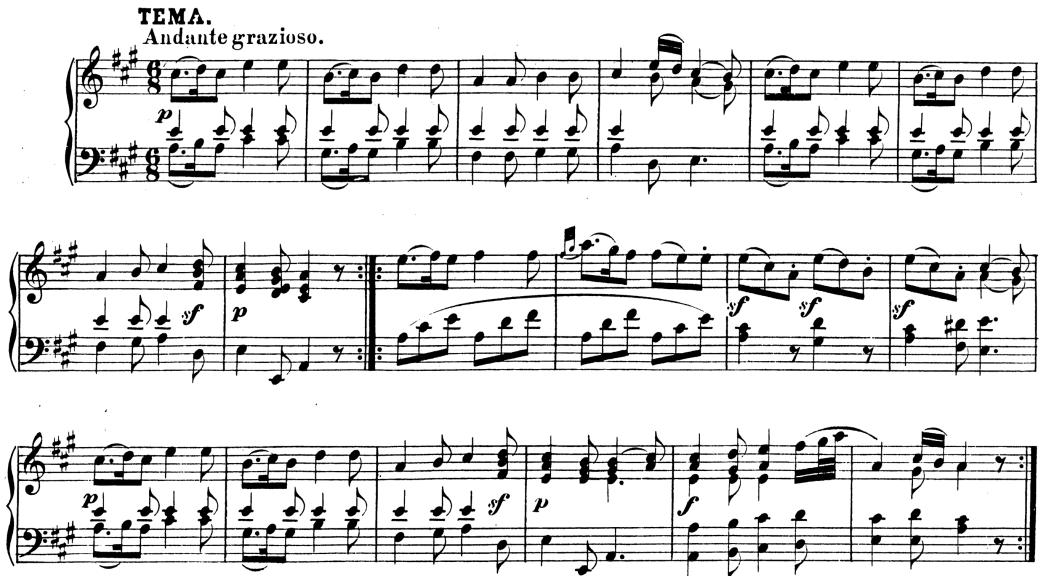
中文讲解
这是图 2.1 的占位符,标注其图题为 Mozart, Sonata 11 (K. 331), mvt. 1,并带有 60 号引用角标,置于 P0165“based on the following theme:”之后、正文继续分析之前。其作用是在文本中断之处为读者展示 K.331 第一乐章主题的乐谱实例,使 P0165 中抽象的“the following theme”具象化为可阅读的音乐文本。由于图像数据在输入中已省略(需查看原图),此处不补充任何不可见细节。
补充说明
无额外补充。图注中 60 号角标表示该谱例可能附带一条脚注(具体内容未在本节输入中出现)。
第6段(P0167)
原文复述
The theme in the representative example by Mozart could stand alone as an independent, miniature composition. Because there are sectional breaks between subsequent variations, the composer is allowed to liberally employ varied (and often sudden) shifts in mode, tempo, figuration, and even meter.
中文讲解
本段从图 2.1 的主题回到正文论证,做了两件事。
第一,刻画莫扎特主题自身的体裁属性:它“could stand alone as an independent, miniature composition”,即主题本身已经是一部完整的微型作品,而不仅是变奏的引子。这一观察解释了为何该主题能够支撑起一套“分节变奏”——主题本身的封闭性,为后续各变奏保持各自的独立性提供了镜像式的形式基础。
第二,把 P0163 中提出的“sectional variation 拥有更大创作自由”落到具体的可操作维度上:mode(调式/调性)、tempo(速度)、figuration(织体)、meter(拍号)。注意“liberally”与“often sudden”双重修饰——分节变奏不仅允许变化,而且允许突变(sudden shifts)。这与 P0163 所述“could be played at different tempi”形成递进:从“允许不同速度”扩展到“允许在调性、织体、拍号上的突然转换”。
因此本段是把抽象的体裁二分(continuous vs. sectional)翻译成具体的写作后果,并通过莫扎特 K.331 完成了范例化。它在本节中的作用是把“分节变奏为何在帕萨卡利亚断档期得以兴起”这一历史判断,锚定到可观察的音乐现象上。
补充说明
本段与 P0163 在论证上构成“定义—后果”的呼应:P0163 定义了 sectional variation 的形式特征(self-contained、authentic cadence),P0167 则进一步说明该形式特征所释放的具体创作可能性(mode/tempo/figuration/meter 的自由转换)。
脚注 / 边栏 / 图表 / 附加信息(如有)
本节附加材料仅含两条脚注与一张图:第 59 号脚注(Leon Stein, “The Passacaglia in the Twentieth Century,” Music & Letters 40, no. 2 (April 1959): 150)支持“passacaglia 至少被保存于十九世纪教材”之主张;第 60 号角标出现在图 2.1 图注处,其具体内容未在本节输入中出现。图 2.1(Mozart, Sonata 11 (K. 331), mvt. 1)作为“分节变奏”的具体例证,承担把抽象体裁概念具象化的功能。
💡 本节核心要点
- 帕萨卡利亚在巴洛克结束后并未消亡,仅经历了十八世纪末至十九世纪初的短暂断档,并至少以教材形式留存。
- 作者把变奏体裁二分为 continuous variation(连续变奏,帕萨卡利亚/夏空为代表)与 sectional variation(分节变奏),前者依靠主题不间断重复与变奏间榫卯衔接,后者以正格终止形成自足段落。
- 分节变奏的形式特征——每变奏自足并以终止式收束——直接释放了作曲家在速度、织体、调式、拍号上的创作自由,且允许突变。
- 本节通过莫扎特 K.331 第一乐章这一著名范例,将抽象的体裁判断落到具体作品上;其主题本身即可作为一部独立的微型作品,这与分节变奏追求“段落独立性”的美学相一致。
- 本节的核心叙事是:变奏思维并未随帕萨卡利亚而中断,只是其外在形态由“连续”转向“分节”。
🔑 关键术语
- continuous variation:指帕萨卡利亚、夏空一类以单一主题不间断重复、各变奏相互榫卯衔接(dovetailing)为特征的变奏写法;在十八世纪后期趋于停止。
- sectional variation:指每一变奏自足、并常以正格终止收束的分节式变奏写法;允许各变奏采用不同速度、调式、织体甚至拍号,是十九世纪仍很活跃的变奏体裁。
- passacaglia:源自巴洛克时期的变奏体裁,以单一固定主题(通常在低音)的持续反复为特征;本节指出其在巴洛克结束后进入短暂断档期。
- chaconne:与帕萨卡利亚同属连续变奏体裁,同样以单一主题的不间断反复为特征;本节将其与帕萨卡利亚并列为 continuous variation 的代表。
- authentic cadence:正格终止;本节用以界定 sectional variation 中每一变奏“自足收束”的形式边界,是与 continuous variation 中“dovetailing”相对的关键概念。
- dovetailing:变奏之间的鸽尾式/榫卯式衔接,使段落无缝过渡;本节用其描述 continuous variation 段落无终止、连续流动的结构特征。
S022 [描述性拆分] Revival of the Passacaglia in the Nineteenth Century
第1段(P0168)
原文复述
Although sectional variations were favored throughout the late eighteenth and early nineteenth centuries, there was a keen resurgence of continuous variation-based writing in the last few decades of the nineteenth century. Joseph Rheinberger composed a Passacaglia for organ, Charles Gounod composed one for two pianos and eight hands, and Max Reger composed a greater number of passacaglias than either Bach or Buxtehude had composed in the Baroque. Not only was the passacaglia a stimulus for many keyboard works in this period, but in 1885, it made its way into the genre of the symphony in the final movement of Brahms’ Fourth Symphony in E minor.
中文讲解
本段是本节的开篇段落,陈述一个被作者明确承认的事实:在18世纪末至19世纪初"分节式变奏(sectional variations)“占据主流的同时,19世纪最后几十年却出现了对"基于连续变奏写法(continuous variation-based writing)“的强烈回归,而帕萨卡利亚正是其中的代表体裁。作者通过三个并置的例子支撑这一论断:Rheinberger(为管风琴而作的Passacaglia)、Gounod(为两架钢琴八手联弹而作)、Reger(其帕萨卡利亚的数量超过了Bach和Buxtehude在巴洛克时期所写的总和)。第三个例子尤其具有比较意义——它把19世纪末的复兴量级直接对标到巴洛克帕萨卡利亚传统的最高水位,使"复兴"不仅仅是风格的复活,而是产量上的超越。作者随后把视野从键盘作品扩展到交响乐体裁:1885年Brahms《第四交响曲》E小调末乐章采用帕萨卡利亚形式,使这一原本偏属键盘/室内体裁的形式进入了19世纪的核心交响乐传统。本段在本节中的作用是"现象铺陈”——先确立事实层面"帕萨卡利亚在19世纪末复活了”,为下一段解释"他们是如何复活的"留出空间。“keen resurgence"一词带有作者对这一现象的明确肯定态度,不是中性观察。
第2段(P0169)
原文复述
60 Wolfgang Amadeus Mozart, Sonata No. 11 Für Pianoforte by Wolfgang Amadeus Mozart. (Leipzig: Breitkopf & Härtel, 1907).
中文讲解
这是编号为60的脚注,引用Mozart《钢琴奏鸣曲第11号》Für Pianoforte的乐谱版本,出版地为Leipzig,出版社为Breitkopf & Härtel,出版年份为1907年。该脚注对应的是上一节中Mozart奏鸣曲变奏曲例的来源说明,为正文的主张提供文献证据支持,而非对正文观点的限定或反驳。其作用是让读者可以追溯到具体的乐谱版本以核对该奏鸣曲的文本细节。
第3段(P0170)
原文复述
In reviving the passacaglia in the nineteenth century, composers were not merely attempting to go “back to Bach” in terms of content and style. Rather, they fused the Baroque conventions of the passacaglia with a contemporary harmonic and textural idiom. A number of notable stylistic musical shifts happened between the mid-eighteenth and late-nineteenth centuries. One of the most significant changes lay in the treatment of dynamics. In the Baroque, dynamic markings were rather infrequent and they were generally limited to a simple piano or forte. By the middle of the nineteenth century, composers employed frequent, gradual dynamic fluctuation, as well as jarring contrasts between dynamic extremes. Furthermore, the manipulation of timbre became increasingly prominent with the development of the symphony orchestra and the mechanical and tonal innovations of individual instruments. Such innovations among individual instruments enabled musicians to employ registers and techniques that were previously unattainable. All of the aforementioned innovations and shifts in style had ramifications for each genre, and the passacaglia was no exception.
中文讲解
本段解释"19世纪帕萨卡利亚复兴究竟做了什么”,核心论断由一组对比句承担:作曲家"并非仅仅(merely)“在内容和风格上"回到Bach(back to Bach)",而是将帕萨卡利亚的巴洛克体裁惯例与当时的和声与织体语言相融合。这一"merely"与"rather"的对照非常关键——它把读者从"复古主义"的简单想象中拉出来,确立本节乃至作者整篇文章的一个核心立场:体裁复兴不等于风格模仿,而是一种与新资源的嫁接。
为支撑"融合"这一论断,作者列举了18世纪中叶到19世纪末之间两项最重要的风格转变。第一项是力度处理(dynamics):巴洛克时期力度标记稀少,仅限于简单的piano或forte;到19世纪中叶,作曲家开始使用频繁的、渐变的力度起伏,以及极端力度之间的突兀对比(jarring contrasts between dynamic extremes)。第二项是音色操控(timbre):随着交响乐队的扩张以及个别乐器在机械构造与音色上的革新(如管乐器键阀系统、钢琴机械与踏板、铜管活塞等),作曲家得以进入以前无法企及的音区(registers)与技法。
这两项转变都不是凭空产生的——它们共同来自乐队化、乐器工业化与浪漫主义表现美学的整体语境。作者最后用"帕萨卡利亚当然也不例外(no exception)“将这两项风格转变与帕萨卡利亚这一具体体裁对接,暗示下文(尤其是P0171)将展开"这些新资源如何被用来解决帕萨卡利亚固有的结构问题”。
第4段(P0171)
原文复述
Unlike many prominent genres of the nineteenth century, the passacaglia had no interchange of themes (as in a sonata or symphony) or any accompanying narrative or program (as in an opera or tone poem). Rather, the passacaglia was an extended, single-movement work, based on a singular repeating ostinato. As I have stated before, this aspect of the passacaglia points to the nascent danger or possibility of boredom or monotony. In the late Baroque, Bach overcame this through the subtle manipulation of texture and figuration, as well as through his rhetorically conceived architectonic scheme. While Romantic composers certainly did well to emulate Bach’s deft approach to proportion, they had other additional musical means at their disposal to assist them in their quest. The fluidity and variety of dynamics, timbre, and register allowed the Romantic composer to sustain the interest of the listener in myriad ways that were largely unavailable to the Baroque composer. While the Romantic passacaglia will be treated in greater depth in Chapter 4, let it suffice for the present to say that the musical environs of the Romantic Era provided a fertile backdrop for the composition of the passacaglia.
中文讲解
本段是本节的收束段,进一步明确帕萨卡利亚的体裁属性,并解释为何19世纪的新资源对这一体裁尤其有意义。
第一层,作者通过双重否定定义帕萨卡利亚:与19世纪许多主流体裁不同,它既没有奏鸣曲或交响曲式的"主题交换(interchange of themes)",也没有歌剧或交响诗所伴随的"叙事或标题(narrative or program)"。它仅仅是"一个扩展的、单乐章的、基于单一反复固定低音(ostinato)的作品”。这种定义把帕萨卡利亚锁定在一种结构最简、变化资源最稀缺的体裁位置上。
第二层,作者由此推出一个体裁固有的隐患——“萌芽状态的单调危险或可能性(nascent danger or possibility of boredom or monotony)"。注意措辞的精妙:作者用了"nascent”(初现的)以及"danger or possibility"这对相互呼应的并列,把单调既描述为体裁的结构风险,也保留为修辞上的双重可能(既可能真的陷入单调,也有可能通过处理反过来产生效果)。“As I have stated before"说明这一观察在前文已出现过,本段是回收与深化。
第三层,作者对比Bach与浪漫派作曲家处理这一隐患的手段。Bach所凭借的是"对织体与装饰化音形的微妙操控(subtle manipulation of texture and figuration)",以及"修辞性构思的建筑性结构方案(rhetorically conceived architectonic scheme)"——后者指Bach把整体布局按修辞学(inventio–dispositio等)的逻辑来组织,使反复的固定低音之上仍存在宏大而连贯的论述结构。
第四层,作者的真正落点是浪漫派作曲家"除比例(proportion)之外还拥有更多额外的音乐手段”——即上一段所建立的力度、音色与音区的流动性与多样性。这些手段使浪漫派作曲家能以"巴洛克作曲家基本无法企及的多种方式"维持听众兴趣。本句是P0170与P0171两段之间的桥梁,把"风格转变"与"体裁结构问题"正式对接。
末句以"第四章将更深入讨论浪漫派帕萨卡利亚,本节至此足以说明浪漫时期的音乐环境为帕萨卡利亚的创作提供了肥沃土壤"作结,起到承上启下与节制论述范围的双重作用。
脚注 / 边栏 / 图表 / 附加信息(如有)
本节脚注仅一条(P0169,脚注60),引用Mozart《钢琴奏鸣曲第11号》Für Pianoforte Breitkopf & Härtel 1907年Leipzig版,为上一节Mozart奏鸣曲变奏示例的乐谱来源,对本节正文主张起支撑而非限定作用。文中两次预告章节安排:本节为整体论述链中的一环,浪漫派帕萨卡利亚的深入讨论将在第四章展开。
💡 本节核心要点
- 19世纪最后几十年出现了对帕萨卡利亚这一连续变奏体裁的强烈复兴,其规模跨键盘与交响乐两类体裁,且Reger的产量超过了Bach与Buxtehude在巴洛克时期的总和。
- 19世纪作曲家并非简单"回到Bach”,而是将帕萨卡利亚的巴洛克体裁惯例与19世纪的和声与织体语言相融合。
- 18世纪中叶至19世纪末的两项关键风格转变为这种融合提供了资源:力度处理从稀少的p/f标记演变为频繁的渐变与极端对比;音色操控随着交响乐队扩张与乐器机械革新而显著增强。
- 帕萨卡利亚的体裁属性——无主题交换、无叙事或标题、基于单一反复固定低音——使其天然面临"单调"的结构风险,这是体裁本身的内禀张力。
- Bach通过织体与装饰化音形的微妙操控以及修辞性构思的建筑性结构方案克服单调;浪漫派作曲家则在此之外拥有力度、音色与音区等更多维持听众兴趣的手段。
- 本节为第四章对浪漫派帕萨卡利亚的深入讨论做铺垫,作者明确将本节定位为"背景性论述”。
🔑 关键术语
- passacaglia:源自早期现代欧洲的固定低音变奏体裁;本节定义为"基于单一反复固定低音的扩展性、单乐章作品”,并强调其与奏鸣曲、交响诗等19世纪主流体裁的区别。
- continuous variation-based writing:与sectional variations(分节式变奏)相对的连续变奏写法;帕萨卡利亚属于此类,作者以此标识其区别于19世纪初流行的分节式变奏。
- ostinato:贯穿全曲反复出现的固定主题或低音线;帕萨卡利亚的结构核心,也是其"单调风险"的来源。
- sectional variations:分节式变奏,每个变奏段落相对独立成段;与帕萨卡利亚所属的连续变奏形成对照,是18世纪末至19世纪初的主流变奏写法。
- dynamics:力度处理;本节强调从巴洛克时期仅限于简单p/f标记,演变为19世纪中叶的频繁渐变与极端对比。
- timbre:音色;本节指19世纪随着交响乐队发展与乐器机械/音色革新而日益突出的操控维度。
- register:音区;乐器机械与构造革新使作曲家得以进入此前无法企及的音区,是浪漫派维持帕萨卡利亚趣味的关键资源之一。
- “back to Bach”:19世纪音乐文化中"回归Bach风格"的口号式表达;作者明确否定帕萨卡利亚复兴属于此类,强调其本质是融合而非复古。
- rhetorically conceived architectonic scheme:修辞性构思的建筑性结构方案;本节指Bach用以在反复固定低音之上维持整体连贯与说服力的宏观布局手法,是Bach克服帕萨卡利亚单调风险的核心手段之一。
S023 The Passacaglia in the Twentieth Century
第1段(P0172)
原文复述
The Passacaglia in the Twentieth Century
中文讲解
这是本章第二部分的标题,开启了关于20世纪帕萨卡里亚创作的论题。该标题指示了接下来几页将讨论20世纪作曲家如何运用这种原本属于巴洛克时期的体裁,并审视它在功能调性瓦解后的现代主义语境中如何被重新塑造。
补充说明
段落作为章节标题,本身仅承担分节与提示主题的功能,无补充内容。
第2段(P0173)
原文复述
It has previously been mentioned that musical style had drastically shifted during the passacaglia’s hiatus in the late-eighteenth and early-nineteenth centuries. Nevertheless, even within a few short decades of the passacaglia’s return to prominence, western classical music would undergo even more drastic shifts. In the early parts of the twentieth century, the system of functional tonality that had pervaded the preceding three centuries began to lose prominence and, in some quarters, dissolve. Up to this point in history, passacaglias had always been composed in the harmonic system of functional tonality. Nevertheless, many composers of the twentieth century were drawn to this genre, as the unwavering presence of the theme provided an element of regularity during an era in which harmony, rhythm, and phrase lengths became increasingly irregular.
中文讲解
本段为本节奠定历史与美学背景:一是点出20世纪初主导西方古典音乐逾三百年的功能调性体系开始衰落乃至瓦解;二是解释为何帕萨卡里亚仍然对20世纪作曲家保持吸引力——因为在这种和声、节奏与句法都愈发不规则的时代,固定不变的主题(ostinato)反而提供了一种难得的规律性与稳定感。
这一段的关键张力在于“延续与断裂”:帕萨卡里亚历来建立在功能调性之上,而20世纪作曲家却恰恰生活在一个功能调性解体的时代。作者由此引出后文将讨论的核心问题——作曲家如何在保留体裁核心要素(持续不变的主题)的同时,应对新的音乐语言。
第3段(P0174)
原文复述
While it is beyond the scope of this document to give an extensive account of the passacaglia in the course of the twentieth century, it is worth briefly commenting on this topic. Among the many composers who have produced passacaglias in the twentieth century, Leon Stein lists Atterberg, Barber, Berg, Britten, Bloch, Bingham, De Fillipi, Diamond, Dohnanyi, Dubensky, Eppert, Jacob, Haubiel, Hindemith, Karg-Elert, Kaun, Morris, Pisk, Piston, Ravel, Read, Reger, Schuman, Scott, Sowerby, Starokadomsky, Weiner, Weiss. It is remarkable to note that, in the first half of the twentieth century, the passacaglia was adapted to such divergent aesthetics as impressionism, expressionism, serialism, and neoclassicism—to name but a few. While many passacaglia for organ or other keyboard instruments have been produced throughout the course of the twentieth century, the genre has also been employed in staged works, such as Britten’s The Rape of Lucretia, orchestral works, such as Webern’s Passacaglia, Op. 1. Other notable instrumentations can be found in the example of Stravinsky’s Septet, or in Hindemith’s Viola Sonata, Op. 11, No. 5.
中文讲解
本段先承认无法详尽覆盖20世纪的所有帕萨卡里亚案例,然后通过Leon Stein列举的作曲家名单(涵盖Atterberg、Barber、Berg、Britten、Bloch、Bingham、De Fillipi、Diamond、Dohnanyi、Dubensky、Eppert、Jacob、Haubiel、Hindemith、Karg-Elert、Kaun、Morris、Pisk、Piston、Ravel、Read、Reger、Schuman、Scott、Sowerby、Starokadomsky、Weiner、Weiss等)来表明这一体裁在20世纪的广泛参与度。
作者点出一个值得注意的现象:在20世纪上半叶,帕萨卡里亚被同时嫁接到印象派、表现派、序列主义、新古典主义等风格迥异的美学之上——这种“多风格共存”是该体裁依然具有生命力的明证。
在乐器与体裁方面,作者指出除了延续传统的管风琴与键盘乐器写法之外,作曲家还把帕萨卡里亚搬上了舞台作品(Britten的The Rape of Lucretia)、管弦乐作品(Webern的Passacaglia, Op. 1)、室内乐组合(Stravinsky的Septet)以及独奏与中提琴作品(Hindemith的Viola Sonata, Op. 11, No. 5)。这一段实质上为下文具体案例分析(Britten、Stravinsky、Webern、Willan、Schoenberg)做了“全景—聚焦”的过渡。
第4段(P0175)
原文复述
61 Ibid., 151.
中文讲解
脚注61。其内容仅为“Ibid., 151”,表示此处所引内容仍来自前一注释同一来源的第151页,属于对前一段落中提到Leon Stein列举作曲家名单这一引用的来源标注,起到出处定位的作用。
第5段(P0176)
原文复述
62 Igor Stravinsky, Septet (London: Boosey & Hawkes, 1953): 8.
中文讲解
脚注62。引用Stravinsky的Septet,伦敦Boosey & Hawkes出版社1953年版,第8页。该脚注用于支持正文即将或已经提到的Stravinsky Septet作为帕萨卡里亚例证的具体出处。
第6段(P0177)
原文复述
outset, it is breaks from tradition insofar as it is presented as a Klangfarbenmelodie that spans a broad spectrum of timbre and tessitura. Perhaps an even more obvious departure from tradition stems from the fact that the theme is not rooted in functional tonality, but in a seven-note tone row. Webern also sought after this fusion of traditionalism and experimentalism, as can be seen in the theme of his Passacaglia for Orchestra, Op. 1. Contrary to the previous example by Stravinsky, Webern’s opening presentation of the ostinato is contained within a single timbre, and within a limited tessitura. Though Webern espouses the traditional convention in the presentation of his theme, a rupture with tradition can be seen in his choice of duple meter.
中文讲解
本段是一个“融合传统与实验”的对比段,先讨论Stravinsky的Septet:从一开始便打破传统——它被呈现为“音色旋律”(Klangfarbenmelodie),跨越了宽广的音色与音域光谱;更显著的背离在于其主题不再以功能调性为基础,而是建立在七音音列(tone row)之上。
接着转向Webern的Passacaglia for Orchestra, Op. 1,作为对“传统与实验融合”的另一种处理。与Stravinsky相反,Webern主题的首次陈述被限定在单一音色和较窄的音域之内,遵循了较为传统的呈现方式;但在拍号选择上,Webern却采取了二拍子(duple meter),与传统帕萨卡里亚通常采用的三拍子形成断裂。
这一段的功能是示范:在“传统—实验”光谱上,不同作曲家可以走完全不同的折中路径。Stravinsky在音色和调性基础上彻底现代化,却在体裁结构上仍保留帕萨卡里亚的形式;Webern则在呈现姿态上保持传统,却在节拍这一基础参数上作出突破。两人的差异本身就揭示了20世纪作曲家在处理该体裁时所能采取的多种策略。
第7段(P0178)
原文复述
While passacaglias such as Webern’s and Stravinsky’s show a fusion of tradition and experimentation, some passacaglias are decidedly traditional on the one hand, or decidedly experimental on the other. Composers such as Guy Weitz and Healey Willan tended toward traditionalism not only in their treatment of the passacaglia but in their decision to retain a functionally tonal language, even several decades into the twentieth century. For example, Healey Willan’s Passacaglia and Fugue No. 2 in E Minor was composed in 1958—a decade
中文讲解
本段承上启下:作者说明Webern与Stravinsky代表的是“传统与实验融合”的中间路线,而与之相对,还存在两类极端——要么坚决守传统,要么坚决走向实验。
他以Guy Weitz和Healey Willan作为前者的代表:他们不仅在帕萨卡里亚的具体处理手法上倾向传统,更在语言选择上坚持功能调性,即使进入20世纪中叶依然如此。本段引出Healey Willan的Passacaglia and Fugue No. 2 in E Minor作为典型例证,并指出其创作年份是1958年,句子在“a decade”处被脚注隔断,下一段继续。
第8段(P0179)
原文复述
63Anton Webern, Passacaglia, Op. 1 (Vienna: Universal Edition, 1922), 1.
中文讲解
脚注63。引用Anton Webern的Passacaglia, Op. 1,维也纳Universal Edition 1922年版,第1页。这是正文中讨论Webern主题首次陈述所在的谱例出处,起到定位文献版本与页码的作用。
第9段(P0180)
原文复述
characterized by total serialism. Nevertheless, the ostinato pictured below shows it to be no less tonal than Brahms or Rheinberger:
中文讲解
本段承接上段被脚注隔断的句子,补全关于Willan作品的语境:1958年是一个被“全序列主义”(total serialism)所主导的年代——也就是说,那个十年是实验主义最为强势的时期之一。然而,Willan在该作品中使用的固定低音主题(ostinato),从下方所附谱例可见,仍像Brahms或Rheinberger的作品一样属于调性语言范畴。
作者借此强调:在全序列主义盛行的年代里,仍有作曲家坚持用帕萨卡里亚这一古老体裁承载完全传统的调性写作,从而构成一种强烈的时代反差。句末冒号引出图2.4(Willan谱例)作为佐证。
第10段(P0181)
原文复述
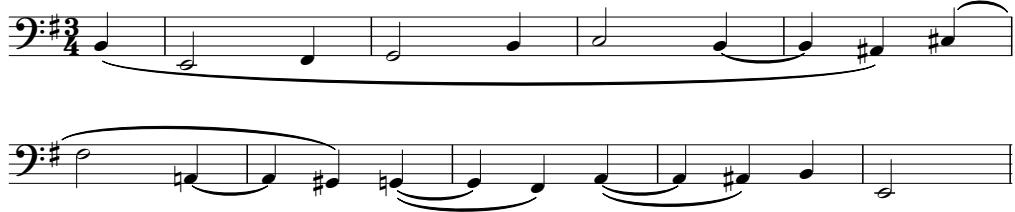
中文讲解
图2.4的位置占位符。图注为“Figure 2.4—Willan, Passacaglia and Fugue No. 2.”,对应上一段提到的Healey Willan《Passacaglia and Fugue No. 2 in E Minor》中的ostinato主题谱例,用于直观证明该作品在1958年依然保持调性风格。读者需查看原图以确认主题具体旋律形态。
第11段(P0182)
原文复述
While composers such as Weitz and Willan eschewed experimentalism and clung to tradition, other composers ruptured with tradition and favored experimentalism. The eighth movement of Schoenberg’s Pierrot Lunaire, entitled “Nacht,” is subtitled a passacaglia. However, this ostinato lasts not for eight measures, but for only three consecutive notes forming the pitch class set (0,1,4). Figure 2.5—Schoenberg, Pierrot Lunaire, Op. 21, No. 8, “Nacht."64
中文讲解
本段从“坚守传统”转向“彻底实验”的另一极端。作者以Schoenberg的Pierrot Lunaire第八乐章“Nacht”为例:尽管其副标题标明为“passacaglia”,但其中的ostinato既非传统意义上的八小节长度,也非传统意义上的旋律主题,而是仅由三个连续音构成的音级集合(pitch class set (0,1,4))。
这就引出一个核心问题:当ostinato被压缩为三个音的集合时,“帕萨卡里亚”的体裁身份究竟如何维系?作者正是用Schoenberg这个极端例子来证明:帕萨卡里亚在20世纪不仅被改头换面,甚至在最基本的参数(主题长度)上也被重新定义。图2.5紧随其后作为该例的谱例佐证。
补充说明
pitch class set (0,1,4)是Sethares/集论式音高组织描述方式:用半音为单位,以0为参照,按音级之间的音程关系标记一组音。本节中无需补写集合理论历史,仅需理解为——它以抽象方式描述三个音彼此关系,而非以调性方式描述主音走向。
第12段(P0183)
原文复述
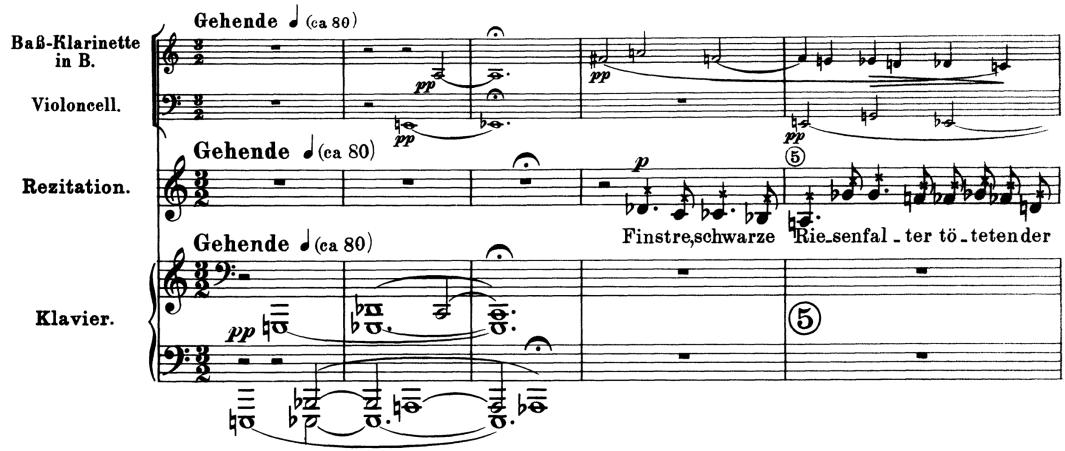
中文讲解
图2.5的位置占位符。图注以“第44页图像或乐谱示例”形式保留,说明此页含有一幅与Schoenberg的Pierrot Lunaire第八乐章“Nacht”相关的谱例或示意图,用于直观呈现由三个音构成的ostinato。读者需查看原图以确认谱例的具体呈现。
第13段(P0184)
原文复述
Earlier in this chapter, it was noted that Baroque composers summoned the passacaglia as a dramatic device. This trend was continued—or at the very least, resuscitated—in the twentieth century. Benjamin Britten made frequent use of the passacaglia in such works as The Rape of Lucretia, Peter Grimes, and The Holy Sonnets of John Donne.65 Like Lully and Purcell had done centuries before, Britten employs the passacaglia to signal the inevitability of death. Darrel Handel notes that Britten’s treatment of the ostinato theme is extremely strict and unwavering, and musical momentum is achieved through “contrasts of texture, tone-colour, range, volume, and above all, rhythmic activity.”
中文讲解
本段是本节的收束段,把帕萨卡里亚的另一种20世纪延续线索——戏剧功能——与本章早先对巴洛克传统的讨论重新接续起来。作者指出,Baroque作曲家(如前面讨论的Lully、Purcell)曾以帕萨卡里亚作为一种戏剧手段;这一做法在20世纪被沿用,至少可以说被“复苏”。
Benjamin Britten是该线索的核心例证,其在The Rape of Lucretia、Peter Grimes与The Holy Sonnets of John Donne等作品中频繁使用帕萨卡里亚,用以暗示死亡的不可避免性——这与Lully和Purcell数个世纪前的处理方式在功能上遥相呼应。
本段最具分析价值之处在于Darrel Handel对Britten处理手法的描述:Britten对ostinato主题的处理极为严格且毫不妥协,因此音乐的动力并非来自主题自身的变化,而是来自“织体、音色、音域、力度,以及最重要的节奏活动”的对比。换言之,Britten通过让ostinato保持近乎象征性的稳定,而把戏剧张力转移到外围参数上,这与巴洛克传统中以ostinato象征命运或死亡的修辞一脉相承,同时也符合20世纪音乐语言中对音色、力度、节奏层面的细腻开发。这一句事实上也为本节开篇“ostinato在变动时代中提供稳定性”的论断提供了具体而戏剧化的注脚。
脚注 / 边栏 / 图表 / 附加信息(如有)
本节附有三条脚注与两幅图,均承担引用佐证功能:脚注61(Ibid., 151)为Leon Stein作曲家名单的出处页码;脚注62指向Stravinsky Septet 1953年版第8页;脚注63指向Webern Passacaglia, Op. 1 1922年版第1页,为分析其主题陈述形态的谱例来源。图2.4呈现Willan的ostinato谱例,用以证明其在1958年仍保持与Brahms或Rheinberger同等程度的调性;图2.5呈现Schoenberg Pierrot Lunaire第八乐章“Nacht”的相关谱例,用以展示其仅由三音构成的ostinato如何仍被标作passacaglia。两图与脚注共同支撑了本节“传统—融合—实验”三分式的论述。
💡 本节核心要点
- 20世纪初功能调性体系的衰落使得帕萨卡里亚这一历来以调性为基础的体裁面临根本性挑战,但其稳定的ostinato反而在和声、节奏、句法愈发不规则的时代中为作曲家提供了规律性与稳定感。
- 本节依据作曲家对传统的态度将20世纪帕萨卡里亚划分为三类:传统与实验融合(Stravinsky、Webern)、坚守调性传统(Weitz、Willan)、以及彻底实验(Schoenberg的“Nacht”仅以三音集合作为ostinato)。
- Stravinsky的Septet以七音音列替代功能调性并以Klangfarbenmelodie呈现主题;Webern的Passacaglia, Op. 1则在单一音色与狭窄音域内呈现主题,却在拍号上以二拍子背离传统——两者代表“融合”路径中截然不同的折中策略。
- Willan的Passacaglia and Fugue No. 2 in E Minor创作于全序列主义盛行的1958年,其ostinato仍保持与Brahms、Rheinberger同等的调性风格,构成对时代风潮的有意抵抗。
- Schoenberg将Pierrot Lunaire第八乐章“Nacht”副标为passacaglia,却把ostinato压缩为音级集合(0,1,4),把帕萨卡里亚的体裁身份从长度和旋律性推向音高集合层面的最小化定义。
- Britten延续了Baroque作曲家将帕萨卡里亚用作戏剧手段的传统(如以之暗示死亡不可避免),其ostinato保持严格不变,而音乐动力转移到织体、音色、音域、力度与节奏的对比上。
🔑 关键术语
- Functional tonality:功能调性,17—19世纪西方音乐的主导调性组织方式,以主—下属—属—主的和声功能关系为基础;本节强调该体系在20世纪初开始衰落,使得历来以此为基础的帕萨卡里亚面临语言层面的断裂。
- Ostinato:固定低音或固定反复的旋律/音型,帕萨卡里亚体裁的核心要素;本节指出在20世纪语境中,ostinato既可保持长篇调性主题(如Willan),也可压缩为三音集合(如Schoenberg),体裁身份的核心由此取决于“在反复中维系”。
- Klangfarbenmelodie:音色旋律,序列音乐中以音色在时间中的连续变化取代音高变化作为旋律塑造方式;Stravinsky的Septet即以这种方式呈现主题,属背离传统帕萨卡里亚主题呈现方式的典型做法。
- Tone row:音列,十二音序列主义中作曲家预先设定并按之组织音乐的一套顺序排列的十二个半音;Stravinsky的Septet主题以上述概念为基础而构建。
- Total serialism:全序列主义,将十二音序列原则从音高进一步扩展到节奏、力度、音色等所有音乐参数的序列组织方式;1958年前后是其鼎盛期,作者借此反衬Willan坚持调性写作的时代反差。
- Pitch class set:音级集合,按抽象音程关系而非调性功能描述一组音高;Schoenberg的“Nacht”以(0,1,4)即三个音的集合替代传统ostinato,是本节“彻底实验”路径的最小化样本。
S024 [描述性拆分] Twentieth-Century Experimentalism and Dramatic Uses
第1段(P0185)
原文复述
Footnote 64 cites Arnold Schoenberg and Albert Giraud, Dreimal sieben Gedichte aus Albert Girauds Pierrot Lunaire: Melodramen, Op. 21, published in Vienna by Universal Edition in 1914, page 84.
中文讲解
这是脚注 64,引用勋伯格与吉罗合作的《Pierrot Lunaire》(1914 年维也纳 Universal Edition 出版)第 84 页。该条目单独出现在本节开头,引用语为德文标题,出处格式符合英文学术规范。由于脚注 64 上承前文(本节未呈现其正文指代点),它在本小节内的具体论证功能难以从当前段落单独确认;可以推断它是为前文某处关于《Pierrot Lunaire》或广义 20 世纪实验音乐的论述提供文献支撑。
补充说明
脚注编号 64 与正文中的上标位置并未出现在本节段落内,因此其与本段内容的直接挂钩关系无法在本段中确认。
第2段(P0186)
原文复述
Britten was not the only twentieth century composer to invoke the passacaglia as an expressive device. In an opera entitled Le Grande Macabre, György Ligeti makes prominent use of the passacaglia. As the opera’s title would suggest, this opera can be characterized as a “grotesque comedy [that] plays on the fear of death” (footnote 67). In addition to the historic precedent of the passacaglia as a signifier for death, Edwards argues that the passacaglia may have appealed to Ligeti on other aesthetic grounds. He argues “that the Passacaglia constitutes a further development in a continuing effort to inject process into musical material” (footnote 68).
中文讲解
本段以 Britten 之外的第二个案例——Ligeti 的歌剧《Le Grande Macabre》——拓宽 20 世纪 passacaglia 写作的版图,反驳"Britten 是孤例"的潜在印象。段内承担两重论证:第一重是体裁与体裁语境的张力——passacaglia 作为"死亡符号"有历史先例,而 Ligeti 的歌剧却是"怪诞喜剧”,题材与体裁传统之间形成错位;第二重是 Edwards 的引申论断:passacaglia 对 Ligeti 的吸引力不止于"死亡符号"的现成联想,更在于其重复—变奏结构可以被用来"向音乐材料注入过程性”,即作为组织持续演化的手段。第二个论点尤其关键:它把 passacaglia 从一个被动的情感符号,提升为作曲家主动选择的"过程—形式"策略,使本节的体裁讨论同时具备历史与美学两层。
补充说明
正文使用拼写"Le Grande Macabre”,而脚注 67 中 Edwards 论文的标准法语拼写为"Le Grand Macabre"。本段忠实保留正文的拼写形式,两处拼写差异客观呈现于原文。原文"In addition to the historic precedent the passacaglia as a signifier for death"在介词短语处略有不完整,但意思可通过上下文补足(可能漏"of"),本复述按补足后的英文呈现。
第3段(P0187)
原文复述
In this brief commentary on the composition and treatment of themes of a few twentieth-century passacaglias, it has become clear that composer treated the genre in a myriad of different ways. While there are a number of conventions surrounding the definition of the passacaglia, it is worth noting that the central or definitive characteristic of a passacaglia is the perpetual presence of a singular, melodic theme. Other conventions, such as the minor mode, triple meter, and [sentence continues across page break]
中文讲解
本段开始进入本节的小结,从案例综述过渡到体裁的分类学主张。作者承认 passacaglia 围绕其定义存在"诸多惯例",但随后提出一个层级性论断:在这些惯例中,“核心"或"定义性"特征是"一个单一旋律主题的持续存在”——其他特征(小调、三拍子、grave affect 等)将被归类为"次要"。这是本节论证的关键转向:作者用一句话把所有案例差异(Britten、Ligeti 等)统一到一个定义性核心之下,从而解释为何风格迥异的作品仍可同属 passacaglia 体裁。该段在小节中承担从案例上升到定义的过渡功能。
补充说明
此段跨页延续至 P0192,以列举连词"and"结尾,表明句子未完。原文用单数"composer"与上下文"twentieth century composers"(复数)不一致,本复述保留原文单数形式以体现其原貌;此处疑为作者笔误或原稿单复数形式差异。
第4段(P0188)
原文复述
Footnote 66: Ibid., 3.
中文讲解
脚注 66 用 “Ibid.” 表示与紧邻的上一条完整脚注同一来源,具体页码为 3。脚注 66 与脚注 65(Handel 关于 Britten passacaglia 的 Tempo 文章)在学术上通常成对使用——前者给出完整文献信息,后者仅以 Ibid. 跟随并指明页码,这是英文学术写作中常见的简省格式。结合上下文,本条脚注应为正文某处对 Handel 同篇文章第 3 页的引用,但具体的正文指代位置未在本节段落内出现。
补充说明
Ibid. 为拉丁文 ibidem 的缩写,意为"同前所引";此处承接脚注 65 中 Darrell Handel 的 Tempo 文章。
第5段(P0189)
原文复述
Footnote 65: Darrell Handel, “Britten’s Use of the Passacaglia,” Tempo, no. 94 (1970): 2.
中文讲解
脚注 65 引用 Darrell Handel 1970 年发表于《Tempo》杂志第 94 期第 2 页的文章《Britten’s Use of the Passacaglia》。这是研究 Britten passacaglia 写作的关键二手文献,为本节前述关于 Britten 的论述提供学术支撑。
补充说明
《Tempo》是英国老牌音乐期刊,长期聚焦当代音乐评论;此处提供的页码 2 表明引文来自该文开篇部分,可能对应 Britten passacaglia 作品的总体定位或首次出现。
第6段(P0190)
原文复述
Footnote 67: Peter Edwards, “Resisting Closure: The Passacaglia Finale from György Ligeti’s Le Grand Macabre,” Music Analysis 35, no. 2 (2016): 259.
中文讲解
脚注 67 引用 Peter Edwards 2016 年发表于《Music Analysis》第 35 卷第 2 期第 259 页的文章《Resisting Closure: The Passacaglia Finale from György Ligeti’s Le Grand Macabre》。该文献为正文对 Ligeti 歌剧"怪诞喜剧"性质及"passacaglia 作为死亡符号"的论述提供来源,也支撑后续关于 Ligeti 美学动机的讨论。
补充说明
《Music Analysis》是国际音乐分析学会会刊,聚焦音乐作品的深度结构分析;此处第 259 页对应正文引文位置。值得注意的是,该脚注使用的歌剧名为标准拼写"Le Grand Macabre",而正文(P0186)写作"Le Grande Macabre"。
第7段(P0191)
原文复述
Footnote 68: Ibid., 276.
中文讲解
脚注 68 用 Ibid. 表示与脚注 67 同为 Peter Edwards 2016 年《Music Analysis》文章,页码为 276。该脚注对应正文中"the Passacaglia constitutes a further development in a continuing effort to inject process into musical material"这一关键引文,为 Edwards 关于 passacaglia 与"过程性"美学之间关系的论点提供具体来源。
补充说明
页码 276 接近该文末尾,提示此处引文可能位于文章结论部分或对 Ligeti 美学策略的总结段落。
第8段(P0192)
原文复述
grave affect, were qualities of only secondary importance. As such, twentieth century composers were able to maintain the essence of the genre while modifying certain stylistic attributes.
中文讲解
本段承接上一页中断的句子,完成 passacaglia 次要惯例的列举——除小调、三拍子外,“grave affect”(庄严/沉重的情感色彩)亦属其次要特征。作者由此推出本节的核心结论:由于这些次要特征可变,20 世纪作曲家得以在保留 passacaglia 体裁本质(即"单一旋律主题的持续存在")的同时,自由修改风格属性。这一结论解释了本节开篇提出的观察——20 世纪作曲家"以千差万别的方式"处理该体裁——并为本节乃至全文的体裁分类学讨论画上句号:体裁的本质由一个核心必要条件决定,而非由若干可变特征的叠加决定。
补充说明
此段是 P0187 在第 46 页的接续,完整句子应为"Other conventions, such as the minor mode, triple meter, and grave affect, were qualities of only secondary importance"。“grave affect"在音乐学语境中指庄严、沉重的情感特质,作者将其与小调、三拍子并列为 passacaglia 的次要传统特征。
脚注 / 边栏 / 图表 / 附加信息(如有)
本节附带的脚注群(64–68)构成 20 世纪 passacaglia 讨论的文献支撑体系:脚注 65(Handel, 1970)与脚注 66(Ibid., 3)为一对,共同支撑关于 Britten passacaglia 的论述;脚注 67(Edwards, 2016, 第 259 页)与脚注 68(Ibid., 276)为一对,共同支撑关于 Ligeti《Le Grand Macabre》终曲的论述;脚注 64(Schoenberg 与 Giraud, 1914)在本节内单独出现,其正文指代位置不在本节段落内,可推断为前文关于更广义 20 世纪实验音乐论述的延续性引用。文献时序从 1914 到 2016,显示该主题跨越整个 20 世纪并延续至 21 世纪的学术关注。
💡 本节核心要点
- Britten 并非 20 世纪唯一以 passacaglia 作为表现手段的作曲家;Ligeti 在歌剧《Le Grande Macabre》中亦显著使用该体裁。
- Ligeti 的歌剧属"怪诞喜剧”,围绕"对死亡的恐惧"展开,但其选择 passacaglia 的动机除"死亡符号"的历史先例外,还包含一种美学目的——以重复—变奏结构"向音乐材料注入过程性"。
- 通过对 20 世纪几部 passacaglia 作品的简短评论,可看出作曲家以"千差万别"的方式处理该体裁。
- passacaglia 的核心或定义性特征是"一个单一旋律主题的持续存在";小调、三拍子、grave affect 等其他传统特征属于次要且可变的风格属性。
- 由于次要特征可变,20 世纪作曲家得以在保留体裁本质(主题持续性)的同时修改风格属性,这解释了 passacaglia 在 20 世纪呈现的多样性。
🔑 关键术语
- passacaglia:一种基于固定低音或固定旋律主题反复出现并在其上展开变奏的音乐体裁。本节作者将其核心定义性特征界定为"一个单一旋律主题的持续存在",而把其他常见特征(小调、三拍子、庄严情感)归为次要。
- grotesque comedy:一种戏剧体裁,结合怪诞、荒诞与黑色幽默。本节将其作为 Ligeti《Le Grande Macabre》的体裁标签,以凸显 passacaglia 在非传统语境中的使用。
- process (in music):一种以持续、渐进的转换或演化而非主题—发展逻辑来组织音乐材料的方法。本节通过 Edwards 的引文,将 passacaglia 与"向材料注入过程性"的美学追求相关联。
- grave affect:音乐学语境中指庄严、沉重的情感色彩。本节将其与 minor mode、triple meter 并列为 passacaglia 的次要传统特征,说明这些特征并非体裁定义所必需。
S025 Definitions and Theoretical Descriptions of the Passacaglia
第1段(P0193)
原文复述
Definitions and Theoretical Descriptions of the Passacaglia
中文讲解
这是本小节的标题,明确开启了一个新的论证单元:将关注点从此前对帕萨卡利亚历史发展的叙述,转向对其概念本身的多视角界定。该标题预示了本节将系统梳理从巴洛克理论家到二十世纪学者对该体裁所下的定义,并对这些定义的异同做出评析。
第2段(P0194)
原文复述
Thus far, I have offered a brief account of the history and development of the passacaglia from its early seventeenth-century beginnings through the middle of the eighteenth-century. At this point, let us turn our attention to definitions that a number of Baroque theorists have given for the passacaglia. Heinrich Christoph Koch gives the following definition:
中文讲解
本段是承上启下的过渡。作者先回顾前文——已完成从17世纪初到18世纪中叶的帕萨卡利亚史叙述——然后宣告接下来的任务:考察多位巴洛克理论家对该体裁的界定,并引出第一位被引用的理论家海因里希·克里斯托夫·科赫(Koch)。它的作用是把叙述性历史让位给概念辨析,预示本节将以定义之间的异同为线索推进。
补充说明
过渡段无额外补充。
第3段(P0195)
原文复述
The passacaglia……is not composed of sections or reprises, but of a melody of eight measures, which by constant repetition of its ground bass, along with melodic variations, results in a diversity from its original statement.69
中文讲解
这是Koch对帕萨卡利亚所下的直接定义。关键论点有三:其一,帕萨卡利亚不是由多个段落(sections)或反复(reprises)组合而成,而是以一条八小节旋律为基础;其二,这种统一性来自固定低音声部的持续反复(ground bass);其三,在低音声部恒定不变之上方搭配各种旋律变奏,由此从原始陈述“生出多样性”。该定义将帕萨卡利亚的功能性结构概括为“恒定的低音+上方的变奏”,而非乐段式的并列。
补充说明
八小节的长度(“melody of eight measures”)并非Koch的任意选择,而是这一时期已经成形的体裁惯例,详见下文P0196的解释。
第4段(P0196)
原文复述
Of the definitions examined here, Koch’s is by far the most general in scope, for he lists as criteria only the “constant repetition of [a] ground bass” with varied accompanying figuration. However, he is very specific about the length of eight measures. It seems that, by the time Koch was writing, this length had become a convention. Certainly, this is echoed in the following definition given by A.F.C. Kollmann in 1799:
中文讲解
作者对Koch的定义进行评析。Koch的定义之所以“最一般”,是因为他只列出两个判据:固定低音声部的持续反复,加上变奏性的上方装饰花唱(figuration)。但他对八小节长度却规定得非常具体——这意味着到Koch撰写定义的年代,八小节已成为帕萨卡利亚低音主题的长度惯例。作者随后预告,下引Kollmann 1799年的定义将与此惯例形成呼应。换言之,本段在论证Koch定义之时,已经在为后续Kollmann定义中的“八个乐句”做铺垫。
补充说明
Koch和Kollmann的文本均转引自Darrell Dale Handel的博士论文《当代帕萨卡利亚》,脚注69、70为出处。
第5段(P0197)
原文复述
The Passacaille is written in 3/4, and begins with the third crotchet. Its movement is moderate and its character is serious tenderness. It generally consists of one section but of eight bars, to which variations are made.70
中文讲解
这是A.F.C. Kollmann 1799年给出的定义(用“Passacaille”这一法语拼写)。要点包含五个层面:拍号为3/4;起始于第三拍弱起(anacrusis);速度适中(moderate);情感为“serious tenderness”(严肃的柔情);结构上通常为一个段落的八小节,并在其基础上作变奏。前三条都是具体的形式参数,第四条是情感参数(affect),第五条呼应了Koch的“八小节”惯例。作者用这段引文兑现了P0196末尾的预告。
补充说明
“third crotchet”(第三四分音符)即指3/4拍第三拍起首的弱起,这是巴洛克时期低音帕萨卡利亚常见的起始方式。
第6段(P0198)
原文复述
69 Heinrich Christoph Koch, Musikalisches Lexicon, translated and cited in Darrell Dale Handel, “The Contemporary Passacaglia,” (PhD diss., University of Rochester, Eastman School of Music, 1969), 19.
中文讲解
脚注69:说明P0195引用的Koch定义出自《Musikalisches Lexicon》,由Handel翻译并转引,页码19,Handel的来源为其1969年罗切斯特大学伊斯曼音乐学院的博士论文。脚注的作用是标明Koch的引文并非作者直接引用德文原版,而是经二手转引,因此该定义本身已是翻译文本。
补充说明
脚注仅作来源说明,无必要再补。
第7段(P0199)
原文复述
70 A.F.C. Kollmann, Essay on Practical Composition (London: 1799), cited in Handel, “The Contemporary Passacaglia,” 18.
中文讲解
脚注70:指出P0197引用的Kollmann定义来自《Essay on Practical Composition》(伦敦,1799),同样经由Handel的博士论文第18页转引。它和脚注69一样属于来源说明,且使读者意识到此处所有巴洛克理论家的引文其实都经过Handel的翻译与筛选。
补充说明
脚注仅作来源说明。
第8段(P0200)
原文复述
Kollmann’s definition sets forth a series of additional criteria that seem to be definitive of the passacaglia as it had been cultivated through the late Baroque. Regarding meter, he not only notes the convention of triple time, but he specifies that the ground bass ostinato starts on an anacrusis. Furthermore, it is notable that he commented on the affect of the passacaglia as one of “serious tenderness.” Certainly, the convention of gravitas that came to characterize the passacaglia in the late Baroque represents a radical shift from the raucous and buoyant character of the early Spanish passacalle—which were consistently cast in a major mode.
中文讲解
本段对Kollmann定义做出三条评论。第一条是结构层面:除了三拍子惯例,他还明确指出固定低音以弱起(anacrusis)开头。第二条是情感层面:他强调帕萨卡利亚的情感为“严肃的柔情”。第三条是历史层面:晚巴洛克时期帕萨卡利亚所确立的庄严(gravitas)基调,与早期西班牙passacalle喧闹、轻快且始终用大调的风格之间存在“激进的转向”。这一比较把抽象的情感特征与具体的历史过程(从西班牙舞蹈原型到晚巴洛克体裁)联系起来,为作者后续讨论定义演变提供了情感风格的参照。
补充说明
“anacrusis”即弱起/上拍,3/4帕萨卡利亚以第三拍起首是该体裁一个较为固定的特征,与P0197的Kollmann引文直接对应。
第9段(P0201)
原文复述
The definitions given by Koch and Kollmann are consonant with one another, and they are reflective of the characteristics of late Baroque Passacaglias. However, Mattheson’s definition contradicts those of Koch and Kollmann. In comparing and contrasting the passacaglia genre to the closely related chaconne, Mattheson claims that “the passacaglia is based on no particular subject.”71 According Darrell Dale Handel, Mattheson is the only Baroque theorist to deny that the passacaglia is founded on a ground bass ostinato.72 It is worth noting that Mattheson’s Der volkommenne Cappellmeister was published in 1739, whereas the works of Koch and Kollmann were published approximately a half-century later. Mattheson was writing in the midst of the passacaglia’s development in the Baroque, whereas Koch and Kollmann were writing at a significantly later point in history. By virtue of writing about the Baroque passacaglia after the Baroque Era had effectively ceased, the latter two authors could offer a more complete, allencompassing view of the development of the genre—one that could be offered only with historical distance. To be sure, the earliest manifestations of the genre were, in accordance with Mattheson’s observations, were based more on harmonic progressions than melodic themes. However, as one can observe from the summary of the passacaglia’s history thus far, the genre gradually shifted from a prescribed harmonic pattern toward a work based on a recurrent ostinato theme. The discrepancy between Mattheson’s definition and those of Koch and Kollmann should not alarm a reader of the present era—for a definition given during the development of a genre will differ from one given after the genre has crystallized.
中文讲解
本段是本节最重要的一段对照性论证,论证线索分四步推进。
第一,Koch与Kollmann的定义彼此一致,反映的是晚巴洛克帕萨卡利亚的定型状态。第二,Mattheson的定义与前两者矛盾:他声称“帕萨卡利亚不基于任何特定的主题”;据Handel,他是唯一否认帕萨卡利亚以固定低音为基础的巴洛克理论家。第三,作者解释了定义分歧的成因在于时间差——Mattheson的《Der volkommenne Cappellmeister》出版于1739年,比Koch和Kollmann早约半个世纪;前者写于帕萨卡利亚发展的“途中”,后者则是在巴洛克结束后回望整个体裁,因而能给出更“完整、包罗”且只有“历史距离”才能提供的视角。第四,作者调和这种矛盾:Mattheson观察到的“并非基于主题”其实准确捕捉了该体裁早期更依赖和声进行而非旋律主题的状态;但随后体裁由“预先设定的和声模式”逐渐转为“基于反复出现的固定主题”。因此两套定义并不互相证伪,而是反映了体裁发展的不同阶段——作者告诫现代读者,看到体裁成形期与定型后定义不同,不必惊讶。
这段论证的关键意义在于:它把表面上“互相矛盾”的理论家观点,转化为同一进程中的两个时间断面,从而把“定义之争”转写为“历史发展论”。
补充说明
“particular subject”这一短语是巴洛克音乐修辞中常用的“主题/乐思”术语,与之并置的“ground bass ostinato”即固定低音反复。作者有意把“subject”与“ostinato”对立,用来解释Mattheson为何被列为唯一否认帕萨卡利亚以固定低音为基础的理论家。
第10段(P0202)
原文复述
71 Ibid., 2
中文讲解
脚注71:注明Mattheson“the passacaglia is based on no particular subject”这一引文出自Handel同一篇博士论文第2页。前缀Ibid.指代前一个脚注中已出现的同一著作(即Handel的论文),因此其功能仅是同书另页的简略再引。
补充说明
脚注为来源说明。
第11段(P0203)
原文复述
72 Ibid., 20.
中文讲解
脚注72:同上条,注明Handel“Mattheson是唯一否认帕萨卡利亚以固定低音为基础的巴洛克理论家”这一论断出自同书第20页。它支持P0201关于Mattheson特殊立场的主张。
补充说明
脚注为来源说明。
第12段(P0204)
原文复述
73 Dietrich Bartel, Musica Poetica: Musical-rhetorical Figures in German Baroque Music, (Lincoln: University of Nebraska Press, 1997), 136.
中文讲解
脚注73:本节正文中实际上没有引用Bartel书目的具体观点,它是一条为之后即将出现的引用(关于修辞格与巴洛克音乐关系的论述)预备的来源标记,指向Bartel《Musica Poetica》第136页,由内布拉斯加大学出版社于1997年出版于林肯市。它在源文件此处相当于一个被提前编排但尚未在正文使用到的脚注序号。
补充说明
脚注为来源说明;本段脚注73在正文中虽未显式调用文本,但对后续段落中可能出现的修辞格讨论是预设的文献支撑。
第13段(P0205)
原文复述
Thus far, we have examined definitions of the passacaglia by figures such as Koch, Kollmann, and Mattheson over the course of the eighteenth century. Let us now turn our attention to some definitions given in the twentieth century. In discussing the adaptation of the passacaglia by twentieth century composers, Darrell Dale Handel states the following:
中文讲解
本段是另一个过渡段落,把时代背景从18世纪转向20世纪,并预提示接下来要引用的作者是Darrell Dale Handel,其论述焦点是帕萨卡利亚在20世纪被作曲家们“改编/适应”的方式。它的作用是把本节的结构从“巴洛克理论家定义”推进至“20世纪理论家定义”,并预告Handel的核心命题——重复原则在20世纪被赋予了新的角色。
补充说明
过渡段无额外补充。
第14段(P0206)
原文复述
The aesthetic constructive principle of the passacaglia is that of repetition, a repetition which provides continuity, coherence, order, and symmetry. In the twentieth century, these elements became the more sought after in order to compensate for the lack of that organization which was previously provided by tonality and adherence to established forms.74
中文讲解
这是Handel对帕萨卡利亚美学的概括定义。要点有二:第一句把体裁的核心确立为“重复”,且这种重复被赋值为连续性(continuity)、连贯性(coherence)、秩序(order)、对称(symmetry)的来源;第二句指出20世纪作曲家之所以更追求这些要素,是为了补偿此前由“调性”和“既有曲式”所提供的组织力——也即是说,当调性与既有曲式崩溃之后,帕萨卡利亚的重复结构反而成为一种新的、可以替代调性的组织资源。这段引文是本节由巴洛克转入20世纪语境的关键命题句,它将帕萨卡利亚从一种历史体裁重新定位为“20世纪组织手段”。
补充说明
“adherence to established forms”指20世纪初作曲家对既有传统曲式的承袭;“tonality”即调性体系;本段可视为对帕萨卡利亚在现代主义语境下被“功能化”的定义。
第15段(P0207)
原文复述
Before briefly examining the passacaglia’s course in the first half of the twentieth century, it is fitting to consider some of the definitions that prominent theorists and pedagogues gave to it in the first quarter of the century. Hugo Riemann, writing in 1908, defines the passacaglia as follows:
中文讲解
本段将论述范围进一步收窄到“20世纪上半叶”,并预告第一位被引用的20世纪早期理论家雨果·里曼(Hugo Riemann)1908年的定义。它呈现了本节细密的时间分层:先是18世纪(Koch、Kollmann、Mattheson),再是20世纪整体走势(Handel),现在进入20世纪早期的定义(里曼,1908)。
补充说明
过渡段无额外补充。
第16段(P0208)
原文复述
[It is] an old Spanish or意大利 dance in vogue during the last century in France. As a movement in suites, or as an independent instrumental piece (especially for clavier or organ), the passacaglia scarcely differs from the chaconne. Like the latter, it is, for the
中文讲解
这是Riemann定义的第一部分,呈现了三个内容:起源(古老的西班牙或意大利舞蹈,流行于18世纪的法国)、体裁位置(在组曲中作为乐章,或作为独立的器乐作品,特别是为键盘或管风琴而作)、与恰空的关系(作为独立器乐曲时,帕萨卡利亚与恰空几乎无别)。在该句末尾“Like the latter, it is, for the”是一处跨页的中断,下一段(P0210)将接续。
补充说明
Riemann此处的“the last century”指18世纪法国的风行期;“clavier”在德文中泛指键盘乐器(含羽管键琴、钢琴)。
第17段(P0209)
原文复述
74 Handel, “The Contemporary Passacaglia,” 40.
中文讲解
脚注74:出处说明——P0206的Handel引文出自其博士论文第40页。它的功能是为该段关于20世纪“重复作为补偿性组织手段”的核心命题标示来源。
补充说明
脚注为来源说明。
第18段(P0210)
原文复述
most part, in triple time, is of a stately movement, and has an ostinato; the definitions of the various ancient writers contradict one another. A model passacaglia is the one written by Bach for the organ.
中文讲解
这是Riemann定义的第二部分,承接P0208未完的句子。要点:帕萨卡利亚在大多数情况下是三拍子、庄严的速度、带有固定低音反复;并明确指出“古代诸家定义彼此矛盾”。Riemann给出了一个被后世奉为典范的作品——巴赫为管风琴所作的帕萨卡利亚(指BWV 582等)。这一断言在历史叙述层面把巴赫确立为该体裁的“典范”,与本节后文讨论20世纪再创作时反复回溯巴赫的实践形成呼应。
补充说明
“Bach for the organ”指巴赫的管风琴帕萨卡利亚,其中最著名的是为管风琴所作的b小调帕萨卡利亚(传统编号BWV 582);Riemann将其视为该体裁的“模范”。
第19段(P0211)
原文复述
Riemann affirms there are some contradictory definitions surrounding the passacaglia. Nevertheless, his stipulation of the passacaglia as a work “in triple time, of a stately movement, [with] an ostinato” is consistent with the definitions given by figures such as Koch and Kollmann a little over a century earlier.
中文讲解
作者对Riemann定义做出两点评价。一方面,Riemann本人也承认围绕该体裁存在着相互矛盾的多种定义;另一方面,尽管有此保留,他的核心判据——“三拍子、庄严的速度、具有固定低音”——与一个多世纪前Koch和Kollmann的定义是一致的。这段评析揭示了作者的一条隐含论证:尽管历代的定义参差,帕萨卡利亚的形式核心(三拍子+庄严+固定低音)却呈现出跨世纪的稳定性,Riemann正是这一稳定传统的延续者,而非颠覆者。
第20段(P0212)
原文复述
Another definition from the early twentieth century can be found in the writings of Vincent d’Indy, a prominent French composer and pedagogue based at the Schola Cantorum in Paris. In his 1909 Cours de Composition Musicale, d’Indy writes:
中文讲解
本段介绍20世纪早期第二位被引用的作者——法国作曲家、巴黎Schola Cantorum学派的教学家樊尚·丹第(Vincent d’Indy),引文出自其1909年的《Cours de Composition Musicale》(作曲课)。它的功能是把考察对象从德语圈(Riemann)转向法语圈,并预示下段将出现一条以“主题在低声部”为核心的定义。
补充说明
“Schola Cantorum”是19世纪末巴黎创办的音乐教育机构,与巴黎音乐学院(Conservatoire)在风格取向上存在对立。
第21段(P0213)
原文复述
The procedure for the passacaglia is something different, for in this form the theme (ordinarily found in the bass) remains the same throughout all variations. These variations are therefore purely contrapuntal and at the same time dependent on homophony: of necessity they have a polyphonic basis, but they constitute true harmonic variations. The form of the passacaglia was one of the most widespread during the entire seventeenth century and the beginning of the eighteenth century.
中文讲解
这是d’Indy 1909年的定义,包含四条主张:(1)帕萨卡利亚的处理方式特殊——其主题(通常位于低音)贯穿所有变奏始终不变;(2)由此而来的变奏是“纯粹对位性的”(purely contrapuntal);(3)这种对位同时依赖主调写法(homophony)的支撑——它有“复调基础”,但事实上又构成“真正的和声变奏”;(4)作为对该体裁历史地位的补充断言:它在17世纪全期及18世纪初是最为流行的形式之一。其中第(2)、(3)两条最为关键,它们以一种看似矛盾的方式(既“对位”又“主调”)把握了该体裁结构上的双重性。
补充说明
“contrapuntal”与“homophony”在此并非互相排斥的两个标签,而是从两个角度刻画同一现象的写作方式:底层由低音固定主题支撑(具有对位骨架),上层同时构成和声性的变奏织体。
第22段(P0214)
原文复述
Before continuing any further with d’Indy’s definition of the passacaglia, there are a few elements in the above quotation that warrant commentary. D’Indy affirms the fixed nature of the theme as well as its default position in the bass register—and this is in fact consistent with the definitions of his eighteenthcentury predecessors. What is of greater interest here, however, is his assertion that the variations are “purely contrapuntal.” D’Indy’s alliance with figures such as Alexander Guilmant and Charles Bordes in the Schola Cantorum sought to
中文讲解
本段对d’Indy定义开始做评析,并预告将在下一段继续深入。它先把d’Indy与18世纪前辈定义一致的部分(主题固定、默认位于低音)点出,随即把注意力转向“纯粹对位性”这一更有意思的论断,并开始介绍d’Indy所在的Schola Cantorum圈子(Guilmant、Bordes),但叙述在该句末尾被脚注序号打断,下一段(P0216)将继续完成论证。
补充说明
“Alexander Guilmant”和“Charles Bordes”均为Schola Cantorum圈子成员,本段只点出其名以指示d’Indy所处的学术盟友网络,其评价与立场留待下段展开。
第23段(P0215)
原文复述
75 Hugo Riemann, Encyclopedic Dictionary of Music, tran. E. Shedlock, revised ed. 1908 (Philadelphia: Theodor Presser: 1908), cited in Handel, “The Contemporary Passacaglia,” 36.
中文讲解
脚注75:标明P0208+P0210所引Riemann定义出自其《Encyclopedic Dictionary of Music》,由E. Shedlock翻译,1908年修订版,由Theodor Presser于1908年于费城出版;同样经由Handel的博士论文第36页转引。它显示Riemann的这段引文也是二手转引。
补充说明
脚注为来源说明。
第24段(P0216)
原文复述
recover a historic, contrapuntal idiom of composition that was at odds with the melody-driven, operatic idiom that was esteemed at the Paris Conservatoire.76 By virtue of the passacaglia’s primary theme or melody holding a default position in the bass register, as opposed to the soprano or tenor, the genre inevitably required a heightened contrapuntal sensibility. D’Indy’s definition upholds the traditional understanding of the ostinato bass as the sine qua non, and this is later echoed by Leon Stein, who identifies the passacaglia as a work in which the ostinato is a “thematic unifier of form.”77
中文讲解
本段承接P0214未完成的句子,把d’Indy定义中“纯粹对位性”这一论断放回到当时的学术语境中加以解释。
论证分三步。第一步是思想史定位:d’Indy与Guilmant、Bordes在Schola Cantorum的联盟,意在恢复一种历史性的对位写作风格,而这种风格与巴黎音乐学院所推崇的“以旋律为主、为歌剧服务”的写作风格相左。第二步是结构因果:因为帕萨卡利亚的主题固定地处于低音而非高音或中音,这种默认位置“不可避免地”要求更敏锐的对位感——也即是说,变奏者必须围绕固定低音建构对位线条,而不是仅仅在旋律上展开。第三步是理论意义的回响:d’Indy坚持将固定低音视为“sine qua non”(不可或缺的前提条件),这一立场在更晚的Leon Stein那里被回应——Stein把帕萨卡利亚中的固定低音称为“thematic unifier of form”(主题性的形式统一者)。
这段完成了对d’Indy定义的深入评析,并把20世纪早期的两种学术立场(Schola Cantorum的反歌剧化倾向、Stein的现代教科书定位)编织进同一论证线索,使读者看到对固定低音重要性的肯定跨越了从18世纪到20世纪的多重学派语境。
补充说明
“sine qua non”是拉丁文,意为“不可或缺之条件”,作者用此强调固定低音在帕萨卡利亚中的基础地位;“thematic unifier of form”点出固定低音不仅是一个循环主题,更是整个形式得以统一的根据。
💡 本节核心要点
🔑 关键术语
S026 Conclusion
第1段(P0217)
原文复述
Conclusion
中文讲解
本条目是该章的小节标题“Conclusion(结论)”,用以开启全章的收束段落。它本身不包含论证内容,仅作为版式标记,表明接下来作者将对本章内容进行总结性回顾与定位。
第2段(P0218)
原文复述
This chapter has presented a chronology of the passacaglia from its roots in the folk tradition of the Spanish streets through the post-tonal adaptation of the genre by such composers as Webern and Stravinsky. While it started as an improvised street dance, it evolved into a cultivated form of high art. Furthermore, after approximately a century and a half of dormancy, the genre was not only revived, but it was recast in a contemporary style. While the passacaglia developed within the timeframe of the Baroque period, the essence of the form—the continuous presence of an unwavering ostinato theme—proved so adaptable that it transcended stylistic categories and artistic eras.
中文讲解
本段是全章的总结句,需逐层拆解其论证骨架。作者开篇即点明本章采用“编年史”写法,回顾 passacaglia(帕萨卡利亚)从源头到当代的演进路径,起点被定位在“西班牙街头的民间传统”,而非直接以巴洛克形式登场——这一界定决定了本章的叙述逻辑是把该曲式当作一种有民间根基、后被艺术化的体裁,而非单纯巴洛克现象。
第二句到第三句展开核心演变轨迹:起始形态是“即兴的街头舞蹈”(improvised street dance),终点是“被精心培育的高雅艺术形式”(cultivated form of high art)。这是从自发性民间实践向规范化艺术作品的转化,作者用“while…it evolved into…”这一对照结构强调两端的性质差异,而非简单的时间先后。
第三句进一步说明历史节奏:在巴洛克之后的约“一个半世纪”里,该体裁处于休眠(dormancy)状态,但被唤醒后不仅是“复兴”,更被“重塑为当代风格”(recast in a contemporary style)。作者特意区分“revived”与“recast”,暗示二十世纪的作曲家并非简单恢复旧形式,而是赋予了它新的面貌。
最后一句是本段的核心论点:虽然 passacaglia 在巴洛克时期成形,但其“形式的本质——持续存在的、不可动摇的 ostinato 主题”——展现出极强的适应性,使其“超越了风格范畴与艺术时代”。这里的关键词是 essence(本质)与 unwavering ostinato theme(不屈不挠的固定低音主题),作者把这条贯穿全章的线索提炼为该体裁长寿的根本原因,并以“transcended stylistic categories and artistic eras”作为收束,为 Webern、Stravinsky 等后调性改编提供合法性依据。整段的功能是将散落于各小节的史实归纳为一个统一的解释框架:形式本质决定了体裁生命力。
补充说明
本段末尾所提之脚注 76、77 见同页 P0219、P0220 条目;两者为前文引用之延续,并非本结论句本身的注释来源。
第3段(P0219)
原文复述
76 Jane Fulcher, “Vincent D’Indy’s ‘Drame Anti-Juif’ and Its Meaning in Paris, 1920,” Cambridge Opera Journal 2, no. 3 (1990): 295-319.
中文讲解
本条为脚注 76,内容为一条完整的学术文献引用:作者 Jane Fulcher,文章标题为“Vincent D’Indy’s ‘Drame Anti-Juif’ and Its Meaning in Paris, 1920”,发表于 Cambridge Opera Journal(《剑桥歌剧学报》)第 2 卷第 3 期,1990 年,页码 295–319。该条引用显然不属于本结论段,因其编号 76 提示其注释对象位于本章前部某处,而结论句本身并未提及 Vincent D’Indy 或 1920 年巴黎语境,故此脚注属于跨页延续的注释残留。功能上,它为前文涉及 d’Indy 反犹戏剧作品在 1920 年巴黎演出语境的论述提供学术来源。
补充说明
本脚注编号与具体注释对象的对应位置未在本节输入范围内,故仅可确认其文献信息本身,不可补述 d’Indy 作品的具体内容或语境细节。
第4段(P0220)
原文复述
77 Stein, “The Passacaglia in the Twentieth Century,” 150.
中文讲解
本条为脚注 77,内容为简略学术引用:作者 Stein(仅给出姓氏,未列全名),文章标题“The Passacaglia in the Twentieth Century”(《二十世纪的帕萨卡利亚》),页码 150。与脚注 76 类似,编号 77 表明其注释对象位于本章前部,结论句本身并未直接引用 Stein 的观点,故同样属于跨页延续的注释残留。该脚注的功能是为前文关于 passacaglia 在二十世纪发展或某一具体论述提供二手文献来源。
补充说明
脚注仅给出页码 150 而未列期刊与年份等完整出版信息,无法在当前输入中核实完整书目;除页码外其余信息应以原文为准,不得补全。
脚注 / 边栏 / 图表 / 附加信息(如有)
本节末尾包含两条脚注(P0219、P0220),编号分别为 76 与 77,内容均为前文引用之学术文献出处,因跨页排版而延续至本章末页。脚注 76 引用 Jane Fulcher 关于 Vincent D’Indy 1920 年巴黎“反犹戏剧”作品的论文,刊于 Cambridge Opera Journal;脚注 77 简略引用 Stein 的《The Passacaglia in the Twentieth Century》第 150 页。两者均非结论段本身的支撑材料,而是服务于本章前部相关论点的旁证与学术来源标注。
💡 本节核心要点
- 本章采用编年史写法,将 passacaglia 追溯至西班牙街头民间传统,直至 Webern、Stravinsky 等的后调性改编。
- 该体裁经历了从即兴街头舞蹈到被精心培育的高雅艺术形式的性质转变。
- 巴洛克之后约一个半世纪的休眠期结束后,该体裁不仅被复兴,更被重塑为当代风格。
- 作者将 passacaglia 长盛不衰的根本原因归结为其形式本质——持续存在的、不可动摇的 ostinato 主题。
- 该 ostinato 本质所具有的适应性,使 passacaglia 超越了风格范畴与艺术时代的界限。
🔑 关键术语
- passacaglia(帕萨卡利亚):本章核心研究对象,一种以固定低音主题(ostinato)反复为基础的曲式。本节强调其源头在西班牙民间舞蹈,后被巴洛克艺术化,并在二十世纪以当代风格再度被作曲家采用。
- ostinato theme(固定低音主题 / 不屈不挠的主题):本节中以“unwavering ostinato theme”出现,指 passacaglia 形式中贯穿始终、低声部或某声部反复出现的主题材料,被作者界定为该体裁能够跨越不同时代与风格范畴的本质核心。
- post-tonal adaptation(后调性改编):本节用于指称二十世纪作曲家如 Webern 与 Stravinsky 对 passacaglia 体裁的再利用,其作品语境已脱离传统调性体系。
- chronology(编年史 / 年代顺序):本节开头用来描述本章方法论的关键词,作者声明本章并非纯形式分析,而是按时间顺序呈现 passacaglia 的演变。
- dormancy(休眠期):本节用以指称巴洛克之后约一个半世纪内 passacaglia 体裁在主流创作中相对沉寂的阶段,对应随后二十世纪的“复兴与重塑”。