目录
ch_2 Definitions and Theoretical Descriptions of the Passacaglia
- ch_2_sec_1 [描述性拆分] Koch and Kollmann on the Passacaglia
- 页码:1-1
- ch_2_sec_2 [描述性拆分] Kollmann’s Additional Criteria and Mattheson’s Contradictory Definition
- 页码:2-2
- ch_2_sec_3 [描述性拆分] Handel and Riemann: Twentieth-Century Definitions
- 页码:3-4
- ch_2_sec_4 [描述性拆分] D’Indy, Stein, and the Contrapuntal Sensibility of the Ostinato
- 页码:5-5
- ch_2_sec_5 Conclusion
- 页码:5-5
ch_3 Primary Rhetoric and Considerations of Form in Bach’s Passacaglia, BWV 582
- ch_3_sec_1 Introduction
- 页码:6-6
- ch_3_sec_2 Rhetoric from Antiquity through the Middle Ages
- 页码:7-9
- ch_3_sec_3 The Renaissance, Rhetoric, and Music
- 页码:10-11
- ch_3_sec_4 Rhetoric and the Development of the Secunda prattica
- 页码:11-13
- ch_3_sec_5 The Reformation and Musica Poetica
- 页码:13-15
- ch_3_sec_6 [描述性拆分] Burmeister, Walther, and the Objective Cultivation of Affekt
- 页码:16-17
- ch_3_sec_7 Musica Poetica and the Gravitation Toward Secondary Rhetoric
- 页码:17-18
- ch_3_sec_8 A Case for Primary Rhetoric
- 页码:18-21
- ch_3_sec_9 Primary Rhetoric and the Passacaglia
- 页码:22-23
- ch_3_sec_10 [描述性拆分] Inventio and the Ostinato of Bach’s Passacaglia in C Minor
- 页码:23-26
- ch_3_sec_11 Elaboratio: Understanding the Dynamic of Development in the Variations
- 页码:27-32
- ch_3_sec_12 [描述性拆分] Group 1: Exordium
- 页码:32-36
- ch_3_sec_13 Group 2: Narratio
- 页码:36-38
- ch_3_sec_14 Group 3: Probatio
- 页码:38-38
- ch_3_sec_15 Group 4: Disputatio
- 页码:39-40
- ch_3_sec_16 Groups 5 & 6: Conclusio
- 页码:40-41
- ch_3_sec_17 A Defense of the Rhetorical Interpretation
- 页码:41-42
ch_4 Conclusion
- ch_4_sec_1 Conclusion
- 页码:44-45
bib Bibliography
- bib_sec_1 Books
- 页码:46-50
- bib_sec_2 [描述性拆分] Dissertations and Theses
- 页码:50-50
ch_2_sec_1 [描述性拆分] Koch and Kollmann on the Passacaglia
第1段(P0001)
原文复述
Serious, solemn affect, were qualities of only secondary importance. For that reason, twentieth-century composers were able to preserve the essential nature of the genre while altering certain stylistic features.
中文讲解
这段是上一节论述的尾句(由跨页延续至此),并非独立观点的提出。它承接前文对帕萨卡里亚历史脉络的总结,所要表达的核心判断是:在该体裁的核心要素之中,庄严、肃穆的情感色彩(grave affect)只具有次要地位。正因为如此,二十世纪的作曲家才能够在保留这一体裁本质的同时,对它的一些风格特征加以改动。这一句的作用是为下一节做好铺垫:既然“本质”可以与某种特定的情感色彩相剥离,那么从理论定义的角度重新追问“什么是帕萨卡里亚的本质”就变得格外重要,因此接下来作者进入对帕萨卡里亚的形式定义与理论描述。理解时需注意,grave affect 并不是被作者否定,而只是被定位为“可替换的、非本质的”属性之一。
补充说明
本段与下一段标题之间的衔接关系:上一节以历史叙述结束,本节转向理论定义;本句的“次要地位”判断正是促成这一转向的逻辑桥梁。
第2段(P0002)
原文复述
Definitions and Theoretical Descriptions of the Passacaglia
中文讲解
这是一个二级章节标题(Markdown 中的 ## 标记),其功能是开启本节论题:本节将讨论理论家们对帕萨卡里亚所作出的形式定义与理论描述。从结构上看,作者在概述完该体裁的历史发展之后,转向对“帕萨卡里亚究竟是什么”这一问题的规范性回答,因此本节在整体论文中承担的是“形式归纳/类型定义”的角色,而非新的历史叙事。
第3段(P0003)
原文复述
Up to this point, I have given a short overview of the history and development of the passacaglia from its early seventeenth-century origins to the middle of the eighteenth century. Now let us direct our attention to definitions that several Baroque theorists have offered for the passacaglia. Heinrich Christoph Koch provides the following definition:
中文讲解
本段承担承上启下的过渡功能。它先回顾前文的工作:作者已经梳理了帕萨卡里亚从17世纪初到18世纪中期的发展线索;然后宣告新的工作转向——聚焦于巴洛克理论家对该体裁的“定义”。这种从历史叙述到形式定义的转换,是音乐学论文中常见的论证策略:先用历史说明该体裁具有怎样的实际形态,再用理论定义提炼其形式共性,从而为后文讨论20世纪作曲家如何“保留本质”而提供可参照的标尺。最后一句“Koch gives the following definition”是一个明确的引文引导句,意味着紧接的段落将直接引用 Koch 的原文。
第4段(P0004)
原文复述
The passacaglia……is not composed of sections or reprises, but of a melody of eight measures, which by constant repetition of its ground bass, along with melodic variations, results in a diversity from its original statement.⁶⁹
中文讲解
这是 Heinrich Christoph Koch 对帕萨卡里亚的形式定义,原文带有“……”省略号(表示引用时有所删节),文末的上标 69 指向该引文的出处脚注。理解这条定义需要把握三层内容:第一,它以否定句式开场——“不是由段落或再现部构成”,排除了把帕萨卡里亚等同于带有多段对比结构的主题变奏曲式的可能;第二,它提出结构上的肯定性主张——其核心是一条八小节的旋律;第三,它描述该旋律的功能——通过持续反复的低音线(ground bass)之上叠加旋律变奏,使每一次陈述都与最初陈述形成差异(“results in a diversity from its original statement”)。因此 Koch 的定义把“固定低音反复”作为帕萨卡里亚区别于其他变奏体裁的关键判据。注意:原文中“of a melody of eight measures”是 Koch 的措辞,意指整首作品所基于的那条八小节旋律,而非指上方的变奏旋律。
补充说明
本段上标 69 对应正文后的脚注 P0007,提供 Koch 该定义的原始出处。
第5段(P0005)
原文复述
Among the definitions examined here, Koch’s is by far the most general in scope, because he lists as criteria only the “constant repetition of [a] ground bass” with varied accompanying figuration. However, he is very specific about the length of eight measures. It seems that, by the time Koch was writing, this length had become a convention. Certainly, this is echoed in the following definition given by A.F.C. Kollmann in 1799:
中文讲解
本段是作者对 Koch 定义的评价与过渡。其要点有三:第一,作者指出 Koch 的定义是本节所考察的定义中“范围最广”的——其判据只有两条,即“固定低音的持续反复”以及“伴奏织体的变化”,并未涉及节拍、速度、情绪等更具体的属性;第二,作者同时强调 Koch 又非常具体地指明了“八小节”这一长度,这意味着在 Koch 写作的年代(18世纪后期),八小节已经是一种约定俗成的惯例,而非 Koch 偶然的举例;第三,作者以“this is echoed in”作为承上启下的桥梁,引出下一段 Kollmann 在 1799 年给出的定义,从而让读者预期:Kollmann 的定义会在某些方面与 Koch 形成呼应(事实上两人都提到八小节)。理解时需注意“most general in scope”是指判据的抽象程度,而非定义的字数多少——Koch 定义的“宽”恰恰在于它能容纳更多不同的具体作品形态。
第6段(P0006)
原文复述
The Passacaille is written in 3/4, and begins with the third crotchet. Its movement is moderate and its character is serious tenderness. It generally consists of one section but of eight bars, to which variations are made.⁷⁰
中文讲解
这是 A.F.C. Kollmann 于 1799 年给出的帕萨卡里亚(法文形式 Passacaille)定义,上标 70 指向其出处脚注。其内容可逐项分解:(1)节拍——3/4 拍;(2)起拍位置——从第三拍(即第三个四分音符)开始,这是18世纪帕萨卡里亚的典型进入方式(小节第三拍起奏);(3)速度——适中(moderate);(4)情绪特征——“严肃的柔情”(serious tenderness),这是对体裁情感色彩的限定;(5)结构——“通常”由一个段落构成,长度为八小节,在此之上进行变奏。注意 Kollmann 使用了“generally”(通常)一词,意味着八小节只是惯例而非绝对规则,这与 Koch 的定义形成方法论上的对比:Koch 直接断言八小节,Kollmann 则以“通常”加以限定。把该定义与 Koch 定义对照阅读,便可看出二者在“固定低音反复 + 变奏”这一核心判据上一致,但 Kollmann 又额外加入了节拍、起拍、速度与情绪等更具体的属性,因此显得更具规定性而较少普遍性。
补充说明
本段上标 70 对应正文后的脚注 P0008,提供 Kollmann 该定义的原始出处。
第7段(P0007)
原文复述
⁶⁹ Heinrich Christoph Koch, Musikalisches Lexicon, translated and cited in Darrell Dale Handel, “The Contemporary Passacaglia,” (PhD diss., University of Rochester, Eastman School of Music, 1969), 19.
中文讲解
这是 P0004 中 Koch 定义的出处脚注。它提供三项信息:(1)原始文献——Heinrich Christoph Koch 的《Musikalisches Lexicon》(音乐辞典);(2)转引来源——作者并非直接引用 Koch 的德文原文,而是经由 Darrell Dale Handel 的博士论文翻译并转引;(3)出处页码——第 19 页。该脚注对正文的功能属于“来源标注”,说明正文引用的 Koch 定义并非作者本人的翻译,而是间接通过 Handel 的研究获得的英译版本,因此其表述可能受到译者解读的影响。
第8段(P0008)
原文复述
⁷⁰ A.F.C. Kollmann, Essay on Practical Composition (London: 1799), cited in Handel, “The Contemporary Passacaglia,” 18.
中文讲解
这是 P0006 中 Kollmann 定义的出处脚注。其信息为:原始文献为 A.F.C. Kollmann 的《Essay on Practical Composition》(论实际作曲),1799 年于伦敦出版;该定义同样是经由 Darrell Dale Handel 的博士论文转引,出处为第 18 页。该脚注对正文的功能是“来源标注”,并提示读者 Kollmann 的定义出自一部关于作曲实践的英文论著(而非德文辞典),这与 Koch 的德文辞典式定义在体裁上形成对照:一部偏重实践指导,一部偏重术语释义。
脚注 / 边栏 / 图表 / 附加信息(如有)
本小节包含两处脚注(编号 69、70),均为对正文中两条历史定义(Koch 与 Kollmann)的来源标注。两处脚注共同表明,本节所引用的两位理论家定义并非作者直接译自原文,而是经由 Darrell Dale Handel 的博士论文《The Contemporary Passacaglia》(1969 年,University of Rochester, Eastman School of Music)转引并翻译。这意味着本节对 Koch 与 Kollmann 定义的理解带有 Handel 转译的中间层。
💡 本节核心要点
- 本节的核心论题是从历史叙述转向对帕萨卡里亚的形式定义,旨在提炼该体裁的本质特征。
- Koch 的定义强调“固定低音的持续反复 + 上方旋律变奏”两条核心判据,并将八小节视为该体裁的结构惯例。
- Kollmann 的定义在节拍(3/4)、起拍位置(第三拍起)、速度(适中)、情绪(严肃的柔情)以及结构(通常八小节)等方面对 Koch 的定义进行了更具规定性的具体化。
- 两位理论家在“八小节”这一点上相互呼应,提示这是18世纪后期帕萨卡里亚的通行惯例。
- 作者有意把 Koch 定义描述为“最宽泛的”,为后续引入其他更具规定性的定义、最终指向20世纪作曲家如何“保留本质”留下论证空间。
- 本节所引定义均为间接引用(经由 Handel 1969),读者在使用其表述时需注意译介的中间层。
🔑 关键术语
- passacaglia (Passacaille):本节讨论的核心体裁;中文一般译作“帕萨卡里亚”,是一种基于固定低音反复并在其上方进行变奏的巴洛克器乐/舞曲形式。
- ground bass:“固定低音”,指在全曲中反复出现的低音线条,是帕萨卡里亚区别于其他变奏体裁(如主题与变奏)的关键结构要素。
- figuration:“织体变奏/装饰走句”,指在固定低音之上方叠置的、随每一次反复而变化的对位或和声性旋律材料。
- reprise:“再现部/重复段”,Koch 在定义中以否定形式排除这一概念,表明帕萨卡里亚并非由多个对比段落构成。
- crotchet:“四分音符”,英国传统记谱法术语。Kollmann 定义中“begins with the third crotchet”指作品从小节的第三拍(第三个四分音符)开始进入,是18世纪帕萨卡里亚的典型进入方式。
- serious tenderness:“严肃的柔情”,Kollmann 用来概括帕萨卡里亚的情感特征,与本节开头 P0001 中提到的 grave affect(庄严/肃穆的情感色彩)相互呼应,但措辞上加入了“柔情”,体现出 Kollmann 定义更具情绪色彩的限定。
ch_2_sec_2 [描述性拆分] Kollmann’s Additional Criteria and Mattheson’s Contradictory Definition
第1段(P0009)
原文复述
Kollmann’s definition puts forward a series of additional criteria that appear to be definitive of the passacaglia as the genre had been cultivated through the late Baroque. With respect to meter, he not only registers the convention of triple time but also specifies that the ground bass ostinato begins on an anacrusis. Furthermore, he characterizes the affect of the passacaglia as one of “serious tenderness.” The convention of gravitas that came to characterize the passacaglia in the late Baroque represents, he observes, a radical shift from the raucous and buoyant character of the early Spanish passacalle, which were consistently cast in a major mode.
中文讲解
本段的核心主张是:Kollmann 的定义进一步细化了对“晚期巴洛克 passacaglia”形态的判定标准,并由此揭示了 passacaglia 从早期西班牙 passacalle 到晚期巴洛克的情感与调性转型。
需要把握的几个要点:(1) 在节拍层面,Kollmann 不仅认可“三拍子”这一通行惯例,还特别规定固定低音主题要从“弱起”(anacrusis,即小节线之前的不完整起拍)开始,而不是从强拍开始——这是一个比单纯说“三拍子”更精细的形式条件。(2) 他用“serious tenderness”(严肃的柔情)来概括这一体裁的情感特征,暗示 passacaglia 在晚期巴洛克已具备庄严、深沉而非娱乐性的情绪质地(gravitas)。(3)作者随即把这种晚期形态与“早期西班牙 passacalle”做对比:早期作品喧闹、轻快(raucous and buoyant),且统一采用大调;而晚期作品转入庄严深沉——这是 passacaglia 在调式与情感气质上的一次根本性转变。
本段在小节论证中承接上一节对 Koch 定义的讨论,把 Kollmann 作为第二位理论家引出;它在结构上的作用是为下一段引入 Mattheson 的“反例”做铺垫——因为 Kollmann/Koch 的标准越具体、越具体到“固定低音 + 弱起开始 + 严肃柔情”,Mattheson 那条“没有特定主题”的定义就越显得矛盾。
补充说明
“anacrusis”(弱起)与“三拍子惯例”在本段中并非冗余:弱起开头意味着 ostinato 主题跨越小节线进入,使三拍子的循环感在听感上更为流动;这是 Kollmann 在“仅说三拍子”之上所做的进一步限定。
第2段(P0010)
原文复述
The definitions given by Koch and Kollmann are consonant with one another, and they reflect the characteristics of late Baroque passacaglias. Mattheson’s definition, however, contradicts those of Koch and Kollmann. In comparing and contrasting the passacaglia with the closely related chaconne, Mattheson claims that “the passacaglia is based on no particular subject.” According to Darrell Dale Handel, Mattheson is the only Baroque theorist to deny that the passacaglia is founded on a ground bass ostinato. It should be noted that Mattheson’s Der volkommenne Cappellmeister was published in 1739, whereas the works of Koch and Kollmann were published approximately a half-century later. Mattheson was writing in the midst of the passacaglia’s development in the Baroque, whereas Koch and Kollmann were writing at a significantly later point in history. By writing about the Baroque passacaglia after the Baroque Era had effectively ceased, the latter two authors could offer a more complete, all-encompassing view of the genre’s development—one available only with historical distance. To be sure, the earliest manifestations of the genre were, in accordance with Mattheson’s observations, based more on harmonic progressions than on melodic themes. However, as one can observe from the foregoing summary of the passacaglia’s history, the genre gradually shifted from a prescribed harmonic pattern toward a work built on a recurrent ostinato theme. The discrepancy between Mattheson’s definition and those of Koch and Kollmann should not alarm a present-day reader, for a definition given during the development of a genre will differ from one given after the genre has crystallized.
中文讲解
本段是小节的核心:它把 Kollmann(以及 Koch)的定义与 Mattheson 的定义之间的“矛盾”摊开,并通过历史时差与体裁演化给出化解方案。
三层推理需要看清楚:第一层是“矛盾本身”——Koch 与 Kollmann 的定义彼此一致,且都对应晚期巴洛克 passacaglia 的特征;而 Mattheson 在与同源的 chaconne 做对比时却断言“passacaglia 没有建立在任何特定主题之上”。这里的“subject”(主题/固定乐思)正是指固定低音 ostinato;据 Darrell Dale Handel 的研究,Mattheson 是唯一一位否认 passacaglia 以固定低音为基础的巴洛克理论家——因此这是一个明显的少数派立场。
第二层是“矛盾的成因”——时间差。Mattheson 的《Der volkommenne Cappellmeister》出版于 1739 年,Koch 与 Kollmann 的著作则晚约半个世纪。Mattheson 写作时 passacaglia 尚在巴洛克内部发展之中;而 Koch、Kollmann 是在巴洛克实际结束之后进行回顾,距离带来的好处是能够看到该体裁的完整演化轨迹。
第三层是“矛盾的化解”——作者同时承认双方的部分正确性:体裁最早期的形态确实更依赖于和声进行而非旋律主题,这正与 Mattheson 的观察相吻合;但通观 passacaglia 的发展史,它又确实从“规定的和声模式”逐步转向“以反复出现的 ostinato 主题为基础的作品”。于是作者给出方法论层面的提醒:体裁发展过程中给出的定义,必然不同于体裁定型之后给出的定义;现代读者不必为此差异感到不安。
本段在小节中的功能是“综合”:既保留了 Kollmann/Koch 的具体形式标准(上一段),又容纳了 Mattheson 的反例(用历史发展来解释),从而为后文讨论具体作曲家与作品建立一个可同时涵盖早期、中期、晚期形态的定义框架。
补充说明
本段中的“subject”在巴洛克音乐理论语境中应理解为“可被反复使用的固定旋律或固定低音主题”,而非现代意义上的“subject”之外的语义;这也是 Mattheson 那句引言之所以构成反例的关键。
第3段(P0011)
原文复述
Footnote 71: Ibid., 2.
中文讲解
该脚注是对正文 P0010 中 Mattheson 那句“the passacaglia is based on no particular subject”引文的来源标注:出自前一条注释所引的同一文献(即 Ibid. 所指之书)第 2 页。它属于来源类脚注,为引文提供出处。
第4段(P0012)
原文复述
Footnote 72: Ibid., 20.
中文讲解
该脚注是对正文 P0010 中关于 Darrell Dale Handel 论断(Mattheson 是唯一否认 passacaglia 以固定低音为基础的巴洛克理论家)之出处的标注:同样出自前一条注释所引的同一文献第 20 页。它为“Mattheson 是唯一例外”的判断提供文献支持。
第5段(P0013)
原文复述
Footnote 73: Dietrich Bartel, Musica Poetica: Musical-rhetorical Figures in German Baroque Music (Lincoln: University of Nebraska Press, 1997), 136.
中文讲解
该脚注给出文献信息:Dietrich Bartel 所著《Musica Poetica: Musical-rhetorical Figures in German Baroque Music》,由内布拉斯加大学出版社 1997 年于林肯出版,正文引证或参照之处为第 136 页。它属于出版信息类脚注,为相关论断提供完整书目信息。
脚注 / 边栏 / 图表 / 附加信息(如有)
本小节包含三条脚注(编号 71、72、73),均承担来源标注功能:脚注 71 与 72 为短式出处(Ibid., 页码),分别对应正文 P0010 中 Mattheson 的引文与 Handel 的论断;脚注 73 为完整书目信息,给出 Dietrich Bartel 1997 年出版的《Musica Poetica》的版本与页码信息。三条脚注共同支撑了本小节关于“理论家定义之间存在差异”这一论点的文献依据。
💡 本节核心要点
- Kollmann 的定义在 Koch 之上进一步限定了晚期巴洛克 passacaglia 的形式特征:固定低音 ostinato 从弱起开始,整体情绪为“严肃的柔情”(serious tenderness)。
- 晚期巴洛克 passacaglia 的庄严(gravitas)气质,是从早期西班牙 passacalle 的喧闹、轻快、统一大调的状态中根本性转变而来。
- Mattheson 在 1739 年的定义否认 passacaglia 建立在任何特定主题之上,与 Koch、Kollmann 的定义直接冲突;据 Handel,他是巴洛克理论家中唯一持此立场者。
- 冲突的成因在于时间差:Mattheson 写作于体裁发展之中(1739),Koch 与 Kollmann 写作于体裁定型之后(约晚半个世纪),后者因而能提供更完整的回顾视角。
- 作者综合双方观点:早期 passacaglia 确以和声进行为主(与 Mattheson 相符),后逐步演变为以反复 ostinato 主题为基础的作品(与 Koch/Kollmann 相符)。
- 方法论提示:体裁发展过程中形成的定义必然不同于体裁定型后的定义;现代读者不应将这种差异视为矛盾。
🔑 关键术语
- anacrusis:弱起,指小节线之前的不完整起拍。Kollmann 借此规定 passacaglia 的固定低音 ostinato 从小节强拍之前进入,是除“三拍子”之外对起拍位置的进一步形式限定。
- ground bass ostinato:固定低音反复主题,即一条反复出现的低音线条。Koch 与 Kollmann 都将其视为 passacaglia 的核心特征;Mattheson 否认其存在,构成与小节中其它理论家的主要分歧。
- affect (in Baroque usage):巴洛克音乐理论中的“情感/情绪倾向”。Kollmann 用“serious tenderness”来刻画 passacaglia 的情绪定位,对应晚期巴洛克常见的 gravitas(庄严)气质。
- passacalle / passacaglia:passacalle 指早期西班牙形态的 passacaglia,通常喧闹、轻快、统一大调;passacaglia 指后期(尤其是晚期巴洛克)发展成熟的体裁,以固定低音与庄严情绪为特征。本段用二者对照呈现该体裁在调式与情感上的历史转型。
- “subject” in Mattheson’s quotation:在 Mattheson 那句“the passacaglia is based on no particular subject”中,subject 指可被反复使用的特定旋律/主题(即固定低音主题)。Mattheson 否认其存在,恰恰是其定义与 Koch、Kollmann 定义冲突的焦点。
- historical distance (in genre definition):作者用以解释理论家定义差异的概念:在体裁发展过程中写作的理论家(如 Mattheson)与在体裁定型后回顾的理论家(如 Koch、Kollmann),所给出的定义必然不同;历史距离带来更完整、覆盖更广的视角。
ch_2_sec_3 [描述性拆分] Handel and Riemann: Twentieth-Century Definitions
第1段(P0014)
原文复述
Up to this point, we have examined definitions of the passacaglia across the eighteenth century. Let us now turn our attention to some definitions given in the twentieth century. In discussing the adaptation of the passacaglia by twentieth-century composers, Darrell Dale Handel states the following:
中文讲解
本段是小节的转场句:明确把研究范围从十八世纪的passacaglia定义推进到二十世纪定义,并预告将要引述Darrell Dale Handel的观点。原文用"thus far"和"let us now turn our attention"这两个标志性短语完成时间断代的切换,让读者清楚这是一次历史分期上的推进,而不是对前述内容的补充。文中提到的Darrell Dale Handel将是本小节第一个被引用的二十世纪学者,其论文《The Contemporary Passacaglia》是后续引文的来源。因此本段在结构上的功能是为接下来的P0015做铺垫,本身不提出定义性的主张。
补充说明
本段作为转场句,所提到的"twentieth century"与P0016中进一步细化的"first quarter of the century"形成由粗到细的时间范围收紧。
第2段(P0015)
原文复述
The aesthetic constructive principle of the passacaglia is that of repetition, a repetition which provides continuity, coherence, order, and symmetry. In the twentieth century, these elements became the more sought after in order to compensate for the lack of that organization which was previously provided by tonality and adherence to established forms.
中文讲解
本段是Handel对passacaglia美学建构原则的完整陈述,需要从两个层次来理解。第一层是定义层面:passacaglia的"aesthetic constructive principle"(美学建构原则)被归结为"repetition"(重复),并且这种重复不是机械的循环,而是同时承担四项功能——continuity(连续性)、coherence(连贯性)、order(秩序)、symmetry(对称性)。第二层是历史解释层面:作者解释了为什么这种重复在二十世纪变得尤为重要——因为失去tonality(调性体系)和established forms(既有曲式规范)所提供的组织力,作曲家转而从passacaglia式的重复结构中寻求补偿。这是一种"以结构重复替代调性中心"的论断,揭示了二十世纪音乐在形式组织方式上的范式转移。该段末尾的上标74指向本节第一个脚注,是引文出处。
补充说明
本段的关键词"aesthetic constructive principle"是一个理论术语,指passacaglia作为整体之所以具有美学价值的根本构造机制,而非具体的体裁特征(如节拍、速度)。此处的论证方式是把passacaglia的本质功能(重复)与二十世纪音乐的现实需要(缺乏调性中心与既有曲式)对接。
第3段(P0016)
原文复述
Before briefly examining the course of the passacaglia in the first half of the twentieth century, it is fitting to consider some of the definitions assigned to the passacaglia by prominent theorists and pedagogues in the first quarter of the century. Hugo Riemann, writing in 1908, defines the passacaglia as follows:
中文讲解
本段是小节内部的又一次转场:从Handel概括性的二十世纪观察,过渡到具体理论家的具体定义。它再次细分了时间范围——不是笼统的"twentieth century",而是"first quarter of the century"(二十世纪头二十五年)的理论家与教育家。这种时间收紧表明,本节接下来要引用的定义属于较早的、相对传统的理论著述,与后文可能涉及的第一流作曲家实践形成对照。“it is fitting to consider"这一表述暗示作者认为这种先理论后实践的顺序在方法论上是恰当的。引出的第一位理论家是Hugo Riemann,时间锁定为1908年。
补充说明
“theorists and pedagogues”(理论家与教育家)这一并置说明作者把理论写作与教学写作视为同等重要的定义来源;这也与接下来d’Indy的Schola Cantorum教育家身份相呼应。
第4段(P0017)
原文复述
[It is] an old Spanish or Italian dance in vogue during the last century in France. As a movement in suites, or as an independent instrumental piece (especially for clavier or organ), the passacaglia scarcely differs from the chaconne. Like the latter, it is, for the
中文讲解
本段开始引用Riemann 1908年的定义。Riemann的开头几项信息需要分项理解:(1)起源上,passacaglia是一种"old Spanish or Italian dance”(古老的西班牙或意大利舞蹈);(2)流行时间上,“in vogue during the last century in France"指在法国风行的"上个世纪”,即以Riemann写作的1908年为基准的十九世纪;(3)体裁位置上,它既可作为组曲中的一个乐章(movement in suites),也可作为独立的器乐作品(independent instrumental piece),尤其适用于clavier(古钢琴)或organ(管风琴);(4)最关键的判断:“the passacaglia scarcely differs from the chaconne”——passacaglia与chaconne几乎无法区分。括号"[It is]“是原文省略了主语,作者在引文中以方括号补回,属正常编辑处理。本段以"for the"结尾,引文在下一段继续。
补充说明
“clavier"在Riemann的时代泛指键盘乐器,不限于现代意义上的钢琴;“the last century"必须以1908年为参照点读作十九世纪,这是Riemann定义中时间锚点的关键。
第5段(P0018)
原文复述
74 Handel, “The Contemporary Passacaglia,” 40.
中文讲解
本段是脚注74,提供P0015中Handel引文的完整出处信息。脚注显示引文出自Handel的论文《The Contemporary Passacaglia》,第40页。这是对正文主张的来源标注,属于支持性脚注而非限定性脚注。
补充说明
该脚注仅说明引文出处,对Handel的论点本身不增加新内容;其作用是使读者可以回溯到Handel原文第40页。
第6段(P0019)
原文复述
most part, in triple time, is of a stately movement, and has an ostinato; the definitions of the various ancient writers contradict one another. A model passacaglia is the one written by Bach for the organ.
中文讲解
本段是Riemann定义的续写,与P0017连成一个完整引文。引出三项核心特征:(1)“in triple time”——多半为三拍子;(2)“of a stately movement”——速度庄严;(3)“has an ostinato”——具有固定低音/固定旋律的反复。Riemann随即承认"the definitions of the various ancient writers contradict one another”——古代各家的定义相互矛盾。最后,他给出一个典范判断:“A model passacaglia is the one written by Bach for the organ”—— Bach的管风琴passacaglia是典范之作。Bach被指为典范是本节乃至后续passacaglia讨论中一个反复出现的评价锚点。
补充说明
“for the most part”(多半、就大多数情况而言)是一个重要的限定语,表明Riemann并不认为三拍子是绝对不可违反的硬规则,而是一种统计学上的常态。这一点与本节后文其他理论家可能给出的更严格规则形成对比。
第7段(P0020)
原文复述
Riemann affirms there are some contradictory definitions surrounding the passacaglia. Nevertheless, his stipulation of the passacaglia as a work “in triple time, of a stately movement, [with] an ostinato” is consistent with the definitions given by figures such as Koch and Kollmann a little over a century earlier.
中文讲解
本段是作者对Riemann定义的评论性总结,承担两个功能。第一,承认Riemann自己也指出了古代定义的分歧(与P0019末尾呼应)。第二,更重要的工作是把Riemann的1908年定义与十八世纪Koch、Kollmann的定义对齐:作者认为Riemann给出的三项特征——三拍子、庄严速度、ostinato——“is consistent with”(与……一致)十八世纪先驱的定义,时间相距"a little over a century earlier”(约一百多年前)。这一比较揭示了本节的一个隐含论证:尽管时代跨越了两个多世纪,passacaglia的核心体裁特征(节拍、速度、ostinato)呈现出相当强的连续性。Riemann的矛盾承认与核心特征稳定性之间的对比,恰好为这种连续性提供了注解。
补充说明
“Koch and Kollmann"在本小节前文中应已被介绍过,他们是十八世纪passacaglia定义史中的代表人物;此处作者把他们作为参照系,证明Riemann并未脱离传统。
第8段(P0021)
原文复述
Another definition from the early twentieth century can be found in the writings of Vincent d’Indy, a prominent French composer and pedagogue based at the Schola Cantorum in Paris. In his 1909 Cours de Composition Musicale, d’Indy writes:
中文讲解
本段引入第二位二十世纪初期的理论家Vincent d’Indy。三项关键信息需要分清:(1)身份——“a prominent French composer and pedagogue”(重要的法国作曲家与教育家),表明他不仅是写作定义的人,也是实际教学并塑造学生作曲观念的人;(2)机构归属——“based at the Schola Cantorum in Paris”,即巴黎圣乐院,这是当时法国音乐复兴运动的核心机构;(3)著作与时间——“1909 Cours de Composition Musicale”(《作曲课程》,1909年)。这与Riemann 1908年的定义在时间上几乎同步,但来自不同的学术传统(德国Riemann vs. 法国Schola Cantorum),这种平行定义本身具有方法论价值。
补充说明
“Schola Cantorum"在原文中被明确指定位于Paris,这是本节第一次出现该机构名;它将在P0023中与d’Indy的音乐立场再次关联。
第9段(P0022)
原文复述
The procedure for the passacaglia is something different, for in this form the theme (ordinarily found in the bass) remains the same throughout all variations. These variations are therefore purely contrapuntal and at the same time dependent on homophony: of necessity they have a polyphonic basis, but they constitute true harmonic variations. The form of the passacaglia was one of the most widespread during the entire seventeenth century and the beginning of the eighteenth century.
中文讲解
本段是d’Indy的定义正文,论证层次最复杂,需要逐层拆解。第一层:“the procedure for the passacaglia is something different”——passacaglia的处理方式与其他形式不同;不同之处在于"the theme (ordinarily found in the bass) remains the same throughout all variations”——主题(通常位于低音部)在所有变奏中保持不变,“ordinarily"是限定语,表示主题的bass位置是常态而非绝对。第二层是变奏的性质:“purely contrapuntal and at the same time dependent on homophony”——纯粹对位同时又依赖主调写法;“polyphonic basis"与"true harmonic variations"形成一对辩证关系——基础是多声部的,但呈现为真正的和声变奏。这是d’Indy定义的核心创新点:他不只是描述passacaglia"有变奏”,而是规定变奏的对位—和声双重属性。第三层是历史定位:“one of the most widespread during the entire seventeenth century and the beginning of the eighteenth century”——passacaglia在十七世纪全期至十八世纪初是最盛行的形式之一。
补充说明
“ordinarily"与Riemann的"for the most part"在限定语气上类似,都承认规则的统计学常态性而非绝对性,但d’Indy进一步将限定集中于"主题位于低音"这一具体位置,而不是节拍。
第10段(P0023)
原文复述
Before continuing any further with d’Indy’s definition of the passacaglia, there are a few elements in the above quotation that warrant commentary. D’Indy affirms the fixed nature of the theme as well as its default position in the bass register—and this is in fact consistent with the definitions of his eighteenth-century predecessors. What is of greater interest here, however, is his assertion that the variations are “purely contrapuntal.” D’Indy’s alliance with figures such as Alexander Guilmant and Charles Bordes in the Schola Cantorum sought to
中文讲解
本段是作者对d’Indy定义进行选择性评论的展开段落,分两个层次工作。第一层(与Riemann段类似):作者指出d’Indy关于"the fixed nature of the theme”(主题固定不变)以及"its default position in the bass register”(主题默认在低音区)这两点,与十八世纪前辈的定义一致——再次确认passacaglia核心特征的跨时代稳定性。第二层是本段的真正重点:“What is of greater interest here, however”——作者用转折明确标记出真正值得讨论的是d’Indy"the variations are ‘purely contrapuntal’“这一断言。在前一句肯定了连续性之后,作者把读者注意力引导到d’Indy定义中真正具有新意的部分,即变奏的"纯粹对位性"这一论断。最后一句把d’Indy与Schola Cantorum中的另外两位人物Alexander Guilmant和Charles Bordes关联起来,说明d’Indy并非孤立发声,而是Schola Cantorum这一学派立场的代表。该段以"sought to"结尾,句子在下一段(本节下一节或后续内容)继续。
补充说明
本段是节末的过渡段,下一句以"sought to"未完成,预示作者将进一步展开d’Indy立场的Schola Cantorum学派背景与音乐复兴运动的关联。
第11段(P0024)
原文复述
75 Hugo Riemann, Encyclopedic Dictionary of Music, tran. E. Shedlock, revised ed. 1908 (Philadelphia: Theodor Presser: 1908), cited in Handel, “The Contemporary Passacaglia,” 36.
中文讲解
本段是脚注75,提供P0017和P0019中Riemann引文的完整出版信息。关键要素包括:(1)著作——Hugo Riemann,《Encyclopedic Dictionary of Music》;(2)译者——E. Shedlock;(3)版本——修订版,1908年;(4)出版地——Philadelphia,出版社Theodor Presser;(5)引文路径——该定义经由Handel的《The Contemporary Passacaglia》第36页转引。这是限定性/来源性脚注,让读者了解Riemann定义出自其百科辞典类著作,并经二手转引进入本论文。
补充说明
“tran. E. Shedlock"表明作者使用的是英译本,而非Riemann德文原本;“cited in Handel"说明本论文作者并未直接查Riemann原书,而是从Handel的论文中转引。这一点对评估定义措辞的准确性有意义。
脚注 / 边栏 / 图表 / 附加信息(如有)
本小节包含两个脚注:脚注74(P0018)标注Handel引文出处为《The Contemporary Passacaglia》第40页,属于支持性出处标注;脚注75(P0024)标注Riemann定义出自其《Encyclopedic Dictionary of Music》1908年修订版(E. Shedlock英译,Philadelphia: Theodor Presser),经由Handel第36页转引,属于来源性与转引路径说明。本小节没有图表、乐谱或图像占位符。
💡 本节核心要点
- 小节以Handel的概括性论断开场,把passacaglia的本质归结为提供连续性、连贯性、秩序与对称性的"重复"原则,并解释二十世纪作曲家因失去调性与既有曲式而更需要这种重复结构。
- Riemann 1908年的定义维持了十八世纪以来的传统特征:三拍子、庄严速度、ostinato;他同时承认古代定义存在分歧,并把Bach的管风琴passacagia视为典范。
- 作者揭示出二十世纪初Riemann的定义与十八世纪Koch、Kollmann等人的定义在核心特征上具有跨世纪的一致性,呈现passacaglia体裁特征的稳定性。
- d’Indy 1909年的定义一方面延续了主题固定且通常位于低音部的传统描述,另一方面提出更具创新性的判断——变奏是"纯粹对位"的,同时又依赖主调,构成"真正的和声变奏”。
- d’Indy的立场被作者置于Schola Cantorum的学派语境中,与Guilmant、Bordes等人关联,提示这一观点不是个人意见,而是法国音乐复兴运动中的学派共识。
- 整节论证逻辑是:先用Handel提出二十世纪passacaglia复兴的美学动因,再用Riemann和d’Indy两位代表性理论家的具体定义来落实二十世纪初的理论景观,并在比较中显出连续性与创新性的双重张力。
🔑 关键术语
- ostinato:在本节中指passacaglia中反复出现的固定主题或固定低音线条,是Riemann和d’Indy定义中passacaglia区别于其他变奏曲式的关键结构要素;中文含义为"固定反复”,在本节承担passacaglia形式身份的核心标识功能。
- passacaglia:本节的研究对象,是一种基于ostinato的变奏形式,常见三拍子、庄严速度、低音主题;中文音译"帕萨卡利亚”,在本节既是十八世纪已有体裁,又是二十世纪作曲家寻求结构补偿的工具。
- Schola Cantorum:位于巴黎的音乐教育机构,d’Indy、Guilmant、Bordes均与之相关;中文含义即"圣乐院”;在本节中作为d’Indy"纯粹对位"立场形成的学派语境,是判断该立场代表群体意见而非个人意见的关键。
- Cours de Composition Musicale:d’Indy 1909年出版的作曲教材著作名,中文含义《作曲课程》;在本节中作为d’Indy定义的文本来源,使其定义具备教学法层面的权威性。
- aesthetic constructive principle:Handel用以指passacaglia美学建构原则的术语,中文含义"美学建构原则”;在本节中具体落实为"重复"以及重复所承载的连续性、连贯性、秩序、对称四项功能,是把passacaglia定义为二十世纪形式补偿机制的概念基础。
ch_2_sec_4 [描述性拆分] D’Indy, Stein, and the Contrapuntal Sensibility of the Ostinato
第1段(P0025)
原文复述
The passage argues that the genre in question aims to recover a historic, contrapuntal idiom of composition that stood in opposition to the melody-driven, operatic idiom valued at the Paris Conservatoire. Because the passacaglia’s primary theme or melody holds a default position in the bass register—rather than in the soprano or tenor—the genre inevitably demands a heightened contrapuntal sensibility. D’Indy’s definition upholds the traditional understanding of the ostinato bass as the sine qua non, and this position is later echoed by Leon Stein, who identifies the passacaglia as a work in which the ostinato serves as a “thematic unifier of form.”
中文讲解
本段的核心主张是:帕萨卡利亚(passacaglia)这一体裁天然要求一种对位化的写作方式,而这种写作方式与巴黎音乐学院主流的、以旋律为主导的、歌剧化的写作风格形成对立。
作者的论证逻辑包含两个层次。第一层是体裁结构上的必然性:由于帕萨卡利亚的主题或旋律默认出现在低音区(而不是女高音或男高音声部),那么当主题"沉"在底部时,上方声部就必须自行组织旋律与和声来填充音乐空间——这正是对位法(contrapuntal writing)的核心任务。换言之,主题在低音区的"默认位置"不是一个可有可无的风格选择,而是一种结构性强制:它迫使作曲家发展出比单旋律主导的写作更复杂的声部关系,因此作者称之为"必然需要一种被强化的对位意识"(heightened contrapuntal sensibility)。
第二层是理论权威的呼应:D’Indy 的定义坚持把固定低音(ostinato bass)视为帕萨卡利亚不可或缺的前提条件(sine qua non,即"没有它就不行"的必备要素);Leon Stein 在此基础上更进一步,把固定低音的功能从"必备素材"提升为"形式统一者"——也就是说,固定低音不只是技术构件,而是把整首作品黏合为一个有机整体的统一力量。“thematic unifier of form” 这一表述把帕萨卡利亚从一种"在低音上重复的变奏形式"重新定义为"由一个主题贯穿并统一整体结构的作品"。
在本节论证中,本段的作用是为后续讨论固定低音的形式功能铺垫理论合法性:通过把 D’Indy 和 Stein 这两位理论家的观点并列引用,作者暗示"主题在低音区"与"对位化思维"不是某一流派的偏好,而是帕萨卡利亚这一体裁的内在规定——任何严肃讨论这一体裁的人都必须接受这一前提。
需要避免的误读:作者并不是在贬低巴黎音乐学院的美学,而是指出帕萨卡利亚的体裁逻辑本身就要求一种与歌剧化旋律美学不同的处理方式;两者的对立是结构性的,不是品味上的高低。
补充说明
本段引用了脚注 76 和 77,但当前段落文本中未包含这两条脚注的具体内容。脚注 76 关联的是"巴黎音乐学院所推崇的、以旋律为主导的歌剧化风格"这一陈述,脚注 77 关联的是 Leon Stein 关于固定低音为"thematic unifier of form"的引文来源;二者在本节中均作为权威来源支撑作者对帕萨卡利亚体裁规定的论述。
脚注 / 边栏 / 图表 / 附加信息(如有)
本段附有两条脚注标记(脚注 76 与脚注 77),但脚注正文未包含在当前 source_paragraphs 中。脚注 76 用于支撑关于巴黎音乐学院所推崇的旋律化、歌剧化风格的判断,脚注 77 用于追溯 Leon Stein 把固定低音定义为"thematic unifier of form"的出处。两者在本节中均以权威引证的形式出现,为作者关于"帕萨卡利亚天然要求对位化思维"的核心主张提供文献支撑。
💡 本节核心要点
- 帕萨卡利亚的目标是恢复一种历史上存在的、以对位法为基础的写作风格,这种风格与巴黎音乐学院所推崇的、以旋律为主导的歌剧化写作风格形成对立。
- 帕萨卡利亚的主题默认出现在低音区(而非女高音或男高音声部),这一体裁特征在结构上必然要求作曲家发展出更强的对位意识。
- D’Indy 把固定低音(ostinato bass)定义为帕萨卡利亚的 sine qua non,即不可或缺的前提条件。
- Leon Stein 进一步将固定低音的功能从"必备素材"提升为"thematic unifier of form",即统一全曲结构的主题力量。
- D’Indy 与 Stein 的观点前后呼应,共同确立了"低音区固定主题 + 对位化展开"作为帕萨卡利亚体裁的内在规定性,为本节后续的形式分析奠定理论前提。
🔑 关键术语
- contrapuntal idiom:对位化的写作风格,指多个独立声部同时进行并相互呼应的作曲方式;在本节中是与巴黎音乐学院主流的旋律化、歌剧化风格相对立的历史性写作传统。
- ostinato bass:固定低音,指在低音声部反复出现的一个短小主题或音型;在本节中被 D’Indy 视为帕萨卡利亚不可或缺的前提条件(sine qua non)。
- sine qua non:拉丁文术语,意为"没有它就不行"的必备前提;在本节中用来强调固定低音对帕萨卡利亚体裁而言不是可选特征,而是定义性要素。
- thematic unifier of form:Leon Stein 提出的表述,指固定低音在帕萨卡利亚中扮演"统一全曲形式的主题"的角色;它把固定低音从单纯的技术构件升格为贯穿并整合整部作品结构的力量。
- passacaglia:帕萨卡利亚,一种基于低音区固定主题反复并在其上方进行变奏或对位展开的西方音乐体裁;本节围绕其结构规定性展开论述。
ch_2_sec_5 Conclusion
第1段(P0026)
原文复述
Conclusion
中文讲解
本条是第二章的小节标题,标记本章论证正式进入收束阶段。该标题在功能上把接下来的一段文字框定为"结论",承担对前文(passacaglia 的编年史叙述)进行回望与升华的任务,而非引入新论题。
第2段(P0027)
原文复述
This chapter has presented a chronology of the passacaglia from its roots in the folk tradition of the Spanish streets through the post-tonal adaptation of the genre by such composers as Webern and Stravinsky. While it started as an improvised street dance, it evolved into a cultivated form of high art. Furthermore, after approximately a century and a half of dormancy, the genre was not only revived, but it was recast in a contemporary style. While the passacaglia developed within the timeframe of the Baroque period, the essence of the form—the continuous presence of an unwavering ostinato theme—proved so adaptable that it transcended stylistic categories and artistic eras.
中文讲解
这是本章唯一的结论段,作用是把全书第二章(passacaglia 的历史脉络)的论证压缩成几条可记忆的主线。
第一句先交代本章的方法与覆盖范围:以"编年史"的方式追溯 passacaglia,从西班牙街头的民间传统一直写到 Webern、Stravinsky 等作曲家对该体裁的后调性(post-tonal)改造。这里作者用 “chronology” 而不是 “history”,暗示本章关注的是时间序列中各阶段的代表性形态,而非人物传记或作品评论。
第二句转入对该体裁性质变迁的概括:它最初是即兴的街头舞蹈(improvised street dance),后来演化为经过雕琢的高雅艺术形式(cultivated form of high art)。“cultivated” 一词特别重要,它指的是在宫廷、教堂和音乐学院中被规范化、被作曲家刻意经营的艺术品,与即兴的民间形态形成对照。
第三句补写了一个被前文叙事所压扁的关键细节:在高雅艺术阶段之后,passacaglia 大约经历了一个半世纪的休眠(approximately a century and a half of dormancy),随后不仅被复兴(revived),而且被重新铸造(recast in a contemporary style)。“recast” 比 “revived” 力度更强,强调二十世纪的作曲家并不是简单复活旧形式,而是用当代语汇重写它。
第四句是整章的论点收束:尽管 passacaglia 的活跃期在巴洛克时代(the Baroque period)之内,但其形式的本质——即一个持续存在、毫不退让的固定低音主题(the continuous presence of an unwavering ostinato theme)——具有极强的适应性,以至于超越了风格类别与艺术时代(transcended stylistic categories and artistic eras)。“unwavering” 一词点出 ostinato 在该体裁中的核心地位:不只是反复出现,而是在整首作品中自始至终贯穿不移。
从结构上看,这一段把第二章的所有材料(民间起源—巴洛克化—休眠—二十世纪复兴与重铸)压缩为一段总论,并提出一个统领性的美学命题:形式本质比风格标签更耐久。
补充说明
“post-tonal” 指二十世纪初摆脱调性体系束缚的音乐语言,与十二音序列等技法相关;作者用它来描述 Webern 与 Stravinsky 对 passacaglia 的改造所处的语境。“ostinato” 在本章前文中已多次出现,此处作者用 “continuous” 与 “unwavering” 两个修饰语,进一步限定该固定主题在本节论证中扮演的角色——它是 passacaglia 之所以能跨时代存活的最小公分母。
第3段(P0028)
原文复述
76 Jane Fulcher, “Vincent D’Indy’s ‘Drame Anti-Juif’ and Its Meaning in Paris, 1920,” Cambridge Opera Journal 2, no. 3 (1990): 295-319.
中文讲解
这是一条脚注(第 76 条),完整信息为:作者 Jane Fulcher,文章题 “Vincent D’Indy’s ‘Drame Anti-Juif’ and Its Meaning in Paris, 1920”,发表于 Cambridge Opera Journal 第 2 卷第 3 期,1990 年,页码 295–319。它属于参考文献性质的脚注,为正文提供学术来源。从文章标题判断,此文讨论的是法国作曲家 Vincent d’Indy 在 1920 年巴黎上演的一部被称为 “Drame Anti-Juif”(反犹戏剧)的作品及其语境含义。
补充说明
该脚注在当前小节正文中并无对应的直接引文出现,应为作者在写作全章时为所引用的某处事实或论述预留的来源说明;其与 “Conclusion” 一段的具体承接关系不在本节文本中明示。
第4段(P0029)
原文复述
77 Stein, “The Passacaglia in the Twentieth Century,” 150.
中文讲解
这是一条脚注(第 77 条),完整信息为:作者 Stein,文章题 “The Passacaglia in the Twentieth Century”,页码 150。它为前文关于 passacaglia 在二十世纪被复兴并被重铸为当代风格的论述提供出处。题目本身即点明该文专门讨论 passacaglia 这一体裁在二十世纪的延续与变化,与本章以 passacaglia 为主题的中心论题直接呼应。
补充说明
该脚注条目形式较简,只给出作者姓氏、文章题与页码,未列出期刊名、卷期或年份;其完整出版信息应可在本书参考文献列表中查得。
脚注 / 边栏 / 图表 / 附加信息(如有)
本节包含两条脚注:第 76 条为 Jane Fulcher 关于 Vincent d’Indy 1920 年巴黎 “Drame Anti-Juif” 一文的完整期刊出处,作用是提供学术来源;第 77 条为 Stein 的 “The Passacaglia in the Twentieth Century” 第 150 页的页码引用,直接支撑本章关于 passacaglia 在二十世纪延续与重铸的论述。两则脚注均承担来源标注功能,无图表、边栏或其他附加材料。
💡 本节核心要点
- 本章以编年史方式呈现 passacaglia,从西班牙街头民间传统一直到 Webern、Stravinsky 等作曲家的后调性改造。
- passacaglia 最初是即兴的街头舞蹈,后演化为经过雕琢的高雅艺术形式。
- 在巴洛克高峰之后,该体裁约经历一个半世纪的休眠,随后在二十世纪不仅被复兴,更被重铸为当代风格。
- passacaglia 形式的核心——一个持续、毫不退让的固定低音主题(ostinato)——具有跨越风格与时代的适应力。
- 作者用此段把分散的史实压缩为一条美学命题:形式的本质比风格标签更耐久。
🔑 关键术语
- passacaglia:一种以持续、固定低音主题(ostinato)为结构核心的音乐体裁;本节用它作为贯穿全章的核心对象,强调其在不同历史阶段中形态多变而本质不变。
- chronology:编年史式的叙述方式;作者用此词表明本章按时间顺序排列 passacaglia 各阶段的代表性形态,而非作人物或作品专题研究。
- ostinato:固定反复的乐思;本节以 “continuous” 与 “unwavering” 修饰它,指出 passacaglia 的形式本质正在于该主题自始至终持续在场。
- post-tonal:后调性的,指二十世纪初突破传统调性体系的音乐语言;本节用它定位 Webern、Stravinsky 对 passacaglia 的改造所处的美学语境。
- Baroque period:巴洛克时期(约 1600–1750);本节指出 passacaglia 的主要发展期在此时间段内,但其形式本质却超越了该时期。
ch_3_sec_1 Introduction
第1段(P0030)
原文复述
CHAPTER 3
中文讲解
本页第一行内容是Markdown级别的章节标题标记"CHAPTER 3",表示此处开启的是本书的第三章。在版面功能上,它把紧接着的章节正式标题与前文分离开来,并暗示读者接下来将进入一个相对独立、围绕特定核心论题展开的章节单元。
第2段(P0031)
原文复述
Primary Rhetoric and Considerations of Form in Bach’s Passacaglia, BWV 582
中文讲解
这是第三章的完整标题——《巴赫帕萨卡利亚BWV 582中的首要修辞与形式考量》。标题本身预告了三层信息:(1)分析对象是巴赫的BWV 582;(2)分析框架锁定在"首要修辞"(primary rhetoric),即下一段将借助Kennedy区分的术语;(3)切入点是"形式考量"(considerations of form),与作者主张的以结构组织为分析载体相一致。BWV即Bach-Werke-Verzeichnis(巴赫作品目录编号),是该曲目在巴赫作品总目中的标准编号。
第3段(P0032)
原文复述
Introduction
中文讲解
本页第三个Markdown级别标记"## Introduction"标示本节为该章的引言部分。引言将承担两项功能:一是界定核心术语(修辞、首要修辞/次要修辞),二是为整章的论证路线画一张预告图。
第4段(P0033)
原文复述
In the parlance of our times, “rhetoric” often connotes an emotive manner of speaking that a politician or other public figure uses to win favor with a particular group. To be sure, many politicians use emotionally heightened language and inflection in an attempt to persuade their audience of their viewpoint. While considerations of style and delivery are certainly germane to the discipline of rhetoric, they are not the substantive core of it. In its broadest definition, rhetoric can be understood as “the art of communicating by means of words.“78 However, I will seek to defend the more narrowly focused definition of rhetoric as an art of persuasion. In doing so, I will invoke a distinction made by George Kennedy, a scholar of classical rhetoric. Kennedy distinguished between primary rhetoric, which refers to the structural organization of a persuasive discourse, and secondary rhetoric, which is a literary or poetic device.79
中文讲解
本段承担术语奠基的功能,可分三层理解。第一层是澄清:当下的日常用法往往把"修辞"等同于政客煽情的讲话风格——诚然风格与发声方式(style and delivery)与修辞学相关,但它们并非这门学科的核心。第二层是给出广义定义:修辞可被理解为"以言辞进行交流的艺术”,此定义援引自Palisca(脚注78)。第三层是收窄定义、引入分析框架:作者明确选择"修辞即劝说的艺术"这一更严格的界定,并借助古典修辞学者George Kennedy的区分——首要修辞(primary rhetoric)指劝说话语的结构性组织,次要修辞(secondary rhetoric)指文学性或诗性的修辞手法(脚注79)。这一区分至关重要:作者之后将把音乐作品的曲式结构等同于"首要修辞”,从而把音乐形式分析置于劝说话语结构的延长线上;而"次要修辞"因其偏向文学修辞格(如隐喻、夸张),不是本章节关注的层面,因此被作者明确排除在分析路径之外。
补充说明
本段末尾标注了两个脚注编号:上标78对应的是P0035(Palisca出处),上标79对应的是P0036(Harrison出处),两条出处分别在后续脚注段中给出完整信息。
第5段(P0034)
原文复述
The musical genre of the passacaglia developed during an era in which the discipline of oratory rhetoric had a pronounced influence on musical composers, performers, and theorists.80 This chapter will begin with a brief history of the art of rhetoric from its Ancient Greco-Roman origins through the seventeenth century. I will also give an historic account of the manner in which the principles of oratory rhetoric were adapted to music by proponents of the musica poetica movement of post-Reformation Germany. I will advocate for primary rhetoric (as opposed to secondary rhetoric) as a vehicle for formal analysis, invoking Harrison’s analysis of Bach’s Fugue from Toccata S.19 as a model. Finally, I will apply this mode of formal analysis to the genre of the passacaglia, using Bach’s Passacaglia in C Minor as an exemplar.
中文讲解
本段是全章的论证路线图,分两部分。前半句把帕萨卡利亚体裁的发生学定位在"口述修辞学对作曲家、演奏家、理论家产生显著影响"的时代,并以上标80指向随后P0037给出的补充说明——提示读者该时代作曲、演奏、理论尚未分化,是修辞学能全方位渗透入音乐实践的前提。后半句是四步计划:(1)从古希腊罗马到17世纪勾勒修辞学简史;(2)叙述宗教改革后德国musica poetica运动如何把口述修辞原则移植入音乐;(3)主张以首要修辞(而非次要修辞)作为形式分析载体,并以Harrison对巴赫《托卡塔S.19》中的赋格所做的分析为方法模板;(4)将这一形式分析模式应用于帕萨卡利亚体裁,并以巴赫c小调帕萨卡利亚作为分析范例。这四步呈现层层递进的逻辑:先有历史土壤,再有方法移植,再有方法论定位,最后才是具体作品的落地。“Toccata S.19"在本段中以原文形式出现,作为Harrison分析所针对的曲目标识。
补充说明
本段开头引入的上标80对应P0037脚注,该脚注并非单纯文献出处,而是对正文"修辞学影响作曲家、演奏家、理论家"这一主张的语境限定。
第6段(P0035)
原文复述
78 Claude V. Palisca, “Music and Rhetoric,” in Music and Ideas in the Sixteenth and Seventeenth Centuries, ed. Claude V. Palisca (Chicago: University of Chicago Press, 2006), 203.
中文讲解
脚注78是P0033中"the art of communicating by means of words"这一定义的文献来源:Claude V. Palisca所撰论文《音乐与修辞》(“Music and Rhetoric”),收录于其本人主编的论文集《十六、十七世纪的音乐与思想》(Music and Ideas in the Sixteenth and Seventeenth Centuries),由芝加哥大学出版社2006年出版,引用页为第203页。该脚注以学术权威支撑作者对修辞广义定义的援引。
第7段(P0036)
原文复述
79 Daniel Harrison, “Rhetoric and Fugue: An Analytical Application,” Music Theory Spectrum 12, no. 1 (April 1990): 3.
中文讲解
脚注79为Kennedy"首要修辞/次要修辞"区分指向的应用文献:Daniel Harrison的论文《修辞与赋格:一个分析应用》(“Rhetoric and Fugue: An Analytical Application”),发表于《音乐理论谱》(Music Theory Spectrum)第12卷第1期,1990年4月刊,第3页。该文献是作者将首要修辞应用于音乐形式分析时直接参照的方法模板,下文将明确以Harrison对《托卡塔S.19》赋格的分析为示范模型。
第8段(P0037)
原文复述
80 It is important to note that, during this time, composition, performance, and theory were highly integrated musical disciplines. The Capellmeister of whom Johann Mattheson wrote would function simultaneously as a composer, performer, and theorist.
中文讲解
脚注80对P0034正文首句"修辞学对作曲家、演奏家、理论家产生显著影响"作语境补充。它指出在那个时代,作曲、演奏与理论是高度一体化的音乐学科,并以Johann Mattheson笔下的Capellmeister(宫廷乐长)为例——其同时身兼作曲家、演奏家与理论家三重身份。换言之,修辞之所以能够贯穿音乐实践的各个环节,正是因为这些环节彼时尚未分化成独立学科。这一限定为后文叙述musica poetica如何把修辞原则引入音乐提供了合理的历史前提。
脚注 / 边栏 / 图表 / 附加信息(如有)
本节涉及三条脚注(编号78–80),均在正文中以上标形式被引用:脚注78(Palisca 2006, p. 203)支持正文中"修辞即以言辞进行交流的艺术"的广义定义;脚注79(Harrison 1990, p. 3)作为Kennedy首要/次要修辞区分所依托的方法论应用文献,将在下文作为分析赋格的模板被援引;脚注80并非文献出处,而是对正文"修辞影响作曲家、演奏家、理论家"所作的语境补充,说明彼时音乐学科尚未分化。本节无图表、无乐谱占位符、无边栏内容。
💡 本节核心要点
- 作者从"修辞"一词的日常情感化用法出发,先承认风格与发声方式的相关性,再明确将其排除在学科核心之外,从而为分析框架腾出空间。
- 作者以Kennedy的区分为核心方法论支点:首要修辞(劝说话语的结构性组织)作为分析载体,次要修辞(文学性或诗性手法)被排除在本章分析路径之外。
- 广义修辞定义由Palisca提供出处(Harrison则作为后续将该定义应用于音乐分析的方法模板),两条文献在正文中分别承担"定义来源"与"方法示范"两种功能。
- 帕萨卡利亚体裁被定位为诞生于口述修辞学对音乐全面渗透的时代;脚注80补充说明这种渗透之所以可能,是因为当时作曲、演奏、理论尚属高度一体化的学科。
- 全章的论证按四步推进:修辞学简史 → musica poetica将口述修辞改造为音乐修辞 → 以首要修辞作为形式分析载体并以Harrison赋格分析为模型 → 应用于巴赫c小调帕萨卡利亚BWV 582。
🔑 关键术语
- Primary rhetoric(首要修辞):Kennedy的术语,指劝说话语的结构性组织。在本章中作为形式分析的核心载体,将被等同于音乐作品的曲式结构。
- Secondary rhetoric(次要修辞):Kennedy的术语,指文学性或诗性的修辞手法。本章明确将其排除在分析路径之外。
- Passacaglia(帕萨卡利亚):本章所分析的音乐体裁,与脚注80所指时代一同诞生,是口述修辞学影响音乐的产物之一。
- musica poetica(音乐诗学):宗教改革后德国的一场思潮,其倡导者将口述修辞的原则移植入音乐;本章用一节篇幅专门叙述其历史。
- Capellmeister(宫廷乐长):Johann Mattheson笔下所记的音乐家职衔;同时身兼作曲家、演奏家、理论家三重身份,用以说明脚注80中作曲、演奏、理论高度一体化的历史背景。
- BWV 582(巴赫c小调帕萨卡利亚):本章用作形式分析范例的具体作品,标题与正文P0034中均明确为巴赫的c小调帕萨卡利亚。
ch_3_sec_2 Rhetoric from Antiquity through the Middle Ages
第1段(P0038)
原文复述
Rhetoric from Antiquity through the Middle Ages
中文讲解
这是本章第二节的小节标题。它明确界定了本节所覆盖的历史时段:从古代(Antiquity)一直延伸到中世纪(the Middle Ages)。这个小节为读者勾勒出修辞学(rhetoric)这门学科在西方文明中跨越古代希腊、罗马帝国以及中世纪的演进轮廓,承接前一节的概念铺垫,为后续讨论修辞学如何影响音乐理论与实践(尤其是 musica poetica)做历史背景上的准备。标题用"from…through…“的表述,强调作者采取的是贯通式的历史叙述,而非局限于某一时期的片段介绍。
第2段(P0039)
原文复述
The discipline of rhetoric started in Sicily in 458 BC when two landowners had a dispute over property and needed to summon their powers of persuasion to settle the rift. This method of argumentation spread rapidly and, by the end of the fifth century BC, had spread to the Greek mainland and to Athens.81 By 393 BC, when Isocrates had founded the school in Athens, there was already a debate as to whether rhetoric was an art of persuasion (apropos of Kennedy’s term “primary rhetoric”) or a literary art employing poetic figures of speech (after the manner of Kennedy’s “secondary rhetoric.”) Furthermore, figures such as Plato grew suspicious of rhetoric on the grounds that it could be used as a means of manipulation or deception. Through a famous dialogue between Gorgias and Phaedrus, he denounced rhetoric and advocated for philosophy and logic as a superior means of truth seeking. On the contrary, his student, Aristotle defended the legitimacy of rhetoric and, in 335 BC, produced the earliest surviving written treatise on rhetoric. 83
中文讲解
本段是本节正文的核心开篇,密集铺陈了西方修辞学在古代希腊的起源及其早期内部张力。
首先,作者交代修辞学的"出生地"与年代:公元前458年的西西里(Sicily),起因是两位地主之间关于财产的纠纷,需要借助说服的力量来化解分歧。这一具体而生动的起点意在说明修辞学并非抽象理论的产物,而是从现实中的说服需求中诞生。这一方法迅速传播,到公元前五世纪末已扩散至希腊本土与雅典。
接着,作者引入一个关键性的内部争论:到公元前393年伊索克拉底(Isocrates)在雅典创立学校时,修辞学已经被划分为两种取向——其一是以 Kennedy 所称的"primary rhetoric”(首要修辞学),即将修辞视为说服的艺术;其二是 Kennedy 所谓"secondary rhetoric”(次要修辞学),即将修辞视为运用诗歌修辞手法的文学艺术。这一对术语在本节反复出现,是作者后续论证的核心概念。
进一步,作者通过柏拉图(Plato)与亚里士多德(Aristotle)的师徒对立来呈现修辞学的合法性危机:柏拉图在著名的《高尔吉亚与斐德若对话》(dialogue between Gorgias and Phaedrus)中,因担忧修辞可能被用于操纵与欺骗而公开谴责修辞学,转而推崇哲学与逻辑作为追求真理的更优途径;与之相反,其学生亚里士多德则为修辞学的合法性辩护,并于公元前335年撰写了现存最早的修辞学专论。
段尾的"83"为脚注编号(指向上文的 McCreless 文献)。整段的论证作用是:既给出历史时间线,又通过柏拉图—亚里士多德的张力揭示修辞学从一开始就具有"说服工具"与"求真工具"的双重身份,这正是后续论述修辞学影响音乐理论时需要回应的根本性问题。
补充说明
本段是整节论证链条的起点,引入了两个核心概念——“primary rhetoric"与"secondary rhetoric”——以及柏拉图对修辞学的怀疑与亚里士多德的辩护这两个反复回响的主题。
第3段(P0040)
原文复述
81 Patrick McCreless, “Music and Rhetoric,” in The Cambridge History of Western Music Theory, ed. Thomas Christensen (New York: Cambridge University Press, 2002), 848. 82 Ibid., 849.
中文讲解
本条为脚注81与脚注82的合集。脚注81指向本节所引主要文献:Patrick McCreless 所撰"Music and Rhetoric"(《音乐与修辞学》)一文,收录于 Thomas Christensen 主编的《剑桥西方音乐理论史》(The Cambridge History of Western Music Theory, 2002)第848页。脚注82沿用同一文献,仅页码不同(第849页)。两个脚注紧接在 P0039 叙述公元前五世纪末修辞学传播到希腊本土与雅典的句子之后,起来源支撑作用,说明作者关于"修辞学于公元前五世纪末已扩散至希腊本土与雅典"的史实判断有据可查。
第4段(P0041)
原文复述
With the dawn of the Roman Empire, the Greek tradition of rhetoric was adopted by such Roman figures as Cicero and Quintilian. Quintilian’s treatise, entitled Institutio Oratoria, was published around 95 AD and had profound influence on later rhetoricians. McCreless hailed this work as a “summa” of classical rhetoric, acknowledging it as a comprehensive systematic treatment of the entire Greco-Roman tradition.84 As I will later discuss, this treatise was especially influential both for Renaissance humanists as well as for proponents of musica poetica.
中文讲解
本段将叙述重心从希腊转移至罗马帝国,论述修辞学传统如何在罗马得到继承与发展。
作者指出,随着罗马帝国的兴起,希腊的修辞学传统被西塞罗(Cicero)和昆体良(Quintilian)等罗马人物所采纳。昆体良的《演说术原理》(Institutio Oratoria)约于公元95年出版,对后世修辞学家产生了深远影响。McCreless 更将其誉为古典修辞学的"summa"(综合性集大成之作),承认其是对整个希腊—罗马传统的全面系统论述。
本段在论证链上的作用是桥接希腊传统与后世影响:作者明确预告(“As I will later discuss”),该著作不仅对文艺复兴人文主义者(Renaissance humanists)影响重大,也对"音乐诗学"(musica poetica)的倡导者影响深远。这一预告将本节与作者后续将要讨论的修辞学—音乐学关系联结起来,提示读者:理解昆体良是理解文艺复兴时期音乐—修辞学交叉的关键。脚注84为"Ibid."(同上),指向同一 McCreless 文献。
补充说明
“summa"在拉丁文中指"综合性总结"或"集大成”,是中世纪以来用于概括某领域百科全书式著作的术语,作者借此强调昆体良著作的系统性与权威性。
第5段(P0042)
原文复述
Cicero’s De Oratore is another seminal rhetorical treatise from the Roman Empire, and much of it is devoted to the execution or delivery of an oration. The author places great emphasis on the manner in which the orator manipulates pitch and rhythm of voice to create a proper affectation for the message being delivered. As such, he likened the work of an orator to that of a musician. While style is an important concern for Cicero, it is not his only concern, nor is it his chief concern. After all, a virtuosic delivery is of no avail if the underlying message is void of substance. The primacy of content over style can be seen in Cicero’s oft-recited threefold aim of rhetoric: to teach (docere), to move (movere), and to delight (delectare).86 This ethic of rhetoric, to my thinking, rightly orders the aims of rhetoric: the notion of docere, that is, teaching or
中文讲解
本段聚焦于西塞罗的《论演说家》(De Oratore),是本节论证中至关重要的转折点,因为作者在此处铺垫了"修辞学与音乐相通"的核心论据。
首先,作者指出《论演说家》的相当篇幅都用于讨论演说的执行或呈现(execution or delivery),并强调演说家如何操控声音的音高(pitch)与节奏(rhythm),以为所传达的信息营造恰当的语调氛围(affectation)。正是这一点让西塞罗把演说家的工作比作音乐家(musician)的工作——这是本节乃至全文的关键类比之一,将"声音处理"这一音乐学核心议题与修辞学正式挂钩。
其次,作者立即为这一比较加上限定:虽然风格(style)对西塞罗很重要,但它不是唯一关注点,更不是首要关注点。理由是,巧妙的呈现若脱离实质内容便毫无意义(“a virtuosic delivery is of no avail if the underlying message is void of substance”)。由此引出西塞罗著名而常被援引的修辞学三重目的:教导(docere)、感动(movere)、愉悦(delectare)。
段末,作者明确表态(“to my thinking”),认为这一伦理正确排列了修辞学的目的次序:docere 即教导或传达真理居于首位。句子在此处被截断(“teaching or”),延续至下一段。脚注86指向 McCreless 第850页。
补充说明
本段提到的"把演说家比作音乐家"是西方修辞学—音乐学交叉的经典论据之一,作者将在后文进一步阐发。
第6段(P0043)
原文复述
83 Ibid.
中文讲解
本条为脚注83,简短标注"Ibid."(同上),即与紧邻的前一处脚注(脚注82,同为 McCreless"Music and Rhetoric"一文)同源。该脚注对应 P0039 末句的"83"引用标记,所支撑的史实是亚里士多德于公元前335年撰写了现存最早的修辞学专论。
第7段(P0044)
原文复述
84 Ibid.
中文讲解
本条为脚注84,简短标注"Ibid."(同上),与脚注82/83同源,指向 McCreless"Music and Rhetoric"一文。该脚注对应 P0041 中关于昆体良《演说术原理》被称为古典修辞学"summa"的判断。
第8段(P0045)
原文复述
85 Palisca, “Music and Rhetoric,” 207.
中文讲解
本条为脚注85,标注来源为 Palisca 所撰"Music and Rhetoric"(《音乐与修辞学》)第207页。这是本节引用的第二位学者文献(与 McCreless 不同),表明作者对"音乐与修辞学"这一交叉议题并非依赖单一二手资料,而是援引了至少两位学者的独立论述。该脚注在 P0042 中未被直接标注,但在本节论述中起到交叉印证的作用。
第9段(P0046)
原文复述
86 McCreless, “Music and Rhetoric,” 850.
中文讲解
本条为脚注86,标注来源为 McCreless"Music and Rhetoric"第850页。该脚注对应 P0042 中关于西塞罗三重目的(docere, movere, delectare)的引述,说明这一被作者称为"oft-recited"(常被援引)的修辞学三重目的在 McCreless 的论述中有明确出处。
第10段(P0047)
原文复述
communicating a truth, is preeminent. Secondary to that is movere, wherein the interlocutor is moved to accept or acknowledge the soundness of a claim. Finally, the notion of delectare is a means of making the presentation of the position pleasing without compromising or undermining its truth. In this situation, beauty of delivery is neither a flippant addendum nor a means of deception. Rather, it is at an auxiliary of the truth that is being communicated. One can see an apt analogy for this in the flying buttresses on a gothic cathedral. While these buttresses have come to be understood to be part of the aesthetic appeal of a gothic cathedral, they were not intended as ornamental devices. Rather, they are a visually pleasing architectural means of enabling the apex of an extremely tall ceiling to be supported without any internal pillars.
中文讲解
本段延续 P0042 末尾被截断的句子,详细展开西塞罗三重目的的优先次序,并以哥特式教堂飞扶壁(flying buttresses)的类比作为整段的高潮。
作者按位阶排列三重目的:
- 首要——docere(教导),即传达真理,居于首位;
- 次要——movere(感动),即说服对话者接受某一论断的合理性;
- 末位——delectare(愉悦),即让立场陈述令人愉悦,但不得损害或破坏真理本身。
由此,作者得出本节的关键论断:在此伦理下,“美之呈现”(beauty of delivery)既非无关紧要的附庸(flippant addendum),也非欺骗手段,而是服务于所传达之真理的辅助(auxiliary)。这一表述将"形式美"与"内容真"的关系明确化:美服务于真,而非凌驾于真。
为了形象化这一关系,作者引入哥特式大教堂飞扶壁的建筑类比:飞扶壁虽已成为哥特式大教堂美学吸引力的一部分,但它们最初并非作为装饰装置(ornamental devices)而存在,而是以一种视觉上赏心悦目的建筑方式,让极高的拱顶(apex of an extremely tall ceiling)得以在没有内部支柱的情况下获得支撑。换言之,飞扶壁"看起来美"是附带的,但其首要功能是结构性的支撑——美服务于稳。
这一类比的论证意义在于:把"风格/美"比作飞扶壁,把"真理/内容"比作教堂主体结构,从而形象说明修辞风格(delectare)应当辅助而非僭越真理(docere)。
本段在小节整体论证中的作用是把西塞罗的古典修辞伦理提炼为一套对"形式—内容"关系的规范主张,为后文讨论修辞学如何被中世纪误读(即转向"secondary rhetoric")以及如何在文艺复兴时期借 musica poetica 回归"primary rhetoric"价值取向奠定价值判断的标尺。
补充说明
哥特式教堂飞扶壁最初是结构构件,承载拱顶的侧向推力;后因其轮廓富有韵律与升腾感而被纳入审美评价。本段用这一类比提示读者:美感往往是功能性结构的副产品,而非与真相对立之物。
第11段(P0048)
原文复述
Although rhetoric in the Middle Ages is not the focus of this document, it is important to note that the discipline continued through this era. A comprehensive treatment of this can be found in Rita Copeland’s annotated compilation of primary source material entitled, Medieval Grammar and Rhetoric.87 While many of the Ancient Greco-Romans understood rhetoric to be a means of persuasion or truth seeking, the majority of rhetoricians in the Middle Ages understood rhetoric to be a literary art.88 As such, the allegorical “figures and tropes” associated with secondary rhetoric became a central focus of the era.89
中文讲解
本段将叙述推进至中世纪,构成从古代到文艺复兴过渡的关键一环。
首先,作者做了一个范围声明:尽管本文档不以中世纪修辞学为重点(“not the focus of this document”),但仍需指出修辞学在此一时期延续了下来。对其全面的探讨可参见 Rita Copeland 所编注的中世纪原始资料汇编《中世纪语法与修辞学》(Medieval Grammar and Rhetoric)。
其次,也是本段最关键的对比——作者点出一个历史性的概念倒转:古代希腊—罗马修辞学家大多将修辞学视为说服或求真的手段(即 Kennedy 所谓"primary rhetoric"取向),而中世纪大多数修辞学家则将修辞学视为一种文学艺术(即"secondary rhetoric"取向)。其结果是,与"secondary rhetoric"相关的"修辞格与转义"(figures and tropes)等寓言式手法成为该时代的核心关注。
这一对比的论证意义在于为后文铺垫一个隐含的张力:文艺复兴人文主义者与 musica poetica 的倡导者,正是通过对昆体良、亚里士多德等古典修辞伦理的回归,试图"拨乱反正",重新将音乐纳入"primary rhetoric"(说服与真理)而非"secondary rhetoric"(文学修辞)的框架。三个脚注87、88、89均指向 Copeland 的同一文献。
第12段(P0049)
原文复述
87 Rita Copeland, Medieval Grammar and Rhetoric: Language Arts and Literary Theory, AD 300-1475, ed. Rita Copeland and Ineke Sluiter (Oxford: Oxford University Press, 2009).
中文讲解
本条为脚注87,详尽标注来源:Rita Copeland 与 Ineke Sluiter 主编的《中世纪语法与修辞学:语言艺术与文学理论,公元300—1475年》(Oxford University Press, 2009)。该脚注对应 P0048 中关于"中世纪修辞学全面论述可参见 Copeland 汇编"的指引,提供完整的版本信息。
第13段(P0050)
原文复述
88 Ibid., 2.
中文讲解
本条为脚注88,标注"Ibid., 2"(同上文献,第2页)。该脚注对应 P0048 中关于"中世纪大多数修辞学家将修辞学视为文学艺术"的判断,说明 Copeland 在其著作开篇即明确了这一历史转向。
第14段(P0051)
原文复述
89 Ibid., 28.
中文讲解
本条为脚注89,标注"Ibid., 28"(同上文献,第28页)。该脚注对应 P0048 中关于"与 secondary rhetoric 相关的 figures and tropes 成为中世纪核心关注"的论述,说明 Copeland 在著作第28页对此进行了具体展开。
脚注 / 边栏 / 图表 / 附加信息(如有)
本节涉及的脚注主要分为两组文献来源:第一组是 Patrick McCreless 所撰"Music and Rhetoric"(收于 Christensen 主编《剑桥西方音乐理论史》,2002年),为本节提供关于修辞学—音乐学交叉的核心二手论述,多次以"Ibid.“形式重复引用(脚注81、82、83、84、86);第二组是 Rita Copeland 主编的《中世纪语法与修辞学:语言艺术与文学理论,公元300—1475年》(Oxford University Press, 2009),为本节关于中世纪修辞学的论述提供依据(脚注87、88、89)。此外,脚注85另引 Palisca 的"Music and Rhetoric"第207页,作为对 McCreless 论述的旁证。整节无图、表或乐谱内容。
💡 本节核心要点
- 修辞学发轫于公元前458年西西里的财产纠纷,至公元前五世纪末已传至希腊本土与雅典;公元前335年亚里士多德撰写现存最早的修辞学专论,奠定古典修辞学传统。
- 希腊时期即已存在"primary rhetoric”(说服之艺)与"secondary rhetoric"(文学修辞之艺)的分野;柏拉图怀疑修辞学可能沦为欺骗手段,亚里士多德则为修辞学的合法性辩护。
- 罗马帝国时期,西塞罗与昆体良继承并系统化希腊修辞学;昆体良的《演说术原理》(约公元95年)被誉为古典修辞学的"summa",对文艺复兴人文主义者与 musica poetica 倡导者影响深远。
- 西塞罗在《论演说家》中强调演说家对声音音高与节奏的操控,并把演说家的工作比作音乐家;同时提出修辞学三重目的:docere(教导/真理)、movere(感动/说服)、delectare(愉悦/风格),其中真理(docere)居于首位。
- 作者以哥特式大教堂飞扶壁为类比,说明"美的呈现"并非无关紧要的装饰,而是服务于真理的结构性辅助;这一类比将"形式—内容"关系规范化,为评判修辞—音乐关系提供价值标尺。
- 中世纪修辞学延续不断,但重心从"primary rhetoric"(说服与求真)转向"secondary rhetoric"(文学艺术),allegorical 的修辞格与转义成为时代焦点;这一倒转为文艺复兴时期回归古典修辞伦理埋下伏笔。
🔑 关键术语
- primary rhetoric:Kennedy 所使用的术语,指将修辞学视为说服之艺、追求真理与论证的传统取向。本节中代表亚里士多德、昆体良、西塞罗所主张的古典修辞学路径。
- secondary rhetoric:Kennedy 所使用的术语,指将修辞学视为运用诗歌修辞手法(figures of speech)的文学艺术传统。本节中代表中世纪修辞学家普遍采取的取向。
- docere / movere / delectare:拉丁文术语,依次指"教导"、“感动”、“愉悦”——西塞罗所提的修辞学三重目的。本节作者强调三者的优先次序应为 docere > movere > delectare。
- Institutio Oratoria:昆体良所著《演说术原理》,约公元95年出版。McCreless 称之为古典修辞学的"summa"(集大成之作),对文艺复兴人文主义者与 musica poetica 倡导者影响深远。
- De Oratore:西塞罗所著《论演说家》,罗马帝国时期的另一部奠基性修辞学专论,重点论述演说的执行与呈现(execution/delivery),并把演说家的工作比作音乐家。
- musica poetica:“音乐诗学”,文艺复兴时期一种将音乐视为修辞性艺术的实践取向。本节虽未展开讨论,但作为昆体良与西塞罗古典修辞学影响后世的关键落点被反复提及。
- flying buttress:飞扶壁,哥特式大教堂用于支撑高大拱顶侧推力的结构性构件。本节被作者用作类比,说明"美"(装饰性的飞扶壁)可以是功能性结构(支撑真理)的副产品,从而论证 delectare 服务于 docere 的关系。
- summa:拉丁文术语,指"综合性总结"或"集大成之作"。本节 McCreless 用此词形容昆体良的《演说术原理》,强调其对希腊—罗马修辞传统的系统全面性。
ch_3_sec_3 The Renaissance, Rhetoric, and Music
第1段(P0052)
原文复述
The Renaissance, Rhetoric, and Music
中文讲解
本段是该节的标题,用以提示读者:以下内容将围绕文艺复兴时期对古典修辞学的复兴、以及修辞学如何被用于思考音乐这一主题展开。该标题本身仅起提纲作用,下文 P0053 起进入正文论证。
第2段(P0053)
原文复述
The humanistic fervor of the Renaissance era brought about great interest in the study of rhetoric as it was understood by the ancient Greco-Roman thinkers. As such, writings on this subject by such figures as Aristotle, Cicero and Quintilian were rediscovered and put into print. Brian Vickers estimates that, between 1400 and 1700, approximately 2,000 rhetoric textbooks were composed, each selling between 250 and 1,000 copies. The 1470 publication of Quintillian’s Institutio Oratione had a widespread impact on such literary figures as Shakespeare, Milton, and Pascal. This literary interest in rhetoric came to impact fifteenth century musical figures such as Josquin des Prez and Johannes Tinctoris. The parallel between music and rhetoric was already acknowledged in Ancient Rome when Quintilian extolled the musician as a model for the evocative orator. Similarly, Cicero admonished the orator to pay fastidious attention to vocal inflection and tone in De Oratore, and there is reason to believe that this influenced Tinctoris’ thinking on counterpoint. Alexis Luko makes a convincing correlation between Tinctoris’ eight rules of counterpoint from Book 3 of the Liber de arte contrapuncti and Cicero’s four virtues of style from Book 3 of De Oratore. In codifying a system of musical grammar that was syntactically sound and stylistically pleasing, Tinctoris may have looked toward Cicero’s treatment of prose as a model. Although the correlation between musical and linguistic
中文讲解
本段是该节的核心论证段。作者沿三条线索推进:第一,文艺复兴的人文主义热潮重新唤起对古希腊罗马修辞学(Aristotle、Cicero、Quintilian)的兴趣,其著作被重新发现并付梓;Brian Vickers 估算 1400–1700 年间约出版了 2,000 部修辞学教科书,每部售出 250–1,000 册;1470 年 Quintilian《Institutio Oratione》的出版对 Shakespeare、Milton、Pascal 等文学人物产生广泛影响。第二,这种文学层面的修辞兴趣随后波及十五世纪音乐家 Josquin des Prez 与 Tinctoris。第三,音乐与修辞的类比并非文艺复兴的发明——古罗马已有先声:Quintilian 曾推崇音乐家为有感染力的演说家的典范;Cicero 在《De Oratore》中要求演说家精心处理声调与语调,而作者认为这很可能影响了 Tinctoris 对对位的思考。Alexis Luko 进一步把 Tinctoris《Liber de arte contrapuncti》第三卷中的八条对位规则与 Cicero《De Oratore》第三卷中的四项文体美德相对应;据此,作者推断 Tinctoris 在构建一套句法正确且风格动人的“音乐语法”时,可能以 Cicero 对散文的处理为范式。末句“Although the correlation between musical and linguistic”是一处跨段未完结句,由 P0058 接续。
补充说明
本段密集出现文献编号 90、91、92、93,分别对应本节的四条脚注;其中编号 92 与正文中“Cicero…De Oratore”一句直接挂钩,编号 93 与 Luko 的相关性论证直接挂钩,编号 90、91 则为该段总论提供出处支撑。
第3段(P0054)
原文复述
90 McCreless, “Music and Rhetoric,” 850.
中文讲解
脚注 90 引用 McCreless《Music and Rhetoric》一文第 850 页,是 P0053 首句关于“文艺复兴人文主义重新唤起对古希腊罗马修辞学之兴趣”的来源;它为整段的历史背景陈述提供学术依据。
第4段(P0055)
原文复述
92 Ibid.
中文讲解
脚注 92 写作 Ibid.,意味着其出处与上一条非 Ibid. 脚注相同——亦即 McCreless《Music and Rhetoric》。在 P0053 中,编号 92 的脚注挂在 Cicero《De Oratore》关于声调与语调的那一句之后,因此该脚注表明:对 Cicero 可能影响 Tinctoris 对位思想的判断,其文献依据同样来自 McCreless 一文,而非来自 Cicero 文本本身。
第5段(P0056)
原文复述
91 Brian Vickers, “Figures of Rhetoric/Figures of Music?” Rhetorica: A Journal of the History of Rhetoric 2, no. 1 (May 1984): 1-44, at 5.
中文讲解
脚注 91 给出 Brian Vickers《Figures of Rhetoric/Figures of Music?》一文的完整期刊出处:《Rhetorica: A Journal of the History of Rhetoric》第 2 卷第 1 期(1984 年 5 月),第 1–44 页,此处引自第 5 页。该脚注对应 P0053 中关于 1400–1700 年间约 2,000 部修辞学教科书及每部 250–1,000 册销量的估算,同时也支持 1470 年 Quintilian《Institutio Oratione》影响 Shakespeare、Milton、Pascal 的论断。
第6段(P0057)
原文复述
93 Alexis Luko, “Tinctoris on Varietas,” Early Music History 27 (2008), 110.
中文讲解
脚注 93 引用 Alexis Luko《Tinctoris on Varietas》,《Early Music History》第 27 卷(2008 年),第 110 页。该脚注对应 P0053 中 Luko 把 Tinctoris 八条对位规则与 Cicero 四项文体美德相对应的论断,是本节将音乐与修辞具体对接的关键文献依据。
第7段(P0058)
原文复述
nomenclature precedes Tinctoris by a substantial amount of time, Luko’s comparison shows close parallels between the two.
中文讲解
本段承接 P0053 的未完结句。作者补充一个重要限定:音乐与语言术语体系的对应(即这种“nomenclature”)其实在 Tinctoris 之前很久就已经存在;也就是说,类比本身并非 Tinctoris 首创。但即便如此,Luko 的对比仍揭示出两者之间高度贴近的平行关系。该句一方面承认了修辞—音乐类比的历史深度,另一方面又强调 Luko 的研究使这种平行关系得到具体落实,从而为作者下文关于“修辞原则可迁移至非语言艺术”的论证做好铺垫。
第8段(P0059)
原文复述
Although rhetoric is primarily an “art of communicating by means of words,” the principles of rhetoric are easily transferred non-verbal arts as well. Patrick McCreless has spoken of rhetoric as a “metalanguage of language” that is transferrable across many different disciplines. The principles of linguistic rhetoric are particularly applicable to music insofar as a musical composition or improvisation, like an oration, is a sonic phenomenon in which unfolds over time. In fact, many musical terms pertaining to the measurement of time have their origin in grammatical terminology. Musical terms such as “phrase,” “cadence,” “period,” or “sentence” have been adapted from the linguistic discipline. It is therefore no surprise that, in the humanist milieu of the Renaissance, a correlation between music and rhetoric came to the fore.
中文讲解
本段由 P0053 的历史叙述转入理论层面的归纳。作者给出三点主张:其一,修辞学虽主要以“用词语进行交流的艺术”为对象,但其原则可以方便地迁移到非语言艺术;Patrick McCreless 将修辞学称为可跨学科迁移的“语言之元语言”(metalanguage of language)。其二,语言修辞之所以特别适用于音乐,是因为音乐作品或即兴演奏与演说一样,都是“随时间展开的声音现象”(sonic phenomenon unfolding over time);这是一种结构上的同构,而非表面的比喻。其三,许多与时间计量有关的音乐术语实际源自语法术语,例如 phrase、cadence、period、sentence,皆借自语言学。基于此,作者总结:在文艺复兴的人文主义氛围中,音乐与修辞的相关性被推至前台,是水到渠成之事。该段与 P0053 构成“史实—理论”的呼应:P0053 提供 Renaissance 时期的具体人物与文献证据,P0059 则解释这种类比之所以可能的结构性原因。
补充说明
本段引用了编号 94、95 两条脚注:编号 94 对应“metalanguage of language”的引语,编号 95 对应音乐术语源自语法术语的论断;这两条脚注在当前段落输入中未展开,属于附加材料,留待 additional_information 汇总。
脚注 / 边栏 / 图表 / 附加信息(如有)
本节共出现 6 条脚注标记(编号 90–95),其中输入直接给出文本的有 90、91、92、93 四条,作用分别为:90 出自 McCreless《Music and Rhetoric》第 850 页,支撑文艺复兴人文主义复兴修辞学的总论;91 出自 Brian Vickers《Figures of Rhetoric/Figures of Music?》(Rhetorica 2/1, 1984, 第 5 页),支撑 1400–1700 年间约 2,000 部修辞学教科书及 1470 年 Quintilian《Institutio Oratione》影响的估算;92 写作 Ibid.,复指 McCreless 一文,支撑 Cicero《De Oratore》影响 Tinctoris 对位思想的判断;93 出自 Alexis Luko《Tinctoris on Varietas》(Early Music History 27, 2008, 第 110 页),支撑 Tinctoris 八条对位规则与 Cicero 四项文体美德的对应。编号 94 与 95 在输入中仅有标记未展开正文,按规则不予补写。本节无独立图表或边栏。
💡 本节核心要点
- 文艺复兴的人文主义热潮重新唤起对 Aristotle、Cicero、Quintilian 等古希腊罗马修辞学的研究,相关著作被重新发现并付梓,Vickers 估算 1400–1700 年间约出版 2,000 部修辞学教科书。
- 1470 年 Quintilian《Institutio Oratione》的出版影响 Shakespeare、Milton、Pascal 等文学人物,这种文学层面的修辞兴趣随后扩散到 Josquin des Prez、Tinctoris 等十五世纪音乐家。
- 音乐与修辞的类比并非文艺复兴首创:Quintilian 曾以音乐家作为有感染力的演说家之典范,Cicero 在《De Oratore》中对声调与语调的强调被认为可能影响了 Tinctoris 的对位思考。
- Alexis Luko 将 Tinctoris《Liber de arte contrapuncti》第三卷的八条对位规则与 Cicero《De Oratore》第三卷的四项文体美德相对应,提示 Tinctoris 在构建“音乐语法”时可能以 Cicero 的散文处理为范式。
- McCreless 称修辞学为可跨学科迁移的“语言之元语言”;音乐作品与演说同样作为“随时间展开的声音现象”,结构同构使语言修辞的原则特别适用于音乐。
- phrase、cadence、period、sentence 等与时间结构相关的音乐术语均借自语言学,因此在文艺复兴的人文主义语境中音乐与修辞的关联走向前台是必然结果。
🔑 关键术语
- rhetoric:在本节中指文艺复兴时期复兴的古希腊罗马修辞学传统(以 Aristotle、Cicero、Quintilian 为代表),既是语言表达的艺术,也是可向音乐等非语言艺术迁移的原则体系。
- metalanguage of language:McCreless 用以描述修辞学的术语,意指修辞学是一种关于语言使用的更高层次语言;其原则可被抽离出来,转用于其他学科,本节特指其向音乐的迁移。
- counterpoint:对位,指多声部音乐中各声部既独立又相互协调的写作技术;本节中 Tinctoris 的对位规则被视为与 Cicero 的文体规则相对应。
- Liber de arte contrapuncti:Tinctoris 关于对位艺术的著作,本节援引其第三卷中的八条规则与 Cicero《De Oratore》第三卷的四项文体美德相联系。
- sonic phenomenon unfolding over time:作者用以解释为何语言修辞可迁移至音乐的核心概念:音乐作品或即兴演奏与演说同样是在时间中展开的声音事件,结构上同构。
- phrase / cadence / period / sentence:在本节中作为例证,说明与时间结构相关的音乐术语实际借自语法术语,体现了音乐与修辞在术语层面的对应。
ch_3_sec_4 Rhetoric and the Development of the Secunda prattica
第1段(P0060)
原文复述
This is the section heading ‘Rhetoric and the Development of the Secunda prattica,’ which announces that the following subsection examines how rhetorical principles contributed to the formation of the secunda prattica, the second practice of composition associated with the early Baroque.
中文讲解
标题「Rhetoric and the Development of the Secunda prattica」(修辞与第二种实践的发展)揭示本节的核心议题:古典修辞学的关切如何推动了巴洛克早期「secunda prattica」(第二种作曲实践)的形成。这一标题向读者预告,本节将围绕修辞与音乐的关系展开论证,并以Monteverdi-Artusi之争为关键案例,正式提出「prima prattica」与「secunda prattica」的对照。
第2段(P0061)
原文复述
Although the connection between music and rhetoric was reinforced during the Renaissance, it reached new heights during the Baroque. Indeed, many of the stylistic alterations that mark the onset of the Baroque era were linked to the interplay between text and music. In the late sixteenth century, figures such as Giovanni di Bardi attempted to create a form of dramatic monody modeled on Ancient Greek tragedies. In so doing, they aimed to set texts to music in a way that mirrored the natural rhythms of speech, thereby giving rise to the recitative. The free rhythm of the recitative generated a new system of harmonic organization known as basso continuo. This shorthand notation system may be compared to twentieth-century jazz chords in that a particular harmonic pattern is specified while many of the finer details are left to the performer’s spontaneous imagination. Although the basso continuo arose out of a need to provide harmonic support for non-metric and rhythmically irregular music, it entirely transformed the way harmony was conceived. While Renaissance theorists such as Tinctoris and Gioseffo Zarlino primarily spoke in terms of linear counterpoint, early Baroque composers favored harmony over counterpoint. This is but one aspect of the ways in which the relationship between text and music shaped the stylistic shifts of the Baroque.
中文讲解
本段是本节的核心铺垫段落,提出一个总论点:巴洛克时期音乐与修辞的关联达到新高度,且许多标志巴洛克开端的风格变化皆源于「文本—音乐」关系的重塑。
论证按因果链层层推进:
- 起点是文艺复兴晚期Giovanni di Bardi等人模仿古希腊悲剧所创造的戏剧性单音歌唱(dramatic monody),其目的是让音乐的节奏贴合说话的自然韵律,由此催生了宣叙调(recitative)。
- 宣叙调的自由节奏无法依赖原有节拍体系,于是发展出通奏低音(basso continuo)这一新型和声组织方式。作者用跨时代类比:通奏低音之于巴洛克,类似二十世纪爵士和弦之于现代音乐——指定和声框架,具体细节留给演奏者即兴发挥。这一类比的功能是让读者直觉地理解「只给框架、留白给演奏者」的记谱逻辑。
- 关键转折:虽然通奏低音最初只是为了给非节拍化、节奏不规整的音乐提供和声支撑,但它彻底改变了「和声」被理解的方式——从文艺复兴理论家(如Tinctoris、Gioseffo Zarlino)所强调的「线性对位」(linear counterpoint),转向早期巴洛克作曲家所偏好的「和声优先于对位」(harmony over counterpoint)。
- 段末以「This is but one facet…」收束,预示这只是「文本—音乐关系」影响巴洛克风格的诸多面向之一,从而自然地衔接到下一段对Monteverdi-Artusi之争的讨论。
因此,本段的真正作用是建立因果链条:模仿古典修辞 → 宣叙调 → 通奏低音 → 和声观念的转向,所有这些风格变革都源于对「文本如何统御音乐」这一修辞性关怀。
补充说明
本段提到的Tinctoris、Gioseffo Zarlino在文艺复兴音乐理论中的地位以及「prima prattica / secunda prattica」的具体内容,将在本节后续段落(P0064–P0067)中进一步展开。
第3段(P0062)
原文复述
Footnote 94: McCreless, “Music and Rhetoric,” 852.
中文讲解
这是脚注94,文献出处为McCreless所撰文章「Music and Rhetoric」第852页。该脚注为前段关于「音乐与修辞之关系」这一总论提供学术来源,属于支持性引证,而非限定或反驳。
第4段(P0063)
原文复述
Footnote 95: Mark Evan Bonds, Wordless Rhetoric: Musical Form and the Metaphor of the Oration (Cambridge: Harvard University Press, 1991), 86.
中文讲解
这是脚注95,文献出处为Mark Evan Bonds的专著《Wordless Rhetoric: Musical Form and the Metaphor of the Oration》,由哈佛大学出版社1991年出版,第86页。该脚注继续为前段关于「音乐—修辞」关系的论述提供学理来源,属于支持性引证。
第5段(P0064)
原文复述
One of the most renowned written records concerning the stylistic shift between the Renaissance and Baroque is the debate between Giulio Cesare Monteverdi—brother of the avant-garde composer Claudio Monteverdi—and Giovanni Maria Artusi, an ardent student and devotee of Zarlino. In this debate, Artusi charged that the harsh dissonance of Monteverdi’s madrigal Cruda Amarilli constituted a flippant violation of a sound contrapuntal ethic of composition. Giulio Cesare Monteverdi defended the integrity of his brother’s madrigal by drawing a distinction between two different legitimate practices of musical composition. On the one hand, the prima prattica was characterized by a strictly controlled treatment of dissonance in accordance with Zarlino’s doctrine. On the other hand, the secunda prattica permitted accented dissonance in order to fulfill an expressive
中文讲解
本段引入本节的关键案例:Monteverdi-Artusi之争。
- 背景:争论双方为Giovanni Maria Artusi(Zarlino的虔诚信奉者)与Giulio Cesare Monteverdi(先锋作曲家Claudio Monteverdi之兄)。Artusi代表保守的「对位伦理」,Giulio Cesare则代表新实践。
- 触发事件:Artusi指控Claudio所作牧歌《Cruda Amarilli》中的「刺耳不协和」是轻率地违反了对位伦理。
- Giulio Cesare的辩护策略:不是否认兄长作品,而是提出作曲存在两种合法的实践——prima prattica(第一种实践)与secunda prattica(第二种实践)。
- 关键区分:prima prattica遵循Zarlino学说,严格控制不协和音的处理;secunda prattica则允许「重音不协和」(accented dissonance)以承担表达功能(句子因跨页未完,意脉由P0066承接)。
本段在论证链中的作用是:把前一段抽象的「文本—音乐关系引发风格转变」落到一个有名有姓、有文献可考的史实案例上,从而让论点具备历史实证的支撑。
第6段(P0065)
原文复述
Footnote 96: Suzanne G. Cusick, “Gendering Modern Music: Thoughts on the Monteverdi-Artusi Controversy,” Journal of the American Musicological Society 46, no. 1 (1993): 2.
中文讲解
这是脚注96,文献出处为Suzanne G. Cusick的论文「Gendering Modern Music: Thoughts on the Monteverdi-Artusi Controversy」,发表于《Journal of the American Musicological Society》第46卷第1期(1993年),第2页。该脚注为前段关于Monteverdi-Artusi之争的论述提供学术来源,属于支持性引证。
第7段(P0066)
原文复述
purpose. Giulio Cesare states that this school of composition “considers harmony to be the commanded and not [the] commanding”; he analogously regards harmony as the “mistress” of the text.
中文讲解
本段承接P0064未完的句子,完整阐述Giulio Cesare对secunda prattica的核心定义:此派作曲「视和声为被命令者,而非发号施令者」,并以比喻方式把和声比作文本的「女主人」(mistress)。
这一表述的论证意义极为关键:它把secunda prattica的本质凝练为一个倒置的从属关系——传统prima prattica中,对位/和声规则自身即为「命令者」;而在secunda prattica中,和声降格为「被命令者」,必须服从文本(以及其背后的修辞与表达意图)。「mistress of the text」一喻把这一倒置具象化为权威关系:和声服务于文本,而非凌驾于文本之上。
因此,这是本节对「修辞如何驱动巴洛克风格」这一论点的最强一句宣言:作曲的合法性不再由纯音乐规则决定,而由文本与表达的修辞需求决定。
补充说明
P0066末尾带有上标97,提示正文引文出处;该脚注的具体内容未出现在本节段落输入范围内,故此处不予复述其内容。
第8段(P0067)
原文复述
The proceedings of the Artusi-Monteverdi debate reveal that many of the stylistic shifts marking the advent of the Baroque Era around the turn of the seventeenth century were driven by concerns of text. Accordingly, the interest in classical rhetoric did not merely coincide with the burgeoning of a new musical style; rather, it was this very interest in classical rhetoric that served as a catalyst for the emergence of new musical techniques such as the recitative style, basso continuo, and the prominence of accented dissonance.
中文讲解
本段是本节的小结段落,承担论证收束的功能。
- 第一句以Artusi-Monteverdi之争为证据,断言巴洛克开端的诸多风格转变皆为「文本关切」所驱动。
- 第二句以「not merely… but rather…」句式(这一对照修辞本身即呼应了本节主题——修辞渗入学术论证)提出一个因果升级:古典修辞的兴趣并非只是与新音乐风格「同步出现」(coincide),而是作为「催化剂」(catalyst)催生了具体的新技法——宣叙调风格、通奏低音、重音不协和的凸显。
因此本段完成了全节的论证闭环:开头(P0061)铺设的「音乐—修辞关系强化 → 风格变革」这一因果链,到此处被升级为「修辞是因,风格是果」。同时,本段明确把这三种具体技术并列作为本节论证的三大证据支柱:宣叙调、通奏低音、重音不协和。
脚注 / 边栏 / 图表 / 附加信息(如有)
本节附有四条脚注(编号94–97),均为支撑性学术来源:94、95支撑前段关于音乐与修辞关系的一般论述;96支撑Monteverdi-Artusi之争的案例叙述;97的脚注内容未出现在本节段落输入范围内,故不予复述其内容。本节不含图表、谱例或边栏材料。
💡 本节核心要点
- 巴洛克时期音乐与修辞的关联达到新高度,许多标志巴洛克开端的风格变化根源于文本与音乐关系的重塑。
- 模仿古典戏剧与口语自然节奏催生了宣叙调(recitative),而宣叙调的自由节奏又催生了通奏低音(basso continuo)。
- 通奏低音虽起于为非节拍化音乐提供和声支撑,却彻底改变了和声观念:从文艺复兴的线性对位优先,转向巴洛克的和声优先于对位。
- Monteverdi-Artusi之争是文艺复兴向巴洛克风格转折的关键文献事件,争议焦点是Claudio Monteverdi《Cruda Amarilli》中的刺耳不协和。
- Giulio Cesare Monteverdi通过区分prima prattica(受Zarlino学说约束、对位规则严格)与secunda prattica(允许重音不协和以服务表达),为新实践正名。
- secunda prattica的核心宣言是「和声为被命令者而非命令者」「和声是文本的女主人」,由此确立文本/修辞统御音乐的新作曲伦理。
🔑 关键术语
- secunda prattica:「第二种实践」,Giulio Cesare Monteverdi在辩护其兄作品时所提出的作曲派别,主张和声服从文本表达,允许重音不协和以承担修辞与情感功能。
- prima prattica:「第一种实践」,遵循Zarlino学说的传统作曲风格,严格控制不协和音的处理,以对位规则的稳固为合法性来源。
- recitative:「宣叙调」,模仿口语自然节奏的歌唱风格,由Bardi等人从古希腊悲剧的戏剧性单音歌唱发展而来,是本节论证链中巴洛克新风格的开端。
- basso continuo:「通奏低音」,伴随宣叙调自由节奏而生的新型和声组织方式,以简略记谱指定和声框架、留白给演奏者即兴发挥,并从根本上改变了和声观念。
- Artusi-Monteverdi Controversy:「Artusi-Monteverdi之争」,文艺复兴向巴洛克转折时期围绕Claudio Monteverdi《Cruda Amarilli》中不协和音处理而起的著名论战,是本节的核心案例。
- Zarlino (Gioseffo Zarlino):文艺复兴晚期重要音乐理论家,代表prima prattica所依据的对位与不协和处理规范,是Artusi等保守派的学理依据。
ch_3_sec_5 The Reformation and Musica Poetica
第1段(P0068)
原文复述
The Reformation and Musica Poetica
中文讲解
本段是小节的标题,仅作为版面结构出现,标明了本章接下来要讨论的两大主题:宗教改革(The Reformation)与音乐修辞学(musica poetica)。它提示读者,本节将从宗教改革对音乐与修辞之间关系的影响入手,引出musica poetica这一概念。
第2段(P0069)
原文复述
We have stated above that humanism had a profound impact on the musical trajectory of the late sixteenth century. Now, let us turn our attention to another phenomenon of the sixteenth century that impacted music, namely, the Reformation. The relationship between music and rhetoric became a topic for fierce debate and discussion following the Protestant Reformation and has remained relevant to the present day. Given that rhetoric is, in a broad definition, an art of communicating with words, it is no surprise that Martin Luther would take a keen interest in it. After all, emphasis on the spoken word and primacy of the Word of God in scripture were central components of his proposed reform. In a brief slogan, sola scriptura, Luther sought to uphold scripture as the sole basis of authority. With the Lutheran doctrine of sola scriptura came a renewed
中文讲解
本段由前文的人文主义影响过渡到十六世纪另一重大现象——宗教改革——对音乐的冲击。作者提出,宗教改革之后,音乐与修辞的关系成为激烈争辩的话题,并一直延续至今。修辞广义上是一种用语言进行沟通的艺术,而路德因其改革强调口头宣讲与圣经文字的至上地位(sola scriptura,仅以圣经为权威基础),自然对修辞产生浓厚兴趣。这就把宗教改革的语言中心论与修辞学联系了起来,为下一段引出讲道艺术埋下伏笔。
补充说明
段落末尾截断于“came a renewed”,下段将继续展开“a renewed emphasis on preaching the scriptures”。
第3段(P0070)
原文复述
97 Fausto Razzi, “Polyphony of the ‘Seconda Prattica’: Performance Practice in Italian Vocal Music of the Mannerist Era,” Early Music 8, no. 3 (1980): 302.
中文讲解
这是脚注97,给出Fausto Razzi的文章《Polyphony of the ‘Seconda Prattica’: Performance Practice in Italian Vocal Music of the Mannerist Era》,发表于Early Music第8卷第3期(1980年)第302页。该脚注标明上文关于人文主义对晚期十六世纪音乐走向产生深远影响这一表述的文献出处。
第4段(P0071)
原文复述
emphasis on preaching the scriptures, which enkindled a keen interest in rhetoric among many of Luther’s followers. A preacher of the Word, after all, was charged both to persuade a congregation of a given doctrine, and to stir up feelings of edification and devotion.98 In this regard, the Ciceronian agenda of docere, movere, and delectare was quite applicable. The importance of linguistic rhetoric spawned an entire curriculum of education, which would later form the Lutheran Lateinschule. This program of classical education spread throughout the German lands, and was driven largely by Philipp Melanchthon, a follower of Luther’s and an ardent classical humanist.99
中文讲解
本段承接上文路德的sola scriptura:既然圣经宣讲成为核心,信徒便对修辞产生浓厚兴趣。宣讲者既要说服会众接受教义(docere,教导),又要激发其虔诚与感动(movere,感动),并在过程中带来愉悦(delectare,愉悦)——这正是西塞罗三原则。修辞的重要性因此催生了一整套教育课程,并最终发展为路德宗的“拉丁学校”(Lateinschule),该课程以人文主义者梅兰希通为推手,遍及德意志地区。换言之,宗教改革并非仅仅是一场神学运动,它通过教育体系,把古典修辞学制度化地嵌入德意志文化。
补充说明
docere、movere、delectare三个拉丁术语分别指教导、感动、取悦,是西塞罗修辞学的核心伦理,作者将之作为本节反复出现的概念线索。
第5段(P0072)
原文复述
Luther was also a lover of music and a skilled musician. Not surprisingly, music played an integral role in his reforms. He himself composed several melodies, and he was insistent on the vital importance of congregational singing, thereby giving rise to the tradition of the Lutheran chorale. He stated that music was as powerful a tool for preaching the Gospel as spoken word, and this gave way to “an entire philosophy of constructing music based on the terminology of spoken rhetoric.” At the time of the Protestant Reformation, the study of music could be divided into two separate categories. On the one hand, there was musica theoretica, which was a speculative and numerical enterprise rooted in the Boethian quadrivium. On the other hand, there was musica practica, which emphasized the applied study of musical composition and performance, as a
中文讲解
本段揭示路德双重身份的另一面:既是神学改革者,也是热爱并精通音乐的实践者。他亲自创作旋律,强调会众齐唱的重要性,由此奠定了路德宗众赞歌(chorale)的传统。路德认为音乐传福音的力量与口头宣讲相当,于是便发展出“用口头修辞的术语来构建音乐”的整套哲学。本段后半段转入音乐学科的分类:musica theoretica属于波伊提乌“四艺”(quadrivium)中思辨性、数理性的学问;musica practica则强调作曲与演奏的应用研究。这种二分法为下一段引入第三类musica poetica作铺垫——因为宗教改革所需的新型音乐研究并不完全落在这两类之中。
补充说明
波伊提乌的quadrivium指算术、几何、天文、音乐四门数学性学科;trivium指语法、修辞、辩证法(雄辩术)三门语言性学科。
第6段(P0073)
原文复述
98 Dietrich Bartel, Musica Poetica: Musical-rhetorical Figures in German Baroque Music (Lincoln: University of Nebraska Press, 1997), 7. 99 Ibid., 9.
中文讲解
这是脚注98和99:98引自Dietrich Bartel《Musica Poetica: Musical-rhetorical Figures in German Baroque Music》(内布拉斯加大学出版社,1997年)第7页,支撑上文关于讲道者既要说服又要感动的论述;99同样引自Bartel同书第9页,支撑关于梅兰希通推动拉丁学校古典教育的论述。两注均出自同一文献,以“ibid.”形式标注。
第7段(P0074)
原文复述
100 Joel Speerstra, Bach and the Pedal Clavichord: An Organist’s Guide, Eastman Studies in Music 26 (Rochester, NY: University of Rochester Press, 2004), 114.
中文讲解
这是脚注100,引自Joel Speerstra《Bach and the Pedal Clavichord: An Organist’s Guide》(伊士曼音乐研究丛书第26号,罗切斯特大学出版社,2004年)第114页,标注于P0072中关于“music was as powerful a tool for preaching the Gospel as spoken word”这一陈述之后,作为旁证来源。
第8段(P0075)
原文复述
linguistic art that accords with Boethius’ trivium.101 However, the study of music demanded by the Lutheran Lateinschule did not fit cleanly into either of these categories. As such, Nicolaus Listenius proposed a third category of musica poetica to suite this cause.102
中文讲解
本段把上段未完成的musica practica定义补全:它被视为与波伊提乌“三艺”(trivium)相对应的语言性艺术。但宗教改革后路德拉丁学校所要求的音乐研究既不是单纯的数理思辨,也不是纯粹的应用作曲演奏,无法干净地落入已有两类。于是Nicolaus Listenius提出第三类——musica poetica,以满足新需求。这一段的关键功能是:解释musica poetica概念产生的学科史动因,即它诞生于理论与实践二分法不再够用的现实压力下。
补充说明
musica poetica一词的拉丁文直译为“诗意的音乐”,但在本书语境中指“以修辞方式构建的音乐”,即把音乐视为一种语言艺术来研究与教学。注脚102的引文“suite”疑为“suit”之拼写,原文如此保留。
第9段(P0076)
原文复述
Writing in 1606, Joachim Burmeister defined musica poetica as “that discipline of music which teaches how to compose a musical composition….in order to sway the hearts and spirits of individuals into various disposition s.”103 Here, we can see that the threefold Ciceronian ethic of rhetoric (docere, movere, delectare) is at the crux of this definition. A similar understanding of musica poetica is given by Johann Gottfried Walther, who describes the process of musical composition as “a mathematical science, in which one composes a lovely and pure ordering of the sounds, and commits them to page so that afterwards they can be sung or played, and thereby in the first place to lead people into fervent prayer to God, and also to delight and amuse the Ear and the Mind.” It is clear from both of these definitions that the threefold Ciceronian ethic of rhetoric (docere, movere, delectare) is pervasive. Musica poetica, as a musical philosophy and pedagogy, fuses the persuasive and affective elements of rhetoric.
中文讲解
本段是本节的核心定义段落。1606年,Burmeister把musica poetica定义为“教人如何作曲……以使个人的心灵与精神倾向于各种感受”的音乐学科,作者点明这一定义的核心正是西塞罗三原则。Walther的定义虽加入“数学科学”一词,但最终目的同样指向“引导人们热切祈祷上帝,并愉悦其耳朵与心灵”,因此也对应docere、movere、delectare。两个定义共同表明:musica poetica作为一种音乐哲学与教学法,把修辞的说服与情感元素融入音乐。它把前文铺垫的“修辞化”思路落地为具体学科定义。
补充说明
原文中“disposition s”中间出现空格,但根据上下文与脚注103的Bartel文本,应理解为“dispositions”(性情、倾向),属排印空格瑕疵,保留原文形式。
第10段(P0077)
原文复述
Joachim Burmeister, who can be acknowledged as the founding father of the musica poetica movement, was born in Lüneburg, a hotbed for the study of music and修辞 in the sixteenth century. In 1606, he published a document entitled Musica Poetica in 1606 in which he “introduced a systematic concept of musical-rhetorical figures” based on well-known examples in the contemporary repertoire.105 Here, Burmeister applies the names of linguistic rhetorical figures to musical gestures. In some cases, the name applied to a musical figure had directed correspondence with the etymological roots of the term itself. In other cases, the name applied to a musical figure had an analogous correlation to a linguistic figure bearing the same name.106 Burmeister was among the first to compile a lexicon of musical-rhetorical figures that would come to be dubbed Figurenlehre.107 Later theorists, such as Johann Gottfried Walther, Johann Mattheson, Johann Adolf Scheibe, and Johann Nicolaus Forkel—who is notable as the earliest biographer of Johann Sebastian Bach—codified lists of Figurenlehre.108
中文讲解
本段交代musica poetica运动的开创者Burmeister的来历与著作:他生于吕讷堡(Lüneburg),十六世纪这里是音乐与修辞研究的重镇;1606年他出版同名著作《Musica Poetica》,首次系统提出“音乐-修辞格”(musical-rhetorical figures)概念,依据同时期曲目中的著名段落建立术语体系。其方法是把语言修辞格的名称移植到音乐手势上:有时名称与其语源直接对应,有时则与同名语言修辞格仅是类比关系。他是最早编纂“Figurenlehre”(音乐修辞格谱)的人之一。后续理论家Walther、Mattheson、Scheibe以及作为巴赫最早传记作者的Forkel继续将Figurenlehre体系化。本段为下一章具体讨论音乐-修辞格铺设人物与文献脉络。
补充说明
吕讷堡(Lüneburg)是德国下萨克森地区的城市,十六世纪因人文主义与宗教改革教育而成为音乐与修辞研究的重要据点;这些信息源自本段上下文。
第11段(P0078)
原文复述
101 McCreless, “Music and Rhetoric,” 852.
中文讲解
这是脚注101,引用McCreless《Music and Rhetoric》一文第852页,作为上文关于musica practica作为波伊提乌trivium相对应的语言艺术的注释来源。
第12段(P0079)
原文复述
102 Bartel, “Musica Poetica,” 20.
中文讲解
这是脚注102,引用Bartel著作第20页,支撑上文关于Nicolaus Listenius提出musica poetica作为第三类音乐学科的论述。
第13段(P0080)
原文复述
103 Ibid., 10.
中文讲解
这是脚注103,同样引自Bartel著作第10页(以“ibid.”承接前注102的同一文献),支撑上文Burmeister于1606年对musica poetica所下定义的引文。
第14段(P0081)
原文复述
104 Speerstra, “Bach and the Pedal Clavichord,” 114.
中文讲解
这是脚注104,引用Speerstra著作第114页,标注于Walther关于作曲作为数学科学的引文之后,为该定义提供文献来源。
脚注 / 边栏 / 图表 / 附加信息(如有)
本节包含10条脚注(编号97–104,其中98与99为同一条以“ibid.”衔接的多注),主要来源为Bartel《Musica Poetica》(1997)、McCreless《Music and Rhetoric》、Speerstra《Bach and the Pedal Clavichord》(2004)、Fausto Razzi 1980年Early Music文章。它们分别支撑:人文主义影响、讲道修辞、梅兰希通与拉丁学校、音乐作为传福音工具、musica practica的trivium属性、Listenius的第三类、Burmeister定义等关键论点。
💡 本节核心要点
- 宗教改革使口头宣讲与圣经权威(sola scriptura)成为核心,从而把修辞学重新激活并制度化,催生路德宗拉丁学校。
- 讲道者的双重任务(说服与激发虔诚)天然对应西塞罗的docere、movere、delectare三原则,并因此成为音乐与修辞结合的伦理基础。
- 路德本人既是改革者也是音乐家,他把音乐视为传福音的同等力量,并奠定会众齐唱与众赞歌传统,由此催生“以口语修辞术语构建音乐”的整套哲学。
- 传统音乐研究二分法(musica theoretica的数理思辨 vs musica practica的应用实践)不足以容纳改革后所需的新型音乐研究,Listenius因此提出第三类musica poetica。
- Burmeister与Walther的定义共同表明musica poetica把西塞罗三原则作为作曲与教学的核心目的,使修辞的说服与情感元素融入音乐。
- Burmeister系统地把语言修辞格移植到音乐手势,编纂Figurenlehre,Walther、Mattheson、Scheibe、Forkel等后世理论家继续将其体系化。
🔑 关键术语
- sola scriptura:路德宗核心教义,意为“仅以圣经为权威基础”,强调口头宣讲与圣经文字的至上地位,是本节音乐-修辞关系兴起的宗教前提。
- docere, movere, delectare:西塞罗修辞学三原则——教导、感动、取悦,本节反复用以衡量讲道与作曲是否同时实现说服、激发虔诚与愉悦的功能。
- musica theoretica / musica practica:波伊提乌传统中的两类音乐学科:前者属quadrivium中的思辨性数理研究,后者属trivium中的应用性语言艺术;二者均不足以覆盖路德宗新型音乐研究。
- musica poetica:由Listenius提出并经Burmeister、Walther等发展的第三类音乐学科,把作曲视为以修辞方式“sway the hearts and spirits”的语言艺术,是本节的核心概念。
- Figurenlehre:“音乐-修辞格谱”,由Burmeister最早系统编纂,把语言修辞格的名称移植到音乐手势上,后由Walther、Mattheson、Scheibe、Forkel等人进一步体系化。
- Lutheran Lateinschule:路德宗的拉丁学校,由Melanchthon推动,以古典人文与修辞为核心课程,是sola scriptura教义在教育层面的制度化产物,也是musica poetica兴起的教育土壤。
- Lutheran chorale:路德宗众赞歌传统,由路德亲自创作旋律并强调会众齐唱而形成,是musica poetica得以实践的核心礼仪场景。
ch_3_sec_6 [描述性拆分] Burmeister, Walther, and the Objective Cultivation of Affekt
第1段(P0082)
原文复述
Burmeister and the future proponents of the musica poetica movement sought a means of controlling musical affectation.¹⁰⁹ That said, a modern reader must bear in mind that the Baroque notion of affectation differs from the spontaneous emotional subjectivity that would later characterize the aesthetic of Romanticism. Rather, the Baroque theorists and composers associated with the musica poetica movement sought to cultivate a treatment of affekt that was objective, measured, and scientific.¹¹⁰ This can be verified by Walther’s definition of music (in his Musicalisches Lexicon) as a “heavenly-philosophically and specifically mathematical science, which concerns itself with tones, with the
中文讲解
本段是本小节的核心命题段。它提出了三层判断:第一,Burmester 与后来 musica poetica 的倡导者追求的是对"情感表现(affectation)“的某种可控方式;第二,必须提醒现代读者,巴洛克语境下的 “affectation” 与后来浪漫主义那种自发的情感主体性是不同的;第三,巴洛克理论家和作曲家所追求的 affekt 处理是客观、有度且科学的。第三条主张通过接下来引用的 Walther 定义得到验证(句子在此处跨页中断,由 P0089 续完)。需要特别注意作者用词上的区分:作者使用的是 “affectation”(带有理论操控意味的术语)与德文 “Affekt”,并刻意与浪漫主义的 “spontaneous emotional subjectivity” 划清界限,这表明本节论证的关键在于揭示巴洛克音乐修辞学是一种前于主体性的、理性化的情感管理技术,而不是情感的自由抒发。
第2段(P0083)
原文复述
¹⁰⁵ Bartel, “Musica Poetica,” 94.
中文讲解
这是正文脚注 105,引用 Bartel 的文章 “Musica Poetica” 第 94 页。该脚注在本节所提供段落范围内未直接挂载正文引用,仅作为延续自前文的出处条目出现;功能上属于来源标注,对前文相关主张提供文献支持。
第3段(P0084)
原文复述
¹⁰⁶ Ibid., 95.
中文讲解
这是正文脚注 106,使用 “Ibid.” 表明出处与上一脚注同一来源,即 Bartel 的 “Musica Poetica”,具体页码为第 95 页。功能上为紧邻前一条出处的延续性引用,同样承担来源标注作用。
第4段(P0085)
原文复述
¹⁰⁷ Ibid.
中文讲解
这是正文脚注 107,仍以 “Ibid.” 表示出处同前一项,即 Bartel 的 “Musica Poetica”,且未注明新页码。功能上延续前两条脚注的来源标注。
第5段(P0086)
原文复述
¹⁰⁸ Speerstra, “Bach and the Pedal Clavichord,” 114.
中文讲解
这是正文脚注 108,引用 Speerstra 的 “Bach and the Pedal Clavichord” 第 114 页。该脚注在本节段落范围内亦未直接对应可见正文引用,作为来源条目出现,承担文献出处标注功能。
第6段(P0087)
原文复述
¹⁰⁹ McCreless, “Music and Rhetoric,” 856.
中文讲解
这是正文脚注 109,挂在 P0082 第一句 “Burmeister and the future proponents of the musica poetica movement sought a means of controlling musical affectation” 之后,引用 McCreless 的 “Music and Rhetoric” 第 856 页。该脚注为正文中关于"musica poetica 倡导者寻求控制音乐情感表现"这一主张提供学术来源支撑。
第7段(P0088)
原文复述
¹¹⁰ Bartel, “Musica Poetica,” 157.
中文讲解
这是正文脚注 110,挂在 P0082 中关于"the Baroque theorists and composers associated with the musica poetica movement sought to cultivate a treatment of affekt that was objective, measured, and scientific"这一表述之后,引用 Bartel 的 “Musica Poetica” 第 157 页。该脚注为"巴洛克理论家追求客观、科学化的 affekt 处理"这一关键判断提供文献支持,是本段论证链的关键来源之一。
第8段(P0089)
原文复述
intent to produce an agreeable and artful Harmony or consonance.“¹¹¹ (Emphasis mine) Similarly, Johann Mattheson defined music as “the science and art wisely to arrange proper and agreeable sounds in a correct manner, and to execute them pleasingly.“¹¹²
中文讲解
本段承接 P0082 中被打断的句子,补全 Walther 在《Musicalisches Lexicon》中对音乐的完整定义:以"有意图地产生令人愉悦且巧妙的和谐或协和"为目的的"天上—哲学性且特别数学性的科学”。括号中的 “(Emphasis mine)” 是作者加入的强调标记,提示读者注意 Walther 定义中"mathematical science"与"artful Harmony"这两个要素正是作者论证的关键抓手。随后,作者又并列引出 Johann Mattheson 的定义:音乐是"以正确方式智慧地安排恰当悦耳之声并愉悦地执行之的科学和艺术”。两个定义的并置策略是:Walther 强调"科学—数学性"维度,Mattheson 强调"科学与艺术的合一”,二者共同从不同侧面支撑 P0082 中关于"客观、有度、科学的 affekt 处理"这一核心主张。两条定义分别挂脚注 111 和 112,承担来源标注功能。
第9段(P0090)
原文复述
The principle of affectation was inherently understood as mathematical on the basis that certain aural phenomena (such as musical intervals) are a sonic manifestation of numerical proportions that impact the hearing subject. For example, the differentiating quality of the major vs. minor mode is the intervallic quality of the third above the final or tonic pitch. Writing a century prior to the musica poetica movement, Zarlino stated that sonorities with the major third above the final, “are lively and full of cheer” whereas ones featuring the minor third are “somewhat sad and languid.“¹¹³ As theorists of this era understood it, “the numerical proportions, which are at the root of all created matter and life, are the same ones which are reflected by the musical intervals. Thus music, the audible form of the numerical proportions, facilitates an aural perception of the realities which lie at the root of all natural phenomena.” In summary, the Baroque theorists presupposed that affection was scientifically rooted.
中文讲解
本段为本小节提供理论根基和具体例证。其论证逻辑可拆为三层:第一,提出普遍原则——affectation 之所以本质上被理解为数学性的,是因为某些听觉现象(如音乐音程)乃是作用于听者的"数字比例"之声响显现;第二,给出具体例证——大调与小调的区别就在于主音上方三度音程的性质,并引用比 musica poetica 运动早一个世纪的 Zarlino 之语:大三度上方音响"活泼而充满欢愉”,小三度则"略带忧伤与倦怠”,以印证音程性质—情感反应的对应关系;第三,给出更深层的本体论说明——巴洛克理论家认为数字比例既是万物与生命之根,也是音乐音程所映射之物,因此音乐作为"数字比例的可听形式”,使听者得以听觉地感知自然现象之根。Zarlino 的引用之所以必要,是因为它既早于 musica poetica 一个世纪,又能证明"音程—情感对应"并非 musica poetica 发明,而是其前提。该段最后以 “In summary” 收束,明确给出本段的小结判断:巴洛克理论家预设 affekt 在科学上有其根基。作者在此将数学性、本体论、认识论三者打通,解释了为什么 affekt 的处理可以(且必须)是"客观、有度、科学"的。
补充说明
Zarlino 在本段中的引用同时承担两重功能:一是提供早于 musica poetica 的早期佐证,二是暗示作者所讨论的"客观 affekt 处理"并非无源之水,而是根植于更长的音乐修辞传统。
脚注 / 边栏 / 图表 / 附加信息(如有)
本小节包含六条正文脚注(P0083–P0088),分别对应脚注编号 105–110。其中脚注 105、106、107、108 虽落在本小节段落范围内,但在所提供正文中未见直接对应的引用钩挂;脚注 109 支撑 P0082 中关于"musica poetica 倡导者寻求控制音乐情感表现"的主张,脚注 110 支撑 P0082 中关于"客观、有度、科学的 affekt 处理"的关键判断。此外,正文脚注 111、112 分别挂在 P0089 中 Walther 与 Mattheson 的两条音乐定义之后,脚注 113 挂在 P0090 中 Zarlino 关于大三度与小三度情感色彩的引文之后,均承担来源标注功能。无图表、边栏或图像材料。
💡 本节核心要点
- 本节论证的核心主张是:musica poetica 倡导者(包括 Burmeister)所追求的不是浪漫主义式的情感自发抒发,而是对 affekt 的客观、有度且科学的处理。
- Walther 与 Mattheson 的两条音乐定义被并置引用,前者突出"数学性科学"维度,后者突出"科学与艺术合一"维度,共同支撑"affekt 处理之客观化"这一判断。
- 作者用 “(Emphasis mine)” 提示 Walther 定义中的 “mathematical science” 与 “artful Harmony” 是论证关键,表明巴洛克音乐被视为一种具有数学本性的技艺。
- 本节通过引入早于 musica poetica 一个世纪的 Zarlino,证明"音程性质—情感反应"的对应关系并非 musica poetica 的发明,而是其前提。
- 巴洛克理论家预设音乐音程是"数字比例的可听形式”,由此将 affekt 锚定在具有本体论意义的数学结构上,使其能够被科学化地研究和操控。
- 全节论证链为:定义区隔(与浪漫主义划清界限)→定义佐证(Walther、Mattheson)→数学性原则(音程=数字比例之声)→例证(Zarlino 之大三度/小三度)→小结(affekt 之科学根基)。
🔑 关键术语
- musica poetica:本节指巴洛克时期由 Burmeister 等人倡导的音乐修辞学运动,强调以可被规范、教授的方式处理音乐中的 affekt,是本节所讨论的"客观化 affekt 处理"之所属学派。
- Affekt / affectation:本节使用的关键术语,指巴洛克语境下可被理性化、艺术化操控的情感状态;作者强调其不同于浪漫主义之自发情感主体性,而是一种客观、有度、可被科学研究的处理对象。
- Walther’s Musicalisches Lexicon:本节引用的来源工具,由 Walther 编纂;其中对音乐的定义被作者作为"affekt 处理具有数学—科学性"主张的关键证据。
- numerical proportions:本节论证的形而上学根基,指巴洛克理论家所信奉的、万事万物(包括音乐音程)背后的数字比例关系;据此,音乐被视为"数字比例的可听形式",affekt 也因此具有科学根基。
- major third vs. minor third (above the final/tonic):本节用以例证"音程性质决定情感色彩"的具体音乐学要素;作者借 Zarlino 之语指出大三度"活泼欢愉"、小三度"忧伤倦怠",作为 affekt 可被科学化对应之典型。
- Zarlino:本节引用的早期理论家,比 musica poetica 运动早一个世纪;其关于大三度/小三度情感色彩的论断被作者用以证明"音程—情感对应"之传统的延续性。
ch_3_sec_7 Musica Poetica and the Gravitation Toward Secondary Rhetoric
第1段(P0091)
原文复述
Musica Poetica and the Gravitation Toward Secondary Rhetoric
中文讲解
这是一个二级小节标题,宣告本章所要处理的论题:「音乐诗学」(Musica Poetica)以及它如何被拉向「次要修辞」(Secondary Rhetoric)。标题本身已经透露作者的分析立场:musico-rhetorical figures(音乐修辞格)虽然在编写时原是为激发特定情感(affect)而被整理出来的,但它们在实际运用中不断向「次要修辞」——即以装饰、文采与说服技巧为主的修辞层面——倾斜。换言之,这个标题本身就是本节的论点预告。
第2段(P0092)
原文复述
Musico-rhetorical figures were codified with a specific mind toward the affect they would achieve. However, the figurae often tended to be ornamental by nature. In fact, Johannes Susenbrotus states that the figurae were intended to
中文讲解
本段是论题的展开,先建立两个看似并列、实则蕴含张力的判断:第一,音乐修辞格在被编纂时(codified)带有明确目的,即诱发某种特定的情感效果(affect);第二,这些 figurae 在本质上往往流于装饰(ornamental)。一个关键的转折出现在「However」——它表明作者并不打算停留在「修辞格是为了感动听众」这一教科书式的描述,而是要指出修辞格的实际功能与编纂目的之间存在落差。接着作者引入 Johannes Susenbrotus 作为权威引语来证实「装饰性」这一判断,并把他的话作为下一段引文(P0097)的引子。因此,本段的功能是「铺垫 + 转折 + 引入权威」,为本节核心论证——修辞格究竟只是装饰还是构成演说之根本——打开空间。
补充说明
Susenbrotus 即 Johannes Susenbrotus(约 16 世纪瑞士修辞学家),著有 Epitome troporum ac schematum;作者在此以他的权威说法支撑「figurae 本质上是装饰性的」这一描述。figurae 在本节特指 music-rhetorical figures,即音乐中对应于修辞格的结构手法。
第3段(P0093)
原文复述
111 Ibid., 10.
中文讲解
页脚注释 111,仅给出「Ibid., 10.」形式的出处标注,意为引用同前书第 10 页。它在正文中对应的脚注位与上一段 P0092 的某个主张相绑定,作为该主张的来源证据。
补充说明
「Ibid.」是拉丁文 ibidem 的缩写,意为「出处同上」,常用于紧接同一来源的连续注释。
第4段(P0094)
原文复述
112 Ibid.
中文讲解
页脚注释 112,同样以「Ibid.」形式标注来源同上,无新增页码信息,表明此处再次引用前一注释所指的同一文献。
第5段(P0095)
原文复述
113 Ibid., 41.
中文讲解
页脚注释 113,以「Ibid., 41.」标注来源同上,第 41 页。
第6段(P0096)
原文复述
114 Ibid., 38.
中文讲解
页脚注释 114,以「Ibid., 38.」标注来源同上,第 38 页。
第7段(P0097)
原文复述
“relieve the irritation of everyday and worn-out language, to lend the oration greater delight, dignity, and elegance, to add greater force and charm to our subject and finally to fortify our writing or speaking in an unusual manne r."115 Johann Christoph Gottsched further wrote that “the entire power of an oration is rooted in the figures."116 (Emphasis mine) While the figurae were devised as ornamental devices oriented toward arousing affectation, Gottsched’s comment suggests that their role is far more substantial. If the “entire power of an oration” lies in the small ornamental figures, rather than the substance of the message being communicated, this suggests that the figurae are no longer an ornamental part of the oration or composition, but rather an essential or defining part.
中文讲解
本段由两段引文与一段作者论证组成,是本节论证的高潮,须分层理解。
第一部分(Susenbrotus 的引文,脚注 115):Susenbrotus 列举了修辞格的五重功能——1)缓解日常、磨损的语言所造成的「烦扰」(irritation);2)为演说增添愉悦、庄重与优雅;3)为议题添加更强的力量与魅力;4)以「unusual manner」(原文 OCR 在此处将 manner 拆成「manne r」,应理解为同一词)巩固写作或演说。注意他并未把 figurae 视为思想的载体,而只是修饰、装点和加固语言的外在手段。
第二部分(Gottsched 的引文,脚注 116):18 世纪德国文学批评家 Johann Christoph Gottsched 断言「演说的全部力量都植根于修辞格中」。作者特别用「(Emphasis mine)」标明这是他自己对引文的强调,提示读者注意这一句的份量。
第三部分(作者的论证):作者利用 Gottsched 这句夸张的断言,反过来质疑传统说法:修辞格虽然原本被设计为诱发情感的装饰手段(ornamental devices oriented toward arousing affectation),但 Gottsched 的说法意味着修辞格的角色远不止装饰——如果「演说的全部力量」都根植于这些小装饰,而不在于被传达的信息本身,那么 figurae 就不再是可拆卸的装饰,而是演说或作品的「本质性、定义性」成分(essential or defining part)。
本段的论证策略是:通过把一个看似夸大其词的引文(Gottsched)当作字面事实来推论,作者把 Susenbrotus 的「装饰论」与 Gottsched 的「力量论」放在同一个逻辑天平上,并得出结论——修辞格在实践中已经超出了「装饰」的范畴,变成了作品的定义性结构。这正是小节标题「Gravitation Toward Secondary Rhetoric」所要表达的意思:所谓「次要修辞」虽然按古典分类属次要,但事实上却承载了作品的主要修辞力量。
补充说明
脚注 115 与 116 均指向同一著作的不同页码(依前后注释「Ibid.」的延续规律),分别支撑 Susenbrotus 与 Gottsched 的两段引文出处。「unusual manner」一词中出现的「manne r」是原文 OCR 断字,不应视为两个词。
脚注 / 边栏 / 图表 / 附加信息(如有)
本小节的非正文内容包括四个连续脚注(111–114),均以「Ibid.」形式标注来源同上,页码分别为 10、(无页码)、41、38,构成对正文中相关主张的来源支撑;另外两处脚注(115、116)分别位于 P0097 中的 Susenbrotus 与 Gottsched 两段引文末尾,标示这两条权威出处的页码。整组脚注的功能是为作者对「修辞格究竟是装饰还是定义性结构」的论证提供文献支撑,而非引入新的外部事实。
💡 本节核心要点
- 本节的核心论点是:musico-rhetorical figures 虽然在编纂时被定位为激发情感(affect)的工具,其实际功能却不断向「装饰」乃至「定义性结构」滑动。
- Susenbrotus 的引文将 figurae 描述为缓解语言磨损、增添庄重与魅力、并以不寻常方式巩固演说的修辞手段,强调其装饰性功能。
- Gottsched「演说的全部力量植根于修辞格」的断言被作者当作转折的关键证据,用以反驳「figurae 仅属装饰」的旧说法。
- 作者通过(Emphasis mine)亲自加重 Gottsched 的语气,借此把一句看似夸大的修辞学格言读作字面主张,从而推翻装饰论。
- 由此本节推论:figurae 在音乐—修辞传统中已经不再是 oration 中可拆卸的装饰,而是构成作品本质或定义的一部分,这正是标题所谓「向次要修辞倾斜」(Gravitation Toward Secondary Rhetoric) 的实质含义。
🔑 关键术语
- Musica Poetica:「音乐诗学」,17 世纪前后欧洲将音乐视为一门与诗学、修辞学共享规则的艺术时所使用的概念;本节以此为入口讨论音乐修辞格的本质。
- Musico-rhetorical figures / figurae:「音乐修辞格」,指音乐中对应于古典修辞格的作曲手法(如 passus duriusculus、circulatio 等);本节是论证焦点,作者质疑其「仅属装饰」的传统定位。
- Affect / affectation:「情感」与「做作/矫饰」;在本节中既指修辞格被设计来唤起的听众情感反应,也带出 figurae 容易流于「矫饰」的隐忧。
- Secondary Rhetoric:「次要修辞」,相对于思想内容(res)而言的文采、装饰层面;本节论证的转折点恰恰在于——这一名义上的「次要」层面实际上承担了演说的主要力量。
- Johannes Susenbrotus:16 世纪瑞士修辞学家,著有 Epitome troporum ac schematum;本节援引他对 figurae 之装饰功能的列举,作为传统装饰论的代表。
- Johann Christoph Gottsched:18 世纪德国文学批评家、莱比锡派代表;本节援引他「演说的全部力量植根于修辞格」的断言,作为推翻装饰论的关键证据。
ch_3_sec_8 A Case for Primary Rhetoric
第1段(P0098)
原文复述
A Case for Primary Rhetoric
中文讲解
这是本节的小节标题,英文为 “A Case for Primary Rhetoric”(为"首要修辞"辩护)。标题用"Case"一词暗示作者要为本节立论的对象——primary rhetoric(首要修辞)——作出论证。结合上下文可知,作者经过前面小节对德语巴洛克音乐修辞词典的概述后,准备在这里提出一个方法论主张:批评此前学界过度关注次要修辞(局部手法、辞格),转而呼吁回归首要修辞(对整体说服性话语的结构组织)。因此该标题的功能是宣告本节的核心立场与论题转向。
第2段(P0099)
原文复述
This brief perusal of musical lexicons produced in the German baroque shows an extensive focus on localized figurae. Let us recall George Kennedy’s distinction between primary rhetoric (which emphasizes the structural organization of a persuasive discourse) and secondary rhetoric (which emphasizes small literary gestures, tropes, or glosses). The vast majority of these lexicons embrace secondary rhetoric rather than primary rhetoric. However, modern critics such as Brian Vickers and Daniel Harrison have sought to reclaim rhetoric as a preeminently persuasive art.
中文讲解
本段是本节立论的起点,承接前文对德语巴洛克音乐词典的概述。作者首先明确这些词典的共同倾向:集中于局部化的 figurae(音乐修辞格)。随后他重提 George Kennedy 的术语区分:primary rhetoric 关注的是"具有说服力的话语"的整体结构组织,secondary rhetoric 则聚焦于小尺度的文学动作、辞格或注释。这一区分构成本节最重要的概念骨架。接下来作者指出,词典编纂者普遍属于次要修辞派;与之相对,Brian Vickers 与 Daniel Harrison 等当代批评家则试图恢复 rhetoric 作为"首要的说服性艺术"的本来面目。这里的"说服性艺术"对应 Kennedy 定义中的 primary rhetoric 维度,作者借此为本节的立场(应当回归首要修辞)找到现代学术盟友。
补充说明
primary rhetoric / secondary rhetoric 这一术语对最早由古典修辞学者提出,George Kennedy 在其修辞史著作中系统化,本节对它的复用完全依据本段所提供的定义。
第3段(P0100)
原文复述
Much of the nomenclature for the figurenlehre was adapted from the literary arts. While some of the musical figures merely shared a name with seemingly unrelated literary figures, other musical figures were mimetic of a corresponding literary figure. Brian Vickers highlighted some potential pitfalls surrounding the application of literary figures to music, and intimated that, with the adaptation of some of the merits of oratory rhetoric, musical rhetoricians also adapted some of its flaws. His critique of literary rhetoric textbooks is distilled into two major concerns. The first of these concerns centers around the “proliferation of categories."117 There are superabundant rhetorical labels or terms, and a student of rhetoric is in danger of being confounded with an excessive amount of “meaningless detail."118 The second of Vickers’ major concerns—one that I would posit is of greater concern—stems from ambiguity of definition. Oftentimes, one particular term is employed by multiple others in significantly different or even contradictory ways. Often, a given term is employed by multiple critics in significantly different or even contradictory ways. Vickers highlights the danger of vague or contradictory nomenclature:
中文讲解
本段展开作者对"次要修辞"方法论局限的批评。第一层背景:音乐修辞格(figurenlehre)的术语大多借自文学艺术,部分只是名字雷同而所指不同,部分则是对相应文学辞格的"模仿”(mimetic)。由于这种跨艺术借用本身带有不确定性,作者引入 Brian Vickers 对文学修辞教科书的批评作为方法论依据。Vickers 的两大忧虑被作者提炼为:第一,“范畴的过度增殖”(proliferation of categories)——标签过多,学者会被"无意义的细节"淹没;第二,定义上的歧义——同一个术语在不同批评家那里可能指向"显著不同甚至彼此矛盾"的含义,作者并以括注形式明确强调第二个问题在他的判断中更为严重。值得注意的是原文连续两次以几乎相同的句子(“Oftentimes…” 和 “Often…")说明这一点,作者实际上是在用重复修辞凸显定义混乱的严重程度。最后以 “Vickers highlights…” 引出下一段的引文作为对第二种忧虑的具体展示。
补充说明
figurenlehre(德语"修辞格学说”)在本节中作为名词统一指称巴洛克音乐修辞词典的整个范畴;mimetic(模仿性)一词强调某些音乐辞格在形态或表情效果上与对应的文学辞格存在结构类比,而非偶然同名。
第4段(P0101)
原文复述
115 Ibid., 70.
中文讲解
这是脚注 115,注明前述引文或陈述引自前一条脚注所标同一文献的第 70 页。具体所支持的正文位置位于本节之前的讨论中,作者延续该注释以保持学术引证连贯。
第5段(P0102)
原文复述
116 Ibid.,72.
中文讲解
脚注 116,与上一脚注同源(“Ibid."),指向同一文献的第 72 页。同样用于承接前文论证,提供进一步出处支持。
第6段(P0103)
原文复述
If one mechanic understands by “clutch” what another understands by “accelerator,” the result can only be confusion and danger. In musical rhetoric, no one is likely to get harmed by mistaking one figure for another, but the subject will certainly become confused.119
中文讲解
本段是 Vickers 为说明"定义歧义"危险性所打的比方:他以汽车修理工为例——如果一位机械师把"离合器"理解成另一位机械师所谓的"油门”,结果必然是混乱与危险。然后他把这个比喻回收到音乐修辞上:虽然误把一个辞格认作另一个不会造成物理伤害,但学科本身(subject)必然陷入混乱。这段比喻的功能是把抽象的术语混乱问题具象化,让读者直观地看到:当两位学者用同一个词指代不同的音乐现象时,分析与论证会因为"信号错配"而无法对接。
第7段(P0104)
原文复述
Certainly, the various contradictory definitions used by different authors render it impossible to distill a unified doctrine from the many texts.
中文讲解
本段是对上段比喻的概括性结语,起承上启下的作用:作者断言,由于不同作者给出相互矛盾的界定,从这些文本中提炼出一种统一的学说(unified doctrine)已不可能。它既总结 Vickers 第二项忧虑(定义歧义)的后果,也为下文铺垫——既然无法靠词典学方式汇总一套统一的次要修辞体系,就必须改换研究路径,转向首要修辞。语气 “Certainly” 表示作者视此为不争的事实判断。
第8段(P0105)
原文复述
To Vickers’ admonitions and concerns, I would like to add one of my own. Even the most rigorously defined musico-rhetorical figure can be used to achieve a great variety of different affects or functions. Later in this paper, I will demonstrate a number of instances in which Bach makes use of certain figurae (i.e. corta, and suspirans) in starkly different fashions. Furthermore, the definitions of many of these figures focus on some musical parameters while ignoring others. For example, a figura corta, as we shall read in the following analysis of Bach’s Passacaglia in C Minor, can feature smooth, melodically conjunct, stepwise motion, or it can feature angular and disjunct motion. In short, one named figure can be used to achieve a multitude of different effects.
中文讲解
本段是作者在 Vickers 之外补加的一项独立忧虑,目的是为本节的核心主张(转向首要修辞)再添一块论据。即使某个音乐修辞格的定义足够严谨(“most rigorously defined”),它仍然可以被用来产生"多种不同的"情感或功能(affects or functions)。作者预告后文将展示 Bach 在不同语境下以"截然不同的方式"运用某些辞格(如 corta、suspirans)。他进一步指出,许多辞格的定义往往只关注某些音乐参数而忽略其他——例如 corta 既可呈现"平滑、级进"的运动,也可呈现"棱角分明、跳进"的运动,作者预告这一对照将在 Bach《c 小调帕萨卡利亚》的分析中展开。本段实际上在功能上推进了论证:从 Vickers 对词典外部混乱的批评,过渡到对"即便词典内部一致,辞格本身仍具有多义性"的更深层诊断。这一步为下一段转向 Harrison 提供了关键的逻辑过渡:如果次要修辞无法稳定地框定作品的意义,那么分析重心就必须落到作品的整体结构——也就是首要修辞。
补充说明
figura corta(“短促格”)与 suspirans(“叹息格”)是作者在后续 Bach 实例分析中将分别使用的具体辞格;affects 来自巴洛克情感论(Affectenlehre),在本段中特指音乐修辞格所能引发的心理或情感效果。
第9段(P0106)
原文复述
118 Ibid.
中文讲解
脚注 118,“Ibid.” 表明它指向与前一条脚注(117)相同的来源,即 Vickers 的 “Figures of Rhetoric/Figures of Music?",此处为重复引用以支持 “meaningless detail” 这一引文。
第10段(P0107)
原文复述
117 Vickers, “Figures of Rhetoric/Figures of Music?” 23.
中文讲解
脚注 117,提供 “proliferation of categories” 引文的出处:Brian Vickers 的文章 “Figures of Rhetoric/Figures of Music?",第 23 页。该出处支撑了 Vickers 第一项忧虑——“范畴的过度增殖”——这一核心引文。
第11段(P0108)
原文复述
119 Ibid., 38.
中文讲解
脚注 119,与脚注 117 同源(“Ibid."),但具体页码为第 38 页。该页码对应 Vickers 关于"机械师/离合器/油门"比喻的出处,支撑 P0103 中的引文与作者由此推出的结论。
第12段(P0109)
原文复述
Up to this point, we have focused largely on the risks associated with a disproportionate emphasis on secondary rhetoric. Having identified a potential pitfall, let us seek to avoid the snare through a reorientation toward primary rhetoric. In doing so, we turn our attention to an article by Daniel Harrison entitled “Rhetoric and Fugue.” His quest to recover primary rhetoric is not predicated on the demise of figurae, nor does he seek to disavow them entirely. Rather, he endeavors to reframe the application of rhetoric to music in such a way that analysis of small-scale figures would not eclipse the attention given to the overall construction of a work. Harrison notes that German Baroque proponents of Musica Poëtica—Burmeister in particular—drifted from the classical predilection for primary rhetoric toward an emphasis of secondary rhetoric. By the 17th and 18th centuries the teaching of rhetoric was “skewed toward teaching figures of speech” while “subtler aspects of rhetoric–invention, disposition, delivery, memorization-were either ignored or relegated to dialectic, which was studied after rhetoric."120 Overall, rhetorical analysis of music has followed the same path, giving disproportionate focus to isolated musical gestures. This
中文讲解
本段是本节最重要的转折段落。作者首先回溯前文:在指出"次要修辞"被过度强调的风险后,他主张以"重新定向到首要修辞”(reorientation toward primary rhetoric)来规避陷阱。随后他引入 Daniel Harrison 的文章 “Rhetoric and Fugue” 作为这一转向的学术资源。作者特意澄清,Harrison 的方案并不意味着辞格(figurae)应被取消或抛弃——他要做的是"重构”(reframe)修辞在音乐中的应用方式,确保对小尺度辞格的分析不会"遮蔽"对作品整体构造的关注。这一澄清至关重要:它说明作者并非否定次要修辞的研究价值,而是要求把它置于首要修辞的整体框架之内。紧接着,作者援引 Harrison 的历史叙事:德语巴洛克的 Musica Poëtica 代表——尤其是 Burmeister——偏离了古典修辞对首要修辞的偏好,转而强调次要修辞;到 17、18 世纪,修辞教学"偏向于教辞格”,而修辞更精微的方面——inventio(构思)、dispositio(布局)、pronuntiatio(表达)、memoria(记忆)——要么被忽略,要么被推给辩证法(dialectic),后者在课程中排在修辞之后学习。最后作者把这一历史趋势延伸到音乐修辞分析的当代实践:音乐修辞分析同样沿着"过分聚焦于孤立音乐手势"的路径发展。本段末尾 “This” 一词孤悬,是排版上跨入下一段的开头,并非完整语句。
补充说明
inventio、dispositio、pronuntiatio、memoria 是古典修辞五艺(除去 actio/pronuntiatio 中的"表演"部分)中除 actio 外的四项核心环节;Musica Poëtica 指 17–18 世纪德国以诗学/修辞学原则组织音乐理论的学术传统;Burmeister 是该传统的早期代表人物之一。
第13段(P0110)
原文复述
120 Ibid., 2.
中文讲解
脚注 120,“Ibid.” 指向 Harrison 的 “Rhetoric and Fugue”(紧邻的前一来源),具体页码为第 2 页。该页码支撑本段中关于 17、18 世纪修辞教学偏向辞格而忽略构思、布局、表达、记忆等环节的引文。
第14段(P0111)
原文复述
granular understanding of rhetoric was not only advocated by figures such as Burmeister in the seventeenth century but is also espoused by a number of modern critics. Harrison’s Rhetoric and Fugue was written in response to an article by Gregory Butler, inversely named Fugue and Rhetoric.121 In Rhetoric and Fugue, Harrison indicts Butler’s rhetorical analysis of the fugal genre as “brutally atomized."122 A proper rhetorical analysis of a fugue, he argues, must not focus exclusively on individual parts, but must account for the syntax and form of the fugue as a whole.
中文讲解
本段承接上段末尾被截断的 “This granular understanding…",补完句子:这种"颗粒化的修辞理解"不仅被 17 世纪的 Burmeister 等人倡导,也为许多当代批评家所信奉。然后作者把 Harrison 的论证嵌入具体的学术争论中:“Rhetoric and Fugue” 是对 Gregory Butler 的文章 “Fugue and Rhetoric” 的回应(两文题目互为镜像,作者特别以 “inversely named” 提示这种形式对称)。Harrison 把 Butler 对赋格曲类的修辞分析定性为"粗暴地原子化”(brutally atomized)——意味着 Butler 的分析只分解局部要素而忽略了整体。作者据此推出 Harrison 的方法论立场:一个恰当的赋格修辞分析不应只关注个别声部或局部事件,还必须解释赋格"整体的句法与形式”。这段在本节中的作用是把"转向首要修辞"从一个抽象的方法论口号,落实到一个具体的学术争论——Harrison 对 Butler 的反驳——之中,使读者能够看到首要修辞的回归在已有的学术史中是如何被论证的。
第15段(P0112)
原文复述
Harrison demonstrates his approach through an analysis of the fugue from Bach’s Toccata, S. 915. He notes that, by virtue of beginning with an unaccompanied statement of a subject, fugues begin in a very vulnerable manner. The listener may be dubious of the subject upon hearing it, or, moreover, be unconvinced that the composer (or improviser) of the fugue has sufficient technical capacity to execute it successfully. In short, the beginning of a fugue is suspenseful because the opportunities for failure are abundant. If an orator’s task in delivering a speech is to persuade the listener of the soundness of a particular point of view, Harrison argues that a composer’s task in writing a fugue is to “persuade an audience that the musical material can make a convincing and successful composition and that the composer has sufficient technique, control, and artistry to create an interesting piece of music despite the several obstacles that the fugal form puts in the way ."123
中文讲解
本段展示 Harrison 如何用首要修辞的方式分析 Bach 的《d 小调托卡塔》BWV 915 中的赋格。其方法可拆为三步:(1) 观察形式特征——赋格以"无伴奏的主题呈示"开始,因此一开始就处于高度脆弱的状态;(2) 由此推论听者心理——听者可能对主题本身心存怀疑,也可能怀疑作曲家(或即兴者)是否具备足够的技术能力去完成整首作品;(3) 把开头的"悬念"提炼为整体说服过程的关键。作者随后给出 Harrison 的核心类比:演说家的任务是说服听众接受某个观点的合理性,而作曲家的任务(写赋格时)是"说服听众相信该音乐素材可以形成有说服力的成功作品,并相信作曲家具备足以克服赋格形式所设障碍的技术、控制力与艺术性”。这一长引文实际上是对 primary rhetoric 概念在音乐分析中的具体落地:它不再纠缠某一个 figura 的修辞含义,而是把整首赋格当作一个说服性话语整体,关注其结构如何一步步建立说服力。作者引用此例的功能是为本节的方法论主张提供一个具体的、可供验证的范本。
补充说明
Bach’s Toccata in D minor, BWV 915 中的赋格是一首独立的器乐赋格,“S.” 为 Schmieder 编号,与 BWV 编号等同;“S. 915” 的编号方式属于本文献所采用的体例。
第16段(P0113)
原文复述
122 Ibid., 4.
中文讲解
脚注 122,“Ibid.” 指向 Harrison 的 “Rhetoric and Fugue”(即本段前文出现的同一来源),具体页码为第 4 页,支撑 “brutally atomized” 这一引文。
第17段(P0114)
原文复述
121 Gregory G. Butler, “Fugue and Rhetoric,” Journal of Music Theory 21, no. 1 (April 1977): 49-109.
中文讲解
脚注 121,为 Gregory G. Butler 的文章 “Fugue and Rhetoric” 提供完整出版信息:《音乐理论杂志》(Journal of Music Theory)第 21 卷第 1 期,1977 年 4 月,第 49–109 页。该文献是 Harrison 文章的回应对象,属于本节论证对话的关键文献。
第18段(P0115)
原文复述
123 Harrison, “Rhetoric and Fugue,” 5.
中文讲解
脚注 123,标明本段中 Harrison 关于作曲家写作赋格之任务的整段长引文出自 “Rhetoric and Fugue” 第 5 页。它为作者将首要修辞范式落地到具体作品(BWV 915)提供了出处支持。
脚注 / 边栏 / 图表 / 附加信息(如有)
本节包含多组脚注,其中 117–119 集中支撑 Vickers 对次要修辞的两项批评(范畴增殖、定义歧义),120 支撑 Harrison 关于 17–18 世纪修辞教学偏向辞格的引文,121 给出 Butler 一文的完整出版信息,122 支撑 “brutally atomized” 引文,123 支撑 Harrison 关于作曲家写作赋格之说服任务的整段引文。115、116 是延续自前文的出处脚注。除注释外,本节正文未含独立图表或乐谱占位符;Bach《c 小调帕萨卡利亚》与 BWV 915 的具体分析将在后续小节展开。
💡 本节核心要点
- 本节以 Kennedy 对 primary rhetoric(整体结构组织)与 secondary rhetoric(小尺度辞格/手势)的术语区分立论,宣告要从前者重新审视音乐修辞。
- 借助 Vickers 的两项批评——范畴增殖与定义歧义——论证次要修辞在词典学内部已无法形成稳定体系。
- 作者补充第三项忧虑:即便辞格定义严谨,作曲家也可能用同一辞格产生截然不同的情感与效果,从而削弱词典式分类的解释力。
- 以 Burmeister 为代表的德语巴洛克 Musica Poëtica 已偏离古典修辞的首要修辞传统,转而偏重次要修辞;当代修辞分析亦沿此路径。
- 通过 Harrison 的 “Rhetoric and Fugue”,把次要修辞与首要修辞之争落实到具体学术争论:Harrison 批评 Butler 的赋格分析是 “brutally atomized”,主张分析须同时关注赋格整体的句法与形式。
- Harrison 对 Bach BWV 915 赋格的分析把整首作品视为说服性话语,把作曲家任务类比为演说家任务,从而示范了首要修辞方法的具体用法。
🔑 关键术语
- primary rhetoric:在本节中指 Kennedy 所定义的、关注"具有说服力的话语"之整体结构组织的修辞层面,对应 inventio、dispositio、pronuntiatio、memoria 等古典五艺;作者主张音乐分析应回归此层面。
- secondary rhetoric:在本节中指 Kennedy 所定义的、关注小尺度文学动作、辞格或注释的修辞层面;本节批评的德语巴洛克词典及 Butler 的赋格分析均被认为过分偏向这一层面。
- figurenlehre:德语"修辞格学说”,本节统一指称 17–18 世纪德国巴洛克音乐修辞词典所汇编的修辞格体系;其术语大多借自文学艺术。
- proliferation of categories:Vickers 对文学修辞教科书的第一项忧虑:辞格标签过多,学生会被淹没于"无意义的细节"之中;本节用来指证音乐辞格词典亦存在类似问题。
- ambiguity of definition:Vickers 的第二项忧虑(作者认为更为严重):同一术语在不同批评家手中可能指向显著不同甚至彼此矛盾的含义;本节以机械师"离合器"与"油门"的比喻具象化其危害。
- Musica Poëtica:17–18 世纪德国以诗学/修辞学原则组织音乐理论的学术传统,Burmeister 为其代表人物;本节认为该传统逐渐偏离古典首要修辞而偏向次要修辞。
- inventio / dispositio / pronuntiatio / memoria:古典修辞的核心环节,分别对应构思、布局、表达、记忆;Harrison 认为它们在 17–18 世纪被边缘化、被推给辩证法,是修辞教学偏向辞格的代价。
- brutally atomized:Harrison 对 Butler 赋格修辞分析的定性,意指其分析只拆解局部要素而无视整体句法与形式,是本节用以论证必须回归首要修辞的核心贬评。
ch_3_sec_9 Primary Rhetoric and the Passacaglia
第1段(P0116)
原文复述
Heading: ‘Primary Rhetoric and the Passacaglia.’ This title marks the opening of a new subsection that carries the concept of primary rhetoric—previously worked out through fugal analysis—over to the passacaglia.
中文讲解
「主要修辞与帕萨卡利亚」是一节小标题,提示论述对象从此前分析的赋格转向帕萨卡利亚体裁。作者在本节沿用同一套「主要修辞」框架,但聚焦于该体裁在创作与分析两端所引发的特殊难题。
第2段(P0117)
原文复述
Although Harrison aimed to highlight the persuasive dimension of rhetoric through the analysis of a fugue, the same principles are equally applicable to the genre of the passacaglia. As with the fugue, a passacaglia—at least by the German Baroque’s definitions—opens with an unadorned statement of a ground bass. The potential for failure can likewise be perceived at the opening of a passacaglia for several reasons. One challenge is that the ground bass must be crafted so that it is not only meritorious as an independent theme, but can be placed in any voice of a four-voice texture, and is further malleable enough to receive a variety of harmonizations. Once the obstacle of a well-crafted ground bass has been cleared, there looms the additional requirement that the theme be maintained unrelentingly for a sustained span of time. Because of this, the margin for error is even greater than in the fugal genre, where intervening episodes allow moments when the subject can either undergo motivic fragmentation or vanish altogether. Moreover, the fugue permits extensive modulation, whereas the passacaglia maintains a single tonal center.
中文讲解
本段把先前用于分析赋格的修辞原则延伸到帕萨卡利亚,论证两者在「开篇即定型、定型即定成败」这一点上相通,同时指出帕萨卡利亚比赋格更为苛刻。
关键概念与推理链:
- 体裁共通点:依德国巴洛克定义,帕萨卡利亚与赋格一样,以不加装饰的固定低音(ground bass)陈述起首。
- 失败可能性的根源:开篇即把整个作品的命运压在固定低音上,若该低音不成功,全曲将难以挽回。
- 固定低音的复合要求:必须同时满足四项条件——(a) 作为独立主题自身成立;(b) 可置于四声部织体的任一声部;(c) 经受多种和声处理仍保持有效;(d) 在长时段内毫不松懈地持续。
- 容错空间的对比:赋格有插段(episodes)作为缓冲,主题可暂时做动机分裂或完全消失;帕萨卡利亚则不允许这种间断,因此容错率反而更小。
- 调性层面的对比:赋格可大范围转调,帕萨卡利亚则必须始终维持单一调性中心,调性变量也被压缩。
论证作用:本段奠定「帕萨卡利亚比赋格对作曲家提出更严苛要求」这一前提,为下段进一步指出「这种严苛同样困扰分析者」埋下伏笔。
补充说明
本段提及的「Harrison」指前文以赋格为例阐发修辞原则的学者;本节沿用其框架并将其推广到帕萨卡利亚。
第3段(P0118)
原文复述
In the same way that the process of composing a passacaglia presents the composer with distinctive challenges, the process of understanding a passacaglia presents the analyst with challenges. The majority of instrumental genres in the common practice period—fugues, sonatas, and Baroque dance forms, to name a few—are generally analyzed with respect to the departure and return of thematic content and tonal areas. However, this system of analysis would prove to be quite ineffective in the analysis of a passacaglia—a genre that is characterized by the
中文讲解
本段把焦点由作曲家转向分析者,指出帕萨卡利亚在「被理解」这一层面同样制造难题。
核心推理:
- 类比结构:「创作挑战—分析挑战」与前段形成平行,提示作曲家与分析家面对的是同一组体裁属性。
- 既有分析范式:共同实践时期(common practice period)的大多数器乐体裁——赋格、奏鸣曲、巴洛克舞曲等——通常以「主题与调区的离—返」为分析骨架。
- 范式失效:这一骨架用于帕萨卡利亚将「quite ineffective」(十分低效),因为该体裁的根本特征——即下文将以破折号引出的——会使「离—返」叙事无对象可追踪。
作用:本段为 P0119 引出替代性分析方法铺垫必要性。句子在「characterized by the」处故意中断,跨段才补全特征,正是为了把「不变性」这一关键属性在下一段说完整后再给出方法论结论。
第4段(P0119)
原文复述
unwavering presence of a single theme in a single tonal area. Therefore, analysts seeking a structural understanding of this piece must devise an approach that takes into account other musical parameters. In commenting on the structure of Bach’s great Passacaglia in C minor, BWV 582, Peter Williams observes that ’the only unambiguous principle of organization is the simplest: a “dynamic of development,” a shape formed by troughs and peaks, not a “symmetrical structure.”’$^{124}$ In my own analysis of Bach’s Passacaglia, I will expand on Williams’s proposed ‘dynamic of development’ and consider the ways in which parameters such as rhythm and texture govern the overarching form of the work.
中文讲解
本段接续 P0118 的破折号未完成句,给出帕萨卡利亚的核心体裁特征——「单一主题与单一调区的毫不动摇的在场」(unwavering presence of a single theme in a single tonal area)——并由此推出分析方法的转向。
关键推理链:
- 范式替换的必然性:既然主题与调区始终不变,传统「离—返」框架失效,分析者必须把注意力转向其他音乐参数(musical parameters)。
- 权威支撑:作者援引 Peter Williams 对 Bach《c 小调帕萨卡利亚》BWV 582 的评论。Williams 主张该曲「唯一明确无误的组织原则就是最简单的那一个——『发展的动力』(dynamic of development),一种由低谷与高峰构成的形态,而非『对称结构』(symmetrical structure)」。这句话否定了用对称、方整性来组织长篇变奏的可能,转而以「动力起伏」作为结构描述。
- 作者的延伸:作者声明自己的分析将在 Williams「发展的动力」基础上,进一步考察节奏(rhythm)与织体(texture)等参数如何支配作品的整体形式。
论证作用:本段完成「问题—范式失效—新范式确立—研究计划」的论证闭环,同时为后续章节以 BWV 582 为具体分析对象埋下伏笔。脚注 124 标记 Williams 关于 BWV 582 的论述来源。
补充说明
脚注 124 为 Peter Williams 关于 BWV 582 论述的出处标记,作者据此作为本节方法论的起点,并明确表示将在其上加以扩展。
脚注 / 边栏 / 图表 / 附加信息(如有)
本节末尾出现脚注 124,对应 Peter Williams 关于 Bach《c 小调帕萨卡利亚》BWV 582 结构组织原则的论述。该脚注为作者立论提供学术支撑——「发展的动力」并非作者原创,而是 Williams 已提出的概念,作者在其上加以延伸,引入节奏与织体作为新的分析参数。
💡 本节核心要点
- 作者将原本用于赋格分析的「主要修辞」原则延伸到帕萨卡利亚体裁。
- 帕萨卡利亚在创作端比赋格更为严苛:固定低音须兼具独立主题价值、可置于四声部任一声部、可承受多种和声处理,并须长时间毫不松懈地持续,容错空间因此更小。
- 赋格允许主题分裂、消失与大范围转调;帕萨卡利亚则要求单一主题与单一调中心的持续在场,使传统「离—返」式分析范式失效。
- Peter Williams 主张 BWV 582 的组织原则不是「对称结构」而是「发展的动力」——一种由低谷与高峰构成的形态。
- 作者在 Williams 基础上提出:以节奏与织体等参数作为分析重点,扩展「发展的动力」框架。
🔑 关键术语
- primary rhetoric:「主要修辞」,作者贯穿全章的核心概念,指音乐通过其结构与修辞手法对听众产生的说服与教化功能;本节将其从赋格推广到帕萨卡利亚。
- passacaglia:「帕萨卡利亚」,一种起源于巴洛克的变奏曲体裁,以固定低音的反复陈述为基础;本节强调其「单一主题—单一调中心」持续在场的体裁特征。
- ground bass:「固定低音」,帕萨卡利亚开篇陈述的低音声部主题;本段指出它须同时满足独立主题价值、四声部可置换性、和声可塑性及长时间持续性等多重要求。
- episodes:「插段」,赋格中穿插于主题陈述之间的连接或展开段落;正因为有插段,赋格主题可做动机分裂或暂时消失,容错空间因此大于帕萨卡利亚。
- dynamic of development:「发展的动力」,Peter Williams 提出的 BWV 582 结构组织原则,指由低谷与高峰构成的形态(非对称、非方整),是本节方法论的出发点。
- BWV 582:Bach 的《c 小调帕萨卡利亚》,作品编号 582;作者将其作为个案研究对象,承接 Williams 的论述并从节奏、织体角度加以扩展。
ch_3_sec_10 [描述性拆分] Inventio and the Ostinato of Bach’s Passacaglia in C Minor
第1段(P0120)
原文复述
Inventio and the Ostinato of Bach’s Passacaglia in C Minor
中文讲解
本句是第三章第10小节的标题,承担版面与论点双重功能。从标题措辞看,作者把巴洛克修辞学中的 inventio(构思/立意)与巴赫《c小调帕萨卡利亚》(BWV 582)的固定低音(ostinato / ground bass)联系起来,预示本节将论证:该主题之所以能支撑宏大的变奏结构,并非偶然的灵感,而是经过周密"inventio"的结果。读者可以期待三个层面的分析——节奏、旋律、和声——以及 inventio 与后续 elaboratio 之间关系的理论阐释。
补充说明
该标题将本节定位为连接前文对 ostinato 矛盾性的一般论述(P0121)与下一节即将展开的具体音乐分析(P0123–P0128)之间的桥梁;同时也是通往 P0129–P0131 关于 inventio 理论讨论的入口。
第2段(P0121)
原文复述
It has been stated above that a successful ostinato theme must fulfill a series of seemingly contradictory roles. It must be conducive to functioning both in a supportive, auxiliary role as well as in a prominent, leading role. It must be independently interesting as a melodic unit, yet not so melodically inventive as to be ill-suited to harmonic or textural variation. In short, the composition of an ostinato for a passacaglia requires the composer to grapple with great plethora of contradictions. Trying as this task may be, the ground bass for Bach’s Passacaglia in C Minor represents a successful treatment of these tensions. Let us consider the ways in which the rhythmic, melodic, and harmonic content individually contribute to its success.
中文讲解
本段是本节论点最浓缩的"路标段”,作者开宗明义地摆出本节要解决的问题。核心主张是:一个好的 ostinato 主题必须同时满足多组互相矛盾的要求——既要在变奏中扮演支持性的低音角色,又能在某些段落中成为前景的主角;作为旋律片段自身要有趣味,但又不能因旋律过于独立而妨害和声或织体变化。作者将这些张力压缩为"a great plethora of contradictions”,并据此宣称巴赫的固定低音是成功处理这些矛盾(“tensions”)的范例。段末的"Let us consider…“是典型的分析预告,把读者引向下面三个维度(节奏、旋律、和声)的分别论证。理解这一段的关键在于:它没有立刻进入技术分析,而是先建立"矛盾—解决"的论证框架,让后面的每一个分析点都对应到某一组矛盾。
第3段(P0122)
原文复述
124 Peter Williams, The Organ Music of J.S. Bach, 2nd ed. (Cambridge: Cambridge University Press, 2003), 187.
中文讲解
这是脚注 124 的内容,属于文献来源注,引用 Peter Williams 2003 年剑桥大学出版社出版的《The Organ Music of J.S. Bach》第二版第 187 页,用以支撑前段关于 ostinato 主题所需满足的多重角色的论断。该脚注为 P0121 的一般性论述提供学术来源依据,并提示作者的研究基础。
补充说明
在源文本中,仅在 P0122 出现了上标 “124”,但脚注 124 本身的内容(出版信息)出现在 P0122 这一行。可以理解为 P0122 既承担正文上标位置又包含脚注文本。
第4段(P0123)
原文复述
One of the most consistent elements of this ostinato can be found in its persistent trochaic rhythm. This approach to rhythm achieves a keen symbiosis between motion and stasis. The rhythmic pattern is consistent and seemingly stagnant throughout the whole of the theme, it is wrought with forward momentum insofar as it begins with an anacrusis. By beginning the ostinato on an anacrusis, the composer enables a subtle dovetailing between individual variations throughout the course of the piece. This dovetailing is achieved by continued figuration in the accompanying voices amid a transition between iterations of the ostinato theme.
中文讲解
本段从节奏维度切入论证。中心主张是:固定低音持续而统一的"trochaic rhythm”(扬抑格节奏,强—弱)让其在听觉上既显得"停滞"又具有前进动力,看似矛盾实则达成了"a keen symbiosis between motion and stasis”(动静之间的精妙共生)。这种节奏的统一性本身就是 ostinato 的本质要求;而"前进动力"则来自弱起(anacrusis)——即主题并不从强拍开始,而是从拍前音进入。作者指出,弱起的功能不仅在主题内部制造向前的动势,更重要的是让相邻变奏之间可以通过伴唱声部持续的装饰性音符(continued figuration)实现"dovetailing"(榫接式过渡),从而在多次重复中听感不致生硬。这是 ostinato 解决其内在"统一与变化"矛盾的关键技术手段。理解时要把握:作者把节奏问题拆成两层——节奏形态本身的稳定与弱起带来的动势——并由此把 ostinato 的美学目的(统一而连续)与其结构手段(弱起 + 榫接)联系起来。
第5段(P0124)
原文复述
This eight-measure ostinato can be understood as a periodic structure containing two composite four-measure phrases. The fourth full measure of this ostinato marks the halfway point, and this measure begins on the fifth scale degree. Arguably, this can be understood as an implied half-cadence. As such, the theme can be interpreted as an antecedent-consequent pair in which a half cadence is followed by an authentic cadence. In this sense, the ostinato itself is a self-contained, self-sufficient musical idea with a tension followed by a resolution. Figure 3.1: Harmonic Implications of Ground Bass of Bach’s Passacaglia
中文讲解
本段把分析从节奏转向结构与和声。中心主张是:8 小节的固定低音内部包含一个 4+4 的周期结构,前 4 小节与后 4 小节形成 antecedent(提问)— consequent(回答)的关系。其关键证据是:第 4 小节(结构上的中点)从五度音(属音)开始,作者认为这相当于一个暗示性的半终止(implied half-cadence),从而将前 4 小节处理为以半终止结束的"提问"乐句;后 4 小节则以正格终止(authentic cadence)收束,构成"回答"。这一解读意义重大:它把 ostinato 主题本身视为一个具有"张力—解决"的完整乐思(“a self-contained, self-sufficient musical idea with a tension followed by a resolution”),而不仅仅是一段被反复使用的低音乐句。这一判断直接呼应了 P0121 中 ostinato 须"independently interesting as a melodic unit"的要求。段末的"Figure 3.1: Harmonic Implications of Ground Bass of Bach’s Passacaglia"是图注,标示图 3.1 用以呈现这一和声分析。
补充说明
本段与 P0123 形成节奏—和声互补:节奏维度解决"运动 vs. 静止",和声维度则通过周期性乐句结构解决"独立完整 vs. 反复使用"的矛盾。两者共同铺垫了 P0129–P0131 中关于 inventio 的理论总结。
第6段(P0125)
原文复述

中文讲解
本段由图注(Figure 3.1)所嵌入的正文中的一句话构成。文字内容主张:在和声所建立的"建筑性轮廓"之外,旋律的轮廓(contour)与音域(tessitura)也提供了一组类似的对比——主音到属音的和声进行是通过旋律的上行实现的,并进一步主张前 4 小节可被理解为某种特定的旋律音型。原图的具体视觉内容(和声分析图)需查阅原书图 3.1 才能确认,但本句已明确:和声与旋律在主题中承担对等的结构功能——都以"对比+统一"的方式塑造主题。
补充说明
此处文字与图 3.1 共同表达"旋律上行实现和声上行"的观点;图本身呈现了和声进行的具体细节,需配合原书查看。P0126 文字承接此处被截断的句子(“form an…")。
第7段(P0126)
原文复述
embellished and prolonged 5-6-5 melodic upper neighbor relationship. This interpretation is supported by the fact that, following the ascent of the fifth in the beginning two notes, the melodic contour is largely conjunct.
中文讲解
本段承接 P0125 末尾的断句,补全论点:前 4 小节可被理解为"a embellished and prolonged 5-6-5 melodic upper neighbor relationship”——即一个被装饰和延展的 5–6–5 上邻音音型。其佐证是:前两个音完成了上五度的跳进之后,旋律轮廓"largely conjunct"(基本上是级进)。理解这一分析的关键:5–6–5 是西方音乐中典型的上邻音装饰(如在属音与主音之间的上下邻音),把 8 小节中前 4 小节的上行走势归结为该音型的展开,既解释了旋律的统一性(始终围绕一个 5–6–5 模型),也解释了它的趣味性(通过装饰与延长使该模型不至于呆板)。这又一次直接回应 P0121 中的矛盾——既"independently interesting"又不过于"melodically inventive"而妨害和声。
补充说明
5–6–5 在和声学语境中通常被理解为属—主(V–I)上方的上邻音装饰,5–6 上行后回到 5,是巴洛克音乐常见的旋律—和声复合音型。
第8段(P0127)
原文复述

中文讲解
本段是图 3.2 的图注,标题为"Figure 3.2: Melodic Analysis of Ostinato"(固定低音的旋律分析),原图为乐谱或图示形式的旋律分析,需查阅原书方能确认其具体内容。该图与 P0125 的图 3.1 共同构成本节的两幅分析图示。
补充说明
图 3.2 应配合 P0126 的 5–6–5 音型分析以及 P0128 的下行乐句分析阅读。
第9段(P0128)
原文复述
If the first four measures can be understood as a melodically conjunct means of ascending from the tonic to the dominant, then the succeeding four measures (which represent a melodically disjunct means of descending from dominant to tonic) can be understood as a diametric opposite. The idea of construction underlying the second phrase is quite simply an unfolding of the tonic triad embellished by incomplete lower neighbor tones. Although this melodic gesture is founded upon the tonic triad, it is amenable to a variety of harmonic treatments.
中文讲解
本段完成主题的旋律轮廓分析。中心主张是:后 4 小节是与前 4 小节"diametric opposite"(截然相反)——前 4 小节以级进(conjunct)方式从主音上行到属音,后 4 小节则以跳进(disjunct)方式从属音下行回到主音。在结构上,后 4 小节是"an unfolding of the tonic triad embellished by incomplete lower neighbor tones"(由不完整的下邻音装饰的主三和弦的展开),即主三和弦的三个音被以分解方式呈现并辅以下邻音装饰。作者特别强调:虽然这一旋律姿态建立在主三和弦之上,因而在和声上"amenable to a variety of harmonic treatments"(适合多种和声处理)——这是 ostinato 主题在反复变奏中能与多种和声并置而不冲突的关键。理解这一段需注意:作者把"旋律—和声—变奏潜能"三者用一句话贯穿起来——旋律的统一性来自主三和弦的展开,旋律的可塑性来自不完整的下邻音装饰所提供的"留白"。
补充说明
“diametric opposite”(正相反)一词强调了主题在前后 4 小节之间通过级进/跳进、上行/下行的对比来构造统一中的对比,这是 P0124 中 antecedent–consequent 结构在旋律层面的具体体现。
第10段(P0129)
原文复述
While a fervent biographer might be tempted to regard Bach’s deftly crafted ostinato as the product of improvisatory ingenuity, the intentionality with which it was designed dispels such a romantic notion. Bach was certainly a superb improviser, gifted with exceptional spontaneous genius. However, most accounts of his remarkable aptitude for improvisation speak not of his ability to devise a theme, but rather of his ability to exploit the potential of a pre-composed theme to its optimal capacity. In order for Bach to build craft a large-scale piece, it was necessary that such an edifice be undergirded by the foundation of a stalwart theme.
中文讲解
本段是把前面音乐分析上升到方法论层面的过渡段。中心主张是:巴赫的 ostinato 主题不应被浪漫化地视为即兴灵感的产物(“the product of improvisatory ingenuity”),其严密的设计(“the intentionality with which it was designed”)否定了这种浪漫叙事。作者承认巴赫是伟大的即兴演奏家,但指出文献中对巴赫即兴能力的描述多聚焦于他对一个"已存在主题"之潜能的发挥(“exploit the potential of a pre-composed theme to its optimal capacity”),而非主题的临场创造。结论是:要构筑宏大的变奏结构(“a large-scale piece”),必须以一个坚实的(“stalwart”)主题为基石。这段在结构上为 P0130–P0131 引入 inventio 概念做铺垫:inventio 不是即兴,而是一种"刻意而具预见性"的设计行为。理解时需注意:作者在此处反对的不是巴赫的即兴天才,而是把 inventio 等同于即兴天才的浪漫化解读。
第11段(P0130)
原文复述
The importance of a well-crafted theme was a hallmark of musical rhetoric in the Bach’s time. German Baroque disciples of the musica poetica movement were steeped in the creative process laid out in Cicero’s De Inventione. And though Bach himself was by no means a scholar of rhetoric, his musical formation at the Lüneberg Lateinschule certainly exposed him to the musico-rhetorical doctrine of the musica poetica movement.126 Christoph Berhard—one of musica poetica’s pivotal figures—adapted Cicero’s five-step procedure for preparing an oration and applied it to musical composition. In adapting this model, Berhard distilled it to the three-phase process, consisting of inventio, elaboratio, and executio. The first of such phases, inventio (invention), had to do with the creation of a theme or subject. However, successful inventio had to anticipate the demands of the next phase, elaboratio. In order for an exciting elaboration to occur, the theme itself must be properly disposed to such elaboration. Finally, executio (or execution) refers to the performance and ornamentation of the finished product.
中文讲解
本段是本节最具理论密度的一段,引入 musica poetica(音乐诗学)的修辞学框架。中心主张是:精心设计的主题在巴赫时代是音乐修辞学的核心议题。德国巴洛克时期的 musica poetica 学者承袭了西塞罗《De Inventione》中的创作流程;尽管巴赫本人并非修辞学学者,他在吕讷堡拉丁学校(Lüneberg Lateinschule)所受的古典教育使他浸润于该传统之中。Christoph Berhard 将西塞罗五步法精炼为三阶段:inventio(主题构思)、elaboratio(主题展开)、executio(演奏与装饰)。其中,inventio 负责创造主题,但其成功与否取决于它能否预判 elaboratio 的需求——一个优秀的主题必须"well-disposed"(适宜)于随后的展开。executio 则涉及作品的演奏与装饰。理解这段的关键是把握 inventio 的双重面向:一方面要主题自身有说服力,另一方面要为后续展开预留空间——这正是 P0121–P0128 关于 ostinato 矛盾性的理论答案。
补充说明
源文中上标"126"对应脚注 126(P0133 内容),属于胡耀 Hus / Dreyfus 的引用。Lüneberg Lateinschule 是巴赫 1700–1702 年就读的拉丁学校,作者借此将巴赫与修辞学传统联系起来。
第12段(P0131)
原文复述
The important matter in considering the model that Berhard adapted from Cicero has to do with the relationship between inventio and elaboratio. The process of inventio not only requires a composer to create a subject that is convincing on its own intrinsic merits, but also to create one that is also amenable to pleasing elaboratio. As such, the process of inventio is one of ardent planning and foresight. To quote Laurence Dreyfus, “invention is work, elaboration is play. While invention requires foresight, planning, consistency, savvy, and seriousness of purpose, elaboration is content with elegance, an associative logic, and an eye for similarities."127 Our prior analysis of the rhythmic, melodic, and harmonic construction of the subject of Bach’s Passacaglia in C Minor reflects a great deal of intentionality in the process of inventio. The periodic structure, the subtle contrasts between the antecedent and consequent phrase, and the relentless trochaic rhythmic render the ostinato subject well-disposed for Bach’s spontaneous genius to show forth in the process of elaboratio.
中文讲解
本段是本节论证的收束段,也是最浓缩的总结。中心主张是:理解 Berhard 模型的关键在于 inventio 与 elaboratio 之间的关系。inventio 不仅要求主题自身具有说服力,还要求它能够支撑令人愉悦的 elaboratio——所以 inventio 是"a process of ardent planning and foresight”(一种充满热情的规划与预见过程)。作者引用 Laurence Dreyfus 的箴言——“invention is work, elaboration is play”(构思是工作,展开是游戏;构思需要预见、规划、一致、智慧与目的的严肃性,而展开则满足于优雅、联想性的逻辑与对相似性的关注)——将这一对立提炼得极为精炼。最后,作者用回溯手法把 P0123–P0128 的技术分析重新置于 inventio 框架下解读:周期性结构、antecedent–consequent 之间的精妙对比、贯穿始终的 trochaic 节奏,这些都使 ostinato 主题"well-disposed"(适宜)于巴赫在 elaboratio 阶段发挥其即兴天才。理解此段最关键:作者对 ostinato 矛盾的全部分析最终都被纳入到 inventio 的"为 elaboratio 预留空间"这一功能性目标中,使整节论证收束到"主题设计是宏大变奏结构的预设条件"这一核心命题。
补充说明
Dreyfus 的引言把 inventio 描绘为严肃的工程性活动,elaboratio 描绘为即兴的发挥性活动,从而在理论上合理化了 P0129 中"巴赫即兴天才发挥于既有主题之上"的论断。
第13段(P0132)
原文复述
125 Laurence Dreyfus, Bach and the Patterns of Invention, (Cambridge: Harvard University Press, 1996), 4.
中文讲解
这是脚注 125 的内容,引用 Laurence Dreyfus 1996 年哈佛大学出版社出版的《Bach and the Patterns of Invention》第 4 页,支撑 P0131 中关于 inventio 与 elaboratio 关系的论述。该脚注是 Dreyfus 引用链中较早期(页码小)的引证。
补充说明
该脚注编号为 125,介于 P0122 中的上标 124 与 P0130 中的上标 126 之间,编号顺序与 P0121 段末潜在的上标引用位置相吻合。
第14段(P0133)
原文复述
126 Ibid., 9.
中文讲解
这是脚注 126 的内容,“Ibid.“表示与前一脚注同一来源,即 P0132 中的 Dreyfus 1996 年著作,本注引至第 9 页。位置上看,该脚注与 P0130 正文中的上标"126"相呼应,为关于 musica poetica 与巴赫修辞学教育的论述提供来源依据。
补充说明
该脚注编号为 126,与 P0130 正文中提到的上标"126"对应;引用页码(9 页)紧随 P0132 的第 4 页之后,符合同一文献先后引用的惯例。
脚注 / 边栏 / 图表 / 附加信息(如有)
本节附有图 3.1(Figure 3.1: Harmonic Implications of Ground Bass of Bach’s Passacaglia,P0125 处)、图 3.2(Figure 3.2: Melodic Analysis of Ostinato,P0127 处)以及脚注 124(P0122,Peter Williams《The Organ Music of J.S. Bach》第 187 页)、脚注 125(P0132,Dreyfus《Bach and the Patterns of Invention》第 4 页)、脚注 126(P0133,同上第 9 页)以及 P0131 中标注的脚注 127(Dreyfus 引言的实际出处)。其中 P0122 的上标编号为 124,但其脚注正文出现在 P0122 本身;P0130 的上标编号为 126,对应 P0133 的脚注正文;P0131 的上标编号为 127,但本节未直接出现其脚注内容。读者应以此对应关系理解正文与注释的衔接。
💡 本节核心要点
- 一个成功的 ostinato 主题必须在多组互相矛盾的要求之间取得平衡:既要支持性又可前景化、既独立成趣又不妨害和声与织体的变化。
- 巴赫《c小调帕萨卡利亚》固定低音通过三个维度成功地解决了这些矛盾:节奏上以稳定的 trochaic 节奏加上弱起实现动静共生;和声与结构上以 4+4 的 antecedent–consequent 周期结构使主题自身具备张力与解决;旋律上前 4 小节以级进上行、5–6–5 上邻音装饰完成主—属运动,后 4 小节以跳进下行展开主三和弦,二者构成"diametric opposite"的对照。
- musica poetica 传统将音乐创作类比于西塞罗的修辞五步法,经 Christoph Berhard 简化为 inventio、elaboratio、executio 三阶段;其中 inventio 负责创造主题,但其成功标准不是主题本身如何精彩,而在于它能否预判 elaboratio 阶段展开的需求。
- Laurence Dreyfus 的箴言"invention is work, elaboration is play"点明了 inventio 是规划与预见的过程,elaboratio 才是即兴与游戏的舞台;这种区分既反对了把巴赫主题神秘化为即兴产物的浪漫叙事,又为巴赫即兴天才的发挥提供了合理位置。
- 本节整体论证链为:矛盾陈述(P0121)→ 节奏分析(P0123)→ 和声与周期结构分析(P0124)→ 旋律上行分析(P0125–P0126)→ 旋律下行分析(P0128)→ 反驳浪漫化解读(P0129)→ 引入 inventio 框架(P0130)→ 收束于 Dreyfus 引言与对前文分析的回顾(P0131)。
🔑 关键术语
- Ostinato:本节指"固定低音”(ground bass),即在变奏中反复出现的低音主题;其功能是既作为低音声部的支撑材料,又在变奏过程中可被装饰或前景化,巴赫《c小调帕萨卡利亚》即以一个 8 小节的 ostinato 主题为基础。
- Passacaglia:帕萨卡利亚,一种以固定低音为基础进行连续变奏的巴洛克器乐形式;本节讨论的是巴赫为管风琴所作的《c小调帕萨卡利亚》(BWV 582)。
- Trochaic rhythm:扬抑格节奏,强—弱的音型;本节指固定低音持续而统一的强—弱节奏模式,是节奏维度上解决 ostinato “运动 vs. 静止"矛盾的关键。
- Anacrusis:弱起,主题在强拍之前以拍前音进入;本节指出弱起使相邻变奏之间可通过伴唱声部的延续装饰性音符实现"dovetailing”(榫接式过渡)。
- Antecedent–Consequent:前句—后句(提问—回答)结构;本节将固定低音前 4 小节视为以暗示半终止结束的 antecedent,后 4 小节视为以正格终止结束的 consequent。
- 5–6–5 melodic upper neighbor:上邻音旋律音型,以 5–6 上行再回到 5 构成;本节将前 4 小节解读为该音型的装饰与延展,既保证旋律统一又留有装饰空间。
- Inventio:musica poetica 三阶段中的第一阶段,主题/题材的构思;本节强调其本质是面向 elaboratio 的规划与预见,而非即兴灵感。
- Elaboratio:musica poetica 三阶段中的第二阶段,主题的展开与变奏;本节借用 Dreyfus 的话将其定性为"play”——优雅、联想性与对相似性的关注。
- Executio:musica poetica 三阶段中的第三阶段,作品的演奏与装饰;本节简述其涉及对完成作品的表演和即兴性加工。
- Musica poetica:德国巴洛克时期的音乐修辞学传统,主张音乐创作应像演说一样遵循修辞学程序;本节通过该传统将巴赫与西塞罗《De Inventione》的创作论联系起来。
- Dovetailing:榫接式过渡,本节指变奏之间通过伴唱声部延续的装饰性音符让相邻迭代相互衔接,避免主题重复带来的听觉断裂。
- Tessitura:旋律的整体音域,本节与 melodic contour 并列出现,作为旋律维度上与和声"建筑性轮廓"相对应的一对结构要素。
ch_3_sec_11 Elaboratio: Understanding the Dynamic of Development in the Variations
第1段(P0134)
原文复述
Elaboratio: Understanding the Dynamic of Development in the Variations
中文讲解
这是本章第三大节的标题,名为“阐发:理解变奏曲中的展开动力”。“Elaboratio”是古典修辞学术语,指演说中对主题的展开、深化与细致发挥;作者借用该术语暗示:在此前的inventio(构思)阶段确立了主题(固定低音)自身价值之后,本节将进入围绕主题展开的多层分析。小节标题同时预告其核心问题——变奏段中“展开的动力”如何形成与被理解。
第2段(P0135)
原文复述
Having examined the intrinsic merits of the ground bass theme, let us turn our attention to the ways in which the theme was elaborated upon in the ensuing variations. In doing so, I will consider the interpretations of a few select analysts, and I will propose a reading of my own that is specifically oriented toward primary rhetoric as it pertains to the architecture of the Passacaglia. In order to do this, I will propose a formal scheme that divides this work into six composite sections. I will then show how each of these six sections correspond to the Quintilian’s structural scheme of an oration. I will give consideration to the small musico-rhetorical figurae within each variation. However, these considerations of secondary rhetoric will be analyzed not as an end in themselves, but as a means of grasping an understanding of primary rhetoric in which the composite parts are understood in relation to the whole.
中文讲解
本段是本节的方法论宣告,交代了作者将要做的事以及做事的次序与目的:(1)先考察前文已讨论过的固定低音主题的本有价值,本节转向该主题在后续变奏中如何被“阐发”(elaborated upon);(2)先综述几位学者(之后将出现的Radulescu、Kobayashi等)的解读,再提出作者自己的解读,该解读特别针对与《帕萨卡里亚》整体结构相关的“首要修辞”(primary rhetoric);(3)作者将提出一个把全曲划分为六个复合部分的图式,并证明这六个部分分别对应昆体良(Quintilian)的演说六段结构;(4)变奏内部的小型“音乐修辞格”(musico-rhetorical figurae)属于“次要修辞”(secondary rhetoric),它们不是分析的终点,而是理解首要修辞的工具,目的是把握各复合部分与整体之间的关系。
这段话中两个关键概念的区分需要理解:首要修辞指贯穿全曲的宏观结构逻辑,次要修辞指局部具体的修辞手法。作者的方法论立场很明确——以次要修辞为手段、以首要修辞为目标,反对把局部修辞格当成目的本身。
第3段(P0136)
原文复述
One of the primary ways in which Bach achieved a formal dynamic of development in the context of the Passacaglia in C minor was through his treatment of rhythm. Though continuous variations forms allow the composer a good deal of artistic license, there are two defining criteria: a single unwavering theme, and repetitions of the theme that feature some sort of variation. Bach’s treatment of rhythm in this work supports both of the aforementioned criteria. Michael Radulescu noted that the inexorable stability of the theme in the piece as a whole is mirrored by the steady trochaic rhythm of the theme itself.¹²⁸ Bach’s strategic modulation of rhythm throughout the course of the Passacaglia supports the formal demand for variation. In particular, the gradual increase in rhythmic activity throughout the first six variations of the piece establishes a clear sense of directionality at the outset.
中文讲解
本段提出节奏是巴赫在《c小调帕萨卡里亚》中实现“展开动力”的首要手段之一。作者先做体裁界定:连续变奏体(continuous variations form)虽然给予作曲家大量艺术自由,但有两个不可违背的界定标准——单一不变的主题、以及对该主题作某种变形的反复。巴赫对节奏的处理同时满足这两条:一方面固定低音主题采用稳定的扬抑格(trochaic)节奏,从而在每一次反复中保持“不可动摇的稳定性”,这呼应了Radulescu的观察(见脚注128);另一方面巴赫在变奏过程中对节奏进行有策略的调节(strategic modulation),从而满足“变”这一形式要求。
作者强调了一个具体的观察:前六首变奏中节奏活动逐步增强,由此在作品开端就建立了清晰的方向感。这为下文Kobayashi将节奏提升为单一统摄原则的分析埋下伏笔,但本段的语气还比较克制,只说节奏是“首要方式之一”,并未把它绝对化。
第4段(P0137)
原文复述
¹²⁷ Dreyfus, “Bach and the Patterns of Invention,” 22.
中文讲解
这是脚注127,出处为Dreyfus撰写的“Bach and the Patterns of Invention”,第22页。它在本节正文范围内似乎对应前文(P0136之前)关于固定低音主题的讨论;其作用是为正文中的某个断言提供学术来源支持。结合上下文,作者在转向变奏分析之前可能援引过Dreyfus关于主题自身价值的论述,因此该脚注属于背景性、来源性的旁证。
第5段(P0138)
原文复述
In a 1989 article entitled, “The variation principle in J.S. Bach’s Passacaglia in C minor BWV 582,” Yoshitake Kobayashi endeavored to understand the architecture of this passacaglia through the parameter of rhythm alone. In this article, Kobayashi credited Christoph Wolff with the “discovery and convincing explication of the ordering principles in Bach’s music” as well as an analysis of the “architectonic construction of Bach’s Passacaglia for organ.”¹²⁹ However, Kobayashi noted the extreme complexity of Wolff’s analysis on the grounds that it dealt with thematic placement in the texture, variation of the theme, textural density, contrapuntal treatment of the theme, and “motivic working-out in rhythmic/melodic and harmonic dimensions.” Despite Kobayashi’s approval of Wolff’s method, he proposed a simpler interpretive
中文讲解
本段引入日本学者Kobayashi(小林义武)1989年的文章《J.S.巴赫c小调帕萨卡里亚BWV 582的变奏原则》,作为接下来要批评与超越的对象。Kobayashi的出发点与本段主旨直接相关:他想仅凭节奏这一个参数来把握全曲的结构。
作者通过本段传达三件事:(1)Kobayashi首先肯定了Wolff的贡献——发现了巴赫音乐中的“组织原则”并对其作了令人信服的阐释,特别是对《帕萨卡里亚》所作的“建筑式构造”分析(见脚注129);(2)但Kobayashi认为Wolff的分析过于复杂,因为它同时处理主题在织体中的位置、主题的变形、织体密度、主题的对位处理,以及节奏/旋律与和声维度上的动机展开;(3)尽管Kobayashi承认Wolff的方法有效,他还是提出一种“更简单的解释”。段末“更简单的解释”一句在此处被截断,下一段(P0142)将续写其内容。
第6段(P0139)
原文复述
¹²⁸ Michael Radulescu, “On the Form of Johann Sebastian Bach’s Passacaglia in C minor,” The Organ Yearbook 11 (April 1980): 95.
中文讲解
脚注128的出处信息:Michael Radulescu撰写的《论约翰·塞巴斯蒂安·巴赫c小调帕萨卡里亚的形式》,刊载于The Organ Yearbook第11卷(1980年4月),第95页。该脚注为正文P0136中Radulescu关于固定低音主题“稳定的扬抑格节奏映射主题不可动摇的稳定性”的观察提供原始出处,属支持性引证。
第7段(P0140)
原文复述
¹²⁹ Yoshitake Kobayashi, “The Variation Principle in J.S. Bach’s Passacaglia in C minor BWV 582,” In Bach Studies, ed. Don O. Franklin and Daniel R. Melamed (Cambridge: Cambridge University Press, 1989), 62.
中文讲解
脚注129的出处信息:Yoshitake Kobayashi撰写的《J.S.巴赫c小调帕萨卡里亚BWV 582的变奏原则》,收入Don O. Franklin与Daniel R. Melamed合编的论文集Bach Studies(剑桥大学出版社,1989年),第62页。该脚注支持正文P0138中关于Kobayashi认可Wolff在“组织原则”上的发现及其《帕萨卡里亚》分析的具体引述。
第8段(P0141)
原文复述
¹³⁰ Ibid., 63.
中文讲解
脚注130以“同上,第63页”形式出现,仍指Kobayashi同一篇文章的第63页。该脚注对应正文P0138对Kobayashi批评Wolff分析复杂性的引述(即分析涵盖主题位置、织体密度、对位处理、动机展开等多个维度),提供来源页码。
第9段(P0142)
原文复述
approach to the Passacaglia by means of a “single overarching constructive principle” rather than a multi-faceted system such as Wolff’s. Kobayashi identified rhythm as the governing principle that might afford a unified reading of the piece. He posits that momentum in the piece is built primarily through an increase of rhythmic intensity and successive attack activity.¹³¹
中文讲解
本段续写上段末尾被截断的论述,明确Kobayashi的方法论选择:他主张用“单一的统摄性构造原则”(single overarching constructive principle)取代Wolff那种多面向(multi-faceted)的分析体系。具体来说,Kobayashi把节奏定为该统摄性原则,相信节奏足以提供一个统一的全曲阅读框架。他的核心论点由此提出:作品中的“动力”(momentum)主要靠节奏强度的递增与连续起音(successive attack activity)的累积来建立(脚注131,Kobayashi同一篇文章第65页)。
本段在结构上完整呈现了Kobayashi的方案,同时也为下一段作者的批评设定了靶子。
第10段(P0143)
原文复述
Though Kobayashi’s desire to find a simpler alternative to Wolff’s overlycomplex analysis is well-founded, some problems arise when one seeks to analyze the form of this work on the grounds of rhythm alone. Though an increase in rhythmic intensity gives directionality at the beginning of the piece, the sixteenthnote level of subdivision is at such an early point in the piece occurs too early in the piece to be regarded as a climax. Further, there are many instances where other musical parameters have a far more pronounced effect than rhythm. For example, while variations 2 and 3 are rhythmically identical, directionality is created through a shift in contour and a shift in contour and a subtle reharmonization. Similarly, variations 4 and 5 both are both comprised of dactylic rhythm, but variation is achieved through a widening of intervals and a change in texture. Although rhythm is a highly prominent parameter in determining the form of this work, it is an exaggeration to isolate rhythm as a sole governing principle.
中文讲解
本段是作者对Kobayashi方案的系统性反驳。作者首先承认其动机合理——寻求比Wolff复杂体系更简明的替代方案——但随即指出仅以节奏作为形式基础会引发多个问题:
(1)时序问题:节奏强度虽然在作品开头确实提供了方向感,但十六分音符级的细分在作品中出现过早,不能被视作全曲的高潮。 (2)参数替代问题:很多情况下其他音乐参数对形式的塑造远比节奏显著。 (3)作者给出两个具体的反例:变奏2与3在节奏上完全相同,但方向感来自旋律轮廓(contour)的转移与微妙的再和声化(reharmonization);变奏4与5同属扬抑抑格(dactylic rhythm),但变奏效果通过音程的扩展与织体变化实现。
结论是:节奏确实是形式的重要参数,但把它孤立为“唯一统摄原则”是夸大其词。这段批评为下文转向Radulescu以织体为基础的分析提供了逻辑必然性。
第11段(P0144)
原文复述
Texture is of arguably equal importance in determining the form of this work. Radulescu’s analysis, entitled “On the Form of Johann Sebastian Bach’s Passacaglia in C Minor,” focuses heavily on texture and demonstrates ways in which fluid movement from one texture to another creates a sense of shape. Radulescu’s division of the passacaglia into local subgroups based on texture is particularly useful in articulating the large form of work. The idea of understanding the work as a whole in relationship to its individual parts is crucial to any formal analysis that seeks to employ primary rhetoric. Because the passacaglia as a genre is continuous and monothematic by definition, there are no standard divisions into smaller composite parts as would be found in a sonata or rondo form. Therefore, part of the task of the analyst is to determine appropriate subgroupings within the work as a whole. Though there are multiple interpretive possibilities regarding the division of the Passacaglia into composite parts, I would like to take Radulescu’s proposed scheme of division as the basis for my own analysis.
中文讲解
本段在批评Kobayashi仅以节奏作为单一原则之后,正式转向Radulescu的织体分析方法。作者先以“可争议地同等重要”(arguably of equal importance)立论,承认节奏之外织体(texture)在形式决定上具有几乎同等的分量。Radulescu的分析重点正是织体,他展示了从一种织体到另一种织体的流动如何构成作品的“形”。其中对全曲按织体进行“局部分组”的做法,对揭示大尺度形式尤为有效。
作者进一步把方法论问题上升到“首要修辞”这一概念:把作品整体与各部分联系起来加以理解,是任何采用首要修辞的形式分析的关键。由于帕萨卡里亚作为体裁按定义就是连续的(continuous)和单主题的(monothematic),不像奏鸣曲式或回旋曲式那样有现成的标准段落划分;因此分析者的部分任务就是在全曲之内确定恰当的次级分组。作者承认对于如何划分这部帕萨卡里亚存在多种解释可能,但他明确选择把Radulescu提出的分组方案作为自己分析的起点。
第12段(P0145)
原文复述
¹³¹ Ibid., 63.
中文讲解
脚注131以“同上,第63页”形式出现,仍指向Kobayashi同一篇文章(注129)。该脚注为正文P0142中关于“动力通过节奏强度递增与连续起音建立”的引述提供页码支持(与本段出现的上下文呼应,正文亦指向“63”或“65”一带的具体论述)。
第13段(P0146)
原文复述
¹³² Figures identified by Joel Speerstra in “Bach and the Pedal Clavichord.”
中文讲解
脚注132的出处信息:相关“figure”(音乐修辞格/图形)由Joel Speerstra在其文章“Bach and the Pedal Clavichord”中识别。该脚注属注释性、限定性来源,为后文将出现的关于修辞格的辨认提供方法依据。该脚注在此页位置承接对织体和修辞格的讨论。
第14段(P0147)
原文复述
Having identified that the form of this piece is primarily determined by the perpetual presence of the ground bass theme, Radulescu proposes a division of this work into six different subgroups. It must be noted that the unadorned opening statement of the theme will be referred to as the first variation for the purposes of numbering in this paper. Group 1, spanning Variations 1-6, is characterized by an increase in density, rhythmic intensity, and polyphony; and a decrease in harmonic tension. Group 2, spanning Variations 7-10, represents a shift from figuration to polyphony. Group 3 consists of Variations 11-13 and features motion from homophony to polyphony. Group 4 spans Variations 14-16 and features a shift from polyphony to unison. Group 5, consisting of Variations 17-18, moves from a combination of homophony and figuration to a combination of polyphony and figuration. Finally, Group 6 spans Variations 19-21 and features a shift from homophony to an admixture of homophony, polyphony, and figuration. In establishing the macrocosmic form of this piece, he defends the notion that the concluding fugue ought not be regarded as a separate, individual movement, but as the twenty-second and final variation.
中文讲解
本段是本节最核心的内容,呈现Radulescu对全曲的六组划分方案,必须逐组把握其特征与织体走向:
前置说明:Radulescu认定作品形式主要由固定低音主题的“恒常在场”(perpetual presence)所决定。在此前提下,他提出六组划分。同时作者声明一个关键编号约定——未加修饰的主题首次呈示在本论文中算作“第一变奏”,以方便编号统一。
六组划分:
- 第一组(变奏1-6):密度、节奏强度与复调性增加,和声张力下降。
- 第二组(变奏7-10):从“音形化”(figuration)转向复调。
- 第三组(变奏11-13):从主调风格(homophony)转向复调。
- 第四组(变奏14-16):从复调转向齐奏(unison)。
- 第五组(变奏17-18):从主调与音形化结合,转向复调与音形化结合。
- 第六组(变奏19-21):从主调转向主调、复调与音形化的混合。
最后Radulescu为建立全曲的“宏观形式”(macrocosmic form)辩护一个主张:结尾的赋格不应被视为一个独立的乐章,而应被理解为第二十二首、也就是最后的变奏。这一定性对全曲的整体修辞结构(即作者接下来要与昆体良演说结构对照的“首要修辞”)具有决定性意义。
脚注 / 边栏 / 图表 / 附加信息(如有)
本节附加材料以脚注为主:脚注127(Dreyfus)支持前节关于主题本有价值的相关断言;脚注128(Radulescu, 1980)支持关于固定低音主题扬抑格节奏稳定性的观察;脚注129-131(Kobayashi, 1989)支持作者对Kobayashi方案的引述与批评;脚注132(Speerstra)标明后文将出现的修辞格来源。这些脚注分别扮演来源支持、方法定位与人物引介的作用,对应正文P0136、P0138、P0142与P0147的论证。
💡 本节核心要点
- 作者的方法论宣告:分析旨在建立六个复合部分对应昆体良演说结构的“首要修辞”,而变奏内部的小型修辞格(次要修辞)只是工具。
- 节奏是作品展开动力之一:Kobayashi主张节奏为“单一统摄原则”,但作者通过节奏高峰过早、变奏2-3节奏相同但通过轮廓与再和声化实现变奏、变奏4-5同为扬抑抑格但通过音程扩展与织体变化实现变奏等反例,证明节奏不足以作为唯一原则。
- Radulescu的织体分析被作者采纳为基础方案:织体是与节奏“可争议地同等重要”的形式参数,其按织体对全曲进行次级分组的方法是揭示大尺度形式的关键。
- Radulescu提出六组划分(变奏1-6、7-10、11-13、14-16、17-18、19-21),每组以不同的织体走向为特征,并把结尾赋格视作第二十二首、最后变奏,而非独立乐章,由此为全曲建立宏观形式。
- 编号约定:未加修饰的主题首次呈示算作第一变奏,以确保后续讨论中变奏序号与Radulescu方案一致。
🔑 关键术语
- primary rhetoric(首要修辞):在本节中指贯穿全曲的宏观结构逻辑,即把各复合部分组织为整体的形式原则,区别于局部具体的修辞格。其作用是把变奏的局部细节上升到全曲统一的结构层面加以理解。
- secondary rhetoric(次要修辞):指变奏内部的小型音乐修辞格(musico-rhetorical figurae),如各种主题装饰、对位变形等。在本节中它不是分析目的,而是通向首要修辞的工具。
- continuous variations form(连续变奏体):一类变奏体裁,其界定标准有二:单一不变的主题以及对主题作某种变形的反复。该体裁赋予作曲家较大艺术自由,但帕萨卡里亚尤其以连续且单主题为根本属性。
- trochaic rhythm(扬抑格节奏):长-短交替的格律,在巴赫固定低音主题中表现为稳定的两拍节奏型,Radulescu认为它“映射”了主题在全曲中不可动摇的稳定性。
- figuration(音形化):指围绕固定低音主题展开的分解音型或装饰性声部运动,是与主调风格、复调相并列的一种织体类型,在Radulescu第二、五组中作为起讫状态出现。
- homophony(主调风格):一种以单一旋律加和声衬托为特征的织体,在Radulescu的六组划分中与复调、齐奏及音形化形成对照。
- polyphony(复调):多声部独立进行的织体,常被视为与主调风格相对的形式元素,在Radulescu分组中作为多组的目标状态出现。
- Quintilian’s structural scheme of an oration(昆体良的演说结构图式):古典修辞学中由昆体良总结的演说六段结构,本节作者将以之与帕萨卡里亚的六个复合部分逐一对应,从而以首要修辞统摄全曲。
ch_3_sec_12 [描述性拆分] Group 1: Exordium
第1段(P0148)
原文复述
Group I: Exordium
中文讲解
本行是第三部分第三章的小节标题,宣告本节将围绕帕萨卡利亚第一组变奏(变奏1至6)的修辞功能展开。作者把第一组定性为 exordium(开场/绪论),这一术语源自古典修辞学,指演说的开场部分。该标题承担双重功能:一是定位本节的分析对象(即变奏1—6这一整体段落),二是预告作者将要使用的解释框架——把音乐段落视作修辞篇章,从而考察其渐进导入听众的策略。
第2段(P0149)
原文复述
Group 1 (Variations 1-6) can be understood as an exordium, that is, an introduction in which the audience is “eased into” the idea. Rather than thrusting an audience abruptly into a heated discourse, Ancient Greek rhetoricians understood the merits of priming the audience. By virtue of beginning with an unadorned statement of the theme (unisono), the Passacaglia offers the listener a gentle and gradual introduction. Furthermore, the progressive increase in rhythmic intensity between variations 2 and 6 allows Group 1 to function as a period of time during which the listener is progressively guided into the discourse.
中文讲解
本段是全节的核心论点,开宗明义地提出:变奏1至6构成整部作品的 exordium(开场)。作者援引古典修辞学传统——古希腊演说家认为,应当避免让听众猝然卷入激烈论辩,而应预先"引导"(prime)其心智;“eased into” 一语暗示这是一种渐进式而非突兀式的接受过程。在音乐层面,这一渐进性通过两种手段实现:(1)以 unisono(齐奏)方式不加修饰地陈述主题,为听众提供"温和的"起始印象;(2)变奏2至6之间"rhythmic intensity"(节奏强度)的渐进增长,使整段六次变奏在时间维度上充当一段"引导期"。本段把修辞术语 exordium 移植到器乐分析中,为后续逐变奏讨论节奏—织体—和声层面的递增提供了理论框架。值得注意的是,作者并未在变奏1内部讨论强度问题,而是从变奏2起算,这与下文 dubitatio 自变奏2首次出现相呼应。
第3段(P0150)
原文复述
In order to achieve a subtle growth between the monophonic Variation 1 and the four-voice Variation 2, Bach chose a rhythmic figure whose very title indicates its rhythmic weakness: the dubitatio. This title for this figure is borrowed from Quintilian’s Institutio, and is defined by Forkel as “an uncertain sentiment” that can be expressed “through a lingering on a certain point in the music.” By virtue of entering on the second half of the third beat of m. 8, the upper three voices is imbued with a character of hesitancy. Figure 3.4: Dubitatio, mm. 8-10
中文讲解
本段聚焦变奏2,引入第一个音乐—修辞格:dubitatio(犹豫格)。作者通过三步论证其合理性:(1)变奏1为单声部(monophonic),变奏2骤变为四声部,因此需要一种"弱化节奏"的格来衔接这种反差;(2)dubitatio 名称本身就内含"犹豫"之义——其权威定义由 Forkel 给出,被表述为对某音乐点上"a lingering"(停留、徘徊),传达 an uncertain sentiment(不确定的情感),名称借用自 Quintilian 的《Institutio Oratoria》;(3)该格的具体实现方式:高声部三个声部均在 m. 8 第三拍后半拍才进入,由此产生 hesitancy(迟疑)的听感。本段的关键在于揭示:巴赫并非简单地在单声部之上叠加三声部,而是通过选择本身就带有"节奏弱势"语义的修辞格,让织体扩张带有语义层面的"犹疑"色彩,从而与开场(exordium)所要求的渐进导入相吻合。末尾的图注 Figure 3.4 指向 m. 8—10 的谱例。
第4段(P0151)
原文复述
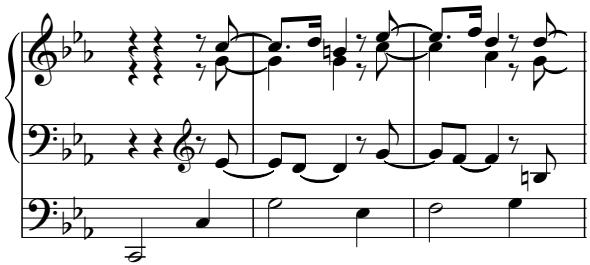
中文讲解
此处为第33页的图3.4(Dubitatio, mm. 8-10)占位符,所引内容是图像或乐谱本身。由于原任务未提供具体谱例细节,本节无法对该图进行内部音乐分析;只能确认其位于第33页、与上文 dubitatio 的论述直接相关,作用是让读者在谱面上观察高声部三个声部在 m. 8 第三拍后半拍的进入位置。需要查看原图才能获得更具体的乐谱信息。
第5段(P0152)
原文复述
133 Anna Paradiso Laurin, “Classical Rhetoric in Baroque Music” (PhD diss., Royal College of Music in Stockholm, 2012), XXVII.
中文讲解
此为正文段落(P0149)所附脚注133。内容为 Anna Paradiso Laurin 的博士论文《Classical Rhetoric in Baroque Music》(2012年瑞典皇家音乐学院博士论文),引用页为罗马数字 XXVII。该脚注为正文关于"古希腊修辞学家认识到 priming 受众的重要性"提供文献支持,作用是学术来源出处。
第6段(P0153)
原文复述
134 Bartel, “Musica Poetica,” 244.
中文讲解
此为正文段落(P0150)所附脚注134。内容为 Bartel,《Musica Poetica》,第244页。该脚注支撑 Forkel 对 dubitatio 的定义(即"an uncertain sentiment",通过在音乐某点上的 lingering 来表达),作用是为这一修辞格定义的权威性提供学术来源。
第7段(P0154)
原文复述
In this instance, the dubitatio also serve as a subtle way of ushering harmonic tension into the Passacaglia. The subtlety of the harmonic tension results both from the brief duration of the suspension (a single beat) and from the fact that all dissonances are prepared. Bach’s decision to deploy the dubitatio for two consecutive variations further contributes to the gradualism of his approach. While the rhythm and texture of the two variations is identical, the harmonic chromaticism is more pronounced, particularly in the deceptive resolution of a V7/VI to iv between mm. 17 and 18, as seen below in Figure 3.5.
中文讲解
本段把视线从节奏层面转向和声层面,论证 dubitatio 同时承担"悄然引入和声张力"的功能。其细微性源自两个条件:(1)延留音(suspension)持续时间极短,仅一拍;(2)所有不协和音均经过预备(prepared),即按古典对位规范先行准备,使不协和的出现具有逻辑可预期性而非突兀性。这与开场所要求的"渐进"原则一致。接着,作者指出巴赫把 dubitatio 连续用于两次变奏(变奏2与变奏3),两者的节奏与织体完全相同,仅和声层面的半音化程度(chromaticism)递增。这种"形同而和声不同"的安排,仍服从 gradualism(渐进主义)的总体逻辑。最显著的具体表现是 m. 17—18 之间 V7/VI 对 iv 的伪解决(deceptive resolution)——属七和弦按预期应解决到主和弦(I),此处却意外下行到下属小和弦(iv),从而在保持渐进导入的同时植入和声意外。图3.5谱例标示该片段所在。
第8段(P0155)
原文复述
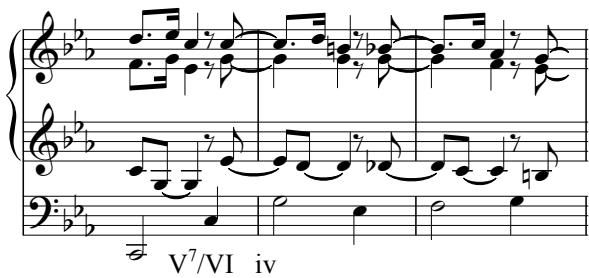
中文讲解
此处为图3.5(Reharmonization, mm. 16-18)的占位符,引用的为第34页的图像或乐谱本身。其与正文(P0154)所述变奏3中"和声半音化更为显著"以及"m. 17—18 之间 V7/VI 对 iv 的伪解决"直接对应,作用是让读者在谱面上观察这一伪解决的具体进行。原任务未提供谱例细节,需查看原图以确认具体音高与声部进行。
第9段(P0156)
原文复述
After the figure of the dubitatio has pervaded variations 2 and 3, the figura suspirans is introduced at the eighth note level of subdivision in variation 4. The figura suspirans, which is imitative of a sigh, is only incrementally rhythmically stronger than the dubitatio. Like the dubitatio, the suspirans begins on the offbeat. However, the rhythmic saturation is greater, given that a new note sounds on each eighth note pulse throughout the fourth variation. The suspirans of the fourth variation serves as a keen bridge between the rhythmically weak dubitatio that characterized variations 2 and 3 and the rhythmically robust figura corta that prevails throughout variations 5 and 6. The corta, Italian for “short,” is defined by
中文讲解
本段讨论变奏4所引入的第二个修辞格:figura suspirans(叹息格)。其结构与功能要点有三:(1)出现在变奏4的八分音符细分层面(eighth note level of subdivision),相比 dubitatio 的四分音符层面的活动更密集;(2)其名源自对叹息声的模仿,但作者强调其节奏力度"只比 dubitatio 略强"(only incrementally stronger),即仍保留犹豫色彩;(3)与 dubitatio 同样起于弱拍(offbeat),但节奏饱和度更高——每个八分音符时值都奏出新的音,形成连续的叹息式脉动。在本节整体论证中,本段的关键作用是把变奏4定位为过渡(bridge):一端连接节奏弱势的 dubitatio(变奏2—3),另一端通向节奏强势的 figura corta(变奏5—6)。末句提到 corta 在意大利语中意为"短",并预告其定义将引自 Walther(即下一段 P0157 的内容)。
第10段(P0157)
原文复述
Johann Gottfried Walther as “three rapid notes, [the first] of which has a duration equal to that of the other two [combined].”
中文讲解
本句承接上一段末尾的悬念,给出 figura corta 的定义:依据 Johann Gottfried Walther 的辞典性定义,figura corta 为"三个快速音符,其中第一个音符的时值等于另外两个音符的时值之和"。该定义在结构上限定了三个音符的时值比例——第一音等于后两音之和(如附点节奏 3+1+1 或类似比例),从而在听觉上呈现"短促"特征。该定义由脚注135标出来源(Walther 的《Lexikon》)。
第11段(P0158)
原文复述
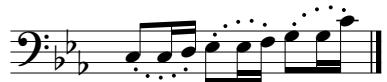
中文讲解
此处为图3.6(Figura Corta)的占位符,所引内容为第35页的图像或乐谱本身。其与 P0157 所引 Walther 对 figura corta 的定义直接对应,作用是让读者在谱面上识别该修辞格的具体节奏形态。原任务未提供谱例细节,需查看原图。
第12段(P0159)
原文复述
We recall that Bach used the dubitatio in both variation 2 and variation 3, yet he distinguished the latter from the former by means of a chromatic reharmonization. In like manner, the figura corta is used for two consecutive variations, but with a heightened intensity on the latter variation. While the corta in variation 5 features either stepwise motion or repeated notes, in variation 6, the same figure is employed amid a leaping contour. Another way in which the intensity of the figura corta is heightened between variations 5 and 6 has to do with the treatment of texture. In variation 5, the texture is largely comprised of pairs of voices moving in parallel thirds and sixths. However, in variation 6, each voice is rhythmically independent of the others, and the entrance of individual voices is staggered in a more sporadic fashion. Even the ground bass, which hitherto has been rhythmically unaltered, is recast in leaping, offbeat gesture.
中文讲解
本段论证变奏5—6构成 figura corta 内部的强度递增,与变奏2—3形成平行结构。作者先类比(in like manner):正如巴赫用 dubitatio 连续铺陈变奏2与变奏3,但通过和声半音化区分二者;figura corta 同样连续用于变奏5与变奏6,并在后者身上实现强度升级。具体升级通过两个维度:(a)旋律轮廓——变奏5以级进或同音反复(stepwise motion or repeated notes)为主,变奏6则在跳进轮廓(leaping contour)中运用同一节奏格;(b)织体处理——变奏5主要由成对声部以平行三度或六度(parallel thirds and sixths)运动,变奏6则每个声部各自独立(rhythmically independent),各声部进入呈更"散点式"(sporadic)的错落。特别值得注意的是,ground bass(通奏低音)这条原本贯穿全曲且节奏固定不变的低音线条,在变奏6中首次被改写为跳进且处于弱拍的姿态(recast in leaping, offbeat gesture)。这种对通奏低音本身的变形,标志着一个临界点:变奏6既是 exordium 的终点,又似乎预示着后续组别将展开新的篇章。
第13段(P0160)
原文复述

中文讲解
此处为图3.7(Altered Ground Bass of Variation 6)的占位符,所引内容为第35页的图像或乐谱本身。其与上一段(P0159)所述"通奏低音在变奏6中被改写为跳进、弱拍姿态"直接对应,作用是让读者在谱面上观察该通奏低音形态的具体变化。原任务未提供谱例细节,需查看原图。
第14段(P0161)
原文复述
135 Ibid., quoting Walther’s Lexikon.
中文讲解
此为正文段落(P0157)所附脚注135。内容简略:“Ibid., quoting Walther’s Lexikon”——意为引用同一本书(即上一脚注的 Bartel《Musica Poetica》),由 Bartel 转引 Walther 的《Lexikon》。该脚注为 Walther 对 figura corta 的定义提供出处,作用是标明该定义经由 Bartel 的二手转引。
第15段(P0162)
原文复述
In summary, variations 1 through 6 function as a skillful yet transparent introduction or presentation of the subject matter of the work. If one holds to the analogy of oration or testimony, one might acknowledge that this exposition or exordium is one of extreme and even brutal honesty, for the subject is presented in unison, with no accompanying gestures to mask or soften any potential defects of the theme. However, the vulnerability of this presentation serves as a testimony to the integrity of the ground bass subject, in that its intrinsic merits as a theme are already proven before any accompanying variations are superimposed. Over the course of these six variations, a gradual increase in intensity is achieved through the manipulation of rhythm and texture. If the intention of an exordium is to introduce a subject or idea and to cause an audience to “warm up” to said subject or idea, then variations 1 through 6 of this Passacaglia certainly fit those criteria.
中文讲解
本段是全节的总结段落,承担两个功能:(1)归纳变奏1—6作为 exordium 的整体定位;(2)揭示这一开场的特殊修辞品格——“brutal honesty”(残酷的诚实)。作者延伸了开场与证言(testimony)的类比:开场即等于对主题的自我作证。当主题以 unisono 方式单独呈现、不附带任何修饰性的伴随声部时,主题自身的任何弱点都将赤裸暴露;但正因为这一脆弱性(vulnerability),主题的内禀优点(intrinsic merits)反而被预先证实——它无需依赖后续变奏的装饰便已具备说服力。这一论证解释了为何巴赫选择以单声部齐奏作为整部作品的开端:从修辞角度看,这是一种自证清白式的开场策略。在手法层面,本段呼应前文,强调六次变奏内强度递增是通过节奏与织体的操控(manipulation of rhythm and texture)实现的。最后一句以条件句收束(“If the intention of an exordium is to introduce… and to cause an audience to warm up…"),由此宣告本节结论:变奏1—6完全符合 exordium 的功能定义。本段同时为读者留下一个开放的问题——既然主题已经在开场中被证明为可信,那么后续变奏组别将如何在此基础上展开进一步的修辞论证。
脚注 / 边栏 / 图表 / 附加信息(如有)
本节包含三处图示(图3.4、图3.5、图3.6、图3.7,编号共四项,因原书图序跨段落排列)与三处脚注(133、134、135)。图3.4位于第33页(Dubitatio, mm. 8-10),用于直观展示变奏2中高声部三个声部在 m. 8 第三拍后半拍进入的具体谱面位置,支撑"犹豫性"听感的论断。图3.5位于第34页(Reharmonization, mm. 16-18),对应变奏3中 m. 17—18 V7/VI 对 iv 的伪解决,是和声半音化递增的关键证据。图3.6位于第35页(Figura Corta),配合 P0157 Walther 的定义,让读者识别该修辞格的节奏比例。图3.7位于第35页(Altered Ground Bass of Variation 6),记录变奏6中通奏低音被首次改写为跳进、弱拍姿态的形态,是强度递增在低音线条上的突破点。脚注133(Laurin 博士论文)支撑开场需"引导受众"的修辞学传统;脚注134( Bartel《Musica Poetica》第244页)支撑 Forkel 对 dubitatio 的定义;脚注135(ibid., 转引 Walther《Lexikon》)支撑 figura corta 的定义,三脚注共同构成本节修辞—音乐格释义的学术来源网络。
💡 本节核心要点
- 本节核心论点:变奏1—6整体承担 exordium(开场/绪论)功能,其本质是渐进式引导听众进入作品的修辞空间。
- 作者借用古典修辞学框架(古希腊演说家的"priming"观念)解释开场的渐进性,把音乐分析纳入话语—演说的类比结构中。
- 开场内部的强度递增通过三个修辞格的递进展现:dubitatio(变奏2—3,节奏弱势)→ figura suspirans(变奏4,节奏居中,作为过渡桥梁)→ figura corta(变奏5—6,节奏强势),三者共同构成"逐步加强"的节奏叙事。
- 巴赫在每次修辞格的连续两次变奏间,通过和声半音化、旋律轮廓(级进→跳进)、织体处理(平行三六度→独立散点)三个层面层层加码,而变奏6中通奏低音自身被改写为跳进弱拍姿态,标志 exordium 的强度顶峰。
- 开场的修辞品格被概括为"brutal honesty”——主题以 unisono 齐奏裸露呈现,无任何装饰声部遮蔽其可能缺陷,这种"脆弱性"反而预先证明主题的内禀价值。
- 六次变奏所实现的是节奏与织体两个维度的渐进操控,契合 exordium 的两大功能——介绍主题并让听众逐步"热身"。
🔑 关键术语
- Exordium:源自古典修辞学,指演说的开场部分。本节中作者将变奏1—6整体定性为 exordium,含义是"渐进导入听众的开场",而非突然进入激烈论辩。
- Unisono:意大利语,意为"齐奏"。本节指变奏1中主题以单声部方式陈述,为整部作品的起始形态,作者借此比喻开场的"裸露诚实"。
- Dubitatio:源自 Quintilian《Institutio Oratoria》的修辞格,Forkel 定义其为"an uncertain sentiment",通过在音乐某一点上的 lingering(停留、徘徊)来表达。出现在变奏2—3,由高声部三个声部于 m. 8 第三拍后半拍进入实现迟疑感。
- Figura suspirans:意为"叹息格",模仿叹息声。出现于变奏4的八分音符细分层面,每个八分音符时值奏出新音,节奏饱和度高于 dubitatio,但起拍同样位于弱拍,作为连接 dubitatio 与 figura corta 的过渡桥梁。
- Figura corta:意大利语 corta 意为"短"。Walther 定义其为三个快速音符,第一个音符的时值等于后两个音符的时值之和。出现于变奏5—6,代表本节节奏强度递增的最高阶段。
- Ground bass:通奏低音,即贯穿全曲、反复出现的低音线条。在变奏1—5中保持节奏固定不变,至变奏6首次被改写为跳进、弱拍姿态,标志 exordium 的强度顶点。
- Suspension:对位法中的一种不协和处理方式,先有协和音、再有同音延留而与和声变化产生冲突。本节中,作者指出 dubitatio 中的延留音仅持续一拍,且所有不协和音均经过预备,故其张力呈现得十分细微。
- Deceptive resolution(伪解决):属七和弦未解决到预期的 I 级,而转向其他和弦。本节特指变奏3中 m. 17—18 V7/VI 对 iv 的解决,是和声半音化在变奏3较变奏2更为显著的关键证据。
ch_3_sec_13 Group 2: Narratio
第1段(P0163)
原文复述
Group 2: Narratio
中文讲解
这是本节的小节标题,分两行排印(“Group 2:” 与 “Narratio”),由"##“作为二层级标记。它在结构上宣告:作者将 Radulescu《Passacaglia》中第二组变奏(Group 2,对应 Variations 7–10)映射到古典修辞学五段式里的第二个环节——narratio(陈述/叙事)。前一节以 Group 1 对应 exordium(开场/引言),本节则把论题推进到"陈述"阶段,暗示论述主旨将由"引入问题"转向"正式提出立场与主题”。
补充说明
在此节标题与正文之间存在明显的论题承接关系:Group 1 论 exordium,Group 2 论 narratio,标题本身就是论域切换的信号,阅读时应以前一小节为前提。
第2段(P0164)
原文复述
Following the exordium of an oration is the narratio. Here, the speaker’s point of view—or in this case, the composer’s, is stated overtly and expounded upon. For example, in the context of a trial, a prosecutor might present a problem or dilemma throughout the course of an exordium, but the narratio is the point at which the prosecutor might formally direct an accusation toward the defendant.136 Rhetorically speaking, one might regard Radulescu’s Group 2, spanning Variations 7–10, as the narratio of the Passacaglia. At this point in the Passacaglia, the increase in rhythmic intensity that occurred throughout Group 1 reaches a plateau, as Variation 7 is entirely saturated with sixteenth note
中文讲解
本段完成本节最关键的一步:把古典修辞学的 narratio 概念嫁接到 Radulescu 的《Passacaglia》。三个层次铺开: (1)定义 narratio——这是讲演者在开场之后,正式、明确地陈述并展开自己观点的阶段; (2)举例说明——以法庭为例,控方在 exordium 中提出问题或困境,但要到 narratio 阶段才正式把指控指向被告。作者借此突出 narratio 的本质不在于"铺垫",而在于"立场之正式提出"; (3)对接音乐——将 Group 2(Variations 7–10)视为这部 Passacaglia 的 narratio,并点出 Group 1 累积起来的节奏强度在此"达到平台期(plateau)",因为 Variation 7 完全由十六分音符构成。 “sixteenth note"在原文行末未完,下段承接"subdivisions of the beat”。脚注136给出该修辞定义的来源。
补充说明
作者用"检察官"作类比是有意的:这个例子让 narratio 与"指控之提出"对应起来,进而暗示 Group 2 的功能是"把这部作品的核心主张正式亮出来",而不是被理解为单纯的材料铺陈。Variation 7 的饱和化是这一功能转向的音响标志。
第3段(P0165)
原文复述
136 Ibid., XXX.
中文讲解
脚注136的本体。“Ibid.“是学术注释中表示"出处同上一条"的常规缩写;其后逗号与一个本应显示为页码的位置在原书中对应字符为"XXX”——这一形式通常意味着原页码在转录/OCR 过程中未能被确认识别,因此占位为三个 X,而并非作者署有"XXX”。该脚注的功能是为正文中"narration / narratio"修辞学定义的出处作标注(source citation),并非对正文主张做限定或旁证。
补充说明
因页码不可还原,无法在本节内确认具体出处页码。需要时应在原文所引的来源文献里自行核对"Ibid., XXX"中 X 所对应的实际页。
第4段(P0166)
原文复述
subdivisions of the beat. Radulescu characterized the trajectory of Group 2 as a movement from figuration to polyphony. Though the upper three voices move toward an increasingly polyphonic idiom, the ground bass theme remains in the bass voice for the entirety of Group 2 and it maintains the same rhythm throughout. The resulting effect of this is that, amid the increasing rhythmic activity of the upper three voices, the listener’s ear is directed increasingly toward the sturdiness of the ground bass theme. Rhetorically speaking, this portrays the increasing and unwavering strength of the ground bass subject and places it on firm footing in the mind of the listener.
中文讲解
本段从承接上半句的"subdivisions of the beat"出发,正式概括 Group 2 的总体走向。其要点有四层: (1)作者总括——Radulescu 自己把 Group 2 的轨迹描述为"从音型化(figuration)走向复调(polyphony)"; (2)上下分工——上方三声部逐步进入越来越"复调化"的语汇,但固定低音(ground bass)主题始终停留在最低声部,并在整组里保持同一节奏; (3)聆听效果——上方节奏活动不断增强之下,听者的注意力越来越被引向那条稳固不变的低音主题; (4)修辞解读——这一音响安排刻画的是 ground bass 主旨(subject)的"日益坚固、不为所动"的力量,并把它牢牢植入听者心中。 本段实际是把抽象的修辞学命题落实到一个具体的听觉—结构布局上:上方活跃/下方恒定的对比,正对应 narratio"陈述一个不可动摇的核心主旨"的修辞功能。
补充说明
“ground bass subject"一词的"subject"既指"主题"也是修辞学中"subject of discourse/讨论对象"的双关——读者应注意此处作者刻意用同一字双关音乐的低音主题与修辞的主旨,以强化音乐—修辞的同构。
第5段(P0167)
原文复述
In analyzing the function of various figures in the exordium, I noted a couple of instances in which the same figure was used in two consecutive variations yet manipulated to achieve different effects. Throughout the course of narratio, only one musico-rhetorical figure is invoked—namely, the figura suspirans. Though a common figure is held throughout the narratio, momentum is achieved by a perpetual increase in contrapuntal complexity. In variation 7, the figure is presented in ascending form, whereas in variation 8, it is presented in descending form. However, variation 8 is contrapuntally heightened by the increasing frequency of stretti.137 In variation 9, the figure is presented in multiple voices simultaneously, and in contrary motion. In variation 10, the suspirans receives a treatment similar to what the corta received in variation 6: the figure is presented in a melodically disjunct fashion, and the ground bass ostinato has been recast in the appropriate figuration.
中文讲解
本段以逐变奏分析的方式落实上段提出的"复调化进程”。其结构是"总—分"式: (1)总括对照——在前节 exordium 分析中,作者曾观察到同一修辞格在相邻两变奏中可被操纵以达不同效果;与之形成对比的是,narratio 中只调用一个音乐修辞格——figura suspirans(“叹息式"格)。在"同一图式贯穿整组"之下,动力来自于"对位复杂度的不断累加(perpetual increase in contrapuntal complexity)"。 (2)逐变奏分解—— • Variation 7:suspirans 以升序(ascending)形式呈现; • Variation 8:改为降序(descending)形式,并以 stretti(紧接模仿)的逐步加密来抬升对位张力; • Variation 9:suspirans 同时在多个声部中呈现,并以反向(contrary motion)进行; • Variation 10:suspirans 获得与 Variation 6 中 corta(被砍断式/切分式)格类似的手法——旋律上作"分离式(melodically disjunct)“处理,同时低音的固定反复(ostinato)被"重新塑形(recast)“进相应的音型之中。 (3)脚注137为 Variation 8 中 stretti 加密的论述提供 Speerstra 一文的出处。
补充说明
Variation 10 中所谓的"treatment similar to what the corta received in variation 6”,是作者有意识地呼应前节中 corta 的处理方式——这形成 exordium 与 narratio 之间一种镜像式修辞手法传承,需要把本段与前节关于 corta 的论述合起来理解。
第6段(P0168)
原文复述
137 Speerstra, “Bach and the Pedal Clavichord,” 142.
中文讲解
脚注137本体。出处为 Speerstra 的论文"Bach and the Pedal Clavichord"第142页。该脚注的功能是为正文中关于 Variation 8 中"stretti 频率逐步增加"的论述提供出处标注(supporting source),不是对正文做限定或旁证。
补充说明
由于本节正文中并未展开引用 Speerstra 一书的具体论点,“第142页"所对应的内容需查阅原文所引的 Speerstra 论文方可还原。
第7段(P0169)
原文复述

中文讲解
这是图3.8的版面占位符:图题(caption)为"Altered Ground Bass of Variation 10”,即"Variation 10 中被改变了的固定低音”。原书此处应当是该低音在 Variation 10 中形态被重新塑形(recast)后的实际呈现(乐谱/图示),与正文中"the ground bass ostinato has been recast in the appropriate figuration"直接对应;位置正放在论述 Variation 10 之末、下段小结之前,起到例证的视觉承担作用。因内嵌图像数据被省略,具体谱面细节(调号、音高、节奏型等)均不可见,需回到原书第38页查阅图3.8原图。
第8段(P0170)
原文复述
It has previously been stated that an exordium is the part of an oration or testimony in which an idea is presented and in which the audience is “warmed up” to said idea. The narratio, by contrast, is the portion in the discourse in which factual information is delivered in a plain and focused fashion. It is fitting, then, that figuration be treated with a certain economy of means. In this case, one particular musical figure occupies the whole of the narratio.
中文讲解
本段是本节的小结与回扣。其逻辑链是: (1)回溯——exordium 的功能是"提出议题并使听众’热起来’"; (2)对照——narratio 的功能则是"以平实而集中的方式传达事实信息”; (3)推断——既然 narratio 注重"集中、平实",那么其材料处理方式应相应地"以节约手段(economy of means)为度"; (4)落地——这一原则在音乐上体现为:整个 narratio 只用一个修辞格来组织。 这样,作者把 P0167 中"narratio 仅调用一个 figura suspirans"这一经验性观察,重新解释为修辞原则的直接推论——既回应了古典修辞的"事实陈述应集中",也回应了作曲家本人"从图式走向复调"的轨迹。
补充说明
“economy of means”(手段节约)是作者把音乐实践拉回修辞原则的关键桥梁词;它把上一段"single figure"的观察提升为原则性的诠释,使本节的论证从描述层上升到原则层。
脚注 / 边栏 / 图表 / 附加信息(如有)
本节附有两处脚注与一幅图示: • 脚注136(位于P0164末,文本见P0165):“Ibid., XXX."——为前段 narratio 修辞学定义提供出处(来源与前一条脚注同),但具体页码处原文以"XXX"占位,无法在本输入内还原。 • 脚注137(位于P0167,文本见P0168):Speerstra, “Bach and the Pedal Clavichord,” 142.——为 Variation 8 中 stretti 加密的论述提供来源标注。 • 图3.8(位于P0169):题为"Altered Ground Bass of Variation 10”,原图放在论述 Variation 10 之末,用以可视展示固定低音主题在该变奏中被"重新塑形"后的形态;本输入中图像数据被省略,需查原图。
💡 本节核心要点
- 本节的核心论题是:Radulescu《Passacaglia》的 Group 2(Variations 7–10)对应古典修辞五段式中的 narratio(陈述/正式提出立场)。
- Variation 7 是承接 Group 1 节奏累积而成的"平台期"——其音响标志是十六分音符对该小节节拍的完全饱和。
- Group 2 总体轨迹在 Radulescu 自述中是"从音型化走向复调",表现为上方三声部逐步复调化,而 ground bass 始终保持在低音并维持同一节奏。
- 上方活跃/低音恒定的对比,被作者诠释为修辞效果:ground bass 作为"主旨(subject)“日益稳固、不为所动的力量被植入听者心里。
- 整组只调用一个音乐修辞格——figura suspirans;其动力来自对位复杂度的不断累加(升序→降序+stretti加密→多声部反向→与 Variation 6 中 corta 类似的分离式重塑)。
- 这种"单一图式贯穿全组"的处理在原则层面被回扣到 narratio 本身的修辞属性——以"economy of means(节约手段)“对应"以平实而集中之方式传达事实”。
🔑 关键术语
- narratio:古典修辞五段式中的第二环节,指讲演者在开场之后正式陈述与展开自己观点的阶段。本节中作者用以对应 Radulescu《Passacaglia》的 Group 2(Variations 7–10)。
- exordium:古典修辞五段式中的开场环节,用于提出议题并使听众被"预热”;在前节中对应 Group 1,在本节为 narratio 提供对照。
- passacaglia:一种以固定低音(ground bass)为基础反复变奏的体裁;本节所分析的对象为 Radulescu 的同名作品。
- ground bass:整组变奏所依据的主题低音。Group 2 中该主题始终保持在低音并维持同一节奏,构成上方声部"越趋复调化"下方的恒定底座,作者也将之修辞化为不变之主旨(subject)。
- figuration:将主题以分解/装饰/节奏化音型呈现的手法。Radulescu 自述 Group 2 由此走向 polyphony;本节中"economy of means"也对 figuration 的使用方式提出原则性约束。
- polyphony / polyphonic idiom:多声部独立进行的复调语汇。Group 2 中仅指上方三声部逐步获得此语汇,与下方恒定的 ground bass 形成对比。
- figura suspirans:“叹息式"音乐修辞格;本节指出整个 narratio 仅使用此一图式,通过逐变奏变换处理方式(升序/降序/多声部反向/分离式)积累对位张力。
- stretto (stretti):紧接模仿,即同主题在更短的间隔上被引入各声部。本节中 Variation 8 以 stretto 频率"逐步加密"作为抬升对位张力的方式,脚注137为之标注 Speerstra 的相关出处。
- contrary motion:反向进行。本节中 Variation 9 的 figura suspirans 即"以多声部同时呈现,并以反向进行”。
- ostinato:固定反复的音型或片段。本节特指 ground bass 的固定反复;在 Variation 10 中该 ostinato “被重新塑形(recast)“进相应的音型之中。
- corta:本节所提及的一种音乐修辞格(前节在 Variation 6 分析过)。本节指出 Variation 10 中的 suspirans “获得与 corta 在 Variation 6 中相似的处理”——旋律上以分离式(melodically disjunct)呈现,从而建立节与节之间的镜像式手法传承。
- economy of means:“手段节约"原则。本节末段用以把"narratio 全程只用一格"的观察回溯为原则:narratio 既以平实集中传达事实,其音响手段也应相应地节制。
ch_3_sec_14 Group 3: Probatio
第1段(P0171)
原文复述
Group 3: Probatio
中文讲解
本行是本小节的标题——Group 3: Probatio(第三组:论证/证明)。作者沿用古典修辞五段式来组织对巴赫《帕萨卡里亚》变奏结构的分析,标题宣告第三组(Variations 11–13)对应修辞学中的 probatio,即继 narratio 之后,演说者以证据与论据’证明’先前陈述之论题成立的阶段。这一标题为整段确立了论辩性语境,把接下来的论证方向从’陈述主题’转向’证实主题’。
第2段(P0172)
原文复述
Following the confident and bold narratio, orators were trained to deliver a probatio in which the premises presented in the narratio were proven or confirmed. For example, here, a prosecutor might present an item of supporting evidence that vindicates their accusation against the defendant. Group 3, spanning Variations 11-13, functions as the probatio in this work. At this point the subject of discourse—the ground bass theme—has been gradually introduced throughout the exordium of Group 1 and confidently presented throughout the narratio of Group 2. Throughout Group 3, the strength of the ground bass theme must be proven or verified by the composer. Here, Bach proves the integrity of the ground bass subject by presenting it in a variety of different manifestations and, for the first time in this piece, presents the theme in a voice other than the bass voice. Bach first tests the integrity of the ground bass theme in Variation 11 by casting it in a purely accompanimental role. Here, the lower three voices play short quarter-note length punctuation on beats one and three, while a steady stream of violinistic sixteenth notes form a countermelody in the soprano voice. Variation 12 is particularly notable, as this is the point at which, for the first time in the piece, the theme is cast in a voice other than the bass. By placing the ground bass theme in the soprano for Variations 12 and 13, Bach proves that this theme is effective not only as a bass line, or a harmonic foundation, but as a melodic theme that can be harmonized by undergirding voices. If we consider the portion of the Passacaglia that precedes the concluding fugue, there are a total of 21 variations. Variation 13, which is the climactic variation of the probatio, also functions as the golden section of the 21 variations that precede the fugue. Hence, even Bach’s proportional placement of the probatio in Passacaglia demonstrates the success of the ostinato.
中文讲解
本段是本节的核心论述,承担三重任务:(一)将 Group 3 与修辞学术语 probatio 对接;(二)以具体变奏 11、12、13 展示作曲家如何’证明’低音主题;(三)以黄金分割的数理比例强化 ostinato 成功的论点。
第一层,修辞术语的嫁接。probatio 在古典修辞传统中位于 narratio 之后、refutatio 之前,其目的是以证据与论据确认 narratio 中所提论点的真实性。作者以’检察官提出支持性证据以洗刷其指控’为例,凸显 probatio 的论辩性——它面向的听众已大致接受命题,现在需要的是论据去巩固这一立场,而非重新叙述事实。这一比喻也暗合巴洛克音乐’以作曲技法为论辩’的预设。
第二层,论域与证明路径。论域被明确为’低音主题’(ground bass theme):它在前两组已分别经历’引入’(exordium, Group 1)与’陈述’(narratio, Group 2),第三组则需’被证明’。证明手段有二:其一,将主题呈现在多种形态中;其二,首次将主题移出低声部。Variation 11 是第一次测试:主题被置于’纯伴奏角色’——下方三声部以四分音符在第一、三拍作短促点状切分(punctuation),上方高声部则以连续的小提琴化十六分音符构成对位旋律(countermelody)。这是一个关键实验:主题若仅作为低音线条与和声基础仍然成立,那它能否脱去低声部外衣后依然奏效?
第三层,结论性突破——Variation 12。它’尤为值得注意’,因为这是主题首次出现在非低声部的位置,并在 Variation 12 与 13 中被共同置于高声部。作者由此得出的论断值得玩味:主题不仅可作为低音线条或和声基础,更可作为’可被下方支撑性声部加以和声化的旋律主题’。这句话反向论证了 ostinato 的内在力量——它的活力并非来自其所在的低声部位置,而在于其旋律骨架本身足够独立、自洽,因此可以被’抬升’到任意声部并仍具说服力。
第四层,比例证据。终曲赋格之前共有 21 段变奏;Variation 13 既是 probatio 的高潮变奏,也恰好落在 21 段的黄金分割点。黄金分割在传统美学中常被视为最具张力的结构位置,巴赫有意将高潮变奏安置于此,相当于用比例本身作为’证据’。
收束句(原文作 ‘is demonstrates’,疑为 ‘demonstrates’ 的笔误)将论证闭环:连 probatio 自身的比例安排,也反过来证明了 ostinato 的成功——结构与内容相互印证,使整个修辞—音乐类比框架获得自洽。
本段在本节乃至整章论证链中的位置:它接续 Group 2 的’陈述’,并为接下来 Group 4(refutatio,可能涉及更复杂的对位写法)做准备;通过黄金分割点,标记出《帕萨卡里亚》终赋格前最具结构意义的枢纽变奏。
补充说明
黄金分割(golden section):将一线段分为长短两段,使长段与全段之比等于短段与长段之比,比值约为 0.618。本段中作者把 Variation 13 定位为终赋格前 21 段变奏的黄金分割点,用以论证该变奏在结构比例上的关键性。punctuation 在此为修辞/对位术语,指短促、点状、起呼吸与强调作用的声部进行,与本段中’四分音符点状切分’的描述相对应。
第3段(P0173)
原文复述
138 Bartel, “Musica Poetica,” XXXI.
中文讲解
本条为正文脚注 138,引用 Bartel 所著《Musica Poetica》第 XXXI 章。该文献是本段乃至全文修辞—音乐类比框架(exordium / narratio / probatio / refutatio / peroratio 五段式对应巴赫《帕萨卡里亚》五个变奏组)的来源依据;本段对 probatio 的定义——即在 narratio 之后’证明或确认先前陈述之论题’——即取自此处。脚注 139(在 P0172 中被引用但具体出处在本节未列明)涉及 21 段变奏黄金分割比例的来源。
补充说明
《Musica Poetica》是本段用以佐证修辞五段式音乐分析框架的引用文献,作者在脚注中以罗马数字 XXXI(31)标示章号,其具体内容不在本节段落中复述,故不另行展开。
脚注 / 边栏 / 图表 / 附加信息(如有)
本节包含脚注 138(P0173)与正文中提及的脚注 139 两条附加材料。脚注 138 指向 Bartel《Musica Poetica》第 XXXI 章,为 probatio 定义及其在音乐分析中对应关系的文献来源,支撑作者将修辞五段式映射到巴赫《帕萨卡里亚》五个变奏组(Group 1–5)的整体框架。脚注 139(出处未在本节段落中展开)支撑 Variation 13 作为 21 段变奏黄金分割点的数学依据。两条脚注分别从修辞理论与比例分析两个维度为正文论点提供外部佐证。
💡 本节核心要点
- 修辞定位:Group 3(Variations 11–13)对应古典修辞五段式中的 probatio,承担’以证据证明先前陈述之论题’的功能,标志着论述由’陈述’转入’论证’。
- 证明路径之一——多种形态呈现:Variation 11 中,主题被降为’纯伴奏角色’,下方三声部以四分音符在第一、三拍作点状切分,上方高声部则以连续十六分音符构成小提琴化对位旋律,以此测试主题在低声部之外的有效性。
- 证明路径之二——声部转位:Variation 12 是全曲首次将主题从低声部移至高声部,并于 Variation 13 延续之,由此证明该主题不仅可作为低音线条或和声基础,更可作为可被支撑性声部加以和声化的独立旋律主题。
- 比例证据:终赋格前共 21 段变奏,Variation 13 同时是 probatio 的高潮变奏与该 21 段的黄金分割点;巴赫对高潮位置的比例安排本身被用作 ostinato 成功的论据。
- 论证闭环:修辞结构的精确对应(结构本身)反过来成为 ostinato 成功的证据,结构与内容相互印证,使整个修辞—音乐类比框架获得自洽。
🔑 关键术语
- Probatio:本节核心修辞术语,指修辞五段式中的第三步:在 narratio 之后以证据或论据’证明/确认’先前所提命题的真实性。本节中对应 Group 3(Variations 11–13),承担由’陈述’转入’论证’的功能。
- Narratio:修辞五段式的第二步,意为’陈述’:对事实作清晰、有序、可信的叙述。本节中对应 Group 2,作者用以描述低音主题被’自信陈述’的阶段,与 probatio 形成承接关系。
- Exordium:修辞五段式的第一步,意为’起讲/引言’:吸引听众注意并预备其接受后续陈述。本节中对应 Group 1,低音主题在此被’逐步引入’,为后续陈述与证明奠定基础。
- Ground bass / Ostinato:贯穿全曲反复出现的固定低音主题;ostinato 在意大利语中即’固执/坚持’之意。本节论证的核心对象:通过 probatio 阶段证明该主题不仅可作低音线条或和声基础,更可作为独立旋律主题被其他声部和声化。
- Countermelody:对位旋律,与主旋律并行且具独立旋律意义的副旋律。本节中特指 Variation 11 高声部由连续十六分音符构成的小提琴化对位线条,它与被降为伴奏角色的低音主题形成对位关系。
- Undergirding voices:‘支撑性声部’,指在主题被移至高声部后位于其下方、为其提供和声与低音支撑的内声部和低声部。该术语强调主题与和声、低音之间的纵向支撑关系,是 Variation 12–13 主题声部转位后的关键结构概念。
- Golden section:黄金分割(约 0.618:1)。本节中作者将 Variation 13 定位为终赋格前 21 段变奏的黄金分割点,用以论证该高潮变奏在比例上的精确安排,并借此支撑 ostinato 成功的论点。
- Fugue:赋格。本节中以’the concluding fugue’出现,标示《帕萨卡里亚》在 21 段变奏之后接续的赋格段;本节对 21 段变奏比例的统计即以终赋格为参照点。
ch_3_sec_15 Group 4: Disputatio
第1段(P0174)
原文复述
Group 4: Disputatio
中文讲解
这是一个二级小节标题,宣告接下来的分析对象是整部帕萨卡利亚中按修辞结构划分的第四组变奏(Variations 14–16)。标题中的关键词 Disputatio 是古典修辞学的术语,指演说中正反双方进行辩论、反驳或质疑的环节,开启了本节关于“主题逐步被瓦解”这条核心论证的论题。
第2段(P0175)
原文复述
Following the rhetorical probatio is the disputatio, in which the orator or composer has an opportunity to play the role of Devil’s Advocate.140 In Variations 14-16, which constitute Group 4 of the Passacaglia, Bach establishes a disputatio through a gradual dismantling of the theme. The first step of disintegration occurs in Variation 14, where the theme is hidden away in the alto voice. Not only is the theme obscured by its placement in the middle of the texture, but it is further obscured by the fact that it is presented in a circulo mezzo figuration, in which the ostinato is interwoven with neighbor tones and passing tones.141 In Variation 15,
中文讲解
本段是本节论证的核心开篇,先给出理论框架,再落到具体作品分析。
首先是修辞学框架:古典修辞学中,probatio(证明)之后是 disputatio(辩驳/辩论),作者援引 Paradiso Laurin 的观点指出,这一阶段演说者或作曲家的角色相当于“魔鬼辩护人”(Devil’s Advocate),即主动站到对立面去质疑、动摇前面已经确立的命题。
接着作者将这一框架套用到巴赫的帕萨卡利亚:第 14–16 变奏构成 Group 4,作曲家正是通过“主题的逐步瓦解”(gradual dismantling of the theme)来实现 disputatio 的戏剧效果。
最后给出第一阶段——第 14 变奏的双重隐蔽策略:
- 位置上的隐蔽:主题被藏在中声部(alto voice),处于织体的中央而非外层突出位置;
- 写法上的隐蔽:主题以 circulo mezzo 型的装饰化音型呈现,即固定低音(ostinato)被邻音(neighbor tones)和经过音(passing tones)包裹穿插。
这两重隐蔽并非简单的“听不清”,而是修辞意义上的“开始动摇”——为后面彻底瓦解主题埋下伏笔。段末“In Variation 15,”是一个未完成的过渡句,承接至下一段。
补充说明
circulo mezzo 是巴洛克音乐修辞中的一种音型化手法,原意为“中圆”或“环绕中段”,指主题被包裹在装饰音中,主题轮廓被柔化、模糊;ostinato 此处指贯穿帕萨卡利亚的低音固定主题(ground bass)。本段脚注 140 与 141 分别给出修辞学一般论述与 circulo mezzo 术语的文献出处,见下方 additional_information。
第3段(P0176)
原文复述
139 Williams, The Organ Music of J.S. Bach, 186.
中文讲解
这是脚注 139 的内容,出处为 Williams 所著《The Organ Music of J.S. Bach》第 186 页。结合上下文位置(出现在 P0175 主体论述之后),它主要为前一段关于主题在中声部出现的判断提供二手文献依据,属于支持性引用。
补充说明
由于此注的位置紧邻 P0175 末尾关于 Variation 14 主题位置的描述,可推断其支持的是“主题被置于中声部”这一观察,而非 circulo mezzo 术语本身(后者由注 141 单独提供出处)。
第4段(P0177)
原文复述
140 Paradiso Laurin, “Classical Rhetoric in Baroque Music,” XXXI.
中文讲解
这是脚注 140 的内容,援引 Paradiso Laurin 的论文《Classical Rhetoric in Baroque Music》,引自其罗马数字序 XXXI(即第 31 章/节)。它为正文将 disputatio 解释为“演說者扮演魔鬼辩护人”的修辞学定义提供权威来源。
补充说明
罗马数字章节体例常见于较早期或欧洲学位论文,表明 Paradiso Laurin 是该领域将古典修辞体系套用到巴洛克音乐的关键作者之一;本节论证的修辞学框架直接来源于此。
第5段(P0178)
原文复述
141 Dietrich Bartel, Musica Poetica: Musical-rhetorical Figures in German Baroque Music, (Lincoln: Universiy Nebraska Press, 1997), 219.
中文讲解
这是脚注 141 的内容,引自 Dietrich Bartel《Musica Poetica: Musical-rhetorical Figures in German Baroque Music》(林肯:内布拉斯加大学出版社,1997 年)第 219 页。它为正文中 circulo mezzo 这一音型化术语提供权威定义与出处。
补充说明
Bartel 的《Musica Poetica》是德语区巴洛克音乐修辞学研究的标准参考书,专门整理各类音乐修辞格(musical-rhetorical figures),本注引自该书第 219 页,证明 circulo mezzo 在该领域术语体系中已被学界正式收录。
第6段(P0179)
原文复述
Bach obscures the ground bass theme even further by means of a stile brise texture. Here, the ground bass theme is lightly couched within an arpeggiating figure played by the keyboardist’s left hand. Finally, in Variation 16, the arpeggiated figuration is maintained, but the texture is reduced to a single voice. The result effect is that the ground bass theme is implied rather than stated overtly. By progressively disintegrating the theme between Variations 14 and 16, Bach renders a disputatio in which it appears that the theme has disintegrated or failed.
中文讲解
本段承接 P0175 末尾的“在第 15 变奏中”,完成对 Group 4 三支变奏的逐层瓦解的完整论证。
第 15 变奏:作曲家引入 stile brise(断奏式/分解式织体,原为法式琉特琴弹奏法)来进一步模糊主题。低音主题被轻盈地嵌入键盘手左手演奏的琶音化音型之中——主题轮廓仍在,但被音型分解包裹,几乎从“陈述”退化为“暗示”。
第 16 变奏:琶音化音型得以保留,但织体被削减到只剩单声部(a single voice)。结果是:固定低音主题不再被“明确陈述”(stated overtly),而仅靠音型逻辑被“暗示出来”(implied rather than stated overtly)。
作者用“the result effect”(原作表达如此,疑为 print 残留)的措辞,强调这是连续变化累积出的修辞效果,而非孤立现象。
段落总结:作者用“progressively disintegrating the theme”(逐步瓦解主题)来概括第 14–16 变奏的总体走向,并把这一过程定性为一段 disputatio——表面上看,主题似乎已经“瓦解或失败”(disintegrated or failed)。这一修辞性“失败”构成戏剧张力,为后续(如作者在巴赫其他作品中常见的“主题复现与胜利”)留出空间。
最后一句的论证意义在于:作者把三支变奏视为一个连续的修辞动作,而非三个独立片段;主题从“中声部隐藏 → 琶音包裹 → 单声部暗示”的递进,正是“魔鬼辩护人”逐步得势、原本被 probatio 确立的主题被驳倒的过程。
补充说明
stile brise 源自法语,字面意为“破碎的风格”,本指法式琉特琴(以及后来的羽管键琴)常用的分解和弦弹法,使和声以琶音方式连续流动,避免单音断奏;在键盘文献中常被视为一种柔化、模糊和声轮廓的织体手段,与本段“主题被包裹”而非“被陈述”的修辞效果相一致。
脚注 / 边栏 / 图表 / 附加信息(如有)
本节页面范围内共有三则脚注,均为文献引用,无独立图表或边栏:
- 脚注 139(Williams, The Organ Music of J.S. Bach, 186):支持正文中关于主题在第 14 变奏中被置于中声部这一观察。
- 脚注 140(Paradiso Laurin, “Classical Rhetoric in Baroque Music,” XXXI):为将 disputatio 定义为“魔鬼辩护人”这一修辞学概念提供来源。
- 脚注 141(Dietrich Bartel, Musica Poetica, 219):为正文中 circulo mezzo 这一音型化术语提供权威定义出处。 三则脚注共同支撑本节“古典修辞术语 → 巴赫具体变奏”的论证链。
💡 本节核心要点
- Disputatio 是古典修辞学中位于 probatio(证明)之后的辩论/反驳环节,其修辞角色相当于“魔鬼辩护人”,主张主动质疑前一阶段确立的命题。
- Group 4(Variations 14–16)整体构成一段 disputatio,其修辞策略是“通过逐步瓦解主题”来表现命题的动摇。
- 第 14 变奏的瓦解开始于双重隐蔽:主题被藏到中声部,并以 circulo mezzo 音型(邻音与经过音穿插)进一步模糊化。
- 第 15 变奏引入 stile brise 织体,把主题嵌入左手琶音化音型中,主题从“陈述”退化为“暗示”。
- 第 16 变奏将织体削减到单声部,主题只被暗示而非明确陈述,至此主题呈现“瓦解或失败”的修辞效果。
- 三支变奏作为一个连续修辞动作,其递进结构(隐藏→包裹→暗示)正是“魔鬼辩护人”逐步得势、原本被 probatio 确立的主题被驳倒的过程。
🔑 关键术语
- Disputatio:古典修辞学术语,指 probatio 之后进行辩论、反驳的环节;本节中对应 Bach 在 Variations 14–16 中通过主题逐步瓦解所实现的“反向论证”修辞效果。
- Probatio:古典修辞学中“证明”阶段,位于 disputatio 之前;本节中作为背景概念出现,disputatio 是对其所确立命题的反驳。
- Circulo mezzo:巴洛克音乐修辞格术语,指主题被装饰音(邻音、经过音)环绕包裹的音型化写法,使主题轮廓被柔化、模糊;本节中用于描述第 14 变奏对主题的外层隐蔽。
- Stile brise:源自法式琉特琴的“破碎风格”弹奏法,后用于键盘音乐,指以琶音化分解方式连续流动地演奏和声;本节中用于描述第 15 变奏的织体特征,作用是把主题“轻巧地嵌入”琶音化音型。
- Ground bass / Ostinato:贯穿全曲的低音固定主题,是帕萨卡利亚体裁的核心结构;本节中即被逐步瓦解的“修辞命题”本体。
- Devil’s Advocate:源自拉丁文 Advocatus Diaboli,修辞学借喻,指在 disputatio 中主动站到对立面、对既有命题进行质疑与反驳的角色;本节中由作曲家(在音乐上)扮演。
ch_3_sec_16 Groups 5 & 6: Conclusio
第1段(P0180)
原文复述
Section heading ‘Groups 5 & 6: Conclusio’ (page 40). It opens the section by signaling that the analysis now turns to the fifth and sixth groups of Bach’s Passacaglia, framed within the section title as the ‘conclusio’—the closing rhetorical stage of the piece.
中文讲解
这一标题把本节议题锁定在Groups 5与6,并以拉丁文conclusio为其定性。它表明作者将延续前文建立的’修辞五段式’框架(特别是disputatio—peroratio的对照关系),把Groups 5、6连同终曲赋格一起视为《帕萨卡利亚》修辞结构中的’结尾段’,论证主题如何在被对手质疑之后以胜利者姿态收束。该标题虽短,却是本节论证的入口:conclusio这一关键词将贯穿接下来的两段,决定读者理解Groups 5/6内部细节(再现、节奏峰、密度峰)的视角。
第2段(P0181)
原文复述
The final rhetorical stage of an oration—or in this case, composition—is the peroratio or conclusio, in which the subject or theme is presented as having triumphed over the opposition encountered during the disputatio. In the case of Bach’s Passacaglia, this conclusio occurs in three stages: Group 5, Group 6, and the concluding fugue. At the beginning of Group 5, a sense of recapitulation is achieved by the return of the ground bass theme to the bass voice, in its original sustained, trochaic rhythm. This strong and transparent presentation of the ground bass dispels any fear of its demise that may have been experienced during the disputatio. After the reintroduction of the ground bass theme in Variation 17, the perpetual drive of sixteenth-note triplets during Variation 18 in the transitus figuration brings about the climax of rhythmic intensity for the entire piece. Once this peak in rhythmic intensity has been achieved at the end of Group 5, Group 6 features a progressive increase in density. This crescendo in density culminates in a five-voice texture throughout Variation 21, and an 8-note sonority at its conclusion. The climax of rhythmic intensity in Group 5 and the climax of textural density in Group 6 combine to create a triumphant and convincing conclusio.
中文讲解
本段是全节论证的中枢,承担两个任务:定义conclusio的内涵,并把Groups 5、6内部细节映射到该定义上。
第一,conclusio的形式定义。作者先把conclusio等同于古典修辞中的peroratio:其形式条件是’主题被呈现为在disputatio的对抗中取胜’,直观意义是结尾段要让听众相信主题确实’胜诉’。这是后续解读Groups 5/6细节的判定标准。
第二,本段把conclusio拆成三阶段——Group 5、Group 6、终曲赋格——并对前两阶段各分配一个独立的climax维度: • Group 5 = ‘再现 + 节奏峰’。Variations 17让地主题回到Bass声部并恢复其原始的sustained(持续)、trochaic(扬抑格)节奏,作者将此明确定义为recapitulation(再现)。其修辞功能是’dispel any fear of its demise’——即驱散disputatio期间对主题可能消失的疑虑。紧接其后的Variations 18以transitus figuration(过渡型节奏型)承载十六分三连音的持续推进,形成全曲节奏强度的最高峰。‘再现’先稳住主题的身份,‘节奏峰’再把推进力推到顶点,二者构成Group 5的双重论证。 • Group 6 = ‘密度峰’。作者让Group 6只承担一种crescendo——织体密度的渐进增加,并在Variations 21达到五声部(five-voice texture),在Group 6末尾以八音和弦(8-note sonority)收束。这里’密度’包括同时进行的声部数与和弦内所含音数两个层面。
第三,‘组合’论证。本段最后一句把Group 5的节奏峰与Group 6的密度峰叠合,使两者互为表里:节奏与密度各自独立达到climax,再合在一起构成一个triumphant and convincing conclusio。这一句话也是承上启下的关键——它把本节前段的内部细节收束为一个统一的修辞效果,并把’终曲赋格’留给下一段作为’真正的apotheosis’,为下一段的让步结构(While… the true apotheosis…)埋下伏笔。
需要注意:本段所说的conclusio三阶段中,本段只完成前两阶段(Group 5与Group 6);第三阶段(终曲赋格)的论述由P0182接手。
补充说明
transitus figuration:原文中用以说明Variations 18节奏推进所属的体裁/写法类别的术语,可理解为一种过渡性的对位节奏型,与前后变奏形成节奏强度的过渡。trochaic rhythm(扬抑格节奏):长—短型的节律单位,原文用以指地主题在Variations 17再现时所恢复的原始节律特征。five-voice texture(五声部织体):同时进行的独立旋律线条数为五;8-note sonority(八音和弦):和弦内所含的音数为八;二者共同构成Group 6密度递增的两个量化指标。
第3段(P0182)
原文复述
While Groups 5 and 6 might have sufficiently confirmed the success or victory of the ground bass theme on their own merits, the true apotheosis of the Passacaglia comes in the form of its concluding fugue. Here, the versatility of the Passacaglia is shown to an even greater degree when it is repurposed as the subject for a permutation fugue. In the first twenty-one variations this subject proved successful in homophonic, monophonic, and free contrapuntal textures. In the fugue that constitutes the final variation, Bach demonstrates that this ostinato can also be retooled to function as a fugue subject. Not only is the theme cast as the subject of a fugue, but as the subject of a permutation fugue with two additional recurring countersubjects.
中文讲解
本段把上一段所定义的conclusio三阶段中的’第三阶段’——终曲赋格——推到论证的最高点,并通过让步结构(While Groups 5 and 6 might have sufficiently confirmed…, the true apotheosis… comes in the form of…)完成一次升级。理解时需要把握两点:
第一,‘升级’的逻辑。上一段已经论证Groups 5/6足以让主题’胜诉’,但作者用让步连词While主动’退让’:Groups 5/6只是sufficient(充分),而真正的apotheosis(终极升华/登峰造极)则发生在终曲赋格。这一修辞动作不是为了否定前文,而是把终点推向一个更高量级,从而让整首《帕萨卡利亚》的修辞收束呈现为’不止于一般性的结论,而是达到最高级’。
第二,‘versatility’(主题的多功能性/适应力)的累积论证。作者回溯地主题在前21个变奏中已成功栖身于三种织体:homophonic(主调/和声织体)、monophonic(单声部旋律)、free contrapuntal(自由对位)。这三种’胜利’在本段被当作既有事实,然后由终曲赋格加入第四种——作为fugue subject(赋格主题)。‘apotheosis’的具体所指由此落实:主题不仅能作为固定低音反复,还能被retooled(改造/重新调校)成赋格主题。
第三,终曲赋格内部的结构层级。作者用’Not only… but…‘把赋格主题的处理再切分为两层:不仅是fugue subject(赋格主题),而且是permutation fugue(对主题作系统性变换的赋格)的主题,并配两条additional recurring countersubjects(贯穿全赋格反复出现的辅助对题)。三层叠加——赋格主题 + 反演型赋格 + 两条循环对题——意味着在最终一段,地主题被处理得最复杂、最具变化。
修辞意义:apotheosis一词把赋格抬到古典修辞与音乐传统中’集中论证、主题反复出现并得到加强’的最高形式的层级;因此终曲赋格既是修辞上的最高总结,也是音乐上的最终胜利。这也是本节标题’Conclusio’的最完整兑现:conclusio的第三阶段不只是收尾,而是把主题抬到神化/升华的位置。
需要注意:原文’subject’在赋格语境中既是’主题’也是’主旋律’,本段两个含义并存:地主题被改造为赋格的主题/主旋律,并在此基础上加入反演手法与两条循环对题。
补充说明
permutation fugue:原文中用以描述终曲赋格类型的术语,指对主题作系统性变换的赋格写法。countersubject:原文中用以描述终曲赋格中两条贯穿出现、与主题对位的辅助旋律线的术语。两者均出自本段对终曲赋格特征的描述。
脚注 / 边栏 / 图表 / 附加信息(如有)
无。除正文章节标题外,本节未引入脚注、图表、谱例或边栏等附加材料;段落中提及的Variations 17、18、21及’终曲赋格’(即作为最终变奏的赋格)均嵌于正文论述之内,无独立图示或注释。
💡 本节核心要点
- 本节把Groups 5、6与终曲赋格共同定义为整首《帕萨卡利亚》的peroratio/conclusio,与前文的disputatio形成修辞对照:结尾段的功能是让主题在被对抗之后以胜利者姿态出现。
- Group 5由’再现’与’节奏峰’两个论证动作构成:Variations 17把地主题以原始sustained、trochaic节奏回归Bass声部,以recapitulation驱散主题可能消亡的疑虑;Variations 18以transitus figuration中的十六分三连音持续推进,形成全曲节奏强度高峰。
- Group 6只承担一种crescendo——织体密度的渐进增加;其在Variations 21达到five-voice texture,并以8-note sonority收束,构成Group 6的密度峰。
- 节奏峰(Group 5)与密度峰(Group 6)相互叠加,构成triumphant and convincing conclusio;这是本节对conclusio前两阶段的综合判定。
- 终曲赋格被定位为真正的apotheosis:地主题在前21个变奏中已成功栖身于homophonic、monophonic、free contrapuntal三种织体;终曲赋格再加入第四种——作为fugue subject。
- 终曲赋格内部还分两层升级:不仅是赋格主题,而且是permutation fugue的主题,并伴有两条additional recurring countersubjects;conclusio由此从’主题胜诉’升级为’主题被神化/升华’。
🔑 关键术语
- peroratio / conclusio:古典修辞中的结尾总结段;本节用以对照Groups 5、6与终曲赋格的功能,即让主题在disputatio之后以胜利者姿态出现。
- disputatio:与conclusio相对的’辩驳/论战’阶段;本节把它作为conclusio要回应其’对抗’的前一阶段。
- recapitulation:主题再现;本节特指地主题在Variations 17回到Bass声部并恢复其原始的sustained、trochaic节奏。
- trochaic rhythm:扬抑格(长—短)节奏;本节用以描述地主题在Variations 17再现时所恢复的原始节律特征。
- transitus figuration:过渡型对位/节奏型写法;本节用以指Variations 18中承载十六分三连音持续推进的节奏型,并定位Group 5的节奏峰。
- five-voice texture:五声部织体;本节用以量化Group 6密度crescendo在Variations 21所达到的声部数。
- 8-note sonority:八音和弦;本节用以量化Group 6末尾的密度峰。
- apotheosis:终极升华;本节用以指终曲赋格作为全曲论证的最高点,是conclusio从’胜诉’升级为’神化’的关键概念。
- permutation fugue:对主题作系统性变换的赋格;本节用以描述终曲赋格的赋格类型。
- countersubject:贯穿赋格反复出现、与主题对位的辅助旋律线;本节用以描述终曲赋格中两条additional recurring countersubjects。
ch_3_sec_17 A Defense of the Rhetorical Interpretation
第1段(P0183)
原文复述
A Defense of the Rhetorical Interpretation
中文讲解
本行是页面 41 上的小节标题,标志着作者开始为本研究采用的音乐修辞分析方法进行辩护。前文已展示作者如何用修辞概念(figurae、比例、布局)分析 Passacaglia 的内部结构,但这一方法可能引发质疑:Bach 本人并未受过修辞学训练,因此把修辞学框架硬套在他身上是否成立?本节即承担这一辩护任务,用历史先例(Mizler/Mattheson 之争)以及“次级修辞服务首要修辞”的方法论澄清,为前文的分析提供合法性依据。
第2段(P0184)
原文复述
It has been stated above that Bach was neither an academic, nor was he a rhetorician by trade. Lorenz Mizler, a student of Bach, claimed that he “[Bach] did not occupy himself with deep theoretical speculations on music, but was all the stronger in the practice of the art.”142 This criticism, dating from the middle of the eighteenth century, might seem to undermine my analytical approach. I do not mean to suggest Bach was consulting a textbook of rhetoric as he composed (or improvised) the Passacaglia, and further, the method I’ve outlined for the rhetorical analysis has historical precedent, for Johann Mattheson used this same hermeneutic in a Marcello aria. Mattheson’s analysis was met with opposition by Mizler, the same pupil of J.S. Bach who was cited above.
中文讲解
本段是辩护的起点,作者首先主动承认潜在的反对意见:Bach 既非学者也非职业修辞学家。学生 Lorenz Mizler 早在 18 世纪中叶就指出 Bach 不作深邃的理论思辨,而是以实践见长。这一来自 Bach 圈内的批评,对作者的修辞分析方法构成了最直接的威胁——若 Bach 本人未受过修辞学训练,那么以修辞学框架逆推他的作品,似乎是一种时代错置的解读。作者随即用两句声明来限定自己的立场:第一,他从不主张 Bach 在创作 Passacaglia 时正对照着某本修辞学教科书;第二,他所采用的修辞解读方法在历史上早有先例——Johann Mattheson 同样用这套释义学(hermeneutic)去分析 Marcello 的一首咏叹调,而正是 Mizler 本人当年曾对 Mattheson 的这一分析提出过反对。
关键推理是:作者通过指出“Mizler 反对过 Mattheson”这一点,预告后面将援引 Mattheson 对 Mizler 的反驳来为自己辩护。Mizler 同时是 Bach 的学生,又曾反对 Mattheson 用修辞学分析音乐,这一人事的重叠使作者有理由借用那次论战的话术回应今天的类似质疑。
补充说明
本段中 Mizler 的引文并非直接出自 Mizler 本人手稿,而是经由 Dreyfus 一文转述(见 P0185 脚注 142),因此严格说属于二手引文。Marcello 指 Benedetto Marcello,其《音乐风格中的诗的优雅》(Il teatro alla moda 等作品之外,他著名的音乐修辞学讨论来自对咏叹调的分析传统)。本段中“hermeneutic”一词指释义学/解释方法,作者强调自己与 Mattheson 使用的是同一套解释工具。
第3段(P0185)
原文复述
142 Dreyfus, “Bach and the Patterns of Invention,” 9.
中文讲解
这是 P0184 中 Mizler 那句引文的来源脚注,指向 Laurence Dreyfus 的文章《Bach and the Patterns of Invention》第 9 页。该脚注为 Mizler 的原话提供文献出处,同时印证这一关于 Bach “重实践、轻理论”的判断在当代巴赫研究中已是常见论述。
补充说明
脚注功能:直接来源支持。其作用在于让读者可以回到 Dreyfus 的文章核查 Mizler 的具体措辞与上下文。
第4段(P0186)
原文复述
Mattheson responded to Mizler’s objection in the following words:
中文讲解
这是一句引语引入语,预示接下来将完整呈现 Mattheson 当年反驳 Mizler 的话。它把读者从“转述 Mizler 的立场”过渡到“展示 Mattheson 的反驳”,是本节辩护论证的转折枢纽。
第5段(P0187)
原文复述
Marcello, to be sure, has given as little thought to the six parts of an oration in composing this aria I quoted in the Kern, as in his other works; but one concedes that I have quite possibly shown how they must be present in the melody. That is enough. Experienced masters proceed in an orderly manner, even when they do not think about it. One can observe this in everyday writing and reading where no one gives spelling a second thought.143
中文讲解
本段是 Mattheson 的原文反驳,是整节辩护的核心证据。Mattheson 的论点可分三层:
- 承认事实:Marcello 在写作这首咏叹调时,确实和写其他作品一样,并未想过“演说的六个部分”(six parts of an oration,即修辞学中标准的 exordium–narratio–propositio 等六段结构)。
- 转折论证:但即便如此,分析者仍然可以在旋律中指出这些部分确实存在于那里——只要他能展示出来,就足够了。Mattheson 用“quite possibly”保留对自身论证的谦逊,但这并不削弱结论本身。
- 类比推广:以日常写作/阅读中的拼写为例——没有人会在每次写字时默念拼写规则,但熟练者写出的文字依然符合正字法。同理,经验丰富的作曲家/演说家即使不主动调用修辞规则,其作品依然会依照这些规则被组织起来。
这条论证的精妙之处在于:它把“创作者是否意识到规则”与“规则是否支配作品”这两件事分开。一位创作者可以在意识层面不调用修辞学,却依然在实践层面服从修辞学所描述的结构原则——这是作者要移植到 Bach 与 Passacaglia 上的关键逻辑。
补充说明
“the six parts of an oration”指古典修辞学中标准演说的六个部分(exordium 序言、narratio 叙述、propositio 论点、argumentatio 论证、digressio 离题、peroratio 结论),这一划分可追溯到西塞罗与昆体良。Mattheson 的“the Kern”指其著作《The Kern melodischer Wissenschaft》(1737)。脚注 143 标明该引文转引自 Bonds, “Wordless Rhetoric,” 86,因此严格说也是经二手文献转引。
第6段(P0188)
原文复述
It is indeed true that Bach was most likely not composing this piece from a rhetoric textbook, and he was not likely thinking of Quintilian’s model of oration when crafting the Passacaglia. However, considerations of proportion and affectation could not have been far from his mind. However, as Mattheson stated above, a seasoned author, orator, or composer need not think actively about matters of grammar or syntax.
中文讲解
本段把 Mattheson 的反驳正式移植到 Bach 身上,可分三步:
- 承认质疑成立:Bach 写作 Passacaglia 时几乎可以肯定没有翻阅修辞学教科书,也不太可能想着昆体良(Quintilian)的演说模型。
- 提出中间地带:尽管如此,关于“比例”(proportion)和“情感姿态”(affectation,这两者是 18 世纪音乐修辞学的核心关切)的考量,不可能远离 Bach 的意识——也就是说,Bach 至少在实践层面受这些原则支配。
- 借助 Mattheson 的类比完成结论:像拼写之于写作一样,语法和句法之于修辞,对熟练作者来说是“内化了的”而非“自觉操作的”。因此 Bach 是否主动调用修辞学,并不构成反对用修辞学分析他的理由。
值得注意的是,作者在用词上保留了两个“However”:第一个引出“比例与情感姿态不可能远离 Bach 的意识”,第二个则把 Mattheson 的类比正式援引作为定论,两层递进清楚地展示出从“承认反方”到“推出结论”的完整推理链。
补充说明
“Quintilian’s model of oration”指古罗马修辞学家昆体良在《演说术原理》(Institutio Oratoria)中系统化的演说结构模型;“affectation”此处应理解为“情感/情绪的呈现”(拉丁语 affectus 的对应概念),并非现代英语中“做作”的贬义,作者用其指 18 世纪音乐修辞学中 affect-theory 的核心范畴。
第7段(P0189)
原文复述
Another fundamental goal of this analysis was to steer our musicorhetorical analysis from gestural considerations of secondary rhetoric to broader considerations of primary rhetoric. Throughout the course of this analysis, we considered the significance of the effects produced by specific figurae. However, the figures were not analyzed as ends in themselves, but rather as a means of understanding how an individual, composite part relates to the work as a whole. As such, I have demonstrated a method that employs secondary rhetoric in the service of primary rhetoric.
中文讲解
本段将辩护从“历史先例是否成立”转向“分析方法的自我定位”,是本节的第二个支柱。作者区分了两层修辞学:
- 次级修辞(secondary rhetoric):关注具体的修辞手法(figurae),即局部的姿态/句法单位(如 passus duriusculus、anabasis 等)所产生的效果。
- 首要修辞(primary rhetoric):关注作品整体的布局、比例与说服性的宏观结构。
作者承认自己在前文分析中确实详细讨论了各个 figurae 的情感效果,但他澄清这些 figurae 本身不是分析的终点,而是被用作“窗口”,去理解每一个组合性局部如何服务于作品的整一性。也就是说,作者的方法论是把次级修辞当成工具、把首要修辞当成目的——分析 figure,是为了让整体结构显形。这条澄清同时回应了一种可能误读:别人若只看到作者在罗列 figure,可能以为他在做“姿态堆砌”,但作者强调自己是在用 figure 照亮作品整体。
这是本节“辩护”的另一面:除了“Bach 是否知道修辞学”这一历史问题外,还要说明“我用修辞学分析 Bach 的方式不是修辞学滥用”,二者结合才构成本研究的完整合法性。
补充说明
“primary rhetoric vs. secondary rhetoric”这对概念借自更广义修辞学史的区分:primary rhetoric 指关乎作品整体布局与说服结构的高阶修辞,secondary rhetoric 指关乎词句、姿态与具体手法的低阶修辞;在音乐分析中,前者对应曲式与宏观结构,后者对应具体动机型与表情手法(figurae)。作者用这组术语明确自己并未沉迷于姿态描写。
第8段(P0190)
原文复述
143 Bonds, “Wordless Rhetoric,” 86.
中文讲解
这是 P0187 中 Mattheson 那段引文的来源脚注,指向 Mark Evan Bonds 的文章《Wordless Rhetoric》第 86 页。该脚注为 Mattheson 的反驳提供间接文献来源,确认其作为 18 世纪音乐修辞学史中的经典论述常被后人引用。
补充说明
脚注功能:间接来源支持。其作用是让读者在 Bonds 的文章中追溯 Mattheson 与 Mizler 之争的上下文,因为作者并未直接查阅 Mattheson 的德文原著,而是经由 Bonds 的英文研究性文章转引。
脚注 / 边栏 / 图表 / 附加信息(如有)
本节共包含两条脚注(142 与 143),均起到直接/间接来源支持的作用:
- 脚注 142 (P0185) 引 Dreyfus, “Bach and the Patterns of Invention,” 9,为 Mizler 关于 Bach “重实践、轻理论”的引文提供原始来源;
- 脚注 143 (P0190) 引 Bonds, “Wordless Rhetoric,” 86,为 Mattheson 反驳 Mizler 的那段话提供转引来源。 两条脚注均说明作者依赖二手英文研究文献来重建这场 18 世纪中叶的论战,而不是直接查阅德文原始文献。 本节无图表、无乐谱占位符。
💡 本节核心要点
- 本节是一段方法论辩护,主要回应“把修辞学套用到 Bach 身上是否时代错置”的潜在质疑。
- 作者主动承认 Bach 并不是职业修辞学家,以此抢占反对意见的制高点,再用 Mattheson 的历史先例为方法提供合法性。
- Mattheson 反驳 Mizler 的核心论点——创作者不必意识到规则,规则依然可以支配作品——被作者直接移植到 Bach 与 Passacaglia 上:Bach 即使没有翻修辞学教科书,其作品依然可能受到比例与情感原则的支配。
- 作者在承认 Bach 不主动调用修辞规则的同时,强调“比例”和“情感姿态”不可能远离 Bach 的创作意识,划出可被合理论辩的中间地带。
- 作者区分了次级修辞(具体 figurae 的表情效果)与首要修辞(作品整体的布局与说服结构),并声明前文对 figurae 的讨论始终服务于后者,整体方法定位为“用次级修辞服务首要修辞”。
- 两条脚注均为间接来源(经 Dreyfus 与 Bonds 转引),说明作者依赖现代英文二手研究来重建 18 世纪的 Mattheson–Mizler 之争。
🔑 关键术语
- hermeneutic:释义学/解释方法;作者用以指自己与 Mattheson 共用的那套把修辞学范畴投射到音乐文本上的解读工具,强调方法的连贯性与历史先例。
- the six parts of an oration:古典修辞学中标准演说的六个部分(序言、叙述、论点、论证、离题、结论),源自西塞罗与昆体良的传统;Mattheson 在引文中以之代表完整的演说结构原则。
- Quintilian’s model of oration:古罗马修辞学家昆体良在《演说术原理》中系统化的演说结构模型;作者用之代表 Bach 不可能主动调用的高阶修辞学体系。
- proportion and affectation:18 世纪音乐修辞学的两个核心范畴:proportion(比例)关乎作品各部分之间的宏观均衡,affectation 在本节语境中指 affectus(情感)的呈现而非现代意义上的“做作”,二者共同构成 Bach 不可能完全不意识到的实践性原则。
- primary rhetoric vs. secondary rhetoric:作者借自一般修辞学史的层次区分:primary rhetoric 关注作品整体的布局与说服结构(宏观曲式与整体修辞),secondary rhetoric 关注具体词句与姿态手法(即 figurae 与局部表情单位);作者声明其方法是把次级修辞当作工具以服务于首要修辞。
- figurae:复数形式的修辞/音乐修辞“手法”或“姿态”,指可被识别的局部修辞单位(如 passus duriusculus、anabasis 等);作者强调它们在本文中是分析整体结构的窗口而非分析终点。
ch_4_sec_1 Conclusion
第1段(P0191)
原文复述
CHAPTER 4
中文讲解
这是论文的第四章标题(Chapter 4),属于版面结构性的章节标识,并非正文论述,因此不承载实质主张。它把读者从前面三章的展开转入本论文的收束部分。
第2段(P0192)
原文复述
Conclusion
中文讲解
这是本章的小节标题“结论”(Conclusion),宣告本节承担全文收束的功能:回顾核心论点、回到研究主题、并把分析的意义升华到更高层面,而不是再展开新材料。
第3段(P0193)
原文复述
The passacaglia’s origins and evolution differ vastly from other genres, such as the sonata or symphony. Though it began as an improvisatory folk tradition, it developed into a highly cultivated art form. Furthermore, while much of its conventions are strictly defined, others are left open-ended. To be specific, the unwavering presence of the ostinato is a very strict and binding convention, yet no other organizational conventions bind the composer. While the formal concept of the passacaglia is simple, the execution of this paradigm requires great skill. A composer must balance the demands of respecting the integrity of the ostinato while creating sufficient contrasts, so as to avoid boredom. In order to create a convincing passacaglia, a composer must be attentive not only to the details of individual variations, but to the broad architecture of the work as a whole. The success of a passacaglia rests on a proper relationship between its small, composite parts and the large, cohesive whole. Such a relationship can be well understood by examining the principles of rhetoric—principles that have been adapted and invoked by musicians for several centuries. Having examined the broad history of rhetoric, we recall that, at its foundation in Greco-Roman Antiquity, it was intended as a form of persuasion. However, in both antiquity and modernity, the persuasive element of rhetoric has often been usurped by the ornamental or
中文讲解
本段是论文结论部分的核心论述。首先,作者对比passacaglia与其他体裁(如奏鸣曲、交响曲)的差异:它起源于即兴的民间传统,但发展成高度精致的艺术形式。这一对比凸显passacaglia的独特性——既保留民间即兴性又达到艺术精致度,是其他古典体裁所不具备的双重身份。
在内部规则的层面上,作者用一个转折性句式指出passacaglia的惯例“既有严格规定也有开放空间”:严格的是固定低音(ostinato)必须持续在场,其他组织惯例则对作曲家没有约束力。这个区分很关键——它定义了passacaglia的形式自由度边界。
接着,作者提出本论文的核心张力:形式概念简单,但执行需要高超技艺。具体而言,作曲家必须在两件事之间取得平衡——既尊重固定低音的完整性,又通过变奏提供足够的对比以避免单调。也就是说,passacaglia的难点不是“是否使用变奏”而是“如何在固定低音的统一性下制造有意义的变化”。
进一步,作者点出本论文的核心方法论——既要关注个体变奏的细节,也要关注整部作品的宏观架构,并强调这种“部分与整体”的关系才是passacaglia成败的关键。这一句是承上启下的关键:它从passacaglia的内部张力过渡到修辞学(rhetoric)的类比框架,因为修辞学几千年来正是处理“局部构件与整体说服力”关系的技艺,几个世纪以来也被音乐家借用。
最后,作者以几个世纪以来修辞学史的回顾作结:修辞学在希腊罗马古代的源头本是一种“说服”(persuasion)形式,但在古代和现代都时常被“装饰性元素”所僭越。本段在“ornamental or”处中断,下一段将接续这个未完成的句子(“ornamental or decorative element”)。
补充说明
作者把passacagia的“统一—对比”张力映射到修辞学上,这是整篇论文的方法论骨架;但本段仍未区分“primary rhetoric”与“secondary rhetoric”,这两个术语的精确定义要等下一段(及前文章节中已经建立的对应关系)才能完整呈现,因此本段的“ornamental or”是不完整的尾句,需与下一段连读。
第4段(P0194)
原文复述
decorative element. In other words, primary rhetoric has often been eclipsed by an inordinate preoccupation with secondary rhetoric. Throughout history, when principles of oratory rhetoric have been applied to music, there has likewise been a tendency to focus on figuration rather than structure in form. Using Bach’s Passacaglia in C Minor, BWV 582, as a case study, I’ve sought to apply the principle of primary rhetoric to the passacaglia. In so doing, we proposed a scheme of division within the Passacaglia that corresponds with the structure of oration outlined by Quintilian. We further noted the important relationship between the process of inventio and elaboratio. Throughout the process of this analysis, we have not eschewed the study of figures. Rather, we have placed them at the service of structure and form—at the service of primary rhetoric.
中文讲解
本段接续上一段被截断的句子,明确说出“ornamental or decorative element”,即修辞学中常常压过说服本义的“装饰性元素”。紧接着,作者用“in other words”作同义改写,把它提炼为论文的一对核心术语:primary rhetoric(首要修辞/说服性修辞)常常被对 secondary rhetoric(次要修辞/装饰性修辞)的过度关注所掩盖。
随后,作者将这一区分从文字修辞学平移到音乐修辞学:当口述修辞学原则被应用到音乐上时,历史上同样存在一种偏向——注重“装饰”(figuration)胜过“结构”(structure)。这一历史判断点出了本论文要回应的问题:音乐分析也常常停留在修辞格的研究,而忽视了修辞结构本身。
然后,作者陈述本论文的方法:以巴赫《c小调帕萨卡里亚》BWV 582为个案研究,尝试将首要修辞(primary rhetoric)原则应用于passacaglia。具体落地为两项工作:
- 提出passacaglia内部的“划分方案”(scheme of division),对应昆体良(Quintilian)所论述的演说结构;
- 阐明 inventio(构思/选题)和 elaboratio(展开/润色)这两个过程之间的重要关系。
最后一句强调本论文的立场并非放弃修辞格研究,而是把修辞格放在“结构与形式”——即“首要修辞”的服务之下。这一立场是全文的方法论定调:装饰服从于结构,次要修辞服务于首要修辞。
作为结论段,本段的修辞功能是“收束—立场定调”:先回顾全文诊断(修辞被装饰僭越),再宣布本论文的回应(以巴赫个案回归首要修辞),并以方法论声明(不抛弃修辞格,而是让其服务于结构)作为落点。
补充说明
本段中的几个术语均依赖前文章节的定义,本段不能独立成立:
- “primary rhetoric / secondary rhetoric”:在前文已建立为“首要修辞—说服性结构”与“次要修辞—装饰性手法”的对照。
- “Quintilian”:即古罗马修辞学家昆体良,其演说五段式结构(exordium/narration/proposition/argumentation/peroration)正是本论文用以划分BWV 582的依据。
- “inventio 与 elaboratio”:古典修辞五过程中的两个关键阶段,“inventio”指寻找与配置论据,“elaboratio”指对所选材料进行展开润色;本论文将这对关系应用到passacaglia固定低音之上的变奏安排。
- “figuration”:音乐修辞学中指代修辞格(musical-rhetorical figures)的术语,对应secondary rhetoric。
脚注 / 边栏 / 图表 / 附加信息(如有)
本小节作为第四章结论,正文段落中并未出现脚注、图表、边栏或图像占位符,所有附加材料(如BWV 582谱例、Quintilian五段式结构图等)均位于前文章节,本节仅以文字综述引用。因此 additional_information 记为“无”。
💡 本节核心要点
- passacaglia具有独特的双重身份——既源于即兴的民间传统,又演变为高度精致的艺术形式,这一双重性使其与奏鸣曲、交响曲等其他体裁形成显著差异。
- passacaglia的形式规定呈现“唯一严格约束+其他开放”的不对称结构:固定低音(ostinato)必须持续在场,而其他组织惯例则由作曲家自由处置。
- passacaglia创作的真正难点是平衡——既要尊重固定低音的统一性,又要在变奏中提供充分对比以避免单调,体现出“部分与整体”的辩证关系。
- 古典修辞学自古存在“首要修辞(说服/结构)被次要修辞(装饰)所僭越”的偏向,这一偏向在音乐修辞学的运用中同样存在,导致分析往往停留在装饰手法层面而忽视整体结构。
- 本论文以巴赫《c小调帕萨卡里亚》BWV 582为个案,借鉴昆体良的演说结构对作品进行划分,并讨论 inventio 与 elaboratio 之间的关系,以此将首要修辞原则重新引入passacaglia研究。
- 本论文的方法论定调是“不抛弃修辞格研究,而是将其置于结构与形式的统辖之下”,即让 secondary rhetoric 服务于 primary rhetoric。
🔑 关键术语
- passacaglia:一种建立在固定低音(ostinato)之上的变奏体裁;本论文把它作为研究对象,强调其源于民间即兴传统并发展为精致艺术的双重身份。
- ostinato:固定低音或固定旋律型在作品中反复出现的结构元素,是passacaglia唯一不可违背的形式约束。
- primary rhetoric:“首要修辞”,指以说服性和整体结构为目标的修辞层面;本论文主张passacaglia研究应回归这一层面。
- secondary rhetoric:“次要修辞”,指装饰性、修饰性的修辞手法(如音乐修辞格);本论文承认其价值,但强调它应服从于首要修辞的整体结构。
- figuration:在音乐修辞学语境中指各种修辞格(musical-rhetorical figures),对应次要修辞;本论文将其与“structure”对照,诊断音乐修辞研究中“过度关注figuration而忽视structure”的偏向。
- inventio 与 elaboratio:古典修辞五过程中的两个关键阶段——“inventio”指论据的发现与配置,“elaboratio”指对所选材料进行展开润色;本论文把它们迁移到passacaglia变奏安排中加以应用。
- Quintilian:古罗马修辞学家,其所论述的演说结构(如五段式)为作者划分BWV 582提供框架,是本论文跨学科类比的支柱之一。
- Bach’s Passacaglia in C Minor, BWV 582:巴赫《c小调帕萨卡里亚》BWV 582,是本论文的核心个案研究对象,全部分析均围绕这部作品展开。
bib_sec_1 Books
第1段(P0195)
原文复述
BIBLIOGRAPHY
中文讲解
本段为参考文献的总标题"参考文献”,标示其后所有内容均为作者在论文写作过程中所引用、参考的文献清单。它并不包含具体论点,而是整本论文引用来源的总入口。
第2段(P0196)
原文复述
Books
中文讲解
本段是参考文献的子标题"图书”,与后续(如果有)的期刊文章、网页资源等子目录相区分。它仅起分类作用,表明以下列出的均为独立出版的图书类文献。
第3段(P0197)
原文复述
Apel, Willi. The History of Keyboard Music to 1700. Translated by Hans Tischler. Bloomington: Indiana University Press, 1972.
中文讲解
阿佩尔(Willi Apel)所著《1700年以前的键盘音乐史》(汉斯·蒂施勒译,布卢明顿:印第安纳大学出版社,1972年)。这是一部系统考察西方键盘乐器音乐从早期起源直至1700年发展脉络的经典著作,常被作为该领域的基础参考文献,可为研究巴洛克时期管风琴作品(如帕萨卡利亚)提供历史背景。
第4段(P0198)
原文复述
Arnold, Denis, and Nigel Fortune, eds. The New Monteverdi Companion. London and Boston: Faber and Faber, 1985.
中文讲解
丹尼斯·阿诺德(Denis Arnold)与奈杰尔·福琼(Nigel Fortune)主编的《新蒙特威尔第指南》(伦敦及波士顿:Faber and Faber,1985年)。本书是研究意大利作曲家蒙特威尔第的综合性论文集,从风格、文本、戏剧语境等多方面分析其作品,对理解早期巴洛克修辞与音乐修辞的来源具有参考价值。
第5段(P0199)
原文复述
Bartel, Dietrich. Musica Poetica: Musical-rhetorical Figures in German Baroque Music. Lincoln: University of Nebraska Press, 1997.
中文讲解
迪特里希·巴特尔(Dietrich Bartel)著《音乐诗学:德国巴洛克音乐中的音乐—修辞格》(林肯:内布拉斯加大学出版社,1997年)。该书系统梳理德国巴洛克时期作曲家所使用的修辞格(如重复、省略、夸张等),是研究巴赫等德国作曲家修辞手法的核心参考书。
第6段(P0200)
原文复述
“Rhetoric in German Baroque Music: Ethical Gestures.” The Musical Times 144, no. 1885 (Winter 2003): 15-19.
中文讲解
(迪特里希·巴特尔撰文)《德国巴洛克音乐中的修辞:伦理姿态》,《音乐时报》第144卷第1885期(2003年冬季号),第15—19页。该文承接其著作中的主题,进一步探讨德国巴洛克音乐中修辞手法如何承担道德与伦理表达功能,强调"伦理姿态"作为一种修辞手段的修辞学内涵。
第7段(P0201)
原文复述
Bazelak, Miłosz. “The Musical Rhetoric of the Baroque on the Example of Johannes Brahms’ Psalm XIII Op. 27.” Kwartalnik Młodych Muzykologów UJ Vol. 38, no 4 (2018): 41–57.
中文讲解
米沃什·巴泽拉克(Miłosz Bazelak)撰文《以勃拉姆斯〈诗篇第十三〉Op.27为例看巴洛克音乐修辞》,《雅盖隆大学青年音乐学刊》第38卷第4期(2018年),第41—57页。该文把巴洛克时期的音乐修辞手法延伸到19世纪勃拉姆斯的作品上,用以解释浪漫主义作曲家如何承袭并转化古典修辞原则,对理解修辞传统的延续性具有意义。
第8段(P0202)
原文复述
Benitez, Vincent P. “Buxtehude’s Passacaglia Principle.” Rivista di Analisi e Teoria Musicale 20, no. 1/2 (January 2014): 98–118.
中文讲解
文森特·P·贝尼特斯(Vincent P. Benitez)撰文《布克斯特胡德的帕萨卡利亚原则》,《分析与音乐理论杂志》第20卷第1/2期(2014年1月),第98—118页。本文聚焦于17世纪德国管风琴家布克斯特胡德作品中反复出现的主题化低音结构,并提炼出其特有的"帕萨卡利亚原则”,是讨论变奏与低音固定原则的重要文献。
第9段(P0203)
原文复述
Bloom, Harold. “Coleridge: The Anxiety of Influence.” Diacritics 2, no. 1 (April 1972): 36-41.
中文讲解
哈罗德·布鲁姆(Harold Bloom)撰文《柯勒律治:影响的焦虑》,《批评学刊》第2卷第1期(1972年4月),第36—41页。该文最初版本预示了布鲁姆后来关于诗歌传统中后来者与先驱之间张力(《影响的焦虑》)的理论,文中以浪漫主义诗人柯勒律治为案例,常被引用以说明影响与原创性之间的辩证关系。
第10段(P0204)
原文复述
Bonds, Mark Evan. Wordless Rhetoric: Musical Form and the Metaphor of the Oration. Cambridge: Harvard University Press, 1991.
中文讲解
马克·埃文·邦兹(Mark Evan Bonds)著《无声的修辞:音乐形式与讲演的隐喻》(剑桥:哈佛大学出版社,1991年)。该书系统考察音乐形式与古典修辞学之间的概念对应关系,揭示音乐如何借用"讲演"的比喻来组织自身结构,是研究音乐—修辞关系的奠基性著作之一。
第11段(P0205)
原文复述
Braunschweig, Karl. “Rhetorical Types of Phrase Expansion in the Music of J. S. Bach.” Intégral 18/19 (June 2004): 71-111.
中文讲解
卡尔·布劳恩施威格(Karl Braunschweig)撰文《J. S. 巴赫音乐中的修辞性乐句扩展类型》,《完整》(Intégral)第18/19卷(2004年6月),第71—111页。文章归纳了巴赫作品中以修辞原则为动机的乐句扩展手法,揭示其作品结构的修辞性根源。
第12段(P0206)
原文复述
Bukofzer, Manfred. “Allegory in Baroque Music.” Journal of the Warburg and Courtauld Institutes 3, no. 1/2 (October 1939): 1-21.
中文讲解
曼弗雷德·布科夫泽(Manfred Bukofzer)撰文《巴洛克音乐中的寓意》,《瓦尔堡与考陶尔德研究院杂志》第3卷第1/2期(1939年10月),第1—21页。该文从艺术史与音乐史交叉的视角,探讨巴洛克音乐中"寓意"(Allegory)作为一种修辞与象征手法的作用,是音乐修辞与图像学研究的早期经典文献。
第13段(P0207)
原文复述
Burkholder, J. Peter. “Brahms and Twentieth-Century Classical Music.” 19th-Century Music 8, no. 1 (July 1984): 75-83.
中文讲解
J. 彼得·伯克霍尔德(J. Peter Burkholder)撰文《勃拉姆斯与20世纪古典音乐》,《19世纪音乐》第8卷第1期(1984年7月),第75—83页。该文考察勃拉姆斯对20世纪音乐家(如勋伯格、巴托克等)的持续影响,以及他如何被塑造为对贝多芬传统的继承者,常用于讨论历史主义与浪漫主义传统的延续。
第14段(P0208)
原文复述
Burmeister, Joachim. Musical Poetics. Translated by Benito V. Rivera. New Haven: Yale University Press, 1993.
中文讲解
约阿希姆·布迈斯特(Joachim Burmeister)著《音乐诗学》(贝尼托·V. 里维拉译,纽黑文:耶鲁大学出版社,1993年)。该书为17世纪初德国音乐修辞学的代表作,原著以拉丁文系统论述音乐中可类比修辞格的各种手法,是后世讨论"musica poetica"的核心原始文献之一。
第15段(P0209)
原文复述
Butler, Gregory G. “Fugue and Rhetoric.” Journal of Music Theory 21, no. 1 (April 1977): 49-109.
中文讲解
格雷戈里·G·巴特勒(Gregory G. Butler)撰文《赋格与修辞》,《音乐理论杂志》第21卷第1期(1977年4月),第49—109页。该文系统分析赋格写作与古典修辞之间的结构类比,揭示赋格主题、对题、答题等要素如何对应修辞学中的角色。
第16段(P0210)
原文复述
Copeland, Rita, and Ineke Sluiter, eds. Medieval Grammar and Rhetoric: Language Arts and Literary Theory, AD 300-1475. Oxford: Oxford University Press, 2009.
中文讲解
丽塔·科普兰(Rita Copeland)与伊内克·斯鲁伊特(Ineke Sluiter)主编《中世纪语法与修辞:语言艺术与文学理论,公元300—1475》(牛津:牛津大学出版社,2009年)。该书汇编了中世纪语法与修辞传统的核心文献,为追溯古典修辞学从中世纪至文艺复兴的延续提供重要参考。
第17段(P0211)
原文复述
Cusick, Suzanne G. “Gendering Modern Music: Thoughts on the Monteverdi-Artusi Controversy.” Journal of the American Musicological Society 46, no. 1 (1993): 1-25.
中文讲解
苏珊娜·G·库西克(Suzanne G. Cusick)撰文《现代音乐中的性别建构:论蒙特威尔第—阿图西论战》,《美国音乐学会会刊》第46卷第1期(1993年),第1—25页。该文从性别视角重新解读17世纪初蒙特威尔第与保守派阿图西之间的论争,揭示论战背后的修辞与社会学动机,是音乐—修辞研究中具有性别理论介入的代表文献。
第18段(P0212)
原文复述
Dahlhaus, Carl. Nineteenth-Century Music. Translated by J. Bradford Robinson. Berkeley: University of California Press, 1989.
中文讲解
卡尔·达尔豪斯(Carl Dahlhaus)著《十九世纪音乐》(J.布拉德福德·罗宾逊译,伯克利:加利福尼亚大学出版社,1989年)。该书为19世纪音乐史研究的经典著作之一,覆盖浪漫主义音乐风格、历史意识及与古典传统的关系,是理解勃拉姆斯、贝多芬等作曲家历史语境的标准参考。
第19段(P0213)
原文复述
Dreyfus, Laurence. Bach and the Patterns of Invention. Cambridge: Harvard University Press, 1996.
中文讲解
劳伦斯·德雷福斯(Laurence Dreyfus)著《巴赫与发明模式》(剑桥:哈佛大学出版社,1996年)。该书探讨巴赫音乐中"发明"(Invention)作为作曲手法与修辞概念之间的关系,揭示巴赫对修辞传统的继承与转化。
第20段(P0214)
原文复述
Edwards, Peter. “Resisting Closure: The Passacaglia Finale from György Ligeti’s Le Grand Macabre.” Music Analysis 35, no. 2 (2016): 258-78.
中文讲解
彼得·爱德华兹(Peter Edwards)撰文《抗拒终止:利盖蒂〈大死亡〉中的帕萨卡利亚终曲》,《音乐分析》第35卷第2期(2016年),第258—278页。该文聚焦于20世纪匈牙利作曲家利盖蒂歌剧中的帕萨卡利亚终曲,分析其如何以现代手法"抗拒"传统帕萨卡利亚的封闭式终止逻辑,对理解帕萨卡利亚在20世纪的发展具有重要参考价值。
第21段(P0215)
原文复述
Flindell, E. Fred. “Bach’s Tempos and Rhetorical Applications.” Bach 28, no. 1/2 (April 1997): 151-236.
中文讲解
E. 弗雷德·弗林德尔(E. Fred Flindell)撰文《巴赫的速度与修辞运用》,《巴赫研究》第28卷第1/2期(1997年4月),第151—236页。该文考察巴赫作品中标示的速度与演奏处理如何受到古典修辞学原则的指引,对演奏诠释与作品分析均有参考意义。
第22段(P0216)
原文复述
Frisch, Walter. “Reger’s Bach and Historicist Modernism.” 19th-Century Music 25, no. 2-3 (November 2001): 296-312.
中文讲解
瓦尔特·弗里施(Walter Frisch)撰文《雷格尔的巴赫与历史主义现代主义》,《19世纪音乐》第25卷第2—3期(2001年11月),第296—312页。该文以德国作曲家马克斯·雷格尔(Max Reger)如何继承巴赫传统为例,揭示19世纪末音乐创作中的历史主义与现代主义辩证关系。
第23段(P0217)
原文复述
Garratt, James. “Prophets Looking Backwards: German Romantic Historicism and the Representation of Renaissance Music.” Journal of the Royal Musical Association 125, no. 2 (January 2000): 164-204.
中文讲解
詹姆斯·加拉特(James Garratt)撰文《向后看的先知:德国浪漫主义历史主义与文艺复兴音乐的再现》,《皇家音乐协会杂志》第125卷第2期(2000年1月),第164—204页。该文探讨19世纪德国作曲家如何在自身作品中"再现"文艺复兴音乐,从而揭示历史主义与音乐修辞之间的相互作用。
第24段(P0218)
原文复述
Grace, Harvey. The Organ Works of Rheinberger. London: Novello and Company, Ltd., 1993.
中文讲解
哈维·格雷斯(Harvey Grace)著《莱茵贝格尔的管风琴作品》(伦敦:Novello and Company有限公司,1993年)。该书是研究19世纪德国作曲家、慕尼黑音乐院管风琴教授约瑟夫·莱茵贝格尔(Josef Rheinberger)管风琴作品的标准导论,对了解浪漫主义管风琴传统有参考价值。
第25段(P0219)
原文复述
Graham, Daniel W. The Stanford Encyclopedia of Philosophy. Fall 2015 ed., s.v. “Heraclitus.” Stanford: Stanford University Press, 2015. https://plato.stanford.edu/archives/fall2015/entries/heraclitus/ (accessed July 9, 2019)
中文讲解
丹尼尔·W·格雷厄姆(Daniel W. Graham)撰《斯坦福哲学百科全书》2015年秋季版"赫拉克利特"词条(斯坦福:斯坦福大学出版社,2015;网址:plato.stanford.edu/archives/fall2015/entries/heraclitus/,访问日期:2019年7月9日)。该词条系统介绍古希腊前苏格拉底哲学家赫拉克利特关于"变"与"逻各斯"的思想,是研究西方变与永恒观念的哲学背景文献。
第26段(P0220)
原文复述
Grimes, Nicole. “The Schoenberg/Brahms Critical Tradition Reconsidered.” Music Analysis 31, no. 2 (July 2012): 127-75.
中文讲解
尼科尔·格里姆斯(Nicole Grimes)撰文《重审勋伯格/勃拉姆斯批评传统》,《音乐分析》第31卷第2期(2012年7月),第127—175页。该文重新审视20世纪初勋伯格与保守派围绕勃拉姆斯展开的论争,揭示其历史语境、修辞策略与对后世勃拉姆斯研究的塑造。
第27段(P0221)
原文复述
Handel, Darrell. “Britten’s Use of the Passacaglia.” Tempo, no. 94 (1970): 2-6.
中文讲解
达雷尔·汉德尔(Darrell Handel)撰文《布里顿对帕萨卡利亚的运用》,《节拍》(Tempo)第94期(1970年),第2—6页。该文考察20世纪英国作曲家本杰明·布里顿作品中对帕萨卡利亚手法的继承与变形,为研究帕萨卡利亚在20世纪语境中的发展提供具体例证。
第28段(P0222)
原文复述
Harrison, Daniel. “Max Reger Introduces Atonal Expressionism.” The Musical Quarterly 87, no. 4 (Winter 2004): 660-80.
中文讲解
丹尼尔·哈里森(Daniel Harrison)撰文《马克斯·雷格尔引介无调性表现主义》,《音乐季刊》第87卷第4期(2004年冬季),第660—680页。该文聚焦雷格尔从调性传统向无调性表现主义过渡的创作手法,对理解雷格尔如何承接巴赫传统并扩展其修辞语汇有参考意义。
第29段(P0223)
原文复述
“Rhetoric and Fugue: An Analytical Application.” Music Theory Spectrum 12, no. 1 (April 1990): 1-42.
中文讲解
(丹尼尔·哈里森撰文)《修辞与赋格:一个分析应用》,《音乐理论谱》第12卷第1期(1990年4月),第1—42页。该文将修辞学原则系统地应用于赋格作品的分析,提出具体的分析方法,是音乐—修辞研究中的代表性论文。
第30段(P0224)
原文复述
Hasty, Christopher. Meter as Rhythm. New York: Oxford University Press, 1997.
中文讲解
克里斯托弗·黑斯蒂(Christopher Hasty)著《节拍作为节奏》(纽约:牛津大学出版社,1997年)。该书重新定义节奏与节拍之间的关系,强调节奏的时间过程性而非计量性,对音乐理论与修辞学中的"时间"维度讨论具有方法论意义。
第31段(P0225)
原文复述
Kirkendale, Ursula. “The Source for Bach’s ‘Musical Offering’: The ‘Institutio oratoria’ of Quintilian.” Journal of the American Musicological Society 33, no. 1 (April 1980): 88–141.
中文讲解
乌尔苏拉·基肯道尔(Ursula Kirkendale)撰文《巴赫〈音乐的奉献〉的来源:昆体良的〈雄辩术原理〉》,《美国音乐学会会刊》第33卷第1期(1980年4月),第88—141页。该文系统论证巴赫《音乐的奉献》在主题构思与结构上直接对应古罗马修辞学家昆体良《雄辩术原理》的章节划分,是研究音乐—修辞关系史的经典文献。
第32段(P0226)
原文复述
Knapp, Raymond. “The Finale of Brahms’s Fourth Symphony: The Tale of the Subject.” Nineteenth Century Music 13, no. 1 (July 1989): 3–17.
中文讲解
雷蒙德·纳普(Raymond Knapp)撰文《勃拉姆斯第四交响曲的终曲:主题的故事》,《19世纪音乐》第13卷第1期(1989年7月),第3—17页。该文以勃拉姆斯第四交响曲的帕萨卡利亚终曲为研究对象,揭示其主题如何通过变奏展开并承担叙事功能,对理解帕萨卡利亚在浪漫主义传统中的叙事修辞具有重要意义。
第33段(P0227)
原文复述
Kobayashi, Yoshitake. “The Variation Principle in J.S. Bach’s Passacaglia in C minor BWV 582.” In Bach Studies, edited by Don O. Franklin and Daniel R. Melamed, 62-69. Cambridge: Cambridge University Press, 1989.
中文讲解
小林芳孝(Yoshitake Kobayashi)撰文《J. S. 巴赫〈c小调帕萨卡利亚〉BWV 582中的变奏原则》,收入唐·O. 富兰克林与丹尼尔·R. 梅拉梅德主编《巴赫研究》(剑桥:剑桥大学出版社,1989年),第62—69页。该文聚焦巴赫此首著名帕萨卡利亚的变奏结构原则,是讨论变奏与固定低音关系的代表性分析文献。
第34段(P0228)
原文复述
Luko, Alexis. “Tinctoris on Varietas.” Early Music History 27 (2008): 99-136.
中文讲解
亚历克西斯·卢科(Alexis Luko)撰文《廷克托里斯论"多样性"》,《早期音乐史》第27卷(2008年),第99—136页。该文考察15世纪音乐理论家廷克托里斯关于"varietas"(多样性、多样变化)的论述,揭示修辞原则在文艺复兴早期音乐理论中的具体含义,对讨论变奏的修辞基础至关重要。
第35段(P0229)
原文复述
Marshall, Gail. The Cambridge Companion to the Fin De Siècle. Cambridge: Cambridge University Press, 2007.
中文讲解
盖尔·马歇尔(Gail Marshall)主编《剑桥世纪末指南》(剑桥:剑桥大学出版社,2007年)。该书为研究19世纪末欧洲文化、文学与音乐的综合性指南,对了解世纪末美学氛围与历史主义语境有参考价值。
第36段(P0230)
原文复述
Mattheson, Johann, and Harriss, Ernest Charles. Johann Mattheson’s Der vollkommene Capellmeister: A Revised Translation with Critical Commentary. Edited by Ernest C. Harriss. Ann Arbor: University of Michigan Research Press, 1981.
中文讲解
约翰·马特松(Johann Mattheson)原著,欧内斯特·查尔斯·哈里斯(Ernest Charles Harriss)编辑并校订的修订版英译本《约翰·马特松〈完美的乐长〉:附评注》(安阿伯:密歇根大学研究出版社,1981年)。该书为18世纪初德国作曲家马特松所撰写的关于通奏低音与作曲修辞的系统论著,是巴洛克音乐—修辞学的原始文献之一。
第37段(P0231)
原文复述
McCreless, Patrick. “Music and Rhetoric.” In The Cambridge History of Western Music Theory, edited by Thomas Christensen, 847–79. New York: Cambridge University Press, 2002.
中文讲解
帕特里克·麦克雷莱斯(Patrick McCreless)撰文《音乐与修辞》,收入托马斯·克里斯坦森(Thomas Christensen)主编《剑桥西方音乐理论史》(纽约:剑桥大学出版社,2002年),第847—879页。该文为权威音乐理论史著作中的核心章节之一,系统综述自古希腊至20世纪音乐与修辞学之间的概念关系,是本论文主题的标准综述文献。
第38段(P0232)
原文复述
Mercer-Taylor, Peter. “Rethinking Mendelssohn’s Historicism: A Lesson from St. Paul.” The Journal of Musicology 15, no. 2 (Spring 1997): 208-29.
中文讲解
彼得·默瑟—泰勒(Peter Mercer-Taylor)撰文《重思门德尔松的历史主义:从〈圣保罗〉中得到的启示》,《音乐学杂志》第15卷第2期(1997年春季),第208—229页。该文以门德尔松清唱剧《圣保罗》为案例,重新审视浪漫主义历史主义在作品中的具体修辞与风格策略。
第39段(P0233)
原文复述
Nelson, Robert U. The Technique of Variation. Berkeley: University of California Press, 1949.
中文讲解
罗伯特·U·尼尔森(Robert U. Nelson)著《变奏技法》(伯克利:加利福尼亚大学出版社,1949年)。该书系统研究西方音乐中的变奏手法,是变奏技法的经典理论著作,涵盖自文艺复兴至20世纪作品中的多种变奏类型。
第40段(P0234)
原文复述
Palisca, Claude V. “Music and Rhetoric.” In Music and Ideas in the Sixteenth and Seventeenth Centuries, 203–31. Chicago: University of Chicago Press, 2006.
中文讲解
克劳德·V·帕利斯卡(Claude V. Palisca)撰文《音乐与修辞》,收入《16、17世纪的音乐与思想》(芝加哥:芝加哥大学出版社,2006年),第203—231页。该文为该领域的奠基性论文之一,系统梳理文艺复兴晚期与巴洛克时期音乐修辞的来源、代表人物与作品例证,常被作为研究音乐—修辞的必读文献。
第41段(P0235)
原文复述
Pasticci, Susanna. “In Search of a Passacaglia Principle.” Rivista di Analisi e Teoria Musicale 20 (2014): 7–14.
中文讲解
苏珊娜·帕斯蒂奇(Susanna Pasticci)撰文《寻找帕萨卡利亚原则》,《分析与音乐理论杂志》第20卷(2014年),第7—14页。该文以"帕萨卡利亚原则"为题展开探讨,旨在梳理不同作曲家作品中所体现的共同结构特征,为讨论帕萨卡利亚的体裁定义与变奏逻辑提供理论框架。
第42段(P0236)
原文复述
Plato. The Cratylus, Phædo, Parmenides and Timæus of Plato. Translated from the Greek by Thomas Taylor. London: Benjamin and John White, Fleet-Street, 1793.
中文讲解
柏拉图《克拉底鲁篇》《斐多篇》《巴门尼德篇》《蒂迈欧篇》(托马斯·泰勒由希腊文译出,伦敦:Benjamin and John White,Fleet街,1793年)。该书为柏拉图四篇对话的早期英译本。其中《蒂迈欧篇》中关于"世界灵魂"与"比例"的论述,是西方思想中以哲学/修辞比喻讨论音乐秩序的古典源头之一。
第43段(P0237)
原文复述
Radulescu, M. “On the Form of Johann Sebastian Bach’s Passacaglia in C minor.” The Organ Yearbook 11, (April 1980): 95-103.
中文讲解
M. 拉杜列斯库(M. Radulescu)撰文《论约翰·塞巴斯蒂安·巴赫〈c小调帕萨卡利亚〉的形式》,《管风琴年鉴》第11卷(1980年4月),第95—103页。该文以巴赫著名帕萨卡利亚为研究对象,专门讨论其形式结构与变奏组织方式,是该曲研究中的重要文献。
第44段(P0238)
原文复述
Ratner, Leonard G. Classic Music: Expression, Form, and Style. New York: Schirmer Books, 1980.
中文讲解
伦纳德·G·拉特纳(Leonard G. Ratner)著《古典音乐:表达、形式与风格》(纽约:Schirmer Books,1980年)。该书系统论述古典主义时期音乐中的句法、终止式与修辞主题(topics),是讨论18世纪音乐风格与修辞关系的重要文献。
第45段(P0239)
原文复述
Razzi, Fausto. “Polyphony of the ‘Seconda Prattica’: Performance Practice in Italian Vocal Music of the Mannerist Era.” Early Music 8, no. 3 (1980): 298-311.
中文讲解
福斯托·拉齐(Fausto Razzi)撰文《“第二实践"的对位:风格主义时期意大利声乐作品的演奏实践》,《早期音乐》第8卷第3期(1980年),第298—311页。该文讨论16—17世纪意大利"第二实践”(seconda prattica)下的复调写作与演唱实践,是研究蒙特威尔第时代音乐修辞的重要参考。
第46段(P0240)
原文复述
Reger, Max. “Music and Progress.” In Selected Writings of Max Reger, edited and translated by Christopher Anderson, 21-25. New York: Routledge, 2006.
中文讲解
马克斯·雷格尔(Max Reger)撰文《音乐与进步》,收入克里斯托弗·安德森编辑并翻译的《马克斯·雷格尔文选》(纽约:Routledge,2006年),第21—25页。该文为雷格尔本人关于音乐进步观与历史继承问题所写的论文,可作为研究其在创作中如何承接巴赫传统的一手文献。
第47段(P0241)
原文复述
Rivera, Benito V. and Ruhnke, Martin. “Burmeister, Joachim.” Grove Music Online. Oxford University Press, accessed October 18, 2018.
中文讲解
贝尼托·V. 里维拉(Benito V. Rivera)与马丁·鲁恩克(Martin Ruhnke)撰《格罗夫音乐在线》(Grove Music Online)中的"布迈斯特,约阿希姆"词条(牛津大学出版社,访问日期:2018年10月18日)。该词条概述了17世纪德国音乐修辞理论家约阿希姆·布迈斯特的生平与著作,是了解其《音乐诗学》背景的标准参考。
第48段(P0242)
原文复述
Saint-Dizier, Patrick. Musical Rhetoric: Foundations and Annotation Schemes. London: Focus Series, 2014.
中文讲解
帕特里克·圣迪济耶(Patrick Saint-Dizier)著《音乐修辞:基础与标注方案》(伦敦:Focus Series,2014年)。该书从语言学与计算修辞学的角度,为音乐修辞的标注与分析提供形式化方案,是将修辞研究方法化、计算化的现代参考。
第49段(P0243)
原文复述
Schönlau, Stephan. “Emulating Lully? Generic Features and Personal Traits in the Passacaglia from Henry Purcell’s King Arthur (1691).” Rivista di Analisi e Teoria Musicale 20, no. 1–2 (January 2014): 119–46.
中文讲解
斯特凡·舍恩劳(Stephan Schönlau)撰文《模仿吕利?亨利·普赛尔〈亚瑟王〉(1691)中帕萨卡利亚的体裁特征与个人特征》,《分析与音乐理论杂志》第20卷第1—2期(2014年1月),第119—146页。该文以普赛尔歌剧中的帕萨卡利亚段落为案例,分析其既承接吕利的体裁传统又体现个人风格的修辞策略。
第50段(P0244)
原文复述
Schulenberg, David. “Composition and Improvisation in the School of J. S. Bach.” Bach Perspectives 1, (January 1995): 1.
中文讲解
戴维·舒伦伯格(David Schulenberg)撰文《J. S. 巴赫学堂中的作曲与即兴演奏》,《巴赫视角》第1卷(1995年1月),第1页。该文讨论巴赫教学环境下的作曲与即兴实践,是理解巴赫作品创作语境与修辞传承的重要文献。
第51段(P0245)
原文复述
“‘Musical Allegory’ Reconsidered: Representation and Imagination in the Baroque.” The Journal of Musicology 13, no. 2 (Spring 1995): 203–39.
中文讲解
(戴维·舒伦伯格撰文)《重审"音乐寓意":巴洛克时期的再现与想象》,《音乐学杂志》第13卷第2期(1995年春季),第203—239页。该文重新检视巴洛克音乐中的"寓意"概念,分析其在修辞语境下的再现功能与想象机制,是对早期研究(如布科夫泽)的修正与扩展。
第52段(P0246)
原文复述
Schwartz, Judith. “The Passacaille in Lully’s Armide: Phrase Structure in the Choreography and the Music.” Early Music 26 (1998): 300–20.
中文讲解
朱迪思·施瓦茨(Judith Schwartz)撰文《吕利〈阿尔米德〉中的帕萨卡利亚:舞蹈与音乐中的乐句结构》,《早期音乐》第26卷(1998年),第300—320页。该文聚焦吕利歌剧中的帕萨卡利亚舞蹈段,分析舞蹈与音乐在乐句层面的对应结构,为研究帕萨卡利亚在法国歌剧—芭蕾中的修辞与结构功能提供例证。
第53段(P0247)
原文复述
Silbiger, Alexander. “On Frescobaldi’s Recreation of the Ciaccona and the Passacaglia.” In The Keyboard in Baroque Europe, edited by Christopher Hogwood, 3-18. Cambridge: Cambridge University Press, 2003.
中文讲解
亚历山大·西尔比格(Alexander Silbiger)撰文《论弗雷斯科巴尔迪对恰空与帕萨卡利亚的再造》,收入克里斯托弗·霍格伍德主编《欧洲巴洛克时期的键盘音乐》(剑桥:剑桥大学出版社,2003年),第3—18页。该文聚焦17世纪初意大利作曲家弗雷斯科巴尔迪如何重塑恰空与帕萨卡利亚这两种变奏体裁,揭示体裁起源与早期发展中的修辞与结构原则。
第54段(P0248)
原文复述
“Passacaglia.” Grove Music Online. Oxford University Press, accessed June 19, 2019.
中文讲解
(亚历山大·西尔比格撰)《格罗夫音乐在线》(Grove Music Online)“帕萨卡利亚"词条(牛津大学出版社,访问日期:2019年6月19日)。该词条系统介绍帕萨卡利亚这一体裁的起源、形式特征及主要作曲家,是该体裁的权威概述文献。
第55段(P0249)
原文复述
“Passacaglia and Ciaccona: Genre Pairing and Ambiguity from Frescobaldi to Couperin.” Journal of Seventeenth-Century Music 2, no. 1 (1996), http://www.sscm-jscm.org/v2/no1/silbiger.html.
中文讲解
(亚历山大·西尔比格撰文)《帕萨卡利亚与恰空:从弗雷斯科巴尔迪到库普兰的体裁配对与模糊性》,《17世纪音乐杂志》第2卷第1期(1996年),网址:http://www.sscm-jscm.org/v2/no1/silbiger.html。该文追溯两种相近体裁在17世纪的并行发展及其相互之间的界限模糊现象,是讨论帕萨卡利亚体裁史的重要文献。
第56段(P0250)
原文复述
Sisman, Elaine R. “Pathos and the Pathétique: Rhetorical Stance in Beethoven’s C-Minor Sonata, Op. 13.” Beethoven Forum 3, no. 1 (January 1994): 81.
中文讲解
伊莱恩·R·西斯曼(Elaine R. Sisman)撰文《悲怆与"悲怆奏鸣曲”:贝多芬〈c小调奏鸣曲〉Op.13中的修辞立场》,《贝多芬论坛》第3卷第1期(1994年1月),第81页。该文以贝多芬早期"悲怆"奏鸣曲为例,分析古典主义时期音乐中"悲怆"作为修辞立场的具体实现,揭示修辞传统在19世纪初的延续。
第57段(P0251)
原文复述
“Small and Expanded Forms: Koch’s Model and Haydn’s Music.” Musical Quarterly 68 (October 1982): 444.
中文讲解
(伊莱恩·R·西斯曼撰文)《小型与扩展形式:科赫模型与海顿的音乐》,《音乐季刊》第68卷(1982年10月),第444页。该文以德国理论家海因里希·克里斯托夫·科赫(Heinrich Christoph Koch)的形式模型分析海顿作品,揭示古典主义时期形式理论中的修辞学根源。
第58段(P0252)
原文复述
Speerstra, Joel. “Bach’s Passacaglia in C Minor, BWV 582: A Case Study.” In Bach and the Pedal Clavichord: An Organist’s Guide. 129-148. New York: The University of Rochester Press, 2004.
中文讲解
乔尔·斯皮尔斯特拉(Joel Speerstra)撰文《巴赫〈c小调帕萨卡利亚〉BWV 582:一个案例研究》,收入其专著《巴赫与踏板古钢琴:管风琴家指南》(纽约:罗切斯特大学出版社,2004年),第129—148页。该文以巴赫著名帕萨卡利亚为案例,专门分析其结构与演奏实践,兼具理论与演奏视角。
第59段(P0253)
原文复述
. “Musica Poetica and Figural Notation.” In Bach and the Pedal Clavichord: An Organist’s Guide. 114–29. New York: The University of Rochester Press, 2004.
中文讲解
(乔尔·斯皮尔斯特拉撰文)《音乐诗学与修辞格记谱法》,收入《巴赫与踏板古钢琴:管风琴家指南》(纽约:罗切斯特大学出版社,2004年),第114—129页。该文专门论述"音乐诗学"传统如何在巴赫乐谱中被实际运用并以记号方式呈现,是研究音乐—修辞格具体落地的重要文献。
第60段(P0254)
原文复述
Stein, Leon. “The Passacaglia in the Twentieth Century.” Music & Letters 40, no. 2 (April 1959): 150-53.
中文讲解
莱昂·斯坦因(Leon Stein)撰文《20世纪的帕萨卡利亚》,《音乐与书信》(Music & Letters)第40卷第2期(1959年4月),第150—153页。该文为最早系统梳理20世纪音乐中帕萨卡利亚体裁运用的综述性文献,对研究该体裁在20世纪的发展线索具有奠基性意义。
第61段(P0255)
原文复述
Street, Alan. “The Rhetorico-Musical Structure of the ‘Goldberg’ Variations: Bach’s ‘Clavier-Übung’ IV and the ‘Institutio Oratoria’ of Quintilian. Music Analysis 6, no. 1/2 (March 1987): 89-131.
中文讲解
艾伦·斯特里特(Alan Street)撰文《〈戈德堡变奏曲〉的修辞—音乐结构:巴赫〈键盘练习曲集〉第四集与昆体良的〈雄辩术原理〉》,《音乐分析》第6卷第1/2期(1987年3月),第89—131页。该文以巴赫《戈德堡变奏曲》为分析对象,论证其结构与古罗马修辞学家昆体良《雄辩术原理》的对应关系,是音乐—修辞关系研究的经典文献。
第62段(P0256)
原文复述
Swinkin, Jeffrey. “Variation as Thematic Actualisation: The Case of Brahms’s Op. 9.” Music Analysis 31, no. 1 (2012): 37-89.
中文讲解
杰弗里·斯温金(Jeffrey Swinkin)撰文《变奏作为主题的实现:以勃拉姆斯Op.9为例》,《音乐分析》第31卷第1期(2012年),第37—89页。该文以勃拉姆斯《交响变奏曲》Op.9为案例,提出"主题实现"(thematic actualisation)的理论框架,将变奏视为对潜在主题意义的修辞性展开。
第63段(P0257)
原文复述
Tarling, Judy. The Weapons of Rhetoric: A Guide for Musicians and Audiences. Saint Albans: Corda Music, 2004.
中文讲解
朱迪·塔林(Judy Tarling)著《修辞的武器:一份给音乐家与听众的指南》(圣奥尔本斯:Corda Music,2004年)。该书面向音乐家与一般听众,用通俗语言介绍古典修辞学在音乐中的运用,是面向实践与普及的音乐—修辞入门读物。
第64段(P0258)
原文复述
Vaillancourt, Michael. “Brahms and the Historical Sublime.” International Review of the Aesthetics and Sociology of Music 46, no. 1 (June 2015): 73- 94.
中文讲解
迈克尔·瓦扬库尔(Michael Vaillancourt)撰文《勃拉姆斯与历史的崇高》,《国际音乐美学与社会学评论》第46卷第1期(2015年6月),第73—94页。该文从美学角度探讨勃拉姆斯作品中对历史传统的承接及其所引发的"崇高"感受,对理解勃拉姆斯的修辞与历史主义立场具有意义。
第65段(P0259)
原文复述
Vickers, Brian. “Figures of Rhetoric/Figures of Music?” Rhetorica: A Journal of the History of Rhetoric 2, no. 1 (May 1984): 1-44.
中文讲解
布莱恩·维克斯(Brian Vickers)撰文《修辞格/音乐修辞格?》,《修辞学:修辞史杂志》第2卷第1期(1984年5月),第1—44页。该文对音乐—修辞研究中"修辞格"的概念进行方法论批判,探讨语言修辞与音乐修辞之间的可类比性与局限性,是讨论学科边界的重要文献。
第66段(P0260)
原文复述
Walker, Thomas. “Ciaccona and Passacaglia: Remarks on Their Origin and Early History.” Journal of the American Musicological Society 21, no. 3 (October 1968): 300-20.
中文讲解
托马斯·沃克(Thomas Walker)撰文《恰空与帕萨卡利亚:关于其起源与早期历史的若干讨论》,《美国音乐学会会刊》第21卷第3期(1968年10月),第300—320页。该文是研究恰空与帕萨卡利亚体裁起源与早期历史的经典文献,追溯两者在16—17世纪初的演变,是讨论体裁史的标准参考文献。
第67段(P0261)
原文复述
Williams, Peter. The Organ Music of J.S. Bach. 2nd ed. Cambridge: Cambridge University Press, 2003.
中文讲解
彼得·威廉斯(Peter Williams)著《J. S. 巴赫的管风琴音乐》(第2版,剑桥:剑桥大学出版社,2003年)。该书是巴赫管风琴作品研究的标准导论,涵盖其作品的形式、来源与修辞特征,是讨论巴赫帕萨卡利亚等管风琴作品的核心参考。
第68段(P0262)
原文复述
Zenck, Martin. “Reinterpreting Bach in the Nineteenth and Twentieth Centuries.” In The Cambridge Companion to Bach, edited by John Butt, 226–50. New York: Cambridge University Press, 1997
中文讲解
马丁·岑克(Martin Zenck)撰文《19与20世纪对巴赫的重新诠释》,收入约翰·巴特(John Butt)主编《剑桥巴赫指南》(纽约:剑桥大学出版社,1997年),第226—250页。该文梳理19世纪以来巴赫接受史中不断变化的诠释与修辞方式,对理解巴赫传统在后世的影响与改造具有重要意义。
脚注 / 边栏 / 图表 / 附加信息(如有)
本节"Books"是论文参考文献部分的第一组目录,专门列出作者所引用的图书(包括专著、编著文集等)类来源;其后通常紧接"Articles"(期刊文章)、“Online Sources”(网络资源)等子目录(本次输入中未包含)。所列条目按作者或编者姓氏首字母从A到Z排列,出版地点与出版社、年份、页码或期刊卷期号等版式均严格遵循学术规范。文献涵盖三大主题领域:(1)音乐—修辞学理论与历史(Apel、Bonds、Palisca、Bartel、Butler、McCreless、Copeland/Sluiter、Vickers等);(2)帕萨卡利亚体裁史及其个案研究(Walker、Silbiger、Pasticci、Edwards、Handel、Knapp、Speerstra、Stein、Schwartz、Schönlau、Kobayashi、Radulescu、Bukofzer、Benitez等);(3)19世纪以降作曲家(尤其是勃拉姆斯、雷格尔、贝多芬、门德尔松等)对历史主义与修辞传统的继承(Bonds、Frisch、Harrison、Knapp、Garratt、Sisman、Grimes、Swinkin、Vaillancourt等)。文集中含括章节的文献以"In…edited by…“形式给出,期刊文章均标注卷、期、年月与页码,少数网络资源(如Stanford Encyclopedia of Philosophy、Grove Music Online)标注网址与访问日期。
💡 本节核心要点
- 本节为参考文献主体,列出作者在论述音乐修辞与帕萨卡利亚时引用的全部图书及编著文集。
- 文献整体可划分为三大集群:音乐—修辞学理论与历史、帕萨卡利亚体裁史与个案研究、19—20世纪作曲家对历史传统与修辞的继承。
- 其中帕萨卡利亚相关条目(Buxtehude、Purcell、Lully、Ligeti、Britten、Bach BWV 582、Brahms Op. 9与第四交响曲等)构成正文中关于该体裁讨论的支撑文献网络。
- 所列文献跨越17世纪原始文献(如Burmeister、Mattheson的早期英译)、20世纪经典研究(如Bukofzer、Walker、Apel、Bonds、Palisca)以及21世纪的最新综述与专题分析,体现了该研究领域的纵深与持续活力。
- 若干文献显示作者特别关注古典修辞学(尤其昆体良《雄辩术原理》)对巴赫等作曲家作品结构的塑造(如Kirkendale、Street、Sisman),这一线索贯穿于论文的修辞分析部分。
🔑 关键术语
- Musica Poetica(音乐诗学):源于17世纪德国音乐修辞理论(以Burmeister为代表),指把音乐视为如诗般可运用修辞格来组织与表达的艺术;本节多部文献(Bartel、Speerstra)直接围绕此概念展开。
- Passacaglia(帕萨卡利亚):以固定低音或固定和声进行为基础的变奏体裁,源自17世纪初;本节列出大量围绕其起源、形式与个案(Bach BWV 582、Brahms Op. 9、Ligeti等)的文献,是论文的核心研究对象。
- Ciaccona(恰空):与帕萨卡利亚关系密切的变奏体裁;本节中Walker、Silbiger等的文献讨论两者在17世纪并行发展与体裁边界模糊的问题。
- Rhetorical Figures(修辞格):古典修辞学中用于增强说服力的语言手法(如重复、省略、夸张);在本节文献中被延伸为分析音乐结构与表达的基本概念工具(参见Bartel、Butler、Vickers、McCreless)。
- Historicism / Historical Sublime(历史主义 / 历史崇高):19世纪以来音乐中以历史风格为题材的创作倾向及其引发的美学效应;本节Frisch、Garratt、Vaillancourt、Burkholder等文献集中讨论这一概念在雷格尔、门德尔松、勃拉姆斯等人作品中的体现。
- Seconda Prattica(第二实践):17世纪初以蒙特威尔第为代表的反古典主义作曲实践,强调文字表达优先于和声规则;本节Razzi、Arnold与Fortune、Cusick等文献从修辞与社会学角度讨论其内涵。
- Grove Music Online(格罗夫音乐在线):牛津大学出版社出版的权威英文音乐百科全书在线版;本节中Burmeister与Passacaglia词条(Silbiger、Rivera/Ruhnke撰)均出自该数据库。
bib_sec_2 [描述性拆分] Dissertations and Theses
第1段(P0263)
原文复述
Dissertations and Theses
中文讲解
这是一个小节标题,原文直译为“学位论文与毕业论文”。它出现在第50页,作为该页或下一个小节的标题,用以标识随后内容的主题类别——学位论文和毕业论文(theses 包括硕士论文与博士论文,dissertations 通常特指博士论文,但在不同学术传统中两词用法有所交叉)。该标题本身不含论证主张,仅起章节划分和主题指示作用,告诉读者即将进入的是专门讨论如何引用学位论文与毕业论文这一文献类型的章节。
脚注 / 边栏 / 图表 / 附加信息(如有)
无。该小节仅含一个标题性段落,没有脚注、图表、边栏或附录等附加材料。
💡 本节核心要点
- 本段是标题性内容,承担章节划分与主题提示功能,不承载具体论证。
- 标题为“Dissertations and Theses”,指示本小节讨论学位论文与毕业论文的引用规范。
- 在该小节中,dissertation 与 thesis 在学术传统上常对应博士论文与硕士论文的区分,但不同体系用法存在交叉,需结合具体引用格式上下文理解。
- 作为第50页的开篇标题,其作用是引导读者进入关于学位论文文献类型的引用规则说明。
🔑 关键术语
- Dissertations and Theses:中译“学位论文与毕业论文”。在本节中作为标题使用,指示接下来要讨论的文献类型范围——包括博士论文(dissertation)与硕士/学士层级的论文(thesis),具体引用规则有待正文展开。