目录
C00 Front Matter
- S0001 [描述性拆分] Title Page and Repository Information
- 页码:1-1
- S0002 [描述性拆分] Thesis Title Page
- 页码:2-2
- S0003 Table of Contents
- 页码:3-3
- S0004 List of Figures
- 页码:4-4
- S0005 Acknowledgements
- 页码:5-5
C01 Introduction
- S0101 Introduction
- 页码:6-9
C02 Temperamental Rudiments and Numbers
- S0201 Temperamental Rudiments and Numbers
- 页码:10-13
C03 Temperamental Historicism and Presentism
- S0301 Temperamental Historicism and Presentism
- 页码:15-21
C04 Meantone Temperament in the 16th and 17th Centuries
- S0401 [描述性拆分] Meantone Temperament in the 16th and 17th Centuries
- 页码:22-32
C05 Graphing Temperamentally
- S0501 Graphing Temperamentally
- 页码:33-41
C06 At the Fringes of Meantone: Case Studies
- S0601 [描述性拆分] At the Fringes of Meantone: Case Studies
- 页码:43-44
- S0602 Toccata in F Major, FbWV 110
- 页码:44-50
S0001 [描述性拆分] Title Page and Repository Information
第1段(P0001)
原文复述
Spring 6-2-2022
中文讲解
该行为一则简短的字符串"Spring 6-2-2022"。从它在标题页上的版面顺序——位于论文标题之上、作者署名之前——可以判断,它属于学位论文元数据中的"提交/毕业时间"条目。其中"Spring"对应春季学期,“6-2-2022"可按美式日期习惯理解为"6月2日,2022年”,但原文字面未给出明确说明,因此此处仅按其字面照录。它本身不构成论文正文内容,只是存档/出版环节的元数据。
第2段(P0002)
原文复述
Danger: W olf Crossing! Meant one Tuning and F roberger’s Keyboard Music
中文讲解
这是论文标题行(行首的"#“为Markdown中的一级标题标记,在最终论文格式中并不显示)。把它当作论文标题来读,应理解为"Danger: Wolf Crossing! Meantone Tuning and Froberger’s Keyboard Music”。需要注意的是:原文中的"W olf"、“Meant one"以及"F roberger"出现的字母间多余空格,是PDF文本提取过程中常见的字符间距/分词误判,并非作者原本的排版;它们不影响标题的语义完整性。标题在字面上由两部分构成:前半句"Danger: Wolf Crossing!“带有比喻或警示意味;后半句"Meantone Tuning and Froberger’s Keyboard Music"指明了论文涉及的对象——某一种调律方式与一位姓氏为Froberger的作曲家的键盘音乐之间的关系。但本行仅是标题文字列,作者并未在标题中对所涉概念给出定义,也没有在标题中以明文形式陈述论文的具体论题;任何进一步的概念界定或论题概括都应留待正文处理。
补充说明
原文中的字符间距异常(“W olf”、“Meant one”、“F roberger”)是PDF/OCR提取时把原本相连的字母误判为分词后的残留;其本身并非排版意图。
第3段(P0003)
原文复述
Stephen T. Ai
中文讲解
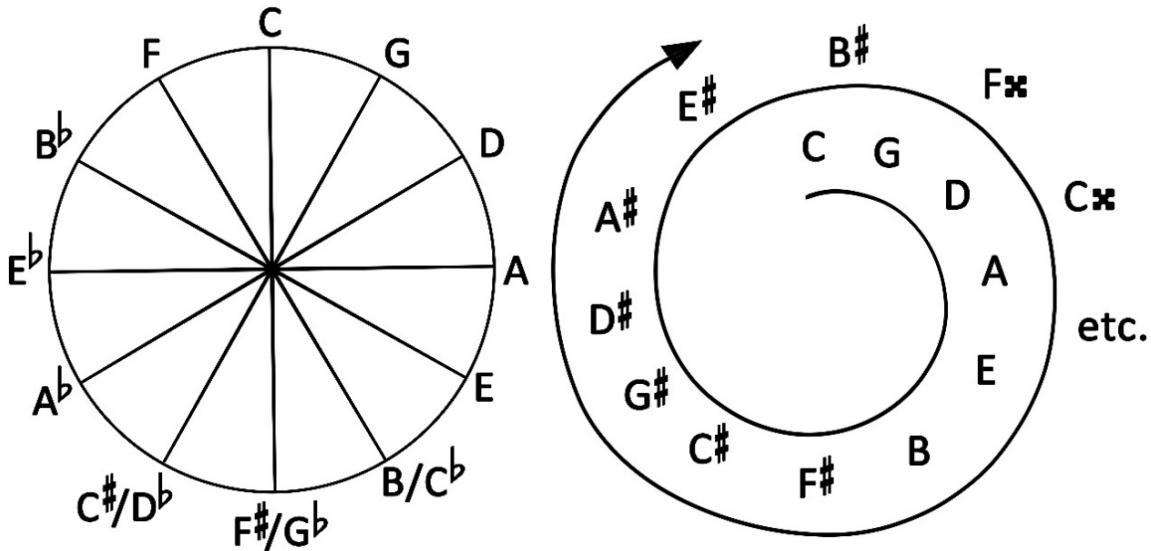
作者署名行"Stephen T. Ai”,即作者姓名(含缩写中间名首字母)。在学位论文标题页的常规版式中,这一行位于论文标题之下、机构署名之上,属于"作者署名"版面元素。
第4段(P0004)
原文复述
CUNY Queens College
中文讲解
机构署名行"CUNY Queens College”,指作者所属机构。在标题页的版式顺序中,它紧接在作者署名之下,表明作者归属此机构。
第5段(P0005)
原文复述
How does access to this work benefit you? Let us know!
中文讲解
一句面向读者的提示语"How does access to this work benefit you? Let us know!",可中译为"获取本作品对您有何助益?请告知我们!"。这是CUNY机构知识库(Academic Works)存档页模板自动插入的读者反馈征集语,并非作者本人撰写的学术内容。其功能在于邀请读者反馈使用体验,是机构存档页的常规元素。
第6段(P0006)
原文复述
More information about this work at: https://academicworks.cuny.edu/qc_etds/12 Discover additional works at: https://academicworks.cuny.edu
中文讲解
此处给出两条URL链接。第一条由"More information about this work at:“引出,指向本作品的具体页面(路径片段包含"qc_etds"与数字"12”);第二条由"Discover additional works at:“引出,指向机构仓库的总站入口(仅含"academicworks.cuny.edu”,未带数字片段)。两条链接由存档页模板生成,作用分别是引导读者访问本作品的信息页和浏览该机构其他相关作品。原文并未对路径中的"12"或两条URL之间的关系作任何说明,因此不应对该数字的含义(如"论文编号")或两条URL的层级关系作额外解读。
补充说明
URL中"qc_etds"和"12"均为路径片段,原文未对其语义作进一步解释,仅以字面形式存在。
第7段(P0007)
原文复述
This work is made publicly available by the City University of New York (CUNY). Contact: AcademicWorks@cuny.edu
中文讲解
一句机构声明"This work is made publicly available by the City University of New York (CUNY). Contact: AcademicWorks@cuny.edu",可中译为"本作品由纽约市立大学(CUNY)公开发布。联系方式:AcademicWorks@cuny.edu"。这是存档机构对作品公开属性与联系方式的常规声明,并非作者本人撰写的学术内容。其作用是标明作品在机构层面的公开状态,并提供联系渠道。
脚注 / 边栏 / 图表 / 附加信息(如有)
本节(标题页/存档信息页)全部由元数据与存档模板信息构成:包括提交或毕业时间(P0001)、论文标题(P0002)、作者署名(P0003)、机构署名(P0004)、读者反馈邀请(P0005)、两条CUNY存档页URL(P0006)以及机构公开声明与联系方式(P0007)。本节不包含图表、脚注、表格、边栏或其他附加材料。
💡 本节核心要点
- 本节是论文首页的元数据层,并非论文正文
- P0001提供的时间字符串是提交/毕业学期与日期元数据
- P0002的论文标题中存在PDF文本提取造成的字符间距异常,解读标题时应回到正常排版形式
- P0003与P0004依次为作者署名与所属机构署名
- P0005、P0006、P0007均由CUNY Academic Works存档页模板自动生成,分别承担读者反馈邀请、URL引导与机构公开声明的功能
- 原文未在标题或本节其他位置给出"Meantone Tuning"或"Froberger"的具体定义,亦未说明URL中数字片段的语义,这些内容应留待正文处理
🔑 关键术语
- CUNY:City University of New York(纽约市立大学),作者署名所属的大学系统名;本节P0004与P0007中出现。
- Academic Works:CUNY的机构知识库/电子论文存档平台名;本节P0006与P0007中出现,承担公开存档与联系入口的功能。
- Meantone Tuning:标题中出现的一个调律相关术语;本节仅作为标题文字列出现,原文未给出其定义。
- Froberger:标题中出现的一位作曲家的姓氏;本节仅以"Froberger’s Keyboard Music"形式出现,原文未给出其全名、国籍或生卒年等具体信息。
S0002 [描述性拆分] Thesis Title Page
第1段(P0008)
原文复述
Danger: Wolf Crossing! Meantone Tuning and Froberger’s Keyboard Music
中文讲解
这是论文标题页的主标题。该标题以警告语式的口吻写成 “Danger: Wolf Crossing!",其中关键词 “Wolf” 与后半句 “Meantone Tuning and Froberger’s Keyboard Music” 并列出现,提示 “Wolf” 是论文将要处理的一个核心议题;整条标题由此同时框定本论文的两大研究主题——meantone 调律(中音律)与 Froberger 的键盘音乐。感叹号与 “Danger” 的搭配,使标题带有一丝警示或反讽的语气。
第2段(P0009)
原文复述
by
中文讲解
这是位于论文主标题与作者姓名之间、用于引出署名信息的连接词 “by”,提示紧随其后的是论文作者的全名。
第3段(P0010)
原文复述
Stephen Tian-You Ai
中文讲解
这是论文的作者署名行,署名为 “Stephen Tian-You Ai”,作为这篇硕士论文的责任作者出现在标题页主标题之下、学位说明之上。
第4段(P0011)
原文复述
A master’s thesis submitted to the Graduate Faculty in Music in partial fulfillment of the requirements for the degree of Master of Arts in Music
中文讲解
这是标题页上的学位说明行,说明本文以 “A master’s thesis”(一份硕士学位论文)的形式,提交给 “the Graduate Faculty in Music”(音乐方向的研究生教师委员会),用以 “in partial fulfillment of the requirements”(部分满足)授予 “the degree of Master of Arts in Music”(音乐文学硕士学位)这一学位的 “requirements”(学术要求)。该行同时限定了论文所属学科领域为 Music、学位层次为硕士、学位名称为 Master of Arts。
补充说明
行首的 “#” 字符在标题页正文中并非常用标号,可能是 OCR 留下的版式/占位符号;该段其余文字则与标准美式硕博论文标题页的学位说明用语一致。
第5段(P0012)
原文复述
Queens College, The City University of New York
中文讲解
这是标题页上指明学位授予机构的署名行,机构名称为 “Queens College, The City University of New York”,即隶属于纽约市立大学(The City University of New York)的昆斯学院(Queens College),表明本论文由该学院授予学位。
脚注 / 边栏 / 图表 / 附加信息(如有)
本小节为论文标题页(thesis title page),包含主标题、连接词 “by”、作者署名、学位说明行与授予机构署名行五项内容;标题页上不含脚注、图表、边栏或附录等附加材料,因此 additional_information 项无额外内容可汇总。
💡 本节核心要点
- 本小节属于论文标题页,仅承担身份与权威性信息的声明功能,并不展开论证。
- 论文主标题为 “Danger: Wolf Crossing! Meantone Tuning and Froberger’s Keyboard Music”,其中 “Wolf” 与 “Meantone Tuning” 并置,暗示 “Wolf” 将是论文聚焦的核心议题。
- 标题同时框定论文的两大研究主题:meantone 调律(中音律)与 Froberger 的键盘音乐。
- 作者署名为 Stephen Tian-You Ai;论文以硕士学位论文的形式提交,授予学位为 Master of Arts in Music。
- 学位授予机构为隶属于纽约市立大学(The City University of New York)的昆斯学院(Queens College),学位说明文本遵循美式硕博论文标题页的标准用语。
🔑 关键术语
- Meantone Tuning:标题中点明的论文主题之一,指 meantone(中音律)调律体系;其在本文中的具体技术含义须待正文进一步展开。
- Wolf:标题中以 “Danger: Wolf Crossing!” 的醒目方式独立出现的关键词,提示其在论文中具有独立讨论价值;其与 meantone 调律的具体关系属于正文将处理的内容。
- Froberger’s Keyboard Music:标题中点明的论文主题之一,指作曲家 Froberger 的键盘音乐作品,是论文将围绕的另一条研究主线。
- Master’s thesis / Master of Arts in Music:学位说明行中明确,本文为提交给音乐方向研究生委员会的硕士学位论文,所授学位为音乐文学硕士(Master of Arts in Music)。
- Queens College, The City University of New York:标题页底部列出的学位授予机构,指示本文由纽约市立大学体系下的昆斯学院授予音乐文学硕士学位。
S0003 Table of Contents
第1段(P0013)
原文复述
Table of Contents
中文讲解
本段是一级小节标题"Table of Contents”(目录),承担版面导航功能,表明其后内容为全书的章节列表与页码索引。它本身不提供实质论述,仅起定位作用,提示读者接下来将看到按章节排列的结构概览。
第2段(P0014)
原文复述
Introduction….5
Temperamental Rudiments and Numbers….9
Temperamental Historicism and Presentism….14
Meantone Temperament in the $16^{\text{th}}$ and $17^{\text{th}}$ Centuries….21
Graphing Temperamentally….32
At the Fringes of Meantone: Case Studies….42
Toccata in F Major, FbWV 110….43
Lamentation, from Partita in G Minor, FbWV 614….50
Meditation, from Partita in D Major, FbWV 620….55
Allemande, from Partita in E minor FbWV 627….61
Lamentation in F Minor, FbWV 633….69
Conclusions….78
Bibliography….81
中文讲解
本段是完整的目录正文,依次列出全书各章及子节的标题与起始页码,作者按从理论铺垫到个案分析再到总结的顺序组织全书。
- Introduction(第5页)——开篇导论,确立全书的议题与研究框架。
- Temperamental Rudiments and Numbers(第9页)——介绍律学(temperament)的基础概念与数值体系,为后续讨论提供数学与声学前提。
- Temperamental Historicism and Presentism(第14页)——讨论历史主义(historicism)与当下主义(presentism)两种对待历史律学的方法论立场,意在让读者反思应如何定位古代律制。
- Meantone Temperament in the 16th and 17th Centuries(第21页)——聚焦16、17世纪的平均律(meantone temperament),这是全书理论核心章节。
- Graphing Temperamentally(第32页)——介绍以图示(graph)方式呈现律学数据的方法,将抽象的音分(cents)数值可视化。
- At the Fringes of Meantone: Case Studies(第42页)——作为个案研究章节的总标题,下含若干具体作品分析。
- 个案作品列表(第43–69页)——依次为:F大调托卡塔 FbWV 110、g小调帕蒂塔中的《Lamentation》FbWV 614、D大调帕蒂塔中的《Meditation》FbWV 620、e小调帕蒂塔中的《Allemande》FbWV 627、f小调《Lamentation》FbWV 633。这些作品的编号"FbWV"是Froberger-Werkverzeichnis(弗罗贝格作品目录编号),表明研究对象集中于德国巴洛克作曲家约翰·雅各布·弗罗贝格(J. J. Froberger)的键盘作品。
- Conclusions(第78页)——结论章,总结全书论证。
- Bibliography(第81页)——参考文献,置于全书最后。
从结构上看,全书遵循"理论—历史—方法—个案—结论"的递进逻辑:先用两章铺设律学概念与方法论,再用一章聚焦核心历史时期(平均律),然后通过图示方法进入对弗罗贝格作品的逐首分析,最后归纳并附文献。这种编排凸显作者希望读者既理解律学的一般原理,又能通过具体曲目看到理论在演奏实践中的体现。
补充说明
无额外补充。目录中的页码与章节顺序均为原文直接给出,未补充其他信息。
脚注 / 边栏 / 图表 / 附加信息(如有)
无附加材料。本节仅为目录正文,不含脚注、图表或边栏。
💡 本节核心要点
- 全书结构按"理论铺垫—历史背景—方法工具—个案分析—结论—文献"的顺序展开。
- 核心历史焦点是16至17世纪的平均律(meantone temperament)。
- 个案研究集中于弗罗贝格(FbWV编号)的五首键盘作品,体现理论分析向具体曲目应用的转化。
- 存在两套方法论张力的明示:历史主义(historicism)与当下主义(presentism)。
- 图示化(graphing)作为分析律学数据的专门方法被独立成章。
🔑 关键术语
- Meantone Temperament:平均律,一种在16、17世纪欧洲键盘音乐中广泛使用的调律体系,通过压缩五度音程使大三度趋于纯正,从而在多数调性上获得和谐的音响。
- Historicism vs. Presentism:历史主义主张以当时的历史与音乐学背景理解古代律制;当下主义则倾向于以现代演奏或聆听经验投射到历史作品上。两种立场构成第14页起章节的方法论张力。
- FbWV:Froberger-Werkverzeichnis的缩写,即弗罗贝格作品目录编号,用于唯一标识德国巴洛克作曲家约翰·雅各布·弗罗贝格(J. J. Froberger)的具体作品。
- Graphing Temperamentally:以图示方式呈现律学数据(如音分值、音程偏差),把抽象的数值关系转化为可直观比较的曲线或网络。
S0004 List of Figures
第1段(P0015)
原文复述
List of Figures
中文讲解
本段是Markdown二级标题,仅由“List of Figures(图录)”构成,本身不包含正文论述。其功能是宣告紧随其后的内容是全书插图的总目录,提示读者本书的论证大量依赖图表支持:包括调律系统的可视化饼图、历史乐谱与手稿的分析图示,以及巴赫作品的“不协和轮廓”系列。该标题位于正文之前,起到索引与导览的双重作用。
第2段(P0016)
原文复述
Figure 1: Circle of fifths and spiral of fifths….11 Figure 2: Pie diagram of Pythagorean tuning, where p is the Pythagorean comma….22 Figure 3: Zarlino’s monochord diagram from Book II of Le istitutioni harmoniche, detailing the string lengths of his recommended syntonic-diatonic system….25 Figure 4: (A) Pie diagram of 1/4-comma meantone and (B) Zarlino’s 2/7-comma meantone, where s is the syntonic comma and z is the schisma….26 Figure 5: Pie diagram of Chaumont’s tempèrament ordinaire,…30 Figure 6: Duffin’s analysis of Benedetti’s first musical puzzle, with Blackwood annotations….33 Figure 7: Blackwood’s analysis of Mozart’s Piano Sonata in F Major, K. 533, mm. 126–7….35 Figure 8: Calculation of the deviation in cents of a triad under equal temperament….37 Figure 9: Discordance contour of Prelude in C Major, BWV 846, mm. 1–11….41 Figure 10: Discordance contour of FbWV 110, mm. 1–10….46 Figure 11: Discordance contour of FbWV 110, mm. 11–19….47 Figure 12: Discordance contour of FbWV 110, mm. 20–25….48 Figure 13: Discordance contour of FbWV 614, mm. 1–12….52 Figure 14: Discordance contour of FbWV 614, mm. 12–24….54 Figure 15: Discordance contour of FbWV 620, mm. 1–3….56 Figure 16: Discordance contour of mm. 4–7….59 Figure 17: Discordance contour of FbWV 627, mm. 1–4….63 Figure 18: Manuscript SA4450 in facsimile, Allemande faite en passant le Rhin….64 Figure 19: Discordance contour of FbWV 627, mm. 4–7….66 Figure 20: Discordance contour of FbWV 633, mm. 1–12….72 Figure 21: Discordance contour of FbWV 633, mm. 13–23….73 Figure 22: Discordance contour of FbWV 633, mm. 24–35….75
中文讲解
本段以“Figure N: 标题……页码”的统一格式列出全书22张图,页码前的圆点为目录引导点(leader dots)。从内容与页码分布可以看出本书的论证脉络大致分为五个板块:(1)图1—图5为调律体系的可视化(图1兼及五度圈与五度螺旋,图2是毕达哥拉斯调律的饼图,其中p代表毕达哥拉斯逗号,图3引自查利诺《Le istitutioni harmoniche》第二卷的单弦琴图,呈现其“同全音—全音律”体系各音的弦长,图4A/B对照1/4音平均律与查利诺的2/7音平均律,图中s为同全音逗号、z为西玛,图5则是肖蒙的普通调律饼图);(2)图6—图7为历史乐谱的分析案例(图6是Duffin对Benedetti“第一音乐谜题”的分析并附Blackwood的批注,图7是Blackwood对莫扎特F大调钢琴奏鸣曲K.533第126—127小节的分析),体现作者援引前人研究来支撑自身解读的路径;(3)图8以分(cents)为单位给出平均律下三和弦偏差的量化计算,是全书的方法论锚点;(4)图9—图17与图19—图22构成系列“discordance contour(不协和轮廓)”,覆盖巴赫《平均律钢琴曲集》C大调前奏曲BWV 846以及多首以FbWV编号的赋格(FbWV 110、614、620、627、633),按小节切片逐段呈现,其中图16仅写“mm. 4–7”而未标作品号,需查阅原书与上下文确认;(5)图18是手稿SA4450的影印件,标题为《Allemande faite en passant le Rhin》,插于FbWV 627的两段轮廓图之间,暗示该手稿与FbWV 627的解读形成互文。页码跨度从11到75,表明这些图并非集中附录,而是散布于各章节正文之中。
脚注 / 边栏 / 图表 / 附加信息(如有)
本节仅含插图目录条目,没有脚注、边栏或图表外的独立说明文字;所有图的具体论证功能由各章正文承担。
💡 本节核心要点
- 本节是全书22张图的统一索引,每条由图号、标题、引导点与页码构成。
- 图1—图5集中展示调律体系的可视化(五度圈/螺旋、毕达哥拉斯调律、查利诺单弦琴与平均律、肖蒙普通调律)。
- 图6—图7借助前人研究(Benedetti谜题、莫扎特奏鸣曲)搭建历史分析框架。
- 图8以分(cents)为单位量化平均律三和弦偏差,承担方法论锚点的作用。
- 图9—图17与图19—图22构成不协和轮廓(discordance contour)系列,是分析巴赫《平均律钢琴曲集》的核心视觉工具。
- 图18以手稿SA4450影印件《Allemande faite en passant le Rhin》补充FbWV 627相关的实物证据。
🔑 关键术语
- Circle of fifths / Spiral of fifths(五度圈与五度螺旋):图1所示,将十二个音按纯五度关系排列形成的闭合圆环及其螺旋展开,是调律与和声分析的基础图示。
- Pythagorean comma(毕达哥拉斯逗号,标记 p):图2饼图中标注的p,指连续十二个纯五度与七个八度之间的音高差,是毕达哥拉斯调律无法完美闭合循环的关键量。
- Syntonic-diatonic system(同全音—全音律体系):图3说明文字指出,这是查利诺在《Le istitutioni harmoniche》第二卷中推荐并以单弦琴图呈现的调律体系,图示其各音对应的弦长。
- Meantone temperament(平均律家族):图4与图5涉及的调律家族;图4A为1/4-comma meantone,图4B为Zarlino提出的2/7-comma meantone,图5为Chaumont的tempèrament ordinaire,三者构成平均律内部的代表性比较。
- Syntonic comma(同全音逗号,标记 s):图4中标注的s,是纯四度与四个大三度叠置之间的差值,是辨别不同平均律变体的关键参数。
- Schisma(西玛,标记 z):图4中标注的z,是毕达哥拉斯逗号与同全音逗号之差,用于更精细地刻画调律体系的微小偏差。
- Equal temperament(平均律,等分律):图8涉及的律制,将八度等分为1200分,使所有调性之间转换均匀,是与历史律制比较的基准。
- Cents(分):图8使用的对数音高单位,一个八度等于1200分,用以量化平均律下三和弦音的偏差量。
- Discordance contour(不协和轮廓):图9—图17与图19—图22反复出现的可视化曲线,按小节或片段刻画乐曲中不协和程度的连续变化,是本书分析巴赫作品的核心工具。
- BWV 846 / FbWV(作品编号):图录中同时使用两类编号:BWV 846被标识为Prelude in C Major,FbWV编号(如110、614、620、627、633)则用于同一曲集中的其他作品片段,二者并列说明全书分析范围涵盖前奏曲与赋格。
- Manuscript SA4450(手稿SA4450):图18所示影印件,标题为《Allemande faite en passant le Rhin》,置于FbWV 627的不协和轮廓图之间,作为该作品分析的实物佐证。
S0005 Acknowledgements
第1段(P0017)
原文复述
Acknowledgements
中文讲解
本段是小节标题“致谢”(Acknowledgements)。它本身不包含论证内容,只是一个版面分隔符号,标志论文正文之前的致谢部分开始。按照学位论文的常见体例,作者在此向对其研究工作提供过帮助的个人或机构表达谢意。这一节的功能不在于推进学术论点,而在于以学术社群认可的礼仪方式记录写作过程中受到的帮助与支持,回应读者对“本文何以可能”的隐性追问。
第2段(P0018)
原文复述
First and foremost, I give my thanks to my advisor, Prof. William Rothstein, for his patient mentorship and voluminous knowledge. I hope to become an educator that can inspire the ears and imaginations of students as you did for me. Your energy is something I aspire towards.
中文讲解
作者首先感谢导师 William Rothstein 教授。致谢包含两层信息:其一,承认导师“耐心的指导”(patient mentorship)和“广博的学识”(voluminous knowledge)这两项具体贡献;其二,作者将这种学术传承内化为个人理想——希望自己将来也能成为“能激发学生耳朵与想象力的教育者”(an educator that can inspire the ears and imaginations of students),并把导师身上的“能量”(energy)作为自己追求的方向。用“耳朵”(ears)一词呼应了作者论文的音乐学主题,暗示 Rothstein 教授的教学不仅是知识传递,更是听觉感受力与艺术想象力的唤醒。最后一句以“aspire towards”作结,把致谢与自我期许结合,体现师承关系对作者职业认同的影响。
补充说明
“inspire the ears and imaginations of students”一句中的“ears”是论文音乐学语境的隐喻性呼应,但原文并未展开论述导师的具体研究方向,本节亦无相关补充信息。
第3段(P0019)
原文复述
To Sara Hong, for being my first friend at Queens College and for spending her day off (post-vaccine, to boot!) scanning Siegbert Rampe’s critical edition of Froberger for me. All of the insights drawn in this thesis are fully indebted to your generosity.
中文讲解
本段致谢 Sara Hong,包含两项具体帮助:一是她在作者进入 Queens College 之初成为“第一位朋友”(first friend),提供情感层面的支持;二是她在自己的休息日(且作者用括号补充“to boot”强调这一行为发生在接种疫苗之后,即身体本应休息的时段)帮作者扫描了 Siegbert Rampe 对 Froberger 的批判性版本(Siegbert Rampe’s critical edition of Froberger)。作者据此宣称“本论文中所有洞见都完全归功于她的慷慨”(All of the insights drawn in this thesis are fully indebted to your generosity)。这句话具有双重意义:从字面看,它承认 Hong 提供的文献资料是论文研究的物质基础;从修辞看,“fully indebted”与“generosity”的搭配将一位同学的举手之劳升格为学术馈赠,体现了致谢文体常见的夸张与真诚并存的特征。Queens College、Siegbert Rampe、Froberger 三项细节也透露了作者的所属机构与研究主题方向——巴洛克键盘音乐,特别是 Johann Jacob Froberger 的作品研究。
补充说明
Siegbert Rampe 是德国音乐学者与羽管键琴家,其编辑的 Froberger 键盘作品批判性版本是研究 Froberger 的重要现代来源;Froberger(1616–1667)为德国巴洛克作曲家,以羽管键琴作品闻名。这两项信息仅作为人物/作品的注释性说明,原文未对其学术地位或版本史作进一步交代。
第4段(P0020)
原文复述
To Sonya Mital, Chin Kar Yern, Jamie Baik, Jong Song, and Seunghyun Angela Yeo, who have all spent hours identifying my ever-proliferating run-on sentences, misplaced semicolons, and sentence fragments. One day, I might learn grammar.
中文讲解
本段集体致谢五位同学:Sonya Mital、Chin Kar Yern、Jamie Baik、Jong Song、Seunghyun Angela Yeo。作者描述他们的具体贡献为“花数小时识别我层出不穷的错误”:包括“不断冒出的长句”(ever-proliferating run-on sentences)、“误置的分号”(misplaced semicolons)和“句子片段”(sentence fragments)。结尾以自嘲口吻写道“也许有一天我会学会语法”(One day, I might learn grammar),用假设语气承认自己的写作习惯仍有改进空间。这里的致谢既是对同行评议式帮助的正式记录,也带有幽默色彩——通过列举三种典型语法错误,让原本程式化的致谢段落变得生动且富有个性,体现作者与同伴之间轻松、坦诚的学术友谊。
第5段(P0021)
原文复述
And finally, to my friends and family, online or otherwise, who continue to support and tolerate me. Words cannot describe how difficult it was to write a thesis during a global pandemic. Whether it was a silent Discord hang, an online new music concert, a workday group chat, or a premade ranked flex queue, these moments gave me a much-needed respite from within my New York City quarantine cage. Thanks for making me laugh, checking my ego, and keeping me company.
中文讲解
本段是对更广泛支持网络的致谢,包含三层内容。首先,作者以“online or otherwise”(无论线上还是线下)囊括所有朋友与家人,使用“tolerate”(容忍)一词带出半玩笑式的自谦——把亲友的支持形容为一种需要耐心的负担,暗示写作过程对作者与身边人都是考验。其次,作者点明写作背景的特殊性:在大流行病(global pandemic)期间完成论文,在纽约市(New York City)的隔离状态(quarantine cage)中工作,强调“语言无法描述”这种困难,把致谢升华为对集体经历的纪念。最后,作者列举四个具体陪伴场景:安静的 Discord 语音闲聊(silent Discord hang)、线上新音乐音乐会(online new music concert)、工作日的群聊(workday group chat)以及预组队排位赛(premade ranked flex queue,英雄联盟等 MOBA 游戏术语)。这些场景跨越社交、音乐、工作、游戏四个领域,表明作者在学术之外的生活得到了多维度的维持。最后以“thanks for making me laugh, checking my ego, and keeping me company”收束——欢笑、检视自我膨胀、陪伴,构成作者对友人与家人最核心的期待。
补充说明
“premade ranked flex queue”是 MOBA 类电子游戏(典型如《英雄联盟》)中的组队匹配模式,原文以此作为陪伴场景之一;“quarantine cage”把纽约市疫情期间居家隔离的物理空间比喻为牢笼,属作者自创的修辞表达。
脚注 / 边栏 / 图表 / 附加信息(如有)
本节无脚注、图表或边栏内容,全部由五个段落组成:一个小节标题、四段正文致谢。所列被致谢人共七位(导师 Rothstein、Sara Hong,以及五位语言校对同学),外加一段对“朋友与家人”整体的笼统致谢。致谢中明确出现的专名包括 Queens College(作者所属机构)、Siegbert Rampe 与 Froberger(指向论文研究对象为巴洛克键盘音乐),以及 Discord、纽约市(暗示写作地理与社会背景)。
💡 本节核心要点
- 致谢按“导师—核心友人—校对同伴—广义亲友”的同心圆结构展开,呈现出从学术到生活的支持网络层次。
- 作者将学术与情感两方面的帮助并置:导师的“耳朵与想象力”启蒙、Sara Hong 提供的 Froberger 关键版本文献、五位同学对语法错误的反复修正,均被视为论文得以完成的必要条件。
- 致谢中以“fully indebted to your generosity”等措辞,将具体帮助升格为学术贡献的承认,体现学位论文致谢的礼仪功能。
- 作者借幽默笔法处理程式化内容:通过“ever-proliferating run-on sentences”“tolerate me”“One day, I might learn grammar”等自嘲,使致谢既合规又具个人风格。
- 结尾段落明确将论文写作置于 2020 年前后纽约市全球大流行病隔离语境中,把对亲友的感谢与对集体困难的纪念相结合,赋予致谢以历史时间性。
🔑 关键术语
- Siegbert Rampe’s critical edition of Froberger:指德国音乐学者 Siegbert Rampe 编辑的 Johann Jacob Froberger 键盘作品批判性版本,是本论文研究的主要文献来源之一;Sara Hong 在接种疫苗后的休息日为作者扫描了该版本。
- Queens College:纽约市立大学(City University of New York)下属的一所四年制本科文理学院,作者在论文写作期间的所属机构;Sara Hong 是作者在此结识的第一位朋友。
- ever-proliferating run-on sentences / misplaced semicolons / sentence fragments:作者自陈的三类典型英语语法错误:句中逗号代替句号的冗长句、误置的分号、不完整的句子片段;五位同学被感谢,正是因为长期协助识别这些问题。
- premade ranked flex queue:MOBA 类在线竞技游戏(典型如《英雄联盟》)中由玩家预先组队参与排位匹配的模式;作者将其与 Discord 闲聊、线上新音乐会、工作日群聊并列为疫情期间的精神调剂方式。
- quarantine cage:作者对疫情期间纽约市居家隔离空间的比喻性称呼,将城市公寓描述为“隔离的牢笼”,强调写作环境的封闭与心理压力。
S0101 Introduction
第1段(P0022)
原文复述
Introduction
中文讲解
这是论文引言部分的总标题,直接标记为"Introduction",用以开启后文关于调律实践如何影响约翰·雅各布·弗罗伯格(Johann Jakob Froberger)键盘音乐创作实践的整篇论述。仅作为版面标题出现,本身不包含论点,因此后续栏目保持简短即可。
第2段(P0023)
原文复述
Keyboard tuning, for a pianist like me, is usually just a nuisance. Every once in a while, with greater frequency than is probably desirable, I would encounter a piano in the practice room that had been knocked out of tune by one too many Chopin etudes. Later, disgruntled after a mistuned piano had thrown a practice session off-kilter, I would fill out a piano maintenance request and offload all responsibility to the piano technician, appending the very vague and unhelpful note, “piano out of tune.” Looking back, I am not quite sure what I had heard when I filled out those requests. I am not even sure if I knew what an in-tune interval sounded like at the time. Was I only perceiving the piano to be out of tune in relation to equal temperament? You might imagine how confused I was when I found out that pianos could never be fully in tune. My first brush with historical tuning and temperament was during my undergraduate degree in piano, when I signed up for a month-long class on harpsichord tuning. Every day, I trudged through frigid Berkshire snowstorms to sit cross-legged around a kit harpsichord and listen to my professor lecture on the mathematical ratios of tuning for several hours. It was a rather slow and unstructured class. One day, after tuning a quarter-comma meantone together for the first time, the members of the class unenthusiastically took turns banging out the first prelude in C major from The Well-Tempered Clavier. I remember being somewhat unimpressed with the result. It was, as expected, in tune. However, later in the day, after returning to the piano for my daily practice, I was immediately assaulted by the nervous beating and ugliness of the piano’s equal temperament, a constant grinding that was suddenly brought to the fore by a simple tuning exercise. At that moment, the mismatch of numerical ratios became inextricably tied to the bodily reaction of hearing these discordances, a feeling that immediately linked the separate spheres of analytical practice, listening practice, and performance practice.
中文讲解
这一段以作者的第一人称经历作为引言的开场,交代了三个层面的内容。其一,作者以钢琴家身份对调律最初抱持无所谓甚至嫌麻烦的态度——遇到练习室中钢琴被肖邦练习曲弹得走音,便填写"piano out of tune"这样含糊的维修单,并自省:当时他其实并未真正知道"音准协和"听起来是什么样子,甚至不确定自己对走音的感知是否仅建立在与平均律的相对关系之上。其二,作者接触到钢琴"永远不可能完全调准"这个事实时陷入困惑,继而在本科阶段选了一门为期一月的羽管键琴调律课,每日在Berkshire寒雪中盘腿围着一架套件羽管键琴,听教授讲解调律背后的数学比率。其三,真正的转折发生在全班第一次共同调好一个四分之一逗号平均律(quarter-comma meantone)之后弹奏巴赫《平均律键盘曲集》C大调前奏曲时——当时作者对协和效果印象平平,但同一天回到钢琴练琴,平均律中那些"神经质的拍频和丑陃的走音"、那种"持续的刺耳感"突然变得无法忽视。数学比率与听觉不适被紧紧捆绑在一起,作者由此获得了将"分析性实践、聆听实践、演奏实践"这三个原本割裂的领域瞬间连接起来的身体感受。这一经历被作者反复比喻为"serendipitous moment of connectivity"(见后文),是整篇论文论证链的感性起点。
补充说明
“quarter-comma meantone"即四分之一逗号平均律,是一种历史上的调律法,在本段中作为作者亲身经历的具体调律对象出现;“equal temperament”(平均律)是钢琴当前的标准调律,在本段中被作者体验为具有持续拍频和刺耳感的调律系统。
第3段(P0024)
原文复述
From then on, I began to notice more and more instances in which keyboard tuning mattered deeply to issues of musical practice, even in a world that has come to accept equal temperament as more or less standard. I found crunchy ratios in collaborative piano work with violinists and vocalists, as a page turner for the late Peter Serkin (who preferred a seventh- or eighth-comma meantone temperament), and the voltage-controlled oscillators of analog synthesizers. With this new perspective that attends to the ways in which keyboard skews pitch space, I am continuously prompted to think about tuning and temperament not as a historical mathematical problem that has been solved with equal temperament, but as a continuously evolving practice that is deeply enmeshed with practice, my own included.
中文讲解
本段承接上一段的转折,说明那种"瞬间连接"的感受并未止步于个人体验,而是让作者开始在各种看似无关的场合中辨识出键盘调律的痕迹:与小提琴家、声乐家合作时的钢琴伴奏中那些"咯吱作响的比率”;为已故的Peter Serkin翻谱时所体验到的第七或第八逗号平均律倾向;甚至模拟合成器中压控振荡器产生的音高偏差。这些例子共同指向一个核心论断:即便在一个默认采用平均律的世界里,键盘乐器对音高空间的扭曲仍在演奏实践中持续起作用。由此,作者对调律的认知发生根本转变——不再将其视为一个已经被平均律解决的历史性数学问题,而是将调律与气质的实践视为一种与演奏实践深度交织、且持续演变的过程,其自身实践亦被裹挟其中。这一段从个人轶事过渡到问题意识的核心主张,为下文引出本论文的研究问题做铺垫。
补充说明
“Peter Serkin"在本段中以"the late”(已故的)修饰,作者曾为其担任翻谱者(pageturner),并指出其偏好第七或第八逗号平均律,这只是作者列举的具体经验之一,不代表对其音乐观点的系统性介绍。
第4段(P0025)
原文复述
This thesis is an exploration of how tuning practices can influence compositional practice, focusing on the way temperament can provide new insights to a close reading of keyboard music by Johann Jakob Froberger (1616–67). I have chosen Froberger due to his position as a transitional figure between a predominantly meantone-oriented musical environment of the 17th century and the well temperament of the 18th century. Many scholars have pointed to Froberger’s characteristic chromaticism and experimentation with novel keys as indicative of his desire to compose beyond the restrictions of meantone tuning and towards well temperament. In an effort to move away from this oft-cited teleological narrative from unequal to equal, my analyses attend to the ways that Froberger works with the boundaries of meantone, ultimately arguing that a meantone tuning is integral to Froberger’s musical language. Transgressions of these boundaries, as we shall soon see, involve mistunings that result in shocking discordances, a rough aural quality that Froberger exploits to craft structures of expectation in the dimension of discordance that operate independently of harmony.
中文讲解
本段正式提出论文的中心问题与基本立场。中心问题是:调律实践如何影响作曲实践?具体落点是:以约翰·雅各布·弗罗伯格(1616—1667)的键盘音乐为对象,考察temperament如何为其作品的细读提供新视角。作者说明选择Froberger的理由:他处于一个以平均律为主导的17世纪音乐环境与以well temperament(良好调律)为核心的18世纪之间的过渡位置。先前大量学者把他标志性的半音化、对新调性的实验解读为他想要突破平均律限制、迈向良好调律的创作意图——也即一种从"不平均"走向"平均"的目的论叙事。本文的论证则有意从这一目的论中退出,转而关注Froberger如何在平均律的边界内运作,并最终主张"一种平均律调律是Froberger音乐语言不可分割的一部分"。最后一句给出更具挑衅性的扩展:对边界的逾越涉及产生刺耳不协和音程的走音,Froberger正是利用这种粗糙的听感来构建在"不协和维度"上的期待结构,这种结构的运行独立于传统意义上的和声。值得注意的是最后一句用"as we shall soon see"将后文的实例分析邀请出来,使本段成为整篇论文章节地图的开端。
补充说明
“Johann Jakob Froberger (1616–67)“即本论文研究对象的姓名与生卒年份,只取自本段信息;“well temperament"在本段作为18世纪调律的代表与17世纪的meantone形成对照;“chromaticism”(半音化)和"experimentation with novel keys”(对新调的实验)是本段引用的既存学者共识中的特征,而非本文作者的原创判断。
第5段(P0026)
原文复述
My thesis proceeds in two large sections. The first, chapters one through four, is primarily concerned with developing a method for reading Froberger’s music with an eye towards temperament as a situated practice. The second, chapter five, demonstrates that method through case studies of Froberger’s keyboard music.
中文讲解
本段交代论文的总体结构,清晰切分为两大板块。第一板块包括第一至第四章,功能在于"建立一种将temperament视作情境化实践(situated practice)来阅读Froberger音乐的方法”;第二板块是第五章,通过弗罗伯格键盘音乐的案例研究来演示这一方法。这一顺序暗含一个从理论建设到具体应用的论证逻辑:先说明如何把调律作为一种"情境化实践"来考虑,再以Froberger的实例证明这种方法的有效性。
补充说明
“situated practice”(情境化实践)是本段提出的关键概念,即把temperament放在具体演奏、历史与聆听语境中考量的方法取向,这是贯穿全论文的视角。
第6段(P0027)
原文复述
After giving a brief overview of the mathematical basis for temperament in the first chapter, I go on to identify a perceived rift between “historicist” and “presentist” work within the field of tuning and temperament studies in chapter two. While both perspectives are valid ways of doing musicology and music theory, neither allows us to understand temperament as a situated practice. Eventually, I argue that a synthesis of presentism and historicism is necessary for this end, a conclusion that reflects my serendipitous moment of connectivity in the practice room.
中文讲解
本段概述第二章的内容。首先,简短预告第一章将给出temperament数学基础的总览;其次,核心内容是辨识调律与气质研究领域内"historicist(历史主义者)“与"presentist(当下主义者)“两派之间的裂隙——前者倾向在历史语境中处理该议题,后者倾向以当代视角进入。两者各自作为音乐学与音乐理论的研究进路都有合法性,但单凭任何一方都无法把temperament作为"情境化实践"来理解。因此作者主张需要将二者综合(synthesis)。这句结论不只是学理上的抉择,还呼应了引言开头作者在练习室里亲身同时感受历史调律与当下平均律所产生的"瞬间连接”——即开篇的个人体验在此被回收为方法论选择的依据,使自传起点与学术立场形成闭环。
补充说明
“historicist"与"presentist"是本段提出的两种研究立场术语,在本段中作为对立的两极出现,具体内涵由作者在后续章节中展开。
第7段(P0028)
原文复述
The third chapter provides the necessary historical contexts for my analyses, concentrating on the development of various meantone temperaments from Gioseffo Zarlino’s Le istitutioni harmoniche (1558) to Andreas Werckmeister’s Musicalische Temperatur (1691), in service of situating Froberger within the meantone-oriented musical environment of the 17th century, in the absence of specific indications for a temperament from Froberger himself.
中文讲解
本段说明第三章的作用——为后续分析提供必要的历史情境。该章聚焦于多种平均律(meantone temperaments)从Gioseffo Zarlino的《Le istitutioni harmoniche》(1558)到Andreas Werckmeister的《Musicalische Temperatur》(1691)之间的演变。其功能服务于一个具体定位:在没有Froberger本人关于temperament的任何明确指示的情况下,将Froberger安置于17世纪以平均律为主导的音乐环境之中。“in the absence of specific indications"这一短语点明了历史研究中常见的困境——研究对象本人未留下具体指示,因此需要依据同时代的文献与实践来作出情境化判断。
补充说明
本段提及的两部文献《Le istitutioni harmoniche》(1558)与《Musicalische Temperatur》(1691)在此作为历史脉络的两端标记,作者在第四章的图表绘制中也会引用相关理论。
第8段(P0029)
原文复述
In the fourth chapter I lay out my graphing method, which illustrates visually the fluctuations and flows of concordance and discordance during the span of a piece of music. Building on the work of Easley Blackwood (found in his 1985 monograph, The Structure of Recognizable Diatonic Tunings), I characterize the unfolding of a piece of music as a succession of vertical musical events, each quantified by its deviation from pure tuning under a selected temperament. Special attention is given to producing reductions of music through a historical lens, drawing from theoretical writings by Zarlino, Johannes Lippius, and Christoph Bernhard.
中文讲解
本段集中介绍第四章的核心方法。作者展示一种"图示法(graphing method)",用以在一首作品的时序中可视化地呈现协和与不协和的波动与流转。该方法建立在Easley Blackwood 1985年的专著《The Structure of Recognizable Diatonic Tunings》之上,其基本思路是:将一部作品的展开刻画为一系列"垂直音乐事件(vertical musical events)“的连续,而每一个事件都以"在所选temperament下偏离纯律(pure tuning)的程度"加以量化。换言之,协和度被处理为一个可被测量的数字变量,从而能在时间轴上勾画出协和—不协和的轮廓。除此之外,作者特别关注如何在历史视角下对作品进行缩减(reductions of music),其理论资源包括Zarlino、Johannes Lippius与Christoph Bernhard的理论著作。这一章既是理论工具,也直接对应着引言中把temperament视作"情境化实践"的方法目标——通过图示化的协和轮廓让历史调律的差异能被今天的耳朵捕捉。
补充说明
本段对Easley Blackwood 1985年专著的角色定位为"在之上构建(building on the work of)",意味着作者并非复述Blackwood的全部框架,而是将其思想作为方法的一个出发点加以改造。
第9段(P0030)
原文复述
The resulting discordance contours represent listenings that collide historicist and presentist perspectives in an effort to regain “temperamental ears.”
中文讲解
本段虽短,却承前启后。第四章经过数学量化与图示绘制所生成的"discordance contours(不协和轮廓)",其本质不只是抽象图表,而是被作者诠释为一种特殊的"聆听”——一种让historicist与presentist两种视角相碰撞的聆听实践。这一短句同时回扣第二章的"综合两种视角"的主张,以及引言中作者在练琴房里对拍频与刺耳感的瞬间连接。“regain ’temperamental ears’“是一个比喻性说法,意指重新获得一种能够感知temperament差别的耳朵;“regain"一词暗示这种能力并非天然具备,而是需要经过特定的训练或方法介入才能恢复。整句话因此既是方法论的成果宣告,也是论文论证的诗学落点。
补充说明
“temperamental ears"是作者在其论文中反复使用的比喻,既指向具体听觉能力,也指向一种融合历史与当下的分析姿态。
第10段(P0031)
原文复述
The fifth and final chapter, the bulk of this thesis, hears Froberger through temperamental ears, attending to the ways in which discordant intervals are treated, transformed, and resolved in five diverse cases of Froberger’s keyboard music. Because of limitations having to do with the ongoing COVID-19 pandemic, my own practice as a tuner and performer does not figure into my analyses as intended. Rather, in order to preserve some sense of temperament as a live practice, I have chosen to discuss recordings of each piece at length and attend to the ways that a chosen temperament influences and colors a performance.
中文讲解
本段介绍第五章——也是论文体量最大、最核心的部分——的功能与处理方式。第五章以"用temperamental ears去听Froberger"为方法取向,聚焦于五例不同的弗罗伯格键盘音乐,细致考察"不协和音程如何被处理、变形与解决"这三个连续动作。本段同时也坦承论文写作期间COVID-19疫情仍在持续这一现实条件:作者原本设想将自身作为调律者与演奏者的实践纳入分析,但因疫情造成的限制无法实现,因此改以"对每首作品的录音进行详细讨论"作为替代。这一选择的目的是"保留某种temperament作为活着的实践(live practice)的体感”,即通过讨论他人演奏的录音,考察一个被选定的temperament如何影响并赋予演奏以色彩。该段诚实交代了材料条件的限制,并解释了由此带来的方法调整,使后续案例研究的边界与依据变得清晰。
补充说明
“five diverse cases"指第五章所讨论的五个不同案例,但具体是哪五首作品未在本段列出,需在第五章正文中查阅。
脚注 / 边栏 / 图表 / 附加信息(如有)
本节作为论文引言,未包含脚注、图表或边栏等附加材料,故additional_information项无额外需要汇总的内容。
💡 本节核心要点
- 作者以个人亲身经历(从嫌麻烦的钢琴调律到羽管键琴调律课上的瞬间连接)切入,把身体感受与数学比率的关联作为整篇论文论证的感性起点。
- 论文的中心问题被明确为:调律实践如何影响作曲实践?具体落点是让temperament为弗罗伯格的键盘音乐细读提供新视角。
- 作者有意识地拒绝从"不平均律走向平均律"的目的论叙事,转而主张一种meantone调律是Froberger音乐语言不可分割的一部分,并由此提出独立于和声之外的"不协和维度"上的期待结构。
- 论文结构呈"方法建设在前、案例应用在后"的两段式:第一章介绍数学基础,第二章辨识historicist/presentist裂隙并主张综合,第三章提供历史语境,第四章提出基于Blackwood的图示法,第五章以五个案例应用该方法。
- 第四章的discordance contours被诠释为历史主义与当下主义聆听视角相碰撞的产物,旨在让读者"重新获得temperamental ears”。
- 因COVID-19疫情限制,第五章由原本预设的作者亲身调律与演奏实践,改为以录音的细致讨论替代,以保留temperament作为"活着的实践"的体感。
🔑 关键术语
- equal temperament:平均律,当代钢琴所采用的标准调律系统;在本节中被作者亲身体验为带有持续拍频与刺耳走音的调律方式,与历史调律形成对照。
- quarter-comma meantone:四分之一逗号平均律,17世纪常用的调律法;在本节中作为作者在羽管键琴调律课上首次共同调成并用于弹奏巴赫《平均律键盘曲集》的具体调律,代表一种历史上的"纯净"协和感。
- well temperament:良好调律,18世纪兴起的调律方式,介于平均律与历史不平均律之间;在本节中被作为Froberger身后时代的代表性调律出现,与17世纪的meantone对照。
- meantone:平均律调律法的统称,在本节中既是Froberger所处的17世纪音乐环境的主导调律,也是作者论证中主张的"Froberger音乐语言不可分割"的调律基底。
- situated practice:情境化实践,作者提出的方法论取向,把temperament放在具体演奏、历史与聆听语境中来理解,而非把它当作孤立的数学或历史问题。
- historicist与presentist:调律研究领域的两种立场,前者强调历史语境,后者强调当下视角;作者主张二者的综合(synthesis)是把temperament作为情境化实践加以理解的必要条件。
- temperamental ears:作者反复使用的比喻,指能够感知temperament差别的耳朵或聆听姿态;既是论文追求的能力目标,也是引言中作者练琴经历所预示的开放耳朵状态。
- discordance contours:不协和轮廓,第四章方法产生的可视化结果,呈现一部作品时序内协和与不协和的波动;在本节中被诠释为让historicist与presentist聆听视角相碰撞的具体载体。
S0201 Temperamental Rudiments and Numbers
第1段(P0032)
原文复述
Temperamental Rudiments and Numbers
中文讲解
本段是本章的标题,宣布将进入一个以数学基本运算(围绕三度、五度及其派生音程)来阐明调律核心困境的章节。“Rudiments”点出基础性,“Numbers”点出论证将以数值与比率而非经验描述为主,由此开启全节用算术解释调律问题的路径。
第2段(P0033)
原文复述
I begin by identifying the central “Pythagorean” dilemma of tuning and some of the underlying mathematics surrounding intervals and temperament. In an effort to demystify a field that often concerns itself with impossible figures, undecimals, and root extractions, I have chosen to limit my discussion to a handful of basic arithmetic operations surrounding the triad and its intervals, namely the third and fifth.
中文讲解
本段开宗明义地交代写作策略:作者要把调律这一充满神秘感的领域(通常涉及无理数、不可通约的量、开方运算)去神秘化,仅用少量基础算术来揭示所谓的"毕达哥拉斯困境”。范围被严格限定在三和弦的两个核心音程——三度与五度——以及它们产生的派生音程上。这种克制表明作者意在让论证建立在读者都能验证的整数运算上,而不是依赖高等数学。
补充说明
“毕达哥拉斯困境"是本节核心命题,意为当用纯五度(3:2)连续叠加十二次以期回到同度时,无法精确闭合——这是后世一切调律问题的源头。
第3段(P0034)
原文复述
Throughout the history of Western music, it has been long accepted that the sounding intervals of human expression were founded and expressed in nature, whether in the weights of Pythagoras’ hammers, Zarlino’s monochord experiments, or frequencies of sound waves (more on this later). The pleasing progression of intervals related by simple numerical ratios, the unison (1:1), octave (2:1), fifth (3:2), major third (5:4), and so on, was thought to be indicative of a larger, parsimonious structure that governed the universe. While the early moderns described these ratios primarily with string lengths related proportionally to the monochord, modern acoustics usually rely on the cent, a logarithmic unit of measure based on the one hundredth part of an equally tempered semitone. Throughout this project, I will be using cents and ratios to express all intervals.
中文讲解
本段在更宽的史学框架内为后面的数学论证做铺垫。其一,作者列举了三种代表"自然之数"的来源:毕达哥拉斯传说中锤子的重量、扎利诺的独弦琴实验、以及现代声学的频率——这暗示音程的合理性在历史上一直被视为宇宙秩序的体现。其二,作者列出关键纯律比率:同度 1:1、八度 2:1、五度 3:2、大三度 5:4。其三,作者指出早期现代人主要用独弦琴上的弦长比来描述这些比例,而现代声学改用"分(cent)"——一个把一个等程半音等分为一百份的对数单位,作者随后将只用比率与分两种工具来表达所有音程。这一选边是后文计算(如 1200 log₂ 的出现)的伏笔。
补充说明
“分(cent)“是 Alexander Ellis 在 19 世纪为方便比较不同律制下同一音程的实际音高差而引入的对数单位,1200 个分恰好等于一个八度。
第4段(P0035)
原文复述
Let a and b be pitches, with frequencies f_a and f_b, respectively, where f_b > f_a. Then, the frequency ratio r of the interval from a to b is determined as:
中文讲解
本段为下一公式给出文字定义:在两个音高 a、b(频率分别为 f_a、f_b,且 b 比 a 高)之间,音程的频率比 r 由 b 的频率除以 a 的频率得到。这是把"音高距离"还原为"频率倍数"的标准做法——比值大于 1 表示上行的音程,等于 1 表示同音,小于 1 则需改写为倒数。
补充说明
原文此处因 OCR 缺失字母,仅以占位符呈现,本复述按上下文将其恢复为 a 与 b。
第5段(P0036)
原文复述
r = f_b / f_a
中文讲解
本段为本节第一条核心公式:音程的频率比 r 等于高频除以低频。这是接下来所有比率化运算的起点。作者用最简形式给出,没有附加条件,因为上下文已经规定 f_b > f_a。
第6段(P0037)
原文复述
The interval from a to b in cents is determined as:
中文讲解
本段承前引入"分"的数学定义:从 a 到 b 的音程以分为单位来度量时由下一个公式给出。这是把频率比换算为线性可加的对数距离的标准桥梁。
第7段(P0038)
原文复述
c = 1200 log₂ (f_b / f_a)
中文讲解
本段是音程—分换算的核心公式:以 2 为底对数乘以 1200。可直观理解为:把 f_b / f_a 这个倍率换算成"相当于多少个等程半音”——一个八度正好是 2 倍,log₂ 2 = 1,因此 1200×1 = 1200 分。这一公式使得任何纯律音程都可以与等程律做精确比较。
补充说明
此即文献中常称的"对数分(logarithmic cent)“公式,是后世比较不同律制差异最常用的工具。
第8段(P0039)
原文复述
Intervals can also be added and subtracted to yield other intervals by multiplying and dividing the interval ratios, respectively.
中文讲解
本段以一句话归纳了音程运算的代数规则:音程相加 ⇔ 比率相乘;音程相减 ⇔ 比率相除。这是后文所有"叠加若干五度看是否回到起点"类运算的根据。读者需注意:这里的"相加"不是把分值相加,而是把对应比率乘起来;分值相加是另一条规则(即当音程以分为单位表示时,叠加即直接相加)。
第9段(P0040)
原文复述
Let intervals r_1 and r_2 have interval ratios f_b / f_a and f_d / f_c respectively.
中文讲解
本段为下一组公式做变量铺垫:设有两个音程 r_1(比率为 f_b/f_a)和 r_2(比率为 f_d/f_c)。这里出现了四个频率——a、b、c、d——用以区分两个不同的音程实例;它们的字母顺序反映了"上行音程 = 终点频率 / 起点频率"的约定。
补充说明
原文用 f_b/f_a 与 f_d/f_c 这种字母排序,意在把两个音程看作相互独立的频率段,因此两式中的字母不必首尾相连。
第10段(P0041)
原文复述
Then,
中文讲解
本段是过渡性引语,引出紧接的两个运算公式,本身不含信息。
第11段(P0042)
原文复述
r_1 ⊕ r_2 = (f_b / f_a) × (f_d / f_c)
中文讲解
本段给出音程加法的公式:r_1 与 r_2 的"和"等于两者频率比的乘积。这里的 ⊕ 不是普通数字加号,而是作者自定义的"音程叠加"符号。直观上,把两次音程运行首尾相接——从 a 到 b,再从 b 到 d——总倍率自然就是两段倍率相乘(前提是 c 的频率等于 b 的频率;在公式层面作者省略了这个前提,因为他关心的是代数结构)。
补充说明
作者符号选择 ⊕ 与 ⊖ 来表示非数字性的音程叠加/相减,是为了与下文普通算术 +、− 区分。
第12段(P0043)
原文复述
and
中文讲解
本段是过渡性引语,引出紧接的减法公式。
第13段(P0044)
原文复述
r_1 ⊖ r_2 = (f_b / f_a) ÷ (f_d / f_c)
中文讲解
本段给出音程减法的公式:r_1 与 r_2 的"差"等于两者频率比的商。直观含义是:从 r_1 所跨越的频率段中,“拿走"一段对应于 r_2 的倍率;例如从一个八度(2:1)中减去一个纯五度(3:2),剩下的就是 4:3 的纯四度。这一运算在推导毕达哥拉斯音差时会被反复使用。
第14段(P0045)
原文复述
Using these operations, it is possible to identify the fundamental Pythagorean dilemma that underlies tuning and temperament. Consider the standard twelve-tone circle of fifths, with C positioned at the top. It seems as if it is possible to add twelve consecutive fifths (3:2) from C to land right back at C. We can express this operation arithmetically as follows:
中文讲解
本段正式提出本节核心命题——毕达哥拉斯困境,并安排第一个经典反例:以 C 为起点,在十二音五度圈上叠加十二个连续的五度(每个 3:2),直觉上应当回到 C。作者随即用算术展示这个直觉何以失效。读者需注意"add twelve consecutive fifths"中"add"指上一节定义的 ⊕,即连续乘以 3/2。
第15段(P0046)
原文复述
(3/2)^12 × (1/2)^7 = (531441 / 4096) × (1/2)^7 = 531441 / 524288 ≠ 1
中文讲解
本段是前述困境的算术表达:十二个纯五度叠加得到 (3/2)^12 = 531441/4096;为了把结果折回到与起点同一个八度,作者连除七个八度(即乘以 (1/2)^7 = 1/128),最终化简为 531441/524288。关键判断是这个值不等于 1——这意味着走完一圈五度后无法精确回到 C 上,而只能落在比 C 略高一点的音上。
补充说明
乘以 (1/2)^7 是把 (3/2)^12 大约等于 129.746 反复减半至略大于 1(恰好让其落入 1 与 2 之间)的数学手段:2^7 = 128 而 (3/2)^12 ≈ 129.746,差 7 个倍频。
第16段(P0047)
原文复述
531441 / 524288 ÷ 1/1 = 531441 / 524288
中文讲解
本段把上一式得到的 531441/524288 与同度(1:1)做差运算:两比率相除本身仍得到 531441/524288,凸显其"既非 1,亦非任何简单整数比"的身份。这一步虽形式上冗余,但意在用 ⊖ 运算(见 P0044)把"剩余差距"作为音程提取出来。
第17段(P0048)
原文复述
1200 log₂ (531441 / 524288) ≈ 23.46
中文讲解
本段用对数分公式把上式得到的"残余音程"换算成可读的分值:约 23.46 分。换言之,十二个纯五度比七个八度多出大约 23.46 分的"缺口”——这就是后世所称的毕达哥拉斯音差(Pythagorean comma)。
补充说明
23.46 分大约相当于一个等程半音(100 分)的四分之一,已经能被人耳辨别,故不能被忽视。
第18段(P0049)
原文复述
Interestingly, we do not arrive at the unison (1:1). Our chain of twelve fifths has gone just 531441:524288 too far from closing the circle of fifths. Something is afoot. This miniscule difference, 531441:524288 or 23.46 cents, is what is known as the Pythagorean comma. As a result, we have actually traced what has been referred to either as the “broken circle of fifths” or the “spiral of fifths.” This broken quality is reflected and built into pitch nomenclature itself; what we land on after stacking twelve fifths is not C, but rather its slightly higher enharmonic cousin, B-sharp. In short, the fifth is incompatible with the octave.
中文讲解
本段为本节第一个反例作结,给出三个层次的论断:第一,五度圈其实不能闭合,缺口是 531441:524288 ≈ 23.46 分,即"毕达哥拉斯音差”;第二,由于缺口实在,所谓的五度圈其实是个"破碎的五度圈"或"五度螺旋”;第三,这一破碎直接体现在音名体系里——叠加十二次纯五度后落到的不是 C,而是比 C 高一个毕氏音差的 B♯(B 的等位异名升名)。因此作者断言:五度与八度本质上是不可通约的——这是毕达哥拉斯困境的精确表述。
补充说明
“spiral of fifths"一词常用来描述十二个纯五度逐级升高的几何形态,因为每一次叠加都多出一个毕氏音差,最终形成不断上扬的螺旋。
第19段(P0050)
原文复述
中文讲解
本段为图 1 的占位符,图题是"Circle of fifths and spiral of fifths”。原图应配合上一段的论述,对比闭合的十二音五度圈(理想状态)与实际因毕氏音差而无法闭合、只能螺旋上升的轨迹。读者需查阅原图以理解视觉对照。
补充说明
由于图像数据未嵌入,本节无法对其图形细节作进一步描述。
第20段(P0051)
原文复述
Now, consider another example. It again seems possible that four stacked consecutive fifths (5:4) should form a major third (3:2). This operation is expressed arithmetically as follows:
中文讲解
本段提出第二组反例——四度与大三度之间的不可通约关系。原文标注"four stacked consecutive fifths (5:4) should form a major third (3:2)“在表述上疑似笔误或 OCR 错位(事实上五度的比率是 3:2,大三度的比率才是 5:4;这里作者的意图应为:“四个连续纯五度叠加应等于两个八度加大三度”)。无论字面如何,作者的论证目的是:把若干个五度折叠入一个八度内,应当得到某种纯律大三度;实际结果却与之有偏差。
补充说明
按上下文数学验证,作者意在比较 (3/2)^4 × (1/2)^2 = 81/64 与纯大三度 5/4。原文的"fifths (5:4)“与"major third (3:2)“对应关系疑为原稿误植,复述时按原文保留。
第21段(P0052)
原文复述
(3/2)^4 × (1/2)^2 = (81/16) × (1/2)^7 = 81/64 ≠ 5/4
中文讲解
本段把四个连续五度叠加并折回一个八度内:四次 3/2 相乘得到 81/16,再乘以 (1/2)^2(即除一个八度)得到 81/64。其中乘以 (1/2)^7 应为乘以 (1/2)^2 之误——否则 81/16 × 1/128 = 81/2048,与 81/64 相差甚远。校订后可知,81/64 是纯律"毕达哥拉斯大三度”,它与"纯大三度” 5/4 不相等。
补充说明
81/64 历史上称 Pythagorean major third,约等于 407.82 分;而 5/4(纯大三度)= 386.31 分,两者相差约 21.51 分,即下文将提到的"协调音差”。
第22段(P0053)
原文复述
81/64 ÷ 5/4 = 81/80
中文讲解
本段用 ⊖ 运算把两种大三度(毕达哥拉斯大三度 81/64 与纯大三度 5/4)相除,差额为 81/80。这就是后世所谓的"协调音差(syntonic comma)",约等于 21.51 分。
第23段(P0054)
原文复述
1200 log₂ (81/80) ≈ 21.51
中文讲解
本段用对数分公式把协调音差 81/80 换算为分值:约 21.51 分。该值小于毕氏音差(23.46 分),但同样大于多数听者能察觉的阈值(约 5–10 分),因此在纯律系统中也无法被忽略。
第24段(P0055)
原文复述
Again, we arrive at a pitch that is slightly higher than expected. This time, we have overshot it by 81:80 or 21.51 cents, a difference called the syntonic comma. Unfortunately, thirds are also incompatible with fifths. Notice also that the Pythagorean comma and syntonic comma are not equal. Their difference is called the schisma:
中文讲解
本段在第二反例上作结:四个叠加的纯五度(折叠入一个八度后)比纯大三度多出 81:80 ≈ 21.51 分——这就是"协调音差”。作者由此推出第二个不可通约命题:三度与五度彼此不相容。更关键的是,作者把两个音差并列——毕氏音差(23.46 分)与协调音差(21.51 分)并不相等——并预告它们的差另有专名:“schisma”(微音差)。这为下一段埋下伏笔。
补充说明
“schisma"在英语调律文献中常拼作 schisma,意为两音差之差;其中文译名"微音差"或"分裂音差”。
第25段(P0056)
原文复述
531441 / 524288 ÷ 81/80 = 32805 / 32768
中文讲解
本段把毕氏音差(531441/524288)除以协调音差(81/80),其商为 32805/32768。这就是"schisma(微音差)“的精确比率。直观意义是:当两种调律方法各自"处理"音差时,它们消除的量并不完全相同,剩余的偏差就是微音差。
第26段(P0057)
原文复述
1200 log₂ (32805 / 32768) ≈ 1.95
中文讲解
本段将微音差换算为分值:约 1.95 分。这是一个极小但理论上不可忽略的量——它代表了"用纯五度推算的音阶"与"用纯三度推算的音阶"之间无法被任何纯律方案消解的最后残差。
补充说明
1.95 分接近人耳对音高差的最小可辨阈值(jnd),因此在大多数调律实践中可以被"忽略”,但它正是早期调律家仍坚持保留微音差安排(如"分律"well temperament)以保留各调色彩的理由之一。
第27段(P0058)
原文复述
And therein lies the Pythagorean dilemma. Our system of octaves and unisons is completely incommensurable with our system of fifths, which is in turn completely incommensurable with our system of major thirds. In a musical language that relies heavily on the triad, composed of the fifth and major third, this is a surprising and deeply troubling revelation, particularly for those who believed in a parsimonious, numerically ordered world. Temperament, and instrument tuning in general, can be thought of as an effort to close and repair the broken circle by distributing the comma amongst various intervals. This operation atomizes and thereby dilutes the strength of the Pythagorean and syntonic commas, rendering them inaudible to trained and untrained ears alike. Historically, the commas were situated in the more remote areas of the circle to allow for the more common keys of F, C, G, and D to be largely in tune and harmonious. As a result, distant keys such as C-sharp, D-flat, and A-flat were deemed unusable, due to their sour tuning. Under this unequal setting, keys had distinct personalities and characteristics.
中文讲解
本段把前两个反例综合为完整的"毕达哥拉斯困境”:八度/同度体系与五度体系、五度体系与三度体系,三者两两不可通约。既然西方音乐的核心三和弦同时依赖五度与三度,这一不可通约性对坚信"宇宙由简单整数比统治"的人来说是一个令人震惊的发现。作者由此给"调律(temperament)“下了一个功能性定义:通过把音差"分散"到众多音程之中来修复破碎的五度圈;分散得当时,各音程的偏差小到人耳无法察觉,从而在听觉上假装"闭合”。历史上的实际做法是把音差推到调性圈的远端(如降号较多的调),让常用调 F、C、G、D 保持协和,而远关系调如 C♯、D♭、A♭ 则听起来刺耳。在这种"不平均调律"下,每个调都有自身的音色与情感色彩——这是后文论证的关键历史背景。
补充说明
本段也暗中预告了下文的论证方向:等程律通过均匀分散 12 个五度的偏差把所有音差平等地分摊掉,由此每个调都"同样协和、同样不准”,从而消解了各调的个性。
第28段(P0059)
原文复述
For the early moderns, such as Zarlino, Mersenne, and Kircher, this careful and artful distribution of acoustic kinks in the system was a human intervention into the unknowable (and unhearable!) structure of the divine, one that carried a strong imperative to reflect on the sanctity of numbers in music. Later, at the turn of the 18th century, composers and performers expressed dissatisfaction with the limited palette of harmonious keys areas available, and began to experiment with tuning systems that increased the variety of keys. This impulse eventually led to the equalization of all keys centuries later in our now ubiquitous equal temperament. Every key was finally equally harmonious and equally out of tune, allowing composers to transcribe freely without worries. This especially was useful for composing in idioms that relied on the equal spacing of intervals, particularly those that employed pentatonic scales, octatonic scales, and tone rows, to name a few. Proponents of equal temperament tried to rule the temperament game over and decided in favor of their side. Shortly thereafter, a renewed interest in early-music performance in the 1950s seemed to revive debates regarding temperament. However, in actuality, temperament had never left the fabric of Western art music, from Debussy’s imitations of Balinese gamelan to the undergraduate violinist learning to play a Beethoven sonata in tune with a pianist. Experiments in microtones, including those of Harry Partch and the spectralists, exploit the effects of tuning to create novel pitch structures, timbres and textures. And the debate is far from over.
中文讲解
本段为本节作历史收束,把调律问题放入一个跨越数世纪的叙事。第一阶段:以扎利诺、默森、基歇尔为代表的早期现代人把"分派音差"视作对神圣秩序的审慎"人为介入”,带有强烈的数字神学意味。第二阶段:18 世纪之交,作曲家与演奏者对"可用调数量有限"越来越不满,开始试验扩展可用调的律制,这一冲动最终导向今日无处不在的等程律——所有调"同样协和、同样不准”,从而使转调无碍,这对五声音阶、八声音阶、十二音序列等需要等距音程的写作手法尤为重要。第三阶段:20 世纪 50 年代起"早期音乐复兴"看似重启了调律辩论,但作者点明调律问题从未真正离开西方艺术音乐——从德彪西对巴厘岛甘美兰的模仿,到学生在钢琴旁努力把贝多芬奏鸣曲拉得"在调”,再到 Harry Partch 与频谱学派(Spectralists)对微分音的实验,调律始终在场。作者以"the debate is far from over"收束,预示这一节仅是后续讨论的引子。
补充说明
原文"allowing composers to transpose freely without worries"中的"transcribe"应为"transpose"之误;本节论证逻辑需为转调自由(transposition),故复述按上下文校正为 transpose。
脚注 / 边栏 / 图表 / 附加信息(如有)
本节附有图 1(Circle of fifths and spiral of fifths),图注与位置已保留,但内嵌图像数据被省略,需查阅原书方能比较闭合五度圈与螺旋五度圈的视觉形态。其余为纯文本论述,无脚注或边栏。
💡 本节核心要点
- 作者将调律问题"去神秘化”,仅用加减乘除和分(cent)运算即可揭示毕达哥拉斯困境。
- 音程叠加等于比率相乘,音程相减等于比率相除;这一代数规则是后续计算的基础。
- 十二个纯五度叠加折回七個八度后得到 531441/524288 ≈ 23.46 分的"毕达哥拉斯音差",意味着五度与八度不可通约,五度圈实为螺旋。
- 四个纯五度叠加折回一个八度后为 81/64,与纯大三度 5/4 之差为 81/80 ≈ 21.51 分的"协调音差",三度与五度同样不可通约。
- 毕氏音差与协调音差之差称为"微音差(schisma)",约 1.95 分——这是任何纯律方案都无法消除的最小残差。
- 调律的实质是把音差"分散"到各音程中以糊弄人耳;历史上"分律"把音差推向远关系调以保留各调个性,18 世纪后等程律则让所有调"同样协和、同样不准",由此彻底改写了作曲与演奏的语法。
🔑 关键术语
- Pythagorean comma:毕氏音差;十二个纯五度叠加折回七个八度后的剩余偏差,等于 531441/524288,约 23.46 分。它是五度与八度不可通约的标志,也是"五度圈破碎"的几何基础。
- Syntonic comma:协调音差;纯律大三度(5:4)与毕达哥拉斯大三度(81/64)之差,等于 81/80,约 21.51 分。它表明五度与三度同样无法精确调和。
- Schisma:微音差;毕氏音差与协调音差之差,等于 32805/32768,约 1.95 分。是任何试图同时兼容纯五度与纯大三度的律制都无法消除的最小残差。
- Cent:分;将一个等程半音等分为 100 份的对数音高单位,1200 分等于一个八度。计算公式为 1200 log₂(f_b/f_a),是本节用来比较不同律制差异的核心单位。
- Circle of fifths / Spiral of fifths:五度圈 / 五度螺旋;理想化的十二音连续上行五度构成闭合的圆,但因毕氏音差的存在,实际上每绕一圈音高都会多出 23.46 分,形成不断上扬的螺旋。
- Temperament:调律;在本节中被定义为"通过把音差分散到各音程以人耳察觉不到的程度来修复破碎五度圈"的人为音程分配方案,包括不等程的"分律"与最终统一所有调的"等程律"。
- Equal temperament:等程律;把所有八度等分为 12 个等程半音(每半音 100 分)的律制,其代价是每个纯律音程都被偏离少量偏差,所有调"同样协和、同样不准",使自由转调成为可能。
S0301 Temperamental Historicism and Presentism
第1段(P0060)
原文复述
Temperamental Historicism and Presentism
中文讲解
本段为本节标题。标题以 ‘Temperamental’(调律的/性情上的)一词构成双关:既指向本节的核心研究对象——音乐调律(temperament),又暗指学者在面对历史问题时所表现出的学术’性情’或态度倾向。该标题宣告本节将围绕调律与律学研究中长期存在的方法论分歧——‘当下主义’(presentism)与’历史主义’(historicism)——展开讨论,并审视这两种不同的学术性情如何塑造对历史调律的理解。
第2段(P0061)
原文复述
Tuning and temperament study is often characterized as a niche, fussy corner of music theory and history. The discourse on temperament seems to have been struck from the popular consciousness by the ubiquity of equally tempered concert grands and relegated to a few cloistered whisperings amongst early music aficionados and performers, so that tunings, commas, and undecimals were treated as a thing of the past. In 2001, Stuart Isacoff tailored this narrative for the general audience and published Temperament: The Idea That Solved Music’s Greatest Riddle, presenting equal temperament as the ultimately desirable solution to the problem of tuning a keyboard.¹ What followed was a ‘fundamentalist fury,’ from both inside and outside academia, rife with accusations of poor historicization, which prompted a re-issuing of the monograph only two years after its publication with the markedly less provocative title Temperament: How Music Became a Battleground for the Great Minds of Western Civilisation.² Somehow, the minutiae of tuning necessitated a book-length rebuttal of Isacoff’s popular history, taking the form of Ross Duffin’s How Equal Temperament Ruined Harmony (and Why You Should Care).³ Duffin repositions historical temperaments not as limiting and defective prototypes of equal temperament, but as integral to the musical aesthetics and compositional outputs of the time. The purpose of engaging the more public-facing ’light’ histories of temperament is not to advance the notion that either Duffin or Isacoff is correct; polemics,
中文讲解
本段为本节的开篇铺陈。它首先描述调律研究在大众心目中边缘化的现状——被十二平均律大三角琴的普及所遮蔽,沦为早期音乐圈内的小众话题;接着引入2001年伊萨科夫(Stuart Isacoff)面向大众写作的畅销书 Temperament: The Idea That Solved Music’s Greatest Riddle,该书将十二平均律呈现为键盘调律问题’最终且最理想的’解答。此书出版后激起了一场’原教旨主义的愤怒’(fundamentalist fury),学界内外皆批评其历史化不足;两年后伊萨科夫以较温和的标题 Temperament: How Music Became a Battleground for the Great Minds of Western Civilisation 重新出版。紧接着,罗斯·达芬(Ross Duffin)的 How Equal Temperament Ruined Harmony (and Why You Should Care) 出版,对伊萨科夫的通俗叙事进行了长达一本书篇幅的反驳,将历史律制重新定位为当时音乐美学与作曲实践的内在组成部分,而非十二平均律的’残缺原型’。作者在此明确表态:介入这些面向公众的’轻量’历史,目的并非裁定伊萨科夫与达芬谁对谁错。‘Polemics’ 一词在句末被截断,引出下一段对’论战’(polemics)的反思。理解本段需注意三点:(1)作者对调律研究边缘化的描述带有轻微反讽;(2)伊萨科夫叙事的目的论倾向(即把十二平均律视为’终极解答’)是他被批’历史化不足’的关键;(3)达芬的’重新定位’并非简单地为历史律制辩护,而是主张其具有独立的审美与作曲意义。
补充说明
段落末尾 ‘polemics,’ 一词被逗号截断,并非完整句,是排版上承接下一段而故意断开。
第3段(P0062)
原文复述
Footnote 1: Stuart Isacoff, Temperament: The Idea That Solved Music’s Greatest Riddle (New York: Alfred A. Knopf, 2001).
中文讲解
本段为脚注1,提供正文中提到的伊萨科夫2001年初版专著的完整出版信息:作者 Stuart Isacoff,书名 Temperament: The Idea That Solved Music’s Greatest Riddle,出版社 Alfred A. Knopf(纽约),出版年份2001。该脚注作为正文叙事的来源(source citation),证实作者所引述之’将十二平均律呈现为键盘调律之终极解答’一书的出版事实。
第4段(P0063)
原文复述
Footnote 2: Stuart Isacoff, ‘Afterword’ in Temperament: How Music Became a Battleground for the Great Minds of Western Civilisation (New York: Vintage, 2003), 235–52. Isacoff’s position on equal temperament as the logical and teleological end goal is unchanged. A new lengthy afterword appended to the re-issue reveals that Isacoff had been ‘stunned by the intensity of some of the reactions,’ attributing the ‘fundamentalist fury’ of some dissenters to the ’tendency in a postmodern environment to react with hostility toward any celebrations of Western achievement.’
中文讲解
本段为脚注2,承接脚注1,进一步说明伊萨科夫该书的重版本(2003年由 Vintage 出版,标题已改),并指出他在新版中附上了一篇篇幅可观的’后记’(Afterword,页码235–52)。脚注透露两点关键信息:第一,伊萨科夫本人关于’十二平均律是合乎逻辑且具目的论色彩的终极目标’的立场并未改变;第二,他对所引发的’原教旨主义愤怒’的解释——他表示自己曾被’部分反应的强烈程度所震惊’(stunned by the intensity of some of the reactions),并将这种愤怒归因于’后现代环境中对任何西方成就之颂扬的敌意倾向’(tendency in a postmodern environment to react with hostility toward any celebrations of Western achievement)。本脚注既为正文中’fundamentalist fury’提供了伊萨科夫本人的一手回应,也间接暴露出双方立场的不可调和:伊萨科夫以目的论叙事为’西方成就’之一部分,反对者则批评其历史化不足。该脚注在此具有’限定’与’来源’双重作用——既限定了正文转述(让读者知道作者对’重版’的了解来源),也作为伊萨科夫立场的直接来源。
补充说明
该脚注中的引文均为伊萨科夫本人语录的间接转述,作者并未在此直接引用,而是概述其要点。
第5段(P0064)
原文复述
Footnote 3: Ross Duffin, How Equal Temperament Ruined Harmony (and Why You Should Care) (New York: W.W. Norton & Company, 2007).
中文讲解
本段为脚注3,提供正文中提到的达芬专著的完整出版信息:作者 Ross Duffin,书名 How Equal Temperament Ruined Harmony (and Why You Should Care),出版社 W.W. Norton & Company(纽约),出版年份2007。该脚注作为’来源’脚注,为正文中’长达一本书篇幅的反驳’提供书目证据。
第6段(P0065)
原文复述
intended or unintended (in Isacoff’s case), are necessarily lacking in nuance. It is clear, however, that temperament remains an active site of discussion even today, in and out of academia. Equal temperament, patently, did not solve everything.
中文讲解
本段承接上一段被截断的 ‘polemics’ 一词,指出无论是’有意的’(如达芬)还是’无意的’(如伊萨科夫)论战,必然都缺乏必要的细致与精微。作者随即话锋一转,强调尽管双方叙事尖锐对立,调律议题至今仍是学界内外活跃的讨论场域;十二平均律显然并未解决一切。该段的作用是为后续的方法论讨论铺垫:作者暗示,单纯以’论战式’的方式介入调律史不足取,需要更细化的方法论分析。理解本段关键在于:’lacking in nuance’ 是作者对论战式写作的整体批评,而非仅针对某一方;‘patently’ 一词加强了语气,强调十二平均律并非’终极解答’的显而易见事实。
第7段(P0066)
原文复述
However, there is something to be said about the heavy-handed split between the ‘modern’ approach taken by Stuart and the ‘historical’ approach taken by Duffin in historical tuning and temperament scholarship in general. Specifically, the author points towards the tendency for scholars to either focus exclusively on matters of reconstructing historical temperaments through archival study, or on the acoustic and mathematical properties of tuning. Thomas Christensen has noted this split in music theory as a whole in his essay ‘Music Theory and Its Histories,’ noting two camps of theorists who follow either ‘presentist’ or ‘historicist’ attitudes to theory.⁴ On one hand, the presentist primarily uses contemporary analytical tools to read music and disregards the historical context in which these musical objects were produced. While this is certainly a method that has had strong, lasting roots in the field of music theory, Christensen notes that it entails a historical ‘myopia,’ in which the retroactive fitting of anachronistic structures onto objects of the past reduces the nuances of history. The insights that the presentist derives are thus heavily reflective of contemporary priorities and inherently posit a sense of continuity between the music of the past and present. On the other hand, the historicist discards all contemporary assumptions and attempts to reconstruct historically situated ears to produce their analyses. Christensen categorizes this pursuit as ’naive,’ since it downplays the multiplicity of musical engagements that make up a piece of music and rests on the primary assumption that there exists an essential authentic past to be excavated. Like the presentist, the
中文讲解
本段将视角从伊萨科夫—达芬的具体论战扩展到整个调律与律制学术研究中更为’粗暴的’(heavy-handed)二分:一派(‘modern’派,以伊萨科夫为代表)关注调律的声学与数学性质,另一派(‘historical’派,以达芬为代表)专注于通过档案研究重建历史律制。作者引入克里斯滕森(Thomas Christensen)的论文 ‘Music Theory and Its Histories’,指出这并非调律研究独有,而是整个音乐理论领域的方法论分歧——存在两派理论家,分别秉持’当下主义’(presentist)或’历史主义’(historicist)态度。作者接着按克里斯滕森的描述逐一界定这两派:当下主义者主要使用当代分析工具来解读音乐,忽略音乐对象所产生的历史语境;虽然这种方法在音乐理论领域有深厚而持久的根基,但它带来一种历史’近视’(myopia),即将后世结构倒推式地安放于历史对象之上,削弱了历史的细腻性;其洞察因此强烈反映当代的优先关切,并预设了古今音乐之间的连续感。历史主义者则抛弃所有当代假设,试图重建’历史地处于其中的耳朵’(historically situated ears)以进行分析;克里斯滕森将此种追求定性为’天真的’(naive),因为它低估了构成一首音乐作品的多元音乐参与,并且预设存在一个本质性的、‘真实的’过去有待发掘。本段为本节理论核心,确立了后续将以克里斯滕森框架检视调律学者的写作姿态。理解关键在于:作者并未否定任何一方,而是引出克里斯滕森对双方各自的批评——当下主义有’myopia’,历史主义有’naivete’——为下一段对两者共同的限定(皆受当下优先关切的影响)做准备。
第8段(P0067)
原文复述
Footnote 4: Thomas Christensen, ‘Music Theory and Its Histories,’ in The Work of Music Theory: Selected Essays (New York: Ashgate, 2014), 3–34.
中文讲解
本段为脚注4,提供正文中引述的克里斯滕森论文的完整出版信息:作者 Thomas Christensen,论文标题 ‘Music Theory and Its Histories’,收录于 The Work of Music Theory: Selected Essays,出版社 Ashgate(纽约),出版年份2014,页码3–34。该脚注作为’来源’脚注,为本节所引用的’presentist / historicist’二分法及下文将出现的多个核心引文(如’never be fully transcended’与 ‘wirkungsgeschichtliche Bewusstsein’)提供文献基础。
第9段(P0068)
原文复述
historicist’s work is also necessarily reflective of contemporary priorities due to their own situatedness.⁵ In either case, there is a ‘historical location that can never be fully transcended.‘⁶
中文讲解
本段延续上一段对两派理论的刻画,揭示其共同盲点:与当下主义者一样,历史主义者的研究也必然反映其自身所处的当下优先关切(因为他们自身也处于某个历史位置之中)。由此得出克里斯滕森的核心命题——在两种情况下,都存在一个’永远无法被完全超越的历史位置’(a historical location that can never be fully transcended)。这是本节理论论证的关键转折:作者借此既肯定两派各自的贡献,又同时拒绝任何一方宣称能’客观地’把握历史对象。该段的功能是为作者自身的方法论立场奠基——既然两派都无法完全超越当下,那么唯一可取的态度便是承认这种处境并尝试在两者之间展开对话。
补充说明
本段紧密承接 P0066 被截断的 ‘Like the presentist, the’ 一句。‘situatedness’ 一词带有明显的社会学/女性主义认识论意味(standing somewhere),可与克里斯滕森的历史理论语境相联系。
第10段(P0069)
原文复述
There is perhaps no better illustration of this bifurcation in tuning and temperament scholarship than the work of Mark Lindley. One of the more prolific writers on tuning, Lindley focuses on topics pertaining to tuning in the Baroque period and has employed a wide array of methods over the course of his career. The vast majority of Lindley’s work is strongly historicist. Outside of writing for broad historical surveys, the most notable being his entry on temperaments in the Grove Dictionary of Music and Musicians, Lindley concerns himself primarily with inferring tuning practices by unpacking the writings of historical theorists.⁷ For example, Lindley proposes a set of tunings by Johann Georg Neidhardt (1724) as a close approximation for what Bach may have tuned instinctively by drawing together a vast array of secondary accounts between C.P.E. Bach and Lorenz Mizler as found in Mizler’s Musikalische Bibliothek (1754), along with tuning instructions from Leipzig instrument maker Barthold Fritz.⁸ His insistence on practice is apparent in most of his publications on tuning, with many of his articles containing practical tuning instructions and diagrams for the more enthusiastic and hands-on readers. Lindley also attempts to make audible his chosen temperaments by providing analytical ’listening notes’ that draw particular attention to the most salient effects of a tuning in selected repertoire.⁹ Here, careful detective work, particularly an attention to what is missing or unspoken in primary sources, lends to Lindley’s tuning suggestions a certain historical and cultural situatedness. At the other end of the spectrum lies Lindley’s more mathematical writing about tuning and temperament. The most extensive publication of this sort is his book Mathematical Models of Musical Scales, co-authored with Ronald Turner-Smith, which attempts to generate and relate tunings (including historical temperaments) using modern algebra to create taxonomies of existing tunings.¹⁰ While historical writers are called up eventually, they are only used to corroborate and affirm arbitrary points of contact between history and contemporary analytical structures. Here, Lindley is playing the presentist.
中文讲解
本段以马克·林德利(Mark Lindley)的著作为’当下主义—历史主义’二分法的最佳例证。林德利是调律领域最高产的作者之一,长期聚焦巴洛克调律议题,研究方法跨越多种取向。其绝大多数著作属于强烈的历史主义:除了为综合性历史辞典撰写条目(最具代表性的是《格罗夫音乐与音乐家辞典》中的’调律’条目),他主要通过解读历史理论家的文字来推断调律实践。例如,他整合了 C.P.E. 巴赫与 Lorenz Mizler 之间(载于 Mizler 1754年的 Musikalische Bibliothek)的众多二手记述,加上莱比锡乐器制造者 Barthold Fritz 的调律说明,提出 Johann Georg Neidhardt 1724年的调律方案可作为巴赫’本能式’调律的近似估计。他的多数出版物都强调实践性,文章常附有供’动手型’读者使用的调律说明与图示;同时他也尝试通过提供分析性的’聆听笔记’(listening notes),让其选择的律制在指定曲目中’可被听见’,以凸显该律制最显著的效果。这里,精细的侦探式工作——尤其关注原始文献中’未言明之处’——使林德利的调律建议具有特定的历史与文化处境感。然而在光谱另一端,林德利也撰写更具数学取向的调律文字,最具代表性的是他与 Ronald Turner-Smith 合著的 Mathematical Models of Musical Scales,该书试图用现代代数生成并关联各类调律(包括历史律制),以建立既有调律的分类学;其中虽然也援引历史作者,但他们仅被用于佐证历史与当代分析结构之间的任意接触点——此处林德利扮演的是当下主义者。本段论证功能:通过对林德利一人同时跨越两端的展示,作者一方面将克里斯滕森的理论命题具体化为个案研究,另一方面为后续讨论林德利对布莱克伍德(Blackwood)的批评及其写作媒介困境埋下伏笔。理解关键:(1)林德利对’未言明之处’的注意是一种典型的历史主义’考古’;(2)数学化著作中历史作者仅作’佐证’而非核心,恰是当下主义的标志——历史沦为当代结构的附庸。
补充说明
本段将克里斯滕森较为抽象的’当下主义/历史主义’二分具体落到一位具名学者身上,便于后文做更细颗粒度的分析。
第11段(P0070)
原文复述
Footnote 5: Taruskin in particular has taken the historicist to task in regards to ‘authentic’ performance practice, arguing that the recovery of an ‘authentic’ or ‘othered’ past is a modernist project. See Richard Taruskin, ‘The Pastness of the Present and the Presence of the Past,’ in Authenticity and Early Music, ed. Nicholas Kenyon (Oxford: Oxford University Press, 1988): 137–207 and Richard Taruskin, Text and Act: Essays on Music and Performance (Oxford: Oxford University Press, 1995).
中文讲解
本段为脚注5,引述塔鲁斯金(Richard Taruskin)的两项著作——《‘当下之过去性’与’过去之当下性’》(载于 Nicholas Kenyon 主编、1988年牛津大学出版社出版的 Authenticity and Early Music,第137–207页),以及《文本与行动:音乐与表演文集》(1995年牛津大学出版社)——以佐证上一段对历史主义的批评。该脚注作为’旁证’,指出塔鲁斯金曾明确将历史主义对’真实的’(authentic)或’他者化的’(othered)过去的复原视为一项’现代主义工程’(modernist project)。这与克里斯滕森将历史主义描述为’naive’形成呼应,强化了作者对历史主义立场局限性的论证。
补充说明
该脚注提供了与克里斯滕森形成互文的另一权威批评者;‘modernist project’ 一语暗示所谓’恢复过去’本身就是一种当代立场,而非真正客观的史学努力。
第12段(P0071)
原文复述
Footnote 6: Christensen, ‘Music Theory and Its Histories,’ 21.
中文讲解
本段为脚注6,标注上一段引语 ‘a historical location that can never be fully transcended’ 出自克里斯滕森 ‘Music Theory and Its Histories’ 一文第21页。该脚注仅作’来源’脚注,为核心命题提供精确页码定位。
第13段(P0072)
原文复述
Footnote 7: Mark Lindley, ‘Temperaments,’ in The New Grove Dictionary of Music and Musicians, 2nd edition (New York: Grove, 2001).
中文讲解
本段为脚注7,提供林德利为《新格罗夫音乐与音乐家辞典》(第二版,纽约 Grove,2001)撰写 ‘Temperaments’ 条目的出版信息。该脚注作为’来源’脚注,为正文中提到的’林德利的格罗夫条目’提供书目证据。
第14段(P0073)
原文复述
Footnote 8: Mark Lindley, ‘J. S. Bach’s Tunings,’ The Musical Times 126, no. 1714 (1985): 721–26.
中文讲解
本段为脚注8,提供林德利文章 ‘J. S. Bach’s Tunings’ 的完整出版信息:刊于 The Musical Times 第126卷第1714期(1985年),页码721–26。该脚注作为’来源’脚注,为正文中林德利关于’整合 C.P.E. 巴赫与 Mizler 之二手记述、并结合 Fritz 调律说明、推断 Neidhardt 1724年调律近似巴赫本能调律’这一典型历史主义研究提供书目证据。
第15段(P0074)
原文复述
This is not to say that the presentist does not engage seriously with history. One unabashedly presentist piece of tuning and temperament scholarship that warrants special attention is Easley Blackwood’s The Structure of Recognizable Diatonic Tunings, which I will draw heavily from in this thesis. The prevailing presentism of the work is presented front and center in the preface, where Blackwood writes, ‘No attempt has been made to relate this volume to earlier works on the subject.’ Blackwood’s analyses, which are characterized by a rigorous note-by-note labelling of tones and their tunings, is distinctly abstracted from any historical remarks. When provided, they are nonspecific and unsubstantiated. This is jarringly noticeable in Blackwood’s choice of repertoire; for example, in his chapter on just intonation, Blackwood looks at anachronistic repertoires such as Bach and Franck. This perspective has drawn strongly worded critiques from Lindley in particular, who called Blackwood’s book a ’less thoughtful and less well-informed book than the subject requires,’ and suggests somewhat condescendingly that Blackwood ought to have engaged more explicitly with what was written in The Grove Dictionary.¹¹ For me, this somewhat overlooks the central artifice of the monograph. Here, Blackwood’s blatant rejection of any historicist tendencies provides a ground to reveal dramatically the historical situatedness of certain tunings. Justly intoned Franck and Bach are judiciously selected and set up as candidates to fail Blackwood’s mathematically informed analyses. The limits of historical temperaments are brought to the fore with myopic presentism; overt rejection is one way of doing history.
中文讲解
本段强调’当下主义’并非不严肃地对待历史,并引入伊兹利·布莱克伍德(Easley Blackwood)的 The Structure of Recognizable Diatonic Tunings 作为’毫不掩饰的当下主义’(unabashedly presentist)调律研究的代表,作者在论文中将大量借鉴此书。布莱克伍德的当下主义立场在序言中即公开亮相:他写道’本书未尝试与该领域的早期著作建立联系’(‘No attempt has been made to relate this volume to earlier works on the subject.’)。他的分析以逐音严谨标记音高及其调律为特征,明显抽象于任何历史论述;即便提供历史评论,也含糊且缺乏证据。这种姿态在其曲目选择上尤为突兀——例如,在关于纯律(just intonation)的章节中,他检视的竟是巴赫与弗兰克(Franck)这类’时代错置’(anachronistic)的曲目。该立场招致林德利措辞强硬的批评,他将布莱克伍德的书贬为’对该主题所需而言思考较少且了解较少的一本书’,并略带傲慢地指出布莱克伍德本应更明确地与《格罗夫辞典》中的论述对话。作者随即为自己立场辩护:林德利的批评多少忽视了布莱克伍德专著的核心’手法’(artifice)——布莱克伍德公然拒绝任何历史主义倾向,恰恰为戏剧性地揭示某些调律的历史’处境感’(situatedness)提供了舞台;以纯律演奏的弗兰克与巴赫被精心挑选,并被设定为布莱克伍德数学分析的’失败候选’。历史律制的局限通过近视的当下主义得以凸显——公然拒绝本身就是做历史的一种方式。本段论证功能有二:(1)通过具体展示’毫不掩饰的当下主义’如何产生洞察,反驳’当下主义=历史化不足’的简单等式;(2)为作者自身的方法论铺路——作者即将大量采用布莱克伍德,正是因为布莱克伍德的’myopic presentism’具有揭示历史处境的价值。理解关键:作者没有否定林德利的批评,而是认为这种批评错失了布莱克伍德’以否定为肯定’的史学功能。
补充说明
本段将克里斯滕森对当下主义的’近视’批评翻转使用——‘myopic presentism’ 反而成为揭示历史局限的有效工具。
第16段(P0075)
原文复述
Footnote 9: For example, see Mark Lindley, ‘Zarlino’s 2/7-comma Meantone Temperament,’ in Music in Performance and Society: Essays in Honor of Roland Jackson, ed. Malcolm S. Cole and John Koegel (Detroit: Harmonie Park Press, 1997): 186–7.
中文讲解
本段为脚注9,提供林德利 ‘Zarlino’s 2/7-comma Meantone Temperament’ 一文的完整出版信息:收录于 Malcolm S. Cole 与 John Koegel 主编的 Music in Performance and Society: Essays in Honor of Roland Jackson(底特律 Harmonie Park Press,1997),页码186–87。该脚注作为’来源’脚注,为正文中林德利’提供分析性聆听笔记’提供具体例子。
第17段(P0076)
原文复述
Footnote 10: Mark Lindley and Ronald Turner-Smith, ‘An Algebraic Approach to Mathematical Models of Scales,’ Music Theory Online 0 no. 3 (June 1993).
中文讲解
本段为脚注10,提供林德利与 Ronald Turner-Smith 合著论文 ‘An Algebraic Approach to Mathematical Models of Scales’ 的完整出版信息:刊于 Music Theory Online 第0卷第3期(1993年6月)。该脚注作为’来源’脚注,为正文中提到的’用现代代数生成并关联各类调律’研究提供书目证据。
第18段(P0077)
原文复述
Unsurprisingly, much falls between the cracks of this presentist-historicist binary. One such unfortunate consequence in tuning and temperament studies is a sore lack of terminology for describing the aural effects of a non-equal tuning. It is not uncommon to have temperaments described either with impenetrable metaphorical language or with a huge table of decimals, relegating the expressivity of a selected temperament to isolated instances of voice leading and surprising harmonic movement. Neither communicate what a temperament might ‘sound like.’ Isabella van Elferen has noted this difficulty in the wider field of timbre scholarship. For van Elferen, the central challenge to characterizing and studying timbre is its ‘material immateriality.’ Timbre, since it is the product of various frequencies and partials interacting, is highly material. This has inspired a wave of timbre scholarship that has attempted to use audio technology to unpack its core nature. On the flip side, writings on timbre that focus on its immaterial aspect understand the perceptual aspect of hearing sound as fundamentally mysterious and unknowable, resulting in language that relies heavily on phenomenological
中文讲解
本段揭示当下主义—历史主义二分法’漏网’之处:调律与律制研究领域内一个突出的缺憾是描述非平均律律制听觉效果的术语极度匮乏。律制描述要么使用令人费解的隐喻式语言,要么借助庞大的十进制小数表,将所选律制的表现力压缩为孤立的声部进行与意外和声运动的若干例证——两者都不能传达某一律制’听起来如何’。作者随即引入伊莎贝拉·范·埃尔费伦(Isabella van Elferen)关于音色(timbre)研究的观察,认为该领域的核心难题在于音色的’物质的非物质性’(material immateriality)。一方面,音色既然是各种频率与分音交互作用的产物,便具有高度物质性,这激发了一波借助音频技术剖析其本性的研究;另一方面,聚焦音色非物质维度的写作则将’听’的知觉方面视为本质上神秘而不可知的,从而依赖现象学语言。本段论证功能:为后文将调律(intonation)与音色相类比奠定基础——二者都兼具物质性与知觉性的双重维度,因此都难以用既有学术语言完整描述。理解关键:‘material immateriality’ 是范·埃尔费伦的核心概念,作者借此把调律描述的难题从单纯的’术语缺乏’提升为认识论层面的’双重性’。
第19段(P0078)
原文复述
Footnote 11: Mark Lindley and Ronald Turner-Smith, ‘Review of The Structure of Recognizable Diatonic Tunings by Easley Blackwood,’ Music and Letters 70 no. 2 (May 1989): 238–40.
中文讲解
本段为脚注11,提供林德利与 Ronald Turner-Smith 合著的布莱克伍德专著书评的完整出版信息:‘Review of The Structure of Recognizable Diatonic Tunings by Easley Blackwood,’ Music and Letters 第70卷第2期(1989年5月),页码238–40。该脚注作为’来源’脚注,为正文中林德利对布莱克伍德’less thoughtful and less well-informed book’的尖锐评价提供书目证据。
第20段(P0079)
原文复述
Footnote 12: Nathan John Martin, ‘History for Theorists,’ Music Theory Online 25 no. 3 (November 2019).
中文讲解
本段为脚注12,提供内森·约翰·Martin(Nathan John Martin)论文 ‘History for Theorists’ 的完整出版信息:刊于 Music Theory Online 第25卷第3期(2019年11月)。该脚注作为’来源’脚注,为正文中关于’调律与律制研究领域术语匮乏’及克里斯滕森式方法论问题的更广泛学术讨论提供书目证据——‘History for Theorists’ 一题暗示此文与克里斯滕森论旨直接相关。
第21段(P0080)
原文复述
methods. Intonation, like timbre, results from a highly material physical property (frequency ratios) that, when processed through human perceptual organs, becomes difficult to assess empirically.
中文讲解
本段承接上一段被截断的 ‘phenomenological’ 一词,结束对音色’物质的非物质性’的讨论,并将类比推及调律(intonation):调律如同音色,源于高度物质性的物理属性(频率比),但当其经由人类知觉器官处理后,便难以被经验性地评估。作者由此把’调律’与’音色’并置——两者都同时是物理事实与知觉事件,因此单纯用数学化数据或单纯用现象学语言都难以完整刻画。本段为下一段林德利自身的写作困境论述提供概念基础。
第22段(P0081)
原文复述
Lindley himself has expressed this difficulty of writing about temperament. Despite his nuanced historical work in suggesting a preferred temperament for The Well-Tempered Clavier through a detailed study of primary sources, Lindley ultimately avoids aesthetic value judgements and laments the limits of the written medium, writing that ’the proof is in the pudding, which unfortunately cannot be served here.‘¹³ These expressive elements are subsequently presented in the appendix, encoded within tables of numbers, waiting to be excavated. In a more recent project with the Staatliches Institut für Musikforschung, Lindley has attempted to bridge this gap between the written and the perceptual by disposing of the written medium completely.¹⁴ Lindley packages his descriptions of temperament in audio-visual form, attaching recordings in various historical律制 to complement his analyses. The author does not share Lindley’s concern regarding the limits of scholarly prose. While the author agrees there are limits to presenting musical objects such as timbre and intonation in text and figures, the author does not think that such a methodology is out of reach, especially in music theory and musicology, which find their disciplinary footing in articulating and reading often complex and abstract musical objects in prose.
中文讲解
本段转引林德利本人的写作困境。林德利尽管通过详尽的原始文献研究为《平均律键盘曲集》提出了一种’偏好’律制,最终却回避美学价值判断,并感叹书写媒介的局限——他写道’证明在布丁里,可惜此处无法端上桌来’(’the proof is in the pudding, which unfortunately cannot be served here.’)。这些表现性元素随后被置于附录之中,以数字表格的形式编码,等待被’挖掘’。在与柏林国立音乐研究学院(Staatliches Institut für Musikforschung)的较新合作项目中,林德利试图通过彻底放弃书写媒介来弥合文字与知觉之间的鸿沟:他以音视频形式包装其律制描述,将不同历史律制下的录音与分析相配套。然而作者本人并不认同林德利对学术散文之限度的担忧——虽然作者同意将音色与调律等音乐对象呈现于文字与图表确有局限,但作者并不认为这种’方法论’高不可攀,尤其是在音乐理论与音乐学这两个本以散文形式阐述并阅读复杂抽象音乐对象为学科立足点的领域。本段论证功能:揭示即便是最具洞察力的历史主义者(林德利)也意识到书写媒介的局限,并以此为引子引出作者自己的方法论主张——即不放弃散文,而是相信散文仍可承担描述调律的任务。理解关键:作者与林德利的分歧并非关于’局限是否存在’,而是关于’是否应当放弃散文’。
第23段(P0082)
原文复述
Christensen’s solution is to invigorate a dialogue between the presentist and the historicist, note their complementary qualities through hermeneutics, and thereby access a state of critical historical awareness (‘wirkungsgeschichtliche Bewusstsein’).¹⁵ This project takes this recommendation to heart, reading contemporary and historical tuning and temperament research dialogically. In doing so, I aim to provide a method of analytically hearing temperament in Froberger that implicates a live listening, a historical awareness that is exercised here in the present.
中文讲解
本段引入克里斯滕森为当下主义—历史主义二分法提出的解决方案:通过诠释学(hermodynamics/hermeneutics)激发两派之间的对话、识别彼此的互补品质,从而进入一种批判性的历史意识状态——即 ‘wirkungsgeschichtliche Bewusstsein’(效果历史意识/作用历史意识,伽达默尔术语)。作者明确表态:本论文真心采纳这一建议,将当代与历史调律与律制研究以’对话式’(dialogically)方式阅读;其目标是提供一种在弗罗贝格(Froberger)作品中’分析性地聆听’律制的方法,这种’分析性地聆听’牵涉到一种此刻此地被操演着的活态聆听与历史意识。本段为本节的方法论收束,并预告论文的核心议题对象(弗罗贝格)。理解关键:(1)‘wirkungsgeschichtliche Bewusstsein’ 是伽达默尔(Gadamer)诠释学中的核心概念,指理解者既意识到自身的历史处境、又让传统之’效果’在当下显现的批判性意识;(2)作者将之从一般历史哲学引入具体的调律与律制研究,是对克里斯滕森立场的进一步具体化。
第24段(P0083)
原文复述
Footnote 13: Mark Lindley, ‘J. S. Bach’s Tunings.’
中文讲解
本段为脚注13,简短标注’proof is in the pudding’这一引语出自林德利 ‘J. S. Bach’s Tunings’(即脚注8同篇文献)。该脚注作为’来源’脚注,为上一段核心引文提供文献定位。
补充说明
与脚注8为同一文献,作者在此简注以便读者回查。
第25段(P0084)
原文复述
Footnote 14: Mark Lindley, ‘Valuable Nuances of Tuning for Part I of J. S. Bach’s Das wohltemperirte Clavier,’ Staatlichen Institut für Musikforschung, 2011, https://simpk.de/wtc_973.html.
中文讲解
本段为脚注14,提供林德利与柏林国立音乐研究学院(Staatliches Institut für Musikforschung)合作的’Valuable Nuances of Tuning for Part I of J. S. Bach’s Das wohltemperirte Clavier’项目的完整信息:2011年发布于该学院网站,URL 为 https://simpk.de/wtc_973.html。该脚注作为’来源’脚注,为正文中林德利’以音视频形式呈现律制描述’的具体项目提供书目与网址证据。
补充说明
URL 中 ‘wtc_973’ 可能指相关音频/视频资源的内部编号。
第26段(P0085)
原文复述
Footnote 15: Christensen, ‘Music Theory and Its Histories,’ 28.
中文讲解
本段为脚注15,标注 ‘wirkungsgeschichtliche Bewusstsein’ 一词出自克里斯滕森 ‘Music Theory and Its Histories’ 一文第28页。该脚注作为’来源’脚注,为本节方法论收束所使用的核心术语提供精确页码定位。
脚注 / 边栏 / 图表 / 附加信息(如有)
本节附有大量脚注(编号1–15),集中于 P0062–P0085 段。除少部分(如脚注2、5、11)为扩展性说明外,绝大多数脚注起’来源’作用:为正文中的具名著作、论文及核心引语提供精确的出版信息和页码定位。具体而言,脚注1、4–8、9–15 主要作为来源脚注,脚注2 提供伊萨科夫本人对’fundamentalist fury’的回应,脚注3 为达芬专著的书目证据,脚注5 提供塔鲁斯金的旁证。脚注11 是 P0074 中林德利批评布莱克伍德的直接来源,脚注13 是 P0081 中 ‘proof is in the pudding’ 引语的来源。脚注14 提供林德利最新音频—可视化合作项目的网址证据。脚注5 与脚注6、15 一同巩固作者对历史主义’naive’立场的批评。本节未包含图表、图像或乐谱占位符,亦无版面页眉/页脚需要单独说明。
💡 本节核心要点
- 调律与律制研究领域长期存在两种相互对立的叙事姿态:伊萨科夫式的通俗史将十二平均律呈现为键盘调律的’终极解答’,而达芬式修正主义则将历史律制定位为彼时音乐美学与作曲实践的内在组成部分;作者明确不以裁定谁对谁错为目的。
- 论战式介入(无论有意还是无意)必然缺乏细致的精微;而调律议题至今仍是学界内外活跃的讨论场域,十二平均律并未解决一切。
- 克里斯滕森在《音乐理论及其历史》一文中区分’当下主义者’与’历史主义者’:前者以当代工具分析音乐,忽略历史语境并预设古今连续;后者试图重建’历史地处于其中的耳朵’。克里斯滕森指出前者具历史’近视’,后者具’天真’,而两者都不可避免地反映当下优先关切——存在一个’永远无法被完全超越的历史位置’。
- 马克·林德利是二分法的最佳例证:其绝大多数著作(如对 Neidhardt 1724年调律方案的重建)属历史主义,通过解读原始文献与制作聆听笔记展现历史处境感;其与 Turner-Smith 合著的代数化研究则属当下主义,历史作者在其中仅作佐证。
- 伊兹利·布莱克伍德《可识别的自然大调调律结构》是’毫不掩饰的当下主义’代表——序言公开声明’未尝试与早期著作建立联系’,并以纯律视角检视巴赫与弗兰克等’时代错置’曲目;尽管林德利批评其’思考较少且了解较少’,作者反而主张布莱克伍德的’公然拒绝’正是揭示历史律制局限的’近视当下主义’策略,是做历史的一种方式。
- 调律与律制研究存在术语匮乏的窘境:律制描述要么依赖令人费解的隐喻,要么堆砌十进制小数表,皆无法传达律制’听起来如何’。范·埃尔费伦关于音色’物质的非物质性’(material immateriality)的观察为这一困境提供概念框架——调律如同音色,源于高度物质性的频率比,但经由人类知觉处理后便难以被经验性地评估。
- 林德利本人也深感书写媒介的局限(‘proof is in the pudding, which unfortunately cannot be served here’),并通过与柏林国立音乐研究学院合作以音视频形式包装律制描述;作者虽认同书写有限,但反对放弃散文,主张音乐理论与音乐学本即以散文阐述抽象音乐对象为学科根基。
- 克里斯滕森提出的解决方案是借诠释学让当下主义与历史主义展开对话,进入’效果历史意识’(wirkungsgeschichtliche Bewusstsein)的批判性历史意识状态;作者将之具体化为对弗罗贝格作品中调律的’分析性地聆听’,使历史意识在聆听当下被操演。
🔑 关键术语
- Temperament(调律/律制):在音乐语境中指键盘或固定音高乐器上对八度内各音的调音方案,如平均律、纯律、各种中全律(meantone)等;本节标题中 ‘Temperamental’ 又作’性情上的’解,构成关于学者学术态度的双关。
- Equal temperament(十二平均律):将八度等分为12个相等频率比音程的律制;本节中作为伊萨科夫叙事中的’终极解答’出现,并被作者视为显然未能解决一切。
- Presentism(当下主义):克里斯滕森用以指称那种以当代分析工具解读音乐、忽略历史语境之倾向的术语;本节中呈现为伊萨科夫、林德利的代数化著作及布莱克伍德的工作,其特征被克里斯滕森描述为具历史’近视’,但被作者重新评价为可揭示历史处境的手段。
- Historicism(历史主义):克里斯滕森用以指称那种抛弃当代假设、试图重建’历史地处于其中的耳朵’之倾向的术语;本节中呈现为达芬、林德利绝大多数著作,其特征被克里斯滕森描述为’天真’,但仍不可避免地反映当下优先关切。
- Material immateriality(物质的非物质性):范·埃尔费伦用以刻画音色之双重维度的术语——音色作为频率与分音交互作用的产物是高度物质性的,但其知觉维度则被视为神秘而不可知的;本节中作者借此概念类比调律,以解释为何非平均律律制的’听觉’难以在文字中传达。
- Intonation(调律/音准):在本节中指具体演奏或演唱中实际呈现的音高关系;与律制(temperament)概念互补,前者强调实践中的音高选择,后者强调理论上的音程系统;作者将其与音色类比,凸显’物理事实—知觉事件’的双重维度。
- Wirkungsgeschichtliche Bewusstsein(效果历史意识):源自伽达默尔诠释学的核心概念,指理解者既意识到自身的历史处境、又让传统的’效果’在当下显现的批判性历史意识;本节中作者借克里斯滕森之引介,将之作为在弗罗贝格作品中’分析性地聆听’律制的方法论依据。
- Hermeneutics(诠释学):关于意义理解与解释的学科与方法;本节中克里斯滕森提议以此为桥梁,让当下主义与历史主义彼此对话,识别其互补品质。
- Historical situatedness(历史处境感):在本节中指任何研究——无论历史主义还是当下主义——都不可避免地带有研究者自身历史处境印记的状态;既被林德利通过解读原始文献中’未言明之处’所追求,也被作者视为布莱克伍德’以纯律检视时代错置曲目’所欲戏剧性揭示的对象。
S0401 [描述性拆分] Meantone Temperament in the 16th and 17th Centuries
第1段(P0086)
原文复述
Meantone Temperament in the 16th and 17th Centuries
中文讲解
小节标题:「16与17世纪的平均律」。它点明本章要讨论的历史时段(1500年代—1700年代)与核心调律系统——平均律家族(meantone temperament)。这意味着整节将围绕 Zarlino 的平均律理论及其在欧洲键盘乐器中的传播、变体和危机展开。
第2段(P0087)
原文复述
The vast majority of scholarly investigations into tuning and temperament begin with Zarlino’s Le istitutioni harmoniche (1558), a strategy I faithfully reproduce here. Zarlino begins his multi-volume treatise, too, by engaging the distant past. He retells the apocryphal tale of Pythagoras’s hammers:
中文讲解
作者开门见山地说明自己的叙述策略——绝大多数调律研究都从 Zarlino 的《和声惯例》(Le istitutioni harmoniche, 1558) 入手,作者本人也照此办理。Zarlino 在自己的多卷本论著开篇同样追溯到遥远的古代,讲述了毕达哥拉斯与铁匠铺铁锤那段经典的(虽属虚构)故事。这一段的功能是作为引入下一段长引文的过渡,同时奠定本节的史学定位:以 Zarlino 为中心坐标。
补充说明
「Le istitutioni harmoniche」在意大利语中意为「和声的制度/原理」,Zarlino 此书是16世纪后半叶最具影响力的和声与对位论著,涵盖了调律、协和音、对位法等内容。
第3段(P0088)
原文复述
Pythagoras was the one who discovered the rationale for musical proportions in the sound of the hammers, because when [Pythagoras] was walking near a blacksmith shop, where [men] were beating hot iron on an anvil with different hammers, there came to his ears a certain order of sounds which moved his hearing with delight…he judged (correctly) that the difference in the weights of the hammers was the cause. For that reason, having weighed each [hammer] separately, he found among the numerical values of the weights the rationales for the consonances and the harmonies, having made strings of sheep’s guts of equal lengths, attaching to them weights equal to those of the hammers, he discovered the same consonances – all the more sonorous, because strings by their nature render a sound more pleasing to the listener.
中文讲解
这是 Zarlino 转述的毕达哥拉斯铁锤寓言的英译:毕达哥拉斯路过铁匠铺,听到不同铁锤敲击铁砧时发出的悦耳有秩序的声音,推断出这种秩序源自锤子重量的差异;随后他分别称量铁锤,在数值中找到协和音与和声的原理;接着他用等长的羊肠线悬挂与铁锤等重的砝码,重现了同样的协和音,而琴弦产生的音响远比铁锤更为悦耳。
这一寓言本身在西方音乐理论史中影响巨大:它把音乐秩序与「简单数值比」直接挂钩,为后来整个 ratio 学说(包括平均律讨论)提供了神话式的合法性。但作者在下一段会指出这个故事是后人附会的虚构。
第4段(P0089)
原文复述
While this tale is demonstrably inaccurate, it had been transmitted for centuries in a long game of theoretical telephone that was finally questioned and subsequently disproven through early scientific experiments by Vincenzo Galilei and Marin Mersenne beginning in the late 16th century.
中文讲解
作者指出:尽管这段故事在经验上明显不实,但它经由「理论上的传话游戏」流传了数个世纪,直到16世纪末才被早期科学实验真正质疑并推翻——推动者是 Vincenzo Galilei(伽利略之父)与法国数学家 Marin Mersenne。作者借此把读者注意力从「故事真假」转向「故事所揭示的思维定式」,为下文铺路。
补充说明
Vincenzo Galilei(约1520—1591)是作曲家与琉特演奏家,Zarlino 的学生,后因倡导实验精神与抨击纯数学化调律而与老师决裂;Marin Mersenne(1588—1648)是17世纪重要的科学—音乐传播者。
第5段(P0090)
原文复述
16 Lucille Corwin, “Le Istitutioni Harmoniche of Gioseffo Zarlino, Part I: A Translation with Introduction” (PhD diss., The City University of New York, 2008): 127.
中文讲解
脚注16:标明上一段毕达哥拉斯铁锤寓言引文出自 Lucille Corwin 2008年于纽约市立大学(CUNY)完成的博士论文译本第127页。该译本是现代英语学界引用 Zarlino 原文时的标准来源。
第6段(P0091)
原文复述
17 Claude Palisca, “Scientific Empiricism in Musical Thought,” in Seventeenth-Century Science and the Arts, ed. Hedley Howell Rhys (Princeton: Princeton University Press, 1961), 91–137.
中文讲解
脚注17:为「伽利略与梅森用科学实验挑战旧说」这一历史背景提供学术出处,指向 Claude Palisca 发表于1961年由 Hedley Howell Rhys 主编、普林斯顿大学出版社出版的文集《17世纪科学与艺术》中第91—137页的文章《音乐思想中的科学经验主义》。Palisca 是20世纪音乐学界研究早期现代音乐科学的关键人物。
第7段(P0092)
原文复述
legend that is important to my historical narrative, but the fact that it reveals the vaunted position of simple numerical ratios that would come to shape the study of tuning, both speculative and practical. For many, the natural occurrence of simple numbers—in the unison (1:1), the octave (2:1), the fifth (3:2), the major third (5:4), and so on—was indication of a divine order. Staunch believers in the aesthetic power of numbers believed that the ratios of the octave and fifth were not to be tampered with. This line of thinking is exemplified by Pythagorean tuning for keyboards, which tunes all fifths exactly pure; in practice, however, Pythagorean tuning results in sour, uncharacteristically large major thirds, an aural effect that would have certainly raised some eyebrows by Zarlino’s time. Pythagorean tuning also had to reckon with closing the sharp and flat ends of the circle of fifths, and required the use of a diminished sixth, the famous and dreaded “wolf fifth,” so named on account of its howling, discordant quality. The wolf fifth, usually placed at E-flat–G-sharp, marked entire distant keys as unpalatable in practice due to its out-of-tuneness.
中文讲解
这段承接上一段,作者强调对历史叙事真正重要的是「简单数值比」这一观念所占据的神圣位置——它同时塑造了理论与实践两方面的调律研究。在很多人看来,同度(1:1)、八度(2:1)、五度(3:2)、大三度(5:4)等「自然出现」的小整数比反映了神圣秩序,八度与五度尤其不可改动。
毕达哥拉斯键盘调律就是这种思路的代表——它把所有五度调得绝对纯净,代价是大三度被拉得过大、变得刺耳;到了 Zarlino 时代,这种大三度的失谐必然令人侧目。毕达哥拉斯调律还必须面对五度圈的闭合问题,因此不得不在某一处引入一个「减六度」,即臭名昭著的「狼五度」(wolf fifth)——之所以叫「狼」,是因为它的音响像狼嚎般刺耳。通常这个狼五度被放在降E—升G之间,使得远关系调在实践中几乎不可用。
这一段是全节论证的第一块基石:它先铺陈「旧系统(毕达哥拉斯)」的内在缺陷,为接下来引入平均律提供历史动因。
补充说明
「狼五度」的出现是因为五度圈不能同时由12个纯五度闭合:12个纯五度的音高比是 (3/2)^12 ≈ 129.746,远大于7个八度 (2)^7 = 128,差额约为23.46 cents,即「毕达哥拉斯音差」(Pythagorean comma)。要闭合,就必须把某一处的五度压窄,使其余五度全部保持纯正,被压窄的那一处就成为「狼五度」。
第8段(P0093)
原文复述
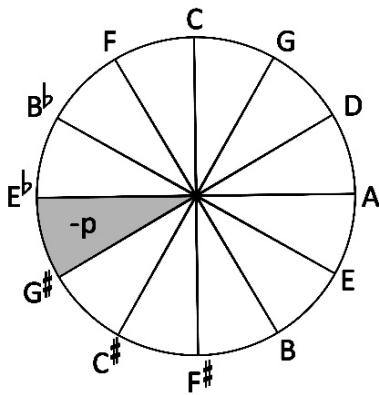
中文讲解
图2的占位符:饼状图(pie diagram)展示毕达哥拉斯调律中各五度相对于纯五度的偏差分布,其中 p 代表毕达哥拉斯音差(Pythagorean comma)。该图用以直观说明在毕达哥拉斯调律下,11个五度保持纯净、1个五度必须被压缩一个完整的毕达哥拉斯音差(从而成为狼五度)的结构性后果。由于图像数据被省略,具体图形与角度需查阅原文。
补充说明
「饼图」(pie diagram)在调律文献中是一种常见的可视化方式:以一圈等分为12(或更多)份,代表五度圈上的12个位置,每份的「切片」大小直观显示该五度相对纯五度的压缩或扩张量。
第9段(P0094)
原文复述
18 Eric Jarlin Wang, “Mistuning the World: A Cultural History of Tuning and Temperament in the Seventeenth Century” (PhD diss., University of California Los Angeles, 2011): 115.
中文讲解
脚注18:为「简单数值比体现神圣秩序」这一观点提供学术依据,指向 Eric Jarlin Wang 2011年于加州大学洛杉矶分校(UCLA)的博士论文《Mistuning the World: A Cultural History of Tuning and Temperament in the Seventeenth Century》第115页。该论文是本节反复引用的核心参考文献之一。
第10段(P0095)
原文复述
19 The tenets of Pythagoreanism, specifically its practical inflexibility, had already been questioned by Bartolomeus Ramis de Pareia in 1482, giving an alternative system that pays attention to select thirds. See Luanne Eris Fose, “The ‘Musica practica’ of Batolomeo Ramos de Pareia: A Critical Translation and Commentary” (PhD diss., University of North Texas, 1992).
中文讲解
脚注19:说明毕达哥拉斯主义的实践僵化问题早在1482年就已经被西班牙理论家 Bartolomeus Ramis de Pareia 质疑,他提出了一种「关注特定三度」的替代调律系统。脚注指向 Luanne Eris Fose 1992年于北德州大学(University of North Texas)的博士论文,该论文是 Ramis 著作《Musica practica》的英译与评注。
这一脚注具有重要的历史定位作用:它把对毕达哥拉斯调律的批判向前追溯到15世纪末,说明 Zarlino 并非第一个发现其缺陷的人。
第11段(P0096)
原文复述
20 Wang, “Mistuning the World,” 54.
中文讲解
脚注20:为正文所述「狼五度位于降E—升G之间、远关系调因此不可用」提供出处,指向 Wang 博士论文第54页。
第12段(P0097)
原文复述
Zarlino’s recommendations for tuning appear in Book II of Le istitutioni harmoniche, where he dedicates two chapters to advocating for his preferred tuning. Chapter 42’s title states Zarlino’s aims plainly:
中文讲解
本段起转入 Zarlino 的具体调律方案:他在《和声惯例》第二卷用两章(42章与45章)的篇幅来推荐自己主张的调律系统。下一段将引用第42章的标题以概括其立场。
第13段(P0098)
原文复述
What should be observed in tempering, or tuning the intervals of certain modern artificial instruments, reducing the number of strings in the syntonic diatonic to that in the diatonic; and that such intervals are not natural, but rather accidental.
中文讲解
这是 Zarlino 第42章标题的英译,意译为:「调律时应注意什么——即如何调校某些现代人造乐器的音程,把「纯律—自然七声音阶」(syntonic diatonic)的弦数缩减到普通「自然七声音阶」(diatonic)的数量;并指出这些音程并非天然的,而是人为的、偶然的。」
这个标题透露了 Zarlino 的双重主张:(1)把为声乐设计的纯律音阶「移植」到键盘这类人造乐器上时必须做妥协;(2)这种妥协使音程脱离自然,变成「人为的」——这是他承认平均律本质上是「退而求其次」的标志。
补充说明
syntonic diatonic「纯律自然七声音阶」与 diatonic「自然七声音阶」在希腊/中世纪术语中并非同义:前者特指纯律构造的七声音阶(用5:4与6:5等纯律三度填充),后者在 Zarlino 笔下指的是经简化后可用12个键跨一个八度的那种。
第14段(P0099)
原文复述
that in the diatonic; and that such intervals are not natural, but rather accidental.21 For sung intervals, Zarlino recommends Ptolemy’s “syntonic-diatonic” tuning (now known as “just intonation”) on the basis that singers ought to present intervals in their most natural form as dictated by “true and sonorous numbers,” an argument that is carried out in Chapter 45.22 Zarlino’s monochord diagram of the ancient希腊 two-octave systema teleion of tetrachords is given in Fig. 2. To allow for a maximum number of thirds and fifths (and by extension, sixths and fourths) to be sung exactly in tune, Zarlino gives two tunings of the pitch d (strings MB and RB in Fig. 2), separated by the distance of one syntonic comma. This results in a total of seventeen string lengths, spanning the diatonic pitch space of two octaves. In order to provide a tuning for only seven diatonic notes to each octave, a compromise must be made between the two tunings of d, MB and RB, thereby reducing the seventeen string lengths to sixteen. Zarlino chooses to distribute the syntonic comma equally among the seven intervals of the diatonic octave by tempering each diatonic fifth to be flat by 2/7ths of a syntonic comma. Major and minor thirds receive the same amount of tempering, with each diminished by 1/7th of a syntonic comma. For
中文讲解
本段延续上一段,继续展开 Zarlino 的论证:
(1) 对人声而言,Zarlino 推荐托勒密的「纯律—自然七声音阶」(syntonic-diatonic),即今所谓「纯律」(just intonation),理由是歌唱家应按「真实而响亮的数值」呈现音程的最自然形态——这一论证在第45章展开。
(2) Zarlino 给出了源自古希腊 systema teleion(完满系统,跨越两个八度、含四音列 tetrachords)的独弦琴图(参 Fig.2;注:此处正文写作「Fig. 2」,与上下文逻辑对照应指后续展示平均律的图示,具体需查原文图序)。
(3) 为了让尽可能多的三度、五度(并由此推广到六度、四度)在声乐中能精确演唱,Zarlino 在音 d 上给出两种不同的调音(Fig.2中的 MB 与 RB 弦),二者相隔一个 syntonic comma(协和音差,约21.5 cents)。这就产生了共17个弦长,覆盖两个八度的自然七声音阶。
(4) 为了把每个八度只装下7个自然音,必须在 d 的两种调音 MB 与 RB 之间做折中,把17个弦长缩减为16个。Zarlino 的折中方案是把一个 syntonic comma 等分到七声音阶内的7个五度上,使每个五度都偏低 syntonic comma 的 2/7;大三度与小六度也相应被压缩,各减小 1/7 个 syntonic comma。
这一段是全节最技术性的描述,它精确刻画了 2/7 平均律的几何结构。
补充说明
syntonic comma(协和音差):约 81/80 ≈ 21.506 cents,指纯律大三度 5:4 与两个全音 9:8 × 9:8(=81:64,缩小两个八度后)之间的差。它是整个平均律家族的几何支点。
第15段(P0100)
原文复述
21 Gioseffo Zarlino, Le istitutioni harmoniche (Venice, 1558), 126. “Quel che si deve osservare nel temperare, overo accordare gli Intervalli di ciascuno Instrumento artefìciale moderno, riducendo il numero delle chorde del Diatonico sintono a quello del Diatono; & che tali intervalli non siano naturali, ma si bene accidentali.” The translation is my own, although I have consulted David P. Goldman, “A New Look at Zarlino’s Theory and its Effect on his Counterpoint Doctrine,” Theory and Practice 16 (1991): 164.
中文讲解
脚注21:为第42章标题引文提供意大利语原文与出处。脚注说明英文译本由作者本人完成,但参考了 David P. Goldman 1991年发表于《Theory and Practice》第16期的论文《A New Look at Zarlino’s Theory and its Effect on his Counterpoint Doctrine》第164页。
这既标注了译者的翻译责任,也为读者提供了一个比较翻译的学术参考。
第16段(P0101)
原文复述
22 Zarlino, Le istitutioni harmoniche, 135. “Se nelli Canzoni seguitiamo cantando gli intervalli produtti da i veri, & sonori numeri, overo li mostrati; & della solutione di alcuni dubbi.”
中文讲解
脚注22:为正文所述「第45章关于歌唱应遵循真实而响亮之数」的论证提供意大利语原文出处,即 Zarlino 《和声惯例》第135页。该章标题大意为:在歌曲(合奏)中歌唱时,我们究竟应按真实而响亮的数值所产生的音程,还是按(键盘上)所示的音程来唱?——以及对若干疑难问题的解答。
第17段(P0102)
原文复述
Zarlino, this necessary detuning of the simple numerical ratios was just imperceptible enough to excuse its usage on “modern artificial instruments” such as the harpsichord.
中文讲解
承接上文(此句因脚注流断裂后接续 P0099 末尾),作者指出 Zarlino 认为,对简单数值比的这种必要「失谐」幅度小到几乎察觉不到,因而足以让它被允许使用在「现代人造乐器」(如大键琴/harpsichord)上。
这是 Zarlino 平均律辩护的核心修辞:虽然妥协在数学上偏离了自然比例,但听觉上的不可感知性使它在实践中变得可接受。
第18段(P0103)
原文复述
This temperament is referred to by modern tuning scholars as 2/7th-comma meantone temperament, on account of its tempered fifths and its characteristic splitting of the syntonic comma (taking the “mean” of two tones or strings). Thirteen years later, in Le dimonstrationi harmoniche (1571), Zarlino gave two more numerical descriptions of similar temperaments. The first, now referred to as 1/3-comma meantone, flattened all fifths equally by 1/3 of a syntonic comma to allow for pure minor thirds, a quality Zarlino deemed suitable for pieces of a languid character. The second, for which he dubiously claims authorial origin, now known as 1/4-comma meantone or simply “meantone,” instead created pure major thirds. These meantone temperaments, grouped by their concern with settling differences resulting from acoustic incompatibilities with the pure major third and pure fifth, were the go-to keyboard tunings for keyboardists clear through the 17th century, of which 1/4-comma meantone was the most widely disseminated and employed. While the problem of wide thirds in Pythagorean tuning had been mitigated by adjusting the size of each fifth, the meantone tunings set forth by Zarlino still housed the ominous presence of the wolf, an aural boundary at E-flat–G-sharp that, as I will soon argue, circumscribes the creative choices of performers and composers.
中文讲解
本段把 Zarlino 的方案定位到平均律家族(meantone family)之中:
(1) 上述方案被现代调律学者称为「2/7 音差平均律」(2/7th-comma meantone),得名于其所有五度被压缩 2/7 个 syntonic comma 的特征,以及「平均」(taking the “mean”)两种 d 调音的核心动作。
(2) 13年后,1571年的《和声论证》(Le dimonstrationi harmoniche)中,Zarlino 又给出两种类似的数值描述:
- 1/3 音差平均律:所有五度均等地降低 1/3 个 syntonic comma,以获得纯小六度;Zarlino 认为这种调律适合「慵懒、倦怠」风格的作品。
- 1/4 音差平均律(简称「平均律」):产生纯大三度。Zarlino 略显可疑地声称为其原创。
(3) 这些平均律方案的共同关怀是「调和纯大三度与纯五度之间的声学不兼容性」,在整个17世纪都是键盘演奏家的首选,其中 1/4 音差平均律流传最广、采用最多。
(4) 然而,虽然通过缩小每个五度解决了毕达哥拉斯大三度过宽的问题,但 Zarlino 的平均律仍保留了狼五度——一个位于降E—升G之间的听觉边界;作者预告后文将论证:这条狼五度「圈定」了演奏家与作曲家的创作选择。
此段是全节的核心枢纽:它把上一段的技术细节装入历史叙事,并预告后文的论证主线——狼五度的「美学—实践约束」。
补充说明
Mark Lindley 的研究表明 1/4 音差平均律实际在15世纪已经出现,故 Zarlino 的原创声明「dubious」(可疑),原文与脚注25都做了说明。
第19段(P0104)
原文复述
23 Zarlino, Le istitutioni harmoniche, 127. “Et quantunque questi intervalli siano per tal maniera hora cresciuti, & hora diminuiti; non per questo l’Udito (come hò detto) abhorisce tale distributione: conciosia che essendo minima, & quasi insensibile la quantità, che si leva, o aggiunge a cotali intervalli; & essendo non molto lontani dalle loro vere forme, il senso si cheta.”
中文讲解
脚注23:为正文「这种对简单数值比的必要失谐小到足以宽恕其用于人造乐器」提供意大利语原文出处(Zarlino 《和声惯例》第127页)。原文大意为:即使音程以此种方式有时被扩大、有时被缩小,听觉却并不厌恶这种安排,因为所增或所减的量极小、近乎不可察觉,且音程仍距其真实形态不远,感官遂能安心。
这是 Zarlino 平均律哲学的核心辩护词,作者用它来支撑上一段关于「imperceptible detuning」的解释。
第20段(P0105)
原文复述
24 Zarlino, Le dimonstrationi harmoniche (Venice, 1571): 221 “…anzi al mio parere è un poco più languido.”
中文讲解
脚注24:为「1/3 音差平均律适合慵懒风格作品」提供原文出处,引用 Zarlino 《和声论证》(1571) 第221页,意大利语片段意为「在我看来它(指该调律)稍显慵懒」。
第21段(P0106)
原文复述
25 Ibid., 266. “…adunque volete fare un novo Temperamento: & dimostrare una nova Partecipatione.” Lindley has given evidence that meantone was in circulation during the 15th century. See Mark Lindley, “Fifteenth-Century Evidence for Meantone Temperament,” Proceedings of the Royal Musical Association 102 (1975): 37–51.
中文讲解
脚注25:为「Zarlino 对 1/4 音差平均律的可疑原创声明」提供原文出处(Zarlino 1571年第266页,意大利语意为「……那么你想要做一种新的调律,并证明一种新的比例分配方式」)。同时脚注介绍 Mark Lindley 在《皇家音乐协会学报》1975年第102期第37—51页发表的《15世纪平均律的证据》一文,用以反驳 Zarlino 的原创声明——平均律在15世纪已存在。
第22段(P0107)
原文复述
26 Wang, “Mistuning the World,” 60–1.
中文讲解
脚注26:为正文所述「平均律家族在17世纪是键盘演奏家的首选,1/4 音差平均律流传最广」提供学术出处,指向 Wang 博士论文第60—61页。
第23段(P0108)
原文复述
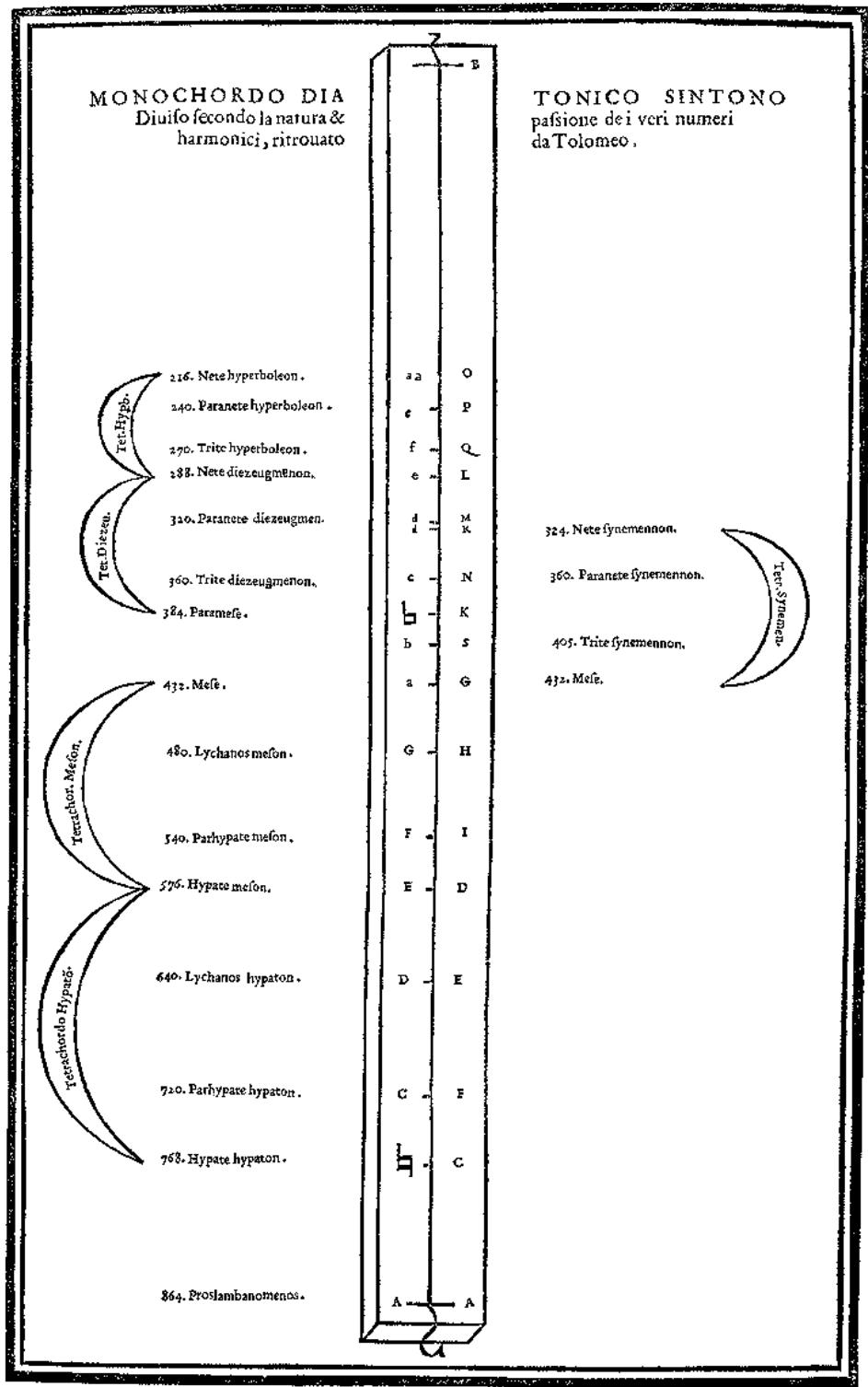
中文讲解
图3占位符:展示 Zarlino 在《和声惯例》第二卷中给出的独弦琴图(monochord diagram),详细标注其推荐的 syntonic-diatonic(纯律)体系中各音对应的弦长。该图是上一段技术论证的可视化对应物。由于图像数据被省略,具体弦长数字与图形需查原文。
第24段(P0109)
原文复述
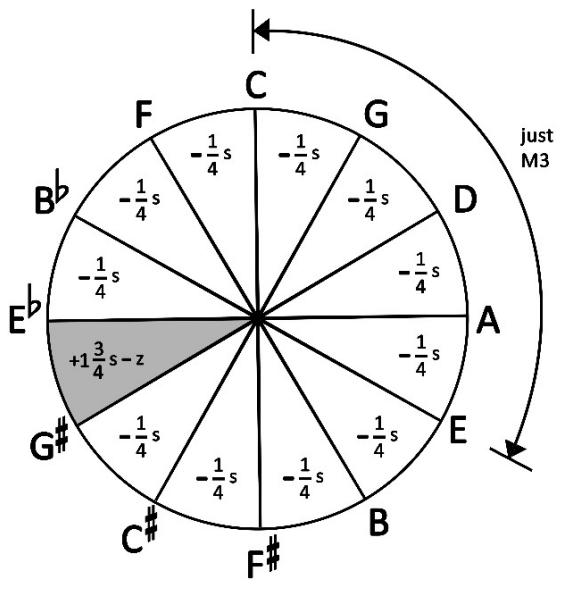
中文讲解
图4(A)占位符:饼图,展示 1/4 音差平均律中各五度相对纯五度的偏差分布。需查原图才能确认各扇区的具体压缩量与图形细节。
第25段(P0110)
原文复述
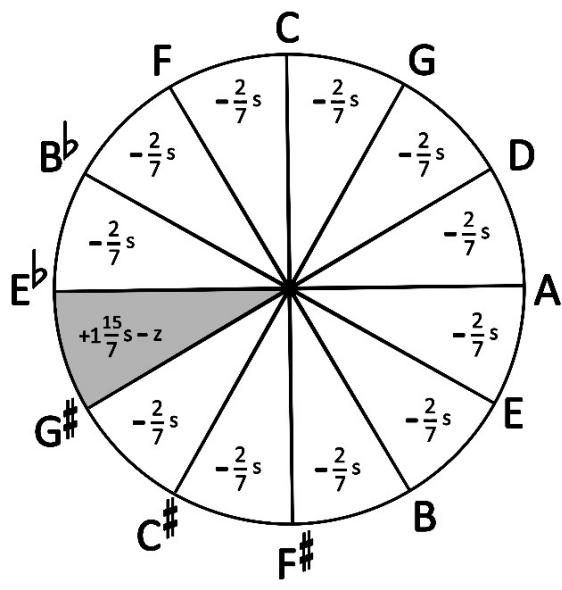
中文讲解
图4整体占位符:它由两幅饼图(A 与 B)组成,对比 1/4 音差平均律(A)与 Zarlino 的 2/7 音差平均律(B),其中 s 代表 syntonic comma, z 代表 schisma(分隔音差,约 328:327,约1.95 cents)。该图直观展示了两种平均律在「五度偏差分布」上的差异。需查原图确认具体几何形态。
补充说明
schisma(分隔音差)是比 syntonic comma 更小的音差单位,常见于把多个音程相乘时产生的累积微小差异中,在平均律讨论里常作为对 syntonic comma 进一步细分时出现的次级单位。
第26段(P0111)
原文复述
Zarlino’s tuning instructions, specifically in his careful consideration of the size of major and minor thirds, comports with his recognition of the triad, which appears later in Le istitutioni harmoniche. Of particular interest is the way in which Zarlino discusses the consequences of his 2/7th-comma meantone temperament, referring to the triad obliquely. He writes,
中文讲解
本段把调律讨论与 Zarlino 后期对「三和弦」(triad)的理论建构联系起来:他在调律章节中对大三度与小六度大小的精细考量,与他后来在《和声惯例》中对三和弦的明确承认是相互呼应的。尤为关键的是,Zarlino 在讨论 2/7 音差平均律的后果时,是以一种「间接」的方式提及三和弦——下一段引用了他对此的原文。
这段把纯技术性的调律描述与和声理论发展衔接起来,是节内逻辑转折的关键节点。
补充说明
Zarlino 是西方音乐理论史上较早系统提出「三和弦」作为和声基本单位的理论家之一;他的「三和弦由两个三度叠合而成」的洞见,在历史上为功能和声奠基。
第27段(P0112)
原文复述
The diatone [major third] will be made imperfect by a seventh, and the semiditone [minor third] will also be diminished by the same quantity: because these two consonances participate in the formation of the diapente [fifth], which is diminished by two-sevenths, it is necessary that the diminution is distributed between the two intervals: if one makes the ditone imperfect by one seventh part, and the semiditone by the same, then it makes two seventh parts…by which their All is diminished.
中文讲解
这是 Zarlino 论述 2/7 音差平均律后果的原文英译:大六度 ditone(此为旧译,按上下文 Zarlino 的用法此处实指大三度 diatone)与小三度 semiditone 各自被压缩一个七分之一(of the syntonic comma);由于这两个协和音共同构成一个五度 diapente,而该五度总共被压低 2/7,故其压缩量必须由两者分摊——每个三度各自承担 1/7,合计正好抵消五度的 2/7 压缩,使「全部」(their All)整体被压缩。
这段话之所以重要,是因为它在数学上明确演示了「五度由两个三度构成」的思路——三和弦由此被间接而稳固地嵌入了调律的几何结构之中。
补充说明
diatone/semiditone/ditone/diapente 是中世纪—文艺复兴时期的音程术语:diatone 与 ditone 实际都指大三度(后者更强调「由两个全音构成」),semiditone 指小三度,diapente 指五度。
第28段(P0113)
原文复述
27 Zarlino, Le istitutioni harmoniche, 181.
中文讲解
脚注27:为「Zarlino 后来在《和声惯例》中明确承认三和弦」提供页码出处,即181页(此页属于书中第三卷讨论协和音分类与三和弦的部分)。
第29段(P0114)
原文复述
28 Ibid., 126: “Si farà dipoi il Ditono imperfetto di una settima parte, et di tanta quantità si diminuirà etiandio il Semiditono: Percioche se queste due consonanze concorreno alla integratione della Diapente; essendo questa
中文讲解
脚注28:为上一段 Zarlino 关于 ditone 与 semiditone 的引文提供意大利语原文(Zarlino 《和声惯例》第126页)。该脚注的引文在此处被截断,后续意大利语原文在本节后部 P0117 脚注中续完。
第30段(P0115)
原文复述
Although Zarlino’s formulation of a fifth created by combining thirds of different qualities may not seem like such a revelatory remark, it reveals several fundamental positionings in early modern temperament discourse that require further explication. Recall that Pythagoreans placed a premium on the simple numerical ratios vested in the unisons (1:1), octaves (2:1), and fifths (3:2), leaving the tuning of other intervals a secondary priority. Under this strict Pythagorean tuning scheme, the major third is constructed by the process of stacking four consecutive pure thirds and then transposing it down two octaves, which results in an interval with the frequency ratio 81:64. This is the same uncomfortably wide third that was discussed previously. Zarlino instead begins with the major third (5:4) and minor third (6:5) and derives the fifth, a surprising and exceptional reversal of the age-old Pythagorean strategies. This struggle, between what one might term the “Pythagorean major third,” and the “just major third” played out in writing only several decades earlier between Franchino Gaffurio and Bartolomeo Ramis.
中文讲解
本段把 Zarlino 的技术论断提升到思想史层面进行解读:虽然「五度由两个三度组合而成」看似平淡无奇,但它实际上揭示了早期现代调律话语的若干根本立场。
(1) 回顾毕达哥拉斯传统:重同度(1:1)、八度(2:1)、五度(3:2)等纯比,其他音程是次要的。在严格的毕达哥拉斯调律下,大三度由四个连续纯五度叠加、再下移两个八度构成,频率比为 81:64,这就是之前提到的「令人不快的宽大三度」。
(2) 反向操作:Zarlino 反过来从大三度(5:4)与小六度(6:5)出发「推导」出五度,这是对毕达哥拉斯几百年传统的惊人倒置。
(3) 这一斗争——可称为「毕达哥拉斯大三度」与「纯大三度」之争——仅在数十年前还在 Gaffurio 与 Ramis 之间以书面形式展开。
此段是节内思想史论证的高潮:它把一项技术细节升格为一场美学—哲学转向。
补充说明
Franchino Gaffurio(1451—1522)是米兰的教堂乐长与理论家,坚持毕达哥拉斯纯五度优先;Bartolomeo Ramis de Pareia(约1440—约1521)是西班牙出生的理论家,主张大三度应保持纯正。两人之争是文艺复兴调律思想史上的标志性论战。
第31段(P0116)
原文复述
This new focus has often been identified by multiple scholars as a reflection of the changing practices of the time and a recognition of the third as central to musical language. A common historiographic strategy is to trace this shift back to English musicians in the fourteenth century, who had already been practicing le contenance angloise, a style that would have certainly benefited from harmonious thirds. In German lands, Lippius eventually produced the first articulation of the musical triad as a harmonic unit in his Synopsis musicae novae (1612), which is particularly indebted to Seth Calvisius’ German dissemination of Zarlino’s theories at the turn of the 17th century. While Lippius never explicitly discusses tuning and temperament, the general musical practice of the time, replete with root position triads (incidental within counterpoint or otherwise) that sound vaguely tonal to modern ears, must have necessitated a significant level of attention to the third. In fact, Praetorius names 1/4-comma meantone as the only usable temperament for keyboard instruments in De organographia (1619), the second volume of his magnum opus Syntagma musicum, writing that “all octaves and perfect or major thirds should be tuned pure…all fifths are not tuned straight and pure, but rather beat flat against each other.” 1/4-comma meantone was henceforth known as the Praetorian temperament throughout the 17th century.
中文讲解
本段进一步展开「三度中心化」的历史脉络:
(1) 学者们普遍把这一新焦点解读为对当时实践变化(三度成为音乐语言核心)的反映。
(2) 史学上常把这一转向追溯到14世纪的英国音乐家——他们已在实践「英式风格」(le contenance angloise),一种显然会受益于和谐三度的对位风格。
(3) 在德语地区,Lippius 于1612年《Synopsis musicae novae》中首次把「三和弦」明确表述为一个和声单位;他的理论特别得益于 Seth Calvisius 在17世纪初对 Zarlino 思想的德语传播。Lippius 虽未直接讨论调律,但当时通行的音乐实践——充斥着原位三和弦(无论是否嵌入对位之中),对现代耳朵而言已隐约带有调性意味——必然要求对三度给予相当程度的关注。
(4) 实践上的关键证据:Praetorius 在1619年《Syntagma musicum》第二卷《De organographia》中,直接把 1/4 音差平均律指名为键盘乐器唯一可用的调律——「所有八度与完全(即大三度)都应调纯……所有五度则不应调得直而纯,而应彼此拍频偏低」。自此,1/4 音差平均律在整个17世纪被称作「Praetorian temperament」。
本段把调律史与和声实践史、对位风格史以及国别传播史编织在一起,使 Zarlino 的理论在德语世界获得制度化的地位。
补充说明
le contenance angloise「英式风格/英国式的歌唱法」是14世纪英格兰邓斯泰布尔(Dunstable)及其追随者所代表的、富含三度与六度的对位风格,被同时代法国作曲家视为新颖悦耳。
第32段(P0117)
原文复述
diminuta di due settime parti, è necessario, che tal diminutione si divida tra questi due intervalli: conciosia che facendo imperfetto il Ditono di una settima parte, et il Semiditono di altra tanto, che sono due settime parti…che è diminuto il suo Tutto.”
中文讲解
脚注28续(意大利语原文的剩余部分):这是 Zarlino 论述 ditone 与 semiditone 压缩方式的意大利语原文的下半段。原文大意为:由于五度被压缩了两个七分之一,这种压缩量必须分摊到这两个音程上——让 ditone 不纯一个七分之一,让 semiditono 同样压缩一个七分之一,合起来是两个七分之一……这正是「全部」(Tutto)被压缩的原因。
这段续文与 P0114 一起完整呈现 Zarlino 对「五度压缩量在三度之间分配」的论证。
第33段(P0118)
原文复述
29 Mark Lindley, “Zarlino’s 2/7-comma Meantone Temperament,” 179–94.
中文讲解
脚注29:为正文所述「Zarlino 反过来从三度推导五度」这一颠倒性论证提供学术出处,指向 Mark Lindley 的论文《Zarlino’s 2/7-comma Meantone Temperament》第179—194页(具体期刊信息需查原文脚注,本文未注明期刊名)。Lindley 是 Zarlino 调律研究最重要的现代学者之一。
第34段(P0119)
原文复述
30 Franchino Gaffurio, De harmonia musicorum instrumentorum (Milan, 1518), f. 62v.
中文讲解
脚注30:为正文所述「Gaffurio 与 Ramis 关于毕达哥拉斯大三度 vs. 纯大三度的论战」提供 Gaffurio 一方著作的出处——其《De harmonia musicorum instrumentorum》(米兰,1518年)第62页背面。
第35段(P0120)
原文复述
31 Richard Taruskin, “Chapter 11: Island and Mainland.” In Music from the Earliest Notations to the Sixteenth Century: The Oxford History of Western Music (New York: Oxford University Press, 2005).
中文讲解
脚注31:为正文所述「le contenance angloise 与三度中心化」提供学术依据,指向 Richard Taruskin《牛津西方音乐史》第1卷(自最早记谱法至16世纪)第11章《Island and Mainland》(岛屿与大陆),2005年由牛津大学出版社出版。Taruskin 是20—21世纪音乐学界极具影响力的学者,此章节讨论14世纪英格兰与欧洲大陆之间的对位风格交流。
第36段(P0121)
原文复述
It must be noted once again that Zarlino is ultimately reproducing Pythagorean tenets, particularly in his central fixation on simple numerical ratios of the major and minor thirds. While it may be true that much of his speculative writing was deeply enmeshed with the activities of practicing musicians, he nonetheless gives a strikingly numerological explanation for his support of the major and minor thirds. For Zarlino, the number six (or the senario), due to its properties as a perfect number in which it is equal in value to the sum of its divisors, is the key. In the realm of tuning, the senario crops up in the frequency ratios of all vertical consonances up to the minor third (6:5). The triad, built from the fifth (3:2), the major third (5:4), and the minor third (6:5), thus reflects the divine proportions of the senario. Zarlino and his most ardent followers remained Pythagorean through and through.
中文讲解
本段对 Zarlino 的思想立场做出关键性的「重新定位」:他表面上反叛了毕达哥拉斯调律,骨子里仍是毕达哥拉斯主义者。
(1) Zarlino 对大三度、小六度的支持,表面上源自音乐实践的需求,但其底层论据却是一套高度数秘主义(numerological)的解释。
(2) 核心论据:数字六(senario)是「完全数」(perfect number)——其值等于其全部真因子之和(1+2+3=6),因而被视为神性秩序的体现。
(3) 在调律领域,senario 体现在所有「垂直协和音」(同度、八度、五度、大三度、小六度等)的频率比之中——因为 6:5(小六度)正好是构成协和关系的最深小数比上限。
(4) 三和弦由五度(3:2)、大三度(5:4)、小六度(6:5)叠合而成,因而反映了 senario 的神圣比例。
(5) 因此 Zarlino 及其最虔诚的追随者「从头到尾都是毕达哥拉斯主义者」。
这一段是节内思想史论证的总结性翻转:它揭示了 Zarlino 的「反毕达哥拉斯」改革其实是在更高的数学层面「回归毕达哥拉斯」。这种「表面反、实质守」的张力,是本节的重要洞见。
补充说明
senario 之所以在毕达哥拉斯—新柏拉图传统中被视为神圣数字,既因为它是第一个「完全数」,也因为它包含 1:1(同度)、2:1(八度)、3:2(五度)等协和音比之和。这一观念在 Boethius 之后的中世纪音乐理论中反复出现。
第37段(P0122)
原文复述
32 Joel Lester, Between Modes and Keys: German Theory 1592–1802 (Stuyvesant: Pendragon Press, 1989), 21–35. Also see Benito Rivera, German Music Theory in the Early 17th Century: The Treatises of Johannes Lippius (Rochester: University of Rochester Press, 1995).
中文讲解
脚注32:为正文所述「Lippius 在《Synopsis musicae novae》(1612)中首次把三和弦作为和声单位表述」提供两部学术依据:Joel Lester《Between Modes and Keys: German Theory 1592–1802》(Pendragon Press, 1989)第21—35页,以及 Benito Rivera《German Music Theory in the Early 17th Century: The Treatises of Johannes Lippius》(University of Rochester Press, 1995)。这两部著作是德语地区17世纪音乐理论的标准参考。
第38段(P0123)
原文复述
33 For an investigation into the particularities of Lippius’ writings and its application, see Benito Rivera, “The Seventeenth-Century Theory of Triadic Generation and Invertibility and Its Application in Contemporaneous Rules of Composition,” Music Theory Spectrum 6 no. 1 (Spring 1984): 63–78.
中文讲解
脚注33:为正文所述「Lippius 未直接讨论调律,但其时代的音乐实践充斥原位三和弦」提供更专门的研究依据,指向 Benito Rivera《17世纪三和弦生成与转位理论及其在同时代作曲规则中的应用》,发表于《Music Theory Spectrum》1984年春第6卷第1期第63—78页。
第39段(P0124)
原文复述
34 Michael Praetorius, Syntagma musicum II: De Organographia (Wolfenbüttel, 1619), 150–1. “Dass alle Octaven und Tertiae perfectae seu majores gar rein gestimmet werden…dass alle Quinten nicht gerade und rein, sondern gegeneinander niedrig schewebend gelassen werden.”
中文讲解
脚注34:为正文所述「Praetorius 把 1/4 音差平均律指名为键盘唯一可用调律」提供德语原文出处(Michael Praetorius《Syntagma musicum II: De Organographia》,沃尔芬比特尔,1619年,第150—151页)。原文德语大意为:所有八度与「完全三度」即大三度都应调得绝对纯净……所有五度则不应调得直而纯,而应彼此拍频偏低(schewebend,留有拍频)。
第40段(P0125)
原文复述
35 Wang, “Mistuning the World,” 62.
中文讲解
脚注35:为正文所述「1/4 音差平均律在17世纪被通称为 Praetorian temperament」提供出处,指向 Wang 博士论文第62页。
第41段(P0126)
原文复述
36 Benito Rivera, “Theory Ruled by Practice: Zarlino’s Reversal of the Classical System of Proportions,” Indiana Theory Review 16 (1995): 155.
中文讲解
脚注36:为正文「Zarlino 给出的三度中心论基于一套数秘主义解释」提供学术依据,指向 Benito Rivera《Theory Ruled by Practice: Zarlino’s Reversal of the Classical System of Proportions》,发表于《Indiana Theory Review》1995年第16期第155页。该文是分析 Zarlino「颠倒古典比例系统」的核心研究。
第42段(P0127)
原文复述
In practice, although the thirds of Zarlino’s meantone tunings are settled and harmonious, the inflexibility of the wolf fifth at E-flat–G-sharp left many musicians in the mid-17th century unsatisfied, resulting in an increase of modified meantone tuning systems in the mid-to-late century, particularly in France. I will discuss one such tuning here. A German historical connection can be made with French theorists by way of Kircher’s Musurgia universalis (1650). Kircher defers judgement of tuning and temperament to Mersenne, writing that “various methods of tuning an instrument are offered by various authorities; see Mersenne for these.” Kircher’s recommendation here should be taken seriously: Kircher proceeds to give a confused explanation of Mersenne’s tuning, which is both mathematically and theoretically inconsistent, leaving it hard to guess what he may have been trying to express. Unfortunately, Mersenne’s instructions for tuning, appearing in Harmonie universelle (1636), are also somewhat confused. The discrepancy lies in an imprecise use of language: when asked to tune the span from F to B-flat, Mersenne writes that the “fifth must be increased.” Here, it is unclear whether the interval or the note, B-flat, must be increased; the former results in wider fifths, while the latter produces
中文讲解
本段开启节内的「17世纪后半叶变体」主题:
(1) 虽然 Zarlino 平均律让三度稳定和谐,但狼五度(降E—升G)的僵硬性使17世纪中叶的许多音乐家不满,导致中后期——尤其在法国——出现越来越多的「修正型平均律」系统。
(2) 作者即将介绍其中一例。它与法国理论家之间有一条德国线索:Athanasius Kircher 在《Musurgia universalis》(1650)中把调律判断权推给 Mersenne,写道「不同权威提出了不同的调律方法;请参见 Mersenne」。Kircher 接着给出对 Mersenne 调律的「混乱」解释——既在数学上也在理论上自相矛盾,令人难以猜测其意图。
(3) 不幸的是,Mersenne 本人在《Harmonie universelle》(1636)中的调律说明也有些含混。问题出在用词不精确:当被问到如何调 F 到降B 时,Mersenne 写道「五度必须被扩大」(la quinte doit estre augmentée)。此处不清楚「被扩大」是指「音程被扩大」(产生更宽的五度)还是「音(降B)被升高」(产生更窄的五度)。
此段把节内焦点从「Zarlino 的标准方案」过渡到「17世纪后半叶的修正与混乱」,为引出 Chaumont 误读的故事铺垫。
补充说明
Athanasius Kircher(1602—1680)是德国耶稣会士、博学家,《Musurgia universalis》是17世纪中叶涵盖音乐—声学—数学的巨著,但其论述常有附会与拼凑之嫌。
第43段(P0128)
原文复述
37 Wang, “Mistuning the World,” 63–9.
中文讲解
脚注37:为正文所述「17世纪中后期法国出现修正型平均律系统的增多」提供出处,指向 Wang 博士论文第63—69页。
第44段(P0129)
原文复述
38 Frederick Baron Crane, “Anthanasius Kircher, Musurgia Universalis (Rome, 1650): The Section on Musical Instruments” (MA thesis, University of Iowa, 1952): 35.
中文讲解
脚注38:为正文所述「Kircher 把调律判断推给 Mersenne」提供出处,指向 Frederick Baron Crane 1952年于爱荷华大学的硕士论文《Athanasius Kircher, Musurgia Universalis (Rome, 1650): The Section on Musical Instruments》第35页。
第45段(P0130)
原文复述
39 Marin Mersenne, Harmonie Universelle, III (Paris, 1636), 109. “Mais cette quinte doit estre augmentee.”
中文讲解
脚注39:为正文所述「Mersenne 在 F—降B 的调律上写『五度必须被扩大』」提供法语原文出处(Mersenne《Harmonie universelle》第三卷,巴黎,1636年,第109页)。法语大意为:「但这个五度必须被扩大。」
第46段(P0131)
原文复述
narrower fifths. Lindley, by corroborating this statement with Mersenne’s other writings, particularly his endorsement of split-key manuals, is able to make a case for the latter reading, concluding that Mersenne was anticlimactically referring to 1/4-comma meantone. An understandable misreading of Mersenne’s instructions as advocating a widening of the fifths F–B-flat and B-flat–E-flat was committed to writing by Lambert Chaumont in his Pièces d’orgue sur le huit tons (1695), which received wide circulation as the aptly named tempérament ordinaire. A serendipitous consequence of this mistake was that the usual meantone wolf is more in-tune by an entire syntonic comma, which opens up the possibility of previously unusable keys such as F-sharp major and A-flat major.
中文讲解
本段继续上一段对 Mersenne 含混语言的解读:
(1) Lindley 通过对照 Mersenne 其他著作——尤其是他对「分键(split-key)键盘」(split-key manuals,即同一音高上有两把键分别调成不同音高以解决狼五度问题)的认可——支持「后者」的读法,即降B 这个「音」应被升高(从而使五度被压缩)。Lindley 因此得出平淡而重要的结论:Mersenne 所指的其实就是 1/4 音差平均律。
(2) 一个可以理解的「误读」:法国管风琴家 Lambert Chaumont 在1695年《Pièces d’orgue sur le huit tons》中把 Mersenne 解读为「F—降B」「降B—降E」的五度应被「加宽」,这一误读被写成文献并广泛传播,被称为「tempérament ordinaire」(「寻常调律」)。
(3) 这次误读的「意外收获」:原本的狼五度因此向「合调」方向偏移了整整一个 syntonic comma,使 F 大调、降A 大调等此前无法使用的调变得可用。
这一段是节内最具戏剧性的内容:一个误读反而催生了一种在美学上更具解放性的调律——「普通的」 tempérament ordinaire 因此能容纳更多远关系调,体现了作者一贯强调的「17世纪调律话语比通常讲述的更活泼、更有创造性」。
补充说明
split-key manuals「分键键盘」是16—18世纪键盘(尤其是管风琴与某些大键琴)上常用的解决方案:同一个音高提供两个或更多键钮,各自被调成略有差异的音高,以便在不同调性中获得最纯净的协和音。Chaumont 误读后的 tempérament ordinaire 在某种意义上「模拟」了这种分键的灵活性,但只在固定调律内部完成。
第47段(P0132)
原文复述
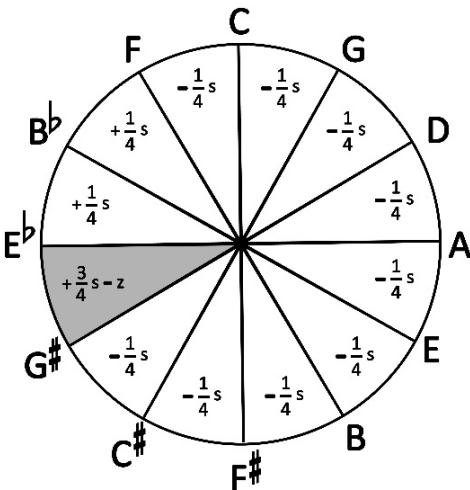
中文讲解
图5占位符:展示 Chaumont 误读产生的「tempérament ordinaire」之饼图,其中 s 代表 syntonic comma, z 代表 schisma。该图直观呈现此调律中五度偏差的分布——可看出原本的狼五度被「向内」压缩,使整体偏差分布比 Zarlino 平均律更均匀。需查原图确认细节。
第48段(P0133)
原文复述
At this point, we have reached the end of the 17th century, and perhaps the end of the unquestioned reign of meantone temperaments. Beginning with Andreas Werckmeister’s Musikalische Temperatur (1691), the turn of the 18th century saw a rapid proliferation of “well temperaments,” a new, distinctly anti-Pythagorean philosophy of tuning that attempted to
中文讲解
本段将节内时间轴推至17世纪末:
(1) 作者宣告:到此为止,读者已抵达17世纪末,也抵达了平均律家族「不容置疑的统治」的终点。
(2) 自 Andreas Werckmeister 的《Musikalische Temperatur》(1691)开始,18世纪之交见证了「好律」(well temperaments)的迅速蔓延——这是一种明确反毕达哥拉斯主义的调律哲学。
(3) 句末「a new, distinctly anti-Pythagorean philosophy of tuning that attempted to」在段尾未完结,等待下段续完。
补充说明
Andreas Werckmeister(1645—1706)是德国管风琴家与理论家,他提出的几种「好律」(如 Werckmeister III)放弃了追求「纯」协和音的思路,转而让所有调性都可用但各具「性格」——这种思路后来被巴赫的《平均律键盘曲集》(das wohltemperierte Klavier)在艺术上加以典范化。
第49段(P0134)
原文复述
40 Mark Lindley, “Mersenne on Keyboard Tuning,” Journal of Music Theory 24 no. 2 (Autumn 1980): 166–203.
中文讲解
脚注40:为正文所述「Lindley 通过对照 Mersenne 其他著作(含对分键的认可)得出『后者』读法,即 Mersenne 实际指 1/4 音差平均律」提供学术出处,指向 Mark Lindley《Mersenne on Keyboard Tuning》,发表于《Journal of Music Theory》1980年秋第24卷第2期第166—203页。这是研究 Mersenne 调律思想的核心参考文献。
第50段(P0135)
原文复述
41 Mark Lindley, “Innovations in Temperament and Harmony in French Harpsichord Music,” Early Music 41 no. 3 (August 2013): 405–8.
中文讲解
脚注41:为正文所述「Chaumont 在1695年《Pièces d’orgue sur le huit tons》中把 Mersenne 误读为『五度加宽』,并把所得调律命名为 tempérament ordinaire」提供学术出处,指向 Mark Lindley《Innovations in Temperament and Harmony in French Harpsichord Music》,发表于《Early Music》2013年8月第41卷第3期第405—408页。
第51段(P0136)
原文复述
eradicate the wolf from all keys and render them usable, a well-rehearsed history that will not be reproduced here. In this chapter, I hope to have given a view of the 17th century that recognizes a family of meantone temperaments, or as Wang puts it, “shades of meantone” clustered around the ubiquitous 1/4-comma meantone. These alternative systems point to a much livelier and more creative 17th century tuning and temperament discourse than is usually told; indeed, musicians and theorists adopted age-old Pythagorean tenets and modified them to fit their practical and expressive needs.
中文讲解
本段接续 P0133 末尾,完成全节的总结:
(1) 好律的目标是「消灭所有调中的狼」并使所有调都可用——这是一段「被反复排练过的历史」(well-rehearsed history),作者明确不在本章中重述。
(2) 作者宣告本章的写作意图:提供一个17世纪调律史的图景——它承认一个「平均律家族」(a family of meantone temperaments)的存在,用 Wang 的话说就是围绕着 1/4 音差平均律聚集的「诸种平均律色调」(shades of meantone)。
(3) 这些替代系统表明:17世纪的调律与调律话语比通常的叙述「更活泼、更有创造性」——音乐家与理论家既采纳古老的毕达哥拉斯原则,又对其加以改造以适应实践与情感表达的需要。
这是本节的思想收束:把平均律家族重新定义为「既有传统承袭又有实践创新的开放谱系」,为后续讨论 17 世纪作曲家与演奏家如何在「狼五度的边界内」进行创作埋下伏笔。
补充说明
well-rehearsed history「被反复排练过的历史」是作者对学界既有 18 世纪好律叙事(如 Barbour 的标准教科书)的谦称与剥离:作者想强调的是 17 世纪的「前好律」阶段本身具有独立的研究价值。
第52段(P0137)
原文复述
42 See, for example, Murray Barbour, Tuning and Temperament: A Historical Survey (East Lansing: Michigan State College Press, 1951; reprint, Mineola: Dover Publications, 2004).
中文讲解
脚注42:为正文所述「好律的历史是 well-rehearsed 的」提供经典参考书指引:Murray Barbour《Tuning and Temperament: A Historical Survey》(东兰辛:密歇根州立学院出版社,1951;重印,纽约 Mineola:Dover Publications, 2004)。该书是调律史领域的标准教科书,详细讲述了好律兴起及其后向等程律过渡的历史。
第53段(P0138)
原文复述
43 Wang, “Mistuning the World,” 176.
中文讲解
脚注43:为正文所述「Wang 的『shades of meantone』(平均律的诸色调)」这一关键短语提供出处,指向 Wang 博士论文第176页。该短语是作者全节论证的思想结晶。
脚注 / 边栏 / 图表 / 附加信息(如有)
本节涉及的附加材料:
- 图2(P0093):毕达哥拉斯调律饼图,p 代表毕达哥拉斯音差——直观呈现纯五度与狼五度的对比分布。
- 图3(P0108):Zarlino 在《和声惯例》第二卷的独弦琴图,展示其 syntonic-diatonic 体系的弦长。
- 图4(P0109、P0110):对比 1/4 音差平均律(A)与 2/7 音差平均律(B)的饼图,s 代表 syntonic comma, z 代表 schisma。
- 图5(P0132):Chaumont 的 tempérament ordinaire 饼图——展示「误读」后产生的偏差分布。
- 脚注体系极其密集,涵盖 Zarlino 原文(意大利语)、Mersenne(法语)、Praetorius(德语)、Kircher(拉丁)等多语种第一手文献,以及 Palisca、Lindley、Wang、Rivera、Lester、Taruskin、Barbour、Fose、Corwin、Crane 等现代学术二手文献。 这些材料共同支撑本节论证:从毕达哥拉斯调律的缺陷出发,经由 Zarlino 的平均律家族(2/7、1/3、1/4 音差),最终到达17世纪后半叶由 Kircher/Mersenne 误读引发的 tempérament ordinaire,为18世纪「好律」的兴起铺垫。
💡 本节核心要点
- 调律史的真正主轴不是具体数字,而是「数值比的神圣性」这一观念如何被守护、被改写、被倒置——Zarlino 反过来从三度推导五度,看似反毕达哥拉斯,实则仍在 senario 数秘主义框架下运作。
- 毕达哥拉斯键盘调律的根本缺陷在于大三度过宽(81:64)以及闭合五度圈必然产生狼五度,这一缺陷构成了平均律兴起的内在动因。
- Zarlino 的三套平均律方案(2/7、1/3、1/4 音差)共享一个几何逻辑:把 syntonic comma 分配到五度上,以同时照顾三度与五度;其中 1/4 音差平均律因提供纯大三度而在17世纪成为 Praetorian temperament,影响最大。
- 平均律家族并未消除狼五度——它位于降E—升G之间,这一「听觉边界」对作曲与演奏的实际选择具有结构性约束;Zarlino 平均律的真正代价不是数学妥协,而是远关系调的可使用性。
- 17世纪后半叶的修正型平均律(尤其在法国)显示出调律话语的活力与偶然性:Chaumont 对 Mersenne 含混语言的误读反而产生了 tempérament ordinaire,使狼五度向合调方向偏移,打开了 F 大调、降A 大调等新调性的可能性。
- 本节最终主张:17世纪并非「等待好律到来的过渡期」,而是一个以 1/4 音差平均律为核心、围绕它聚集多种「色调」的平均律家族时代,其内部多样性比通常叙事所呈现的更丰富。
🔑 关键术语
- Pythagorean tuning / 毕达哥拉斯调律:以全部纯五度(3:2)为基石的键盘调律。其大三度由四个连续纯五度叠加并下移两个八度得到,频率比为 81:64,因此大三度过宽;闭合五度圈必然产生一个被压缩的「狼五度」,通常落在降E—升G。
- Meantone temperament / 平均律(家族):Zarlino 推广的调律家族总称,核心做法是把一个 syntonic comma 平均分配到若干个五度上,使大三度和小六度获得可接受的音准;通过分裂两种 d 的调音(取「均值」)实现。本节涉及 2/7、1/3、1/4 音差三种主要类型。
- Syntonic comma / 协和音差:约 81/80,约 21.5 cents。是纯律大三度 5:4 与两个 9:8 全音之差,也是平均律几何分布的基本单元。本节以 s 标记。
- Schisma / 分隔音差:约 328/327,约 1.95 cents。比 syntonic comma 更小的音差,在五度圈上累积出现;本节饼图以 z 标记。
- Wolf fifth / 狼五度:因闭合五度圈而被极度压缩的五度,音响刺耳如狼嚎。在 Zarlino 平均律中位于降E—升G之间;它使远关系调在实践中不可用,并构成对作曲家调性选择的结构性约束。
- Just intonation / 纯律:Zarlino 推荐给人声的调律,即托勒密的 syntonic-diatonic;以 5:4 大三度与 6:5 小六度为协和核心,因每个调需不同音高而不能直接套用于12平均律键盘。
- 1/4-comma meantone / 四分之一音差平均律:所有五度被压缩 1/4 个 syntonic comma,使大三度(以及经此得出的六度)近乎纯净。是17世纪最通行的键盘调律,被称为 Praetorian temperament。
- Senario / 完全数六:数字6——因 6 = 1 + 2 + 3 而被视为「完全数」,在毕达哥拉斯—新柏拉图传统中具有神圣地位。Zarlino 用它来解释为何三和弦(由五度 3:2、大三度 5:4、小六度 6:5 构成)反映神性秩序。
- tempérament ordinaire / 「寻常调律」:Chaumont 在1695年对 Mersenne 误读后产生的法国键盘调律。它「错位」地把多个五度加宽,从而使原本的狼五度向合调方向偏移整整一个 syntonic comma,意外地打开了 F 大调、降A 大调等先前不可用的调性。
- Well temperament / 好律:自 Werckmeister 1691年《Musikalische Temperatur》后兴起的调律哲学,以「所有调都可用、但各有色彩差异」为目标,被作者视为「明确反毕达哥拉斯」的调律思潮。
S0501 Graphing Temperamentally
第1段(P0139)
原文复述
Graphing Temperamentally
中文讲解
这是第5章的章名,标题为「以图示法表现律制」。它点出本章的核心任务:不再局限于Blackwood那种逐音标记的分析,而是把律制在音乐进行中的影响用图形方式呈现出来。该标题本身既表明方法(graphing 图示),也表明对象(temperamentally 涉及律制/调律层面),暗示作者将围绕图形化的律制分析展开论述。
第2段(P0140)
原文复述
This chapter will build on the work of Easley Blackwood’s note-by-note labelling technique by providing a means of graphical representation.
中文讲解
本章的总纲句。它说明两件事:第一,本章的方法建立在Easley Blackwood「逐音标注」的技术之上;第二,本章在Blackwood方法之上加入「图形化呈现」的维度。换言之,作者并非另起炉灶,而是承接Blackwood的标注意图,再将其推进到图示形式。这一句明确了本章对前人工作的依赖关系与推进方向。
第3段(P0141)
原文复述
Easley Blackwood’s work, as it appears in The Structure of Recognizable Diatonic Tunings, studies the intonation of various musical passages using a notational system that denotes the pitch class and deviation by syntonic comma in the subscript. Zarlino’s syntonic-diatonic monochord for variable-pitch instruments and the voice can be represented accordingly in Blackwood-style notation: […] B♭0 C0 D-1 D0 E0 F0 G0 A0 B0 C0 […]
中文讲解
这段话交代Blackwood体系的基本信息:他的代表作《可识别的自然调律音阶结构》一书,研究的是不同音乐片段的实际音高状况,方法是一种「音符+下标」的标注系统,下标表示该音相对纯律偏离多少个syntonic comma(纯律五度律差,81/80)。作者随即给出Zarlino的纯律-自然音阶单弦琴在可变音高乐器和人声上的Blackwood式写法:B♭0 C0 D-1 D0 E0 F0 G0 A0 B0 C0。要点:①下标=以syntonic comma为单位的微调量;②D-1代表D音比同下标的C、E、F、G、A、B、C低一个syntonic comma;③这一行正好对应Zarlino把D降低一个comma以兼顾三全音律的做法。
补充说明
syntonic comma(81/80)是纯律与五度相生律之间约21.5音分的关键差值,是Blackwood下标体系的基本度量单位。
第4段(P0142)
原文复述
It takes some time to grow accustomed to identifying the sizes of common intervals in this row of tones. I will step through the intervals by increasing size. The easiest to identify is the syntonic comma (81/80) appearing at D-1D0, demonstrating the utility of Blackwood’s subscript. The diatonic semitone (16/15) appears at E0F0 and B0C0. The major tone (9/8) appears between notes containing the same subscript such as C0D0, while the minor tone (10/9) is diminished by a syntonic comma, appearing at C0D-1. Minor and major thirds come in two sizes each: the just major third (5/4) at B♭0D-1, the just minor third (6/5) at D-1F0, the wide Pythagorean major third (81/64) at C0E0, and the narrow Pythagorean minor third (32/27) at A0C0. Intervals related by vector addition of both subscripts retain interval identity; A-0.25C-0.25, for example, would also be a Pythagorean minor third, like A0C0. The ordering of pitches from low to high is nontrivial in determining their tempering: a narrow fifth C0G-1 inverts into a wide fourth C0G-1.
中文讲解
这一段是Blackwood下标体系的使用教程,作者按「由小到大」的顺序依次指出每个音程出现的位置:syntonic comma(81/80)出现在D-1到D0;diatonic semitone(16/15)在E0-F0和B0-C0;major tone(9/8)出现在同下标相邻音之间如C0-D0;minor tone(10/9)出现于C0-D-1,因被降一个comma。三度则分两类:纯律大三度(5/4)如B♭0-D-1,纯律小三度(6/5)如D-1-F0;毕达哥拉斯宽大三度(81/64)如C0-E0,毕达哥拉斯窄小三度(32/27)如A0-C0。作者还指出:两个下标同时加减,音程性质不变(例如A-0.25C-0.25仍是毕达哥拉斯小三度);并且从低到高的音的排列方式会影响其调律状态(窄五度C0-G-1倒过来仍是宽四度C0-G-1——按原文行末字面意思记录)。这段教学的目的是让读者学会「阅读」Blackwood下标,从而识别音程真实大小。
补充说明
本段最后一句原文末尾出现「a narrow fifth C0G-1 inverts into a wide fourth C0G-1」,两处音组字面相同,作者意在提示倒影音程的调律关系,但其表述中存在文字疑点,需查原书上下文。
第5段(P0143)
原文复述
44 Easley Blackwood, The Structure of Recognizable Diatonic Tunings (Princeton: Princeton University Press, 1985), 68–9.
中文讲解
脚注44:Blackwood专著的完整出版信息——普林斯顿大学出版社,1985年,第68–69页。这是为前文介绍Blackwood下标体系所引的来源。
第6段(P0144)
原文复述
When these annotations are applied on a note-by-note basis on staff notation, it becomes possible to judge the sizes of all intervals in a piece of music, both vertically and horizontally. This method has been used to great effect by Ross Duffin in an analysis of Giovanni Battista Benedetti’s musical puzzles to Cipriano de Rore from the 16th century. His analysis is reproduced in Fig. 6. Blackwood’s annotations here are particularly advantageous in revealing the progressive sharp-ward drift of the two-measure musical fragment, a pitch migration caused by the tenor voice tuning a just minor third (or major sixth) with the suspended soprano voice in mm. 2, 4, 6, and so on. Furthermore, with some effort, the size of melodic and harmonic intervals can be discerned: melodic just fifths and fourths (G_{0+n}D_{0+n} and C_{1+n}G_{1+n} in the tenor), harmonic just fifths (G_{0+n}D_{0+n} in tenor/alto and D_{0+n}A_{0+n} in tenor/soprano), harmonic just fourths (D_{0+n}G_{0+n} and E_{0+n}A_{0+n} in alto/soprano), and harmonic just major thirds and major sixths (C_{1+n}E_{0+n} in tenor/alto and C_{1+n}A_{0+n} in tenor/soprano).
中文讲解
本段说明把Blackwood下标「逐音写到五线谱上」的实际功能:纵向(同时音)和横向(先后音)的音程大小都因此可读。Ross Duffin用此法分析了16世纪Benedetti写给Cipriano de Rore的音乐谜题,其分析结果被作者重现为图6。该下标系统的优势在于揭示两小节片段中「逐步向升号方向漂移」的现象——原因是男高音声部在第2、4、6等小节与延留的高音声部构成纯律小三度(或大六度),使得整体音高被「拉高」。读者还可据下标辨认具体音程:旋律上纯律五度(如G_{0+n}D_{0+n})与纯律四度,和声上纯律五度、四度,以及纯律大三度/大六度等。本段的功能是以一个具体分析案例展示Blackwood标注的读法和威力。
补充说明
本段所引分析为Ross Duffin对Benedetti谜题的研究,是Blackwood方法在文艺复兴音乐中成功应用的典范。
第7段(P0145)
原文复述
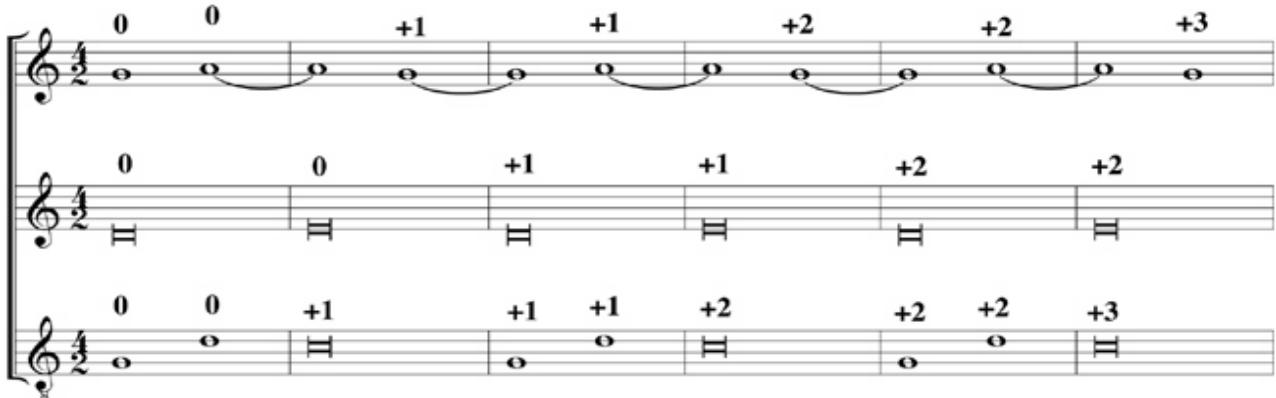
中文讲解
图6所在位置的图像占位符,承载着前段所述的Duffin对Benedetti音乐谜题的分析,原图带有Blackwood式下标标注;具体谱面内容须查阅原书。
第8段(P0146)
原文复述
Figure 6: Duffin’s analysis of Benedetti’s first musical puzzle, with Blackwood annotations. The annotation method is most successful in Blackwood’s analyses of music by Machaut, di Lasso, Bach, and Franck under just intonation.
中文讲解
图6的标题说明:这是Duffin对Benedetti第一首音乐谜题所做的、带Blackwood下标的分析。下半句则顺势指出该标注体系在Blackwood自己的分析中效果最佳的那些作品——Machaut、di Lasso、巴赫、Franck——前提是按纯律来理解这些音乐。本句提示了一个关键边界条件:Blackwood标注法对「假定以纯律为出发点」的音乐最为有效。
第9段(P0147)
原文复述
45 Ross W. Duffin, “Just Intonation in Renaissance Theory and Practice,” Music Theory Online 12 no. 3 (October 2006).
中文讲解
脚注45:Duffin文章《文艺复兴理论与实践中的纯律》刊于《Music Theory Online》第12卷第3期,2006年10月。这是前段引用的来源出处。
第10段(P0148)
原文复述
46 Blackwood, 129–50.
中文讲解
脚注46:指引读者参阅Blackwood原书第129–150页。该范围正是Blackwood分析Machaut、di Lasso、巴赫、Franck作品并提出五条纯律原则的核心章节。
第11段(P0149)
原文复述
sonorities in a piece of music is troublesome and most likely impossible given only twelve pitches per octave. Blackwood gives five principles for just intonation:
中文讲解
本句接续前文图注,说明一个关键限制:在每八度仅有十二个音的键盘上,要把一整首作品所有和音都调成纯律是「麻烦甚至几乎不可能」的,因此Blackwood提出五条折中性原则。这一句把上下文从「逐音标注」过渡到「原则性总结」,并预告以下将出现编号为1–5的五条原则。
第12段(P0150)
原文复述
- Perfect fifths, perfect fourths and octaves must be pure; hence two notes forming any of these intervals must have the same subscripts.
中文讲解
原则1:纯五度、纯四度、纯八度必须纯净;因此构成这些音程的两音必须具有相同的下标。这条规则把五度、四度、八度的「纯净性」作为最高优先,并直接落到Blackwood下标体系的操作形式——同下标。
第13段(P0151)
原文复述
- Major triads must be pure; hence the third of a major third must have a subscript one less than that of the root and the fifth.
中文讲解
原则2:大三和弦必须纯净;因此大三度的三音,其下标必须比根音和五音的下标「少1」(即比根音和五音低一个syntonic comma)。其逻辑是:大三和弦要5/4,三音需要相对根音/五音降低一个syntonic comma。
第14段(P0152)
原文复述
- Minor triads must be pure; hence the third of a minor triad must have a subscript one greater than that of the root and fifth.
中文讲解
原则3:小三和弦必须纯净;因此小三度的三音,其下标必须比根音和五音「多1」(即比根音和五音高一个syntonic comma)。其逻辑是:小三和弦要6/5,三音需要相对根音/五音升高一个syntonic comma。
第15段(P0153)
原文复述
- Thirds and sixths in which both notes have the same subscripts are Pythagorean, and should be avoided if possible.
中文讲解
原则4:若三度或六度的两音同下标,则是毕达哥拉斯式音程,应尽可能避免。其逻辑是:同下标意味着五度链上没有comma补偿,故大三度成为偏宽的81/64,小三度成为偏窄的32/27,音色刺耳,需避用。
第16段(P0154)
原文复述
- The root and fifth of a major triad should generally have 0 subscripts; the root and fifth of a minor triad should generally have -1 subscripts. This arrangement tends to minimize the occurrence of the syntonic comma as a melodic interval.
中文讲解
原则5(首句):大三和弦的根音与五音一般采用0下标;小三和弦的根音与五音一般采用-1下标。这一安排倾向于把syntonic comma作为旋律音程出现的次数最小化。该规则实质上是在遵守原则1–3的前提下,挑选一组「默认」下标配置,使comma尽量被「藏进」和弦内部而非外露为旋律跳进。
第17段(P0155)
原文复述
tends to minimize the occurrence of the syntonic comma as a melodic interval. In addition, Blackwood provides several ideal just tunings for augmented triads, diminished sevenths, half-diminished sevenths, and secondary dominants, which figure into his analyses. These ideals, as expected, tend to result in conflicts, especially as the music becomes more harmonically adventurous. Blackwood, rather than resolving these disputes, instead allows for “split-key” provisions for several tunings for various pitch classes; for example, his ideal keyboard for the Kyrie from Machaut’s Messe de Nostre Dame has two tunings each for C, G, D, and A. Blackwood is thus able to identify pitches that require multiple tunings as problematic from a keyboard tuning perspective, and to judge the suitability of various tuning and temperament systems for specific pieces of music. Historical tunings and temperaments, under Blackwood’s principles, are distortions of a speculative, perfectly intoned keyboard that afford greater or lesser degrees of harmonic flexibility depending on their deviation from just intonation. Implicit in this dialogue is the idea that considerations of tuning and temperament exert pressures and set limits on what is and what is not possible in selecting intervals for composition; for Blackwood, the aesthetic goal of tuning is to avoid as many out-of-tune intervals as possible.
中文讲解
原则5(剩余部分)及由此引出的Blackwood实践:上接「尽量减少comma以旋律音程出现」一句,再补述Blackwood对增三和弦、减七和弦、半减七和弦、二级属和弦等也给出了「理想纯律调律」,但这些理想彼此冲突,作品越和声冒险冲突越严重。Blackwood不去消解冲突,而允许「分键」(split-key)——同一音名允许两种调律并存,例如他为Machaut《圣母弥撒》垂怜经设计的理想键盘就允许C、G、D、A各有两种调法。这使他既能识别「需多重调律」是键盘调律的难题,也能判断某套律制对某作品是否合适。在他看来,历史律制都是对一个「假想完美纯律键盘」的偏离,差异在于为和声灵活度付出的代价。最后,作者点出隐含立场:律制对作曲家的音程选择构成压力与限制,Blackwood美学目标是把「走音」减到最少。
补充说明
「split-key」是Blackwood为解决同一音需要不同调律而提出的折中方案,本质上承认纯律理想与键盘物理限制之间的张力。
第18段(P0156)
原文复述
47 Ibid., 129–30. Major thirds of the same subscript such as C0E0 are Pythagorean major thirds, and are a syntonic comma wider than a just major third (5:4). Thus, C0E-1 would be a just major third. Minor thirds of the same subscript such as B0D0 are narrow Pythagorean minor thirds, and are a syntonic comma narrower than a just minor third (6:5). Thus B0D+1 is a just minor third.
中文讲解
脚注47:指出同下标大三度如C0E0是毕达哥拉斯大三度,比纯律大三度(5:4)宽一个syntonic comma;因此C0E-1才是纯律大三度。同下标小三度如B0D0是窄的毕达哥拉斯小三度,比纯律小三度(6:5)窄一个syntonic comma;故B0D+1才是纯律小三度。这条脚注为正文原则2、3、4提供数字佐证。
第19段(P0157)
原文复述
48 Ibid., 106–10.
中文讲解
脚注48:指引参见Blackwood原书第106–110页,即其讨论增三、减七、半减七、二级属和弦理想调律的位置,为正文「他提供了……理想纯律调律」一句提供出处。
第20段(P0158)
原文复述
There are, however, several difficulties with this notational system. Blackwood strongly favors the pure fifth, a bias that is endemic to his project of understanding scales as generated by fifths of varying sizes. One can level this same critique at my chosen method of displaying temperaments in pie diagrams. In this respect, we might liken Blackwood’s frame to that of the Pythagoreans; we might also notice a striking similarity between Blackwood’s rows of tones and Pythagorean monochord diagrams. What results, as can be seen above, is a notational system that implies unwittingly that tunings built largely on pure fifths are unproblematic without deviation. In particular, there is no indication of the uncomfortably wide C0E0 major third. Blackwood himself seems to keenly recognize this difficulty of notation, and works assiduously to highlight these difficulties with interval ratios, cents measurements, and esoteric historical interval nomenclature. Furthermore, Blackwood’s notation is unable to capture succinctly the overall tuning of verticalities beyond the dyad. Most notably, the tuning of triads must be understood as一个two-component composite of a fifth and a third, which both must be gleaned separately. One can imagine how cumbersome this notation becomes as the music to be analyzed becomes more florid and chromatic (for example, see Fig. 7). It is perhaps due to this limitation that Blackwood abandons his annotations completely when analyzing with more complicated systems such as meantone tuning and well temperament, opting instead to discuss the relative frequency of pleasant and unpleasant intervals in suitable repertoires.
中文讲解
本段是Blackwood下标体系的几条批判。①方法偏见:Blackwood体系偏爱纯五度,因为他把音阶理解为各种大小五度的生成物——这与毕达哥拉斯学派如出一辙,作者承认自己用饼图展示律制时也有类似偏见。②由此造成的隐性假设:标注系统无意中暗示「以纯五度为主的律制似乎毫无偏差」,尤其是把C0E0这种「不舒服的过宽大三度」给隐藏掉。③Blackwood本人也意识到了这种困难,他用音程比、音分、不常见的历史音程名称来作补充说明。④更关键的局限:Blackwood标注无法简洁地呈现「超过二音」的和声整体——三和弦的调律必须拆成「五度+三度」分别读取。⑤当音乐越花哨越半音化(如他图7所示),这套标注就越笨重。⑥结果:Blackwood在分析更复杂的meantone、well temperament时完全放弃了下标,改用「好听与不好听音程出现频率」的论述方式。本段为后文作者提出自己的图形化方法铺垫。
第21段(P0159)
原文复述
49 Ibid., 132.
中文讲解
脚注49:指引Blackwood原书第132页,对应其关于Machaut《圣母弥撒》垂怜经理想键盘设计的讨论,为前段「split-key」实例提供具体页码。
第22段(P0160)
原文复述
My graphing method attempts to modify Blackwood’s annotations to center the flux of impure and pure triads over the course of a piece of music rather than the tuning of isolated pitches, while preserving his commitment to the close reading of interval sizes. In order to avoid the clutter of Blackwood’s annotations in particularly florid passages of music (such as the Mozart example), I first reduce each passage of music to rid the texture of non-chord tones and arpeggiations, thereby revealing an underlying succession of triads under various tunings. Particular attention is given to approaching this “harmonic” reduction of music from a historical lens, by drawing from Christoph Bernhard’s catalogue of diminutions from Tractatus compositionis augmentatus (ca. 1657). For the sake of simplicity, I will be dealing exclusively with the “triadic” parts of verticalities and will not consider the tunings of sevenths and ninths. For each verticality, the out-of-tuneness of each triad can then be measured as the sum of the positive deviation of the fifth and its two component thirds away from pure tuning in cents (see Fig. 8). In the case of diminished triads, I use Blackwood’s “extended just tuning” as a measurement for the “pure” diminished fifths, measured at an interval ratio of 7:5. These indexes are plotted onto a Cartesian plane.
中文讲解
本段陈述作者自己的图形化方法:①目标调整——把Blackwood的「逐音音高分析」改造为「以三和弦纯/不纯状态的流动」为分析对象,同时保留他对音程大小的精细阅读;②前期处理——为应对Mozart例那种花哨段落,作者先把每个段落「化简」,剔除非和弦音与琶音,露出一串在不同调律下的三和弦;③化简思路取自Bernhard《Tractatus compositionis augmentatus》(约1657)中的diminutions目录,具有历史依据;④简化处理——只讨论三和弦部分,不考虑七度、九度;⑤度量——对每个纵向音,把该三和弦的「失谐度」定义为五度+两个三度偏离纯律的cents数之和(参图8);⑥减三和弦的「纯」参照Blackwood「扩展纯律」的减五度,比例7:5;⑦最后把这些指标画到笛卡尔平面上。本段是作者核心方法的纲领性陈述。
补充说明
「扩展纯律」下的减五度取7:5,意即把减五度视为纯律大三度加小三度之和的逻辑延伸。
第23段(P0161)
原文复述
50 Walter Hilse, “The Treatises of Christoph Bernhard,” in The Music Forum 3, ed. William J. Mitchell and Felix Salzer (New York and London, 1973), 1–196.
中文讲解
脚注50:作者化简思路的来源——Walter Hilse编辑的《Christoph Bernhard论著》,载于《The Music Forum》第3卷,由Mitchell与Salzer主编,1973年纽约/伦敦出版,页码1–196。该脚注为作者借Bernhard的diminutions目录进行历史化「和声化简」提供文献支持。
第24段(P0162)
原文复述
Figure 8: Calculation of the deviation in cents of a triad under equal temperament.
中文讲解
图8的标题:演示如何在等程律下计算一个三和弦的「失谐度」cents数。该图为前段「测量方法」的可视化示例,需查原图以看清计算细节。
第25段(P0163)
原文复述
To briefly illustrate my graphical method, I have produced a short analysis of the opening measures from the C major prelude from The Well-Tempered Clavier (Book I) with my proposed method under equal temperament, Zarlino’s 2/7th meantone tuning, and a well temperament, Kirnberger II (see Fig. 9 on p. 41). By graphing the contours on the same axes, it becomes possible to compare each temperament’s effects on a piece of music diachronically.
中文讲解
本段介绍图9的分析案例:作者把《平均律键盘曲集》第一卷C大调前奏曲开头几小节,分别按等程律、Zarlino的2/7 mean tone律、以及一种well temperament(Kirnberger II)三种律制作出「失谐度」轮廓图。把三条轮廓放在同一坐标系上,便可对每种律制在同一首作品上的历时性影响进行直观对比。这是作者新方法的最小可工作样例。
补充说明
Kirnberger II是Kirnberger所提出的well temperament之一,是历史上多种「良律」之一,本不在作者论文主体研究范围内,但被用作示例。
第26段(P0164)
原文复述
There are several trends to note in my sample analysis. The first is that both historical temperaments, which attempt to prioritize the tuning of intervals in areas of the circle of fifths with fewer sharps or flats, tune this passage markedly more concordantly than the persistent discordance of equal temperament that modern ears are used to. Second, the barely tempered triads of Zarlino’s temperament impart an absolute settled quality to the short passage, represented visually by the uniform contour in the graph. However, we must remind ourselves that this harmonious tuning is only possible thanks to sacrifices made elsewhere; this passage from BWV 846 does not move far afield. Transgressions into the domain of the wolf are pungent even to modern ears, and reveal themselves graphically as uncharacteristic spikes in the contour. Lastly, I have included Kirnberger II (a temperament outside of this project’s purview) to illustrate that certain harmonic schemata, such as the exordial I–ii–V–I in mm. 1–4, can generate discordance contours that comport with or subvert the directionality implied by the harmony. In this case, a departure from a concordant tonic is recuperated by a progressive decrease in discordance from pre-dominant to dominant to tonic, a resolution aided by the Kirnberger II tuning.
中文讲解
本段解读图9案例观察到的几种趋势:①两种历史律制都试图优先照顾「升降号少」区域五度圈的音程,因此比现代耳朵习惯的等程律「明显更和谐」。②Zarlino律下三和弦几乎不被调整,使短片段获得「绝对稳定」的听感,图上呈现为均匀的轮廓线;但要记住这种和谐是以远端牺牲为代价的——而本片段(BWV 846开头)本身没有走远,故听不到那些代价。一旦踏入「狼音」区域,即使现代耳朵也感到刺耳,在图上呈现为不寻常的尖峰。③加入Kirnberger II(虽属论文主题之外)是为了说明:某些和声程式(如第1–4小节的I–ii–V–I)所产生的失谐度轮廓,可以顺应也可以颠覆和声自身的方向感;本例中,从协和主和弦出发进入「不和协」状态,再由下属→属→主逐步递减失谐度,借助Kirnberger II的调律实现了和声意义上的「解决」。
补充说明
BWV 846即巴赫《平均律键盘曲集》第一卷C大调前奏曲编号。
第27段(P0165)
原文复述
In this respect, I am like Blackwood in considering temperaments as distortions of a speculative just intonation. This deviation from pure tuning has been studied under different names across music studies, reflecting the research priorities of each subdiscipline. In historical musicology and theory, it is often simply referred to as “impure” or “pure,” measured by the frequency of “beats” resulting from the destructive and constructive interference between the pitches of impure intervals. This is most in keeping with historical discussions found in historical tuning manuals, which instruct tuners to listen to these pulsations. Other musicologists have chosen to use the term “dissonance.” While this certainly conjures up the pungent aural qualities of out-of-tune intervals in the common usage of the term, its usage in a scholarly context risks conflating notions of contrapuntal dissonance with tuning. The same ambiguation of terms can be found in music cognition and perception, which has led to the differentiation of an “acoustic” or “sensory dissonance” from “musical dissonance.” However, further research has shown that even sensory dissonance is culturally and historically situated, and varies greatly with an individual’s exposure to and expertise in performing Western art music styles. In an effort to further distance research from these perceptual mediations, acoustics research has selected the term “roughness” to refer exclusively to the physical phenomena regarding beat frequency. It is clear from this instability of terminology that “out-of-tuneness” is a complex, culturally situated perceptual phenomenon resulting from calculable physical properties. In this thesis, in order to refer to out-of-tuneness as separate, but linked to the structures of dissonance in counterpoint and harmony, I employ the term “discordance.” The graphed contours, then, will henceforth be referred to as “discordance contours.” A primary assertion of my graphing method is that tuning and temperament can suggest a partially autonomous level of musical hierarchy outside of counterpoint and harmony. In revealing the flow of discordance throughout a piece, I hope to render audible an interaction between a structure of dissonance and a structure of discordance that has been flattened by the ubiquity of equal temperament in the modern day. It is worth noting explicitly that I do not claim any mathematical or acoustical perceptual rigor with my measurements, and only seek to implicate the perception of out-of-tune intervals in my graphs. Absolute numerical values are used only to judge the discordance of events relative to others; in this respect, the persistent and uniform discordance of the equally tempered triad (see Fig. 8 above) serves as a useful perceptual point of departure for modern ears. This analytical framework pointedly moves away from Blackwood’s view of discordance as a limiting factor for composers by considering discordance as a musical structure that provides a field for creative expression: bright, beating discordances can be artfully deployed for rhetorical effect. While this is certainly true at the moment of realization at the hands of the tuner-performer, the claim I wish to advance is one at the level of composition and text. Novel harmonic moves, beating triads, and enharmonic spelling penned by the composer or scribe are not errors to be corrected, as Blackwood claims, but musical expressions at the boundaries of the historical tunings of the time. Wang puts it bluntly: “[they are] supposed to sound wrong.” This project looks at these moments that push the temperamental envelope.
中文讲解
本段是作者方法论的核心自陈,依次包含以下要点:①与Blackwood共享的前提——律制是对假想纯律的偏离;②术语史回顾:历史音乐学常用「纯/不纯」,以beats(差拍)的频次度量,这与古代调律手册「听差拍」一致;另有学者用「dissonance」,但易与对位中的dissonance混淆;音乐认知领域则区分「声学/感官 dissonance」与「音乐dissonance」,但研究显示连感官dissonance也受文化历史与个人训练影响;声学研究为了撇开感知因素,专门采用「roughness」一词指差拍物理现象;③因此out-of-tuneness是一个有可计算物理基础但又被文化塑造的复杂感知现象;④作者自创术语——采用「discordance」一词,把律制失谐与对位/和声中的dissonance结构区分开但又承认关联,图形化轮廓因此命名为「discordance contours」;⑤核心主张:律制可以构成一种「部分独立」于对位与和声的音乐层级,作者希望让今天的听者重新听到在等程律普及后被「压平」的dissonance结构与discordance结构的互动;⑥自限——作者不宣称数学或声学感知严谨性,只求「涉及」对走音的感知;绝对数值只用于相对比较,等程律三和弦恒定的discordance是现代耳朵方便的参照点;⑦立场转换——明确不同于Blackwood的「discordance是限制作曲家」立场,作者主张discordance是「可用于修辞表达」的音乐结构;⑧推到文本层面:作曲家笔下的新颖和声进行、跳动三和弦、变音记号不是要纠正的错误,而是特定历史律制边缘处的音乐表达;⑨以Wang「就是要听起来不对」一句作为引证收束,作者把整篇论文定位为研究那些「试探律制边界」的时刻。
第28段(P0166)
原文复述
51 For example, see Mark Lindley, “J. S. Bach’s Tunings,” 721–26.
中文讲解
脚注51:举例引Mark Lindley关于巴赫调律的研究(第721–726页),支撑正文「以beats频次度量纯/不纯」的实践。
第29段(P0167)
原文复述
52 Barthold Fritz writes that the “beating [of tempered fifths] amounts to about the speed of quavers in common time.” Ibid., 721.
中文讲解
脚注52:转引Barthold Fritz的话——「被调整的五度的差拍大致相当于四分音符的速度」,出处同Lindley文第721页。该引语呼应作者所谓「古代调律手册让调律师听差拍」的说法。
第30段(P0168)
原文复述
53 For example, see Masumi Yamamoto, “The Use of Meantone Temperament in the Performance of Keyboard Music by Johann Jacob Froberger” (PhD diss., University of York, 2015).
中文讲解
脚注53:举例Yamamoto 2015年于约克大学的博士论文,论及Froberger键盘音乐中的meantone律使用,支撑正文「其他学者用dissonance一词」的判断。
第31段(P0169)
原文复述
54 See William A. Sethares, “Relating Tuning and Timbre,” Experimental Musical Instruments 9 no. 2 (1993) and R. Plomp and W. J. M. Levelt, “Tonal Consonance and Critical Bandwidth,” The Journal of the Acoustical Society of America 38 (1965): 548–60.
中文讲解
脚注54:同时引Sethares 1993年的《调律与音色》与Plomp & Levelt 1965年关于「协和与临界带宽」的论文,支撑正文「音乐认知区分感官dissonance与音乐dissonance」的论述。
第32段(P0170)
原文复述
55 T. Popescu, M. P. Neuser, M. Neuwirth, et al., “The Pleasantness of Sensory Dissonance is Mediated by Musical Style and Expertise,” Scientific Reports 9 no. 1070 (2019).
中文讲解
脚注55:引Popescu等人2019年发表于《Scientific Reports》的研究——感官dissonance的愉悦度受音乐风格与听者专业训练调节,支撑正文「感官dissonance亦受文化历史与个人训练影响」的判断。
第33段(P0171)
原文复述
56 Václav Vencovský and František Rund, “Roughness of Two Simultaneous Harmonic Complex Tones On Just-Tempered and Equal-Tempered Scales,” Music Perception 35 no. 2 (December 2017): 127–43.
中文讲解
脚注56:引Vencovský与Rund 2017年12月发表于《Music Perception》的论文——研究纯律与等程律下两同时复合音的roughness,支撑正文「声学界采用roughness专指差拍物理现象」。
第34段(P0172)
原文复述
57 Eric Jarlin Wang, “Mistuning the World,” 190.
中文讲解
脚注57:引Eric Jarlin Wang《Mistuning the World》第190页,正是正文「[they are] supposed to sound wrong」(就是要听起来不对)的出处,为作者「作曲家笔下的走音是音乐表达而非错误」的核心立场提供最直接的引证。
脚注 / 边栏 / 图表 / 附加信息(如有)
本节所含图表与脚注信息汇总:①图6(Duffin对Benedetti第一首音乐谜题的分析,Blackwood式下标),出现在P0144–P0146,作用是展示Blackwood下标体系在文艺复兴音乐中的实际用法,并揭示「向升号漂移」的现象。②图7(在P0158提及但本节未直接展示),是Blackwood标注在复杂半音化段落中变得笨拙的示例。③图8(P0162),展示等程律下一个三和弦的失谐度cents计算,是P0160测量方法的实例化。④图9(P0163–P0164),在第41页展示巴赫《平均律键盘曲集》第一卷C大调前奏曲在等程律、Zarlino 2/7 mean tone、Kirnberger II三种律制下的discordance轮廓对比。⑤脚注44–57共14条,主要为Blackwood、Duffin、Lindley、Fritz、Yamamoto、Sethares、Plomp & Levelt、Popescu et al.、Vencovský & Rund、Wang等文献及页码引用,构成作者论点的实证与文献支撑。
💡 本节核心要点
- Blackwood的下标标注体系以syntonic comma为基本单位记写音高偏差,能精确记录常见音程大小,但天然偏向纯五度,并难以简洁呈现三和弦及以上纵向音的调律整体。
- Blackwood的五条纯律原则在「纯五度优先」「大三和弦纯净」「小三和弦纯净」「避免同下标三度/六度」「根音与五音的默认下标」之间建立一个折中框架,并允许split-key以解决同一音的多重调律需求。
- 作者提出图形化方法:用cents度量三和弦五度+两三度偏离纯律的总和,把每首作品的「失谐度」画成笛卡尔平面上的轮廓,先以Bernhard式的历史化简剔除装饰音与琶音。
- 以巴赫《平均律》第一卷C大调前奏曲为样例,比较等程律、Zarlino 2/7 mean tone、Kirnberger II三种律制的discordance轮廓,显示历史律制在「无升降号区」更协和,狼音以尖峰形式出现。
- 作者对术语作了系统梳理:纯/不纯、beats、dissonance、roughness各有所指,他自创discordance一词把律制失谐与对位/和声dissonance既区分又关联,并把图形轮廓命名为discordance contours。
- 作者与Blackwood的根本分歧在于:Blackwood把discordance视为作曲家需规避的限制,而作者将其视为可被作曲家在文本层面用作修辞表达的音乐结构——那些「应该听起来不对」的时刻正是律制边缘处的表达。
🔑 关键术语
- Blackwood subscript / Blackwood annotation:Blackwood用以记录每个音相对纯律偏离多少个syntonic comma的下标系统;下标相同表示五度纯,下标差1表示三度纯;是本章作者图形化方法的概念出发点。
- syntonic comma (81/80):纯律与五度相生律之间的关键差值,约21.5音分;Blackwood下标的最小单位,作者discordance度量的内在参照。
- just intonation:纯律,以简单整数比(5:4、6:5、3:2、4:3等)为基础的音高关系;Blackwood标注体系与作者discordance概念的共同理想参照。
- temperament:调律/律制,对纯律的折中妥协;作者把历史律制视为对假想纯律的偏离,并以此构造出可比较的discordance轮廓。
- discordance contour:作者自创概念:把每个纵向三和弦失谐度(cents数)作为纵坐标,按时间顺序画出的一条曲线,是本章图形化方法的核心产物。
- split-key:Blackwood在同一音名上允许多种调律并存的折中做法,用以解决纯律理想与键盘物理限制之间的冲突;见Machaut《圣母弥撒》垂怜经的C、G、D、A各两套调法。
- Kirnberger II:Kirnberger提出的一种well temperament(良律),作者在巴赫前奏曲示例中引入,用于说明律制与和声方向感的相互作用;本不在论文主体研究范围。
S0601 [描述性拆分] At the Fringes of Meantone: Case Studies
第1段(P0173)
原文复述
This paragraph sets out the chapter’s central thesis. The author will foreground examples drawn from Froberger’s keyboard repertory in order to expose the pressure exerted on his compositional language by the meantone boundary—situated, in the normal disposition of meantone, at the line between E-flat and G-sharp. Crossing that boundary, the author warns, produces a noticeable and at times ugly increase in discordance that triggers particular responses in figuration, voice leading, and harmonic motion. Previous scholarship has typically read Froberger’s problematic boundary crossings and enharmonic spellings as evidence of a desire to abandon the limits of meantone in anticipation of the eighteenth-century well temperaments; the author deliberately inverts that claim. Froberger’s so-called meantone-temperament ‘atrocities’ are not, the author insists, attempts to disregard meantone in order to reach a wider range of keys. On the contrary, they reveal a keen awareness of—and a wish to compose within—the peculiarities of the mistuned keys of the wolf, a visceral aural presence that is normally concealed inside a conventional score reading. The narrative prose and the discordance contour graphs that accompany the analyses are designed to bring this interaction to light. Tuning, the paragraph concludes, is far more than a matter of coloration: it generates long-range expectations and thereby produces a structure of discordance that is often independent of the structure of dissonance. What looks like smooth, conventional voice leading and figuration therefore turns out, on this reading, to be moments of poignancy that exploit out-of-tuneness for expressive ends.
中文讲解
本段是整章的理论纲领,需从三个层次理解。第一,介绍分析对象与背景:以Froberger键盘作品为例,考察“平均律边界”(meantone boundary)对作曲语言的压力;该边界在平均律的常规排列(normal disposition)下位于降E–升G之间,跨越它会出现刺耳、难听的失谐。第二,澄清作者反对的旧说:以往学界常把Froberger的越界与同音异名记谱视为作曲家意图超越平均律、预示十八世纪“良好平均律”(well temperaments)的征兆;作者明确否弃这种解读,主张相反——Froberger并非要逃离平均律去拓宽可用调域,而是深知“狼音”(wolf)调域中各键被调得不准这一事实,并主动在这些失谐的调性内工作。第三,亮出作者的分析创新:将“失谐”(discordance,调律造成的听感问题)与“不协和”(dissonance,对位与和声结构问题)区分开来,指出二者产生的结构往往相互独立;当一段听似平稳的声部进行实际上踩在狼音上时,作者认为那是作曲家刻意借助“失调”(out-of-tuneness)达成表情修辞的瞬间。作者声明将以叙述性文字与“失谐轮廓图”配合,把这种互动揭示出来。理解本段时需注意:作者并不是要否定十八世纪调律史的整体趋势,而是反对把个别作曲家的局部现象线性嵌入“从平均律走向良好平均律”的进步叙事。
补充说明
本段提及的 “discordance contour graphs” 是作者声明将使用的视觉化分析工具,用于追踪失谐随时间的分布;该图在本节正文片段中仅被提及而未具体展示,其实际形式需回到原书/原论文的图表部分。
第2段(P0174)
原文复述
The author explains that five of Froberger’s keyboard works have been chosen for analysis. Each of them operates at the fringes of meantone, a precarious activity that frequently lands the music ‘straight in the jaws of the wolf.’ The analyses are arranged in order of the severity of their wolf crossings. The first piece, Toccata IV in F Major, FbWV 110, largely remains within its concordant key of F major but introduces discordance through isolated instances of voice-leading error.
中文讲解
本段交代研究材料与组织方式。选择五首Froberger键盘曲的原因在于它们都“在平均律的边缘”展开——即频繁接近或越过平均律边界,因而常常“直入狼口”(straight in the jaws of the wolf)。“狼口”是狼五度/狼音的拟人化说法,指跨越边界后出现的极不协和音响。作者把这五首曲子按“越过狼音的严重程度”由轻到重排序,这种递进式安排是有意为之的方法学选择,使后续分析形成一个从轻到重的“渐变谱”。第一首《F大调托卡塔IV》(FbWV 110)以F大调为主调,F大调在平均律中基本协和,因而曲子大部分时间停留在协和区域,仅在个别声部进行的错误中才显现出失谐;这意味着此曲在本章里属于“轻度越界”的起点。
补充说明
FbWV是本节用于标识Froberger作品的固定编号前缀,本节中出现的110、614、620、627、633均为其下的具体编号;原文本节未给出FbWV全称的解释。
第3段(P0175)
原文复述
The second and third pieces—the Lamentation in G Minor, FbWV 614, and the Meditation in D Major, FbWV 620—also begin in concordant keys but stray far afield flatward and sharpward, beyond the meantone boundary, for expressive reasons bound to their programmatic titles. The fourth piece, Allemande in E Minor, FbWV 627, is in a key that is problematic because of its discordant leading tone; the author’s analysis treats its meantone crossings alongside the lengthy program preserved in the SA4450 manuscript. The fifth piece, Lamentation in F Minor, FbWV 633, has an F-minor tonic that itself crosses the meantone boundary, so that this ‘forbidden’ key ought, in principle, to be too discordant to be used at all. By moving along this gradient of interactions, the author aims to show that the striking discordances that appear in Froberger’s keyboard works under the normal disposition of meantone are not problems to be remedied by adjusting their tunings, but striking sonorities integral to Froberger’s musical rhetoric.
中文讲解
本段把后四首曲子逐一与平均律边界的关系挑明,同时亮出贯穿本章的总论点。第二、三首(《g小调哀歌》FbWV 614、《D大调沉思》FbWV 620)虽以协和调性(G小调、D大调)起头,却在展开中向“偏平方向”(flatward,调号往更多降号的方向)与“偏升方向”(sharpward,调号往更多升号的方向)走远,越过平均律边界;作者认为这种越界并非技术失误,而是与“哀歌”“沉思”这类带标题性意味的题目(programmatic titles)所暗示的情感表达相绑定。第四首《e小调阿勒曼德》(FbWV 627)之所以棘手,关键在其导音(leading tone,即升D)本身在平均律下严重失调;作者会把对它的平均律越界分析与SA4450手稿中所附的一段较长的“描绘性说明”(program,即附加在乐谱外的非音乐性文字描述)结合起来读。第五首《f小调哀歌》(FbWV 633)最为极端:其f小调的主音本身就坐落在平均律边界之外,按理是个“禁用”(forbidden)的调——因为它从一开始就太不协和。本段最后一句是本章结论:Froberger键盘曲中的这些“惊人失谐”不是需要靠重新调律来纠正的瑕疵,而是构成其“音乐修辞”(musical rhetoric)的有机音响。理解时需注意:标题性题目(programmatic title)与SA4450手稿中的描绘性说明(program)两个词形近而所指不同——前者指乐曲标题所暗示的非音乐内容,后者指手稿中附带的、解释乐曲情境的文字段落。
补充说明
“programmatic title”与“program”在本节含义有别:标题性题目指乐曲标题所暗示的非音乐内容;SA4450手稿中的 “program” 则是该手稿里附带的、解释乐曲情境的文字段落,本段未提供其具体内容。
第4段(P0176)
原文复述
The analyses rest principally on Siegbert Rampe’s Froberger New Edition of the Complete Works, published by Bärenreiter. When the manuscripts diverge—above all through mismatched accidentals—the author will briefly explain why a particular manuscript has been chosen for analysis. Although the original aim of the analyses had been to offer tuning recommendations, the COVID-19 pandemic prevented the author from accessing a kit harpsichord with which to experiment with tunings. In an attempt to engage, even tangentially, with temperament as a live practice, the author has therefore opted, wherever possible, to compare recordings made in different temperaments, attending to the ways in which the effects of a meantone temperament can shape the performance of a piece.
中文讲解
本段交代史料、方法与现实制约三件事。其一,分析所依据的核心文本是Siegbert Rampe编辑、Bärenreiter出版社出版的《Froberger新版全集》;这是本节研究的基础谱本。其二,由于早期音乐手稿之间常出现差异,特别是“临时记号不一致”(mismatched accidentals)的情况,作者会在涉及此种差异时简要说明为何选用某一手稿——这是文献批判层面的常规交代。其三,研究在方法上经历过调整:原计划对调律给出建议,但COVID-19疫情使作者无法使用一种 “kit harpsichord” 来实测调律(按原文,这是一种被用于调律实验的harpsichord),于是改而采用“比较不同调律下的录音”这一折中办法——既然实测调律做不了,至少比较现成的、不同调律下的演绎,让“调律作为活的实践”(temperament as a live practice)这一维度不被完全略过。本段的潜台词是:研究虽因疫情做了让步,但并未放弃对“调律如何影响演奏”这一问题的关注。
补充说明
本段未说明SA4450手稿的具体内容,也未交代原计划中的调律实验在具体步骤上会如何进行;这些信息需回到原文以外的版本前言或方法说明部分。
脚注 / 边栏 / 图表 / 附加信息(如有)
本节标题为 “At the Fringes of Meantone: Case Studies”(中译“在平均律的边缘:案例研究”),正文脚本中以 “[描述性拆分]” 作为小节标签的前置。本节正文中没有显式的脚注、边栏或图表说明条目,但作者明确声明将以 “discordance contour graphs”(失谐轮廓图)作为分析辅助工具——该图在本节片段内仅被提及而未被呈现,需查阅原书/原论文的相关图表部分方能见到实际形态。Bärenreiter出版的Rampe–Froberger全集作为底本被点名;SA4450手稿在P0175中被引用作第四首曲目的额外文字依据。两处皆属本节的附加文献与图示材料。
💡 本节核心要点
- 本章的中心论点不是把Froberger的越界视为向良好平均律过渡的征兆,而是反过来主张:他对狼音的处置是一种有意识的、在平均律内部工作的修辞策略。
- 作者刻意区分“失谐”(discordance,调律造成的听感问题)与“不协和”(dissonance,对位/和声结构问题),并主张二者的结构常常相互独立;表面上平滑的声部进行可能潜藏调律造成的失谐。
- 五首作品按“越过狼音的严重程度”由轻到重排序,构成一个递进式的分析谱:从基本协和的F大调托卡塔(FbWV 110),到标题性意味的g小调哀歌(FbWV 614)与D大调沉思(FbWV 620),再到导音失调的e小调阿勒曼德(FbWV 627),最后到达“主音即已越界”的f小调哀歌(FbWV 633)。
- 标题性题目(programmatic titles)与SA4450手稿中的描绘性说明(program)被纳入分析框架,作者认为越界与这些文字所指涉的情感情境存在绑定关系。
- 方法学上以Rampe–Bärenreiter全集为底本,遇手稿冲突(尤其是临时记号不一致)会说明取舍;COVID-19使原本的调律实测无法进行,作者转而比较不同调律下的现成录音。
🔑 关键术语
- 平均律边界 (meantone boundary):本节特指在平均律常规排列下位于降E–升G之间的临界线;越此线则协和音程被极度调偏,触发狼音。
- 狼 / 狼音 (wolf / wolf keys):本节中指平均律里因越界而出现的极度失调音程或调域;“straight in the jaws of the wolf” 是其拟人化表达。
- 失谐 vs. 不协和 (discordance vs. dissonance):作者在P0173中刻意区分的一对概念:失谐源于调律(音高“准不准”),不协和源于对位与和声结构(音之间的紧张关系);作者主张二者结构常彼此独立。
- 平均律常规排列 (normal disposition of meantone):指平均律的标准音域布置,使边界固定在降E–升G;本节的分析以此为前提。
- FbWV:Froberger作品在本节使用的固定编号前缀,标识每首作品;本节提到的110、614、620、627、633即对应编号。
- 标题性题目 (programmatic title) / 描绘性说明 (program):前者指乐曲标题所暗示的非音乐内容(如“哀歌”“沉思”),后者指SA4450手稿中附带的、解释乐曲情境的文字段落;二者皆被作者用来支撑“越界与情感表达相绑定”的论点。
- 失谐轮廓图 (discordance contour graph):作者声明将使用的视觉化分析工具,用以追踪失谐随时间的分布;本节正文中仅被提及,未呈现具体图样。
- 良好平均律 (well temperament):作者所提及的十八世纪常见调律体系,与本节讨论的“平均律边界”形成对照;作者明确反对把Froberger的越界读作向该体系的过渡。
- kit harpsichord:本节中提到的一种harpsichord,原被用于调律实验,因COVID-19疫情未能使用;本节正文未对其形制作进一步描述。
S0602 Toccata in F Major, FbWV 110
第1段(P0177)
原文复述
Section heading: ‘Toccata in F Major, FbWV 110.’ The heading opens a dedicated analytical section on Froberger’s Toccata in F major, identified by the catalog number FbWV 110 and drawn from Libro Quarto (1656).
中文讲解
这是本节小标题,开启对Froberger《F大调托卡塔》(FbWV 110)的专章分析。FbWV是Froberger作品编号(由目录学者编订),作品出自1656年的《第四册》(Libro Quarto)。本节聚焦该曲在mean tune(中庸全音律)框架下展现的变音等音拼写问题,是前文几首托卡塔分析脉络的延续。
第2段(P0178)
原文复述
Froberger’s Toccata in F from Libro Quarto (1656) is laid out in four major sections: mm. 1–10, 11–19, 20–25, and 26–35. Throughout this toccata, Froberger plays with the enharmonic spellings of D-flat/C-sharp, A-flat/G-sharp, and E-flat/D-sharp in each of their incarnations as a third in various triads.
中文讲解
本段为整节设定了分析骨架。来源与段落切分先予交代:来自1656年《第四册》的F大调托卡塔分为四段(小节1–10, 11–19, 20–25, 26–35)。然后提出贯穿全曲的核心现象——Froberger不断"玩弄"三组等音对:D♭/C♯、A♭/G♯、E♭/D♯,它们总是以各种三和弦中三度音的身份出现。这三组等音对"反复现身"这一事实,是后续"逐段punning"分析的对象,也是本节将反复回访的核心素材。
补充说明
“play with"一语在此已暗含后文punning(双关)的概念种子。
第3段(P0179)
原文复述
In the normal disposition of meantone, these tones would have been tuned as C-sharp, G-sharp, and E-flat respectively. While Froberger’s characteristic chromaticism can often be explained away hierarchically by categorizing chromatic inflections as non-chord tones, FbWV 110 resists this impulse by placing enharmonically misspelled notes in strong metrical positions, an aspect that has drawn scholars such as Wang and Lindley to point towards this toccata as an early example of a composer attempting to fight against a meantone-oriented keyboard style. Lindley uses this toccata as evidence of Frescobaldi’s influence on Froberger (Frescobaldi advocated equal temperament) and discounts the possibility of a meantone reading due to the repeated usage of enharmonic spellings. The present analysis, particularly indebted to Wang, attends to these enharmonic moments and shows how Froberger engages meantone through a calculated game of discordance ‘punning.’ In each section, Froberger singles out a particular ‘black’ key, first presenting its misspelled tone in consonance—a setting that causes it to howl noticeably within an otherwise perfectly in-tune environment. These misspellings are later corrected by presenting that same black key concordantly with its correct enharmonic spelling, usually in the same register, before the end of each section. The rhetorical thrust of the toccata is thus built on a calculated overstepping of the wolf boundary, casting a structural expectation to be resolved in the dimension of discordance.
中文讲解
本段提出本节的核心命题。它先明确:mean tune正常调律下,三组等音对的"正常"形式是C♯、G♯、E♭。然后反驳一种常见的简化分析——用层级理论把变化音化解为非和弦音;FbWV 110的特殊之处在于把"拼错"的等音放在强拍位置,使这种化解策略不再可行。这一观察把Wang和Lindley引向同一方向:把此曲视为作曲家挑战mean tune传统的早期证据。Lindley特别以此曲证明Frescobaldi对Froberger的影响(因为Frescobaldi倡导平均律),并因此直接拒绝mean tune读法。作者本人的分析则承袭Wang,提出"调律双关”(discordance punning)作为解释框架:在每段中,Froberger挑出一个特定"黑键",先以"拼错"的形式出现并形成"咆哮"的失谐效果(在其它音都协和的环境中特别刺耳),再在同一音区(通常如此)以"正确拼写"使其协和。这一模式在每段内部即完成对失谐的修正。整个托卡塔的修辞张力就建立在对狼五度边界的有意越界之上,投射出一个必须在失谐维度被解决的长期结构期待——这是后文四段分析所要逐一兑现的命题。
补充说明
本段建立的两个最关键概念——“punning”(调律双关)与"wolf boundary"(狼五度边界)——将在接下来每一段的细节分析中被反复印证。“his howling sibling A-flat"等说法也会在P0184等段落中被具象化。
第4段(P0180)
原文复述
The first section of the toccata (mm. 1–10) can be broken up into two parts, mm. 1–5.4 and mm. 5.5–10, each ending with a half cadence in F major.
中文讲解
作者把第一段(m. 1–10)进一步切为两个半终止在F大调上的子部分:m. 1–5.4与m. 5.5–10。这一形式上的二分,为紧接着的逐小节叙述提供分句基础——每个子部分都将先"种下"一个失谐的狼音,再以"调律双关"修正之。
补充说明
m. 5.4这种小数节编号方式由本节P0183脚注60专门解释。
第5段(P0181)
原文复述
Footnote 58: Mark Lindley, ‘Tuning and Intonation,’ in Performance Practice: Music After 1600, ed. Howard Mayer Brown and Stanley Sadie (New York: W.W. Norton and Co., 1990), 175–6.
中文讲解
这是为正文P0179中Lindley观点所附的来源注释:出自他1989年发表于Brown与Sadie所编《1600年后的演奏实践》的"Tuning and Intonation"一文第175–176页。该文献是支持"Frescobaldi影响Froberger"与"否定mean tune读法"主张的来源依据。
第6段(P0182)
原文复述
Footnote 59: Wang, ‘Mistuning the World,’ 185–92.
中文讲解
这是为正文P0179所引Wang研究——“Mistuning the World”——第185–192页的页码注释。作者明示本节的分析"特别受惠于”(particularly indebted to)Wang,这一注释点明了本节核心论证框架的主要学术来源。
第7段(P0183)
原文复述
Footnote 60: M. x.y refers to the yth quarter-note beat of measure x.
中文讲解
这是为正文小节编号惯例所附的说明:形如m. 5.4表示第5小节的第4个四分音符位置(以.1, .2, .3, .4计)。该注释对阅读后续段落(如P0184)中"m. 5第四个四分音符处"等细节定位必不可少。
第8段(P0184)
原文复述
The first section opens conventionally, with an extended passage of quick runs to establish the key of F major and give the performer room to display improvisational skill. After reaching the B-flat major predominant in m. 4, a dominant pedal in mm. 4–5 builds pressure toward a half cadence. Yet within what looks like a conventional exordial progression, Froberger has already introduced a wolf tone: in m. 5, just before the cadential 6/4 resolves to a C major 5/3 on the third quarter-note beat, the top voice drops to an acrid A-flat instead of an A-natural, producing a discordant minor third above F. Although this can be counted as a successful half cadence by voice-leading and harmonic criteria, the completely unstable tuning of A-flat sabotages any sense of closure. Restarting as if nothing had happened, the music begins again in F major on the third half-note of m. 5, with rapid left-hand punctuations on the tonic that lead into a brief excursion into D minor in mm. 6–7, painted in broad strokes across all registers. The music is somewhat reluctant to return to F major, however: a weak arrival on the tonic at the third half-note of m. 8 is immediately thrown off by the strong presence of B-natural, followed by a left-hand run embellishing D minor. Landing prominently on an A-minor 6/4 in preparation for a cadence in A, Froberger surreptitiously slips in a G-sharp—incidentally in the same register as the earlier problematic A-flat—as an incomplete neighbor to A. Here G-sharp, unlike its ‘howling sibling’ A-flat, sounds concordantly above E as a major third, a tuning ‘pun’ that corrects the earlier mistake. With A-flat thus put right, the music feels at ease and ready to retry the thwarted cadence of m. 5. Almost too eager to be back in F major, the music evades A minor by way of a strange 6/4–6/5/3 voice leading, forcefully reinstating F major in m. 9. Now firmly on the tonic, the remainder of the section proceeds conventionally, bringing the first section to a close simultaneously in counterpoint and in tuning.
中文讲解
本段是第一段的完整分析,演示了"调律双关"机制如何在一个段落内完整地完成一次"失谐—修正"闭环。开头看似是常规的exordium(序奏)模式:快速跑动建立F大调,m. 4进入B♭大调下属,m. 4–5以属持续音累积压力推向半终止。然而在m. 5即将解决之际,上声部意外落到A♭(而非A♮),与低音F形成mean tune下尖锐刺耳的小三度——这就是本段"种下"的第一个狼音。声部与和声层面这仍是合格半终止,但A♭的调律不稳定使闭合感丧失。音乐在m. 5下半若无其事地于F大调重新开始;经m. 6–7的D小调点缀后,m. 8再次试图到达主音,但被B♮打断而引向A小调6/4——而此时G♯以不完全邻音的身份"悄悄"被插入,且恰在与问题A♭相同的音区。G♯在E上方形成mean tune下的协和大三度,由此构成"调律双关":同一物理键先以失谐拼写(A♭)咆哮,再以正确拼写(G♯)回复协和。修正完成后,音乐以奇特的6/4–6/5/3声部进行(绕过本应解决的A小调)强行回到F大调,第一段在counterpoint与tuning两个维度上同时收束。值得注意的细节:作者强调G♯“incidentally in the same register”——同音区是修辞闭合的关键条件,这呼应P0179中"usually in the same register"的总命题。
补充说明
本段"thwarted cadence"(被阻挠的终止)与"howling sibling"等修辞用语,使读者意识到作者认为Froberger的失谐音并非偶然,而是作曲者对修辞效果的刻意经营——这是后文P0185–P0187三段类似模式的基本预设。
第9段(P0185)
原文复述
The second section (mm. 11–19) opens with a tuneful imitative passage and wastes no time in F major, moving quickly through A minor, D minor, and finally E minor in mm. 11–13. Although the E-minor triad itself contains no wolf tone, the key area of E minor creates problems through the D-sharp in its B-major dominant, which appears prominently at the start of m. 14 in a cadence in E minor. There D-sharp—tuned treacherously high as E-flat—forms a discordant major third above B major. Pulling away from this overstepping of the wolf, the music retreats ‘up’ the circle of fifths in mm. 15–16, passing through D major and A minor, and finally cadences in C major, far from D-sharp. After a brief respite, the music crawls cautiously to D minor via C-sharp in half notes, prompting the performer once more to improvise before recalling the figuration of the opening section in m. 18. Perhaps recalling the move into the undesirable E minor from D in m. 13, the F of D minor is reinterpreted as a seventh, permitting a move into C minor. Here D-sharp is enharmonically respelled and revoiced in another instance of tuning ‘punning,’ now sounding as a concordant E-flat a minor third above C. Realizing that this strategy successfully moves the music in the flat direction on the circle of fifths, a further recontextualization treats E-flat in C minor as a seventh, thereby setting up a half cadence in B-flat. Once again, a concordant and consonant close is reached by ‘domesticating’ the howling D-sharp.
中文讲解
第二段(m. 11–19)处理E♭/D♯这组等音对。其结构逻辑与第一段平行但更为迂回。开头是模仿风格的流畅段落,从F大调快速经A小调、D小调到达E小调(m. 11–13)。E小调三和弦本身不含狼音,但其B大调属和弦中的D♯是关键——在m. 14的E小调终止处,D♯被mean tune调成偏高的E♭音高,与B形成失谐的大三度。音乐随后沿五度圈(D大调→A小调→C大调)逃离D♯区域,到C大调时已远离狼音威胁。C♯半音级进后引向D小调,m. 18再现开头音型。关键的"调律双关"发生在将D小调中的F重新诠释为七音而引入C小调之时:同一物理键此时作为D♯被重新拼写为E♭(C上方协和的小三度),即把"咆哮的D♯“驯服为协和的E♭。接着E♭再次被诠释为C小调的七音,引出B♭的半终止,第二段再次以驯服了的D♯闭合。作者用"up the circle of fifths"与"in the flat direction"描述同一段移动方向:尽管C大调本身的升降记号数不变,作者认为从D♯密集区向C大调的移动属于五度圈的"扁平侧"移动,是远离狼音区的策略。
补充说明
“Pulling away from this overstepping of the wolf"与"recontextualization"等用语,与第一段"thwarted cadence"呼应,说明作者把每一段都视为同一个戏剧模式的变体。
第10段(P0186)
原文复述
Without warning, Froberger pulls the rug out from under us, slamming the music into A minor and sending it tumbling; this initiates the third section (mm. 20–25). In mm. 21–22 a thwarted cadence in A minor eliminates any chance of recovery; the music grows increasingly flat, introducing B-flat in G minor in m. 22 and E-flat in C minor in m. 23. Once more, the recontextualization of E-flat as a seventh sets up a cadence in B-flat major. But this time the cadence ends in catastrophe: instead of moving down to D-natural (its intended resolution), the E-flat falls to a D-flat tuned as C-sharp. An effort is made to continue toward B-flat by pushing past the discordant howling 6/4 into the dominant 5/3—a level-headed and assertive solution by the right hand, matched with equal vigor by the left hand. The left hand, sounding a G-sharp, permits a move to the more neutral and concordant A minor, and successfully pivots back to the F-major tonic via D minor in mm. 24–25, echoing the flourishes of the opening. The right hand, rising through D minor, apologetically sounds C-sharp as a lower neighbor—in the same register as the mis-tuned D-flat—thereby rectifying its grievous misstep. The bass answers sympathetically with a flourish of its own, setting up a peaceful half cadence in the tonic.
中文讲解
第三段(m. 20–25)处理D♭/C♯这组等音对,但其戏剧性显著强于前两段。Froberger"毫无预警"地把音乐甩入A小调;m. 21–22的失败终止使调性越来越"扁平”,引出G小调中的B♭(m. 22)与C小调中的E♭(m. 23)。E♭被再次诠释为七音设置B♭大调终止——但这一次修辞"崩溃”:E♭理应下行解决到D♮,却意外地落到被mean tune调为C♯音高的D♭。面对狼音困境,右手以"冷静而果断"的方式直接推过失谐的6/4进入属和弦5/3;左手以同等的能量奏出G♯,使音乐转入相对中性的协和A小调,并通过D小调在m. 24–25回到F大调(呼应开头的华丽音型)。关键的"调律双关"修正发生于右手在D小调上行的过程中:以"道歉般"的姿态在同一音区奏出C♯作为下方邻音,恰好落在先前"误调"的D♭位置上。低音声部以对称的回应设置主音的平和半终止。这一段与前两段最显著的差异在于:失谐状态曾"逃逸"出乐句结构,进入真正的"灾难"(catastrophe),修正的修辞强度因此更高,作者用"apologetically"与"grievous misstep"等措辞刻画了这种拟人化的戏剧张力。
补充说明
“thwarted”、“catastrophe”、“apologetically”、“grievous misstep"这一系列拟人化措辞表明:作者认为Froberger在谱面上预设了一种"作曲家主动犯错—主动承认并修正"的修辞叙事。
第11段(P0187)
原文复述
By this point, in each of three sections, the discordant misspellings of D-flat, G-sharp, and D-sharp have been corrected, and the music launches a ‘victory lap’ in a final fugato section (mm. 26–35). Containing no enharmonic spellings outside the normal disposition of meantone, the piece moves seamlessly through F major and its related keys, touching the once-problematic tones C-sharp and E-flat as if to display its newfound discretion and concordance.
中文讲解
前三段已将D♭、G♯、D♯三组失谐拼写各修正一次;终段(m. 26–35)是赋格式(fugato)的"胜利游行”(victory lap)。该段不再含mean tune正常调律之外的任何变音等音,作品沿F大调及其近关系调流畅行进,再次触及曾令人困扰的C♯和E♭时,已经能够展示出"节制与协和"(discretion and concordance)。这是全曲punning机制的总收束——经过逐段的失谐—修正积累后,修辞张力最终被彻底释放,乐曲在纯净的mean tune空间内安然结束。
补充说明
本段的"no enharmonic spellings outside the normal disposition of meantone"反过来证明了前三段的变音拼写都是有意为之——若Froberger无意挑战mean tune,他本可避免这些拼写。
第12段(P0188)
原文复述
The toccata, surprisingly, does not move very far afield from its home in F major; a broad swath of pitches is reached through deception and recontextualization, allowing Froberger to traverse different tempered dyads without jarringly shifting into remote key areas. The problematic tones that encroach on the wolf fifth present a dilemma for a meantone-oriented compositional mind, and must be resolved through tuning punning, thereby casting a (sentence continued in P0189)
中文讲解
本段是从微观逐段分析回到整体观察的过渡。作者指出:令人意外的是,托卡塔并未真正远离F大调本调;大范围的音高是通过"欺骗"(deception)与"再诠释"(recontextualization)获得的,使Froberger得以穿梭于不同调律的二度音程之间而无需突兀地进入远关系调区。这些逼近狼五度的麻烦音对一个mean tune倾向的作曲心智构成了一个必须通过"调律双关"才能解决的困境——而这一困境正是修辞张力的核心,也是必须在最终终止之前被解决的长期结构投射。本段在页末中断,句子由P0189继续。
补充说明
“deception"与"recontextualization"两个关键词概括了前文三段分析的统一机制——前者指音乐表面上制造进入某调的假象(声部进行上的预期),后者指同一物理音被赋予新的和声功能与新拼写。
第13段(P0189)
原文复述
long-range structural goal of rectifying them by the final cadence. This rectification occurs both in the far reaches of the flat side of the circle, as in A-flat, and on the outskirts of the sharp side, in D-sharp—a broad reach that has led Wang to characterize Froberger’s compositional strategy as an ‘[outlining of] the boundaries of meantone in … mechanical fashion.’
中文讲解
本段接续P0188结尾,闭合该句:在最终终止之前完成对这些失谐音的修正是作品的长期结构目标。这一目标既在五度圈扁平侧的远端(如A♭区域)实现,也在尖锐侧的边缘(如D♯区域)实现。这种横跨两端的覆盖使Wang把Froberger的作曲策略概括为"以机械方式勾勒出mean tune的边界”——意味着作曲家把mean tune体系内的所有"危险音"逐一探测并修正之,这是结构而非偶然的工程。
补充说明
Wang这一引文是本节论证的最高层概括,与P0179中"Lindley uses this toccata as evidence of Frescobaldi’s influence"的论点形成对比:Lindley强调外部影响(Frescobaldi→Froberger),Wang则强调作曲家对mean tune体系本身的"测绘"。两者共同构成本节对前人研究的承继与综合。
第14段(P0190)
原文复述
For a tuner, this toccata presents difficult challenges concerning enharmonic spellings. It is certainly possible to play the entire piece perfectly in tune with a split-key manual, with which Froberger was familiar from Frescobaldi. Most keyboardists, however, possess only twelve keys per octave and must choose between the harsh tones of traditional meantone and a modification that reduces the size of the wolf by mistuning the concordant spellings; the most drastic such modification is to tune the keyboard equally, or close to it. In the case of E-flat/D-sharp—the only discordant enharmonicism produced by a key area, and the only wolf tone not corrected in the same register in which it appears—a historical argument can be made for a split-key reading. According to Joseph Pollard, E-flat/D-sharp was the first key to receive split-key treatment, owing to its prevalence in the music of the Low Countries. Christopher Stembridge has also traced an increase in Frescobaldi’s usage of D-sharp after a trip to the Low Countries, a regional style that may have influenced Froberger. This attests to the possibility of a completely concordant E minor in mm. 13–14. In the case of A-flat/G-sharp and D-flat/C-sharp—both of which involve semitone missteps in the right-hand voice leading that are then sheepishly corrected in passing—a sour tuning (sentence continued beyond the section boundary) heightens the rhetorical
中文讲解
本段将分析延伸至演奏实践层面。对调律师而言,这首托卡塔的变音等音记号带来实际难题:理论上,使用分键(split-key)键盘可以完美演奏本曲,Froberger从Frescobaldi处已知这种键盘的存在;但大多数键盘手仅有每八度12键的常规键盘,必须在传统mean tune的狼音刺耳与某种"调律修改"(缩小狼音宽度但以协和音的失纯为代价)之间选择,最激进的修改就是接近平均律。在E♭/D♯的特殊情形下——它是唯一因调区本身(而非声部进行)产生的失谐等音,也是唯一不在同一音区被修正的狼音——可以做出使用分键的历史论证:Pollard指出E♭/D♯是最早获得分键处理的键对,原因在于低地国家音乐的普遍使用;Stembridge则追踪到Frescobaldi在访问低地国家之后D♯的使用频率上升,这一区域风格可能影响了Froberger。这两点共同支持第13–14小节E小调本可完全协和的假设。而在A♭/G♯与D♭/C♯的情形下(两者都是右手声部进行中的半音"误步",随后在流动中被羞怯地修正),一种偏酸(sour)的调律反而能强化修辞效果——本段句子在本节边界处中断。
补充说明
“E-flat/D-sharp was the first key to receive split-key treatment"与"traced an increase in Frescobaldi’s usage of D-sharp after a trip to the Low Countries"两条史料合在一起,构成本节为第13–14小节构建的历史情境——它把分析从谱面延伸至乐器的物质文化层面。“sheepishly corrected"的措辞与P0186"apologetically”、P0184的拟人化戏剧语言保持一致。
第15段(P0191)
原文复述
Footnote 61: Ibid., 192.
中文讲解
这是为正文P0189所引Wang同一文献的第192页所作的续引注释(Ibid.指代前一条Wang来源,即P0182所标文献)。该页即是Wang关于"outlining of the boundaries of meantone"论述的具体出处。
第16段(P0192)
原文复述
Footnote 62: Joseph Victor Pollard, ‘Tuning and Temperament in Southern Germany to the End of the Seventeenth Century’ (PhD diss., University of Leeds, 1985), 94.
中文讲解
这是为正文P0190中Pollard观点所作的来源注释:出自其1985年于利兹大学完成的博士论文《至17世纪末南德意志的调律与音律》第94页。该文献是支持"E♭/D♯最早获得分键处理"主张的来源依据。
第17段(P0193)
原文复述
Footnote 63: Christopher Stembridge, ‘Music for the Cimbalo Cromatico and Other Split-Keyed Instruments in Seventeenth-Century Italy,’ Performance Practice Review 5, no. 1 (1992): 21.
中文讲解
这是为正文P0190中Stembridge关于Frescobaldi使用D♯频率上升的论点所作的来源注释:出自1992年《Performance Practice Review》第5卷第1期第21页。该文献是支持"低地国家分键风格经Frescobaldi传入Froberger圈"主张的来源依据。
脚注 / 边栏 / 图表 / 附加信息(如有)
本节共出现六条脚注:58(Lindley)、59(Wang)、60(m. x.y编号惯例)、61(Ibid.)、62(Pollard)、63(Stembridge)。其中脚注58、59支撑P0179中关于作曲家挑战mean tune传统的学术史背景;脚注60为本节频繁使用的小数节编号(m. 5.4一类)提供读法说明;脚注61为P0189中Wang"勾勒mean tune边界"一语给出具体页码(承接脚注59同一来源);脚注62、63为P0190中关于E♭/D♯分键历史与Frescobaldi使用D♯频率上升的论点提供史料支撑——两脚注合起来把本节的分析从谱面延伸至乐器物质文化与跨地域风格传播的历史维度。脚注62、63的引入也使本节末尾讨论从作曲家修辞转向演奏实践,与正文中"For a tuner"一段相呼应。
💡 本节核心要点
- 段落结构与变音对象:FbWV 110分为四段(m. 1–10, 11–19, 20–25, 26–35),前三段各围绕一个特定的黑键变音对(D♭/C♯、A♭/G♯、E♭/D♯)展开调律游戏;终段(m. 26–35)是赋格式的"胜利游行”,不再含mean tune正常调律之外的变音等音。
- 分析框架的提出:作者拒绝用"非和弦音"的层级化解来回避Froberger的变化音,强调变音拼写被放在强拍位置使mean tune读法无法回避;Wang与Lindley均将此曲视为挑战mean tune传统的早期证据,Lindley特别强调Frescobaldi影响。
- 核心机制——“调律双关”(punning):每段内先让黑键以"错误拼写"出现(在mean tune下形成"咆哮"的狼音),再在同一音区以"正确拼写"使其协和;由此在段落内完成对失谐维度的修正。
- 三段具体兑现:A♭在第一段被同音区的G♯修正;D♯在第二段被重新诠释为C小调中的协和E♭;D♭在第三段被同音区的C♯以"道歉般"的姿态修正——三段构成同一戏剧模式的三次变奏,且第三段修辞强度最高。
- 整体观察与Wang的概括:托卡塔并未真正远离F大调本调;Wang将Froberger的作曲策略概括为"以机械方式勾勒出mean tune的边界"——即逐段测绘、修正mean tune体系内所有危险音。
- 演奏实践含义:分键键盘理论上可完美解决失谐;Pollard与Stembridge的史料支持E♭/D♯最早获得分键处理及低地国家风格经Frescobaldi传入Froberger圈的论断;而A♭/G♯与D♭/C♯的修辞效果反而依赖于"偏酸"的sour tuning。
🔑 关键术语
- Meantone (中庸全音律):一种键盘调律体系,通过把大多数五度调窄以使大三度纯净;本节涉及的核心物理事实是:在该律制下,等音对(如D♭/C♯)的两种拼写实际具有不同的音高,“正确拼写"的音(C♯、G♯、E♭)在属和弦中形成协和的纯大三度,而"错误拼写"的音则形成尖锐的狼音。
- Wolf fifth / wolf tone (狼五度 / 狼音):本节中mean tune体系内"拼错"的黑键所发出的刺耳失谐音高;当等音对中"正确"那一形式已用于其他和弦,再用其"错误"形式(即mean tune下调高/调低的那一个)时即触发狼音。
- Enharmonic respelling (变音等音拼写转换):对同一物理键赋予不同字母名称(如D♭改写为C♯);在mean tune等不平均律制下,这种改写同时意味着音高的实际改变。本节将这种"再拼写"视为作曲家的修辞动作。
- Discordance punning (调律双关):本节的核心解释工具,指作曲家有意利用等音拼写的双重身份制造"先失谐后协和"的修辞戏剧:同一黑键先以错误拼写发出狼音,再以正确拼写恢复协和,且通常在同一音区以保证可识别性。
- Split-key (分键键盘):在每八度提供多于12键的键盘,使等音对(如E♭与D♯)具有独立的物理键可分别调律至不同音高,从而避免mean tune下的狼音问题;Frescobaldi使用的cimbalo cromatico即为此类乐器。
- Equal temperament (平均律):把八度等分为12个半音的调律体系,消除狼音但使所有音程都偏离纯律;Frescobaldi所倡导,本节中Lindley以此作为Froberger受其影响的证据。
- Fugato (赋格式段落):具有赋格/模仿对位特征的段落;本节中作为终段(m. 26–35)的体裁,标志着失谐修正全部完成后的"胜利游行”。
- Circle of fifths (五度循环):按连续上五度排列的音高序列;在mean tune下沿此序列连续运行会在某些跨度上产生狼音区间;本节中"up the circle of fifths in the flat direction"特指从D♯密集区向C大调等扁平区移动的修辞策略。