目录
C1 Toccata in F Major, FbWV 110
- S1.1 [描述性拆分] First Section and Imitative Tuning Pun in Toccata FbWV 110
- 页码:1-1
- S1.2 [描述性拆分] Second Section: Imitative Entry, Wolf Crossing, and Recontexualization
- 页码:2-2
- S1.3 [描述性拆分] Third Section: Catastrophic Cadence and Rectification through D Natural
- 页码:3-3
- S1.4 [描述性拆分] Fugato Resolution and Toccata’s Long-Range Structural Goal
- 页码:4-5
- S1.5 [描述性拆分] Performance Considerations: Split Keys, Meantone, and Tuning Punning
- 页码:5-5
C2 Lamentation, from Partita in G Minor, FbWV 614
- S2.1 [描述性拆分] Programmatic Title and Initial Drift into the Wolf’s Territory
- 页码:6-7
- S2.2 [描述性拆分] Discordance Contour of the First Section
- 页码:7-8
- S2.3 [描述性拆分] Second Half: Cadence in the Wolf’s Territory and Slaying of the Wolf
- 页码:9-9
- S2.4 [描述性拆分] Rhetorical Reading of the Lamento’s Wolf Triads
- 页码:10-11
C3 Meditation, from Partita in D Major, FbWV 620
- S3.1 [描述性拆分] Programmatic Context and Sharpward Drift of the Meditation
- 页码:11-11
- S3.2 [描述性拆分] First Section: Wolf-Howling Arrival in F-Sharp Major
- 页码:12-14
- S3.3 [描述性拆分] Second Section: From Discordance Back to Concordance in D Major
- 页码:14-14
- S3.4 [描述性拆分] Discordance Contours, Manuscript Accidentals, and Split-Key Conjecture
- 页码:15-15
- S3.5 [描述性拆分] Performance Realization in Mark Edwards’s Temperamental Reading
- 页码:16-16
C4 Allemande, from Partita in E minor, FbWV 627
- S4.1 [描述性拆分] Programmatic Context of the Rhine Crossing and Notenfälle
- 页码:17-18
- S4.2 [描述性拆分] First Half: Setting Up E minor, B Major Dominant, and D-Sharp Voice Leading
- 页码:20-21
- S4.3 [描述性拆分] Second Half: Whirlpool, Shoulder Injury, and Final Cadence
- 页码:22-23
- S4.4 [描述性拆分] Performance Recommendations and Ragossnig’s Recording
- 页码:23-25
C5 Lamentation in F Minor, FbWV 633
- S5.1 [描述性拆分] Manuscript Sources, Key Signature, and Tuning Significance of the Opening
- 页码:25-26
- S5.2 [描述性拆分] First Section: Introduction of Both Wolf Tones and Returns to F Minor
- 页码:26-27
- S5.3 [描述性拆分] Second Section: Attempts to Leave the Wolf and the Arrival in A-Flat Major
- 页码:28-29
- S5.4 [描述性拆分] Third Section: Eradication of Wolf Tones and Final Cadence in F Major
- 页码:29-31
- S5.5 [描述性拆分] Performance Considerations and Gres’s Recording of the Lamentation
- 页码:31-32
C6 Conclusions
- S6.1 [描述性拆分] Discordance as Expressive Material in Froberger’s Music
- 页码:34-34
- S6.2 [描述性拆分] Future Directions: Charpentier, Fischer, and Bach’s Well-Temperament
- 页码:35-36
C7 Bibliography and Discography
- S7.1 [描述性拆分] Bibliography
- 页码:37-40
- S7.2 Discography
- 页码:40-40
S1.1 [描述性拆分] First Section and Imitative Tuning Pun in Toccata FbWV 110
第1段(P0001)
原文复述
Conventionally, with an extended section of quick passages to establish the key of F major and allow the performer to show off their improvisational skills. After reaching the B-flat major predominant in m. 4, a dominant pedal in mm. 4–5 builds pressure before reaching a half cadence. However, already, in what seems to be a conventional exordial progression, Froberger has already introduced a wolf tone. In m. 5, just before the resolution of the cadential 6/4 into a C major 5/3 on the third quarter-note beat, the top voice drops to an acrid A-flat instead of an A-natural, forming a discordant minor third above F. While this can be characterized as a successful half cadence on all accounts of voice leading and harmony, the completely unstable nature of the tuning of the A-flat throws out any attempt at closure. Restarting as if nothing had happened, we begin again in F major on the third half note of m. 5, but with rapid passages in the left hand punctuating the tonic, leading into a brief foray into D minor in mm. 6–7 by painting with large brush strokes across all registers. The music is somewhat reluctant to move back to F major, however; a weak arrival in the tonic on the third half note of m. 8 is thrown off immediately by the strong presence of B-natural, followed immediately by a run embellishing D minor in the left hand. Landing prominently on an A minor 6/4 in preparation for a cadence in A, Froberger surreptitiously slips in a G-sharp, incidentally in the same register as the problematic A-flat, as an incomplete neighbor to A. Here, G-sharp, unlike its howling sibling A-flat, sounds concordantly above E in a major third, a tuning “pun” that corrects the mistakes of the past. With the A-flat corrected, the music now feels at ease, ready to reattempt the thwarted cadence of m. 5. Almost too eager to move back to F major, the music evades A minor with a strange 6/4–6/5/3 voice leading, forcefully reinstating F major in m. 9. Now firmly in the tonic F major, the rest of the section proceeds conventionally, bringing the first section finally to a close, both in counterpoint and in tuning.
中文讲解
本段是第一节(First Section)的微观叙事,作者把Toccata FbWV 110开场的头九小节描绘成一段“调律问题被提出、悬置,最终被修正”的完整戏剧。讲解分两层:
一、调性与和声骨架(m.1–m.5第一次半终止之前)。开篇以快速跑句确立F大调,这是托卡塔套路的exordium(序奏);m.4到达降B大调下属(predominant),mm.4–5以属音持续音(dominant pedal)积聚压力,准备一个标准的半终止(half cadence,即停留在属和弦)。从记谱角度看,这一切都符合惯例。
二、狼音(wolf tone)的植入。作者用“however”突然转折,指出在m.5终止6/4(cadential 6/4,即终止四六和弦)解决到C大调5/3之前的第三个四分音符上,高声部出现了A♭而非A♮,从而在F上方形成一个刺耳的小三度。这里的关键张力是:按对位与和声规则,这本是一个“成功”的半终止;但A♭作为微分音程上无法被合理整除的音,使得终止感在听觉上无法闭合——这就是17世纪键盘乐器上典型的“狼音”现象。作者用“acrid”“completely unstable nature”“throws out any attempt at closure”等措辞,强调记谱上的终止与听觉上的未终止之间的裂缝。
三、从m.5第三拍半音处“重置”(restart)。左手快速跑句再次强调F大调主音,mm.6–7以“large brush strokes across all registers”的笔触短暂进入D小调(可视为ii级的色彩延伸)。但回到主音的过程并不顺利:m.8第三半拍的F大调到达是弱的,随即被B♮(iii级)打断,左手又以跑句装饰D小调,使得返回F的倾向被反复挫败。
四、调律之“pun”的核心:在准备进入A小调终止的A小6/4和弦上,作者指出Froberger“surreptitiously slips in a G♯”。这有三重作用:(a)G♯是A的不完整邻音(incomplete neighbor,即上邻音未解决回主音,而是被替换);(b)它恰好出现在与先前A♭相同的音区(same register),形成音区上的“回应”;(c)G♯与E形成大三度(major third),在和声上是协和的,与A♭与F形成的“howling”狼音形成对比。因此G♯是一个“调律上的双关/文字游戏(tuning pun)”——它在音区上回指A♭,在协和性上修正A♮原本该完成的终止功能。
五、回到F大调并收束。A♭的问题被“纠正”后,音乐重新尝试m.5被阻断的终止,随后以一个奇怪的6/4–6/5/3声部进行(在属七和弦框架内的反向进行)强行回避A小调,于m.9重新确立F大调,首段至此在“对位与调律”双重意义上得以收束。
本段在整节论证中的作用是把“调律”与“和声/对位”并置为一个可以阅读的修辞结构:wolf tone不只是物理现象,而是被作曲家嵌入曲式逻辑的修辞资源,通过后续的G♯在音区与协和性两个轴上被“自我修正”。
补充说明
本节标题中的“Imitative Tuning Pun”所指的对象,即本段G♯与A♭之间的“调律双关”——两者位于相同音区,在协和性上形成“刺耳/协和”的对照,作者将之比作双关语(pun)。段内“exordial progression”指托卡塔开场的序进阶段,与“conventional”共同提示前几小节看似套式化;“predominant”特指功能上的下属准备阶段(m.4的降B大调);“6/4–6/5/3”被作者标作“strange”,指终止四六和弦到属七和弦再到主三和弦这一通常不平行并置的声部进行。
脚注 / 边栏 / 图表 / 附加信息(如有)
无独立脚注、图表或边栏。段内术语本身即承担解释功能(如wolf tone、incomplete neighbor、dominant pedal、cadential 6/4),已在terms中标注。
💡 本节核心要点
- m.5本应是常规的F大调半终止,但A♭在F上方形成的狼音使终止在听觉上无法闭合。
- A♭的协和性问题并非源自和声/对位规则的违反,而源自音高本身的调律不稳定,体现为记谱终止与听觉未终止的裂缝。
- G♯作为A的不完整邻音,出现在与A♭相同的音区,与E形成协和大三度,从而在音区轴与协和性轴上“修正”A♭,构成作者所说的tuning pun。
- mm.5–9是一次“重置—迂回—修正—强行收束”的完整戏剧:从F出发经D小调迂回,在A小调处完成调律修正,再以6/4–6/5/3的非常规声部进行强行回到F大调。
- 本段把调律问题提升为作曲修辞:Froberger并非让A♭成为孤立瑕疵,而是将其嵌入曲式逻辑并通过后续音予以纠正,使首段同时在“对位”与“调律”两个层面收束。
🔑 关键术语
- wolf tone:狼音;键盘乐器(尤其是巴洛克时期的纯律或中全律键盘)上无法被平均整除的音程所产生的刺耳、不稳定的音,在本段特指m.5高声部在F上方的A♭。
- half cadence:半终止;和声进行停在属和弦上,本应形成乐句的开放性收束,在本段m.5处因A♭的狼音问题在听觉上无法闭合。
- cadential 6/4:终止四六和弦;位于属音上方的四六和弦,作为属七和弦前的准备,本段在m.5解决到C大调5/3。
- dominant pedal:属音持续音;mm.4–5持续音建立在属音C上,用于在半终止前积聚紧张度。
- predominant:下属功能;m.4的降B大调在此处承担准备属和弦的功能。
- incomplete neighbor:不完整邻音;上(或下)邻音后未解决回主音即转入其他音,本段中G♯作为A的上邻音未解决回A,而被纳入和弦,成为调律之pun的载体。
- 6/4–6/5/3:本段所指的非常规声部进行:从终止四六和弦经属七和弦(低音为6/5)进入主三和弦,被作者描述为“strange”,用以解释m.9强行回避A小调、回到F大调的处理。
S1.2 [描述性拆分] Second Section: Imitative Entry, Wolf Crossing, and Recontexualization
第1段(P0002)
原文复述
The second section (mm. 11–19) breaks into a tuneful imitative section and wastes no time in F major, moving quickly through A minor, D minor, and finally E minor in mm. 11–13. While the E minor triad itself does not contain any wolf tones, the key area of E minor presents problems due to the presence of D-sharp in its B major dominant, which appears prominently at the outset of m. 14 in a cadence in E minor. Here, D-sharp, tuned treacherously high as E-flat, forms a discordant major third above B major. Pulling away from this overstepping of the wolf, the music retreats up the circle of fifths in mm. 15-16, through D major and A minor, finally cadencing in C major, far from D-sharp. Taking a bit of a respite, the music crawls cautiously to D minor through C-sharp in half notes, prompting the performer once again to improvise before recalling the figuration of the opening section in m. 18. Perhaps recalling the move into the undesirable E minor from D in m. 13, a reinterpretation of the F in D minor as a seventh permits a move into C minor. Here, D-sharp is enharmonically respelled and revoiced again in a case of tuning “punning,” sounding as a concordant E-flat in a minor third above C. Realizing that this strategy was successful in moving the music in the flat direction on the circle of fifths, another recontextualization is employed by interpreting E-flat in C minor as a seventh, thereby setting up a half cadence in B-flat. Again, we have reached a concordant and consonant end by domesticating the howling D-sharp.
中文讲解
本段是S1.2小节的全部正文,集中分析第二段(mm.11–19)的调性策略与"狼音"问题的解决路径,可从以下几个层次理解:
-
段落的起点与快速走向:作者开篇指出第二段是"旋律性模仿段落"(tuneful imitative section),开场即在F大调展开;mm.11–13经过快速的调性游走:A小调、D小调,最终到达E小调。这里是持续向降号方向推进,与后面要处理的"狼音"问题方向相反——先冲到危险区,再图解决。
-
狼音问题的精确所指:作者区分了三和弦与调区两个层次。E小调三和弦本身不产生狼音,但E小调的调区因其属调B大调中包含D-sharp而出现问题。当D-sharp被调得过高、等音写成E-flat时,它与B形成大三度,这就是本段所说的"狼音"。在m.14的E小调终止式中,这个狼音"显著出现"。
-
第一次应对——向远处撤退:mm.15–16沿五度圈移动,经D大调、A小调,最后在C大调完成终止。作者用"far from D-sharp"(远离D-sharp)来强调这次调性走向的目的:让狼音在新的调区中不再直接出现。
-
第一次"调性双关"与"语境重解":经由"crawls cautiously to D minor"(小心爬行至D小调)和"C-sharp in half notes"(以半音C-sharp过渡)后,进入D小调;将D小调中的F重新解释为七音,从而允许调性下五度进入C小调。这里关键的一招是:先前危险的D-sharp被等音改写成E-flat,在C小调中作为根音上方的小三度出现,听感上是协和的。作者称此为"tuning punning"(调性双关),本质上是让同一个物理音高在不同调性框架下获得不同的协和/不协和诠释。
-
第二次"语境重解":作者指出第一次策略成功后,再次用同样手法——把C小调中的E-flat重新解释为七音,从而在降B大调上做半终止。至此,D-sharp/E-flat完全"被驯服"(domesticated),全段以"howling D-sharp"(嚎叫的D-sharp)被关进协和笼子收尾。
-
段落功能:本段建立了"物理调律问题—沿五度圈方向撤退—用等音改写与音级功能重解使危险音协和化"的三步策略模板。这一模板很可能在本节后文(mm.20及之后)会再次出现或变奏,是作者论证的核心结构。
补充说明
段内术语关系:“wolf tone"在本段被具象化为B与E-flat(D-sharp等音)之间形成的大三度所产生的听觉/物理问题;“tuning punning"与"recontextualization"是同一现象的两种表述,前者强调等音改写,后者强调音级功能(根音、三音、七音等)的重新赋予;“circle of fifths"在本段既指调性布局走向,也隐含处理危险音的方向选择——向扁调方向移动(作者后文称之为flat direction),可让升记号音被重新写成降记号音并获得协和的诠释。
脚注 / 边栏 / 图表 / 附加信息(如有)
无额外的图表、脚注或边栏信息;本段即S1.2小节的全部正文内容。
💡 本节核心要点
- 第二段(mm.11–19)以F大调起,mm.11–13快速经过A小调、D小调到达E小调。
- E小调本身不含狼音,但其属调B大调中作为D-sharp被调得过高并等音写成E-flat时,与B构成大三度,从而在m.14的E小调终止式处引发狼音。
- mm.15–16沿五度圈经D大调、A小调到达C大调作完全终止,构成第一次"远离狼音"的调性撤退。
- 第一次"调性双关”:D小调中的F被重解为七音,下五度进入C小调;危险音D-sharp被等音改写为E-flat,作为C小调中协和的小三度出现。
- 第二次"语境重解”:C小调中的E-flat被再次重解为七音,下五度进入降B大调半终止;狼音至此被"驯服”(domesticated)。
- 本段建立了"调律问题—沿五度圈撤退—等音重解与音级功能重解"的三步策略模板,是S1小节论证的核心结构。
🔑 关键术语
- wolf tone:狼音:本节中指特定调律体系下某些音程(本段具象化为B与E-flat之间的大三度)所触发的不可控共振或刺耳听感,作者把B大调中被调得过高并写成E-flat的D-sharp视为狼音源。
- circle of fifths:五度圈:本段既是调性走向的工具,也是处理狼音的方向策略——向扁调方向(flat direction)移动可以让升音被等音改写为降音,从而获得协和诠释。
- tuning punning:调性双关:本段特指将一个危险音(如D-sharp)等音改写成E-flat,并通过重配其所在和弦的功能,使原本的不协和音程被读作协和音程的手法。
- recontextualization:语境重解:本段中与tuning punning配合使用,特指把一个音级在新的调性框架内重新赋予不同功能(如把F重解为七音),从而允许新的调性走向。
- half cadence:半终止:本段最终落在降B上的半终止,是用recontextualization策略驯服D-sharp/E-flat后的协和终点。
S1.3 [描述性拆分] Third Section: Catastrophic Cadence and Rectification through D Natural
第1段(P0003)
原文复述
Without warning, Froberger abruptly pulls the rug out from under the listener by slamming the music into A minor, initiating the third section (mm. 20–25). In mm. 21–22, a thwarted cadence in A minor throws off any chance of recuperation, and the music begins to grow increasingly flat—introducing B-flat in the context of G minor in m. 22 and E-flat in the context of C minor in m. 23. Once again, the technique of recontextualizing E-flat into the seventh of a chord is employed to set up a cadence in B-flat major. Yet this cadence ends in catastrophe: the E-flat moves downward not to D-natural (its proper resolution) but to a D-flat tuned as C-sharp. The music attempts to press onward toward B-flat by simply forcing its way past the discordant, “howling” 6/4 sonority and arriving at the dominant 5/3—a level-headed and assertive solution in the right hand that is matched by equal vigor in the left hand. Sounding G-sharp, the left hand allows a move to the more neutral and concordant A minor, and successfully pivots back to the F major tonic via D minor in mm. 24–25, echoing the flourishes of the opening. The right hand, rising through D minor, sounds C-sharp “apologetically” as a lower neighbor in the same register as the mis-tuned D-flat, thereby rectifying its grievous misstep. The bass responds sympathetically with a flourish of its own, setting up a peaceful half cadence in the tonic.
中文讲解
本段是整首作品最具戏剧性的段落,标题"灾难性终止"与"通过D自然音的修正"概括了它的全部核心事件。需要逐层看清以下几条逻辑:
-
第三乐段的开场手法:Froberger毫无预警地把音乐硬性推入A小调——“pulls the rug out from under us"和"slamming"两处口语化比喻传达出作曲家的突然袭击感,让听众失去前面建立起来的调性立足点。这是分析者用修辞手段来描述调性断裂。
-
受阻的终止与"变平"的半音走向:在mm. 21–22,A小调内部的终止式未能完成(thwarted cadence),音乐开始"become increasingly flat”。这里的"flat"一语双关:字面上是降号方向(引入B-flat、E-flat),情绪上是色彩变暗、能量下沉。这条经过G小调(B-flat)与C小调(E-flat)的下行半音序列,实际上是把前面调性里没有出现过的降号逐步引入,为下一个事件铺垫。
-
“Again"的再解读技法:分析者特别标出"Again”——即E-flat的"再解读为七度"是Froberger在前面已经使用过的一种手法。技术上,这是把C小调里的E-flat重新解释为B-flat大调属七和弦(F–A–C–E-flat)的七度音,从而获得向B-flat大调终止的和声推动力。
-
“灾难"的本质:属七和弦的七度音按规则应当下行到主音的根——这里E-flat本应下行到D自然音。但作曲家却让E-flat下行到D-flat,而"tuned as C-sharp"说明实际演奏音高是升C,只在记谱上写成降D。这个"音高对了、记号错了"的处理被作者定性为"grievous misstep”。
-
6/4到5/3的强行跨越:6/4是三和弦的第二转位,音响上不稳定甚至刺耳(“howling”);5/3是根位三和弦,音响稳定。右手以"level-headed and assertive"的姿态强行通过这一不协和区,左手的G-sharp则为转入"更中性、和协"的A小调提供通道。这一连串动作让音乐避免在B-flat大调上停留,转而迂回到主调F大调。
-
“修正"发生的真正时刻:通过D小调的中介,右手上行至D小调区域,此时C-sharp在同一音区再次出现——但身份完全改变:它不再是那个"误响"的D-flat,而是D自然音的"下邻音”(lower neighbor),即一个装饰性地从下方接近D的音。C-sharp"apologetically"地完成了原本属于D自然音的解决方向。这是小节标题"Rectification through D Natural"所指的具体事件:在同一音高、同一音区,让错误的音承担起正确的功能,让真正的D自然音终于完成它本应做的事。
-
半终止的收束:低音以对称的装饰回应,在主音上设置"peaceful half cadence"。半终止落在属音而非主音,所以是"和平的开放"——不是紧张未决,而是释然后的暂时悬置。
整段的论证逻辑可以归纳为一个"错误—修正"的微型叙事:作曲家先故意设置一个和声上的"误步",再用同一个音高、以另一种身份把它纠正回来。分析者通过"catastrophe"、“grievous misstep”、“apologetically”、“rectifying"等拟人化词汇,把一个抽象的和声事件讲述成了一个有戏剧角色、有情感轨迹的故事。
补充说明
小节标题"Rectification through D Natural"中的D自然音并未在段落中显式出现,但它是分析的逻辑落点:之前的C-sharp/D-flat之所以"错误”,正是因为它偏离了E-flat应当下行到的D自然音;之后C-sharp作为D自然音的"下邻音"重新出现,才让D自然音的解决方向得以确立。换言之,“修正"不是新引入D自然音,而是把C-sharp重新放回到它通往D自然音的邻音位置上。
脚注 / 边栏 / 图表 / 附加信息(如有)
无(本段未涉及脚注、图表、边栏或图像占位符等附加材料)。
💡 本节核心要点
- 第三乐段以无预警的方式强行转入A小调,制造与前段调性的突然断裂,标志新段落的开启。
- A小调内部终止式受阻(thwarted cadence),音乐开始沿降号方向(B-flat、E-flat)下行变平,为E-flat再解读为属七度音做铺垫。
- E-flat被再次解读为B-flat大调属七和弦的七度音,但下行到D-flat/升C而非D自然音,构成"灾难性"的错位解决。
- 通过6/4到5/3的强行跨越以及左手G-sharp的中介作用,音乐转入A小调,并经由D小调迂回回到F大调主调,呼应开头的装饰音型。
- 真正的"修正"发生在同一音区:C-sharp作为D自然音的下邻音重新出现,让原本承担"错误"角色的音高承担起通往正确D自然音的装饰功能。
- 段落以主音上的半终止收束,形成释然而开放的平静状态。
🔑 关键术语
- thwarted cadence(受阻终止):未能按预期完成的终止式,本段中指mm. 21–22的A小调内部终止未能实现,导致音乐无法在该调上稳住,从而继续下行变平。
- recontextualization into a seventh(再解读为七度):作曲技法,把前文调性中已经出现过的音重新解释为新调式和弦中的七度音,本段中指把C小调内的E-flat重新理解为B-flat大调属七和弦的七度音。
- 6/4 chord(6/4和弦):第二转位三和弦,文中描写为"howling”,音响相对不稳定,是属七准备进入终止过程中产生的紧张、不协和的中间和弦。
- 5/3 chord(5/3和弦):根位三和弦,文中描写为"dominant 5/3",是属音上的稳定形态,右手以"level-headed and assertive"的姿态强行抵达此和弦以推进音乐。
- lower neighbor(下邻音):以半音或全音从下方接近并上行解决到目标音的装饰音,本段中C-sharp作为D自然音的下邻音,是"修正"事件中的核心角色。
- half cadence(半终止):以属音(V)结束的终止,制造开放感,文中描写为"peaceful half cadence in the tonic",表示在主调体系内落在属音上的平静收束。
- D-flat tuned as C-sharp(记为降D、实为升C):同音异名记谱,本段特指实际演奏音高为升C但记谱为降D的处理,暗示作曲家故意让"正确的解决方向"出现偏差,构成"grievous misstep"。
S1.4 [描述性拆分] Fugato Resolution and Toccata’s Long-Range Structural Goal
第1段(P0004)
原文复述
By this point in the piece, the discordant misspellings of D-flat, G-sharp, and D-sharp that had appeared across three sections have all been corrected, and the music launches a victory lap through a final fugato section covering mm. 26–35. Containing no enharmonic spellings outside the normal disposition of meantone, the passage moves seamlessly through F major and its related keys, striking the once-problematic tones of C-sharp and E-flat as if to display the composition’s newfound discretion and concordance.
中文讲解
这一段宣告了整首托卡塔增强戏剧的收束时刻:先前在三个段落里陆续出现的三个"增写差错"(D♭、G♯、D♯)此时都被"改正",音乐以 mm. 26–35 的赋格段(fugato)作为终点跑圈(victory lap)。作者用赛车术语"victory lap"暗示前面累积的结构张力至此已被释放,赋格段不是简单的收尾,而是回过头来重新框定前面所有增音冲突的意义——它证明那些曾经刺耳的"错音"可以被处理得体。注意赋格段并非完全回避问题音:C♯ 和 E♭ 这两个先前的麻烦音依然出现,但作者说音乐经过它们时"仿佛在炫耀新获得的分寸与和谐",意思是说这些音已经被吸收进常规的 mean tone 处理中,不再用作冲突的素材。这里真正值得讲的是"victory lap"的双重功能:它在结尾处既结束音乐,又结束听众对增音偏差的不安感。
补充说明
“normal disposition of meantone"指 mean tone 调律下键盘自然提供的常规记音方式,即作曲者并未借助增音等音的特殊使用。“victory lap"是结构隐喻,强调该赋格段承担的并非单纯收尾,而是回顾式地化解前文所有的增音冲突。
第2段(P0005)
原文复述
Surprisingly, the toccata does not travel very far afield from its home in F major; a broad swath of pitches is accessed through deception and recontextualization, allowing Froberger to move through different tempered dyads without jarringly shifting gears into remote key areas. These problematic tones that encroach on the wolf fifth seem to present a dilemma to a meantone-oriented compositional mind, a dilemma that must be resolved through tuning punning, thereby casting a [structural goal continued in the next paragraph].
中文讲解
这一段提供了上一段听觉表象背后的和声逻辑:托卡塔虽然覆盖了相当宽的音域,主调 F 大调却始终是中心。之所以能做到"看似走远、实际未远”,靠的是"deception and recontextualization”——以和声语境重新染色现有的音,而不是真正转到远关系调。这一现象必须放在 mean tone 调律的背景下理解:mean tone 在五度循环中每收窄一点五度,循环闭合时就会产生一个严重失谐的"狼五度"(wolf fifth)。也就是说,mean tone 的作曲家不能随意在五度圈上漫步,要么承受狼五度的折磨,要么找到遮蔽它的办法。作者将这种遮蔽艺术命名为"tuning punning"——以文字双关的逻辑比喻增音歧义的利用:把一个音当作两个不同的音写,让听者的耳朵被骗过结构性困难。本段是整个小节论证的枢纽:它解释了为什么 F 大调能容纳如此丰富的半音素材却又不显"调性漂移"。
补充说明
“wolf fifth"指 mean tone 五度循环闭合时出现的严重失谐五度,是该调律体系最著名的结构缺陷。“tempered dyads"指经过调律处理的音程(二音和弦)。“meantone-oriented compositional mind"是一种作者假设的作曲意识,即作曲者有意识地根据 mean tone 的约束来设计作品,而非依赖一个与调律无关的抽象和声系统。
第3段(P0006)
原文复述
[This casts a] long-range structural goal to rectify [the problematic tones] by the final cadence. The rectification is carried out both on the far reaches of the flat side of the circle, as in A-flat, and on the outskirts of the sharp side, in D-sharp. This broad reach has led Wang to characterize Froberger’s compositional strategy as an “[outlining of] the boundaries of meantone in … mechanical fashion.” (Footnote 61.)
中文讲解
本段接续上一段被截断的句子,把"tuning punning"的目的说清楚:作曲家设置了一个贯穿全曲的长程结构目标——在最终终止式之前把所有问题音都予以纠正。纠正工作发生在五度圈的两个方向上:偏平方向到达 A♭,偏升方向到达 D♯,因此被描述为"远端"和"外缘”。这种空间隐喻(far reaches / outskirts)很关键:它把作曲家的活动重塑成一次边界探索,而不是中心地区的漫游。Wang 的引语尤其值得讲解——她把 Froberger 的策略概括为以"机械方式勾勒出 mean tone 的边界”。“机械方式"一词暗示这并非随性的即兴处理,而是有系统、有步骤地走遍整个可及音域并对每一处的增音问题做工序化处置。换言之,Froberger 不是被 mean tone 绊倒的过客,而是有意识绘制调律地图的制图师。脚注 61 在此处为引语提供学术来源。
补充说明
“the circle"指 mean tone 语境下的五度圈。Wang 是被引用的二手学术权威,其框架支持作者把 Froberger 解读为 mean tone 边界的系统探索者。“final cadence"既是终止式,也是问题音被全部解决的结构验收点。
脚注 / 边栏 / 图表 / 附加信息(如有)
本小节包含一处脚注标记(sup 61),对应 P0006 中 Wang 对 Froberger 作曲策略的引用。该脚注承载学术来源功能,为"mechanical fashion"的引语提供学术依据。
💡 本节核心要点
- mm. 26–35 的赋格段承担双重功能:作为终点跑圈结束音乐,并回顾式地将前面三段累积的增音冲突转化为可驾驭的素材。
- 托卡塔虽然跨越宽广音域,主调始终是 F 大调;远关系音是通过"欺骗与再语境化"而非真实转调取得的。
- “tuning punning"是本小节的核心术语:用增音等音的双关性消解 mean tone 调律的结构性缺陷,类似语言中的双关。
- 问题音的纠正覆盖五度圈的两侧(平方向的 A♭ 与升方向的 D♯),构成贯穿全曲的长程结构目标。
- Wang 把 Froberger 的策略描述为以"机械方式勾勒 mean tone 的边界”,将其重塑为调律边界的系统制图者。
- 赋格段中 C♯ 与 E♭ 的再度出现,证明这些曾被视为"麻烦"的音在 mean tone 框架内可以被驯服。
🔑 关键术语
- Fugato:赋格段:具有赋格写法特征但不构成完整赋格的段落,在本节中指 mm. 26–35 的终段,同时承担收束与回顾化解两种功能。
- Meantone temperament:平均律调律之 mean tone:把纯五度收窄以换取更纯的大三度的调律系统,代价是五度循环闭合处出现严重失谐的狼五度。
- Wolf fifth:狼五度:mean tone 五度循环闭合时必然出现的不和谐五度,是该调律最著名的结构局限,也是本节作曲困境的根源。
- Tuning punning:调律双关:作曲家利用增音等音在记谱上的双义性来化解 mean tone 的结构难题,类似语言游戏中的双关。
- Enharmonic spelling:增音记法:同一键盘音的不同记名(如 D♭ 与 C♯),在 mean tone 中其实是不同的音高,是本节"问题音"与"调律双关"得以成立的基础。
- Circle of fifths:五度圈:以纯五度为间隔排列的调或音的循环;在 mean tone 语境下其闭合处必然出现狼五度,作曲家的远关系探索即沿此圈展开。
S1.5 [描述性拆分] Performance Considerations: Split Keys, Meantone, and Tuning Punning
第1段(P0007)
原文复述
For tuners, this toccata raises demanding issues around enharmonic spellings. Performing the whole piece in perfect tune on a split-key manual is certainly possible—a resource Froberger was certainly familiar with through Frescobaldi. Most keyboardists, however, are limited to twelve keys per octave and must therefore choose between the harsh sound of traditional meantone tunings and a modification that reduces the size of the wolf by mistuning concordant spellings. The most extreme such modification is to tune the keyboard equal or close to it. In the case of E-flat/D-sharp—the sole discordant enharmonicism generated by a key area and the only wolf tone that is not corrected within the register in which it appears—a historical case can be made for a split-key reading. According to Joseph Pollard, E-flat/D-sharp was the first key to receive split-key treatment, because of its frequency in the music of the Low Countries. Christopher Stembridge has also traced a rise in Frescobaldi’s use of D-sharp after a trip to the Low Countries, a regional style that may have influenced Froberger. This supports the possibility of a fully concordant E minor in mm. 13–14. In the case of A-flat/G-sharp and D-flat/C-sharp, both of which involve semitone missteps in right-hand voice leading that are then ‘sheepishly’ corrected in passing, a sour tuning intensifies the rhetorical effect of the misspelling. Under equal temperament, as in harpsichordist Timur Khaliullin’s performance, the wolf tones sound inherently ‘wrong’ because of their voice leadings—a surprising but ultimately transient moment of error. Under a severe meantone temperament, as in Tobias Sing’s recording, by contrast, the wolf tones acquire a thoroughly unpleasant quality that almost compels a solution through their beating and discordance, raising an expectation that is fulfilled by their respective ‘puns.’ This urgency and resolution can only be heard within meantone. Meantone tuning supplies a discordance/concordance structure that unfolds independently of harmony and counterpoint.
中文讲解
本段是本节的核心论证段落,回答一个看似技术性、实则关乎作品修辞的问题:调律方式如何决定听众能否把此托卡塔中的等音"双关"听成需要被解决的事件。
作者先摆出两条对照选项。理论上,分裂键(split-key)键盘可以让所有等音各占独立音高,整首曲子都可以"完美调准”;弗罗伯格从弗雷斯科巴尔第那里知道这种乐器的存在。然而绝大多数演奏者只有每八度十二键的常规键盘,因此被迫在两种不完美之间选择:要么承受传统中全音律的刺耳音色,要么把协和拼写也稍稍调偏以缩小"狼音”;最极端的做法则是平均律或接近平均律。
之后作者分两组讨论三个具体等音。E♭/D♯ 一组被单独拎出来,因为它具有两个排他性身份:它既是唯一由"调性区域"产生的不协和等音(其不协和直接来自乐曲所处调性,而非单纯声部进行造成),也是唯一在同一八度内不被"自我修正"的狼音——其他狼音一旦换八度即可化解,而这一组却做不到。对它,作者走的是史学路径:Pollard 指出 E♭/D♯ 是最早获得分裂键的音,因为它在低地国家的音乐中极其常见;Stembridge 又追踪到弗雷斯科巴尔第在低地国家之行后 D♯ 使用增多,区域性风格由此可能传递到弗罗伯格。这两层证据共同支持:第 13–14 小节的 E 小调可以是一个"完全协和"的调性区域,分裂键读法由此获得充分的历史依据。
A♭/G♯ 与 D♭/C♯ 一组则诉诸作曲法层面的现象:两者都伴随着右手声部进行中的半音"误步”(semitone missteps),随后又被作曲者"怯生生地"在经过音中修正回来。这里调律与修辞的因果关系被作者明确点出——只有"酸涩的”(sour)调律,才会放大这种拼写错误的修辞张力。作者随即以两版录音作对照实验:Khaliullin 的平均律版本中,狼音只是因声部进行而听上去"错",是一闪而过的偶然差错;Sing 的严重中全音律版本中,狼音却因强烈的拍频与不协和而显得几乎不能忍受,必须被"解决",而紧随其后的等音"双关"恰好满足了这一期待。
末句是论证的关键落点:“紧迫—解决"的修辞结构只在全音律中可闻;中全音律提供了一种独立于和声与对位之外的不协和/协和结构。换言之,作者主张本曲的等音双关不只是作曲技法,而是依赖特定调律才能被听见的修辞事件——这正是本节标题"调律双关”(tuning punning)的实质含义。
补充说明
正文中提到的 “mm. 13–14” 指本托卡塔第 13–14 小节,是 E♭/D♯ 拼写冲突在乐谱中最集中出现的部位;“sheepishly corrected in passing” 形象描述作曲者在声部经过音中以看似不自觉的姿势把误步收回,由此赋予"双关"一种"出错—知错—掩饰"的三段式修辞结构。Khaliullin 与 Sing 两位演奏家的录音以对照组方式呈现:前者代表平均律路径,后者代表严格中全音律路径;作者借此说明"紧迫—解决"结构是调律的产物,而非纯作曲的产物——这构成了本段末句"discordance/concordance structure that unfolds independent of harmony and counterpoint"的具体经验支撑。
第2段(P0008)
原文复述
Ibid., 192.
中文讲解
脚注 61 是一条极简的二次出处:“Ibid.” 是学术引用惯例中的缩写,意为"同前",即与紧邻上一条脚注所引为同一文献;“192” 为具体页码。该脚注的功能是为正文中的相关论断提供页码级的文献溯源。由于本节输入仅提供 61、62、63 三条脚注内容,“同前"具体指向哪一文献不在本节可定位范围内,因此不作猜测。
第3段(P0009)
原文复述
Joseph Victor Pollard, “Tuning and Temperament in Southern Germany to the End of the Seventeenth Century” (PhD diss., University of Leeds, 1985), 94.
中文讲解
脚注 62 出处完整:作者 Joseph Victor Pollard,文献题为《南德意志直至十七世纪末的调律与乐律》,University of Leeds 1985 年博士论文,引文页 94。该脚注为正文中 Pollard 的论断——E♭/D♯ 是第一个获得分裂键处理的音,因为它在低地国家音乐中频繁出现——提供直接、唯一的文献依据。
第4段(P0010)
原文复述
Christopher Stembridge, “Music for the Cimbalo Cromatico and Other Split-Keyed Instruments in Seventeenth-Century Italy,” Performance Practice Review 5 no. 1 (1992): 21.
中文讲解
脚注 63 出处完整:作者 Christopher Stembridge,文献题为《十七世纪意大利为分裂键乐器(包括 cimbalo cromatico)所作的音乐》,发表于 Performance Practice Review 第 5 卷第 1 期(1992 年),引文页 21。该脚注为正文 Stembridge 关于弗雷斯科巴尔第在低地国家之行后 D♯ 使用增多的观察提供出处。脚注标题中 “cimbalo cromatico” 即意大利语对分裂键羽管键琴的称呼,构成本节"分裂键"术语的乐器史层面的直接锚点。
脚注 / 边栏 / 图表 / 附加信息(如有)
本小节包含三条脚注(编号 61–63)以及正文中一处悬置的脚注编号(正文出现上标 65,但其内容不在本节输入范围内,因此不予复述或猜测)。脚注 61 为极简的 “Ibid., 192.” 二次出处,标注页码 192;脚注 62 给出 Pollard 博士论文《Tuning and Temperament in Southern Germany to the End of the Seventeenth Century》(University of Leeds, 1985)第 94 页,直接支撑"E♭/D♯ 是首个分裂键音"的历史论断;脚注 63 给出 Stembridge《Music for the Cimbalo Cromatico and Other Split-Keyed Instruments in Seventeenth-Century Italy》载 Performance Practice Review 第 5 卷第 1 期(1992)第 21 页,支撑"弗雷斯科巴尔第在低地国家之行后 D♯ 使用增多"的观察。正文中另以两段录音作实证对照:harpsichordist Timur Khaliullin 的平均律版本与 Tobias Sing 的严重中全音律版本,作者借此构造一个调律—修辞的实验对照,以揭示"紧迫—解决"结构对调律的依赖。
💡 本节核心要点
- 本节的核心问题是:在分裂键键盘不可得时,调律方式如何决定等音双关在听觉上是否被察觉为需要解决的"错误”;
- E♭/D♯ 的地位具有排他性——既是唯一因调性区域而产生的等音不协和,也是唯一不在同一八度内自行修正的狼音,因而可以独立地为分裂键读法提出史学辩护;
- Pollard 与 Stembridge 的史料共同支持一种"低地国家影响"的解释:E♭/D♯ 因在该地区音乐中频繁出现而最早分裂,弗雷斯科巴尔第的 D♯ 使用增多可能随后影响到弗罗伯格;
- A♭/G♯ 与 D♭/C♯ 这两组等音都涉及右手声部进行中的半音"误步",其修辞效果依赖于"酸涩"的调律——平均律下只是短暂的差错,全音律下却因拍频与不协和而成为必须被解决的事件;
- 两版录音(Khaliullin 的平均律、Sing 的严重中全音律)的对照显示:“紧迫—解决"的修辞结构只有全音律才能显现;
- 作者最终主张:全音律提供了一种独立于和声与对位之外的"不协和/协和结构”,因此本曲的等音双关本质上是一个由调律所中介的修辞事件,而非单纯的作曲现象。
🔑 关键术语
- split-key:分裂键——一种键盘设计,允许同一个键位以分裂方式呈现两个不同的音高(例如 D♭ 与 C♯ 各占一半),从而在同一八度内拥有 D♭ 与 C♯ 两个可分开的等音。本节中作者据此为 E♭/D♯ 读法提出史学辩护。
- wolf tone:狼音——在受限调律(如传统中全音律)中,因协和拼写被折中而出现的一个极度不协和的音程;它在听感上刺耳,常以拍频形式出现。本节用此概念描述 D♯、G♯、C♯ 在同一八度内的刺耳效果。
- meantone:中全音律——一种历史键盘调律,其协和(三度)音程比平均律更纯,但部分等音音高必须被折中从而产生狼音。本节的核心调律对象;作者认为此曲的等音双关只有在中全音律下方能被听成"需要解决的事件"。
- equal temperament:平均律——把所有八度均分为十二个等距半音的调律,使所有调性都可演奏但牺牲了三度协和的纯度。本节中作者以 Khaliullin 的录音为代表,说明在此调律下等音双关只是"听上去错"的过场。
- enharmonicism:等音——同一音高以不同音名书写(如 D♯ 与 E♭)。本节聚焦的不是其理论定义,而是其在不同调律下产生的听感后果与修辞效果。
- tuning punning:调律双关——本节标题的核心概念,指作曲家用一个等音名替代另一等音名所形成的听感错位,并在其后通过正确拼写进行"解决"。作者强调这种修辞效果依赖全音律的狼音刺耳性才得以成立。
- sour tuning:“酸涩的调律”——指会让某些协和音程听起来不纯、带有拍频的调律设置。中全音律属于此类。作者指出,正是这种不纯强化了 A♭/G♯、D♭/C♯ 的拼写错误的修辞效果。
- concordant:协和——在本节里与 discordant(不协和)相对,描述某些拼写在特定调律下可以达到"无狼音、所有声部进行都纯净"的状态;作者以"concordant E minor in mm. 13–14"表达分裂键读法下 E 小调的理想听感。
S2.1 [描述性拆分] Programmatic Title and Initial Drift into the Wolf’s Territory
第1段(P0011)
原文复述
Lamentation, from Partita in G Minor, FbWV 614
中文讲解
This heading marks the start of the analytical section. It names the work under discussion—Froberger’s Lamentation from the Partita in G Minor, catalogued as FbWV 614—and signals that the author is moving from the previous toccata discussion to a programmatic piece whose title and musical content will be read together. FbWV is the standard Froberger thematic catalogue abbreviation (Froberger-Werkverzeichnis).
补充说明
FbWV 614 is the catalogue number identifying this particular Partita in G Minor in the standard Froberger work list.
第2段(P0012)
原文复述
In lieu of a traditional Allemande, Froberger opens his Partita in G Minor with the evocatively titled Lamentation, “Lamentation sur ce que j’ay esté volé et se joüe à la discretion et encore mieux que les soldats m’ont traité,” or “Lamentation on what was stolen from me, to be played with discretion and even better than how the soldiers treated me.” The title refers to Froberger’s experience of being robbed by soldiers during a trip in 1650 from Brussels to Louvain, a struggle staged in the dimension of tuning by fleeing from, struggling against, and lavishing in the wolf fifth. His indication of à la discretion should be read as a performance direction indicating some degree of rhythmic freedom to be determined at the discretion of the performer. While G minor is quite a conventional key, a quick scan of the score alerts the
中文讲解
This paragraph introduces the programmatic title of the movement and its biographical occasion. Three points deserve emphasis:
- Form and programme: where a dance suite would normally begin with an Allemande, Froberger substitutes a titled Lamentation. The long French subtitle is not generic mourning but a specific complaint about being robbed, paired with the sarcastic instruction that the player should perform it “even better than how the soldiers treated me.”
- Tuning as drama: the author reframes the autobiographical episode as a struggle enacted on the level of tuning. The wolf fifth—an interval in meantone temperaments whose beating sonority lies furthest from pure intonation—becomes the sonic correlate of the soldiers’ violence. The verbs “fleeing from, struggling against, and lavishing in” prefigure the musical narrative traced in P0016 and P0017.
- Performance direction: “à la discretion” is clarified as a tempo/rubato instruction leaving rhythmic latitude to the performer, not as a stylistic or affective label in the modern sense. The sentence cuts off at “alerts the,” handing off to P0016, which completes the thought about the temperamental (tuning-sensitive) score.
补充说明
“à la discretion” here governs rhythm and tempo flexibility, not pitch or tuning; this distinction matters because the rest of the paragraph concerns pitch (wolf fifth) rather than rhythm.
第3段(P0013)
原文复述
64 Timur Khaliullin, “Johann Jakob Froberger Toccata in F FbWV 110 / И.Я. Фробергер Токката in F,” 25 March 2014, https://www.youtube.com/watch?v=ZxRKYzXUkMM.
中文讲解
Footnote 64 cites a YouTube performance, uploaded by Timur Khaliullin on 25 March 2014, of Froberger’s Toccata in F, FbWV 110. The double title in German and Russian transliteration reflects the bilingual presentation on the video. Function: provides a listening reference for the toccata discussed earlier in the source, demonstrating how a reader can hear the work; it is not evidence for the analytical claims about the Lamentation.
补充说明
None.
第4段(P0014)
原文复述
65 Tobias Sing, “Froberger: Libro Quarto (1656), Toccata IV in F, FbWV 110,” 20 June 2020, https://www.youtube.com/watch?v=a4leaEPY1f8.
中文讲解
Footnote 65 cites a second YouTube performance by Tobias Sing, dated 20 June 2020, presenting Froberger’s Toccata IV in F (FbWV 110) from the 1656 Libro Quarto. Function: offers a parallel recorded reference to the same work cited in footnote 64, allowing comparison of interpretative approaches. Both footnotes belong to the surrounding discussion of the earlier toccata and are not directly tied to the Lamentation analysis that opens here.
补充说明
None.
第5段(P0015)
原文复述
66 Howard Schott, “Parameters of Interpretation in the Music of Froberger,” in Froberger: Musicien Européen (Paris: Klincksieck, 1998): 102–4.
中文讲解
Footnote 66 is the scholarly source for the claim that “à la discretion” denotes performer-determined rhythmic freedom. It points to Howard Schott’s article “Parameters of Interpretation in the Music of Froberger,” published in the 1998 French collection Froberger: Musicien Européen (Klincksieck), pages 102–104. Function: this footnote anchors the performance-practice reading of the title, distinguishing an historically grounded reading from a modern impressionistic one.
补充说明
Howard Schott (1928–2012) was a leading scholar of early-music performance practice, particularly Froberger and the virginalist repertoire; the cited pages fall within his article on interpretative parameters such as tempo, ornamentation, and notation.
第6段(P0016)
原文复述
temperamental ear; Froberger’s manuscript is inundated with instances of A-flats, particularly in the first section of the binary form. Unlike the previous toccata, which was more or less wellbehaved in terms of its movements between key areas, with wolf crossings limited to a couple instances of voice leading error, Froberger’s movements in this lamento are deliberate in its movement into the wolf’s territory, exploiting the discordance of the resulting sonorities for dramatic and expressive ends.
中文讲解
This paragraph completes the sentence begun in P0012 and pivots to the analytical core. The key move is a contrast with the previous toccata:
- “Temperamental ear” puns on temperament (the tuning system): a player or listener whose ear is tuned will react to the score.
- Quantity of flats: the first section of the binary form is described as “inundated” with A-flats, suggesting not accidentals but a deliberate flattening tendency in the voice leading.
- Behavioural contrast: the earlier toccata moved between key areas with only occasional wolf crossings attributable to voice-leading error; the Lamentation, by contrast, moves into wolf territory deliberately.
- Aesthetic claim: the discordance is exploited for dramatic and expressive ends, i.e., the wolf sonority functions as a rhetorical-affective resource rather than a defect. This sets up P0017’s bar-by-bar narrative.
补充说明
In equal temperaments the wolf fifth does not exist; in meantone tunings (and especially in 1/4-comma meantone, common for 17th-century keyboard music), the interval F–G♯/A♭–B, and certain triads built on related roots, beat noticeably. The author treats this beating as a sounding analogue to the violent events of 1650.
第7段(P0017)
原文复述
Froberger curses his misfortune immediately in the first moments of the lament, opening with a sour dissonance over the tonic bass. The subsequent resolution into the G minor tonic initiates a cascade of falling gestures. It serves both to lend a stable footing for G minor in the wake of the lament’s unorthodox opening, but also introduces E-flat in mm. 1–2 and pulls the music towards the wolf’s territory. Detecting this flatward drift, the bass attempts to awkwardly recuperate by landing on B-natural instead of B-flat in m. 3 to evade a cadence in G minor, a strategy that encourages an upward climb by the right hand through a G major scale, passing through a bright E-natural. As if to insist on the possibility of a bright C major to come, the right hand again stresses the E-natural in a quick rising figure. This delusion only lasts just shy of a full octave ascent, revealing G major as a dominant seventh of C minor, thus marking the return of the portentous E-flat. Another attempt to move sharpward is made by canceling out the flat with an E-natural at the end of an octave descent in m. 4. For the moment, having circumvented C minor, the music moves back to G minor in preparation for a cadence in the tonic. However, instead of landing on an A-natural in beat 3 as part of a pre-dominant ii6, the melody trips onto the dreaded, howling A-flat in the top voice, suggesting a discordant Neapolitan.
中文讲解
This paragraph narrates the first four measures of the Lamentation as a micro-drama of tuning, mapping each harmonic event onto an emotional/tactical response. Reading the sequence:
- mm. 1–2: an opening dissonance over the G-minor tonic (the “curse”) resolves, then initiates falling gestures that introduce E♭. The E♭ pulls the harmony toward the wolf’s territory.
- m. 3: the bass “recuperates” by substituting B♮ for B♭, avoiding a G-minor cadence and steering toward G major. The right hand ascends through a G-major scale with E♮, suggesting brightness.
- The illusion of C major: a rising figure stresses E♮ again, hinting at C major. But near the top of the ascent, the harmony reveals itself as a dominant seventh of C minor—the E♭ returns, and the bright expectation is dashed.
- m. 4: another sharpward correction, an E♮ cancels the E♭ at the bottom of an octave descent, allowing a return to G minor.
- Approaching the cadence: instead of A♮ as the third of a pre-dominant ii6 (typical preparation for a G-minor cadence), the top voice lands on A♭. This “howling” A♭ is read as a Neapolitan sixth, a dissonance that points back into wolf territory and frustrates the expected close. The rhetorical scheme—curse → false hope → sharpward rescue → A♭ interruption—enacts the title’s complaint: the music dramatises the impossibility of a clean resolution, just as the robbery left no clean recovery. The author’s analytical vocabulary (“flatward drift,” “recuperate,” “delusion,” “howling”) ties the tuning argument tightly to the programmatic title.
补充说明
A Neapolitan sixth is a first-inversion triad built on ♭II (here, A♭ major in first inversion in G minor: A♭–C–E♭ over a bass that supports it). Its dissonance against the dominant gives the “howling” effect the author describes, and A♭ is the flat whose triad most directly evokes the wolf fifth on a keyboard tuned in 1/4-comma meantone.
脚注 / 边栏 / 图表 / 附加信息(如有)
Footnotes 64 and 65 are YouTube performance links for the previously discussed Toccata in F (FbWV 110), serving as listening references rather than analytical evidence. Footnote 66 (Howard Schott, 1998) is the sole scholarly citation in this section; it underwrites the reading of “à la discretion” as a rhythmic-flexibility indication and grounds the performance-practice claim in the peer-reviewed Froberger: Musicien Européen collection. No figures, tables, or musical examples appear in this section; the analysis is carried entirely by prose description.
💡 本节核心要点
- The Partita in G Minor (FbWV 614) opens with a programmatic Lamentation whose long French title links it to Froberger’s robbery by soldiers in 1650 during a trip from Brussels to Louvain.
- “À la discretion” is glossed as an instruction for rhythmic freedom at the performer’s discretion (Schott 1998), not a tuning or affect term.
- Unlike the earlier Toccata in F, whose wolf-fifth crossings were accidental voice-leading errors, the Lamentation deliberately moves into wolf territory, exploiting the resulting dissonances for expressive ends.
- The score is characterised as saturated with A-flats, especially in the first half of the binary form, producing a systematic flatward drift.
- Bar-by-bar, the opening stages a micro-narrative: opening dissonance over the tonic → E♭ pulls toward the wolf → bass substitutes B♮ for B♭ to evade a G-minor cadence → false C-major hope collapses as the harmony reveals itself as V7 of C minor → an A♭ “howls” in the top voice where an A♮ would prepare a normal cadence, producing a Neapolitan-like dissonance.
- The wolf fifth is therefore read as the sonic embodiment of the autobiographical “struggle” announced in the title.
🔑 关键术语
- wolf fifth:In meantone keyboard tuning, the most out-of-tune interval—typically between G♯/A♭ and a remote root such as F or B—whose prominent beating sounds like a “howl.” In this section it functions both as a tuning phenomenon and as the metaphorical site of Froberger’s dramatic confrontation with misfortune.
- FbWV 614:The catalogue number of Froberger’s Partita in G Minor that contains the Lamentation, used here as the standard identifier for the work.
- à la discretion:French performance direction on Froberger’s title page, glossed here (via Schott 1998) as leaving rhythmic and tempo flexibility to the performer.
- meantone temperament:The family of tuning systems in which pure major thirds are prioritised at the cost of some intervals becoming noticeably sharp; the wolf fifth is the extreme by-product. The author’s reading presupposes the Lamentation being played in such a temperament so that the dissonances have a specific audible character.
- binary form:The two-part (||: … :||: … :||) sectional structure typical of Baroque dance and keyboard movements; the author notes that the first section in particular is “inundated” with A-flats.
- Neapolitan (♭II6):A first-inversion triad on the lowered second scale degree. Here, A♭–C–E♭ in first inversion functioning as a pre-dominant substitute in G minor; the author characterises its A♭ in the top voice as a “howling” dissonance pointing back to wolf territory.
- pre-dominant ii6:The first-inversion supertonic triad that typically prepares a dominant and tonic; the Lamentation substitutes an A♭-bearing Neapolitan for the expected A♮ in this role, derailing the cadence.
S2.2 [描述性拆分] Discordance Contour of the First Section
第1段(P0018)
原文复述
A temporary stopgap is put in place by recasting the A-flat as a seventh, which permits an escape into a fragile, short-lived refuge of E-flat major. E-flat, however, opens the door to a full-force encounter with the wolf: the A-flat major triad arrives on the second beat of m. 6. To avoid prolonging a tonicization of A-flat, the bass rises to B-flat in m. 7 in an attempt to reinstate E-flat major. This attempt is thwarted by a deceptive move into C minor, which eventually descends back to A-flat. The F-minor sonority of m. 8, ornamented by a sinuous upper voice, intensifies the meantone problem by hammering repeatedly on both a shrill major third, A-flat–C, and the wolf fifth, A-flat–E-flat. The music finally escapes the wolf by moving stepwise up to A-natural in the bass—an escape that ultimately succeeds in reaching a cadence on the D-minor dominant in m. 11. A graph of the discordance contour of the first section is provided below.
中文讲解
这段文字以叙事的方式描述了第一小节中围绕"狼五度"(wolf fifth)展开的一系列和声规避与失败。
-
核心术语。所谓"狼"(wolf),是平均律调律体系中两个调之间产生的刺耳五度,在本段特指 A♭–E♭ 这一五度。“平均律之刀”(meantone knife)是作者的形象化比喻,指平均律调律所导致的刺耳效果。
-
第一轮规避。作者将 A♭ 重新解释为七和弦的七音,从而短暂逃入 E♭ 大调。但这种休整是脆弱的(tenuous respite),因为 E♭ 自然地通向 A♭ 大调三和弦——也就是"狼"。
-
第二次尝试与欺骗。为避免对 A♭ 进行长时间的主音化(tonicization),低音声部在 m. 7 升到 B♭,试图重新确立 E♭。但和声上发生了"欺骗"(deception)——意外进入 C 小调,最终又回到 A♭。这里"欺骗"借用了传统对位法中 V→vi(阻碍终止)的概念,指期望的解决被否定。
-
m. 8 的爆发。结果是 F 小调和声,加上蜿蜒的上声部装饰,反复突出刺耳的大三度 A♭–C 与狼五度 A♭–E♭,将平均律的刺耳效果推到顶点。
-
最终解脱。低音声部逐步上行至 A♮,从而摆脱狼五度,并在 m. 11 成功进入 d 小调的属和弦,形成终止。
全段的叙事弧线是:临时规避 → 狼出现 → 二次规避失败 → 狼再度出现且更剧烈 → 最终通过 A♮ 摆脱。这一段为下文出现的"discordance contour(不协和曲线图)“作了情节铺垫。
补充说明
段落末尾提到"A discordance contour of the first section is given below”,说明紧随其后(在 P0019 中描述的)是一张图表,但该图未包含在本段文本内。文中具体的拍号位置(m. 5、m. 6、m. 7、m. 8、m. 11)均指第一小节内部的位次。D 小调属和弦出现在 m. 11,提示第一小节的最终走向是 D 小调领域。
第2段(P0019)
原文复述
As the graph clearly shows, crossing the wolf has devastating consequences for the intonation of any triad containing A-flat. With each successive appearance of the wolf, the dissonance grows harsher and more brazen: the sharp character of a single beat in m. 5 expands into a two-beat howl in m. 6, and ultimately culminates in the extended, measure-long torment of m. 8. Wang has additionally observed that the wide spacing of the A-flat major arrival in m. 8—formed by a twelfth and a seventeenth—maximizes the audible overtone beating within the triad.
中文讲解
本段是对 P0018 末尾所提及之图表的解读。
-
递进式的刺耳程度。作者依据图表指出,每次出现狼五度都会带来更剧烈的后果:m. 5 仅一拍出现 → m. 6 持续两拍 → m. 8 延长至整一小节。这种"一拍、两拍、一小节"的时值递进与 P0018 中的叙事描述形成精确呼应,构成该小节"不协和曲线"的核心证据。
-
图表的功能。所谓"discordance contour"是一张把不协和程度随时间推移的轨迹绘制出来的图形。作者借此量化(虽未给出具体数字)地论证:和声规避非但没有消除问题,反而使每次回到狼五度时刺耳感倍增。
-
Wang 的旁证。作者援引 Wang 的观察——m. 8 的 A♭ 大三和弦采用了极宽的音程间距:十二度(八度加五度)与十七度(两个八度加三度)。在声学上,宽间距使泛音(overtone)相互之间产生更明显的拍频(beating),从而放大刺耳感。
-
论证意义。本段一方面用图表佐证叙事分析,另一方面引入声学层面的间距因素,将"不协和"从单纯的和声逻辑扩展到物理音响层面,深化了"平均律之刀"的论题。
补充说明
“Wang” 在本段中被作为外部研究者引用,仅就 m. 8 A♭ 大调三和弦的宽间距与其泛音拍频关系作了观察,其身份与具体著作在本任务输入中未提供,故不进一步补述。图表本身的坐标轴与刻度未在文本中给出,仅以"the graph"指代。
脚注 / 边栏 / 图表 / 附加信息(如有)
本小节包含一张由作者绘制的"discordance contour(不协和曲线图)",文本中仅以叙述方式提及而未给出具体坐标或数据;此外引用了 Wang 关于 m. 8 宽间距和弦泛音拍频的观察作为旁证。无脚注、无边栏、无乐谱占位符。
💡 本节核心要点
- 狼五度(A♭–E♭)是本小节持续围绕的核心不协和来源,本质上来源于平均律调律体系的内在缺陷。
- 作曲者通过多种声部进行手法(将 A♭ 重新解释为七音、转入 E♭ 大调、上行至 B♭)反复试图规避狼五度,但每次规避都被和声逻辑所瓦解。
- 狼五度出现的时间长度呈递增趋势:一拍(m. 5)→ 两拍(m. 6)→ 一整小节(m. 8),这构成了图表所示的"不协和曲线"的实质内容。
- m. 8 的 A♭ 大三和弦因采用十二度与十七度的宽音程间距,进一步通过泛音拍频放大了刺耳感。
- 全段最终通过低音声部上行至 A♮,在 m. 11 进入 d 小调属和弦而完成对狼五度的彻底解脱。
🔑 关键术语
- Wolf fifth(狼五度):在平均律或近似平均律的调律体系中,两个调性之间形成的刺耳五度。本段特指 A♭–E♭。
- Tonicization(主音化):对非主音调进行短暂的强调,使其具有局部主音功能。文中指对 A♭ 的临时强调。
- Deception(欺骗/阻碍进行):和声进行中预期解决被否定(如 V→vi 替代 V→I)。文中指 m. 7 试图回归 E♭ 大调却被引向 C 小调。
- Meantone temperament(平均律调律):一种调律体系,其中大三度被调得"纯净",但会产生个别严重失谐的五度(狼五度)。
- Discordance contour(不协和曲线):本节中由作者绘制的图表,用以可视化第一小节内不协和程度随时间(按小节/拍)演变的轨迹。
- Overtone beating(泛音拍频):当两个音的泛音频率接近时产生的声学拍频现象,会强化刺耳感。Wang 据此解释 m. 8 宽间距和弦为何更刺耳。
S2.3 [描述性拆分] Second Half: Cadence in the Wolf’s Territory and Slaying of the Wolf
第1段(P0020)
原文复述
The second half of the lamento, although not nearly as dramatic as the first, also treads into the territory of the wolf. Leaving the D minor dominant for F major and B-flat major, there is a distinct warm and undisturbed quality to the upward gestures of melody, which eventually give way to G minor in m. 16, unfolding blissfully in the distinct absence of a worrying E-flat. In m. 17, a dramatic octave flourish over the C major dominant sets up expectation for a drawn-out cadence in F major, which is dashed by a sudden deception into F minor. This calamitous event, recalling the discordance of the first section, proves much more disastrous. The music moves even further flatward to a discordant B-flat minor with D-flat tuned as C-sharp, successfully tonicizing F minor in preparation for a perfect authentic cadence in the wolf’s territory, accompanied once again by a twisting of the melody about A-flat. At the outset of m. 19, the dreaded cadence is completed, with all three voices converging on F. However, as if by sheer luck, the music finally breaks through into F major and slays the wolf, with A-flat corrected in the same register into A-natural. This return to stability allows the music to move conventionally back to G minor for the final cadence. A-flat is henceforth eradicated from the fabric of the suite, with all subsequent dances firmly planted in the harmonious G minor tonic. The discordance contour of the second section reveals again how severely an innocuous move past E-flat on the circle of fifths can affect the tuning of triads, an aural effect that is completely missing when played under equal temperament.
中文讲解
本段集中讲解这支萨拉班德舞曲后半段的和声历程,与前半段相比,作者明确判断其戏剧性"远不如"前半段,但同样"踏入了狼音的领地"——这一措辞把前文已经确立的"狼音"(即五度循环中越过降E后,降A与其他音之间形成的刺耳三全音)延伸到后段分析中。
在调性走向上,作者勾勒出一条递进的路线:从D小调的属和弦(D小调属即A小调和弦)出发,先是转向F大调和降B大调,使上行的旋律动作具有"温暖而宁静"的特质——这里的"宁静"不是修辞,而是有具体所指:旋律向上进行时由于暂时避开了降E这一危险音,因此尚未触发五度循环末端的尖锐不协和。第16小节转入G小调,作者特别用"blissfully"一词形容这一进行,并指出它之所以"幸福地展开",正是在于"明确地缺少一个令人担忧的降E"——可见作者将降E视为整个音准紧张关系的触发点。
真正的转折出现在第17小节:一个戏剧性的八度华彩在C大调属(即G和弦)上方展开,营造出在F大调上完成一段延宕终止的强烈期待,却被一个突然的"被欺骗"(deception)打断——本应去往F大调的和声反而引向了F小调。作者将这一"灾难性事件"视为对前半段那种不协和效果的"回响",并判定它在后果上"远比前半段更糟",因为音乐随即进一步向降号方向(flatward)推进,来到降B小调,并且在那里出现了一个关键的临时改记:降D被记为升C。这一升C在功能上是F小调的导音,作者用"成功地将F小调属调化"(tonicizing F minor)来说明它的目的——为接下来一个落到F上的、发生在"狼音领地"内的完满正格终止(PAC, perfect authentic cadence)做准备。同时,旋律再次围绕降A发生扭转(twisting about A-flat),这是对前段核心冲突点的重复。
第19小节开头,“令人畏惧的终止"最终完成,三个声部全部汇聚到F音——也就是说,降A被强制纳入了一个纯正的F小调和声功能中,这正是前文所说的、在音律上极度紧张的时刻。然而紧接着,作者使用"仿佛纯粹出于运气"这种拟人化措辞来描述一个真正的解围:音乐"突破"到F大调,并在同一音区中把降A直接校正为还原A(“slays the wolf”,杀死狼音)。这一校正之所以有说服力,是因为它发生在完全相同的音区,避免了音区本身的掩盖,使听众能从音色上直接听到降A到还原A的瞬间解决。
由这一解决带来的稳定,使得音乐可以"常规地"回到G小调,并在那里结束本舞曲。作者把降A视为整个组曲的"肌理”(fabric)中的一个核心污染源,并断言:经过本段对它的最终修正,“降A从此被清除出组曲的肌理之外,所有随后的舞曲都被牢牢地种在和谐的G小调主音上”——这一句把单段分析扩展为对整部组曲选曲与调性布局的观察,意味着第二号组曲后续舞曲(如第二、第三吉格舞曲等)都逃离了降A的潜在干扰。
本段最后一句承担本小节的总结功能:作者再次使用"不协和轮廓"(discordance contour)这一本节专有术语,说明后半段的不协和轨迹再次表明,在五度循环上"看似无害地越过降E"会对三和弦的音准造成严重后果。并且明确指出,在平均律(equal temperament)下演奏时,这一听觉效果"完全缺失"——这就把整段分析放在一个调律史的框架下:在古代律制(如毕达哥拉斯律或纯律)中,五度循环闭合处的狼音真实刺耳,而平均律通过人为均匀分配消灭了这种听觉上的尖锐性,也正是因此,本段所描述的"戏剧性"在现代大多数演奏中无法被听到。
理解本段时容易产生的误读:①不能把"灾难性事件"理解为作曲家刻意制造冲突的修辞,而应理解为和声进入特定调区后、由律制内在矛盾自动生成的不协和;②"杀死狼音"不是作曲家意识层面的隐喻,而是降A在一个和弦中以最具功能压迫力的方式(作为F小调的属音)出现后被立即替换为还原A这一音乐事件的图腾化描述;③本段对平均律效果的反思意味着作者在听觉与乐理上对演奏律制有明确敏感——若以平均律演奏,本段论证目标会部分落空。
补充说明
本段多次提到降E(E-flat)在前半段和本段的关键意义,可与S2.1、S2.2中关于"触发点"的论述呼应。术语"dominating D-flat tuned as C-sharp"指的是记谱上的临时升降号选择:降B小调的导音按五度循环应是升C而非降D,此处作者指出作曲家实际采用了升C记法,这与正格终止的导音准备功能一致。术语"wolf"、“circle of fifths"与本节其他段落保持同一含义,且本段明确将其与equal temperament联系起来。“lamento"这一体裁词在本小节标题中已出现,本段延续同一指称。
💡 本节核心要点
🔑 关键术语
S2.4 [描述性拆分] Rhetorical Reading of the Lamento’s Wolf Triads
第1段(P0021)
原文复述
These discordance contours leave us at a theoretical crossroads. It is possible to throw out Zarlino’s Pythagorean concern by correcting the tuned G-sharp to A-flat before performing the Lamento, a small operation that would result in perfectly concordant A-flat major and F minor triads. In the context of the entire suite, this adjustment would also be acceptable, since A-flat/G-sharp is not used. However, I might point out the characteristic ways in which the A-flat behaves in the lamento, particularly in the way that it is introduced by way of deception, especially prone to obsessive repetition, and expanded upon by a writhing melodic pattern unused elsewhere. Coupled with the programmatic title of the piece, this treatment leads me to believe that Froberger exploits the wolf fifth in order to express in music his physical and emotional trauma of being robbed. Viewed thus, the highly discordant wolf triads of A-flat major and F minor are not problems of temperament to be fixed, but are integral to the rhetoric of the lamento. A recording of the lamento by Blandine Verlet, who chooses to perform it in the severe quarter-
中文讲解
本段是作者论证的关键转折,承接前文对不协和轮廓(discordance contours)的音高分布分析,提出一个"理论十字路口”:面对狼音五度(wolf fifth)造成的刺耳不协和,过去对扎利诺(Zarlino)毕达哥拉斯式担忧的常规处理,是把 G♯ 改写为 ♭A,让 ♭A 大调与 f 小调变成完全协和;作者承认,由于该音高在整个组曲中其它地方不再出现,这一"修复"在组曲范围内是可以接受的。然而,作者并不止步于"修理调律"这一技术性出路,而是转向修辞性阅读。他列举出 ♭A 在这首哀歌中的三种"行为特征"来支持自己的解读:(1)以欺骗(deception)方式引入;(2)极易陷入强迫性的反复(obsessive repetition);(3)被一段在其它乐章中并未使用的、扭曲蜿蜒(writhing)的旋律模式所展开。再结合作品的标题性(programmatic)题名,作者推断 Froberger 是有意识地利用狼音五度,把被抢这一遭遇造成的身体与情感创伤"用音乐说出来”。因此 ♭A 大调与 f 小调的高度不协和狼音三和弦并非需要修复的调律瑕疵,而是哀歌修辞不可或缺的一部分。段末以 Blandine Verlet 的录音(她选择采用严格的四分之一逗号中庸全音律)作为下段的对比铺垫。
补充说明
本段中的"programmatic title"指向该哀歌的标题所暗示的抢劫事件,与前文 Froberger 1693 年被抢的历史背景相对应,但本节输入未重复给出具体年份,需结合前文判断。“Zarlino’s Pythagorean concern” 指扎利诺对毕达哥拉斯律中大三度不够纯的批评,本段仅作概念提示,不展开。段末的"severe quarter-“被切到下段开头,构成跨页断句。
第2段(P0022)
原文复述
comma meantone, takes this reading to heart. Each time the wolf appears, Verlet luxuriates in its discordance, increasing the agogic stress of her articulations and slowing the metrical pulse to allow for the overtones to beat audibly. In comparison, a recording by Gustav Leonhardt, who has corrected the sour tuning of the A-flat, treats the crossing of the wolf in the opposite manner. For example, the surprising arrivals of A-flat in mm. 5–6 are treated warmly as unbothered arrivals, basking in the bright major quality of A-flat major without regarding its place on the fifths circle. For me, this kind of tuning affords an interpretation that runs contrary to the primary rhetorical thrust of the piece by inoculating the discordance contour. Froberger’s anguish breathes in the dimension of tuning, housed in the den of the wolf.
中文讲解
本段接续上段末尾的 Verlet 录音案例,并加入 Leonhardt 的对照,形成两种演绎策略的对比,以音响实例巩固作者的修辞性解读。Verlet 采用严格的四分之一逗号中庸全音律,正好保留狼音五度的尖锐不协和;她每次遇到狼音都"沉浸"其中——加大演奏时值的重音感(agogic stress,即通过拉长或加重某些音来制造表达性时值压力),并放慢节拍脉动,让泛音列的拍音(beat)清晰可闻。相对地,Leonhardt 把"酸涩”(sour)的 ♭A 调律修正过来,把穿越狼音处当作温润而无负担的到达;例如第 5–6 小节 ♭A 的"意外"进入,在他那里变成了沐浴在 ♭A 大调明亮大调性质中的平稳落点,丝毫未考虑五度循环上的位置。作者因此判定:Leonhardt 的"修正式"演绎事实上"免疫"(inoculate,医学隐喻:像疫苗一样预先中和掉)了不协和轮廓,使解读走向与这首曲子主要的修辞动力相悖。最后一句以双重隐喻收束全节:“Froberger 的痛苦呼吸在调律的维度之中,栖居于狼的巢穴”——“狼"既是调律技术中的狼音五度,又是抢劫叙事中的野兽,作者借此把技术参数与情感叙事焊接为同一个修辞整体。
补充说明
脚注 67 由上段末延续到本段开头,具体内容未在输入中提供,仅能确认其紧邻 Verlet 的四分之一逗号中庸全音律演奏方式,可能为录音版本出处说明。“Inoculating the discordance contour” 是本节的核心隐喻之一:像疫苗中和病原一样,修正调律把原本应当产生撞击感的不协和轮廓预先消解掉。“Den of the wolf” 与"wolf fifth"形成文字呼应,是本节终结性的意象。
脚注 / 边栏 / 图表 / 附加信息(如有)
脚注 67 紧跟 Verlet 选择严格四分之一逗号中庸全音律演奏这一信息之后,从上下文推断应为该录音的版本/出处说明,但其具体内容在当前 task_input 中未给出,故只能确认其位置与功能。本节内无图、无表、无边栏,仅包含两段正文与一处跨页脚注。
💡 本节核心要点
- 本节提出一个"理论十字路口”:可以技术性地把 G♯ 改写为 ♭A 以消除狼音不协和(这在整部组曲中可接受),也可以走修辞性阅读把狼音当作有意义的表达资源
- 作者为修辞性阅读提供三方面 ♭A 的行为证据:欺骗式引入、强迫性反复、独特的蜿蜒旋律展开
- 结论是 ♭A 大调与 f 小调的狼音三和弦不是需要修复的调律瑕疵,而是哀歌修辞不可剥离的组成部分
- Verlet 的四分之一逗号中庸全音律录音"沉浸"于狼音的不协和(加大时值重音、放慢脉动、暴露泛音拍音)
- Leonhardt 的"修正式"演绎通过预先消除不协和轮廓(“inoculating”),使解读与作品的主要修辞动力相违
- 收尾以"狼巢"双重隐喻把调律技术维度与被抢的情感创伤叙事熔铸为同一修辞整体
🔑 关键术语
- wolf fifth:狼音五度,指在四分之一逗号中庸全音律等历史律制中,因循环调律无法均分纯五度而产生的极度刺耳的极宽五度;本节是论证的焦点,被视为作品修辞的核心而非瑕疵。
- quarter-comma meantone:四分之一逗号中庸全音律,一种 16 世纪以来的键盘调律体系,把纯律大三度的纯净度置于优先,却不得不在五度循环上留下一个尖锐的"狼音";Verlet 即采用此律以保留狼音撞击。
- Zarlino’s Pythagorean concern:扎利诺对毕达哥拉斯律的批评,主要针对其大三度偏窄、音响生硬的问题;本节借这一历史批评引出"是否应修正调律"这一技术性出路。
- discordance contour:不协和轮廓,前文已建立的分析工具,指作品中各音高位置上不协和程度的空间分布图式;本节的关键论点是它不应被"inoculate"(预先免疫)。
- agogic stress:演奏时值的重音/压力,通过拉长音符、加大力度或放慢节奏产生表达性强调;本节用 Verlet 的演奏说明她如何在狼音处刻意加重时值压力以放大撞击感。
- programmatic title:标题性题名,提示作品所描写的事件或情感(本节中为哀歌与抢劫事件);作者以此为依据之一把技术参数与叙事意义挂钩。
S3.1 [描述性拆分] Programmatic Context and Sharpward Drift of the Meditation
第1段(P0023)
原文复述
Meditation, from Partita in D Major, FbWV 620
中文讲解
本段为 S3.1 小节的二级标题,标识本节将要分析的具体作品——Froberger 的 D 大调帕蒂塔中的《冥想曲》,其作品目录编号为 FbWV 620。该标题既限定了本节的研究对象,也呼应小节标题所预告的两个核心论证维度:‘Programmatic Context’(标题性语境)与’Sharpward Drift’(向升号方向漂移)。从结构上看,本节是 S3 中’以调律学视角重读 Froberger 表情性乐曲’这一总论题的第三个案例(继 FbWV 614 与 FbWV 616 之后)。
补充说明
“FbWV” 是 Froberger 作品目录编号的简写形式,用于标识各作品在该目录中的序号;FbWV 620 即本节核心曲目 D 大调帕蒂塔(含《冥想曲》),FbWV 614 与 FbWV 616 则分别为 G 小调帕蒂塔与 Lamento,已在 S3 前文段落中讨论。
第2段(P0024)
原文复述
As in the Partita in G Minor, FbWV 614, the Partita in D Major also swaps out a traditional allemande for a programmatic piece. This time, Froberger elects to include a Meditation, dealing with the very strange subject of his future death, entitled “Meditation faite sur ma mort future, la quelle se joüe lentement avec Discretion.” Rebecca Cypess in particular has linked this Meditation’s autobiographical, introspective nature to the larger context of 17th-century French prayer practices. For Cypess, Froberger’s marking for the piece to be performed out of time “enables the contemplation of death—repeatable in every performance—through the dream-like state of devotional meditation.” However, matters of pitches and their tunings are absent from her analysis. A cursory scan already reveals a striking sharpward drift in the first section of the binary form, with the frequency of sharps increasing at a rapid rate as the music approaches the double bar, culminating in a strange, highly discordant arrival in F-sharp major. From the very comfortable tonic of D major, Froberger tumbles into the far reaches of the sharp side of the circle of fifths, employing D-sharp, A-sharp, and E-sharp, all mistuned under traditional meantone temperaments as E-flat, B-flat, and F-natural respectively. In contrast, the second half of the Meditation fits almost completely within the normal disposition of meantone, except for a small instance of D-sharp. As in the Lamento from FbWV 616, my analysis will seek to show how discordance is used for expressive purposes, and thereby provide a reading that stages Froberger’s struggle to accept his mortality and his eventual acceptance of it.
中文讲解
本段是本节乃至 S3.1 的论证枢纽,呈现四个层次的工作:
1. 类比开篇:D 大调帕蒂塔(FbWV 620)延续了 G 小调帕蒂塔(FbWV 614)的体裁策略——以’标题性乐曲’取代传统阿勒芒德舞曲。‘替换阿勒芒德’是 Froberger 帕蒂塔的标志性特征,本段借此将本节接入 S3 前文已建立的’Froberger 体裁替换’分析框架。
2. 曲目与原标题:《冥想曲》以作曲家本人的’未来之死’为主题,原标题为 ‘Meditation faite sur ma mort future, la quelle se joüe lentement avec Discretion’——‘为我的未来之死所作的冥想,演奏应缓慢且谨慎’。在巴洛克键盘音乐中,把作曲家的必死性直接写入标题的先例相当罕见,使该曲具备强烈的自传性与内省性。
3. 评介前人研究并指出盲点:Rebecca Cypess 已将该曲与 17 世纪法国祈祷实践联系,并把’脱离节拍’(out of time / en dehors du temps)的演奏标记解读为营造’梦境般’冥想氛围、使死亡沉思在每次演奏中皆可重复发生的手段。但 Cypess 的分析完全未触及音高与调律层面,留下未填补的研究空白。
4. 作者的独立观察与论证宣示:
- 第一部分(二段体前段)出现显著的’向升号方向漂移’(sharpward drift):升号密度随音乐逼近双纵线急速上升,最终在 F# 大调上产生’奇异且极度不协和的到达’;
- 调性路径从舒适的 D 大调主音出发,沿五度循环圈深入升号远端,沿途使用 D-sharp、A-sharp、E-sharp——这三个音在传统平均律调律下分别被实际听成 E-flat、B-flat、F-natural,构成’听感错位’;
- 第二部分则几乎完全落在平均律调律的常规音域内,仅有一处 D-sharp 例外,形成’前半扭曲 / 后半回归’的鲜明对照;
- 作者宣示:将以分析 FbWV 616《哀歌》的相同路径,论证这种’调律学不协和’是为表情服务的修辞手段,并将该曲解读为 Froberger ‘挣扎接受死亡——最终接受死亡’的舞台剧本。
理解要点:作者在本段实际提出一个反向论证——通常被视为’技术缺陷’或’调律局限’的不协和音响,在 Froberger 此处被转化为’表情修辞’;‘向升号方向漂移’既是调律学事实,也是作曲家有意识利用的、制造心理不安的修辞手段。这一观点同时是对 Cypess 历史—修辞解读的调律学补充,构成 S3 论证链中承上启下的关键一环。
补充说明
本段两次显式呼应 S3 中其他作品:FbWV 614(G 小调帕蒂塔)用于体裁策略的比较,FbWV 616(《哀歌》)用于分析路径的延续。这种’互文’性引用是本学位论文的方法论特征——把单一作品置于作者全部相关作品的语境中考察。
第3段(P0025)
原文复述
Footnote 67: Blandine Verlet, “Suite No. 14: I. Lamentation,” 31 March 2020, https://www.youtube.com/watch?v=6xBRlIwvRzc.
中文讲解
脚注 67 引用了法国大键琴家 Blandine Verlet 于 2020 年 3 月 31 日上传至 YouTube 的演奏录像,曲目标记为’Suitte No. 14: I. Lamentation’(‘第 14 号组曲第一乐章:哀歌’)。从该脚注出现于本节讨论 FbWV 616《哀歌》之引语附近来看,其作用是为该《哀歌》分析提供一个可听的现代演绎参考;‘第 14 号组曲’为 Verlet 自定的录音编排序号,与 Froberger 的 FbWV 编号系统不是同一体系。
补充说明
该脚注与下一脚注(68)皆属’《哀歌》主题现代演绎录像’的并列引用,对应正文中’As in the Lamento from FbWV 616’的论述。
第4段(P0026)
原文复述
Footnote 68: Gustav Leonhardt, “Lamentation sur ce que j’ay esté volé,” 18 September 2015, https://www.youtube.com/watch?v=F8aG0VIBBOg.
中文讲解
脚注 68 引用了荷兰大键琴家 Gustav Leonhardt 于 2015 年 9 月 18 日上传的 YouTube 演奏录像,曲目名为’Lamentation sur ce que j’ay esté volé’(‘为’我被盗了’而作的哀歌’)。该法语标题字面揭示该曲描写作曲者本人的一次被盗经历;与脚注 67 的 Verlet 演奏同属《哀歌》主题的现代演绎文献,二者共同构成本学位论文论述 FbWV 616 时所引用的音频参考集。
第5段(P0027)
原文复述
Footnote 69: Rebecca Cypess, “‘Memento mori Froberger?’: Locating the Self in the Passage of Time,” Early Music 40 no. 1 (February 2012): 45–54.
中文讲解
脚注 69 提供了 Rebecca Cypess 学术论文的完整出处信息。该文题目为"‘Memento mori Froberger?’:在时间流逝中定位自我",发表于 2012 年 2 月的《早期音乐》(Early Music)杂志第 40 卷第 1 期,页码 45–54。该论文是本节 P0024 段中作者引述 Cypess 观点的来源依据——Cypess 在该文中将《冥想曲》的自传性、内省性特质与 17 世纪法国祈祷实践联系起来。
补充说明
‘Memento mori’ 是拉丁文短语,字面意为’记住你终将死去’,是西方文化中长期存在的死亡反思主题词;Cypess 在论文标题中借该成语呼应 Froberger《冥想曲》‘未来之死’的核心主题。
第6段(P0028)
原文复述
Footnote 70: Ibid., 51.
中文讲解
脚注 70 为’Ibid., 51’,即引用同一来源(即脚注 69 所引 Cypess 2012 年文章)的第 51 页。这表明 P0024 段中’Froberger 标记该曲为脱离节拍演奏,使死亡沉思——在每次演奏中皆可重复——通过梦境般的冥想状态得以实现’这一直接引语的精确出处为 Cypess 文章第 51 页。
补充说明
‘Ibid.’ 是拉丁文 ibidem(‘出处同上’)的缩写,学术文献中用于连续引用同一文献以避免重复标注全貌。
脚注 / 边栏 / 图表 / 附加信息(如有)
本节的附加材料全部为脚注(编号 67–70),分两类功能:
- 音频文献类(脚注 67、68):引用 Verlet 与 Leonhardt 的《哀歌》主题现代演绎录像,对应正文中’As in the Lamento from FbWV 616’的论述,为 FbWV 616 的分析提供可听的现代参考;
- 学术文献类(脚注 69、70):引用 Cypess 2012 年发表于《早期音乐》第 40 卷第 1 期的论文,作为本节关于《冥想曲》自传性、冥想性解读的来源依据;脚注 70 为同一文献第 51 页的具体引文出处(即正文直接引语所在页)。
💡 本节核心要点
- 体裁策略的延续:D 大调帕蒂塔延续 G 小调帕蒂塔(FbWV 614)的做法,以’标题性乐曲’取代传统阿勒芒德舞曲,建立 Froberger 帕蒂塔体裁替换的连贯模式。
- 《冥想曲》的自传性与冥想性:法语原标题与’缓慢且谨慎’的演奏指示共同标定了该曲作为作曲家’未来之死’冥想的本质,使其在巴洛克键盘音乐中具备罕见的人格化特征。
- 前人解读(Cypess)及其盲点:Cypess 将该曲与 17 世纪法国祈祷实践及’脱离节拍’演奏传统联系,但完全未触及音高与调律层面,留下了调律学分析的空间。
- 向升号方向漂移的观察:《冥想曲》第一部分升号密度急剧上升,调性从舒适的 D 大调出发深入 F# 大调,沿途使用 D-sharp、A-sharp、E-sharp 三个高度异常音。
- 调律学听感错位与二段体对照:在传统平均律调律下,三个’升号端’音高被实际听成 E-flat、B-flat、F-natural;第二部分几乎完全回归常规音域,仅有一处 D-sharp 例外,形成’前半扭曲 / 后半回归’的鲜明对照。
- 论证宣示:作者宣示将以《哀歌》(FbWV 616)相同的分析路径,把《冥想曲》解读为’挣扎接受——最终接受死亡’的舞台剧本,证明’调律学不协和’是表情修辞而非技术缺陷。
🔑 关键术语
- Programmatic piece / 标题性乐曲:指具有明确文学、戏剧或个人叙事主题的音乐作品,而非纯抽象的器乐曲;Froberger 在 D 大调帕蒂塔中以《冥想曲》取代传统阿勒芒德,即此类用法。
- Binary form / 二段体:巴洛克舞曲的标准结构,分前后两段、由双纵线分隔,每段各自反复;本节《冥想曲》采用此结构,是分析’前半扭曲 / 后半回归’对照的形式基础。
- Circle of fifths / 五度循环圈:将十二个调按纯五度关系排列的环形图示;升号调集中于一侧,降号调集中于另一侧;本节’向升号方向漂移’即沿此环深入升号远端的过程。
- Meantone temperament / 平均律调律:17 世纪常用的调律体系;本节指出该调律在升号远端的音高会偏离’应有’位置,使 D-sharp、A-sharp、E-sharp 等被实际听成 E-flat、B-flat、F-natural。
- Sharpward drift / 向升号方向漂移:本节核心术语,指音乐进行中升号使用密度持续升高的趋势;作者以此观察《冥想曲》第一部分的调性走向,并以此与’脱离节拍’演奏共同构成作品的’不安’修辞。
- En dehors du temps (out of time) / 脱离节拍演奏:17 世纪法国冥想音乐传统中的演奏指示,要求演奏者脱离严格的节拍网格,营造梦境般沉思氛围;Cypess 借此解读《冥想曲》‘自传性、冥想性’的本质。
S3.2 [描述性拆分] First Section: Wolf-Howling Arrival in F-Sharp Major
第1段(P0029)
原文复述
Right from the outset of the Meditation, the right hand reveals itself to be somewhat of a flighty and nervous narrator terrified of its mortality: in the opening gambit, aimed at…
中文讲解
本段以拟人化的方式开篇,将右手塑造为一个"轻浮而胆怯的叙述者",对自己的必死性(mortality)怀有恐惧。这一拟人视角贯穿整段分析:音乐线条被视作具有意识、意志乃至情绪的角色,承担叙事任务。“opening gambit”(开局招式)借自博弈或棋类术语,暗示乐曲开头是一次试探性的、带有策略性的布局,而非平稳的呈示。“flighty and nervous"为后续右手反复出现的"失误"和"卡顿"预设了性格基调。“terrified of its mortality"是一个关键的双关:既指乐章终将结束,也暗指在mean-tone调律的某些音注定会变成刺耳的"狼音”(wolf tones)——这种"必死性"是技术层面的限制,呈现出角色与规则之间的张力。本段总的作用是为整节拟定戏剧化的叙事框架——接下来的P0030将以具体的技术事件(右手从导音下落到C-natural、颤抖的三十二分音符)来兑现这一框架。
补充说明
本段文本在"aimed at"处中断,由P0030的"establishing the D major tonic"接续,形成一个跨段长句。
第2段(P0030)
原文复述
establishing the D major tonic, the top voice droops from the leading tone onto C-natural, shuddering in repeated thirty-second notes. Thankfully, the other voices move to meet it halfway, recontextualizing its nervous moaning as a seventh and moving into G major by the end of the first measure. In m. 2, the music moves up the circle of fifths through D major to A major, which is successfully tonicized with the introduction of G-sharp and an E dominant pedal in the bass. Drawing out a cadenza doppia in A major, the bass moves down to D, permitting the right hand to veer off suddenly onto B diminished, cancelling out F-sharp and C-sharp on the way. The bass, again accommodating the whims of the right hand, moves up to an E to form a cadential 6/4 in A minor with the right hand, completing all the necessary signs for a perfect authentic cadence in A minor. Unfortunately, the right hand, faltering in perhaps in the worst way possible, oversteps the meantone boundary and screams out in a discordant A-sharp instead of A-natural, a transgression that evades A major completely and leads directly into B minor. Again, to rectify the situation, all the voices move once again to recontextualize the D-natural of B minor as a seventh, permitting a move back to A major in m. 3. Celebrating, the right hand sings above an A major pedal. However, just as the right hand finds its existential bearings, the bass begins to doubt itself, moving angularly up to its own howling wolf tone, a discordant D-sharp, and tonicizing E minor in preparation for a cadence. Mirroring the bass’s anxiety, the melody twists through the pre-dominant A minor, eventually landing prominently on that same D-sharp in the B major dominant, shaping up to be the first stable arrival of any key in this Meditation. And in a final ungraceful misstep, the right hand nervously flubs its resolution once again, reaching up to a discordant E-sharp diminished, with a howling G-sharp–B third. Interestingly, E-sharp and G-sharp are concordant against each other as F-natural and A-flat respectively, a result of moving completely past the wolf. This mistake sends all voices slipping into a weak arrival in F-sharp
中文讲解
本段紧接P0029的"aimed at"展开,是本节的核心技术分析,覆盖m. 1—m. 3左右的和声运动。
第1小节:上声部原本要确立D大调主音,却从导音下落到C-natural,并在三十二分音符中颤抖。“Thankfully, the other voices move to meet it halfway"是作者的关键修辞:其他声部并非被动呈现,而是主动协调,将这次"失误"重新解释为七和弦的七音(recontextualizing as a seventh),移向G大调。这一"被救"设定在戏剧层面建立了"主角—配角"关系。
第2小节:经由D大调上至A大调的五度循环(circle of fifths),用G-sharp与低音E持续音确立A大调。随后低音下行至D,触发右手突然进入B diminished(同时消解F-sharp与C-sharp),形成cadenza doppia(双重终止)。低音再上行至E,与右手配合构成A小调的终止64和弦(cadential 6/4),理论上完成了A小调完美终止(perfect authentic cadence)的所有条件——这是文本中第一次"几乎成功"的调性确立。
“the right hand… oversteps the meantone boundary and screams out in a discordant A-sharp instead of A-natural”——本节第一个核心戏剧性事件。“meantone boundary"指mean-tone调律的稳定使用范围,越过此线会产生极不和谐的狼音。“evades A major completely and leads directly into B minor”——作者把这种理论性的失调叙述成主角的"逃避”。所有声部再次用B小调的D-natural作为七音,让调性回到A大调,进入第3小节。“recontextualizing… as a seventh"成为反复出现的抢救策略。
第3小节开篇右手"庆祝"在A大调持续音上歌唱。但"just as the right hand finds its existential bearings, the bass begins to doubt itself”——一旦主角稳定,配角陷入焦虑。低音"angularly up to its own howling wolf tone, a discordant D-sharp”——低音攀升至D-sharp,形成狼音,短暂指向E minor。melody穿经pre-dominant(属前功能)的A minor,最终落在B大调属和弦的D-sharp上,作者称之为"the first stable arrival of any key in this Meditation”——这是本乐章第一次实质的稳定调性确立。
“in a final ungraceful misstep, the right hand nervously flubs its resolution once again, reaching up to a discordant E-sharp diminished, with a howling G-sharp–B third”——本节第二个核心戏剧性事件。E-sharp diminished和弦与G-sharp–B三度共同呈现狼音。但"E-sharp and G-sharp are concordant against each other as F-natural and A-flat respectively"——重要的是等音改写:E-sharp = F-natural,G-sharp = A-flat,“moving completely past the wolf”。等音改写意味着这些音在mean-tone调律的范围内其实是稳定的——即"past the wolf"。“past the wolf"不是消除狼音,而是通过改写绕开它。
“This mistake sends all voices slipping into a weak arrival in F-sharp”——所有声部跌入F-sharp大调的"薄弱"抵达。该句在P0031继续。整段通过拟人化把和声分析变成叙事:主角(右手)屡犯"错误"触发狼音;配角(低音、其他声部)不断协调;最终以"不稳定抵达"作为戏剧性收束。
补充说明
本段内部术语自洽:‘recontextualize… as a seventh’在本节出现两次(C-natural→G major区的七音、D-natural→B minor的七音),‘meantone boundary’与’wolf’构成本节的核心对立(越界/绕开)。‘cadenza doppia’即双重终止式,‘cadential 6/4’即常规的终止64和弦,‘perfect authentic cadence’是V→I且主音位于最高声部的完满终止。
第3段(P0031)
原文复述
major. Here, the A-sharp cries out as a B-flat above F-sharp as a diminished fourth, a fitting end to a frenetic, discordant section.
中文讲解
本段以P0030未完成的"F-sharp"开头与之接合,构成"F-sharp major"这一调性名称。F-sharp大调抵达之后,原先作为狼音出现的A-sharp被改写为B-flat,在F-sharp上方构成减四度(diminished fourth)。“cries out as a B-flat"接续P0030末尾的改写行动:等音改写(A-sharp = B-flat)。但其结果并不可喜——减四度本身是极不稳定的音程(在大调中理论上是降七度,又称fa-la抵触),在mean-tone调律下尤其刺耳。“a fitting end to a frenetic, discordant section”——作者明确以"fit”(合适、贴切)形容这种不和谐抵达,认为F-sharp大调的"薄弱抵达”(P0030所述的weak arrival)恰恰是该"疯狂、不和谐段落"的恰当收束。本段虽短,但承担双重功能:完成P0030的句子收尾,同时为本节的核心戏剧(“不安抵达”)作出定调判断——本节的音乐并非以稳定的调性确立结束,而是以减四度的高度紧张音程结尾,与小节标题"Wolf-Howling Arrival"(狼嚎式抵达)形成呼应。
补充说明
本段为P0030长句的收尾。除段落本身包含的信息(A-sharp/B-flat等音、F-sharp之上的减四度、“贴切"的判断)外,无需另补外部信息。
脚注 / 边栏 / 图表 / 附加信息(如有)
本节无附加脚注、图表说明、边栏或图例占位符;文本为连续叙述,无版面元素插入。
💡 本节核心要点
- 本节以拟人化的"紧张叙述者—配角—狼音"叙事框架贯穿,使抽象的和声分析转化为戏剧性事件,把mean-tone调律的边界问题叙述为角色的心理焦虑。
- m. 1—m. 3中右手发生三次关键"失误”:第一处是C-natural未解决至D大调主音,第二处是A-sharp取代A-natural(第一次越过meantone boundary),第三处是E-sharp diminished与G-sharp–B三度——每一次都触发狼音并将既有调性筹划打断。
- 低音与其他声部反复以"recontextualizing as a seventh"的策略对右手的偏差进行挽救,将原本看似冲突的音重新解释为七和弦的七音。
- 当E-sharp与G-sharp被等音改写为F-natural与A-flat时,作者称之为"past the wolf"——通过等音改写绕开mean-tone的边界限制。
- 全段并未立刻抵达任何稳定的调性中心,直至B大调属和弦的D-sharp上才出现"the first stable arrival of any key",但紧接着再次被右手的失误打断。
- 最终的F-sharp major arrival本身是"weak"的,以A-sharp(被改写为B-flat)在F-sharp上方构成减四度结束——既不和谐、又不稳定,构成该"疯狂、不和谐段落"的贴切收束,与小节标题"Wolf-Howling Arrival"形成呼应。
🔑 关键术语
- Wolf tone / wolf interval:在mean-tone调律下,越过可用范围时出现的极度不和谐音。本节中A-sharp、D-sharp、E-sharp均被作者明确称为wolf tones。
- Meantone boundary:mean-tone调律的稳定使用范围。文本中显示:越过此线即触发wolf tones(“oversteps the meantone boundary and screams out in a discordant A-sharp”)。
- Cadenza doppia:双重终止式,指两次连续终止的并置。本节中A大调上以低音从D到E的连续终止构成这一格式。
- Cadential 6/4:终止64和弦,低音为终止音下方四度的6/4和弦,解决至5/3和弦。本节中A小调的6/4和弦为低音E、右手配合构成。
- Perfect authentic cadence (PAC):完美终止,即V→I的属主进行并以主音位于最高声部。本节中A小调理论上完成了所有PAC条件,但被右手的A-sharp失误打断。
- Tonicize:短暂地、局部地确立一个非主调的调中心。本节中A大调通过G-sharp与E持续音被短暂tonicize,E minor被D-sharp低音短暂指向。
- Recontextualizing as a seventh:将一个原本看似偏离的音符重新解释为七和弦的七音。本节中C-natural被解释为G大调区域的七音,D-natural被解释为B小调的七音。
- Pedal point:持续音,低音部维持或反复同一音而上方和声变化。本节中A大调持续音出现在m. 3的右手声部下方。
- Pre-dominant:属前和弦功能,指V之前的准备功能(如ii、IV、vi级)。本节中A minor作为pre-dominant出现在E minor前。
- Circle of fifths:五度循环,乐段以五度关系连续转调。本节中m. 2由D大调上至A大调即循此路径。
- Diminished fourth:减四度。本节中A-sharp(被改写为B-flat)在F-sharp上方构成减四度,本身为高度不稳定的音程。
- Weak arrival:薄弱抵达,指调性确立不充分、不稳定。本节中F-sharp major arrival被明确称为’weak’——以减四度收束,未形成稳定的主音确立。
S3.3 [描述性拆分] Second Section: From Discordance Back to Concordance in D Major
第1段(P0032)
原文复述
Following the double bar, in contrast to what came before, Froberger appears to suddenly attain a moment of clarity. In shifting from F-sharp major to F-sharp minor, the music sings out in complete concordance—a quality of consonance that is heightened by its immediate closeness to the previously dissonant F-sharp major triad. Proceeding with the utmost caution, the harmony creeps sharpward toward D major, working through an A major dominant seventh. The bass line, still seemingly distrustful of the right hand, refuses to step directly into D major and instead lingers on A as though testing the right hand’s resolve. The right hand, behaving obediently, ascends the A major scale, and this gesture eventually persuades the bass to confirm a stable A major through another ii–V–I at the beginning of measure 5. Yet, immediately after this brief collaboration, the right hand falters, plunging straight into a D-sharp tuned as E-flat and so setting off yet another scramble into E minor. Perhaps drawing on lessons from its earlier mistakes, the right hand swiftly reverses its D-sharp blunder in a run up the diatonic octave, allowing the music to ease comfortably back into D major via its dominant in measure 6. Back in the tonic at last, every voice moves to commemorate the tonic, affirming it twice across measures 6 through 7, with no wolf tone audible. At the conclusion of this extended excursion from D major to F-sharp major and back, Froberger appears—at least momentarily—to have found acceptance of, or even consolation in, his own mortality.
中文讲解
本段叙述的是上一节中 F 大调不协和高潮之后的回归过程,中心主张是:从双纵线(double bar)之后开始,弗罗伯格(Johann Jacob Froberger)通过一段被作者人格化(拟人化)的声部对话,小心翼翼地把音乐从 F 大调的不协和地带引回到 D 大调的稳定协和状态,而作者将这一整个调性旅程解读为对人之必死性的接受甚至慰藉。
整段可以读作一个分阶段的戏剧叙述:
-
澄清时刻:从双纵线开始,调性从 F 大调转向其同名小调(F 小调)。作者强调这种协和品质之所以突出,正是因为它紧邻刚刚经过的不协和 F 大调三和弦——也就是说,F 大调三和弦越刺耳,随后出现的 F 小调协和感就越鲜明。这里隐含的意味是:在中庸全音律之类的历史调律体系下,越是远离 C 大调的调性,其内部三和弦越走调、越刺耳;进入同名小调后,所需音程调整减小,和声立刻变得可听。
-
向 D 大调谨慎推进:音乐以"极度小心"的姿态沿升号方向(sharpward)蜿蜒推进,经过一个 A 大调属七和弦(dominant seventh)作为桥梁。属七和弦是解决到主和弦(此处为 D 大调)之前的标准准备和声。
-
声部间的拟人对话:作者把和声过程戏剧化为两个声部之间的谈判——低音"仍不信任"(mistrustful)右手,“测试”(test)其决心,故意停留在 A 而不直接进入 D;右手"顺从地"(obediently)上行 A 大调音阶,最终"说服"(convince)低音通过又一个 ii–V–I 在第 5 小节开头确认稳定的 A 大调。这里 ii–V–I 是和声中最常见的进行模式——在 A 大调中即 B 小调 → E 大调 → A 大调——它本身已经是一种"双方达成共识"的语法。
-
最后的失足与修正:就在稳定似乎到来时,右手"再次踉跄"(falters),落入了"被调作降 E 的升 D"(D-sharp tuned as E-flat)。在中庸全音律的实际键盘上,升 D 与降 E 共用同一个黑键,但理论上它们是不同的音;这种 enharmonic(同音异名)模糊正是导致不协和与"乱窜"(scramble)的根源之一。这次失足再次把音乐拽入 E 小调,让人想起前段中那种调性漂移的不稳定状态。
-
真正的回归与确认:右手"从过往的错误中吸取教训"(learning from its past mistakes),用一个自然音阶(diatonic)八度上行迅速"撤销"(cancels)了那个升 D 的失误,让音乐在第 6 小节通过 A 大调属和弦顺利回到 D 大调主调。回到主音后,所有声部一起"纪念"(commemorate)主音,并在第 6—7 小节内连续两次确认它,且不再产生"狼音"(wolf tone)。所谓狼音,是指中庸全音律等调律体系下当调性远离 C 时出现的尖锐刺耳、几乎无法演奏的纯五度;回到 D 大调意味着距离 C 大调不远,所以不再触发狼音。
-
最终寓意:作者用"漫漫旅途"(long journey)一语呼应全曲从 D 大调出发、进入 F 大调、再回到 D 大调的整体框架,并把这一调性旅程的结束解读为弗罗伯格"至少在瞬间找到了对自身必死性的接受,甚至慰藉"(found acceptance or even solace in his mortality)。
在本节乃至整篇分析的论证链条中,本段承担的是"解决"(resolution)功能:它既补完了上一节留下的不协和悬念,也通过拟人化的声部对话为和声运动赋予叙事意义,最终把纯技术性的调性分析转译为对作曲家精神状态的诠释。读者最容易误解之处在于把"被调作降 E 的升 D"理解为单纯的音名错误——实际上它指的是同一物理键位的 enharmonic 两可性,而这种两可性正是前段中不协和与"乱窜"现象的技术根源。
补充说明
本段内部的术语关系与前后照应:
-
双纵线(double bar):本段以"After the double bar"开篇,标志着一个新的结构段落开始,紧接前一节中 F 大调不协和段落之后。
-
“又一组 ii–V–I”(another ii–V–I):作者明确使用"another",意味着本段第 5 小节的 ii–V–I 不是该曲中第一次出现此进行;类似的和声模式在前段或更早处也曾出现。
-
属七和弦(dominant seventh)作为进入 D 大调的桥梁:本段两度提到属和弦——第一次是 A 大调属七和弦作为升号方向推进中的过渡,第二次是 A 大调作为 D 大调的属和弦完成最终的回归——这两处共同勾勒出属-主关系(D major ↔ A major)在本段中的支柱地位。
-
“without a wolf tone in sight"与 F 大调形成的对照:狼音本身虽未在本段直接出现,但作者特意指出"看不见狼音”,意在反衬上一节中 F 大调因远离 C 大调而必然触发狼音的尖锐问题;本段回到 D 大调等于避开了那个陷阱。
-
拟人化手法的贯穿:本段密集使用"mistrustful"、“test”、“obediently”、“convince”、“falter”、“learning"等动词,把两个声部写成两个有意志、有记忆的角色;这一手法是作者把和声分析文学化的核心修辞,也是本段论证风格区别于纯粹技术描述的标志。
脚注 / 边栏 / 图表 / 附加信息(如有)
无额外附加材料(本节输入仅包含一个正文段落,未附带脚注、图示、边栏或表格说明)。
💡 本节核心要点
- 双纵线之后,音乐从 F 大调转入同名小调 F 小调,立即获得全协和(concordance),并因紧邻此前的不协和 F 大调三和弦而使这种协和感更为鲜明。
- 向 D 大调的回归被描写为低声部与高声部之间的拟人化谈判:低音"不信任”、“测试”,右手"顺从"、“说服”,最终在第 5 小节通过一个 ii–V–I 共同确认 A 大调。
- 在看似稳定之后,右手"再次踉跄",进入被调作降 E 的升 D(D-sharp tuned as E-flat),由此引发又一次向 E 小调的"乱窜"(scramble),呼应前段中的调性漂移。
- 右手"吸取教训",用一个自然音阶(diatonic)八度上行迅速修正错误,使音乐在第 6 小节通过 A 大调属和弦回到 D 大调主音。
- 在第 6—7 小节,所有声部两次确认 D 大调主音,且不产生狼音(wolf tone),标志着调性稳定性的真正达成。
- 作者把从 D 大调到 F 大调再回到 D 大调的整个调性旅程解读为弗罗伯格"至少在瞬间找到了对自身必死性的接受,甚至慰藉",赋予纯技术性的和声分析以存在主义寓意。
🔑 关键术语
- Double bar(双纵线):乐谱中两条粗竖线并排的记号,标志乐曲进入新段落或新章节;本段以双纵线之后为起点,引出整个回归过程。
- Concordant / Discordant(协和 / 不协和):描述和声听感的两极:协和指声部之间稳定、舒适的音程关系,不协和则指紧张、需要解决的音程关系;本段的论证核心就是从后者的极端回到前者。
- Dominant seventh(属七和弦):建立在调式第五音级上的七和弦,含大三度加小三度再加小三度;功能上以不稳定倾向解决到主和弦。本段中 A 大调属七和弦既是向 D 大调推进的桥梁,也是最终返回时通过 A 大调解决到 D 大调的依据。
- ii–V–I:一种标准的和声进行模式:二级和弦(supertonic)→ 五级和弦(dominant)→ 一级主和弦(tonic)。本段第 5 小节中的"another ii–V–I"指在 A 大调语境下的 B 小调 → E 大调 → A 大调,是声部间"达成共识"的语法体现。
- Tonic(主音 / 主调):一首乐曲或一段音乐所在的"家"——其中心调性。本段中 D 大调被明确标识为 tonic,所有声部在第 6—7 小节对其进行了两次"纪念式"确认。
- D-sharp tuned as E-flat(被调作降 E 的升 D):在同一调律体系下,键盘上同一个物理键位在理论上既可解释为升 D,也可解释为降 E;本段中右手"误用"这一两可音,是导致和声"乱窜"到 E 小调的直接原因。
- Diatonic octave(自然音阶八度):仅使用当前调性自然音阶内的七个音构成的八度音程或八度上下行;本段中右手用此手法快速"撤销"了 D-sharp 的失误,让音乐平稳回到 D 大调。
- Wolf tone(狼音):在某些历史调律体系下,当调性远离 C 大调(如 F 大调)时产生的极端刺耳、近乎不可演奏的纯五度音程。本段以"without a wolf tone in sight"反衬 F 大调段落的不协和代价,并强调 D 大调段落成功避开了这一陷阱。
S3.4 [描述性拆分] Discordance Contours, Manuscript Accidentals, and Split-Key Conjecture
第1段(P0033)
原文复述
Author’s analysis of the discordance contours reveals that, in the first section, the acceleration of musical movement into the sharp side of the circle is accompanied by a parallel increase in discordance, which culminates in the extended howling of the wolf at the double bar. This dramatic unraveling, intensified by the wailing produced under meantone tuning, contradicts any reading of the meditation as a simple dream-like state (as Cypess has intimated); Froberger’s eventual acceptance of his future death is reached only through a great struggle in the wolf’s territory. The second section is notably more concordant, with one exception: a short foray through B major, which produces a howl owing to its mistuned D-sharp. In the manuscript, Froberger makes an odd choice by marking only D-sharp with the traditional ♯ sign, while E-sharp and A-sharp are marked with ✕ signs. This detail has led Yamamoto to conjecture that D-sharp is meant to be tuned as spelled, while A-sharp and E-sharp are meant to be out of tune—a conjecture that leads Yamamoto to infer that this Meditation was intended to be played on a split-key manual. Such a split-key solution would benefit the overall contrast between a frantic and discordant first half by allowing the entirety of the second half to sound completely concordant, and would project a performer’s acceptance of a future death. The author, however, ventures to suggest that in the case of a traditional manual without split keys, a short foray into discordance may actually be beneficial to the overall rhetorical thrust of the Meditation, by showcasing the tenuous and unpredictable nature of a person’s relationship with their own mortality and by referring aurally back to the discordance of the first section. Froberger himself seems to express this exact trepidation; the final cadence of the Meditation, which is musically settled both in harmony and tuning, is marked by a haunting programmatic note: “Memento Mori Froberger?” Mortals, unlike pitches or tunings, are never fully settled, and a pungent D-sharp serves to remind us of that unfortunate fact.
中文讲解
本段是本小节论证的收束:把前几节的分析工具(不协和度轮廓)、谱面证据与文献推测汇拢起来,向作品的诠释意义作出综合论断。
第一层,作者报告’不协和度轮廓’(discordance contours)的核心发现——第一段中旋律在五度圈上向’利刃侧’(sharp side)的加速移动,伴随着不协和度的同步上升,最终在双小节线处爆发为持续的’狼嚎’。‘wolf’在中全音律(meantone)的语境中承担声学含义:进入升号过多区域时出现严重失谐音程,‘howl’既是物理声学描述,也是对前文已生成的’狼’主题在听觉上的兑现。声学证据由此被直接征用为修辞证据。
第二层是诠释立场的正面修正。中全音律下不可避免的’哀号’(wailing)与第一段末的’戏剧性瓦解’(dramatic unraveling),使Cypess将本曲读为’梦幻状态’(dream-like state)的诠释失据;Froberger对死亡的’接受’并非意识流式的释然,而是’在狼之领地中经过剧烈挣扎’才获得的成果。‘wolf’s territory’一词在此同时是声音地形与情感地形,作者借此把技法术语翻转为诠释命题。
第三层,作者转入第二段的具体谱面考察。第二段总体协和,唯一例外是经由B大调的短暂插入——B大调中的升D在中全音律下失谐,重现’howl’。真正的论证关键在此处:Froberger在乐谱手稿中对升号标记的反常处理——升D(D-sharp)用传统♯号标记,而升E(E-sharp)与升A(A-sharp)用✕号标记。Yamamoto依据这一不对称标记推断:♯标记的升D’按谱面拼写取音并调准’,✕标记的升E与升A则’被故意走音’;由此进一步推断本曲应为分键键盘(split-key manual)而作——分键键盘允许升D被调准而升E、升A被故意走音(或反之),从而在物理上同时容纳’调准’与’走音’两类音高。
第四层是作者对Yamamoto解法的对位思考。若采用分键键盘,则能让整个第二段完全协和,与狂乱失谐的第一段形成强烈反差,使演奏者’接受死亡’在音响上得到干净兑现。然而作者转而提出对立的可能性:在传统不分键键盘条件下,保留这一小段失谐反而可能对全曲的修辞更有利。理由有二:其一,失谐昭示了人与自身死亡关系的本然状态——脆弱、不可预测;其二,它在听觉上回指(aurally refer)第一段的失谐,让首尾形成命运感的呼应。两套音响方案背后暗含两种死亡哲学——一个干净和解,一个不安共处——作者经过权衡后倾向后者。
第五层是作者与作曲家的声音在曲式终点的合流。最后终止式在和声与音律上都已经’安定’(settled),却被Froberger标上了一行令人不安的标题性提示——‘Memento Mori Froberger?’。问号形式直接保留了’是否能安然接受’的不确定性。末句将这种不安升华为普遍命题:凡人(mortals)与音高、调律不同,永不真正’安定’;那个刺人的升D(pungent D-sharp)就是这一不可消解之事实对听者的永久提醒,由此把具体音乐参数与存在命题焊接在一起,收束全段亦收束本小节。
补充说明
本段内部需要点明的三组内部关系:(1) ‘wolf’同时承担三重身份——中全音律失谐的声学描述、前文已建立’狼’主题的延续、以及’死亡之地’的象征空间——三义在’howling of the wolf at the double bar’处合一;(2) 全段出现两处升D的呼应——中段B大调的’mistuned D-sharp’造成’howl’、末段收束处的’pungent D-sharp’作为’提醒’——同一音高承受相反的音乐修辞评价,作者以此把’失谐’从技法缺陷转化为必要修辞资源;(3) ‘pungent’与’howl’在感官不适上互证,构成’以声音之痛提醒存在之痛’的修辞机制,特别见末句。
脚注 / 边栏 / 图表 / 附加信息(如有)
本段附有脚注71,指向Yamamoto关于分键键盘与该冥想曲的推断性研究,作者在此处对Yamamoto的假设予以引述并提出自己的替代诠释。段中其余无图表、谱例或边栏材料。
💡 本节核心要点
- 不协和度轮廓显示:旋律在五度圈向利刃侧的加速移动与不协和度同步上升,于双小节线处爆发为’狼嚎’,声学现象被征用为修辞证据
- 中全音律下的失谐驳斥Cypess’梦幻状态’说:Froberger对死亡的接受必经’狼之领地’中的剧烈挣扎
- 手稿中升D用♯、升E与升A用✕的不对称标记,是Yamamoto推断应使用分键键盘的关键证据,作者复述并对位思考
- 作者提出替代诠释:即使在传统不分键键盘上,保留此短促失谐反而能强化冥想曲关于’死亡之不可预测’的修辞效果
- 终曲’既安定又留有不安’与’Memento Mori Froberger?‘并存:凡人永不真正’安定’,升D成为对死亡命题的生理级提醒
🔑 关键术语
- discordance contours (不协和度轮廓):本段使用的一种分析工具,能可视化各时间点上作品与协和理想之间的偏离程度;作者借此追踪不协和度随调域推移而上升的轨迹,是本段论证的实证起點。
- wolf / howling of the wolf (狼嚎):在本段中指五度圈进入利刃侧时的失谐声响,同时作为标题性’狼’主题在听觉上的兑现,并被作者进一步隐喻为’狼之领地’——死亡与挣扎的象征空间。
- meantone (中全音律):本段所示为使本曲进入利刃过多区域时发出’哀号’(wailing)的调律体制;与分键键盘构成Yamamoto推断中的两套对应解决方案。
- split-key manual (分键键盘):Yamamoto推断本曲适用的键盘方案——可让升D被调准、升E与升A被故意走音,从而在中全音律系统中同时容纳’调准’与’走音’两类音高。
- ✕ sign (✕标记):本段中与♯对置使用:Froberger在升E与升A上用✕,在升D上用♯;Yamamoto据此推断✕标记的音’被刻意走音’,由此推出分键键盘假设。
- Memento Mori Froberger?:Froberger本人在终曲上留下的标题性提示,以问号形式暗示作曲家对死亡的接受仍有保留;是本段用以支撑’凡人不被真正安定’的关键文本依据。
- sharp side of the circle (五度圈的利刃侧):相对’降调侧’而言、含较多升号的调域;本段中与’wolf’、‘howl’、‘meantone wailing’构成同一组失谐意象,是技术参数与修辞含义的共同支点。
S3.5 [描述性拆分] Performance Realization in Mark Edwards’s Temperamental Reading
第1段(P0034)
原文复述
This temperamental crosstalk between sections is quite apparent in a recording by Mark Edwards, who elects to use a tuning that is adjacent to a meantone in normal disposition, possibly due to the wide range of repertoire present in his album. As a result, there are some sonorities that unexpectedly ring out as discordant, often more so than those that cross the meantone boundary; this is most noticeable in the case of a discordant A major, which should be relatively concordant, and B major, which involves a wolf crossing. Although Edwards also attends to these moments resulting from his modification of meantone by altering his performance style, I will only focus on those that result from listening to the normal disposition of meantone. Starting in m. 2, Edwards’s temperament causes a marked increase in discordance, a sour quality that begins to overtake his performance. Most notably, the howling A-sharp of m. 2 brings Edwards’s flow to a grinding halt, treated with a wide agogic accent on first pass and subsequently highlighted with a nervous, shaking ornament on the repeat. The discordant passages leading up to the cadence in F-sharp at the double bar are played irreverently by rushing into resolutions with gritty, simultaneous keystrokes, a marked contrast to the patient treatment of the meditation’s opening. The resulting F-sharp major is played with an almost blunt, militaristic articulation that allows the offending A-sharp to howl audibly, before returning to the elegant style brisé on either the repeat or the second half. This angular articulation comes back to haunt us briefly on the sour B major triads of m. 5, a stress that evaporates quickly in the subsequent run-up embellishing E minor. The echo of the wolf is heard here, aided by Edwards’s articulations. Such difficulties only serve to sweeten the final, concordant cadence in D major, an absolutely settled quality that Edwards lavishes in with slow keystrokes. After listening to Edwards’s performance, shaped by an awareness of the wolf’s presence, Froberger’s contemplation takes on a certain gravitas that is completely missing from recordings that choose to use (or can only use) equal temperament and domesticate the wolf, such as Luc Beauséjour’s performance on a modern piano.
中文讲解
本段是本节的核心论证段落,承接前文关于"调律在各乐段之间产生串扰"(temperamental crosstalk)这一观察,用Mark Edwards的演奏录音作为具体案例加以展开。
作者首先限定了Edwards所使用的律制:是一种"靠近正置(mean disposition)平均律但有所偏移"(adjacent to a meantone in normal disposition)的调律,可能因为其专辑曲目范围较广而做此选择。这里"adjacent"意味着不是严格意义上的纯平均律(normal disposition),而是经过演奏家根据曲目需要做了微调;但作者声明本段只分析在正置平均律下仍然存在的那些不协和现象,以便排除Edwards因自行调整律制而产生的音色效果,把焦点放在"律制本身的声响后果"上。
接下来作者列举了两种典型的不协和:A大调本来应相对协和,但在Edwards的律制下却变得刺耳;B大调则牵涉到"狼音程跨越"(wolf crossing)。这些不协和音程并非跨越正置平均律的边界,而是出现在原本应当协和的位置上,因此显得"出乎意料"。
随后作者按乐句顺序逐一描述Edwards对每处不协和的具体处理手法及其音乐效果:
- 第2小节的升A:产生尖锐的"嚎叫"(howling),Edwards第一次经过时使用宽幅的"节奏性重音"(agogic accent)将其打断,重奏时再用一种"紧张的、震颤的装饰音"(nervous, shaking ornament)加以强调。这种处理把调律缺陷转化为戏剧性停顿。
- 终止于升F大调的双纵线前:不协和乐段被"急促地冲向解决"(rushing into resolutions),配合"粗粝的齐按键盘"(gritty, simultaneous keystrokes),与冥想曲开头的"耐心处理"形成鲜明反差。升F大调本身以"近乎钝重、军乐式"(blunt, militaristic)的断奏呈现,让那个有问题的升A得以在听觉上"嚎叫"出来;之后才回到"优雅的风格断奏"(style brisé,即法式分解和弦风格)。
- 第5小节的B大三和弦:再次短暂地"回来困扰我们"(haunt us),但紧接着装饰E小跑的快速音流把这种紧张迅速化解,狼音程的"回声"在此被Edwards的articulation所强化。
- 最终的D大调协和终止:在所有先行的刺耳困难之后显得格外甜美、“绝对地安定”(absolutely settled),Edwards用缓慢的按键动作刻意延长这种满足感。前文的困难"只会让最终的协和终止更甜"(sweeten),这是典型的"以苦衬甜"修辞逻辑。
段末把Edwards的诠释与Luc Beauséjour在现代钢琴上使用/只能用平均律的录音做对比:Edwards对"狼音"在场性的意识,使Froberger的冥想获得一种"庄严"(gravitas),而用平均律"驯化狼音"(domesticate the wolf)的录音则完全丧失了这种重量。
本段的论证意义在于:(a) 把抽象的"调律效应"翻译为具体的演奏处理选择,证实了律制并非中立的物理参数,而是被演奏家感知、回应并塑造进诠释中的能动因素;(b) 通过Edwards与Beauséjour的对比,凸显作者所持的核心立场——历史律制是巴洛克作品诠释中不可剥离的维度,被"平均律化"的演奏反而失去了作品原本的修辞张力。
补充说明
本段中提到的"adjacent to a meantone in normal disposition"呼应了上文对Edwards律制的限定:作者承认Edwards实际所用并非纯正置平均律,但为简化分析只考察正置平均律下已经成立的那些现象,避免把演奏家自行调律造成的音色与律制本身的效应混在一起。“Wolf crossing"指正置平均律中不得不分配的"狼五度”——即一组极端不协和的纯五度跨越,B大调涉及的是其中一处需要演奏家特别处理的音程。“Style brisé"是法国键盘音乐中一种优雅的分解和弦弹奏风格,此处被用作Edwards在升F段之后回归"修养性"演奏的标志。脚注72指向Edwards的YouTube录音,脚注73则引向Beauséjour的现代钢琴录音(73号脚注不在本任务输入范围内,故不在此处展开)。
第2段(P0035)
原文复述
- Yamamoto, “The Use of Meantone Temperament in the Performance of Keyboard Music by Johann Jacob Froberger,” 84.
中文讲解
这是正文引用的脚注71,提供Yamamoto所撰关于Froberger键盘音乐中平均律使用一文的页码出处(第84页)。它属于"来源/支持性"脚注,作用是为正文相关讨论提供文献依据,而非引入新的论证内容。
补充说明
该脚注所在页面位置(第16页)显示其对应于正文中关于"temperamental crosstalk"或Yamamoto相关观点的引用;由于本段仅为引用条目,本身不再展开释义。
第3段(P0036)
原文复述
- Mark Edwards, “Partita No. 20 in D Major, FbWV 620, ‘Meditation sur ma mort future’,” 19 January 2017, https://www.youtube.com/watch?v=y7FF191Ans4.
中文讲解
这是正文引用的脚注72,指向Mark Edwards于2017年1月19日在YouTube上传的Froberger《D大调第20帕蒂塔,FbWV 620,“关于我未来之死的冥想”》演奏录音的完整网址。本段是"资料来源"类脚注,为正文对Edwards演奏的逐处分析提供可查证的音频依据。
补充说明
FbWV是Froberger作品的标准编号体系(Froberger-Werke-Verzeichnis),FbWV 620即本节反复讨论的"冥想曲”。该录音是Edwards演奏专辑的一部分,作者之所以关注它,正是因为Edwards采用了接近正置平均律的律制,使得作品中潜在的不协和音程得以被听见。
💡 本节核心要点
🔑 关键术语
- meantone temperament (平均律/中全音律):一种巴洛克时期常见的键盘调律系统,以使大部分三度音程"纯净"为目标,代价是某些五度(尤其是"狼五度")极度不协和;本节中Edwards的律制即属此类,是产生"调律串扰"和"刺耳"音响的物理基础。
- normal disposition (正置):指"正常配置"下的正置平均律,即将"丑音程"(wolf interval)固定放置在某一组键上的标准做法;本节中作者限定分析范围为该标准配置下已经存在的不协和现象。
- wolf crossing / wolf fifth (狼五度/狼音程跨越):平均律为分配"合成音差"(comma)而不得不容忍的一组极端不协和音程,通常出现在远关系调(如本节的B大调)之中;本节中Edwards的演奏正是被这种刺耳音程所"困扰"。
- equal temperament (等程律):现代标准调律,将一个八度十二等分,使所有调性"听起来一样";在本节被作者批评为"驯化狼音",反而使Froberger的冥想失去庄严。
- agogic accent (节奏性重音):通过时值延长或停顿而非力度造成的重音;本节中Edwards在第2小节用宽幅agogic accent来"打断"嚎叫的升A,把律制缺陷转化为戏剧性停顿。
- style brisé (风格断奏/分解和弦风格):法国键盘音乐中一种优雅的分解和弦弹奏风格;本节中Edwards在升F段军乐式断奏之后回归此风格,象征从"粗暴"回到"修养"。
S4.1 [描述性拆分] Programmatic Context of the Rhine Crossing and Notenfälle
第1段(P0037)
原文复述
Allemande, from Partita in E minor FbWV 627
中文讲解
这是一个二级标题,标示本小节讨论的对象是弗罗贝格(Johann Jacob Froberger)《E小调帕蒂塔》(FbWV 627)中的《阿勒芒德》舞曲。该标题本身承担版面与论题的双重功能:它告诉读者,从这里开始,作者的分析将聚焦于这首具体的作品,而不是泛论弗罗贝格的所有键盘组曲。小节编号 S4.1 与标题中的“描述性拆分”提示我们,这一节是后续分析的铺垫段落,重在交代乐曲的来源、版本与故事情境,为随后进入谱面与音律层面的细部分析做准备。
补充说明
FbWV 是弗罗贝格作品编号体系(Froberger-Werke-Verzeichnis)的缩写,627 指这首 E 小调帕蒂塔在其作品目录中的序号。
第2段(P0038)
原文复述
The Allemande from Partita in E minor, FbWV 627 stands out as one of Froberger’s most obviously programmatic pieces. Like many of Froberger’s keyboard suites, FbWV 627 exists in various forms with slight differences. Guido Adler, in DTÖ, pulls together and compromises between Tappert (c. 1670) and Bulyowsky (1675) manuscripts, appearing as the “Waterfall
中文讲解
本段提出两点重要信息:第一,这首《阿勒芒德》是弗罗贝格最具明显“标题性”(programmatic)的作品之一——也就是说,它并非纯抽象的舞曲,而是承载了一段具体叙事。第二,与弗罗贝格许多键盘组曲的命运相似,FbWV 627 存在多个手抄本,彼此之间略有出入;最关键的版本是 Tappert 手稿(约 1670 年)和 Bulyowsky 手稿(1675 年)。奥地利音乐学家 Guido Adler 在《奥地利帝国音乐遗产》(Denkmäler der Tonkunst in Österreich,简称 DTÖ)所编的版本,对这两个手稿进行了折中与调和。需要注意的是,本段在输入中并未结束,句末的 “Waterfall”(“瀑布”)引号是开放的,下一段将承接这个被截断的标题。因此读者应将本段视为对版本史与标题性特征的“引言性”交代,而非完整论述。
补充说明
DTÖ(Denkmäler der Tonkunst in Österreich)是 19 世纪末至 20 世纪初奥地利系统刊印早期音乐文献的系列丛书,至今仍是巴洛克音乐版本研究的基础来源之一。Tappert 手稿与 Bulyowsky 手稿是 FbWV 627 的两个早期独立来源,二者在细节上互有参差。
第3段(P0039)
原文复述
73 Luc Beauséjour, “Suite in D Minor, FbWV 620 ‘Méditation sur ma mort future’,” 15 April 2021, https://www.youtube.com/watch?v=BVKXP_Q8zXk.
中文讲解
这是一条编号为 73 的脚注。它指向加拿大大键琴家 Luc Beauséjour 于 2021 年 4 月 15 日发布在 YouTube 上的演奏/讲解视频,所涉曲目是弗罗贝格《D 小调组曲》FbWV 620,副题为“关于我未来死亡的冥想”(Méditation sur ma mort future)。脚注的学术功能在于:为正文关于弗罗贝格标题性作品的讨论提供一条可访问的音频/影像旁证,使读者能够聆听这位演奏家如何诠释另一首具有强烈叙事意味的弗罗贝格组曲,从而为理解 FbWV 627 的标题性特质提供参照。脚注给出的 URL 是直接证据,作者并未在正文中详述视频内容,因此本脚注属于“旁证—延伸聆听”性质。
补充说明
FbWV 620 是弗罗贝格另一首常被讨论的标题性作品,其副题直接点出“冥想自身之死”的主题,与本节讨论的“过莱茵遇险”故事在叙事强度上彼此呼应。Beauséjour 是当代重要的早期键盘乐器演奏与录音学者。
第4段(P0040)
原文复述
Allemande.” In the more recently discovered Sing-Akademie 4450 manuscript, the allemande appears with the title, Allemande faite en passant le Rhin dans une barque en grand peril, la quelle se joüe lentement â la discretion, or “Allemande composed in crossing the Rhine, on a boat, in great peril, that is to be played slowly with discretion.” The allemande also appears in staff notation with twenty-six numbered musical motifs (Notenfälle, or “note cases,” as referred to by Mattheson). These annotations refer to a lengthy program that appears after the score, with each musical motif corresponding to a specific event in the program (see Fig. 18). Read together, the allemande details a dramatic journey on the Rhine after a night out during which Monsieur Mitternacht (literally “Mr. Midnight”), steward to the Count of Thurn and Taxis, stumbles overboard and nearly drowns. Mitternacht’s blunder, which can almost certainly be attributed to a level of drunkenness, prompts an equally clumsy attempt to save him, resulting in a shoulder injury caused by a hooked pole meant to reel him in. Among this motley crew, Froberger himself also makes an appearance. Waking up from a drunken stupor amidst chaos and panic, Froberger jumps to conclusions and assumes that the boat is capsizing. Froberger becomes strangely fatalistic, writing that “as there is nobody to help him, he resolves, upon hearing the cries and howls of the others, to drown slowly and with good grace.” My reading, attending to the details of the Notenfälle, will use the SA4450 manuscript exclusively to draw analytic insights. Measure numbers are taken from DTÖ and Bulyowsky.
中文讲解
本段在承接上一段被截断的 “Waterfall” 标题后,迅速转向本节真正倚重的版本——Sing-Akademie 4450 手稿(下文简称 SA4450)。其要点可分层理解:
-
标题的揭示。SA4450 中这首《阿勒芒德》附有一段法语长标题:“Allemande faite en passant le Rhin dans une barque en grand peril, la quelle se joüe lentement â la discretion”,意为“在乘船渡过莱茵河时所作,险象环生,须以审慎缓慢的速度演奏”。这一标题直接点明作品的叙事场景与演奏指示,揭示了作者之所以称其为“明显具有标题性”的根据。
-
Notenfälle 编号体系。在 SA4450 的五线谱中,作者用编号 1–26 标注了 26 个“音乐动机片段”,Mattheson 称之为 Notenfälle(“音符片段/乐句”)。这些编号不是普通的分句标记,而是与乐曲之后的“长篇文字说明”(program)一一对应的索引:每一个 Notenfall 对应事件叙述中的一个具体情节。图 18 即此谱例与文字程序的对照图。
-
故事内容。故事发生在莱茵河上一场夜间出游之后。图恩—塔西斯伯爵(Count of Thurn and Taxis)的管家 Mitternacht 先生(其名直译为“午夜先生”)失足落水,几乎溺亡。作者明确指出这场失足“几乎可以肯定”与醉酒有关。船员们用带钩的竿子试图把他拽回船上,结果造成他肩部受伤——救援本身与意外同样笨拙。在这群乱作一团的乘客中,弗罗贝格本人也登场了:他从酒醉中惊醒,误以为船正在倾覆,于是以一种近乎宿命的姿态写道,“既然无人能救,他便在众人的哭喊与哀号声中决定——慢慢地、优雅地沉下去”。
-
方法论交代。作者随后明确:本次分析将以 SA4450 手稿为唯一版本依据来抽取分析洞见;而小节编号则沿用 DTÖ 与 Bulyowsky 手稿中的计数系统。这一表态既宣告了作者的版本立场,也提示读者谱面与文字程序均出自 SA4450,但在定位具体小节时需切换到 DTÖ/Bulyowsky 的计数。
本段的论证作用是:将这首《阿勒芒德》从“普通巴洛克舞曲”重新定位为“一段带有编号索引的、作曲家亲自撰写的戏剧叙事”,并为下文的“文本画”(text painting)分析建立版本与索引基础。
补充说明
Sing-Akademie zu Berlin 是 18–19 世纪柏林的一个重要合唱与手稿收藏机构,其档案在二战后被前苏联带回,后于 21 世纪初陆续重新发现。SA4450 即其中编号为 4450 的手稿,是近年来弗罗贝格研究的关键新来源之一。Thurn und Taxis 是神圣罗马帝国内实际承担邮政系统的显赫家族,弗罗贝格曾长期为其效力,这也解释了 Mitternacht 这位管家为何会出现在作品中。Notenfälle 一词由 Mattheson 在其音乐修辞学著作中使用,指乐曲中可被独立命意的小型乐汇或动机片段。
第5段(P0041)
原文复述
With such a vivid document from the composer itself, many events can be correlated and understood as text painting, explaining some of the more erratic figuration of the Allemande. For example, mm. 7–8, marked Notenfälle 20–26, correspond to Mitternacht’s desperate attempt to return to the boat before being hauled up by one of the ship’s crew. Notenfall 20, detailing Mitternach’s swimming and resolve to return, paints the methodical strokes of a man determined to save his own life with falling thirds in the right hand. When he begins to sink deeper despite his efforts in Notenfälle 21 and 23, the music responds by falling rapidly in the bass. On the final cadence, Notenfall 26, Mitternacht is finally hoisted back onto the boat by a member of the ship’s crew, a comforting end marked by a bright Picardy third. My analysis of this allemande reads these programmatic details in conjunction with the dimension of tuning in meantone. As we have seen, the key of E minor presents the problem of its D-sharp leading tone; in traditional meantone tunings, D-sharp would be tuned as E-flat. Particularly egregious in the case of the B major dominant, in which the D-sharp forms a howling major third with B, usage of the dominant must be handled with care. Froberger, as I hope to show, stages his musical drama by colliding D-natural and D-sharp in close quarters, a shift that is especially jarring when played under meantone temperament.
中文讲解
本段是本节分析的高潮,承担两项工作:其一,举例说明“文本画”如何对应 Notenfälle;其二,把叙事层面的分析与“音律”层面(中全音律,meantone)的问题勾连起来,预告全文的核心论证。
第一层:Notenfälle 与文本画的对应。作者以小节 7–8(即 Notenfall 20–26)为案例,展示 SA4450 中标注的编号如何与音乐事件逐项对应:
- Notenfall 20:Mitternacht 在水中奋力游回船边。作者将右手的“下行三度”解释为“一个决心自救之人有节奏的划水动作”——这是“动机—动作”式的文本画。
- Notenfälle 21 与 23:尽管 Mitternacht 奋力划水,他仍在下沉。音乐上以“低音的快速下行”来呼应这种失控的下沉。
- Notenfall 26:Mitternacht 终于被船员拉回船上。这次的终止被作者特别指出使用了“Picardy 三度”(Picardy third,即小调乐曲在终止处以大三度而非小三度收束的传统手法),由此将“被救回”这一暖意在和声层面外化为明亮的大三度收束。
通过这几个例子,作者解释了《阿勒芒德》中“看似不规则的进行”为何并非任意——它们实际上是被作曲家刻意编码过的戏剧动作。
第二层:与中全音律的张力相结合。作者随即把视角从叙事转到调律层面。他提醒读者,E 小调乐曲的导音是升 D(D-sharp);而在传统的中全音律(meantone temperament)下,“升 D” 的音高会被调成“降 E”(E-flat)。这种替代在作为属调的 B 大调三和弦中尤为刺耳,因为升 D 与 B 构成大三度,在中全音律下会被调成“嚎叫般”的失谐纯律性大三度(即“狼五度”式的极端失谐)。因此,作者论称,弗罗贝格是有意识地把升 D 与还原 D 放在音乐中相邻的、贴近的位置,使两者的冲突在听觉上形成尖锐冲撞;而在中全音律的键盘上,这种冲撞会变得格外刺目。作者在此并未展开论证,而是以“我希望在下文中展示”的姿态,将其留作后续 S4.x 节中将展开的实证对象。
本段的论证意义在于:将“叙事—文本画”与“音律—调性冲突”这两条通常被分开处理的解释线索,主动并置,预告作者将以二者的交叉点来重读这首《阿勒芒德》的“戏剧性”。它既是本节 S4.1 的总结,也承担着向后续小节过渡的功能。
补充说明
Picardy third(小调终止大三度)是自文艺复兴至巴洛克时期常见的收束手法:在小调乐曲结束时,最后一个和弦临时改用大三度,造成情感上的“明亮化”效果。本段作者借用这一传统修辞,将“被救回船上”的情节与大三度的“安慰感”并置读解。meantone(中全音律)是一种将纯五度略作收窄以使大三度听起来更“纯净”的历史调律法,其代价是某些极端音程(如增四度/减五度)会严重失谐,即俗称的“狼五度”。作者将 D-sharp 与 B 之间在中全音律下被迫形成的失谐大三度形容为“howling”,意在凸显该属和弦在 E 小调导音位置上的内在张力。
脚注 / 边栏 / 图表 / 附加信息(如有)
本节包含一处脚注(编号 73),指向 Luc Beauséjour 关于 FbWV 620 的 YouTube 视频,作为弗罗贝格标题性作品演奏诠释的旁证,并提示读者可另行聆听以辅助理解。图 18(Fig. 18)出现在 P0040 中,是 SA4450 手稿中带有 26 个 Notenfälle 编号标注的乐谱与对应文字程序的对照图,本节未提供其内容,需查看原图。SA4450 手稿与 DTÖ/Bulyowsky 手稿在小节编号上存在差异,作者明确采用 DTÖ 与 Bulyowsky 的小节编号,但文本分析与 Notenfälle 内容则完全依据 SA4450。
💡 本节核心要点
- 弗罗贝格《E 小调帕蒂塔》FbWV 627 中的《阿勒芒德》是他最具明显标题性的作品之一,承载一段在莱茵河上发生的戏剧性叙事。
- 该曲存在多个版本:Tappert 手稿(约 1670)、Bulyowsky 手稿(1675)以及近年新发现的 Sing-Akademie 4450(SA4450)手稿;Guido Adler 在 DTÖ 中折中前两本,而本节的分析则完全以 SA4450 为依据,小节编号沿用 DTÖ 与 Bulyowsky。
- SA4450 中的法语长标题交代了故事背景(乘船过莱茵、险象环生、须审慎缓慢演奏),并以 Mattheson 所称的 Notenfälle(编号 1–26 的音乐动机片段)将谱面与作曲家撰写的“长篇文字程序”一一对应。
- 叙事内容围绕图恩—塔西斯伯爵的管家“Monsieur Mitternacht”醉酒落水、被船员笨拙搭救(带钩竿导致肩伤)、以及弗罗贝格本人酒醒后误以为船沉而决意“优雅地沉下去”的场面展开。
- 作者以小节 7–8(Notenfälle 20–26)为示范展示了文本画:右手下行三度=划水、低音快速下行=下沉、Picardy 三度=被救回船上时的“安慰性”终止。
- 作者预告将把叙事性的文本画与中全音律下的调性问题结合起来分析:E 小调的升 D 导音在中全音律中常被调成降 E,并与 B 大调属和弦中的升 D 形成“嚎叫般”的失谐大三度,弗罗贝格有意让升 D 与还原 D 在近距离碰撞以制造戏剧张力。
🔑 关键术语
- Programmatic music(标题性音乐):指作曲家根据特定故事、场景或情感意图来谱写,使音乐本身承载明确叙事内容的创作方式;本节以此概念定位 FbWV 627《阿勒芒德》。
- Notenfälle:Mattheson 使用的术语,指乐曲中可被独立命名、对应特定叙事含义的小型乐汇或动机片段;SA4450 手稿中以编号 1–26 出现,与作曲家所撰文字程序逐项对应。
- SA4450(Sing-Akademie 4450):柏林 Sing-Akademie 档案中编号 4450 的手稿,是近年来重新发现的弗罗贝格关键来源;本节的分析完全以此版本中的程序文字与编号为准。
- Text painting(文本画):用具体的音乐音型、和声或结构去“描绘”叙事动作或情景的修辞手法;本节以划水、下沉、Picardy 三度等例加以说明。
- Picardy third(小调终止大三度):小调乐曲在终止处临时改用大三度的传统收束手法;本节中与 Mitternacht 被救回船上的情节并置,被读作“安慰性”结束。
- Meantone temperament(中全音律):通过略收窄纯五度使大三度更“纯净”的历史调律法;其代价是某些极端音程(如增四度/减五度)严重失谐,本节将其与 E 小调导音 D-sharp 的调律难题相联系。
- D-sharp / D-natural 冲撞:指同一乐曲中升 D(作为 E 小调导音)与还原 D(作为自然音阶音)近距离并置所产生的调性—音律张力;作者论称弗罗贝格有意利用这种冲撞来构筑戏剧性。
S4.2 [描述性拆分] First Half: Setting Up E minor, B Major Dominant, and D-Sharp Voice Leading
第1段(P0042)
原文复述
Figure 18: Manuscript SA4450 in facsimile, Allemande faite en passant le Rhin.
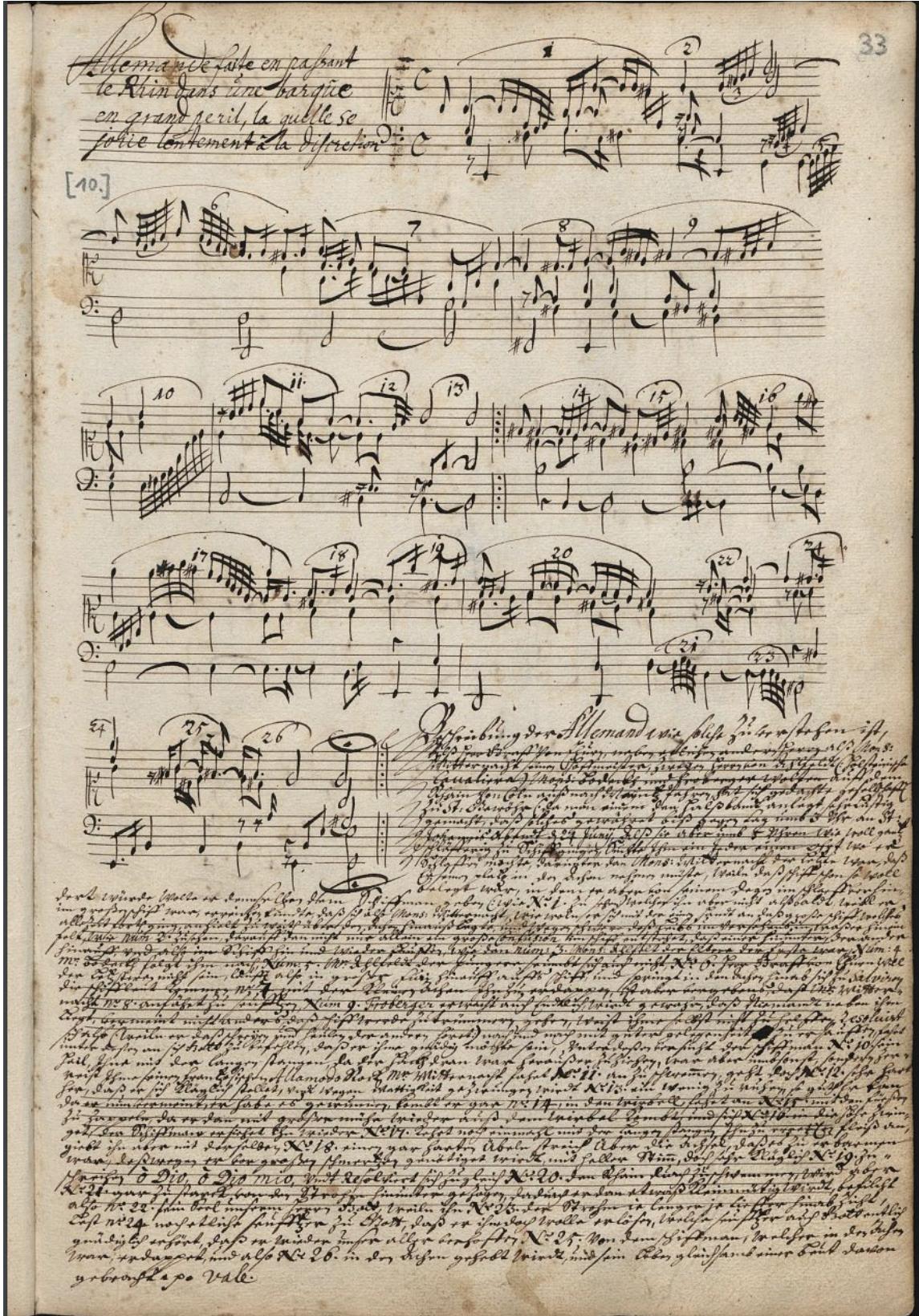
中文讲解
本段是图18的图注,提供了一幅手稿影像的版面位置信息:原图为本真复制版的手稿 SA4450,所对应的曲目为《Allemande faite en passant le Rhin》(“过莱茵河时所作的阿勒芒德舞曲”)。该图为图像占位符,原文明确把图注文字置于 P0042,图像本体未在文字中给出可读内容;按本段属性,仅需说明图注的功能——它标识出后续小节所要分析的对象(具体手稿与曲目名称),并提示读者在原书第20页可查阅复制图像。其余栏目的解读应留待下一段中音乐分析的展开。
补充说明
无额外补充。图注本身只承担标识功能,未提供谱例、调性或拍号等可分析的音乐细节;图像本体需在原书中查看,本输入中无可定位的进一步信息。
第2段(P0043)
原文复述
In this key, even the most conventional progressions present problems. In attempting to establish the tonic at the outset of the allemande, we run straight into the D-sharp within the first measure. The subsequent resolution arpeggiates E minor down into the lowest reaches of the keyboard, a Notenfall denoting Mitternacht’s descent into the Rhine. A shift to G major is marked by erratic bursts of quick-moving passages that mirror the sudden chaos that erupts on the ship in response to Mitternacht’s blunder. Finally a rescue skiff is launched, an event that completes a cadence in G in m. 2, followed by a hurried rowing through the water depicted by flowing sixteenth notes ending on D-natural over a G major bass. Still a distance away from the drowning Mitternacht in m. 3, the D-natural suddenly lurches up a semitone to the dreaded D-sharp in D-sharp diminished to depict Mitternacht’s groans in dotted rhythm, returning the music to E minor. This groaning finally awakens Froberger, whose E minor crisis moves straight through the discordant B major, with D-sharp in the left hand. A crew member, arriving with a hooked pole, cancels Froberger’s whining D-sharp in an ascending run up the scale, permitting a move to a more hopeful C major harmony and inspiring Mitternacht to begin swimming through the water, a strenuous activity that is painted by dotted rhythms. C major reveals itself to be VI in E minor, leading to a half cadence that may or may not be accompanied by a discordant B major triad, depending on which manuscript one follows. The main text of the Rampe edition suggests a half cadence in E minor. Overcome with the exhaustion of swimming through the Rhine and the meantone boundary, Mitternacht rests in a catatonic, third-less resolution onto an untonicized B.
中文讲解
本段是小节 S4.2 的核心段落,紧接 P0042 的图18图注,对前 3 小节及后续扩展部分进行叙事化的音乐分析,逐拍点明调性、和声、动机与故事动作之间的对应。
-
开篇的断言——“在这个调里,即便最常规的进行也会出问题”——统领全段:在 e 小调中,作者所“常规”的骨架本身就因升 D(D-sharp)而受扰。阿尔芒德舞曲第 1 小节就出现 D-sharp,使建立主音(establishing the tonic)变得困难;D-sharp 在此处作为 e 小调的升四级,制造与下属 G 大调或主和弦 E 小三度之间的尖锐冲突,被作者称为“令人恐惧”的音。
-
第 1 小节的解决(resolution)以 E 小调分解和弦自上而下落到键盘最低音区,这是一个典型的“诺滕法尔”(Notenfall,急速下行的音形),作者把它的叙事功能界定为米特纳赫特(Mitternacht)跌入莱茵河的坠落动作。Notenfall 既是巴洛克时期描绘“下落”的惯用修辞,又是键盘作品自高向低的力度感与音区感的统一载体,因此作者用它来同时承担“调性确立”与“叙事开端”两重功能。
-
转调至 G 大调(属调)被作者用来刻画船上对米特纳赫特失误的混乱反应;标记这一转调的,是“突发、零碎、快速”的经过句。G 大调在第 2 小节完成一个终止(cadence in G),这对应故事中“放下救援小艇”的事件。终止之后是“急促划水”的十六分音符流动(flowing sixteenth notes),最终落到 G 大调低音之上的 D 自然音(D-natural)。D 自然音在此暂时回避了 D-sharp 的麻烦,作者在叙事上把它解读为“救援小艇仍距落水的米特纳赫特有一段距离”——音高虽暂时安稳,故事并未结束。
-
第 3 小节,D 自然音突然半音上行回到 D-sharp,进入 D-sharp 减七和弦(D-sharp diminished),用附点节奏(dotted rhythm)刻画米特纳赫特的呻吟(groans),音乐被拉回 e 小调。这一处理是作者论证的关键:D-sharp 减七作为 e 小调的次属类变和弦,被嵌入了人物动作;附点节奏不是抽象的节拍选择,而是“呻吟”这一痛苦发声模式的拟声。
-
呻吟唤醒了弗罗贝格(Froberger),他的 e 小调“危机”直接穿越一个不协和的 B 大三和弦(discordant B major),D-sharp 出现在左手。B 大三和弦在 e 小调语境中并非自然和声选择,它通常出现在 D-sharp 减七解决至 E 时形成的“交关系”(cross-relation)或“新调性插段”里,作者将其作为“不协和”标记,强调此处和声之紧张。
-
救援船员带着带钩的杆(hooked pole)出现,把弗罗贝格那“哀号的 D-sharp”在一个上行音阶跑动(ascending run up the scale)中“取消”——也就是说,D-sharp 被音阶式的上行运动所消化、和缓,原文用 cancels 一词同时承担“和声解决”与“叙事止住呻吟”两义。这一上行又促成向较明亮的 C 大调的转移,被作者标记为“较有希望”的和声。C 大调对应米特纳赫特开始奋力游泳的场景,游泳用附点节奏(dotted rhythms)来描绘——附点节奏在此承担两种叙事:先前呻吟的痛苦发声,如今转为游泳的用力节拍。
-
C 大调随即被揭示为 e 小调的下中音(VI in E minor),因此看似新调性,实为 e 小调内部的功能和弦,这一段功能上和声学意义大于色彩意义。它引向一个半终止(half cadence)。作者强调:这一半终止是否伴随一个不协和的 B 大三和弦,取决于读者所依据的版本(which manuscript one follows),表明作者持的是版本比较立场:不同手稿在此处的和声细节不一致。
-
Rampe 版正文(main text of the Rampe edition)的主线是按 e 小调半终止来记写。这意味着作者在自己分析中默认的版本,其半终止停在 E 上,而非 B 上;但他也留出空间承认其它手稿可能加了 B 大三和弦。
-
段落以米特纳赫特“疲惫到近乎僵硬”的解决作结:the resolution is third-less(即不构成完整三和弦的第三音缺失解决),落在一个未被调性化(untonicized)的 B 上。这里的“untotonicized B”极为关键——B 既不是 e 小调的属(E 之属应为 B,但属和弦必含 D-sharp 或 G#),也不构成稳定调中心;它是一种悬而未决的停留(rest),与米特纳赫特“精疲力竭地瘫住”的叙事相一致。最后作者把这种和声上的“疲惫”归因于两层叠加的消耗——在莱茵河中游泳的体能消耗,以及跨越“meantone boundary”(中律全音律边界,即 D-sharp 这类在历史调律下音色极不稳定的音)所带来的和声张力——这是本段把音乐分析、人物动作与历史调律背景三者扣合的最高点。
整段论证的作用:在小节层面,作者先把“常规和声在本调中本就不常规”这一总命题(“In this key, even the most conventional progressions present problems”)落到第一小节的 D-sharp 上;然后以一条时间线(第 1–3 小节及之后)把每一个调性变化、和弦选择、节奏形态都贴上一个具体叙事事件,借此证明:弗罗贝格的《过莱茵河》不是抽象的练习曲,而是“音响—图像—叙事”三位一体的描绘性音乐。本段最容易误解之处在于:作者并不是在断言米特纳赫特“真的”发出附点节奏的呻吟,而是以音乐修辞(rhetorical figures)与叙事之间的对应作为分析的合法基础;同时,“discordant B major”并非绝对意义上的刺耳,而是相对于 e 小调语境被标为不协和,因此读者应理解“discordant”是相对功能和声的位置判断,而非绝对音响判断。
补充说明
本段内部存在若干前后照应值得厘清:(1) D-sharp 与 D-natural 的反复对峙(natural 上行半音至 sharp、sharp 又在音阶上行中被“取消”)是本小节的主导动机,应理解为贯穿阿尔芒德舞曲前段的统一声音—叙事双重主题;(2) “discordant B major” 在 e 小调中至少有两种可能的功能位置——作为 D-sharp 减七解决后的临时主调(B 大调含 D-sharp),或作为 e 小调半终止上的属和弦被特意变写——作者用“may or may not be accompanied”一句,把这种版本差异明确留给读者判断,不在段内下结论;(3) “untonicized B”与“third-less resolution”配合出现,意味着落音虽可读作 e 小调的属音 B,但缺少属七和弦应有的第三度(D-sharp)与七度(A),因此和声上并未真正确立 B 为调中心;(4) 附点节奏出现两次——先刻画呻吟,再刻画游泳——这提示作者认为同一节奏型可承担不同的叙事功能,取决于前后语境,这是本段把节奏—叙事匹配作为论证工具的关键依据。
脚注 / 边栏 / 图表 / 附加信息(如有)
本小节范围内的非正文附加材料仅有 P0042 一项,即“Figure 18: Manuscript SA4450 in facsimile, Allemande faite en passant le Rhin”的图注及其图像占位符。该图注标识出本小节分析对象为手稿 SA4450 的复制图像与《Allemande faite en passant le Rhin》一曲;图本体在文字中无可读内容,需在原书第20页查阅。脚注、边栏或额外表格在本节范围内未出现。
💡 本节核心要点
- e 小调中即便最常规的和声进行也会因 D-sharp 的出现而被扰动,这是全段的总命题,并在第 1 小节即被兑现。
- 第 1 小节以 E 小调分解和弦的下行 Notenfall 同时承担“建立主音”与“描绘米特纳赫特跌入莱茵河”两重功能,是音响—叙事的双重起点。
- 第 2 小节转至 G 大调(属调),用零碎快速的经过句刻画船上混乱,并以 G 上的终止对应“放下救援小艇”;十六分音符流动对应划水,落于 G 大调低音上的 D 自然音暗示“救援仍有一段距离”。
- 第 3 小节 D 自然音半音上行回到 D-sharp,进入 D-sharp 减七,附点节奏对应米特纳赫特的呻吟,把音乐拉回 e 小调——这是本段核心的动机—叙事节点。
- 不协和的 B 大三和弦与左手 D-sharp 标志弗罗贝格被唤醒后的“e 小调危机”;随后上行音阶跑动“取消”D-sharp,引出 C 大调;附点节奏在此被复用为游泳的拟声。
- C 大调实际是 e 小调的 VI,因此半终止究竟是否伴随 B 大三和弦,取决于手稿版本——Rampe 版正文按 e 小调半终止记写;段落以 third-less、untonicized 的 B 上停歇作结,把“人物疲惫”与“meantone boundary 的和声张力”两层叠加,作为本小节的高潮。
🔑 关键术语
- Notenfall:巴洛克时期常见的作曲修辞,指急速下行的音形或音阶片段;本节中以 E 小调分解和弦自高向低落到键盘最低音区的形式出现,被作者用作描绘米特纳赫特跌入莱茵河的“下落”动作,同时承担 e 小调主音的建立。
- D-sharp:在本段调性(e 小调)中作为升四级,是所谓“令人恐惧”的音;它与 D-natural 反复对峙,贯穿前段,构成音乐—叙事的核心动机;在历史性中律全音律(meantone)调律下音色尤为不稳定,构成本段所说的“meantone boundary”问题。
- Discordant B major:在 e 小调语境中被称为“不协和的”B 大三和弦;其不协和性是相对功能和声位置而言——它出现在 D-sharp 减七解决、半终止或弗罗贝格“危机”段落中,作者以此标记和声张力,并提示不同手稿对此和弦是否出现存在差异。
- VI in E minor / C major:C 大调被揭示为 e 小调的下中音和弦(VI),看似新调性,实为 e 小调内部功能和弦;它在叙事上承担“较为明亮的和声”,对应米特纳赫特开始游泳的动作。
- Half cadence:半终止;本段中以 e 小调半终止(Rampe 版正文主线)作为形式骨架,其和声外层是否带 B 大三和弦因手稿而异,作者把版本分歧明确留给读者。
- Untonicized B / third-less resolution:落在一个未被确立为调中心的 B 上,并且解决缺乏完整三和弦的第三度;这种悬而未决的停留与米特纳赫特“精疲力竭、几近僵硬”的叙事状态相一致,是作者把和声分析与人物动作直接挂钩的终点。
- Meantone boundary:中律全音律的调律边界,指 D-sharp 这类音在历史调律下音色极不稳定所带来的和声张力;作者用它解释米特纳赫特“跨越”莱茵河时的双重消耗——体能上的游泳与和声上的调律张力。
S4.3 [描述性拆分] Second Half: Whirlpool, Shoulder Injury, and Final Cadence
第1段(P0044)
原文复述
The second half of the binary form opens with Mitternacht caught in a whirlpool amid a now-explicit, highly discordant B major. Spinning over a B pedal, Froberger appears to take pleasure in the sour tuning of the D-sharp, flooding all voices with its presence in m. 5. At the end of that measure, a crew member once more cancels out Mitternacht’s D-sharps by playing a D-natural in the bass, and runs back with the hooked pole on the same C major (m. 6). This attempt to hook and reel Mitternacht in goes wrong at Notenfall 18, causing a shoulder injury that makes him cry out in wide and sometimes dissonant melodic leaps. Nonetheless, this spurs Mitternacht to resume swimming at the start of m. 7, this time pointedly on a D-natural in flowing sixteenth notes, reflecting his resolve, according to Notenfall 20. As Mitternacht begins to sink and lose hope (as previously discussed), the music drifts sharpward toward the wolf boundary through angular, diminished sonorities, eventually crying out to God by lurching upward from D-natural to D-sharp. This cry resolves into the first forthright statement of E minor since the double bar, in preparation for a final cadence. Moving once more through the discordant, beating B major dominant, Mitternacht is finally reached by a crewman and hoisted onto the ship for the final cadence. Unlike the end of the first half, Mitternacht has actually attained peace here, safely aboard on a rich, concordant Picardy third.
中文讲解
本段以时间顺序讲述二段体第二半部分所对应的叙事与音乐事件,是本节论述的核心段落。
-
开场的语义反转:第一半部分中 B 大调尚处于隐伏状态,而此处变为 “now-explicit”(已显性化)且 “highly discordant”(高度不协和),配以 B 持续音与第 5 小节所有声部涌入 D-sharp,刻画 Mitternacht(落水者)被卷入漩涡。这一处理借助了纯律/平均律下 D# 在 B 大调属功能上的 “走音” 特性,作者用 “sour tuning”(酸涩的调律)一语双关,既指调律系统问题,也指戏剧张力。
-
救援循环的重复与升级:第 6 小节船员的介入——以 D-natural 抵消 D-sharp,再用挂钩杆回到同一 C 大调——是第一半部分中救援动机的再现,但 “comes running again”(再次跑来)说明救援已成循环动作。Notenfall 18 是本节特有的事件编号,肩部受伤导致 “wide and sometimes dissonant melodic jumps”(宽幅、有时不协和的旋律跳进),这是本节新引入的叙事节点,标志着循环救援的失败。
-
D-natural 的双重身份:第 7 小节 Mitternacht 在 D-natural 上以十六分音符重新游泳,被作者视为 “resolve”(决心)的反映。这一处 D-natural 表面属 “船上一方”,却用来描绘 Mitternacht 本人,揭示出 D-natural 与 D-sharp 的二分并非简单人物二分,而要视上下文与戏剧位置而定(这一限定 P0045 将进一步澄清)。
-
向狼音边界的尖锐化:Mitternacht 下沉与绝望时,音乐 “sharpward”(向升号方向)推进,配合 “angular, diminished sonorities”(棱角分明的减七音响),逼近 wolf boundary(狼音边界)——平均律系统中 D# 在 B 大调下产生的极端不协和音程区间。最终的 “cry to God” 以从 D-natural 跳至 D-sharp 完成,这一音高动作本身即是 “祈祷” 的音乐化表达。
-
终止的对比:自 double bar(双纵线)以来首次明确陈述 E 小调,标志情势逆转;再次穿过 B 大调属音这一 “beating”(脉动/拍击)的不协和音区,Mitternacht 终于被船员拉上船。与第一半部分终止处相比,此处是 “actually reached peace”(真正得到平静),借助 “rich, concordant Picardy third”(丰满协和的皮卡第三度)完成——皮卡第三度即小调终止时将三音升高为大三度,作者以此象征 Mitternacht 安全归船后的最终释怀。
本段在整节中的功能:以线性叙事浓缩第二半部分的全部关键事件,把调律(D#走音)、和声(B 大调属功能、减七和弦、E 小调转调)、旋法(宽跳进、十六分音符流动)与戏剧(漩涡、受伤、祈祷、得救)一一对应,为 P0045 的综合总结提供具体素材。
补充说明
本段内部可定位的补充:
- “double bar”(双纵线)是二段体两个半部分之间的结构分隔,提示第一半部分中曾陈述过 E 小调,但不够 “forthright”(明确),故此处强调 “since the double bar”。
- “Notenfall 18” 与 “Notenfall 20” 是 Froberger 程序中编号的具体事件,作者借此精确锚定肩部受伤与恢复游泳两处情节。
- “selfsame C major” 暗示挂钩杆/救援的音型材料是循环再现的固定乐思,与本段 “comes running again” 互相印证。
- “beating B major dominant” 中 “beating” 指不协和音程在平均律下的拍频/脉动现象,与后文 “wolf boundary” 在调律维度上呼应,是本节技术语汇的两端。
第2段(P0045)
原文复述
The discordance contours of the allemande make it clear that appearances of D-sharp cluster around moments of high stress and drama for the imperiled Mitternacht in Froberger’s program, while D-natural is used to depict events involving those aboard the ship (with the exception of Froberger himself, who still seems to be sorting through the situation). Although many Notenfälle linked to Mitternacht’s troubles are emphasized with diminished triads, a reading that turns an ear toward meantone uncovers crucial moments where a harmonically stable B major refuses to cooperate in the dimension of tuning. This is most apparent heading into the second half of the allemande, where the final Picardy third of the first section (if one accepts its existence) launches a protracted reveling in the mistuned D-sharp to mirror Mitternacht’s thrashing within the twisting waters of a whirlpool. A severe meantone tuning, alternating between stretches of complete concordance in D-natural and harsh discordance in D-sharp, is integral to and intensifies Froberger’s program.
中文讲解
本段是对整首阿勒芒德(allemande)不协和轮廓的综合性收束,把第二半部分中的具体事件抽象为全曲层面的一般规律。
-
D# 与 D♮ 的语义分工:D-sharp 集中在 Mitternacht 危险、戏剧性强的时刻;D-natural 则描绘船上人员的动作。作者明确加了一条例外——Froberger 本人处于 “sorting through the situation”(梳理局势)的过渡状态,因此其指代并不简单归属。这正是 P0044 第 7 小节 D-natural 上 Mitternacht 重新游泳为何依然合理的关键:D-natural 是救生一方的语汇,但 Froberger 通过指法/对位让 Mitternacht 进入该语汇,从而表达 “决心” 与 “向救生一方靠拢” 的混合意图。
-
三重分析层次:第一层是音高(D# / D♮);第二层是和声功能(减七和弦——前文已建立);第三层是 “turns an ear towards meantone”(把耳朵转向平均律/纯律)所揭示的调律层面。本段的关键论点是:即使在和声上稳定(如 B 大调),在调律维度上也会 “refuse to cooperate”(拒绝合作)。这是一种 “自下而上” 的阅读方式,要求读者不要假设等程律下的纯净音高,而要考虑纯律下特定音程的尖锐程度。
-
第一半皮卡第三的因果作用:作者用括号 “if one accepts its existence”(如果你接受它存在的话)作为方法论上的谨慎——其分析主张是:第一半部分终止处的皮卡第三 “launches”(启动/抛出)了第二半部分 D-sharp 的长时间沉溺。它不仅是一个结束,更是漩涡的导火索。这一因果链把全曲视为一个前后呼应的整体,而非两个独立半部分。
-
调律即修辞:结尾句把 “severe meantone tuning”(严苛的纯律调律)与 D-natural 的完全协和、D-sharp 的尖锐不协和之间的交替,提升为 “integral to and intensifies Froberger’s program”(Froberger 程序的有机组成部分并强化其戏剧)——这是本节最高一级的论点:调律系统的选择不是中性背景,而是修辞资源。
本段在整节中的功能:作为收束句,把时间线性的叙事(P0044)转化为系统性的论断,让读者带着一种 “调律即意义” 的视角去重读整首阿勒芒德。
补充说明
本段内部可定位的补充:
- “the exception of Froberger himself” 与 P0044 中对 D-natural 上 “resolve” 的描绘形成直接呼应,解释了为何 Mitternacht 在 D-natural 上的 “决心” 被归入救生一方的语义场却不显得矛盾。
- “if one accepts its existence” 这一括号限定反映了作者对前文诠释(第一半部分终止是否存在皮卡第三)的让步语气——作者主动提示这一推断是条件性的。
- “a reading that turns an ear towards meantone” 是本节的方法论旗帜:分析必须考虑调律维度而非仅看音高名,这是把传统和声分析扩展到调律分析的关键措辞。
脚注 / 边栏 / 图表 / 附加信息(如有)
本小节无脚注、图表或边栏等附加材料,所有论证均直接嵌入正文段落之中;小节标题中的 “[描述性拆分]” 为章节拆分的元标记,不构成正文主张。
💡 本节核心要点
- 第二半部分以 “now-explicit” 的 B 大调开始,B 持续音与 D-sharp 的 “sour tuning”(走音调律)共同刻画 Mitternacht 身陷漩涡的紧张情境,完成了第一半部分中隐伏 B 大调的语义显性化。
- 船员救援的循环动作(D-natural 抵消 D-sharp、挂钩杆回到同一 C 大调)反复出现,但在 Notenfall 18 引发肩部受伤,形成宽幅不协和跳进,标志着循环救援的失败与新叙事节点的引入。
- D-natural 在本节中具有双重身份:既属船上救援一方(D-natural 描绘船上事件),又被 Mitternacht 在 m. 7(Notenfall 20)的十六分音符游泳动作借用,以表达 “决心”——这是 P0045 中 “Froberger 例外” 原则的具体体现。
- Mitternacht 下沉时音乐向 wolf boundary(狼音边界)推进,以减七和弦与 D-natural 到 D-sharp 的跳进模拟对神的呼号,并以首次明确的 E 小调陈述实现情势转折。
- 最终终止借助 B 大调属音的 “beating” 不协和与 Picardy third(皮卡第三度)完成,象征 Mitternacht 安全归船后真正的平静——与第一半部分的终止形成明确对比。
- 整首阿勒芒德的总结:D-sharp 聚集于 Mitternacht 的危险时刻、D-natural 描绘船上事件、严苛的纯律调律在协和与不协和之间的交替是 Froberger 程序的有机组成部分,并强化其戏剧张力——调律即修辞是本节的最高论点。
🔑 关键术语
- binary form:二段体,是本节所讨论阿勒芒德乐曲的整体结构;由两个半部分组成,作者在第二半部分中追踪 Mitternacht 的最终命运,并以前后对比凸显本半部分的真正平静。
- B major / B pedal:B 大调及其持续音,是第二半部分开场的和声背景;它在第一半部分中尚处隐伏,至本节变为 “now-explicit, highly discordant”,承载漩涡场景的不协和张力。
- D-sharp / D-natural:升 D 与还原 D 是本节的核心语义对立:D-sharp 集中于 Mitternacht 的紧张/危险时刻;D-natural 描绘船上救援事件(Froberger 本人为例外),并被 Mitternacht 在 m. 7 借用以表达决心。
- Notenfall / Notenfälle:Froberger 程序中以编号标记的具体音乐/叙事事件,如本节出现的 Notenfall 18(肩部受伤)与 Notenfall 20(重新游泳)。
- wolf boundary:狼音边界,指纯律/平均律调律下 D-sharp 在 B 大调属功能上产生的极端不协和音程区间;作者借这一调律现象刻画 Mitternacht 下沉与绝望时的尖锐化音响。
- meantone tuning:纯律调律,作者强调应 “turn an ear toward meantone”(将耳朵转向该调律维度),以揭示和声稳定(如 B 大调)在调律维度上的 “不合作”。
- diminished triads:减三和弦,作者指出许多 Mitternacht 困境的 Notenfälle 以其强调,但需结合调律维度才能看到 B 大调 “拒绝合作” 的更深层不协和。
- Picardy third:皮卡第三度,小调终止时将三音升高为大三度的做法;本节中第一半部分末(作者以 “if one accepts its existence” 加以谨慎)与第二半部分终止处的皮卡第三度构成全曲的关键呼应与最终平静的标志。
- double bar:双纵线,是二段体两个半部分之间的结构分隔;本节中作者用 “since the double bar” 指代自第一半部分结束以来首次明确陈述 E 小调的位置。
- allemande:阿勒芒德,本节讨论的曲体名称;P0045 把它作为整首作品不协和轮廓综合分析的对象,并由此提出 “调律即修辞” 的总论点。
S4.4 [描述性拆分] Performance Recommendations and Ragossnig’s Recording
第1段(P0046)
原文复述
It is my view that any attempt to ameliorate or fix the D-sharp through a modified tuning ought to be discouraged in the context of this allemande. Turning to the other dance movements of the suite, however, D-sharp is used almost indiscriminately, in contrast to its careful treatment in the allemande itself. This disparity has led performer-scholars such as Masumi Yamamoto to devise creative strategies that preserve the discordance of the allemande while circumventing it in the subsequent dances; Yamamoto proposes using a harpsichord with two choirs tuned independently, one with an E-flat and the other with a D-sharp, thereby allowing the performer to choose a tuning without retuning during performance. Although I understand Yamamoto’s trepidation about the harsh B major, I do not share her concern that a discordant dominant can disrupt the musical logic or rhetoric of a passage of music. On the contrary, a beating dominant can bring out the settled quality of a concordant tonic by aligning with the directed motion of dissonance resolution from unstable to stable—a peculiarity unique in meantone tuning to the key of E minor. To fix the tuning of D-sharp would strip E minor of one of its defining characteristics by causing it to behave like A minor or G minor. Mitternacht’s struggle is therefore staged not only through Froberger’s allemande but also by the key characteristics of E minor itself. Unfortunately, almost all easily available recordings either employ at least some measures to ameliorate the howl of the D-sharp or use recording methods that are unable to capture the nuances of temperament. The latter is the case with Thomas Ragossnig’s performance, which, if we are to trust the recorded audio, seems to use some sort of modified meantone. Although it is somewhat hard to discern, the D-sharp does register as discordant, especially when presented within B major in cadences to a concordant E minor—a welcome addition to an overall frenetic and active performance that signals an intimate familiarity with the program of the allemande. Nonetheless, although Ragossnig appears to acknowledge the pungent flavor of B major by lingering slightly on its appearances, I do not think his treatment differentiates these discordant moments from other arrivals, which also employ phrase-lengthening techniques. Accessing a different register of expression by listening to the temperament, either through altering timing or articulation, can lend a
中文讲解
本段是本小节的核心论证段,承担三重功能:阐明作者立场、回应Yamamoto方案、评估Ragossnig录音。
第一,关于D-sharp本身。作者明确反对通过改调来美化D-sharp,理由不是教条,而是meantone调律下的音乐修辞逻辑:在该调律下,E小调的属和弦(B大调)因含有D-sharp而产生拍频,形成所谓"不协和属和弦"(discordant/beating dominant)。作者主张这种不稳定性并非缺陷,反而通过"从不稳定到稳定"的有方向运动,反衬出解决到协和主和弦(E小调)时的安定感。亦即,D-sharp的"嚎叫"是E小调调性特质的一部分,一旦被"改掉",E小调就会表现得像A小调或G小调那样失去个性。
第二,与Yamamoto方案的分歧。Yamamoto的双键盘琴(两组琴弦分别调成E-flat与D-sharp)方案属于"工程妥协":保留阿勒曼德的不协和,但在后续舞曲中绕开它。作者承认Yamamoto对B大调刺耳感的顾虑,但拒绝其隐含前提——即不协和属和弦会破坏音乐逻辑或修辞。作者反过来主张,不协和属和弦恰恰能"烘托"协和主和弦的到来,因此Yamamoto方案的实质是用回避换得了表面的整齐。
第三,对Ragossnig录音的评估。Ragossnig似乎采用了某种"改良的meantone",D-sharp在B大调到E小调的终止式中仍可辨认为不协和,作者肯定其保留"嚎叫"并将其视为熟悉阿勒曼德program(“午夜"Mitternacht主题)的证据。但作者同时指出,Ragossnig虽在B大调出现处略有停留,却没有以专门的时值或奏法去"标记"这些不协和时刻——它们与该演奏对其他终止的"乐汇延长”(phrase-lengthening)处理并无明显区分。
第四,论证结构上的意义。作者把"Mitternacht的挣扎"这一程序性主题同时锚定在两个层面:一是Froberger的阿勒曼德作曲选择,二是E小调这一调性本身在meantone下的特征——前者是作曲层面的编码,后者是调律层面的编码,两者并非冗余,而是同一主题的两种实现。段末以"聆听调律"(通过调整时值或articulation)作引子,为下文关于紧迫感的进一步建议留出空间。
补充说明
本段术语关系:B大调在正文中被反复刻画为E小调的属和弦(见’cadences to a concordant E minor’及’pungent flavor of B major’),其不协和来自其中的D-sharp;Yamamoto方案中’E-flat与D-sharp’两组独立琴弦的对照,正是本段’D-sharp被固定后E小调便与A小调或G小调无异’这一论断的具体对应。
第2段(P0047)
原文复述
Footnote 74: Yamamoto, “The Use of Meantone Temperament in the Performance of Keyboard Music by Johann Jacob Froberger,” page 81.
中文讲解
本条为脚注74,对应P0046正文中Yamamoto方案(双键盘琴、E-flat与D-sharp分别调两组琴弦)的具体建议。给出文献题目《Yamamoto〈在演奏Johann Jacob Froberger键盘音乐中使用meantone调律〉》及出处页码81。其功能是为作者所引述的Yamamoto具体建议提供文献来源,使读者可向上溯源核验该方案的原始语境。
第3段(P0048)
原文复述
Footnote 75: Thomas Ragossnig, “JOHANN JACOB FROBERGER (1616–1667): Allemande, FbWV 627/1,” 5 January 2018, https://www.youtube.com/watch?v=xu_gcBXbMek.
中文讲解
本条为脚注75,是P0046正文中评估的Ragossnig演奏版本的信息来源。给出演奏家姓名(Thomas Ragossnig)、作品编号(FbWV 627/1,对应Froberger的该首阿勒曼德)、上传日期(2018年1月5日)以及YouTube链接。其功能是为作者关于该录音所采用调律(某种"改良的meantone")与D-sharp听感的判断提供读者可自行核验的原始资料。
第4段(P0049)
原文复述
greater degree of urgency to a performance that already deals successfully in narrating the program.
中文讲解
本段并非独立段落,而是P0046末句的跨段收尾,因此体量极小。它与P0046中"Accessing a different register of expression by listening to the temperament, either through altering timing or articulation, can lend a"在句法上相连,完整语义为:通过"聆听调律"——即调整时值或articulation——可以在已经成功讲述program(阿勒曼德的"午夜"叙事)的表演基础上,注入更高程度的紧迫感。作者在此先肯定Ragossnig的演奏已成功"讲述了主题",再指出"聆听调律"仍有提升紧迫感的余地,是对前段评估的总结与过渡。
脚注 / 边栏 / 图表 / 附加信息(如有)
本节内的非正文附加材料仅有两处脚注:脚注74(Yamamoto《The Use of Meantone Temperament in the Performance of Keyboard Music by Johann Jacob Froberger》,第81页)为正文Yamamoto双键盘琴方案提供文献支撑;脚注75(Ragossnig 2018年1月5日上传的YouTube录音,FbWV 627/1)为作者对该录音调律与D-sharp听感的判断提供可核验的原始来源。本节无图表、乐谱或边栏。
💡 本节核心要点
- 作者主张不应在本首阿勒曼德中通过改调来美化D-sharp:在meantone调律下,D-sharp的"嚎叫"不是缺陷,而是E小调调性特质的一部分。
- 作者论证E小调的B大调属和弦因含D-sharp而形成"不协和/拍频属和弦",这种不稳定性通过"从不稳定到稳定"的有方向运动反衬出解决到协和主和弦的安定感,此现象在meantone下为E小调所独有。
- 作者拒绝Yamamoto的双键盘琴方案:保留阿勒曼德的不协和却在后续舞曲中规避它,会使E小调失去区别于A小调或G小调的个性。
- 作者把"Mitternacht(午夜)的挣扎"同时锚定在作曲选择(Froberger的阿勒曼德)与调律层面(E小调在meantone下的调性特征)两个维度。
- Ragossnig的录音保留了D-sharp的不协和(属某种改良meantone),并表现出对阿勒曼德program的熟悉,但其处理未把B大调的不协和时刻与对其他终止的"乐汇延长"明显区分开。
- 作者建议通过"聆听调律"——调整时值或articulation——为表演注入更高程度的紧迫感。
🔑 关键术语
- meantone tuning(meantone调律):一种键盘调律系统,其中D-sharp与E-flat作为不同音高存在,但某些调性中的属和弦会产生可听拍频;在本节中正是E小调的B大调属和弦因D-sharp而发出"嚎叫"。
- discordant/beating dominant(不协和属和弦/拍频属和弦):由于调律而在属和弦上产生明显拍频的和弦,本节特指E小调的B大调属和弦;作者主张它通过"从不稳定到稳定"的有方向运动,反衬出解决到协和主和弦的安定感。
- concordant tonic(协和主和弦):本节中指E小调的主和弦,与"拍频属和弦"相对;作者主张属和弦的不协和反而加强主和弦的协和感。
- double-choir harpsichord(双键盘琴/双琴弦组大键琴):Yamamoto提出的方案:在大键琴上设两组独立调律的琴弦(一组E-flat、一组D-sharp),使演奏者可在不重新调律的情况下选择具体音高;本节作者对此方案持否定态度。
- howl of the D-sharp(D-sharp的嚎叫):D-sharp在meantone调律下加入属和弦时产生的刺耳拍频/啸声;本节作者将其视为E小调的标志,而非需被掩盖的瑕疵。
- Mitternacht(午夜):德语"午夜",是本首阿勒曼德的程序性主题;作者认为该主题的"挣扎"同时通过Froberger的作曲选择与E小调本身的调性特征得以实现。
- key characteristics(调性特征):本节中指某一调式因音阶内音高(尤其是升降号)所获得的独特表情;E小调的"特征"在meantone调律下部分由D-sharp的不协和所定义。
- phrase-lengthening(乐汇延长):演奏中将某一乐汇时值拉长的处理手法;本节中作者借此指出Ragossnig虽在B大调出现处略有停留,但与对其他终止的处理方式无明显区分。
S5.1 [描述性拆分] Manuscript Sources, Key Signature, and Tuning Significance of the Opening
第1段(P0050)
原文复述
Lamentation in F Minor, FbWV 633
中文讲解
这是该小节的标题,标示本节将要讨论的作品:F小调哀歌,Froberger作品编号FbWV 633。该标题点明了作品的基本属性——体裁为"哀歌"(Lamentation),调性初步被认定为F小调,但小节副标题已暗示作者将进一步质疑这一调性归属。从"描述性拆分"的小节名称可以看出,本节聚焦于作品的乐谱来源、调号以及开头的调律意义这几个描述性维度,为后续的音乐分析提供材料。
补充说明
FbWV是Froberger Werke Verzeichnis的缩写,即Froberger作品目录编号。
第2段(P0051)
原文复述
The Lamentation FbWV 633, entitled Lamentation faîte sur la mort tres douloureuse de sa majésté Imperiale Ferdinand le troisième; et se joüe lentemente avec discretion, again takes mourning as a central program, this time in reaction to Emperor Ferdinand III’s very painful death in 1657. The piece is formally unusual in that it contains three reprises rather than two. The musical text comes from two manuscripts, WMin 743 and SA 4450, which seem to disagree on the key signature of the piece. WMin 743 gives two flats, while SA 4450 gives one; this has caused performers to refer to the lamentation interchangeably as both F major and F minor. This confusion in identifying a stable modern key is due to a feature of the piece that is presented front and center: opening with a flourish in F, the right hand sounds the third twice, first A-natural and then A-flat, presenting both the major and minor triad. This major-minor alternation appears both in WMin 743 and SA 4450. Unfortunately, to make matters worse, Guido Adler, in DTÖ, decides that the first A-natural is a typo and fixes Froberger’s opening gambit to be completely in F minor. This correction is reversed in editions by Schott, Rampe, and Wollny. Regardless of who is “correct,” I will point out that while these alterations seem negligible from a harmonic perspective, they are very significant from a tuning perspective, in that F minor contains A-flat, a wolf tone, while F major does not; Adler’s correction begins the piece with the howl of the wolf front and center, sounding A-flat tuned as G-sharp above F. By taking a tuning perspective attending to the wolf tones of A-flat and D-flat, tuned as G-sharp and C-sharp respectively in the normal disposition of meantone, the rhetorical conceit of the lamento is not so much an alternation between the major and minor colors, but rather a tumultuous drama that
中文讲解
本段是这一小节的核心论述,需要分层解读。
第一层:作品的背景与体裁。作品原标题为法语"Lamentation faîte sur la mort tres douloureuse de sa majésté Imperiale Ferdinand le troisième; et se joüe lentemente avec discretion"(为神圣罗马帝国皇帝斐迪南三世极痛之死所作的哀歌;演奏时需缓慢而审慎),延续了Froberger以哀悼作为核心写作程式的传统,这次是为1657年去世的皇帝斐迪南三世而作。
第二层:形式上的反常。该曲含三段再现部(reprises),而非常规的两段,这是一个形式上的异常特征。
第三层:乐谱来源与调号分歧。乐谱文本来自两份手稿——WMin 743和SA 4450——二者在调号上彼此不一致:WMin 743给出两个降号(暗示F大调或D小调),SA 4450给出一个降号(暗示F大调或D小调的不同解释)。由于手稿记谱的不同,演奏者将这首哀歌时而称为F大调、时而称为F小调,调性归属模糊。
第四层:调性模糊的根源——大调-小调交替。作品开篇即以F音作为装饰性起始,右手先后两次奏出三度音:先是A自然音(构成F大调三和弦),再是A降音(构成F小调三和弦),明确并置呈现大小调三和弦。这种大小调交替在两份手稿中都出现,因此并非手稿传抄的偶然差异,而是作曲家的有意安排。
第五层:版本争议的关键插曲。Guido Adler在DTÖ(奥地利国家音乐文献总谱)编辑中将第一个A自然音判为抄写错误(typo),从而将开头固定为完全在F小调中。这一校订在后来Schott、Rampe与Wollny的版本中被反转。
第六层:调律视角的提出——本段的论证重点。作者强调,撇开"谁更正确"的争论不论,从和声角度看大小调的差异似乎可以忽略,但从调律角度看却意义重大:F小调中的A降音在中庸全音律(meantone)的常规布局下是一个"狼音程"(wolf tone);而F大调中并不包含这种问题音程。Adler的校订意味着作品一开始就以A降音——在中庸全音律下被调成F上方的升G——这"狼的嚎叫"赫然在耳地呈现出来。
第七层:论证转向。透过关注A降音(被调成升G)和D降音(被调成升C)这两个中庸全音律常规布局下的狼音程,作者提出本段的修辞性构思(rhetorical conceit)并非仅仅是大小调色彩的交替,而是一个贯穿全曲的动荡戏剧——这一戏剧将通过对终止式期待(cadential expectations)的完成或回避,来"消除"(eliminate)A降音与D降音这两个狼音程。
关键术语与原文的精确对应:原句中的"howl of the wolf"(狼的嚎叫)是作者用拟声方式形象地描述中庸全音律中狼音程刺耳、难以协调的音响特征;“front and center"则强调该音程在Adler版本中被前置并突出的位置。“rhetorical conceit"是文艺批评术语,指一种精心设计的修辞构思或艺术策略,此处特指哀歌体裁背后的音乐修辞构想。
补充说明
WMin 743与SA 4450均为手稿编号简写,WMin常指Wiedemann Manuscript(藏于柏林国立图书馆),SA可能指Sach或类似收藏,本节未展开。“Reprise"在早期键盘音乐中指乐曲内部具有返回性质或重复主题的部分,并不等同于现代奏鸣曲式中的再现部。“Normal disposition of meantone”(中庸全音律常规布局)特指以C到升C为狼音程区域的常见调律方案。
第3段(P0052)
原文复述
eliminates the wolf of A-flat and D-flat by controlling cadential expectations, evaded or completed, throughout the piece.
中文讲解
本段是P0051未完句的收尾,完成了一个完整的论证主张。作者最终结论是:Froberger的哀歌所体现的修辞构思,并非表面上的大小调色彩对比,而是作曲家通过全曲中对终止式期待(cadential expectations)的"完成”(completed)或"回避”(evaded),来逐步消解(eliminates)A降音与D降音这两个狼音程在听觉中的尖锐性。
“完成或回避终止式期待"这一表述揭示了作曲家如何在中庸全音律的约束下进行创作:当和声走向预期会触发含狼音程的和弦时,作曲家通过转向或延迟终止来规避这一刺耳音响;而当终止完成时,则可能以更可接受的、远离狼音程的和弦收束。如此,大小调交替并非孤立的开头装饰,而是贯穿全曲的、对狼音程系统性处理的一部分。
注意本句末尾以"that"引导的从句实际上是一个由"the rhetorical conceit… is…“展开的表语从句,跨越P0051与P0052两段边界,因此本段不可独立理解,必须与前段共同构成一个完整主张。这是作者小节论证的最终落点:由"描述性的乐谱与调号事实"上升到"调律-修辞的解读框架”,为后续分析奠定基础。
💡 本节核心要点
🔑 关键术语
- Reprise:早期键盘乐曲中具有返回或重复性质的部分,本节指作品内部的主题再现区;本曲反常地含有三段reprise而非通常的两段。
- Key signature / 调号:乐谱开头的升降号记号,决定全曲的基本调性。本节两份手稿调号不同(两降vs一降),是作品调性模糊的乐谱学根源。
- Wolf tone / 狼音程:中庸全音律中由于纯五度无法在所有音程上均匀分配而产生的极不协和音程,在"常规布局"下位于升F-升G(及其八度转移)附近;本节特指A降音(被调成F上方的升G)与D降音(被调成升C)。
- Meantone temperament / 中庸全音律:巴洛克时期常用的键盘调律法,旨在使三度音程尽可能纯净;其代价是某些增四度/减五度(狼音程)变得刺耳。本节"normal disposition"指以C-升C为狼音区域的常见调律安排。
- Rhetorical conceit:文艺批评与音乐修辞学中的术语,指艺术家围绕某一观念精心设计的艺术构思;本节特指哀歌体裁背后关于狼音程处理的音乐修辞策略。
- Cadential expectations / 终止式期待:听众根据和声进行对终止点和终止和弦产生的预期;本节指作曲家通过"完成"或"回避"这些期待,来控制狼音程何时出现或被绕开。
- Typo (Adler’s correction):指Guido Adler在DTÖ编辑中将开头的A自然音判定为抄写错误,从而将作品开头强制解释为F小调;此校订后被多个现代版本反转。
S5.2 [描述性拆分] First Section: Introduction of Both Wolf Tones and Returns to F Minor
第1段(P0053)
原文复述
As previously discussed, the lamentation opens with an introductory flourish that presents a concordant F major and immediately follows it with a discordant F minor, because of its A-flat tuned as G-sharp. By the beginning of m. 2, a decision is made in favor of F minor; this tonal center is confirmed by a bass motive that moves through the howling D-flat. In an attempt to dispel D-flat and return to the concordant F major, the music repeats the opening gesture in B-flat, presenting a concordant B-flat major, but then again followed by its howling minor variant, B-flat minor. At this point, in only three measures of music, both relevant wolf tones have already been introduced as diatonic members within the particularly problematic key of F minor. F major and B-flat major triads now seem like concordant colors of the past, a recognition that launches a gargantuan effort by the music to pull itself out of the discordant F minor and back into the concordant F major. This difficulty may be related back to the programmatic title, as a reflection of the emotional trials Ferdinand faces on his deathbed. The music proceeds to confirm the howling key of F minor, passing again through D-flat in m. 4 and landing on a dominant C major in m. 5. In an effort to fight the impending F minor, the music stalls, dropping down in the right hand to E-flat and recontextualizing it as a seventh pointing sharpwards toward B-flat major—a key area that would eradicate both D-flat and A-flat wolves. This strategy proves too ambitious, permitting a deception back onto an F minor triad above what would have been an F dominant pedal. A compromise is reached by cadencing in C minor at m. 7, away from D-flat but still with the A-flat wolf near. An attempt to move into B-flat by recontextualizing E-flat as a seventh is finally successful, landing squarely on a B-flat triad in m. 8. From there, the music moves increasingly sharpward away from the wolf, attempting to establish D minor. This optimistic…
中文讲解
本段是本小节分析的主体,承担两个相互交织的论证任务:其一,揭示引子材料的结构功能,即“协和—不协和”的配对句式如何在三小节之内把两只狼音双双引入 F 小调的调性体系;其二,借由调性挣扎的描写,把和声层面的逃离与回归对应到费迪南德临终的情感挣扎,从而将技术分析与标题音乐解读缝合在一起。
就第一层而言,作者精确描述了 m. 1 的引子:F 大三和弦随后紧接 F 小三和弦——后者之所以“不协和”,是因为其中的 A♭ 在该律制下被调成升 G,使小三和弦的上方音与下方音之间产生狼音效果。m. 2 中,低声部动机穿过 D♭,由此宣告 F 小调正式确立为调中心。随后音乐立即在 B♭ 上复制同一手势(B♭ 大三和弦紧接 B♭ 小三和弦),结果在三小节之内就把 A♭ 与 D♭ 两只狼音同时以调内成员身份引入 F 小调语境。一旦这两只狼音以自然音形式存在于 F 小调中,原本在前面被视为协和的 F 大与 B♭ 大便“成了过去的色彩”,由此开启了一场宏大的逃离工程:把音乐从 F 小调拉回 F 大调。
就第二层而言,作者以“this difficulty”把前述调性挣扎回扣到标题音乐:费迪南德临终时所承受的情感折磨被映射为音乐试图挣脱狼音却屡遭挫败的过程。这一句的功能不是修辞性的,而是把后文每一步逃离与失败都预设为“可被双重解读”的事件——既是和声事件,又是叙事事件。
随后作者进入逐小节的和声轨迹:m. 4 再经过 D♭,于 m. 5 落在 C 大调属和弦上,本可顺势解决到 F 小调;为避免这一结局,右手下落到 E♭ 并把它当作七音,意图经 B♭ 大调同时消灭两只狼音——但策略过激,被“欺骗”回到 F 小三和弦之上,原本应为 F 属持续低音。退而求其次,m. 7 妥协到 C 小调终止,远离 D♭ 但仍靠近 A♭ 狼音。最后再以 E♭ 为七音进入 B♭ 大三和弦,于 m. 8 站稳脚跟,开始向升号方向步步推进,尝试建立 D 小调,以“一段乐观的逃离”作结,并自然地引出 P0054 的转折。
阅读时需要注意:“howling”(嚎叫)一词贯穿全段,是作者为狼音赋予的拟人化修辞,含义等同于“被狼音染色的刺耳音响”;“sharpwards”指调性向更含升号的方向移动,也就是向远离 D♭、A♭ 的方向移动,逻辑上与“逃离狼音”一致。
补充说明
本段有两处值得读者特别留意的内部照应:(1)“repeat the opening gesture in B-flat”是后面“desperate attempt to escape through E-flat-as-seventh”的伏笔,因为这两处都依赖“借用相邻大调的七音”这一同一种和声策略;(2)m. 5 的 C 大调属和弦与 m. 7 的 C 小调终止构成一对“同音列不同式”的停顿,它们的协和度差异(C 大调相对更明亮)是作者用“compromise(妥协)”一词的和声依据。此外,“wolf tones”作为本节核心术语,作者此前已建立定义,本段并未重新说明,读者应将其理解为 A♭(调成升 G)与 D♭ 这两个在该律制/调律下与相邻音形成粗糙拍频或分裂音程的音高;此处的“concordant/discordant”是相对且功能性的判断,不是绝对音程分类。
第2段(P0054)
原文复述
This optimistic escape is swiftly denied by a deception in the bass to E-flat instead of E-natural. Compromising once again, the music begins to confirm B-flat major with a prominent dominant pedal in m. 10. Unfortunately, during the cadential 6/4, the right hand crosses straight into wolf territory in an error of voice leading, sounding a howling D-flat. This error sends all voices into panic, halting all motion into B-flat and returning to the dreaded F minor. Both A-flat and D-flat return prominently in m. 11, one after another. Gathering up what remains of concordance, the music refuses to complete an authentic cadence in F minor to end the first section (such a cadence would be formally anomalous at this point), opting instead for a half cadence, remaining on the concordant but portentous C major dominant.
中文讲解
本段紧接 P0053 末尾的“optimistic”,从调性运动上完成了一段完整的“逃离—挫败—回归”弧线,并以半终止为本小节画上句号。
第一句揭示逃离失败的关键机制:原本应走向 E♮ 以确立 D 小调(从而远离两只狼音),低音却“欺骗”下行到 E♭,把音乐强行拉回狼音领地。这一“deception”既呼应 P0053 中“a deception back onto an F minor triad”的同一和声现象,又在更高层面上构成 P0053 与 P0054 之间的因果链:先前以 E♭ 为七音成功进入 B♭,但同一音在此处却成为再度靠近 F 小调的陷阱,体现出作者把 E♭ 视为“既可逃离又可被拽回”的枢纽音。
第二层是 m. 10 的 B♭ 大调确证:突出 B♭ 属持续低音本来是逃离策略的再次尝试,但在 cadential 6/4 中,右手以声部进行失误(error of voice leading)直接闯入狼音领域,奏出嚎叫般的 D♭。此处“crosses straight into wolf territory”是技术性描写与情感性描写的合一:D♭ 作为 B♭ 大调本应避免的音,在终止六四和弦中错误地出现。作者将其定性为“panic”——所有声部陷入慌乱,停止向 B♭ 推进,音乐被拽回“可怕的”F 小调。
第三层是 m. 11 的双狼音回归:A♭ 与 D♭ 依次显著再现,象征 F 小调的全面重夺。末句交代小节结尾的形式选择:音乐拒绝在 F 小调上以正格终止(authentic cadence)收束第一段,因为此处若以正格终止结束第一段在曲式上“不合常规”(formally anomalous);改以半终止(half cadence)停在协和却带预兆意味的 C 大调属和弦上,由此既暂时压制了狼音的嚎叫,又为下一段的展开留下张力。
阅读时应注意:(1)作者反复用“compromise”一词,强调这不是彻底战胜狼音而是策略性撤退;(2)“portentous”一词把 C 大调属和弦解读为“协和的预兆”,与 P0053 末尾的“optimistic”形成情绪反转:表面协和、内在危机。
补充说明
本段对“deception(欺骗进行)”一词的使用应与功能和声术语 deceptive cadence(V–vi 或本处的 V–♭VI)对应;“cadential 6/4”指终止六四和弦,即出现在 V 之前的 I6/4 准备和弦;“half cadence”指以属和弦结束的半终止,而“authentic cadence”指 V–I 的正格终止。作者在括号内补注“it would be formally anomalous at this point”,说明此处不完成正格终止是出于曲式惯例而非和声能力——读者可由此理解:本节结尾的半终止同时是狼音压制与曲式合法性的双重解决方案。
第3段(P0055)
原文复述
A discordance contour for this section traces this movement away from and then ultimately back to the wolf throughout the first section. The return, in particular, is marked by a long period of uninterrupted howling before the half cadence.
中文讲解
本段篇幅极短,是对本节前两段叙事性描写所做的“轮廓化”收束。作者提出“discordance contour(不协和轮廓)”这一分析图式:把第一段音乐抽象为一条沿时间轴起伏的不协和度曲线——开篇短暂协和,随即深度下潜至狼音领地,再试图攀升至远离狼音的调性(最远抵达 D 小调一带),最终被迫急速回落到 F 小调,并在半终止之前经历一段持续不断的嚎叫。
此句的功能是为下一段(推测将给出该轮廓的图像化呈现)作铺垫,并提示读者注意一个被前文叙事所掩盖的细节:回归的过程并非瞬时,而是“先经历一段持续嚎叫,再被半终止截断”。这一时长特征与前文“error of voice leading—panic—half cadence”的瞬时描写形成互补:叙事上是“突然的惊恐”,轮廓上则是“延长的嚎叫”,二者并不矛盾,而是同一事件在不同分析尺度下的不同呈现。
对本节整体而言,本段是分析视角的转换点:从逐小节的事件叙事转为对整段轮廓的总结,为下一节的图像化或图示化分析做接口准备。
补充说明
“discordance contour”作为本节末尾出现的术语,是作者对前文和声轨迹所作的可视化抽象,其内涵由前文已确立的“concordant/discordant”“wolf”“howling”等判断标准共同决定;本段并未引入新的和声概念,因此不需要补充外部信息。读者只需注意:本段的“long period of uninterrupted howling”特指 m. 10 末至半终止之间的时段,其长度感是相对于开篇三小节内即出现双狼音的“快”而论的。
脚注 / 边栏 / 图表 / 附加信息(如有)
本小节未包含独立脚注、图示或边栏;唯一的图表性元素出现在 P0055 预告的“discordance contour”,但该图不在 P0053–P0055 的范围内,需结合后续段落或原书插图确认。
💡 本节核心要点
- 本节以“狼音”作为贯穿性的解释机制,把 A♭(调成升 G)与 D♭ 视为音乐竭力逃离的对象,而 F 小调则是这两只狼音共存的“问题调性”。
- 引子三小节之内即以“协和—不协和”配对手法把两只狼音同时引入 F 小调,由此启动全段“逃离—挫败—回归”的宏观弧线。
- 调性运动与标题音乐并行:每一次向升号方向(即远离狼音方向)的推进都对应一次情绪上的“乐观”,而每一次“deception”或“voice leading error”都对应一次“panic”与挫败,二者在分析层面是同一事件的两种呈现。
- 和声策略呈层级递进:直接重述(m. 1–3)→ 七音借用(m. 5–6)→ 妥协式终止(m. 7 C 小调)→ 再次七音借用成功(m. 8 B♭ 大调)→ 终止六四失误(m. 10)→ 半终止压制(末)。
- 结尾选择半终止而非 F 小调正格终止,既因曲式惯例(formally anomalous at this point),也因半终止以协和的 C 大调属和弦暂时压制狼音,同时为下一段保留张力。
- P0055 把上述叙事压缩为“discordance contour”,并特别指出回归阶段存在一段“延长的不间断嚎叫”,这是本节最关键的时长性细节。
🔑 关键术语
- wolf tone:在本节中指 A♭(被调成升 G)与 D♭ 两个音高,它们在 F 小调中作为自然音成员出现时会与相邻音形成粗糙、刺耳的音响,被作者拟人化地称为“howling”。其在本节中的功能是充当“不协和”与“问题调性”的物质载体,所有“逃离”行为都围绕规避这两音展开。
- concordant / discordant:在本节中是一对功能性而非绝对性的判断:F 大、B♭ 大、C 大属和弦因不含狼音而被描述为“concordant”;F 小、B♭ 小、以及含 D♭ 或 A♭ 的和弦因引入狼音而被描述为“discordant”。判断依据是音高是否触碰狼音,而非传统和声学意义上的协和/不协和分类。
- deception (deceptive motion / deceptive cadence):在本节中指声部进行本应到达一个远离狼音的目标音(如 E♮ 或 B♭),却被“骗”至相邻的、靠近狼音的音(如 E♭ 或 F 小)。它既是和声术语(V–♭VI 类替代),又是本节叙事中“挫败时刻”的核心机制。
- cadential 6/4:终止六四和弦,出现在属和弦之前的 I6/4 准备和弦。本节中其重要性在于:右手在该和弦内部以声部进行失误奏出 D♭,从而把 B♭ 大调的终止动作直接拉入狼音领地,是“panic”事件的直接技术触发点。
- half cadence:半终止,以属和弦收束的停顿。本节末以 C 大调属和弦结束第一段,作者称之为“concordant but portentous”,意为表面压制了狼音,实则保留了回归 F 小调的潜在倾向。
- sharpwards:向含更多升号的方向移动。本节中与“away from the wolf”同义:因为 D♭ 与 A♭ 都在降号方向,升高调性即等于远离狼音,是本节“逃离”策略的调性几何学表述。
- programmatic title:指示非音乐叙事内容的标题。本节中指费迪南德临终场景,作者借这一标题把和声层面的“逃离—挫败—回归”与人物临终情感轨迹相互映射,使每一次和声事件都具有双重可读性。
- discordance contour:P0055 提出的对整段不协和度的轮廓化抽象:把第一节抽象为“先离开狼音、再最终回归狼音”的曲线,回归阶段伴有“延长的不间断嚎叫”。该术语为下一段可能的图示化分析做铺垫。
S5.3 [描述性拆分] Second Section: Attempts to Leave the Wolf and the Arrival in A-Flat Major
第1段(P0056)
原文复述
This second section, while showing the same eagerness to leave the wolf territory, fares hardly any better. C minor, even though it lacks the D-flat found in F minor, still contains the howling A-flat, which surfaces prominently as a bass pitch in mm. 15–16. An attempt to move away from this dissonance is made by cancelling out the A-flat and shifting up by half-step to A-natural. Although this produces a relatively consonant diminished sonority, the music — as if to reassure itself of its new concord — improvises up and down the keyboard while sounding A-natural in every register. After nearly two measures of lingering, a rather weak tenor cadence is finally reached in m. 18, revealing a bright and consonant G major. Settled into its fresh position in sharp-key territory, the music at last attempts to return to F in hopes of a major-mode arrival. Yet in m. 19, everything falls apart with an arrival in F minor, with A-flat howling in the top voice. As though it had just touched a hot stove, the music recoils from the wolf tone by recasting A-flat as a seventh in order to move toward E-flat major. This move is denied by a
中文讲解
本段开启对第二段(15小节起)的叙述,主题与第一段(F小调)平行:音乐急切地想离开狼音区,结果却一次次失败。核心要点包括:
-
C小调中的狼音位置。F小调的标志性狼音是降D,C小调没有降D,但它仍然含有降A——降A在15–16小节以低音声部身份明显出现。降A作为减五度的成员,是"嚎叫的"根源。
-
第一次逃离尝试:取消降A、半音上行到还原A。这一动作把狼音剔除出音响,表面上带来一个"较为协和的减七和弦织体”。但音乐为了"自我确认"这种协和性,竟在所有音区反复奏响还原A——这种全键盘铺陈的炫耀姿态暗示作者认为协和是勉强维持的,需要如此高调的自我证明。
-
18小节的"次中音终止"与G大调抵达。经过近两小节的犹豫,音乐通过一个"略显无力的次中音终止"到达G大调——一个位于"升号区"的明亮协和调,作为C大调的属调出现,是暂时逃离狼音区的成果。
-
第二次逃离尝试受挫。音乐想回到F以求主调大调式抵达,结果在19小节反而跌入F小调,降A在高声部嚎叫——回到了原点。
-
“触热炉"的比喻。音乐像碰到热炉一样立刻从狼音弹开,把降A重新解释为某和弦的七音(实即降E大调属七和弦的七音),借以转向降E大调。但这一动作在句末被截断——下一个句子的开头(deception into C minor)说明该运动被"欺骗"到C小调而失败。
因此P0056实际呈现的是15–19小节的"第一次逃离—返回—再次尝试"循环。
补充说明
关于"次中音终止(tenor cadence)":作者描述其为"somewhat weak”,与一般教科书上以高声部或低声部为结构载体的终止式不同——此处结构性的解决运动发生在次中音声部,且效果"略弱”。这一描述本身也是P0056下句G大调抵达之所以仅是"短暂立足"而非稳固主调的伏笔。
第2段(P0057)
原文复述
deception into C minor. The outlook seems to brighten as the music ascends another fifth to G minor (mm. 20–21). An unwelcome A-flat on beat three of m. 21 for an instant looks like a dissonant Neapolitan in G minor, but beat four brings the howling D-flat, confirming that A-flat major is our destination. A dominant pedal on E-flat in m. 23 winds through both wolf tones in the right hand, eventually cadencing squarely in A-flat — what is perhaps the first stable arrival of the entire movement.
中文讲解
P0056末尾未完成的句子在P0057首句得到接续——前往降E大调的运动被"欺骗(deception)“成C小调的终结,意味着降E大调抵达被否定。
-
再一次上行五度。从C小调上行五度到达G小调(mm. 20–21)。这是音乐反复以纯五度关系进行调性攀升/绕行的延续。
-
G小调中拿波里的暧昧瞬间。21小节第三拍出现的降A本可以被读作G小调的拿波里和弦(降II级大调,即降A大调的根音),如此一来降A就被"驯化"为G小调内部可接受的和弦功能。但第四拍降D的出现立刻揭穿这一伪装——降D与降A共同构成减五度(狼音),指向降A大调才是真正的目的地,而非G小调中的拿波里。
-
23小节的稳定抵达。以降E为持续音(属持续音,对应降A大调的属音)在右手中同时缠绕两个狼音(降A与降D),最终稳稳落在降A大调上。作者以"perhaps"一词提示这是他视角下的判断而非绝对定论;同时宣称这"也许是整个乐章首次稳定的抵达”。
降E持续音使左右手形成属—主的稳定关系:右手的降A、降D在持续音上方仍构成刺耳的狼音音响,但下方降E作为属音的持续赋予这一协和一个不容置疑的归宿。这正是作者所谓的"稳定抵达"——尽管它的和声织体本身仍不协和。
补充说明
关于"狼音化的拿波里(discordant Neapolitan)":拿波里和弦通常作为小调中的降II级大调出现,是降II的功能替代。然而此处的降A若作为G小调中的拿波里出现,它与G小调内的其他音(如降D)仍构成减五度,因此即便扮演拿波里角色也显得刺耳——作者用"discordant"修饰,正是因为它即使接受了功能包装,仍然暴露狼音。这一写法为下一拍降D揭穿其本质埋下伏笔。
第3段(P0058)
原文复述
Once again, a discordance contour reveals two attempts to leave the wolf territory, neither of which is successful. We might note, however, that the arrival in A-flat major can be regarded as “progress” in some sense; A-flat major is slightly less dissonant than F minor.
中文讲解
作为本节的总结段落,P0058承担回顾与评价双重功能:
-
“Again"作为方法论的信号。开头"Again"承接前文(例如对第一段F小调区域的类似分析),暗示"不协和轮廓(discordance contour)“是作者贯穿全文的分析工具——即用某种连续性的不协和度追踪来呈现音乐逃离狼音区的尝试成败。
-
两次逃离尝试均失败的判定。在15–19小节和19–23小节这两段时间内,音乐试图离开狼音区,但都没有成功——最终仍停留于降A大调(一个仍含有狼音的调性)。
-
降A大调的"进步性”。作者明确承认降A大调并不彻底摆脱狼音,但相比F小调,其整体不协和程度有所降低,因此从"完全狼音化(F小调)“到"部分狼音化(降A大调)“的过渡,可以视为一种相对的"progress”。这是有保留的肯定:作者既不否认降A大调仍含问题音程,也不否认它相较起点的相对改善。
P0058为读者提供了一个评判尺度:作者认为分析不能仅看"是否落在狼音区”,也要看"狼音区内部的不协和等级”。这一定量化的、相对化的判断视角,是本节论证收束的关键。
脚注 / 边栏 / 图表 / 附加信息(如有)
本节位于原文第28–29页,跨越页面边界。P0056末句"This move is denied by a"为未完成句,由P0057首句"deception into C minor"接续——两段在原文中构成同一完整句的两半,应作为连贯叙事理解。本节无脚注、无图示说明、无附加版面材料,仅含连续的音乐叙事文本。
💡 本节核心要点
- 第二段(15–23小节)展现了音乐试图逃离狼音区的两次尝试,两次都未能彻底脱险,最终落到降A大调。
- 第一次逃离:取消降A并替换为还原A,借助减七和弦到达G大调(“升号区”);返回F时却跌回F小调,降A在高声部嚎叫。
- 第二次逃离:把降A重新解释为属七和弦的七音以转调降E大调,被"欺骗"到C小调;继而上行五度到G小调,并在21小节第三拍借拿波里外观短暂掩盖狼音,第四拍即被降D揭穿。
- 23小节以降E为属持续音配合降A、降D两个狼音同时缠绕,最终在降A大调上形成"也许是整个乐章首次稳定的抵达"。
- 尽管降A大调仍含有狼音(降A与降D构成减五度),但相比F小调其整体不协和度更低,作者以此为相对意义上的"进步"。
- “不协和轮廓(discordance contour)“作为分析方法贯穿本节:作者借此追踪音乐在时间维度上的不协和度变化曲线,并据此评判调性运动的成败。
🔑 关键术语
- wolf territory(狼音区):作者用以描述含有特别不协和音程——尤其是减五度(wolf fifth)——的调性区域,是本文的核心叙事空间。
- howling A-flat(嚎叫的降A):降A作为狼音音程成员时给人刺耳嚎叫感的拟人化称呼。本节中降A在15–16小节低音声部和19小节高声部分别出现,是C小调区域与F小调区域共同的狼音标记。
- tenor cadence(次中音终止):结构性解决运动发生在次中音声部而非高声部或低声部的终止式。作者形容其为"somewhat weak”,暗示其终止层级较弱,为随后G大调抵达的短暂性埋伏笔。
- Neapolitan(拿波里和弦):以小调降低二级音为根音构成的大三和弦,即bII。在本节21小节第三拍,降A本可被读作G小调的拿波里,但因与降D构成减五度,作者称其为"discordant Neapolitan”——狼音化的拿波里。
- dominant pedal(属持续音):长时间持续或反复的属音。本节23小节以降E为属持续音,作为降A大调的属音在右手中与降A、降D两个狼音缠绕,最终完成向降A大调的稳定抵达。
- discordance contour(不协和轮廓):作者贯穿全文使用的分析方法:在时间维度上对音乐的不协和度进行连续追踪,使调性运动的成败(是否成功脱离狼音区)得以被量化、相对化地呈现。
S5.4 [描述性拆分] Third Section: Eradication of Wolf Tones and Final Cadence in F Major
第1段(P0059)
原文复述
The third section, picking up from the catastrophic key of A-flat major, has a long journey ahead of itself if it is to arrive eventually in the concordant F major. Beginning in A-flat major, the music moves conventionally to confirm this key center, harping on the howling D-flat in m. 25 and reaching a dominant in m. 26. On this dominant it begins the familiar pattern of the cadenza doppia and makes it as far as the 6/4 (beat two). In an effort to avoid the mistakes of the past, the music resolves deceptively onto a diminished 6/3 chord on D-natural, cancelling the D-flat. Eventually, in m. 27, this diminished sonority is revealed to be a fully diminished 4/3 in C minor, a pivot that is completed. With D-flat eradicated from the key, the music, self-assured, now moves to correct the A-flat in a bold gambit involving several deceptions in mm. 28–29. First, recasting A-flat as a seventh, the music implies E-flat. However, noticing that this has not worked in the past (the most catastrophic attempt being m. 20), the music snakes chromatically through the inner voice to imply C minor by the end of the measure. Just as the music is about to move onto C minor, however, the left hand moves instead to a bare A-natural octave, cancelling the wolf completely. The right hand throws off its guise to reveal a cadential 6/4, accelerating the music into a bright, triumphant half cadence in D minor in m. 29, including a concordant C-sharp. For now, the wolf has been completely eradicated, and we find ourselves comfortingly close to F major from D minor. Launched by a celebratory run through the entire range of the keyboard without a single wolf tone, the music moves conventionally through the circle of fifths towards F major, a long-awaited key that arrives in m. 32. All that is left is to confirm F major in preparation for the final cadence. Just as we have finally found concordance, however, the bass missteps onto A-flat, causing a massive unraveling in the right hand that moves through D-flat and pulls the music back towards F minor. A dominant pedal is initiated in m. 33. Unfazed, the music mobilizes to remove the discordant intruders. In m. 34, a run up the keyboard, reminiscent of the optimistic run of m. 30, leads straight into the wolf D-flat, a tone that is forcefully pushed to a corrected D-natural in the following beat. Now, with a concordant D-natural ringing out and throwing off F minor, the music finally moves from the dominant, after two full measures, to
中文讲解
本段是第三部分最关键的一段,核心主张是:第三段是一段从"灾难性的"降A大调出发、经过漫长的"猎狼"过程、最终被推向"协和的"F大调的旅程。这一段承担了整首作品最繁重的论证负担,必须把前文反复出现的两个不协和音——降D(“狼音”,the wolf)和降A——彻底根除,才能让F大调成为真正可信的归宿。
讲解几点关键:
- “狼音”(wolf tone)的隐喻。原文中D-flat被形容为"howling"(嚎叫),A-flat及其相关音被一并视为"the wolf";在键盘乐器的真实历史中,“wolf"确实指五度循环中某对音程因等律调音而生的刺耳共振。作者借用这一术语,把降D和降A拟人化为必须驱逐的入侵者,这并非纯粹修辞,而是与F大调的调性属性深度绑定——F大调作为协和归宿,降D、降A正是它在音阶和属七结构里最容易被触发的"染污"来源。
- m. 26属音上的cadenza doppia(双重终止式)是巴洛克键盘音乐里常见的程式:低音持续一个属音,上方两声部先后以级进下行方式勾勒出终止六四到属五六再到主和弦的进行。作者特别指出音乐"只走到第二拍的六四"就被打断,这一中断本身是叙事性的:旧的终止模式若按既有路径解决,将再次落入F小调或带回降D、降A。
- 接下来在属音上"伪装地解决到一个D-natural上的减六三和弦”,这是欺骗进行(deceptive resolution):表面要解决到主音F,结果落到D自然音上的减和弦,把升F小调里那个虎视眈眈的降D"注销"。这个减六三在m. 27被重新听作"C小调的减四三"——和弦未变,只是低音被重新指认,从而构成一个完成式转调(pivot)。作者强调"pivot that is completed",意味着这次伪装不仅是被动避险,而是主动把减和弦转化为通往新调的桥梁。
- mm. 28–29的"bold gambit"是本段戏剧性最集中的段落。作者用"recasting A-flat as a seventh"说明:降A不再被当作根音,而是降A大调属七和弦的七音,从而把听感引向降E。但随即作者插入回忆性的提醒——“this has not worked in the past (the most catastrophic attempt being m. 20)"——这说明m. 20是前文已经发生过的一次失败,作者借本段把那次失败与当前的尝试对照,使本段具有回溯性的反讽力度。当听众以为要走向C小调时,左手突然落到"赤裸的A-natural八度”,右旋即揭开"终止六四"的面纱,由此冲入D小调的明亮半终止,并伴随"协和的升C"。这一连串"几乎要……却没有……终于……",是本段修辞密度的来源,也是"蛇形半音"(snakes chromatically)这一形容的所指:内声部曲折绕行,避免任何直白的解决。
- mm. 30–32的"celebratory run through the entire range of the keyboard without a single wolf tone",是狼音彻底消失后的第一次"通跑"。它经过完整的五度循环到达m. 32的F大调——作者形容它"long-awaited",呼应了前两段为抵达F大调所付出的全部代价。
- 然而m. 32之后才是真正的考验:低音"失足"再次踩到降A,右手指法通过降D"大规模解体",把音乐拖回F小调,m. 33起主导持续音。这并非新错误,而是作品整体戏剧结构的最后一击:要让最终的F大调成立,必须在m. 34用一次与m. 30对应的上行,把降D这个狼"强行推回"D自然音。“forcefully pushed"一词揭示这是带意志的修正,而非顺势解决。
- 段末以"after two full measures, to"截断,这是与下一段(P0060)在物理排版上跨页衔接的体现;从论证逻辑看,被定语悬置的宾语只能是"cadence in F major”,下文即补完。
本段在小节整体论证中的作用:它把前文积攒的所有"狼音债务"集中清算,并把F大调的最终出现从"可能的终点"提升为"被赢得的终点"。
补充说明
本段内部已自足地交代了与前后文的若干照应关系,可在此明示以便阅读:(1)m. 20作为"most catastrophic attempt"被点名,是前文已经论述过的一次失败,此处作为反例被回召;(2)m. 30的"optimistic run"与m. 34的run形成对照——一次是庆功式的畅通,一次是再次撞狼后的强行修正,二者的回响是本段论证逻辑成立的关键;(3)m. 27的"fully diminished 4/3 in C minor"与同小节先出现的"diminished 6/3 on D-natural",是同一和弦不同低音指认下的两种记法,作者用"revealed to be"强调这是事后听感的重写而非和声材料的新增;(4)段末以"to"悬空收束,是跨页衔接的需要,对应的宾语见P0060首句。
第2段(P0060)
原文复述
cadence in F major. A concordant A-natural sounds out in a slowly rising arpeggiated figure, painting Ferdinand’s peaceful rise up to the concordant heavens. Pointedly, this is not a Picardy third, but rather a properly prepared arrival in F major, thanks to the conspicuous D-natural in m. 34; F minor, with its A-flat and D-flat, are finally quashed. This figure can be correlated with similar endings with rising figures that carry obvious programs; in a similar lamentation for Ferdinand IV (FbWV 612), the final rising gesture literally ascends into an illustration of radiant clouds in A-Wn Mus.Hs.1870, and is marked with a cross and “Requiescat in Pace. Amen” in SA 4450. Ferdinand III has reached peace in F major.
中文讲解
本段承接P0059末尾悬置的"to",完成第三段也是全曲的最终归宿,核心主张是:F大调的最终到达不是被动的"皮卡第三度提升",而是经过m. 34处D自然音的"显赫准备"而完成的真正协和降临,并由此宣告Ferdinand III在F大调中获得安宁。
讲解几点关键:
- 上一段最后两小节在主导持续音上蓄势未发,本段开篇的"cadence in F major"直接收束那个悬空的"to"。这里的终止之所以分量极重,是因为它跨越了两小节的主导音积累——作者在上一段已经用"after two full measures"预告了这一时长。
- “slowly rising arpeggiated figure"是关键的形象化措辞。协和的A自然音不再作为侵入者出现,而是被嵌入一个缓慢上升的琶音织体里,作者把它读作"Ferdinand’s peaceful rise up to the concordant heavens”——这是显性的标题性(programmatic)解读,意味着上行音型就是逝者灵魂升入"协和天堂"的具象化。读者需要把握的是:这个上升之所以"peaceful",是因为狼音已被消灭,升腾过程不再有任何不协和音的绊阻。
- “Pointedly, this is not a Picardy third"是本段的反误读提示。皮卡第三度(Picardy third)指在小调终止时把三音升高半音从而得到大调终止的做法,是一种"事后补救"式的表面转换。作者特意澄清:本曲最终的F大调并非这种"补妆”,因为F小调里的降D在m. 34已经被先在地、“conspicuously"地纠正为D自然音,F大调是顺势而非强加的结果。换言之,作者要论证的不是"如何让小调变好听”,而是"在何种条件下大调的到达才是真的"。F小调所依赖的两个支柱音——降A和降D——被明确写为"finally quashed",与上一段"wolf eradicated"形成最终的语义闭环。
- 接下来作者提供一组外部参照来支撑其标题性解读:Ferdinand IV的哀歌(FbWV 612)。在那首作品里,结尾的上行姿态"literally ascends into an illustration of radiant clouds"(字面意义上进入一幅光辉云彩的插图),见于奥方抄本A-Wn Mus.Hs.1870;另一抄本SA 4450在同一位置标注了十字号和"Requiescat in Pace. Amen"。作者借此说明:上行收束+图像/文字标注,是这一类哀悼体裁的标准程式,本曲的"缓慢上升琶音"应当被放在同一程式下理解。
- 末句"Ferdinand III has reached peace in F major.“是整首分析的总结式判定:逝者主体明确为Ferdinand III(大写,与前文小写Ferdinand同指一人,本段以全名正式确认),F大调即"协和天堂"的调性等价物,peace(安宁)对应协和,conflict(冲突)对应狼音。这一句的句号具有结案功能。
本段在小节整体论证中的作用:它为P0059所赢得的F大调赋予叙事意义,并把作品放入一个具名的哀悼传统中作为最后一步论证。
补充说明
本段提到的FbWV 612、A-Wn Mus.Hs.1870与SA 4450是同节内部互证的三处外部参照,作用是给本曲的"上行即升天"提供同体裁作品的对照,使标题性解读不孤立。FbWV 612是FbWV编号体系中Ferdinand IV的哀歌;A-Wn(奥地利国家图书馆藏谱中Mus.Hs.1870号抄本)含云彩插图,SA 4450则是另一抄本(含十字号与"Requiescat in Pace. Amen"字样)。“Ferdinand"在小写语境下与Ferdinand III为同一人,本段首次以全名给出主体身份。
脚注 / 边栏 / 图表 / 附加信息(如有)
本节包含两段跨页正文,无独立脚注、图例或边栏;唯一具有附加材料性质的,是P0060末段引出的同体裁对照——Ferdinand IV哀歌FbWV 612,其抄本A-Wn Mus.Hs.1870含"光辉云彩"插图,抄本SA 4450在同位置标注十字号与"Requiescat in Pace. Amen”。这三项外部材料不是本曲自身的附属物,而是作者援引的同程式作品,用以佐证本曲结尾"缓慢上升琶音"应被读作逝者升入"协和天堂"的标题性图示,是支撑本节最终判断的程序性证据。
💡 本节核心要点
- 第三段的总任务是从"灾难性的"降A大调出发,经漫长的"猎狼"过程,最终抵达"协和的"F大调。
- 狼音(the wolf)特指降D以及与之绑定的降A,被拟人化为反复入侵协和调性的不协和因素;F大调作为最终归宿的成立,取决于这两个音是否被真正根除。
- m. 26—27以"欺骗解决+减和弦低音再指认"完成一次主动转调:从看似落在D自然音上的减六三,重写为C小调的减四三,从而把降D从属七结构中注销。
- mm. 28—29是全段戏剧性核心:先以"降A作为七音"引向降E(被m. 20的失败前例否决),内声部再以蛇形半音绕向C小调,最终左手骤然落到赤裸的A自然音八度,把狼音完全抹去,并以终止六四冲入D小调明亮半终止(含协和升C)。
- m. 30的"全键盘通跑+五度循环"与m. 34的"上行撞狼→强行修正为D自然音"形成回响;后者是最终F大调得以"conspicuously prepared"而非靠皮卡第三度补救的关键。
- 结尾F大调的到达与"缓慢上升的琶音织体"被作者读作Ferdinand III升入协和天堂的具象化;作者以Ferdinand IV的FbWV 612为同程式旁证(云彩插图、十字号与"Requiescat in Pace. Amen”),巩固标题性解读。
🔑 关键术语
- wolf tone(狼音):在本节中被作为隐喻使用,指降D(以及伴随的降A)这两个反复入侵F大调协和性的不协和音;术语本身在键盘乐器史上指等律调音下某对音程因共振而产生的刺耳音程,此处被借用来称呼本曲中必须根除的"调性污染"来源。
- cadenza doppia(双重终止式):巴洛克键盘音乐中常见的终止程式:在持续属音上方,两声部先后以级进下行方式勾勒出终止六四→属五六→主和弦的进行;本节m. 26的属音上即开启这一程式,但只走到第二拍的六四即被中断。
- diminished 6/3 与 fully diminished 4/3:同一减和弦在不同低音下的两种记法/不同指认;本节m. 26—27先把它读作"D自然音上的减六三"(欺骗解决的落点),再在m. 27重写为"C小调的减四三"(pivot modulation的完成),和弦材料未变,低音指认被改写。
- deceptive resolution(欺骗解决/欺骗进行):属和弦不按预期解决到主和弦,而落到另一个和弦(通常是六级或减七)的进行;本节m. 26的属音上,“伪装地解决到D自然音上的减六三"即此类,其功能是绕开F大调主和弦而注销降D。
- pivot(枢纽和弦/枢纽转调):一个和弦同时被听作前调与后调共有,从而承担调性转换桥梁功能的转调手法;本节m. 27的减和弦被明确称为"a pivot that is completed”。
- cadential 6/4(终止六四):低音为属音、上方六度与四度同时响起的和弦,本身是属功能的一种装饰性形态,通常直接解决到属五六再到主;本节m. 29右手指法"throws off its guise to reveal a cadential 6/4",揭示此前伪装被揭开。
- dominant pedal(属音持续音):在低音声部持续一个属音(有时跨很多小节)以积蓄解决张力的手法;本节m. 33起的属音持续音为最终F大调终止蓄势。
- circle of fifths(五度循环):按纯五度(或下四度)连续下行的和声进行路径,常见于巴洛克终止序列;本节mm. 30—32的"conventionally through the circle of fifths towards F major"即指此路径。
- Picardy third(皮卡第三度):小调终止时把三音升高半音以获得大调终止的做法;本节P0060特意指出本曲的F大调不是皮卡第三度,因为F小调中的降D已经在m. 34被先在地纠正为D自然音,F大调是被赢得的、而非事后补救的。
- concordant / discordant(协和/不协和):本节不仅在和声技术意义、也在标题性/叙事意义上使用:协和=F大调所代表的安宁与归宿,不协和=狼音所代表的反复入侵与冲突。
S5.5 [描述性拆分] Performance Considerations and Gres’s Recording of the Lamentation
第1段(P0061)
原文复述
Unlike other pieces we have looked at, which access the wolf either by voice-leading errors or as a closely related key area, this lamentation has the unique struggle with reckoning with its own howling tonic. Through my analysis, I have highlighted a certain tendency for the music to access stability in a proper final cadence to F major from its roots in F minor, a process that involves the stripping of wolf tones A-flat and D-flat over three sections. While it might be possible (if somewhat confrontational) to play this lamentation in a severe meantone tuning—a highly discordant effect that would correlate with the “painful death” of the program—most performers opt for an unequal tuning that preserves the alternation of discordance and concordance between F minor and major. For example, in Stanislav Gres’s performance, recorded in a way that leaves much to be desired, the F minor triad seems to beat audibly, especially in the first opening gesture, when it is presented in close quarters with the consonant F major. This quality is only amplified by Gres’s choice to deliberately showcase A-flat’s discordance in F minor by slowing the music to a halt and allowing its beating to ring out. However, this howl is ameliorated in such a way that it is largely unnoticeable when presented in rapid figuration and in isolation away from F major, at least to my ears. This absence of registrable discordance can be heard when A-flat is presented prominently in mm. 5 and 15, where A-flat enters within a relatively busy texture. When presented in a completely isolated setting, as in m. 23, the listener is given time to register the subtle, but ugly, beating of the A-flat major triad. What does howl severely and noticeably, however, is the D-flat. Passages inundated with D-flats take on an incredibly ugly quality. For example, the “cancellation” of D-flat to D-natural in m. 4 almost comes as a relief from the discordant howling of mm. 3–4; Gres colors this interaction by rushing through the discordance into the third beat before bringing the music to a grinding halt, as if to clear the air before moving into concordance. This strategy is used to great effect in the final moments of the piece. After a period of turbulent action resulting from a misstep into the wolf in m. 32, Gres accelerates through the discordant music with increasingly percussive keystrokes, a flurry of activity that comes to a grinding halt on the D-flat on the second beat of m. 34. Allowing D-flat’s discordance to ring out, Gres then moves patiently into the concordant D-natural with markedly softer articulations, ultimately leading into the graceful F major arrival. Concordant F major is made sweeter not only by Froberger’s choice to collide F major with a wolf tone, but also by Gres’s choice of articulation. Here, even under an ameliorated and modified meantone temperament, performance choices that are aware of and attend to the meantone boundary preserve the drama shown by the discordance contours.
中文讲解
本段是这一小节的核心段落,它把前文对和声与律学(meantone temperament)的理论分析,落实到具体的演奏实践和录音版本上。作者先做一个对照:之前的乐曲引入“狼音”(wolf tone)多借由声部进行错误或相关调域,而这首哀歌的特殊之处在于“它自身的主音(tonic)就是狼音”——也就是说,F(这首哀歌的主音)所在的调域本身就要面对狼音带来的内部不稳定。
作者的总体论点可以拆成两层。第一层是作曲家层面:弗罗伯格(Froberger)有意让音乐从 F 小调出发,通过在三个段落中逐层剥除 A♭ 与 D♭ 两个狼音音,最终在终止式上抵达稳定的 F 大调。第二层是演奏层面:虽然理论上可以用“严苛的mean tone”(severe meantone)来演奏,以把“痛苦之死”的悲剧含义放大到极致,但大多数演奏者选择非等分律(unequal tuning),以保留 F 小调(不协和)与 F 大调(协和)的交替。
接下来作者以 Stanislav Gres 的演奏为例,分析具体处理。A♭ 的狼音效果是“可控的”——在快速走句和远离 F 大调的位置(A♭ 单独出现)时几乎不可闻(第 5、15 小节就是被繁忙织体掩盖的实例),但一旦被独立呈现(第 23 小节),其丑陋的拍频就暴露出来。Gres 通过把音乐放慢并让其“嚎叫”余响散尽来凸显 A♭ 的不协和,这构成第一组对照:织体密度与孤立位置如何左右听感。
D♭ 的情况完全不同:它在密集出现的段落中会变得“极为刺耳”。作者举第 3—4 小节为例——第 4 小节中 D♭ “被取消”回 D♮ 的瞬间几乎是“解脱”,因为它终结了前两小节 D♭ 嚎叫式的颤动。Gres 用节奏手段加强这一对比:把不协和快速冲向第三拍再骤然刹住,仿佛“清场”之后才进入协和。
这种“快速冲过不协和—突停—余响—柔和进入协和”的策略在尾声被推向极致。第 32 小节因“误入”狼音区而陷入动荡,Gres 用越来越具敲击感的触键(percussive keystrokes)加速冲过不协和段落,在第 34 小节第二拍骤然停在一个 D♭ 上,让 D♭ 的狼音嗡鸣彻底释放,然后才以明显更柔和的触键徐徐走向 D♮,并最终抵达“优雅的”F 大调终止。
段落末句是全段的总结:F 大调之所以“更甜美”,不只是因为弗罗伯格把 F 大调与狼音安排成戏剧性对比,也是因为演奏者的触键与速度选择“意识到了”mean tone 的边界,并把这种边界当作了表现资源。换言之,在改良与缓解的 mean tone 律制下,演奏层面仍可保留并放大不协和轮廓的戏剧张力。
需要注意的是,作者坦承 Gres 的录音“仍有许多不足”(recorded in a way that leaves much to be desired),但仍把它当作可分析的对象——这是一种常见的音乐学做法:即便录音并非“典范”,只要它做出了可识别的、反复出现的处理选择,就可以作为演奏诠释的证据。
补充说明
“wolf”在本节特指mean tone律制下某些音程(特别是三全音及其相关和弦)所产生的刺耳拍频(beating),并非泛指“难听的音”。“howling tonic”指这首哀歌的主音F所在位置本身就陷入狼音,因此整首曲子和解的不协和根植于主音本身,而非外部引入。文中“stripping of wolf tones”指作曲家用三段结构逐步去除A♭、D♭两个狼音音,最终落到协和的F大调终止。第23小节是A♭三和弦被孤立呈现的实例;第3—4小节、第32—34小节是D♭狼音被密集呈现并通过速度与触键加以戏剧化的两组实例,两组形成“可控 vs 不可控”的对照。
第2段(P0062)
原文复述
76 Stanislav Gres, “Johann Jacob Froberger - Lamentation sur la Mort de Ferdinand III,” 30 October 2016, https://www.youtube.com/watch?v=FEkM17cdKLo.
中文讲解
这是正文段落里上标 76 所对应的脚注,内容是 Stanislav Gres 演奏的 Johann Jacob Froberger《Lamentation sur la Mort de Ferdinand III》(《费迪南三世驾崩哀歌》)的一段录音资料——具体标注了上传日期(2016年10月30日)和 YouTube 链接。该脚注的作用是来源标注(source),为正文对 Gres 演奏中速度、触键、休止位置等具体处理的描述提供可查证的录音依据;它不是对正文主张的限制或反驳,而是支持性旁证。
脚注 / 边栏 / 图表 / 附加信息(如有)
本小节的核心附加材料只有一条脚注(P0062):Stanislav Gres 演奏的 Johann Jacob Froberger《Lamentation sur la Mort de Ferdinand III》YouTube 录音链接,发布日期为 2016 年 10 月 30 日。它为正文对 Gres 演奏处理的逐处分析(第 4、5、15、23、32、34 小节等)提供可核对的录音来源,本身不引入新的论证内容。
💡 本节核心要点
- 本首哀歌的独特性在于其主音 F 自身就是狼音,因此整首曲子都在“与自身的不协和搏斗”。
- 作曲层面的策略是:自 F 小调出发,在三个段落中逐层剥除 A♭ 与 D♭ 两个狼音音,最终抵达协和的 F 大调终止。
- 律制选择是表演层面的关键变量:严苛的 mean tone 虽可强化“痛苦之死”,但演奏者普遍选择非等分律以保留 F 小调/大调的交替戏剧。
- A♭ 的狼音效应“可控”:在快速走句或独立出现于孤立位置时听感差异显著(第 5、15 小节 vs 第 23 小节)。
- D♭ 的狼音效应“不可控”:密集出现时极为刺耳,需要通过速度与触键进行戏剧化处理。
- Gres 的核心诠释策略是“快速冲过不协和—骤停—让余响散尽—柔和进入协和”,在第 3—4 小节与第 32—34 小节两处被反复使用,并在尾声推向极致。
- 即便使用缓解与改良的 mean tone,演奏者只要意识到律制边界并通过触键与速度加以配合,仍可保留不协和轮廓的戏剧张力。
🔑 关键术语
- wolf tone (wolf):mean tone律制下某些特定音程(尤其是与三全音相关的和弦)产生的刺耳拍频;本节特指A♭与D♭两音在F为根音的调域中所造成的不协和嗡鸣。
- howling tonic:本节对F主音的特殊描述:F所在位置本身就含有狼音,因此乐曲的“不协和”根植于主音本身,而非借由外部声部进行错误引入。
- severe meantone tuning:严苛的mean tone律制,使三全音及其衍生和弦的拍频被推到极致;理论上与本哀歌“painful death”的悲剧意涵最契合,但听觉上极具刺激性。
- unequal tuning:非等分律,如Well-Temperament等改良律制;它通过折中使F小调的狼音可控,从而保留F小调/F大调之间“不协和—协和”的交替对比。
- beating:两个接近但不完全相同的频率同时发声时产生的周期性音量起伏;在mean tone律下越靠近“wolf”,拍频越慢、越刺耳。
- stripping of wolf tones:作曲家用三段结构逐层去除A♭与D♭两个狼音音,从F小调逐步走向F大调终止的处理过程。
- percussive keystrokes:Gres 在第32—34小节段落中所采用的更具敲击感的触键方式,用以加速冲过不协和区域并放大其戏剧张力。
S6.1 [描述性拆分] Discordance as Expressive Material in Froberger’s Music
第1段(P0063)
原文复述
Conclusions
中文讲解
这是章节标题"## Conclusions"(结论)。它在版面上起到开启本节的作用,标识该部分为整篇论文的总结收束段落——前文将回溯正文对Froberger作品所做的分析,并就演奏实践给出延伸性建议。
第2段(P0064)
原文复述
Through my analyses, I have shown that an attentiveness to temperament reveals sonic peril in passages that may seem harmonically anodyne. Danger: Wolf crossing! Such passages, sour to the unaccustomed ear, have powerful expressive potential. For Froberger, who was a composer, performer, and indeed tuner, reckoning with the wolf was an integral part of everyday musical practice. I have attempted to draw out the ways in which Froberger expresses an acute awareness of the meantone boundary at E-flat–G-sharp, a boundary enforced by acrid discordance throughout his compositions. This shocking aural effect, out of place in a meantone-dominated musical environment, necessitates special treatment, shaping the gestures and motions of Froberger’s musical rhetoric by presenting opportunities to emphasize, avoid, or rectify them. Discordance often operates independently of harmony, troubling entire key areas and thwarting arrivals that would be construed as stable when considered only through the lens of voice leading and equal-tempered pitch. As we have seen, Froberger uses the discordance of meantone boundary crossings to provide the impetus for a musical drama that is often reflected in a programmatic title. Discordant, even ugly sonorities become visceral aural markers of the pain of mortality, mourning, and perilous river crossings. To this end, my discordance contours illustrate visually a listening that hears in meantone temperament, allowing us to inspect more closely the ways in which the wolf’s territory is accessed and the gestures required to transgress that boundary.
中文讲解
这段是论文主体的总结收束,开篇就概括全篇核心论点:对调律(temperament)的关注,会让那些在等律听感下"和声无害"(harmonically anodyne)的段落,在中全音律(meantone)听感下暴露出"声音的危险"(sonic peril)——即狼音程(wolf crossing)。一个感叹号式的标语"Danger: Wolf crossing!“起到凸显论点的修辞作用。随后作者点明:在不熟悉这种音律的耳朵听来刺耳的乐段,对Froberger却具有强烈的表现潜力。接着引出Froberger的特殊身份:他同时是作曲家、演奏家,事实上也是调律师——这意味着对狼音程的"角力”(reckoning with the wolf)是他日常音乐实践的一部分,而非抽象学术知识。然后收束到论文的核心论证:Froberger表达出对E♭–G♯处中全音边界的强烈自觉,这一边界在他所有作品中由辛辣的不协和音所强化。作者强调这种"令人震骇的听觉效果"在中全音律主导的音乐环境中显得"格格不入"(out of place),因此作曲家必须对其作特殊处理——通过强调、回避或修正这些效果,从而塑造了Froberger音乐修辞的具体姿态与运动。关键深化点:作者明确指出不协和"独立于和声"运作,会困扰整个调性区域,并阻挠那些仅以声部进行(voice leading)和等律音高视角本应视为稳定的到达点。这一论断至关重要,因为它把论文的分析框架从纯和声/声部分析推向调律层面的独立变量。最后一段,作者把听觉冲击与音乐叙事意义挂钩:不协和乃至"丑陋"的音响成为死亡、哀悼、危险渡河的"直观听觉标记"(visceral aural markers);论文中所用的"discordance contours"(不协和音轮廓图)则提供了一种视觉化工具,让读者可以"看见"狼音领地是如何被访问、跨越该边界所需的姿态如何展开。
补充说明
“wolf crossing”(狼音跨越)属调律术语,指中全音律及多数早期律制中拍频最粗糙、最刺耳的半音跨度(尤指E♭–G♯这一对)——“wolf"得名于其难听的嘶吼式音色。“sour"在此不是化学意义,而是听觉经验意义上的"刺耳、跑调”。“programmatic title"指有标题意图、与非音乐内容(如渡河、哀悼)对应的乐曲标题。
第3段(P0065)
原文复述
For performers who use some variety of meantone temperament, the flow of discordance naturally influences the ways wolf crossings are played, particularly in the dimensions of expressive timing and articulation. Many performers, especially the ones I have discussed in this thesis, go so far as to highlight these effects dramatically, varying their articulations and timing to set up stark contrasts between sections of concordance and sections of discordance, and taking the required time to allow discordant intervals to ring audibly. To me, performances that “perform the wolf,” so to speak, transform the coloration of out-of-tune intervals into memorable moments of heightened expression, particularly in a modern world unaccustomed to the unequal, thorny paths of meantone temperament. However, I do not want to expound the moralistic imperative that Froberger must be played in a specific meantone temperament in the modern day. In the first place, since Froberger left no indications of a particular temperament for any specific piece, it is a questionable move to claim any sort of historical authenticity regarding the performance of his keyboard pieces; my historiography only attempts to couch Froberger within the predominantly meantone backdrop of the seventeenth century. What I suggest is that crafting an interpretation that demonstrates an awareness of the effects of the meantone boundary is crucial to communicating the prevailing musical language of Froberger’s time. This is applicable to all performances, including those on historical keyboards tuned to historical temperaments and those on modern, equally tempered pianos. A move into a key such as A-flat major (as in FbWV 633) is never untroubled, even if the voice leading is completely smooth. To attend to the meantone boundary through articulation, dynamic, and timing is to reclaim a rich source of expression flattened by equal temperament, particularly in the case of performance on the modern piano.
中文讲解
这段把结论的焦点从分析延伸到演奏实践层面。开头指出:若演奏者使用某种中全音律变体演奏,不协和音的自然流动会影响狼音程被演奏的方式,尤其体现在表达性时值与articulation两个维度。作者进一步观察,他论文中讨论过的多位演奏者甚至会戏剧性地突出这些效果——通过变化articulation与timing设置协和与不协和段之间的鲜明对比,并主动留出必要时间让不协和音程"响出来”(ring audibly)。这里出现了作者提出的关键概念"perform the wolf”(“表演出狼音”):把原本走调的刺耳色彩转化为令人难忘的高强度表达时刻,其当代意义在于现代听众已普遍失去对中全音律那种"不均衡、荆棘路径"(unequal, thorny paths)的感受力。然而,作者主动划出一个明确的边界:他不是要主张一种"道德律令"(moralistic imperative),逼现代演奏者必须用某一种特定中全音律来演奏Froberger。理由是:由于Froberger从未为任何一首特定作品留下过关于调律的指示,因此声称其键盘作品存在某种"历史真实性"是可疑的;作者的史学工作仅限于将Froberger置于17世纪以中全音律为主流的大背景中。作者真正提出的建议是:无论演奏者使用历史律制下的历史键盘,还是使用现代等律钢琴,只要诠释展示出对中全音律边界效果的意识,就有助于传达Froberger时代的主导音乐语言。具体的论据是:进入像降A大调这样的"危险调"(如FbWV 633中那样)从来不会真正无忧无虑(never untroubled),即便声部进行完全平滑。通过articulation、力度(dynamic)与timing关注中全音律边界,就是重新唤回一种被等律"压平"(flattened)的丰富表达资源——这一工作在用现代钢琴演奏时尤为关键,因为它需要刻意反向恢复已被乐器物理特性抹去的那种边界感。
补充说明
FbWV是Froberger作品的标准编号体系(Froberger-Werkverzeichnis),FbWV 633在此被作者用作为"进入狼音边界附近的危险调"的具体例证。“articulation"在键盘语境中指触键方式、连断、音头处理等发音与音断开方式,与"timing”(节奏/时值的微调)和"dynamic"(力度)共同构成演奏者对狼音边界效果的三种主要表达性调控手段。
💡 本节核心要点
- 论文的核心论点可以浓缩为一句话:对调律的关注让那些在等律听感下"和声无害"的乐段在中全音律中暴露出声音的危险(狼音程)。
- 不协和在中全音律中"独立于和声"运作——它会困扰整个调性区域,超越仅靠声部分析所能捕捉到的稳定性判断。
- Froberger用中全音边界跨越的不协和为"音乐戏剧"提供动力,这些戏剧常通过programmatic title(标题性含义)体现为死亡、哀悼、危险渡河等叙事。
- 作者提出的"discordance contours"(不协和轮廓图)作为一种分析可视化工具,让中全音律下的"聆听"得以被看见、被检视。
- 演奏层面的核心建议是"perform the wolf":通过articulation与timing戏剧化突出狼音程,但作者明确反对将其转化为强制性的道德律令或单一历史律制主张。
- 无论使用历史律制键盘还是现代等律钢琴,诠释中对中全音律边界效果的意识都是传达Froberger时代主流音乐语言所不可或缺的一环——尤其在现代钢琴上,需要主动"重新唤回"被等律压平的表现资源。
🔑 关键术语
- wolf crossing:狼音程跨越——调律术语,指中全音律及多数早期律制中拍频最粗糙、听觉上最刺耳的半音跨度(尤指E♭–G♯一对),得名于其粗粝的嘶鸣音色;在论文中是Froberger音乐中"不协和"的核心来源。
- meantone boundary:中全音律边界——中全音律中狼音程所在的关键音程位置(在Froberger语境中具体为E♭–G♯),越过该边界就进入由acrid discordance(辛辣不协和)所主导的区域,需要在作曲与演奏中被特殊处理。
- discordance contours:不协和音轮廓——作者所发明的分析可视化工具,用以"在视觉上展示一种在中全音律中聆听的听法",让读者可以追踪狼音领地被访问的方式与越界姿态。
- perform the wolf:“表演出狼音”——作者提出的演奏美学概念,指演奏者通过articulation与timing的变化,把走调音程的刺耳色彩主动转化为高强度、有戏剧张力的表达时刻。
- FbWV:Froberger作品标准编号体系(Froberger-Werkverzeichnis)下的具体作品编号;FbWV 633在文中被引为进入降A大调这种"危险调"的具体例证。
S6.2 [描述性拆分] Future Directions: Charpentier, Fischer, and Bach’s Well-Temperament
第1段(P0066)
原文复述
This thesis is only a first step toward recovering temperament in close-reading analysis through the study of discordance contours. Looking forward into the late seventeenth and early eighteenth centuries, which saw a veritable explosion of well-temperaments, we might begin to articulate specifically what may have been heard to produce the catalogue of key characteristics in Charpentier’s Règles de composition. Or we might begin to understand how J. C. Fischer
中文讲解
本段首先限定了论文的完成程度:它只是通过研究“不协和轮廓”(discordance contours),在细读分析中尝试恢复对调律(temperament)的认识,因此是一项起步性的工作,而不是已经完成的重建。接着,作者把研究视野推进到17世纪末至18世纪初,将这一时期描述为各种良律调律(well-temperaments)大量出现的时期。这里的“might”和“may have been heard”都保留了推测语气:作者提出的是可能的研究方向,即追问 Charpentier 的《Règles de composition》中所列各调特征可能对应的实际听觉,以及进一步理解 J. C. Fischer 在不同调中的创作。段末的句子没有完成,论述由下一段继续。
第2段(P0067)
原文复述
“[walked] along the paths of difficulties, and [slayed] the Minotaur of errors” while composing in a wide range of keys in his expansive collections of preludes and fugues, Ariadne musica (1702).77 And finally, we may be able to unpack the almost mystical loss of J. S. Bach’s welltemperament for Das Wohltemperirte Clavier (1722), which has deeply troubled scholars and performers for centuries, tethering the music back to the quotidian realms of heard and performed sound.78 What might we discover with new, temperamental ears?
中文讲解
本段承接上一段未完的 Fischer 话题,并以引语中的两个比喻性说法展开:“沿着困难的道路前行”和“杀死错误的 Minotaur”。括号中的措辞被保留下来,说明引文采用了这种带有文学形象的表达。Fischer 在《Ariadne musica》(1702) 这部包含前奏曲与赋格的宏大合集、并且使用许多调性进行创作的情况,为这段话提供了具体的作品背景;比喻把多调写作表现为应对困难与错误,而非仅仅罗列调性。随后,“And finally”把论述推进到 J. S. Bach 的《Das Wohltemperirte Clavier》(1722)。作者所说的“几乎神秘的失落”并不是已经确定的某种唯一调律结论,而是对难以恢复其实际调律状态的表述;这个问题长期困扰学者和演奏者。把音乐重新系回到“听见并演奏的声音”这一日常领域,是作者希望把作品分析与实际听觉经验连接起来的目标。结尾的疑问句以带有“temperamental”一语双关意味的“new, temperamental ears”开放收束,邀请读者设想新的听觉研究可能带来什么发现。
补充说明
本段的脚注77对应 Fischer 话题,脚注78对应 Bach 的 welltemperament 问题;两处脚注分别提供文献出处与相关争论线索。
第3段(P0068)
原文复述
77 Anita Heppburn Plotinsky, “The Keyboard Music of Johann Kaspar Ferdinand Fischer” (PhD diss., City University of New York, 1978), 119.
中文讲解
这是脚注77,完整列出 Anita Heppburn Plotinsky 的博士论文《The Keyboard Music of Johann Kaspar Ferdinand Fischer》、授予机构与年份,以及具体页码119。它在本节中的功能是为正文关于 Fischer 的引语提供文献来源;脚注本身没有进一步说明调律问题,也没有对正文提出的研究方向作出结论。
补充说明
该脚注与正文中 Fischer 的引述及其作品背景相对应,具体出处为第119页。
第4段(P0069)
原文复述
78 Perhaps most notoriously, Bradley Lehman mystically derives a tuning for the forty-eight preludes and fugues from a decorative squiggle drawn in Bach’s hand on the work’s cover page. See Lehman, “Bach’s Extraordinary Temperament: Our Rosetta Stone: 2,” Early Music 33, no. 2 (2005): 211–31. For a point-by-point rebuttal of Lehman’s discovery, see Mark Lindley and Ibo Ortiges, “Bach-style Keyboard Tuning,” Early Music 34 no. 4 (November 2006): 613–24.
中文讲解
脚注78记录了围绕 Bach 调律问题的一种文献争议。它首先说,Bradley Lehman 从 Bach 在作品封面页亲手画下的装饰性弯曲线条中推导出一套适用于四十八首前奏曲与赋格的调律,并用“mystically”介绍这一推导;随后列出 Lehman 2005 年的文章《Bach’s Extraordinary Temperament: Our Rosetta Stone: 2》。脚注接着列出 Mark Lindley 与 Ibo Ortiges 对这一发现的逐点反驳,文章发表于2006年。因而,正文所说 Bach 的调律问题长期困扰学者与演奏者,并非没有文献讨论;不过,脚注只是呈现主张与反驳,并没有判定哪一方正确。作者在“Perhaps most notoriously”和“mystically”等措辞中也对这种推导保持了明显的批判性距离。
补充说明
该脚注同时提供关于 Bach 调律推导的文献及针对该推导的逐点反驳,作用是显示“失落/难以确定的调律”是一个有争议的研究问题,而不是已被正文解决的结论。
脚注 / 边栏 / 图表 / 附加信息(如有)
脚注77为 Fischer 相关引语提供 Anita Heppburn Plotinsky 1978年博士论文第119页的出处。脚注78提供两篇围绕 Bach 调律的文献:Lehman 2005年的调律推导,以及 Lindley 与 Ortiges 2006年的逐点反驳;后者表明正文所述问题具有明确的学术争议。
💡 本节核心要点
- 论文把自身定位为起步:借助 discordance contours 在细读分析中尝试恢复对 temperament 的认识,而不是给出已经完成的结论。
- 作者将17世纪末至18世纪初描述为 well-temperaments 大量出现的时期,并提出从实际听觉解释 Charpentier《Règles de composition》中各调特征的研究方向。
- Fischer 在《Ariadne musica》(1702) 中以广泛调性创作前奏曲与赋格的情况,被“困难道路”和“错误的 Minotaur”的比喻表述为对困难与错误的应对。
- Bach《Das Wohltemperirte Clavier》(1722) 的 welltemperament 被描述为一种近乎神秘的失落;作者希望把对它的讨论重新系回到实际听见和演奏的声音。
- 脚注77提供 Fischer 论述的文献出处,脚注78同时列出一种关于 Bach 调律的推导及其逐点反驳,说明该问题存在争论而本段并未裁定答案。
🔑 关键术语
- temperament:调律;本节围绕作品可能采用的调律状态及其听觉意义展开,论文的“恢复”首先表现为通过细读分析重新接近这一问题。
- close-reading analysis:细读分析;本段把论文的工作限定为在细读层面处理调律问题的尝试,尚未形成最终的重建结论。
- discordance contours:不协和轮廓;作者提出的分析入口。论文通过研究这种轮廓来尝试接近调律问题,但本段没有说明其具体技术方法或计算过程。
- well-temperaments:良律调律;作者用它指称17世纪末至18世纪初大量出现的多种调律体系,并在此提出从实际听觉理解作品的方向,而没有在本段区分各体系的技术差异。
- Règles de composition:Charpentier 的《Règles de composition》;本段把它所包含的各调特征目录作为未来需要追问“可能听见了什么”的文本对象。
- Ariadne musica (1702):Fischer 包含前奏曲与赋格的作品合集,出版于1702年;正文借此把多调写作与“克服困难和错误”的比喻联系起来。
- Das Wohltemperirte Clavier (1722):Bach 1722年的作品;其调律被称为“几乎神秘的失落”,是本段末关于实际听觉与演奏声音问题的核心对象。
- heard and performed sound:听见并演奏的声音;作者希望把对作品及调律的分析重新系回到日常听觉和演奏经验,而不是只停留在抽象的调律概念上。
S7.1 [描述性拆分] Bibliography
第1段(P0070)
原文复述
Barbour, Murray. Tuning and Temperament: A Historical Survey. East Lansing: Michigan State College Press, 1951; reprint, Mineola: Dover Publications, 2004.
中文讲解
Murray Barbour 撰写的专著《调律与乐律:历史考察》,由密歇根州立学院出版社于 1951 年首次出版,2004 年由 Dover 出版社再版。该书是早期调律史研究领域的奠基性参考书,长期被视为系统梳理西方调律体系演变的标准读物;被列入参考书目意味着作者将其作为关于调律史的总体框架性参考文献。
补充说明
出版信息同时列出原版与 Dover 平装再版,说明作者使用的是较易获得的 2004 年重印本。
第2段(P0071)
原文复述
Blackwood, Easley. The Structure of Recognizable Diatonic Tunings. Princeton: Princeton University Press, 1985.
中文讲解
Easley Blackwood 著《可识别的自然音阶调律之结构》,普林斯顿大学出版社 1985 年出版。该书属于调律数学结构研究领域的核心著作,对各类自然音阶调律(如纯律、中全音律、毕达哥拉斯律、威克麦斯特律等)进行分类与对比分析。它在参考书目中的出现表明作者关注调律体系的系统分类,而非单纯的史实叙述。
补充说明
P0099 中 Lindley 与 Turner-Smith 对本书有专文评论,可作为进一步阅读的参考。
第3段(P0072)
原文复述
Chenette, Timothy K. “Counterpoint, Transformations, and Musical Spaces in the Late Sixteenth Century.” PhD diss., Indiana University, 2013.
中文讲解
Timothy K. Chenette 的博士论文《十六世纪末的对位、变换与音乐空间》,2013 年于印第安纳大学完成。该论文以二十世纪晚期的几何/变换视角重新审视十六世纪末的对位实践,属于音乐理论与历史相结合的方法论研究;在参考书目中提示作者借助现代理论工具来重新讨论十六世纪末的作曲理论。
第4段(P0073)
原文复述
Christensen, Thomas. “Music Theory and Its Histories.” In The Work of Music Theory: Selected Essays, 3–34. New York: Ashgate, 2014.
中文讲解
Thomas Christensen 的论文《音乐理论及其诸种历史》,收入 Ashgate 出版的论文集《音乐理论的工作》,页码 3–34。该文属于对音乐理论学科史自身的元理论反思,讨论音乐理论如何被历史化书写;它为作者提供了关于“音乐理论史”这一写作范式本身的理论基础。
补充说明
Christensen 亦是 P0110《剑桥西方音乐理论史》中“调律与乐律”一章的编者,提示其在书目中兼具章节作者与论文作者身份。
第5段(P0074)
原文复述
Corwin, Lucille. “Le Istitutioni Harmoniche of Gioseffo Zarlino, Part I: A Translation with Introduction.” PhD diss., The City University of New York, 2008.
中文讲解
Lucille Corwin 的博士论文《Gioseffo Zarlino〈和声建立〉第一部分:翻译与导论》,2008 年于纽约市立大学提交。该论文是 Zarlino 关键理论著作《和声建立》第一部分的英译并附有导论,为现代读者直接阅读 Zarlino 提供了桥梁。
补充说明
与 P0080、P0124、P0125(Zarlino 原版著作)以及 P0081(Goldman)、P0112(Rivera)等研究 Zarlino 的二手文献共同构成对 Zarlino 理论的多层文献支撑。
第6段(P0075)
原文复述
Crane, Frederick Baron. “Anthanasius Kircher, Musurgia Universalis (Rome, 1650): The Section on Musical Instruments.” MA thesis, University of Iowa, 1952.
中文讲解
Frederick Baron Crane 的硕士论文《Athanasius Kircher〈音乐通论〉(罗马,1650)中的乐器章节》,1952 年于爱荷华大学完成。该论文针对十七世纪百科全书式著作《音乐通论》中乐器部分的整理与翻译,反映作者对十七世纪音乐文献原始材料的关注。
第7段(P0076)
原文复述
Cypess, Rebecca. “‘Memento mori Froberger?’: Locating the Self in the Passage of Time.” Early Music 40 no. 1 (February 2012): 45–54.
中文讲解
Rebecca Cypess 的文章《“Froberger 的 memento mori?”——在时间流逝中定位自我》,载于《Early Music》2012 年 2 月第 40 卷第 1 期,页 45–54。该文围绕 Froberger 作品中的时间性、自传性元素展开讨论;其入选说明作者重视对 Froberger 个案研究中的文化与历史叙事维度。
补充说明
与 P0114(Schott 关于 Froberger 演奏诠释)、P0109(Rampe 的 MGG 词条)、P0123(Yamamoto 关于 Froberger 使用中全音律的论文)共同构成围绕 Froberger 的专题文献群。
第8段(P0077)
原文复述
Duffin, Ross W. How Equal Temperament Ruined Harmony (and Why You Should Care). New York: W.W. Norton & Company, 2007.
中文讲解
Ross W. Duffin 的《等程律如何毁掉了和声(以及你为何应在意的理由)》,2007 年由 W.W. Norton 出版。该书以面向大众的笔法讨论等程律的历史与影响,常作为调律史普及读物被引用;其标题立场暗示作者承认等程律在“和声”层面付出的代价。
补充说明
Duffin 还在 P0078 中发表了关于“文艺复兴理论与实践中的纯律”的期刊文章,提示其在调律史领域兼具专著与论文贡献。
第9段(P0078)
原文复述
Duffin, Ross W. “Just Intonation in Renaissance Theory and Practice.” Music Theory Online 12 no. 3 (October 2006).
中文讲解
Ross W. Duffin 的文章《文艺复兴理论与实践中的纯律》,载于《Music Theory Online》2006 年 10 月第 12 卷第 3 期。该文聚焦于纯律在文艺复兴时期理论文本与实际音乐实践中的运用情况,为作者讨论该时期调律提供了实证依据。
补充说明
Music Theory Online 为开放获取期刊,本文未附页码也未列出版地,符合该刊的引用习惯。
第10段(P0079)
原文复述
Fose, Luanne Eris. “The ‘Musica practica’ of Batolomeo Ramos de Pareia: A Critical Translation and Commentary.” PhD diss., University of North Texas, 1992.
中文讲解
Luanne Eris Fose 的博士论文《Bartolomeo Ramos de Pareia〈实用音乐〉:批判性翻译与注疏》,1992 年于北德克萨斯大学提交。Ramos de Pareia 是十五世纪末的西班牙音乐理论家,其著作涉及新的音程比例尝试;该译注为现代学者重新评估十五世纪末调律与音程理论提供了直接文本。
第11段(P0080)
原文复述
Gaffurio, Franchino. De harmonia musicorum instrumentorum. Milan, 1518.
中文讲解
Franchino Gaffurio 的《论乐器的和谐》(De harmonia musicorum instrumentorum),1518 年于米兰出版。该书为十六世纪初的原始文献,涉及器乐实践中的调律与音程问题,是文艺复兴早期调律史的一手材料。
补充说明
与 P0125、Zarlino 的 1558 年著作以及 P0124 的 1571 年著作一同,构成文艺复兴调律理论的原始文本群。
第12段(P0081)
原文复述
Goldman, David P. “A New Look at Zarlino’s Theory and its Effect on his Counterpoint Doctrine.” Theory and Practice 16 (1991): 163–177.
中文讲解
David P. Goldman 的文章《重审 Zarlino 的理论及其对对位学说的影响》,载于《Theory and Practice》1991 年第 16 卷,页 163–177。该文聚焦 Zarlino 的和声理论与其对位教义之间的内在关联;其入选反映作者将 Zarlino 的调律与音程框架视为理解其对位写作的关键。
第13段(P0082)
原文复述
Hilse, Walter. “The Treatises of Christoph Bernhard.” In The Music Forum 3, edited by William J. Mitchell and Felix Salzer, 1–196. New York and London, 1973.
中文讲解
Walter Hilse 的文章《Christoph Bernhard 的论著》,载于 Mitchell 与 Salzer 主编的《The Music Forum》第 3 卷(1973 年,纽约与伦敦),页 1–196。Bernhard 是十七世纪重要的德国音乐理论家,其文本涉及调律、对位与情感风格;该文篇幅近二百页,几乎构成 Bernhard 理论的英译研究专论。
第14段(P0083)
原文复述
Isacoff, Stuart. Temperament: How Music Became a Battleground for the Great Minds of Western Civilisation. New York: Vintage, 2003.
中文讲解
Stuart Isacoff 的《乐律:音乐如何成为西方文明伟大头脑的战场》,2003 年由 Vintage 出版。该书为面向大众的乐律文化史,叙述乐律争论背后的智识史与文化史;与 Isacoff 较早的著作 P0084 主题高度相似。
补充说明
P0083(2003)与 P0084(2001)应为同一题材的两个不同版本/出版形式:前者由 Knopf 初版,后者由 Vintage 再版。
第15段(P0084)
原文复述
Isacoff, Stuart. Temperament: The Idea That Solved Music’s Greatest Riddle. New York: Alfred A. Knopf, 2001.
中文讲解
Stuart Isacoff 的《乐律:解决了音乐最大谜题的那个观念》,2001 年由 Alfred A. Knopf 出版。该书以叙事方式呈现调律争论的历史,是乐律题材的代表性通俗史著作;作者将其与 P0083 一并列出,可能使用其一作为参考文本。
第16段(P0085)
原文复述
Jorgensen, Owen. Tuning the Historical Temperaments by Ear. Marquette, MI: The Northern Michigan University Press, 1977.
中文讲解
Owen Jorgensen 的《凭听觉调出历史上的乐律》,1977 年于密歇根州马奎特由北密歇根大学出版社出版。该书以实际操作视角讨论如何凭听觉重现历史上的多种调律体系,是面向实践者(如键盘演奏者与调律师)的应用型历史调律指南。
第17段(P0086)
原文复述
Klumpenhouwer, Henry. “The Cartesian Choir.” Music Theory Spectrum 14 no. 1 (Spring 1992): 15–37.
中文讲解
Henry Klumpenhouwer 的文章《笛卡尔式的合唱》,载于《Music Theory Spectrum》1992 年春第 14 卷第 1 期,页 15–37。该文涉及笛卡尔哲学与音乐理论的关联,属于理论史与哲学交叉的研究;其入选显示作者在论证中借鉴十七世纪思想史背景。
第18段(P0087)
原文复述
Lehman, Bradley. “Bach’s Extraordinary Temperament: Our Rosetta Stone: 2.” Early Music 33, no. 2 (2005): 211–31.
中文讲解
Bradley Lehman 的文章《巴赫的非凡调律:我们的罗塞塔石碑:2》,载于《Early Music》2005 年第 33 卷第 2 期,页 211–31。Lehman 是主张巴赫《平均律钢琴曲集》使用非标准调律的代表学者之一;副标题“罗塞塔石碑”暗示其将该调律视为解码巴赫音高选择的关键。
补充说明
该文与 P0092(Lindley 关于 Bach 调律)、《Musical Times》1985 年的文章、P0085(Jorgensen)等一同,构成关于巴赫调律的争议性文献。
第19段(P0088)
原文复述
Lester, Joel. Between Modes and Keys: German Theory 1592–1802. Stuyvesant: Pendragon Press, 1989.
中文讲解
Joel Lester 的《调式与调性之间:1592–1802 年的德国理论》,1989 年由 Pendragon Press 出版。该专著系统梳理了从调式体系向大小调体系过渡期间德国的音乐理论传统;其跨度与作者所讨论的时期(约十六世纪末至十七、十八世纪)具有直接对应关系。
第20段(P0089)
原文复述
Lindley, Mark. “An Historical Survey of Meantone Temperaments to 1620.” Early Keyboard Journal 8 (1990): 5–31.
中文讲解
Mark Lindley 的文章《1620 年以前中全音律的历史考察》,载于《Early Keyboard Journal》1990 年第 8 卷,页 5–31。该文为研究中全音律兴起与早期历史的关键综述,止于 1620 年,正好覆盖至本书作者关注的时期末端。
补充说明
与 P0090(Lindley 关于十五世纪中全音律证据)、《Proceedings of the Royal Musical Association》1975 年的文章属于同一研究脉络。
第21段(P0090)
原文复述
Lindley, Mark. “Fifteenth-Century Evidence for Meantone Temperament.” Proceedings of the Royal Musical Association 102 (1975): 37–51.
中文讲解
Mark Lindley 的文章《十五世纪中全音律的证据》,载于《Proceedings of the Royal Musical Association》1975 年第 102 卷,页 37–51。该文为支持中全音律在十五世纪已经存在的观点提供历史与文献证据。
第22段(P0091)
原文复述
Lindley, Mark. “Innovations in Temperament and Harmony in French Harpsichord Music.” Early Music 41 no. 3 (August 2013): 405–8.
中文讲解
Mark Lindley 的文章《法国大键琴音乐中的乐律与和声创新》,载于《Early Music》2013 年 8 月第 41 卷第 3 期,页 405–8。该文聚焦法国大键琴文献中的调律与和声处理上的新颖做法。
第23段(P0092)
原文复述
Lindley, Mark. “J. S. Bach’s Tunings.” The Musical Times 126, no. 1714 (1985): 721–26.
中文讲解
Mark Lindley 的文章《J. S. 巴赫的调律》,载于《The Musical Times》1985 年第 126 卷第 1714 期,页 721–26。该文属于 Lindley 关于巴赫调律的较早系列研究之一,与 P0087(Lehman)形成观点对照。
第24段(P0093)
原文复述
Lindley, Mark. “Mersenne on Keyboard Tuning.” Journal of Music Theory 24 no. 2 (Autumn 1980): 166–203.
中文讲解
Mark Lindley 的文章《Mersenne 论键盘调律》,载于《Journal of Music Theory》1980 年秋第 24 卷第 2 期,页 166–203。该文系统整理 Marin Mersenne 在其著作中关于键盘调律的论述。
补充说明
与 P0101(Mersenne 的《宇宙和谐》第三卷原版)形成文献上的“原始文献—二手研究”配对。
第25段(P0094)
原文复述
Lindley, Mark. “Temperaments.” In The New Grove Dictionary of Music and Musicians, 2nd edition. New York: Grove, 2001.
中文讲解
Mark Lindley 为《新格罗夫音乐与音乐家辞典》第二版撰写的“乐律(Temperaments)”词条,2001 年由 Grove 在纽约出版。该词条是关于调律体系的权威工具书式综述。
第26段(P0095)
原文复述
Lindley, Mark. “Valuable Nuances of Tuning for Part I of J. S. Bach’s Das wohltemperirte Clavier.” Berlin: Staatlichen Institut für Musikforschung, 2011, https://simpk.de/wtc_973.html.
中文讲解
Mark Lindley 的文章《J. S. 巴赫〈平均律钢琴曲集〉第一卷中调律的有价值细微差异》,2011 年由柏林国家音乐研究所(Staatlichen Institut für Musikforschung)发布,并附网址。该文为在线资源,属于 Lindley 关于巴赫调律的持续研究。
第27段(P0096)
原文复述
Lindley, Mark. “Zarlino’s 2/7-comma Meantone Temperament.” in Music in Performance and Society: Essays in Honor of Roland Jackson, edited by Malcolm S. Cole and John Koegel, : 186–7. Detroit: Harmonie Park Press, 1997.
中文讲解
Mark Lindley 的文章《Zarlino 的 2/7 音差中全音律》,收入 Cole 与 Koegel 主编的《音乐表演与社会:致敬 Roland Jackson 论文集》,1997 年由 Harmonie Park Press 在底特律出版,页 186–187(注:原条目中页码前冒号缺前导页码数字)。该文专门讨论 Zarlino 体系中所暗含的 2/7 音差中全音律。
第28段(P0097)
原文复述
Lindley, Mark and Ibo Ortiges. “Bach-style Keyboard Tuning.” Early Music 34 no. 4 (November 2006): 613–24.
中文讲解
Mark Lindley 与 Ibo Ortiges 合著的文章《巴赫式键盘调律》,载于《Early Music》2006 年 11 月第 34 卷第 4 期,页 613–24。该文讨论如何按“巴赫风格”进行实际键盘调律操作。
第29段(P0098)
原文复述
Lindley, Mark and Ronald Turner-Smith. “An Algebraic Approach to Mathematical Models of Scales.” Music Theory Online 0 no. 3 (June 1993).
中文讲解
Mark Lindley 与 Ronald Turner-Smith 合著的文章《音阶数学模型的代数方法》,载于《Music Theory Online》1993 年 6 月第 0 卷第 3 期。该文以代数方法对音阶的数学模型进行形式化处理。
第30段(P0099)
原文复述
Lindley, Mark and Ronald Turner-Smith. “Review of The Structure of Recognizable Diatonic Tunings by Easley Blackwood.” Music and Letters 70 no. 2 (May 1989): 238–40.
中文讲解
Mark Lindley 与 Ronald Turner-Smith 合著的书评《评 Blackwood〈可识别的自然音阶调律之结构〉》,载于《Music and Letters》1989 年 5 月第 70 卷第 2 期,页 238–40。该文为对 P0071(Blackwood 1985)的评论。
补充说明
该书评条目表明作者不仅参考 Blackwood 原著,也关注学界对其的回应。
第31段(P0100)
原文复述
Martin, Nathan John. “History for Theorists.” Music Theory Online 25 no. 3 (November 2019).
中文讲解
Nathan John Martin 的文章《为理论家而作的历史》,载于《Music Theory Online》2019 年 11 月第 25 卷第 3 期。该文属于对“音乐理论家如何书写历史”这一方法论的反思,与 P0073(Christensen)一文形成主题上的延续。
第32段(P0101)
原文复述
Mersenne, Marin. Harmonie Universelle, III (Paris, 1636),
中文讲解
Marin Mersenne 的《宇宙和谐》(Harmonie Universelle)第三卷,1636 年于巴黎出版。该条目在原书目中页码缺失(仅以“III”标出卷次);此为十七世纪调律史的原始文献,Mersenne 在该卷中包含大量关于键盘调律比例的讨论。
补充说明
与 P0093(Lindley 关于 Mersenne 调律的二手研究)相呼应。
第33段(P0102)
原文复述
Palisca, Claude. “Scientific Empiricism in Musical Thought.” In Seventeenth-Century Science and the Arts, edited by Hedley Howell Rhys, 91–137. Princeton: Princeton University Press, 1961.
中文讲解
Claude Palisca 的文章《音乐思想中的科学经验主义》,收入 Rhys 主编的《十七世纪科学与艺术》,1961 年由普林斯顿大学出版社出版,页 91–137。该文讨论十七世纪音乐理论中的科学经验主义倾向,是研究十七世纪调律与音乐理论的重要背景文献。
第34段(P0103)
原文复述
Perretti, Leonardo. “Zarlino 1558, Le institutione harmoniche, part 2,” Tonalsoft Encyclopedia of Microtonal Theory, edited by Joe Monzo, last modified March 25, 2003, http://www.tonalsoft.com/monzo/zarlino/1558/zarlino1558-2.aspx.
中文讲解
Leonardo Perretti 的文章《Zarlino 1558 年〈和声建立〉第二部分》,由 Joe Monzo 编辑,收入 Tonalsoft《微分音理论百科全书》,最后修改日期为 2003 年 3 月 25 日,并附网址。该网络条目为对 Zarlino 著作第二部分的摘要性整理,属于网络版二手资源。
第35段(P0104)
原文复述
Plomp, R. and W. J. M. Levelt. “Tonal Consonance and Critical Bandwidth.” The Journal of the Acoustical Society of America 38 (1965): 548–60.
中文讲解
R. Plomp 与 W. J. M. Levelt 合著的文章《调性协和与临界带宽》,载于《The Journal of the Acoustical Society of America》1965 年第 38 卷,页 548–60。该文是协和感听觉心理学的经典研究,常被调律史研究者引用来支持或挑战纯律优于其他律学的论点。
补充说明
与 P0107(Popescu 等 2019 年关于“不协和感愉悦度”)、《Scientific Reports》、P0120(Vencovský 与 Rund 关于粗糙度)共同构成调律—听觉心理的实验文献。
第36段(P0105)
原文复述
Plotinsky, Anita Heppburn. “The Keyboard Music of Johann Kaspar Ferdinand Fischer.” PhD diss., City University of New York, 1978.
中文讲解
Anita Heppburn Plotinsky 的博士论文《Johann Kaspar Ferdinand Fischer 的键盘音乐》,1978 年于纽约市立大学提交。Fischer 为巴洛克时期重要的键盘作曲家,与调律史讨论有一定关联。
第37段(P0106)
原文复述
Pollard, Joseph Victor. “Tuning and Temperament in Southern Germany to the End of the Seventeenth Century.” PhD diss., University of Leeds, 1985.
中文讲解
Joseph Victor Pollard 的博士论文《十七世纪末以前南德的调律与乐律》,1985 年于利兹大学提交。该论文专门考察南德地区直至十七世纪末的调律实践,为本书讨论的时期与地域提供了直接文献。
第38段(P0107)
原文复述
Popescu, T., M. P. Neuser, M. Neuwirth, et al. “The Pleasantness of Sensory Dissonance is Mediated by Musical Style and Expertise.” Scientific Reports 9 no. 1070 (2019).
中文讲解
T. Popescu、M. P. Neuser、M. Neuwirth 等合著的文章《感官不协和的愉悦度受音乐风格与专业程度调节》,载于《Scientific Reports》2019 年第 9 卷文章编号 1070。该文以实证方法研究不同音乐风格下听众对“不协和”的偏好差异。
第39段(P0108)
原文复述
Praetorious, Michael. Syntagma musicum II: De Organographia. Wolfenbüttel, 1619.
中文讲解
Michael Praetorius 的《音乐集成》第二卷《论器乐学》(De Organographia),1619 年于沃尔芬比特尔出版。该卷为十七世纪初关于乐器的百科全书式原始文献,含有大量乐器图示与调律相关信息。
第40段(P0109)
原文复述
Rampe, Siegbert. “Froberger, Johann Jacob.” In MGG Online, edited by Laurenz Lütteken. Kassel, Stuttgart, New York: 2016.
中文讲解
Siegbert Rampe 为《MGG Online》所撰的“Johann Jacob Froberger”词条,由 Laurenz Lütteken 主编,2016 年于卡塞尔、斯图加特、纽约出版。该条目是关于 Froberger 的权威工具书式综述。
第41段(P0110)
原文复述
Rasch, Rudolf. “Tuning and Temperament.” In The Cambridge History of Western Music Theory, edited by Thomas Christensen, 193–222. Cambridge: Cambridge University Press, 2002.
中文讲解
Rudolf Rasch 的章节《调律与乐律》,收入 Thomas Christensen 主编的《剑桥西方音乐理论史》,2002 年由剑桥大学出版社出版,页 193–222。该章是剑桥音乐理论史中关于调律的代表性综述章节。
补充说明
Christensen 既是 P0073 的作者,也是本卷的编者;Rasch 这一章可视为对作者关于调律史叙事的纲领性二手参考。
第42段(P0111)
原文复述
Rivera, Benito. German Music Theory in the Early 17th century: The Treatises of Johannes Lippius. Rochester: University of Rochester Press, 1995.
中文讲解
Benito Rivera 的《十七世纪初的德国音乐理论:Johannes Lippius 的论著》,1995 年由罗切斯特大学出版社出版。该专著专门研究十七世纪初德国理论家 Lippius 的文本,是德语区早期音乐理论的关键二手研究。
第43段(P0112)
原文复述
Rivera, Benito. “Theory Ruled by Practice: Zarlino’s Reversal of the Classical System of Proportions.” Indiana Theory Review 16 (1995): 145–70.
中文讲解
Benito Rivera 的文章《实践主导的理论:Zarlino 对古典比例体系的倒转》,载于《Indiana Theory Review》1995 年第 16 卷,页 145–70。该文论证 Zarlino 的比例体系相较古典体系发生了实践优先的倒转;其入选反映作者重视 Zarlino 理论体系的内在结构。
第44段(P0113)
原文复述
Rivera, Benito. “The Seventeenth-Century Theory of Triadic Generation and Invertibility and Its Application in Contemporaneous Rules of Composition.” Music Theory Spectrum 6 no. 1 (Spring 1984): 63–78.
中文讲解
Benito Rivera 的文章《十七世纪三和弦生成与转位理论及其在当时作曲规则中的应用》,载于《Music Theory Spectrum》1984 年春第 6 卷第 1 期,页 63–78。该文聚焦十七世纪关于三和弦生成与转位的理论建构,及其与同时代作曲规则之间的关系。
第45段(P0114)
原文复述
Schott, Howard. “Parameters of Interpretation in the Music of Froberger.” In Froberger: Musicien Européen, 99–120. Paris: Klincksieck, 1998.
中文讲解
Howard Schott 的文章《Froberger 音乐中的诠释参数》,收入论文集《Froberger:欧洲音乐家》,1998 年由巴黎 Klincksieck 出版,页 99–120。该文为关于 Froberger 演奏诠释的代表性研究。
第46段(P0115)
原文复述
Sethares, William A. “Relating Tuning and Timbre.” Experimental Musical Instruments 9 no. 2 (1993).
中文讲解
William A. Sethares 的文章《调律与音色的关联》,载于《Experimental Musical Instruments》1993 年第 9 卷第 2 期。该文讨论调律体系与音色之间的相互关系,是连接调律与音色学的代表性研究。
第47段(P0116)
原文复述
Stembridge, Christopher. “Music for the Cimbalo Cromatico and Other Split-Keyed Instruments in Seventeenth-Century Italy.” Performance Practice Review 5 no. 1 (1992): 5–43.
中文讲解
Christopher Stembridge 的文章《十七世纪意大利为色彩羽管键琴及其他分键乐器所作的音乐》,载于《Performance Practice Review》1992 年第 5 卷第 1 期,页 5–43。该文聚焦十七世纪意大利使用分键键盘的实践,与中全音律及扩展调律的实际运用直接相关。
第48段(P0117)
原文复述
Taruskin, Richard. Music from the Earliest Notations to the Sixteenth Century: The Oxford History of Western Music. Oxford: Oxford University Press, 2005.
中文讲解
Richard Taruskin 的《从最早记谱法到十六世纪的音乐:牛津西方音乐史》,2005 年由牛津大学出版社出版。该卷为《牛津西方音乐史》系列的第一卷,覆盖至十六世纪末;其在书目中的出现提示作者将 Taruskin 的史学叙事作为重要参照。
第49段(P0118)
原文复述
Taruskin, Richard. Text and Act: Essays on Music and Performance. Oxford: Oxford University Press, 1995.
中文讲解
Richard Taruskin 的论文集《文本与行为:关于音乐与演奏的论文》,1995 年由牛津大学出版社出版。该书汇集 Taruskin 关于音乐演奏、文本与历史关系的多篇论文,对“原真性”与早期音乐演奏议题具有持续影响。
第50段(P0119)
原文复述
Taruskin, Richard. “The Pastness of the Present and the Presence of the Past.” In Authenticity and Early Music, edited by Nicholas Kenyon, 137–207. Oxford: Oxford University Press, 1988.
中文讲解
Richard Taruskin 的文章《当下的过去感与过去的在场》,收入 Nicholas Kenyon 主编的《原真性与早期音乐》,1988 年由牛津大学出版社出版,页 137–207。该文是关于早期音乐演奏“原真性”争论的标志性论文之一。
第51段(P0120)
原文复述
Vencovský, Václav and František Rund. “Roughness of Two Simultaneous Harmonic Complex Tones On Just-Tempered and Equal-Tempered Scales.” Music Perception 35 no. 2 (December 2017): 127–43.
中文讲解
Václav Vencovský 与 František Rund 合著的文章《纯律与等程律下两个同时复合音的粗糙度》,载于《Music Perception》2017 年 12 月第 35 卷第 2 期,页 127–43。该文为对纯律与等程律下双复合音粗糙度感知的实验研究。
第52段(P0121)
原文复述
Wang, Eric Jarlin. “Mistuning the World: A Cultural History of Tuning and Temperament in the Seventeenth Century.” PhD diss., University of California Los Angeles, 2011.
中文讲解
Eric Jarlin Wang 的博士论文《失调的世界:十七世纪调律与乐律的文化史》,2011 年于加州大学洛杉矶分校提交。该论文以“文化史”取向处理十七世纪调律议题,与本书作者所关注的时段高度重合。
第53段(P0122)
原文复述
Weaver, Charles. “Tuning and Temperament: What, How, and Why.” Lecture at the New York Continuo Collective, October 6, 2020.
中文讲解
Charles Weaver 的讲座《调律与乐律:是什么、怎么做、为什么》,2020 年 10 月 6 日于纽约通奏低音学会(New York Continuo Collective)举行。该条目为讲座类参考文献,体现作者将面向演奏实践的口头讲解也纳入研究范围。
第54段(P0123)
原文复述
Yamamoto, Masumi. “The Use of Meantone Temperament in the Performance of Keyboard Music by Johann Jacob Froberger.” PhD diss., University of York, 2015.
中文讲解
Masumi Yamamoto 的博士论文《Johann Jacob Froberger 键盘音乐演奏中中全音律的使用》,2015 年于约克大学提交。该论文专门研究 Froberger 键盘作品演奏中的中全音律使用问题,是书目中与 Froberger 直接相关的最新博士论文之一。
第55段(P0124)
原文复述
Zarlino, Gioseffo. Le dimonstrationi harmoniche. Venice, 1571.
中文讲解
Gioseffo Zarlino 的《和声证明》(Le dimonstrationi harmoniche),1571 年于威尼斯出版。该书为 Zarlino 在《和声建立》(P0125)之后的延续性著作,属于十六世纪后半叶的原始理论文献。
第56段(P0125)
原文复述
Zarlino, Gioseffo. Le istitutioni harmoniche. Venice, 1558.
中文讲解
Gioseffo Zarlino 的《和声建立》(Le istitutioni harmoniche),1558 年于威尼斯出版。该书为十六世纪后半叶最具影响力的和声理论著作之一,是文艺复兴调律与音程理论讨论的核心原始文献。
补充说明
与 P0124(P0074、P0081、P0096、P0103、P0112)共同构成 Zarlino 的原始与二手文献群。
脚注 / 边栏 / 图表 / 附加信息(如有)
本节为参考书目(Bibliography),按作者姓名字母顺序排列,未附注解段落。条目类型多样,包括:原始理论文献(如 Gaffurio 1518、Praetorius 1619、Mersenne 1636、Zarlino 1558/1571);调律史专著(如 Barbour、Duffin、Isacoff、Jorgensen、Lindley 与 Turner-Smith、Rasch、Wang 等);围绕 Zarlino 与 Froberger 的专题研究;音乐理论史论文(如 Christensen、Lester、Martin、Rivera);听觉心理学实证研究(如 Plomp & Levelt、Popescu 等、Vencovský & Rund);以及面向演奏者与公众的普及性作品(如 Isacoff、Duffin 普及读物)。Mark Lindley 的多篇作品(P0089–P0099)在书目中占据显著篇幅,反映其作为该领域核心学者的地位。
💡 本节核心要点
- 本书目按作者姓氏字母顺序组织,未分主题或文献类型小节。
- 书目包含原始理论文献(Gaffurio、Praetorius、Mersenne、Zarlino 等),二手专著(Barbour、Duffin、Isacoff、Jorgensen、Rasch、Wang),期刊文章及博士论文。
- Mark Lindley 的多项研究(P0089–P0099)覆盖中全音律史、巴赫调律、音阶代数模型等领域,是书目中的核心学者。
- 围绕 Zarlino 的文献群(P0074、P0080、P0081、P0096、P0103、P0112、P0124、P0125)反映作者对其理论的重视。
- 围绕 Froberger 的文献群(P0076、P0109、P0114、P0123)显示作者对具体作曲家演奏实践与调律使用之间的关联。
- 书目中含听觉心理学实证研究(P0104、P0107、P0120)与演奏实践类讲座/普及读物(P0077、P0083、P0084、P0122),显示作者兼具史学、理论与实践取向。
🔑 关键术语
- temperament:“乐律”或“调律法”,指将八度按不同方式分配的调律系统;书目中既包含纯律(just intonation)、中全音律(meantone temperament)、等程律(equal temperament)等多种具体形态,也包括对这些体系的历史与理论讨论。
- meantone temperament:“中全音律”,十六至十八世纪盛行的调律法,其特征是大三度为纯五度与纯四度的折中;书目中由 Barbour、Lindley、Yamamoto、Pollard 等多篇文章和专著专题讨论。
- equal temperament:“等程律”,将八度等分为十二个半音的调律体系;Duffin 的著作 P0077 以通俗笔法讨论其历史与影响。
- just intonation:“纯律”,以简单整数比表示音程的调律体系;Duffin(P0078)与 Barbour 等均涉及该话题。
- Zarlino:Gioseffo Zarlino,十六世纪威尼斯理论家,著有《和声建立》(P0125)与《和声证明》(P0124);书目中以其原著和关于他的二手研究(P0074、P0081、P0096、P0103、P0112)构成一个文献群。
- Froberger:Johann Jacob Froberger,十七世纪德语区键盘作曲家;书目中围绕其调律与演奏诠释设有专门文献群(P0076、P0109、P0114、P0123)。
- critical bandwidth:听觉心理学中的“临界带宽”,用于解释和声协和感;见于 P0104(Plomp & Levelt 1965)这一经典听觉心理学文献。
- Mersenne:Marin Mersenne,十七世纪法国学者,《宇宙和谐》(P0101)为其重要著作;书目中既有其原典亦有 Lindley 的二手研究(P0093)。
S7.2 Discography
第1段(P0126)
原文复述
Discography
中文讲解
这是本页的小节标题,标记下方即将列出的内容为唱片目录(Discography)。它提示读者:本节不是正文论述,而是按表演者字母顺序排列的、用于支撑或延伸前文Froberger作品讨论的音像资料清单,每条都给出表演者、作品名(含FbWV编号)、专辑/轨次信息、年份或日期以及YouTube链接。
第2段(P0127)
原文复述
Beauséjour, Luc. “Suite in D Minor, FbWV 620 ‘Méditation sur ma mort future’.” Track 18 on New Baroque Sessions, 2021. https://www.youtube.com/watch?v=BVKXP_Q8zXk.
中文讲解
此条按典型唱片条目格式书写:以表演者姓氏在前、名字在后,再依序列出作品名(含FbWV编号和法语副标题)、所收专辑位置(New Baroque Sessions专辑第18首)、年份(2021)和在线链接。表演者Luc Beauséjour为加拿大著名大键琴家。该条目中所收的是Froberger《沉思于我未来之死》(Méditation sur ma mort future)。
第3段(P0128)
原文复述
Edwards, Mark. “Partita No. 20 in D Major, FbWV 620, ‘Meditation sur ma mort future’.” Track 4 on Orpheus Descending. Early-music EMCCD7778, 2017. https://www.youtube.com/watch?v=y7FF191Ans4.
中文讲解
此条与上一条对应同一首作品(FbWV 620《Méditation sur ma mort future》),但表演者、标题用语、版本与厂牌各异:Mark Edwards在2017年Early-music厂牌(编号EMCCD7778)发行的专辑《Orpheus Descending》中将其置于第4首,并以“Partita No. 20 in D Major”冠名。注意原文标题中“Meditation”去掉了法语重音记号,复述应保留此原文写法。该条同样以表演者姓名起首,依次列出作品题名、轨次、专辑、厂牌与编号、年份和YouTube链接。
补充说明
此条与P0127为同一首作品的两次独立录音(不同表演者、不同厂牌与年份、不同标题用语)。
第4段(P0129)
原文复述
Gres, Stanislav. “Johann Jacob Froberger - Lamentation sur la Mort de Ferdinand III,” 30 October 2016, https://www.youtube.com/watch?v=FEkM17cdKLo.
中文讲解
此条目格式略有别于多数其他条目:没有给出专辑归属、厂牌或厂牌编号,只记录表演者、作品标题、上传日期(2016年10月30日)与YouTube链接。所录作品是Froberger为悼念神圣罗马帝国皇帝Ferdinand三世而作的挽歌《Lamentation sur la Mort de Ferdinand III》,属Froberger惯常以历史人物逝世为题创作的悲悼类键盘作品。
第5段(P0130)
原文复述
Khaliullin, Timur. “Johann Jakob Froberger Toccata in F FbWV 110 / И.Я. Фробергер Токката in F.” 25 March 2014. https://www.youtube.com/watch?v=ZxRKYzXUkMM.
中文讲解
此条目记录的是表演者Timur Khaliullin于2014年3月25日上传的YouTube视频,演奏Froberger的F大调托卡塔(FbWV 110)。标题具有显著的双语特征:前半段为拉丁转写,后半段以西里尔字母拼写的俄语“И.Я. Фробергер Токката”重复作品信息,反映了表演者的语言背景。该条目同样未列出专辑,仅给出表演者、作品名(含编号的双语版本)、日期和链接。
第6段(P0131)
原文复述
Leonhardt, Gustav. “Lamentation sur ce que j’ay esté volé.” Track 1 on Johann J. Froberger: Works for Harpsichord. Deutsche Harmonia Mundi 79232RC, 1998. https://www.youtube.com/watch?v=F8aG0VIBBOg
中文讲解
此条为荷兰著名古乐大师Gustav Leonhardt的录音,曲目为《Lamentation sur ce que j’ay esté volé》(意为“为我曾遭窃而作的挽歌”),收录于Deutsche Harmonia Mundi厂牌1998年发行的《Johann J. Froberger: Works for Harpsichord》专辑(编号79232RC),置于第1首。该曲是Froberger据传因1653年在马德里被抢劫而作,是其生平轶事中最著名的代表作之一,标题中保留了17世纪法语拼写形式(“esté”而非现代拼写“été”),原文与复述均原样保留。
第7段(P0132)
原文复述
Ragossnig, Thomas. “JOHANN JACOB FROBERGER (1616–1667): Allemande, FbWV 627/1,” 5 January 2018, https://www.youtube.com/watch?v=xu_gcBXbMek.
中文讲解
此条记录的是吉他/琉特琴演奏家Thomas Ragossnig于2018年1月5日上传的YouTube视频。标题用全大写字母书写表演者姓名,并在其后附其生卒年(1616–1667),所奏作品为Froberger编号FbWV 627的第1首阿拉曼德舞曲(Allemande)。该条目没有提供专辑归属,仅给出表演者、作品名、生卒年、日期和链接。
第8段(P0133)
原文复述
Sing, Tobias. “Froberger: Libro Quarto (1656), Toccata IV in F, FbWV 110.” 20 June 2020. https://www.youtube.com/watch?v=a4leaEPY1f8.
中文讲解
此条记录表演者Tobias Sing于2020年6月20日上传的YouTube视频,演奏Froberger1656年出版的《第四键盘曲集》(Libro Quarto)中的第四首F大调托卡塔(FbWV 110)。作品题名中加入了曲集名称与年份,给出了该曲在历史出版物中的来源信息;FbWV 110提示此为同一首托卡塔。该条目格式与P0130相似:仅含表演者、作品信息(含曲集出处)、日期和链接,没有专辑或厂牌。
补充说明
此条目与P0130(Khaliullin)演奏的是同一首托卡塔FbWV 110,但出自不同表演者的独立YouTube上传,且Sing版附注了原始曲集来源(Libro Quarto, 1656)。
第9段(P0134)
原文复述
Verlet, Blandine. “Suite No. 14: I. Lamentation.” Track 10 on Froberger ou l’intranquillité. Astrée E8805, 2006. https://www.youtube.com/watch?v=6xBRlIwvRzc.
中文讲解
此条记录法国大键琴家Blandine Verlet的录音:曲目为Froberger《第十四组曲》的第一乐章“挽歌”(Suite No. 14: I. Lamentation),收录于2006年法国早期音乐厂牌Astrée(编号E8805)发行的专辑《Froberger ou l’intranquillité》(意为“Froberger,或曰不安宁”),置于第10首。专辑法语标题呼应了Froberger作品中常见的悲悼与精神不安主题,是本节中信息最完整的条目之一。
脚注 / 边栏 / 图表 / 附加信息(如有)
本节全部由唱片条目构成,未出现脚注、图表、边栏或附录性质的附加材料。所有条目均为可供在线检索/视听的网络链接,可视为对前文Froberger作品讨论的延伸听单。
💡 本节核心要点
- 本节是支持前文Froberger作品讨论的唱片目录,按表演者姓氏字母顺序排列,共列8条音像资料条目加1个章节标题。
- 每条引用采用统一著录格式:表演者姓名 → 作品名(含FbWV编号或曲集出处)→ 专辑/轨次信息 → 厂牌与编号 → 年份/上传日期 → YouTube链接。
- 收录作品的体裁涵盖托卡塔(Toccata)、组曲/帕蒂塔(Suite/Partita)、挽歌(Lamentation)与阿拉曼德舞曲(Allemande),呼应前文对Froberger创作体裁的讨论。
- 同一首作品存在多个独立版本:FbWV 620《Méditation sur ma mort future》由Beauséjour与Edwards分别录制;FbWV 110托卡塔由Khaliullin与Sing分别上传。
- 出版渠道多样:既有Deutsche Harmonia Mundi、Astrée等专业古典/早期音乐厂牌的正式录音,也有YouTube个人上传;专业录音配有厂牌编号(79232RC、E8805、EMCCD7778),个人上传则仅有日期。
- 部分条目含有独特的副文本信息:Khaliullin条目使用拉丁转写与俄语双语标题,Ragossnig条目在标题中标注Froberger生卒年(1616–1667),Sing条目注出原始曲集《Libro Quarto (1656)》。
🔑 关键术语
- Discography:唱片目录,本节的内容性质;列出与前文Froberger讨论相关的音像版本,每条提供表演者、作品、版本与年份信息。
- FbWV:Froberger-Werkverzeichnis的缩写,Froberger作品编号目录体系,类似于巴赫的BWV或莫扎特的Köchel编号;用于在其众多键盘作品中唯一定位某一首。
- Méditation sur ma mort future:法语“沉思于我未来之死”;Froberger著名的大调/D小调沉思性键盘作品,副标题带强烈宗教/精神内省意味。
- Lamentation:拉丁/法语词,意“哀歌/挽歌”;Froberger创作中常见的悲悼体裁,本节中既包括为神圣罗马帝国皇帝Ferdinand三世而作的《Lamentation sur la Mort de Ferdinand III》,也包括据传因1653年马德里被劫而作的《Lamentation sur ce que j’ay esté volé》,以及《第十四组曲》第一乐章中亦以此命名的乐章。
- Toccata:源自意大利语toccare(“触动”)的键盘体裁,17世纪常以即兴、炫技风格开启组曲或其他套曲;本节收录的FbWV 110即属此体裁。
- Allemande:法语“德国舞”,17世纪键盘组曲中的固定舞曲之一,常以中速、流畅的复调风格出现;本节P0132条目为FbWV 627/1。
- Libro Quarto:意大利语“第四卷”,指Froberger1656年出版的第四部键盘曲集;本节P0133条目注明该曲集为其所收托卡塔FbWV 110的原始出处。
- Deutsche Harmonia Mundi / Astrée / Early-music:本节出现的三家古典/早期音乐唱片厂牌,分别发行了Leonhardt、Verlet与Edwards的Froberger录音,反映出Froberger作品在20世纪末至21世纪初被多家专业厂牌系统录制的事实。