目录
ch1 [描述性拆分] Tempo, Notation, and Performance Practice in Late 16th-Century Music
- s1 [描述性拆分] Variants in Borrono and Lasso Bicinia as Evidence of Tempo Change
- 页码:1-1
- s2 [描述性拆分] Byrd’s Keyboard Fantasia and the Reliability of Notation
- 页码:2-3
- s3 [描述性拆分] Merulo’s Toccata no. 18 and Revisional Evidence for Sectional Tempo
- 页码:4-4
- s4 [描述性拆分] Merulo’s Toccata no. 19 and Tempo Contrast between Imitative and Passagework Sections
- 页码:5-6
- s5 Taking Additional Time for Ornamentation
- 页码:7-8
- s6 [描述性拆分] Solo and Ensemble Practice: Bovicelli, Bardi, and Tempo for Ornamented Cadences
- 页码:9-10
- s7 Tempo and the Density of Ornamentation
- 页码:11-11
- s8 [描述性拆分] Reconstructing Tempo from Written-Out Ornamentation: Gabrieli and Bassano
- 页码:12-14
- s9 Conclusion
- 页码:15-15
ch2 Appendices and Bibliography for the Tempo Study
- s10 Appendix 1
- 页码:16-17
- s11 Appendix 2
- 页码:18-19
- s12 Appendix 3
- 页码:20-21
- s13 Appendix 4a
- 页码:22-22
- s14 Appendix 4b
- 页码:23-24
- s15 Bibliography
- 页码:25-27
ch3 On the Performance Practice of Andrea Antico’s Frottole intabulate da sonare organi, libro primo (Rome, 1517)
- s16 [描述性拆分] The Interconnection between Text and Music in the frottola Genre
- 页码:28-30
- s17 [描述性拆分] Metrics, Accentuation, and the Frottola as Generic Musical Vehicle
- 页码:31-33
- s18 [描述性拆分] Oral Tradition, Monodic Performance, and Contemporary Witnesses
- 页码:34-37
- s19 Analysis of the Repertoire: Two Examples
- 页码:38-38
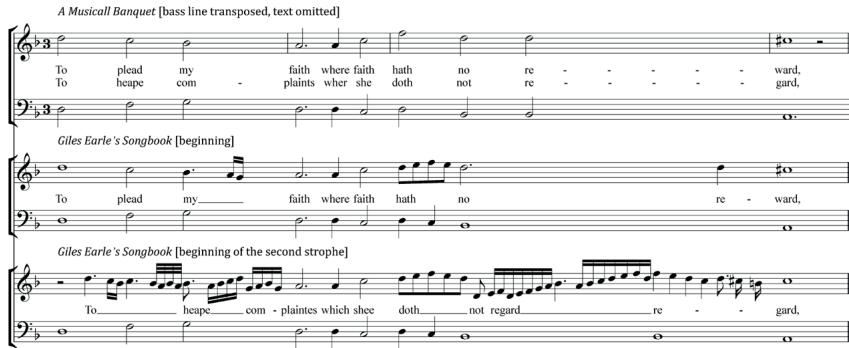
- s20 [描述性拆分] Hor che’l ciel et la terra
- 页码:39-45
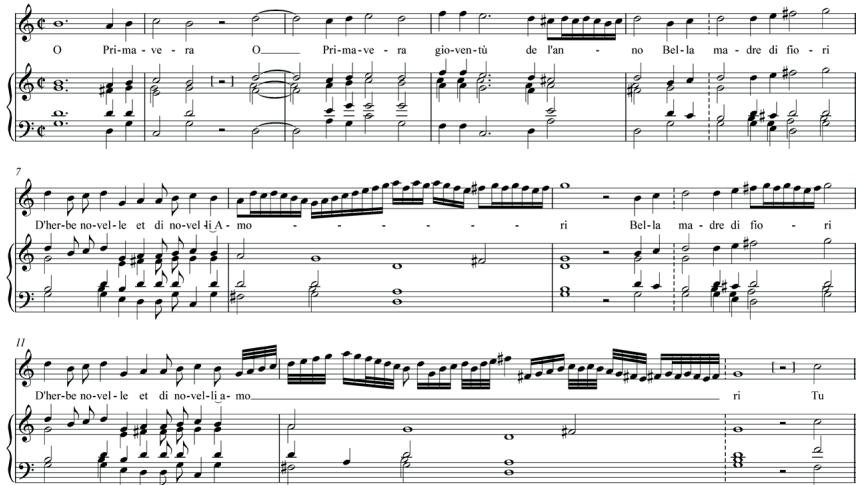
- s21 O che dirala mo
- 页码:46-48
- s22 Conclusions
- 页码:49-49
- s23 Bibliography
- 页码:50-50
s1 [描述性拆分] Variants in Borrono and Lasso Bicinia as Evidence of Tempo Change
第1段(P0001)
原文复述
Although it has been proposed that the case in hand is simply an alternative way of notating the passage in question, that explanation appears doubtful. The author instead wonders how ’learners’ would have received such a message, and whether something comparable may have been at work elsewhere within performance practice, even if the answer depended on the proficiency of the player.
中文讲解
本段是对前文一处记谱差异的回应与质疑。作者先承认有一种解释——把它看作同一段音乐的另一种记谱方式——但随即认为这种解释并不可靠。随后他将视线从纸面记谱转向实际演奏:‘学习者’会如何理解这种信息?类似做法是否也出现在其他场合?并且这种做法是否随演奏者熟练程度而变化。整段的关键在于作者用 ‘one wonders’(人们不禁要问)这种修辞,把讨论从纯文本层推向演奏实践层,暗示记谱差异可能不是抄写或排版的偶然,而是与演奏者水平相关的、有意的处理。这也是本节标题所谓 ‘变体作为速度变化证据’ 的逻辑起点:记谱层的改变被重新解释为演奏速度的改变。
补充说明
脚注 18(见 P0004)指向 Gasser 关于 Luis Milán 演奏实践的研究,说明此处所说的 ‘passage in question’ 与 Milán 的某段音乐记谱有关;其内容与 P0003 引用的 Milan 1546 版那段意大利文前言构成同一证据链。
第2段(P0002)
原文复述
A comparable editorial intervention occurred in a revised edition of a collection of bicinia issued by Pierre Phalèse. Orlando di Lasso’s thirteen textless bicinia had originally been printed more than thirty years earlier, and had in the meantime also been reissued by Phalèse in 1590 in their original form. In Phalèse’s new 1609 edition, in seven of the thirteen pieces all note values from the middle of the piece onward were doubled. In their original form these pieces show a relatively wide span of note values, beginning slowly in minims, accelerating through the course of the piece, and concluding in lively quaver motion. The revised versions are not free from problems of musical coherence, yet they achieve a steadier basic pace and a greater sense of unity, with far less contrast among note values. Given that these are didactic pieces, the alterations may have been made with beginners in mind. The author wonders whether the beat would in fact have varied in this kind of music: a collection of bicinia published by Seth Calvisius in 1599 ends with a set of singing rules, one of which directs the singer at times to accelerate and at times to slow down the tactus, for reasons of harmony and text.
中文讲解
本段是本节的核心证据。作者举出一个具体案例:Phalèse 在 1609 年重印 Lasso 的十三首无词二声部 bicinia 时,把其中七首乐曲自中段以后的音符时值全部加倍。原文(1577/1590 版)的特点是音符时值跨度大——开头用 minim(半音符)缓慢起拍,中段加速,结尾以活泼的 quaver(八分音符)收束;改写版虽然牺牲了一些音乐一致性,但获得了更稳定的基本速度和更统一的整体感。作者由此推断,这些改动可能正是针对初学者(beginners)的教学需要。教学性乐曲放慢速度有助于入门者掌握节奏与音准。然后作者进一步用 Calvisius 1599 年 bicinia 末尾的歌唱规则第 18 条作为旁证:那条规则明确允许演奏者根据和声与歌词的需要,时而加快、时而放慢 tactus(拍子/基本速度单位)。两层证据合起来说明:音符时值改写在 16 世纪并不只是抄写差异,而是有可能反映演奏速度的有意调整;且此类调整与乐曲功能(教学)和演奏者水平密切相关。
补充说明
脚注 19(见 P0005)列出 1577 年 Berg 版、1590 年 Phalèse/Bellère 版与 1609 年 Phalèse 版三种印本,正是本段比较所依据的来源;脚注 20(见 P0006)指向 Calvisius 1599 版末的歌唱规则第 18 条,即本段末尾所引的加速/放慢指示。
第3段(P0003)
原文复述
Footnote 18, first part: source citation to the secondo book (Venice: [Gerolamo Scotto], 1546), RISM 154630, fol. 30r, with the original Italian preface text quoted verbatim: ‘Per che ne la detta fantesia li sono alchune battute che alli scholari serano dificile glie fatte le medeme battute in altra forma di tempo piu facile, cioe se redotta la semicroma in croma. Et la croma in seminima’ [i.e., ‘Because in the said fantasia there are some passages that would be difficult for students, the same passages have been made in another and easier form of tempo, namely by reducing the semiquaver to a quaver, and the quaver to a minim’], followed by the IMSLP link and access date 5 August 2022.
中文讲解
本条是脚注 18 的前半部分,所引为 Luis Milán 1546 年威尼斯印本第二册第 30r 页的意大利文前言。原文明确说明:因为所附幻想曲里有几段对学生来说较难,已把同样的段落改写成更易的速度形式——也就是把 semicroma(十六分音符)改作 croma(八分音符),再把 croma 改作 seminima(四分音符)。这相当于把每个音符时值放大一倍,实质上就是放慢速度。它与 P0002 所述 Phalèse 1609 版把 Lasso bicinia 后半段音符时值加倍的做法,构成同一个做法在不同作曲家、不同印本中的平行证据。脚注末尾的 IMSLP 链接与 2022 年 8 月 5 日访问日期属于版本核验信息,提示读者可在 IMSLP 上查阅原书页面。
补充说明
本条与 P0001 所质疑的 ‘passage in question’ 直接对应:Milan 在前言中已经亲口承认这些段落是为 ‘scholari’(学生)改写的,从而与 P0001 中 ’learners’ 一词形成呼应。
第4段(P0004)
原文复述
Footnote 18, second part: bibliographic reference. Luis Gásser, Luis Milán on Sixteenth-Century Performance Practice (Bloomington, 1996), page 81.
中文讲解
本条补全脚注 18 的文献出处:Luis Gásser 1996 年于 Bloomington 出版的《Luis Milán on Sixteenth-Century Performance Practice》第 81 页。该书是讨论 Milan 演奏实践的专题研究,脚注指向其中第 81 页,意在为正文引用的 Milan 1546 年前言提供学术性背书。
补充说明
脚注 18 的两部分(P0003 的原文引用 + P0004 的文献出处)合起来支撑 P0001 中关于 ‘passage in question’ 的讨论。
第5段(P0005)
原文复述
Footnote 19: reference to Bernhold Schmid, ‘“Nec non Tyronibus quàm eius artis peritioribus summopere inservientes.” – Zur gedruckten Überlieferung von Lassos Bicinien’, in Yearbook of the Alamire Foundation 6 (2008), pp. 177–203, especially pp. 192–4. The footnote then lists the three editions discussed: Orlando di Lasso, Novae aliquot et ante hac non ita usitatae cantiones suavissimae (Munich: Adam Berg, 1577); Bicinia, sive cantiones suavissimae duarum vocum (Antwerp: Pierre Phalèse and Jean Bellère, 1590) (RISM 159019); and Bicinia, sive cantiones suavissimae duarum vocum (Antwerp: Pierre Phalèse, 1609) (RISM 160918).
中文讲解
本条是脚注 19,提示读者查阅 Bernhold Schmid 2008 年发表在 Alamire Foundation 年鉴第 6 卷上的论文,专题讨论 Lasso 二声部 bicinia 的印本流传史,特别要看 192–194 页。脚注同时把三种版本完整列出:1577 年 Adam Berg 在慕尼黑印行的初版、1590 年 Phalèse 与 Bellère 在安特卫普合印的原貌再版(RISM 编号 159019),以及 1609 年 Phalèse 单独在安特卫普印行的修订版(RISM 编号 160918)。Schmid 文章的标题中 ‘Tyronibus’ 即拉丁文 ‘初学者’,呼应正文 P0002 关于 ‘didactic pieces’ 与 ‘beginners’ 的讨论。
补充说明
RISM 是国际音乐文献资料库的标准编号系统,159019 与 160918 分别对应 1590 与 1609 两次安特卫普印本,便于读者到 RISM 目录中核对原书;这三版即 P0002 用来比较 ‘original form’ 与 ‘revised version’ 的具体文本。
第6段(P0006)
原文复述
Footnote 20: bibliographic reference. Seth Calvisius, Bicinia septuaginta ad sententias evangeliorum anniversorium (Leipzig: Jacob Apel, 1599), fol. X3r, rule 18.
中文讲解
本条为脚注 20,指向 Seth Calvisius 1599 年于莱比锡出版的二声部曲集(Bicinia septuaginta)的末页 X3r 第 18 条歌唱规则。Calvisius 是一位重要的音乐理论家,他为这本 bicinia 集所写的歌唱规则正是 P0002 末尾所引 ‘有时加速、有时放慢 tactus(视和声与歌词而定)’ 的原始出处。脚注把规则定位在第 X3r 页(即曲集末尾的前一页),便于核对。
补充说明
Calvisius 这条规则在本节论证链中扮演旁证角色:它不是 Lasso bicinia 的内部证据,而是同时代另一本二声部教学性曲集所给出的演奏速度可变通则,与 P0002 的内部证据互为补充。
脚注 / 边栏 / 图表 / 附加信息(如有)
本节脚注共三条(18、19、20),分别承担三类功能:脚注 18(P0003+P0004)提供米兰 1546 年意大利文前言的原文与二手研究出处,构成本节第一处教学性放慢改写的独立旁证;脚注 19(P0005)给出 Lasso bicinia 三种印本(1577、1590、1609)的完整书目信息,使 P0002 的版本比较可被读者复核;脚注 20(P0006)把 P0002 末尾关于 tactus 可变通的论述精确锚定到 Calvisius 1599 年版末规则第 18 条。三条脚注互不重复,分别从不同侧面支撑同一论点。
💡 本节核心要点
- 作者先质疑一种纯记谱层面的解释(‘different manner of notating’),把注意力转向演奏实践层面,主张记谱差异可能反映有意为之的速度处理。
- 核心案例:Phalèse 1609 版把 Lasso 十三首无词二声部曲中七首自中段起音符时值加倍,使乐曲由原本 minim→quaver 的加速结构变为整体更稳定、更适合初学者的速度。
- 由于 Lasso bicinia 属于教学性曲目,作者推断放慢处理是面向入门者(beginners)的有意安排,把记谱改动与乐曲功能及演奏者熟练程度挂钩。
- Calvisius 1599 bicinia 末尾歌唱规则第 18 条明确允许演奏者根据和声与歌词需要时而加速、时而放慢 tactus,为同一论点提供同时代的旁证。
- Milan 1546 版前言用原文承认某些段落已把音符时值翻倍以便 ‘scholari’(学生)使用,与 Phalèse 1609 版 Lasso bicinia 的做法形成跨作曲家、跨印本的平行。
- 记谱差异因此在本节中被重新解读为 ‘速度变化的证据’(evidence of tempo change),而非单纯的抄写或排版变体。
🔑 关键术语
- bicinia:二声部小曲,常用作教学与视唱教材;本节所讨论的 Lasso 与 Calvisius bicinia 均属此类教学性曲目。
- tactus:16 世纪音乐理论中的基本拍子/速度单位;Calvisius 第 18 条规则允许根据和声与歌词的需要对此单位做临时的快慢调整。
- minim / quaver / semiquaver:16 世纪音符时值体系中的层级单位(对应现代记谱大致为半音符、八分音符、十六分音符);把它们翻倍即等于放慢一倍速度,是本节所有改写案例的核心操作。
- RISM:Répertoire International des Sources Musicales(国际音乐文献资料库)的标准印本编号系统;脚注中 RISM 154630、159019、160918 等即用于定位原版印本。
- Phalèse (Pierre Phalèse):安特卫普重要音乐出版商,1590 与 1609 年两次印行 Lasso 的二声部曲集;本节的速度改写证据正出自其 1609 年修订版。
- didactic pieces:教学性乐曲;本节反复强调 bicinia 的教学功能,并由此把面向初学者的速度改写解释为有意安排而非偶然讹误。
s2 [描述性拆分] Byrd’s Keyboard Fantasia and the Reliability of Notation
第1段(P0007)
原文复述
The opposite type of revision, one doubling the speed of a passage, is probably seen in the introductory section to one of the best known keyboard fantasias by William Byrd, as shown in Ex. 2. The version in the Fitzwilliam Virginal Book changes the quaver runs in the last few bars into semiquavers. A scribal error is not plausible since the writing in both sources is neat and clean, and the rhythms all add up. The difference is perhaps indicative of the improvisatory nature of the flourishes. For the performer this can imply greater flexibility, or perhaps a non-proportional acceleration in relation to the quaver scales occurring earlier. On the other hand, semiquaver passages return later in the work, and one might speculate that this newly established correspondence reflects Byrd’s later thoughts.22 The two versions may have been meant to sound different, since the version in semiquavers retains only one of the three ornament signs, but this does not eliminate the possibility of performers adjusting the tempo at the point where semiquavers start.
中文讲解
本段描述了与前文相反的修订类型——将乐段速度翻倍,并以威廉·伯德(William Byrd)的一首著名键盘幻想曲为例。菲茨威廉维金纳尔曲集(Fitzwilliam Virginal Book)中的版本将开头部分最后几小节的八分音符跑动改为十六分音符。作者排除了抄写错误的可能,因为两个版本的书写都整洁干净,节奏数字也都加得拢。这一差异可能反映了花奏段落的即兴性质。对演奏者而言,这意味着更大的灵活性,或者相对于前面八分音符音阶的一种非比例的加速。但另一方面,十六分音符段落在该作品后部又重现,作者推测这种新建立的对应关系可能反映伯德晚期的想法(见注释22)。两版音响效果也可能本就不同,因为十六分音符版本只保留了三个装饰音符号中的一个;但这并不排除演奏者在十六分音符开始处调整速度的可能性。
本段的核心功能是把伯德这件作品纳入与博罗诺、拉索并列的第三个证据案例,以呈现"通过音符细化实现局部加速"这种修订方式。其论证结构是:先用版本证据(菲茨威廉版改十六分音符)建立观察,再用抄写排除法(书写整洁、节奏数加得拢)证明差异是有意的,进而推论其含义(即兴性、灵活演奏、晚期思考的对应)。最后一个让步(semiquaver版本装饰音更少)看似削弱差异的解释力,实则是为后段P0008的总论做铺垫:即使有这种细部差异,整体仍可能不需可察觉的速度变化。
补充说明
本段讨论的"将八分音符改为十六分音符"是音乐版本研究中一种典型的"音符细分(note-diminution)“修订,它与前文可能讨论过的"缩减"修订在效果上形成镜像关系。菲茨威廉维金纳尔曲集(The Fitzwilliam Virginal Book)是16世纪末至17世纪初英国最重要的键盘音乐手抄本之一,与Nevells书(My Ladye Nevells Booke)常被并置比较——本节后文正用到这一对照(见P0011的图注与P0013注释23)。
第2段(P0008)
原文复述
Despite the differences found in these variants, all of them – Borrono, Lasso, and Byrd – can make musical sense when performed without noticeable tempo changes. They do, however, raise doubts about the reliability and definitive quality of musical notation. We might, after all, imagine a situation in which only the alternative versions of pieces such as Borrono’s or Lasso’s survive.
中文讲解
本段是前几段(博罗诺、拉索、伯德三个案例)的小结,并进一步推进到对记谱法可靠性的反思。作者承认:尽管存在版本差异,三件作品在被演奏时即便没有可察觉的速度变化也能在音乐上自洽(“make musical sense”)。然而,这些差异确实对音乐记谱的可靠性与确定性(“reliability and definitive quality”)提出了怀疑。作者接着设想一种反事实情形:如果博罗诺或拉索作品的另一种版本(也就是其替代版本)单独幸存下来,我们对那些作品的速度判断就可能与现在截然不同。
本段的关键论证意义在于:它将前面三个孤立的版本案例(每个只暗示"也许有速度变化”)汇总为一个关于"记谱与演奏关系"的总论点。值得注意的修辞策略是双层结构——先承认差异可以在"无速度变化"前提下被演奏化解,以避免过度断言;再以"可靠性存疑"保留对记谱的不信任,并以反事实情景进一步强化这一不信任。这一让步—推进(concession→advance)的写法为后文(P0012及之后)转向梅鲁洛(Merulo)的更强证据做了逻辑过渡。
第3段(P0009)
原文复述
21 Francesco da Milano and Borrono, Intabulatura di lauto […] libro secondo, fols. 28r–30r, at 30r.
中文讲解
这是正文段落所引用的注释21,交代博罗诺(Pier Paolo Borrono,与弗朗切斯科·达·米兰诺 Francesco da Milano 合编)作品集《Intabulatura di lauto […] libro secondo》中相关谱例的具体位置:第28r至30r叶中的第30r叶。该注释为P0007及其前段所讨论的博罗诺版本差异提供原始资料定位。
注释中的"Intabulatura di lauto"是意大利文,意为"鲁特琴的转写谱集",这是文艺复兴时期鲁特琴音乐常见的刊本形式;“libro secondo"意为"第二册”。本注释的作用是来源指示(source indication),为正文的版本比较提供确切文献凭证。
第4段(P0010)
原文复述
22 See Desmond Hunter’s critical commentary to William Byrd, Organ and Keyboard Works: Fantasias and Related Works, ed. Desmond Hunter (Kassel, 2019), 66.
中文讲解
这是正文P0007中所标上标"22"对应的注释,指示读者参阅德斯蒙德·亨特(Desmond Hunter)所编、由亨特撰写评论的伯德管风琴与键盘作品集《Fantasias and Related Works》(Kassel, 2019)第66页。
该注释是为P0007中关于"这种新建立的对应关系或许反映了伯德晚期的想法"这一推测提供研究文献的支持(supporting reference),即将版本差异的可能解读锚定在既有学术评注中。它属于支持性引证,而非来源性引证,因为相关作品本身另有注释23指明(见P0013)。
第5段(P0011)
原文复述
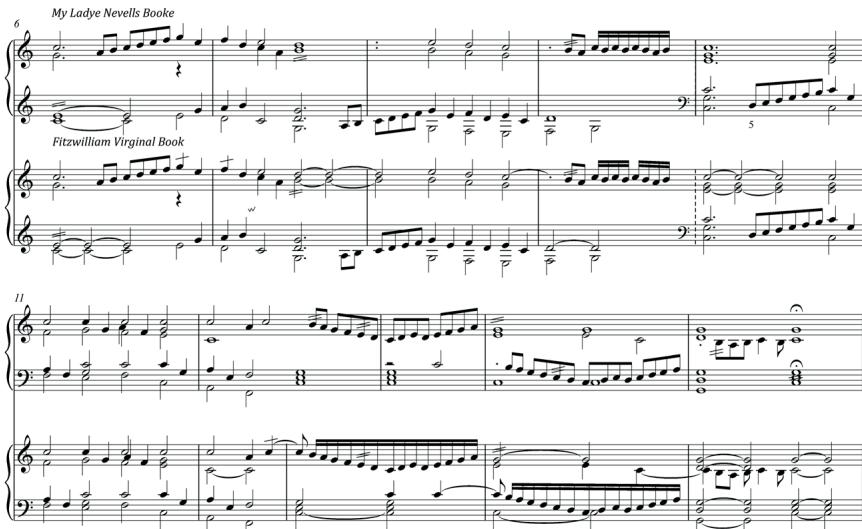
中文讲解
这是文中示例2(Ex. 2)的图注及图像占位符。图片标题为:威廉·伯德《C2调幻想曲》(Fantasia C2,编号BK25)第6至15小节,比较My Ladye Nevells Booke与The Fitzwilliam Virginal Book两本曲集中的版本(注释23)。内嵌图像数据未提供,仅保留位置与图注信息。
该谱例的作用是支撑P0007的论述:把同一首伯德幻想曲在两本主要英国键盘音乐手抄本(My Ladye Nevells Booke, GB-Lbl MS Mus. 1591;The Fitzwilliam Virginal Book, GB-Cfm Mus. MS 168)中的开头段落并置,使读者可以直接看到八分音符跑动与十六分音符跑动之间的对照,从而判断"速度翻倍"修订在谱面上的实际形态。需查看原图方可完整理解该谱例的细节。
补充说明
图注中"BK25"是伯德键盘作品的标准编号体系(Bk即Byrd Keyboard),BK25即C2调幻想曲。注释23(见P0013)给出了两个手抄本中该曲所在的精确叶面与编号。
第6段(P0012)
原文复述
A literal interpretation with a more or less steady, unchanging beat seems very improbable in two of Claudio Merulo’s toccatas preserved in the so-called Turin Tablature. Copied between 1637 and 1640 and notated in ’new German organ tablature’, these are believed to be primitive versions, perhaps from as early as 1567, of toccatas published in 1598 and 1604 respectively. The large collection in Turin contains both versions of these two toccatas, the earlier versions having been copied from an unknown source and the later ones from Merulo’s printed books of toccatas. Besides many differences in the passagework, the first of these toccatas, no. 18 in the manuscript and no. 8 in the 1598 print (see Ex. 3), evidences a revision that is suggestive of a tempo change between sections. The earlier version in Turin includes a short ricercar-like section notated traditionally in minims. While this section was later removed, the transition to the subsequent section remained, albeit with the quaver figuration changed into semiquavers. It thus seems likely that the imitative section in long note values and the subsequent transition, as notated in the earlier version, were intended to be played at a faster tempo than the rest.
中文讲解
本段转入一个新的、更具决定性的案例:克劳迪奥·梅鲁洛(Claudio Merulo)的两首托卡塔,保存在所谓"都灵手抄本"(Turin Tablature)中。这份手抄本抄写于1637至1640年间,采用"新德国管风琴记谱法"(new German organ tablature),其中保存的版本被认为是早至1567年前后的"原始版本",分别对应后来于1598年和1604年出版的托卡塔。都灵藏卷同时包含这两首托卡塔的两个版本:早期版本抄自未知来源,后期版本抄自梅鲁洛本人的印刷版。除了过门段(passagework)的诸多差异外,第一首托卡塔(手抄本第18号 / 1598年印刷版第8号,见Ex. 3)的修订方式暗示了段落之间的速度变化。早期版本包含一个短的、类似里切卡尔(ricercar-like)的段落,以传统的全音符(minims)记谱;这一段在后来版本中被删除,但进入下一段的过渡被保留下来,只是把八分音符的音型改成了十六分音符。因此可以推断:早期版本中那个以长音符记谱的模仿性段落以及其后的过渡,本就意在以比其余部分更快的速度演奏。
本段的功能是把论证从"或然性"提升到"较强可能性":前几个案例(博罗诺、拉索、伯德)所能确立的只是"记谱差异与可能的速度变化相关",而梅鲁洛的案例则因为保留了早期与晚期两个版本,且其差异呈现为系统性的音符细分(八分音符→十六分音符)与段落结构的重写(ricercar式段落被删除但过渡保留),从而使"段落速度有别"的推论从可能性上升到"似乎很可能(seems likely)"。这是本节内证据强度的逐级递进:博罗诺/拉索 → 伯德 → 梅鲁洛,由弱到强。
同时,本段还在小节层面上呼应P0007中"音符细分暗示速度变化"的论点,并把它落到更具体的形态:“长音符记谱的段落意在以更快速度演奏”,这一表述正面给出了速度变化的解读(而不再是"不排除")。
补充说明
“ricercar-like section"指具有里切卡尔(ricercare)特征的段落——16世纪一种以模仿对位为特征的器乐体裁;此处说明该段落采用全音符(minims,breve的二分音符)传统记谱,与后面过门段的细音符形成对比,正是这种音符密度的悬殊暗示了速度不同。“new German organ tablature"是新德国管风琴记谱法,与意大利、法国记谱传统不同,是当时德语区通用的字母—符号混合记谱系统。
第7段(P0013)
原文复述
23 My Ladye Nevells Booke, GB-Lbl MS Mus. 1591, no. 36, fols. 161r–6r, at 161rf., and The Fitzwilliam Virginal Book, GB-Cfm Mus. MS 168, no. 103, 192–4, at 192.
中文讲解
这是图注(P0011)所附上标"23"对应的注释,给出Ex. 2谱例所比较的两个版本的精确资料定位:My Ladye Nevells Booke(大英图书馆藏,编号GB-Lbl MS Mus. 1591,第36号,fols. 161r至6r中的161r叶起),以及The Fitzwilliam Virginal Book(菲茨威廉博物馆藏,编号GB-Cfm Mus. MS 168,第103号,第192至194页中的192页起)。
该注释的作用是为谱例对比提供档案级别的原始来源凭证,使学者能够直接调阅两本曲集中相应段落进行核对。属于来源性引证(source citation)。两个馆藏代码(GB-Lbl、GB-Cfm)符合英国图书馆与博物馆的标准缩写:Lbl = British Library, London;Cfm = Fitzwilliam Museum, Cambridge。
脚注 / 边栏 / 图表 / 附加信息(如有)
本小节包含三个附加材料:注释21(P0009)为博罗诺作品集《Intabulatura di lauto libro secondo》提供叶面定位(fols. 28r–30r, at 30r),属来源性引证;注释22(P0010)指引读者参阅亨特编《伯德管风琴与键盘作品集》第66页的评注,支持P0007中关于伯德"晚期想法"的推测;注释23(P0013)则与图注P0011共同定位My Ladye Nevells Booke(GB-Lbl MS Mus. 1591, no. 36, fols. 161r–6r)与The Fitzwilliam Virginal Book(GB-Cfm Mus. MS 168, no. 103, pp. 192–4)中的伯德《C2调幻想曲》(BK25)版本,是比较谱例的档案来源凭证。三条注释中,21与23为来源性,22为支持性。
💡 本节核心要点
- 本小节通过三个版本案例(博罗诺/拉索—伯德—梅鲁洛)递进地论证:早期键盘/鲁特琴音乐的不同版本之间存在系统性差异,这些差异暗示演奏速度在段落间并不恒定。
- 伯德《C2调幻想曲》(BK25)在菲茨威廉维金纳尔曲集中将开头段落的八分音符跑动改为十六分音符,作者以抄写排除法(书写整洁、节奏数加得拢)排除了抄写错误,并把此差异与即兴花奏及演奏灵活性联系起来。
- 作者承认这些版本差异在"无可察觉的速度变化"前提下仍可演奏自洽,但由此提出对音乐记谱可靠性的根本怀疑,并以反事实情景(若替代版本单独幸存)强化该怀疑。
- 梅鲁洛托卡塔案例通过同时保留早期与晚期两个版本,使论证强度由"或然"上升为"似乎很可能”:早期版本中里切卡尔式长音符段与细音符过门的并存,明确支持"该模仿段本应比其余部分演奏更快"的推断。
- 三例的论证强度递进与该小节总标题中的"记谱的可靠性(Reliability of Notation)“形成呼应——记谱既不是完全可靠的,但版本比较仍可揭示其背后的演奏意图。
🔑 关键术语
- Fitzwilliam Virginal Book:16世纪末至17世纪初英国最重要的键盘音乐手抄本之一,与My Ladye Nevells Booke常被并置比较;本节中伯德《C2调幻想曲》(BK25)的"细分音符"版本即见于此本。
- quaver / semiquaver:quaver指八分音符,semiquaver指十六分音符。本节关键修订形式即把八分音符音型改为十六分音符,作者认为这种"音符细分(note-diminution)“暗示演奏速度的相应加快。
- minim:全音符(半 breve),在梅鲁洛托卡塔早期版本中用于记写里切卡尔式模仿段;与后面过渡段的细音符形成密度对比,作者据此推断该段意在以更快速度演奏。
- Turin Tablature / new German organ tablature:都灵手抄本,抄于1637–1640年,以新德国管风琴记谱法记写;其中保存的梅鲁洛托卡塔版本被认为是早至1567年前后的"原始版本”,与其后1598/1604年印刷版形成对比。
- ricercar-like section:具有里切卡尔(ricercare)特征的段落,即16世纪以模仿对位为标志的器乐写法;梅鲁洛早期版本中此段以长音符记谱,被作者作为速度判断的重要依据。
s3 [描述性拆分] Merulo’s Toccata no. 18 and Revisional Evidence for Sectional Tempo
第1段(P0014)
原文复述
[Page 4 image or musical-score placeholder: 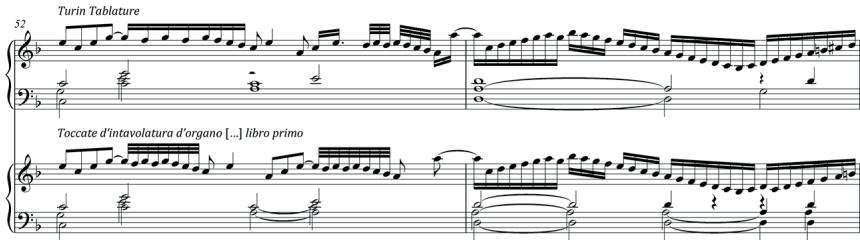 ]
中文讲解
本条不是正文段落,而是第4页上一处图像或乐谱的占位符。原始嵌入的图像数据已被省略,仅保留位置与图注信息;具体乐谱内容、谱例编号或图注文字需查阅原图。
第2段(P0015)
原文复述
[Page 4 image or musical-score placeholder: 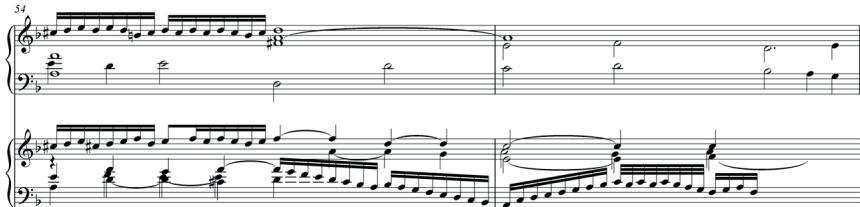 ]
中文讲解
本条同样为第4页上一处图像或乐谱的占位符,原文仅保留位置与图注标签,具体图像内容需查阅原图方能确认。
第3段(P0016)
原文复述
[Page 4 image or musical-score placeholder: 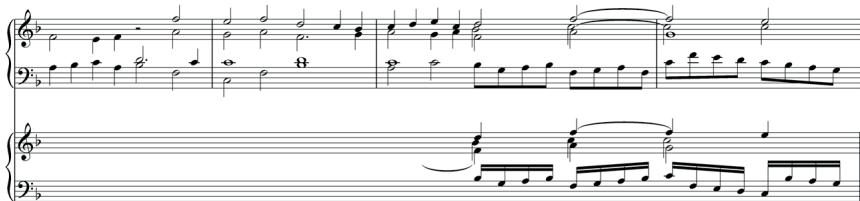 ]
中文讲解
本条为第4页上第三处图像或乐谱的占位符,原文仅保留位置与图注标签,其与上下文(前后的谱例或图版)之间的对应关系需结合原图判断。
第4段(P0017)
原文复述
[Page 4 image placeholder:
]
中文讲解
本条为第4页上的谱例占位符,图注(caption)标识为「Ex. 3」,内容是对两首托卡塔在第52–57小节的比较:一首是Claudio Merulo的《Toccata di Ms. Claudio》第十八首(出自都灵手稿Turin Tablature),另一首是Quarto Tuono的《Toccata Ottava》(出自1598年出版的《Toccate d’intavolatura d’organo […] libro primo》)。图注末尾的上标「24」指向正文注释24(即下一段P0018)。由此可见,此谱例是把Merulo的一首托卡塔与Quarto Tuono(此名实为Merulo的笔名Anonimo/Quarto Tuono的署名或相关编订者)的一首托卡塔并列对照,意在为「分段落速度」(sectional tempo)提供修订层面的证据。需查阅原图方可看到具体谱面布局、对齐方式与逐小节的差异。
补充说明
图注中的笔名或版本归属(Merulo与Quarto Tuono之间的同一性)需结合正文论证阅读;此处仅复述图注,未对其人物身份作进一步推断。
第5段(P0018)
原文复述
24 I-Tn, Fondo Foà Giordano, Giordano 2, no. 18, 44–7, at 45–7, and Toccate d’intavolatura d’organo […] libro primo (Venice: Simone Verovio, 1598), 33–8, at 37 (online: https://mdz-nbn-resolving.de/details:bsb00094272, accessed 27 July 2022). The bar numbers correspond to the bars in the print, since the Turin Tablature is unbarred. For complete comparative transcriptions of both of Merulo’s toccatas discussed here see Robert Floyd Judd, ‘The use of notational
中文讲解
本条为正文注释24,提供谱例Ex. 3所引两首托卡塔的出处与定位信息。都灵手稿(Turin Tablature)的全称为I-Tn, Fondo Foà Giordano, Giordano 2,其中Merulo第十八首托卡塔位于第44–47页,具体比较段落为第45–47页;1598年威尼斯Simone Verovio出版的《Toccate d’intavolatura d’organo […] libro primo》中同一首托卡塔位于第33–38页,比较段落为第37页,并附有慕尼黑数字化中心(MDZ)的在线永久链接及访问日期2022年7月27日。注释同时交代了一个重要的版本学说明:由于都灵手稿无小节线(unbarred),小节编号采用的是印刷版的小节体系,因此两版之间的对照依赖于印刷版的小节计数。最后,注释指引读者查阅Robert Floyd Judd关于Merulo两首托卡塔的完整对照转录研究,该研究论及「记谱法的使用」(‘The use of notational…’),但引文在本页被截断。整体而言,这条脚注的功能是:1)给出比较研究所依据的两份原始文献及其确切页码;2)说明小节编号的对应规则;3)为希望进一步比较转录的读者提供延伸阅读入口。
脚注 / 边栏 / 图表 / 附加信息(如有)
本节正文段落均为第4页上的图版/谱例占位符(P0014–P0017),唯一具备完整文字内容的是注释24(P0018),它承担三项功能:标明都灵手稿与1598年威尼斯印刷版两源资料的精确页码(44–7/45–7与33–8/37),说明小节编号采用印刷版体系(因手稿无小节线),并指引读者延伸阅读Robert Floyd Judd关于Merulo托卡塔完整对照转录的研究(引文在第4页底部被截断)。谱例Ex. 3将Merulo的第十八首托卡塔与Quarto Tuono的《Toccata Ottava》在bb. 52–57并列对照,用以支撑「分段落速度」的修订性证据。
💡 本节核心要点
- 第4页正文由三处无文字说明的图版/谱例占位符(P0014–P0016)以及一处带图注的谱例Ex. 3(P0017)构成。
- Ex. 3对照的是Merulo《Toccata di Ms. Claudio》no. 18(都灵手稿)与Quarto Tuono《Toccata Ottava》(1598年威尼斯印刷版)bb. 52–57。
- 注释24给出两源资料的精确页码定位:都灵手稿I-Tn, Fondo Foà Giordano, Giordano 2, no. 18, pp. 44–7(比较段pp. 45–7);印刷版《Toccate d’intavolatura d’organo […] libro primo》(Venice: Simone Verovio, 1598), pp. 33–8(比较段p. 37),并附MDZ在线永久链接及2022年7月27日访问日期。
- 由于都灵手稿无小节线,比较时所使用的小节编号对应于印刷版的小节体系。
- 注释24末尾指引读者参阅Robert Floyd Judd关于Merulo两首托卡塔完整对照转录的研究,引用题名《The use of notational…》在第4页底部被截断。
- 该谱例在正文论证中担任「修订性证据」角色,为「分段落速度」(sectional tempo) 的讨论提供具体可对照的谱面依据。
🔑 关键术语
- Turin Tablature (都灵手稿):指保存于I-Tn, Fondo Foà Giordano, Giordano 2中的键盘手稿,包含Merulo的第十八首托卡塔(no. 18, pp. 44–7);其特征是无小节线(unbarred),故比较时需借用印刷版的小节编号体系。
- Toccate d’intavolatura d’organo […] libro primo:1598年由Simone Verovio在威尼斯出版的Merulo托卡塔印刷版,其中Quarto Tuono署名的《Toccata Ottava》位于pp. 33–8,比较段落为p. 37;本节Ex. 3的小节编号即以此版为准。
- Quarto Tuono:图注中与Merulo托卡塔并置比较的署名/版本名,其与Merulo的实际关系需结合正文论证阅读,本节仅复述其作为比较对象的图注身份。
- Ex. 3 (谱例3):第4页上第52–57小节的对照谱例,置于Merulo手稿版与印刷版两源之间,作为「分段落速度」的修订性证据。
- Robert Floyd Judd, ‘The use of notational…’:注释24末尾指引的延伸阅读文献,研究Merulo两首托卡塔的完整对照转录;本节引文题名在第4页底部被截断。
s4 [描述性拆分] Merulo’s Toccata no. 19 and Tempo Contrast between Imitative and Passagework Sections
第1段(P0019)
原文复述
The situation becomes clearer in the following toccata, no. 19 in the Turin Tablature and no. 8 in Merulo’s second book of toccatas. As Example 4 shows, the imitative section starting at bar 45 is preserved in the 1604 print, although in a revised form with halved note values. All imitative sections in Merulo’s printed toccatas are notated in this manner, in crotchets rather than minims, producing an overall smaller range of note values and less rhythmic contrast between sections. Unless the two surviving versions were intended to sound very different in terms of tempo, Merulo must have expected significant tempo changes at the transitions between sections in at least one of these versions.
中文讲解
本段把焦点收窄到一首具体作品——都灵手稿第19首、Merulo第二集第8首,并提出一个直接的证据:1604年印刷版保留了第45小节起的模仿段,但记谱法把所有音符时值减半。原本在手稿中以minim(半音符)记写的模仿段,在印刷版中被改写成crotchet(四分音符),而Merulo所有印刷版托卡塔的模仿段都遵循这一统一做法。这带来一个可观察的后果:整首乐曲的音符时值范围缩小,节拍对比也变弱。作者由此反推一个结论:如果两个版本在最终音响上是一致的(按字面时值演奏),那几乎不可能;因此,至少在某一个版本中,Merulo必然预期在不同段落之间存在相当明显的速度变化。
本段的关键推理是:记谱密度差异 ≠ 演奏速度差异。1604年通过加密音符(halved note values)压缩了谱面信息,但若按字面比例演奏,会改变听感上的节拍印象,所以必须借助段落间的tempo切换来吸收这一差异。这是从"书写符号"反推"演奏实践"的一次典型论证,是本小节的核心步骤。
补充说明
术语对照:minim = 二分音符;crotchet = 四分音符。Merulo把minim改为crotchet,等价于把所有音符时值减半,使谱面信息密度加倍。
第2段(P0020)
原文复述
It is also worth considering the possibility that Merulo’s conception of the degree of contrast between sections evolved over time, so that rapid passages were later played more slowly while imitative sections were performed faster than when he first notated the toccatas. Such passages might, for instance, have slowed down if the harpsichord was replaced by the organ. One detail that would support the idea of a slower tempo for the semiquaver passages in the later version is the intensification of ornamentation and the introduction of occasional demisemiquavers. Moreover, both versions of the imitative section contain trills in semiquavers. While the surrounding notes are halved in the print, many of these trills remain written as semiquavers, only with fewer repercussions, and only the short tremoletti are transformed into demisemiquavers. It is more likely, however, that the additional scales and repercussions in demisemiquavers in the print fall within the scope of the original performance practice and that similar florid passages could have been improvised by expert players. It has been suggested that the early versions of these toccatas may have been copied from an early print, announced in 1567 and now lost, and that the intensification of ornamentation was enabled by the change in printing technology from movable type to copper plates.
中文讲解
本段引入第二种假说:Merulo对"段落间对比度"的设想可能在创作过程中发生了变化。具体而言,早期托卡塔里那些semiquaver(16分音符)快速跑动段在后期可能演奏得更慢,而模仿段则可能演奏得更快。这种调整可能与乐器更换有关——例如从harpsichord换为organ,会让原本迅捷的跑动段在触键和持续音条件下自然放慢。
作者给出支持"晚期快速段更慢"的细节线索:(1) 装饰音的整体强化;(2) 偶尔出现的demisemiquaver(32分音符);(3) 模仿段中颤音(trills)的特殊处理——周围音符全部减半,但许多颤音本身仍记为semiquaver,只有repercussions减少,而只有短颤音(tremoletti)被转写成demisemiquaver。这表明装饰音的强化是有选择、有针对性的,而非整体均匀加密。
但作者并未把这种变化解释为纯粹的"速度放缓”,而是强调:印刷版中新增的音阶和demisemiquaver式repercussions很可能仍属原始演奏实践的范围,专家演奏者本就可以即兴发挥出类似的华丽段落。作者并提及一种历史假说:早期手稿可能抄自1567年宣布但现已失传的早期印刷版,而装饰音的强化得益于印刷技术由活字印刷向铜版雕刻的转变——铜版能更清晰地呈现细小音符,使密集装饰在谱面成为可能。
本段的功能是为P0019的"必然存在tempo变化"提供另一种解释维度:速度差异不一定源于演奏实践的改变,也可能来自Merulo本人对"段落对比度"构思的演化,以及乐器、印刷条件等外部因素的叠加。
补充说明
术语:semiquaver = 16分音符;demisemiquaver = 32分音符;trills = 颤音;repercussions = 颤音中快速重复的部分;tremoletti = 短颤音;florid passages = 华彩性段落;harpsichord → organ = 拨弦键琴换为管风琴;活字 → 铜版 = 印刷技术的升级。
第3段(P0021)
原文复述
Footnote: a two-volume PhD thesis submitted to the University of Oxford in 1989, titled ‘formats at the keyboard: A study of printed sources of keyboard music in Spain and Italy c. 1500–1700, selected manuscript sources including music by Claudio Merulo, and contemporary writings concerning notations’, vol. i, pp. 239–54 and 258–69.
中文讲解
这是一条脚注,提供一项博士论文的文献信息:1989年提交于牛津大学的两卷本博士论文,研究范围覆盖西班牙和意大利约1500–1700年的键盘音乐印刷谱、含Merulo作品的手稿,以及当时关于记谱法的论述,卷一第239–254页和第258–269页为正文所引用的页码区间。
此脚注在正文中为键盘记谱法与演奏实践提供学术依据,起到来源支撑的作用,与本节对版本差异、印刷与即兴实践的讨论直接相关。
第4段(P0022)
原文复述
Footnote 25: See Luigi Collarile, ‘Claudio Merulo nell’intavolatura tedesca di Torino: il problema delle fonti’, in: In organo pleno: Festschrift für Jean-Claude Zehnder zum 65. Geburtstag, edited by Luigi Collarile and Alexandra Nigito (Bern, 2007), pp. 89–112, at pp. 99–103.
中文讲解
这是正文中的脚注25,引用Luigi Collarile的文章《Claudio Merulo nell’intavolatura tedesca di Torino: il problema delle fonti》(《Merulo在都灵德式tabulature中:版本来源问题》),载于Collarile与Alexandra Nigito共同主编、献给Jean-Claude Zehnder 65岁生日的祝寿文集《In organo pleno》(伯尔尼,2007),全文见第89–112页,正文引用的论点在第99–103页。
该脚注支撑正文关于"早期版本可能抄自现已失传的1567年印刷版"以及"装饰音强化与印刷技术由活字向铜版转变相关"的论断,起到提供关键史料出处的作用。
第5段(P0023)
原文复述
Figure caption: Example 4 — Comparison of Claudio Merulo, Toccata del Ms. Claud., no. 19, from the Turin Tablature, and Ottavo Tuono: Toccata Ottava, from Toccate d’intavolatura d’organo […] libro secondo, bars 42–50.
中文讲解
这是图4的图注,说明图示内容为:Merulo的Toccata del Ms. Claud.第19首(都灵手稿本)与Ottavo Tuono: Toccata Ottava(《Toccate d’intavolatura d’organo》第二集)第42–50小节的对比。
图注提到需要查阅原图才能看到具体的音符细节,本图在正文中被反复引用,是P0019论证中"模仿段被以halved note values的形式保留"这一关键论断的可视化证据。
第6段(P0024)
原文复述
While the early versions of these toccatas feature greater rhythmic contrast between sections, this contrast is provided mainly by the diminutions. With all figurations, trills, and scales removed, the early versions would appear more unified, with slower harmonic movement retained throughout the pieces. Yet in performance they seem to require more obvious tempo changes than the revised versions, where the imitative sections are notated in crotchets.
中文讲解
本段作出一个反直觉的关键观察:早期版本表面上的节拍对比更大,但这种对比主要由diminutions(细分音型)承担——也就是说,对比是装饰性音型带来的,而非节拍结构本身带来的。
如果把所有装饰性的figuration(音型化处理)、trills(颤音)和scales(音阶跑动)都剥离掉,早期版本反而会显得更统一:和声运动更慢,整首乐曲贯穿一个相对稳定的速度感。然而在真实的演奏情境中,这种"表面统一"反而要求更明显的段落间tempo切换才能成立。
与之形成对照的是修订版(1604印刷版):由于把模仿段记成crotchet,谱面上的音符密度更高、节拍印象更密,演奏上反而可能不再需要那么剧烈的速度切换。
这一悖论揭示了版本学问题中的一个重要方法论维度:表面"对比度"的大小,并不等同于演奏上"tempo变化幅度"的大小。早期版本因为记谱稀疏,要靠演奏中的tempo变化来制造效果;印刷版因为记谱加密,反而在演奏上更为稳定。这是本节论证的收束与翻转。
补充说明
“unified"在本段中指去掉装饰音后乐曲在节拍感上更连贯一致;“harmonic movement"指和声进行的速度,而非节奏速度。
第7段(P0025)
原文复述
Footnote 26: I-Tn, Fondo Foà Giordano, Giordano 2, no. 19, pp. 47–51, at pp. 49–50, and Toccate d’intavolatura d’organo […] libro secondo (Rome: Simone Verovio, 1604), pp. 34–8, at p. 37 (online: https://mdz-nbn-resolving.de/details:bsb00094273, accessed 27 July 2022). The bar numbers correspond to the bars in the print, since the Turin Tablature is unbarred.
中文讲解
这是图4的脚注26,详细说明图示所依据的原始材料:手稿来源为I-Tn(都灵国立图书馆),Fondo Foà Giordano藏,编号Giordano 2,第19首,第47–51页(重点为第49–50页);印刷版来源为《Toccate d’intavolatura d’organo》第二集(罗马:Simone Verovio,1604年),第34–38页(重点为第37页);并附巴伐利亚州立图书馆数字化资源的访问链接(2022年7月27日访问)。
作者特别说明:由于都灵手稿本未划分小节(unbarred),所以图例中的小节编号以印刷版为准。该脚注为图4提供精确的版本对照来源,是其可信度的基础;同时也提醒读者不同抄本在分节方式上的差异。
脚注 / 边栏 / 图表 / 附加信息(如有)
本小节包含两条脚注(25与26)以及一幅图例(Ex. 4)。
- 脚注25(Collarile 2007)支撑正文关于"早期版本可能抄自1567年已失传印刷版"以及"活字→铜版的印刷技术变化支持装饰音强化"的论断,提供史料来源。
- 脚注26给出图4的精确文献定位(手稿I-Tn Giordano 2与1604 Verovio印刷版的对应页码),并说明图中小节号以印刷版为准,因为都灵手稿本未分小节。
- 图4以可视方式对比了都灵手稿本与1604印刷版在第42–50小节的差异,是P0019关于"模仿段被以halved note values保留"这一核心论断的直接证据。
💡 本节核心要点
- 1604年印刷版将模仿段音符时值减半(minim→crotchet),缩小了整体的音符时值范围和节拍对比,作者据此反推Merulo必然预期段落间存在明显的tempo切换。
- Merulo对"段落间对比度"的设想可能在创作中演变:快速跑动段后期可能变慢(与harpsichord换organ相关),模仿段可能变快。
- 装饰音的强化、demisemiquaver的出现与trills的有选择性转写,说明印刷版的加密是有针对性的,并非整体均匀减半;但这些新增内容很可能仍属原始演奏实践的范畴,由专家即兴完成。
- 活字印刷向铜版印刷的技术转变,使密集装饰在谱面上得以清晰呈现,是装饰音强化的物质条件。
- 早期版本表面节拍对比更大,但主要由diminutions承担;去装饰后乐曲反而更统一,且演奏上需要更大幅度的tempo变化——这一悖论揭示出"记谱对比度"与"演奏速度变化幅度"并不等同。
🔑 关键术语
- minim / crotchet:minim = 二分音符;crotchet = 四分音符。Merulo在印刷版中将模仿段音符时值减半,使谱面密度增加,是本节论证的关键记谱差异。
- semiquaver / demisemiquaver:semiquaver = 16分音符;demisemiquaver = 32分音符。是判断装饰音密度与推测演奏速度的关键时值单位。
- diminutions:16世纪常用的细分音型,可即兴生成也可记谱写入;本节中既是早期版本节拍对比的主要载体,也是去除后使乐曲"显得统一"的关键成分。
- tremoletti / repercussions:tremoletti = 短颤音;repercussions = 颤音中的快速重复部分。印刷版中对前者转写为demisemiquaver,对后者大多简化或保留,是装饰音加密的典型细节。
- tempo change / tempo contrast:段落间的速度切换与对比。本节论证的核心:从记谱差异反推到演奏中必须存在的速度变化。
- movable type / copper plates:活字印刷与铜版雕刻印刷。作者认为铜版使更细小、密集的音符得以清晰呈现,从而支持装饰音强化。
- unbarred:未划分小节。都灵手稿本属此类,所以图4的小节编号以印刷版为准,是版本对照中的方法学细节。
s5 Taking Additional Time for Ornamentation
第1段(P0026)
原文复述
Taking Additional Time for Ornamentation
中文讲解
这是本节的标题:“Taking Additional Time for Ornamentation”(为装饰音额外争取时间)。它提示本节的中心议题是:当演奏者要在已有的音乐织体中加入 diminutions(细分装饰,即对原本简朴的旋律音符作快速细分处理)时,是否可以、或者实际上是否会通过放慢节拍(tactus)来为这些装饰留出时间,以及十六世纪晚期的理论家如何看待这一实践。
第2段(P0027)
原文复述
Several late 16th-century treatises discourage the momentarily slowing down of the beat in order to perform diminutions:
中文讲解
本句为本节内容铺垫:作者指出,几部十六世纪晚期出版的论述装饰法的专著都不赞同演奏者在做 diminutions 时为了技术便利而临时放慢节拍。后文将以四段引文分别来自 Dalla Casa(1584)、Rognoni(1592)、Zacconi(1592)和 Bovicelli(1594)来具体展示这些告诫。
第3段(P0028)
原文复述
I say that it is difficult to keep the diminution in tempo, and this is of greatest importance for everyone who follows this profession of making diminutions with all kinds of instruments. Therefore, let everyone, in their study, strive to beat time, and never study without this order, and become accustomed to the tactus; for to do otherwise would not be a good thing. (Girolamo Dalla Casa, Il vero modo di diminuir [1584])27
中文讲解
这是 Dalla Casa 在《Il vero modo di diminuir》(1584)序言中的话,属于教学语境:作者承认把装饰后的快速段落维持在与原谱相同的拍子(tempo / tactus)里非常困难,但强调这正是装饰技艺中最关键的事;练习者必须在学习中坚持打拍子、保持对 tactus(手击拍、约等于一次下落与抬手的节拍单位)的稳定感,否则"便不是好的做法”。这段话把时间准确摆在了装饰演奏技艺的首要位置。
第4段(P0029)
原文复述
It is good, however, to avoid them [parallel fifths and octaves] as much as possible, and anyone will do it easily with attention to time and measure, because to tell the truth, however swift, skilful and distinct the ricercata may be, if perchance it is not achieved in time, it loses all its elegance. (Riccardo Rognoni, Passaggi per potersi essercitare Nel Diminuire [1592])28
中文讲解
Rognoni 在 1592 年著作中指出,平行五度与平行八度应尽量避免,而避免的关键在于对 tempo 与 misura(节拍与计量)的关注;他宣称,无论 ricercata(此处指经过高度装饰的即兴式旋律线条)多么迅捷、精巧、清晰,只要不在拍子内完成,便丧失一切 leggiadria(优雅、灵动)。与 Dalla Casa 相似,这里也是从教学角度强调:装饰必须服从 tactus 的稳定性,而不是相反。
第5段(P0030)
原文复述
One should never give way to any of the singer’s voices, because giving way to the desires of this or that singer to give them time to fill the songs with graces makes the harmonies weak and slow, and the [other] singers find it unreasonably tiresome, hating that slowing down and unwelcome intervention. (Lodovico Zacconi, Prattica di musica [1592])29
中文讲解
Zacconi 的话与前两段语气不同,转向对已有实践的批评:合唱指挥或伴奏者不应为了迁就某位歌手想要加花而放慢整体进行,因为放慢会让和声变得虚弱、迟缓,并使其他演唱者感到难以忍受、厌烦这种"不受欢迎的介入”。他关心的是合奏/合唱的整体协调,因此明确反对为了个人装饰而改变 tactus 速度。
第6段(P0031)
原文复述
27 Girolamo Dalla Casa, Il vero modo di diminuir (Venice: Angelo Gardano, 1584), lib. 2, preface, fol. [Av]: ‘Dico esser cosa difficile lo portar la minuta à tempo, & questa è la maggior importanza ad ogn’uno, che facci questa professione del diminuir con tutte le sorti de Istromenti. Dunque ciascheduno avertisca nello studio suo di batter il tempo, & di non studiar mai senza questo ordine, & habituarsi alla battuta; perche facendo altrimenti non sarebbe cosa buona’. Online: http://www.bibliotecamusica.it/cmbm/scripts/gaspari/scheda.asp?id=2817 (accessed 27 July 2022).
中文讲解
脚注 27 提供 P0028 引文的意大利语原文与版本出处:Dalla Casa, Il vero modo di diminuir(威尼斯:Angelo Gardano, 1584),第二卷序言,[Av] 页。原文中关键术语包括 la minuta(细分、装饰段)、batter il tempo(打拍子)、alla battuta(按 tactus 的节拍),与英文译文对应。最后给出在线资源网址与访问日期。该脚注对正文 P0028 起文献来源与原文核查作用。
第7段(P0032)
原文复述
28 Riccardo Rognoni, Passaggi per potersi essercitare Nel Diminuire terminatamente con ogni sorte d’Instromenti (Venice: Giacomo Vincenti, 1592), pt. 2 (‘Il vero modo di diminuire Con tutte le sorti di Stromenti da corde, da fiato, & anco per la voce humana’), preface, 18: ‘Ben’è però fuggirle quanto si potrà, e lo farà facilmente ogn’uno con l’attentione del tempo, e della misura, che à dire il vero sia pure veloce, artificiosa, & distinta la Ricercata, se per avventura non riesce à tempo, perde ogni sua leggiadria’. Online: http://conquest.imslp.info/files/imglnks/usimg/7/75/IMSLP292311-PMLP474374-passaggi_etc_ricardo_ognoni_parte2.pdf (accessed 3 April 2024).
中文讲解
脚注 28 是 P0029 引文的意大利原文与文献信息:Rognoni, Passaggi…(威尼斯:Giacomo Vincenti, 1592),第二部分(论弦乐、管乐与人声的各种装饰法),序言第 18 页。原文关键词 Ricercata、tempo、misura、leggiadria 均与英文译文一致。脚注提供 IMSLP 在线链接与访问日期,对正文起出处核查作用。
第8段(P0033)
原文复述
29 Zacconi, Prattica di musica, lib. 1, cap. 33, fol. 21v (see n. 14): ‘Ne mai a qual si voglia voce di cantore piegar si deve; perche il piegarsi alle voglie di questo, & di quello per darli tempo ch’empiano I canti di vaghezze, fa che l’harmonie divenghino debole e lente; & che I cantori si stanchino fuor di proposito odiando quella ritardanza, & mal gradita attione’.
中文讲解
脚注 29 是 P0030 引文的意大利原文,注明来自 Zacconi《Prattica di musica》第一卷第 33 章 21v 页(并指回脚注 14)。原文中的 piegar si deve(应当迁就)、vaghezze(装饰、绮丽之音)、ritardanza(延宕、减速)、mal gradita attione(不受欢迎的做法)等词强化了 Zacconi 对合奏中为个人装饰放慢节拍的批评。该脚注对正文 P0030 起原文与版本支持作用。
第9段(P0034)
原文复述
Some are in the habit, in order to accommodate passaggi in their own way, of holding a one-beat note for two or three beats, for what reason I do not know: what I do know is that it is more praiseworthy when making passaggi to remain bound to the correct pulse, as written in the part, except at the end, that is on the final note. (Giovanni Battista Bovicelli, Regole, passaggi di musica [1594])30
中文讲解
Bovicelli 在 1594 年的著作中描述并批评了一种实际存在的演奏习惯:某些人为了让自己的 passaggi(细分经过句)更顺手,把本应只占一拍(una battuta)的音符延长为两拍或三拍。他虽不明其理由,但明确表态——装饰演奏应紧守谱面所写的正确 pulse(节拍),仅在末尾(即最后音符)方可例外。这与 Zacconi 一样属于对既有实践的直接批评,并明确指出"末尾"是唯一允许变通的节点。
第10段(P0035)
原文复述
While Dalla Casa and Rognoni may be seen to focus on correct time-keeping in a didactic context, Zacconi and Bovicelli seem to criticise existing practices. Differentiation between solo and ensemble performance is also possible, as suggested in the discourse sent by Giovanni de’ Bardi to Giulio Caccini around 1578. Towards the end of his letter Bardi criticises certain ensemble singers:
中文讲解
本段是作者的过渡与综合分析。首先把四段引文分为两类:Dalla Casa 与 Rognoni 处于教学语境,重在教导如何维持正确时间;Zacconi 与 Bovicelli 则针对已存在的、可能很普遍的做法发出批评。其次,作者引入一个新的区分维度——独奏与合奏之分,并以 Bardi 约于 1578 年致 Caccini 的信为证据。Bardi 这封信末段批评了一些合奏中的歌者,正是这种独奏/合奏区分的具体来源。
第11段(P0036)
原文复述
There are also others who are so complacent when performing passaggi that they disregard the tactus, breaking it down and stretching it out so much that they do not allow their companions to sing in a good manner at all.
中文讲解
这是 Bardi 信中对合奏歌者的批评:某些歌者为了自我满足地炫技 passaggi,完全不顾 tactus,将其"打碎、拉长"到使同伴根本无法以良好方式歌唱。Bardi 的措辞直接呼应 Zacconi 与 Bovicelli 对合奏中放慢节拍的否定,但更明确把责任指向个别歌者的炫技行为及其对合奏整体的破坏。
第12段(P0037)
原文复述
A few lines later, Bardi writes that different criteria apply to solo performance:
中文讲解
作者简短交代:Bardi 在批评合奏歌者之后数行,便转而说明独唱情境适用不同的标准。下一段引文即给出该不同标准的具体内容。
第13段(P0038)
原文复述
When singing alone or to the lute, harpsichord, or other instrument, one may contract or stretch the tactus at will, as it is up to the singer to lead the measure according to his judgement.31
中文讲解
Bardi 在同一封信中陈述独奏(独自歌唱,或为鲁特琴、羽管键琴等乐器伴唱)的规则:演奏者可随意"收紧或拉宽"tactus,因为由歌者本人按其判断主导 misura(节拍度量)。这与上一段对合奏的批评形成对照——同一作者在合奏中要求 tactus 严格,在独奏中却赋予歌者完全的速度弹性。脚注 31 标记该引文来源。
第14段(P0039)
原文复述
As regards the question of flexibility of tempo, Bardi, like his contemporary Haiden, sees a considerable difference between solo and ensemble performance. While stating that the solo performer may vary the beat ‘à suo piacere’, or ’nach seinem selbst gefallen’, they both imply that such practices may cause problems in an ensemble. Whereas Haiden mentions the requirement to change the measure to express affect, Bardi criticises ensemble singers for slowing down the beat for ornamentation. Bardi does not seem to be criticising simple tempo changes: such passaggi seem to have demanded a tactus which was either much too slow or too irregular and unpredictable for other ensemble members to follow. While he does not say whether in solo singing the beat would also have varied on account of diminutions, this is perhaps not unlikely
中文讲解
作者在本节收束处综合比较并提出推断。Bardi 与同时代的 Haiden 都承认独奏与合奏之间存在速度处理上的重大差异,二者皆默认同样的弹性在合奏中会引发问题。区别在于:Haiden 把改变节拍视为表达情感的需要,而 Bardi 则明确针对为做装饰而放慢节拍这一具体行为加以批评。作者进一步指出,Bardi 的批评对象并非简单的速度变化,而是那种让其他声部无法跟随的、过慢或不规则且不可预测的 tactus。最后,作者谨慎推测:在独唱情境下,节拍也可能因 diminutions 而变化,但 Bardi 文本本身并未明说,故只以"或许并非不可能"作为开放性结论。
补充说明
本段中提到的 Haiden 是与 Bardi 同时代的德国音乐理论家,其观点在前文(前一节或脚注 14)中已被引用,作者以两者并列来强化"独奏/合奏双标准"是当时跨地域的共识。“à suo piacere”(意大利语,按其意愿)与"nach seinem selbst gefallen”(德语,按其自身喜好)作为原文术语同时出现,对应正文"at will"的翻译。
第15段(P0040)
原文复述
30 Giovanni Battista Bovicelli, Regole, passaggi di musica, madrigali et motetti passeggiati (Venice: Giacomo Vincenti, 1594), 15: ‘Sogliono alcuni per accommodarsi i Passaggi a modo loro, se una nota vale una battuta, tenerla due, ò tre, con che ragione, io no’l so, so bene che è più laudabile nel Passaggiare star obligato al tempo giusto, che si trova scritto nel Canto, fuori, che nel fine cioè nella penultima nota’. Translation from Giovanni Battista Bovicelli, Regole, passaggi di musica, madrigali et motetti passeggiati, ed. Gawain Glenton, trans. Oliver Webber (Frome, 2018), 14. Online: http://www.bibliotecamusica.it/cmbm/scripts/gaspari/scheda.asp?id=7258 (accessed 27 July 2022).
中文讲解
脚注 30 是 P0034 引文的意大利原文,注明 Bovicelli《Regole, passaggi di musica…》(威尼斯:Giacomo Vincenti, 1594)第 15 页。原文中的 una battuta(一拍)、tenerla due ò tre(持两或三拍)、star obligato al tempo giusto(必须严守正确节拍)、penultima nota(倒数第二音,即"最终音"前的位置)等措辞支撑了正文翻译。脚注还指出英文译文取自 Gawain Glenton 编辑、Oliver Webber 翻译的 2018 年版本第 14 页,并提供 Biblioteca Musica 在线链接与访问日期。该脚注对正文 P0034 提供出处、原文与权威英译本来源。
第16段(P0041)
原文复述
31 Claude V. Palisca, The Florentine Camerata: Documentary Studies and Translations (New Haven, 1989), 124: ‘Altresi si trovano altri che per dar compiacimento à passaggi loro non avendo riguardo alla battuta, tanto la vanno rompendo et stracchiando che i suoi compagni con buon modo per via alcuna cantar non lasciano. […] Cantandosi solo, o in su’l liuto, o gravicembalo, o, altro strumento si puote à suo piacere la battuta stringere, e allargare, avvengache à lui stia guidare la misura à suo senno’. As pointed out above, the terms ‘stringere’ and ‘allargare can describe both the tactus movement itself as well as changing its speed by quickening and slowing down the beat. The latter seems to apply here.
中文讲解
脚注 31 是 P0036 与 P0038 两段引文合并的来源注,标注出自 Claude V. Palisca 编《The Florentine Camerata: Documentary Studies and Translations》(纽黑文,1989)第 124 页。意大利原文前半段对应 Bardi 对合奏歌者的批评(rompendo et stracchiando la battuta,把节拍打碎、拉长),后半段对应独奏许可(stringere e allargare la battuta,收紧或拉宽节拍;guidare la misura à suo senno,按自己判断主导拍子)。脚注附有作者本人的术语说明:stringere 与 allargare 既可指 tactus 手势本身的幅度,也可指其速度的快慢变化,作者判断此处应作"改变节拍速度"解。该脚注兼具文献出处与术语限定两种功能。
脚注 / 边栏 / 图表 / 附加信息(如有)
本节包含五个脚注(27–31)。脚注 27–29 提供正文三段主要引文(Dalla Casa、Rognoni、Zacconi)的意大利原文与版本信息,分别来自 1584、1592、1592 年的威尼斯出版物,并附在线资源网址与访问日期。脚注 30 提供 Bovicelli 1594 年著作的意大利原文与英译本来源(Glenton/Webber 2018 版)及网络链接。脚注 31 同时承担两重职能:一是给出 Palisca 1989 年文献中 Bardi 致 Caccini 信的意大利原文出处;二是为关键术语 stringere 与 allargare 提供限定解释,明确此处应理解为"改变节拍速度"。这些脚注共同支撑了正文论证的原始文献基础。
💡 本节核心要点
- 四位十六世纪晚期作者(Dalla Casa、Rognoni、Zacconi、Bovicelli)一致反对在做 diminutions/passaggi 时通过放慢 tactus 来为自己争取时间,理由是这会破坏拍子的准确性或合奏的协调。
- 这些声音可分为两类:教学型告诫(Dalla Casa、Rognoni)针对学习者的练习方法;实践型批评(Zacconi、Bovicelli)针对合奏中已然存在的、为装饰而拖延节拍的做法。
- Giovanni de’ Bardi 约 1578 年致 Caccini 的信引入了关键区分:合奏中 tactus 必须严格,独奏(独唱或为鲁特琴、羽管键琴等伴唱)中则可任意 stringere 或 allargare 节拍。
- Bardi 与同时代德国理论家 Haiden 都认可这种独奏/合奏的双重标准,提示该区分是跨地域的共识。
- Bardi 的批评对象并非单纯的速度变化,而是那种因 passaggi 而变得过慢、不规则且其他声部无法跟随的 tactus;作者推断独奏中节拍亦可能因装饰而变化,但保持谨慎的开放态度。
🔑 关键术语
- diminutions / diminuire / la minuta:对原本简朴的旋律音符作快速细分(通常为十六分音符级或更细)的装饰性变奏,是十六世纪歌唱与器乐即兴装饰的核心实践;本节讨论的核心即围绕装饰时是否允许改变节拍速度。
- passaggi:经过句式的快速细分装饰,与 diminutions 含义重叠但更强调快速跑动的炫技效果;本节引文中与 passaggi 相关的批评指向合奏中炫技者牺牲集体时间准确性的行为。
- tactus / battuta / misura:十六世纪节拍体系中的基本时间单位,由手的一次下落与抬起构成;本节所有讨论都围绕装饰演奏是否应服从这一节拍度量,以及其速度是否可变。
- ricercata:此处 Rognoni 用来指代经过高度装饰的快速旋律线条,词义接近经过句或装饰段;强调即使技艺精巧,脱离正确节拍也会丧失优雅。
- stringere e allargare (la battuta):Bardi 在独奏语境中允许的两种节拍处理:收紧(加快、放窄)与拉宽(减慢、放宽);脚注 31 进一步澄清此处应理解为改变节拍速度,而非仅改变手势幅度。
- leggiadria:意大利语"优雅、灵动";Rognoni 用以指装饰演奏的最高审美品质,其前提是装饰必须"在拍子内"完成。
- vaghezze:意大利语"绮丽、花饰",Zacconi 用以批评为填充歌曲而加入的装饰花腔;与 ritardanza(延宕)共同构成他对合奏放慢节拍的否定性描述。
s6 [描述性拆分] Solo and Ensemble Practice: Bovicelli, Bardi, and Tempo for Ornamented Cadences
第1段(P0042)
原文复述
Ex. 5: Daniel Bacheler, ‘To Plead My Faith’, bb. 1–4. Comparison of versions in A Musical Banquet (1610) and Giles Earle’s Songbook (c. 1615–26).
中文讲解
这是示例5的图注,提示读者即将看到的是丹尼尔·巴切勒歌曲《To Plead My Faith》开头四个小节的三种版本对比,来源分别是1610年的《A Musical Banquet》和约1615–26年间抄写的《Giles Earle’s Songbook》。图注中的上标32指向对应的脚注,说明两个版本的乐谱出处和转录文献。该图注在结构上先于正文讨论出现,为后文论证“装饰性终止需要延长时值”提供视觉证据。
补充说明
图片数据本身被省略,讲解只能依据图注与正文描述;上标32对应P0045号脚注。
第2段(P0043)
原文复述
Cases where the beat has to be suspended or slowed down momentarily in order to accommodate written-out ornamentation at cadences and elsewhere are especially common in English solo songs of the early seventeenth century, among which we find ornamented versions of songs by Giulio Caccini. Sometimes, in respect of the unornamented original versions, notes are prolonged. In Ex. 5, which shows three versions of the opening phrase of a song by Daniel Bacheler, the penultimate note is doubled in length at the written-out repeat to provide more time for cadential diminution.
中文讲解
本段提出核心论点:为了容纳写出的装饰音(尤其是在终止处),17世纪初英国独唱歌曲中频繁出现节拍暂时悬停或放慢的现象。这类歌曲中包括朱利奥·卡契尼作品的装饰版本。相对于未经装饰的原版,某些音符会被延长。示例5展示了巴切勒歌曲开头的三种版本:在写出的反复中,倒数第二个音符的时值被加倍,以便为终止处的减花留出更多时间。这一具体做法说明:装饰性终止不只是增加音符数目,还会通过延长原有音符来重新分配时间,让快速跑动的diminution能够被“塞进”原本的拍子结构。
补充说明
本段提到的“写出的装饰”(written-out ornamentation)与即兴装饰相对,强调这是作曲者或改编者提前写在谱面上的版本。
第3段(P0044)
原文复述
Sometimes, diminutions are carefully rhythmicised to fit into the underlying structure, but their density and speed might be a reason for performers to slow down considerably. See, for example, b. 12 of Ex. 6, taken from Luzzasco
中文讲解
本段引入另一类情况:有时减花虽然在节奏上被仔细安排以适应底层结构,但由于音符密集、速度极快,演奏者仍然可能大幅放慢。文中以示例6的第12小节作为例证,来源被截断、指向下一页的卢扎斯科·卢扎斯基作品。这一段的逻辑作用是与上一段形成对照:前一段强调通过延长音符来腾出时间,本段则强调即使节奏严丝合缝,演奏难度本身也可能迫使演奏者主动放慢。
第4段(P0045)
原文复述
32 Robert Dowland (ed.), A Musicall Banquet (London: John Benson and John Playford, 1610) (RISM 161020), fols. D2v–Er, and Giles Earle’s Songbook, GB-Lbl Add. 24655, fols. 48v–50r, at 48v–49r. For a complete comparative transcription see Edward Huws Jones, The Performance of English Song, 1610–1670, 2 vols. (New York, 1989), ii, 4–9.
中文讲解
这是脚注32,提供了示例5两个版本(《A Musical Banquet》1610年版和《Giles Earle’s Songbook》)的具体出处和文献信息,并指引读者查阅Edward Huws Jones《The Performance of English Song, 1610–1670》第二卷第4–9页的完整对照转录。该脚注的作用是为示例5提供乐谱来源和进一步研究文献,属于来源/旁证性质。
第5段(P0046)
原文复述
33 See John Bass, ‘Would Caccini Approve? A Closer Look at Egerton 2971 and Florid Monody’, in: EM 36 (2008), 81–93, esp. 87. Another example for such a practice is the much ornamented version of Caccini’s ‘Amarilli mia bella’ in Johann Nauwach, Libro primo di arie, passegiate à una voce (Dresden, 1623), no. 12, fol. C2vf.
中文讲解
这是脚注33,引用了John Bass 2008年发表于《Early Music》第36期的文章,并指出第87页是特别相关的位置。同时补充了另一个类似的装饰性卡契尼歌曲改编实例:约翰·瑙瓦赫1623年出版的《Libro primo di arie, passegiate à una voce》中对《Amarilli mia bella》的高度装饰版本(第12首,C2v页)。该脚注为正文提到的“英国独唱歌曲中包括卡契尼装饰版”这一主张提供具体文献证据。
第6段(P0047)
原文复述
Luzzaschi’s madrigals for one to three voices and keyboard, printed in 1601 but probably written in the 1580s.
中文讲解
本段补全了P0044号段落被截断的引用对象——示例6取自卢扎斯科·卢扎斯基为1至3声部与键盘所作的牧歌集,该集1601年印刷,但乐曲很可能创作于1580年代。这是对乐谱来源的明确说明,同时暗示作者认为这些作品的装饰实践反映的是1580年代的实际演奏习惯,而非1601年印刷时的状态。
补充说明
本段与P0044合在一起才完整引用了示例6的来源,在阅读时需将两段视为同一引文的延续。
第7段(P0048)
原文复述
Ex. 6: Luzzasco Luzzaschi, ‘O Primavera’, bb. 1–13.
中文讲解
这是示例6的图注,提示读者看到的是卢扎斯科·卢扎斯基《O Primavera》一曲的前13小节,上标34对应P0052号脚注中的乐谱出处。该图注为P0044的论证(演奏者因减花密度与速度而大幅放慢)提供具体乐谱依据,特别聚焦于第12小节。
补充说明
图片数据本身被省略,讲解只能依据图注与正文描述;上标34对应P0052号脚注。
第8段(P0049)
原文复述
Ex. 7 shows an excerpt from Jacques Arcadelt’s madrigal Ancidetemi pur in an intabulation by Ascanio Mayone published in 1603. The figure present in the first two bars subsequently appears in halved note values, perhaps mainly in order to fit it into the rhythmical structure of the original madrigal. A literal interpretation is very unlikely, and the cadence in b. 18 would possibly been slowed down to half tempo.
中文讲解
本段引入第三个案例:示例7取自阿斯卡尼奥·马约内1603年出版的键盘改编曲,所改编的是雅各布·阿尔卡德尔特牧歌《Ancidetemi pur》。前两小节出现的音型随后以音符时值减半的方式重复出现,这主要是为了让该音型嵌入原牧歌的节奏结构。作者判断:完全按字面(literal)演奏几乎不可能,第18小节的终止可能需要放慢到原速的一半。这一案例展示的是另一种机制——通过改写音符时值(而非延长原音符)来使装饰性材料挤进既有拍数,并由此推断演奏时实际速度会减半。
补充说明
“intabulation”一词指将原本为人声或其他乐器所作的音乐改编为键盘乐器演奏的版本,是文艺复兴晚期常见的做法。
第9段(P0050)
原文复述
Ex. 7: Ascanio Mayone, Ancidetemi pur (after Jacques Arcadelt), bb. 16–18.

中文讲解
这是示例7的图注,提示读者看到的是马约内改编自阿尔卡德尔特《Ancidetemi pur》的第16–18小节,上标35对应P0052号脚注中的乐谱出处。该图注为P0049的论证(第18小节终止可能放慢到半速)提供视觉证据。
补充说明
图片数据本身被省略,讲解只能依据图注与正文描述;上标35对应P0052号脚注。
第10段(P0051)
原文复述
Such practices must have had their roots in improvised ornamentation. In the passage quoted above, Bovicelli mentions that some performers double or triple the length of the beat so that they can sing the diminutions ‘a modo loro’, implying a personal style and possibly either questionable taste, incompatibility with other ensemble members, or both. He considers it more praiseworthy to stay in the right time as written, except for the penultimate note at the very end. Throughout his treatise on diminution, Francesco Rognoni gives many examples of cadential passaggi that are two or more beats longer than the originals. He seems to be in agreement with Bovicelli, since these instances are all limited to final cadences. Examples such as the ones given above suggest, however, that, at least in solo performance, some practitioners considered taking more time or slowing down for ornamentation to be acceptable at cadences within a piece.
中文讲解
本段将前述实践追溯到即兴装饰的根源,并通过博维切利与罗尼奥尼的理论文献建立对照。博维切利观察到部分演奏者将拍子时值翻倍或三倍,以便按“a modo loro”(按自己方式)演唱减花——这暗示个人风格,且可能品味可疑、与合奏成员不兼容,或两者兼有。博维切利认为更值得称赞的做法是按谱面保持正确时值,仅在作品最末的倒数第二音例外。弗朗切斯科·罗尼奥尼的减花论著中提供大量终止处passaggi比原型长两拍以上的例子,这些例子都仅限最终终止,因此与博维切利立场一致。然而,本节前文给出的例子表明,至少在独奏场合,部分实践者认为在作品内部的终止处为装饰而延长时间或放慢是可以接受的。本段的核心作用是形成“理论家的规范立场(独奏外的合奏须严守时值,仅最终终止可例外)”与“实际独奏实践(内部终止也可放慢)”之间的张力。
补充说明
本节多次出现的小节编号与作品标题(Bovicelli、Rognoni等)属于前文已引入的引用,本段将其论点整合进当前论题,而非引入新文献。
第11段(P0052)
原文复述
34 Luzzasco Luzzaschi, Madrigali […] per cantare et sonare (Rome: Simone Verovio, 1601), 3–5, at 3; online: https://lccn.loc.gov/2008561305 (accessed 27 July 2022). 35 Ascanio Mayone, Primo libro di diversi capricci per sonare (Naples: Costantino Vitale, 1603), 31–8, at 34.
中文讲解
这是脚注34与35的合并条目,分别提供示例6和示例7的乐谱出处。脚注34指向卢扎斯基《Madrigali per cantare et sonare》1601年罗马版第3–5页(具体在第3页),并给出美国国会图书馆的在线链接及访问日期;脚注35指向马约内《Primo libro di diversi capricci per sonare》1603年那不勒斯版第31–8页(具体在第34页)。两者均为来源性脚注,为前文实例提供可核查的原始乐谱位置。
脚注 / 边栏 / 图表 / 附加信息(如有)
本节包含三处图像占位符(示例5、6、7)和四处脚注(32、33、34、35)。三幅示例图分别用于支撑三类论证:示例5展示通过延长倒数第二音为终止减花腾时间;示例6展示因减花密度大而需要放慢;示例7展示通过音符时值减半重写来嵌入节奏结构并推断半速终止。四条脚注均为来源/文献指引性质,指向具体乐谱版本(RISM编号、抄本编号、印刷地与年份、页码)以及进一步研究文献(John Bass 2008、Edward Huws Jones 1989)。脚注34还附有在线访问链接与日期。
💡 本节核心要点
- 在17世纪初英国独唱歌曲中,为容纳写出的终止装饰,节拍常需暂时悬停或放慢,具体手段包括延长倒数第二音等值。
- 即便减花已被仔细节奏化以嵌入底层结构,音符密度与速度本身仍可能迫使演奏者大幅放慢。
- 马约内改编阿尔卡德尔特一例显示另一种机制:通过音符时值减半来嵌入原节奏结构,实际演奏可能需放慢到半速。
- 博维切利与罗尼奥尼代表理论规范立场:合奏中应严守谱面时值,仅最终终止可例外放慢;部分演奏者按“a modo loro”翻倍或三倍拍长则被视为品味可疑且破坏合奏协调。
- 本节论证揭示规范(仅最终终止放慢)与独奏实践(内部终止也可放慢)之间的张力,提示实际演奏习惯可能比理论规范更宽松。
🔑 关键术语
- written-out ornamentation:指出现在谱面上的装饰音,与即兴装饰相对;在本节中用于论证装饰性的提前写入迫使演奏者重新安排时值。
- diminution / cadential diminution:将基本旋律音符压缩为更快、更多音符的装饰性跑动;在终止处的减花(cadential diminution)需要额外时间,因此常引发节拍放慢。
- passaggio:意大利语,指快速的音阶式或音型式跑动;罗尼奥尼的论著中大量分析终止处的passaggi,是本节理论文献的关键词。
- intabulation:将为人声或其他乐器所作的音乐改编为键盘乐器演奏的版本;示例7的马约内改编即属此类。
- a modo loro:意大利语,意为“按自己方式”;博维切利用以批评部分演奏者随意翻倍或三倍拍长以演唱减花的做法,暗示个人风格与合奏不兼容。
- cadence:终止式;在本节中区分“最终终止”(final cadences)(理论规范允许放慢)与“作品内部终止”(部分独奏者亦接受放慢但理论家未明确认可)。
s7 Tempo and the Density of Ornamentation
第1段(P0053)
原文复述
Tempo and the Density of Ornamentation
中文讲解
本段是第七小节的标题,开启了整节的核心议题:装饰密度(density of ornamentation)与速度(tempo)之间的关系。标题用 “and” 把两个概念并置,提示读者:本节并不单独讨论速度,也不单独讨论装饰,而是考察二者如何相互指示——即通过观察一首作品中装饰的疏密分布,反推作曲家可能预设的速度变化。这一议题承接前几节关于记谱、节奏与即兴装饰的讨论,并把它们推向一个解释学问题:现代演奏者如何在缺乏明确速度记号的情况下,复原作曲家的速度意图。
第2段(P0054)
原文复述
Noticeable variations in the density of ornamentation, or even the presence and absence of diminutions in different sections of a piece, may perhaps indicate tempo changes intended by the composer. Their actual interpretation must sometimes remain open to question, since diminutions may demand either a slower beat or a livelier one, depending on the context. Vicentino’s criticism of singers for adding inappropriate diminutions to sad passages does not mean that all slow music must be devoid of passaggi. On the contrary, a slow beat can enable more florid ornamentation, while lively sections in a faster beat may provide less opportunity for diminution.
中文讲解
本段提出本节的中心命题,但同时设置了它的限度与边界。中心命题是:在一首作品不同段落之间观察到的装饰密度差异,乃至某些段落有没有 diminutions(音型化缩减/即兴装饰),可能(may perhaps)暗示作曲家有意为之的速度变化。这里的语气是审慎的——“may perhaps”——作者并未声称这是确定的事实,而是把它作为一种可资利用的解释线索。
紧接的限定句承认这一推断的不可靠性:装饰密度既可能对应较慢的拍速(因为每拍时间更长,才能容纳更多音),也可能对应更活跃的拍速(因为音乐能量更强,需要更密集的装饰填充)。究竟属于哪一种,必须视上下文而定(depending on the context),而这种解读“有时仍然悬而未决”(must sometimes remain open to question)。
作者随后用 Vicentino 对歌手“往哀伤段落添加不当 diminutions”的批评作为反例,防止读者把这条原则误推到极端:如果歌手在悲伤段落滥加装饰是错的,并不等于“所有慢速音乐都不能有 passaggi”(all slow music must be devoid of passaggi)。这一句 “does not mean” 是关键的限定,避免简单化理解。
最后一句 “On the contrary” 翻转直觉,给出本节真正的规则:慢拍反而为更华丽的装饰提供了空间(a slow beat can enable more florid ornamentation),而快速的活泼段落由于每拍时间短,留给即兴装饰的余地反而更少(less opportunity for diminution)。换言之,装饰的疏密与拍速并非简单正相关,而是取决于“每拍可容纳多少装饰”这一时间容量逻辑。这条规则是后面 P0055 论证 Frescobaldi 速度处理的基础。
补充说明
本段中 diminutions 与 passaggi 在原文里交替使用,指同一类实践——即对原本较长音符进行细分、添加音型化装饰的即兴或半即兴做法。这一等同关系可在本段上下文及 P0055 中 passaggi 的并列使用中直接确认。Vicentino(原文未给出全名,但与前几节讨论的微音音乐理论家 Nicola Vicentino 一致)的批评在此被援引,仅作为反例,本段并未展开其原文出处。
第3段(P0055)
原文复述
Girolamo Frescobaldi, Luzzaschi’s pupil, draws an analogy between keyboard toccatas and modern madrigals, where the beat would have varied according to the affetti, or meaning of the words. In a separate clause, he also makes it clear that he expects the tempo to be adjusted to the ornamentation both in his partitas and in his toccatas, suggesting a broad tempo for those variations or toccata sections that feature passaggi and affetti.38 It is possible that some earlier composers likewise anticipated certain tempo changes, adding more diminutions when a slower beat provided more time. We might be able to reconstruct some of their ideas of tempo differentiation on the basis of written-out ornamentation, especially in intabulations of vocal music where tempo changes may have been motivated by the sense of the words. Such a practice is easier to argue on the basis of notation than the opposite possibility of heightening the contrast between passages notated in shorter or longer note values.
中文讲解
本段以前一段建立的“慢拍容纳更多装饰”规则为出发点,把论证推向具体作曲家与可操作的历史重建路径。
论证分四步。第一步,介绍 Girolamo Frescobaldi 是 Luzzaschi 的学生,并把键盘托卡塔(keyboard toccatas)与同时代的现代牧歌(modern madrigals)进行类比:在牧歌中,拍速会随 affetti(情感/词义)而变化。关键词 “would have varied” 是虚拟语气(subjunctive),表明作者是在重建一种可能的实践,而非声称这是普遍记谱事实。这一类比的意义在于:键盘托卡塔可能采用同样灵活的速度处理逻辑。
第二步,借助脚注 38 所引的 Frescobaldi 《Toccate e partite d’intavolatura di cimbalo》前言中“另一处条款”(a separate clause),明确 Frescobaldi 自己期待演奏者“让速度去配合装饰”(tempo to be adjusted to the ornamentation),无论是在 partitas 还是 toccatas 中,并由此推断:在含有 passaggi 和 affetti 的变奏或托卡塔段落里,应取一种较为宽广的速度(a broad tempo)。这一步把前段“慢拍容纳装饰”的抽象规则,落实到一位具体作曲家、具体作品、具体段落类型的速度建议上。
第三步,从 Frescobaldi 扩展到“某些更早的作曲家”(some earlier composers),提出一个谨慎的推测(It is possible):他们可能同样预期速度变化,并在拍速较慢、每拍时间充裕时增加 diminutions。这呼应了 P0054 中确立的“慢拍→更多装饰”逻辑。
第四步是方法论的关键:作者指出,可以通过“写定的装饰”(written-out ornamentation),尤其是把声乐作品改编成键盘曲的 intabulations(intavolatura),来重建这些作曲家的速度差异化构想——因为在 intabulations 中,速度变化很可能原本是被歌词含义(the sense of the words)所驱动的。
末句以 “easier to argue… than the opposite possibility” 收束,明确本节论证的强弱顺序:基于“写定的装饰密度”反推“慢拍容纳更多装饰”这一方向,是有记谱依据的;而反向论证——即通过“用较短或较长音符记谱”来证明作曲家有意放大速度对比——则缺乏同样可靠的记谱支撑。这个 “than” 之后的对比界定了本节结论的边界:宁可肯定前者,不可贸然主张后者。
补充说明
本段提及的 Luzzaschi 一般指 Luzzasco Luzzaschi(依前文上下文判断,原文仅给出姓氏),此处的关系“师承”是本节论证链的一环——把 Frescobaldi 接入一个从声乐(牧歌)到键盘(托卡塔)的实践脉络,从而为“键盘曲中保留声乐式的速度灵活性”提供传承依据。affetti 一词在脚注 38 中获得双重界定,本段主句取其“词义/情感”义(meaning of the words)。
第4段(P0056)
原文复述
36 Francesco Rognoni, Selva de varii passaggi (Milan: Filippo Lomazzo, 1620).
中文讲解
脚注 36 给出文献出处:Francesco Rognoni 的《Selva de varii passaggi》,1620 年由米兰的 Filippo Lomazzo 印行。该脚注对应正文(前几节)中关于 diminutions/passaggi 实操范例或文献依据的注释;其在本节正文中并未直接调用,因此在本节内承担的是“上一节已立文献、本节继续可援引”的背景支撑作用——提醒读者 Rognoni 这部专门汇集各种 passaggi 的著作,是讨论装饰密度与速度关系时随手可用的曲例库。
补充说明
无额外补充。原文仅给出作者、书名、出版地、出版者和年份,未提供更多信息。
第5段(P0057)
原文复述
37 Another notable example is the heavily ornamented Canzon franzese del Principe, GB-Lbl, MS Add. 30491, fols. 34v–38v, which is usually attributed to Gesualdo and might have been copied after 1617.
中文讲解
脚注 37 提供又一具体曲例:Canzon franzese del Principe(大公法式坎佐纳),藏于伦敦不列颠图书馆手稿 GB-Lbl, MS Add. 30491 的 fols. 34v–38v,通常被归于 Gesualdo 名下,抄写时间可能在 1617 年之后。此曲被作者定性为“heavily ornamented”(装饰极为密集),是“装饰密度可指示速度变化”这一中心命题的实物例证——装饰如此密集的段落,几乎必然要求演奏者采用较宽广的速度方能清晰呈现。脚注中“usually attributed”“might have been copied”两个不确定性措辞,提示该曲的归属与抄写年代仍属推测,反映出本节对历史证据的总体审慎态度。
补充说明
手稿号 GB-Lbl 与 MS Add. 30491 表明该曲以孤本形式存世,fols. 34v–38v 给出确切页码定位;这些信息在原文内即可核验。Gesualdo 与 1617 年这两个时点与本节无直接关联,原文未展开。
第6段(P0058)
原文复述
38 Girolamo Frescobaldi, Toccate e partite d’intavolatura di cimbalo (Rome: Nicolò Borboni, 1616), preface to the reader. The word affetti can be understood as ‘affects’ when referring to the meaning of the words, and as graces, ornaments, or other expressive devices when mentioned together with passaggi.
中文讲解
脚注 38 同时承担文献出处与术语界定两种功能。
文献部分:引自 Frescobaldi 《Toccate e partite d’intavolatura di cimbalo》(罗马,Nicolò Borboni,1616 年)“致读者前言”(preface to the reader)。这一前言正是 P0055 中“a separate clause”的实际出处,作者从 Frescobaldi 自述的演奏建议中得出“速度应配合装饰”的结论。
术语部分:作者区分 affetti 一词的两种语境含义。指“词义”时,应理解为“affects”(情感/情绪);但当 affetti 与 passaggi 并提时,则应理解为“graces, ornaments, or other expressive devices”(装饰音、装饰性乐句或其他表现手段)。这一双重界定对本节至关重要:正文中作者两次使用 affetti——P0055 首句中指“meaning of the words”(取第一义),P0055 第二句中与 passaggi 并列(取第二义)。读者必须根据搭配判断作者每次所指,否则会把“情感”误解为“装饰”。这是本节最容易误读之处,脚注 38 正是为此预防而设。
补充说明
affetti 在本节两层含义的切换,正是脚注 38 存在的原因;其作用范围仅限本节对 Frescobaldi 与牧歌传统的讨论,不应外推到其他语境。
脚注 / 边栏 / 图表 / 附加信息(如有)
本节附加材料包括三条脚注(36、37、38)。脚注 36 标注 Francesco Rognoni, Selva de varii passaggi (Milan: Filippo Lomazzo, 1620),作为上一节已立、本节仍可援引的 passaggi 文献支撑。脚注 37 给出曲例 Canzon franzese del Principe(GB-Lbl, MS Add. 30491, fols. 34v–38v),通常归于 Gesualdo,可能抄于 1617 年后,以“装饰极度密集”支撑本节核心命题。脚注 38 兼具文献出处(Girolamo Frescobaldi, Toccate e partite d’intavolatura di cimbalo, Rome: Nicolò Borboni, 1616, preface to the reader)与术语界定(affetti 兼指“情感/词义”与“装饰/装饰性乐句”双重含义)双重功能。脚注 38 的术语界定直接关系到对 P0055 中 affetti 一词两种用法的正确理解,是本节防误读的关键。
💡 本节核心要点
- 本节中心命题是:作品中不同段落间装饰密度的差异,可能(may perhaps)暗示作曲家预设的速度变化,但这种推断在某些情况下仍悬而未决。
- 装饰密度与拍速的关系并非单调:慢拍反而为更华丽的装饰提供空间,快速的活泼段落由于每拍时间短,留给 diminutions 的余地反而更少——这是“时间容量”逻辑而非“情绪能量”逻辑。
- Frescobaldi 在其托卡塔与 partitas 前言中明确期望演奏者让速度配合装饰,并在含有 passaggi 和 affetti 的段落采用宽广的速度,这为本节提供了来自作曲家本人的第一手证据。
- 通过键盘 intabulations 中“写定的装饰”(written-out ornamentation),尤其当改编自声乐原作时,可以重建早期作曲家由歌词含义驱动的速度差异化构想。
- 本节论证的强弱次序被作者明确划分:肯定“装饰密度增加→慢拍”这一方向有记谱依据,而反向论证“音符时值长短反映速度对比”则缺乏同等可靠的支撑。
- Vicentino 的批评与 affetti 一词的双重含义,是本节两个最容易误读之处:前者防止把“慢速=无装饰”绝对化,后者防止把 affetti 在两种语境中混为一谈。
🔑 关键术语
- diminutions / passaggi:在本节中作为同义术语使用,指对原本较长音符进行细分、添加音型化装饰的即兴或半即兴实践。其疏密是本节用以反推速度变化的核心记谱线索。
- affetti:依脚注 38 界定,含双重意义:单独指“词义”时译作 affects(情感/词义);与 passaggi 并提时则指 graces, ornaments, or other expressive devices(装饰音或装饰性乐句)。本节中两种含义先后出现,须依搭配判断。
- beat (拍 / 拍速):本节讨论的实际时间单位是“每一拍所能容纳的装饰量”,因此拍速越慢,每拍时间越长,可容纳的装饰越华丽;这是本节“慢拍→更多装饰”规则的形式基础。
- intabulations (intavolatura):把原本为人声或其他乐器写作的音乐,改编为键盘乐器记谱的实践。在本节中是重建早期作曲家速度差异化构想的关键证据来源,因为此类改编往往保留了原作由歌词含义驱动的速度处理痕迹。
- toccatas / partitas:Frescobaldi 键盘作品的两大类型。Frescobaldi 在其前言中明确这两类作品中的速度都应“配合装饰”调整,本节以此作为作曲家本人支持“装饰决定速度”实践的一手文献依据。
- affetti-driven tempo flexibility:本节用以描述速度由情感/词义或装饰性表达手段所驱动的灵活处理。Frescobaldi 把这一源自牧歌的逻辑类比到键盘托卡塔,是本节从声乐传统向键盘实践扩展速度论证的桥梁。
s8 [描述性拆分] Reconstructing Tempo from Written-Out Ornamentation: Gabrieli and Bassano
第1段(P0059)
原文复述
The appendix reproduces four complete pieces from late sixteenth-century Venice with hypothetical suggestions for tempo changes. Each piece belongs to a different genre: an intabulated madrigal, a motet with diminutions, a keyboard canzona, and a ricercar.
中文讲解
本段是整节的总括,交代附录材料的范围与功能。作者提示,附录给出的是四首完整作品,并配有作者本人推测的tempo变化建议。重要的是,这四个例证分别覆盖了四种不同的体裁:改编自声乐曲的intabulation(键盘或琉特琴上的移植曲)、带diminutions(书写的花唱装饰)的经文歌、键盘canzona和ricercar。这一选样策略是论证的方法论核心:作者通过四种不同体裁的并置,表明"通过书写的装饰反推tempo"这一方法具有跨体裁的适用性,而不是只能解释某一种类型,从而让后文对单一作品的案例分析具有更普遍的示范意义。
第2段(P0060)
原文复述
Andrea Gabrieli’s Ricercar Quinto Tono, published posthumously in Il terzo libro de ricercari of 1596 (see Appendix 1), features a striking contrast between ornamented and unornamented polyphony, with diminutions being completely absent in the second half of the piece. This would seem to make more sense if the tempo from the middle onwards, for example from the fifth appearance of the second subject at the end of b. 50, was expected to be noticeably faster in performance. A similar situation with a completely unornamented final section is found in those two Gabrieli ricercars that finish in triple time and where the change of measure is made obvious by the new time signature.
中文讲解
本段进入第一个案例:Gabrieli死后出版的《第五调式Ricercar》(1596)。这里有"装扮过的对位"与"未装扮的对位"之间的鲜明对比:前一半有diminutions,后一半(自50小节末尾第二主题第五次出现处)则完全没有。作者提出的解释是——如果自中段起表演tempo变得明显更快,那么后半段缺少diminutions就显得合理:因为tactus加快时,作曲家没必要(也来不及)填充细密的花唱,所以"省"装饰本身就是加快tactus的内部证据。作者又补充了一个外证:同作曲家的两首以三拍子结束的ricercar中也有"末尾整段不加装饰"的现象,并用新拍号明确地把节拍变化标示出来。教学上要注意——这仅仅是"有理由推论",并不是断言;作者特意使用"would seem to make more sense"这一推测性语气。
补充说明
脚注39和后文脚注在此首次引入;脚注41、42、43、44在本节内陆续对应其他出处。
第3段(P0061)
原文复述
Such quickening of the beat in a piece is described as being appropriate for motets, madrigals, and canzone villanesche, in an undated manuscript by Vicentino’s contemporary Giovanthomaso Cimello. He writes that such variation is more pleasing and entertaining. Nevertheless, such a tempo change is difficult to prove. The lack of ornaments in the second half of Gabrieli’s ricercar may be a deliberate effect, perhaps meant to provide variety. It is after all connected to the compositional design: while diminutions are almost invariably introduced in moments where the subjects are absent, the second subject is continuously present in one part or the other throughout bb. 43–93.
中文讲解
本段引入历史证据并提示其局限。作者援引Vicentino同时代人Cimello的一份未注明日期的手稿:其中写到,在经文歌、牧歌和canzone villanesche等体裁中,节拍在中途加快是"更为悦耳和更有趣味"的做法。这是从文艺复兴晚期乐论中能直接获得的最贴近的支持。然而,作者立刻自我限定:这种tempo变化很难坐实。一种保守的解释是——Gabrieli的ricercar后半段缺少装饰可能本身就是一个刻意设计的"对比"效果,用来提供变化;毕竟从43到93小节,第二主题在某个声部中持续出现,而diminutions几乎都被安排在主题缺席的段落。也就是说,作曲家可能不是通过tempo加快来解释这种对比,而只是按对位写作的逻辑在"主题缺席处"塞入花唱。该段同时给出作者方法论的关键保留:理论文献的支持、作曲内部的逻辑,都不能单独证明tempo变化,需要多线索综合。
补充说明
Cimello的原文出处由脚注40(即P0064)给出,作者在脚注中指明来源是该作家作品集(ed. Cardamone and Haar, The Collected Secular Works, 163)。
第4段(P0062)
原文复述
A change towards a quicker tempo may be suggested by the distribution of the ornamentation in Andrea Gabrieli’s intabulation of Cipriano de Rore’s famous madrigal ‘Anchor che col partire’, published in the same collection as the Ricercar del quinto tono and given in Appendix 2. In the second half of the piece the ornamental figures are far fewer and much simpler. One could argue that the unornamented sections do not lend themselves to diminution, but this is disproved by the version of Gabrieli’s intabulation published in Bernhard Schmid’s Tabulatur Buch (Nuremberg: Lazarus Zetzner, 1607), where the ornamentation is distributed more or less evenly throughout the piece. A tempo change at the end of b. 18 seems a possible explanation for the lack of diminution, especially since it is supported by the affect of the text, attributed to Alfonso d’Avalos. The change occurs after a melancholy and tender opening, at the point when the lover assumes a more active role: ‘And thus a thousand thousand times a day I would like to part from you’. A different affect is already underlined by the use of shorter note values in Rore’s original, and a quicker beat would heighten this contrast despite reducing the difference between note values on the surface of Gabrieli’s ornamented version.
中文讲解
本段进入第二个案例:Gabrieli为Rore著名牧歌《Anchor che col partire》所作的intabulation,与《Ricercar del quinto tono》同册出版(见附录2)。前半段装饰密集,后半段装饰既少且简单。作者指出,乍看似乎可以用"未加装扮的段落天生不适合diminution"来解释装饰的稀薄,但该假说被反例推翻——1607年Bernhard Schmid《Tabulatur Buch》中收入的同一首intabulation版本,装饰在全曲大致均匀分布。因此装饰的有无并非作曲/移植的"客观限制",而是同一作曲者本人对装饰的有意识配置。最可能的解释是18小节末尾的tempo加快:自此处起"恋人"从忧伤柔弱的开篇过渡到主动的"我愿日日千万次与你分离"。Rore原版在这一情绪转换处已经使用了更短的音符值,Gabrieli的intabulation虽然用花唱在表面上调和了音符值的对比,但若加快tactus反而能放大这一情感反差。该段教学的要点是:装饰分布差异是作曲家的选择而非天然限制;文本"affect"和原版的节奏布局共同指向一次tempo变化。
第5段(P0063)
原文复述
39 See the Ricercar del primo tono (orig. Ricercar del Primo Tuono) and Ricercar del quarto tono (orig. Quarti Toni) in Andrea Gabrieli, Ricercari […] libro secondo (Venice: Angelo Gardano, 1595), fols. [0v]–3v and 13r–17r. Online: http://doi.org/10.3931/e-rara-56111 (accessed 27 July 2022). Modern edition in Andrea Gabrieli, Sämtliche Werke für Tasteninstrumente, ed. Giuseppe Clericetti, 6 vols. (Vienna, 1997), ii, 4–9 and 24–30.
中文讲解
这是正文P0060所引脚注39。脚注提供正文中比较性旁证——两首Gabrieli以三拍子结束的ricercar——的版本来源:1595年Gardano《Ricercari … libro secondo》中的《第一调式Ricercar》和《第四调式Ricercar》。作者同时给出e-rara的在线数字化版本(带2022年7月27日的访问日期)和Giuseppe Clericetti编辑的全集第二卷现代版(维也纳,1997)的页码。脚注的功能是对正文中"两首同以三拍子结尾的ricercar"这一支持性描述提供版本定位,属于旁证而非核心论据。
第6段(P0064)
原文复述
40 Cimello/ed. Cardamone and Haar, The Collected Secular Works, 163 (see n. 4).
中文讲解
这是正文P0061所引脚注40,注明Cimello关于"节拍在中途加快更为悦耳"的论述源自Cardamone和Haar编辑的《The Collected Secular Works》第163页。该书及此处脚注4指向同一总集(即前文已被引用过的Cimello作品集)。脚注对正文主张起权威来源支持作用。
第7段(P0065)
原文复述
41 Modern edition in Andrea Gabrieli, Sämtliche Werke für Tasteninstrumente, ed. Giuseppe Clericetti, 6 vols. (Vienna, 1998), iii, 63–6.
中文讲解
这是正文P0062所引脚注41,指出Bernhard Schmid《Tabulatur Buch》(纽伦堡,1607)中收入的Gabrieli《Anchor che col partire》intabulation版本的现代版位置——Clericetti编辑的全集第三卷第63–66页(维也纳,1998)。脚注对正文的反例性主张起版本定位作用。
第8段(P0066)
原文复述
It is of course also possible for a performer to introduce additional tempo changes and to return to a slower beat in both occurrences of the passage that speaks of sweetness (‘Tanto son dolci gli ritorni miei’). These moments are reminiscent, both textually and musically, of the section at the end of the first half (‘Tant’ è il piacer ch’io sento’). Since the one is ornamented and the other is left without any diminution, one could draw the conclusion that their tempi must be different, but a resumption of the original slow tempo for the ‘returns’ can provide additional variety. In this way the piece will have four tempo changes and three varying combinations of tempo and movement: 1) slow sections in long note values without passaggi, 2) ornamented slow sections, and 3) sections in a faster beat without diminutions and only occasional ornamental figures. Sections for which a faster tempo is suggested are marked in red in both the following text and the music given in Appendix 2.
中文讲解
本段继续《Anchor che col partire》的解读,并打开"表演者额外tempo变化"的可能性。两处文本上谈及"甜美"的段落——‘Tanto son dolci gli ritorni miei’和前段末尾的’Tant’ è il piacer ch’io sento’——在歌词与音乐上互相呼应,但前者有装饰而后者没有。作者承认单看装饰有无可推出tempo不同,但另一种更具变化的解释是:演奏者应在此处回到原初的慢tactus。由此,整首曲子可被构想为四次tempo变化、三种"tempo × 节奏律动"的组合:(1)长音符值的慢段、无passaggi;(2)有装饰的慢段;(3)较快tactus、无diminutions而只有零星装饰的段落。作者并提示,附录2的建议更快tactus的段落,在正文文本和乐谱中均以红色标记。该段教学上的关键在于:作者提出的不是唯一的最佳方案,而是多种合理解读中"提供更多变化"的那一种,借以展示同一分布可以对应不同的反推策略。
第9段(P0067)
原文复述
Giovanni Bassano’s ornamented version of Palestrina’s motet ‘Pulchra es’, published in 1591, can likewise be interpreted by considering the poetic text. Bassano provides texted diminutions for the two outer voices, reproduced in Appendix 3. In two sections found in the second half of the piece (bb. 29–35 and 44–55), he avoids diminutions in semiquavers, with the exception of the cadence in b. 36, which ends the first of these sections. From a purely musical viewpoint it may seem unusual, or even disappointing, to end the piece with diminutions in quavers, and not with a more profusely ornamented cadence such as the one mentioned above. On the other hand, performers might accept this slower movement as being suitable for the end of the piece. A viable solution to the problem of finding the appropriate tempo and movement is provided by the text, which is an excerpt from The Song of Songs:
中文讲解
本段引入第三个案例:Giovanni Bassano对Palestrina经文歌《Pulchra es》的加装饰版本(1591年出版),附录3中只再现了两个外声部的带歌词diminutions。下半曲29–35和44–55两段都没有semiquaver(十六分音符)级的diminutions,唯一的例外是36小节的终止,它结束第一段。从纯音乐角度看,全曲以quaver(八分音符)级diminutions(而非更华丽的花唱)收束,可能让人觉得反常甚至失望。但作者认为,演奏者完全可以接受这种较慢的律动作为收束之需,并提出文本(出自《雅歌》)才是确定适当tempo与律动的关键。该段教学的要点是:装饰的密度/类型是给表演者解出tempo的密码,纯音乐直觉得出的"应该是更华丽地结束"可能被文本意图所推翻。
第10段(P0068)
原文复述
42 For analyses of Rore’s madrigal, see Lewis Lockwood, ‘Text and Music in Rore’s Madrigal “Anchor che col partire”’, in: Musical Humanism and its Legacy: Essays in Honor of Claude V. Palisca, ed. Nancy Kovaleff Baker and Barbara Russano Hanning (Stuyvesant, NY, 1992), 243–51; DeFord, Tactus, Mensuration, and Rhythm (see n. 11), 425–27; and Christopher Reynolds, ‘Alessandro Striggio’s Analysis of Cipriano de Rore’s “Ancor che col partire”’, in: Journal of the Alamire Foundation 9, no. 2 (2017), 197–218.
中文讲解
这是正文P0062所引脚注42,提供Rore《Anchor che col partire》文本与音乐分析的三个延伸阅读:Lewis Lockwood 1992年的论文、DeFord《Tactus, Mensuration, and Rhythm》第425–27页、Christopher Reynolds 2017年发表于《Alamire基金会学刊》的论文。该脚注对正文中Rore原版"使用较短音符值以配合affect"这一细节起延伸性来源支持,并把Striggio对该曲的现存分析也一并指明。
第11段(P0069)
原文复述
43 Translation from DeFord, Tactus, Mensuration, and Rhythm (see n. 11), 425.
中文讲解
这是即将在下两段(P0070、P0071)出现的拉丁文本及英文译文的脚注43。该译文的来源是DeFord《Tactus, Mensuration, and Rhythm》第425页(与脚注11所引为同一书)。脚注对正文中歌词的权威翻译起直接来源作用。
第12段(P0070)
原文复述
Pulchra es, amica mea, Suavis et decora sicut Hierusalem Terribilis ut castrorum acies ordinata. Averte oculos tuos a me, Quia ipsi me avolare fecerunt.
中文讲解
本段是《雅歌》(Song of Songs / Canticum Canticorum)的拉丁文原文片段,由P0067末尾提示为下一段分析所依据的文本。原文以"Pulchra es, amica mea"(你是美丽的,我的爱人)开始,随后比较她为甜美端庄的耶路撒冷(Suavis et decora sicut Hierusalem),再以"如同严整军阵的威严"(Terribilis ut castrorum acies ordinata)形成强烈反差,最后两行(“请将你的目光从我移开"与"因它们使我飞走”)构成本节音乐分析的核心对象。本段须以拉丁原文复述,是下一段英文译文和再下一段音乐解释的文本基础。
补充说明
拉丁原文本身不译;其英文译文见P0071。
第13段(P0071)
原文复述
Thou art beautiful, O my love, Sweet and comely as Jerusalem, Terrible as an army with banners. Turn away thine eyes from me, For they have made me flee.
中文讲解
本段是P0070拉丁原文的英文译文,源自DeFord(前脚注43)。译文逐行对应,读者可以由此把握以下分析的语义落点:第1–2行"甜美端庄"、第3行"威严如同军阵"、第4–5行"请移开目光"和"使我飞逃"。本段的功能是为不懂拉丁的读者提供歌词的语义,并直接准备P0072的"文本affect对应tempo变化"的论证。
第14段(P0072)
原文复述
The third line, ‘Terrible as an army with banners’, provides a strong contrast to the sweetness of the beginning. This passage is today considered to be an unfortunate Latin mistranslation of the Hebrew original, but, as it stands, it might imply a more forceful performance, perhaps with a faster beat. Since the movement in Bassano’s diminution is noticeably slower at this point, a faster beat might in fact have been expected until the ornamented cadence in b. 36. A faster tempo is more obviously implied by the final line, ‘for they have made me flee’. One would expect a faster movement, but Bassano avoids semiquavers until the very end. His diminutions enable a faster beat in both of these sections.
中文讲解
本段是把《雅歌》文本与Bassano的装饰分布对接的关键分析。作者指出:第三行"Terrible as an army with banners"与开篇的"甜蜜"形成强烈反差——现代学界视其为对希伯来原文有问题的拉丁误译,但在拉丁文本的既成事实之下,“它"很可能暗示更有力、tactus更快的表演。然而Bassano的diminution在此处却明显更慢,因此合理的解释是:直至36小节那一个装饰终止处之前,应有一种"加速的tactus"被作曲家预设。同样地,最后一行"for they have made me flee"更明显地暗示了更快的movement,但Bassano直到最末才使用semiquaver。作者由此翻推:他的diminutions正是为"在两层文本上都合理的更快tactus"留出空间。该段教学的要点是—— Bassano dimunitions分布的"反直觉"之处不是疏漏,而是为文本要求的两处tempo提速提供了装饰上的对应编码。
补充说明
拉丁文误译问题由脚注44(P0074)提供学术参考,本段正文已承认其为误译而基于"as it stands"工作。
第15段(P0073)
原文复述
The final example is a canzona by Claudio Merulo. An ensemble version of this piece, by the title of L’Olica, appeared in a collection of canzonas of 1588 and is given in Appendix 4a. At first glance this version seems somewhat uniform, with no obvious change of note values from beginning to end. Merulo’s ornamented intabulation, published posthumously as La Radivila and shown in Appendix 4b, may shed light on tempo changes that he expected. We find a repeated section where diminutions are largely避免 and remain reserved for the final cadences (bb. 21–29 and 40–48). The character of this section with its energetic canzona motifs contrasts with the beginning of the piece, and a faster tempo seems appropriate.
中文讲解
本段进入第四个也是最后一个案例——Claudio Merulo的canzona。该曲的合奏版本以《L’Olica》为题,收入1588年的canzona集(即附录4a)。乍看之下这一版本"相当统一”,自始至终音符值无明显变化。然而作曲家本人的加装饰intabulation(死后以《La Radivila》为题出版,附录4b)显示出tempo变化的线索:有一重复出现的段落(21–29小节和40–48小节),其中diminutions几乎被回避,只在最终终止前才用;这两段充满活力的canzona主题与开篇形成对比,因此更快的tempo是合适的。该段教学的关键是——表面合奏版本看似"平稳",但intabulation版本所暗示的tempo编码却揭示了作曲家预期的tempo反差,展示出附录4b对附录4a的解读价值。
第16段(P0074)
原文复述
44 See J. Cheryl Exum, Song of Songs: A Commentary, The Old Testament Library (Louisville, KY, 2005), 217–9.
中文讲解
这是正文P0072所引脚注44,对应为"《雅歌》第三行的拉丁译文被现代学界视作对希伯来原文的误译"这一断言提供学术参考:J. Cheryl Exum《Song of Songs: A Commentary》,《旧 Testament Library》系列(肯塔基州路易斯维尔,2005)第217–219页。该脚注对正文起限定性而非支持性作用——它不强化作者自己的诠释,而是注解"为什么拉丁文本对应的英文译文与希伯来原文未必吻合"。
脚注 / 边栏 / 图表 / 附加信息(如有)
本节正文(P0059–P0073)除与作品分析直接相关的段落外,还包含多处非正文条目:P0063、P0064、P0065、P0068、P0069、P0074为脚注;P0070与P0071分别为歌词的拉丁原文与英文译文。脚注39(P0063)起到为正文P0060中"两首以三拍子结束的Gabrieli ricercar"提供版本定位(1595 Gardano原版与1997年Clericetti现代版)的支持作用;脚注40(P0064)注明Cimello论述的权威来源(Cardamone与Haar编辑的Cimello世俗作品集第163页);脚注41(P0065)定位1607年Schmid《Tabulatur Buch》中的Gabrieli intabulation的现代版;脚注42(P0068)为《Anchor che col partire》的既有音乐分析提供三篇延伸阅读;脚注43(P0069)指明《雅歌》拉丁文英译取自DeFord同名书第425页;脚注44(P0074)为"第三行拉丁被视为希伯来原文的误译"提供Exum注释本参照。拉丁原文(P0070)与英文译文(P0071)作为案例分析的歌词基础,是引入P0072的文本affect论证的桥梁。附录2中针对《Anchor che col partire》,作者用红色在文本与乐谱中标记建议的更快tactus段落,为读者提供与正文一致的视觉提示。
💡 本节核心要点
- 本节在方法论上的核心是:以作品内书写的装饰分布反推tempo变化,并以文本affect、作曲内部逻辑、版本比较和同期乐论四条线索相互校验。
- 四个案例分别覆盖intabulated madrigal、加装饰motet、键盘canzona、ricercar四种体裁,证明该方法可跨体裁适用。
- Gabrieli《Ricercar Quinto Tono》后半段缺失diminutions可能源于自50小节末尾起的tactus加快;Cimello的同期乐论支持该推断,但作曲家也可能是以"主题缺席处才加装饰"的对位设计刻意为之。
- Gabrieli《Anchor che col partire》intabulation前后半装饰密度悬殊,不能用"未装扮段落不适合diminution"解释,因1607年Schmid版装饰分布均匀;18小节末尾的tempo加快由歌词情感反转和Rore原版的较短音符值共同支撑,并可在"甜美"段落回到慢tactus以提供四变化三组合的设计。
- Bassano《Pulchra es》两段无semiquaver dimunitions看似反常,实则配合《雅歌》第三行"威严如军阵"和末行"使我飞逃"两处要求更快tactus的affect;装饰本身为提速留出空间。
- Merulo canzona的合奏版表面节奏统一,但其本人加装饰intabulation《La Radivila》揭示出一段重复段落在两处仅在终止前使用diminutions,暗示该段更快的tempo预期。
🔑 关键术语
- Diminution / Diminuition:将长音符拆分为更短音符串的花唱装饰实践,在本节中作为作曲家对表演tempo和律动的"编码":diminutions的有无、密度、所用的最短音符值(如semiquaver/十六分音符)反映作曲家对tactus快慢的预期。
- Passaggi:意大利语指炫技性的音阶式花唱片段;与diminutions在本节中并提,作者把"慢tactus + 长音符值 + 无passaggi"列为第一类组合。
- Intabulation:将声乐曲移植为键盘或琉特琴独奏曲的实践;本节两首Gabrieli作品和一首Merulo作品都是该体裁,承载了作曲/演奏者本人对tempo的内部标记。
- Tactus:文艺复兴音乐理论中由手或脚所引导的基本拍单位;本节"tempo"主要指tactus的快慢变化,是反推装饰分布所要还原的参数。
- Canzona villanesca:源自意大利"villanella"传统的多声部歌曲体裁,与canzona(器乐体裁)属于不同谱系;Cimello乐论将"中途加快"明确列为牧歌、马德里加莱坎佐歌等体裁的合适做法。
- Affect / Affekt:音乐所体现或唤起的情感状态;本节多次以"文本affect"作为装饰分布与tempo变化的动机解释,强调作曲家按文本来配置花唱的策略。
- Cadence (terminus):结束一个段落的和声—旋律收束;在本节中"装饰终止"(如b. 36)的存在与否、其华丽程度,成为判断前后段tempo与律动的关键切口。
- Song of Songs (Canticum Canticorum / 《雅歌》):旧约圣经中的一卷情歌集;本节通过其拉丁译文的affect反差,支撑对Bassano装饰分布的解读。
s9 Conclusion
第1段(P0075)
原文复述
Conclusion
中文讲解
这是该章节的小节标题,以 Markdown 二级标题形式呈现,原文为 “Conclusion”(结论)。它的功能是开启本节,标志全文论述收束于此:作者接下来要回过头来,对自己在前几节中所提出的速度变化建议作总体评价,并讨论这些建议对现代演奏者的实际意义。读者应将本节理解为对 ricercar、intabulated madrigal、ornamented motet 与 keyboard canzona 四首作品速度变化假说的总结性反思,而非新材料。
第2段(P0076)
原文复述
While the changes of tempo suggested for the last three pieces can also be employed when performing the unornamented originals, they are hypothetical and by no means obligatory; the pieces would surely have been approached in various ways by musicians of the period. On the other hand, one can also imagine tempo changes in addition to the ones presented, especially since they are relatively simple: a single change in the ricercar, four changes in the intabulated madrigal, and three changes in both the ornamented motet and the keyboard canzona. They all occur in the middle of pieces, after the initial tempo has been well established, and can respond to the need for variety. Such tempo changes can easily be realised in an ensemble and do not seem to correspond to Haiden’s description of keyboard soloists changing the measure in ways that would be impracticable for a group of string players. Additional adjustments of tempo may, for example, be employed at the ornamented cadences.
中文讲解
本段是结论部分的核心段落,作者在此对前文提出的速度变化建议进行定性。中心主张有三层:
-
建议的性质:前文对最后三首作品所建议的速度变化,同样可以适用于未经装饰的原始版本;但这些变化是 “hypothetical and by no means obligatory”(假想性的,绝非必须)。作者承认当时的演奏者很可能采用多种不同的处理方式,因此自己的方案只是众多可能性之一。这一表述是典型的史学审慎态度——避免把自己的重建当作唯一正确解读。
-
建议的简约性:作者列出了具体数字作为衡量简易度的依据:ricercar 中只有一次速度变化,intabulated madrigal 中有四次,装饰性 motet 与键盘 canzona 中各有三次。强调这些变化都出现在作品中部,在初始速度已经被听者充分熟悉之后,因此可以满足对 “variety”(变化)的需求而不致破坏作品的整体感。
-
与 Haiden 描述的对比:作者将自己的建议与 Haiden 所描述的键盘独奏家在 “measure”(拍子/小节组织)上的变化区分开来。Haiden 笔下的那种键盘独奏式的、可能不便于弦乐合奏团实施的变化,与本文所建议的较简单的速度变化不属于同一类。这意味着作者自认为其建议在合奏语境中是可行的。
-
进一步的开放性:最后一句提到 “Additional adjustments of tempo may, for example, be employed at the ornamented cadences”——装饰性终止式处可能还有额外的速度调整余地,这为演奏者保留了进一步发挥的空间。
本段在本节中的功能是:先限定前文建议的解释强度(不是唯一解),再以具体数字说明建议本身的克制与可行,最后将其与一种已知但不适用的极端情形(Haiden 笔下的键盘独奏)区分开来,为后段转向"对现代演奏者的实际价值"做铺垫。
第3段(P0077)
原文复述
Such observations may nevertheless be useful to modern performers, many of whom remain unaware of these possibilities. Tempo changes provide more variety: they can help to hold the listener’s attention, and, when they are recognised as such, to contribute to the communication between performers and their audiences. While highlighting changes of affect, they can also clarify the musical and poetic form, elucidating certain compositional choices. Furthermore, they enable the performer to introduce greater contrasts by including tempi that are slower or faster than is viable when the tempo remains unchanged throughout a piece. Several of these aspects are confirmed by contemporary writers. Vicentino explains:
中文讲解
本段承接前段对"建议并非必须"的限定,转向正面阐述这些观察对现代演奏者的实际价值。逐项拆解作者列出的功能:
-
针对听众认知现状:“many of whom remain unaware of these possibilities” 指出许多现代演奏者尚未意识到这些可能性,因此本研究的现实意义在于开拓视野,而非恢复"唯一正确"的传统。
-
增强变化感:速度变化能提供 “more variety”(更多变化),帮助抓住听众注意力。
-
促进演奏者与听众的交流:当听众能够识别出速度变化本身(“when they are recognised as such”),这种识别就构成演奏者与听众之间的一种沟通渠道——这是一个重要的诠释学维度,强调了可被听者察觉的速度变化具有社交与传达功能。
-
凸显情感与结构:速度变化既能突出 “changes of affect”(情感变化),又能澄清音乐结构与诗词形式(“musical and poetic form”),从而阐明作曲家的某些选择。这里隐含一种观点:作曲家的形式安排本身就预设了演奏中可能的速度呼应。
-
扩展对比幅度:通过引入比"整曲匀速"更慢或更快的速度,演奏者得以实现更大的对比。
-
史源支撑:最后以 “Several of these aspects are confirmed by contemporary writers” 引出下一段的 Vicentino 引文,作为同时期文献的旁证。作者在此明确:上述多项功能并非现代人的主观投射,而是当时文献中已有论述。
本段在全节中的作用是:把方法论限定(前段)与实践功能论证(本段)连接起来,并以同时期作家作为权威支撑引向具体引文。
第4段(P0078)
原文复述
A composition sung with changes of measure is pleasing because of the variety, more so than one that continues on to the end without any variation of tempo. Experience with this technique will make everyone secure in it. You will find that in vernacular works the procedure gratifies listeners more than a persistent changeless measure.
中文讲解
本段是 Vicentino 的直接引文(英语译文形式),用以印证前段所列各项功能。作者引用此段是为了给"速度变化带来变化感与听众满足"这一主张提供同时代的理论权威。逐句拆解其含义:
-
核心命题:带 “changes of measure”(节拍/速度变化)的演唱比从头到尾毫无变化的演唱更令人愉悦——理由是 “variety”(变化)。这与作者在本节中所列的第一项功能(增加变化)完全对应。
-
实践保证:“Experience with this technique will make everyone secure in it” 意味着通过实践,演奏者都能对这种手法感到自如。这回应了作者对"建议可行性"的强调——速度变化并非高难度技巧。
-
体裁验证:“in vernacular works the procedure gratifies listeners more than a persistent changeless measure”——在 “vernacular works”(世俗/方言作品,即非拉丁文宗教体裁)中,这种做法比持续不变的节拍更能取悦听众。Vicentino 在此把这种手法的效果与具体体裁挂钩,进一步限定了其适用范围,与作者将速度变化安排在"作品中部、初始速度确立之后"的审慎策略相呼应。
值得注意的是,引文中的 “measure” 一词在十六世纪音乐语境中并不完全等同于现代意义上的"小节",而是涵盖节拍组织与基本速度单位的复合概念;本段作者将其作为同时期对速度变化价值的代表性表述加以引用。
第5段(P0079)
原文复述
45 Vicentino, L’antica musica (see n. 1), lib. 4, cap. 42, fol. 94v [=88]: ‘& la compositione cantata, con la mutatione della misura è molto gratiata, con quella varieta, che senza variare, & seguire al fine, & l’esperienza di tal modo farà certo ognuno, però nelle cose volgari si ritroverà che tal procedere piacerà più à gl’oditori, che la misura continua sempre à un modo’. Translation from Vicentino/ed. Maniates, Ancient Music Adapted to Modern Practice (see n. 3), 301.
中文讲解
这是第 45 号脚注,提供正文引文的原始文献信息。它承担三重作用:
-
学术出处:标明 Vicentino《L’antica musica》一书的卷次(lib. 4)、章次(cap. 42)、具体页码(fol. 94v,现代编号 =88),便于读者核查原文。
-
原文与译文对照:脚注中以斜体呈现了意大利语原文(’& la compositione cantata, con la mutatione della misura è molto gratiata…’),并说明英译文取自 Maniates 编辑英译本《Ancient Music Adapted to Modern Practice》第 301 页。这显示作者的研究兼顾原文与权威英译两个层次。
-
与前文呼应:本脚注交叉引用了 n. 1(Vicentino 原书首次出现处)和 n. 3(Maniates 英译本),将本结论的旁证纳入全文章节首次引用时所建立的同一文献系统,避免出处脱节。
作为脚注,它对正文主张起到 来源支撑(supporting source)作用——即印证 Vicentino 的同时代论述。
脚注 / 边栏 / 图表 / 附加信息(如有)
本节中含有一条脚注(第 45 号),内容为 Vicentino《L’antica musica》第四卷第 42 章 fol. 94v[=88] 的意大利语原文及 Maniates 英译本第 301 页的译文出处。该脚注为正文中 Vicentino 关于"带 measure 变化的演唱更具变化感与听众满足"的引文提供原始文献定位与权威旁证。
💡 本节核心要点
- 作者明确将其速度变化建议定位为假想性、非唯一的演奏可能,旨在承认当时演奏实践的多样性,而非恢复某种唯一正确传统。
- 所建议的速度变化具有简约性(ricercar 一次、intabulated madrigal 四次、装饰 motet 与键盘 canzona 各三次),且都发生在初始速度确立之后的中部位置,便于合奏团实施。
- 本节将建议与 Haiden 所描述的键盘独奏式、可能不便于弦乐合奏的速度变化明确区分,表明作者方案的合奏适用性。
- 速度变化对现代演奏者具有多重功能:增加变化、抓取听众注意力、促进演奏者—听众沟通、凸显情感与诗词形式、扩展对比幅度。
- Vicentino 的同时代论述(L’antica musica, lib. 4, cap. 42)为上述功能提供历史旁证,证实"以 measure 变化取悦听众"在 16 世纪音乐理论中已有明确表述。
- 全节的论证策略是:先限定建议的解释强度,再论证其实践价值,最后以同时期权威文献作为支撑,形成审慎而具有说服力的结论。
🔑 关键术语
- measure:在 16 世纪音乐语境中,“measure” 涵盖节拍组织与基本速度单位,不完全等同于现代意义的"小节"。本节中作者用它指称速度与节拍层面的整体组织方式,Vicentino 的 “mutatione della misura” 即指这种整体性的速度/节拍变化。
- ornamented cadences:装饰性终止式,即经过装饰音加工的终止段落。作者指出此类位置可能存在额外的速度调整余地,是开放性建议的典型例子。
- Haiden’s description:指 Haiden 对键盘独奏家以不便于合奏团方式改变 “measure” 的描述,作者借以区分自己更克制的合奏可行方案。
- Vicentino: Nicola Vicentino,16 世纪意大利音乐理论家,《L’antica musica》的作者;本节以其第四卷第 42 章的论述作为同时期理论支撑。
- vernacular works:Vicentino 用语 “cose volgari”,指世俗语言(意大利文等)作品,与拉丁文宗教体裁相对。Vicentino 特别指出在世俗作品中速度变化更能取悦听众。
s10 Appendix 1
第1段(P0080)
原文复述
Appendix 1
中文讲解
这是正文末尾所附第一份附录的小节标题,从第 16 页开始。标题前的 “##” 表明它在 markdown 排版中属于二级标题,用以标识此处开始的是补充性、参考性的附录材料,而非正文论证的一部分。
第2段(P0081)
原文复述
Andrea Gabrieli, Ricercar del quinto tono, from Il terzo libro de ricercari (Venice: Angelo Gardano, 1596), fols. 7r–10r. Online: https://doi.org/10.3931/e-rara-55399.
中文讲解
这是一条标准格式的文献出处条目,用来指明附录中所展示内容的原始来源。条目依次说明:作曲家为 Andrea Gabrieli(安德烈亚·加布里埃利),作品标题为 Ricercar del quinto tono(第五调式的 ricercar),出自其合集 Il terzo libro de ricercari(ricercari 第三册),于 1596 年由威尼斯出版商 Angelo Gardano 印行;具体出处定在该印本的 fols. 7r–10r(即第 7 至第 10 叶的正面,因为这一时期的乐谱通常只印在叶的正面)。条目最后给出一个 DOI 永久链接,指向 e-rara 数字图书馆中该印本的在线版本。结合上下文——该条目紧接附录标题,并先于两张图像/乐谱占位符——可判断这条引文的功能是为随后第 16、17 页上的图像/乐谱示例提供权威出处与检索途径。
补充说明
此条目遵循音乐学领域的标准引证格式:作曲家 → 作品名 → 出自的合集 → (出版地:出版者,年份)→ 具体叶号 → 在线检索标识符。
第3段(P0082)
原文复述
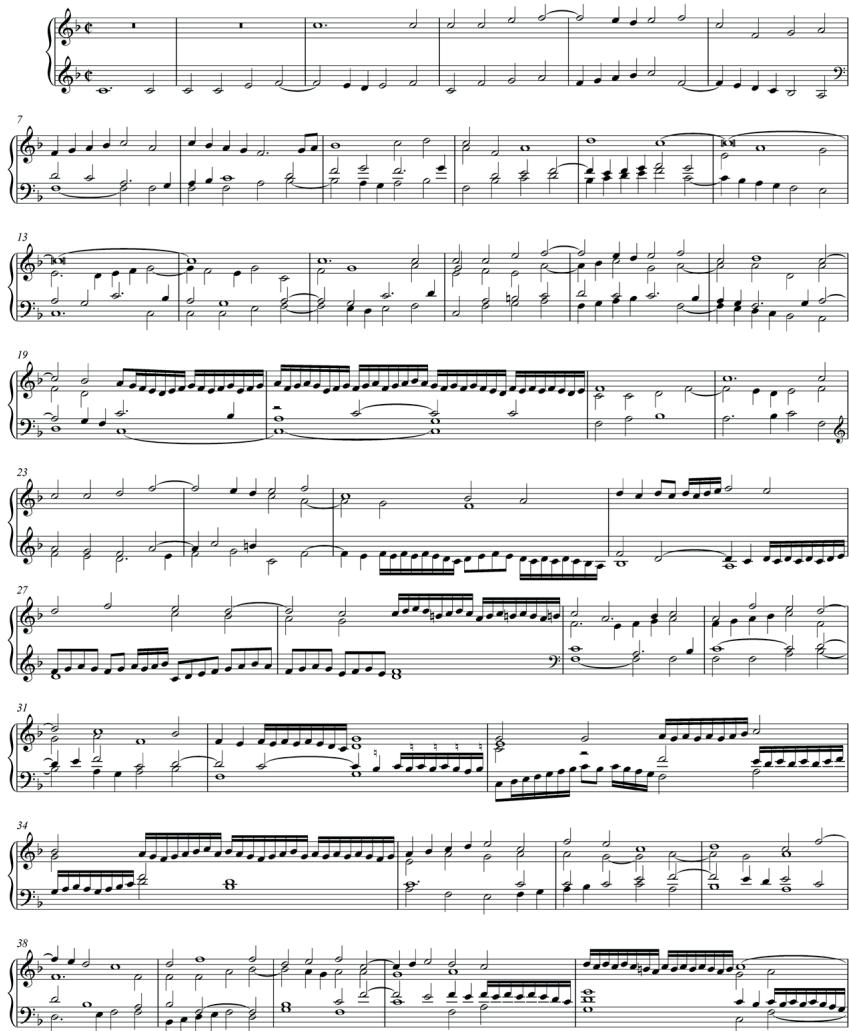
中文讲解
这是第 16 页上的一张内嵌图像(或乐谱示例)的占位符。其文本指出"内嵌图像数据已省略",意味着真正的图面内容并未被提取进本段文字中,因此无法在此直接识读。结合上一段的引文(Gabrieli 的 Ricercar del quinto tono,fols. 7r–10r),此处最可能呈现的是该印本中 fol. 7r 与/或 fol. 8r 的扫描页面,作为正文中相关分析的视觉佐证;但在缺少图像实体的条件下,确切的版面、谱号、调号与对位细节需通过原书或所附 DOI 链接亲自查阅方可确认。
第4段(P0083)
原文复述
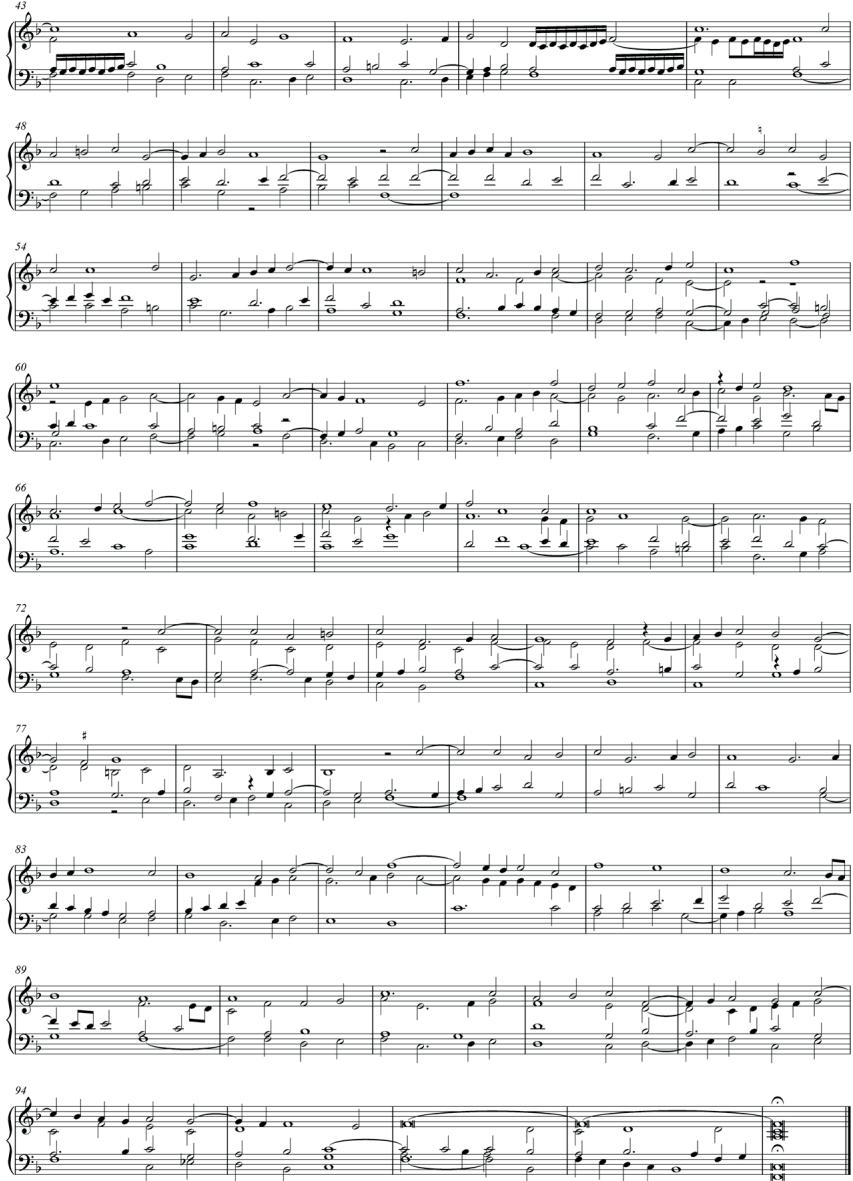
中文讲解
这是第 17 页上的一张内嵌图像(或乐谱示例)的占位符,承接第 16 页的图像延续展示。与上一占位符同理,原始图像数据未被提取,无法在此直接识读。根据前文引文 fols. 7r–10r 的范围,第 17 页的图像最有可能对应 fol. 9r 与/或 fol. 10r,亦即同一首 ricercar 的后半部分。读者欲获得具体的谱面细节(如对位声部进入、调式终止式或谱面记谱法),应通过所附 DOI 链接 e-rara 平台查阅 1596 年 Gardano 原印本的扫描件。
脚注 / 边栏 / 图表 / 附加信息(如有)
本附录由三项内容构成:(1) 一条规范的书目引文(P0081),给出作曲家、作品、合集、出版信息、叶号与 DOI;(2) 第 16 页上的图像/乐谱占位符(P0082);(3) 第 17 页上的图像/乐谱占位符(P0083)。三者合在一起,构成了对 1596 年 Angelo Gardano 印本中 Andrea Gabrieli《Ricercar del quinto tono》(fols. 7r–10r)的文献出处说明与图像呈现。本节中没有脚注、边栏说明或独立图注;图像本身的题注位置已被保留,但其文字内容随嵌入数据一并省略。
💡 本节核心要点
- Appendix 1 从第 16 页开始,是正文分析之外的补充材料板块。
- 其唯一一条文献引文指向 Andrea Gabrieli 的《Ricercar del quinto tono》,出自 1596 年威尼斯 Angelo Gardano 印行的《Il terzo libro de ricercari》fols. 7r–10r。
- 引文末尾的 DOI 链接提供了原印本在 e-rara 数字图书馆的在线访问途径,使读者能够直接核对附录中的图像。
- 第 16、17 页上的两张占位符按引文指定的叶号范围排列,应是对 fols. 7r–10r 的图像再现,但其实际谱面内容因图像数据被省略而不可在此处识读。
- 本附录的核心功能是文献层面的辅助:把作者所讨论的原始乐谱以引文加图像的形式直接呈现在读者面前,便于一边阅读正文一边参照原谱。
🔑 关键术语
- Ricercar (ricercare):十六世纪后期至十七世纪初盛行的器乐体裁,通常为严肃、模仿对位的乐曲;本附录引文中的 “Ricercar del quinto tono” 意为"第五调式的 ricercar"。
- Folio / fols.:手稿或早期印本中的一叶(leaf)。在古乐谱中常以"r"表示正面(recto)、“v"表示反面(verso);fols. 7r–10r 即第 7 至第 10 叶的正面,因为这一时期的乐谱一般只印在叶的正面。
- Angelo Gardano:威尼斯十六世纪著名的音乐出版商,此处作为 1596 年版《Il terzo libro de ricercari》的出版者出现在标准引证格式的”(出版地:出版者,年份)“位置中。
- DOI (Digital Object Identifier):数字对象永久标识符,用于稳定地定位一份在线资源;本附录所附 DOI 指向 e-rara 平台上的 1596 年原印本扫描件。
s11 Appendix 2
第1段(P0084)
原文复述
Appendix 2
中文讲解
本行是文档的二级标题,开启了名为"Appendix 2”(附录2)的小节。附录通常用于放置与正文主线论述互补但不宜直接嵌入正文的材料,例如完整的谱例、文献目录或数据表。结合下一页的乐谱占位符来看,此附录的功能是为读者提供一份可供查阅的音乐文本实例。
第2段(P0085)
原文复述
Andrea Gabrieli, ‘Anchor che col partire’ (after Cipriano de Rore) from Il terzo libro de ricercari (Venice: Angelo Gardano, 1596), fols. 34r–36r. Online: <https:// doi.org/10.3931/e-rara-55399 >. Sections for which a faster tempo is suggested are marked in red.
中文讲解
这段文字是一份乐谱的著录与编辑说明,由若干层信息组成:(1) 作曲家为 Andrea Gabrieli(安德烈·加布里埃利),作品名称为 ‘Anchor che col partire’;(2) 括号内 “after Cipriano de Rore” 表明该作品是加布里埃利以 Cipriano de Rore(奇普里亚诺·德·罗雷)原作素材为蓝本进行的改编或发挥,而不是独立原创;(3) 出处为 Il terzo libro de ricercari(《第三册 ricercari》),出版地为威尼斯,出版者为 Angelo Gardano(安杰洛·加尔达诺),出版年为1596年;(4) fols. 34r–36r 指出该曲在原书中的具体位置为第34右页至第36右页;(5) 提供了 e-rara 平台的数字版永久链接(DOI 形式的标识),便于读者在线查阅原版;(6) 最后一句是编辑语,说明此附录中建议采用较快速度的段落以红色标记,供演奏或阅读时识别。从这些信息可以推出:本附录的核心是为读者提供一份与前文论述相关的可查阅、可演奏的具体乐谱,同时加入编辑层面的额外提示(红色速度标记)。
补充说明
括号中 “after Cipriano de Rore” 和红色标记两条信息共同提示:附录并非只是文献的再版,而是经过编辑标注的辅助文本。读者在使用时应同时关注原版(通过链接)与编辑提示(红色标记)两层内容。
第3段(P0086)
原文复述
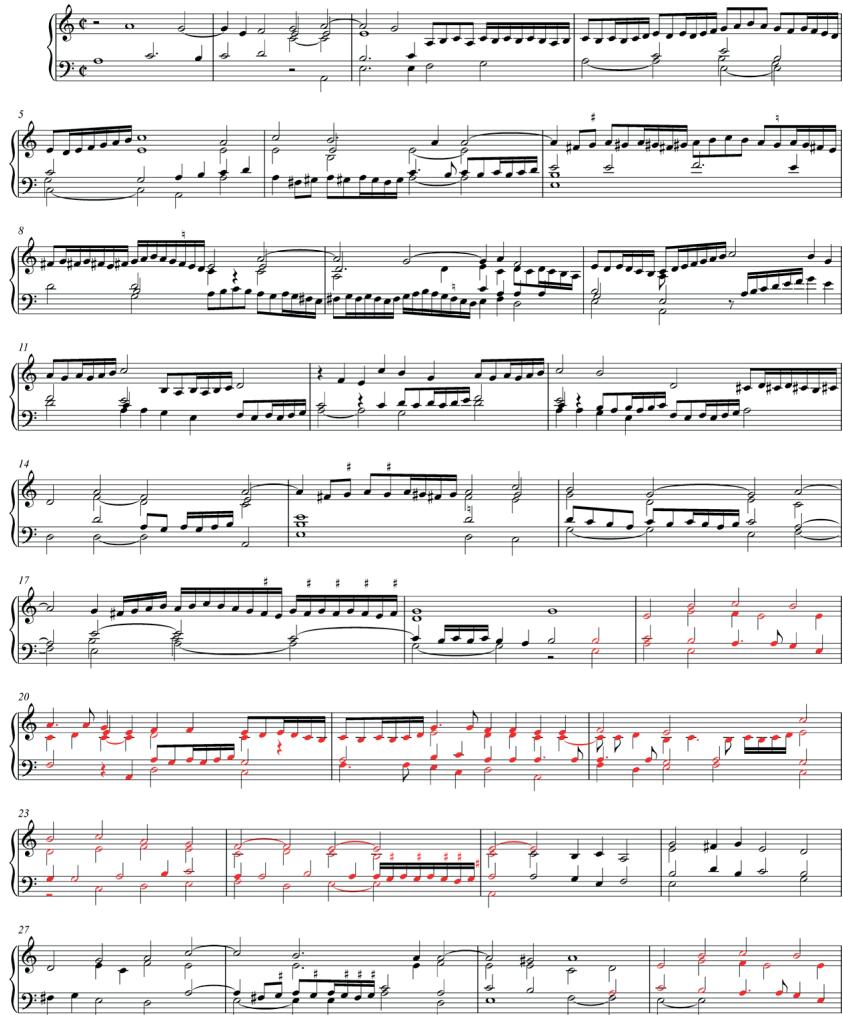
中文讲解
这是一处乐谱图像占位符,位于第18页,紧接 P0085 的著录说明之后。结合 P0085 给出的 fols. 34r–36r 信息,此处图像应呈现 Andrea Gabrieli《Anchor che col partire》原版或编辑版的乐谱开端部分(即 fol. 34r 起始页),以便读者在阅读著录信息后能直接对照谱面。括号内的备注说明内嵌图像数据被省略,仅保留位置与图注。实际谱面内容(包括谱号、调号、红色速度标记等)需要查看原图。
第4段(P0087)
原文复述
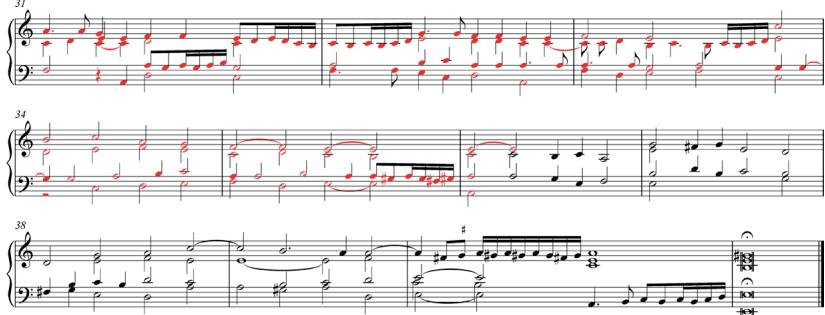
中文讲解
这是一处乐谱图像占位符,位于第19页,应为 P0086 乐谱图像的延续页。结合 P0085 中给出的 fols. 34r–36r 范围,此处图像对应 fol. 34v 之后的内容(第35右页、第36右页等),承载该曲的中间或结尾段落。读者应将第18页和第19页的谱例视为一份完整的连续文本,需查看原图才能获得实际谱面信息——包括红色标记所对应的速度提示段落。
脚注 / 边栏 / 图表 / 附加信息(如有)
本节附录2的主体由两部分组成:P0085 为乐谱的学术著录与编辑说明(含在线链接),P0086 和 P0087 为相应乐谱图像的占位符(位于第18页和第19页,对应 fols. 34r–36r)。附加信息中价值最高的是 e-rara 平台的数字版链接(DOI: 10.3931/e-rara-55399),它为读者提供了原始一手资料的访问途径;红色速度标记则提示存在编辑层面的人为标注,二者共同构成附录区别于正文的功能特征。
💡 本节核心要点
- 附录2 提供了一份与正文相关的具体音乐作品实例:Andrea Gabrieli 的 ‘Anchor che col partire’(改编自 Cipriano de Rore)。
- 该作品收录于 1596 年威尼斯 Angelo Gardano 出版的 Il terzo libro de ricercari 中,具体位于 fols. 34r–36r。
- 附录附带 e-rara 数字平台的在线链接(DOI: 10.3931/e-rara-55399),便于读者查阅原始版本。
- 对原版进行了编辑层面的标注:建议采用较快速度的段落以红色标记,这是一种带有人为解读的辅助提示。
- 第18页和第19页的乐谱图像占位符共同承载该曲的完整谱面信息,括号限制了 OCR 数据的可获性,需要查看原图。
🔑 关键术语
- Anchor che col partire:本附录所附乐谱的标题;安德烈·加布里埃利以此为名的作品是依据奇普里亚诺·德·罗雷的原作改编而成的。
- Il terzo libro de ricercari:收录本作品的曲集名称,意为"第三册 ricercari",1596 年由威尼斯安杰洛·加尔达诺出版;附录中的乐曲出自该曲集 fols. 34r–36r。
- ricercari:16世纪一种以对位模仿为特征的器乐体裁,常作为教学或演奏之用;在本节中体现为该曲集的整体体裁定位。
- Cipriano de Rore:在括号 “after Cipriano de Rore” 中出现,表明加布里埃利的作品以这位更早期作曲家的素材为基础进行改编。
- Angelo Gardano:1596 年威尼斯出版本曲集的印刷商,说明该作品在出版时的地理与机构归属。
- e-rara:附录给出的在线数字资源平台;DOI 链接 10.3931/e-rara-55399 即指向该平台上的本曲集数字版,为读者提供原版查阅途径。
s12 Appendix 3
第1段(P0088)
原文复述
The line ‘## Appendix 3’ is a Markdown level-2 heading that designates this section as the third appendix in the document.
中文讲解
本段是一个 Markdown 二级标题,以“## Appendix 3”形式呈现,标志着文档中第三个附录的开始。它出现在第 20 页,紧随其后的是该附录的主体内容——即 Bassano 作品的乐谱示例及其说明文字。作为附录标题,它不承担论证功能,而只是为读者标识这段非正文材料的归属与用途,使其与正文章节在结构上区别开来。
第2段(P0089)
原文复述
Giovanni Bassano, ‘Pulchra es amica mea’ (after Giovanni Pierluigi da Palestrina), from Mottetti, madrigali, et canzone francese (Venice, 1591; original print lost, see Friedrich Chrysander’s copy from 1890 in: D-Hs Ms. M B/2488), no. 51. Sections for which a faster tempo is suggested are marked in red.
中文讲解
本段是该附录乐谱示例的图注文字,承担三项功能:第一,给出作品的完整书目信息——作曲家 Giovanni Bassano、曲名 ‘Pulchra es amica mea’、底本作者为 Giovanni Pierluigi da Palestrina 的原作(‘after Palestrina’ 表明 Bassano 的版本属于加工性改编而非独立创作);第二,给出版本来源——作品原载于 1591 年威尼斯出版的 Motetti、madrigali 与法国尚松合集,编号为第 51 首,并注明原版印刷已佚(‘original print lost’),现存实物为 Friedrich Chrysander 于 1890 年完成的抄本,馆藏编号为 D-Hs Ms. M B/2488;第三,提示阅读方式——曲谱中以红色标注的段落暗示演奏者采用更快的速度(‘a faster tempo is suggested’)。‘original print lost’ 与 ‘Chrysander’s copy from 1890’ 之间形成版本学上的关键信息链:原版既佚,1890 年抄本便成为研究 Bassano 改编实践的实物依据;‘after Palestrina’ 同时点明 Bassano 与 Palestrina 之间继承与改编的关系。
补充说明
D-Hs 是文献中标注该抄本所属收藏机构的国际代码前缀;shelfmark 中的 ‘M B’ 表明该抄本被归入音乐类手稿序列;编号 2488 为具体条目号。‘after Palestrina’ 一语说明 Bassano 的 ‘Pulchra es amica mea’ 是在 Palestrina 原作基础上的改编,而非独立创作;‘original print lost’ 提示 1591 年的威尼斯原版印刷已经遗失,1890 年的 Chrysander 抄本因此成为研究该作品的唯一直接来源。
第3段(P0090)
原文复述
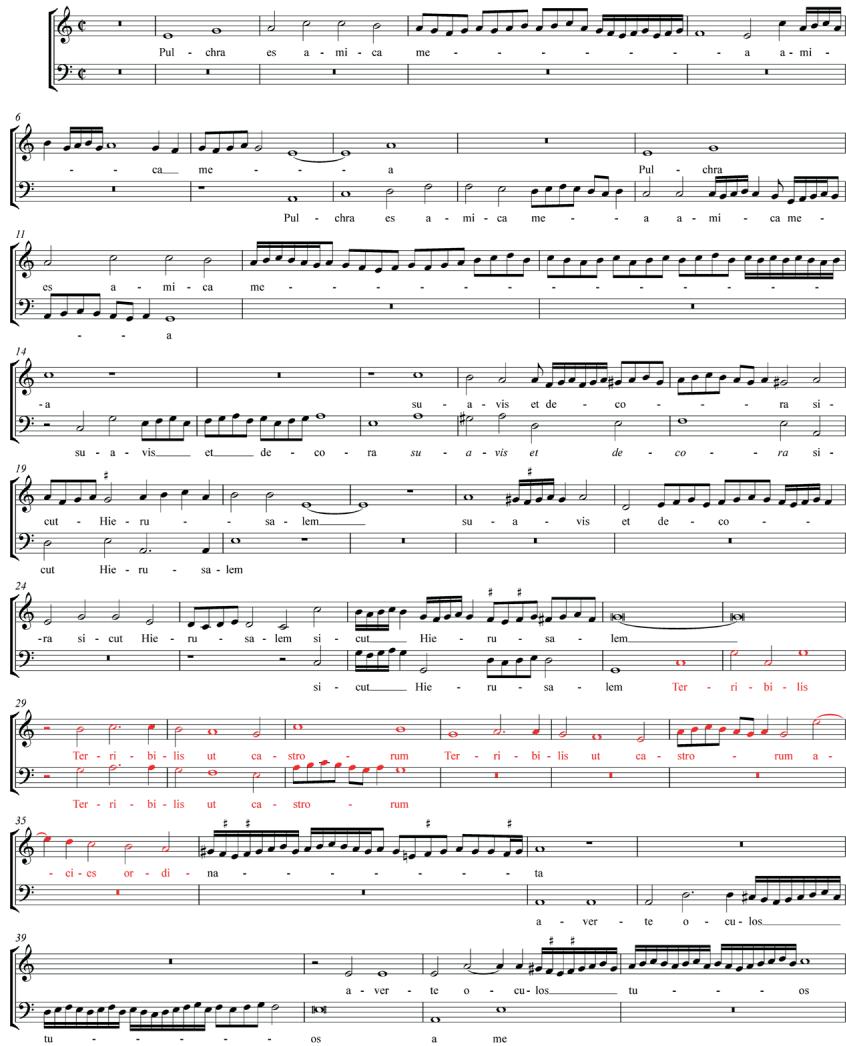
中文讲解
这是第 20 页的图像或乐谱占位符,原文中以 Markdown 图片链接形式存在,链接到的内嵌图像数据已被省略。该占位符紧接 P0089 的图注之后,结合图注内容判断,它承载的应是 Bassano《Pulchra es amica mea》的乐谱或抄本图像——具体谱号、谱表类型与小节细节因图像数据缺失而无法核实,读者需查阅原书第 20 页方能获得完整信息。该占位符本身不携带新的论证文字,而是图注所引证乐谱的物质载体。
第4段(P0091)
原文复述
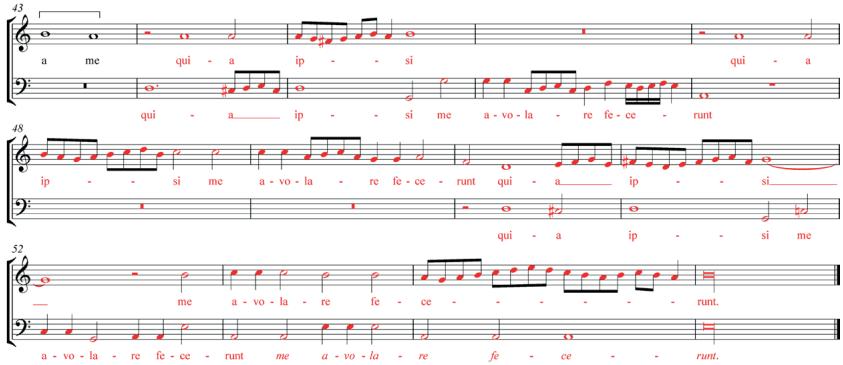
中文讲解
这是第 21 页的图像或乐谱占位符,承接第 20 页的乐谱图像。从版位看,它应是同一首作品 ‘Pulchra es amica mea’ 谱例的延续(若作品跨两页排布)或第二示例。无论哪种情况,红色标注段落的具体位置、谱面布局与小节数等信息均需查阅原图才能确认。该占位符与 P0090 一同构成本附录的图版主体,使 P0089 图注中所提及的“红色段落加快速度”这一演奏提示获得可视化的物质依托。
脚注 / 边栏 / 图表 / 附加信息(如有)
本附录的附加材料包括 P0089 的图注文字(兼具书目著录与演奏提示功能)以及两页乐谱图像占位符(P0090、P0091)。图注本身已以段落形式处理,故不另列脚注;正文中未出现独立的边栏或表格。
💡 本节核心要点
- 附录 3 收录了 Giovanni Bassano 改编自 Giovanni Pierluigi da Palestrina 的 ‘Pulchra es amica mea’ 乐谱,作为正文讨论 Bassano 改编实践的实例补充。
- 底本为 1591 年威尼斯出版的 Motetti、madrigali, et canzone francese 合集第 51 首;该原版印刷已佚,现存者为 Friedrich Chrysander 于 1890 年完成的抄本(shelfmark D-Hs Ms. M B/2488)。
- 图注明确指出乐谱中以红色标注的段落表示建议采用更快的演奏速度,反映 Bassano 改编中通过色彩标记来提示速度变化的做法。
- P0090 与 P0091 两页占位符对应同一作品的完整谱面,需结合原图阅读方能确定红色标注段落的具体位置与音乐语境。
- 本附录不提供独立的论证,而是为正文已提出的 Bassano 改编特征提供可查阅的文献凭证与可视化谱例。
🔑 关键术语
- Mottetti, madrigali, et canzone francese:1591 年威尼斯出版的合集名,收录经文歌(mottetti)、牧歌(madrigali)与法国尚松(canzone francese)三种体裁;本附录所讨论的 Bassano 改编即取自该合集第 51 首。
- after Giovanni Pierluigi da Palestrina:图注中的限定语,标识 Bassano 的 ‘Pulchra es amica mea’ 是以 Palestrina 的原作为底本进行的改编,而非 Bassano 的独立创作。
- Friedrich Chrysander’s copy from 1890:Chrysander 于 1890 年完成的抄本;因 1591 年威尼斯原版印刷已佚,该抄本成为后世考察 Bassano 该作品的唯一实物来源。
- D-Hs Ms. M B/2488:该抄本在收藏机构中的索书号:D-Hs 为机构代码前缀,Ms. 表示手稿,M B 指音乐类手稿序列,2488 为具体条目号。
- marked in red:图注对谱面标记的说明——以红色印出或描出的段落暗示演奏者采用更快的速度,是 Bassano 改编实践中速度对比的视觉标记。
s13 Appendix 4a
第1段(P0092)
原文复述
Appendix 4a
中文讲解
本段是二级标题“Appendix 4a”,用英文标记文档中附录4a的开始。该标题开启了本节内容:一条音乐作品引用以及与之对应的乐谱/图像示例。作为附录而非正文段落,它的功能是为前面正文里讨论过的某首作品提供完整的出处信息和可查阅的谱例,本身不承担论证,而是充当检索性资料。
补充说明
该标题独立成段,仅作为版面标识,没有附加论述。
第2段(P0093)
原文复述
Claudio Merulo, L’Olica (keyboard reduction), from Canzon di diversi per sonar con ogni sorte di stromenti (Venice, 1588) (RISM 158831), fols. A2r (Canto), E2r (Alto), C2r (Tenore), G2r (Basso).
中文讲解
这是一条音乐文献学格式的曲目引用,逐项交代了作品的来源信息:作曲家为 Claudio Merulo(克劳迪奥·梅鲁洛),作品名为 L’Olica(洛利卡),并注明呈现方式为“keyboard reduction”(键盘缩编谱,即将原本的合奏织体浓缩到一架键盘乐器上演奏的版本)。该缩编谱出自 1588 年于威尼斯出版的合奏曲集 Canzon di diversi per sonar con ogni sorte di stromenti(《可用各类乐器演奏的各式卡农曲集》),在文献目录中的编号为 RISM 158831。括号内的 fols. A2r、E2r、C2r、G2r 标出了乐谱所在的具体位置:folios 意为“对开页”,字母与数字组合是装订与页码编码,末尾的 r 表示 recto 即叶子的正面;其后括号中的 Canto、Alto、Tenore、Basso 则是四个声部的名称,对应高到低的四个声部层次。整条引用的作用是为读者提供精确的版本与页码依据,使其能够按图索骥地在原版曲集中找到这首作品的键盘缩编谱,并核对四个声部分别所在的页面,从而验证正文中对该作品所做的论述。
补充说明
该条目以单段引用的形式出现,本身不展开分析;其性质等同于学术论文中常见的“谱例出处说明”(example caption / source note),用于固定乐谱的版本来源。
第3段(P0094)
原文复述
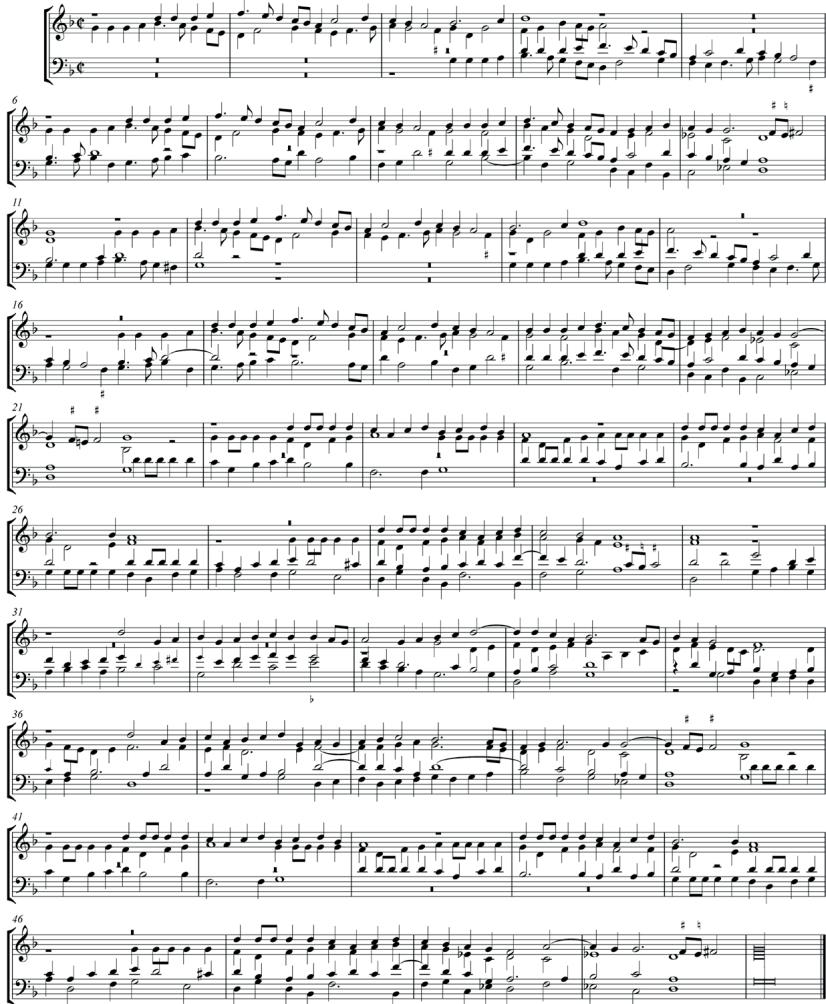
中文讲解
本段为占位标记,提示第 22 页上此处原本嵌有一幅图像或乐谱示例;嵌入的图像数据已被省略,仅保留其在版面中的位置与图注信息。结合上一段的引用可以判断,此处呈现的很可能就是 Claudio Merulo《L’Olica》键盘缩编谱的局部谱例或相关图像,用以直观配合正文与附录中的讨论。由于图像内容在当前文本中不可见,具体的音符、谱号、版面细节需要查看原图方可确认。
补充说明
无额外补充;具体乐谱内容须回到原始图像或扫描页核对。
脚注 / 边栏 / 图表 / 附加信息(如有)
本节末尾的图像占位符(P0094)与上一段(P0093)的曲目出处对应,属于乐谱示例图注;此外无脚注、边栏或其他附加材料。
💡 本节核心要点
- 本节标题为 Appendix 4a,属于附录性质,不承担独立论证,只提供检索性资料。
- P0093 是一条规范的音乐文献学引用,完整列出了作曲家、作品名、呈现形式(键盘缩编)、原始曲集、出版地与年代、目录编号及具体页码位置。
- folios 后标注的 r 表示 recto(对开叶的正面),A2r、E2r、C2r、G2r 分别对应该作品四个声部 Canto、Alto、Tenore、Basso 的起始页。
- RISM 158831 是该曲集在 RISM 目录中的编号,为读者提供标准的版本检索依据。
- P0094 为第 22 页上的乐谱/图像占位符,与 P0093 的引用配套出现,用以直观呈现相关谱例;具体内容须查阅原图。
🔑 关键术语
- keyboard reduction:键盘缩编谱,指把多声部合奏作品浓缩为可在单架键盘乐器上演奏的版本;在本节中用于说明 P0093 所引用谱例的呈现形式。
- folios (fols.):对开页的缩写记号,标识乐谱在原版曲集中的物理位置;本节中出现于 A2r、E2r、C2r、G2r。
- recto (r):对开叶的正面,与 verso(背面)相对;本节中每个 folio 编号末尾的 r 即此意。
- Canto / Alto / Tenore / Basso:十六世纪意大利出版的合奏曲集中常用的四个声部名称,从高到低依次为 Canto(最高)、Alto、Tenore、Basso(最低);本节中用以指明各声部分谱的起始页。
- RISM:本节中作为曲集目录编号 RISM 158831 的前缀出现,用以标识该 1588 年威尼斯曲集在相关音乐文献目录中的条目编号。
s14 Appendix 4b
第1段(P0095)
原文复述
Appendix 4b
中文讲解
这是小节的标题行,原文以 Markdown 的二级标题标记写成 “Appendix 4b”。从编号 “4b”(而非 “4” 或 “4a”)可以判断:在更大的章节架构中,存在一个与之配对的 “Appendix 4a”,而本附录是其延续或配套部分;“4b” 的功能是为读者提供与第 4 节主论题相关的额外材料——在此处即为后续段落中出现的乐谱图像。标题本身不包含论证,只起定位与索引作用,因此本段讲解以说明其版式身份和它所开启的论题为主,而无需展开实质内容。
第2段(P0096)
原文复述
Claudio Merulo, La Radivila, from Libro secondo di canzoni d’intavolatura d’organo (Venice: Angelo Gardano, 1606), fols. 6r–7v. Sections for which a faster tempo is suggested are marked in red.
中文讲解
本段是紧随标题之后的图注/文献说明,向读者交代接下来两页图像的来源、曲目与编辑约定,需分四层理解:
第一,曲目与作者。“Claudio Merulo” 是曲作者,“La Radivila” 是具体作品名。该作品出自 1606 年威尼斯由 Angelo Gardano 印行的《Libro secondo di canzoni d’intavolatura d’organo》(“管风琴键盘曲集第二册”),原书第 6 叶正面至第 7 叶背面(fols. 6r–7v,即现代折页标注中的 f.6 右上至 f.7 左下)为该曲所在页。
第二,文献类型。“intavolatura d’organo” 表明这是一部为管风琴记谱的键盘曲集,“canzoni” 指其体裁为里切尔卡卡农式复调体裁(canzona),这是文艺复兴晚期至巴洛克初期管风琴文献的常见形式。
第三,出版地与出版者。“Venice: Angelo Gardano, 1606” 提供了版本依据——威尼斯在 16–17 世纪是欧洲音乐印刷中心之一,Gardano 家族是当时重要的音乐出版商,该信息用以保证所引乐谱版本的权威性与可核查性。
第四,编辑约定。最后一句 “Sections for which a faster tempo is suggested are marked in red” 揭示了乐谱图像的视觉编码规则:作者在扫描或重印原谱时,对原谱上以红色标注的小节做了保留,意味着这些红色处暗示演奏者采用更快的速度。该说明为读者判读图像中的色彩信息提供了关键钥匙——若读者忽略此句,可能会把红色仅视为装饰或印刷污迹,从而错过作者附加的速度建议。
综上,这段图注虽短,却同时承担了来源标识(曲目、版本、出版信息)和阅读指南(颜色含义)两重功能,是连接原始历史文献与现代读者解读的桥梁。
补充说明
本段内的 “fols. 6r–7v” 是古抄本/早期印刷物常用的 foliation(叶码)记号法,r 表示 recto(叶的正面)、v 表示 verso(叶的背面),数字为对开叶的编号;“intavolatura” 是早期键盘音乐专用的记谱体系通称,具体规则因地区和时期而异。两者在本节中分别用于定位乐谱页码和说明记谱传统。
第3段(P0097)
原文复述
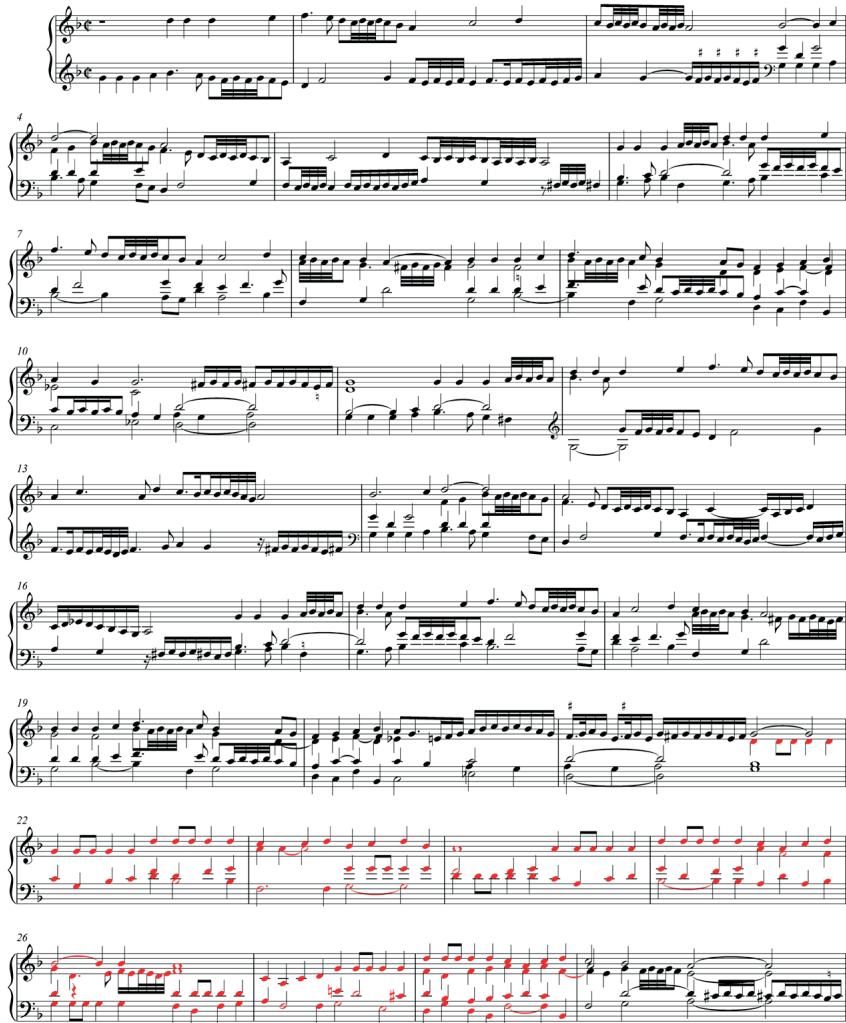
中文讲解
此条目是位于第 23 页的图像占位符。Markdown 语法中的 “
” 表明这里本应嵌入一幅图,但实际的图像数据在提取时被省略,方括号内的中文提示 “内嵌图像数据已省略;位置与图注保留” 明确告诉系统:图注的位置应保留,而图像本体不在本数据范围内。结合前一图注可知,此图应为 La Radivila 乐谱第 6 叶正面(6r)的影像或重印,且原谱中以红色标注、暗示更快速度的段落会以红色显示出来。读者如需看到实际的音符、谱号、谱表走向及红色标记的具体位置,必须查阅原始的扫描图或原书第 6r 页。本段的功能是版面上"留位",提示读者此处确有图,而非单纯的文字段落。
补充说明
无额外补充;图像细节不可从本输入直接定位,故不作推测。
第4段(P0098)
原文复述
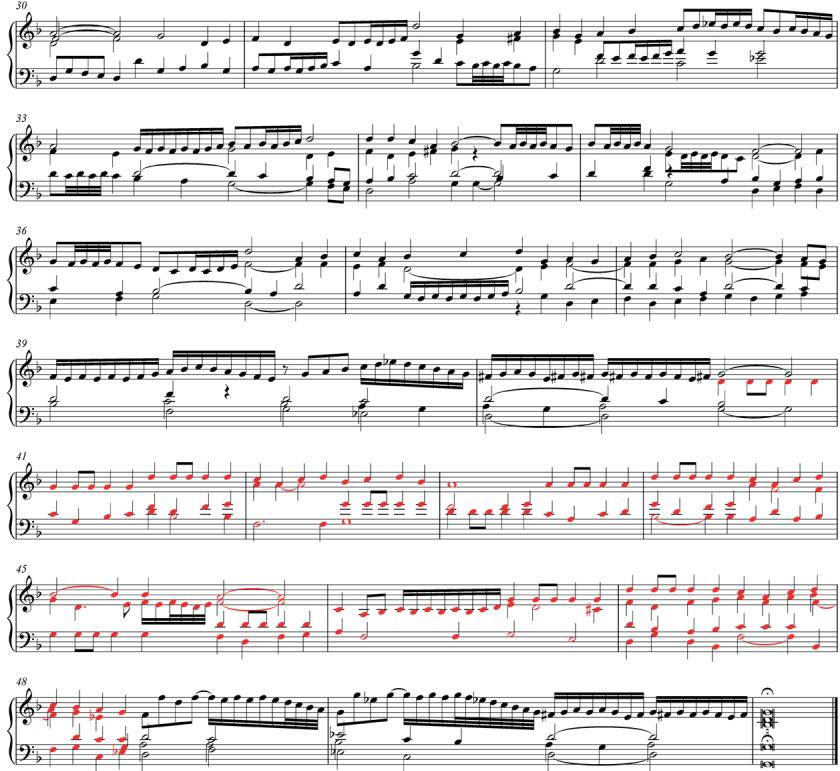
中文讲解
此条目是位于第 24 页的图像占位符,结构与 P0097 完全相同。区别在于版面对应页不同——此占位符位于第 24 页,对应 La Radivila 乐谱中第 7 叶正面至背面(fols. 6v 延续至 7r–7v)范围内的影像。读者应理解为:前一占位符(P0097)与本占位符共同构成 P0096 图注所描述的 fols. 6r–7v 跨页乐谱图像,二者在版面上是连续的双页展开。该占位符的复述严格保持与原文一致的占位符表述,避免对不可见的乐谱内容作任何细节猜测。
脚注 / 边栏 / 图表 / 附加信息(如有)
本附录仅包含四类元素:一个小节标题(P0095,“Appendix 4b”)、一段图注(P0096,交代曲目、版本与颜色编码含义)以及两段图像占位符(P0097、P0098,对应第 23、24 页乐谱图像)。其中 P0096 同时承担文献来源标注与阅读指南(红色=建议更快速度)两种功能;两段占位符因图像数据省略,仅起到版式留位作用,具体的音符、谱表走向与红色段落位置须查阅原始扫描图。
💡 本节核心要点
- Appendix 4b 是与正文中第 4 节相关的辅助性附录,其主体内容以图为主、文字极少。
- 图注明确给出曲目为 Claudio Merulo 的 La Radivila,来源为 1606 年威尼斯 Angelo Gardano 出版的《Libro secondo di canzoni d’intavolatura d’organo》第 6r–7v 叶。
- 图注同时承担编辑说明功能:原谱中以红色标记的小节暗示演奏者采用更快的速度,读者须以此为钥匙解读图像中的色彩信息。
- 两个图像占位符共同构成 fols. 6r–7v 跨页的乐谱展开图,但图像本体在当前数据中不可见,需查阅原图方可识别具体的红色段落位置。
- “intavolatura d’organo” 与 “canzoni” 两术语提示该作品属于文艺复兴晚期至巴洛克初期管风琴复调文献的典型体裁。
🔑 关键术语
- Claudio Merulo:本图注中所标曲作者;本节中仅按图注原样保留其姓名,不另作传记性介绍。
- La Radivila:本附录所收具体曲名,按原文保留意大利文拼写。
- Libro secondo di canzoni d’intavolatura d’organo:作品出处书名,意大利文,意为"管风琴键盘曲(canzona 体裁)集第二册",1606 年威尼斯出版。
- intavolatura d’organo:意大利文术语,指管风琴专用的键盘音乐记谱体系;本节中作为该作品体裁与记谱传统的标识。
- Angelo Gardano:图注中所列出版商;本节中仅作为出版来源信息出现。
- fols. 6r–7v:古抄本/早期印刷物的叶码标注法,r 为正面(recto)、v 为背面(verso);本节中用于定位 La Radivila 在原书中的具体页码。
- canzoni(canzona):文艺复兴晚期至巴洛克初期常见的器乐复调体裁,本节中作为图注书名组成部分出现。
s15 Bibliography
第1段(P0099)
原文复述
Bibliography
中文讲解
本段为小节标题,使用 Markdown 二级标题标记,对应英文 “Bibliography”,即“参考文献(书目)”。它标志本节由按作者或编者姓氏字母顺序排列的引文条目组成,是文章末尾正式列示的引用资料清单。
第2段(P0100)
原文复述
John Bass, ‘Would Caccini Approve? A Closer Look at Egerton 2971 and Florid Monody’, in: EM 36 (2008), 81–93
中文讲解
期刊论文条目。作者 John Bass,文章标题为《Caccini 会赞同吗?重新审视 Egerton 2971 与花唱式独唱》(“Would Caccini Approve? A Closer Look at Egerton 2971 and Florid Monody”),刊于《Early Music》(EM)第 36 卷(2008 年),第 81–93 页。
第3段(P0101)
原文复述
Giovanni Bassano, Mottetti, madrigali, et canzone francese (Venice, 1591); original print lost, see Friedrich Chrysander’s copy from 1890 in: D-Hs Ms. M B/2488
中文讲解
原始印刷物条目。Giovanni Bassano(巴萨诺),《经文歌、牧歌与法国歌曲集》(Mottetti, madrigali, et canzone francese),威尼斯,1591 年。原版印本已佚,Friedrich Chrysander(克里赞德)1890 年抄件存于汉堡国家图书馆(D-Hs)手稿部,编号 Ms. M B/2488。
补充说明
D-Hs 为汉堡国家图书馆(Staats- und Universitätsbibliothek Hamburg)的标准馆藏代号。
第4段(P0102)
原文复述
Severo Bonini, Affetti spirituali a dua voci (Venice: Bartolomeo Magni, 1615)
中文讲解
原始印刷物条目。Severo Bonini(博尼尼),《二声部灵性情感曲集》(Affetti spirituali a dua voci),威尼斯:Bartolomeo Magni 出版,1615 年。
第5段(P0103)
原文复述
Giovanni Battista Bovicelli, Regole, passaggi di musica, madrigali et motetti passeggiati, ed. Gawain Glenton, trans. Oliver Webber (Frome, 2018)
中文讲解
现代编辑译注本条目。Giovanni Battista Bovicelli(博维切利)原著《音乐规则、经过句、装饰性牧歌与经文歌》(Regole, passaggi di musica, madrigali et motetti passeggiati),由 Gawain Glenton 编辑、Oliver Webber 翻译,Frome,2018 年。
第6段(P0104)
原文复述
William Byrd, My Ladye Nevells Booke, GB-BL MS Mus. 1591
中文讲解
手稿音乐文献条目。William Byrd(伯德),《内维尔夫人曲集》(My Ladye Nevells Booke),藏于大英图书馆(GB-BL),手稿编号 MS Mus. 1591。
补充说明
GB-BL 为大英图书馆(British Library)的标准代号。
第7段(P0105)
原文复述
William Byrd, Organ and Keyboard Works: Fantasias and Related Works, ed. Desmond Hunter (Kassel, 2019)
中文讲解
现代编辑版本条目。William Byrd,《管风琴与键盘作品:幻想曲及相关作品》(Organ and Keyboard Works: Fantasias and Related Works),由 Desmond Hunter 编辑,卡塞尔,2019 年。
第8段(P0106)
原文复述
Seth Calvisius, Bicinia septuaginta ad sententias evangeliorum anniversorium (Leipzig: Jacob Apel, 1599)
中文讲解
原始印刷物条目。Seth Calvisius(卡尔维西乌斯),《配以四部福音诵句的七十首二声部歌曲》(Bicinia septuaginta ad sententias evangeliorum anniversorium),莱比锡:Jacob Apel 出版,1599 年。
第9段(P0107)
原文复述
Giovanthomaso Cimello, The Collected Secular Works, ed. Donna G. Cardamone and James Haar, RRMR 126 (Madison, WI, 2001)
中文讲解
现代编辑版本条目。Giovanthomaso Cimello(奇梅洛),《世俗作品集》(The Collected Secular Works),由 Donna G. Cardamone 与 James Haar 编辑,收入 Recent Researches in the Music of the Renaissance(RRMR)第 126 卷,威斯康星州麦迪逊,2001 年。
第10段(P0108)
原文复述
Luigi Collarile, ‘Claudio Merulo nell’intavolatura tedesca di Torino: il problema delle fonti’, in: In organo pleno: Festschrift für Jean-Claude Zehnder zum 65. Geburtstag, ed. Luigi Collarile and Alexandra Nigito (Bern, 2007), 89–112
中文讲解
纪念文集论文条目。Luigi Collarile,《Claudio Merulo 在都灵德式管风琴谱记法中:关于原始资料的问题》(“Claudio Merulo nell’intavolatura tedesca di Torino: il problema delle fonti”),收入《In organo pleno:Jean-Claude Zehnder 六十五寿辰纪念文集》(In organo pleno: Festschrift für Jean-Claude Zehnder zum 65. Geburtstag),由 Luigi Collarile 与 Alexandra Nigito 编辑,伯尔尼,2007 年,第 89–112 页。
第11段(P0109)
原文复述
Thomas Crecquillon, Gioseffo Guami, and Claudio Merulo, Canzon di diversi per sonar con ogni sorte di stromenti (Venice: Giacomo Vincenti, 1588)
中文讲解
原始合集条目。Thomas Crecquillon(克雷基永)、Gioseffo Guami(瓜米)与 Claudio Merulo(梅鲁洛)合著,《为各种乐器演奏而作的多种卡农曲集》(Canzon di diversi per sonar con ogni sorte di stromenti),威尼斯:Giacomo Vincenti 出版,1588 年。
第12段(P0110)
原文复述
Girolamo Dalla Casa, Il vero modo di diminuir (Venice: Angelo Gardano, 1584), http://www.bibliotecamusica.it/cmbm/scripts/gaspari/scheda.asp?id=2817
中文讲解
原始印刷物条目。Girolamo Dalla Casa(达拉·卡萨),《真正的减饰演唱法》(Il vero modo di diminuir),威尼斯:Angelo Gardano 出版,1584 年。该书是 16 世纪关于花唱(diminution,减饰、经过句)演唱与演奏技法的重要教材。条末附博洛尼亚音乐图书馆数字化版本链接。
第13段(P0111)
原文复述
Ruth DeFord, Tactus, Mensuration, and Rhythm in Renaissance Music (Cambridge, 2015)
中文讲解
学术专著条目。Ruth DeFord(德福德),《文艺复兴音乐中的 tactus、拍号与节奏》(Tactus, Mensuration, and Rhythm in Renaissance Music),剑桥大学出版社,2015 年。
第14段(P0112)
原文复述
Robert Dowland (ed.), A Musicall Banquet (London: John Benson and John Playford, 1610) (RISM 161020)
中文讲解
原始印刷物条目(论文集)。Robert Dowland(小罗伯特·道兰)编辑,《音乐飨宴》(A Musicall Banquet),伦敦:John Benson 与 John Playford 出版,1610 年。条目末标注 RISM(国际音乐文献资料汇编)编号 161020。
第15段(P0113)
原文复述
J. Cheryl Exum, Song of Songs: A Commentary, The Old Testament Library (Louisville, KY, 2005)
中文讲解
学术专著条目。J. Cheryl Exum(埃克苏姆),《雅歌注释》(Song of Songs: A Commentary),收入《旧约丛书》(The Old Testament Library),路易斯维尔,2005 年。该条目提示作者的研究论及《雅歌》文本或其中所蕴含的音乐象征。
第16段(P0114)
原文复述
Francesco da Milano and Pietro Paolo Borrono, Intabulatura di lauto del divino Francesco da Milano, et dell’eccellente Pietro Paulo Borrono da Milano […] libro secondo (Venice: [Gerolamo Scotto], 1546) (RISM 154630), https://s9.imslp.org/files/imglnks/usimg/8/81/IMSLP263476-PMLP427136-milano_intabolatura_de_lauto_2.pdf
中文讲解
原始印刷物条目。Francesco da Milano(米兰的弗朗切斯科)与 Pietro Paolo Borrono(博罗诺)合著,《神圣的弗朗切斯科·达·米兰及卓越的皮埃特罗·保罗·博罗诺之鲁特琴谱集……第二卷》(Intabulatura di lauto … libro secondo),威尼斯:[Gerolamo Scotto] 出版,1546 年。条目末附 RISM 编号 154630 及 IMSLP 数字化版本链接。
补充说明
Intabulatura(intavolatura)为意大利文“键盘/弹拨乐器谱记法”。
第17段(P0115)
原文复述
Girolamo Frescobaldi, Toccate e partite d’intavolatura di cimbalo (Rome: Nicolò Borboni, 1616)
中文讲解
原始印刷物条目。Girolamo Frescobaldi(弗雷斯科巴尔迪),《羽管键琴谱记法之托卡塔与变奏曲集》(Toccate e partite d’intavolatura di cimbalo),罗马:Nicolò Borboni 出版,1616 年。
第18段(P0116)
原文复述
Andrea Gabrieli, Ricercari […] libro secondo (Venice: Angelo Gardano, 1595), http://doi.org/10.3931/e-rara-56111
中文讲解
原始印刷物条目。Andrea Gabrieli(安德烈亚·加布里埃利),《探索曲集……第二卷》(Ricercari […] libro secondo),威尼斯:Angelo Gardano 出版,1595 年。条末附 e-rara 平台数字资源 DOI 链接。
补充说明
Ricercare 为 16 世纪一种基于模仿手法的器乐体裁。
第19段(P0117)
原文复述
Andrea Gabrieli, Il terzo libro de ricercari (Venice: Angelo Gardano, 1596), https://doi.org/10.3931/e-rara-55399
中文讲解
原始印刷物条目。Andrea Gabrieli,《探索曲集第三卷》(Il terzo libro de ricercari),威尼斯:Angelo Gardano 出版,1596 年。条末附 e-rara 平台数字资源 DOI 链接。
第20段(P0118)
原文复述
Andrea Gabrieli, Sämtliche Werke für Tasteninstrumente, ed. Giuseppe Clericetti, 6 vols. (Vienna, 1997–99)
中文讲解
现代全集版本条目。Andrea Gabrieli,《键盘乐器作品全集》(Sämtliche Werke für Tasteninstrumente),由 Giuseppe Clericetti 编辑,共 6 卷,维也纳,1997–99 年。
第21段(P0119)
原文复述
Luis Gásser, Luis Milán on Sixteenth-Century Performance Practice (Bloomington, 1996)
中文讲解
学术专著条目。Luis Gásser(加塞尔),《Luis Milán 论十六世纪演奏实践》(Luis Milán on Sixteenth-Century Performance Practice),布鲁明顿,1996 年。
第22段(P0120)
原文复述
Giles Earle’s Songbook, GB-Lbl Add. 24655
中文讲解
手稿音乐文献条目。《Giles Earle 歌曲集》(Giles Earle’s Songbook),藏于伦敦大英图书馆(Lbl,British Library),编号 Add. 24655。
补充说明
GB-Lbl 中的 Lbl 为 Folger Shakespeare Library 之旧代号,此处特指附加手稿(Additional Manuscript)收藏。
第23段(P0121)
原文复述
Hanns Haiden, Musicale instrumentum reformatum ([Nuremberg, 1610]) (VD17 12:651984X), https://nbn-resolving.org/urn:nbn:de:bvb:22-jh.mus.d.1-3
中文讲解
原始印刷物条目。Hanns Haiden(海登),《改良的乐器》(Musicale instrumentum reformatum),出版地与出版者推测为纽伦堡,1610 年。条目末附 VD17 编号(德意志十七世纪印刷物联合目录)及巴伐利亚州立图书馆数字化 URN 链接。
第24段(P0122)
原文复述
Monika Holl, ‘“Der Musica Triumph” – Ein Bilddokument von 1607 zur Musikauffassung des Humanismus in Deutschland’, in: Imago musicae 3 (1986), 9–30
中文讲解
期刊论文条目。Monika Holl,《“音乐的凯旋”——1607 年一幅关于德国人文主义音乐观的图像文献》(“Der Musica Triumph” – Ein Bilddokument von 1607 zur Musikauffassung des Humanismus in Deutschland),刊于《Imago musicae》第 3 卷(1986 年),第 9–30 页。
第25段(P0123)
原文复述
Edward Huws Jones, The Performance of English Song, 1610–1670, 2 vols. (New York, 1989)
中文讲解
学术专著条目。Edward Huws Jones(休斯·琼斯),《1610–1670 年英国歌曲的演唱》(The Performance of English Song, 1610–1670),共 2 卷,纽约,1989 年。
第26段(P0124)
原文复述
Robert Floyd Judd, ‘The use of notational formats at the keyboard: A study of printed sources of keyboard music in Spain and Italy c. 1500–1700, selected manuscript sources including music by Claudio Merulo, and contemporary writings concerning notations’, 2 vols., PhD thesis, University of Oxford, 1989
中文讲解
博士论文条目。Robert Floyd Judd(贾德),《键盘谱记法形式的使用:1500–1700 年西班牙与意大利键盘音乐印刷谱本、含梅鲁洛作品的精选手稿以及同期关于记谱法论著之研究》(The use of notational formats at the keyboard),共 2 卷,牛津大学博士论文,1989 年。
第27段(P0125)
原文复述
Orlando di Lasso, Bicinia, sive cantiones suavissimae duarum vocum (Antwerp: Pierre Phalèse and Jean Bellère, 1590)
中文讲解
原始印刷物条目。Orlando di Lasso(拉索),《二声部歌曲,甚为悦耳之歌集》(Bicinia, sive cantiones suavissimae duarum vocum),安特卫普:Pierre Phalèse 与 Jean Bellère 出版,1590 年。
补充说明
Bicinium(二声部歌曲)为 16 世纪常见的小型二声部体裁。
第28段(P0126)
原文复述
Orlando di Lasso, Bicinia, sive cantiones suavissimae duarum vocum (Antwerp: Pierre Phalèse, 1609)
中文讲解
原始印刷物条目。Orlando di Lasso,同名作品之再版(1609 年版),安特卫普:Pierre Phalèse 出版。
第29段(P0127)
原文复述
Orlando di Lasso, Novae aliquot et ante hac non ita usitatae cantiones suavissimae (Munich: Adam Berg, 1577)
中文讲解
原始印刷物条目。Orlando di Lasso,《若干新颖且前所未用之悦耳歌曲集》(Novae aliquot et ante hac non ita usitatae cantiones suavissimae),慕尼黑:Adam Berg 出版,1577 年。
第30段(P0128)
原文复述
Lewis Lockwood, ‘Text and Music in Rore’s Madrigal “Anchor che col partire”’, in: Musical Humanism and its Legacy: Essays in Honor of Claude V. Palisca, ed. Nancy Kovaleff Baker and Barbara Russano Hanning (Stuyvesant, NY, 1992), 243–51
中文讲解
纪念文集论文条目。Lewis Lockwood,《Rore 牧歌〈Anchor che col partire〉中的文词与音乐》(“Text and Music in Rore’s Madrigal ‘Anchor che col partire’”),收入《音乐人文主义及其遗产:Claude V. Palisca 颂寿文集》(Musical Humanism and its Legacy: Essays in Honor of Claude V. Palisca),由 Nancy Kovaleff Baker 与 Barbara Russano Hanning 编辑,纽约州 Stuyvesant,1992 年,第 243–51 页。
第31段(P0129)
原文复述
Luzzasco Luzzaschi, Madrigali […] per cantare et sonare (Rome: Simone Verovio, 1601), https://lccn.loc.gov/2008561305
中文讲解
原始印刷物条目。Luzzasco Luzzaschi(卢扎斯基),《可唱可奏之牧歌集》(Madrigali […] per cantare et sonare),罗马:Simone Verovio 出版,1601 年。条末附美国国会图书馆编号(LCCN)链接。
第32段(P0130)
原文复述
Domen Marinčič, ‘“Now quickly, now again slowly”: Tempo modification in and around Praetorius’, in: De musica disserenda 15/1–2 (2019), 47–69
中文讲解
期刊论文条目。Domen Marinčič,《“时而迅疾,时而徐缓”:普雷托里乌斯及其前后的速度变化》(“Now quickly, now again slowly”: Tempo modification in and around Praetorius),刊于《De musica disserenda》第 15 卷第 1–2 期(2019 年),第 47–69 页。
第33段(P0131)
原文复述
Ascanio Mayone, Primo libro di diversi capricci per sonare (Naples: Costantino Vitale, 1603)
中文讲解
原始印刷物条目。Ascanio Mayone(马约内),《各式随想曲第一卷》(Primo libro di diversi capricci per sonare),那不勒斯:Costantino Vitale 出版,1603 年。
第34段(P0132)
原文复述
Claudio Merulo, Libro secondo di canzoni d’intavolatura d’organo (Venice: Angelo Gardano e fratelli, 1606)
中文讲解
原始印刷物条目。Claudio Merulo(梅鲁洛),《管风琴卡农曲谱集第二卷》(Libro secondo di canzoni d’intavolatura d’organo),威尼斯:Angelo Gardano e fratelli 出版,1606 年。
第35段(P0133)
原文复述
Claudio Merulo, Toccate d’intavolatura d’organo […] libro primo (Venice: Simone Verovio, 1598), https://mdz-nbn-resolving.de/details:bsb00094272
中文讲解
原始印刷物条目。Claudio Merulo,《管风琴托卡塔谱集第一卷》(Toccate d’intavolatura d’organo […] libro primo),威尼斯:Simone Verovio 出版,1598 年。条末附巴伐利亚州立图书馆数字化版本链接。
第36段(P0134)
原文复述
Claudio Merulo, Toccate d’intavolatura d’organo […] libro secondo (Rome: Simone Verovio, 1604), https://mdz-nbn-resolving.de/details:bsb00094273
中文讲解
原始印刷物条目。Claudio Merulo,《管风琴托卡塔谱集第二卷》(Toccate d’intavolatura d’organo […] libro secondo),罗马:Simone Verovio 出版,1604 年。条末附巴伐利亚州立图书馆数字化版本链接。
第37段(P0135)
原文复述
Luis Milán, Libro de música de vihuela de mano intitulado El maestro (Valencia: Francisco Díaz Romano, 1536), http://bdh-rd.bne.es/viewer.vm?id=0000022795
中文讲解
原始印刷物条目。Luis Milán(米兰),《手维韦拉琴曲集,题名〈大师〉》(Libro de música de vihuela de mano intitulado El maestro),巴伦西亚:Francisco Díaz Romano 出版,1536 年。条末附西班牙国家图书馆(BNE)数字化版本链接。
第38段(P0136)
原文复述
Johann Nauwach, Libro primo di arie, passegiate à una voce (Dresden, 1623)
中文讲解
原始印刷物条目。Johann Nauwach(瑙瓦赫),《带经过句之独唱咏叹调第一卷》(Libro primo di arie, passegiate à una voce),德累斯顿,1623 年。
第39段(P0137)
原文复述
Claude V. Palisca, The Florentine Camerata: Documentary Studies and Translations (New Haven, 1989)
中文讲解
学术专著条目。Claude V. Palisca(帕利斯卡),《佛罗伦萨卡梅拉塔:文献研究与译注》(The Florentine Camerata: Documentary Studies and Translations),纽黑文,1989 年。
第40段(P0138)
原文复述
Michael Praetorius, Syntagma musicum II (Wolfenbüttel, 1619) (VD17 3:315037M)
中文讲解
原始印刷物条目。Michael Praetorius(普雷托里乌斯),《音乐集成 第二卷》(Syntagma musicum II),沃尔芬比特尔,1619 年。条目末附 VD17 编号。
第41段(P0139)
原文复述
Bartolomeo Ramos de Pareja, Musica practica (Bologna: Baltasar de Hyrberia, 1482)
中文讲解
原始印刷物条目。Bartolomeo Ramos de Pareja(拉莫斯·德·帕雷哈),《实用音乐》(Musica practica),博洛尼亚:Baltasar de Hyrberia 出版,1482 年。
第42段(P0140)
原文复述
Christopher Reynolds, ‘Alessandro Striggio’s Analysis of Cipriano de Rore’s “Ancor che col partire”’, in: Journal of the Alamire Foundation 9, no. 2 (2017), 197–218
中文讲解
期刊论文条目。Christopher Reynolds(雷诺兹),《Alessandro Striggio 对 Cipriano de Rore〈Ancor che col partire〉的分析》(“Alessandro Striggio’s Analysis of Cipriano de Rore’s ‘Ancor che col partire’”),刊于《Alamire 基金会期刊》(Journal of the Alamire Foundation)第 9 卷第 2 期(2017 年),第 197–218 页。
第43段(P0141)
原文复述
Francesco Rognoni, Selva de varii passaggi (Milan: Filippo Lomazzo, 1620)
中文讲解
原始印刷物条目。Francesco Rognoni(弗朗切斯科·罗尼奥尼),《各式经过句之林》(Selva de varii passaggi),米兰:Filippo Lomazzo 出版,1620 年。该书与同期 diminution 教材同属 17 世纪初的经过句(passaggi)传统。
第44段(P0142)
原文复述
Riccardo Rognoni, Passaggi per potersi essercitare Nel Diminuire terminatamente con ogni sorte d’Instromenti (Venice: Giacomo Vincenti, 1592), http://conquest.imslp.info/files/imglnks/usimg/7/75/IMSLP292311-PMLP474374-passaggi_etc_riccardo_ognoni_parte2.pdf
中文讲解
原始印刷物条目。Riccardo Rognoni(里卡尔多·罗尼奥尼),《为彻底练习减饰而作之经过句集,可用于各类乐器》(Passaggi per potersi essercitare Nel Diminuire terminatamente con ogni sorte d’Instromenti),威尼斯:Giacomo Vincenti 出版,1592 年。条末附 IMSLP 数字化版本链接。
第45段(P0143)
原文复述
Bernhold Schmid, ‘“Nec non Tyronibus quàm eius artis peritioribus summopere inservientes.” – Zur gedruckten Überlieferung von Lassos Bicinien’, in: Yearbook of the Alamire Foundation 6 (2008), 177–203
中文讲解
期刊论文条目。Bernhold Schmid,《“不仅为初学者,亦为技艺更为精熟者皆竭力服务”——论拉索二声部歌曲之印刷传承》(“‘Nec non Tyronibus quàm eius artis peritioribus summopere inservientes.’ – Zur gedruckten Überlieferung von Lassos Bicinien”),刊于《Alamire 基金会年鉴》(Yearbook of the Alamire Foundation)第 6 卷(2008 年),第 177–203 页。
第46段(P0144)
原文复述
Bernhold Schmid, The Fitzwilliam Virginal Book, GB-Cfm, Mu. MS 168
中文讲解
手稿音乐文献条目(书目/专著)。Bernhard Schmid,《菲茨威廉维金纳琴曲集》(The Fitzwilliam Virginal Book),藏于剑桥菲茨威廉博物馆(Fitzwilliam Museum,GB-Cfm),手稿编号 Mu. MS 168。
补充说明
GB-Cfm 为剑桥菲茨威廉博物馆的标准代号;Mu. MS 为音乐手稿(Music Manuscript)的缩写编号格式。
第47段(P0145)
原文复述
Nicola Vicentino, L’antica musica ridotta alla moderna prattica (Rome: Antonio Barre, 1555), https://mdz-nbn-resolving.de/details:bsb00103730
中文讲解
原始印刷物条目。Nicola Vicentino(维琴蒂诺),《古代音乐归于现代实践》(L’antica musica ridotta alla moderna prattica),罗马:Antonio Barre 出版,1555 年。条末附巴伐利亚州立图书馆数字化版本链接。
第48段(P0146)
原文复述
Nicola Vicentino, Ancient Music Adapted to Modern Practice, trans. Maria Rika Maniates, ed. Claude V. Palisca, Music theory translation series (New Haven, 1996)
中文讲解
英译本条目。Nicola Vicentino 同名著述之英译:《古代音乐归于现代实践》(Ancient Music Adapted to Modern Practice),由 Maria Rika Maniates 翻译、Claude V. Palisca 编辑,收入《音乐理论译丛》(Music Theory Translation Series),纽黑文,1996 年。
第49段(P0147)
原文复述
Lodovico Zacconi, Prattica di musica (Venice: Bartolomeo Carampello, 1592)
中文讲解
原始印刷物条目。Lodovico Zacconi(扎科尼),《音乐实践》(Prattica di musica),威尼斯:Bartolomeo Carampello 出版,1592 年。该书为文艺复兴晚期综合性的音乐理论教材。
第50段(P0148)
原文复述
Gioseffo Zarlino, Le istitutioni harmoniche (Venice: Francesco de Franceschi, 1558), https://digital.library.unt.edu/ark:/67531/metadc25960/
中文讲解
原始印刷物条目。Gioseffo Zarlino(扎利诺),《和声体制》(Le istitutioni harmoniche),威尼斯:Francesco de Franceschi 出版,1558 年。条末附北德克萨斯大学图书馆数字化版本链接。
脚注 / 边栏 / 图表 / 附加信息(如有)
本节为整篇论文的参考文献条目清单(Bibliography),不包含正文论述。所有条目按作者/编者姓氏字母顺序排列,混合了原始文献(16–17 世纪印本与手稿)、现代编辑版本/译本(Renaissance 系列的 RRMR 等)、博士论文、纪念文集论文与单本学术专著。许多原始印本附 IMSLP、巴伐利亚州立图书馆数字化(BSB/mdz)、e-rara、西班牙国家图书馆(BNE)等可在线访问的链接,方便读者直接核对原文。多个手稿条目通过 RISM、GB-BL、GB-Lbl、GB-Cfm、D-Hs 等标准馆藏代号精确给出馆藏地点与编号。研究主题通过条目类型分布可推知:涉及 diminution/passaggi(减饰与经过句)传统(Dalla Casa、Rognoni 父子、Bovicelli、Nauwach)、键盘音乐与谱记法(Merulo、Andrea Gabrieli、Mayone、Frescobaldi、Byrd、Fitzwilliam Virginal Book、Milán、Judd 论键盘谱记法)、二声部与多声部牧歌(Andrea/Lasso、Bassano、Cimello、Luzzaschi、Rore/Striggio)、音乐理论(Zarlino、Vicentino、Zacconi、Palisca 关于卡梅拉塔、DeFord 论 tactus、Marinčič 论 Praetorius)以及少量非音乐性参照(Exum 对《雅歌》的注释)。这些条目的整体分布表明本论文聚焦于 16 世纪早期至 17 世纪初的意大利与欧洲音乐实践,尤其是减饰演唱/演奏与键盘体裁。
💡 本节核心要点
- 参考文献按作者姓氏字母顺序排列,混合原始文献(印本与手稿)、现代编辑/译本、博士论文、纪念文集论文与学术专著。
- 原始文献时间跨度自 1482 年(Ramos de Pareja 的《Musica practica》)至 1623 年(Nauwach),覆盖文艺复兴晚期至巴洛克早期。
- 条目中包含多种数字资源链接:IMSLP、e-rara、BSB(巴伐利亚州立图书馆)、西班牙国家图书馆(BNE)、北德克萨斯大学图书馆以及 RISM 编号,便于直接核查。
- 手稿文献以国际标准馆藏代号(RISM、GB-BL、GB-Lbl、GB-Cfm、D-Hs 等)标示,确切的库藏编号保证引文可被重复定位。
- 主题分布指向意大利/欧洲文艺复兴音乐的演奏实践——尤其是 diminution/passaggi(减饰/经过句)传统、键盘音乐与谱记法、二声部与牧歌体裁,以及音乐理论文献(Zarlino、Vicentino、Zacconi)。
- 专题分布既涵盖国际性作家(Zarlino、Vicentino、Merulo、Frescobaldi、Lasso),也涉及英国(Byrd、Dowland、Huws Jones)与西班牙(Milán、Gásser)传统,显示论文具有跨国比较视野。
🔑 关键术语
- Diminution / Passaggi:减饰/经过句——16 世纪以来为既有旋律(通常取自他人作品)添加快速音符、花唱式装饰的演唱或演奏技法,在本节书目中由 Dalla Casa、Bovicelli、Rognoni 父子等著作集中体现。
- Intavolatura (Intabulatura):意大利语“键盘/弹拨乐器谱记法”——一种以字母、符号或数字指示弦/键位置与节奏的记谱方式,用于管风琴、羽管键琴、鲁特琴和维韦拉琴等;本节中 Merulo、Francesco da Milano、Milán 等条目均与该体裁相关。
- Ricercare:探索曲——16 世纪一种基于模仿手法、主题式展开的器乐体裁,主要为键盘或合奏而作,本节中 Andrea Gabrieli 的两册《Ricercari》为代表。
- Toccata:托卡塔——文艺复兴晚期至巴洛克时期以即兴性、炫技性触键为特征的键盘体裁,本节 Merulo 的两册《Toccate》与 Frescobaldi 的同名作品属此传统。
- Bicinium:二声部歌曲——拉丁文 bicinium 指由两声部构成的小型声乐体裁,常用作教学或礼仪之用,本节 Lasso 与 Calvisius 的条目即属此类。
- Tactus / Mensuration:tactus(拉丁文,按击/拍点)与 mensuration(拍号体系)——文艺复兴音乐中控制速度与节奏的核心理论概念,本节 DeFord 与 Marinčič 的研究均直接涉及该议题。
- RISM:国际音乐文献资料汇编(Répertoire International des Sources Musicales)——为印本与手稿音乐文献提供统一编号,本节多个条目附其 RISM 编号(如 161020、154630)以利检索。
- Vihuela:维韦拉琴——16 世纪西班牙最流行的有品拨弦乐器,相当于鲁特琴在意大利的角色;本节 Luis Milán《El maestro》是其最重要的原始曲目与教学文献。
s16 [描述性拆分] The Interconnection between Text and Music in the frottola Genre
第1段(P0149)
原文复述
7 On the Performance Practice of Andrea Antico’s Frottole intabulate da sonare organi, libro primo (Rome, 1517)
中文讲解
这是文章第7章的主标题,标示主题为:关于安德烈亚·安蒂科(Andrea Antico)1517年在罗马出版的《Frottole intabulate da sonare organi, libro primo》(键盘弹奏用的佛罗托拉改编曲集,第一册)的演奏实践研究。这一标题点明了三个关键限定:被考察的曲目(intabulate,即将声乐作品改编为键盘器乐)、中心议题(演奏实践,而非校勘或文献学)、以及原始版本信息(罗马,1517)。
补充说明
“intabulate”在文艺复兴音乐术语中指把复调作品改编为键盘或其他乐器所用的数字记谱(tablature)形式;本书是该体裁最早印刷的意大利键盘曲集。
第2段(P0150)
原文复述
Fabio Antonio Falcone
中文讲解
作者署名:法比奥·安东尼奥·法尔科内(Fabio Antonio Falcone),即本章作者。
第3段(P0151)
原文复述
This article proposes a hypothetical way to conceive the interconnection between music and text in specific cases where the text is missing, such as in Andrea Antico’s Frottole intabulate da sonare organi, libro primo (1517). First, I will present the subject and the research questions. Second, I will illustrate the methodology employed for the analysis of the repertoire. Finally, I will discuss the conclusions of this investigation. Special attention will be given to the specific aspects of performance practice that are involved.
中文讲解
本段是文章的摘要(abstract)。作者提出一种假设性的思路,用来理解在文本缺失的情况下音乐与文本之间如何相互联系,并以安蒂科1517年的改编曲集作为典型案例。文章结构分为三步:先交代研究对象与问题,再说明分析方法,最后讨论结论;特别强调演奏实践(performance practice)方面的细节将是讨论重点。关键词是“hypothetical way”(假设性方法)和“cases where the text is missing”(文本缺失的情形),这暗示作者并非要在文献上坐实文本归属,而是要在缺失条件下重建演奏者如何凭借音乐与潜在的文本知识进行演奏。
第4段(P0152)
原文复述
The Interconnection between Text and Music in the frottola Genre
中文讲解
本章的小节标题:“佛罗托拉体裁中文本与音乐的相互联系”。这一小节标题宣告了一个新子论题:在佛罗托拉(frottola)这一专门体裁内部,文本与音乐之间的关系本身具有特殊性质,从而为“文本缺失情况下的演奏实践”提供理论前设。
补充说明
frottola(佛罗托拉)是意大利文艺复兴早期一种世俗歌曲形式,流行于约1500–1520年间,是后来牧歌(madrigal)的先声之一。
第5段(P0153)
原文复述
In 1517 Andrea Antico published a set of keyboard arrangements of vocal pieces.1 This publication is well known to modern scholars because it is the first example of printed keyboard repertoire in Italy.2
中文讲解
本段提供了一项基本事实:1517年安蒂科出版了一套声乐曲的键盘改编曲集(参见脚注1)。下一句点明该出版物在学术史上的地位——它被认为是意大利最早的印刷键盘音乐曲集(参见脚注2)。这两句的作用是为后续讨论设定历史坐标:作者研究的不是某一首作品,而是“第一本意大利印刷键盘曲集”的演奏实践问题,因此其案例具有起点性意义。
第6段(P0154)
原文复述
1 RISM 15173. The collection is preserved in only two sources. One copy in the former Josef Dobrovský Library (Knihovna Josefa Dobrovského) in Prague, now part of the National Library, with the signature gg 19(1); the other copy – without page 37 and currently untraceable – was in the possession of the Marquis Polesini of Porec and passed to Milan after the family moved there. See Gloria Filocamo and Maria Luisa Baldassari, ‘Le “Frottole intabulate da sonare organi” (Roma, Andrea Antico, 1517): testo musicale e contesto sociale della prima intavolatura italiana per tastiera a stampa’, in: Fonti musicali italiane 23 (2018), 7–26. For a description of the two extant specimens, see Dragan Plamenac, ‘The recently discovered complete copy of A. Antico’s Frottole intabulate (1517)’, in: Aspects of medieval and Renaissance music. A birthday offering to Gustave Reese, ed. Jan La Rue (New York, 1966), 683–92, at 684. The Prague copy is reproduced in the facsimile edition published by Forni, with an introduction by Giuseppe Radole: Andrea Antico, Frottole intabulate per sonare organi, facs. ed., Bibliotheca Musica Bononiensis IV/42 (Bologna, 1984).
中文讲解
这是正文中上标“1”对应的脚注,属于支撑性来源说明(source/specimen文献)。它交代了:RISM编号为15173;目前仅存两部抄本/印本,一部在布拉格原约瑟夫·多布罗夫斯基图书馆(即今捷克国家图书馆,馆藏号gg 19(1)),另一部原属波雷奇(Porec)的波莱西尼侯爵(Marquis Polesini),该书缺失第37页,侯爵家族迁居米兰后该抄本也随之转至米兰,目前下落不明。脚注随后给出了首要参考研究:Filocamo与Baldassari 2018年发表的文章,并附有Plamenac关于两册抄本描述的文献,以及Forni影印版的出版信息(Radole撰有序言)。该脚注主要完成材料来源与版本说明,对正文首句主张(出版事实)起到文献支撑作用。
补充说明
RISM(Répertoire International des Sources Musicales)是国际音乐源代码目录体系,用于标识早期印刷与手稿音乐资料的统一编号。
第7段(P0155)
原文复述
The pieces arranged in the collections are frottolas. The generic term frottola designates a set of fixed-form poems set to music in a significant variety of poetic structures. Though frottolas were most often composed in four separate parts, many historical records show that they were mostly performed by one singer accompanying himself or herself on the lute.3 In this repertoire, the same music is frequently set to different texts, as in the case of other poetic forms like strambotti where often only the music for the first two verses is provided. Furthermore, in his Libro quarto (1505) (RISM 15055) Petrucci includes the music of an aer da cantar versi latini (air to sing Latin verses) and a modo de cantar sonetti (air to sing sonetti) without providing any text, which indicates that in this repertoire the music is a neutral medium for declamation of different texts.4
中文讲解
本段在总结佛罗托拉体裁的三个关键特征,为“文本缺失下演奏”这一研究问题提供体裁上的逻辑前提:(1)佛罗托拉是“固定形式”(fixed-form)的诗体谱曲,结构多样;(2)虽然多数佛罗托拉有四个独立声部,历史记录却显示其实际主要由自弹自唱的鲁特琴歌者演唱(参见脚注3);(3)同一段音乐常常被配以不同文本,像strambotti(八行短诗)这类形式甚至只提供前两句的旋律。进一步证据来自Petrucci 1505年的《Libro quarto》(RISM 15055),其中收录了“aer da cantar versi latini”(用于唱拉丁诗的旋律)和“modo de cantar sonetti”(用于唱十四行诗的旋律),均不带文本(参见脚注4)。这三层证据合在一起,论证一个核心结论:在佛罗托拉传统里,音乐本身是承载不同文本宣叙的“中性媒介”(neutral medium)。这是后续推论的关键:既然原谱就没有词,键盘改编者删去文本也并非不可想象;演奏者要“还原”作品,仍然需要回到原本不固定的文本—音乐关系。
补充说明
RISM 15055指Petrucci《Frottole libro quarto》(1505);frottola的“四声部写作”与“单声部演唱”的反差,是Einstein、Prizer等学者早已指出该体裁的独特现象。
第8段(P0156)
原文复述
2 The earliest known keyboard print is Arnolt Schlick’s German tablature, Tabulaturen etlicher Lobgesang und Lidlein uff die Orgeln und Lauten […] (Mainz: Peter Schöffer ’the younger’, 1512) (vdm: 12), with alphabetical indications. Antico’s Frottole intabulate is, according to Filocamo, the first printed collection for keyboard instruments in mensural notation. Filocamo and Baldassari, ‘Le “Frottole intabulate da sonare organi”’, 7.
中文讲解
脚注2对正文“first example of printed keyboard repertoire in Italy”作出精确限定与来源说明。它指出:已知最早的键盘印刷本是Arnolt Schlick于1512年在美因茨出版的德文塔布拉图尔(Tabulaturen etlicher Lobgesang und Lidlein),但那采用的是字母式的德国塔布拉图尔记谱;安蒂科的《Frottole intabulate》根据Filocamo的说法,是第一部以“有量记谱”(mensural notation)印制的键盘曲集。该脚注兼具限定(区分“第一本”所指的具体含义:记谱形式的差异)与文献支持(引Filocamo & Baldassari 2018)。
补充说明
mensural notation(有量记谱)是文艺复兴时期用音符时值形态来记录节奏的记谱体系,与字母式的德国键盘塔布拉图尔属不同记谱传统。
第9段(P0157)
原文复述
3 Alfred Einstein, The Italian Madrigal, 3 vols., trans. Alexander H. Krappe, Roger H. Sessions and Oliver Strunk (Princeton, 1971), i, 77. See also William F. Prizer, ‘The frottola and the unwritten tradition’, in: Studi musicali 15 (1986), 3–37; repr. in: Secular Renaissance Music. Forms and Functions, ed. Sean Gallagher (Farnham, 2013), 181–215, at 186. William F. Prizer, ‘Performance practices in the frottola. An introduction to the repertoire of early 16th-century Italian solo secular song with suggestions for the use of instruments on the other lines’, in: EM 3 (1975), 227–35, at 227. Concerning the performance practice of frottolas see also: Everett B. Helm, ‘Heralds of the Italian Madrigal’, in: MQ 27 (1941), 306–18, at 313; Francesco Luisi, ‘La frottola nella esecuzione coeva’, in: Il flauto dolce 4 (1974), 1–6, at 4; André Pirro, ‘Les “Frottole” et la musique instrumentale’, in: RMl 3 (1922), 3–12, at 5.
中文讲解
脚注3为正文“佛罗托拉的实际演唱方式”这一主张提供学术史支持。文献集中于Einstein的《意大利牧歌》以及Prizer关于佛罗托拉与“未成文传统”(unwritten tradition)、演奏实践的两篇关键文章;此外Helm、Luisi、Pirro的研究也涉及佛罗托拉的演奏实践。脚注性质为来源(source),提示这一“多声部写作—独唱自弹”的反差是西方音乐学界的共识。
第10段(P0158)
原文复述
4 Petrucci’s books of frottolas contain a dozen of these aers or modi di cantar presented without poetic text, thus intended to be sung using any text within a given metrical structure. See Stefano La Via, Poesia per musica e musica per poesia. Dai trovatori a Paolo Conte (Rome, 22020), 168. Although there are no known ‘aeri’ intended for singing strambotti, Francesco Saggio identifies two possible ‘modi di cantar strambotti’ in Petrucci’s fifth book (Venice, 1505) (RISM 15056), ‘Si come fede se depinge biancha’ and ‘Non dê’ tardar chi à piacer vol darsi’. See Francesco Saggio, ‘Improvvisazione e scrittura nel tardo-quattrocento cortese: lo strambotto al tempo di Leonardo Giustinian e Serafino Aquilano’, in: Cantar ottave. Per una storia culturale dell’intonazione cantata in ottava rima, ed. Maurizio Agamennone (Lucca, 2017), 25–45, at 29.
中文讲解
脚注4补充了正文中关于Petrucci《Libro quarto》中两首无词曲目的说法。扩展信息包括:在Petrucci的佛罗托拉集中,约有十几首(a dozen)这种“aer”或“modo di cantar”(用于吟唱的旋律)不带文本,是按特定格律套用任何段落来唱(参La Via 2020, 168);此外,虽然没有专用于strambotti的已知“aer”,但Saggio在Petrucci第五册(RISM 15056, 1505)中标出了两首可能的“modi di cantar strambotti”——《Si come fede se depinge biancha》和《Non dê’ tardar chi à piacer vol darsi》。该脚注为正文中性媒介论提供了更细的实物证据。
补充说明
aers/modi di cantar可直译为“吟唱旋律/歌唱方式”,本质是一类无词的通用旋律模板。
第11段(P0159)
原文复述
As stated by Coelho and Polk, there can be several motivations behind the composition of an intabulation which determine its function and essence. Drawing a parallel with the practice of translation, the authors state that intabulations can cover a wide range of approaches: from faithful rendition of the original model to simple quotation of main themes. The motivations of the composer/arranger and the ensuing features of the intabulation are closely determined by the recipient or dedicatee of the work.5
中文讲解
本段引入了Coelho与Polk对intabulation(键盘/器乐改编)的理论框架,作为后文分析Antico改编曲的视角。他们指出:改编动机多样,决定了作品的功能与本质(function and essence);用“翻译”作类比,提示改编谱与原谱之间存在从“忠实再现”到“仅引用主题”这一连续体;改编者的动机及其在音型、和声、织体上的具体做法,与作品的“接收者/题献对象”密切相关(参见脚注5)。本段为后文“神圣罗马宫廷中的权贵与教宗”是Antico作品潜在接收者这一论点提供理论动机。
第12段(P0160)
原文复述
In the case of Andrea Antico’s collection, it is plausible to assume that the main recipients were the highest-ranking members of the courts of the Italian peninsula. The keyboard instruments represented in the wooden inlays in the studiolo of Federico da Montefeltro and Isabella d’Este show the growing interest in these instruments by the most discerning musical patrons of the 16th century.
中文讲解
本段将Coelho-Polk的理论落到Antico的具体作品上:合理推测,“最高级别的意大利半岛宫廷成员”是该曲集的主要接收者。证据是:费德里科·达·蒙特费尔特罗(Federico da Montefeltro)和伊莎贝拉·德·埃斯特(Isabella d’Este)的studiolo(书房)木镶嵌画中出现了键盘乐器,说明16世纪最具有音乐品味的赞助人群体对键盘乐器日益增长的兴趣。这两句既为改编者的动机提供社会史背景,也暗示读者——也就是演奏者——正是受过这种宫廷文化熏陶的精英。
补充说明
studiolo是指意大利文艺复兴时期贵族宅邸中的小型私人书房/收藏室,常饰以精美的intarsia(细木镶嵌画)。
第13段(P0161)
原文复述
Giovanni de’ Medici, who later became Pope Leo X, also commissioned inlays. He owned several keyboard instruments and was himself a skilled instrumentalist and seems to have had a talent for singing.6 As a young man he was initiated into music by the Flemish composer Heinrich Isaac.7 During his years of musical training at the court of his father Lorenzo the Magnificent, the young Giovanni de’ Medici had the opportunity to listen to the greatest improvisers of the time, who used to recite poems accompanied by the lyre or lute. Baggio Ugolini (the main actor in the Mantuan performance of Poliziano’s Orfeo), Aurelio Brandolini (improviser of vernacular and Latin verses), and Cardiere (known for his talent as an improviser of verses on the lyre) were all received on several occasions at the court of Lorenzo il Magnifico during Giovanni’s years of training.8
中文讲解
本段提供了具体人物案例以巩固前文宫中权贵作为接收者的论断,并将焦点对准未来的教宗利奥十世(Giovanni de’ Medici)。他亦曾委托制作键盘乐器镶嵌画,并被记载拥有数台键盘乐器,本身是位训练有素的器乐演奏者,且似乎善歌(参脚注6);年轻时由佛兰德作曲家海因里希·伊萨克(Heinrich Isaac)启蒙学乐(参脚注7)。在洛伦佐·德·美第奇(Lorenzo the Magnificent, “伟大的洛伦佐”)宫廷的青少年时期,Giovanni曾多次聆听当时最伟大的即兴诗人现场以里拉琴或鲁特琴伴奏吟诵诗作,其中包括:曼图亚《Orfeo》演出的主角Baggio Ugolini、能即兴用俗语和拉丁语作诗的Aurelio Brandolini,以及以里拉琴即兴吟诗闻名的Cardiere(参脚注8)。本段为本节论证提供关键:为Antico潜在的贵族接收者——尤其是受过诗琴即兴传统耳濡目染的利奥十世——提供具体历史背景,这直接影响后文“演奏者即便面对无词键盘改编谱,仍可设想其文本来源与演唱方式”的可能性。
补充说明
foot脚注链贯穿表明本研究大量依靠Filocamo & Baldassari与Pirro & Reese两个研究链来确认利奥十世的音乐修养。
第14段(P0162)
原文复述
Antico published an instrumental version of twenty-six frottolas, wherein no text was included. Most likely these pieces were well-known as vocal works to his public, since the collection contains tablatures of frottolas that had been circulating since 1507 in collections published by Petrucci and Antico himself.9
中文讲解
本段提出关于Antico《Frottole intabulate》曲集的一个重要事实:共收录26首佛罗托拉的无词器乐改编版;其前提是这些作品对当时的读者(公宫廷音乐爱好者)而言早已是“知名的声乐作品”,因为该曲集的多数曲目可以追溯到1507年起即在Petrucci与Antico本人曲集中流传(参见脚注9)。这一论点的核心功能在于:解释为何Antico无须在印刷版中提供文本——目标读者既能识别原曲,也能凭其音乐想象重建物。
第15段(P0163)
原文复述
Contemporary sources confirm that singers of frottolas were supposed to base their performances on the content of the lyrics.10 Singers were expected to be aware of the poetic content and the literal meaning of the text. They had also to be aware of the form and structure, which includes the metre of the lyrics.
中文讲解
本段是“文本缺失下演奏”研究的核心前提:当代文献明确记载,佛罗托拉歌手的演唱应以歌词内容为基础(参脚注10)。具体要求包括三层:第一,歌手须理解诗的“内容”与字面意义;第二,须理解诗的“形式与结构”,包括格律(metre)。这意味着即使Antico的曲集不带文本,演奏者(即便以键盘形式演奏)仍需依赖歌词的语义、形式与节奏知识。本段把“佛罗托拉是中性媒介”这一客观特征与“演奏者必须吃透文本”这项主观要求结合在一起,构成后文重构演奏实践的论证支点。
第16段(P0164)
原文复述
5 Victor Coelho and Keith Polk, Instrumentalists and Renaissance Culture, 1420–1600: Players of Function and Fantasy (Cambridge, 2016), 215.
中文讲解
脚注5对应正文Coelho & Polk“intabulation动机”论的来源:引自二人2016年出版的《Instrumentalists and Renaissance Culture, 1420–1600》第215页。该脚注为引文来源(source citation)。
第17段(P0165)
原文复述
6 Filocamo and Baldassari, ‘Le “Frottole intabulate da sonare organi”’ (see n. 1), 16.
中文讲解
脚注6对应正文Giovanni de’ Medici拥有键盘乐器并擅长歌唱的史实,引自Filocamo & Baldassari前揭文第16页。属于事实支持(source)。
第18段(P0166)
原文复述
7 André Pirro and Gustave Reese, ‘Leo X and Music’, in: MQ 21 (1935), 1–16, at 1.
中文讲解
脚注7支持“伊萨克启蒙Giovanni学乐”这一事实,引自Pirro与Reese 1935年发表于《Musical Quarterly》的文章《Leo X and Music》第1页。属于事实支持(source)。
第19段(P0167)
原文复述
8 Ibid., 2.
中文讲解
脚注8以“ibid.(同上)”方式指向同一文献(同脚注7),第2页,支持Giovanni于洛伦佐宫廷中接触Ugolini、Brandolini、Cardiere等即兴诗人的事实。属于事实支持(source)。
第20段(P0168)
原文复述
9 Filocamo and Baldassari, ‘Le “Frottole intabulate da sonare organi”’ (see n. 1), 10. 10 Pirrotta, ‘Before the Madrigal’, in: JM 12 (1994), 237–52, at 239–42; Francis Biggi, ‘La Fabula di Orpheo d’Ange Politien ou comment rendre une œuvre à l’espace de l’interprétation?’, in: La Musique ancienne entre historiens et musiciens, ed. Rémy Campos and Xavier Bisaro (Geneva, 2014), 491–512, at 498.
中文讲解
此条合并了正文上标9与10两个脚注。脚注9支持“曲目自1507年起即在Petrucci与Antico本人曲集中流传”,引自Filocamo & Baldassari前揭文第10页;脚注10支持“佛罗托拉歌手应基于歌词内容进行表演”的论断,引自Pirrotta《Before the Madrigal》(JM 12, 1994, 239–42页)以及Biggi关于Politian的《Orfeo》之研究(2014, 498页)。两者均为来源(source)脚注。
脚注 / 边栏 / 图表 / 附加信息(如有)
本节包含的正文中有一条二级小节标题(P0152)、一条章节标题(P0149)、一条作者署名(P0150),以及10个脚注编号(1–10),其中脚注1–4集中于P0153–P0155段的实际文献与版本资料(布拉格与米兰抄本、Petrucci与Antico的曲集、最早印刷键盘谱),脚注5–8集中于P0159–P0161段的理论框架(Coelho & Polk、Filocamo & Baldassari、Pirro & Reese),脚注9–10在P0162–P0163段中支撑Antico印刷谱选材与当代“歌唱须基于文本”的陈述。正文中尚未出现图表或乐谱示例。
💡 本节核心要点
- Antico 1517年的《Frottole intabulate》是意大利最早的印刷键盘曲集(以有量记谱计),且其26首作品的旋律早在1507年起即作为声乐佛罗托拉为人熟知,是本节研究的历史坐标。
- 佛罗托拉体裁在表演实践中呈现出“多声部写作—单声部自弹自唱”的反差,说明其音乐本身常以“中性媒介”形式承载不同文本;Petrucci《Libro quarto》中无词aer与modi di cantar即实物证据。
- Coelho与Polk提出intabulation的动机谱:从忠实再现到仅引主题的连续体;其具体形态由接收者/题献对象决定。
- Antico作品的潜在接收者被合理推断为意大利半岛宫廷最高层贵族——费德里科、伊莎贝拉,乃至后来成为教宗利奥十世的Giovanni de’ Medici——他们在木镶嵌画、器乐与即兴诗琴传统中表现出对键盘乐器与文本—音乐互动的浓厚兴趣。
- 当代来源(Pirrotta、Biggi)明确要求佛罗托拉歌手须基于歌词的语义、形式与格律进行演绎;这一前提使得“文本缺失的键盘改编谱”仍可通过演奏者所忆持的声乐语境进行重构。
- 本节整体论证逻辑:先确立体裁特征(中性媒介)→ 再确立接收者特征(宫廷音乐修养)→ 最后落到演奏者的认知要求(必须懂文本),为下文“假设性重构演奏实践”搭建论证支架。
🔑 关键术语
- frottola:意大利文艺复兴早期(约1500–1520)世俗诗歌曲形式,多为四声部写作,但实际多以独唱自弹自唱方式表演;后牧歌的先声之一。在本节中其作为“中性媒介”特征是论证文本缺失下演奏实践的体裁前提。
- intabulation / intabulate:把声乐或器乐复调作品改编为键盘/拨弦乐器所用塔布拉图尔谱的实践;本节以Antico 1517年曲集为典型案例。
- RISM:国际音乐资料来源编号体系(Répertoire International des Sources Musicales);本节用其标注15173、15055、15056等印刷本编号。
- neutral medium(中性媒介):本节中用以描述佛罗托拉音乐与文本关系的关键概念:音乐本身可承载不同的诗体/文本宣叙,故而无词aer或modi di cantar可行。
- studiolo:意大利文艺复兴贵族宅邸中的私人书房/收藏室,常饰以intarsia(细木镶嵌画);本节中作为赞助人音乐品味的视觉证据。
- aer da cantar versi latini / modo de cantar sonetti:Petrucci曲集收录的不带文本的“吟唱旋律”曲目,用于套用任何符合格律的拉丁诗或十四行诗;本节用作“中性媒介”的实物证据。
s17 [描述性拆分] Metrics, Accentuation, and the Frottola as Generic Musical Vehicle
第1段(P0169)
原文复述
Brunetto Latini (1220–1294) distinguished ’the speaking in prose’ from ’the speaking in verses’ in his Li livres dou Tresor. He states that speaking in verses is governed by three parameters: weight, number and measure. Whoever whishes to speak in rhyme must count out all the syllables with his fingers in order to be sure that the verse has the right number. He must measure the last two syllables of each verse, in order to make the rhyme work properly. Finally, and most importantly, he must respect the correct accentuation of the words in order to make the rhymes and the rhythm of the verse work properly.11 Thus, Brunetto Latini tells us that the right accentuation of syllables was strictly respected while reading verses, as early as the 1260s.
中文讲解
本段以13世纪意大利学者Brunetto Latini (1220–1294)的著作《Li livres dou Tresor》(《宝库之书》)作为历史起点,区分了散文式说话与韵文式说话。Brunetto提出韵文须遵守三个参数:weight(重音)、number(音节数)、measure(韵律)。具体而言,押韵者须用手指逐音节计数以保证每行音节数正确;须测算每行末尾两个音节以保证押韵;最重要的是须尊重词的重音以使韵脚与节奏协调。作者由此得出结论:早在1260年代,朗读韵文时音节重音已被严格遵守。
这一段在小节中的作用是建立一个历史锚点,为接下来讨论意大利诗律与音乐设置的关系提供中世纪的理论依据。它说明意大利本土的韵文传统从来就以重音为核心,而不是以音长(古典拉丁诗律的方式)为结构基础,这从源头上支持了作者稍后提出的论点——frottola在音乐设置上对重音的’偏离’不是无意识的,而应放在更复杂的诗律—音乐关系中考察。
第2段(P0170)
原文复述
Modern Italian poetry is based on the quality of the syllables, which can be strong or weak, rather than their quantity, as in the case of Latin poetry.12 In Latin poetry the length of the syllable was the building block of the metre and the accent had no structural importance. In Italian poetry the rhythm is the product of the arrangement of arsis and thesis – that is, tonic (stressed) syllables and unstressed syllables.13 The quantity of syllables was not perceived anymore, and the tonic accent was the only important element.
中文讲解
本段对比意大利诗律与拉丁诗律的根本差异。意大利现代诗律以音节的’质’(strong/weak,重音 vs 非重音)为基础,而非以音节的’量’(长短)为基础。拉丁诗律中,音长是节拍的基本单位,重音无结构功能;而意大利诗律中,节奏来自arsis(强拍/重读)与thesis(弱拍/非重读)的交替,音长已不再被感知,唯独重音是决定节奏的关键。
承接P0169 Brunetto Latini的论述,这一段把Brunetti所提的’weight’明确对应到’arsis and thesis’的现代术语体系。技术上,意大利诗律是一种’重音诗律’(accentual/syllabic verse),区别于古典’音长诗律’(quantitative verse)。这一区别对理解后文至关重要:因为意大利诗以重音定节奏,音乐设置时作曲者就必须决定是否、何时、以何种方式反映这种重音结构——而frottola恰好在这种’是否严格对应’的问题上展现出独特立场。
第3段(P0171)
原文复述
Stefano La Via states that when we set an Italian text to music, the syllable automatically becomes quantitative: longer notes for accented syllables.14 From 1550 onward, accented syllables were set to music chiefly with long notes and on downbeats. This is the case for most madrigals from the second half of the 16th century onward. However, frottolas are very different. We often note discrepancies between the metric structure (the accents of the verse) and the music. For instance, we find strong tonic accents set to weak parts of the measure, often on upbeats. An example is the first endecasillabo15 of Petrarch’s
中文讲解
本段引入Stefano La Via的观点:当意大利文本被谱曲时,音节会自动转化为’量化的’——重读音节配以更长的音符。从1550年起,重读音节普遍被设置为长音符并落於强拍(downbeats);16世纪后半叶的多数madrigal都遵循这一规则。然而frottola截然不同:常出现诗律结构(诗行重音)与音乐的脱节,例如强重读音节被设置在弱拍(upbeats)或小节的弱部。本段以Petrarch某首作品的第一句endecasillabo作为即将展开的例子。
这一段是小节的核心转折点。作者通过对比确立了frottola的’特殊性’:它不属于1550年后madrigal那种将诗律重音与音乐强拍机械对应的常规实践。这一对比为后续举例(P0177—P0180对Monteverdi与Tromboncino两版同一诗行的比较)作了铺垫,也呼应了P0169—P0170的诗律背景——既然意大利诗律本身就以重音为核心,那么frottola对诗律重音的’偏离’就成了一个需要解释的美学现象,而非技术失误。
第4段(P0172)
原文复述
11 Brunetto Latini, Li livres dou Tresor, publié pour la première fois d’après les manuscrits de la Bibliothèque impériale, de la Bibliothèque de l’Arsenal, et plusieurs manuscrits des départements et de l’étranger, ed. Polycarpe Chabaille (Paris, 1863), 481.
中文讲解
这是正文P0169的脚注11,提供Brunetto Latini《Li livres dou Tresor》的版本信息:Polycarpe Chabaille编辑,1863年巴黎出版,首次依据帝国图书馆、Arsenal图书馆及各省与国外手稿刊印,第481页。该脚注对正文起到来源支持作用,证实Brunetto关于韵文三参数(weight、number、measure)的引文有确切版本依据。
第5段(P0173)
原文复述
12 Francesco Bausi and Mario Martelli, La metrica italiana. Teoria e storia (Florence, 11993, 2021), 11.
中文讲解
这是正文P0170的脚注12,引自Francesco Bausi与Mario Martelli合著《La metrica italiana. Teoria e storia》(《意大利诗律:理论与历史》),佛罗伦萨出版,初版1993年,2021年第11次印刷,引用页11。该脚注为’现代意大利诗律以音节强弱为基础而非以音节长短为基础’这一判断提供权威诗律学来源。
第6段(P0174)
原文复述
13 Ibid., 9.
中文讲解
这是正文P0170的脚注13,‘Ibid.‘即’同上’,指仍引自Bausi与Martelli《La metrica italiana》一书的第9页。该脚注为’意大利诗律中arsis与thesis的交替构成节奏’这一表述提供来源支持,与脚注12同源。
第7段(P0175)
原文复述
14 La Via, Poesia per musica e musica per poesia (see n. 4), 91.
中文讲解
这是正文P0171的脚注14,引用Stefano La Via《Poesia per musica e musica per poesia》(《为音乐而作的诗与为诗而作的音乐》),参照前文脚注4所列版本,第91页。该脚注支持La Via关于’意大利文本被谱曲时音节自动变成量化的、重读音节配长音符’的论断。
第8段(P0176)
原文复述
15 The structure of Italian endecasillabo is essential to mention here. In the Italian endecasillabo, compulsory accents must fall on the tenth syllable, but they must fall also on the fourth or the sixth syllable, according to the type of verse. All the other accents of the verse are free. They can fall on the first, second, third, eighth and ninth syllable. Very rarely a tonic accent falls on the fifth syllable. This means that several rhythmical patterns are possible in one verse: a verse
中文讲解
这是正文P0171的脚注15,篇幅较长,需要分两部分理解。第一部分(此段至句末’a verse’)说明意大利endecasillabo(十一音节行)的结构:强制性重音必须落在第十音节,且按诗行类型不同还需落在第四或第六音节;其余位置(第一、二、三、八、九音节)可自由安排重音;重读音节很少落在第五音节。因此同一诗行内可能出现多种节奏型。
endecasillabo是意大利诗律最重要的诗行形式(也是Petrarch十四行诗的主体诗行)。它有固定的’强制重音位’,但其它位置灵活,使得同一11音节行可呈现抑扬格、扬抑格、扬抑抑格等不同节奏型。这种内部节奏的多样性是后文解释frottola音乐与诗律’不对应’时的关键——既然诗律内部本身就有多种重音组合可能,那么音乐究竟对应哪一种就显得格外复杂。
注:本脚注在原文跨页继续,下一段P0181是该脚注的续写部分(完成’a verse can contain…‘这一句子并附引文)。
第9段(P0177)
原文复述
Hor che’el ciel et la terra set to music by Monteverdi and then the version by Tromboncino. The metrical reading of the verse is:
中文讲解
本段承接P0171末尾对Petrarch某首作品第一句endecasillabo的预告,正式引入具体例子:Petrarch诗作’Hor che’l ciel et la terra’分别被Monteverdi与Tromboncino谱曲,下文将展示两种不同的音乐设置,并附该诗行的诗律标注(metrical reading)。这是本小节比较分析的具体对象。
‘Tromboncino’是16世纪初重要的frottola作曲家Bartolomeo Tromboncino;‘Monteverdi’则是’madrigal’晚期代表Claudio Monteverdi。两人对同一Petrarch诗行的不同处理,正是作者论证’frottola音乐对诗律重音的处理方式不同于madrigal’这一论点的核心证据。
第10段(P0178)
原文复述
中文讲解
这是图例1(Ex. 1)的位置与图注,原图为Claudio Monteverdi所谱《Hor che’l ciel et la terra》(SV 147),出自《Madrigali guerrieri, et amorosa……Libro ottavo》(《战争与爱情牧歌集……第八卷》),威尼斯Alessandro Vincenti出版社1638年出版,第1—6小节。
由于图像数据未嵌入,仅可凭借图注信息确认:这是Monteverdi版对Petrarch诗行’Hor che’l ciel et la terra’的设置。该图例将在P0180的对比分析中代表’music respects the metrical structure’一方的例证——即严格遵循诗律重音的madrigal实践。需查看原图以核对实际音符节奏。
第11段(P0179)
原文复述
中文讲解
这是图例2(Ex. 2)的位置与图注,原图为Bartolomeo Tromboncino所谱《Hor che’l ciel et la terra》,出自《Frottole libro secondo》(《Frottole第二卷》),罗马Andrea Antico约1516年印行(RISM编号[c. 1516]10),第1—6小节。
该图例与Ex. 1对比同一Petrarch诗行,但作者在P0180中将指出:Tromboncino的frottola版本并未如Monteverdi般严格遵循诗律重音。需查看原图以核对音符节奏与重读音节位置的对应关系。
第12段(P0180)
原文复述
In the Monteverdi example, the music respects the metrical structure of the verse. The same is not the case in the frottola of Tromboncino. In the seconda prattica, the music was at the service of the text, amplifying the metrical structure and the meaning of the lyrics. But in the case of frottolas the music often seems to be nothing more than a neutral medium for reading the text out loud, in a sort of declamation. It is particularly interesting that Vincenzo Calmeta, a follower and biographer of Serafino dall’Aquila, encourages young lovers who want to conquer ladies through their singing to choose frottole, stanze or barzellette over genres with skilfully crafted diminutions, in order to better understand the text.17 Calmeta suggests following the example of Cariteo or Serafino: to imitate ’the judgement of a discerning jeweller, who, having to show the finest and whitest pearl, will place it not on a golden cloth, but on some black silk, that it might show up better’.18
中文讲解
本段是本小节的核心论证段。基于Ex. 1与Ex. 2的对比,作者得出明确判断:Monteverdi的设置尊重诗律结构,Tromboncino的frottola则不然。在seconda prattica(‘第二实践’,Monteverdi兄弟时代提出的作曲原则)中,音乐服务于文本,放大诗律结构与歌词意义;而frottola的音乐往往只是一种’中性的媒介’,近乎朗读式的吟诵(declamation)。
为支撑’frottola音乐是中性媒介’这一论断,作者引入了当时人的证词——Vincenzo Calmeta(Serafino dall’Aquila的追随者与传记作者)。Calmeta建议想以歌唱打动女子的青年,与其选择那些拥有精巧diminutions(花唱装饰)的体裁,不如选择frottole、stanze或barzellette,以便更好地理解文本。Calmeta用珠宝商比喻:要让最洁白精美的珍珠显现,不会把它放在金色衬布上,而放在黑色丝绸上——也就是说,frottola这种朴素的音乐反而更能衬托文本。
这一比喻实质上从文化语境上佐证了作者对frottola音乐’中性’的判断:不仅是技术上的观察,而且是当时审美趣味的一部分——刻意选择’不抢戏’的配乐来突出歌词本身。
第13段(P0181)
原文复述
can contain iambic rhythm, trochaic, dactylic, etc., and the endecasillabo usually mixes them together. Pietro G. Beltrami, Piccolo dizionario di metrica (Bologna, 2015), 50. Concerning rhythmic variety of the endecasillabo see Aldo Menichetti Prima lezione di metrica (Rome/Bari, 2013), 63.
中文讲解
本段是脚注15(P0176)的续写部分,完成上一段未完成的句子’a verse can contain…’:一行endecasillabo可以包含抑扬格(iambic)、扬抑格(trochaic)、扬抑抑格(dactylic)等多种节奏,并通常将它们混合在一起。
随后附两条引文出处:Pietro G. Beltrami《Piccolo dizionario di metrica》(《小诗律词典》),博洛尼亚2015年出版,第50页;以及Aldo Menichetti《Prima lezione di metrica》(《诗律第一课》),罗马/巴里2013年出版,第63页,关于endecasillabo节奏多样性的进一步参考。
本段完成对endecasillabo内部节奏多样性的注释,呼应P0176中的论断,并提供学术来源。
补充说明
本段为脚注15(始於P0176)的延续段落,在原文中跨页延续。
第14段(P0182)
原文复述
16 A more correct representation of the qualitative accentuation of the verse should employ the following symbols /x/xx/x/x/x. The use of classical symbology (’- for accented syllables and ‘u’ for unaccented syllables), due to its quantitative nature, facilitates the comparison between the metric structure of the text and the corresponding durations of the musical rhythm. See La Via, Poesia per musica e musica per poesia (see n. 4), 57.
中文讲解
这是脚注16,解释本节分析所用符号体系。作者承认更精确的表示方式应使用/x/xx/x/x/x一类符号体系来标注诗行的’质’(重音分布);但本文采用的是古典诗律符号(’-表示重读音节,‘u’表示非重读音节),由于该符号本身带有’量’的暗示,便于将诗律结构与音乐节奏的时长进行视觉对照。引用La Via《Poesia per musica e musica per poesia》第57页。
此脚注对读者理解本节分析的可视化符号至关重要——它说明了’即使用的是带量化暗示的古典符号,目的是方便比较诗律结构与音乐节奏的对应关系’。这是一种方法论的自觉说明。
第15段(P0183)
原文复述
17 Vincenzo Calmeta, Prose e lettere inedite, ed. Cecil Grayson (Bologna, 1959), 21.
中文讲解
这是脚注17,提供Calmeta著作的版本信息:Vincenzo Calmeta《Prose e lettere inedite》(《未刊散文与书信集》),Cecil Grayson编辑,博洛尼亚1959年出版,第21页。该脚注对正文P0180引述Calmeta关于frottole、stanze、barzellette的建议提供来源支持。
第16段(P0184)
原文复述
18 Cit. by Pirrotta, ‘Before the Madrigal’ (see n. 10), 242.
中文讲解
这是脚注18,标明Calmeta关于珠宝商比喻的引文实为转引——转引自Nino Pirrotta论文《Before the Madrigal》(《Madrigal之前》),参前文脚注10所列版本,第242页。该脚注说明Calmeta的’珍珠—黑丝绸’比喻并非作者直接从Calmeta著作中引用,而是经由Pirrotta的二手转引。
第17段(P0185)
原文复述
Therefore, in frottola repertoire the music seems to have been a blank canvas for performing any text; the music was conceived as a generic structure over which different texts could be sung. This would also explain why different texts are often set in music with the same or very similar musical material. In the next examples, the first two verses from Petrarch’s sonetto ‘Hor che’l ciel et la terra’ and from the anonymous strambotto ‘Zephyro spira’, are both set to music by Tromboncino: they show almost identical musical material despite the different texts.
中文讲解
本段是本小节的总括性论断。作者得出结论:在frottola曲目中,音乐似乎是一种’空白画布’(blank canvas),是一种’通用结构’(generic structure),可以承载任何文本。这同时也解释了为何不同文本常被设置为相同或非常相似的音乐材料。
作为佐证,作者举出具体例子:Petrarch十四行sonetto(sonnet)《Hor che’l ciel et la terra》与匿名strambotto(八行体)《Zephyro spira》的前两句都由Tromboncino谱曲;尽管文本不同,所用的音乐材料几乎完全相同。
本段将P0180对frottola音乐’中性媒介’的观察进一步理论化为’通用结构’的概念。这是一个关键概念——它意味着frottola音乐不是按文本’量身定制’,而是先有一套预设的旋律/和声框架,再将不同文本’填入’。这一观察为下一段(音乐谱例)做了预告,也与本小节标题’Frottola as Generic Musical Vehicle’(frottola作为通用音乐载体)直接呼应。
第18段(P0186)
原文复述
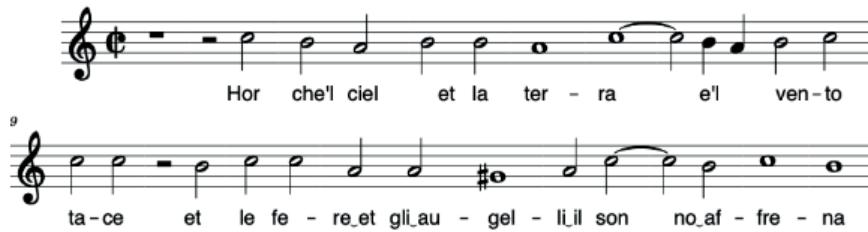
中文讲解
这是第33页一个图像或乐谱示例的位置标记,图像数据未嵌入。从前后文(P0185与P0187)推断,本图应为P0187所引’Ex. 3’与’Ex. 4’之前的一帧示例图(可能为诗律标注的图示或过渡图像),具体内容需查看原图方可确认。
第19段(P0187)
原文复述
中文讲解
这是图例3(Ex. 3)与图例4(Ex. 4)的位置与图注。
Ex. 3:Tromboncino所谱《Hor che’l ciel et la terra》,出自《Frottole libro second》(《Frottole第二卷》),罗马Andrea Antico约1516年印行(RISM [c. 1516]10),第1—10小节。
Ex. 4:Tromboncino所谱《Zephyro spira》,出自《Frottole libro octavo》(《Frottole第八卷》),威尼斯Ottaviano Petrucci 1507年印行(RISM 15074),第1—10小节。
两例并置正是P0185预告的’同一作曲家以相似音乐材料处理不同文本’的实证。需查看原图以核对两例旋律的相似程度及与诗律重音的对应关系。
第20段(P0188)
原文复述
A similar kind of melodic line can be found in other guises, such as the first verse of Petrarch’s canzona Che debbio far, set to music by Tromboncino.
中文讲解
本段作为本小节的收束,进一步指出’Tromboncino采用类似旋律线’的现象并非孤例——除了P0187所示的sonetto与strambotto之外,Petrarch的canzona(canzone,长篇抒情诗体)《Che debbio far》的第一句同样由Tromboncino谱曲,其中可见相似的旋律线。
这一简短陈述在论证上有两层作用:其一,将frottola’通用音乐结构’的现象从一首sonetto与一首strambotto的对比扩展到canzona,跨越诗体界限强化论点的普遍性;其二,强调’类似旋律线可以以不同面貌出现’(in other guises),暗示这种’通用性’在Tromboncino的曲目中是一个系统性的现象,而非偶然相似。它为读者留下进一步探究的空间,同时也以未尽的开放性结束了本小节。
脚注 / 边栏 / 图表 / 附加信息(如有)
本小节包含脚注11—18(涵盖Brunetto Latini的《Li livres dou Tresor》Chabaille版、Bausi与Martelli的《La metrica italiana》、La Via的《Poesia per musica e musica per poesia》、Beltrami的《小诗律词典》、Menichetti的《诗律第一课》、Calmeta《Prose e lettere inedite》Grayson版、Pirrotta《Before the Madrigal》等版本信息)以及图例1—4(Ex. 1:Monteverdi《Hor che’l ciel et la terra》SV 147,1638年Vincenti版;Ex. 2:Tromboncino《Hor che’l ciel et la terra》,约1516年罗马Antico版;Ex. 3:Tromboncino《Hor che’l ciel et la terra》,约1516年罗马Antico版;Ex. 4:Tromboncino《Zephyro spira》,1507年威尼斯Petrucci版)。脚注15(P0176+P0181)跨越页31—32,说明意大利endecasillabo的内部节奏多样性,是理解诗律与音乐关系的关键;脚注16(P0182)解释分析所用符号体系的方法论自觉。
💡 本节核心要点
- 意大利诗律以重音(arsis/thesis,强弱音节)为节奏基础,与拉丁诗律以音长为节奏基础形成根本对比,这是理解frottola音乐设置的历史前提。
- 从1550年起,madrigal(尤其是seconda prattica)形成了将诗律重音对应于音乐强拍与长音符的常规做法;frottola则偏离此常规,常将强重读音节置于弱拍。
- Brunetto Latini早在1260年代即指出韵文须严格遵守词的重音,说明意大利本土诗律传统从来以重音为核心。
- frottola音乐呈现’空白画布’式的通用结构特征——同一作曲家以相同或极相似的音乐材料承载不同的文本(sonetto、strambotto、canzona),证明其音乐并非按文本定制。
- 16世纪Calmeta的证词从文化语境上佐证了这一判断:frottole、stanze、barzellette这类配乐朴素的形式被认为更能凸显文本——即所谓’黑丝绸衬珍珠’的比喻。
- Monteverdi与Tromboncino对同一Petrarch诗行’Hor che’l ciel et la terra’的不同处理是这一论点的核心对比证据。
🔑 关键术语
- arsis and thesis:意大利诗律中的’强拍(重读)‘与’弱拍(非重读)’,对应于诗行中重读音节与非重读音节的交替,是意大利诗律节奏结构的基本单位。
- endecasillabo:意大利十一音节诗行,强制性重音在第十音节,另须在第四或第六音节之一,其余位置自由,可形成抑扬格、扬抑格、扬抑抑格等多种节奏型,是意大利诗律最重要的诗行形式。
- seconda prattica:‘第二实践’,Monteverdi兄弟所倡导的作曲原则,主张音乐服务于文本,放大诗律结构与歌词意义,区别于第一实践(prima prattica)以音乐结构为主导的原则。
- frottola:15世纪末至16世纪初意大利流行的世俗声乐体裁,文本多为短小的爱情诗或道德反思;其音乐呈现高度通用化的’载体式’结构,能容纳多种诗体(sonetto、strambotto、canzona等)的不同文本。
- strambotto:意大利八行诗体,常用于frottola,是与canzone、sonetto并列的意大利俗诗形式,本节中作为frottola可承载多种文本的例证之一。
- canzona (canzone):意大利长篇抒情诗体,本节中作为Tromboncino以相似旋律线设置的第三种诗体,扩展了’通用音乐载体’论点的跨体裁普遍性。
- tonic accent:重读音节(重音),意大利诗律节奏的核心,区别于拉丁诗律中的长短音体系;意大利音乐设置中如何处理重读音节是本节讨论的中心问题。
- diminutions:‘花唱装饰’,在本节中作为Calmeta建议年轻人回避的’精巧装饰’类体裁,与frottola朴素的’白纸式’配乐形成对比。
- metrical reading:诗律标注,对诗行中重读音节位置的标记,本节中用以与音乐节奏进行视觉对照(参脚注16所讨论的符号体系)。
s18 [描述性拆分] Oral Tradition, Monodic Performance, and Contemporary Witnesses
第1段(P0189)
原文复述
We find a number of melodic formulas in the frottola repertoire, called aere or modi, and each of these formulas fits a different kind of metre. This allows us to find musical formulas for almost any kind of verse.
中文讲解
本段引入frottola曲库中两个关键概念:aere和modi,二者指同一类固定旋律公式。每一首公式对应一种特定的韵律(metre),因此曲库几乎能为所有诗体提供匹配的旋律模板。这一陈述奠定了后续论证的前提:frottola的音乐不是为每一首诗单独创作,而是模块化、可复用的。
补充说明
脚注19与脚注20分别引自Filocamo/Baldassari与Pirrotta的论文,分别对应本段两个分句的文献来源。
第2段(P0190)
原文复述
Similar relationships exist between text and music in the ottava rima, where stereotyped melodic formulas reflect its improvisatory origin. The sung ottava rima is a popular practice still surviving in Tuscany, with the improvisation of Italian endecasillabi while singing standard musical patterns. The performers are familiar enough with the musical patterns that they can use them to sing different texts. As we can still hear in Tuscany today, the sung ottava rima has always been improvised in a way that lies between folk and literary tradition. The lyrics are improvised on a musical formula called aere, which works as a fixed musical structure to help the poet to compose the texts with the right number of syllables and without the need to count them out.
中文讲解
本段把frottola的“公式—诗体”关系扩展到ottava rima,并通过托斯卡纳现存的歌唱实践提供活态证据。aere在功能上是“双层”的:它在浅层提供节拍和音节数的物理支架,使吟唱者不必逐字点数;在深层则承载一种民俗—文人之间的混合传统。文中明确说ottava rima是“still surviving”的实践,从而以当代事实回推历史。这一对照策略对论证frottola的即兴口头起源具有方法论意义。
补充说明
脚注21指向Biggi关于Orfeo的文章第502页,为托斯卡纳ottava rima活态传统提供文献依据。
第3段(P0191)
原文复述
Renaissance frottolas, as we have seen, are similar: Pirrotta already pointed out that frottolas owe their form to a folkloric oral tradition, though they are a nobler and more refined version of this tradition. Frottolas were equally a product of the cultivated North Italian Courts and a creation for their use.
中文讲解
本段正式援引Pirrotta的学术权威,把frottola定位为口头民俗传统的“贵族化精致版本”。关键判断在“equally”一词:frottola同时是民俗产物与北意大利宫廷的精致成品。换言之,它的双重身份——既是民间即兴传统的延伸,又属于宫廷文化产品——构成其艺术史意义的支点。
补充说明
脚注22列出Pirrotta文章第238与246页,两处分别支撑“民俗来源”与“宫廷语境”两个判断。
第4段(P0192)
原文复述
Like the ottava rima, frottolas are based on the aere musical formulas. Frottola repertoire is mainly monodic; the use of polyphony is limited. A prominent upper voice often sings syllabically, and melismas are scarce; as in the ottava rima, they are present only at cadenzas. Records survive of the preference for solo performances over polyphonic renditions during the Renaissance. These highlight the interconnection between music and text as well as the central role played by the intelligibility of the text. Baldassarre Castiglione praises the ‘declamation on the viola’ over polyphonic singing not only because we can better understand the melody but because it allows a better recitation of the lyrics:
中文讲解
本段从“曲式”转入“演唱形态”,归纳frottola的三个结构特征:以aere公式为基础、以单声部为主、高声部一字对一音(仅在终止处出现短花唱)。这些特征共同服务于一个目的:让歌词能被听清。作者援引Castiglione作为文艺复兴时期的偏好证据,并预告下一段将引用其原文。末句以冒号引出Castiglione原话。
补充说明
Castiglione所谓“viola”究竟为gamba(拉弦)还是da mano(拨弦),见脚注23,作者注明此处保持开放。
第5段(P0193)
原文复述
[…] but as even far more beautiful, to sing to the accompaniment of the viol, because nearly all the sweetness lies in the solo part, and we note and observe the fine manner and the melody with much greater attention when our ears are not occupied with more than a single voice, and moreover every little fault I more clearly discerned, – which is not the case when several sing together, because each singer helps his neighbour. But above all, singing to the viol by way of recitative seems to me most delightful, which adds to the words a charm and grace that are very admirable.
中文讲解
Castiglione的引文为单声部伴奏演唱提供三组理由:(1)所有甜美集中于一条声线;(2)耳朵不被多声部占据时,更易察觉旋律细节与瑕疵;(3)以viola伴奏的recitative式唱法为词句带来“难以言喻的魅力与优雅”。第三点最重要,因为它把伴奏单声唱与“朗诵性”直接绑定,预示了后世歌剧宣叙调的美学取向。
补充说明
Castiglione原话与英译本的来源见脚注24,作者同时引用意大利文原文(Quondam/Longo 2009年版,第137页)和Eckstein Opdycke英译(第194页)。
第6段(P0194)
原文复述
19 Filocamo and Baldassari, ‘Le “Frottole intabulate da sonare organi”’ (see n. 1), 16.
中文讲解
脚注19为P0189首句“aere/modi”这一术语提供来源,指明引自Filocamo与Baldassari合撰文章第16页。
补充说明
该文献亦为本文脚注1中的参考文献,属同源引用。
第7段(P0195)
原文复述
20 Pirrotta, ‘Before the Madrigal’ (see n. 10), 244. According to Pirrotta, no ‘arie per cantar strambotti’ have ever been written, as each strambotto seems to have a specific music composed particularly for its text. The author mentions this to support his hypothesis that the madrigal had its roots in the strambotto.
中文讲解
脚注20本身承载实质性观点:Pirrotta认为从未有过专门为strambotto谱写的固定“arie”,每首strambotto似乎都拥有为其文本特写的音乐;据此他推断madrigal的根源在strambotto。该推论与P0189提到的“公式化”判断形成微妙张力,是读者理解后续论证的关键背景。
补充说明
此脚注为P0189第二句(音乐公式对应任何诗体)提供来源,同时引入“madrigal源自strambotto”这一重要假说。
第8段(P0196)
原文复述
21 See Biggi, ‘La Fabula di Orpheo’ (see n. 10), 502.
中文讲解
脚注21为P0190中关于托斯卡纳ottava rima活态传统的陈述提供出处。
第9段(P0197)
原文复述
22 Pirrotta, ‘Before the Madrigal’ (see n. 10), 238 and 246.
中文讲解
脚注22支撑P0191中关于frottola源于民俗口头传统、并经宫廷精致的两个核心判断。
第10段(P0198)
原文复述
23 It is not clear from Castiglione’s text whether the instrument in question is a viola da gamba (bowed strings) or a viola da mano (plucked strings). Since this is not an essential point of discussion, I leave the question open. Since there are no studies on the subject today, it is hoped that future articles will clarify the issue.
中文讲解
脚注23指出Castiglione笔下的viola究竟指gamba(拉弦)还是da mano(拨弦)尚未定论,但因该问题对当前论证非核心,故作者选择留白。
补充说明
虽然作者未展开,但读者应注意:拉弦与拨弦在音色、持续音能力上差异显著,可能影响对Castiglione所谓“甜美”的具体想象。
第11段(P0199)
原文复述
Another similarity with the ottava rima is the frottola’s roots in oral tradition. This is particularly evident in the case of the strambotto, the most widespread poetic form of the genre, as used by the improviser Serafino dall’Aquila. In his Apologia, Angelo Colotio describes the way Serafino dall’Aquila performed his strambotti. The description highlights the close relationship between text and music in these improvisations, and the attention Serafino paid to the pronunciation of the words.
中文讲解
本段引入第二个口头传统的具体证人:即兴诗人Serafino dall’Aquila及其strambotto。文献来源为Colotio的Apologia。这段的功能是从“理论判断”(Pirrotta)转向“当代见证”(Colotio),并通过Serafino的“发音”细节凸显文字与音乐的紧密耦合——这一点与P0192的“歌词清晰可解”判断相呼应。
补充说明
Apologia di Angelo Colotio为Serafino作品集的辩护性序文,其意大利原文与出处见脚注25(即P0203)。
第12段(P0200)
原文复述
They will say that the pronunciation gave him grace; we will confess that in this he surpassed himself. They will say that he spoke in a singular way, but that he tried to match the words to the lute in order to stamp them more deeply on people’s minds, to inflame them and calm them down, as Gracchus adapted his style in the Senate. I say that just as Terpander will always be praised for having added his voice to music and Dardanus to his flute, so Seraphin will always be praised for having given a way to express the passions of love in rhyme, more than anyone else ever before.
中文讲解
Colotio的引文分三层:(1)发音本身具感染力;(2)Serafino刻意让歌词与lute契合,以便“印入听者之心”,使其激昂或平复,呼应罗马演说家Gracchus在元老院中调整风格的做法;(3)以古典范例(Terpander为诗乐结合之祖、Dardanus将诗与笛结合)将Serafino抬入神话式音乐家谱系。例证的真正功能是为“音乐从属于文字并放大其修辞效果”这一命题提供一个活生生的实践者范本。
补充说明
脚注25(P0203)给出该段意大利原文及来源:Menghini 1894年编Serafino Ciminelli诗集卷1第27页。
第13段(P0201)
原文复述
I would like to take this opportunity to thank Prof. Francis Biggi for his advice on this point.
中文讲解
作者对Francis Biggi教授就此问题的建议表示感谢,属纯礼节性短句。
补充说明
Biggi正是脚注21、22及P0214中引用的《La Fabula di Orpheo》一文的作者。
第14段(P0202)
原文复述
24 ‘[…] ma ancor molto più il cantare alla viola perché tutta la dolcezza consiste quasi in un solo, e con molto maggior attenzion si nota ed intende il bel modo e l’aria non essendo occupate le orecchie in più che in una sol voce, e meglio ancora vi si discerne ogni piccolo errore; il che non accade cantando in compagnia perché l’uno aiuta l’altro. Ma sopra tutto parmi gratissimo il cantare alla viola per recitare; il che tanto di venustà ed efficacia aggiunge alle parole, che è gran maraviglia’. Baldassare Castiglione, Il libro del Cortegiano, ed. Amedeo Quondam and Nicola Longo (Milan, 2009), 137. English translation in Baldassare Castiglione, The book of the courtier by count Baldesar Castiglione, ed. Leonard Eckstein Opdycke (London, 1901), 194.
中文讲解
脚注24给出P0193引文的完整文献信息:意大利原文取自Quondam与Longo 2009年校注版《廷臣论》第137页,英译取自Opdycke 1901年版第194页。
第15段(P0203)
原文复述
25 ‘Li concedeno el proferir singulare, ma che cercava concordare le parole al leuto per più imprimerle nello animo delle genti & per hor inflamare hora remectere, come Gracco ne’ senati la sua lyra adaptava. Dico che come non senza laude sempre sarà Terpandro che agiunse la voce alla musica & Dardano alla tibia, così el Seraphin per haver dato modo & da imprimere e da exprimere in rime le passione d’amore, più ch’alcuno altro mai per adietro sarà da esser celebrato’. Apologia di Angelo Colotio nell’opere de Seraphino, al Magnifico Sylvio Piccolhomini S. et benefactore, in: Serafino di Ciminelli, Le rime di Serafino de’ Ciminelli dall’Aquila,
中文讲解
脚注25为P0200引文提供意大利原文及出处:Menghini 1894年Bologna版Serafino Ciminelli诗集卷1第27页。需注意原文用“lyra”指Gracchus的演说风格而非乐器,并提及Terpander与Dardanus两位古典音乐家。
补充说明
该脚注的剩余部分在P0209继续,附有Pirrotta《Li due Orfei》的页码参照。
第16段(P0204)
原文复述
In his essay Qual stile tra’ volgari poeti sia da imitare (What style to imitate among Italian vernacular poets), Calmeta legitimises accompanied monody as a genre of poetry. He invites the reader to imitate
中文讲解
本段引入第三个当代权威:Calmeta的论文《在意大利俗语诗人中应模仿何种风格》。作者点明Calmeta的核心贡献:把“伴奏式单声唱”合法化为一种独立的诗歌体裁。本段以冒号引出Calmeta原话,与P0192–P0193中Castiglione的引用方式类似。
补充说明
Calmeta原话的意大利原文与Kolsky转引见脚注26(即P0210)。
第17段(P0205)
原文复述
those [poems] accompanied with the instrument, in order to better impress upon not only amorous but also learned hearts. […] Likewise, those who, in singing, put all their effort into expressing the words well when they are of substance, and make the music accompany them in the way that masters are accompanied by servants, are to be held in high esteem.
中文讲解
Calmeta的引文分两点:(1)伴奏的诗能更好地印入“情人的心”和“博学者的心”——后者是关键,因为frottola既非纯娱乐亦非纯学究,而是兼及两者;(2)演唱者若全力表达有分量的歌词,并让音乐以“主人被仆人伺候”的方式配合文字,则应受高度评价。这一“主仆”比喻是本节最重要的修辞,把“音乐服从文字”具体化、视觉化。
补充说明
脚注26(即P0210)给出意大利原文与Kolsky 1990年Italica期刊的转引页码164。
第18段(P0206)
原文复述
Calmeta’s passage clearly illustrates the subordination of music to poetry: poetry, with the help of music, better reaches not only the amorous but also – most importantly – the erudite hearts. It highlights the need to express the words and declaim the text well.
中文讲解
本段是作者对Calmeta的总结:音乐从属于诗;借助音乐,诗能同时抵达“情人的心”和(更重要的)“学者的心”;其方法论核心在于“清晰表达文字”和“良好朗诵文本”。这是承接Castiglione的“recitative”概念而来的理论表达:朗诵性就是frottola体裁的内在美学。
第19段(P0207)
原文复述
In a letter to Pico della Mirandola, Angelo Poliziano describes a banquet in the Orsini palace. During the dinner, Fabio, the son of Paolo Orsini, sings polyphony with friends for the guests. Poliziano points out that the piece was performed from notation; the musicians were reading the music from part books. However, Poliziano is notably more enthusiastic when Fabio sings some verses by Piero dei Medici alone, accompanying himself on a lute:
中文讲解
本段引入第四个——也是本节中最详细的——当代见证:Poliziano写给Pico della Mirandola的信,记述了Orsini宫殿的宴饮场景。叙述者构造了一个清晰对照:Fabio先与友人合唱复调(按谱演唱),随后独自为Piero de’ Medici所作诗句自弹lute自唱,Poliziano对后者“显著更为热情”。这一对照正是前几段(Castiglione、Calmeta)所主张的“伴奏单声唱优于复调”的实证体现。
补充说明
信的具体背景见脚注27:发生于1488年Piero de’ Medici与Alfonsina Orsini婚礼期间Poliziano的罗马之行。
第20段(P0208)
原文复述
No sooner were we seated at the table than [Fabio] was ordered to sing, together with some other experts, certain of those songs which are put into writing with those little signs of music [it is difficult to render the sense of contemptuous diffidence conveyed by that ‘quaedam … notata Musicis accentiunculis carmina’], and immediately he filled our ears, or rather our hearts [‘immo vero in praecordia’], with a voice so sweet that (I do not know about the others) as for myself, I was almost transported out of my senses, and was touched beyond doubt by the unspoken feeling of an altogether divine pleasure. He then performed an heroic song which he had himself recently composed in praise of our own Piero dei Medici … his voice was not entirely that of someone reading, nor entirely that of someone singing: both could be heard, and yet neither separated one from the other; it was, in any case, even or modulated, and changed as required by the passage. Now it was varied, now sustained, now exalted and now restrained, now calm and now vehement, now slowing down and now quickening its pace, but always it was precise, always clear and always pleasant; and his gestures were not indifferent or sluggish, but not posturing or affected either […].
中文讲解
Poliziano的引文是本节的核心文献。关键观察有四:(1)他把复调记谱称作“那些用小音乐符号写下的歌”,带有含蓄的轻蔑,暗示“看谱而唱”并非最高境界;(2)他用“耳朵”或“心脏”(praecordia)形容所受冲击,表明情感投入超过听觉层面;(3)Fabio演唱自作的Piero de’ Medici颂歌时,嗓音“既非纯读,亦非纯唱”,却能同时察觉两者——这正是朗诵性与歌唱性的融合;(4)声音“随文本需求而变”,列举六对对比(varied/sustained、exalted/restrained等),手势自然而不矫饰。整段描述为“好的frottola演唱应当具有怎样的灵活朗诵性”提供了无可替代的当代美学证据。
补充说明
拉丁原文与出处见脚注28(即P0214)。方括号内说明“accentiunculis”一词在英译中难以传达其轻蔑语气的判断是作者本人的译注,对理解Poliziano的态度至关重要。
第21段(P0209)
原文复述
vol. 1, ed. Mario Menghini (Bologna, 1894), 27. See also Pirrotta, Li due Orfei. Da Poliziano a Monteverdi (Turin, 1975), 44.
中文讲解
本段续接脚注25,补全Colotio Apologia的卷册、编者与页码信息,并提示读者另参Pirrotta专著《Li due Orfei》1975年都灵版第44页。
补充说明
Pirrotta的《Li due Orfei: Da Poliziano a Monteverdi》是讨论从Poliziano到Montever迪过渡的核心文献,本书反复引用。
第22段(P0210)
原文复述
26 ‘[…] quelle con lo instrumento compagnando, per poterle meglio non solo negli amorosi ma ancora negli eruditi cuori imprimere. […] Cosi medesimamente sono da essere essistimati di sommo giudicio coloro che cantando mettono tutto lo sforzo in esprimer bene le parole quando sono di sustanza, e fanno che la musica le accompagna con quel modo che sono i padroni da’ servidori accompagnati’. Calmeta quoted by Kolsky in Stephen D. Kolsky, ‘The Courtier as Critic: Vincenzo Calmeta’s Vita del facondo poeta vulgare Serafino Aquilano’, in: Italica 67 (1990), 161–72, at 164.
中文讲解
脚注26提供P0205引文的意大利原文与转引路径:Kolsky 1990年Italica第67卷第164页所引Calmeta关于Serafino Aquilano的传记。
补充说明
Kolsky的文章把Calmeta定位为“廷臣—批评家”,与本节对Calmeta“合法化伴奏单声唱体裁”的引用一致。
第23段(P0211)
原文复述
27 The extract is taken from a letter contained in Book xii of Angelo Poliziano’s letters. According to Pirrotta, the episode refers to Poliziano’s trip to Rome in 1488 on the occasion of Piero de’ Medici’s wedding with Alfonsina Orsini. Nino Pirrotta, Li due Orfei (see n. 25), 44.
中文讲解
脚注27给出P0207–P0208引文的文献细节:信在Poliziano书信集第12卷中,事件发生于1488年罗马Piero de’ Medici迎娶Alfonsina Orsini期间,依据来自Pirrotta《Li due Orfei》第44页。
补充说明
此背景把见证置于具体历史时刻,使其证据力更强:并非回忆性美化,而是事件刚发生后的书信描述。
第24段(P0212)
原文复述
In this account Poliziano explains that Fabio’s voice, singing the monody, was neither that of a reader nor that of a singer; the listener could have perceived it as both, without being able to distinguish whether he was singing or reading. These contemporary testimonies emphasise certain recurring elements: first and foremost, the preference for an accompanied monody rather than a polyphonic rendition, through which the singer could better interpret the meaning of the text; and the extreme flexibility of the sung rendition of the text, in which the sung voice was not easily distinguishable from the spoken voice.
中文讲解
本段是作者对四个当代见证(Castiglione、Calmeta、Poliziano)的归纳,提炼出两条贯穿性论点:第一,伴奏单声唱优于复调演唱,因为前者允许歌者更好地诠释歌词意义;第二,演唱具有极大的伸缩性,使歌喉在“说—唱”之间自由滑动。这两条共同构成读者理解后续章节(关于Antico器乐改编曲的演奏实践)的钥匙:演奏者必须从“内隐的歌词”中推断出正确的重音与节奏。
补充说明
本段是P0189–P0208论证链条的小结,也是P0213向“器乐改编”过渡的桥段。
第25段(P0213)
原文复述
If this is how this monodic repertoire was understood by the contemporaries, we should ask ourselves how this was mirrored in the performance practice of instrumental intabulations of the same music and period. Did the player infer the correct accentuation of the music from an implicit text? If so, a correct understanding of the meter and of poetical conventions would be an essential element for a correct performance of Antico’s arrangements of this vocal repertoire.
中文讲解
本段是本节向全篇核心问题过渡的关键:当代听众所理解的单声唱美学,是否被同时代的器乐改编者所内化?作者提出假设——演奏者会从乐谱“内隐的歌词”推断出正确的重音。果真如此,则对诗律和诗学惯例的正确理解,就成为正确演奏Antico器乐改编作品的必要前提。这一假设为后续分析Antico intabulation的演奏实践定下基调。
补充说明
Antico特指意大利文艺复兴音乐出版家Andrea Antico(约1480–1538以后),以出版复调音乐与frottola器乐改编著称;本节之前段落为其器乐改编的演奏实践提供了口头传统与单声唱美学的语境。
第26段(P0214)
原文复述
28 ‘Ut ergo discubuimus, canere quaedam iussus notata Musicis accentiunculis carmina, simul cum peritis aliis, statim suavissima quadam voce sic in aures nostras illapsus, immo vero in praecordia est, ut me quidem (ceteros nescio) pene extra me rapuerit, certe sensu tacito divinae prorsus cuiusdam voluptatis affecerit. Pronunciavit heroicum deinde carmen, quod ipsemet nuper in Petri Medicis nostri laudem composuerat […] Vox ipsa nec quasi legentis, nec quasi canentis, sed in qua tamen utrumque; sentires, neutrum discerneres: varie tamen prout locus posceret aut aequalis, aut inflexa, nunc distincta, nunc perpetua, nunc sublata, nunc deducta, nunc remissa, nunc contenta, nunc lenta, nunc incitata, semper emendata, semper clara, semper dulcis, gestus non ociosus, non somniculosus, sed nec vultuosus tamen, ac molestus […]’. Angelo Poliziano, Angeli Politiani […] et aliorum eius temporis illustrium virorum epistolae xii. libris contentae (Basel: Andreas Cratander, Erben: 1542) (VD16 ZV 26479), 447–8. The English translation of this excerpt is taken from Nino Pirrotta, Music and Theatre from Poliziano to Monteverdi (Cambridge, 1982), 36. The Italian translation of this excerpt is quoted in Nino Pirrotta, Li due Orfei (see n. 25), 35–6. See also Biggi, ‘La Fabula di Orpheo’ (see n. 10), 499.
中文讲解
脚注28给出P0208引文的完整拉丁原文与文献细节:Poliziano书信集1542年Basel版第447–8页;英译取自Pirrotta 1982年剑桥版第36页,意译引自Pirrotta《Li due Orfei》第35–6页,另参Biggi《La Fabula di Orpheo》第499页。拉丁文“accentiunculis”一词带有轻蔑的指小后缀,与英译者解释的“contemptuous diffidence”对应,提示Poliziano对“按谱演唱的复调”态度保守。
补充说明
1542年Cratander版是Poliziano书信集的关键早期印刷本;VD16 ZV 26479为其德国《Verzeichnis der im deutschen Sprachbereich erschienenen Drucke des 16. Jahrhunderts》编号。
脚注 / 边栏 / 图表 / 附加信息(如有)
本节包含九条脚注(19–28),均为正文当代文献引文(Castiglione《廷臣论》、Calmeta论文、Poliziano书信、Colotio为Serafino所作Apologia等)的来源信息。其中脚注20(P0195)与脚注23(P0198)含有实质性学术观点:(1)Pirrotta推断从未存在专门用于演唱strambotto的固定arie,进而假设madrigal源于strambotto;(2)作者承认Castiglione笔下viola究竟为viola da gamba还是viola da mano尚无定论,但因非核心议题而保持开放。脚注25、28提供意大利文与拉丁文原文,与正文英译互为参照。脚注24(P0202)同时给出Castiglione引文的意大利原文与Eckstein Opdycke英译的页码定位。所有脚注功能上均承担“来源/限定/支持”作用,无独立旁证。
💡 本节核心要点
- frottola曲库以模块化的旋律公式aere/modi为基础,每首公式对应一种特定韵律,从而为几乎任何诗体提供可复用的音乐模板;frottola与ottava rima共享这一公式化、即兴口头传统的特征。
- frottola的演唱形态以单声部为主,高声部一字对一音,花唱仅出现在终止处;这一形态的根本目的在于保证歌词清晰可解,是其口头即兴起源的直接产物。
- Castiglione、Calmeta与Poliziano三位文艺复兴时期的当代见证,共同表达出对伴奏式单声唱的偏好:相对于复调演唱,单声唱能让歌者更准确地诠释歌词,并把歌喉推向介于“说—唱”之间的朗诵性灵活性。
- Poliziano对Fabio Orsini在Orsini宫宴上自弹lute自唱的描述,以“既非纯读、亦非纯唱”的嗓音展现出随文本起伏而变化的朗诵性,为前两个见证提供了具体的实践范本。
- Calmeta“音乐如仆人伺候主人”的比喻,把“音乐从属于诗”这一抽象原则具体化,并强调伴奏单声唱的目标同时包括“情人的心”与“博学者的心”。
- 本节的核心过渡在于:当代见证所建立的单声唱美学,必然内化于同时代的器乐改编演奏实践之中;演奏者需要从乐谱“内隐的歌词”推断出正确的重音与节奏,从而对诗律与诗学惯例的理解成为正确演奏Antico改编作品的前提。
🔑 关键术语
- aere (modi):frottola曲库中的固定旋律公式,可对应不同诗体的韵律;为即兴演唱提供可复用的音乐模板,是本节“口头传统与公式化音乐”论证的核心概念。
- ottava rima:意大利八行诗体,至今仍在托斯卡纳以歌唱形式即兴传唱;本节将其作为frottola口头传统的活态对照,证明“公式化旋律辅助即兴作诗”这一机制在文艺复兴时期是真实可行的实践。
- strambotto:frottola体裁中最盛行的诗体,意大利即兴诗人Serafino dall’Aquila的代表作;本节借Colotio Apologia对其演唱的描述,把口头传统的“发音清晰、文字与lute契合”具体化。
- accompagnata monody (伴奏式单声唱):单声部配合一件乐器(lute、viola等)演唱的形式;四位当代见证一致认为这种形式比复调演唱更能清晰表达歌词,是本节“音乐从属于诗”命题的表演载体。
- recitative (朗诵性演唱):Castiglione与Poliziano笔下歌喉在“说—唱”之间滑动的演唱方式,强调随文本起伏而调整音色、节奏与姿态;它把frottola演唱与后来歌剧宣叙调的美学联系起来。
- intabulation (器乐改编曲):把原本为人声演唱的乐曲改编为器乐演奏的谱面版本,本书关注的是Antico对frottola曲库的器乐改编;本节关于口头传统与单声唱美学的论证,为后续讨论这些改编曲的演奏实践(如何从内隐的歌词推断重音)奠定前提。
s19 Analysis of the Repertoire: Two Examples
第1段(P0215)
原文复述
Analysis of the Repertoire: Two Examples
中文讲解
这是本章的小节标题,用第二级标题(##)标示,开启了作者对选定的两首 frottola(弗罗托拉,意大利文艺复兴时期的世俗歌曲)进行具体分析的部分。标题点明两件事:第一,分析对象是 repertoire(曲目库/作品集);第二,具体手段是挑选两个例子做深入剖析。
第2段(P0216)
原文复述
In this part, after describing the methodology used, the analysis of two frottolas will be presented in more detail. In order to perform this instrumental repertoire whilst respecting the original vocal model as much as possible, a metrical and semantic analysis of the texts is necessary.
中文讲解
本段是引言段落,交代本小节的两项任务:先说明研究所采用的方法,再对两首 frottola 做较为细致的分析。作者强调一个核心动机——要在器乐演奏中尽可能尊重原声乐版本,因此必须对歌词文本进行节律(metrical)和语义(semantic)两方面的分析。这里的 instrumental repertoire 指的是以键盘 intabulation(移植谱)形式存世的器乐改编曲,而 vocal model 指原本为人声所写的声乐原版。
第3段(P0217)
原文复述
The poetic material can be analysed on the basis of two criteria: first, a metric/prosodic criterium, which defines the subdivision of the verse into metric unities – syllables, feet, stanzas and so on – regardless of the meaning of the text; second, a syntactic/semantic criterium, which divides the text into unities of logically complete meaning. These two unities may or or may not coincide, although it is often the case in much Italian Renaissance poetry that the two do overlap.
中文讲解
本段提出分析诗歌材料的两个标准。第一项是节律/韵律标准(metric/prosodic criterium),它按音节数量、韵脚、诗节等“形式单位”切分诗句,完全不考虑语义;第二项是句法/语义标准(syntactic/semantic criterium),它按逻辑上意义完整的单位来切分文本。作者指出这两个标准在理论上不一定重合,但在意大利文艺复兴诗歌中常常重合——也就是说,诗句的自然形式分段往往恰好对应语义停顿,这正是后来分析 frotolla 文本的良好基础。两个标准的并置为下文既看节奏又看语义的“叠层式”标注提供了理据。
补充说明
原文写的是 criterium(单数),并非现代英语常用的 criterion,保留原文用法。
第4段(P0218)
原文复述
In this study, the lyrics have first been transcribed from the vocal score, trying to respect the correct placement of the text on the keyboard intabulation as much as possible. The lyrics have then been analysed according to the two criteria mentioned above. Tonic syllables of the text are circled directly on the score. The colour red is used for the first text and blue for the repeat if present. On top of the metrical analysis, a set of signs to indicate a semantic analysis is superimposed: for instance, whenever a comma or a breath is needed for the understanding of the text, this has been indicated on the score. Punctuation marking on the lyrics have also been preserved.
中文讲解
本段是具体操作方法的说明。作者的工作流程分三步:第一步,歌词从声乐谱中转写出来,关键是要尽量尊重每个字在键盘 intabulation(移植谱)上的原有位置——这直接影响演奏者对音乐与文字对应关系的判断;第二步,按上文提出的两个标准分析;第三步,把分析结果直接标在乐谱上:重读音节(tonic syllables)用圆圈标出,声乐首次陈述用红色,其重复(repeat,如反复段)用蓝色,在节律标号之上再叠加句法/语义符号(如表示换气或逗号的位置)。原文标点(punctuation)也予以保留。本段实际上为读者预先展示了后续两例分析图的视觉编码规则。
第5段(P0219)
原文复述
The corpus of frottolas can be divided into two groups: those based on endecasillabi and settenari, and those based on ottonari or settenari tronchi. Since endecassilabi and settenari allow for freer accentuation patterns, the combination between music and text is often conflicting and generates unusual patterns, as we saw in the example previously with the two versions of ‘Hor che’l ciel et la terra’. We find several different metric feet in the structure of the verses in these frottolas, such as iambs, trochees, dactyls, resulting at times in a structure close to spoken language. Tonic syllables of the text are placed both on downbeats as well as upbeats of the music. Conversely, we find much clearer accentuation patterns in the second group of frottolas. Here the metrical accents of the verse mainly coincide with the strong accents of the measure, since the ottonario or the settenario tronco is made mostly of iambic feet that gives a very regular rhythm to the verse.
中文讲解
本段根据所用诗体的不同,把 frottola 曲目一分为二,并说明音乐与文字配合的差异。
第一组以 endecasillabo(11 音节诗行)和 settenario(7 音节诗行)为底本。由于这两种诗体允许的轻重格式比较自由,作曲家在配乐时常常出现音乐重音与文字重音冲突、产生“unusual patterns”(异常节奏模式)的情况——尤其是前文以《Hor che’l ciel et la terra》两版所示的那样。这种 frottola 内部会出现多种格律单位(iamb 抑扬格、trochee 扬抑格、dactyl 扬抑抑格),有时甚至接近口语节奏;文本重读音节既落在强拍(downbeat)也落在弱拍(upbeat)。
第二组以 ottonario(8 音节诗行)或 settenario tronco(截尾 7 音节诗行,即末音节不计入音节数的 7 音节变体)为底本,节奏模式清楚得多。诗行的重音基本与小节强拍吻合,因为这类诗体主要由 iamb(抑扬格)构成,节奏非常规整。
这一对比为下文两例分析确立了分类坐标:哪一类诗体,决定了音乐与文字是“冲突”还是“对齐”。
补充说明
settenario tronco 中的 tronco 指诗行末尾以重读音节(而不是非重读音节)收尾,因此节律上比一般的 settenario piano 更规整、更接近 iambic 节奏。
第6段(P0220)
原文复述
29 La Via, Poesia per musica e musica per poesia (see n. 4), 87.
中文讲解
这是脚注 29,属于参考文献类注释,为正文 P0217 中关于“意大利文艺复兴诗歌中节律与语义单位常常重合”的判断提供文献来源,指引读者翻阅 La Via 的著作《Poesia per musica e musica per poesia》(为音乐而作的诗与为诗而作的音乐)第 87 页。该注释本身不增加新的论证,它只是把上文的一般性观察锚定到既有学术文献上。
脚注 / 边栏 / 图表 / 附加信息(如有)
本节包含一项脚注(第 29 号,附于 P0217),引用 La Via《Poesia per musica e musica per poesia》第 87 页,为正文关于“节律切分与语义切分在意大利文艺复兴诗歌中常重合”的判断提供文献支持。除脚注外,本节正文还预告了后续两例分析图将使用的视觉编码方式(红色=首次陈述、蓝色=重复、重读音节加圆圈、句法/语义符号叠加),可视为图表说明的一部分。
💡 本节核心要点
- 本节的分析目标是在器乐演奏中尽量尊重原本为人声而作的声乐版本,因此必须把文本的节律与语义两层信息都标在乐谱上。
- 作者提出诗歌分析的两条标准:节律/韵律标准(按音节、脚、诗节等形式单位切分,不问意义)与句法/语义标准(按逻辑完整义单位切分),二者在意大利文艺复兴诗歌中常常重合。
- 方法上,歌词先从声乐谱转写到键盘 intabulation(移植谱)上,再以红色标首次陈述、蓝色标重复,重读音节加圆圈,并在节律标注之上叠加逗号/换气等语义符号,原文标点予以保留。
- 将 frottola 曲目按诗体分为两组:第一组以 endecasillabi 与 settenari 为底本,韵律自由,音乐与文字常冲突,节奏接近口语;第二组以 ottonari 或 settenari tronchi 为底本,诗行主要由 iamb 构成,重音与小节强拍对齐,节奏规整。
- 前文《Hor che’l ciel et la terra》两版被用来例证第一组“音乐与文字冲突、产生异常节奏模式”的情形,是 P0219 论证的关键经验证据。
- 两组的区分直接决定了后续两例 frottola 分析的切入角度:重在揭示冲突,还是重在揭示对齐。
🔑 关键术语
- frottola:意大利文艺复兴时期的世俗多声部歌曲形式,本节的研究对象。文中区分其声乐原型(vocal model)及其键盘器乐改编(instrumental repertoire / intabulation)。
- intabulation:将原本为人声或合奏而写的乐曲改写为键盘乐器演奏谱。在本节中,文本在 intabulation 上的位置是判断音乐与文字关系的关键依据。
- endecasillabo:意大利 11 音节诗行,韵律格式相对自由,可容纳多种重音模式;构成本节第一组 frottola 的诗体基础。
- settenario:意大利 7 音节诗行;与 endecasillabo 同样允许较自由的重音安排,属第一组诗体。
- ottonario:意大利 8 音节诗行,节奏较为规整,常以 iamb 抑扬格构成,属第二组诗体。
- settenario tronco:截尾 7 音节诗行——末音节为重读音节、不再额外算轻音节,使整行更接近 iambic 节奏模式,属第二组诗体。
- tonic syllable:歌词中的重读音节;本节要求把这类音节在乐谱上以圆圈标出,用于观察其与音乐节拍强弱的对应关系。
- metric/prosodic criterium:本节第一条分析标准:按音节、脚、诗节等纯形式单位切分诗句,不考虑语义。
- syntactic/semantic criterium:本节第二条分析标准:按逻辑完整的意义单位切分文本,反映语义的停顿与结构。
- iamb / trochee / dactyl:三种古典格律单位(分别为抑扬格、扬抑格、扬抑抑格),本节用来描述诗行的格律构成;iamb 主导的诗行节奏最规整,与小节强拍容易对齐。
s20 [描述性拆分] Hor che’l ciel et la terra
第1段(P0221)
原文复述
Hor che’l ciel et la terra
中文讲解
本句是章节标题,开启本节对 Petrarca 十四行诗 Hor che’l ciel et la terra 及其作为 frottola 被编订和改编过程的文本与音乐分析。标题仅引出作品名称,不再有额外论述。
第2段(P0222)
原文复述
The text comes from Petrarca’s Canzoniere; it is a sonnet built on Italian endecasillabi.
中文讲解
中译:本段文本取自彼特拉克的《歌集》(Canzoniere);它是一首以意大利语十一音节格律诗行(endecasillabi)写成的十四行诗。该句虽短,却包含两个关键背景判断:其一,文本作者与诗集归属——意大利抒情诗核心传统中 Petrarca 的《歌集》;其二,诗体形式——十四行诗体(sonnet),其诗行使用意大利十一音节格律。这一判断决定了后续一切音节重音、节奏与音乐结构讨论的基准。endecasillabo 通常按重音位置划分为不同类型(主要形式为前 4 后 6,或前 6 后 4 等),其规则构成本节讨论诗与乐对位关系时的根本参照。
第3段(P0223)
原文复述
Hor che ’l ciel et la terra e ’l vento tace
中文讲解
中译:此刻天、地与风都缄默。首行起句 Hor che’(既然……,每当……),引入一个时间性的铺陈:天空、大地与风同时静默,行成整首十四行诗的意境底色。诗人在此先勾出宇宙性的静默,作为反衬自身情感状态的对照框架。endecasillabi 的格律分析对本节后续音乐结构讨论至关重要。
第4段(P0224)
原文复述
et le fere e gli augelli il sonno affrena,
中文讲解
中译:野兽与飞禽被睡眠所约束。诗行第二句延续首句的静态画面,将静默从自然扩展至动物界:野兽(le fere)与飞鸟(gli augelli)皆被睡眠(il sonno)所压束、克制(affrena)。affrena 一词隐含束缚、控驭之意,构成一个视觉化动词,强化夜晚对万有的统摄。
第5段(P0225)
原文复述
Notte il carro stellato in giro mena
中文讲解
中译:夜,驱赶着星辉之车环绕而行。夜神(Notte)驾驭饰满星辰的穹隆之车(il carro stellato)环绕天宇转动。mena(引领、驾驭)一词赋予夜以神性、人格化的动作,把宇宙运行的画面与古典神话想象相结合。
第6段(P0226)
原文复述
et nel suo letto il mar senz’onda giace,
中文讲解
中译:而海在其卧榻上无浪地躺卧。此句以海(il mar)作为最后被纳入静默的对象:海平卧于其床榻(nel suo letto)之上,毫无波涛起伏(senz’onda)。这一意象承接前句的驶行之车,将视野从天空延展至海洋,使全诗以整个宇宙——上至星辰、下至海面——皆沉入静谧的对比框架,凸显说话者孤独自醒的反差。
第7段(P0227)
原文复述
vegghio, penso, ardo, piango; et chi mi sface
中文讲解
中译:我醒着,思虑,燃烧,哭泣;而那将我消磨者在我的苦甜中常在我眼前。在前八行铺陈的自然全景归于静止之后,诗人陡然以四个不带连接词的动词短句——醒、思、烧、哭——将镜头切换到自身:vegghio(守夜、醒着)、penso(思考)、ardo(炽烈燃烧)、piango(哭泣)。随即 chi mi sface(将我消磨的人)出现,揭示上述一切内心活动皆源于对爱人的相思,sf一词常出现在彼特拉克式语境中表示毁损、瓦解说话者内心。
第8段(P0228)
原文复述
sempre m’è inanzi per mia dolce pena:
中文讲解
中译:永远出现在我面前,构成我甜蜜的刑罚。这一行解释前述毁灭之源为什么同时是苦又是甜:因为她那令人哀痛的形象不断在眼前浮现——即下文所谓 mia dolce pena(我甜蜜的刑罚/痛楚)。dolce 与 pena 形成的语义矛盾是彼特拉克式矛盾修辞(contrasto)的核心特征:所爱之人的存在即是磨难本身,又是唯一的甘美。
第9段(P0229)
原文复述
guerra è ’l mio stato, d’ira et di duol piena,
中文讲解
中译:我的状态是战争,充满愤怒与悲苦。诗人以战争为喻自指其内心处境:guer一词将情感状态比喻为冲突、对抗,d’ira(愤怒)与 di duol(悲苦)为该战争的两面。该行沿用彼特拉克式爱情语义系统:心内之战争与情感震荡。
第10段(P0230)
原文复述
et sol di lei pensando ò qualche pace.
中文讲解
中译:唯有想着她时,我才得些许宁静。sol(唯有)与 pensando(想着)共同刻画出唯一的慰藉机制:只有思念她时,才获得一点喘息(ò qualche pace)。值得注意的是,作者以 unica chiara fonte viva 形象落实此处意念:爱人是诗人内心唯一清流活泉。该句也是前八行(octave)尾段收束:尽管战争与刑罚,仍有片刻平息。
第11段(P0231)
原文复述
Cosí sol d’una chiara fonte viva
中文讲解
中译:正是如此,从唯一一泓清澈的活泉之中。进入后六行(sestet)后,诗人以 Cosí(如此/正如)将该比喻展开:以 una chiara fonte viva(一泓清澈的活泉)为唯一水源的意象,奠定此后甘苦交织主题的图像基础。该 chiara fonte 是逐句中 d’una(合在一起/从一出)和 v源双词 ch一词“清”之“活”之位 double en-i vant,即活活的比喻中的源泉。不仅在诗中塑造比喻意义,也呼应活源 son-eco水、活泉在语言层面 re-sett-ing 诗的意义水体。
第12段(P0232)
原文复述
move ’l dolce et l’amaro ond’io mi pasco;
中文讲解
中译:涌出甘甜与苦涩,我以此为养。从那泓清澈的活泉中,move(流出)同时涌出甘甜(dolce)与苦涩(amaro)。诗人又以 ond’io mi pasco(我以其为食)一语,点明这种甘苦交织本身已成为他情感的食粮。所爱之人犹如那泓活泉,同时给出慰藉和折磨,二者不可分割。
第13段(P0233)
原文复述
una man sola mi risana et punge;
中文讲解
中译:唯一的手将我治愈又刺伤。上一行的甘苦交织在此以一个身体动作的紧凑比喻完整呈现:una man sola(唯一的手)同时具有治愈(risana)与刺伤(punge)两种相反功能。该行在语言上以并行结构再次落实诗人内心矛盾性——慰藉与创痛由同一来源、同一动作产生。
第14段(P0234)
原文复述
e perché ’l mio martir non giunga a riva,
中文讲解
中译:而为了让我的痛苦不至抵达岸,为防止痛苦终结——即达到某种终止状态—诗人以 non giunga a riva(不至抵岸)作比喻:痛苦之海涛永不登陆、永不停息。该句以转折性 e perché 引出下一句极富张力的结句。
第15段(P0235)
原文复述
mille volte il dí moro et mille nasco,
中文讲解
中译:我每日死亡一千次又再生一千次。该句以夸张数字与对立动词对仗(moro / nasco)将诗人内心起伏压缩为一句紧凑格言:每日的情感振荡等同于生死的反复。这也为本节后续讨论‘重音偏移’所暗含的语义张力(生—死、止—动)提供了最直接的文本根据。
第16段(P0236)
原文复述
tanto da la salute mia son lunge.
中文讲解
中译:我如此远远地背离了我的拯救。该行作为十四行诗的末句给出最终判决:salute(拯救/幸福)所处之处,与诗人的距离远到 lunge(遥远)。此处的 salute 同时指身体与精神层面的福祉——在彼特拉克爱情语义系统中,指所爱之人或被爱所拯救的状态。该收尾保持悖论性结尾:整首诗以拯救之源的绝顶缺席作结。
第17段(P0237)
原文复述
Before proceeding to the analysis of the frottola intabulated by Andrea Antico, an analysis of the original frottola is proposed in the following example. Accented metrical syllables have been circled in red and blue depending on whether they refer to the first or second text. Similarly, indications concerning semantic analysis have been marked in red when referring to the first text and in blue when referring to the second.
中文讲解
中译:在进入对 Andrea Antico 编订的 lute intavolatura 改编(frottola intabbulata)分析之前,下例先对原创 frottola 进行分析。诗律上的重读音节以红、蓝两色圆圈圈出,具体颜色取决于其对应于第一个文本还是第二个文本。同样,关于语义分析的标注也是:若指涉第一个文本则为红色,若指涉第二个文本则为蓝色。该段为本节后续一切音乐与文本对照分析奠定方法论基础:通过颜色编码,读者得以同步追踪两个文本版本在重音位置上的异同——这正是评价 frottola 是否与诗律对位(decl amazione)严格相符的视觉工具。
第18段(P0238)
原文复述
中文讲解
图注:例 6 Bartolomeo Tromboncino 的 Hor che’l ciel et la terra(cantus 声部),见 Andrea Antico 所编《Frottole libro secondo》(罗马:Andrea Antico,约 1516;RISM 编号 [c. 1516]10)。该图为原创 frottola 的人声谱例,是后续文本—音乐重音对照分析的第一项视觉依据。由于图像未在文本中保留,请参阅原图。
第19段(P0239)
原文复述
中文讲解
图注:例 7 Bartolomeo Tromboncino 的 Hor che’l ciel et la terra(cantus 声部),见《Frottole libro secondo》(罗马:Andrea Antico,约 1516)。与例 6 同属 Tromboncino 原始版本的同一音源,但作为后续语义分析(红色标记)的视觉对应物呈现。由于图像未保留,请参阅原图。
第20段(P0240)
原文复述
The music follows the structure AA’BB’CC’D, and is based on a common aere, as mentioned above. The piece begins with shifted accents: we have an upbeat on the syllable ‘Hor’, that according to the meter of the verse should be on a downbeat, followed by an accented syllable on ‘che’, which on the contrary should be weak. The second verse of the sonnet starts with an anapest (uu-) with the tonic accent on ‘fe-re’ falling here on the weak beat of the bar.
中文讲解
中译:乐曲遵循 AA’BB’CC’D 的曲式结构,基于上文所述的共同 aere。本曲起始处即出现重音偏移:Hor 这一音节在诗律上应处强拍,谱中却落在弱拍(upbeat);而紧随其后的 che 在诗律上为弱音节,谱中却被赋予重读。第二诗行以抑扬抑格(anapest, uu-)起,重音落在 fe-re 两音节上,谱中将此重音置于小节的弱拍。该段为本节音乐—文本对位分析的核心框架:曲式八段(AA’BB’CC’D)、文本与音乐头两个诗行的重音对照方式;以 aere(彼特拉克诗歌曲调)为据的传统正是此时 frottola 设置诗律的根本依据。
第21段(P0241)
原文复述
In the instrumental version (see Ex. 8) the note c² in the cantus on the syllable fere (the word ‘fere’, b. 6) is notated as a single long note, probably from imagining a performance on the organ, whereas in the vocal version the note c² is syllabically repeated for the two syllables (fe and re). In order to underline this accentuated syllable, we would repeat the C, breaking the single long note.
中文讲解
中译:在器乐改编版(例 8)中,cantus 中 fere 一词(b.6)的音符被记为一个单一长音 c²,可能预设了管风琴的演奏方式;而在声乐版本中,同一 c² 为两个音节(fe 与 re)以同音反复方式演唱。为突出该重读音节,本应将 c² 反复而非合一为单一长音。该段揭示器乐改编与声乐版本在重音处理上的差异:器乐版为符合键盘类乐器的连音织体而合并音节,声乐版则通过同音反复保留诗律上的重音感觉。这一观察同时为后续 A’ 段中人声与器乐版本之间的演奏选择问题提供论据。
第22段(P0242)
原文复述
The third verse of the sonnet presents the same structure of the first line: a trochee, a dactyl, and other three trochees (-u, -uu, -u, -u, -u). The first tonic accent on the syllable ’noc’ (the word ’nocte’, b. 9) falls here on an upbeat, and the second strong accent of the syllable ‘car’ (the word ‘carro’, b. 10) on a weak beat of the bar. Once again, we have only one long note in the instrumental version. But since the text continues semantically, between A and A’, we should in this case not stop the flow of the cadence.
中文讲解
中译:十四行诗第三行(Notte il carro stellato…)呈现与第一行相同的格律:扬抑格、长短短格、再三扬抑格(-u, -uu, -u, -u, -u)。谱中,noc(nocte,b.9)的第一重音落在弱拍,car(carro,b.10)的重音落在小节弱拍。器乐版此处亦仅记为单一长音;但由于文本语义上紧接前句而未断(介于 A 与 A’ 之间),此处不宜以终止式打断乐流。该段阐释音乐结构中 A/A’ 之间的过渡逻辑:尽管谱面与诗律重音错位,语义连续性维持乐流不至于被终止式彻底切断。
第23段(P0243)
原文复述
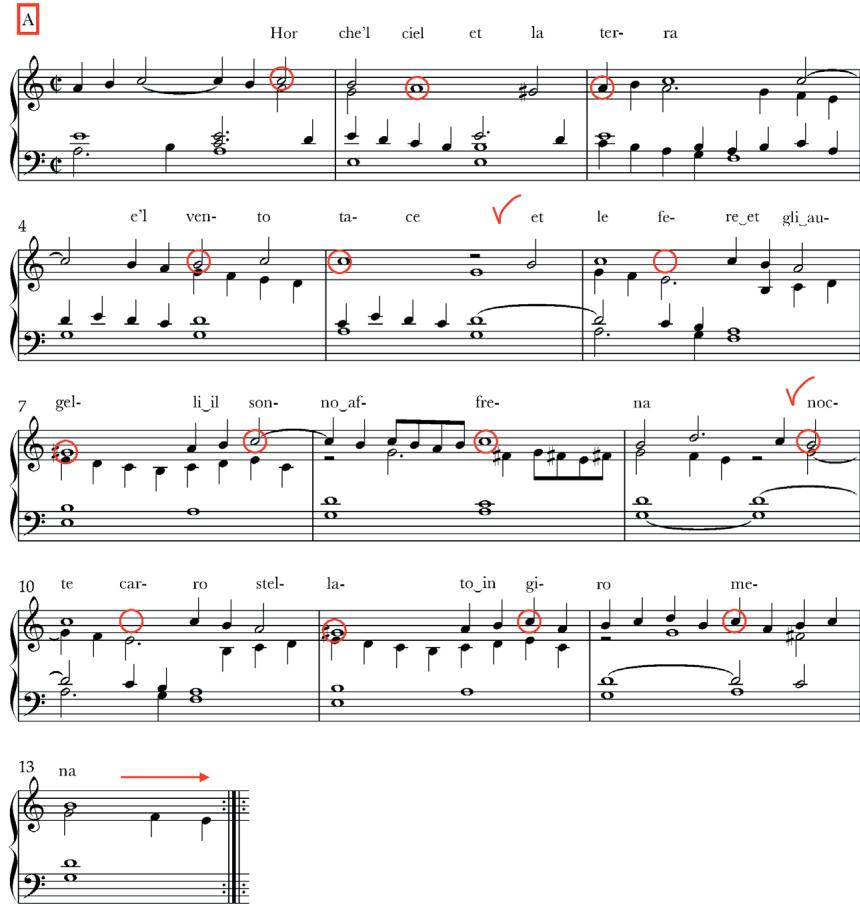
中文讲解
图注:例 8 Andrea Antico《Hor che’l ciel et la terra》,见《Frottole intabulate》1517,第 1–13 小节。该谱例即为上文讨论器乐改编中 c² 单一长音的视觉依据。由于图像未保留,请参阅原图。
第24段(P0244)
原文复述
In the section A’, the metrical structure is more regular, and the tonic accents of the lyrics generally coincide with the strong beats of the bar. Yet, in the fifth verse of the sonnet the syllable ‘veg’ (the word ‘veggio’, b. 5) falls on an upbeat instead of a downbeat, and later on in the same line, the syllable ‘pen’ (the word ‘penso’, b. 6) is also placed on a weak beat. The same happens in the sixth verse of the sonnet with the syllables ‘sem’ (‘sempre’, b. 9) and ‘pe’ (‘pena’, b. 12).
中文讲解
中译:在 A’ 段中,诗律结构较为规整,歌词的重读音节大体与小节强拍重合。但在诗的第五行 veg(veggio,b.5)落于弱拍而非强拍,同行后部 pen(penso,b.6)亦置于弱拍。诗的第六行亦然:sem(sempre,b.9)与 pe(pena,b.12)同样位于弱拍。该段说明 A’ 段虽较 A 段更接近诗律规整,但并非完全对齐:veggio / penso / sempre / pena 四个语义重负载词皆落于弱拍,构成对诗人内心不稳定状态的隐性音乐化映射,恰好与本诗主诉痛苦与失常相呼应。
第25段(P0245)
原文复述
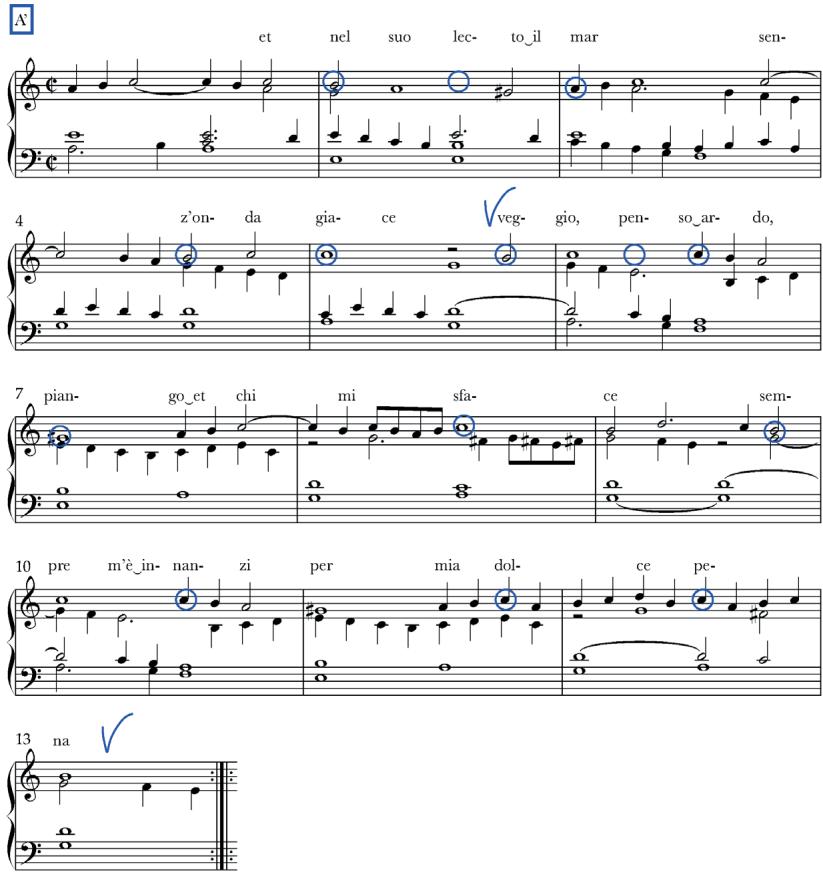
中文讲解
图注:例 9 Andrea Antico《Hor che’l ciel et la terra》,见《Frottole intabulate》1517,第 1–13 小节。该谱例与例 8 同时呈现同一段落,提供 A’ 段文本—音乐对位的视觉依据。由于图像未保留,请参阅原图。
第26段(P0246)
原文复述
The sections B and B’ contain only one discrepancy between text and music: the tonic accent of the word ‘guer-ra’ falls here on an upbeat rather than the downbeat which is prescribed according with metre of the verse.
中文讲解
中译:B 段与 B’ 段中,文本与音乐之间只有一处龃龉:guer-ra(guerra)一词的重音落于弱拍而非诗律所规定的强拍。该段指出 B/B’ 段为整首曲子中诗乐对位最贴合的部分——除 guerra 一词的重音错位外,其余皆依诗律。这一观察意味着作曲家在处理语义核心词(guer-ra = 战争 / 内心冲突)时选择性偏离诗律,使该词与彼时彼地的彼特拉克式矛盾修辞主题相谐。
第27段(P0247)
原文复述
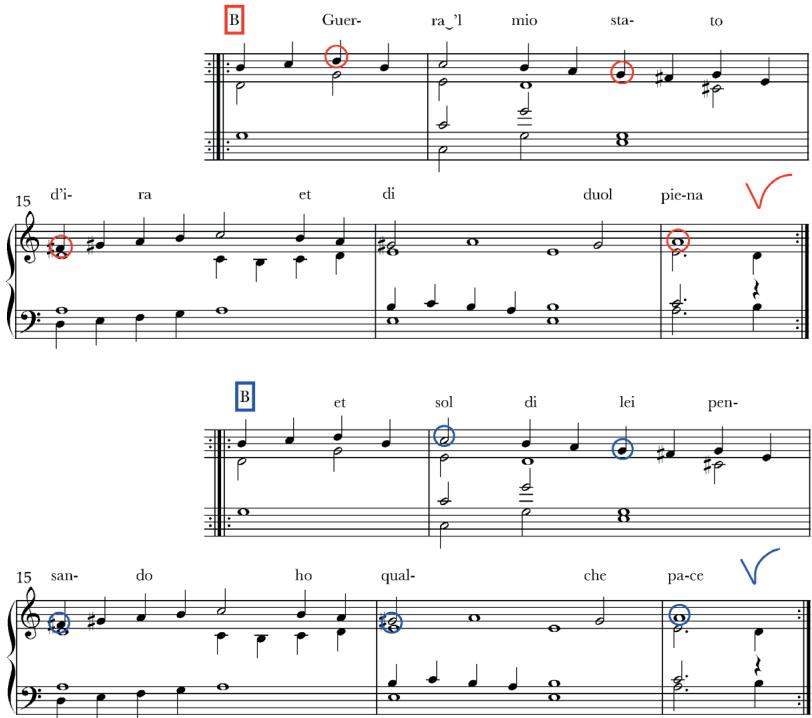
中文讲解
图注:例 10 Andrea Antico《Hor che’l ciel et la terra》,见《Frottole intabulate》1517,第 13–17 小节。该谱例呈现 B/B’ 段中 guer-ra 一词重音落点的视觉对照。由于图像未保留,请参阅原图。
第28段(P0248)
原文复述
In section C, music and text are not in agreement in line nine of the sonnet: on the anapest ‘così sol’ (uu-), the accented syllable ‘sol’ (b. 18) falls on a weak beat of the measure instead of a strong one; the same happens in verse ten on the syllables ‘mo’ (‘move’, b. 21) and ‘dol’ (‘dolce’, b. 22), and again in line eleven with the syllable ‘man’.
中文讲解
中译:在 C 段中,诗第九行的词与乐并不吻合:抑扬抑格 così sol(uu-)中,sol(b.18)落于小节弱拍而非强拍;诗第十行中 mo(move,b.21)与 dol(dolce,b.22)亦然;诗第十一行中 man 一词同样如此。该段详细列举 C 段内诗乐重音错位之处:sol / move / dolce / man 等承载甘苦、流动、温柔与手等关键意象的词,皆位于弱拍。与 A’ 段相同,重音错位并非偶然,而是选择性地置放在诗学上最核心的隐喻词上。
第29段(P0249)
原文复述
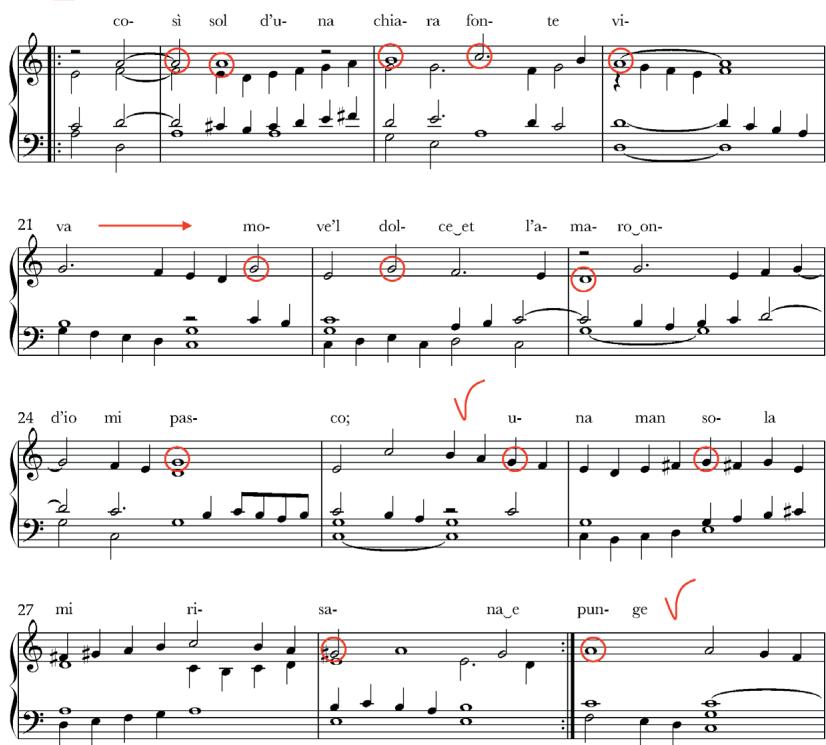
中文讲解
图注:例 11 Andrea Antico《Hor che’l ciel et la terra》,见《Frottole intabulate》1517,第 17–28 小节。该谱例对应 C 段中 cosí sol / move / dolce / man 等重音错位的视觉呈现。由于图像未保留,请参阅原图。
第30段(P0250)
原文复述
Section C’ contains the same accented patterns found in section C, excepting line 14 of the sonnet where the syllable ‘dal’ (‘dalla’, b. 26) falls on a weak part of the measure instead of a strong one. The same happens in section D, in which the last verse of the sonnet is repeated exactly in the same way.
中文讲解
中译:C’ 段承袭 C 段相同的重音模式,惟诗第 14 行中 dal(dalla,b.26)落于小节弱部而非强部一处例外。D 段亦同:诗的末句(D 段中的重复形式)以完全相同的方式呈现。该段揭示整首 frottoLast 中重音错位是系统性而非偶发的作曲选择,尤其在末句 tantoson lunge(与拯救相隔极远)中,’lunge 一词也保持同样错位,构成全曲收束处的情感强化。
第31段(P0251)
原文复述
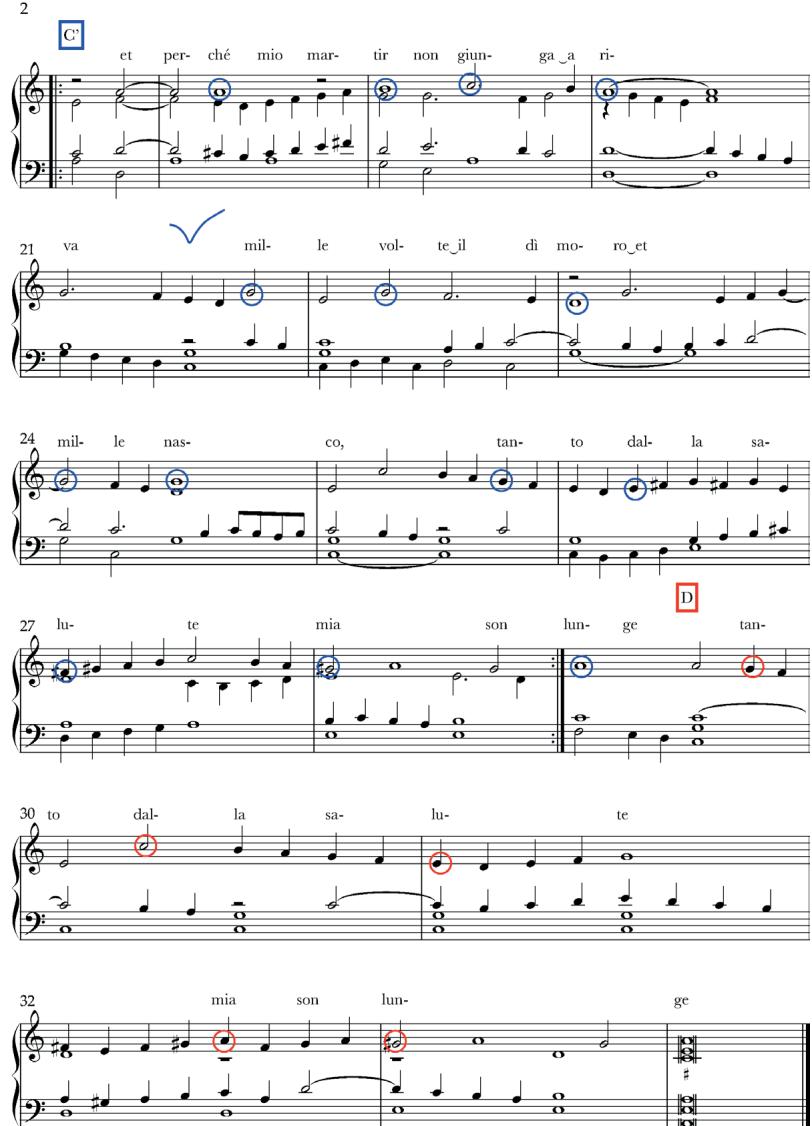
中文讲解
图注:例 12 Andrea Antico《Hor che’l ciel et la terra》,见《Frottole intabulate》1517,第 17–34 小节。该谱例覆盖 C、C’ 及 D 段,是本节讨论重音模式系统化重复(除 dalla 一处例外外)的视觉依据。由于图像未保留,请参阅原图。
第32段(P0252)
原文复述
The following video contains the author’s version of this frottola. For clarity, the second text has been notated on the lowest staff: https://www.youtube.com/watch?v=4mLYX2W1KV4.
中文讲解
中译:以下视频为本作者所解读的此 frottoVersion。其第二个文本(器乐改编版)以最下方一行谱表呈现,链接 https://www.youtube.com/watch?v=4mLYX2W1KV4。该段为本节的音频/视频辅助资源,作者将其版本并行呈现,方便读者在听觉上对照谱例分析与文本重音讨论。
第33段(P0253)
原文复述
Click here to play the video.
中文讲解
中译:点击此处播放视频。该段落为版面引导语,无独立论旨,仅作为前段视频链接的播放入口提示。
脚注 / 边栏 / 图表 / 附加信息(如有)
本节包含若干脚注式信息:P0237 提出以红/蓝色编码标记两版本重音音节与语义标注,作为后续谱例分析的方法说明;P0238–P0239、P0243、P0245、P0247、P0249、P0251 均是图像占位符(Ex. 6 至 Ex. 12),所引版本为 Bartolomeo Tromboncino 原 frottola 版(罗马:Andrea Antico,c. 1516)与 Andrea Antico 的《Frottole intabulate》1517 版本;P0252–P0253 提供 YouTube 视频链接(4mLYX2W1KV4),标注第二文本置于最下方一行谱表。这些附加材料的功能在于为前文文本-音乐对位的论述提供视觉与听觉佐证,并指明所据版本的印本信息。
💡 本节核心要点
- 本节文本出自 Petrarca《Canzoniere》中的十四行诗 Hor che’l ciel et la terra,由意大利十一音节格律诗行构成;乐曲基于共同 aere,采用 AA’BB’CC’D 八段式结构。
- 原 frottola(Tromboncino / Antico 1516)与器乐改编版(Antico 1517)之间的差异主要不在曲式,而在重音对位与音节时值处理:器乐版倾向合并长音、便于键盘连奏。
- 诗乐重音错位并非随机,而是选择性地集中于承载核心语义矛盾的关键词上:guer-ra、veggio / penso / sempre / pena、cosí sol、move / dolce / man 等,恰与全诗甘苦交织、生死反复的主旨呼应。
- 作曲家常通过把语义重要音节置于弱拍来制造张力;只有在 A 与 A’ 之间,因文本语义连续而不以终止式打断乐流,方维持乐思未断。
- B 与 B’ 段是诗乐对位最为齐整的一段,仅 guerra 一词重音偏移,形成修辞性凸显。
- 本节的图文组合(谱例 Ex. 6–Ex. 12 + YouTube 音频)共同呈现一个方法论:通过颜色编码视听同步追踪两版文本的重音与语义地图。
🔑 关键术语
- endecasillabo:意大利十一音节格律诗行,是彼特拉克《Canzoniere》中十四行诗所用基本诗行单位,其内部重音分布(约前 4 后 6 或前 6 后 4)作为本节衡量诗—乐对位符合度的根本依据。
- aere:本节所谓 common aere 指彼特拉克抒情诗在 16 世纪初流行的若干调式—韵律框架,是 frottola 创作中为诗选择旋律模版的依据;本曲即基于这样一种 aere。
- frottola:15 世纪末至 16 世纪初意大利世俗声乐体裁,常以彼特拉克诗歌为词,诗节以反复对位法(AA’BB’…)织体为主;本节讨论的 Hor che’l ciel et la terra 正是其中一例。
- intavolatura / intabulate:指将声乐作品改编为键盘(或其他弦)乐器演奏的谱式;本节特指 Andrea Antico 1517 年将 frottola 改编为键盘演奏的版本。
- AA’BB’CC’D:本 frottola 的曲式结构:每两段构成重复对关系,共八段,覆盖全诗十四行,体现当时 frottola 典型的反复对位织体。
- 重音错位(shifted accents):指乐谱中乐句重音位置与诗行诗律重音位置之间的不对应关系;本节集中讨论其在关键词上的语义—修辞功能。
- cantus:四声部复调中的最高声部,在 frottole 中通常承载主旋律及歌词,是分析诗乐对位的核心声部。
- RISM [c. 1516]10:国际音乐文献目录(RISM)对 1516 年左右由 Andrea Antico 在罗马印行的《Frottole libro secondo》的编号标识。
s21 O che dirala mo
第1段(P0254)
原文复述
O che dirala mo
中文讲解
这是本节的标题,直接以被分析的意大利 frottola(弗罗托拉,文艺复兴时期意大利的世俗歌曲体裁)原名 “O che dirala mo” 作为标题,开启了对这首作品的专门讨论。该标题本身不包含任何分析性内容,仅作为节标题指引读者进入下一段对作品体裁与格律的说明。
第2段(P0255)
原文复述
This frottola is made of regular settenari tronchi and uses exclusively iambic feet (u-).
中文讲解
作者对这首 frottola 的诗体格律给出关键判断:全篇由规则的 “settenari tronchi” 构成,且只使用抑扬格(iambic)音步。
“settenario tronco” 是意大利诗律学中的术语,指七音步诗行(settenario),但末音节被截去(tronco 字面意为 “截断”),因此实际可数位置为六个音节,并以重读音节结束。句中"u-“是抑扬格的节奏图示:前轻后重。
这一声明在论证链中的作用非常关键:它表明这首 frottola 的文本格律是均匀、可预测的,这为下一段中"格律重音与音乐重音几乎完美对应"的判断提供了前提条件。如果格律本身就具有规律性,那么作曲家在配乐时也就更容易做到音节-重音的对位。
第3段(P0256)
原文复述
O che dirala mo Mia vita finiro Se danno ne havero L’error sera pur so
中文讲解
原文为第一节歌词,原文照录不作翻译(中文释义见下)。
逐行中文大意(用于辅助理解,非独立复述): “哦,她会怎么说呢/我的生命就将终结/若我招致祸患/那错误终将属于我。”
该节由四行构成,每行对应一个 settenario tronco;末行的 “so” 词形保留了早期近代意大利语(如 toscano 写作 “sará”、“saro” 的变体形式),并非现代正字法。
作者随后直接用 “O che dirala mo …” 提示读者:这是一个反复出现的叠句(ripresa/refrain),作者将在分析中将它与诗节交替呈现。
补充说明
原文采用了 16 世纪意大利俗语(volgare)的拼写特征,如 “dirala”(今 dirà la)、“aspecta”(今 aspetta)、“hav"类拼写、“finirò” 写作 “finiro” 等;这些是 frottola 文献常见的早期正字法,非印刷错误。
第4段(P0257)
原文复述
Piu non dira così Amante aspecta el di Che l giorno e l modo e qui Che pace trovaro
中文讲解
原文为第二节歌词,原文照录不作翻译。
逐行中文大意:“她再不会这样说/情人啊,企盼那一天/那一天、那一刻已在此/在那里他们寻得了安宁。”
与第一节同样由四行组成,行末重音位置 “così / di / qui / ro” 形成了规则的下垂-上扬交替。该节中 “el”、“e l” 等缩略形式是早期意大利语歌词的常见写法。作者随后以省略号 “…” 表示该节尚未结束,需回到首句叠句 “O che dirala mo …"。
第5段(P0258)
原文复述
O che dirala mo …
中文讲解
这是叠句(ripresa)的回归,作者用与节标题相同的首行 “O che dirala mo …” 标示循环,并以省略号表明这是模式化重复,文本内容与 P0256 中首行完全相同。
在小节结构上,“诗节—诗节—叠句” 的排列是 frottola 典型的 “A B A” 收束方式:两段新内容之后回到开场叠句,形成封闭式循环。作者这样排版是为了让读者在阅读正文分析之前,就先把握住文本的循环结构。
第6段(P0259)
原文复述
In the following example, an analysis of the original frottola is proposed. The metrical accents in the text of the first stanza are circled in red. Main caesuras in the text are marked in red, while secondary caesuras are marked in blue (for example to indicate the commas).
中文讲解
作者在此介绍接下来谱例中所采用的分析标记系统,作用等同于一张"图例”:
- 红色圆圈 → 标注诗行中的格律重音位置(metrical accents),用以揭示诗体节奏。
- 红色标记 → 表示主要停顿(main caesura),即把诗行分成两个语义-句法单元的强切分。
- 蓝色标记 → 表示次要停顿(secondary caesura),通常对应文本中的逗号等较弱切分。
之所以要先把标记规则写清楚,是因为下文(P0260)将基于这套颜色系统作出"重音与音乐完美对应"以及"语义停顿被音乐句法跨越"的判断。换言之,本段为后续论证提供了视觉与分析的双重坐标系。
第7段(P0260)
原文复述
The accentuation pattern in these lyrics is very clear, with a perfect match between metrical accents and musical accents. But in the instrumental adaptation we find some surprises. From a semantic point of view, the end of a musical sentence consistently overlaps the following one. This is emphasised by the quarter note passages systematically employed by Antico at these semantic caesuras, which makes breathing between semantic periods challenging. Given the regularity of the metrical accentuation, in the following example we show only the analysis of the first stanza. This analysis can also be applied to the other texts.
中文讲解
这是本节的核心论证段,作者从文本与音乐两个层面作出对比判断:
-
文本层面:歌词的重音模式 “非常清晰”,且与音乐重音达到"完美对应”。这与 P0255 所确立的"规则 settenari tronchi + 单一抑扬格"格律前提形成闭环——诗体本身就规则,配乐自然水到渠成。
-
器乐改编层面(Antico 的版本):出现"一些意外”。具体表现为:从语义上看,一个音乐句的结束与下一个音乐句的开端相互重叠(overlap),没有留给歌者/听众在语义停顿处呼吸的余地。
-
造成这种重叠的具体手段:Antico 在每一个语义停顿处系统性地使用"四分音符段落"(quarter note passages)。四分音符节奏在中性、流动的器乐织体中具有"填补空白"的功能,因此它反而把本来应该有的语义气口抹平了。
-
方法论说明:由于歌词重音本身具有规则性,作者只对第一节进行可视化分析(见下两段图示),并声明这一分析模式可推广至其余诗节。
整段论证的张力在于:文本与声乐版本的吻合是"教科书式"的,但器乐改编者 Antico 却出于器乐织体的考虑,主动打破了歌唱版本中的呼吸点。作者借此引出节末的谱例与图示。
第8段(P0261)
原文复述
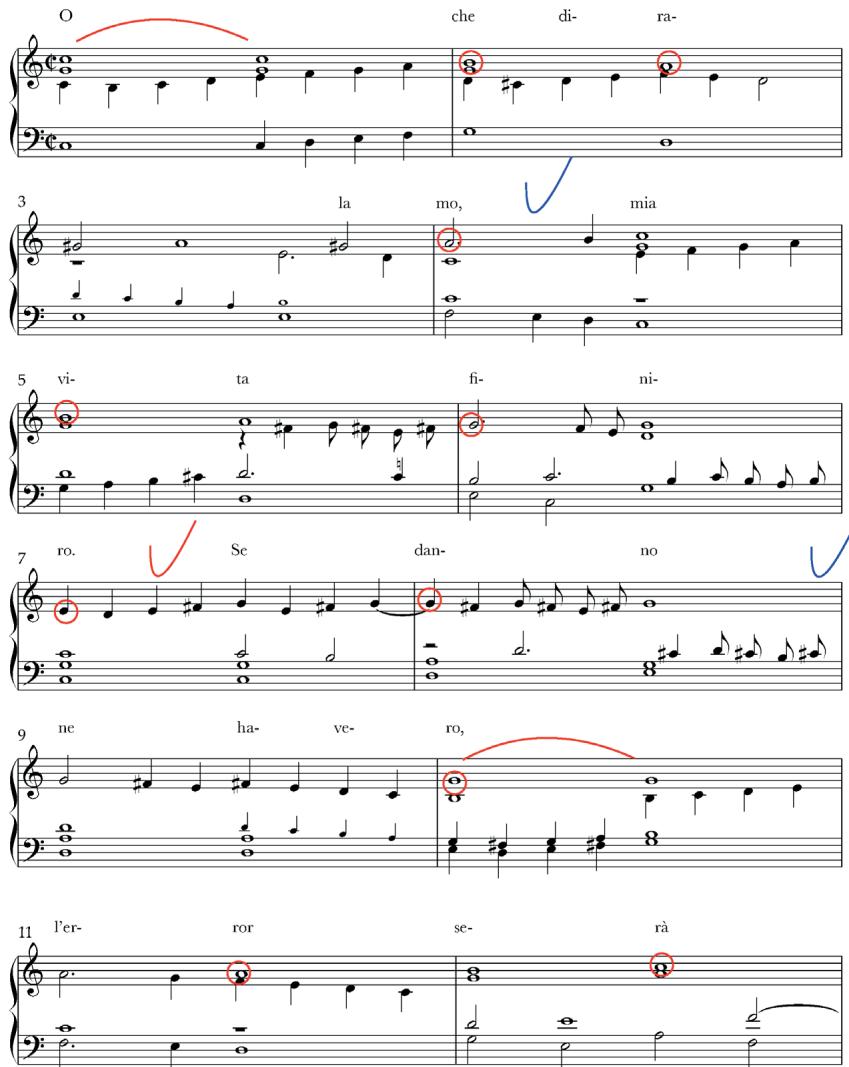
中文讲解
这是位于第 47 页的图像占位符,具体内容(歌词上的红色重音圈、红蓝 caesura 标记等可视化分析)需查看原图。结合 P0259 与 P0260 可知,该图正是作者所承诺的"对第一节歌词所作的格律重音与主要/次要停顿分析"的可视化呈现。
由于图像本身未在文本中直接嵌入,分析者应当参照 P0259 所给的图例来解读该图。
补充说明
需查看原图以确认具体的红色圈与红色/蓝色切分标记落在哪几个音节上。
第9段(P0262)
原文复述
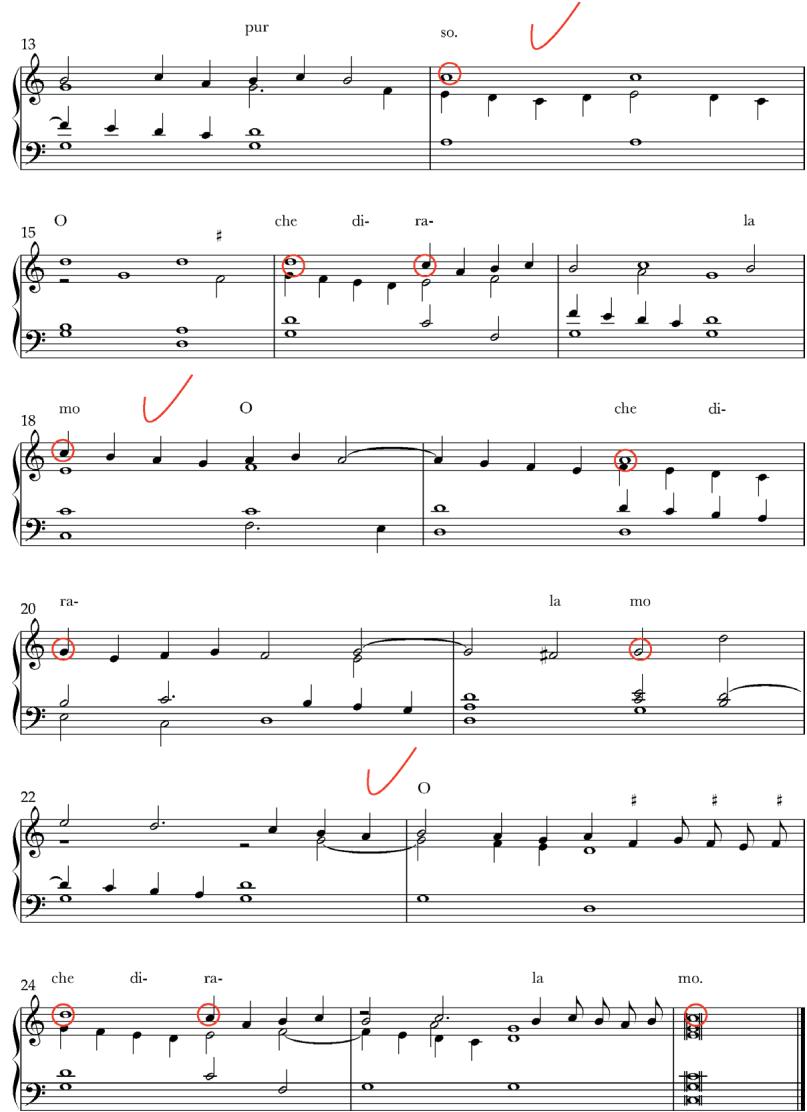
中文讲解
这是位于第 48 页的图注,作者将其编为 Example 14(谱例 14)。图注信息包含三个要素:作者(Andrea Antico,安德里亚·安蒂科,16 世纪意大利音乐印刷家与琉特/键盘改编家)、作品(“O che dirala mo”)、以及出处(Frottole intabulate 1517,即 1517 年出版的"琉特/键盘改编版弗罗托拉集")。
“intabulate” 一词在 16 世纪意大利音乐出版语境中指为键盘或琉特等乐器所改编的版本,即将原本为人声演唱的 frottola 转写成器乐可演奏的记谱形式。该图示正是 P0260 所讨论的"器乐改编版本"——即文本中所谓的"instrumental adaptation by Antico"。
补充说明
需查看原图(谱例 14)以核实具体的音型、节奏型与四分音符段落在乐句切分处的分布。
第10段(P0263)
原文复述
Other examples of this group are ‘Per dolor mi bagno il viso’, ‘Animoso mio desire’ and ‘Non più morte ha il mio morire’. The following video contains the author’s version of the previously analysed frottola: https://www.youtube.com/watch?v=bpL1Bir9sCs
中文讲解
本段承担两个功能:
-
同类作品的横向列举:作者指出与 “O che dirala mo” 属于同一分析组(group)的其他三首 frottola 分别是 ‘Per dolor mi bagno il viso’、‘Animoso mio desire’ 与 ‘Non più morte ha il mio morire’。所谓"同一组",从上下文推断,应指同属 Antico Frottole intabulate 1517 中由他进行器乐改编的曲目,且都具备规则格律与清晰重音对应等共同特征。
-
提供视听补充材料:作者给出一段 YouTube 视频链接,播放的是作者本人(the author,应指撰写本书/本节的学者)对所分析 frottola 的演绎版本。该链接为延伸学习材料,让读者可以以听觉方式验证前文所作的节奏与切分判断。
补充说明
无额外补充(链接本身为外部资源,无法在文本内进一步核验)
第11段(P0264)
原文复述
Click here to play the video.
中文讲解
这是对上一段所给 YouTube 链接的播放提示语,属于网页/电子出版物中的交互式引导语,不承载新的分析内容。它的存在仅为了让读者能够直接点击进入视频,进一步对照书面分析与实际音响。
脚注 / 边栏 / 图表 / 附加信息(如有)
本节包含两条图像占位符:
- 第 47 页图像(P0261):歌词文本上的格律重音圈与主要/次要 caesura 标记可视化,对应 P0259 所述图例。
- 第 48 页图像(P0262):谱例 14(Ex. 14),Andrea Antico《O che dirala mo》器乐改编谱,原刊于 Frottole intabulate 1517,为 P0260 所讨论的"instrumental adaptation"的具体呈现。 此外 P0263–P0264 提供一条 YouTube 视频链接(bpL1Bir9sCs)作为听觉对照补充材料。
💡 本节核心要点
- 本节分析的 frottola “O che dirala mo” 在诗体上由规则的 settenari tronchi(七音步截尾行)构成,且通篇只使用抑扬格(u-)音步,格律高度均匀。
- 文本格律的规则性直接带来"音乐重音与格律重音完美对应"的结果,这是作者对声乐版本作出的核心判断。
- 作者采用可视化标记体系:红色圆圈标格律重音,红色标主要 caesura,蓝色标次要 caesura(如逗号),并只对第一节进行标记分析,声明方法可推广。
- Andrea Antico 的器乐改编(Frottole intabulate 1517)出现与声乐版本不同的处理:在语义 caesura 处系统性使用四分音符段落,使一个音乐句的结束与下一句的开端重叠,呼吸被压缩。
- 作者横向列举同一组(group)内的另外三首 frottola——‘Per dolor mi bagno il viso’、‘Animoso mio desire’、‘Non più morte ha il mio morire’——作为同类现象的进一步佐证。
- 附带的 YouTube 视频供读者通过听觉方式验证书面分析(格律重音—音乐重音对应与器乐改编中的句法重叠)。
🔑 关键术语
- settenario tronco:意大利诗律学术语,指七音步诗行(settenario),但末音节被截去,故实际可数为六个音节位置并以重读音节收束。本节所分析 frottola 全篇由这种诗行构成。
- iambic foot (u-):抑扬格音步,前轻后重的两音节节奏单位。本节作者特别指出该 frottola 通篇只使用抑扬格,这一均匀性是"格律—音乐重音完美对应"的前提。
- frottola:15 世纪末至 16 世纪初流行于意大利宫廷的世俗歌曲体裁,常由数节短诗加叠句(ripresa)构成,是文艺复兴时期最早被系统印行与器乐改编的意大利世俗声乐体裁之一。
- caesura(主要/次要停顿):诗行内部的句法-语义切分点。作者在本节用红色标记主要 caesura(强切分),用蓝色标记次要 caesura(如对应逗号的弱切分),用以辅助可视化格律分析。
- intabulation / intabulate:16 世纪意大利音乐出版术语,指将原本为人声演唱的乐曲转写为键盘或琉特等乐器演奏形式的改编过程。Antico 1517 年出版的 Frottole intabulate 即"琉特/键盘改编版弗罗托拉集"。
- quarter note passage:四分音符段落,指节奏型以四分音符为主、节奏均匀流动的器乐织体片段。Antico 在每一处语义 caesura 上系统性地使用这种段落,使原本应有呼吸的语义停顿被中性的器乐节奏所填补,造成音乐句法的重叠。
- ripresa:frottola 的叠句/反复段落,通常是全曲开头或结尾处回归的一句诗行。本节中 “O che dirala mo …” 即为反复出现的 ripresa。
s22 Conclusions
第1段(P0265)
原文复述
A level-2 heading titled ‘Conclusions’, which opens the closing section of the article.
中文讲解
“## Conclusions” 是一个二级标题,标志文章进入结论部分,开始收束前文围绕 frottola 这一体裁及其器乐演绎所展开的论证。标题本身的功能是提示读者:接下来呈现的是回顾性、总结性的论述,而非新论点的展开。
第2段(P0266)
原文复述
The frottola was a codified genre in which the text often dictated the structure of the music, because it followed strict literary rules. In vocal repertoire, the metrical structure of the verse, by its own nature, leads the performer toward pre-defined accentual patterns that—in the specific case of the frottola—are often different from the patterns set by the music itself. In principle, such conflicting accentuation could be resolved in a sung performance: a singer can easily stress any tonic syllable, preserving the correct accentuation of the verse, and can compensate for an incorrect accentuation by means of a correctly placed stress in delivery. The singer can articulate the text, emphasising tonic syllables and giving weight to the meaning of the words, and can modulate intonation by slowing down or quickening the pace—to cite Poliziano once more.
中文讲解
本段浓缩了 frottola 作为一种"被规则化的体裁(codified genre)“的核心特征:文本先于音乐,作曲服从于严格的文学规则。在声乐中,诗句的格律天然引导演唱者形成预设的重音模式,而这种文学重音在 frottola 中常常与音乐自身设定的重音并不一致。作者指出,这种冲突在人声演绎中是"可解的”——歌手可以灵活地加重任何一个重读音节以维持诗句的准确重音,也可以通过演唱中的重音处理来补偿错位;更进一步,歌手能够通过清晰的吐字让重读音节得以突出、让词义得到强调,并通过放慢或加快语速(再次援引波利齐亚诺的说法)来调节音调。本段的论证意义在于:第一,确立 frottola 中"文本主导音乐"这一前提;第二,证明人声演绎本身具备化解文本—音乐冲突的能力,从而把真正的难题留给器乐改编——为下一段过渡到器乐版本埋下伏笔。
补充说明
本段提及的"再次援引波利齐亚诺(to quote Poliziano once more)“中的脚注编号 30 指向本节末的注释(见 P0269),该注释又回溯到前文第 28 号注释;这是学术写作中典型的交叉引用,以避免重复。
第3段(P0267)
原文复述
In the case of the instrumental version of the same repertoire, the same approach would be challenging or could even appear unnatural, since no words are present. The literary conventions of the time demand that the instrumentalist rethink the music and opt for what may be some unusual choices. In this article, the author attempts to propose a reading of the instrumental repertoire that respects the constraints dictated by the literary conventions underlying the texts of the vocal models.
中文讲解
本段承接上一段,从"人声可以化解冲突"过渡到"器乐版本因此面临挑战”。由于器乐演奏中没有歌词可供参考,原本依赖文本重音引导音乐重音的逻辑不再成立;作者因此提出:在当时的文学惯例约束下,器乐演奏者必须"重新思考"音乐,并可能采取某些看似"反常"的选择。这正是本文的学术贡献所在——作者尝试提出一种对器乐曲目的解读方式,使其尊重源自声乐原型文本中的文学惯例。换言之,前文"文本支配音乐"的命题在此被延伸到器乐领域:尽管没有歌词,器乐版本仍应被视为"被文学规则塑造"的作品,并据此加以演绎。
第4段(P0268)
原文复述
The solutions offered in the two frottolas examined above are practical realisations of what this article recommends; many other solutions are possible. Nothing would prevent a performance of these pieces that disregards all literary conventions, treating them as purely instrumental works in their own right. However, if we assume that the audience was familiar with the vocal models, it is fascinating to imagine that our rendition could be close to the practice of the time.
中文讲解
本段是全节的收束,语气从论证转为开放性反思。首先,作者承认前两首 frottola 的具体处理只是其原则的"实际示范"之一,其他处理方式同样合理——这种克制避免把自己的方案说成唯一正解。其次,作者并不否认完全忽略文学惯例、按纯器乐曲来演奏这些作品的可能性,这表明本文所提方案具有可选性而非规范性。最后,作者提出一个带有想象色彩的假设:若当时的听众熟悉这些声乐原型,则本文所主张的演绎方式就有可能接近历史实践本身。这一假设既是对前文论证的限定,也是对其学术旨趣的总结:研究目标并非复原唯一正确的演奏方式,而是探索一种与历史情境相符的诠释可能。
第5段(P0269)
原文复述
30 See n. 28.
中文讲解
这是一条编号 30 的脚注,内容为"参见注释 28",属于交叉引用类脚注。它的作用是引导读者回溯前文第 28 号注释中已有的说明,而不在此处补充新的文献或评论,体现了学术写作中避免重复、维持注释体系简洁的常见做法。
脚注 / 边栏 / 图表 / 附加信息(如有)
本节唯一的非正文材料为脚注 30(P0269),形式为"See n. 28",属于交叉引用,把正文中的援引波利齐亚诺指向此前第 28 号注释。其功能为避免重复并维持注释体系的紧凑,不提供新的参考文献或评论。
💡 本节核心要点
- frottola 是一种被规则化的体裁,其音乐结构服从于严格的文学规则,文本先于音乐。
- 在声乐演绎中,文学重音与音乐重音的冲突可由歌手通过灵活的重音、吐字与音速调节加以化解。
- 器乐版本由于缺失歌词,无法直接复制人声的处理方式,因而必须在文学惯例的约束下"重新思考"音乐。
- 本文的核心主张是为器乐曲目提出一种尊重声乐原型之文学惯例的解读方式。
- 前两首 frottola 的具体处理只是该主张的实践示范之一,并非唯一正解;其他方案甚至完全忽略文学惯例的做法均被承认。
- 如果当时的听众熟悉声乐原型,则本文所主张的演绎方式有可能贴近历史实践,这一假设界定了本文的学术旨趣。
🔑 关键术语
- frottola:本文讨论的核心体裁。文中将其界定为"被规则化的体裁(codified genre)",其音乐结构服从于严格的文学规则。
- codified genre:受一套既定规则约束的体裁。本节中用以强调 frottola 并非自由创作,而是其文学规则预先决定了音乐的结构与重音布局。
- tonic syllable:诗句中的重读音节。本节指出,歌手可灵活加重任何一个重读音节以维持诗句的准确重音,从而化解文本与音乐之间的重音冲突。
- accentuation patterns:重音模式。本节区分两类:诗句格律所导致的文学重音模式,与音乐自身设定的音乐重音模式;在 frottola 中二者常常并不一致。
- vocal model:器乐改编所依据的声乐原型。本节提出,器乐版本的演绎仍应尊重其声乐原型之文本所遵循的文学惯例。
s23 Bibliography
第1段(P0270)
原文复述
Bibliography
中文讲解
这是参考文献(书目)部分的小节标题。它标志着正文的结束以及作者所引用、参考或讨论的全部文献清单的开始。这一节按字母顺序列出了作者在写作过程中使用的原始资料、现代学术研究和现代编辑版本,是支撑全文研究的基础。
第2段(P0271)
原文复述
Andrea Antico, Frottole intabulate da sonare organi, libro primo (Rome: Andrea Antico, 1517) (RISM 15173)
中文讲解
这是本书研究的中心原始资料之一:Andrea Antico 于 1517 年在罗马出版的《为管风琴弹奏而记谱的弗罗托拉,第一卷》。这是历史上第一本为键盘乐器印刷的意大利音乐作品集。「RISM 15173」是该书在《国际音乐文献源》(Répertoire International des Sources Musicales)目录中的标准编号,便于全球学者统一检索。
补充说明
RISM 是国际上用于统一标识音乐历史印刷品与手稿的目录体系;「intabulate」(intavolatura)指为键盘乐器将多声部记谱为可弹奏谱面的方式。
第3段(P0272)
原文复述
Andrea Antico, Frottole intabulate per sonare organi, facs. ed., Bibliotheca Musica Bononiensis IV/42 (Bologna, 1984)
中文讲解
1984 年在博洛尼亚出版的 Antico 1517 年原始版本的影印本(facsimile edition),收入《博洛尼亚音乐文库》系列第四卷第 42 册。影印本让现代学者能够直接查阅原始印刷版式的细节,例如版面排布、音符形状与原本的视觉特征。
补充说明
「facs. ed.」即 facsimile edition(影印本)的缩写;Bibliotheca Musica Bononiensis 是博洛尼亚系统影印出版意大利早期音乐文献的重要系列。
第4段(P0273)
原文复述
Andrea Antico, Frottole intabulate da sonare organi, 1517: Twenty-Six Keyboard Pieces for Organ, Harpsichord or Clavichord, ed. Christopher Hogwood (Tokyo, 1984)
中文讲解
由英国著名指挥家与早期音乐学者 Christopher Hogwood 编辑、1984 年于东京出版的可弹奏现代版谱集,收入 26 首键盘作品,适用于管风琴、羽管键琴或古钢琴演奏。这一现代编辑本使现代演奏者无需掌握 16 世纪的原始记谱即可演出该曲集。
补充说明
「ed.」代表 edited by,表示该版本由 Hogwood 进行了现代编辑(包括排版、指法、订正等)。
第5段(P0274)
原文复述
Andrea Antico, Frottole intabulate da sonare organi (Roma, 1517), ed. Maria Luisa Baldassari (Bologna, 2016)
中文讲解
由 Maria Luisa Baldassari 编辑、2016 年在博洛尼亚出版的 Antico 1517 年原版的最新现代学术编辑本。这是当前最新的、最具权威性的现代版,可能是作者在进行最新研究时所依据的主要现代本。
第6段(P0275)
原文复述
Andrea Antico, Apologia di Angelo Colotio nell’opere de Seraphino, al Magnifico Sylvio Piccolhomini S. et benefactore, in: Serafino di Ciminelli, Le rime di Serafino de’ Ciminelli dall’Aquila, vol. 1, ed. Mario Menghini (Bologna, 1894)
中文讲解
这是 Andrea Antico 为诗人 Serafino de’ Ciminelli 作品所撰写的辩护文(Apologia),由 Mario Menghini 于 1894 年收入博洛尼亚版《Serafino de’ Ciminelli dall’Aquila 诗集》第一卷中。该文揭示了 Antico 同时是印刷商和诗人、文学评论者,展示了他作为人文主义者的多面身份,对理解 Antico 与当时诗歌及赞助人(如 Piccolomini)的关系有重要价值。
补充说明
Sylvio Piccolomini 即 Silvio Piccolomini(Siena 出身的人文主义者、枢机主教,曾任教皇庇护二世);Serafino de’ Ciminelli(1466–1500)是著名的即兴歌唱诗人(improvisatore)。
第7段(P0276)
原文复述
Francesco Bausi and Mario Martelli, La metrica italiana. Teoria e storia (Florence, 11993, 2021)
中文讲解
由 Francesco Bausi 与 Mario Martelli 合著的意大利诗律学著作《意大利韵律学:理论与历史》,1993 年初版于佛罗伦萨,2021 年再版(书号前的「1」表示首版年份)。这是研究意大利诗歌韵律结构的标准参考书,作者在分析弗罗托拉歌词形式与韵律时很可能参考了它。
第8段(P0277)
原文复述
Pietro G. Beltrami, Piccolo dizionario di metrica, (Bologna, 2015)
中文讲解
Pietro G. Beltrami 编撰的《小韵律学词典》,2015 年出版于博洛尼亚。这是一部简明的意大利韵律学术语词典,可作为前一节学术专著的便携补充工具,用于查找意大利诗歌体裁(如十四行诗、ballata、frottola 等)的韵律定义与术语。
第9段(P0278)
原文复述
Francis Biggi, ‘La Fabula di Orpheo d’Ange Politien ou comment rendre une œuvre à l’espace de l’interprétation?’, in: La Musique ancienne entre historiens et musiciens, ed. Rémy Campos and Xavier Bisaro (Geneva, 2014), 491–512
中文讲解
Francis Biggi 的论文《Angelo Poliziano 的〈奥菲欧〉,或如何将一部作品交还给诠释空间?》,收录于 Rémy Campos 与 Xavier Bisaro 编辑的《历史学家与音乐家之间的古代音乐》(日内瓦,2014)第 491–512 页。Poliziano 的《Orpheo》(1480 年代)是最早的意大利音乐戏剧雏形之一,与 Antico 同时代的音乐文化密切相关;该文探讨该作品如何在表演诠释中「复活」。
第10段(P0279)
原文复述
Vincenzo Calmeta, Prose e lettere inedite, ed. Cecil Grayson (Bologna, 1959)
中文讲解
由 Cecil Grayson 编辑的 Vincenzo Calmeta 散体书信集《未刊散文与书信》,1959 年博洛尼亚出版。Vincenzo Calmeta(约 1465–1508)是米兰宫廷诗人和评论家,与 Antico 同期并有交集。这部文献辑录了对理解 Calmeta 诗学观念、文学交往圈以及当时弗罗托拉诗体环境具有重要价值的原始资料。
第11段(P0280)
原文复述
Vincenzo Calmeta, Canzoni novi con alcune scelte di vari libri di canto (Rome: Andrea Antico, 1510) (RISM 15101)
中文讲解
Vincenzo Calmeta 的《新歌集,附多部歌唱书选曲》,由 Andrea Antico 于 1510 年在罗马印刷(RISM 15101)。这是 Antico 作为印刷商刊行的另一部诗歌曲集,呈现 Antico 在 1517 年键盘曲集之前已经活跃于印刷出版业的轨迹,且 Calmeta 本人作品的多种版本反映了诗作在 16 世纪初的快速传播。
第12段(P0281)
原文复述
Vincenzo Calmeta, Canzoni Sonetti Strambotti et Frottole libro tertio (Rome: Andrea Antico ?, c. 1518) (RISM [15181])
中文讲解
Calmeta 死后出版的作品集《歌、十四行诗、strambotti 与弗罗托拉,第三卷》,约 1518 年由 Andrea Antico(出版者身份后接「?」,表示归属存疑)在罗马印刷(RISM 编号带方括号表示年份不确定)。这部集子是 Calmeta 诗作的合集,反映了 Antico 与 Calmeta 之间长期的出版合作以及弗罗托拉诗体的延续。
第13段(P0282)
原文复述
Baldassare Castiglione, Il libro del Cortegiano, ed. Amedeo Quondam and Nicola Longo (Milan, 2009)
中文讲解
Baldassare Castiglione 的《廷臣论》(Il Cortegiano),由 Amedeo Quondam 与 Nicola Longo 编辑的现代意大利文校勘本,2009 年于米兰出版。该书(1528 年首版)是文艺复兴宫廷文化最重要的论著之一,描述了乌尔比诺宫廷中关于完美廷臣素养的对话,是理解当时音乐与诗歌在宫廷礼仪与表演中的地位的关键背景文本。
第14段(P0283)
原文复述
Baldassare Castiglione The book of the courtier by count Baldesar Castiglione, ed. Leonard Eckstein Opdycke (London, 1901)
中文讲解
Leonard Eckstein Opdycke 编辑的《廷臣论》英译本《The book of the courtier》,1901 年于伦敦出版。这是一部 20 世纪初的英文译本,可能用于辅助作者参考文艺复兴意大利文化的外文文献。
第15段(P0284)
原文复述
Victor Coelho and Keith Polk, Instrumentalists and Renaissance Culture, 1420-1600: Players of Function and Fantasy (Cambridge, 2016)
中文讲解
Victor Coelho 与 Keith Polk 合著的《文艺复兴文化中的器乐演奏者,1420–1600:功能与幻想之演奏者》,2016 年剑桥大学出版社出版。该书系统论述了文艺复兴时期器乐演奏者的社会地位、职业训练与文化想象,是研究 Antico 时代键盘音乐演奏语境的核心英文参考。
第16段(P0285)
原文复述
Alfred Einstein, The Italian Madrigal, 3 vols., trans. Alexander H. Krappe, Roger H. Sessions, and Oliver Strunk (Princeton, 1971)
中文讲解
Alfred Einstein 的经典三卷本《意大利牧歌集》,由 Alexander H. Krappe、Roger H. Sessions 和 Oliver Strunk 翻译为英文,1971 年由普林斯顿大学出版社出版。原书德文版(Einstein 卒后由文献整理出版)是研究意大利牧歌体裁的奠基性文献,对理解从弗罗托拉到牧歌这一意大利世俗声乐传统的演变至关重要。
第17段(P0286)
原文复述
Gloria Filocamo and Maria Luisa Baldassari, ‘Le “Frottole intabulate da sonare organi” (Roma, Andrea Antico, 1517): testo musicale e contesto sociale della prima intavolatura italiana per tastiera a stampa’, in: Fonti musicali italiane 23 (2018), 7–26
中文讲解
Gloria Filocamo 与 Maria Luisa Baldassari 合撰的论文《Antico 1517 年〈键盘弗罗托拉〉的音乐文本与社会语境:首部印刷的意大利键盘记谱集》,发表于《意大利音乐资料》(Fonti musicali italiane)第 23 期(2018),第 7–26 页。这篇论文直接处理与本书研究对象同一曲集,聚焦其文本与社会语境,是本书最重要的近期参考文献之一(两位作者也编辑了 2016 年的现代版)。
第18段(P0287)
原文复述
Gloria Filocamo and Maria Luisa Baldassari, Frottole libro secondo (Rome: Andrea Antico?, c. 1516) (RISM [c. 1516]10)
中文讲解
Filocamo 与 Baldassari 编辑的《弗罗托拉,第二卷》,归属 Antico(?表示归属存疑),约 1516 年罗马出版(RISM 编号加方括号表示年份与归属均不确定)。这部紧邻 1517 年键盘曲集之前出版的声乐弗罗托拉合集,提供了 Antico 出版活动的直接先导语境。
脚注 / 边栏 / 图表 / 附加信息(如有)
本节为书目(Bibliography),全部由独立的参考文献条目构成,未出现脚注、图表、边栏或插图等独立附加材料。书目按作者姓氏字母顺序编排,并大量以 RISM 编号标识原始印刷资源,便于核验。
💡 本节核心要点
- 书目围绕核心原始资料——Andrea Antico 1517 年《Frottole intabulate da sonare organi》展开,既列出原版,也列出三套不同的现代版(Baldassari 2016、Hogwood 1984、博洛尼亚影印本 1984),显示作者综合运用了原典与现代学术成果。
- 书目同时收录 Antico 的非音乐作品(如《Apologia》),揭示作者不仅将 Antico 视为印刷商/作曲家,更把他放在当时的人文主义文化圈中加以考察。
- 与 Antico 同时代的诗人 Vincenzo Calmeta 的诗集与书信集多次出现,表明 Calmeta 诗作与 Antico 出版活动之间存在持续的合作关系,是本书讨论弗罗托拉歌词诗体与赞助环境的关键文献。
- 书目纳入 Castiglione 的《廷臣论》(意大利文校注本与英译本)以及 Coelho 与 Polk 关于文艺复兴器乐演奏者的研究,提示本书将键盘曲集置于宫廷文化与演奏者社会的双重背景中。
- Einstein 的《意大利牧歌集》提供意大利世俗声乐传统的宏观框架;Biggi 关于 Poliziano《Orpheo》的论文则把音乐与早期意大利戏剧演出场景联系起来,二者共同支撑本书从弗罗托拉到牧歌、戏剧演化的论证。
- 近期意大利学术成果(Filocamo 与 Baldassari 2018 论文及其配套编辑)占据显著比重,表明本书立足于 21 世纪意大利本土地音乐学对 1517 年键盘曲集的最新研究前沿。
🔑 关键术语
- Frottole / Frottole:15 世纪末至 16 世纪初流行于意大利宫廷的世俗复调歌曲体裁,是 Antico 1517 年键盘曲集的歌词与旋律来源;frottole 为意大利语复数形式。
- intavolatura / intabulate:键盘乐器的「记谱化」(将复调声部转换为可在单一键盘上同时弹奏的乐谱形式);intabulate 是相关动词过去式的阴性复数形式(da sonare organi 即「为管风琴弹奏而记谱」)。
- RISM:《国际音乐文献源》(Répertoire International des Sources Musicales)的缩写,全球统一的早期音乐印刷品与手稿目录系统;书目中以 RISM 编号(如 15173、15101)便于学者快速定位原始出版物。
- facs. ed.:facsimile edition 的缩写,指原版文献的影印再版,使现代学者可以查阅与原物几乎一致的版面细节;本节 P0272 的博洛尼亚 1984 年影印本属此类。
- strambotti:意大利 15 至 16 世纪流行的短诗体裁,与 frottola、sonetti、canzoni 共同出现在 Calmeta 的合集中(P0281),是理解同时代世俗诗歌形式多样性的关键体裁。
- Apologia:一种为某位人物或作品进行辩护、申辩的文类;Antico 的《Apologia》以 Seraphino 的诗歌为对象,呈现他作为印刷商之外的诗人—批评家身份。